window.__IS_SSR__=true
window.__INITIAL_STATE__={
"attachmentsReducer": {
"audio_0": {
"type": "attachments",
"id": "audio_0",
"imgSizes": {
"kqedFullSize": {
"file": "https://ww2.kqed.org/news/wp-content/themes/KQED-unified/img/audio_bgs/background0.jpg"
}
}
},
"audio_1": {
"type": "attachments",
"id": "audio_1",
"imgSizes": {
"kqedFullSize": {
"file": "https://ww2.kqed.org/news/wp-content/themes/KQED-unified/img/audio_bgs/background1.jpg"
}
}
},
"audio_2": {
"type": "attachments",
"id": "audio_2",
"imgSizes": {
"kqedFullSize": {
"file": "https://ww2.kqed.org/news/wp-content/themes/KQED-unified/img/audio_bgs/background2.jpg"
}
}
},
"audio_3": {
"type": "attachments",
"id": "audio_3",
"imgSizes": {
"kqedFullSize": {
"file": "https://ww2.kqed.org/news/wp-content/themes/KQED-unified/img/audio_bgs/background3.jpg"
}
}
},
"audio_4": {
"type": "attachments",
"id": "audio_4",
"imgSizes": {
"kqedFullSize": {
"file": "https://ww2.kqed.org/news/wp-content/themes/KQED-unified/img/audio_bgs/background4.jpg"
}
}
},
"placeholder": {
"type": "attachments",
"id": "placeholder",
"imgSizes": {
"thumbnail": {
"file": "https://cdn.kqed.org/wp-content/uploads/2024/12/KQED-Default-Image-816638274-2000x1333-1-160x107.jpg",
"width": 160,
"height": 107,
"mimeType": "image/jpeg"
},
"medium": {
"file": "https://cdn.kqed.org/wp-content/uploads/2024/12/KQED-Default-Image-816638274-2000x1333-1-800x533.jpg",
"width": 800,
"height": 533,
"mimeType": "image/jpeg"
},
"medium_large": {
"file": "https://cdn.kqed.org/wp-content/uploads/2024/12/KQED-Default-Image-816638274-2000x1333-1-768x512.jpg",
"width": 768,
"height": 512,
"mimeType": "image/jpeg"
},
"large": {
"file": "https://cdn.kqed.org/wp-content/uploads/2024/12/KQED-Default-Image-816638274-2000x1333-1-1020x680.jpg",
"width": 1020,
"height": 680,
"mimeType": "image/jpeg"
},
"1536x1536": {
"file": "https://cdn.kqed.org/wp-content/uploads/2024/12/KQED-Default-Image-816638274-2000x1333-1-1536x1024.jpg",
"width": 1536,
"height": 1024,
"mimeType": "image/jpeg"
},
"fd-lrg": {
"file": "https://cdn.kqed.org/wp-content/uploads/2024/12/KQED-Default-Image-816638274-2000x1333-1-1536x1024.jpg",
"width": 1536,
"height": 1024,
"mimeType": "image/jpeg"
},
"fd-med": {
"file": "https://cdn.kqed.org/wp-content/uploads/2024/12/KQED-Default-Image-816638274-2000x1333-1-1020x680.jpg",
"width": 1020,
"height": 680,
"mimeType": "image/jpeg"
},
"fd-sm": {
"file": "https://cdn.kqed.org/wp-content/uploads/2024/12/KQED-Default-Image-816638274-2000x1333-1-800x533.jpg",
"width": 800,
"height": 533,
"mimeType": "image/jpeg"
},
"post-thumbnail": {
"file": "https://cdn.kqed.org/wp-content/uploads/2024/12/KQED-Default-Image-816638274-2000x1333-1-672x372.jpg",
"width": 672,
"height": 372,
"mimeType": "image/jpeg"
},
"twentyfourteen-full-width": {
"file": "https://cdn.kqed.org/wp-content/uploads/2024/12/KQED-Default-Image-816638274-2000x1333-1-1038x576.jpg",
"width": 1038,
"height": 576,
"mimeType": "image/jpeg"
},
"xxsmall": {
"file": "https://cdn.kqed.org/wp-content/uploads/2024/12/KQED-Default-Image-816638274-2000x1333-1-160x107.jpg",
"width": 160,
"height": 107,
"mimeType": "image/jpeg"
},
"xsmall": {
"file": "https://cdn.kqed.org/wp-content/uploads/2024/12/KQED-Default-Image-816638274-2000x1333-1-672x372.jpg",
"width": 672,
"height": 372,
"mimeType": "image/jpeg"
},
"small": {
"file": "https://cdn.kqed.org/wp-content/uploads/2024/12/KQED-Default-Image-816638274-2000x1333-1-672x372.jpg",
"width": 672,
"height": 372,
"mimeType": "image/jpeg"
},
"xlarge": {
"file": "https://cdn.kqed.org/wp-content/uploads/2024/12/KQED-Default-Image-816638274-2000x1333-1-1020x680.jpg",
"width": 1020,
"height": 680,
"mimeType": "image/jpeg"
},
"full-width": {
"file": "https://cdn.kqed.org/wp-content/uploads/2024/12/KQED-Default-Image-816638274-2000x1333-1-1920x1280.jpg",
"width": 1920,
"height": 1280,
"mimeType": "image/jpeg"
},
"guest-author-32": {
"file": "https://cdn.kqed.org/wp-content/uploads/2025/01/KQED-Default-Image-816638274-1333x1333-1-160x160.jpg",
"width": 32,
"height": 32,
"mimeType": "image/jpeg"
},
"guest-author-50": {
"file": "https://cdn.kqed.org/wp-content/uploads/2025/01/KQED-Default-Image-816638274-1333x1333-1-160x160.jpg",
"width": 50,
"height": 50,
"mimeType": "image/jpeg"
},
"guest-author-64": {
"file": "https://cdn.kqed.org/wp-content/uploads/2025/01/KQED-Default-Image-816638274-1333x1333-1-160x160.jpg",
"width": 64,
"height": 64,
"mimeType": "image/jpeg"
},
"guest-author-96": {
"file": "https://cdn.kqed.org/wp-content/uploads/2025/01/KQED-Default-Image-816638274-1333x1333-1-160x160.jpg",
"width": 96,
"height": 96,
"mimeType": "image/jpeg"
},
"guest-author-128": {
"file": "https://cdn.kqed.org/wp-content/uploads/2025/01/KQED-Default-Image-816638274-1333x1333-1-160x160.jpg",
"width": 128,
"height": 128,
"mimeType": "image/jpeg"
},
"detail": {
"file": "https://cdn.kqed.org/wp-content/uploads/2025/01/KQED-Default-Image-816638274-1333x1333-1-160x160.jpg",
"width": 160,
"height": 160,
"mimeType": "image/jpeg"
},
"kqedFullSize": {
"file": "https://cdn.kqed.org/wp-content/uploads/2024/12/KQED-Default-Image-816638274-2000x1333-1.jpg",
"width": 2000,
"height": 1333
}
}
},
"news_11973516": {
"type": "attachments",
"id": "news_11973516",
"meta": {
"index": "attachments_1716263798",
"site": "news",
"id": "11973516",
"found": true
},
"parent": 11973512,
"imgSizes": {
"twentyfourteen-full-width": {
"file": "https://cdn.kqed.org/wp-content/uploads/sites/10/2024/01/030323-FarmLand-LV_CM_02-copy-1038x576.jpg",
"width": 1038,
"mimeType": "image/jpeg",
"height": 576
},
"thumbnail": {
"file": "https://cdn.kqed.org/wp-content/uploads/sites/10/2024/01/030323-FarmLand-LV_CM_02-copy-160x107.jpg",
"width": 160,
"mimeType": "image/jpeg",
"height": 107
},
"post-thumbnail": {
"file": "https://cdn.kqed.org/wp-content/uploads/sites/10/2024/01/030323-FarmLand-LV_CM_02-copy-672x372.jpg",
"width": 672,
"mimeType": "image/jpeg",
"height": 372
},
"kqedFullSize": {
"file": "https://cdn.kqed.org/wp-content/uploads/sites/10/2024/01/030323-FarmLand-LV_CM_02-copy.jpg",
"width": 2000,
"height": 1333
},
"large": {
"file": "https://cdn.kqed.org/wp-content/uploads/sites/10/2024/01/030323-FarmLand-LV_CM_02-copy-1020x680.jpg",
"width": 1020,
"mimeType": "image/jpeg",
"height": 680
},
"1536x1536": {
"file": "https://cdn.kqed.org/wp-content/uploads/sites/10/2024/01/030323-FarmLand-LV_CM_02-copy-1536x1024.jpg",
"width": 1536,
"mimeType": "image/jpeg",
"height": 1024
},
"full-width": {
"file": "https://cdn.kqed.org/wp-content/uploads/sites/10/2024/01/030323-FarmLand-LV_CM_02-copy-1920x1280.jpg",
"width": 1920,
"mimeType": "image/jpeg",
"height": 1280
},
"medium": {
"file": "https://cdn.kqed.org/wp-content/uploads/sites/10/2024/01/030323-FarmLand-LV_CM_02-copy-800x533.jpg",
"width": 800,
"mimeType": "image/jpeg",
"height": 533
}
},
"publishDate": 1706122495,
"modified": 1706122560,
"caption": "Farmland is irrigated near Mendota in the San Joaquin Valley on March 3, 2023.",
"description": null,
"title": "030323-FarmLand-LV_CM_02 copy",
"credit": "Larry Valenzuela/CalMatters/CatchLight Local",
"status": "inherit",
"altTag": "Sprinklers working in an agricultural field.",
"isLoading": false,
"fetchFailed": false
},
"news_11973407": {
"type": "attachments",
"id": "news_11973407",
"meta": {
"index": "attachments_1716263798",
"site": "news",
"id": "11973407",
"found": true
},
"parent": 11973393,
"imgSizes": {
"twentyfourteen-full-width": {
"file": "https://cdn.kqed.org/wp-content/uploads/sites/10/2024/01/258_KQED_NewFolsomPrisonSacramento_04132023-qut-1038x576.jpg",
"width": 1038,
"mimeType": "image/jpeg",
"height": 576
},
"thumbnail": {
"file": "https://cdn.kqed.org/wp-content/uploads/sites/10/2024/01/258_KQED_NewFolsomPrisonSacramento_04132023-qut-160x107.jpg",
"width": 160,
"mimeType": "image/jpeg",
"height": 107
},
"post-thumbnail": {
"file": "https://cdn.kqed.org/wp-content/uploads/sites/10/2024/01/258_KQED_NewFolsomPrisonSacramento_04132023-qut-672x372.jpg",
"width": 672,
"mimeType": "image/jpeg",
"height": 372
},
"kqedFullSize": {
"file": "https://cdn.kqed.org/wp-content/uploads/sites/10/2024/01/258_KQED_NewFolsomPrisonSacramento_04132023-qut.jpg",
"width": 1920,
"height": 1280
},
"large": {
"file": "https://cdn.kqed.org/wp-content/uploads/sites/10/2024/01/258_KQED_NewFolsomPrisonSacramento_04132023-qut-1020x680.jpg",
"width": 1020,
"mimeType": "image/jpeg",
"height": 680
},
"1536x1536": {
"file": "https://cdn.kqed.org/wp-content/uploads/sites/10/2024/01/258_KQED_NewFolsomPrisonSacramento_04132023-qut-1536x1024.jpg",
"width": 1536,
"mimeType": "image/jpeg",
"height": 1024
},
"medium": {
"file": "https://cdn.kqed.org/wp-content/uploads/sites/10/2024/01/258_KQED_NewFolsomPrisonSacramento_04132023-qut-800x533.jpg",
"width": 800,
"mimeType": "image/jpeg",
"height": 533
}
},
"publishDate": 1706037170,
"modified": 1706045920,
"caption": "The East Gate of Folsom Prison in Folsom, California, on April 13, 2023.",
"description": null,
"title": "The East Gate of Folsom Prison in Sacramento on April 13, 2023.",
"credit": "Beth LaBerge/KQED",
"status": "inherit",
"altTag": "The outside of Folsom Prison.",
"isLoading": false,
"fetchFailed": false
},
"news_11973214": {
"type": "attachments",
"id": "news_11973214",
"meta": {
"index": "attachments_1716263798",
"site": "news",
"id": "11973214",
"found": true
},
"parent": 11973213,
"imgSizes": {
"twentyfourteen-full-width": {
"file": "https://cdn.kqed.org/wp-content/uploads/sites/10/2024/01/011923-Toni-Atkins-Governor-Campaign-CM-05-copy-1038x576.jpg",
"width": 1038,
"mimeType": "image/jpeg",
"height": 576
},
"thumbnail": {
"file": "https://cdn.kqed.org/wp-content/uploads/sites/10/2024/01/011923-Toni-Atkins-Governor-Campaign-CM-05-copy-160x107.jpg",
"width": 160,
"mimeType": "image/jpeg",
"height": 107
},
"post-thumbnail": {
"file": "https://cdn.kqed.org/wp-content/uploads/sites/10/2024/01/011923-Toni-Atkins-Governor-Campaign-CM-05-copy-672x372.jpg",
"width": 672,
"mimeType": "image/jpeg",
"height": 372
},
"kqedFullSize": {
"file": "https://cdn.kqed.org/wp-content/uploads/sites/10/2024/01/011923-Toni-Atkins-Governor-Campaign-CM-05-copy.jpg",
"width": 2000,
"height": 1333
},
"large": {
"file": "https://cdn.kqed.org/wp-content/uploads/sites/10/2024/01/011923-Toni-Atkins-Governor-Campaign-CM-05-copy-1020x680.jpg",
"width": 1020,
"mimeType": "image/jpeg",
"height": 680
},
"1536x1536": {
"file": "https://cdn.kqed.org/wp-content/uploads/sites/10/2024/01/011923-Toni-Atkins-Governor-Campaign-CM-05-copy-1536x1024.jpg",
"width": 1536,
"mimeType": "image/jpeg",
"height": 1024
},
"full-width": {
"file": "https://cdn.kqed.org/wp-content/uploads/sites/10/2024/01/011923-Toni-Atkins-Governor-Campaign-CM-05-copy-1920x1280.jpg",
"width": 1920,
"mimeType": "image/jpeg",
"height": 1280
},
"medium": {
"file": "https://cdn.kqed.org/wp-content/uploads/sites/10/2024/01/011923-Toni-Atkins-Governor-Campaign-CM-05-copy-800x533.jpg",
"width": 800,
"mimeType": "image/jpeg",
"height": 533
}
},
"publishDate": 1705789786,
"modified": 1705789858,
"caption": "State Senate leader Toni Atkins kicked off her gubernatorial campaign with an event in San Diego on Jan. 19, 2024.",
"description": null,
"title": "011923-Toni-Atkins-Governor-Campaign-CM-05 copy",
"credit": "Bryan Giardinelli/Breathe New Winds",
"status": "inherit",
"altTag": "A woman in a pink suit waves and smiles amid a cheering crowd holding banners that read \"Atkins.\"",
"isLoading": false,
"fetchFailed": false
},
"news_11973134": {
"type": "attachments",
"id": "news_11973134",
"meta": {
"index": "attachments_1716263798",
"site": "news",
"id": "11973134",
"found": true
},
"parent": 11973129,
"imgSizes": {
"twentyfourteen-full-width": {
"file": "https://cdn.kqed.org/wp-content/uploads/sites/10/2024/01/011624-SCHIFF-LEE-PORTER-AP-RV-CM-copy-1038x576.jpg",
"width": 1038,
"mimeType": "image/jpeg",
"height": 576
},
"thumbnail": {
"file": "https://cdn.kqed.org/wp-content/uploads/sites/10/2024/01/011624-SCHIFF-LEE-PORTER-AP-RV-CM-copy-160x107.jpg",
"width": 160,
"mimeType": "image/jpeg",
"height": 107
},
"post-thumbnail": {
"file": "https://cdn.kqed.org/wp-content/uploads/sites/10/2024/01/011624-SCHIFF-LEE-PORTER-AP-RV-CM-copy-672x372.jpg",
"width": 672,
"mimeType": "image/jpeg",
"height": 372
},
"kqedFullSize": {
"file": "https://cdn.kqed.org/wp-content/uploads/sites/10/2024/01/011624-SCHIFF-LEE-PORTER-AP-RV-CM-copy.jpg",
"width": 2000,
"height": 1333
},
"large": {
"file": "https://cdn.kqed.org/wp-content/uploads/sites/10/2024/01/011624-SCHIFF-LEE-PORTER-AP-RV-CM-copy-1020x680.jpg",
"width": 1020,
"mimeType": "image/jpeg",
"height": 680
},
"1536x1536": {
"file": "https://cdn.kqed.org/wp-content/uploads/sites/10/2024/01/011624-SCHIFF-LEE-PORTER-AP-RV-CM-copy-1536x1024.jpg",
"width": 1536,
"mimeType": "image/jpeg",
"height": 1024
},
"full-width": {
"file": "https://cdn.kqed.org/wp-content/uploads/sites/10/2024/01/011624-SCHIFF-LEE-PORTER-AP-RV-CM-copy-1920x1280.jpg",
"width": 1920,
"mimeType": "image/jpeg",
"height": 1280
},
"medium": {
"file": "https://cdn.kqed.org/wp-content/uploads/sites/10/2024/01/011624-SCHIFF-LEE-PORTER-AP-RV-CM-copy-800x533.jpg",
"width": 800,
"mimeType": "image/jpeg",
"height": 533
}
},
"publishDate": 1705700241,
"modified": 1705711973,
"caption": "Reps. Katie Porter, Adam Schiff and Barbara Lee (from left) during a U.S. Senate candidate forum hosted by the National Union of Health Care Workers in Los Angeles on Oct. 8, 2023.",
"description": null,
"title": "011624-SCHIFF-LEE-PORTER-AP-RV-CM copy",
"credit": "Richard Vogel/AP Photo",
"status": "inherit",
"altTag": "A woman, a man, and another woman stand side by side, each behind a lectern with microphones; behind them, it partially reads \"Senate Candidates.\"",
"isLoading": false,
"fetchFailed": false
},
"news_11972835": {
"type": "attachments",
"id": "news_11972835",
"meta": {
"index": "attachments_1716263798",
"site": "news",
"id": "11972835",
"found": true
},
"parent": 11972829,
"imgSizes": {
"twentyfourteen-full-width": {
"file": "https://cdn.kqed.org/wp-content/uploads/sites/10/2024/01/011224-Guadalupe-River-Park-LE-CM-12-copy-1038x576.jpg",
"width": 1038,
"mimeType": "image/jpeg",
"height": 576
},
"thumbnail": {
"file": "https://cdn.kqed.org/wp-content/uploads/sites/10/2024/01/011224-Guadalupe-River-Park-LE-CM-12-copy-160x107.jpg",
"width": 160,
"mimeType": "image/jpeg",
"height": 107
},
"post-thumbnail": {
"file": "https://cdn.kqed.org/wp-content/uploads/sites/10/2024/01/011224-Guadalupe-River-Park-LE-CM-12-copy-672x372.jpg",
"width": 672,
"mimeType": "image/jpeg",
"height": 372
},
"kqedFullSize": {
"file": "https://cdn.kqed.org/wp-content/uploads/sites/10/2024/01/011224-Guadalupe-River-Park-LE-CM-12-copy.jpg",
"width": 2000,
"height": 1333
},
"large": {
"file": "https://cdn.kqed.org/wp-content/uploads/sites/10/2024/01/011224-Guadalupe-River-Park-LE-CM-12-copy-1020x680.jpg",
"width": 1020,
"mimeType": "image/jpeg",
"height": 680
},
"1536x1536": {
"file": "https://cdn.kqed.org/wp-content/uploads/sites/10/2024/01/011224-Guadalupe-River-Park-LE-CM-12-copy-1536x1024.jpg",
"width": 1536,
"mimeType": "image/jpeg",
"height": 1024
},
"full-width": {
"file": "https://cdn.kqed.org/wp-content/uploads/sites/10/2024/01/011224-Guadalupe-River-Park-LE-CM-12-copy-1920x1280.jpg",
"width": 1920,
"mimeType": "image/jpeg",
"height": 1280
},
"medium": {
"file": "https://cdn.kqed.org/wp-content/uploads/sites/10/2024/01/011224-Guadalupe-River-Park-LE-CM-12-copy-800x533.jpg",
"width": 800,
"mimeType": "image/jpeg",
"height": 533
}
},
"publishDate": 1705515603,
"modified": 1705525031,
"caption": "People are under an overpass at Guadalupe River Park in San José on Jan. 12, 2024. A recent abatement effort cleared many encampments where unhoused people slept, but some remain in the park.",
"description": null,
"title": "011224-Guadalupe-River-Park-LE-CM-12 copy",
"credit": "Loren Elliott for CalMatters",
"status": "inherit",
"altTag": "Two people in the foreground with a park in the background.",
"isLoading": false,
"fetchFailed": false
},
"news_11972721": {
"type": "attachments",
"id": "news_11972721",
"meta": {
"index": "attachments_1716263798",
"site": "news",
"id": "11972721",
"found": true
},
"parent": 11972719,
"imgSizes": {
"twentyfourteen-full-width": {
"file": "https://cdn.kqed.org/wp-content/uploads/sites/10/2024/01/Cuesta_College_LEOPO-1352-CM-copy-1038x576.jpg",
"width": 1038,
"mimeType": "image/jpeg",
"height": 576
},
"thumbnail": {
"file": "https://cdn.kqed.org/wp-content/uploads/sites/10/2024/01/Cuesta_College_LEOPO-1352-CM-copy-160x107.jpg",
"width": 160,
"mimeType": "image/jpeg",
"height": 107
},
"post-thumbnail": {
"file": "https://cdn.kqed.org/wp-content/uploads/sites/10/2024/01/Cuesta_College_LEOPO-1352-CM-copy-672x372.jpg",
"width": 672,
"mimeType": "image/jpeg",
"height": 372
},
"kqedFullSize": {
"file": "https://cdn.kqed.org/wp-content/uploads/sites/10/2024/01/Cuesta_College_LEOPO-1352-CM-copy.jpg",
"width": 2000,
"height": 1333
},
"large": {
"file": "https://cdn.kqed.org/wp-content/uploads/sites/10/2024/01/Cuesta_College_LEOPO-1352-CM-copy-1020x680.jpg",
"width": 1020,
"mimeType": "image/jpeg",
"height": 680
},
"1536x1536": {
"file": "https://cdn.kqed.org/wp-content/uploads/sites/10/2024/01/Cuesta_College_LEOPO-1352-CM-copy-1536x1024.jpg",
"width": 1536,
"mimeType": "image/jpeg",
"height": 1024
},
"full-width": {
"file": "https://cdn.kqed.org/wp-content/uploads/sites/10/2024/01/Cuesta_College_LEOPO-1352-CM-copy-1920x1280.jpg",
"width": 1920,
"mimeType": "image/jpeg",
"height": 1280
},
"medium": {
"file": "https://cdn.kqed.org/wp-content/uploads/sites/10/2024/01/Cuesta_College_LEOPO-1352-CM-copy-800x533.jpg",
"width": 800,
"mimeType": "image/jpeg",
"height": 533
}
},
"publishDate": 1705437887,
"modified": 1705437953,
"caption": "The student center at Cuesta Community College in San Luis Obispo on Jan. 10, 2024.\n",
"description": null,
"title": "Cuesta_College_LEOPO-1352-CM copy",
"credit": "Julie Leopo-Bermudez for CalMatters",
"status": "inherit",
"altTag": "The outline of a student walking in front of a colorful mural depicting a smiling female student at graduation.",
"isLoading": false,
"fetchFailed": false
},
"news_11972687": {
"type": "attachments",
"id": "news_11972687",
"meta": {
"index": "attachments_1716263798",
"site": "news",
"id": "11972687",
"found": true
},
"parent": 11972683,
"imgSizes": {
"twentyfourteen-full-width": {
"file": "https://cdn.kqed.org/wp-content/uploads/sites/10/2024/01/AP24010060536682-1038x576.jpg",
"width": 1038,
"mimeType": "image/jpeg",
"height": 576
},
"thumbnail": {
"file": "https://cdn.kqed.org/wp-content/uploads/sites/10/2024/01/AP24010060536682-160x107.jpg",
"width": 160,
"mimeType": "image/jpeg",
"height": 107
},
"post-thumbnail": {
"file": "https://cdn.kqed.org/wp-content/uploads/sites/10/2024/01/AP24010060536682-672x372.jpg",
"width": 672,
"mimeType": "image/jpeg",
"height": 372
},
"kqedFullSize": {
"file": "https://cdn.kqed.org/wp-content/uploads/sites/10/2024/01/AP24010060536682.jpg",
"width": 1920,
"height": 1280
},
"large": {
"file": "https://cdn.kqed.org/wp-content/uploads/sites/10/2024/01/AP24010060536682-1020x680.jpg",
"width": 1020,
"mimeType": "image/jpeg",
"height": 680
},
"1536x1536": {
"file": "https://cdn.kqed.org/wp-content/uploads/sites/10/2024/01/AP24010060536682-1536x1024.jpg",
"width": 1536,
"mimeType": "image/jpeg",
"height": 1024
},
"medium": {
"file": "https://cdn.kqed.org/wp-content/uploads/sites/10/2024/01/AP24010060536682-800x533.jpg",
"width": 800,
"mimeType": "image/jpeg",
"height": 533
}
},
"publishDate": 1705426111,
"modified": 1705435671,
"caption": "Pop Warner football players look on before an NFL preseason football game between the San Francisco 49ers and the San Diego Chargers on Friday, Sept. 4, 2009, in San Diego. The California Legislature is considering a bill that would ban tackle football for children under 12.",
"description": null,
"title": "California Youth Tackle Football",
"credit": "Denis Poroy/AP Photo",
"status": "inherit",
"altTag": "Young boys in orange football uniforms lean over a short wall.",
"isLoading": false,
"fetchFailed": false
},
"news_11972475": {
"type": "attachments",
"id": "news_11972475",
"meta": {
"index": "attachments_1716263798",
"site": "news",
"id": "11972475",
"found": true
},
"parent": 11972474,
"imgSizes": {
"twentyfourteen-full-width": {
"file": "https://cdn.kqed.org/wp-content/uploads/sites/10/2024/01/010924-Pallet-Shelter-MG-01-1038x576.jpg",
"width": 1038,
"mimeType": "image/jpeg",
"height": 576
},
"thumbnail": {
"file": "https://cdn.kqed.org/wp-content/uploads/sites/10/2024/01/010924-Pallet-Shelter-MG-01-160x107.jpg",
"width": 160,
"mimeType": "image/jpeg",
"height": 107
},
"post-thumbnail": {
"file": "https://cdn.kqed.org/wp-content/uploads/sites/10/2024/01/010924-Pallet-Shelter-MG-01-672x372.jpg",
"width": 672,
"mimeType": "image/jpeg",
"height": 372
},
"kqedFullSize": {
"file": "https://cdn.kqed.org/wp-content/uploads/sites/10/2024/01/010924-Pallet-Shelter-MG-01.jpg",
"width": 2000,
"height": 1333
},
"large": {
"file": "https://cdn.kqed.org/wp-content/uploads/sites/10/2024/01/010924-Pallet-Shelter-MG-01-1020x680.jpg",
"width": 1020,
"mimeType": "image/jpeg",
"height": 680
},
"1536x1536": {
"file": "https://cdn.kqed.org/wp-content/uploads/sites/10/2024/01/010924-Pallet-Shelter-MG-01-1536x1024.jpg",
"width": 1536,
"mimeType": "image/jpeg",
"height": 1024
},
"full-width": {
"file": "https://cdn.kqed.org/wp-content/uploads/sites/10/2024/01/010924-Pallet-Shelter-MG-01-1920x1280.jpg",
"width": 1920,
"mimeType": "image/jpeg",
"height": 1280
},
"medium": {
"file": "https://cdn.kqed.org/wp-content/uploads/sites/10/2024/01/010924-Pallet-Shelter-MG-01-800x533.jpg",
"width": 800,
"mimeType": "image/jpeg",
"height": 533
}
},
"publishDate": 1705018145,
"modified": 1705018240,
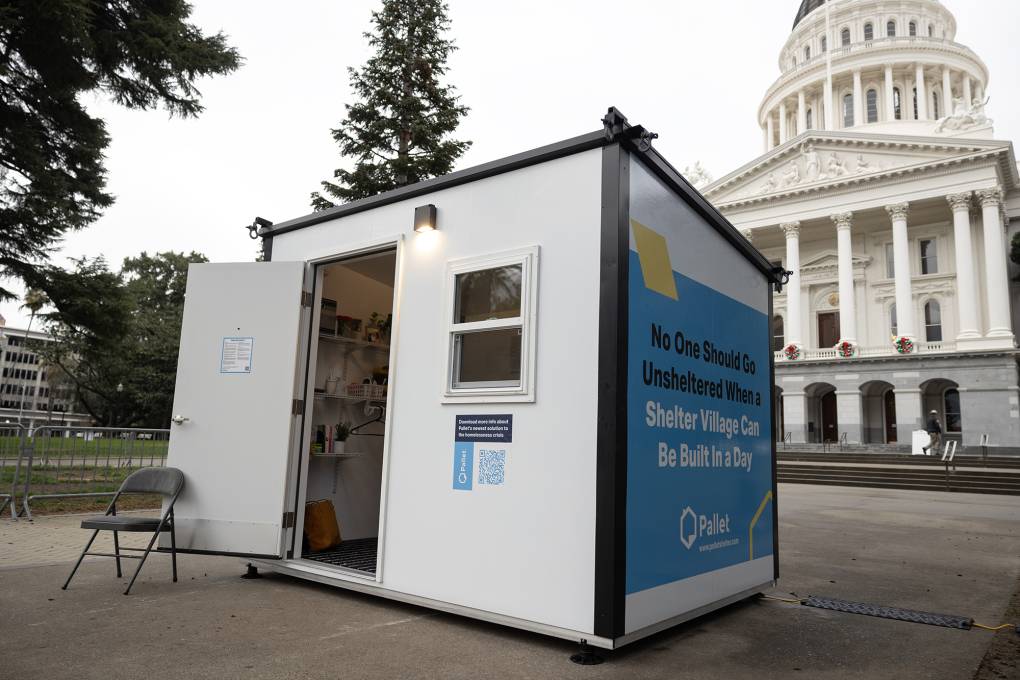
"caption": "An \"emergency sleeping cabin\" by the company Pallet Shelter in front of the state Capitol on Jan. 9, 2024. The company recently won a contract by the state to address homelessness with temporary housing. ",
"description": null,
"title": "010924-Pallet-Shelter-MG-01",
"credit": "Miguel Gutierrez Jr./CalMatters",
"status": "inherit",
"altTag": "A small living structure.",
"isLoading": false,
"fetchFailed": false
},
"news_11972314": {
"type": "attachments",
"id": "news_11972314",
"meta": {
"index": "attachments_1716263798",
"site": "news",
"id": "11972314",
"found": true
},
"parent": 11972309,
"imgSizes": {
"twentyfourteen-full-width": {
"file": "https://cdn.kqed.org/wp-content/uploads/sites/10/2024/01/CMTech01-1038x576.jpg",
"width": 1038,
"mimeType": "image/jpeg",
"height": 576
},
"thumbnail": {
"file": "https://cdn.kqed.org/wp-content/uploads/sites/10/2024/01/CMTech01-160x107.jpg",
"width": 160,
"mimeType": "image/jpeg",
"height": 107
},
"post-thumbnail": {
"file": "https://cdn.kqed.org/wp-content/uploads/sites/10/2024/01/CMTech01-672x372.jpg",
"width": 672,
"mimeType": "image/jpeg",
"height": 372
},
"kqedFullSize": {
"file": "https://cdn.kqed.org/wp-content/uploads/sites/10/2024/01/CMTech01.jpg",
"width": 2000,
"height": 1333
},
"large": {
"file": "https://cdn.kqed.org/wp-content/uploads/sites/10/2024/01/CMTech01-1020x680.jpg",
"width": 1020,
"mimeType": "image/jpeg",
"height": 680
},
"1536x1536": {
"file": "https://cdn.kqed.org/wp-content/uploads/sites/10/2024/01/CMTech01-1536x1024.jpg",
"width": 1536,
"mimeType": "image/jpeg",
"height": 1024
},
"full-width": {
"file": "https://cdn.kqed.org/wp-content/uploads/sites/10/2024/01/CMTech01-1920x1280.jpg",
"width": 1920,
"mimeType": "image/jpeg",
"height": 1280
},
"medium": {
"file": "https://cdn.kqed.org/wp-content/uploads/sites/10/2024/01/CMTech01-800x533.jpg",
"width": 800,
"mimeType": "image/jpeg",
"height": 533
}
},
"publishDate": 1704996061,
"modified": 1704996229,
"caption": null,
"description": null,
"title": "CMTech01",
"credit": "Miguel Gutierrez Jr./CalMatters/iStock",
"status": "inherit",
"altTag": "A graphic illustration of a capitol building with tech company logos floating around it.",
"isLoading": false,
"fetchFailed": false
},
"news_11972176": {
"type": "attachments",
"id": "news_11972176",
"meta": {
"index": "attachments_1716263798",
"site": "news",
"id": "11972176",
"found": true
},
"parent": 11972172,
"imgSizes": {
"twentyfourteen-full-width": {
"file": "https://cdn.kqed.org/wp-content/uploads/sites/10/2024/01/120423_CSU-Pomona-CFA-Strike_CM_11-copy-1038x576.jpg",
"width": 1038,
"mimeType": "image/jpeg",
"height": 576
},
"thumbnail": {
"file": "https://cdn.kqed.org/wp-content/uploads/sites/10/2024/01/120423_CSU-Pomona-CFA-Strike_CM_11-copy-160x107.jpg",
"width": 160,
"mimeType": "image/jpeg",
"height": 107
},
"post-thumbnail": {
"file": "https://cdn.kqed.org/wp-content/uploads/sites/10/2024/01/120423_CSU-Pomona-CFA-Strike_CM_11-copy-672x372.jpg",
"width": 672,
"mimeType": "image/jpeg",
"height": 372
},
"kqedFullSize": {
"file": "https://cdn.kqed.org/wp-content/uploads/sites/10/2024/01/120423_CSU-Pomona-CFA-Strike_CM_11-copy.jpg",
"width": 2000,
"height": 1334
},
"large": {
"file": "https://cdn.kqed.org/wp-content/uploads/sites/10/2024/01/120423_CSU-Pomona-CFA-Strike_CM_11-copy-1020x680.jpg",
"width": 1020,
"mimeType": "image/jpeg",
"height": 680
},
"1536x1536": {
"file": "https://cdn.kqed.org/wp-content/uploads/sites/10/2024/01/120423_CSU-Pomona-CFA-Strike_CM_11-copy-1536x1025.jpg",
"width": 1536,
"mimeType": "image/jpeg",
"height": 1025
},
"full-width": {
"file": "https://cdn.kqed.org/wp-content/uploads/sites/10/2024/01/120423_CSU-Pomona-CFA-Strike_CM_11-copy-1920x1281.jpg",
"width": 1920,
"mimeType": "image/jpeg",
"height": 1281
},
"medium": {
"file": "https://cdn.kqed.org/wp-content/uploads/sites/10/2024/01/120423_CSU-Pomona-CFA-Strike_CM_11-copy-800x534.jpg",
"width": 800,
"mimeType": "image/jpeg",
"height": 534
}
},
"publishDate": 1704913283,
"modified": 1704913338,
"caption": "Jackie Barrett, a student and intern with California Faculty Association, speaks to the crowd during a faculty strike at CSU Pomona on Dec. 4, 2023.\n",
"description": null,
"title": "120423_CSU-Pomona-CFA-Strike_CM_11 copy",
"credit": "Lauren Justice for CalMatters",
"status": "inherit",
"altTag": "A young woman speaks into a microphone surrounded by strikers with signs and banners.",
"isLoading": false,
"fetchFailed": false
},
"news_11972052": {
"type": "attachments",
"id": "news_11972052",
"meta": {
"index": "attachments_1716263798",
"site": "news",
"id": "11972052",
"found": true
},
"parent": 11972039,
"imgSizes": {
"twentyfourteen-full-width": {
"file": "https://cdn.kqed.org/wp-content/uploads/sites/10/2024/01/PROPE_081-qut-1038x576.jpg",
"width": 1038,
"mimeType": "image/jpeg",
"height": 576
},
"thumbnail": {
"file": "https://cdn.kqed.org/wp-content/uploads/sites/10/2024/01/PROPE_081-qut-160x107.jpg",
"width": 160,
"mimeType": "image/jpeg",
"height": 107
},
"post-thumbnail": {
"file": "https://cdn.kqed.org/wp-content/uploads/sites/10/2024/01/PROPE_081-qut-672x372.jpg",
"width": 672,
"mimeType": "image/jpeg",
"height": 372
},
"kqedFullSize": {
"file": "https://cdn.kqed.org/wp-content/uploads/sites/10/2024/01/PROPE_081-qut.jpg",
"width": 1920,
"height": 1280
},
"large": {
"file": "https://cdn.kqed.org/wp-content/uploads/sites/10/2024/01/PROPE_081-qut-1020x680.jpg",
"width": 1020,
"mimeType": "image/jpeg",
"height": 680
},
"1536x1536": {
"file": "https://cdn.kqed.org/wp-content/uploads/sites/10/2024/01/PROPE_081-qut-1536x1024.jpg",
"width": 1536,
"mimeType": "image/jpeg",
"height": 1024
},
"medium": {
"file": "https://cdn.kqed.org/wp-content/uploads/sites/10/2024/01/PROPE_081-qut-800x533.jpg",
"width": 800,
"mimeType": "image/jpeg",
"height": 533
}
},
"publishDate": 1704825105,
"modified": 1704829469,
"caption": "'Fruit n Custard Banana'-flavored tobacco at the Vapor Den in San Francisco on May 9, 2018. According to an employee, the company avoids purchasing flavors that are too childlike in design, even if they are desirable flavors. ",
"description": null,
"title": "PROPE_081-qut",
"credit": "Lauren Hanussak/KQED",
"status": "inherit",
"altTag": "A row of flavored tobacco vape juice bottles.",
"isLoading": false,
"fetchFailed": false
},
"news_11971923": {
"type": "attachments",
"id": "news_11971923",
"meta": {
"index": "attachments_1716263798",
"site": "news",
"id": "11971923",
"found": true
},
"parent": 11971908,
"imgSizes": {
"twentyfourteen-full-width": {
"file": "https://cdn.kqed.org/wp-content/uploads/sites/10/2024/01/112023_SF-Eviction-Court_MO_CM_04-1038x576.jpg",
"width": 1038,
"mimeType": "image/jpeg",
"height": 576
},
"thumbnail": {
"file": "https://cdn.kqed.org/wp-content/uploads/sites/10/2024/01/112023_SF-Eviction-Court_MO_CM_04-160x107.jpg",
"width": 160,
"mimeType": "image/jpeg",
"height": 107
},
"post-thumbnail": {
"file": "https://cdn.kqed.org/wp-content/uploads/sites/10/2024/01/112023_SF-Eviction-Court_MO_CM_04-672x372.jpg",
"width": 672,
"mimeType": "image/jpeg",
"height": 372
},
"kqedFullSize": {
"file": "https://cdn.kqed.org/wp-content/uploads/sites/10/2024/01/112023_SF-Eviction-Court_MO_CM_04.jpg",
"width": 2000,
"height": 1333
},
"large": {
"file": "https://cdn.kqed.org/wp-content/uploads/sites/10/2024/01/112023_SF-Eviction-Court_MO_CM_04-1020x680.jpg",
"width": 1020,
"mimeType": "image/jpeg",
"height": 680
},
"1536x1536": {
"file": "https://cdn.kqed.org/wp-content/uploads/sites/10/2024/01/112023_SF-Eviction-Court_MO_CM_04-1536x1024.jpg",
"width": 1536,
"mimeType": "image/jpeg",
"height": 1024
},
"full-width": {
"file": "https://cdn.kqed.org/wp-content/uploads/sites/10/2024/01/112023_SF-Eviction-Court_MO_CM_04-1920x1280.jpg",
"width": 1920,
"mimeType": "image/jpeg",
"height": 1280
},
"medium": {
"file": "https://cdn.kqed.org/wp-content/uploads/sites/10/2024/01/112023_SF-Eviction-Court_MO_CM_04-800x533.jpg",
"width": 800,
"mimeType": "image/jpeg",
"height": 533
}
},
"publishDate": 1704747305,
"modified": 1704747921,
"caption": "Corey Lafayette, 53, says he is touched by the amount of support he received during eviction. Nov. 20, 2023. ",
"description": null,
"title": "112023_SF-Eviction-Court_MO_CM_04",
"credit": "Manuel Orbegozo/CalMatters",
"status": "inherit",
"altTag": "A headshot of a Black man.",
"isLoading": false,
"fetchFailed": false
}
},
"audioPlayerReducer": {
"postId": "stream_live",
"isPaused": true,
"isPlaying": false,
"pfsActive": false,
"pledgeModalIsOpen": true,
"playerDrawerIsOpen": false,
"liveAudioPlayStartedAt": 0,
"liveAudioPlayContext": ""
},
"authorsReducer": {
"byline_news_11973512": {
"type": "authors",
"id": "byline_news_11973512",
"meta": {
"override": true
},
"slug": "byline_news_11973512",
"name": "\u003ca href=\"https://calmatters.org/author/rachel-becker/\">Rachel Becker\u003c/a>",
"isLoading": false
},
"byline_news_11973393": {
"type": "authors",
"id": "byline_news_11973393",
"meta": {
"override": true
},
"slug": "byline_news_11973393",
"name": "Kristen Hwang and Nigel Duara",
"isLoading": false
},
"byline_news_11973213": {
"type": "authors",
"id": "byline_news_11973213",
"meta": {
"override": true
},
"slug": "byline_news_11973213",
"name": "\u003ca href=\"https://calmatters.org/author/alexei-koseff/\">Alexei Koseff\u003c/a>",
"isLoading": false
},
"byline_news_11973129": {
"type": "authors",
"id": "byline_news_11973129",
"meta": {
"override": true
},
"slug": "byline_news_11973129",
"name": "\u003ca href=\"https://calmatters.org/author/yue-yu/\">Yue Stella Yu\u003c/a>",
"isLoading": false
},
"byline_news_11972829": {
"type": "authors",
"id": "byline_news_11972829",
"meta": {
"override": true
},
"slug": "byline_news_11972829",
"name": "\u003ca href=\"https://calmatters.org/author/marisa-kendall/\">Marisa Kendall\u003c/a>",
"isLoading": false
},
"byline_news_11972719": {
"type": "authors",
"id": "byline_news_11972719",
"meta": {
"override": true
},
"slug": "byline_news_11972719",
"name": "\u003ca href=\"https://calmatters.org/author/adam-echelman/\">Adam Echelman\u003c/a>",
"isLoading": false
},
"byline_news_11972683": {
"type": "authors",
"id": "byline_news_11972683",
"meta": {
"override": true
},
"slug": "byline_news_11972683",
"name": "\u003ca href=\"https://calmatters.org/author/ryan-sabalow/\">Ryan Sabalow\u003c/a>",
"isLoading": false
},
"byline_news_11972474": {
"type": "authors",
"id": "byline_news_11972474",
"meta": {
"override": true
},
"slug": "byline_news_11972474",
"name": "Marisa Kendall",
"isLoading": false
},
"byline_news_11972309": {
"type": "authors",
"id": "byline_news_11972309",
"meta": {
"override": true
},
"slug": "byline_news_11972309",
"name": "\u003ca href=\"https://calmatters.org/author/levi-sumagaysay/\">Levi Sumagaysay\u003c/a>",
"isLoading": false
},
"byline_news_11972172": {
"type": "authors",
"id": "byline_news_11972172",
"meta": {
"override": true
},
"slug": "byline_news_11972172",
"name": "\u003ca href=\"https://calmatters.org/author/mikhailzinshteyn/\">Mikhail Zinshteyn\u003c/a>",
"isLoading": false
},
"byline_news_11972039": {
"type": "authors",
"id": "byline_news_11972039",
"meta": {
"override": true
},
"slug": "byline_news_11972039",
"name": "\u003ca href=\"https://calmatters.org/author/lynn-la/\">Lynn La\u003c/a>",
"isLoading": false
},
"byline_news_11971908": {
"type": "authors",
"id": "byline_news_11971908",
"meta": {
"override": true
},
"slug": "byline_news_11971908",
"name": "\u003ca href=\"https://calmatters.org/author/feliciacalmatters-org/\">Felicia Mello\u003c/a>",
"isLoading": false
}
},
"pagesReducer": {
"news_affiliate_calmatters": {
"type": "terms",
"id": "news_18481",
"meta": {
"index": "terms_1716263798",
"site": "news",
"id": "18481",
"score": 15.355904
},
"featImg": null,
"name": "CALmatters",
"description": null,
"taxonomy": "affiliate",
"headData": {
"twImgId": null,
"twTitle": null,
"ogTitle": null,
"ogImgId": null,
"twDescription": null,
"description": null,
"title": "CALmatters Archives | KQED Arts",
"ogDescription": null
},
"ttid": 18515,
"slug": "calmatters",
"isLoading": false,
"title": "CALmatters",
"pageMeta": {
"site": "news",
"WpPageTemplate": "page-topic-editorial",
"currentPage": 38
},
"blocks": [
{
"blockName": "kqed/post-list",
"attrs": {
"layout": "cardArticle2",
"query": "posts/news?affiliate=calmatters",
"seeMore": false,
"paginated": true,
"page": 38
}
},
{
"blockName": "kqed/ad"
}
]
}
},
"pfsSessionReducer": {},
"postsReducer": {
"stream_live": {
"type": "live",
"id": "stream_live",
"audioUrl": "https://streams.kqed.org/kqedradio",
"title": "Live Stream",
"excerpt": "Live Stream information currently unavailable.",
"link": "/radio",
"featImg": "",
"label": {
"name": "KQED Live",
"link": "/"
}
},
"stream_kqedNewscast": {
"type": "posts",
"id": "stream_kqedNewscast",
"audioUrl": "https://www.kqed.org/.stream/anon/radio/RDnews/newscast.mp3?_=1",
"title": "KQED Newscast",
"featImg": "",
"label": {
"name": "88.5 FM",
"link": "/"
}
},
"news_11973512": {
"type": "posts",
"id": "news_11973512",
"meta": {
"index": "posts_1716263798",
"site": "news",
"id": "11973512",
"score": null,
"sort": [
1706126439000
]
},
"parent": 0,
"labelTerm": {
"site": "news",
"term": 18481
},
"blocks": [],
"publishDate": 1706126439,
"format": "standard",
"title": "Alarming Study Reveals California's Rapidly Declining Groundwater Basins",
"headTitle": "Alarming Study Reveals California’s Rapidly Declining Groundwater Basins | KQED",
"content": "\u003cp>In a sign of the ongoing threats to its precious groundwater stores, half a dozen regions in California rank among the world’s most rapidly declining aquifers, \u003ca href=\"https://www.nature.com/articles/s41586-023-06879-8\">according to research published on Wednesday\u003c/a>.\u003c/p>\n\u003cp>Globally, lack of local water drives migration, poverty, starvation and violence — while in California, it drives \u003ca href=\"https://calmatters.org/environment/2021/08/california-groundwater-dry/\">decades-long regulatory battles\u003c/a> over how to stop over-pumping by growers.\u003c/p>\n\u003cp>Aquifers in Spain, Iran, China and Chile top the list of the 100 most rapidly dropping groundwater levels. \u003ca href=\"https://legal-planet.org/2023/09/18/why-is-there-a-carrot-boycott-in-cuyama-valley/\">California’s Cuyama Valley\u003c/a>, north of Santa Barbara, ranked 34th worldwide. Its underground basin has been dropping almost 5 feet a year, and residents, farmers and even the school district are locked in a court battle with carrot growers who \u003ca href=\"https://legal-planet.org/2023/09/18/why-is-there-a-carrot-boycott-in-cuyama-valley/\">sued them over groundwater rights\u003c/a>.\u003c/p>\n\u003cp>[ad fullwidth]\u003c/p>\n\u003cp>Four other basins in the San Joaquin Valley and one in northeastern San Diego also netted spots in the top 100, with water levels falling up to almost four feet a year, according to the study, which was led by University of California and Swiss researchers and published in the journal \u003cem>Nature\u003c/em>.\u003c/p>\n\u003cp>Only two other basins in the United States made the top 100: Gila Bend near Phoenix and Mill Creek in Idaho.\u003c/p>\n\u003cp>[pullquote align=\"right\" size=\"medium\" citation=\"Scott Jasechko, study co-author and associate professor of hydrology, water resources and groundwater, UC Santa Barbara\"]‘Some of the rates of groundwater level decline occurring in California really are some of the highest in the world. It’s a sobering finding. We’ve got a lot of work to do here in California.’[/pullquote]“Some of the rates of groundwater level decline occurring in California really are some of the highest in the world,” said \u003ca href=\"https://bren.ucsb.edu/people/scott-jasechko\">Scott Jasechko\u003c/a>, a co-author of the study and an associate professor of hydrology, water resources and groundwater at UC Santa Barbara.\u003c/p>\n\u003cp>“It’s a sobering finding,” he said. “We’ve got a lot of work to do here in California.”\u003c/p>\n\u003cp>The research revealed that rapidly declining groundwater basins are virtually nonexistent in places without farming. Heavily farmed regions in drier climates, such as the San Joaquin Valley, Iran and parts of India, are especially hard hit.\u003c/p>\n\u003cp>Plummeting groundwater levels \u003ca href=\"https://calmatters.org/environment/2021/08/california-groundwater-dry/\">can cause drinking water wells to go dry\u003c/a>. Streams \u003ca href=\"https://calmatters.org/environment/2023/12/klamath-basin-tribes-ranchers-water-salmon/\">can dwindle and disappear,\u003c/a> and the \u003ca href=\"https://calmatters.org/environment/2023/10/san-joaquin-valley-groundwater/\">desiccated earth can sink and collapse\u003c/a> — shrinking the storage capacity of aquifers and damaging roads, buildings, levees and other structures above ground.\u003c/p>\n\u003cp>In California, \u003ca href=\"https://mydrywatersupply.water.ca.gov/report/publicpage\">thousands of wells have gone dry\u003c/a> after \u003ca href=\"https://calmatters.org/environment/water/2023/02/california-depleted-groundwater-storms/\">years of drought and overpumping\u003c/a> — spreading from the San Joaquin Valley to the \u003ca href=\"https://calmatters.org/environment/2021/08/california-groundwater-dry/\">Sacramento Valley\u003c/a> during the most recent drought.\u003c/p>\n\u003cp>Land in parts of the San Joaquin Valley has subsided so much that it has damaged the \u003ca href=\"https://water.ca.gov/Programs/Engineering-And-Construction/Subsidence\">California Aqueduct\u003c/a>, which carries river water to Southern California, forced at least \u003ca href=\"https://water.ca.gov/News/News-Releases/2022/Jan-21/Friant-Kern-Canal-Groundbreaking\">$187 million of repairs on the Friant-Kern Canal\u003c/a>, and required \u003ca href=\"https://www.latimes.com/california/story/2023-05-12/newsom-announces-funding-to-raise-corcoran-levee\">millions more to fortify a levee\u003c/a> around the sinking town of Corcoran to protect it from floodwaters.\u003c/p>\n\u003cp>The researchers analyzed more than 170,000 groundwater wells in more than 40 countries\u003cstrong> \u003c/strong>and reported “widespread acceleration in groundwater level deepening,” which they said “highlights an urgent need for more effective measures.”\u003c/p>\n\u003cp>\u003c!-- iframe plugin v.4.3 wordpress.org/plugins/iframe/ -->\u003cbr>\n\u003ciframe loading=\"lazy\" src=\"https://calmatters-map-groundwater-global.netlify.app/\" width=\"800\" height=\"1000\" scrolling=\"yes\" class=\"iframe-class\" frameborder=\"0\">\u003c/iframe>\u003c/p>\n\u003cp>The study provides a global database that backs up observations that have long worried water watchers.\u003c/p>\n\u003cp>“The major contribution is to bring into much sharper focus this global problem of groundwater depletion and over-pumping,” said \u003ca href=\"https://lawr.ucdavis.edu/people/faculty/fogg-graham\">Graham Fogg\u003c/a>, a professor emeritus of hydrogeology at UC Davis who was not involved with the research.\u003c/p>\n\u003cp>“With groundwater, if it’s left unmanaged and unregulated, it’s going to be abused in many, many cases. And if that abuse goes on long enough, some basins will be exhausted of water.”\u003c/p>\n\u003cp>Violence over water is flaring around the globe. Water is a trigger, casualty and weapon in \u003ca href=\"https://pacinst.org/announcement/violence-over-water-increases-globally-according-to-new-data-from-pacific-institute-water-conflict-chronology/\">hundreds of conflicts just over the past two years\u003c/a> — from Russian troops destroying a Ukrainian dam to \u003ca href=\"https://worldwater.org/conflict/list/\">cyberattacks on Israeli water infrastructure\u003c/a> and Israeli military forces seizing or destroying Palestinian water sources. Clashes over water safety and scarcity have led to injuries and deaths around the world.\u003c/p>\n\u003cp>In California, water disputes roil the state, from \u003ca href=\"https://calmatters.org/environment/2023/12/klamath-basin-tribes-ranchers-water-salmon/\">the Scott and Shasta Rivers in the far north\u003c/a> to \u003ca href=\"https://calmatters.org/environment/water/2023/09/california-delta-bay-plan/\">the Bay-Delta\u003c/a> and beyond.\u003c/p>\n\u003ch2>San Joaquin Valley growers are still over-pumping\u003c/h2>\n\u003cp>Ten years ago, alarmed by record declines in groundwater and thousands of dried-up wells, California lawmakers passed a law to stop overpumping. The \u003ca href=\"https://calmatters.org/environment/2021/08/california-groundwater-dry/\">Sustainable Groundwater Management Act\u003c/a> requires local agencies to achieve sustainable groundwater use by 2040 for the most critically overdrafted basins and 2042 for basins considered less depleted.\u003c/p>\n\u003cp>[pullquote align=\"right\" size=\"medium\" citation=\"Graham Fogg, professor emeritus of hydrogeology, UC Davis\"]‘We’ve built a food supply system that relies in large part on irrigated agriculture, which in turn relies in many areas … on pumped groundwater. So that has to change.’[/pullquote]But wells have \u003ca href=\"https://calmatters.org/environment/water/2023/02/california-depleted-groundwater-storms/\">continued to go dry,\u003c/a> and \u003ca href=\"https://data.cnra.ca.gov/dataset/california-s-groundwater-semi-annual-conditions-updates/resource/7a9f6a69-0f43-474c-b9a5-b8b6f3e5ed48\">groundwater depletion continues\u003c/a> with few protections in place. So far, California water officials deemed plans for six San Joaquin Valley basins \u003ca href=\"https://calmatters.org/environment/2023/10/san-joaquin-valley-groundwater/\">inadequate and called for probation hearings\u003c/a>.\u003c/p>\n\u003cp>In addition to the Cuyama Valley, the \u003cem>Nature \u003c/em>paper’s top 100 includes the \u003ca href=\"https://sgma.water.ca.gov/portal/gsa/print/244\">White Wolf Basin in Kern County\u003c/a> (52nd), the \u003ca href=\"https://sgma.water.ca.gov/portal/gsa/print/370\">San Pasqual Valley\u003c/a> in northeastern San Diego (55th), the \u003ca href=\"https://water.ca.gov/-/media/DWR-Website/Web-Pages/Programs/Groundwater-Management/Bulletin-118/Files/2003-Basin-Descriptions/5_022_05_ChowchillaSubbasin.pdf\">Chowchilla Basin (PDF)\u003c/a> straddling Merced and Madera counties (65th), the Northern Kern Basin (69th) and \u003ca href=\"https://water.ca.gov/-/media/DWR-Website/Web-Pages/Programs/Groundwater-Management/Bulletin-118/Files/2003-Basin-Descriptions/5_022_11_KaweahSubbasin.pdf\">the Kaweah Basin (PDF)\u003c/a> in Kings and Tulare counties (93rd).\u003c/p>\n\u003cp>Jasechko and his colleagues set out to understand how groundwater depletion in California compared to other aquifers globally. It took them six years to scour the literature for water level measurements, download it from databases and request it from water managers around the world.\u003c/p>\n\u003cp>For more than 540 aquifers, the researchers had enough data to compare groundwater levels over 40 years. Of those, about a third showed accelerating groundwater declines. Another 21% had increases in the 1980s and 1990s turned to losses over the past 23 years.\u003c/p>\n\u003cp>But Jasechko found some reasons for hope: 20% of aquifers saw groundwater declines slow down in the 21st century. Another 16% pivoted from groundwater decline to recovery, while 13% saw groundwater levels continue to increase.\u003c/p>\n\u003cp>“Long-term groundwater losses are neither universal nor inevitable,” the researchers wrote.\u003c/p>\n\u003cp>[aside label=\"Related Stories\" postID=\"news_11970957,news_11940344,news_11971872\"]Groundwater depletion in parts of Saudi Arabia slowed, for instance — possibly due to policies \u003ca href=\"https://repository.library.georgetown.edu/bitstream/handle/10822/1050168/CIRENDTARGETSOccasionalPaper19Kim_VanDerBeek2018.pdf?sequence=5\">aimed at curbing agricultural use\u003c/a>, including \u003ca href=\"https://apps.fas.usda.gov/newgainapi/api/report/downloadreportbyfilename?filename=Saudi%20Arabian%20Alfalfa%20Hay%20Market%20_Riyadh_Saudi%20Arabia_2-22-2017.pdf\">a phaseout of alfalfa (PDF)\u003c/a> cultivation that \u003ca href=\"https://ageconsearch.umn.edu/record/337173/\">also led to a massive increase in imports from the U.S\u003c/a>. In Bangkok, Thailand, pumping slowed after officials increased fees.\u003c/p>\n\u003cp>And in the Coachella Valley, groundwater levels \u003ca href=\"https://pubs.usgs.gov/publication/70209731\">improved after the water district\u003c/a> introduced a new pricing structure, increased recharge and improved access to the Colorado River and recycled water supplies.\u003c/p>\n\u003cp>But UC Davis’s Fogg said that the research also clarified what he called one of the existential challenges for the nexus between food, energy and water: how reining in groundwater depletion will affect the global food system. About 70% of water worldwide is used for agriculture and irrigation.\u003c/p>\n\u003cp>“We’ve built a food supply system that relies in large part on irrigated agriculture, which in turn relies in many areas … on pumped groundwater,” Fogg said. “So that has to change. That change will likely result in effects on the food supply. So it’s a major challenge to see how civilization can deal with that in the future.”\u003c/p>\n\u003cp>[ad floatright]\u003c/p>\n",
"stats": {
"hasVideo": false,
"hasChartOrMap": true,
"hasAudio": false,
"hasPolis": false,
"wordCount": 1309,
"hasGoogleForm": false,
"hasGallery": false,
"hasHearkenModule": false,
"iframeSrcs": [
"https://calmatters-map-groundwater-global.netlify.app/"
],
"paragraphCount": 31
},
"modified": 1706129646,
"excerpt": "Researchers found that the world’s most rapidly declining basins are in farm regions, especially drier areas like the San Joaquin Valley. Wells are drying out, and land is sinking.",
"headData": {
"twImgId": "",
"twTitle": "",
"ogTitle": "",
"ogImgId": "",
"twDescription": "",
"description": "Researchers found that the world’s most rapidly declining basins are in farm regions, especially drier areas like the San Joaquin Valley. Wells are drying out, and land is sinking.",
"title": "Alarming Study Reveals California's Rapidly Declining Groundwater Basins | KQED",
"ogDescription": "",
"schema": {
"@context": "https://schema.org",
"@type": "NewsArticle",
"headline": "Alarming Study Reveals California's Rapidly Declining Groundwater Basins",
"datePublished": "2024-01-24T12:00:39-08:00",
"dateModified": "2024-01-24T12:54:06-08:00",
"image": "https://cdn.kqed.org/wp-content/uploads/2020/02/KQED-OG-Image@1x.png",
"isAccessibleForFree": "True",
"publisher": {
"@type": "NewsMediaOrganization",
"@id": "https://www.kqed.org/#organization",
"name": "KQED",
"logo": "https://cdn.kqed.org/wp-content/uploads/2020/02/KQED-OG-Image@1x.png",
"url": "https://www.kqed.org",
"sameAs": [
"https://www.facebook.com/KQED",
"https://twitter.com/KQED",
"https://www.instagram.com/kqed/",
"https://www.tiktok.com/@kqedofficial",
"https://www.linkedin.com/company/kqed",
"https://www.youtube.com/channel/UCeC0IOo7i1P_61zVUWbJ4nw"
]
}
}
},
"guestAuthors": [],
"slug": "alarming-study-reveals-californias-rapidly-declining-groundwater-basins",
"status": "publish",
"nprByline": "\u003ca href=\"https://calmatters.org/author/rachel-becker/\">Rachel Becker\u003c/a>",
"excludeFromSiteSearch": "Include",
"sticky": false,
"showOnAuthorArchivePages": "No",
"articleAge": "0",
"path": "/news/11973512/alarming-study-reveals-californias-rapidly-declining-groundwater-basins",
"audioTrackLength": null,
"parsedContent": [
{
"type": "contentString",
"content": "\u003cdiv class=\"post-body\">\u003cp>\u003cp>In a sign of the ongoing threats to its precious groundwater stores, half a dozen regions in California rank among the world’s most rapidly declining aquifers, \u003ca href=\"https://www.nature.com/articles/s41586-023-06879-8\">according to research published on Wednesday\u003c/a>.\u003c/p>\n\u003cp>Globally, lack of local water drives migration, poverty, starvation and violence — while in California, it drives \u003ca href=\"https://calmatters.org/environment/2021/08/california-groundwater-dry/\">decades-long regulatory battles\u003c/a> over how to stop over-pumping by growers.\u003c/p>\n\u003cp>Aquifers in Spain, Iran, China and Chile top the list of the 100 most rapidly dropping groundwater levels. \u003ca href=\"https://legal-planet.org/2023/09/18/why-is-there-a-carrot-boycott-in-cuyama-valley/\">California’s Cuyama Valley\u003c/a>, north of Santa Barbara, ranked 34th worldwide. Its underground basin has been dropping almost 5 feet a year, and residents, farmers and even the school district are locked in a court battle with carrot growers who \u003ca href=\"https://legal-planet.org/2023/09/18/why-is-there-a-carrot-boycott-in-cuyama-valley/\">sued them over groundwater rights\u003c/a>.\u003c/p>\n\u003cp>\u003c/p>\u003c/div>",
"attributes": {
"named": {},
"numeric": []
}
},
{
"type": "component",
"content": "",
"name": "ad",
"attributes": {
"named": {
"label": "fullwidth"
},
"numeric": [
"fullwidth"
]
}
},
{
"type": "contentString",
"content": "\u003cdiv class=\"post-body\">\u003cp>\u003c/p>\n\u003cp>Four other basins in the San Joaquin Valley and one in northeastern San Diego also netted spots in the top 100, with water levels falling up to almost four feet a year, according to the study, which was led by University of California and Swiss researchers and published in the journal \u003cem>Nature\u003c/em>.\u003c/p>\n\u003cp>Only two other basins in the United States made the top 100: Gila Bend near Phoenix and Mill Creek in Idaho.\u003c/p>\n\u003cp>\u003c/p>\u003c/div>",
"attributes": {
"named": {},
"numeric": []
}
},
{
"type": "component",
"content": "‘Some of the rates of groundwater level decline occurring in California really are some of the highest in the world. It’s a sobering finding. We’ve got a lot of work to do here in California.’",
"name": "pullquote",
"attributes": {
"named": {
"align": "right",
"size": "medium",
"citation": "Scott Jasechko, study co-author and associate professor of hydrology, water resources and groundwater, UC Santa Barbara",
"label": ""
},
"numeric": []
}
},
{
"type": "contentString",
"content": "\u003cdiv class=\"post-body\">\u003cp>“Some of the rates of groundwater level decline occurring in California really are some of the highest in the world,” said \u003ca href=\"https://bren.ucsb.edu/people/scott-jasechko\">Scott Jasechko\u003c/a>, a co-author of the study and an associate professor of hydrology, water resources and groundwater at UC Santa Barbara.\u003c/p>\n\u003cp>“It’s a sobering finding,” he said. “We’ve got a lot of work to do here in California.”\u003c/p>\n\u003cp>The research revealed that rapidly declining groundwater basins are virtually nonexistent in places without farming. Heavily farmed regions in drier climates, such as the San Joaquin Valley, Iran and parts of India, are especially hard hit.\u003c/p>\n\u003cp>Plummeting groundwater levels \u003ca href=\"https://calmatters.org/environment/2021/08/california-groundwater-dry/\">can cause drinking water wells to go dry\u003c/a>. Streams \u003ca href=\"https://calmatters.org/environment/2023/12/klamath-basin-tribes-ranchers-water-salmon/\">can dwindle and disappear,\u003c/a> and the \u003ca href=\"https://calmatters.org/environment/2023/10/san-joaquin-valley-groundwater/\">desiccated earth can sink and collapse\u003c/a> — shrinking the storage capacity of aquifers and damaging roads, buildings, levees and other structures above ground.\u003c/p>\n\u003cp>In California, \u003ca href=\"https://mydrywatersupply.water.ca.gov/report/publicpage\">thousands of wells have gone dry\u003c/a> after \u003ca href=\"https://calmatters.org/environment/water/2023/02/california-depleted-groundwater-storms/\">years of drought and overpumping\u003c/a> — spreading from the San Joaquin Valley to the \u003ca href=\"https://calmatters.org/environment/2021/08/california-groundwater-dry/\">Sacramento Valley\u003c/a> during the most recent drought.\u003c/p>\n\u003cp>Land in parts of the San Joaquin Valley has subsided so much that it has damaged the \u003ca href=\"https://water.ca.gov/Programs/Engineering-And-Construction/Subsidence\">California Aqueduct\u003c/a>, which carries river water to Southern California, forced at least \u003ca href=\"https://water.ca.gov/News/News-Releases/2022/Jan-21/Friant-Kern-Canal-Groundbreaking\">$187 million of repairs on the Friant-Kern Canal\u003c/a>, and required \u003ca href=\"https://www.latimes.com/california/story/2023-05-12/newsom-announces-funding-to-raise-corcoran-levee\">millions more to fortify a levee\u003c/a> around the sinking town of Corcoran to protect it from floodwaters.\u003c/p>\n\u003cp>The researchers analyzed more than 170,000 groundwater wells in more than 40 countries\u003cstrong> \u003c/strong>and reported “widespread acceleration in groundwater level deepening,” which they said “highlights an urgent need for more effective measures.”\u003c/p>\n\u003cp>\u003c!-- iframe plugin v.4.3 wordpress.org/plugins/iframe/ -->\u003cbr>\n\u003ciframe loading=\"lazy\" src=\"https://calmatters-map-groundwater-global.netlify.app/\" width=\"800\" height=\"1000\" scrolling=\"yes\" class=\"iframe-class\" frameborder=\"0\">\u003c/iframe>\u003c/p>\n\u003cp>The study provides a global database that backs up observations that have long worried water watchers.\u003c/p>\n\u003cp>“The major contribution is to bring into much sharper focus this global problem of groundwater depletion and over-pumping,” said \u003ca href=\"https://lawr.ucdavis.edu/people/faculty/fogg-graham\">Graham Fogg\u003c/a>, a professor emeritus of hydrogeology at UC Davis who was not involved with the research.\u003c/p>\n\u003cp>“With groundwater, if it’s left unmanaged and unregulated, it’s going to be abused in many, many cases. And if that abuse goes on long enough, some basins will be exhausted of water.”\u003c/p>\n\u003cp>Violence over water is flaring around the globe. Water is a trigger, casualty and weapon in \u003ca href=\"https://pacinst.org/announcement/violence-over-water-increases-globally-according-to-new-data-from-pacific-institute-water-conflict-chronology/\">hundreds of conflicts just over the past two years\u003c/a> — from Russian troops destroying a Ukrainian dam to \u003ca href=\"https://worldwater.org/conflict/list/\">cyberattacks on Israeli water infrastructure\u003c/a> and Israeli military forces seizing or destroying Palestinian water sources. Clashes over water safety and scarcity have led to injuries and deaths around the world.\u003c/p>\n\u003cp>In California, water disputes roil the state, from \u003ca href=\"https://calmatters.org/environment/2023/12/klamath-basin-tribes-ranchers-water-salmon/\">the Scott and Shasta Rivers in the far north\u003c/a> to \u003ca href=\"https://calmatters.org/environment/water/2023/09/california-delta-bay-plan/\">the Bay-Delta\u003c/a> and beyond.\u003c/p>\n\u003ch2>San Joaquin Valley growers are still over-pumping\u003c/h2>\n\u003cp>Ten years ago, alarmed by record declines in groundwater and thousands of dried-up wells, California lawmakers passed a law to stop overpumping. The \u003ca href=\"https://calmatters.org/environment/2021/08/california-groundwater-dry/\">Sustainable Groundwater Management Act\u003c/a> requires local agencies to achieve sustainable groundwater use by 2040 for the most critically overdrafted basins and 2042 for basins considered less depleted.\u003c/p>\n\u003cp>\u003c/p>\u003c/div>",
"attributes": {
"named": {},
"numeric": []
}
},
{
"type": "component",
"content": "‘We’ve built a food supply system that relies in large part on irrigated agriculture, which in turn relies in many areas … on pumped groundwater. So that has to change.’",
"name": "pullquote",
"attributes": {
"named": {
"align": "right",
"size": "medium",
"citation": "Graham Fogg, professor emeritus of hydrogeology, UC Davis",
"label": ""
},
"numeric": []
}
},
{
"type": "contentString",
"content": "\u003cdiv class=\"post-body\">\u003cp>But wells have \u003ca href=\"https://calmatters.org/environment/water/2023/02/california-depleted-groundwater-storms/\">continued to go dry,\u003c/a> and \u003ca href=\"https://data.cnra.ca.gov/dataset/california-s-groundwater-semi-annual-conditions-updates/resource/7a9f6a69-0f43-474c-b9a5-b8b6f3e5ed48\">groundwater depletion continues\u003c/a> with few protections in place. So far, California water officials deemed plans for six San Joaquin Valley basins \u003ca href=\"https://calmatters.org/environment/2023/10/san-joaquin-valley-groundwater/\">inadequate and called for probation hearings\u003c/a>.\u003c/p>\n\u003cp>In addition to the Cuyama Valley, the \u003cem>Nature \u003c/em>paper’s top 100 includes the \u003ca href=\"https://sgma.water.ca.gov/portal/gsa/print/244\">White Wolf Basin in Kern County\u003c/a> (52nd), the \u003ca href=\"https://sgma.water.ca.gov/portal/gsa/print/370\">San Pasqual Valley\u003c/a> in northeastern San Diego (55th), the \u003ca href=\"https://water.ca.gov/-/media/DWR-Website/Web-Pages/Programs/Groundwater-Management/Bulletin-118/Files/2003-Basin-Descriptions/5_022_05_ChowchillaSubbasin.pdf\">Chowchilla Basin (PDF)\u003c/a> straddling Merced and Madera counties (65th), the Northern Kern Basin (69th) and \u003ca href=\"https://water.ca.gov/-/media/DWR-Website/Web-Pages/Programs/Groundwater-Management/Bulletin-118/Files/2003-Basin-Descriptions/5_022_11_KaweahSubbasin.pdf\">the Kaweah Basin (PDF)\u003c/a> in Kings and Tulare counties (93rd).\u003c/p>\n\u003cp>Jasechko and his colleagues set out to understand how groundwater depletion in California compared to other aquifers globally. It took them six years to scour the literature for water level measurements, download it from databases and request it from water managers around the world.\u003c/p>\n\u003cp>For more than 540 aquifers, the researchers had enough data to compare groundwater levels over 40 years. Of those, about a third showed accelerating groundwater declines. Another 21% had increases in the 1980s and 1990s turned to losses over the past 23 years.\u003c/p>\n\u003cp>But Jasechko found some reasons for hope: 20% of aquifers saw groundwater declines slow down in the 21st century. Another 16% pivoted from groundwater decline to recovery, while 13% saw groundwater levels continue to increase.\u003c/p>\n\u003cp>“Long-term groundwater losses are neither universal nor inevitable,” the researchers wrote.\u003c/p>\n\u003cp>\u003c/p>\u003c/div>",
"attributes": {
"named": {},
"numeric": []
}
},
{
"type": "component",
"content": "",
"name": "aside",
"attributes": {
"named": {
"label": "Related Stories ",
"postid": "news_11970957,news_11940344,news_11971872"
},
"numeric": []
}
},
{
"type": "contentString",
"content": "\u003cdiv class=\"post-body\">\u003cp>Groundwater depletion in parts of Saudi Arabia slowed, for instance — possibly due to policies \u003ca href=\"https://repository.library.georgetown.edu/bitstream/handle/10822/1050168/CIRENDTARGETSOccasionalPaper19Kim_VanDerBeek2018.pdf?sequence=5\">aimed at curbing agricultural use\u003c/a>, including \u003ca href=\"https://apps.fas.usda.gov/newgainapi/api/report/downloadreportbyfilename?filename=Saudi%20Arabian%20Alfalfa%20Hay%20Market%20_Riyadh_Saudi%20Arabia_2-22-2017.pdf\">a phaseout of alfalfa (PDF)\u003c/a> cultivation that \u003ca href=\"https://ageconsearch.umn.edu/record/337173/\">also led to a massive increase in imports from the U.S\u003c/a>. In Bangkok, Thailand, pumping slowed after officials increased fees.\u003c/p>\n\u003cp>And in the Coachella Valley, groundwater levels \u003ca href=\"https://pubs.usgs.gov/publication/70209731\">improved after the water district\u003c/a> introduced a new pricing structure, increased recharge and improved access to the Colorado River and recycled water supplies.\u003c/p>\n\u003cp>But UC Davis’s Fogg said that the research also clarified what he called one of the existential challenges for the nexus between food, energy and water: how reining in groundwater depletion will affect the global food system. About 70% of water worldwide is used for agriculture and irrigation.\u003c/p>\n\u003cp>“We’ve built a food supply system that relies in large part on irrigated agriculture, which in turn relies in many areas … on pumped groundwater,” Fogg said. “So that has to change. That change will likely result in effects on the food supply. So it’s a major challenge to see how civilization can deal with that in the future.”\u003c/p>\n\u003cp>\u003c/p>\u003c/div>",
"attributes": {
"named": {},
"numeric": []
}
},
{
"type": "component",
"content": "",
"name": "ad",
"attributes": {
"named": {
"label": "floatright"
},
"numeric": [
"floatright"
]
}
},
{
"type": "contentString",
"content": "\u003cdiv class=\"post-body\">\u003cp>\u003c/p>\n\u003c/div>\u003c/p>",
"attributes": {
"named": {},
"numeric": []
}
}
],
"link": "/news/11973512/alarming-study-reveals-californias-rapidly-declining-groundwater-basins",
"authors": [
"byline_news_11973512"
],
"categories": [
"news_31795",
"news_19906",
"news_8",
"news_356"
],
"tags": [
"news_18538",
"news_27626",
"news_5892",
"news_3187",
"news_483"
],
"affiliates": [
"news_18481"
],
"featImg": "news_11973516",
"label": "news_18481"
},
"news_11973393": {
"type": "posts",
"id": "news_11973393",
"meta": {
"index": "posts_1716263798",
"site": "news",
"id": "11973393",
"score": null,
"sort": [
1706047221000
]
},
"parent": 0,
"labelTerm": {},
"blocks": [],
"publishDate": 1706047221,
"format": "standard",
"title": "California Incarceration Expenses Double Top Private University Tuition",
"headTitle": "California Incarceration Expenses Double Top Private University Tuition | KQED",
"content": "\u003cp>The cost of imprisoning one person in California has increased by more than 90% in the past decade, reaching a record-breaking $132,860 annually, according to state finance documents.\u003c/p>\n\u003cp>That’s nearly twice as expensive as the annual undergraduate tuition — $66,640 — at the University of Southern California, the most costly private university in the state.\u003c/p>\n\u003cp>California’s spending per inmate jumped steeply during the COVID-19 pandemic, and it continued to increase despite recent cost-cutting moves, including Gov. Gavin Newsom’s recent move to close three state prisons.\u003c/p>\n\u003cp>It’s propelled by lucrative employee compensation deals and costly mandates to improve health care behind bars, according to fiscal analyses by the nonpartisan Legislative Analyst’s Office. \u003ca href=\"https://calmatters.org/politics/2024/01/newsom-budget-california/\">Newsom’s most recent budget proposal\u003c/a> includes $18.1 billion for the Department of Corrections and Rehabilitation, up from $15.7 billion when he took office in 2019.\u003c/p>\n\u003cp>Some lawmakers and advocates have argued California should focus on rehabilitation and shut down additional prisons to save money in the face of what the governor’s office projects to be a $38 billion deficit.\u003c/p>\n\u003cp>[ad fullwidth]\u003c/p>\n\u003cp>Last year, the Legislative Analyst’s Office suggested the state could close as many as \u003ca href=\"https://calmatters.org/justice/2023/02/how-many-prisons-does-california-need/\">five more state prisons\u003c/a> because of California’s declining inmate population.\u003c/p>\n\u003cp>That would stand to save upwards of $1 billion in operating costs and even more money on unfunded capital improvement projects, the report said.\u003c/p>\n\u003cp>Newsom’s three closures and the cancellation of a contract for a fourth privately run prison save the state an estimated $667 million over the next year, according to the Department of Finance, but the savings are not enough to offset increased operational and employee costs. [pullquote size=\"medium\" align=\"right\" citation=\"H.D. Palmer, spokesperson, Department of Finance\"]‘We remain committed to meeting the needs of staff and the incarcerated population while right-sizing California’s prison system as the prison population declines over time.’[/pullquote]The California Correctional Peace Officers Association, which represents 26,000 prison guards, last summer \u003ca href=\"https://calmatters.org/justice/2023/08/ccpoa-contract-2023-california-prisons/\">negotiated a contract\u003c/a> with successive 3% raises and other perks that will cost the state roughly $1 billion over the next three years. The \u003ca href=\"https://calmatters.org/health/2023/09/california-union-contract-doctor-bonuses/\">prison doctors’ union\u003c/a>, which represents 1,700 employees, also negotiated a two-year contract with a combined 5.5% general salary increase and a range of other incentives. The Newsom administration estimates it will cost $234 million over three years.\u003c/p>\n\u003cp>But Newsom, at least for now, is not recommending any additional prison closures. Instead, his state budget proposal recommends keeping prisons open with fewer inmates in them to provide more space for rehabilitative programs.\u003c/p>\n\u003cp>“The administration is not currently proposing any additional prison closures,” H.D. Palmer, spokesperson for the Department of Finance, said in a statement. “We remain committed to meeting the needs of staff and the incarcerated population while right-sizing California’s prison system as the prison population declines over time and to addressing space needs as the state transforms the carceral system to one more focused on rehabilitation.”\u003c/p>\n\u003cfigure id=\"attachment_11973408\" class=\"wp-caption aligncenter\" style=\"max-width: 1920px\">\u003cimg loading=\"lazy\" decoding=\"async\" class=\"size-full wp-image-11973408\" src=\"https://cdn.kqed.org/wp-content/uploads/sites/10/2024/01/237_KQED_NewFolsomPrisonSacramento_04132023-qut.jpg\" alt='A sign at Folsom Prison reads, \"All Prisoners Must Exit Vehicle Until Cleared By Officer.\"' width=\"1920\" height=\"1280\" srcset=\"https://cdn.kqed.org/wp-content/uploads/sites/10/2024/01/237_KQED_NewFolsomPrisonSacramento_04132023-qut.jpg 1920w, https://cdn.kqed.org/wp-content/uploads/sites/10/2024/01/237_KQED_NewFolsomPrisonSacramento_04132023-qut-800x533.jpg 800w, https://cdn.kqed.org/wp-content/uploads/sites/10/2024/01/237_KQED_NewFolsomPrisonSacramento_04132023-qut-1020x680.jpg 1020w, https://cdn.kqed.org/wp-content/uploads/sites/10/2024/01/237_KQED_NewFolsomPrisonSacramento_04132023-qut-160x107.jpg 160w, https://cdn.kqed.org/wp-content/uploads/sites/10/2024/01/237_KQED_NewFolsomPrisonSacramento_04132023-qut-1536x1024.jpg 1536w\" sizes=\"(max-width: 1920px) 100vw, 1920px\">\u003cfigcaption class=\"wp-caption-text\">An entrance to California State Prison, known as New Folsom Prison, on April 13, 2023. \u003ccite>(Beth LaBerge/KQED)\u003c/cite>\u003c/figcaption>\u003c/figure>\n\u003cp>Opponents of mass incarceration say the administration’s argument for keeping empty prison beds open doesn’t align with how the money is spent. [pullquote size=\"medium\" align=\"right\" citation=\"Brian Kaneda, deputy director, Californians United for a Responsible Budget\"]‘This is a cash grab by [the corrections department].’[/pullquote]“This is a cash grab by [the corrections department],” said Brian Kaneda, deputy director of the prison abolitionist group Californians United for a Responsible Budget. Newsom has touted \u003ca href=\"https://calmatters.org/justice/2024/01/san-quentin-correctional-officer/\">transforming San Quentin State Prison\u003c/a> into a rehabilitation center, but advocates like Kaneda and state advisory groups say the plan is vague.\u003c/p>\n\u003cp>Rehabilitation costs, which currently include prisoner education and activities, only make up a fraction of total correctional spending — roughly 3% — over the past decade, according to state budget documents.\u003c/p>\n\u003cp>In a written statement, the corrections department said its spending plan “judiciously uses taxpayer dollars in a manner that balances the need for cost-efficiency while maximizing public safety, the wellbeing of incarcerated people and successful rehabilitation.”\u003c/p>\n\u003ch2>Costs in California prisons\u003c/h2>\n\u003cp>The actual cost to house a prisoner is much closer to $15,000, said Caitlin O’Neil, a criminal justice analyst for the nonpartisan Legislative Analyst’s Office. Direct costs include things such as food and clothing, while the remaining 91% of spending per prisoner comes from \u003ca href=\"https://www.lao.ca.gov/PolicyAreas/CJ/6_cj_inmatecost\">fixed costs like salaries and facility upkeep\u003c/a>.\u003c/p>\n\u003cp>She found that compensation for employees at the corrections department increased by 43% between 2010 and 2019 — from $110,000 to $158,000 — nearly \u003ca href=\"https://lao.ca.gov/Publications/Report/4145\">triple the inflation rate\u003c/a>.\u003c/p>\n\u003cp>Last summer, the state prison guard contract included $10,000 bonuses for officers at certain prisons and a new guaranteed 401k contribution in addition to regular pension benefits. [aside postID=news_11965926 hero='https://ww2.kqed.org/app/uploads/sites/10/2023/10/005_Sharon_230929_076-KQED-1020x680.jpg']The state’s current savings from prison closures, about $200 million per facility, is not nearly enough to offset those pay and benefits boosts.\u003c/p>\n\u003cp>“We would have to close one or more prisons per year just to offset employee compensation increases that happen regularly,” O’Neil said.\u003c/p>\n\u003cp>The peace officers’ union did not respond to requests for comment. Prison labor advocates often argue that jobs are dangerous and difficult to staff, warranting high compensation benefits.\u003c/p>\n\u003cp>The union can be a force in the Capitol. It has contributed \u003ca href=\"https://www.followthemoney.org/show-me?dt=1&s=CA&law-exi=1&law-ot=S,H&law-y=2023&d-eid=3286\">$2.2 million to the campaigns\u003c/a> of current state legislators, and it gave \u003ca href=\"https://cal-access.sos.ca.gov/Campaign/Committees/Detail.aspx?id=1302403&view=contributions&session=2021\">$1.75 million to help Newsom\u003c/a> defeat a 2021 recall campaign. It also recently contributed\u003ca href=\"https://cal-access.sos.ca.gov/Campaign/Committees/Detail.aspx?id=1302403&view=late2\"> $1 million to support Proposition 1\u003c/a>, the measure Newsom placed on the March ballot to build housing and treatment facilities for people with serious mental health conditions.\u003c/p>\n\u003cp>Despite a precipitous decline in prison populations, corrections spending has remained relatively stable. In 2018, the average daily prison population topped 120,000 compared to a projected 90,240 people in 2024. That’s a 25% decrease. In contrast, correctional spending as a share of the total state budget has barely dropped from 7% to 6% in the same period.\u003c/p>\n\u003cp>\u003c!-- iframe plugin v.4.3 wordpress.org/plugins/iframe/ -->\u003cbr>\n\u003ciframe loading=\"lazy\" title=\"Over the past decade, the number of California inmates has dropped an estimated 25%\" aria-label=\"Column Chart\" id=\"datawrapper-chart-ymn5Y\" src=\"https://datawrapper.dwcdn.net/ymn5Y/6/\" scrolling=\"no\" frameborder=\"0\" style=\"width: 0; min-width: 100% !important; border: none;\" height=\"250\" data-external=\"1\" width=\"100%\" class=\"iframe-class\">\u003c/iframe>\u003c/p>\n\u003cp>\u003c!-- iframe plugin v.4.3 wordpress.org/plugins/iframe/ -->\u003cbr>\n\u003ciframe loading=\"lazy\" title=\"At the same time, the California corrections department budget has increased\" aria-label=\"Column Chart\" id=\"datawrapper-chart-vYJdC\" src=\"https://datawrapper.dwcdn.net/vYJdC/5/\" scrolling=\"no\" frameborder=\"0\" style=\"width: 0; min-width: 100% !important; border: none;\" height=\"300\" data-external=\"1\" width=\"100%\" class=\"iframe-class\">\u003c/iframe>\u003c/p>\n\u003cp>\u003c!-- iframe plugin v.4.3 wordpress.org/plugins/iframe/ -->\u003cbr>\n\u003ciframe loading=\"lazy\" title=\"The cost per inmate is up 91%, with average medical spending more than doubled\" aria-label=\"Grouped Columns\" id=\"datawrapper-chart-7pZZu\" src=\"https://datawrapper.dwcdn.net/7pZZu/5/\" scrolling=\"no\" frameborder=\"0\" style=\"width: 0; min-width: 100% !important; border: none;\" height=\"400\" data-external=\"1\" width=\"100%\" class=\"iframe-class\">\u003c/iframe>\u003c/p>\n\u003cp>What should be good news to opponents of mass incarceration — decreasing populations — has not resulted in a leaner criminal justice system. [pullquote size=\"medium\" align=\"right\" citation=\"Brian Kaneda, deputy director, Californians United for a Responsible Budget\"]‘If you have $700 million in annual savings from prison closure, but you’re spending hundreds of millions of dollars on new prison infrastructure … that starts to show why the math isn’t mathing.’[/pullquote]“If you have $700 million in annual savings from prison closure, but you’re spending hundreds of millions of dollars on new prison infrastructure and giving prison guards a billion-dollar raise [over three years], that starts to show why the math isn’t mathing,” Kaneda said.\u003c/p>\n\u003cp>But wholesale cuts to correctional spending don’t necessarily always equate to better prison conditions, said \u003ca href=\"https://www.fordham.edu/school-of-law/faculty/directory/full-time/john-pfaff/\">John Pfaff\u003c/a>, a law professor at Fordham University.\u003c/p>\n\u003cp>“If you don’t cut [budgets] carefully, that makes prisons worse places to be. It makes them more dangerous, more traumatic,” Pfaff said. “I say that as someone who is not a fan at all of prisons as a general institution.”\u003c/p>\n\u003ch2>Prison medical costs soar\u003c/h2>\n\u003cp>Medical care is one area of increased spending where the state, under court order, is trying to improve prison conditions.\u003c/p>\n\u003cp>The average cost per person for medical care has more than doubled in the past 10 years, and total health care spending by the corrections department has increased by about 67%. Although the recent prison closures have cut about 2,700 correctional positions, medical spending has eaten up those savings.\u003c/p>\n\u003cp>Prison officials \u003ca href=\"https://calmatters.org/politics/2023/08/california-union-prison-doctor-strike-vote/\">struggle to hire highly trained medical professionals\u003c/a> when they can easily find work elsewhere. The vacancy rate for psychiatrists exceeds 50% at some state hospitals and prisons, according to court documents filed in an ongoing lawsuit about prison conditions and safety, and 20% of positions for primary care doctors are empty.\u003c/p>\n\u003cp>To fill the gap, California has spent more than $1.1 billion on temporary medical staff over the past five years, according to documents obtained by CalMatters through the California Public Records Act.\u003c/p>\n\u003cp>The state tried to combat chronic staff shortages in the \u003ca href=\"https://calmatters.org/health/2023/09/california-union-contract-doctor-bonuses/\">latest contract signed with the prison doctor’s union\u003c/a>, offering $42,000 bonuses on top of raises.\u003c/p>\n\u003ch2>Should California close more prisons?\u003c/h2>\n\u003cp>Former Assembly Budget Chair Phil Ting, a Democrat from San Francisco, said corrections is the only state program where having fewer people translates into more spending. In 2022, Ting proposed \u003ca href=\"https://a19.asmdc.org/news/20221209-sac-bee-newsom-has-closed-3-prisons-now-lawmakers-are-planning-shut-more\">closing three more prisons\u003c/a> to bring down fixed costs and account for the shrinking number of prisoners. [aside postID=news_11969359 hero='https://cdn.kqed.org/wp-content/uploads/sites/10/2023/12/230726-SAN-QUENTIN-MHN-12-qut-1020x680.jpg']“If we were educating 50% less kids, you’d see the funding go down. If we had 50% less people in health care or 50% fewer families using CalFresh, the programs would go down,” Ting said. “So how is it at a time when the prison population has not just gone down a little bit, has gone down significantly, that spending increased?”\u003c/p>\n\u003cp>There were roughly 15,000 empty beds last year in prisons across the state, according to the Legislative Analyst’s Office. That number, driven largely by decades of sentencing changes and court-ordered mandates to decrease prison crowding, is expected to reach 20,000 over the next three years.\u003c/p>\n\u003cp>“We’re not not talking about some very small number where they want to keep a little bit of a buffer,” Ting said. “They want to keep three to five empty prisons up and running.”\u003c/p>\n\u003cp>Ting, who is no longer the budget chair, said he may still push to shut down more prisons this year.\u003c/p>\n\u003cp>[ad floatright]\u003c/p>\n",
"stats": {
"hasVideo": false,
"hasChartOrMap": true,
"hasAudio": false,
"hasPolis": false,
"wordCount": 1719,
"hasGoogleForm": false,
"hasGallery": false,
"hasHearkenModule": false,
"iframeSrcs": [
"https://datawrapper.dwcdn.net/ymn5Y/6/",
"https://datawrapper.dwcdn.net/vYJdC/5/",
"https://datawrapper.dwcdn.net/7pZZu/5/"
],
"paragraphCount": 37
},
"modified": 1706045989,
"excerpt": "In California, this sharp increase was heightened by the pandemic and persists due to medical expenses for incarcerated individuals and increased compensation for guards and staff.",
"headData": {
"twImgId": "",
"twTitle": "",
"ogTitle": "",
"ogImgId": "",
"twDescription": "",
"description": "In California, this sharp increase was heightened by the pandemic and persists due to medical expenses for incarcerated individuals and increased compensation for guards and staff.",
"title": "California Incarceration Expenses Double Top Private University Tuition | KQED",
"ogDescription": "",
"schema": {
"@context": "https://schema.org",
"@type": "NewsArticle",
"headline": "California Incarceration Expenses Double Top Private University Tuition",
"datePublished": "2024-01-23T14:00:21-08:00",
"dateModified": "2024-01-23T13:39:49-08:00",
"image": "https://cdn.kqed.org/wp-content/uploads/2020/02/KQED-OG-Image@1x.png",
"isAccessibleForFree": "True",
"publisher": {
"@type": "NewsMediaOrganization",
"@id": "https://www.kqed.org/#organization",
"name": "KQED",
"logo": "https://cdn.kqed.org/wp-content/uploads/2020/02/KQED-OG-Image@1x.png",
"url": "https://www.kqed.org",
"sameAs": [
"https://www.facebook.com/KQED",
"https://twitter.com/KQED",
"https://www.instagram.com/kqed/",
"https://www.tiktok.com/@kqedofficial",
"https://www.linkedin.com/company/kqed",
"https://www.youtube.com/channel/UCeC0IOo7i1P_61zVUWbJ4nw"
]
}
}
},
"guestAuthors": [],
"slug": "california-incarceration-expenses-double-top-private-university-tuition",
"status": "publish",
"sourceUrl": "https://calmatters.org/",
"nprByline": "Kristen Hwang and Nigel Duara",
"excludeFromSiteSearch": "Include",
"sticky": false,
"source": "CalMatters",
"showOnAuthorArchivePages": "No",
"articleAge": "0",
"path": "/news/11973393/california-incarceration-expenses-double-top-private-university-tuition",
"audioTrackLength": null,
"parsedContent": [
{
"type": "contentString",
"content": "\u003cdiv class=\"post-body\">\u003cp>\u003cp>The cost of imprisoning one person in California has increased by more than 90% in the past decade, reaching a record-breaking $132,860 annually, according to state finance documents.\u003c/p>\n\u003cp>That’s nearly twice as expensive as the annual undergraduate tuition — $66,640 — at the University of Southern California, the most costly private university in the state.\u003c/p>\n\u003cp>California’s spending per inmate jumped steeply during the COVID-19 pandemic, and it continued to increase despite recent cost-cutting moves, including Gov. Gavin Newsom’s recent move to close three state prisons.\u003c/p>\n\u003cp>It’s propelled by lucrative employee compensation deals and costly mandates to improve health care behind bars, according to fiscal analyses by the nonpartisan Legislative Analyst’s Office. \u003ca href=\"https://calmatters.org/politics/2024/01/newsom-budget-california/\">Newsom’s most recent budget proposal\u003c/a> includes $18.1 billion for the Department of Corrections and Rehabilitation, up from $15.7 billion when he took office in 2019.\u003c/p>\n\u003cp>Some lawmakers and advocates have argued California should focus on rehabilitation and shut down additional prisons to save money in the face of what the governor’s office projects to be a $38 billion deficit.\u003c/p>\n\u003cp>\u003c/p>\u003c/div>",
"attributes": {
"named": {},
"numeric": []
}
},
{
"type": "component",
"content": "",
"name": "ad",
"attributes": {
"named": {
"label": "fullwidth"
},
"numeric": [
"fullwidth"
]
}
},
{
"type": "contentString",
"content": "\u003cdiv class=\"post-body\">\u003cp>\u003c/p>\n\u003cp>Last year, the Legislative Analyst’s Office suggested the state could close as many as \u003ca href=\"https://calmatters.org/justice/2023/02/how-many-prisons-does-california-need/\">five more state prisons\u003c/a> because of California’s declining inmate population.\u003c/p>\n\u003cp>That would stand to save upwards of $1 billion in operating costs and even more money on unfunded capital improvement projects, the report said.\u003c/p>\n\u003cp>Newsom’s three closures and the cancellation of a contract for a fourth privately run prison save the state an estimated $667 million over the next year, according to the Department of Finance, but the savings are not enough to offset increased operational and employee costs. \u003c/p>\u003c/div>",
"attributes": {
"named": {},
"numeric": []
}
},
{
"type": "component",
"content": "‘We remain committed to meeting the needs of staff and the incarcerated population while right-sizing California’s prison system as the prison population declines over time.’",
"name": "pullquote",
"attributes": {
"named": {
"size": "medium",
"align": "right",
"citation": "H.D. Palmer, spokesperson, Department of Finance",
"label": ""
},
"numeric": []
}
},
{
"type": "contentString",
"content": "\u003cdiv class=\"post-body\">\u003cp>The California Correctional Peace Officers Association, which represents 26,000 prison guards, last summer \u003ca href=\"https://calmatters.org/justice/2023/08/ccpoa-contract-2023-california-prisons/\">negotiated a contract\u003c/a> with successive 3% raises and other perks that will cost the state roughly $1 billion over the next three years. The \u003ca href=\"https://calmatters.org/health/2023/09/california-union-contract-doctor-bonuses/\">prison doctors’ union\u003c/a>, which represents 1,700 employees, also negotiated a two-year contract with a combined 5.5% general salary increase and a range of other incentives. The Newsom administration estimates it will cost $234 million over three years.\u003c/p>\n\u003cp>But Newsom, at least for now, is not recommending any additional prison closures. Instead, his state budget proposal recommends keeping prisons open with fewer inmates in them to provide more space for rehabilitative programs.\u003c/p>\n\u003cp>“The administration is not currently proposing any additional prison closures,” H.D. Palmer, spokesperson for the Department of Finance, said in a statement. “We remain committed to meeting the needs of staff and the incarcerated population while right-sizing California’s prison system as the prison population declines over time and to addressing space needs as the state transforms the carceral system to one more focused on rehabilitation.”\u003c/p>\n\u003cfigure id=\"attachment_11973408\" class=\"wp-caption aligncenter\" style=\"max-width: 1920px\">\u003cimg loading=\"lazy\" decoding=\"async\" class=\"size-full wp-image-11973408\" src=\"https://cdn.kqed.org/wp-content/uploads/sites/10/2024/01/237_KQED_NewFolsomPrisonSacramento_04132023-qut.jpg\" alt='A sign at Folsom Prison reads, \"All Prisoners Must Exit Vehicle Until Cleared By Officer.\"' width=\"1920\" height=\"1280\" srcset=\"https://cdn.kqed.org/wp-content/uploads/sites/10/2024/01/237_KQED_NewFolsomPrisonSacramento_04132023-qut.jpg 1920w, https://cdn.kqed.org/wp-content/uploads/sites/10/2024/01/237_KQED_NewFolsomPrisonSacramento_04132023-qut-800x533.jpg 800w, https://cdn.kqed.org/wp-content/uploads/sites/10/2024/01/237_KQED_NewFolsomPrisonSacramento_04132023-qut-1020x680.jpg 1020w, https://cdn.kqed.org/wp-content/uploads/sites/10/2024/01/237_KQED_NewFolsomPrisonSacramento_04132023-qut-160x107.jpg 160w, https://cdn.kqed.org/wp-content/uploads/sites/10/2024/01/237_KQED_NewFolsomPrisonSacramento_04132023-qut-1536x1024.jpg 1536w\" sizes=\"(max-width: 1920px) 100vw, 1920px\">\u003cfigcaption class=\"wp-caption-text\">An entrance to California State Prison, known as New Folsom Prison, on April 13, 2023. \u003ccite>(Beth LaBerge/KQED)\u003c/cite>\u003c/figcaption>\u003c/figure>\n\u003cp>Opponents of mass incarceration say the administration’s argument for keeping empty prison beds open doesn’t align with how the money is spent. \u003c/p>\u003c/div>",
"attributes": {
"named": {},
"numeric": []
}
},
{
"type": "component",
"content": "‘This is a cash grab by [the corrections department].’",
"name": "pullquote",
"attributes": {
"named": {
"size": "medium",
"align": "right",
"citation": "Brian Kaneda, deputy director, Californians United for a Responsible Budget",
"label": ""
},
"numeric": []
}
},
{
"type": "contentString",
"content": "\u003cdiv class=\"post-body\">\u003cp>“This is a cash grab by [the corrections department],” said Brian Kaneda, deputy director of the prison abolitionist group Californians United for a Responsible Budget. Newsom has touted \u003ca href=\"https://calmatters.org/justice/2024/01/san-quentin-correctional-officer/\">transforming San Quentin State Prison\u003c/a> into a rehabilitation center, but advocates like Kaneda and state advisory groups say the plan is vague.\u003c/p>\n\u003cp>Rehabilitation costs, which currently include prisoner education and activities, only make up a fraction of total correctional spending — roughly 3% — over the past decade, according to state budget documents.\u003c/p>\n\u003cp>In a written statement, the corrections department said its spending plan “judiciously uses taxpayer dollars in a manner that balances the need for cost-efficiency while maximizing public safety, the wellbeing of incarcerated people and successful rehabilitation.”\u003c/p>\n\u003ch2>Costs in California prisons\u003c/h2>\n\u003cp>The actual cost to house a prisoner is much closer to $15,000, said Caitlin O’Neil, a criminal justice analyst for the nonpartisan Legislative Analyst’s Office. Direct costs include things such as food and clothing, while the remaining 91% of spending per prisoner comes from \u003ca href=\"https://www.lao.ca.gov/PolicyAreas/CJ/6_cj_inmatecost\">fixed costs like salaries and facility upkeep\u003c/a>.\u003c/p>\n\u003cp>She found that compensation for employees at the corrections department increased by 43% between 2010 and 2019 — from $110,000 to $158,000 — nearly \u003ca href=\"https://lao.ca.gov/Publications/Report/4145\">triple the inflation rate\u003c/a>.\u003c/p>\n\u003cp>Last summer, the state prison guard contract included $10,000 bonuses for officers at certain prisons and a new guaranteed 401k contribution in addition to regular pension benefits. \u003c/p>\u003c/div>",
"attributes": {
"named": {},
"numeric": []
}
},
{
"type": "component",
"content": "",
"name": "aside",
"attributes": {
"named": {
"postid": "news_11965926",
"hero": "https://ww2.kqed.org/app/uploads/sites/10/2023/10/005_Sharon_230929_076-KQED-1020x680.jpg",
"label": ""
},
"numeric": []
}
},
{
"type": "contentString",
"content": "\u003cdiv class=\"post-body\">\u003cp>The state’s current savings from prison closures, about $200 million per facility, is not nearly enough to offset those pay and benefits boosts.\u003c/p>\n\u003cp>“We would have to close one or more prisons per year just to offset employee compensation increases that happen regularly,” O’Neil said.\u003c/p>\n\u003cp>The peace officers’ union did not respond to requests for comment. Prison labor advocates often argue that jobs are dangerous and difficult to staff, warranting high compensation benefits.\u003c/p>\n\u003cp>The union can be a force in the Capitol. It has contributed \u003ca href=\"https://www.followthemoney.org/show-me?dt=1&s=CA&law-exi=1&law-ot=S,H&law-y=2023&d-eid=3286\">$2.2 million to the campaigns\u003c/a> of current state legislators, and it gave \u003ca href=\"https://cal-access.sos.ca.gov/Campaign/Committees/Detail.aspx?id=1302403&view=contributions&session=2021\">$1.75 million to help Newsom\u003c/a> defeat a 2021 recall campaign. It also recently contributed\u003ca href=\"https://cal-access.sos.ca.gov/Campaign/Committees/Detail.aspx?id=1302403&view=late2\"> $1 million to support Proposition 1\u003c/a>, the measure Newsom placed on the March ballot to build housing and treatment facilities for people with serious mental health conditions.\u003c/p>\n\u003cp>Despite a precipitous decline in prison populations, corrections spending has remained relatively stable. In 2018, the average daily prison population topped 120,000 compared to a projected 90,240 people in 2024. That’s a 25% decrease. In contrast, correctional spending as a share of the total state budget has barely dropped from 7% to 6% in the same period.\u003c/p>\n\u003cp>\u003c!-- iframe plugin v.4.3 wordpress.org/plugins/iframe/ -->\u003cbr>\n\u003ciframe loading=\"lazy\" title=\"Over the past decade, the number of California inmates has dropped an estimated 25%\" aria-label=\"Column Chart\" id=\"datawrapper-chart-ymn5Y\" src=\"https://datawrapper.dwcdn.net/ymn5Y/6/\" scrolling=\"no\" frameborder=\"0\" style=\"width: 0; min-width: 100% !important; border: none;\" height=\"250\" data-external=\"1\" width=\"100%\" class=\"iframe-class\">\u003c/iframe>\u003c/p>\n\u003cp>\u003c!-- iframe plugin v.4.3 wordpress.org/plugins/iframe/ -->\u003cbr>\n\u003ciframe loading=\"lazy\" title=\"At the same time, the California corrections department budget has increased\" aria-label=\"Column Chart\" id=\"datawrapper-chart-vYJdC\" src=\"https://datawrapper.dwcdn.net/vYJdC/5/\" scrolling=\"no\" frameborder=\"0\" style=\"width: 0; min-width: 100% !important; border: none;\" height=\"300\" data-external=\"1\" width=\"100%\" class=\"iframe-class\">\u003c/iframe>\u003c/p>\n\u003cp>\u003c!-- iframe plugin v.4.3 wordpress.org/plugins/iframe/ -->\u003cbr>\n\u003ciframe loading=\"lazy\" title=\"The cost per inmate is up 91%, with average medical spending more than doubled\" aria-label=\"Grouped Columns\" id=\"datawrapper-chart-7pZZu\" src=\"https://datawrapper.dwcdn.net/7pZZu/5/\" scrolling=\"no\" frameborder=\"0\" style=\"width: 0; min-width: 100% !important; border: none;\" height=\"400\" data-external=\"1\" width=\"100%\" class=\"iframe-class\">\u003c/iframe>\u003c/p>\n\u003cp>What should be good news to opponents of mass incarceration — decreasing populations — has not resulted in a leaner criminal justice system. \u003c/p>\u003c/div>",
"attributes": {
"named": {},
"numeric": []
}
},
{
"type": "component",
"content": "‘If you have $700 million in annual savings from prison closure, but you’re spending hundreds of millions of dollars on new prison infrastructure … that starts to show why the math isn’t mathing.’",
"name": "pullquote",
"attributes": {
"named": {
"size": "medium",
"align": "right",
"citation": "Brian Kaneda, deputy director, Californians United for a Responsible Budget",
"label": ""
},
"numeric": []
}
},
{
"type": "contentString",
"content": "\u003cdiv class=\"post-body\">\u003cp>“If you have $700 million in annual savings from prison closure, but you’re spending hundreds of millions of dollars on new prison infrastructure and giving prison guards a billion-dollar raise [over three years], that starts to show why the math isn’t mathing,” Kaneda said.\u003c/p>\n\u003cp>But wholesale cuts to correctional spending don’t necessarily always equate to better prison conditions, said \u003ca href=\"https://www.fordham.edu/school-of-law/faculty/directory/full-time/john-pfaff/\">John Pfaff\u003c/a>, a law professor at Fordham University.\u003c/p>\n\u003cp>“If you don’t cut [budgets] carefully, that makes prisons worse places to be. It makes them more dangerous, more traumatic,” Pfaff said. “I say that as someone who is not a fan at all of prisons as a general institution.”\u003c/p>\n\u003ch2>Prison medical costs soar\u003c/h2>\n\u003cp>Medical care is one area of increased spending where the state, under court order, is trying to improve prison conditions.\u003c/p>\n\u003cp>The average cost per person for medical care has more than doubled in the past 10 years, and total health care spending by the corrections department has increased by about 67%. Although the recent prison closures have cut about 2,700 correctional positions, medical spending has eaten up those savings.\u003c/p>\n\u003cp>Prison officials \u003ca href=\"https://calmatters.org/politics/2023/08/california-union-prison-doctor-strike-vote/\">struggle to hire highly trained medical professionals\u003c/a> when they can easily find work elsewhere. The vacancy rate for psychiatrists exceeds 50% at some state hospitals and prisons, according to court documents filed in an ongoing lawsuit about prison conditions and safety, and 20% of positions for primary care doctors are empty.\u003c/p>\n\u003cp>To fill the gap, California has spent more than $1.1 billion on temporary medical staff over the past five years, according to documents obtained by CalMatters through the California Public Records Act.\u003c/p>\n\u003cp>The state tried to combat chronic staff shortages in the \u003ca href=\"https://calmatters.org/health/2023/09/california-union-contract-doctor-bonuses/\">latest contract signed with the prison doctor’s union\u003c/a>, offering $42,000 bonuses on top of raises.\u003c/p>\n\u003ch2>Should California close more prisons?\u003c/h2>\n\u003cp>Former Assembly Budget Chair Phil Ting, a Democrat from San Francisco, said corrections is the only state program where having fewer people translates into more spending. In 2022, Ting proposed \u003ca href=\"https://a19.asmdc.org/news/20221209-sac-bee-newsom-has-closed-3-prisons-now-lawmakers-are-planning-shut-more\">closing three more prisons\u003c/a> to bring down fixed costs and account for the shrinking number of prisoners. \u003c/p>\u003c/div>",
"attributes": {
"named": {},
"numeric": []
}
},
{
"type": "component",
"content": "",
"name": "aside",
"attributes": {
"named": {
"postid": "news_11969359",
"hero": "https://cdn.kqed.org/wp-content/uploads/sites/10/2023/12/230726-SAN-QUENTIN-MHN-12-qut-1020x680.jpg",
"label": ""
},
"numeric": []
}
},
{
"type": "contentString",
"content": "\u003cdiv class=\"post-body\">\u003cp>“If we were educating 50% less kids, you’d see the funding go down. If we had 50% less people in health care or 50% fewer families using CalFresh, the programs would go down,” Ting said. “So how is it at a time when the prison population has not just gone down a little bit, has gone down significantly, that spending increased?”\u003c/p>\n\u003cp>There were roughly 15,000 empty beds last year in prisons across the state, according to the Legislative Analyst’s Office. That number, driven largely by decades of sentencing changes and court-ordered mandates to decrease prison crowding, is expected to reach 20,000 over the next three years.\u003c/p>\n\u003cp>“We’re not not talking about some very small number where they want to keep a little bit of a buffer,” Ting said. “They want to keep three to five empty prisons up and running.”\u003c/p>\n\u003cp>Ting, who is no longer the budget chair, said he may still push to shut down more prisons this year.\u003c/p>\n\u003cp>\u003c/p>\u003c/div>",
"attributes": {
"named": {},
"numeric": []
}
},
{
"type": "component",
"content": "",
"name": "ad",
"attributes": {
"named": {
"label": "floatright"
},
"numeric": [
"floatright"
]
}
},
{
"type": "contentString",
"content": "\u003cdiv class=\"post-body\">\u003cp>\u003c/p>\n\u003c/div>\u003c/p>",
"attributes": {
"named": {},
"numeric": []
}
}
],
"link": "/news/11973393/california-incarceration-expenses-double-top-private-university-tuition",
"authors": [
"byline_news_11973393"
],
"categories": [
"news_8"
],
"tags": [
"news_616",
"news_27626",
"news_16",
"news_2842"
],
"affiliates": [
"news_18481"
],
"featImg": "news_11973407",
"label": "source_news_11973393"
},
"news_11973213": {
"type": "posts",
"id": "news_11973213",
"meta": {
"index": "posts_1716263798",
"site": "news",
"id": "11973213",
"score": null,
"sort": [
1705849221000
]
},
"parent": 0,
"labelTerm": {
"site": "news",
"term": 18481
},
"blocks": [],
"publishDate": 1705849221,
"format": "standard",
"title": "'It's Kind of Game On': The Crowded Field of Contenders Vying to Be California's Next Governor",
"headTitle": "‘It’s Kind of Game On’: The Crowded Field of Contenders Vying to Be California’s Next Governor | KQED",
"content": "\u003cp>Voters won’t weigh in for more than two years — the primary election is not until June 2026 — but the race to be California’s next governor is already growing crowded with major contenders.\u003c/p>\n\u003cp>Outgoing state Senate leader \u003ca href=\"https://calmatters.org/legislator-tracker/toni-atkins-1962/\">Toni Atkins\u003c/a> today became the latest high-ranking Democrat to declare their candidacy, holding a \u003ca href=\"https://www.youtube.com/watch?v=SpTxcK6gSjo\">kickoff rally\u003c/a> packed with union members in her hometown of San Diego.\u003c/p>\n\u003cp>Three other prominent hopefuls — all current or former statewide elected officials looking for a promotion — have announced their intentions to succeed Gov. Gavin Newsom, who terms out in 2027, and there are likely to be even more who jump in. It’s a reflection of the scramble to gain the upper hand in what is expected to be a fierce contest, as well as the tremendous resources required to mount a serious campaign in California’s first open race for governor in eight years.\u003c/p>\n\u003cp>[ad fullwidth]\u003c/p>\n\u003cp>“They’re letting their intentions be known so they can wave the flag,” said Andrew Acosta, a Democratic political consultant not affiliated with any of the campaigns. “You need to consolidate, you need to get in the game, you need to go talk to donors.”\u003c/p>\n\u003cp>Atkins follows Lt. Gov. Eleni Kounalakis, who was the \u003ca href=\"https://calmatters.org/newsletters/whatmatters/2023/04/california-public-transit-budget/#wm-story-2\">first out of the gate\u003c/a> last April, touting the opportunities that California gave her immigrant father. Superintendent of Public Instruction Tony Thurmond \u003ca href=\"https://calmatters.org/newsletters/whatmatters/2023/09/california-crime-protest-oakland/#wm-story-3\">joined the race in September\u003c/a> with a video tracking his rise from poverty. And former Controller Betty Yee \u003ca href=\"https://www.sfchronicle.com/politics/article/betty-yee-california-governor-2026-17916212.php\">said she will run for governor\u003c/a>, though she has yet to formally launch her campaign.\u003c/p>\n\u003cp>[pullquote align=\"right\" size=\"medium\" citation=\"Andrew Acosta, Democratic political consultant\"]‘They’re letting their intentions be known so they can wave the flag. You need to consolidate, you need to get in the game, you need to go talk to donors.’[/pullquote]Attorney General Rob Bonta, who\u003ca href=\"https://www.sfchronicle.com/opinion/article/rob-bonta-governor-housing-newsom-california-18109079.php\"> acknowledged last year\u003c/a> that he is “seriously considering” seeking the governorship, is still expected to make a bid. Then there’s the question of who might carry the banner for the Republican Party, which has lost the last three gubernatorial elections by nearly 20 percentage points or more and has not won a statewide office in California since 2006.\u003c/p>\n\u003cp>Nevertheless, the race is already far more formed than it was at the same point in the 2018 election. Newsom, at that time the lieutenant governor, probably set a speed record when he \u003ca href=\"https://www.latimes.com/local/politics/la-me-pol-gavin-newsom-20150212-story.html\">announced his candidacy\u003c/a> in February 2015, just three months after then-Gov. Jerry Brown won a second term — but then his rivals hesitated. Some waited almost another two years before launching their campaigns.\u003c/p>\n\u003cp>“Look what happened to them,” Acosta said. “By the time people got in the race, Newsom’s team had done a good job of framing that the race was already over. And it kind of was.”\u003c/p>\n\u003cp>Racking up endorsements and fundraising is key in a state like California where, because of the sheer size, advertising trumps retail politics and millions of dollars are needed to get on the air in multiple expensive media markets. Though most voters are not yet paying attention to an election that is years away, jumping in early allows candidates to start pulling those important levers behind the scenes.\u003c/p>\n\u003cp>It’s especially critical for someone like Atkins, who has never run for statewide office and will need to work even harder to build familiarity with voters. She \u003ca href=\"https://calmatters.org/newsletters/whatmatters/2023/08/parental-rights-california-2/#wm-story-2\">hands over the office\u003c/a> of Senate president pro tem on Feb. 5 and terms out of the Legislature at the end of the year, losing a powerful post from which to solicit donations and support.\u003c/p>\n\u003cp>[aside label=\"Related Stories\" postID=\"news_11973095,news_11962489\"]“You’d rather be in a position where you are dictating it on your own terms,” Acosta said. “So it’s kind of game on.”\u003c/p>\n\u003cp>As Atkins’ rally ended, Thurmond rolled out a new union endorsement, while earlier this week, Kounalakis announced that she had received the backing of another 16 of Atkins’ legislative colleagues. The daughter of a wealthy real estate developer, Kounalakis, has a substantial financial advantage in the race and reported raising more than $3.7 million by the end of last year.\u003c/p>\n\u003cp>Atkins seemed to nod to that in her remarks today, which laid out her journey from a poor upbringing in rural West Virginia to become the first woman who has led both houses of the California Legislature, where she has carried bills making it easier to build housing and protecting abortion rights.\u003c/p>\n\u003cp>“You shouldn’t have to be a millionaire to make it in California,” she said. “You should only have to have a dream and people who care enough to help you reach it. Let’s achieve that dream together.”\u003c/p>\n\u003cp>Expect to hear a lot more about the history that this slate could make of candidates. Atkins, Kounalakis or Yee would be the first woman governor in California’s history. Atkins would also be the first openly LGBTQ+ person to lead the state, Thurmond would be the first Black person and Bonta or Yee would be the first Asian American.\u003c/p>\n\u003cp>\u003c/p>\n",
"stats": {
"hasVideo": false,
"hasChartOrMap": false,
"hasAudio": false,
"hasPolis": false,
"wordCount": 899,
"hasGoogleForm": false,
"hasGallery": false,
"hasHearkenModule": false,
"iframeSrcs": [],
"paragraphCount": 17
},
"modified": 1705950830,
"excerpt": "More than two years until the first votes are cast, a fierce race is expected for the California gubernatorial elections as Gov. Gavin Newsom terms out in 2027.",
"headData": {
"twImgId": "",
"twTitle": "",
"ogTitle": "",
"ogImgId": "",
"twDescription": "",
"description": "More than two years until the first votes are cast, a fierce race is expected for the California gubernatorial elections as Gov. Gavin Newsom terms out in 2027.",
"title": "'It's Kind of Game On': The Crowded Field of Contenders Vying to Be California's Next Governor | KQED",
"ogDescription": "",
"schema": {
"@context": "https://schema.org",
"@type": "NewsArticle",
"headline": "'It's Kind of Game On': The Crowded Field of Contenders Vying to Be California's Next Governor",
"datePublished": "2024-01-21T07:00:21-08:00",
"dateModified": "2024-01-22T11:13:50-08:00",
"image": "https://cdn.kqed.org/wp-content/uploads/2020/02/KQED-OG-Image@1x.png",
"isAccessibleForFree": "True",
"publisher": {
"@type": "NewsMediaOrganization",
"@id": "https://www.kqed.org/#organization",
"name": "KQED",
"logo": "https://cdn.kqed.org/wp-content/uploads/2020/02/KQED-OG-Image@1x.png",
"url": "https://www.kqed.org",
"sameAs": [
"https://www.facebook.com/KQED",
"https://twitter.com/KQED",
"https://www.instagram.com/kqed/",
"https://www.tiktok.com/@kqedofficial",
"https://www.linkedin.com/company/kqed",
"https://www.youtube.com/channel/UCeC0IOo7i1P_61zVUWbJ4nw"
]
}
}
},
"guestAuthors": [],
"slug": "its-kind-of-game-on-the-crowded-field-of-contenders-vying-to-be-californias-next-governor",
"status": "publish",
"nprByline": "\u003ca href=\"https://calmatters.org/author/alexei-koseff/\">Alexei Koseff\u003c/a>",
"excludeFromSiteSearch": "Include",
"sticky": false,
"showOnAuthorArchivePages": "No",
"articleAge": "0",
"path": "/news/11973213/its-kind-of-game-on-the-crowded-field-of-contenders-vying-to-be-californias-next-governor",
"audioTrackLength": null,
"parsedContent": [
{
"type": "contentString",
"content": "\u003cdiv class=\"post-body\">\u003cp>\u003cp>Voters won’t weigh in for more than two years — the primary election is not until June 2026 — but the race to be California’s next governor is already growing crowded with major contenders.\u003c/p>\n\u003cp>Outgoing state Senate leader \u003ca href=\"https://calmatters.org/legislator-tracker/toni-atkins-1962/\">Toni Atkins\u003c/a> today became the latest high-ranking Democrat to declare their candidacy, holding a \u003ca href=\"https://www.youtube.com/watch?v=SpTxcK6gSjo\">kickoff rally\u003c/a> packed with union members in her hometown of San Diego.\u003c/p>\n\u003cp>Three other prominent hopefuls — all current or former statewide elected officials looking for a promotion — have announced their intentions to succeed Gov. Gavin Newsom, who terms out in 2027, and there are likely to be even more who jump in. It’s a reflection of the scramble to gain the upper hand in what is expected to be a fierce contest, as well as the tremendous resources required to mount a serious campaign in California’s first open race for governor in eight years.\u003c/p>\n\u003cp>\u003c/p>\u003c/div>",
"attributes": {
"named": {},
"numeric": []
}
},
{
"type": "component",
"content": "",
"name": "ad",
"attributes": {
"named": {
"label": "fullwidth"
},
"numeric": [
"fullwidth"
]
}
},
{
"type": "contentString",
"content": "\u003cdiv class=\"post-body\">\u003cp>\u003c/p>\n\u003cp>“They’re letting their intentions be known so they can wave the flag,” said Andrew Acosta, a Democratic political consultant not affiliated with any of the campaigns. “You need to consolidate, you need to get in the game, you need to go talk to donors.”\u003c/p>\n\u003cp>Atkins follows Lt. Gov. Eleni Kounalakis, who was the \u003ca href=\"https://calmatters.org/newsletters/whatmatters/2023/04/california-public-transit-budget/#wm-story-2\">first out of the gate\u003c/a> last April, touting the opportunities that California gave her immigrant father. Superintendent of Public Instruction Tony Thurmond \u003ca href=\"https://calmatters.org/newsletters/whatmatters/2023/09/california-crime-protest-oakland/#wm-story-3\">joined the race in September\u003c/a> with a video tracking his rise from poverty. And former Controller Betty Yee \u003ca href=\"https://www.sfchronicle.com/politics/article/betty-yee-california-governor-2026-17916212.php\">said she will run for governor\u003c/a>, though she has yet to formally launch her campaign.\u003c/p>\n\u003cp>\u003c/p>\u003c/div>",
"attributes": {
"named": {},
"numeric": []
}
},
{
"type": "component",
"content": "‘They’re letting their intentions be known so they can wave the flag. You need to consolidate, you need to get in the game, you need to go talk to donors.’",
"name": "pullquote",
"attributes": {
"named": {
"align": "right",
"size": "medium",
"citation": "Andrew Acosta, Democratic political consultant",
"label": ""
},
"numeric": []
}
},
{
"type": "contentString",
"content": "\u003cdiv class=\"post-body\">\u003cp>Attorney General Rob Bonta, who\u003ca href=\"https://www.sfchronicle.com/opinion/article/rob-bonta-governor-housing-newsom-california-18109079.php\"> acknowledged last year\u003c/a> that he is “seriously considering” seeking the governorship, is still expected to make a bid. Then there’s the question of who might carry the banner for the Republican Party, which has lost the last three gubernatorial elections by nearly 20 percentage points or more and has not won a statewide office in California since 2006.\u003c/p>\n\u003cp>Nevertheless, the race is already far more formed than it was at the same point in the 2018 election. Newsom, at that time the lieutenant governor, probably set a speed record when he \u003ca href=\"https://www.latimes.com/local/politics/la-me-pol-gavin-newsom-20150212-story.html\">announced his candidacy\u003c/a> in February 2015, just three months after then-Gov. Jerry Brown won a second term — but then his rivals hesitated. Some waited almost another two years before launching their campaigns.\u003c/p>\n\u003cp>“Look what happened to them,” Acosta said. “By the time people got in the race, Newsom’s team had done a good job of framing that the race was already over. And it kind of was.”\u003c/p>\n\u003cp>Racking up endorsements and fundraising is key in a state like California where, because of the sheer size, advertising trumps retail politics and millions of dollars are needed to get on the air in multiple expensive media markets. Though most voters are not yet paying attention to an election that is years away, jumping in early allows candidates to start pulling those important levers behind the scenes.\u003c/p>\n\u003cp>It’s especially critical for someone like Atkins, who has never run for statewide office and will need to work even harder to build familiarity with voters. She \u003ca href=\"https://calmatters.org/newsletters/whatmatters/2023/08/parental-rights-california-2/#wm-story-2\">hands over the office\u003c/a> of Senate president pro tem on Feb. 5 and terms out of the Legislature at the end of the year, losing a powerful post from which to solicit donations and support.\u003c/p>\n\u003cp>\u003c/p>\u003c/div>",
"attributes": {
"named": {},
"numeric": []
}
},
{
"type": "component",
"content": "",
"name": "aside",
"attributes": {
"named": {
"label": "Related Stories ",
"postid": "news_11973095,news_11962489"
},
"numeric": []
}
},
{
"type": "contentString",
"content": "\u003cdiv class=\"post-body\">\u003cp>“You’d rather be in a position where you are dictating it on your own terms,” Acosta said. “So it’s kind of game on.”\u003c/p>\n\u003cp>As Atkins’ rally ended, Thurmond rolled out a new union endorsement, while earlier this week, Kounalakis announced that she had received the backing of another 16 of Atkins’ legislative colleagues. The daughter of a wealthy real estate developer, Kounalakis, has a substantial financial advantage in the race and reported raising more than $3.7 million by the end of last year.\u003c/p>\n\u003cp>Atkins seemed to nod to that in her remarks today, which laid out her journey from a poor upbringing in rural West Virginia to become the first woman who has led both houses of the California Legislature, where she has carried bills making it easier to build housing and protecting abortion rights.\u003c/p>\n\u003cp>“You shouldn’t have to be a millionaire to make it in California,” she said. “You should only have to have a dream and people who care enough to help you reach it. Let’s achieve that dream together.”\u003c/p>\n\u003cp>Expect to hear a lot more about the history that this slate could make of candidates. Atkins, Kounalakis or Yee would be the first woman governor in California’s history. Atkins would also be the first openly LGBTQ+ person to lead the state, Thurmond would be the first Black person and Bonta or Yee would be the first Asian American.\u003c/p>\n\u003cp>\u003c/p>\n\u003c/div>\u003c/p>",
"attributes": {
"named": {},
"numeric": []
}
}
],
"link": "/news/11973213/its-kind-of-game-on-the-crowded-field-of-contenders-vying-to-be-californias-next-governor",
"authors": [
"byline_news_11973213"
],
"categories": [
"news_31795",
"news_8",
"news_13"
],
"tags": [
"news_29125",
"news_27626",
"news_20004",
"news_5986"
],
"affiliates": [
"news_18481"
],
"featImg": "news_11973214",
"label": "news_18481"
},
"news_11973129": {
"type": "posts",
"id": "news_11973129",
"meta": {
"index": "posts_1716263798",
"site": "news",
"id": "11973129",
"score": null,
"sort": [
1705791648000
]
},
"guestAuthors": [],
"slug": "where-californias-5-major-senate-candidates-stand-on-the-economy-crime-and-the-border",
"title": "Where California's 5 Major Senate Candidates Stand on the Economy, Crime and the Border",
"publishDate": 1705791648,
"format": "standard",
"headTitle": "Where California’s 5 Major Senate Candidates Stand on the Economy, Crime and the Border | KQED",
"labelTerm": {
"term": 18481,
"site": "news"
},
"content": "\u003cp>The main contenders to become California’s new U.S. senator want voters to see them in a certain light:\u003c/p>\n\u003cp>Rep. Adam Schiff as a \u003ca href=\"https://www.youtube.com/watch?v=UG32ejSiOvA\">defender\u003c/a> of \u003ca href=\"https://www.adamschiff.com/issue/defending-democracy/\">democracy\u003c/a>; Rep. Katie Porter as an \u003ca href=\"https://www.youtube.com/watch?v=H4FQUQ7K2ac\">anti-corruption\u003c/a> \u003ca href=\"https://katieporter.com/katie-porter-releases-plan-to-shake-up-the-senate-and-fight-corruption-in-washington/\">crusader\u003c/a>; Rep. Barbara Lee as a \u003ca href=\"https://twitter.com/BarbaraLeeForCA/status/1722320229836136599\">courageous progressive\u003c/a>; Eric Early as a champion for the “\u003ca href=\"https://ericearly.com/\">forgotten Americans\u003c/a>”; and Steve Garvey as a commonsense \u003ca href=\"https://stevegarvey.com/steves-story/\">consensus builder\u003c/a>.\u003c/p>\n\u003cp>But their ads, slogans and speeches offer only a glimpse into who they are or what they have done — or plan to do — to tackle some of Californians’ most pressing concerns. All three Democrats have years of voting records while serving in Congress.\u003c/p>\n\u003cp>[ad fullwidth]\u003c/p>\n\u003cp>All but Early are set to \u003ca href=\"https://www.politico.com/news/2024/01/04/politico-to-host-first-california-u-s-senate-debate-00133755\">debate for the first time in this race\u003c/a> on Monday evening. Ahead of the event, CalMatters sent each campaign a questionnaire and analyzed their records and stances on issues such as border, immigration, criminal justice, foreign policy, economy, labor and housing.\u003c/p>\n\u003cp>Here’s a detailed look at where they stand on those issues — and how they differ from each other:\u003c/p>\n\u003ch2>Border and immigration\u003c/h2>\n\u003cp>The three Democrats share a similar track record on immigration and border security issues.\u003c/p>\n\u003cp>They all voted against Republican proposals to \u003ca href=\"https://www.congress.gov/bill/118th-congress/house-bill/5283\">bar federally-funded housing to migrants\u003c/a>, \u003ca href=\"https://www.congress.gov/bill/118th-congress/house-bill/2?q=%7B%22search%22%3A%22HR2%22%7D&s=1&r=1\">limit asylum eligibility\u003c/a> and condemn the use of \u003ca href=\"https://www.congress.gov/bill/118th-congress/house-bill/5283\">public school facilities\u003c/a> to shelter migrants. They have all supported — or even co-sponsored — bills to provide a \u003ca href=\"https://www.congress.gov/bill/117th-congress/house-bill/1603\">pathway to citizenship\u003c/a> for undocumented immigrants and \u003ca href=\"https://www.congress.gov/bill/117th-congress/house-bill/6?s=4&r=2&q=%7B%22search%22%3A%22HR6%22%7D\">their children\u003c/a>, establish \u003ca href=\"https://www.congress.gov/bill/116th-congress/house-bill/2203?q=%7B%22search%22%3A%22HR2203%22%7D&s=5&r=3\">independent oversight\u003c/a> on border security activities and \u003ca href=\"https://www.congress.gov/bill/117th-congress/house-bill/1333?s=6&r=2&q=%7B%22search%22%3A%22HR1333%22%7D\">limit the president’s ability\u003c/a> to restrict undocumented immigrant entries.\u003c/p>\n\u003cp>[aside postID=news_11965014 hero='https://ww2.kqed.org/app/uploads/sites/10/2023/10/231019-LAPHONZA-BUTLER-Getty-CS-KQED-1020x680.jpg']All support expanding unemployment insurance benefits to undocumented immigrants seeking work.\u003c/p>\n\u003cp>At a \u003ca href=\"https://www.youtube.com/watch?v=PtmpqWpPfvI\">November immigration forum\u003c/a>, all three Democrats criticized President Joe Biden’s policy that \u003ca href=\"https://www.reuters.com/world/us/biden-administration-urges-us-court-uphold-asylum-restrictions-2023-11-08/\">banned most migrants\u003c/a> from seeking asylum if they crossed the border illegally. Porter said the policy was “dishonoring this nation’s history and our future.” Schiff and Lee both called it “wrong.”\u003c/p>\n\u003cp>Biden — noting that previous congressional actions \u003ca href=\"https://www.factcheck.org/2023/10/bidens-border-wall-explained/\">tied his hands\u003c/a> — decided to \u003ca href=\"https://www.nytimes.com/2023/10/05/us/biden-border-wall-waiver.html\">continue building former President Donald Trump’s Mexican border wall\u003c/a> in October, shocking some Democrats. The decision drew instant criticism from Lee, who urged the White House to reverse course in a \u003ca href=\"https://twitter.com/RepBarbaraLee/status/1710414901540249693\">tweet\u003c/a>.\u003c/p>\n\u003cp>Lee, Schiff and Porter all agreed a generic border wall is ineffective in response to CalMatters’ questionnaire this month. Schiff and Porter both advocated for increased use of \u003ca href=\"https://www.ohchr.org/en/stories/2023/10/digital-technologies-borders-threat-people-move\">detection technologies\u003c/a> at the border.\u003c/p>\n\u003cp>Porter, however, said some “site-specific” barriers do work, “for example, in dangerous areas where the lives of migrants and U.S. Customs and Border Protection personnel are at risk when there are unauthorized crossings and search and rescue missions.”\u003c/p>\n\u003cp>Of the three Democrats, Lee appears to be the most staunch critic of allocating more funds to federal border patrol agencies.\u003c/p>\n\u003cfigure id=\"attachment_11973139\" class=\"wp-caption alignnone\" style=\"max-width: 1568px\">\u003cimg loading=\"lazy\" decoding=\"async\" class=\"size-full wp-image-11973139\" src=\"https://cdn.kqed.org/wp-content/uploads/sites/10/2024/01/111823_Migrants-Jacumba_AH_CM_10-copy.jpg\" alt=\"Migrant tents beside a border wall with some people standing and seated between the tents.\" width=\"1568\" height=\"1045\" srcset=\"https://cdn.kqed.org/wp-content/uploads/sites/10/2024/01/111823_Migrants-Jacumba_AH_CM_10-copy.jpg 1568w, https://cdn.kqed.org/wp-content/uploads/sites/10/2024/01/111823_Migrants-Jacumba_AH_CM_10-copy-800x533.jpg 800w, https://cdn.kqed.org/wp-content/uploads/sites/10/2024/01/111823_Migrants-Jacumba_AH_CM_10-copy-1020x680.jpg 1020w, https://cdn.kqed.org/wp-content/uploads/sites/10/2024/01/111823_Migrants-Jacumba_AH_CM_10-copy-160x107.jpg 160w, https://cdn.kqed.org/wp-content/uploads/sites/10/2024/01/111823_Migrants-Jacumba_AH_CM_10-copy-1536x1024.jpg 1536w\" sizes=\"(max-width: 1568px) 100vw, 1568px\">\u003cfigcaption class=\"wp-caption-text\">Migrants stay in a makeshift camp in Jacumba Hot Springs in San Diego on Nov. 18, 2023. \u003ccite>(Adriana Heldiz/CalMatters)\u003c/cite>\u003c/figcaption>\u003c/figure>\n\u003cp>In 2019, Lee voted against \u003ca href=\"https://www.congress.gov/bill/116th-congress/house-bill/3401/actions\">authorizing a $4.6 billion humanitarian aid and security funding package\u003c/a> at the southern border, while Schiff and Porter voted in favor. The package — backed by \u003ca href=\"https://www.nytimes.com/2019/06/27/us/politics/border-funding-immigration.html\">Republicans and moderate Democrats\u003c/a> — passed the House without the stronger protections in migrant facilities that \u003ca href=\"https://progressives.house.gov/press-releases?ID=3D035C49-48BA-4150-801C-9B341B375B28\">House progressives\u003c/a> had supported.\u003c/p>\n\u003cp>Lee called for a 50% budget cut for the U.S. Customs and Border Patrol in statements to CalMatters. Funding for the Department of Homeland Security, she said, would be better spent on “meaningful immigration reform.”\u003c/p>\n\u003cp>“ICE is rotten to the core,” Lee said in response to the CalMatters questionnaire. She is the only Senate candidate to have voted against creating the agency in 2002 when Schiff — then in his first term — supported it.\u003c/p>\n\u003cp>Porter told CalMatters she generally does not support additional funding for the agency but said she wants border patrol employees to “receive pay commensurate with their work” to help “recruit a workforce that can meet the needs of our border communities.”\u003c/p>\n\u003cp>Schiff said Congress should provide aid to border communities and increase resources and personnel at ports of entry to help handle an influx of asylum seekers.\u003c/p>\n\u003cp>[aside postID=news_11968089 hero='https://ww2.kqed.org/app/uploads/sites/10/2023/11/110123nVoters-Registration-Tulare-ZS-CM-103-1020x680.jpg']The top two Republicans — Garvey and Early — both support the border wall, additional funding for border patrol agents and tightened restrictions on border entries. Both said the nation should prioritize immigration applications from people legally present in the United States, and both oppose offering undocumented immigrants unemployment benefits.\u003c/p>\n\u003cp>Early argued he supports a path to citizenship for “illegal immigrants who have enlisted in and participated honorably in our military.” Currently, non-citizens can only join the military if they are legal permanent residents, but a Democrats-backed bill in Congress would \u003ca href=\"https://rollcall.com/2022/09/29/bill-would-allow-dreamers-to-join-the-military-become-citizens/\">allow undocumented DREAMers\u003c/a> to serve in the military.\u003c/p>\n\u003cp>Garvey \u003ca href=\"https://calmatters.org/newsletter/steve-garvey-us-senate-campaign/\">visited the Mexico border as one of his first campaign events\u003c/a> last month and said he wants to complete the wall.\u003c/p>\n\u003ch2>Crime and guns\u003c/h2>\n\u003cp>On this topic, the Republican and Democratic candidates seem to share some common ground.\u003c/p>\n\u003cp>They have all stressed the need to invest in mental health services as well as policing to address crime, but the devil’s in the details.\u003c/p>\n\u003cp>The three Democrats want more funding to reform policing methods. They all voted for \u003ca href=\"https://clerk.house.gov/Votes/2022486\">de-escalation training\u003c/a> for police, more federal dollars for \u003ca href=\"https://clerk.house.gov/Votes/2022453\">violence intervention\u003c/a> initiatives and \u003ca href=\"https://www.congress.gov/bill/117th-congress/house-bill/1280/cosponsors\">restricting police use of chokeholds\u003c/a> after George Floyd’s death at the hands of a Minneapolis police officer in 2020.\u003c/p>\n\u003cp>Garvey and Early’s campaigns called for more funding for police departments and law enforcement officers, as well as the need to secure the southern border.\u003c/p>\n\u003cp>[aside postID=news_11966619 hero='https://ww2.kqed.org/app/uploads/sites/10/2023/11/GettyImages-1554001709-1020x660.jpg']All three Democrats support boosting funding for mental health treatment programs. Lee — arguing poverty is the root cause of crime — believes raising the minimum wage, expanding access to health care and legalizing marijuana will address the “structural problems” that lead to criminal acts, her campaign said.\u003c/p>\n\u003cp>Porter’s campaign championed her \u003ca href=\"https://www.congress.gov/bill/117th-congress/house-bill/8542\">Mental Health Justice Act\u003c/a> — a 2022 bill to give grants to governments to recruit and train mental health professionals to respond to emergency calls. Schiff and Lee both voted for the measure.\u003c/p>\n\u003cp>Garvey’s campaign said he also supports funding to treat mental health problems and drug addiction, arguing they often contribute to gun violence and homelessness. Early, via a campaign spokesperson, advocated for a “rebuild” of the nation’s mental health system “that allows for the severely mentally ill to be permanently housed and cared for,” arguing that services were “decimated” in the 1960s — when \u003ca href=\"https://www.npr.org/sections/health-shots/2017/07/06/535608442/architecture-of-an-asylum-tracks-history-of-u-s-treatment-of-mental-illness\">people were discharged from institutions\u003c/a> and placed in community-based care centers amid the civil rights movement.\u003c/p>\n\u003cfigure id=\"attachment_11973141\" class=\"wp-caption alignnone\" style=\"max-width: 1568px\">\u003cimg loading=\"lazy\" decoding=\"async\" class=\"size-full wp-image-11973141\" src=\"https://cdn.kqed.org/wp-content/uploads/sites/10/2024/01/011624-OC-Gun-Manufacturers-AJ-CM-28-copy.jpg\" alt=\"A man seen from behind handling a gun among others mounted on a wall with a US flag partially visible to the right.\" width=\"1568\" height=\"1045\" srcset=\"https://cdn.kqed.org/wp-content/uploads/sites/10/2024/01/011624-OC-Gun-Manufacturers-AJ-CM-28-copy.jpg 1568w, https://cdn.kqed.org/wp-content/uploads/sites/10/2024/01/011624-OC-Gun-Manufacturers-AJ-CM-28-copy-800x533.jpg 800w, https://cdn.kqed.org/wp-content/uploads/sites/10/2024/01/011624-OC-Gun-Manufacturers-AJ-CM-28-copy-1020x680.jpg 1020w, https://cdn.kqed.org/wp-content/uploads/sites/10/2024/01/011624-OC-Gun-Manufacturers-AJ-CM-28-copy-160x107.jpg 160w, https://cdn.kqed.org/wp-content/uploads/sites/10/2024/01/011624-OC-Gun-Manufacturers-AJ-CM-28-copy-1536x1024.jpg 1536w\" sizes=\"(max-width: 1568px) 100vw, 1568px\">\u003cfigcaption class=\"wp-caption-text\">Gunsmith Don Gregory shows off two new single-action firearms recently released by Juggernaut Tactical in Orange on Thursday, Sept. 21, 2023. \u003ccite>(Alisha Jucevic/CalMatters)\u003c/cite>\u003c/figcaption>\u003c/figure>\n\u003cp>On gun policies, Garvey supports “common-sense measures” such as pre-sale background checks and an assault weapon ban — something mainly supported by Democrats, according to his campaign. “We can keep guns out of the hands of criminals while also protecting Second Amendment rights,” his campaign said in response to CalMatters’ questions.\u003c/p>\n\u003cp>The candidates are otherwise split along party lines. For example, all three Democrats oppose the federal death penalty, while Republicans argue the opposite.\u003c/p>\n\u003cp>But there are nuanced differences, especially among Democrats. They all voted against legislation to permanently raise fentanyl-related drugs to the highest class of illegal substances — a GOP-led bill \u003ca href=\"https://www.axios.com/2023/05/23/biden-fentanyl-bill-call-congress-gop\">Biden urged Congress\u003c/a> to pass. Lee, however, was the only candidate to \u003ca href=\"https://projects.propublica.org/represent/votes/116/house/2/32\">vote against\u003c/a> even temporarily doing so.\u003c/p>\n\u003cp>Schiff — a former prosecutor in Los Angeles — has the most controversial track record on criminal justice issues due to his \u003ca href=\"https://theintercept.com/2021/02/11/adam-schiff-california-attorney-general/\">past support for tough-on-crime policies\u003c/a>.\u003c/p>\n\u003cp>Schiff was among 48 Democrats to support the \u003ca href=\"https://www.congress.gov/bill/115th-congress/house-bill/115/actions?q=%7B%22search%22%3A%22thin+blue+line+act+of+2017%22%7D\">Thin Blue Line Act\u003c/a> in 2017 to apply the federal death penalty to cop killers — something Early supports. Schiff has since \u003ca href=\"https://twitter.com/RepAdamSchiff/status/1490369700601212928?ref_src=twsrc%5Etfw%7Ctwcamp%5Etweetembed%7Ctwterm%5E1490369700601212928%7Ctwgr%5Ea73eb825c0723239ad58811751698dd9a6af64d5%7Ctwcon%5Es1_&ref_url=https%3A%2F%2Fschiff.house.gov%2Fissues%2Fcriminal-justice-reform-and-public-safety\">publicly spoken against\u003c/a> the sentence. In his campaign response to CalMatters, Schiff credited his change of heart to “technological advancements” that revealed “deep flaws” with the death penalty and a “disproportionate application” of the sentence on people of color.\u003c/p>\n\u003cp>[aside postID=forum_2010101892849 hero='https://ww2.kqed.org/app/uploads/sites/43/2023/04/Cond_Katie-Porter-photo-credit-David-Roth-1020x680.jpg']As a state senator, Schiff authored legislation to crack down on juveniles, including a bill to create year-long “boot camps” for teenagers \u003ca href=\"http://www.leginfo.ca.gov/pub/99-00/bill/sen/sb_1901-1950/sb_1937_bill_20000224_introduced.pdf\">found in possession of marijuana (PDF)\u003c/a> at school and another to \u003ca href=\"http://www.leginfo.ca.gov/pub/97-98/bill/sen/sb_1251-1300/sb_1293_bill_19970228_introduced.html\">try kids 14 years and older\u003c/a> as adults if they commit murder or rape.\u003c/p>\n\u003cp>In Congress, he introduced legislation in \u003ca href=\"https://schiff.house.gov/news/press-releases/schiff-introduces-bill-to-equalize-funding-for-prevention-and-suppression-of-crime\">2009\u003c/a> to \u003ca href=\"https://www.congress.gov/bill/111th-congress/house-bill/1568\">increase funding\u003c/a> to a \u003ca href=\"https://theappeal.org/community-policing-is-not-the-answer/\">controversial\u003c/a> program to place more cops in communities, supported language to exclude asylum seekers and immigrants from \u003ca href=\"https://www.vice.com/en/article/bv8z7q/surveillance-hawks-sabotaged-a-vote-to-stop-the-fbi-from-collecting-your-internet-history\">privacy protections\u003c/a> and voted for the Protect and Serve Act in 2018 to impose stricter penalties on assaulting law enforcement officers, which most Democrats voted for. Lee voted against both measures.\u003c/p>\n\u003cp>Schiff’s record irked criminal justice activists, who, in a 2021 letter, urged Gov. Gavin Newsom not to appoint Schiff as the next state attorney general. He has since softened some of his positions on criminal justice. In February 2023, he said his viewpoint had changed since the 1990s. “I’ve learned that some of the policies of the ’90s didn’t work,” he told \u003ca href=\"https://abc7news.com/rep-adam-schiif-dianne-feinstein-replacement-2024-senate-race-california-senator/12822152/\">\u003cem>ABC7\u003c/em> last year\u003c/a>.\u003c/p>\n\u003ch2>Foreign policy and defense\u003c/h2>\n\u003cp>The issue of a cease-fire in the Gaza war highlights a key split among the three Democratic hopefuls.\u003c/p>\n\u003cp>A day after the Oct. 7 Hamas attack on Israel, Lee \u003ca href=\"https://www.politico.com/news/2023/10/08/israel-california-senate-election-00120545\">called for a permanent cease-fire\u003c/a> from the stage of a Senate candidate debate — one of the first members of Congress to do so. Schiff called for “unequivocal support” for Israel, while Porter cautioned against Islamophobia and mourned the lives lost on both sides.\u003c/p>\n\u003cp>For months afterward, as the casualty numbers rose in Gaza, Schiff and Porter both called for a “humanitarian pause” — aligning with the Biden administration’s policy. But as \u003ca href=\"https://calmatters.org/politics/2023/11/california-senate-democrats/\">calls for a permanent cease-fire\u003c/a> grew, Porter shifted her stance in a Dec. 18 statement, calling for a “\u003ca href=\"https://porter.house.gov/news/documentsingle.aspx?DocumentID=585\">lasting bilateral cease-fire\u003c/a>” that “brings remaining hostages home, secures Israel’s safety, removes Hamas from operational control of Gaza, and invests in creating a better economic and political architecture for Palestinians in Gaza.”\u003c/p>\n\u003cp>[aside postID=forum_2010101893937 hero='https://ww2.kqed.org/app/uploads/sites/43/2023/08/Barbara-Lee-Tom-Williams-via-Getty-Images-1020x612.jpg']When asked to explain why she shifted her stance, Porter’s campaign pointed to her Dec. 18 statement, in which she seemed to suggest Israel Prime Minister Benjamin Netanyahu’s rejection of Palestinian governance of Gaza was the reason.\u003c/p>\n\u003cp>“His remarks and actions necessitate tough conversations with our ally Israel about its long-term strategy and among U.S. policymakers about our approach in the Middle East,” she said in the statement.\u003c/p>\n\u003cp>Schiff, however, has stood by his initial position, arguing that a permanent cease-fire would “perpetuate Hamas terrorist control of Gaza,” according to his campaign.\u003c/p>\n\u003cp>All three Democrats signed on as co-sponsors of a largely symbolic \u003ca href=\"https://www.congress.gov/bill/118th-congress/house-resolution/771/cosponsors\">bipartisan House resolution\u003c/a> affirming Israel’s right to defend itself. But Lee was the only candidate to vote against the \u003ca href=\"https://www.congress.gov/bill/118th-congress/house-bill/340?s=3&r=1&q=%7B%22search%22%3A%22HR340%22%7D\">Hamas International Financing Prevention Act\u003c/a> — a bipartisan bill that would sanction Hamas, its affiliates and governments providing aid to the group.\u003c/p>\n\u003cp>“The bill was opposed by major humanitarian organizations because it is overly broad and will hurt a lot of innocent Palestinians by making it harder, if not impossible, to receive humanitarian assistance,” Lee spokesperson Sean Ryan told CalMatters in an email.\u003c/p>\n\u003cfigure id=\"attachment_11973144\" class=\"wp-caption alignnone\" style=\"max-width: 1024px\">\u003cimg loading=\"lazy\" decoding=\"async\" class=\"size-full wp-image-11973144\" src=\"https://cdn.kqed.org/wp-content/uploads/sites/10/2024/01/GettyImages-1936875062.jpg\" alt=\"A tank in the foreground with a hill and buildings in the background.\" width=\"1024\" height=\"683\" srcset=\"https://cdn.kqed.org/wp-content/uploads/sites/10/2024/01/GettyImages-1936875062.jpg 1024w, https://cdn.kqed.org/wp-content/uploads/sites/10/2024/01/GettyImages-1936875062-800x534.jpg 800w, https://cdn.kqed.org/wp-content/uploads/sites/10/2024/01/GettyImages-1936875062-1020x680.jpg 1020w, https://cdn.kqed.org/wp-content/uploads/sites/10/2024/01/GettyImages-1936875062-160x107.jpg 160w\" sizes=\"(max-width: 1024px) 100vw, 1024px\">\u003cfigcaption class=\"wp-caption-text\">An Israeli tank rolling along the fence as damaged buildings are seen in the Gaza Strip on Jan. 19, 2024. \u003ccite>(Jack Guez/AFP via Getty Images)\u003c/cite>\u003c/figcaption>\u003c/figure>\n\u003cp>Decades before Gaza, Lee shocked the world by being the lone vote against the Afghanistan war after the Sept. 11, 2001, terrorist attacks, a decision that got her death threats then but now hailed as a \u003ca href=\"https://x.com/BarbaraLeeForCA/status/1745489301570527613?s=20\">show of courage\u003c/a> by her supporters.\u003cstrong> \u003c/strong>\u003c/p>\n\u003cp>Lee is still somewhat of a unicorn on foreign policy compared to her opponents.\u003c/p>\n\u003cp>In 2002, Lee voted against authorizing the \u003ca href=\"https://clerk.house.gov/Votes/2002455\">use of military force in Iraq\u003c/a>, while Schiff voted in favor. Lee has since sponsored a resolution to repeal the authorization most years; it wasn’t until 2021 that the \u003ca href=\"https://clerk.house.gov/Votes/2021172\">House passed it\u003c/a>, with Schiff and Porter both voting in favor.\u003c/p>\n\u003cp>Lee was also the \u003ca href=\"https://www.the-independent.com/news/world/americas/us-politics/house-vote-withdraw-soldiers-syria-b2297596.html\">only candidate\u003c/a> to support a \u003ca href=\"https://apnews.com/article/congress-syria-troop-withdrawal-matt-gaetz-609353065981287eac3060c7eb6d9f09\">U.S. troop removal from Syria\u003c/a> in March 2023 — a measure most Democrats, including Rep. Nancy Pelosi, voted against. Critics of the bill said a removal could give Islamic State terrorists time to reorganize, the \u003ca href=\"https://apnews.com/article/congress-syria-troop-withdrawal-matt-gaetz-609353065981287eac3060c7eb6d9f09\">Associated Press\u003c/a> reported.\u003c/p>\n\u003cp>[aside postID=news_11966928 hero='https://ww2.kqed.org/app/uploads/sites/10/2023/11/F9A3259-1-scaled-1-1020x680.jpg']Additionally, Lee \u003ca href=\"https://x.com/BarbaraLeeForCA/status/1733590439088029798?s=20\">touts herself\u003c/a> as the most consistent in calling for cutting the nation’s “bloated” defense budget. She had voted against authorizing defense and \u003ca href=\"https://www.congress.gov/bill/116th-congress/house-bill/6395?s=2&r=3&q=%7B%22search%22%3A%22HR6395%22%7D\">military spending\u003c/a> when \u003ca href=\"https://projects.propublica.org/represent/votes/117/house/2/350\">Schiff\u003c/a> and \u003ca href=\"https://www.congress.gov/bill/116th-congress/house-bill/2500/actions\">Porter\u003c/a> voted in favor, voting records show.\u003c/p>\n\u003cp>Schiff’s campaign said he wants to reduce the Pentagon’s budget by 10% and supports eliminating weapons systems the administration does not need or want. “There is far too much waste in the defense budget that must be eliminated,” his campaign said.\u003c/p>\n\u003cp>Porter’s campaign said the funding level needs to be indexed to national security threats, and there needs to be more oversight. “I’ll never rubber stamp spending, but I believe investing in our service members and their well-being is paramount,” the campaign said.\u003c/p>\n\u003cp>Both Republicans support increasing the defense budget. Neither Garvey nor Early supported a call for a cease-fire. They both argued Israel must have the ability to fight Hamas until it is destroyed, their campaigns said.\u003c/p>\n\u003ch2>Economy and labor\u003c/h2>\n\u003cp>Although far lower than during the COVID-19 pandemic, inflation remains high, jumping from 3.1% to 3.4% in December. Experts attribute it to the rising cost of housing and project it’s unlikely to last given a housing market cool-down, \u003ca href=\"https://www.nbcnews.com/business/economy/inflation-rate-december-2023-falling-prices-impacting-consumers-rcna133050\">\u003cem>NBC\u003c/em> reported\u003c/a>.\u003c/p>\n\u003cp>Republican candidates blame the Biden administration. Garvey attributed it to “excessive government spending,” while Early criticized the reduction of domestic energy production — a \u003ca href=\"https://apnews.com/article/oil-fossil-fuels-climate-change-biden-df27160fc81f28d21fbf1fc5575b77bc\">GOP talking point\u003c/a> that conflicts with \u003ca href=\"https://apnews.com/article/oil-fossil-fuels-climate-change-biden-df27160fc81f28d21fbf1fc5575b77bc\">record-high\u003c/a> U.S. oil production in October.\u003c/p>\n\u003cp>[aside postID=forum_2010101894153 hero='https://ww2.kqed.org/app/uploads/sites/43/2023/08/GettyImages-1077007728-1-1020x574.jpg']Democrats slam corporations instead. Porter — a self-proclaimed warrior taking on Wall Street interests — argued inflation worsened because businesses are overcharging customers, pointing to \u003ca href=\"https://www.npr.org/2022/11/15/1136935160/corporations-are-booking-record-profits-is-it-thanks-to-price-gouging\">record-high profits\u003c/a> for big corporations. Similarly, Lee blamed corporate greed. Apart from corporate profit, Schiff pointed to the supply chain interruption during the pandemic and a lack of housing as contributing factors.\u003c/p>\n\u003cp>Among the three Democrats, Schiff — a past member of the centrist Blue Dog Coalition — has historically been the most skeptical of federal spending. In 2005, he demanded a \u003ca href=\"https://schiff.house.gov/news/press-releases/saving-for-a-rainy-day\">“rainy-day” reserve\u003c/a> in the budget.\u003c/p>\n\u003cp>Schiff was the only Senate candidate to vote \u003ca href=\"https://rollcall.com/2023/06/01/meet-the-house-members-who-voted-against-the-debt-limit-deal/\">to raise the debt ceiling\u003c/a> last year to avoid a default. Lee and Porter — along with 38 other members of the Congressional Progressive Caucus — voted against it. Lee said she voted to stand up against “extreme MAGA Republicans holding our economy hostage,” and Porter — who has argued the \u003ca href=\"https://twitter.com/RepKatiePorter/status/1662242502630416384\">debt ceiling should be abolished\u003c/a> — criticized the measure for including \u003ca href=\"https://www.latimes.com/politics/story/2023-06-01/debt-ceiling-vote-schiff-porter-lee-feinstein-senate\">“giveaways”\u003c/a> to the oil and gas industry, the \u003cem>Los Angeles Times\u003c/em> reported.\u003c/p>\n\u003cp>Schiff, who \u003ca href=\"https://www.latimes.com/politics/story/2023-03-08/schiffs-bid-to-bolster-his-progressive-credentials-for-senate-race-hits-some-resistance\">applied to join\u003c/a> the Congressional Progressive Caucus last year but withdrew, voted multiple times against the “\u003ca href=\"https://clerk.house.gov/evs/2017/roll553.xml\">People’s Budget\u003c/a>,” which contains all the caucus’ priorities and has served as a purity test. Lee — the only other candidate in Congress at the time — voted in favor.\u003c/p>\n\u003cp>Lee is also the only candidate to sponsor the \u003ca href=\"https://www.congress.gov/bill/118th-congress/house-bill/6191?s=4&r=1&q=%7B%22search%22%3A%22Curtailing+Executive+Overcompensation%22%7D\">Curtail Executive Overcompensation Act\u003c/a>, a measure increasing taxes on corporate CEOs. Lee and Porter are both sponsoring the Oligarch Act, another measure aimed at taxing the rich, \u003ca href=\"https://www.congress.gov/bill/118th-congress/house-bill/4919?s=1&r=74\">while Schiff is not\u003c/a>. Schiff has, however, expressed support for \u003ca href=\"https://schiff.house.gov/issues/workers-and-economic-inequality#:~:text=He%20supports%20every%20effort%20to,relying%20on%20tax%20havens%20abroad.\">repealing tax cuts for the wealthy\u003c/a> made under the Trump administration.\u003c/p>\n\u003cfigure id=\"attachment_11973146\" class=\"wp-caption alignnone\" style=\"max-width: 1568px\">\u003cimg loading=\"lazy\" decoding=\"async\" class=\"size-full wp-image-11973146\" src=\"https://cdn.kqed.org/wp-content/uploads/sites/10/2024/01/060223-Homeless-Village-Goshen-LV_17-copy.jpg\" alt=\"Two construction workers on a construction site, one of them looking toward the camera.\" width=\"1568\" height=\"1045\" srcset=\"https://cdn.kqed.org/wp-content/uploads/sites/10/2024/01/060223-Homeless-Village-Goshen-LV_17-copy.jpg 1568w, https://cdn.kqed.org/wp-content/uploads/sites/10/2024/01/060223-Homeless-Village-Goshen-LV_17-copy-800x533.jpg 800w, https://cdn.kqed.org/wp-content/uploads/sites/10/2024/01/060223-Homeless-Village-Goshen-LV_17-copy-1020x680.jpg 1020w, https://cdn.kqed.org/wp-content/uploads/sites/10/2024/01/060223-Homeless-Village-Goshen-LV_17-copy-160x107.jpg 160w, https://cdn.kqed.org/wp-content/uploads/sites/10/2024/01/060223-Homeless-Village-Goshen-LV_17-copy-1536x1024.jpg 1536w\" sizes=\"(max-width: 1568px) 100vw, 1568px\">\u003cfigcaption class=\"wp-caption-text\">Construction workers on site of a tiny homes village in Goshen on June 2, 2023. \u003ccite>(Larry Valenzuela/CalMatters/CatchLight Local)\u003c/cite>\u003c/figcaption>\u003c/figure>\n\u003cp>All three Democrats have gained union endorsements, although Schiff has won the most from statewide unions. All the Democrats support the \u003ca href=\"https://www.congress.gov/bill/117th-congress/house-bill/842\">Protecting the Right to Organize Act\u003c/a> to override all state right-to-work laws and strengthen union protections. Garvey and Early both said that the decision belongs to states, not the federal government, according to their campaigns.\u003c/p>\n\u003cp>The five candidates also split along party lines on whether striking workers should be eligible for unemployment benefits — a controversial bill \u003ca href=\"https://calmatters.org/california-divide/2023/10/california-unemployment-benefits-strikers/\">vetoed by Gov. Newsom\u003c/a> last year. All three Democrats said those workers deserve the benefits. Early outright said no, while Garvey’s campaign told CalMatters that governments should stay out of disputes between unions and businesses.\u003c/p>\n\u003cp>All three Democrats believe the federal minimum wage — $7.25 per hour — should increase.\u003c/p>\n\u003cp>[aside postID=news_11967845 hero='https://ww2.kqed.org/app/uploads/sites/10/2023/11/IMG_5455-1020x765.jpg']Lee called for a \u003ca href=\"https://calmatters.org/politics/2023/10/california-labor-butler/\">$50 hourly minimum wage\u003c/a> during a forum last year, noting that’s the living wage one working adult with two children would have to make, according to a \u003ca href=\"https://livingwage.mit.edu/states/06\">Massachusetts Institute of Technology\u003c/a> estimate.\u003c/p>\n\u003cp>Porter’s campaign said she supports a $20 federal minimum wage and $25 for California, indexed to inflation. Schiff’s campaign said he supports a $20 federal minimum wage indexed to inflation, with a boost to $25 for health care workers.\u003c/p>\n\u003cp>Early believes the federal rate does not need to change and that an increase would worsen inflation, according to his campaign.\u003c/p>\n\u003cp>Garvey, on the other hand, did not give a specific number. “Each state and its voters have the ability to raise their minimum wage, as California has multiple times, beyond the federal minimum wage,” his campaign said.\u003c/p>\n\u003ch2>Homelessness and housing\u003c/h2>\n\u003cp>On California’s \u003ca href=\"https://calmatters.org/housing/2023/12/california-homelessness-housing/\">worsening homelessness crisis\u003c/a>, Republican candidates said mental health problems are the main culprit — not the lack of affordable housing.\u003c/p>\n\u003cp>Early, in his campaign’s response to CalMatters’ questions, said the cause of the state’s homelessness is “severe mental illness” and “soft-on-crime” policies, referring to Proposition 47 — \u003ca href=\"https://calmatters.org/newsletters/whatmatters/2022/01/california-crime-prop47/\">a ballot measure passed in 2014\u003c/a> that reduced penalties for certain thefts and drug offenses.\u003c/p>\n\u003cp>“The biggest factor is \u003cem>manifestly not\u003c/em> insufficient low-income housing,” the campaign’s statement read.\u003c/p>\n\u003cp>Garvey’s campaign said the biggest driving factors of the problem are “drug and alcohol addiction” and “mental health issues.” During a Wednesday visit to a Sacramento homeless encampment, \u003ca href=\"https://calmatters.org/newsletter/steve-garvey-homelessness-us-senate\">he said he wants a “deep dive”\u003c/a> into how taxpayer dollars are spent to battle the homelessness crisis.\u003c/p>\n\u003cfigure id=\"attachment_11973147\" class=\"wp-caption alignnone\" style=\"max-width: 1568px\">\u003cimg loading=\"lazy\" decoding=\"async\" class=\"size-full wp-image-11973147\" src=\"https://cdn.kqed.org/wp-content/uploads/sites/10/2024/01/021122-Fresno-Homeless-LV-CM-24-copy.jpg\" alt=\"An unhoused person sitting beside a fence with a hoodie pulled over the head and belongings around.\" width=\"1568\" height=\"1045\" srcset=\"https://cdn.kqed.org/wp-content/uploads/sites/10/2024/01/021122-Fresno-Homeless-LV-CM-24-copy.jpg 1568w, https://cdn.kqed.org/wp-content/uploads/sites/10/2024/01/021122-Fresno-Homeless-LV-CM-24-copy-800x533.jpg 800w, https://cdn.kqed.org/wp-content/uploads/sites/10/2024/01/021122-Fresno-Homeless-LV-CM-24-copy-1020x680.jpg 1020w, https://cdn.kqed.org/wp-content/uploads/sites/10/2024/01/021122-Fresno-Homeless-LV-CM-24-copy-160x107.jpg 160w, https://cdn.kqed.org/wp-content/uploads/sites/10/2024/01/021122-Fresno-Homeless-LV-CM-24-copy-1536x1024.jpg 1536w\" sizes=\"(max-width: 1568px) 100vw, 1568px\">\u003cfigcaption class=\"wp-caption-text\">A person sits in a makeshift tent along a barbed wire fence near Highway 99 in southwest Fresno on Feb. 11, 2022. \u003ccite>(Larry Valenzuela/CalMatters/CatchLight Local)\u003c/cite>\u003c/figcaption>\u003c/figure>\n\u003cp>But the Democratic candidates all argued that a lack of affordable housing drives the crisis.\u003c/p>\n\u003cp>The homelessness problem is a “direct result” of \u003ca href=\"https://katieporter.com/issues/washington-created-our-housing-homelessness-crisis-they-should-fix-it/\">failed federal housing policies\u003c/a> over the past decades, Porter argues on her website. Her campaign said she supports a “major investment” in housing, including a fully-funded federal \u003ca href=\"https://www.hud.gov/topics/housing_choice_voucher_program_section_8\">Section 8\u003c/a> program and an expansion of the national Low Income Housing Tax Credit.\u003c/p>\n\u003cp>Lee’s campaign said homelessness is a housing issue “at its core.” Like Porter, she also called for a fully-funded Section 8 program and a \u003ca href=\"https://www.usatoday.com/story/money/personalfinance/2023/09/05/federal-rent-control-laws-debate/70666376007/\">national rent control standard\u003c/a> — one that the Biden administration has pushed for. She believes expanding health care access, offering free college and raising the minimum wage would help ease homelessness in the state, her campaign said. She also touted legislation she introduced to help renters, such as the \u003ca href=\"https://www.padilla.senate.gov/newsroom/press-releases/padilla-introduces-bill-to-improve-low-income-renters-access-to-housing/#:~:text=introduced%20the%20Delivering%20Essential%20Protection,Barbara%20Lee%20(D%2DCalif.\">DEPOSIT Act\u003c/a>, which would allow federal programs to cover security deposit and moving expenses for those using the \u003ca href=\"https://nlihc.org/resource/deposit-act-introduced-cover-renters-security-deposit-and-moving-costs\">Housing Choice vouchers\u003c/a>.\u003c/p>\n\u003cp>[aside postID=news_11946670 hero='https://ww2.kqed.org/app/uploads/sites/10/2023/04/RS33369_102318_AW_DianeFeinstein_04-qut-1020x680.jpg']Similarly, Schiff’s campaign said he also supports expanding Section 8 vouchers and providing wraparound services. Additionally, his campaign stressed the importance of easing regulations and offering tax incentives to encourage the build-out of affordable housing — something Garvey and Early also support.\u003c/p>\n\u003cp>On Schiff’s campaign website, he touted legislation he introduced and supported to fight homelessness, including the \u003ca href=\"https://www.congress.gov/bill/118th-congress/house-bill/5176?s=1&r=3\">Affordable and Homeless Housing Incentive Act\u003c/a>, which would offer tax incentives for homeless shelters.\u003c/p>\n\u003cp>Asked if they support more federal funding to combat the crisis, only Early’s campaign said no. Garvey’s campaign said funding for housing should prioritize projects in “low-income areas, and near job and transit centers.”\u003c/p>\n\u003cp>\u003ca href=\"https://www.politico.com/news/2023/09/25/adam-schiff-earmarks-00117716\">Schiff\u003c/a> and\u003ca href=\"https://lee.house.gov/news/press-releases/congresswoman-barbara-lee-secures-more-than-10m-to-support-health-affordable-housing-coastal-resiliency-and-more-in-east-bay-communities\"> Lee\u003c/a> have both touted their success in securing earmarked funds for housing and homelessness. Porter, however, is a \u003ca href=\"https://www.ocregister.com/2023/06/23/what-u-s-senate-candidate-katie-porters-opposition-to-earmarks-would-mean-if-elected/\">staunch opponent of earmark requests\u003c/a>, arguing that the funding goes to lawmakers’ “pet projects” and requests should be rejected. She has \u003ca href=\"https://endhomelessness.org/wp-content/uploads/2021/03/last-years-letter.pdf\">signed onto letters (PDF)\u003c/a> instead, urging her colleagues to approve grants to homelessness assistance programs.\u003c/p>\n\u003cp>[ad floatright]\u003c/p>\n",
"blocks": [],
"excerpt": "The 5 major contenders have different track records and proposals on some of the biggest issues facing California as they try to appeal to sizable voting blocs before the March 5 primary.",
"status": "publish",
"parent": 0,
"modified": 1721116693,
"stats": {
"hasAudio": false,
"hasVideo": false,
"hasChartOrMap": false,
"iframeSrcs": [],
"hasGoogleForm": false,
"hasGallery": false,
"hasHearkenModule": false,
"hasPolis": false,
"paragraphCount": 79,
"wordCount": 3809
},
"headData": {
"title": "Where California's 5 Major Senate Candidates Stand on the Economy, Crime and the Border | KQED",
"description": "The 5 major contenders have different track records and proposals on some of the biggest issues facing California as they try to appeal to sizable voting blocs before the March 5 primary.",
"ogTitle": "",
"ogDescription": "",
"ogImgId": "",
"twTitle": "",
"twDescription": "",
"twImgId": "",
"schema": {
"@context": "https://schema.org",
"@type": "NewsArticle",
"headline": "Where California's 5 Major Senate Candidates Stand on the Economy, Crime and the Border",
"datePublished": "2024-01-20T15:00:48-08:00",
"dateModified": "2024-07-16T00:58:13-07:00",
"image": "https://cdn.kqed.org/wp-content/uploads/2020/02/KQED-OG-Image@1x.png",
"isAccessibleForFree": "True",
"publisher": {
"@type": "NewsMediaOrganization",
"@id": "https://www.kqed.org/#organization",
"name": "KQED",
"logo": "https://cdn.kqed.org/wp-content/uploads/2020/02/KQED-OG-Image@1x.png",
"url": "https://www.kqed.org",
"sameAs": [
"https://www.facebook.com/KQED",
"https://twitter.com/KQED",
"https://www.instagram.com/kqed/",
"https://www.tiktok.com/@kqedofficial",
"https://www.linkedin.com/company/kqed",
"https://www.youtube.com/channel/UCeC0IOo7i1P_61zVUWbJ4nw"
]
}
}
},
"sticky": false,
"nprByline": "\u003ca href=\"https://calmatters.org/author/yue-yu/\">Yue Stella Yu\u003c/a>",
"excludeFromSiteSearch": "Include",
"showOnAuthorArchivePages": "No",
"articleAge": "0",
"path": "/news/11973129/where-californias-5-major-senate-candidates-stand-on-the-economy-crime-and-the-border",
"audioTrackLength": null,
"parsedContent": [
{
"type": "contentString",
"content": "\u003cdiv class=\"post-body\">\u003cp>\u003cp>The main contenders to become California’s new U.S. senator want voters to see them in a certain light:\u003c/p>\n\u003cp>Rep. Adam Schiff as a \u003ca href=\"https://www.youtube.com/watch?v=UG32ejSiOvA\">defender\u003c/a> of \u003ca href=\"https://www.adamschiff.com/issue/defending-democracy/\">democracy\u003c/a>; Rep. Katie Porter as an \u003ca href=\"https://www.youtube.com/watch?v=H4FQUQ7K2ac\">anti-corruption\u003c/a> \u003ca href=\"https://katieporter.com/katie-porter-releases-plan-to-shake-up-the-senate-and-fight-corruption-in-washington/\">crusader\u003c/a>; Rep. Barbara Lee as a \u003ca href=\"https://twitter.com/BarbaraLeeForCA/status/1722320229836136599\">courageous progressive\u003c/a>; Eric Early as a champion for the “\u003ca href=\"https://ericearly.com/\">forgotten Americans\u003c/a>”; and Steve Garvey as a commonsense \u003ca href=\"https://stevegarvey.com/steves-story/\">consensus builder\u003c/a>.\u003c/p>\n\u003cp>But their ads, slogans and speeches offer only a glimpse into who they are or what they have done — or plan to do — to tackle some of Californians’ most pressing concerns. All three Democrats have years of voting records while serving in Congress.\u003c/p>\n\u003cp>\u003c/p>\u003c/div>",
"attributes": {
"named": {},
"numeric": []
}
},
{
"type": "component",
"content": "",
"name": "ad",
"attributes": {
"named": {
"label": "fullwidth"
},
"numeric": [
"fullwidth"
]
}
},
{
"type": "contentString",
"content": "\u003cdiv class=\"post-body\">\u003cp>\u003c/p>\n\u003cp>All but Early are set to \u003ca href=\"https://www.politico.com/news/2024/01/04/politico-to-host-first-california-u-s-senate-debate-00133755\">debate for the first time in this race\u003c/a> on Monday evening. Ahead of the event, CalMatters sent each campaign a questionnaire and analyzed their records and stances on issues such as border, immigration, criminal justice, foreign policy, economy, labor and housing.\u003c/p>\n\u003cp>Here’s a detailed look at where they stand on those issues — and how they differ from each other:\u003c/p>\n\u003ch2>Border and immigration\u003c/h2>\n\u003cp>The three Democrats share a similar track record on immigration and border security issues.\u003c/p>\n\u003cp>They all voted against Republican proposals to \u003ca href=\"https://www.congress.gov/bill/118th-congress/house-bill/5283\">bar federally-funded housing to migrants\u003c/a>, \u003ca href=\"https://www.congress.gov/bill/118th-congress/house-bill/2?q=%7B%22search%22%3A%22HR2%22%7D&s=1&r=1\">limit asylum eligibility\u003c/a> and condemn the use of \u003ca href=\"https://www.congress.gov/bill/118th-congress/house-bill/5283\">public school facilities\u003c/a> to shelter migrants. They have all supported — or even co-sponsored — bills to provide a \u003ca href=\"https://www.congress.gov/bill/117th-congress/house-bill/1603\">pathway to citizenship\u003c/a> for undocumented immigrants and \u003ca href=\"https://www.congress.gov/bill/117th-congress/house-bill/6?s=4&r=2&q=%7B%22search%22%3A%22HR6%22%7D\">their children\u003c/a>, establish \u003ca href=\"https://www.congress.gov/bill/116th-congress/house-bill/2203?q=%7B%22search%22%3A%22HR2203%22%7D&s=5&r=3\">independent oversight\u003c/a> on border security activities and \u003ca href=\"https://www.congress.gov/bill/117th-congress/house-bill/1333?s=6&r=2&q=%7B%22search%22%3A%22HR1333%22%7D\">limit the president’s ability\u003c/a> to restrict undocumented immigrant entries.\u003c/p>\n\u003cp>\u003c/p>\u003c/div>",
"attributes": {
"named": {},
"numeric": []
}
},
{
"type": "component",
"content": "",
"name": "aside",
"attributes": {
"named": {
"postid": "news_11965014",
"hero": "https://ww2.kqed.org/app/uploads/sites/10/2023/10/231019-LAPHONZA-BUTLER-Getty-CS-KQED-1020x680.jpg",
"label": ""
},
"numeric": []
}
},
{
"type": "contentString",
"content": "\u003cdiv class=\"post-body\">\u003cp>All support expanding unemployment insurance benefits to undocumented immigrants seeking work.\u003c/p>\n\u003cp>At a \u003ca href=\"https://www.youtube.com/watch?v=PtmpqWpPfvI\">November immigration forum\u003c/a>, all three Democrats criticized President Joe Biden’s policy that \u003ca href=\"https://www.reuters.com/world/us/biden-administration-urges-us-court-uphold-asylum-restrictions-2023-11-08/\">banned most migrants\u003c/a> from seeking asylum if they crossed the border illegally. Porter said the policy was “dishonoring this nation’s history and our future.” Schiff and Lee both called it “wrong.”\u003c/p>\n\u003cp>Biden — noting that previous congressional actions \u003ca href=\"https://www.factcheck.org/2023/10/bidens-border-wall-explained/\">tied his hands\u003c/a> — decided to \u003ca href=\"https://www.nytimes.com/2023/10/05/us/biden-border-wall-waiver.html\">continue building former President Donald Trump’s Mexican border wall\u003c/a> in October, shocking some Democrats. The decision drew instant criticism from Lee, who urged the White House to reverse course in a \u003ca href=\"https://twitter.com/RepBarbaraLee/status/1710414901540249693\">tweet\u003c/a>.\u003c/p>\n\u003cp>Lee, Schiff and Porter all agreed a generic border wall is ineffective in response to CalMatters’ questionnaire this month. Schiff and Porter both advocated for increased use of \u003ca href=\"https://www.ohchr.org/en/stories/2023/10/digital-technologies-borders-threat-people-move\">detection technologies\u003c/a> at the border.\u003c/p>\n\u003cp>Porter, however, said some “site-specific” barriers do work, “for example, in dangerous areas where the lives of migrants and U.S. Customs and Border Protection personnel are at risk when there are unauthorized crossings and search and rescue missions.”\u003c/p>\n\u003cp>Of the three Democrats, Lee appears to be the most staunch critic of allocating more funds to federal border patrol agencies.\u003c/p>\n\u003cfigure id=\"attachment_11973139\" class=\"wp-caption alignnone\" style=\"max-width: 1568px\">\u003cimg loading=\"lazy\" decoding=\"async\" class=\"size-full wp-image-11973139\" src=\"https://cdn.kqed.org/wp-content/uploads/sites/10/2024/01/111823_Migrants-Jacumba_AH_CM_10-copy.jpg\" alt=\"Migrant tents beside a border wall with some people standing and seated between the tents.\" width=\"1568\" height=\"1045\" srcset=\"https://cdn.kqed.org/wp-content/uploads/sites/10/2024/01/111823_Migrants-Jacumba_AH_CM_10-copy.jpg 1568w, https://cdn.kqed.org/wp-content/uploads/sites/10/2024/01/111823_Migrants-Jacumba_AH_CM_10-copy-800x533.jpg 800w, https://cdn.kqed.org/wp-content/uploads/sites/10/2024/01/111823_Migrants-Jacumba_AH_CM_10-copy-1020x680.jpg 1020w, https://cdn.kqed.org/wp-content/uploads/sites/10/2024/01/111823_Migrants-Jacumba_AH_CM_10-copy-160x107.jpg 160w, https://cdn.kqed.org/wp-content/uploads/sites/10/2024/01/111823_Migrants-Jacumba_AH_CM_10-copy-1536x1024.jpg 1536w\" sizes=\"(max-width: 1568px) 100vw, 1568px\">\u003cfigcaption class=\"wp-caption-text\">Migrants stay in a makeshift camp in Jacumba Hot Springs in San Diego on Nov. 18, 2023. \u003ccite>(Adriana Heldiz/CalMatters)\u003c/cite>\u003c/figcaption>\u003c/figure>\n\u003cp>In 2019, Lee voted against \u003ca href=\"https://www.congress.gov/bill/116th-congress/house-bill/3401/actions\">authorizing a $4.6 billion humanitarian aid and security funding package\u003c/a> at the southern border, while Schiff and Porter voted in favor. The package — backed by \u003ca href=\"https://www.nytimes.com/2019/06/27/us/politics/border-funding-immigration.html\">Republicans and moderate Democrats\u003c/a> — passed the House without the stronger protections in migrant facilities that \u003ca href=\"https://progressives.house.gov/press-releases?ID=3D035C49-48BA-4150-801C-9B341B375B28\">House progressives\u003c/a> had supported.\u003c/p>\n\u003cp>Lee called for a 50% budget cut for the U.S. Customs and Border Patrol in statements to CalMatters. Funding for the Department of Homeland Security, she said, would be better spent on “meaningful immigration reform.”\u003c/p>\n\u003cp>“ICE is rotten to the core,” Lee said in response to the CalMatters questionnaire. She is the only Senate candidate to have voted against creating the agency in 2002 when Schiff — then in his first term — supported it.\u003c/p>\n\u003cp>Porter told CalMatters she generally does not support additional funding for the agency but said she wants border patrol employees to “receive pay commensurate with their work” to help “recruit a workforce that can meet the needs of our border communities.”\u003c/p>\n\u003cp>Schiff said Congress should provide aid to border communities and increase resources and personnel at ports of entry to help handle an influx of asylum seekers.\u003c/p>\n\u003cp>\u003c/p>\u003c/div>",
"attributes": {
"named": {},
"numeric": []
}
},
{
"type": "component",
"content": "",
"name": "aside",
"attributes": {
"named": {
"postid": "news_11968089",
"hero": "https://ww2.kqed.org/app/uploads/sites/10/2023/11/110123nVoters-Registration-Tulare-ZS-CM-103-1020x680.jpg",
"label": ""
},
"numeric": []
}
},
{
"type": "contentString",
"content": "\u003cdiv class=\"post-body\">\u003cp>The top two Republicans — Garvey and Early — both support the border wall, additional funding for border patrol agents and tightened restrictions on border entries. Both said the nation should prioritize immigration applications from people legally present in the United States, and both oppose offering undocumented immigrants unemployment benefits.\u003c/p>\n\u003cp>Early argued he supports a path to citizenship for “illegal immigrants who have enlisted in and participated honorably in our military.” Currently, non-citizens can only join the military if they are legal permanent residents, but a Democrats-backed bill in Congress would \u003ca href=\"https://rollcall.com/2022/09/29/bill-would-allow-dreamers-to-join-the-military-become-citizens/\">allow undocumented DREAMers\u003c/a> to serve in the military.\u003c/p>\n\u003cp>Garvey \u003ca href=\"https://calmatters.org/newsletter/steve-garvey-us-senate-campaign/\">visited the Mexico border as one of his first campaign events\u003c/a> last month and said he wants to complete the wall.\u003c/p>\n\u003ch2>Crime and guns\u003c/h2>\n\u003cp>On this topic, the Republican and Democratic candidates seem to share some common ground.\u003c/p>\n\u003cp>They have all stressed the need to invest in mental health services as well as policing to address crime, but the devil’s in the details.\u003c/p>\n\u003cp>The three Democrats want more funding to reform policing methods. They all voted for \u003ca href=\"https://clerk.house.gov/Votes/2022486\">de-escalation training\u003c/a> for police, more federal dollars for \u003ca href=\"https://clerk.house.gov/Votes/2022453\">violence intervention\u003c/a> initiatives and \u003ca href=\"https://www.congress.gov/bill/117th-congress/house-bill/1280/cosponsors\">restricting police use of chokeholds\u003c/a> after George Floyd’s death at the hands of a Minneapolis police officer in 2020.\u003c/p>\n\u003cp>Garvey and Early’s campaigns called for more funding for police departments and law enforcement officers, as well as the need to secure the southern border.\u003c/p>\n\u003cp>\u003c/p>\u003c/div>",
"attributes": {
"named": {},
"numeric": []
}
},
{
"type": "component",
"content": "",
"name": "aside",
"attributes": {
"named": {
"postid": "news_11966619",
"hero": "https://ww2.kqed.org/app/uploads/sites/10/2023/11/GettyImages-1554001709-1020x660.jpg",
"label": ""
},
"numeric": []
}
},
{
"type": "contentString",
"content": "\u003cdiv class=\"post-body\">\u003cp>All three Democrats support boosting funding for mental health treatment programs. Lee — arguing poverty is the root cause of crime — believes raising the minimum wage, expanding access to health care and legalizing marijuana will address the “structural problems” that lead to criminal acts, her campaign said.\u003c/p>\n\u003cp>Porter’s campaign championed her \u003ca href=\"https://www.congress.gov/bill/117th-congress/house-bill/8542\">Mental Health Justice Act\u003c/a> — a 2022 bill to give grants to governments to recruit and train mental health professionals to respond to emergency calls. Schiff and Lee both voted for the measure.\u003c/p>\n\u003cp>Garvey’s campaign said he also supports funding to treat mental health problems and drug addiction, arguing they often contribute to gun violence and homelessness. Early, via a campaign spokesperson, advocated for a “rebuild” of the nation’s mental health system “that allows for the severely mentally ill to be permanently housed and cared for,” arguing that services were “decimated” in the 1960s — when \u003ca href=\"https://www.npr.org/sections/health-shots/2017/07/06/535608442/architecture-of-an-asylum-tracks-history-of-u-s-treatment-of-mental-illness\">people were discharged from institutions\u003c/a> and placed in community-based care centers amid the civil rights movement.\u003c/p>\n\u003cfigure id=\"attachment_11973141\" class=\"wp-caption alignnone\" style=\"max-width: 1568px\">\u003cimg loading=\"lazy\" decoding=\"async\" class=\"size-full wp-image-11973141\" src=\"https://cdn.kqed.org/wp-content/uploads/sites/10/2024/01/011624-OC-Gun-Manufacturers-AJ-CM-28-copy.jpg\" alt=\"A man seen from behind handling a gun among others mounted on a wall with a US flag partially visible to the right.\" width=\"1568\" height=\"1045\" srcset=\"https://cdn.kqed.org/wp-content/uploads/sites/10/2024/01/011624-OC-Gun-Manufacturers-AJ-CM-28-copy.jpg 1568w, https://cdn.kqed.org/wp-content/uploads/sites/10/2024/01/011624-OC-Gun-Manufacturers-AJ-CM-28-copy-800x533.jpg 800w, https://cdn.kqed.org/wp-content/uploads/sites/10/2024/01/011624-OC-Gun-Manufacturers-AJ-CM-28-copy-1020x680.jpg 1020w, https://cdn.kqed.org/wp-content/uploads/sites/10/2024/01/011624-OC-Gun-Manufacturers-AJ-CM-28-copy-160x107.jpg 160w, https://cdn.kqed.org/wp-content/uploads/sites/10/2024/01/011624-OC-Gun-Manufacturers-AJ-CM-28-copy-1536x1024.jpg 1536w\" sizes=\"(max-width: 1568px) 100vw, 1568px\">\u003cfigcaption class=\"wp-caption-text\">Gunsmith Don Gregory shows off two new single-action firearms recently released by Juggernaut Tactical in Orange on Thursday, Sept. 21, 2023. \u003ccite>(Alisha Jucevic/CalMatters)\u003c/cite>\u003c/figcaption>\u003c/figure>\n\u003cp>On gun policies, Garvey supports “common-sense measures” such as pre-sale background checks and an assault weapon ban — something mainly supported by Democrats, according to his campaign. “We can keep guns out of the hands of criminals while also protecting Second Amendment rights,” his campaign said in response to CalMatters’ questions.\u003c/p>\n\u003cp>The candidates are otherwise split along party lines. For example, all three Democrats oppose the federal death penalty, while Republicans argue the opposite.\u003c/p>\n\u003cp>But there are nuanced differences, especially among Democrats. They all voted against legislation to permanently raise fentanyl-related drugs to the highest class of illegal substances — a GOP-led bill \u003ca href=\"https://www.axios.com/2023/05/23/biden-fentanyl-bill-call-congress-gop\">Biden urged Congress\u003c/a> to pass. Lee, however, was the only candidate to \u003ca href=\"https://projects.propublica.org/represent/votes/116/house/2/32\">vote against\u003c/a> even temporarily doing so.\u003c/p>\n\u003cp>Schiff — a former prosecutor in Los Angeles — has the most controversial track record on criminal justice issues due to his \u003ca href=\"https://theintercept.com/2021/02/11/adam-schiff-california-attorney-general/\">past support for tough-on-crime policies\u003c/a>.\u003c/p>\n\u003cp>Schiff was among 48 Democrats to support the \u003ca href=\"https://www.congress.gov/bill/115th-congress/house-bill/115/actions?q=%7B%22search%22%3A%22thin+blue+line+act+of+2017%22%7D\">Thin Blue Line Act\u003c/a> in 2017 to apply the federal death penalty to cop killers — something Early supports. Schiff has since \u003ca href=\"https://twitter.com/RepAdamSchiff/status/1490369700601212928?ref_src=twsrc%5Etfw%7Ctwcamp%5Etweetembed%7Ctwterm%5E1490369700601212928%7Ctwgr%5Ea73eb825c0723239ad58811751698dd9a6af64d5%7Ctwcon%5Es1_&ref_url=https%3A%2F%2Fschiff.house.gov%2Fissues%2Fcriminal-justice-reform-and-public-safety\">publicly spoken against\u003c/a> the sentence. In his campaign response to CalMatters, Schiff credited his change of heart to “technological advancements” that revealed “deep flaws” with the death penalty and a “disproportionate application” of the sentence on people of color.\u003c/p>\n\u003cp>\u003c/p>\u003c/div>",
"attributes": {
"named": {},
"numeric": []
}
},
{
"type": "component",
"content": "",
"name": "aside",
"attributes": {
"named": {
"postid": "forum_2010101892849",
"hero": "https://ww2.kqed.org/app/uploads/sites/43/2023/04/Cond_Katie-Porter-photo-credit-David-Roth-1020x680.jpg",
"label": ""
},
"numeric": []
}
},
{
"type": "contentString",
"content": "\u003cdiv class=\"post-body\">\u003cp>As a state senator, Schiff authored legislation to crack down on juveniles, including a bill to create year-long “boot camps” for teenagers \u003ca href=\"http://www.leginfo.ca.gov/pub/99-00/bill/sen/sb_1901-1950/sb_1937_bill_20000224_introduced.pdf\">found in possession of marijuana (PDF)\u003c/a> at school and another to \u003ca href=\"http://www.leginfo.ca.gov/pub/97-98/bill/sen/sb_1251-1300/sb_1293_bill_19970228_introduced.html\">try kids 14 years and older\u003c/a> as adults if they commit murder or rape.\u003c/p>\n\u003cp>In Congress, he introduced legislation in \u003ca href=\"https://schiff.house.gov/news/press-releases/schiff-introduces-bill-to-equalize-funding-for-prevention-and-suppression-of-crime\">2009\u003c/a> to \u003ca href=\"https://www.congress.gov/bill/111th-congress/house-bill/1568\">increase funding\u003c/a> to a \u003ca href=\"https://theappeal.org/community-policing-is-not-the-answer/\">controversial\u003c/a> program to place more cops in communities, supported language to exclude asylum seekers and immigrants from \u003ca href=\"https://www.vice.com/en/article/bv8z7q/surveillance-hawks-sabotaged-a-vote-to-stop-the-fbi-from-collecting-your-internet-history\">privacy protections\u003c/a> and voted for the Protect and Serve Act in 2018 to impose stricter penalties on assaulting law enforcement officers, which most Democrats voted for. Lee voted against both measures.\u003c/p>\n\u003cp>Schiff’s record irked criminal justice activists, who, in a 2021 letter, urged Gov. Gavin Newsom not to appoint Schiff as the next state attorney general. He has since softened some of his positions on criminal justice. In February 2023, he said his viewpoint had changed since the 1990s. “I’ve learned that some of the policies of the ’90s didn’t work,” he told \u003ca href=\"https://abc7news.com/rep-adam-schiif-dianne-feinstein-replacement-2024-senate-race-california-senator/12822152/\">\u003cem>ABC7\u003c/em> last year\u003c/a>.\u003c/p>\n\u003ch2>Foreign policy and defense\u003c/h2>\n\u003cp>The issue of a cease-fire in the Gaza war highlights a key split among the three Democratic hopefuls.\u003c/p>\n\u003cp>A day after the Oct. 7 Hamas attack on Israel, Lee \u003ca href=\"https://www.politico.com/news/2023/10/08/israel-california-senate-election-00120545\">called for a permanent cease-fire\u003c/a> from the stage of a Senate candidate debate — one of the first members of Congress to do so. Schiff called for “unequivocal support” for Israel, while Porter cautioned against Islamophobia and mourned the lives lost on both sides.\u003c/p>\n\u003cp>For months afterward, as the casualty numbers rose in Gaza, Schiff and Porter both called for a “humanitarian pause” — aligning with the Biden administration’s policy. But as \u003ca href=\"https://calmatters.org/politics/2023/11/california-senate-democrats/\">calls for a permanent cease-fire\u003c/a> grew, Porter shifted her stance in a Dec. 18 statement, calling for a “\u003ca href=\"https://porter.house.gov/news/documentsingle.aspx?DocumentID=585\">lasting bilateral cease-fire\u003c/a>” that “brings remaining hostages home, secures Israel’s safety, removes Hamas from operational control of Gaza, and invests in creating a better economic and political architecture for Palestinians in Gaza.”\u003c/p>\n\u003cp>\u003c/p>\u003c/div>",
"attributes": {
"named": {},
"numeric": []
}
},
{
"type": "component",
"content": "",
"name": "aside",
"attributes": {
"named": {
"postid": "forum_2010101893937",
"hero": "https://ww2.kqed.org/app/uploads/sites/43/2023/08/Barbara-Lee-Tom-Williams-via-Getty-Images-1020x612.jpg",
"label": ""
},
"numeric": []
}
},
{
"type": "contentString",
"content": "\u003cdiv class=\"post-body\">\u003cp>When asked to explain why she shifted her stance, Porter’s campaign pointed to her Dec. 18 statement, in which she seemed to suggest Israel Prime Minister Benjamin Netanyahu’s rejection of Palestinian governance of Gaza was the reason.\u003c/p>\n\u003cp>“His remarks and actions necessitate tough conversations with our ally Israel about its long-term strategy and among U.S. policymakers about our approach in the Middle East,” she said in the statement.\u003c/p>\n\u003cp>Schiff, however, has stood by his initial position, arguing that a permanent cease-fire would “perpetuate Hamas terrorist control of Gaza,” according to his campaign.\u003c/p>\n\u003cp>All three Democrats signed on as co-sponsors of a largely symbolic \u003ca href=\"https://www.congress.gov/bill/118th-congress/house-resolution/771/cosponsors\">bipartisan House resolution\u003c/a> affirming Israel’s right to defend itself. But Lee was the only candidate to vote against the \u003ca href=\"https://www.congress.gov/bill/118th-congress/house-bill/340?s=3&r=1&q=%7B%22search%22%3A%22HR340%22%7D\">Hamas International Financing Prevention Act\u003c/a> — a bipartisan bill that would sanction Hamas, its affiliates and governments providing aid to the group.\u003c/p>\n\u003cp>“The bill was opposed by major humanitarian organizations because it is overly broad and will hurt a lot of innocent Palestinians by making it harder, if not impossible, to receive humanitarian assistance,” Lee spokesperson Sean Ryan told CalMatters in an email.\u003c/p>\n\u003cfigure id=\"attachment_11973144\" class=\"wp-caption alignnone\" style=\"max-width: 1024px\">\u003cimg loading=\"lazy\" decoding=\"async\" class=\"size-full wp-image-11973144\" src=\"https://cdn.kqed.org/wp-content/uploads/sites/10/2024/01/GettyImages-1936875062.jpg\" alt=\"A tank in the foreground with a hill and buildings in the background.\" width=\"1024\" height=\"683\" srcset=\"https://cdn.kqed.org/wp-content/uploads/sites/10/2024/01/GettyImages-1936875062.jpg 1024w, https://cdn.kqed.org/wp-content/uploads/sites/10/2024/01/GettyImages-1936875062-800x534.jpg 800w, https://cdn.kqed.org/wp-content/uploads/sites/10/2024/01/GettyImages-1936875062-1020x680.jpg 1020w, https://cdn.kqed.org/wp-content/uploads/sites/10/2024/01/GettyImages-1936875062-160x107.jpg 160w\" sizes=\"(max-width: 1024px) 100vw, 1024px\">\u003cfigcaption class=\"wp-caption-text\">An Israeli tank rolling along the fence as damaged buildings are seen in the Gaza Strip on Jan. 19, 2024. \u003ccite>(Jack Guez/AFP via Getty Images)\u003c/cite>\u003c/figcaption>\u003c/figure>\n\u003cp>Decades before Gaza, Lee shocked the world by being the lone vote against the Afghanistan war after the Sept. 11, 2001, terrorist attacks, a decision that got her death threats then but now hailed as a \u003ca href=\"https://x.com/BarbaraLeeForCA/status/1745489301570527613?s=20\">show of courage\u003c/a> by her supporters.\u003cstrong> \u003c/strong>\u003c/p>\n\u003cp>Lee is still somewhat of a unicorn on foreign policy compared to her opponents.\u003c/p>\n\u003cp>In 2002, Lee voted against authorizing the \u003ca href=\"https://clerk.house.gov/Votes/2002455\">use of military force in Iraq\u003c/a>, while Schiff voted in favor. Lee has since sponsored a resolution to repeal the authorization most years; it wasn’t until 2021 that the \u003ca href=\"https://clerk.house.gov/Votes/2021172\">House passed it\u003c/a>, with Schiff and Porter both voting in favor.\u003c/p>\n\u003cp>Lee was also the \u003ca href=\"https://www.the-independent.com/news/world/americas/us-politics/house-vote-withdraw-soldiers-syria-b2297596.html\">only candidate\u003c/a> to support a \u003ca href=\"https://apnews.com/article/congress-syria-troop-withdrawal-matt-gaetz-609353065981287eac3060c7eb6d9f09\">U.S. troop removal from Syria\u003c/a> in March 2023 — a measure most Democrats, including Rep. Nancy Pelosi, voted against. Critics of the bill said a removal could give Islamic State terrorists time to reorganize, the \u003ca href=\"https://apnews.com/article/congress-syria-troop-withdrawal-matt-gaetz-609353065981287eac3060c7eb6d9f09\">Associated Press\u003c/a> reported.\u003c/p>\n\u003cp>\u003c/p>\u003c/div>",
"attributes": {
"named": {},
"numeric": []
}
},
{
"type": "component",
"content": "",
"name": "aside",
"attributes": {
"named": {
"postid": "news_11966928",
"hero": "https://ww2.kqed.org/app/uploads/sites/10/2023/11/F9A3259-1-scaled-1-1020x680.jpg",
"label": ""
},
"numeric": []
}
},
{
"type": "contentString",
"content": "\u003cdiv class=\"post-body\">\u003cp>Additionally, Lee \u003ca href=\"https://x.com/BarbaraLeeForCA/status/1733590439088029798?s=20\">touts herself\u003c/a> as the most consistent in calling for cutting the nation’s “bloated” defense budget. She had voted against authorizing defense and \u003ca href=\"https://www.congress.gov/bill/116th-congress/house-bill/6395?s=2&r=3&q=%7B%22search%22%3A%22HR6395%22%7D\">military spending\u003c/a> when \u003ca href=\"https://projects.propublica.org/represent/votes/117/house/2/350\">Schiff\u003c/a> and \u003ca href=\"https://www.congress.gov/bill/116th-congress/house-bill/2500/actions\">Porter\u003c/a> voted in favor, voting records show.\u003c/p>\n\u003cp>Schiff’s campaign said he wants to reduce the Pentagon’s budget by 10% and supports eliminating weapons systems the administration does not need or want. “There is far too much waste in the defense budget that must be eliminated,” his campaign said.\u003c/p>\n\u003cp>Porter’s campaign said the funding level needs to be indexed to national security threats, and there needs to be more oversight. “I’ll never rubber stamp spending, but I believe investing in our service members and their well-being is paramount,” the campaign said.\u003c/p>\n\u003cp>Both Republicans support increasing the defense budget. Neither Garvey nor Early supported a call for a cease-fire. They both argued Israel must have the ability to fight Hamas until it is destroyed, their campaigns said.\u003c/p>\n\u003ch2>Economy and labor\u003c/h2>\n\u003cp>Although far lower than during the COVID-19 pandemic, inflation remains high, jumping from 3.1% to 3.4% in December. Experts attribute it to the rising cost of housing and project it’s unlikely to last given a housing market cool-down, \u003ca href=\"https://www.nbcnews.com/business/economy/inflation-rate-december-2023-falling-prices-impacting-consumers-rcna133050\">\u003cem>NBC\u003c/em> reported\u003c/a>.\u003c/p>\n\u003cp>Republican candidates blame the Biden administration. Garvey attributed it to “excessive government spending,” while Early criticized the reduction of domestic energy production — a \u003ca href=\"https://apnews.com/article/oil-fossil-fuels-climate-change-biden-df27160fc81f28d21fbf1fc5575b77bc\">GOP talking point\u003c/a> that conflicts with \u003ca href=\"https://apnews.com/article/oil-fossil-fuels-climate-change-biden-df27160fc81f28d21fbf1fc5575b77bc\">record-high\u003c/a> U.S. oil production in October.\u003c/p>\n\u003cp>\u003c/p>\u003c/div>",
"attributes": {
"named": {},
"numeric": []
}
},
{
"type": "component",
"content": "",
"name": "aside",
"attributes": {
"named": {
"postid": "forum_2010101894153",
"hero": "https://ww2.kqed.org/app/uploads/sites/43/2023/08/GettyImages-1077007728-1-1020x574.jpg",
"label": ""
},
"numeric": []
}
},
{
"type": "contentString",
"content": "\u003cdiv class=\"post-body\">\u003cp>Democrats slam corporations instead. Porter — a self-proclaimed warrior taking on Wall Street interests — argued inflation worsened because businesses are overcharging customers, pointing to \u003ca href=\"https://www.npr.org/2022/11/15/1136935160/corporations-are-booking-record-profits-is-it-thanks-to-price-gouging\">record-high profits\u003c/a> for big corporations. Similarly, Lee blamed corporate greed. Apart from corporate profit, Schiff pointed to the supply chain interruption during the pandemic and a lack of housing as contributing factors.\u003c/p>\n\u003cp>Among the three Democrats, Schiff — a past member of the centrist Blue Dog Coalition — has historically been the most skeptical of federal spending. In 2005, he demanded a \u003ca href=\"https://schiff.house.gov/news/press-releases/saving-for-a-rainy-day\">“rainy-day” reserve\u003c/a> in the budget.\u003c/p>\n\u003cp>Schiff was the only Senate candidate to vote \u003ca href=\"https://rollcall.com/2023/06/01/meet-the-house-members-who-voted-against-the-debt-limit-deal/\">to raise the debt ceiling\u003c/a> last year to avoid a default. Lee and Porter — along with 38 other members of the Congressional Progressive Caucus — voted against it. Lee said she voted to stand up against “extreme MAGA Republicans holding our economy hostage,” and Porter — who has argued the \u003ca href=\"https://twitter.com/RepKatiePorter/status/1662242502630416384\">debt ceiling should be abolished\u003c/a> — criticized the measure for including \u003ca href=\"https://www.latimes.com/politics/story/2023-06-01/debt-ceiling-vote-schiff-porter-lee-feinstein-senate\">“giveaways”\u003c/a> to the oil and gas industry, the \u003cem>Los Angeles Times\u003c/em> reported.\u003c/p>\n\u003cp>Schiff, who \u003ca href=\"https://www.latimes.com/politics/story/2023-03-08/schiffs-bid-to-bolster-his-progressive-credentials-for-senate-race-hits-some-resistance\">applied to join\u003c/a> the Congressional Progressive Caucus last year but withdrew, voted multiple times against the “\u003ca href=\"https://clerk.house.gov/evs/2017/roll553.xml\">People’s Budget\u003c/a>,” which contains all the caucus’ priorities and has served as a purity test. Lee — the only other candidate in Congress at the time — voted in favor.\u003c/p>\n\u003cp>Lee is also the only candidate to sponsor the \u003ca href=\"https://www.congress.gov/bill/118th-congress/house-bill/6191?s=4&r=1&q=%7B%22search%22%3A%22Curtailing+Executive+Overcompensation%22%7D\">Curtail Executive Overcompensation Act\u003c/a>, a measure increasing taxes on corporate CEOs. Lee and Porter are both sponsoring the Oligarch Act, another measure aimed at taxing the rich, \u003ca href=\"https://www.congress.gov/bill/118th-congress/house-bill/4919?s=1&r=74\">while Schiff is not\u003c/a>. Schiff has, however, expressed support for \u003ca href=\"https://schiff.house.gov/issues/workers-and-economic-inequality#:~:text=He%20supports%20every%20effort%20to,relying%20on%20tax%20havens%20abroad.\">repealing tax cuts for the wealthy\u003c/a> made under the Trump administration.\u003c/p>\n\u003cfigure id=\"attachment_11973146\" class=\"wp-caption alignnone\" style=\"max-width: 1568px\">\u003cimg loading=\"lazy\" decoding=\"async\" class=\"size-full wp-image-11973146\" src=\"https://cdn.kqed.org/wp-content/uploads/sites/10/2024/01/060223-Homeless-Village-Goshen-LV_17-copy.jpg\" alt=\"Two construction workers on a construction site, one of them looking toward the camera.\" width=\"1568\" height=\"1045\" srcset=\"https://cdn.kqed.org/wp-content/uploads/sites/10/2024/01/060223-Homeless-Village-Goshen-LV_17-copy.jpg 1568w, https://cdn.kqed.org/wp-content/uploads/sites/10/2024/01/060223-Homeless-Village-Goshen-LV_17-copy-800x533.jpg 800w, https://cdn.kqed.org/wp-content/uploads/sites/10/2024/01/060223-Homeless-Village-Goshen-LV_17-copy-1020x680.jpg 1020w, https://cdn.kqed.org/wp-content/uploads/sites/10/2024/01/060223-Homeless-Village-Goshen-LV_17-copy-160x107.jpg 160w, https://cdn.kqed.org/wp-content/uploads/sites/10/2024/01/060223-Homeless-Village-Goshen-LV_17-copy-1536x1024.jpg 1536w\" sizes=\"(max-width: 1568px) 100vw, 1568px\">\u003cfigcaption class=\"wp-caption-text\">Construction workers on site of a tiny homes village in Goshen on June 2, 2023. \u003ccite>(Larry Valenzuela/CalMatters/CatchLight Local)\u003c/cite>\u003c/figcaption>\u003c/figure>\n\u003cp>All three Democrats have gained union endorsements, although Schiff has won the most from statewide unions. All the Democrats support the \u003ca href=\"https://www.congress.gov/bill/117th-congress/house-bill/842\">Protecting the Right to Organize Act\u003c/a> to override all state right-to-work laws and strengthen union protections. Garvey and Early both said that the decision belongs to states, not the federal government, according to their campaigns.\u003c/p>\n\u003cp>The five candidates also split along party lines on whether striking workers should be eligible for unemployment benefits — a controversial bill \u003ca href=\"https://calmatters.org/california-divide/2023/10/california-unemployment-benefits-strikers/\">vetoed by Gov. Newsom\u003c/a> last year. All three Democrats said those workers deserve the benefits. Early outright said no, while Garvey’s campaign told CalMatters that governments should stay out of disputes between unions and businesses.\u003c/p>\n\u003cp>All three Democrats believe the federal minimum wage — $7.25 per hour — should increase.\u003c/p>\n\u003cp>\u003c/p>\u003c/div>",
"attributes": {
"named": {},
"numeric": []
}
},
{
"type": "component",
"content": "",
"name": "aside",
"attributes": {
"named": {
"postid": "news_11967845",
"hero": "https://ww2.kqed.org/app/uploads/sites/10/2023/11/IMG_5455-1020x765.jpg",
"label": ""
},
"numeric": []
}
},
{
"type": "contentString",
"content": "\u003cdiv class=\"post-body\">\u003cp>Lee called for a \u003ca href=\"https://calmatters.org/politics/2023/10/california-labor-butler/\">$50 hourly minimum wage\u003c/a> during a forum last year, noting that’s the living wage one working adult with two children would have to make, according to a \u003ca href=\"https://livingwage.mit.edu/states/06\">Massachusetts Institute of Technology\u003c/a> estimate.\u003c/p>\n\u003cp>Porter’s campaign said she supports a $20 federal minimum wage and $25 for California, indexed to inflation. Schiff’s campaign said he supports a $20 federal minimum wage indexed to inflation, with a boost to $25 for health care workers.\u003c/p>\n\u003cp>Early believes the federal rate does not need to change and that an increase would worsen inflation, according to his campaign.\u003c/p>\n\u003cp>Garvey, on the other hand, did not give a specific number. “Each state and its voters have the ability to raise their minimum wage, as California has multiple times, beyond the federal minimum wage,” his campaign said.\u003c/p>\n\u003ch2>Homelessness and housing\u003c/h2>\n\u003cp>On California’s \u003ca href=\"https://calmatters.org/housing/2023/12/california-homelessness-housing/\">worsening homelessness crisis\u003c/a>, Republican candidates said mental health problems are the main culprit — not the lack of affordable housing.\u003c/p>\n\u003cp>Early, in his campaign’s response to CalMatters’ questions, said the cause of the state’s homelessness is “severe mental illness” and “soft-on-crime” policies, referring to Proposition 47 — \u003ca href=\"https://calmatters.org/newsletters/whatmatters/2022/01/california-crime-prop47/\">a ballot measure passed in 2014\u003c/a> that reduced penalties for certain thefts and drug offenses.\u003c/p>\n\u003cp>“The biggest factor is \u003cem>manifestly not\u003c/em> insufficient low-income housing,” the campaign’s statement read.\u003c/p>\n\u003cp>Garvey’s campaign said the biggest driving factors of the problem are “drug and alcohol addiction” and “mental health issues.” During a Wednesday visit to a Sacramento homeless encampment, \u003ca href=\"https://calmatters.org/newsletter/steve-garvey-homelessness-us-senate\">he said he wants a “deep dive”\u003c/a> into how taxpayer dollars are spent to battle the homelessness crisis.\u003c/p>\n\u003cfigure id=\"attachment_11973147\" class=\"wp-caption alignnone\" style=\"max-width: 1568px\">\u003cimg loading=\"lazy\" decoding=\"async\" class=\"size-full wp-image-11973147\" src=\"https://cdn.kqed.org/wp-content/uploads/sites/10/2024/01/021122-Fresno-Homeless-LV-CM-24-copy.jpg\" alt=\"An unhoused person sitting beside a fence with a hoodie pulled over the head and belongings around.\" width=\"1568\" height=\"1045\" srcset=\"https://cdn.kqed.org/wp-content/uploads/sites/10/2024/01/021122-Fresno-Homeless-LV-CM-24-copy.jpg 1568w, https://cdn.kqed.org/wp-content/uploads/sites/10/2024/01/021122-Fresno-Homeless-LV-CM-24-copy-800x533.jpg 800w, https://cdn.kqed.org/wp-content/uploads/sites/10/2024/01/021122-Fresno-Homeless-LV-CM-24-copy-1020x680.jpg 1020w, https://cdn.kqed.org/wp-content/uploads/sites/10/2024/01/021122-Fresno-Homeless-LV-CM-24-copy-160x107.jpg 160w, https://cdn.kqed.org/wp-content/uploads/sites/10/2024/01/021122-Fresno-Homeless-LV-CM-24-copy-1536x1024.jpg 1536w\" sizes=\"(max-width: 1568px) 100vw, 1568px\">\u003cfigcaption class=\"wp-caption-text\">A person sits in a makeshift tent along a barbed wire fence near Highway 99 in southwest Fresno on Feb. 11, 2022. \u003ccite>(Larry Valenzuela/CalMatters/CatchLight Local)\u003c/cite>\u003c/figcaption>\u003c/figure>\n\u003cp>But the Democratic candidates all argued that a lack of affordable housing drives the crisis.\u003c/p>\n\u003cp>The homelessness problem is a “direct result” of \u003ca href=\"https://katieporter.com/issues/washington-created-our-housing-homelessness-crisis-they-should-fix-it/\">failed federal housing policies\u003c/a> over the past decades, Porter argues on her website. Her campaign said she supports a “major investment” in housing, including a fully-funded federal \u003ca href=\"https://www.hud.gov/topics/housing_choice_voucher_program_section_8\">Section 8\u003c/a> program and an expansion of the national Low Income Housing Tax Credit.\u003c/p>\n\u003cp>Lee’s campaign said homelessness is a housing issue “at its core.” Like Porter, she also called for a fully-funded Section 8 program and a \u003ca href=\"https://www.usatoday.com/story/money/personalfinance/2023/09/05/federal-rent-control-laws-debate/70666376007/\">national rent control standard\u003c/a> — one that the Biden administration has pushed for. She believes expanding health care access, offering free college and raising the minimum wage would help ease homelessness in the state, her campaign said. She also touted legislation she introduced to help renters, such as the \u003ca href=\"https://www.padilla.senate.gov/newsroom/press-releases/padilla-introduces-bill-to-improve-low-income-renters-access-to-housing/#:~:text=introduced%20the%20Delivering%20Essential%20Protection,Barbara%20Lee%20(D%2DCalif.\">DEPOSIT Act\u003c/a>, which would allow federal programs to cover security deposit and moving expenses for those using the \u003ca href=\"https://nlihc.org/resource/deposit-act-introduced-cover-renters-security-deposit-and-moving-costs\">Housing Choice vouchers\u003c/a>.\u003c/p>\n\u003cp>\u003c/p>\u003c/div>",
"attributes": {
"named": {},
"numeric": []
}
},
{
"type": "component",
"content": "",
"name": "aside",
"attributes": {
"named": {
"postid": "news_11946670",
"hero": "https://ww2.kqed.org/app/uploads/sites/10/2023/04/RS33369_102318_AW_DianeFeinstein_04-qut-1020x680.jpg",
"label": ""
},
"numeric": []
}
},
{
"type": "contentString",
"content": "\u003cdiv class=\"post-body\">\u003cp>Similarly, Schiff’s campaign said he also supports expanding Section 8 vouchers and providing wraparound services. Additionally, his campaign stressed the importance of easing regulations and offering tax incentives to encourage the build-out of affordable housing — something Garvey and Early also support.\u003c/p>\n\u003cp>On Schiff’s campaign website, he touted legislation he introduced and supported to fight homelessness, including the \u003ca href=\"https://www.congress.gov/bill/118th-congress/house-bill/5176?s=1&r=3\">Affordable and Homeless Housing Incentive Act\u003c/a>, which would offer tax incentives for homeless shelters.\u003c/p>\n\u003cp>Asked if they support more federal funding to combat the crisis, only Early’s campaign said no. Garvey’s campaign said funding for housing should prioritize projects in “low-income areas, and near job and transit centers.”\u003c/p>\n\u003cp>\u003ca href=\"https://www.politico.com/news/2023/09/25/adam-schiff-earmarks-00117716\">Schiff\u003c/a> and\u003ca href=\"https://lee.house.gov/news/press-releases/congresswoman-barbara-lee-secures-more-than-10m-to-support-health-affordable-housing-coastal-resiliency-and-more-in-east-bay-communities\"> Lee\u003c/a> have both touted their success in securing earmarked funds for housing and homelessness. Porter, however, is a \u003ca href=\"https://www.ocregister.com/2023/06/23/what-u-s-senate-candidate-katie-porters-opposition-to-earmarks-would-mean-if-elected/\">staunch opponent of earmark requests\u003c/a>, arguing that the funding goes to lawmakers’ “pet projects” and requests should be rejected. She has \u003ca href=\"https://endhomelessness.org/wp-content/uploads/2021/03/last-years-letter.pdf\">signed onto letters (PDF)\u003c/a> instead, urging her colleagues to approve grants to homelessness assistance programs.\u003c/p>\n\u003cp>\u003c/p>\u003c/div>",
"attributes": {
"named": {},
"numeric": []
}
},
{
"type": "component",
"content": "",
"name": "ad",
"attributes": {
"named": {
"label": "floatright"
},
"numeric": [
"floatright"
]
}
},
{
"type": "contentString",
"content": "\u003cdiv class=\"post-body\">\u003cp>\u003c/p>\n\u003c/div>\u003c/p>",
"attributes": {
"named": {},
"numeric": []
}
}
],
"link": "/news/11973129/where-californias-5-major-senate-candidates-stand-on-the-economy-crime-and-the-border",
"authors": [
"byline_news_11973129"
],
"categories": [
"news_8",
"news_13"
],
"tags": [
"news_27626",
"news_17968",
"news_17628"
],
"affiliates": [
"news_18481"
],
"featImg": "news_11973134",
"label": "news_18481"
},
"news_11972829": {
"type": "posts",
"id": "news_11972829",
"meta": {
"index": "posts_1716263798",
"site": "news",
"id": "11972829",
"score": null,
"sort": [
1705528851000
]
},
"guestAuthors": [],
"slug": "state-program-to-clear-homeless-encampments-show-signs-of-success-but-housing-remains-elusive",
"title": "State Program to Clear Encampments Shows Mixed Results With Many Still Unhoused",
"publishDate": 1705528851,
"format": "standard",
"headTitle": "State Program to Clear Encampments Shows Mixed Results With Many Still Unhoused | KQED",
"labelTerm": {
"term": 18481,
"site": "news"
},
"content": "\u003cp>For years, the Guadalupe River Trail — a winding path that snakes through the heart of downtown San José — had been home to hundreds of people living in tents and makeshift shacks.\u003c/p>\n\u003cp>In recent months, many have vanished as part of a $750 million push by Gov. Gavin Newsom’s administration — dubbed the Encampment Resolution Fund — to clear homeless encampments from cities throughout California.\u003c/p>\n\u003cp>“The before and after photos are stark,” San José Mayor Matt Mahan said. “You have an area that was just full of trash and tents and RVs and belongings and graffiti. There were literally chickens running around. And now it’s coming back to public use. People are starting to walk the trail, bike the trail, look at the river.”\u003c/p>\n\u003cp>[ad fullwidth]\u003c/p>\n\u003cp>However, an analysis of preliminary progress reports submitted to the state, as well as interviews with early Encampment Resolution Fund grant recipients, shows the program has had mixed results up and down California. Even in San José, it hasn’t met its overarching goal of finding permanent housing for most of the people moved off the river trail.\u003c/p>\n\u003cp>More than a year after the checks went out, nearly two-thirds of the $48 million awarded in the first round of statewide grants has been spent. The money has paid for everything from shelter beds to case workers to security deposits so people living in encampments could rent apartments. But so far, only three of the 19 jurisdictions that got funding reported completely clearing their targeted encampments. Nearly 750 people still lived in those camps as of the end of September, according to the latest data available from the state.\u003c/p>\n\u003cp>The first-round grants must be spent by the end of June.\u003c/p>\n\u003cfigure id=\"attachment_11972836\" class=\"wp-caption alignnone\" style=\"max-width: 1568px\">\u003cimg loading=\"lazy\" decoding=\"async\" class=\"size-full wp-image-11972836\" src=\"https://cdn.kqed.org/wp-content/uploads/sites/10/2024/01/011224-Guadalupe-River-Park-LE-CM-11-copy.jpg\" alt=\"A homeless encampment under a bridge with discarded items strewn around.\" width=\"1568\" height=\"1046\" srcset=\"https://cdn.kqed.org/wp-content/uploads/sites/10/2024/01/011224-Guadalupe-River-Park-LE-CM-11-copy.jpg 1568w, https://cdn.kqed.org/wp-content/uploads/sites/10/2024/01/011224-Guadalupe-River-Park-LE-CM-11-copy-800x534.jpg 800w, https://cdn.kqed.org/wp-content/uploads/sites/10/2024/01/011224-Guadalupe-River-Park-LE-CM-11-copy-1020x680.jpg 1020w, https://cdn.kqed.org/wp-content/uploads/sites/10/2024/01/011224-Guadalupe-River-Park-LE-CM-11-copy-160x107.jpg 160w, https://cdn.kqed.org/wp-content/uploads/sites/10/2024/01/011224-Guadalupe-River-Park-LE-CM-11-copy-1536x1025.jpg 1536w\" sizes=\"auto, (max-width: 1568px) 100vw, 1568px\">\u003cfigcaption class=\"wp-caption-text\">A homeless camp at Guadalupe River Park in San José, on Jan. 12, 2024. \u003ccite>(Loren Elliott for CalMatters)\u003c/cite>\u003c/figcaption>\u003c/figure>\n\u003cp>Even in cities and counties that have successfully moved people off the street and into temporary shelters, it’s proven much harder to find permanent housing. San José used the state funding to move nearly 200 people off the river trail — a heavy lift the city previously had been unable to accomplish. But just 11% of those people made it into permanent housing. Another 37% moved into temporary shelters. The city doesn’t know what happened to the others: More than half the people relocated from the trail are unaccounted for.\u003c/p>\n\u003cp>Across the state, hundreds of people who were moved out of encampments last year and in 2022, using state money, are still in shelters, waiting for a home of their own.\u003c/p>\n\u003cp>“I think what we’re really seeing across the board and with this funding is it’s just taking so much longer to get people into housing because there’s a lack of affordable resources,” said Jennifer Hark Dietz, CEO of PATH, a homeless services nonprofit that worked with San José and several other cities to administer the grants.\u003c/p>\n\u003ch2>From encampment to housing\u003c/h2>\n\u003cp>Instead of merely shuffling unhoused people from one camp to another — as had been widespread practice for years — Newsom insisted this program would focus on getting people into housing. Cities and counties seeking funding must prove they will either move encampment residents directly into permanent housing or into temporary shelters with “clear pathways” to permanent housing. The state rejected an application from Chico because its plan for permanent housing fell short, said Chico Deputy City Manager Jennifer Macarthy.\u003c/p>\n\u003cp>But drawing a straight line from an encampment to a long-term home is easier said than done.\u003c/p>\n\u003cfigure id=\"attachment_11972839\" class=\"wp-caption alignnone\" style=\"max-width: 1568px\">\u003cimg loading=\"lazy\" decoding=\"async\" class=\"size-full wp-image-11972839\" src=\"https://cdn.kqed.org/wp-content/uploads/sites/10/2024/01/011224-Guadalupe-River-Park-LE-CM-13-copy.jpg\" alt=\"A notice sign on a wall.\" width=\"1568\" height=\"1045\" srcset=\"https://cdn.kqed.org/wp-content/uploads/sites/10/2024/01/011224-Guadalupe-River-Park-LE-CM-13-copy.jpg 1568w, https://cdn.kqed.org/wp-content/uploads/sites/10/2024/01/011224-Guadalupe-River-Park-LE-CM-13-copy-800x533.jpg 800w, https://cdn.kqed.org/wp-content/uploads/sites/10/2024/01/011224-Guadalupe-River-Park-LE-CM-13-copy-1020x680.jpg 1020w, https://cdn.kqed.org/wp-content/uploads/sites/10/2024/01/011224-Guadalupe-River-Park-LE-CM-13-copy-160x107.jpg 160w, https://cdn.kqed.org/wp-content/uploads/sites/10/2024/01/011224-Guadalupe-River-Park-LE-CM-13-copy-1536x1024.jpg 1536w\" sizes=\"auto, (max-width: 1568px) 100vw, 1568px\">\u003cfigcaption class=\"wp-caption-text\">An abatement notice is posted at Guadalupe River Park in San José on Jan. 12, 2024. \u003ccite>(Loren Elliott for CalMatters)\u003c/cite>\u003c/figcaption>\u003c/figure>\n\u003cp>Tulare, in the Central Valley, used its $1.6 million grant to clear five encampments where about 100 people lived. But it couldn’t come up with enough beds for everyone, and as people moved out of the camps, new people kept showing up.\u003c/p>\n\u003cp>Instead of finding everyone a home, the city ended up giving 150 people tents and moving them into a sanctioned encampment. As of December, only 44 people from the five camps had landed in permanent housing.\u003c/p>\n\u003cp>But that’s at least double the rate Tulare was housing people before it got the state money, said Housing and Grants Manager Alexis Costales, who describes the program as a success. Tulare won another $4.8 million in the state’s second round of encampment grants and hopes that money will get more people housed.\u003c/p>\n\u003cp>[pullquote align=\"right\" size=\"medium\" citation=\"Jennifer Hark Dietz, CEO, PATH\"]‘I think what we’re really seeing across the board and with this funding is it’s just taking so much longer to get people into housing because there’s a lack of affordable resources.’[/pullquote]Los Angeles won a $1.7 million grant, which put 45 unhoused people up in a motel for several months. But motel rooms are expensive, and by the time those funds ran out, only about half had found permanent housing, Hark Dietz said. Six people left the program, and the rest moved into shelters, where PATH continues to work with them to find housing.\u003c/p>\n\u003cp>Santa Barbara County is using part of its $2.5 million grant to open two new tiny homes sites, which, starting this spring, will provide temporary shelter to dozens of people living in encampments. So far, county workers have reached out to about 200 camp residents and brought 81 inside. Of those, 52 made it to permanent housing, said the county’s Encampment Response Coordinator Lucille Boss, whose salary is paid by the state grant.\u003c/p>\n\u003cp>“We couldn’t have done a lot of this without the state’s investment,” Boss said.\u003c/p>\n\u003cp>In San José, Mahan said many people declined the city’s shelter beds. One of them was Alicia Spangenberg. Outreach workers offered her a tiny home, but the 27-year-old, who has been homeless for nearly five years, isn’t ready to sacrifice her freedom and privacy to live in a tiny dwelling with shared bathrooms and follow the program’s rules.\u003c/p>\n\u003cp>“At the end of the day,” she said, “it’s whether somebody wants to be helped.”\u003c/p>\n\u003cfigure id=\"attachment_11972841\" class=\"wp-caption alignnone\" style=\"max-width: 1568px\">\u003cimg loading=\"lazy\" decoding=\"async\" class=\"size-full wp-image-11972841\" src=\"https://cdn.kqed.org/wp-content/uploads/sites/10/2024/01/011224-Guadalupe-River-Park-LE-CM-07-copy.jpg\" alt=\"A young white girl with baseball cap worn backward and neck-length blond hair and blue eyes wearing a grey hoodie looks straight in the camera underneath an overpass.\" width=\"1568\" height=\"1045\" srcset=\"https://cdn.kqed.org/wp-content/uploads/sites/10/2024/01/011224-Guadalupe-River-Park-LE-CM-07-copy.jpg 1568w, https://cdn.kqed.org/wp-content/uploads/sites/10/2024/01/011224-Guadalupe-River-Park-LE-CM-07-copy-800x533.jpg 800w, https://cdn.kqed.org/wp-content/uploads/sites/10/2024/01/011224-Guadalupe-River-Park-LE-CM-07-copy-1020x680.jpg 1020w, https://cdn.kqed.org/wp-content/uploads/sites/10/2024/01/011224-Guadalupe-River-Park-LE-CM-07-copy-160x107.jpg 160w, https://cdn.kqed.org/wp-content/uploads/sites/10/2024/01/011224-Guadalupe-River-Park-LE-CM-07-copy-1536x1024.jpg 1536w\" sizes=\"auto, (max-width: 1568px) 100vw, 1568px\">\u003cfigcaption class=\"wp-caption-text\">Alicia Spangenberg, who is unhoused and sleeps along the trail, at Guadalupe River Park in San José on Jan. 12, 2024. \u003ccite>(Loren Elliott for CalMatters)\u003c/cite>\u003c/figcaption>\u003c/figure>\n\u003cp>California cities soon may have more freedom to clear homeless encampments \u003ca href=\"https://calmatters.org/housing/homelessness/2024/01/homeless-camp-scotus/\">if the Supreme Court strikes down a 2018 ruling that had largely tied their hands\u003c/a>. In Martin v. Boise, the Ninth Circuit Court of Appeals found cities cannot punish unhoused people for camping on public land if they have no other option — which cities interpreted to mean they must have shelter beds available before clearing a camp.\u003c/p>\n\u003cp>Regardless of what happens in that case, Newsom’s administration has made clear that cities hoping to use state encampment resolution funds must do more than simply kick people out of an encampment. They must plan to “resolve the experience of unsheltered homelessness” for the camp residents.\u003c/p>\n\u003ch2>Limited funding\u003c/h2>\n\u003cp>As the grant money runs out, some local leaders and service providers worry the gains they made might be reversed without additional funding to keep up the work they started.\u003c/p>\n\u003cp>It’s unclear when more money might materialize. \u003ca href=\"https://calmatters.org/politics/2024/01/newsom-budget-california/\">Newsom’s proposed budget for the 2024–25 fiscal year\u003c/a>, released this month, doesn’t propose cuts to the program. But after the current round of nearly $300 million — which cities and counties are applying for now — is spent, there’s no new funding on the horizon. The state appropriated a total of $400 million for this round, but about $100 million of that automatically went to cities that applied last time but were rejected because of insufficient funds.\u003c/p>\n\u003cp>[aside label=\"Related Stories\" postID=\"forum_2010101894273,news_11972519,news_11968398,news_11972474\"]“If you are investing only in an intervention that’s temporary, then the solution is temporary,” said Sharon Rapport, director of California state policy for the Corporation for Supportive Housing, who has criticized Newsom for refusing to provide ongoing funding for homelessness. “It’s not going to result in reducing homelessness. It’s just going to result in a lot of people using our shelter beds.”\u003c/p>\n\u003cp>And as with any competitive grant program, many communities were left out of the initial rounds of funding.\u003c/p>\n\u003cp>When the grant program launched in 2021, Paramount — a city of five square miles in Los Angeles County — jumped at the opportunity. The small municipality made a small ask: $160,000 to clear a camp of about 30 people along the Los Angeles riverbed and expand the city’s shelter system.\u003c/p>\n\u003cp>The application was rejected without an explanation or any feedback, said Steven Coumparoules, Paramount’s community preservation manager. When he looked at the cities awarded funding, including Los Angeles, Oakland and San José, he concluded the state favored big cities. It soured him against applying again.\u003c/p>\n\u003cp>But money from the state could have made a big difference in Paramount, Coumparoules said. There are no shelter beds within the city limits, and the shelter up the road in Bell is full. The river remains a “hotbed” of homeless camps, he said.\u003c/p>\n\u003cp>“The cleanups aren’t solving the problem,” Coumparoules said. “You’re kind of just reshuffling people from one location to another.”\u003c/p>\n\u003cp>Chico, where many refugees from the 2018 Camp wildfire remain homeless, asked the state for $1.9 million in 2021 to relocate about 150 people from the banks of the Comanche Creek. Officials thought they had made a good case and were surprised when they were rejected, Deputy City Manager Macarthy said.\u003c/p>\n\u003cp>[pullquote align=\"right\" size=\"medium\" citation=\"Steven Coumparoules, community preservation manager, Paramount\"]‘The cleanups aren’t solving the problem. You’re kind of just reshuffling people from one location to another.’[/pullquote]The state eventually made more money available. But by that time, Chico had used city funds to clear the creek, and the state wouldn’t let the city tweak its application to secure funds for one of its many other encampments.\u003c/p>\n\u003cp>When the second round of grants opened, Chico applied again for a different encampment. Again, the city was rejected. This time, the state said Chico’s plan to move people from the camp into permanent housing fell short.\u003c/p>\n\u003cp>Without state help, the city spends about $4 million a year on clearing encampments and moving people into shelters.\u003c/p>\n\u003cp>“I would be lying if I said this is not a burden on our community from our financial perspective,” Macarthy said. City staff plan to try again for some of the $300 million available now in the third round of grants.\u003c/p>\n\u003cp>“So,” Macarthy said, “fingers crossed.”\u003c/p>\n\u003ch2>Money for beautification\u003c/h2>\n\u003cp>In the months since San José cleared the camps off the river trail, a handful of people already have moved back. To combat that, the Guadalupe River Park Conservancy is using $200,000 — 10% of the state grant — to rehabilitate the trail. The conservancy has hired two park ambassadors who patrol the area and report illegal dumping and tents. The organization is also experimenting with hosting lawn games and other activities to liven up the trail and has plans to commission a mural.\u003c/p>\n\u003cp>The state has since changed its rules, and using grant money for those types of ancillary expenses is no longer allowed. But without that money, it would have been impossible to prevent people from coming back to camp or to convince community members — long deterred by the tents — to return to the trail for recreation, said Jason Su, executive director of the conservancy. He worries about the trail reverting to its former state once the grant money runs out this summer.\u003c/p>\n\u003cfigure id=\"attachment_11972842\" class=\"wp-caption alignnone\" style=\"max-width: 1568px\">\u003cimg loading=\"lazy\" decoding=\"async\" class=\"size-full wp-image-11972842\" src=\"https://cdn.kqed.org/wp-content/uploads/sites/10/2024/01/011224-Guadalupe-River-Park-LE-CM-14-copy.jpg\" alt=\"Two men are seated with belongings around them and a small table with items.\" width=\"1568\" height=\"1046\" srcset=\"https://cdn.kqed.org/wp-content/uploads/sites/10/2024/01/011224-Guadalupe-River-Park-LE-CM-14-copy.jpg 1568w, https://cdn.kqed.org/wp-content/uploads/sites/10/2024/01/011224-Guadalupe-River-Park-LE-CM-14-copy-800x534.jpg 800w, https://cdn.kqed.org/wp-content/uploads/sites/10/2024/01/011224-Guadalupe-River-Park-LE-CM-14-copy-1020x680.jpg 1020w, https://cdn.kqed.org/wp-content/uploads/sites/10/2024/01/011224-Guadalupe-River-Park-LE-CM-14-copy-160x107.jpg 160w, https://cdn.kqed.org/wp-content/uploads/sites/10/2024/01/011224-Guadalupe-River-Park-LE-CM-14-copy-1536x1025.jpg 1536w\" sizes=\"auto, (max-width: 1568px) 100vw, 1568px\">\u003cfigcaption class=\"wp-caption-text\">Shaun Pyles (right) and Rodney Scott, who are both unhoused and sleeping along the trail, sit at the camp of Pyles at the Guadalupe River Park in San José on Jan. 12, 2024. \u003ccite>(Loren Elliott for CalMatters)\u003c/cite>\u003c/figcaption>\u003c/figure>\n\u003cp>Rodney Scott, one of the remaining unhoused people living along the Guadalupe River Trail, hopes for a second chance. In 2022, the 36-year-old moved into one of the tiny homes the city uses as temporary shelter. It was great, he said: He could shower whenever he wanted and play Xbox online with his son. But after nearly a year in the program, he never got off the waitlist for permanent housing. Then, Scott said he was kicked out of the tiny home after getting into one too many arguments with other residents.\u003c/p>\n\u003cp>Since then, he’s been living in a tent outside a Target, hoping a housing placement will come through.\u003c/p>\n\u003cp>“It’s too cold to be out here right now,” Scott said. “I got heart failure. So it’s like, am I going to die waiting for an apartment?”\u003c/p>\n\u003cp>\u003cem>Jeanne Kuang contributed to this story.\u003c/em>\u003c/p>\n\u003cp>[ad floatright]\u003c/p>\n",
"blocks": [],
"excerpt": "A multi-year, $750 million program aimed at doing away with homeless encampments has had mixed results throughout California. Local leaders say ongoing funding is needed.",
"status": "publish",
"parent": 0,
"modified": 1740516508,
"stats": {
"hasAudio": false,
"hasVideo": false,
"hasChartOrMap": false,
"iframeSrcs": [],
"hasGoogleForm": false,
"hasGallery": false,
"hasHearkenModule": false,
"hasPolis": false,
"paragraphCount": 43,
"wordCount": 2228
},
"headData": {
"title": "State Program to Clear Encampments Shows Mixed Results With Many Still Unhoused | KQED",
"description": "A multi-year, $750 million program aimed at doing away with homeless encampments has had mixed results throughout California. Local leaders say ongoing funding is needed.",
"ogTitle": "",
"ogDescription": "",
"ogImgId": "",
"twTitle": "",
"twDescription": "",
"twImgId": "",
"schema": {
"@context": "https://schema.org",
"@type": "NewsArticle",
"headline": "State Program to Clear Encampments Shows Mixed Results With Many Still Unhoused",
"datePublished": "2024-01-17T14:00:51-08:00",
"dateModified": "2025-02-25T12:48:28-08:00",
"image": "https://cdn.kqed.org/wp-content/uploads/2020/02/KQED-OG-Image@1x.png",
"isAccessibleForFree": "True",
"publisher": {
"@type": "NewsMediaOrganization",
"@id": "https://www.kqed.org/#organization",
"name": "KQED",
"logo": "https://cdn.kqed.org/wp-content/uploads/2020/02/KQED-OG-Image@1x.png",
"url": "https://www.kqed.org",
"sameAs": [
"https://www.facebook.com/KQED",
"https://twitter.com/KQED",
"https://www.instagram.com/kqed/",
"https://www.tiktok.com/@kqedofficial",
"https://www.linkedin.com/company/kqed",
"https://www.youtube.com/channel/UCeC0IOo7i1P_61zVUWbJ4nw"
]
}
}
},
"sticky": false,
"nprByline": "\u003ca href=\"https://calmatters.org/author/marisa-kendall/\">Marisa Kendall\u003c/a>",
"excludeFromSiteSearch": "Include",
"showOnAuthorArchivePages": "No",
"articleAge": "0",
"path": "/news/11972829/state-program-to-clear-homeless-encampments-show-signs-of-success-but-housing-remains-elusive",
"audioTrackLength": null,
"parsedContent": [
{
"type": "contentString",
"content": "\u003cdiv class=\"post-body\">\u003cp>\u003cp>For years, the Guadalupe River Trail — a winding path that snakes through the heart of downtown San José — had been home to hundreds of people living in tents and makeshift shacks.\u003c/p>\n\u003cp>In recent months, many have vanished as part of a $750 million push by Gov. Gavin Newsom’s administration — dubbed the Encampment Resolution Fund — to clear homeless encampments from cities throughout California.\u003c/p>\n\u003cp>“The before and after photos are stark,” San José Mayor Matt Mahan said. “You have an area that was just full of trash and tents and RVs and belongings and graffiti. There were literally chickens running around. And now it’s coming back to public use. People are starting to walk the trail, bike the trail, look at the river.”\u003c/p>\n\u003cp>\u003c/p>\u003c/div>",
"attributes": {
"named": {},
"numeric": []
}
},
{
"type": "component",
"content": "",
"name": "ad",
"attributes": {
"named": {
"label": "fullwidth"
},
"numeric": [
"fullwidth"
]
}
},
{
"type": "contentString",
"content": "\u003cdiv class=\"post-body\">\u003cp>\u003c/p>\n\u003cp>However, an analysis of preliminary progress reports submitted to the state, as well as interviews with early Encampment Resolution Fund grant recipients, shows the program has had mixed results up and down California. Even in San José, it hasn’t met its overarching goal of finding permanent housing for most of the people moved off the river trail.\u003c/p>\n\u003cp>More than a year after the checks went out, nearly two-thirds of the $48 million awarded in the first round of statewide grants has been spent. The money has paid for everything from shelter beds to case workers to security deposits so people living in encampments could rent apartments. But so far, only three of the 19 jurisdictions that got funding reported completely clearing their targeted encampments. Nearly 750 people still lived in those camps as of the end of September, according to the latest data available from the state.\u003c/p>\n\u003cp>The first-round grants must be spent by the end of June.\u003c/p>\n\u003cfigure id=\"attachment_11972836\" class=\"wp-caption alignnone\" style=\"max-width: 1568px\">\u003cimg loading=\"lazy\" decoding=\"async\" class=\"size-full wp-image-11972836\" src=\"https://cdn.kqed.org/wp-content/uploads/sites/10/2024/01/011224-Guadalupe-River-Park-LE-CM-11-copy.jpg\" alt=\"A homeless encampment under a bridge with discarded items strewn around.\" width=\"1568\" height=\"1046\" srcset=\"https://cdn.kqed.org/wp-content/uploads/sites/10/2024/01/011224-Guadalupe-River-Park-LE-CM-11-copy.jpg 1568w, https://cdn.kqed.org/wp-content/uploads/sites/10/2024/01/011224-Guadalupe-River-Park-LE-CM-11-copy-800x534.jpg 800w, https://cdn.kqed.org/wp-content/uploads/sites/10/2024/01/011224-Guadalupe-River-Park-LE-CM-11-copy-1020x680.jpg 1020w, https://cdn.kqed.org/wp-content/uploads/sites/10/2024/01/011224-Guadalupe-River-Park-LE-CM-11-copy-160x107.jpg 160w, https://cdn.kqed.org/wp-content/uploads/sites/10/2024/01/011224-Guadalupe-River-Park-LE-CM-11-copy-1536x1025.jpg 1536w\" sizes=\"auto, (max-width: 1568px) 100vw, 1568px\">\u003cfigcaption class=\"wp-caption-text\">A homeless camp at Guadalupe River Park in San José, on Jan. 12, 2024. \u003ccite>(Loren Elliott for CalMatters)\u003c/cite>\u003c/figcaption>\u003c/figure>\n\u003cp>Even in cities and counties that have successfully moved people off the street and into temporary shelters, it’s proven much harder to find permanent housing. San José used the state funding to move nearly 200 people off the river trail — a heavy lift the city previously had been unable to accomplish. But just 11% of those people made it into permanent housing. Another 37% moved into temporary shelters. The city doesn’t know what happened to the others: More than half the people relocated from the trail are unaccounted for.\u003c/p>\n\u003cp>Across the state, hundreds of people who were moved out of encampments last year and in 2022, using state money, are still in shelters, waiting for a home of their own.\u003c/p>\n\u003cp>“I think what we’re really seeing across the board and with this funding is it’s just taking so much longer to get people into housing because there’s a lack of affordable resources,” said Jennifer Hark Dietz, CEO of PATH, a homeless services nonprofit that worked with San José and several other cities to administer the grants.\u003c/p>\n\u003ch2>From encampment to housing\u003c/h2>\n\u003cp>Instead of merely shuffling unhoused people from one camp to another — as had been widespread practice for years — Newsom insisted this program would focus on getting people into housing. Cities and counties seeking funding must prove they will either move encampment residents directly into permanent housing or into temporary shelters with “clear pathways” to permanent housing. The state rejected an application from Chico because its plan for permanent housing fell short, said Chico Deputy City Manager Jennifer Macarthy.\u003c/p>\n\u003cp>But drawing a straight line from an encampment to a long-term home is easier said than done.\u003c/p>\n\u003cfigure id=\"attachment_11972839\" class=\"wp-caption alignnone\" style=\"max-width: 1568px\">\u003cimg loading=\"lazy\" decoding=\"async\" class=\"size-full wp-image-11972839\" src=\"https://cdn.kqed.org/wp-content/uploads/sites/10/2024/01/011224-Guadalupe-River-Park-LE-CM-13-copy.jpg\" alt=\"A notice sign on a wall.\" width=\"1568\" height=\"1045\" srcset=\"https://cdn.kqed.org/wp-content/uploads/sites/10/2024/01/011224-Guadalupe-River-Park-LE-CM-13-copy.jpg 1568w, https://cdn.kqed.org/wp-content/uploads/sites/10/2024/01/011224-Guadalupe-River-Park-LE-CM-13-copy-800x533.jpg 800w, https://cdn.kqed.org/wp-content/uploads/sites/10/2024/01/011224-Guadalupe-River-Park-LE-CM-13-copy-1020x680.jpg 1020w, https://cdn.kqed.org/wp-content/uploads/sites/10/2024/01/011224-Guadalupe-River-Park-LE-CM-13-copy-160x107.jpg 160w, https://cdn.kqed.org/wp-content/uploads/sites/10/2024/01/011224-Guadalupe-River-Park-LE-CM-13-copy-1536x1024.jpg 1536w\" sizes=\"auto, (max-width: 1568px) 100vw, 1568px\">\u003cfigcaption class=\"wp-caption-text\">An abatement notice is posted at Guadalupe River Park in San José on Jan. 12, 2024. \u003ccite>(Loren Elliott for CalMatters)\u003c/cite>\u003c/figcaption>\u003c/figure>\n\u003cp>Tulare, in the Central Valley, used its $1.6 million grant to clear five encampments where about 100 people lived. But it couldn’t come up with enough beds for everyone, and as people moved out of the camps, new people kept showing up.\u003c/p>\n\u003cp>Instead of finding everyone a home, the city ended up giving 150 people tents and moving them into a sanctioned encampment. As of December, only 44 people from the five camps had landed in permanent housing.\u003c/p>\n\u003cp>But that’s at least double the rate Tulare was housing people before it got the state money, said Housing and Grants Manager Alexis Costales, who describes the program as a success. Tulare won another $4.8 million in the state’s second round of encampment grants and hopes that money will get more people housed.\u003c/p>\n\u003cp>\u003c/p>\u003c/div>",
"attributes": {
"named": {},
"numeric": []
}
},
{
"type": "component",
"content": "‘I think what we’re really seeing across the board and with this funding is it’s just taking so much longer to get people into housing because there’s a lack of affordable resources.’",
"name": "pullquote",
"attributes": {
"named": {
"align": "right",
"size": "medium",
"citation": "Jennifer Hark Dietz, CEO, PATH",
"label": ""
},
"numeric": []
}
},
{
"type": "contentString",
"content": "\u003cdiv class=\"post-body\">\u003cp>Los Angeles won a $1.7 million grant, which put 45 unhoused people up in a motel for several months. But motel rooms are expensive, and by the time those funds ran out, only about half had found permanent housing, Hark Dietz said. Six people left the program, and the rest moved into shelters, where PATH continues to work with them to find housing.\u003c/p>\n\u003cp>Santa Barbara County is using part of its $2.5 million grant to open two new tiny homes sites, which, starting this spring, will provide temporary shelter to dozens of people living in encampments. So far, county workers have reached out to about 200 camp residents and brought 81 inside. Of those, 52 made it to permanent housing, said the county’s Encampment Response Coordinator Lucille Boss, whose salary is paid by the state grant.\u003c/p>\n\u003cp>“We couldn’t have done a lot of this without the state’s investment,” Boss said.\u003c/p>\n\u003cp>In San José, Mahan said many people declined the city’s shelter beds. One of them was Alicia Spangenberg. Outreach workers offered her a tiny home, but the 27-year-old, who has been homeless for nearly five years, isn’t ready to sacrifice her freedom and privacy to live in a tiny dwelling with shared bathrooms and follow the program’s rules.\u003c/p>\n\u003cp>“At the end of the day,” she said, “it’s whether somebody wants to be helped.”\u003c/p>\n\u003cfigure id=\"attachment_11972841\" class=\"wp-caption alignnone\" style=\"max-width: 1568px\">\u003cimg loading=\"lazy\" decoding=\"async\" class=\"size-full wp-image-11972841\" src=\"https://cdn.kqed.org/wp-content/uploads/sites/10/2024/01/011224-Guadalupe-River-Park-LE-CM-07-copy.jpg\" alt=\"A young white girl with baseball cap worn backward and neck-length blond hair and blue eyes wearing a grey hoodie looks straight in the camera underneath an overpass.\" width=\"1568\" height=\"1045\" srcset=\"https://cdn.kqed.org/wp-content/uploads/sites/10/2024/01/011224-Guadalupe-River-Park-LE-CM-07-copy.jpg 1568w, https://cdn.kqed.org/wp-content/uploads/sites/10/2024/01/011224-Guadalupe-River-Park-LE-CM-07-copy-800x533.jpg 800w, https://cdn.kqed.org/wp-content/uploads/sites/10/2024/01/011224-Guadalupe-River-Park-LE-CM-07-copy-1020x680.jpg 1020w, https://cdn.kqed.org/wp-content/uploads/sites/10/2024/01/011224-Guadalupe-River-Park-LE-CM-07-copy-160x107.jpg 160w, https://cdn.kqed.org/wp-content/uploads/sites/10/2024/01/011224-Guadalupe-River-Park-LE-CM-07-copy-1536x1024.jpg 1536w\" sizes=\"auto, (max-width: 1568px) 100vw, 1568px\">\u003cfigcaption class=\"wp-caption-text\">Alicia Spangenberg, who is unhoused and sleeps along the trail, at Guadalupe River Park in San José on Jan. 12, 2024. \u003ccite>(Loren Elliott for CalMatters)\u003c/cite>\u003c/figcaption>\u003c/figure>\n\u003cp>California cities soon may have more freedom to clear homeless encampments \u003ca href=\"https://calmatters.org/housing/homelessness/2024/01/homeless-camp-scotus/\">if the Supreme Court strikes down a 2018 ruling that had largely tied their hands\u003c/a>. In Martin v. Boise, the Ninth Circuit Court of Appeals found cities cannot punish unhoused people for camping on public land if they have no other option — which cities interpreted to mean they must have shelter beds available before clearing a camp.\u003c/p>\n\u003cp>Regardless of what happens in that case, Newsom’s administration has made clear that cities hoping to use state encampment resolution funds must do more than simply kick people out of an encampment. They must plan to “resolve the experience of unsheltered homelessness” for the camp residents.\u003c/p>\n\u003ch2>Limited funding\u003c/h2>\n\u003cp>As the grant money runs out, some local leaders and service providers worry the gains they made might be reversed without additional funding to keep up the work they started.\u003c/p>\n\u003cp>It’s unclear when more money might materialize. \u003ca href=\"https://calmatters.org/politics/2024/01/newsom-budget-california/\">Newsom’s proposed budget for the 2024–25 fiscal year\u003c/a>, released this month, doesn’t propose cuts to the program. But after the current round of nearly $300 million — which cities and counties are applying for now — is spent, there’s no new funding on the horizon. The state appropriated a total of $400 million for this round, but about $100 million of that automatically went to cities that applied last time but were rejected because of insufficient funds.\u003c/p>\n\u003cp>\u003c/p>\u003c/div>",
"attributes": {
"named": {},
"numeric": []
}
},
{
"type": "component",
"content": "",
"name": "aside",
"attributes": {
"named": {
"label": "Related Stories ",
"postid": "forum_2010101894273,news_11972519,news_11968398,news_11972474"
},
"numeric": []
}
},
{
"type": "contentString",
"content": "\u003cdiv class=\"post-body\">\u003cp>“If you are investing only in an intervention that’s temporary, then the solution is temporary,” said Sharon Rapport, director of California state policy for the Corporation for Supportive Housing, who has criticized Newsom for refusing to provide ongoing funding for homelessness. “It’s not going to result in reducing homelessness. It’s just going to result in a lot of people using our shelter beds.”\u003c/p>\n\u003cp>And as with any competitive grant program, many communities were left out of the initial rounds of funding.\u003c/p>\n\u003cp>When the grant program launched in 2021, Paramount — a city of five square miles in Los Angeles County — jumped at the opportunity. The small municipality made a small ask: $160,000 to clear a camp of about 30 people along the Los Angeles riverbed and expand the city’s shelter system.\u003c/p>\n\u003cp>The application was rejected without an explanation or any feedback, said Steven Coumparoules, Paramount’s community preservation manager. When he looked at the cities awarded funding, including Los Angeles, Oakland and San José, he concluded the state favored big cities. It soured him against applying again.\u003c/p>\n\u003cp>But money from the state could have made a big difference in Paramount, Coumparoules said. There are no shelter beds within the city limits, and the shelter up the road in Bell is full. The river remains a “hotbed” of homeless camps, he said.\u003c/p>\n\u003cp>“The cleanups aren’t solving the problem,” Coumparoules said. “You’re kind of just reshuffling people from one location to another.”\u003c/p>\n\u003cp>Chico, where many refugees from the 2018 Camp wildfire remain homeless, asked the state for $1.9 million in 2021 to relocate about 150 people from the banks of the Comanche Creek. Officials thought they had made a good case and were surprised when they were rejected, Deputy City Manager Macarthy said.\u003c/p>\n\u003cp>\u003c/p>\u003c/div>",
"attributes": {
"named": {},
"numeric": []
}
},
{
"type": "component",
"content": "‘The cleanups aren’t solving the problem. You’re kind of just reshuffling people from one location to another.’",
"name": "pullquote",
"attributes": {
"named": {
"align": "right",
"size": "medium",
"citation": "Steven Coumparoules, community preservation manager, Paramount",
"label": ""
},
"numeric": []
}
},
{
"type": "contentString",
"content": "\u003cdiv class=\"post-body\">\u003cp>The state eventually made more money available. But by that time, Chico had used city funds to clear the creek, and the state wouldn’t let the city tweak its application to secure funds for one of its many other encampments.\u003c/p>\n\u003cp>When the second round of grants opened, Chico applied again for a different encampment. Again, the city was rejected. This time, the state said Chico’s plan to move people from the camp into permanent housing fell short.\u003c/p>\n\u003cp>Without state help, the city spends about $4 million a year on clearing encampments and moving people into shelters.\u003c/p>\n\u003cp>“I would be lying if I said this is not a burden on our community from our financial perspective,” Macarthy said. City staff plan to try again for some of the $300 million available now in the third round of grants.\u003c/p>\n\u003cp>“So,” Macarthy said, “fingers crossed.”\u003c/p>\n\u003ch2>Money for beautification\u003c/h2>\n\u003cp>In the months since San José cleared the camps off the river trail, a handful of people already have moved back. To combat that, the Guadalupe River Park Conservancy is using $200,000 — 10% of the state grant — to rehabilitate the trail. The conservancy has hired two park ambassadors who patrol the area and report illegal dumping and tents. The organization is also experimenting with hosting lawn games and other activities to liven up the trail and has plans to commission a mural.\u003c/p>\n\u003cp>The state has since changed its rules, and using grant money for those types of ancillary expenses is no longer allowed. But without that money, it would have been impossible to prevent people from coming back to camp or to convince community members — long deterred by the tents — to return to the trail for recreation, said Jason Su, executive director of the conservancy. He worries about the trail reverting to its former state once the grant money runs out this summer.\u003c/p>\n\u003cfigure id=\"attachment_11972842\" class=\"wp-caption alignnone\" style=\"max-width: 1568px\">\u003cimg loading=\"lazy\" decoding=\"async\" class=\"size-full wp-image-11972842\" src=\"https://cdn.kqed.org/wp-content/uploads/sites/10/2024/01/011224-Guadalupe-River-Park-LE-CM-14-copy.jpg\" alt=\"Two men are seated with belongings around them and a small table with items.\" width=\"1568\" height=\"1046\" srcset=\"https://cdn.kqed.org/wp-content/uploads/sites/10/2024/01/011224-Guadalupe-River-Park-LE-CM-14-copy.jpg 1568w, https://cdn.kqed.org/wp-content/uploads/sites/10/2024/01/011224-Guadalupe-River-Park-LE-CM-14-copy-800x534.jpg 800w, https://cdn.kqed.org/wp-content/uploads/sites/10/2024/01/011224-Guadalupe-River-Park-LE-CM-14-copy-1020x680.jpg 1020w, https://cdn.kqed.org/wp-content/uploads/sites/10/2024/01/011224-Guadalupe-River-Park-LE-CM-14-copy-160x107.jpg 160w, https://cdn.kqed.org/wp-content/uploads/sites/10/2024/01/011224-Guadalupe-River-Park-LE-CM-14-copy-1536x1025.jpg 1536w\" sizes=\"auto, (max-width: 1568px) 100vw, 1568px\">\u003cfigcaption class=\"wp-caption-text\">Shaun Pyles (right) and Rodney Scott, who are both unhoused and sleeping along the trail, sit at the camp of Pyles at the Guadalupe River Park in San José on Jan. 12, 2024. \u003ccite>(Loren Elliott for CalMatters)\u003c/cite>\u003c/figcaption>\u003c/figure>\n\u003cp>Rodney Scott, one of the remaining unhoused people living along the Guadalupe River Trail, hopes for a second chance. In 2022, the 36-year-old moved into one of the tiny homes the city uses as temporary shelter. It was great, he said: He could shower whenever he wanted and play Xbox online with his son. But after nearly a year in the program, he never got off the waitlist for permanent housing. Then, Scott said he was kicked out of the tiny home after getting into one too many arguments with other residents.\u003c/p>\n\u003cp>Since then, he’s been living in a tent outside a Target, hoping a housing placement will come through.\u003c/p>\n\u003cp>“It’s too cold to be out here right now,” Scott said. “I got heart failure. So it’s like, am I going to die waiting for an apartment?”\u003c/p>\n\u003cp>\u003cem>Jeanne Kuang contributed to this story.\u003c/em>\u003c/p>\n\u003cp>\u003c/p>\u003c/div>",
"attributes": {
"named": {},
"numeric": []
}
},
{
"type": "component",
"content": "",
"name": "ad",
"attributes": {
"named": {
"label": "floatright"
},
"numeric": [
"floatright"
]
}
},
{
"type": "contentString",
"content": "\u003cdiv class=\"post-body\">\u003cp>\u003c/p>\n\u003c/div>\u003c/p>",
"attributes": {
"named": {},
"numeric": []
}
}
],
"link": "/news/11972829/state-program-to-clear-homeless-encampments-show-signs-of-success-but-housing-remains-elusive",
"authors": [
"byline_news_11972829"
],
"categories": [
"news_6266",
"news_8"
],
"tags": [
"news_21214",
"news_4020",
"news_29607"
],
"affiliates": [
"news_18481"
],
"featImg": "news_11972835",
"label": "news_18481"
},
"news_11972719": {
"type": "posts",
"id": "news_11972719",
"meta": {
"index": "posts_1716263798",
"site": "news",
"id": "11972719",
"score": null,
"sort": [
1705492858000
]
},
"parent": 0,
"labelTerm": {
"site": "news",
"term": 18481
},
"blocks": [],
"publishDate": 1705492858,
"format": "standard",
"title": "'It's Either Feast or Famine': Why Are Community Colleges Reluctant to Spend State Money?",
"headTitle": "‘It’s Either Feast or Famine’: Why Are Community Colleges Reluctant to Spend State Money? | KQED",
"content": "\u003cp>More than a year after California community colleges received $650 million in state COVID-19 relief money, schools have spent less than 20% of it.\u003c/p>\n\u003cp>Colleges say they desperately need the money but are reluctant to spend it because of ongoing uncertainty surrounding the state’s budget. Namely, they fear they’ll be asked to give it back.\u003c/p>\n\u003cp>“It’s either feast or famine,” said Dan Troy, an assistant superintendent at Cuesta College in San Luis Obispo and a former finance team member at the California Community Colleges Chancellor’s Office.\u003c/p>\n\u003cp>[ad fullwidth]\u003c/p>\n\u003cp>Community colleges can spend the relief money on a \u003ca href=\"https://www.cccco.edu/-/media/CCCCO-Website/College-Finance-and-Facilities/Fiscal-Memos/Fiscal-Memos/2022/covid-19-recovery-block-grant-per-ab-182-memo-final2__a11y.pdf?la=en&hash=81345690DEF0869BF9C8AD1EA5648D0F4CA11F63\">wide range of programs (PDF)\u003c/a>, including mental health services, food pantries for students, technology, and professional development for faculty. But more than $500 million remains unspent, according to the most recent data from the chancellor’s office.\u003c/p>\n\u003cp>Two years ago, in the 2022–23 budget, California had a projected budget surplus due in part to an influx of federal COVID-19 relief money. The state allocated that surplus to a number of programs and services, including $650 million to community colleges.\u003c/p>\n\u003cp>Last year, the state had a projected deficit, and Gov. Gavin Newsom proposed asking colleges \u003ca href=\"https://ebudget.ca.gov/2023-24/pdf/Revised/BudgetSummary/HigherEducation.pdf#page=5\">to return the COVID-19 money (PDF)\u003c/a> less than a year after giving it to them. It was part of a proposed tradeoff so that the governor could accommodate other requests, including an increase in the amount of general fund dollars awarded to community colleges.\u003c/p>\n\u003cp>The proposal never came to fruition, but\u003ca href=\"https://calmatters.org/education/2023/05/california-budget-community-colleges/\"> the governor clawed back other funds from community colleges\u003c/a> in order to close the state’s budget deficit.\u003c/p>\n\u003cfigure id=\"attachment_11972723\" class=\"wp-caption alignnone\" style=\"max-width: 1568px\">\u003cimg loading=\"lazy\" decoding=\"async\" class=\"size-full wp-image-11972723\" src=\"https://cdn.kqed.org/wp-content/uploads/sites/10/2024/01/Cuesta_College_LEOPO-1196-CM-copy.jpg\" alt='The outside of a white building with \"student health center\" written on the wall.' width=\"1568\" height=\"1045\" srcset=\"https://cdn.kqed.org/wp-content/uploads/sites/10/2024/01/Cuesta_College_LEOPO-1196-CM-copy.jpg 1568w, https://cdn.kqed.org/wp-content/uploads/sites/10/2024/01/Cuesta_College_LEOPO-1196-CM-copy-800x533.jpg 800w, https://cdn.kqed.org/wp-content/uploads/sites/10/2024/01/Cuesta_College_LEOPO-1196-CM-copy-1020x680.jpg 1020w, https://cdn.kqed.org/wp-content/uploads/sites/10/2024/01/Cuesta_College_LEOPO-1196-CM-copy-160x107.jpg 160w, https://cdn.kqed.org/wp-content/uploads/sites/10/2024/01/Cuesta_College_LEOPO-1196-CM-copy-1536x1024.jpg 1536w\" sizes=\"(max-width: 1568px) 100vw, 1568px\">\u003cfigcaption class=\"wp-caption-text\">The Dovica Learning Resource Center at Cuesta College in San Luis Obispo on Jan. 10, 2024. \u003ccite>(Julie Leopo-Bermudez for CalMatters)\u003c/cite>\u003c/figcaption>\u003c/figure>\n\u003cp>Now, the governor and the Legislature are grappling with a $37.9 billion deficit as they plan the 2024–25 budget. According to the governor’s proposed budget, released last week, the community college system will not face any major cuts this year. However, the budget is subject to change before it’s enacted this summer.\u003c/p>\n\u003cp>“Predictability, consistent funding, I think that’s what most campuses would love to see,” Troy said. His district, which has three campuses in San Luis Obispo County, has spent or signed contracts amounting to $390,000 as of the end of last year, a fraction of the nearly $5 million in COVID-19 funds it received in 2022.\u003c/p>\n\u003cp>There are other reasons behind his spending decision. Before Cuesta College received nearly $5 million of the state’s COVID-19 relief dollars, it had already received a much larger relief grant — roughly $28 million — directly from the federal government. Troy said his plan was to prioritize spending down federal dollars first since it’s much more money and must be used before last year’s end. Colleges have until 2027 to spend the money from the state.\u003c/p>\n\u003ch2>Uncertainty makes it hard to spend\u003c/h2>\n\u003cp>Across the state, community colleges said financial uncertainty is shaping everyday decisions about spending money they receive from the state.\u003c/p>\n\u003cp>In South Lake Tahoe, where housing has become unaffordable for many low-income students, the local community college is building a 100-bed dorm with state construction funding. But inflation led to rising building prices. President Jeff DeFranco said the college initially held back on spending its COVID-19 money in case it needed to use it for the housing project. The final housing estimate came in lower than expected, he said, meaning the college was free to use its COVID-19 funds elsewhere.\u003c/p>\n\u003cp>[pullquote align=\"right\" size=\"medium\" citation=\"Dan Troy, assistant superintendent, Cuesta College in San Luis Obispo\"]‘I was reluctant to make major commitments to the (COVID-19) dollars for fear that the rug would be pulled out from under us. I was concerned that we’d make commitments we couldn’t keep.’[/pullquote]More uncertainty followed for Lake Tahoe Community College. Several months after the final housing estimate came in, Newsom proposed that colleges return more than half of the COVID-19 money they had received.\u003c/p>\n\u003cp>While the final version of the budget didn’t include those particular cuts, the governor ultimately asked colleges to return more than half of the money they had received for maintenance projects. Colleges that had already spent that money either needed to renege on contracts or pull from other sources of funding to cover the difference.\u003c/p>\n\u003cp>“I was reluctant to make major commitments to the (COVID-19) dollars for fear that the rug would be pulled out from under us. I was concerned that we’d make commitments we couldn’t keep,” Troy said. Of the $390,000 that Troy has committed so far, most are for a contract with the regional transit agency to provide free bus travel for students. That contract has more flexibility than a traditional contract with a private company.\u003c/p>\n\u003cp>While a small investment compared to the millions of unspent funds, those dollars make a difference for Sean Runyon, 55, who relies on the bus to attend classes at Cuesta College four days a week. He sold his car a few years ago in order to help pay for a surgery and can no longer drive because of a related disability.\u003c/p>\n\u003cp>He’s a single parent of a teenager and survives on government benefits, earning about $1,000 a month, half of which goes to rent. “That $68 is a lot of money,” he said, referring to the cost of a monthly bus pass. Without it, he said, “I’d probably have to stop going to college.” After working as a chef for decades, his goal is to change careers into something less physically demanding, such as counseling for people with substance use problems.\u003c/p>\n\u003cfigure id=\"attachment_11972726\" class=\"wp-caption alignnone\" style=\"max-width: 1568px\">\u003cimg loading=\"lazy\" decoding=\"async\" class=\"size-full wp-image-11972726\" src=\"https://cdn.kqed.org/wp-content/uploads/sites/10/2024/01/Sean_Runyon_LEOPO-0230-CM-copy.jpg\" alt=\"A white middle aged man looks and smiles wryly at the camera, wearing glasses, in a room with maps and deer heads mounted on the wall.\" width=\"1568\" height=\"1045\" srcset=\"https://cdn.kqed.org/wp-content/uploads/sites/10/2024/01/Sean_Runyon_LEOPO-0230-CM-copy.jpg 1568w, https://cdn.kqed.org/wp-content/uploads/sites/10/2024/01/Sean_Runyon_LEOPO-0230-CM-copy-800x533.jpg 800w, https://cdn.kqed.org/wp-content/uploads/sites/10/2024/01/Sean_Runyon_LEOPO-0230-CM-copy-1020x680.jpg 1020w, https://cdn.kqed.org/wp-content/uploads/sites/10/2024/01/Sean_Runyon_LEOPO-0230-CM-copy-160x107.jpg 160w, https://cdn.kqed.org/wp-content/uploads/sites/10/2024/01/Sean_Runyon_LEOPO-0230-CM-copy-1536x1024.jpg 1536w\" sizes=\"(max-width: 1568px) 100vw, 1568px\">\u003cfigcaption class=\"wp-caption-text\">Sean Runyon, 55, a student at Cuesta Community College, in his home in Santa Margarita, San Luis Obispo County, on Jan. 19, 2024. \u003ccite>(Julie Leopo-Bermudez for CalMatters)\u003c/cite>\u003c/figcaption>\u003c/figure>\n\u003cp>Runyon said he’s grateful for the services that Cuesta College provides and places the blame for the college’s budget dilemma on Newsom and the state’s leadership.\u003c/p>\n\u003cp>Troy said the recent budget the governor released gives him more confidence to spend down the money he has. “It’s not a great budget by any means, but it’s stable enough that I feel confident committing those dollars.”\u003c/p>\n\u003cp>He said the college might spend the remaining money on services to support students, such as food pantries and vouchers to offset textbook costs. He also mentioned possible improvements to classroom technology, such as new whiteboards and laptops.\u003c/p>\n\u003ch2>‘Spending a lot of money is a lot harder’\u003c/h2>\n\u003cp>California’s 116 community colleges are organized into 73 independently governed districts, which the state chancellor’s office oversees. Spending public money within any of these districts requires various approval processes, each taking time, said Michal Kurlaender, a professor at UC Davis who studies COVID-19 recovery in higher education. College boards typically make the final call, but the state usually requires faculty, staff, and students to be involved, too.\u003c/p>\n\u003cp>“It’s a really diverse system,” she said.\u003c/p>\n\u003cp>While most colleges have only used a fraction of the state’s COVID-19 dollars, some have already spent it all or committed it all through contracts.\u003c/p>\n\u003cfigure id=\"attachment_11972728\" class=\"wp-caption alignnone\" style=\"max-width: 1568px\">\u003cimg loading=\"lazy\" decoding=\"async\" class=\"size-full wp-image-11972728\" src=\"https://cdn.kqed.org/wp-content/uploads/sites/10/2024/01/20221202_RioHondo_07-CM-copy.jpg\" alt=\"Students leaving a building.\" width=\"1568\" height=\"1080\" srcset=\"https://cdn.kqed.org/wp-content/uploads/sites/10/2024/01/20221202_RioHondo_07-CM-copy.jpg 1568w, https://cdn.kqed.org/wp-content/uploads/sites/10/2024/01/20221202_RioHondo_07-CM-copy-800x551.jpg 800w, https://cdn.kqed.org/wp-content/uploads/sites/10/2024/01/20221202_RioHondo_07-CM-copy-1020x703.jpg 1020w, https://cdn.kqed.org/wp-content/uploads/sites/10/2024/01/20221202_RioHondo_07-CM-copy-160x110.jpg 160w, https://cdn.kqed.org/wp-content/uploads/sites/10/2024/01/20221202_RioHondo_07-CM-copy-1536x1058.jpg 1536w\" sizes=\"(max-width: 1568px) 100vw, 1568px\">\u003cfigcaption class=\"wp-caption-text\">Students leave class at Rio Hondo College in Whittier, Los Angeles County, on Dec. 2, 2022. \u003ccite>(Alisha Jucevic for CalMatters)\u003c/cite>\u003c/figcaption>\u003c/figure>\n\u003cp>Rio Hondo College, located in Whittier in eastern Los Angeles County, has spent roughly half of the more than $7 million in COVID-19 relief it received in 2022 and has signed contracts that spend the rest by May, according to Stephen Kibui, the vice president of finance and business for the college. Most of the money goes toward providing lower-income students with laptops, Wi-Fi hotspots, and software such as Microsoft Office.\u003c/p>\n\u003cp>The college is not immune from budget fluctuations, though. Last year, when the state pulled back money for maintenance, Rio Hondo was one of several colleges that had already spent the money or signed contracts for projects.\u003c/p>\n\u003cp>[aside label=\"Related Stories\" postID=\"news_11969301,news_11966229,forum_2010101894876\"]“One of the contracts we’re dealing with now is the roofing of our science building. It’s a three-story building, and it’s leaking all the way to the second floor,” he said.\u003c/p>\n\u003cp>He pulled from the college’s general fund in order to keep the project going. Now, the general fund coffers are getting low, so he said he’d need to pull from the college’s reserves if anything similar were to happen this year. It would be “unacceptable” and “very punitive,” he said.\u003c/p>\n\u003cp>Just north of Joshua Tree National Park, Copper Mountain College received the smallest amount of COVID-19 funds in 2022 and spent it all within the fiscal year, President Daren Otten said.\u003c/p>\n\u003cp>“We’re a small operation,” he said. “We move quickly. Once we realized what the resources could be spent on, we deployed them.” The school used the money to cover debts that students had accrued, such as unpaid course fees.\u003c/p>\n\u003cp>However, Otten drew a distinction between his college and many other schools. “Spending a lot of money is a lot harder. Our total allocation was $760,000.” On average, community college districts received more than $9 million in 2022 from the state for COVID-19 relief.\u003c/p>\n\u003cp>At the start of the pandemic, Kurlaender said college leaders often asked her what to do with all the relief money they received, especially the federal dollars, which were even larger than the state’s allocation. She said she didn’t have an easy solution. “The reality is we don’t have a big wealth of evidence of how to deal with something like a pandemic when students are facing this level of disruption.”\u003c/p>\n\u003cp>\u003cem>Adam Echelman covers California’s community colleges in partnership with Open Campus, a nonprofit newsroom focused on higher education.\u003c/em>\u003c/p>\n\u003cp>[ad floatright]\u003c/p>\n",
"stats": {
"hasVideo": false,
"hasChartOrMap": false,
"hasAudio": false,
"hasPolis": false,
"wordCount": 1723,
"hasGoogleForm": false,
"hasGallery": false,
"hasHearkenModule": false,
"iframeSrcs": [],
"paragraphCount": 34
},
"modified": 1705513115,
"excerpt": "Last year, the governor proposed asking community colleges to return their COVID-19 relief money. Although that idea was dropped, college officials fear committing dollars that may be taken away.",
"headData": {
"twImgId": "",
"twTitle": "",
"ogTitle": "",
"ogImgId": "",
"twDescription": "",
"description": "Last year, the governor proposed asking community colleges to return their COVID-19 relief money. Although that idea was dropped, college officials fear committing dollars that may be taken away.",
"title": "'It's Either Feast or Famine': Why Are Community Colleges Reluctant to Spend State Money? | KQED",
"ogDescription": "",
"schema": {
"@context": "https://schema.org",
"@type": "NewsArticle",
"headline": "'It's Either Feast or Famine': Why Are Community Colleges Reluctant to Spend State Money?",
"datePublished": "2024-01-17T04:00:58-08:00",
"dateModified": "2024-01-17T09:38:35-08:00",
"image": "https://cdn.kqed.org/wp-content/uploads/2020/02/KQED-OG-Image@1x.png",
"isAccessibleForFree": "True",
"publisher": {
"@type": "NewsMediaOrganization",
"@id": "https://www.kqed.org/#organization",
"name": "KQED",
"logo": "https://cdn.kqed.org/wp-content/uploads/2020/02/KQED-OG-Image@1x.png",
"url": "https://www.kqed.org",
"sameAs": [
"https://www.facebook.com/KQED",
"https://twitter.com/KQED",
"https://www.instagram.com/kqed/",
"https://www.tiktok.com/@kqedofficial",
"https://www.linkedin.com/company/kqed",
"https://www.youtube.com/channel/UCeC0IOo7i1P_61zVUWbJ4nw"
]
}
}
},
"guestAuthors": [],
"slug": "california-community-colleges-are-reluctant-to-spend-state-money-heres-why",
"status": "publish",
"nprByline": "\u003ca href=\"https://calmatters.org/author/adam-echelman/\">Adam Echelman\u003c/a>",
"excludeFromSiteSearch": "Include",
"sticky": false,
"showOnAuthorArchivePages": "No",
"articleAge": "0",
"path": "/news/11972719/california-community-colleges-are-reluctant-to-spend-state-money-heres-why",
"audioTrackLength": null,
"parsedContent": [
{
"type": "contentString",
"content": "\u003cdiv class=\"post-body\">\u003cp>\u003cp>More than a year after California community colleges received $650 million in state COVID-19 relief money, schools have spent less than 20% of it.\u003c/p>\n\u003cp>Colleges say they desperately need the money but are reluctant to spend it because of ongoing uncertainty surrounding the state’s budget. Namely, they fear they’ll be asked to give it back.\u003c/p>\n\u003cp>“It’s either feast or famine,” said Dan Troy, an assistant superintendent at Cuesta College in San Luis Obispo and a former finance team member at the California Community Colleges Chancellor’s Office.\u003c/p>\n\u003cp>\u003c/p>\u003c/div>",
"attributes": {
"named": {},
"numeric": []
}
},
{
"type": "component",
"content": "",
"name": "ad",
"attributes": {
"named": {
"label": "fullwidth"
},
"numeric": [
"fullwidth"
]
}
},
{
"type": "contentString",
"content": "\u003cdiv class=\"post-body\">\u003cp>\u003c/p>\n\u003cp>Community colleges can spend the relief money on a \u003ca href=\"https://www.cccco.edu/-/media/CCCCO-Website/College-Finance-and-Facilities/Fiscal-Memos/Fiscal-Memos/2022/covid-19-recovery-block-grant-per-ab-182-memo-final2__a11y.pdf?la=en&hash=81345690DEF0869BF9C8AD1EA5648D0F4CA11F63\">wide range of programs (PDF)\u003c/a>, including mental health services, food pantries for students, technology, and professional development for faculty. But more than $500 million remains unspent, according to the most recent data from the chancellor’s office.\u003c/p>\n\u003cp>Two years ago, in the 2022–23 budget, California had a projected budget surplus due in part to an influx of federal COVID-19 relief money. The state allocated that surplus to a number of programs and services, including $650 million to community colleges.\u003c/p>\n\u003cp>Last year, the state had a projected deficit, and Gov. Gavin Newsom proposed asking colleges \u003ca href=\"https://ebudget.ca.gov/2023-24/pdf/Revised/BudgetSummary/HigherEducation.pdf#page=5\">to return the COVID-19 money (PDF)\u003c/a> less than a year after giving it to them. It was part of a proposed tradeoff so that the governor could accommodate other requests, including an increase in the amount of general fund dollars awarded to community colleges.\u003c/p>\n\u003cp>The proposal never came to fruition, but\u003ca href=\"https://calmatters.org/education/2023/05/california-budget-community-colleges/\"> the governor clawed back other funds from community colleges\u003c/a> in order to close the state’s budget deficit.\u003c/p>\n\u003cfigure id=\"attachment_11972723\" class=\"wp-caption alignnone\" style=\"max-width: 1568px\">\u003cimg loading=\"lazy\" decoding=\"async\" class=\"size-full wp-image-11972723\" src=\"https://cdn.kqed.org/wp-content/uploads/sites/10/2024/01/Cuesta_College_LEOPO-1196-CM-copy.jpg\" alt='The outside of a white building with \"student health center\" written on the wall.' width=\"1568\" height=\"1045\" srcset=\"https://cdn.kqed.org/wp-content/uploads/sites/10/2024/01/Cuesta_College_LEOPO-1196-CM-copy.jpg 1568w, https://cdn.kqed.org/wp-content/uploads/sites/10/2024/01/Cuesta_College_LEOPO-1196-CM-copy-800x533.jpg 800w, https://cdn.kqed.org/wp-content/uploads/sites/10/2024/01/Cuesta_College_LEOPO-1196-CM-copy-1020x680.jpg 1020w, https://cdn.kqed.org/wp-content/uploads/sites/10/2024/01/Cuesta_College_LEOPO-1196-CM-copy-160x107.jpg 160w, https://cdn.kqed.org/wp-content/uploads/sites/10/2024/01/Cuesta_College_LEOPO-1196-CM-copy-1536x1024.jpg 1536w\" sizes=\"(max-width: 1568px) 100vw, 1568px\">\u003cfigcaption class=\"wp-caption-text\">The Dovica Learning Resource Center at Cuesta College in San Luis Obispo on Jan. 10, 2024. \u003ccite>(Julie Leopo-Bermudez for CalMatters)\u003c/cite>\u003c/figcaption>\u003c/figure>\n\u003cp>Now, the governor and the Legislature are grappling with a $37.9 billion deficit as they plan the 2024–25 budget. According to the governor’s proposed budget, released last week, the community college system will not face any major cuts this year. However, the budget is subject to change before it’s enacted this summer.\u003c/p>\n\u003cp>“Predictability, consistent funding, I think that’s what most campuses would love to see,” Troy said. His district, which has three campuses in San Luis Obispo County, has spent or signed contracts amounting to $390,000 as of the end of last year, a fraction of the nearly $5 million in COVID-19 funds it received in 2022.\u003c/p>\n\u003cp>There are other reasons behind his spending decision. Before Cuesta College received nearly $5 million of the state’s COVID-19 relief dollars, it had already received a much larger relief grant — roughly $28 million — directly from the federal government. Troy said his plan was to prioritize spending down federal dollars first since it’s much more money and must be used before last year’s end. Colleges have until 2027 to spend the money from the state.\u003c/p>\n\u003ch2>Uncertainty makes it hard to spend\u003c/h2>\n\u003cp>Across the state, community colleges said financial uncertainty is shaping everyday decisions about spending money they receive from the state.\u003c/p>\n\u003cp>In South Lake Tahoe, where housing has become unaffordable for many low-income students, the local community college is building a 100-bed dorm with state construction funding. But inflation led to rising building prices. President Jeff DeFranco said the college initially held back on spending its COVID-19 money in case it needed to use it for the housing project. The final housing estimate came in lower than expected, he said, meaning the college was free to use its COVID-19 funds elsewhere.\u003c/p>\n\u003cp>\u003c/p>\u003c/div>",
"attributes": {
"named": {},
"numeric": []
}
},
{
"type": "component",
"content": "‘I was reluctant to make major commitments to the (COVID-19) dollars for fear that the rug would be pulled out from under us. I was concerned that we’d make commitments we couldn’t keep.’",
"name": "pullquote",
"attributes": {
"named": {
"align": "right",
"size": "medium",
"citation": "Dan Troy, assistant superintendent, Cuesta College in San Luis Obispo",
"label": ""
},
"numeric": []
}
},
{
"type": "contentString",
"content": "\u003cdiv class=\"post-body\">\u003cp>More uncertainty followed for Lake Tahoe Community College. Several months after the final housing estimate came in, Newsom proposed that colleges return more than half of the COVID-19 money they had received.\u003c/p>\n\u003cp>While the final version of the budget didn’t include those particular cuts, the governor ultimately asked colleges to return more than half of the money they had received for maintenance projects. Colleges that had already spent that money either needed to renege on contracts or pull from other sources of funding to cover the difference.\u003c/p>\n\u003cp>“I was reluctant to make major commitments to the (COVID-19) dollars for fear that the rug would be pulled out from under us. I was concerned that we’d make commitments we couldn’t keep,” Troy said. Of the $390,000 that Troy has committed so far, most are for a contract with the regional transit agency to provide free bus travel for students. That contract has more flexibility than a traditional contract with a private company.\u003c/p>\n\u003cp>While a small investment compared to the millions of unspent funds, those dollars make a difference for Sean Runyon, 55, who relies on the bus to attend classes at Cuesta College four days a week. He sold his car a few years ago in order to help pay for a surgery and can no longer drive because of a related disability.\u003c/p>\n\u003cp>He’s a single parent of a teenager and survives on government benefits, earning about $1,000 a month, half of which goes to rent. “That $68 is a lot of money,” he said, referring to the cost of a monthly bus pass. Without it, he said, “I’d probably have to stop going to college.” After working as a chef for decades, his goal is to change careers into something less physically demanding, such as counseling for people with substance use problems.\u003c/p>\n\u003cfigure id=\"attachment_11972726\" class=\"wp-caption alignnone\" style=\"max-width: 1568px\">\u003cimg loading=\"lazy\" decoding=\"async\" class=\"size-full wp-image-11972726\" src=\"https://cdn.kqed.org/wp-content/uploads/sites/10/2024/01/Sean_Runyon_LEOPO-0230-CM-copy.jpg\" alt=\"A white middle aged man looks and smiles wryly at the camera, wearing glasses, in a room with maps and deer heads mounted on the wall.\" width=\"1568\" height=\"1045\" srcset=\"https://cdn.kqed.org/wp-content/uploads/sites/10/2024/01/Sean_Runyon_LEOPO-0230-CM-copy.jpg 1568w, https://cdn.kqed.org/wp-content/uploads/sites/10/2024/01/Sean_Runyon_LEOPO-0230-CM-copy-800x533.jpg 800w, https://cdn.kqed.org/wp-content/uploads/sites/10/2024/01/Sean_Runyon_LEOPO-0230-CM-copy-1020x680.jpg 1020w, https://cdn.kqed.org/wp-content/uploads/sites/10/2024/01/Sean_Runyon_LEOPO-0230-CM-copy-160x107.jpg 160w, https://cdn.kqed.org/wp-content/uploads/sites/10/2024/01/Sean_Runyon_LEOPO-0230-CM-copy-1536x1024.jpg 1536w\" sizes=\"(max-width: 1568px) 100vw, 1568px\">\u003cfigcaption class=\"wp-caption-text\">Sean Runyon, 55, a student at Cuesta Community College, in his home in Santa Margarita, San Luis Obispo County, on Jan. 19, 2024. \u003ccite>(Julie Leopo-Bermudez for CalMatters)\u003c/cite>\u003c/figcaption>\u003c/figure>\n\u003cp>Runyon said he’s grateful for the services that Cuesta College provides and places the blame for the college’s budget dilemma on Newsom and the state’s leadership.\u003c/p>\n\u003cp>Troy said the recent budget the governor released gives him more confidence to spend down the money he has. “It’s not a great budget by any means, but it’s stable enough that I feel confident committing those dollars.”\u003c/p>\n\u003cp>He said the college might spend the remaining money on services to support students, such as food pantries and vouchers to offset textbook costs. He also mentioned possible improvements to classroom technology, such as new whiteboards and laptops.\u003c/p>\n\u003ch2>‘Spending a lot of money is a lot harder’\u003c/h2>\n\u003cp>California’s 116 community colleges are organized into 73 independently governed districts, which the state chancellor’s office oversees. Spending public money within any of these districts requires various approval processes, each taking time, said Michal Kurlaender, a professor at UC Davis who studies COVID-19 recovery in higher education. College boards typically make the final call, but the state usually requires faculty, staff, and students to be involved, too.\u003c/p>\n\u003cp>“It’s a really diverse system,” she said.\u003c/p>\n\u003cp>While most colleges have only used a fraction of the state’s COVID-19 dollars, some have already spent it all or committed it all through contracts.\u003c/p>\n\u003cfigure id=\"attachment_11972728\" class=\"wp-caption alignnone\" style=\"max-width: 1568px\">\u003cimg loading=\"lazy\" decoding=\"async\" class=\"size-full wp-image-11972728\" src=\"https://cdn.kqed.org/wp-content/uploads/sites/10/2024/01/20221202_RioHondo_07-CM-copy.jpg\" alt=\"Students leaving a building.\" width=\"1568\" height=\"1080\" srcset=\"https://cdn.kqed.org/wp-content/uploads/sites/10/2024/01/20221202_RioHondo_07-CM-copy.jpg 1568w, https://cdn.kqed.org/wp-content/uploads/sites/10/2024/01/20221202_RioHondo_07-CM-copy-800x551.jpg 800w, https://cdn.kqed.org/wp-content/uploads/sites/10/2024/01/20221202_RioHondo_07-CM-copy-1020x703.jpg 1020w, https://cdn.kqed.org/wp-content/uploads/sites/10/2024/01/20221202_RioHondo_07-CM-copy-160x110.jpg 160w, https://cdn.kqed.org/wp-content/uploads/sites/10/2024/01/20221202_RioHondo_07-CM-copy-1536x1058.jpg 1536w\" sizes=\"(max-width: 1568px) 100vw, 1568px\">\u003cfigcaption class=\"wp-caption-text\">Students leave class at Rio Hondo College in Whittier, Los Angeles County, on Dec. 2, 2022. \u003ccite>(Alisha Jucevic for CalMatters)\u003c/cite>\u003c/figcaption>\u003c/figure>\n\u003cp>Rio Hondo College, located in Whittier in eastern Los Angeles County, has spent roughly half of the more than $7 million in COVID-19 relief it received in 2022 and has signed contracts that spend the rest by May, according to Stephen Kibui, the vice president of finance and business for the college. Most of the money goes toward providing lower-income students with laptops, Wi-Fi hotspots, and software such as Microsoft Office.\u003c/p>\n\u003cp>The college is not immune from budget fluctuations, though. Last year, when the state pulled back money for maintenance, Rio Hondo was one of several colleges that had already spent the money or signed contracts for projects.\u003c/p>\n\u003cp>\u003c/p>\u003c/div>",
"attributes": {
"named": {},
"numeric": []
}
},
{
"type": "component",
"content": "",
"name": "aside",
"attributes": {
"named": {
"label": "Related Stories ",
"postid": "news_11969301,news_11966229,forum_2010101894876"
},
"numeric": []
}
},
{
"type": "contentString",
"content": "\u003cdiv class=\"post-body\">\u003cp>“One of the contracts we’re dealing with now is the roofing of our science building. It’s a three-story building, and it’s leaking all the way to the second floor,” he said.\u003c/p>\n\u003cp>He pulled from the college’s general fund in order to keep the project going. Now, the general fund coffers are getting low, so he said he’d need to pull from the college’s reserves if anything similar were to happen this year. It would be “unacceptable” and “very punitive,” he said.\u003c/p>\n\u003cp>Just north of Joshua Tree National Park, Copper Mountain College received the smallest amount of COVID-19 funds in 2022 and spent it all within the fiscal year, President Daren Otten said.\u003c/p>\n\u003cp>“We’re a small operation,” he said. “We move quickly. Once we realized what the resources could be spent on, we deployed them.” The school used the money to cover debts that students had accrued, such as unpaid course fees.\u003c/p>\n\u003cp>However, Otten drew a distinction between his college and many other schools. “Spending a lot of money is a lot harder. Our total allocation was $760,000.” On average, community college districts received more than $9 million in 2022 from the state for COVID-19 relief.\u003c/p>\n\u003cp>At the start of the pandemic, Kurlaender said college leaders often asked her what to do with all the relief money they received, especially the federal dollars, which were even larger than the state’s allocation. She said she didn’t have an easy solution. “The reality is we don’t have a big wealth of evidence of how to deal with something like a pandemic when students are facing this level of disruption.”\u003c/p>\n\u003cp>\u003cem>Adam Echelman covers California’s community colleges in partnership with Open Campus, a nonprofit newsroom focused on higher education.\u003c/em>\u003c/p>\n\u003cp>\u003c/p>\u003c/div>",
"attributes": {
"named": {},
"numeric": []
}
},
{
"type": "component",
"content": "",
"name": "ad",
"attributes": {
"named": {
"label": "floatright"
},
"numeric": [
"floatright"
]
}
},
{
"type": "contentString",
"content": "\u003cdiv class=\"post-body\">\u003cp>\u003c/p>\n\u003c/div>\u003c/p>",
"attributes": {
"named": {},
"numeric": []
}
}
],
"link": "/news/11972719/california-community-colleges-are-reluctant-to-spend-state-money-heres-why",
"authors": [
"byline_news_11972719"
],
"categories": [
"news_8"
],
"tags": [
"news_25365",
"news_20013"
],
"affiliates": [
"news_18481"
],
"featImg": "news_11972721",
"label": "news_18481"
},
"news_11972683": {
"type": "posts",
"id": "news_11972683",
"meta": {
"index": "posts_1716263798",
"site": "news",
"id": "11972683",
"score": null,
"sort": [
1705431656000
]
},
"guestAuthors": [],
"slug": "california-assembly-faces-deadline-to-decide-fate-of-youth-tackle-football-ban",
"title": "California Assembly Faces Deadline to Decide Fate of Youth Tackle Football Ban",
"publishDate": 1705431656,
"format": "standard",
"headTitle": "California Assembly Faces Deadline to Decide Fate of Youth Tackle Football Ban | KQED",
"labelTerm": {},
"content": "\u003cp>Anaheim Assemblymember Avelino Valencia is a former tight end for Cal State San José who tried out for the NFL. Before entering politics, he was a community college football coach.\u003c/p>\n\u003cp>“The benefit that football has had in particular to my life, I cannot put a monetary amount on it,” he told his colleagues on the Assembly Arts, Entertainment, Sports and Tourism Committee.[pullquote size=\"medium\" align=\"right\" citation=\"Anaheim Assemblymember Avelino Valencia\"]‘It’s because it is a very dangerous and violent sport. There’s no ifs, ands or buts about that.’[/pullquote]So it was painful for Valencia to throw his support behind \u003ca href=\"https://leginfo.legislature.ca.gov/faces/billNavClient.xhtml?bill_id=202320240AB734\">a bill\u003c/a> headed for the Assembly floor that would make California the first state to set a minimum age for tackle football — banning the sport for children under 12. But he said the evidence that the repeated brain trauma football players endure game after game is too clear.\u003c/p>\n\u003cp>“It’s because it is a very dangerous and violent sport,” he said, his broad shoulders filling his suit jacket like a set of football pads. “There’s no ifs, ands or buts about that.”\u003c/p>\n\u003cp>The committee’s 5–2 party-line vote from Valencia and his fellow Democrats last week to advance the bill set in motion what’s likely to be one of the more emotionally charged issues California lawmakers will consider in 2024 as they wade into yet another contentious debate over parental rights.\u003c/p>\n\u003cp>[ad fullwidth]\u003c/p>\n\u003cp>This time, instead of \u003ca href=\"https://calmatters.org/newsletters/whatmatters/2023/02/california-vaccine-requirement/\">vaccine requirements\u003c/a> or \u003ca href=\"https://calmatters.org/education/higher-education/2021/12/transgender-students-california-deadnaming/\">LGBTQ policies\u003c/a> at public schools, they’re debating the future of the country’s most popular sport, one that has \u003ca href=\"https://www.nih.gov/news-events/nih-research-matters/how-football-raises-risk-chronic-traumatic-encephalopathy\">a documented history\u003c/a> of its players getting debilitating brain disease from repeated blows to the head.\u003c/p>\n\u003cp>Several high-profile examples of former players — most notably \u003ca href=\"https://www.latimes.com/sports/la-xpm-2013-jan-10-la-sp-sn-junior-seau-brain-20130110-story.html\">the suicide of legendary NFL linebacker Junior Seau, \u003c/a>who suffered from a degenerative brain disease — have prompted the NFL down to youth leagues to try to make tackling safer.\u003c/p>\n\u003cp>Researchers say tackle football is still dangerous despite the changes to the game. For instance, Boston University published \u003ca href=\"https://www.bu.edu/articles/2023/study-tackle-football-at-young-age-raises-risk-for-brain-decline-later/\">research last yea\u003c/a>r finding that players who’ve spent more than 11 years in the sport have an increased likelihood of brain trauma, leading to poor impulse control and thinking problems.\u003c/p>\n\u003cp>But there’s no guarantee Sacramento Democratic Assemblymember Kevin McCarty’s bill will advance beyond the Assembly, even in a Legislature that’s not shy about citing medical research to make decisions that outrage parental-rights groups and become “nanny state” fodder for national conservative media.[aside label='More Stories on California Law' tag='california-law']\u003ca href=\"https://leginfo.legislature.ca.gov/faces/billNavClient.xhtml?bill_id=202320240AB734\">Assembly Bill 734\u003c/a> would phase in a ban, first prohibiting children under 6 from playing tackle football starting in 2025 and working up to bar those younger than 12 by 2029. It must pass on the Assembly floor by the end of the month if it will eventually make its way through the state Senate to Gov. Gavin Newsom’s desk. Newsom hasn’t indicated whether he’d sign the bill.\u003c/p>\n\u003cp>A handful of \u003ca href=\"https://www.washingtonpost.com/sports/2024/01/10/california-tackle-football-ban/\">other state legislatures\u003c/a> have debated similar youth tackle football bans. None have passed. A similar version of the bill \u003ca href=\"https://leginfo.legislature.ca.gov/faces/billTextClient.xhtml?bill_id=201720180AB2108\">in 2018\u003c/a> failed in California to even get out of committee. The bill still has a long way to go in the state Legislature.\u003c/p>\n\u003cp>Dozens of young athletes and their parents lined up in football jerseys to oppose the bill at a hearing last Wednesday. Groups, including the California Coalition of Save Youth Football, \u003ca href=\"https://www.facebook.com/groups/saveyouthfootballcalifornia/\">whose private Facebook group has nearly 7,000 members\u003c/a>, have promised to keep up the pressure.\u003c/p>\n\u003cp>Sacramento Sheriff and former State Assemblymember, Jim Cooper, testified in opposition to the bill and pointed out that the sport keeps kids off the street, out of gangs and offers immeasurable life lessons.\u003c/p>\n\u003cp>“For some adolescents, youth tackle football serves as their sole source of structure, offering positive role models and guiding them toward a positive and productive path,” Cooper said. “… I understand the pivotal role youth activities play in keeping children away from the streets and from gangs.”\u003c/p>\n\u003cp>Already, the issue has taken on a partisan tone. A representative for Moms for Liberty, \u003ca href=\"https://apnews.com/article/moms-for-liberty-2024-election-republican-candidates-f46500e0e17761a7e6a3c02b61a3d229\">an influential group among conservatives\u003c/a> known for seeking to ban textbooks that reference gender identity and academic discussions about systemic racism, was among those who testified in opposition last week.\u003c/p>\n\u003cp>“Huddle up California. Protect your parental rights. Stand up to Big Government,” the California Youth Football Alliance \u003ca href=\"https://www.facebook.com/cayfalliance/posts/pfbid032xkjjzxSKCKaisrDnbyc2sak9bVVNm9h5YFaaQxFCUWZTiCfFWL83ejqT3XHACfEl\">wrote on its Facebook page earlier this month\u003c/a>, urging followers to contact McCarty’s office.\u003c/p>\n\u003ch2>Youth tackle football fans cite race, community ties\u003c/h2>\n\u003cp>But youth tackle football is different from other parental rights debates that are more easily framed as a Republican-Democrat dichotomy.\u003c/p>\n\u003cp>As they weigh the bill, liberal lawmakers will consider more arguments from the likes of Sheriff Cooper, a Black former Democratic Assemblymember from Elk Grove, who worries that banning youth tackle football would take away an outlet for young children in Black communities who might otherwise find their way into trouble.[pullquote size=\"medium\" align=\"right\" citation=\"Assemblymember Tom Lackey\"]‘If we ban this sport, we take away the opportunity and many opportunities from children to grow – not only as an athlete — but as a self-actualized adult who knows when they have the capabilities to overcome an obstacle and achieve success further.’[/pullquote]“Notably, Black male children engage in youth tackle football at higher rates than any other race,” Cooper told the committee last week in his sheriff’s uniform. “To my knowledge, there’s been no pressure to limit participation in lacrosse, soccer or ice hockey, which all have concussion rates similar to youth tackle football but are prevalent in more affluent and exclusive communities.”\u003c/p>\n\u003cp>Lawmakers, he said, have already passed legislation \u003ca href=\"https://www.mercurynews.com/2019/08/01/california-law-to-limit-youth-football-practices/\">he authored in 2019 \u003c/a>that limited full-contact youth football practices to no more than 30 minutes per day, two days a week. That bill \u003ca href=\"https://www.cayfa.org/blog\">had support from the California Youth Football Alliance\u003c/a>.\u003c/p>\n\u003cp>Lawmakers also will have to weigh their own experiences with the sport. Assemblymember Tom Lackey, one of the Republicans on the sports and tourism committee, told his colleagues last week that he’s “participated in flag football and … participated in tackle football. They’re different.”\u003c/p>\n\u003cp>“If we ban this sport, we take away the opportunity and many opportunities from children to grow – not only as an athlete — but as a self-actualized adult who knows when they have the capabilities to overcome an obstacle and achieve success further,” said Lackey, a former California Highway Patrol sergeant from Palmdale. “We take away a lifelong passion for the love of the game.”\u003c/p>\n\u003ch2>Experts warn of dangers of tackling\u003c/h2>\n\u003cp>McCarty, the bill’s author and a former Pop Warner youth football player himself said wanting to restrict young kids from tackling each other won’t negate their love for football, a sport that he said has been part of his family for as long as he can remember.\u003c/p>\n\u003cp>“I’m not anti-football. I love football,” McCarty said. “Two things can be true. You can love football and love our kids and try to protect our kids at the same time.”\u003c/p>\n\u003cp>The experts McCarty brought in to testify in support of his bill included pediatric neurologist Dr. Stella Legarda, president of the California Neurology Society, which sponsored the bill. The group spent $17,983 on lobbying last year on this bill and others, \u003ca href=\"https://cal-access.sos.ca.gov/Lobbying/Employers/Detail.aspx?id=1354175&view=activity\">according to the latest reports filed with the California Secretary of State.\u003c/a>\u003c/p>\n\u003cp>She pointed out that the NFL has been having its players shed their pads and helmets to play flag football in its signature exhibition game, the Pro Bowl. [pullquote size=\"medium\" align=\"right\" citation=\"Assemblymember Kevin McCarty\"]‘I’m not anti-football. I love football. Two things can be true. You can love football and love our kids and try to protect our kids at the same time.’[/pullquote]“When the NFL takes measures to protect its players by playing flag football in the Pro Bowl, it is not just safeguarding its multimillion investments,” Legarda told the committee. “It delivers the clear message that impact injuries and cumulative head trauma are perilous and should be minimized.”\u003c/p>\n\u003cp>Assemblymember Valencia, the former football player, told CalMatters in an interview that the bill and the concerns about the health of California’s youth football players were very much on his mind last year as he stood on the sidelines of his alma mater, San José State, during its game with its rival, Cal State Fresno.\u003c/p>\n\u003cp>He said he was struck by “how violent and damaging” the sport he played is. He couldn’t imagine taking those sorts of hits at the speeds the players were moving, now, as a 35-year-old man.\u003c/p>\n\u003cp>Valencia said young kids can play flag football and still learn the skills they’ll need to play tackle football when they’re older — without risking brain damage.\u003c/p>\n\u003cp>“Drills, becoming more athletic, agility, speed, that makes you a better football player,” he said. “But tackling? That comes secondhand. You can figure that out in a very short period of time.”\u003c/p>\n\u003cp>\u003cem>KQED’s \u003ca href=\"https://www.kqed.org/author/adembosky\">April Dembosky\u003c/a> contributed reporting to this story.\u003c/em>\u003c/p>\n\u003cp>[ad floatright]\u003c/p>\n",
"blocks": [],
"excerpt": "The Assembly has until the end of January to decide whether to set a minimum age for tackle football — banning the sport for children under 12 to protect them from brain trauma.",
"status": "publish",
"parent": 0,
"modified": 1721107724,
"stats": {
"hasAudio": false,
"hasVideo": false,
"hasChartOrMap": false,
"iframeSrcs": [],
"hasGoogleForm": false,
"hasGallery": false,
"hasHearkenModule": false,
"hasPolis": false,
"paragraphCount": 30,
"wordCount": 1620
},
"headData": {
"title": "California Assembly Faces Deadline to Decide Fate of Youth Tackle Football Ban | KQED",
"description": "The Assembly has until the end of January to decide whether to set a minimum age for tackle football — banning the sport for children under 12 to protect them from brain trauma.",
"ogTitle": "",
"ogDescription": "",
"ogImgId": "",
"twTitle": "",
"twDescription": "",
"twImgId": "",
"schema": {
"@context": "https://schema.org",
"@type": "NewsArticle",
"headline": "California Assembly Faces Deadline to Decide Fate of Youth Tackle Football Ban",
"datePublished": "2024-01-16T11:00:56-08:00",
"dateModified": "2024-07-15T22:28:44-07:00",
"image": "https://cdn.kqed.org/wp-content/uploads/2020/02/KQED-OG-Image@1x.png",
"isAccessibleForFree": "True",
"publisher": {
"@type": "NewsMediaOrganization",
"@id": "https://www.kqed.org/#organization",
"name": "KQED",
"logo": "https://cdn.kqed.org/wp-content/uploads/2020/02/KQED-OG-Image@1x.png",
"url": "https://www.kqed.org",
"sameAs": [
"https://www.facebook.com/KQED",
"https://twitter.com/KQED",
"https://www.instagram.com/kqed/",
"https://www.tiktok.com/@kqedofficial",
"https://www.linkedin.com/company/kqed",
"https://www.youtube.com/channel/UCeC0IOo7i1P_61zVUWbJ4nw"
]
}
}
},
"source": "CalMatters",
"sourceUrl": "https://calmatters.org/",
"sticky": false,
"nprByline": "\u003ca href=\"https://calmatters.org/author/ryan-sabalow/\">Ryan Sabalow\u003c/a>",
"excludeFromSiteSearch": "Include",
"showOnAuthorArchivePages": "No",
"articleAge": "0",
"path": "/news/11972683/california-assembly-faces-deadline-to-decide-fate-of-youth-tackle-football-ban",
"audioTrackLength": null,
"parsedContent": [
{
"type": "contentString",
"content": "\u003cdiv class=\"post-body\">\u003cp>\u003cp>Anaheim Assemblymember Avelino Valencia is a former tight end for Cal State San José who tried out for the NFL. Before entering politics, he was a community college football coach.\u003c/p>\n\u003cp>“The benefit that football has had in particular to my life, I cannot put a monetary amount on it,” he told his colleagues on the Assembly Arts, Entertainment, Sports and Tourism Committee.\u003c/p>\u003c/div>",
"attributes": {
"named": {},
"numeric": []
}
},
{
"type": "component",
"content": "‘It’s because it is a very dangerous and violent sport. There’s no ifs, ands or buts about that.’",
"name": "pullquote",
"attributes": {
"named": {
"size": "medium",
"align": "right",
"citation": "Anaheim Assemblymember Avelino Valencia",
"label": ""
},
"numeric": []
}
},
{
"type": "contentString",
"content": "\u003cdiv class=\"post-body\">\u003cp>So it was painful for Valencia to throw his support behind \u003ca href=\"https://leginfo.legislature.ca.gov/faces/billNavClient.xhtml?bill_id=202320240AB734\">a bill\u003c/a> headed for the Assembly floor that would make California the first state to set a minimum age for tackle football — banning the sport for children under 12. But he said the evidence that the repeated brain trauma football players endure game after game is too clear.\u003c/p>\n\u003cp>“It’s because it is a very dangerous and violent sport,” he said, his broad shoulders filling his suit jacket like a set of football pads. “There’s no ifs, ands or buts about that.”\u003c/p>\n\u003cp>The committee’s 5–2 party-line vote from Valencia and his fellow Democrats last week to advance the bill set in motion what’s likely to be one of the more emotionally charged issues California lawmakers will consider in 2024 as they wade into yet another contentious debate over parental rights.\u003c/p>\n\u003cp>\u003c/p>\u003c/div>",
"attributes": {
"named": {},
"numeric": []
}
},
{
"type": "component",
"content": "",
"name": "ad",
"attributes": {
"named": {
"label": "fullwidth"
},
"numeric": [
"fullwidth"
]
}
},
{
"type": "contentString",
"content": "\u003cdiv class=\"post-body\">\u003cp>\u003c/p>\n\u003cp>This time, instead of \u003ca href=\"https://calmatters.org/newsletters/whatmatters/2023/02/california-vaccine-requirement/\">vaccine requirements\u003c/a> or \u003ca href=\"https://calmatters.org/education/higher-education/2021/12/transgender-students-california-deadnaming/\">LGBTQ policies\u003c/a> at public schools, they’re debating the future of the country’s most popular sport, one that has \u003ca href=\"https://www.nih.gov/news-events/nih-research-matters/how-football-raises-risk-chronic-traumatic-encephalopathy\">a documented history\u003c/a> of its players getting debilitating brain disease from repeated blows to the head.\u003c/p>\n\u003cp>Several high-profile examples of former players — most notably \u003ca href=\"https://www.latimes.com/sports/la-xpm-2013-jan-10-la-sp-sn-junior-seau-brain-20130110-story.html\">the suicide of legendary NFL linebacker Junior Seau, \u003c/a>who suffered from a degenerative brain disease — have prompted the NFL down to youth leagues to try to make tackling safer.\u003c/p>\n\u003cp>Researchers say tackle football is still dangerous despite the changes to the game. For instance, Boston University published \u003ca href=\"https://www.bu.edu/articles/2023/study-tackle-football-at-young-age-raises-risk-for-brain-decline-later/\">research last yea\u003c/a>r finding that players who’ve spent more than 11 years in the sport have an increased likelihood of brain trauma, leading to poor impulse control and thinking problems.\u003c/p>\n\u003cp>But there’s no guarantee Sacramento Democratic Assemblymember Kevin McCarty’s bill will advance beyond the Assembly, even in a Legislature that’s not shy about citing medical research to make decisions that outrage parental-rights groups and become “nanny state” fodder for national conservative media.\u003c/p>\u003c/div>",
"attributes": {
"named": {},
"numeric": []
}
},
{
"type": "component",
"content": "",
"name": "aside",
"attributes": {
"named": {
"label": "More Stories on California Law ",
"tag": "california-law"
},
"numeric": []
}
},
{
"type": "contentString",
"content": "\u003cdiv class=\"post-body\">\u003cp>\u003ca href=\"https://leginfo.legislature.ca.gov/faces/billNavClient.xhtml?bill_id=202320240AB734\">Assembly Bill 734\u003c/a> would phase in a ban, first prohibiting children under 6 from playing tackle football starting in 2025 and working up to bar those younger than 12 by 2029. It must pass on the Assembly floor by the end of the month if it will eventually make its way through the state Senate to Gov. Gavin Newsom’s desk. Newsom hasn’t indicated whether he’d sign the bill.\u003c/p>\n\u003cp>A handful of \u003ca href=\"https://www.washingtonpost.com/sports/2024/01/10/california-tackle-football-ban/\">other state legislatures\u003c/a> have debated similar youth tackle football bans. None have passed. A similar version of the bill \u003ca href=\"https://leginfo.legislature.ca.gov/faces/billTextClient.xhtml?bill_id=201720180AB2108\">in 2018\u003c/a> failed in California to even get out of committee. The bill still has a long way to go in the state Legislature.\u003c/p>\n\u003cp>Dozens of young athletes and their parents lined up in football jerseys to oppose the bill at a hearing last Wednesday. Groups, including the California Coalition of Save Youth Football, \u003ca href=\"https://www.facebook.com/groups/saveyouthfootballcalifornia/\">whose private Facebook group has nearly 7,000 members\u003c/a>, have promised to keep up the pressure.\u003c/p>\n\u003cp>Sacramento Sheriff and former State Assemblymember, Jim Cooper, testified in opposition to the bill and pointed out that the sport keeps kids off the street, out of gangs and offers immeasurable life lessons.\u003c/p>\n\u003cp>“For some adolescents, youth tackle football serves as their sole source of structure, offering positive role models and guiding them toward a positive and productive path,” Cooper said. “… I understand the pivotal role youth activities play in keeping children away from the streets and from gangs.”\u003c/p>\n\u003cp>Already, the issue has taken on a partisan tone. A representative for Moms for Liberty, \u003ca href=\"https://apnews.com/article/moms-for-liberty-2024-election-republican-candidates-f46500e0e17761a7e6a3c02b61a3d229\">an influential group among conservatives\u003c/a> known for seeking to ban textbooks that reference gender identity and academic discussions about systemic racism, was among those who testified in opposition last week.\u003c/p>\n\u003cp>“Huddle up California. Protect your parental rights. Stand up to Big Government,” the California Youth Football Alliance \u003ca href=\"https://www.facebook.com/cayfalliance/posts/pfbid032xkjjzxSKCKaisrDnbyc2sak9bVVNm9h5YFaaQxFCUWZTiCfFWL83ejqT3XHACfEl\">wrote on its Facebook page earlier this month\u003c/a>, urging followers to contact McCarty’s office.\u003c/p>\n\u003ch2>Youth tackle football fans cite race, community ties\u003c/h2>\n\u003cp>But youth tackle football is different from other parental rights debates that are more easily framed as a Republican-Democrat dichotomy.\u003c/p>\n\u003cp>As they weigh the bill, liberal lawmakers will consider more arguments from the likes of Sheriff Cooper, a Black former Democratic Assemblymember from Elk Grove, who worries that banning youth tackle football would take away an outlet for young children in Black communities who might otherwise find their way into trouble.\u003c/p>\u003c/div>",
"attributes": {
"named": {},
"numeric": []
}
},
{
"type": "component",
"content": "‘If we ban this sport, we take away the opportunity and many opportunities from children to grow – not only as an athlete — but as a self-actualized adult who knows when they have the capabilities to overcome an obstacle and achieve success further.’",
"name": "pullquote",
"attributes": {
"named": {
"size": "medium",
"align": "right",
"citation": "Assemblymember Tom Lackey",
"label": ""
},
"numeric": []
}
},
{
"type": "contentString",
"content": "\u003cdiv class=\"post-body\">\u003cp>“Notably, Black male children engage in youth tackle football at higher rates than any other race,” Cooper told the committee last week in his sheriff’s uniform. “To my knowledge, there’s been no pressure to limit participation in lacrosse, soccer or ice hockey, which all have concussion rates similar to youth tackle football but are prevalent in more affluent and exclusive communities.”\u003c/p>\n\u003cp>Lawmakers, he said, have already passed legislation \u003ca href=\"https://www.mercurynews.com/2019/08/01/california-law-to-limit-youth-football-practices/\">he authored in 2019 \u003c/a>that limited full-contact youth football practices to no more than 30 minutes per day, two days a week. That bill \u003ca href=\"https://www.cayfa.org/blog\">had support from the California Youth Football Alliance\u003c/a>.\u003c/p>\n\u003cp>Lawmakers also will have to weigh their own experiences with the sport. Assemblymember Tom Lackey, one of the Republicans on the sports and tourism committee, told his colleagues last week that he’s “participated in flag football and … participated in tackle football. They’re different.”\u003c/p>\n\u003cp>“If we ban this sport, we take away the opportunity and many opportunities from children to grow – not only as an athlete — but as a self-actualized adult who knows when they have the capabilities to overcome an obstacle and achieve success further,” said Lackey, a former California Highway Patrol sergeant from Palmdale. “We take away a lifelong passion for the love of the game.”\u003c/p>\n\u003ch2>Experts warn of dangers of tackling\u003c/h2>\n\u003cp>McCarty, the bill’s author and a former Pop Warner youth football player himself said wanting to restrict young kids from tackling each other won’t negate their love for football, a sport that he said has been part of his family for as long as he can remember.\u003c/p>\n\u003cp>“I’m not anti-football. I love football,” McCarty said. “Two things can be true. You can love football and love our kids and try to protect our kids at the same time.”\u003c/p>\n\u003cp>The experts McCarty brought in to testify in support of his bill included pediatric neurologist Dr. Stella Legarda, president of the California Neurology Society, which sponsored the bill. The group spent $17,983 on lobbying last year on this bill and others, \u003ca href=\"https://cal-access.sos.ca.gov/Lobbying/Employers/Detail.aspx?id=1354175&view=activity\">according to the latest reports filed with the California Secretary of State.\u003c/a>\u003c/p>\n\u003cp>She pointed out that the NFL has been having its players shed their pads and helmets to play flag football in its signature exhibition game, the Pro Bowl. \u003c/p>\u003c/div>",
"attributes": {
"named": {},
"numeric": []
}
},
{
"type": "component",
"content": "‘I’m not anti-football. I love football. Two things can be true. You can love football and love our kids and try to protect our kids at the same time.’",
"name": "pullquote",
"attributes": {
"named": {
"size": "medium",
"align": "right",
"citation": "Assemblymember Kevin McCarty",
"label": ""
},
"numeric": []
}
},
{
"type": "contentString",
"content": "\u003cdiv class=\"post-body\">\u003cp>“When the NFL takes measures to protect its players by playing flag football in the Pro Bowl, it is not just safeguarding its multimillion investments,” Legarda told the committee. “It delivers the clear message that impact injuries and cumulative head trauma are perilous and should be minimized.”\u003c/p>\n\u003cp>Assemblymember Valencia, the former football player, told CalMatters in an interview that the bill and the concerns about the health of California’s youth football players were very much on his mind last year as he stood on the sidelines of his alma mater, San José State, during its game with its rival, Cal State Fresno.\u003c/p>\n\u003cp>He said he was struck by “how violent and damaging” the sport he played is. He couldn’t imagine taking those sorts of hits at the speeds the players were moving, now, as a 35-year-old man.\u003c/p>\n\u003cp>Valencia said young kids can play flag football and still learn the skills they’ll need to play tackle football when they’re older — without risking brain damage.\u003c/p>\n\u003cp>“Drills, becoming more athletic, agility, speed, that makes you a better football player,” he said. “But tackling? That comes secondhand. You can figure that out in a very short period of time.”\u003c/p>\n\u003cp>\u003cem>KQED’s \u003ca href=\"https://www.kqed.org/author/adembosky\">April Dembosky\u003c/a> contributed reporting to this story.\u003c/em>\u003c/p>\n\u003cp>\u003c/p>\u003c/div>",
"attributes": {
"named": {},
"numeric": []
}
},
{
"type": "component",
"content": "",
"name": "ad",
"attributes": {
"named": {
"label": "floatright"
},
"numeric": [
"floatright"
]
}
},
{
"type": "contentString",
"content": "\u003cdiv class=\"post-body\">\u003cp>\u003c/p>\n\u003c/div>\u003c/p>",
"attributes": {
"named": {},
"numeric": []
}
}
],
"link": "/news/11972683/california-assembly-faces-deadline-to-decide-fate-of-youth-tackle-football-ban",
"authors": [
"byline_news_11972683"
],
"categories": [
"news_457",
"news_8",
"news_356",
"news_10"
],
"tags": [
"news_27626",
"news_28199",
"news_2231",
"news_17762",
"news_29184",
"news_3187",
"news_34078",
"news_3457",
"news_98"
],
"affiliates": [
"news_18481"
],
"featImg": "news_11972687",
"label": "source_news_11972683"
},
"news_11972474": {
"type": "posts",
"id": "news_11972474",
"meta": {
"index": "posts_1716263798",
"site": "news",
"id": "11972474",
"score": null,
"sort": [
1705060806000
]
},
"guestAuthors": [],
"slug": "newsom-administration-makes-progress-on-tiny-home-promise",
"title": "Newsom's Tiny Home Plan Moves Forward, Construction Timeline Uncertain",
"publishDate": 1705060806,
"format": "standard",
"headTitle": "Newsom’s Tiny Home Plan Moves Forward, Construction Timeline Uncertain | KQED",
"labelTerm": {
"term": 18481,
"site": "news"
},
"content": "\u003cp>Nearly a year ago, Gov. Gavin Newsom \u003ca href=\"https://www.gov.ca.gov/2023/03/16/governor-newsom-announces-1-billion-in-homelessness-funding-launches-states-largest-mobilization-of-small-homes/\">promised to deploy 1,200 tiny homes\u003c/a> to help shelter the state’s growing population of unhoused residents. Now, the state has chosen who will build those tiny homes and what they will look like — but there’s still no word on when people will be able to move in.\u003c/p>\n\u003cp>[pullquote size=\"medium\" align=\"right\" citation=\"Amy King, CEO, Pallet\"]‘I’m hopeful that now that we’re in 2024 and the contracts have been awarded that things will move a little faster.’[/pullquote]Newsom unveiled his plans in March to deliver the \u003ca href=\"https://calmatters.org/housing/homelessness/2023/10/california-tiny-homes/\">tiny homes\u003c/a> to Los Angeles, San Diego County, San José and Sacramento. The state has selected six companies to manufacture the dwellings:\u003c/p>\n\u003cul>\n\u003cli>Pallet: a Washington-based company that makes small, fiberglass cabins specifically designed as temporary shelters for unhoused residents. Their dwellings have been used in several California cities, including Oakland, San José and Fresno.\u003c/li>\n\u003cli>Factory OS: A Vallejo-based company that makes modular units that can be stacked and turned into apartment buildings or used alone as tiny homes.\u003c/li>\n\u003cli>Boss: A Montebello-based tiny home company.\u003c/li>\n\u003cli>Irontown Modular: A Utah-based modular construction company.\u003c/li>\n\u003cli>AMEG: An El Dorado Hills-based modular home builder.\u003c/li>\n\u003cli>Plugin House Company: An Austin, Texas-based modular home company.\u003c/li>\n\u003c/ul>\n\u003cp>[aside postID=\"news_11964985,news_11960819,news_11958939\" label=\"Related Stories\"]The contracts, awarded at the end of October, do not specify how many tiny homes or which tiny home models the state will buy from each vendor, nor how much the state will spend. Even the vendors themselves don’t know many specifics.\u003c/p>\n\u003cp>“It is not clear to us today which product is going to which city or when,” Pallet CEO Amy King said. “We are on standby and at the ready to serve if we get called upon.”\u003c/p>\n\u003cp>There are more than 181,000 unhoused residents living in California, according to the state’s most recent estimates. Of those, more than 123,000 people live in encampments, vehicles, abandoned buildings or other places not meant for habitation.\u003c/p>\n\u003cp>[ad fullwidth]\u003c/p>\n\u003cp>In recent years, leaders in cities throughout California have leaned heavily on tiny homes as a way to move people out of the state’s many homeless encampments. The small dwellings, which are less expensive and easier to build than traditional housing, are intended to be a temporary respite where unhoused people can live while waiting for a permanent home.\u003c/p>\n\u003cp>Pallet’s standard 70-square-foot tiny home — a basic cabin with no plumbing — costs $18,900. A 120-square-foot unit with an en suite bathroom is significantly more expensive — $48,500.\u003c/p>\n\u003cfigure id=\"attachment_11972476\" class=\"wp-caption aligncenter\" style=\"max-width: 2000px\">\u003ca href=\"https://cdn.kqed.org/wp-content/uploads/sites/10/2024/01/010924-Pallet-Shelter-MG-04.jpg\">\u003cimg loading=\"lazy\" decoding=\"async\" class=\"size-full wp-image-11972476\" src=\"https://cdn.kqed.org/wp-content/uploads/sites/10/2024/01/010924-Pallet-Shelter-MG-04.jpg\" alt=\"A bed, boxes and plant inside a small living structure.\" width=\"2000\" height=\"1333\" srcset=\"https://cdn.kqed.org/wp-content/uploads/sites/10/2024/01/010924-Pallet-Shelter-MG-04.jpg 2000w, https://cdn.kqed.org/wp-content/uploads/sites/10/2024/01/010924-Pallet-Shelter-MG-04-800x533.jpg 800w, https://cdn.kqed.org/wp-content/uploads/sites/10/2024/01/010924-Pallet-Shelter-MG-04-1020x680.jpg 1020w, https://cdn.kqed.org/wp-content/uploads/sites/10/2024/01/010924-Pallet-Shelter-MG-04-160x107.jpg 160w, https://cdn.kqed.org/wp-content/uploads/sites/10/2024/01/010924-Pallet-Shelter-MG-04-1536x1024.jpg 1536w, https://cdn.kqed.org/wp-content/uploads/sites/10/2024/01/010924-Pallet-Shelter-MG-04-1920x1280.jpg 1920w\" sizes=\"(max-width: 2000px) 100vw, 2000px\">\u003c/a>\u003cfigcaption class=\"wp-caption-text\">The inside of an “emergency sleeping cabin” by the company Pallet Shelter on Jan. 9, 2024. The company recently won a contract by the state to address homelessness by providing temporary housing with the cabins. \u003ccite>(Miguel Gutierrez Jr./CalMatters)\u003c/cite>\u003c/figcaption>\u003c/figure>\n\u003cp>The state requires each tiny home to be at least 70 square feet for a single person and 120 square feet for two people. They are not required to have en suite bathrooms.\u003c/p>\n\u003cp>Now that the contracts have been awarded, other cities not included in this state program can use their own funds to purchase the tiny homes without going through a lengthy process of seeking bids from multiple vendors.\u003c/p>\n\u003cp>Neither the governor’s office nor the state Department of General Services responded to questions about when the state-funded tiny homes will be installed or why the process has taken so long.\u003c/p>\n\u003cp>\u003c/p>\n\u003cp>“Certainly, it would be great if it could go faster, but we understand the complexity,” King said. “I’m hopeful that now that we’re in 2024 and the contracts have been awarded, that things will move a little faster.”\u003c/p>\n\n",
"blocks": [],
"excerpt": "The state has chosen who will build the 1,200 tiny homes Gov. Gavin Newsom promised the state’s unhoused residents. But it remains to be seen when they will be built.",
"status": "publish",
"parent": 0,
"modified": 1725922121,
"stats": {
"hasAudio": false,
"hasVideo": false,
"hasChartOrMap": false,
"iframeSrcs": [],
"hasGoogleForm": false,
"hasGallery": false,
"hasHearkenModule": false,
"hasPolis": false,
"paragraphCount": 13,
"wordCount": 646
},
"headData": {
"title": "Newsom's Tiny Home Plan Moves Forward, Construction Timeline Uncertain | KQED",
"description": "The state has chosen who will build the 1,200 tiny homes Gov. Gavin Newsom promised the state’s unhoused residents. But it remains to be seen when they will be built.",
"ogTitle": "",
"ogDescription": "",
"ogImgId": "",
"twTitle": "",
"twDescription": "",
"twImgId": "",
"schema": {
"@context": "https://schema.org",
"@type": "NewsArticle",
"headline": "Newsom's Tiny Home Plan Moves Forward, Construction Timeline Uncertain",
"datePublished": "2024-01-12T04:00:06-08:00",
"dateModified": "2024-09-09T15:48:41-07:00",
"image": "https://cdn.kqed.org/wp-content/uploads/2020/02/KQED-OG-Image@1x.png",
"isAccessibleForFree": "True",
"publisher": {
"@type": "NewsMediaOrganization",
"@id": "https://www.kqed.org/#organization",
"name": "KQED",
"logo": "https://cdn.kqed.org/wp-content/uploads/2020/02/KQED-OG-Image@1x.png",
"url": "https://www.kqed.org",
"sameAs": [
"https://www.facebook.com/KQED",
"https://twitter.com/KQED",
"https://www.instagram.com/kqed/",
"https://www.tiktok.com/@kqedofficial",
"https://www.linkedin.com/company/kqed",
"https://www.youtube.com/channel/UCeC0IOo7i1P_61zVUWbJ4nw"
]
}
}
},
"sticky": false,
"nprByline": "Marisa Kendall",
"excludeFromSiteSearch": "Include",
"showOnAuthorArchivePages": "No",
"articleAge": "0",
"path": "/news/11972474/newsom-administration-makes-progress-on-tiny-home-promise",
"audioTrackLength": null,
"parsedContent": [
{
"type": "contentString",
"content": "\u003cdiv class=\"post-body\">\u003cp>\u003cp>Nearly a year ago, Gov. Gavin Newsom \u003ca href=\"https://www.gov.ca.gov/2023/03/16/governor-newsom-announces-1-billion-in-homelessness-funding-launches-states-largest-mobilization-of-small-homes/\">promised to deploy 1,200 tiny homes\u003c/a> to help shelter the state’s growing population of unhoused residents. Now, the state has chosen who will build those tiny homes and what they will look like — but there’s still no word on when people will be able to move in.\u003c/p>\n\u003cp>\u003c/p>\u003c/div>",
"attributes": {
"named": {},
"numeric": []
}
},
{
"type": "component",
"content": "‘I’m hopeful that now that we’re in 2024 and the contracts have been awarded that things will move a little faster.’",
"name": "pullquote",
"attributes": {
"named": {
"size": "medium",
"align": "right",
"citation": "Amy King, CEO, Pallet",
"label": ""
},
"numeric": []
}
},
{
"type": "contentString",
"content": "\u003cdiv class=\"post-body\">\u003cp>Newsom unveiled his plans in March to deliver the \u003ca href=\"https://calmatters.org/housing/homelessness/2023/10/california-tiny-homes/\">tiny homes\u003c/a> to Los Angeles, San Diego County, San José and Sacramento. The state has selected six companies to manufacture the dwellings:\u003c/p>\n\u003cul>\n\u003cli>Pallet: a Washington-based company that makes small, fiberglass cabins specifically designed as temporary shelters for unhoused residents. Their dwellings have been used in several California cities, including Oakland, San José and Fresno.\u003c/li>\n\u003cli>Factory OS: A Vallejo-based company that makes modular units that can be stacked and turned into apartment buildings or used alone as tiny homes.\u003c/li>\n\u003cli>Boss: A Montebello-based tiny home company.\u003c/li>\n\u003cli>Irontown Modular: A Utah-based modular construction company.\u003c/li>\n\u003cli>AMEG: An El Dorado Hills-based modular home builder.\u003c/li>\n\u003cli>Plugin House Company: An Austin, Texas-based modular home company.\u003c/li>\n\u003c/ul>\n\u003cp>\u003c/p>\u003c/div>",
"attributes": {
"named": {},
"numeric": []
}
},
{
"type": "component",
"content": "",
"name": "aside",
"attributes": {
"named": {
"postid": "news_11964985,news_11960819,news_11958939",
"label": "Related Stories "
},
"numeric": []
}
},
{
"type": "contentString",
"content": "\u003cdiv class=\"post-body\">\u003cp>The contracts, awarded at the end of October, do not specify how many tiny homes or which tiny home models the state will buy from each vendor, nor how much the state will spend. Even the vendors themselves don’t know many specifics.\u003c/p>\n\u003cp>“It is not clear to us today which product is going to which city or when,” Pallet CEO Amy King said. “We are on standby and at the ready to serve if we get called upon.”\u003c/p>\n\u003cp>There are more than 181,000 unhoused residents living in California, according to the state’s most recent estimates. Of those, more than 123,000 people live in encampments, vehicles, abandoned buildings or other places not meant for habitation.\u003c/p>\n\u003cp>\u003c/p>\u003c/div>",
"attributes": {
"named": {},
"numeric": []
}
},
{
"type": "component",
"content": "",
"name": "ad",
"attributes": {
"named": {
"label": "fullwidth"
},
"numeric": [
"fullwidth"
]
}
},
{
"type": "contentString",
"content": "\u003cdiv class=\"post-body\">\u003cp>\u003c/p>\n\u003cp>In recent years, leaders in cities throughout California have leaned heavily on tiny homes as a way to move people out of the state’s many homeless encampments. The small dwellings, which are less expensive and easier to build than traditional housing, are intended to be a temporary respite where unhoused people can live while waiting for a permanent home.\u003c/p>\n\u003cp>Pallet’s standard 70-square-foot tiny home — a basic cabin with no plumbing — costs $18,900. A 120-square-foot unit with an en suite bathroom is significantly more expensive — $48,500.\u003c/p>\n\u003cfigure id=\"attachment_11972476\" class=\"wp-caption aligncenter\" style=\"max-width: 2000px\">\u003ca href=\"https://cdn.kqed.org/wp-content/uploads/sites/10/2024/01/010924-Pallet-Shelter-MG-04.jpg\">\u003cimg loading=\"lazy\" decoding=\"async\" class=\"size-full wp-image-11972476\" src=\"https://cdn.kqed.org/wp-content/uploads/sites/10/2024/01/010924-Pallet-Shelter-MG-04.jpg\" alt=\"A bed, boxes and plant inside a small living structure.\" width=\"2000\" height=\"1333\" srcset=\"https://cdn.kqed.org/wp-content/uploads/sites/10/2024/01/010924-Pallet-Shelter-MG-04.jpg 2000w, https://cdn.kqed.org/wp-content/uploads/sites/10/2024/01/010924-Pallet-Shelter-MG-04-800x533.jpg 800w, https://cdn.kqed.org/wp-content/uploads/sites/10/2024/01/010924-Pallet-Shelter-MG-04-1020x680.jpg 1020w, https://cdn.kqed.org/wp-content/uploads/sites/10/2024/01/010924-Pallet-Shelter-MG-04-160x107.jpg 160w, https://cdn.kqed.org/wp-content/uploads/sites/10/2024/01/010924-Pallet-Shelter-MG-04-1536x1024.jpg 1536w, https://cdn.kqed.org/wp-content/uploads/sites/10/2024/01/010924-Pallet-Shelter-MG-04-1920x1280.jpg 1920w\" sizes=\"(max-width: 2000px) 100vw, 2000px\">\u003c/a>\u003cfigcaption class=\"wp-caption-text\">The inside of an “emergency sleeping cabin” by the company Pallet Shelter on Jan. 9, 2024. The company recently won a contract by the state to address homelessness by providing temporary housing with the cabins. \u003ccite>(Miguel Gutierrez Jr./CalMatters)\u003c/cite>\u003c/figcaption>\u003c/figure>\n\u003cp>The state requires each tiny home to be at least 70 square feet for a single person and 120 square feet for two people. They are not required to have en suite bathrooms.\u003c/p>\n\u003cp>Now that the contracts have been awarded, other cities not included in this state program can use their own funds to purchase the tiny homes without going through a lengthy process of seeking bids from multiple vendors.\u003c/p>\n\u003cp>Neither the governor’s office nor the state Department of General Services responded to questions about when the state-funded tiny homes will be installed or why the process has taken so long.\u003c/p>\n\u003cp>\u003c/p>\n\u003cp>“Certainly, it would be great if it could go faster, but we understand the complexity,” King said. “I’m hopeful that now that we’re in 2024 and the contracts have been awarded, that things will move a little faster.”\u003c/p>\n\n\u003c/div>\u003c/p>",
"attributes": {
"named": {},
"numeric": []
}
}
],
"link": "/news/11972474/newsom-administration-makes-progress-on-tiny-home-promise",
"authors": [
"byline_news_11972474"
],
"categories": [
"news_6266",
"news_8"
],
"tags": [
"news_27626",
"news_1775",
"news_22864"
],
"affiliates": [
"news_18481"
],
"featImg": "news_11972475",
"label": "news_18481"
},
"news_11972309": {
"type": "posts",
"id": "news_11972309",
"meta": {
"index": "posts_1716263798",
"site": "news",
"id": "11972309",
"score": null,
"sort": [
1705003460000
]
},
"guestAuthors": [],
"slug": "why-californias-tech-industry-tax-contributions-are-a-double-edged-sword",
"title": "Why California's Tech Industry Tax Contributions Are a Double-Edged Sword",
"publishDate": 1705003460,
"format": "standard",
"headTitle": "Why California’s Tech Industry Tax Contributions Are a Double-Edged Sword | KQED",
"labelTerm": {},
"content": "\u003cp>If you’re a California resident, you use tax-funded roads, schools and other services, so you’re on the Silicon Valley financial roller coaster whether you know it or not.\u003c/p>\n\u003cp>The tech industry has contributed an increasing amount to the state budget, and even the way tech companies pay their employees has become a growing source of the state’s income tax revenue, a new analysis shows.\u003c/p>\n\u003cp>Many tech companies pay their employees base wages as well as stock options. Vested stock options — options that have matured and are fully owned by employees who can choose to sell them — are treated like ordinary income for tax purposes. Companies must pay withholding taxes on part of that income to state and federal governments. Last year, those taxes paid by the four largest tech companies in the state — Apple, Google, Meta and Nvidia — grew to at least $5 billion, making up more than 6% of all of the state’s income-tax withholding, the Legislative Analyst’s Office \u003ca href=\"https://lao.ca.gov/LAOEconTax/Article/Detail/789\">estimated\u003c/a>.\u003c/p>\n\u003cp>[ad fullwidth]\u003c/p>\n\u003cp>That’s up from 4% to 5% pre-pandemic, has more than doubled since 2016 and quadrupled over the past decade. That increase has come as those companies have grown tremendously in market value — the four of them are now worth more than $7 trillion. Last year, the withholding taxes they paid helped offset the effects of fewer initial public offerings on the state’s revenue.\u003c/p>\n\u003cp>Chas Alamo, the principal fiscal and policy analyst for the office, did the analysis. He said that if he had the resources to do a deeper dive and had tallied the stock-equity withholding from all large tech companies in the state instead of just the biggest four, it might make up as much as 10% of all income-tax withholding. That’s on top of what the tech industry contributes to the state’s income-tax revenue, which makes it even more dependent on tech’s ups and downs.\u003c/p>\n\u003cp>Historically, “withholding has been a stable barometer of how the state’s economy is doing,” Alamo said. “It hasn’t been subject to the volatility of the stock market. But that has changed over the last several years.”\u003c/p>\n\u003cp>\u003c!-- iframe plugin v.4.3 wordpress.org/plugins/iframe/ -->\u003cbr>\n\u003ciframe loading=\"lazy\" title=\"Tax revenue from stock-options withholding at the biggest tech companies has quadrupled in the past decade\" aria-label=\"Column Chart\" id=\"datawrapper-chart-CZPfV\" src=\"https://datawrapper.dwcdn.net/CZPfV/3/\" scrolling=\"no\" frameborder=\"0\" style=\"width: 0; min-width: 100% !important; border: none;\" height=\"400\" data-external=\"1\" width=\"100%\" class=\"iframe-class\">\u003c/iframe>\u003c/p>\n\u003cp>All Californians have a stake in the health of the tech industry because the state relies so heavily on personal income taxes for revenue. In light of a \u003ca href=\"https://calmatters.org/politics/2024/01/newsom-budget-california/\">multibillion-dollar budget deficit\u003c/a> and mixed signals around tech — which, on the one hand, continues to lay off employees but, on the other hand, is seeing an artificial intelligence boom that has translated into gains on Wall Street — income-tax withholding from both tech employee wages, as well as the withholding from their stock options, matter more than ever.\u003c/p>\n\u003cp>Pinpointing exactly how much tech-industry employment contributes to the state’s coffers can be tricky because tech companies have many different types of employees, but consider this: Software developers in the state earned about $48.9 billion, based on average annual earnings of about $190,000, according to data from the Employment Development Department as of the first quarter of last year. That total from just one segment of the industry was more than what the state received in total income-tax revenue from all sectors of the labor force through November: $47.2 billion, according to the \u003ca href=\"https://www.sco.ca.gov/2023Nov_personal_income_tax_tracker.html\">State Controller’s tracker\u003c/a>.\u003c/p>\n\u003cp>As for the rise in stock-equity withholding, it was the result of a great 2023 for the large tech companies whose financial filings Alamo analyzed, especially Meta and Nvidia. Shares in chip company Nvidia, whose graphics processing units dominate the artificial intelligence market, ended last year up about 239% from the previous year. Facebook parent company Meta’s investments in artificial intelligence helped propel its stock 198% higher year over year. Meanwhile, the stocks of Apple and Google ended 2023 up 49% and 59% year over year, respectively. [pullquote size=\"medium\" align=\"right\" citation=\"Ahmad Thomas, chief executive, Silicon Valley Leadership Group\"]‘AI is going to power the next wave of economic growth in the state and nation.’[/pullquote]If artificial intelligence continues to lead to stock-market gains for tech companies, the state will keep reaping the rewards.\u003c/p>\n\u003cp>Some experts and economists are plenty optimistic about artificial intelligence.\u003c/p>\n\u003cp>“AI is going to power the next wave of economic growth in the state and nation,” said Ahmad Thomas, chief executive of Silicon Valley Leadership Group, a tech policy advocacy group whose hundreds of member companies include some of the biggest names in tech and business. Thomas called the Bay Area the “epicenter” of artificial intelligence because most hot startups in the space are based in San Francisco or elsewhere in the Bay Area.\u003c/p>\n\u003cp>Stephen Levy, a longtime economist and director of the Center for Continuing Study of the California Economy, an independent, private research organization, said that despite more than 260,000 layoffs in the tech industry worldwide last year, \u003ca href=\"https://layoffs.fyi/\">according to one count\u003c/a>, the number of tech jobs is now higher than what it was before the coronavirus pandemic.\u003c/p>\n\u003cp>The California Center echoes that for Jobs and the Economy, the information arm of the California Business Roundtable, an advocacy organization made up of top executives of the state’s major employers. The center said there were about 1.4 million jobs it considers part of the tech industry as of November 2023, about 76,000 more than the total tech jobs in the state in February 2020.\u003c/p>\n\u003cp>Levy said there is a “rebalancing” that’s going on in tech after all the hiring companies did during the pandemic, but that electric vehicles, cleantech infrastructure and artificial intelligence are “three areas [where he expects] massive amounts of money over the next five years.”\u003c/p>\n\u003cp>The budget Gov. Gavin Newsom proposed on Wednesday mentioned expectations for continued slower and more moderate job growth, which his staff also attributed to “reverting to historical trends as the labor market is now in the post-pandemic recovery period.”\u003c/p>\n\u003cp>In the past couple of years, fewer initial public offerings for companies in California — 195 in 2021 vs. 30 in 2023, according to \u003ca href=\"https://pitchbook.com/news/reports/q3-2023-pitchbook-nvca-venture-monitor\">data from PitchBook\u003c/a>, which keeps track of capital markets — have meant fewer newly minted multimillionaire tech employees and less state revenue from income-tax withholding and capital gains, which is the profit investors make when they sell stock. [aside label='More on Big Tech' tag='tech']PitchBook’s 2024 venture capital outlook, though, said that if inflation continues to ease and the Federal Reserve does not raise interest rates, IPOs could make a comeback.\u003c/p>\n\u003cp>Yet Alamo, of the Legislative Analyst’s Office, cautioned that just as companies’ stock-price surges can result in a bump in revenue from withholding, “the same could happen on the opposite side.”\u003c/p>\n\u003cp>That’s one reason the Center for Jobs and the Economy has warned against the state’s heavy dependence on one region and has said the state needs to regulate — and spend — less. The tech-heavy Bay Area contributes more than 40% of personal income-tax revenue to the state, according to U.S. Bureau of Economic Analysis figures cited by the group. And, as Newsom’s budget also pointed out this week, the top 1% earners in the state, most of whose income comes from stock-based compensation and capital gains, contributed half of all personal income taxes to the state in 2021.\u003c/p>\n\u003cp>“The problem is it really disguises the true economy of California,” said Brooke Armour, president of the California Center for Jobs and the Economy. “When you have one small part of the economy that carries the state, that papers over the affordability crisis.”\u003c/p>\n\u003cp>[ad floatright]\u003c/p>\n",
"blocks": [],
"excerpt": "California’s top tech companies, such as Apple, Google, Meta and Nvidia, paid at least $5 billion, making up more than 6% of the state’s income-tax withholding, the Legislative Analyst’s Office estimates.",
"status": "publish",
"parent": 0,
"modified": 1740178974,
"stats": {
"hasAudio": false,
"hasVideo": false,
"hasChartOrMap": true,
"iframeSrcs": [
"https://datawrapper.dwcdn.net/CZPfV/3/"
],
"hasGoogleForm": false,
"hasGallery": false,
"hasHearkenModule": false,
"hasPolis": false,
"paragraphCount": 22,
"wordCount": 1325
},
"headData": {
"title": "Why California's Tech Industry Tax Contributions Are a Double-Edged Sword | KQED",
"description": "California’s top tech companies, such as Apple, Google, Meta and Nvidia, paid at least $5 billion, making up more than 6% of the state’s income-tax withholding, the Legislative Analyst’s Office estimates.",
"ogTitle": "",
"ogDescription": "",
"ogImgId": "",
"twTitle": "",
"twDescription": "",
"twImgId": "",
"schema": {
"@context": "https://schema.org",
"@type": "NewsArticle",
"headline": "Why California's Tech Industry Tax Contributions Are a Double-Edged Sword",
"datePublished": "2024-01-11T12:04:20-08:00",
"dateModified": "2025-02-21T15:02:54-08:00",
"image": "https://cdn.kqed.org/wp-content/uploads/2020/02/KQED-OG-Image@1x.png",
"isAccessibleForFree": "True",
"publisher": {
"@type": "NewsMediaOrganization",
"@id": "https://www.kqed.org/#organization",
"name": "KQED",
"logo": "https://cdn.kqed.org/wp-content/uploads/2020/02/KQED-OG-Image@1x.png",
"url": "https://www.kqed.org",
"sameAs": [
"https://www.facebook.com/KQED",
"https://twitter.com/KQED",
"https://www.instagram.com/kqed/",
"https://www.tiktok.com/@kqedofficial",
"https://www.linkedin.com/company/kqed",
"https://www.youtube.com/channel/UCeC0IOo7i1P_61zVUWbJ4nw"
]
}
}
},
"source": "CalMatters",
"sourceUrl": "https://calmatters.org/",
"sticky": false,
"nprByline": "\u003ca href=\"https://calmatters.org/author/levi-sumagaysay/\">Levi Sumagaysay\u003c/a>",
"excludeFromSiteSearch": "Include",
"showOnAuthorArchivePages": "No",
"articleAge": "0",
"path": "/news/11972309/why-californias-tech-industry-tax-contributions-are-a-double-edged-sword",
"audioTrackLength": null,
"parsedContent": [
{
"type": "contentString",
"content": "\u003cdiv class=\"post-body\">\u003cp>\u003cp>If you’re a California resident, you use tax-funded roads, schools and other services, so you’re on the Silicon Valley financial roller coaster whether you know it or not.\u003c/p>\n\u003cp>The tech industry has contributed an increasing amount to the state budget, and even the way tech companies pay their employees has become a growing source of the state’s income tax revenue, a new analysis shows.\u003c/p>\n\u003cp>Many tech companies pay their employees base wages as well as stock options. Vested stock options — options that have matured and are fully owned by employees who can choose to sell them — are treated like ordinary income for tax purposes. Companies must pay withholding taxes on part of that income to state and federal governments. Last year, those taxes paid by the four largest tech companies in the state — Apple, Google, Meta and Nvidia — grew to at least $5 billion, making up more than 6% of all of the state’s income-tax withholding, the Legislative Analyst’s Office \u003ca href=\"https://lao.ca.gov/LAOEconTax/Article/Detail/789\">estimated\u003c/a>.\u003c/p>\n\u003cp>\u003c/p>\u003c/div>",
"attributes": {
"named": {},
"numeric": []
}
},
{
"type": "component",
"content": "",
"name": "ad",
"attributes": {
"named": {
"label": "fullwidth"
},
"numeric": [
"fullwidth"
]
}
},
{
"type": "contentString",
"content": "\u003cdiv class=\"post-body\">\u003cp>\u003c/p>\n\u003cp>That’s up from 4% to 5% pre-pandemic, has more than doubled since 2016 and quadrupled over the past decade. That increase has come as those companies have grown tremendously in market value — the four of them are now worth more than $7 trillion. Last year, the withholding taxes they paid helped offset the effects of fewer initial public offerings on the state’s revenue.\u003c/p>\n\u003cp>Chas Alamo, the principal fiscal and policy analyst for the office, did the analysis. He said that if he had the resources to do a deeper dive and had tallied the stock-equity withholding from all large tech companies in the state instead of just the biggest four, it might make up as much as 10% of all income-tax withholding. That’s on top of what the tech industry contributes to the state’s income-tax revenue, which makes it even more dependent on tech’s ups and downs.\u003c/p>\n\u003cp>Historically, “withholding has been a stable barometer of how the state’s economy is doing,” Alamo said. “It hasn’t been subject to the volatility of the stock market. But that has changed over the last several years.”\u003c/p>\n\u003cp>\u003c!-- iframe plugin v.4.3 wordpress.org/plugins/iframe/ -->\u003cbr>\n\u003ciframe loading=\"lazy\" title=\"Tax revenue from stock-options withholding at the biggest tech companies has quadrupled in the past decade\" aria-label=\"Column Chart\" id=\"datawrapper-chart-CZPfV\" src=\"https://datawrapper.dwcdn.net/CZPfV/3/\" scrolling=\"no\" frameborder=\"0\" style=\"width: 0; min-width: 100% !important; border: none;\" height=\"400\" data-external=\"1\" width=\"100%\" class=\"iframe-class\">\u003c/iframe>\u003c/p>\n\u003cp>All Californians have a stake in the health of the tech industry because the state relies so heavily on personal income taxes for revenue. In light of a \u003ca href=\"https://calmatters.org/politics/2024/01/newsom-budget-california/\">multibillion-dollar budget deficit\u003c/a> and mixed signals around tech — which, on the one hand, continues to lay off employees but, on the other hand, is seeing an artificial intelligence boom that has translated into gains on Wall Street — income-tax withholding from both tech employee wages, as well as the withholding from their stock options, matter more than ever.\u003c/p>\n\u003cp>Pinpointing exactly how much tech-industry employment contributes to the state’s coffers can be tricky because tech companies have many different types of employees, but consider this: Software developers in the state earned about $48.9 billion, based on average annual earnings of about $190,000, according to data from the Employment Development Department as of the first quarter of last year. That total from just one segment of the industry was more than what the state received in total income-tax revenue from all sectors of the labor force through November: $47.2 billion, according to the \u003ca href=\"https://www.sco.ca.gov/2023Nov_personal_income_tax_tracker.html\">State Controller’s tracker\u003c/a>.\u003c/p>\n\u003cp>As for the rise in stock-equity withholding, it was the result of a great 2023 for the large tech companies whose financial filings Alamo analyzed, especially Meta and Nvidia. Shares in chip company Nvidia, whose graphics processing units dominate the artificial intelligence market, ended last year up about 239% from the previous year. Facebook parent company Meta’s investments in artificial intelligence helped propel its stock 198% higher year over year. Meanwhile, the stocks of Apple and Google ended 2023 up 49% and 59% year over year, respectively. \u003c/p>\u003c/div>",
"attributes": {
"named": {},
"numeric": []
}
},
{
"type": "component",
"content": "‘AI is going to power the next wave of economic growth in the state and nation.’",
"name": "pullquote",
"attributes": {
"named": {
"size": "medium",
"align": "right",
"citation": "Ahmad Thomas, chief executive, Silicon Valley Leadership Group",
"label": ""
},
"numeric": []
}
},
{
"type": "contentString",
"content": "\u003cdiv class=\"post-body\">\u003cp>If artificial intelligence continues to lead to stock-market gains for tech companies, the state will keep reaping the rewards.\u003c/p>\n\u003cp>Some experts and economists are plenty optimistic about artificial intelligence.\u003c/p>\n\u003cp>“AI is going to power the next wave of economic growth in the state and nation,” said Ahmad Thomas, chief executive of Silicon Valley Leadership Group, a tech policy advocacy group whose hundreds of member companies include some of the biggest names in tech and business. Thomas called the Bay Area the “epicenter” of artificial intelligence because most hot startups in the space are based in San Francisco or elsewhere in the Bay Area.\u003c/p>\n\u003cp>Stephen Levy, a longtime economist and director of the Center for Continuing Study of the California Economy, an independent, private research organization, said that despite more than 260,000 layoffs in the tech industry worldwide last year, \u003ca href=\"https://layoffs.fyi/\">according to one count\u003c/a>, the number of tech jobs is now higher than what it was before the coronavirus pandemic.\u003c/p>\n\u003cp>The California Center echoes that for Jobs and the Economy, the information arm of the California Business Roundtable, an advocacy organization made up of top executives of the state’s major employers. The center said there were about 1.4 million jobs it considers part of the tech industry as of November 2023, about 76,000 more than the total tech jobs in the state in February 2020.\u003c/p>\n\u003cp>Levy said there is a “rebalancing” that’s going on in tech after all the hiring companies did during the pandemic, but that electric vehicles, cleantech infrastructure and artificial intelligence are “three areas [where he expects] massive amounts of money over the next five years.”\u003c/p>\n\u003cp>The budget Gov. Gavin Newsom proposed on Wednesday mentioned expectations for continued slower and more moderate job growth, which his staff also attributed to “reverting to historical trends as the labor market is now in the post-pandemic recovery period.”\u003c/p>\n\u003cp>In the past couple of years, fewer initial public offerings for companies in California — 195 in 2021 vs. 30 in 2023, according to \u003ca href=\"https://pitchbook.com/news/reports/q3-2023-pitchbook-nvca-venture-monitor\">data from PitchBook\u003c/a>, which keeps track of capital markets — have meant fewer newly minted multimillionaire tech employees and less state revenue from income-tax withholding and capital gains, which is the profit investors make when they sell stock. \u003c/p>\u003c/div>",
"attributes": {
"named": {},
"numeric": []
}
},
{
"type": "component",
"content": "",
"name": "aside",
"attributes": {
"named": {
"label": "More on Big Tech ",
"tag": "tech"
},
"numeric": []
}
},
{
"type": "contentString",
"content": "\u003cdiv class=\"post-body\">\u003cp>PitchBook’s 2024 venture capital outlook, though, said that if inflation continues to ease and the Federal Reserve does not raise interest rates, IPOs could make a comeback.\u003c/p>\n\u003cp>Yet Alamo, of the Legislative Analyst’s Office, cautioned that just as companies’ stock-price surges can result in a bump in revenue from withholding, “the same could happen on the opposite side.”\u003c/p>\n\u003cp>That’s one reason the Center for Jobs and the Economy has warned against the state’s heavy dependence on one region and has said the state needs to regulate — and spend — less. The tech-heavy Bay Area contributes more than 40% of personal income-tax revenue to the state, according to U.S. Bureau of Economic Analysis figures cited by the group. And, as Newsom’s budget also pointed out this week, the top 1% earners in the state, most of whose income comes from stock-based compensation and capital gains, contributed half of all personal income taxes to the state in 2021.\u003c/p>\n\u003cp>“The problem is it really disguises the true economy of California,” said Brooke Armour, president of the California Center for Jobs and the Economy. “When you have one small part of the economy that carries the state, that papers over the affordability crisis.”\u003c/p>\n\u003cp>\u003c/p>\u003c/div>",
"attributes": {
"named": {},
"numeric": []
}
},
{
"type": "component",
"content": "",
"name": "ad",
"attributes": {
"named": {
"label": "floatright"
},
"numeric": [
"floatright"
]
}
},
{
"type": "contentString",
"content": "\u003cdiv class=\"post-body\">\u003cp>\u003c/p>\n\u003c/div>\u003c/p>",
"attributes": {
"named": {},
"numeric": []
}
}
],
"link": "/news/11972309/why-californias-tech-industry-tax-contributions-are-a-double-edged-sword",
"authors": [
"byline_news_11972309"
],
"categories": [
"news_8",
"news_248"
],
"tags": [
"news_18538",
"news_3651",
"news_249",
"news_93",
"news_30214",
"news_423",
"news_1631"
],
"affiliates": [
"news_18481"
],
"featImg": "news_11972314",
"label": "source_news_11972309"
},
"news_11972172": {
"type": "posts",
"id": "news_11972172",
"meta": {
"index": "posts_1716263798",
"site": "news",
"id": "11972172",
"score": null,
"sort": [
1704916851000
]
},
"parent": 0,
"labelTerm": {
"site": "news",
"term": 18481
},
"blocks": [],
"publishDate": 1704916851,
"format": "standard",
"title": "Cal State Faculty Union Vows Weeklong Strike Over Pay Raise and Other Benefits",
"headTitle": "Cal State Faculty Union Vows Weeklong Strike Over Pay Raise and Other Benefits | KQED",
"content": "\u003cp>The California State University faculty union is planning a week of strikes across the 23 campuses from \u003ca href=\"https://www.calfac.org/strike/\">Jan. 22–26\u003c/a> after the system said on Wednesday that it would provide 5% raises to members, far below what the union is seeking.\u003c/p>\n\u003cp>The California Faculty Association is asking for 12% raises this fiscal year, \u003ca href=\"https://www.cfabargaining.org/proposals\">plus other benefits\u003c/a>, like extended parental leave and higher minimum salaries for the lowest-paid workers. But the 5% is an amount \u003ca href=\"https://www.calstate.edu/csu-system/news/Pages/labor-relations-announcement-january-2024.aspx#:~:text=The%205%25%20salary%20increase%20is%20consistent%20with%20agreements%20the%20CSU%20has%20already%20reached%20with%20five%20of%20its%20labor%20unions.%C2%A0\">other employee unions in the system accepted\u003c/a> last year as Cal State fought to stave off an even larger labor walk off. From Cal State’s perspective, its latest and final offer concludes contract negotiations. For the faculty union, it reaffirms its plans to broadcast in December and strike in late January.\u003c/p>\n\u003cp>[pullquote align=\"right\" size=\"medium\" citation=\"California Faculty Association\"]‘Management’s imposition gives us no other option but to continue to move forward with our plan for a systemwide strike.’[/pullquote]“Management’s imposition gives us no other option but to continue to move forward with our plan for a systemwide strike,” the faculty union told its members this afternoon. Planning to join the faculty union on the picket lines \u003ca href=\"https://teamsters2010.org/2023/12/19/teamsters-call-systemwide-csu-strike-jan-22-26-with-cfa/\">is the smaller Teamsters Local 2010\u003c/a>, a labor group of 1,100 skilled maintenance workers.\u003c/p>\n\u003cp>The whiplash in messaging — raises on one hand but a vow to strike in pursuit of higher pay and benefits — is yet another flare-up in the months-long standoff between leaders of the nation’s largest public four-year university, home to more than 400,000 students and the faculty union that represents 29,000 professors, lecturers, librarians, counselors and coaches. The union had already \u003ca href=\"https://calmatters.org/education/higher-education/2023/12/faculty-salaries/\">staged strikes at four campuses in December\u003c/a>, cutting off instruction a week before the \u003ca href=\"https://www.calstate.edu/csu-system/administration/academic-and-student-affairs/academic-programs-innovations-and-faculty-development/Documents/2023-2024-Academic-Calendar.pdf\">start of students’ final exams (PDF)\u003c/a>.\u003c/p>\n\u003cp>[ad fullwidth]\u003c/p>\n\u003cp>The university’s decision on Wednesday also precedes tomorrow’s unveiling of Gov. Gavin Newsom’s spending plan for 2024–25. He’s expected to spell out the state’s deep budget hole, \u003ca href=\"https://calmatters.org/politics/2023/12/budget-deficit-california/\">which one analysis said will be a $68 billion deficit\u003c/a>.\u003c/p>\n\u003cp>“Throughout the bargaining process, the CFA never veered from its initial salary demand, which was not financially viable and would have resulted in massive cuts to campuses — including layoffs — that would have jeopardized the CSU’s educational mission,” a Cal State press release stated on Wednesday.\u003c/p>\n\u003cp>[pullquote align=\"right\" size=\"medium\" citation=\"California State University\"]‘Throughout the bargaining process, the CFA never veered from its initial salary demand, which was not financially viable and would have resulted in massive cuts to campuses.’[/pullquote]The 12% the union seeks is a response to the soaring inflation the nation has experienced since 2021 when prices rose, and the purchasing power of paychecks withered. An independent fact finder in December recommended that the two sides agree to a \u003ca href=\"https://calmatters.org/education/higher-education/2023/12/faculty-salaries/#:~:text=A%20state%20labor,its%20members.\">7% raise, plus other \u003c/a>compromises. But an offer of above 5% would have reopened salary negotiations with other unions because of terms agreed to in those contracts — \u003ca href=\"https://calmatters.org/education/higher-education/2023/12/faculty-salaries/#:~:text=Freedman%20on%20Friday,more%20than%205%25.\">something Cal State has wanted to avoid\u003c/a>.\u003c/p>\n\u003cp>Throughout negotiations, the system offered \u003ca href=\"https://www.calstate.edu/csu-system/faculty-staff/labor-and-employee-relations/Documents/unit3-cfa/Communique-CFA-Factfinder-Report-A-12-1-23.pdf#page=2\">faculty 15% raises across three years (PDF)\u003c/a>, but the 10% for the last two years was contingent on the state continuing to grow Cal State’s funding by 5% annually. The union balked at \u003ca href=\"https://calmatters.org/education/higher-education/2023/11/faculty-strike/#:~:text=But%20those%20future%20hikes%20are%20contingent%20on%20the%20system%20receiving%20funding%20that%20Gov.%20Gavin%20Newsom%20has%20promised%20Cal%20State%20for%20the%20next%20three%20years%20as%20part%20of%20his%20five%2Dyear%20compact%20of%205%25%20annual%20increases.%C2%A0\">raises predicated on conditions\u003c/a>.\u003c/p>\n\u003ch2>Dispute over Cal State finances\u003c/h2>\n\u003cp>Since last May, Cal State has been signaling that its finances are rocky. The system said that at that time, its revenues \u003ca href=\"https://calmatters.org/education/higher-education/2023/05/cal-state-tuition/\">fell $1.5 billion short\u003c/a> of what it needed to educate its students adequately. That finding prompted the system’s board of trustees last September to approve five years of consecutively escalating tuition hikes — increases totaling \u003ca href=\"https://calmatters.org/education/higher-education/2023/09/cal-state-tuition-2/\">34% over that time\u003c/a>. Those will kick in this fall but will only affect about 40% of undergraduates. The remaining 60% of students don’t pay any tuition because they receive enough state and institutional financial aid. While those tuition hikes will bring more revenue to the system, it’s not enough to fully fund Cal State’s mission, its senior leaders have maintained.\u003c/p>\n\u003cp>[aside label=\"Related Stories\" postID=\"news_11968703,news_11969289,news_11968948\"]The faculty union \u003ca href=\"https://calmatters.org/education/higher-education/2023/09/cal-state-tuition-2/#:~:text=The%20tuition%20hikes%20were%20formally%20proposed%20in%20July%20and%20were%20met%20with%20instant%20opposition%20from%20the%20system%E2%80%99s%20faculty%20union%2C%20the%20California%20Faculty%20Association%2C%20which%20represents%20about%20half%20of%20Cal%20State%E2%80%99s%20roughly%2060%2C000%20workers%2C%20as%20well%20as%20a%20student%20group%20affiliated%20with%20the%20union.\">opposed those tuition hikes\u003c/a>, arguing instead that Cal State has \u003ca href=\"https://www.calfac.org/wp-content/uploads/2023/10/Bunsis-CFA-Assembly-presentation-October-2023.pdf\">enough in reserves (PDF)\u003c/a> to afford the raises the union seeks and to spend more money on students without increasing what they’re charged. Cal State has pushed back on that analysis, noting that it needs to build its reserves so it has the equivalent of at least three months of its operating budget as cash-on-hand in case of economic emergencies. Currently, it only has about \u003ca href=\"https://calmatters.org/education/higher-education/2023/12/faculty-salaries/#:~:text=The%20faculty%20union%20argues,its%20annual%20budget.\">a month’s worth of funds\u003c/a>.\u003c/p>\n\u003cp>Monday was supposed to be the start of a week of bargaining between the faculty union and Cal State leadership to come to a deal and avoid the strike. But that ended poorly, union leadership said in a statement on Wednesday. “After 20 minutes, the CSU management bargaining team threatened systemwide layoffs, walked out of bargaining, canceled all remaining negotiations, then imposed a last, best and final offer on CFA members,” wrote Charles Toombs, faculty president and a professor at San Diego State.\u003c/p>\n\u003cp>The breakdown in negotiations was consistent with the tenor of relations between the two camps, which has been marked by frustration and a \u003ca href=\"https://calmatters.org/education/higher-education/2023/11/faculty-strike/#:~:text=Still%2C%20the%20union,now%2C%E2%80%9D%20Wehr%20said.\">lack of trust\u003c/a>.\u003c/p>\n\u003cp>Professors at Cal State earn between $91,000 and $122,000, full-time lecturers \u003ca href=\"https://www.calstate.edu/csu-system/faculty-staff/employee-profile/Documents/Fall2022CSUProfiles.pdf#page=19\">make $71,000 on average (PDF)\u003c/a> and the 23 campus presidents have an average base salary of about $417,000, \u003ca href=\"https://calmatters.org/education/higher-education/college-beat/2023/12/cal-state-salaries/\">according to 2022 data compiled by CalMatters\u003c/a>. Most lecturers are part-time and earned the equivalent of $64,000 on average in 2022.\u003c/p>\n\u003cp>Faculty groups have inveighed against the higher jumps in salaries that top Cal State campus and system officials have been awarded in recent years. A \u003ca href=\"https://calmatters.org/education/higher-education/college-beat/2023/12/cal-state-salaries/\">CalMatters analysis last month showed that while lecturers\u003c/a> saw raises of 22% on average since 2007, presidents in that time saw base pay raises of 43% on average. The system’s new chancellor earns just shy of $800,000 in base pay and \u003ca href=\"https://calmatters.org/education/higher-education/2023/07/cal-state-system/#:~:text=Garc%C3%ADa%20will%20earn%20%24795%2C000%20in%20base%20salary%20%E2%80%94%20higher%20than%20the%20%24625%2C000%20the%20current%20interim%20chancellor%20receives%20%E2%80%94%C2%A0%20deferred%20compensation%20of%20%2480%2C000%20yearly%2C%20a%20monthly%20auto%20allowance%20of%20%241%2C000%20and%20a%20monthly%20housing%20stipend%20of%20%248%2C000.\">about $1 million when adding housing, auto and other perks\u003c/a>.\u003c/p>\n\u003cp>But even if faculty and the system resolve the current labor dispute, a wider set of contract items \u003ca href=\"https://calmatters.org/education/higher-education/2023/11/faculty-strike/#:~:text=The%20union%20is%20also,to%20discuss%20next%20summer.\">will be up for negotiation this June\u003c/a>.\u003c/p>\n\u003cp>\u003c/p>\n",
"stats": {
"hasVideo": false,
"hasChartOrMap": false,
"hasAudio": false,
"hasPolis": false,
"wordCount": 1090,
"hasGoogleForm": false,
"hasGallery": false,
"hasHearkenModule": false,
"iframeSrcs": [],
"paragraphCount": 17
},
"modified": 1704923368,
"excerpt": "After months of negotiations, university officials offer a 5% pay raise. The union is seeking 12% and plans to strike at the end of January.",
"headData": {
"twImgId": "",
"twTitle": "",
"ogTitle": "",
"ogImgId": "",
"twDescription": "",
"description": "After months of negotiations, university officials offer a 5% pay raise. The union is seeking 12% and plans to strike at the end of January.",
"title": "Cal State Faculty Union Vows Weeklong Strike Over Pay Raise and Other Benefits | KQED",
"ogDescription": "",
"schema": {
"@context": "https://schema.org",
"@type": "NewsArticle",
"headline": "Cal State Faculty Union Vows Weeklong Strike Over Pay Raise and Other Benefits",
"datePublished": "2024-01-10T12:00:51-08:00",
"dateModified": "2024-01-10T13:49:28-08:00",
"image": "https://cdn.kqed.org/wp-content/uploads/2020/02/KQED-OG-Image@1x.png",
"isAccessibleForFree": "True",
"publisher": {
"@type": "NewsMediaOrganization",
"@id": "https://www.kqed.org/#organization",
"name": "KQED",
"logo": "https://cdn.kqed.org/wp-content/uploads/2020/02/KQED-OG-Image@1x.png",
"url": "https://www.kqed.org",
"sameAs": [
"https://www.facebook.com/KQED",
"https://twitter.com/KQED",
"https://www.instagram.com/kqed/",
"https://www.tiktok.com/@kqedofficial",
"https://www.linkedin.com/company/kqed",
"https://www.youtube.com/channel/UCeC0IOo7i1P_61zVUWbJ4nw"
]
}
}
},
"guestAuthors": [],
"slug": "cal-state-faculty-union-vows-weeklong-strike-over-pay-raise-and-other-benefits",
"status": "publish",
"nprByline": "\u003ca href=\"https://calmatters.org/author/mikhailzinshteyn/\">Mikhail Zinshteyn\u003c/a>",
"excludeFromSiteSearch": "Include",
"sticky": false,
"showOnAuthorArchivePages": "No",
"articleAge": "0",
"path": "/news/11972172/cal-state-faculty-union-vows-weeklong-strike-over-pay-raise-and-other-benefits",
"audioTrackLength": null,
"parsedContent": [
{
"type": "contentString",
"content": "\u003cdiv class=\"post-body\">\u003cp>\u003cp>The California State University faculty union is planning a week of strikes across the 23 campuses from \u003ca href=\"https://www.calfac.org/strike/\">Jan. 22–26\u003c/a> after the system said on Wednesday that it would provide 5% raises to members, far below what the union is seeking.\u003c/p>\n\u003cp>The California Faculty Association is asking for 12% raises this fiscal year, \u003ca href=\"https://www.cfabargaining.org/proposals\">plus other benefits\u003c/a>, like extended parental leave and higher minimum salaries for the lowest-paid workers. But the 5% is an amount \u003ca href=\"https://www.calstate.edu/csu-system/news/Pages/labor-relations-announcement-january-2024.aspx#:~:text=The%205%25%20salary%20increase%20is%20consistent%20with%20agreements%20the%20CSU%20has%20already%20reached%20with%20five%20of%20its%20labor%20unions.%C2%A0\">other employee unions in the system accepted\u003c/a> last year as Cal State fought to stave off an even larger labor walk off. From Cal State’s perspective, its latest and final offer concludes contract negotiations. For the faculty union, it reaffirms its plans to broadcast in December and strike in late January.\u003c/p>\n\u003cp>\u003c/p>\u003c/div>",
"attributes": {
"named": {},
"numeric": []
}
},
{
"type": "component",
"content": "‘Management’s imposition gives us no other option but to continue to move forward with our plan for a systemwide strike.’",
"name": "pullquote",
"attributes": {
"named": {
"align": "right",
"size": "medium",
"citation": "California Faculty Association",
"label": ""
},
"numeric": []
}
},
{
"type": "contentString",
"content": "\u003cdiv class=\"post-body\">\u003cp>“Management’s imposition gives us no other option but to continue to move forward with our plan for a systemwide strike,” the faculty union told its members this afternoon. Planning to join the faculty union on the picket lines \u003ca href=\"https://teamsters2010.org/2023/12/19/teamsters-call-systemwide-csu-strike-jan-22-26-with-cfa/\">is the smaller Teamsters Local 2010\u003c/a>, a labor group of 1,100 skilled maintenance workers.\u003c/p>\n\u003cp>The whiplash in messaging — raises on one hand but a vow to strike in pursuit of higher pay and benefits — is yet another flare-up in the months-long standoff between leaders of the nation’s largest public four-year university, home to more than 400,000 students and the faculty union that represents 29,000 professors, lecturers, librarians, counselors and coaches. The union had already \u003ca href=\"https://calmatters.org/education/higher-education/2023/12/faculty-salaries/\">staged strikes at four campuses in December\u003c/a>, cutting off instruction a week before the \u003ca href=\"https://www.calstate.edu/csu-system/administration/academic-and-student-affairs/academic-programs-innovations-and-faculty-development/Documents/2023-2024-Academic-Calendar.pdf\">start of students’ final exams (PDF)\u003c/a>.\u003c/p>\n\u003cp>\u003c/p>\u003c/div>",
"attributes": {
"named": {},
"numeric": []
}
},
{
"type": "component",
"content": "",
"name": "ad",
"attributes": {
"named": {
"label": "fullwidth"
},
"numeric": [
"fullwidth"
]
}
},
{
"type": "contentString",
"content": "\u003cdiv class=\"post-body\">\u003cp>\u003c/p>\n\u003cp>The university’s decision on Wednesday also precedes tomorrow’s unveiling of Gov. Gavin Newsom’s spending plan for 2024–25. He’s expected to spell out the state’s deep budget hole, \u003ca href=\"https://calmatters.org/politics/2023/12/budget-deficit-california/\">which one analysis said will be a $68 billion deficit\u003c/a>.\u003c/p>\n\u003cp>“Throughout the bargaining process, the CFA never veered from its initial salary demand, which was not financially viable and would have resulted in massive cuts to campuses — including layoffs — that would have jeopardized the CSU’s educational mission,” a Cal State press release stated on Wednesday.\u003c/p>\n\u003cp>\u003c/p>\u003c/div>",
"attributes": {
"named": {},
"numeric": []
}
},
{
"type": "component",
"content": "‘Throughout the bargaining process, the CFA never veered from its initial salary demand, which was not financially viable and would have resulted in massive cuts to campuses.’",
"name": "pullquote",
"attributes": {
"named": {
"align": "right",
"size": "medium",
"citation": "California State University",
"label": ""
},
"numeric": []
}
},
{
"type": "contentString",
"content": "\u003cdiv class=\"post-body\">\u003cp>The 12% the union seeks is a response to the soaring inflation the nation has experienced since 2021 when prices rose, and the purchasing power of paychecks withered. An independent fact finder in December recommended that the two sides agree to a \u003ca href=\"https://calmatters.org/education/higher-education/2023/12/faculty-salaries/#:~:text=A%20state%20labor,its%20members.\">7% raise, plus other \u003c/a>compromises. But an offer of above 5% would have reopened salary negotiations with other unions because of terms agreed to in those contracts — \u003ca href=\"https://calmatters.org/education/higher-education/2023/12/faculty-salaries/#:~:text=Freedman%20on%20Friday,more%20than%205%25.\">something Cal State has wanted to avoid\u003c/a>.\u003c/p>\n\u003cp>Throughout negotiations, the system offered \u003ca href=\"https://www.calstate.edu/csu-system/faculty-staff/labor-and-employee-relations/Documents/unit3-cfa/Communique-CFA-Factfinder-Report-A-12-1-23.pdf#page=2\">faculty 15% raises across three years (PDF)\u003c/a>, but the 10% for the last two years was contingent on the state continuing to grow Cal State’s funding by 5% annually. The union balked at \u003ca href=\"https://calmatters.org/education/higher-education/2023/11/faculty-strike/#:~:text=But%20those%20future%20hikes%20are%20contingent%20on%20the%20system%20receiving%20funding%20that%20Gov.%20Gavin%20Newsom%20has%20promised%20Cal%20State%20for%20the%20next%20three%20years%20as%20part%20of%20his%20five%2Dyear%20compact%20of%205%25%20annual%20increases.%C2%A0\">raises predicated on conditions\u003c/a>.\u003c/p>\n\u003ch2>Dispute over Cal State finances\u003c/h2>\n\u003cp>Since last May, Cal State has been signaling that its finances are rocky. The system said that at that time, its revenues \u003ca href=\"https://calmatters.org/education/higher-education/2023/05/cal-state-tuition/\">fell $1.5 billion short\u003c/a> of what it needed to educate its students adequately. That finding prompted the system’s board of trustees last September to approve five years of consecutively escalating tuition hikes — increases totaling \u003ca href=\"https://calmatters.org/education/higher-education/2023/09/cal-state-tuition-2/\">34% over that time\u003c/a>. Those will kick in this fall but will only affect about 40% of undergraduates. The remaining 60% of students don’t pay any tuition because they receive enough state and institutional financial aid. While those tuition hikes will bring more revenue to the system, it’s not enough to fully fund Cal State’s mission, its senior leaders have maintained.\u003c/p>\n\u003cp>\u003c/p>\u003c/div>",
"attributes": {
"named": {},
"numeric": []
}
},
{
"type": "component",
"content": "",
"name": "aside",
"attributes": {
"named": {
"label": "Related Stories ",
"postid": "news_11968703,news_11969289,news_11968948"
},
"numeric": []
}
},
{
"type": "contentString",
"content": "\u003cdiv class=\"post-body\">\u003cp>The faculty union \u003ca href=\"https://calmatters.org/education/higher-education/2023/09/cal-state-tuition-2/#:~:text=The%20tuition%20hikes%20were%20formally%20proposed%20in%20July%20and%20were%20met%20with%20instant%20opposition%20from%20the%20system%E2%80%99s%20faculty%20union%2C%20the%20California%20Faculty%20Association%2C%20which%20represents%20about%20half%20of%20Cal%20State%E2%80%99s%20roughly%2060%2C000%20workers%2C%20as%20well%20as%20a%20student%20group%20affiliated%20with%20the%20union.\">opposed those tuition hikes\u003c/a>, arguing instead that Cal State has \u003ca href=\"https://www.calfac.org/wp-content/uploads/2023/10/Bunsis-CFA-Assembly-presentation-October-2023.pdf\">enough in reserves (PDF)\u003c/a> to afford the raises the union seeks and to spend more money on students without increasing what they’re charged. Cal State has pushed back on that analysis, noting that it needs to build its reserves so it has the equivalent of at least three months of its operating budget as cash-on-hand in case of economic emergencies. Currently, it only has about \u003ca href=\"https://calmatters.org/education/higher-education/2023/12/faculty-salaries/#:~:text=The%20faculty%20union%20argues,its%20annual%20budget.\">a month’s worth of funds\u003c/a>.\u003c/p>\n\u003cp>Monday was supposed to be the start of a week of bargaining between the faculty union and Cal State leadership to come to a deal and avoid the strike. But that ended poorly, union leadership said in a statement on Wednesday. “After 20 minutes, the CSU management bargaining team threatened systemwide layoffs, walked out of bargaining, canceled all remaining negotiations, then imposed a last, best and final offer on CFA members,” wrote Charles Toombs, faculty president and a professor at San Diego State.\u003c/p>\n\u003cp>The breakdown in negotiations was consistent with the tenor of relations between the two camps, which has been marked by frustration and a \u003ca href=\"https://calmatters.org/education/higher-education/2023/11/faculty-strike/#:~:text=Still%2C%20the%20union,now%2C%E2%80%9D%20Wehr%20said.\">lack of trust\u003c/a>.\u003c/p>\n\u003cp>Professors at Cal State earn between $91,000 and $122,000, full-time lecturers \u003ca href=\"https://www.calstate.edu/csu-system/faculty-staff/employee-profile/Documents/Fall2022CSUProfiles.pdf#page=19\">make $71,000 on average (PDF)\u003c/a> and the 23 campus presidents have an average base salary of about $417,000, \u003ca href=\"https://calmatters.org/education/higher-education/college-beat/2023/12/cal-state-salaries/\">according to 2022 data compiled by CalMatters\u003c/a>. Most lecturers are part-time and earned the equivalent of $64,000 on average in 2022.\u003c/p>\n\u003cp>Faculty groups have inveighed against the higher jumps in salaries that top Cal State campus and system officials have been awarded in recent years. A \u003ca href=\"https://calmatters.org/education/higher-education/college-beat/2023/12/cal-state-salaries/\">CalMatters analysis last month showed that while lecturers\u003c/a> saw raises of 22% on average since 2007, presidents in that time saw base pay raises of 43% on average. The system’s new chancellor earns just shy of $800,000 in base pay and \u003ca href=\"https://calmatters.org/education/higher-education/2023/07/cal-state-system/#:~:text=Garc%C3%ADa%20will%20earn%20%24795%2C000%20in%20base%20salary%20%E2%80%94%20higher%20than%20the%20%24625%2C000%20the%20current%20interim%20chancellor%20receives%20%E2%80%94%C2%A0%20deferred%20compensation%20of%20%2480%2C000%20yearly%2C%20a%20monthly%20auto%20allowance%20of%20%241%2C000%20and%20a%20monthly%20housing%20stipend%20of%20%248%2C000.\">about $1 million when adding housing, auto and other perks\u003c/a>.\u003c/p>\n\u003cp>But even if faculty and the system resolve the current labor dispute, a wider set of contract items \u003ca href=\"https://calmatters.org/education/higher-education/2023/11/faculty-strike/#:~:text=The%20union%20is%20also,to%20discuss%20next%20summer.\">will be up for negotiation this June\u003c/a>.\u003c/p>\n\u003cp>\u003c/p>\n\u003c/div>\u003c/p>",
"attributes": {
"named": {},
"numeric": []
}
}
],
"link": "/news/11972172/cal-state-faculty-union-vows-weeklong-strike-over-pay-raise-and-other-benefits",
"authors": [
"byline_news_11972172"
],
"categories": [
"news_18540",
"news_8"
],
"tags": [
"news_2776",
"news_20013",
"news_27626",
"news_2759"
],
"affiliates": [
"news_18481"
],
"featImg": "news_11972176",
"label": "news_18481"
},
"news_11972039": {
"type": "posts",
"id": "news_11972039",
"meta": {
"index": "posts_1716263798",
"site": "news",
"id": "11972039",
"score": null,
"sort": [
1704837653000
]
},
"guestAuthors": [],
"slug": "californias-ban-on-flavored-tobacco-upheld-by-u-s-supreme-court",
"title": "California's Ban on Flavored Tobacco Upheld by US Supreme Court",
"publishDate": 1704837653,
"format": "standard",
"headTitle": "California’s Ban on Flavored Tobacco Upheld by US Supreme Court | KQED",
"labelTerm": {},
"content": "\u003cp>California is often at the cutting edge of public policy, so it isn’t rare that one of its laws ends up before the nation’s highest court. But that doesn’t always mean the more conservative U.S. Supreme Court is quick to throw out these laws.\u003c/p>\n\u003cp>Monday, for instance, the court decided, without comment, \u003cem>not\u003c/em> to hear a challenge from the tobacco industry to the state’s ban on flavored tobacco products.\u003c/p>\n\u003cp>The case stems from a 2020 law that \u003ca href=\"https://calmatters.org/health/2020/08/california-flavored-tobacco-ban/\">bans the sale of certain flavored tobacco products\u003c/a> and menthol cigarettes. The law was intended to protect kids and teens, who are often the targets of flavored tobacco ads and sometimes start with flavored tobacco products before becoming smokers.\u003c/p>\n\u003cp>But quickly after the law was passed, tobacco companies funded and qualified a referendum to overturn the law. However, the results did not go in their favor as Californians easily \u003ca href=\"https://calmatters.org/california-voter-guide-2022/propositions/prop-31-flavored-tobacco-ban/\">passed Proposition 31\u003c/a> in November 2022 and upheld the ban. Within days, R.J. Reynolds and other tobacco companies filed a lawsuit. They took\u003ca href=\"https://www.cnn.com/2024/01/08/politics/supreme-court-leaves-californias-ban-on-flavored-cigarettes-in-place/\"> \u003c/a>it to the Supreme Court, arguing that the U.S. Food and Drug Administration, not individual states, has the power to regulate cigarette sales.\u003c/p>\n\u003cp>[ad fullwidth]\u003c/p>\n\u003cp>However, one case the Supreme Court \u003cem>will\u003c/em> consider concerns another pressing issue: housing. Today, the court is expected to hear oral arguments about the constitutionality of a “traffic impact mitigation fee” one resident, George Sheetz, had to \u003ca href=\"https://www.scotusblog.com/2024/01/latest-property-rights-fight-comes-before-justices/\">pay El Dorado County\u003c/a> to build a single-family home on his property. [aside label='More on California Law' tag='california-law']The case has major implications for developers who argue that impact fees such as the $23,000 levied against Sheetz are one of the reasons why it’s difficult \u003ca href=\"https://www.latimes.com/opinion/story/2024-01-08/california-u-s-supreme-court-sheetz-el-dorado-county-permit-fees-traffic-mitigation#:~:text=Sheetz%20vs.%20County%20of%20El,and%20in%20many%20other%20states.\">to construct affordable housing in the state\u003c/a>.\u003c/p>\n\u003cp>And a reminder of recent Supreme Court decisions impacting California:\u003c/p>\n\u003cul>\n\u003cli>\u003cstrong>Animal welfare:\u003c/strong> Last May, the high court sided with California voters and upheld Prop. 12, which was approved in 2018 to \u003ca href=\"https://calmatters.org/newsletters/whatmatters/2023/05/california-propositions-pigs/\">ban the sale of meat and egg products from farms\u003c/a> that do not raise their livestock, including pigs, in spaces that give the animals enough room to stand and turn around.\u003c/li>\n\u003c/ul>\n\u003cul>\n\u003cli>\u003cstrong>Conversion therapy:\u003c/strong> The Supreme Court also turned down an opportunity in December to hear a case regarding a Washington state law that prohibits licensed therapists from \u003ca href=\"https://www.scotusblog.com/2023/12/justices-wont-hear-conversion-therapy-case/\">practicing conversion therapy\u003c/a>. California is one of several states with similar bans, which some argue violates the First Amendment rights of free speech and free exercise of religion.\u003c/li>\n\u003c/ul>\n\u003cul>\n\u003cli>\u003cstrong>Concealed carry:\u003c/strong> With California’s ban on concealed weapons in most public places still tangled up in the courts, it’s unclear how the state will comply with the \u003ca href=\"https://calmatters.org/justice/2022/06/california-gun-laws-supreme-court/\">June 2022 Supreme Court ruling on concealed carry\u003c/a>. On Saturday, a panel of federal judges \u003ca href=\"https://apnews.com/article/california-concealed-carry-gun-law-appeal-7fcf523c22d7c72bd95abf73604df0ad\">upheld a former injunction\u003c/a>, preventing the ban from taking effect. Gov. Gavin Newsom \u003ca href=\"https://twitter.com/dvillasenorCA/status/1743808687687573799?s=20\">decried the decision\u003c/a>, saying it “puts the lives of Californians on the line.”\u003c/li>\n\u003c/ul>\n\u003cp>\u003c/p>\n",
"blocks": [],
"excerpt": "The California law was intended to protect kids and teens, who are often the targets of flavored tobacco ads and sometimes start with flavored tobacco products before becoming smokers.",
"status": "publish",
"parent": 0,
"modified": 1726004427,
"stats": {
"hasAudio": false,
"hasVideo": false,
"hasChartOrMap": false,
"iframeSrcs": [],
"hasGoogleForm": false,
"hasGallery": false,
"hasHearkenModule": false,
"hasPolis": false,
"paragraphCount": 8,
"wordCount": 507
},
"headData": {
"title": "California's Ban on Flavored Tobacco Upheld by US Supreme Court | KQED",
"description": "The California law was intended to protect kids and teens, who are often the targets of flavored tobacco ads and sometimes start with flavored tobacco products before becoming smokers.",
"ogTitle": "",
"ogDescription": "",
"ogImgId": "",
"twTitle": "",
"twDescription": "",
"twImgId": "",
"schema": {
"@context": "https://schema.org",
"@type": "NewsArticle",
"headline": "California's Ban on Flavored Tobacco Upheld by US Supreme Court",
"datePublished": "2024-01-09T14:00:53-08:00",
"dateModified": "2024-09-10T14:40:27-07:00",
"image": "https://cdn.kqed.org/wp-content/uploads/2020/02/KQED-OG-Image@1x.png",
"isAccessibleForFree": "True",
"publisher": {
"@type": "NewsMediaOrganization",
"@id": "https://www.kqed.org/#organization",
"name": "KQED",
"logo": "https://cdn.kqed.org/wp-content/uploads/2020/02/KQED-OG-Image@1x.png",
"url": "https://www.kqed.org",
"sameAs": [
"https://www.facebook.com/KQED",
"https://twitter.com/KQED",
"https://www.instagram.com/kqed/",
"https://www.tiktok.com/@kqedofficial",
"https://www.linkedin.com/company/kqed",
"https://www.youtube.com/channel/UCeC0IOo7i1P_61zVUWbJ4nw"
]
}
}
},
"source": "CalMatters",
"sourceUrl": "https://calmatters.org/",
"sticky": false,
"nprByline": "\u003ca href=\"https://calmatters.org/author/lynn-la/\">Lynn La\u003c/a>",
"excludeFromSiteSearch": "Include",
"showOnAuthorArchivePages": "No",
"articleAge": "0",
"path": "/news/11972039/californias-ban-on-flavored-tobacco-upheld-by-u-s-supreme-court",
"audioTrackLength": null,
"parsedContent": [
{
"type": "contentString",
"content": "\u003cdiv class=\"post-body\">\u003cp>\u003cp>California is often at the cutting edge of public policy, so it isn’t rare that one of its laws ends up before the nation’s highest court. But that doesn’t always mean the more conservative U.S. Supreme Court is quick to throw out these laws.\u003c/p>\n\u003cp>Monday, for instance, the court decided, without comment, \u003cem>not\u003c/em> to hear a challenge from the tobacco industry to the state’s ban on flavored tobacco products.\u003c/p>\n\u003cp>The case stems from a 2020 law that \u003ca href=\"https://calmatters.org/health/2020/08/california-flavored-tobacco-ban/\">bans the sale of certain flavored tobacco products\u003c/a> and menthol cigarettes. The law was intended to protect kids and teens, who are often the targets of flavored tobacco ads and sometimes start with flavored tobacco products before becoming smokers.\u003c/p>\n\u003cp>But quickly after the law was passed, tobacco companies funded and qualified a referendum to overturn the law. However, the results did not go in their favor as Californians easily \u003ca href=\"https://calmatters.org/california-voter-guide-2022/propositions/prop-31-flavored-tobacco-ban/\">passed Proposition 31\u003c/a> in November 2022 and upheld the ban. Within days, R.J. Reynolds and other tobacco companies filed a lawsuit. They took\u003ca href=\"https://www.cnn.com/2024/01/08/politics/supreme-court-leaves-californias-ban-on-flavored-cigarettes-in-place/\"> \u003c/a>it to the Supreme Court, arguing that the U.S. Food and Drug Administration, not individual states, has the power to regulate cigarette sales.\u003c/p>\n\u003cp>\u003c/p>\u003c/div>",
"attributes": {
"named": {},
"numeric": []
}
},
{
"type": "component",
"content": "",
"name": "ad",
"attributes": {
"named": {
"label": "fullwidth"
},
"numeric": [
"fullwidth"
]
}
},
{
"type": "contentString",
"content": "\u003cdiv class=\"post-body\">\u003cp>\u003c/p>\n\u003cp>However, one case the Supreme Court \u003cem>will\u003c/em> consider concerns another pressing issue: housing. Today, the court is expected to hear oral arguments about the constitutionality of a “traffic impact mitigation fee” one resident, George Sheetz, had to \u003ca href=\"https://www.scotusblog.com/2024/01/latest-property-rights-fight-comes-before-justices/\">pay El Dorado County\u003c/a> to build a single-family home on his property. \u003c/p>\u003c/div>",
"attributes": {
"named": {},
"numeric": []
}
},
{
"type": "component",
"content": "",
"name": "aside",
"attributes": {
"named": {
"label": "More on California Law ",
"tag": "california-law"
},
"numeric": []
}
},
{
"type": "contentString",
"content": "\u003cdiv class=\"post-body\">\u003cp>The case has major implications for developers who argue that impact fees such as the $23,000 levied against Sheetz are one of the reasons why it’s difficult \u003ca href=\"https://www.latimes.com/opinion/story/2024-01-08/california-u-s-supreme-court-sheetz-el-dorado-county-permit-fees-traffic-mitigation#:~:text=Sheetz%20vs.%20County%20of%20El,and%20in%20many%20other%20states.\">to construct affordable housing in the state\u003c/a>.\u003c/p>\n\u003cp>And a reminder of recent Supreme Court decisions impacting California:\u003c/p>\n\u003cul>\n\u003cli>\u003cstrong>Animal welfare:\u003c/strong> Last May, the high court sided with California voters and upheld Prop. 12, which was approved in 2018 to \u003ca href=\"https://calmatters.org/newsletters/whatmatters/2023/05/california-propositions-pigs/\">ban the sale of meat and egg products from farms\u003c/a> that do not raise their livestock, including pigs, in spaces that give the animals enough room to stand and turn around.\u003c/li>\n\u003c/ul>\n\u003cul>\n\u003cli>\u003cstrong>Conversion therapy:\u003c/strong> The Supreme Court also turned down an opportunity in December to hear a case regarding a Washington state law that prohibits licensed therapists from \u003ca href=\"https://www.scotusblog.com/2023/12/justices-wont-hear-conversion-therapy-case/\">practicing conversion therapy\u003c/a>. California is one of several states with similar bans, which some argue violates the First Amendment rights of free speech and free exercise of religion.\u003c/li>\n\u003c/ul>\n\u003cul>\n\u003cli>\u003cstrong>Concealed carry:\u003c/strong> With California’s ban on concealed weapons in most public places still tangled up in the courts, it’s unclear how the state will comply with the \u003ca href=\"https://calmatters.org/justice/2022/06/california-gun-laws-supreme-court/\">June 2022 Supreme Court ruling on concealed carry\u003c/a>. On Saturday, a panel of federal judges \u003ca href=\"https://apnews.com/article/california-concealed-carry-gun-law-appeal-7fcf523c22d7c72bd95abf73604df0ad\">upheld a former injunction\u003c/a>, preventing the ban from taking effect. Gov. Gavin Newsom \u003ca href=\"https://twitter.com/dvillasenorCA/status/1743808687687573799?s=20\">decried the decision\u003c/a>, saying it “puts the lives of Californians on the line.”\u003c/li>\n\u003c/ul>\n\u003cp>\u003c/p>\n\u003c/div>\u003c/p>",
"attributes": {
"named": {},
"numeric": []
}
}
],
"link": "/news/11972039/californias-ban-on-flavored-tobacco-upheld-by-u-s-supreme-court",
"authors": [
"byline_news_11972039"
],
"categories": [
"news_457",
"news_8"
],
"tags": [
"news_30069",
"news_22307",
"news_27626",
"news_23477",
"news_18543",
"news_2629",
"news_1172"
],
"affiliates": [
"news_18481"
],
"featImg": "news_11972052",
"label": "source_news_11972039"
},
"news_11971908": {
"type": "posts",
"id": "news_11971908",
"meta": {
"index": "posts_1716263798",
"site": "news",
"id": "11971908",
"score": null,
"sort": [
1704751234000
]
},
"guestAuthors": [],
"slug": "as-california-evictions-boom-whether-tenants-get-lawyers-depends-on-where-they-live",
"title": "Eviction Laws Vary in Bay Area, Leaving Tenants at a Disadvantage",
"publishDate": 1704751234,
"format": "standard",
"headTitle": "Eviction Laws Vary in Bay Area, Leaving Tenants at a Disadvantage | KQED",
"labelTerm": {
"term": 18481,
"site": "news"
},
"content": "\u003cp>After years of living on the streets and in single-room-occupancy hotels, the cozy studio apartment in San Francisco’s Japantown felt like a sanctuary to Corey Lafayette. He’d moved with no furniture, so friends found him a mattress on Craigslist and contributed a massive globe and a mirror framed in wrought-iron leaves. He bought pots and pans and dreamed of decorating.\u003c/p>\n\u003cp>As he cared for the plants on his sunny patio and walked through the building’s tree-lined courtyard, he could feel stress peeling away. No more stops by police. No more neighbors in his business or strict hotel rules. At the apartment, he was free.\u003c/p>\n\u003cp>But now, three years later, he had received an eviction notice. A building manager had raised concerns about the behavior of Lafayette’s guests. The notice said Lafayette had a right to legal counsel and gave a phone number. The streets were scary; he couldn’t go back there.\u003c/p>\n\u003cp>He picked up the phone.\u003c/p>\n\u003cp>Lafayette was lucky: San Francisco is the only city in California that guarantees tenants \u003ca href=\"https://evictiondefense.org/\">access to an attorney\u003c/a> in eviction proceedings. The city is one of 17 nationwide, plus four states, that have launched right-to-counsel programs since New York City pioneered the idea in 2017.\u003c/p>\n\u003cp>[ad fullwidth]\u003c/p>\n\u003cp>While the Constitution grants all criminal defendants the right to counsel, that doesn’t extend to civil cases — even those with unusually high stakes, such as when a person risks losing their home. Nationwide, fewer than 5% of tenants in eviction cases are represented by an attorney, compared to more than 80% of landlords, the \u003ca href=\"http://civilrighttocounsel.org/uploaded_files/280/Landlord_and_tenant_eviction_rep_stats__NCCRC_.pdf\">National Coalition for a Civil Right to \u003c/a>Counsel estimates.\u003c/p>\n\u003cp>[pullquote size=\"medium\" align=\"right\" citation=\"Ora Prochovnick, litigation director, San Francisco’s Eviction Defense Collaborative\"]‘We are correcting a power imbalance that has existed for way too long.’[/pullquote]As \u003ca href=\"https://calmatters.org/housing/homelessness/2023/11/california-evictions-post-pandemic/\">evictions soar across California\u003c/a> now that COVID-era moratoria have expired, tenant advocates are pushing for more cities and counties to follow San Francisco’s example. Los Angeles city and county \u003ca href=\"https://www.dailynews.com/2023/12/12/la-city-council-asks-city-attorney-to-draft-two-ordinances-to-protect-tenants/\">took the first steps\u003c/a> toward establishing a tenant right to counsel last year. Having a lawyer, tenant advocates say, can make the difference between a tenant keeping their home — or having the time and money to find a new one — and being put out on the street.\u003c/p>\n\u003cp>But access to this legal help varies widely depending on where you live, even among cities that are just a few miles apart.\u003c/p>\n\u003ch2>Floods, then an eviction notice\u003c/h2>\n\u003cp>Across the Bay in suburban Oakley, Nancy Wiles also was facing eviction. She’d lived in The Oaks Apartments, a sprawling low-income housing complex, since 2014. At first, she liked the ample grounds studded with oak trees and the fact that her nephew lived nearby.\u003c/p>\n\u003cp>But then the 63-year-old hairdresser said, her building suffered a series of floods, starting with a pipe bursting just outside her ground-floor apartment. Ankle-deep water filled the hallway, with tenants trying to block their doorways with trash bags. Another time, she said, water from a third-floor leak cascaded down the stairs like a river.\u003c/p>\n\u003cfigure id=\"attachment_11971926\" class=\"wp-caption aligncenter\" style=\"max-width: 2000px\">\u003ca href=\"https://cdn.kqed.org/wp-content/uploads/sites/10/2024/01/120423-Nancy-Wiles-Eviction-MO-CM-06.jpg\">\u003cimg loading=\"lazy\" decoding=\"async\" class=\"size-full wp-image-11971926\" src=\"https://cdn.kqed.org/wp-content/uploads/sites/10/2024/01/120423-Nancy-Wiles-Eviction-MO-CM-06.jpg\" alt=\"A Black woman wearing blue, white and black, stands outside.\" width=\"2000\" height=\"1333\" srcset=\"https://cdn.kqed.org/wp-content/uploads/sites/10/2024/01/120423-Nancy-Wiles-Eviction-MO-CM-06.jpg 2000w, https://cdn.kqed.org/wp-content/uploads/sites/10/2024/01/120423-Nancy-Wiles-Eviction-MO-CM-06-800x533.jpg 800w, https://cdn.kqed.org/wp-content/uploads/sites/10/2024/01/120423-Nancy-Wiles-Eviction-MO-CM-06-1020x680.jpg 1020w, https://cdn.kqed.org/wp-content/uploads/sites/10/2024/01/120423-Nancy-Wiles-Eviction-MO-CM-06-160x107.jpg 160w, https://cdn.kqed.org/wp-content/uploads/sites/10/2024/01/120423-Nancy-Wiles-Eviction-MO-CM-06-1536x1024.jpg 1536w, https://cdn.kqed.org/wp-content/uploads/sites/10/2024/01/120423-Nancy-Wiles-Eviction-MO-CM-06-1920x1280.jpg 1920w\" sizes=\"(max-width: 2000px) 100vw, 2000px\">\u003c/a>\u003cfigcaption class=\"wp-caption-text\">Nancy Wiles stands in front of her former apartment building in Oakley on Dec. 4, 2023. Wiles, who is originally from Liberia, moved in in 2014 and endured constant leaks and flooding in her building. When she fell behind on her rent, she received an eviction notice and moved out this September. \u003ccite>(Manuel Orbegozo/CalMatters)\u003c/cite>\u003c/figcaption>\u003c/figure>\n\u003cp>Apartment managers relocated Wiles to a hotel while they fixed the leaks, but she said the problem never seemed fully repaired. Mold sprouted on her bathroom ceiling, said Wiles, who suffers from asthma and began using her breathing machine three times a day.\u003c/p>\n\u003cp>[aside postID=\"news_11967896,news_11968966,news_11955733\" label=\"Related Stories\"]The costs also added up, she said. While she paid her normal rent during weeks-long hotel stays, she had to buy takeout food and, eventually, a slow cooker to make meals. When apartment management failed to make minor repairs, like fixing a sink that wouldn’t drain, Wiles would pay a family member to take care of it. Already working less due to the pandemic and a disability, Wiles started falling behind on rent.\u003c/p>\n\u003cp>By September Wiles had had enough. She and her 23-year-old son were packing their bags to move to a new apartment when there was a knock on the door: Wiles had been served with eviction papers. “My heart went boom,” she said.\u003c/p>\n\u003cp>Then she remembered she was moving out anyway. The paperwork, she figured, could wait. She stuffed it in her purse and kept packing — a decision that would cost her later.\u003c/p>\n\u003ch2>Navigating the system\u003c/h2>\n\u003cp>Evictions can happen fast and are often confusing for tenants. After receiving a first notice that their landlord has filed an eviction case against them, called an unlawful detainer, tenants have five days to respond in writing or they may automatically lose their case. Once a response is filed, a landlord can request a hearing and the court must schedule it within three weeks.\u003c/p>\n\u003cp>In Contra Costa County where Wiles lives, the vast majority of tenants are unrepresented and face numerous barriers in navigating eviction court, said a\u003ca href=\"https://workingeastbay.org/wp-content/uploads/2023/01/EBASE-Eviction-Court-Watch-Report.pdf\"> 2022 report by the East Bay Alliance for a Sustainable Economy\u003c/a>.\u003c/p>\n\u003cp>Without legal counsel, tenants often don’t realize they need to respond to an eviction notice and so they lose their cases by default.\u003c/p>\n\u003cp>Court staff encourage tenants to resolve their cases through mediation, the report found. But in these informal conferences overseen by volunteer mediators, they face off against landlord attorneys who are far more seasoned.\u003c/p>\n\u003cp>When tenants do make it to court hearings, they often don’t realize that the case will be decided then and there. They don’t bring evidence that could help their cause, such as proof that they paid rent, or that the landlord refused to accept funds from rental assistance programs.\u003c/p>\n\u003cp>Eviction “is a very opaque, technically complex and legalistic process,” said Alex Werth, a policy consultant who wrote the report. “And it is particularly difficult to navigate — whether you are a tenant or a landlord — without an attorney by your side.”\u003c/p>\n\u003cp>Studies show legal representation increases favorable outcomes for tenants. In Philadelphia, which launched a right-to-counsel program for low-income tenants in select zip codes in 2022, tenants facing eviction in those zip codes were less likely than others to receive default judgments in favor of the landlord or be locked out of their homes. And eviction cases were more likely to be withdrawn, according to \u003ca href=\"https://www.reinvestment.com/insights/implementing-right-to-counsel-in-philadelphia-an-evaluation-of-the-programs-2022-rollout/\">a report by the Reinvestment Fund\u003c/a>. (Cases also took longer to resolve, an outcome that might concern landlords.)\u003c/p>\n\u003ch2>Choosing to fight\u003c/h2>\n\u003cp>Back in San Francisco, the city’s taxpayer-supported \u003ca href=\"https://evictiondefense.org/\">Eviction Defense Collaborative\u003c/a> matched Corey Lafayette with Jacqueline Patton, a tenant attorney with six years of experience. A week later, they gathered in Lafayette’s apartment along with a social worker for the collaborative to talk strategy.\u003c/p>\n\u003cp>Unemployed and relying on disability checks, Lafayette had fallen behind on rent during the pandemic. But when he tried to cover the debt, he said, the apartment manager wouldn’t accept his money.\u003c/p>\n\u003cp>Lafayette, who is Black and gay, said he thought discrimination was at play. He recalled a conversation he’d had with the apartment manager two years ago.\u003c/p>\n\u003cp>“A week after he took over, he told me this is a family-orientated facility and I don’t fit in here and he’s going to get me kicked out however he can.”\u003c/p>\n\u003cp>The manager denied making that statement when questioned later by a reporter. “I would never say anything like that,” he said, declining to comment further.\u003c/p>\n\u003cp>Lafayette’s eviction notice contained a laundry list of complaints, from keeping the unit in an “unsanitary condition,” to allowing guests to visit at night, to causing a fire hazard by “putting aluminum foil under the burners of your stove.” Patton and the social worker, Brandon Williams, looked around at Lafayette’s neatly arranged sneaker collection and sparkly red dinette chairs. They’d seen hoarder apartments; this wasn’t one.\u003c/p>\n\u003cfigure id=\"attachment_11971921\" class=\"wp-caption aligncenter\" style=\"max-width: 2000px\">\u003ca href=\"https://cdn.kqed.org/wp-content/uploads/sites/10/2024/01/112023_SF-Eviction-Court_MO_CM_01.jpg\">\u003cimg loading=\"lazy\" decoding=\"async\" class=\"size-full wp-image-11971921\" src=\"https://cdn.kqed.org/wp-content/uploads/sites/10/2024/01/112023_SF-Eviction-Court_MO_CM_01.jpg\" alt=\"A white woman wearing a surgical mask stands next to a seated Black man wearing a surgical mask at a desk.\" width=\"2000\" height=\"1333\" srcset=\"https://cdn.kqed.org/wp-content/uploads/sites/10/2024/01/112023_SF-Eviction-Court_MO_CM_01.jpg 2000w, https://cdn.kqed.org/wp-content/uploads/sites/10/2024/01/112023_SF-Eviction-Court_MO_CM_01-800x533.jpg 800w, https://cdn.kqed.org/wp-content/uploads/sites/10/2024/01/112023_SF-Eviction-Court_MO_CM_01-1020x680.jpg 1020w, https://cdn.kqed.org/wp-content/uploads/sites/10/2024/01/112023_SF-Eviction-Court_MO_CM_01-160x107.jpg 160w, https://cdn.kqed.org/wp-content/uploads/sites/10/2024/01/112023_SF-Eviction-Court_MO_CM_01-1536x1024.jpg 1536w, https://cdn.kqed.org/wp-content/uploads/sites/10/2024/01/112023_SF-Eviction-Court_MO_CM_01-1920x1280.jpg 1920w\" sizes=\"(max-width: 2000px) 100vw, 2000px\">\u003c/a>\u003cfigcaption class=\"wp-caption-text\">Corey Lafayette and his attorney, Jacqueline Patton of the Eviction Defense Collaborative, prepare to appear in San Francisco Superior Court for a trial call on Nov. 20, 2023. \u003ccite>(Manuel Orbegozo/CalMatters.)\u003c/cite>\u003c/figcaption>\u003c/figure>\n\u003cp>Video evidence Patton requested from Lafayette’s landlord showed people loitering near the apartment building, Patton said, but no proof any of them were his guests. Lafayette, who walks with difficulty due to an old gunshot wound, said he sometimes relied on a friend to open the gate for him when a delivery arrived, or to help with chores like laundry. He admitted that one of his guests had taken packages belonging to another tenant, an incident mentioned in the complaint, but said he was “devastated” when he found out and told the person to return them.\u003c/p>\n\u003cfigure id=\"attachment_11971922\" class=\"wp-caption aligncenter\" style=\"max-width: 2000px\">\u003ca href=\"https://cdn.kqed.org/wp-content/uploads/sites/10/2024/01/112023_SF-Eviction-Court_MO_CM_02.jpg\">\u003cimg loading=\"lazy\" decoding=\"async\" class=\"size-full wp-image-11971922\" src=\"https://cdn.kqed.org/wp-content/uploads/sites/10/2024/01/112023_SF-Eviction-Court_MO_CM_02.jpg\" alt=\"A white woman and Black man sit next to each other on a bench indoors. The woman is holding an envelope.\" width=\"2000\" height=\"1333\" srcset=\"https://cdn.kqed.org/wp-content/uploads/sites/10/2024/01/112023_SF-Eviction-Court_MO_CM_02.jpg 2000w, https://cdn.kqed.org/wp-content/uploads/sites/10/2024/01/112023_SF-Eviction-Court_MO_CM_02-800x533.jpg 800w, https://cdn.kqed.org/wp-content/uploads/sites/10/2024/01/112023_SF-Eviction-Court_MO_CM_02-1020x680.jpg 1020w, https://cdn.kqed.org/wp-content/uploads/sites/10/2024/01/112023_SF-Eviction-Court_MO_CM_02-160x107.jpg 160w, https://cdn.kqed.org/wp-content/uploads/sites/10/2024/01/112023_SF-Eviction-Court_MO_CM_02-1536x1024.jpg 1536w, https://cdn.kqed.org/wp-content/uploads/sites/10/2024/01/112023_SF-Eviction-Court_MO_CM_02-1920x1280.jpg 1920w\" sizes=\"(max-width: 2000px) 100vw, 2000px\">\u003c/a>\u003cfigcaption class=\"wp-caption-text\">Jacqueline Patton, senior staff attorney at the Eviction Defense Collaborative, explains to Corey Lafayette the tentative settlement of his eviction case at the San Francisco Superior Court on Nov. 20, 2023. \u003ccite>(Manuel Orbegozo/CalMatters)\u003c/cite>\u003c/figcaption>\u003c/figure>\n\u003cp>Williams empathized with Lafayette’s complaint of discrimination. “You have to realize you’re in San Francisco in 2023 being told by a white man that you don’t belong. It’s a shame but it’s the reality of this city,” said Williams, who also is Black.\u003c/p>\n\u003cp>Eviction disproportionately affects Black people. In a large nationwide study, Princeton University’s Eviction Lab found fewer than one in five renters nationwide are Black, but \u003ca href=\"https://evictionlab.org/who-is-evicted-in-america/#methods\">more than half of eviction filings are against Black renters\u003c/a>.\u003c/p>\n\u003cp>Patton had considered proposing a compromise to Lafayette’s landlord, the non-profit Chinatown Community Development Center: They could transfer him to another of their buildings. But at the meeting, the three decide that they will push for Lafayette to stay in his home.\u003c/p>\n\u003cp>“I want to fight this,” Lafayette said.\u003c/p>\n\u003ch2 id=\"h-a-lawyer-shortage\" class=\"wp-block-heading\">A lawyer shortage\u003c/h2>\n\u003cp>They’d have to fight quickly. While San Francisco provides all tenants with representation, only about 75% get the so-called “gold standard” of legal defense — an attorney to carry the case from start to finish. The rest, like Lafayette, get a lawyer for just one mandatory settlement conference; if the case isn’t resolved then, the tenant has to go it alone.\u003c/p>\n\u003cfigure id=\"attachment_11971924\" class=\"wp-caption aligncenter\" style=\"max-width: 2000px\">\u003ca href=\"https://cdn.kqed.org/wp-content/uploads/sites/10/2024/01/112023_SF-Eviction-Court_MO_CM_20.jpg\">\u003cimg loading=\"lazy\" decoding=\"async\" class=\"size-full wp-image-11971924\" src=\"https://cdn.kqed.org/wp-content/uploads/sites/10/2024/01/112023_SF-Eviction-Court_MO_CM_20.jpg\" alt=\"A Black man wearing a yellow shirt with designs sits on a couch inside an apartment.\" width=\"2000\" height=\"1333\" srcset=\"https://cdn.kqed.org/wp-content/uploads/sites/10/2024/01/112023_SF-Eviction-Court_MO_CM_20.jpg 2000w, https://cdn.kqed.org/wp-content/uploads/sites/10/2024/01/112023_SF-Eviction-Court_MO_CM_20-800x533.jpg 800w, https://cdn.kqed.org/wp-content/uploads/sites/10/2024/01/112023_SF-Eviction-Court_MO_CM_20-1020x680.jpg 1020w, https://cdn.kqed.org/wp-content/uploads/sites/10/2024/01/112023_SF-Eviction-Court_MO_CM_20-160x107.jpg 160w, https://cdn.kqed.org/wp-content/uploads/sites/10/2024/01/112023_SF-Eviction-Court_MO_CM_20-1536x1024.jpg 1536w, https://cdn.kqed.org/wp-content/uploads/sites/10/2024/01/112023_SF-Eviction-Court_MO_CM_20-1920x1280.jpg 1920w\" sizes=\"(max-width: 2000px) 100vw, 2000px\">\u003c/a>\u003cfigcaption class=\"wp-caption-text\">Corey Lafayette, 53, in his studio apartment in Japantown after his eviction case reached a tentative settlement on Nov. 20, 2023. \u003ccite>(Manuel Orbegozo/CalMatters)\u003c/cite>\u003c/figcaption>\u003c/figure>\n\u003cp>It’s one of the most often-cited problems with right-to-counsel programs: There simply aren’t enough experienced tenant attorneys to go around. That mismatch has become more obvious this year as eviction moratoria have expired across California, leaving \u003ca href=\"https://calmatters.bluelena.io/index.php?action=social&chash=84f7e69969dea92a925508f7c1f9579a.403&s=b5222f21b7b32e5caa20d917d959ac5f\">courts clogged with cases\u003c/a> in some areas.\u003c/p>\n\u003cp>In counties like Alameda and Los Angeles, which don’t have right-to-counsel ordinances but have networks of tenant attorneys offering free legal help, it can be difficult to hire for a job that, while potentially rewarding, pays less than the private sector.\u003c/p>\n\u003cp>Ora Prochovnick, litigation director for San Francisco’s Eviction Defense Collaborative, said she needs 50 experienced attorneys to handle the roughly 2,500 eviction cases the city sees each year. She has 45 lawyers now, though some are brand new to the field. The city spends $17 million a year providing free lawyers for tenants and has set up a fellowship program to lure more law school graduates into the work.\u003c/p>\n\u003cp>The collaborative triage cases, handing them off to a network of attorneys at eight nonprofit groups and deciding who will get full-scope representation based on factors like whether tenants are elderly or have children, a disability or a language barrier.\u003c/p>\n\u003cp>The effort, which launched in 2019, is paying off, said the Mayor’s Office of Housing: About 70% of San Francisco tenants who receive full-scope legal representation end up staying in their homes.\u003c/p>\n\u003cp>“We are correcting a power imbalance that has existed for way too long,” Prochovnick said. “We are preventing displacement to the streets and outside the Bay Area.”\u003c/p>\n\u003ch2>An unwelcome surprise\u003c/h2>\n\u003cp>Weeks after getting her eviction notice in Oakley, Nancy Wiles still wasn’t sure what to do. She showed it to a friend who is a tenant advocate on the board of the nonprofit Monument Impact. They went to the Pittsburg courthouse to investigate.\u003c/p>\n\u003cp>At the courthouse, Wiles got discouraging news: Because she hadn’t responded to the notice in time, the court filed a judgment against her. She owed nearly $7,000 to her former landlord, the court said. The eviction also could go on her credit history, reducing her chances of landing an apartment in the future.\u003c/p>\n\u003cp>Wiles, who survives mostly on $1,000 a month in disability benefits, was crestfallen. “I can’t afford anything like that.”\u003c/p>\n\u003cfigure id=\"attachment_11971928\" class=\"wp-caption aligncenter\" style=\"max-width: 2000px\">\u003ca href=\"https://cdn.kqed.org/wp-content/uploads/sites/10/2024/01/120423-Nancy-Wiles-Eviction-MO-CM-13.jpg\">\u003cimg loading=\"lazy\" decoding=\"async\" class=\"size-full wp-image-11971928\" src=\"https://cdn.kqed.org/wp-content/uploads/sites/10/2024/01/120423-Nancy-Wiles-Eviction-MO-CM-13.jpg\" alt=\"A Black woman holds up a piece of paper.\" width=\"2000\" height=\"1333\" srcset=\"https://cdn.kqed.org/wp-content/uploads/sites/10/2024/01/120423-Nancy-Wiles-Eviction-MO-CM-13.jpg 2000w, https://cdn.kqed.org/wp-content/uploads/sites/10/2024/01/120423-Nancy-Wiles-Eviction-MO-CM-13-800x533.jpg 800w, https://cdn.kqed.org/wp-content/uploads/sites/10/2024/01/120423-Nancy-Wiles-Eviction-MO-CM-13-1020x680.jpg 1020w, https://cdn.kqed.org/wp-content/uploads/sites/10/2024/01/120423-Nancy-Wiles-Eviction-MO-CM-13-160x107.jpg 160w, https://cdn.kqed.org/wp-content/uploads/sites/10/2024/01/120423-Nancy-Wiles-Eviction-MO-CM-13-1536x1024.jpg 1536w, https://cdn.kqed.org/wp-content/uploads/sites/10/2024/01/120423-Nancy-Wiles-Eviction-MO-CM-13-1920x1280.jpg 1920w\" sizes=\"(max-width: 2000px) 100vw, 2000px\">\u003c/a>\u003cfigcaption class=\"wp-caption-text\">Nancy Wiles holds her eviction notice on Dec. 4, 2023. \u003ccite>(Manuel Orbegozo/CalMatters.)\u003c/cite>\u003c/figcaption>\u003c/figure>\n\u003cp>While she admitted she’d fallen behind on rent, sometimes making partial payments, she pointed to receipts showing she had paid more than The Oaks was alleging. The Oaks’ property management team and lawyers for the property owners did not respond to messages from CalMatters seeking comment.\u003c/p>\n\u003cfigure id=\"attachment_11971927\" class=\"wp-caption aligncenter\" style=\"max-width: 2000px\">\u003ca href=\"https://cdn.kqed.org/wp-content/uploads/sites/10/2024/01/120423-Nancy-Wiles-Eviction-MO-CM-10.jpg\">\u003cimg loading=\"lazy\" decoding=\"async\" class=\"size-full wp-image-11971927\" src=\"https://cdn.kqed.org/wp-content/uploads/sites/10/2024/01/120423-Nancy-Wiles-Eviction-MO-CM-10.jpg\" alt=\"Two images side by side of the ceiling in a bathroom and the floor of a building.\" width=\"2000\" height=\"1333\" srcset=\"https://cdn.kqed.org/wp-content/uploads/sites/10/2024/01/120423-Nancy-Wiles-Eviction-MO-CM-10.jpg 2000w, https://cdn.kqed.org/wp-content/uploads/sites/10/2024/01/120423-Nancy-Wiles-Eviction-MO-CM-10-800x533.jpg 800w, https://cdn.kqed.org/wp-content/uploads/sites/10/2024/01/120423-Nancy-Wiles-Eviction-MO-CM-10-1020x680.jpg 1020w, https://cdn.kqed.org/wp-content/uploads/sites/10/2024/01/120423-Nancy-Wiles-Eviction-MO-CM-10-160x107.jpg 160w, https://cdn.kqed.org/wp-content/uploads/sites/10/2024/01/120423-Nancy-Wiles-Eviction-MO-CM-10-1536x1024.jpg 1536w, https://cdn.kqed.org/wp-content/uploads/sites/10/2024/01/120423-Nancy-Wiles-Eviction-MO-CM-10-1920x1280.jpg 1920w\" sizes=\"(max-width: 2000px) 100vw, 2000px\">\u003c/a>\u003cfigcaption class=\"wp-caption-text\">Wiles’ apartment building flooded at least three times while she lived there. Leaks from the upper floor caused mold to grow in her bathroom on Dec. 4, 2023. \u003ccite>(Manuel Orbegozo/CalMatters)\u003c/cite>\u003c/figcaption>\u003c/figure>\n\u003cp>Wiles thought she should be compensated for the cost and stress of living in a poorly maintained apartment, but without understanding how eviction proceedings worked, she’d never appeared in court to make those arguments.\u003c/p>\n\u003cp>Contra Costa County last fall began paying nonprofits to run legal clinics at courthouses for tenants like Wiles. But attorneys said court staff barred them from advertising the clinics within the courthouse and many tenants are still falling through the cracks.\u003c/p>\n\u003cp>“It’s the savvy tenants that know how to Google and find resources” that come to the clinics, said Mihaela Gough, an attorney with Centro Legal de la Raza. “When we do go to court, there are always a lot of tenants who aren’t represented that we haven’t heard of.”\u003c/p>\n\u003ch2 id=\"h-right-to-counsel-campaigns-launch\" class=\"wp-block-heading\">Right-to-counsel campaigns launch\u003c/h2>\n\u003cp>Elected officials in some California cities and counties are hoping to set up right-to-counsel programs similar to San Francisco’s.\u003c/p>\n\u003cp>In December, the Los Angeles City Council asked its city attorney to draft an ordinance guaranteeing legal counsel to tenants who face eviction and earn 80% or less of the area’s median income. Funded by a tax on real estate sales of $5 million or more, the program would phase in as money becomes available. LA County supervisors passed a similar measure in July.\u003c/p>\n\u003cp>“We’re facing at this moment a city that is completely crippled by its housing costs and as a result, tenants are facing incredible challenges,” said Nithya Raman, the city council member who led the effort.\u003c/p>\n\u003cp>Community groups in Fresno and Bakersfield have unsuccessfully pushed to establish a tenant right to counsel. Both cities, however, have set up eviction protection programs to offer education, mediation, and in Fresno’s case, legal help to tenants when the city attorney said their landlords have acted illegally.\u003c/p>\n\u003cp>The right to counsel is “having a moment” partly because “the pandemic shone a light on tenant housing precarity and the widespread nature of evictions,” Werth said.\u003c/p>\n\u003cp>Landlord groups have opposed some right-to-counsel campaigns. “Providing a taxpayer-funded attorney to a tenant who did not pay their rent does not stop the eviction,” said Joshua Howard, an executive vice president of the California Apartment Association. “Those funds would be better used to provide rental assistance to prevent the eviction process from ever starting.”\u003c/p>\n\u003ch2 id=\"h-heading-to-court\" class=\"wp-block-heading\">Heading to court\u003c/h2>\n\u003cp>On a November Monday, Lafayette walked into the San Francisco Superior Court building, his hands trembling.\u003c/p>\n\u003cp>“I’m nervous. I just want this to be over,” he said.\u003c/p>\n\u003cp>In a courtroom packed with tenants, landlords and attorneys, Patton and the lawyer for Lafayette’s landlord told Judge Ronald Quidachay they were close to reaching a deal. He sent them into a hallway to negotiate.\u003c/p>\n\u003cp>Patton had drafted a settlement agreement in which Lafayette agreed to pay $2,700 in overdue rent, with help from a city program, and ensure his guests do not disturb other tenants. For him to be in violation, the landlord would have to prove that any “guests” were actually there to visit Lafayette. And Lafayette would get two things he’d been requesting for years: access to a parking space and for his name to be added to the apartment’s call box.\u003c/p>\n\u003cp>“One of my goals is to not just stabilize the housing but to make it better for someone,” Patton said. If tenants feel they are benefiting from an agreement, she said, they’ll be more likely to keep it, avoiding another eviction.\u003c/p>\n\u003cp>Down the hall, Dylan Tong, the landlord’s lawyer, said that as a low-income housing provider, his client was most concerned that Lafayette’s guests respect the rules of the complex.\u003c/p>\n\u003cp>“There has to be a balance between enforcing the rules of a lease and also keeping people housed, giving them a second chance,” he said. “So my client doesn’t want to evict him but really wants him to know that he has to behave moving forward.”\u003c/p>\n\u003cp>After a tense few minutes, Lafayette learned the landlord had accepted the settlement terms. His shoulders sank with relief. He glanced down the hall at the apartment manager who he’d said made him feel unwelcome.\u003c/p>\n\u003cp>“I just want him to see that I have people behind me,” he said. “I’m not here by myself.”\u003c/p>\n\u003cp>Nancy Wiles’ story also had a happy ending: At a legal clinic at Pittsburg Superior Court she met Gough, the Centro Legal de la Raza attorney. Gough wrote a letter to Wiles’ landlord, who agreed to dismiss the eviction case against her.\u003c/p>\n\u003cfigure id=\"attachment_11971925\" class=\"wp-caption aligncenter\" style=\"max-width: 2000px\">\u003ca href=\"https://cdn.kqed.org/wp-content/uploads/sites/10/2024/01/120423-Nancy-Wiles-Eviction-MO-CM-01.jpg\">\u003cimg loading=\"lazy\" decoding=\"async\" class=\"size-full wp-image-11971925\" src=\"https://cdn.kqed.org/wp-content/uploads/sites/10/2024/01/120423-Nancy-Wiles-Eviction-MO-CM-01.jpg\" alt=\"A Black man and woman sit next to each other outside.\" width=\"2000\" height=\"1333\" srcset=\"https://cdn.kqed.org/wp-content/uploads/sites/10/2024/01/120423-Nancy-Wiles-Eviction-MO-CM-01.jpg 2000w, https://cdn.kqed.org/wp-content/uploads/sites/10/2024/01/120423-Nancy-Wiles-Eviction-MO-CM-01-800x533.jpg 800w, https://cdn.kqed.org/wp-content/uploads/sites/10/2024/01/120423-Nancy-Wiles-Eviction-MO-CM-01-1020x680.jpg 1020w, https://cdn.kqed.org/wp-content/uploads/sites/10/2024/01/120423-Nancy-Wiles-Eviction-MO-CM-01-160x107.jpg 160w, https://cdn.kqed.org/wp-content/uploads/sites/10/2024/01/120423-Nancy-Wiles-Eviction-MO-CM-01-1536x1024.jpg 1536w, https://cdn.kqed.org/wp-content/uploads/sites/10/2024/01/120423-Nancy-Wiles-Eviction-MO-CM-01-1920x1280.jpg 1920w\" sizes=\"(max-width: 2000px) 100vw, 2000px\">\u003c/a>\u003cfigcaption class=\"wp-caption-text\">William Goodwin sits with Nancy Wiles near her former apartment building in Oakley on Dec. 4, 2023. A friend of Wiles’, Goodwin is a tenant advocate who helped her through her eviction process. \u003ccite>(Manuel Orbegozo/CalMatters)\u003c/cite>\u003c/figcaption>\u003c/figure>\n\u003cp>[ad floatright]\u003c/p>\n\u003cp>It’s still unclear if the short-lived eviction will show up on Wiles’ credit report, her attorney said. Added William Goodwin, the friend who helped her, “It burns me a little because Nancy was fortunate, but how many others are out there being victimized?”\u003c/p>\n\n",
"blocks": [],
"excerpt": "San Francisco provides all tenants facing eviction access to an attorney. Across the Bay, in Contra Costa County, it’s a different story. Two tenants’ stories show the difference a lawyer can make.",
"status": "publish",
"parent": 0,
"modified": 1725922127,
"stats": {
"hasAudio": false,
"hasVideo": false,
"hasChartOrMap": false,
"iframeSrcs": [],
"hasGoogleForm": false,
"hasGallery": false,
"hasHearkenModule": false,
"hasPolis": false,
"paragraphCount": 65,
"wordCount": 3192
},
"headData": {
"title": "Eviction Laws Vary in Bay Area, Leaving Tenants at a Disadvantage | KQED",
"description": "San Francisco provides all tenants facing eviction access to an attorney. Across the Bay, in Contra Costa County, it’s a different story. Two tenants’ stories show the difference a lawyer can make.",
"ogTitle": "",
"ogDescription": "",
"ogImgId": "",
"twTitle": "",
"twDescription": "",
"twImgId": "",
"schema": {
"@context": "https://schema.org",
"@type": "NewsArticle",
"headline": "Eviction Laws Vary in Bay Area, Leaving Tenants at a Disadvantage",
"datePublished": "2024-01-08T14:00:34-08:00",
"dateModified": "2024-09-09T15:48:47-07:00",
"image": "https://cdn.kqed.org/wp-content/uploads/2020/02/KQED-OG-Image@1x.png",
"isAccessibleForFree": "True",
"publisher": {
"@type": "NewsMediaOrganization",
"@id": "https://www.kqed.org/#organization",
"name": "KQED",
"logo": "https://cdn.kqed.org/wp-content/uploads/2020/02/KQED-OG-Image@1x.png",
"url": "https://www.kqed.org",
"sameAs": [
"https://www.facebook.com/KQED",
"https://twitter.com/KQED",
"https://www.instagram.com/kqed/",
"https://www.tiktok.com/@kqedofficial",
"https://www.linkedin.com/company/kqed",
"https://www.youtube.com/channel/UCeC0IOo7i1P_61zVUWbJ4nw"
]
}
}
},
"sticky": false,
"nprByline": "\u003ca href=\"https://calmatters.org/author/feliciacalmatters-org/\">Felicia Mello\u003c/a>",
"excludeFromSiteSearch": "Include",
"showOnAuthorArchivePages": "No",
"articleAge": "0",
"path": "/news/11971908/as-california-evictions-boom-whether-tenants-get-lawyers-depends-on-where-they-live",
"audioTrackLength": null,
"parsedContent": [
{
"type": "contentString",
"content": "\u003cdiv class=\"post-body\">\u003cp>\u003cp>After years of living on the streets and in single-room-occupancy hotels, the cozy studio apartment in San Francisco’s Japantown felt like a sanctuary to Corey Lafayette. He’d moved with no furniture, so friends found him a mattress on Craigslist and contributed a massive globe and a mirror framed in wrought-iron leaves. He bought pots and pans and dreamed of decorating.\u003c/p>\n\u003cp>As he cared for the plants on his sunny patio and walked through the building’s tree-lined courtyard, he could feel stress peeling away. No more stops by police. No more neighbors in his business or strict hotel rules. At the apartment, he was free.\u003c/p>\n\u003cp>But now, three years later, he had received an eviction notice. A building manager had raised concerns about the behavior of Lafayette’s guests. The notice said Lafayette had a right to legal counsel and gave a phone number. The streets were scary; he couldn’t go back there.\u003c/p>\n\u003cp>He picked up the phone.\u003c/p>\n\u003cp>Lafayette was lucky: San Francisco is the only city in California that guarantees tenants \u003ca href=\"https://evictiondefense.org/\">access to an attorney\u003c/a> in eviction proceedings. The city is one of 17 nationwide, plus four states, that have launched right-to-counsel programs since New York City pioneered the idea in 2017.\u003c/p>\n\u003cp>\u003c/p>\u003c/div>",
"attributes": {
"named": {},
"numeric": []
}
},
{
"type": "component",
"content": "",
"name": "ad",
"attributes": {
"named": {
"label": "fullwidth"
},
"numeric": [
"fullwidth"
]
}
},
{
"type": "contentString",
"content": "\u003cdiv class=\"post-body\">\u003cp>\u003c/p>\n\u003cp>While the Constitution grants all criminal defendants the right to counsel, that doesn’t extend to civil cases — even those with unusually high stakes, such as when a person risks losing their home. Nationwide, fewer than 5% of tenants in eviction cases are represented by an attorney, compared to more than 80% of landlords, the \u003ca href=\"http://civilrighttocounsel.org/uploaded_files/280/Landlord_and_tenant_eviction_rep_stats__NCCRC_.pdf\">National Coalition for a Civil Right to \u003c/a>Counsel estimates.\u003c/p>\n\u003cp>\u003c/p>\u003c/div>",
"attributes": {
"named": {},
"numeric": []
}
},
{
"type": "component",
"content": "‘We are correcting a power imbalance that has existed for way too long.’",
"name": "pullquote",
"attributes": {
"named": {
"size": "medium",
"align": "right",
"citation": "Ora Prochovnick, litigation director, San Francisco’s Eviction Defense Collaborative",
"label": ""
},
"numeric": []
}
},
{
"type": "contentString",
"content": "\u003cdiv class=\"post-body\">\u003cp>As \u003ca href=\"https://calmatters.org/housing/homelessness/2023/11/california-evictions-post-pandemic/\">evictions soar across California\u003c/a> now that COVID-era moratoria have expired, tenant advocates are pushing for more cities and counties to follow San Francisco’s example. Los Angeles city and county \u003ca href=\"https://www.dailynews.com/2023/12/12/la-city-council-asks-city-attorney-to-draft-two-ordinances-to-protect-tenants/\">took the first steps\u003c/a> toward establishing a tenant right to counsel last year. Having a lawyer, tenant advocates say, can make the difference between a tenant keeping their home — or having the time and money to find a new one — and being put out on the street.\u003c/p>\n\u003cp>But access to this legal help varies widely depending on where you live, even among cities that are just a few miles apart.\u003c/p>\n\u003ch2>Floods, then an eviction notice\u003c/h2>\n\u003cp>Across the Bay in suburban Oakley, Nancy Wiles also was facing eviction. She’d lived in The Oaks Apartments, a sprawling low-income housing complex, since 2014. At first, she liked the ample grounds studded with oak trees and the fact that her nephew lived nearby.\u003c/p>\n\u003cp>But then the 63-year-old hairdresser said, her building suffered a series of floods, starting with a pipe bursting just outside her ground-floor apartment. Ankle-deep water filled the hallway, with tenants trying to block their doorways with trash bags. Another time, she said, water from a third-floor leak cascaded down the stairs like a river.\u003c/p>\n\u003cfigure id=\"attachment_11971926\" class=\"wp-caption aligncenter\" style=\"max-width: 2000px\">\u003ca href=\"https://cdn.kqed.org/wp-content/uploads/sites/10/2024/01/120423-Nancy-Wiles-Eviction-MO-CM-06.jpg\">\u003cimg loading=\"lazy\" decoding=\"async\" class=\"size-full wp-image-11971926\" src=\"https://cdn.kqed.org/wp-content/uploads/sites/10/2024/01/120423-Nancy-Wiles-Eviction-MO-CM-06.jpg\" alt=\"A Black woman wearing blue, white and black, stands outside.\" width=\"2000\" height=\"1333\" srcset=\"https://cdn.kqed.org/wp-content/uploads/sites/10/2024/01/120423-Nancy-Wiles-Eviction-MO-CM-06.jpg 2000w, https://cdn.kqed.org/wp-content/uploads/sites/10/2024/01/120423-Nancy-Wiles-Eviction-MO-CM-06-800x533.jpg 800w, https://cdn.kqed.org/wp-content/uploads/sites/10/2024/01/120423-Nancy-Wiles-Eviction-MO-CM-06-1020x680.jpg 1020w, https://cdn.kqed.org/wp-content/uploads/sites/10/2024/01/120423-Nancy-Wiles-Eviction-MO-CM-06-160x107.jpg 160w, https://cdn.kqed.org/wp-content/uploads/sites/10/2024/01/120423-Nancy-Wiles-Eviction-MO-CM-06-1536x1024.jpg 1536w, https://cdn.kqed.org/wp-content/uploads/sites/10/2024/01/120423-Nancy-Wiles-Eviction-MO-CM-06-1920x1280.jpg 1920w\" sizes=\"(max-width: 2000px) 100vw, 2000px\">\u003c/a>\u003cfigcaption class=\"wp-caption-text\">Nancy Wiles stands in front of her former apartment building in Oakley on Dec. 4, 2023. Wiles, who is originally from Liberia, moved in in 2014 and endured constant leaks and flooding in her building. When she fell behind on her rent, she received an eviction notice and moved out this September. \u003ccite>(Manuel Orbegozo/CalMatters)\u003c/cite>\u003c/figcaption>\u003c/figure>\n\u003cp>Apartment managers relocated Wiles to a hotel while they fixed the leaks, but she said the problem never seemed fully repaired. Mold sprouted on her bathroom ceiling, said Wiles, who suffers from asthma and began using her breathing machine three times a day.\u003c/p>\n\u003cp>\u003c/p>\u003c/div>",
"attributes": {
"named": {},
"numeric": []
}
},
{
"type": "component",
"content": "",
"name": "aside",
"attributes": {
"named": {
"postid": "news_11967896,news_11968966,news_11955733",
"label": "Related Stories "
},
"numeric": []
}
},
{
"type": "contentString",
"content": "\u003cdiv class=\"post-body\">\u003cp>The costs also added up, she said. While she paid her normal rent during weeks-long hotel stays, she had to buy takeout food and, eventually, a slow cooker to make meals. When apartment management failed to make minor repairs, like fixing a sink that wouldn’t drain, Wiles would pay a family member to take care of it. Already working less due to the pandemic and a disability, Wiles started falling behind on rent.\u003c/p>\n\u003cp>By September Wiles had had enough. She and her 23-year-old son were packing their bags to move to a new apartment when there was a knock on the door: Wiles had been served with eviction papers. “My heart went boom,” she said.\u003c/p>\n\u003cp>Then she remembered she was moving out anyway. The paperwork, she figured, could wait. She stuffed it in her purse and kept packing — a decision that would cost her later.\u003c/p>\n\u003ch2>Navigating the system\u003c/h2>\n\u003cp>Evictions can happen fast and are often confusing for tenants. After receiving a first notice that their landlord has filed an eviction case against them, called an unlawful detainer, tenants have five days to respond in writing or they may automatically lose their case. Once a response is filed, a landlord can request a hearing and the court must schedule it within three weeks.\u003c/p>\n\u003cp>In Contra Costa County where Wiles lives, the vast majority of tenants are unrepresented and face numerous barriers in navigating eviction court, said a\u003ca href=\"https://workingeastbay.org/wp-content/uploads/2023/01/EBASE-Eviction-Court-Watch-Report.pdf\"> 2022 report by the East Bay Alliance for a Sustainable Economy\u003c/a>.\u003c/p>\n\u003cp>Without legal counsel, tenants often don’t realize they need to respond to an eviction notice and so they lose their cases by default.\u003c/p>\n\u003cp>Court staff encourage tenants to resolve their cases through mediation, the report found. But in these informal conferences overseen by volunteer mediators, they face off against landlord attorneys who are far more seasoned.\u003c/p>\n\u003cp>When tenants do make it to court hearings, they often don’t realize that the case will be decided then and there. They don’t bring evidence that could help their cause, such as proof that they paid rent, or that the landlord refused to accept funds from rental assistance programs.\u003c/p>\n\u003cp>Eviction “is a very opaque, technically complex and legalistic process,” said Alex Werth, a policy consultant who wrote the report. “And it is particularly difficult to navigate — whether you are a tenant or a landlord — without an attorney by your side.”\u003c/p>\n\u003cp>Studies show legal representation increases favorable outcomes for tenants. In Philadelphia, which launched a right-to-counsel program for low-income tenants in select zip codes in 2022, tenants facing eviction in those zip codes were less likely than others to receive default judgments in favor of the landlord or be locked out of their homes. And eviction cases were more likely to be withdrawn, according to \u003ca href=\"https://www.reinvestment.com/insights/implementing-right-to-counsel-in-philadelphia-an-evaluation-of-the-programs-2022-rollout/\">a report by the Reinvestment Fund\u003c/a>. (Cases also took longer to resolve, an outcome that might concern landlords.)\u003c/p>\n\u003ch2>Choosing to fight\u003c/h2>\n\u003cp>Back in San Francisco, the city’s taxpayer-supported \u003ca href=\"https://evictiondefense.org/\">Eviction Defense Collaborative\u003c/a> matched Corey Lafayette with Jacqueline Patton, a tenant attorney with six years of experience. A week later, they gathered in Lafayette’s apartment along with a social worker for the collaborative to talk strategy.\u003c/p>\n\u003cp>Unemployed and relying on disability checks, Lafayette had fallen behind on rent during the pandemic. But when he tried to cover the debt, he said, the apartment manager wouldn’t accept his money.\u003c/p>\n\u003cp>Lafayette, who is Black and gay, said he thought discrimination was at play. He recalled a conversation he’d had with the apartment manager two years ago.\u003c/p>\n\u003cp>“A week after he took over, he told me this is a family-orientated facility and I don’t fit in here and he’s going to get me kicked out however he can.”\u003c/p>\n\u003cp>The manager denied making that statement when questioned later by a reporter. “I would never say anything like that,” he said, declining to comment further.\u003c/p>\n\u003cp>Lafayette’s eviction notice contained a laundry list of complaints, from keeping the unit in an “unsanitary condition,” to allowing guests to visit at night, to causing a fire hazard by “putting aluminum foil under the burners of your stove.” Patton and the social worker, Brandon Williams, looked around at Lafayette’s neatly arranged sneaker collection and sparkly red dinette chairs. They’d seen hoarder apartments; this wasn’t one.\u003c/p>\n\u003cfigure id=\"attachment_11971921\" class=\"wp-caption aligncenter\" style=\"max-width: 2000px\">\u003ca href=\"https://cdn.kqed.org/wp-content/uploads/sites/10/2024/01/112023_SF-Eviction-Court_MO_CM_01.jpg\">\u003cimg loading=\"lazy\" decoding=\"async\" class=\"size-full wp-image-11971921\" src=\"https://cdn.kqed.org/wp-content/uploads/sites/10/2024/01/112023_SF-Eviction-Court_MO_CM_01.jpg\" alt=\"A white woman wearing a surgical mask stands next to a seated Black man wearing a surgical mask at a desk.\" width=\"2000\" height=\"1333\" srcset=\"https://cdn.kqed.org/wp-content/uploads/sites/10/2024/01/112023_SF-Eviction-Court_MO_CM_01.jpg 2000w, https://cdn.kqed.org/wp-content/uploads/sites/10/2024/01/112023_SF-Eviction-Court_MO_CM_01-800x533.jpg 800w, https://cdn.kqed.org/wp-content/uploads/sites/10/2024/01/112023_SF-Eviction-Court_MO_CM_01-1020x680.jpg 1020w, https://cdn.kqed.org/wp-content/uploads/sites/10/2024/01/112023_SF-Eviction-Court_MO_CM_01-160x107.jpg 160w, https://cdn.kqed.org/wp-content/uploads/sites/10/2024/01/112023_SF-Eviction-Court_MO_CM_01-1536x1024.jpg 1536w, https://cdn.kqed.org/wp-content/uploads/sites/10/2024/01/112023_SF-Eviction-Court_MO_CM_01-1920x1280.jpg 1920w\" sizes=\"(max-width: 2000px) 100vw, 2000px\">\u003c/a>\u003cfigcaption class=\"wp-caption-text\">Corey Lafayette and his attorney, Jacqueline Patton of the Eviction Defense Collaborative, prepare to appear in San Francisco Superior Court for a trial call on Nov. 20, 2023. \u003ccite>(Manuel Orbegozo/CalMatters.)\u003c/cite>\u003c/figcaption>\u003c/figure>\n\u003cp>Video evidence Patton requested from Lafayette’s landlord showed people loitering near the apartment building, Patton said, but no proof any of them were his guests. Lafayette, who walks with difficulty due to an old gunshot wound, said he sometimes relied on a friend to open the gate for him when a delivery arrived, or to help with chores like laundry. He admitted that one of his guests had taken packages belonging to another tenant, an incident mentioned in the complaint, but said he was “devastated” when he found out and told the person to return them.\u003c/p>\n\u003cfigure id=\"attachment_11971922\" class=\"wp-caption aligncenter\" style=\"max-width: 2000px\">\u003ca href=\"https://cdn.kqed.org/wp-content/uploads/sites/10/2024/01/112023_SF-Eviction-Court_MO_CM_02.jpg\">\u003cimg loading=\"lazy\" decoding=\"async\" class=\"size-full wp-image-11971922\" src=\"https://cdn.kqed.org/wp-content/uploads/sites/10/2024/01/112023_SF-Eviction-Court_MO_CM_02.jpg\" alt=\"A white woman and Black man sit next to each other on a bench indoors. The woman is holding an envelope.\" width=\"2000\" height=\"1333\" srcset=\"https://cdn.kqed.org/wp-content/uploads/sites/10/2024/01/112023_SF-Eviction-Court_MO_CM_02.jpg 2000w, https://cdn.kqed.org/wp-content/uploads/sites/10/2024/01/112023_SF-Eviction-Court_MO_CM_02-800x533.jpg 800w, https://cdn.kqed.org/wp-content/uploads/sites/10/2024/01/112023_SF-Eviction-Court_MO_CM_02-1020x680.jpg 1020w, https://cdn.kqed.org/wp-content/uploads/sites/10/2024/01/112023_SF-Eviction-Court_MO_CM_02-160x107.jpg 160w, https://cdn.kqed.org/wp-content/uploads/sites/10/2024/01/112023_SF-Eviction-Court_MO_CM_02-1536x1024.jpg 1536w, https://cdn.kqed.org/wp-content/uploads/sites/10/2024/01/112023_SF-Eviction-Court_MO_CM_02-1920x1280.jpg 1920w\" sizes=\"(max-width: 2000px) 100vw, 2000px\">\u003c/a>\u003cfigcaption class=\"wp-caption-text\">Jacqueline Patton, senior staff attorney at the Eviction Defense Collaborative, explains to Corey Lafayette the tentative settlement of his eviction case at the San Francisco Superior Court on Nov. 20, 2023. \u003ccite>(Manuel Orbegozo/CalMatters)\u003c/cite>\u003c/figcaption>\u003c/figure>\n\u003cp>Williams empathized with Lafayette’s complaint of discrimination. “You have to realize you’re in San Francisco in 2023 being told by a white man that you don’t belong. It’s a shame but it’s the reality of this city,” said Williams, who also is Black.\u003c/p>\n\u003cp>Eviction disproportionately affects Black people. In a large nationwide study, Princeton University’s Eviction Lab found fewer than one in five renters nationwide are Black, but \u003ca href=\"https://evictionlab.org/who-is-evicted-in-america/#methods\">more than half of eviction filings are against Black renters\u003c/a>.\u003c/p>\n\u003cp>Patton had considered proposing a compromise to Lafayette’s landlord, the non-profit Chinatown Community Development Center: They could transfer him to another of their buildings. But at the meeting, the three decide that they will push for Lafayette to stay in his home.\u003c/p>\n\u003cp>“I want to fight this,” Lafayette said.\u003c/p>\n\u003ch2 id=\"h-a-lawyer-shortage\" class=\"wp-block-heading\">A lawyer shortage\u003c/h2>\n\u003cp>They’d have to fight quickly. While San Francisco provides all tenants with representation, only about 75% get the so-called “gold standard” of legal defense — an attorney to carry the case from start to finish. The rest, like Lafayette, get a lawyer for just one mandatory settlement conference; if the case isn’t resolved then, the tenant has to go it alone.\u003c/p>\n\u003cfigure id=\"attachment_11971924\" class=\"wp-caption aligncenter\" style=\"max-width: 2000px\">\u003ca href=\"https://cdn.kqed.org/wp-content/uploads/sites/10/2024/01/112023_SF-Eviction-Court_MO_CM_20.jpg\">\u003cimg loading=\"lazy\" decoding=\"async\" class=\"size-full wp-image-11971924\" src=\"https://cdn.kqed.org/wp-content/uploads/sites/10/2024/01/112023_SF-Eviction-Court_MO_CM_20.jpg\" alt=\"A Black man wearing a yellow shirt with designs sits on a couch inside an apartment.\" width=\"2000\" height=\"1333\" srcset=\"https://cdn.kqed.org/wp-content/uploads/sites/10/2024/01/112023_SF-Eviction-Court_MO_CM_20.jpg 2000w, https://cdn.kqed.org/wp-content/uploads/sites/10/2024/01/112023_SF-Eviction-Court_MO_CM_20-800x533.jpg 800w, https://cdn.kqed.org/wp-content/uploads/sites/10/2024/01/112023_SF-Eviction-Court_MO_CM_20-1020x680.jpg 1020w, https://cdn.kqed.org/wp-content/uploads/sites/10/2024/01/112023_SF-Eviction-Court_MO_CM_20-160x107.jpg 160w, https://cdn.kqed.org/wp-content/uploads/sites/10/2024/01/112023_SF-Eviction-Court_MO_CM_20-1536x1024.jpg 1536w, https://cdn.kqed.org/wp-content/uploads/sites/10/2024/01/112023_SF-Eviction-Court_MO_CM_20-1920x1280.jpg 1920w\" sizes=\"(max-width: 2000px) 100vw, 2000px\">\u003c/a>\u003cfigcaption class=\"wp-caption-text\">Corey Lafayette, 53, in his studio apartment in Japantown after his eviction case reached a tentative settlement on Nov. 20, 2023. \u003ccite>(Manuel Orbegozo/CalMatters)\u003c/cite>\u003c/figcaption>\u003c/figure>\n\u003cp>It’s one of the most often-cited problems with right-to-counsel programs: There simply aren’t enough experienced tenant attorneys to go around. That mismatch has become more obvious this year as eviction moratoria have expired across California, leaving \u003ca href=\"https://calmatters.bluelena.io/index.php?action=social&chash=84f7e69969dea92a925508f7c1f9579a.403&s=b5222f21b7b32e5caa20d917d959ac5f\">courts clogged with cases\u003c/a> in some areas.\u003c/p>\n\u003cp>In counties like Alameda and Los Angeles, which don’t have right-to-counsel ordinances but have networks of tenant attorneys offering free legal help, it can be difficult to hire for a job that, while potentially rewarding, pays less than the private sector.\u003c/p>\n\u003cp>Ora Prochovnick, litigation director for San Francisco’s Eviction Defense Collaborative, said she needs 50 experienced attorneys to handle the roughly 2,500 eviction cases the city sees each year. She has 45 lawyers now, though some are brand new to the field. The city spends $17 million a year providing free lawyers for tenants and has set up a fellowship program to lure more law school graduates into the work.\u003c/p>\n\u003cp>The collaborative triage cases, handing them off to a network of attorneys at eight nonprofit groups and deciding who will get full-scope representation based on factors like whether tenants are elderly or have children, a disability or a language barrier.\u003c/p>\n\u003cp>The effort, which launched in 2019, is paying off, said the Mayor’s Office of Housing: About 70% of San Francisco tenants who receive full-scope legal representation end up staying in their homes.\u003c/p>\n\u003cp>“We are correcting a power imbalance that has existed for way too long,” Prochovnick said. “We are preventing displacement to the streets and outside the Bay Area.”\u003c/p>\n\u003ch2>An unwelcome surprise\u003c/h2>\n\u003cp>Weeks after getting her eviction notice in Oakley, Nancy Wiles still wasn’t sure what to do. She showed it to a friend who is a tenant advocate on the board of the nonprofit Monument Impact. They went to the Pittsburg courthouse to investigate.\u003c/p>\n\u003cp>At the courthouse, Wiles got discouraging news: Because she hadn’t responded to the notice in time, the court filed a judgment against her. She owed nearly $7,000 to her former landlord, the court said. The eviction also could go on her credit history, reducing her chances of landing an apartment in the future.\u003c/p>\n\u003cp>Wiles, who survives mostly on $1,000 a month in disability benefits, was crestfallen. “I can’t afford anything like that.”\u003c/p>\n\u003cfigure id=\"attachment_11971928\" class=\"wp-caption aligncenter\" style=\"max-width: 2000px\">\u003ca href=\"https://cdn.kqed.org/wp-content/uploads/sites/10/2024/01/120423-Nancy-Wiles-Eviction-MO-CM-13.jpg\">\u003cimg loading=\"lazy\" decoding=\"async\" class=\"size-full wp-image-11971928\" src=\"https://cdn.kqed.org/wp-content/uploads/sites/10/2024/01/120423-Nancy-Wiles-Eviction-MO-CM-13.jpg\" alt=\"A Black woman holds up a piece of paper.\" width=\"2000\" height=\"1333\" srcset=\"https://cdn.kqed.org/wp-content/uploads/sites/10/2024/01/120423-Nancy-Wiles-Eviction-MO-CM-13.jpg 2000w, https://cdn.kqed.org/wp-content/uploads/sites/10/2024/01/120423-Nancy-Wiles-Eviction-MO-CM-13-800x533.jpg 800w, https://cdn.kqed.org/wp-content/uploads/sites/10/2024/01/120423-Nancy-Wiles-Eviction-MO-CM-13-1020x680.jpg 1020w, https://cdn.kqed.org/wp-content/uploads/sites/10/2024/01/120423-Nancy-Wiles-Eviction-MO-CM-13-160x107.jpg 160w, https://cdn.kqed.org/wp-content/uploads/sites/10/2024/01/120423-Nancy-Wiles-Eviction-MO-CM-13-1536x1024.jpg 1536w, https://cdn.kqed.org/wp-content/uploads/sites/10/2024/01/120423-Nancy-Wiles-Eviction-MO-CM-13-1920x1280.jpg 1920w\" sizes=\"(max-width: 2000px) 100vw, 2000px\">\u003c/a>\u003cfigcaption class=\"wp-caption-text\">Nancy Wiles holds her eviction notice on Dec. 4, 2023. \u003ccite>(Manuel Orbegozo/CalMatters.)\u003c/cite>\u003c/figcaption>\u003c/figure>\n\u003cp>While she admitted she’d fallen behind on rent, sometimes making partial payments, she pointed to receipts showing she had paid more than The Oaks was alleging. The Oaks’ property management team and lawyers for the property owners did not respond to messages from CalMatters seeking comment.\u003c/p>\n\u003cfigure id=\"attachment_11971927\" class=\"wp-caption aligncenter\" style=\"max-width: 2000px\">\u003ca href=\"https://cdn.kqed.org/wp-content/uploads/sites/10/2024/01/120423-Nancy-Wiles-Eviction-MO-CM-10.jpg\">\u003cimg loading=\"lazy\" decoding=\"async\" class=\"size-full wp-image-11971927\" src=\"https://cdn.kqed.org/wp-content/uploads/sites/10/2024/01/120423-Nancy-Wiles-Eviction-MO-CM-10.jpg\" alt=\"Two images side by side of the ceiling in a bathroom and the floor of a building.\" width=\"2000\" height=\"1333\" srcset=\"https://cdn.kqed.org/wp-content/uploads/sites/10/2024/01/120423-Nancy-Wiles-Eviction-MO-CM-10.jpg 2000w, https://cdn.kqed.org/wp-content/uploads/sites/10/2024/01/120423-Nancy-Wiles-Eviction-MO-CM-10-800x533.jpg 800w, https://cdn.kqed.org/wp-content/uploads/sites/10/2024/01/120423-Nancy-Wiles-Eviction-MO-CM-10-1020x680.jpg 1020w, https://cdn.kqed.org/wp-content/uploads/sites/10/2024/01/120423-Nancy-Wiles-Eviction-MO-CM-10-160x107.jpg 160w, https://cdn.kqed.org/wp-content/uploads/sites/10/2024/01/120423-Nancy-Wiles-Eviction-MO-CM-10-1536x1024.jpg 1536w, https://cdn.kqed.org/wp-content/uploads/sites/10/2024/01/120423-Nancy-Wiles-Eviction-MO-CM-10-1920x1280.jpg 1920w\" sizes=\"(max-width: 2000px) 100vw, 2000px\">\u003c/a>\u003cfigcaption class=\"wp-caption-text\">Wiles’ apartment building flooded at least three times while she lived there. Leaks from the upper floor caused mold to grow in her bathroom on Dec. 4, 2023. \u003ccite>(Manuel Orbegozo/CalMatters)\u003c/cite>\u003c/figcaption>\u003c/figure>\n\u003cp>Wiles thought she should be compensated for the cost and stress of living in a poorly maintained apartment, but without understanding how eviction proceedings worked, she’d never appeared in court to make those arguments.\u003c/p>\n\u003cp>Contra Costa County last fall began paying nonprofits to run legal clinics at courthouses for tenants like Wiles. But attorneys said court staff barred them from advertising the clinics within the courthouse and many tenants are still falling through the cracks.\u003c/p>\n\u003cp>“It’s the savvy tenants that know how to Google and find resources” that come to the clinics, said Mihaela Gough, an attorney with Centro Legal de la Raza. “When we do go to court, there are always a lot of tenants who aren’t represented that we haven’t heard of.”\u003c/p>\n\u003ch2 id=\"h-right-to-counsel-campaigns-launch\" class=\"wp-block-heading\">Right-to-counsel campaigns launch\u003c/h2>\n\u003cp>Elected officials in some California cities and counties are hoping to set up right-to-counsel programs similar to San Francisco’s.\u003c/p>\n\u003cp>In December, the Los Angeles City Council asked its city attorney to draft an ordinance guaranteeing legal counsel to tenants who face eviction and earn 80% or less of the area’s median income. Funded by a tax on real estate sales of $5 million or more, the program would phase in as money becomes available. LA County supervisors passed a similar measure in July.\u003c/p>\n\u003cp>“We’re facing at this moment a city that is completely crippled by its housing costs and as a result, tenants are facing incredible challenges,” said Nithya Raman, the city council member who led the effort.\u003c/p>\n\u003cp>Community groups in Fresno and Bakersfield have unsuccessfully pushed to establish a tenant right to counsel. Both cities, however, have set up eviction protection programs to offer education, mediation, and in Fresno’s case, legal help to tenants when the city attorney said their landlords have acted illegally.\u003c/p>\n\u003cp>The right to counsel is “having a moment” partly because “the pandemic shone a light on tenant housing precarity and the widespread nature of evictions,” Werth said.\u003c/p>\n\u003cp>Landlord groups have opposed some right-to-counsel campaigns. “Providing a taxpayer-funded attorney to a tenant who did not pay their rent does not stop the eviction,” said Joshua Howard, an executive vice president of the California Apartment Association. “Those funds would be better used to provide rental assistance to prevent the eviction process from ever starting.”\u003c/p>\n\u003ch2 id=\"h-heading-to-court\" class=\"wp-block-heading\">Heading to court\u003c/h2>\n\u003cp>On a November Monday, Lafayette walked into the San Francisco Superior Court building, his hands trembling.\u003c/p>\n\u003cp>“I’m nervous. I just want this to be over,” he said.\u003c/p>\n\u003cp>In a courtroom packed with tenants, landlords and attorneys, Patton and the lawyer for Lafayette’s landlord told Judge Ronald Quidachay they were close to reaching a deal. He sent them into a hallway to negotiate.\u003c/p>\n\u003cp>Patton had drafted a settlement agreement in which Lafayette agreed to pay $2,700 in overdue rent, with help from a city program, and ensure his guests do not disturb other tenants. For him to be in violation, the landlord would have to prove that any “guests” were actually there to visit Lafayette. And Lafayette would get two things he’d been requesting for years: access to a parking space and for his name to be added to the apartment’s call box.\u003c/p>\n\u003cp>“One of my goals is to not just stabilize the housing but to make it better for someone,” Patton said. If tenants feel they are benefiting from an agreement, she said, they’ll be more likely to keep it, avoiding another eviction.\u003c/p>\n\u003cp>Down the hall, Dylan Tong, the landlord’s lawyer, said that as a low-income housing provider, his client was most concerned that Lafayette’s guests respect the rules of the complex.\u003c/p>\n\u003cp>“There has to be a balance between enforcing the rules of a lease and also keeping people housed, giving them a second chance,” he said. “So my client doesn’t want to evict him but really wants him to know that he has to behave moving forward.”\u003c/p>\n\u003cp>After a tense few minutes, Lafayette learned the landlord had accepted the settlement terms. His shoulders sank with relief. He glanced down the hall at the apartment manager who he’d said made him feel unwelcome.\u003c/p>\n\u003cp>“I just want him to see that I have people behind me,” he said. “I’m not here by myself.”\u003c/p>\n\u003cp>Nancy Wiles’ story also had a happy ending: At a legal clinic at Pittsburg Superior Court she met Gough, the Centro Legal de la Raza attorney. Gough wrote a letter to Wiles’ landlord, who agreed to dismiss the eviction case against her.\u003c/p>\n\u003cfigure id=\"attachment_11971925\" class=\"wp-caption aligncenter\" style=\"max-width: 2000px\">\u003ca href=\"https://cdn.kqed.org/wp-content/uploads/sites/10/2024/01/120423-Nancy-Wiles-Eviction-MO-CM-01.jpg\">\u003cimg loading=\"lazy\" decoding=\"async\" class=\"size-full wp-image-11971925\" src=\"https://cdn.kqed.org/wp-content/uploads/sites/10/2024/01/120423-Nancy-Wiles-Eviction-MO-CM-01.jpg\" alt=\"A Black man and woman sit next to each other outside.\" width=\"2000\" height=\"1333\" srcset=\"https://cdn.kqed.org/wp-content/uploads/sites/10/2024/01/120423-Nancy-Wiles-Eviction-MO-CM-01.jpg 2000w, https://cdn.kqed.org/wp-content/uploads/sites/10/2024/01/120423-Nancy-Wiles-Eviction-MO-CM-01-800x533.jpg 800w, https://cdn.kqed.org/wp-content/uploads/sites/10/2024/01/120423-Nancy-Wiles-Eviction-MO-CM-01-1020x680.jpg 1020w, https://cdn.kqed.org/wp-content/uploads/sites/10/2024/01/120423-Nancy-Wiles-Eviction-MO-CM-01-160x107.jpg 160w, https://cdn.kqed.org/wp-content/uploads/sites/10/2024/01/120423-Nancy-Wiles-Eviction-MO-CM-01-1536x1024.jpg 1536w, https://cdn.kqed.org/wp-content/uploads/sites/10/2024/01/120423-Nancy-Wiles-Eviction-MO-CM-01-1920x1280.jpg 1920w\" sizes=\"(max-width: 2000px) 100vw, 2000px\">\u003c/a>\u003cfigcaption class=\"wp-caption-text\">William Goodwin sits with Nancy Wiles near her former apartment building in Oakley on Dec. 4, 2023. A friend of Wiles’, Goodwin is a tenant advocate who helped her through her eviction process. \u003ccite>(Manuel Orbegozo/CalMatters)\u003c/cite>\u003c/figcaption>\u003c/figure>\n\u003cp>\u003c/p>\u003c/div>",
"attributes": {
"named": {},
"numeric": []
}
},
{
"type": "component",
"content": "",
"name": "ad",
"attributes": {
"named": {
"label": "floatright"
},
"numeric": [
"floatright"
]
}
},
{
"type": "contentString",
"content": "\u003cdiv class=\"post-body\">\u003cp>\u003c/p>\n\u003cp>It’s still unclear if the short-lived eviction will show up on Wiles’ credit report, her attorney said. Added William Goodwin, the friend who helped her, “It burns me a little because Nancy was fortunate, but how many others are out there being victimized?”\u003c/p>\n\n\u003c/div>\u003c/p>",
"attributes": {
"named": {},
"numeric": []
}
}
],
"link": "/news/11971908/as-california-evictions-boom-whether-tenants-get-lawyers-depends-on-where-they-live",
"authors": [
"byline_news_11971908"
],
"categories": [
"news_6266",
"news_8"
],
"tags": [
"news_21883",
"news_27626",
"news_1775"
],
"affiliates": [
"news_18481"
],
"featImg": "news_11971923",
"label": "news_18481"
}
},
"podcastsReducer": {
"isFetching": false,
"fetchFailed": false,
"hasFetched": false,
"podcasts": {}
},
"radioProgramsReducer": {
"isFetching": false,
"fetchFailed": false,
"hasFetched": false,
"radioPrograms": {}
},
"radioSearchSegmentsReducer": {},
"programsReducer": {
"all-things-considered": {
"id": "all-things-considered",
"title": "All Things Considered",
"info": "Every weekday, \u003cem>All Things Considered\u003c/em> hosts Robert Siegel, Audie Cornish, Ari Shapiro, and Kelly McEvers present the program's trademark mix of news, interviews, commentaries, reviews, and offbeat features. Michel Martin hosts on the weekends.",
"airtime": "MON-FRI 1pm-2pm, 4:30pm-6:30pm\u003cbr />SAT-SUN 5pm-6pm",
"imageSrc": "https://cdn.kqed.org/wp-content/uploads/2024/04/All-Things-Considered-Podcast-Tile-360x360-1.jpg",
"officialWebsiteLink": "https://www.npr.org/programs/all-things-considered/",
"meta": {
"site": "news",
"source": "npr"
},
"link": "/radio/program/all-things-considered"
},
"american-suburb-podcast": {
"id": "american-suburb-podcast",
"title": "American Suburb: The Podcast",
"tagline": "The flip side of gentrification, told through one town",
"info": "Gentrification is changing cities across America, forcing people from neighborhoods they have long called home. Call them the displaced. Now those priced out of the Bay Area are looking for a better life in an unlikely place. American Suburb follows this migration to one California town along the Delta, 45 miles from San Francisco. But is this once sleepy suburb ready for them?",
"imageSrc": "https://cdn.kqed.org/wp-content/uploads/2024/04/American-Suburb-Podcast-Tile-703x703-1.jpg",
"officialWebsiteLink": "/news/series/american-suburb-podcast",
"meta": {
"site": "news",
"source": "kqed",
"order": 19
},
"link": "/news/series/american-suburb-podcast/",
"subscribe": {
"npr": "https://rpb3r.app.goo.gl/RBrW",
"apple": "https://itunes.apple.com/WebObjects/MZStore.woa/wa/viewPodcast?mt=2&id=1287748328",
"tuneIn": "https://tunein.com/radio/American-Suburb-p1086805/",
"rss": "https://ww2.kqed.org/news/series/american-suburb-podcast/feed/podcast",
"google": "https://podcasts.google.com/feed/aHR0cHM6Ly9mZWVkcy5tZWdhcGhvbmUuZm0vS1FJTkMzMDExODgxNjA5"
}
},
"baycurious": {
"id": "baycurious",
"title": "Bay Curious",
"tagline": "Exploring the Bay Area, one question at a time",
"info": "KQED’s new podcast, Bay Curious, gets to the bottom of the mysteries — both profound and peculiar — that give the Bay Area its unique identity. And we’ll do it with your help! You ask the questions. You decide what Bay Curious investigates. And you join us on the journey to find the answers.",
"imageSrc": "https://cdn.kqed.org/wp-content/uploads/2024/04/Bay-Curious-Podcast-Tile-703x703-1.jpg",
"imageAlt": "KQED Bay Curious",
"officialWebsiteLink": "/news/series/baycurious",
"meta": {
"site": "news",
"source": "kqed",
"order": 3
},
"link": "/podcasts/baycurious",
"subscribe": {
"apple": "https://podcasts.apple.com/us/podcast/bay-curious/id1172473406",
"npr": "https://www.npr.org/podcasts/500557090/bay-curious",
"rss": "https://ww2.kqed.org/news/category/bay-curious-podcast/feed/podcast",
"amazon": "https://music.amazon.com/podcasts/9a90d476-aa04-455d-9a4c-0871ed6216d4/bay-curious",
"stitcher": "https://www.stitcher.com/podcast/kqed/bay-curious",
"spotify": "https://open.spotify.com/show/6O76IdmhixfijmhTZLIJ8k"
}
},
"bbc-world-service": {
"id": "bbc-world-service",
"title": "BBC World Service",
"info": "The day's top stories from BBC News compiled twice daily in the week, once at weekends.",
"airtime": "MON-FRI 9pm-10pm, TUE-FRI 1am-2am",
"imageSrc": "https://cdn.kqed.org/wp-content/uploads/2024/04/BBC-World-Service-Podcast-Tile-360x360-1.jpg",
"officialWebsiteLink": "https://www.bbc.co.uk/sounds/play/live:bbc_world_service",
"meta": {
"site": "news",
"source": "BBC World Service"
},
"link": "/radio/program/bbc-world-service",
"subscribe": {
"apple": "https://itunes.apple.com/us/podcast/global-news-podcast/id135067274?mt=2",
"tuneIn": "https://tunein.com/radio/BBC-World-Service-p455581/",
"rss": "https://podcasts.files.bbci.co.uk/p02nq0gn.rss"
}
},
"californiareport": {
"id": "californiareport",
"title": "The California Report",
"tagline": "California, day by day",
"info": "KQED’s statewide radio news program providing daily coverage of issues, trends and public policy decisions.",
"imageSrc": "https://cdn.kqed.org/wp-content/uploads/2024/04/The-California-Report-Podcast-Tile-703x703-1.jpg",
"imageAlt": "KQED The California Report",
"officialWebsiteLink": "/californiareport",
"meta": {
"site": "news",
"source": "kqed",
"order": 8
},
"link": "/californiareport",
"subscribe": {
"apple": "https://podcasts.apple.com/us/podcast/kqeds-the-california-report/id79681292",
"amazon": "https://music.amazon.com/podcasts/26099305-72af-4542-9dde-ac1807fe36d5/kqed-s-the-california-report",
"npr": "https://www.npr.org/podcasts/432285393/the-california-report",
"stitcher": "https://www.stitcher.com/podcast/kqedfm-kqeds-the-california-report-podcast-8838",
"rss": "https://ww2.kqed.org/news/tag/tcram/feed/podcast"
}
},
"californiareportmagazine": {
"id": "californiareportmagazine",
"title": "The California Report Magazine",
"tagline": "Your state, your stories",
"info": "Every week, The California Report Magazine takes you on a road trip for the ears: to visit the places and meet the people who make California unique. The in-depth storytelling podcast from the California Report.",
"airtime": "FRI 4:30pm-5pm, 6:30pm-7pm, 11pm-11:30pm",
"imageSrc": "https://cdn.kqed.org/wp-content/uploads/2024/04/The-California-Report-Magazine-Podcast-Tile-703x703-1.jpg",
"imageAlt": "KQED The California Report Magazine",
"officialWebsiteLink": "/californiareportmagazine",
"meta": {
"site": "news",
"source": "kqed",
"order": 10
},
"link": "/californiareportmagazine",
"subscribe": {
"apple": "https://podcasts.apple.com/us/podcast/the-california-report-magazine/id1314750545",
"google": "https://podcasts.google.com/feed/aHR0cHM6Ly9mZWVkcy5tZWdhcGhvbmUuZm0vS1FJTkM3NjkwNjk1OTAz",
"npr": "https://www.npr.org/podcasts/564733126/the-california-report-magazine",
"stitcher": "https://www.stitcher.com/podcast/kqed/the-california-report-magazine",
"rss": "https://ww2.kqed.org/news/tag/tcrmag/feed/podcast"
}
},
"city-arts": {
"id": "city-arts",
"title": "City Arts & Lectures",
"info": "A one-hour radio program to hear celebrated writers, artists and thinkers address contemporary ideas and values, often discussing the creative process. Please note: tapes or transcripts are not available",
"imageSrc": "https://ww2.kqed.org/radio/wp-content/uploads/sites/50/2018/05/cityartsandlecture-300x300.jpg",
"officialWebsiteLink": "https://www.cityarts.net/",
"airtime": "SUN 1pm-2pm, TUE 10pm, WED 1am",
"meta": {
"site": "news",
"source": "City Arts & Lectures"
},
"link": "https://www.cityarts.net",
"subscribe": {
"tuneIn": "https://tunein.com/radio/City-Arts-and-Lectures-p692/",
"rss": "https://www.cityarts.net/feed/"
}
},
"closealltabs": {
"id": "closealltabs",
"title": "Close All Tabs",
"tagline": "Your irreverent guide to the trends redefining our world",
"info": "Close All Tabs breaks down how digital culture shapes our world through thoughtful insights and irreverent humor.",
"imageSrc": "https://cdn.kqed.org/wp-content/uploads/2025/02/CAT_2_Tile-scaled.jpg",
"imageAlt": "KQED Close All Tabs",
"officialWebsiteLink": "/podcasts/closealltabs",
"meta": {
"site": "news",
"source": "kqed",
"order": 1
},
"link": "/podcasts/closealltabs",
"subscribe": {
"apple": "https://podcasts.apple.com/us/podcast/close-all-tabs/id214663465",
"rss": "https://feeds.megaphone.fm/KQINC6993880386",
"amazon": "https://music.amazon.com/podcasts/92d9d4ac-67a3-4eed-b10a-fb45d45b1ef2/close-all-tabs",
"spotify": "https://open.spotify.com/show/6LAJFHnGK1pYXYzv6SIol6?si=deb0cae19813417c"
}
},
"code-switch-life-kit": {
"id": "code-switch-life-kit",
"title": "Code Switch / Life Kit",
"info": "\u003cem>Code Switch\u003c/em>, which listeners will hear in the first part of the hour, has fearless and much-needed conversations about race. Hosted by journalists of color, the show tackles the subject of race head-on, exploring how it impacts every part of society — from politics and pop culture to history, sports and more.\u003cbr />\u003cbr />\u003cem>Life Kit\u003c/em>, which will be in the second part of the hour, guides you through spaces and feelings no one prepares you for — from finances to mental health, from workplace microaggressions to imposter syndrome, from relationships to parenting. The show features experts with real world experience and shares their knowledge. Because everyone needs a little help being human.\u003cbr />\u003cbr />\u003ca href=\"https://www.npr.org/podcasts/510312/codeswitch\">\u003cem>Code Switch\u003c/em> offical site and podcast\u003c/a>\u003cbr />\u003ca href=\"https://www.npr.org/lifekit\">\u003cem>Life Kit\u003c/em> offical site and podcast\u003c/a>\u003cbr />",
"airtime": "SUN 9pm-10pm",
"imageSrc": "https://cdn.kqed.org/wp-content/uploads/2024/04/Code-Switch-Life-Kit-Podcast-Tile-360x360-1.jpg",
"meta": {
"site": "radio",
"source": "npr"
},
"link": "/radio/program/code-switch-life-kit",
"subscribe": {
"apple": "https://podcasts.apple.com/podcast/1112190608?mt=2&at=11l79Y&ct=nprdirectory",
"google": "https://podcasts.google.com/feed/aHR0cHM6Ly93d3cubnByLm9yZy9yc3MvcG9kY2FzdC5waHA_aWQ9NTEwMzEy",
"spotify": "https://open.spotify.com/show/3bExJ9JQpkwNhoHvaIIuyV",
"rss": "https://feeds.npr.org/510312/podcast.xml"
}
},
"commonwealth-club": {
"id": "commonwealth-club",
"title": "Commonwealth Club of California Podcast",
"info": "The Commonwealth Club of California is the nation's oldest and largest public affairs forum. As a non-partisan forum, The Club brings to the public airwaves diverse viewpoints on important topics. The Club's weekly radio broadcast - the oldest in the U.S., dating back to 1924 - is carried across the nation on public radio stations and is now podcasting. Our website archive features audio of our recent programs, as well as selected speeches from our long and distinguished history. This podcast feed is usually updated twice a week and is always un-edited.",
"airtime": "THU 10pm, FRI 1am",
"imageSrc": "https://cdn.kqed.org/wp-content/uploads/2024/04/Commonwealth-Club-Podcast-Tile-360x360-1.jpg",
"officialWebsiteLink": "https://www.commonwealthclub.org/podcasts",
"meta": {
"site": "news",
"source": "Commonwealth Club of California"
},
"link": "/radio/program/commonwealth-club",
"subscribe": {
"apple": "https://itunes.apple.com/us/podcast/commonwealth-club-of-california-podcast/id976334034?mt=2",
"google": "https://podcasts.google.com/feed/aHR0cDovL3d3dy5jb21tb253ZWFsdGhjbHViLm9yZy9hdWRpby9wb2RjYXN0L3dlZWtseS54bWw",
"tuneIn": "https://tunein.com/radio/Commonwealth-Club-of-California-p1060/"
}
},
"forum": {
"id": "forum",
"title": "Forum",
"tagline": "The conversation starts here",
"info": "KQED’s live call-in program discussing local, state, national and international issues, as well as in-depth interviews.",
"airtime": "MON-FRI 9am-11am, 10pm-11pm",
"imageSrc": "https://cdn.kqed.org/wp-content/uploads/2024/04/Forum-Podcast-Tile-703x703-1.jpg",
"imageAlt": "KQED Forum with Mina Kim and Alexis Madrigal",
"officialWebsiteLink": "/forum",
"meta": {
"site": "news",
"source": "kqed",
"order": 9
},
"link": "/forum",
"subscribe": {
"apple": "https://podcasts.apple.com/us/podcast/kqeds-forum/id73329719",
"google": "https://podcasts.google.com/feed/aHR0cHM6Ly9mZWVkcy5tZWdhcGhvbmUuZm0vS1FJTkM5NTU3MzgxNjMz",
"npr": "https://www.npr.org/podcasts/432307980/forum",
"stitcher": "https://www.stitcher.com/podcast/kqedfm-kqeds-forum-podcast",
"rss": "https://feeds.megaphone.fm/KQINC9557381633"
}
},
"freakonomics-radio": {
"id": "freakonomics-radio",
"title": "Freakonomics Radio",
"info": "Freakonomics Radio is a one-hour award-winning podcast and public-radio project hosted by Stephen Dubner, with co-author Steve Levitt as a regular guest. It is produced in partnership with WNYC.",
"imageSrc": "https://ww2.kqed.org/news/wp-content/uploads/sites/10/2018/05/freakonomicsRadio.png",
"officialWebsiteLink": "http://freakonomics.com/",
"airtime": "SUN 1am-2am, SAT 3pm-4pm",
"meta": {
"site": "radio",
"source": "WNYC"
},
"link": "/radio/program/freakonomics-radio",
"subscribe": {
"npr": "https://rpb3r.app.goo.gl/4s8b",
"apple": "https://itunes.apple.com/us/podcast/freakonomics-radio/id354668519",
"tuneIn": "https://tunein.com/podcasts/WNYC-Podcasts/Freakonomics-Radio-p272293/",
"rss": "https://feeds.feedburner.com/freakonomicsradio"
}
},
"fresh-air": {
"id": "fresh-air",
"title": "Fresh Air",
"info": "Hosted by Terry Gross, \u003cem>Fresh Air from WHYY\u003c/em> is the Peabody Award-winning weekday magazine of contemporary arts and issues. One of public radio's most popular programs, Fresh Air features intimate conversations with today's biggest luminaries.",
"airtime": "MON-FRI 7pm-8pm",
"imageSrc": "https://cdn.kqed.org/wp-content/uploads/2024/04/Fresh-Air-Podcast-Tile-360x360-1.jpg",
"officialWebsiteLink": "https://www.npr.org/programs/fresh-air/",
"meta": {
"site": "radio",
"source": "npr"
},
"link": "/radio/program/fresh-air",
"subscribe": {
"npr": "https://rpb3r.app.goo.gl/4s8b",
"apple": "https://itunes.apple.com/WebObjects/MZStore.woa/wa/viewPodcast?s=143441&mt=2&id=214089682&at=11l79Y&ct=nprdirectory",
"tuneIn": "https://tunein.com/radio/Fresh-Air-p17/",
"rss": "https://feeds.npr.org/381444908/podcast.xml"
}
},
"here-and-now": {
"id": "here-and-now",
"title": "Here & Now",
"info": "A live production of NPR and WBUR Boston, in collaboration with stations across the country, Here & Now reflects the fluid world of news as it's happening in the middle of the day, with timely, in-depth news, interviews and conversation. Hosted by Robin Young, Jeremy Hobson and Tonya Mosley.",
"airtime": "MON-THU 11am-12pm",
"imageSrc": "https://cdn.kqed.org/wp-content/uploads/2024/04/Here-And-Now-Podcast-Tile-360x360-1.jpg",
"officialWebsiteLink": "http://www.wbur.org/hereandnow",
"meta": {
"site": "news",
"source": "npr"
},
"link": "/radio/program/here-and-now",
"subsdcribe": {
"apple": "https://itunes.apple.com/WebObjects/MZStore.woa/wa/viewPodcast?mt=2&id=426698661",
"tuneIn": "https://tunein.com/radio/Here--Now-p211/",
"rss": "https://feeds.npr.org/510051/podcast.xml"
}
},
"hidden-brain": {
"id": "hidden-brain",
"title": "Hidden Brain",
"info": "Shankar Vedantam uses science and storytelling to reveal the unconscious patterns that drive human behavior, shape our choices and direct our relationships.",
"imageSrc": "https://ww2.kqed.org/radio/wp-content/uploads/sites/50/2018/05/hiddenbrain.jpg",
"officialWebsiteLink": "https://www.npr.org/series/423302056/hidden-brain",
"airtime": "SUN 7pm-8pm",
"meta": {
"site": "news",
"source": "NPR"
},
"link": "/radio/program/hidden-brain",
"subscribe": {
"apple": "https://itunes.apple.com/us/podcast/hidden-brain/id1028908750?mt=2",
"tuneIn": "https://tunein.com/podcasts/Science-Podcasts/Hidden-Brain-p787503/",
"rss": "https://feeds.npr.org/510308/podcast.xml"
}
},
"how-i-built-this": {
"id": "how-i-built-this",
"title": "How I Built This with Guy Raz",
"info": "Guy Raz dives into the stories behind some of the world's best known companies. How I Built This weaves a narrative journey about innovators, entrepreneurs and idealists—and the movements they built.",
"imageSrc": "https://ww2.kqed.org/news/wp-content/uploads/sites/10/2018/05/howIBuiltThis.png",
"officialWebsiteLink": "https://www.npr.org/podcasts/510313/how-i-built-this",
"airtime": "SUN 7:30pm-8pm",
"meta": {
"site": "news",
"source": "npr"
},
"link": "/radio/program/how-i-built-this",
"subscribe": {
"npr": "https://rpb3r.app.goo.gl/3zxy",
"apple": "https://itunes.apple.com/us/podcast/how-i-built-this-with-guy-raz/id1150510297?mt=2",
"tuneIn": "https://tunein.com/podcasts/Arts--Culture-Podcasts/How-I-Built-This-p910896/",
"rss": "https://feeds.npr.org/510313/podcast.xml"
}
},
"hyphenacion": {
"id": "hyphenacion",
"title": "Hyphenación",
"tagline": "Where conversation and cultura meet",
"info": "What kind of no sabo word is Hyphenación? For us, it’s about living within a hyphenation. Like being a third-gen Mexican-American from the Texas border now living that Bay Area Chicano life. Like Xorje! Each week we bring together a couple of hyphenated Latinos to talk all about personal life choices: family, careers, relationships, belonging … everything is on the table. ",
"imageSrc": "https://cdn.kqed.org/wp-content/uploads/2025/03/Hyphenacion_FinalAssets_PodcastTile.png",
"imageAlt": "KQED Hyphenación",
"officialWebsiteLink": "/podcasts/hyphenacion",
"meta": {
"site": "news",
"source": "kqed",
"order": 15
},
"link": "/podcasts/hyphenacion",
"subscribe": {
"apple": "https://podcasts.apple.com/us/podcast/hyphenaci%C3%B3n/id1191591838",
"spotify": "https://open.spotify.com/show/2p3Fifq96nw9BPcmFdIq0o?si=39209f7b25774f38",
"youtube": "https://www.youtube.com/c/kqedarts",
"amazon": "https://music.amazon.com/podcasts/6c3dd23c-93fb-4aab-97ba-1725fa6315f1/hyphenaci%C3%B3n",
"rss": "https://feeds.megaphone.fm/KQINC2275451163"
}
},
"jerrybrown": {
"id": "jerrybrown",
"title": "The Political Mind of Jerry Brown",
"tagline": "Lessons from a lifetime in politics",
"info": "The Political Mind of Jerry Brown brings listeners the wisdom of the former Governor, Mayor, and presidential candidate. Scott Shafer interviewed Brown for more than 40 hours, covering the former governor's life and half-century in the political game – and Brown has some lessons he'd like to share. ",
"imageSrc": "https://cdn.kqed.org/wp-content/uploads/2024/04/The-Political-Mind-of-Jerry-Brown-Podcast-Tile-703x703-1.jpg",
"imageAlt": "KQED The Political Mind of Jerry Brown",
"officialWebsiteLink": "/podcasts/jerrybrown",
"meta": {
"site": "news",
"source": "kqed",
"order": 18
},
"link": "/podcasts/jerrybrown",
"subscribe": {
"npr": "https://www.npr.org/podcasts/790253322/the-political-mind-of-jerry-brown",
"apple": "https://itunes.apple.com/us/podcast/id1492194549",
"rss": "https://ww2.kqed.org/news/series/jerrybrown/feed/podcast/",
"tuneIn": "http://tun.in/pjGcK",
"stitcher": "https://www.stitcher.com/podcast/kqed/the-political-mind-of-jerry-brown",
"spotify": "https://open.spotify.com/show/54C1dmuyFyKMFttY6X2j6r?si=K8SgRCoISNK6ZbjpXrX5-w",
"amazon": "https://music.amazon.com/podcasts/44420f75-3b0e-4301-ab3b-16da6b09e543/the-political-mind-of-jerry-brown"
}
},
"latino-usa": {
"id": "latino-usa",
"title": "Latino USA",
"airtime": "MON 1am-2am, SUN 6pm-7pm",
"info": "Latino USA, the radio journal of news and culture, is the only national, English-language radio program produced from a Latino perspective.",
"imageSrc": "https://ww2.kqed.org/radio/wp-content/uploads/sites/50/2018/04/latinoUsa.jpg",
"officialWebsiteLink": "http://latinousa.org/",
"meta": {
"site": "news",
"source": "npr"
},
"link": "/radio/program/latino-usa",
"subscribe": {
"npr": "https://rpb3r.app.goo.gl/xtTd",
"apple": "https://itunes.apple.com/WebObjects/MZStore.woa/wa/viewPodcast?s=143441&mt=2&id=79681317&at=11l79Y&ct=nprdirectory",
"tuneIn": "https://tunein.com/radio/Latino-USA-p621/",
"rss": "https://feeds.npr.org/510016/podcast.xml"
}
},
"marketplace": {
"id": "marketplace",
"title": "Marketplace",
"info": "Our flagship program, helmed by Kai Ryssdal, examines what the day in money delivered, through stories, conversations, newsworthy numbers and more. Updated Monday through Friday at about 3:30 p.m. PT.",
"airtime": "MON-FRI 4pm-4:30pm, MON-WED 6:30pm-7pm",
"imageSrc": "https://cdn.kqed.org/wp-content/uploads/2024/04/Marketplace-Podcast-Tile-360x360-1.jpg",
"officialWebsiteLink": "https://www.marketplace.org/",
"meta": {
"site": "news",
"source": "American Public Media"
},
"link": "/radio/program/marketplace",
"subscribe": {
"apple": "https://itunes.apple.com/WebObjects/MZStore.woa/wa/viewPodcast?s=143441&mt=2&id=201853034&at=11l79Y&ct=nprdirectory",
"tuneIn": "https://tunein.com/radio/APM-Marketplace-p88/",
"rss": "https://feeds.publicradio.org/public_feeds/marketplace-pm/rss/rss"
}
},
"masters-of-scale": {
"id": "masters-of-scale",
"title": "Masters of Scale",
"info": "Masters of Scale is an original podcast in which LinkedIn co-founder and Greylock Partner Reid Hoffman sets out to describe and prove theories that explain how great entrepreneurs take their companies from zero to a gazillion in ingenious fashion.",
"airtime": "Every other Wednesday June 12 through October 16 at 8pm (repeats Thursdays at 2am)",
"imageSrc": "https://cdn.kqed.org/wp-content/uploads/2024/04/Masters-of-Scale-Podcast-Tile-360x360-1.jpg",
"officialWebsiteLink": "https://mastersofscale.com/",
"meta": {
"site": "radio",
"source": "WaitWhat"
},
"link": "/radio/program/masters-of-scale",
"subscribe": {
"apple": "http://mastersofscale.app.link/",
"rss": "https://rss.art19.com/masters-of-scale"
}
},
"mindshift": {
"id": "mindshift",
"title": "MindShift",
"tagline": "A podcast about the future of learning and how we raise our kids",
"info": "The MindShift podcast explores the innovations in education that are shaping how kids learn. Hosts Ki Sung and Katrina Schwartz introduce listeners to educators, researchers, parents and students who are developing effective ways to improve how kids learn. We cover topics like how fed-up administrators are developing surprising tactics to deal with classroom disruptions; how listening to podcasts are helping kids develop reading skills; the consequences of overparenting; and why interdisciplinary learning can engage students on all ends of the traditional achievement spectrum. This podcast is part of the MindShift education site, a division of KQED News. KQED is an NPR/PBS member station based in San Francisco. You can also visit the MindShift website for episodes and supplemental blog posts or tweet us \u003ca href=\"https://twitter.com/MindShiftKQED\">@MindShiftKQED\u003c/a> or visit us at \u003ca href=\"/mindshift\">MindShift.KQED.org\u003c/a>",
"imageSrc": "https://cdn.kqed.org/wp-content/uploads/2024/04/Mindshift-Podcast-Tile-703x703-1.jpg",
"imageAlt": "KQED MindShift: How We Will Learn",
"officialWebsiteLink": "/mindshift/",
"meta": {
"site": "news",
"source": "kqed",
"order": 12
},
"link": "/podcasts/mindshift",
"subscribe": {
"apple": "https://podcasts.apple.com/us/podcast/mindshift-podcast/id1078765985",
"google": "https://podcasts.google.com/feed/aHR0cHM6Ly9mZWVkcy5tZWdhcGhvbmUuZm0vS1FJTkM1NzY0NjAwNDI5",
"npr": "https://www.npr.org/podcasts/464615685/mind-shift-podcast",
"stitcher": "https://www.stitcher.com/podcast/kqed/stories-teachers-share",
"spotify": "https://open.spotify.com/show/0MxSpNYZKNprFLCl7eEtyx"
}
},
"morning-edition": {
"id": "morning-edition",
"title": "Morning Edition",
"info": "\u003cem>Morning Edition\u003c/em> takes listeners around the country and the world with multi-faceted stories and commentaries every weekday. Hosts Steve Inskeep, David Greene and Rachel Martin bring you the latest breaking news and features to prepare you for the day.",
"airtime": "MON-FRI 3am-9am",
"imageSrc": "https://cdn.kqed.org/wp-content/uploads/2024/04/Morning-Edition-Podcast-Tile-360x360-1.jpg",
"officialWebsiteLink": "https://www.npr.org/programs/morning-edition/",
"meta": {
"site": "news",
"source": "npr"
},
"link": "/radio/program/morning-edition"
},
"onourwatch": {
"id": "onourwatch",
"title": "On Our Watch",
"tagline": "Deeply-reported investigative journalism",
"info": "For decades, the process for how police police themselves has been inconsistent – if not opaque. In some states, like California, these proceedings were completely hidden. After a new police transparency law unsealed scores of internal affairs files, our reporters set out to examine these cases and the shadow world of police discipline. On Our Watch brings listeners into the rooms where officers are questioned and witnesses are interrogated to find out who this system is really protecting. Is it the officers, or the public they've sworn to serve?",
"imageSrc": "https://cdn.kqed.org/wp-content/uploads/2024/04/On-Our-Watch-Podcast-Tile-703x703-1.jpg",
"imageAlt": "On Our Watch from NPR and KQED",
"officialWebsiteLink": "/podcasts/onourwatch",
"meta": {
"site": "news",
"source": "kqed",
"order": 11
},
"link": "/podcasts/onourwatch",
"subscribe": {
"apple": "https://podcasts.apple.com/podcast/id1567098962",
"google": "https://podcasts.google.com/feed/aHR0cHM6Ly9mZWVkcy5ucHIub3JnLzUxMDM2MC9wb2RjYXN0LnhtbD9zYz1nb29nbGVwb2RjYXN0cw",
"npr": "https://rpb3r.app.goo.gl/onourwatch",
"spotify": "https://open.spotify.com/show/0OLWoyizopu6tY1XiuX70x",
"tuneIn": "https://tunein.com/radio/On-Our-Watch-p1436229/",
"stitcher": "https://www.stitcher.com/show/on-our-watch",
"rss": "https://feeds.npr.org/510360/podcast.xml"
}
},
"on-the-media": {
"id": "on-the-media",
"title": "On The Media",
"info": "Our weekly podcast explores how the media 'sausage' is made, casts an incisive eye on fluctuations in the marketplace of ideas, and examines threats to the freedom of information and expression in America and abroad. For one hour a week, the show tries to lift the veil from the process of \"making media,\" especially news media, because it's through that lens that we see the world and the world sees us",
"airtime": "SUN 2pm-3pm, MON 12am-1am",
"imageSrc": "https://ww2.kqed.org/radio/wp-content/uploads/sites/50/2018/04/onTheMedia.png",
"officialWebsiteLink": "https://www.wnycstudios.org/shows/otm",
"meta": {
"site": "news",
"source": "wnyc"
},
"link": "/radio/program/on-the-media",
"subscribe": {
"apple": "https://itunes.apple.com/us/podcast/on-the-media/id73330715?mt=2",
"tuneIn": "https://tunein.com/radio/On-the-Media-p69/",
"rss": "http://feeds.wnyc.org/onthemedia"
}
},
"pbs-newshour": {
"id": "pbs-newshour",
"title": "PBS NewsHour",
"info": "Analysis, background reports and updates from the PBS NewsHour putting today's news in context.",
"airtime": "MON-FRI 3pm-4pm",
"imageSrc": "https://cdn.kqed.org/wp-content/uploads/2024/04/PBS-News-Hour-Podcast-Tile-360x360-1.jpg",
"officialWebsiteLink": "https://www.pbs.org/newshour/",
"meta": {
"site": "news",
"source": "pbs"
},
"link": "/radio/program/pbs-newshour",
"subscribe": {
"apple": "https://itunes.apple.com/us/podcast/pbs-newshour-full-show/id394432287?mt=2",
"tuneIn": "https://tunein.com/radio/PBS-NewsHour---Full-Show-p425698/",
"rss": "https://www.pbs.org/newshour/feeds/rss/podcasts/show"
}
},
"perspectives": {
"id": "perspectives",
"title": "Perspectives",
"tagline": "KQED's series of daily listener commentaries since 1991",
"info": "KQED's series of daily listener commentaries since 1991.",
"imageSrc": "https://cdn.kqed.org/wp-content/uploads/2025/01/Perspectives_Tile_Final.jpg",
"imageAlt": "KQED Perspectives",
"officialWebsiteLink": "/perspectives/",
"meta": {
"site": "radio",
"source": "kqed",
"order": 14
},
"link": "/perspectives",
"subscribe": {
"apple": "https://podcasts.apple.com/us/podcast/id73801135",
"npr": "https://www.npr.org/podcasts/432309616/perspectives",
"rss": "https://ww2.kqed.org/perspectives/category/perspectives/feed/",
"google": "https://podcasts.google.com/feed/aHR0cHM6Ly93dzIua3FlZC5vcmcvcGVyc3BlY3RpdmVzL2NhdGVnb3J5L3BlcnNwZWN0aXZlcy9mZWVkLw"
}
},
"planet-money": {
"id": "planet-money",
"title": "Planet Money",
"info": "The economy explained. Imagine you could call up a friend and say, Meet me at the bar and tell me what's going on with the economy. Now imagine that's actually a fun evening.",
"airtime": "SUN 3pm-4pm",
"imageSrc": "https://ww2.kqed.org/radio/wp-content/uploads/sites/50/2018/04/planetmoney.jpg",
"officialWebsiteLink": "https://www.npr.org/sections/money/",
"meta": {
"site": "news",
"source": "npr"
},
"link": "/radio/program/planet-money",
"subscribe": {
"npr": "https://rpb3r.app.goo.gl/M4f5",
"apple": "https://itunes.apple.com/us/podcast/planet-money/id290783428?mt=2",
"tuneIn": "https://tunein.com/podcasts/Business--Economics-Podcasts/Planet-Money-p164680/",
"rss": "https://feeds.npr.org/510289/podcast.xml"
}
},
"politicalbreakdown": {
"id": "politicalbreakdown",
"title": "Political Breakdown",
"tagline": "Politics from a personal perspective",
"info": "Political Breakdown is a new series that explores the political intersection of California and the nation. Each week hosts Scott Shafer and Marisa Lagos are joined with a new special guest to unpack politics -- with personality — and offer an insider’s glimpse at how politics happens.",
"airtime": "THU 6:30pm-7pm",
"imageSrc": "https://cdn.kqed.org/wp-content/uploads/2024/04/Political-Breakdown-2024-Podcast-Tile-703x703-1.jpg",
"imageAlt": "KQED Political Breakdown",
"officialWebsiteLink": "/podcasts/politicalbreakdown",
"meta": {
"site": "radio",
"source": "kqed",
"order": 5
},
"link": "/podcasts/politicalbreakdown",
"subscribe": {
"apple": "https://podcasts.apple.com/us/podcast/political-breakdown/id1327641087",
"amazon": "https://music.amazon.com/podcasts/e0c2d153-ad36-4c8d-901d-f1da6a724824/political-breakdown",
"npr": "https://www.npr.org/podcasts/572155894/political-breakdown",
"stitcher": "https://www.stitcher.com/podcast/kqed/political-breakdown",
"spotify": "https://open.spotify.com/show/07RVyIjIdk2WDuVehvBMoN",
"rss": "https://ww2.kqed.org/news/tag/political-breakdown/feed/podcast"
}
},
"possible": {
"id": "possible",
"title": "Possible",
"info": "Possible is hosted by entrepreneur Reid Hoffman and writer Aria Finger. Together in Possible, Hoffman and Finger lead enlightening discussions about building a brighter collective future. The show features interviews with visionary guests like Trevor Noah, Sam Altman and Janette Sadik-Khan. Possible paints an optimistic portrait of the world we can create through science, policy, business, art and our shared humanity. It asks: What if everything goes right for once? How can we get there? Each episode also includes a short fiction story generated by advanced AI GPT-4, serving as a thought-provoking springboard to speculate how humanity could leverage technology for good.",
"airtime": "SUN 2pm",
"imageSrc": "https://cdn.kqed.org/wp-content/uploads/2024/04/Possible-Podcast-Tile-360x360-1.jpg",
"officialWebsiteLink": "https://www.possible.fm/",
"meta": {
"site": "news",
"source": "Possible"
},
"link": "/radio/program/possible",
"subscribe": {
"apple": "https://podcasts.apple.com/us/podcast/possible/id1677184070",
"spotify": "https://open.spotify.com/show/730YpdUSNlMyPQwNnyjp4k"
}
},
"pri-the-world": {
"id": "pri-the-world",
"title": "PRI's The World: Latest Edition",
"info": "Each weekday, host Marco Werman and his team of producers bring you the world's most interesting stories in an hour of radio that reminds us just how small our planet really is.",
"airtime": "MON-FRI 2pm-3pm",
"imageSrc": "https://cdn.kqed.org/wp-content/uploads/2024/04/The-World-Podcast-Tile-360x360-1.jpg",
"officialWebsiteLink": "https://www.pri.org/programs/the-world",
"meta": {
"site": "news",
"source": "PRI"
},
"link": "/radio/program/pri-the-world",
"subscribe": {
"apple": "https://itunes.apple.com/us/podcast/pris-the-world-latest-edition/id278196007?mt=2",
"tuneIn": "https://tunein.com/podcasts/News--Politics-Podcasts/PRIs-The-World-p24/",
"rss": "http://feeds.feedburner.com/pri/theworld"
}
},
"radiolab": {
"id": "radiolab",
"title": "Radiolab",
"info": "A two-time Peabody Award-winner, Radiolab is an investigation told through sounds and stories, and centered around one big idea. In the Radiolab world, information sounds like music and science and culture collide. Hosted by Jad Abumrad and Robert Krulwich, the show is designed for listeners who demand skepticism, but appreciate wonder. WNYC Studios is the producer of other leading podcasts including Freakonomics Radio, Death, Sex & Money, On the Media and many more.",
"airtime": "SUN 12am-1am, SAT 2pm-3pm",
"imageSrc": "https://ww2.kqed.org/radio/wp-content/uploads/sites/50/2018/04/radiolab1400.png",
"officialWebsiteLink": "https://www.wnycstudios.org/shows/radiolab/",
"meta": {
"site": "science",
"source": "WNYC"
},
"link": "/radio/program/radiolab",
"subscribe": {
"apple": "https://itunes.apple.com/us/podcast/radiolab/id152249110?mt=2",
"tuneIn": "https://tunein.com/radio/RadioLab-p68032/",
"rss": "https://feeds.wnyc.org/radiolab"
}
},
"reveal": {
"id": "reveal",
"title": "Reveal",
"info": "Created by The Center for Investigative Reporting and PRX, Reveal is public radios first one-hour weekly radio show and podcast dedicated to investigative reporting. Credible, fact based and without a partisan agenda, Reveal combines the power and artistry of driveway moment storytelling with data-rich reporting on critically important issues. The result is stories that inform and inspire, arming our listeners with information to right injustices, hold the powerful accountable and improve lives.Reveal is hosted by Al Letson and showcases the award-winning work of CIR and newsrooms large and small across the nation. In a radio and podcast market crowded with choices, Reveal focuses on important and often surprising stories that illuminate the world for our listeners.",
"airtime": "SAT 4pm-5pm",
"imageSrc": "https://ww2.kqed.org/radio/wp-content/uploads/sites/50/2018/04/reveal300px.png",
"officialWebsiteLink": "https://www.revealnews.org/episodes/",
"meta": {
"site": "news",
"source": "npr"
},
"link": "/radio/program/reveal",
"subscribe": {
"apple": "https://itunes.apple.com/us/podcast/reveal/id886009669",
"tuneIn": "https://tunein.com/radio/Reveal-p679597/",
"rss": "http://feeds.revealradio.org/revealpodcast"
}
},
"rightnowish": {
"id": "rightnowish",
"title": "Rightnowish",
"tagline": "Art is where you find it",
"info": "Rightnowish digs into life in the Bay Area right now… ish. Journalist Pendarvis Harshaw takes us to galleries painted on the sides of liquor stores in West Oakland. We'll dance in warehouses in the Bayview, make smoothies with kids in South Berkeley, and listen to classical music in a 1984 Cutlass Supreme in Richmond. Every week, Pen talks to movers and shakers about how the Bay Area shapes what they create, and how they shape the place we call home.",
"imageSrc": "https://cdn.kqed.org/wp-content/uploads/2024/04/Rightnowish-Podcast-Tile-500x500-1.jpg",
"imageAlt": "KQED Rightnowish with Pendarvis Harshaw",
"officialWebsiteLink": "/podcasts/rightnowish",
"meta": {
"site": "arts",
"source": "kqed",
"order": 16
},
"link": "/podcasts/rightnowish",
"subscribe": {
"npr": "https://www.npr.org/podcasts/721590300/rightnowish",
"rss": "https://ww2.kqed.org/arts/programs/rightnowish/feed/podcast",
"apple": "https://podcasts.apple.com/us/podcast/rightnowish/id1482187648",
"stitcher": "https://www.stitcher.com/podcast/kqed/rightnowish",
"google": "https://podcasts.google.com/feed/aHR0cHM6Ly9mZWVkcy5tZWdhcGhvbmUuZm0vS1FJTkMxMjU5MTY3NDc4",
"spotify": "https://open.spotify.com/show/7kEJuafTzTVan7B78ttz1I"
}
},
"science-friday": {
"id": "science-friday",
"title": "Science Friday",
"info": "Science Friday is a weekly science talk show, broadcast live over public radio stations nationwide. Each week, the show focuses on science topics that are in the news and tries to bring an educated, balanced discussion to bear on the scientific issues at hand. Panels of expert guests join host Ira Flatow, a veteran science journalist, to discuss science and to take questions from listeners during the call-in portion of the program.",
"airtime": "FRI 11am-1pm",
"imageSrc": "https://cdn.kqed.org/wp-content/uploads/2024/04/Science-Friday-Podcast-Tile-360x360-1.jpg",
"officialWebsiteLink": "https://www.wnycstudios.org/shows/science-friday",
"meta": {
"site": "news",
"source": "npr"
},
"link": "/radio/program/science-friday",
"subscribe": {
"apple": "https://itunes.apple.com/WebObjects/MZStore.woa/wa/viewPodcast?s=143441&mt=2&id=73329284&at=11l79Y&ct=nprdirectory",
"tuneIn": "https://tunein.com/radio/Science-Friday-p394/",
"rss": "http://feeds.wnyc.org/science-friday"
}
},
"snap-judgment": {
"id": "snap-judgment",
"title": "Snap Judgment",
"tagline": "Real stories with killer beats",
"info": "The Snap Judgment radio show and podcast mixes real stories with killer beats to produce cinematic, dramatic radio. Snap's musical brand of storytelling dares listeners to see the world through the eyes of another. This is storytelling... with a BEAT!! Snap first aired on public radio stations nationwide in July 2010. Today, Snap Judgment airs on over 450 public radio stations and is brought to the airwaves by KQED & PRX.",
"airtime": "SAT 1pm-2pm, 9pm-10pm",
"imageSrc": "https://cdn.kqed.org/wp-content/uploads/2024/05/Snap-Judgment-Podcast-Tile-703x703-1.jpg",
"imageAlt": "KQED Snap Judgment",
"officialWebsiteLink": "https://snapjudgment.org",
"meta": {
"site": "arts",
"source": "kqed",
"order": 4
},
"link": "https://snapjudgment.org",
"subscribe": {
"apple": "https://podcasts.apple.com/us/podcast/snap-judgment/id283657561",
"npr": "https://www.npr.org/podcasts/449018144/snap-judgment",
"stitcher": "https://www.pandora.com/podcast/snap-judgment/PC:241?source=stitcher-sunset",
"spotify": "https://open.spotify.com/show/3Cct7ZWmxHNAtLgBTqjC5v",
"rss": "https://snap.feed.snapjudgment.org/"
}
},
"soldout": {
"id": "soldout",
"title": "SOLD OUT: Rethinking Housing in America",
"tagline": "A new future for housing",
"info": "Sold Out: Rethinking Housing in America",
"imageSrc": "https://cdn.kqed.org/wp-content/uploads/2024/04/Sold-Out-Podcast-Tile-703x703-1.jpg",
"imageAlt": "KQED Sold Out: Rethinking Housing in America",
"officialWebsiteLink": "/podcasts/soldout",
"meta": {
"site": "news",
"source": "kqed",
"order": 13
},
"link": "/podcasts/soldout",
"subscribe": {
"npr": "https://www.npr.org/podcasts/911586047/s-o-l-d-o-u-t-a-new-future-for-housing",
"apple": "https://podcasts.apple.com/us/podcast/introducing-sold-out-rethinking-housing-in-america/id1531354937",
"rss": "https://feeds.megaphone.fm/soldout",
"spotify": "https://open.spotify.com/show/38dTBSk2ISFoPiyYNoKn1X",
"stitcher": "https://www.stitcher.com/podcast/kqed/sold-out-rethinking-housing-in-america",
"tunein": "https://tunein.com/radio/SOLD-OUT-Rethinking-Housing-in-America-p1365871/"
}
},
"spooked": {
"id": "spooked",
"title": "Spooked",
"tagline": "True-life supernatural stories",
"info": "",
"imageSrc": "https://cdn.kqed.org/wp-content/uploads/2024/10/Spooked-Podcast-Tile-703x703-1.jpg",
"imageAlt": "KQED Spooked",
"officialWebsiteLink": "https://spookedpodcast.org/",
"meta": {
"site": "news",
"source": "kqed",
"order": 7
},
"link": "https://spookedpodcast.org/",
"subscribe": {
"apple": "https://podcasts.apple.com/us/podcast/spooked/id1279361017",
"npr": "https://www.npr.org/podcasts/549547848/snap-judgment-presents-spooked",
"spotify": "https://open.spotify.com/show/76571Rfl3m7PLJQZKQIGCT",
"rss": "https://feeds.simplecast.com/TBotaapn"
}
},
"tech-nation": {
"id": "tech-nation",
"title": "Tech Nation Radio Podcast",
"info": "Tech Nation is a weekly public radio program, hosted by Dr. Moira Gunn. Founded in 1993, it has grown from a simple interview show to a multi-faceted production, featuring conversations with noted technology and science leaders, and a weekly science and technology-related commentary.",
"airtime": "FRI 10pm",
"imageSrc": "https://cdn.kqed.org/wp-content/uploads/2024/04/Tech-Nation-Radio-Podcast-Tile-360x360-1.jpg",
"officialWebsiteLink": "http://technation.podomatic.com/",
"meta": {
"site": "science",
"source": "Tech Nation Media"
},
"link": "/radio/program/tech-nation",
"subscribe": {
"rss": "https://technation.podomatic.com/rss2.xml"
}
},
"ted-radio-hour": {
"id": "ted-radio-hour",
"title": "TED Radio Hour",
"info": "The TED Radio Hour is a journey through fascinating ideas, astonishing inventions, fresh approaches to old problems, and new ways to think and create.",
"airtime": "SUN 3pm-4pm, SAT 10pm-11pm",
"imageSrc": "https://ww2.kqed.org/radio/wp-content/uploads/sites/50/2018/04/tedRadioHour.jpg",
"officialWebsiteLink": "https://www.npr.org/programs/ted-radio-hour/?showDate=2018-06-22",
"meta": {
"site": "news",
"source": "npr"
},
"link": "/radio/program/ted-radio-hour",
"subscribe": {
"npr": "https://rpb3r.app.goo.gl/8vsS",
"apple": "https://itunes.apple.com/WebObjects/MZStore.woa/wa/viewPodcast?s=143441&mt=2&id=523121474&at=11l79Y&ct=nprdirectory",
"tuneIn": "https://tunein.com/radio/TED-Radio-Hour-p418021/",
"rss": "https://feeds.npr.org/510298/podcast.xml"
}
},
"thebay": {
"id": "thebay",
"title": "The Bay",
"tagline": "Local news to keep you rooted",
"info": "Host Devin Katayama walks you through the biggest story of the day with reporters and newsmakers.",
"imageSrc": "https://cdn.kqed.org/wp-content/uploads/2024/04/The-Bay-Podcast-Tile-703x703-1.jpg",
"imageAlt": "KQED The Bay",
"officialWebsiteLink": "/podcasts/thebay",
"meta": {
"site": "radio",
"source": "kqed",
"order": 2
},
"link": "/podcasts/thebay",
"subscribe": {
"apple": "https://podcasts.apple.com/us/podcast/the-bay/id1350043452",
"amazon": "https://music.amazon.com/podcasts/d800ea4c-7a2c-42f2-b861-edaf78a5db0b/the-bay",
"npr": "https://www.npr.org/podcasts/586725995/the-bay",
"stitcher": "https://www.stitcher.com/podcast/kqed/the-bay",
"spotify": "https://open.spotify.com/show/4BIKBKIujizLHlIlBNaAqQ",
"rss": "https://feeds.megaphone.fm/KQINC8259786327"
}
},
"thelatest": {
"id": "thelatest",
"title": "The Latest",
"tagline": "Trusted local news in real time",
"info": "",
"imageSrc": "https://cdn.kqed.org/wp-content/uploads/2025/05/The-Latest-2025-Podcast-Tile-703x703-1.jpg",
"imageAlt": "KQED The Latest",
"officialWebsiteLink": "/thelatest",
"meta": {
"site": "news",
"source": "kqed",
"order": 6
},
"link": "/thelatest",
"subscribe": {
"apple": "https://podcasts.apple.com/us/podcast/the-latest-from-kqed/id1197721799",
"npr": "https://www.npr.org/podcasts/1257949365/the-latest-from-k-q-e-d",
"spotify": "https://open.spotify.com/show/5KIIXMgM9GTi5AepwOYvIZ?si=bd3053fec7244dba",
"rss": "https://feeds.megaphone.fm/KQINC9137121918"
}
},
"theleap": {
"id": "theleap",
"title": "The Leap",
"tagline": "What if you closed your eyes, and jumped?",
"info": "Stories about people making dramatic, risky changes, told by award-winning public radio reporter Judy Campbell.",
"imageSrc": "https://cdn.kqed.org/wp-content/uploads/2024/04/The-Leap-Podcast-Tile-703x703-1.jpg",
"imageAlt": "KQED The Leap",
"officialWebsiteLink": "/podcasts/theleap",
"meta": {
"site": "news",
"source": "kqed",
"order": 17
},
"link": "/podcasts/theleap",
"subscribe": {
"apple": "https://podcasts.apple.com/us/podcast/the-leap/id1046668171",
"npr": "https://www.npr.org/podcasts/447248267/the-leap",
"stitcher": "https://www.stitcher.com/podcast/kqed/the-leap",
"spotify": "https://open.spotify.com/show/3sSlVHHzU0ytLwuGs1SD1U",
"rss": "https://ww2.kqed.org/news/programs/the-leap/feed/podcast"
}
},
"the-moth-radio-hour": {
"id": "the-moth-radio-hour",
"title": "The Moth Radio Hour",
"info": "Since its launch in 1997, The Moth has presented thousands of true stories, told live and without notes, to standing-room-only crowds worldwide. Moth storytellers stand alone, under a spotlight, with only a microphone and a roomful of strangers. The storyteller and the audience embark on a high-wire act of shared experience which is both terrifying and exhilarating. Since 2008, The Moth podcast has featured many of our favorite stories told live on Moth stages around the country. For information on all of our programs and live events, visit themoth.org.",
"airtime": "SAT 8pm-9pm and SUN 11am-12pm",
"imageSrc": "https://ww2.kqed.org/radio/wp-content/uploads/sites/50/2018/04/theMoth.jpg",
"officialWebsiteLink": "https://themoth.org/",
"meta": {
"site": "arts",
"source": "prx"
},
"link": "/radio/program/the-moth-radio-hour",
"subscribe": {
"apple": "https://itunes.apple.com/us/podcast/the-moth-podcast/id275699983?mt=2",
"tuneIn": "https://tunein.com/radio/The-Moth-p273888/",
"rss": "http://feeds.themoth.org/themothpodcast"
}
},
"the-new-yorker-radio-hour": {
"id": "the-new-yorker-radio-hour",
"title": "The New Yorker Radio Hour",
"info": "The New Yorker Radio Hour is a weekly program presented by the magazine's editor, David Remnick, and produced by WNYC Studios and The New Yorker. Each episode features a diverse mix of interviews, profiles, storytelling, and an occasional burst of humor inspired by the magazine, and shaped by its writers, artists, and editors. This isn't a radio version of a magazine, but something all its own, reflecting the rich possibilities of audio storytelling and conversation. Theme music for the show was composed and performed by Merrill Garbus of tUnE-YArDs.",
"airtime": "SAT 10am-11am",
"imageSrc": "https://cdn.kqed.org/wp-content/uploads/2024/04/The-New-Yorker-Podcast-Tile-360x360-1.jpg",
"officialWebsiteLink": "https://www.wnycstudios.org/shows/tnyradiohour",
"meta": {
"site": "arts",
"source": "WNYC"
},
"link": "/radio/program/the-new-yorker-radio-hour",
"subscribe": {
"apple": "https://itunes.apple.com/us/podcast/id1050430296",
"tuneIn": "https://tunein.com/podcasts/WNYC-Podcasts/New-Yorker-Radio-Hour-p803804/",
"rss": "https://feeds.feedburner.com/newyorkerradiohour"
}
},
"the-sam-sanders-show": {
"id": "the-sam-sanders-show",
"title": "The Sam Sanders Show",
"info": "One of public radio's most dynamic voices, Sam Sanders helped launch The NPR Politics Podcast and hosted NPR's hit show It's Been A Minute. Now, the award-winning host returns with something brand new, The Sam Sanders Show. Every week, Sam Sanders and friends dig into the culture that shapes our lives: what's driving the biggest trends, how artists really think, and even the memes you can't stop scrolling past. Sam is beloved for his way of unpacking the world and bringing you up close to fresh currents and engaging conversations. The Sam Sanders Show is smart, funny and always a good time.",
"airtime": "FRI 12-1pm AND SAT 11am-12pm",
"imageSrc": "https://cdn.kqed.org/wp-content/uploads/2025/11/The-Sam-Sanders-Show-Podcast-Tile-400x400-1.jpg",
"officialWebsiteLink": "https://www.kcrw.com/shows/the-sam-sanders-show/latest",
"meta": {
"site": "arts",
"source": "KCRW"
},
"link": "https://www.kcrw.com/shows/the-sam-sanders-show/latest",
"subscribe": {
"rss": "https://feed.cdnstream1.com/zjb/feed/download/ac/28/59/ac28594c-e1d0-4231-8728-61865cdc80e8.xml"
}
},
"the-splendid-table": {
"id": "the-splendid-table",
"title": "The Splendid Table",
"info": "\u003cem>The Splendid Table\u003c/em> hosts our nation's conversations about cooking, sustainability and food culture.",
"imageSrc": "https://cdn.kqed.org/wp-content/uploads/2024/04/The-Splendid-Table-Podcast-Tile-360x360-1.jpg",
"officialWebsiteLink": "https://www.splendidtable.org/",
"airtime": "SUN 10-11 pm",
"meta": {
"site": "radio",
"source": "npr"
},
"link": "/radio/program/the-splendid-table"
},
"this-american-life": {
"id": "this-american-life",
"title": "This American Life",
"info": "This American Life is a weekly public radio show, heard by 2.2 million people on more than 500 stations. Another 2.5 million people download the weekly podcast. It is hosted by Ira Glass, produced in collaboration with Chicago Public Media, delivered to stations by PRX The Public Radio Exchange, and has won all of the major broadcasting awards.",
"airtime": "SAT 12pm-1pm, 7pm-8pm",
"imageSrc": "https://ww2.kqed.org/radio/wp-content/uploads/sites/50/2018/04/thisAmericanLife.png",
"officialWebsiteLink": "https://www.thisamericanlife.org/",
"meta": {
"site": "news",
"source": "wbez"
},
"link": "/radio/program/this-american-life",
"subscribe": {
"apple": "https://itunes.apple.com/WebObjects/MZStore.woa/wa/viewPodcast?s=143441&mt=2&id=201671138&at=11l79Y&ct=nprdirectory",
"rss": "https://www.thisamericanlife.org/podcast/rss.xml"
}
},
"tinydeskradio": {
"id": "tinydeskradio",
"title": "Tiny Desk Radio",
"info": "We're bringing the best of Tiny Desk to the airwaves, only on public radio.",
"airtime": "SUN 8pm and SAT 9pm",
"imageSrc": "https://cdn.kqed.org/wp-content/uploads/2025/04/300x300-For-Member-Station-Logo-Tiny-Desk-Radio-@2x.png",
"officialWebsiteLink": "https://www.npr.org/series/g-s1-52030/tiny-desk-radio",
"meta": {
"site": "news",
"source": "npr"
},
"link": "/radio/program/tinydeskradio",
"subscribe": {
"rss": "https://feeds.npr.org/g-s1-52030/rss.xml"
}
},
"wait-wait-dont-tell-me": {
"id": "wait-wait-dont-tell-me",
"title": "Wait Wait... Don't Tell Me!",
"info": "Peter Sagal and Bill Kurtis host the weekly NPR News quiz show alongside some of the best and brightest news and entertainment personalities.",
"airtime": "SUN 10am-11am, SAT 11am-12pm, SAT 6pm-7pm",
"imageSrc": "https://cdn.kqed.org/wp-content/uploads/2024/04/Wait-Wait-Podcast-Tile-300x300-1.jpg",
"officialWebsiteLink": "https://www.npr.org/programs/wait-wait-dont-tell-me/",
"meta": {
"site": "news",
"source": "npr"
},
"link": "/radio/program/wait-wait-dont-tell-me",
"subscribe": {
"npr": "https://rpb3r.app.goo.gl/Xogv",
"apple": "https://itunes.apple.com/WebObjects/MZStore.woa/wa/viewPodcast?s=143441&mt=2&id=121493804&at=11l79Y&ct=nprdirectory",
"tuneIn": "https://tunein.com/radio/Wait-Wait-Dont-Tell-Me-p46/",
"rss": "https://feeds.npr.org/344098539/podcast.xml"
}
},
"weekend-edition-saturday": {
"id": "weekend-edition-saturday",
"title": "Weekend Edition Saturday",
"info": "Weekend Edition Saturday wraps up the week's news and offers a mix of analysis and features on a wide range of topics, including arts, sports, entertainment, and human interest stories. The two-hour program is hosted by NPR's Peabody Award-winning Scott Simon.",
"airtime": "SAT 5am-10am",
"imageSrc": "https://cdn.kqed.org/wp-content/uploads/2024/04/Weekend-Edition-Podcast-Tile-360x360-1.jpg",
"officialWebsiteLink": "https://www.npr.org/programs/weekend-edition-saturday/",
"meta": {
"site": "news",
"source": "npr"
},
"link": "/radio/program/weekend-edition-saturday"
},
"weekend-edition-sunday": {
"id": "weekend-edition-sunday",
"title": "Weekend Edition Sunday",
"info": "Weekend Edition Sunday features interviews with newsmakers, artists, scientists, politicians, musicians, writers, theologians and historians. The program has covered news events from Nelson Mandela's 1990 release from a South African prison to the capture of Saddam Hussein.",
"airtime": "SUN 5am-10am",
"imageSrc": "https://cdn.kqed.org/wp-content/uploads/2024/04/Weekend-Edition-Podcast-Tile-360x360-1.jpg",
"officialWebsiteLink": "https://www.npr.org/programs/weekend-edition-sunday/",
"meta": {
"site": "news",
"source": "npr"
},
"link": "/radio/program/weekend-edition-sunday"
}
},
"racesReducer": {},
"racesGenElectionReducer": {},
"racesGenElection2026Reducer": {},
"racesGenElection2026PresidentialReducer": {},
"radioSchedulesReducer": {},
"listsReducer": {
"posts/news?affiliate=calmatters": {
"isFetching": false,
"latestQuery": {
"from": 444,
"size": 12
},
"vitalsOnly": false,
"totalRequested": 12,
"isLoading": false,
"isLoadingMore": true,
"total": {
"value": 1005,
"relation": "eq"
},
"items": [
"news_11973512",
"news_11973393",
"news_11973213",
"news_11973129",
"news_11972829",
"news_11972719",
"news_11972683",
"news_11972474",
"news_11972309",
"news_11972172",
"news_11972039",
"news_11971908"
],
"complete": true
}
},
"recallGuideReducer": {
"intros": {},
"policy": {},
"candidates": {}
},
"savedArticleReducer": {
"articles": [],
"status": {}
},
"newslettersReducer": {
"isFetching": false,
"fetchFailed": false,
"hasFetched": false,
"newsletters": {},
"isSubscribing": false,
"isUnsubscribing": false,
"subscribedNewsletters": {}
},
"termsReducer": {
"about": {
"name": "About",
"type": "terms",
"id": "about",
"slug": "about",
"link": "/about",
"taxonomy": "site"
},
"arts": {
"name": "Arts & Culture",
"grouping": [
"arts",
"pop",
"trulyca"
],
"description": "KQED Arts provides daily in-depth coverage of the Bay Area's music, art, film, performing arts, literature and arts news, as well as cultural commentary and criticism.",
"type": "terms",
"id": "arts",
"slug": "arts",
"link": "/arts",
"taxonomy": "site"
},
"artschool": {
"name": "Art School",
"parent": "arts",
"type": "terms",
"id": "artschool",
"slug": "artschool",
"link": "/artschool",
"taxonomy": "site"
},
"bayareabites": {
"name": "KQED food",
"grouping": [
"food",
"bayareabites",
"checkplease"
],
"parent": "food",
"type": "terms",
"id": "bayareabites",
"slug": "bayareabites",
"link": "/food",
"taxonomy": "site"
},
"bayareahiphop": {
"name": "Bay Area Hiphop",
"type": "terms",
"id": "bayareahiphop",
"slug": "bayareahiphop",
"link": "/bayareahiphop",
"taxonomy": "site"
},
"campaign21": {
"name": "Campaign 21",
"type": "terms",
"id": "campaign21",
"slug": "campaign21",
"link": "/campaign21",
"taxonomy": "site"
},
"careers": {
"name": "Careers",
"type": "terms",
"id": "careers",
"slug": "careers",
"link": "/careers",
"taxonomy": "site"
},
"checkplease": {
"name": "KQED food",
"grouping": [
"food",
"bayareabites",
"checkplease"
],
"parent": "food",
"type": "terms",
"id": "checkplease",
"slug": "checkplease",
"link": "/food",
"taxonomy": "site"
},
"education": {
"name": "Education",
"grouping": [
"education"
],
"type": "terms",
"id": "education",
"slug": "education",
"link": "/education",
"taxonomy": "site"
},
"elections": {
"name": "Elections",
"type": "terms",
"id": "elections",
"slug": "elections",
"link": "/elections",
"taxonomy": "site"
},
"events": {
"name": "Events",
"type": "terms",
"id": "events",
"slug": "events",
"link": "/events",
"taxonomy": "site"
},
"event": {
"name": "Event",
"alias": "events",
"type": "terms",
"id": "event",
"slug": "event",
"link": "/event",
"taxonomy": "site"
},
"filmschoolshorts": {
"name": "Film School Shorts",
"type": "terms",
"id": "filmschoolshorts",
"slug": "filmschoolshorts",
"link": "/filmschoolshorts",
"taxonomy": "site"
},
"food": {
"name": "KQED food",
"grouping": [
"food",
"bayareabites",
"checkplease"
],
"type": "terms",
"id": "food",
"slug": "food",
"link": "/food",
"taxonomy": "site"
},
"forum": {
"name": "Forum",
"relatedContentQuery": "posts/forum?",
"parent": "news",
"type": "terms",
"id": "forum",
"slug": "forum",
"link": "/forum",
"taxonomy": "site"
},
"futureofyou": {
"name": "Future of You",
"grouping": [
"science",
"futureofyou"
],
"parent": "science",
"type": "terms",
"id": "futureofyou",
"slug": "futureofyou",
"link": "/futureofyou",
"taxonomy": "site"
},
"jpepinheart": {
"name": "KQED food",
"relatedContentQuery": "posts/food,bayareabites,checkplease",
"parent": "food",
"type": "terms",
"id": "jpepinheart",
"slug": "jpepinheart",
"link": "/food",
"taxonomy": "site"
},
"liveblog": {
"name": "Live Blog",
"type": "terms",
"id": "liveblog",
"slug": "liveblog",
"link": "/liveblog",
"taxonomy": "site"
},
"livetv": {
"name": "Live TV",
"parent": "tv",
"type": "terms",
"id": "livetv",
"slug": "livetv",
"link": "/livetv",
"taxonomy": "site"
},
"lowdown": {
"name": "The Lowdown",
"relatedContentQuery": "posts/lowdown?",
"parent": "news",
"type": "terms",
"id": "lowdown",
"slug": "lowdown",
"link": "/lowdown",
"taxonomy": "site"
},
"mindshift": {
"name": "Mindshift",
"parent": "news",
"description": "MindShift explores the future of education by highlighting the innovative – and sometimes counterintuitive – ways educators and parents are helping all children succeed.",
"type": "terms",
"id": "mindshift",
"slug": "mindshift",
"link": "/mindshift",
"taxonomy": "site"
},
"news": {
"name": "News",
"grouping": [
"news",
"forum"
],
"type": "terms",
"id": "news",
"slug": "news",
"link": "/news",
"taxonomy": "site"
},
"newsletters": {
"name": "newsletters",
"type": "terms",
"id": "newsletters",
"slug": "newsletters",
"link": "/newsletters",
"taxonomy": "site"
},
"perspectives": {
"name": "Perspectives",
"parent": "radio",
"type": "terms",
"id": "perspectives",
"slug": "perspectives",
"link": "/perspectives",
"taxonomy": "site"
},
"podcasts": {
"name": "Podcasts",
"type": "terms",
"id": "podcasts",
"slug": "podcasts",
"link": "/podcasts",
"taxonomy": "site"
},
"pop": {
"name": "Pop",
"parent": "arts",
"type": "terms",
"id": "pop",
"slug": "pop",
"link": "/pop",
"taxonomy": "site"
},
"pressroom": {
"name": "Pressroom",
"type": "terms",
"id": "pressroom",
"slug": "pressroom",
"link": "/pressroom",
"taxonomy": "site"
},
"quest": {
"name": "Quest",
"parent": "science",
"type": "terms",
"id": "quest",
"slug": "quest",
"link": "/quest",
"taxonomy": "site"
},
"radio": {
"name": "Radio",
"grouping": [
"forum",
"perspectives"
],
"description": "Listen to KQED Public Radio – home of Forum and The California Report – on 88.5 FM in San Francisco, 89.3 FM in Sacramento, 88.3 FM in Santa Rosa and 88.1 FM in Martinez.",
"type": "terms",
"id": "radio",
"slug": "radio",
"link": "/radio",
"taxonomy": "site"
},
"root": {
"name": "KQED",
"image": "https://ww2.kqed.org/app/uploads/2020/02/KQED-OG-Image@1x.png",
"imageWidth": 1200,
"imageHeight": 630,
"headData": {
"title": "KQED | News, Radio, Podcasts, TV | Public Media for Northern California",
"description": "KQED provides public radio, television, and independent reporting on issues that matter to the Bay Area. We’re the NPR and PBS member station for Northern California."
},
"type": "terms",
"id": "root",
"slug": "root",
"link": "/root",
"taxonomy": "site"
},
"science": {
"name": "Science",
"grouping": [
"science",
"futureofyou"
],
"description": "KQED Science brings you award-winning science and environment coverage from the Bay Area and beyond.",
"type": "terms",
"id": "science",
"slug": "science",
"link": "/science",
"taxonomy": "site"
},
"stateofhealth": {
"name": "State of Health",
"parent": "science",
"type": "terms",
"id": "stateofhealth",
"slug": "stateofhealth",
"link": "/stateofhealth",
"taxonomy": "site"
},
"support": {
"name": "Support",
"type": "terms",
"id": "support",
"slug": "support",
"link": "/support",
"taxonomy": "site"
},
"thedolist": {
"name": "The Do List",
"parent": "arts",
"type": "terms",
"id": "thedolist",
"slug": "thedolist",
"link": "/thedolist",
"taxonomy": "site"
},
"trulyca": {
"name": "Truly CA",
"grouping": [
"arts",
"pop",
"trulyca"
],
"parent": "arts",
"type": "terms",
"id": "trulyca",
"slug": "trulyca",
"link": "/trulyca",
"taxonomy": "site"
},
"tv": {
"name": "TV",
"type": "terms",
"id": "tv",
"slug": "tv",
"link": "/tv",
"taxonomy": "site"
},
"voterguide": {
"name": "Voter Guide",
"parent": "elections",
"alias": "elections",
"type": "terms",
"id": "voterguide",
"slug": "voterguide",
"link": "/voterguide",
"taxonomy": "site"
},
"guiaelectoral": {
"name": "Guia Electoral",
"parent": "elections",
"alias": "elections",
"type": "terms",
"id": "guiaelectoral",
"slug": "guiaelectoral",
"link": "/guiaelectoral",
"taxonomy": "site"
},
"news_affiliate_calmatters": {
"isLoading": true
},
"news_18481": {
"type": "terms",
"id": "news_18481",
"meta": {
"index": "terms_1716263798",
"site": "news",
"id": "18481",
"found": true
},
"relationships": {},
"featImg": null,
"name": "CALmatters",
"description": null,
"taxonomy": "affiliate",
"headData": {
"twImgId": null,
"twTitle": null,
"ogTitle": null,
"ogImgId": null,
"twDescription": null,
"description": null,
"title": "CALmatters Archives | KQED Arts",
"ogDescription": null
},
"ttid": 18515,
"slug": "calmatters",
"isLoading": false,
"link": "/news/affiliate/calmatters"
},
"source_news_11973393": {
"type": "terms",
"id": "source_news_11973393",
"meta": {
"override": true
},
"name": "CalMatters",
"link": "https://calmatters.org/",
"isLoading": false
},
"source_news_11972683": {
"type": "terms",
"id": "source_news_11972683",
"meta": {
"override": true
},
"name": "CalMatters",
"link": "https://calmatters.org/",
"isLoading": false
},
"source_news_11972309": {
"type": "terms",
"id": "source_news_11972309",
"meta": {
"override": true
},
"name": "CalMatters",
"link": "https://calmatters.org/",
"isLoading": false
},
"source_news_11972039": {
"type": "terms",
"id": "source_news_11972039",
"meta": {
"override": true
},
"name": "CalMatters",
"link": "https://calmatters.org/",
"isLoading": false
},
"news_31795": {
"type": "terms",
"id": "news_31795",
"meta": {
"index": "terms_1716263798",
"site": "news",
"id": "31795",
"found": true
},
"relationships": {},
"featImg": null,
"name": "California",
"description": null,
"taxonomy": "category",
"headData": {
"twImgId": null,
"twTitle": null,
"ogTitle": null,
"ogImgId": null,
"twDescription": null,
"description": null,
"title": "California Archives | KQED News",
"ogDescription": null
},
"ttid": 31812,
"slug": "california",
"isLoading": false,
"link": "/news/category/california"
},
"news_19906": {
"type": "terms",
"id": "news_19906",
"meta": {
"index": "terms_1716263798",
"site": "news",
"id": "19906",
"found": true
},
"relationships": {},
"featImg": null,
"name": "Environment",
"description": null,
"taxonomy": "category",
"headData": {
"twImgId": null,
"twTitle": null,
"ogTitle": null,
"ogImgId": null,
"twDescription": null,
"description": null,
"title": "Environment Archives | KQED News",
"ogDescription": null
},
"ttid": 19923,
"slug": "environment",
"isLoading": false,
"link": "/news/category/environment"
},
"news_8": {
"type": "terms",
"id": "news_8",
"meta": {
"index": "terms_1716263798",
"site": "news",
"id": "8",
"found": true
},
"relationships": {},
"featImg": null,
"name": "News",
"description": null,
"taxonomy": "category",
"headData": {
"twImgId": null,
"twTitle": null,
"ogTitle": null,
"ogImgId": null,
"twDescription": null,
"description": null,
"title": "News Archives | KQED News",
"ogDescription": null
},
"ttid": 8,
"slug": "news",
"isLoading": false,
"link": "/news/category/news"
},
"news_356": {
"type": "terms",
"id": "news_356",
"meta": {
"index": "terms_1716263798",
"site": "news",
"id": "356",
"found": true
},
"relationships": {},
"featImg": null,
"name": "Science",
"description": null,
"taxonomy": "category",
"headData": {
"twImgId": null,
"twTitle": null,
"ogTitle": null,
"ogImgId": null,
"twDescription": null,
"description": null,
"title": "Science Archives | KQED News",
"ogDescription": null
},
"ttid": 364,
"slug": "science",
"isLoading": false,
"link": "/news/category/science"
},
"news_18538": {
"type": "terms",
"id": "news_18538",
"meta": {
"index": "terms_1716263798",
"site": "news",
"id": "18538",
"found": true
},
"relationships": {},
"featImg": null,
"name": "California",
"description": null,
"taxonomy": "tag",
"headData": {
"twImgId": null,
"twTitle": null,
"ogTitle": null,
"ogImgId": null,
"twDescription": null,
"description": null,
"title": "California Archives | KQED News",
"ogDescription": null
},
"ttid": 31,
"slug": "california",
"isLoading": false,
"link": "/news/tag/california"
},
"news_27626": {
"type": "terms",
"id": "news_27626",
"meta": {
"index": "terms_1716263798",
"site": "news",
"id": "27626",
"found": true
},
"relationships": {},
"featImg": null,
"name": "featured-news",
"description": null,
"taxonomy": "tag",
"headData": {
"twImgId": null,
"twTitle": null,
"ogTitle": null,
"ogImgId": null,
"twDescription": null,
"description": null,
"title": "featured-news Archives | KQED News",
"ogDescription": null
},
"ttid": 27643,
"slug": "featured-news",
"isLoading": false,
"link": "/news/tag/featured-news"
},
"news_5892": {
"type": "terms",
"id": "news_5892",
"meta": {
"index": "terms_1716263798",
"site": "news",
"id": "5892",
"found": true
},
"relationships": {},
"featImg": null,
"name": "groundwater",
"description": null,
"taxonomy": "tag",
"headData": {
"twImgId": null,
"twTitle": null,
"ogTitle": null,
"ogImgId": null,
"twDescription": null,
"description": null,
"title": "groundwater Archives | KQED News",
"ogDescription": null
},
"ttid": 5916,
"slug": "groundwater",
"isLoading": false,
"link": "/news/tag/groundwater"
},
"news_3187": {
"type": "terms",
"id": "news_3187",
"meta": {
"index": "terms_1716263798",
"site": "news",
"id": "3187",
"found": true
},
"relationships": {},
"featImg": null,
"name": "science",
"description": null,
"taxonomy": "tag",
"headData": {
"twImgId": null,
"twTitle": null,
"ogTitle": null,
"ogImgId": null,
"twDescription": null,
"description": null,
"title": "science Archives | KQED News",
"ogDescription": null
},
"ttid": 3205,
"slug": "science-2",
"isLoading": false,
"link": "/news/tag/science-2"
},
"news_483": {
"type": "terms",
"id": "news_483",
"meta": {
"index": "terms_1716263798",
"site": "news",
"id": "483",
"found": true
},
"relationships": {},
"featImg": null,
"name": "water",
"description": null,
"taxonomy": "tag",
"headData": {
"twImgId": null,
"twTitle": null,
"ogTitle": null,
"ogImgId": null,
"twDescription": null,
"description": null,
"title": "water Archives | KQED News",
"ogDescription": null
},
"ttid": 492,
"slug": "water-2",
"isLoading": false,
"link": "/news/tag/water-2"
},
"news_616": {
"type": "terms",
"id": "news_616",
"meta": {
"index": "terms_1716263798",
"site": "news",
"id": "616",
"found": true
},
"relationships": {},
"featImg": null,
"name": "California prisons",
"description": null,
"taxonomy": "tag",
"headData": {
"twImgId": null,
"twTitle": null,
"ogTitle": null,
"ogImgId": null,
"twDescription": null,
"description": null,
"title": "California prisons Archives | KQED News",
"ogDescription": null
},
"ttid": 625,
"slug": "california-prisons",
"isLoading": false,
"link": "/news/tag/california-prisons"
},
"news_16": {
"type": "terms",
"id": "news_16",
"meta": {
"index": "terms_1716263798",
"site": "news",
"id": "16",
"found": true
},
"relationships": {},
"featImg": null,
"name": "Gavin Newsom",
"description": null,
"taxonomy": "tag",
"headData": {
"twImgId": null,
"twTitle": null,
"ogTitle": null,
"ogImgId": null,
"twDescription": null,
"description": null,
"title": "Gavin Newsom Archives | KQED News",
"ogDescription": null
},
"ttid": 16,
"slug": "gavin-newsom",
"isLoading": false,
"link": "/news/tag/gavin-newsom"
},
"news_2842": {
"type": "terms",
"id": "news_2842",
"meta": {
"index": "terms_1716263798",
"site": "news",
"id": "2842",
"found": true
},
"relationships": {},
"featImg": null,
"name": "incarceration",
"description": null,
"taxonomy": "tag",
"headData": {
"twImgId": null,
"twTitle": null,
"ogTitle": null,
"ogImgId": null,
"twDescription": null,
"description": null,
"title": "incarceration Archives | KQED News",
"ogDescription": null
},
"ttid": 2860,
"slug": "incarceration",
"isLoading": false,
"link": "/news/tag/incarceration"
},
"news_13": {
"type": "terms",
"id": "news_13",
"meta": {
"index": "terms_1716263798",
"site": "news",
"id": "13",
"found": true
},
"relationships": {},
"name": "Politics",
"slug": "politics",
"taxonomy": "category",
"description": null,
"featImg": null,
"headData": {
"title": "Politics | KQED News",
"description": null,
"ogTitle": null,
"ogDescription": null,
"ogImgId": null,
"twTitle": null,
"twDescription": null,
"twImgId": null
},
"ttid": 13,
"isLoading": false,
"link": "/news/category/politics"
},
"news_29125": {
"type": "terms",
"id": "news_29125",
"meta": {
"index": "terms_1716263798",
"site": "news",
"id": "29125",
"found": true
},
"relationships": {},
"featImg": null,
"name": "california governor",
"description": null,
"taxonomy": "tag",
"headData": {
"twImgId": null,
"twTitle": null,
"ogTitle": null,
"ogImgId": null,
"twDescription": null,
"description": null,
"title": "california governor Archives | KQED News",
"ogDescription": null
},
"ttid": 29142,
"slug": "california-governor",
"isLoading": false,
"link": "/news/tag/california-governor"
},
"news_20004": {
"type": "terms",
"id": "news_20004",
"meta": {
"index": "terms_1716263798",
"site": "news",
"id": "20004",
"found": true
},
"relationships": {},
"featImg": null,
"name": "LGBTQ",
"description": null,
"taxonomy": "tag",
"headData": {
"twImgId": null,
"twTitle": null,
"ogTitle": null,
"ogImgId": null,
"twDescription": null,
"description": null,
"title": "LGBTQ Archives | KQED News",
"ogDescription": null
},
"ttid": 20021,
"slug": "lgbtq",
"isLoading": false,
"link": "/news/tag/lgbtq"
},
"news_5986": {
"type": "terms",
"id": "news_5986",
"meta": {
"index": "terms_1716263798",
"site": "news",
"id": "5986",
"found": true
},
"relationships": {},
"featImg": null,
"name": "Toni Atkins",
"description": null,
"taxonomy": "tag",
"headData": {
"twImgId": null,
"twTitle": null,
"ogTitle": null,
"ogImgId": null,
"twDescription": null,
"description": null,
"title": "Toni Atkins Archives | KQED News",
"ogDescription": null
},
"ttid": 6010,
"slug": "toni-atkins",
"isLoading": false,
"link": "/news/tag/toni-atkins"
},
"news_17968": {
"type": "terms",
"id": "news_17968",
"meta": {
"index": "terms_1716263798",
"site": "news",
"id": "17968",
"found": true
},
"relationships": {},
"name": "Politics",
"slug": "politics",
"taxonomy": "tag",
"description": null,
"featImg": null,
"headData": {
"title": "Politics | KQED News",
"description": null,
"ogTitle": null,
"ogDescription": null,
"ogImgId": null,
"twTitle": null,
"twDescription": null,
"twImgId": null
},
"ttid": 18002,
"isLoading": false,
"link": "/news/tag/politics"
},
"news_17628": {
"type": "terms",
"id": "news_17628",
"meta": {
"index": "terms_1716263798",
"site": "news",
"id": "17628",
"found": true
},
"relationships": {},
"featImg": null,
"name": "U.S. Senate",
"description": null,
"taxonomy": "tag",
"headData": {
"twImgId": null,
"twTitle": null,
"ogTitle": null,
"ogImgId": null,
"twDescription": null,
"description": null,
"title": "U.S. Senate Archives | KQED News",
"ogDescription": null
},
"ttid": 17662,
"slug": "u-s-senate",
"isLoading": false,
"link": "/news/tag/u-s-senate"
},
"news_6266": {
"type": "terms",
"id": "news_6266",
"meta": {
"index": "terms_1716263798",
"site": "news",
"id": "6266",
"found": true
},
"relationships": {},
"featImg": null,
"name": "Housing",
"description": null,
"taxonomy": "category",
"headData": {
"twImgId": null,
"twTitle": null,
"ogTitle": null,
"ogImgId": null,
"twDescription": null,
"description": null,
"title": "Housing Archives | KQED News",
"ogDescription": null
},
"ttid": 6290,
"slug": "housing",
"isLoading": false,
"link": "/news/category/housing"
},
"news_21214": {
"type": "terms",
"id": "news_21214",
"meta": {
"index": "terms_1716263798",
"site": "news",
"id": "21214",
"found": true
},
"relationships": {},
"featImg": null,
"name": "homeless encampments",
"description": null,
"taxonomy": "tag",
"headData": {
"twImgId": null,
"twTitle": null,
"ogTitle": null,
"ogImgId": null,
"twDescription": null,
"description": null,
"title": "homeless encampments Archives | KQED News",
"ogDescription": null
},
"ttid": 21231,
"slug": "homeless-encampments",
"isLoading": false,
"link": "/news/tag/homeless-encampments"
},
"news_4020": {
"type": "terms",
"id": "news_4020",
"meta": {
"index": "terms_1716263798",
"site": "news",
"id": "4020",
"found": true
},
"relationships": {},
"name": "Homelessness",
"slug": "homelessness",
"taxonomy": "tag",
"description": null,
"featImg": null,
"headData": {
"title": "Homelessness | KQED News",
"description": null,
"ogTitle": null,
"ogDescription": null,
"ogImgId": null,
"twTitle": null,
"twDescription": null,
"twImgId": null,
"metaRobotsNoIndex": "index"
},
"ttid": 4039,
"isLoading": false,
"link": "/news/tag/homelessness"
},
"news_29607": {
"type": "terms",
"id": "news_29607",
"meta": {
"index": "terms_1716263798",
"site": "news",
"id": "29607",
"found": true
},
"relationships": {},
"featImg": null,
"name": "unhoused",
"description": null,
"taxonomy": "tag",
"headData": {
"twImgId": null,
"twTitle": null,
"ogTitle": null,
"ogImgId": null,
"twDescription": null,
"description": null,
"title": "unhoused Archives | KQED News",
"ogDescription": null
},
"ttid": 29624,
"slug": "unhoused",
"isLoading": false,
"link": "/news/tag/unhoused"
},
"news_25365": {
"type": "terms",
"id": "news_25365",
"meta": {
"index": "terms_1716263798",
"site": "news",
"id": "25365",
"found": true
},
"relationships": {},
"featImg": null,
"name": "community colleges",
"description": null,
"taxonomy": "tag",
"headData": {
"twImgId": null,
"twTitle": null,
"ogTitle": null,
"ogImgId": null,
"twDescription": null,
"description": null,
"title": "community colleges Archives | KQED News",
"ogDescription": null
},
"ttid": 25382,
"slug": "community-colleges",
"isLoading": false,
"link": "/news/tag/community-colleges"
},
"news_20013": {
"type": "terms",
"id": "news_20013",
"meta": {
"index": "terms_1716263798",
"site": "news",
"id": "20013",
"found": true
},
"relationships": {},
"featImg": null,
"name": "education",
"description": null,
"taxonomy": "tag",
"headData": {
"twImgId": null,
"twTitle": null,
"ogTitle": null,
"ogImgId": null,
"twDescription": null,
"description": null,
"title": "education Archives | KQED News",
"ogDescription": null
},
"ttid": 20030,
"slug": "education",
"isLoading": false,
"link": "/news/tag/education"
},
"news_457": {
"type": "terms",
"id": "news_457",
"meta": {
"index": "terms_1716263798",
"site": "news",
"id": "457",
"found": true
},
"relationships": {},
"featImg": null,
"name": "Health",
"description": null,
"taxonomy": "category",
"headData": {
"twImgId": null,
"twTitle": null,
"ogTitle": null,
"ogImgId": null,
"twDescription": null,
"description": null,
"title": "Health Archives | KQED News",
"ogDescription": null
},
"ttid": 16998,
"slug": "health",
"isLoading": false,
"link": "/news/category/health"
},
"news_10": {
"type": "terms",
"id": "news_10",
"meta": {
"index": "terms_1716263798",
"site": "news",
"id": "10",
"found": true
},
"relationships": {},
"featImg": null,
"name": "Sports",
"description": null,
"taxonomy": "category",
"headData": {
"twImgId": null,
"twTitle": null,
"ogTitle": null,
"ogImgId": null,
"twDescription": null,
"description": null,
"title": "Sports Archives | KQED News",
"ogDescription": null
},
"ttid": 10,
"slug": "sports",
"isLoading": false,
"link": "/news/category/sports"
},
"news_28199": {
"type": "terms",
"id": "news_28199",
"meta": {
"index": "terms_1716263798",
"site": "news",
"id": "28199",
"found": true
},
"relationships": {},
"featImg": null,
"name": "featured-science",
"description": null,
"taxonomy": "tag",
"headData": {
"twImgId": null,
"twTitle": null,
"ogTitle": null,
"ogImgId": null,
"twDescription": null,
"description": null,
"title": "featured-science Archives | KQED News",
"ogDescription": null
},
"ttid": 28216,
"slug": "featured-science",
"isLoading": false,
"link": "/news/tag/featured-science"
},
"news_2231": {
"type": "terms",
"id": "news_2231",
"meta": {
"index": "terms_1716263798",
"site": "news",
"id": "2231",
"found": true
},
"relationships": {},
"featImg": null,
"name": "Football",
"description": null,
"taxonomy": "tag",
"headData": {
"twImgId": null,
"twTitle": null,
"ogTitle": null,
"ogImgId": null,
"twDescription": null,
"description": null,
"title": "Football Archives | KQED News",
"ogDescription": null
},
"ttid": 2246,
"slug": "football",
"isLoading": false,
"link": "/news/tag/football"
},
"news_17762": {
"type": "terms",
"id": "news_17762",
"meta": {
"index": "terms_1716263798",
"site": "news",
"id": "17762",
"found": true
},
"relationships": {},
"featImg": null,
"name": "kids",
"description": null,
"taxonomy": "tag",
"headData": {
"twImgId": null,
"twTitle": null,
"ogTitle": null,
"ogImgId": null,
"twDescription": null,
"description": null,
"title": "kids Archives | KQED News",
"ogDescription": null
},
"ttid": 17796,
"slug": "kids",
"isLoading": false,
"link": "/news/tag/kids"
},
"news_29184": {
"type": "terms",
"id": "news_29184",
"meta": {
"index": "terms_1716263798",
"site": "news",
"id": "29184",
"found": true
},
"relationships": {},
"name": "school sports",
"slug": "school-sports",
"taxonomy": "tag",
"description": null,
"featImg": null,
"headData": {
"title": "school sports | KQED News",
"description": null,
"ogTitle": null,
"ogDescription": null,
"ogImgId": null,
"twTitle": null,
"twDescription": null,
"twImgId": null,
"metaRobotsNoIndex": "noindex"
},
"ttid": 29201,
"isLoading": false,
"link": "/news/tag/school-sports"
},
"news_34078": {
"type": "terms",
"id": "news_34078",
"meta": {
"index": "terms_1716263798",
"site": "news",
"id": "34078",
"found": true
},
"relationships": {},
"featImg": null,
"name": "sports",
"description": null,
"taxonomy": "tag",
"headData": {
"twImgId": null,
"twTitle": null,
"ogTitle": null,
"ogImgId": null,
"twDescription": null,
"description": null,
"title": "sports Archives | KQED News",
"ogDescription": null
},
"ttid": 34095,
"slug": "sports",
"isLoading": false,
"link": "/news/tag/sports"
},
"news_3457": {
"type": "terms",
"id": "news_3457",
"meta": {
"index": "terms_1716263798",
"site": "news",
"id": "3457",
"found": true
},
"relationships": {},
"name": "Students",
"slug": "students",
"taxonomy": "tag",
"description": null,
"featImg": null,
"headData": {
"title": "Students | KQED News",
"description": null,
"ogTitle": null,
"ogDescription": null,
"ogImgId": null,
"twTitle": null,
"twDescription": null,
"twImgId": null
},
"ttid": 3475,
"isLoading": false,
"link": "/news/tag/students"
},
"news_98": {
"type": "terms",
"id": "news_98",
"meta": {
"index": "terms_1716263798",
"site": "news",
"id": "98",
"found": true
},
"relationships": {},
"featImg": null,
"name": "Youth",
"description": null,
"taxonomy": "tag",
"headData": {
"twImgId": null,
"twTitle": null,
"ogTitle": null,
"ogImgId": null,
"twDescription": null,
"description": null,
"title": "Youth Archives | KQED News",
"ogDescription": null
},
"ttid": 101,
"slug": "youth",
"isLoading": false,
"link": "/news/tag/youth"
},
"news_1775": {
"type": "terms",
"id": "news_1775",
"meta": {
"index": "terms_1716263798",
"site": "news",
"id": "1775",
"found": true
},
"relationships": {},
"featImg": null,
"name": "housing",
"description": null,
"taxonomy": "tag",
"headData": {
"twImgId": null,
"twTitle": null,
"ogTitle": null,
"ogImgId": null,
"twDescription": null,
"description": null,
"title": "housing Archives | KQED News",
"ogDescription": null
},
"ttid": 1790,
"slug": "housing",
"isLoading": false,
"link": "/news/tag/housing"
},
"news_22864": {
"type": "terms",
"id": "news_22864",
"meta": {
"index": "terms_1716263798",
"site": "news",
"id": "22864",
"found": true
},
"relationships": {},
"featImg": null,
"name": "Tiny Homes",
"description": null,
"taxonomy": "tag",
"headData": {
"twImgId": null,
"twTitle": null,
"ogTitle": null,
"ogImgId": null,
"twDescription": null,
"description": null,
"title": "Tiny Homes Archives | KQED News",
"ogDescription": null
},
"ttid": 22881,
"slug": "tiny-homes",
"isLoading": false,
"link": "/news/tag/tiny-homes"
},
"news_248": {
"type": "terms",
"id": "news_248",
"meta": {
"index": "terms_1716263798",
"site": "news",
"id": "248",
"found": true
},
"relationships": {},
"featImg": null,
"name": "Technology",
"description": null,
"taxonomy": "category",
"headData": {
"twImgId": null,
"twTitle": null,
"ogTitle": null,
"ogImgId": null,
"twDescription": null,
"description": null,
"title": "Technology Archives | KQED News",
"ogDescription": null
},
"ttid": 256,
"slug": "technology",
"isLoading": false,
"link": "/news/category/technology"
},
"news_3651": {
"type": "terms",
"id": "news_3651",
"meta": {
"index": "terms_1716263798",
"site": "news",
"id": "3651",
"found": true
},
"relationships": {},
"featImg": null,
"name": "California economy",
"description": null,
"taxonomy": "tag",
"headData": {
"twImgId": null,
"twTitle": null,
"ogTitle": null,
"ogImgId": null,
"twDescription": null,
"description": null,
"title": "California economy Archives | KQED News",
"ogDescription": null
},
"ttid": 3669,
"slug": "california-economy",
"isLoading": false,
"link": "/news/tag/california-economy"
},
"news_249": {
"type": "terms",
"id": "news_249",
"meta": {
"index": "terms_1716263798",
"site": "news",
"id": "249",
"found": true
},
"relationships": {},
"featImg": null,
"name": "Facebook",
"description": null,
"taxonomy": "tag",
"headData": {
"twImgId": null,
"twTitle": null,
"ogTitle": null,
"ogImgId": null,
"twDescription": null,
"description": null,
"title": "Facebook Archives | KQED News",
"ogDescription": null
},
"ttid": 257,
"slug": "facebook",
"isLoading": false,
"link": "/news/tag/facebook"
},
"news_93": {
"type": "terms",
"id": "news_93",
"meta": {
"index": "terms_1716263798",
"site": "news",
"id": "93",
"found": true
},
"relationships": {},
"featImg": null,
"name": "Google",
"description": null,
"taxonomy": "tag",
"headData": {
"twImgId": null,
"twTitle": null,
"ogTitle": null,
"ogImgId": null,
"twDescription": null,
"description": null,
"title": "Google Archives | KQED News",
"ogDescription": null
},
"ttid": 96,
"slug": "google",
"isLoading": false,
"link": "/news/tag/google"
},
"news_30214": {
"type": "terms",
"id": "news_30214",
"meta": {
"index": "terms_1716263798",
"site": "news",
"id": "30214",
"found": true
},
"relationships": {},
"featImg": null,
"name": "Meta",
"description": null,
"taxonomy": "tag",
"headData": {
"twImgId": null,
"twTitle": null,
"ogTitle": null,
"ogImgId": null,
"twDescription": null,
"description": null,
"title": "Meta Archives | KQED News",
"ogDescription": null
},
"ttid": 30231,
"slug": "meta",
"isLoading": false,
"link": "/news/tag/meta"
},
"news_423": {
"type": "terms",
"id": "news_423",
"meta": {
"index": "terms_1716263798",
"site": "news",
"id": "423",
"found": true
},
"relationships": {},
"featImg": null,
"name": "taxes",
"description": null,
"taxonomy": "tag",
"headData": {
"twImgId": null,
"twTitle": null,
"ogTitle": null,
"ogImgId": null,
"twDescription": null,
"description": null,
"title": "taxes Archives | KQED News",
"ogDescription": null
},
"ttid": 432,
"slug": "taxes",
"isLoading": false,
"link": "/news/tag/taxes"
},
"news_1631": {
"type": "terms",
"id": "news_1631",
"meta": {
"index": "terms_1716263798",
"site": "news",
"id": "1631",
"found": true
},
"relationships": {},
"name": "Technology",
"slug": "technology",
"taxonomy": "tag",
"description": null,
"featImg": null,
"headData": {
"title": "Technology | KQED News",
"description": null,
"ogTitle": null,
"ogDescription": null,
"ogImgId": null,
"twTitle": null,
"twDescription": null,
"twImgId": null
},
"ttid": 1643,
"isLoading": false,
"link": "/news/tag/technology"
},
"news_18540": {
"type": "terms",
"id": "news_18540",
"meta": {
"index": "terms_1716263798",
"site": "news",
"id": "18540",
"found": true
},
"relationships": {},
"featImg": null,
"name": "Education",
"description": null,
"taxonomy": "category",
"headData": {
"twImgId": null,
"twTitle": null,
"ogTitle": null,
"ogImgId": null,
"twDescription": null,
"description": null,
"title": "Education Archives | KQED News",
"ogDescription": null
},
"ttid": 2595,
"slug": "education",
"isLoading": false,
"link": "/news/category/education"
},
"news_2776": {
"type": "terms",
"id": "news_2776",
"meta": {
"index": "terms_1716263798",
"site": "news",
"id": "2776",
"found": true
},
"relationships": {},
"featImg": null,
"name": "Cal State",
"description": null,
"taxonomy": "tag",
"headData": {
"twImgId": null,
"twTitle": null,
"ogTitle": null,
"ogImgId": null,
"twDescription": null,
"description": null,
"title": "Cal State Archives | KQED News",
"ogDescription": null
},
"ttid": 2794,
"slug": "cal-state",
"isLoading": false,
"link": "/news/tag/cal-state"
},
"news_2759": {
"type": "terms",
"id": "news_2759",
"meta": {
"index": "terms_1716263798",
"site": "news",
"id": "2759",
"found": true
},
"relationships": {},
"featImg": null,
"name": "Strike",
"description": null,
"taxonomy": "tag",
"headData": {
"twImgId": null,
"twTitle": null,
"ogTitle": null,
"ogImgId": null,
"twDescription": null,
"description": null,
"title": "Strike Archives | KQED News",
"ogDescription": null
},
"ttid": 2777,
"slug": "strike",
"isLoading": false,
"link": "/news/tag/strike"
},
"news_30069": {
"type": "terms",
"id": "news_30069",
"meta": {
"index": "terms_1716263798",
"site": "news",
"id": "30069",
"found": true
},
"relationships": {},
"featImg": null,
"name": "california law",
"description": null,
"taxonomy": "tag",
"headData": {
"twImgId": null,
"twTitle": null,
"ogTitle": null,
"ogImgId": null,
"twDescription": null,
"description": null,
"title": "california law Archives | KQED News",
"ogDescription": null
},
"ttid": 30086,
"slug": "california-law",
"isLoading": false,
"link": "/news/tag/california-law"
},
"news_22307": {
"type": "terms",
"id": "news_22307",
"meta": {
"index": "terms_1716263798",
"site": "news",
"id": "22307",
"found": true
},
"relationships": {},
"featImg": null,
"name": "california laws",
"description": null,
"taxonomy": "tag",
"headData": {
"twImgId": null,
"twTitle": null,
"ogTitle": null,
"ogImgId": null,
"twDescription": null,
"description": null,
"title": "california laws Archives | KQED News",
"ogDescription": null
},
"ttid": 22324,
"slug": "california-laws",
"isLoading": false,
"link": "/news/tag/california-laws"
},
"news_23477": {
"type": "terms",
"id": "news_23477",
"meta": {
"index": "terms_1716263798",
"site": "news",
"id": "23477",
"found": true
},
"relationships": {},
"featImg": null,
"name": "flavored tobacco",
"description": null,
"taxonomy": "tag",
"headData": {
"twImgId": null,
"twTitle": null,
"ogTitle": null,
"ogImgId": null,
"twDescription": null,
"description": null,
"title": "flavored tobacco Archives | KQED News",
"ogDescription": null
},
"ttid": 23494,
"slug": "flavored-tobacco",
"isLoading": false,
"link": "/news/tag/flavored-tobacco"
},
"news_18543": {
"type": "terms",
"id": "news_18543",
"meta": {
"index": "terms_1716263798",
"site": "news",
"id": "18543",
"found": true
},
"relationships": {},
"featImg": null,
"name": "Health",
"description": null,
"taxonomy": "tag",
"headData": {
"twImgId": null,
"twTitle": null,
"ogTitle": null,
"ogImgId": null,
"twDescription": null,
"description": null,
"title": "Health Archives | KQED News",
"ogDescription": null
},
"ttid": 466,
"slug": "health",
"isLoading": false,
"link": "/news/tag/health"
},
"news_2629": {
"type": "terms",
"id": "news_2629",
"meta": {
"index": "terms_1716263798",
"site": "news",
"id": "2629",
"found": true
},
"relationships": {},
"featImg": null,
"name": "tobacco",
"description": null,
"taxonomy": "tag",
"headData": {
"twImgId": null,
"twTitle": null,
"ogTitle": null,
"ogImgId": null,
"twDescription": null,
"description": null,
"title": "tobacco Archives | KQED News",
"ogDescription": null
},
"ttid": 2645,
"slug": "tobacco",
"isLoading": false,
"link": "/news/tag/tobacco"
},
"news_1172": {
"type": "terms",
"id": "news_1172",
"meta": {
"index": "terms_1716263798",
"site": "news",
"id": "1172",
"found": true
},
"relationships": {},
"featImg": null,
"name": "U.S. Supreme Court",
"description": null,
"taxonomy": "tag",
"headData": {
"twImgId": null,
"twTitle": null,
"ogTitle": null,
"ogImgId": null,
"twDescription": null,
"description": null,
"title": "U.S. Supreme Court Archives | KQED News",
"ogDescription": null
},
"ttid": 1183,
"slug": "u-s-supreme-court",
"isLoading": false,
"link": "/news/tag/u-s-supreme-court"
},
"news_21883": {
"type": "terms",
"id": "news_21883",
"meta": {
"index": "terms_1716263798",
"site": "news",
"id": "21883",
"found": true
},
"relationships": {},
"featImg": null,
"name": "eviction",
"description": null,
"taxonomy": "tag",
"headData": {
"twImgId": null,
"twTitle": null,
"ogTitle": null,
"ogImgId": null,
"twDescription": null,
"description": null,
"title": "eviction Archives | KQED News",
"ogDescription": null
},
"ttid": 21900,
"slug": "eviction",
"isLoading": false,
"link": "/news/tag/eviction"
}
},
"userPermissionsReducer": {
"wpLoggedIn": false
},
"eventsReducer": {},
"fssReducer": {},
"tvDailyScheduleReducer": {},
"tvWeeklyScheduleReducer": {},
"tvPrimetimeScheduleReducer": {},
"tvMonthlyScheduleReducer": {},
"userAccountReducer": {
"user": {
"email": null,
"emailStatus": "EMAIL_UNVALIDATED",
"loggedStatus": "LOGGED_OUT",
"loggingChecked": false,
"articles": [],
"firstName": null,
"lastName": null,
"phoneNumber": null,
"fetchingMembership": false,
"membershipError": false,
"memberships": [
{
"id": null,
"startDate": null,
"firstName": null,
"lastName": null,
"familyNumber": null,
"memberNumber": null,
"memberSince": null,
"expirationDate": null,
"pfsEligible": false,
"isSustaining": false,
"membershipLevel": "Prospect",
"membershipStatus": "Non Member",
"lastGiftDate": null,
"renewalDate": null,
"lastDonationAmount": null
}
]
},
"authModal": {
"isOpen": false,
"view": "LANDING_VIEW"
},
"error": null
},
"youthMediaReducer": {},
"checkPleaseReducer": {
"filterData": {
"region": {
"key": "Restaurant Region",
"filters": [
"Any Region"
]
},
"cuisine": {
"key": "Restaurant Cuisine",
"filters": [
"Any Cuisine"
]
}
},
"restaurantDataById": {},
"restaurantIdsSorted": [],
"error": null
},
"userAgentReducer": {
"userAgent": "Mozilla/5.0 AppleWebKit/537.36 (KHTML, like Gecko; compatible; ClaudeBot/1.0; +claudebot@anthropic.com)",
"isBot": true
},
"requestOutcomesReducer": {
"notFound": []
}
}