window.__IS_SSR__=true
window.__INITIAL_STATE__={
"attachmentsReducer": {
"audio_0": {
"type": "attachments",
"id": "audio_0",
"imgSizes": {
"kqedFullSize": {
"file": "https://ww2.kqed.org/news/wp-content/themes/KQED-unified/img/audio_bgs/background0.jpg"
}
}
},
"audio_1": {
"type": "attachments",
"id": "audio_1",
"imgSizes": {
"kqedFullSize": {
"file": "https://ww2.kqed.org/news/wp-content/themes/KQED-unified/img/audio_bgs/background1.jpg"
}
}
},
"audio_2": {
"type": "attachments",
"id": "audio_2",
"imgSizes": {
"kqedFullSize": {
"file": "https://ww2.kqed.org/news/wp-content/themes/KQED-unified/img/audio_bgs/background2.jpg"
}
}
},
"audio_3": {
"type": "attachments",
"id": "audio_3",
"imgSizes": {
"kqedFullSize": {
"file": "https://ww2.kqed.org/news/wp-content/themes/KQED-unified/img/audio_bgs/background3.jpg"
}
}
},
"audio_4": {
"type": "attachments",
"id": "audio_4",
"imgSizes": {
"kqedFullSize": {
"file": "https://ww2.kqed.org/news/wp-content/themes/KQED-unified/img/audio_bgs/background4.jpg"
}
}
},
"placeholder": {
"type": "attachments",
"id": "placeholder",
"imgSizes": {
"thumbnail": {
"file": "https://cdn.kqed.org/wp-content/uploads/2024/12/KQED-Default-Image-816638274-2000x1333-1-160x107.jpg",
"width": 160,
"height": 107,
"mimeType": "image/jpeg"
},
"medium": {
"file": "https://cdn.kqed.org/wp-content/uploads/2024/12/KQED-Default-Image-816638274-2000x1333-1-800x533.jpg",
"width": 800,
"height": 533,
"mimeType": "image/jpeg"
},
"medium_large": {
"file": "https://cdn.kqed.org/wp-content/uploads/2024/12/KQED-Default-Image-816638274-2000x1333-1-768x512.jpg",
"width": 768,
"height": 512,
"mimeType": "image/jpeg"
},
"large": {
"file": "https://cdn.kqed.org/wp-content/uploads/2024/12/KQED-Default-Image-816638274-2000x1333-1-1020x680.jpg",
"width": 1020,
"height": 680,
"mimeType": "image/jpeg"
},
"1536x1536": {
"file": "https://cdn.kqed.org/wp-content/uploads/2024/12/KQED-Default-Image-816638274-2000x1333-1-1536x1024.jpg",
"width": 1536,
"height": 1024,
"mimeType": "image/jpeg"
},
"fd-lrg": {
"file": "https://cdn.kqed.org/wp-content/uploads/2024/12/KQED-Default-Image-816638274-2000x1333-1-1536x1024.jpg",
"width": 1536,
"height": 1024,
"mimeType": "image/jpeg"
},
"fd-med": {
"file": "https://cdn.kqed.org/wp-content/uploads/2024/12/KQED-Default-Image-816638274-2000x1333-1-1020x680.jpg",
"width": 1020,
"height": 680,
"mimeType": "image/jpeg"
},
"fd-sm": {
"file": "https://cdn.kqed.org/wp-content/uploads/2024/12/KQED-Default-Image-816638274-2000x1333-1-800x533.jpg",
"width": 800,
"height": 533,
"mimeType": "image/jpeg"
},
"post-thumbnail": {
"file": "https://cdn.kqed.org/wp-content/uploads/2024/12/KQED-Default-Image-816638274-2000x1333-1-672x372.jpg",
"width": 672,
"height": 372,
"mimeType": "image/jpeg"
},
"twentyfourteen-full-width": {
"file": "https://cdn.kqed.org/wp-content/uploads/2024/12/KQED-Default-Image-816638274-2000x1333-1-1038x576.jpg",
"width": 1038,
"height": 576,
"mimeType": "image/jpeg"
},
"xxsmall": {
"file": "https://cdn.kqed.org/wp-content/uploads/2024/12/KQED-Default-Image-816638274-2000x1333-1-160x107.jpg",
"width": 160,
"height": 107,
"mimeType": "image/jpeg"
},
"xsmall": {
"file": "https://cdn.kqed.org/wp-content/uploads/2024/12/KQED-Default-Image-816638274-2000x1333-1-672x372.jpg",
"width": 672,
"height": 372,
"mimeType": "image/jpeg"
},
"small": {
"file": "https://cdn.kqed.org/wp-content/uploads/2024/12/KQED-Default-Image-816638274-2000x1333-1-672x372.jpg",
"width": 672,
"height": 372,
"mimeType": "image/jpeg"
},
"xlarge": {
"file": "https://cdn.kqed.org/wp-content/uploads/2024/12/KQED-Default-Image-816638274-2000x1333-1-1020x680.jpg",
"width": 1020,
"height": 680,
"mimeType": "image/jpeg"
},
"full-width": {
"file": "https://cdn.kqed.org/wp-content/uploads/2024/12/KQED-Default-Image-816638274-2000x1333-1-1920x1280.jpg",
"width": 1920,
"height": 1280,
"mimeType": "image/jpeg"
},
"guest-author-32": {
"file": "https://cdn.kqed.org/wp-content/uploads/2025/01/KQED-Default-Image-816638274-1333x1333-1-160x160.jpg",
"width": 32,
"height": 32,
"mimeType": "image/jpeg"
},
"guest-author-50": {
"file": "https://cdn.kqed.org/wp-content/uploads/2025/01/KQED-Default-Image-816638274-1333x1333-1-160x160.jpg",
"width": 50,
"height": 50,
"mimeType": "image/jpeg"
},
"guest-author-64": {
"file": "https://cdn.kqed.org/wp-content/uploads/2025/01/KQED-Default-Image-816638274-1333x1333-1-160x160.jpg",
"width": 64,
"height": 64,
"mimeType": "image/jpeg"
},
"guest-author-96": {
"file": "https://cdn.kqed.org/wp-content/uploads/2025/01/KQED-Default-Image-816638274-1333x1333-1-160x160.jpg",
"width": 96,
"height": 96,
"mimeType": "image/jpeg"
},
"guest-author-128": {
"file": "https://cdn.kqed.org/wp-content/uploads/2025/01/KQED-Default-Image-816638274-1333x1333-1-160x160.jpg",
"width": 128,
"height": 128,
"mimeType": "image/jpeg"
},
"detail": {
"file": "https://cdn.kqed.org/wp-content/uploads/2025/01/KQED-Default-Image-816638274-1333x1333-1-160x160.jpg",
"width": 160,
"height": 160,
"mimeType": "image/jpeg"
},
"kqedFullSize": {
"file": "https://cdn.kqed.org/wp-content/uploads/2024/12/KQED-Default-Image-816638274-2000x1333-1.jpg",
"width": 2000,
"height": 1333
}
}
},
"arts_13933975": {
"type": "attachments",
"id": "arts_13933975",
"meta": {
"index": "attachments_1716263798",
"site": "arts",
"id": "13933975",
"found": true
},
"parent": 13933974,
"imgSizes": {
"twentyfourteen-full-width": {
"file": "https://ww2.kqed.org/app/uploads/sites/2/2023/08/gardnermilkportrait_custom-cd2d6fbe6b3345ed978fad35029f73e3e5e39488-scaled-e1693232830373-1038x576.jpg",
"width": 1038,
"mimeType": "image/jpeg",
"height": 576
},
"thumbnail": {
"file": "https://ww2.kqed.org/app/uploads/sites/2/2023/08/gardnermilkportrait_custom-cd2d6fbe6b3345ed978fad35029f73e3e5e39488-scaled-e1693232830373-160x88.jpg",
"width": 160,
"mimeType": "image/jpeg",
"height": 88
},
"post-thumbnail": {
"file": "https://ww2.kqed.org/app/uploads/sites/2/2023/08/gardnermilkportrait_custom-cd2d6fbe6b3345ed978fad35029f73e3e5e39488-scaled-e1693232830373-672x372.jpg",
"width": 672,
"mimeType": "image/jpeg",
"height": 372
},
"kqedFullSize": {
"file": "https://ww2.kqed.org/app/uploads/sites/2/2023/08/gardnermilkportrait_custom-cd2d6fbe6b3345ed978fad35029f73e3e5e39488-scaled-e1693232830373.jpg",
"width": 1920,
"height": 1052
},
"2048x2048": {
"file": "https://ww2.kqed.org/app/uploads/sites/2/2023/08/gardnermilkportrait_custom-cd2d6fbe6b3345ed978fad35029f73e3e5e39488-2048x1121.jpg",
"width": 2048,
"mimeType": "image/jpeg",
"height": 1121
},
"large": {
"file": "https://ww2.kqed.org/app/uploads/sites/2/2023/08/gardnermilkportrait_custom-cd2d6fbe6b3345ed978fad35029f73e3e5e39488-scaled-e1693232830373-1020x559.jpg",
"width": 1020,
"mimeType": "image/jpeg",
"height": 559
},
"1536x1536": {
"file": "https://ww2.kqed.org/app/uploads/sites/2/2023/08/gardnermilkportrait_custom-cd2d6fbe6b3345ed978fad35029f73e3e5e39488-scaled-e1693232830373-1536x842.jpg",
"width": 1536,
"mimeType": "image/jpeg",
"height": 842
},
"full-width": {
"file": "https://ww2.kqed.org/app/uploads/sites/2/2023/08/gardnermilkportrait_custom-cd2d6fbe6b3345ed978fad35029f73e3e5e39488-1920x1051.jpg",
"width": 1920,
"mimeType": "image/jpeg",
"height": 1051
},
"medium": {
"file": "https://ww2.kqed.org/app/uploads/sites/2/2023/08/gardnermilkportrait_custom-cd2d6fbe6b3345ed978fad35029f73e3e5e39488-scaled-e1693232830373-800x438.jpg",
"width": 800,
"mimeType": "image/jpeg",
"height": 438
},
"medium_large": {
"file": "https://ww2.kqed.org/app/uploads/sites/2/2023/08/gardnermilkportrait_custom-cd2d6fbe6b3345ed978fad35029f73e3e5e39488-scaled-e1693232830373-768x421.jpg",
"width": 768,
"mimeType": "image/jpeg",
"height": 421
}
},
"publishDate": 1693232055,
"modified": 1693233016,
"caption": "A new children’s album on Smithsonian Folkways includes a song about Harvey Milk. The album was co-written by Cass McCombs and preschool teacher Greg Gardner.",
"description": null,
"title": "A new children’s album on Smithsonian Folkways includes a song about gay activist and politician Harvey Milk. The album was co-written by Cass McCombs and San Francisco preschool teacher Greg Gardner.",
"credit": "Greg Gardner",
"status": "inherit",
"altTag": "A pastel-shaded illustration of Harvey Milk standing in a park next to water and a bridge. Houses and trees are on the horizon. He is standing next to three people and a child, who are all standing in support of him.",
"isLoading": false,
"fetchFailed": false
},
"arts_13933615": {
"type": "attachments",
"id": "arts_13933615",
"meta": {
"index": "attachments_1716263798",
"site": "arts",
"id": "13933615",
"found": true
},
"parent": 13933589,
"imgSizes": {
"twentyfourteen-full-width": {
"file": "https://ww2.kqed.org/app/uploads/sites/2/2023/08/bottoms-1038x576.png",
"width": 1038,
"mimeType": "image/png",
"height": 576
},
"thumbnail": {
"file": "https://ww2.kqed.org/app/uploads/sites/2/2023/08/bottoms-160x98.png",
"width": 160,
"mimeType": "image/png",
"height": 98
},
"post-thumbnail": {
"file": "https://ww2.kqed.org/app/uploads/sites/2/2023/08/bottoms-672x372.png",
"width": 672,
"mimeType": "image/png",
"height": 372
},
"kqedFullSize": {
"file": "https://ww2.kqed.org/app/uploads/sites/2/2023/08/bottoms.png",
"width": 2212,
"height": 1348
},
"2048x2048": {
"file": "https://ww2.kqed.org/app/uploads/sites/2/2023/08/bottoms-2048x1248.png",
"width": 2048,
"mimeType": "image/png",
"height": 1248
},
"large": {
"file": "https://ww2.kqed.org/app/uploads/sites/2/2023/08/bottoms-1020x622.png",
"width": 1020,
"mimeType": "image/png",
"height": 622
},
"1536x1536": {
"file": "https://ww2.kqed.org/app/uploads/sites/2/2023/08/bottoms-1536x936.png",
"width": 1536,
"mimeType": "image/png",
"height": 936
},
"full-width": {
"file": "https://ww2.kqed.org/app/uploads/sites/2/2023/08/bottoms-1920x1170.png",
"width": 1920,
"mimeType": "image/png",
"height": 1170
},
"medium": {
"file": "https://ww2.kqed.org/app/uploads/sites/2/2023/08/bottoms-800x488.png",
"width": 800,
"mimeType": "image/png",
"height": 488
},
"medium_large": {
"file": "https://ww2.kqed.org/app/uploads/sites/2/2023/08/bottoms-768x468.png",
"width": 768,
"mimeType": "image/png",
"height": 468
}
},
"publishDate": 1692727868,
"modified": 1692728210,
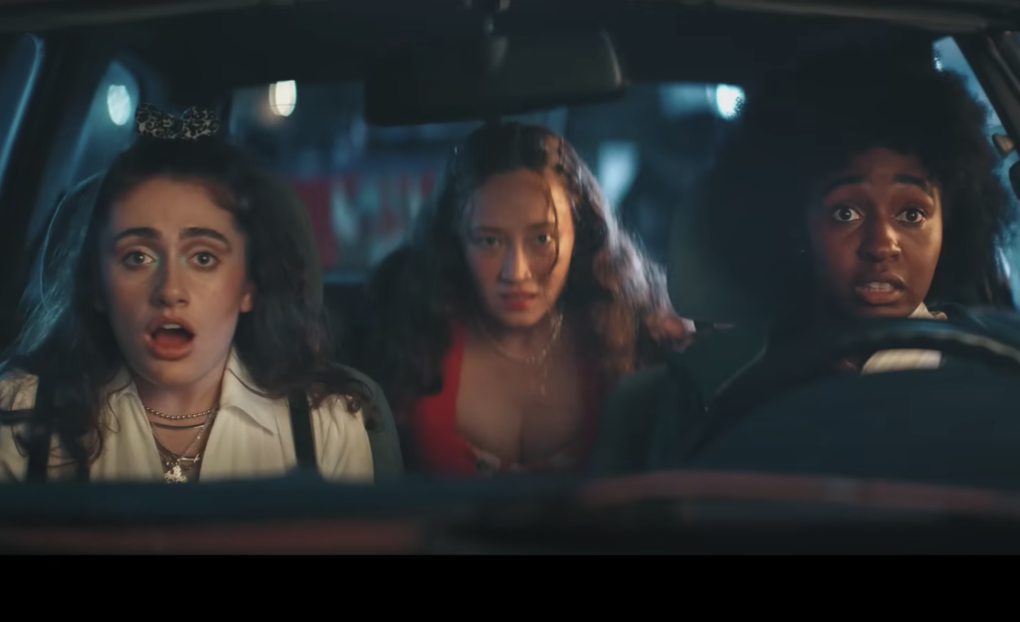
"caption": "(L-R) PJ (Rachel Sennott), Isabel (Havana Rose Liu) and Josie (Ayo Edebiri) in ‘Bottoms.’",
"description": null,
"title": "(L-R) PJ (Rachel Sennott), Isabel (Havana Rose Liu) and Josie (Ayo Edebiri) in ‘Bottoms.’",
"credit": "Orion Pictures",
"status": "inherit",
"altTag": "Three girls sit in a car, looking stunning. In the front, a white teen in the passenger seat, a Black teen in the driver's seat and an Asian girl sitting in the back in the center. It is nighttime.",
"isLoading": false,
"fetchFailed": false
},
"arts_13933333": {
"type": "attachments",
"id": "arts_13933333",
"meta": {
"index": "attachments_1716263798",
"site": "arts",
"id": "13933333",
"found": true
},
"parent": 13933261,
"imgSizes": {
"twentyfourteen-full-width": {
"file": "https://ww2.kqed.org/app/uploads/sites/2/2023/08/Mother-Tattoos-1038x576.png",
"width": 1038,
"mimeType": "image/png",
"height": 576
},
"thumbnail": {
"file": "https://ww2.kqed.org/app/uploads/sites/2/2023/08/Mother-Tattoos-160x106.png",
"width": 160,
"mimeType": "image/png",
"height": 106
},
"post-thumbnail": {
"file": "https://ww2.kqed.org/app/uploads/sites/2/2023/08/Mother-Tattoos-672x372.png",
"width": 672,
"mimeType": "image/png",
"height": 372
},
"kqedFullSize": {
"file": "https://ww2.kqed.org/app/uploads/sites/2/2023/08/Mother-Tattoos.png",
"width": 1646,
"height": 1090
},
"large": {
"file": "https://ww2.kqed.org/app/uploads/sites/2/2023/08/Mother-Tattoos-1020x675.png",
"width": 1020,
"mimeType": "image/png",
"height": 675
},
"1536x1536": {
"file": "https://ww2.kqed.org/app/uploads/sites/2/2023/08/Mother-Tattoos-1536x1017.png",
"width": 1536,
"mimeType": "image/png",
"height": 1017
},
"medium": {
"file": "https://ww2.kqed.org/app/uploads/sites/2/2023/08/Mother-Tattoos-800x530.png",
"width": 800,
"mimeType": "image/png",
"height": 530
},
"medium_large": {
"file": "https://ww2.kqed.org/app/uploads/sites/2/2023/08/Mother-Tattoos-768x509.png",
"width": 768,
"mimeType": "image/png",
"height": 509
}
},
"publishDate": 1692231968,
"modified": 1692302237,
"caption": "Chloe Sherman, ‘Mother Tattoos,’ 1993.",
"description": null,
"title": "Chloe Sherman, ‘Mother Tattoos,’ 1993.",
"credit": "Hatje Cantz",
"status": "inherit",
"altTag": "A close up image of an orange haired young woman embracing another woman with black hair from behind. The first woman has a tattoo of a female figure with a banner that says \"mother\" on her forearm. The woman she is embracing has a tattoo on her chest of a heart and flowers with a banner that says \"mother.\"",
"isLoading": false,
"fetchFailed": false
},
"arts_13932630": {
"type": "attachments",
"id": "arts_13932630",
"meta": {
"index": "attachments_1716263798",
"site": "arts",
"id": "13932630",
"found": true
},
"parent": 13932598,
"imgSizes": {
"twentyfourteen-full-width": {
"file": "https://ww2.kqed.org/app/uploads/sites/2/2023/08/3-2-1-1038x576.jpg",
"width": 1038,
"mimeType": "image/jpeg",
"height": 576
},
"thumbnail": {
"file": "https://ww2.kqed.org/app/uploads/sites/2/2023/08/3-2-1-160x90.jpg",
"width": 160,
"mimeType": "image/jpeg",
"height": 90
},
"post-thumbnail": {
"file": "https://ww2.kqed.org/app/uploads/sites/2/2023/08/3-2-1-672x372.jpg",
"width": 672,
"mimeType": "image/jpeg",
"height": 372
},
"kqedFullSize": {
"file": "https://ww2.kqed.org/app/uploads/sites/2/2023/08/3-2-1.jpg",
"width": 2500,
"height": 1406
},
"2048x2048": {
"file": "https://ww2.kqed.org/app/uploads/sites/2/2023/08/3-2-1-2048x1152.jpg",
"width": 2048,
"mimeType": "image/jpeg",
"height": 1152
},
"large": {
"file": "https://ww2.kqed.org/app/uploads/sites/2/2023/08/3-2-1-1020x574.jpg",
"width": 1020,
"mimeType": "image/jpeg",
"height": 574
},
"1536x1536": {
"file": "https://ww2.kqed.org/app/uploads/sites/2/2023/08/3-2-1-1536x864.jpg",
"width": 1536,
"mimeType": "image/jpeg",
"height": 864
},
"full-width": {
"file": "https://ww2.kqed.org/app/uploads/sites/2/2023/08/3-2-1-1920x1080.jpg",
"width": 1920,
"mimeType": "image/jpeg",
"height": 1080
},
"medium": {
"file": "https://ww2.kqed.org/app/uploads/sites/2/2023/08/3-2-1-800x450.jpg",
"width": 800,
"mimeType": "image/jpeg",
"height": 450
},
"medium_large": {
"file": "https://ww2.kqed.org/app/uploads/sites/2/2023/08/3-2-1-768x432.jpg",
"width": 768,
"mimeType": "image/jpeg",
"height": 432
}
},
"publishDate": 1691087516,
"modified": 1691087557,
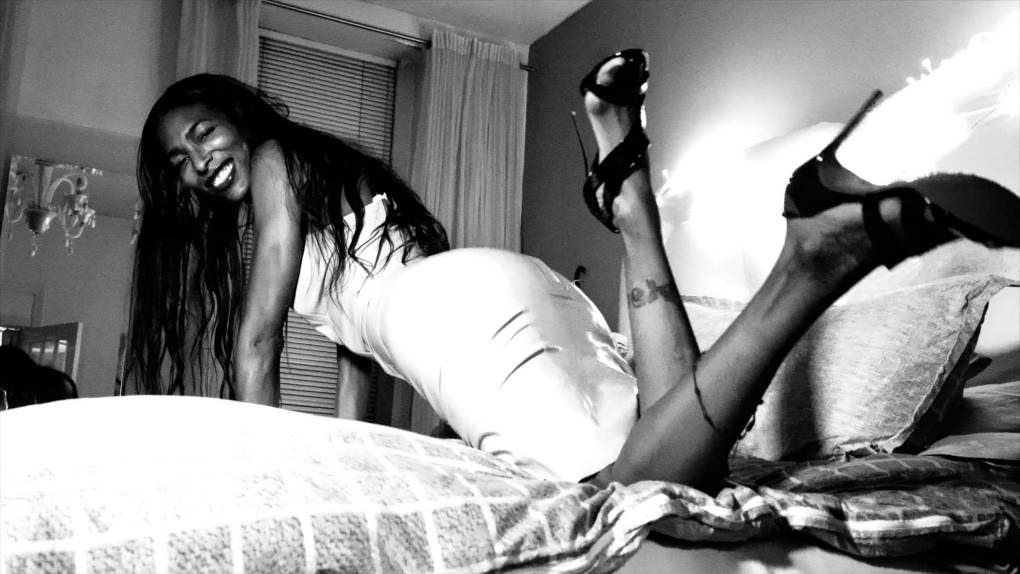
"caption": "Dominique Silver appears in 'Kokomo City,' the debut feature by D. Smith.",
"description": null,
"title": "3-2",
"credit": "Photo by D. Smith, courtesy of Sundance Institute ",
"status": "inherit",
"altTag": "a black and white photo of a smiling Black woman in a tight dress with heels leaning on a bed",
"isLoading": false,
"fetchFailed": false
},
"arts_13931441": {
"type": "attachments",
"id": "arts_13931441",
"meta": {
"index": "attachments_1716263798",
"site": "arts",
"id": "13931441",
"found": true
},
"parent": 13931440,
"imgSizes": {
"twentyfourteen-full-width": {
"file": "https://ww2.kqed.org/app/uploads/sites/2/2023/07/cheryl-dunye-1.26.14-fullbleed-photo-by-jamie-hopper-7de6c0fafe02fee18f1926837fc51559999d3e1e-e1689056706762-1038x576.jpg",
"width": 1038,
"mimeType": "image/jpeg",
"height": 576
},
"thumbnail": {
"file": "https://ww2.kqed.org/app/uploads/sites/2/2023/07/cheryl-dunye-1.26.14-fullbleed-photo-by-jamie-hopper-7de6c0fafe02fee18f1926837fc51559999d3e1e-e1689056706762-160x120.jpg",
"width": 160,
"mimeType": "image/jpeg",
"height": 120
},
"post-thumbnail": {
"file": "https://ww2.kqed.org/app/uploads/sites/2/2023/07/cheryl-dunye-1.26.14-fullbleed-photo-by-jamie-hopper-7de6c0fafe02fee18f1926837fc51559999d3e1e-e1689056706762-672x372.jpg",
"width": 672,
"mimeType": "image/jpeg",
"height": 372
},
"kqedFullSize": {
"file": "https://ww2.kqed.org/app/uploads/sites/2/2023/07/cheryl-dunye-1.26.14-fullbleed-photo-by-jamie-hopper-7de6c0fafe02fee18f1926837fc51559999d3e1e-e1689056706762.jpg",
"width": 1920,
"height": 1440
},
"2048x2048": {
"file": "https://ww2.kqed.org/app/uploads/sites/2/2023/07/cheryl-dunye-1.26.14-fullbleed-photo-by-jamie-hopper-7de6c0fafe02fee18f1926837fc51559999d3e1e-2048x1536.jpg",
"width": 2048,
"mimeType": "image/jpeg",
"height": 1536
},
"large": {
"file": "https://ww2.kqed.org/app/uploads/sites/2/2023/07/cheryl-dunye-1.26.14-fullbleed-photo-by-jamie-hopper-7de6c0fafe02fee18f1926837fc51559999d3e1e-e1689056706762-1020x765.jpg",
"width": 1020,
"mimeType": "image/jpeg",
"height": 765
},
"1536x1536": {
"file": "https://ww2.kqed.org/app/uploads/sites/2/2023/07/cheryl-dunye-1.26.14-fullbleed-photo-by-jamie-hopper-7de6c0fafe02fee18f1926837fc51559999d3e1e-e1689056706762-1536x1152.jpg",
"width": 1536,
"mimeType": "image/jpeg",
"height": 1152
},
"full-width": {
"file": "https://ww2.kqed.org/app/uploads/sites/2/2023/07/cheryl-dunye-1.26.14-fullbleed-photo-by-jamie-hopper-7de6c0fafe02fee18f1926837fc51559999d3e1e-1920x1440.jpg",
"width": 1920,
"mimeType": "image/jpeg",
"height": 1440
},
"medium": {
"file": "https://ww2.kqed.org/app/uploads/sites/2/2023/07/cheryl-dunye-1.26.14-fullbleed-photo-by-jamie-hopper-7de6c0fafe02fee18f1926837fc51559999d3e1e-e1689056706762-800x600.jpg",
"width": 800,
"mimeType": "image/jpeg",
"height": 600
},
"medium_large": {
"file": "https://ww2.kqed.org/app/uploads/sites/2/2023/07/cheryl-dunye-1.26.14-fullbleed-photo-by-jamie-hopper-7de6c0fafe02fee18f1926837fc51559999d3e1e-e1689056706762-768x576.jpg",
"width": 768,
"mimeType": "image/jpeg",
"height": 576
}
},
"publishDate": 1689055445,
"modified": 1689056856,
"caption": "Cheryl Dunye’s 1996 debut, ‘The Watermelon Woman,’ is being added to the Criterion Collection. It's a long overdue honor for the filmmaker who shaped how Black LGBTQ+ stories are told.",
"description": null,
"title": "Cheryl Dunye’s 1996 debut, ‘The Watermelon Woman,’ is being added to the Criterion Collection. It's a long overdue honor for the filmmaker who shaped how Black LGBTQ+ stories are told.",
"credit": "Jamie Hopper",
"status": "inherit",
"altTag": "A Black woman sits against a white wall wearing a white buttoned up shirt, small, round, green eye glasses and a red beanie. She rests one finger under her chin.",
"isLoading": false,
"fetchFailed": false
},
"arts_13931119": {
"type": "attachments",
"id": "arts_13931119",
"meta": {
"index": "attachments_1716263798",
"site": "arts",
"id": "13931119",
"found": true
},
"parent": 13931116,
"imgSizes": {
"twentyfourteen-full-width": {
"file": "https://ww2.kqed.org/app/uploads/sites/2/2023/06/GettyImages-1258635552-scaled-e1688150279368-1038x576.jpg",
"width": 1038,
"mimeType": "image/jpeg",
"height": 576
},
"thumbnail": {
"file": "https://ww2.kqed.org/app/uploads/sites/2/2023/06/GettyImages-1258635552-scaled-e1688150279368-160x107.jpg",
"width": 160,
"mimeType": "image/jpeg",
"height": 107
},
"post-thumbnail": {
"file": "https://ww2.kqed.org/app/uploads/sites/2/2023/06/GettyImages-1258635552-scaled-e1688150279368-672x372.jpg",
"width": 672,
"mimeType": "image/jpeg",
"height": 372
},
"kqedFullSize": {
"file": "https://ww2.kqed.org/app/uploads/sites/2/2023/06/GettyImages-1258635552-scaled-e1688150279368.jpg",
"width": 1920,
"height": 1280
},
"2048x2048": {
"file": "https://ww2.kqed.org/app/uploads/sites/2/2023/06/GettyImages-1258635552-2048x1365.jpg",
"width": 2048,
"mimeType": "image/jpeg",
"height": 1365
},
"large": {
"file": "https://ww2.kqed.org/app/uploads/sites/2/2023/06/GettyImages-1258635552-scaled-e1688150279368-1020x680.jpg",
"width": 1020,
"mimeType": "image/jpeg",
"height": 680
},
"1536x1536": {
"file": "https://ww2.kqed.org/app/uploads/sites/2/2023/06/GettyImages-1258635552-scaled-e1688150279368-1536x1024.jpg",
"width": 1536,
"mimeType": "image/jpeg",
"height": 1024
},
"full-width": {
"file": "https://ww2.kqed.org/app/uploads/sites/2/2023/06/GettyImages-1258635552-1920x1280.jpg",
"width": 1920,
"mimeType": "image/jpeg",
"height": 1280
},
"medium": {
"file": "https://ww2.kqed.org/app/uploads/sites/2/2023/06/GettyImages-1258635552-scaled-e1688150279368-800x533.jpg",
"width": 800,
"mimeType": "image/jpeg",
"height": 533
},
"medium_large": {
"file": "https://ww2.kqed.org/app/uploads/sites/2/2023/06/GettyImages-1258635552-scaled-e1688150279368-768x512.jpg",
"width": 768,
"mimeType": "image/jpeg",
"height": 512
}
},
"publishDate": 1688150261,
"modified": 1688150372,
"caption": "Dylan Mulvaney at the 2023 Tony Awards in New York City.",
"description": null,
"title": "Dylan Mulvaney at the 2023 Tony Awards in New York City.",
"credit": "Sean Zanni/ Patrick McMullan via Getty Images",
"status": "inherit",
"altTag": "A very petite blonde woman wearing an off the shoulder black gown stands on a red carpet against a green backdrop.",
"isLoading": false,
"fetchFailed": false
},
"arts_13931088": {
"type": "attachments",
"id": "arts_13931088",
"meta": {
"index": "attachments_1716263798",
"site": "arts",
"id": "13931088",
"found": true
},
"parent": 13930824,
"imgSizes": {
"twentyfourteen-full-width": {
"file": "https://ww2.kqed.org/app/uploads/sites/2/2023/06/Screen-Shot-2023-06-30-at-2.16.44-AM-1038x576.png",
"width": 1038,
"mimeType": "image/png",
"height": 576
},
"thumbnail": {
"file": "https://ww2.kqed.org/app/uploads/sites/2/2023/06/Screen-Shot-2023-06-30-at-2.16.44-AM-160x106.png",
"width": 160,
"mimeType": "image/png",
"height": 106
},
"post-thumbnail": {
"file": "https://ww2.kqed.org/app/uploads/sites/2/2023/06/Screen-Shot-2023-06-30-at-2.16.44-AM-672x372.png",
"width": 672,
"mimeType": "image/png",
"height": 372
},
"kqedFullSize": {
"file": "https://ww2.kqed.org/app/uploads/sites/2/2023/06/Screen-Shot-2023-06-30-at-2.16.44-AM.png",
"width": 1934,
"height": 1282
},
"large": {
"file": "https://ww2.kqed.org/app/uploads/sites/2/2023/06/Screen-Shot-2023-06-30-at-2.16.44-AM-1020x676.png",
"width": 1020,
"mimeType": "image/png",
"height": 676
},
"1536x1536": {
"file": "https://ww2.kqed.org/app/uploads/sites/2/2023/06/Screen-Shot-2023-06-30-at-2.16.44-AM-1536x1018.png",
"width": 1536,
"mimeType": "image/png",
"height": 1018
},
"full-width": {
"file": "https://ww2.kqed.org/app/uploads/sites/2/2023/06/Screen-Shot-2023-06-30-at-2.16.44-AM-1920x1273.png",
"width": 1920,
"mimeType": "image/png",
"height": 1273
},
"medium": {
"file": "https://ww2.kqed.org/app/uploads/sites/2/2023/06/Screen-Shot-2023-06-30-at-2.16.44-AM-800x530.png",
"width": 800,
"mimeType": "image/png",
"height": 530
},
"medium_large": {
"file": "https://ww2.kqed.org/app/uploads/sites/2/2023/06/Screen-Shot-2023-06-30-at-2.16.44-AM-768x509.png",
"width": 768,
"mimeType": "image/png",
"height": 509
}
},
"publishDate": 1688116625,
"modified": 1688116730,
"caption": "RIver Gallo — one of the intersex subjects of new documentary ‘Every Body’ — receives a kiss from a friend. ",
"description": null,
"title": "RIver Gallo — one of the intersex subjects of new documentary ‘Every Body’ — receives a kiss from a friend.",
"credit": "‘Every Body’/ Focus Features",
"status": "inherit",
"altTag": "An ambiguously gendered person with shoulder length brown hair and a big smile is kissed on the cheek by a female friend with long dark hair.",
"isLoading": false,
"fetchFailed": false
},
"arts_13930342": {
"type": "attachments",
"id": "arts_13930342",
"meta": {
"index": "attachments_1716263798",
"site": "arts",
"id": "13930342",
"found": true
},
"parent": 13930323,
"imgSizes": {
"twentyfourteen-full-width": {
"file": "https://ww2.kqed.org/app/uploads/sites/2/2023/06/ramrod-1038x576.jpg",
"width": 1038,
"mimeType": "image/jpeg",
"height": 576
},
"thumbnail": {
"file": "https://ww2.kqed.org/app/uploads/sites/2/2023/06/ramrod-160x97.jpg",
"width": 160,
"mimeType": "image/jpeg",
"height": 97
},
"post-thumbnail": {
"file": "https://ww2.kqed.org/app/uploads/sites/2/2023/06/ramrod-672x372.jpg",
"width": 672,
"mimeType": "image/jpeg",
"height": 372
},
"kqedFullSize": {
"file": "https://ww2.kqed.org/app/uploads/sites/2/2023/06/ramrod.jpg",
"width": 1882,
"height": 1144
},
"large": {
"file": "https://ww2.kqed.org/app/uploads/sites/2/2023/06/ramrod-1020x620.jpg",
"width": 1020,
"mimeType": "image/jpeg",
"height": 620
},
"1536x1536": {
"file": "https://ww2.kqed.org/app/uploads/sites/2/2023/06/ramrod-1536x934.jpg",
"width": 1536,
"mimeType": "image/jpeg",
"height": 934
},
"medium": {
"file": "https://ww2.kqed.org/app/uploads/sites/2/2023/06/ramrod-800x486.jpg",
"width": 800,
"mimeType": "image/jpeg",
"height": 486
},
"medium_large": {
"file": "https://ww2.kqed.org/app/uploads/sites/2/2023/06/ramrod-768x467.jpg",
"width": 768,
"mimeType": "image/jpeg",
"height": 467
}
},
"publishDate": 1686268037,
"modified": 1686268556,
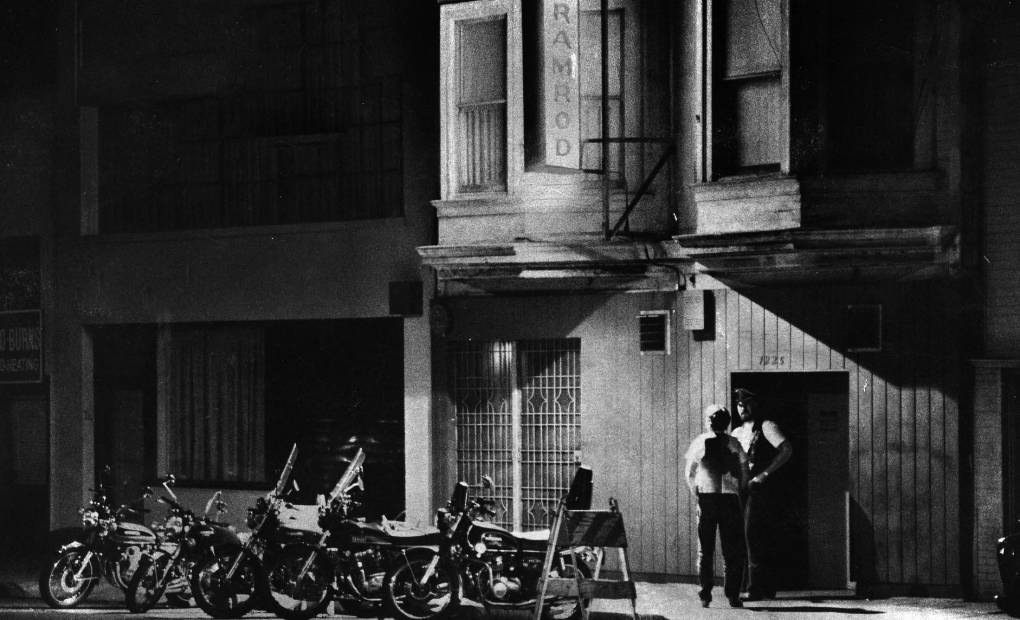
"caption": "A 1972 image taken of the Ramrod — a leather bar at 1225 Folsom St. (between 8th and 9th). It opened in 1967 and was immortalized in ‘The Laughing Policeman,’ a movie starring Walter Matthau and Bruce Dern.",
"description": "The Ramrod was a leather bar at 1225 Folsom St. (between 8th and 9th). It opened in 1967 by George Wilburn (retired film editor from Hollywood) and Paul Bentley. Taken on a Sunday afternoon, this photo postcard was made for the 5th anniversary by Henri Leleu, and shows its enormous popularity at the time. Filming took place in this bar for the 1973 film ",
"title": "A 1972 image taken of the Ramrod — a leather bar at 1225 Folsom St. (between 8th and 9th). It opened in 1967 and was immortalized in ‘The Laughing Policeman,’ a movie starring Walter Matthau and Bruce Dern.",
"credit": "Gary Fong/ San Francisco Chronicle via Getty Images",
"status": "inherit",
"altTag": null,
"isLoading": false,
"fetchFailed": false
},
"arts_13930600": {
"type": "attachments",
"id": "arts_13930600",
"meta": {
"index": "attachments_1716263798",
"site": "arts",
"id": "13930600",
"found": true
},
"parent": 13930587,
"imgSizes": {
"twentyfourteen-full-width": {
"file": "https://ww2.kqed.org/app/uploads/sites/2/2023/06/Pink-Block-2022-1038x576.png",
"width": 1038,
"mimeType": "image/png",
"height": 576
},
"thumbnail": {
"file": "https://ww2.kqed.org/app/uploads/sites/2/2023/06/Pink-Block-2022-160x106.png",
"width": 160,
"mimeType": "image/png",
"height": 106
},
"post-thumbnail": {
"file": "https://ww2.kqed.org/app/uploads/sites/2/2023/06/Pink-Block-2022-672x372.png",
"width": 672,
"mimeType": "image/png",
"height": 372
},
"kqedFullSize": {
"file": "https://ww2.kqed.org/app/uploads/sites/2/2023/06/Pink-Block-2022.png",
"width": 1636,
"height": 1088
},
"large": {
"file": "https://ww2.kqed.org/app/uploads/sites/2/2023/06/Pink-Block-2022-1020x678.png",
"width": 1020,
"mimeType": "image/png",
"height": 678
},
"1536x1536": {
"file": "https://ww2.kqed.org/app/uploads/sites/2/2023/06/Pink-Block-2022-1536x1021.png",
"width": 1536,
"mimeType": "image/png",
"height": 1021
},
"medium": {
"file": "https://ww2.kqed.org/app/uploads/sites/2/2023/06/Pink-Block-2022-800x532.png",
"width": 800,
"mimeType": "image/png",
"height": 532
},
"medium_large": {
"file": "https://ww2.kqed.org/app/uploads/sites/2/2023/06/Pink-Block-2022-768x511.png",
"width": 768,
"mimeType": "image/png",
"height": 511
}
},
"publishDate": 1686867234,
"modified": 1686867315,
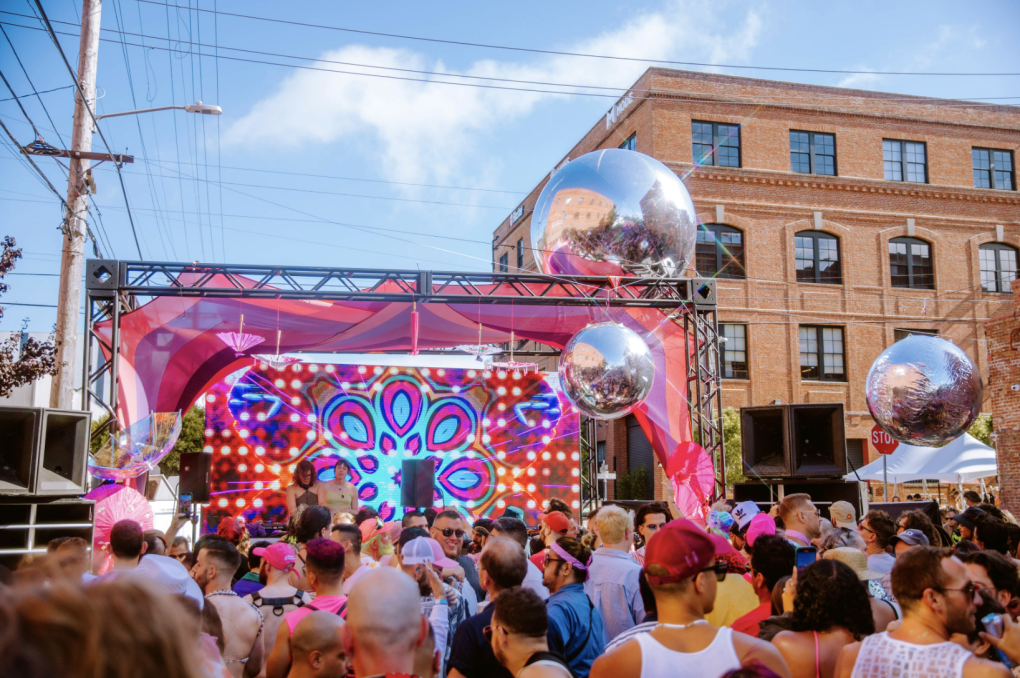
"caption": "The Pink Block party, 2022. This year's mini-festival, on June 24, 2023, will be headlined by Big Freedia.",
"description": null,
"title": "Pink Block 2022",
"credit": "Saylor Nedelman",
"status": "inherit",
"altTag": "a large street party with a pink stage and a crowd of people dancing in front of it",
"isLoading": false,
"fetchFailed": false
},
"arts_13930422": {
"type": "attachments",
"id": "arts_13930422",
"meta": {
"index": "attachments_1716263798",
"site": "arts",
"id": "13930422",
"found": true
},
"parent": 13929998,
"imgSizes": {
"twentyfourteen-full-width": {
"file": "https://ww2.kqed.org/app/uploads/sites/2/2023/06/GettyImages-526105606-1-1038x576.jpg",
"width": 1038,
"mimeType": "image/jpeg",
"height": 576
},
"thumbnail": {
"file": "https://ww2.kqed.org/app/uploads/sites/2/2023/06/GettyImages-526105606-1-160x100.jpg",
"width": 160,
"mimeType": "image/jpeg",
"height": 100
},
"post-thumbnail": {
"file": "https://ww2.kqed.org/app/uploads/sites/2/2023/06/GettyImages-526105606-1-672x372.jpg",
"width": 672,
"mimeType": "image/jpeg",
"height": 372
},
"kqedFullSize": {
"file": "https://ww2.kqed.org/app/uploads/sites/2/2023/06/GettyImages-526105606-1-scaled.jpg",
"width": 2560,
"height": 1592
},
"2048x2048": {
"file": "https://ww2.kqed.org/app/uploads/sites/2/2023/06/GettyImages-526105606-1-2048x1274.jpg",
"width": 2048,
"mimeType": "image/jpeg",
"height": 1274
},
"large": {
"file": "https://ww2.kqed.org/app/uploads/sites/2/2023/06/GettyImages-526105606-1-1020x634.jpg",
"width": 1020,
"mimeType": "image/jpeg",
"height": 634
},
"1536x1536": {
"file": "https://ww2.kqed.org/app/uploads/sites/2/2023/06/GettyImages-526105606-1-1536x955.jpg",
"width": 1536,
"mimeType": "image/jpeg",
"height": 955
},
"full-width": {
"file": "https://ww2.kqed.org/app/uploads/sites/2/2023/06/GettyImages-526105606-1-1920x1194.jpg",
"width": 1920,
"mimeType": "image/jpeg",
"height": 1194
},
"medium": {
"file": "https://ww2.kqed.org/app/uploads/sites/2/2023/06/GettyImages-526105606-1-800x498.jpg",
"width": 800,
"mimeType": "image/jpeg",
"height": 498
},
"medium_large": {
"file": "https://ww2.kqed.org/app/uploads/sites/2/2023/06/GettyImages-526105606-1-768x478.jpg",
"width": 768,
"mimeType": "image/jpeg",
"height": 478
}
},
"publishDate": 1686604130,
"modified": 1686604173,
"caption": "A glorious gathering of lesbians, circa 1910.",
"description": null,
"title": "A glorious gathering of lesbians, circa 1910.",
"credit": "Kirn Vintage Stock/ Corbis via Getty Images",
"status": "inherit",
"altTag": null,
"isLoading": false,
"fetchFailed": false
},
"arts_13930405": {
"type": "attachments",
"id": "arts_13930405",
"meta": {
"index": "attachments_1716263798",
"site": "arts",
"id": "13930405",
"found": true
},
"parent": 13930404,
"imgSizes": {
"twentyfourteen-full-width": {
"file": "https://ww2.kqed.org/app/uploads/sites/2/2023/06/img_8197_custom-014e72b5287e950b26a79c9a43ee781ffa7baa67-scaled-e1686590618813-1038x576.jpe",
"width": 1038,
"mimeType": "image/jpeg",
"height": 576
},
"thumbnail": {
"file": "https://ww2.kqed.org/app/uploads/sites/2/2023/06/img_8197_custom-014e72b5287e950b26a79c9a43ee781ffa7baa67-scaled-e1686590618813-160x125.jpe",
"width": 160,
"mimeType": "image/jpeg",
"height": 125
},
"post-thumbnail": {
"file": "https://ww2.kqed.org/app/uploads/sites/2/2023/06/img_8197_custom-014e72b5287e950b26a79c9a43ee781ffa7baa67-scaled-e1686590618813-672x372.jpe",
"width": 672,
"mimeType": "image/jpeg",
"height": 372
},
"kqedFullSize": {
"file": "https://ww2.kqed.org/app/uploads/sites/2/2023/06/img_8197_custom-014e72b5287e950b26a79c9a43ee781ffa7baa67-scaled-e1686590618813.jpe",
"width": 1920,
"height": 1502
},
"2048x2048": {
"file": "https://ww2.kqed.org/app/uploads/sites/2/2023/06/img_8197_custom-014e72b5287e950b26a79c9a43ee781ffa7baa67-2048x1602.jpe",
"width": 2048,
"mimeType": "image/jpeg",
"height": 1602
},
"large": {
"file": "https://ww2.kqed.org/app/uploads/sites/2/2023/06/img_8197_custom-014e72b5287e950b26a79c9a43ee781ffa7baa67-scaled-e1686590618813-1020x798.jpe",
"width": 1020,
"mimeType": "image/jpeg",
"height": 798
},
"1536x1536": {
"file": "https://ww2.kqed.org/app/uploads/sites/2/2023/06/img_8197_custom-014e72b5287e950b26a79c9a43ee781ffa7baa67-scaled-e1686590618813-1536x1202.jpe",
"width": 1536,
"mimeType": "image/jpeg",
"height": 1202
},
"full-width": {
"file": "https://ww2.kqed.org/app/uploads/sites/2/2023/06/img_8197_custom-014e72b5287e950b26a79c9a43ee781ffa7baa67-1920x1502.jpe",
"width": 1920,
"mimeType": "image/jpeg",
"height": 1502
},
"medium": {
"file": "https://ww2.kqed.org/app/uploads/sites/2/2023/06/img_8197_custom-014e72b5287e950b26a79c9a43ee781ffa7baa67-scaled-e1686590618813-800x626.jpe",
"width": 800,
"mimeType": "image/jpeg",
"height": 626
},
"medium_large": {
"file": "https://ww2.kqed.org/app/uploads/sites/2/2023/06/img_8197_custom-014e72b5287e950b26a79c9a43ee781ffa7baa67-scaled-e1686590618813-768x601.jpe",
"width": 768,
"mimeType": "image/jpeg",
"height": 601
}
},
"publishDate": 1686590100,
"modified": 1686590749,
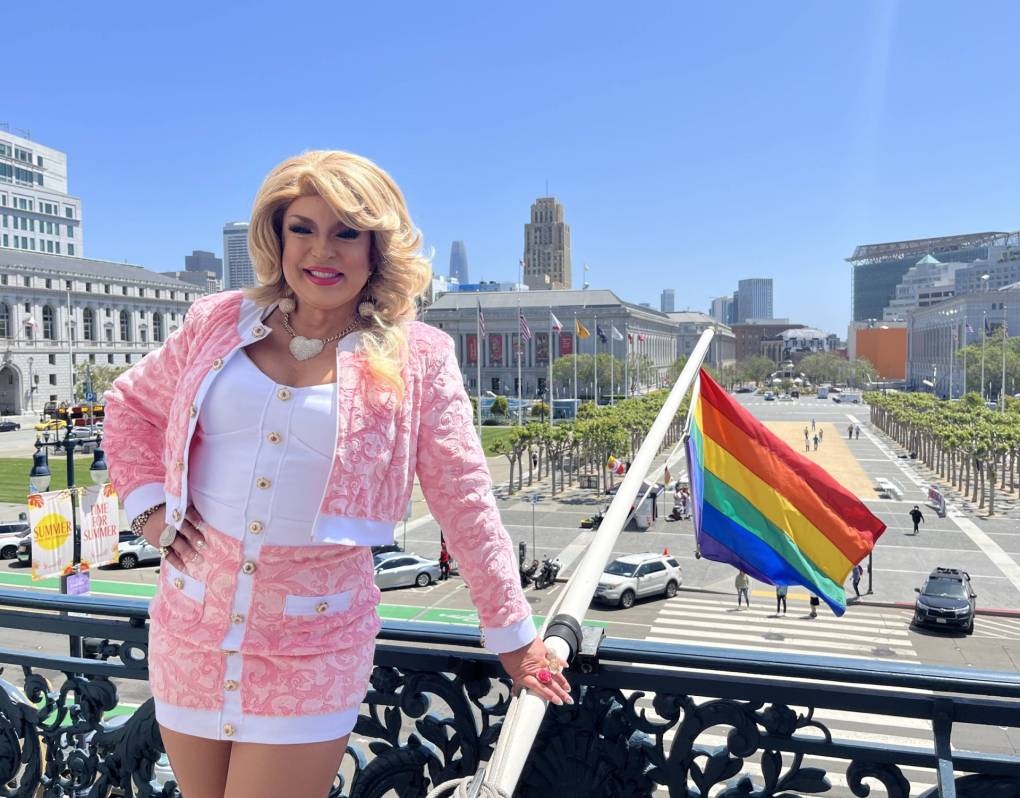
"caption": "D'Arcy Drollinger, the country's first drag laureate, poses with the Pride flag outside San Francisco City Hall on June 2, 2023.",
"description": null,
"title": "D'Arcy Drollinger, the country's first drag laureate, poses with the Pride flag outside San Francisco City Hall on June 2, 2023.",
"credit": "Chloe Veltman/ NPR",
"status": "inherit",
"altTag": "A drag performer wearing long blond wig and a skin tight pink and white dress and suit jacket stands on a balcony overlooking San Francisco Civic Center. She is standing next to a rainbow flag.",
"isLoading": false,
"fetchFailed": false
},
"arts_13930359": {
"type": "attachments",
"id": "arts_13930359",
"meta": {
"index": "attachments_1716263798",
"site": "arts",
"id": "13930359",
"found": true
},
"parent": 13930358,
"imgSizes": {
"twentyfourteen-full-width": {
"file": "https://ww2.kqed.org/app/uploads/sites/2/2023/06/misc_23_019_jm_dsp_0269-3-0-3ff153507640790e5104733cf18e1fcd3b3bde8c-scaled-e1686344883172-1038x576.jpg",
"width": 1038,
"mimeType": "image/jpeg",
"height": 576
},
"thumbnail": {
"file": "https://ww2.kqed.org/app/uploads/sites/2/2023/06/misc_23_019_jm_dsp_0269-3-0-3ff153507640790e5104733cf18e1fcd3b3bde8c-scaled-e1686344883172-160x120.jpg",
"width": 160,
"mimeType": "image/jpeg",
"height": 120
},
"post-thumbnail": {
"file": "https://ww2.kqed.org/app/uploads/sites/2/2023/06/misc_23_019_jm_dsp_0269-3-0-3ff153507640790e5104733cf18e1fcd3b3bde8c-scaled-e1686344883172-672x372.jpg",
"width": 672,
"mimeType": "image/jpeg",
"height": 372
},
"kqedFullSize": {
"file": "https://ww2.kqed.org/app/uploads/sites/2/2023/06/misc_23_019_jm_dsp_0269-3-0-3ff153507640790e5104733cf18e1fcd3b3bde8c-scaled-e1686344883172.jpg",
"width": 1920,
"height": 1441
},
"2048x2048": {
"file": "https://ww2.kqed.org/app/uploads/sites/2/2023/06/misc_23_019_jm_dsp_0269-3-0-3ff153507640790e5104733cf18e1fcd3b3bde8c-2048x1536.jpg",
"width": 2048,
"mimeType": "image/jpeg",
"height": 1536
},
"large": {
"file": "https://ww2.kqed.org/app/uploads/sites/2/2023/06/misc_23_019_jm_dsp_0269-3-0-3ff153507640790e5104733cf18e1fcd3b3bde8c-scaled-e1686344883172-1020x766.jpg",
"width": 1020,
"mimeType": "image/jpeg",
"height": 766
},
"1536x1536": {
"file": "https://ww2.kqed.org/app/uploads/sites/2/2023/06/misc_23_019_jm_dsp_0269-3-0-3ff153507640790e5104733cf18e1fcd3b3bde8c-scaled-e1686344883172-1536x1153.jpg",
"width": 1536,
"mimeType": "image/jpeg",
"height": 1153
},
"full-width": {
"file": "https://ww2.kqed.org/app/uploads/sites/2/2023/06/misc_23_019_jm_dsp_0269-3-0-3ff153507640790e5104733cf18e1fcd3b3bde8c-1920x1440.jpg",
"width": 1920,
"mimeType": "image/jpeg",
"height": 1440
},
"medium": {
"file": "https://ww2.kqed.org/app/uploads/sites/2/2023/06/misc_23_019_jm_dsp_0269-3-0-3ff153507640790e5104733cf18e1fcd3b3bde8c-scaled-e1686344883172-800x600.jpg",
"width": 800,
"mimeType": "image/jpeg",
"height": 600
},
"medium_large": {
"file": "https://ww2.kqed.org/app/uploads/sites/2/2023/06/misc_23_019_jm_dsp_0269-3-0-3ff153507640790e5104733cf18e1fcd3b3bde8c-scaled-e1686344883172-768x576.jpg",
"width": 768,
"mimeType": "image/jpeg",
"height": 576
}
},
"publishDate": 1686344714,
"modified": 1686344993,
"caption": "On her new album, ‘The Age of Pleasure,’ Janelle Monáe concocts a vision of sensuality that is open to complication but goes down easy.",
"description": null,
"title": "On her new album, ‘The Age of Pleasure,’ Janelle Monáe concocts a vision of sensuality that is open to complication but goes down easy.",
"credit": "Mason Rose/Courtesy of the artist",
"status": "inherit",
"altTag": "An attractive Black woman in her thirties stands, shocked expression on her face wearing a round white sun hat. She is topless, her hands covering her breasts.",
"isLoading": false,
"fetchFailed": false
}
},
"audioPlayerReducer": {
"postId": "stream_live",
"isPaused": true,
"isPlaying": false,
"pfsActive": false,
"pledgeModalIsOpen": true,
"playerDrawerIsOpen": false,
"liveAudioPlayStartedAt": 0,
"liveAudioPlayContext": ""
},
"authorsReducer": {
"byline_arts_13933974": {
"type": "authors",
"id": "byline_arts_13933974",
"meta": {
"override": true
},
"slug": "byline_arts_13933974",
"name": "Elizabeth Blair",
"isLoading": false
},
"byline_arts_13933589": {
"type": "authors",
"id": "byline_arts_13933589",
"meta": {
"override": true
},
"slug": "byline_arts_13933589",
"name": "Lindsey Bahr, Associated Press",
"isLoading": false
},
"byline_arts_13931440": {
"type": "authors",
"id": "byline_arts_13931440",
"meta": {
"override": true
},
"slug": "byline_arts_13931440",
"name": "Allyson McCabe",
"isLoading": false
},
"byline_arts_13931116": {
"type": "authors",
"id": "byline_arts_13931116",
"meta": {
"override": true
},
"slug": "byline_arts_13931116",
"name": "The Associated Press",
"isLoading": false
},
"byline_arts_13930404": {
"type": "authors",
"id": "byline_arts_13930404",
"meta": {
"override": true
},
"slug": "byline_arts_13930404",
"name": "Chloe Veltman",
"isLoading": false
},
"byline_arts_13930358": {
"type": "authors",
"id": "byline_arts_13930358",
"meta": {
"override": true
},
"slug": "byline_arts_13930358",
"name": "Ann Powers",
"isLoading": false
},
"mfox": {
"type": "authors",
"id": "22",
"meta": {
"index": "authors_1716337520",
"id": "22",
"found": true
},
"name": "Michael Fox",
"firstName": "Michael",
"lastName": "Fox",
"slug": "mfox",
"email": "foxonfilm@yahoo.com",
"display_author_email": false,
"staff_mastheads": [],
"title": "KQED Contributor",
"bio": "Michael Fox has written about film for dozens of publications since 1987. He is a founding member of the San Francisco Bay Area Film Critics Circle.",
"avatar": "https://secure.gravatar.com/avatar/d9849d6c659c41414795c471d907bb97b396e2a32b88e20e6ff66f65fbdd6dcd?s=600&d=blank&r=g",
"twitter": null,
"bluesky": null,
"facebook": null,
"instagram": null,
"linkedin": null,
"sites": [
{
"site": "arts",
"roles": [
"Contributor",
"contributor"
]
}
],
"headData": {
"title": "Michael Fox | KQED",
"description": "KQED Contributor",
"ogImgSrc": "https://secure.gravatar.com/avatar/d9849d6c659c41414795c471d907bb97b396e2a32b88e20e6ff66f65fbdd6dcd?s=600&d=blank&r=g",
"twImgSrc": "https://secure.gravatar.com/avatar/d9849d6c659c41414795c471d907bb97b396e2a32b88e20e6ff66f65fbdd6dcd?s=600&d=blank&r=g"
},
"isLoading": false,
"link": "/author/mfox"
},
"ralexandra": {
"type": "authors",
"id": "11242",
"meta": {
"index": "authors_1716337520",
"id": "11242",
"found": true
},
"name": "Rae Alexandra",
"firstName": "Rae",
"lastName": "Alexandra",
"slug": "ralexandra",
"email": "ralexandra@kqed.org",
"display_author_email": true,
"staff_mastheads": [],
"title": "Reporter/Producer",
"bio": "Rae Alexandra is a Reporter/Producer for KQED Arts & Culture, and the creator/author of the \u003ca href=\"https://www.kqed.org/arts/program/rebel-girls-from-bay-area-history\">Rebel Girls From Bay Area History\u003c/a> and \u003ca href=\"https://www.kqed.org/bizarrebayarea\">Bizarre Bay Area\u003c/a> series. Her debut book, \u003ca href=\"https://citylights.com/politics-current-events-history/unsung-heroines35-women-who-changed/\">Unsung Heroines: 35 Women Who Changed the Bay Area\u003c/a> was published by City Lights in March 2026. In 2023, Rae was awarded an SPJ Excellence in Journalism Award for Arts & Culture. Rae was born and raised in Wales and subsequently — even after two decades in Northern California — still uses phrases that regularly baffle her coworkers.",
"avatar": "https://secure.gravatar.com/avatar/edfee8176c80cc0a382b051190f5341997df378a934a5774dcb0977732dfd401?s=600&d=blank&r=g",
"twitter": null,
"bluesky": null,
"facebook": null,
"instagram": null,
"linkedin": null,
"sites": [
{
"site": "arts",
"roles": [
"subscriber"
]
},
{
"site": "news",
"roles": [
"subscriber"
]
},
{
"site": "pop",
"roles": [
"subscriber"
]
},
{
"site": "bayareabites",
"roles": [
"subscriber"
]
},
{
"site": "science",
"roles": [
"subscriber"
]
}
],
"headData": {
"title": "Rae Alexandra | KQED",
"description": "Reporter/Producer",
"ogImgSrc": "https://secure.gravatar.com/avatar/edfee8176c80cc0a382b051190f5341997df378a934a5774dcb0977732dfd401?s=600&d=blank&r=g",
"twImgSrc": "https://secure.gravatar.com/avatar/edfee8176c80cc0a382b051190f5341997df378a934a5774dcb0977732dfd401?s=600&d=blank&r=g"
},
"isLoading": false,
"link": "/author/ralexandra"
},
"ksong": {
"type": "authors",
"id": "11813",
"meta": {
"index": "authors_1716337520",
"id": "11813",
"found": true
},
"name": "Kristie Song",
"firstName": "Kristie",
"lastName": "Song",
"slug": "ksong",
"email": "ksong@kqed.org",
"display_author_email": false,
"staff_mastheads": [],
"title": "Editorial Intern ",
"bio": "Kristie Song is an Arts & Culture Intern at KQED. She is currently a graduate student at UC Berkeley, where she studies audio and multimedia journalism. Previously, she covered the local community for Oakland North, produced episodes for The Science of Happiness, and served as news director for KUCI, UC Irvine’s radio station. Outside of reporting, she likes drawing comics, listening to angsty rock, and practicing the guitar.",
"avatar": "https://secure.gravatar.com/avatar/c1149e78c3c44f92d4945a8ab0711af6?s=600&d=blank&r=g",
"twitter": null,
"facebook": null,
"instagram": null,
"linkedin": null,
"sites": [
{
"site": "arts",
"roles": [
"editor"
]
}
],
"headData": {
"title": "Kristie Song | KQED",
"description": "Editorial Intern ",
"ogImgSrc": "https://secure.gravatar.com/avatar/c1149e78c3c44f92d4945a8ab0711af6?s=600&d=blank&r=g",
"twImgSrc": "https://secure.gravatar.com/avatar/c1149e78c3c44f92d4945a8ab0711af6?s=600&d=blank&r=g"
},
"isLoading": false,
"link": "/author/ksong"
}
},
"pagesReducer": {
"arts_tag_lgbtq": {
"type": "terms",
"id": "arts_3226",
"meta": {
"index": "terms_1716263798",
"site": "arts",
"id": "3226",
"score": 8.28313
},
"name": "LGBTQ+",
"slug": "lgbtq",
"taxonomy": "tag",
"description": null,
"featImg": null,
"headData": {
"title": "LGBTQ+ | KQED Arts",
"description": null,
"ogTitle": null,
"ogDescription": null,
"ogImgId": null,
"twTitle": null,
"twDescription": null,
"twImgId": null
},
"ttid": 3238,
"isLoading": false,
"title": "LGBTQ+",
"pageMeta": {
"site": "arts",
"WpPageTemplate": "page-topic-editorial",
"currentPage": 11
},
"blocks": [
{
"blockName": "kqed/post-list",
"attrs": {
"layout": "cardArticle2",
"query": "posts/arts?tag=lgbtq",
"seeMore": false,
"paginated": true,
"page": 11
}
},
{
"blockName": "kqed/ad"
}
]
}
},
"pfsSessionReducer": {},
"postsReducer": {
"stream_live": {
"type": "live",
"id": "stream_live",
"audioUrl": "https://streams.kqed.org/kqedradio",
"title": "Live Stream",
"excerpt": "Live Stream information currently unavailable.",
"link": "/radio",
"featImg": "",
"label": {
"name": "KQED Live",
"link": "/"
}
},
"stream_kqedNewscast": {
"type": "posts",
"id": "stream_kqedNewscast",
"audioUrl": "https://www.kqed.org/.stream/anon/radio/RDnews/newscast.mp3?_=1",
"title": "KQED Newscast",
"featImg": "",
"label": {
"name": "88.5 FM",
"link": "/"
}
},
"arts_13933974": {
"type": "posts",
"id": "arts_13933974",
"meta": {
"index": "posts_1716263798",
"site": "arts",
"id": "13933974",
"score": null,
"sort": [
1693233700000
]
},
"guestAuthors": [],
"slug": "an-ode-to-harvey-milk-for-smithsonian-folkways-75th-birthday",
"title": "An Ode to Harvey Milk for Smithsonian Folkways’ 75th Birthday",
"publishDate": 1693233700,
"format": "standard",
"headTitle": "An Ode to Harvey Milk for Smithsonian Folkways’ 75th Birthday | KQED",
"labelTerm": {
"term": 140,
"site": "arts"
},
"content": "\u003cp>San Francisco-based preschool teacher Greg Gardner says he and his friend, singer-songwriter Cass McCombs, “have collected way too many Folkways records” over the years — by Woody Guthrie, Michael Hurley, Lead Belly, Mary Lou Williams, Ella Jenkins and others.\u003c/p>\n\u003cp>The pair are huge fans of the influential label founded in 1948 by Moses Asch. So they were thrilled when Folkways agreed to include their new \u003ca href=\"https://folkways.si.edu/news-and-press/mr-greg-cass-mccombs\">album\u003c/a> of children’s songs to the label’s 75th anniversary celebration.\u003c/p>\n\u003cp>\u003cstrong>A storied collection turns 75\u003c/strong>\u003c/p>\n\u003cp>[aside postid='arts_13926121']To say Moses Asch’s interests were eclectic would be an understatement. With \u003ca href=\"https://folkways.si.edu/\">Folkways\u003c/a>, he set out to, quite literally, capture the world’s sounds, from Cajun accordion to Langston Hughes’ voice, Irish ballads to the sound of steam locomotives.\u003c/p>\n\u003cp>His catalogue of more than 2,000 recordings was a fitting sonic addition to the so-called “nation’s attic.” It was also in line with the Smithsonian’s mission statement — “The increase and diffusion of knowledge” — says Folkways spokesperson Jonathan Williger\u003c/p>\n\u003cp>[ad fullwidth]\u003c/p>\n\u003cp>“Knowledge is not just words on a page. Sound is a major way that humans interact with the world,” says Williger, “The Folkways catalog is full of both the monumental and the minute, everything from the sound of a stapler being stapled to the March on Washington.”\u003c/p>\n\u003cfigure id=\"attachment_13933976\" class=\"wp-caption aligncenter\" style=\"max-width: 800px\">\u003cimg loading=\"lazy\" decoding=\"async\" class=\"size-medium wp-image-13933976\" src=\"https://ww2.kqed.org/app/uploads/sites/2/2023/08/gardnermilksfchoir-9822b9538afff78db411a79e6443f37c748df5e8-800x600.jpg\" alt=\"A pastel-shaded illustration of 11 diverse people singing together. Two of them are waving pride flags.\" width=\"800\" height=\"600\" srcset=\"https://cdn.kqed.org/wp-content/uploads/sites/2/2023/08/gardnermilksfchoir-9822b9538afff78db411a79e6443f37c748df5e8-800x600.jpg 800w, https://cdn.kqed.org/wp-content/uploads/sites/2/2023/08/gardnermilksfchoir-9822b9538afff78db411a79e6443f37c748df5e8-1020x765.jpg 1020w, https://cdn.kqed.org/wp-content/uploads/sites/2/2023/08/gardnermilksfchoir-9822b9538afff78db411a79e6443f37c748df5e8-160x120.jpg 160w, https://cdn.kqed.org/wp-content/uploads/sites/2/2023/08/gardnermilksfchoir-9822b9538afff78db411a79e6443f37c748df5e8-768x576.jpg 768w, https://cdn.kqed.org/wp-content/uploads/sites/2/2023/08/gardnermilksfchoir-9822b9538afff78db411a79e6443f37c748df5e8-1536x1152.jpg 1536w, https://cdn.kqed.org/wp-content/uploads/sites/2/2023/08/gardnermilksfchoir-9822b9538afff78db411a79e6443f37c748df5e8-2048x1536.jpg 2048w, https://cdn.kqed.org/wp-content/uploads/sites/2/2023/08/gardnermilksfchoir-9822b9538afff78db411a79e6443f37c748df5e8-1920x1440.jpg 1920w\" sizes=\"(max-width: 800px) 100vw, 800px\">\u003cfigcaption class=\"wp-caption-text\">The San Francisco Gay Men’s Chorus lent their voices to the song ‘Wave a Flag for Harvey Milk’ from the new Smithsonian Folkways’ album ‘Mr. Greg & Cass McCombs Sing and Play New Folk Songs for Children.’ \u003ccite>(Greg Gardner)\u003c/cite>\u003c/figcaption>\u003c/figure>\n\u003cp>“[Folkways] records talk of serious subjects, but they do so in a really fun way, that’s silly at times and heartfelt, and I really connect to that,” says Gardner, “They sound quite simple and they’re also pretty stripped down. I’ve always loved … the realness of that.”\u003c/p>\n\u003cp>\u003cstrong>Crafting a new addition, keeping the old vibe\u003c/strong>\u003c/p>\n\u003cp>Gardner and McCombs tried to approach their new album in a way that would fit the Folkways’ vibe. \u003ca href=\"https://folkways.si.edu/mr-greg-and-cass-mccombs/sing-and-play-new-folk-songs-for-children\">\u003cem>Mr. Greg & Cass McCombs Sing and Play New Folk Songs for Children\u003c/em>\u003c/a> ranges from silly to serious with songs about a worm named \u003ca href=\"https://www.youtube.com/watch?v=_fg-YJ6to40\">Wilma\u003c/a>\u003cem>, \u003c/em>flying a paper airplane, recycling and Ruth Bader Ginsburg.\u003c/p>\n\u003cp>The lead single is \u003cem>Wave a Flag for Harvey Milk\u003c/em>\u003cem>, \u003c/em>a simple ode to the renowned gay activist and politician. The song was released in June, during Pride Month, in advance of the full album’s August release.\u003c/p>\n\u003cp>https://www.youtube.com/watch?v=V4IZKm88PGE\u003c/p>\n\u003cp>McCombs and Gardner’s effort is a continuation of Folkways’ long history of releasing children’s albums such as Woody Guthrie’s \u003cem>Songs To Grow On\u003c/em> and numerous recordings by the ‘First Lady of Children’s Music,’ \u003ca href=\"https://www.npr.org/artists/16319751/ella-jenkins\">Ella Jenkins\u003c/a>.\u003c/p>\n\u003cp>Folk songs for children are, “easy to play and can be passed down from person to person,” says Williger. As a subject for a song, Harvey Milk fits Folkways’ “long history of social justice music.” Plus, it’s “about the social issues of your place,” notes Williger.\u003c/p>\n\u003cp>Gardner teaches at a school five blocks from San Francisco’s Castro District where Milk lived, worked and campaigned. He says the song began as “a sing along coloring book” he created for his preschool students. “I thought they might engage with the coloring book more than they would with me just talking about Harvey Milk,” he explains.\u003c/p>\n\u003cp>\u003cstrong>Harvey Milk “stood up for his people down by the Golden Gate”\u003c/strong>\u003c/p>\n\u003cp>In 1977, \u003ca href=\"https://milkfoundation.org/about/harvey-milk-biography\">Milk\u003c/a> became one of the first openly gay public officials in the U.S. when he was elected to the San Francisco Board of Supervisors. At the time, people could be fired from their jobs for being gay.\u003c/p>\n\u003cp>[aside postid='arts_13845645']Milk, along with other activists, campaigned to defeat a ballot proposition that would have banned gay people from working in California schools. On November 7th, 1978, the proposition was \u003ca href=\"https://www.aclunc.org/blog/celebrating-harvey-milk-and-defeat-briggs-initiative-aclutimemachine\">defeated\u003c/a> by more than a million votes.\u003c/p>\n\u003cp>Three weeks later, Milk and San Francisco Mayor George Moscone were \u003ca href=\"https://www.npr.org/2018/11/27/670657965/40-years-after-the-assassination-of-harvey-milk-lgbt-candidates-find-success\">assassinated\u003c/a> by a former city supervisor.\u003c/p>\n\u003cp>“Harvey Milk’s message of advocating for others and treating people fairly and being proud to be your true self is in line with the values that we hope to instill in the preschool classroom,” says Gardner.\u003c/p>\n\u003cp>\u003cstrong>Kids like rainbows\u003c/strong>\u003c/p>\n\u003cp>Students, parents and other community members sing\u003cem> “\u003c/em>Wave a Flag” at the annual Harvey Milk Celebration at Children’s Day School where Gardner’s been teaching for 12 years.\u003c/p>\n\u003cfigure id=\"attachment_13933977\" class=\"wp-caption aligncenter\" style=\"max-width: 800px\">\u003cimg loading=\"lazy\" decoding=\"async\" class=\"size-medium wp-image-13933977\" src=\"https://ww2.kqed.org/app/uploads/sites/2/2023/08/gardnermilkastronaut-f037f62835c620433a15aa0add8db9940320460d-800x600.jpg\" alt=\"A pastel-shaded illustration of an astronaut planing a pride flag on the moon.\" width=\"800\" height=\"600\" srcset=\"https://cdn.kqed.org/wp-content/uploads/sites/2/2023/08/gardnermilkastronaut-f037f62835c620433a15aa0add8db9940320460d-800x600.jpg 800w, https://cdn.kqed.org/wp-content/uploads/sites/2/2023/08/gardnermilkastronaut-f037f62835c620433a15aa0add8db9940320460d-1020x765.jpg 1020w, https://cdn.kqed.org/wp-content/uploads/sites/2/2023/08/gardnermilkastronaut-f037f62835c620433a15aa0add8db9940320460d-160x120.jpg 160w, https://cdn.kqed.org/wp-content/uploads/sites/2/2023/08/gardnermilkastronaut-f037f62835c620433a15aa0add8db9940320460d-768x576.jpg 768w, https://cdn.kqed.org/wp-content/uploads/sites/2/2023/08/gardnermilkastronaut-f037f62835c620433a15aa0add8db9940320460d.jpg 1462w\" sizes=\"(max-width: 800px) 100vw, 800px\">\u003cfigcaption class=\"wp-caption-text\">What does an astronaut have to do with Harvey Milk? Greg Gardner admits he was “running out of ideas.” But, since kids love outer space, “I thought it would be fun to include a page that has an astronaut that’s also an advocate of Harvey Milk.” \u003ccite>(Greg Gardner)\u003c/cite>\u003c/figcaption>\u003c/figure>\n\u003cp>To help preschoolers understand Milk’s legacy of human rights, Gardner tries to make parallels with their own lives.\u003c/p>\n\u003cp>“Kids will have different interests and then others will question their interests. And then the original kid will, you know, get down and say, ‘Well, this person said that I can’t be Elsa, too, because they’re already Elsa.’ And, ‘I’m a boy and I can’t be Elsa.'” Gardner says he tells them, “‘Everybody has their own interests and everybody can be who they want to be, and it’s just up to you.’ And then they kind of get that and it clicks.”\u003c/p>\n\u003cp>[aside postid='arts_13880161']There’s another reason Harvey Milk’s legacy “clicks” with kids: rainbows.\u003c/p>\n\u003cp>“All kids like rainbows, seems,” Gardner has learned. When he talks to his students about Milk, they also learn about \u003ca href=\"https://gilbertbaker.com/biography/\">Gilbert Baker\u003c/a>, the San Francisco flag-maker who came up with what has become the international symbol for the LGBTQ movement. As the song says, “A flag that stands for love made of rainbow colored silk.”\u003c/p>\n\u003cp>\u003c/p>\n\u003cp>\u003cem>This story was edited by Rose Friedman.\u003c/em>\u003c/p>\n\u003cdiv class=\"fullattribution\">\u003cem>Copyright 2023 NPR. To see more, \u003ca href=\"https://www.npr.org\">visit NPR\u003c/a>.\u003cimg decoding=\"async\" src=\"https://www.google-analytics.com/__utm.gif?utmac=UA-5828686-4&utmdt=An+ode+to+Harvey+Milk+for+Smithsonian+Folkways%27+75th+birthday&utme=8(APIKey)9(MDAxOTAwOTE4MDEyMTkxMDAzNjczZDljZA004)\">\u003c/em>\u003c/div>\n\n",
"blocks": [],
"excerpt": "Cass McCombs and San Francisco preschool teacher Greg Gardner have written a collection of new folk songs for children. ",
"status": "publish",
"parent": 0,
"modified": 1726771081,
"stats": {
"hasAudio": false,
"hasVideo": true,
"hasChartOrMap": false,
"iframeSrcs": [],
"hasGoogleForm": false,
"hasGallery": false,
"hasHearkenModule": false,
"hasPolis": false,
"paragraphCount": 27,
"wordCount": 1066
},
"headData": {
"title": "An Ode to Harvey Milk for Smithsonian Folkways’ 75th Birthday | KQED",
"description": "Cass McCombs and San Francisco preschool teacher Greg Gardner have written a collection of new folk songs for children. ",
"ogTitle": "",
"ogDescription": "",
"ogImgId": "",
"twTitle": "",
"twDescription": "",
"twImgId": "",
"schema": {
"@context": "https://schema.org",
"@type": "Article",
"headline": "An Ode to Harvey Milk for Smithsonian Folkways’ 75th Birthday",
"datePublished": "2023-08-28T07:41:40-07:00",
"dateModified": "2024-09-19T11:38:01-07:00",
"image": "https://cdn.kqed.org/wp-content/uploads/2020/02/KQED-OG-Image@1x.png"
}
},
"sticky": false,
"nprByline": "Elizabeth Blair",
"nprImageAgency": "Greg Gardner",
"nprStoryId": "1194172163",
"nprApiLink": "http://api.npr.org/query?id=1194172163&apiKey=MDAxOTAwOTE4MDEyMTkxMDAzNjczZDljZA004",
"nprHtmlLink": "https://www.npr.org/2023/08/27/1194172163/an-ode-to-harvey-milk-for-smithsonian-folkways-75th-birthday?ft=nprml&f=1194172163",
"nprRetrievedStory": "1",
"nprPubDate": "Mon, 28 Aug 2023 07:59:00 -0400",
"nprStoryDate": "Sun, 27 Aug 2023 07:51:32 -0400",
"nprLastModifiedDate": "Mon, 28 Aug 2023 07:59:12 -0400",
"templateType": "standard",
"featuredImageType": "standard",
"excludeFromSiteSearch": "Include",
"showOnAuthorArchivePages": "No",
"articleAge": "0",
"path": "/arts/13933974/an-ode-to-harvey-milk-for-smithsonian-folkways-75th-birthday",
"audioTrackLength": null,
"parsedContent": [
{
"type": "contentString",
"content": "\u003cdiv class=\"post-body\">\u003cp>\u003cp>San Francisco-based preschool teacher Greg Gardner says he and his friend, singer-songwriter Cass McCombs, “have collected way too many Folkways records” over the years — by Woody Guthrie, Michael Hurley, Lead Belly, Mary Lou Williams, Ella Jenkins and others.\u003c/p>\n\u003cp>The pair are huge fans of the influential label founded in 1948 by Moses Asch. So they were thrilled when Folkways agreed to include their new \u003ca href=\"https://folkways.si.edu/news-and-press/mr-greg-cass-mccombs\">album\u003c/a> of children’s songs to the label’s 75th anniversary celebration.\u003c/p>\n\u003cp>\u003cstrong>A storied collection turns 75\u003c/strong>\u003c/p>\n\u003cp>\u003c/p>\u003c/div>",
"attributes": {
"named": {},
"numeric": []
}
},
{
"type": "component",
"content": "",
"name": "aside",
"attributes": {
"named": {
"postid": "arts_13926121",
"label": ""
},
"numeric": []
}
},
{
"type": "contentString",
"content": "\u003cdiv class=\"post-body\">\u003cp>To say Moses Asch’s interests were eclectic would be an understatement. With \u003ca href=\"https://folkways.si.edu/\">Folkways\u003c/a>, he set out to, quite literally, capture the world’s sounds, from Cajun accordion to Langston Hughes’ voice, Irish ballads to the sound of steam locomotives.\u003c/p>\n\u003cp>His catalogue of more than 2,000 recordings was a fitting sonic addition to the so-called “nation’s attic.” It was also in line with the Smithsonian’s mission statement — “The increase and diffusion of knowledge” — says Folkways spokesperson Jonathan Williger\u003c/p>\n\u003cp>\u003c/p>\u003c/div>",
"attributes": {
"named": {},
"numeric": []
}
},
{
"type": "component",
"content": "",
"name": "ad",
"attributes": {
"named": {
"label": "fullwidth"
},
"numeric": [
"fullwidth"
]
}
},
{
"type": "contentString",
"content": "\u003cdiv class=\"post-body\">\u003cp>\u003c/p>\n\u003cp>“Knowledge is not just words on a page. Sound is a major way that humans interact with the world,” says Williger, “The Folkways catalog is full of both the monumental and the minute, everything from the sound of a stapler being stapled to the March on Washington.”\u003c/p>\n\u003cfigure id=\"attachment_13933976\" class=\"wp-caption aligncenter\" style=\"max-width: 800px\">\u003cimg loading=\"lazy\" decoding=\"async\" class=\"size-medium wp-image-13933976\" src=\"https://ww2.kqed.org/app/uploads/sites/2/2023/08/gardnermilksfchoir-9822b9538afff78db411a79e6443f37c748df5e8-800x600.jpg\" alt=\"A pastel-shaded illustration of 11 diverse people singing together. Two of them are waving pride flags.\" width=\"800\" height=\"600\" srcset=\"https://cdn.kqed.org/wp-content/uploads/sites/2/2023/08/gardnermilksfchoir-9822b9538afff78db411a79e6443f37c748df5e8-800x600.jpg 800w, https://cdn.kqed.org/wp-content/uploads/sites/2/2023/08/gardnermilksfchoir-9822b9538afff78db411a79e6443f37c748df5e8-1020x765.jpg 1020w, https://cdn.kqed.org/wp-content/uploads/sites/2/2023/08/gardnermilksfchoir-9822b9538afff78db411a79e6443f37c748df5e8-160x120.jpg 160w, https://cdn.kqed.org/wp-content/uploads/sites/2/2023/08/gardnermilksfchoir-9822b9538afff78db411a79e6443f37c748df5e8-768x576.jpg 768w, https://cdn.kqed.org/wp-content/uploads/sites/2/2023/08/gardnermilksfchoir-9822b9538afff78db411a79e6443f37c748df5e8-1536x1152.jpg 1536w, https://cdn.kqed.org/wp-content/uploads/sites/2/2023/08/gardnermilksfchoir-9822b9538afff78db411a79e6443f37c748df5e8-2048x1536.jpg 2048w, https://cdn.kqed.org/wp-content/uploads/sites/2/2023/08/gardnermilksfchoir-9822b9538afff78db411a79e6443f37c748df5e8-1920x1440.jpg 1920w\" sizes=\"(max-width: 800px) 100vw, 800px\">\u003cfigcaption class=\"wp-caption-text\">The San Francisco Gay Men’s Chorus lent their voices to the song ‘Wave a Flag for Harvey Milk’ from the new Smithsonian Folkways’ album ‘Mr. Greg & Cass McCombs Sing and Play New Folk Songs for Children.’ \u003ccite>(Greg Gardner)\u003c/cite>\u003c/figcaption>\u003c/figure>\n\u003cp>“[Folkways] records talk of serious subjects, but they do so in a really fun way, that’s silly at times and heartfelt, and I really connect to that,” says Gardner, “They sound quite simple and they’re also pretty stripped down. I’ve always loved … the realness of that.”\u003c/p>\n\u003cp>\u003cstrong>Crafting a new addition, keeping the old vibe\u003c/strong>\u003c/p>\n\u003cp>Gardner and McCombs tried to approach their new album in a way that would fit the Folkways’ vibe. \u003ca href=\"https://folkways.si.edu/mr-greg-and-cass-mccombs/sing-and-play-new-folk-songs-for-children\">\u003cem>Mr. Greg & Cass McCombs Sing and Play New Folk Songs for Children\u003c/em>\u003c/a> ranges from silly to serious with songs about a worm named \u003ca href=\"https://www.youtube.com/watch?v=_fg-YJ6to40\">Wilma\u003c/a>\u003cem>, \u003c/em>flying a paper airplane, recycling and Ruth Bader Ginsburg.\u003c/p>\n\u003cp>The lead single is \u003cem>Wave a Flag for Harvey Milk\u003c/em>\u003cem>, \u003c/em>a simple ode to the renowned gay activist and politician. The song was released in June, during Pride Month, in advance of the full album’s August release.\u003c/p>\u003c/p>\u003cp>\u003cspan class='utils-parseShortcode-shortcodes-__youtubeShortcode__embedYoutube'>\n \u003cspan class='utils-parseShortcode-shortcodes-__youtubeShortcode__embedYoutubeInside'>\n \u003ciframe\n loading='lazy'\n class='utils-parseShortcode-shortcodes-__youtubeShortcode__youtubePlayer'\n type='text/html'\n src='//www.youtube.com/embed/V4IZKm88PGE'\n title='//www.youtube.com/embed/V4IZKm88PGE'\n allowfullscreen='true'\n style='border:0;'>\u003c/iframe>\n \u003c/span>\n \u003c/span>\u003c/p>\u003cp>\u003cp>McCombs and Gardner’s effort is a continuation of Folkways’ long history of releasing children’s albums such as Woody Guthrie’s \u003cem>Songs To Grow On\u003c/em> and numerous recordings by the ‘First Lady of Children’s Music,’ \u003ca href=\"https://www.npr.org/artists/16319751/ella-jenkins\">Ella Jenkins\u003c/a>.\u003c/p>\n\u003cp>Folk songs for children are, “easy to play and can be passed down from person to person,” says Williger. As a subject for a song, Harvey Milk fits Folkways’ “long history of social justice music.” Plus, it’s “about the social issues of your place,” notes Williger.\u003c/p>\n\u003cp>Gardner teaches at a school five blocks from San Francisco’s Castro District where Milk lived, worked and campaigned. He says the song began as “a sing along coloring book” he created for his preschool students. “I thought they might engage with the coloring book more than they would with me just talking about Harvey Milk,” he explains.\u003c/p>\n\u003cp>\u003cstrong>Harvey Milk “stood up for his people down by the Golden Gate”\u003c/strong>\u003c/p>\n\u003cp>In 1977, \u003ca href=\"https://milkfoundation.org/about/harvey-milk-biography\">Milk\u003c/a> became one of the first openly gay public officials in the U.S. when he was elected to the San Francisco Board of Supervisors. At the time, people could be fired from their jobs for being gay.\u003c/p>\n\u003cp>\u003c/p>\u003c/div>",
"attributes": {
"named": {},
"numeric": []
}
},
{
"type": "component",
"content": "",
"name": "aside",
"attributes": {
"named": {
"postid": "arts_13845645",
"label": ""
},
"numeric": []
}
},
{
"type": "contentString",
"content": "\u003cdiv class=\"post-body\">\u003cp>Milk, along with other activists, campaigned to defeat a ballot proposition that would have banned gay people from working in California schools. On November 7th, 1978, the proposition was \u003ca href=\"https://www.aclunc.org/blog/celebrating-harvey-milk-and-defeat-briggs-initiative-aclutimemachine\">defeated\u003c/a> by more than a million votes.\u003c/p>\n\u003cp>Three weeks later, Milk and San Francisco Mayor George Moscone were \u003ca href=\"https://www.npr.org/2018/11/27/670657965/40-years-after-the-assassination-of-harvey-milk-lgbt-candidates-find-success\">assassinated\u003c/a> by a former city supervisor.\u003c/p>\n\u003cp>“Harvey Milk’s message of advocating for others and treating people fairly and being proud to be your true self is in line with the values that we hope to instill in the preschool classroom,” says Gardner.\u003c/p>\n\u003cp>\u003cstrong>Kids like rainbows\u003c/strong>\u003c/p>\n\u003cp>Students, parents and other community members sing\u003cem> “\u003c/em>Wave a Flag” at the annual Harvey Milk Celebration at Children’s Day School where Gardner’s been teaching for 12 years.\u003c/p>\n\u003cfigure id=\"attachment_13933977\" class=\"wp-caption aligncenter\" style=\"max-width: 800px\">\u003cimg loading=\"lazy\" decoding=\"async\" class=\"size-medium wp-image-13933977\" src=\"https://ww2.kqed.org/app/uploads/sites/2/2023/08/gardnermilkastronaut-f037f62835c620433a15aa0add8db9940320460d-800x600.jpg\" alt=\"A pastel-shaded illustration of an astronaut planing a pride flag on the moon.\" width=\"800\" height=\"600\" srcset=\"https://cdn.kqed.org/wp-content/uploads/sites/2/2023/08/gardnermilkastronaut-f037f62835c620433a15aa0add8db9940320460d-800x600.jpg 800w, https://cdn.kqed.org/wp-content/uploads/sites/2/2023/08/gardnermilkastronaut-f037f62835c620433a15aa0add8db9940320460d-1020x765.jpg 1020w, https://cdn.kqed.org/wp-content/uploads/sites/2/2023/08/gardnermilkastronaut-f037f62835c620433a15aa0add8db9940320460d-160x120.jpg 160w, https://cdn.kqed.org/wp-content/uploads/sites/2/2023/08/gardnermilkastronaut-f037f62835c620433a15aa0add8db9940320460d-768x576.jpg 768w, https://cdn.kqed.org/wp-content/uploads/sites/2/2023/08/gardnermilkastronaut-f037f62835c620433a15aa0add8db9940320460d.jpg 1462w\" sizes=\"(max-width: 800px) 100vw, 800px\">\u003cfigcaption class=\"wp-caption-text\">What does an astronaut have to do with Harvey Milk? Greg Gardner admits he was “running out of ideas.” But, since kids love outer space, “I thought it would be fun to include a page that has an astronaut that’s also an advocate of Harvey Milk.” \u003ccite>(Greg Gardner)\u003c/cite>\u003c/figcaption>\u003c/figure>\n\u003cp>To help preschoolers understand Milk’s legacy of human rights, Gardner tries to make parallels with their own lives.\u003c/p>\n\u003cp>“Kids will have different interests and then others will question their interests. And then the original kid will, you know, get down and say, ‘Well, this person said that I can’t be Elsa, too, because they’re already Elsa.’ And, ‘I’m a boy and I can’t be Elsa.'” Gardner says he tells them, “‘Everybody has their own interests and everybody can be who they want to be, and it’s just up to you.’ And then they kind of get that and it clicks.”\u003c/p>\n\u003cp>\u003c/p>\u003c/div>",
"attributes": {
"named": {},
"numeric": []
}
},
{
"type": "component",
"content": "",
"name": "aside",
"attributes": {
"named": {
"postid": "arts_13880161",
"label": ""
},
"numeric": []
}
},
{
"type": "contentString",
"content": "\u003cdiv class=\"post-body\">\u003cp>There’s another reason Harvey Milk’s legacy “clicks” with kids: rainbows.\u003c/p>\n\u003cp>“All kids like rainbows, seems,” Gardner has learned. When he talks to his students about Milk, they also learn about \u003ca href=\"https://gilbertbaker.com/biography/\">Gilbert Baker\u003c/a>, the San Francisco flag-maker who came up with what has become the international symbol for the LGBTQ movement. As the song says, “A flag that stands for love made of rainbow colored silk.”\u003c/p>\n\u003cp>\u003c/p>\n\u003cp>\u003cem>This story was edited by Rose Friedman.\u003c/em>\u003c/p>\n\u003cdiv class=\"fullattribution\">\u003cem>Copyright 2023 NPR. To see more, \u003ca href=\"https://www.npr.org\">visit NPR\u003c/a>.\u003cimg decoding=\"async\" src=\"https://www.google-analytics.com/__utm.gif?utmac=UA-5828686-4&utmdt=An+ode+to+Harvey+Milk+for+Smithsonian+Folkways%27+75th+birthday&utme=8(APIKey)9(MDAxOTAwOTE4MDEyMTkxMDAzNjczZDljZA004)\">\u003c/em>\u003c/div>\n\n\u003c/div>\u003c/p>",
"attributes": {
"named": {},
"numeric": []
}
}
],
"link": "/arts/13933974/an-ode-to-harvey-milk-for-smithsonian-folkways-75th-birthday",
"authors": [
"byline_arts_13933974"
],
"programs": [
"arts_140"
],
"categories": [
"arts_1",
"arts_69",
"arts_75"
],
"tags": [
"arts_2415",
"arts_4913",
"arts_3226",
"arts_585"
],
"affiliates": [
"arts_137"
],
"featImg": "arts_13933975",
"label": "arts_140"
},
"arts_13933589": {
"type": "posts",
"id": "arts_13933589",
"meta": {
"index": "posts_1716263798",
"site": "arts",
"id": "13933589",
"score": null,
"sort": [
1692729171000
]
},
"parent": 0,
"labelTerm": {
"site": "arts",
"term": 140
},
"blocks": [],
"publishDate": 1692729171,
"format": "standard",
"title": "Behind ‘Bottoms,’ a Wild, Queer and Bloody High School Sex Comedy",
"headTitle": "Behind ‘Bottoms,’ a Wild, Queer and Bloody High School Sex Comedy | KQED",
"content": "\u003cp>“Gay High School Fight Club” was the working title of the script that Emma Seligman and Rachel Sennott sent off to a producer a few years ago, riding a surreal wave of virtual goodwill after their film \u003cem>Shiva Baby\u003c/em> became a kind of cult sensation during the pandemic.\u003c/p>\n\u003cp>This story was about two unpopular friends, PJ and Josie, who are eager to lose their virginity (ideally to two beautiful cheerleaders). The only way they can figure out how to get close to said cheerleaders, however, is to form an all-female self-defense class that quickly devolves into a bloody fight club. They knew it had the potential to be riotously funny, slyly insightful and boundary pushing for queer teen representation. But would anyone want to make it?\u003c/p>\n\u003cp>Though the cinematic misadventures of horny, flawed, straight teenage boys may essentially be its own genre with dozens of films spanning decades, there has not been an equivalent for queer girls. Thankfully, though, the producer who got the script was Alison Small, the head of film at Elizabeth Banks and Max Handelman’s Brownstone Productions (also behind another wild hit this year, \u003cem>Cocaine Bear\u003c/em>). Instead of liabilities in untested concepts, Small thought it was the funniest thing she had ever read. It was smart, weird and original. They were in.\u003c/p>\n\u003cp>https://www.youtube.com/watch?v=vH5NAahf76s\u003c/p>\n\u003cp>The film, now called \u003cem>Bottoms\u003c/em>, is on its way to theaters Friday (and expanding next week), featuring \u003cem>The Bear\u003c/em> breakout Ayo Edebiri as Josie, Kaia Gerber as the cheerleader Sennott’s character PJ is lusting after, \u003cem>Red, White & Royal Blue\u003c/em>’s Nicholas Galitzine as a toxic quarterback, and former NFL player Marshawn Lynch as a very unconventional teacher.\u003c/p>\n\u003cp>[ad fullwidth]\u003c/p>\n\u003cp>“We thought a lot about camp casting and, like, John Waters,” Seligman, who directed, said. “Taking people from all walks of life and all kind of industries — people who could make fun of their personas.”\u003c/p>\n\u003cfigure id=\"attachment_13933623\" class=\"wp-caption aligncenter\" style=\"max-width: 800px\">\u003cimg loading=\"lazy\" decoding=\"async\" class=\"size-medium wp-image-13933623\" src=\"https://ww2.kqed.org/app/uploads/sites/2/2023/08/marshawn-800x508.png\" alt=\"A Black man with long braids stands in the middle of a high school gym wearing sweats, smiling and gesturing. Students can be seen in the background.\" width=\"800\" height=\"508\" srcset=\"https://cdn.kqed.org/wp-content/uploads/sites/2/2023/08/marshawn-800x508.png 800w, https://cdn.kqed.org/wp-content/uploads/sites/2/2023/08/marshawn-1020x647.png 1020w, https://cdn.kqed.org/wp-content/uploads/sites/2/2023/08/marshawn-160x102.png 160w, https://cdn.kqed.org/wp-content/uploads/sites/2/2023/08/marshawn-768x487.png 768w, https://cdn.kqed.org/wp-content/uploads/sites/2/2023/08/marshawn-1536x974.png 1536w, https://cdn.kqed.org/wp-content/uploads/sites/2/2023/08/marshawn.png 1882w\" sizes=\"(max-width: 800px) 100vw, 800px\">\u003cfigcaption class=\"wp-caption-text\">NFL star Marshawn Lynch stars as Mr. G in ‘Bottoms.’ \u003ccite>(Orion Pictures)\u003c/cite>\u003c/figcaption>\u003c/figure>\n\u003cp>Seligman and Sennott have been working on \u003cem>Bottoms\u003c/em> since around 2017, writing the part of Josie for Edebiri specifically. The three, who spoke to The Associated Press in June before the actors strike, met as students at New York University. Though they said the school didn’t exactly foster extracurricular collaboration between departments, Sennott helped create an environment where that was possible, encouraging people to help one another instead of just venturing out alone.\u003c/p>\n\u003cp>“You were like, skipping your acting classes to work with the film students and meet the writing students and pushing to do stuff together and make sketches outside of school,” Seligman said in a joint interview with Sennott and Edebiri. “I don’t know what you were skipping to go audition for \u003cem>Shiva\u003c/em> and make that happen, but I’m glad you did.”\u003c/p>\n\u003cp>[aside postid='arts_13930807']The class, Sennott said, was Shakespeare.\u003c/p>\n\u003cp>“Nobody knows what they’re doing once they graduate,” Edebiri said. “Even if you think you have everything lined up, you’re still in the real world and there are still practical things, like how do you get representation? Submit to festivals? How do you meet up with producers who maybe are more established? There aren’t classes for that. We were trying to figure out the answers while we were still in school. So then as soon as we graduated, we could just hit the ground running, like jump into it and do it together.”\u003c/p>\n\u003cp>And they all stayed true to their word, even if they weren’t directly working together. When Edebiri got a writing job, she told her friends what it was like. When Seligman started working on sets, she passed on her experiences. When Sennott and Edebiri teamed up for a short form (and short-lived) Comedy Central series \u003cem>Ayo and Rachel are Single\u003c/em>, they learned how to take notes from a director as actors.\u003c/p>\n\u003cp>“I feel like we all helped each other forward,” Sennott said. “Some things you can only learn from doing.”\u003c/p>\n\u003cp>\u003cem>Bottoms\u003c/em>, which is being released by MGM’s Orion Pictures, is coming at a time when its stars are having a moment too, with Edebiri now a household name after two seasons as Sydney in Hulu’s \u003ca href=\"https://www.kqed.org/arts/13930853/the-bear-deftly-turns-the-corner-into-season-2\">\u003cem>The Bear\u003c/em>\u003c/a> and Sennott having recently co-starred in the conversation-provoking HBO series \u003ca href=\"https://www.kqed.org/arts/13930117/why-cant-hollywood-get-pop-stardom-right\">\u003cem>The Idol\u003c/em>\u003c/a> as well as last year’s wild horror \u003cem>Bodies Bodies Bodies\u003c/em>.\u003c/p>\n\u003cp>[aside postid='arts_13897324']Seligman and Sennott have a library of references that helped inspire the tone of \u003cem>Bottoms\u003c/em>, from \u003cem>Superbad\u003c/em> and \u003cem>Drop Dead Gorgeous\u003c/em> to \u003cem>Scott Pilgrim vs. the World\u003c/em> and \u003cem>Attack the Block\u003c/em>, but it’s also just its own thing too and there were many, many discussions about exactly what reality this world existed in.\u003c/p>\n\u003cp>The answer isn’t abundantly clear — the town is a kind of “Anytown,” the sets and costumes and props are rooted in the 21st century but not anything hyper specific, and the intensity of a rivalry with a local football team is one that reaches absurd heights.\u003c/p>\n\u003cp>And then there’s the fight club, which they had to keep reminding everyone wasn’t just a joke. It was supposed to be very, very real.\u003c/p>\n\u003cp>“Once we actually started to shoot it and talk to other departments, we had to be clear that it was a real fight club and we were going to have real stunts and real blood,” Seligman said. “I think some people still thought it was just going to be a fun comedy … As we kept on coming up against people asking, ’Wait, so are there going to be real stunts?” And for us it was like, ‘What did you think this was going to be like?’\u003c/p>\n\u003cp>“It became even more important as we were filming that we made clear that we wanted these girls to actually look really good as they were kicking ass.”\u003c/p>\n\u003cp>\u003cimg loading=\"lazy\" decoding=\"async\" class=\"aligncenter size-medium wp-image-12127869\" src=\"https://ww2.kqed.org/arts/wp-content/uploads/sites/2/2016/09/Q.Logo_.Break_-800x78.jpg\" alt=\"\" width=\"800\" height=\"78\" srcset=\"https://cdn.kqed.org/wp-content/uploads/sites/2/2016/09/Q.Logo_.Break_.jpg 800w, https://cdn.kqed.org/wp-content/uploads/sites/2/2016/09/Q.Logo_.Break_-400x39.jpg 400w, https://cdn.kqed.org/wp-content/uploads/sites/2/2016/09/Q.Logo_.Break_-768x75.jpg 768w\" sizes=\"(max-width: 800px) 100vw, 800px\">\u003c/p>\n\u003cp>\u003c/p>\n\u003cp>\u003cem>‘Bottoms’ is released Friday, Aug. 25, 2023. Preview screenings at San Francisco’s \u003ca href=\"https://drafthouse.com/sf/show/bottoms\">Alamo Drafthouse New Mission\u003c/a> will take place on Aug. 22 and 24.\u003c/em>\u003c/p>\n\n",
"stats": {
"hasVideo": true,
"hasChartOrMap": false,
"hasAudio": false,
"hasPolis": false,
"wordCount": 1055,
"hasGoogleForm": false,
"hasGallery": false,
"hasHearkenModule": false,
"iframeSrcs": [],
"paragraphCount": 21
},
"modified": 1705005120,
"excerpt": "Oakland's own Marshawn Lynch stars as a very unconventional teacher in this “gay high school fight club” teen comedy.",
"headData": {
"twImgId": "",
"twTitle": "Behind ‘Bottoms,’ a Wild, Queer and Bloody High School Sex Comedy",
"socialTitle": "With ‘Bottoms,’ Queer Teen Girls Get Their Own Fight Club %%page%% %%sep%% KQED",
"ogTitle": "Behind ‘Bottoms,’ a Wild, Queer and Bloody High School Sex Comedy",
"ogImgId": "",
"twDescription": "",
"description": "Oakland's own Marshawn Lynch stars as a very unconventional teacher in this “gay high school fight club” teen comedy.",
"title": "With ‘Bottoms,’ Queer Teen Girls Get Their Own Fight Club | KQED",
"ogDescription": "",
"schema": {
"@context": "https://schema.org",
"@type": "Article",
"headline": "Behind ‘Bottoms,’ a Wild, Queer and Bloody High School Sex Comedy",
"datePublished": "2023-08-22T11:32:51-07:00",
"dateModified": "2024-01-11T12:32:00-08:00",
"image": "https://cdn.kqed.org/wp-content/uploads/2020/02/KQED-OG-Image@1x.png"
}
},
"guestAuthors": [],
"slug": "behind-bottoms-a-wild-queer-and-bloody-high-school-sex-comedy",
"status": "publish",
"templateType": "standard",
"nprByline": "Lindsey Bahr, Associated Press",
"excludeFromSiteSearch": "Include",
"featuredImageType": "standard",
"sticky": false,
"showOnAuthorArchivePages": "No",
"articleAge": "0",
"path": "/arts/13933589/behind-bottoms-a-wild-queer-and-bloody-high-school-sex-comedy",
"audioTrackLength": null,
"parsedContent": [
{
"type": "contentString",
"content": "\u003cdiv class=\"post-body\">\u003cp>\u003cp>“Gay High School Fight Club” was the working title of the script that Emma Seligman and Rachel Sennott sent off to a producer a few years ago, riding a surreal wave of virtual goodwill after their film \u003cem>Shiva Baby\u003c/em> became a kind of cult sensation during the pandemic.\u003c/p>\n\u003cp>This story was about two unpopular friends, PJ and Josie, who are eager to lose their virginity (ideally to two beautiful cheerleaders). The only way they can figure out how to get close to said cheerleaders, however, is to form an all-female self-defense class that quickly devolves into a bloody fight club. They knew it had the potential to be riotously funny, slyly insightful and boundary pushing for queer teen representation. But would anyone want to make it?\u003c/p>\n\u003cp>Though the cinematic misadventures of horny, flawed, straight teenage boys may essentially be its own genre with dozens of films spanning decades, there has not been an equivalent for queer girls. Thankfully, though, the producer who got the script was Alison Small, the head of film at Elizabeth Banks and Max Handelman’s Brownstone Productions (also behind another wild hit this year, \u003cem>Cocaine Bear\u003c/em>). Instead of liabilities in untested concepts, Small thought it was the funniest thing she had ever read. It was smart, weird and original. They were in.\u003c/p>\u003c/p>\u003cp>\u003cspan class='utils-parseShortcode-shortcodes-__youtubeShortcode__embedYoutube'>\n \u003cspan class='utils-parseShortcode-shortcodes-__youtubeShortcode__embedYoutubeInside'>\n \u003ciframe\n loading='lazy'\n class='utils-parseShortcode-shortcodes-__youtubeShortcode__youtubePlayer'\n type='text/html'\n src='//www.youtube.com/embed/vH5NAahf76s'\n title='//www.youtube.com/embed/vH5NAahf76s'\n allowfullscreen='true'\n style='border:0;'>\u003c/iframe>\n \u003c/span>\n \u003c/span>\u003c/p>\u003cp>\u003cp>The film, now called \u003cem>Bottoms\u003c/em>, is on its way to theaters Friday (and expanding next week), featuring \u003cem>The Bear\u003c/em> breakout Ayo Edebiri as Josie, Kaia Gerber as the cheerleader Sennott’s character PJ is lusting after, \u003cem>Red, White & Royal Blue\u003c/em>’s Nicholas Galitzine as a toxic quarterback, and former NFL player Marshawn Lynch as a very unconventional teacher.\u003c/p>\n\u003cp>\u003c/p>\u003c/div>",
"attributes": {
"named": {},
"numeric": []
}
},
{
"type": "component",
"content": "",
"name": "ad",
"attributes": {
"named": {
"label": "fullwidth"
},
"numeric": [
"fullwidth"
]
}
},
{
"type": "contentString",
"content": "\u003cdiv class=\"post-body\">\u003cp>\u003c/p>\n\u003cp>“We thought a lot about camp casting and, like, John Waters,” Seligman, who directed, said. “Taking people from all walks of life and all kind of industries — people who could make fun of their personas.”\u003c/p>\n\u003cfigure id=\"attachment_13933623\" class=\"wp-caption aligncenter\" style=\"max-width: 800px\">\u003cimg loading=\"lazy\" decoding=\"async\" class=\"size-medium wp-image-13933623\" src=\"https://ww2.kqed.org/app/uploads/sites/2/2023/08/marshawn-800x508.png\" alt=\"A Black man with long braids stands in the middle of a high school gym wearing sweats, smiling and gesturing. Students can be seen in the background.\" width=\"800\" height=\"508\" srcset=\"https://cdn.kqed.org/wp-content/uploads/sites/2/2023/08/marshawn-800x508.png 800w, https://cdn.kqed.org/wp-content/uploads/sites/2/2023/08/marshawn-1020x647.png 1020w, https://cdn.kqed.org/wp-content/uploads/sites/2/2023/08/marshawn-160x102.png 160w, https://cdn.kqed.org/wp-content/uploads/sites/2/2023/08/marshawn-768x487.png 768w, https://cdn.kqed.org/wp-content/uploads/sites/2/2023/08/marshawn-1536x974.png 1536w, https://cdn.kqed.org/wp-content/uploads/sites/2/2023/08/marshawn.png 1882w\" sizes=\"(max-width: 800px) 100vw, 800px\">\u003cfigcaption class=\"wp-caption-text\">NFL star Marshawn Lynch stars as Mr. G in ‘Bottoms.’ \u003ccite>(Orion Pictures)\u003c/cite>\u003c/figcaption>\u003c/figure>\n\u003cp>Seligman and Sennott have been working on \u003cem>Bottoms\u003c/em> since around 2017, writing the part of Josie for Edebiri specifically. The three, who spoke to The Associated Press in June before the actors strike, met as students at New York University. Though they said the school didn’t exactly foster extracurricular collaboration between departments, Sennott helped create an environment where that was possible, encouraging people to help one another instead of just venturing out alone.\u003c/p>\n\u003cp>“You were like, skipping your acting classes to work with the film students and meet the writing students and pushing to do stuff together and make sketches outside of school,” Seligman said in a joint interview with Sennott and Edebiri. “I don’t know what you were skipping to go audition for \u003cem>Shiva\u003c/em> and make that happen, but I’m glad you did.”\u003c/p>\n\u003cp>\u003c/p>\u003c/div>",
"attributes": {
"named": {},
"numeric": []
}
},
{
"type": "component",
"content": "",
"name": "aside",
"attributes": {
"named": {
"postid": "arts_13930807",
"label": ""
},
"numeric": []
}
},
{
"type": "contentString",
"content": "\u003cdiv class=\"post-body\">\u003cp>The class, Sennott said, was Shakespeare.\u003c/p>\n\u003cp>“Nobody knows what they’re doing once they graduate,” Edebiri said. “Even if you think you have everything lined up, you’re still in the real world and there are still practical things, like how do you get representation? Submit to festivals? How do you meet up with producers who maybe are more established? There aren’t classes for that. We were trying to figure out the answers while we were still in school. So then as soon as we graduated, we could just hit the ground running, like jump into it and do it together.”\u003c/p>\n\u003cp>And they all stayed true to their word, even if they weren’t directly working together. When Edebiri got a writing job, she told her friends what it was like. When Seligman started working on sets, she passed on her experiences. When Sennott and Edebiri teamed up for a short form (and short-lived) Comedy Central series \u003cem>Ayo and Rachel are Single\u003c/em>, they learned how to take notes from a director as actors.\u003c/p>\n\u003cp>“I feel like we all helped each other forward,” Sennott said. “Some things you can only learn from doing.”\u003c/p>\n\u003cp>\u003cem>Bottoms\u003c/em>, which is being released by MGM’s Orion Pictures, is coming at a time when its stars are having a moment too, with Edebiri now a household name after two seasons as Sydney in Hulu’s \u003ca href=\"https://www.kqed.org/arts/13930853/the-bear-deftly-turns-the-corner-into-season-2\">\u003cem>The Bear\u003c/em>\u003c/a> and Sennott having recently co-starred in the conversation-provoking HBO series \u003ca href=\"https://www.kqed.org/arts/13930117/why-cant-hollywood-get-pop-stardom-right\">\u003cem>The Idol\u003c/em>\u003c/a> as well as last year’s wild horror \u003cem>Bodies Bodies Bodies\u003c/em>.\u003c/p>\n\u003cp>\u003c/p>\u003c/div>",
"attributes": {
"named": {},
"numeric": []
}
},
{
"type": "component",
"content": "",
"name": "aside",
"attributes": {
"named": {
"postid": "arts_13897324",
"label": ""
},
"numeric": []
}
},
{
"type": "contentString",
"content": "\u003cdiv class=\"post-body\">\u003cp>Seligman and Sennott have a library of references that helped inspire the tone of \u003cem>Bottoms\u003c/em>, from \u003cem>Superbad\u003c/em> and \u003cem>Drop Dead Gorgeous\u003c/em> to \u003cem>Scott Pilgrim vs. the World\u003c/em> and \u003cem>Attack the Block\u003c/em>, but it’s also just its own thing too and there were many, many discussions about exactly what reality this world existed in.\u003c/p>\n\u003cp>The answer isn’t abundantly clear — the town is a kind of “Anytown,” the sets and costumes and props are rooted in the 21st century but not anything hyper specific, and the intensity of a rivalry with a local football team is one that reaches absurd heights.\u003c/p>\n\u003cp>And then there’s the fight club, which they had to keep reminding everyone wasn’t just a joke. It was supposed to be very, very real.\u003c/p>\n\u003cp>“Once we actually started to shoot it and talk to other departments, we had to be clear that it was a real fight club and we were going to have real stunts and real blood,” Seligman said. “I think some people still thought it was just going to be a fun comedy … As we kept on coming up against people asking, ’Wait, so are there going to be real stunts?” And for us it was like, ‘What did you think this was going to be like?’\u003c/p>\n\u003cp>“It became even more important as we were filming that we made clear that we wanted these girls to actually look really good as they were kicking ass.”\u003c/p>\n\u003cp>\u003cimg loading=\"lazy\" decoding=\"async\" class=\"aligncenter size-medium wp-image-12127869\" src=\"https://ww2.kqed.org/arts/wp-content/uploads/sites/2/2016/09/Q.Logo_.Break_-800x78.jpg\" alt=\"\" width=\"800\" height=\"78\" srcset=\"https://cdn.kqed.org/wp-content/uploads/sites/2/2016/09/Q.Logo_.Break_.jpg 800w, https://cdn.kqed.org/wp-content/uploads/sites/2/2016/09/Q.Logo_.Break_-400x39.jpg 400w, https://cdn.kqed.org/wp-content/uploads/sites/2/2016/09/Q.Logo_.Break_-768x75.jpg 768w\" sizes=\"(max-width: 800px) 100vw, 800px\">\u003c/p>\n\u003cp>\u003c/p>\n\u003cp>\u003cem>‘Bottoms’ is released Friday, Aug. 25, 2023. Preview screenings at San Francisco’s \u003ca href=\"https://drafthouse.com/sf/show/bottoms\">Alamo Drafthouse New Mission\u003c/a> will take place on Aug. 22 and 24.\u003c/em>\u003c/p>\n\n\u003c/div>\u003c/p>",
"attributes": {
"named": {},
"numeric": []
}
}
],
"link": "/arts/13933589/behind-bottoms-a-wild-queer-and-bloody-high-school-sex-comedy",
"authors": [
"byline_arts_13933589"
],
"programs": [
"arts_140"
],
"categories": [
"arts_1",
"arts_74",
"arts_75"
],
"tags": [
"arts_549",
"arts_3226",
"arts_585"
],
"featImg": "arts_13933615",
"label": "arts_140"
},
"arts_13933261": {
"type": "posts",
"id": "arts_13933261",
"meta": {
"index": "posts_1716263798",
"site": "arts",
"id": "13933261",
"score": null,
"sort": [
1692630030000
]
},
"guestAuthors": [],
"slug": "chloe-sherman-renegades-book-1990s-san-francisco-lesbian-queer-trans",
"title": "Chloe Sherman’s ‘Renegades’ Beautifully Conveys Queer Life in 1990s San Francisco",
"publishDate": 1692630030,
"format": "standard",
"headTitle": "Chloe Sherman’s ‘Renegades’ Beautifully Conveys Queer Life in 1990s San Francisco | KQED",
"labelTerm": {
"term": 140,
"site": "arts"
},
"content": "\u003cp>At the outset of \u003ca href=\"https://www.chloeshermanphotography.com/\">Chloe Sherman\u003c/a>’s new photography book \u003cem>Renegades\u003c/em>, there are three forewords. One by fellow photographer \u003ca href=\"https://art21.org/artist/catherine-opie/\">Catherine Opie\u003c/a>, one by writer (and former Blatz vocalist) \u003ca href=\"https://www.goodreads.com/author/show/4059815.Anna_Joy_Springer\">Anna Joy Springer\u003c/a>, and one by Tribe 8 vocalist and author \u003ca href=\"https://www.instagram.com/lynneeboy/?hl=en\">Lynn Breedlove\u003c/a>. All pay tribute to \u003ca href=\"https://www.kqed.org/arts/13915084/chloe-sherman-renegade-san-francisco-1990s-schlomer-haus\">Sherman’s disarming photographic style\u003c/a> and her knack for preserving everyday moments in queer Bay Area history. Breedlove’s words, however, go one step further, viscerally reveling in the memory of what it was to be young, rebellious and queer in 1990s San Francisco.\u003c/p>\n\u003cp>[aside postid='arts_13915084']“We came from around the country and the planet, tired of the crusades to be seen and not killed, from rural places, big cities,” Breedlove writes. “Even NYC and LA looked askance at our out-of-line gender assertions, as we stabbed flags into the dirt, some of us already transitioning, adopting pronouns, audaciously insisting we were gorgeous, terrifying, trifling with normativities, flying in the face of cisterns, tossing dynamite at binaries, then rebuilding ourselves from the bits.”\u003c/p>\n\u003cp>Breedlove’s searing introduction wholly reflects the 58 pages of photographs in \u003cem>Renegades\u003c/em>. But in truth, the book would have had just as much impact — and still succeeded in painting the very same picture that Breedlove does — even if accompanied by no words at all. Sherman’s colorful, intimate, impulsive and affectionate photos speak loudly for the wild, untethered souls in them, as well as the era they were living through.\u003c/p>\n\u003cfigure id=\"attachment_13933329\" class=\"wp-caption aligncenter\" style=\"max-width: 1556px\">\u003cimg loading=\"lazy\" decoding=\"async\" src=\"https://ww2.kqed.org/app/uploads/sites/2/2023/08/Cake-and-wig.png\" alt=\"An androgynous Black person wearing black t-shirt and jeans laughs closely to a white woman with long, messy, pink hair. They are both leaning over a mint green cake on a red table in a back yard.\" width=\"1556\" height=\"1030\" class=\"size-full wp-image-13933329\" srcset=\"https://cdn.kqed.org/wp-content/uploads/sites/2/2023/08/Cake-and-wig.png 1556w, https://cdn.kqed.org/wp-content/uploads/sites/2/2023/08/Cake-and-wig-800x530.png 800w, https://cdn.kqed.org/wp-content/uploads/sites/2/2023/08/Cake-and-wig-1020x675.png 1020w, https://cdn.kqed.org/wp-content/uploads/sites/2/2023/08/Cake-and-wig-160x106.png 160w, https://cdn.kqed.org/wp-content/uploads/sites/2/2023/08/Cake-and-wig-768x508.png 768w, https://cdn.kqed.org/wp-content/uploads/sites/2/2023/08/Cake-and-wig-1536x1017.png 1536w\" sizes=\"(max-width: 1556px) 100vw, 1556px\">\u003cfigcaption class=\"wp-caption-text\">Chloe Sherman, ’Birthday Cake With Wings,’ mid-90s. \u003ccite>(Hatje Cantz)\u003c/cite>\u003c/figcaption>\u003c/figure>\n\u003cp>The queer joy positively beams from these pictures, with a palpable and rollicking sense of newfound freedom and community. Viewing these images all in one sitting is like suddenly being invited into the coolest (and tightest) group of friends you’ve ever had. Those of Sherman’s pals who appear repeatedly — I don’t mind admitting that I grew rather attached to both \u003ca href=\"https://en.wikipedia.org/wiki/Harry_Dodge\">Harry Dodge\u003c/a> and Asia — begin to feel like characters to root for. Each appearance leaves a more detailed impression of their beautiful, unapologetic selves than the last.\u003c/p>\n\u003cp>[aside postid='arts_13902953']Sherman’s work also acts as a guide to queer San Francisco hotspots — some past (RIP \u003ca href=\"http://lostwomynsspace.blogspot.com/2014/07/red-doras-bearded-lady.html\">Bearded Lady Cafe\u003c/a>, \u003ca href=\"https://www.kqed.org/news/10501545/goodbye-lexington-owner-to-shut-doors-to-beloved-lesbian-bar\">The Lexington\u003c/a>), others still very present (hello \u003ca href=\"https://www.yelp.com/biz/hole-in-the-wall-saloon-san-francisco\">Hole in the Wall\u003c/a>, \u003ca href=\"https://www.yelp.com/biz/glama-rama-san-francisco-3\">Glamarama\u003c/a>, \u003ca href=\"http://www.blackandbluetattoo.com/\">Black & Blue Tattoo\u003c/a>). Well known figures from the city’s queer community also appear — including \u003ca href=\"https://www.kqed.org/arts/13835007/juanita-more-beloved-drag-mother-is-queering-san-francisco-politics\">Juanita More\u003c/a> looking like a silver screen goddess in 1999, \u003ca href=\"https://www.mothersf.com/home\">Mother\u003c/a> bar owner Malia Spanyol before she started running venues, and Lexington founder Lila Thirkield behind her brand new bar in 1998. Impossibly cool members of queercore bands like \u003ca href=\"https://en.wikipedia.org/wiki/Tribe_8\">Tribe 8\u003c/a> and \u003ca href=\"https://en.wikipedia.org/wiki/Cypher_in_the_Snow\">Cypher in the Snow\u003c/a> also make appearances.\u003c/p>\n\u003cfigure id=\"attachment_13933364\" class=\"wp-caption aligncenter\" style=\"max-width: 1572px\">\u003cimg loading=\"lazy\" decoding=\"async\" src=\"https://ww2.kqed.org/app/uploads/sites/2/2023/08/Screen-Shot-2023-08-17-at-11.51.05-AM.png\" alt=\"A woman in a red satin dressing gown reclines on a bed, her black messy hair pulled back, her lips painted red. She is talking on a green landline telephone and smoking a cigarette. A leaf-shaped ashtray sits at her hip.\" width=\"1572\" height=\"1048\" class=\"size-full wp-image-13933364\" srcset=\"https://cdn.kqed.org/wp-content/uploads/sites/2/2023/08/Screen-Shot-2023-08-17-at-11.51.05-AM.png 1572w, https://cdn.kqed.org/wp-content/uploads/sites/2/2023/08/Screen-Shot-2023-08-17-at-11.51.05-AM-800x533.png 800w, https://cdn.kqed.org/wp-content/uploads/sites/2/2023/08/Screen-Shot-2023-08-17-at-11.51.05-AM-1020x680.png 1020w, https://cdn.kqed.org/wp-content/uploads/sites/2/2023/08/Screen-Shot-2023-08-17-at-11.51.05-AM-160x107.png 160w, https://cdn.kqed.org/wp-content/uploads/sites/2/2023/08/Screen-Shot-2023-08-17-at-11.51.05-AM-768x512.png 768w, https://cdn.kqed.org/wp-content/uploads/sites/2/2023/08/Screen-Shot-2023-08-17-at-11.51.05-AM-1536x1024.png 1536w\" sizes=\"(max-width: 1572px) 100vw, 1572px\">\u003cfigcaption class=\"wp-caption-text\">Chloe Sherman, ‘Anna Joy Post Surgery at Home,’ 1997. \u003ccite>(Hatje Cantz)\u003c/cite>\u003c/figcaption>\u003c/figure>\n\u003cp>Though featured frequently, \u003cem>Renegades\u003c/em> isn’t just about queer San Francisco nightlife in the ’90s. Some of the most impactful images are of messy bedrooms with graffitied walls, group outings in classic cars, idyllic picnics with sunbathing and snacks, and casual frolics on the beach. It’s a reminder that not so long ago, San Francisco was a place with affordable rent where young bohemians could live, thriving on minimal wages and maximum fun. That Sherman can take us back to that time so vividly is a gift to us all.\u003c/p>\n\u003cp>[ad fullwidth]\u003c/p>\n\u003cp>\u003cimg loading=\"lazy\" decoding=\"async\" class=\"aligncenter size-medium wp-image-12127869\" src=\"https://ww2.kqed.org/arts/wp-content/uploads/sites/2/2016/09/Q.Logo_.Break_-800x78.jpg\" alt=\"\" width=\"800\" height=\"78\" srcset=\"https://cdn.kqed.org/wp-content/uploads/sites/2/2016/09/Q.Logo_.Break_.jpg 800w, https://cdn.kqed.org/wp-content/uploads/sites/2/2016/09/Q.Logo_.Break_-400x39.jpg 400w, https://cdn.kqed.org/wp-content/uploads/sites/2/2016/09/Q.Logo_.Break_-768x75.jpg 768w\" sizes=\"(max-width: 800px) 100vw, 800px\">\u003c/p>\n\u003cp>\u003cem>Chloe Sherman’s ‘\u003ca href=\"https://bookshop.org/p/books/chloe-sherman-renegades-chloe-sherman/19986751?\">Renegades\u003c/a>’ will be released by Hatje Cantz on Sept. 19, 2023.\u003c/em>\u003c/p>\n\u003cp>\u003cem>A launch and signing event for the book will be held at the San Francisco bar \u003ca href=\"https://www.mothersf.com/home\">Mother\u003c/a> (3079 16th St.) on Friday, Aug. 25 at 6 p.m. Sherman will also be signing copies of ‘Renegades’ at San Francisco’s \u003ca href=\"https://www.fabulosabooks.com/\">Fabulosa Books\u003c/a> (489 Castro St.) on Thursday, Sept. 28.\u003c/em>\u003c/p>\n\u003cp>\u003c/p>\n\u003cp>\u003cem>Sherman will be in conversation at the San Francisco Public Library’s \u003ca href=\"https://sfpl.org/locations/main-library/rooms/koret-auditorium\">Koret Auditorium\u003c/a> (100 Larkin St.) on Thursday, Oct. 5 at 6 p.m.\u003c/em>\u003c/p>\n\n",
"blocks": [],
"excerpt": "The photographer's new book is a joyful time capsule of lesbian, queer and trans life in the city, not so long ago.",
"status": "publish",
"parent": 0,
"modified": 1726771085,
"stats": {
"hasAudio": false,
"hasVideo": false,
"hasChartOrMap": false,
"iframeSrcs": [],
"hasGoogleForm": false,
"hasGallery": false,
"hasHearkenModule": false,
"hasPolis": false,
"paragraphCount": 12,
"wordCount": 667
},
"headData": {
"title": "Chloe Sherman’s Book Beautifully Conveys Queer Life in ’90s SF | KQED",
"description": "The photographer's new book is a joyful time capsule of lesbian, queer and trans life in the city, not so long ago.",
"ogTitle": "Chloe Sherman’s ‘Renegades’ Beautifully Conveys Queer Life in 1990s San Francisco",
"ogDescription": "",
"ogImgId": "",
"twTitle": "Chloe Sherman’s ‘Renegades’ Beautifully Conveys Queer Life in 1990s San Francisco",
"twDescription": "",
"twImgId": "",
"socialTitle": "Chloe Sherman’s Book Beautifully Conveys Queer Life in ’90s SF %%page%% %%sep%% KQED",
"schema": {
"@context": "https://schema.org",
"@type": "Article",
"headline": "Chloe Sherman’s ‘Renegades’ Beautifully Conveys Queer Life in 1990s San Francisco",
"datePublished": "2023-08-21T08:00:30-07:00",
"dateModified": "2024-09-19T11:38:05-07:00",
"image": "https://cdn.kqed.org/wp-content/uploads/2020/02/KQED-OG-Image@1x.png"
}
},
"sticky": false,
"templateType": "standard",
"featuredImageType": "standard",
"excludeFromSiteSearch": "Include",
"articleAge": "0",
"path": "/arts/13933261/chloe-sherman-renegades-book-1990s-san-francisco-lesbian-queer-trans",
"audioTrackLength": null,
"parsedContent": [
{
"type": "contentString",
"content": "\u003cdiv class=\"post-body\">\u003cp>\u003cp>At the outset of \u003ca href=\"https://www.chloeshermanphotography.com/\">Chloe Sherman\u003c/a>’s new photography book \u003cem>Renegades\u003c/em>, there are three forewords. One by fellow photographer \u003ca href=\"https://art21.org/artist/catherine-opie/\">Catherine Opie\u003c/a>, one by writer (and former Blatz vocalist) \u003ca href=\"https://www.goodreads.com/author/show/4059815.Anna_Joy_Springer\">Anna Joy Springer\u003c/a>, and one by Tribe 8 vocalist and author \u003ca href=\"https://www.instagram.com/lynneeboy/?hl=en\">Lynn Breedlove\u003c/a>. All pay tribute to \u003ca href=\"https://www.kqed.org/arts/13915084/chloe-sherman-renegade-san-francisco-1990s-schlomer-haus\">Sherman’s disarming photographic style\u003c/a> and her knack for preserving everyday moments in queer Bay Area history. Breedlove’s words, however, go one step further, viscerally reveling in the memory of what it was to be young, rebellious and queer in 1990s San Francisco.\u003c/p>\n\u003cp>\u003c/p>\u003c/div>",
"attributes": {
"named": {},
"numeric": []
}
},
{
"type": "component",
"content": "",
"name": "aside",
"attributes": {
"named": {
"postid": "arts_13915084",
"label": ""
},
"numeric": []
}
},
{
"type": "contentString",
"content": "\u003cdiv class=\"post-body\">\u003cp>“We came from around the country and the planet, tired of the crusades to be seen and not killed, from rural places, big cities,” Breedlove writes. “Even NYC and LA looked askance at our out-of-line gender assertions, as we stabbed flags into the dirt, some of us already transitioning, adopting pronouns, audaciously insisting we were gorgeous, terrifying, trifling with normativities, flying in the face of cisterns, tossing dynamite at binaries, then rebuilding ourselves from the bits.”\u003c/p>\n\u003cp>Breedlove’s searing introduction wholly reflects the 58 pages of photographs in \u003cem>Renegades\u003c/em>. But in truth, the book would have had just as much impact — and still succeeded in painting the very same picture that Breedlove does — even if accompanied by no words at all. Sherman’s colorful, intimate, impulsive and affectionate photos speak loudly for the wild, untethered souls in them, as well as the era they were living through.\u003c/p>\n\u003cfigure id=\"attachment_13933329\" class=\"wp-caption aligncenter\" style=\"max-width: 1556px\">\u003cimg loading=\"lazy\" decoding=\"async\" src=\"https://ww2.kqed.org/app/uploads/sites/2/2023/08/Cake-and-wig.png\" alt=\"An androgynous Black person wearing black t-shirt and jeans laughs closely to a white woman with long, messy, pink hair. They are both leaning over a mint green cake on a red table in a back yard.\" width=\"1556\" height=\"1030\" class=\"size-full wp-image-13933329\" srcset=\"https://cdn.kqed.org/wp-content/uploads/sites/2/2023/08/Cake-and-wig.png 1556w, https://cdn.kqed.org/wp-content/uploads/sites/2/2023/08/Cake-and-wig-800x530.png 800w, https://cdn.kqed.org/wp-content/uploads/sites/2/2023/08/Cake-and-wig-1020x675.png 1020w, https://cdn.kqed.org/wp-content/uploads/sites/2/2023/08/Cake-and-wig-160x106.png 160w, https://cdn.kqed.org/wp-content/uploads/sites/2/2023/08/Cake-and-wig-768x508.png 768w, https://cdn.kqed.org/wp-content/uploads/sites/2/2023/08/Cake-and-wig-1536x1017.png 1536w\" sizes=\"(max-width: 1556px) 100vw, 1556px\">\u003cfigcaption class=\"wp-caption-text\">Chloe Sherman, ’Birthday Cake With Wings,’ mid-90s. \u003ccite>(Hatje Cantz)\u003c/cite>\u003c/figcaption>\u003c/figure>\n\u003cp>The queer joy positively beams from these pictures, with a palpable and rollicking sense of newfound freedom and community. Viewing these images all in one sitting is like suddenly being invited into the coolest (and tightest) group of friends you’ve ever had. Those of Sherman’s pals who appear repeatedly — I don’t mind admitting that I grew rather attached to both \u003ca href=\"https://en.wikipedia.org/wiki/Harry_Dodge\">Harry Dodge\u003c/a> and Asia — begin to feel like characters to root for. Each appearance leaves a more detailed impression of their beautiful, unapologetic selves than the last.\u003c/p>\n\u003cp>\u003c/p>\u003c/div>",
"attributes": {
"named": {},
"numeric": []
}
},
{
"type": "component",
"content": "",
"name": "aside",
"attributes": {
"named": {
"postid": "arts_13902953",
"label": ""
},
"numeric": []
}
},
{
"type": "contentString",
"content": "\u003cdiv class=\"post-body\">\u003cp>Sherman’s work also acts as a guide to queer San Francisco hotspots — some past (RIP \u003ca href=\"http://lostwomynsspace.blogspot.com/2014/07/red-doras-bearded-lady.html\">Bearded Lady Cafe\u003c/a>, \u003ca href=\"https://www.kqed.org/news/10501545/goodbye-lexington-owner-to-shut-doors-to-beloved-lesbian-bar\">The Lexington\u003c/a>), others still very present (hello \u003ca href=\"https://www.yelp.com/biz/hole-in-the-wall-saloon-san-francisco\">Hole in the Wall\u003c/a>, \u003ca href=\"https://www.yelp.com/biz/glama-rama-san-francisco-3\">Glamarama\u003c/a>, \u003ca href=\"http://www.blackandbluetattoo.com/\">Black & Blue Tattoo\u003c/a>). Well known figures from the city’s queer community also appear — including \u003ca href=\"https://www.kqed.org/arts/13835007/juanita-more-beloved-drag-mother-is-queering-san-francisco-politics\">Juanita More\u003c/a> looking like a silver screen goddess in 1999, \u003ca href=\"https://www.mothersf.com/home\">Mother\u003c/a> bar owner Malia Spanyol before she started running venues, and Lexington founder Lila Thirkield behind her brand new bar in 1998. Impossibly cool members of queercore bands like \u003ca href=\"https://en.wikipedia.org/wiki/Tribe_8\">Tribe 8\u003c/a> and \u003ca href=\"https://en.wikipedia.org/wiki/Cypher_in_the_Snow\">Cypher in the Snow\u003c/a> also make appearances.\u003c/p>\n\u003cfigure id=\"attachment_13933364\" class=\"wp-caption aligncenter\" style=\"max-width: 1572px\">\u003cimg loading=\"lazy\" decoding=\"async\" src=\"https://ww2.kqed.org/app/uploads/sites/2/2023/08/Screen-Shot-2023-08-17-at-11.51.05-AM.png\" alt=\"A woman in a red satin dressing gown reclines on a bed, her black messy hair pulled back, her lips painted red. She is talking on a green landline telephone and smoking a cigarette. A leaf-shaped ashtray sits at her hip.\" width=\"1572\" height=\"1048\" class=\"size-full wp-image-13933364\" srcset=\"https://cdn.kqed.org/wp-content/uploads/sites/2/2023/08/Screen-Shot-2023-08-17-at-11.51.05-AM.png 1572w, https://cdn.kqed.org/wp-content/uploads/sites/2/2023/08/Screen-Shot-2023-08-17-at-11.51.05-AM-800x533.png 800w, https://cdn.kqed.org/wp-content/uploads/sites/2/2023/08/Screen-Shot-2023-08-17-at-11.51.05-AM-1020x680.png 1020w, https://cdn.kqed.org/wp-content/uploads/sites/2/2023/08/Screen-Shot-2023-08-17-at-11.51.05-AM-160x107.png 160w, https://cdn.kqed.org/wp-content/uploads/sites/2/2023/08/Screen-Shot-2023-08-17-at-11.51.05-AM-768x512.png 768w, https://cdn.kqed.org/wp-content/uploads/sites/2/2023/08/Screen-Shot-2023-08-17-at-11.51.05-AM-1536x1024.png 1536w\" sizes=\"(max-width: 1572px) 100vw, 1572px\">\u003cfigcaption class=\"wp-caption-text\">Chloe Sherman, ‘Anna Joy Post Surgery at Home,’ 1997. \u003ccite>(Hatje Cantz)\u003c/cite>\u003c/figcaption>\u003c/figure>\n\u003cp>Though featured frequently, \u003cem>Renegades\u003c/em> isn’t just about queer San Francisco nightlife in the ’90s. Some of the most impactful images are of messy bedrooms with graffitied walls, group outings in classic cars, idyllic picnics with sunbathing and snacks, and casual frolics on the beach. It’s a reminder that not so long ago, San Francisco was a place with affordable rent where young bohemians could live, thriving on minimal wages and maximum fun. That Sherman can take us back to that time so vividly is a gift to us all.\u003c/p>\n\u003cp>\u003c/p>\u003c/div>",
"attributes": {
"named": {},
"numeric": []
}
},
{
"type": "component",
"content": "",
"name": "ad",
"attributes": {
"named": {
"label": "fullwidth"
},
"numeric": [
"fullwidth"
]
}
},
{
"type": "contentString",
"content": "\u003cdiv class=\"post-body\">\u003cp>\u003c/p>\n\u003cp>\u003cimg loading=\"lazy\" decoding=\"async\" class=\"aligncenter size-medium wp-image-12127869\" src=\"https://ww2.kqed.org/arts/wp-content/uploads/sites/2/2016/09/Q.Logo_.Break_-800x78.jpg\" alt=\"\" width=\"800\" height=\"78\" srcset=\"https://cdn.kqed.org/wp-content/uploads/sites/2/2016/09/Q.Logo_.Break_.jpg 800w, https://cdn.kqed.org/wp-content/uploads/sites/2/2016/09/Q.Logo_.Break_-400x39.jpg 400w, https://cdn.kqed.org/wp-content/uploads/sites/2/2016/09/Q.Logo_.Break_-768x75.jpg 768w\" sizes=\"(max-width: 800px) 100vw, 800px\">\u003c/p>\n\u003cp>\u003cem>Chloe Sherman’s ‘\u003ca href=\"https://bookshop.org/p/books/chloe-sherman-renegades-chloe-sherman/19986751?\">Renegades\u003c/a>’ will be released by Hatje Cantz on Sept. 19, 2023.\u003c/em>\u003c/p>\n\u003cp>\u003cem>A launch and signing event for the book will be held at the San Francisco bar \u003ca href=\"https://www.mothersf.com/home\">Mother\u003c/a> (3079 16th St.) on Friday, Aug. 25 at 6 p.m. Sherman will also be signing copies of ‘Renegades’ at San Francisco’s \u003ca href=\"https://www.fabulosabooks.com/\">Fabulosa Books\u003c/a> (489 Castro St.) on Thursday, Sept. 28.\u003c/em>\u003c/p>\n\u003cp>\u003c/p>\n\u003cp>\u003cem>Sherman will be in conversation at the San Francisco Public Library’s \u003ca href=\"https://sfpl.org/locations/main-library/rooms/koret-auditorium\">Koret Auditorium\u003c/a> (100 Larkin St.) on Thursday, Oct. 5 at 6 p.m.\u003c/em>\u003c/p>\n\n\u003c/div>\u003c/p>",
"attributes": {
"named": {},
"numeric": []
}
}
],
"link": "/arts/13933261/chloe-sherman-renegades-book-1990s-san-francisco-lesbian-queer-trans",
"authors": [
"11242"
],
"programs": [
"arts_140"
],
"categories": [
"arts_1",
"arts_73"
],
"tags": [
"arts_17868",
"arts_3226",
"arts_822",
"arts_1146",
"arts_585"
],
"featImg": "arts_13933333",
"label": "arts_140"
},
"arts_13932598": {
"type": "posts",
"id": "arts_13932598",
"meta": {
"index": "posts_1716263798",
"site": "arts",
"id": "13932598",
"score": null,
"sort": [
1691088021000
]
},
"parent": 0,
"labelTerm": {
"site": "arts",
"term": 140
},
"blocks": [],
"publishDate": 1691088021,
"format": "standard",
"title": "Powerful, Stylized ‘Kokomo City’ Allows Trans Sex Workers to Strut",
"headTitle": "Powerful, Stylized ‘Kokomo City’ Allows Trans Sex Workers to Strut | KQED",
"content": "\u003cp>A bold, blistering and beautiful work of Black affirmation, D. Smith’s \u003cem>Kokomo City\u003c/em> does not fit neatly into any of the conventional boxes of documentary. By turns curious and angry, and clear and confounding, the film ultimately lands as a statement of defiance. If \u003cem>Kokomo City\u003c/em> begins (like most films) as an invitation, it is not intended for everybody.\u003c/p>\n\u003cp>[aside postid='arts_13928870']The filmmaker assembles the candid, addressed-directly-to-the-camera testimonies of four Black trans sex workers — Daniella Carter (Queens), Dominique Silver (Manhattan), Koko Da Doll (Atlanta) and Liyah Mitchell (Decatur, Georgia) — interspersed with the musings of a handful of men who are attracted to trans women. Smith plainly encouraged her subjects to talk about whatever they wanted, which propels the film far beyond descriptions of how the subjects got into sex work, the threats to life and limb, and their hard-earned perspectives on money, clients, body image and relationships.\u003c/p>\n\u003cp>While some of those experiences and insights might be universal among sex workers, the most compelling comments pertain specifically to being trans. “We’re meeting guy after guy who’s in denial after denial,” Daniella Carter says. “In no way are they there to protect us. They’re there to exploit us, to fetishize us.”\u003c/p>\n\u003cfigure id=\"attachment_13932622\" class=\"wp-caption aligncenter\" style=\"max-width: 800px\">\u003ca href=\"https://ww2.kqed.org/app/uploads/sites/2/2023/08/2-1.jpg\">\u003cimg loading=\"lazy\" decoding=\"async\" class=\"size-medium wp-image-13932622\" src=\"https://ww2.kqed.org/app/uploads/sites/2/2023/08/2-1-800x450.jpg\" alt=\"a black and white photo of a Black woman in a sleeping camp, looking skeptically up and away from the camera\" width=\"800\" height=\"450\" srcset=\"https://cdn.kqed.org/wp-content/uploads/sites/2/2023/08/2-1-800x450.jpg 800w, https://cdn.kqed.org/wp-content/uploads/sites/2/2023/08/2-1-1020x574.jpg 1020w, https://cdn.kqed.org/wp-content/uploads/sites/2/2023/08/2-1-160x90.jpg 160w, https://cdn.kqed.org/wp-content/uploads/sites/2/2023/08/2-1-768x432.jpg 768w, https://cdn.kqed.org/wp-content/uploads/sites/2/2023/08/2-1-1536x864.jpg 1536w, https://cdn.kqed.org/wp-content/uploads/sites/2/2023/08/2-1.jpg 1920w\" sizes=\"(max-width: 800px) 100vw, 800px\">\u003c/a>\u003cfigcaption class=\"wp-caption-text\">Daniella Carter in ‘Kokomo City.’ \u003ccite>(Courtesy of Magnolia Pictures)\u003c/cite>\u003c/figcaption>\u003c/figure>\n\u003cp>The loathing and fear that most trans people (including sex workers) encounter is something of a recurring theme in \u003cem>Kokomo City\u003c/em>. Now consider that the film was shot \u003cem>before\u003c/em> the current wave of irrational transphobia ginned up by Republican politicians, pseudo-religious fanatics and right-wing media, and this comment by a young man named Inw Tarxan (straight-talking with his friend Lexx Pharoah in a car) rings out: “When you’re young, that’s what you’re going to do: You’re going to hate who the people that love you tell you to hate.”\u003c/p>\n\u003cp>D. Smith was blindsided by a devastating form of that prejudice. A rising music producer (Lil Wayne’s \u003cem>Tha Carter III\u003c/em>, among other credits), she came out as transgender in 2014. Overnight, seemingly, her calls weren’t returned and her career evaporated.\u003c/p>\n\u003cp>[ad fullwidth]\u003c/p>\n\u003cp>“It took me years to think about the fact that people around me loved D. Smith the guy, they trusted that person — literally one day I was wearing jeans and Timberlands and a trucker hat, and the next day I was wearing blue eyeshadow and heels,” she told \u003cem>The Guardian\u003c/em> (UK) in a recent interview. “I didn’t give people a heads up, and you don’t owe anybody an explanation of who you are, but at the same time, how do you realistically expect people to completely accept you [straight away]? That’s actually not fair.”\u003c/p>\n\u003cfigure id=\"attachment_13932626\" class=\"wp-caption aligncenter\" style=\"max-width: 800px\">\u003ca href=\"https://ww2.kqed.org/app/uploads/sites/2/2023/08/6-1.jpg\">\u003cimg loading=\"lazy\" decoding=\"async\" class=\"size-medium wp-image-13932626\" src=\"https://ww2.kqed.org/app/uploads/sites/2/2023/08/6-1-800x1067.jpg\" alt=\"a Black woman in a black tank top with curly blonde hair looks defiantly at the camera\" width=\"800\" height=\"1067\" srcset=\"https://cdn.kqed.org/wp-content/uploads/sites/2/2023/08/6-1-800x1067.jpg 800w, https://cdn.kqed.org/wp-content/uploads/sites/2/2023/08/6-1-160x213.jpg 160w, https://cdn.kqed.org/wp-content/uploads/sites/2/2023/08/6-1-768x1024.jpg 768w, https://cdn.kqed.org/wp-content/uploads/sites/2/2023/08/6-1.jpg 900w\" sizes=\"(max-width: 800px) 100vw, 800px\">\u003c/a>\u003cfigcaption class=\"wp-caption-text\">D. Smith, director of ‘Kokomo City,’ said her music career evaporated after she came out as transgender. \u003ccite>(Courtesy of Magnolia Pictures)\u003c/cite>\u003c/figcaption>\u003c/figure>\n\u003cp>Smith’s successful transition to filmmaking — \u003cem>Kokomo City\u003c/em> received the Innovator and Audience awards in Sundance’s NEXT section and the Teddy for Best Documentary/Essay Film along with the Panorama Audience Award at the Berlin International Film Festival — is a triumph of style hand-in-glove with substance. Shot in luxuriously decadent black-and-white and studded with aggressive music cues (such as slide guitarist Kokomo Arnold’s 1934 “\u003ca href=\"https://www.youtube.com/watch?v=VuRO8qJl51s\" target=\"_blank\" rel=\"noopener\">Sissy Man Blues\u003c/a>”), \u003cem>Kokomo City\u003c/em> is a visual and sonic delight.\u003c/p>\n\u003cp>The film’s aesthetic serves two purposes. From the outset, it demolishes the pro forma expectations of the social-issue documentary. We aren’t here to be educated and informed, nor to be immersed in the street grit of a largely out-of-sight social problem.\u003c/p>\n\u003cp>Secondly, the stylized blend of interviews, staged scenes and reenactments provides the quartet of protagonists with a heightened level of personal expression. Smith allows them to be glamorous without diminishing their power or anger. The overall effect is that we never tire of seeing and hearing Daniella, Dominique, Koko or Liyah.\u003c/p>\n\u003cfigure id=\"attachment_13932627\" class=\"wp-caption aligncenter\" style=\"max-width: 800px\">\u003ca href=\"https://ww2.kqed.org/app/uploads/sites/2/2023/08/5.jpg\">\u003cimg loading=\"lazy\" decoding=\"async\" class=\"size-medium wp-image-13932627\" src=\"https://ww2.kqed.org/app/uploads/sites/2/2023/08/5-800x450.jpg\" alt=\"a black and white photo of a Black woman with a headscarf on, laying down looking upward at the camera\" width=\"800\" height=\"450\" srcset=\"https://cdn.kqed.org/wp-content/uploads/sites/2/2023/08/5-800x450.jpg 800w, https://cdn.kqed.org/wp-content/uploads/sites/2/2023/08/5-1020x574.jpg 1020w, https://cdn.kqed.org/wp-content/uploads/sites/2/2023/08/5-160x90.jpg 160w, https://cdn.kqed.org/wp-content/uploads/sites/2/2023/08/5-768x432.jpg 768w, https://cdn.kqed.org/wp-content/uploads/sites/2/2023/08/5-1536x864.jpg 1536w, https://cdn.kqed.org/wp-content/uploads/sites/2/2023/08/5.jpg 1920w\" sizes=\"(max-width: 800px) 100vw, 800px\">\u003c/a>\u003cfigcaption class=\"wp-caption-text\">Liyah Mitchell in ‘Kokomo City.’ \u003ccite>(Courtesy of Magnolia Pictures)\u003c/cite>\u003c/figcaption>\u003c/figure>\n\u003cp>All that said, \u003cem>Kokomo City\u003c/em> doesn’t aspire to be a crossover film — that is, to raise the consciousness of mainstream, cisgender Americans about trans people (or sex workers, for that matter). It is painfully, powerfully profound about the Black American experience, however, thanks to the unique perspective of Black trans sex workers. Sex is often about power, which gives Dominique, et al their terrific insights.\u003c/p>\n\u003cp>The most unexpected and cutting observation is provided by the brilliant, bracing Daniella Carter, who acknowledges the pain they unwittingly caused their mother when they came out as trans.\u003c/p>\n\u003cp>“That has to hurt, as a Black woman hurt by Black men, then give birth to a Black man, and he says, ‘I’m not here to protect you, I’m here to be in some ways just as vulnerable as you,’” Carter bravely confides in us. “I think that’s hard for a lot of Black women to accept.”\u003c/p>\n\u003cp>\u003cimg loading=\"lazy\" decoding=\"async\" class=\"aligncenter size-full wp-image-12127869\" src=\"https://ww2.kqed.org/app/uploads/sites/2/2016/09/Q.Logo_.Break_.jpg\" alt=\"\" width=\"800\" height=\"78\" srcset=\"https://cdn.kqed.org/wp-content/uploads/sites/2/2016/09/Q.Logo_.Break_.jpg 800w, https://cdn.kqed.org/wp-content/uploads/sites/2/2016/09/Q.Logo_.Break_-400x39.jpg 400w, https://cdn.kqed.org/wp-content/uploads/sites/2/2016/09/Q.Logo_.Break_-768x75.jpg 768w\" sizes=\"(max-width: 800px) 100vw, 800px\">\u003c/p>\n\u003cp>\u003cem>‘Kokomo City’ opens \u003ca href=\"https://roxie.com/film/kokomo-city/\" target=\"_blank\" rel=\"noopener\">Friday, Aug. 4 at the Roxie Theater\u003c/a> in San Francisco. Gallerist Jonathan Carver Moore will moderate an opening night Q&A with Breonna McCree, executive director of the Transgender District, and Honey Mahogany, chair of the San Francisco Democratic Party. \u003c/em>\u003c/p>\n\u003cp>\u003c/p>\n\u003cp>\u003cem>The film also screens \u003ca href=\"https://www.4-star-movies.com/calendar-of-events/kokomo-city-500-pm-amp-730-pm\" target=\"_blank\" rel=\"noopener\">Aug. 7 and 8 a\u003c/a>\u003ca href=\"https://www.4-star-movies.com/calendar-of-events/kokomo-city-500-pm-amp-730-pm\">t the Four Star Theater in San Francisco\u003c/a>. \u003c/em>\u003c/p>\n\n",
"stats": {
"hasVideo": false,
"hasChartOrMap": false,
"hasAudio": false,
"hasPolis": false,
"wordCount": 933,
"hasGoogleForm": false,
"hasGallery": false,
"hasHearkenModule": false,
"iframeSrcs": [],
"paragraphCount": 17
},
"modified": 1705005194,
"excerpt": "D. Smith's debut feature is a beautiful, blistering work of Black affirmation that defies documentary conventions.",
"headData": {
"twImgId": "",
"twTitle": "",
"ogTitle": "",
"ogImgId": "",
"twDescription": "",
"description": "D. Smith's debut feature is a beautiful, blistering work of Black affirmation that defies documentary conventions.",
"title": "Powerful, Stylized ‘Kokomo City’ Allows Trans Sex Workers to Strut | KQED",
"ogDescription": "",
"schema": {
"@context": "https://schema.org",
"@type": "Article",
"headline": "Powerful, Stylized ‘Kokomo City’ Allows Trans Sex Workers to Strut",
"datePublished": "2023-08-03T11:40:21-07:00",
"dateModified": "2024-01-11T12:33:14-08:00",
"image": "https://cdn.kqed.org/wp-content/uploads/2020/02/KQED-OG-Image@1x.png"
}
},
"guestAuthors": [],
"slug": "powerful-stylized-kokomo-city-allows-trans-sex-workers-to-strut",
"status": "publish",
"excludeFromSiteSearch": "Include",
"sticky": false,
"articleAge": "0",
"path": "/arts/13932598/powerful-stylized-kokomo-city-allows-trans-sex-workers-to-strut",
"audioTrackLength": null,
"parsedContent": [
{
"type": "contentString",
"content": "\u003cdiv class=\"post-body\">\u003cp>\u003cp>A bold, blistering and beautiful work of Black affirmation, D. Smith’s \u003cem>Kokomo City\u003c/em> does not fit neatly into any of the conventional boxes of documentary. By turns curious and angry, and clear and confounding, the film ultimately lands as a statement of defiance. If \u003cem>Kokomo City\u003c/em> begins (like most films) as an invitation, it is not intended for everybody.\u003c/p>\n\u003cp>\u003c/p>\u003c/div>",
"attributes": {
"named": {},
"numeric": []
}
},
{
"type": "component",
"content": "",
"name": "aside",
"attributes": {
"named": {
"postid": "arts_13928870",
"label": ""
},
"numeric": []
}
},
{
"type": "contentString",
"content": "\u003cdiv class=\"post-body\">\u003cp>The filmmaker assembles the candid, addressed-directly-to-the-camera testimonies of four Black trans sex workers — Daniella Carter (Queens), Dominique Silver (Manhattan), Koko Da Doll (Atlanta) and Liyah Mitchell (Decatur, Georgia) — interspersed with the musings of a handful of men who are attracted to trans women. Smith plainly encouraged her subjects to talk about whatever they wanted, which propels the film far beyond descriptions of how the subjects got into sex work, the threats to life and limb, and their hard-earned perspectives on money, clients, body image and relationships.\u003c/p>\n\u003cp>While some of those experiences and insights might be universal among sex workers, the most compelling comments pertain specifically to being trans. “We’re meeting guy after guy who’s in denial after denial,” Daniella Carter says. “In no way are they there to protect us. They’re there to exploit us, to fetishize us.”\u003c/p>\n\u003cfigure id=\"attachment_13932622\" class=\"wp-caption aligncenter\" style=\"max-width: 800px\">\u003ca href=\"https://ww2.kqed.org/app/uploads/sites/2/2023/08/2-1.jpg\">\u003cimg loading=\"lazy\" decoding=\"async\" class=\"size-medium wp-image-13932622\" src=\"https://ww2.kqed.org/app/uploads/sites/2/2023/08/2-1-800x450.jpg\" alt=\"a black and white photo of a Black woman in a sleeping camp, looking skeptically up and away from the camera\" width=\"800\" height=\"450\" srcset=\"https://cdn.kqed.org/wp-content/uploads/sites/2/2023/08/2-1-800x450.jpg 800w, https://cdn.kqed.org/wp-content/uploads/sites/2/2023/08/2-1-1020x574.jpg 1020w, https://cdn.kqed.org/wp-content/uploads/sites/2/2023/08/2-1-160x90.jpg 160w, https://cdn.kqed.org/wp-content/uploads/sites/2/2023/08/2-1-768x432.jpg 768w, https://cdn.kqed.org/wp-content/uploads/sites/2/2023/08/2-1-1536x864.jpg 1536w, https://cdn.kqed.org/wp-content/uploads/sites/2/2023/08/2-1.jpg 1920w\" sizes=\"(max-width: 800px) 100vw, 800px\">\u003c/a>\u003cfigcaption class=\"wp-caption-text\">Daniella Carter in ‘Kokomo City.’ \u003ccite>(Courtesy of Magnolia Pictures)\u003c/cite>\u003c/figcaption>\u003c/figure>\n\u003cp>The loathing and fear that most trans people (including sex workers) encounter is something of a recurring theme in \u003cem>Kokomo City\u003c/em>. Now consider that the film was shot \u003cem>before\u003c/em> the current wave of irrational transphobia ginned up by Republican politicians, pseudo-religious fanatics and right-wing media, and this comment by a young man named Inw Tarxan (straight-talking with his friend Lexx Pharoah in a car) rings out: “When you’re young, that’s what you’re going to do: You’re going to hate who the people that love you tell you to hate.”\u003c/p>\n\u003cp>D. Smith was blindsided by a devastating form of that prejudice. A rising music producer (Lil Wayne’s \u003cem>Tha Carter III\u003c/em>, among other credits), she came out as transgender in 2014. Overnight, seemingly, her calls weren’t returned and her career evaporated.\u003c/p>\n\u003cp>\u003c/p>\u003c/div>",
"attributes": {
"named": {},
"numeric": []
}
},
{
"type": "component",
"content": "",
"name": "ad",
"attributes": {
"named": {
"label": "fullwidth"
},
"numeric": [
"fullwidth"
]
}
},
{
"type": "contentString",
"content": "\u003cdiv class=\"post-body\">\u003cp>\u003c/p>\n\u003cp>“It took me years to think about the fact that people around me loved D. Smith the guy, they trusted that person — literally one day I was wearing jeans and Timberlands and a trucker hat, and the next day I was wearing blue eyeshadow and heels,” she told \u003cem>The Guardian\u003c/em> (UK) in a recent interview. “I didn’t give people a heads up, and you don’t owe anybody an explanation of who you are, but at the same time, how do you realistically expect people to completely accept you [straight away]? That’s actually not fair.”\u003c/p>\n\u003cfigure id=\"attachment_13932626\" class=\"wp-caption aligncenter\" style=\"max-width: 800px\">\u003ca href=\"https://ww2.kqed.org/app/uploads/sites/2/2023/08/6-1.jpg\">\u003cimg loading=\"lazy\" decoding=\"async\" class=\"size-medium wp-image-13932626\" src=\"https://ww2.kqed.org/app/uploads/sites/2/2023/08/6-1-800x1067.jpg\" alt=\"a Black woman in a black tank top with curly blonde hair looks defiantly at the camera\" width=\"800\" height=\"1067\" srcset=\"https://cdn.kqed.org/wp-content/uploads/sites/2/2023/08/6-1-800x1067.jpg 800w, https://cdn.kqed.org/wp-content/uploads/sites/2/2023/08/6-1-160x213.jpg 160w, https://cdn.kqed.org/wp-content/uploads/sites/2/2023/08/6-1-768x1024.jpg 768w, https://cdn.kqed.org/wp-content/uploads/sites/2/2023/08/6-1.jpg 900w\" sizes=\"(max-width: 800px) 100vw, 800px\">\u003c/a>\u003cfigcaption class=\"wp-caption-text\">D. Smith, director of ‘Kokomo City,’ said her music career evaporated after she came out as transgender. \u003ccite>(Courtesy of Magnolia Pictures)\u003c/cite>\u003c/figcaption>\u003c/figure>\n\u003cp>Smith’s successful transition to filmmaking — \u003cem>Kokomo City\u003c/em> received the Innovator and Audience awards in Sundance’s NEXT section and the Teddy for Best Documentary/Essay Film along with the Panorama Audience Award at the Berlin International Film Festival — is a triumph of style hand-in-glove with substance. Shot in luxuriously decadent black-and-white and studded with aggressive music cues (such as slide guitarist Kokomo Arnold’s 1934 “\u003ca href=\"https://www.youtube.com/watch?v=VuRO8qJl51s\" target=\"_blank\" rel=\"noopener\">Sissy Man Blues\u003c/a>”), \u003cem>Kokomo City\u003c/em> is a visual and sonic delight.\u003c/p>\n\u003cp>The film’s aesthetic serves two purposes. From the outset, it demolishes the pro forma expectations of the social-issue documentary. We aren’t here to be educated and informed, nor to be immersed in the street grit of a largely out-of-sight social problem.\u003c/p>\n\u003cp>Secondly, the stylized blend of interviews, staged scenes and reenactments provides the quartet of protagonists with a heightened level of personal expression. Smith allows them to be glamorous without diminishing their power or anger. The overall effect is that we never tire of seeing and hearing Daniella, Dominique, Koko or Liyah.\u003c/p>\n\u003cfigure id=\"attachment_13932627\" class=\"wp-caption aligncenter\" style=\"max-width: 800px\">\u003ca href=\"https://ww2.kqed.org/app/uploads/sites/2/2023/08/5.jpg\">\u003cimg loading=\"lazy\" decoding=\"async\" class=\"size-medium wp-image-13932627\" src=\"https://ww2.kqed.org/app/uploads/sites/2/2023/08/5-800x450.jpg\" alt=\"a black and white photo of a Black woman with a headscarf on, laying down looking upward at the camera\" width=\"800\" height=\"450\" srcset=\"https://cdn.kqed.org/wp-content/uploads/sites/2/2023/08/5-800x450.jpg 800w, https://cdn.kqed.org/wp-content/uploads/sites/2/2023/08/5-1020x574.jpg 1020w, https://cdn.kqed.org/wp-content/uploads/sites/2/2023/08/5-160x90.jpg 160w, https://cdn.kqed.org/wp-content/uploads/sites/2/2023/08/5-768x432.jpg 768w, https://cdn.kqed.org/wp-content/uploads/sites/2/2023/08/5-1536x864.jpg 1536w, https://cdn.kqed.org/wp-content/uploads/sites/2/2023/08/5.jpg 1920w\" sizes=\"(max-width: 800px) 100vw, 800px\">\u003c/a>\u003cfigcaption class=\"wp-caption-text\">Liyah Mitchell in ‘Kokomo City.’ \u003ccite>(Courtesy of Magnolia Pictures)\u003c/cite>\u003c/figcaption>\u003c/figure>\n\u003cp>All that said, \u003cem>Kokomo City\u003c/em> doesn’t aspire to be a crossover film — that is, to raise the consciousness of mainstream, cisgender Americans about trans people (or sex workers, for that matter). It is painfully, powerfully profound about the Black American experience, however, thanks to the unique perspective of Black trans sex workers. Sex is often about power, which gives Dominique, et al their terrific insights.\u003c/p>\n\u003cp>The most unexpected and cutting observation is provided by the brilliant, bracing Daniella Carter, who acknowledges the pain they unwittingly caused their mother when they came out as trans.\u003c/p>\n\u003cp>“That has to hurt, as a Black woman hurt by Black men, then give birth to a Black man, and he says, ‘I’m not here to protect you, I’m here to be in some ways just as vulnerable as you,’” Carter bravely confides in us. “I think that’s hard for a lot of Black women to accept.”\u003c/p>\n\u003cp>\u003cimg loading=\"lazy\" decoding=\"async\" class=\"aligncenter size-full wp-image-12127869\" src=\"https://ww2.kqed.org/app/uploads/sites/2/2016/09/Q.Logo_.Break_.jpg\" alt=\"\" width=\"800\" height=\"78\" srcset=\"https://cdn.kqed.org/wp-content/uploads/sites/2/2016/09/Q.Logo_.Break_.jpg 800w, https://cdn.kqed.org/wp-content/uploads/sites/2/2016/09/Q.Logo_.Break_-400x39.jpg 400w, https://cdn.kqed.org/wp-content/uploads/sites/2/2016/09/Q.Logo_.Break_-768x75.jpg 768w\" sizes=\"(max-width: 800px) 100vw, 800px\">\u003c/p>\n\u003cp>\u003cem>‘Kokomo City’ opens \u003ca href=\"https://roxie.com/film/kokomo-city/\" target=\"_blank\" rel=\"noopener\">Friday, Aug. 4 at the Roxie Theater\u003c/a> in San Francisco. Gallerist Jonathan Carver Moore will moderate an opening night Q&A with Breonna McCree, executive director of the Transgender District, and Honey Mahogany, chair of the San Francisco Democratic Party. \u003c/em>\u003c/p>\n\u003cp>\u003c/p>\n\u003cp>\u003cem>The film also screens \u003ca href=\"https://www.4-star-movies.com/calendar-of-events/kokomo-city-500-pm-amp-730-pm\" target=\"_blank\" rel=\"noopener\">Aug. 7 and 8 a\u003c/a>\u003ca href=\"https://www.4-star-movies.com/calendar-of-events/kokomo-city-500-pm-amp-730-pm\">t the Four Star Theater in San Francisco\u003c/a>. \u003c/em>\u003c/p>\n\n\u003c/div>\u003c/p>",
"attributes": {
"named": {},
"numeric": []
}
}
],
"link": "/arts/13932598/powerful-stylized-kokomo-city-allows-trans-sex-workers-to-strut",
"authors": [
"22"
],
"programs": [
"arts_140"
],
"categories": [
"arts_1",
"arts_835",
"arts_74"
],
"tags": [
"arts_11374",
"arts_13672",
"arts_10278",
"arts_977",
"arts_3226",
"arts_3163",
"arts_1386",
"arts_4330",
"arts_585"
],
"featImg": "arts_13932630",
"label": "arts_140"
},
"arts_13931440": {
"type": "posts",
"id": "arts_13931440",
"meta": {
"index": "posts_1716263798",
"site": "arts",
"id": "13931440",
"score": null,
"sort": [
1689092160000
]
},
"guestAuthors": [],
"slug": "oakland-filmmaker-cheryl-dunye-watermelon-woman-criterion-collection",
"title": "Oakland-Based Filmmaker Cheryl Dunye Advises: 'Put Yourself Out Where You Belong'",
"publishDate": 1689092160,
"format": "standard",
"headTitle": "Oakland-Based Filmmaker Cheryl Dunye Advises: ‘Put Yourself Out Where You Belong’ | KQED",
"labelTerm": {
"term": 137,
"site": "arts"
},
"content": "\u003cp>Growing up in Philadelphia, Cheryl Dunye says she was fascinated by the stories reflected in her mother’s scrapbook photos. She studied filmmaking in college and graduate school but didn’t see people who looked like her on screen.\u003c/p>\n\u003cp>Dunye changed that with her 1996 debut, \u003cem>The Watermelon Woman.\u003c/em> It is the first feature-length film written and directed by a Black lesbian. In it, Dunye plays a fictionalized version of her 25-year-old self, a video store clerk aspiring to become a filmmaker. In her off hours, she watches films from the 1930s and ’40s with Black actresses such as Hattie McDaniel and Louise Beavers. However, they’re often relegated to racially stereotyped roles; some aren’t even listed in the credits.\u003c/p>\n\u003cp>https://www.youtube.com/watch?v=uwJc6hVgMDk\u003c/p>\n\u003cp>Cheryl decides to make a documentary about an actress who’d been typecast as a mammy in a movie called \u003cem>Plantation Memories\u003c/em> and credited as “the watermelon woman.” Her quest mirrored that of the real life Dunye, who says archival records about Black actresses of that era were hard to come by. Even then, she often came up empty-handed.\u003c/p>\n\u003cfigure id=\"attachment_13931448\" class=\"wp-caption aligncenter\" style=\"max-width: 800px\">\u003cimg loading=\"lazy\" decoding=\"async\" class=\"size-medium wp-image-13931448\" src=\"https://ww2.kqed.org/app/uploads/sites/2/2023/07/Screen-Shot-2023-07-10-at-11.07.48-PM-800x607.png\" alt='A hand holding up a pile of photos. The top image shows a Black woman facing the camera with a startled expression. Handwriting underneath the image says \"Woman holding flowers (full frame).\"' width=\"800\" height=\"607\" srcset=\"https://cdn.kqed.org/wp-content/uploads/sites/2/2023/07/Screen-Shot-2023-07-10-at-11.07.48-PM-800x607.png 800w, https://cdn.kqed.org/wp-content/uploads/sites/2/2023/07/Screen-Shot-2023-07-10-at-11.07.48-PM-1020x774.png 1020w, https://cdn.kqed.org/wp-content/uploads/sites/2/2023/07/Screen-Shot-2023-07-10-at-11.07.48-PM-160x121.png 160w, https://cdn.kqed.org/wp-content/uploads/sites/2/2023/07/Screen-Shot-2023-07-10-at-11.07.48-PM-768x583.png 768w, https://cdn.kqed.org/wp-content/uploads/sites/2/2023/07/Screen-Shot-2023-07-10-at-11.07.48-PM.png 1294w\" sizes=\"(max-width: 800px) 100vw, 800px\">\u003cfigcaption class=\"wp-caption-text\">In ‘The Watermelon Woman,’ Dunye reconstructs the story of Fae Richards through personal photos, home movies, and the memories of those who knew her. \u003ccite>(The Criterion Collection)\u003c/cite>\u003c/figcaption>\u003c/figure>\n\u003cp>In the film, Cheryl reconstructs the actress’ story through personal photos, home movies, and the memories of those who knew her. We learn that Fae Richards, like Cheryl, was from Philadelphia. She had a fraught relationship with the white female director of \u003cem>Plantation Memories\u003c/em>. Her acting career stymied by racism, Faye later found lasting love with a Black woman named June. In a letter written from her hospital bed at the end of her life, June encourages Cheryl to “make our history before we are all dead and gone.”\u003c/p>\n\u003cp>[ad fullwidth]\u003c/p>\n\u003cp>The experience leads Cheryl to take stock of her relationship with a white woman \u003ca href=\"https://www.youtube.com/watch?v=pq22qx9dJhY\">she met at the video store \u003c/a>and what she’s learned about herself while searching for Fae. Speaking into the camera at the close of the film, she says, “Most importantly, what I understand is that I’m gonna be the one who says ‘I am a Black lesbian filmmaker who’s just beginning, but I’m gonna say a lot more and have a lot more work to do.'”\u003c/p>\n\u003cfigure id=\"attachment_13931449\" class=\"wp-caption aligncenter\" style=\"max-width: 800px\">\u003cimg loading=\"lazy\" decoding=\"async\" class=\"size-medium wp-image-13931449\" src=\"https://ww2.kqed.org/app/uploads/sites/2/2023/07/Screen-Shot-2023-07-10-at-11.13.47-PM-800x608.png\" alt=\"A Black woman with very short hair sits in front of a wall of images, pins messily to a wall. She is in the middle of talking.\" width=\"800\" height=\"608\" srcset=\"https://cdn.kqed.org/wp-content/uploads/sites/2/2023/07/Screen-Shot-2023-07-10-at-11.13.47-PM-800x608.png 800w, https://cdn.kqed.org/wp-content/uploads/sites/2/2023/07/Screen-Shot-2023-07-10-at-11.13.47-PM-1020x775.png 1020w, https://cdn.kqed.org/wp-content/uploads/sites/2/2023/07/Screen-Shot-2023-07-10-at-11.13.47-PM-160x122.png 160w, https://cdn.kqed.org/wp-content/uploads/sites/2/2023/07/Screen-Shot-2023-07-10-at-11.13.47-PM-768x583.png 768w, https://cdn.kqed.org/wp-content/uploads/sites/2/2023/07/Screen-Shot-2023-07-10-at-11.13.47-PM.png 1290w\" sizes=\"(max-width: 800px) 100vw, 800px\">\u003cfigcaption class=\"wp-caption-text\">A still from Cheryl Dunye’s film ‘The Watermelon Woman.’ \u003ccite>(The Criterion Collection)\u003c/cite>\u003c/figcaption>\u003c/figure>\n\u003cp>After presenting what she discovered about Fae, a title card reveals that the watermelon woman is a fiction invented to tell a true story about the invisibility and erasure of Black lesbian lives. (In real life, Dunye conjured Fae Richards with the help of \u003ca href=\"https://digitalcollections.saic.edu/islandora/object/islandora%3Ajfabc_9041\">a faux archive\u003c/a> co-created by the photographer Zoe Leonard, parts of which were sold to raise money for the completion of the film.)\u003c/p>\n\u003cp>[aside postid='arts_13894145']Filmmaker and historian \u003ca href=\"http://yvonnewelbon.com/\">Yvonne Welbon\u003c/a> says Dunye’s film reflected history and possibility. “There’s so many ways that we are seeing Black women. We are seeing this Black woman as a filmmaker, and we know the film is made by a Black woman who is searching for a Black woman in film on the other side of the camera, and so it’s reminding us all along about Cheryl’s agency as a director. It just really drives home the point that sometimes we have to take it upon ourselves to tell our own stories.”\u003c/p>\n\u003cp>But Welbon points out that even today, only about \u003ca href=\"https://assets.uscannenberg.org/docs/aii-inclusion-directors-chair-2022.pdf\">10% of directors are women\u003c/a>. “Then you drill down to our other identities around race and around our orientation,” she says. “Cheryl put herself in the film so that filmmakers could see what a \u003ca href=\"http://sistersinthelife.com/\">Black queer media maker \u003c/a>looked like. I don’t know if that’s why she did it, but we could see her, and in seeing her, it made it possible for other people to believe that they could be just like her.”\u003c/p>\n\u003cp>When \u003cem>The Watermelon Woman\u003c/em> premiered in 1996 at the Berlin International Film Festival, it won the prestigious \u003ca href=\"https://www.berlinale.de/en/festival/awards-and-juries/further-prizes.html\">Teddy Prize\u003c/a>. It went on to win awards at Italy’s Torino Film Festival, France’s Cretéil International Women’s Film Festival, and LA’s OutFest. \u003cem>Newsday\u003c/em> called Dunye “the lesbian Spike Lee,” but the culture wars were raging, and in 1997 Michigan Republican Congressman Pete Hoekstra derided \u003cem>The Watermelon Woman\u003c/em> as “possibly pornographic.” \u003ca href=\"https://www.c-span.org/video/?c4722291/user-clip-house-debate-cheryl-dunyes-watermelon-woman\">During a House debate\u003c/a> on an appropriations bill, he decried that the film had been funded by taxpayers — referring to a $31,500 NEA grant that made up roughly a tenth of its shoestring budget.\u003c/p>\n\u003cp>\u003cimg loading=\"lazy\" decoding=\"async\" class=\"size-full wp-image-13931450 aligncenter\" src=\"https://ww2.kqed.org/app/uploads/sites/2/2023/07/Screen-Shot-2023-07-10-at-11.18.52-PM.png\" alt=\"The pink cover of 'The Watermelon Woman,' showing a Black woman's face obscured by an image of another Black woman wearing a headscarf. \" width=\"556\" height=\"694\" srcset=\"https://cdn.kqed.org/wp-content/uploads/sites/2/2023/07/Screen-Shot-2023-07-10-at-11.18.52-PM.png 556w, https://cdn.kqed.org/wp-content/uploads/sites/2/2023/07/Screen-Shot-2023-07-10-at-11.18.52-PM-160x200.png 160w\" sizes=\"(max-width: 556px) 100vw, 556px\">\u003c/p>\n\u003cp>Most of Dunye’s subsequent films — \u003ca href=\"https://www.imdb.com/name/nm0243109/\">including nearly a half dozen features\u003c/a> — were made outside Hollywood. Yet \u003cem>The Watermelon Woman\u003c/em> was often screened at festivals and colleges, leading to its \u003ca href=\"https://firstrunfeatures.com/watermelonwomandvd.html\">20th anniversary restoration and re-release\u003c/a>. Columbia University film Professor \u003ca href=\"https://www.racquelgates.com/\">Racquel J. Gates\u003c/a> says its staying power is a testament to Dunye’s voice and vision: “She’s talking about issues of lesbian identity, but she’s also thinking through the politics of race and interracial relationships and friendships, generational differences within lesbian communities, and she’s also interweaving that with an interesting, speculative history of Black representation in Hollywood.”\u003c/p>\n\u003cp>[aside postid='arts_13930047']As opportunities opened in cable and streaming, Ava Duvernay tapped Dunye to direct episodes of \u003cem>Queen Sugar\u003c/em> in 2017. Since then, she’s worked on scores of other TV shows, including \u003cem>The Chi\u003c/em>, \u003cem>Lovecraft Country\u003c/em> and \u003cem>David Makes Man\u003c/em>. Series creator \u003ca href=\"https://www.drama.yale.edu/bios/tarell-mccraney-2/\">Tarell Alvin McCraney\u003c/a> says Dunye expanded how Black LGBTQ+ stories are told and by whom, building a legacy for future generations. “She gave me this shirt that is a replica of \u003ca href=\"https://www.youtube.com/watch?v=qyVmaX4uQNU\">\u003cem>Brother to Brother\u003c/em>\u003c/a>, which is also a seminal documentary about queer Black love. Whenever I’m on a set, or I have a meeting, I just wear that shirt because it feels like I’m connected to something bigger than myself. I’m connected to a community of artists who have my back from time immemorial.”\u003c/p>\n\u003cp>Added to \u003ca href=\"https://www.moma.org/collection/works/312266\">the permanent collection of New York’s Museum of Modern Art\u003c/a>, and inducted into the \u003ca href=\"https://www.loc.gov/programs/national-film-preservation-board/film-registry/inductee-gallery/\">National Film Registry\u003c/a>, \u003cem>The Watermelon Woman\u003c/em> is now coming to the \u003ca href=\"https://www.criterion.com/films/30705-the-watermelon-woman\">Criterion Collection\u003c/a>. McCraney says becoming part of the canon of films past and present is more than symbolic, particularly in light of the current political climate. “It’s making sure that our stories are being told and our voices are still being heard, and that a thread in the fabric is not being unwoven or cut out.”\u003c/p>\n\u003cp>Dunye says her upcoming plans include directing a feature film based on Audre Lorde’s 1982 biomythography \u003ca href=\"https://www.penguinrandomhouse.com/books/198090/zami-a-new-spelling-of-my-name-by-audre-lorde/\">\u003cem>Zami: A New Spelling of My Name\u003c/em>\u003c/a> and collaborating with \u003ca href=\"http://jewellegomez.com/\">Jewelle Gomez\u003c/a> to adapt \u003ca href=\"http://jewellegomez.com/506-2/the-gilda-stories/\">\u003cem>The Gilda Stories\u003c/em>\u003c/a>, Gomez’s trailblazing 1991 novel about a Black lesbian vampire who travels through 200 years of American history, as an episodic television series.\u003c/p>\n\u003cp>[ad floatright]\u003c/p>\n\u003cp>Citing both authors as inspirations for her own journey, Dunye says they also carry a message for others. “Making work is a privilege, a right,” Dunye says. “Getting that out there is just connecting with people and community. You have to constantly keep putting yourself out where you belong. There’s a loop to it.”\u003c/p>\n\u003cdiv class=\"fullattribution\">\u003cem>Copyright 2023 NPR. To see more, \u003ca href=\"https://www.npr.org\">visit NPR\u003c/a>.\u003cimg decoding=\"async\" src=\"https://www.google-analytics.com/__utm.gif?utmac=UA-5828686-4&utmdt=Some+advice+from+filmmaker+Cheryl+Dunye%3A+%27Keep+putting+yourself+out+where+you+belong%27&utme=8(APIKey)9(MDAxOTAwOTE4MDEyMTkxMDAzNjczZDljZA004)\">\u003c/em>\u003c/div>\n\n",
"blocks": [],
"excerpt": "Cheryl Dunye’s 1996 debut ‘The Watermelon Woman’ is being added to the Criterion Collection.",
"status": "publish",
"parent": 0,
"modified": 1726771094,
"stats": {
"hasAudio": false,
"hasVideo": true,
"hasChartOrMap": false,
"iframeSrcs": [],
"hasGoogleForm": false,
"hasGallery": false,
"hasHearkenModule": false,
"hasPolis": false,
"paragraphCount": 17,
"wordCount": 1274
},
"headData": {
"title": "Oakland-Based Filmmaker Cheryl Dunye Advises: 'Put Yourself Out Where You Belong' | KQED",
"description": "Cheryl Dunye’s 1996 debut ‘The Watermelon Woman’ is being added to the Criterion Collection.",
"ogTitle": "",
"ogDescription": "",
"ogImgId": "",
"twTitle": "",
"twDescription": "",
"twImgId": "",
"schema": {
"@context": "https://schema.org",
"@type": "Article",
"headline": "Oakland-Based Filmmaker Cheryl Dunye Advises: 'Put Yourself Out Where You Belong'",
"datePublished": "2023-07-11T09:16:00-07:00",
"dateModified": "2024-09-19T11:38:14-07:00",
"image": "https://cdn.kqed.org/wp-content/uploads/2020/02/KQED-OG-Image@1x.png"
}
},
"sticky": false,
"nprByline": "Allyson McCabe",
"nprImageAgency": "Jamie Hopper",
"nprStoryId": "1186387526",
"nprApiLink": "http://api.npr.org/query?id=1186387526&apiKey=MDAxOTAwOTE4MDEyMTkxMDAzNjczZDljZA004",
"nprHtmlLink": "https://www.npr.org/2023/07/08/1186387526/cheryl-dunye-the-watermelon-woman?ft=nprml&f=1186387526",
"nprRetrievedStory": "1",
"nprPubDate": "Sat, 08 Jul 2023 11:23:00 -0400",
"nprStoryDate": "Sat, 08 Jul 2023 05:00:42 -0400",
"nprLastModifiedDate": "Sat, 08 Jul 2023 05:00:42 -0400",
"nprAudio": "https://ondemand.npr.org/anon.npr-mp3/npr/wesat/2023/07/20230708_wesat_some_advice_from_filmmaker_cheryl_dunye_keep_putting_yourself_out_where_you_belong.mp3?orgId=1&topicId=1045&d=327&p=7&story=1186387526&ft=nprml&f=1186387526",
"nprAudioM3u": "http://api.npr.org/m3u/11186631661-213772.m3u?orgId=1&topicId=1045&d=327&p=7&story=1186387526&ft=nprml&f=1186387526",
"templateType": "standard",
"featuredImageType": "standard",
"excludeFromSiteSearch": "Include",
"showOnAuthorArchivePages": "No",
"articleAge": "0",
"path": "/arts/13931440/oakland-filmmaker-cheryl-dunye-watermelon-woman-criterion-collection",
"audioUrl": "https://ondemand.npr.org/anon.npr-mp3/npr/wesat/2023/07/20230708_wesat_some_advice_from_filmmaker_cheryl_dunye_keep_putting_yourself_out_where_you_belong.mp3?orgId=1&topicId=1045&d=327&p=7&story=1186387526&ft=nprml&f=1186387526",
"audioTrackLength": null,
"parsedContent": [
{
"type": "contentString",
"content": "\u003cdiv class=\"post-body\">\u003cp>\u003cp>Growing up in Philadelphia, Cheryl Dunye says she was fascinated by the stories reflected in her mother’s scrapbook photos. She studied filmmaking in college and graduate school but didn’t see people who looked like her on screen.\u003c/p>\n\u003cp>Dunye changed that with her 1996 debut, \u003cem>The Watermelon Woman.\u003c/em> It is the first feature-length film written and directed by a Black lesbian. In it, Dunye plays a fictionalized version of her 25-year-old self, a video store clerk aspiring to become a filmmaker. In her off hours, she watches films from the 1930s and ’40s with Black actresses such as Hattie McDaniel and Louise Beavers. However, they’re often relegated to racially stereotyped roles; some aren’t even listed in the credits.\u003c/p>\u003c/p>\u003cp>\u003cspan class='utils-parseShortcode-shortcodes-__youtubeShortcode__embedYoutube'>\n \u003cspan class='utils-parseShortcode-shortcodes-__youtubeShortcode__embedYoutubeInside'>\n \u003ciframe\n loading='lazy'\n class='utils-parseShortcode-shortcodes-__youtubeShortcode__youtubePlayer'\n type='text/html'\n src='//www.youtube.com/embed/uwJc6hVgMDk'\n title='//www.youtube.com/embed/uwJc6hVgMDk'\n allowfullscreen='true'\n style='border:0;'>\u003c/iframe>\n \u003c/span>\n \u003c/span>\u003c/p>\u003cp>\u003cp>Cheryl decides to make a documentary about an actress who’d been typecast as a mammy in a movie called \u003cem>Plantation Memories\u003c/em> and credited as “the watermelon woman.” Her quest mirrored that of the real life Dunye, who says archival records about Black actresses of that era were hard to come by. Even then, she often came up empty-handed.\u003c/p>\n\u003cfigure id=\"attachment_13931448\" class=\"wp-caption aligncenter\" style=\"max-width: 800px\">\u003cimg loading=\"lazy\" decoding=\"async\" class=\"size-medium wp-image-13931448\" src=\"https://ww2.kqed.org/app/uploads/sites/2/2023/07/Screen-Shot-2023-07-10-at-11.07.48-PM-800x607.png\" alt='A hand holding up a pile of photos. The top image shows a Black woman facing the camera with a startled expression. Handwriting underneath the image says \"Woman holding flowers (full frame).\"' width=\"800\" height=\"607\" srcset=\"https://cdn.kqed.org/wp-content/uploads/sites/2/2023/07/Screen-Shot-2023-07-10-at-11.07.48-PM-800x607.png 800w, https://cdn.kqed.org/wp-content/uploads/sites/2/2023/07/Screen-Shot-2023-07-10-at-11.07.48-PM-1020x774.png 1020w, https://cdn.kqed.org/wp-content/uploads/sites/2/2023/07/Screen-Shot-2023-07-10-at-11.07.48-PM-160x121.png 160w, https://cdn.kqed.org/wp-content/uploads/sites/2/2023/07/Screen-Shot-2023-07-10-at-11.07.48-PM-768x583.png 768w, https://cdn.kqed.org/wp-content/uploads/sites/2/2023/07/Screen-Shot-2023-07-10-at-11.07.48-PM.png 1294w\" sizes=\"(max-width: 800px) 100vw, 800px\">\u003cfigcaption class=\"wp-caption-text\">In ‘The Watermelon Woman,’ Dunye reconstructs the story of Fae Richards through personal photos, home movies, and the memories of those who knew her. \u003ccite>(The Criterion Collection)\u003c/cite>\u003c/figcaption>\u003c/figure>\n\u003cp>In the film, Cheryl reconstructs the actress’ story through personal photos, home movies, and the memories of those who knew her. We learn that Fae Richards, like Cheryl, was from Philadelphia. She had a fraught relationship with the white female director of \u003cem>Plantation Memories\u003c/em>. Her acting career stymied by racism, Faye later found lasting love with a Black woman named June. In a letter written from her hospital bed at the end of her life, June encourages Cheryl to “make our history before we are all dead and gone.”\u003c/p>\n\u003cp>\u003c/p>\u003c/div>",
"attributes": {
"named": {},
"numeric": []
}
},
{
"type": "component",
"content": "",
"name": "ad",
"attributes": {
"named": {
"label": "fullwidth"
},
"numeric": [
"fullwidth"
]
}
},
{
"type": "contentString",
"content": "\u003cdiv class=\"post-body\">\u003cp>\u003c/p>\n\u003cp>The experience leads Cheryl to take stock of her relationship with a white woman \u003ca href=\"https://www.youtube.com/watch?v=pq22qx9dJhY\">she met at the video store \u003c/a>and what she’s learned about herself while searching for Fae. Speaking into the camera at the close of the film, she says, “Most importantly, what I understand is that I’m gonna be the one who says ‘I am a Black lesbian filmmaker who’s just beginning, but I’m gonna say a lot more and have a lot more work to do.'”\u003c/p>\n\u003cfigure id=\"attachment_13931449\" class=\"wp-caption aligncenter\" style=\"max-width: 800px\">\u003cimg loading=\"lazy\" decoding=\"async\" class=\"size-medium wp-image-13931449\" src=\"https://ww2.kqed.org/app/uploads/sites/2/2023/07/Screen-Shot-2023-07-10-at-11.13.47-PM-800x608.png\" alt=\"A Black woman with very short hair sits in front of a wall of images, pins messily to a wall. She is in the middle of talking.\" width=\"800\" height=\"608\" srcset=\"https://cdn.kqed.org/wp-content/uploads/sites/2/2023/07/Screen-Shot-2023-07-10-at-11.13.47-PM-800x608.png 800w, https://cdn.kqed.org/wp-content/uploads/sites/2/2023/07/Screen-Shot-2023-07-10-at-11.13.47-PM-1020x775.png 1020w, https://cdn.kqed.org/wp-content/uploads/sites/2/2023/07/Screen-Shot-2023-07-10-at-11.13.47-PM-160x122.png 160w, https://cdn.kqed.org/wp-content/uploads/sites/2/2023/07/Screen-Shot-2023-07-10-at-11.13.47-PM-768x583.png 768w, https://cdn.kqed.org/wp-content/uploads/sites/2/2023/07/Screen-Shot-2023-07-10-at-11.13.47-PM.png 1290w\" sizes=\"(max-width: 800px) 100vw, 800px\">\u003cfigcaption class=\"wp-caption-text\">A still from Cheryl Dunye’s film ‘The Watermelon Woman.’ \u003ccite>(The Criterion Collection)\u003c/cite>\u003c/figcaption>\u003c/figure>\n\u003cp>After presenting what she discovered about Fae, a title card reveals that the watermelon woman is a fiction invented to tell a true story about the invisibility and erasure of Black lesbian lives. (In real life, Dunye conjured Fae Richards with the help of \u003ca href=\"https://digitalcollections.saic.edu/islandora/object/islandora%3Ajfabc_9041\">a faux archive\u003c/a> co-created by the photographer Zoe Leonard, parts of which were sold to raise money for the completion of the film.)\u003c/p>\n\u003cp>\u003c/p>\u003c/div>",
"attributes": {
"named": {},
"numeric": []
}
},
{
"type": "component",
"content": "",
"name": "aside",
"attributes": {
"named": {
"postid": "arts_13894145",
"label": ""
},
"numeric": []
}
},
{
"type": "contentString",
"content": "\u003cdiv class=\"post-body\">\u003cp>Filmmaker and historian \u003ca href=\"http://yvonnewelbon.com/\">Yvonne Welbon\u003c/a> says Dunye’s film reflected history and possibility. “There’s so many ways that we are seeing Black women. We are seeing this Black woman as a filmmaker, and we know the film is made by a Black woman who is searching for a Black woman in film on the other side of the camera, and so it’s reminding us all along about Cheryl’s agency as a director. It just really drives home the point that sometimes we have to take it upon ourselves to tell our own stories.”\u003c/p>\n\u003cp>But Welbon points out that even today, only about \u003ca href=\"https://assets.uscannenberg.org/docs/aii-inclusion-directors-chair-2022.pdf\">10% of directors are women\u003c/a>. “Then you drill down to our other identities around race and around our orientation,” she says. “Cheryl put herself in the film so that filmmakers could see what a \u003ca href=\"http://sistersinthelife.com/\">Black queer media maker \u003c/a>looked like. I don’t know if that’s why she did it, but we could see her, and in seeing her, it made it possible for other people to believe that they could be just like her.”\u003c/p>\n\u003cp>When \u003cem>The Watermelon Woman\u003c/em> premiered in 1996 at the Berlin International Film Festival, it won the prestigious \u003ca href=\"https://www.berlinale.de/en/festival/awards-and-juries/further-prizes.html\">Teddy Prize\u003c/a>. It went on to win awards at Italy’s Torino Film Festival, France’s Cretéil International Women’s Film Festival, and LA’s OutFest. \u003cem>Newsday\u003c/em> called Dunye “the lesbian Spike Lee,” but the culture wars were raging, and in 1997 Michigan Republican Congressman Pete Hoekstra derided \u003cem>The Watermelon Woman\u003c/em> as “possibly pornographic.” \u003ca href=\"https://www.c-span.org/video/?c4722291/user-clip-house-debate-cheryl-dunyes-watermelon-woman\">During a House debate\u003c/a> on an appropriations bill, he decried that the film had been funded by taxpayers — referring to a $31,500 NEA grant that made up roughly a tenth of its shoestring budget.\u003c/p>\n\u003cp>\u003cimg loading=\"lazy\" decoding=\"async\" class=\"size-full wp-image-13931450 aligncenter\" src=\"https://ww2.kqed.org/app/uploads/sites/2/2023/07/Screen-Shot-2023-07-10-at-11.18.52-PM.png\" alt=\"The pink cover of 'The Watermelon Woman,' showing a Black woman's face obscured by an image of another Black woman wearing a headscarf. \" width=\"556\" height=\"694\" srcset=\"https://cdn.kqed.org/wp-content/uploads/sites/2/2023/07/Screen-Shot-2023-07-10-at-11.18.52-PM.png 556w, https://cdn.kqed.org/wp-content/uploads/sites/2/2023/07/Screen-Shot-2023-07-10-at-11.18.52-PM-160x200.png 160w\" sizes=\"(max-width: 556px) 100vw, 556px\">\u003c/p>\n\u003cp>Most of Dunye’s subsequent films — \u003ca href=\"https://www.imdb.com/name/nm0243109/\">including nearly a half dozen features\u003c/a> — were made outside Hollywood. Yet \u003cem>The Watermelon Woman\u003c/em> was often screened at festivals and colleges, leading to its \u003ca href=\"https://firstrunfeatures.com/watermelonwomandvd.html\">20th anniversary restoration and re-release\u003c/a>. Columbia University film Professor \u003ca href=\"https://www.racquelgates.com/\">Racquel J. Gates\u003c/a> says its staying power is a testament to Dunye’s voice and vision: “She’s talking about issues of lesbian identity, but she’s also thinking through the politics of race and interracial relationships and friendships, generational differences within lesbian communities, and she’s also interweaving that with an interesting, speculative history of Black representation in Hollywood.”\u003c/p>\n\u003cp>\u003c/p>\u003c/div>",
"attributes": {
"named": {},
"numeric": []
}
},
{
"type": "component",
"content": "",
"name": "aside",
"attributes": {
"named": {
"postid": "arts_13930047",
"label": ""
},
"numeric": []
}
},
{
"type": "contentString",
"content": "\u003cdiv class=\"post-body\">\u003cp>As opportunities opened in cable and streaming, Ava Duvernay tapped Dunye to direct episodes of \u003cem>Queen Sugar\u003c/em> in 2017. Since then, she’s worked on scores of other TV shows, including \u003cem>The Chi\u003c/em>, \u003cem>Lovecraft Country\u003c/em> and \u003cem>David Makes Man\u003c/em>. Series creator \u003ca href=\"https://www.drama.yale.edu/bios/tarell-mccraney-2/\">Tarell Alvin McCraney\u003c/a> says Dunye expanded how Black LGBTQ+ stories are told and by whom, building a legacy for future generations. “She gave me this shirt that is a replica of \u003ca href=\"https://www.youtube.com/watch?v=qyVmaX4uQNU\">\u003cem>Brother to Brother\u003c/em>\u003c/a>, which is also a seminal documentary about queer Black love. Whenever I’m on a set, or I have a meeting, I just wear that shirt because it feels like I’m connected to something bigger than myself. I’m connected to a community of artists who have my back from time immemorial.”\u003c/p>\n\u003cp>Added to \u003ca href=\"https://www.moma.org/collection/works/312266\">the permanent collection of New York’s Museum of Modern Art\u003c/a>, and inducted into the \u003ca href=\"https://www.loc.gov/programs/national-film-preservation-board/film-registry/inductee-gallery/\">National Film Registry\u003c/a>, \u003cem>The Watermelon Woman\u003c/em> is now coming to the \u003ca href=\"https://www.criterion.com/films/30705-the-watermelon-woman\">Criterion Collection\u003c/a>. McCraney says becoming part of the canon of films past and present is more than symbolic, particularly in light of the current political climate. “It’s making sure that our stories are being told and our voices are still being heard, and that a thread in the fabric is not being unwoven or cut out.”\u003c/p>\n\u003cp>Dunye says her upcoming plans include directing a feature film based on Audre Lorde’s 1982 biomythography \u003ca href=\"https://www.penguinrandomhouse.com/books/198090/zami-a-new-spelling-of-my-name-by-audre-lorde/\">\u003cem>Zami: A New Spelling of My Name\u003c/em>\u003c/a> and collaborating with \u003ca href=\"http://jewellegomez.com/\">Jewelle Gomez\u003c/a> to adapt \u003ca href=\"http://jewellegomez.com/506-2/the-gilda-stories/\">\u003cem>The Gilda Stories\u003c/em>\u003c/a>, Gomez’s trailblazing 1991 novel about a Black lesbian vampire who travels through 200 years of American history, as an episodic television series.\u003c/p>\n\u003cp>\u003c/p>\u003c/div>",
"attributes": {
"named": {},
"numeric": []
}
},
{
"type": "component",
"content": "",
"name": "ad",
"attributes": {
"named": {
"label": "floatright"
},
"numeric": [
"floatright"
]
}
},
{
"type": "contentString",
"content": "\u003cdiv class=\"post-body\">\u003cp>\u003c/p>\n\u003cp>Citing both authors as inspirations for her own journey, Dunye says they also carry a message for others. “Making work is a privilege, a right,” Dunye says. “Getting that out there is just connecting with people and community. You have to constantly keep putting yourself out where you belong. There’s a loop to it.”\u003c/p>\n\u003cdiv class=\"fullattribution\">\u003cem>Copyright 2023 NPR. To see more, \u003ca href=\"https://www.npr.org\">visit NPR\u003c/a>.\u003cimg decoding=\"async\" src=\"https://www.google-analytics.com/__utm.gif?utmac=UA-5828686-4&utmdt=Some+advice+from+filmmaker+Cheryl+Dunye%3A+%27Keep+putting+yourself+out+where+you+belong%27&utme=8(APIKey)9(MDAxOTAwOTE4MDEyMTkxMDAzNjczZDljZA004)\">\u003c/em>\u003c/div>\n\n\u003c/div>\u003c/p>",
"attributes": {
"named": {},
"numeric": []
}
}
],
"link": "/arts/13931440/oakland-filmmaker-cheryl-dunye-watermelon-woman-criterion-collection",
"authors": [
"byline_arts_13931440"
],
"categories": [
"arts_1",
"arts_74",
"arts_75"
],
"tags": [
"arts_3226",
"arts_1143",
"arts_17559",
"arts_9303"
],
"affiliates": [
"arts_137"
],
"featImg": "arts_13931441",
"label": "arts_137"
},
"arts_13931116": {
"type": "posts",
"id": "arts_13931116",
"meta": {
"index": "posts_1716263798",
"site": "arts",
"id": "13931116",
"score": null,
"sort": [
1688150685000
]
},
"parent": 0,
"labelTerm": {
"site": "arts"
},
"blocks": [],
"publishDate": 1688150685,
"format": "standard",
"title": "Dylan Mulvaney Says Bud Light Didn’t Support Her During Transphobic Backlash",
"headTitle": "Dylan Mulvaney Says Bud Light Didn’t Support Her During Transphobic Backlash | KQED",
"content": "\u003cp>Transgender influencer Dylan Mulvaney says she felt abandoned by Bud Light after facing “more bullying and transphobia than I could have ever imagined” over her partnership with the beer giant.\u003c/p>\n\u003cp>In a video posted Thursday to Instagram and \u003ca href=\"https://www.tiktok.com/@dylanmulvaney/video/7250155134087449898?lang=en\">TikTok\u003c/a>, she said she “was waiting for the brand to reach out to me. But they never did.” She said she should have spoken out sooner but was afraid and hoped things would get better — but they didn’t.\u003c/p>\n\u003cp>https://www.instagram.com/reel/CuFQBdjRFFV/?hl=en\u003c/p>\n\u003cp>“For months now, I’ve been scared to leave my house,” Mulvaney said. “I have been ridiculed in public. I’ve been followed, and I have felt a loneliness that I wouldn’t wish on anyone.”\u003c/p>\n\u003cp>Anheuser-Busch didn’t directly respond to Mulvaney in a statement the company released Friday. But it said it remains “committed to the programs and partnerships we have forged over decades with organizations across a number of communities, including those in the LGBTQ+ community.”\u003c/p>\n\u003cp>[ad fullwidth]\u003c/p>\n\u003cp>\u003ca href=\"https://apnews.com/article/bud-light-beer-dylan-mulvaney-transgender-d489fb60d04ebd02486f80169cfc4474\">A deluge of criticism and hate\u003c/a> erupted soon after Mulvaney cracked open a Bud Light in an Instagram video on April 1 as part of a promotional contest for the beer brand. She showed off a can emblazoned with her face that Bud Light sent to her — one of many corporate freebies she gets and shares with her millions of followers.\u003c/p>\n\u003cp>[aside postid='arts_13930824']Conservative figures and others called for a boycott of Bud Light, while Mulvaney’s supporters criticized the beer brand for not doing enough to support her.\u003c/p>\n\u003cp>Since then, two marketing executives at parent company Anheuser-Busch InBev took a leave of absence, Bud Light lost its decadeslong position as America’s best-selling beer.\u003c/p>\n\u003cp>In the four weeks ending June 17, Bud Light’s U.S. retail sales had slumped 26% compared with the same period a year ago, according to Bump Williams Consulting, which follows the industry. Sales of Modelo Especial, which recently supplanted Bud Light as the country’s best-selling beer in retail dollar sales, rose 9% in the same period. Modelo’s market share was 8.4%, while Bud Light’s was 7.1%.\u003c/p>\n\u003cp>The Human Rights Campaign, the country’s largest advocacy group for LGBTQ+ rights, also suspended its benchmark equality and inclusion rating for Anheuser-Busch, a subsidiary of Belgian brewer AB InBev.\u003c/p>\n\u003cp>“For a company to hire a trans person and then not publicly stand by them is worse, in my opinion, than not hiring a trans person at all — because it gives customers permission to be as transphobic and hateful as they want,” Mulvaney said, without naming Bud Light.\u003c/p>\n\u003cp>In its statement, Anheuser-Busch said it prioritizes the safety and privacy of its employees and partners and that moving forward, it will focus on brewing “beer for everyone and earning our place in moments that matter to our consumers.”\u003c/p>\n\u003cp>[aside postid='arts_13930083']Other companies, including Target and Starbucks, have recently come under fire for their efforts to appeal to the LGBTQ+ community, especially during June’s Pride celebrations, only to face more outcry when they tried to backpedal.\u003c/p>\n\u003cp>The clashes come amid a furious and fast-spreading debate over the rights of transgender people. At least 17 states have enacted laws restricting or banning gender-affirming care for minors, most since the start of this year.\u003c/p>\n\u003cp>\u003c/p>\n\u003cp>\u003cem>Copyright 2023 Associated Press. To see more, \u003ca href=\"https://apnews.com/\" rel=\"noopener\">visit AP\u003c/a>.\u003c/em>\u003c/p>\n\n",
"stats": {
"hasVideo": false,
"hasChartOrMap": false,
"hasAudio": false,
"hasPolis": false,
"wordCount": 595,
"hasGoogleForm": false,
"hasGallery": false,
"hasHearkenModule": false,
"iframeSrcs": [],
"paragraphCount": 16
},
"modified": 1705005321,
"excerpt": "“For a company to hire a trans person and then not publicly stand by them is worse than not hiring a trans person at all,\" she said.",
"headData": {
"twImgId": "",
"twTitle": "",
"ogTitle": "",
"ogImgId": "",
"twDescription": "",
"description": "“For a company to hire a trans person and then not publicly stand by them is worse than not hiring a trans person at all," she said.",
"title": "Dylan Mulvaney Says Bud Light Didn’t Support Her During Transphobic Backlash | KQED",
"ogDescription": "",
"schema": {
"@context": "https://schema.org",
"@type": "Article",
"headline": "Dylan Mulvaney Says Bud Light Didn’t Support Her During Transphobic Backlash",
"datePublished": "2023-06-30T11:44:45-07:00",
"dateModified": "2024-01-11T12:35:21-08:00",
"image": "https://cdn.kqed.org/wp-content/uploads/2020/02/KQED-OG-Image@1x.png"
}
},
"guestAuthors": [],
"slug": "dylan-mulvaney-bud-light-failed-transphobic-backlash-lgbtqia",
"status": "publish",
"templateType": "standard",
"nprByline": "The Associated Press",
"excludeFromSiteSearch": "Include",
"featuredImageType": "standard",
"sticky": false,
"showOnAuthorArchivePages": "No",
"articleAge": "0",
"path": "/arts/13931116/dylan-mulvaney-bud-light-failed-transphobic-backlash-lgbtqia",
"audioTrackLength": null,
"parsedContent": [
{
"type": "contentString",
"content": "\u003cdiv class=\"post-body\">\u003cp>\u003cp>Transgender influencer Dylan Mulvaney says she felt abandoned by Bud Light after facing “more bullying and transphobia than I could have ever imagined” over her partnership with the beer giant.\u003c/p>\n\u003cp>In a video posted Thursday to Instagram and \u003ca href=\"https://www.tiktok.com/@dylanmulvaney/video/7250155134087449898?lang=en\">TikTok\u003c/a>, she said she “was waiting for the brand to reach out to me. But they never did.” She said she should have spoken out sooner but was afraid and hoped things would get better — but they didn’t.\u003c/p>\u003c/p>\u003c/div>",
"attributes": {
"named": {},
"numeric": []
}
},
{
"type": "component",
"content": "",
"name": "instagramLink",
"attributes": {
"named": {
"instagramUrl": "https://www.instagram.com/reel/CuFQBdjRFFV/?hl=en"
},
"numeric": []
}
},
{
"type": "contentString",
"content": "\u003cdiv class=\"post-body\">\u003cp>\u003cp>“For months now, I’ve been scared to leave my house,” Mulvaney said. “I have been ridiculed in public. I’ve been followed, and I have felt a loneliness that I wouldn’t wish on anyone.”\u003c/p>\n\u003cp>Anheuser-Busch didn’t directly respond to Mulvaney in a statement the company released Friday. But it said it remains “committed to the programs and partnerships we have forged over decades with organizations across a number of communities, including those in the LGBTQ+ community.”\u003c/p>\n\u003cp>\u003c/p>\u003c/div>",
"attributes": {
"named": {},
"numeric": []
}
},
{
"type": "component",
"content": "",
"name": "ad",
"attributes": {
"named": {
"label": "fullwidth"
},
"numeric": [
"fullwidth"
]
}
},
{
"type": "contentString",
"content": "\u003cdiv class=\"post-body\">\u003cp>\u003c/p>\n\u003cp>\u003ca href=\"https://apnews.com/article/bud-light-beer-dylan-mulvaney-transgender-d489fb60d04ebd02486f80169cfc4474\">A deluge of criticism and hate\u003c/a> erupted soon after Mulvaney cracked open a Bud Light in an Instagram video on April 1 as part of a promotional contest for the beer brand. She showed off a can emblazoned with her face that Bud Light sent to her — one of many corporate freebies she gets and shares with her millions of followers.\u003c/p>\n\u003cp>\u003c/p>\u003c/div>",
"attributes": {
"named": {},
"numeric": []
}
},
{
"type": "component",
"content": "",
"name": "aside",
"attributes": {
"named": {
"postid": "arts_13930824",
"label": ""
},
"numeric": []
}
},
{
"type": "contentString",
"content": "\u003cdiv class=\"post-body\">\u003cp>Conservative figures and others called for a boycott of Bud Light, while Mulvaney’s supporters criticized the beer brand for not doing enough to support her.\u003c/p>\n\u003cp>Since then, two marketing executives at parent company Anheuser-Busch InBev took a leave of absence, Bud Light lost its decadeslong position as America’s best-selling beer.\u003c/p>\n\u003cp>In the four weeks ending June 17, Bud Light’s U.S. retail sales had slumped 26% compared with the same period a year ago, according to Bump Williams Consulting, which follows the industry. Sales of Modelo Especial, which recently supplanted Bud Light as the country’s best-selling beer in retail dollar sales, rose 9% in the same period. Modelo’s market share was 8.4%, while Bud Light’s was 7.1%.\u003c/p>\n\u003cp>The Human Rights Campaign, the country’s largest advocacy group for LGBTQ+ rights, also suspended its benchmark equality and inclusion rating for Anheuser-Busch, a subsidiary of Belgian brewer AB InBev.\u003c/p>\n\u003cp>“For a company to hire a trans person and then not publicly stand by them is worse, in my opinion, than not hiring a trans person at all — because it gives customers permission to be as transphobic and hateful as they want,” Mulvaney said, without naming Bud Light.\u003c/p>\n\u003cp>In its statement, Anheuser-Busch said it prioritizes the safety and privacy of its employees and partners and that moving forward, it will focus on brewing “beer for everyone and earning our place in moments that matter to our consumers.”\u003c/p>\n\u003cp>\u003c/p>\u003c/div>",
"attributes": {
"named": {},
"numeric": []
}
},
{
"type": "component",
"content": "",
"name": "aside",
"attributes": {
"named": {
"postid": "arts_13930083",
"label": ""
},
"numeric": []
}
},
{
"type": "contentString",
"content": "\u003cdiv class=\"post-body\">\u003cp>Other companies, including Target and Starbucks, have recently come under fire for their efforts to appeal to the LGBTQ+ community, especially during June’s Pride celebrations, only to face more outcry when they tried to backpedal.\u003c/p>\n\u003cp>The clashes come amid a furious and fast-spreading debate over the rights of transgender people. At least 17 states have enacted laws restricting or banning gender-affirming care for minors, most since the start of this year.\u003c/p>\n\u003cp>\u003c/p>\n\u003cp>\u003cem>Copyright 2023 Associated Press. To see more, \u003ca href=\"https://apnews.com/\" rel=\"noopener\">visit AP\u003c/a>.\u003c/em>\u003c/p>\n\n\u003c/div>\u003c/p>",
"attributes": {
"named": {},
"numeric": []
}
}
],
"link": "/arts/13931116/dylan-mulvaney-bud-light-failed-transphobic-backlash-lgbtqia",
"authors": [
"byline_arts_13931116"
],
"categories": [
"arts_1",
"arts_75"
],
"tags": [
"arts_2305",
"arts_3226",
"arts_5158",
"arts_702"
],
"featImg": "arts_13931119",
"label": "arts"
},
"arts_13930824": {
"type": "posts",
"id": "arts_13930824",
"meta": {
"index": "posts_1716263798",
"site": "arts",
"id": "13930824",
"score": null,
"sort": [
1688148427000
]
},
"guestAuthors": [],
"slug": "every-body-intersex-documentary-lgbtqia-david-reimer-river-gallo-saifa-alicia-weigel",
"title": "‘Every Body’ Paints an Expansive Portrait of Intersex Beauty and Resilience",
"publishDate": 1688148427,
"format": "standard",
"headTitle": "‘Every Body’ Paints an Expansive Portrait of Intersex Beauty and Resilience | KQED",
"labelTerm": {
"term": 140,
"site": "arts"
},
"content": "\u003cp>Certain documentaries have stuck with me. Especially those about people who’ve survived physical violations only to suffer mental and emotional violations in their fight for justice. I’m thinking of 2012’s \u003cem>The Invisible War\u003c/em>, about the handling of sexual assaults in the military, and 2015’s \u003cem>The Hunting Ground\u003c/em>, about survivors of on-campus sexual assault. Both left me with a burning pit in my stomach long after the credits rolled.\u003c/p>\n\u003cp>I was reminded of that sensation while watching the brand new documentary, \u003cem>Every Body\u003c/em>. At times, particularly towards its end, the new film — all about the ‘I’ in LGBTQIA — leans hard into themes of hope and optimism. But \u003cem>Every Body\u003c/em>’s core does such a good job of explaining the litany of wrongs historically done to American intersex people that a deep sense of injustice is hard to shake off.\u003c/p>\n\u003cfigure id=\"attachment_13930826\" class=\"wp-caption aligncenter\" style=\"max-width: 510px\">\u003cimg loading=\"lazy\" decoding=\"async\" class=\"size-full wp-image-13930826\" src=\"https://ww2.kqed.org/app/uploads/sites/2/2023/06/every_body.jpg\" alt=\"\" width=\"510\" height=\"755\" srcset=\"https://cdn.kqed.org/wp-content/uploads/sites/2/2023/06/every_body.jpg 510w, https://cdn.kqed.org/wp-content/uploads/sites/2/2023/06/every_body-160x237.jpg 160w\" sizes=\"auto, (max-width: 510px) 100vw, 510px\">\u003cfigcaption class=\"wp-caption-text\">‘Every Body’ documents — and celebrates — the lives of three intersex people.\u003c/figcaption>\u003c/figure>\n\u003cp>At the center of \u003cem>Every Body\u003c/em> (directed by Julie Cohen, who was also responsible for 2018’s excellent \u003ca href=\"https://www.imdb.com/title/tt7689964/?ref_=nv_sr_srsg_0_tt_5_nm_3_q_RBG\">\u003cem>RBG\u003c/em>\u003c/a>) are three enormously charismatic and likable intersex folks. There’s Sean Saifa Wall (he/him) who was born with an ambiguous gender, but surgically forced into a female-appearing body in infancy. It was a decision made by doctors to, according to medical notes, “protect [Wall’s] parents’ emotional wellbeing.” Wall is clear here that he felt like a male from day one and has been living with the consequences of that early medical intervention ever since.\u003c/p>\n\u003cp>[aside postid='arts_13927774']Then there’s Alicia Roth Weigel (she/they) who was born with XY chromosomes, but always outwardly presented as female. Alicia was born with internal testes instead of a uterus, but grew up being told to keep it a secret from everyone in her life, including her own brother. (At one point here, she admits to carrying tampons in her purse during her teens in order to avoid scrutiny about her lack of a period.) Weigel first came out publicly in 2017 when \u003ca href=\"https://www.youtube.com/watch?v=ZFjpr9DnAR4\">she testified before the Texas Congress\u003c/a>, arguing against the state’s \u003ca href=\"https://apps.texastribune.org/texas-bathroom-bill-annotated/\">controversial bathroom bill\u003c/a>, which was ultimately struck down.\u003c/p>\n\u003cp>Finally, there’s River Gallo (they/them), who was raised as a boy — and is still misgendered by their own mother — despite being born without testes. Gallo was given prosthetic testicles in their teens and had almost no say in their medical treatment whatsoever. (Gallo also received zero professional psychological support at the time.) Despite a somewhat confusing upbringing, Gallo has since learned to fully embrace their intersex qualities. And they are all the more radiant for it.\u003c/p>\n\u003cp>[ad fullwidth]\u003c/p>\n\u003cp>https://www.youtube.com/watch?v=SoNvk5N-MKo\u003c/p>\n\u003cp>Wall, Weigel and Gallo’s individual stories are compelling and intimately told in a way that, even if \u003cem>Every Body\u003c/em> had only focused on the trio, it would still have been an essential portrait of intersex lives and realities. Where the film goes above and beyond, however, is in how it explains the history and rationale of the medical professionals who, for so long, forced unnecessary surgical procedures on intersex infants and youth. One gets the distinct impression that these monumental decisions — attempting to force intersex children into the gender binary — were often made casually and, in many cases, without much parental input. One also gets the unsettling feeling that they are probably still happening in more places than they should be.\u003c/p>\n\u003cp>[aside postid='arts_13929913']\u003cem>Every Body\u003c/em> traces the roots of these damaging practices back to a psychologist named John Money, who argued that gender identity could be fashioned externally and via social constructs, and was not in fact, self-directed. Money’s treatment of one particular patient in the 1970s, David Reimer, can only be described as an unmitigated, gut-wrenching disaster. Reimer’s story may be agonizing to watch now, but it contains essential lessons around the importance of allowing individuals — all individuals — to self-identify their own genders.\u003c/p>\n\u003cp>One is struck at the end of these engrossing 92 minutes just how misunderstood intersex people remain in 2023, and how much their stories — searing and impactful though they are — have been neglected thus far. \u003cem>Every Body\u003c/em> very effectively seeks to rectify that. Once you watch it, you’ll never forget the ‘I’ in LGBTQI ever again.\u003c/p>\n\u003cp>\u003cimg loading=\"lazy\" decoding=\"async\" class=\"aligncenter size-medium wp-image-12127869\" src=\"https://ww2.kqed.org/arts/wp-content/uploads/sites/2/2016/09/Q.Logo_.Break_-800x78.jpg\" alt=\"\" width=\"800\" height=\"78\" srcset=\"https://cdn.kqed.org/wp-content/uploads/sites/2/2016/09/Q.Logo_.Break_.jpg 800w, https://cdn.kqed.org/wp-content/uploads/sites/2/2016/09/Q.Logo_.Break_-400x39.jpg 400w, https://cdn.kqed.org/wp-content/uploads/sites/2/2016/09/Q.Logo_.Break_-768x75.jpg 768w\" sizes=\"auto, (max-width: 800px) 100vw, 800px\">\u003c/p>\n\u003cp>\u003c/p>\n\u003cp>\u003cem>‘\u003ca href=\"https://www.focusfeatures.com/every-body/\">Every Body\u003c/a>’ opens in Bay Area theaters on June 30, 2023.\u003c/em>\u003c/p>\n\n",
"blocks": [],
"excerpt": "A new documentary charts the history of unnecessary medical interventions performed on intersex children, demanding change.",
"status": "publish",
"parent": 0,
"modified": 1741366927,
"stats": {
"hasAudio": false,
"hasVideo": true,
"hasChartOrMap": false,
"iframeSrcs": [],
"hasGoogleForm": false,
"hasGallery": false,
"hasHearkenModule": false,
"hasPolis": false,
"paragraphCount": 12,
"wordCount": 760
},
"headData": {
"title": "‘Every Body’ Review: A Brilliant New LGBTQIA Documentary | KQED",
"description": "A new documentary charts the history of unnecessary medical interventions performed on intersex children, demanding change.",
"ogTitle": "‘Every Body’ Paints an Expansive Portrait of Intersex Beauty and Resilience",
"ogDescription": "",
"ogImgId": "",
"twTitle": "‘Every Body’ Paints an Expansive Portrait of Intersex Beauty and Resilience",
"twDescription": "",
"twImgId": "",
"socialTitle": "‘Every Body’ Review: A Brilliant New LGBTQIA Documentary %%page%% %%sep%% KQED",
"schema": {
"@context": "https://schema.org",
"@type": "Article",
"headline": "‘Every Body’ Paints an Expansive Portrait of Intersex Beauty and Resilience",
"datePublished": "2023-06-30T11:07:07-07:00",
"dateModified": "2025-03-07T09:02:07-08:00",
"image": "https://cdn.kqed.org/wp-content/uploads/2020/02/KQED-OG-Image@1x.png"
}
},
"sticky": false,
"templateType": "standard",
"featuredImageType": "standard",
"excludeFromSiteSearch": "Include",
"articleAge": "0",
"path": "/arts/13930824/every-body-intersex-documentary-lgbtqia-david-reimer-river-gallo-saifa-alicia-weigel",
"audioTrackLength": null,
"parsedContent": [
{
"type": "contentString",
"content": "\u003cdiv class=\"post-body\">\u003cp>\u003cp>Certain documentaries have stuck with me. Especially those about people who’ve survived physical violations only to suffer mental and emotional violations in their fight for justice. I’m thinking of 2012’s \u003cem>The Invisible War\u003c/em>, about the handling of sexual assaults in the military, and 2015’s \u003cem>The Hunting Ground\u003c/em>, about survivors of on-campus sexual assault. Both left me with a burning pit in my stomach long after the credits rolled.\u003c/p>\n\u003cp>I was reminded of that sensation while watching the brand new documentary, \u003cem>Every Body\u003c/em>. At times, particularly towards its end, the new film — all about the ‘I’ in LGBTQIA — leans hard into themes of hope and optimism. But \u003cem>Every Body\u003c/em>’s core does such a good job of explaining the litany of wrongs historically done to American intersex people that a deep sense of injustice is hard to shake off.\u003c/p>\n\u003cfigure id=\"attachment_13930826\" class=\"wp-caption aligncenter\" style=\"max-width: 510px\">\u003cimg loading=\"lazy\" decoding=\"async\" class=\"size-full wp-image-13930826\" src=\"https://ww2.kqed.org/app/uploads/sites/2/2023/06/every_body.jpg\" alt=\"\" width=\"510\" height=\"755\" srcset=\"https://cdn.kqed.org/wp-content/uploads/sites/2/2023/06/every_body.jpg 510w, https://cdn.kqed.org/wp-content/uploads/sites/2/2023/06/every_body-160x237.jpg 160w\" sizes=\"auto, (max-width: 510px) 100vw, 510px\">\u003cfigcaption class=\"wp-caption-text\">‘Every Body’ documents — and celebrates — the lives of three intersex people.\u003c/figcaption>\u003c/figure>\n\u003cp>At the center of \u003cem>Every Body\u003c/em> (directed by Julie Cohen, who was also responsible for 2018’s excellent \u003ca href=\"https://www.imdb.com/title/tt7689964/?ref_=nv_sr_srsg_0_tt_5_nm_3_q_RBG\">\u003cem>RBG\u003c/em>\u003c/a>) are three enormously charismatic and likable intersex folks. There’s Sean Saifa Wall (he/him) who was born with an ambiguous gender, but surgically forced into a female-appearing body in infancy. It was a decision made by doctors to, according to medical notes, “protect [Wall’s] parents’ emotional wellbeing.” Wall is clear here that he felt like a male from day one and has been living with the consequences of that early medical intervention ever since.\u003c/p>\n\u003cp>\u003c/p>\u003c/div>",
"attributes": {
"named": {},
"numeric": []
}
},
{
"type": "component",
"content": "",
"name": "aside",
"attributes": {
"named": {
"postid": "arts_13927774",
"label": ""
},
"numeric": []
}
},
{
"type": "contentString",
"content": "\u003cdiv class=\"post-body\">\u003cp>Then there’s Alicia Roth Weigel (she/they) who was born with XY chromosomes, but always outwardly presented as female. Alicia was born with internal testes instead of a uterus, but grew up being told to keep it a secret from everyone in her life, including her own brother. (At one point here, she admits to carrying tampons in her purse during her teens in order to avoid scrutiny about her lack of a period.) Weigel first came out publicly in 2017 when \u003ca href=\"https://www.youtube.com/watch?v=ZFjpr9DnAR4\">she testified before the Texas Congress\u003c/a>, arguing against the state’s \u003ca href=\"https://apps.texastribune.org/texas-bathroom-bill-annotated/\">controversial bathroom bill\u003c/a>, which was ultimately struck down.\u003c/p>\n\u003cp>Finally, there’s River Gallo (they/them), who was raised as a boy — and is still misgendered by their own mother — despite being born without testes. Gallo was given prosthetic testicles in their teens and had almost no say in their medical treatment whatsoever. (Gallo also received zero professional psychological support at the time.) Despite a somewhat confusing upbringing, Gallo has since learned to fully embrace their intersex qualities. And they are all the more radiant for it.\u003c/p>\n\u003cp>\u003c/p>\u003c/div>",
"attributes": {
"named": {},
"numeric": []
}
},
{
"type": "component",
"content": "",
"name": "ad",
"attributes": {
"named": {
"label": "fullwidth"
},
"numeric": [
"fullwidth"
]
}
},
{
"type": "contentString",
"content": "\u003cdiv class=\"post-body\">\u003cp>\u003c/p>\u003c/p>\u003cp>\u003cspan class='utils-parseShortcode-shortcodes-__youtubeShortcode__embedYoutube'>\n \u003cspan class='utils-parseShortcode-shortcodes-__youtubeShortcode__embedYoutubeInside'>\n \u003ciframe\n loading='lazy'\n class='utils-parseShortcode-shortcodes-__youtubeShortcode__youtubePlayer'\n type='text/html'\n src='//www.youtube.com/embed/SoNvk5N-MKo'\n title='//www.youtube.com/embed/SoNvk5N-MKo'\n allowfullscreen='true'\n style='border:0;'>\u003c/iframe>\n \u003c/span>\n \u003c/span>\u003c/p>\u003cp>\u003cp>Wall, Weigel and Gallo’s individual stories are compelling and intimately told in a way that, even if \u003cem>Every Body\u003c/em> had only focused on the trio, it would still have been an essential portrait of intersex lives and realities. Where the film goes above and beyond, however, is in how it explains the history and rationale of the medical professionals who, for so long, forced unnecessary surgical procedures on intersex infants and youth. One gets the distinct impression that these monumental decisions — attempting to force intersex children into the gender binary — were often made casually and, in many cases, without much parental input. One also gets the unsettling feeling that they are probably still happening in more places than they should be.\u003c/p>\n\u003cp>\u003c/p>\u003c/div>",
"attributes": {
"named": {},
"numeric": []
}
},
{
"type": "component",
"content": "",
"name": "aside",
"attributes": {
"named": {
"postid": "arts_13929913",
"label": ""
},
"numeric": []
}
},
{
"type": "contentString",
"content": "\u003cdiv class=\"post-body\">\u003cp>\u003cem>Every Body\u003c/em> traces the roots of these damaging practices back to a psychologist named John Money, who argued that gender identity could be fashioned externally and via social constructs, and was not in fact, self-directed. Money’s treatment of one particular patient in the 1970s, David Reimer, can only be described as an unmitigated, gut-wrenching disaster. Reimer’s story may be agonizing to watch now, but it contains essential lessons around the importance of allowing individuals — all individuals — to self-identify their own genders.\u003c/p>\n\u003cp>One is struck at the end of these engrossing 92 minutes just how misunderstood intersex people remain in 2023, and how much their stories — searing and impactful though they are — have been neglected thus far. \u003cem>Every Body\u003c/em> very effectively seeks to rectify that. Once you watch it, you’ll never forget the ‘I’ in LGBTQI ever again.\u003c/p>\n\u003cp>\u003cimg loading=\"lazy\" decoding=\"async\" class=\"aligncenter size-medium wp-image-12127869\" src=\"https://ww2.kqed.org/arts/wp-content/uploads/sites/2/2016/09/Q.Logo_.Break_-800x78.jpg\" alt=\"\" width=\"800\" height=\"78\" srcset=\"https://cdn.kqed.org/wp-content/uploads/sites/2/2016/09/Q.Logo_.Break_.jpg 800w, https://cdn.kqed.org/wp-content/uploads/sites/2/2016/09/Q.Logo_.Break_-400x39.jpg 400w, https://cdn.kqed.org/wp-content/uploads/sites/2/2016/09/Q.Logo_.Break_-768x75.jpg 768w\" sizes=\"auto, (max-width: 800px) 100vw, 800px\">\u003c/p>\n\u003cp>\u003c/p>\n\u003cp>\u003cem>‘\u003ca href=\"https://www.focusfeatures.com/every-body/\">Every Body\u003c/a>’ opens in Bay Area theaters on June 30, 2023.\u003c/em>\u003c/p>\n\n\u003c/div>\u003c/p>",
"attributes": {
"named": {},
"numeric": []
}
}
],
"link": "/arts/13930824/every-body-intersex-documentary-lgbtqia-david-reimer-river-gallo-saifa-alicia-weigel",
"authors": [
"11242"
],
"programs": [
"arts_140"
],
"categories": [
"arts_1",
"arts_74"
],
"tags": [
"arts_13672",
"arts_10278",
"arts_3226",
"arts_585"
],
"featImg": "arts_13931088",
"label": "arts_140"
},
"arts_13930323": {
"type": "posts",
"id": "arts_13930323",
"meta": {
"index": "posts_1716263798",
"site": "arts",
"id": "13930323",
"score": null,
"sort": [
1687115335000
]
},
"guestAuthors": [],
"slug": "san-francisco-gay-bars-history-silver-rail-febes-black-cat",
"title": "5 Historic San Francisco Gay Bars We Wish Still Existed",
"publishDate": 1687115335,
"format": "standard",
"headTitle": "5 Historic San Francisco Gay Bars We Wish Still Existed | KQED",
"labelTerm": {
"site": "arts"
},
"content": "\u003cp>For a lot of us in the Bay Area, \u003ca href=\"https://www.kqed.org/arts/13930587/drag-dance-and-liberation-5-parties-for-your-2023-sf-pride-weekend\">where to party for Pride\u003c/a> is an annual debate. As we sit down this year to figure out where to dance the weekend away, let’s take a moment to remember the San Francisco gay bars of yore — the foundations on which our current venues were built, and the places that went to battle with the city so future generations wouldn’t have to.\u003c/p>\n\u003cp>Here are five of the most crucial.\u003c/p>\n\u003ch2>Sailor Boy Tavern\u003c/h2>\n\u003cfigure id=\"attachment_13930268\" class=\"wp-caption aligncenter\" style=\"max-width: 800px\">\u003cimg loading=\"lazy\" decoding=\"async\" class=\"size-medium wp-image-13930268\" src=\"https://ww2.kqed.org/app/uploads/sites/2/2023/06/opensfhistory_wnp14.2717-800x601.jpg\" alt=\"The front of a pier building in San Francisco next to a large, anonymous two-story building.\" width=\"800\" height=\"601\" srcset=\"https://cdn.kqed.org/wp-content/uploads/sites/2/2023/06/opensfhistory_wnp14.2717-800x601.jpg 800w, https://cdn.kqed.org/wp-content/uploads/sites/2/2023/06/opensfhistory_wnp14.2717-160x120.jpg 160w, https://cdn.kqed.org/wp-content/uploads/sites/2/2023/06/opensfhistory_wnp14.2717-768x577.jpg 768w, https://cdn.kqed.org/wp-content/uploads/sites/2/2023/06/opensfhistory_wnp14.2717.jpg 1000w\" sizes=\"auto, (max-width: 800px) 100vw, 800px\">\u003cfigcaption class=\"wp-caption-text\">The Sailor Boy Tavern was housed in the unassuming building on the left, positioned directly next to Pier 16. \u003ccite>(OpenSFHistory / wnp14.2717)\u003c/cite>\u003c/figcaption>\u003c/figure>\n\u003cp>One of the first leather bars in San Francisco, this joint at 24 Howard St. stayed open between 1936 and 1953, though its ownership changed hands in 1938. In its earliest days, the tavern garnered a reputation for entertaining naval men who were on leave and looking for a good (and very gay!) time in San Francisco. Later, it was also frequented by residents of the nearby Army Navy YMCA on Steuart St. — a hotbed of gay socializing.\u003c/p>\n\u003cp>[aside postid='arts_13929998']In Justin Spring’s \u003cem>\u003ca href=\"https://www.amazon.com/Secret-Historian-Steward-Professor-Renegade/dp/0374533024\">Secret Historian, The Life and Times of Samuel Steward, Professor, Tattoo Artist and Sexual Renegade\u003c/a>, \u003c/em>Steward’s diary describes the scene at the time. “Saw a fantastic thing down by the piers,” he wrote. “Two sailors standing watch for passersby while a third went down on a fourth.”\u003c/p>\n\u003cp>Pier 16 was demolished in the early 1970s and today, there’s no sign of the building that once housed Sailor Boy. Its influence and spirit, however, live on in SoMa, with the plethora of leather bars that followed Sailor Boy’s lead.\u003c/p>\n\u003ch2>The Silver Rail\u003c/h2>\n\u003cp>By the time the Silver Rail opened on June 18, 1941, the area around 974 Market St. was, on a nightly basis, awash with gay men looking to party. The cruising and hustling that had been happening in the streets for at least a decade started moving inside when the first gay bars — the College Inn and the Pirates’ Cave —arrived in 1933 with the end of prohibition.\u003c/p>\n\u003cp>[ad fullwidth]\u003c/p>\n\u003cp>Despite being a relative latecomer to the downtown gay scene (which was nicknamed “the Meat Rack,” incidentally), the Silver Rail was a notorious dive from day one. It was a far cry from how one newspaper ad described the bar right before it first opened, claiming that the Silver Rail would “add new lustre to the town’s old traditions of the finest in foods, drinks and merriment … and a sparkling atmosphere to match.”\u003c/p>\n\u003cp>What the Silver Rail actually excelled at was providing a dark, fun place for men to pick each other up. Handily, it was also designed specifically to try and keep them safe from police intervention — the bar had entry doors on both Market and Turk to give customers escape routes in the event of a raid.\u003c/p>\n\u003cfigure id=\"attachment_13930605\" class=\"wp-caption aligncenter\" style=\"max-width: 800px\">\u003cimg loading=\"lazy\" decoding=\"async\" class=\"size-medium wp-image-13930605\" src=\"https://ww2.kqed.org/app/uploads/sites/2/2023/06/silver-rail-final-800x495.jpg\" alt=\"Newspaper clippings advertising a bar named The Silver Rail.\" width=\"800\" height=\"495\" srcset=\"https://cdn.kqed.org/wp-content/uploads/sites/2/2023/06/silver-rail-final-800x495.jpg 800w, https://cdn.kqed.org/wp-content/uploads/sites/2/2023/06/silver-rail-final-1020x631.jpg 1020w, https://cdn.kqed.org/wp-content/uploads/sites/2/2023/06/silver-rail-final-160x99.jpg 160w, https://cdn.kqed.org/wp-content/uploads/sites/2/2023/06/silver-rail-final-768x475.jpg 768w, https://cdn.kqed.org/wp-content/uploads/sites/2/2023/06/silver-rail-final-1536x951.jpg 1536w, https://cdn.kqed.org/wp-content/uploads/sites/2/2023/06/silver-rail-final-2048x1267.jpg 2048w, https://cdn.kqed.org/wp-content/uploads/sites/2/2023/06/silver-rail-final-1920x1188.jpg 1920w\" sizes=\"auto, (max-width: 800px) 100vw, 800px\">\u003cfigcaption class=\"wp-caption-text\">(L) A newspaper ad for the Silver Rail’s opening night, promising ‘fine food’ and ‘a sparkling atmosphere.’ (R) A newspaper ad for the Silver Rail from several years later, promising cheap drinks and ‘two entrances.’ \u003ccite>(Newpapers.com)\u003c/cite>\u003c/figcaption>\u003c/figure>\n\u003cp>In 1949, the Silver Rail was officially classed by local authorities as a “disorderly premises.” At that point, one of the bar’s three owners, Louis E. Wolcher, filed for dissolution of partnership because his partners, Sidney Wolfe and Jack Rushin, were allowing “unlawful practices to be indulged in on the premises to such an extent that the military and naval authorities have denounced the manner in which the business was conducted.”\u003c/p>\n\u003cp>Every time legal action was taken against the Silver Rail, “venereal disease” was mentioned as the reason for the clampdown — but the bar had all sorts of other problems. In 1950, the Silver Rail burned down, causing $35,000 worth of damage (almost $400,000 in 2023 money). In 1952, a man named Jimmie Tarantino successfully extorted money from the bar manager in exchange for not reporting the rampant homosexual activity taking place in the joint. In 1953, it was raided at 3:30 a.m. and 14 people were arrested. (Bartender Charles Smith was charged with selling liquor to a minor, 10 customers were taken in on charges relating to drunkenness, and three others were taken in for apparent draft card violation.)\u003c/p>\n\u003cp>That was the same year the Silver Rail finally went out of business. But boy, oh boy, what glorious, hedonistic chaos it brought to the city in its time here.\u003c/p>\n\u003ch2>Fe-Be’s Bar\u003c/h2>\n\u003cfigure id=\"attachment_13959430\" class=\"wp-caption aligncenter\" style=\"max-width: 1576px\">\u003cimg loading=\"lazy\" decoding=\"async\" class=\"size-full wp-image-13959430\" src=\"https://cdn.kqed.org/wp-content/uploads/sites/2/2023/06/Mr-Fe-Be22s-scaled.jpg\" alt=\"A white marble statue depicting a shirtless biker, with his hand hooked in one pocket.\" width=\"1576\" height=\"2560\" srcset=\"https://cdn.kqed.org/wp-content/uploads/sites/2/2023/06/Mr-Fe-Be22s-scaled.jpg 1576w, https://cdn.kqed.org/wp-content/uploads/sites/2/2023/06/Mr-Fe-Be22s-800x1300.jpg 800w, https://cdn.kqed.org/wp-content/uploads/sites/2/2023/06/Mr-Fe-Be22s-1020x1657.jpg 1020w, https://cdn.kqed.org/wp-content/uploads/sites/2/2023/06/Mr-Fe-Be22s-160x260.jpg 160w, https://cdn.kqed.org/wp-content/uploads/sites/2/2023/06/Mr-Fe-Be22s-768x1248.jpg 768w, https://cdn.kqed.org/wp-content/uploads/sites/2/2023/06/Mr-Fe-Be22s-945x1536.jpg 945w, https://cdn.kqed.org/wp-content/uploads/sites/2/2023/06/Mr-Fe-Be22s-1261x2048.jpg 1261w, https://cdn.kqed.org/wp-content/uploads/sites/2/2023/06/Mr-Fe-Be22s-1920x3119.jpg 1920w\" sizes=\"auto, (max-width: 1576px) 100vw, 1576px\">\u003cfigcaption class=\"wp-caption-text\">Mike Caffee’s Leather David statue was designed specifically to be displayed in Fe-Be’s. It has lived on long after the bar. Today, this one resides in San Francisco’s GLBT Historical Society. \u003ccite>(Rae Alexandra)\u003c/cite>\u003c/figcaption>\u003c/figure>\n\u003cp>Folsom St.’s first-ever leather bar opened on July 26, 1966, courtesy of owners Don Geist and John Kissinger, a couple who had met while serving in the Navy in the 1940s. The city would come to realize that, in many ways, Geist and Kissinger were nightlife visionaries.\u003c/p>\n\u003cp>First, the duo garnered a faithful crowd by frequenting biker gang meetings and handing out free drink tickets. Second, Geist and Kissinger were consistently involved with the\u003ca href=\"https://www.sfimperialcouncil.org/\"> Imperial Council of San Francisco\u003c/a> — the oldest LGBTQ+ non-profit in the world — thereby making themselves part of the wider community. (The couple is also said to have donated \u003cem>a lot\u003c/em> of money to charity.) Third, the couple incorporated A Taste of Leather into Fe-Be’s — an on-site fetish store, run by a man named Nick O’Demus, that was situated upstairs from the bar. There, patrons could fulfill all their leather- and poppers-related needs on the spot. Fourth, Geist and Kissinger started “Mr. Fe-Be’s” — an annual leather daddy contest that brought in crowds of non-regulars.\u003c/p>\n\u003cp>[aside postid='arts_13859162']Needless to say, it didn’t take long for authorities to start surveilling goings on at Fe-Be’s. Starting in 1967, the Department of Alcoholic Beverage Control (ABC) held multiple meetings about the activities of staff and patrons at Fe-Be’s. In 1969, the ABC accused the bar of “behavior contrary to public morals,” including close physical contact amongst men, below the waist. At another hearing, when accused of having sex toys on the premises, Geist (somewhat comedically) claimed that they were merely being used as novelty drink stirrers.\u003c/p>\n\u003cp>In 1970, when the bar was closed down for a year, the community that Geist and Kissinger had so lovingly built rallied around Fe-Be’s, with fellow venues holding fundraisers and offering vocal support. In December 1971, the bar roared back to life and stayed put until 1986. In the end, it wasn’t legal scrutiny that put an end to Fe-Be’s; it was the toll of the AIDs epidemic on San Francisco’s gay community. Kissinger died in 1988, Geist in 1998.\u003c/p>\n\u003cp>Fe-Be’s lives on today via the \u003ca href=\"https://www.queerarthistory.com/uncategorized/mike-caffee-fe-bes-leather-david-1966/\">Leather David\u003c/a>. When Geist and Kissinger first opened the bar, they hired artist Mike Caffee to make them a version of Michaelangelo’s famous sculpture, transformed into a gay biker. Caffee’s vision went on to adorn a range of merch. When Fe-Be’s closed down and the Paradise Lounge moved in, Leather David stayed behind. Versions of Caffee’s kitsch masterpiece sit in bars today as far away as Melbourne, Australia.\u003c/p>\n\u003ch2>Black Cat Café\u003c/h2>\n\u003cfigure id=\"attachment_13930327\" class=\"wp-caption aligncenter\" style=\"max-width: 800px\">\u003cimg loading=\"lazy\" decoding=\"async\" class=\"size-medium wp-image-13930327\" src=\"https://ww2.kqed.org/app/uploads/sites/2/2023/06/GettyImages-1298804949-scaled-e1686869423456-800x533.jpg\" alt=\"A close up image of a black and white illustration featuring two cats wearing suits and walking together in the street light, arm in arm.\" width=\"800\" height=\"533\" srcset=\"https://cdn.kqed.org/wp-content/uploads/sites/2/2023/06/GettyImages-1298804949-scaled-e1686869423456-800x533.jpg 800w, https://cdn.kqed.org/wp-content/uploads/sites/2/2023/06/GettyImages-1298804949-scaled-e1686869423456-1020x680.jpg 1020w, https://cdn.kqed.org/wp-content/uploads/sites/2/2023/06/GettyImages-1298804949-scaled-e1686869423456-160x107.jpg 160w, https://cdn.kqed.org/wp-content/uploads/sites/2/2023/06/GettyImages-1298804949-scaled-e1686869423456-768x512.jpg 768w, https://cdn.kqed.org/wp-content/uploads/sites/2/2023/06/GettyImages-1298804949-scaled-e1686869423456-1536x1024.jpg 1536w, https://cdn.kqed.org/wp-content/uploads/sites/2/2023/06/GettyImages-1298804949-scaled-e1686869423456.jpg 1920w\" sizes=\"auto, (max-width: 800px) 100vw, 800px\">\u003cfigcaption class=\"wp-caption-text\">A brochure from Black Cat Café, a historic bar at 710 Montgomery that existed between 1933 and 1963. \u003ccite>(Leah Millis/San Francisco Chronicle via Getty Images)\u003c/cite>\u003c/figcaption>\u003c/figure>\n\u003cp>Once described by Allen Ginsberg as the “greatest gay bar in America,” the Black Cat Café started life in 1933 as a hangout for bohemians, just doors away from where the Transamerica Pyramid currently stands.\u003c/p>\n\u003cp>In the early ’40s, when the venue was taken over by Sol Stouman, the Black Cat began fearlessly embracing all things gay. Stouman was a straight man who understood the importance of safe spaces. That was something the already subversive crowd in the bar wholeheartedly embraced. Ginsberg once commented: “It was totally open … Everybody went there, heterosexual and homosexual … All the gay screaming queens would come, the heterosexual gray flannel suit types, longshoremen. All the poets went there.”\u003c/p>\n\u003cp>No one was under any illusions about the ethos of the Black Cat and those that frequented it. Legendary LGBTQ+ rights activist \u003ca href=\"https://en.wikipedia.org/wiki/Jos%C3%A9_Sarria\">José Sarria\u003c/a> regularly performed in drag there in his younger years, having started out as a Black Cat waiter. Sarria was fond of belting out a rendition of “God Save the Queen” with revised lyrics — he sang “God save us nellie queens” instead. He also performed a version of the opera \u003cem>Carmen\u003c/em>, in which he outran pursuing cops.\u003c/p>\n\u003cp>Like the Silver Rail, the Black Cat was subject to major legal scrutiny starting in the late 1940s, and was labeled “disorderly.” When Stouman had his liquor license indefinitely revoked in 1949 because “\u003ca href=\"https://casetext.com/case/stoumen-v-reilly\">persons of known homosexual tendencies patronized said premises and used said premises as a meeting place\u003c/a>,” Stouman fought back — all the way to California’s Supreme Court. And in 1951, he won.\u003c/p>\n\u003cp>The court concluded:\u003c/p>\n\u003cblockquote>\u003cp>A number of people were arrested [at the Black Cat], some for vagrancy and some because they ‘demonstrated homosexual actions,’ but there was no showing that any of those arrested were convicted. There was no evidence of any illegal or immoral conduct on the premises … The patronage of a public restaurant and bar by homosexuals … without proof of the commission of illegal or immoral acts on the premises … is not sufficient to show a violation.\u003c/p>\u003c/blockquote>\n\u003cp>The Black Cat Café stayed in operation for another decade, though harassment by local police remained a problem for the venue for the rest of its days.\u003c/p>\n\u003ch2>The Gangway\u003c/h2>\n\u003cp>If ever there was a gay bar that should have lived forever, it’s the Gangway, first founded in 1910. What was, until 2018, San Francisco’s oldest continuously surviving gay bar had made it through Prohibition, anti-LGBTQ+ legislation and the AIDs crisis — an astonishing run that ended unceremoniously after \u003ca href=\"https://www.sfweekly.com/dining/the-gangway-s-f-s-oldest-lgbt-bar-has-closed-after-57-years/article_96057518-3360-548c-96f5-b7769c2e07be.html\">a simple liquor license transfer\u003c/a>.\u003c/p>\n\u003cp>[aside postid='arts_13859570']The nautical bar at 841 Larkin St. made it through an entire century by being both a magnificent Tenderloin watering hole, a wedding venue before marriage equality was the law and an LGBTQ+ museum. (The bar was equipped with a history wall, historic gay ephemera and an entryway that paid tribute to 1969’s \u003ca href=\"https://www.kqed.org/arts/13859570/friday-purple-hand-gay-liberation-1969\">Friday of the Purple Hand\u003c/a> protest.)\u003c/p>\n\u003cp>Beyond that, the Gangway also acted as a sort of community center. Starting in the 1970s, it consistently raised money for LGBTQ+ charities, whether through auctions, a charitable bar crawl known as Bar Wars, or other means. The Gangway kept itself concerned with giving back to both its own community and those that lived around the venue. (During Thanksgiving 1977, the bar gave cash and turkeys to local seniors in need.)\u003c/p>\n\u003cp>[ad floatright]\u003c/p>\n\u003cp>No wonder Harvey Milk was a regular.\u003c/p>\n\n",
"blocks": [],
"excerpt": "As you carefully pick your venue for this year's Pride celebrations, a minute to remember some foundational SF gay bars.",
"status": "publish",
"parent": 0,
"modified": 1742946681,
"stats": {
"hasAudio": false,
"hasVideo": false,
"hasChartOrMap": false,
"iframeSrcs": [],
"hasGoogleForm": false,
"hasGallery": false,
"hasHearkenModule": false,
"hasPolis": false,
"paragraphCount": 29,
"wordCount": 1917
},
"headData": {
"title": "Amazing San Francisco Gay Bars From History | KQED",
"description": "As you carefully pick your venue for this year's Pride celebrations, a minute to remember some foundational SF gay bars.",
"ogTitle": "5 Historic San Francisco Gay Bars We Wish Still Existed",
"ogDescription": "",
"ogImgId": "",
"twTitle": "5 Historic San Francisco Gay Bars We Wish Still Existed",
"twDescription": "",
"twImgId": "",
"socialTitle": "Amazing San Francisco Gay Bars From History %%page%% %%sep%% KQED",
"schema": {
"@context": "https://schema.org",
"@type": "Article",
"headline": "5 Historic San Francisco Gay Bars We Wish Still Existed",
"datePublished": "2023-06-18T12:08:55-07:00",
"dateModified": "2025-03-25T16:51:21-07:00",
"image": "https://cdn.kqed.org/wp-content/uploads/2020/02/KQED-OG-Image@1x.png"
}
},
"audioUrl": "https://traffic.omny.fm/d/clips/0af137ef-751e-4b19-a055-aaef00d2d578/ffca7e9f-6831-4[…]f-aaef00f5a073/b1b475a8-2749-491f-b5ff-b02901707a27/audio.mp3",
"sticky": false,
"templateType": "standard",
"featuredImageType": "standard",
"excludeFromSiteSearch": "Include",
"articleAge": "0",
"path": "/arts/13930323/san-francisco-gay-bars-history-silver-rail-febes-black-cat",
"audioTrackLength": null,
"parsedContent": [
{
"type": "contentString",
"content": "\u003cdiv class=\"post-body\">\u003cp>\u003cp>For a lot of us in the Bay Area, \u003ca href=\"https://www.kqed.org/arts/13930587/drag-dance-and-liberation-5-parties-for-your-2023-sf-pride-weekend\">where to party for Pride\u003c/a> is an annual debate. As we sit down this year to figure out where to dance the weekend away, let’s take a moment to remember the San Francisco gay bars of yore — the foundations on which our current venues were built, and the places that went to battle with the city so future generations wouldn’t have to.\u003c/p>\n\u003cp>Here are five of the most crucial.\u003c/p>\n\u003ch2>Sailor Boy Tavern\u003c/h2>\n\u003cfigure id=\"attachment_13930268\" class=\"wp-caption aligncenter\" style=\"max-width: 800px\">\u003cimg loading=\"lazy\" decoding=\"async\" class=\"size-medium wp-image-13930268\" src=\"https://ww2.kqed.org/app/uploads/sites/2/2023/06/opensfhistory_wnp14.2717-800x601.jpg\" alt=\"The front of a pier building in San Francisco next to a large, anonymous two-story building.\" width=\"800\" height=\"601\" srcset=\"https://cdn.kqed.org/wp-content/uploads/sites/2/2023/06/opensfhistory_wnp14.2717-800x601.jpg 800w, https://cdn.kqed.org/wp-content/uploads/sites/2/2023/06/opensfhistory_wnp14.2717-160x120.jpg 160w, https://cdn.kqed.org/wp-content/uploads/sites/2/2023/06/opensfhistory_wnp14.2717-768x577.jpg 768w, https://cdn.kqed.org/wp-content/uploads/sites/2/2023/06/opensfhistory_wnp14.2717.jpg 1000w\" sizes=\"auto, (max-width: 800px) 100vw, 800px\">\u003cfigcaption class=\"wp-caption-text\">The Sailor Boy Tavern was housed in the unassuming building on the left, positioned directly next to Pier 16. \u003ccite>(OpenSFHistory / wnp14.2717)\u003c/cite>\u003c/figcaption>\u003c/figure>\n\u003cp>One of the first leather bars in San Francisco, this joint at 24 Howard St. stayed open between 1936 and 1953, though its ownership changed hands in 1938. In its earliest days, the tavern garnered a reputation for entertaining naval men who were on leave and looking for a good (and very gay!) time in San Francisco. Later, it was also frequented by residents of the nearby Army Navy YMCA on Steuart St. — a hotbed of gay socializing.\u003c/p>\n\u003cp>\u003c/p>\u003c/div>",
"attributes": {
"named": {},
"numeric": []
}
},
{
"type": "component",
"content": "",
"name": "aside",
"attributes": {
"named": {
"postid": "arts_13929998",
"label": ""
},
"numeric": []
}
},
{
"type": "contentString",
"content": "\u003cdiv class=\"post-body\">\u003cp>In Justin Spring’s \u003cem>\u003ca href=\"https://www.amazon.com/Secret-Historian-Steward-Professor-Renegade/dp/0374533024\">Secret Historian, The Life and Times of Samuel Steward, Professor, Tattoo Artist and Sexual Renegade\u003c/a>, \u003c/em>Steward’s diary describes the scene at the time. “Saw a fantastic thing down by the piers,” he wrote. “Two sailors standing watch for passersby while a third went down on a fourth.”\u003c/p>\n\u003cp>Pier 16 was demolished in the early 1970s and today, there’s no sign of the building that once housed Sailor Boy. Its influence and spirit, however, live on in SoMa, with the plethora of leather bars that followed Sailor Boy’s lead.\u003c/p>\n\u003ch2>The Silver Rail\u003c/h2>\n\u003cp>By the time the Silver Rail opened on June 18, 1941, the area around 974 Market St. was, on a nightly basis, awash with gay men looking to party. The cruising and hustling that had been happening in the streets for at least a decade started moving inside when the first gay bars — the College Inn and the Pirates’ Cave —arrived in 1933 with the end of prohibition.\u003c/p>\n\u003cp>\u003c/p>\u003c/div>",
"attributes": {
"named": {},
"numeric": []
}
},
{
"type": "component",
"content": "",
"name": "ad",
"attributes": {
"named": {
"label": "fullwidth"
},
"numeric": [
"fullwidth"
]
}
},
{
"type": "contentString",
"content": "\u003cdiv class=\"post-body\">\u003cp>\u003c/p>\n\u003cp>Despite being a relative latecomer to the downtown gay scene (which was nicknamed “the Meat Rack,” incidentally), the Silver Rail was a notorious dive from day one. It was a far cry from how one newspaper ad described the bar right before it first opened, claiming that the Silver Rail would “add new lustre to the town’s old traditions of the finest in foods, drinks and merriment … and a sparkling atmosphere to match.”\u003c/p>\n\u003cp>What the Silver Rail actually excelled at was providing a dark, fun place for men to pick each other up. Handily, it was also designed specifically to try and keep them safe from police intervention — the bar had entry doors on both Market and Turk to give customers escape routes in the event of a raid.\u003c/p>\n\u003cfigure id=\"attachment_13930605\" class=\"wp-caption aligncenter\" style=\"max-width: 800px\">\u003cimg loading=\"lazy\" decoding=\"async\" class=\"size-medium wp-image-13930605\" src=\"https://ww2.kqed.org/app/uploads/sites/2/2023/06/silver-rail-final-800x495.jpg\" alt=\"Newspaper clippings advertising a bar named The Silver Rail.\" width=\"800\" height=\"495\" srcset=\"https://cdn.kqed.org/wp-content/uploads/sites/2/2023/06/silver-rail-final-800x495.jpg 800w, https://cdn.kqed.org/wp-content/uploads/sites/2/2023/06/silver-rail-final-1020x631.jpg 1020w, https://cdn.kqed.org/wp-content/uploads/sites/2/2023/06/silver-rail-final-160x99.jpg 160w, https://cdn.kqed.org/wp-content/uploads/sites/2/2023/06/silver-rail-final-768x475.jpg 768w, https://cdn.kqed.org/wp-content/uploads/sites/2/2023/06/silver-rail-final-1536x951.jpg 1536w, https://cdn.kqed.org/wp-content/uploads/sites/2/2023/06/silver-rail-final-2048x1267.jpg 2048w, https://cdn.kqed.org/wp-content/uploads/sites/2/2023/06/silver-rail-final-1920x1188.jpg 1920w\" sizes=\"auto, (max-width: 800px) 100vw, 800px\">\u003cfigcaption class=\"wp-caption-text\">(L) A newspaper ad for the Silver Rail’s opening night, promising ‘fine food’ and ‘a sparkling atmosphere.’ (R) A newspaper ad for the Silver Rail from several years later, promising cheap drinks and ‘two entrances.’ \u003ccite>(Newpapers.com)\u003c/cite>\u003c/figcaption>\u003c/figure>\n\u003cp>In 1949, the Silver Rail was officially classed by local authorities as a “disorderly premises.” At that point, one of the bar’s three owners, Louis E. Wolcher, filed for dissolution of partnership because his partners, Sidney Wolfe and Jack Rushin, were allowing “unlawful practices to be indulged in on the premises to such an extent that the military and naval authorities have denounced the manner in which the business was conducted.”\u003c/p>\n\u003cp>Every time legal action was taken against the Silver Rail, “venereal disease” was mentioned as the reason for the clampdown — but the bar had all sorts of other problems. In 1950, the Silver Rail burned down, causing $35,000 worth of damage (almost $400,000 in 2023 money). In 1952, a man named Jimmie Tarantino successfully extorted money from the bar manager in exchange for not reporting the rampant homosexual activity taking place in the joint. In 1953, it was raided at 3:30 a.m. and 14 people were arrested. (Bartender Charles Smith was charged with selling liquor to a minor, 10 customers were taken in on charges relating to drunkenness, and three others were taken in for apparent draft card violation.)\u003c/p>\n\u003cp>That was the same year the Silver Rail finally went out of business. But boy, oh boy, what glorious, hedonistic chaos it brought to the city in its time here.\u003c/p>\n\u003ch2>Fe-Be’s Bar\u003c/h2>\n\u003cfigure id=\"attachment_13959430\" class=\"wp-caption aligncenter\" style=\"max-width: 1576px\">\u003cimg loading=\"lazy\" decoding=\"async\" class=\"size-full wp-image-13959430\" src=\"https://cdn.kqed.org/wp-content/uploads/sites/2/2023/06/Mr-Fe-Be22s-scaled.jpg\" alt=\"A white marble statue depicting a shirtless biker, with his hand hooked in one pocket.\" width=\"1576\" height=\"2560\" srcset=\"https://cdn.kqed.org/wp-content/uploads/sites/2/2023/06/Mr-Fe-Be22s-scaled.jpg 1576w, https://cdn.kqed.org/wp-content/uploads/sites/2/2023/06/Mr-Fe-Be22s-800x1300.jpg 800w, https://cdn.kqed.org/wp-content/uploads/sites/2/2023/06/Mr-Fe-Be22s-1020x1657.jpg 1020w, https://cdn.kqed.org/wp-content/uploads/sites/2/2023/06/Mr-Fe-Be22s-160x260.jpg 160w, https://cdn.kqed.org/wp-content/uploads/sites/2/2023/06/Mr-Fe-Be22s-768x1248.jpg 768w, https://cdn.kqed.org/wp-content/uploads/sites/2/2023/06/Mr-Fe-Be22s-945x1536.jpg 945w, https://cdn.kqed.org/wp-content/uploads/sites/2/2023/06/Mr-Fe-Be22s-1261x2048.jpg 1261w, https://cdn.kqed.org/wp-content/uploads/sites/2/2023/06/Mr-Fe-Be22s-1920x3119.jpg 1920w\" sizes=\"auto, (max-width: 1576px) 100vw, 1576px\">\u003cfigcaption class=\"wp-caption-text\">Mike Caffee’s Leather David statue was designed specifically to be displayed in Fe-Be’s. It has lived on long after the bar. Today, this one resides in San Francisco’s GLBT Historical Society. \u003ccite>(Rae Alexandra)\u003c/cite>\u003c/figcaption>\u003c/figure>\n\u003cp>Folsom St.’s first-ever leather bar opened on July 26, 1966, courtesy of owners Don Geist and John Kissinger, a couple who had met while serving in the Navy in the 1940s. The city would come to realize that, in many ways, Geist and Kissinger were nightlife visionaries.\u003c/p>\n\u003cp>First, the duo garnered a faithful crowd by frequenting biker gang meetings and handing out free drink tickets. Second, Geist and Kissinger were consistently involved with the\u003ca href=\"https://www.sfimperialcouncil.org/\"> Imperial Council of San Francisco\u003c/a> — the oldest LGBTQ+ non-profit in the world — thereby making themselves part of the wider community. (The couple is also said to have donated \u003cem>a lot\u003c/em> of money to charity.) Third, the couple incorporated A Taste of Leather into Fe-Be’s — an on-site fetish store, run by a man named Nick O’Demus, that was situated upstairs from the bar. There, patrons could fulfill all their leather- and poppers-related needs on the spot. Fourth, Geist and Kissinger started “Mr. Fe-Be’s” — an annual leather daddy contest that brought in crowds of non-regulars.\u003c/p>\n\u003cp>\u003c/p>\u003c/div>",
"attributes": {
"named": {},
"numeric": []
}
},
{
"type": "component",
"content": "",
"name": "aside",
"attributes": {
"named": {
"postid": "arts_13859162",
"label": ""
},
"numeric": []
}
},
{
"type": "contentString",
"content": "\u003cdiv class=\"post-body\">\u003cp>Needless to say, it didn’t take long for authorities to start surveilling goings on at Fe-Be’s. Starting in 1967, the Department of Alcoholic Beverage Control (ABC) held multiple meetings about the activities of staff and patrons at Fe-Be’s. In 1969, the ABC accused the bar of “behavior contrary to public morals,” including close physical contact amongst men, below the waist. At another hearing, when accused of having sex toys on the premises, Geist (somewhat comedically) claimed that they were merely being used as novelty drink stirrers.\u003c/p>\n\u003cp>In 1970, when the bar was closed down for a year, the community that Geist and Kissinger had so lovingly built rallied around Fe-Be’s, with fellow venues holding fundraisers and offering vocal support. In December 1971, the bar roared back to life and stayed put until 1986. In the end, it wasn’t legal scrutiny that put an end to Fe-Be’s; it was the toll of the AIDs epidemic on San Francisco’s gay community. Kissinger died in 1988, Geist in 1998.\u003c/p>\n\u003cp>Fe-Be’s lives on today via the \u003ca href=\"https://www.queerarthistory.com/uncategorized/mike-caffee-fe-bes-leather-david-1966/\">Leather David\u003c/a>. When Geist and Kissinger first opened the bar, they hired artist Mike Caffee to make them a version of Michaelangelo’s famous sculpture, transformed into a gay biker. Caffee’s vision went on to adorn a range of merch. When Fe-Be’s closed down and the Paradise Lounge moved in, Leather David stayed behind. Versions of Caffee’s kitsch masterpiece sit in bars today as far away as Melbourne, Australia.\u003c/p>\n\u003ch2>Black Cat Café\u003c/h2>\n\u003cfigure id=\"attachment_13930327\" class=\"wp-caption aligncenter\" style=\"max-width: 800px\">\u003cimg loading=\"lazy\" decoding=\"async\" class=\"size-medium wp-image-13930327\" src=\"https://ww2.kqed.org/app/uploads/sites/2/2023/06/GettyImages-1298804949-scaled-e1686869423456-800x533.jpg\" alt=\"A close up image of a black and white illustration featuring two cats wearing suits and walking together in the street light, arm in arm.\" width=\"800\" height=\"533\" srcset=\"https://cdn.kqed.org/wp-content/uploads/sites/2/2023/06/GettyImages-1298804949-scaled-e1686869423456-800x533.jpg 800w, https://cdn.kqed.org/wp-content/uploads/sites/2/2023/06/GettyImages-1298804949-scaled-e1686869423456-1020x680.jpg 1020w, https://cdn.kqed.org/wp-content/uploads/sites/2/2023/06/GettyImages-1298804949-scaled-e1686869423456-160x107.jpg 160w, https://cdn.kqed.org/wp-content/uploads/sites/2/2023/06/GettyImages-1298804949-scaled-e1686869423456-768x512.jpg 768w, https://cdn.kqed.org/wp-content/uploads/sites/2/2023/06/GettyImages-1298804949-scaled-e1686869423456-1536x1024.jpg 1536w, https://cdn.kqed.org/wp-content/uploads/sites/2/2023/06/GettyImages-1298804949-scaled-e1686869423456.jpg 1920w\" sizes=\"auto, (max-width: 800px) 100vw, 800px\">\u003cfigcaption class=\"wp-caption-text\">A brochure from Black Cat Café, a historic bar at 710 Montgomery that existed between 1933 and 1963. \u003ccite>(Leah Millis/San Francisco Chronicle via Getty Images)\u003c/cite>\u003c/figcaption>\u003c/figure>\n\u003cp>Once described by Allen Ginsberg as the “greatest gay bar in America,” the Black Cat Café started life in 1933 as a hangout for bohemians, just doors away from where the Transamerica Pyramid currently stands.\u003c/p>\n\u003cp>In the early ’40s, when the venue was taken over by Sol Stouman, the Black Cat began fearlessly embracing all things gay. Stouman was a straight man who understood the importance of safe spaces. That was something the already subversive crowd in the bar wholeheartedly embraced. Ginsberg once commented: “It was totally open … Everybody went there, heterosexual and homosexual … All the gay screaming queens would come, the heterosexual gray flannel suit types, longshoremen. All the poets went there.”\u003c/p>\n\u003cp>No one was under any illusions about the ethos of the Black Cat and those that frequented it. Legendary LGBTQ+ rights activist \u003ca href=\"https://en.wikipedia.org/wiki/Jos%C3%A9_Sarria\">José Sarria\u003c/a> regularly performed in drag there in his younger years, having started out as a Black Cat waiter. Sarria was fond of belting out a rendition of “God Save the Queen” with revised lyrics — he sang “God save us nellie queens” instead. He also performed a version of the opera \u003cem>Carmen\u003c/em>, in which he outran pursuing cops.\u003c/p>\n\u003cp>Like the Silver Rail, the Black Cat was subject to major legal scrutiny starting in the late 1940s, and was labeled “disorderly.” When Stouman had his liquor license indefinitely revoked in 1949 because “\u003ca href=\"https://casetext.com/case/stoumen-v-reilly\">persons of known homosexual tendencies patronized said premises and used said premises as a meeting place\u003c/a>,” Stouman fought back — all the way to California’s Supreme Court. And in 1951, he won.\u003c/p>\n\u003cp>The court concluded:\u003c/p>\n\u003cblockquote>\u003cp>A number of people were arrested [at the Black Cat], some for vagrancy and some because they ‘demonstrated homosexual actions,’ but there was no showing that any of those arrested were convicted. There was no evidence of any illegal or immoral conduct on the premises … The patronage of a public restaurant and bar by homosexuals … without proof of the commission of illegal or immoral acts on the premises … is not sufficient to show a violation.\u003c/p>\u003c/blockquote>\n\u003cp>The Black Cat Café stayed in operation for another decade, though harassment by local police remained a problem for the venue for the rest of its days.\u003c/p>\n\u003ch2>The Gangway\u003c/h2>\n\u003cp>If ever there was a gay bar that should have lived forever, it’s the Gangway, first founded in 1910. What was, until 2018, San Francisco’s oldest continuously surviving gay bar had made it through Prohibition, anti-LGBTQ+ legislation and the AIDs crisis — an astonishing run that ended unceremoniously after \u003ca href=\"https://www.sfweekly.com/dining/the-gangway-s-f-s-oldest-lgbt-bar-has-closed-after-57-years/article_96057518-3360-548c-96f5-b7769c2e07be.html\">a simple liquor license transfer\u003c/a>.\u003c/p>\n\u003cp>\u003c/p>\u003c/div>",
"attributes": {
"named": {},
"numeric": []
}
},
{
"type": "component",
"content": "",
"name": "aside",
"attributes": {
"named": {
"postid": "arts_13859570",
"label": ""
},
"numeric": []
}
},
{
"type": "contentString",
"content": "\u003cdiv class=\"post-body\">\u003cp>The nautical bar at 841 Larkin St. made it through an entire century by being both a magnificent Tenderloin watering hole, a wedding venue before marriage equality was the law and an LGBTQ+ museum. (The bar was equipped with a history wall, historic gay ephemera and an entryway that paid tribute to 1969’s \u003ca href=\"https://www.kqed.org/arts/13859570/friday-purple-hand-gay-liberation-1969\">Friday of the Purple Hand\u003c/a> protest.)\u003c/p>\n\u003cp>Beyond that, the Gangway also acted as a sort of community center. Starting in the 1970s, it consistently raised money for LGBTQ+ charities, whether through auctions, a charitable bar crawl known as Bar Wars, or other means. The Gangway kept itself concerned with giving back to both its own community and those that lived around the venue. (During Thanksgiving 1977, the bar gave cash and turkeys to local seniors in need.)\u003c/p>\n\u003cp>\u003c/p>\u003c/div>",
"attributes": {
"named": {},
"numeric": []
}
},
{
"type": "component",
"content": "",
"name": "ad",
"attributes": {
"named": {
"label": "floatright"
},
"numeric": [
"floatright"
]
}
},
{
"type": "contentString",
"content": "\u003cdiv class=\"post-body\">\u003cp>\u003c/p>\n\u003cp>No wonder Harvey Milk was a regular.\u003c/p>\n\n\u003c/div>\u003c/p>",
"attributes": {
"named": {},
"numeric": []
}
}
],
"link": "/arts/13930323/san-francisco-gay-bars-history-silver-rail-febes-black-cat",
"authors": [
"11242"
],
"categories": [
"arts_1",
"arts_7862"
],
"tags": [
"arts_6660",
"arts_10278",
"arts_21529",
"arts_3226",
"arts_5732",
"arts_5158",
"arts_4903",
"arts_1020"
],
"featImg": "arts_13930342",
"label": "arts"
},
"arts_13930587": {
"type": "posts",
"id": "arts_13930587",
"meta": {
"index": "posts_1716263798",
"site": "arts",
"id": "13930587",
"score": null,
"sort": [
1686869020000
]
},
"guestAuthors": [],
"slug": "drag-dance-and-liberation-5-parties-for-your-2023-sf-pride-weekend",
"title": "Drag, Dance and Liberation: 5 Parties for Your 2023 SF Pride Weekend",
"publishDate": 1686869020,
"format": "standard",
"headTitle": "Drag, Dance and Liberation: 5 Parties for Your 2023 SF Pride Weekend | KQED",
"labelTerm": {
"site": "arts"
},
"content": "\u003cp>For the last month, my group chats have been surging with excitement. Friends tease about who they’ll kiss at the next function, goading me on to be bold too. Just a few years ago, I’d never have imagined that this could be my reality — that I could feel comfortable enough in my identity to celebrate amongst fellow queer people. Now, these are the relationships that nourish me most — and bring me closer to understanding what it means to be part of the LGBTQ+ community.\u003c/p>\n\u003cp>At these Pride parties, expect to be swept up in intimate community spaces, where music reverberates and queer euphoria flourishes beneath dim light.\u003c/p>\n\u003cfigure id=\"attachment_13930597\" class=\"wp-caption aligncenter\" style=\"max-width: 800px\">\u003ca href=\"https://ww2.kqed.org/app/uploads/sites/2/2023/06/LadyRyan.png\">\u003cimg loading=\"lazy\" decoding=\"async\" class=\"size-medium wp-image-13930597\" src=\"https://ww2.kqed.org/app/uploads/sites/2/2023/06/LadyRyan-800x531.png\" alt='a Black woman with a shirt that reads \"end police terrorism\" smiles at the camera' width=\"800\" height=\"531\" srcset=\"https://cdn.kqed.org/wp-content/uploads/sites/2/2023/06/LadyRyan-800x531.png 800w, https://cdn.kqed.org/wp-content/uploads/sites/2/2023/06/LadyRyan-1020x677.png 1020w, https://cdn.kqed.org/wp-content/uploads/sites/2/2023/06/LadyRyan-160x106.png 160w, https://cdn.kqed.org/wp-content/uploads/sites/2/2023/06/LadyRyan-768x509.png 768w, https://cdn.kqed.org/wp-content/uploads/sites/2/2023/06/LadyRyan-1536x1019.png 1536w, https://cdn.kqed.org/wp-content/uploads/sites/2/2023/06/LadyRyan-1920x1273.png 1920w, https://cdn.kqed.org/wp-content/uploads/sites/2/2023/06/LadyRyan.png 1966w\" sizes=\"(max-width: 800px) 100vw, 800px\">\u003c/a>\u003cfigcaption class=\"wp-caption-text\">LadyRyan, a local DJ and creator of Soulovely — an Oakland day party for QTBIPOC communities — is an organizer and performer for the SF Queer Pride Party. \u003ccite>(Eric Arnold)\u003c/cite>\u003c/figcaption>\u003c/figure>\n\u003ch3>\u003ca href=\"https://wl.seetickets.us/event/SF-QueerPride/548749?afflky=1015Folsom\">SF Queer Pride Party\u003c/a>\u003c/h3>\n\u003cp>\u003cem>June 23, 10 p.m.\u003cbr>\n1015 Folsom, San Francisco, $60–$100\u003c/em>\u003c/p>\n\u003cp>A fixture in the Bay Area queer party scene returns with an electrifying lineup of DJs, rappers and performers. Organized by \u003ca href=\"https://www.instagram.com/swaggerlikeussf\">Swagger Like Us\u003c/a> — a Bay Area party platform focused on emerging queer talent — and local \u003ca href=\"https://www.instagram.com/djladyryan/?hl=en\">DJ LadyRyan\u003c/a>, this is a go-to annual event with an eclectic selection of musicians.\u003c/p>\n\u003cp>Notable performers this year include New York City rapper \u003ca href=\"https://www.instagram.com/daiburger\">Dai Burger\u003c/a>, whose diverse discography features both dreamy, feel-good club music and slower-tempo raps dripping with self-confidence. Berlin-based multidisciplinary rapper \u003ca href=\"https://www.instagram.com/zebrakatz\">Zebra Katz\u003c/a> will also join, bringing in seductive, high-tempo and experimental tracks that provide the atmosphere of a dark European techno rave. And for those seeking fast-paced ballroom beats, New Orleans-born \u003ca href=\"https://www.instagram.com/leonce\">DJ Leonce\u003c/a> will be mixing together funky electronic songs reminiscent of Atlanta’s ballrooms. Other artists include \u003ca href=\"https://www.instagram.com/aimathedrmr\">Aïma the Dreamer\u003c/a>, \u003ca href=\"https://www.instagram.com/sirjoq\">Sir JoQ\u003c/a> and \u003ca href=\"https://www.instagram.com/byrellthegreat\">Byrell the Great\u003c/a>.\u003c/p>\n\u003cp>[ad fullwidth]\u003c/p>\n\u003cp>https://www.youtube.com/watch?v=_lSGd7z4JgU\u003c/p>\n\u003cp>\u003cspan style=\"color: #ffffff\">p\u003c/span>\u003c/p>\n\u003ch3>\u003ca href=\"https://www.eventbrite.com/e/club-ablunt-ft-suzi-analogue-just-us-bright-beautiful-gay-as-fuck-tickets-639113434487\" target=\"_blank\" rel=\"noopener\">JUST US: Bright & Beautiful, Gay as Fuck\u003c/a>\u003c/h3>\n\u003cp>\u003cem>June 23, 10 p.m. \u003c/em>\u003cbr>\n\u003cem>CounterPulse, San Francisco, $20–$30\u003c/em>\u003c/p>\n\u003cp>For experimental music lovers, \u003ca href=\"https://www.instagram.com/clubablunt510\">CLUB A.B.L.U.N.T.\u003c/a> (Asian, Black, Latinx, Uniting with Native Tribes) is hosting an event that offers a more alternative dance party. With an all QTBIPOC lineup, JUST US will be headlined by Miami-based producer and music professor \u003ca href=\"https://www.instagram.com/\">Suzi Analogue\u003c/a>, whose sets layer lofi beats, ambient noise and irregular percussion to create a distinct, undefinable sound. Other performers include local \u003ca href=\"https://www.instagram.com/tecuani.feroz\">DJ De Alma\u003c/a>, whose hardcore sets are especially enticing to energetic Bay Area ravers. The event features two rooms and will be held at \u003ca href=\"https://counterpulse.org/\">CounterPulse\u003c/a>, a San Francisco venue dedicated to uplifting experimental dance, music and art.\u003c/p>\n\u003cfigure id=\"attachment_11907616\" class=\"wp-caption aligncenter\" style=\"max-width: 800px\">\u003ca href=\"https://ww2.kqed.org/app/uploads/sites/2/2016/08/big-freedia2.jpg\">\u003cimg loading=\"lazy\" decoding=\"async\" class=\"size-medium wp-image-11907616\" src=\"https://ww2.kqed.org/app/uploads/sites/2/2016/08/big-freedia2-800x533.jpg\" alt=\"Big Freedia at GastroMagic. (Wendy Goodfriend)\" width=\"800\" height=\"533\" srcset=\"https://cdn.kqed.org/wp-content/uploads/sites/2/2016/08/big-freedia2-800x533.jpg 800w, https://cdn.kqed.org/wp-content/uploads/sites/2/2016/08/big-freedia2-400x267.jpg 400w, https://cdn.kqed.org/wp-content/uploads/sites/2/2016/08/big-freedia2-768x512.jpg 768w, https://cdn.kqed.org/wp-content/uploads/sites/2/2016/08/big-freedia2-1180x787.jpg 1180w, https://cdn.kqed.org/wp-content/uploads/sites/2/2016/08/big-freedia2.jpg 1920w, https://cdn.kqed.org/wp-content/uploads/sites/2/2016/08/big-freedia2-960x640.jpg 960w\" sizes=\"(max-width: 800px) 100vw, 800px\">\u003c/a>\u003cfigcaption class=\"wp-caption-text\">Big Freedia will headline one of five stages at the Pink Block, hosted by Polyglamorous SF. (Wendy Goodfriend) \u003ccite>(Wendy Goodfriend)\u003c/cite>\u003c/figcaption>\u003c/figure>\n\u003ch3>\u003ca href=\"https://www.eventbrite.com/e/pink-block-big-freedia-horse-meat-disco-doc-martin-kim-ann-foxman-tickets-539583908997\" target=\"_blank\" rel=\"noopener\">Pink Block — Polyglamorous Pride 2023\u003c/a>\u003c/h3>\n\u003cp>\u003cem>June 24, 12 p.m.–3 a.m.\u003cbr>\nThe Great Northern, San Francisco, $45–$130\u003c/em>\u003c/p>\n\u003cp>More like a mini-festival than a single party, the vibrant Pink Block will host performers on five different stages from day to night. Hosted by \u003ca href=\"https://www.instagram.com/polyglamoroussf\">Polyglamorous SF\u003c/a>, the gathering will be headlined by more than 40 musical artists, including New Orleans rapper and cultural icon \u003ca href=\"https://www.instagram.com/bigfreedia\">Big Freedia\u003c/a>, queer party favorite \u003ca href=\"https://www.instagram.com/horse_meat_disco\">Horse Meat Disco\u003c/a>, wavy techno DJ \u003ca href=\"https://www.instagram.com/kimannfoxma\">Kim Ann Foxman\u003c/a>, Russian punk rock group \u003ca href=\"https://www.instagram.com/pussyriot\">Pussy Riot\u003c/a>, former RuPaul’s Drag Race contestant and rapper \u003ca href=\"https://www.instagram.com/ajathekween\">Aja LaBeija\u003c/a> and more. There’s something here for music lovers across all different tastes, including more mellow, head-bumping EDM, funky fresh Italo disco remixes and electrifying bounce hip-hop performances.\u003c/p>\n\u003cfigure id=\"attachment_13914979\" class=\"wp-caption aligncenter\" style=\"max-width: 800px\">\u003ca href=\"https://ww2.kqed.org/app/uploads/sites/2/2022/06/178-JMPride21-PhotobyGooch_COVER.jpg\">\u003cimg loading=\"lazy\" decoding=\"async\" class=\"size-medium wp-image-13914979\" src=\"https://ww2.kqed.org/app/uploads/sites/2/2022/06/178-JMPride21-PhotobyGooch_COVER-800x581.jpg\" alt=\"Crowd with drag queen and furry in dog costume at center\" width=\"800\" height=\"581\" srcset=\"https://cdn.kqed.org/wp-content/uploads/sites/2/2022/06/178-JMPride21-PhotobyGooch_COVER-800x581.jpg 800w, https://cdn.kqed.org/wp-content/uploads/sites/2/2022/06/178-JMPride21-PhotobyGooch_COVER-1020x741.jpg 1020w, https://cdn.kqed.org/wp-content/uploads/sites/2/2022/06/178-JMPride21-PhotobyGooch_COVER-160x116.jpg 160w, https://cdn.kqed.org/wp-content/uploads/sites/2/2022/06/178-JMPride21-PhotobyGooch_COVER-768x558.jpg 768w, https://cdn.kqed.org/wp-content/uploads/sites/2/2022/06/178-JMPride21-PhotobyGooch_COVER-1536x1116.jpg 1536w, https://cdn.kqed.org/wp-content/uploads/sites/2/2022/06/178-JMPride21-PhotobyGooch_COVER.jpg 1920w\" sizes=\"(max-width: 800px) 100vw, 800px\">\u003c/a>\u003cfigcaption class=\"wp-caption-text\">Juanita MORE!’s Pride party in 2021. The celebrated drag performer and activist will host a daylong Pride march and party June 25. \u003ccite>(Gooch)\u003c/cite>\u003c/figcaption>\u003c/figure>\n\u003ch3>\u003ca href=\"https://juanitamore.com/about-jm-pride-2022\">Juanita MORE! Pride\u003c/a>\u003c/h3>\n\u003cp>\u003cem>June 25, 11 a.m.–7 p.m.\u003c/em>\u003cbr>\n\u003cem>Day Party: 620 Jones, San Francisco\u003cbr>\nNight Party: Halcyon, San Francisco, $35 (cash only)\u003c/em>\u003c/p>\n\u003cp>At the intersection of Polk and Washington Streets, crowds will gather early in the morning to join celebrated drag queen and activist \u003ca href=\"https://www.instagram.com/missmore8\">Juanita MORE!\u003c/a> for a march. Black and brown queer and trans community leaders will take the lead, rallying passionate attendees for LGBTQIA+ rights as they walk together in solidarity.\u003c/p>\n\u003cp>Afterwards, all are invited to attend a day party at cocktail bar \u003ca href=\"https://620-jones.com/\">620 Jones\u003c/a> and an evening dance party at nightclub \u003ca href=\"https://halcyon-sf.com/main/\">Halcyon\u003c/a>. The multifaceted, marathon event brings together eager people every year, intertwining social justice with high-energy dance and celebration.\u003c/p>\n\u003cfigure id=\"attachment_13915257\" class=\"wp-caption aligncenter\" style=\"max-width: 800px\">\u003ca href=\"https://ww2.kqed.org/app/uploads/sites/2/2022/06/RS56883_017_KQED_SFPrideParade_06262022-qut.jpg\">\u003cimg loading=\"lazy\" decoding=\"async\" class=\"size-medium wp-image-13915257\" src=\"https://ww2.kqed.org/app/uploads/sites/2/2022/06/RS56883_017_KQED_SFPrideParade_06262022-qut-800x533.jpg\" alt=\"drag queens dressed in colorful costumes on a float in downtown San Francisco\" width=\"800\" height=\"533\" srcset=\"https://cdn.kqed.org/wp-content/uploads/sites/2/2022/06/RS56883_017_KQED_SFPrideParade_06262022-qut-800x533.jpg 800w, https://cdn.kqed.org/wp-content/uploads/sites/2/2022/06/RS56883_017_KQED_SFPrideParade_06262022-qut-1020x680.jpg 1020w, https://cdn.kqed.org/wp-content/uploads/sites/2/2022/06/RS56883_017_KQED_SFPrideParade_06262022-qut-160x107.jpg 160w, https://cdn.kqed.org/wp-content/uploads/sites/2/2022/06/RS56883_017_KQED_SFPrideParade_06262022-qut-768x512.jpg 768w, https://cdn.kqed.org/wp-content/uploads/sites/2/2022/06/RS56883_017_KQED_SFPrideParade_06262022-qut-1536x1024.jpg 1536w, https://cdn.kqed.org/wp-content/uploads/sites/2/2022/06/RS56883_017_KQED_SFPrideParade_06262022-qut.jpg 1920w\" sizes=\"(max-width: 800px) 100vw, 800px\">\u003c/a>\u003cfigcaption class=\"wp-caption-text\">Nicki Jizz (left), drag queen and host of San Francisco Black drag show Reparations, will be hosting ENVY with fellow drag performer Vivvy on June 25. \u003ccite>(Beth LaBerge/KQED)\u003c/cite>\u003c/figcaption>\u003c/figure>\n\u003ch3>\u003ca href=\"https://www.eventbrite.com/e/envy-a-pride-party-with-nicki-jizz-and-vivvy-tickets-629572256567?aff=ebdssbdestsearch\" target=\"_blank\" rel=\"noopener\">ENVY, a Pride Party with Nicki Jizz and Vivvy\u003c/a>\u003c/h3>\n\u003cp>\u003cem>June 25, 3–9 p.m.\u003cbr>\nEl Rio, San Francisco, $30\u003c/em>\u003c/p>\n\u003cp>Within the LGBTQIA+ community, drag and ballroom culture have long been touchstones for Black and brown queer/trans expression. Focused on Black queer liberation, ENVY will be bringing “sickening drag performances” by nine performers: \u003ca href=\"https://www.instagram.com/moniquefauxnique\">Fauxnique\u003c/a>, \u003ca href=\"https://www.instagram.com/ms_mahlae\">Mahlae Balenciaga\u003c/a>, \u003ca href=\"https://www.instagram.com/itslisafrankenstein\">Lisa Frankenstein\u003c/a>, \u003ca href=\"https://www.instagram.com/kochinarude\">Kochina 𝕽𝖚𝖉𝖊\u003c/a>, \u003ca href=\"https://www.instagram.com/eatmoresnaxx\">snaxx\u003c/a>, \u003ca href=\"https://www.instagram.com/tila_pia_\">Tila Pia\u003c/a>, \u003ca href=\"https://www.instagram.com/redbonempls/\">RedBone\u003c/a>, \u003ca href=\"https://www.instagram.com/churro_nomi\">Churro Nomi\u003c/a> and \u003ca href=\"https://www.instagram.com/veritas_22\">Vera Hannush\u003c/a>. Each artist presents their own bold vision: with perfectly styled wigs, flawless makeup and intricately designed wardrobes, they command the stage and connect with the crowd in ways that are irreplicable. People scream for them as they strut and dance, embodying self-assuredness. The space is infectious: it’s freeing, safe and joyous.\u003c/p>\n\u003cp>ENVY will be hosted by Bay Area drag royalty \u003ca href=\"https://www.instagram.com/vivvyanne_forevermore\">Vivvy\u003c/a> and \u003ca href=\"https://www.instagram.com/nicki_jizz\">Nicki Jizz\u003c/a>; the latter also hosts Reparations — an all-Black San Francisco drag show. The event will feature music by DJs \u003ca href=\"https://www.instagram.com/silkybrinny\">Silk Worm\u003c/a> and \u003ca href=\"https://www.instagram.com/sainthillsdj\">Saint Hills\u003c/a>.\u003c/p>\n\u003cp>\u003c/p>\n\u003cp>\u003cimg loading=\"lazy\" decoding=\"async\" class=\"aligncenter size-full wp-image-12127869\" src=\"https://ww2.kqed.org/app/uploads/sites/2/2016/09/Q.Logo_.Break_.jpg\" alt=\"\" width=\"800\" height=\"78\" srcset=\"https://cdn.kqed.org/wp-content/uploads/sites/2/2016/09/Q.Logo_.Break_.jpg 800w, https://cdn.kqed.org/wp-content/uploads/sites/2/2016/09/Q.Logo_.Break_-400x39.jpg 400w, https://cdn.kqed.org/wp-content/uploads/sites/2/2016/09/Q.Logo_.Break_-768x75.jpg 768w\" sizes=\"(max-width: 800px) 100vw, 800px\">\u003c/p>\n\n",
"blocks": [],
"excerpt": "Join a march during the day, then dance all night at these vibrant, LGBTQ+ community-organized events. ",
"status": "publish",
"parent": 0,
"modified": 1726758534,
"stats": {
"hasAudio": false,
"hasVideo": true,
"hasChartOrMap": false,
"iframeSrcs": [],
"hasGoogleForm": false,
"hasGallery": false,
"hasHearkenModule": false,
"hasPolis": false,
"paragraphCount": 19,
"wordCount": 935
},
"headData": {
"title": "SF Pride Party Guide 2023 | KQED",
"description": "Join a march during the day, then dance all night at these vibrant, LGBTQ+ community-organized events. ",
"ogTitle": "Drag, Dance and Liberation: 5 Parties for Your 2023 SF Pride Weekend",
"ogDescription": "",
"ogImgId": "",
"twTitle": "Drag, Dance and Liberation: 5 Parties for Your 2023 SF Pride Weekend",
"twDescription": "",
"twImgId": "",
"socialTitle": "SF Pride Party Guide 2023%%page%% %%sep%% KQED",
"schema": {
"@context": "https://schema.org",
"@type": "Article",
"headline": "Drag, Dance and Liberation: 5 Parties for Your 2023 SF Pride Weekend",
"datePublished": "2023-06-15T15:43:40-07:00",
"dateModified": "2024-09-19T08:08:54-07:00",
"image": "https://cdn.kqed.org/wp-content/uploads/2020/02/KQED-OG-Image@1x.png"
}
},
"sticky": false,
"excludeFromSiteSearch": "Include",
"articleAge": "0",
"path": "/arts/13930587/drag-dance-and-liberation-5-parties-for-your-2023-sf-pride-weekend",
"audioTrackLength": null,
"parsedContent": [
{
"type": "contentString",
"content": "\u003cdiv class=\"post-body\">\u003cp>\u003cp>For the last month, my group chats have been surging with excitement. Friends tease about who they’ll kiss at the next function, goading me on to be bold too. Just a few years ago, I’d never have imagined that this could be my reality — that I could feel comfortable enough in my identity to celebrate amongst fellow queer people. Now, these are the relationships that nourish me most — and bring me closer to understanding what it means to be part of the LGBTQ+ community.\u003c/p>\n\u003cp>At these Pride parties, expect to be swept up in intimate community spaces, where music reverberates and queer euphoria flourishes beneath dim light.\u003c/p>\n\u003cfigure id=\"attachment_13930597\" class=\"wp-caption aligncenter\" style=\"max-width: 800px\">\u003ca href=\"https://ww2.kqed.org/app/uploads/sites/2/2023/06/LadyRyan.png\">\u003cimg loading=\"lazy\" decoding=\"async\" class=\"size-medium wp-image-13930597\" src=\"https://ww2.kqed.org/app/uploads/sites/2/2023/06/LadyRyan-800x531.png\" alt='a Black woman with a shirt that reads \"end police terrorism\" smiles at the camera' width=\"800\" height=\"531\" srcset=\"https://cdn.kqed.org/wp-content/uploads/sites/2/2023/06/LadyRyan-800x531.png 800w, https://cdn.kqed.org/wp-content/uploads/sites/2/2023/06/LadyRyan-1020x677.png 1020w, https://cdn.kqed.org/wp-content/uploads/sites/2/2023/06/LadyRyan-160x106.png 160w, https://cdn.kqed.org/wp-content/uploads/sites/2/2023/06/LadyRyan-768x509.png 768w, https://cdn.kqed.org/wp-content/uploads/sites/2/2023/06/LadyRyan-1536x1019.png 1536w, https://cdn.kqed.org/wp-content/uploads/sites/2/2023/06/LadyRyan-1920x1273.png 1920w, https://cdn.kqed.org/wp-content/uploads/sites/2/2023/06/LadyRyan.png 1966w\" sizes=\"(max-width: 800px) 100vw, 800px\">\u003c/a>\u003cfigcaption class=\"wp-caption-text\">LadyRyan, a local DJ and creator of Soulovely — an Oakland day party for QTBIPOC communities — is an organizer and performer for the SF Queer Pride Party. \u003ccite>(Eric Arnold)\u003c/cite>\u003c/figcaption>\u003c/figure>\n\u003ch3>\u003ca href=\"https://wl.seetickets.us/event/SF-QueerPride/548749?afflky=1015Folsom\">SF Queer Pride Party\u003c/a>\u003c/h3>\n\u003cp>\u003cem>June 23, 10 p.m.\u003cbr>\n1015 Folsom, San Francisco, $60–$100\u003c/em>\u003c/p>\n\u003cp>A fixture in the Bay Area queer party scene returns with an electrifying lineup of DJs, rappers and performers. Organized by \u003ca href=\"https://www.instagram.com/swaggerlikeussf\">Swagger Like Us\u003c/a> — a Bay Area party platform focused on emerging queer talent — and local \u003ca href=\"https://www.instagram.com/djladyryan/?hl=en\">DJ LadyRyan\u003c/a>, this is a go-to annual event with an eclectic selection of musicians.\u003c/p>\n\u003cp>Notable performers this year include New York City rapper \u003ca href=\"https://www.instagram.com/daiburger\">Dai Burger\u003c/a>, whose diverse discography features both dreamy, feel-good club music and slower-tempo raps dripping with self-confidence. Berlin-based multidisciplinary rapper \u003ca href=\"https://www.instagram.com/zebrakatz\">Zebra Katz\u003c/a> will also join, bringing in seductive, high-tempo and experimental tracks that provide the atmosphere of a dark European techno rave. And for those seeking fast-paced ballroom beats, New Orleans-born \u003ca href=\"https://www.instagram.com/leonce\">DJ Leonce\u003c/a> will be mixing together funky electronic songs reminiscent of Atlanta’s ballrooms. Other artists include \u003ca href=\"https://www.instagram.com/aimathedrmr\">Aïma the Dreamer\u003c/a>, \u003ca href=\"https://www.instagram.com/sirjoq\">Sir JoQ\u003c/a> and \u003ca href=\"https://www.instagram.com/byrellthegreat\">Byrell the Great\u003c/a>.\u003c/p>\n\u003cp>\u003c/p>\u003c/div>",
"attributes": {
"named": {},
"numeric": []
}
},
{
"type": "component",
"content": "",
"name": "ad",
"attributes": {
"named": {
"label": "fullwidth"
},
"numeric": [
"fullwidth"
]
}
},
{
"type": "contentString",
"content": "\u003cdiv class=\"post-body\">\u003cp>\u003c/p>\u003c/p>\u003cp>\u003cspan class='utils-parseShortcode-shortcodes-__youtubeShortcode__embedYoutube'>\n \u003cspan class='utils-parseShortcode-shortcodes-__youtubeShortcode__embedYoutubeInside'>\n \u003ciframe\n loading='lazy'\n class='utils-parseShortcode-shortcodes-__youtubeShortcode__youtubePlayer'\n type='text/html'\n src='//www.youtube.com/embed/_lSGd7z4JgU'\n title='//www.youtube.com/embed/_lSGd7z4JgU'\n allowfullscreen='true'\n style='border:0;'>\u003c/iframe>\n \u003c/span>\n \u003c/span>\u003c/p>\u003cp>\u003cp>\u003cspan style=\"color: #ffffff\">p\u003c/span>\u003c/p>\n\u003ch3>\u003ca href=\"https://www.eventbrite.com/e/club-ablunt-ft-suzi-analogue-just-us-bright-beautiful-gay-as-fuck-tickets-639113434487\" target=\"_blank\" rel=\"noopener\">JUST US: Bright & Beautiful, Gay as Fuck\u003c/a>\u003c/h3>\n\u003cp>\u003cem>June 23, 10 p.m. \u003c/em>\u003cbr>\n\u003cem>CounterPulse, San Francisco, $20–$30\u003c/em>\u003c/p>\n\u003cp>For experimental music lovers, \u003ca href=\"https://www.instagram.com/clubablunt510\">CLUB A.B.L.U.N.T.\u003c/a> (Asian, Black, Latinx, Uniting with Native Tribes) is hosting an event that offers a more alternative dance party. With an all QTBIPOC lineup, JUST US will be headlined by Miami-based producer and music professor \u003ca href=\"https://www.instagram.com/\">Suzi Analogue\u003c/a>, whose sets layer lofi beats, ambient noise and irregular percussion to create a distinct, undefinable sound. Other performers include local \u003ca href=\"https://www.instagram.com/tecuani.feroz\">DJ De Alma\u003c/a>, whose hardcore sets are especially enticing to energetic Bay Area ravers. The event features two rooms and will be held at \u003ca href=\"https://counterpulse.org/\">CounterPulse\u003c/a>, a San Francisco venue dedicated to uplifting experimental dance, music and art.\u003c/p>\n\u003cfigure id=\"attachment_11907616\" class=\"wp-caption aligncenter\" style=\"max-width: 800px\">\u003ca href=\"https://ww2.kqed.org/app/uploads/sites/2/2016/08/big-freedia2.jpg\">\u003cimg loading=\"lazy\" decoding=\"async\" class=\"size-medium wp-image-11907616\" src=\"https://ww2.kqed.org/app/uploads/sites/2/2016/08/big-freedia2-800x533.jpg\" alt=\"Big Freedia at GastroMagic. (Wendy Goodfriend)\" width=\"800\" height=\"533\" srcset=\"https://cdn.kqed.org/wp-content/uploads/sites/2/2016/08/big-freedia2-800x533.jpg 800w, https://cdn.kqed.org/wp-content/uploads/sites/2/2016/08/big-freedia2-400x267.jpg 400w, https://cdn.kqed.org/wp-content/uploads/sites/2/2016/08/big-freedia2-768x512.jpg 768w, https://cdn.kqed.org/wp-content/uploads/sites/2/2016/08/big-freedia2-1180x787.jpg 1180w, https://cdn.kqed.org/wp-content/uploads/sites/2/2016/08/big-freedia2.jpg 1920w, https://cdn.kqed.org/wp-content/uploads/sites/2/2016/08/big-freedia2-960x640.jpg 960w\" sizes=\"(max-width: 800px) 100vw, 800px\">\u003c/a>\u003cfigcaption class=\"wp-caption-text\">Big Freedia will headline one of five stages at the Pink Block, hosted by Polyglamorous SF. (Wendy Goodfriend) \u003ccite>(Wendy Goodfriend)\u003c/cite>\u003c/figcaption>\u003c/figure>\n\u003ch3>\u003ca href=\"https://www.eventbrite.com/e/pink-block-big-freedia-horse-meat-disco-doc-martin-kim-ann-foxman-tickets-539583908997\" target=\"_blank\" rel=\"noopener\">Pink Block — Polyglamorous Pride 2023\u003c/a>\u003c/h3>\n\u003cp>\u003cem>June 24, 12 p.m.–3 a.m.\u003cbr>\nThe Great Northern, San Francisco, $45–$130\u003c/em>\u003c/p>\n\u003cp>More like a mini-festival than a single party, the vibrant Pink Block will host performers on five different stages from day to night. Hosted by \u003ca href=\"https://www.instagram.com/polyglamoroussf\">Polyglamorous SF\u003c/a>, the gathering will be headlined by more than 40 musical artists, including New Orleans rapper and cultural icon \u003ca href=\"https://www.instagram.com/bigfreedia\">Big Freedia\u003c/a>, queer party favorite \u003ca href=\"https://www.instagram.com/horse_meat_disco\">Horse Meat Disco\u003c/a>, wavy techno DJ \u003ca href=\"https://www.instagram.com/kimannfoxma\">Kim Ann Foxman\u003c/a>, Russian punk rock group \u003ca href=\"https://www.instagram.com/pussyriot\">Pussy Riot\u003c/a>, former RuPaul’s Drag Race contestant and rapper \u003ca href=\"https://www.instagram.com/ajathekween\">Aja LaBeija\u003c/a> and more. There’s something here for music lovers across all different tastes, including more mellow, head-bumping EDM, funky fresh Italo disco remixes and electrifying bounce hip-hop performances.\u003c/p>\n\u003cfigure id=\"attachment_13914979\" class=\"wp-caption aligncenter\" style=\"max-width: 800px\">\u003ca href=\"https://ww2.kqed.org/app/uploads/sites/2/2022/06/178-JMPride21-PhotobyGooch_COVER.jpg\">\u003cimg loading=\"lazy\" decoding=\"async\" class=\"size-medium wp-image-13914979\" src=\"https://ww2.kqed.org/app/uploads/sites/2/2022/06/178-JMPride21-PhotobyGooch_COVER-800x581.jpg\" alt=\"Crowd with drag queen and furry in dog costume at center\" width=\"800\" height=\"581\" srcset=\"https://cdn.kqed.org/wp-content/uploads/sites/2/2022/06/178-JMPride21-PhotobyGooch_COVER-800x581.jpg 800w, https://cdn.kqed.org/wp-content/uploads/sites/2/2022/06/178-JMPride21-PhotobyGooch_COVER-1020x741.jpg 1020w, https://cdn.kqed.org/wp-content/uploads/sites/2/2022/06/178-JMPride21-PhotobyGooch_COVER-160x116.jpg 160w, https://cdn.kqed.org/wp-content/uploads/sites/2/2022/06/178-JMPride21-PhotobyGooch_COVER-768x558.jpg 768w, https://cdn.kqed.org/wp-content/uploads/sites/2/2022/06/178-JMPride21-PhotobyGooch_COVER-1536x1116.jpg 1536w, https://cdn.kqed.org/wp-content/uploads/sites/2/2022/06/178-JMPride21-PhotobyGooch_COVER.jpg 1920w\" sizes=\"(max-width: 800px) 100vw, 800px\">\u003c/a>\u003cfigcaption class=\"wp-caption-text\">Juanita MORE!’s Pride party in 2021. The celebrated drag performer and activist will host a daylong Pride march and party June 25. \u003ccite>(Gooch)\u003c/cite>\u003c/figcaption>\u003c/figure>\n\u003ch3>\u003ca href=\"https://juanitamore.com/about-jm-pride-2022\">Juanita MORE! Pride\u003c/a>\u003c/h3>\n\u003cp>\u003cem>June 25, 11 a.m.–7 p.m.\u003c/em>\u003cbr>\n\u003cem>Day Party: 620 Jones, San Francisco\u003cbr>\nNight Party: Halcyon, San Francisco, $35 (cash only)\u003c/em>\u003c/p>\n\u003cp>At the intersection of Polk and Washington Streets, crowds will gather early in the morning to join celebrated drag queen and activist \u003ca href=\"https://www.instagram.com/missmore8\">Juanita MORE!\u003c/a> for a march. Black and brown queer and trans community leaders will take the lead, rallying passionate attendees for LGBTQIA+ rights as they walk together in solidarity.\u003c/p>\n\u003cp>Afterwards, all are invited to attend a day party at cocktail bar \u003ca href=\"https://620-jones.com/\">620 Jones\u003c/a> and an evening dance party at nightclub \u003ca href=\"https://halcyon-sf.com/main/\">Halcyon\u003c/a>. The multifaceted, marathon event brings together eager people every year, intertwining social justice with high-energy dance and celebration.\u003c/p>\n\u003cfigure id=\"attachment_13915257\" class=\"wp-caption aligncenter\" style=\"max-width: 800px\">\u003ca href=\"https://ww2.kqed.org/app/uploads/sites/2/2022/06/RS56883_017_KQED_SFPrideParade_06262022-qut.jpg\">\u003cimg loading=\"lazy\" decoding=\"async\" class=\"size-medium wp-image-13915257\" src=\"https://ww2.kqed.org/app/uploads/sites/2/2022/06/RS56883_017_KQED_SFPrideParade_06262022-qut-800x533.jpg\" alt=\"drag queens dressed in colorful costumes on a float in downtown San Francisco\" width=\"800\" height=\"533\" srcset=\"https://cdn.kqed.org/wp-content/uploads/sites/2/2022/06/RS56883_017_KQED_SFPrideParade_06262022-qut-800x533.jpg 800w, https://cdn.kqed.org/wp-content/uploads/sites/2/2022/06/RS56883_017_KQED_SFPrideParade_06262022-qut-1020x680.jpg 1020w, https://cdn.kqed.org/wp-content/uploads/sites/2/2022/06/RS56883_017_KQED_SFPrideParade_06262022-qut-160x107.jpg 160w, https://cdn.kqed.org/wp-content/uploads/sites/2/2022/06/RS56883_017_KQED_SFPrideParade_06262022-qut-768x512.jpg 768w, https://cdn.kqed.org/wp-content/uploads/sites/2/2022/06/RS56883_017_KQED_SFPrideParade_06262022-qut-1536x1024.jpg 1536w, https://cdn.kqed.org/wp-content/uploads/sites/2/2022/06/RS56883_017_KQED_SFPrideParade_06262022-qut.jpg 1920w\" sizes=\"(max-width: 800px) 100vw, 800px\">\u003c/a>\u003cfigcaption class=\"wp-caption-text\">Nicki Jizz (left), drag queen and host of San Francisco Black drag show Reparations, will be hosting ENVY with fellow drag performer Vivvy on June 25. \u003ccite>(Beth LaBerge/KQED)\u003c/cite>\u003c/figcaption>\u003c/figure>\n\u003ch3>\u003ca href=\"https://www.eventbrite.com/e/envy-a-pride-party-with-nicki-jizz-and-vivvy-tickets-629572256567?aff=ebdssbdestsearch\" target=\"_blank\" rel=\"noopener\">ENVY, a Pride Party with Nicki Jizz and Vivvy\u003c/a>\u003c/h3>\n\u003cp>\u003cem>June 25, 3–9 p.m.\u003cbr>\nEl Rio, San Francisco, $30\u003c/em>\u003c/p>\n\u003cp>Within the LGBTQIA+ community, drag and ballroom culture have long been touchstones for Black and brown queer/trans expression. Focused on Black queer liberation, ENVY will be bringing “sickening drag performances” by nine performers: \u003ca href=\"https://www.instagram.com/moniquefauxnique\">Fauxnique\u003c/a>, \u003ca href=\"https://www.instagram.com/ms_mahlae\">Mahlae Balenciaga\u003c/a>, \u003ca href=\"https://www.instagram.com/itslisafrankenstein\">Lisa Frankenstein\u003c/a>, \u003ca href=\"https://www.instagram.com/kochinarude\">Kochina 𝕽𝖚𝖉𝖊\u003c/a>, \u003ca href=\"https://www.instagram.com/eatmoresnaxx\">snaxx\u003c/a>, \u003ca href=\"https://www.instagram.com/tila_pia_\">Tila Pia\u003c/a>, \u003ca href=\"https://www.instagram.com/redbonempls/\">RedBone\u003c/a>, \u003ca href=\"https://www.instagram.com/churro_nomi\">Churro Nomi\u003c/a> and \u003ca href=\"https://www.instagram.com/veritas_22\">Vera Hannush\u003c/a>. Each artist presents their own bold vision: with perfectly styled wigs, flawless makeup and intricately designed wardrobes, they command the stage and connect with the crowd in ways that are irreplicable. People scream for them as they strut and dance, embodying self-assuredness. The space is infectious: it’s freeing, safe and joyous.\u003c/p>\n\u003cp>ENVY will be hosted by Bay Area drag royalty \u003ca href=\"https://www.instagram.com/vivvyanne_forevermore\">Vivvy\u003c/a> and \u003ca href=\"https://www.instagram.com/nicki_jizz\">Nicki Jizz\u003c/a>; the latter also hosts Reparations — an all-Black San Francisco drag show. The event will feature music by DJs \u003ca href=\"https://www.instagram.com/silkybrinny\">Silk Worm\u003c/a> and \u003ca href=\"https://www.instagram.com/sainthillsdj\">Saint Hills\u003c/a>.\u003c/p>\n\u003cp>\u003c/p>\n\u003cp>\u003cimg loading=\"lazy\" decoding=\"async\" class=\"aligncenter size-full wp-image-12127869\" src=\"https://ww2.kqed.org/app/uploads/sites/2/2016/09/Q.Logo_.Break_.jpg\" alt=\"\" width=\"800\" height=\"78\" srcset=\"https://cdn.kqed.org/wp-content/uploads/sites/2/2016/09/Q.Logo_.Break_.jpg 800w, https://cdn.kqed.org/wp-content/uploads/sites/2/2016/09/Q.Logo_.Break_-400x39.jpg 400w, https://cdn.kqed.org/wp-content/uploads/sites/2/2016/09/Q.Logo_.Break_-768x75.jpg 768w\" sizes=\"(max-width: 800px) 100vw, 800px\">\u003c/p>\n\n\u003c/div>\u003c/p>",
"attributes": {
"named": {},
"numeric": []
}
}
],
"link": "/arts/13930587/drag-dance-and-liberation-5-parties-for-your-2023-sf-pride-weekend",
"authors": [
"11813"
],
"categories": [
"arts_1"
],
"tags": [
"arts_879",
"arts_1556",
"arts_1006",
"arts_2640",
"arts_2215",
"arts_3226",
"arts_5158",
"arts_7564"
],
"featImg": "arts_13930600",
"label": "arts"
},
"arts_13929998": {
"type": "posts",
"id": "arts_13929998",
"meta": {
"index": "posts_1716263798",
"site": "arts",
"id": "13929998",
"score": null,
"sort": [
1686684615000
]
},
"guestAuthors": [],
"slug": "historic-lesbian-bars-san-francisco-mauds-pegs-front-anns-monas-440-tommy-vasu",
"title": "5 Historic San Francisco Lesbian Bars We Wish Still Existed",
"publishDate": 1686684615,
"format": "aside",
"headTitle": "5 Historic San Francisco Lesbian Bars We Wish Still Existed | KQED",
"labelTerm": {
"site": "arts"
},
"content": "\u003cfigure id=\"attachment_13930420\" class=\"wp-caption aligncenter\" style=\"max-width: 800px\">\u003cimg loading=\"lazy\" decoding=\"async\" class=\"size-medium wp-image-13930420\" src=\"https://ww2.kqed.org/app/uploads/sites/2/2023/06/GettyImages-526105606-scaled-e1686597909388-800x630.jpg\" alt=\"Three women sit on the laps of three other women, each of whom are dressed in masculine suits and hats.\" width=\"800\" height=\"630\" srcset=\"https://cdn.kqed.org/wp-content/uploads/sites/2/2023/06/GettyImages-526105606-scaled-e1686597909388-800x630.jpg 800w, https://cdn.kqed.org/wp-content/uploads/sites/2/2023/06/GettyImages-526105606-scaled-e1686597909388-1020x803.jpg 1020w, https://cdn.kqed.org/wp-content/uploads/sites/2/2023/06/GettyImages-526105606-scaled-e1686597909388-160x126.jpg 160w, https://cdn.kqed.org/wp-content/uploads/sites/2/2023/06/GettyImages-526105606-scaled-e1686597909388-768x604.jpg 768w, https://cdn.kqed.org/wp-content/uploads/sites/2/2023/06/GettyImages-526105606-scaled-e1686597909388-1536x1209.jpg 1536w, https://cdn.kqed.org/wp-content/uploads/sites/2/2023/06/GettyImages-526105606-scaled-e1686597909388.jpg 1920w\" sizes=\"auto, (max-width: 800px) 100vw, 800px\">\u003cfigcaption class=\"wp-caption-text\">A glorious gathering of lesbians, circa 1910. \u003ccite>(Kirn Vintage Stock/ Corbis via Getty Images)\u003c/cite>\u003c/figcaption>\u003c/figure>\n\u003cp>Back in March, thanks to my ongoing obsession with the city’s dives, I decided to compile a list of \u003ca href=\"https://www.kqed.org/arts/13927137/san-francisco-bars-monas-440-cobweb-palace-chinese-pagoda-elite-varieties\">five supremely entertaining bars from San Francisco history\u003c/a>. I found some gems in the archives — a spider-filled tavern in North Beach and a lawless basement bar on the edge of Chinatown, among them.\u003c/p>\n\u003cp>In the course of that research I also discovered Mona’s 440 Club — a bar for lesbians, crossdressers and genderfluid folks that was active in the 1940s. Finding a place “where girls [could] be boys” from that era prompted me to wonder: How many other fantastic little lesbian venues existed in Bay Area history that few of us know anything about today?\u003c/p>\n\u003cp>Here are five that are particularly noteworthy.\u003c/p>\n\u003ch2>Ann’s 440 Club\u003c/h2>\n\u003cfigure id=\"attachment_13930367\" class=\"wp-caption alignright\" style=\"max-width: 618px\">\u003cimg loading=\"lazy\" decoding=\"async\" class=\"size-full wp-image-13930367\" src=\"https://ww2.kqed.org/app/uploads/sites/2/2023/06/Screen-Shot-2023-06-09-at-3.21.42-PM.png\" alt=\"A newspaper ad for 'Miss Wiggles — the Marvel in Motion’ performing at Ann's 440 Club.\" width=\"618\" height=\"784\" srcset=\"https://cdn.kqed.org/wp-content/uploads/sites/2/2023/06/Screen-Shot-2023-06-09-at-3.21.42-PM.png 618w, https://cdn.kqed.org/wp-content/uploads/sites/2/2023/06/Screen-Shot-2023-06-09-at-3.21.42-PM-160x203.png 160w\" sizes=\"auto, (max-width: 618px) 100vw, 618px\">\u003cfigcaption class=\"wp-caption-text\">A newspaper ad for Ann’s 440 Club, as seen in ‘The San Francisco Examiner’ on April 30, 1960. \u003ccite>(The San Francisco Examiner)\u003c/cite>\u003c/figcaption>\u003c/figure>\n\u003cp>In the early 1950s, when Mona’s 440 Club was sold by Mona and Jimmie Sargeant to Ann Dee she, rather naturally, renamed it Ann’s. Dee understood that her core audience should remain genderfluid lesbians and she catered to them with exotic performers like Miss Wiggles, Carol “the Dangerous Curver” Hill and “Cuban bombshell” Delia Martine. In a departure from Mona’s, however, Dee also opened up the in-house entertainment to include more male musicians and comedians — Lenny Bruce and Johnny Mathis among them.\u003c/p>\n\u003cp>Ann’s carefully curated choice of entertainers often prompted local critics to attend. In 1953, \u003cem>The San Francisco Examiner\u003c/em> praised an “Original Pantomime” show that was quite obviously a drag performance of sorts. “In a nutshell, it’s group pantomiming of Broadway hit musicals … go[ing] through the motions of the play, the songs and the dances, in a clever, sparkling and original way.”\u003c/p>\n\u003cp>[ad fullwidth]\u003c/p>\n\u003cp>Mona’s had established a safe nightclub space for lesbians in San Francisco throughout the 1940s, but it was Ann’s that helped bring sapphic culture to mainstream city nightlife.\u003c/p>\n\u003ch2>The Front\u003c/h2>\n\u003cfigure id=\"attachment_13930419\" class=\"wp-caption aligncenter\" style=\"max-width: 800px\">\u003cimg loading=\"lazy\" decoding=\"async\" class=\"size-medium wp-image-13930419\" src=\"https://ww2.kqed.org/app/uploads/sites/2/2023/06/front-800x507.jpg\" alt=\"Two women dance together in a nightclub. Other women mill around in the background.\" width=\"800\" height=\"507\" srcset=\"https://cdn.kqed.org/wp-content/uploads/sites/2/2023/06/front-800x507.jpg 800w, https://cdn.kqed.org/wp-content/uploads/sites/2/2023/06/front-1020x646.jpg 1020w, https://cdn.kqed.org/wp-content/uploads/sites/2/2023/06/front-160x101.jpg 160w, https://cdn.kqed.org/wp-content/uploads/sites/2/2023/06/front-768x487.jpg 768w, https://cdn.kqed.org/wp-content/uploads/sites/2/2023/06/front-1536x973.jpg 1536w, https://cdn.kqed.org/wp-content/uploads/sites/2/2023/06/front-1920x1217.jpg 1920w, https://cdn.kqed.org/wp-content/uploads/sites/2/2023/06/front.jpg 1976w\" sizes=\"auto, (max-width: 800px) 100vw, 800px\">\u003cfigcaption class=\"wp-caption-text\">No photos of The Front exist today. But we imagine it a little something like this… \u003ccite>(GENNA MARTIN/San Francisco Chronicle via Getty Images)\u003c/cite>\u003c/figcaption>\u003c/figure>\n\u003cp>The legacy that The Front’s owner Charlotte Coleman left on LGBTQ+ nightlife in San Francisco is immense — and it only happened because homophobia pushed her out of her day job at the IRS. Forced to resign after her employer discovered she was a lesbian, Coleman took her retirement savings — and a cue from her father, a Prohibition-era rum-runner — and went into the bar trade.\u003c/p>\n\u003cp>[aside postid='arts_13911589']Coleman bought The Blind Mouse in 1958 — a gay restaurant at 600 Front St. — and renamed it The Front. The bar had a stage and a piano, and was known for its drag shows (featuring both male and female impersonators). Coleman opened the bar in a relatively deserted part of town specifically with the goal of avoiding police harassment. Sadly, the location didn’t help. Coleman got slapped with multiple morals charges, lost her license and was forced to close The Front in 1962.\u003c/p>\n\u003cp>Coleman went on to open nine other gay venues around the city — including still-beloved bars like Twin Peaks and \u003ca href=\"https://www.kqed.org/arts/13911589/sfmoma-soapbox-derby-san-francisco-wacky-races-pops-mint-parkside-tricycle-mclaren-park\">The Mint\u003c/a> — and became known for her charitable fundraising for LGBTQ+ causes, as well as her work with the \u003ca href=\"https://en.wikipedia.org/wiki/Tavern_Guild\">Tavern Guild\u003c/a>. The Front, however, would be her last lesbian venue.\u003c/p>\n\u003cp>“The women got into so many fights, pulling hair and dumping beers over each other!” she once explained. “I always was in the middle trying to break things up. And I really didn’t make any money either, so I decided that was a lot of fun, but I couldn’t make a living.”\u003c/p>\n\u003ch2>Tommy’s Joint/ 12 Adler Place\u003c/h2>\n\u003cfigure id=\"attachment_13930430\" class=\"wp-caption alignnone\" style=\"max-width: 800px\">\u003cimg loading=\"lazy\" decoding=\"async\" class=\"size-medium wp-image-13930430\" src=\"https://ww2.kqed.org/app/uploads/sites/2/2023/06/12-Adler-scaled-e1686624143457-800x600.jpg\" alt=\"A courtyard containing a bar with a fire escape and apartments above. A sign reads ‘12 Adler Museum.’\" width=\"800\" height=\"600\" srcset=\"https://cdn.kqed.org/wp-content/uploads/sites/2/2023/06/12-Adler-scaled-e1686624143457-800x600.jpg 800w, https://cdn.kqed.org/wp-content/uploads/sites/2/2023/06/12-Adler-scaled-e1686624143457-1020x765.jpg 1020w, https://cdn.kqed.org/wp-content/uploads/sites/2/2023/06/12-Adler-scaled-e1686624143457-160x120.jpg 160w, https://cdn.kqed.org/wp-content/uploads/sites/2/2023/06/12-Adler-scaled-e1686624143457-768x576.jpg 768w, https://cdn.kqed.org/wp-content/uploads/sites/2/2023/06/12-Adler-scaled-e1686624143457-1536x1152.jpg 1536w, https://cdn.kqed.org/wp-content/uploads/sites/2/2023/06/12-Adler-scaled-e1686624143457.jpg 1920w\" sizes=\"auto, (max-width: 800px) 100vw, 800px\">\u003cfigcaption class=\"wp-caption-text\">Specs’ in North Beach was once a lesbian bar known as 12 Adler Place. \u003ccite>(Rae Alexandra)\u003c/cite>\u003c/figcaption>\u003c/figure>\n\u003cp>In 1948, inside a four-story brick building at 299 Broadway, San Francisco acquired its first queer bar opened by an out lesbian.\u003c/p>\n\u003cp>The owner went by the name Tommy Vasu; Vasu had dressed in masculine attire since the age of 12. Despite once being described by Herb Caen as “a gentleman among ladies,” Vasu was known to be involved in organized crime and often associated with sex workers. (The 299 Club operated on the two bottom floors of the bar’s address. The top two acted as a hotel known to be a venue for prostitution.)\u003c/p>\n\u003cp>[aside postid='arts_13927137']“Anything you wanted, Tommy could get it for you,” historian \u003ca href=\"http://www.elisarolle.com/queerplaces/ch-d-e/Eleanor%20Vasu.html\">Pat Bond once said\u003c/a>. “You wanted a watch, she’d bring out 40 watches. She liked being a gangster.”\u003c/p>\n\u003cp>Four years into successful operation, the 299 Club moved to 529 Broadway (today’s \u003ca href=\"https://www.yelp.com/biz/garden-of-eden-san-francisco?osq=garden+of+eden\">Garden of Eden\u003c/a> strip club) and was renamed Tommy’s Joint. Tommy’s was a popular venue with live entertainment. It also backed directly onto a lively lesbian bar known as 12 Adler Place, also owned by Vasu.\u003c/p>\n\u003cp>Vasu’s North Beach success was short-lived. Vice squad officers closed the adjoining bars down after just two years, revoking Vasu’s license and landing one of the venue’s bartenders in jail for allegedly serving minors. It was a major local scandal at the time, milked in the media to scaremonger about the corrupting nature of homosexuality on youth. (\u003cem>The Examiner\u003c/em> referred to 12 Adler as a “sex thrill bar.”)\u003c/p>\n\u003cp>Today, \u003ca href=\"https://www.specsbarsf.com/\">Specs’\u003c/a> pays tribute to its former incarnation with a sign in its doorway that reads “12 Adler Museum.” Sadly, zero ephemera from the original Tommy’s Joint or 12 Adler Place remains in Specs’ today. Still not quite as sad as the ending that Vasu got, however — the former bar owner was murdered in 1978, four years after serving time for dealing heroin.\u003c/p>\n\u003ch2>Peg’s Place\u003c/h2>\n\u003cfigure id=\"attachment_13930424\" class=\"wp-caption aligncenter\" style=\"max-width: 800px\">\u003cimg loading=\"lazy\" decoding=\"async\" class=\"size-medium wp-image-13930424\" src=\"https://ww2.kqed.org/app/uploads/sites/2/2023/06/GettyImages-559574021-scaled-e1686626114966-800x565.jpg\" alt=\"An art deco illustration of a kiss between two women. The first, smoking, sensual and in underwear lying on a bed. The second is dressed smartly in red dress and hat.\" width=\"800\" height=\"565\" srcset=\"https://cdn.kqed.org/wp-content/uploads/sites/2/2023/06/GettyImages-559574021-scaled-e1686626114966-800x565.jpg 800w, https://cdn.kqed.org/wp-content/uploads/sites/2/2023/06/GettyImages-559574021-scaled-e1686626114966-1020x720.jpg 1020w, https://cdn.kqed.org/wp-content/uploads/sites/2/2023/06/GettyImages-559574021-scaled-e1686626114966-160x113.jpg 160w, https://cdn.kqed.org/wp-content/uploads/sites/2/2023/06/GettyImages-559574021-scaled-e1686626114966-768x542.jpg 768w, https://cdn.kqed.org/wp-content/uploads/sites/2/2023/06/GettyImages-559574021-scaled-e1686626114966-1536x1084.jpg 1536w, https://cdn.kqed.org/wp-content/uploads/sites/2/2023/06/GettyImages-559574021-scaled-e1686626114966.jpg 1920w\" sizes=\"auto, (max-width: 800px) 100vw, 800px\">\u003cfigcaption class=\"wp-caption-text\">When Peg’s Place first opened, it was known for its air of refinement. (Illustration by Leon Bonnotte from ‘Le Sourire.’ Paris, France, 1925.) \u003ccite>(Fototeca Gilardi/ Getty Images)\u003c/cite>\u003c/figcaption>\u003c/figure>\n\u003cp>Peg’s Place forged a reputation in its early years for being a refined bar where patrons weren’t even permitted to wear jeans. (Pants were okay.) \u003cem>The San Francisco Examiner\u003c/em> once described the joint at 4737 Geary as a “small bar with Norman-style stone arches, pool table, dance floor and open fire,” and “a cozy haven from the claimed harassments of the straight world.”\u003c/p>\n\u003cp>“I think they wanted you to be — maybe they call it classy,” a regular named Jackie later recalled. “They didn’t want to think they catered to bums or truck-driver types.”\u003c/p>\n\u003cp>[aside postid='arts_13930106']While in its earliest days, dancing at Peg’s wasn’t permitted because of anti-LGBTQ+ laws, the bar rules relaxed as police monitoring did. A regular named Virginia Benavides remembered a lively scene at Peg’s by the 1980s. “There was dancing, with a DJ, and the crowd was mostly white women and Black women,” she said. “I loved the energy.”\u003c/p>\n\u003cp>Owner Linda Symaco was a Filipina who first moved to the city in 1965 — and she was fierce. When the bar was attacked by a bachelor party of angry men — two of whom were off-duty cops — late one night in March 1979, Symaco relentlessly pursued justice. She, along with bouncer Arlene Levine and a customer named Kathryn Miller filed a lawsuit against three of the men in question, the city and the SFPD. Even while dealing with harassing phone calls and bomb threats to Peg’s Place, Symaco remained undeterred.\u003c/p>\n\u003cp>In the end, one of the police officers was convicted of battery and he and another man were also convicted of disturbing the peace. It took until 1985 for the San Francisco Police Commission to pay the three women $75,000 in damages.\u003c/p>\n\u003cp>Even for those who frequented Peg’s Place, it all feels like ancient history now. Today, what’s left of Peg’s is a Chinese restaurant named Dong Bei Mama.\u003c/p>\n\u003ch2>Maud’s\u003c/h2>\n\u003cfigure id=\"attachment_13930417\" class=\"wp-caption aligncenter\" style=\"max-width: 800px\">\u003cimg loading=\"lazy\" decoding=\"async\" class=\"size-medium wp-image-13930417\" src=\"https://ww2.kqed.org/app/uploads/sites/2/2023/06/mauds-800x530.png\" alt=\"A woman with cropped short hair smiles broadly as she embraces a taller woman from behind. Another pair of women embrace in the background.\" width=\"800\" height=\"530\" srcset=\"https://cdn.kqed.org/wp-content/uploads/sites/2/2023/06/mauds-800x530.png 800w, https://cdn.kqed.org/wp-content/uploads/sites/2/2023/06/mauds-1020x676.png 1020w, https://cdn.kqed.org/wp-content/uploads/sites/2/2023/06/mauds-160x106.png 160w, https://cdn.kqed.org/wp-content/uploads/sites/2/2023/06/mauds-768x509.png 768w, https://cdn.kqed.org/wp-content/uploads/sites/2/2023/06/mauds-1536x1018.png 1536w, https://cdn.kqed.org/wp-content/uploads/sites/2/2023/06/mauds-2048x1357.png 2048w, https://cdn.kqed.org/wp-content/uploads/sites/2/2023/06/mauds-1920x1272.png 1920w\" sizes=\"auto, (max-width: 800px) 100vw, 800px\">\u003cfigcaption class=\"wp-caption-text\">Patrons of Maud’s, living it up in the Haight in the ’80s. \u003ccite>(‘Last Call at Maud’s.’)\u003c/cite>\u003c/figcaption>\u003c/figure>\n\u003cp>Nowadays, you might know it as Finnegan’s Wake, but between April 1966 and September 1989, 937 Cole St. was Maud’s, the Haight’s greatest ever lesbian bar. The owner was Rikki Streicher, a self-confessed “bar person” who wanted women who loved women to have a safe space to make connections and community together.\u003c/p>\n\u003cp>“I’ve always felt that bars were the most honest, open, free place that women could go,” Streicher said in 1993 documentary \u003ca href=\"https://www.imdb.com/title/tt0107366/?ref_=fn_al_tt_1\">\u003cem>Last Call at Maud’s\u003c/em>\u003c/a>. “So when I made this bar, I wanted it to be a composite of probably all the bars that I’ve gone to and all of the good things I’ve found in each of those bars.”\u003c/p>\n\u003cp>The wood-paneled venue was equipped with pinball and a pool table inside, a ping-pong table in the yard and — because women couldn’t legally bartend in California until 1971 (!) — a variety of men pouring the drinks (at least in the early days). Originally named The Study, it morphed into Maud’s Study, then finally just Maud’s.\u003c/p>\n\u003cp>[aside postid='arts_13930349']As late as the mid-1970s, patrons and staff were under such scrutiny that Streicher had to install an alarm to warn customers when cops were approaching. If any of the women were caught dancing or touching, there would almost certainly be legal consequences. So a red light would flash on, a short noise would sound and the women knew exactly what to do.\u003c/p>\n\u003cp>“You know, it really looks strange for anyone to walk into this bar,” one customer later recalled, “and there’s 200 dykes standing in the middle of the floor all looking at each other, not doing anything.”\u003c/p>\n\u003cp>[ad floatright]\u003c/p>\n\u003cp>In its earliest years, the bar was overrun with gay hippies thanks to its proximity to Haight-Ashbury. (Even Janis Joplin stopped by once in a while.) Into the ’70s and ’80s, there were variety shows and performances. Annual (raucous) anniversary parties were held, a bar softball team was formed and many relationships and affairs forged. Maud’s most important asset, however, was its customers. The bar fostered and nurtured an incredibly tight community of gay women. Its final closing was indeed a sad one — a fact surely true of every bygone watering hole on this list.\u003c/p>\n\n",
"blocks": [],
"excerpt": "Organized crime, Janis Joplin and alarms to get women to stop dancing? Welcome to SF’s lesbian bars of yore.",
"status": "publish",
"parent": 0,
"modified": 1741366861,
"stats": {
"hasAudio": false,
"hasVideo": false,
"hasChartOrMap": false,
"iframeSrcs": [],
"hasGoogleForm": false,
"hasGallery": false,
"hasHearkenModule": false,
"hasPolis": false,
"paragraphCount": 30,
"wordCount": 1859
},
"headData": {
"title": "5 Historic Lesbian Bars From Old San Francisco | KQED",
"description": "Organized crime, Janis Joplin and alarms to get women to stop dancing? Welcome to SF’s lesbian bars of yore.",
"ogTitle": "5 Historic San Francisco Lesbian Bars We Wish Still Existed",
"ogDescription": "",
"ogImgId": "",
"twTitle": "5 Historic San Francisco Lesbian Bars We Wish Still Existed",
"twDescription": "",
"twImgId": "",
"socialTitle": "5 Historic Lesbian Bars From Old San Francisco %%page%% %%sep%% KQED",
"schema": {
"@context": "https://schema.org",
"@type": "Article",
"headline": "5 Historic San Francisco Lesbian Bars We Wish Still Existed",
"datePublished": "2023-06-13T12:30:15-07:00",
"dateModified": "2025-03-07T09:01:01-08:00",
"image": "https://cdn.kqed.org/wp-content/uploads/2020/02/KQED-OG-Image@1x.png"
}
},
"audioUrl": "https://traffic.omny.fm/d/clips/0af137ef-751e-4b19-a055-aaef00d2d578/ffca7e9f-6831-4[…]f-aaef00f5a073/d2ecffdb-9a5d-48c3-b2a5-b029016d9b8c/audio.mp3",
"sticky": false,
"templateType": "standard",
"featuredImageType": "standard",
"excludeFromSiteSearch": "Include",
"articleAge": "0",
"path": "/arts/13929998/historic-lesbian-bars-san-francisco-mauds-pegs-front-anns-monas-440-tommy-vasu",
"audioTrackLength": null,
"parsedContent": [
{
"type": "contentString",
"content": "\u003cdiv class=\"post-body\">\u003cp>\u003cfigure id=\"attachment_13930420\" class=\"wp-caption aligncenter\" style=\"max-width: 800px\">\u003cimg loading=\"lazy\" decoding=\"async\" class=\"size-medium wp-image-13930420\" src=\"https://ww2.kqed.org/app/uploads/sites/2/2023/06/GettyImages-526105606-scaled-e1686597909388-800x630.jpg\" alt=\"Three women sit on the laps of three other women, each of whom are dressed in masculine suits and hats.\" width=\"800\" height=\"630\" srcset=\"https://cdn.kqed.org/wp-content/uploads/sites/2/2023/06/GettyImages-526105606-scaled-e1686597909388-800x630.jpg 800w, https://cdn.kqed.org/wp-content/uploads/sites/2/2023/06/GettyImages-526105606-scaled-e1686597909388-1020x803.jpg 1020w, https://cdn.kqed.org/wp-content/uploads/sites/2/2023/06/GettyImages-526105606-scaled-e1686597909388-160x126.jpg 160w, https://cdn.kqed.org/wp-content/uploads/sites/2/2023/06/GettyImages-526105606-scaled-e1686597909388-768x604.jpg 768w, https://cdn.kqed.org/wp-content/uploads/sites/2/2023/06/GettyImages-526105606-scaled-e1686597909388-1536x1209.jpg 1536w, https://cdn.kqed.org/wp-content/uploads/sites/2/2023/06/GettyImages-526105606-scaled-e1686597909388.jpg 1920w\" sizes=\"auto, (max-width: 800px) 100vw, 800px\">\u003cfigcaption class=\"wp-caption-text\">A glorious gathering of lesbians, circa 1910. \u003ccite>(Kirn Vintage Stock/ Corbis via Getty Images)\u003c/cite>\u003c/figcaption>\u003c/figure>\n\u003cp>Back in March, thanks to my ongoing obsession with the city’s dives, I decided to compile a list of \u003ca href=\"https://www.kqed.org/arts/13927137/san-francisco-bars-monas-440-cobweb-palace-chinese-pagoda-elite-varieties\">five supremely entertaining bars from San Francisco history\u003c/a>. I found some gems in the archives — a spider-filled tavern in North Beach and a lawless basement bar on the edge of Chinatown, among them.\u003c/p>\n\u003cp>In the course of that research I also discovered Mona’s 440 Club — a bar for lesbians, crossdressers and genderfluid folks that was active in the 1940s. Finding a place “where girls [could] be boys” from that era prompted me to wonder: How many other fantastic little lesbian venues existed in Bay Area history that few of us know anything about today?\u003c/p>\n\u003cp>Here are five that are particularly noteworthy.\u003c/p>\n\u003ch2>Ann’s 440 Club\u003c/h2>\n\u003cfigure id=\"attachment_13930367\" class=\"wp-caption alignright\" style=\"max-width: 618px\">\u003cimg loading=\"lazy\" decoding=\"async\" class=\"size-full wp-image-13930367\" src=\"https://ww2.kqed.org/app/uploads/sites/2/2023/06/Screen-Shot-2023-06-09-at-3.21.42-PM.png\" alt=\"A newspaper ad for 'Miss Wiggles — the Marvel in Motion’ performing at Ann's 440 Club.\" width=\"618\" height=\"784\" srcset=\"https://cdn.kqed.org/wp-content/uploads/sites/2/2023/06/Screen-Shot-2023-06-09-at-3.21.42-PM.png 618w, https://cdn.kqed.org/wp-content/uploads/sites/2/2023/06/Screen-Shot-2023-06-09-at-3.21.42-PM-160x203.png 160w\" sizes=\"auto, (max-width: 618px) 100vw, 618px\">\u003cfigcaption class=\"wp-caption-text\">A newspaper ad for Ann’s 440 Club, as seen in ‘The San Francisco Examiner’ on April 30, 1960. \u003ccite>(The San Francisco Examiner)\u003c/cite>\u003c/figcaption>\u003c/figure>\n\u003cp>In the early 1950s, when Mona’s 440 Club was sold by Mona and Jimmie Sargeant to Ann Dee she, rather naturally, renamed it Ann’s. Dee understood that her core audience should remain genderfluid lesbians and she catered to them with exotic performers like Miss Wiggles, Carol “the Dangerous Curver” Hill and “Cuban bombshell” Delia Martine. In a departure from Mona’s, however, Dee also opened up the in-house entertainment to include more male musicians and comedians — Lenny Bruce and Johnny Mathis among them.\u003c/p>\n\u003cp>Ann’s carefully curated choice of entertainers often prompted local critics to attend. In 1953, \u003cem>The San Francisco Examiner\u003c/em> praised an “Original Pantomime” show that was quite obviously a drag performance of sorts. “In a nutshell, it’s group pantomiming of Broadway hit musicals … go[ing] through the motions of the play, the songs and the dances, in a clever, sparkling and original way.”\u003c/p>\n\u003cp>\u003c/p>\u003c/div>",
"attributes": {
"named": {},
"numeric": []
}
},
{
"type": "component",
"content": "",
"name": "ad",
"attributes": {
"named": {
"label": "fullwidth"
},
"numeric": [
"fullwidth"
]
}
},
{
"type": "contentString",
"content": "\u003cdiv class=\"post-body\">\u003cp>\u003c/p>\n\u003cp>Mona’s had established a safe nightclub space for lesbians in San Francisco throughout the 1940s, but it was Ann’s that helped bring sapphic culture to mainstream city nightlife.\u003c/p>\n\u003ch2>The Front\u003c/h2>\n\u003cfigure id=\"attachment_13930419\" class=\"wp-caption aligncenter\" style=\"max-width: 800px\">\u003cimg loading=\"lazy\" decoding=\"async\" class=\"size-medium wp-image-13930419\" src=\"https://ww2.kqed.org/app/uploads/sites/2/2023/06/front-800x507.jpg\" alt=\"Two women dance together in a nightclub. Other women mill around in the background.\" width=\"800\" height=\"507\" srcset=\"https://cdn.kqed.org/wp-content/uploads/sites/2/2023/06/front-800x507.jpg 800w, https://cdn.kqed.org/wp-content/uploads/sites/2/2023/06/front-1020x646.jpg 1020w, https://cdn.kqed.org/wp-content/uploads/sites/2/2023/06/front-160x101.jpg 160w, https://cdn.kqed.org/wp-content/uploads/sites/2/2023/06/front-768x487.jpg 768w, https://cdn.kqed.org/wp-content/uploads/sites/2/2023/06/front-1536x973.jpg 1536w, https://cdn.kqed.org/wp-content/uploads/sites/2/2023/06/front-1920x1217.jpg 1920w, https://cdn.kqed.org/wp-content/uploads/sites/2/2023/06/front.jpg 1976w\" sizes=\"auto, (max-width: 800px) 100vw, 800px\">\u003cfigcaption class=\"wp-caption-text\">No photos of The Front exist today. But we imagine it a little something like this… \u003ccite>(GENNA MARTIN/San Francisco Chronicle via Getty Images)\u003c/cite>\u003c/figcaption>\u003c/figure>\n\u003cp>The legacy that The Front’s owner Charlotte Coleman left on LGBTQ+ nightlife in San Francisco is immense — and it only happened because homophobia pushed her out of her day job at the IRS. Forced to resign after her employer discovered she was a lesbian, Coleman took her retirement savings — and a cue from her father, a Prohibition-era rum-runner — and went into the bar trade.\u003c/p>\n\u003cp>\u003c/p>\u003c/div>",
"attributes": {
"named": {},
"numeric": []
}
},
{
"type": "component",
"content": "",
"name": "aside",
"attributes": {
"named": {
"postid": "arts_13911589",
"label": ""
},
"numeric": []
}
},
{
"type": "contentString",
"content": "\u003cdiv class=\"post-body\">\u003cp>Coleman bought The Blind Mouse in 1958 — a gay restaurant at 600 Front St. — and renamed it The Front. The bar had a stage and a piano, and was known for its drag shows (featuring both male and female impersonators). Coleman opened the bar in a relatively deserted part of town specifically with the goal of avoiding police harassment. Sadly, the location didn’t help. Coleman got slapped with multiple morals charges, lost her license and was forced to close The Front in 1962.\u003c/p>\n\u003cp>Coleman went on to open nine other gay venues around the city — including still-beloved bars like Twin Peaks and \u003ca href=\"https://www.kqed.org/arts/13911589/sfmoma-soapbox-derby-san-francisco-wacky-races-pops-mint-parkside-tricycle-mclaren-park\">The Mint\u003c/a> — and became known for her charitable fundraising for LGBTQ+ causes, as well as her work with the \u003ca href=\"https://en.wikipedia.org/wiki/Tavern_Guild\">Tavern Guild\u003c/a>. The Front, however, would be her last lesbian venue.\u003c/p>\n\u003cp>“The women got into so many fights, pulling hair and dumping beers over each other!” she once explained. “I always was in the middle trying to break things up. And I really didn’t make any money either, so I decided that was a lot of fun, but I couldn’t make a living.”\u003c/p>\n\u003ch2>Tommy’s Joint/ 12 Adler Place\u003c/h2>\n\u003cfigure id=\"attachment_13930430\" class=\"wp-caption alignnone\" style=\"max-width: 800px\">\u003cimg loading=\"lazy\" decoding=\"async\" class=\"size-medium wp-image-13930430\" src=\"https://ww2.kqed.org/app/uploads/sites/2/2023/06/12-Adler-scaled-e1686624143457-800x600.jpg\" alt=\"A courtyard containing a bar with a fire escape and apartments above. A sign reads ‘12 Adler Museum.’\" width=\"800\" height=\"600\" srcset=\"https://cdn.kqed.org/wp-content/uploads/sites/2/2023/06/12-Adler-scaled-e1686624143457-800x600.jpg 800w, https://cdn.kqed.org/wp-content/uploads/sites/2/2023/06/12-Adler-scaled-e1686624143457-1020x765.jpg 1020w, https://cdn.kqed.org/wp-content/uploads/sites/2/2023/06/12-Adler-scaled-e1686624143457-160x120.jpg 160w, https://cdn.kqed.org/wp-content/uploads/sites/2/2023/06/12-Adler-scaled-e1686624143457-768x576.jpg 768w, https://cdn.kqed.org/wp-content/uploads/sites/2/2023/06/12-Adler-scaled-e1686624143457-1536x1152.jpg 1536w, https://cdn.kqed.org/wp-content/uploads/sites/2/2023/06/12-Adler-scaled-e1686624143457.jpg 1920w\" sizes=\"auto, (max-width: 800px) 100vw, 800px\">\u003cfigcaption class=\"wp-caption-text\">Specs’ in North Beach was once a lesbian bar known as 12 Adler Place. \u003ccite>(Rae Alexandra)\u003c/cite>\u003c/figcaption>\u003c/figure>\n\u003cp>In 1948, inside a four-story brick building at 299 Broadway, San Francisco acquired its first queer bar opened by an out lesbian.\u003c/p>\n\u003cp>The owner went by the name Tommy Vasu; Vasu had dressed in masculine attire since the age of 12. Despite once being described by Herb Caen as “a gentleman among ladies,” Vasu was known to be involved in organized crime and often associated with sex workers. (The 299 Club operated on the two bottom floors of the bar’s address. The top two acted as a hotel known to be a venue for prostitution.)\u003c/p>\n\u003cp>\u003c/p>\u003c/div>",
"attributes": {
"named": {},
"numeric": []
}
},
{
"type": "component",
"content": "",
"name": "aside",
"attributes": {
"named": {
"postid": "arts_13927137",
"label": ""
},
"numeric": []
}
},
{
"type": "contentString",
"content": "\u003cdiv class=\"post-body\">\u003cp>“Anything you wanted, Tommy could get it for you,” historian \u003ca href=\"http://www.elisarolle.com/queerplaces/ch-d-e/Eleanor%20Vasu.html\">Pat Bond once said\u003c/a>. “You wanted a watch, she’d bring out 40 watches. She liked being a gangster.”\u003c/p>\n\u003cp>Four years into successful operation, the 299 Club moved to 529 Broadway (today’s \u003ca href=\"https://www.yelp.com/biz/garden-of-eden-san-francisco?osq=garden+of+eden\">Garden of Eden\u003c/a> strip club) and was renamed Tommy’s Joint. Tommy’s was a popular venue with live entertainment. It also backed directly onto a lively lesbian bar known as 12 Adler Place, also owned by Vasu.\u003c/p>\n\u003cp>Vasu’s North Beach success was short-lived. Vice squad officers closed the adjoining bars down after just two years, revoking Vasu’s license and landing one of the venue’s bartenders in jail for allegedly serving minors. It was a major local scandal at the time, milked in the media to scaremonger about the corrupting nature of homosexuality on youth. (\u003cem>The Examiner\u003c/em> referred to 12 Adler as a “sex thrill bar.”)\u003c/p>\n\u003cp>Today, \u003ca href=\"https://www.specsbarsf.com/\">Specs’\u003c/a> pays tribute to its former incarnation with a sign in its doorway that reads “12 Adler Museum.” Sadly, zero ephemera from the original Tommy’s Joint or 12 Adler Place remains in Specs’ today. Still not quite as sad as the ending that Vasu got, however — the former bar owner was murdered in 1978, four years after serving time for dealing heroin.\u003c/p>\n\u003ch2>Peg’s Place\u003c/h2>\n\u003cfigure id=\"attachment_13930424\" class=\"wp-caption aligncenter\" style=\"max-width: 800px\">\u003cimg loading=\"lazy\" decoding=\"async\" class=\"size-medium wp-image-13930424\" src=\"https://ww2.kqed.org/app/uploads/sites/2/2023/06/GettyImages-559574021-scaled-e1686626114966-800x565.jpg\" alt=\"An art deco illustration of a kiss between two women. The first, smoking, sensual and in underwear lying on a bed. The second is dressed smartly in red dress and hat.\" width=\"800\" height=\"565\" srcset=\"https://cdn.kqed.org/wp-content/uploads/sites/2/2023/06/GettyImages-559574021-scaled-e1686626114966-800x565.jpg 800w, https://cdn.kqed.org/wp-content/uploads/sites/2/2023/06/GettyImages-559574021-scaled-e1686626114966-1020x720.jpg 1020w, https://cdn.kqed.org/wp-content/uploads/sites/2/2023/06/GettyImages-559574021-scaled-e1686626114966-160x113.jpg 160w, https://cdn.kqed.org/wp-content/uploads/sites/2/2023/06/GettyImages-559574021-scaled-e1686626114966-768x542.jpg 768w, https://cdn.kqed.org/wp-content/uploads/sites/2/2023/06/GettyImages-559574021-scaled-e1686626114966-1536x1084.jpg 1536w, https://cdn.kqed.org/wp-content/uploads/sites/2/2023/06/GettyImages-559574021-scaled-e1686626114966.jpg 1920w\" sizes=\"auto, (max-width: 800px) 100vw, 800px\">\u003cfigcaption class=\"wp-caption-text\">When Peg’s Place first opened, it was known for its air of refinement. (Illustration by Leon Bonnotte from ‘Le Sourire.’ Paris, France, 1925.) \u003ccite>(Fototeca Gilardi/ Getty Images)\u003c/cite>\u003c/figcaption>\u003c/figure>\n\u003cp>Peg’s Place forged a reputation in its early years for being a refined bar where patrons weren’t even permitted to wear jeans. (Pants were okay.) \u003cem>The San Francisco Examiner\u003c/em> once described the joint at 4737 Geary as a “small bar with Norman-style stone arches, pool table, dance floor and open fire,” and “a cozy haven from the claimed harassments of the straight world.”\u003c/p>\n\u003cp>“I think they wanted you to be — maybe they call it classy,” a regular named Jackie later recalled. “They didn’t want to think they catered to bums or truck-driver types.”\u003c/p>\n\u003cp>\u003c/p>\u003c/div>",
"attributes": {
"named": {},
"numeric": []
}
},
{
"type": "component",
"content": "",
"name": "aside",
"attributes": {
"named": {
"postid": "arts_13930106",
"label": ""
},
"numeric": []
}
},
{
"type": "contentString",
"content": "\u003cdiv class=\"post-body\">\u003cp>While in its earliest days, dancing at Peg’s wasn’t permitted because of anti-LGBTQ+ laws, the bar rules relaxed as police monitoring did. A regular named Virginia Benavides remembered a lively scene at Peg’s by the 1980s. “There was dancing, with a DJ, and the crowd was mostly white women and Black women,” she said. “I loved the energy.”\u003c/p>\n\u003cp>Owner Linda Symaco was a Filipina who first moved to the city in 1965 — and she was fierce. When the bar was attacked by a bachelor party of angry men — two of whom were off-duty cops — late one night in March 1979, Symaco relentlessly pursued justice. She, along with bouncer Arlene Levine and a customer named Kathryn Miller filed a lawsuit against three of the men in question, the city and the SFPD. Even while dealing with harassing phone calls and bomb threats to Peg’s Place, Symaco remained undeterred.\u003c/p>\n\u003cp>In the end, one of the police officers was convicted of battery and he and another man were also convicted of disturbing the peace. It took until 1985 for the San Francisco Police Commission to pay the three women $75,000 in damages.\u003c/p>\n\u003cp>Even for those who frequented Peg’s Place, it all feels like ancient history now. Today, what’s left of Peg’s is a Chinese restaurant named Dong Bei Mama.\u003c/p>\n\u003ch2>Maud’s\u003c/h2>\n\u003cfigure id=\"attachment_13930417\" class=\"wp-caption aligncenter\" style=\"max-width: 800px\">\u003cimg loading=\"lazy\" decoding=\"async\" class=\"size-medium wp-image-13930417\" src=\"https://ww2.kqed.org/app/uploads/sites/2/2023/06/mauds-800x530.png\" alt=\"A woman with cropped short hair smiles broadly as she embraces a taller woman from behind. Another pair of women embrace in the background.\" width=\"800\" height=\"530\" srcset=\"https://cdn.kqed.org/wp-content/uploads/sites/2/2023/06/mauds-800x530.png 800w, https://cdn.kqed.org/wp-content/uploads/sites/2/2023/06/mauds-1020x676.png 1020w, https://cdn.kqed.org/wp-content/uploads/sites/2/2023/06/mauds-160x106.png 160w, https://cdn.kqed.org/wp-content/uploads/sites/2/2023/06/mauds-768x509.png 768w, https://cdn.kqed.org/wp-content/uploads/sites/2/2023/06/mauds-1536x1018.png 1536w, https://cdn.kqed.org/wp-content/uploads/sites/2/2023/06/mauds-2048x1357.png 2048w, https://cdn.kqed.org/wp-content/uploads/sites/2/2023/06/mauds-1920x1272.png 1920w\" sizes=\"auto, (max-width: 800px) 100vw, 800px\">\u003cfigcaption class=\"wp-caption-text\">Patrons of Maud’s, living it up in the Haight in the ’80s. \u003ccite>(‘Last Call at Maud’s.’)\u003c/cite>\u003c/figcaption>\u003c/figure>\n\u003cp>Nowadays, you might know it as Finnegan’s Wake, but between April 1966 and September 1989, 937 Cole St. was Maud’s, the Haight’s greatest ever lesbian bar. The owner was Rikki Streicher, a self-confessed “bar person” who wanted women who loved women to have a safe space to make connections and community together.\u003c/p>\n\u003cp>“I’ve always felt that bars were the most honest, open, free place that women could go,” Streicher said in 1993 documentary \u003ca href=\"https://www.imdb.com/title/tt0107366/?ref_=fn_al_tt_1\">\u003cem>Last Call at Maud’s\u003c/em>\u003c/a>. “So when I made this bar, I wanted it to be a composite of probably all the bars that I’ve gone to and all of the good things I’ve found in each of those bars.”\u003c/p>\n\u003cp>The wood-paneled venue was equipped with pinball and a pool table inside, a ping-pong table in the yard and — because women couldn’t legally bartend in California until 1971 (!) — a variety of men pouring the drinks (at least in the early days). Originally named The Study, it morphed into Maud’s Study, then finally just Maud’s.\u003c/p>\n\u003cp>\u003c/p>\u003c/div>",
"attributes": {
"named": {},
"numeric": []
}
},
{
"type": "component",
"content": "",
"name": "aside",
"attributes": {
"named": {
"postid": "arts_13930349",
"label": ""
},
"numeric": []
}
},
{
"type": "contentString",
"content": "\u003cdiv class=\"post-body\">\u003cp>As late as the mid-1970s, patrons and staff were under such scrutiny that Streicher had to install an alarm to warn customers when cops were approaching. If any of the women were caught dancing or touching, there would almost certainly be legal consequences. So a red light would flash on, a short noise would sound and the women knew exactly what to do.\u003c/p>\n\u003cp>“You know, it really looks strange for anyone to walk into this bar,” one customer later recalled, “and there’s 200 dykes standing in the middle of the floor all looking at each other, not doing anything.”\u003c/p>\n\u003cp>\u003c/p>\u003c/div>",
"attributes": {
"named": {},
"numeric": []
}
},
{
"type": "component",
"content": "",
"name": "ad",
"attributes": {
"named": {
"label": "floatright"
},
"numeric": [
"floatright"
]
}
},
{
"type": "contentString",
"content": "\u003cdiv class=\"post-body\">\u003cp>\u003c/p>\n\u003cp>In its earliest years, the bar was overrun with gay hippies thanks to its proximity to Haight-Ashbury. (Even Janis Joplin stopped by once in a while.) Into the ’70s and ’80s, there were variety shows and performances. Annual (raucous) anniversary parties were held, a bar softball team was formed and many relationships and affairs forged. Maud’s most important asset, however, was its customers. The bar fostered and nurtured an incredibly tight community of gay women. Its final closing was indeed a sad one — a fact surely true of every bygone watering hole on this list.\u003c/p>\n\n\u003c/div>\u003c/p>",
"attributes": {
"named": {},
"numeric": []
}
}
],
"link": "/arts/13929998/historic-lesbian-bars-san-francisco-mauds-pegs-front-anns-monas-440-tommy-vasu",
"authors": [
"11242"
],
"categories": [
"arts_1",
"arts_7862"
],
"tags": [
"arts_6660",
"arts_10342",
"arts_10278",
"arts_21529",
"arts_3226",
"arts_5158",
"arts_1146"
],
"featImg": "arts_13930422",
"label": "arts"
},
"arts_13930404": {
"type": "posts",
"id": "arts_13930404",
"meta": {
"index": "posts_1716263798",
"site": "arts",
"id": "13930404",
"score": null,
"sort": [
1686593065000
]
},
"guestAuthors": [],
"slug": "drag-laureate-darcy-drollinger-pride-san-francisco-oasis-nightclub",
"title": "D’Arcy Drollinger, Nation’s First Drag Laureate, Boosts SF Pride",
"publishDate": 1686593065,
"format": "standard",
"headTitle": "D’Arcy Drollinger, Nation’s First Drag Laureate, Boosts SF Pride | KQED",
"labelTerm": {
"term": 137,
"site": "arts"
},
"content": "\u003cp>Getting \u003ca href=\"https://www.darcydrollinger.com/\">D’Arcy Drollinger\u003c/a> ready for her first official appearance as San Francisco drag laureate was a production.\u003c/p>\n\u003cp>The artist, night club owner and newly appointed government official stood in the living room of her San Francisco apartment as two helpers grappled with a set of bejeweled, custom-made artificial nails and wedged her into a pair of white patent stilettos and a tight, pink skirt suit. Finally, Drollinger stepped out of the house, and into a very busy schedule.\u003c/p>\n\u003cp>“I am speaking at the San Francisco Arts Commission,” Drollinger said. “I’m also on the same day speaking at the Entertainment Commission. I’m also going to speak at a high school. I’ll be in the parade with the mayor.”\u003c/p>\n\u003cp>The word “laureate” is most often attached to the winner of a Nobel Prize, or a poet whose job it is to mark official occasions in verse. But a “drag laureate” is something new.\u003c/p>\n\u003cfigure id=\"attachment_13930406\" class=\"wp-caption aligncenter\" style=\"max-width: 800px\">\u003cimg loading=\"lazy\" decoding=\"async\" class=\"size-medium wp-image-13930406\" src=\"https://ww2.kqed.org/app/uploads/sites/2/2023/06/img_8177-6fe6530fb505ac502334efa0bfce0d2a859571d2-scaled-e1686590792900-800x600.jpe\" alt=\"A drag queen in a blond wig sits before a stage makeup mirror, lipstick in hand. She is pouting.\" width=\"800\" height=\"600\" srcset=\"https://cdn.kqed.org/wp-content/uploads/sites/2/2023/06/img_8177-6fe6530fb505ac502334efa0bfce0d2a859571d2-scaled-e1686590792900-800x600.jpe 800w, https://cdn.kqed.org/wp-content/uploads/sites/2/2023/06/img_8177-6fe6530fb505ac502334efa0bfce0d2a859571d2-scaled-e1686590792900-1020x765.jpe 1020w, https://cdn.kqed.org/wp-content/uploads/sites/2/2023/06/img_8177-6fe6530fb505ac502334efa0bfce0d2a859571d2-scaled-e1686590792900-160x120.jpe 160w, https://cdn.kqed.org/wp-content/uploads/sites/2/2023/06/img_8177-6fe6530fb505ac502334efa0bfce0d2a859571d2-scaled-e1686590792900-768x576.jpe 768w, https://cdn.kqed.org/wp-content/uploads/sites/2/2023/06/img_8177-6fe6530fb505ac502334efa0bfce0d2a859571d2-scaled-e1686590792900-1536x1152.jpe 1536w, https://cdn.kqed.org/wp-content/uploads/sites/2/2023/06/img_8177-6fe6530fb505ac502334efa0bfce0d2a859571d2-scaled-e1686590792900.jpe 1920w\" sizes=\"(max-width: 800px) 100vw, 800px\">\u003cfigcaption class=\"wp-caption-text\">D’Arcy Drollinger applies lipstick at her apartment in preparation for her inaugural appearance as San Francisco drag laureate. \u003ccite>(Chloe Veltman/ NPR)\u003c/cite>\u003c/figcaption>\u003c/figure>\n\u003cp>The city’s LGBTQ task-force proposed the creation of the \u003ca href=\"https://sf.gov/drag-laureate-program\">drag laureate position\u003c/a> around three years ago during the darkest days of the COVID-19 pandemic.\u003c/p>\n\u003cp>[ad fullwidth]\u003c/p>\n\u003cp>“We’ve been through a really hard time,” said San Francisco Mayor London Breed a few days ahead of the flag-raising ceremony that’s the kick-off to the city’s annual \u003ca href=\"https://sfpride.org/\">Pride celebration\u003c/a>. And so to city officials, a drag laureate seemed to be — if not a cure, at least something of a panacea, thanks to “the creativity, the joy that a drag laureate brings.”\u003c/p>\n\u003cp>[aside postid='arts_13883181']Breed said one of Drollinger’s selling points as a candidate for the job, which comes with an 18-month term and $55,000 stipend, was her track record as a spreader of sparkle.\u003c/p>\n\u003cp>The nightclub owner pivoted during lockdown to run a food delivery service — “Meals on Heels” — out of \u003ca href=\"https://www.sfoasis.com/\">Oasis\u003c/a>, the drag club she owns in downtown San Francisco. Performers in drag from Oasis delivered meals and cocktails to local residents, with a side order of curb-side lip-synching.\u003c/p>\n\u003cp>“It brought a lot of love and excitement,” Breed said of Drollinger’s drag performance-infused food delivery service.\u003c/p>\n\u003cp>https://www.youtube.com/watch?v=oBWRRwJk-jc\u003c/p>\n\u003cp>But Breed said the recent attacks against drag performers, as well as a \u003ca href=\"https://www.npr.org/2023/02/08/1151731736/at-least-10-state-legislatures-trying-restrict-criminalize-drag-shows\">rise in anti-drag legislation\u003c/a> in different parts of the country, now make the appointment of a drag laureate particularly crucial.\u003c/p>\n\u003cp>“In some of those communities where something like this wouldn’t be considered acceptable behavior, there’s a kid that’s thinking, ‘Oh my goodness: she’s like me. I can be myself without fear,'” Breed said.\u003c/p>\n\u003cp>LGBTQ activists around the country are working to fight a slew of anti-drag laws currently under consideration in various states.\u003c/p>\n\u003cp>“It’s scary right now,” said Kylo Freeman, CEO and founder of \u003ca href=\"https://www.forthem.com/\">For Them\u003c/a>, a trans-owned brand that makes apparel for transgender people, and the force behind “Drag is Divine,” an advertising campaign that aims to raise awareness and funding to help fight anti-drag laws. “The backlash is real.”\u003c/p>\n\u003cfigure id=\"attachment_13930407\" class=\"wp-caption aligncenter\" style=\"max-width: 800px\">\u003cimg loading=\"lazy\" decoding=\"async\" class=\"size-medium wp-image-13930407\" src=\"https://ww2.kqed.org/app/uploads/sites/2/2023/06/for-them-campaign-poster_custom-e3a730771e0d2f0f7a6a3ba1bc625714e3432712-800x350.jpg\" alt='A drag king and queen recline together in a tropical green space. Next to them is the text: \"So hot they started a culture war for us.\"' width=\"800\" height=\"350\" srcset=\"https://cdn.kqed.org/wp-content/uploads/sites/2/2023/06/for-them-campaign-poster_custom-e3a730771e0d2f0f7a6a3ba1bc625714e3432712-800x350.jpg 800w, https://cdn.kqed.org/wp-content/uploads/sites/2/2023/06/for-them-campaign-poster_custom-e3a730771e0d2f0f7a6a3ba1bc625714e3432712-1020x446.jpg 1020w, https://cdn.kqed.org/wp-content/uploads/sites/2/2023/06/for-them-campaign-poster_custom-e3a730771e0d2f0f7a6a3ba1bc625714e3432712-160x70.jpg 160w, https://cdn.kqed.org/wp-content/uploads/sites/2/2023/06/for-them-campaign-poster_custom-e3a730771e0d2f0f7a6a3ba1bc625714e3432712-768x336.jpg 768w, https://cdn.kqed.org/wp-content/uploads/sites/2/2023/06/for-them-campaign-poster_custom-e3a730771e0d2f0f7a6a3ba1bc625714e3432712-1536x672.jpg 1536w, https://cdn.kqed.org/wp-content/uploads/sites/2/2023/06/for-them-campaign-poster_custom-e3a730771e0d2f0f7a6a3ba1bc625714e3432712.jpg 1916w\" sizes=\"(max-width: 800px) 100vw, 800px\">\u003cfigcaption class=\"wp-caption-text\">A “Drag is Divine” advertising campaign poster. \u003ccite>(For Them)\u003c/cite>\u003c/figcaption>\u003c/figure>\n\u003cp>Freeman said they’re excited to see local governments highlight drag culture in such a visible way. In West Hollywood, \u003ca href=\"https://www.weho.org/community/arts-and-culture/drag-laureate\">officials plan to appoint a drag laureate\u003c/a> later this month.\u003c/p>\n\u003cp>[aside postid='arts_13835007']“I think it’s a real step forward to have these roles in place, giving us folks that can speak on behalf of the community at a large scale,” Freeman said.\u003c/p>\n\u003cp>But \u003ca href=\"https://legistar.council.nyc.gov/LegislationDetail.aspx?ID=5656533&GUID=5C982F50-33A6-4C4D-A4C3-1AA2F5CE2754\">plans to create a drag laureate in New York\u003c/a>, where Freeman is based, have stalled. And Freeman said they don’t see similar positions cropping up in parts of the country that are less friendly to LGBTQ people anytime soon.\u003c/p>\n\u003cp>“We are so politicized right now,” Freeman said. “And I think we’ve forgotten that this is just a human rights issue.”\u003c/p>\n\u003cp>At the San Francisco Pride kickoff, Drollinger not only assisted the mayor in the traditional unfurling of the Pride flag outside City Hall — she also posed for photos, dispensed hugs and made her first official speech as drag laureate.\u003c/p>\n\u003cfigure id=\"attachment_13930408\" class=\"wp-caption aligncenter\" style=\"max-width: 800px\">\u003cimg loading=\"lazy\" decoding=\"async\" class=\"size-medium wp-image-13930408\" src=\"https://ww2.kqed.org/app/uploads/sites/2/2023/06/img_8204-1976b30214ae7bb4a80a9e172d007c02399ef15e-scaled-e1686591138390-800x600.jpe\" alt=\"A drag queen in a pink and white suit stands at a podium and speaks, with a Black woman in a white suit to her right, and a white man in a grey suit to her lift. A series of flag poles are visible lined up behind her.\" width=\"800\" height=\"600\" srcset=\"https://cdn.kqed.org/wp-content/uploads/sites/2/2023/06/img_8204-1976b30214ae7bb4a80a9e172d007c02399ef15e-scaled-e1686591138390-800x600.jpe 800w, https://cdn.kqed.org/wp-content/uploads/sites/2/2023/06/img_8204-1976b30214ae7bb4a80a9e172d007c02399ef15e-scaled-e1686591138390-1020x765.jpe 1020w, https://cdn.kqed.org/wp-content/uploads/sites/2/2023/06/img_8204-1976b30214ae7bb4a80a9e172d007c02399ef15e-scaled-e1686591138390-160x120.jpe 160w, https://cdn.kqed.org/wp-content/uploads/sites/2/2023/06/img_8204-1976b30214ae7bb4a80a9e172d007c02399ef15e-scaled-e1686591138390-768x576.jpe 768w, https://cdn.kqed.org/wp-content/uploads/sites/2/2023/06/img_8204-1976b30214ae7bb4a80a9e172d007c02399ef15e-scaled-e1686591138390-1536x1152.jpe 1536w, https://cdn.kqed.org/wp-content/uploads/sites/2/2023/06/img_8204-1976b30214ae7bb4a80a9e172d007c02399ef15e-scaled-e1686591138390.jpe 1920w\" sizes=\"(max-width: 800px) 100vw, 800px\">\u003cfigcaption class=\"wp-caption-text\">D’Arcy Drollinger delivers her inaugural speech as drag laureate flanked by California State Senator Scott Wiener, left, and San Francisco Mayor London Breed. \u003ccite>(Chloe Veltman/ NPR)\u003c/cite>\u003c/figcaption>\u003c/figure>\n\u003cp>“Drag is many things,” said Drollinger before the crowd of assembled dignitaries and members of the local LGBTQ community. “Drag is art. Drag is activism. Drag is joy. Drag is instrumental to bringing people together. Drag is fabulous.”\u003c/p>\n\u003cp>[aside postid='arts_13834837']Afterward, Drollinger cheerfully admitted to not feeling quite prepared to meet the demands of her new job. For instance, being on one’s feet at long-winded civic functions isn’t super compatible with the wearing of three-inch stilettos.\u003c/p>\n\u003cp>“I’ll have to rethink my heels,” she said.\u003c/p>\n\u003cp>But the nation’s first ever drag laureate said she’s willing to improvise: “Sometimes you have to lip sync to whatever song gets turned on.”\u003c/p>\n\u003cp>\u003c/p>\n\u003cp>\u003cem>Audio and digital stories edited by \u003c/em>\u003ca href=\"https://www.npr.org/people/1091803881/jennifer-vanasco\">\u003cem>Jennifer Vanasco\u003c/em>\u003c/a>\u003cem>. Audio produced by \u003c/em>\u003ca href=\"https://www.npr.org/people/766798576/isabella-gomez-sarmiento\">\u003cem>Isabella Gomez-Sarmiento\u003c/em>\u003c/a>\u003cem>.\u003c/em>\u003c/p>\n\u003cdiv class=\"fullattribution\">\u003cem>Copyright 2023 NPR. To see more, \u003ca href=\"https://www.npr.org\">visit NPR.\u003c/a>\u003cimg decoding=\"async\" src=\"https://www.google-analytics.com/__utm.gif?utmac=UA-5828686-4&utmdt=Nation%27s+first+%27drag+laureate%27+kicks+off+Pride+in+San+Francisco&utme=8(APIKey)9(MDAxOTAwOTE4MDEyMTkxMDAzNjczZDljZA004)\">\u003c/em>\u003c/div>\n\n",
"blocks": [],
"excerpt": "The club owner, artist and newly elected government official is setting an example for potential drag laureates everywhere.",
"status": "publish",
"parent": 0,
"modified": 1726771103,
"stats": {
"hasAudio": false,
"hasVideo": true,
"hasChartOrMap": false,
"iframeSrcs": [],
"hasGoogleForm": false,
"hasGallery": false,
"hasHearkenModule": false,
"hasPolis": false,
"paragraphCount": 25,
"wordCount": 940
},
"headData": {
"title": "Drag Laureate D’Arcy Drollinger Boosts San Francisco Pride | KQED",
"description": "The club owner, artist and newly elected government official is setting an example for potential drag laureates everywhere.",
"ogTitle": "D'Arcy Drollinger, Nation's First Drag Laureate, Boosts SF Pride",
"ogDescription": "",
"ogImgId": "",
"twTitle": "D'Arcy Drollinger, Nation's First Drag Laureate, Boosts SF Pride",
"twDescription": "",
"twImgId": "",
"socialTitle": "Drag Laureate D’Arcy Drollinger Boosts San Francisco Pride %%page%% %%sep%% KQED",
"schema": {
"@context": "https://schema.org",
"@type": "Article",
"headline": "D’Arcy Drollinger, Nation’s First Drag Laureate, Boosts SF Pride",
"datePublished": "2023-06-12T11:04:25-07:00",
"dateModified": "2024-09-19T11:38:23-07:00",
"image": "https://cdn.kqed.org/wp-content/uploads/2020/02/KQED-OG-Image@1x.png"
}
},
"sticky": false,
"nprImageCredit": "Chloe Veltman",
"nprByline": "Chloe Veltman",
"nprImageAgency": "NPR",
"nprStoryId": "1180901952",
"nprApiLink": "http://api.npr.org/query?id=1180901952&apiKey=MDAxOTAwOTE4MDEyMTkxMDAzNjczZDljZA004",
"nprHtmlLink": "https://www.npr.org/2023/06/12/1180901952/pride-san-francisco-drag-laureate?ft=nprml&f=1180901952",
"nprRetrievedStory": "1",
"nprPubDate": "Mon, 12 Jun 2023 09:56:00 -0400",
"nprStoryDate": "Mon, 12 Jun 2023 05:00:32 -0400",
"nprLastModifiedDate": "Mon, 12 Jun 2023 09:56:30 -0400",
"templateType": "standard",
"featuredImageType": "standard",
"excludeFromSiteSearch": "Include",
"showOnAuthorArchivePages": "No",
"articleAge": "0",
"path": "/arts/13930404/drag-laureate-darcy-drollinger-pride-san-francisco-oasis-nightclub",
"audioTrackLength": null,
"parsedContent": [
{
"type": "contentString",
"content": "\u003cdiv class=\"post-body\">\u003cp>\u003cp>Getting \u003ca href=\"https://www.darcydrollinger.com/\">D’Arcy Drollinger\u003c/a> ready for her first official appearance as San Francisco drag laureate was a production.\u003c/p>\n\u003cp>The artist, night club owner and newly appointed government official stood in the living room of her San Francisco apartment as two helpers grappled with a set of bejeweled, custom-made artificial nails and wedged her into a pair of white patent stilettos and a tight, pink skirt suit. Finally, Drollinger stepped out of the house, and into a very busy schedule.\u003c/p>\n\u003cp>“I am speaking at the San Francisco Arts Commission,” Drollinger said. “I’m also on the same day speaking at the Entertainment Commission. I’m also going to speak at a high school. I’ll be in the parade with the mayor.”\u003c/p>\n\u003cp>The word “laureate” is most often attached to the winner of a Nobel Prize, or a poet whose job it is to mark official occasions in verse. But a “drag laureate” is something new.\u003c/p>\n\u003cfigure id=\"attachment_13930406\" class=\"wp-caption aligncenter\" style=\"max-width: 800px\">\u003cimg loading=\"lazy\" decoding=\"async\" class=\"size-medium wp-image-13930406\" src=\"https://ww2.kqed.org/app/uploads/sites/2/2023/06/img_8177-6fe6530fb505ac502334efa0bfce0d2a859571d2-scaled-e1686590792900-800x600.jpe\" alt=\"A drag queen in a blond wig sits before a stage makeup mirror, lipstick in hand. She is pouting.\" width=\"800\" height=\"600\" srcset=\"https://cdn.kqed.org/wp-content/uploads/sites/2/2023/06/img_8177-6fe6530fb505ac502334efa0bfce0d2a859571d2-scaled-e1686590792900-800x600.jpe 800w, https://cdn.kqed.org/wp-content/uploads/sites/2/2023/06/img_8177-6fe6530fb505ac502334efa0bfce0d2a859571d2-scaled-e1686590792900-1020x765.jpe 1020w, https://cdn.kqed.org/wp-content/uploads/sites/2/2023/06/img_8177-6fe6530fb505ac502334efa0bfce0d2a859571d2-scaled-e1686590792900-160x120.jpe 160w, https://cdn.kqed.org/wp-content/uploads/sites/2/2023/06/img_8177-6fe6530fb505ac502334efa0bfce0d2a859571d2-scaled-e1686590792900-768x576.jpe 768w, https://cdn.kqed.org/wp-content/uploads/sites/2/2023/06/img_8177-6fe6530fb505ac502334efa0bfce0d2a859571d2-scaled-e1686590792900-1536x1152.jpe 1536w, https://cdn.kqed.org/wp-content/uploads/sites/2/2023/06/img_8177-6fe6530fb505ac502334efa0bfce0d2a859571d2-scaled-e1686590792900.jpe 1920w\" sizes=\"(max-width: 800px) 100vw, 800px\">\u003cfigcaption class=\"wp-caption-text\">D’Arcy Drollinger applies lipstick at her apartment in preparation for her inaugural appearance as San Francisco drag laureate. \u003ccite>(Chloe Veltman/ NPR)\u003c/cite>\u003c/figcaption>\u003c/figure>\n\u003cp>The city’s LGBTQ task-force proposed the creation of the \u003ca href=\"https://sf.gov/drag-laureate-program\">drag laureate position\u003c/a> around three years ago during the darkest days of the COVID-19 pandemic.\u003c/p>\n\u003cp>\u003c/p>\u003c/div>",
"attributes": {
"named": {},
"numeric": []
}
},
{
"type": "component",
"content": "",
"name": "ad",
"attributes": {
"named": {
"label": "fullwidth"
},
"numeric": [
"fullwidth"
]
}
},
{
"type": "contentString",
"content": "\u003cdiv class=\"post-body\">\u003cp>\u003c/p>\n\u003cp>“We’ve been through a really hard time,” said San Francisco Mayor London Breed a few days ahead of the flag-raising ceremony that’s the kick-off to the city’s annual \u003ca href=\"https://sfpride.org/\">Pride celebration\u003c/a>. And so to city officials, a drag laureate seemed to be — if not a cure, at least something of a panacea, thanks to “the creativity, the joy that a drag laureate brings.”\u003c/p>\n\u003cp>\u003c/p>\u003c/div>",
"attributes": {
"named": {},
"numeric": []
}
},
{
"type": "component",
"content": "",
"name": "aside",
"attributes": {
"named": {
"postid": "arts_13883181",
"label": ""
},
"numeric": []
}
},
{
"type": "contentString",
"content": "\u003cdiv class=\"post-body\">\u003cp>Breed said one of Drollinger’s selling points as a candidate for the job, which comes with an 18-month term and $55,000 stipend, was her track record as a spreader of sparkle.\u003c/p>\n\u003cp>The nightclub owner pivoted during lockdown to run a food delivery service — “Meals on Heels” — out of \u003ca href=\"https://www.sfoasis.com/\">Oasis\u003c/a>, the drag club she owns in downtown San Francisco. Performers in drag from Oasis delivered meals and cocktails to local residents, with a side order of curb-side lip-synching.\u003c/p>\n\u003cp>“It brought a lot of love and excitement,” Breed said of Drollinger’s drag performance-infused food delivery service.\u003c/p>\u003c/p>\u003cp>\u003cspan class='utils-parseShortcode-shortcodes-__youtubeShortcode__embedYoutube'>\n \u003cspan class='utils-parseShortcode-shortcodes-__youtubeShortcode__embedYoutubeInside'>\n \u003ciframe\n loading='lazy'\n class='utils-parseShortcode-shortcodes-__youtubeShortcode__youtubePlayer'\n type='text/html'\n src='//www.youtube.com/embed/oBWRRwJk-jc'\n title='//www.youtube.com/embed/oBWRRwJk-jc'\n allowfullscreen='true'\n style='border:0;'>\u003c/iframe>\n \u003c/span>\n \u003c/span>\u003c/p>\u003cp>\u003cp>But Breed said the recent attacks against drag performers, as well as a \u003ca href=\"https://www.npr.org/2023/02/08/1151731736/at-least-10-state-legislatures-trying-restrict-criminalize-drag-shows\">rise in anti-drag legislation\u003c/a> in different parts of the country, now make the appointment of a drag laureate particularly crucial.\u003c/p>\n\u003cp>“In some of those communities where something like this wouldn’t be considered acceptable behavior, there’s a kid that’s thinking, ‘Oh my goodness: she’s like me. I can be myself without fear,'” Breed said.\u003c/p>\n\u003cp>LGBTQ activists around the country are working to fight a slew of anti-drag laws currently under consideration in various states.\u003c/p>\n\u003cp>“It’s scary right now,” said Kylo Freeman, CEO and founder of \u003ca href=\"https://www.forthem.com/\">For Them\u003c/a>, a trans-owned brand that makes apparel for transgender people, and the force behind “Drag is Divine,” an advertising campaign that aims to raise awareness and funding to help fight anti-drag laws. “The backlash is real.”\u003c/p>\n\u003cfigure id=\"attachment_13930407\" class=\"wp-caption aligncenter\" style=\"max-width: 800px\">\u003cimg loading=\"lazy\" decoding=\"async\" class=\"size-medium wp-image-13930407\" src=\"https://ww2.kqed.org/app/uploads/sites/2/2023/06/for-them-campaign-poster_custom-e3a730771e0d2f0f7a6a3ba1bc625714e3432712-800x350.jpg\" alt='A drag king and queen recline together in a tropical green space. Next to them is the text: \"So hot they started a culture war for us.\"' width=\"800\" height=\"350\" srcset=\"https://cdn.kqed.org/wp-content/uploads/sites/2/2023/06/for-them-campaign-poster_custom-e3a730771e0d2f0f7a6a3ba1bc625714e3432712-800x350.jpg 800w, https://cdn.kqed.org/wp-content/uploads/sites/2/2023/06/for-them-campaign-poster_custom-e3a730771e0d2f0f7a6a3ba1bc625714e3432712-1020x446.jpg 1020w, https://cdn.kqed.org/wp-content/uploads/sites/2/2023/06/for-them-campaign-poster_custom-e3a730771e0d2f0f7a6a3ba1bc625714e3432712-160x70.jpg 160w, https://cdn.kqed.org/wp-content/uploads/sites/2/2023/06/for-them-campaign-poster_custom-e3a730771e0d2f0f7a6a3ba1bc625714e3432712-768x336.jpg 768w, https://cdn.kqed.org/wp-content/uploads/sites/2/2023/06/for-them-campaign-poster_custom-e3a730771e0d2f0f7a6a3ba1bc625714e3432712-1536x672.jpg 1536w, https://cdn.kqed.org/wp-content/uploads/sites/2/2023/06/for-them-campaign-poster_custom-e3a730771e0d2f0f7a6a3ba1bc625714e3432712.jpg 1916w\" sizes=\"(max-width: 800px) 100vw, 800px\">\u003cfigcaption class=\"wp-caption-text\">A “Drag is Divine” advertising campaign poster. \u003ccite>(For Them)\u003c/cite>\u003c/figcaption>\u003c/figure>\n\u003cp>Freeman said they’re excited to see local governments highlight drag culture in such a visible way. In West Hollywood, \u003ca href=\"https://www.weho.org/community/arts-and-culture/drag-laureate\">officials plan to appoint a drag laureate\u003c/a> later this month.\u003c/p>\n\u003cp>\u003c/p>\u003c/div>",
"attributes": {
"named": {},
"numeric": []
}
},
{
"type": "component",
"content": "",
"name": "aside",
"attributes": {
"named": {
"postid": "arts_13835007",
"label": ""
},
"numeric": []
}
},
{
"type": "contentString",
"content": "\u003cdiv class=\"post-body\">\u003cp>“I think it’s a real step forward to have these roles in place, giving us folks that can speak on behalf of the community at a large scale,” Freeman said.\u003c/p>\n\u003cp>But \u003ca href=\"https://legistar.council.nyc.gov/LegislationDetail.aspx?ID=5656533&GUID=5C982F50-33A6-4C4D-A4C3-1AA2F5CE2754\">plans to create a drag laureate in New York\u003c/a>, where Freeman is based, have stalled. And Freeman said they don’t see similar positions cropping up in parts of the country that are less friendly to LGBTQ people anytime soon.\u003c/p>\n\u003cp>“We are so politicized right now,” Freeman said. “And I think we’ve forgotten that this is just a human rights issue.”\u003c/p>\n\u003cp>At the San Francisco Pride kickoff, Drollinger not only assisted the mayor in the traditional unfurling of the Pride flag outside City Hall — she also posed for photos, dispensed hugs and made her first official speech as drag laureate.\u003c/p>\n\u003cfigure id=\"attachment_13930408\" class=\"wp-caption aligncenter\" style=\"max-width: 800px\">\u003cimg loading=\"lazy\" decoding=\"async\" class=\"size-medium wp-image-13930408\" src=\"https://ww2.kqed.org/app/uploads/sites/2/2023/06/img_8204-1976b30214ae7bb4a80a9e172d007c02399ef15e-scaled-e1686591138390-800x600.jpe\" alt=\"A drag queen in a pink and white suit stands at a podium and speaks, with a Black woman in a white suit to her right, and a white man in a grey suit to her lift. A series of flag poles are visible lined up behind her.\" width=\"800\" height=\"600\" srcset=\"https://cdn.kqed.org/wp-content/uploads/sites/2/2023/06/img_8204-1976b30214ae7bb4a80a9e172d007c02399ef15e-scaled-e1686591138390-800x600.jpe 800w, https://cdn.kqed.org/wp-content/uploads/sites/2/2023/06/img_8204-1976b30214ae7bb4a80a9e172d007c02399ef15e-scaled-e1686591138390-1020x765.jpe 1020w, https://cdn.kqed.org/wp-content/uploads/sites/2/2023/06/img_8204-1976b30214ae7bb4a80a9e172d007c02399ef15e-scaled-e1686591138390-160x120.jpe 160w, https://cdn.kqed.org/wp-content/uploads/sites/2/2023/06/img_8204-1976b30214ae7bb4a80a9e172d007c02399ef15e-scaled-e1686591138390-768x576.jpe 768w, https://cdn.kqed.org/wp-content/uploads/sites/2/2023/06/img_8204-1976b30214ae7bb4a80a9e172d007c02399ef15e-scaled-e1686591138390-1536x1152.jpe 1536w, https://cdn.kqed.org/wp-content/uploads/sites/2/2023/06/img_8204-1976b30214ae7bb4a80a9e172d007c02399ef15e-scaled-e1686591138390.jpe 1920w\" sizes=\"(max-width: 800px) 100vw, 800px\">\u003cfigcaption class=\"wp-caption-text\">D’Arcy Drollinger delivers her inaugural speech as drag laureate flanked by California State Senator Scott Wiener, left, and San Francisco Mayor London Breed. \u003ccite>(Chloe Veltman/ NPR)\u003c/cite>\u003c/figcaption>\u003c/figure>\n\u003cp>“Drag is many things,” said Drollinger before the crowd of assembled dignitaries and members of the local LGBTQ community. “Drag is art. Drag is activism. Drag is joy. Drag is instrumental to bringing people together. Drag is fabulous.”\u003c/p>\n\u003cp>\u003c/p>\u003c/div>",
"attributes": {
"named": {},
"numeric": []
}
},
{
"type": "component",
"content": "",
"name": "aside",
"attributes": {
"named": {
"postid": "arts_13834837",
"label": ""
},
"numeric": []
}
},
{
"type": "contentString",
"content": "\u003cdiv class=\"post-body\">\u003cp>Afterward, Drollinger cheerfully admitted to not feeling quite prepared to meet the demands of her new job. For instance, being on one’s feet at long-winded civic functions isn’t super compatible with the wearing of three-inch stilettos.\u003c/p>\n\u003cp>“I’ll have to rethink my heels,” she said.\u003c/p>\n\u003cp>But the nation’s first ever drag laureate said she’s willing to improvise: “Sometimes you have to lip sync to whatever song gets turned on.”\u003c/p>\n\u003cp>\u003c/p>\n\u003cp>\u003cem>Audio and digital stories edited by \u003c/em>\u003ca href=\"https://www.npr.org/people/1091803881/jennifer-vanasco\">\u003cem>Jennifer Vanasco\u003c/em>\u003c/a>\u003cem>. Audio produced by \u003c/em>\u003ca href=\"https://www.npr.org/people/766798576/isabella-gomez-sarmiento\">\u003cem>Isabella Gomez-Sarmiento\u003c/em>\u003c/a>\u003cem>.\u003c/em>\u003c/p>\n\u003cdiv class=\"fullattribution\">\u003cem>Copyright 2023 NPR. To see more, \u003ca href=\"https://www.npr.org\">visit NPR.\u003c/a>\u003cimg decoding=\"async\" src=\"https://www.google-analytics.com/__utm.gif?utmac=UA-5828686-4&utmdt=Nation%27s+first+%27drag+laureate%27+kicks+off+Pride+in+San+Francisco&utme=8(APIKey)9(MDAxOTAwOTE4MDEyMTkxMDAzNjczZDljZA004)\">\u003c/em>\u003c/div>\n\n\u003c/div>\u003c/p>",
"attributes": {
"named": {},
"numeric": []
}
}
],
"link": "/arts/13930404/drag-laureate-darcy-drollinger-pride-san-francisco-oasis-nightclub",
"authors": [
"byline_arts_13930404"
],
"categories": [
"arts_1",
"arts_235"
],
"tags": [
"arts_1556",
"arts_10278",
"arts_3226",
"arts_4953",
"arts_10555",
"arts_1300"
],
"affiliates": [
"arts_137"
],
"featImg": "arts_13930405",
"label": "arts_137"
},
"arts_13930358": {
"type": "posts",
"id": "arts_13930358",
"meta": {
"index": "posts_1716263798",
"site": "arts",
"id": "13930358",
"score": null,
"sort": [
1686345176000
]
},
"parent": 0,
"labelTerm": {
"site": "arts",
"term": 137
},
"blocks": [],
"publishDate": 1686345176,
"format": "standard",
"title": "Janelle Monáe Wants You ... to Enter the ‘Pleasure’ Zone",
"headTitle": "Janelle Monáe Wants You … to Enter the ‘Pleasure’ Zone | KQED",
"content": "\u003cp>In the already uncomfortably hot summer of 2023, talk of pleasure can hit like a forbidden tonic, providing relief from a steady diet of grief, outrage and anxiety. Janelle Monáe’s new album \u003cem>The Age of Pleasure\u003c/em> presents itself as both that stimulant and a guidebook, a compact compendium of fantasies and pep talks designed to encourage listeners to relax into the dopamine-rushed present tense.\u003c/p>\n\u003cp>“If I could f*** me right here right now I would do that,” the singer-actor-conceptualist turned libertine lifestyle coach sings in “Water Slide,” a reggaefied mid-record romp that plays with swimming metaphors — \u003cem>backstroke, freestyle, surfing on the thing like it’s high tide \u003c/em>— to invoke a tipsy kind of arousal that lingers delightfully, requiring no release. A floating feeling, like being drawn into a swimming pool’s lazy river. Or like getting intimate without an end goal in mind, in a safe space with someone you love. “I could spend the whole day in it,” Monáe swoons, and by “it” she means pleasure itself.\u003c/p>\n\u003cp>https://www.youtube.com/watch?v=Ag7Ul4U_dSI\u003c/p>\n\u003cp>In Monáe’s world pleasure means some obvious things — material comfort, self-love, carefully maintained ties with intimates and an open-ended approach to alluring strangers. Musically, these values find expression in a certain cadence, that \u003cem>clavé \u003c/em>groove that unfolds the way sexual excitement does, slowing time down and speeding it up all at once. Monáe and her collaborators in the Wondaland Arts Society ground \u003cem>The Age of Pleasure\u003c/em> in the complex yet accessible rhythms of \u003ca href=\"https://www.rollingstone.com/music/music-features/afrobeats-global-rise-1282575/\">Afrobeats\u003c/a> (some prefer Afropop), the diasporic dance music that shares sonic borders with global Latin pop and Caribbean riddims.\u003c/p>\n\u003cp>[aside postid='arts_13929970']Afrobeats is the ground of much current mainstream pop, recasting hip-hop on the global stage in ways that are both historically minded — the presence of Nigerian scion\u003ca href=\"https://www.seunkuti.net/\"> Seun Kuti \u003c/a>and Egypt 80 on this album accomplish that goal — and \u003cem>au courant\u003c/em>. Monáe queers the trend with lyrics that celebrate same-sex encounters and polyamory and by filling \u003cem>Pleasure\u003c/em>‘s songs with quick turns, interludes and echoes, creating a sinuous inflorescence evocative of many women’s responsive patterns and the polymorphous attention blur of a friendly orgy.\u003c/p>\n\u003cp>[ad fullwidth]\u003c/p>\n\u003cp>If this sounds like a lot, Monáe and her collaborators make sure it goes down easy. \u003cem>The Age of Pleasure\u003c/em> is just over 30 minutes long and its structure is clean and tight. Supposedly an autobiographical departure from her previous character-driven concept albums, this neat set still displays an actor’s sensibility. It unfolds in three acts, with a bold opening, a complicated middle and a pleasing denouement. But unlike her earlier Cindi Mayweather trilogy, with its hugely detailed world-building and heady ideas about power, race and humanity itself, \u003cem>The Age of Pleasure \u003c/em>is contained, naturalistic and circular. It’s a round, a story that’s not linear but grounded in an ebb and flow, again like a woman’s sensuality — and in service of a utopian eroticism that runs on true mutual recognition.\u003c/p>\n\u003cp>https://www.youtube.com/watch?v=kEaclTJZCKc\u003c/p>\n\u003cp>True to her style and accommodating an instrument that’s more chameleonic than stunningly distinctive, Monáe puts on many voices throughout \u003cem>The Age of Pleasure\u003c/em>. The first four tracks are flexes, runway struts redolent of the ballroom (and, inevitably, Beyoncé’s \u003cem>Renaissance\u003c/em>). The dominant voice here is that of a haughty rapper who also likes to play. Monáe doesn’t walk, she floats; she’s on her champagne s***, phenomenal, so hot she’s \u003cem>haute\u003c/em>. This is the warm-up, the infusion of pride required to pursue pleasure without too much risk of being exploited. “I’m looking at a thousand versions of myself, and we’re all fine as f***,” Monáe spits over an avant-funk beat, ready to grab her besties and go on the prowl. Flipping a line from decadent \u003ca href=\"https://www.youtube.com/watch?v=EZiISc7Ej84&t=90s\">\u003cem>Euphoria\u003c/em>\u003c/a>, she speaks up for seductiveness as a strength instead of a destabilizing element.\u003c/p>\n\u003cp>[aside postid='arts_13930122']Her excursions occupy the album’s middle and most interesting section, a set of mid-tempo grooves that turn inward to describe a queer experience of pleasure. An interlude featuring Saint Grace Jones murmuring in French sets up the section; then comes “Lipstick Lover,” the summery reggae single that hovers in the air like a throwaway while establishing Monáe’s all-important perspective. “I like lipstick on my neck,” Monáe chants in the chorus, not only making clear that she wants queer fun but pointing toward erogenous zones that unseat Afropop and hip-hop’s \u003ca href=\"https://www.teenvogue.com/story/afrobeats-industry-needs-to-confront-its-bias-against-female-artists\">phallocentric tendencies\u003c/a>.\u003c/p>\n\u003cp>Even more effective is “The Rush,” its half time dancehall riddim and airy harmonies sounding like what being turned on feels like, steadily yet sneakily intensifying on a wave of Monáe’s murmurs with extra strokes from \u003ca href=\"https://www.npr.org/1180152530\">Amaarae\u003c/a> and Nia Long. “I get that \u003cem>feelin’\u003c/em>,” she repeats, redirecting her thought processes below her neck over a bed of what the credits describe as “percolating freaquencies.” Feeling becomes a way of thinking. Next comes “Water Slide,” its drenched metaphors accentuating the music’s body consciousness.\u003c/p>\n\u003cp>https://www.youtube.com/watch?v=jppx-EFJ818\u003c/p>\n\u003cp>The final turn in \u003cem>The Age of Pleasure \u003c/em>complicates pleasure by showing how it’s a two- (or three-) way street that can get a little bumpy. The insistence of “Know Better,” a lover’s plea built around densely multi-tracked vocals from Monáe and Nigerian crooner \u003ca href=\"https://www.youtube.com/watch?v=qNbAu0IZhKQ\">Ckay\u003c/a>, reminds the listener that pleasure demands consent. That song drifts right into “Paid In Pleasure,” a sticky allegory that lets in some perversion, turning sex’s sometimes transactional nature into a fetish. (Monáe’s early mentor Prince would have enjoyed this one.) Our sensual hero recovers her wits on the final two tracks — the adorable ode to throupling “Only Have Eyes 42,” which quotes a doo wop classic to swathe polyamory in innocence, and the brief, tender “A Dry Red,” which shows that Monaé can do yearning as convincingly as she can pose or purr, and begins the album’s cycle of awakening, pursuit and connection again.\u003c/p>\n\u003cp>[aside postid='arts_13927403']For all its narrative flair, \u003cem>The Age of Pleasure\u003c/em> is actually more about making space than telling a story, and that’s why this album is more instantly beguiling than her previous releases, whose high concepts could result in a certain chilliness. Monáe has called this space an oasis, and its sheltering vibes are paramount. The album’s rollout, via a \u003cem>Rolling Stone \u003c/em>cover and the \u003ca href=\"https://www.youtube.com/watch?v=Y7S6wLP_vsY\">“Lipstick Lover” video\u003c/a>, has centered on Wondaland West, the communal Los Angeles manse where Monáe is housemother, with its party-ready courtyard that \u003cem>Rolling Stone\u003c/em>‘s Mankaprr Conteh \u003ca href=\"https://www.rollingstone.com/music/music-features/janelle-monae-the-age-of-pleasure-album-interview-1234736254/\">described\u003c/a> as “magnificent, with its tranquil pool in the center and troves of nooks, crannies, outdoor baths, and citrus trees” — an Eden where slipping away with a special someone is as possible as joining in on a group hug. During lockdown, in collaboration with the diasporic roving party Everyday People, Monáe began hosting gatherings. \u003cem>The Age of Pleasure\u003c/em> reflects this communal experience, asserting that the only way pleasure can flower is in well-tended gardens where people can relax into themselves. For BIPOC and queer people, such places have often been difficult to find, and they are currently under siege. \u003cem>The Age of Pleasure \u003c/em>establishes its utopia to illuminate the need for more mundane versions of it to multiply.\u003c/p>\n\u003cp>The term “pleasure zone” has different meanings; it designates sensitive parts of the body, but also spaces where people can step outside the grind of their daily lives and play. Postmodern theory names certain characteristics of these spaces: They are sheltering, flexible and whimsical, allowing visitors to try on customarily unavailable modes of being. Access to such spaces has often been denied BIPOC and queer people; the history of the swimming pool, Monáe’s favorite metaphor, is stained with the blood of racist segregation. That’s why imagining — and creating — such oases matters so much, and why, for all its lightness, \u003cem>The Age of Pleasure\u003c/em> is profoundly political. As these songs move from Lagos polyrhythms to Atlanta \u003ca href=\"https://www.youtube.com/watch?v=vXmqauitBkM\">hip-hop horns\u003c/a> to variations on \u003ca href=\"https://www.youtube.com/watch?v=au7W8tbSFtU\">earlier pop twists\u003c/a> on dance floor innovation like executive producer Diddy’s long-lost project Dirty Money, \u003cem>The Age of Pleasure\u003c/em> conjures a dream of frictionless fluidity where any fantasy might be pursued, any identity embraced, safely. The myriad images of water add to the feeling of escaping gravity — and it’s definitely pool water, teal blue and protected from dangerous undertows, where a leg can press against a thigh on a floatie with no danger of pulling anyone under.\u003c/p>\n\u003cp>[ad floatright]\u003c/p>\n\u003cp>Janelle Monáe’s supreme ability to contain herself, to meld with the roles she takes on, is her main strength and shortcoming as a performer. She has achieved much as an actress by disappearing into roles that \u003ca href=\"https://www.netflix.com/tudum/articles/janelle-monae-character-glass-onion-costumes\">require her to don disguises\u003c/a>, \u003ca href=\"https://www.youtube.com/watch?v=W3FxDJz_HDg\">help others disguise themselves\u003c/a>, keep secrets and find power \u003ca href=\"https://www.youtube.com/watch?v=lXz94_CRzAU\">on the margins\u003c/a>. Her music has sometimes lacked a strong charismatic center as she’s pursued different characters and plotlines. On \u003cem>The Age of Pleasure\u003c/em> she experiments with a new role — that of her own fine self, alive in a body and eager to feel as much as she can. This allows her to put aside the highly dramatic expressiveness to which she’s not suited and instead dwell in that liquid experience of suggestiveness and seduction where gestures speak louder than words. Monáe still seems to resist intense emotions — heartache, for example, doesn’t surface anywhere here, and despite all the kissing and licking and offers to keep her lovers coming, she doesn’t hit any orgasmic notes herself. Instead, she and the Wondaland crew offer an alternative to all that: a wet dream of a better world.\u003c/p>\n\u003cdiv class=\"fullattribution\">\u003cem>Copyright 2023 NPR. To see more, \u003ca href=\"https://www.npr.org\">visit NPR\u003c/a>.\u003cimg decoding=\"async\" src=\"https://www.google-analytics.com/__utm.gif?utmac=UA-5828686-4&utmdt=Janelle+Mon%C3%A1e+wants+you+...+to+enter+the+%27Pleasure%27+zone&utme=8(APIKey)9(MDAxOTAwOTE4MDEyMTkxMDAzNjczZDljZA004)\">\u003c/em>\u003c/div>\n\n",
"stats": {
"hasVideo": true,
"hasChartOrMap": false,
"hasAudio": false,
"hasPolis": false,
"wordCount": 1755,
"hasGoogleForm": false,
"hasGallery": false,
"hasHearkenModule": false,
"iframeSrcs": [],
"paragraphCount": 14
},
"modified": 1705005392,
"excerpt": "On her new album, ‘The Age of Pleasure’, Janelle Monáe wants to stop thinking and start feeling. ",
"headData": {
"twImgId": "",
"twTitle": "",
"ogTitle": "",
"ogImgId": "",
"twDescription": "",
"description": "On her new album, ‘The Age of Pleasure’, Janelle Monáe wants to stop thinking and start feeling. ",
"title": "Janelle Monáe Wants You ... to Enter the ‘Pleasure’ Zone | KQED",
"ogDescription": "",
"schema": {
"@context": "https://schema.org",
"@type": "Article",
"headline": "Janelle Monáe Wants You ... to Enter the ‘Pleasure’ Zone",
"datePublished": "2023-06-09T14:12:56-07:00",
"dateModified": "2024-01-11T12:36:32-08:00",
"image": "https://cdn.kqed.org/wp-content/uploads/2020/02/KQED-OG-Image@1x.png"
}
},
"guestAuthors": [],
"slug": "janelle-monae-wants-you-to-enter-the-pleasure-zone",
"status": "publish",
"nprApiLink": "http://api.npr.org/query?id=1180153004&apiKey=MDAxOTAwOTE4MDEyMTkxMDAzNjczZDljZA004",
"templateType": "standard",
"nprStoryDate": "Thu, 08 Jun 2023 05:11:00 -0400",
"excludeFromSiteSearch": "Include",
"nprLastModifiedDate": "Thu, 08 Jun 2023 05:11:00 -0400",
"featuredImageType": "standard",
"nprHtmlLink": "https://www.npr.org/2023/06/08/1180153004/janelle-monae-the-age-of-pleasure-review?ft=nprml&f=1180153004",
"nprImageAgency": "Courtesy of the artist",
"nprStoryId": "1180153004",
"nprByline": "Ann Powers",
"sticky": false,
"nprImageCredit": "Mason Rose",
"showOnAuthorArchivePages": "No",
"articleAge": "0",
"nprRetrievedStory": "1",
"nprPubDate": "Thu, 08 Jun 2023 05:11:00 -0400",
"path": "/arts/13930358/janelle-monae-wants-you-to-enter-the-pleasure-zone",
"audioTrackLength": null,
"parsedContent": [
{
"type": "contentString",
"content": "\u003cdiv class=\"post-body\">\u003cp>\u003cp>In the already uncomfortably hot summer of 2023, talk of pleasure can hit like a forbidden tonic, providing relief from a steady diet of grief, outrage and anxiety. Janelle Monáe’s new album \u003cem>The Age of Pleasure\u003c/em> presents itself as both that stimulant and a guidebook, a compact compendium of fantasies and pep talks designed to encourage listeners to relax into the dopamine-rushed present tense.\u003c/p>\n\u003cp>“If I could f*** me right here right now I would do that,” the singer-actor-conceptualist turned libertine lifestyle coach sings in “Water Slide,” a reggaefied mid-record romp that plays with swimming metaphors — \u003cem>backstroke, freestyle, surfing on the thing like it’s high tide \u003c/em>— to invoke a tipsy kind of arousal that lingers delightfully, requiring no release. A floating feeling, like being drawn into a swimming pool’s lazy river. Or like getting intimate without an end goal in mind, in a safe space with someone you love. “I could spend the whole day in it,” Monáe swoons, and by “it” she means pleasure itself.\u003c/p>\u003c/p>\u003cp>\u003cspan class='utils-parseShortcode-shortcodes-__youtubeShortcode__embedYoutube'>\n \u003cspan class='utils-parseShortcode-shortcodes-__youtubeShortcode__embedYoutubeInside'>\n \u003ciframe\n loading='lazy'\n class='utils-parseShortcode-shortcodes-__youtubeShortcode__youtubePlayer'\n type='text/html'\n src='//www.youtube.com/embed/Ag7Ul4U_dSI'\n title='//www.youtube.com/embed/Ag7Ul4U_dSI'\n allowfullscreen='true'\n style='border:0;'>\u003c/iframe>\n \u003c/span>\n \u003c/span>\u003c/p>\u003cp>\u003cp>In Monáe’s world pleasure means some obvious things — material comfort, self-love, carefully maintained ties with intimates and an open-ended approach to alluring strangers. Musically, these values find expression in a certain cadence, that \u003cem>clavé \u003c/em>groove that unfolds the way sexual excitement does, slowing time down and speeding it up all at once. Monáe and her collaborators in the Wondaland Arts Society ground \u003cem>The Age of Pleasure\u003c/em> in the complex yet accessible rhythms of \u003ca href=\"https://www.rollingstone.com/music/music-features/afrobeats-global-rise-1282575/\">Afrobeats\u003c/a> (some prefer Afropop), the diasporic dance music that shares sonic borders with global Latin pop and Caribbean riddims.\u003c/p>\n\u003cp>\u003c/p>\u003c/div>",
"attributes": {
"named": {},
"numeric": []
}
},
{
"type": "component",
"content": "",
"name": "aside",
"attributes": {
"named": {
"postid": "arts_13929970",
"label": ""
},
"numeric": []
}
},
{
"type": "contentString",
"content": "\u003cdiv class=\"post-body\">\u003cp>Afrobeats is the ground of much current mainstream pop, recasting hip-hop on the global stage in ways that are both historically minded — the presence of Nigerian scion\u003ca href=\"https://www.seunkuti.net/\"> Seun Kuti \u003c/a>and Egypt 80 on this album accomplish that goal — and \u003cem>au courant\u003c/em>. Monáe queers the trend with lyrics that celebrate same-sex encounters and polyamory and by filling \u003cem>Pleasure\u003c/em>‘s songs with quick turns, interludes and echoes, creating a sinuous inflorescence evocative of many women’s responsive patterns and the polymorphous attention blur of a friendly orgy.\u003c/p>\n\u003cp>\u003c/p>\u003c/div>",
"attributes": {
"named": {},
"numeric": []
}
},
{
"type": "component",
"content": "",
"name": "ad",
"attributes": {
"named": {
"label": "fullwidth"
},
"numeric": [
"fullwidth"
]
}
},
{
"type": "contentString",
"content": "\u003cdiv class=\"post-body\">\u003cp>\u003c/p>\n\u003cp>If this sounds like a lot, Monáe and her collaborators make sure it goes down easy. \u003cem>The Age of Pleasure\u003c/em> is just over 30 minutes long and its structure is clean and tight. Supposedly an autobiographical departure from her previous character-driven concept albums, this neat set still displays an actor’s sensibility. It unfolds in three acts, with a bold opening, a complicated middle and a pleasing denouement. But unlike her earlier Cindi Mayweather trilogy, with its hugely detailed world-building and heady ideas about power, race and humanity itself, \u003cem>The Age of Pleasure \u003c/em>is contained, naturalistic and circular. It’s a round, a story that’s not linear but grounded in an ebb and flow, again like a woman’s sensuality — and in service of a utopian eroticism that runs on true mutual recognition.\u003c/p>\u003c/p>\u003cp>\u003cspan class='utils-parseShortcode-shortcodes-__youtubeShortcode__embedYoutube'>\n \u003cspan class='utils-parseShortcode-shortcodes-__youtubeShortcode__embedYoutubeInside'>\n \u003ciframe\n loading='lazy'\n class='utils-parseShortcode-shortcodes-__youtubeShortcode__youtubePlayer'\n type='text/html'\n src='//www.youtube.com/embed/kEaclTJZCKc'\n title='//www.youtube.com/embed/kEaclTJZCKc'\n allowfullscreen='true'\n style='border:0;'>\u003c/iframe>\n \u003c/span>\n \u003c/span>\u003c/p>\u003cp>\u003cp>True to her style and accommodating an instrument that’s more chameleonic than stunningly distinctive, Monáe puts on many voices throughout \u003cem>The Age of Pleasure\u003c/em>. The first four tracks are flexes, runway struts redolent of the ballroom (and, inevitably, Beyoncé’s \u003cem>Renaissance\u003c/em>). The dominant voice here is that of a haughty rapper who also likes to play. Monáe doesn’t walk, she floats; she’s on her champagne s***, phenomenal, so hot she’s \u003cem>haute\u003c/em>. This is the warm-up, the infusion of pride required to pursue pleasure without too much risk of being exploited. “I’m looking at a thousand versions of myself, and we’re all fine as f***,” Monáe spits over an avant-funk beat, ready to grab her besties and go on the prowl. Flipping a line from decadent \u003ca href=\"https://www.youtube.com/watch?v=EZiISc7Ej84&t=90s\">\u003cem>Euphoria\u003c/em>\u003c/a>, she speaks up for seductiveness as a strength instead of a destabilizing element.\u003c/p>\n\u003cp>\u003c/p>\u003c/div>",
"attributes": {
"named": {},
"numeric": []
}
},
{
"type": "component",
"content": "",
"name": "aside",
"attributes": {
"named": {
"postid": "arts_13930122",
"label": ""
},
"numeric": []
}
},
{
"type": "contentString",
"content": "\u003cdiv class=\"post-body\">\u003cp>Her excursions occupy the album’s middle and most interesting section, a set of mid-tempo grooves that turn inward to describe a queer experience of pleasure. An interlude featuring Saint Grace Jones murmuring in French sets up the section; then comes “Lipstick Lover,” the summery reggae single that hovers in the air like a throwaway while establishing Monáe’s all-important perspective. “I like lipstick on my neck,” Monáe chants in the chorus, not only making clear that she wants queer fun but pointing toward erogenous zones that unseat Afropop and hip-hop’s \u003ca href=\"https://www.teenvogue.com/story/afrobeats-industry-needs-to-confront-its-bias-against-female-artists\">phallocentric tendencies\u003c/a>.\u003c/p>\n\u003cp>Even more effective is “The Rush,” its half time dancehall riddim and airy harmonies sounding like what being turned on feels like, steadily yet sneakily intensifying on a wave of Monáe’s murmurs with extra strokes from \u003ca href=\"https://www.npr.org/1180152530\">Amaarae\u003c/a> and Nia Long. “I get that \u003cem>feelin’\u003c/em>,” she repeats, redirecting her thought processes below her neck over a bed of what the credits describe as “percolating freaquencies.” Feeling becomes a way of thinking. Next comes “Water Slide,” its drenched metaphors accentuating the music’s body consciousness.\u003c/p>\u003c/p>\u003cp>\u003cspan class='utils-parseShortcode-shortcodes-__youtubeShortcode__embedYoutube'>\n \u003cspan class='utils-parseShortcode-shortcodes-__youtubeShortcode__embedYoutubeInside'>\n \u003ciframe\n loading='lazy'\n class='utils-parseShortcode-shortcodes-__youtubeShortcode__youtubePlayer'\n type='text/html'\n src='//www.youtube.com/embed/jppx-EFJ818'\n title='//www.youtube.com/embed/jppx-EFJ818'\n allowfullscreen='true'\n style='border:0;'>\u003c/iframe>\n \u003c/span>\n \u003c/span>\u003c/p>\u003cp>\u003cp>The final turn in \u003cem>The Age of Pleasure \u003c/em>complicates pleasure by showing how it’s a two- (or three-) way street that can get a little bumpy. The insistence of “Know Better,” a lover’s plea built around densely multi-tracked vocals from Monáe and Nigerian crooner \u003ca href=\"https://www.youtube.com/watch?v=qNbAu0IZhKQ\">Ckay\u003c/a>, reminds the listener that pleasure demands consent. That song drifts right into “Paid In Pleasure,” a sticky allegory that lets in some perversion, turning sex’s sometimes transactional nature into a fetish. (Monáe’s early mentor Prince would have enjoyed this one.) Our sensual hero recovers her wits on the final two tracks — the adorable ode to throupling “Only Have Eyes 42,” which quotes a doo wop classic to swathe polyamory in innocence, and the brief, tender “A Dry Red,” which shows that Monaé can do yearning as convincingly as she can pose or purr, and begins the album’s cycle of awakening, pursuit and connection again.\u003c/p>\n\u003cp>\u003c/p>\u003c/div>",
"attributes": {
"named": {},
"numeric": []
}
},
{
"type": "component",
"content": "",
"name": "aside",
"attributes": {
"named": {
"postid": "arts_13927403",
"label": ""
},
"numeric": []
}
},
{
"type": "contentString",
"content": "\u003cdiv class=\"post-body\">\u003cp>For all its narrative flair, \u003cem>The Age of Pleasure\u003c/em> is actually more about making space than telling a story, and that’s why this album is more instantly beguiling than her previous releases, whose high concepts could result in a certain chilliness. Monáe has called this space an oasis, and its sheltering vibes are paramount. The album’s rollout, via a \u003cem>Rolling Stone \u003c/em>cover and the \u003ca href=\"https://www.youtube.com/watch?v=Y7S6wLP_vsY\">“Lipstick Lover” video\u003c/a>, has centered on Wondaland West, the communal Los Angeles manse where Monáe is housemother, with its party-ready courtyard that \u003cem>Rolling Stone\u003c/em>‘s Mankaprr Conteh \u003ca href=\"https://www.rollingstone.com/music/music-features/janelle-monae-the-age-of-pleasure-album-interview-1234736254/\">described\u003c/a> as “magnificent, with its tranquil pool in the center and troves of nooks, crannies, outdoor baths, and citrus trees” — an Eden where slipping away with a special someone is as possible as joining in on a group hug. During lockdown, in collaboration with the diasporic roving party Everyday People, Monáe began hosting gatherings. \u003cem>The Age of Pleasure\u003c/em> reflects this communal experience, asserting that the only way pleasure can flower is in well-tended gardens where people can relax into themselves. For BIPOC and queer people, such places have often been difficult to find, and they are currently under siege. \u003cem>The Age of Pleasure \u003c/em>establishes its utopia to illuminate the need for more mundane versions of it to multiply.\u003c/p>\n\u003cp>The term “pleasure zone” has different meanings; it designates sensitive parts of the body, but also spaces where people can step outside the grind of their daily lives and play. Postmodern theory names certain characteristics of these spaces: They are sheltering, flexible and whimsical, allowing visitors to try on customarily unavailable modes of being. Access to such spaces has often been denied BIPOC and queer people; the history of the swimming pool, Monáe’s favorite metaphor, is stained with the blood of racist segregation. That’s why imagining — and creating — such oases matters so much, and why, for all its lightness, \u003cem>The Age of Pleasure\u003c/em> is profoundly political. As these songs move from Lagos polyrhythms to Atlanta \u003ca href=\"https://www.youtube.com/watch?v=vXmqauitBkM\">hip-hop horns\u003c/a> to variations on \u003ca href=\"https://www.youtube.com/watch?v=au7W8tbSFtU\">earlier pop twists\u003c/a> on dance floor innovation like executive producer Diddy’s long-lost project Dirty Money, \u003cem>The Age of Pleasure\u003c/em> conjures a dream of frictionless fluidity where any fantasy might be pursued, any identity embraced, safely. The myriad images of water add to the feeling of escaping gravity — and it’s definitely pool water, teal blue and protected from dangerous undertows, where a leg can press against a thigh on a floatie with no danger of pulling anyone under.\u003c/p>\n\u003cp>\u003c/p>\u003c/div>",
"attributes": {
"named": {},
"numeric": []
}
},
{
"type": "component",
"content": "",
"name": "ad",
"attributes": {
"named": {
"label": "floatright"
},
"numeric": [
"floatright"
]
}
},
{
"type": "contentString",
"content": "\u003cdiv class=\"post-body\">\u003cp>\u003c/p>\n\u003cp>Janelle Monáe’s supreme ability to contain herself, to meld with the roles she takes on, is her main strength and shortcoming as a performer. She has achieved much as an actress by disappearing into roles that \u003ca href=\"https://www.netflix.com/tudum/articles/janelle-monae-character-glass-onion-costumes\">require her to don disguises\u003c/a>, \u003ca href=\"https://www.youtube.com/watch?v=W3FxDJz_HDg\">help others disguise themselves\u003c/a>, keep secrets and find power \u003ca href=\"https://www.youtube.com/watch?v=lXz94_CRzAU\">on the margins\u003c/a>. Her music has sometimes lacked a strong charismatic center as she’s pursued different characters and plotlines. On \u003cem>The Age of Pleasure\u003c/em> she experiments with a new role — that of her own fine self, alive in a body and eager to feel as much as she can. This allows her to put aside the highly dramatic expressiveness to which she’s not suited and instead dwell in that liquid experience of suggestiveness and seduction where gestures speak louder than words. Monáe still seems to resist intense emotions — heartache, for example, doesn’t surface anywhere here, and despite all the kissing and licking and offers to keep her lovers coming, she doesn’t hit any orgasmic notes herself. Instead, she and the Wondaland crew offer an alternative to all that: a wet dream of a better world.\u003c/p>\n\u003cdiv class=\"fullattribution\">\u003cem>Copyright 2023 NPR. To see more, \u003ca href=\"https://www.npr.org\">visit NPR\u003c/a>.\u003cimg decoding=\"async\" src=\"https://www.google-analytics.com/__utm.gif?utmac=UA-5828686-4&utmdt=Janelle+Mon%C3%A1e+wants+you+...+to+enter+the+%27Pleasure%27+zone&utme=8(APIKey)9(MDAxOTAwOTE4MDEyMTkxMDAzNjczZDljZA004)\">\u003c/em>\u003c/div>\n\n\u003c/div>\u003c/p>",
"attributes": {
"named": {},
"numeric": []
}
}
],
"link": "/arts/13930358/janelle-monae-wants-you-to-enter-the-pleasure-zone",
"authors": [
"byline_arts_13930358"
],
"categories": [
"arts_1",
"arts_69",
"arts_75"
],
"tags": [
"arts_4001",
"arts_3226",
"arts_924",
"arts_956",
"arts_20228"
],
"affiliates": [
"arts_137"
],
"featImg": "arts_13930359",
"label": "arts_137"
}
},
"podcastsReducer": {
"isFetching": false,
"fetchFailed": false,
"hasFetched": false,
"podcasts": {}
},
"radioProgramsReducer": {
"isFetching": false,
"fetchFailed": false,
"hasFetched": false,
"radioPrograms": {}
},
"radioSearchSegmentsReducer": {},
"programsReducer": {
"all-things-considered": {
"id": "all-things-considered",
"title": "All Things Considered",
"info": "Every weekday, \u003cem>All Things Considered\u003c/em> hosts Robert Siegel, Audie Cornish, Ari Shapiro, and Kelly McEvers present the program's trademark mix of news, interviews, commentaries, reviews, and offbeat features. Michel Martin hosts on the weekends.",
"airtime": "MON-FRI 1pm-2pm, 4:30pm-6:30pm\u003cbr />SAT-SUN 5pm-6pm",
"imageSrc": "https://cdn.kqed.org/wp-content/uploads/2024/04/All-Things-Considered-Podcast-Tile-360x360-1.jpg",
"officialWebsiteLink": "https://www.npr.org/programs/all-things-considered/",
"meta": {
"site": "news",
"source": "npr"
},
"link": "/radio/program/all-things-considered"
},
"american-suburb-podcast": {
"id": "american-suburb-podcast",
"title": "American Suburb: The Podcast",
"tagline": "The flip side of gentrification, told through one town",
"info": "Gentrification is changing cities across America, forcing people from neighborhoods they have long called home. Call them the displaced. Now those priced out of the Bay Area are looking for a better life in an unlikely place. American Suburb follows this migration to one California town along the Delta, 45 miles from San Francisco. But is this once sleepy suburb ready for them?",
"imageSrc": "https://cdn.kqed.org/wp-content/uploads/2024/04/American-Suburb-Podcast-Tile-703x703-1.jpg",
"officialWebsiteLink": "/news/series/american-suburb-podcast",
"meta": {
"site": "news",
"source": "kqed",
"order": 19
},
"link": "/news/series/american-suburb-podcast/",
"subscribe": {
"npr": "https://rpb3r.app.goo.gl/RBrW",
"apple": "https://itunes.apple.com/WebObjects/MZStore.woa/wa/viewPodcast?mt=2&id=1287748328",
"tuneIn": "https://tunein.com/radio/American-Suburb-p1086805/",
"rss": "https://ww2.kqed.org/news/series/american-suburb-podcast/feed/podcast",
"google": "https://podcasts.google.com/feed/aHR0cHM6Ly9mZWVkcy5tZWdhcGhvbmUuZm0vS1FJTkMzMDExODgxNjA5"
}
},
"baycurious": {
"id": "baycurious",
"title": "Bay Curious",
"tagline": "Exploring the Bay Area, one question at a time",
"info": "KQED’s new podcast, Bay Curious, gets to the bottom of the mysteries — both profound and peculiar — that give the Bay Area its unique identity. And we’ll do it with your help! You ask the questions. You decide what Bay Curious investigates. And you join us on the journey to find the answers.",
"imageSrc": "https://cdn.kqed.org/wp-content/uploads/2024/04/Bay-Curious-Podcast-Tile-703x703-1.jpg",
"imageAlt": "KQED Bay Curious",
"officialWebsiteLink": "/news/series/baycurious",
"meta": {
"site": "news",
"source": "kqed",
"order": 3
},
"link": "/podcasts/baycurious",
"subscribe": {
"apple": "https://podcasts.apple.com/us/podcast/bay-curious/id1172473406",
"npr": "https://www.npr.org/podcasts/500557090/bay-curious",
"rss": "https://ww2.kqed.org/news/category/bay-curious-podcast/feed/podcast",
"amazon": "https://music.amazon.com/podcasts/9a90d476-aa04-455d-9a4c-0871ed6216d4/bay-curious",
"stitcher": "https://www.stitcher.com/podcast/kqed/bay-curious",
"spotify": "https://open.spotify.com/show/6O76IdmhixfijmhTZLIJ8k"
}
},
"bbc-world-service": {
"id": "bbc-world-service",
"title": "BBC World Service",
"info": "The day's top stories from BBC News compiled twice daily in the week, once at weekends.",
"airtime": "MON-FRI 9pm-10pm, TUE-FRI 1am-2am",
"imageSrc": "https://cdn.kqed.org/wp-content/uploads/2024/04/BBC-World-Service-Podcast-Tile-360x360-1.jpg",
"officialWebsiteLink": "https://www.bbc.co.uk/sounds/play/live:bbc_world_service",
"meta": {
"site": "news",
"source": "BBC World Service"
},
"link": "/radio/program/bbc-world-service",
"subscribe": {
"apple": "https://itunes.apple.com/us/podcast/global-news-podcast/id135067274?mt=2",
"tuneIn": "https://tunein.com/radio/BBC-World-Service-p455581/",
"rss": "https://podcasts.files.bbci.co.uk/p02nq0gn.rss"
}
},
"californiareport": {
"id": "californiareport",
"title": "The California Report",
"tagline": "California, day by day",
"info": "KQED’s statewide radio news program providing daily coverage of issues, trends and public policy decisions.",
"imageSrc": "https://cdn.kqed.org/wp-content/uploads/2024/04/The-California-Report-Podcast-Tile-703x703-1.jpg",
"imageAlt": "KQED The California Report",
"officialWebsiteLink": "/californiareport",
"meta": {
"site": "news",
"source": "kqed",
"order": 8
},
"link": "/californiareport",
"subscribe": {
"apple": "https://podcasts.apple.com/us/podcast/kqeds-the-california-report/id79681292",
"amazon": "https://music.amazon.com/podcasts/26099305-72af-4542-9dde-ac1807fe36d5/kqed-s-the-california-report",
"npr": "https://www.npr.org/podcasts/432285393/the-california-report",
"stitcher": "https://www.stitcher.com/podcast/kqedfm-kqeds-the-california-report-podcast-8838",
"rss": "https://ww2.kqed.org/news/tag/tcram/feed/podcast"
}
},
"californiareportmagazine": {
"id": "californiareportmagazine",
"title": "The California Report Magazine",
"tagline": "Your state, your stories",
"info": "Every week, The California Report Magazine takes you on a road trip for the ears: to visit the places and meet the people who make California unique. The in-depth storytelling podcast from the California Report.",
"airtime": "FRI 4:30pm-5pm, 6:30pm-7pm, 11pm-11:30pm",
"imageSrc": "https://cdn.kqed.org/wp-content/uploads/2024/04/The-California-Report-Magazine-Podcast-Tile-703x703-1.jpg",
"imageAlt": "KQED The California Report Magazine",
"officialWebsiteLink": "/californiareportmagazine",
"meta": {
"site": "news",
"source": "kqed",
"order": 10
},
"link": "/californiareportmagazine",
"subscribe": {
"apple": "https://podcasts.apple.com/us/podcast/the-california-report-magazine/id1314750545",
"google": "https://podcasts.google.com/feed/aHR0cHM6Ly9mZWVkcy5tZWdhcGhvbmUuZm0vS1FJTkM3NjkwNjk1OTAz",
"npr": "https://www.npr.org/podcasts/564733126/the-california-report-magazine",
"stitcher": "https://www.stitcher.com/podcast/kqed/the-california-report-magazine",
"rss": "https://ww2.kqed.org/news/tag/tcrmag/feed/podcast"
}
},
"city-arts": {
"id": "city-arts",
"title": "City Arts & Lectures",
"info": "A one-hour radio program to hear celebrated writers, artists and thinkers address contemporary ideas and values, often discussing the creative process. Please note: tapes or transcripts are not available",
"imageSrc": "https://ww2.kqed.org/radio/wp-content/uploads/sites/50/2018/05/cityartsandlecture-300x300.jpg",
"officialWebsiteLink": "https://www.cityarts.net/",
"airtime": "SUN 1pm-2pm, TUE 10pm, WED 1am",
"meta": {
"site": "news",
"source": "City Arts & Lectures"
},
"link": "https://www.cityarts.net",
"subscribe": {
"tuneIn": "https://tunein.com/radio/City-Arts-and-Lectures-p692/",
"rss": "https://www.cityarts.net/feed/"
}
},
"closealltabs": {
"id": "closealltabs",
"title": "Close All Tabs",
"tagline": "Your irreverent guide to the trends redefining our world",
"info": "Close All Tabs breaks down how digital culture shapes our world through thoughtful insights and irreverent humor.",
"imageSrc": "https://cdn.kqed.org/wp-content/uploads/2025/02/CAT_2_Tile-scaled.jpg",
"imageAlt": "KQED Close All Tabs",
"officialWebsiteLink": "/podcasts/closealltabs",
"meta": {
"site": "news",
"source": "kqed",
"order": 1
},
"link": "/podcasts/closealltabs",
"subscribe": {
"apple": "https://podcasts.apple.com/us/podcast/close-all-tabs/id214663465",
"rss": "https://feeds.megaphone.fm/KQINC6993880386",
"amazon": "https://music.amazon.com/podcasts/92d9d4ac-67a3-4eed-b10a-fb45d45b1ef2/close-all-tabs",
"spotify": "https://open.spotify.com/show/6LAJFHnGK1pYXYzv6SIol6?si=deb0cae19813417c"
}
},
"code-switch-life-kit": {
"id": "code-switch-life-kit",
"title": "Code Switch / Life Kit",
"info": "\u003cem>Code Switch\u003c/em>, which listeners will hear in the first part of the hour, has fearless and much-needed conversations about race. Hosted by journalists of color, the show tackles the subject of race head-on, exploring how it impacts every part of society — from politics and pop culture to history, sports and more.\u003cbr />\u003cbr />\u003cem>Life Kit\u003c/em>, which will be in the second part of the hour, guides you through spaces and feelings no one prepares you for — from finances to mental health, from workplace microaggressions to imposter syndrome, from relationships to parenting. The show features experts with real world experience and shares their knowledge. Because everyone needs a little help being human.\u003cbr />\u003cbr />\u003ca href=\"https://www.npr.org/podcasts/510312/codeswitch\">\u003cem>Code Switch\u003c/em> offical site and podcast\u003c/a>\u003cbr />\u003ca href=\"https://www.npr.org/lifekit\">\u003cem>Life Kit\u003c/em> offical site and podcast\u003c/a>\u003cbr />",
"airtime": "SUN 9pm-10pm",
"imageSrc": "https://cdn.kqed.org/wp-content/uploads/2024/04/Code-Switch-Life-Kit-Podcast-Tile-360x360-1.jpg",
"meta": {
"site": "radio",
"source": "npr"
},
"link": "/radio/program/code-switch-life-kit",
"subscribe": {
"apple": "https://podcasts.apple.com/podcast/1112190608?mt=2&at=11l79Y&ct=nprdirectory",
"google": "https://podcasts.google.com/feed/aHR0cHM6Ly93d3cubnByLm9yZy9yc3MvcG9kY2FzdC5waHA_aWQ9NTEwMzEy",
"spotify": "https://open.spotify.com/show/3bExJ9JQpkwNhoHvaIIuyV",
"rss": "https://feeds.npr.org/510312/podcast.xml"
}
},
"commonwealth-club": {
"id": "commonwealth-club",
"title": "Commonwealth Club of California Podcast",
"info": "The Commonwealth Club of California is the nation's oldest and largest public affairs forum. As a non-partisan forum, The Club brings to the public airwaves diverse viewpoints on important topics. The Club's weekly radio broadcast - the oldest in the U.S., dating back to 1924 - is carried across the nation on public radio stations and is now podcasting. Our website archive features audio of our recent programs, as well as selected speeches from our long and distinguished history. This podcast feed is usually updated twice a week and is always un-edited.",
"airtime": "THU 10pm, FRI 1am",
"imageSrc": "https://cdn.kqed.org/wp-content/uploads/2024/04/Commonwealth-Club-Podcast-Tile-360x360-1.jpg",
"officialWebsiteLink": "https://www.commonwealthclub.org/podcasts",
"meta": {
"site": "news",
"source": "Commonwealth Club of California"
},
"link": "/radio/program/commonwealth-club",
"subscribe": {
"apple": "https://itunes.apple.com/us/podcast/commonwealth-club-of-california-podcast/id976334034?mt=2",
"google": "https://podcasts.google.com/feed/aHR0cDovL3d3dy5jb21tb253ZWFsdGhjbHViLm9yZy9hdWRpby9wb2RjYXN0L3dlZWtseS54bWw",
"tuneIn": "https://tunein.com/radio/Commonwealth-Club-of-California-p1060/"
}
},
"forum": {
"id": "forum",
"title": "Forum",
"tagline": "The conversation starts here",
"info": "KQED’s live call-in program discussing local, state, national and international issues, as well as in-depth interviews.",
"airtime": "MON-FRI 9am-11am, 10pm-11pm",
"imageSrc": "https://cdn.kqed.org/wp-content/uploads/2024/04/Forum-Podcast-Tile-703x703-1.jpg",
"imageAlt": "KQED Forum with Mina Kim and Alexis Madrigal",
"officialWebsiteLink": "/forum",
"meta": {
"site": "news",
"source": "kqed",
"order": 9
},
"link": "/forum",
"subscribe": {
"apple": "https://podcasts.apple.com/us/podcast/kqeds-forum/id73329719",
"google": "https://podcasts.google.com/feed/aHR0cHM6Ly9mZWVkcy5tZWdhcGhvbmUuZm0vS1FJTkM5NTU3MzgxNjMz",
"npr": "https://www.npr.org/podcasts/432307980/forum",
"stitcher": "https://www.stitcher.com/podcast/kqedfm-kqeds-forum-podcast",
"rss": "https://feeds.megaphone.fm/KQINC9557381633"
}
},
"freakonomics-radio": {
"id": "freakonomics-radio",
"title": "Freakonomics Radio",
"info": "Freakonomics Radio is a one-hour award-winning podcast and public-radio project hosted by Stephen Dubner, with co-author Steve Levitt as a regular guest. It is produced in partnership with WNYC.",
"imageSrc": "https://ww2.kqed.org/news/wp-content/uploads/sites/10/2018/05/freakonomicsRadio.png",
"officialWebsiteLink": "http://freakonomics.com/",
"airtime": "SUN 1am-2am, SAT 3pm-4pm",
"meta": {
"site": "radio",
"source": "WNYC"
},
"link": "/radio/program/freakonomics-radio",
"subscribe": {
"npr": "https://rpb3r.app.goo.gl/4s8b",
"apple": "https://itunes.apple.com/us/podcast/freakonomics-radio/id354668519",
"tuneIn": "https://tunein.com/podcasts/WNYC-Podcasts/Freakonomics-Radio-p272293/",
"rss": "https://feeds.feedburner.com/freakonomicsradio"
}
},
"fresh-air": {
"id": "fresh-air",
"title": "Fresh Air",
"info": "Hosted by Terry Gross, \u003cem>Fresh Air from WHYY\u003c/em> is the Peabody Award-winning weekday magazine of contemporary arts and issues. One of public radio's most popular programs, Fresh Air features intimate conversations with today's biggest luminaries.",
"airtime": "MON-FRI 7pm-8pm",
"imageSrc": "https://cdn.kqed.org/wp-content/uploads/2024/04/Fresh-Air-Podcast-Tile-360x360-1.jpg",
"officialWebsiteLink": "https://www.npr.org/programs/fresh-air/",
"meta": {
"site": "radio",
"source": "npr"
},
"link": "/radio/program/fresh-air",
"subscribe": {
"npr": "https://rpb3r.app.goo.gl/4s8b",
"apple": "https://itunes.apple.com/WebObjects/MZStore.woa/wa/viewPodcast?s=143441&mt=2&id=214089682&at=11l79Y&ct=nprdirectory",
"tuneIn": "https://tunein.com/radio/Fresh-Air-p17/",
"rss": "https://feeds.npr.org/381444908/podcast.xml"
}
},
"here-and-now": {
"id": "here-and-now",
"title": "Here & Now",
"info": "A live production of NPR and WBUR Boston, in collaboration with stations across the country, Here & Now reflects the fluid world of news as it's happening in the middle of the day, with timely, in-depth news, interviews and conversation. Hosted by Robin Young, Jeremy Hobson and Tonya Mosley.",
"airtime": "MON-THU 11am-12pm",
"imageSrc": "https://cdn.kqed.org/wp-content/uploads/2024/04/Here-And-Now-Podcast-Tile-360x360-1.jpg",
"officialWebsiteLink": "http://www.wbur.org/hereandnow",
"meta": {
"site": "news",
"source": "npr"
},
"link": "/radio/program/here-and-now",
"subsdcribe": {
"apple": "https://itunes.apple.com/WebObjects/MZStore.woa/wa/viewPodcast?mt=2&id=426698661",
"tuneIn": "https://tunein.com/radio/Here--Now-p211/",
"rss": "https://feeds.npr.org/510051/podcast.xml"
}
},
"hidden-brain": {
"id": "hidden-brain",
"title": "Hidden Brain",
"info": "Shankar Vedantam uses science and storytelling to reveal the unconscious patterns that drive human behavior, shape our choices and direct our relationships.",
"imageSrc": "https://ww2.kqed.org/radio/wp-content/uploads/sites/50/2018/05/hiddenbrain.jpg",
"officialWebsiteLink": "https://www.npr.org/series/423302056/hidden-brain",
"airtime": "SUN 7pm-8pm",
"meta": {
"site": "news",
"source": "NPR"
},
"link": "/radio/program/hidden-brain",
"subscribe": {
"apple": "https://itunes.apple.com/us/podcast/hidden-brain/id1028908750?mt=2",
"tuneIn": "https://tunein.com/podcasts/Science-Podcasts/Hidden-Brain-p787503/",
"rss": "https://feeds.npr.org/510308/podcast.xml"
}
},
"how-i-built-this": {
"id": "how-i-built-this",
"title": "How I Built This with Guy Raz",
"info": "Guy Raz dives into the stories behind some of the world's best known companies. How I Built This weaves a narrative journey about innovators, entrepreneurs and idealists—and the movements they built.",
"imageSrc": "https://ww2.kqed.org/news/wp-content/uploads/sites/10/2018/05/howIBuiltThis.png",
"officialWebsiteLink": "https://www.npr.org/podcasts/510313/how-i-built-this",
"airtime": "SUN 7:30pm-8pm",
"meta": {
"site": "news",
"source": "npr"
},
"link": "/radio/program/how-i-built-this",
"subscribe": {
"npr": "https://rpb3r.app.goo.gl/3zxy",
"apple": "https://itunes.apple.com/us/podcast/how-i-built-this-with-guy-raz/id1150510297?mt=2",
"tuneIn": "https://tunein.com/podcasts/Arts--Culture-Podcasts/How-I-Built-This-p910896/",
"rss": "https://feeds.npr.org/510313/podcast.xml"
}
},
"hyphenacion": {
"id": "hyphenacion",
"title": "Hyphenación",
"tagline": "Where conversation and cultura meet",
"info": "What kind of no sabo word is Hyphenación? For us, it’s about living within a hyphenation. Like being a third-gen Mexican-American from the Texas border now living that Bay Area Chicano life. Like Xorje! Each week we bring together a couple of hyphenated Latinos to talk all about personal life choices: family, careers, relationships, belonging … everything is on the table. ",
"imageSrc": "https://cdn.kqed.org/wp-content/uploads/2025/03/Hyphenacion_FinalAssets_PodcastTile.png",
"imageAlt": "KQED Hyphenación",
"officialWebsiteLink": "/podcasts/hyphenacion",
"meta": {
"site": "news",
"source": "kqed",
"order": 15
},
"link": "/podcasts/hyphenacion",
"subscribe": {
"apple": "https://podcasts.apple.com/us/podcast/hyphenaci%C3%B3n/id1191591838",
"spotify": "https://open.spotify.com/show/2p3Fifq96nw9BPcmFdIq0o?si=39209f7b25774f38",
"youtube": "https://www.youtube.com/c/kqedarts",
"amazon": "https://music.amazon.com/podcasts/6c3dd23c-93fb-4aab-97ba-1725fa6315f1/hyphenaci%C3%B3n",
"rss": "https://feeds.megaphone.fm/KQINC2275451163"
}
},
"jerrybrown": {
"id": "jerrybrown",
"title": "The Political Mind of Jerry Brown",
"tagline": "Lessons from a lifetime in politics",
"info": "The Political Mind of Jerry Brown brings listeners the wisdom of the former Governor, Mayor, and presidential candidate. Scott Shafer interviewed Brown for more than 40 hours, covering the former governor's life and half-century in the political game – and Brown has some lessons he'd like to share. ",
"imageSrc": "https://cdn.kqed.org/wp-content/uploads/2024/04/The-Political-Mind-of-Jerry-Brown-Podcast-Tile-703x703-1.jpg",
"imageAlt": "KQED The Political Mind of Jerry Brown",
"officialWebsiteLink": "/podcasts/jerrybrown",
"meta": {
"site": "news",
"source": "kqed",
"order": 18
},
"link": "/podcasts/jerrybrown",
"subscribe": {
"npr": "https://www.npr.org/podcasts/790253322/the-political-mind-of-jerry-brown",
"apple": "https://itunes.apple.com/us/podcast/id1492194549",
"rss": "https://ww2.kqed.org/news/series/jerrybrown/feed/podcast/",
"tuneIn": "http://tun.in/pjGcK",
"stitcher": "https://www.stitcher.com/podcast/kqed/the-political-mind-of-jerry-brown",
"spotify": "https://open.spotify.com/show/54C1dmuyFyKMFttY6X2j6r?si=K8SgRCoISNK6ZbjpXrX5-w",
"amazon": "https://music.amazon.com/podcasts/44420f75-3b0e-4301-ab3b-16da6b09e543/the-political-mind-of-jerry-brown"
}
},
"latino-usa": {
"id": "latino-usa",
"title": "Latino USA",
"airtime": "MON 1am-2am, SUN 6pm-7pm",
"info": "Latino USA, the radio journal of news and culture, is the only national, English-language radio program produced from a Latino perspective.",
"imageSrc": "https://ww2.kqed.org/radio/wp-content/uploads/sites/50/2018/04/latinoUsa.jpg",
"officialWebsiteLink": "http://latinousa.org/",
"meta": {
"site": "news",
"source": "npr"
},
"link": "/radio/program/latino-usa",
"subscribe": {
"npr": "https://rpb3r.app.goo.gl/xtTd",
"apple": "https://itunes.apple.com/WebObjects/MZStore.woa/wa/viewPodcast?s=143441&mt=2&id=79681317&at=11l79Y&ct=nprdirectory",
"tuneIn": "https://tunein.com/radio/Latino-USA-p621/",
"rss": "https://feeds.npr.org/510016/podcast.xml"
}
},
"marketplace": {
"id": "marketplace",
"title": "Marketplace",
"info": "Our flagship program, helmed by Kai Ryssdal, examines what the day in money delivered, through stories, conversations, newsworthy numbers and more. Updated Monday through Friday at about 3:30 p.m. PT.",
"airtime": "MON-FRI 4pm-4:30pm, MON-WED 6:30pm-7pm",
"imageSrc": "https://cdn.kqed.org/wp-content/uploads/2024/04/Marketplace-Podcast-Tile-360x360-1.jpg",
"officialWebsiteLink": "https://www.marketplace.org/",
"meta": {
"site": "news",
"source": "American Public Media"
},
"link": "/radio/program/marketplace",
"subscribe": {
"apple": "https://itunes.apple.com/WebObjects/MZStore.woa/wa/viewPodcast?s=143441&mt=2&id=201853034&at=11l79Y&ct=nprdirectory",
"tuneIn": "https://tunein.com/radio/APM-Marketplace-p88/",
"rss": "https://feeds.publicradio.org/public_feeds/marketplace-pm/rss/rss"
}
},
"masters-of-scale": {
"id": "masters-of-scale",
"title": "Masters of Scale",
"info": "Masters of Scale is an original podcast in which LinkedIn co-founder and Greylock Partner Reid Hoffman sets out to describe and prove theories that explain how great entrepreneurs take their companies from zero to a gazillion in ingenious fashion.",
"airtime": "Every other Wednesday June 12 through October 16 at 8pm (repeats Thursdays at 2am)",
"imageSrc": "https://cdn.kqed.org/wp-content/uploads/2024/04/Masters-of-Scale-Podcast-Tile-360x360-1.jpg",
"officialWebsiteLink": "https://mastersofscale.com/",
"meta": {
"site": "radio",
"source": "WaitWhat"
},
"link": "/radio/program/masters-of-scale",
"subscribe": {
"apple": "http://mastersofscale.app.link/",
"rss": "https://rss.art19.com/masters-of-scale"
}
},
"mindshift": {
"id": "mindshift",
"title": "MindShift",
"tagline": "A podcast about the future of learning and how we raise our kids",
"info": "The MindShift podcast explores the innovations in education that are shaping how kids learn. Hosts Ki Sung and Katrina Schwartz introduce listeners to educators, researchers, parents and students who are developing effective ways to improve how kids learn. We cover topics like how fed-up administrators are developing surprising tactics to deal with classroom disruptions; how listening to podcasts are helping kids develop reading skills; the consequences of overparenting; and why interdisciplinary learning can engage students on all ends of the traditional achievement spectrum. This podcast is part of the MindShift education site, a division of KQED News. KQED is an NPR/PBS member station based in San Francisco. You can also visit the MindShift website for episodes and supplemental blog posts or tweet us \u003ca href=\"https://twitter.com/MindShiftKQED\">@MindShiftKQED\u003c/a> or visit us at \u003ca href=\"/mindshift\">MindShift.KQED.org\u003c/a>",
"imageSrc": "https://cdn.kqed.org/wp-content/uploads/2024/04/Mindshift-Podcast-Tile-703x703-1.jpg",
"imageAlt": "KQED MindShift: How We Will Learn",
"officialWebsiteLink": "/mindshift/",
"meta": {
"site": "news",
"source": "kqed",
"order": 12
},
"link": "/podcasts/mindshift",
"subscribe": {
"apple": "https://podcasts.apple.com/us/podcast/mindshift-podcast/id1078765985",
"google": "https://podcasts.google.com/feed/aHR0cHM6Ly9mZWVkcy5tZWdhcGhvbmUuZm0vS1FJTkM1NzY0NjAwNDI5",
"npr": "https://www.npr.org/podcasts/464615685/mind-shift-podcast",
"stitcher": "https://www.stitcher.com/podcast/kqed/stories-teachers-share",
"spotify": "https://open.spotify.com/show/0MxSpNYZKNprFLCl7eEtyx"
}
},
"morning-edition": {
"id": "morning-edition",
"title": "Morning Edition",
"info": "\u003cem>Morning Edition\u003c/em> takes listeners around the country and the world with multi-faceted stories and commentaries every weekday. Hosts Steve Inskeep, David Greene and Rachel Martin bring you the latest breaking news and features to prepare you for the day.",
"airtime": "MON-FRI 3am-9am",
"imageSrc": "https://cdn.kqed.org/wp-content/uploads/2024/04/Morning-Edition-Podcast-Tile-360x360-1.jpg",
"officialWebsiteLink": "https://www.npr.org/programs/morning-edition/",
"meta": {
"site": "news",
"source": "npr"
},
"link": "/radio/program/morning-edition"
},
"onourwatch": {
"id": "onourwatch",
"title": "On Our Watch",
"tagline": "Deeply-reported investigative journalism",
"info": "For decades, the process for how police police themselves has been inconsistent – if not opaque. In some states, like California, these proceedings were completely hidden. After a new police transparency law unsealed scores of internal affairs files, our reporters set out to examine these cases and the shadow world of police discipline. On Our Watch brings listeners into the rooms where officers are questioned and witnesses are interrogated to find out who this system is really protecting. Is it the officers, or the public they've sworn to serve?",
"imageSrc": "https://cdn.kqed.org/wp-content/uploads/2024/04/On-Our-Watch-Podcast-Tile-703x703-1.jpg",
"imageAlt": "On Our Watch from NPR and KQED",
"officialWebsiteLink": "/podcasts/onourwatch",
"meta": {
"site": "news",
"source": "kqed",
"order": 11
},
"link": "/podcasts/onourwatch",
"subscribe": {
"apple": "https://podcasts.apple.com/podcast/id1567098962",
"google": "https://podcasts.google.com/feed/aHR0cHM6Ly9mZWVkcy5ucHIub3JnLzUxMDM2MC9wb2RjYXN0LnhtbD9zYz1nb29nbGVwb2RjYXN0cw",
"npr": "https://rpb3r.app.goo.gl/onourwatch",
"spotify": "https://open.spotify.com/show/0OLWoyizopu6tY1XiuX70x",
"tuneIn": "https://tunein.com/radio/On-Our-Watch-p1436229/",
"stitcher": "https://www.stitcher.com/show/on-our-watch",
"rss": "https://feeds.npr.org/510360/podcast.xml"
}
},
"on-the-media": {
"id": "on-the-media",
"title": "On The Media",
"info": "Our weekly podcast explores how the media 'sausage' is made, casts an incisive eye on fluctuations in the marketplace of ideas, and examines threats to the freedom of information and expression in America and abroad. For one hour a week, the show tries to lift the veil from the process of \"making media,\" especially news media, because it's through that lens that we see the world and the world sees us",
"airtime": "SUN 2pm-3pm, MON 12am-1am",
"imageSrc": "https://ww2.kqed.org/radio/wp-content/uploads/sites/50/2018/04/onTheMedia.png",
"officialWebsiteLink": "https://www.wnycstudios.org/shows/otm",
"meta": {
"site": "news",
"source": "wnyc"
},
"link": "/radio/program/on-the-media",
"subscribe": {
"apple": "https://itunes.apple.com/us/podcast/on-the-media/id73330715?mt=2",
"tuneIn": "https://tunein.com/radio/On-the-Media-p69/",
"rss": "http://feeds.wnyc.org/onthemedia"
}
},
"pbs-newshour": {
"id": "pbs-newshour",
"title": "PBS NewsHour",
"info": "Analysis, background reports and updates from the PBS NewsHour putting today's news in context.",
"airtime": "MON-FRI 3pm-4pm",
"imageSrc": "https://cdn.kqed.org/wp-content/uploads/2024/04/PBS-News-Hour-Podcast-Tile-360x360-1.jpg",
"officialWebsiteLink": "https://www.pbs.org/newshour/",
"meta": {
"site": "news",
"source": "pbs"
},
"link": "/radio/program/pbs-newshour",
"subscribe": {
"apple": "https://itunes.apple.com/us/podcast/pbs-newshour-full-show/id394432287?mt=2",
"tuneIn": "https://tunein.com/radio/PBS-NewsHour---Full-Show-p425698/",
"rss": "https://www.pbs.org/newshour/feeds/rss/podcasts/show"
}
},
"perspectives": {
"id": "perspectives",
"title": "Perspectives",
"tagline": "KQED's series of daily listener commentaries since 1991",
"info": "KQED's series of daily listener commentaries since 1991.",
"imageSrc": "https://cdn.kqed.org/wp-content/uploads/2025/01/Perspectives_Tile_Final.jpg",
"imageAlt": "KQED Perspectives",
"officialWebsiteLink": "/perspectives/",
"meta": {
"site": "radio",
"source": "kqed",
"order": 14
},
"link": "/perspectives",
"subscribe": {
"apple": "https://podcasts.apple.com/us/podcast/id73801135",
"npr": "https://www.npr.org/podcasts/432309616/perspectives",
"rss": "https://ww2.kqed.org/perspectives/category/perspectives/feed/",
"google": "https://podcasts.google.com/feed/aHR0cHM6Ly93dzIua3FlZC5vcmcvcGVyc3BlY3RpdmVzL2NhdGVnb3J5L3BlcnNwZWN0aXZlcy9mZWVkLw"
}
},
"planet-money": {
"id": "planet-money",
"title": "Planet Money",
"info": "The economy explained. Imagine you could call up a friend and say, Meet me at the bar and tell me what's going on with the economy. Now imagine that's actually a fun evening.",
"airtime": "SUN 3pm-4pm",
"imageSrc": "https://ww2.kqed.org/radio/wp-content/uploads/sites/50/2018/04/planetmoney.jpg",
"officialWebsiteLink": "https://www.npr.org/sections/money/",
"meta": {
"site": "news",
"source": "npr"
},
"link": "/radio/program/planet-money",
"subscribe": {
"npr": "https://rpb3r.app.goo.gl/M4f5",
"apple": "https://itunes.apple.com/us/podcast/planet-money/id290783428?mt=2",
"tuneIn": "https://tunein.com/podcasts/Business--Economics-Podcasts/Planet-Money-p164680/",
"rss": "https://feeds.npr.org/510289/podcast.xml"
}
},
"politicalbreakdown": {
"id": "politicalbreakdown",
"title": "Political Breakdown",
"tagline": "Politics from a personal perspective",
"info": "Political Breakdown is a new series that explores the political intersection of California and the nation. Each week hosts Scott Shafer and Marisa Lagos are joined with a new special guest to unpack politics -- with personality — and offer an insider’s glimpse at how politics happens.",
"airtime": "THU 6:30pm-7pm",
"imageSrc": "https://cdn.kqed.org/wp-content/uploads/2024/04/Political-Breakdown-2024-Podcast-Tile-703x703-1.jpg",
"imageAlt": "KQED Political Breakdown",
"officialWebsiteLink": "/podcasts/politicalbreakdown",
"meta": {
"site": "radio",
"source": "kqed",
"order": 5
},
"link": "/podcasts/politicalbreakdown",
"subscribe": {
"apple": "https://podcasts.apple.com/us/podcast/political-breakdown/id1327641087",
"amazon": "https://music.amazon.com/podcasts/e0c2d153-ad36-4c8d-901d-f1da6a724824/political-breakdown",
"npr": "https://www.npr.org/podcasts/572155894/political-breakdown",
"stitcher": "https://www.stitcher.com/podcast/kqed/political-breakdown",
"spotify": "https://open.spotify.com/show/07RVyIjIdk2WDuVehvBMoN",
"rss": "https://ww2.kqed.org/news/tag/political-breakdown/feed/podcast"
}
},
"possible": {
"id": "possible",
"title": "Possible",
"info": "Possible is hosted by entrepreneur Reid Hoffman and writer Aria Finger. Together in Possible, Hoffman and Finger lead enlightening discussions about building a brighter collective future. The show features interviews with visionary guests like Trevor Noah, Sam Altman and Janette Sadik-Khan. Possible paints an optimistic portrait of the world we can create through science, policy, business, art and our shared humanity. It asks: What if everything goes right for once? How can we get there? Each episode also includes a short fiction story generated by advanced AI GPT-4, serving as a thought-provoking springboard to speculate how humanity could leverage technology for good.",
"airtime": "SUN 2pm",
"imageSrc": "https://cdn.kqed.org/wp-content/uploads/2024/04/Possible-Podcast-Tile-360x360-1.jpg",
"officialWebsiteLink": "https://www.possible.fm/",
"meta": {
"site": "news",
"source": "Possible"
},
"link": "/radio/program/possible",
"subscribe": {
"apple": "https://podcasts.apple.com/us/podcast/possible/id1677184070",
"spotify": "https://open.spotify.com/show/730YpdUSNlMyPQwNnyjp4k"
}
},
"pri-the-world": {
"id": "pri-the-world",
"title": "PRI's The World: Latest Edition",
"info": "Each weekday, host Marco Werman and his team of producers bring you the world's most interesting stories in an hour of radio that reminds us just how small our planet really is.",
"airtime": "MON-FRI 2pm-3pm",
"imageSrc": "https://cdn.kqed.org/wp-content/uploads/2024/04/The-World-Podcast-Tile-360x360-1.jpg",
"officialWebsiteLink": "https://www.pri.org/programs/the-world",
"meta": {
"site": "news",
"source": "PRI"
},
"link": "/radio/program/pri-the-world",
"subscribe": {
"apple": "https://itunes.apple.com/us/podcast/pris-the-world-latest-edition/id278196007?mt=2",
"tuneIn": "https://tunein.com/podcasts/News--Politics-Podcasts/PRIs-The-World-p24/",
"rss": "http://feeds.feedburner.com/pri/theworld"
}
},
"radiolab": {
"id": "radiolab",
"title": "Radiolab",
"info": "A two-time Peabody Award-winner, Radiolab is an investigation told through sounds and stories, and centered around one big idea. In the Radiolab world, information sounds like music and science and culture collide. Hosted by Jad Abumrad and Robert Krulwich, the show is designed for listeners who demand skepticism, but appreciate wonder. WNYC Studios is the producer of other leading podcasts including Freakonomics Radio, Death, Sex & Money, On the Media and many more.",
"airtime": "SUN 12am-1am, SAT 2pm-3pm",
"imageSrc": "https://ww2.kqed.org/radio/wp-content/uploads/sites/50/2018/04/radiolab1400.png",
"officialWebsiteLink": "https://www.wnycstudios.org/shows/radiolab/",
"meta": {
"site": "science",
"source": "WNYC"
},
"link": "/radio/program/radiolab",
"subscribe": {
"apple": "https://itunes.apple.com/us/podcast/radiolab/id152249110?mt=2",
"tuneIn": "https://tunein.com/radio/RadioLab-p68032/",
"rss": "https://feeds.wnyc.org/radiolab"
}
},
"reveal": {
"id": "reveal",
"title": "Reveal",
"info": "Created by The Center for Investigative Reporting and PRX, Reveal is public radios first one-hour weekly radio show and podcast dedicated to investigative reporting. Credible, fact based and without a partisan agenda, Reveal combines the power and artistry of driveway moment storytelling with data-rich reporting on critically important issues. The result is stories that inform and inspire, arming our listeners with information to right injustices, hold the powerful accountable and improve lives.Reveal is hosted by Al Letson and showcases the award-winning work of CIR and newsrooms large and small across the nation. In a radio and podcast market crowded with choices, Reveal focuses on important and often surprising stories that illuminate the world for our listeners.",
"airtime": "SAT 4pm-5pm",
"imageSrc": "https://ww2.kqed.org/radio/wp-content/uploads/sites/50/2018/04/reveal300px.png",
"officialWebsiteLink": "https://www.revealnews.org/episodes/",
"meta": {
"site": "news",
"source": "npr"
},
"link": "/radio/program/reveal",
"subscribe": {
"apple": "https://itunes.apple.com/us/podcast/reveal/id886009669",
"tuneIn": "https://tunein.com/radio/Reveal-p679597/",
"rss": "http://feeds.revealradio.org/revealpodcast"
}
},
"rightnowish": {
"id": "rightnowish",
"title": "Rightnowish",
"tagline": "Art is where you find it",
"info": "Rightnowish digs into life in the Bay Area right now… ish. Journalist Pendarvis Harshaw takes us to galleries painted on the sides of liquor stores in West Oakland. We'll dance in warehouses in the Bayview, make smoothies with kids in South Berkeley, and listen to classical music in a 1984 Cutlass Supreme in Richmond. Every week, Pen talks to movers and shakers about how the Bay Area shapes what they create, and how they shape the place we call home.",
"imageSrc": "https://cdn.kqed.org/wp-content/uploads/2024/04/Rightnowish-Podcast-Tile-500x500-1.jpg",
"imageAlt": "KQED Rightnowish with Pendarvis Harshaw",
"officialWebsiteLink": "/podcasts/rightnowish",
"meta": {
"site": "arts",
"source": "kqed",
"order": 16
},
"link": "/podcasts/rightnowish",
"subscribe": {
"npr": "https://www.npr.org/podcasts/721590300/rightnowish",
"rss": "https://ww2.kqed.org/arts/programs/rightnowish/feed/podcast",
"apple": "https://podcasts.apple.com/us/podcast/rightnowish/id1482187648",
"stitcher": "https://www.stitcher.com/podcast/kqed/rightnowish",
"google": "https://podcasts.google.com/feed/aHR0cHM6Ly9mZWVkcy5tZWdhcGhvbmUuZm0vS1FJTkMxMjU5MTY3NDc4",
"spotify": "https://open.spotify.com/show/7kEJuafTzTVan7B78ttz1I"
}
},
"science-friday": {
"id": "science-friday",
"title": "Science Friday",
"info": "Science Friday is a weekly science talk show, broadcast live over public radio stations nationwide. Each week, the show focuses on science topics that are in the news and tries to bring an educated, balanced discussion to bear on the scientific issues at hand. Panels of expert guests join host Ira Flatow, a veteran science journalist, to discuss science and to take questions from listeners during the call-in portion of the program.",
"airtime": "FRI 11am-1pm",
"imageSrc": "https://cdn.kqed.org/wp-content/uploads/2024/04/Science-Friday-Podcast-Tile-360x360-1.jpg",
"officialWebsiteLink": "https://www.wnycstudios.org/shows/science-friday",
"meta": {
"site": "news",
"source": "npr"
},
"link": "/radio/program/science-friday",
"subscribe": {
"apple": "https://itunes.apple.com/WebObjects/MZStore.woa/wa/viewPodcast?s=143441&mt=2&id=73329284&at=11l79Y&ct=nprdirectory",
"tuneIn": "https://tunein.com/radio/Science-Friday-p394/",
"rss": "http://feeds.wnyc.org/science-friday"
}
},
"snap-judgment": {
"id": "snap-judgment",
"title": "Snap Judgment",
"tagline": "Real stories with killer beats",
"info": "The Snap Judgment radio show and podcast mixes real stories with killer beats to produce cinematic, dramatic radio. Snap's musical brand of storytelling dares listeners to see the world through the eyes of another. This is storytelling... with a BEAT!! Snap first aired on public radio stations nationwide in July 2010. Today, Snap Judgment airs on over 450 public radio stations and is brought to the airwaves by KQED & PRX.",
"airtime": "SAT 1pm-2pm, 9pm-10pm",
"imageSrc": "https://cdn.kqed.org/wp-content/uploads/2024/05/Snap-Judgment-Podcast-Tile-703x703-1.jpg",
"imageAlt": "KQED Snap Judgment",
"officialWebsiteLink": "https://snapjudgment.org",
"meta": {
"site": "arts",
"source": "kqed",
"order": 4
},
"link": "https://snapjudgment.org",
"subscribe": {
"apple": "https://podcasts.apple.com/us/podcast/snap-judgment/id283657561",
"npr": "https://www.npr.org/podcasts/449018144/snap-judgment",
"stitcher": "https://www.pandora.com/podcast/snap-judgment/PC:241?source=stitcher-sunset",
"spotify": "https://open.spotify.com/show/3Cct7ZWmxHNAtLgBTqjC5v",
"rss": "https://snap.feed.snapjudgment.org/"
}
},
"soldout": {
"id": "soldout",
"title": "SOLD OUT: Rethinking Housing in America",
"tagline": "A new future for housing",
"info": "Sold Out: Rethinking Housing in America",
"imageSrc": "https://cdn.kqed.org/wp-content/uploads/2024/04/Sold-Out-Podcast-Tile-703x703-1.jpg",
"imageAlt": "KQED Sold Out: Rethinking Housing in America",
"officialWebsiteLink": "/podcasts/soldout",
"meta": {
"site": "news",
"source": "kqed",
"order": 13
},
"link": "/podcasts/soldout",
"subscribe": {
"npr": "https://www.npr.org/podcasts/911586047/s-o-l-d-o-u-t-a-new-future-for-housing",
"apple": "https://podcasts.apple.com/us/podcast/introducing-sold-out-rethinking-housing-in-america/id1531354937",
"rss": "https://feeds.megaphone.fm/soldout",
"spotify": "https://open.spotify.com/show/38dTBSk2ISFoPiyYNoKn1X",
"stitcher": "https://www.stitcher.com/podcast/kqed/sold-out-rethinking-housing-in-america",
"tunein": "https://tunein.com/radio/SOLD-OUT-Rethinking-Housing-in-America-p1365871/"
}
},
"spooked": {
"id": "spooked",
"title": "Spooked",
"tagline": "True-life supernatural stories",
"info": "",
"imageSrc": "https://cdn.kqed.org/wp-content/uploads/2024/10/Spooked-Podcast-Tile-703x703-1.jpg",
"imageAlt": "KQED Spooked",
"officialWebsiteLink": "https://spookedpodcast.org/",
"meta": {
"site": "news",
"source": "kqed",
"order": 7
},
"link": "https://spookedpodcast.org/",
"subscribe": {
"apple": "https://podcasts.apple.com/us/podcast/spooked/id1279361017",
"npr": "https://www.npr.org/podcasts/549547848/snap-judgment-presents-spooked",
"spotify": "https://open.spotify.com/show/76571Rfl3m7PLJQZKQIGCT",
"rss": "https://feeds.simplecast.com/TBotaapn"
}
},
"tech-nation": {
"id": "tech-nation",
"title": "Tech Nation Radio Podcast",
"info": "Tech Nation is a weekly public radio program, hosted by Dr. Moira Gunn. Founded in 1993, it has grown from a simple interview show to a multi-faceted production, featuring conversations with noted technology and science leaders, and a weekly science and technology-related commentary.",
"airtime": "FRI 10pm",
"imageSrc": "https://cdn.kqed.org/wp-content/uploads/2024/04/Tech-Nation-Radio-Podcast-Tile-360x360-1.jpg",
"officialWebsiteLink": "http://technation.podomatic.com/",
"meta": {
"site": "science",
"source": "Tech Nation Media"
},
"link": "/radio/program/tech-nation",
"subscribe": {
"rss": "https://technation.podomatic.com/rss2.xml"
}
},
"ted-radio-hour": {
"id": "ted-radio-hour",
"title": "TED Radio Hour",
"info": "The TED Radio Hour is a journey through fascinating ideas, astonishing inventions, fresh approaches to old problems, and new ways to think and create.",
"airtime": "SUN 3pm-4pm, SAT 10pm-11pm",
"imageSrc": "https://ww2.kqed.org/radio/wp-content/uploads/sites/50/2018/04/tedRadioHour.jpg",
"officialWebsiteLink": "https://www.npr.org/programs/ted-radio-hour/?showDate=2018-06-22",
"meta": {
"site": "news",
"source": "npr"
},
"link": "/radio/program/ted-radio-hour",
"subscribe": {
"npr": "https://rpb3r.app.goo.gl/8vsS",
"apple": "https://itunes.apple.com/WebObjects/MZStore.woa/wa/viewPodcast?s=143441&mt=2&id=523121474&at=11l79Y&ct=nprdirectory",
"tuneIn": "https://tunein.com/radio/TED-Radio-Hour-p418021/",
"rss": "https://feeds.npr.org/510298/podcast.xml"
}
},
"thebay": {
"id": "thebay",
"title": "The Bay",
"tagline": "Local news to keep you rooted",
"info": "Host Devin Katayama walks you through the biggest story of the day with reporters and newsmakers.",
"imageSrc": "https://cdn.kqed.org/wp-content/uploads/2024/04/The-Bay-Podcast-Tile-703x703-1.jpg",
"imageAlt": "KQED The Bay",
"officialWebsiteLink": "/podcasts/thebay",
"meta": {
"site": "radio",
"source": "kqed",
"order": 2
},
"link": "/podcasts/thebay",
"subscribe": {
"apple": "https://podcasts.apple.com/us/podcast/the-bay/id1350043452",
"amazon": "https://music.amazon.com/podcasts/d800ea4c-7a2c-42f2-b861-edaf78a5db0b/the-bay",
"npr": "https://www.npr.org/podcasts/586725995/the-bay",
"stitcher": "https://www.stitcher.com/podcast/kqed/the-bay",
"spotify": "https://open.spotify.com/show/4BIKBKIujizLHlIlBNaAqQ",
"rss": "https://feeds.megaphone.fm/KQINC8259786327"
}
},
"thelatest": {
"id": "thelatest",
"title": "The Latest",
"tagline": "Trusted local news in real time",
"info": "",
"imageSrc": "https://cdn.kqed.org/wp-content/uploads/2025/05/The-Latest-2025-Podcast-Tile-703x703-1.jpg",
"imageAlt": "KQED The Latest",
"officialWebsiteLink": "/thelatest",
"meta": {
"site": "news",
"source": "kqed",
"order": 6
},
"link": "/thelatest",
"subscribe": {
"apple": "https://podcasts.apple.com/us/podcast/the-latest-from-kqed/id1197721799",
"npr": "https://www.npr.org/podcasts/1257949365/the-latest-from-k-q-e-d",
"spotify": "https://open.spotify.com/show/5KIIXMgM9GTi5AepwOYvIZ?si=bd3053fec7244dba",
"rss": "https://feeds.megaphone.fm/KQINC9137121918"
}
},
"theleap": {
"id": "theleap",
"title": "The Leap",
"tagline": "What if you closed your eyes, and jumped?",
"info": "Stories about people making dramatic, risky changes, told by award-winning public radio reporter Judy Campbell.",
"imageSrc": "https://cdn.kqed.org/wp-content/uploads/2024/04/The-Leap-Podcast-Tile-703x703-1.jpg",
"imageAlt": "KQED The Leap",
"officialWebsiteLink": "/podcasts/theleap",
"meta": {
"site": "news",
"source": "kqed",
"order": 17
},
"link": "/podcasts/theleap",
"subscribe": {
"apple": "https://podcasts.apple.com/us/podcast/the-leap/id1046668171",
"npr": "https://www.npr.org/podcasts/447248267/the-leap",
"stitcher": "https://www.stitcher.com/podcast/kqed/the-leap",
"spotify": "https://open.spotify.com/show/3sSlVHHzU0ytLwuGs1SD1U",
"rss": "https://ww2.kqed.org/news/programs/the-leap/feed/podcast"
}
},
"the-moth-radio-hour": {
"id": "the-moth-radio-hour",
"title": "The Moth Radio Hour",
"info": "Since its launch in 1997, The Moth has presented thousands of true stories, told live and without notes, to standing-room-only crowds worldwide. Moth storytellers stand alone, under a spotlight, with only a microphone and a roomful of strangers. The storyteller and the audience embark on a high-wire act of shared experience which is both terrifying and exhilarating. Since 2008, The Moth podcast has featured many of our favorite stories told live on Moth stages around the country. For information on all of our programs and live events, visit themoth.org.",
"airtime": "SAT 8pm-9pm and SUN 11am-12pm",
"imageSrc": "https://ww2.kqed.org/radio/wp-content/uploads/sites/50/2018/04/theMoth.jpg",
"officialWebsiteLink": "https://themoth.org/",
"meta": {
"site": "arts",
"source": "prx"
},
"link": "/radio/program/the-moth-radio-hour",
"subscribe": {
"apple": "https://itunes.apple.com/us/podcast/the-moth-podcast/id275699983?mt=2",
"tuneIn": "https://tunein.com/radio/The-Moth-p273888/",
"rss": "http://feeds.themoth.org/themothpodcast"
}
},
"the-new-yorker-radio-hour": {
"id": "the-new-yorker-radio-hour",
"title": "The New Yorker Radio Hour",
"info": "The New Yorker Radio Hour is a weekly program presented by the magazine's editor, David Remnick, and produced by WNYC Studios and The New Yorker. Each episode features a diverse mix of interviews, profiles, storytelling, and an occasional burst of humor inspired by the magazine, and shaped by its writers, artists, and editors. This isn't a radio version of a magazine, but something all its own, reflecting the rich possibilities of audio storytelling and conversation. Theme music for the show was composed and performed by Merrill Garbus of tUnE-YArDs.",
"airtime": "SAT 10am-11am",
"imageSrc": "https://cdn.kqed.org/wp-content/uploads/2024/04/The-New-Yorker-Podcast-Tile-360x360-1.jpg",
"officialWebsiteLink": "https://www.wnycstudios.org/shows/tnyradiohour",
"meta": {
"site": "arts",
"source": "WNYC"
},
"link": "/radio/program/the-new-yorker-radio-hour",
"subscribe": {
"apple": "https://itunes.apple.com/us/podcast/id1050430296",
"tuneIn": "https://tunein.com/podcasts/WNYC-Podcasts/New-Yorker-Radio-Hour-p803804/",
"rss": "https://feeds.feedburner.com/newyorkerradiohour"
}
},
"the-sam-sanders-show": {
"id": "the-sam-sanders-show",
"title": "The Sam Sanders Show",
"info": "One of public radio's most dynamic voices, Sam Sanders helped launch The NPR Politics Podcast and hosted NPR's hit show It's Been A Minute. Now, the award-winning host returns with something brand new, The Sam Sanders Show. Every week, Sam Sanders and friends dig into the culture that shapes our lives: what's driving the biggest trends, how artists really think, and even the memes you can't stop scrolling past. Sam is beloved for his way of unpacking the world and bringing you up close to fresh currents and engaging conversations. The Sam Sanders Show is smart, funny and always a good time.",
"airtime": "FRI 12-1pm AND SAT 11am-12pm",
"imageSrc": "https://cdn.kqed.org/wp-content/uploads/2025/11/The-Sam-Sanders-Show-Podcast-Tile-400x400-1.jpg",
"officialWebsiteLink": "https://www.kcrw.com/shows/the-sam-sanders-show/latest",
"meta": {
"site": "arts",
"source": "KCRW"
},
"link": "https://www.kcrw.com/shows/the-sam-sanders-show/latest",
"subscribe": {
"rss": "https://feed.cdnstream1.com/zjb/feed/download/ac/28/59/ac28594c-e1d0-4231-8728-61865cdc80e8.xml"
}
},
"the-splendid-table": {
"id": "the-splendid-table",
"title": "The Splendid Table",
"info": "\u003cem>The Splendid Table\u003c/em> hosts our nation's conversations about cooking, sustainability and food culture.",
"imageSrc": "https://cdn.kqed.org/wp-content/uploads/2024/04/The-Splendid-Table-Podcast-Tile-360x360-1.jpg",
"officialWebsiteLink": "https://www.splendidtable.org/",
"airtime": "SUN 10-11 pm",
"meta": {
"site": "radio",
"source": "npr"
},
"link": "/radio/program/the-splendid-table"
},
"this-american-life": {
"id": "this-american-life",
"title": "This American Life",
"info": "This American Life is a weekly public radio show, heard by 2.2 million people on more than 500 stations. Another 2.5 million people download the weekly podcast. It is hosted by Ira Glass, produced in collaboration with Chicago Public Media, delivered to stations by PRX The Public Radio Exchange, and has won all of the major broadcasting awards.",
"airtime": "SAT 12pm-1pm, 7pm-8pm",
"imageSrc": "https://ww2.kqed.org/radio/wp-content/uploads/sites/50/2018/04/thisAmericanLife.png",
"officialWebsiteLink": "https://www.thisamericanlife.org/",
"meta": {
"site": "news",
"source": "wbez"
},
"link": "/radio/program/this-american-life",
"subscribe": {
"apple": "https://itunes.apple.com/WebObjects/MZStore.woa/wa/viewPodcast?s=143441&mt=2&id=201671138&at=11l79Y&ct=nprdirectory",
"rss": "https://www.thisamericanlife.org/podcast/rss.xml"
}
},
"tinydeskradio": {
"id": "tinydeskradio",
"title": "Tiny Desk Radio",
"info": "We're bringing the best of Tiny Desk to the airwaves, only on public radio.",
"airtime": "SUN 8pm and SAT 9pm",
"imageSrc": "https://cdn.kqed.org/wp-content/uploads/2025/04/300x300-For-Member-Station-Logo-Tiny-Desk-Radio-@2x.png",
"officialWebsiteLink": "https://www.npr.org/series/g-s1-52030/tiny-desk-radio",
"meta": {
"site": "news",
"source": "npr"
},
"link": "/radio/program/tinydeskradio",
"subscribe": {
"rss": "https://feeds.npr.org/g-s1-52030/rss.xml"
}
},
"wait-wait-dont-tell-me": {
"id": "wait-wait-dont-tell-me",
"title": "Wait Wait... Don't Tell Me!",
"info": "Peter Sagal and Bill Kurtis host the weekly NPR News quiz show alongside some of the best and brightest news and entertainment personalities.",
"airtime": "SUN 10am-11am, SAT 11am-12pm, SAT 6pm-7pm",
"imageSrc": "https://cdn.kqed.org/wp-content/uploads/2024/04/Wait-Wait-Podcast-Tile-300x300-1.jpg",
"officialWebsiteLink": "https://www.npr.org/programs/wait-wait-dont-tell-me/",
"meta": {
"site": "news",
"source": "npr"
},
"link": "/radio/program/wait-wait-dont-tell-me",
"subscribe": {
"npr": "https://rpb3r.app.goo.gl/Xogv",
"apple": "https://itunes.apple.com/WebObjects/MZStore.woa/wa/viewPodcast?s=143441&mt=2&id=121493804&at=11l79Y&ct=nprdirectory",
"tuneIn": "https://tunein.com/radio/Wait-Wait-Dont-Tell-Me-p46/",
"rss": "https://feeds.npr.org/344098539/podcast.xml"
}
},
"weekend-edition-saturday": {
"id": "weekend-edition-saturday",
"title": "Weekend Edition Saturday",
"info": "Weekend Edition Saturday wraps up the week's news and offers a mix of analysis and features on a wide range of topics, including arts, sports, entertainment, and human interest stories. The two-hour program is hosted by NPR's Peabody Award-winning Scott Simon.",
"airtime": "SAT 5am-10am",
"imageSrc": "https://cdn.kqed.org/wp-content/uploads/2024/04/Weekend-Edition-Podcast-Tile-360x360-1.jpg",
"officialWebsiteLink": "https://www.npr.org/programs/weekend-edition-saturday/",
"meta": {
"site": "news",
"source": "npr"
},
"link": "/radio/program/weekend-edition-saturday"
},
"weekend-edition-sunday": {
"id": "weekend-edition-sunday",
"title": "Weekend Edition Sunday",
"info": "Weekend Edition Sunday features interviews with newsmakers, artists, scientists, politicians, musicians, writers, theologians and historians. The program has covered news events from Nelson Mandela's 1990 release from a South African prison to the capture of Saddam Hussein.",
"airtime": "SUN 5am-10am",
"imageSrc": "https://cdn.kqed.org/wp-content/uploads/2024/04/Weekend-Edition-Podcast-Tile-360x360-1.jpg",
"officialWebsiteLink": "https://www.npr.org/programs/weekend-edition-sunday/",
"meta": {
"site": "news",
"source": "npr"
},
"link": "/radio/program/weekend-edition-sunday"
}
},
"racesReducer": {},
"racesGenElectionReducer": {},
"racesGenElection2026Reducer": {},
"radioSchedulesReducer": {},
"listsReducer": {
"posts/arts?tag=lgbtq": {
"isFetching": false,
"latestQuery": {
"from": 120,
"size": 12
},
"vitalsOnly": false,
"totalRequested": 12,
"isLoading": false,
"isLoadingMore": true,
"total": {
"value": 307,
"relation": "eq"
},
"items": [
"arts_13933974",
"arts_13933589",
"arts_13933261",
"arts_13932598",
"arts_13931440",
"arts_13931116",
"arts_13930824",
"arts_13930323",
"arts_13930587",
"arts_13929998",
"arts_13930404",
"arts_13930358"
],
"complete": true
}
},
"recallGuideReducer": {
"intros": {},
"policy": {},
"candidates": {}
},
"savedArticleReducer": {
"articles": [],
"status": {}
},
"newslettersReducer": {
"isFetching": false,
"fetchFailed": false,
"hasFetched": false,
"newsletters": {},
"isSubscribing": false,
"isUnsubscribing": false,
"subscribedNewsletters": {}
},
"termsReducer": {
"about": {
"name": "About",
"type": "terms",
"id": "about",
"slug": "about",
"link": "/about",
"taxonomy": "site"
},
"arts": {
"name": "Arts & Culture",
"grouping": [
"arts",
"pop",
"trulyca"
],
"description": "KQED Arts provides daily in-depth coverage of the Bay Area's music, art, film, performing arts, literature and arts news, as well as cultural commentary and criticism.",
"type": "terms",
"id": "arts",
"slug": "arts",
"link": "/arts",
"taxonomy": "site"
},
"artschool": {
"name": "Art School",
"parent": "arts",
"type": "terms",
"id": "artschool",
"slug": "artschool",
"link": "/artschool",
"taxonomy": "site"
},
"bayareabites": {
"name": "KQED food",
"grouping": [
"food",
"bayareabites",
"checkplease"
],
"parent": "food",
"type": "terms",
"id": "bayareabites",
"slug": "bayareabites",
"link": "/food",
"taxonomy": "site"
},
"bayareahiphop": {
"name": "Bay Area Hiphop",
"type": "terms",
"id": "bayareahiphop",
"slug": "bayareahiphop",
"link": "/bayareahiphop",
"taxonomy": "site"
},
"campaign21": {
"name": "Campaign 21",
"type": "terms",
"id": "campaign21",
"slug": "campaign21",
"link": "/campaign21",
"taxonomy": "site"
},
"careers": {
"name": "Careers",
"type": "terms",
"id": "careers",
"slug": "careers",
"link": "/careers",
"taxonomy": "site"
},
"checkplease": {
"name": "KQED food",
"grouping": [
"food",
"bayareabites",
"checkplease"
],
"parent": "food",
"type": "terms",
"id": "checkplease",
"slug": "checkplease",
"link": "/food",
"taxonomy": "site"
},
"education": {
"name": "Education",
"grouping": [
"education"
],
"type": "terms",
"id": "education",
"slug": "education",
"link": "/education",
"taxonomy": "site"
},
"elections": {
"name": "Elections",
"type": "terms",
"id": "elections",
"slug": "elections",
"link": "/elections",
"taxonomy": "site"
},
"events": {
"name": "Events",
"type": "terms",
"id": "events",
"slug": "events",
"link": "/events",
"taxonomy": "site"
},
"event": {
"name": "Event",
"alias": "events",
"type": "terms",
"id": "event",
"slug": "event",
"link": "/event",
"taxonomy": "site"
},
"filmschoolshorts": {
"name": "Film School Shorts",
"type": "terms",
"id": "filmschoolshorts",
"slug": "filmschoolshorts",
"link": "/filmschoolshorts",
"taxonomy": "site"
},
"food": {
"name": "KQED food",
"grouping": [
"food",
"bayareabites",
"checkplease"
],
"type": "terms",
"id": "food",
"slug": "food",
"link": "/food",
"taxonomy": "site"
},
"forum": {
"name": "Forum",
"relatedContentQuery": "posts/forum?",
"parent": "news",
"type": "terms",
"id": "forum",
"slug": "forum",
"link": "/forum",
"taxonomy": "site"
},
"futureofyou": {
"name": "Future of You",
"grouping": [
"science",
"futureofyou"
],
"parent": "science",
"type": "terms",
"id": "futureofyou",
"slug": "futureofyou",
"link": "/futureofyou",
"taxonomy": "site"
},
"jpepinheart": {
"name": "KQED food",
"relatedContentQuery": "posts/food,bayareabites,checkplease",
"parent": "food",
"type": "terms",
"id": "jpepinheart",
"slug": "jpepinheart",
"link": "/food",
"taxonomy": "site"
},
"liveblog": {
"name": "Live Blog",
"type": "terms",
"id": "liveblog",
"slug": "liveblog",
"link": "/liveblog",
"taxonomy": "site"
},
"livetv": {
"name": "Live TV",
"parent": "tv",
"type": "terms",
"id": "livetv",
"slug": "livetv",
"link": "/livetv",
"taxonomy": "site"
},
"lowdown": {
"name": "The Lowdown",
"relatedContentQuery": "posts/lowdown?",
"parent": "news",
"type": "terms",
"id": "lowdown",
"slug": "lowdown",
"link": "/lowdown",
"taxonomy": "site"
},
"mindshift": {
"name": "Mindshift",
"parent": "news",
"description": "MindShift explores the future of education by highlighting the innovative – and sometimes counterintuitive – ways educators and parents are helping all children succeed.",
"type": "terms",
"id": "mindshift",
"slug": "mindshift",
"link": "/mindshift",
"taxonomy": "site"
},
"news": {
"name": "News",
"grouping": [
"news",
"forum"
],
"type": "terms",
"id": "news",
"slug": "news",
"link": "/news",
"taxonomy": "site"
},
"newsletters": {
"name": "newsletters",
"type": "terms",
"id": "newsletters",
"slug": "newsletters",
"link": "/newsletters",
"taxonomy": "site"
},
"perspectives": {
"name": "Perspectives",
"parent": "radio",
"type": "terms",
"id": "perspectives",
"slug": "perspectives",
"link": "/perspectives",
"taxonomy": "site"
},
"podcasts": {
"name": "Podcasts",
"type": "terms",
"id": "podcasts",
"slug": "podcasts",
"link": "/podcasts",
"taxonomy": "site"
},
"pop": {
"name": "Pop",
"parent": "arts",
"type": "terms",
"id": "pop",
"slug": "pop",
"link": "/pop",
"taxonomy": "site"
},
"pressroom": {
"name": "Pressroom",
"type": "terms",
"id": "pressroom",
"slug": "pressroom",
"link": "/pressroom",
"taxonomy": "site"
},
"quest": {
"name": "Quest",
"parent": "science",
"type": "terms",
"id": "quest",
"slug": "quest",
"link": "/quest",
"taxonomy": "site"
},
"radio": {
"name": "Radio",
"grouping": [
"forum",
"perspectives"
],
"description": "Listen to KQED Public Radio – home of Forum and The California Report – on 88.5 FM in San Francisco, 89.3 FM in Sacramento, 88.3 FM in Santa Rosa and 88.1 FM in Martinez.",
"type": "terms",
"id": "radio",
"slug": "radio",
"link": "/radio",
"taxonomy": "site"
},
"root": {
"name": "KQED",
"image": "https://ww2.kqed.org/app/uploads/2020/02/KQED-OG-Image@1x.png",
"imageWidth": 1200,
"imageHeight": 630,
"headData": {
"title": "KQED | News, Radio, Podcasts, TV | Public Media for Northern California",
"description": "KQED provides public radio, television, and independent reporting on issues that matter to the Bay Area. We’re the NPR and PBS member station for Northern California."
},
"type": "terms",
"id": "root",
"slug": "root",
"link": "/root",
"taxonomy": "site"
},
"science": {
"name": "Science",
"grouping": [
"science",
"futureofyou"
],
"description": "KQED Science brings you award-winning science and environment coverage from the Bay Area and beyond.",
"type": "terms",
"id": "science",
"slug": "science",
"link": "/science",
"taxonomy": "site"
},
"stateofhealth": {
"name": "State of Health",
"parent": "science",
"type": "terms",
"id": "stateofhealth",
"slug": "stateofhealth",
"link": "/stateofhealth",
"taxonomy": "site"
},
"support": {
"name": "Support",
"type": "terms",
"id": "support",
"slug": "support",
"link": "/support",
"taxonomy": "site"
},
"thedolist": {
"name": "The Do List",
"parent": "arts",
"type": "terms",
"id": "thedolist",
"slug": "thedolist",
"link": "/thedolist",
"taxonomy": "site"
},
"trulyca": {
"name": "Truly CA",
"grouping": [
"arts",
"pop",
"trulyca"
],
"parent": "arts",
"type": "terms",
"id": "trulyca",
"slug": "trulyca",
"link": "/trulyca",
"taxonomy": "site"
},
"tv": {
"name": "TV",
"type": "terms",
"id": "tv",
"slug": "tv",
"link": "/tv",
"taxonomy": "site"
},
"voterguide": {
"name": "Voter Guide",
"parent": "elections",
"alias": "elections",
"type": "terms",
"id": "voterguide",
"slug": "voterguide",
"link": "/voterguide",
"taxonomy": "site"
},
"guiaelectoral": {
"name": "Guia Electoral",
"parent": "elections",
"alias": "elections",
"type": "terms",
"id": "guiaelectoral",
"slug": "guiaelectoral",
"link": "/guiaelectoral",
"taxonomy": "site"
},
"arts_tag_lgbtq": {
"isLoading": true
},
"arts_3226": {
"type": "terms",
"id": "arts_3226",
"meta": {
"index": "terms_1716263798",
"site": "arts",
"id": "3226",
"found": true
},
"relationships": {},
"name": "LGBTQ+",
"slug": "lgbtq",
"taxonomy": "tag",
"description": null,
"featImg": null,
"headData": {
"title": "LGBTQ+ | KQED Arts",
"description": null,
"ogTitle": null,
"ogDescription": null,
"ogImgId": null,
"twTitle": null,
"twDescription": null,
"twImgId": null
},
"ttid": 3238,
"isLoading": false,
"link": "/arts/tag/lgbtq"
},
"arts_140": {
"type": "terms",
"id": "arts_140",
"meta": {
"index": "terms_1716263798",
"site": "arts",
"id": "140",
"found": true
},
"relationships": {},
"name": "The Do List",
"slug": "the-do-list",
"taxonomy": "program",
"description": null,
"featImg": "https://cdn.kqed.org/wp-content/uploads/sites/2/2015/11/The-Do-LIst-logo-2014-horizontal-015.png",
"headData": {
"title": "The Do List Archives | KQED Arts",
"description": null,
"ogTitle": null,
"ogDescription": null,
"ogImgId": null,
"twTitle": null,
"twDescription": null,
"twImgId": null
},
"ttid": 141,
"isLoading": false,
"link": "/arts/program/the-do-list"
},
"arts_1": {
"type": "terms",
"id": "arts_1",
"meta": {
"index": "terms_1716263798",
"site": "arts",
"id": "1",
"found": true
},
"relationships": {},
"featImg": null,
"name": "Arts",
"description": null,
"taxonomy": "category",
"headData": {
"twImgId": null,
"twTitle": null,
"ogTitle": null,
"ogImgId": null,
"twDescription": null,
"description": null,
"title": "Arts Archives | KQED Arts",
"ogDescription": null
},
"ttid": 1,
"slug": "arts",
"isLoading": false,
"link": "/arts/category/arts"
},
"arts_69": {
"type": "terms",
"id": "arts_69",
"meta": {
"index": "terms_1716263798",
"site": "arts",
"id": "69",
"found": true
},
"relationships": {},
"featImg": null,
"name": "Music",
"description": null,
"taxonomy": "category",
"headData": {
"twImgId": null,
"twTitle": null,
"ogTitle": null,
"ogImgId": null,
"twDescription": null,
"description": null,
"title": "Music Archives | KQED Arts",
"ogDescription": null
},
"ttid": 70,
"slug": "music",
"isLoading": false,
"link": "/arts/category/music"
},
"arts_75": {
"type": "terms",
"id": "arts_75",
"meta": {
"index": "terms_1716263798",
"site": "arts",
"id": "75",
"found": true
},
"relationships": {},
"featImg": null,
"name": "Pop Culture",
"description": null,
"taxonomy": "category",
"headData": {
"twImgId": null,
"twTitle": null,
"ogTitle": null,
"ogImgId": null,
"twDescription": null,
"description": null,
"title": "Pop Culture Archives | KQED Arts",
"ogDescription": null
},
"ttid": 76,
"slug": "popculture",
"isLoading": false,
"link": "/arts/category/popculture"
},
"arts_2415": {
"type": "terms",
"id": "arts_2415",
"meta": {
"index": "terms_1716263798",
"site": "arts",
"id": "2415",
"found": true
},
"relationships": {},
"featImg": null,
"name": "folk music",
"description": null,
"taxonomy": "tag",
"headData": {
"twImgId": null,
"twTitle": null,
"ogTitle": null,
"ogImgId": null,
"twDescription": null,
"description": null,
"title": "folk music Archives | KQED Arts",
"ogDescription": null
},
"ttid": 2427,
"slug": "folk-music",
"isLoading": false,
"link": "/arts/tag/folk-music"
},
"arts_4913": {
"type": "terms",
"id": "arts_4913",
"meta": {
"index": "terms_1716263798",
"site": "arts",
"id": "4913",
"found": true
},
"relationships": {},
"featImg": null,
"name": "harvey milk",
"description": null,
"taxonomy": "tag",
"headData": {
"twImgId": null,
"twTitle": null,
"ogTitle": null,
"ogImgId": null,
"twDescription": null,
"description": null,
"title": "harvey milk Archives | KQED Arts",
"ogDescription": null
},
"ttid": 4925,
"slug": "harvey-milk",
"isLoading": false,
"link": "/arts/tag/harvey-milk"
},
"arts_585": {
"type": "terms",
"id": "arts_585",
"meta": {
"index": "terms_1716263798",
"site": "arts",
"id": "585",
"found": true
},
"relationships": {},
"featImg": null,
"name": "thedolist",
"description": null,
"taxonomy": "tag",
"headData": {
"twImgId": null,
"twTitle": null,
"ogTitle": null,
"ogImgId": null,
"twDescription": null,
"description": null,
"title": "thedolist Archives | KQED Arts",
"ogDescription": null
},
"ttid": 590,
"slug": "thedolist",
"isLoading": false,
"link": "/arts/tag/thedolist"
},
"arts_137": {
"type": "terms",
"id": "arts_137",
"meta": {
"index": "terms_1716263798",
"site": "arts",
"id": "137",
"found": true
},
"relationships": {},
"featImg": "https://ww2.kqed.org/app/uploads/sites/2/2014/04/logo-npr-lg1.png",
"name": "NPR",
"description": null,
"taxonomy": "affiliate",
"headData": {
"twImgId": null,
"twTitle": null,
"ogTitle": null,
"ogImgId": null,
"twDescription": null,
"description": null,
"title": "NPR Archives | KQED Arts",
"ogDescription": null
},
"ttid": 138,
"slug": "npr",
"isLoading": false,
"link": "/arts/affiliate/npr"
},
"arts_74": {
"type": "terms",
"id": "arts_74",
"meta": {
"index": "terms_1716263798",
"site": "arts",
"id": "74",
"found": true
},
"relationships": {},
"featImg": null,
"name": "Movies",
"description": null,
"taxonomy": "category",
"headData": {
"twImgId": null,
"twTitle": null,
"ogTitle": null,
"ogImgId": null,
"twDescription": null,
"description": null,
"title": "Movies Archives | KQED Arts",
"ogDescription": null
},
"ttid": 75,
"slug": "movies",
"isLoading": false,
"link": "/arts/category/movies"
},
"arts_549": {
"type": "terms",
"id": "arts_549",
"meta": {
"index": "terms_1716263798",
"site": "arts",
"id": "549",
"found": true
},
"relationships": {},
"featImg": null,
"name": "comedy",
"description": null,
"taxonomy": "tag",
"headData": {
"twImgId": null,
"twTitle": null,
"ogTitle": null,
"ogImgId": null,
"twDescription": null,
"description": null,
"title": "comedy Archives | KQED Arts",
"ogDescription": null
},
"ttid": 550,
"slug": "comedy",
"isLoading": false,
"link": "/arts/tag/comedy"
},
"arts_73": {
"type": "terms",
"id": "arts_73",
"meta": {
"index": "terms_1716263798",
"site": "arts",
"id": "73",
"found": true
},
"relationships": {},
"featImg": null,
"name": "Books",
"description": null,
"taxonomy": "category",
"headData": {
"twImgId": null,
"twTitle": null,
"ogTitle": null,
"ogImgId": null,
"twDescription": null,
"description": null,
"title": "Books Archives | KQED Arts",
"ogDescription": null
},
"ttid": 74,
"slug": "literature",
"isLoading": false,
"link": "/arts/category/literature"
},
"arts_17868": {
"type": "terms",
"id": "arts_17868",
"meta": {
"index": "terms_1716263798",
"site": "arts",
"id": "17868",
"found": true
},
"relationships": {},
"featImg": null,
"name": "Chloe Sherman",
"description": null,
"taxonomy": "tag",
"headData": {
"twImgId": null,
"twTitle": null,
"ogTitle": null,
"ogImgId": null,
"twDescription": null,
"description": null,
"title": "Chloe Sherman Archives | KQED Arts",
"ogDescription": null
},
"ttid": 17880,
"slug": "chloe-sherman",
"isLoading": false,
"link": "/arts/tag/chloe-sherman"
},
"arts_822": {
"type": "terms",
"id": "arts_822",
"meta": {
"index": "terms_1716263798",
"site": "arts",
"id": "822",
"found": true
},
"relationships": {},
"featImg": null,
"name": "photography",
"description": null,
"taxonomy": "tag",
"headData": {
"twImgId": null,
"twTitle": null,
"ogTitle": null,
"ogImgId": null,
"twDescription": null,
"description": null,
"title": "photography Archives | KQED Arts",
"ogDescription": null
},
"ttid": 840,
"slug": "photography",
"isLoading": false,
"link": "/arts/tag/photography"
},
"arts_1146": {
"type": "terms",
"id": "arts_1146",
"meta": {
"index": "terms_1716263798",
"site": "arts",
"id": "1146",
"found": true
},
"relationships": {},
"featImg": null,
"name": "San Francisco",
"description": null,
"taxonomy": "tag",
"headData": {
"twImgId": null,
"twTitle": null,
"ogTitle": null,
"ogImgId": null,
"twDescription": null,
"description": null,
"title": "San Francisco Archives | KQED Arts",
"ogDescription": null
},
"ttid": 701,
"slug": "san-francisco",
"isLoading": false,
"link": "/arts/tag/san-francisco"
},
"arts_11374": {
"type": "terms",
"id": "arts_11374",
"meta": {
"index": "terms_1716263798",
"site": "arts",
"id": "11374",
"found": true
},
"relationships": {},
"featImg": null,
"name": "arts-featured",
"description": null,
"taxonomy": "tag",
"headData": {
"twImgId": null,
"twTitle": null,
"ogTitle": null,
"ogImgId": null,
"twDescription": null,
"description": null,
"title": "arts-featured Archives | KQED Arts",
"ogDescription": null
},
"ttid": 11386,
"slug": "arts-featured",
"isLoading": false,
"link": "/arts/tag/arts-featured"
},
"arts_13672": {
"type": "terms",
"id": "arts_13672",
"meta": {
"index": "terms_1716263798",
"site": "arts",
"id": "13672",
"found": true
},
"relationships": {},
"name": "Documentaries",
"slug": "documentaries",
"taxonomy": "tag",
"description": null,
"featImg": null,
"headData": {
"title": "Documentaries | KQED Arts",
"description": null,
"ogTitle": null,
"ogDescription": null,
"ogImgId": null,
"twTitle": null,
"twDescription": null,
"twImgId": null
},
"ttid": 13684,
"isLoading": false,
"link": "/arts/tag/documentaries"
},
"arts_10278": {
"type": "terms",
"id": "arts_10278",
"meta": {
"index": "terms_1716263798",
"site": "arts",
"id": "10278",
"found": true
},
"relationships": {},
"featImg": null,
"name": "featured-arts",
"description": null,
"taxonomy": "tag",
"headData": {
"twImgId": null,
"twTitle": null,
"ogTitle": null,
"ogImgId": null,
"twDescription": null,
"description": null,
"title": "featured-arts Archives | KQED Arts",
"ogDescription": null
},
"ttid": 10290,
"slug": "featured-arts",
"isLoading": false,
"link": "/arts/tag/featured-arts"
},
"arts_977": {
"type": "terms",
"id": "arts_977",
"meta": {
"index": "terms_1716263798",
"site": "arts",
"id": "977",
"found": true
},
"relationships": {},
"name": "Film",
"slug": "film",
"taxonomy": "tag",
"description": null,
"featImg": null,
"headData": {
"title": "Film Archives | KQED Arts",
"description": null,
"ogTitle": null,
"ogDescription": null,
"ogImgId": null,
"twTitle": null,
"twDescription": null,
"twImgId": null
},
"ttid": 995,
"isLoading": false,
"link": "/arts/tag/film"
},
"arts_3163": {
"type": "terms",
"id": "arts_3163",
"meta": {
"index": "terms_1716263798",
"site": "arts",
"id": "3163",
"found": true
},
"relationships": {},
"featImg": null,
"name": "Roxie Theater",
"description": null,
"taxonomy": "tag",
"headData": {
"twImgId": null,
"twTitle": null,
"ogTitle": null,
"ogImgId": null,
"twDescription": null,
"description": null,
"title": "Roxie Theater Archives | KQED Arts",
"ogDescription": null
},
"ttid": 3175,
"slug": "roxie-theater",
"isLoading": false,
"link": "/arts/tag/roxie-theater"
},
"arts_1386": {
"type": "terms",
"id": "arts_1386",
"meta": {
"index": "terms_1716263798",
"site": "arts",
"id": "1386",
"found": true
},
"relationships": {},
"featImg": null,
"name": "sex",
"description": null,
"taxonomy": "tag",
"headData": {
"twImgId": null,
"twTitle": null,
"ogTitle": null,
"ogImgId": null,
"twDescription": null,
"description": null,
"title": "sex Archives | KQED Arts",
"ogDescription": null
},
"ttid": 1398,
"slug": "sex",
"isLoading": false,
"link": "/arts/tag/sex"
},
"arts_4330": {
"type": "terms",
"id": "arts_4330",
"meta": {
"index": "terms_1716263798",
"site": "arts",
"id": "4330",
"found": true
},
"relationships": {},
"featImg": null,
"name": "sex work",
"description": null,
"taxonomy": "tag",
"headData": {
"twImgId": null,
"twTitle": null,
"ogTitle": null,
"ogImgId": null,
"twDescription": null,
"description": null,
"title": "sex work Archives | KQED Arts",
"ogDescription": null
},
"ttid": 4342,
"slug": "sex-work",
"isLoading": false,
"link": "/arts/tag/sex-work"
},
"arts_1143": {
"type": "terms",
"id": "arts_1143",
"meta": {
"index": "terms_1716263798",
"site": "arts",
"id": "1143",
"found": true
},
"relationships": {},
"featImg": null,
"name": "Oakland",
"description": null,
"taxonomy": "tag",
"headData": {
"twImgId": null,
"twTitle": null,
"ogTitle": null,
"ogImgId": null,
"twDescription": null,
"description": null,
"title": "Oakland Archives | KQED Arts",
"ogDescription": null
},
"ttid": 692,
"slug": "oakland",
"isLoading": false,
"link": "/arts/tag/oakland"
},
"arts_17559": {
"type": "terms",
"id": "arts_17559",
"meta": {
"index": "terms_1716263798",
"site": "arts",
"id": "17559",
"found": true
},
"relationships": {},
"featImg": null,
"name": "Queen Sugar",
"description": null,
"taxonomy": "tag",
"headData": {
"twImgId": null,
"twTitle": null,
"ogTitle": null,
"ogImgId": null,
"twDescription": null,
"description": null,
"title": "Queen Sugar Archives | KQED Arts",
"ogDescription": null
},
"ttid": 17571,
"slug": "queen-sugar",
"isLoading": false,
"link": "/arts/tag/queen-sugar"
},
"arts_9303": {
"type": "terms",
"id": "arts_9303",
"meta": {
"index": "terms_1716263798",
"site": "arts",
"id": "9303",
"found": true
},
"relationships": {},
"featImg": null,
"name": "The Chi",
"description": null,
"taxonomy": "tag",
"headData": {
"twImgId": null,
"twTitle": null,
"ogTitle": null,
"ogImgId": null,
"twDescription": null,
"description": null,
"title": "The Chi Archives | KQED Arts",
"ogDescription": null
},
"ttid": 9315,
"slug": "the-chi",
"isLoading": false,
"link": "/arts/tag/the-chi"
},
"arts_2305": {
"type": "terms",
"id": "arts_2305",
"meta": {
"index": "terms_1716263798",
"site": "arts",
"id": "2305",
"found": true
},
"relationships": {},
"featImg": null,
"name": "internet",
"description": null,
"taxonomy": "tag",
"headData": {
"twImgId": null,
"twTitle": null,
"ogTitle": null,
"ogImgId": null,
"twDescription": null,
"description": null,
"title": "internet Archives | KQED Arts",
"ogDescription": null
},
"ttid": 2317,
"slug": "internet",
"isLoading": false,
"link": "/arts/tag/internet"
},
"arts_5158": {
"type": "terms",
"id": "arts_5158",
"meta": {
"index": "terms_1716263798",
"site": "arts",
"id": "5158",
"found": true
},
"relationships": {},
"name": "Pride",
"slug": "pride",
"taxonomy": "tag",
"description": null,
"featImg": null,
"headData": {
"title": "Pride | KQED Arts",
"description": null,
"ogTitle": null,
"ogDescription": null,
"ogImgId": null,
"twTitle": null,
"twDescription": null,
"twImgId": null
},
"ttid": 5170,
"isLoading": false,
"link": "/arts/tag/pride"
},
"arts_702": {
"type": "terms",
"id": "arts_702",
"meta": {
"index": "terms_1716263798",
"site": "arts",
"id": "702",
"found": true
},
"relationships": {},
"featImg": null,
"name": "transgender",
"description": null,
"taxonomy": "tag",
"headData": {
"twImgId": null,
"twTitle": null,
"ogTitle": null,
"ogImgId": null,
"twDescription": null,
"description": null,
"title": "transgender Archives | KQED Arts",
"ogDescription": null
},
"ttid": 713,
"slug": "transgender",
"isLoading": false,
"link": "/arts/tag/transgender"
},
"arts_7862": {
"type": "terms",
"id": "arts_7862",
"meta": {
"index": "terms_1716263798",
"site": "arts",
"id": "7862",
"found": true
},
"relationships": {},
"featImg": null,
"name": "History",
"description": null,
"taxonomy": "category",
"headData": {
"twImgId": null,
"twTitle": null,
"ogTitle": null,
"ogImgId": null,
"twDescription": null,
"description": null,
"title": "History Archives | KQED Arts",
"ogDescription": null
},
"ttid": 7874,
"slug": "history",
"isLoading": false,
"link": "/arts/category/history"
},
"arts_6660": {
"type": "terms",
"id": "arts_6660",
"meta": {
"index": "terms_1716263798",
"site": "arts",
"id": "6660",
"found": true
},
"relationships": {},
"featImg": null,
"name": "bay area history",
"description": null,
"taxonomy": "tag",
"headData": {
"twImgId": null,
"twTitle": null,
"ogTitle": null,
"ogImgId": null,
"twDescription": null,
"description": null,
"title": "bay area history Archives | KQED Arts",
"ogDescription": null
},
"ttid": 6672,
"slug": "bay-area-history",
"isLoading": false,
"link": "/arts/tag/bay-area-history"
},
"arts_21529": {
"type": "terms",
"id": "arts_21529",
"meta": {
"index": "terms_1716263798",
"site": "arts",
"id": "21529",
"found": true
},
"relationships": {},
"featImg": null,
"name": "historic bay area bars",
"description": null,
"taxonomy": "tag",
"headData": {
"twImgId": null,
"twTitle": null,
"ogTitle": null,
"ogImgId": null,
"twDescription": null,
"description": null,
"title": "historic bay area bars Archives | KQED Arts",
"ogDescription": null
},
"ttid": 21541,
"slug": "historic-bay-area-bars",
"isLoading": false,
"link": "/arts/tag/historic-bay-area-bars"
},
"arts_5732": {
"type": "terms",
"id": "arts_5732",
"meta": {
"index": "terms_1716263798",
"site": "arts",
"id": "5732",
"found": true
},
"relationships": {},
"featImg": null,
"name": "north beach",
"description": null,
"taxonomy": "tag",
"headData": {
"twImgId": null,
"twTitle": null,
"ogTitle": null,
"ogImgId": null,
"twDescription": null,
"description": null,
"title": "north beach Archives | KQED Arts",
"ogDescription": null
},
"ttid": 5744,
"slug": "north-beach",
"isLoading": false,
"link": "/arts/tag/north-beach"
},
"arts_4903": {
"type": "terms",
"id": "arts_4903",
"meta": {
"index": "terms_1716263798",
"site": "arts",
"id": "4903",
"found": true
},
"relationships": {},
"featImg": null,
"name": "soma",
"description": null,
"taxonomy": "tag",
"headData": {
"twImgId": null,
"twTitle": null,
"ogTitle": null,
"ogImgId": null,
"twDescription": null,
"description": null,
"title": "soma Archives | KQED Arts",
"ogDescription": null
},
"ttid": 4915,
"slug": "soma",
"isLoading": false,
"link": "/arts/tag/soma"
},
"arts_1020": {
"type": "terms",
"id": "arts_1020",
"meta": {
"index": "terms_1716263798",
"site": "arts",
"id": "1020",
"found": true
},
"relationships": {},
"featImg": null,
"name": "Tenderloin",
"description": null,
"taxonomy": "tag",
"headData": {
"twImgId": null,
"twTitle": null,
"ogTitle": null,
"ogImgId": null,
"twDescription": null,
"description": null,
"title": "Tenderloin Archives | KQED Arts",
"ogDescription": null
},
"ttid": 1037,
"slug": "tenderloin",
"isLoading": false,
"link": "/arts/tag/tenderloin"
},
"arts_879": {
"type": "terms",
"id": "arts_879",
"meta": {
"index": "terms_1716263798",
"site": "arts",
"id": "879",
"found": true
},
"relationships": {},
"featImg": null,
"name": "dance",
"description": "Covering dance events in the Bay Area and more.",
"taxonomy": "tag",
"headData": {
"twImgId": null,
"twTitle": null,
"ogTitle": null,
"ogImgId": null,
"twDescription": null,
"description": "Covering dance events in the Bay Area and more.",
"title": "dance Archives | KQED Arts",
"ogDescription": null
},
"ttid": 897,
"slug": "dance",
"isLoading": false,
"link": "/arts/tag/dance"
},
"arts_1556": {
"type": "terms",
"id": "arts_1556",
"meta": {
"index": "terms_1716263798",
"site": "arts",
"id": "1556",
"found": true
},
"relationships": {},
"featImg": null,
"name": "drag",
"description": null,
"taxonomy": "tag",
"headData": {
"twImgId": null,
"twTitle": null,
"ogTitle": null,
"ogImgId": null,
"twDescription": null,
"description": null,
"title": "drag Archives | KQED Arts",
"ogDescription": null
},
"ttid": 1568,
"slug": "drag",
"isLoading": false,
"link": "/arts/tag/drag"
},
"arts_1006": {
"type": "terms",
"id": "arts_1006",
"meta": {
"index": "terms_1716263798",
"site": "arts",
"id": "1006",
"found": true
},
"relationships": {},
"featImg": null,
"name": "guide",
"description": null,
"taxonomy": "tag",
"headData": {
"twImgId": null,
"twTitle": null,
"ogTitle": null,
"ogImgId": null,
"twDescription": null,
"description": null,
"title": "guide Archives | KQED Arts",
"ogDescription": null
},
"ttid": 1023,
"slug": "guide",
"isLoading": false,
"link": "/arts/tag/guide"
},
"arts_2640": {
"type": "terms",
"id": "arts_2640",
"meta": {
"index": "terms_1716263798",
"site": "arts",
"id": "2640",
"found": true
},
"relationships": {},
"featImg": null,
"name": "history",
"description": null,
"taxonomy": "tag",
"headData": {
"twImgId": null,
"twTitle": null,
"ogTitle": null,
"ogImgId": null,
"twDescription": null,
"description": null,
"title": "history Archives | KQED Arts",
"ogDescription": null
},
"ttid": 2652,
"slug": "history",
"isLoading": false,
"link": "/arts/tag/history"
},
"arts_2215": {
"type": "terms",
"id": "arts_2215",
"meta": {
"index": "terms_1716263798",
"site": "arts",
"id": "2215",
"found": true
},
"relationships": {},
"featImg": null,
"name": "Juanita More",
"description": null,
"taxonomy": "tag",
"headData": {
"twImgId": null,
"twTitle": null,
"ogTitle": null,
"ogImgId": null,
"twDescription": null,
"description": null,
"title": "Juanita More Archives | KQED Arts",
"ogDescription": null
},
"ttid": 2227,
"slug": "juanita-more",
"isLoading": false,
"link": "/arts/tag/juanita-more"
},
"arts_7564": {
"type": "terms",
"id": "arts_7564",
"meta": {
"index": "terms_1716263798",
"site": "arts",
"id": "7564",
"found": true
},
"relationships": {},
"name": "SF Pride",
"slug": "sf-pride",
"taxonomy": "tag",
"description": null,
"featImg": null,
"headData": {
"title": "SF Pride | KQED Arts",
"description": null,
"ogTitle": null,
"ogDescription": null,
"ogImgId": null,
"twTitle": null,
"twDescription": null,
"twImgId": null
},
"ttid": 7576,
"isLoading": false,
"link": "/arts/tag/sf-pride"
},
"arts_10342": {
"type": "terms",
"id": "arts_10342",
"meta": {
"index": "terms_1716263798",
"site": "arts",
"id": "10342",
"found": true
},
"relationships": {},
"featImg": null,
"name": "editorspick",
"description": null,
"taxonomy": "tag",
"headData": {
"twImgId": null,
"twTitle": null,
"ogTitle": null,
"ogImgId": null,
"twDescription": null,
"description": null,
"title": "editorspick Archives | KQED Arts",
"ogDescription": null
},
"ttid": 10354,
"slug": "editorspick",
"isLoading": false,
"link": "/arts/tag/editorspick"
},
"arts_235": {
"type": "terms",
"id": "arts_235",
"meta": {
"index": "terms_1716263798",
"site": "arts",
"id": "235",
"found": true
},
"relationships": {},
"featImg": null,
"name": "News",
"description": null,
"taxonomy": "category",
"headData": {
"twImgId": null,
"twTitle": null,
"ogTitle": null,
"ogImgId": null,
"twDescription": null,
"description": null,
"title": "News Archives | KQED Arts",
"ogDescription": null
},
"ttid": 236,
"slug": "news",
"isLoading": false,
"link": "/arts/category/news"
},
"arts_4953": {
"type": "terms",
"id": "arts_4953",
"meta": {
"index": "terms_1716263798",
"site": "arts",
"id": "4953",
"found": true
},
"relationships": {},
"featImg": null,
"name": "london breed",
"description": null,
"taxonomy": "tag",
"headData": {
"twImgId": null,
"twTitle": null,
"ogTitle": null,
"ogImgId": null,
"twDescription": null,
"description": null,
"title": "london breed Archives | KQED Arts",
"ogDescription": null
},
"ttid": 4965,
"slug": "london-breed",
"isLoading": false,
"link": "/arts/tag/london-breed"
},
"arts_10555": {
"type": "terms",
"id": "arts_10555",
"meta": {
"index": "terms_1716263798",
"site": "arts",
"id": "10555",
"found": true
},
"relationships": {},
"featImg": null,
"name": "Oasis",
"description": null,
"taxonomy": "tag",
"headData": {
"twImgId": null,
"twTitle": null,
"ogTitle": null,
"ogImgId": null,
"twDescription": null,
"description": null,
"title": "Oasis Archives | KQED Arts",
"ogDescription": null
},
"ttid": 10567,
"slug": "oasis",
"isLoading": false,
"link": "/arts/tag/oasis"
},
"arts_1300": {
"type": "terms",
"id": "arts_1300",
"meta": {
"index": "terms_1716263798",
"site": "arts",
"id": "1300",
"found": true
},
"relationships": {},
"featImg": null,
"name": "San Francisco Arts Commission",
"description": null,
"taxonomy": "tag",
"headData": {
"twImgId": null,
"twTitle": null,
"ogTitle": null,
"ogImgId": null,
"twDescription": null,
"description": null,
"title": "San Francisco Arts Commission Archives | KQED Arts",
"ogDescription": null
},
"ttid": 1312,
"slug": "san-francisco-arts-commission",
"isLoading": false,
"link": "/arts/tag/san-francisco-arts-commission"
},
"arts_4001": {
"type": "terms",
"id": "arts_4001",
"meta": {
"index": "terms_1716263798",
"site": "arts",
"id": "4001",
"found": true
},
"relationships": {},
"featImg": null,
"name": "janelle monae",
"description": null,
"taxonomy": "tag",
"headData": {
"twImgId": null,
"twTitle": null,
"ogTitle": null,
"ogImgId": null,
"twDescription": null,
"description": null,
"title": "janelle monae Archives | KQED Arts",
"ogDescription": null
},
"ttid": 4013,
"slug": "janelle-monae",
"isLoading": false,
"link": "/arts/tag/janelle-monae"
},
"arts_924": {
"type": "terms",
"id": "arts_924",
"meta": {
"index": "terms_1716263798",
"site": "arts",
"id": "924",
"found": true
},
"relationships": {},
"featImg": null,
"name": "R&B",
"description": null,
"taxonomy": "tag",
"headData": {
"twImgId": null,
"twTitle": null,
"ogTitle": null,
"ogImgId": null,
"twDescription": null,
"description": null,
"title": "R&B Archives | KQED Arts",
"ogDescription": null
},
"ttid": 942,
"slug": "rb",
"isLoading": false,
"link": "/arts/tag/rb"
},
"arts_956": {
"type": "terms",
"id": "arts_956",
"meta": {
"index": "terms_1716263798",
"site": "arts",
"id": "956",
"found": true
},
"relationships": {},
"featImg": null,
"name": "Soul",
"description": null,
"taxonomy": "tag",
"headData": {
"twImgId": null,
"twTitle": null,
"ogTitle": null,
"ogImgId": null,
"twDescription": null,
"description": null,
"title": "Soul Archives | KQED Arts",
"ogDescription": null
},
"ttid": 974,
"slug": "soul",
"isLoading": false,
"link": "/arts/tag/soul"
},
"arts_20228": {
"type": "terms",
"id": "arts_20228",
"meta": {
"index": "terms_1716263798",
"site": "arts",
"id": "20228",
"found": true
},
"relationships": {},
"featImg": null,
"name": "world music",
"description": null,
"taxonomy": "tag",
"headData": {
"twImgId": null,
"twTitle": null,
"ogTitle": null,
"ogImgId": null,
"twDescription": null,
"description": null,
"title": "world music Archives | KQED Arts",
"ogDescription": null
},
"ttid": 20240,
"slug": "world-music",
"isLoading": false,
"link": "/arts/tag/world-music"
}
},
"userPermissionsReducer": {
"wpLoggedIn": false
},
"eventsReducer": {},
"fssReducer": {},
"tvDailyScheduleReducer": {},
"tvWeeklyScheduleReducer": {},
"tvPrimetimeScheduleReducer": {},
"tvMonthlyScheduleReducer": {},
"userAccountReducer": {
"user": {
"email": null,
"emailStatus": "EMAIL_UNVALIDATED",
"loggedStatus": "LOGGED_OUT",
"loggingChecked": false,
"articles": [],
"firstName": null,
"lastName": null,
"phoneNumber": null,
"fetchingMembership": false,
"membershipError": false,
"memberships": [
{
"id": null,
"startDate": null,
"firstName": null,
"lastName": null,
"familyNumber": null,
"memberNumber": null,
"memberSince": null,
"expirationDate": null,
"pfsEligible": false,
"isSustaining": false,
"membershipLevel": "Prospect",
"membershipStatus": "Non Member",
"lastGiftDate": null,
"renewalDate": null,
"lastDonationAmount": null
}
]
},
"authModal": {
"isOpen": false,
"view": "LANDING_VIEW"
},
"error": null
},
"youthMediaReducer": {},
"checkPleaseReducer": {
"filterData": {
"region": {
"key": "Restaurant Region",
"filters": [
"Any Region"
]
},
"cuisine": {
"key": "Restaurant Cuisine",
"filters": [
"Any Cuisine"
]
}
},
"restaurantDataById": {},
"restaurantIdsSorted": [],
"error": null
},
"userAgentReducer": {
"userAgent": "Mozilla/5.0 AppleWebKit/537.36 (KHTML, like Gecko; compatible; ClaudeBot/1.0; +claudebot@anthropic.com)",
"isBot": true
},
"requestOutcomesReducer": {
"notFound": []
}
}