window.__IS_SSR__=true
window.__INITIAL_STATE__={
"attachmentsReducer": {
"audio_0": {
"type": "attachments",
"id": "audio_0",
"imgSizes": {
"kqedFullSize": {
"file": "https://ww2.kqed.org/news/wp-content/themes/KQED-unified/img/audio_bgs/background0.jpg"
}
}
},
"audio_1": {
"type": "attachments",
"id": "audio_1",
"imgSizes": {
"kqedFullSize": {
"file": "https://ww2.kqed.org/news/wp-content/themes/KQED-unified/img/audio_bgs/background1.jpg"
}
}
},
"audio_2": {
"type": "attachments",
"id": "audio_2",
"imgSizes": {
"kqedFullSize": {
"file": "https://ww2.kqed.org/news/wp-content/themes/KQED-unified/img/audio_bgs/background2.jpg"
}
}
},
"audio_3": {
"type": "attachments",
"id": "audio_3",
"imgSizes": {
"kqedFullSize": {
"file": "https://ww2.kqed.org/news/wp-content/themes/KQED-unified/img/audio_bgs/background3.jpg"
}
}
},
"audio_4": {
"type": "attachments",
"id": "audio_4",
"imgSizes": {
"kqedFullSize": {
"file": "https://ww2.kqed.org/news/wp-content/themes/KQED-unified/img/audio_bgs/background4.jpg"
}
}
},
"placeholder": {
"type": "attachments",
"id": "placeholder",
"imgSizes": {
"thumbnail": {
"file": "https://cdn.kqed.org/wp-content/uploads/2024/12/KQED-Default-Image-816638274-2000x1333-1-160x107.jpg",
"width": 160,
"height": 107,
"mimeType": "image/jpeg"
},
"medium": {
"file": "https://cdn.kqed.org/wp-content/uploads/2024/12/KQED-Default-Image-816638274-2000x1333-1-800x533.jpg",
"width": 800,
"height": 533,
"mimeType": "image/jpeg"
},
"medium_large": {
"file": "https://cdn.kqed.org/wp-content/uploads/2024/12/KQED-Default-Image-816638274-2000x1333-1-768x512.jpg",
"width": 768,
"height": 512,
"mimeType": "image/jpeg"
},
"large": {
"file": "https://cdn.kqed.org/wp-content/uploads/2024/12/KQED-Default-Image-816638274-2000x1333-1-1020x680.jpg",
"width": 1020,
"height": 680,
"mimeType": "image/jpeg"
},
"1536x1536": {
"file": "https://cdn.kqed.org/wp-content/uploads/2024/12/KQED-Default-Image-816638274-2000x1333-1-1536x1024.jpg",
"width": 1536,
"height": 1024,
"mimeType": "image/jpeg"
},
"fd-lrg": {
"file": "https://cdn.kqed.org/wp-content/uploads/2024/12/KQED-Default-Image-816638274-2000x1333-1-1536x1024.jpg",
"width": 1536,
"height": 1024,
"mimeType": "image/jpeg"
},
"fd-med": {
"file": "https://cdn.kqed.org/wp-content/uploads/2024/12/KQED-Default-Image-816638274-2000x1333-1-1020x680.jpg",
"width": 1020,
"height": 680,
"mimeType": "image/jpeg"
},
"fd-sm": {
"file": "https://cdn.kqed.org/wp-content/uploads/2024/12/KQED-Default-Image-816638274-2000x1333-1-800x533.jpg",
"width": 800,
"height": 533,
"mimeType": "image/jpeg"
},
"post-thumbnail": {
"file": "https://cdn.kqed.org/wp-content/uploads/2024/12/KQED-Default-Image-816638274-2000x1333-1-672x372.jpg",
"width": 672,
"height": 372,
"mimeType": "image/jpeg"
},
"twentyfourteen-full-width": {
"file": "https://cdn.kqed.org/wp-content/uploads/2024/12/KQED-Default-Image-816638274-2000x1333-1-1038x576.jpg",
"width": 1038,
"height": 576,
"mimeType": "image/jpeg"
},
"xxsmall": {
"file": "https://cdn.kqed.org/wp-content/uploads/2024/12/KQED-Default-Image-816638274-2000x1333-1-160x107.jpg",
"width": 160,
"height": 107,
"mimeType": "image/jpeg"
},
"xsmall": {
"file": "https://cdn.kqed.org/wp-content/uploads/2024/12/KQED-Default-Image-816638274-2000x1333-1-672x372.jpg",
"width": 672,
"height": 372,
"mimeType": "image/jpeg"
},
"small": {
"file": "https://cdn.kqed.org/wp-content/uploads/2024/12/KQED-Default-Image-816638274-2000x1333-1-672x372.jpg",
"width": 672,
"height": 372,
"mimeType": "image/jpeg"
},
"xlarge": {
"file": "https://cdn.kqed.org/wp-content/uploads/2024/12/KQED-Default-Image-816638274-2000x1333-1-1020x680.jpg",
"width": 1020,
"height": 680,
"mimeType": "image/jpeg"
},
"full-width": {
"file": "https://cdn.kqed.org/wp-content/uploads/2024/12/KQED-Default-Image-816638274-2000x1333-1-1920x1280.jpg",
"width": 1920,
"height": 1280,
"mimeType": "image/jpeg"
},
"guest-author-32": {
"file": "https://cdn.kqed.org/wp-content/uploads/2025/01/KQED-Default-Image-816638274-1333x1333-1-160x160.jpg",
"width": 32,
"height": 32,
"mimeType": "image/jpeg"
},
"guest-author-50": {
"file": "https://cdn.kqed.org/wp-content/uploads/2025/01/KQED-Default-Image-816638274-1333x1333-1-160x160.jpg",
"width": 50,
"height": 50,
"mimeType": "image/jpeg"
},
"guest-author-64": {
"file": "https://cdn.kqed.org/wp-content/uploads/2025/01/KQED-Default-Image-816638274-1333x1333-1-160x160.jpg",
"width": 64,
"height": 64,
"mimeType": "image/jpeg"
},
"guest-author-96": {
"file": "https://cdn.kqed.org/wp-content/uploads/2025/01/KQED-Default-Image-816638274-1333x1333-1-160x160.jpg",
"width": 96,
"height": 96,
"mimeType": "image/jpeg"
},
"guest-author-128": {
"file": "https://cdn.kqed.org/wp-content/uploads/2025/01/KQED-Default-Image-816638274-1333x1333-1-160x160.jpg",
"width": 128,
"height": 128,
"mimeType": "image/jpeg"
},
"detail": {
"file": "https://cdn.kqed.org/wp-content/uploads/2025/01/KQED-Default-Image-816638274-1333x1333-1-160x160.jpg",
"width": 160,
"height": 160,
"mimeType": "image/jpeg"
},
"kqedFullSize": {
"file": "https://cdn.kqed.org/wp-content/uploads/2024/12/KQED-Default-Image-816638274-2000x1333-1.jpg",
"width": 2000,
"height": 1333
}
}
},
"arts_13890568": {
"type": "attachments",
"id": "arts_13890568",
"meta": {
"index": "attachments_1716263798",
"site": "arts",
"id": "13890568",
"found": true
},
"parent": 13890558,
"imgSizes": {
"thumbnail": {
"file": "https://ww2.kqed.org/app/uploads/sites/2/2020/12/ryannicole-2-160x88.png",
"width": 160,
"mimeType": "image/png",
"height": 88
},
"kqedFullSize": {
"file": "https://ww2.kqed.org/app/uploads/sites/2/2020/12/ryannicole-2.png",
"width": 510,
"height": 279
}
},
"publishDate": 1608235503,
"modified": 1608235530,
"caption": "In her poem and short film \"Labor,\" RyanNicole pays homage to Breonna Taylor, motherhood and Black women.",
"description": "In her poem and short film \"Labor,\" RyanNicole pays homage to Breonna Taylor, motherhood and Black women.",
"title": "ryannicole 2",
"credit": "Niema Jordan",
"status": "inherit",
"altTag": null,
"isLoading": false,
"fetchFailed": false
},
"arts_13888451": {
"type": "attachments",
"id": "arts_13888451",
"meta": {
"index": "attachments_1716263798",
"site": "arts",
"id": "13888451",
"found": true
},
"parent": 13888379,
"imgSizes": {
"twentyfourteen-full-width": {
"file": "https://ww2.kqed.org/app/uploads/sites/2/2020/10/Endsars-5-800x576.jpg",
"width": 800,
"mimeType": "image/jpeg",
"height": 576
},
"thumbnail": {
"file": "https://ww2.kqed.org/app/uploads/sites/2/2020/10/Endsars-5-160x128.jpg",
"width": 160,
"mimeType": "image/jpeg",
"height": 128
},
"post-thumbnail": {
"file": "https://ww2.kqed.org/app/uploads/sites/2/2020/10/Endsars-5-672x372.jpg",
"width": 672,
"mimeType": "image/jpeg",
"height": 372
},
"kqedFullSize": {
"file": "https://ww2.kqed.org/app/uploads/sites/2/2020/10/Endsars-5.jpg",
"width": 800,
"height": 640
},
"medium_large": {
"file": "https://ww2.kqed.org/app/uploads/sites/2/2020/10/Endsars-5-768x614.jpg",
"width": 768,
"mimeType": "image/jpeg",
"height": 614
}
},
"publishDate": 1603903671,
"modified": 1603906615,
"caption": "Activist and singer Nkan Eledua at the #EndSARS rally in Oakland on Oct. 24.",
"description": "Activist and singer Nkan Eledua at the #EndSARS rally in Oakland on Oct. 24.",
"title": "Endsars-5",
"credit": "Benito Martin",
"status": "inherit",
"isLoading": false,
"fetchFailed": false
},
"arts_13888333": {
"type": "attachments",
"id": "arts_13888333",
"meta": {
"index": "attachments_1716263798",
"site": "arts",
"id": "13888333",
"found": true
},
"parent": 13888332,
"imgSizes": {
"twentyfourteen-full-width": {
"file": "https://ww2.kqed.org/app/uploads/sites/2/2020/10/ap_20287551741160-3c5792e8d0d44908e0a4532300080cf2ac957b6a-1038x576.jpg",
"width": 1038,
"mimeType": "image/jpeg",
"height": 576
},
"thumbnail": {
"file": "https://ww2.kqed.org/app/uploads/sites/2/2020/10/ap_20287551741160-3c5792e8d0d44908e0a4532300080cf2ac957b6a-160x120.jpg",
"width": 160,
"mimeType": "image/jpeg",
"height": 120
},
"post-thumbnail": {
"file": "https://ww2.kqed.org/app/uploads/sites/2/2020/10/ap_20287551741160-3c5792e8d0d44908e0a4532300080cf2ac957b6a-672x372.jpg",
"width": 672,
"mimeType": "image/jpeg",
"height": 372
},
"kqedFullSize": {
"file": "https://ww2.kqed.org/app/uploads/sites/2/2020/10/ap_20287551741160-3c5792e8d0d44908e0a4532300080cf2ac957b6a-scaled-e1603738932818.jpg",
"width": 1920,
"height": 1440
},
"2048x2048": {
"file": "https://ww2.kqed.org/app/uploads/sites/2/2020/10/ap_20287551741160-3c5792e8d0d44908e0a4532300080cf2ac957b6a-2048x1536.jpg",
"width": 2048,
"mimeType": "image/jpeg",
"height": 1536
},
"large": {
"file": "https://ww2.kqed.org/app/uploads/sites/2/2020/10/ap_20287551741160-3c5792e8d0d44908e0a4532300080cf2ac957b6a-1020x765.jpg",
"width": 1020,
"mimeType": "image/jpeg",
"height": 765
},
"1536x1536": {
"file": "https://ww2.kqed.org/app/uploads/sites/2/2020/10/ap_20287551741160-3c5792e8d0d44908e0a4532300080cf2ac957b6a-1536x1152.jpg",
"width": 1536,
"mimeType": "image/jpeg",
"height": 1152
},
"full-width": {
"file": "https://ww2.kqed.org/app/uploads/sites/2/2020/10/ap_20287551741160-3c5792e8d0d44908e0a4532300080cf2ac957b6a-1920x1440.jpg",
"width": 1920,
"mimeType": "image/jpeg",
"height": 1440
},
"medium": {
"file": "https://ww2.kqed.org/app/uploads/sites/2/2020/10/ap_20287551741160-3c5792e8d0d44908e0a4532300080cf2ac957b6a-800x600.jpg",
"width": 800,
"mimeType": "image/jpeg",
"height": 600
},
"medium_large": {
"file": "https://ww2.kqed.org/app/uploads/sites/2/2020/10/ap_20287551741160-3c5792e8d0d44908e0a4532300080cf2ac957b6a-768x576.jpg",
"width": 768,
"mimeType": "image/jpeg",
"height": 576
}
},
"publishDate": 1603736401,
"modified": 1603738988,
"caption": "Yahya Abdul-Mateen II as Bobby Seale in a scene from 'The Trial of the Chicago 7.' ",
"description": "Yahya Abdul-Mateen II as Bobby Seale in a scene from 'The Trial of the Chicago 7.' ",
"title": "Yahya Abdul-Mateen II as Bobby Seale in a scene from 'The Trial of the Chicago 7.'",
"credit": "Niko Tavernise/Netflix via AP",
"status": "inherit",
"isLoading": false,
"fetchFailed": false
},
"arts_13887378": {
"type": "attachments",
"id": "arts_13887378",
"meta": {
"index": "attachments_1716263798",
"site": "arts",
"id": "13887378",
"found": true
},
"title": "WKamauBell.MAIN.JohnNowackCNN",
"publishDate": 1601667185,
"status": "inherit",
"parent": 0,
"modified": 1732134417,
"caption": "\"Local elections can drastically change your community,\" says comedian W. Kamau Bell. \"And you can be a part of that change.\"",
"credit": "John Nowack/CNN",
"altTag": "W. Kamau Bell",
"description": null,
"imgSizes": {
"medium": {
"file": "https://cdn.kqed.org/wp-content/uploads/sites/2/2020/10/WKamauBell.MAIN_.JohnNowackCNN-800x450.jpg",
"width": 800,
"height": 450,
"mimeType": "image/jpeg"
},
"large": {
"file": "https://cdn.kqed.org/wp-content/uploads/sites/2/2020/10/WKamauBell.MAIN_.JohnNowackCNN-1020x574.jpg",
"width": 1020,
"height": 574,
"mimeType": "image/jpeg"
},
"thumbnail": {
"file": "https://cdn.kqed.org/wp-content/uploads/sites/2/2020/10/WKamauBell.MAIN_.JohnNowackCNN-160x90.jpg",
"width": 160,
"height": 90,
"mimeType": "image/jpeg"
},
"medium_large": {
"file": "https://cdn.kqed.org/wp-content/uploads/sites/2/2020/10/WKamauBell.MAIN_.JohnNowackCNN-768x432.jpg",
"width": 768,
"height": 432,
"mimeType": "image/jpeg"
},
"1536x1536": {
"file": "https://cdn.kqed.org/wp-content/uploads/sites/2/2020/10/WKamauBell.MAIN_.JohnNowackCNN-1536x864.jpg",
"width": 1536,
"height": 864,
"mimeType": "image/jpeg"
},
"post-thumbnail": {
"file": "https://cdn.kqed.org/wp-content/uploads/sites/2/2020/10/WKamauBell.MAIN_.JohnNowackCNN-672x372.jpg",
"width": 672,
"height": 372,
"mimeType": "image/jpeg"
},
"twentyfourteen-full-width": {
"file": "https://cdn.kqed.org/wp-content/uploads/sites/2/2020/10/WKamauBell.MAIN_.JohnNowackCNN-1038x576.jpg",
"width": 1038,
"height": 576,
"mimeType": "image/jpeg"
},
"kqedFullSize": {
"file": "https://cdn.kqed.org/wp-content/uploads/sites/2/2020/10/WKamauBell.MAIN_.JohnNowackCNN.jpg",
"width": 1920,
"height": 1080
}
},
"isLoading": false,
"fetchFailed": false
},
"arts_13886693": {
"type": "attachments",
"id": "arts_13886693",
"meta": {
"index": "attachments_1716263798",
"site": "arts",
"id": "13886693",
"found": true
},
"parent": 13886632,
"imgSizes": {
"twentyfourteen-full-width": {
"file": "https://ww2.kqed.org/app/uploads/sites/2/2020/09/WIneries.Performative-1038x576.jpg",
"width": 1038,
"mimeType": "image/jpeg",
"height": 576
},
"thumbnail": {
"file": "https://ww2.kqed.org/app/uploads/sites/2/2020/09/WIneries.Performative-160x120.jpg",
"width": 160,
"mimeType": "image/jpeg",
"height": 120
},
"post-thumbnail": {
"file": "https://ww2.kqed.org/app/uploads/sites/2/2020/09/WIneries.Performative-672x372.jpg",
"width": 672,
"mimeType": "image/jpeg",
"height": 372
},
"kqedFullSize": {
"file": "https://ww2.kqed.org/app/uploads/sites/2/2020/09/WIneries.Performative.jpg",
"width": 1280,
"height": 960
},
"large": {
"file": "https://ww2.kqed.org/app/uploads/sites/2/2020/09/WIneries.Performative-1020x765.jpg",
"width": 1020,
"mimeType": "image/jpeg",
"height": 765
},
"medium": {
"file": "https://ww2.kqed.org/app/uploads/sites/2/2020/09/WIneries.Performative-800x600.jpg",
"width": 800,
"mimeType": "image/jpeg",
"height": 600
},
"medium_large": {
"file": "https://ww2.kqed.org/app/uploads/sites/2/2020/09/WIneries.Performative-768x576.jpg",
"width": 768,
"mimeType": "image/jpeg",
"height": 576
}
},
"publishDate": 1600813777,
"modified": 1600814130,
"caption": "After years of working as a wine country influencer, Amber Lucas wrestled with the conspicuous silence from wineries about the Black Lives Matter movement.",
"description": "After years of working as a wine country influencer, Amber Lucas wrestled with the conspicuous silence from wineries about the Black Lives Matter movement.",
"title": "WIneries.Performative",
"credit": "Courtesy Amber Lucas",
"status": "inherit",
"isLoading": false,
"fetchFailed": false
},
"arts_13893818": {
"type": "attachments",
"id": "arts_13893818",
"meta": {
"index": "attachments_1716263798",
"site": "arts",
"id": "13893818",
"found": true
},
"parent": 13885940,
"imgSizes": {
"twentyfourteen-full-width": {
"file": "https://ww2.kqed.org/app/uploads/sites/2/2020/09/ICCD307_Atlanta_WP_FINAL-1038x576.jpg",
"width": 1038,
"mimeType": "image/jpeg",
"height": 576
},
"thumbnail": {
"file": "https://ww2.kqed.org/app/uploads/sites/2/2020/09/ICCD307_Atlanta_WP_FINAL-160x90.jpg",
"width": 160,
"mimeType": "image/jpeg",
"height": 90
},
"post-thumbnail": {
"file": "https://ww2.kqed.org/app/uploads/sites/2/2020/09/ICCD307_Atlanta_WP_FINAL-672x372.jpg",
"width": 672,
"mimeType": "image/jpeg",
"height": 372
},
"kqedFullSize": {
"file": "https://ww2.kqed.org/app/uploads/sites/2/2020/09/ICCD307_Atlanta_WP_FINAL.jpg",
"width": 1920,
"height": 1079
},
"large": {
"file": "https://ww2.kqed.org/app/uploads/sites/2/2020/09/ICCD307_Atlanta_WP_FINAL-1020x573.jpg",
"width": 1020,
"mimeType": "image/jpeg",
"height": 573
},
"1536x1536": {
"file": "https://ww2.kqed.org/app/uploads/sites/2/2020/09/ICCD307_Atlanta_WP_FINAL-1536x863.jpg",
"width": 1536,
"mimeType": "image/jpeg",
"height": 863
},
"medium": {
"file": "https://ww2.kqed.org/app/uploads/sites/2/2020/09/ICCD307_Atlanta_WP_FINAL-800x450.jpg",
"width": 800,
"mimeType": "image/jpeg",
"height": 450
},
"medium_large": {
"file": "https://ww2.kqed.org/app/uploads/sites/2/2020/09/ICCD307_Atlanta_WP_FINAL-768x432.jpg",
"width": 768,
"mimeType": "image/jpeg",
"height": 432
}
},
"publishDate": 1615426219,
"modified": 1615426434,
"caption": "Leland Thorpe, the captain of the Dance Champz of Atlanta, poses on an overpass bridge.",
"description": "Leland Thorpe, the captain of the Dance Champz of Atlanta, poses on an overpass bridge.",
"title": "ICCD307_Atlanta_WP_FINAL",
"credit": "Frederick Taylor, Yusef Ferguson",
"status": "inherit",
"altTag": "Black male dancer poses in sparkly grey top and bright blue shorts with the Atlanta, GA skyscrapers in the background.",
"isLoading": false,
"fetchFailed": false
},
"arts_13885499": {
"type": "attachments",
"id": "arts_13885499",
"meta": {
"index": "attachments_1716263798",
"site": "arts",
"id": "13885499",
"found": true
},
"parent": 13885483,
"imgSizes": {
"twentyfourteen-full-width": {
"file": "https://ww2.kqed.org/app/uploads/sites/2/2020/08/GettyImages-1269357837-1038x576.jpg",
"width": 1038,
"mimeType": "image/jpeg",
"height": 576
},
"thumbnail": {
"file": "https://ww2.kqed.org/app/uploads/sites/2/2020/08/GettyImages-1269357837-160x107.jpg",
"width": 160,
"mimeType": "image/jpeg",
"height": 107
},
"post-thumbnail": {
"file": "https://ww2.kqed.org/app/uploads/sites/2/2020/08/GettyImages-1269357837-672x372.jpg",
"width": 672,
"mimeType": "image/jpeg",
"height": 372
},
"kqedFullSize": {
"file": "https://ww2.kqed.org/app/uploads/sites/2/2020/08/GettyImages-1269357837-scaled.jpg",
"width": 2560,
"height": 1707
},
"2048x2048": {
"file": "https://ww2.kqed.org/app/uploads/sites/2/2020/08/GettyImages-1269357837-2048x1365.jpg",
"width": 2048,
"mimeType": "image/jpeg",
"height": 1365
},
"large": {
"file": "https://ww2.kqed.org/app/uploads/sites/2/2020/08/GettyImages-1269357837-1020x680.jpg",
"width": 1020,
"mimeType": "image/jpeg",
"height": 680
},
"1536x1536": {
"file": "https://ww2.kqed.org/app/uploads/sites/2/2020/08/GettyImages-1269357837-1536x1024.jpg",
"width": 1536,
"mimeType": "image/jpeg",
"height": 1024
},
"full-width": {
"file": "https://ww2.kqed.org/app/uploads/sites/2/2020/08/GettyImages-1269357837-1920x1280.jpg",
"width": 1920,
"mimeType": "image/jpeg",
"height": 1280
},
"medium": {
"file": "https://ww2.kqed.org/app/uploads/sites/2/2020/08/GettyImages-1269357837-800x533.jpg",
"width": 800,
"mimeType": "image/jpeg",
"height": 533
},
"medium_large": {
"file": "https://ww2.kqed.org/app/uploads/sites/2/2020/08/GettyImages-1269357837-768x512.jpg",
"width": 768,
"mimeType": "image/jpeg",
"height": 512
}
},
"publishDate": 1598644735,
"modified": 1598644825,
"caption": "March on Washington protesters gather at the Lincoln Memorial, August 28, 2020. ",
"description": "March on Washington protesters gather at the Lincoln Memorial, August 28, 2020. ",
"title": "March on Washington protesters gather at the Lincoln Memorial, August 28, 2020.",
"credit": "Drew Angerer/Getty Images",
"status": "inherit",
"isLoading": false,
"fetchFailed": false
},
"arts_13885518": {
"type": "attachments",
"id": "arts_13885518",
"meta": {
"index": "attachments_1716263798",
"site": "arts",
"id": "13885518",
"found": true
},
"parent": 13885480,
"imgSizes": {
"twentyfourteen-full-width": {
"file": "https://ww2.kqed.org/app/uploads/sites/2/2020/08/Screen-Shot-2020-08-28-at-1.56.26-PM-1038x576.png",
"width": 1038,
"mimeType": "image/png",
"height": 576
},
"thumbnail": {
"file": "https://ww2.kqed.org/app/uploads/sites/2/2020/08/Screen-Shot-2020-08-28-at-1.56.26-PM-160x86.png",
"width": 160,
"mimeType": "image/png",
"height": 86
},
"post-thumbnail": {
"file": "https://ww2.kqed.org/app/uploads/sites/2/2020/08/Screen-Shot-2020-08-28-at-1.56.26-PM-672x372.png",
"width": 672,
"mimeType": "image/png",
"height": 372
},
"kqedFullSize": {
"file": "https://ww2.kqed.org/app/uploads/sites/2/2020/08/Screen-Shot-2020-08-28-at-1.56.26-PM.png",
"width": 1920,
"height": 1036
},
"large": {
"file": "https://ww2.kqed.org/app/uploads/sites/2/2020/08/Screen-Shot-2020-08-28-at-1.56.26-PM-1020x550.png",
"width": 1020,
"mimeType": "image/png",
"height": 550
},
"1536x1536": {
"file": "https://ww2.kqed.org/app/uploads/sites/2/2020/08/Screen-Shot-2020-08-28-at-1.56.26-PM-1536x829.png",
"width": 1536,
"mimeType": "image/png",
"height": 829
},
"medium": {
"file": "https://ww2.kqed.org/app/uploads/sites/2/2020/08/Screen-Shot-2020-08-28-at-1.56.26-PM-800x432.png",
"width": 800,
"mimeType": "image/png",
"height": 432
},
"medium_large": {
"file": "https://ww2.kqed.org/app/uploads/sites/2/2020/08/Screen-Shot-2020-08-28-at-1.56.26-PM-768x414.png",
"width": 768,
"mimeType": "image/png",
"height": 414
}
},
"publishDate": 1598648266,
"modified": 1598648356,
"caption": "Tucker Carlson, Ann Coulter and other right-wing commentators have elevated alleged Kenosha shooter Kyle Rittenhouse as a hero. It's rhetoric that normalizes extremist violence.",
"description": "Tucker Carlson, Ann Coulter and other right-wing commentators have elevated alleged Kenosha shooter Kyle Rittenhouse as a hero. It's rhetoric that normalizes extremist violence.",
"title": "Screen Shot 2020-08-28 at 1.56.26 PM",
"credit": "Fox News/YouTube",
"status": "inherit",
"isLoading": false,
"fetchFailed": false
},
"arts_13885397": {
"type": "attachments",
"id": "arts_13885397",
"meta": {
"index": "attachments_1716263798",
"site": "arts",
"id": "13885397",
"found": true
},
"parent": 13885396,
"imgSizes": {
"twentyfourteen-full-width": {
"file": "https://ww2.kqed.org/app/uploads/sites/2/2020/08/ap_20239760439240_wide-fc40610db311f521466f1c64f544fa559c1da5a4-1038x576.jpg",
"width": 1038,
"mimeType": "image/jpeg",
"height": 576
},
"thumbnail": {
"file": "https://ww2.kqed.org/app/uploads/sites/2/2020/08/ap_20239760439240_wide-fc40610db311f521466f1c64f544fa559c1da5a4-160x90.jpg",
"width": 160,
"mimeType": "image/jpeg",
"height": 90
},
"post-thumbnail": {
"file": "https://ww2.kqed.org/app/uploads/sites/2/2020/08/ap_20239760439240_wide-fc40610db311f521466f1c64f544fa559c1da5a4-672x372.jpg",
"width": 672,
"mimeType": "image/jpeg",
"height": 372
},
"kqedFullSize": {
"file": "https://ww2.kqed.org/app/uploads/sites/2/2020/08/ap_20239760439240_wide-fc40610db311f521466f1c64f544fa559c1da5a4-scaled.jpg",
"width": 2560,
"height": 1440
},
"2048x2048": {
"file": "https://ww2.kqed.org/app/uploads/sites/2/2020/08/ap_20239760439240_wide-fc40610db311f521466f1c64f544fa559c1da5a4-2048x1152.jpg",
"width": 2048,
"mimeType": "image/jpeg",
"height": 1152
},
"large": {
"file": "https://ww2.kqed.org/app/uploads/sites/2/2020/08/ap_20239760439240_wide-fc40610db311f521466f1c64f544fa559c1da5a4-1020x574.jpg",
"width": 1020,
"mimeType": "image/jpeg",
"height": 574
},
"1536x1536": {
"file": "https://ww2.kqed.org/app/uploads/sites/2/2020/08/ap_20239760439240_wide-fc40610db311f521466f1c64f544fa559c1da5a4-1536x864.jpg",
"width": 1536,
"mimeType": "image/jpeg",
"height": 864
},
"full-width": {
"file": "https://ww2.kqed.org/app/uploads/sites/2/2020/08/ap_20239760439240_wide-fc40610db311f521466f1c64f544fa559c1da5a4-1920x1080.jpg",
"width": 1920,
"mimeType": "image/jpeg",
"height": 1080
},
"medium": {
"file": "https://ww2.kqed.org/app/uploads/sites/2/2020/08/ap_20239760439240_wide-fc40610db311f521466f1c64f544fa559c1da5a4-800x450.jpg",
"width": 800,
"mimeType": "image/jpeg",
"height": 450
},
"medium_large": {
"file": "https://ww2.kqed.org/app/uploads/sites/2/2020/08/ap_20239760439240_wide-fc40610db311f521466f1c64f544fa559c1da5a4-768x432.jpg",
"width": 768,
"mimeType": "image/jpeg",
"height": 432
}
},
"publishDate": 1598550899,
"modified": 1598550899,
"caption": null,
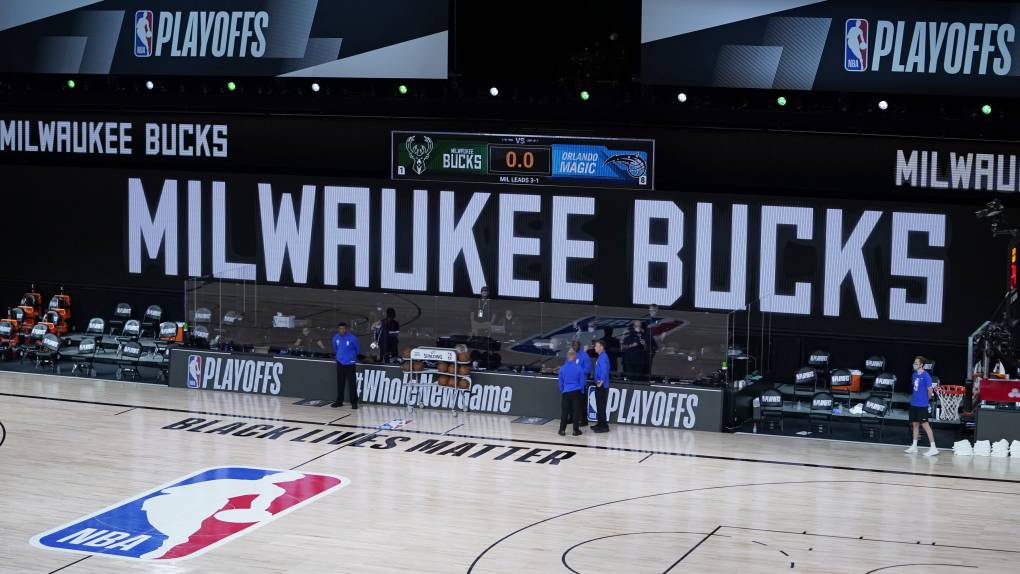
"description": "Officials stand beside an empty court at the scheduled start of an NBA basketball first round playoff game between the Milwaukee Bucks and the Orlando Magic, Wednesday, Aug. 26, 2020, in Lake Buena Vista, Fla. The Milwaukee Bucks didn't take the floor in protest against racial injustice and the shooting of Jacob Blake, a Black man, by police in Kenosha, Wisconsin. (AP Photo/Ashley Landis, Pool)",
"title": "Officials stand beside an empty court at the scheduled start of an NBA playoff game on Wednesday. The Milwaukee Bucks didn't take the floor in protest against racial injustice and the shooting of Jacob Blake.",
"credit": null,
"status": "inherit",
"isLoading": false,
"fetchFailed": false
},
"arts_13885277": {
"type": "attachments",
"id": "arts_13885277",
"meta": {
"index": "attachments_1716263798",
"site": "arts",
"id": "13885277",
"found": true
},
"parent": 13885274,
"imgSizes": {
"twentyfourteen-full-width": {
"file": "https://ww2.kqed.org/app/uploads/sites/2/2020/08/GettyImages-1200662882-1024x576.jpg",
"width": 1024,
"mimeType": "image/jpeg",
"height": 576
},
"thumbnail": {
"file": "https://ww2.kqed.org/app/uploads/sites/2/2020/08/GettyImages-1200662882-160x119.jpg",
"width": 160,
"mimeType": "image/jpeg",
"height": 119
},
"post-thumbnail": {
"file": "https://ww2.kqed.org/app/uploads/sites/2/2020/08/GettyImages-1200662882-672x372.jpg",
"width": 672,
"mimeType": "image/jpeg",
"height": 372
},
"kqedFullSize": {
"file": "https://ww2.kqed.org/app/uploads/sites/2/2020/08/GettyImages-1200662882.jpg",
"width": 1024,
"height": 761
},
"large": {
"file": "https://ww2.kqed.org/app/uploads/sites/2/2020/08/GettyImages-1200662882-1020x758.jpg",
"width": 1020,
"mimeType": "image/jpeg",
"height": 758
},
"medium": {
"file": "https://ww2.kqed.org/app/uploads/sites/2/2020/08/GettyImages-1200662882-800x595.jpg",
"width": 800,
"mimeType": "image/jpeg",
"height": 595
},
"medium_large": {
"file": "https://ww2.kqed.org/app/uploads/sites/2/2020/08/GettyImages-1200662882-768x571.jpg",
"width": 768,
"mimeType": "image/jpeg",
"height": 571
}
},
"publishDate": 1598384402,
"modified": 1598384483,
"caption": "Sterling K. Brown attends the 26th annual Screen Actors Guild Awards, Los Angeles, January 2020. ",
"description": "Sterling K. Brown attends the 26th annual Screen Actors Guild Awards, Los Angeles, January 2020. ",
"title": "Sterling K. Brown attends the 26th annual Screen Actors Guild Awards, Los Angeles, January 2020.",
"credit": "Chelsea Guglielmino/Getty Images",
"status": "inherit",
"isLoading": false,
"fetchFailed": false
},
"arts_13884666": {
"type": "attachments",
"id": "arts_13884666",
"meta": {
"index": "attachments_1716263798",
"site": "arts",
"id": "13884666",
"found": true
},
"parent": 13884595,
"imgSizes": {
"twentyfourteen-full-width": {
"file": "https://ww2.kqed.org/app/uploads/sites/2/2020/08/NBA.BLM_-1038x576.jpg",
"width": 1038,
"mimeType": "image/jpeg",
"height": 576
},
"thumbnail": {
"file": "https://ww2.kqed.org/app/uploads/sites/2/2020/08/NBA.BLM_-160x102.jpg",
"width": 160,
"mimeType": "image/jpeg",
"height": 102
},
"post-thumbnail": {
"file": "https://ww2.kqed.org/app/uploads/sites/2/2020/08/NBA.BLM_-672x372.jpg",
"width": 672,
"mimeType": "image/jpeg",
"height": 372
},
"kqedFullSize": {
"file": "https://ww2.kqed.org/app/uploads/sites/2/2020/08/NBA.BLM_.jpg",
"width": 1100,
"height": 698
},
"large": {
"file": "https://ww2.kqed.org/app/uploads/sites/2/2020/08/NBA.BLM_-1020x647.jpg",
"width": 1020,
"mimeType": "image/jpeg",
"height": 647
},
"medium": {
"file": "https://ww2.kqed.org/app/uploads/sites/2/2020/08/NBA.BLM_-800x508.jpg",
"width": 800,
"mimeType": "image/jpeg",
"height": 508
},
"medium_large": {
"file": "https://ww2.kqed.org/app/uploads/sites/2/2020/08/NBA.BLM_-768x487.jpg",
"width": 768,
"mimeType": "image/jpeg",
"height": 487
}
},
"publishDate": 1597097537,
"modified": 1597097608,
"caption": "Members of the New Orleans Pelicans and Utah Jazz kneel before a Black Lives Matter logo prior to the start of their game on July 30, 2020 in Reunion, Florida.",
"description": "Members of the New Orleans Pelicans and Utah Jazz kneel before a Black Lives Matter logo prior to the start of their game on July 30, 2020 in Reunion, Florida.",
"title": "NBA.BLM",
"credit": "Ashley Landis-Pool/Getty Images",
"status": "inherit",
"isLoading": false,
"fetchFailed": false
},
"arts_13884373": {
"type": "attachments",
"id": "arts_13884373",
"meta": {
"index": "attachments_1716263798",
"site": "arts",
"id": "13884373",
"found": true
},
"parent": 13884294,
"imgSizes": {
"twentyfourteen-full-width": {
"file": "https://ww2.kqed.org/app/uploads/sites/2/2020/08/HueyNewton.Freed_.Aug5_.1970-1038x576.jpg",
"width": 1038,
"mimeType": "image/jpeg",
"height": 576
},
"thumbnail": {
"file": "https://ww2.kqed.org/app/uploads/sites/2/2020/08/HueyNewton.Freed_.Aug5_.1970-160x109.jpg",
"width": 160,
"mimeType": "image/jpeg",
"height": 109
},
"post-thumbnail": {
"file": "https://ww2.kqed.org/app/uploads/sites/2/2020/08/HueyNewton.Freed_.Aug5_.1970-672x372.jpg",
"width": 672,
"mimeType": "image/jpeg",
"height": 372
},
"kqedFullSize": {
"file": "https://ww2.kqed.org/app/uploads/sites/2/2020/08/HueyNewton.Freed_.Aug5_.1970.jpg",
"width": 1416,
"height": 965
},
"large": {
"file": "https://ww2.kqed.org/app/uploads/sites/2/2020/08/HueyNewton.Freed_.Aug5_.1970-1020x695.jpg",
"width": 1020,
"mimeType": "image/jpeg",
"height": 695
},
"medium": {
"file": "https://ww2.kqed.org/app/uploads/sites/2/2020/08/HueyNewton.Freed_.Aug5_.1970-800x545.jpg",
"width": 800,
"mimeType": "image/jpeg",
"height": 545
},
"medium_large": {
"file": "https://ww2.kqed.org/app/uploads/sites/2/2020/08/HueyNewton.Freed_.Aug5_.1970-768x523.jpg",
"width": 768,
"mimeType": "image/jpeg",
"height": 523
}
},
"publishDate": 1596609117,
"modified": 1596609344,
"caption": "Huey P. Newton is freed on Aug. 5, 1970, at the Aladema County Courthouse. ",
"description": "Huey P. Newton is freed on Aug. 5, 1970, at the Aladema County Courthouse. ",
"title": "HueyNewton.Freed.Aug5.1970",
"credit": "KQED Archives",
"status": "inherit",
"isLoading": false,
"fetchFailed": false
}
},
"audioPlayerReducer": {
"postId": "stream_live",
"isPaused": true,
"isPlaying": false,
"pfsActive": false,
"pledgeModalIsOpen": true,
"playerDrawerIsOpen": false,
"liveAudioPlayStartedAt": 0,
"liveAudioPlayContext": ""
},
"authorsReducer": {
"byline_arts_13888332": {
"type": "authors",
"id": "byline_arts_13888332",
"meta": {
"override": true
},
"slug": "byline_arts_13888332",
"name": "Christianna Silva",
"isLoading": false
},
"byline_arts_13886632": {
"type": "authors",
"id": "byline_arts_13886632",
"meta": {
"override": true
},
"slug": "byline_arts_13886632",
"name": "Amber Lucas",
"isLoading": false
},
"byline_arts_13885940": {
"type": "authors",
"id": "byline_arts_13885940",
"meta": {
"override": true
},
"slug": "byline_arts_13885940",
"name": "Frederick Taylor, Charlotte Buchen Khadra",
"isLoading": false
},
"byline_arts_13885396": {
"type": "authors",
"id": "byline_arts_13885396",
"meta": {
"override": true
},
"slug": "byline_arts_13885396",
"name": "Tom Goldman",
"isLoading": false
},
"byline_arts_13885274": {
"type": "authors",
"id": "byline_arts_13885274",
"meta": {
"override": true
},
"slug": "byline_arts_13885274",
"name": "Eric Deggans",
"isLoading": false
},
"ralexandra": {
"type": "authors",
"id": "11242",
"meta": {
"index": "authors_1716337520",
"id": "11242",
"found": true
},
"name": "Rae Alexandra",
"firstName": "Rae",
"lastName": "Alexandra",
"slug": "ralexandra",
"email": "ralexandra@kqed.org",
"display_author_email": true,
"staff_mastheads": [],
"title": "Reporter/Producer",
"bio": "Rae Alexandra is a Reporter/Producer for KQED Arts & Culture, and the creator/author of the \u003ca href=\"https://www.kqed.org/arts/program/rebel-girls-from-bay-area-history\">Rebel Girls From Bay Area History\u003c/a> and \u003ca href=\"https://www.kqed.org/bizarrebayarea\">Bizarre Bay Area\u003c/a> series. Her debut book, \u003ca href=\"https://citylights.com/politics-current-events-history/unsung-heroines35-women-who-changed/\">Unsung Heroines: 35 Women Who Changed the Bay Area\u003c/a> was published by City Lights in March 2026. In 2023, Rae was awarded an SPJ Excellence in Journalism Award for Arts & Culture. Rae was born and raised in Wales and subsequently — even after two decades in Northern California — still uses phrases that regularly baffle her coworkers.",
"avatar": "https://secure.gravatar.com/avatar/edfee8176c80cc0a382b051190f5341997df378a934a5774dcb0977732dfd401?s=600&d=blank&r=g",
"twitter": null,
"bluesky": null,
"facebook": null,
"instagram": null,
"linkedin": null,
"sites": [
{
"site": "arts",
"roles": [
"subscriber"
]
},
{
"site": "news",
"roles": [
"subscriber"
]
},
{
"site": "pop",
"roles": [
"subscriber"
]
},
{
"site": "bayareabites",
"roles": [
"subscriber"
]
},
{
"site": "science",
"roles": [
"subscriber"
]
}
],
"headData": {
"title": "Rae Alexandra | KQED",
"description": "Reporter/Producer",
"ogImgSrc": "https://secure.gravatar.com/avatar/edfee8176c80cc0a382b051190f5341997df378a934a5774dcb0977732dfd401?s=600&d=blank&r=g",
"twImgSrc": "https://secure.gravatar.com/avatar/edfee8176c80cc0a382b051190f5341997df378a934a5774dcb0977732dfd401?s=600&d=blank&r=g"
},
"isLoading": false,
"link": "/author/ralexandra"
},
"nvoynovskaya": {
"type": "authors",
"id": "11387",
"meta": {
"index": "authors_1716337520",
"id": "11387",
"found": true
},
"name": "Nastia Voynovskaya",
"firstName": "Nastia",
"lastName": "Voynovskaya",
"slug": "nvoynovskaya",
"email": "nvoynovskaya@kqed.org",
"display_author_email": false,
"staff_mastheads": [
"arts"
],
"title": "Editor and reporter",
"bio": "Nastia Voynovskaya is a reporter, editor and host at KQED Arts & Culture. She's been covering the arts in the Bay Area for over a decade, with a focus on music, queer culture, labor issues and grassroots organizing. She has edited KQED story series such as Trans Bay: A History of San Francisco's Gender-Diverse Community, and co-created KQED's Bay Area hip-hop history project, That's My Word. Nastia's work has been recognized by the Society of Professional Journalists and San Francisco Press Club. She regularly appears on podcasts and radio programs, including NPR's All Songs Considered, and hosts live events where music, culture and conversation meet.",
"avatar": "https://secure.gravatar.com/avatar/5025ee460e5a85d69ca20ea6c6f2f80d7e17795c828f61ea3aecfcd924e9042e?s=600&d=blank&r=g",
"twitter": null,
"bluesky": null,
"facebook": null,
"instagram": "https://www.instagram.com/nananastia/",
"linkedin": null,
"sites": [
{
"site": "",
"roles": [
"editor"
]
},
{
"site": "arts",
"roles": [
"administrator"
]
},
{
"site": "news",
"roles": [
"editor"
]
},
{
"site": "pop",
"roles": [
"administrator"
]
},
{
"site": "bayareabites",
"roles": [
"editor"
]
},
{
"site": "podcasts",
"roles": [
"editor"
]
},
{
"site": "hiphop",
"roles": [
"editor"
]
}
],
"headData": {
"title": "Nastia Voynovskaya | KQED",
"description": "Editor and reporter",
"ogImgSrc": "https://secure.gravatar.com/avatar/5025ee460e5a85d69ca20ea6c6f2f80d7e17795c828f61ea3aecfcd924e9042e?s=600&d=blank&r=g",
"twImgSrc": "https://secure.gravatar.com/avatar/5025ee460e5a85d69ca20ea6c6f2f80d7e17795c828f61ea3aecfcd924e9042e?s=600&d=blank&r=g"
},
"isLoading": false,
"link": "/author/nvoynovskaya"
},
"ogpenn": {
"type": "authors",
"id": "11491",
"meta": {
"index": "authors_1716337520",
"id": "11491",
"found": true
},
"name": "Pendarvis Harshaw",
"firstName": "Pendarvis",
"lastName": "Harshaw",
"slug": "ogpenn",
"email": "ogpenn@gmail.com",
"display_author_email": false,
"staff_mastheads": [
"arts"
],
"title": "Community Engagement Reporter",
"bio": "Pendarvis Harshaw is an educator, host and writer with KQED Arts.",
"avatar": "https://secure.gravatar.com/avatar/972b77ee8e3f346ae2b00622661187fbfabd059b5693bbdc1475ea7a722fd4cd?s=600&d=blank&r=g",
"twitter": null,
"bluesky": null,
"facebook": null,
"instagram": "ogpenn",
"linkedin": null,
"sites": [
{
"site": "arts",
"roles": [
"administrator"
]
},
{
"site": "news",
"roles": [
"editor"
]
},
{
"site": "bayareabites",
"roles": [
"author"
]
},
{
"site": "hiphop",
"roles": [
"editor"
]
}
],
"headData": {
"title": "Pendarvis Harshaw | KQED",
"description": "Community Engagement Reporter",
"ogImgSrc": "https://secure.gravatar.com/avatar/972b77ee8e3f346ae2b00622661187fbfabd059b5693bbdc1475ea7a722fd4cd?s=600&d=blank&r=g",
"twImgSrc": "https://secure.gravatar.com/avatar/972b77ee8e3f346ae2b00622661187fbfabd059b5693bbdc1475ea7a722fd4cd?s=600&d=blank&r=g"
},
"isLoading": false,
"link": "/author/ogpenn"
},
"maddycliff": {
"type": "authors",
"id": "11725",
"meta": {
"index": "authors_1716337520",
"id": "11725",
"found": true
},
"name": "Maddy Clifford",
"firstName": "Maddy",
"lastName": "Clifford",
"slug": "maddycliff",
"email": "maddycliff@gmail.com",
"display_author_email": true,
"staff_mastheads": [],
"title": "KQED Contributor",
"bio": "Maddy Clifford is an Oakland-based writer, artist, and activist. She has a notable career highlighted by her eight-year tenure as a Poet in Residence at the San Francisco Juvenile Justice Center. Following this, Maddy released a solo album titled \"downCHANTS\" and composed a forty-minute musical score for the aerial dance piece \"Apparatus of Repair\" in collaboration with Flyaway Productions. Her latest project is a video-podcast called \"What’s Pimpin’?\" produced with KQED Arts. Maddy's written contributions can be found in Prism Reports, Truthout and 48hills.",
"avatar": "https://secure.gravatar.com/avatar/a90ce07df8d231f24acf7ea72e94e394?s=600&d=blank&r=g",
"twitter": "@mad_lines",
"facebook": "https://www.facebook.com/MADlinesmusic/",
"instagram": "https://www.instagram.com/mad.lines/",
"linkedin": "https://www.linkedin.com/in/maddy-clifford-65ba7729/",
"sites": [
{
"site": "arts",
"roles": [
"contributor"
]
}
],
"headData": {
"title": "Maddy Clifford | KQED",
"description": "KQED Contributor",
"ogImgSrc": "https://secure.gravatar.com/avatar/a90ce07df8d231f24acf7ea72e94e394?s=600&d=blank&r=g",
"twImgSrc": "https://secure.gravatar.com/avatar/a90ce07df8d231f24acf7ea72e94e394?s=600&d=blank&r=g"
},
"isLoading": false,
"link": "/author/maddycliff"
},
"sgetachew": {
"type": "authors",
"id": "11734",
"meta": {
"index": "authors_1716337520",
"id": "11734",
"found": true
},
"name": "Samuel Getachew",
"firstName": "Samuel",
"lastName": "Getachew",
"slug": "sgetachew",
"email": "sgetachew@kqed.org",
"display_author_email": false,
"staff_mastheads": [],
"title": "KQED Contributor",
"bio": "\u003cspan style=\"font-weight: 400;\">Samuel Getachew is an 18-year-old poet and writer from Oakland, California. He is the 2019 Oakland Youth Poet Laureate, a 2020 Finalist for National Youth Poet Laureate, and a 4-time YoungArts Winner. His writing has been published in Teen Vogue, the New York Times, the Washington Post, and more. He will attend Yale University in the fall of 2021.\u003c/span>",
"avatar": "https://secure.gravatar.com/avatar/ebad3dcf2295975cfe77698fa670a089?s=600&d=blank&r=g",
"twitter": null,
"facebook": null,
"instagram": null,
"linkedin": null,
"sites": [
{
"site": "arts",
"roles": [
"subscriber"
]
}
],
"headData": {
"title": "Samuel Getachew | KQED",
"description": "KQED Contributor",
"ogImgSrc": "https://secure.gravatar.com/avatar/ebad3dcf2295975cfe77698fa670a089?s=600&d=blank&r=g",
"twImgSrc": "https://secure.gravatar.com/avatar/ebad3dcf2295975cfe77698fa670a089?s=600&d=blank&r=g"
},
"isLoading": false,
"link": "/author/sgetachew"
}
},
"pagesReducer": {
"arts_tag_black-lives-matter": {
"type": "terms",
"id": "arts_3156",
"meta": {
"index": "terms_1716263798",
"site": "arts",
"id": "3156",
"score": 8.794299
},
"featImg": null,
"name": "Black Lives Matter",
"description": null,
"taxonomy": "tag",
"headData": {
"twImgId": null,
"twTitle": null,
"ogTitle": null,
"ogImgId": null,
"twDescription": null,
"description": null,
"title": "Black Lives Matter Archives | KQED Arts",
"ogDescription": null
},
"ttid": 3168,
"slug": "black-lives-matter",
"isLoading": false,
"title": "Black Lives Matter",
"pageMeta": {
"site": "arts",
"WpPageTemplate": "page-topic-editorial",
"currentPage": 2
},
"blocks": [
{
"blockName": "kqed/post-list",
"attrs": {
"layout": "cardArticle2",
"query": "posts/arts?tag=black-lives-matter",
"seeMore": false,
"paginated": true,
"page": 2
}
},
{
"blockName": "kqed/ad"
}
]
}
},
"pfsSessionReducer": {},
"postsReducer": {
"stream_live": {
"type": "live",
"id": "stream_live",
"audioUrl": "https://streams.kqed.org/kqedradio",
"title": "Live Stream",
"excerpt": "Live Stream information currently unavailable.",
"link": "/radio",
"featImg": "",
"label": {
"name": "KQED Live",
"link": "/"
}
},
"stream_kqedNewscast": {
"type": "posts",
"id": "stream_kqedNewscast",
"audioUrl": "https://www.kqed.org/.stream/anon/radio/RDnews/newscast.mp3?_=1",
"title": "KQED Newscast",
"featImg": "",
"label": {
"name": "88.5 FM",
"link": "/"
}
},
"arts_13890558": {
"type": "posts",
"id": "arts_13890558",
"meta": {
"index": "posts_1716263798",
"site": "arts",
"id": "13890558",
"score": null,
"sort": [
1608235762000
]
},
"parent": 0,
"labelTerm": {
"site": "arts"
},
"blocks": [],
"publishDate": 1608235762,
"format": "standard",
"title": "With ‘Labor,’ RyanNicole Uplifts Black Women’s Invisible Work",
"headTitle": "With ‘Labor,’ RyanNicole Uplifts Black Women’s Invisible Work | KQED",
"content": "\u003cp>Poised, funny and lyrically razor-sharp, Oakland rapper \u003ca href=\"https://www.msryannicole.com/\" target=\"_blank\" rel=\"noopener noreferrer\">RyanNicole\u003c/a> is a force for good.\u003c/p>\n\u003cp>Like most artists in the Bay Area, she wears many hats. She’s the founder of the housing justice group the HAVEN Project, an actress, a muse and a mommy—rap just happens to be one of her many weapons in the fight against injustice. And this year has seen its fair share of turmoil.\u003c/p>\n\u003cp>The paradox of being a Black woman in America is to be both highly visible and invisible in the same breath. Women rappers had the most successful year on record. At the same time, the pandemic has had a \u003ca href=\"https://www.npr.org/series/928323746/enough-already-how-the-pandemic-is-breaking-women\" target=\"_blank\" rel=\"noopener noreferrer\">catastrophic economic impact on women\u003c/a>, especially Black mothers.\u003c/p>\n\u003cp>After we performed together in a cypher for \u003cem>\u003ca href=\"http://www.theblackwomanisgod.com/\" target=\"_blank\" rel=\"noopener noreferrer\">The Black Woman is God\u003c/a>\u003c/em> virtual exhibition, RyanNicole spoke to me about these contradictions as well as her recent collaboration, “Labor.” The short film—directed by \u003ca href=\"http://www.niemajordan.com/\" target=\"_blank\" rel=\"noopener noreferrer\">Niema Jordan\u003c/a>, shot by JJ Harris and commissioned by the \u003ca href=\"https://www.instagram.com/p/CI6O3jAnvGm/\" target=\"_blank\" rel=\"noopener noreferrer\">Center for Cultural Power\u003c/a>—is a poetic homage to the work Black mothers do to birth radical visions for the future.\u003c/p>\n\u003cp>https://youtu.be/1CE_qFWIAvo\u003c/p>\n\u003cp>[ad fullwidth]\u003c/p>\n\u003cp>\u003cstrong>You’re a rapper, but, of course, you do so many other things. What has being a rapper taught you about life? \u003c/strong>\u003c/p>\n\u003cp>Rap has taught me about bravery, first and foremost. It is not an arena where I was necessarily welcomed with open arms. You know this, so I’m preaching to the choir, but when I came around it was just a bunch of guys. The whole culture was dominated by men. While some of them were friendly, welcoming, and encouraging even, many of them met me with a lot of ire. And the better I got, the more I was challenged, the more I was a threat, the more problematic I became in those circles. And so to continue to push my way through I had to deal with fear in a real way.\u003c/p>\n\u003cp>It’s still an arena where there are definitely challenges. I’ve got to deal with this just palpable fear. And so I continue to do it because there are other areas of my life that fear shows up and becomes a roadblock. And I have a practice now of encountering that roadblock, surmounting that roadblock or knocking it down through rap.\u003c/p>\n\u003cp>\u003cstrong>I love that! You just explained it in such a succinct way, the way that Black women are distanced from the culture we helped create. How do you think that might be connected? When you’re having to be brave, do you think about that when you’re in those spaces?\u003c/strong>\u003c/p>\n\u003cp>The way that I approach it is with a certain entitlement. It gives me fuel. It gives me energy. I’m about rematriation. I’m about reclaiming space that was ours to begin with, even if it wasn’t entirely ours. I’m just here for balance. And we all know that the culture, the music, deserves more of a balance than it currently has.\u003c/p>\n\u003cp>\u003cstrong>Perfect segue. Dad rap is practically it’s own genre. I’ve always wondered, what are the parallels between rapping and mastering the ceremony of motherhood?\u003c/strong>\u003c/p>\n\u003cp>There are real parallels because hip-hop wants to be this young art form, just completely entrenched in youthfulness. This is a misperception of what is precious and valued in life, period. The ability to age is an honor.\u003c/p>\n\u003cp>[Sometimes when people say] “dad rap,” it’s a shunning of older men sharing their perspectives. But these are the men who birthed all these young boys who are currently in the game, trying to define it. We should see the full breadth of their experience. The time when they was blinged-out and rapping about being with all the women. And now, the time when they’re like, “Actually my wife is what I want” or you know, “I’ve survived this game.”\u003c/p>\n\u003cp>\u003cstrong>Yeah, survived the post-Civil Rights era of the ’80s and ’90s.\u003c/strong>\u003c/p>\n\u003cp>Yeah, and the crack era, all of that.\u003c/p>\n\u003cp>I think those older men have a right to speak about that and I’m grateful for it. Our presence is a bit more anemic. I’m not going to outgrow hip-hop, but what I will outgrow, what I have outgrown, is the expression of a certain age group. It’s just real. I don’t want to necessarily graduate to a whole new genre because I’ve outgrown the conversation that is prevalent in my genre. So, I think then there is space and necessity for expressions of women who have aged. And what’s also unfortunate is that there are women who are mothers who are young too. They don’t even talk about that aspect of their lives, which is such a defining aspect.\u003c/p>\n\u003cp>Mom rap is needed in the same way that dad rap is needed. What I’m really saying is that an older perspective is important. We have to age with the genre or else the genre will die. Don’t nobody want to hear about the kind of vapid things that we were interested in in our early teens or early 20s.\u003c/p>\n\u003cfigure id=\"attachment_13876766\" class=\"wp-caption aligncenter\" style=\"max-width: 750px\">\u003cimg loading=\"lazy\" decoding=\"async\" class=\"size-full wp-image-13876766\" src=\"https://ww2.kqed.org/app/uploads/sites/2/2020/03/RyanNicoleAustin_COVER.jpg\" alt=\"\" width=\"750\" height=\"422\" srcset=\"https://cdn.kqed.org/wp-content/uploads/sites/2/2020/03/RyanNicoleAustin_COVER.jpg 750w, https://cdn.kqed.org/wp-content/uploads/sites/2/2020/03/RyanNicoleAustin_COVER-160x90.jpg 160w\" sizes=\"(max-width: 750px) 100vw, 750px\">\u003cfigcaption class=\"wp-caption-text\">RyanNicole Austin performing on stage at the 2020 Black Joy Parade in Oakland. \u003ccite>(@jmalphotography)\u003c/cite>\u003c/figcaption>\u003c/figure>\n\u003cp>\u003cstrong>OK, so you’ve released a powerful piece called, “Labor.” What are some of the ways in which Black women’s labor is invisibilized? How can your art make it visible?\u003c/strong>\u003c/p>\n\u003cp>The piece was inspired by Breonna Taylor. I hadn’t really talked about Breonna the whole time that the situation was going on. The piece came to pass because all I could think about was her being somebody’s child.\u003c/p>\n\u003cp>I don’t know what the opposite of precious is, but how much of a mortal sin is it to take somebody’s child? Knowing, personally knowing, just the time it took to gestate, and then the time it took…and the care…to eat the right things, to work out, to drink water, to sit down, to listen to my body and to listen to the body of the universe surrounding.\u003c/p>\n\u003cp>The first time I could really hear Mother Earth with clarity was when I was pregnant.\u003c/p>\n\u003cp>So, there’s a level of sublime preciousness in gestating a life and then the process of birthing that life. It’s a microcosm of our entire lived experience. You have to surrender at a level that you’ve never surrendered before, you have to believe in yourself in a way—you have to deal with fear. It’s one of the most precious lessons we learn in this life, laboring through having these children. And this is not to take away from anybody who has not, but it’s such a precious experience.\u003c/p>\n\u003cp>And so, to know that life is taken kind of haphazardly. People can kill anybody, but in particular, bust down the doors, shoot aimlessly, come through with droves of people and then go on to cover up that murder—it is just such an affront to my sensibility, not just as a human being, but as a life-giving human being.\u003c/p>\n\u003cp>So, as I was developing “Labor,” all I could think about is how we as women, but particularly as Black women, have mothered so much. We have mothered the culture, have mothered literal lives, have mothered this nation, have mothered this whole thing. Like you’re saying, that labor is invisibilized. But more than that—I don’t know what the opposite word of precious is—trivialized? Not even, it’s worse. It’s so much worse.\u003c/p>\n\u003cp>\u003cstrong>Demonized?\u003c/strong>\u003c/p>\n\u003cp>It’s the process of not just throwing something away, but shitting on it and setting it on fire, you know what I mean? It’s not just enough to discard us. It’s not enough to discard our effort. It’s to discard the effort and entirely ruin it. It’s not just a physical harm, but a soul-harm. And so when I was writing “Labor,” it was embedded with all of that angst and all of that incredulousness. I can’t believe that humanity, that people who call themselves human, can enact such harm on other human beings.\u003c/p>\n\u003cp>Birthing humanity in its full existence is a Black woman’s work that has been ignored. So really that piece is just like a part of that disdain, that sadness… the profound sadness I feel for humanity that can’t see our divinity.\u003c/p>\n\u003cp>\u003cstrong>So what can the challenges Black women face teach people about what needs to change in society overall? \u003c/strong>[aside label='More Arts & Culture' postid='arts_13889948,arts_13890197,arts_13890226']\u003c/p>\n\u003cp>I mean, this is a time when so many people are actually able to empathize a bit more because they’re experiencing some of the things that we experience on a daily basis. Black women who have been impacted by COVID aren’t making a lot of noise about it because we know how to pivot. We know how to make something out of nothing. It’s not to say that the struggle doesn’t need to be acknowledged—it absolutely does—but I think oftentimes we don’t have time to scream and holler about our condition. We have to survive it. So we don’t have the opportunity to advocate for ourselves or champion an issue or cause that is most affecting us. More segments of the population are experiencing the lack of Black women in the workforce…I hope they’re able to zero in on what a day without a Black woman is like on some level.\u003c/p>\n\u003cp>Also, I think society can learn from the Black woman about resilience. I say “resilience” and then like, I’m having this internal fight against this word because I don’t want to have to always be resilient. I want to luxuriate. I don’t even know what that is, but I’d like to have it. Yet life will throw things at you regardless of who you are. You’ll have to survive and you’ll have to contend with that. I think if the country is to learn anything in this time about survival then they should look to the master-teacher, the Black woman.\u003c/p>\n\u003cp>And then from this I think we have something to learn from each other. I think the tide needs to rise for our experience, and hopefully this inspires some empathy among the broader levels of society. Folks don’t want to live through this experience anymore. Hopefully we will work to raise the tide so that all the ships can rise.\u003c/p>\n\u003cp>[ad floatright]\u003c/p>\n\u003cp>\u003cem>This interview was edited for length and clarity.\u003c/em>\u003c/p>\n\n",
"stats": {
"hasVideo": false,
"hasChartOrMap": false,
"hasAudio": false,
"hasPolis": false,
"wordCount": 1871,
"hasGoogleForm": false,
"hasGallery": false,
"hasHearkenModule": false,
"iframeSrcs": [],
"paragraphCount": 33
},
"modified": 1712099578,
"excerpt": "The multi-faceted artist discusses the parallels between motherhood and hip-hop, and why she’s tired of being called “resilient.”",
"headData": {
"twImgId": "",
"twTitle": "",
"ogTitle": "",
"ogImgId": "",
"twDescription": "",
"description": "The multi-faceted artist discusses the parallels between motherhood and hip-hop, and why she’s tired of being called “resilient.”",
"title": "With ‘Labor,’ RyanNicole Uplifts Black Women’s Invisible Work | KQED",
"ogDescription": "",
"schema": {
"@context": "https://schema.org",
"@type": "Article",
"headline": "With ‘Labor,’ RyanNicole Uplifts Black Women’s Invisible Work",
"datePublished": "2020-12-17T12:09:22-08:00",
"dateModified": "2024-04-02T16:12:58-07:00",
"image": "https://cdn.kqed.org/wp-content/uploads/2020/02/KQED-OG-Image@1x.png"
}
},
"guestAuthors": [],
"slug": "with-labor-ryannicole-uplifts-black-womens-invisible-work",
"status": "publish",
"templateType": "standard",
"excludeFromSiteSearch": "Include",
"featuredImageType": "standard",
"sticky": false,
"showOnAuthorArchivePages": "No",
"articleAge": "0",
"path": "/arts/13890558/with-labor-ryannicole-uplifts-black-womens-invisible-work",
"audioTrackLength": null,
"parsedContent": [
{
"type": "contentString",
"content": "\u003cdiv class=\"post-body\">\u003cp>\u003cp>Poised, funny and lyrically razor-sharp, Oakland rapper \u003ca href=\"https://www.msryannicole.com/\" target=\"_blank\" rel=\"noopener noreferrer\">RyanNicole\u003c/a> is a force for good.\u003c/p>\n\u003cp>Like most artists in the Bay Area, she wears many hats. She’s the founder of the housing justice group the HAVEN Project, an actress, a muse and a mommy—rap just happens to be one of her many weapons in the fight against injustice. And this year has seen its fair share of turmoil.\u003c/p>\n\u003cp>The paradox of being a Black woman in America is to be both highly visible and invisible in the same breath. Women rappers had the most successful year on record. At the same time, the pandemic has had a \u003ca href=\"https://www.npr.org/series/928323746/enough-already-how-the-pandemic-is-breaking-women\" target=\"_blank\" rel=\"noopener noreferrer\">catastrophic economic impact on women\u003c/a>, especially Black mothers.\u003c/p>\n\u003cp>After we performed together in a cypher for \u003cem>\u003ca href=\"http://www.theblackwomanisgod.com/\" target=\"_blank\" rel=\"noopener noreferrer\">The Black Woman is God\u003c/a>\u003c/em> virtual exhibition, RyanNicole spoke to me about these contradictions as well as her recent collaboration, “Labor.” The short film—directed by \u003ca href=\"http://www.niemajordan.com/\" target=\"_blank\" rel=\"noopener noreferrer\">Niema Jordan\u003c/a>, shot by JJ Harris and commissioned by the \u003ca href=\"https://www.instagram.com/p/CI6O3jAnvGm/\" target=\"_blank\" rel=\"noopener noreferrer\">Center for Cultural Power\u003c/a>—is a poetic homage to the work Black mothers do to birth radical visions for the future.\u003c/p>\u003c/p>\u003cp>\u003cspan class='utils-parseShortcode-shortcodes-__youtubeShortcode__embedYoutube'>\n \u003cspan class='utils-parseShortcode-shortcodes-__youtubeShortcode__embedYoutubeInside'>\n \u003ciframe\n loading='lazy'\n class='utils-parseShortcode-shortcodes-__youtubeShortcode__youtubePlayer'\n type='text/html'\n src='//www.youtube.com/embed/1CE_qFWIAvo'\n title='//www.youtube.com/embed/1CE_qFWIAvo'\n allowfullscreen='true'\n style='border:0;'>\u003c/iframe>\n \u003c/span>\n \u003c/span>\u003c/p>\u003cp>\u003cp>\u003c/p>\u003c/div>",
"attributes": {
"named": {},
"numeric": []
}
},
{
"type": "component",
"content": "",
"name": "ad",
"attributes": {
"named": {
"label": "fullwidth"
},
"numeric": [
"fullwidth"
]
}
},
{
"type": "contentString",
"content": "\u003cdiv class=\"post-body\">\u003cp>\u003c/p>\n\u003cp>\u003cstrong>You’re a rapper, but, of course, you do so many other things. What has being a rapper taught you about life? \u003c/strong>\u003c/p>\n\u003cp>Rap has taught me about bravery, first and foremost. It is not an arena where I was necessarily welcomed with open arms. You know this, so I’m preaching to the choir, but when I came around it was just a bunch of guys. The whole culture was dominated by men. While some of them were friendly, welcoming, and encouraging even, many of them met me with a lot of ire. And the better I got, the more I was challenged, the more I was a threat, the more problematic I became in those circles. And so to continue to push my way through I had to deal with fear in a real way.\u003c/p>\n\u003cp>It’s still an arena where there are definitely challenges. I’ve got to deal with this just palpable fear. And so I continue to do it because there are other areas of my life that fear shows up and becomes a roadblock. And I have a practice now of encountering that roadblock, surmounting that roadblock or knocking it down through rap.\u003c/p>\n\u003cp>\u003cstrong>I love that! You just explained it in such a succinct way, the way that Black women are distanced from the culture we helped create. How do you think that might be connected? When you’re having to be brave, do you think about that when you’re in those spaces?\u003c/strong>\u003c/p>\n\u003cp>The way that I approach it is with a certain entitlement. It gives me fuel. It gives me energy. I’m about rematriation. I’m about reclaiming space that was ours to begin with, even if it wasn’t entirely ours. I’m just here for balance. And we all know that the culture, the music, deserves more of a balance than it currently has.\u003c/p>\n\u003cp>\u003cstrong>Perfect segue. Dad rap is practically it’s own genre. I’ve always wondered, what are the parallels between rapping and mastering the ceremony of motherhood?\u003c/strong>\u003c/p>\n\u003cp>There are real parallels because hip-hop wants to be this young art form, just completely entrenched in youthfulness. This is a misperception of what is precious and valued in life, period. The ability to age is an honor.\u003c/p>\n\u003cp>[Sometimes when people say] “dad rap,” it’s a shunning of older men sharing their perspectives. But these are the men who birthed all these young boys who are currently in the game, trying to define it. We should see the full breadth of their experience. The time when they was blinged-out and rapping about being with all the women. And now, the time when they’re like, “Actually my wife is what I want” or you know, “I’ve survived this game.”\u003c/p>\n\u003cp>\u003cstrong>Yeah, survived the post-Civil Rights era of the ’80s and ’90s.\u003c/strong>\u003c/p>\n\u003cp>Yeah, and the crack era, all of that.\u003c/p>\n\u003cp>I think those older men have a right to speak about that and I’m grateful for it. Our presence is a bit more anemic. I’m not going to outgrow hip-hop, but what I will outgrow, what I have outgrown, is the expression of a certain age group. It’s just real. I don’t want to necessarily graduate to a whole new genre because I’ve outgrown the conversation that is prevalent in my genre. So, I think then there is space and necessity for expressions of women who have aged. And what’s also unfortunate is that there are women who are mothers who are young too. They don’t even talk about that aspect of their lives, which is such a defining aspect.\u003c/p>\n\u003cp>Mom rap is needed in the same way that dad rap is needed. What I’m really saying is that an older perspective is important. We have to age with the genre or else the genre will die. Don’t nobody want to hear about the kind of vapid things that we were interested in in our early teens or early 20s.\u003c/p>\n\u003cfigure id=\"attachment_13876766\" class=\"wp-caption aligncenter\" style=\"max-width: 750px\">\u003cimg loading=\"lazy\" decoding=\"async\" class=\"size-full wp-image-13876766\" src=\"https://ww2.kqed.org/app/uploads/sites/2/2020/03/RyanNicoleAustin_COVER.jpg\" alt=\"\" width=\"750\" height=\"422\" srcset=\"https://cdn.kqed.org/wp-content/uploads/sites/2/2020/03/RyanNicoleAustin_COVER.jpg 750w, https://cdn.kqed.org/wp-content/uploads/sites/2/2020/03/RyanNicoleAustin_COVER-160x90.jpg 160w\" sizes=\"(max-width: 750px) 100vw, 750px\">\u003cfigcaption class=\"wp-caption-text\">RyanNicole Austin performing on stage at the 2020 Black Joy Parade in Oakland. \u003ccite>(@jmalphotography)\u003c/cite>\u003c/figcaption>\u003c/figure>\n\u003cp>\u003cstrong>OK, so you’ve released a powerful piece called, “Labor.” What are some of the ways in which Black women’s labor is invisibilized? How can your art make it visible?\u003c/strong>\u003c/p>\n\u003cp>The piece was inspired by Breonna Taylor. I hadn’t really talked about Breonna the whole time that the situation was going on. The piece came to pass because all I could think about was her being somebody’s child.\u003c/p>\n\u003cp>I don’t know what the opposite of precious is, but how much of a mortal sin is it to take somebody’s child? Knowing, personally knowing, just the time it took to gestate, and then the time it took…and the care…to eat the right things, to work out, to drink water, to sit down, to listen to my body and to listen to the body of the universe surrounding.\u003c/p>\n\u003cp>The first time I could really hear Mother Earth with clarity was when I was pregnant.\u003c/p>\n\u003cp>So, there’s a level of sublime preciousness in gestating a life and then the process of birthing that life. It’s a microcosm of our entire lived experience. You have to surrender at a level that you’ve never surrendered before, you have to believe in yourself in a way—you have to deal with fear. It’s one of the most precious lessons we learn in this life, laboring through having these children. And this is not to take away from anybody who has not, but it’s such a precious experience.\u003c/p>\n\u003cp>And so, to know that life is taken kind of haphazardly. People can kill anybody, but in particular, bust down the doors, shoot aimlessly, come through with droves of people and then go on to cover up that murder—it is just such an affront to my sensibility, not just as a human being, but as a life-giving human being.\u003c/p>\n\u003cp>So, as I was developing “Labor,” all I could think about is how we as women, but particularly as Black women, have mothered so much. We have mothered the culture, have mothered literal lives, have mothered this nation, have mothered this whole thing. Like you’re saying, that labor is invisibilized. But more than that—I don’t know what the opposite word of precious is—trivialized? Not even, it’s worse. It’s so much worse.\u003c/p>\n\u003cp>\u003cstrong>Demonized?\u003c/strong>\u003c/p>\n\u003cp>It’s the process of not just throwing something away, but shitting on it and setting it on fire, you know what I mean? It’s not just enough to discard us. It’s not enough to discard our effort. It’s to discard the effort and entirely ruin it. It’s not just a physical harm, but a soul-harm. And so when I was writing “Labor,” it was embedded with all of that angst and all of that incredulousness. I can’t believe that humanity, that people who call themselves human, can enact such harm on other human beings.\u003c/p>\n\u003cp>Birthing humanity in its full existence is a Black woman’s work that has been ignored. So really that piece is just like a part of that disdain, that sadness… the profound sadness I feel for humanity that can’t see our divinity.\u003c/p>\n\u003cp>\u003cstrong>So what can the challenges Black women face teach people about what needs to change in society overall? \u003c/strong>\u003c/p>\u003c/div>",
"attributes": {
"named": {},
"numeric": []
}
},
{
"type": "component",
"content": "",
"name": "aside",
"attributes": {
"named": {
"label": "More Arts & Culture ",
"postid": "arts_13889948,arts_13890197,arts_13890226"
},
"numeric": []
}
},
{
"type": "contentString",
"content": "\u003cdiv class=\"post-body\">\u003cp>\u003c/p>\n\u003cp>I mean, this is a time when so many people are actually able to empathize a bit more because they’re experiencing some of the things that we experience on a daily basis. Black women who have been impacted by COVID aren’t making a lot of noise about it because we know how to pivot. We know how to make something out of nothing. It’s not to say that the struggle doesn’t need to be acknowledged—it absolutely does—but I think oftentimes we don’t have time to scream and holler about our condition. We have to survive it. So we don’t have the opportunity to advocate for ourselves or champion an issue or cause that is most affecting us. More segments of the population are experiencing the lack of Black women in the workforce…I hope they’re able to zero in on what a day without a Black woman is like on some level.\u003c/p>\n\u003cp>Also, I think society can learn from the Black woman about resilience. I say “resilience” and then like, I’m having this internal fight against this word because I don’t want to have to always be resilient. I want to luxuriate. I don’t even know what that is, but I’d like to have it. Yet life will throw things at you regardless of who you are. You’ll have to survive and you’ll have to contend with that. I think if the country is to learn anything in this time about survival then they should look to the master-teacher, the Black woman.\u003c/p>\n\u003cp>And then from this I think we have something to learn from each other. I think the tide needs to rise for our experience, and hopefully this inspires some empathy among the broader levels of society. Folks don’t want to live through this experience anymore. Hopefully we will work to raise the tide so that all the ships can rise.\u003c/p>\n\u003cp>\u003c/p>\u003c/div>",
"attributes": {
"named": {},
"numeric": []
}
},
{
"type": "component",
"content": "",
"name": "ad",
"attributes": {
"named": {
"label": "floatright"
},
"numeric": [
"floatright"
]
}
},
{
"type": "contentString",
"content": "\u003cdiv class=\"post-body\">\u003cp>\u003c/p>\n\u003cp>\u003cem>This interview was edited for length and clarity.\u003c/em>\u003c/p>\n\n\u003c/div>\u003c/p>",
"attributes": {
"named": {},
"numeric": []
}
}
],
"link": "/arts/13890558/with-labor-ryannicole-uplifts-black-womens-invisible-work",
"authors": [
"11725"
],
"categories": [
"arts_1"
],
"tags": [
"arts_1331",
"arts_3156",
"arts_10278",
"arts_831",
"arts_1496",
"arts_2728"
],
"featImg": "arts_13890568",
"label": "arts"
},
"arts_13888379": {
"type": "posts",
"id": "arts_13888379",
"meta": {
"index": "posts_1716263798",
"site": "arts",
"id": "13888379",
"score": null,
"sort": [
1603912878000
]
},
"parent": 0,
"labelTerm": {
"site": "arts"
},
"blocks": [],
"publishDate": 1603912878,
"format": "standard",
"title": "Oakland Artists Join Nigeria's #EndSARS Movement Against Police Violence",
"headTitle": "Oakland Artists Join Nigeria’s #EndSARS Movement Against Police Violence | KQED",
"content": "\u003cp>When Nigerian soldiers shot at a crowd of protesters at the Lekki Toll Gate in Lagos on Oct. 20, killing at least 10 people, \u003ca href=\"https://artbyrenua.com/\" target=\"_blank\" rel=\"noopener noreferrer\">Renua Giwa-Amu\u003c/a> knew she had to do something—even if that something would happen all the way across the world, in Oakland.\u003c/p>\n\u003cp>The Bay Area artist and animator grew up in Lagos, and she passed through the Lekki Toll Gate every day on the way to school. News of the massacre horrified her. “It’s heartbreaking even if you were disillusioned before,” she says, adding that her cousins back home have been attending the protests against police violence. Thankfully, none of them were hurt.\u003c/p>\n\u003cfigure id=\"attachment_13888462\" class=\"wp-caption alignright\" style=\"max-width: 800px\">\u003cimg loading=\"lazy\" decoding=\"async\" class=\"size-full wp-image-13888462\" src=\"https://ww2.kqed.org/app/uploads/sites/2/2020/10/Endsars-13.jpg\" alt=\"\" width=\"800\" height=\"1000\" srcset=\"https://cdn.kqed.org/wp-content/uploads/sites/2/2020/10/Endsars-13.jpg 800w, https://cdn.kqed.org/wp-content/uploads/sites/2/2020/10/Endsars-13-160x200.jpg 160w, https://cdn.kqed.org/wp-content/uploads/sites/2/2020/10/Endsars-13-768x960.jpg 768w\" sizes=\"(max-width: 800px) 100vw, 800px\">\u003cfigcaption class=\"wp-caption-text\">Artist Renua Giwa-Amu speaks at the #EndSARS rally in Oakland on Oct. 24. \u003ccite>(Benito Martin)\u003c/cite>\u003c/figcaption>\u003c/figure>\n\u003cp>Now, Giwa-Amu has joined a global movement of the Nigerian diaspora organizing in solidarity with those on the ground her home country. Last Saturday, Oct. 24, she helped plan a protest that drew hundreds of Nigerian Americans and their supporters to Oakland’s Lake Merritt amphitheater. Its goal was to amplify the \u003ca href=\"https://www.washingtonpost.com/politics/2020/10/26/massive-protests-nigeria-explained/\" target=\"_blank\" rel=\"noopener noreferrer\">#EndSARS movement\u003c/a>, which calls for the dissolution of Nigeria’s Special Anti-Robbery Squad (SARS), a police unit that has been accused of extorting, brutalizing and sexually assaulting young people in Nigeria without accountability since the 1990s.\u003c/p>\n\u003cp>\u003ca href=\"https://www.washingtonpost.com/politics/2020/10/26/massive-protests-nigeria-explained/\" target=\"_blank\" rel=\"noopener noreferrer\">Peaceful protests against SARS\u003c/a> have been going on since 2017 but picked up momentum this October after the police killing of a man in Ughelli was captured on video, drawing comparisons with the Black Lives Matter movement in the U.S. Though the Nigerian government announced that it would disband SARS on Oct. 12, \u003ca href=\"https://www.nytimes.com/article/sars-nigeria-police.html\" target=\"_blank\" rel=\"noopener noreferrer\">demonstrators question\u003c/a> whether it’s an empty promise and have continued marching. They see their movement as a referendum on corruption, inequality and oppression in Nigeria. Amnesty International estimates that Nigerian police killed over 56 protesters and injured dozens more in the \u003ca href=\"https://www.cnn.com/2020/10/22/africa/nigeria-protests-56-dead-jail-fire-intl/index.html\" target=\"_blank\" rel=\"noopener noreferrer\">most recent uprisings\u003c/a>.\u003c/p>\n\u003cp>“In Nigeria everyone is Black, so people socially profile [instead of racially profiling],” says another organizer of Saturday’s protest, Jeffrey Amechi Enebly, who DJs and throws events as \u003ca href=\"https://www.instagram.com/flygerianjeff/?hl=en\" target=\"_blank\" rel=\"noopener noreferrer\">Flygerian Jeff\u003c/a>. Born and raised in Oakland, Enebly says he was harassed by police officers last time he went to Abuja to visit family in 2015. He says that Nigerian police often extort young people who look wealthy, or simply untraditional, under the pretext that they’re suspected thieves or scammers.\u003c/p>\n\u003cp>[ad fullwidth]\u003c/p>\n\u003cp>“It comes from colonial times where people were judging each other based on what they wore, how they presented themselves—there’s a saying in Nigeria: you’re addressed how you dress,” says Enebly. “And that speaks to the fact that, if you look like a scammer or something like that, you are [treated as] a scammer. So pretty much, if you have an iPhone, or you have locs, or tattoos, and you drive a nice car or you dress really nice, they’re going to harass you. If you’re a woman with colored hair, they may extort you for sexual favors.”\u003c/p>\n\u003cfigure id=\"attachment_13888464\" class=\"wp-caption alignright\" style=\"max-width: 800px\">\u003cimg loading=\"lazy\" decoding=\"async\" class=\"size-full wp-image-13888464\" src=\"https://ww2.kqed.org/app/uploads/sites/2/2020/10/Endsars-26.jpg\" alt=\"\" width=\"800\" height=\"1000\" srcset=\"https://cdn.kqed.org/wp-content/uploads/sites/2/2020/10/Endsars-26.jpg 800w, https://cdn.kqed.org/wp-content/uploads/sites/2/2020/10/Endsars-26-160x200.jpg 160w, https://cdn.kqed.org/wp-content/uploads/sites/2/2020/10/Endsars-26-768x960.jpg 768w\" sizes=\"(max-width: 800px) 100vw, 800px\">\u003cfigcaption class=\"wp-caption-text\">Flygerian Jeff, a.k.a. Jeffrey Enebly, DJs at the #EndSARS protest he helped organize in Oakland on Oct. 24. \u003ccite>(Benito Martin)\u003c/cite>\u003c/figcaption>\u003c/figure>\n\u003cp>Activists see the protests as bigger than just SARS: to Giwa-Amu, they’re part of an international movement of formerly colonized people fighting for self-determination and dignity. “The fate of Nigeria affects everyone globally,” she says. “If white people are tired of seeing Black people as refugees in their countries, guess what? We’re tired of being put in that position. We would like to be empowered in our homes and in our communities and not have to do the undignified thing of begging to be given the permission to live. I would like to see Black people of all walks of life and all backgrounds to come together and realize we are fighting the same problem, it just has different faces.”\u003c/p>\n\u003cp>Though the protesters are drumming up international solidarity and media attention to the humanitarian crisis, Giwa-Amu says they aren’t calling for an intervention from the U.S. or U.K. governments. “Someone always gains from the conflict, and Black bodies or bodies of color are the collateral damage,” she says.\u003c/p>\n\u003cp>At the rally on Saturday, she was heartened to see a crowd of hundreds of people. Immigrants like her joined forces with Nigerian Americans born in the U.S., whose parents fled the Nigerian Civil War of the late 1960s. The Nigerian diaspora united across class and ethnic lines, and supporters of other backgrounds joined in solidarity. The activists lent their various talents to the movement: Giwa-Amu designed the flyers; Enebly activated the network he built with his dance parties; and \u003ca href=\"https://www.instagram.com/official_nkan/?hl=en\" target=\"_blank\" rel=\"noopener noreferrer\">Nkan Eledua\u003c/a>, an Afro-jazz singer who came to Richmond from Nigeria three years ago, was the emcee.\u003c/p>\n\u003cp>Eledua was inspired by the solidarity she witnessed at the event; she believes the momentum of this summer’s Black Lives Matter protests helped activate supporters. “George Floyd’s spirit woke up every nation,” she says. “When George Floyd died, there was no Black, there was no white—everybody who wants the change of truth came out all over the world.”\u003c/p>\n\u003cfigure id=\"attachment_13888463\" class=\"wp-caption aligncenter\" style=\"max-width: 800px\">\u003cimg loading=\"lazy\" decoding=\"async\" class=\"size-full wp-image-13888463\" src=\"https://ww2.kqed.org/app/uploads/sites/2/2020/10/Endsars-2.jpg\" alt=\"\" width=\"800\" height=\"640\" srcset=\"https://cdn.kqed.org/wp-content/uploads/sites/2/2020/10/Endsars-2.jpg 800w, https://cdn.kqed.org/wp-content/uploads/sites/2/2020/10/Endsars-2-160x128.jpg 160w, https://cdn.kqed.org/wp-content/uploads/sites/2/2020/10/Endsars-2-768x614.jpg 768w\" sizes=\"(max-width: 800px) 100vw, 800px\">\u003cfigcaption class=\"wp-caption-text\">Demonstrators at the #EndSARS rally in Oakland on Oct. 24. \u003ccite>(Benito Martin)\u003c/cite>\u003c/figcaption>\u003c/figure>\n\u003cp>Eledua, Giwa-Amu and other activists are organizing another rally in November. This one will be led by Nigerian women, and will highlight the ways they and LGTBQ+ people are doubly marginalized by sexism and homophobia. Giwa-Amu says that she was sexually harassed and physically assaulted last time she visited Nigeria and went to a government office to renew her driver’s license. She says that “sounding or looking gay” is also often a pretext for police extortion or harassment. [aside postid='news_11842699']\u003c/p>\n\u003cp>“Women and queer people were the first to speak up online because we are most vulnerable,” says Giwa-Amu. She points to the leadership of queer, non-binary activist Matthew Blaise, who wrote a \u003ca href=\"https://www.out.com/news/2020/10/13/endsars-queer-nigeria-homophobic-abuse-viral-matthew-blaise\" target=\"_blank\" rel=\"noopener noreferrer\">column in \u003cem>Out\u003c/em>\u003c/a> about the #EndSARS movement, and the \u003ca href=\"https://feministcoalition2020.com/\" target=\"_blank\" rel=\"noopener noreferrer\">Feminist Coalition\u003c/a>, which has raised hundreds of thousands of dollars for medical help, legal support and funeral services for protesters.\u003c/p>\n\u003cp>[ad floatright]\u003c/p>\n\u003cp>“All of us are asking that question, where is the next thing?” says Giwa-Amu. “We’re going to see lots of individual efforts online and in the streets.”\u003c/p>\n\n",
"stats": {
"hasVideo": false,
"hasChartOrMap": false,
"hasAudio": false,
"hasPolis": false,
"wordCount": 1094,
"hasGoogleForm": false,
"hasGallery": false,
"hasHearkenModule": false,
"iframeSrcs": [],
"paragraphCount": 15
},
"modified": 1705019925,
"excerpt": "After soldiers shot protesters in Lagos, Nigerian Americans in the Bay Area mobilized as part of a global movement.",
"headData": {
"twImgId": "",
"twTitle": "",
"ogTitle": "",
"ogImgId": "",
"twDescription": "",
"description": "After soldiers shot protesters in Lagos, Nigerian Americans in the Bay Area mobilized as part of a global movement.",
"title": "Oakland Artists Join Nigeria's #EndSARS Movement Against Police Violence | KQED",
"ogDescription": "",
"schema": {
"@context": "https://schema.org",
"@type": "Article",
"headline": "Oakland Artists Join Nigeria's #EndSARS Movement Against Police Violence",
"datePublished": "2020-10-28T12:21:18-07:00",
"dateModified": "2024-01-11T16:38:45-08:00",
"image": "https://cdn.kqed.org/wp-content/uploads/2020/02/KQED-OG-Image@1x.png"
}
},
"guestAuthors": [],
"slug": "oakland-artists-join-nigerias-endsars-movement-against-police-violence-from-afar",
"status": "publish",
"templateType": "standard",
"featuredImageType": "standard",
"sticky": false,
"path": "/arts/13888379/oakland-artists-join-nigerias-endsars-movement-against-police-violence-from-afar",
"audioTrackLength": null,
"parsedContent": [
{
"type": "contentString",
"content": "\u003cdiv class=\"post-body\">\u003cp>\u003cp>When Nigerian soldiers shot at a crowd of protesters at the Lekki Toll Gate in Lagos on Oct. 20, killing at least 10 people, \u003ca href=\"https://artbyrenua.com/\" target=\"_blank\" rel=\"noopener noreferrer\">Renua Giwa-Amu\u003c/a> knew she had to do something—even if that something would happen all the way across the world, in Oakland.\u003c/p>\n\u003cp>The Bay Area artist and animator grew up in Lagos, and she passed through the Lekki Toll Gate every day on the way to school. News of the massacre horrified her. “It’s heartbreaking even if you were disillusioned before,” she says, adding that her cousins back home have been attending the protests against police violence. Thankfully, none of them were hurt.\u003c/p>\n\u003cfigure id=\"attachment_13888462\" class=\"wp-caption alignright\" style=\"max-width: 800px\">\u003cimg loading=\"lazy\" decoding=\"async\" class=\"size-full wp-image-13888462\" src=\"https://ww2.kqed.org/app/uploads/sites/2/2020/10/Endsars-13.jpg\" alt=\"\" width=\"800\" height=\"1000\" srcset=\"https://cdn.kqed.org/wp-content/uploads/sites/2/2020/10/Endsars-13.jpg 800w, https://cdn.kqed.org/wp-content/uploads/sites/2/2020/10/Endsars-13-160x200.jpg 160w, https://cdn.kqed.org/wp-content/uploads/sites/2/2020/10/Endsars-13-768x960.jpg 768w\" sizes=\"(max-width: 800px) 100vw, 800px\">\u003cfigcaption class=\"wp-caption-text\">Artist Renua Giwa-Amu speaks at the #EndSARS rally in Oakland on Oct. 24. \u003ccite>(Benito Martin)\u003c/cite>\u003c/figcaption>\u003c/figure>\n\u003cp>Now, Giwa-Amu has joined a global movement of the Nigerian diaspora organizing in solidarity with those on the ground her home country. Last Saturday, Oct. 24, she helped plan a protest that drew hundreds of Nigerian Americans and their supporters to Oakland’s Lake Merritt amphitheater. Its goal was to amplify the \u003ca href=\"https://www.washingtonpost.com/politics/2020/10/26/massive-protests-nigeria-explained/\" target=\"_blank\" rel=\"noopener noreferrer\">#EndSARS movement\u003c/a>, which calls for the dissolution of Nigeria’s Special Anti-Robbery Squad (SARS), a police unit that has been accused of extorting, brutalizing and sexually assaulting young people in Nigeria without accountability since the 1990s.\u003c/p>\n\u003cp>\u003ca href=\"https://www.washingtonpost.com/politics/2020/10/26/massive-protests-nigeria-explained/\" target=\"_blank\" rel=\"noopener noreferrer\">Peaceful protests against SARS\u003c/a> have been going on since 2017 but picked up momentum this October after the police killing of a man in Ughelli was captured on video, drawing comparisons with the Black Lives Matter movement in the U.S. Though the Nigerian government announced that it would disband SARS on Oct. 12, \u003ca href=\"https://www.nytimes.com/article/sars-nigeria-police.html\" target=\"_blank\" rel=\"noopener noreferrer\">demonstrators question\u003c/a> whether it’s an empty promise and have continued marching. They see their movement as a referendum on corruption, inequality and oppression in Nigeria. Amnesty International estimates that Nigerian police killed over 56 protesters and injured dozens more in the \u003ca href=\"https://www.cnn.com/2020/10/22/africa/nigeria-protests-56-dead-jail-fire-intl/index.html\" target=\"_blank\" rel=\"noopener noreferrer\">most recent uprisings\u003c/a>.\u003c/p>\n\u003cp>“In Nigeria everyone is Black, so people socially profile [instead of racially profiling],” says another organizer of Saturday’s protest, Jeffrey Amechi Enebly, who DJs and throws events as \u003ca href=\"https://www.instagram.com/flygerianjeff/?hl=en\" target=\"_blank\" rel=\"noopener noreferrer\">Flygerian Jeff\u003c/a>. Born and raised in Oakland, Enebly says he was harassed by police officers last time he went to Abuja to visit family in 2015. He says that Nigerian police often extort young people who look wealthy, or simply untraditional, under the pretext that they’re suspected thieves or scammers.\u003c/p>\n\u003cp>\u003c/p>\u003c/div>",
"attributes": {
"named": {},
"numeric": []
}
},
{
"type": "component",
"content": "",
"name": "ad",
"attributes": {
"named": {
"label": "fullwidth"
},
"numeric": [
"fullwidth"
]
}
},
{
"type": "contentString",
"content": "\u003cdiv class=\"post-body\">\u003cp>\u003c/p>\n\u003cp>“It comes from colonial times where people were judging each other based on what they wore, how they presented themselves—there’s a saying in Nigeria: you’re addressed how you dress,” says Enebly. “And that speaks to the fact that, if you look like a scammer or something like that, you are [treated as] a scammer. So pretty much, if you have an iPhone, or you have locs, or tattoos, and you drive a nice car or you dress really nice, they’re going to harass you. If you’re a woman with colored hair, they may extort you for sexual favors.”\u003c/p>\n\u003cfigure id=\"attachment_13888464\" class=\"wp-caption alignright\" style=\"max-width: 800px\">\u003cimg loading=\"lazy\" decoding=\"async\" class=\"size-full wp-image-13888464\" src=\"https://ww2.kqed.org/app/uploads/sites/2/2020/10/Endsars-26.jpg\" alt=\"\" width=\"800\" height=\"1000\" srcset=\"https://cdn.kqed.org/wp-content/uploads/sites/2/2020/10/Endsars-26.jpg 800w, https://cdn.kqed.org/wp-content/uploads/sites/2/2020/10/Endsars-26-160x200.jpg 160w, https://cdn.kqed.org/wp-content/uploads/sites/2/2020/10/Endsars-26-768x960.jpg 768w\" sizes=\"(max-width: 800px) 100vw, 800px\">\u003cfigcaption class=\"wp-caption-text\">Flygerian Jeff, a.k.a. Jeffrey Enebly, DJs at the #EndSARS protest he helped organize in Oakland on Oct. 24. \u003ccite>(Benito Martin)\u003c/cite>\u003c/figcaption>\u003c/figure>\n\u003cp>Activists see the protests as bigger than just SARS: to Giwa-Amu, they’re part of an international movement of formerly colonized people fighting for self-determination and dignity. “The fate of Nigeria affects everyone globally,” she says. “If white people are tired of seeing Black people as refugees in their countries, guess what? We’re tired of being put in that position. We would like to be empowered in our homes and in our communities and not have to do the undignified thing of begging to be given the permission to live. I would like to see Black people of all walks of life and all backgrounds to come together and realize we are fighting the same problem, it just has different faces.”\u003c/p>\n\u003cp>Though the protesters are drumming up international solidarity and media attention to the humanitarian crisis, Giwa-Amu says they aren’t calling for an intervention from the U.S. or U.K. governments. “Someone always gains from the conflict, and Black bodies or bodies of color are the collateral damage,” she says.\u003c/p>\n\u003cp>At the rally on Saturday, she was heartened to see a crowd of hundreds of people. Immigrants like her joined forces with Nigerian Americans born in the U.S., whose parents fled the Nigerian Civil War of the late 1960s. The Nigerian diaspora united across class and ethnic lines, and supporters of other backgrounds joined in solidarity. The activists lent their various talents to the movement: Giwa-Amu designed the flyers; Enebly activated the network he built with his dance parties; and \u003ca href=\"https://www.instagram.com/official_nkan/?hl=en\" target=\"_blank\" rel=\"noopener noreferrer\">Nkan Eledua\u003c/a>, an Afro-jazz singer who came to Richmond from Nigeria three years ago, was the emcee.\u003c/p>\n\u003cp>Eledua was inspired by the solidarity she witnessed at the event; she believes the momentum of this summer’s Black Lives Matter protests helped activate supporters. “George Floyd’s spirit woke up every nation,” she says. “When George Floyd died, there was no Black, there was no white—everybody who wants the change of truth came out all over the world.”\u003c/p>\n\u003cfigure id=\"attachment_13888463\" class=\"wp-caption aligncenter\" style=\"max-width: 800px\">\u003cimg loading=\"lazy\" decoding=\"async\" class=\"size-full wp-image-13888463\" src=\"https://ww2.kqed.org/app/uploads/sites/2/2020/10/Endsars-2.jpg\" alt=\"\" width=\"800\" height=\"640\" srcset=\"https://cdn.kqed.org/wp-content/uploads/sites/2/2020/10/Endsars-2.jpg 800w, https://cdn.kqed.org/wp-content/uploads/sites/2/2020/10/Endsars-2-160x128.jpg 160w, https://cdn.kqed.org/wp-content/uploads/sites/2/2020/10/Endsars-2-768x614.jpg 768w\" sizes=\"(max-width: 800px) 100vw, 800px\">\u003cfigcaption class=\"wp-caption-text\">Demonstrators at the #EndSARS rally in Oakland on Oct. 24. \u003ccite>(Benito Martin)\u003c/cite>\u003c/figcaption>\u003c/figure>\n\u003cp>Eledua, Giwa-Amu and other activists are organizing another rally in November. This one will be led by Nigerian women, and will highlight the ways they and LGTBQ+ people are doubly marginalized by sexism and homophobia. Giwa-Amu says that she was sexually harassed and physically assaulted last time she visited Nigeria and went to a government office to renew her driver’s license. She says that “sounding or looking gay” is also often a pretext for police extortion or harassment. \u003c/p>\u003c/div>",
"attributes": {
"named": {},
"numeric": []
}
},
{
"type": "component",
"content": "",
"name": "aside",
"attributes": {
"named": {
"postid": "news_11842699",
"label": ""
},
"numeric": []
}
},
{
"type": "contentString",
"content": "\u003cdiv class=\"post-body\">\u003cp>\u003c/p>\n\u003cp>“Women and queer people were the first to speak up online because we are most vulnerable,” says Giwa-Amu. She points to the leadership of queer, non-binary activist Matthew Blaise, who wrote a \u003ca href=\"https://www.out.com/news/2020/10/13/endsars-queer-nigeria-homophobic-abuse-viral-matthew-blaise\" target=\"_blank\" rel=\"noopener noreferrer\">column in \u003cem>Out\u003c/em>\u003c/a> about the #EndSARS movement, and the \u003ca href=\"https://feministcoalition2020.com/\" target=\"_blank\" rel=\"noopener noreferrer\">Feminist Coalition\u003c/a>, which has raised hundreds of thousands of dollars for medical help, legal support and funeral services for protesters.\u003c/p>\n\u003cp>\u003c/p>\u003c/div>",
"attributes": {
"named": {},
"numeric": []
}
},
{
"type": "component",
"content": "",
"name": "ad",
"attributes": {
"named": {
"label": "floatright"
},
"numeric": [
"floatright"
]
}
},
{
"type": "contentString",
"content": "\u003cdiv class=\"post-body\">\u003cp>\u003c/p>\n\u003cp>“All of us are asking that question, where is the next thing?” says Giwa-Amu. “We’re going to see lots of individual efforts online and in the streets.”\u003c/p>\n\n\u003c/div>\u003c/p>",
"attributes": {
"named": {},
"numeric": []
}
}
],
"link": "/arts/13888379/oakland-artists-join-nigerias-endsars-movement-against-police-violence-from-afar",
"authors": [
"11387"
],
"categories": [
"arts_1",
"arts_235"
],
"tags": [
"arts_3156",
"arts_10278",
"arts_10422"
],
"featImg": "arts_13888451",
"label": "arts"
},
"arts_13888332": {
"type": "posts",
"id": "arts_13888332",
"meta": {
"index": "posts_1716263798",
"site": "arts",
"id": "13888332",
"score": null,
"sort": [
1603739287000
]
},
"parent": 0,
"labelTerm": {
"site": "arts",
"term": 137
},
"blocks": [],
"publishDate": 1603739287,
"format": "standard",
"title": "Yahya Abdul-Mateen II on Playing Bobby Seale in 'The Trial of the Chicago 7'",
"headTitle": "Yahya Abdul-Mateen II on Playing Bobby Seale in ‘The Trial of the Chicago 7’ | KQED",
"content": "\u003cp>The new film \u003cem>The Trial of the Chicago 7\u003c/em> may be focused on the antiwar protests of the 1960s, but it draws distinct parallels to the protests in the streets, complaints about police violence and divisive politics that the U.S. faces today.\u003c/p>\n\u003cp>The film—which was written and directed by Aaron Sorkin and is out now on Netflix—follows eight different men who protested the Vietnam War at the 1968 Democratic National Convention in Chicago. [aside postid='arts_13854692']\u003c/p>\n\u003cp>Police cracked down on the protests, leaving hundreds injured and arrested. Months after the convention, a new administration led by President Richard Nixon charged the eight men with crossing state lines with the intent to start a riot. Several of the defendants did not know each other.\u003c/p>\n\u003cp>The infamous, months-long trial became known as the trial of the Chicago 7, even though eight people were on trial initially. The eighth defendant was Bobby Seale, co-founder of the Black Panther Party. Seale was the only Black defendant, and the judge, Julius Hoffman, treated him with particular bias.\u003c/p>\n\u003cp>Hoffman, played in the film by Frank Langella, refused to delay Seale’s trial, despite his lawyer having just had gallbladder surgery so he couldn’t be present. Each time Seale tried to bring this up and ask for a fair trial, Hoffman would dismiss him, and even had him bound and gagged in the courtroom.\u003c/p>\n\u003cp>[ad fullwidth]\u003c/p>\n\u003cp>“I think it could also potentially be argued that Bobby Seale goaded the judge into silencing him in that violent way,” Yahya Abdul-Mateen II, who plays Seale in the film, told NPR’s \u003cem>All Things Considered\u003c/em>. “And that was a powerful move by Bobby Seale by outsmarting the judge, by outsmarting his oppressor, and he did it by speaking out in court, by being disruptive, by demanding justice, by demanding the rights that are afforded to him through the Constitution. And I think there’s a lesson to be learned about that, about one being educated about your own circumstances, being educated about the law, but then also the follow up is when you have the courage to stand up and speak through your conviction.”\u003c/p>\n\u003cp>Abdul-Mateen II told NPR’s Michel Martin about the connection between the film and the current fight for racial justice, and the weight of portraying such an important figure in U.S. history.\u003c/p>\n\u003cp>https://www.youtube.com/watch?v=FVb6EdKDBfU\u003c/p>\n\u003chr>\n\u003ch3>Interview Highlights\u003c/h3>\n\u003cp>\u003cstrong>On playing Bobby Seale\u003c/strong>\u003c/p>\n\u003cp>It began to take on more meaning for me once I went and I looked up interviews of Bobby Seale. I really learned or started to get an idea for the dignity that this man had and about how he was robbed of his dignity during that trial. And I wanted to do two things with this role: I wanted to represent for Oakland [where Abdul-Mateen II grew up and where the Black Panthers were founded] and I wanted to advocate for Bobby Seale and for his experience, the experience that he had in this trial. And I knew that if I could step into those shoes and if I could go through that humiliation, that brutalization as Bobby Seale would call it. And if I could go through that and portray a victory, as opposed to a defeat, then I felt like I would be doing a good job.\u003c/p>\n\u003cp>\u003cstrong>On filming the scene in which Seale is bound and gagged\u003c/strong>\u003c/p>\n\u003cp>I think the best piece of information that I got from researching him was a quote when he was in prison during this case and he says when you’re a revolutionary, they can’t break your spirit. And he also knew that whatever they threw at him would be the worst thing that they could imagine. So, he talks about having the type of psychology where you understand your oppressor to the degree that whatever they throw at you, you have to understand that they’re only doing the things that they’re afraid to have done to them, so that when you persevere through that, it makes them afraid, and they stand back in amazement at how you’re able to withstand something that they could never be able to put themselves through. [aside postid='arts_10991338']\u003c/p>\n\u003cp>So, I tried to really arm myself with the idea that as a Black man, as a representative of myself, my people, my manhood, my dignity, that I would protect those things at all costs. And I wouldn’t allow someone else to dehumanize me. They may inflict pain or harm upon my body, but they won’t be able to take my humanity.\u003c/p>\n\u003cp>\u003cstrong>On the importance of allyship\u003c/strong>\u003c/p>\n\u003cp>I think if you look at 1968 and you look at right now, even if you look at what’s going on over in Nigeria right now, it’s police overstepping their boundaries and it’s gross to the level that no one can ignore it. There’s a refrain in the film that says the “whole world is watching.” And I think that’s one of the things that is causing all of the allies to come out now. And I think allyship is very important. I think everybody has a role in the revolution, so to speak.\u003c/p>\n\u003cp>[ad floatright]\u003c/p>\n\u003cp>I think when it comes to allyship, it’s very, very important to understand that if you want a role in the movement, then that’s not going to always look the same. Just speaking of allyship and bringing it back to the film, Sacha [Baron-Cohen, who plays activist Abbie Hoffman] was one of my biggest allies on the movie. During the moments where I had to go into the back and reenact the bound and gagged scene. He didn’t have to, but he came in the back, just being there, being supportive, saying, “Hey, do you need anything? Is that too tight? Are you comfortable? You don’t have to do this if you don’t want to. If you don’t want to do another take, make sure that you speak up. If you’re not comfortable speaking up, I’ll do it for you.” That’s a certain type of allyship that’s equally important as being out there on the front lines saying Black Lives Matter.\u003c/p>\n\u003cdiv class=\"fullattribution\">\u003cem>Copyright 2020 NPR. To see more, visit \u003ca href=\"https://www.npr.org\" target=\"_blank\" rel=\"noopener noreferrer\">NPR\u003c/a>.\u003cimg decoding=\"async\" src=\"https://www.google-analytics.com/__utm.gif?utmac=UA-5828686-4&utmdt=Yahya+Abdul-Mateen+II+On+Playing+Bobby+Seale+In+%27The+Trial+Of+The+Chicago+7%27&utme=8(APIKey)9(MDAxOTAwOTE4MDEyMTkxMDAzNjczZDljZA004)\">\u003c/em>\u003c/div>\n\n",
"stats": {
"hasVideo": true,
"hasChartOrMap": false,
"hasAudio": false,
"hasPolis": false,
"wordCount": 1095,
"hasGoogleForm": false,
"hasGallery": false,
"hasHearkenModule": false,
"iframeSrcs": [],
"paragraphCount": 17
},
"modified": 1705019942,
"excerpt": "Emmy-award winning actor Abdul-Mateen II grew up in Oakland, where Seale co-founded the Black Panthers with Huey P. Newton.",
"headData": {
"twImgId": "",
"twTitle": "",
"ogTitle": "",
"ogImgId": "",
"twDescription": "",
"description": "Emmy-award winning actor Abdul-Mateen II grew up in Oakland, where Seale co-founded the Black Panthers with Huey P. Newton.",
"title": "Yahya Abdul-Mateen II on Playing Bobby Seale in 'The Trial of the Chicago 7' | KQED",
"ogDescription": "",
"schema": {
"@context": "https://schema.org",
"@type": "Article",
"headline": "Yahya Abdul-Mateen II on Playing Bobby Seale in 'The Trial of the Chicago 7'",
"datePublished": "2020-10-26T12:08:07-07:00",
"dateModified": "2024-01-11T16:39:02-08:00",
"image": "https://cdn.kqed.org/wp-content/uploads/2020/02/KQED-OG-Image@1x.png"
}
},
"guestAuthors": [],
"slug": "yahya-abdul-mateen-ii-on-playing-bobby-seale-in-the-trial-of-the-chicago-7",
"status": "publish",
"nprApiLink": "http://api.npr.org/query?id=927306419&apiKey=MDAxOTAwOTE4MDEyMTkxMDAzNjczZDljZA004",
"templateType": "standard",
"nprStoryDate": "Sat, 24 Oct 2020 17:19:00 -0400",
"nprLastModifiedDate": "Sat, 24 Oct 2020 20:05:35 -0400",
"featuredImageType": "standard",
"nprHtmlLink": "https://www.npr.org/2020/10/24/927306419/yahya-abdul-mateen-ii-on-playing-bobby-seale-in-the-trial-of-the-chicago-7?ft=nprml&f=927306419",
"nprAudio": "https://ondemand.npr.org/anon.npr-mp3/npr/atc/2020/10/20201024_atc_yahya_abdul-mateen_ii_on_playing_bobby_seale_in_the_trial_of_the_chicago_7.mp3?orgId=1&topicId=1045&d=626&p=2&story=927306419&ft=nprml&f=927306419",
"nprImageAgency": "AP",
"nprAudioM3u": "http://api.npr.org/m3u/1927487496-58656b.m3u?orgId=1&topicId=1045&d=626&p=2&story=927306419&ft=nprml&f=927306419",
"nprStoryId": "927306419",
"nprByline": "Christianna Silva",
"sticky": false,
"nprImageCredit": "Niko Tavernise",
"nprRetrievedStory": "1",
"nprPubDate": "Mon, 26 Oct 2020 00:44:00 -0400",
"path": "/arts/13888332/yahya-abdul-mateen-ii-on-playing-bobby-seale-in-the-trial-of-the-chicago-7",
"audioUrl": "https://ondemand.npr.org/anon.npr-mp3/npr/atc/2020/10/20201024_atc_yahya_abdul-mateen_ii_on_playing_bobby_seale_in_the_trial_of_the_chicago_7.mp3?orgId=1&topicId=1045&d=626&p=2&story=927306419&ft=nprml&f=927306419",
"audioTrackLength": null,
"parsedContent": [
{
"type": "contentString",
"content": "\u003cdiv class=\"post-body\">\u003cp>\u003cp>The new film \u003cem>The Trial of the Chicago 7\u003c/em> may be focused on the antiwar protests of the 1960s, but it draws distinct parallels to the protests in the streets, complaints about police violence and divisive politics that the U.S. faces today.\u003c/p>\n\u003cp>The film—which was written and directed by Aaron Sorkin and is out now on Netflix—follows eight different men who protested the Vietnam War at the 1968 Democratic National Convention in Chicago. \u003c/p>\u003c/div>",
"attributes": {
"named": {},
"numeric": []
}
},
{
"type": "component",
"content": "",
"name": "aside",
"attributes": {
"named": {
"postid": "arts_13854692",
"label": ""
},
"numeric": []
}
},
{
"type": "contentString",
"content": "\u003cdiv class=\"post-body\">\u003cp>\u003c/p>\n\u003cp>Police cracked down on the protests, leaving hundreds injured and arrested. Months after the convention, a new administration led by President Richard Nixon charged the eight men with crossing state lines with the intent to start a riot. Several of the defendants did not know each other.\u003c/p>\n\u003cp>The infamous, months-long trial became known as the trial of the Chicago 7, even though eight people were on trial initially. The eighth defendant was Bobby Seale, co-founder of the Black Panther Party. Seale was the only Black defendant, and the judge, Julius Hoffman, treated him with particular bias.\u003c/p>\n\u003cp>Hoffman, played in the film by Frank Langella, refused to delay Seale’s trial, despite his lawyer having just had gallbladder surgery so he couldn’t be present. Each time Seale tried to bring this up and ask for a fair trial, Hoffman would dismiss him, and even had him bound and gagged in the courtroom.\u003c/p>\n\u003cp>\u003c/p>\u003c/div>",
"attributes": {
"named": {},
"numeric": []
}
},
{
"type": "component",
"content": "",
"name": "ad",
"attributes": {
"named": {
"label": "fullwidth"
},
"numeric": [
"fullwidth"
]
}
},
{
"type": "contentString",
"content": "\u003cdiv class=\"post-body\">\u003cp>\u003c/p>\n\u003cp>“I think it could also potentially be argued that Bobby Seale goaded the judge into silencing him in that violent way,” Yahya Abdul-Mateen II, who plays Seale in the film, told NPR’s \u003cem>All Things Considered\u003c/em>. “And that was a powerful move by Bobby Seale by outsmarting the judge, by outsmarting his oppressor, and he did it by speaking out in court, by being disruptive, by demanding justice, by demanding the rights that are afforded to him through the Constitution. And I think there’s a lesson to be learned about that, about one being educated about your own circumstances, being educated about the law, but then also the follow up is when you have the courage to stand up and speak through your conviction.”\u003c/p>\n\u003cp>Abdul-Mateen II told NPR’s Michel Martin about the connection between the film and the current fight for racial justice, and the weight of portraying such an important figure in U.S. history.\u003c/p>\u003c/p>\u003cp>\u003cspan class='utils-parseShortcode-shortcodes-__youtubeShortcode__embedYoutube'>\n \u003cspan class='utils-parseShortcode-shortcodes-__youtubeShortcode__embedYoutubeInside'>\n \u003ciframe\n loading='lazy'\n class='utils-parseShortcode-shortcodes-__youtubeShortcode__youtubePlayer'\n type='text/html'\n src='//www.youtube.com/embed/FVb6EdKDBfU'\n title='//www.youtube.com/embed/FVb6EdKDBfU'\n allowfullscreen='true'\n style='border:0;'>\u003c/iframe>\n \u003c/span>\n \u003c/span>\u003c/p>\u003cp>\u003chr>\n\u003ch3>Interview Highlights\u003c/h3>\n\u003cp>\u003cstrong>On playing Bobby Seale\u003c/strong>\u003c/p>\n\u003cp>It began to take on more meaning for me once I went and I looked up interviews of Bobby Seale. I really learned or started to get an idea for the dignity that this man had and about how he was robbed of his dignity during that trial. And I wanted to do two things with this role: I wanted to represent for Oakland [where Abdul-Mateen II grew up and where the Black Panthers were founded] and I wanted to advocate for Bobby Seale and for his experience, the experience that he had in this trial. And I knew that if I could step into those shoes and if I could go through that humiliation, that brutalization as Bobby Seale would call it. And if I could go through that and portray a victory, as opposed to a defeat, then I felt like I would be doing a good job.\u003c/p>\n\u003cp>\u003cstrong>On filming the scene in which Seale is bound and gagged\u003c/strong>\u003c/p>\n\u003cp>I think the best piece of information that I got from researching him was a quote when he was in prison during this case and he says when you’re a revolutionary, they can’t break your spirit. And he also knew that whatever they threw at him would be the worst thing that they could imagine. So, he talks about having the type of psychology where you understand your oppressor to the degree that whatever they throw at you, you have to understand that they’re only doing the things that they’re afraid to have done to them, so that when you persevere through that, it makes them afraid, and they stand back in amazement at how you’re able to withstand something that they could never be able to put themselves through. \u003c/p>\u003c/div>",
"attributes": {
"named": {},
"numeric": []
}
},
{
"type": "component",
"content": "",
"name": "aside",
"attributes": {
"named": {
"postid": "arts_10991338",
"label": ""
},
"numeric": []
}
},
{
"type": "contentString",
"content": "\u003cdiv class=\"post-body\">\u003cp>\u003c/p>\n\u003cp>So, I tried to really arm myself with the idea that as a Black man, as a representative of myself, my people, my manhood, my dignity, that I would protect those things at all costs. And I wouldn’t allow someone else to dehumanize me. They may inflict pain or harm upon my body, but they won’t be able to take my humanity.\u003c/p>\n\u003cp>\u003cstrong>On the importance of allyship\u003c/strong>\u003c/p>\n\u003cp>I think if you look at 1968 and you look at right now, even if you look at what’s going on over in Nigeria right now, it’s police overstepping their boundaries and it’s gross to the level that no one can ignore it. There’s a refrain in the film that says the “whole world is watching.” And I think that’s one of the things that is causing all of the allies to come out now. And I think allyship is very important. I think everybody has a role in the revolution, so to speak.\u003c/p>\n\u003cp>\u003c/p>\u003c/div>",
"attributes": {
"named": {},
"numeric": []
}
},
{
"type": "component",
"content": "",
"name": "ad",
"attributes": {
"named": {
"label": "floatright"
},
"numeric": [
"floatright"
]
}
},
{
"type": "contentString",
"content": "\u003cdiv class=\"post-body\">\u003cp>\u003c/p>\n\u003cp>I think when it comes to allyship, it’s very, very important to understand that if you want a role in the movement, then that’s not going to always look the same. Just speaking of allyship and bringing it back to the film, Sacha [Baron-Cohen, who plays activist Abbie Hoffman] was one of my biggest allies on the movie. During the moments where I had to go into the back and reenact the bound and gagged scene. He didn’t have to, but he came in the back, just being there, being supportive, saying, “Hey, do you need anything? Is that too tight? Are you comfortable? You don’t have to do this if you don’t want to. If you don’t want to do another take, make sure that you speak up. If you’re not comfortable speaking up, I’ll do it for you.” That’s a certain type of allyship that’s equally important as being out there on the front lines saying Black Lives Matter.\u003c/p>\n\u003cdiv class=\"fullattribution\">\u003cem>Copyright 2020 NPR. To see more, visit \u003ca href=\"https://www.npr.org\" target=\"_blank\" rel=\"noopener noreferrer\">NPR\u003c/a>.\u003cimg decoding=\"async\" src=\"https://www.google-analytics.com/__utm.gif?utmac=UA-5828686-4&utmdt=Yahya+Abdul-Mateen+II+On+Playing+Bobby+Seale+In+%27The+Trial+Of+The+Chicago+7%27&utme=8(APIKey)9(MDAxOTAwOTE4MDEyMTkxMDAzNjczZDljZA004)\">\u003c/em>\u003c/div>\n\n\u003c/div>\u003c/p>",
"attributes": {
"named": {},
"numeric": []
}
}
],
"link": "/arts/13888332/yahya-abdul-mateen-ii-on-playing-bobby-seale-in-the-trial-of-the-chicago-7",
"authors": [
"byline_arts_13888332"
],
"categories": [
"arts_1",
"arts_74",
"arts_990"
],
"tags": [
"arts_3156",
"arts_1346",
"arts_12555",
"arts_549",
"arts_977",
"arts_3324",
"arts_1143"
],
"affiliates": [
"arts_137"
],
"featImg": "arts_13888333",
"label": "arts_137"
},
"arts_13887076": {
"type": "posts",
"id": "arts_13887076",
"meta": {
"index": "posts_1716263798",
"site": "arts",
"id": "13887076",
"score": null,
"sort": [
1601910038000
]
},
"guestAuthors": [],
"slug": "whats-on-your-ballot-w-kamau-bell-comedian-and-tv-host",
"title": "What’s On Your Ballot?: W. Kamau Bell, Comedian and TV Host",
"publishDate": 1601910038,
"format": "standard",
"headTitle": "What’s On Your Ballot?: W. Kamau Bell, Comedian and TV Host | KQED",
"labelTerm": {
"site": "arts"
},
"content": "\u003cp>\u003ci>In 2020, the United States faces an election like no other. Citizens will vote in the midst of a global pandemic, severe climate change, an uprising for racial justice and an administration that has eroded the norms of democracy. In ‘\u003ca href=\"https://www.kqed.org/arts/tag/whats-on-your-ballot\" target=\"_blank\" rel=\"noopener noreferrer\">What’s on Your Ballot?\u003c/a>,’ KQED checks in with ten different artists, activists and cultural figures about the issues on their minds and their hopes for the country.\u003c/i>\u003c/p>\n\u003cp>\u003cspan style=\"font-size: 4.6875em;float: left;line-height: 0.733em;padding: 0.05em 0.1em 0 0;font-family: times, serif, georgia\">T\u003c/span>he day before I speak to comedian W. Kamau Bell, I wake up to a news alert: “President Trump refuses to verbally commit to peaceful transfer of power.” As we enter the seventh month of the COVID-19 pandemic in the U.S., terrifying but frequent headlines like these are a daily source of fear and trepidation, and a harsh reminder of the state of our nation.\u003c/p>\n\u003cp>At a moment when unity seems to be painfully absent in the country, Bell’s work on his Emmy Award-winning show \u003cem>\u003ca href=\"https://www.cnn.com/shows/united-shades-of-america\" target=\"_blank\" rel=\"noopener noreferrer\">United Shades of America\u003c/a>\u003c/em> seems more relevant than ever. When I catch him in a rare free moment between work calls and shooting a new season, I find a familiarity in the way he speaks: a classic Bay Area groundedness that feels like home, but also a layer of brutal realism, informed by his experiences and tough conversations with Americans of all backgrounds, and buffered by his humor. We discuss everything from Ghanaian citizenship and the prospect of a talent exodus from America, to the importance of down-ballot voting to create local change, to his least favorite question: “Are you hopeful?”\u003c/p>\n\u003cp>After we hang up the phone, I realize I can’t quite answer that question myself. But at a time when the future feels as uncertain and chaotic as it does hopeless, I do feel a greater sense of clarity—and for that I have Bell to thank.\u003cem>—Samuel Getachew\u003c/em>\u003c/p>\n\u003cfigure id=\"attachment_13887384\" class=\"wp-caption alignright\" style=\"max-width: 596px\">\u003cimg loading=\"lazy\" decoding=\"async\" class=\"size-full wp-image-13887384\" src=\"https://ww2.kqed.org/app/uploads/sites/2/2020/10/Kamau.Inline.PeteLee.jpg\" alt=\"W. Kamau Bell\" width=\"596\" height=\"800\" srcset=\"https://cdn.kqed.org/wp-content/uploads/sites/2/2020/10/Kamau.Inline.PeteLee.jpg 596w, https://cdn.kqed.org/wp-content/uploads/sites/2/2020/10/Kamau.Inline.PeteLee-160x215.jpg 160w\" sizes=\"(max-width: 596px) 100vw, 596px\">\u003cfigcaption class=\"wp-caption-text\">W. Kamau Bell: “When I hear white people ask questions like, ‘How do we start?’ I’m like, we’ve already started. If you don’t know how to start now, then I think it’s on you.’ \u003ccite>(Pete Lee)\u003c/cite>\u003c/figcaption>\u003c/figure>\n\u003cp>\u003cstrong>As we head into the election, what do you make of the political climate in America today?\u003c/strong>\u003c/p>\n\u003cp>I think it’s really important for us all, but especially for young people, to realize that this is not how things are supposed to go. This is not just like, “Oh, we elected a Republican and then we elected a Democrat and we elected a Republican.” That this is not the normal state of things in America and that it is extraordinary.\u003c/p>\n\u003cp>This is the part of history that they write about. And I really think the identity of this nation is at stake right now, so I don’t think there’s any way to overstate that. While voting is a big part of it, that’s not going to solve all of our issues. It’s really about, does the United States have the appetite for true structural change in nearly every institution?\u003c/p>\n\u003cp>\u003cstrong>This is the first election that I’ll be able to vote in, and I sympathize with the frustration that a lot of my peers are expressing with the failures of electoral politics. What would you say to those who feel that voting is futile?\u003c/strong>\u003c/p>\n\u003cp>I would say look at AOC. I would say look at Cori Bush, who is \u003ca href=\"https://coribush.org/\" target=\"_blank\" rel=\"noopener noreferrer\">running for office\u003c/a>. Look at Ilhan Omar. Look at Iyanna Presley, Rashida Talib. Those are women of color who maybe didn’t even think to run until a few years ago. Certainly the idea we would have those women in high-level public office, all of them at once, seemed like a fantasy.\u003c/p>\n\u003cp>We get focused on the presidential election every four years, I think to the detriment of local elections, which are how you can really drastically change your community. Even if you don’t know all the ins and outs, do some research to see if there’s a group you align with politically—like, in San Francisco, there’s the \u003ca href=\"http://www.theleaguesf.org/\" target=\"_blank\" rel=\"noopener noreferrer\">League of Pissed Off Voters\u003c/a>—and then they have voting guides you can follow. Don’t let any one person be your source of knowledge about this stuff. Make sure you look into multiple sources.\u003c/p>\n\u003cp>Local elections are how you can have a say in the school budget, or how police funds are distributed. And you can actually be a part of that change. If you’re 18 now, and you want to run for office—or you’re a person of color, a woman of color, or Black or indigenous or trans—this is your time. So I would say don’t leave it up to the white guys because they have totally fucked it up.\u003c/p>\n\u003cp>https://twitter.com/wkamaubell/status/1294428939595603970\u003c/p>\n\u003cp>\u003cstrong>Through your show, you’ve met so many people from all walks of life and from all across the nation. What do you foresee being the response to Trump’s victory in November if he wins? And if he loses but refuses to concede?\u003c/strong>\u003c/p>\n\u003cp>Actually I think there’s going to be a pretty similar response if he wins or if he loses, or even if he loses and leaves right away—the funny thing about Trump, he may just get embarrassed and just leave even before his term is up. You never know what he’s going to really do.\u003c/p>\n\u003cp>But I think there is still going to be a large percentage of this country, who are his base, who are going to make democracy very difficult. Let’s not get caught up in the idea that if Biden/Harris wins, then \u003cem>Whoo! All right. Everything’s back to normal.\u003c/em> Which, we don’t want normal anyway. We all ought to be prepared for the fact that it’s going to get ugly, because I think if Trump loses, he’s going to make it look like the election was stolen from him. And if he wins, it will be in large part because he has disenfranchised voters and committed his own version of voter fraud.\u003c/p>\n\u003cp>But we have to prepare for the fact that if he loses and once he leaves, whenever that is, he’s not going to be a political leader in this country; he’s going to go try to make some money. And so then all those people end up leaderless, and then whoever steps into that leadership vacuum is the person I think I’m actually really afraid of.\u003c/p>\n\u003cp>[aside label=\"From KQED's California Voter Guide\" link1='https://www.kqed.org/voterguide/,KQED 2020 California Voter Guide: All the State Props, All the Bay Area Measures' hero=https://ww2.kqed.org/app/uploads/2020/10/KQED-Election-2020-Aside-CA-Voter-Guide.png]\u003c/p>\n\u003cp>\u003cstrong>As Black men in this country, both of us are obviously all too aware of racism as a concept and as an experience; it’s nothing new or surprising. And you’ve been talking about race and racism for much of your career. But this past summer, we saw a lot of Americans, particularly white Americans, coming to terms with systemic racism for the first time in their lives. How hopeful are you about the long-term impact of this most recent wave of Black Lives Matter movement?\u003c/strong>\u003c/p>\n\u003cp>I think a lot of it is tied to what we learn from the pandemic, and also people’s appetite to engage in this Black Lives Matter discussion—specifically white people’s appetite to engage in the work of Black Lives Matter—after a vaccine comes out. If a vaccine comes out.\u003c/p>\n\u003cp>Really, it’s on white people right now to dig into the work in such a way that no matter what happens, they’re already doing the work. You can start reading a book and then put it down and never pick it up again. But once you get 100 pages in, in all likelihood you’re going to finish that book. So I feel like white people have to get 100 pages into this anti-racism work. Because I think there are still white people who are still at the place of, “How do we talk about this stuff?” And I’m like, that is a pre-George Floyd question. \u003cem>[Laughs]\u003c/em>\u003c/p>\n\u003cp>The tools have been laid before you, whether it’s \u003ca href=\"https://www.nytimes.com/2019/08/20/books/review/how-to-be-an-antiracist-ibram-x-kendi.html\" target=\"_blank\" rel=\"noopener noreferrer\">on the New York Times bestseller list\u003c/a> or on every new show you watch or on podcasts. There’s the web, there’s that \u003ca href=\"https://blacklivesmatter.com/\" target=\"_blank\" rel=\"noopener noreferrer\">Black Lives Matter website\u003c/a> where they literally just have all the different things you can do. So the tools are available to you. So I think that scares me now, when I hear white people ask questions like, “How do we start?” I’m like, “we’ve already started.” If you don’t know how to start now, then I think it’s on you.\u003c/p>\n\u003cp>And the other question that I get, that I’m really annoyed by, is “are you hopeful?” I don’t think it’s time to really engage in hopefulness. Especially when white people engage in the idea of hopefulness, it’s hopeful in the sense of, “Take your foot off the accelerator.” I think it’s time right now to do the work. Hope comes at the end of all the work.\u003c/p>\n\u003cp>https://www.youtube.com/watch?v=QK4l23tYD_s\u003c/p>\n\u003cp>\u003cstrong>Yesterday, a grand jury in Kentucky decided not to charge any of the officers who killed Breonna Taylor (aside from one charge of wanton endangerment). It was disheartening to see so few consequences for her death—after so many months of protests, after putting her on magazine covers, plastering her name everywhere. Where do we go when all of our work seems futile, and no matter how hard we fight for someone, we never get any justice? What is the next course of action when it feels like every action fails?\u003c/strong>\u003c/p>\n\u003cp>I think you’re asking the question that every activist and organizer at upper levels is asking right now. I think a part of it is making sure that it stays in people’s minds, because a lot of people have done the work, but most of the country was not focused on Breonna Taylor. There’s still a lot of the country who maybe just heard her name for the first time yesterday. So I think that part of it is mainstreaming the story, you know, when you see \u003ca href=\"https://nba.nbcsports.com/2020/09/23/for-nba-players-breonna-taylor-grand-jury-decision-not-enough/\" target=\"_blank\" rel=\"noopener noreferrer\">NBA players talking about her\u003c/a>, that’s a part of it. Getting her name into a place where like regular folks who aren’t looking to pay attention have to pay attention.\u003c/p>\n\u003cp>[ad fullwidth]\u003c/p>\n\u003cp>But also, I think we know the battle is eternal in this country. We’re still trying to get Emmett Till’s name cleared, in some sense. I think Martin Luther King Jr. is very clear: “I may not get there with you to the promised land.” But I don’t think he thought the promised land was that close. I think he knew. So I think we have to really engage in multiple levels of the battle.\u003c/p>\n\u003cp>I try to focus on things that I can help out with, where I can see progress. That’s why I do things like donate to \u003ca href=\"https://www.donorschoose.org/\" target=\"_blank\" rel=\"noopener noreferrer\">Donors Choose\u003c/a>, which helps support public schools all around the country, and get things that those classrooms and students need, whether it’s books or supplies or a trombone or STEM materials. That’s something I can see a result from, and those kids are going to be helped. So I think there’s that, and then there’s going out in the streets just because you need to go out in the streets.\u003c/p>\n\u003cp>And then there’s levels of the kind of work you do in your life, where you make sure your white friends don’t say racist shit, that they don’t shy away from discussions about racism, that they actually hear and pay attention. And then there’s the piece of voting. It’s the same thing as like, doing one push up ain’t gonna do a lot for you. And if you only do push-ups, the rest of your body is going to suffer. You have to do a lot of different things at a lot of different levels to see results.\u003c/p>\n\u003cfigure id=\"attachment_13887387\" class=\"wp-caption alignright\" style=\"max-width: 600px\">\u003cimg loading=\"lazy\" decoding=\"async\" class=\"size-full wp-image-13887387\" src=\"https://ww2.kqed.org/app/uploads/sites/2/2020/10/Kamau.INline2.PeteLee.jpg\" alt=\"W. Kamau Bell\" width=\"600\" height=\"784\" srcset=\"https://cdn.kqed.org/wp-content/uploads/sites/2/2020/10/Kamau.INline2.PeteLee.jpg 600w, https://cdn.kqed.org/wp-content/uploads/sites/2/2020/10/Kamau.INline2.PeteLee-160x209.jpg 160w\" sizes=\"(max-width: 600px) 100vw, 600px\">\u003cfigcaption class=\"wp-caption-text\">W. Kamau Bell: “Let’s not get caught up in the idea that if Biden/Harris wins, then ‘Whoo! All right. Everything’s back to normal.’ We don’t want normal anyway. We all ought to be prepared for the fact that it’s going to get ugly.” \u003ccite>(Pete Lee)\u003c/cite>\u003c/figcaption>\u003c/figure>\n\u003cp>\u003cstrong>After the election, no matter how it goes, what are your hopes and goals for the country and for the Bay Area?\u003c/strong>\u003c/p>\n\u003cp>I think that the Bay Area, and really California as a whole, should do everything it can to mark itself as the most progressive state in this country. And that’s difficult because as we found out through COVID, there’s a lot of red in this state.\u003c/p>\n\u003cp>So I think specifically for the Bay Area, we have to legislate and we have to dismantle structures that are not progressive, that aren’t inclusive. We talk about defunding the police—\u003ca href=\"https://www.kqed.org/news/11823700/the-yearslong-movement-to-get-police-out-of-oakland-public-schools\" target=\"_blank\" rel=\"noopener noreferrer\">well, getting the cops out of the Oakland public schools\u003c/a>, that’s a big win. We have the research that shows they don’t actually help, that they mostly just make kids feel like they’re in prison.\u003c/p>\n\u003cp>I think we double down on this thing that Fox News thinks we are, that we aren’t actually. They think we’re some sort of liberal progressive mecca, and those of us who live here know that’s not as true as people want to believe. And that, again, gets to local elections. I think the Bay Area has to really be the bright blue beacon that carries the state. And electing new people to political office is a big part of that.\u003c/p>\n\u003cp>As far as the country, I think we have to remember America has had a good PR person, and we talk about how we’re the greatest nation on earth, and then people all over the world go, “If I want to make something of myself, I should go to the greatest nation on Earth, America.” I think we have to accept the fact that that reputation is probably gone now, and we’re certainly losing it as every day goes by, as Trump says things like, “I may not leave office,” or when he gives weird speeches like he gave one comparing people to “race horses for good genes.”\u003c/p>\n\u003cp>And so we’re really in a fight, as people say, for the soul of this nation, and also maybe to become the nation that we claim to be, but that we never were. It’s actually helpful to think, what if we lose that fight? What does that mean for us? What if we become the country that our best and brightest people leave to go other places? If Trump gets reelected, then I think we’re closer to that position than we realize. Where the kids are like, “Man, I’ve got a good jump shot. I’m going to go play overseas,” you know? Or, “I’m really smart and I have good ideas and I have ways to innovate technology. I’m not going to go to Silicon Valley. I’m going to go somewhere else.”\u003c/p>\n\u003cp>We’re in a position where we’re in a very different America than the one that we’ve come to know. People talk about the Roman Empire or the British Empire. Well, this is the American Empire, and those other empires didn’t last. And so I think it’s worth thinking about. Are we on the last legs of that? And what does that look like? Because right now it feels like, as my mom said, like we’re slipping into fascism. And she said that before COVID and before George Floyd. And we’re slipping faster than that now. So are we prepared to fight for this country living under those circumstances?\u003c/p>\n\u003cp>A lot of Black people right now are like, “Ghana is giving out citizenships!” \u003cem>[Laughs]\u003c/em> So, I mean, is that the deal? And I don’t think there’s anything wrong with thinking that way.\u003c/p>\n\u003cp>\u003cstrong>I’m currently on a gap year before I go to college in the fall of 2021. And a lot of students from my class who are also taking a gap year, the first thing they did was apply for a New Zealand visa, or the ones who have parents from the U.K. or from Sweden are using their dual citizenship to go spend their whole gap year abroad, because things are open and they’re actually handling COVID. So in a way, we’ve already kind of started to see that happen.\u003c/strong>\u003c/p>\n\u003cp>And then some of those people aren’t going to come back! Maybe not half of them, but there’s going to be a couple that are like, you know, this is cool. Even if it’s one or two, that still was an inconceivable thing, before COVID, before Trump, before social unrest on the streets related to George Floyd, Breonna Taylor, and so many others.\u003c/p>\n\u003cp>And as Black folks, for those of us who are descendants of slavery, we don’t have that connection to another country. Which is why when Ghana is like, “Come here,” I think a lot of Black folks are like, \u003cem>oh\u003c/em>, I never thought about Ghana, but I’m thinking about it now.\u003c/p>\n\u003cp>\u003cimg loading=\"lazy\" decoding=\"async\" class=\"aligncenter size-medium wp-image-12127869\" src=\"https://ww2.kqed.org/app/uploads/sites/2/2016/09/Q.Logo_.Break_-800x78.jpg\" alt=\"\" width=\"800\" height=\"78\" srcset=\"https://cdn.kqed.org/wp-content/uploads/sites/2/2016/09/Q.Logo_.Break_.jpg 800w, https://cdn.kqed.org/wp-content/uploads/sites/2/2016/09/Q.Logo_.Break_-400x39.jpg 400w, https://cdn.kqed.org/wp-content/uploads/sites/2/2016/09/Q.Logo_.Break_-768x75.jpg 768w\" sizes=\"(max-width: 800px) 100vw, 800px\">\u003c/p>\n\u003cp>\u003cem>Interview was edited for length and clarity. Learn more about W. Kamau Bell and ‘United Shades of America’ \u003ca href=\"https://www.cnn.com/shows/united-shades-of-america\" target=\"_blank\" rel=\"noopener noreferrer\">here\u003c/a>.\u003c/em>\u003c/p>\n\u003cp>[ad floatright]\u003c/p>\n",
"blocks": [],
"excerpt": "The comedian and TV host talks voting guides, public education, and why 'How do we talk about race?' is a pre-George Floyd question. ",
"status": "publish",
"parent": 0,
"modified": 1726761403,
"stats": {
"hasAudio": false,
"hasVideo": true,
"hasChartOrMap": false,
"iframeSrcs": [],
"hasGoogleForm": false,
"hasGallery": false,
"hasHearkenModule": false,
"hasPolis": false,
"paragraphCount": 41,
"wordCount": 3133
},
"headData": {
"title": "What’s On Your Ballot?: W. Kamau Bell, Comedian and TV Host | KQED",
"description": "The comedian and TV host talks voting guides, public education, and why 'How do we talk about race?' is a pre-George Floyd question. ",
"ogTitle": "",
"ogDescription": "",
"ogImgId": "",
"twTitle": "",
"twDescription": "",
"twImgId": "",
"schema": {
"@context": "https://schema.org",
"@type": "Article",
"headline": "What’s On Your Ballot?: W. Kamau Bell, Comedian and TV Host",
"datePublished": "2020-10-05T08:00:38-07:00",
"dateModified": "2024-09-19T08:56:43-07:00",
"image": "https://cdn.kqed.org/wp-content/uploads/2020/02/KQED-OG-Image@1x.png"
}
},
"sticky": false,
"templateType": "standard",
"featuredImageType": "standard",
"excludeFromSiteSearch": "Include",
"articleAge": "0",
"path": "/arts/13887076/whats-on-your-ballot-w-kamau-bell-comedian-and-tv-host",
"audioTrackLength": null,
"parsedContent": [
{
"type": "contentString",
"content": "\u003cdiv class=\"post-body\">\u003cp>\u003cp>\u003ci>In 2020, the United States faces an election like no other. Citizens will vote in the midst of a global pandemic, severe climate change, an uprising for racial justice and an administration that has eroded the norms of democracy. In ‘\u003ca href=\"https://www.kqed.org/arts/tag/whats-on-your-ballot\" target=\"_blank\" rel=\"noopener noreferrer\">What’s on Your Ballot?\u003c/a>,’ KQED checks in with ten different artists, activists and cultural figures about the issues on their minds and their hopes for the country.\u003c/i>\u003c/p>\n\u003cp>\u003cspan style=\"font-size: 4.6875em;float: left;line-height: 0.733em;padding: 0.05em 0.1em 0 0;font-family: times, serif, georgia\">T\u003c/span>he day before I speak to comedian W. Kamau Bell, I wake up to a news alert: “President Trump refuses to verbally commit to peaceful transfer of power.” As we enter the seventh month of the COVID-19 pandemic in the U.S., terrifying but frequent headlines like these are a daily source of fear and trepidation, and a harsh reminder of the state of our nation.\u003c/p>\n\u003cp>At a moment when unity seems to be painfully absent in the country, Bell’s work on his Emmy Award-winning show \u003cem>\u003ca href=\"https://www.cnn.com/shows/united-shades-of-america\" target=\"_blank\" rel=\"noopener noreferrer\">United Shades of America\u003c/a>\u003c/em> seems more relevant than ever. When I catch him in a rare free moment between work calls and shooting a new season, I find a familiarity in the way he speaks: a classic Bay Area groundedness that feels like home, but also a layer of brutal realism, informed by his experiences and tough conversations with Americans of all backgrounds, and buffered by his humor. We discuss everything from Ghanaian citizenship and the prospect of a talent exodus from America, to the importance of down-ballot voting to create local change, to his least favorite question: “Are you hopeful?”\u003c/p>\n\u003cp>After we hang up the phone, I realize I can’t quite answer that question myself. But at a time when the future feels as uncertain and chaotic as it does hopeless, I do feel a greater sense of clarity—and for that I have Bell to thank.\u003cem>—Samuel Getachew\u003c/em>\u003c/p>\n\u003cfigure id=\"attachment_13887384\" class=\"wp-caption alignright\" style=\"max-width: 596px\">\u003cimg loading=\"lazy\" decoding=\"async\" class=\"size-full wp-image-13887384\" src=\"https://ww2.kqed.org/app/uploads/sites/2/2020/10/Kamau.Inline.PeteLee.jpg\" alt=\"W. Kamau Bell\" width=\"596\" height=\"800\" srcset=\"https://cdn.kqed.org/wp-content/uploads/sites/2/2020/10/Kamau.Inline.PeteLee.jpg 596w, https://cdn.kqed.org/wp-content/uploads/sites/2/2020/10/Kamau.Inline.PeteLee-160x215.jpg 160w\" sizes=\"(max-width: 596px) 100vw, 596px\">\u003cfigcaption class=\"wp-caption-text\">W. Kamau Bell: “When I hear white people ask questions like, ‘How do we start?’ I’m like, we’ve already started. If you don’t know how to start now, then I think it’s on you.’ \u003ccite>(Pete Lee)\u003c/cite>\u003c/figcaption>\u003c/figure>\n\u003cp>\u003cstrong>As we head into the election, what do you make of the political climate in America today?\u003c/strong>\u003c/p>\n\u003cp>I think it’s really important for us all, but especially for young people, to realize that this is not how things are supposed to go. This is not just like, “Oh, we elected a Republican and then we elected a Democrat and we elected a Republican.” That this is not the normal state of things in America and that it is extraordinary.\u003c/p>\n\u003cp>This is the part of history that they write about. And I really think the identity of this nation is at stake right now, so I don’t think there’s any way to overstate that. While voting is a big part of it, that’s not going to solve all of our issues. It’s really about, does the United States have the appetite for true structural change in nearly every institution?\u003c/p>\n\u003cp>\u003cstrong>This is the first election that I’ll be able to vote in, and I sympathize with the frustration that a lot of my peers are expressing with the failures of electoral politics. What would you say to those who feel that voting is futile?\u003c/strong>\u003c/p>\n\u003cp>I would say look at AOC. I would say look at Cori Bush, who is \u003ca href=\"https://coribush.org/\" target=\"_blank\" rel=\"noopener noreferrer\">running for office\u003c/a>. Look at Ilhan Omar. Look at Iyanna Presley, Rashida Talib. Those are women of color who maybe didn’t even think to run until a few years ago. Certainly the idea we would have those women in high-level public office, all of them at once, seemed like a fantasy.\u003c/p>\n\u003cp>We get focused on the presidential election every four years, I think to the detriment of local elections, which are how you can really drastically change your community. Even if you don’t know all the ins and outs, do some research to see if there’s a group you align with politically—like, in San Francisco, there’s the \u003ca href=\"http://www.theleaguesf.org/\" target=\"_blank\" rel=\"noopener noreferrer\">League of Pissed Off Voters\u003c/a>—and then they have voting guides you can follow. Don’t let any one person be your source of knowledge about this stuff. Make sure you look into multiple sources.\u003c/p>\n\u003cp>Local elections are how you can have a say in the school budget, or how police funds are distributed. And you can actually be a part of that change. If you’re 18 now, and you want to run for office—or you’re a person of color, a woman of color, or Black or indigenous or trans—this is your time. So I would say don’t leave it up to the white guys because they have totally fucked it up.\u003c/p>\u003c/p>\u003c/div>",
"attributes": {
"named": {},
"numeric": []
}
},
{
"type": "component",
"content": "",
"name": "singleTwitterStatus",
"attributes": {
"named": {
"id": "1294428939595603970"
},
"numeric": []
}
},
{
"type": "contentString",
"content": "\u003cdiv class=\"post-body\">\u003cp>\n\u003cp>\u003cstrong>Through your show, you’ve met so many people from all walks of life and from all across the nation. What do you foresee being the response to Trump’s victory in November if he wins? And if he loses but refuses to concede?\u003c/strong>\u003c/p>\n\u003cp>Actually I think there’s going to be a pretty similar response if he wins or if he loses, or even if he loses and leaves right away—the funny thing about Trump, he may just get embarrassed and just leave even before his term is up. You never know what he’s going to really do.\u003c/p>\n\u003cp>But I think there is still going to be a large percentage of this country, who are his base, who are going to make democracy very difficult. Let’s not get caught up in the idea that if Biden/Harris wins, then \u003cem>Whoo! All right. Everything’s back to normal.\u003c/em> Which, we don’t want normal anyway. We all ought to be prepared for the fact that it’s going to get ugly, because I think if Trump loses, he’s going to make it look like the election was stolen from him. And if he wins, it will be in large part because he has disenfranchised voters and committed his own version of voter fraud.\u003c/p>\n\u003cp>But we have to prepare for the fact that if he loses and once he leaves, whenever that is, he’s not going to be a political leader in this country; he’s going to go try to make some money. And so then all those people end up leaderless, and then whoever steps into that leadership vacuum is the person I think I’m actually really afraid of.\u003c/p>\n\u003cp>\u003c/p>\u003c/div>",
"attributes": {
"named": {},
"numeric": []
}
},
{
"type": "component",
"content": "",
"name": "aside",
"attributes": {
"named": {
"label": "From KQED's California Voter Guide ",
"link1": "https://www.kqed.org/voterguide/,KQED 2020 California Voter Guide: All the State Props, All the Bay Area Measures",
"hero": "https://ww2.kqed.org/app/uploads/2020/10/KQED-Election-2020-Aside-CA-Voter-Guide.png"
},
"numeric": []
}
},
{
"type": "contentString",
"content": "\u003cdiv class=\"post-body\">\u003cp>\u003c/p>\n\u003cp>\u003cstrong>As Black men in this country, both of us are obviously all too aware of racism as a concept and as an experience; it’s nothing new or surprising. And you’ve been talking about race and racism for much of your career. But this past summer, we saw a lot of Americans, particularly white Americans, coming to terms with systemic racism for the first time in their lives. How hopeful are you about the long-term impact of this most recent wave of Black Lives Matter movement?\u003c/strong>\u003c/p>\n\u003cp>I think a lot of it is tied to what we learn from the pandemic, and also people’s appetite to engage in this Black Lives Matter discussion—specifically white people’s appetite to engage in the work of Black Lives Matter—after a vaccine comes out. If a vaccine comes out.\u003c/p>\n\u003cp>Really, it’s on white people right now to dig into the work in such a way that no matter what happens, they’re already doing the work. You can start reading a book and then put it down and never pick it up again. But once you get 100 pages in, in all likelihood you’re going to finish that book. So I feel like white people have to get 100 pages into this anti-racism work. Because I think there are still white people who are still at the place of, “How do we talk about this stuff?” And I’m like, that is a pre-George Floyd question. \u003cem>[Laughs]\u003c/em>\u003c/p>\n\u003cp>The tools have been laid before you, whether it’s \u003ca href=\"https://www.nytimes.com/2019/08/20/books/review/how-to-be-an-antiracist-ibram-x-kendi.html\" target=\"_blank\" rel=\"noopener noreferrer\">on the New York Times bestseller list\u003c/a> or on every new show you watch or on podcasts. There’s the web, there’s that \u003ca href=\"https://blacklivesmatter.com/\" target=\"_blank\" rel=\"noopener noreferrer\">Black Lives Matter website\u003c/a> where they literally just have all the different things you can do. So the tools are available to you. So I think that scares me now, when I hear white people ask questions like, “How do we start?” I’m like, “we’ve already started.” If you don’t know how to start now, then I think it’s on you.\u003c/p>\n\u003cp>And the other question that I get, that I’m really annoyed by, is “are you hopeful?” I don’t think it’s time to really engage in hopefulness. Especially when white people engage in the idea of hopefulness, it’s hopeful in the sense of, “Take your foot off the accelerator.” I think it’s time right now to do the work. Hope comes at the end of all the work.\u003c/p>\u003c/p>\u003cp>\u003cspan class='utils-parseShortcode-shortcodes-__youtubeShortcode__embedYoutube'>\n \u003cspan class='utils-parseShortcode-shortcodes-__youtubeShortcode__embedYoutubeInside'>\n \u003ciframe\n loading='lazy'\n class='utils-parseShortcode-shortcodes-__youtubeShortcode__youtubePlayer'\n type='text/html'\n src='//www.youtube.com/embed/QK4l23tYD_s'\n title='//www.youtube.com/embed/QK4l23tYD_s'\n allowfullscreen='true'\n style='border:0;'>\u003c/iframe>\n \u003c/span>\n \u003c/span>\u003c/p>\u003cp>\u003cp>\u003cstrong>Yesterday, a grand jury in Kentucky decided not to charge any of the officers who killed Breonna Taylor (aside from one charge of wanton endangerment). It was disheartening to see so few consequences for her death—after so many months of protests, after putting her on magazine covers, plastering her name everywhere. Where do we go when all of our work seems futile, and no matter how hard we fight for someone, we never get any justice? What is the next course of action when it feels like every action fails?\u003c/strong>\u003c/p>\n\u003cp>I think you’re asking the question that every activist and organizer at upper levels is asking right now. I think a part of it is making sure that it stays in people’s minds, because a lot of people have done the work, but most of the country was not focused on Breonna Taylor. There’s still a lot of the country who maybe just heard her name for the first time yesterday. So I think that part of it is mainstreaming the story, you know, when you see \u003ca href=\"https://nba.nbcsports.com/2020/09/23/for-nba-players-breonna-taylor-grand-jury-decision-not-enough/\" target=\"_blank\" rel=\"noopener noreferrer\">NBA players talking about her\u003c/a>, that’s a part of it. Getting her name into a place where like regular folks who aren’t looking to pay attention have to pay attention.\u003c/p>\n\u003cp>\u003c/p>\u003c/div>",
"attributes": {
"named": {},
"numeric": []
}
},
{
"type": "component",
"content": "",
"name": "ad",
"attributes": {
"named": {
"label": "fullwidth"
},
"numeric": [
"fullwidth"
]
}
},
{
"type": "contentString",
"content": "\u003cdiv class=\"post-body\">\u003cp>\u003c/p>\n\u003cp>But also, I think we know the battle is eternal in this country. We’re still trying to get Emmett Till’s name cleared, in some sense. I think Martin Luther King Jr. is very clear: “I may not get there with you to the promised land.” But I don’t think he thought the promised land was that close. I think he knew. So I think we have to really engage in multiple levels of the battle.\u003c/p>\n\u003cp>I try to focus on things that I can help out with, where I can see progress. That’s why I do things like donate to \u003ca href=\"https://www.donorschoose.org/\" target=\"_blank\" rel=\"noopener noreferrer\">Donors Choose\u003c/a>, which helps support public schools all around the country, and get things that those classrooms and students need, whether it’s books or supplies or a trombone or STEM materials. That’s something I can see a result from, and those kids are going to be helped. So I think there’s that, and then there’s going out in the streets just because you need to go out in the streets.\u003c/p>\n\u003cp>And then there’s levels of the kind of work you do in your life, where you make sure your white friends don’t say racist shit, that they don’t shy away from discussions about racism, that they actually hear and pay attention. And then there’s the piece of voting. It’s the same thing as like, doing one push up ain’t gonna do a lot for you. And if you only do push-ups, the rest of your body is going to suffer. You have to do a lot of different things at a lot of different levels to see results.\u003c/p>\n\u003cfigure id=\"attachment_13887387\" class=\"wp-caption alignright\" style=\"max-width: 600px\">\u003cimg loading=\"lazy\" decoding=\"async\" class=\"size-full wp-image-13887387\" src=\"https://ww2.kqed.org/app/uploads/sites/2/2020/10/Kamau.INline2.PeteLee.jpg\" alt=\"W. Kamau Bell\" width=\"600\" height=\"784\" srcset=\"https://cdn.kqed.org/wp-content/uploads/sites/2/2020/10/Kamau.INline2.PeteLee.jpg 600w, https://cdn.kqed.org/wp-content/uploads/sites/2/2020/10/Kamau.INline2.PeteLee-160x209.jpg 160w\" sizes=\"(max-width: 600px) 100vw, 600px\">\u003cfigcaption class=\"wp-caption-text\">W. Kamau Bell: “Let’s not get caught up in the idea that if Biden/Harris wins, then ‘Whoo! All right. Everything’s back to normal.’ We don’t want normal anyway. We all ought to be prepared for the fact that it’s going to get ugly.” \u003ccite>(Pete Lee)\u003c/cite>\u003c/figcaption>\u003c/figure>\n\u003cp>\u003cstrong>After the election, no matter how it goes, what are your hopes and goals for the country and for the Bay Area?\u003c/strong>\u003c/p>\n\u003cp>I think that the Bay Area, and really California as a whole, should do everything it can to mark itself as the most progressive state in this country. And that’s difficult because as we found out through COVID, there’s a lot of red in this state.\u003c/p>\n\u003cp>So I think specifically for the Bay Area, we have to legislate and we have to dismantle structures that are not progressive, that aren’t inclusive. We talk about defunding the police—\u003ca href=\"https://www.kqed.org/news/11823700/the-yearslong-movement-to-get-police-out-of-oakland-public-schools\" target=\"_blank\" rel=\"noopener noreferrer\">well, getting the cops out of the Oakland public schools\u003c/a>, that’s a big win. We have the research that shows they don’t actually help, that they mostly just make kids feel like they’re in prison.\u003c/p>\n\u003cp>I think we double down on this thing that Fox News thinks we are, that we aren’t actually. They think we’re some sort of liberal progressive mecca, and those of us who live here know that’s not as true as people want to believe. And that, again, gets to local elections. I think the Bay Area has to really be the bright blue beacon that carries the state. And electing new people to political office is a big part of that.\u003c/p>\n\u003cp>As far as the country, I think we have to remember America has had a good PR person, and we talk about how we’re the greatest nation on earth, and then people all over the world go, “If I want to make something of myself, I should go to the greatest nation on Earth, America.” I think we have to accept the fact that that reputation is probably gone now, and we’re certainly losing it as every day goes by, as Trump says things like, “I may not leave office,” or when he gives weird speeches like he gave one comparing people to “race horses for good genes.”\u003c/p>\n\u003cp>And so we’re really in a fight, as people say, for the soul of this nation, and also maybe to become the nation that we claim to be, but that we never were. It’s actually helpful to think, what if we lose that fight? What does that mean for us? What if we become the country that our best and brightest people leave to go other places? If Trump gets reelected, then I think we’re closer to that position than we realize. Where the kids are like, “Man, I’ve got a good jump shot. I’m going to go play overseas,” you know? Or, “I’m really smart and I have good ideas and I have ways to innovate technology. I’m not going to go to Silicon Valley. I’m going to go somewhere else.”\u003c/p>\n\u003cp>We’re in a position where we’re in a very different America than the one that we’ve come to know. People talk about the Roman Empire or the British Empire. Well, this is the American Empire, and those other empires didn’t last. And so I think it’s worth thinking about. Are we on the last legs of that? And what does that look like? Because right now it feels like, as my mom said, like we’re slipping into fascism. And she said that before COVID and before George Floyd. And we’re slipping faster than that now. So are we prepared to fight for this country living under those circumstances?\u003c/p>\n\u003cp>A lot of Black people right now are like, “Ghana is giving out citizenships!” \u003cem>[Laughs]\u003c/em> So, I mean, is that the deal? And I don’t think there’s anything wrong with thinking that way.\u003c/p>\n\u003cp>\u003cstrong>I’m currently on a gap year before I go to college in the fall of 2021. And a lot of students from my class who are also taking a gap year, the first thing they did was apply for a New Zealand visa, or the ones who have parents from the U.K. or from Sweden are using their dual citizenship to go spend their whole gap year abroad, because things are open and they’re actually handling COVID. So in a way, we’ve already kind of started to see that happen.\u003c/strong>\u003c/p>\n\u003cp>And then some of those people aren’t going to come back! Maybe not half of them, but there’s going to be a couple that are like, you know, this is cool. Even if it’s one or two, that still was an inconceivable thing, before COVID, before Trump, before social unrest on the streets related to George Floyd, Breonna Taylor, and so many others.\u003c/p>\n\u003cp>And as Black folks, for those of us who are descendants of slavery, we don’t have that connection to another country. Which is why when Ghana is like, “Come here,” I think a lot of Black folks are like, \u003cem>oh\u003c/em>, I never thought about Ghana, but I’m thinking about it now.\u003c/p>\n\u003cp>\u003cimg loading=\"lazy\" decoding=\"async\" class=\"aligncenter size-medium wp-image-12127869\" src=\"https://ww2.kqed.org/app/uploads/sites/2/2016/09/Q.Logo_.Break_-800x78.jpg\" alt=\"\" width=\"800\" height=\"78\" srcset=\"https://cdn.kqed.org/wp-content/uploads/sites/2/2016/09/Q.Logo_.Break_.jpg 800w, https://cdn.kqed.org/wp-content/uploads/sites/2/2016/09/Q.Logo_.Break_-400x39.jpg 400w, https://cdn.kqed.org/wp-content/uploads/sites/2/2016/09/Q.Logo_.Break_-768x75.jpg 768w\" sizes=\"(max-width: 800px) 100vw, 800px\">\u003c/p>\n\u003cp>\u003cem>Interview was edited for length and clarity. Learn more about W. Kamau Bell and ‘United Shades of America’ \u003ca href=\"https://www.cnn.com/shows/united-shades-of-america\" target=\"_blank\" rel=\"noopener noreferrer\">here\u003c/a>.\u003c/em>\u003c/p>\n\u003cp>\u003c/p>\u003c/div>",
"attributes": {
"named": {},
"numeric": []
}
},
{
"type": "component",
"content": "",
"name": "ad",
"attributes": {
"named": {
"label": "floatright"
},
"numeric": [
"floatright"
]
}
},
{
"type": "contentString",
"content": "\u003cdiv class=\"post-body\">\u003cp>\u003c/p>\n\u003c/div>\u003c/p>",
"attributes": {
"named": {},
"numeric": []
}
}
],
"link": "/arts/13887076/whats-on-your-ballot-w-kamau-bell-comedian-and-tv-host",
"authors": [
"11734"
],
"categories": [
"arts_1",
"arts_2303"
],
"tags": [
"arts_3156",
"arts_2767",
"arts_1753",
"arts_10278",
"arts_1050",
"arts_5826",
"arts_12380",
"arts_7627",
"arts_2450",
"arts_12381"
],
"featImg": "arts_13887378",
"label": "arts"
},
"arts_13886632": {
"type": "posts",
"id": "arts_13886632",
"meta": {
"index": "posts_1716263798",
"site": "arts",
"id": "13886632",
"score": null,
"sort": [
1600819218000
]
},
"guestAuthors": [],
"slug": "ive-supported-the-wine-industry-for-years-why-wont-it-support-me",
"title": "I've Supported the Wine Industry for Years. Why Won't it Support Me?",
"publishDate": 1600819218,
"format": "standard",
"headTitle": "I’ve Supported the Wine Industry for Years. Why Won’t it Support Me? | KQED",
"labelTerm": {},
"content": "\u003cp>\u003cspan style=\"font-size: 4.6875em; float: left; line-height: 0.733em; padding: 0.05em 0.1em 0 0; font-family: times, serif, georgia;\">I\u003c/span> am what’s known as an “influencer.” I know, I know—it’s hard to say “influencer” without a tone of derision, and I’d argue there’s good cause for that. Influencers are known for shamelessly taking photos in public, often posing for forced lifestyle images that feel cheap and cheesy. Influencers will tag just about anything, right on down to a fruit drink, in a post that links \u003ca href=\"https://www.liketoknowit.com/\" target=\"_blank\" rel=\"noopener noreferrer\">items for sale, from which they earn a commission\u003c/a>. Just a couple weeks ago, an influencer used the eerie wildfire-orange skies of San Francisco as a backdrop to sell a $200 orange tulle dress.\u003c/p>\n\u003cp>So when it comes to mocking influencers and how they are generally seen? I get it.\u003c/p>\n\u003cp>But the influencer space is also female-dominated. It’s an arena that gives women a platform on which to become very successful, and to be their own boss, with very little investment. That’s part of why it’s mocked, I believe: because it is a predominantly female industry.\u003c/p>\n\u003cp>I am Black. I am biracial. I am a Black, biracial, person-of-color influencer. And while there’s certainly no shortage of influencers here in wine country, the pool is significantly smaller for Black biracial POC influencers. This sometimes plays to my advantage, but it also means I’m left feeling like the “diversity token” at many local winery and hospitality events. [aside postID='arts_13881650']\u003c/p>\n\u003cp>When I decided earlier this year to join marches for Breonna Taylor and George Floyd, and to use \u003ca href=\"https://www.instagram.com/amusedblog/\" target=\"_blank\" rel=\"noopener noreferrer\">my Instagram platform\u003c/a> to speak up about the racial injustices occurring both locally and nationwide, many wineries conspicuously unfollowed me—even after posting the “black square of support” on #BlackoutTuesday. When the driver of a Porsche \u003ca href=\"https://www.reddit.com/r/santarosa/comments/hd1myp/this_is_the_porsche_that_attacked_the_protest/\" target=\"_blank\" rel=\"noopener noreferrer\">accelerated into our march one night\u003c/a>, ramming its way through our group, I shared it to my Instagram stories. It generated 12,762 impressions, but not a single brand or winery had any response to it.\u003c/p>\n\u003cp>[ad fullwidth]\u003c/p>\n\u003cp>Neither did they reach out to speak to me privately about it at the time, or in the weeks that followed. Neither did any local influencers except one, another Black woman. Six weeks later, when a trendy social-justice posting opportunity of \u003ca href=\"https://www.kqed.org/arts/13883979/empowerment-selfies-are-burying-a-turkish-womens-rights-campaign\" target=\"_blank\" rel=\"noopener noreferrer\">sharing a black-and-white selfie\u003c/a> presented itself, I was tagged and sent DMs by these same brands and influencers who’d ignored that fact that I was nearly \u003ca href=\"https://www.bohemian.com/northbay/protesters-allege-motorist-tried-to-hit-them/Content?oid=10246249\" target=\"_blank\" rel=\"noopener noreferrer\">run over by a car\u003c/a>, and who now encouraged me to share and post a viral, appropriated trend.\u003c/p>\n\u003cp>These were companies and people I’d supported for years. And now, when I needed it most, why weren’t they supporting me and my people?\u003c/p>\n\u003cp>\u003cimg loading=\"lazy\" decoding=\"async\" class=\"aligncenter size-full wp-image-13886692\" src=\"https://ww2.kqed.org/app/uploads/sites/2/2020/09/Wineries.Pensive.jpg\" alt=\"\" width=\"800\" height=\"800\" srcset=\"https://cdn.kqed.org/wp-content/uploads/sites/2/2020/09/Wineries.Pensive.jpg 800w, https://cdn.kqed.org/wp-content/uploads/sites/2/2020/09/Wineries.Pensive-160x160.jpg 160w, https://cdn.kqed.org/wp-content/uploads/sites/2/2020/09/Wineries.Pensive-768x768.jpg 768w\" sizes=\"(max-width: 800px) 100vw, 800px\">\u003c/p>\n\u003cp>\u003cspan style=\"font-size: 4.6875em; float: left; line-height: 0.733em; padding: 0.05em 0.1em 0 0; font-family: times, serif, georgia;\">W\u003c/span>e have reached a precipice: because of social media and the ubiquity of smartphones, the unjust killings and brutality shown towards people of color can no longer be ignored. We all know. You know. The brands, the wine and hospitality industries, they know. And they choose to either remain silent, or do the bare minimum. Many have continued on with business as usual.\u003c/p>\n\u003cp>Part of this is because only 2% of the industry’s winemakers identify as Black. I’ve seen nearly every excuse in the book for this: POC’s lack of access to wine, or that the Black community isn’t educated enough to understand that wine can be a career, a claim that’s absolutely absurd.\u003c/p>\n\u003cp>Meanwhile, as brands like Crest, Target, Josh Wines and Revlon have been willing to generously compensate me, the local Sonoma and Napa wine and hospitality industries are slow to do so. Many wineries push back with excuses of a small marketing budget. But is that really true? [aside postID='pop_112536']\u003c/p>\n\u003cp>Take the practice of fellow influencers and social marketers reaching out to me and several other “friends” to join them for winery events. These event coordinators will invite 4-10 influencers from San Francisco and the wider Bay Area, and throw in 1-2 local influencers to participate in what’s called a “lifestyle event,” the idea being that the influencers will share the experience with their audience via social media and websites. Contracts are signed; I am often asked to sign away my image, likeness, and image rights to participate in events such as these. This means that my face and images can be used in marketing materials, in perpetuity, without mention of my name, however the winery desires.\u003c/p>\n\u003cp>It is rare that I am compensated for these events—again, usually I am fed the “narrow marketing budget” excuse. So when I later discovered that my “friends” earn thousands of dollars to invite me and others, while contracting out the use of my platform, I felt betrayed. The wineries are indeed willing to pay; even the same wineries which in the past had told me they had no budget.\u003c/p>\n\u003cp>A handful of wineries have shown support for Black Lives Matter in these past several months, but even fewer have actually held themselves accountable to it, which means it’s performative. When one winery was recently asked on social media what they’d done to keep themselves accountable to their promise, they responded with their commitment to “equal opportunity employment.” That is a legal demand in fair and equal employment, regulated by national law—not an opportunity to pat oneself on the back. [aside postID='arts_13883979']\u003c/p>\n\u003cp>Another telling moment came when I asked my Instagram community: “What local wineries have shown support for Black Lives Matter?” I received multiple mentions of wineries that my followers had felt claimed to support Black Lives Matter, but didn’t in practice. When I tagged these wineries with my followers’ responses, offering them a chance to respond, what I got instead were passive-aggressive responses from one winery owner, and then private messages from a “Black man from East Oakland” the winery had sent to me, who they’d worked with in the past, and who told me to remove my content.\u003c/p>\n\u003cp>Then, the winery asked me if I could lead a videoconference discussion on race with their wine club members, without any compensation offered. After they agreed to set up a call with just me, one-on-one, they continued to read my messages. But wouldn’t you know it?\u003c/p>\n\u003cp>They stopped responding.\u003c/p>\n\u003cp>\u003cimg loading=\"lazy\" decoding=\"async\" class=\"aligncenter size-full wp-image-13886691\" src=\"https://ww2.kqed.org/app/uploads/sites/2/2020/09/WIneries.Vineyards.jpg\" alt=\"\" width=\"800\" height=\"800\" srcset=\"https://cdn.kqed.org/wp-content/uploads/sites/2/2020/09/WIneries.Vineyards.jpg 800w, https://cdn.kqed.org/wp-content/uploads/sites/2/2020/09/WIneries.Vineyards-160x160.jpg 160w, https://cdn.kqed.org/wp-content/uploads/sites/2/2020/09/WIneries.Vineyards-768x768.jpg 768w\" sizes=\"(max-width: 800px) 100vw, 800px\">\u003c/p>\n\u003cp>\u003cspan style=\"font-size: 4.6875em; float: left; line-height: 0.733em; padding: 0.05em 0.1em 0 0; font-family: times, serif, georgia;\">T\u003c/span>o see most of the wineries that I’ve worked with fail to even acknowledge the Black Lives Matter movement tells me that they care more about alienating their consumer base than they care about my life. Perhaps they feel that it would be “too political” a stance to take.\u003c/p>\n\u003cp>But wine has always been political. It was political during prohibition. It was political when Dry Creek Valley grew \u003ca href=\"https://sonomacounty.ca.gov/PRMD/Planning/Historic-Resources/Dry-Creek-Valley/Settlement/\" target=\"_blank\" rel=\"noopener noreferrer\">mainly fruit trees\u003c/a>. It was political when Napa County \u003ca href=\"https://winesvinesanalytics.com/features/article/93725/Napa-Valley-Viticulture-A-Farmers-Outlook\" target=\"_blank\" rel=\"noopener noreferrer\">established its urban growth boundary\u003c/a> in 1983. It was political when environmentalists raised \u003ca href=\"https://www.theava.com/archives/9057\" target=\"_blank\" rel=\"noopener noreferrer\">issues of water usage and runoff\u003c/a> into watersheds. Do not allow misleading rhetoric to trick you into thinking that the wine industry, with all of its \u003ca href=\"https://winewaterwatch.org/2019/05/under-the-influence-how-the-wine-industry-dominates-sonoma-county-election-campaigns-2-2/\" target=\"_blank\" rel=\"noopener noreferrer\">lobbying power\u003c/a>, is not political. It is. Only what we are seeing here is that the wine industry would like to pick and choose its politics to keep visitors with a certain skin tone comfortable, in a space where the \u003ca href=\"https://www.bohemian.com/northbay/fruits-of-their-labor/Content?oid=2284786&showFullText=true\" target=\"_blank\" rel=\"noopener noreferrer\">labor of people of color\u003c/a> is crucial.\u003c/p>\n\u003cp>At the majority of lifestyle events I’ve worked, I have been the only person of color, and the only Black female. So it’s hard to witness this conspicuous silence from wineries, just as it’s hard to see so much lip service and performance-based allyship.\u003c/p>\n\u003cp>Performance-based allyship is posting Black Lives Matter content only to Instagram stories, because you don’t want it to ruin your main feed; using a 24-hour window to speak up about injustice knowing it will quickly disappear isn’t speaking up. Performance-based allyship is posting to your Instagram feed but making no real changes in your company’s policy, approach to business, or personal daily life. Performative-based allyship is just that: an act.[aside postID='arts_13881199']\u003c/p>\n\u003cp>Being an ally isn’t easy. It’s scary, and upsetting, and the guilt that sometimes comes with learning about systemic racism can be uncomfortable. Well-intentioned people are afraid to offend, or to make mistakes in the learning process of becoming an ally, and that’s understandable. But here’s the thing: do it anyway. Make the mistakes. Fall on your face. And then get back up and dust yourself off. It will be ok. Allyship is a learning process. It will take a lot of reading. There will be conversations that you dread. But it will lead to understanding.\u003c/p>\n\u003cp>I was thinking about all of this last night when I received a DM from a local winery owner. She’d been silent in the past several months, but actively listening. “Can you call me?” she asked. “Do you have time to chat?”\u003c/p>\n\u003cp>By the end of the conversation, I had tears in my eyes. She and I made plans to meet in person to discover how we can work to actively support Black communities here in Sonoma County. She wants to make a difference. “I’ve been watching. I’ve been listening. And now I’m ready to act,” she said.\u003c/p>\n\u003cp>And together, I believe we will. We’ll work to bridge the gap between underrepresented faces of color in the wine and hospitality industries in Sonoma County, and put action to the words that Black lives matter for others to follow.\u003c/p>\n\u003cp>That is the power of influence. And it’s the right way to show up for racial justice: to meditate on a need and the desire to help, and then to set out to do so, \u003cem>while involving a person of color\u003c/em>. It’s more beautiful than any $200 tulle dress, and I’ve never been more humbled or proud.\u003c/p>\n\u003cp>\u003cimg loading=\"lazy\" decoding=\"async\" class=\"aligncenter size-medium wp-image-12127869\" src=\"https://ww2.kqed.org/app/uploads/sites/2/2016/09/Q.Logo_.Break_-800x78.jpg\" alt=\"\" width=\"800\" height=\"78\" srcset=\"https://cdn.kqed.org/wp-content/uploads/sites/2/2016/09/Q.Logo_.Break_.jpg 800w, https://cdn.kqed.org/wp-content/uploads/sites/2/2016/09/Q.Logo_.Break_-400x39.jpg 400w, https://cdn.kqed.org/wp-content/uploads/sites/2/2016/09/Q.Logo_.Break_-768x75.jpg 768w\" sizes=\"(max-width: 800px) 100vw, 800px\">\u003c/p>\n\u003cp>[ad floatright]\u003c/p>\n\u003cp>\u003cem>Amber Lucas is a Sonoma County-based writer and influencer. Find her \u003ca href=\"https://www.instagram.com/amusedblog/?hl=en\" target=\"_blank\" rel=\"noopener noreferrer\">on Instagram\u003c/a>, and read more of her writing at \u003ca href=\"https://www.amusedblog.com/\" target=\"_blank\" rel=\"noopener noreferrer\">A•Mused\u003c/a>. \u003c/em>\u003c/p>\n\n",
"blocks": [],
"excerpt": "As a wine country influencer, the silence from wineries about Black Lives Matter feels like a betrayal.",
"status": "publish",
"parent": 0,
"modified": 1726761461,
"stats": {
"hasAudio": false,
"hasVideo": false,
"hasChartOrMap": false,
"iframeSrcs": [],
"hasGoogleForm": false,
"hasGallery": false,
"hasHearkenModule": false,
"hasPolis": false,
"paragraphCount": 31,
"wordCount": 1743
},
"headData": {
"title": "I've Supported the Wine Industry for Years. Why Won't it Support Me? | KQED",
"description": "As a wine country influencer, the silence from wineries about Black Lives Matter feels like a betrayal.",
"ogTitle": "",
"ogDescription": "",
"ogImgId": "",
"twTitle": "",
"twDescription": "",
"twImgId": "",
"schema": {
"@context": "https://schema.org",
"@type": "Article",
"headline": "I've Supported the Wine Industry for Years. Why Won't it Support Me?",
"datePublished": "2020-09-22T17:00:18-07:00",
"dateModified": "2024-09-19T08:57:41-07:00",
"image": "https://cdn.kqed.org/wp-content/uploads/2020/02/KQED-OG-Image@1x.png"
}
},
"source": "Commentary",
"sourceUrl": "https://www.kqed.org/artscommentary",
"sticky": false,
"nprByline": "Amber Lucas",
"templateType": "standard",
"featuredImageType": "standard",
"path": "/arts/13886632/ive-supported-the-wine-industry-for-years-why-wont-it-support-me",
"audioTrackLength": null,
"parsedContent": [
{
"type": "contentString",
"content": "\u003cdiv class=\"post-body\">\u003cp>\u003cp>\u003cspan style=\"font-size: 4.6875em; float: left; line-height: 0.733em; padding: 0.05em 0.1em 0 0; font-family: times, serif, georgia;\">I\u003c/span> am what’s known as an “influencer.” I know, I know—it’s hard to say “influencer” without a tone of derision, and I’d argue there’s good cause for that. Influencers are known for shamelessly taking photos in public, often posing for forced lifestyle images that feel cheap and cheesy. Influencers will tag just about anything, right on down to a fruit drink, in a post that links \u003ca href=\"https://www.liketoknowit.com/\" target=\"_blank\" rel=\"noopener noreferrer\">items for sale, from which they earn a commission\u003c/a>. Just a couple weeks ago, an influencer used the eerie wildfire-orange skies of San Francisco as a backdrop to sell a $200 orange tulle dress.\u003c/p>\n\u003cp>So when it comes to mocking influencers and how they are generally seen? I get it.\u003c/p>\n\u003cp>But the influencer space is also female-dominated. It’s an arena that gives women a platform on which to become very successful, and to be their own boss, with very little investment. That’s part of why it’s mocked, I believe: because it is a predominantly female industry.\u003c/p>\n\u003cp>I am Black. I am biracial. I am a Black, biracial, person-of-color influencer. And while there’s certainly no shortage of influencers here in wine country, the pool is significantly smaller for Black biracial POC influencers. This sometimes plays to my advantage, but it also means I’m left feeling like the “diversity token” at many local winery and hospitality events. \u003c/p>\u003c/div>",
"attributes": {
"named": {},
"numeric": []
}
},
{
"type": "component",
"content": "",
"name": "aside",
"attributes": {
"named": {
"postid": "arts_13881650",
"label": ""
},
"numeric": []
}
},
{
"type": "contentString",
"content": "\u003cdiv class=\"post-body\">\u003cp>\u003c/p>\n\u003cp>When I decided earlier this year to join marches for Breonna Taylor and George Floyd, and to use \u003ca href=\"https://www.instagram.com/amusedblog/\" target=\"_blank\" rel=\"noopener noreferrer\">my Instagram platform\u003c/a> to speak up about the racial injustices occurring both locally and nationwide, many wineries conspicuously unfollowed me—even after posting the “black square of support” on #BlackoutTuesday. When the driver of a Porsche \u003ca href=\"https://www.reddit.com/r/santarosa/comments/hd1myp/this_is_the_porsche_that_attacked_the_protest/\" target=\"_blank\" rel=\"noopener noreferrer\">accelerated into our march one night\u003c/a>, ramming its way through our group, I shared it to my Instagram stories. It generated 12,762 impressions, but not a single brand or winery had any response to it.\u003c/p>\n\u003cp>\u003c/p>\u003c/div>",
"attributes": {
"named": {},
"numeric": []
}
},
{
"type": "component",
"content": "",
"name": "ad",
"attributes": {
"named": {
"label": "fullwidth"
},
"numeric": [
"fullwidth"
]
}
},
{
"type": "contentString",
"content": "\u003cdiv class=\"post-body\">\u003cp>\u003c/p>\n\u003cp>Neither did they reach out to speak to me privately about it at the time, or in the weeks that followed. Neither did any local influencers except one, another Black woman. Six weeks later, when a trendy social-justice posting opportunity of \u003ca href=\"https://www.kqed.org/arts/13883979/empowerment-selfies-are-burying-a-turkish-womens-rights-campaign\" target=\"_blank\" rel=\"noopener noreferrer\">sharing a black-and-white selfie\u003c/a> presented itself, I was tagged and sent DMs by these same brands and influencers who’d ignored that fact that I was nearly \u003ca href=\"https://www.bohemian.com/northbay/protesters-allege-motorist-tried-to-hit-them/Content?oid=10246249\" target=\"_blank\" rel=\"noopener noreferrer\">run over by a car\u003c/a>, and who now encouraged me to share and post a viral, appropriated trend.\u003c/p>\n\u003cp>These were companies and people I’d supported for years. And now, when I needed it most, why weren’t they supporting me and my people?\u003c/p>\n\u003cp>\u003cimg loading=\"lazy\" decoding=\"async\" class=\"aligncenter size-full wp-image-13886692\" src=\"https://ww2.kqed.org/app/uploads/sites/2/2020/09/Wineries.Pensive.jpg\" alt=\"\" width=\"800\" height=\"800\" srcset=\"https://cdn.kqed.org/wp-content/uploads/sites/2/2020/09/Wineries.Pensive.jpg 800w, https://cdn.kqed.org/wp-content/uploads/sites/2/2020/09/Wineries.Pensive-160x160.jpg 160w, https://cdn.kqed.org/wp-content/uploads/sites/2/2020/09/Wineries.Pensive-768x768.jpg 768w\" sizes=\"(max-width: 800px) 100vw, 800px\">\u003c/p>\n\u003cp>\u003cspan style=\"font-size: 4.6875em; float: left; line-height: 0.733em; padding: 0.05em 0.1em 0 0; font-family: times, serif, georgia;\">W\u003c/span>e have reached a precipice: because of social media and the ubiquity of smartphones, the unjust killings and brutality shown towards people of color can no longer be ignored. We all know. You know. The brands, the wine and hospitality industries, they know. And they choose to either remain silent, or do the bare minimum. Many have continued on with business as usual.\u003c/p>\n\u003cp>Part of this is because only 2% of the industry’s winemakers identify as Black. I’ve seen nearly every excuse in the book for this: POC’s lack of access to wine, or that the Black community isn’t educated enough to understand that wine can be a career, a claim that’s absolutely absurd.\u003c/p>\n\u003cp>Meanwhile, as brands like Crest, Target, Josh Wines and Revlon have been willing to generously compensate me, the local Sonoma and Napa wine and hospitality industries are slow to do so. Many wineries push back with excuses of a small marketing budget. But is that really true? \u003c/p>\u003c/div>",
"attributes": {
"named": {},
"numeric": []
}
},
{
"type": "component",
"content": "",
"name": "aside",
"attributes": {
"named": {
"postid": "pop_112536",
"label": ""
},
"numeric": []
}
},
{
"type": "contentString",
"content": "\u003cdiv class=\"post-body\">\u003cp>\u003c/p>\n\u003cp>Take the practice of fellow influencers and social marketers reaching out to me and several other “friends” to join them for winery events. These event coordinators will invite 4-10 influencers from San Francisco and the wider Bay Area, and throw in 1-2 local influencers to participate in what’s called a “lifestyle event,” the idea being that the influencers will share the experience with their audience via social media and websites. Contracts are signed; I am often asked to sign away my image, likeness, and image rights to participate in events such as these. This means that my face and images can be used in marketing materials, in perpetuity, without mention of my name, however the winery desires.\u003c/p>\n\u003cp>It is rare that I am compensated for these events—again, usually I am fed the “narrow marketing budget” excuse. So when I later discovered that my “friends” earn thousands of dollars to invite me and others, while contracting out the use of my platform, I felt betrayed. The wineries are indeed willing to pay; even the same wineries which in the past had told me they had no budget.\u003c/p>\n\u003cp>A handful of wineries have shown support for Black Lives Matter in these past several months, but even fewer have actually held themselves accountable to it, which means it’s performative. When one winery was recently asked on social media what they’d done to keep themselves accountable to their promise, they responded with their commitment to “equal opportunity employment.” That is a legal demand in fair and equal employment, regulated by national law—not an opportunity to pat oneself on the back. \u003c/p>\u003c/div>",
"attributes": {
"named": {},
"numeric": []
}
},
{
"type": "component",
"content": "",
"name": "aside",
"attributes": {
"named": {
"postid": "arts_13883979",
"label": ""
},
"numeric": []
}
},
{
"type": "contentString",
"content": "\u003cdiv class=\"post-body\">\u003cp>\u003c/p>\n\u003cp>Another telling moment came when I asked my Instagram community: “What local wineries have shown support for Black Lives Matter?” I received multiple mentions of wineries that my followers had felt claimed to support Black Lives Matter, but didn’t in practice. When I tagged these wineries with my followers’ responses, offering them a chance to respond, what I got instead were passive-aggressive responses from one winery owner, and then private messages from a “Black man from East Oakland” the winery had sent to me, who they’d worked with in the past, and who told me to remove my content.\u003c/p>\n\u003cp>Then, the winery asked me if I could lead a videoconference discussion on race with their wine club members, without any compensation offered. After they agreed to set up a call with just me, one-on-one, they continued to read my messages. But wouldn’t you know it?\u003c/p>\n\u003cp>They stopped responding.\u003c/p>\n\u003cp>\u003cimg loading=\"lazy\" decoding=\"async\" class=\"aligncenter size-full wp-image-13886691\" src=\"https://ww2.kqed.org/app/uploads/sites/2/2020/09/WIneries.Vineyards.jpg\" alt=\"\" width=\"800\" height=\"800\" srcset=\"https://cdn.kqed.org/wp-content/uploads/sites/2/2020/09/WIneries.Vineyards.jpg 800w, https://cdn.kqed.org/wp-content/uploads/sites/2/2020/09/WIneries.Vineyards-160x160.jpg 160w, https://cdn.kqed.org/wp-content/uploads/sites/2/2020/09/WIneries.Vineyards-768x768.jpg 768w\" sizes=\"(max-width: 800px) 100vw, 800px\">\u003c/p>\n\u003cp>\u003cspan style=\"font-size: 4.6875em; float: left; line-height: 0.733em; padding: 0.05em 0.1em 0 0; font-family: times, serif, georgia;\">T\u003c/span>o see most of the wineries that I’ve worked with fail to even acknowledge the Black Lives Matter movement tells me that they care more about alienating their consumer base than they care about my life. Perhaps they feel that it would be “too political” a stance to take.\u003c/p>\n\u003cp>But wine has always been political. It was political during prohibition. It was political when Dry Creek Valley grew \u003ca href=\"https://sonomacounty.ca.gov/PRMD/Planning/Historic-Resources/Dry-Creek-Valley/Settlement/\" target=\"_blank\" rel=\"noopener noreferrer\">mainly fruit trees\u003c/a>. It was political when Napa County \u003ca href=\"https://winesvinesanalytics.com/features/article/93725/Napa-Valley-Viticulture-A-Farmers-Outlook\" target=\"_blank\" rel=\"noopener noreferrer\">established its urban growth boundary\u003c/a> in 1983. It was political when environmentalists raised \u003ca href=\"https://www.theava.com/archives/9057\" target=\"_blank\" rel=\"noopener noreferrer\">issues of water usage and runoff\u003c/a> into watersheds. Do not allow misleading rhetoric to trick you into thinking that the wine industry, with all of its \u003ca href=\"https://winewaterwatch.org/2019/05/under-the-influence-how-the-wine-industry-dominates-sonoma-county-election-campaigns-2-2/\" target=\"_blank\" rel=\"noopener noreferrer\">lobbying power\u003c/a>, is not political. It is. Only what we are seeing here is that the wine industry would like to pick and choose its politics to keep visitors with a certain skin tone comfortable, in a space where the \u003ca href=\"https://www.bohemian.com/northbay/fruits-of-their-labor/Content?oid=2284786&showFullText=true\" target=\"_blank\" rel=\"noopener noreferrer\">labor of people of color\u003c/a> is crucial.\u003c/p>\n\u003cp>At the majority of lifestyle events I’ve worked, I have been the only person of color, and the only Black female. So it’s hard to witness this conspicuous silence from wineries, just as it’s hard to see so much lip service and performance-based allyship.\u003c/p>\n\u003cp>Performance-based allyship is posting Black Lives Matter content only to Instagram stories, because you don’t want it to ruin your main feed; using a 24-hour window to speak up about injustice knowing it will quickly disappear isn’t speaking up. Performance-based allyship is posting to your Instagram feed but making no real changes in your company’s policy, approach to business, or personal daily life. Performative-based allyship is just that: an act.\u003c/p>\u003c/div>",
"attributes": {
"named": {},
"numeric": []
}
},
{
"type": "component",
"content": "",
"name": "aside",
"attributes": {
"named": {
"postid": "arts_13881199",
"label": ""
},
"numeric": []
}
},
{
"type": "contentString",
"content": "\u003cdiv class=\"post-body\">\u003cp>\u003c/p>\n\u003cp>Being an ally isn’t easy. It’s scary, and upsetting, and the guilt that sometimes comes with learning about systemic racism can be uncomfortable. Well-intentioned people are afraid to offend, or to make mistakes in the learning process of becoming an ally, and that’s understandable. But here’s the thing: do it anyway. Make the mistakes. Fall on your face. And then get back up and dust yourself off. It will be ok. Allyship is a learning process. It will take a lot of reading. There will be conversations that you dread. But it will lead to understanding.\u003c/p>\n\u003cp>I was thinking about all of this last night when I received a DM from a local winery owner. She’d been silent in the past several months, but actively listening. “Can you call me?” she asked. “Do you have time to chat?”\u003c/p>\n\u003cp>By the end of the conversation, I had tears in my eyes. She and I made plans to meet in person to discover how we can work to actively support Black communities here in Sonoma County. She wants to make a difference. “I’ve been watching. I’ve been listening. And now I’m ready to act,” she said.\u003c/p>\n\u003cp>And together, I believe we will. We’ll work to bridge the gap between underrepresented faces of color in the wine and hospitality industries in Sonoma County, and put action to the words that Black lives matter for others to follow.\u003c/p>\n\u003cp>That is the power of influence. And it’s the right way to show up for racial justice: to meditate on a need and the desire to help, and then to set out to do so, \u003cem>while involving a person of color\u003c/em>. It’s more beautiful than any $200 tulle dress, and I’ve never been more humbled or proud.\u003c/p>\n\u003cp>\u003cimg loading=\"lazy\" decoding=\"async\" class=\"aligncenter size-medium wp-image-12127869\" src=\"https://ww2.kqed.org/app/uploads/sites/2/2016/09/Q.Logo_.Break_-800x78.jpg\" alt=\"\" width=\"800\" height=\"78\" srcset=\"https://cdn.kqed.org/wp-content/uploads/sites/2/2016/09/Q.Logo_.Break_.jpg 800w, https://cdn.kqed.org/wp-content/uploads/sites/2/2016/09/Q.Logo_.Break_-400x39.jpg 400w, https://cdn.kqed.org/wp-content/uploads/sites/2/2016/09/Q.Logo_.Break_-768x75.jpg 768w\" sizes=\"(max-width: 800px) 100vw, 800px\">\u003c/p>\n\u003cp>\u003c/p>\u003c/div>",
"attributes": {
"named": {},
"numeric": []
}
},
{
"type": "component",
"content": "",
"name": "ad",
"attributes": {
"named": {
"label": "floatright"
},
"numeric": [
"floatright"
]
}
},
{
"type": "contentString",
"content": "\u003cdiv class=\"post-body\">\u003cp>\u003c/p>\n\u003cp>\u003cem>Amber Lucas is a Sonoma County-based writer and influencer. Find her \u003ca href=\"https://www.instagram.com/amusedblog/?hl=en\" target=\"_blank\" rel=\"noopener noreferrer\">on Instagram\u003c/a>, and read more of her writing at \u003ca href=\"https://www.amusedblog.com/\" target=\"_blank\" rel=\"noopener noreferrer\">A•Mused\u003c/a>. \u003c/em>\u003c/p>\n\n\u003c/div>\u003c/p>",
"attributes": {
"named": {},
"numeric": []
}
}
],
"link": "/arts/13886632/ive-supported-the-wine-industry-for-years-why-wont-it-support-me",
"authors": [
"byline_arts_13886632"
],
"categories": [
"arts_1",
"arts_2303",
"arts_76",
"arts_12276"
],
"tags": [
"arts_3156",
"arts_2767",
"arts_10342",
"arts_10278",
"arts_12251",
"arts_1297",
"arts_11163",
"arts_11204",
"arts_12237",
"arts_2845"
],
"featImg": "arts_13886693",
"label": "source_arts_13886632"
},
"arts_13885940": {
"type": "posts",
"id": "arts_13885940",
"meta": {
"index": "posts_1716263798",
"site": "arts",
"id": "13885940",
"score": null,
"sort": [
1599608473000
]
},
"guestAuthors": [],
"slug": "if-cities-could-dance-atlanta",
"title": "Meet the Team Taking J-Setting from Underground Clubs to the Main Stage",
"publishDate": 1599608473,
"format": "video",
"headTitle": "Meet the Team Taking J-Setting from Underground Clubs to the Main Stage | KQED",
"labelTerm": {
"term": 4422,
"site": "arts"
},
"content": "\u003cp>\u003cem>Editor’s note: This episode was filmed under strict guidelines due to the coronavirus pandemic. A trained COVID-19 safety specialist was on-set and careful parameters were followed with the dancers, who are in a “quarantine pod” together, practicing recommended guidelines including regular testing, temperature checks, constant communication and group accountability. Atlanta is currently experiencing a surge in COVID-19 cases and we hope the community remains safe at home until it’s time to dance together again.\u003c/em>\u003c/p>\n\u003cp>\u003cem>KQED Arts’ award-winning video series \u003ca href=\"https://www.youtube.com/playlist?list=PLeGdTT0--8Kh9ohLGAYIVzVb-TKwEAxER\" target=\"_blank\" rel=\"noopener noreferrer\">If Cities Could Dance\u003c/a> is back for a third season! In each episode, meet dancers across the country representing their city’s signature moves. \u003ca href=\"https://ww2.kqed.org/app/uploads/sites/2/2020/09/ICCD_307_Atlanta_ContentDescription.pdf\" target=\"_blank\" rel=\"noopener noreferrer\">Download Content Description.\u003c/a>\u003c/em>\u003c/p>\n\u003cp>If there’s one comfort the 11 members of Dance Champz of Atlanta have found during the coronavirus pandemic, it’s that they can still dance together. “The pandemic has affected the LGBTQ community and the J-Setting community tremendously because we’re kind of left in limbo,” team founder and captain \u003ca href=\"https://www.instagram.com/live_w_lee/?hl=en\" target=\"_blank\" rel=\"noopener noreferrer\">Leland Thorpe\u003c/a> says. “So when COVID came about, we decided we were going to form a quarantine pod.”\u003c/p>\n\u003cp>“We all love to dance and we all wanted to survive this,” he explains.\u003c/p>\n\u003cp>This practical adaptation in the midst of a global health crisis is emblematic of the group’s approach to J-Setting. “My team is very hard core,” Thorpe says. When they compete on the dance floor with their sharp, synchronized movements set to the beats of Baltimore club-style music, the battles are intense.\u003c/p>\n\u003cfigure id=\"attachment_13885968\" class=\"wp-caption aligncenter\" style=\"max-width: 800px\">\u003ca href=\"https://ww2.kqed.org/app/uploads/sites/2/2020/09/DanceChampz.jpg\">\u003cimg loading=\"lazy\" decoding=\"async\" class=\"wp-image-13885968 size-medium\" src=\"https://ww2.kqed.org/app/uploads/sites/2/2020/09/DanceChampz-800x450.jpg\" alt='Three Black dancers who are members of Dance Champz of Atlanta pose in matching black velvet outfits in front a mosaic art piece title \"The Fiddler\" that sits on a wall behing them.' width=\"800\" height=\"450\" srcset=\"https://cdn.kqed.org/wp-content/uploads/sites/2/2020/09/DanceChampz-800x450.jpg 800w, https://cdn.kqed.org/wp-content/uploads/sites/2/2020/09/DanceChampz-1020x573.jpg 1020w, https://cdn.kqed.org/wp-content/uploads/sites/2/2020/09/DanceChampz-160x90.jpg 160w, https://cdn.kqed.org/wp-content/uploads/sites/2/2020/09/DanceChampz-768x432.jpg 768w, https://cdn.kqed.org/wp-content/uploads/sites/2/2020/09/DanceChampz-1536x863.jpg 1536w, https://cdn.kqed.org/wp-content/uploads/sites/2/2020/09/DanceChampz.jpg 1920w\" sizes=\"auto, (max-width: 800px) 100vw, 800px\">\u003c/a>\u003cfigcaption class=\"wp-caption-text\">Darrius Stephens, Leland Thorpe and Ter’Schard Harris of Dance Champs of Atlanta pose in front of Steve Seaberg’s mosaic titled “The Fiddler” in Cabbagetown neighborhood in Atlanta, GA. During the pandemic, the members of Dance Champz of Atlanta formed a pod. The members regularly check their temperatures and test for COVID-19. \u003ccite>(Photo by Frederick Taylor and Yusef Ferguson)\u003c/cite>\u003c/figcaption>\u003c/figure>\n\u003cp>“We put in a lot of work,” team member \u003ca href=\"http://voyageatl.com/interview/meet-darrius-stephens-dance-champz-atlanta-college-park/\" target=\"_blank\" rel=\"noopener noreferrer\">Darrius Stephens\u003c/a> confirms. The Dance Champz rehearse four days a week, sometimes up to four or five hours a day. When a performance is coming up, Stephens says, “We rehearse almost every day up into that performance.”\u003c/p>\n\u003cp>[ad fullwidth]\u003c/p>\n\u003cp>Part of their intensity comes from a desire to share their take on J-Setting—one influenced by jazz, modern dance, hip-hop and ballet—with ever-wider audiences. From its very start, J-Setting was a dance born out of resistance to the status quo, and a need for modern flair. Dance Champz are simply carrying that spirit out into the streets of Atlanta.\u003c/p>\n\u003cp>\u003c!-- iframe plugin v.4.3 wordpress.org/plugins/iframe/ -->\u003cbr>\n\u003ciframe loading=\"lazy\" src=\"https://open.spotify.com/embed/playlist/1jPRmzJQ2247lWRXoWl8q6\" width=\"100%\" height=\"380\" frameborder=\"0\" allowtransparency=\"true\" scrolling=\"yes\" class=\"iframe-class\">\u003c/iframe>\u003c/p>\n\u003cp>The story of J-Setting starts on the campus of Jackson State University in 1970. Shirley Middleton, a former majorette with JSU’s marching band (now known as \u003ca href=\"http://www.sonicboomofthesouth.com/\" target=\"_blank\" rel=\"noopener noreferrer\">the Sonic Boom of the South\u003c/a>) met with the university president and requested the majorettes be permitted to “put down their batons” and start dancing to more contemporary music. (At the time, that meant James Brown’s “Make it Funky” and “Hot Pants.”) Middleton established the Prancing Jaycettes, who later became the Prancing J-Settes, and the danceline thrives to this day, known for their marching steps, explosive moves and tightly executed routines. Their signature style has even entered mainstream choreography, most notably \u003ca href=\"https://youtu.be/4m1EFMoRFvY\" target=\"_blank\" rel=\"noopener noreferrer\">Beyoncé’s “Single Ladies”\u003c/a> music video.\u003c/p>\n\u003cfigure id=\"attachment_13885960\" class=\"wp-caption aligncenter\" style=\"max-width: 800px\">\u003ca href=\"https://ww2.kqed.org/app/uploads/sites/2/2020/09/3P8A9445.jpg\">\u003cimg loading=\"lazy\" decoding=\"async\" class=\"size-medium wp-image-13885960\" src=\"https://ww2.kqed.org/app/uploads/sites/2/2020/09/3P8A9445-800x533.jpg\" alt=\"The Prancing J-Settes, the majorettes of the Jackson State University, pose in matching silver bodysuits on a football field.\" width=\"800\" height=\"533\" srcset=\"https://cdn.kqed.org/wp-content/uploads/sites/2/2020/09/3P8A9445-800x533.jpg 800w, https://cdn.kqed.org/wp-content/uploads/sites/2/2020/09/3P8A9445-1020x680.jpg 1020w, https://cdn.kqed.org/wp-content/uploads/sites/2/2020/09/3P8A9445-160x107.jpg 160w, https://cdn.kqed.org/wp-content/uploads/sites/2/2020/09/3P8A9445-768x512.jpg 768w, https://cdn.kqed.org/wp-content/uploads/sites/2/2020/09/3P8A9445-1536x1024.jpg 1536w, https://cdn.kqed.org/wp-content/uploads/sites/2/2020/09/3P8A9445-2048x1365.jpg 2048w, https://cdn.kqed.org/wp-content/uploads/sites/2/2020/09/3P8A9445-1920x1280.jpg 1920w\" sizes=\"auto, (max-width: 800px) 100vw, 800px\">\u003c/a>\u003cfigcaption class=\"wp-caption-text\">The Prancing J-Settes is the official name of the Jackson State University majorettes, who dance alongside the Jackson State University marching band, the Sonic Boom of the South. \u003ccite>(Courtesy of Deontae Williams/University Communications)\u003c/cite>\u003c/figcaption>\u003c/figure>\n\u003cp>At the same time it was filling stadiums, J-Setting was going underground. “Wherever there was a marching band,” Thorpe explains, “there were gay men who wanted to do this—not just their moves but their costumes.” J-Setting became a fixture in the LGBTQ+ clubs that surrounded the HBCUs where J-Setting was performed; routines seen at football games would get repeated on the dance floor that same weekend. The “Super Bowl” of the underground J-Setting scene was in competitions at Atlanta’s now-closed \u003ca href=\"https://thegavoice.com/news/atlanta/catching-phillip-boone-owner-founder-traxx/\" target=\"_blank\" rel=\"noopener noreferrer\">Traxx Nightclub\u003c/a>, Thorpe remembers.\u003c/p>\n\u003cfigure id=\"attachment_13885966\" class=\"wp-caption aligncenter\" style=\"max-width: 800px\">\u003ca href=\"https://ww2.kqed.org/app/uploads/sites/2/2020/09/O9T5466.jpg\">\u003cimg loading=\"lazy\" decoding=\"async\" class=\"size-medium wp-image-13885966\" src=\"https://ww2.kqed.org/app/uploads/sites/2/2020/09/O9T5466-800x1200.jpg\" alt=\"A close-up of a Prancing J-Settes dancer posing in a silver bodysuit with a fringe, nude fishnet stcokings and silver sequin cuffs on her wrists.\" width=\"800\" height=\"1200\" srcset=\"https://cdn.kqed.org/wp-content/uploads/sites/2/2020/09/O9T5466-800x1200.jpg 800w, https://cdn.kqed.org/wp-content/uploads/sites/2/2020/09/O9T5466-1020x1530.jpg 1020w, https://cdn.kqed.org/wp-content/uploads/sites/2/2020/09/O9T5466-160x240.jpg 160w, https://cdn.kqed.org/wp-content/uploads/sites/2/2020/09/O9T5466-768x1152.jpg 768w, https://cdn.kqed.org/wp-content/uploads/sites/2/2020/09/O9T5466-1024x1536.jpg 1024w, https://cdn.kqed.org/wp-content/uploads/sites/2/2020/09/O9T5466-1365x2048.jpg 1365w, https://cdn.kqed.org/wp-content/uploads/sites/2/2020/09/O9T5466.jpg 1600w\" sizes=\"auto, (max-width: 800px) 100vw, 800px\">\u003c/a>\u003cfigcaption class=\"wp-caption-text\">A member of the Prancing J-Settes. \u003ccite>(Courtesy of Charles A. Smith/University Communications)\u003c/cite>\u003c/figcaption>\u003c/figure>\n\u003cp>The dance style requires militaristic precision, but it’s also about joy—about knowing oneself and expressing that self-knowledge through dance. (And shiny, sparkly, modified majorette outfits.) Another freeing element of J-Setting comes from its ability to brush away gender binaries with one buck of the body. “Being able to go in and out of femininity and masculinity” is one of the key elements, Stephens says. And for Stephens personally, the dance allows him to defy outside expectations about what his own body can and can’t do.\u003c/p>\n\u003cp>J-Setting is still emerging as an art form, and Thorpe wants to push its boundaries to incorporate other dance styles he grew up performing on the sly in Detroit. He’s interested in challenging some of the relatively new conventions of the male J-Setting scene, both in terms of team size and its membership (Dance Champz has two female dancers in its lineup). Beyond the J-Setting community, the team also hopes for wider acceptance of LGBTQ+ people within the Black community. While Dance Champz have participated in recent Black Lives Matter marches and rallies, Thorpe says he still feels the ostracization that characterized the early days of the underground scene. “I’m considered gay before I’m Black,” Thorpe says. “We don’t always feel part of our Black community.”\u003c/p>\n\u003cp>All their hard work is paying off in terms of local recognition. Dance Champz are the only J-Sette team that performs as part of Atlanta’s Pride celebrations. Maintaining their training regimen during the pandemic, Dance Champz are working towards the day when they can gather once again, to share their skills with both fellow J-Setters and the city of Atlanta. More conservative than many in the name of COVID-19 safety, they’re skipping the club scene for now, forgoing the J-Sette battles at Pride over Labor day weekend, and mainly practicing outdoors.\u003c/p>\n\u003cfigure id=\"attachment_13885986\" class=\"wp-caption aligncenter\" style=\"max-width: 800px\">\u003ca href=\"https://ww2.kqed.org/app/uploads/sites/2/2020/09/ATL-Stills.00_04_23_13.Still003-2-scaled.jpg\">\u003cimg loading=\"lazy\" decoding=\"async\" class=\"size-medium wp-image-13885986\" src=\"https://ww2.kqed.org/app/uploads/sites/2/2020/09/ATL-Stills.00_04_23_13.Still003-2-800x422.jpg\" alt='Members of Dance Champz of Atlanta pose in red customized jerseys that read \"Champz Atlanta\". They are wearing fabric masks that cover the lower half of their faces. This photo is taken at sunset in Piedmont Park in Atlanta, GA.' width=\"800\" height=\"422\" srcset=\"https://cdn.kqed.org/wp-content/uploads/sites/2/2020/09/ATL-Stills.00_04_23_13.Still003-2-800x422.jpg 800w, https://cdn.kqed.org/wp-content/uploads/sites/2/2020/09/ATL-Stills.00_04_23_13.Still003-2-1020x538.jpg 1020w, https://cdn.kqed.org/wp-content/uploads/sites/2/2020/09/ATL-Stills.00_04_23_13.Still003-2-160x84.jpg 160w, https://cdn.kqed.org/wp-content/uploads/sites/2/2020/09/ATL-Stills.00_04_23_13.Still003-2-768x405.jpg 768w, https://cdn.kqed.org/wp-content/uploads/sites/2/2020/09/ATL-Stills.00_04_23_13.Still003-2-1536x810.jpg 1536w, https://cdn.kqed.org/wp-content/uploads/sites/2/2020/09/ATL-Stills.00_04_23_13.Still003-2-2048x1080.jpg 2048w, https://cdn.kqed.org/wp-content/uploads/sites/2/2020/09/ATL-Stills.00_04_23_13.Still003-2-1920x1013.jpg 1920w\" sizes=\"auto, (max-width: 800px) 100vw, 800px\">\u003c/a>\u003cfigcaption class=\"wp-caption-text\">During the pandemic, the members of Dance Champz of Atlanta formed a pod. The members regularly check their temperatures and test for COVID-19. \u003ccite>(Photo by Frederick Taylor and Yusef Ferguson)\u003c/cite>\u003c/figcaption>\u003c/figure>\n\u003cp>“We have something to prove,” Thorpe says. “We’re taking advantage of this time to ourselves to get ourselves on the up and up. So when everything opens up, we’re ready to perform. We’re ready to be out there. We’re ready to show our faces.” \u003cem>— Text by Sarah Hotchkiss\u003c/em>\u003c/p>\n\u003cp>[ad floatright]\u003c/p>\n\u003cp>\u003c!-- iframe plugin v.4.3 wordpress.org/plugins/iframe/ -->\u003cbr>\n\u003ciframe loading=\"lazy\" src=\"https://uploads.knightlab.com/storymapjs/4d72621d07063db4c4778f6461829723/if-cities-could-dance-atlanta/index.html\" frameborder=\"0\" width=\"100%\" height=\"500\" scrolling=\"yes\" class=\"iframe-class\">\u003c/iframe>\u003c/p>\n\n",
"blocks": [],
"excerpt": "The Dance Champz of Atlanta are evolving this dance beyond its roots in HBCUs and LGBTQ+ club battles.",
"status": "publish",
"parent": 0,
"modified": 1741366897,
"stats": {
"hasAudio": false,
"hasVideo": false,
"hasChartOrMap": true,
"iframeSrcs": [
"https://uploads.knightlab.com/storymapjs/4d72621d07063db4c4778f6461829723/if-cities-could-dance-atlanta/index.html"
],
"hasGoogleForm": false,
"hasGallery": false,
"hasHearkenModule": false,
"hasPolis": false,
"paragraphCount": 17,
"wordCount": 1158
},
"headData": {
"title": "Meet the Team Taking J-Setting from Underground Clubs to the Main Stage | KQED",
"description": "The acrobatic dance has origins with HBCU marching bands, and now is popular in LGBTQ+ clubs, but these dancers don’t want to be pigeonholed under any label.",
"ogTitle": "",
"ogDescription": "",
"ogImgId": "",
"twTitle": "",
"twDescription": "",
"twImgId": "",
"socialDescription": "The acrobatic dance has origins with HBCU marching bands, and now is popular in LGBTQ+ clubs, but these dancers don’t want to be pigeonholed under any label.",
"schema": {
"@context": "https://schema.org",
"@type": "Article",
"headline": "Meet the Team Taking J-Setting from Underground Clubs to the Main Stage",
"datePublished": "2020-09-08T16:41:13-07:00",
"dateModified": "2025-03-07T09:01:37-08:00",
"image": "https://cdn.kqed.org/wp-content/uploads/2020/02/KQED-OG-Image@1x.png"
}
},
"videoEmbed": "https://youtu.be/sc8DeElgwGw",
"pbsMediaId": "3046904064",
"sticky": false,
"nprByline": "Frederick Taylor, Charlotte Buchen Khadra",
"excludeFromSiteSearch": "Include",
"showOnAuthorArchivePages": "No",
"path": "/arts/13885940/if-cities-could-dance-atlanta",
"audioTrackLength": null,
"parsedContent": [
{
"type": "contentString",
"content": "\u003cdiv class=\"post-body\">\u003cp>\u003cp>\u003cem>Editor’s note: This episode was filmed under strict guidelines due to the coronavirus pandemic. A trained COVID-19 safety specialist was on-set and careful parameters were followed with the dancers, who are in a “quarantine pod” together, practicing recommended guidelines including regular testing, temperature checks, constant communication and group accountability. Atlanta is currently experiencing a surge in COVID-19 cases and we hope the community remains safe at home until it’s time to dance together again.\u003c/em>\u003c/p>\n\u003cp>\u003cem>KQED Arts’ award-winning video series \u003ca href=\"https://www.youtube.com/playlist?list=PLeGdTT0--8Kh9ohLGAYIVzVb-TKwEAxER\" target=\"_blank\" rel=\"noopener noreferrer\">If Cities Could Dance\u003c/a> is back for a third season! In each episode, meet dancers across the country representing their city’s signature moves. \u003ca href=\"https://ww2.kqed.org/app/uploads/sites/2/2020/09/ICCD_307_Atlanta_ContentDescription.pdf\" target=\"_blank\" rel=\"noopener noreferrer\">Download Content Description.\u003c/a>\u003c/em>\u003c/p>\n\u003cp>If there’s one comfort the 11 members of Dance Champz of Atlanta have found during the coronavirus pandemic, it’s that they can still dance together. “The pandemic has affected the LGBTQ community and the J-Setting community tremendously because we’re kind of left in limbo,” team founder and captain \u003ca href=\"https://www.instagram.com/live_w_lee/?hl=en\" target=\"_blank\" rel=\"noopener noreferrer\">Leland Thorpe\u003c/a> says. “So when COVID came about, we decided we were going to form a quarantine pod.”\u003c/p>\n\u003cp>“We all love to dance and we all wanted to survive this,” he explains.\u003c/p>\n\u003cp>This practical adaptation in the midst of a global health crisis is emblematic of the group’s approach to J-Setting. “My team is very hard core,” Thorpe says. When they compete on the dance floor with their sharp, synchronized movements set to the beats of Baltimore club-style music, the battles are intense.\u003c/p>\n\u003cfigure id=\"attachment_13885968\" class=\"wp-caption aligncenter\" style=\"max-width: 800px\">\u003ca href=\"https://ww2.kqed.org/app/uploads/sites/2/2020/09/DanceChampz.jpg\">\u003cimg loading=\"lazy\" decoding=\"async\" class=\"wp-image-13885968 size-medium\" src=\"https://ww2.kqed.org/app/uploads/sites/2/2020/09/DanceChampz-800x450.jpg\" alt='Three Black dancers who are members of Dance Champz of Atlanta pose in matching black velvet outfits in front a mosaic art piece title \"The Fiddler\" that sits on a wall behing them.' width=\"800\" height=\"450\" srcset=\"https://cdn.kqed.org/wp-content/uploads/sites/2/2020/09/DanceChampz-800x450.jpg 800w, https://cdn.kqed.org/wp-content/uploads/sites/2/2020/09/DanceChampz-1020x573.jpg 1020w, https://cdn.kqed.org/wp-content/uploads/sites/2/2020/09/DanceChampz-160x90.jpg 160w, https://cdn.kqed.org/wp-content/uploads/sites/2/2020/09/DanceChampz-768x432.jpg 768w, https://cdn.kqed.org/wp-content/uploads/sites/2/2020/09/DanceChampz-1536x863.jpg 1536w, https://cdn.kqed.org/wp-content/uploads/sites/2/2020/09/DanceChampz.jpg 1920w\" sizes=\"auto, (max-width: 800px) 100vw, 800px\">\u003c/a>\u003cfigcaption class=\"wp-caption-text\">Darrius Stephens, Leland Thorpe and Ter’Schard Harris of Dance Champs of Atlanta pose in front of Steve Seaberg’s mosaic titled “The Fiddler” in Cabbagetown neighborhood in Atlanta, GA. During the pandemic, the members of Dance Champz of Atlanta formed a pod. The members regularly check their temperatures and test for COVID-19. \u003ccite>(Photo by Frederick Taylor and Yusef Ferguson)\u003c/cite>\u003c/figcaption>\u003c/figure>\n\u003cp>“We put in a lot of work,” team member \u003ca href=\"http://voyageatl.com/interview/meet-darrius-stephens-dance-champz-atlanta-college-park/\" target=\"_blank\" rel=\"noopener noreferrer\">Darrius Stephens\u003c/a> confirms. The Dance Champz rehearse four days a week, sometimes up to four or five hours a day. When a performance is coming up, Stephens says, “We rehearse almost every day up into that performance.”\u003c/p>\n\u003cp>\u003c/p>\u003c/div>",
"attributes": {
"named": {},
"numeric": []
}
},
{
"type": "component",
"content": "",
"name": "ad",
"attributes": {
"named": {
"label": "fullwidth"
},
"numeric": [
"fullwidth"
]
}
},
{
"type": "contentString",
"content": "\u003cdiv class=\"post-body\">\u003cp>\u003c/p>\n\u003cp>Part of their intensity comes from a desire to share their take on J-Setting—one influenced by jazz, modern dance, hip-hop and ballet—with ever-wider audiences. From its very start, J-Setting was a dance born out of resistance to the status quo, and a need for modern flair. Dance Champz are simply carrying that spirit out into the streets of Atlanta.\u003c/p>\n\u003cp>\u003c!-- iframe plugin v.4.3 wordpress.org/plugins/iframe/ -->\u003cbr>\n\u003ciframe loading=\"lazy\" src=\"https://open.spotify.com/embed/playlist/1jPRmzJQ2247lWRXoWl8q6\" width=\"100%\" height=\"380\" frameborder=\"0\" allowtransparency=\"true\" scrolling=\"yes\" class=\"iframe-class\">\u003c/iframe>\u003c/p>\n\u003cp>The story of J-Setting starts on the campus of Jackson State University in 1970. Shirley Middleton, a former majorette with JSU’s marching band (now known as \u003ca href=\"http://www.sonicboomofthesouth.com/\" target=\"_blank\" rel=\"noopener noreferrer\">the Sonic Boom of the South\u003c/a>) met with the university president and requested the majorettes be permitted to “put down their batons” and start dancing to more contemporary music. (At the time, that meant James Brown’s “Make it Funky” and “Hot Pants.”) Middleton established the Prancing Jaycettes, who later became the Prancing J-Settes, and the danceline thrives to this day, known for their marching steps, explosive moves and tightly executed routines. Their signature style has even entered mainstream choreography, most notably \u003ca href=\"https://youtu.be/4m1EFMoRFvY\" target=\"_blank\" rel=\"noopener noreferrer\">Beyoncé’s “Single Ladies”\u003c/a> music video.\u003c/p>\n\u003cfigure id=\"attachment_13885960\" class=\"wp-caption aligncenter\" style=\"max-width: 800px\">\u003ca href=\"https://ww2.kqed.org/app/uploads/sites/2/2020/09/3P8A9445.jpg\">\u003cimg loading=\"lazy\" decoding=\"async\" class=\"size-medium wp-image-13885960\" src=\"https://ww2.kqed.org/app/uploads/sites/2/2020/09/3P8A9445-800x533.jpg\" alt=\"The Prancing J-Settes, the majorettes of the Jackson State University, pose in matching silver bodysuits on a football field.\" width=\"800\" height=\"533\" srcset=\"https://cdn.kqed.org/wp-content/uploads/sites/2/2020/09/3P8A9445-800x533.jpg 800w, https://cdn.kqed.org/wp-content/uploads/sites/2/2020/09/3P8A9445-1020x680.jpg 1020w, https://cdn.kqed.org/wp-content/uploads/sites/2/2020/09/3P8A9445-160x107.jpg 160w, https://cdn.kqed.org/wp-content/uploads/sites/2/2020/09/3P8A9445-768x512.jpg 768w, https://cdn.kqed.org/wp-content/uploads/sites/2/2020/09/3P8A9445-1536x1024.jpg 1536w, https://cdn.kqed.org/wp-content/uploads/sites/2/2020/09/3P8A9445-2048x1365.jpg 2048w, https://cdn.kqed.org/wp-content/uploads/sites/2/2020/09/3P8A9445-1920x1280.jpg 1920w\" sizes=\"auto, (max-width: 800px) 100vw, 800px\">\u003c/a>\u003cfigcaption class=\"wp-caption-text\">The Prancing J-Settes is the official name of the Jackson State University majorettes, who dance alongside the Jackson State University marching band, the Sonic Boom of the South. \u003ccite>(Courtesy of Deontae Williams/University Communications)\u003c/cite>\u003c/figcaption>\u003c/figure>\n\u003cp>At the same time it was filling stadiums, J-Setting was going underground. “Wherever there was a marching band,” Thorpe explains, “there were gay men who wanted to do this—not just their moves but their costumes.” J-Setting became a fixture in the LGBTQ+ clubs that surrounded the HBCUs where J-Setting was performed; routines seen at football games would get repeated on the dance floor that same weekend. The “Super Bowl” of the underground J-Setting scene was in competitions at Atlanta’s now-closed \u003ca href=\"https://thegavoice.com/news/atlanta/catching-phillip-boone-owner-founder-traxx/\" target=\"_blank\" rel=\"noopener noreferrer\">Traxx Nightclub\u003c/a>, Thorpe remembers.\u003c/p>\n\u003cfigure id=\"attachment_13885966\" class=\"wp-caption aligncenter\" style=\"max-width: 800px\">\u003ca href=\"https://ww2.kqed.org/app/uploads/sites/2/2020/09/O9T5466.jpg\">\u003cimg loading=\"lazy\" decoding=\"async\" class=\"size-medium wp-image-13885966\" src=\"https://ww2.kqed.org/app/uploads/sites/2/2020/09/O9T5466-800x1200.jpg\" alt=\"A close-up of a Prancing J-Settes dancer posing in a silver bodysuit with a fringe, nude fishnet stcokings and silver sequin cuffs on her wrists.\" width=\"800\" height=\"1200\" srcset=\"https://cdn.kqed.org/wp-content/uploads/sites/2/2020/09/O9T5466-800x1200.jpg 800w, https://cdn.kqed.org/wp-content/uploads/sites/2/2020/09/O9T5466-1020x1530.jpg 1020w, https://cdn.kqed.org/wp-content/uploads/sites/2/2020/09/O9T5466-160x240.jpg 160w, https://cdn.kqed.org/wp-content/uploads/sites/2/2020/09/O9T5466-768x1152.jpg 768w, https://cdn.kqed.org/wp-content/uploads/sites/2/2020/09/O9T5466-1024x1536.jpg 1024w, https://cdn.kqed.org/wp-content/uploads/sites/2/2020/09/O9T5466-1365x2048.jpg 1365w, https://cdn.kqed.org/wp-content/uploads/sites/2/2020/09/O9T5466.jpg 1600w\" sizes=\"auto, (max-width: 800px) 100vw, 800px\">\u003c/a>\u003cfigcaption class=\"wp-caption-text\">A member of the Prancing J-Settes. \u003ccite>(Courtesy of Charles A. Smith/University Communications)\u003c/cite>\u003c/figcaption>\u003c/figure>\n\u003cp>The dance style requires militaristic precision, but it’s also about joy—about knowing oneself and expressing that self-knowledge through dance. (And shiny, sparkly, modified majorette outfits.) Another freeing element of J-Setting comes from its ability to brush away gender binaries with one buck of the body. “Being able to go in and out of femininity and masculinity” is one of the key elements, Stephens says. And for Stephens personally, the dance allows him to defy outside expectations about what his own body can and can’t do.\u003c/p>\n\u003cp>J-Setting is still emerging as an art form, and Thorpe wants to push its boundaries to incorporate other dance styles he grew up performing on the sly in Detroit. He’s interested in challenging some of the relatively new conventions of the male J-Setting scene, both in terms of team size and its membership (Dance Champz has two female dancers in its lineup). Beyond the J-Setting community, the team also hopes for wider acceptance of LGBTQ+ people within the Black community. While Dance Champz have participated in recent Black Lives Matter marches and rallies, Thorpe says he still feels the ostracization that characterized the early days of the underground scene. “I’m considered gay before I’m Black,” Thorpe says. “We don’t always feel part of our Black community.”\u003c/p>\n\u003cp>All their hard work is paying off in terms of local recognition. Dance Champz are the only J-Sette team that performs as part of Atlanta’s Pride celebrations. Maintaining their training regimen during the pandemic, Dance Champz are working towards the day when they can gather once again, to share their skills with both fellow J-Setters and the city of Atlanta. More conservative than many in the name of COVID-19 safety, they’re skipping the club scene for now, forgoing the J-Sette battles at Pride over Labor day weekend, and mainly practicing outdoors.\u003c/p>\n\u003cfigure id=\"attachment_13885986\" class=\"wp-caption aligncenter\" style=\"max-width: 800px\">\u003ca href=\"https://ww2.kqed.org/app/uploads/sites/2/2020/09/ATL-Stills.00_04_23_13.Still003-2-scaled.jpg\">\u003cimg loading=\"lazy\" decoding=\"async\" class=\"size-medium wp-image-13885986\" src=\"https://ww2.kqed.org/app/uploads/sites/2/2020/09/ATL-Stills.00_04_23_13.Still003-2-800x422.jpg\" alt='Members of Dance Champz of Atlanta pose in red customized jerseys that read \"Champz Atlanta\". They are wearing fabric masks that cover the lower half of their faces. This photo is taken at sunset in Piedmont Park in Atlanta, GA.' width=\"800\" height=\"422\" srcset=\"https://cdn.kqed.org/wp-content/uploads/sites/2/2020/09/ATL-Stills.00_04_23_13.Still003-2-800x422.jpg 800w, https://cdn.kqed.org/wp-content/uploads/sites/2/2020/09/ATL-Stills.00_04_23_13.Still003-2-1020x538.jpg 1020w, https://cdn.kqed.org/wp-content/uploads/sites/2/2020/09/ATL-Stills.00_04_23_13.Still003-2-160x84.jpg 160w, https://cdn.kqed.org/wp-content/uploads/sites/2/2020/09/ATL-Stills.00_04_23_13.Still003-2-768x405.jpg 768w, https://cdn.kqed.org/wp-content/uploads/sites/2/2020/09/ATL-Stills.00_04_23_13.Still003-2-1536x810.jpg 1536w, https://cdn.kqed.org/wp-content/uploads/sites/2/2020/09/ATL-Stills.00_04_23_13.Still003-2-2048x1080.jpg 2048w, https://cdn.kqed.org/wp-content/uploads/sites/2/2020/09/ATL-Stills.00_04_23_13.Still003-2-1920x1013.jpg 1920w\" sizes=\"auto, (max-width: 800px) 100vw, 800px\">\u003c/a>\u003cfigcaption class=\"wp-caption-text\">During the pandemic, the members of Dance Champz of Atlanta formed a pod. The members regularly check their temperatures and test for COVID-19. \u003ccite>(Photo by Frederick Taylor and Yusef Ferguson)\u003c/cite>\u003c/figcaption>\u003c/figure>\n\u003cp>“We have something to prove,” Thorpe says. “We’re taking advantage of this time to ourselves to get ourselves on the up and up. So when everything opens up, we’re ready to perform. We’re ready to be out there. We’re ready to show our faces.” \u003cem>— Text by Sarah Hotchkiss\u003c/em>\u003c/p>\n\u003cp>\u003c/p>\u003c/div>",
"attributes": {
"named": {},
"numeric": []
}
},
{
"type": "component",
"content": "",
"name": "ad",
"attributes": {
"named": {
"label": "floatright"
},
"numeric": [
"floatright"
]
}
},
{
"type": "contentString",
"content": "\u003cdiv class=\"post-body\">\u003cp>\u003c/p>\n\u003cp>\u003c!-- iframe plugin v.4.3 wordpress.org/plugins/iframe/ -->\u003cbr>\n\u003ciframe loading=\"lazy\" src=\"https://uploads.knightlab.com/storymapjs/4d72621d07063db4c4778f6461829723/if-cities-could-dance-atlanta/index.html\" frameborder=\"0\" width=\"100%\" height=\"500\" scrolling=\"yes\" class=\"iframe-class\">\u003c/iframe>\u003c/p>\n\n\u003c/div>\u003c/p>",
"attributes": {
"named": {},
"numeric": []
}
}
],
"link": "/arts/13885940/if-cities-could-dance-atlanta",
"authors": [
"byline_arts_13885940"
],
"series": [
"arts_4422"
],
"categories": [
"arts_1",
"arts_22189"
],
"tags": [
"arts_888",
"arts_11640",
"arts_11374",
"arts_2944",
"arts_3156",
"arts_7409",
"arts_879",
"arts_11238",
"arts_10278",
"arts_4522",
"arts_10882",
"arts_4524",
"arts_3226",
"arts_596",
"arts_3371",
"arts_5158",
"arts_12080",
"arts_12088",
"arts_4204",
"arts_1007"
],
"featImg": "arts_13893818",
"label": "arts_4422"
},
"arts_13885483": {
"type": "posts",
"id": "arts_13885483",
"meta": {
"index": "posts_1716263798",
"site": "arts",
"id": "13885483",
"score": null,
"sort": [
1598653284000
]
},
"guestAuthors": [],
"slug": "march-on-washington-2020-draws-thousands-of-peaceful-protesters",
"title": "March on Washington 2020 Draws Thousands of Peaceful Protesters",
"publishDate": 1598653284,
"format": "standard",
"headTitle": "March on Washington 2020 Draws Thousands of Peaceful Protesters | KQED",
"labelTerm": {
"site": "arts"
},
"content": "\u003cp>Today, to mark the 57th anniversary of 1963’s iconic March on Washington for Jobs and Freedom, thousands are once again marching through the nation’s capital to protest racial injustice.\u003c/p>\n\u003cp>The \u003ca href=\"https://nationalactionnetwork.net/commitment-march-get-your-knee-off-our-necks/\" target=\"_blank\" rel=\"noopener noreferrer\">Commitment March: Get Your Knee Off Our Necks\u003c/a> was first announced by Reverend Al Sharpton at George Floyd’s funeral in June. Sharpton organized the march alongside the National Action Network and \u003ca href=\"https://twitter.com/Phil_Lewis_/status/1299379253050519556\" target=\"_blank\" rel=\"noopener noreferrer\">arrived with the family of Breonna Taylor\u003c/a>. The families of Floyd, Jacob Blake, Trayvon Martin, Ahmaud Arbery and Botham Jean are also in attendance. Today also marks the 65th anniversary of \u003ca href=\"https://www.history.com/this-day-in-history/the-death-of-emmett-till\" target=\"_blank\" rel=\"noopener noreferrer\">Emmett Till’s murder\u003c/a>.\u003c/p>\n\u003cp>Protesters started gathering at the Lincoln Memorial at 7am ET and speeches began a few hours later. The march later moved towards the Martin Luther King memorial—only fitting for the anniversary of his “\u003ca href=\"https://www.kqed.org/arts/13819256/tell-em-about-the-dream-kronos-quartet-explores-moment-mlk-went-off-script\" target=\"_blank\" rel=\"noopener noreferrer\">I Have a Dream\u003c/a>” speech. Martin Luther King III was also in attendance, calling on marchers to “become the heroes of the history we are making.”\u003c/p>\n\u003cp>https://www.instagram.com/p/CEckhpfgKKM/\u003c/p>\n\u003cp>In a separate speech, Martin Luther King’s granddaughter Yolanda Renee King took an optimistic tone. “We are going to be the generation that dismantles systemic racism once and for all, now and forever,” she said. “We stand and march for love, and we will fulfill my grandfather’s dream.”\u003c/p>\n\u003cp>[ad fullwidth]\u003c/p>\n\u003cp>Temperature checks and mask regulations were in effect this morning.\u003c/p>\n\u003cp>https://twitter.com/ABC7Kristen/status/1299329796145545217\u003c/p>\n\u003cp>Jacob Blake’s father—whose own father marched in ’63—captured the momentum behind the march in his speech. “There are two systems of justice in the United States,” he told the crowd. His son is currently recovering in a hospital from seven gunshot wounds fired by a Kenosha police officer. “There’s a white system and there’s a Black system. The Black system ain’t doing so well. Every Black person in the United States is going to stand up. We’re tired!”\u003c/p>\n\u003cp>Images of the march are now emerging on social media. People and social justice groups from all over the country are in attendance, including some from the Bay Area.\u003c/p>\n\u003cp>https://www.instagram.com/p/CEcaHi7AJZU/\u003c/p>\n\u003cp>https://twitter.com/Mocraig13/status/1299429916920950786\u003c/p>\n\u003cp>https://www.instagram.com/p/CEcb5SJDolw/\u003c/p>\n\u003cp>https://twitter.com/Phil_Lewis_/status/1299342302419222532\u003c/p>\n\u003cp>https://www.instagram.com/p/CEcRlBQApCM/\u003c/p>\n\u003cp>https://twitter.com/Cpatrickis/status/1299329296591400960\u003c/p>\n\u003cp>https://www.instagram.com/p/CEcnKnqHWFJ/\u003c/p>\n\u003cp>https://twitter.com/dont4getthesun/status/1299416922400993281\u003c/p>\n\u003cp>https://www.instagram.com/p/CEccookJarp/\u003c/p>\n\u003cp>https://twitter.com/BGOnTheScene/status/1299463231610683397\u003c/p>\n\u003cp>The Black National Convention begins \u003ca href=\"https://blacknovember.org/\" target=\"_blank\" rel=\"noopener noreferrer\">streaming\u003c/a> at 6pm. Highlights from today’s protests, keynote speeches and musical performances will stream as part of the \u003ca href=\"https://2020march.com/watch/\" target=\"_blank\" rel=\"noopener noreferrer\">Virtual March on Washington\u003c/a>, starting at 9pm.\u003c/p>\n\u003cp>\u003c/p>\n\u003cp>https://www.instagram.com/p/CEcfrKth1Tb/\u003c/p>\n\n",
"blocks": [],
"excerpt": "Today’s March on Washington marks the 57th anniversary of the original march, and 65 years since Emmett Till’s murder.",
"status": "publish",
"parent": 0,
"modified": 1726761585,
"stats": {
"hasAudio": false,
"hasVideo": false,
"hasChartOrMap": false,
"iframeSrcs": [],
"hasGoogleForm": false,
"hasGallery": false,
"hasHearkenModule": false,
"hasPolis": false,
"paragraphCount": 10,
"wordCount": 472
},
"headData": {
"title": "March on Washington 2020 Draws Thousands of Peaceful Protesters | KQED",
"description": "Today’s March on Washington marks the 57th anniversary of the original march, and 65 years since Emmett Till’s murder.",
"ogTitle": "",
"ogDescription": "",
"ogImgId": "",
"twTitle": "",
"twDescription": "",
"twImgId": "",
"schema": {
"@context": "https://schema.org",
"@type": "Article",
"headline": "March on Washington 2020 Draws Thousands of Peaceful Protesters",
"datePublished": "2020-08-28T15:21:24-07:00",
"dateModified": "2024-09-19T08:59:45-07:00",
"image": "https://cdn.kqed.org/wp-content/uploads/2020/02/KQED-OG-Image@1x.png"
}
},
"sticky": false,
"templateType": "standard",
"featuredImageType": "standard",
"path": "/arts/13885483/march-on-washington-2020-draws-thousands-of-peaceful-protesters",
"audioTrackLength": null,
"parsedContent": [
{
"type": "contentString",
"content": "\u003cdiv class=\"post-body\">\u003cp>\u003cp>Today, to mark the 57th anniversary of 1963’s iconic March on Washington for Jobs and Freedom, thousands are once again marching through the nation’s capital to protest racial injustice.\u003c/p>\n\u003cp>The \u003ca href=\"https://nationalactionnetwork.net/commitment-march-get-your-knee-off-our-necks/\" target=\"_blank\" rel=\"noopener noreferrer\">Commitment March: Get Your Knee Off Our Necks\u003c/a> was first announced by Reverend Al Sharpton at George Floyd’s funeral in June. Sharpton organized the march alongside the National Action Network and \u003ca href=\"https://twitter.com/Phil_Lewis_/status/1299379253050519556\" target=\"_blank\" rel=\"noopener noreferrer\">arrived with the family of Breonna Taylor\u003c/a>. The families of Floyd, Jacob Blake, Trayvon Martin, Ahmaud Arbery and Botham Jean are also in attendance. Today also marks the 65th anniversary of \u003ca href=\"https://www.history.com/this-day-in-history/the-death-of-emmett-till\" target=\"_blank\" rel=\"noopener noreferrer\">Emmett Till’s murder\u003c/a>.\u003c/p>\n\u003cp>Protesters started gathering at the Lincoln Memorial at 7am ET and speeches began a few hours later. The march later moved towards the Martin Luther King memorial—only fitting for the anniversary of his “\u003ca href=\"https://www.kqed.org/arts/13819256/tell-em-about-the-dream-kronos-quartet-explores-moment-mlk-went-off-script\" target=\"_blank\" rel=\"noopener noreferrer\">I Have a Dream\u003c/a>” speech. Martin Luther King III was also in attendance, calling on marchers to “become the heroes of the history we are making.”\u003c/p>\u003c/p>\u003c/div>",
"attributes": {
"named": {},
"numeric": []
}
},
{
"type": "component",
"content": "",
"name": "instagramLink",
"attributes": {
"named": {
"instagramUrl": "https://www.instagram.com/p/CEckhpfgKKM/"
},
"numeric": []
}
},
{
"type": "contentString",
"content": "\u003cdiv class=\"post-body\">\u003cp>\u003cp>In a separate speech, Martin Luther King’s granddaughter Yolanda Renee King took an optimistic tone. “We are going to be the generation that dismantles systemic racism once and for all, now and forever,” she said. “We stand and march for love, and we will fulfill my grandfather’s dream.”\u003c/p>\n\u003cp>\u003c/p>\u003c/div>",
"attributes": {
"named": {},
"numeric": []
}
},
{
"type": "component",
"content": "",
"name": "ad",
"attributes": {
"named": {
"label": "fullwidth"
},
"numeric": [
"fullwidth"
]
}
},
{
"type": "contentString",
"content": "\u003cdiv class=\"post-body\">\u003cp>\u003c/p>\n\u003cp>Temperature checks and mask regulations were in effect this morning.\u003c/p>\u003c/p>\u003c/div>",
"attributes": {
"named": {},
"numeric": []
}
},
{
"type": "component",
"content": "",
"name": "singleTwitterStatus",
"attributes": {
"named": {
"id": "1299329796145545217"
},
"numeric": []
}
},
{
"type": "contentString",
"content": "\u003cdiv class=\"post-body\">\u003cp>\n\u003cp>Jacob Blake’s father—whose own father marched in ’63—captured the momentum behind the march in his speech. “There are two systems of justice in the United States,” he told the crowd. His son is currently recovering in a hospital from seven gunshot wounds fired by a Kenosha police officer. “There’s a white system and there’s a Black system. The Black system ain’t doing so well. Every Black person in the United States is going to stand up. We’re tired!”\u003c/p>\n\u003cp>Images of the march are now emerging on social media. People and social justice groups from all over the country are in attendance, including some from the Bay Area.\u003c/p>\u003c/p>\u003c/div>",
"attributes": {
"named": {},
"numeric": []
}
},
{
"type": "component",
"content": "",
"name": "instagramLink",
"attributes": {
"named": {
"instagramUrl": "https://www.instagram.com/p/CEcaHi7AJZU/"
},
"numeric": []
}
},
{
"type": "contentString",
"content": "\u003cdiv class=\"post-body\">\u003cp>\u003c/p>\u003c/div>",
"attributes": {
"named": {},
"numeric": []
}
},
{
"type": "component",
"content": "",
"name": "singleTwitterStatus",
"attributes": {
"named": {
"id": "1299429916920950786"
},
"numeric": []
}
},
{
"type": "contentString",
"content": "\u003cdiv class=\"post-body\">\u003cp>\u003c/p>\u003c/div>",
"attributes": {
"named": {},
"numeric": []
}
},
{
"type": "component",
"content": "",
"name": "instagramLink",
"attributes": {
"named": {
"instagramUrl": "https://www.instagram.com/p/CEcb5SJDolw/"
},
"numeric": []
}
},
{
"type": "contentString",
"content": "\u003cdiv class=\"post-body\">\u003cp>\u003c/p>\u003c/div>",
"attributes": {
"named": {},
"numeric": []
}
},
{
"type": "component",
"content": "",
"name": "singleTwitterStatus",
"attributes": {
"named": {
"id": "1299342302419222532"
},
"numeric": []
}
},
{
"type": "contentString",
"content": "\u003cdiv class=\"post-body\">\u003cp>\u003c/p>\u003c/div>",
"attributes": {
"named": {},
"numeric": []
}
},
{
"type": "component",
"content": "",
"name": "instagramLink",
"attributes": {
"named": {
"instagramUrl": "https://www.instagram.com/p/CEcRlBQApCM/"
},
"numeric": []
}
},
{
"type": "contentString",
"content": "\u003cdiv class=\"post-body\">\u003cp>\u003c/p>\u003c/div>",
"attributes": {
"named": {},
"numeric": []
}
},
{
"type": "component",
"content": "",
"name": "singleTwitterStatus",
"attributes": {
"named": {
"id": "1299329296591400960"
},
"numeric": []
}
},
{
"type": "contentString",
"content": "\u003cdiv class=\"post-body\">\u003cp>\u003c/p>\u003c/div>",
"attributes": {
"named": {},
"numeric": []
}
},
{
"type": "component",
"content": "",
"name": "instagramLink",
"attributes": {
"named": {
"instagramUrl": "https://www.instagram.com/p/CEcnKnqHWFJ/"
},
"numeric": []
}
},
{
"type": "contentString",
"content": "\u003cdiv class=\"post-body\">\u003cp>\u003c/p>\u003c/div>",
"attributes": {
"named": {},
"numeric": []
}
},
{
"type": "component",
"content": "",
"name": "singleTwitterStatus",
"attributes": {
"named": {
"id": "1299416922400993281"
},
"numeric": []
}
},
{
"type": "contentString",
"content": "\u003cdiv class=\"post-body\">\u003cp>\u003c/p>\u003c/div>",
"attributes": {
"named": {},
"numeric": []
}
},
{
"type": "component",
"content": "",
"name": "instagramLink",
"attributes": {
"named": {
"instagramUrl": "https://www.instagram.com/p/CEccookJarp/"
},
"numeric": []
}
},
{
"type": "contentString",
"content": "\u003cdiv class=\"post-body\">\u003cp>\u003c/p>\u003c/div>",
"attributes": {
"named": {},
"numeric": []
}
},
{
"type": "component",
"content": "",
"name": "singleTwitterStatus",
"attributes": {
"named": {
"id": "1299463231610683397"
},
"numeric": []
}
},
{
"type": "contentString",
"content": "\u003cdiv class=\"post-body\">\u003cp>\n\u003cp>The Black National Convention begins \u003ca href=\"https://blacknovember.org/\" target=\"_blank\" rel=\"noopener noreferrer\">streaming\u003c/a> at 6pm. Highlights from today’s protests, keynote speeches and musical performances will stream as part of the \u003ca href=\"https://2020march.com/watch/\" target=\"_blank\" rel=\"noopener noreferrer\">Virtual March on Washington\u003c/a>, starting at 9pm.\u003c/p>\n\u003cp>\u003c/p>\u003c/p>\u003c/div>",
"attributes": {
"named": {},
"numeric": []
}
},
{
"type": "component",
"content": "",
"name": "instagramLink",
"attributes": {
"named": {
"instagramUrl": "https://www.instagram.com/p/CEcfrKth1Tb/"
},
"numeric": []
}
},
{
"type": "contentString",
"content": "\u003cdiv class=\"post-body\">\u003cp>\n\u003c/div>\u003c/p>",
"attributes": {
"named": {},
"numeric": []
}
}
],
"link": "/arts/13885483/march-on-washington-2020-draws-thousands-of-peaceful-protesters",
"authors": [
"11242"
],
"categories": [
"arts_1",
"arts_235"
],
"tags": [
"arts_3156",
"arts_11272",
"arts_11162",
"arts_11163"
],
"featImg": "arts_13885499",
"label": "arts"
},
"arts_13885480": {
"type": "posts",
"id": "arts_13885480",
"meta": {
"index": "posts_1716263798",
"site": "arts",
"id": "13885480",
"score": null,
"sort": [
1598648703000
]
},
"parent": 0,
"labelTerm": {},
"blocks": [],
"publishDate": 1598648703,
"format": "standard",
"title": "Why Are Right-Wing Pundits Celebrating the Kenosha Shooter?",
"headTitle": "Why Are Right-Wing Pundits Celebrating the Kenosha Shooter? | KQED",
"content": "\u003cp>Since the most recent wave of Black Lives Matter protests began in late May, a prevalent media narrative has been that they are violent. In reality, protesters have mostly held peaceful marches, drawing hundreds of thousands of people of all ethnicities and ages in support of civil rights for Black Americans. It’s true that some factions of protesters have smashed windows and graffitied buildings, but we need to be careful about word choice here: this is damage against \u003cem>property\u003c/em>—not human beings.\u003c/p>\n\u003cp>Yet the same loud voices that seem to be appalled by this so-called violence against inanimate objects are now praising the murders of two people, and the severe maiming of another.\u003c/p>\n\u003cp>On Tuesday night, protesters gathered in Kenosha, Wisconsin to demand justice for Jacob Blake, who was shot by a police officer seven times in the back at point-blank range and is now paralyzed from the waist down. Kyle Rittenhouse, a 17-year-old with an AR-15, traveled from Illinois to Wisconsin to join an armed brigade of vigilantes attempting to protect the city from riots; a now-removed Facebook page organizing the group used racially coded language, referring to the protesters as “evil thugs.”\u003c/p>\n\u003cp>Rittenhouse has now been arrested for the murder of 36-year-old \u003ca href=\"https://www.theguardian.com/us-news/2020/aug/27/kenosha-protesters-killed-who-were-they-anthony-huber-joseph-rosenbaum\" target=\"_blank\" rel=\"noopener noreferrer\">Joseph Rosenbaum\u003c/a>, who, according to eye witnesses, was shot after he threw a plastic bag at Rittenhouse. \u003ca href=\"https://www.cnn.com/2020/08/28/us/kenosha-wisconsin-protest-shooting-victims/index.html\" target=\"_blank\" rel=\"noopener noreferrer\">Anthony Huber\u003c/a>, 26, was killed when he attempted to disarm the shooter, and a third person, volunteer medic \u003ca href=\"https://www.gofundme.com/f/help-kenosha-protestor-with-medical-bills\" target=\"_blank\" rel=\"noopener noreferrer\">Gaige Grosskreutz\u003c/a>, was shot in the arm and is currently recovering from nearly losing his limb.\u003c/p>\n\u003cp>It’s abundantly clear that \u003cem>this—\u003c/em>not a smashed window at a chain store—is actual violence, and must be condemned by all sides of the political spectrum.\u003c/p>\n\u003cp>[ad fullwidth]\u003c/p>\n\u003cp>But, presumably because this shooter is white, and a \u003ca href=\"https://www.npr.org/sections/live-updates-protests-for-racial-justice/2020/08/27/906566596/alleged-kenosha-shooter-fervently-supported-blue-lives-joined-local-militia\" target=\"_blank\" rel=\"noopener noreferrer\">staunch supporter\u003c/a> of law enforcement and President Trump, right-wing pundits have praised his actions and elevated him as a hero. On Wednesday, \u003ca href=\"https://www.washingtonpost.com/nation/2020/08/27/tucker-rittenhouse-carlson-kenosha-shooting/\" target=\"_blank\" rel=\"noopener noreferrer\">Tucker Carlson\u003c/a> told his prime-time Fox News viewers that Rittenhouse “decided [he] had to maintain order when no one else would.” Ann Coulter \u003ca href=\"https://www.mediaite.com/news/ann-coulter-gets-destroyed-for-tweeting-she-wants-accused-kenosha-double-murderer-kyle-rittenhouse-as-my-president/\" target=\"_blank\" rel=\"noopener noreferrer\">tweeted\u003c/a> to her 2.2 million followers that she wants Rittenhouse “as my president.” (The post has now been deleted.) Former San Francisco Giants player \u003ca href=\"https://www.mercurynews.com/2020/08/27/aubrey-huff-calls-kenosha-shooter-a-national-treasure/\" target=\"_blank\" rel=\"noopener noreferrer\">Aubrey Huff\u003c/a> called Rittenhouse a “national treasure.”\u003c/p>\n\u003cp>These comments are part of a disturbing pattern of normalizing white supremacist domestic terrorism and vigilante violence—a message amplified by the country’s biggest platforms and loudest megaphones. It’s the natural extension of President Trump’s “\u003ca href=\"https://www.politifact.com/article/2019/apr/26/context-trumps-very-fine-people-both-sides-remarks/\" target=\"_blank\" rel=\"noopener noreferrer\">fine people on both sides\u003c/a>” comment after the neo-Nazi Charlottesville rally in 2017, where a white supremacist drove a car into a counter-protester and killed her—or his tweets about \u003ca href=\"https://www.npr.org/2020/05/29/864818368/the-history-behind-when-the-looting-starts-the-shooting-starts\" target=\"_blank\" rel=\"noopener noreferrer\">shooting “looters,”\u003c/a> another racially coded term, after the George Floyd protests. At the Republican National Convention on Monday, Trump handed that megaphone to \u003ca href=\"https://www.youtube.com/watch?v=UJ62o7TGQlw\" target=\"_blank\" rel=\"noopener noreferrer\">Mark and Patricia McCloskey\u003c/a>, the couple who pointed a pistol and semi-automatic rifle at Black Lives Matter protesters who passed by their house during a march. [aside postid='news_11835383']\u003c/p>\n\u003cp>The McClokseys and other speakers at the Republican National Convention painted a picture of a nation gripped with violence and chaos at the hands of anti-fascists and left-wing extremists. But the looting that’s taken place at some Black Lives Matter protests pales in comparison to the spate of white supremacist \u003cem>violence\u003c/em>, against human beings, that has seen a sharp rise over the last four years.\u003c/p>\n\u003cp>According to the country’s top \u003ca href=\"https://www.nytimes.com/2020/02/25/us/domestic-terrorism-laws.html\" target=\"_blank\" rel=\"noopener noreferrer\">terrorism experts\u003c/a>, far-right, white supremacist extremism is the biggest threat in the United States. A former F.B.I. agent recently cited two decades’ worth of collected evidence that white supremacists \u003ca href=\"https://www.theguardian.com/us-news/2020/aug/27/white-supremacists-militias-infiltrate-us-police-report\" target=\"_blank\" rel=\"noopener noreferrer\">have infiltrated police departments\u003c/a> across the country, giving credence to the popular protest chant “Cops and Klan go hand in hand.” Of course, this is mostly news to white people; Black and brown communities that have dealt with decades of police brutality and a racist criminal justice system have known for much longer. The rest of us are just now waking up. [aside postid='arts_13862605']\u003c/p>\n\u003cp>It’s no surprise, then, that Kenosha police didn’t apprehend Rittenhouse when they \u003ca href=\"https://www.nytimes.com/2020/08/27/us/kyle-rittenhouse-kenosha-shooting-video.html\" target=\"_blank\" rel=\"noopener noreferrer\">drove past him\u003c/a> after the shooting, even when witnesses identified him as the assailant. And it’s no surprise that, before the shooting, police \u003ca href=\"https://www.businessinsider.com/kenosha-police-thanked-armed-militia-and-gave-water-2020-8\" target=\"_blank\" rel=\"noopener noreferrer\">thanked the vigilantes\u003c/a> and made sure they were hydrated.\u003c/p>\n\u003cp>There is no doubt that a culture that normalizes white supremacist violence, and a president that stokes hate, emboldened Rittenhouse. Media commentary that lionizes him is having a similar effect; \u003ca href=\"https://www.theguardian.com/technology/2020/aug/27/facebook-kenosha-shooter-support-ban\" target=\"_blank\" rel=\"noopener noreferrer\">on Facebook\u003c/a>, memes, tributes and even fundraisers for him are being shared by millions of people. [aside postid='arts_13881399']\u003c/p>\n\u003cp>\u003c/p>\n\u003cp>As we saw in Charlottesville and Kenosha, this type of rhetoric has already incited senseless bloodshed. It needs to be condemned by all sides and shut down immediately, before it happens again.\u003c/p>\n\n",
"stats": {
"hasVideo": false,
"hasChartOrMap": false,
"hasAudio": false,
"hasPolis": false,
"wordCount": 834,
"hasGoogleForm": false,
"hasGallery": false,
"hasHearkenModule": false,
"iframeSrcs": [],
"paragraphCount": 14
},
"modified": 1705020206,
"excerpt": "A wave of rhetoric normalizes white supremacist violence, the largest terror threat in the United States.",
"headData": {
"twImgId": "",
"twTitle": "",
"ogTitle": "",
"ogImgId": "",
"twDescription": "",
"description": "A wave of rhetoric normalizes white supremacist violence, the largest terror threat in the United States.",
"title": "Why Are Right-Wing Pundits Celebrating the Kenosha Shooter? | KQED",
"ogDescription": "",
"schema": {
"@context": "https://schema.org",
"@type": "Article",
"headline": "Why Are Right-Wing Pundits Celebrating the Kenosha Shooter?",
"datePublished": "2020-08-28T14:05:03-07:00",
"dateModified": "2024-01-11T16:43:26-08:00",
"image": "https://cdn.kqed.org/wp-content/uploads/2020/02/KQED-OG-Image@1x.png"
}
},
"guestAuthors": [],
"slug": "why-are-right-wing-pundits-celebrating-the-kenosha-shooter",
"status": "publish",
"templateType": "standard",
"featuredImageType": "standard",
"sticky": false,
"source": "Commentary",
"path": "/arts/13885480/why-are-right-wing-pundits-celebrating-the-kenosha-shooter",
"audioTrackLength": null,
"parsedContent": [
{
"type": "contentString",
"content": "\u003cdiv class=\"post-body\">\u003cp>\u003cp>Since the most recent wave of Black Lives Matter protests began in late May, a prevalent media narrative has been that they are violent. In reality, protesters have mostly held peaceful marches, drawing hundreds of thousands of people of all ethnicities and ages in support of civil rights for Black Americans. It’s true that some factions of protesters have smashed windows and graffitied buildings, but we need to be careful about word choice here: this is damage against \u003cem>property\u003c/em>—not human beings.\u003c/p>\n\u003cp>Yet the same loud voices that seem to be appalled by this so-called violence against inanimate objects are now praising the murders of two people, and the severe maiming of another.\u003c/p>\n\u003cp>On Tuesday night, protesters gathered in Kenosha, Wisconsin to demand justice for Jacob Blake, who was shot by a police officer seven times in the back at point-blank range and is now paralyzed from the waist down. Kyle Rittenhouse, a 17-year-old with an AR-15, traveled from Illinois to Wisconsin to join an armed brigade of vigilantes attempting to protect the city from riots; a now-removed Facebook page organizing the group used racially coded language, referring to the protesters as “evil thugs.”\u003c/p>\n\u003cp>Rittenhouse has now been arrested for the murder of 36-year-old \u003ca href=\"https://www.theguardian.com/us-news/2020/aug/27/kenosha-protesters-killed-who-were-they-anthony-huber-joseph-rosenbaum\" target=\"_blank\" rel=\"noopener noreferrer\">Joseph Rosenbaum\u003c/a>, who, according to eye witnesses, was shot after he threw a plastic bag at Rittenhouse. \u003ca href=\"https://www.cnn.com/2020/08/28/us/kenosha-wisconsin-protest-shooting-victims/index.html\" target=\"_blank\" rel=\"noopener noreferrer\">Anthony Huber\u003c/a>, 26, was killed when he attempted to disarm the shooter, and a third person, volunteer medic \u003ca href=\"https://www.gofundme.com/f/help-kenosha-protestor-with-medical-bills\" target=\"_blank\" rel=\"noopener noreferrer\">Gaige Grosskreutz\u003c/a>, was shot in the arm and is currently recovering from nearly losing his limb.\u003c/p>\n\u003cp>It’s abundantly clear that \u003cem>this—\u003c/em>not a smashed window at a chain store—is actual violence, and must be condemned by all sides of the political spectrum.\u003c/p>\n\u003cp>\u003c/p>\u003c/div>",
"attributes": {
"named": {},
"numeric": []
}
},
{
"type": "component",
"content": "",
"name": "ad",
"attributes": {
"named": {
"label": "fullwidth"
},
"numeric": [
"fullwidth"
]
}
},
{
"type": "contentString",
"content": "\u003cdiv class=\"post-body\">\u003cp>\u003c/p>\n\u003cp>But, presumably because this shooter is white, and a \u003ca href=\"https://www.npr.org/sections/live-updates-protests-for-racial-justice/2020/08/27/906566596/alleged-kenosha-shooter-fervently-supported-blue-lives-joined-local-militia\" target=\"_blank\" rel=\"noopener noreferrer\">staunch supporter\u003c/a> of law enforcement and President Trump, right-wing pundits have praised his actions and elevated him as a hero. On Wednesday, \u003ca href=\"https://www.washingtonpost.com/nation/2020/08/27/tucker-rittenhouse-carlson-kenosha-shooting/\" target=\"_blank\" rel=\"noopener noreferrer\">Tucker Carlson\u003c/a> told his prime-time Fox News viewers that Rittenhouse “decided [he] had to maintain order when no one else would.” Ann Coulter \u003ca href=\"https://www.mediaite.com/news/ann-coulter-gets-destroyed-for-tweeting-she-wants-accused-kenosha-double-murderer-kyle-rittenhouse-as-my-president/\" target=\"_blank\" rel=\"noopener noreferrer\">tweeted\u003c/a> to her 2.2 million followers that she wants Rittenhouse “as my president.” (The post has now been deleted.) Former San Francisco Giants player \u003ca href=\"https://www.mercurynews.com/2020/08/27/aubrey-huff-calls-kenosha-shooter-a-national-treasure/\" target=\"_blank\" rel=\"noopener noreferrer\">Aubrey Huff\u003c/a> called Rittenhouse a “national treasure.”\u003c/p>\n\u003cp>These comments are part of a disturbing pattern of normalizing white supremacist domestic terrorism and vigilante violence—a message amplified by the country’s biggest platforms and loudest megaphones. It’s the natural extension of President Trump’s “\u003ca href=\"https://www.politifact.com/article/2019/apr/26/context-trumps-very-fine-people-both-sides-remarks/\" target=\"_blank\" rel=\"noopener noreferrer\">fine people on both sides\u003c/a>” comment after the neo-Nazi Charlottesville rally in 2017, where a white supremacist drove a car into a counter-protester and killed her—or his tweets about \u003ca href=\"https://www.npr.org/2020/05/29/864818368/the-history-behind-when-the-looting-starts-the-shooting-starts\" target=\"_blank\" rel=\"noopener noreferrer\">shooting “looters,”\u003c/a> another racially coded term, after the George Floyd protests. At the Republican National Convention on Monday, Trump handed that megaphone to \u003ca href=\"https://www.youtube.com/watch?v=UJ62o7TGQlw\" target=\"_blank\" rel=\"noopener noreferrer\">Mark and Patricia McCloskey\u003c/a>, the couple who pointed a pistol and semi-automatic rifle at Black Lives Matter protesters who passed by their house during a march. \u003c/p>\u003c/div>",
"attributes": {
"named": {},
"numeric": []
}
},
{
"type": "component",
"content": "",
"name": "aside",
"attributes": {
"named": {
"postid": "news_11835383",
"label": ""
},
"numeric": []
}
},
{
"type": "contentString",
"content": "\u003cdiv class=\"post-body\">\u003cp>\u003c/p>\n\u003cp>The McClokseys and other speakers at the Republican National Convention painted a picture of a nation gripped with violence and chaos at the hands of anti-fascists and left-wing extremists. But the looting that’s taken place at some Black Lives Matter protests pales in comparison to the spate of white supremacist \u003cem>violence\u003c/em>, against human beings, that has seen a sharp rise over the last four years.\u003c/p>\n\u003cp>According to the country’s top \u003ca href=\"https://www.nytimes.com/2020/02/25/us/domestic-terrorism-laws.html\" target=\"_blank\" rel=\"noopener noreferrer\">terrorism experts\u003c/a>, far-right, white supremacist extremism is the biggest threat in the United States. A former F.B.I. agent recently cited two decades’ worth of collected evidence that white supremacists \u003ca href=\"https://www.theguardian.com/us-news/2020/aug/27/white-supremacists-militias-infiltrate-us-police-report\" target=\"_blank\" rel=\"noopener noreferrer\">have infiltrated police departments\u003c/a> across the country, giving credence to the popular protest chant “Cops and Klan go hand in hand.” Of course, this is mostly news to white people; Black and brown communities that have dealt with decades of police brutality and a racist criminal justice system have known for much longer. The rest of us are just now waking up. \u003c/p>\u003c/div>",
"attributes": {
"named": {},
"numeric": []
}
},
{
"type": "component",
"content": "",
"name": "aside",
"attributes": {
"named": {
"postid": "arts_13862605",
"label": ""
},
"numeric": []
}
},
{
"type": "contentString",
"content": "\u003cdiv class=\"post-body\">\u003cp>\u003c/p>\n\u003cp>It’s no surprise, then, that Kenosha police didn’t apprehend Rittenhouse when they \u003ca href=\"https://www.nytimes.com/2020/08/27/us/kyle-rittenhouse-kenosha-shooting-video.html\" target=\"_blank\" rel=\"noopener noreferrer\">drove past him\u003c/a> after the shooting, even when witnesses identified him as the assailant. And it’s no surprise that, before the shooting, police \u003ca href=\"https://www.businessinsider.com/kenosha-police-thanked-armed-militia-and-gave-water-2020-8\" target=\"_blank\" rel=\"noopener noreferrer\">thanked the vigilantes\u003c/a> and made sure they were hydrated.\u003c/p>\n\u003cp>There is no doubt that a culture that normalizes white supremacist violence, and a president that stokes hate, emboldened Rittenhouse. Media commentary that lionizes him is having a similar effect; \u003ca href=\"https://www.theguardian.com/technology/2020/aug/27/facebook-kenosha-shooter-support-ban\" target=\"_blank\" rel=\"noopener noreferrer\">on Facebook\u003c/a>, memes, tributes and even fundraisers for him are being shared by millions of people. \u003c/p>\u003c/div>",
"attributes": {
"named": {},
"numeric": []
}
},
{
"type": "component",
"content": "",
"name": "aside",
"attributes": {
"named": {
"postid": "arts_13881399",
"label": ""
},
"numeric": []
}
},
{
"type": "contentString",
"content": "\u003cdiv class=\"post-body\">\u003cp>\u003c/p>\n\u003cp>\u003c/p>\n\u003cp>As we saw in Charlottesville and Kenosha, this type of rhetoric has already incited senseless bloodshed. It needs to be condemned by all sides and shut down immediately, before it happens again.\u003c/p>\n\n\u003c/div>\u003c/p>",
"attributes": {
"named": {},
"numeric": []
}
}
],
"link": "/arts/13885480/why-are-right-wing-pundits-celebrating-the-kenosha-shooter",
"authors": [
"11387"
],
"categories": [
"arts_1",
"arts_2303"
],
"tags": [
"arts_3156",
"arts_2767",
"arts_8050",
"arts_10342",
"arts_10278"
],
"featImg": "arts_13885518",
"label": "source_arts_13885480"
},
"arts_13885396": {
"type": "posts",
"id": "arts_13885396",
"meta": {
"index": "posts_1716263798",
"site": "arts",
"id": "13885396",
"score": null,
"sort": [
1598551223000
]
},
"parent": 0,
"labelTerm": {
"site": "arts",
"term": 137
},
"blocks": [],
"publishDate": 1598551223,
"format": "standard",
"title": "'Tired Of The Killings': Pro Athletes Refuse To Play To Protest Racial Injustice",
"headTitle": "‘Tired Of The Killings’: Pro Athletes Refuse To Play To Protest Racial Injustice | KQED",
"content": "\u003cp>Professional sports teams in several leagues have taken their most dramatic steps yet in an effort to raise awareness about social justice issues.\u003c/p>\n\u003cp>On Wednesday, the NBA’s Milwaukee Bucks decided not to play their playoff game against the Orlando Magic to protest Sunday’s police shooting of Jacob Blake, a Black man in Wisconsin. Following the Bucks’ decision, the NBA announced all three playoff games scheduled for Wednesday were postponed.\u003c/p>\n\u003cp>According to the league, those three games, including the Houston Rockets vs. Oklahoma City Thunder and Los Angeles Lakers vs. Portland Trailblazers, will be rescheduled.\u003c/p>\n\u003cp>After the NBA’s announcement, the dominoes started to fall.\u003c/p>\n\u003cp>In Major League Baseball, three games were postponed. Another Wisconsin team led the way—the Milwaukee Brewers called off their home game against the Cincinnati Reds.\u003c/p>\n\u003cp>[ad fullwidth]\u003c/p>\n\u003cp>“We need to pause and reflect on the events that are causing such pain and hardship to our local community and country,” the Brewers said in a \u003ca href=\"https://twitter.com/Brewers/status/1298782231717195776/photo/1\">statement\u003c/a>. “The entire organization is committed to putting the spotlight on racial injustice, inequality, and the necessity for change.”\u003c/p>\n\u003cp>The Seattle Mariners, a team reportedly with the \u003ca href=\"https://twitter.com/JeffPassan/status/1298744234644828161\">most black players\u003c/a> in the majors, decided not to play San Diego on Wednesday, saying the team stands “with our players as they speak out with their words and actions against social injustice.”\u003c/p>\n\u003cp>The Los Angeles Dodgers and San Francisco Giants also postponed their game.\u003c/p>\n\u003cp>The WNBA postponed its three-game schedule Wednesday night. Major League Soccer called off five games.\u003c/p>\n\u003cp>\u003cstrong>Tired and demanding change \u003c/strong>\u003c/p>\n\u003cp>It all started with the Bucks. The top team in the Eastern Conference was scheduled to play Orlando in Game 5 of their first-round playoff series. The Bucks lead 3-1. Orlando took the court to warm up, but the Bucks didn’t. Soon it became apparent the Milwaukee players weren’t going to come out. The basketballs were put away. The referees left the court.\u003c/p>\n\u003cp>Guard George Hill told Marc Spears of ESPN’s The Undefeated, the Bucks weren’t playing in light of the shooting of Jacob Blake on Sunday. Blake survived, but his family says he was paralyzed after being repeatedly shot in the back while trying to climb into the driver’s side of a vehicle.\u003c/p>\n\u003cp>“We’re tired of the killings and the injustice,” Hill said.\u003c/p>\n\u003cp>The NBA’s most prominent player, LeBron James, was scheduled to play Wednesday with his Los Angeles Lakers hoping to clinch their first-round series against Portland.\u003c/p>\n\u003cp>James, with 47 million Twitter followers, spoke for many athletes when he tweeted an expletive, and then this: “WE DEMAND CHANGE. SICK OF IT.”\u003c/p>\n\u003cp>The day after Blake was shot by police, the Bucks’ Hill echoed another growing sentiment felt by some players—frustration about living in the NBA’s pandemic-protected environment, referred to as the bubble, near Orlando, Fla. [aside postid='arts_13885235']\u003c/p>\n\u003cp>“We can’t do anything,” Hill said in an interview. “First of all, we shouldn’t even came to this damn place, to be honest. I think coming here just took all the focal points off of what the issues are.”\u003c/p>\n\u003cp>That was a concern of some players before they arrived in Florida in early July. Those who’d taken part in nationwide demonstrations against police violence and social inequality following the death of George Floyd, or who’d spoken out on those issues, felt the strength of their messages might be lost as games started and connections to the outside world shrank.\u003c/p>\n\u003cp>In the aftermath of Blake’s shooting, the frustration grew.\u003c/p>\n\u003cp>The bubble has been filled with reminders of social injustice—Black Lives Matter is written on the basketball courts. Most players and coaches are kneeling in protest during the playing of the national anthem and are wearing jerseys and shirts with messages like I Am A Man, Education and How Many More?\u003c/p>\n\u003cp>Toronto Raptors guard Norman Powell was one of those questioning these well-intentioned displays.\u003c/p>\n\u003cp>“Taking a knee for the anthem, that’s not getting the job done,” Powell said. “That’s getting washed out. Something has to happen where you’re forcing these people who can make the change to do something.”\u003c/p>\n\u003cp>The Bucks followed their decision with a \u003ca href=\"https://twitter.com/Bucks/status/1298763794986995718\">statement\u003c/a> aimed at forcing that change.\u003c/p>\n\u003cp>Hill and teammate Sterling Brown read it to reporters.\u003c/p>\n\u003cp>“The past four months have shed a light on the ongoing racial injustices facing our African American communities. Citizens around the country have used their voices and platforms to speak out against these wrongdoings. Over the last few days, in our home state of Wisconsin, we’ve seen the horrendous video of Jacob Blake being shot in the back seven times by a police officer in Kenosha and the additional shooting of protesters. Despite the overwhelming plea for change, there has been no action, so our focus today cannot be on basketball. [aside postid='arts_13884294']\u003c/p>\n\u003cp>“When we take the court and represent Milwaukee and Wisconsin, we are expected to play at a high level, give maximum effort and hold each other accountable. We hold each other to that standard, and in this moment we are demanding the same from lawmakers and law enforcement. We are calling for justice for Jacob Blake and demand for the officers to be held accountable. For this to occur, it is imperative for the Wisconsin state legislature to reconvene after months of inaction and take up meaningful measures to address issues of police accountability, brutality and criminal justice reform. We encourage all citizens to educate themselves, take peaceful and responsible action and remember to vote on Nov. 3.”\u003c/p>\n\u003cp>[ad floatright]\u003c/p>\n\u003cp>Reportedly, the NBA Board of Governors is scheduled to meet Thursday morning to discuss next steps inside the bubble. There was talk the league may cancel the rest of the season. But according to Chris Haynes, a senior NBA Insider for Yahoo Sports, “a sizable amount of players [are] advocating to finish the season out since sacrifices were made to enter the bubble, believing the NBA platform is a useful resource in this social climate.”\u003c/p>\n\u003cdiv class=\"fullattribution\">Copyright 2020 NPR. To see more, visit \u003ca href=\"https://www.npr.org\" target=\"_blank\" rel=\"noopener noreferrer\">NPR\u003c/a>.\u003cimg decoding=\"async\" src=\"https://www.google-analytics.com/__utm.gif?utmac=UA-5828686-4&utmdt=%27Tired+Of+The+Killings%27%3A+Pro+Athletes+Refuse+To+Play+To+Protest+Racial+Injustice&utme=8(APIKey)9(MDAxOTAwOTE4MDEyMTkxMDAzNjczZDljZA004)\">\u003c/div>\n\n",
"stats": {
"hasVideo": false,
"hasChartOrMap": false,
"hasAudio": false,
"hasPolis": false,
"wordCount": 1061,
"hasGoogleForm": false,
"hasGallery": false,
"hasHearkenModule": false,
"iframeSrcs": [],
"paragraphCount": 29
},
"modified": 1705020217,
"excerpt": "Athletes in the NBA, MLB, WNBA and MLS protested the police shooting of Jacob Blake in Kenosha, Wis. The players refused to play to raise awareness for social justice issues.",
"headData": {
"twImgId": "",
"twTitle": "",
"ogTitle": "",
"ogImgId": "",
"twDescription": "",
"description": "Athletes in the NBA, MLB, WNBA and MLS protested the police shooting of Jacob Blake in Kenosha, Wis. The players refused to play to raise awareness for social justice issues.",
"title": "'Tired Of The Killings': Pro Athletes Refuse To Play To Protest Racial Injustice | KQED",
"ogDescription": "",
"schema": {
"@context": "https://schema.org",
"@type": "Article",
"headline": "'Tired Of The Killings': Pro Athletes Refuse To Play To Protest Racial Injustice",
"datePublished": "2020-08-27T11:00:23-07:00",
"dateModified": "2024-01-11T16:43:37-08:00",
"image": "https://cdn.kqed.org/wp-content/uploads/2020/02/KQED-OG-Image@1x.png"
}
},
"guestAuthors": [],
"slug": "tired-of-the-killings-pro-athletes-refuse-to-play-to-protest-racial-injustice",
"status": "publish",
"nprApiLink": "http://api.npr.org/query?id=906496470&apiKey=MDAxOTAwOTE4MDEyMTkxMDAzNjczZDljZA004",
"templateType": "standard",
"nprStoryDate": "Wed, 26 Aug 2020 22:30:00 -0400",
"nprLastModifiedDate": "Thu, 27 Aug 2020 11:25:43 -0400",
"featuredImageType": "standard",
"nprHtmlLink": "https://www.npr.org/sections/live-updates-protests-for-racial-justice/2020/08/26/906496470/a-dramatic-day-in-pro-sports-where-the-action-was-no-action?ft=nprml&f=906496470",
"nprImageAgency": "AP",
"nprStoryId": "906496470",
"nprByline": "Tom Goldman",
"sticky": false,
"nprImageCredit": "Ashley Landis",
"nprRetrievedStory": "1",
"nprPubDate": "Thu, 27 Aug 2020 11:25:00 -0400",
"path": "/arts/13885396/tired-of-the-killings-pro-athletes-refuse-to-play-to-protest-racial-injustice",
"audioTrackLength": null,
"parsedContent": [
{
"type": "contentString",
"content": "\u003cdiv class=\"post-body\">\u003cp>\u003cp>Professional sports teams in several leagues have taken their most dramatic steps yet in an effort to raise awareness about social justice issues.\u003c/p>\n\u003cp>On Wednesday, the NBA’s Milwaukee Bucks decided not to play their playoff game against the Orlando Magic to protest Sunday’s police shooting of Jacob Blake, a Black man in Wisconsin. Following the Bucks’ decision, the NBA announced all three playoff games scheduled for Wednesday were postponed.\u003c/p>\n\u003cp>According to the league, those three games, including the Houston Rockets vs. Oklahoma City Thunder and Los Angeles Lakers vs. Portland Trailblazers, will be rescheduled.\u003c/p>\n\u003cp>After the NBA’s announcement, the dominoes started to fall.\u003c/p>\n\u003cp>In Major League Baseball, three games were postponed. Another Wisconsin team led the way—the Milwaukee Brewers called off their home game against the Cincinnati Reds.\u003c/p>\n\u003cp>\u003c/p>\u003c/div>",
"attributes": {
"named": {},
"numeric": []
}
},
{
"type": "component",
"content": "",
"name": "ad",
"attributes": {
"named": {
"label": "fullwidth"
},
"numeric": [
"fullwidth"
]
}
},
{
"type": "contentString",
"content": "\u003cdiv class=\"post-body\">\u003cp>\u003c/p>\n\u003cp>“We need to pause and reflect on the events that are causing such pain and hardship to our local community and country,” the Brewers said in a \u003ca href=\"https://twitter.com/Brewers/status/1298782231717195776/photo/1\">statement\u003c/a>. “The entire organization is committed to putting the spotlight on racial injustice, inequality, and the necessity for change.”\u003c/p>\n\u003cp>The Seattle Mariners, a team reportedly with the \u003ca href=\"https://twitter.com/JeffPassan/status/1298744234644828161\">most black players\u003c/a> in the majors, decided not to play San Diego on Wednesday, saying the team stands “with our players as they speak out with their words and actions against social injustice.”\u003c/p>\n\u003cp>The Los Angeles Dodgers and San Francisco Giants also postponed their game.\u003c/p>\n\u003cp>The WNBA postponed its three-game schedule Wednesday night. Major League Soccer called off five games.\u003c/p>\n\u003cp>\u003cstrong>Tired and demanding change \u003c/strong>\u003c/p>\n\u003cp>It all started with the Bucks. The top team in the Eastern Conference was scheduled to play Orlando in Game 5 of their first-round playoff series. The Bucks lead 3-1. Orlando took the court to warm up, but the Bucks didn’t. Soon it became apparent the Milwaukee players weren’t going to come out. The basketballs were put away. The referees left the court.\u003c/p>\n\u003cp>Guard George Hill told Marc Spears of ESPN’s The Undefeated, the Bucks weren’t playing in light of the shooting of Jacob Blake on Sunday. Blake survived, but his family says he was paralyzed after being repeatedly shot in the back while trying to climb into the driver’s side of a vehicle.\u003c/p>\n\u003cp>“We’re tired of the killings and the injustice,” Hill said.\u003c/p>\n\u003cp>The NBA’s most prominent player, LeBron James, was scheduled to play Wednesday with his Los Angeles Lakers hoping to clinch their first-round series against Portland.\u003c/p>\n\u003cp>James, with 47 million Twitter followers, spoke for many athletes when he tweeted an expletive, and then this: “WE DEMAND CHANGE. SICK OF IT.”\u003c/p>\n\u003cp>The day after Blake was shot by police, the Bucks’ Hill echoed another growing sentiment felt by some players—frustration about living in the NBA’s pandemic-protected environment, referred to as the bubble, near Orlando, Fla. \u003c/p>\u003c/div>",
"attributes": {
"named": {},
"numeric": []
}
},
{
"type": "component",
"content": "",
"name": "aside",
"attributes": {
"named": {
"postid": "arts_13885235",
"label": ""
},
"numeric": []
}
},
{
"type": "contentString",
"content": "\u003cdiv class=\"post-body\">\u003cp>\u003c/p>\n\u003cp>“We can’t do anything,” Hill said in an interview. “First of all, we shouldn’t even came to this damn place, to be honest. I think coming here just took all the focal points off of what the issues are.”\u003c/p>\n\u003cp>That was a concern of some players before they arrived in Florida in early July. Those who’d taken part in nationwide demonstrations against police violence and social inequality following the death of George Floyd, or who’d spoken out on those issues, felt the strength of their messages might be lost as games started and connections to the outside world shrank.\u003c/p>\n\u003cp>In the aftermath of Blake’s shooting, the frustration grew.\u003c/p>\n\u003cp>The bubble has been filled with reminders of social injustice—Black Lives Matter is written on the basketball courts. Most players and coaches are kneeling in protest during the playing of the national anthem and are wearing jerseys and shirts with messages like I Am A Man, Education and How Many More?\u003c/p>\n\u003cp>Toronto Raptors guard Norman Powell was one of those questioning these well-intentioned displays.\u003c/p>\n\u003cp>“Taking a knee for the anthem, that’s not getting the job done,” Powell said. “That’s getting washed out. Something has to happen where you’re forcing these people who can make the change to do something.”\u003c/p>\n\u003cp>The Bucks followed their decision with a \u003ca href=\"https://twitter.com/Bucks/status/1298763794986995718\">statement\u003c/a> aimed at forcing that change.\u003c/p>\n\u003cp>Hill and teammate Sterling Brown read it to reporters.\u003c/p>\n\u003cp>“The past four months have shed a light on the ongoing racial injustices facing our African American communities. Citizens around the country have used their voices and platforms to speak out against these wrongdoings. Over the last few days, in our home state of Wisconsin, we’ve seen the horrendous video of Jacob Blake being shot in the back seven times by a police officer in Kenosha and the additional shooting of protesters. Despite the overwhelming plea for change, there has been no action, so our focus today cannot be on basketball. \u003c/p>\u003c/div>",
"attributes": {
"named": {},
"numeric": []
}
},
{
"type": "component",
"content": "",
"name": "aside",
"attributes": {
"named": {
"postid": "arts_13884294",
"label": ""
},
"numeric": []
}
},
{
"type": "contentString",
"content": "\u003cdiv class=\"post-body\">\u003cp>\u003c/p>\n\u003cp>“When we take the court and represent Milwaukee and Wisconsin, we are expected to play at a high level, give maximum effort and hold each other accountable. We hold each other to that standard, and in this moment we are demanding the same from lawmakers and law enforcement. We are calling for justice for Jacob Blake and demand for the officers to be held accountable. For this to occur, it is imperative for the Wisconsin state legislature to reconvene after months of inaction and take up meaningful measures to address issues of police accountability, brutality and criminal justice reform. We encourage all citizens to educate themselves, take peaceful and responsible action and remember to vote on Nov. 3.”\u003c/p>\n\u003cp>\u003c/p>\u003c/div>",
"attributes": {
"named": {},
"numeric": []
}
},
{
"type": "component",
"content": "",
"name": "ad",
"attributes": {
"named": {
"label": "floatright"
},
"numeric": [
"floatright"
]
}
},
{
"type": "contentString",
"content": "\u003cdiv class=\"post-body\">\u003cp>\u003c/p>\n\u003cp>Reportedly, the NBA Board of Governors is scheduled to meet Thursday morning to discuss next steps inside the bubble. There was talk the league may cancel the rest of the season. But according to Chris Haynes, a senior NBA Insider for Yahoo Sports, “a sizable amount of players [are] advocating to finish the season out since sacrifices were made to enter the bubble, believing the NBA platform is a useful resource in this social climate.”\u003c/p>\n\u003cdiv class=\"fullattribution\">Copyright 2020 NPR. To see more, visit \u003ca href=\"https://www.npr.org\" target=\"_blank\" rel=\"noopener noreferrer\">NPR\u003c/a>.\u003cimg decoding=\"async\" src=\"https://www.google-analytics.com/__utm.gif?utmac=UA-5828686-4&utmdt=%27Tired+Of+The+Killings%27%3A+Pro+Athletes+Refuse+To+Play+To+Protest+Racial+Injustice&utme=8(APIKey)9(MDAxOTAwOTE4MDEyMTkxMDAzNjczZDljZA004)\">\u003c/div>\n\n\u003c/div>\u003c/p>",
"attributes": {
"named": {},
"numeric": []
}
}
],
"link": "/arts/13885396/tired-of-the-killings-pro-athletes-refuse-to-play-to-protest-racial-injustice",
"authors": [
"byline_arts_13885396"
],
"categories": [
"arts_1",
"arts_235"
],
"tags": [
"arts_3156",
"arts_10278",
"arts_3619",
"arts_11986",
"arts_5787"
],
"affiliates": [
"arts_137"
],
"featImg": "arts_13885397",
"label": "arts_137"
},
"arts_13885274": {
"type": "posts",
"id": "arts_13885274",
"meta": {
"index": "posts_1716263798",
"site": "arts",
"id": "13885274",
"score": null,
"sort": [
1598384601000
]
},
"parent": 0,
"labelTerm": {
"site": "arts",
"term": 137
},
"blocks": [],
"publishDate": 1598384601,
"format": "standard",
"title": "Sterling K. Brown: Black Actors Have Waited 'A Long Time to Be Fully Recognized'",
"headTitle": "Sterling K. Brown: Black Actors Have Waited ‘A Long Time to Be Fully Recognized’ | KQED",
"content": "\u003cp>Watch actor Sterling K. Brown, and one of the first things you may notice is his eyes.\u003c/p>\n\u003cp>In a scene from the last season of \u003cem>The Marvelous Mrs. Maisel\u003c/em>, Brown plays Reggie, a hard-nosed manager who fires comic Midge Maisel from the opening spot of a major tour. [aside postid='pop_107915']\u003c/p>\n\u003cp>As Reggie explains his reasons in an emotional speech, tears well up in his eyes. His language is rough, but his eyes reveal something more: He’s feeling guilty and defensive.\u003c/p>\n\u003cp>Or look at his work on NBC’s hit drama \u003cem>This Is Us\u003c/em>, where Brown plays tightly wound Randall Pearson, a Black man adopted by a white family. In a scene with his adoptive mother that Brown says was one of his most challenging this past season, Randall uses his status as a good son—and the fact that he forgave her for hiding the identity of his biological father—to pressure her into enrolling in an Alzheimer’s clinical trial she has resisted joining.\u003c/p>\n\u003cp>Again, Brown’s eyes reveal a lot: the reluctance to manipulate someone he loves—and the resolve to push her into doing something that might save her life. A tear rolled down his face as punctuation.\u003c/p>\n\u003cp>[ad fullwidth]\u003c/p>\n\u003cp>“I love eye actors, and Sterling is one,” says Dan Fogelman, the creator and executive producer of \u003cem>This Is Us\u003c/em>. “Just watching him hold [everyone’s attention] with his face and what he delivers and what he’s feeling and believing. … You can’t really put your finger on what that thing is. You just know it when you’re seeing it.”\u003c/p>\n\u003cp>Brown says that even as he realized Randall was crossing a line with his mother, he understood why the character was doing it: “He just couldn’t lose her. I knew that was going to land on people in a really painful and uncomfortable way. So I had to release whatever judgment that I have for Randall’s actions and just be like, ‘Hey … there’s a need here.’ ”\u003c/p>\n\u003cp>Those two performances have allowed Brown to make Emmy history this year; nominated as best lead actor in a drama series for \u003cem>This Is Us\u003c/em> and best supporting actor in a comedy series for \u003cem>The Marvelous Mrs. Maisel\u003c/em> on Amazon’s Prime Video.\u003c/p>\n\u003cp>Other performers have been nominated in the same year in different categories. But Brown is the first person to be nominated in the same year as a series regular in comedy and drama categories presented on the Emmy broadcast, according to a spokesperson for the Academy of Television Arts and Sciences.\u003c/p>\n\u003cp>Grateful as he is for his nominations, Brown also sees \u003ca href=\"https://variety.com/2020/tv/awards/emmy-nominations-black-actors-diversity-2020-1234716405/\" target=\"_blank\" rel=\"noopener noreferrer\">the record number of Black performers nominated for Emmys\u003c/a>—about 34% of acting nominees this year—as a welcome reaction to the civil rights reckoning and Black Lives Matter protests of the summer.\u003c/p>\n\u003cp>“We cannot detach the Emmys themselves from everything else that’s happening in the country,” Brown says. “Black Lives Matter … it’s nice to feel like there are considerable allies saying, ‘Yes, they do.’ And they showed it in their vote.”\u003c/p>\n\u003cp>The actor says it’s also part of a long march toward recognition for Black performers, held back by oppression in Hollywood stretching back to the early 1900s, when white people wore blackface to play Black characters in films.\u003c/p>\n\u003cp>“The history that Black folks have as performers in the industry is a very specific one … dating back to [the 1915 film] \u003cem>Birth of a Nation\u003c/em> where we’re not even allowed to play ourselves … [and] grossly mischaracterized and made to look buffoonish by white people,” he adds. “It’s taken a long time to be fully recognized as human in front of the camera and in life.”\u003c/p>\n\u003cp>Brown has made history at awards shows before; in 2018, he became the first Black man to win best actor in a drama at both the Golden Globes and the Screen Actors Guild awards.\u003c/p>\n\u003cp>And even though some fans may have just discovered Brown relatively recently—perhaps in 2016 when he played Christopher Darden on FX’s \u003cem>People v. O.J. Simpson: American Crime Story\u003c/em>—his success was years in the making.\u003c/p>\n\u003cp>With degrees from Stanford University and New York University’s Tisch School of the Arts, Brown has spent about two decades appearing on TV shows like Lifetime’s \u003cem>Army Wives\u003c/em> and his first series regular role, playing a cop with bulimia on FX’s short-lived 2005 drama \u003cem>Starved\u003c/em>.\u003c/p>\n\u003cp>“I would pull over delivery guys on trumped up traffic charges, then steal their food as compensation for not giving them a ticket,” he says, laughing. “It [debuted] the same year they launched \u003cem>It’s Always Sunny in Philadelphia\u003c/em>. \u003cem>Sunny\u003c/em> stuck around and we did not.”\u003c/p>\n\u003cp>“This isn’t an overnight success story,” Fogelman adds. “One of the things that makes this moment so earned and so special is … this is a guy who put in the work and learned his craft and he’s an explosive actor because of it.”\u003c/p>\n\u003cp>These days, both Fogelman and Brown are excited about the new season of \u003cem>This Is Us\u003c/em>, which will begin with two episodes addressing both the coronavirus pandemic and the Black Lives Matter protests.\u003c/p>\n\u003cp>“I felt like, considering everything that’s going on in our country, we have an opportunity and almost a responsibility—without getting into the politics of it all—to capture what this is … a very unusual, landmark moment in time,” says Fogelman, who still isn’t sure when the show will resume filming.\u003c/p>\n\u003cp>And Brown has also started his own production company devoted to film and TV projects championing diversity called Indian Meadows, named for an area of his native St. Louis. [aside postid='pop_102572']\u003c/p>\n\u003cp>Ask how he’s coping amid all the discussions on race kicked off by the killing by police of Black people like George Floyd and Breonna Taylor and Brown hesitates—repeating the question a few times while recalling an emotional discussion he had on the Tulsa race massacre with his 9-year-old son.\u003c/p>\n\u003cp>“How do I feel? I feel like it’s 2020 and a lot of the conversations that we’ve had historically are still as present,” he says.\u003c/p>\n\u003cp>[ad floatright]\u003c/p>\n\u003cp>“I think people are [realizing] the system has never been broken,” Brown adds. “The system has functioned exactly the way it was intended to, and the time for full integration is now. … Because I don’t want my kid to have the same conversation with his kids.”\u003c/p>\n\u003cdiv class=\"fullattribution\">\u003cem>Copyright 2020 NPR. To see more, visit \u003ca href=\"https://www.npr.org\" target=\"_blank\" rel=\"noopener noreferrer\">NPR\u003c/a>.\u003cimg decoding=\"async\" src=\"https://www.google-analytics.com/__utm.gif?utmac=UA-5828686-4&utmdt=Sterling+K.+Brown%3A+Black+Actors+Have+Waited+%27A+Long+Time+To+Be+Fully+Recognized%27&utme=8(APIKey)9(MDAxOTAwOTE4MDEyMTkxMDAzNjczZDljZA004)\">\u003c/em>\u003c/div>\n\n",
"stats": {
"hasVideo": false,
"hasChartOrMap": false,
"hasAudio": false,
"hasPolis": false,
"wordCount": 1172,
"hasGoogleForm": false,
"hasGallery": false,
"hasHearkenModule": false,
"iframeSrcs": [],
"paragraphCount": 26
},
"modified": 1705020231,
"excerpt": "Brown just made Emmy history—nominated as best lead actor in a drama series and best supporting actor in a comedy series.",
"headData": {
"twImgId": "",
"twTitle": "",
"ogTitle": "",
"ogImgId": "",
"twDescription": "",
"description": "Brown just made Emmy history—nominated as best lead actor in a drama series and best supporting actor in a comedy series.",
"title": "Sterling K. Brown: Black Actors Have Waited 'A Long Time to Be Fully Recognized' | KQED",
"ogDescription": "",
"schema": {
"@context": "https://schema.org",
"@type": "Article",
"headline": "Sterling K. Brown: Black Actors Have Waited 'A Long Time to Be Fully Recognized'",
"datePublished": "2020-08-25T12:43:21-07:00",
"dateModified": "2024-01-11T16:43:51-08:00",
"image": "https://cdn.kqed.org/wp-content/uploads/2020/02/KQED-OG-Image@1x.png"
}
},
"guestAuthors": [],
"slug": "sterling-k-brown-black-actors-have-waited-a-long-time-to-be-fully-recognized",
"status": "publish",
"nprApiLink": "http://api.npr.org/query?id=905486158&apiKey=MDAxOTAwOTE4MDEyMTkxMDAzNjczZDljZA004",
"templateType": "standard",
"nprStoryDate": "Tue, 25 Aug 2020 05:03:00 -0400",
"nprLastModifiedDate": "Tue, 25 Aug 2020 10:35:19 -0400",
"featuredImageType": "standard",
"nprHtmlLink": "https://www.npr.org/2020/08/25/905486158/sterling-k-brown-black-actors-have-waited-a-long-time-to-be-fully-recognized?ft=nprml&f=905486158",
"nprAudio": "https://ondemand.npr.org/anon.npr-mp3/npr/me/2020/08/20200825_me_sterling_k_brown_black_actors_have_waited_a_long_time_to_be_fully_recognized.mp3?orgId=1&topicId=1138&aggIds=93568166&d=229&p=3&story=905486158&ft=nprml&f=905486158",
"nprAudioM3u": "http://api.npr.org/m3u/1905755536-d41c8b.m3u?orgId=1&topicId=1138&aggIds=93568166&d=229&p=3&story=905486158&ft=nprml&f=905486158",
"nprStoryId": "905486158",
"nprByline": "Eric Deggans",
"sticky": false,
"nprRetrievedStory": "1",
"nprPubDate": "Tue, 25 Aug 2020 10:35:00 -0400",
"path": "/arts/13885274/sterling-k-brown-black-actors-have-waited-a-long-time-to-be-fully-recognized",
"audioUrl": "https://ondemand.npr.org/anon.npr-mp3/npr/me/2020/08/20200825_me_sterling_k_brown_black_actors_have_waited_a_long_time_to_be_fully_recognized.mp3?orgId=1&topicId=1138&aggIds=93568166&d=229&p=3&story=905486158&ft=nprml&f=905486158",
"audioTrackLength": null,
"parsedContent": [
{
"type": "contentString",
"content": "\u003cdiv class=\"post-body\">\u003cp>\u003cp>Watch actor Sterling K. Brown, and one of the first things you may notice is his eyes.\u003c/p>\n\u003cp>In a scene from the last season of \u003cem>The Marvelous Mrs. Maisel\u003c/em>, Brown plays Reggie, a hard-nosed manager who fires comic Midge Maisel from the opening spot of a major tour. \u003c/p>\u003c/div>",
"attributes": {
"named": {},
"numeric": []
}
},
{
"type": "component",
"content": "",
"name": "aside",
"attributes": {
"named": {
"postid": "pop_107915",
"label": ""
},
"numeric": []
}
},
{
"type": "contentString",
"content": "\u003cdiv class=\"post-body\">\u003cp>\u003c/p>\n\u003cp>As Reggie explains his reasons in an emotional speech, tears well up in his eyes. His language is rough, but his eyes reveal something more: He’s feeling guilty and defensive.\u003c/p>\n\u003cp>Or look at his work on NBC’s hit drama \u003cem>This Is Us\u003c/em>, where Brown plays tightly wound Randall Pearson, a Black man adopted by a white family. In a scene with his adoptive mother that Brown says was one of his most challenging this past season, Randall uses his status as a good son—and the fact that he forgave her for hiding the identity of his biological father—to pressure her into enrolling in an Alzheimer’s clinical trial she has resisted joining.\u003c/p>\n\u003cp>Again, Brown’s eyes reveal a lot: the reluctance to manipulate someone he loves—and the resolve to push her into doing something that might save her life. A tear rolled down his face as punctuation.\u003c/p>\n\u003cp>\u003c/p>\u003c/div>",
"attributes": {
"named": {},
"numeric": []
}
},
{
"type": "component",
"content": "",
"name": "ad",
"attributes": {
"named": {
"label": "fullwidth"
},
"numeric": [
"fullwidth"
]
}
},
{
"type": "contentString",
"content": "\u003cdiv class=\"post-body\">\u003cp>\u003c/p>\n\u003cp>“I love eye actors, and Sterling is one,” says Dan Fogelman, the creator and executive producer of \u003cem>This Is Us\u003c/em>. “Just watching him hold [everyone’s attention] with his face and what he delivers and what he’s feeling and believing. … You can’t really put your finger on what that thing is. You just know it when you’re seeing it.”\u003c/p>\n\u003cp>Brown says that even as he realized Randall was crossing a line with his mother, he understood why the character was doing it: “He just couldn’t lose her. I knew that was going to land on people in a really painful and uncomfortable way. So I had to release whatever judgment that I have for Randall’s actions and just be like, ‘Hey … there’s a need here.’ ”\u003c/p>\n\u003cp>Those two performances have allowed Brown to make Emmy history this year; nominated as best lead actor in a drama series for \u003cem>This Is Us\u003c/em> and best supporting actor in a comedy series for \u003cem>The Marvelous Mrs. Maisel\u003c/em> on Amazon’s Prime Video.\u003c/p>\n\u003cp>Other performers have been nominated in the same year in different categories. But Brown is the first person to be nominated in the same year as a series regular in comedy and drama categories presented on the Emmy broadcast, according to a spokesperson for the Academy of Television Arts and Sciences.\u003c/p>\n\u003cp>Grateful as he is for his nominations, Brown also sees \u003ca href=\"https://variety.com/2020/tv/awards/emmy-nominations-black-actors-diversity-2020-1234716405/\" target=\"_blank\" rel=\"noopener noreferrer\">the record number of Black performers nominated for Emmys\u003c/a>—about 34% of acting nominees this year—as a welcome reaction to the civil rights reckoning and Black Lives Matter protests of the summer.\u003c/p>\n\u003cp>“We cannot detach the Emmys themselves from everything else that’s happening in the country,” Brown says. “Black Lives Matter … it’s nice to feel like there are considerable allies saying, ‘Yes, they do.’ And they showed it in their vote.”\u003c/p>\n\u003cp>The actor says it’s also part of a long march toward recognition for Black performers, held back by oppression in Hollywood stretching back to the early 1900s, when white people wore blackface to play Black characters in films.\u003c/p>\n\u003cp>“The history that Black folks have as performers in the industry is a very specific one … dating back to [the 1915 film] \u003cem>Birth of a Nation\u003c/em> where we’re not even allowed to play ourselves … [and] grossly mischaracterized and made to look buffoonish by white people,” he adds. “It’s taken a long time to be fully recognized as human in front of the camera and in life.”\u003c/p>\n\u003cp>Brown has made history at awards shows before; in 2018, he became the first Black man to win best actor in a drama at both the Golden Globes and the Screen Actors Guild awards.\u003c/p>\n\u003cp>And even though some fans may have just discovered Brown relatively recently—perhaps in 2016 when he played Christopher Darden on FX’s \u003cem>People v. O.J. Simpson: American Crime Story\u003c/em>—his success was years in the making.\u003c/p>\n\u003cp>With degrees from Stanford University and New York University’s Tisch School of the Arts, Brown has spent about two decades appearing on TV shows like Lifetime’s \u003cem>Army Wives\u003c/em> and his first series regular role, playing a cop with bulimia on FX’s short-lived 2005 drama \u003cem>Starved\u003c/em>.\u003c/p>\n\u003cp>“I would pull over delivery guys on trumped up traffic charges, then steal their food as compensation for not giving them a ticket,” he says, laughing. “It [debuted] the same year they launched \u003cem>It’s Always Sunny in Philadelphia\u003c/em>. \u003cem>Sunny\u003c/em> stuck around and we did not.”\u003c/p>\n\u003cp>“This isn’t an overnight success story,” Fogelman adds. “One of the things that makes this moment so earned and so special is … this is a guy who put in the work and learned his craft and he’s an explosive actor because of it.”\u003c/p>\n\u003cp>These days, both Fogelman and Brown are excited about the new season of \u003cem>This Is Us\u003c/em>, which will begin with two episodes addressing both the coronavirus pandemic and the Black Lives Matter protests.\u003c/p>\n\u003cp>“I felt like, considering everything that’s going on in our country, we have an opportunity and almost a responsibility—without getting into the politics of it all—to capture what this is … a very unusual, landmark moment in time,” says Fogelman, who still isn’t sure when the show will resume filming.\u003c/p>\n\u003cp>And Brown has also started his own production company devoted to film and TV projects championing diversity called Indian Meadows, named for an area of his native St. Louis. \u003c/p>\u003c/div>",
"attributes": {
"named": {},
"numeric": []
}
},
{
"type": "component",
"content": "",
"name": "aside",
"attributes": {
"named": {
"postid": "pop_102572",
"label": ""
},
"numeric": []
}
},
{
"type": "contentString",
"content": "\u003cdiv class=\"post-body\">\u003cp>\u003c/p>\n\u003cp>Ask how he’s coping amid all the discussions on race kicked off by the killing by police of Black people like George Floyd and Breonna Taylor and Brown hesitates—repeating the question a few times while recalling an emotional discussion he had on the Tulsa race massacre with his 9-year-old son.\u003c/p>\n\u003cp>“How do I feel? I feel like it’s 2020 and a lot of the conversations that we’ve had historically are still as present,” he says.\u003c/p>\n\u003cp>\u003c/p>\u003c/div>",
"attributes": {
"named": {},
"numeric": []
}
},
{
"type": "component",
"content": "",
"name": "ad",
"attributes": {
"named": {
"label": "floatright"
},
"numeric": [
"floatright"
]
}
},
{
"type": "contentString",
"content": "\u003cdiv class=\"post-body\">\u003cp>\u003c/p>\n\u003cp>“I think people are [realizing] the system has never been broken,” Brown adds. “The system has functioned exactly the way it was intended to, and the time for full integration is now. … Because I don’t want my kid to have the same conversation with his kids.”\u003c/p>\n\u003cdiv class=\"fullattribution\">\u003cem>Copyright 2020 NPR. To see more, visit \u003ca href=\"https://www.npr.org\" target=\"_blank\" rel=\"noopener noreferrer\">NPR\u003c/a>.\u003cimg decoding=\"async\" src=\"https://www.google-analytics.com/__utm.gif?utmac=UA-5828686-4&utmdt=Sterling+K.+Brown%3A+Black+Actors+Have+Waited+%27A+Long+Time+To+Be+Fully+Recognized%27&utme=8(APIKey)9(MDAxOTAwOTE4MDEyMTkxMDAzNjczZDljZA004)\">\u003c/em>\u003c/div>\n\n\u003c/div>\u003c/p>",
"attributes": {
"named": {},
"numeric": []
}
}
],
"link": "/arts/13885274/sterling-k-brown-black-actors-have-waited-a-long-time-to-be-fully-recognized",
"authors": [
"byline_arts_13885274"
],
"categories": [
"arts_1",
"arts_990"
],
"tags": [
"arts_9943",
"arts_3156",
"arts_11272"
],
"affiliates": [
"arts_137"
],
"featImg": "arts_13885277",
"label": "arts_137"
},
"arts_13884595": {
"type": "posts",
"id": "arts_13884595",
"meta": {
"index": "posts_1716263798",
"site": "arts",
"id": "13884595",
"score": null,
"sort": [
1597104406000
]
},
"guestAuthors": [],
"slug": "professional-bubble-ball-at-the-nba-and-wnba-is-leading-by-example",
"title": "Professional 'Bubble Ball,' in the NBA and WNBA, is Leading By Example",
"publishDate": 1597104406,
"format": "standard",
"headTitle": "Professional ‘Bubble Ball,’ in the NBA and WNBA, is Leading By Example | KQED",
"labelTerm": {},
"content": "\u003cp>\u003cspan style=\"font-size: 4.6875em;float: left;line-height: 0.733em;padding: 0.05em 0.1em 0 0;font-family: times, serif, georgia\">A\u003c/span>fter a hiatus these past few months, pro sports are back. And somehow, in the meantime, I’ve converted from a common fan to a social scientist, paying extremely \u003ca href=\"https://www.kqed.org/arts/13883646/the-strangeness-of-baseball-during-a-pandemic\" target=\"_blank\" rel=\"noopener noreferrer\">close attention\u003c/a> and constantly analyzing how they play a part in the oddity that is the year 2020. Thus far, from what I’ve seen, the WNBA and NBA are maintaining health and safety, as well as keeping a focus on social justice—in fact, they’re doing it better than any of the “Big Four” sports leagues.\u003c/p>\n\u003cp>\u003cimg loading=\"lazy\" decoding=\"async\" class=\"alignright size-thumbnail wp-image-13833985\" src=\"https://ww2.kqed.org/arts/wp-content/uploads/sites/2/2018/05/OGPenn.Cap_-160x184.jpg\" alt=\"\" width=\"160\" height=\"184\" srcset=\"https://cdn.kqed.org/wp-content/uploads/sites/2/2018/05/OGPenn.Cap_-160x184.jpg 160w, https://cdn.kqed.org/wp-content/uploads/sites/2/2018/05/OGPenn.Cap_.jpg 180w\" sizes=\"(max-width: 160px) 100vw, 160px\">\u003c/p>\n\u003cp>They’ve got strict health guidelines and \u003ca href=\"https://en.wikipedia.org/wiki/2020_NBA_Bubble\" target=\"_blank\" rel=\"noopener noreferrer\">now-famous bubbles\u003c/a> to contain the basketball players for the season. The room for social commentary, while limiting (after all, both leagues are businesses), seems to be more flexible than other leagues.\u003c/p>\n\u003cp>There’s entertaining competition. The actual games, aesthetically, are eye-catching. Even with a \u003ca href=\"https://kslsports.com/439132/whats-it-like-to-be-an-nba-virtual-fan-during-a-jazz-game-in-orlando/\" target=\"_blank\" rel=\"noopener noreferrer\">digital display of fans\u003c/a> replacing the normal crowd, it’s not too bad.\u003c/p>\n\u003cp>And it’s also not pure escapism. The masks on the faces of everyone sitting on the sidelines is a reminder that we’re living in a pandemic where over 700,000 people around the world (and \u003cem>over one-hundred and sixty thousand people\u003c/em> in the United States) have died from the virus.\u003c/p>\n\u003cp>But, man, after a long day of work, reading and writing about bad news on top of bad news, confined to my house with no one to talk to, there’s nothing like yelling at my screen while Oakland-raised NBA superstar Damian Lillard goes for 51 points.\u003c/p>\n\u003cfigure id=\"attachment_13884661\" class=\"wp-caption aligncenter\" style=\"max-width: 800px\">\u003cimg loading=\"lazy\" decoding=\"async\" class=\"size-full wp-image-13884661\" src=\"https://ww2.kqed.org/app/uploads/sites/2/2020/08/Lillard.HowManyMore.jpg\" alt=\"Damian Lillard, in a jersey reading 'How Many More,' worn during the 2020 NBA season.\" width=\"800\" height=\"800\" srcset=\"https://cdn.kqed.org/wp-content/uploads/sites/2/2020/08/Lillard.HowManyMore.jpg 800w, https://cdn.kqed.org/wp-content/uploads/sites/2/2020/08/Lillard.HowManyMore-160x160.jpg 160w, https://cdn.kqed.org/wp-content/uploads/sites/2/2020/08/Lillard.HowManyMore-768x768.jpg 768w\" sizes=\"(max-width: 800px) 100vw, 800px\">\u003cfigcaption class=\"wp-caption-text\">Damian Lillard, in a jersey reading ‘How Many More,’ worn during the 2020 NBA season. \u003ccite>(Via Damian Lillard/IG)\u003c/cite>\u003c/figcaption>\u003c/figure>\n\u003cp>\u003cspan style=\"font-size: 4.6875em;float: left;line-height: 0.733em;padding: 0.05em 0.1em 0 0;font-family: times, serif, georgia\">L\u003c/span>illard, who wears the number 0, sports a jersey this season bearing the words “\u003ca href=\"https://www.instagram.com/p/CDbhxHMgJ9G/\" target=\"_blank\" rel=\"noopener noreferrer\">How Many More\u003c/a>” across the top. It’s a rhetorical question, posed to the general public, about the number of Black people killed by the police; obviously, the ideal answer is zero. Lillard evidently \u003ca href=\"https://twitter.com/Dame_Lillard/status/1290109760662990850\">wanted to have “Oscar Grant”\u003c/a> on his uniform. But he, like all other NBA players, had to choose from \u003ca href=\"https://www.washingtonpost.com/sports/2020/07/30/nba-social-justice-jerseys-names-messages/?arc404=true\">a pre-selected list of about 30 social justice terms\u003c/a> the NBA decided to allow.\u003c/p>\n\u003cp>That means Lakers guard Alex Caruso—who, aside from the fact he’s 6’5″, is a relatively “normal looking” balding American white dude—now goes to work every day with the words “Black Lives Matter” on the back of his uniform.\u003c/p>\n\u003cp>At press time, Caruso, along with LeBron James and Anthony Davis, have given the Lakers the best record in the Western Conference in this abbreviated NBA season, which is actually a continuation of the suspended season from earlier this year. That means that, although play resumed just about two weeks ago, the “season” will conclude at the end of this week. And then the playoffs start.\u003c/p>\n\u003cp>Meanwhile, the WNBA is heading into their fourth week of play; their abbreviated season began in late July and is set to run until mid-September. (Normally the season goes from late May until early October.) Their bubble is located in Bradenton, Florida, at the sports magnet school IMG Academy.\u003c/p>\n\u003cp>One of the bubbles within that bubble is the attention given to Bay Area-born point guard Sabrina Ionescu. A star rookie from the University of Oregon, Ionescu was drafted number one overall last year by the New York Liberty. Ionescu and her squad opened the season against Sue Bird and the Seattle Storm, and before the National Anthem played, \u003ca href=\"https://www.cbsnews.com/news/wnba-storm-liberty-players-walk-off-court-national-anthem/\">both teams walked off the floor\u003c/a>.\u003c/p>\n\u003cp>https://www.youtube.com/watch?v=t2yu9SLNz-M\u003c/p>\n\u003cp>This came on the heels of the league developing the \u003ca href=\"https://www.wnba.com/news/wnba-announces-a-2020-season-dedicated-to-social-justice/\">Justice Movement\u003c/a> platform and the WNBA/WNBPA Social Justice Council. According to their press release, “The mission of the Social Justice Council is to be a driving force of necessary and continuing conversations about race, voting rights, LGBTQ+ advocacy, and gun control amongst other important societal issues.”\u003c/p>\n\u003cp>In addition to teams wearing warm-ups that say “Black Lives Matter” across the front and “Say Her Name” on the back, the Social Justice Council has backed this year’s WNBA’s customized jerseys, which bear \u003ca href=\"https://twitter.com/angel_35/status/1276273404262313984?ref_src=twsrc%5Etfw%7Ctwcamp%5Etweetembed%7Ctwterm%5E1276273404262313984%7Ctwgr%5E&ref_url=https%3A%2F%2Fwww.cbsnews.com%2Fnews%2Fwnba-players-special-uniforms-for-women-victims-of-police-brutality-racial-violence-black-lives-matter%2F\">Breonna Taylor’s name\u003c/a> across the back. The idea, reportedly brought forward by \u003ca href=\"https://www.cbsnews.com/news/wnba-black-lives-matter-season-social-justice-say-her-name/\" target=\"_blank\" rel=\"noopener noreferrer\">Las Vegas Aces star player Angel McCoughtry\u003c/a>, has met some opposition—namely from Senator Kelly Loeffler. A Republican from Georgia and co-owner of the WNBA team the Atlanta Dream, Senator Loeffler has been \u003ca href=\"https://twitter.com/SenatorLoeffler/status/1289267567727726592?s=20\" target=\"_blank\" rel=\"noopener noreferrer\">critical of the Black Lives Matter movement\u003c/a> in the past, and just last week published \u003ca href=\"https://kellyforsenate.com/wnba-playing-politics/\" target=\"_blank\" rel=\"noopener noreferrer\">a statement\u003c/a> against BLM’s “radical ideas and Marxist foundations, which include defunding the police and eroding the nuclear family.”\u003c/p>\n\u003cp>Loeffler’s statement came in response to WNBA players on both the Atlanta Dream and the Phoenix Mercury wearing shirts that read “\u003ca href=\"https://www.nytimes.com/2020/08/04/sports/basketball/wnba-dream-loeffler-warnock.html\" target=\"_blank\" rel=\"noopener noreferrer\">Vote Warnock\u003c/a>,” in support of Dr. Raphael G. Warnock, the Democrat currently campaigning for Senator Loeffler’s seat.\u003c/p>\n\u003cp>https://twitter.com/PhoenixMercury/status/1290760554408300546\u003c/p>\n\u003cp>\u003cspan style=\"font-size: 4.6875em;float: left;line-height: 0.733em;padding: 0.05em 0.1em 0 0;font-family: times, serif, georgia\">D\u003c/span>onning the shirts wasn’t just a supportive gesture for the broad idea of pushing society toward a more equitable world, like other actions in pro sports—it was a firm and targeted shot into the world of electoral politics.\u003c/p>\n\u003cp>And the WNBA isn’t alone in that area. Earlier this summer, Golden State Warriors star Draymond Green teamed up with Connecticut Senator Chris Murphy to pen \u003ca href=\"https://www.espn.com/nba/story/_/id/29355315/us-senator-murphy-draymond-green-college-sports-return-business-usual\" target=\"_blank\" rel=\"noopener noreferrer\">an op-ed fighting for the right of college athletes to be paid\u003c/a>. Green’s stance is supported by LeBron James, who in addition to being vocal about the issue of college pay has also reportedly \u003ca href=\"https://abcnews.go.com/US/lebron-james-nonprofit-commits-pay-fines-felons-vote/story?id=71975626\" target=\"_blank\" rel=\"noopener noreferrer\">donated $100,000 to the Florida Rights Restoration Coalition\u003c/a> to help pay off the court debts of Florida residents formerly convicted of felonies so that they can be legally allowed to vote.\u003c/p>\n\u003cp>It’s all more direct and effective than earlier, less-successful attempts at confronting social issues. Like in April of 2014, when \u003ca href=\"https://www.espn.com/los-angeles/nba/story/_/id/10848577/los-angeles-clippers-stage-silent-protest-donald-sterling-hide-team-logo\" target=\"_blank\" rel=\"noopener noreferrer\">the Clippers\u003c/a> protested then-owner Donald Sterling, who had made racist comments in a leaked audio clip. The team essentially threw down their warm-ups at center court, wore inside-out warm-ups (so as to conceal the Clippers’ logo) and then proceeded to play the game while wearing black armbands. They lost to the Warriors.\u003c/p>\n\u003cp>Or in July of 2016, when the WNBA initially \u003ca href=\"https://bleacherreport.com/articles/2653275-wnba-fines-players-3-teams-for-wearing-black-warm-up-shirts\">fined players for wearing black warm-up shirts\u003c/a> as a way of protesting police brutality; the league later rescinded the fines.\u003c/p>\n\u003cp>[ad fullwidth]\u003c/p>\n\u003cp>Overall, the bubble is handling this year much better than the MLB’s traveling escapade, which has already caused multiple teams to cancel games after players and staff contracted COVID-19.\u003c/p>\n\u003cp>The NHL’s bubble in Canada seems to be working, health-wise. And even there, they can’t escape the current conversation: \u003ca href=\"https://deadspin.com/matt-dumba-spoke-from-his-heart-and-the-nhl-left-him-o-1844594073\" target=\"_blank\" rel=\"noopener noreferrer\">Minnesota Wild player Mathew Dumba\u003c/a> spoke out against institutional racism, even within the NHL, before he took a knee during the National Anthem at a game earlier this month. It being hockey, Dumba was alone in kneeling.\u003c/p>\n\u003cp>The NFL, America’s darling, is stumbling out of the blocks. As of this week, \u003ca href=\"https://www.cnn.com/2020/08/09/us/nfl-football-future-spt-trnd/index.html\" target=\"_blank\" rel=\"noopener noreferrer\">over 60 players\u003c/a> have declined to play this season (though they can still \u003ca href=\"https://www.cbssports.com/nfl/news/agents-take-how-key-players-opting-out-affects-salary-cap-for-2020-and-beyond-plus-more-opt-out-details/#:~:text=The%20%24150%2C000%20stipend%20is%20considered,from%20playing%20in%20the%20NFL.\" target=\"_blank\" rel=\"noopener noreferrer\">receive stipends of $150k or more\u003c/a> as advances against future pay). And, after watching the lack of properly worn face masks in this \u003ca href=\"https://twitter.com/Eagles/status/1289285758868692992?s=20\" target=\"_blank\" rel=\"noopener noreferrer\">Philadelphia Eagles promotional video\u003c/a>, I wouldn’t play either. (Two days after that video was posted, the Eagles confirmed that coach \u003ca href=\"https://twitter.com/Eagles/status/1290091673423212544?s=20\" target=\"_blank\" rel=\"noopener noreferrer\">Doug Pederson had contracted COVID-19\u003c/a>.)\u003c/p>\n\u003cp>But we already know that the NFL, which struggles with issues of domestic violence, players’ mental health and racist owners, doesn’t have the best track record of caring about its players, nor social justice issues. We’ll see how it handles the current social-political climate, as well as health concerns, when they officially kick off next month.\u003c/p>\n\u003cp>https://twitter.com/JimmyButler/status/1289671825526525955\u003c/p>\n\u003cp>\u003cspan style=\"font-size: 4.6875em;float: left;line-height: 0.733em;padding: 0.05em 0.1em 0 0;font-family: times, serif, georgia\">T\u003c/span>he growth that’s happened in basketball is good for the game, and better for the country. I’d like to keep the conversations about social justice and electoral politics going. Even if it gets a little weird at times.\u003c/p>\n\u003cp>I’ll admit, that pre-fourth quarter interview that sideline reporters do with coaches is already awkward. You know the interview I’m talking about: when the coach clearly doesn’t want to talk, but the network thinks it’s a good idea to have the reporter ask them what their strategy is for the upcoming period. Couple it with questions about the importance of addressing systematic inequality, and it makes for an interaction that’s just a bit off-kilter.\u003c/p>\n\u003cp>But a lot of what’s happening in basketball \u003cem>isn’t\u003c/em> awkward. There’s something to be said about \u003ca href=\"https://twitter.com/NBATV/status/1290078746083389440?s=20\" target=\"_blank\" rel=\"noopener noreferrer\">Jaylen Brown\u003c/a>’s post-game comments from last week, in which he quoted Angela Davis and critiqued the “deeply embedded” racism in the United States—harkening back to the third verse of the National Anthem.\u003c/p>\n\u003cp>And, again, acknowledging that these players make millions of dollars to play a game, you have to take your hat off to Jimmy Butler. The Miami Heat player stepped onto the court wearing a jersey with no name at all—to symbolize that if he weren’t an NBA player, he’d be just another Black man. He later posted a photo of the jersey accompanied by a relevant quote from \u003ca href=\"https://twitter.com/JimmyButler/status/1289671825526525955?s=20\" target=\"_blank\" rel=\"noopener noreferrer\">the late Rep. John Lewis\u003c/a>.\u003c/p>\n\u003cp>Intellectual monologues from San Antonio Spurs head coach Gregg Popovich have long been praised. So it’s almost no surprise that earlier this month, when asked about the status of one of his players, Marco Belinelli, \u003ca href=\"https://twitter.com/royceyoung/status/1289997125242085382?s=20\" target=\"_blank\" rel=\"noopener noreferrer\">Popovich used it as a chance to explain\u003c/a> the extent of deeply ingrained racism in the country, using legislation from the former Confederacy as an example, at length. (He wrapped by finally noting, “Marco Belinelli is out tonight.”)\u003c/p>\n\u003cp>https://twitter.com/frntofficesport/status/1287029897710501894\u003c/p>\n\u003cp>There’s a real conversation going on here. And it’s not just one-sided.\u003c/p>\n\u003cp>Miami Heat big man Myles Leonard says he supports Black Lives Matter, and even has the word “Equality” on his jersey. But Leonard, who served two tours in Afghanistan with the U.S. Marine Corps, has \u003ca href=\"https://www.nba.com/article/2020/08/01/meyers-leonard-stands-anthem-explains-why\" target=\"_blank\" rel=\"noopener noreferrer\">declined to kneel for the National Anthem\u003c/a>. Jonathan Isaac, who plays for the Orlando Magic, made it clear that he won’t kneel for the National Anthem \u003ca href=\"https://www.cbssports.com/nba/news/magics-jonathan-isaac-explains-why-he-didnt-take-knee-or-wear-black-lives-matter-shirt-friday/\" target=\"_blank\" rel=\"noopener noreferrer\">for religious reasons\u003c/a>. (In a bit of unfortunate irony, last week Isaac tore an ACL.)\u003c/p>\n\u003cp>As for my personal hesitations, seeing the words “Black Lives Matter” plastered on the hardwood \u003ca href=\"https://junipersports.com/wnba-kicks-off-with-support-for-black-lives-matter-movement/\" target=\"_blank\" rel=\"noopener noreferrer\">next to AT&T and Deloitte\u003c/a> logos still feels slightly \u003cem>off\u003c/em>. Like, either the WNBA and NBA are commandeering the message, or using it as a password to be socially accepted. Or maybe it’s just further evidence that public statements putting one on the “right side of history” are good for business. Just ask Nike—\u003ca href=\"https://www.cbsnews.com/news/nike-stock-price-reaches-all-time-high-despite-colin-kaepernick-ad-boycott/\" target=\"_blank\" rel=\"noopener noreferrer\">their stock reached an all-time high\u003c/a> after their Kaepernick ad in 2018.\u003c/p>\n\u003cp>So, again, while I’m a fan of pro hoops and I appreciate superstars using their platform, I do question if it’s \u003cem>just business\u003c/em>.\u003c/p>\n\u003cp>[ad floatright]\u003c/p>\n",
"blocks": [],
"excerpt": "The WNBA and NBA have maintained health and safety along with a focus on social justice.",
"status": "publish",
"parent": 0,
"modified": 1726761631,
"stats": {
"hasAudio": false,
"hasVideo": true,
"hasChartOrMap": false,
"iframeSrcs": [],
"hasGoogleForm": false,
"hasGallery": false,
"hasHearkenModule": false,
"hasPolis": false,
"paragraphCount": 33,
"wordCount": 1920
},
"headData": {
"title": "Professional 'Bubble Ball,' in the NBA and WNBA, is Leading By Example | KQED",
"description": "The WNBA and NBA have maintained health and safety along with a focus on social justice.",
"ogTitle": "",
"ogDescription": "",
"ogImgId": "",
"twTitle": "",
"twDescription": "",
"twImgId": "",
"schema": {
"@context": "https://schema.org",
"@type": "Article",
"headline": "Professional 'Bubble Ball,' in the NBA and WNBA, is Leading By Example",
"datePublished": "2020-08-10T17:06:46-07:00",
"dateModified": "2024-09-19T09:00:31-07:00",
"image": "https://cdn.kqed.org/wp-content/uploads/2020/02/KQED-OG-Image@1x.png"
}
},
"source": "Commentary",
"sourceUrl": "https://www.kqed.org/arts/category/commentary",
"sticky": false,
"templateType": "standard",
"featuredImageType": "standard",
"path": "/arts/13884595/professional-bubble-ball-at-the-nba-and-wnba-is-leading-by-example",
"audioTrackLength": null,
"parsedContent": [
{
"type": "contentString",
"content": "\u003cdiv class=\"post-body\">\u003cp>\u003cp>\u003cspan style=\"font-size: 4.6875em;float: left;line-height: 0.733em;padding: 0.05em 0.1em 0 0;font-family: times, serif, georgia\">A\u003c/span>fter a hiatus these past few months, pro sports are back. And somehow, in the meantime, I’ve converted from a common fan to a social scientist, paying extremely \u003ca href=\"https://www.kqed.org/arts/13883646/the-strangeness-of-baseball-during-a-pandemic\" target=\"_blank\" rel=\"noopener noreferrer\">close attention\u003c/a> and constantly analyzing how they play a part in the oddity that is the year 2020. Thus far, from what I’ve seen, the WNBA and NBA are maintaining health and safety, as well as keeping a focus on social justice—in fact, they’re doing it better than any of the “Big Four” sports leagues.\u003c/p>\n\u003cp>\u003cimg loading=\"lazy\" decoding=\"async\" class=\"alignright size-thumbnail wp-image-13833985\" src=\"https://ww2.kqed.org/arts/wp-content/uploads/sites/2/2018/05/OGPenn.Cap_-160x184.jpg\" alt=\"\" width=\"160\" height=\"184\" srcset=\"https://cdn.kqed.org/wp-content/uploads/sites/2/2018/05/OGPenn.Cap_-160x184.jpg 160w, https://cdn.kqed.org/wp-content/uploads/sites/2/2018/05/OGPenn.Cap_.jpg 180w\" sizes=\"(max-width: 160px) 100vw, 160px\">\u003c/p>\n\u003cp>They’ve got strict health guidelines and \u003ca href=\"https://en.wikipedia.org/wiki/2020_NBA_Bubble\" target=\"_blank\" rel=\"noopener noreferrer\">now-famous bubbles\u003c/a> to contain the basketball players for the season. The room for social commentary, while limiting (after all, both leagues are businesses), seems to be more flexible than other leagues.\u003c/p>\n\u003cp>There’s entertaining competition. The actual games, aesthetically, are eye-catching. Even with a \u003ca href=\"https://kslsports.com/439132/whats-it-like-to-be-an-nba-virtual-fan-during-a-jazz-game-in-orlando/\" target=\"_blank\" rel=\"noopener noreferrer\">digital display of fans\u003c/a> replacing the normal crowd, it’s not too bad.\u003c/p>\n\u003cp>And it’s also not pure escapism. The masks on the faces of everyone sitting on the sidelines is a reminder that we’re living in a pandemic where over 700,000 people around the world (and \u003cem>over one-hundred and sixty thousand people\u003c/em> in the United States) have died from the virus.\u003c/p>\n\u003cp>But, man, after a long day of work, reading and writing about bad news on top of bad news, confined to my house with no one to talk to, there’s nothing like yelling at my screen while Oakland-raised NBA superstar Damian Lillard goes for 51 points.\u003c/p>\n\u003cfigure id=\"attachment_13884661\" class=\"wp-caption aligncenter\" style=\"max-width: 800px\">\u003cimg loading=\"lazy\" decoding=\"async\" class=\"size-full wp-image-13884661\" src=\"https://ww2.kqed.org/app/uploads/sites/2/2020/08/Lillard.HowManyMore.jpg\" alt=\"Damian Lillard, in a jersey reading 'How Many More,' worn during the 2020 NBA season.\" width=\"800\" height=\"800\" srcset=\"https://cdn.kqed.org/wp-content/uploads/sites/2/2020/08/Lillard.HowManyMore.jpg 800w, https://cdn.kqed.org/wp-content/uploads/sites/2/2020/08/Lillard.HowManyMore-160x160.jpg 160w, https://cdn.kqed.org/wp-content/uploads/sites/2/2020/08/Lillard.HowManyMore-768x768.jpg 768w\" sizes=\"(max-width: 800px) 100vw, 800px\">\u003cfigcaption class=\"wp-caption-text\">Damian Lillard, in a jersey reading ‘How Many More,’ worn during the 2020 NBA season. \u003ccite>(Via Damian Lillard/IG)\u003c/cite>\u003c/figcaption>\u003c/figure>\n\u003cp>\u003cspan style=\"font-size: 4.6875em;float: left;line-height: 0.733em;padding: 0.05em 0.1em 0 0;font-family: times, serif, georgia\">L\u003c/span>illard, who wears the number 0, sports a jersey this season bearing the words “\u003ca href=\"https://www.instagram.com/p/CDbhxHMgJ9G/\" target=\"_blank\" rel=\"noopener noreferrer\">How Many More\u003c/a>” across the top. It’s a rhetorical question, posed to the general public, about the number of Black people killed by the police; obviously, the ideal answer is zero. Lillard evidently \u003ca href=\"https://twitter.com/Dame_Lillard/status/1290109760662990850\">wanted to have “Oscar Grant”\u003c/a> on his uniform. But he, like all other NBA players, had to choose from \u003ca href=\"https://www.washingtonpost.com/sports/2020/07/30/nba-social-justice-jerseys-names-messages/?arc404=true\">a pre-selected list of about 30 social justice terms\u003c/a> the NBA decided to allow.\u003c/p>\n\u003cp>That means Lakers guard Alex Caruso—who, aside from the fact he’s 6’5″, is a relatively “normal looking” balding American white dude—now goes to work every day with the words “Black Lives Matter” on the back of his uniform.\u003c/p>\n\u003cp>At press time, Caruso, along with LeBron James and Anthony Davis, have given the Lakers the best record in the Western Conference in this abbreviated NBA season, which is actually a continuation of the suspended season from earlier this year. That means that, although play resumed just about two weeks ago, the “season” will conclude at the end of this week. And then the playoffs start.\u003c/p>\n\u003cp>Meanwhile, the WNBA is heading into their fourth week of play; their abbreviated season began in late July and is set to run until mid-September. (Normally the season goes from late May until early October.) Their bubble is located in Bradenton, Florida, at the sports magnet school IMG Academy.\u003c/p>\n\u003cp>One of the bubbles within that bubble is the attention given to Bay Area-born point guard Sabrina Ionescu. A star rookie from the University of Oregon, Ionescu was drafted number one overall last year by the New York Liberty. Ionescu and her squad opened the season against Sue Bird and the Seattle Storm, and before the National Anthem played, \u003ca href=\"https://www.cbsnews.com/news/wnba-storm-liberty-players-walk-off-court-national-anthem/\">both teams walked off the floor\u003c/a>.\u003c/p>\u003c/p>\u003cp>\u003cspan class='utils-parseShortcode-shortcodes-__youtubeShortcode__embedYoutube'>\n \u003cspan class='utils-parseShortcode-shortcodes-__youtubeShortcode__embedYoutubeInside'>\n \u003ciframe\n loading='lazy'\n class='utils-parseShortcode-shortcodes-__youtubeShortcode__youtubePlayer'\n type='text/html'\n src='//www.youtube.com/embed/t2yu9SLNz-M'\n title='//www.youtube.com/embed/t2yu9SLNz-M'\n allowfullscreen='true'\n style='border:0;'>\u003c/iframe>\n \u003c/span>\n \u003c/span>\u003c/p>\u003cp>\u003cp>This came on the heels of the league developing the \u003ca href=\"https://www.wnba.com/news/wnba-announces-a-2020-season-dedicated-to-social-justice/\">Justice Movement\u003c/a> platform and the WNBA/WNBPA Social Justice Council. According to their press release, “The mission of the Social Justice Council is to be a driving force of necessary and continuing conversations about race, voting rights, LGBTQ+ advocacy, and gun control amongst other important societal issues.”\u003c/p>\n\u003cp>In addition to teams wearing warm-ups that say “Black Lives Matter” across the front and “Say Her Name” on the back, the Social Justice Council has backed this year’s WNBA’s customized jerseys, which bear \u003ca href=\"https://twitter.com/angel_35/status/1276273404262313984?ref_src=twsrc%5Etfw%7Ctwcamp%5Etweetembed%7Ctwterm%5E1276273404262313984%7Ctwgr%5E&ref_url=https%3A%2F%2Fwww.cbsnews.com%2Fnews%2Fwnba-players-special-uniforms-for-women-victims-of-police-brutality-racial-violence-black-lives-matter%2F\">Breonna Taylor’s name\u003c/a> across the back. The idea, reportedly brought forward by \u003ca href=\"https://www.cbsnews.com/news/wnba-black-lives-matter-season-social-justice-say-her-name/\" target=\"_blank\" rel=\"noopener noreferrer\">Las Vegas Aces star player Angel McCoughtry\u003c/a>, has met some opposition—namely from Senator Kelly Loeffler. A Republican from Georgia and co-owner of the WNBA team the Atlanta Dream, Senator Loeffler has been \u003ca href=\"https://twitter.com/SenatorLoeffler/status/1289267567727726592?s=20\" target=\"_blank\" rel=\"noopener noreferrer\">critical of the Black Lives Matter movement\u003c/a> in the past, and just last week published \u003ca href=\"https://kellyforsenate.com/wnba-playing-politics/\" target=\"_blank\" rel=\"noopener noreferrer\">a statement\u003c/a> against BLM’s “radical ideas and Marxist foundations, which include defunding the police and eroding the nuclear family.”\u003c/p>\n\u003cp>Loeffler’s statement came in response to WNBA players on both the Atlanta Dream and the Phoenix Mercury wearing shirts that read “\u003ca href=\"https://www.nytimes.com/2020/08/04/sports/basketball/wnba-dream-loeffler-warnock.html\" target=\"_blank\" rel=\"noopener noreferrer\">Vote Warnock\u003c/a>,” in support of Dr. Raphael G. Warnock, the Democrat currently campaigning for Senator Loeffler’s seat.\u003c/p>\u003c/p>\u003c/div>",
"attributes": {
"named": {},
"numeric": []
}
},
{
"type": "component",
"content": "",
"name": "singleTwitterStatus",
"attributes": {
"named": {
"id": "1290760554408300546"
},
"numeric": []
}
},
{
"type": "contentString",
"content": "\u003cdiv class=\"post-body\">\u003cp>\n\u003cp>\u003cspan style=\"font-size: 4.6875em;float: left;line-height: 0.733em;padding: 0.05em 0.1em 0 0;font-family: times, serif, georgia\">D\u003c/span>onning the shirts wasn’t just a supportive gesture for the broad idea of pushing society toward a more equitable world, like other actions in pro sports—it was a firm and targeted shot into the world of electoral politics.\u003c/p>\n\u003cp>And the WNBA isn’t alone in that area. Earlier this summer, Golden State Warriors star Draymond Green teamed up with Connecticut Senator Chris Murphy to pen \u003ca href=\"https://www.espn.com/nba/story/_/id/29355315/us-senator-murphy-draymond-green-college-sports-return-business-usual\" target=\"_blank\" rel=\"noopener noreferrer\">an op-ed fighting for the right of college athletes to be paid\u003c/a>. Green’s stance is supported by LeBron James, who in addition to being vocal about the issue of college pay has also reportedly \u003ca href=\"https://abcnews.go.com/US/lebron-james-nonprofit-commits-pay-fines-felons-vote/story?id=71975626\" target=\"_blank\" rel=\"noopener noreferrer\">donated $100,000 to the Florida Rights Restoration Coalition\u003c/a> to help pay off the court debts of Florida residents formerly convicted of felonies so that they can be legally allowed to vote.\u003c/p>\n\u003cp>It’s all more direct and effective than earlier, less-successful attempts at confronting social issues. Like in April of 2014, when \u003ca href=\"https://www.espn.com/los-angeles/nba/story/_/id/10848577/los-angeles-clippers-stage-silent-protest-donald-sterling-hide-team-logo\" target=\"_blank\" rel=\"noopener noreferrer\">the Clippers\u003c/a> protested then-owner Donald Sterling, who had made racist comments in a leaked audio clip. The team essentially threw down their warm-ups at center court, wore inside-out warm-ups (so as to conceal the Clippers’ logo) and then proceeded to play the game while wearing black armbands. They lost to the Warriors.\u003c/p>\n\u003cp>Or in July of 2016, when the WNBA initially \u003ca href=\"https://bleacherreport.com/articles/2653275-wnba-fines-players-3-teams-for-wearing-black-warm-up-shirts\">fined players for wearing black warm-up shirts\u003c/a> as a way of protesting police brutality; the league later rescinded the fines.\u003c/p>\n\u003cp>\u003c/p>\u003c/div>",
"attributes": {
"named": {},
"numeric": []
}
},
{
"type": "component",
"content": "",
"name": "ad",
"attributes": {
"named": {
"label": "fullwidth"
},
"numeric": [
"fullwidth"
]
}
},
{
"type": "contentString",
"content": "\u003cdiv class=\"post-body\">\u003cp>\u003c/p>\n\u003cp>Overall, the bubble is handling this year much better than the MLB’s traveling escapade, which has already caused multiple teams to cancel games after players and staff contracted COVID-19.\u003c/p>\n\u003cp>The NHL’s bubble in Canada seems to be working, health-wise. And even there, they can’t escape the current conversation: \u003ca href=\"https://deadspin.com/matt-dumba-spoke-from-his-heart-and-the-nhl-left-him-o-1844594073\" target=\"_blank\" rel=\"noopener noreferrer\">Minnesota Wild player Mathew Dumba\u003c/a> spoke out against institutional racism, even within the NHL, before he took a knee during the National Anthem at a game earlier this month. It being hockey, Dumba was alone in kneeling.\u003c/p>\n\u003cp>The NFL, America’s darling, is stumbling out of the blocks. As of this week, \u003ca href=\"https://www.cnn.com/2020/08/09/us/nfl-football-future-spt-trnd/index.html\" target=\"_blank\" rel=\"noopener noreferrer\">over 60 players\u003c/a> have declined to play this season (though they can still \u003ca href=\"https://www.cbssports.com/nfl/news/agents-take-how-key-players-opting-out-affects-salary-cap-for-2020-and-beyond-plus-more-opt-out-details/#:~:text=The%20%24150%2C000%20stipend%20is%20considered,from%20playing%20in%20the%20NFL.\" target=\"_blank\" rel=\"noopener noreferrer\">receive stipends of $150k or more\u003c/a> as advances against future pay). And, after watching the lack of properly worn face masks in this \u003ca href=\"https://twitter.com/Eagles/status/1289285758868692992?s=20\" target=\"_blank\" rel=\"noopener noreferrer\">Philadelphia Eagles promotional video\u003c/a>, I wouldn’t play either. (Two days after that video was posted, the Eagles confirmed that coach \u003ca href=\"https://twitter.com/Eagles/status/1290091673423212544?s=20\" target=\"_blank\" rel=\"noopener noreferrer\">Doug Pederson had contracted COVID-19\u003c/a>.)\u003c/p>\n\u003cp>But we already know that the NFL, which struggles with issues of domestic violence, players’ mental health and racist owners, doesn’t have the best track record of caring about its players, nor social justice issues. We’ll see how it handles the current social-political climate, as well as health concerns, when they officially kick off next month.\u003c/p>\u003c/p>\u003c/div>",
"attributes": {
"named": {},
"numeric": []
}
},
{
"type": "component",
"content": "",
"name": "singleTwitterStatus",
"attributes": {
"named": {
"id": "1289671825526525955"
},
"numeric": []
}
},
{
"type": "contentString",
"content": "\u003cdiv class=\"post-body\">\u003cp>\n\u003cp>\u003cspan style=\"font-size: 4.6875em;float: left;line-height: 0.733em;padding: 0.05em 0.1em 0 0;font-family: times, serif, georgia\">T\u003c/span>he growth that’s happened in basketball is good for the game, and better for the country. I’d like to keep the conversations about social justice and electoral politics going. Even if it gets a little weird at times.\u003c/p>\n\u003cp>I’ll admit, that pre-fourth quarter interview that sideline reporters do with coaches is already awkward. You know the interview I’m talking about: when the coach clearly doesn’t want to talk, but the network thinks it’s a good idea to have the reporter ask them what their strategy is for the upcoming period. Couple it with questions about the importance of addressing systematic inequality, and it makes for an interaction that’s just a bit off-kilter.\u003c/p>\n\u003cp>But a lot of what’s happening in basketball \u003cem>isn’t\u003c/em> awkward. There’s something to be said about \u003ca href=\"https://twitter.com/NBATV/status/1290078746083389440?s=20\" target=\"_blank\" rel=\"noopener noreferrer\">Jaylen Brown\u003c/a>’s post-game comments from last week, in which he quoted Angela Davis and critiqued the “deeply embedded” racism in the United States—harkening back to the third verse of the National Anthem.\u003c/p>\n\u003cp>And, again, acknowledging that these players make millions of dollars to play a game, you have to take your hat off to Jimmy Butler. The Miami Heat player stepped onto the court wearing a jersey with no name at all—to symbolize that if he weren’t an NBA player, he’d be just another Black man. He later posted a photo of the jersey accompanied by a relevant quote from \u003ca href=\"https://twitter.com/JimmyButler/status/1289671825526525955?s=20\" target=\"_blank\" rel=\"noopener noreferrer\">the late Rep. John Lewis\u003c/a>.\u003c/p>\n\u003cp>Intellectual monologues from San Antonio Spurs head coach Gregg Popovich have long been praised. So it’s almost no surprise that earlier this month, when asked about the status of one of his players, Marco Belinelli, \u003ca href=\"https://twitter.com/royceyoung/status/1289997125242085382?s=20\" target=\"_blank\" rel=\"noopener noreferrer\">Popovich used it as a chance to explain\u003c/a> the extent of deeply ingrained racism in the country, using legislation from the former Confederacy as an example, at length. (He wrapped by finally noting, “Marco Belinelli is out tonight.”)\u003c/p>\u003c/p>\u003c/div>",
"attributes": {
"named": {},
"numeric": []
}
},
{
"type": "component",
"content": "",
"name": "singleTwitterStatus",
"attributes": {
"named": {
"id": "1287029897710501894"
},
"numeric": []
}
},
{
"type": "contentString",
"content": "\u003cdiv class=\"post-body\">\u003cp>\n\u003cp>There’s a real conversation going on here. And it’s not just one-sided.\u003c/p>\n\u003cp>Miami Heat big man Myles Leonard says he supports Black Lives Matter, and even has the word “Equality” on his jersey. But Leonard, who served two tours in Afghanistan with the U.S. Marine Corps, has \u003ca href=\"https://www.nba.com/article/2020/08/01/meyers-leonard-stands-anthem-explains-why\" target=\"_blank\" rel=\"noopener noreferrer\">declined to kneel for the National Anthem\u003c/a>. Jonathan Isaac, who plays for the Orlando Magic, made it clear that he won’t kneel for the National Anthem \u003ca href=\"https://www.cbssports.com/nba/news/magics-jonathan-isaac-explains-why-he-didnt-take-knee-or-wear-black-lives-matter-shirt-friday/\" target=\"_blank\" rel=\"noopener noreferrer\">for religious reasons\u003c/a>. (In a bit of unfortunate irony, last week Isaac tore an ACL.)\u003c/p>\n\u003cp>As for my personal hesitations, seeing the words “Black Lives Matter” plastered on the hardwood \u003ca href=\"https://junipersports.com/wnba-kicks-off-with-support-for-black-lives-matter-movement/\" target=\"_blank\" rel=\"noopener noreferrer\">next to AT&T and Deloitte\u003c/a> logos still feels slightly \u003cem>off\u003c/em>. Like, either the WNBA and NBA are commandeering the message, or using it as a password to be socially accepted. Or maybe it’s just further evidence that public statements putting one on the “right side of history” are good for business. Just ask Nike—\u003ca href=\"https://www.cbsnews.com/news/nike-stock-price-reaches-all-time-high-despite-colin-kaepernick-ad-boycott/\" target=\"_blank\" rel=\"noopener noreferrer\">their stock reached an all-time high\u003c/a> after their Kaepernick ad in 2018.\u003c/p>\n\u003cp>So, again, while I’m a fan of pro hoops and I appreciate superstars using their platform, I do question if it’s \u003cem>just business\u003c/em>.\u003c/p>\n\u003cp>\u003c/p>\u003c/div>",
"attributes": {
"named": {},
"numeric": []
}
},
{
"type": "component",
"content": "",
"name": "ad",
"attributes": {
"named": {
"label": "floatright"
},
"numeric": [
"floatright"
]
}
},
{
"type": "contentString",
"content": "\u003cdiv class=\"post-body\">\u003cp>\u003c/p>\n\u003c/div>\u003c/p>",
"attributes": {
"named": {},
"numeric": []
}
}
],
"link": "/arts/13884595/professional-bubble-ball-at-the-nba-and-wnba-is-leading-by-example",
"authors": [
"11491"
],
"categories": [
"arts_1",
"arts_2303"
],
"tags": [
"arts_5786",
"arts_3156",
"arts_2767",
"arts_10278",
"arts_11813",
"arts_5787",
"arts_2565",
"arts_4506",
"arts_3298"
],
"featImg": "arts_13884666",
"label": "source_arts_13884595"
},
"arts_13884294": {
"type": "posts",
"id": "arts_13884294",
"meta": {
"index": "posts_1716263798",
"site": "arts",
"id": "13884294",
"score": null,
"sort": [
1596639648000
]
},
"guestAuthors": [],
"slug": "huey-newton-was-freed-50-years-ago-today-whats-really-changed",
"title": "Huey Newton Was Freed 50 Years Ago. What's Really Changed?",
"publishDate": 1596639648,
"format": "standard",
"headTitle": "Huey Newton Was Freed 50 Years Ago. What’s Really Changed? | KQED",
"labelTerm": {},
"content": "\u003cp>\u003cspan style=\"font-size: 4.6875em;float: left;line-height: 0.733em;padding: 0.05em 0.1em 0 0;font-family: times, serif, georgia\">W\u003c/span>hen Black Panther Party co-founder Huey P. Newton was released from Oakland’s Alameda County Courthouse 50 years ago, on Aug. 5, 1970, he scaled the top of a car and looked out to the crowd of people gathered in support.\u003c/p>\n\u003cp>\u003cimg loading=\"lazy\" decoding=\"async\" class=\"alignright size-thumbnail wp-image-13833985\" src=\"https://ww2.kqed.org/arts/wp-content/uploads/sites/2/2018/05/OGPenn.Cap_-160x184.jpg\" alt=\"\" width=\"160\" height=\"184\" srcset=\"https://cdn.kqed.org/wp-content/uploads/sites/2/2018/05/OGPenn.Cap_-160x184.jpg 160w, https://cdn.kqed.org/wp-content/uploads/sites/2/2018/05/OGPenn.Cap_.jpg 180w\" sizes=\"auto, (max-width: 160px) 100vw, 160px\">\u003c/p>\n\u003cp>\u003ca href=\"https://diva.sfsu.edu/collections/sfbatv/bundles/189469\" target=\"_blank\" rel=\"noopener noreferrer\">Footage\u003c/a> shows all eyes on Newton. He’d \u003ca href=\"https://www.rollingstone.com/culture/culture-news/huey-newton-twenty-five-floors-from-the-street-176820/\">later tell \u003cem>Rolling Stone\u003c/em>\u003c/a> that taking off his prison-issue shirt wasn’t necessarily intended to be a symbolic gesture; it was just the consequence of it being a hot day in August. Nevertheless, Newton stood atop the automobile, shirtless, arm muscles big enough to lift the courthouse he just walked out of, as he addressed the crowd. News cameras rolled as he told those within earshot his soft-spoken words: “You have the power, and the power is with the people.”\u003c/p>\n\u003cp>Last month, on Sunday, July 26, I drove two circles around the Alameda County Courthouse to observe the damage from the night before. The windows were busted, the walls of the joint were tattooed with anti-police graffiti, and burn marks remained from a fire started just inside of the building’s main entry (it was extinguished before causing any major damage). The damage occurred after a protest spearheaded by a group of people said to be in solidarity with the Black Lives Matter protests in Portland, Oregon. The people who actually vandalized the courthouse, and those who did a number on the federal building and Oakland Police headquarters nearby, remain unidentified.\u003c/p>\n\u003cp>I took a picture of the courthouse that Sunday morning and posted it on social media. Many responses hypothesized about the people who did the damage, where they were from, and what their intentions were. Journalist Rasheed Shabazz responded by wondering: where’s the “Free Huey” message?\u003c/p>\n\u003cp>[ad fullwidth]\u003c/p>\n\u003cp>50 years after Huey was freed, that same courthouse is one of the many battlegrounds in the current fight for liberation and justice—but is it the \u003cem>same \u003c/em>fight?\u003c/p>\n\u003cfigure id=\"attachment_13884382\" class=\"wp-caption aligncenter\" style=\"max-width: 800px\">\u003cimg loading=\"lazy\" decoding=\"async\" class=\"size-medium wp-image-13884382\" src=\"https://ww2.kqed.org/app/uploads/sites/2/2020/08/AlamedaCountyCourthouse-800x582.jpg\" alt=\"The Alameda County Courthouse on July 26, 2020, after being spray-painted and torched by protesters.\" width=\"800\" height=\"582\" srcset=\"https://cdn.kqed.org/wp-content/uploads/sites/2/2020/08/AlamedaCountyCourthouse-800x582.jpg 800w, https://cdn.kqed.org/wp-content/uploads/sites/2/2020/08/AlamedaCountyCourthouse-1020x742.jpg 1020w, https://cdn.kqed.org/wp-content/uploads/sites/2/2020/08/AlamedaCountyCourthouse-160x116.jpg 160w, https://cdn.kqed.org/wp-content/uploads/sites/2/2020/08/AlamedaCountyCourthouse-768x559.jpg 768w, https://cdn.kqed.org/wp-content/uploads/sites/2/2020/08/AlamedaCountyCourthouse-1536x1117.jpg 1536w, https://cdn.kqed.org/wp-content/uploads/sites/2/2020/08/AlamedaCountyCourthouse-1920x1397.jpg 1920w, https://cdn.kqed.org/wp-content/uploads/sites/2/2020/08/AlamedaCountyCourthouse.jpg 2047w\" sizes=\"auto, (max-width: 800px) 100vw, 800px\">\u003cfigcaption class=\"wp-caption-text\">The Alameda County Courthouse on July 26, 2020, after being spray-painted and torched by protesters the night before. \u003ccite>(Pendarvis Harshaw/KQED)\u003c/cite>\u003c/figcaption>\u003c/figure>\n\u003cp>\u003cspan style=\"font-size: 4.6875em;float: left;line-height: 0.733em;padding: 0.05em 0.1em 0 0;font-family: times, serif, georgia\">A\u003c/span>round 5am on Oct. 28, 1967, Huey P. Newton was driving a Volkswagen with passenger Gene McKinney when he hit the corner of 7th and Willow Street in West Oakland, \u003ca href=\"https://law.justia.com/cases/california/court-of-appeal/3d/8/359.html\" target=\"_blank\" rel=\"noopener noreferrer\">according to court documents\u003c/a>. That’s where he was pulled over by Oakland Police Officer John Frey; the officer called for backup immediately, which brought Officer Herbert Heanes to the scene.\u003c/p>\n\u003cp>From there, the details get sketchy. There’s a story of Newton being asked to exit his car, and him doing so, law book in hand. There’s a report that Officer Frey might’ve called Newton a derogatory term after telling Newton where he could shove that law book. From all accounts I’ve read, commotion ensued from that point. Shots were fired and Newton was hit in the abdomen. Both officers were hit multiple times. Officer Frey died from his wounds. Officer Heanes survived.\u003c/p>\n\u003cp>The only fired rounds of ammunition retrieved from the scene were police-issued.\u003c/p>\n\u003cp>Huey, reportedly in and out of consciousness, ended up at Kaiser hospital, where he was simultaneously arrested and treated for his wounds. Photos show him \u003ca href=\"https://www.blackresearchcentral.com/uploads/4/1/3/7/4137870/733529614-huey-p-newton-handcuffed-to-hospital-bed-after-killing-cop_orig.jpg\" target=\"_blank\" rel=\"noopener noreferrer\">handcuffed to a medical bed\u003c/a>.\u003c/p>\n\u003cp>In 1968, Newton went to trial and was found guilty of manslaughter. His attorney, Charles Garry, brought the case to the California Courts of Appeal. In May of 1970, it was found that the judge in the first trial held back relevant information to the jury—namely, that Newton’s contention that he was unconscious at the time Officer Frey was shot constituted a complete defense of manslaughter.\u003c/p>\n\u003cp>Police brutality, shoddy evidence and a court system failing to do its job. Similar circumstances exist nowadays.\u003c/p>\n\u003cp>\u003c!-- iframe plugin v.4.3 wordpress.org/plugins/iframe/ -->\u003cbr>\n\u003ciframe loading=\"lazy\" width=\"630\" height=\"730\" src=\"https://diva.sfsu.edu/collections/sfbatv/bundles/189469\" scrolling=\"yes\" class=\"iframe-class\" frameborder=\"0\">\u003c/iframe>\u003c/p>\n\u003cp>The killing of George Floyd, during which multiple officers not only abused their power but also failed to check their coworker, showed that it’s not just about one bad cop. The death of Breonna Taylor, in which officers abused their power \u003cem>and\u003c/em> those in higher office have failed to bring justice, proves that the issues go beyond the officers patrolling the streets.\u003c/p>\n\u003cp>And here in the Bay Area, there’s a long list of similar evidence: you can see recent examples in the California Highway Patrol withholding details in the killing of \u003ca href=\"https://twitter.com/DarwinBondGraha/status/1289363881836425217?s=20\" target=\"_blank\" rel=\"noopener noreferrer\">Erik Salgado\u003c/a> in East Oakland, and the Vallejo Police Department \u003ca href=\"https://www.kqed.org/forum/2010101878756/destruction-of-evidence-in-vallejo-police-shooting-spurs-calls-for-federal-investigation\" target=\"_blank\" rel=\"noopener noreferrer\">destroying evidence\u003c/a> in the killing of Sean Monterrosa.\u003c/p>\n\u003cfigure id=\"attachment_13884376\" class=\"wp-caption alignright\" style=\"max-width: 600px\">\u003cimg loading=\"lazy\" decoding=\"async\" class=\"size-medium wp-image-13884376\" src=\"https://ww2.kqed.org/app/uploads/sites/2/2020/08/FredHamptonGrave-800x1055.jpg\" alt=\"The tombstone of Black Panther Party Chairman Fred Hampton, Sr., which is shot up annually by officers in Haynesville, LA.\" width=\"600\" height=\"800\">\u003cfigcaption class=\"wp-caption-text\">The tombstone of Black Panther Party Chairman Fred Hampton, Sr., which is shot up annually by officers in Haynesville, LA. \u003ccite>(Courtesy \u003ca href=\"https://www.instagram.com/rasceylon/?hl=en\" target=\"_blank\">Ras Ceylon\u003c/a>)\u003c/cite>\u003c/figcaption>\u003c/figure>\n\u003cp>\u003cspan style=\"font-size: 4.6875em;float: left;line-height: 0.733em;padding: 0.05em 0.1em 0 0;font-family: times, serif, georgia\">T\u003c/span>he larger context of Huey P. Newton’s arrest was an all-out war waged on the Black Panther Party, Black Nationalists and Communists, concentrated in the counterintelligence program (\u003ca href=\"https://vault.fbi.gov/cointel-pro\" target=\"_blank\" rel=\"noopener noreferrer\">COINTELPRO\u003c/a>), which was spearheaded by former FBI Director J. Edgar Hoover.\u003c/p>\n\u003cp>This led to the spread of misinformation and the insurgence of agent provocateurs in numerous groups. It also led to the incarceration of numerous Black Panther members and the killings of Black Panther leaders Mark Clark and Fred Hampton, Sr.\u003c/p>\n\u003cp>It’s a stretch to say that unmarked federal agents at protests in Portland and New York are any comparison to the FBI’s massive effort to stop the rise of a singular “Black Messiah,” one of the \u003ca href=\"https://herb.ashp.cuny.edu/items/show/814\" target=\"_blank\" rel=\"noopener noreferrer\">goals of COINTELPRO\u003c/a>. But there’s something eerily similar about the federal government turning on its own people for the act of holding the government accountable.\u003c/p>\n\u003cp>Footage of the federal troops in Portland shocked many, but realistically, it was a natural result of years of heightened state oppression. In 1970, when Newton was released after serving over two years at the California Men’s Colony in San Luis Obispo, California’s prison population was 25,033. It would decline to 16,970 in 1972 before skyrocketing over the next four decades.\u003c/p>\n\u003cp>Over-policing, over-sentencing, “three strikes” laws, the cocaine/crack disparity and mandatory minimums, combined with the demonization of African American youth in the media (see: “\u003ca href=\"https://www.youtube.com/watch?v=mZ4Z-803JZE\" target=\"_blank\" rel=\"noopener noreferrer\">superpredators\u003c/a>“), all made for a prolonged prison boom.\u003c/p>\n\u003cp>For years, the conditions of California’s jails, prisons, juvenile detention centers and ICE facilities have been somewhere between poor and uninhabitable. They have seen prison strikes, riots, and numerous deaths. In 2011, \u003ca href=\"https://www.supremecourt.gov/opinions/10pdf/09-1233.pdf\" target=\"_blank\" rel=\"noopener noreferrer\">the Supreme Court ruled\u003c/a> that the health conditions at California’s prisons constituted a violation of prisoners’ Eighth Amendment rights protecting them from cruel and unusual punishment. The state was ordered to cut its prison population down from a high of over 160,000 to 110,000, or 137.5% of its capacity.\u003c/p>\n\u003cp>A decade later, after numerous legislative changes, a process called “\u003ca href=\"https://www.propublica.org/article/guide-to-california-prisons\" target=\"_blank\" rel=\"noopener noreferrer\">realignment\u003c/a>,” and expedited releases in effort to stop the spread of COVID-19, just last month the overall prison population dropped below 100,000 for the first time in three decades. As of last week, \u003ca href=\"https://www.cdcr.ca.gov/research/wp-content/uploads/sites/174/2020/07/Tpop1d200729.pdf\">California’s prison population is at 114%\u003c/a> of its capacity—meaning that although it’s finally well below federal guidelines, there are still more people behind bars than they were designed to hold.\u003c/p>\n\u003cp>Because of that, this past weekend a group by the name \u003ca href=\"https://www.instagram.com/nojusticeundercapitalism/\" target=\"_blank\" rel=\"noopener noreferrer\">No Justice Under Capitalism\u003c/a> helped to organize protests at San Quentin, where inside the facility about 1/3 of the population has reportedly contracted COVID, and \u003ca href=\"https://www.cdcr.ca.gov/covid19/population-status-tracking/\" target=\"_blank\" rel=\"noopener noreferrer\">over 22 people have died\u003c/a> from the virus. Also, last week, demonstrators gathered in front of Governor Gavin Newsom’s house to protest conditions faced by people in California’s prisons and ICE custody. The 14 protestors \u003ca href=\"https://ciyja.org/wp-content/uploads/2020/07/FreeThemAll14.pdf\" target=\"_blank\" rel=\"noopener noreferrer\">were then arrested\u003c/a>, and experienced the conditions firsthand.\u003c/p>\n\u003cfigure id=\"attachment_13884375\" class=\"wp-caption aligncenter\" style=\"max-width: 800px\">\u003cimg loading=\"lazy\" decoding=\"async\" class=\"size-medium wp-image-13884375\" src=\"https://ww2.kqed.org/app/uploads/sites/2/2020/08/HueyNewton.BillyX-800x525.jpg\" alt=\"Huey P. Newton and Billy X, archivist for the Black Panther Party, together in the 1980s.\" width=\"800\" height=\"525\" srcset=\"https://cdn.kqed.org/wp-content/uploads/sites/2/2020/08/HueyNewton.BillyX-800x525.jpg 800w, https://cdn.kqed.org/wp-content/uploads/sites/2/2020/08/HueyNewton.BillyX-1020x669.jpg 1020w, https://cdn.kqed.org/wp-content/uploads/sites/2/2020/08/HueyNewton.BillyX-160x105.jpg 160w, https://cdn.kqed.org/wp-content/uploads/sites/2/2020/08/HueyNewton.BillyX-768x504.jpg 768w, https://cdn.kqed.org/wp-content/uploads/sites/2/2020/08/HueyNewton.BillyX-1536x1007.jpg 1536w, https://cdn.kqed.org/wp-content/uploads/sites/2/2020/08/HueyNewton.BillyX.jpg 1920w\" sizes=\"auto, (max-width: 800px) 100vw, 800px\">\u003cfigcaption class=\"wp-caption-text\">Huey P. Newton with Billy X, archivist for the Black Panther Party. \u003ccite>(Courtesy Billy X)\u003c/cite>\u003c/figcaption>\u003c/figure>\n\u003cp>\u003cspan style=\"font-size: 4.6875em;float: left;line-height: 0.733em;padding: 0.05em 0.1em 0 0;font-family: times, serif, georgia\">T\u003c/span>he graffiti on the courthouse that Sunday morning in July was markedly different than everything else that’s adorned the walls of downtown Oakland over the past few months. Earlier this summer, in response to threats of vandalism, businesses covered their windows with plywood, providing the perfect canvas for artists to express themselves. In the \u003ca href=\"https://www.kqed.org/arts/13881529/photos-black-lives-matter-murals-call-for-justice-on-oaklands-walls\" target=\"_blank\" rel=\"noopener noreferrer\">open-air art gallery\u003c/a> were raised painted images of Black fists, the names of those slain by police officers, and a mural or two bearing the Black Panther logo.\u003c/p>\n\u003cp>Although Oakland has no permanent monument dedicated to the Black Panther Party, the ideals the party stood for are alive today. They’re shown through the city’s arts and culture, if nowhere else.\u003c/p>\n\u003cp>A plaque on 55th and Market, dedicated to the Black Panthers’ efforts to establish a crossing light for schoolchildren at the former site of Santa Fe Elementary School. A portion of DeFremery Park officially dedicated to Lil Bobby Hutton, the first and youngest Black Panther to be killed by the police.\u003c/p>\n\u003cp>There are multiple murals around the town honoring the Panthers’ legacy, many of them done by artist \u003ca href=\"https://www.kqed.org/arts/13851520/rightnowish-refa-one-spraypaint-in-hand-honors-west-oaklands-history\" target=\"_blank\" rel=\"noopener noreferrer\">Refa-1\u003c/a>. And with guidance from Black Panther leader Ericka Huggins, \u003ca href=\"https://www.kickstarter.com/projects/jilchristinavest/mural-the-women-of-the-black-panther-party\" target=\"_blank\" rel=\"noopener noreferrer\">Jilchristina Vest\u003c/a> is developing a mural in West Oakland dedicated to the women of the party.\u003c/p>\n\u003cp>Last month, council member Lynette McElhaney introduced a resolution to rename 9th Street between Center Street and Chester Street—the place where Newton was shot and killed in 1989—as “Dr. Huey P. Newton Way.”\u003c/p>\n\u003cp>\u003ca href=\"https://hueypnewtonfoundation.org/about-the-foundation\" target=\"_blank\" rel=\"noopener noreferrer\">The Dr. Huey P. Newton Foundation\u003c/a>, with the support of Huey’s widow Fredrika Newton, is currently pushing for a permanent monument honoring Huey in front of the courthouse, among other things.\u003c/p>\n\u003cp>And the Oakland Museum of California is currently remodeling its building and creating an entrance/exit not too far from the proposed monument site. The OMCA knows the impact of the Panthers’ legacy: their 50th anniversary exhibition dedicated to the Party attracted the highest number of attendees in the museum’s history.\u003c/p>\n\u003cfigure id=\"attachment_12278228\" class=\"wp-caption aligncenter\" style=\"max-width: 800px\">\u003cimg loading=\"lazy\" decoding=\"async\" class=\"size-medium wp-image-12278228\" src=\"https://ww2.kqed.org/app/uploads/sites/2/2016/10/13th_01-800x450.jpg\" alt=\"Angela Davis speaks inside West Oakland's abandoned 16th Street train station, in a still from Ava DuVernay's '13th.'\" width=\"800\" height=\"450\" srcset=\"https://cdn.kqed.org/wp-content/uploads/sites/2/2016/10/13th_01-800x450.jpg 800w, https://cdn.kqed.org/wp-content/uploads/sites/2/2016/10/13th_01-160x90.jpg 160w, https://cdn.kqed.org/wp-content/uploads/sites/2/2016/10/13th_01-768x432.jpg 768w, https://cdn.kqed.org/wp-content/uploads/sites/2/2016/10/13th_01-1020x574.jpg 1020w, https://cdn.kqed.org/wp-content/uploads/sites/2/2016/10/13th_01.jpg 1920w, https://cdn.kqed.org/wp-content/uploads/sites/2/2016/10/13th_01-1180x664.jpg 1180w, https://cdn.kqed.org/wp-content/uploads/sites/2/2016/10/13th_01-960x540.jpg 960w, https://cdn.kqed.org/wp-content/uploads/sites/2/2016/10/13th_01-240x135.jpg 240w, https://cdn.kqed.org/wp-content/uploads/sites/2/2016/10/13th_01-375x211.jpg 375w, https://cdn.kqed.org/wp-content/uploads/sites/2/2016/10/13th_01-520x293.jpg 520w\" sizes=\"auto, (max-width: 800px) 100vw, 800px\">\u003cfigcaption class=\"wp-caption-text\">Angela Davis speaks inside West Oakland’s abandoned 16th Street train station, in a still from Ava DuVernay’s ’13th.’ \u003ccite>(Courtesy of SFFS)\u003c/cite>\u003c/figcaption>\u003c/figure>\n\u003cp>\u003cspan style=\"font-size: 4.6875em;float: left;line-height: 0.733em;padding: 0.05em 0.1em 0 0;font-family: times, serif, georgia\">C\u003c/span>ertain things today are clear connections to the past. Dr. Angela Davis continues to appear at both \u003ca href=\"https://twitter.com/CalEndow/status/1276183690289258497\" target=\"_blank\" rel=\"noopener noreferrer\">protests\u003c/a> and \u003ca href=\"https://twitter.com/ShelleDione/status/998622334717124609\" target=\"_blank\" rel=\"noopener noreferrer\">gatherings of Black joy\u003c/a>. There are former Panthers, like \u003ca href=\"https://www.theguardian.com/commentisfree/2020/jun/01/jalil-muntaqim-former-black-panther-covid-19-prison\" target=\"_blank\" rel=\"noopener noreferrer\">Jalil Muntaqim\u003c/a>, who are still incarcerated.\u003c/p>\n\u003cp>Ericka Huggins is still active, working in education. Joan Tarika Lewis is using social media to remain engaged in arts, culture and politics. Fred Hampton Jr. is pushing to \u003ca href=\"https://southsideweekly.com/bigger-than-a-building-hampton-home/\" target=\"_blank\" rel=\"noopener noreferrer\">preserve his father’s childhood house\u003c/a> in Chicago. And Black Panther archivist Billy X Jennings tells me he would’ve helped organize a celebration in honor of Dr. Huey P. Newton today if it weren’t for precautions around large gatherings.\u003c/p>\n\u003cp>\u003ca href=\"http://www.rickeyvincent.com/\" target=\"_blank\" rel=\"noopener noreferrer\">Rickey Vincent\u003c/a>, radio host and author of \u003cem>Party Music\u003c/em>, a book about the Black Panther Party’s house band \u003ca href=\"https://www.kqed.org/arts/13851531/a-brief-history-of-the-lumpen-the-black-panthers-revolutionary-funk-band\" target=\"_blank\" rel=\"noopener noreferrer\">The Lumpen\u003c/a>, told me he’s noticed a few drastic differences between the two eras of protest. For starters, there is no clear leader of this current movement, no “Black Messiah,” for better or for worse. And secondly, while Newton himself advocated for \u003ca href=\"https://www.youtube.com/watch?time_continue=5&v=W3ZV9ingN7g&feature=emb_logo\" target=\"_blank\" rel=\"noopener noreferrer\">freeing all political prisoners\u003c/a>, there is no clear end goal, as there was with the Free Huey movement.\u003c/p>\n\u003cp>At this point, the phrase “Black Lives Matter” has lost whatever teeth it had to start with. Calls to defund the police, while attention-grabbing, remain a nuanced goal, with room for contention. Still, clear end goals exist with specific actionable demands that everyday people can understand, like instructions to \u003ca href=\"https://www.rollingstone.com/culture/culture-news/breonna-taylor-demand-justice-1015060/\" target=\"_blank\" rel=\"noopener noreferrer\">call the District Attorney’s office and demand justice for Breonna Taylor\u003c/a>—that’s where actual change comes from.\u003c/p>\n\u003cp>[ad floatright]\u003c/p>\n\u003cp>What if we focused the next 50 years on specific actionable items to change the justice and prison systems? Now \u003cem>that’d\u003c/em> be a monumental change to the function of the Alameda County Courthouse. And it’d honor Huey P. Newton and the Black Panther Party in the best way possible—to truly bring the power to the people.\u003c/p>\n\n",
"blocks": [],
"excerpt": "Looking back on the Black Panther cofounder's legacy, and its relation to today's Black Lives Matter movement.",
"status": "publish",
"parent": 0,
"modified": 1787684193,
"stats": {
"hasAudio": false,
"hasVideo": false,
"hasChartOrMap": true,
"iframeSrcs": [
"https://diva.sfsu.edu/collections/sfbatv/bundles/189469"
],
"hasGoogleForm": false,
"hasGallery": false,
"hasHearkenModule": false,
"hasPolis": false,
"paragraphCount": 37,
"wordCount": 1999
},
"headData": {
"title": "Huey Newton Was Freed 50 Years Ago. What's Really Changed? | KQED",
"description": "Looking back on the Black Panther cofounder's legacy, and its relation to today's Black Lives Matter movement.",
"ogTitle": "",
"ogDescription": "",
"ogImgId": "",
"twTitle": "",
"twDescription": "",
"twImgId": "",
"schema": {
"@context": "https://schema.org",
"@type": "Article",
"headline": "Huey Newton Was Freed 50 Years Ago. What's Really Changed?",
"datePublished": "2020-08-05T08:00:48-07:00",
"dateModified": "2026-08-25T11:56:33-07:00",
"image": "https://cdn.kqed.org/wp-content/uploads/2020/02/KQED-OG-Image@1x.png"
}
},
"primaryCategory": {
"termId": 2303,
"slug": "commentary",
"name": "Commentary"
},
"source": "Commentary",
"sourceUrl": "https://www.kqed.org/arts/category/commentary",
"sticky": false,
"templateType": "standard",
"featuredImageType": "standard",
"excludeFromSiteSearch": "Include",
"articleAge": "0",
"path": "/arts/13884294/huey-newton-was-freed-50-years-ago-today-whats-really-changed",
"audioTrackLength": null,
"parsedContent": [
{
"type": "contentString",
"content": "\u003cdiv class=\"post-body\">\u003cp>\u003cp>\u003cspan style=\"font-size: 4.6875em;float: left;line-height: 0.733em;padding: 0.05em 0.1em 0 0;font-family: times, serif, georgia\">W\u003c/span>hen Black Panther Party co-founder Huey P. Newton was released from Oakland’s Alameda County Courthouse 50 years ago, on Aug. 5, 1970, he scaled the top of a car and looked out to the crowd of people gathered in support.\u003c/p>\n\u003cp>\u003cimg loading=\"lazy\" decoding=\"async\" class=\"alignright size-thumbnail wp-image-13833985\" src=\"https://ww2.kqed.org/arts/wp-content/uploads/sites/2/2018/05/OGPenn.Cap_-160x184.jpg\" alt=\"\" width=\"160\" height=\"184\" srcset=\"https://cdn.kqed.org/wp-content/uploads/sites/2/2018/05/OGPenn.Cap_-160x184.jpg 160w, https://cdn.kqed.org/wp-content/uploads/sites/2/2018/05/OGPenn.Cap_.jpg 180w\" sizes=\"auto, (max-width: 160px) 100vw, 160px\">\u003c/p>\n\u003cp>\u003ca href=\"https://diva.sfsu.edu/collections/sfbatv/bundles/189469\" target=\"_blank\" rel=\"noopener noreferrer\">Footage\u003c/a> shows all eyes on Newton. He’d \u003ca href=\"https://www.rollingstone.com/culture/culture-news/huey-newton-twenty-five-floors-from-the-street-176820/\">later tell \u003cem>Rolling Stone\u003c/em>\u003c/a> that taking off his prison-issue shirt wasn’t necessarily intended to be a symbolic gesture; it was just the consequence of it being a hot day in August. Nevertheless, Newton stood atop the automobile, shirtless, arm muscles big enough to lift the courthouse he just walked out of, as he addressed the crowd. News cameras rolled as he told those within earshot his soft-spoken words: “You have the power, and the power is with the people.”\u003c/p>\n\u003cp>Last month, on Sunday, July 26, I drove two circles around the Alameda County Courthouse to observe the damage from the night before. The windows were busted, the walls of the joint were tattooed with anti-police graffiti, and burn marks remained from a fire started just inside of the building’s main entry (it was extinguished before causing any major damage). The damage occurred after a protest spearheaded by a group of people said to be in solidarity with the Black Lives Matter protests in Portland, Oregon. The people who actually vandalized the courthouse, and those who did a number on the federal building and Oakland Police headquarters nearby, remain unidentified.\u003c/p>\n\u003cp>I took a picture of the courthouse that Sunday morning and posted it on social media. Many responses hypothesized about the people who did the damage, where they were from, and what their intentions were. Journalist Rasheed Shabazz responded by wondering: where’s the “Free Huey” message?\u003c/p>\n\u003cp>\u003c/p>\u003c/div>",
"attributes": {
"named": {},
"numeric": []
}
},
{
"type": "component",
"content": "",
"name": "ad",
"attributes": {
"named": {
"label": "fullwidth"
},
"numeric": [
"fullwidth"
]
}
},
{
"type": "contentString",
"content": "\u003cdiv class=\"post-body\">\u003cp>\u003c/p>\n\u003cp>50 years after Huey was freed, that same courthouse is one of the many battlegrounds in the current fight for liberation and justice—but is it the \u003cem>same \u003c/em>fight?\u003c/p>\n\u003cfigure id=\"attachment_13884382\" class=\"wp-caption aligncenter\" style=\"max-width: 800px\">\u003cimg loading=\"lazy\" decoding=\"async\" class=\"size-medium wp-image-13884382\" src=\"https://ww2.kqed.org/app/uploads/sites/2/2020/08/AlamedaCountyCourthouse-800x582.jpg\" alt=\"The Alameda County Courthouse on July 26, 2020, after being spray-painted and torched by protesters.\" width=\"800\" height=\"582\" srcset=\"https://cdn.kqed.org/wp-content/uploads/sites/2/2020/08/AlamedaCountyCourthouse-800x582.jpg 800w, https://cdn.kqed.org/wp-content/uploads/sites/2/2020/08/AlamedaCountyCourthouse-1020x742.jpg 1020w, https://cdn.kqed.org/wp-content/uploads/sites/2/2020/08/AlamedaCountyCourthouse-160x116.jpg 160w, https://cdn.kqed.org/wp-content/uploads/sites/2/2020/08/AlamedaCountyCourthouse-768x559.jpg 768w, https://cdn.kqed.org/wp-content/uploads/sites/2/2020/08/AlamedaCountyCourthouse-1536x1117.jpg 1536w, https://cdn.kqed.org/wp-content/uploads/sites/2/2020/08/AlamedaCountyCourthouse-1920x1397.jpg 1920w, https://cdn.kqed.org/wp-content/uploads/sites/2/2020/08/AlamedaCountyCourthouse.jpg 2047w\" sizes=\"auto, (max-width: 800px) 100vw, 800px\">\u003cfigcaption class=\"wp-caption-text\">The Alameda County Courthouse on July 26, 2020, after being spray-painted and torched by protesters the night before. \u003ccite>(Pendarvis Harshaw/KQED)\u003c/cite>\u003c/figcaption>\u003c/figure>\n\u003cp>\u003cspan style=\"font-size: 4.6875em;float: left;line-height: 0.733em;padding: 0.05em 0.1em 0 0;font-family: times, serif, georgia\">A\u003c/span>round 5am on Oct. 28, 1967, Huey P. Newton was driving a Volkswagen with passenger Gene McKinney when he hit the corner of 7th and Willow Street in West Oakland, \u003ca href=\"https://law.justia.com/cases/california/court-of-appeal/3d/8/359.html\" target=\"_blank\" rel=\"noopener noreferrer\">according to court documents\u003c/a>. That’s where he was pulled over by Oakland Police Officer John Frey; the officer called for backup immediately, which brought Officer Herbert Heanes to the scene.\u003c/p>\n\u003cp>From there, the details get sketchy. There’s a story of Newton being asked to exit his car, and him doing so, law book in hand. There’s a report that Officer Frey might’ve called Newton a derogatory term after telling Newton where he could shove that law book. From all accounts I’ve read, commotion ensued from that point. Shots were fired and Newton was hit in the abdomen. Both officers were hit multiple times. Officer Frey died from his wounds. Officer Heanes survived.\u003c/p>\n\u003cp>The only fired rounds of ammunition retrieved from the scene were police-issued.\u003c/p>\n\u003cp>Huey, reportedly in and out of consciousness, ended up at Kaiser hospital, where he was simultaneously arrested and treated for his wounds. Photos show him \u003ca href=\"https://www.blackresearchcentral.com/uploads/4/1/3/7/4137870/733529614-huey-p-newton-handcuffed-to-hospital-bed-after-killing-cop_orig.jpg\" target=\"_blank\" rel=\"noopener noreferrer\">handcuffed to a medical bed\u003c/a>.\u003c/p>\n\u003cp>In 1968, Newton went to trial and was found guilty of manslaughter. His attorney, Charles Garry, brought the case to the California Courts of Appeal. In May of 1970, it was found that the judge in the first trial held back relevant information to the jury—namely, that Newton’s contention that he was unconscious at the time Officer Frey was shot constituted a complete defense of manslaughter.\u003c/p>\n\u003cp>Police brutality, shoddy evidence and a court system failing to do its job. Similar circumstances exist nowadays.\u003c/p>\n\u003cp>\u003c!-- iframe plugin v.4.3 wordpress.org/plugins/iframe/ -->\u003cbr>\n\u003ciframe loading=\"lazy\" width=\"630\" height=\"730\" src=\"https://diva.sfsu.edu/collections/sfbatv/bundles/189469\" scrolling=\"yes\" class=\"iframe-class\" frameborder=\"0\">\u003c/iframe>\u003c/p>\n\u003cp>The killing of George Floyd, during which multiple officers not only abused their power but also failed to check their coworker, showed that it’s not just about one bad cop. The death of Breonna Taylor, in which officers abused their power \u003cem>and\u003c/em> those in higher office have failed to bring justice, proves that the issues go beyond the officers patrolling the streets.\u003c/p>\n\u003cp>And here in the Bay Area, there’s a long list of similar evidence: you can see recent examples in the California Highway Patrol withholding details in the killing of \u003ca href=\"https://twitter.com/DarwinBondGraha/status/1289363881836425217?s=20\" target=\"_blank\" rel=\"noopener noreferrer\">Erik Salgado\u003c/a> in East Oakland, and the Vallejo Police Department \u003ca href=\"https://www.kqed.org/forum/2010101878756/destruction-of-evidence-in-vallejo-police-shooting-spurs-calls-for-federal-investigation\" target=\"_blank\" rel=\"noopener noreferrer\">destroying evidence\u003c/a> in the killing of Sean Monterrosa.\u003c/p>\n\u003cfigure id=\"attachment_13884376\" class=\"wp-caption alignright\" style=\"max-width: 600px\">\u003cimg loading=\"lazy\" decoding=\"async\" class=\"size-medium wp-image-13884376\" src=\"https://ww2.kqed.org/app/uploads/sites/2/2020/08/FredHamptonGrave-800x1055.jpg\" alt=\"The tombstone of Black Panther Party Chairman Fred Hampton, Sr., which is shot up annually by officers in Haynesville, LA.\" width=\"600\" height=\"800\">\u003cfigcaption class=\"wp-caption-text\">The tombstone of Black Panther Party Chairman Fred Hampton, Sr., which is shot up annually by officers in Haynesville, LA. \u003ccite>(Courtesy \u003ca href=\"https://www.instagram.com/rasceylon/?hl=en\" target=\"_blank\">Ras Ceylon\u003c/a>)\u003c/cite>\u003c/figcaption>\u003c/figure>\n\u003cp>\u003cspan style=\"font-size: 4.6875em;float: left;line-height: 0.733em;padding: 0.05em 0.1em 0 0;font-family: times, serif, georgia\">T\u003c/span>he larger context of Huey P. Newton’s arrest was an all-out war waged on the Black Panther Party, Black Nationalists and Communists, concentrated in the counterintelligence program (\u003ca href=\"https://vault.fbi.gov/cointel-pro\" target=\"_blank\" rel=\"noopener noreferrer\">COINTELPRO\u003c/a>), which was spearheaded by former FBI Director J. Edgar Hoover.\u003c/p>\n\u003cp>This led to the spread of misinformation and the insurgence of agent provocateurs in numerous groups. It also led to the incarceration of numerous Black Panther members and the killings of Black Panther leaders Mark Clark and Fred Hampton, Sr.\u003c/p>\n\u003cp>It’s a stretch to say that unmarked federal agents at protests in Portland and New York are any comparison to the FBI’s massive effort to stop the rise of a singular “Black Messiah,” one of the \u003ca href=\"https://herb.ashp.cuny.edu/items/show/814\" target=\"_blank\" rel=\"noopener noreferrer\">goals of COINTELPRO\u003c/a>. But there’s something eerily similar about the federal government turning on its own people for the act of holding the government accountable.\u003c/p>\n\u003cp>Footage of the federal troops in Portland shocked many, but realistically, it was a natural result of years of heightened state oppression. In 1970, when Newton was released after serving over two years at the California Men’s Colony in San Luis Obispo, California’s prison population was 25,033. It would decline to 16,970 in 1972 before skyrocketing over the next four decades.\u003c/p>\n\u003cp>Over-policing, over-sentencing, “three strikes” laws, the cocaine/crack disparity and mandatory minimums, combined with the demonization of African American youth in the media (see: “\u003ca href=\"https://www.youtube.com/watch?v=mZ4Z-803JZE\" target=\"_blank\" rel=\"noopener noreferrer\">superpredators\u003c/a>“), all made for a prolonged prison boom.\u003c/p>\n\u003cp>For years, the conditions of California’s jails, prisons, juvenile detention centers and ICE facilities have been somewhere between poor and uninhabitable. They have seen prison strikes, riots, and numerous deaths. In 2011, \u003ca href=\"https://www.supremecourt.gov/opinions/10pdf/09-1233.pdf\" target=\"_blank\" rel=\"noopener noreferrer\">the Supreme Court ruled\u003c/a> that the health conditions at California’s prisons constituted a violation of prisoners’ Eighth Amendment rights protecting them from cruel and unusual punishment. The state was ordered to cut its prison population down from a high of over 160,000 to 110,000, or 137.5% of its capacity.\u003c/p>\n\u003cp>A decade later, after numerous legislative changes, a process called “\u003ca href=\"https://www.propublica.org/article/guide-to-california-prisons\" target=\"_blank\" rel=\"noopener noreferrer\">realignment\u003c/a>,” and expedited releases in effort to stop the spread of COVID-19, just last month the overall prison population dropped below 100,000 for the first time in three decades. As of last week, \u003ca href=\"https://www.cdcr.ca.gov/research/wp-content/uploads/sites/174/2020/07/Tpop1d200729.pdf\">California’s prison population is at 114%\u003c/a> of its capacity—meaning that although it’s finally well below federal guidelines, there are still more people behind bars than they were designed to hold.\u003c/p>\n\u003cp>Because of that, this past weekend a group by the name \u003ca href=\"https://www.instagram.com/nojusticeundercapitalism/\" target=\"_blank\" rel=\"noopener noreferrer\">No Justice Under Capitalism\u003c/a> helped to organize protests at San Quentin, where inside the facility about 1/3 of the population has reportedly contracted COVID, and \u003ca href=\"https://www.cdcr.ca.gov/covid19/population-status-tracking/\" target=\"_blank\" rel=\"noopener noreferrer\">over 22 people have died\u003c/a> from the virus. Also, last week, demonstrators gathered in front of Governor Gavin Newsom’s house to protest conditions faced by people in California’s prisons and ICE custody. The 14 protestors \u003ca href=\"https://ciyja.org/wp-content/uploads/2020/07/FreeThemAll14.pdf\" target=\"_blank\" rel=\"noopener noreferrer\">were then arrested\u003c/a>, and experienced the conditions firsthand.\u003c/p>\n\u003cfigure id=\"attachment_13884375\" class=\"wp-caption aligncenter\" style=\"max-width: 800px\">\u003cimg loading=\"lazy\" decoding=\"async\" class=\"size-medium wp-image-13884375\" src=\"https://ww2.kqed.org/app/uploads/sites/2/2020/08/HueyNewton.BillyX-800x525.jpg\" alt=\"Huey P. Newton and Billy X, archivist for the Black Panther Party, together in the 1980s.\" width=\"800\" height=\"525\" srcset=\"https://cdn.kqed.org/wp-content/uploads/sites/2/2020/08/HueyNewton.BillyX-800x525.jpg 800w, https://cdn.kqed.org/wp-content/uploads/sites/2/2020/08/HueyNewton.BillyX-1020x669.jpg 1020w, https://cdn.kqed.org/wp-content/uploads/sites/2/2020/08/HueyNewton.BillyX-160x105.jpg 160w, https://cdn.kqed.org/wp-content/uploads/sites/2/2020/08/HueyNewton.BillyX-768x504.jpg 768w, https://cdn.kqed.org/wp-content/uploads/sites/2/2020/08/HueyNewton.BillyX-1536x1007.jpg 1536w, https://cdn.kqed.org/wp-content/uploads/sites/2/2020/08/HueyNewton.BillyX.jpg 1920w\" sizes=\"auto, (max-width: 800px) 100vw, 800px\">\u003cfigcaption class=\"wp-caption-text\">Huey P. Newton with Billy X, archivist for the Black Panther Party. \u003ccite>(Courtesy Billy X)\u003c/cite>\u003c/figcaption>\u003c/figure>\n\u003cp>\u003cspan style=\"font-size: 4.6875em;float: left;line-height: 0.733em;padding: 0.05em 0.1em 0 0;font-family: times, serif, georgia\">T\u003c/span>he graffiti on the courthouse that Sunday morning in July was markedly different than everything else that’s adorned the walls of downtown Oakland over the past few months. Earlier this summer, in response to threats of vandalism, businesses covered their windows with plywood, providing the perfect canvas for artists to express themselves. In the \u003ca href=\"https://www.kqed.org/arts/13881529/photos-black-lives-matter-murals-call-for-justice-on-oaklands-walls\" target=\"_blank\" rel=\"noopener noreferrer\">open-air art gallery\u003c/a> were raised painted images of Black fists, the names of those slain by police officers, and a mural or two bearing the Black Panther logo.\u003c/p>\n\u003cp>Although Oakland has no permanent monument dedicated to the Black Panther Party, the ideals the party stood for are alive today. They’re shown through the city’s arts and culture, if nowhere else.\u003c/p>\n\u003cp>A plaque on 55th and Market, dedicated to the Black Panthers’ efforts to establish a crossing light for schoolchildren at the former site of Santa Fe Elementary School. A portion of DeFremery Park officially dedicated to Lil Bobby Hutton, the first and youngest Black Panther to be killed by the police.\u003c/p>\n\u003cp>There are multiple murals around the town honoring the Panthers’ legacy, many of them done by artist \u003ca href=\"https://www.kqed.org/arts/13851520/rightnowish-refa-one-spraypaint-in-hand-honors-west-oaklands-history\" target=\"_blank\" rel=\"noopener noreferrer\">Refa-1\u003c/a>. And with guidance from Black Panther leader Ericka Huggins, \u003ca href=\"https://www.kickstarter.com/projects/jilchristinavest/mural-the-women-of-the-black-panther-party\" target=\"_blank\" rel=\"noopener noreferrer\">Jilchristina Vest\u003c/a> is developing a mural in West Oakland dedicated to the women of the party.\u003c/p>\n\u003cp>Last month, council member Lynette McElhaney introduced a resolution to rename 9th Street between Center Street and Chester Street—the place where Newton was shot and killed in 1989—as “Dr. Huey P. Newton Way.”\u003c/p>\n\u003cp>\u003ca href=\"https://hueypnewtonfoundation.org/about-the-foundation\" target=\"_blank\" rel=\"noopener noreferrer\">The Dr. Huey P. Newton Foundation\u003c/a>, with the support of Huey’s widow Fredrika Newton, is currently pushing for a permanent monument honoring Huey in front of the courthouse, among other things.\u003c/p>\n\u003cp>And the Oakland Museum of California is currently remodeling its building and creating an entrance/exit not too far from the proposed monument site. The OMCA knows the impact of the Panthers’ legacy: their 50th anniversary exhibition dedicated to the Party attracted the highest number of attendees in the museum’s history.\u003c/p>\n\u003cfigure id=\"attachment_12278228\" class=\"wp-caption aligncenter\" style=\"max-width: 800px\">\u003cimg loading=\"lazy\" decoding=\"async\" class=\"size-medium wp-image-12278228\" src=\"https://ww2.kqed.org/app/uploads/sites/2/2016/10/13th_01-800x450.jpg\" alt=\"Angela Davis speaks inside West Oakland's abandoned 16th Street train station, in a still from Ava DuVernay's '13th.'\" width=\"800\" height=\"450\" srcset=\"https://cdn.kqed.org/wp-content/uploads/sites/2/2016/10/13th_01-800x450.jpg 800w, https://cdn.kqed.org/wp-content/uploads/sites/2/2016/10/13th_01-160x90.jpg 160w, https://cdn.kqed.org/wp-content/uploads/sites/2/2016/10/13th_01-768x432.jpg 768w, https://cdn.kqed.org/wp-content/uploads/sites/2/2016/10/13th_01-1020x574.jpg 1020w, https://cdn.kqed.org/wp-content/uploads/sites/2/2016/10/13th_01.jpg 1920w, https://cdn.kqed.org/wp-content/uploads/sites/2/2016/10/13th_01-1180x664.jpg 1180w, https://cdn.kqed.org/wp-content/uploads/sites/2/2016/10/13th_01-960x540.jpg 960w, https://cdn.kqed.org/wp-content/uploads/sites/2/2016/10/13th_01-240x135.jpg 240w, https://cdn.kqed.org/wp-content/uploads/sites/2/2016/10/13th_01-375x211.jpg 375w, https://cdn.kqed.org/wp-content/uploads/sites/2/2016/10/13th_01-520x293.jpg 520w\" sizes=\"auto, (max-width: 800px) 100vw, 800px\">\u003cfigcaption class=\"wp-caption-text\">Angela Davis speaks inside West Oakland’s abandoned 16th Street train station, in a still from Ava DuVernay’s ’13th.’ \u003ccite>(Courtesy of SFFS)\u003c/cite>\u003c/figcaption>\u003c/figure>\n\u003cp>\u003cspan style=\"font-size: 4.6875em;float: left;line-height: 0.733em;padding: 0.05em 0.1em 0 0;font-family: times, serif, georgia\">C\u003c/span>ertain things today are clear connections to the past. Dr. Angela Davis continues to appear at both \u003ca href=\"https://twitter.com/CalEndow/status/1276183690289258497\" target=\"_blank\" rel=\"noopener noreferrer\">protests\u003c/a> and \u003ca href=\"https://twitter.com/ShelleDione/status/998622334717124609\" target=\"_blank\" rel=\"noopener noreferrer\">gatherings of Black joy\u003c/a>. There are former Panthers, like \u003ca href=\"https://www.theguardian.com/commentisfree/2020/jun/01/jalil-muntaqim-former-black-panther-covid-19-prison\" target=\"_blank\" rel=\"noopener noreferrer\">Jalil Muntaqim\u003c/a>, who are still incarcerated.\u003c/p>\n\u003cp>Ericka Huggins is still active, working in education. Joan Tarika Lewis is using social media to remain engaged in arts, culture and politics. Fred Hampton Jr. is pushing to \u003ca href=\"https://southsideweekly.com/bigger-than-a-building-hampton-home/\" target=\"_blank\" rel=\"noopener noreferrer\">preserve his father’s childhood house\u003c/a> in Chicago. And Black Panther archivist Billy X Jennings tells me he would’ve helped organize a celebration in honor of Dr. Huey P. Newton today if it weren’t for precautions around large gatherings.\u003c/p>\n\u003cp>\u003ca href=\"http://www.rickeyvincent.com/\" target=\"_blank\" rel=\"noopener noreferrer\">Rickey Vincent\u003c/a>, radio host and author of \u003cem>Party Music\u003c/em>, a book about the Black Panther Party’s house band \u003ca href=\"https://www.kqed.org/arts/13851531/a-brief-history-of-the-lumpen-the-black-panthers-revolutionary-funk-band\" target=\"_blank\" rel=\"noopener noreferrer\">The Lumpen\u003c/a>, told me he’s noticed a few drastic differences between the two eras of protest. For starters, there is no clear leader of this current movement, no “Black Messiah,” for better or for worse. And secondly, while Newton himself advocated for \u003ca href=\"https://www.youtube.com/watch?time_continue=5&v=W3ZV9ingN7g&feature=emb_logo\" target=\"_blank\" rel=\"noopener noreferrer\">freeing all political prisoners\u003c/a>, there is no clear end goal, as there was with the Free Huey movement.\u003c/p>\n\u003cp>At this point, the phrase “Black Lives Matter” has lost whatever teeth it had to start with. Calls to defund the police, while attention-grabbing, remain a nuanced goal, with room for contention. Still, clear end goals exist with specific actionable demands that everyday people can understand, like instructions to \u003ca href=\"https://www.rollingstone.com/culture/culture-news/breonna-taylor-demand-justice-1015060/\" target=\"_blank\" rel=\"noopener noreferrer\">call the District Attorney’s office and demand justice for Breonna Taylor\u003c/a>—that’s where actual change comes from.\u003c/p>\n\u003cp>\u003c/p>\u003c/div>",
"attributes": {
"named": {},
"numeric": []
}
},
{
"type": "component",
"content": "",
"name": "ad",
"attributes": {
"named": {
"label": "floatright"
},
"numeric": [
"floatright"
]
}
},
{
"type": "contentString",
"content": "\u003cdiv class=\"post-body\">\u003cp>\u003c/p>\n\u003cp>What if we focused the next 50 years on specific actionable items to change the justice and prison systems? Now \u003cem>that’d\u003c/em> be a monumental change to the function of the Alameda County Courthouse. And it’d honor Huey P. Newton and the Black Panther Party in the best way possible—to truly bring the power to the people.\u003c/p>\n\n\u003c/div>\u003c/p>",
"attributes": {
"named": {},
"numeric": []
}
}
],
"link": "/arts/13884294/huey-newton-was-freed-50-years-ago-today-whats-really-changed",
"authors": [
"11491"
],
"categories": [
"arts_1",
"arts_2303"
],
"tags": [
"arts_3156",
"arts_6775",
"arts_1346",
"arts_11272",
"arts_11162",
"arts_2767",
"arts_10342",
"arts_10278",
"arts_11163",
"arts_5035",
"arts_1143",
"arts_4730",
"arts_1526"
],
"featImg": "arts_13884373",
"label": "source_arts_13884294"
}
},
"podcastsReducer": {
"isFetching": false,
"fetchFailed": false,
"hasFetched": false,
"podcasts": {}
},
"radioProgramsReducer": {
"isFetching": false,
"fetchFailed": false,
"hasFetched": false,
"radioPrograms": {}
},
"radioSearchSegmentsReducer": {},
"programsReducer": {
"all-things-considered": {
"id": "all-things-considered",
"title": "All Things Considered",
"info": "Every weekday, \u003cem>All Things Considered\u003c/em> hosts Robert Siegel, Audie Cornish, Ari Shapiro, and Kelly McEvers present the program's trademark mix of news, interviews, commentaries, reviews, and offbeat features. Michel Martin hosts on the weekends.",
"airtime": "MON-FRI 1pm-2pm, 4:30pm-6:30pm\u003cbr />SAT-SUN 5pm-6pm",
"imageSrc": "https://cdn.kqed.org/wp-content/uploads/2024/04/All-Things-Considered-Podcast-Tile-360x360-1.jpg",
"officialWebsiteLink": "https://www.npr.org/programs/all-things-considered/",
"meta": {
"site": "news",
"source": "npr"
},
"link": "/radio/program/all-things-considered"
},
"american-suburb-podcast": {
"id": "american-suburb-podcast",
"title": "American Suburb: The Podcast",
"tagline": "The flip side of gentrification, told through one town",
"info": "Gentrification is changing cities across America, forcing people from neighborhoods they have long called home. Call them the displaced. Now those priced out of the Bay Area are looking for a better life in an unlikely place. American Suburb follows this migration to one California town along the Delta, 45 miles from San Francisco. But is this once sleepy suburb ready for them?",
"imageSrc": "https://cdn.kqed.org/wp-content/uploads/2024/04/American-Suburb-Podcast-Tile-703x703-1.jpg",
"officialWebsiteLink": "/news/series/american-suburb-podcast",
"meta": {
"site": "news",
"source": "kqed",
"order": 19
},
"link": "/news/series/american-suburb-podcast/",
"subscribe": {
"npr": "https://rpb3r.app.goo.gl/RBrW",
"apple": "https://itunes.apple.com/WebObjects/MZStore.woa/wa/viewPodcast?mt=2&id=1287748328",
"tuneIn": "https://tunein.com/radio/American-Suburb-p1086805/",
"rss": "https://ww2.kqed.org/news/series/american-suburb-podcast/feed/podcast",
"google": "https://podcasts.google.com/feed/aHR0cHM6Ly9mZWVkcy5tZWdhcGhvbmUuZm0vS1FJTkMzMDExODgxNjA5"
}
},
"baycurious": {
"id": "baycurious",
"title": "Bay Curious",
"tagline": "Exploring the Bay Area, one question at a time",
"info": "KQED’s new podcast, Bay Curious, gets to the bottom of the mysteries — both profound and peculiar — that give the Bay Area its unique identity. And we’ll do it with your help! You ask the questions. You decide what Bay Curious investigates. And you join us on the journey to find the answers.",
"imageSrc": "https://cdn.kqed.org/wp-content/uploads/2024/04/Bay-Curious-Podcast-Tile-703x703-1.jpg",
"imageAlt": "KQED Bay Curious",
"officialWebsiteLink": "/news/series/baycurious",
"meta": {
"site": "news",
"source": "kqed",
"order": 3
},
"link": "/podcasts/baycurious",
"subscribe": {
"apple": "https://podcasts.apple.com/us/podcast/bay-curious/id1172473406",
"npr": "https://www.npr.org/podcasts/500557090/bay-curious",
"rss": "https://ww2.kqed.org/news/category/bay-curious-podcast/feed/podcast",
"amazon": "https://music.amazon.com/podcasts/9a90d476-aa04-455d-9a4c-0871ed6216d4/bay-curious",
"stitcher": "https://www.stitcher.com/podcast/kqed/bay-curious",
"spotify": "https://open.spotify.com/show/6O76IdmhixfijmhTZLIJ8k"
}
},
"bbc-world-service": {
"id": "bbc-world-service",
"title": "BBC World Service",
"info": "The day's top stories from BBC News compiled twice daily in the week, once at weekends.",
"airtime": "MON-FRI 9pm-10pm, TUE-FRI 1am-2am",
"imageSrc": "https://cdn.kqed.org/wp-content/uploads/2024/04/BBC-World-Service-Podcast-Tile-360x360-1.jpg",
"officialWebsiteLink": "https://www.bbc.co.uk/sounds/play/live:bbc_world_service",
"meta": {
"site": "news",
"source": "BBC World Service"
},
"link": "/radio/program/bbc-world-service",
"subscribe": {
"apple": "https://itunes.apple.com/us/podcast/global-news-podcast/id135067274?mt=2",
"tuneIn": "https://tunein.com/radio/BBC-World-Service-p455581/",
"rss": "https://podcasts.files.bbci.co.uk/p02nq0gn.rss"
}
},
"californiareport": {
"id": "californiareport",
"title": "The California Report",
"tagline": "California, day by day",
"info": "KQED’s statewide radio news program providing daily coverage of issues, trends and public policy decisions.",
"imageSrc": "https://cdn.kqed.org/wp-content/uploads/2024/04/The-California-Report-Podcast-Tile-703x703-1.jpg",
"imageAlt": "KQED The California Report",
"officialWebsiteLink": "/californiareport",
"meta": {
"site": "news",
"source": "kqed",
"order": 8
},
"link": "/californiareport",
"subscribe": {
"apple": "https://podcasts.apple.com/us/podcast/kqeds-the-california-report/id79681292",
"amazon": "https://music.amazon.com/podcasts/26099305-72af-4542-9dde-ac1807fe36d5/kqed-s-the-california-report",
"npr": "https://www.npr.org/podcasts/432285393/the-california-report",
"stitcher": "https://www.stitcher.com/podcast/kqedfm-kqeds-the-california-report-podcast-8838",
"rss": "https://ww2.kqed.org/news/tag/tcram/feed/podcast"
}
},
"californiareportmagazine": {
"id": "californiareportmagazine",
"title": "The California Report Magazine",
"tagline": "Your state, your stories",
"info": "Every week, The California Report Magazine takes you on a road trip for the ears: to visit the places and meet the people who make California unique. The in-depth storytelling podcast from the California Report.",
"airtime": "FRI 4:30pm-5pm, 6:30pm-7pm, 11pm-11:30pm",
"imageSrc": "https://cdn.kqed.org/wp-content/uploads/2024/04/The-California-Report-Magazine-Podcast-Tile-703x703-1.jpg",
"imageAlt": "KQED The California Report Magazine",
"officialWebsiteLink": "/californiareportmagazine",
"meta": {
"site": "news",
"source": "kqed",
"order": 10
},
"link": "/californiareportmagazine",
"subscribe": {
"apple": "https://podcasts.apple.com/us/podcast/the-california-report-magazine/id1314750545",
"google": "https://podcasts.google.com/feed/aHR0cHM6Ly9mZWVkcy5tZWdhcGhvbmUuZm0vS1FJTkM3NjkwNjk1OTAz",
"npr": "https://www.npr.org/podcasts/564733126/the-california-report-magazine",
"stitcher": "https://www.stitcher.com/podcast/kqed/the-california-report-magazine",
"rss": "https://ww2.kqed.org/news/tag/tcrmag/feed/podcast"
}
},
"city-arts": {
"id": "city-arts",
"title": "City Arts & Lectures",
"info": "A one-hour radio program to hear celebrated writers, artists and thinkers address contemporary ideas and values, often discussing the creative process. Please note: tapes or transcripts are not available",
"imageSrc": "https://ww2.kqed.org/radio/wp-content/uploads/sites/50/2018/05/cityartsandlecture-300x300.jpg",
"officialWebsiteLink": "https://www.cityarts.net/",
"airtime": "SUN 1pm-2pm, TUE 10pm, WED 1am",
"meta": {
"site": "news",
"source": "City Arts & Lectures"
},
"link": "https://www.cityarts.net",
"subscribe": {
"tuneIn": "https://tunein.com/radio/City-Arts-and-Lectures-p692/",
"rss": "https://www.cityarts.net/feed/"
}
},
"closealltabs": {
"id": "closealltabs",
"title": "Close All Tabs",
"tagline": "Your irreverent guide to the trends redefining our world",
"info": "Close All Tabs breaks down how digital culture shapes our world through thoughtful insights and irreverent humor.",
"imageSrc": "https://cdn.kqed.org/wp-content/uploads/2025/02/CAT_2_Tile-scaled.jpg",
"imageAlt": "KQED Close All Tabs",
"officialWebsiteLink": "/podcasts/closealltabs",
"meta": {
"site": "news",
"source": "kqed",
"order": 1
},
"link": "/podcasts/closealltabs",
"subscribe": {
"apple": "https://podcasts.apple.com/us/podcast/close-all-tabs/id214663465",
"rss": "https://feeds.megaphone.fm/KQINC6993880386",
"amazon": "https://music.amazon.com/podcasts/92d9d4ac-67a3-4eed-b10a-fb45d45b1ef2/close-all-tabs",
"spotify": "https://open.spotify.com/show/6LAJFHnGK1pYXYzv6SIol6?si=deb0cae19813417c"
}
},
"code-switch-life-kit": {
"id": "code-switch-life-kit",
"title": "Code Switch / Life Kit",
"info": "\u003cem>Code Switch\u003c/em>, which listeners will hear in the first part of the hour, has fearless and much-needed conversations about race. Hosted by journalists of color, the show tackles the subject of race head-on, exploring how it impacts every part of society — from politics and pop culture to history, sports and more.\u003cbr />\u003cbr />\u003cem>Life Kit\u003c/em>, which will be in the second part of the hour, guides you through spaces and feelings no one prepares you for — from finances to mental health, from workplace microaggressions to imposter syndrome, from relationships to parenting. The show features experts with real world experience and shares their knowledge. Because everyone needs a little help being human.\u003cbr />\u003cbr />\u003ca href=\"https://www.npr.org/podcasts/510312/codeswitch\">\u003cem>Code Switch\u003c/em> offical site and podcast\u003c/a>\u003cbr />\u003ca href=\"https://www.npr.org/lifekit\">\u003cem>Life Kit\u003c/em> offical site and podcast\u003c/a>\u003cbr />",
"airtime": "SUN 9pm-10pm",
"imageSrc": "https://cdn.kqed.org/wp-content/uploads/2024/04/Code-Switch-Life-Kit-Podcast-Tile-360x360-1.jpg",
"meta": {
"site": "radio",
"source": "npr"
},
"link": "/radio/program/code-switch-life-kit",
"subscribe": {
"apple": "https://podcasts.apple.com/podcast/1112190608?mt=2&at=11l79Y&ct=nprdirectory",
"google": "https://podcasts.google.com/feed/aHR0cHM6Ly93d3cubnByLm9yZy9yc3MvcG9kY2FzdC5waHA_aWQ9NTEwMzEy",
"spotify": "https://open.spotify.com/show/3bExJ9JQpkwNhoHvaIIuyV",
"rss": "https://feeds.npr.org/510312/podcast.xml"
}
},
"commonwealth-club": {
"id": "commonwealth-club",
"title": "Commonwealth Club of California Podcast",
"info": "The Commonwealth Club of California is the nation's oldest and largest public affairs forum. As a non-partisan forum, The Club brings to the public airwaves diverse viewpoints on important topics. The Club's weekly radio broadcast - the oldest in the U.S., dating back to 1924 - is carried across the nation on public radio stations and is now podcasting. Our website archive features audio of our recent programs, as well as selected speeches from our long and distinguished history. This podcast feed is usually updated twice a week and is always un-edited.",
"airtime": "THU 10pm, FRI 1am",
"imageSrc": "https://cdn.kqed.org/wp-content/uploads/2024/04/Commonwealth-Club-Podcast-Tile-360x360-1.jpg",
"officialWebsiteLink": "https://www.commonwealthclub.org/podcasts",
"meta": {
"site": "news",
"source": "Commonwealth Club of California"
},
"link": "/radio/program/commonwealth-club",
"subscribe": {
"apple": "https://itunes.apple.com/us/podcast/commonwealth-club-of-california-podcast/id976334034?mt=2",
"google": "https://podcasts.google.com/feed/aHR0cDovL3d3dy5jb21tb253ZWFsdGhjbHViLm9yZy9hdWRpby9wb2RjYXN0L3dlZWtseS54bWw",
"tuneIn": "https://tunein.com/radio/Commonwealth-Club-of-California-p1060/"
}
},
"forum": {
"id": "forum",
"title": "Forum",
"tagline": "The conversation starts here",
"info": "KQED’s live call-in program discussing local, state, national and international issues, as well as in-depth interviews.",
"airtime": "MON-FRI 9am-11am, 10pm-11pm",
"imageSrc": "https://cdn.kqed.org/wp-content/uploads/2024/04/Forum-Podcast-Tile-703x703-1.jpg",
"imageAlt": "KQED Forum with Mina Kim and Alexis Madrigal",
"officialWebsiteLink": "/forum",
"meta": {
"site": "news",
"source": "kqed",
"order": 9
},
"link": "/forum",
"subscribe": {
"apple": "https://podcasts.apple.com/us/podcast/kqeds-forum/id73329719",
"google": "https://podcasts.google.com/feed/aHR0cHM6Ly9mZWVkcy5tZWdhcGhvbmUuZm0vS1FJTkM5NTU3MzgxNjMz",
"npr": "https://www.npr.org/podcasts/432307980/forum",
"stitcher": "https://www.stitcher.com/podcast/kqedfm-kqeds-forum-podcast",
"rss": "https://feeds.megaphone.fm/KQINC9557381633"
}
},
"freakonomics-radio": {
"id": "freakonomics-radio",
"title": "Freakonomics Radio",
"info": "Freakonomics Radio is a one-hour award-winning podcast and public-radio project hosted by Stephen Dubner, with co-author Steve Levitt as a regular guest. It is produced in partnership with WNYC.",
"imageSrc": "https://ww2.kqed.org/news/wp-content/uploads/sites/10/2018/05/freakonomicsRadio.png",
"officialWebsiteLink": "http://freakonomics.com/",
"airtime": "SUN 1am-2am, SAT 3pm-4pm",
"meta": {
"site": "radio",
"source": "WNYC"
},
"link": "/radio/program/freakonomics-radio",
"subscribe": {
"npr": "https://rpb3r.app.goo.gl/4s8b",
"apple": "https://itunes.apple.com/us/podcast/freakonomics-radio/id354668519",
"tuneIn": "https://tunein.com/podcasts/WNYC-Podcasts/Freakonomics-Radio-p272293/",
"rss": "https://feeds.feedburner.com/freakonomicsradio"
}
},
"fresh-air": {
"id": "fresh-air",
"title": "Fresh Air",
"info": "Hosted by Terry Gross, \u003cem>Fresh Air from WHYY\u003c/em> is the Peabody Award-winning weekday magazine of contemporary arts and issues. One of public radio's most popular programs, Fresh Air features intimate conversations with today's biggest luminaries.",
"airtime": "MON-FRI 7pm-8pm",
"imageSrc": "https://cdn.kqed.org/wp-content/uploads/2024/04/Fresh-Air-Podcast-Tile-360x360-1.jpg",
"officialWebsiteLink": "https://www.npr.org/programs/fresh-air/",
"meta": {
"site": "radio",
"source": "npr"
},
"link": "/radio/program/fresh-air",
"subscribe": {
"npr": "https://rpb3r.app.goo.gl/4s8b",
"apple": "https://itunes.apple.com/WebObjects/MZStore.woa/wa/viewPodcast?s=143441&mt=2&id=214089682&at=11l79Y&ct=nprdirectory",
"tuneIn": "https://tunein.com/radio/Fresh-Air-p17/",
"rss": "https://feeds.npr.org/381444908/podcast.xml"
}
},
"here-and-now": {
"id": "here-and-now",
"title": "Here & Now",
"info": "A live production of NPR and WBUR Boston, in collaboration with stations across the country, Here & Now reflects the fluid world of news as it's happening in the middle of the day, with timely, in-depth news, interviews and conversation. Hosted by Robin Young, Jeremy Hobson and Tonya Mosley.",
"airtime": "MON-THU 11am-12pm",
"imageSrc": "https://cdn.kqed.org/wp-content/uploads/2024/04/Here-And-Now-Podcast-Tile-360x360-1.jpg",
"officialWebsiteLink": "http://www.wbur.org/hereandnow",
"meta": {
"site": "news",
"source": "npr"
},
"link": "/radio/program/here-and-now",
"subsdcribe": {
"apple": "https://itunes.apple.com/WebObjects/MZStore.woa/wa/viewPodcast?mt=2&id=426698661",
"tuneIn": "https://tunein.com/radio/Here--Now-p211/",
"rss": "https://feeds.npr.org/510051/podcast.xml"
}
},
"hidden-brain": {
"id": "hidden-brain",
"title": "Hidden Brain",
"info": "Shankar Vedantam uses science and storytelling to reveal the unconscious patterns that drive human behavior, shape our choices and direct our relationships.",
"imageSrc": "https://ww2.kqed.org/radio/wp-content/uploads/sites/50/2018/05/hiddenbrain.jpg",
"officialWebsiteLink": "https://www.npr.org/series/423302056/hidden-brain",
"airtime": "SUN 7pm-8pm",
"meta": {
"site": "news",
"source": "NPR"
},
"link": "/radio/program/hidden-brain",
"subscribe": {
"apple": "https://itunes.apple.com/us/podcast/hidden-brain/id1028908750?mt=2",
"tuneIn": "https://tunein.com/podcasts/Science-Podcasts/Hidden-Brain-p787503/",
"rss": "https://feeds.npr.org/510308/podcast.xml"
}
},
"how-i-built-this": {
"id": "how-i-built-this",
"title": "How I Built This with Guy Raz",
"info": "Guy Raz dives into the stories behind some of the world's best known companies. How I Built This weaves a narrative journey about innovators, entrepreneurs and idealists—and the movements they built.",
"imageSrc": "https://ww2.kqed.org/news/wp-content/uploads/sites/10/2018/05/howIBuiltThis.png",
"officialWebsiteLink": "https://www.npr.org/podcasts/510313/how-i-built-this",
"airtime": "SUN 7:30pm-8pm",
"meta": {
"site": "news",
"source": "npr"
},
"link": "/radio/program/how-i-built-this",
"subscribe": {
"npr": "https://rpb3r.app.goo.gl/3zxy",
"apple": "https://itunes.apple.com/us/podcast/how-i-built-this-with-guy-raz/id1150510297?mt=2",
"tuneIn": "https://tunein.com/podcasts/Arts--Culture-Podcasts/How-I-Built-This-p910896/",
"rss": "https://feeds.npr.org/510313/podcast.xml"
}
},
"hyphenacion": {
"id": "hyphenacion",
"title": "Hyphenación",
"tagline": "Where conversation and cultura meet",
"info": "What kind of no sabo word is Hyphenación? For us, it’s about living within a hyphenation. Like being a third-gen Mexican-American from the Texas border now living that Bay Area Chicano life. Like Xorje! Each week we bring together a couple of hyphenated Latinos to talk all about personal life choices: family, careers, relationships, belonging … everything is on the table. ",
"imageSrc": "https://cdn.kqed.org/wp-content/uploads/2025/03/Hyphenacion_FinalAssets_PodcastTile.png",
"imageAlt": "KQED Hyphenación",
"officialWebsiteLink": "/podcasts/hyphenacion",
"meta": {
"site": "news",
"source": "kqed",
"order": 15
},
"link": "/podcasts/hyphenacion",
"subscribe": {
"apple": "https://podcasts.apple.com/us/podcast/hyphenaci%C3%B3n/id1191591838",
"spotify": "https://open.spotify.com/show/2p3Fifq96nw9BPcmFdIq0o?si=39209f7b25774f38",
"youtube": "https://www.youtube.com/c/kqedarts",
"amazon": "https://music.amazon.com/podcasts/6c3dd23c-93fb-4aab-97ba-1725fa6315f1/hyphenaci%C3%B3n",
"rss": "https://feeds.megaphone.fm/KQINC2275451163"
}
},
"jerrybrown": {
"id": "jerrybrown",
"title": "The Political Mind of Jerry Brown",
"tagline": "Lessons from a lifetime in politics",
"info": "The Political Mind of Jerry Brown brings listeners the wisdom of the former Governor, Mayor, and presidential candidate. Scott Shafer interviewed Brown for more than 40 hours, covering the former governor's life and half-century in the political game – and Brown has some lessons he'd like to share. ",
"imageSrc": "https://cdn.kqed.org/wp-content/uploads/2024/04/The-Political-Mind-of-Jerry-Brown-Podcast-Tile-703x703-1.jpg",
"imageAlt": "KQED The Political Mind of Jerry Brown",
"officialWebsiteLink": "/podcasts/jerrybrown",
"meta": {
"site": "news",
"source": "kqed",
"order": 18
},
"link": "/podcasts/jerrybrown",
"subscribe": {
"npr": "https://www.npr.org/podcasts/790253322/the-political-mind-of-jerry-brown",
"apple": "https://itunes.apple.com/us/podcast/id1492194549",
"rss": "https://ww2.kqed.org/news/series/jerrybrown/feed/podcast/",
"tuneIn": "http://tun.in/pjGcK",
"stitcher": "https://www.stitcher.com/podcast/kqed/the-political-mind-of-jerry-brown",
"spotify": "https://open.spotify.com/show/54C1dmuyFyKMFttY6X2j6r?si=K8SgRCoISNK6ZbjpXrX5-w",
"amazon": "https://music.amazon.com/podcasts/44420f75-3b0e-4301-ab3b-16da6b09e543/the-political-mind-of-jerry-brown"
}
},
"latino-usa": {
"id": "latino-usa",
"title": "Latino USA",
"airtime": "MON 1am-2am, SUN 6pm-7pm",
"info": "Latino USA, the radio journal of news and culture, is the only national, English-language radio program produced from a Latino perspective.",
"imageSrc": "https://ww2.kqed.org/radio/wp-content/uploads/sites/50/2018/04/latinoUsa.jpg",
"officialWebsiteLink": "http://latinousa.org/",
"meta": {
"site": "news",
"source": "npr"
},
"link": "/radio/program/latino-usa",
"subscribe": {
"npr": "https://rpb3r.app.goo.gl/xtTd",
"apple": "https://itunes.apple.com/WebObjects/MZStore.woa/wa/viewPodcast?s=143441&mt=2&id=79681317&at=11l79Y&ct=nprdirectory",
"tuneIn": "https://tunein.com/radio/Latino-USA-p621/",
"rss": "https://feeds.npr.org/510016/podcast.xml"
}
},
"marketplace": {
"id": "marketplace",
"title": "Marketplace",
"info": "Our flagship program, helmed by Kai Ryssdal, examines what the day in money delivered, through stories, conversations, newsworthy numbers and more. Updated Monday through Friday at about 3:30 p.m. PT.",
"airtime": "MON-FRI 4pm-4:30pm, MON-WED 6:30pm-7pm",
"imageSrc": "https://cdn.kqed.org/wp-content/uploads/2024/04/Marketplace-Podcast-Tile-360x360-1.jpg",
"officialWebsiteLink": "https://www.marketplace.org/",
"meta": {
"site": "news",
"source": "American Public Media"
},
"link": "/radio/program/marketplace",
"subscribe": {
"apple": "https://itunes.apple.com/WebObjects/MZStore.woa/wa/viewPodcast?s=143441&mt=2&id=201853034&at=11l79Y&ct=nprdirectory",
"tuneIn": "https://tunein.com/radio/APM-Marketplace-p88/",
"rss": "https://feeds.publicradio.org/public_feeds/marketplace-pm/rss/rss"
}
},
"masters-of-scale": {
"id": "masters-of-scale",
"title": "Masters of Scale",
"info": "Masters of Scale is an original podcast in which LinkedIn co-founder and Greylock Partner Reid Hoffman sets out to describe and prove theories that explain how great entrepreneurs take their companies from zero to a gazillion in ingenious fashion.",
"airtime": "Every other Wednesday June 12 through October 16 at 8pm (repeats Thursdays at 2am)",
"imageSrc": "https://cdn.kqed.org/wp-content/uploads/2024/04/Masters-of-Scale-Podcast-Tile-360x360-1.jpg",
"officialWebsiteLink": "https://mastersofscale.com/",
"meta": {
"site": "radio",
"source": "WaitWhat"
},
"link": "/radio/program/masters-of-scale",
"subscribe": {
"apple": "http://mastersofscale.app.link/",
"rss": "https://rss.art19.com/masters-of-scale"
}
},
"mindshift": {
"id": "mindshift",
"title": "MindShift",
"tagline": "A podcast about the future of learning and how we raise our kids",
"info": "The MindShift podcast explores the innovations in education that are shaping how kids learn. Hosts Ki Sung and Katrina Schwartz introduce listeners to educators, researchers, parents and students who are developing effective ways to improve how kids learn. We cover topics like how fed-up administrators are developing surprising tactics to deal with classroom disruptions; how listening to podcasts are helping kids develop reading skills; the consequences of overparenting; and why interdisciplinary learning can engage students on all ends of the traditional achievement spectrum. This podcast is part of the MindShift education site, a division of KQED News. KQED is an NPR/PBS member station based in San Francisco. You can also visit the MindShift website for episodes and supplemental blog posts or tweet us \u003ca href=\"https://twitter.com/MindShiftKQED\">@MindShiftKQED\u003c/a> or visit us at \u003ca href=\"/mindshift\">MindShift.KQED.org\u003c/a>",
"imageSrc": "https://cdn.kqed.org/wp-content/uploads/2024/04/Mindshift-Podcast-Tile-703x703-1.jpg",
"imageAlt": "KQED MindShift: How We Will Learn",
"officialWebsiteLink": "/mindshift/",
"meta": {
"site": "news",
"source": "kqed",
"order": 12
},
"link": "/podcasts/mindshift",
"subscribe": {
"apple": "https://podcasts.apple.com/us/podcast/mindshift-podcast/id1078765985",
"google": "https://podcasts.google.com/feed/aHR0cHM6Ly9mZWVkcy5tZWdhcGhvbmUuZm0vS1FJTkM1NzY0NjAwNDI5",
"npr": "https://www.npr.org/podcasts/464615685/mind-shift-podcast",
"stitcher": "https://www.stitcher.com/podcast/kqed/stories-teachers-share",
"spotify": "https://open.spotify.com/show/0MxSpNYZKNprFLCl7eEtyx"
}
},
"morning-edition": {
"id": "morning-edition",
"title": "Morning Edition",
"info": "\u003cem>Morning Edition\u003c/em> takes listeners around the country and the world with multi-faceted stories and commentaries every weekday. Hosts Steve Inskeep, David Greene and Rachel Martin bring you the latest breaking news and features to prepare you for the day.",
"airtime": "MON-FRI 3am-9am",
"imageSrc": "https://cdn.kqed.org/wp-content/uploads/2024/04/Morning-Edition-Podcast-Tile-360x360-1.jpg",
"officialWebsiteLink": "https://www.npr.org/programs/morning-edition/",
"meta": {
"site": "news",
"source": "npr"
},
"link": "/radio/program/morning-edition"
},
"onourwatch": {
"id": "onourwatch",
"title": "On Our Watch",
"tagline": "Deeply-reported investigative journalism",
"info": "For decades, the process for how police police themselves has been inconsistent – if not opaque. In some states, like California, these proceedings were completely hidden. After a new police transparency law unsealed scores of internal affairs files, our reporters set out to examine these cases and the shadow world of police discipline. On Our Watch brings listeners into the rooms where officers are questioned and witnesses are interrogated to find out who this system is really protecting. Is it the officers, or the public they've sworn to serve?",
"imageSrc": "https://cdn.kqed.org/wp-content/uploads/2024/04/On-Our-Watch-Podcast-Tile-703x703-1.jpg",
"imageAlt": "On Our Watch from NPR and KQED",
"officialWebsiteLink": "/podcasts/onourwatch",
"meta": {
"site": "news",
"source": "kqed",
"order": 11
},
"link": "/podcasts/onourwatch",
"subscribe": {
"apple": "https://podcasts.apple.com/podcast/id1567098962",
"google": "https://podcasts.google.com/feed/aHR0cHM6Ly9mZWVkcy5ucHIub3JnLzUxMDM2MC9wb2RjYXN0LnhtbD9zYz1nb29nbGVwb2RjYXN0cw",
"npr": "https://rpb3r.app.goo.gl/onourwatch",
"spotify": "https://open.spotify.com/show/0OLWoyizopu6tY1XiuX70x",
"tuneIn": "https://tunein.com/radio/On-Our-Watch-p1436229/",
"stitcher": "https://www.stitcher.com/show/on-our-watch",
"rss": "https://feeds.npr.org/510360/podcast.xml"
}
},
"on-the-media": {
"id": "on-the-media",
"title": "On The Media",
"info": "Our weekly podcast explores how the media 'sausage' is made, casts an incisive eye on fluctuations in the marketplace of ideas, and examines threats to the freedom of information and expression in America and abroad. For one hour a week, the show tries to lift the veil from the process of \"making media,\" especially news media, because it's through that lens that we see the world and the world sees us",
"airtime": "SUN 2pm-3pm, MON 12am-1am",
"imageSrc": "https://ww2.kqed.org/radio/wp-content/uploads/sites/50/2018/04/onTheMedia.png",
"officialWebsiteLink": "https://www.wnycstudios.org/shows/otm",
"meta": {
"site": "news",
"source": "wnyc"
},
"link": "/radio/program/on-the-media",
"subscribe": {
"apple": "https://itunes.apple.com/us/podcast/on-the-media/id73330715?mt=2",
"tuneIn": "https://tunein.com/radio/On-the-Media-p69/",
"rss": "http://feeds.wnyc.org/onthemedia"
}
},
"pbs-newshour": {
"id": "pbs-newshour",
"title": "PBS NewsHour",
"info": "Analysis, background reports and updates from the PBS NewsHour putting today's news in context.",
"airtime": "MON-FRI 3pm-4pm",
"imageSrc": "https://cdn.kqed.org/wp-content/uploads/2024/04/PBS-News-Hour-Podcast-Tile-360x360-1.jpg",
"officialWebsiteLink": "https://www.pbs.org/newshour/",
"meta": {
"site": "news",
"source": "pbs"
},
"link": "/radio/program/pbs-newshour",
"subscribe": {
"apple": "https://itunes.apple.com/us/podcast/pbs-newshour-full-show/id394432287?mt=2",
"tuneIn": "https://tunein.com/radio/PBS-NewsHour---Full-Show-p425698/",
"rss": "https://www.pbs.org/newshour/feeds/rss/podcasts/show"
}
},
"perspectives": {
"id": "perspectives",
"title": "Perspectives",
"tagline": "KQED's series of daily listener commentaries since 1991",
"info": "KQED's series of daily listener commentaries since 1991.",
"imageSrc": "https://cdn.kqed.org/wp-content/uploads/2025/01/Perspectives_Tile_Final.jpg",
"imageAlt": "KQED Perspectives",
"officialWebsiteLink": "/perspectives/",
"meta": {
"site": "radio",
"source": "kqed",
"order": 14
},
"link": "/perspectives",
"subscribe": {
"apple": "https://podcasts.apple.com/us/podcast/id73801135",
"npr": "https://www.npr.org/podcasts/432309616/perspectives",
"rss": "https://ww2.kqed.org/perspectives/category/perspectives/feed/",
"google": "https://podcasts.google.com/feed/aHR0cHM6Ly93dzIua3FlZC5vcmcvcGVyc3BlY3RpdmVzL2NhdGVnb3J5L3BlcnNwZWN0aXZlcy9mZWVkLw"
}
},
"planet-money": {
"id": "planet-money",
"title": "Planet Money",
"info": "The economy explained. Imagine you could call up a friend and say, Meet me at the bar and tell me what's going on with the economy. Now imagine that's actually a fun evening.",
"airtime": "SUN 3pm-4pm",
"imageSrc": "https://ww2.kqed.org/radio/wp-content/uploads/sites/50/2018/04/planetmoney.jpg",
"officialWebsiteLink": "https://www.npr.org/sections/money/",
"meta": {
"site": "news",
"source": "npr"
},
"link": "/radio/program/planet-money",
"subscribe": {
"npr": "https://rpb3r.app.goo.gl/M4f5",
"apple": "https://itunes.apple.com/us/podcast/planet-money/id290783428?mt=2",
"tuneIn": "https://tunein.com/podcasts/Business--Economics-Podcasts/Planet-Money-p164680/",
"rss": "https://feeds.npr.org/510289/podcast.xml"
}
},
"politicalbreakdown": {
"id": "politicalbreakdown",
"title": "Political Breakdown",
"tagline": "Politics from a personal perspective",
"info": "Political Breakdown is a new series that explores the political intersection of California and the nation. Each week hosts Scott Shafer and Marisa Lagos are joined with a new special guest to unpack politics -- with personality — and offer an insider’s glimpse at how politics happens.",
"airtime": "THU 6:30pm-7pm",
"imageSrc": "https://cdn.kqed.org/wp-content/uploads/2024/04/Political-Breakdown-2024-Podcast-Tile-703x703-1.jpg",
"imageAlt": "KQED Political Breakdown",
"officialWebsiteLink": "/podcasts/politicalbreakdown",
"meta": {
"site": "radio",
"source": "kqed",
"order": 5
},
"link": "/podcasts/politicalbreakdown",
"subscribe": {
"apple": "https://podcasts.apple.com/us/podcast/political-breakdown/id1327641087",
"amazon": "https://music.amazon.com/podcasts/e0c2d153-ad36-4c8d-901d-f1da6a724824/political-breakdown",
"npr": "https://www.npr.org/podcasts/572155894/political-breakdown",
"stitcher": "https://www.stitcher.com/podcast/kqed/political-breakdown",
"spotify": "https://open.spotify.com/show/07RVyIjIdk2WDuVehvBMoN",
"rss": "https://ww2.kqed.org/news/tag/political-breakdown/feed/podcast"
}
},
"possible": {
"id": "possible",
"title": "Possible",
"info": "Possible is hosted by entrepreneur Reid Hoffman and writer Aria Finger. Together in Possible, Hoffman and Finger lead enlightening discussions about building a brighter collective future. The show features interviews with visionary guests like Trevor Noah, Sam Altman and Janette Sadik-Khan. Possible paints an optimistic portrait of the world we can create through science, policy, business, art and our shared humanity. It asks: What if everything goes right for once? How can we get there? Each episode also includes a short fiction story generated by advanced AI GPT-4, serving as a thought-provoking springboard to speculate how humanity could leverage technology for good.",
"airtime": "SUN 2pm",
"imageSrc": "https://cdn.kqed.org/wp-content/uploads/2024/04/Possible-Podcast-Tile-360x360-1.jpg",
"officialWebsiteLink": "https://www.possible.fm/",
"meta": {
"site": "news",
"source": "Possible"
},
"link": "/radio/program/possible",
"subscribe": {
"apple": "https://podcasts.apple.com/us/podcast/possible/id1677184070",
"spotify": "https://open.spotify.com/show/730YpdUSNlMyPQwNnyjp4k"
}
},
"pri-the-world": {
"id": "pri-the-world",
"title": "PRI's The World: Latest Edition",
"info": "Each weekday, host Marco Werman and his team of producers bring you the world's most interesting stories in an hour of radio that reminds us just how small our planet really is.",
"airtime": "MON-FRI 2pm-3pm",
"imageSrc": "https://cdn.kqed.org/wp-content/uploads/2024/04/The-World-Podcast-Tile-360x360-1.jpg",
"officialWebsiteLink": "https://www.pri.org/programs/the-world",
"meta": {
"site": "news",
"source": "PRI"
},
"link": "/radio/program/pri-the-world",
"subscribe": {
"apple": "https://itunes.apple.com/us/podcast/pris-the-world-latest-edition/id278196007?mt=2",
"tuneIn": "https://tunein.com/podcasts/News--Politics-Podcasts/PRIs-The-World-p24/",
"rss": "http://feeds.feedburner.com/pri/theworld"
}
},
"radiolab": {
"id": "radiolab",
"title": "Radiolab",
"info": "A two-time Peabody Award-winner, Radiolab is an investigation told through sounds and stories, and centered around one big idea. In the Radiolab world, information sounds like music and science and culture collide. Hosted by Jad Abumrad and Robert Krulwich, the show is designed for listeners who demand skepticism, but appreciate wonder. WNYC Studios is the producer of other leading podcasts including Freakonomics Radio, Death, Sex & Money, On the Media and many more.",
"airtime": "SUN 12am-1am, SAT 2pm-3pm",
"imageSrc": "https://ww2.kqed.org/radio/wp-content/uploads/sites/50/2018/04/radiolab1400.png",
"officialWebsiteLink": "https://www.wnycstudios.org/shows/radiolab/",
"meta": {
"site": "science",
"source": "WNYC"
},
"link": "/radio/program/radiolab",
"subscribe": {
"apple": "https://itunes.apple.com/us/podcast/radiolab/id152249110?mt=2",
"tuneIn": "https://tunein.com/radio/RadioLab-p68032/",
"rss": "https://feeds.wnyc.org/radiolab"
}
},
"reveal": {
"id": "reveal",
"title": "Reveal",
"info": "Created by The Center for Investigative Reporting and PRX, Reveal is public radios first one-hour weekly radio show and podcast dedicated to investigative reporting. Credible, fact based and without a partisan agenda, Reveal combines the power and artistry of driveway moment storytelling with data-rich reporting on critically important issues. The result is stories that inform and inspire, arming our listeners with information to right injustices, hold the powerful accountable and improve lives.Reveal is hosted by Al Letson and showcases the award-winning work of CIR and newsrooms large and small across the nation. In a radio and podcast market crowded with choices, Reveal focuses on important and often surprising stories that illuminate the world for our listeners.",
"airtime": "SAT 4pm-5pm",
"imageSrc": "https://ww2.kqed.org/radio/wp-content/uploads/sites/50/2018/04/reveal300px.png",
"officialWebsiteLink": "https://www.revealnews.org/episodes/",
"meta": {
"site": "news",
"source": "npr"
},
"link": "/radio/program/reveal",
"subscribe": {
"apple": "https://itunes.apple.com/us/podcast/reveal/id886009669",
"tuneIn": "https://tunein.com/radio/Reveal-p679597/",
"rss": "http://feeds.revealradio.org/revealpodcast"
}
},
"rightnowish": {
"id": "rightnowish",
"title": "Rightnowish",
"tagline": "Art is where you find it",
"info": "Rightnowish digs into life in the Bay Area right now… ish. Journalist Pendarvis Harshaw takes us to galleries painted on the sides of liquor stores in West Oakland. We'll dance in warehouses in the Bayview, make smoothies with kids in South Berkeley, and listen to classical music in a 1984 Cutlass Supreme in Richmond. Every week, Pen talks to movers and shakers about how the Bay Area shapes what they create, and how they shape the place we call home.",
"imageSrc": "https://cdn.kqed.org/wp-content/uploads/2024/04/Rightnowish-Podcast-Tile-500x500-1.jpg",
"imageAlt": "KQED Rightnowish with Pendarvis Harshaw",
"officialWebsiteLink": "/podcasts/rightnowish",
"meta": {
"site": "arts",
"source": "kqed",
"order": 16
},
"link": "/podcasts/rightnowish",
"subscribe": {
"npr": "https://www.npr.org/podcasts/721590300/rightnowish",
"rss": "https://ww2.kqed.org/arts/programs/rightnowish/feed/podcast",
"apple": "https://podcasts.apple.com/us/podcast/rightnowish/id1482187648",
"stitcher": "https://www.stitcher.com/podcast/kqed/rightnowish",
"google": "https://podcasts.google.com/feed/aHR0cHM6Ly9mZWVkcy5tZWdhcGhvbmUuZm0vS1FJTkMxMjU5MTY3NDc4",
"spotify": "https://open.spotify.com/show/7kEJuafTzTVan7B78ttz1I"
}
},
"science-friday": {
"id": "science-friday",
"title": "Science Friday",
"info": "Science Friday is a weekly science talk show, broadcast live over public radio stations nationwide. Each week, the show focuses on science topics that are in the news and tries to bring an educated, balanced discussion to bear on the scientific issues at hand. Panels of expert guests join host Ira Flatow, a veteran science journalist, to discuss science and to take questions from listeners during the call-in portion of the program.",
"airtime": "FRI 11am-1pm",
"imageSrc": "https://cdn.kqed.org/wp-content/uploads/2024/04/Science-Friday-Podcast-Tile-360x360-1.jpg",
"officialWebsiteLink": "https://www.wnycstudios.org/shows/science-friday",
"meta": {
"site": "news",
"source": "npr"
},
"link": "/radio/program/science-friday",
"subscribe": {
"apple": "https://itunes.apple.com/WebObjects/MZStore.woa/wa/viewPodcast?s=143441&mt=2&id=73329284&at=11l79Y&ct=nprdirectory",
"tuneIn": "https://tunein.com/radio/Science-Friday-p394/",
"rss": "http://feeds.wnyc.org/science-friday"
}
},
"snap-judgment": {
"id": "snap-judgment",
"title": "Snap Judgment",
"tagline": "Real stories with killer beats",
"info": "The Snap Judgment radio show and podcast mixes real stories with killer beats to produce cinematic, dramatic radio. Snap's musical brand of storytelling dares listeners to see the world through the eyes of another. This is storytelling... with a BEAT!! Snap first aired on public radio stations nationwide in July 2010. Today, Snap Judgment airs on over 450 public radio stations and is brought to the airwaves by KQED & PRX.",
"airtime": "SAT 1pm-2pm, 9pm-10pm",
"imageSrc": "https://cdn.kqed.org/wp-content/uploads/2024/05/Snap-Judgment-Podcast-Tile-703x703-1.jpg",
"imageAlt": "KQED Snap Judgment",
"officialWebsiteLink": "https://snapjudgment.org",
"meta": {
"site": "arts",
"source": "kqed",
"order": 4
},
"link": "https://snapjudgment.org",
"subscribe": {
"apple": "https://podcasts.apple.com/us/podcast/snap-judgment/id283657561",
"npr": "https://www.npr.org/podcasts/449018144/snap-judgment",
"stitcher": "https://www.pandora.com/podcast/snap-judgment/PC:241?source=stitcher-sunset",
"spotify": "https://open.spotify.com/show/3Cct7ZWmxHNAtLgBTqjC5v",
"rss": "https://snap.feed.snapjudgment.org/"
}
},
"soldout": {
"id": "soldout",
"title": "SOLD OUT: Rethinking Housing in America",
"tagline": "A new future for housing",
"info": "Sold Out: Rethinking Housing in America",
"imageSrc": "https://cdn.kqed.org/wp-content/uploads/2024/04/Sold-Out-Podcast-Tile-703x703-1.jpg",
"imageAlt": "KQED Sold Out: Rethinking Housing in America",
"officialWebsiteLink": "/podcasts/soldout",
"meta": {
"site": "news",
"source": "kqed",
"order": 13
},
"link": "/podcasts/soldout",
"subscribe": {
"npr": "https://www.npr.org/podcasts/911586047/s-o-l-d-o-u-t-a-new-future-for-housing",
"apple": "https://podcasts.apple.com/us/podcast/introducing-sold-out-rethinking-housing-in-america/id1531354937",
"rss": "https://feeds.megaphone.fm/soldout",
"spotify": "https://open.spotify.com/show/38dTBSk2ISFoPiyYNoKn1X",
"stitcher": "https://www.stitcher.com/podcast/kqed/sold-out-rethinking-housing-in-america",
"tunein": "https://tunein.com/radio/SOLD-OUT-Rethinking-Housing-in-America-p1365871/"
}
},
"spooked": {
"id": "spooked",
"title": "Spooked",
"tagline": "True-life supernatural stories",
"info": "",
"imageSrc": "https://cdn.kqed.org/wp-content/uploads/2024/10/Spooked-Podcast-Tile-703x703-1.jpg",
"imageAlt": "KQED Spooked",
"officialWebsiteLink": "https://spookedpodcast.org/",
"meta": {
"site": "news",
"source": "kqed",
"order": 7
},
"link": "https://spookedpodcast.org/",
"subscribe": {
"apple": "https://podcasts.apple.com/us/podcast/spooked/id1279361017",
"npr": "https://www.npr.org/podcasts/549547848/snap-judgment-presents-spooked",
"spotify": "https://open.spotify.com/show/76571Rfl3m7PLJQZKQIGCT",
"rss": "https://feeds.simplecast.com/TBotaapn"
}
},
"tech-nation": {
"id": "tech-nation",
"title": "Tech Nation Radio Podcast",
"info": "Tech Nation is a weekly public radio program, hosted by Dr. Moira Gunn. Founded in 1993, it has grown from a simple interview show to a multi-faceted production, featuring conversations with noted technology and science leaders, and a weekly science and technology-related commentary.",
"airtime": "FRI 10pm",
"imageSrc": "https://cdn.kqed.org/wp-content/uploads/2024/04/Tech-Nation-Radio-Podcast-Tile-360x360-1.jpg",
"officialWebsiteLink": "http://technation.podomatic.com/",
"meta": {
"site": "science",
"source": "Tech Nation Media"
},
"link": "/radio/program/tech-nation",
"subscribe": {
"rss": "https://technation.podomatic.com/rss2.xml"
}
},
"ted-radio-hour": {
"id": "ted-radio-hour",
"title": "TED Radio Hour",
"info": "The TED Radio Hour is a journey through fascinating ideas, astonishing inventions, fresh approaches to old problems, and new ways to think and create.",
"airtime": "SUN 3pm-4pm, SAT 10pm-11pm",
"imageSrc": "https://ww2.kqed.org/radio/wp-content/uploads/sites/50/2018/04/tedRadioHour.jpg",
"officialWebsiteLink": "https://www.npr.org/programs/ted-radio-hour/?showDate=2018-06-22",
"meta": {
"site": "news",
"source": "npr"
},
"link": "/radio/program/ted-radio-hour",
"subscribe": {
"npr": "https://rpb3r.app.goo.gl/8vsS",
"apple": "https://itunes.apple.com/WebObjects/MZStore.woa/wa/viewPodcast?s=143441&mt=2&id=523121474&at=11l79Y&ct=nprdirectory",
"tuneIn": "https://tunein.com/radio/TED-Radio-Hour-p418021/",
"rss": "https://feeds.npr.org/510298/podcast.xml"
}
},
"thebay": {
"id": "thebay",
"title": "The Bay",
"tagline": "Local news to keep you rooted",
"info": "Host Devin Katayama walks you through the biggest story of the day with reporters and newsmakers.",
"imageSrc": "https://cdn.kqed.org/wp-content/uploads/2024/04/The-Bay-Podcast-Tile-703x703-1.jpg",
"imageAlt": "KQED The Bay",
"officialWebsiteLink": "/podcasts/thebay",
"meta": {
"site": "radio",
"source": "kqed",
"order": 2
},
"link": "/podcasts/thebay",
"subscribe": {
"apple": "https://podcasts.apple.com/us/podcast/the-bay/id1350043452",
"amazon": "https://music.amazon.com/podcasts/d800ea4c-7a2c-42f2-b861-edaf78a5db0b/the-bay",
"npr": "https://www.npr.org/podcasts/586725995/the-bay",
"stitcher": "https://www.stitcher.com/podcast/kqed/the-bay",
"spotify": "https://open.spotify.com/show/4BIKBKIujizLHlIlBNaAqQ",
"rss": "https://feeds.megaphone.fm/KQINC8259786327"
}
},
"thelatest": {
"id": "thelatest",
"title": "The Latest",
"tagline": "Trusted local news in real time",
"info": "",
"imageSrc": "https://cdn.kqed.org/wp-content/uploads/2025/05/The-Latest-2025-Podcast-Tile-703x703-1.jpg",
"imageAlt": "KQED The Latest",
"officialWebsiteLink": "/thelatest",
"meta": {
"site": "news",
"source": "kqed",
"order": 6
},
"link": "/thelatest",
"subscribe": {
"apple": "https://podcasts.apple.com/us/podcast/the-latest-from-kqed/id1197721799",
"npr": "https://www.npr.org/podcasts/1257949365/the-latest-from-k-q-e-d",
"spotify": "https://open.spotify.com/show/5KIIXMgM9GTi5AepwOYvIZ?si=bd3053fec7244dba",
"rss": "https://feeds.megaphone.fm/KQINC9137121918"
}
},
"theleap": {
"id": "theleap",
"title": "The Leap",
"tagline": "What if you closed your eyes, and jumped?",
"info": "Stories about people making dramatic, risky changes, told by award-winning public radio reporter Judy Campbell.",
"imageSrc": "https://cdn.kqed.org/wp-content/uploads/2024/04/The-Leap-Podcast-Tile-703x703-1.jpg",
"imageAlt": "KQED The Leap",
"officialWebsiteLink": "/podcasts/theleap",
"meta": {
"site": "news",
"source": "kqed",
"order": 17
},
"link": "/podcasts/theleap",
"subscribe": {
"apple": "https://podcasts.apple.com/us/podcast/the-leap/id1046668171",
"npr": "https://www.npr.org/podcasts/447248267/the-leap",
"stitcher": "https://www.stitcher.com/podcast/kqed/the-leap",
"spotify": "https://open.spotify.com/show/3sSlVHHzU0ytLwuGs1SD1U",
"rss": "https://ww2.kqed.org/news/programs/the-leap/feed/podcast"
}
},
"the-moth-radio-hour": {
"id": "the-moth-radio-hour",
"title": "The Moth Radio Hour",
"info": "Since its launch in 1997, The Moth has presented thousands of true stories, told live and without notes, to standing-room-only crowds worldwide. Moth storytellers stand alone, under a spotlight, with only a microphone and a roomful of strangers. The storyteller and the audience embark on a high-wire act of shared experience which is both terrifying and exhilarating. Since 2008, The Moth podcast has featured many of our favorite stories told live on Moth stages around the country. For information on all of our programs and live events, visit themoth.org.",
"airtime": "SAT 8pm-9pm and SUN 11am-12pm",
"imageSrc": "https://ww2.kqed.org/radio/wp-content/uploads/sites/50/2018/04/theMoth.jpg",
"officialWebsiteLink": "https://themoth.org/",
"meta": {
"site": "arts",
"source": "prx"
},
"link": "/radio/program/the-moth-radio-hour",
"subscribe": {
"apple": "https://itunes.apple.com/us/podcast/the-moth-podcast/id275699983?mt=2",
"tuneIn": "https://tunein.com/radio/The-Moth-p273888/",
"rss": "http://feeds.themoth.org/themothpodcast"
}
},
"the-new-yorker-radio-hour": {
"id": "the-new-yorker-radio-hour",
"title": "The New Yorker Radio Hour",
"info": "The New Yorker Radio Hour is a weekly program presented by the magazine's editor, David Remnick, and produced by WNYC Studios and The New Yorker. Each episode features a diverse mix of interviews, profiles, storytelling, and an occasional burst of humor inspired by the magazine, and shaped by its writers, artists, and editors. This isn't a radio version of a magazine, but something all its own, reflecting the rich possibilities of audio storytelling and conversation. Theme music for the show was composed and performed by Merrill Garbus of tUnE-YArDs.",
"airtime": "SAT 10am-11am",
"imageSrc": "https://cdn.kqed.org/wp-content/uploads/2024/04/The-New-Yorker-Podcast-Tile-360x360-1.jpg",
"officialWebsiteLink": "https://www.wnycstudios.org/shows/tnyradiohour",
"meta": {
"site": "arts",
"source": "WNYC"
},
"link": "/radio/program/the-new-yorker-radio-hour",
"subscribe": {
"apple": "https://itunes.apple.com/us/podcast/id1050430296",
"tuneIn": "https://tunein.com/podcasts/WNYC-Podcasts/New-Yorker-Radio-Hour-p803804/",
"rss": "https://feeds.feedburner.com/newyorkerradiohour"
}
},
"the-sam-sanders-show": {
"id": "the-sam-sanders-show",
"title": "The Sam Sanders Show",
"info": "One of public radio's most dynamic voices, Sam Sanders helped launch The NPR Politics Podcast and hosted NPR's hit show It's Been A Minute. Now, the award-winning host returns with something brand new, The Sam Sanders Show. Every week, Sam Sanders and friends dig into the culture that shapes our lives: what's driving the biggest trends, how artists really think, and even the memes you can't stop scrolling past. Sam is beloved for his way of unpacking the world and bringing you up close to fresh currents and engaging conversations. The Sam Sanders Show is smart, funny and always a good time.",
"airtime": "FRI 12-1pm AND SAT 11am-12pm",
"imageSrc": "https://cdn.kqed.org/wp-content/uploads/2025/11/The-Sam-Sanders-Show-Podcast-Tile-400x400-1.jpg",
"officialWebsiteLink": "https://www.kcrw.com/shows/the-sam-sanders-show/latest",
"meta": {
"site": "arts",
"source": "KCRW"
},
"link": "https://www.kcrw.com/shows/the-sam-sanders-show/latest",
"subscribe": {
"rss": "https://feed.cdnstream1.com/zjb/feed/download/ac/28/59/ac28594c-e1d0-4231-8728-61865cdc80e8.xml"
}
},
"the-splendid-table": {
"id": "the-splendid-table",
"title": "The Splendid Table",
"info": "\u003cem>The Splendid Table\u003c/em> hosts our nation's conversations about cooking, sustainability and food culture.",
"imageSrc": "https://cdn.kqed.org/wp-content/uploads/2024/04/The-Splendid-Table-Podcast-Tile-360x360-1.jpg",
"officialWebsiteLink": "https://www.splendidtable.org/",
"airtime": "SUN 10-11 pm",
"meta": {
"site": "radio",
"source": "npr"
},
"link": "/radio/program/the-splendid-table"
},
"this-american-life": {
"id": "this-american-life",
"title": "This American Life",
"info": "This American Life is a weekly public radio show, heard by 2.2 million people on more than 500 stations. Another 2.5 million people download the weekly podcast. It is hosted by Ira Glass, produced in collaboration with Chicago Public Media, delivered to stations by PRX The Public Radio Exchange, and has won all of the major broadcasting awards.",
"airtime": "SAT 12pm-1pm, 7pm-8pm",
"imageSrc": "https://ww2.kqed.org/radio/wp-content/uploads/sites/50/2018/04/thisAmericanLife.png",
"officialWebsiteLink": "https://www.thisamericanlife.org/",
"meta": {
"site": "news",
"source": "wbez"
},
"link": "/radio/program/this-american-life",
"subscribe": {
"apple": "https://itunes.apple.com/WebObjects/MZStore.woa/wa/viewPodcast?s=143441&mt=2&id=201671138&at=11l79Y&ct=nprdirectory",
"rss": "https://www.thisamericanlife.org/podcast/rss.xml"
}
},
"tinydeskradio": {
"id": "tinydeskradio",
"title": "Tiny Desk Radio",
"info": "We're bringing the best of Tiny Desk to the airwaves, only on public radio.",
"airtime": "SUN 8pm and SAT 9pm",
"imageSrc": "https://cdn.kqed.org/wp-content/uploads/2025/04/300x300-For-Member-Station-Logo-Tiny-Desk-Radio-@2x.png",
"officialWebsiteLink": "https://www.npr.org/series/g-s1-52030/tiny-desk-radio",
"meta": {
"site": "news",
"source": "npr"
},
"link": "/radio/program/tinydeskradio",
"subscribe": {
"rss": "https://feeds.npr.org/g-s1-52030/rss.xml"
}
},
"wait-wait-dont-tell-me": {
"id": "wait-wait-dont-tell-me",
"title": "Wait Wait... Don't Tell Me!",
"info": "Peter Sagal and Bill Kurtis host the weekly NPR News quiz show alongside some of the best and brightest news and entertainment personalities.",
"airtime": "SUN 10am-11am, SAT 11am-12pm, SAT 6pm-7pm",
"imageSrc": "https://cdn.kqed.org/wp-content/uploads/2024/04/Wait-Wait-Podcast-Tile-300x300-1.jpg",
"officialWebsiteLink": "https://www.npr.org/programs/wait-wait-dont-tell-me/",
"meta": {
"site": "news",
"source": "npr"
},
"link": "/radio/program/wait-wait-dont-tell-me",
"subscribe": {
"npr": "https://rpb3r.app.goo.gl/Xogv",
"apple": "https://itunes.apple.com/WebObjects/MZStore.woa/wa/viewPodcast?s=143441&mt=2&id=121493804&at=11l79Y&ct=nprdirectory",
"tuneIn": "https://tunein.com/radio/Wait-Wait-Dont-Tell-Me-p46/",
"rss": "https://feeds.npr.org/344098539/podcast.xml"
}
},
"weekend-edition-saturday": {
"id": "weekend-edition-saturday",
"title": "Weekend Edition Saturday",
"info": "Weekend Edition Saturday wraps up the week's news and offers a mix of analysis and features on a wide range of topics, including arts, sports, entertainment, and human interest stories. The two-hour program is hosted by NPR's Peabody Award-winning Scott Simon.",
"airtime": "SAT 5am-10am",
"imageSrc": "https://cdn.kqed.org/wp-content/uploads/2024/04/Weekend-Edition-Podcast-Tile-360x360-1.jpg",
"officialWebsiteLink": "https://www.npr.org/programs/weekend-edition-saturday/",
"meta": {
"site": "news",
"source": "npr"
},
"link": "/radio/program/weekend-edition-saturday"
},
"weekend-edition-sunday": {
"id": "weekend-edition-sunday",
"title": "Weekend Edition Sunday",
"info": "Weekend Edition Sunday features interviews with newsmakers, artists, scientists, politicians, musicians, writers, theologians and historians. The program has covered news events from Nelson Mandela's 1990 release from a South African prison to the capture of Saddam Hussein.",
"airtime": "SUN 5am-10am",
"imageSrc": "https://cdn.kqed.org/wp-content/uploads/2024/04/Weekend-Edition-Podcast-Tile-360x360-1.jpg",
"officialWebsiteLink": "https://www.npr.org/programs/weekend-edition-sunday/",
"meta": {
"site": "news",
"source": "npr"
},
"link": "/radio/program/weekend-edition-sunday"
}
},
"racesReducer": {},
"racesGenElectionReducer": {},
"racesGenElection2026Reducer": {},
"radioSchedulesReducer": {},
"listsReducer": {
"posts/arts?tag=black-lives-matter": {
"isFetching": false,
"latestQuery": {
"from": 12,
"size": 12
},
"vitalsOnly": false,
"totalRequested": 12,
"isLoading": false,
"isLoadingMore": true,
"total": {
"value": 57,
"relation": "eq"
},
"items": [
"arts_13890558",
"arts_13888379",
"arts_13888332",
"arts_13887076",
"arts_13886632",
"arts_13885940",
"arts_13885483",
"arts_13885480",
"arts_13885396",
"arts_13885274",
"arts_13884595",
"arts_13884294"
],
"complete": true
}
},
"recallGuideReducer": {
"intros": {},
"policy": {},
"candidates": {}
},
"savedArticleReducer": {
"articles": [],
"status": {}
},
"newslettersReducer": {
"isFetching": false,
"fetchFailed": false,
"hasFetched": false,
"newsletters": {},
"isSubscribing": false,
"isUnsubscribing": false,
"subscribedNewsletters": {}
},
"termsReducer": {
"about": {
"name": "About",
"type": "terms",
"id": "about",
"slug": "about",
"link": "/about",
"taxonomy": "site"
},
"arts": {
"name": "Arts & Culture",
"grouping": [
"arts",
"pop",
"trulyca"
],
"description": "KQED Arts provides daily in-depth coverage of the Bay Area's music, art, film, performing arts, literature and arts news, as well as cultural commentary and criticism.",
"type": "terms",
"id": "arts",
"slug": "arts",
"link": "/arts",
"taxonomy": "site"
},
"artschool": {
"name": "Art School",
"parent": "arts",
"type": "terms",
"id": "artschool",
"slug": "artschool",
"link": "/artschool",
"taxonomy": "site"
},
"bayareabites": {
"name": "KQED food",
"grouping": [
"food",
"bayareabites",
"checkplease"
],
"parent": "food",
"type": "terms",
"id": "bayareabites",
"slug": "bayareabites",
"link": "/food",
"taxonomy": "site"
},
"bayareahiphop": {
"name": "Bay Area Hiphop",
"type": "terms",
"id": "bayareahiphop",
"slug": "bayareahiphop",
"link": "/bayareahiphop",
"taxonomy": "site"
},
"campaign21": {
"name": "Campaign 21",
"type": "terms",
"id": "campaign21",
"slug": "campaign21",
"link": "/campaign21",
"taxonomy": "site"
},
"careers": {
"name": "Careers",
"type": "terms",
"id": "careers",
"slug": "careers",
"link": "/careers",
"taxonomy": "site"
},
"checkplease": {
"name": "KQED food",
"grouping": [
"food",
"bayareabites",
"checkplease"
],
"parent": "food",
"type": "terms",
"id": "checkplease",
"slug": "checkplease",
"link": "/food",
"taxonomy": "site"
},
"education": {
"name": "Education",
"grouping": [
"education"
],
"type": "terms",
"id": "education",
"slug": "education",
"link": "/education",
"taxonomy": "site"
},
"elections": {
"name": "Elections",
"type": "terms",
"id": "elections",
"slug": "elections",
"link": "/elections",
"taxonomy": "site"
},
"events": {
"name": "Events",
"type": "terms",
"id": "events",
"slug": "events",
"link": "/events",
"taxonomy": "site"
},
"event": {
"name": "Event",
"alias": "events",
"type": "terms",
"id": "event",
"slug": "event",
"link": "/event",
"taxonomy": "site"
},
"filmschoolshorts": {
"name": "Film School Shorts",
"type": "terms",
"id": "filmschoolshorts",
"slug": "filmschoolshorts",
"link": "/filmschoolshorts",
"taxonomy": "site"
},
"food": {
"name": "KQED food",
"grouping": [
"food",
"bayareabites",
"checkplease"
],
"type": "terms",
"id": "food",
"slug": "food",
"link": "/food",
"taxonomy": "site"
},
"forum": {
"name": "Forum",
"relatedContentQuery": "posts/forum?",
"parent": "news",
"type": "terms",
"id": "forum",
"slug": "forum",
"link": "/forum",
"taxonomy": "site"
},
"futureofyou": {
"name": "Future of You",
"grouping": [
"science",
"futureofyou"
],
"parent": "science",
"type": "terms",
"id": "futureofyou",
"slug": "futureofyou",
"link": "/futureofyou",
"taxonomy": "site"
},
"jpepinheart": {
"name": "KQED food",
"relatedContentQuery": "posts/food,bayareabites,checkplease",
"parent": "food",
"type": "terms",
"id": "jpepinheart",
"slug": "jpepinheart",
"link": "/food",
"taxonomy": "site"
},
"liveblog": {
"name": "Live Blog",
"type": "terms",
"id": "liveblog",
"slug": "liveblog",
"link": "/liveblog",
"taxonomy": "site"
},
"livetv": {
"name": "Live TV",
"parent": "tv",
"type": "terms",
"id": "livetv",
"slug": "livetv",
"link": "/livetv",
"taxonomy": "site"
},
"lowdown": {
"name": "The Lowdown",
"relatedContentQuery": "posts/lowdown?",
"parent": "news",
"type": "terms",
"id": "lowdown",
"slug": "lowdown",
"link": "/lowdown",
"taxonomy": "site"
},
"mindshift": {
"name": "Mindshift",
"parent": "news",
"description": "MindShift explores the future of education by highlighting the innovative – and sometimes counterintuitive – ways educators and parents are helping all children succeed.",
"type": "terms",
"id": "mindshift",
"slug": "mindshift",
"link": "/mindshift",
"taxonomy": "site"
},
"news": {
"name": "News",
"grouping": [
"news",
"forum"
],
"type": "terms",
"id": "news",
"slug": "news",
"link": "/news",
"taxonomy": "site"
},
"newsletters": {
"name": "newsletters",
"type": "terms",
"id": "newsletters",
"slug": "newsletters",
"link": "/newsletters",
"taxonomy": "site"
},
"perspectives": {
"name": "Perspectives",
"parent": "radio",
"type": "terms",
"id": "perspectives",
"slug": "perspectives",
"link": "/perspectives",
"taxonomy": "site"
},
"podcasts": {
"name": "Podcasts",
"type": "terms",
"id": "podcasts",
"slug": "podcasts",
"link": "/podcasts",
"taxonomy": "site"
},
"pop": {
"name": "Pop",
"parent": "arts",
"type": "terms",
"id": "pop",
"slug": "pop",
"link": "/pop",
"taxonomy": "site"
},
"pressroom": {
"name": "Pressroom",
"type": "terms",
"id": "pressroom",
"slug": "pressroom",
"link": "/pressroom",
"taxonomy": "site"
},
"quest": {
"name": "Quest",
"parent": "science",
"type": "terms",
"id": "quest",
"slug": "quest",
"link": "/quest",
"taxonomy": "site"
},
"radio": {
"name": "Radio",
"grouping": [
"forum",
"perspectives"
],
"description": "Listen to KQED Public Radio – home of Forum and The California Report – on 88.5 FM in San Francisco, 89.3 FM in Sacramento, 88.3 FM in Santa Rosa and 88.1 FM in Martinez.",
"type": "terms",
"id": "radio",
"slug": "radio",
"link": "/radio",
"taxonomy": "site"
},
"root": {
"name": "KQED",
"image": "https://ww2.kqed.org/app/uploads/2020/02/KQED-OG-Image@1x.png",
"imageWidth": 1200,
"imageHeight": 630,
"headData": {
"title": "KQED | News, Radio, Podcasts, TV | Public Media for Northern California",
"description": "KQED provides public radio, television, and independent reporting on issues that matter to the Bay Area. We’re the NPR and PBS member station for Northern California."
},
"type": "terms",
"id": "root",
"slug": "root",
"link": "/root",
"taxonomy": "site"
},
"science": {
"name": "Science",
"grouping": [
"science",
"futureofyou"
],
"description": "KQED Science brings you award-winning science and environment coverage from the Bay Area and beyond.",
"type": "terms",
"id": "science",
"slug": "science",
"link": "/science",
"taxonomy": "site"
},
"stateofhealth": {
"name": "State of Health",
"parent": "science",
"type": "terms",
"id": "stateofhealth",
"slug": "stateofhealth",
"link": "/stateofhealth",
"taxonomy": "site"
},
"support": {
"name": "Support",
"type": "terms",
"id": "support",
"slug": "support",
"link": "/support",
"taxonomy": "site"
},
"thedolist": {
"name": "The Do List",
"parent": "arts",
"type": "terms",
"id": "thedolist",
"slug": "thedolist",
"link": "/thedolist",
"taxonomy": "site"
},
"trulyca": {
"name": "Truly CA",
"grouping": [
"arts",
"pop",
"trulyca"
],
"parent": "arts",
"type": "terms",
"id": "trulyca",
"slug": "trulyca",
"link": "/trulyca",
"taxonomy": "site"
},
"tv": {
"name": "TV",
"type": "terms",
"id": "tv",
"slug": "tv",
"link": "/tv",
"taxonomy": "site"
},
"voterguide": {
"name": "Voter Guide",
"parent": "elections",
"alias": "elections",
"type": "terms",
"id": "voterguide",
"slug": "voterguide",
"link": "/voterguide",
"taxonomy": "site"
},
"guiaelectoral": {
"name": "Guia Electoral",
"parent": "elections",
"alias": "elections",
"type": "terms",
"id": "guiaelectoral",
"slug": "guiaelectoral",
"link": "/guiaelectoral",
"taxonomy": "site"
},
"arts_tag_black-lives-matter": {
"isLoading": true
},
"arts_3156": {
"type": "terms",
"id": "arts_3156",
"meta": {
"index": "terms_1716263798",
"site": "arts",
"id": "3156",
"found": true
},
"relationships": {},
"featImg": null,
"name": "Black Lives Matter",
"description": null,
"taxonomy": "tag",
"headData": {
"twImgId": null,
"twTitle": null,
"ogTitle": null,
"ogImgId": null,
"twDescription": null,
"description": null,
"title": "Black Lives Matter Archives | KQED Arts",
"ogDescription": null
},
"ttid": 3168,
"slug": "black-lives-matter",
"isLoading": false,
"link": "/arts/tag/black-lives-matter"
},
"source_arts_13886632": {
"type": "terms",
"id": "source_arts_13886632",
"meta": {
"override": true
},
"name": "Commentary",
"link": "https://www.kqed.org/artscommentary",
"isLoading": false
},
"source_arts_13885480": {
"type": "terms",
"id": "source_arts_13885480",
"meta": {
"override": true
},
"name": "Commentary",
"isLoading": false
},
"source_arts_13884595": {
"type": "terms",
"id": "source_arts_13884595",
"meta": {
"override": true
},
"name": "Commentary",
"link": "https://www.kqed.org/arts/category/commentary",
"isLoading": false
},
"source_arts_13884294": {
"type": "terms",
"id": "source_arts_13884294",
"meta": {
"override": true
},
"name": "Commentary",
"link": "https://www.kqed.org/arts/category/commentary",
"isLoading": false
},
"arts_1": {
"type": "terms",
"id": "arts_1",
"meta": {
"index": "terms_1716263798",
"site": "arts",
"id": "1",
"found": true
},
"relationships": {},
"featImg": null,
"name": "Arts",
"description": null,
"taxonomy": "category",
"headData": {
"twImgId": null,
"twTitle": null,
"ogTitle": null,
"ogImgId": null,
"twDescription": null,
"description": null,
"title": "Arts Archives | KQED Arts",
"ogDescription": null
},
"ttid": 1,
"slug": "arts",
"isLoading": false,
"link": "/arts/category/arts"
},
"arts_1331": {
"type": "terms",
"id": "arts_1331",
"meta": {
"index": "terms_1716263798",
"site": "arts",
"id": "1331",
"found": true
},
"relationships": {},
"featImg": null,
"name": "bay area",
"description": null,
"taxonomy": "tag",
"headData": {
"twImgId": null,
"twTitle": null,
"ogTitle": null,
"ogImgId": null,
"twDescription": null,
"description": null,
"title": "bay area Archives | KQED Arts",
"ogDescription": null
},
"ttid": 1343,
"slug": "bay-area",
"isLoading": false,
"link": "/arts/tag/bay-area"
},
"arts_10278": {
"type": "terms",
"id": "arts_10278",
"meta": {
"index": "terms_1716263798",
"site": "arts",
"id": "10278",
"found": true
},
"relationships": {},
"featImg": null,
"name": "featured-arts",
"description": null,
"taxonomy": "tag",
"headData": {
"twImgId": null,
"twTitle": null,
"ogTitle": null,
"ogImgId": null,
"twDescription": null,
"description": null,
"title": "featured-arts Archives | KQED Arts",
"ogDescription": null
},
"ttid": 10290,
"slug": "featured-arts",
"isLoading": false,
"link": "/arts/tag/featured-arts"
},
"arts_831": {
"type": "terms",
"id": "arts_831",
"meta": {
"index": "terms_1716263798",
"site": "arts",
"id": "831",
"found": true
},
"relationships": {},
"featImg": null,
"name": "Hip Hop",
"description": null,
"taxonomy": "tag",
"headData": {
"twImgId": null,
"twTitle": null,
"socialTitle": "Fresh Off the Streets: Get Amped by the Bay's Hottest Hip-Hop Stories",
"ogTitle": null,
"ogImgId": null,
"twDescription": null,
"description": "Discover rising stars, hidden gems, and live events that'll keep your head nodding. Find your next favorite local hip hop artist right here.",
"metaRobotsNoIndex": "index",
"title": "Fresh Off the Streets: Get Amped by the Bay's Hottest Hip-Hop Stories",
"ogDescription": null
},
"ttid": 849,
"slug": "hip-hop",
"isLoading": false,
"link": "/arts/tag/hip-hop"
},
"arts_1496": {
"type": "terms",
"id": "arts_1496",
"meta": {
"index": "terms_1716263798",
"site": "arts",
"id": "1496",
"found": true
},
"relationships": {},
"featImg": null,
"name": "Poetry",
"description": null,
"taxonomy": "tag",
"headData": {
"twImgId": null,
"twTitle": null,
"ogTitle": null,
"ogImgId": null,
"twDescription": null,
"description": null,
"title": "Poetry Archives | KQED Arts",
"ogDescription": null
},
"ttid": 1508,
"slug": "poetry",
"isLoading": false,
"link": "/arts/tag/poetry"
},
"arts_2728": {
"type": "terms",
"id": "arts_2728",
"meta": {
"index": "terms_1716263798",
"site": "arts",
"id": "2728",
"found": true
},
"relationships": {},
"featImg": null,
"name": "Spoken Word Poetry",
"description": null,
"taxonomy": "tag",
"headData": {
"twImgId": null,
"twTitle": null,
"ogTitle": null,
"ogImgId": null,
"twDescription": null,
"description": null,
"title": "Spoken Word Poetry Archives | KQED Arts",
"ogDescription": null
},
"ttid": 2740,
"slug": "spoken-word-poetry",
"isLoading": false,
"link": "/arts/tag/spoken-word-poetry"
},
"arts_235": {
"type": "terms",
"id": "arts_235",
"meta": {
"index": "terms_1716263798",
"site": "arts",
"id": "235",
"found": true
},
"relationships": {},
"featImg": null,
"name": "News",
"description": null,
"taxonomy": "category",
"headData": {
"twImgId": null,
"twTitle": null,
"ogTitle": null,
"ogImgId": null,
"twDescription": null,
"description": null,
"title": "News Archives | KQED Arts",
"ogDescription": null
},
"ttid": 236,
"slug": "news",
"isLoading": false,
"link": "/arts/category/news"
},
"arts_10422": {
"type": "terms",
"id": "arts_10422",
"meta": {
"index": "terms_1716263798",
"site": "arts",
"id": "10422",
"found": true
},
"relationships": {},
"featImg": null,
"name": "featured-news",
"description": null,
"taxonomy": "tag",
"headData": {
"twImgId": null,
"twTitle": null,
"ogTitle": null,
"ogImgId": null,
"twDescription": null,
"description": null,
"title": "featured-news Archives | KQED Arts",
"ogDescription": null
},
"ttid": 10434,
"slug": "featured-news",
"isLoading": false,
"link": "/arts/tag/featured-news"
},
"arts_74": {
"type": "terms",
"id": "arts_74",
"meta": {
"index": "terms_1716263798",
"site": "arts",
"id": "74",
"found": true
},
"relationships": {},
"featImg": null,
"name": "Movies",
"description": null,
"taxonomy": "category",
"headData": {
"twImgId": null,
"twTitle": null,
"ogTitle": null,
"ogImgId": null,
"twDescription": null,
"description": null,
"title": "Movies Archives | KQED Arts",
"ogDescription": null
},
"ttid": 75,
"slug": "movies",
"isLoading": false,
"link": "/arts/category/movies"
},
"arts_990": {
"type": "terms",
"id": "arts_990",
"meta": {
"index": "terms_1716263798",
"site": "arts",
"id": "990",
"found": true
},
"relationships": {},
"featImg": null,
"name": "TV",
"description": null,
"taxonomy": "category",
"headData": {
"twImgId": null,
"twTitle": null,
"ogTitle": null,
"ogImgId": null,
"twDescription": null,
"description": null,
"title": "TV Archives | KQED Arts",
"ogDescription": null
},
"ttid": 1008,
"slug": "tv",
"isLoading": false,
"link": "/arts/category/tv"
},
"arts_1346": {
"type": "terms",
"id": "arts_1346",
"meta": {
"index": "terms_1716263798",
"site": "arts",
"id": "1346",
"found": true
},
"relationships": {},
"featImg": null,
"name": "Black Panthers",
"description": null,
"taxonomy": "tag",
"headData": {
"twImgId": null,
"twTitle": null,
"ogTitle": null,
"ogImgId": null,
"twDescription": null,
"description": null,
"title": "Black Panthers Archives | KQED Arts",
"ogDescription": null
},
"ttid": 1358,
"slug": "black-panthers",
"isLoading": false,
"link": "/arts/tag/black-panthers"
},
"arts_12555": {
"type": "terms",
"id": "arts_12555",
"meta": {
"index": "terms_1716263798",
"site": "arts",
"id": "12555",
"found": true
},
"relationships": {},
"featImg": null,
"name": "Bobby Seale",
"description": null,
"taxonomy": "tag",
"headData": {
"twImgId": null,
"twTitle": null,
"ogTitle": null,
"ogImgId": null,
"twDescription": null,
"description": null,
"title": "Bobby Seale Archives | KQED Arts",
"ogDescription": null
},
"ttid": 12567,
"slug": "bobby-seale",
"isLoading": false,
"link": "/arts/tag/bobby-seale"
},
"arts_549": {
"type": "terms",
"id": "arts_549",
"meta": {
"index": "terms_1716263798",
"site": "arts",
"id": "549",
"found": true
},
"relationships": {},
"featImg": null,
"name": "comedy",
"description": null,
"taxonomy": "tag",
"headData": {
"twImgId": null,
"twTitle": null,
"ogTitle": null,
"ogImgId": null,
"twDescription": null,
"description": null,
"title": "comedy Archives | KQED Arts",
"ogDescription": null
},
"ttid": 550,
"slug": "comedy",
"isLoading": false,
"link": "/arts/tag/comedy"
},
"arts_977": {
"type": "terms",
"id": "arts_977",
"meta": {
"index": "terms_1716263798",
"site": "arts",
"id": "977",
"found": true
},
"relationships": {},
"name": "Film",
"slug": "film",
"taxonomy": "tag",
"description": null,
"featImg": null,
"headData": {
"title": "Film Archives | KQED Arts",
"description": null,
"ogTitle": null,
"ogDescription": null,
"ogImgId": null,
"twTitle": null,
"twDescription": null,
"twImgId": null
},
"ttid": 995,
"isLoading": false,
"link": "/arts/tag/film"
},
"arts_3324": {
"type": "terms",
"id": "arts_3324",
"meta": {
"index": "terms_1716263798",
"site": "arts",
"id": "3324",
"found": true
},
"relationships": {},
"featImg": null,
"name": "Netflix",
"description": null,
"taxonomy": "tag",
"headData": {
"twImgId": null,
"twTitle": null,
"ogTitle": null,
"ogImgId": null,
"twDescription": null,
"description": null,
"title": "Netflix Archives | KQED Arts",
"ogDescription": null
},
"ttid": 3336,
"slug": "netflix",
"isLoading": false,
"link": "/arts/tag/netflix"
},
"arts_1143": {
"type": "terms",
"id": "arts_1143",
"meta": {
"index": "terms_1716263798",
"site": "arts",
"id": "1143",
"found": true
},
"relationships": {},
"featImg": null,
"name": "Oakland",
"description": null,
"taxonomy": "tag",
"headData": {
"twImgId": null,
"twTitle": null,
"ogTitle": null,
"ogImgId": null,
"twDescription": null,
"description": null,
"title": "Oakland Archives | KQED Arts",
"ogDescription": null
},
"ttid": 692,
"slug": "oakland",
"isLoading": false,
"link": "/arts/tag/oakland"
},
"arts_137": {
"type": "terms",
"id": "arts_137",
"meta": {
"index": "terms_1716263798",
"site": "arts",
"id": "137",
"found": true
},
"relationships": {},
"featImg": "https://ww2.kqed.org/app/uploads/sites/2/2014/04/logo-npr-lg1.png",
"name": "NPR",
"description": null,
"taxonomy": "affiliate",
"headData": {
"twImgId": null,
"twTitle": null,
"ogTitle": null,
"ogImgId": null,
"twDescription": null,
"description": null,
"title": "NPR Archives | KQED Arts",
"ogDescription": null
},
"ttid": 138,
"slug": "npr",
"isLoading": false,
"link": "/arts/affiliate/npr"
},
"arts_2303": {
"type": "terms",
"id": "arts_2303",
"meta": {
"index": "terms_1716263798",
"site": "arts",
"id": "2303",
"found": true
},
"relationships": {},
"featImg": null,
"name": "Commentary",
"description": null,
"taxonomy": "category",
"headData": {
"twImgId": null,
"twTitle": null,
"ogTitle": null,
"ogImgId": null,
"twDescription": null,
"description": null,
"title": "Commentary Archives | KQED Arts",
"ogDescription": null
},
"ttid": 2315,
"slug": "commentary",
"isLoading": false,
"link": "/arts/category/commentary"
},
"arts_2767": {
"type": "terms",
"id": "arts_2767",
"meta": {
"index": "terms_1716263798",
"site": "arts",
"id": "2767",
"found": true
},
"relationships": {},
"featImg": null,
"name": "commentary",
"description": null,
"taxonomy": "tag",
"headData": {
"twImgId": null,
"twTitle": null,
"ogTitle": null,
"ogImgId": null,
"twDescription": null,
"description": null,
"title": "commentary Archives | KQED Arts",
"ogDescription": null
},
"ttid": 2779,
"slug": "commentary",
"isLoading": false,
"link": "/arts/tag/commentary"
},
"arts_1753": {
"type": "terms",
"id": "arts_1753",
"meta": {
"index": "terms_1716263798",
"site": "arts",
"id": "1753",
"found": true
},
"relationships": {},
"featImg": null,
"name": "Donald Trump",
"description": null,
"taxonomy": "tag",
"headData": {
"twImgId": null,
"twTitle": null,
"ogTitle": null,
"ogImgId": null,
"twDescription": null,
"description": null,
"title": "Donald Trump Archives | KQED Arts",
"ogDescription": null
},
"ttid": 1765,
"slug": "donald-trump",
"isLoading": false,
"link": "/arts/tag/donald-trump"
},
"arts_1050": {
"type": "terms",
"id": "arts_1050",
"meta": {
"index": "terms_1716263798",
"site": "arts",
"id": "1050",
"found": true
},
"relationships": {},
"featImg": null,
"name": "interview",
"description": null,
"taxonomy": "tag",
"headData": {
"twImgId": null,
"twTitle": null,
"ogTitle": null,
"ogImgId": null,
"twDescription": null,
"description": null,
"title": "interview Archives | KQED Arts",
"ogDescription": null
},
"ttid": 1067,
"slug": "interview",
"isLoading": false,
"link": "/arts/tag/interview"
},
"arts_5826": {
"type": "terms",
"id": "arts_5826",
"meta": {
"index": "terms_1716263798",
"site": "arts",
"id": "5826",
"found": true
},
"relationships": {},
"featImg": null,
"name": "politics",
"description": null,
"taxonomy": "tag",
"headData": {
"twImgId": null,
"twTitle": null,
"ogTitle": null,
"ogImgId": null,
"twDescription": null,
"description": null,
"title": "politics Archives | KQED Arts",
"ogDescription": null
},
"ttid": 5838,
"slug": "politics",
"isLoading": false,
"link": "/arts/tag/politics"
},
"arts_12380": {
"type": "terms",
"id": "arts_12380",
"meta": {
"index": "terms_1716263798",
"site": "arts",
"id": "12380",
"found": true
},
"relationships": {},
"featImg": null,
"name": "public school",
"description": null,
"taxonomy": "tag",
"headData": {
"twImgId": null,
"twTitle": null,
"ogTitle": null,
"ogImgId": null,
"twDescription": null,
"description": null,
"title": "public school Archives | KQED Arts",
"ogDescription": null
},
"ttid": 12392,
"slug": "public-school",
"isLoading": false,
"link": "/arts/tag/public-school"
},
"arts_7627": {
"type": "terms",
"id": "arts_7627",
"meta": {
"index": "terms_1716263798",
"site": "arts",
"id": "7627",
"found": true
},
"relationships": {},
"featImg": null,
"name": "reparations",
"description": null,
"taxonomy": "tag",
"headData": {
"twImgId": null,
"twTitle": null,
"ogTitle": null,
"ogImgId": null,
"twDescription": null,
"description": null,
"title": "reparations Archives | KQED Arts",
"ogDescription": null
},
"ttid": 7639,
"slug": "reparations",
"isLoading": false,
"link": "/arts/tag/reparations"
},
"arts_2450": {
"type": "terms",
"id": "arts_2450",
"meta": {
"index": "terms_1716263798",
"site": "arts",
"id": "2450",
"found": true
},
"relationships": {},
"featImg": null,
"name": "w. kamau bell",
"description": null,
"taxonomy": "tag",
"headData": {
"twImgId": null,
"twTitle": null,
"ogTitle": null,
"ogImgId": null,
"twDescription": null,
"description": null,
"title": "w. kamau bell Archives | KQED Arts",
"ogDescription": null
},
"ttid": 2462,
"slug": "w-kamau-bell",
"isLoading": false,
"link": "/arts/tag/w-kamau-bell"
},
"arts_12381": {
"type": "terms",
"id": "arts_12381",
"meta": {
"index": "terms_1716263798",
"site": "arts",
"id": "12381",
"found": true
},
"relationships": {},
"featImg": null,
"name": "What's On Your Ballot",
"description": null,
"taxonomy": "tag",
"headData": {
"twImgId": null,
"twTitle": null,
"ogTitle": null,
"ogImgId": null,
"twDescription": null,
"description": null,
"title": "What's On Your Ballot Archives | KQED Arts",
"ogDescription": null
},
"ttid": 12393,
"slug": "whats-on-your-ballot",
"isLoading": false,
"link": "/arts/tag/whats-on-your-ballot"
},
"arts_76": {
"type": "terms",
"id": "arts_76",
"meta": {
"index": "terms_1716263798",
"site": "arts",
"id": "76",
"found": true
},
"relationships": {},
"featImg": null,
"name": "Fashion/Design",
"description": null,
"taxonomy": "category",
"headData": {
"twImgId": null,
"twTitle": null,
"ogTitle": null,
"ogImgId": null,
"twDescription": null,
"description": null,
"title": "Fashion/Design Archives | KQED Arts",
"ogDescription": null
},
"ttid": 77,
"slug": "design",
"isLoading": false,
"link": "/arts/category/design"
},
"arts_12276": {
"type": "terms",
"id": "arts_12276",
"meta": {
"index": "terms_1716263798",
"site": "arts",
"id": "12276",
"found": true
},
"relationships": {},
"featImg": null,
"name": "Food",
"description": null,
"taxonomy": "category",
"headData": {
"twImgId": null,
"twTitle": null,
"ogTitle": null,
"ogImgId": null,
"twDescription": null,
"description": "Explore the Bay Area culinary scene through KQED's food stories, recipes, dining experiences, and stories from the diverse tastemakers that define the Bay's cuisines.",
"title": "Bay Area Food Archives, Articles, News, and Reviews | KQED",
"ogDescription": null
},
"ttid": 12288,
"slug": "food",
"isLoading": false,
"link": "/arts/category/food"
},
"arts_10342": {
"type": "terms",
"id": "arts_10342",
"meta": {
"index": "terms_1716263798",
"site": "arts",
"id": "10342",
"found": true
},
"relationships": {},
"featImg": null,
"name": "editorspick",
"description": null,
"taxonomy": "tag",
"headData": {
"twImgId": null,
"twTitle": null,
"ogTitle": null,
"ogImgId": null,
"twDescription": null,
"description": null,
"title": "editorspick Archives | KQED Arts",
"ogDescription": null
},
"ttid": 10354,
"slug": "editorspick",
"isLoading": false,
"link": "/arts/tag/editorspick"
},
"arts_12251": {
"type": "terms",
"id": "arts_12251",
"meta": {
"index": "terms_1716263798",
"site": "arts",
"id": "12251",
"found": true
},
"relationships": {},
"featImg": null,
"name": "featured-food",
"description": null,
"taxonomy": "tag",
"headData": {
"twImgId": null,
"twTitle": null,
"ogTitle": null,
"ogImgId": null,
"twDescription": null,
"description": null,
"title": "featured-food Archives | KQED Arts",
"ogDescription": null
},
"ttid": 12263,
"slug": "featured-food",
"isLoading": false,
"link": "/arts/tag/featured-food"
},
"arts_1297": {
"type": "terms",
"id": "arts_1297",
"meta": {
"index": "terms_1716263798",
"site": "arts",
"id": "1297",
"found": true
},
"relationships": {},
"featImg": null,
"name": "food",
"description": null,
"taxonomy": "tag",
"headData": {
"twImgId": null,
"twTitle": null,
"ogTitle": null,
"ogImgId": null,
"twDescription": null,
"description": null,
"title": "food Archives | KQED Arts",
"ogDescription": null
},
"ttid": 1309,
"slug": "food",
"isLoading": false,
"link": "/arts/tag/food"
},
"arts_11163": {
"type": "terms",
"id": "arts_11163",
"meta": {
"index": "terms_1716263798",
"site": "arts",
"id": "11163",
"found": true
},
"relationships": {},
"featImg": null,
"name": "george floyd",
"description": null,
"taxonomy": "tag",
"headData": {
"twImgId": null,
"twTitle": null,
"ogTitle": null,
"ogImgId": null,
"twDescription": null,
"description": null,
"title": "george floyd Archives | KQED Arts",
"ogDescription": null
},
"ttid": 11175,
"slug": "george-floyd",
"isLoading": false,
"link": "/arts/tag/george-floyd"
},
"arts_11204": {
"type": "terms",
"id": "arts_11204",
"meta": {
"index": "terms_1716263798",
"site": "arts",
"id": "11204",
"found": true
},
"relationships": {},
"featImg": null,
"name": "racial justice",
"description": null,
"taxonomy": "tag",
"headData": {
"twImgId": null,
"twTitle": null,
"ogTitle": null,
"ogImgId": null,
"twDescription": null,
"description": null,
"title": "racial justice Archives | KQED Arts",
"ogDescription": null
},
"ttid": 11216,
"slug": "racial-justice",
"isLoading": false,
"link": "/arts/tag/racial-justice"
},
"arts_12237": {
"type": "terms",
"id": "arts_12237",
"meta": {
"index": "terms_1716263798",
"site": "arts",
"id": "12237",
"found": true
},
"relationships": {},
"featImg": null,
"name": "tourism",
"description": null,
"taxonomy": "tag",
"headData": {
"twImgId": null,
"twTitle": null,
"ogTitle": null,
"ogImgId": null,
"twDescription": null,
"description": null,
"title": "tourism Archives | KQED Arts",
"ogDescription": null
},
"ttid": 12249,
"slug": "tourism",
"isLoading": false,
"link": "/arts/tag/tourism"
},
"arts_2845": {
"type": "terms",
"id": "arts_2845",
"meta": {
"index": "terms_1716263798",
"site": "arts",
"id": "2845",
"found": true
},
"relationships": {},
"featImg": null,
"name": "wine country",
"description": null,
"taxonomy": "tag",
"headData": {
"twImgId": null,
"twTitle": null,
"ogTitle": null,
"ogImgId": null,
"twDescription": null,
"description": null,
"title": "wine country Archives | KQED Arts",
"ogDescription": null
},
"ttid": 2857,
"slug": "wine-country",
"isLoading": false,
"link": "/arts/tag/wine-country"
},
"arts_4422": {
"type": "terms",
"id": "arts_4422",
"meta": {
"index": "terms_1716263798",
"site": "arts",
"id": "4422",
"found": true
},
"relationships": {},
"featImg": null,
"name": "If Cities Could Dance: A Video Series",
"description": null,
"taxonomy": "series",
"headData": {
"twImgId": null,
"twTitle": null,
"ogTitle": null,
"ogImgId": null,
"twDescription": null,
"description": null,
"title": "If Cities Could Dance: A Video Series Archives | KQED Arts",
"ogDescription": null
},
"ttid": 4434,
"slug": "ifcitiescoulddance",
"isLoading": false,
"link": "/arts/series/ifcitiescoulddance"
},
"arts_22189": {
"type": "terms",
"id": "arts_22189",
"meta": {
"index": "terms_1716263798",
"site": "arts",
"id": "22189",
"found": true
},
"relationships": {},
"name": "Video",
"slug": "video",
"taxonomy": "category",
"description": null,
"featImg": null,
"headData": {
"title": "Video Archives | KQED Arts",
"description": null,
"ogTitle": null,
"ogDescription": null,
"ogImgId": null,
"twTitle": null,
"twDescription": null,
"twImgId": null
},
"ttid": 22201,
"isLoading": false,
"link": "/arts/category/video"
},
"arts_888": {
"type": "terms",
"id": "arts_888",
"meta": {
"index": "terms_1716263798",
"site": "arts",
"id": "888",
"found": true
},
"relationships": {},
"featImg": null,
"name": "African American",
"description": null,
"taxonomy": "tag",
"headData": {
"twImgId": null,
"twTitle": null,
"ogTitle": null,
"ogImgId": null,
"twDescription": null,
"description": null,
"title": "African American Archives | KQED Arts",
"ogDescription": null
},
"ttid": 906,
"slug": "african-american",
"isLoading": false,
"link": "/arts/tag/african-american"
},
"arts_11640": {
"type": "terms",
"id": "arts_11640",
"meta": {
"index": "terms_1716263798",
"site": "arts",
"id": "11640",
"found": true
},
"relationships": {},
"featImg": null,
"name": "African American culture",
"description": null,
"taxonomy": "tag",
"headData": {
"twImgId": null,
"twTitle": null,
"ogTitle": null,
"ogImgId": null,
"twDescription": null,
"description": null,
"title": "African American culture Archives | KQED Arts",
"ogDescription": null
},
"ttid": 11652,
"slug": "african-american-culture",
"isLoading": false,
"link": "/arts/tag/african-american-culture"
},
"arts_11374": {
"type": "terms",
"id": "arts_11374",
"meta": {
"index": "terms_1716263798",
"site": "arts",
"id": "11374",
"found": true
},
"relationships": {},
"featImg": null,
"name": "arts-featured",
"description": null,
"taxonomy": "tag",
"headData": {
"twImgId": null,
"twTitle": null,
"ogTitle": null,
"ogImgId": null,
"twDescription": null,
"description": null,
"title": "arts-featured Archives | KQED Arts",
"ogDescription": null
},
"ttid": 11386,
"slug": "arts-featured",
"isLoading": false,
"link": "/arts/tag/arts-featured"
},
"arts_2944": {
"type": "terms",
"id": "arts_2944",
"meta": {
"index": "terms_1716263798",
"site": "arts",
"id": "2944",
"found": true
},
"relationships": {},
"featImg": null,
"name": "arts-video",
"description": null,
"taxonomy": "tag",
"headData": {
"twImgId": null,
"twTitle": null,
"ogTitle": null,
"ogImgId": null,
"twDescription": null,
"description": null,
"title": "arts-video Archives | KQED Arts",
"ogDescription": null
},
"ttid": 2956,
"slug": "arts-video",
"isLoading": false,
"link": "/arts/tag/arts-video"
},
"arts_7409": {
"type": "terms",
"id": "arts_7409",
"meta": {
"index": "terms_1716263798",
"site": "arts",
"id": "7409",
"found": true
},
"relationships": {},
"featImg": null,
"name": "choreography",
"description": null,
"taxonomy": "tag",
"headData": {
"twImgId": null,
"twTitle": null,
"ogTitle": null,
"ogImgId": null,
"twDescription": null,
"description": null,
"title": "choreography Archives | KQED Arts",
"ogDescription": null
},
"ttid": 7421,
"slug": "choreography",
"isLoading": false,
"link": "/arts/tag/choreography"
},
"arts_879": {
"type": "terms",
"id": "arts_879",
"meta": {
"index": "terms_1716263798",
"site": "arts",
"id": "879",
"found": true
},
"relationships": {},
"featImg": null,
"name": "dance",
"description": "Covering dance events in the Bay Area and more.",
"taxonomy": "tag",
"headData": {
"twImgId": null,
"twTitle": null,
"ogTitle": null,
"ogImgId": null,
"twDescription": null,
"description": "Covering dance events in the Bay Area and more.",
"title": "dance Archives | KQED Arts",
"ogDescription": null
},
"ttid": 897,
"slug": "dance",
"isLoading": false,
"link": "/arts/tag/dance"
},
"arts_11238": {
"type": "terms",
"id": "arts_11238",
"meta": {
"index": "terms_1716263798",
"site": "arts",
"id": "11238",
"found": true
},
"relationships": {},
"featImg": null,
"name": "dance video",
"description": null,
"taxonomy": "tag",
"headData": {
"twImgId": null,
"twTitle": null,
"ogTitle": null,
"ogImgId": null,
"twDescription": null,
"description": null,
"title": "dance video Archives | KQED Arts",
"ogDescription": null
},
"ttid": 11250,
"slug": "dance-video",
"isLoading": false,
"link": "/arts/tag/dance-video"
},
"arts_4522": {
"type": "terms",
"id": "arts_4522",
"meta": {
"index": "terms_1716263798",
"site": "arts",
"id": "4522",
"found": true
},
"relationships": {},
"featImg": null,
"name": "if cities could dance",
"description": null,
"taxonomy": "tag",
"headData": {
"twImgId": null,
"twTitle": null,
"ogTitle": null,
"ogImgId": null,
"twDescription": null,
"description": null,
"title": "if cities could dance Archives | KQED Arts",
"ogDescription": null
},
"ttid": 4534,
"slug": "if-cities-could-dance",
"isLoading": false,
"link": "/arts/tag/if-cities-could-dance"
},
"arts_10882": {
"type": "terms",
"id": "arts_10882",
"meta": {
"index": "terms_1716263798",
"site": "arts",
"id": "10882",
"found": true
},
"relationships": {},
"featImg": null,
"name": "if cities could dance 3",
"description": null,
"taxonomy": "tag",
"headData": {
"twImgId": null,
"twTitle": null,
"ogTitle": null,
"ogImgId": null,
"twDescription": null,
"description": null,
"title": "if cities could dance 3 Archives | KQED Arts",
"ogDescription": null
},
"ttid": 10894,
"slug": "if-cities-could-dance-3",
"isLoading": false,
"link": "/arts/tag/if-cities-could-dance-3"
},
"arts_4524": {
"type": "terms",
"id": "arts_4524",
"meta": {
"index": "terms_1716263798",
"site": "arts",
"id": "4524",
"found": true
},
"relationships": {},
"featImg": null,
"name": "if-cities-could-dance-featured",
"description": null,
"taxonomy": "tag",
"headData": {
"twImgId": null,
"twTitle": null,
"ogTitle": null,
"ogImgId": null,
"twDescription": null,
"description": null,
"title": "if-cities-could-dance-featured Archives | KQED Arts",
"ogDescription": null
},
"ttid": 4536,
"slug": "if-cities-could-dance-featured",
"isLoading": false,
"link": "/arts/tag/if-cities-could-dance-featured"
},
"arts_3226": {
"type": "terms",
"id": "arts_3226",
"meta": {
"index": "terms_1716263798",
"site": "arts",
"id": "3226",
"found": true
},
"relationships": {},
"name": "LGBTQ+",
"slug": "lgbtq",
"taxonomy": "tag",
"description": null,
"featImg": null,
"headData": {
"title": "LGBTQ+ | KQED Arts",
"description": null,
"ogTitle": null,
"ogDescription": null,
"ogImgId": null,
"twTitle": null,
"twDescription": null,
"twImgId": null
},
"ttid": 3238,
"isLoading": false,
"link": "/arts/tag/lgbtq"
},
"arts_596": {
"type": "terms",
"id": "arts_596",
"meta": {
"index": "terms_1716263798",
"site": "arts",
"id": "596",
"found": true
},
"relationships": {},
"featImg": null,
"name": "ntv",
"description": null,
"taxonomy": "tag",
"headData": {
"twImgId": null,
"twTitle": null,
"ogTitle": null,
"ogImgId": null,
"twDescription": null,
"description": null,
"title": "ntv Archives | KQED Arts",
"ogDescription": null
},
"ttid": 602,
"slug": "ntv",
"isLoading": false,
"link": "/arts/tag/ntv"
},
"arts_3371": {
"type": "terms",
"id": "arts_3371",
"meta": {
"index": "terms_1716263798",
"site": "arts",
"id": "3371",
"found": true
},
"relationships": {},
"featImg": null,
"name": "performing arts",
"description": null,
"taxonomy": "tag",
"headData": {
"twImgId": null,
"twTitle": null,
"ogTitle": null,
"ogImgId": null,
"twDescription": null,
"description": null,
"title": "performing arts Archives | KQED Arts",
"ogDescription": null
},
"ttid": 3383,
"slug": "performing-arts",
"isLoading": false,
"link": "/arts/tag/performing-arts"
},
"arts_5158": {
"type": "terms",
"id": "arts_5158",
"meta": {
"index": "terms_1716263798",
"site": "arts",
"id": "5158",
"found": true
},
"relationships": {},
"name": "Pride",
"slug": "pride",
"taxonomy": "tag",
"description": null,
"featImg": null,
"headData": {
"title": "Pride | KQED Arts",
"description": null,
"ogTitle": null,
"ogDescription": null,
"ogImgId": null,
"twTitle": null,
"twDescription": null,
"twImgId": null
},
"ttid": 5170,
"isLoading": false,
"link": "/arts/tag/pride"
},
"arts_12080": {
"type": "terms",
"id": "arts_12080",
"meta": {
"index": "terms_1716263798",
"site": "arts",
"id": "12080",
"found": true
},
"relationships": {},
"featImg": null,
"name": "queer culture",
"description": null,
"taxonomy": "tag",
"headData": {
"twImgId": null,
"twTitle": null,
"ogTitle": null,
"ogImgId": null,
"twDescription": null,
"description": null,
"title": "queer culture Archives | KQED Arts",
"ogDescription": null
},
"ttid": 12092,
"slug": "queer-culture",
"isLoading": false,
"link": "/arts/tag/queer-culture"
},
"arts_12088": {
"type": "terms",
"id": "arts_12088",
"meta": {
"index": "terms_1716263798",
"site": "arts",
"id": "12088",
"found": true
},
"relationships": {},
"featImg": null,
"name": "Southern culture",
"description": null,
"taxonomy": "tag",
"headData": {
"twImgId": null,
"twTitle": null,
"ogTitle": null,
"ogImgId": null,
"twDescription": null,
"description": null,
"title": "Southern culture Archives | KQED Arts",
"ogDescription": null
},
"ttid": 12100,
"slug": "southern-culture",
"isLoading": false,
"link": "/arts/tag/southern-culture"
},
"arts_4204": {
"type": "terms",
"id": "arts_4204",
"meta": {
"index": "terms_1716263798",
"site": "arts",
"id": "4204",
"found": true
},
"relationships": {},
"featImg": null,
"name": "top video",
"description": null,
"taxonomy": "tag",
"headData": {
"twImgId": null,
"twTitle": null,
"ogTitle": null,
"ogImgId": null,
"twDescription": null,
"description": null,
"title": "top video Archives | KQED Arts",
"ogDescription": null
},
"ttid": 4216,
"slug": "top-video",
"isLoading": false,
"link": "/arts/tag/top-video"
},
"arts_1007": {
"type": "terms",
"id": "arts_1007",
"meta": {
"index": "terms_1716263798",
"site": "arts",
"id": "1007",
"found": true
},
"relationships": {},
"featImg": null,
"name": "video",
"description": null,
"taxonomy": "tag",
"headData": {
"twImgId": null,
"twTitle": null,
"ogTitle": null,
"ogImgId": null,
"twDescription": null,
"description": null,
"title": "video Archives | KQED Arts",
"ogDescription": null
},
"ttid": 1024,
"slug": "video",
"isLoading": false,
"link": "/arts/tag/video"
},
"arts_11272": {
"type": "terms",
"id": "arts_11272",
"meta": {
"index": "terms_1716263798",
"site": "arts",
"id": "11272",
"found": true
},
"relationships": {},
"featImg": null,
"name": "BLM",
"description": null,
"taxonomy": "tag",
"headData": {
"twImgId": null,
"twTitle": null,
"ogTitle": null,
"ogImgId": null,
"twDescription": null,
"description": null,
"title": "BLM Archives | KQED Arts",
"ogDescription": null
},
"ttid": 11284,
"slug": "blm",
"isLoading": false,
"link": "/arts/tag/blm"
},
"arts_11162": {
"type": "terms",
"id": "arts_11162",
"meta": {
"index": "terms_1716263798",
"site": "arts",
"id": "11162",
"found": true
},
"relationships": {},
"featImg": null,
"name": "breonna taylor",
"description": null,
"taxonomy": "tag",
"headData": {
"twImgId": null,
"twTitle": null,
"ogTitle": null,
"ogImgId": null,
"twDescription": null,
"description": null,
"title": "breonna taylor Archives | KQED Arts",
"ogDescription": null
},
"ttid": 11174,
"slug": "breonna-taylor",
"isLoading": false,
"link": "/arts/tag/breonna-taylor"
},
"arts_8050": {
"type": "terms",
"id": "arts_8050",
"meta": {
"index": "terms_1716263798",
"site": "arts",
"id": "8050",
"found": true
},
"relationships": {},
"featImg": null,
"name": "domestic terrorism",
"description": null,
"taxonomy": "tag",
"headData": {
"twImgId": null,
"twTitle": null,
"ogTitle": null,
"ogImgId": null,
"twDescription": null,
"description": null,
"title": "domestic terrorism Archives | KQED Arts",
"ogDescription": null
},
"ttid": 8062,
"slug": "domestic-terrorism",
"isLoading": false,
"link": "/arts/tag/domestic-terrorism"
},
"arts_3619": {
"type": "terms",
"id": "arts_3619",
"meta": {
"index": "terms_1716263798",
"site": "arts",
"id": "3619",
"found": true
},
"relationships": {},
"featImg": null,
"name": "major labels",
"description": null,
"taxonomy": "tag",
"headData": {
"twImgId": null,
"twTitle": null,
"ogTitle": null,
"ogImgId": null,
"twDescription": null,
"description": null,
"title": "major labels Archives | KQED Arts",
"ogDescription": null
},
"ttid": 3631,
"slug": "major-labels",
"isLoading": false,
"link": "/arts/tag/major-labels"
},
"arts_11986": {
"type": "terms",
"id": "arts_11986",
"meta": {
"index": "terms_1716263798",
"site": "arts",
"id": "11986",
"found": true
},
"relationships": {},
"featImg": null,
"name": "Major League Baseball",
"description": null,
"taxonomy": "tag",
"headData": {
"twImgId": null,
"twTitle": null,
"ogTitle": null,
"ogImgId": null,
"twDescription": null,
"description": null,
"title": "Major League Baseball Archives | KQED Arts",
"ogDescription": null
},
"ttid": 11998,
"slug": "major-league-baseball",
"isLoading": false,
"link": "/arts/tag/major-league-baseball"
},
"arts_5787": {
"type": "terms",
"id": "arts_5787",
"meta": {
"index": "terms_1716263798",
"site": "arts",
"id": "5787",
"found": true
},
"relationships": {},
"featImg": null,
"name": "NBA",
"description": null,
"taxonomy": "tag",
"headData": {
"twImgId": null,
"twTitle": null,
"ogTitle": null,
"ogImgId": null,
"twDescription": null,
"description": null,
"title": "NBA Archives | KQED Arts",
"ogDescription": null
},
"ttid": 5799,
"slug": "nba",
"isLoading": false,
"link": "/arts/tag/nba"
},
"arts_9943": {
"type": "terms",
"id": "arts_9943",
"meta": {
"index": "terms_1716263798",
"site": "arts",
"id": "9943",
"found": true
},
"relationships": {},
"featImg": null,
"name": "Awards",
"description": null,
"taxonomy": "tag",
"headData": {
"twImgId": null,
"twTitle": null,
"ogTitle": null,
"ogImgId": null,
"twDescription": null,
"description": null,
"title": "Awards Archives | KQED Arts",
"ogDescription": null
},
"ttid": 9955,
"slug": "awards",
"isLoading": false,
"link": "/arts/tag/awards"
},
"arts_5786": {
"type": "terms",
"id": "arts_5786",
"meta": {
"index": "terms_1716263798",
"site": "arts",
"id": "5786",
"found": true
},
"relationships": {},
"featImg": null,
"name": "Basketball",
"description": null,
"taxonomy": "tag",
"headData": {
"twImgId": null,
"twTitle": null,
"ogTitle": null,
"ogImgId": null,
"twDescription": null,
"description": null,
"title": "Basketball Archives | KQED Arts",
"ogDescription": null
},
"ttid": 5798,
"slug": "basketball",
"isLoading": false,
"link": "/arts/tag/basketball"
},
"arts_11813": {
"type": "terms",
"id": "arts_11813",
"meta": {
"index": "terms_1716263798",
"site": "arts",
"id": "11813",
"found": true
},
"relationships": {},
"featImg": null,
"name": "lebron james",
"description": null,
"taxonomy": "tag",
"headData": {
"twImgId": null,
"twTitle": null,
"ogTitle": null,
"ogImgId": null,
"twDescription": null,
"description": null,
"title": "lebron james Archives | KQED Arts",
"ogDescription": null
},
"ttid": 11825,
"slug": "lebron-james",
"isLoading": false,
"link": "/arts/tag/lebron-james"
},
"arts_2565": {
"type": "terms",
"id": "arts_2565",
"meta": {
"index": "terms_1716263798",
"site": "arts",
"id": "2565",
"found": true
},
"relationships": {},
"featImg": null,
"name": "nfl",
"description": null,
"taxonomy": "tag",
"headData": {
"twImgId": null,
"twTitle": null,
"ogTitle": null,
"ogImgId": null,
"twDescription": null,
"description": null,
"title": "nfl Archives | KQED Arts",
"ogDescription": null
},
"ttid": 2577,
"slug": "nfl",
"isLoading": false,
"link": "/arts/tag/nfl"
},
"arts_4506": {
"type": "terms",
"id": "arts_4506",
"meta": {
"index": "terms_1716263798",
"site": "arts",
"id": "4506",
"found": true
},
"relationships": {},
"featImg": null,
"name": "Sports",
"description": null,
"taxonomy": "tag",
"headData": {
"twImgId": null,
"twTitle": null,
"ogTitle": null,
"ogImgId": null,
"twDescription": null,
"description": null,
"title": "Sports Archives | KQED Arts",
"ogDescription": null
},
"ttid": 4518,
"slug": "sports",
"isLoading": false,
"link": "/arts/tag/sports"
},
"arts_3298": {
"type": "terms",
"id": "arts_3298",
"meta": {
"index": "terms_1716263798",
"site": "arts",
"id": "3298",
"found": true
},
"relationships": {},
"featImg": null,
"name": "warriors",
"description": null,
"taxonomy": "tag",
"headData": {
"twImgId": null,
"twTitle": null,
"ogTitle": null,
"ogImgId": null,
"twDescription": null,
"description": null,
"title": "warriors Archives | KQED Arts",
"ogDescription": null
},
"ttid": 3310,
"slug": "warriors",
"isLoading": false,
"link": "/arts/tag/warriors"
},
"arts_6775": {
"type": "terms",
"id": "arts_6775",
"meta": {
"index": "terms_1716263798",
"site": "arts",
"id": "6775",
"found": true
},
"relationships": {},
"featImg": null,
"name": "black panther party",
"description": null,
"taxonomy": "tag",
"headData": {
"twImgId": null,
"twTitle": null,
"ogTitle": null,
"ogImgId": null,
"twDescription": null,
"description": null,
"title": "black panther party Archives | KQED Arts",
"ogDescription": null
},
"ttid": 6787,
"slug": "black-panther-party",
"isLoading": false,
"link": "/arts/tag/black-panther-party"
},
"arts_5035": {
"type": "terms",
"id": "arts_5035",
"meta": {
"index": "terms_1716263798",
"site": "arts",
"id": "5035",
"found": true
},
"relationships": {},
"featImg": null,
"name": "Huey Newton",
"description": null,
"taxonomy": "tag",
"headData": {
"twImgId": null,
"twTitle": null,
"ogTitle": null,
"ogImgId": null,
"twDescription": null,
"description": null,
"title": "Huey Newton Archives | KQED Arts",
"ogDescription": null
},
"ttid": 5047,
"slug": "huey-newton",
"isLoading": false,
"link": "/arts/tag/huey-newton"
},
"arts_4730": {
"type": "terms",
"id": "arts_4730",
"meta": {
"index": "terms_1716263798",
"site": "arts",
"id": "4730",
"found": true
},
"relationships": {},
"featImg": null,
"name": "police",
"description": null,
"taxonomy": "tag",
"headData": {
"twImgId": null,
"twTitle": null,
"ogTitle": null,
"ogImgId": null,
"twDescription": null,
"description": null,
"title": "police Archives | KQED Arts",
"ogDescription": null
},
"ttid": 4742,
"slug": "police",
"isLoading": false,
"link": "/arts/tag/police"
},
"arts_1526": {
"type": "terms",
"id": "arts_1526",
"meta": {
"index": "terms_1716263798",
"site": "arts",
"id": "1526",
"found": true
},
"relationships": {},
"featImg": null,
"name": "prison",
"description": null,
"taxonomy": "tag",
"headData": {
"twImgId": null,
"twTitle": null,
"ogTitle": null,
"ogImgId": null,
"twDescription": null,
"description": null,
"title": "prison Archives | KQED Arts",
"ogDescription": null
},
"ttid": 1538,
"slug": "prison",
"isLoading": false,
"link": "/arts/tag/prison"
}
},
"userPermissionsReducer": {
"wpLoggedIn": false
},
"eventsReducer": {},
"fssReducer": {},
"tvDailyScheduleReducer": {},
"tvWeeklyScheduleReducer": {},
"tvPrimetimeScheduleReducer": {},
"tvMonthlyScheduleReducer": {},
"userAccountReducer": {
"user": {
"email": null,
"emailStatus": "EMAIL_UNVALIDATED",
"loggedStatus": "LOGGED_OUT",
"loggingChecked": false,
"articles": [],
"firstName": null,
"lastName": null,
"phoneNumber": null,
"fetchingMembership": false,
"membershipError": false,
"memberships": [
{
"id": null,
"startDate": null,
"firstName": null,
"lastName": null,
"familyNumber": null,
"memberNumber": null,
"memberSince": null,
"expirationDate": null,
"pfsEligible": false,
"isSustaining": false,
"membershipLevel": "Prospect",
"membershipStatus": "Non Member",
"lastGiftDate": null,
"renewalDate": null,
"lastDonationAmount": null
}
]
},
"authModal": {
"isOpen": false,
"view": "LANDING_VIEW"
},
"error": null
},
"youthMediaReducer": {},
"checkPleaseReducer": {
"filterData": {
"region": {
"key": "Restaurant Region",
"filters": [
"Any Region"
]
},
"cuisine": {
"key": "Restaurant Cuisine",
"filters": [
"Any Cuisine"
]
}
},
"restaurantDataById": {},
"restaurantIdsSorted": [],
"error": null
},
"userAgentReducer": {
"userAgent": "Mozilla/5.0 AppleWebKit/537.36 (KHTML, like Gecko; compatible; ClaudeBot/1.0; +claudebot@anthropic.com)",
"isBot": true
},
"requestOutcomesReducer": {
"notFound": []
}
}