window.__IS_SSR__=true
window.__INITIAL_STATE__={
"attachmentsReducer": {
"audio_0": {
"type": "attachments",
"id": "audio_0",
"imgSizes": {
"kqedFullSize": {
"file": "https://ww2.kqed.org/news/wp-content/themes/KQED-unified/img/audio_bgs/background0.jpg"
}
}
},
"audio_1": {
"type": "attachments",
"id": "audio_1",
"imgSizes": {
"kqedFullSize": {
"file": "https://ww2.kqed.org/news/wp-content/themes/KQED-unified/img/audio_bgs/background1.jpg"
}
}
},
"audio_2": {
"type": "attachments",
"id": "audio_2",
"imgSizes": {
"kqedFullSize": {
"file": "https://ww2.kqed.org/news/wp-content/themes/KQED-unified/img/audio_bgs/background2.jpg"
}
}
},
"audio_3": {
"type": "attachments",
"id": "audio_3",
"imgSizes": {
"kqedFullSize": {
"file": "https://ww2.kqed.org/news/wp-content/themes/KQED-unified/img/audio_bgs/background3.jpg"
}
}
},
"audio_4": {
"type": "attachments",
"id": "audio_4",
"imgSizes": {
"kqedFullSize": {
"file": "https://ww2.kqed.org/news/wp-content/themes/KQED-unified/img/audio_bgs/background4.jpg"
}
}
},
"placeholder": {
"type": "attachments",
"id": "placeholder",
"imgSizes": {
"thumbnail": {
"file": "https://cdn.kqed.org/wp-content/uploads/2024/12/KQED-Default-Image-816638274-2000x1333-1-160x107.jpg",
"width": 160,
"height": 107,
"mimeType": "image/jpeg"
},
"medium": {
"file": "https://cdn.kqed.org/wp-content/uploads/2024/12/KQED-Default-Image-816638274-2000x1333-1-800x533.jpg",
"width": 800,
"height": 533,
"mimeType": "image/jpeg"
},
"medium_large": {
"file": "https://cdn.kqed.org/wp-content/uploads/2024/12/KQED-Default-Image-816638274-2000x1333-1-768x512.jpg",
"width": 768,
"height": 512,
"mimeType": "image/jpeg"
},
"large": {
"file": "https://cdn.kqed.org/wp-content/uploads/2024/12/KQED-Default-Image-816638274-2000x1333-1-1020x680.jpg",
"width": 1020,
"height": 680,
"mimeType": "image/jpeg"
},
"1536x1536": {
"file": "https://cdn.kqed.org/wp-content/uploads/2024/12/KQED-Default-Image-816638274-2000x1333-1-1536x1024.jpg",
"width": 1536,
"height": 1024,
"mimeType": "image/jpeg"
},
"fd-lrg": {
"file": "https://cdn.kqed.org/wp-content/uploads/2024/12/KQED-Default-Image-816638274-2000x1333-1-1536x1024.jpg",
"width": 1536,
"height": 1024,
"mimeType": "image/jpeg"
},
"fd-med": {
"file": "https://cdn.kqed.org/wp-content/uploads/2024/12/KQED-Default-Image-816638274-2000x1333-1-1020x680.jpg",
"width": 1020,
"height": 680,
"mimeType": "image/jpeg"
},
"fd-sm": {
"file": "https://cdn.kqed.org/wp-content/uploads/2024/12/KQED-Default-Image-816638274-2000x1333-1-800x533.jpg",
"width": 800,
"height": 533,
"mimeType": "image/jpeg"
},
"post-thumbnail": {
"file": "https://cdn.kqed.org/wp-content/uploads/2024/12/KQED-Default-Image-816638274-2000x1333-1-672x372.jpg",
"width": 672,
"height": 372,
"mimeType": "image/jpeg"
},
"twentyfourteen-full-width": {
"file": "https://cdn.kqed.org/wp-content/uploads/2024/12/KQED-Default-Image-816638274-2000x1333-1-1038x576.jpg",
"width": 1038,
"height": 576,
"mimeType": "image/jpeg"
},
"xxsmall": {
"file": "https://cdn.kqed.org/wp-content/uploads/2024/12/KQED-Default-Image-816638274-2000x1333-1-160x107.jpg",
"width": 160,
"height": 107,
"mimeType": "image/jpeg"
},
"xsmall": {
"file": "https://cdn.kqed.org/wp-content/uploads/2024/12/KQED-Default-Image-816638274-2000x1333-1-672x372.jpg",
"width": 672,
"height": 372,
"mimeType": "image/jpeg"
},
"small": {
"file": "https://cdn.kqed.org/wp-content/uploads/2024/12/KQED-Default-Image-816638274-2000x1333-1-672x372.jpg",
"width": 672,
"height": 372,
"mimeType": "image/jpeg"
},
"xlarge": {
"file": "https://cdn.kqed.org/wp-content/uploads/2024/12/KQED-Default-Image-816638274-2000x1333-1-1020x680.jpg",
"width": 1020,
"height": 680,
"mimeType": "image/jpeg"
},
"full-width": {
"file": "https://cdn.kqed.org/wp-content/uploads/2024/12/KQED-Default-Image-816638274-2000x1333-1-1920x1280.jpg",
"width": 1920,
"height": 1280,
"mimeType": "image/jpeg"
},
"guest-author-32": {
"file": "https://cdn.kqed.org/wp-content/uploads/2025/01/KQED-Default-Image-816638274-1333x1333-1-160x160.jpg",
"width": 32,
"height": 32,
"mimeType": "image/jpeg"
},
"guest-author-50": {
"file": "https://cdn.kqed.org/wp-content/uploads/2025/01/KQED-Default-Image-816638274-1333x1333-1-160x160.jpg",
"width": 50,
"height": 50,
"mimeType": "image/jpeg"
},
"guest-author-64": {
"file": "https://cdn.kqed.org/wp-content/uploads/2025/01/KQED-Default-Image-816638274-1333x1333-1-160x160.jpg",
"width": 64,
"height": 64,
"mimeType": "image/jpeg"
},
"guest-author-96": {
"file": "https://cdn.kqed.org/wp-content/uploads/2025/01/KQED-Default-Image-816638274-1333x1333-1-160x160.jpg",
"width": 96,
"height": 96,
"mimeType": "image/jpeg"
},
"guest-author-128": {
"file": "https://cdn.kqed.org/wp-content/uploads/2025/01/KQED-Default-Image-816638274-1333x1333-1-160x160.jpg",
"width": 128,
"height": 128,
"mimeType": "image/jpeg"
},
"detail": {
"file": "https://cdn.kqed.org/wp-content/uploads/2025/01/KQED-Default-Image-816638274-1333x1333-1-160x160.jpg",
"width": 160,
"height": 160,
"mimeType": "image/jpeg"
},
"kqedFullSize": {
"file": "https://cdn.kqed.org/wp-content/uploads/2024/12/KQED-Default-Image-816638274-2000x1333-1.jpg",
"width": 2000,
"height": 1333
}
}
},
"arts_13884104": {
"type": "attachments",
"id": "arts_13884104",
"meta": {
"index": "attachments_1716263798",
"site": "arts",
"id": "13884104",
"found": true
},
"parent": 13884101,
"imgSizes": {
"twentyfourteen-full-width": {
"file": "https://ww2.kqed.org/app/uploads/sites/2/2020/07/GettyImages-179463590-1038x576.jpg",
"width": 1038,
"mimeType": "image/jpeg",
"height": 576
},
"thumbnail": {
"file": "https://ww2.kqed.org/app/uploads/sites/2/2020/07/GettyImages-179463590-160x106.jpg",
"width": 160,
"mimeType": "image/jpeg",
"height": 106
},
"post-thumbnail": {
"file": "https://ww2.kqed.org/app/uploads/sites/2/2020/07/GettyImages-179463590-672x372.jpg",
"width": 672,
"mimeType": "image/jpeg",
"height": 372
},
"kqedFullSize": {
"file": "https://ww2.kqed.org/app/uploads/sites/2/2020/07/GettyImages-179463590-scaled-e1596053345442.jpg",
"width": 1920,
"height": 1278
},
"2048x2048": {
"file": "https://ww2.kqed.org/app/uploads/sites/2/2020/07/GettyImages-179463590-2048x1363.jpg",
"width": 2048,
"mimeType": "image/jpeg",
"height": 1363
},
"large": {
"file": "https://ww2.kqed.org/app/uploads/sites/2/2020/07/GettyImages-179463590-1020x679.jpg",
"width": 1020,
"mimeType": "image/jpeg",
"height": 679
},
"1536x1536": {
"file": "https://ww2.kqed.org/app/uploads/sites/2/2020/07/GettyImages-179463590-1536x1022.jpg",
"width": 1536,
"mimeType": "image/jpeg",
"height": 1022
},
"full-width": {
"file": "https://ww2.kqed.org/app/uploads/sites/2/2020/07/GettyImages-179463590-1920x1278.jpg",
"width": 1920,
"mimeType": "image/jpeg",
"height": 1278
},
"medium": {
"file": "https://ww2.kqed.org/app/uploads/sites/2/2020/07/GettyImages-179463590-800x532.jpg",
"width": 800,
"mimeType": "image/jpeg",
"height": 532
},
"medium_large": {
"file": "https://ww2.kqed.org/app/uploads/sites/2/2020/07/GettyImages-179463590-768x511.jpg",
"width": 768,
"mimeType": "image/jpeg",
"height": 511
}
},
"publishDate": 1596053322,
"modified": 1596053437,
"caption": "Pianist Yuja Wang poses after rehearsal in Bucharest, September 2013. ",
"description": "Pianist Yuja Wang poses after rehearsal in Bucharest, September 2013. ",
"title": "Pianist Yuja Wang poses after rehearsal in Bucharest, September 2013.",
"credit": "DANIEL MIHAILESCU/AFP via Getty Images",
"status": "inherit",
"isLoading": false,
"fetchFailed": false
},
"arts_13883976": {
"type": "attachments",
"id": "arts_13883976",
"meta": {
"index": "attachments_1716263798",
"site": "arts",
"id": "13883976",
"found": true
},
"parent": 13883972,
"imgSizes": {
"twentyfourteen-full-width": {
"file": "https://ww2.kqed.org/app/uploads/sites/2/2020/07/CCA-Montgomery-Campus-Entrance-1000x576.jpg",
"width": 1000,
"mimeType": "image/jpeg",
"height": 576
},
"thumbnail": {
"file": "https://ww2.kqed.org/app/uploads/sites/2/2020/07/CCA-Montgomery-Campus-Entrance-160x106.jpg",
"width": 160,
"mimeType": "image/jpeg",
"height": 106
},
"post-thumbnail": {
"file": "https://ww2.kqed.org/app/uploads/sites/2/2020/07/CCA-Montgomery-Campus-Entrance-672x372.jpg",
"width": 672,
"mimeType": "image/jpeg",
"height": 372
},
"kqedFullSize": {
"file": "https://ww2.kqed.org/app/uploads/sites/2/2020/07/CCA-Montgomery-Campus-Entrance.jpg",
"width": 1000,
"height": 664
},
"medium": {
"file": "https://ww2.kqed.org/app/uploads/sites/2/2020/07/CCA-Montgomery-Campus-Entrance-800x531.jpg",
"width": 800,
"mimeType": "image/jpeg",
"height": 531
},
"medium_large": {
"file": "https://ww2.kqed.org/app/uploads/sites/2/2020/07/CCA-Montgomery-Campus-Entrance-768x510.jpg",
"width": 768,
"mimeType": "image/jpeg",
"height": 510
}
},
"publishDate": 1595905591,
"modified": 1595905732,
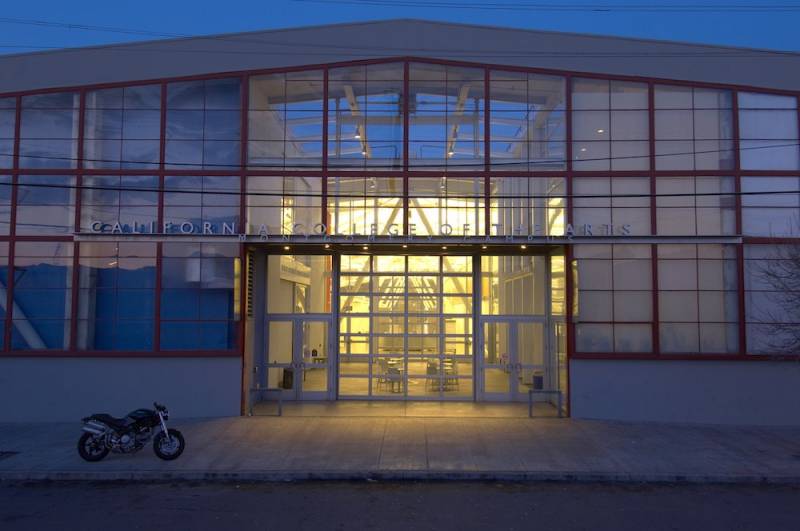
"caption": "Leaders from CCA student groups have launched a campaign to raise $35,000 for their working class and BIPOC classmates.",
"description": "Leaders from CCA student groups have launched a campaign to raise $35,000 for their working class and BIPOC classmates.",
"title": "CCA-Montgomery-Campus-Entrance",
"credit": "Courtesy CCA",
"status": "inherit",
"isLoading": false,
"fetchFailed": false
},
"arts_13883735": {
"type": "attachments",
"id": "arts_13883735",
"meta": {
"index": "attachments_1716263798",
"site": "arts",
"id": "13883735",
"found": true
},
"parent": 13883734,
"imgSizes": {
"thumbnail": {
"file": "https://ww2.kqed.org/app/uploads/sites/2/2020/07/SheilaE-160x105.jpg",
"width": 160,
"mimeType": "image/jpeg",
"height": 105
},
"post-thumbnail": {
"file": "https://ww2.kqed.org/app/uploads/sites/2/2020/07/SheilaE-640x372.jpg",
"width": 640,
"mimeType": "image/jpeg",
"height": 372
},
"kqedFullSize": {
"file": "https://ww2.kqed.org/app/uploads/sites/2/2020/07/SheilaE.jpg",
"width": 640,
"height": 420
}
},
"publishDate": 1595452710,
"modified": 1595452742,
"caption": "Sheila E., on stage with Pete Escovedo.",
"description": "Sheila E., on stage with Pete Escovedo.",
"title": "SheilaE",
"credit": "Courtesy Photo",
"status": "inherit",
"isLoading": false,
"fetchFailed": false
},
"arts_13883049": {
"type": "attachments",
"id": "arts_13883049",
"meta": {
"index": "attachments_1716263798",
"site": "arts",
"id": "13883049",
"found": true
},
"parent": 13883035,
"imgSizes": {
"twentyfourteen-full-width": {
"file": "https://ww2.kqed.org/app/uploads/sites/2/2020/07/martinez-blm-1038x564.jpg",
"width": 1038,
"mimeType": "image/jpeg",
"height": 564
},
"thumbnail": {
"file": "https://ww2.kqed.org/app/uploads/sites/2/2020/07/martinez-blm-160x87.jpg",
"width": 160,
"mimeType": "image/jpeg",
"height": 87
},
"post-thumbnail": {
"file": "https://ww2.kqed.org/app/uploads/sites/2/2020/07/martinez-blm-672x372.jpg",
"width": 672,
"mimeType": "image/jpeg",
"height": 372
},
"kqedFullSize": {
"file": "https://ww2.kqed.org/app/uploads/sites/2/2020/07/martinez-blm.jpg",
"width": 1043,
"height": 564
},
"large": {
"file": "https://ww2.kqed.org/app/uploads/sites/2/2020/07/martinez-blm-1020x552.jpg",
"width": 1020,
"mimeType": "image/jpeg",
"height": 552
},
"medium": {
"file": "https://ww2.kqed.org/app/uploads/sites/2/2020/07/martinez-blm-800x433.jpg",
"width": 800,
"mimeType": "image/jpeg",
"height": 433
},
"medium_large": {
"file": "https://ww2.kqed.org/app/uploads/sites/2/2020/07/martinez-blm-768x415.jpg",
"width": 768,
"mimeType": "image/jpeg",
"height": 415
}
},
"publishDate": 1594166108,
"modified": 1594166156,
"caption": "Nichole Anderson (pictured) and David Nelson from Martinez have been charged with three misdemeanors, including a hate crime, for attempting to deface a city-permitted Black Lives Matter mural.",
"description": "Nichole Anderson (pictured) and David Nelson from Martinez have been charged with three misdemeanors, including a hate crime, for attempting to deface a city-permitted Black Lives Matter mural.",
"title": "martinez blm",
"credit": "YouTube",
"status": "inherit",
"isLoading": false,
"fetchFailed": false
},
"arts_13882900": {
"type": "attachments",
"id": "arts_13882900",
"meta": {
"index": "attachments_1716263798",
"site": "arts",
"id": "13882900",
"found": true
},
"parent": 13882899,
"imgSizes": {
"twentyfourteen-full-width": {
"file": "https://ww2.kqed.org/app/uploads/sites/2/2020/07/Deep-East-Protest-009-1038x576.jpg",
"width": 1038,
"mimeType": "image/jpeg",
"height": 576
},
"thumbnail": {
"file": "https://ww2.kqed.org/app/uploads/sites/2/2020/07/Deep-East-Protest-009-160x107.jpg",
"width": 160,
"mimeType": "image/jpeg",
"height": 107
},
"post-thumbnail": {
"file": "https://ww2.kqed.org/app/uploads/sites/2/2020/07/Deep-East-Protest-009-672x372.jpg",
"width": 672,
"mimeType": "image/jpeg",
"height": 372
},
"kqedFullSize": {
"file": "https://ww2.kqed.org/app/uploads/sites/2/2020/07/Deep-East-Protest-009.jpg",
"width": 1920,
"height": 1280
},
"large": {
"file": "https://ww2.kqed.org/app/uploads/sites/2/2020/07/Deep-East-Protest-009-1020x680.jpg",
"width": 1020,
"mimeType": "image/jpeg",
"height": 680
},
"1536x1536": {
"file": "https://ww2.kqed.org/app/uploads/sites/2/2020/07/Deep-East-Protest-009-1536x1024.jpg",
"width": 1536,
"mimeType": "image/jpeg",
"height": 1024
},
"medium": {
"file": "https://ww2.kqed.org/app/uploads/sites/2/2020/07/Deep-East-Protest-009-800x533.jpg",
"width": 800,
"mimeType": "image/jpeg",
"height": 533
},
"medium_large": {
"file": "https://ww2.kqed.org/app/uploads/sites/2/2020/07/Deep-East-Protest-009-768x512.jpg",
"width": 768,
"mimeType": "image/jpeg",
"height": 512
}
},
"publishDate": 1593731713,
"modified": 1593731768,
"caption": "Demonstrators at a recent Black Lives Matter protest in East Oakland. ",
"description": "Demonstrators at a recent Black Lives Matter protest in East Oakland. ",
"title": "Deep East Protest 009",
"credit": "Brandon Ruffin",
"status": "inherit",
"isLoading": false,
"fetchFailed": false
},
"arts_13882916": {
"type": "attachments",
"id": "arts_13882916",
"meta": {
"index": "attachments_1716263798",
"site": "arts",
"id": "13882916",
"found": true
},
"parent": 13882856,
"imgSizes": {
"thumbnail": {
"file": "https://ww2.kqed.org/app/uploads/sites/2/2020/07/Regina-Jackson-Web-160x92.jpg",
"width": 160,
"mimeType": "image/jpeg",
"height": 92
},
"post-thumbnail": {
"file": "https://ww2.kqed.org/app/uploads/sites/2/2020/07/Regina-Jackson-Web-672x372.jpg",
"width": 672,
"mimeType": "image/jpeg",
"height": 372
},
"kqedFullSize": {
"file": "https://ww2.kqed.org/app/uploads/sites/2/2020/07/Regina-Jackson-Web.jpg",
"width": 800,
"height": 462
},
"medium_large": {
"file": "https://ww2.kqed.org/app/uploads/sites/2/2020/07/Regina-Jackson-Web-768x444.jpg",
"width": 768,
"mimeType": "image/jpeg",
"height": 444
}
},
"publishDate": 1593791213,
"modified": 1593791232,
"caption": "Regina Jackson",
"description": "Regina Jackson",
"title": "Regina-Jackson-Web",
"credit": "Nicka Smith",
"status": "inherit",
"isLoading": false,
"fetchFailed": false
},
"arts_13882656": {
"type": "attachments",
"id": "arts_13882656",
"meta": {
"index": "attachments_1716263798",
"site": "arts",
"id": "13882656",
"found": true
},
"parent": 13882645,
"imgSizes": {
"twentyfourteen-full-width": {
"file": "https://ww2.kqed.org/app/uploads/sites/2/2020/06/BlackOwnedBookstores_COVER-1038x576.jpg",
"width": 1038,
"mimeType": "image/jpeg",
"height": 576
},
"thumbnail": {
"file": "https://ww2.kqed.org/app/uploads/sites/2/2020/06/BlackOwnedBookstores_COVER-160x90.jpg",
"width": 160,
"mimeType": "image/jpeg",
"height": 90
},
"post-thumbnail": {
"file": "https://ww2.kqed.org/app/uploads/sites/2/2020/06/BlackOwnedBookstores_COVER-672x372.jpg",
"width": 672,
"mimeType": "image/jpeg",
"height": 372
},
"kqedFullSize": {
"file": "https://ww2.kqed.org/app/uploads/sites/2/2020/06/BlackOwnedBookstores_COVER.jpg",
"width": 1920,
"height": 1080
},
"large": {
"file": "https://ww2.kqed.org/app/uploads/sites/2/2020/06/BlackOwnedBookstores_COVER-1020x574.jpg",
"width": 1020,
"mimeType": "image/jpeg",
"height": 574
},
"1536x1536": {
"file": "https://ww2.kqed.org/app/uploads/sites/2/2020/06/BlackOwnedBookstores_COVER-1536x864.jpg",
"width": 1536,
"mimeType": "image/jpeg",
"height": 864
},
"medium": {
"file": "https://ww2.kqed.org/app/uploads/sites/2/2020/06/BlackOwnedBookstores_COVER-800x450.jpg",
"width": 800,
"mimeType": "image/jpeg",
"height": 450
},
"medium_large": {
"file": "https://ww2.kqed.org/app/uploads/sites/2/2020/06/BlackOwnedBookstores_COVER-768x432.jpg",
"width": 768,
"mimeType": "image/jpeg",
"height": 432
}
},
"publishDate": 1593451073,
"modified": 1593451366,
"caption": "Katie Mitchell, co-owner of Good Books in Atlanta, runs an online and pop-up bookshop with her mom, Katherine. 'Things are trendy for a while ... and then they're not,' she says.",
"description": "Katie Mitchell, co-owner of Good Books in Atlanta, runs an online and pop-up bookshop with her mom, Katherine. 'Things are trendy for a while ... and then they're not,' she says.",
"title": "BlackOwnedBookstores_COVER",
"credit": "Lynsey Weatherspoon for NPR",
"status": "inherit",
"isLoading": false,
"fetchFailed": false
},
"arts_13882560": {
"type": "attachments",
"id": "arts_13882560",
"meta": {
"index": "attachments_1716263798",
"site": "arts",
"id": "13882560",
"found": true
},
"parent": 13882347,
"imgSizes": {
"twentyfourteen-full-width": {
"file": "https://ww2.kqed.org/app/uploads/sites/2/2020/06/AndersonPaak-1038x576.jpg",
"width": 1038,
"mimeType": "image/jpeg",
"height": 576
},
"thumbnail": {
"file": "https://ww2.kqed.org/app/uploads/sites/2/2020/06/AndersonPaak-160x90.jpg",
"width": 160,
"mimeType": "image/jpeg",
"height": 90
},
"post-thumbnail": {
"file": "https://ww2.kqed.org/app/uploads/sites/2/2020/06/AndersonPaak-672x372.jpg",
"width": 672,
"mimeType": "image/jpeg",
"height": 372
},
"kqedFullSize": {
"file": "https://ww2.kqed.org/app/uploads/sites/2/2020/06/AndersonPaak.jpg",
"width": 1920,
"height": 1080
},
"large": {
"file": "https://ww2.kqed.org/app/uploads/sites/2/2020/06/AndersonPaak-1020x574.jpg",
"width": 1020,
"mimeType": "image/jpeg",
"height": 574
},
"1536x1536": {
"file": "https://ww2.kqed.org/app/uploads/sites/2/2020/06/AndersonPaak-1536x864.jpg",
"width": 1536,
"mimeType": "image/jpeg",
"height": 864
},
"medium": {
"file": "https://ww2.kqed.org/app/uploads/sites/2/2020/06/AndersonPaak-800x450.jpg",
"width": 800,
"mimeType": "image/jpeg",
"height": 450
},
"medium_large": {
"file": "https://ww2.kqed.org/app/uploads/sites/2/2020/06/AndersonPaak-768x432.jpg",
"width": 768,
"mimeType": "image/jpeg",
"height": 432
}
},
"publishDate": 1593113938,
"modified": 1593113978,
"caption": "A still from Anderson .Paak's 'Lockdown' video, released on Juneteenth, 2020.",
"description": "A still from Anderson .Paak's 'Lockdown' video, released on Juneteenth, 2020.",
"title": "AndersonPaak",
"credit": "Directed by Dave Meyers ",
"status": "inherit",
"isLoading": false,
"fetchFailed": false
},
"arts_13882514": {
"type": "attachments",
"id": "arts_13882514",
"meta": {
"index": "attachments_1716263798",
"site": "arts",
"id": "13882514",
"found": true
},
"parent": 13882499,
"imgSizes": {
"twentyfourteen-full-width": {
"file": "https://ww2.kqed.org/app/uploads/sites/2/2020/06/2E98EEAB-3ECB-4F5B-8B6B-830D0D9112DE-1038x576.jpeg",
"width": 1038,
"mimeType": "image/jpeg",
"height": 576
},
"thumbnail": {
"file": "https://ww2.kqed.org/app/uploads/sites/2/2020/06/2E98EEAB-3ECB-4F5B-8B6B-830D0D9112DE-160x90.jpeg",
"width": 160,
"mimeType": "image/jpeg",
"height": 90
},
"post-thumbnail": {
"file": "https://ww2.kqed.org/app/uploads/sites/2/2020/06/2E98EEAB-3ECB-4F5B-8B6B-830D0D9112DE-672x372.jpeg",
"width": 672,
"mimeType": "image/jpeg",
"height": 372
},
"kqedFullSize": {
"file": "https://ww2.kqed.org/app/uploads/sites/2/2020/06/2E98EEAB-3ECB-4F5B-8B6B-830D0D9112DE.jpeg",
"width": 1920,
"height": 1080
},
"large": {
"file": "https://ww2.kqed.org/app/uploads/sites/2/2020/06/2E98EEAB-3ECB-4F5B-8B6B-830D0D9112DE-1020x574.jpeg",
"width": 1020,
"mimeType": "image/jpeg",
"height": 574
},
"1536x1536": {
"file": "https://ww2.kqed.org/app/uploads/sites/2/2020/06/2E98EEAB-3ECB-4F5B-8B6B-830D0D9112DE-1536x864.jpeg",
"width": 1536,
"mimeType": "image/jpeg",
"height": 864
},
"medium": {
"file": "https://ww2.kqed.org/app/uploads/sites/2/2020/06/2E98EEAB-3ECB-4F5B-8B6B-830D0D9112DE-800x450.jpeg",
"width": 800,
"mimeType": "image/jpeg",
"height": 450
},
"medium_large": {
"file": "https://ww2.kqed.org/app/uploads/sites/2/2020/06/2E98EEAB-3ECB-4F5B-8B6B-830D0D9112DE-768x432.jpeg",
"width": 768,
"mimeType": "image/jpeg",
"height": 432
}
},
"publishDate": 1593041418,
"modified": 1593041483,
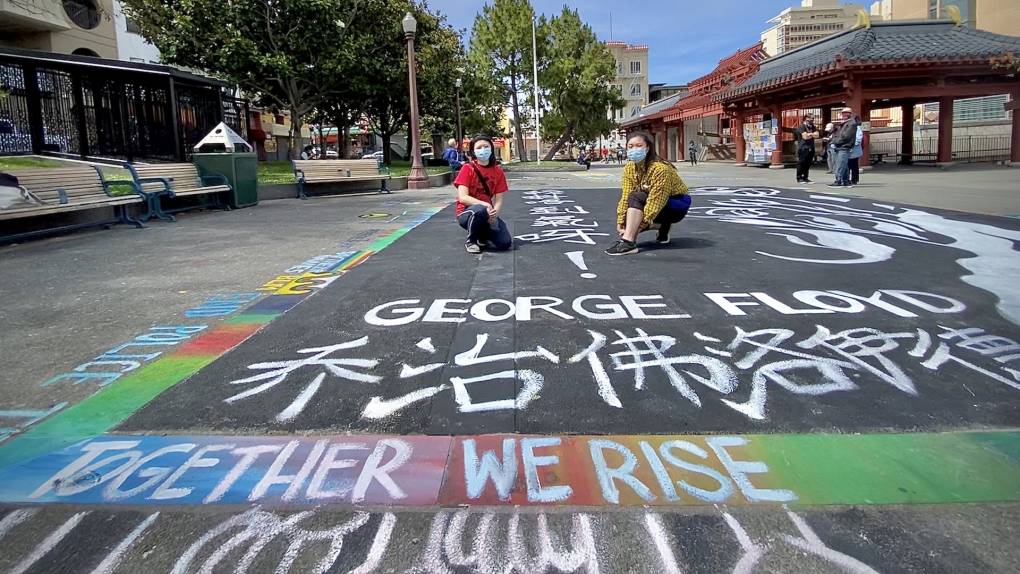
"caption": "Activists at a Black Lives Matter solidarity event in Chinatown in San Francisco.",
"description": "Activists at a Black Lives Matter solidarity event in Chinatown in San Francisco.",
"title": "2E98EEAB-3ECB-4F5B-8B6B-830D0D9112DE",
"credit": "Courtesy of James Q. Chan",
"status": "inherit",
"isLoading": false,
"fetchFailed": false
},
"arts_13882471": {
"type": "attachments",
"id": "arts_13882471",
"meta": {
"index": "attachments_1716263798",
"site": "arts",
"id": "13882471",
"found": true
},
"parent": 13882412,
"imgSizes": {
"twentyfourteen-full-width": {
"file": "https://ww2.kqed.org/app/uploads/sites/2/2020/06/GeorgeFloyd.Mural_.Oakland-1038x576.jpg",
"width": 1038,
"mimeType": "image/jpeg",
"height": 576
},
"thumbnail": {
"file": "https://ww2.kqed.org/app/uploads/sites/2/2020/06/GeorgeFloyd.Mural_.Oakland-160x93.jpg",
"width": 160,
"mimeType": "image/jpeg",
"height": 93
},
"post-thumbnail": {
"file": "https://ww2.kqed.org/app/uploads/sites/2/2020/06/GeorgeFloyd.Mural_.Oakland-672x372.jpg",
"width": 672,
"mimeType": "image/jpeg",
"height": 372
},
"kqedFullSize": {
"file": "https://ww2.kqed.org/app/uploads/sites/2/2020/06/GeorgeFloyd.Mural_.Oakland.jpg",
"width": 1200,
"height": 701
},
"large": {
"file": "https://ww2.kqed.org/app/uploads/sites/2/2020/06/GeorgeFloyd.Mural_.Oakland-1020x596.jpg",
"width": 1020,
"mimeType": "image/jpeg",
"height": 596
},
"medium": {
"file": "https://ww2.kqed.org/app/uploads/sites/2/2020/06/GeorgeFloyd.Mural_.Oakland-800x467.jpg",
"width": 800,
"mimeType": "image/jpeg",
"height": 467
},
"medium_large": {
"file": "https://ww2.kqed.org/app/uploads/sites/2/2020/06/GeorgeFloyd.Mural_.Oakland-768x449.jpg",
"width": 768,
"mimeType": "image/jpeg",
"height": 449
}
},
"publishDate": 1593024294,
"modified": 1593024532,
"caption": "A mural in downtown Oakland commemorating George Floyd, by DeredWRK (@deredwrk).",
"description": "A mural in downtown Oakland commemorating George Floyd, by DeredWRK (@deredwrk).",
"title": "GeorgeFloyd.Mural.Oakland",
"credit": "Cianni Jackson",
"status": "inherit",
"isLoading": false,
"fetchFailed": false
},
"arts_13882455": {
"type": "attachments",
"id": "arts_13882455",
"meta": {
"index": "attachments_1716263798",
"site": "arts",
"id": "13882455",
"found": true
},
"parent": 13882454,
"imgSizes": {
"twentyfourteen-full-width": {
"file": "https://ww2.kqed.org/app/uploads/sites/2/2020/06/gettyimages-1179144046_wide-a09f0fab14324b0a2096d56bfb8cf2926b02b0ea-1038x576.jpg",
"width": 1038,
"mimeType": "image/jpeg",
"height": 576
},
"thumbnail": {
"file": "https://ww2.kqed.org/app/uploads/sites/2/2020/06/gettyimages-1179144046_wide-a09f0fab14324b0a2096d56bfb8cf2926b02b0ea-160x90.jpg",
"width": 160,
"mimeType": "image/jpeg",
"height": 90
},
"post-thumbnail": {
"file": "https://ww2.kqed.org/app/uploads/sites/2/2020/06/gettyimages-1179144046_wide-a09f0fab14324b0a2096d56bfb8cf2926b02b0ea-672x372.jpg",
"width": 672,
"mimeType": "image/jpeg",
"height": 372
},
"kqedFullSize": {
"file": "https://ww2.kqed.org/app/uploads/sites/2/2020/06/gettyimages-1179144046_wide-a09f0fab14324b0a2096d56bfb8cf2926b02b0ea-scaled.jpg",
"width": 2560,
"height": 1440
},
"2048x2048": {
"file": "https://ww2.kqed.org/app/uploads/sites/2/2020/06/gettyimages-1179144046_wide-a09f0fab14324b0a2096d56bfb8cf2926b02b0ea-2048x1152.jpg",
"width": 2048,
"mimeType": "image/jpeg",
"height": 1152
},
"large": {
"file": "https://ww2.kqed.org/app/uploads/sites/2/2020/06/gettyimages-1179144046_wide-a09f0fab14324b0a2096d56bfb8cf2926b02b0ea-1020x574.jpg",
"width": 1020,
"mimeType": "image/jpeg",
"height": 574
},
"1536x1536": {
"file": "https://ww2.kqed.org/app/uploads/sites/2/2020/06/gettyimages-1179144046_wide-a09f0fab14324b0a2096d56bfb8cf2926b02b0ea-1536x864.jpg",
"width": 1536,
"mimeType": "image/jpeg",
"height": 864
},
"full-width": {
"file": "https://ww2.kqed.org/app/uploads/sites/2/2020/06/gettyimages-1179144046_wide-a09f0fab14324b0a2096d56bfb8cf2926b02b0ea-1920x1080.jpg",
"width": 1920,
"mimeType": "image/jpeg",
"height": 1080
},
"medium": {
"file": "https://ww2.kqed.org/app/uploads/sites/2/2020/06/gettyimages-1179144046_wide-a09f0fab14324b0a2096d56bfb8cf2926b02b0ea-800x450.jpg",
"width": 800,
"mimeType": "image/jpeg",
"height": 450
},
"medium_large": {
"file": "https://ww2.kqed.org/app/uploads/sites/2/2020/06/gettyimages-1179144046_wide-a09f0fab14324b0a2096d56bfb8cf2926b02b0ea-768x432.jpg",
"width": 768,
"mimeType": "image/jpeg",
"height": 432
}
},
"publishDate": 1593022588,
"modified": 1593023381,
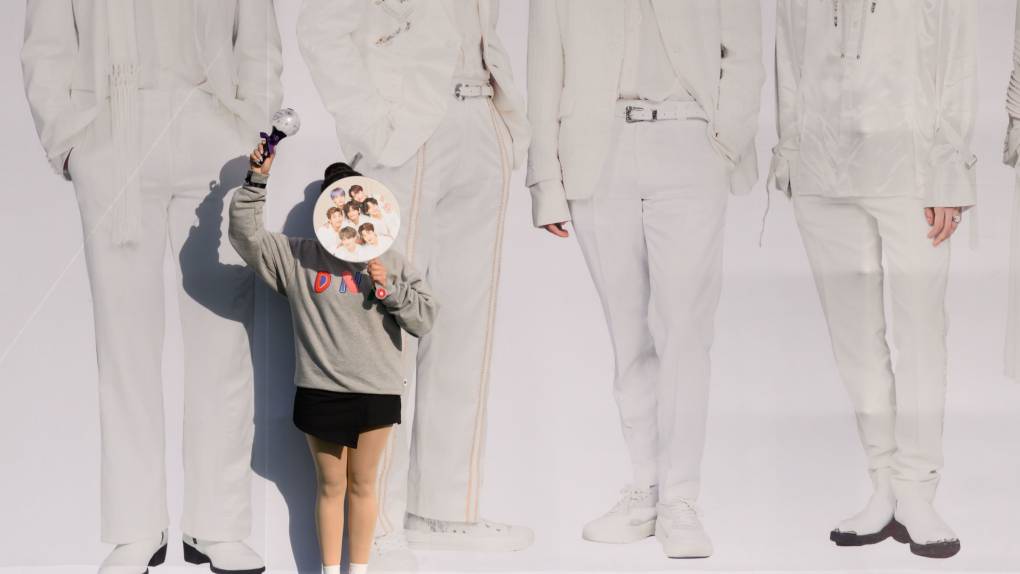
"caption": "A fan of BTS poses for photos against a backdrop featuring an image of the group's members in Seoul on Oct. 29, 2019.",
"description": "A fan of BTS poses for photos against a backdrop featuring an image of the group's members in Seoul on Oct. 29, 2019.",
"title": "A fan of BTS poses for photos against a backdrop featuring an image of the group's members in Seoul on Oct. 29, 2019.",
"credit": "ED JONES/AFP via Getty Images",
"status": "inherit",
"isLoading": false,
"fetchFailed": false
},
"arts_13882304": {
"type": "attachments",
"id": "arts_13882304",
"meta": {
"index": "attachments_1716263798",
"site": "arts",
"id": "13882304",
"found": true
},
"parent": 13882302,
"imgSizes": {
"twentyfourteen-full-width": {
"file": "https://ww2.kqed.org/app/uploads/sites/2/2020/06/8778871204_73dab056f3_k-1020x738-1020x576.jpg",
"width": 1020,
"mimeType": "image/jpeg",
"height": 576
},
"thumbnail": {
"file": "https://ww2.kqed.org/app/uploads/sites/2/2020/06/8778871204_73dab056f3_k-1020x738-160x116.jpg",
"width": 160,
"mimeType": "image/jpeg",
"height": 116
},
"post-thumbnail": {
"file": "https://ww2.kqed.org/app/uploads/sites/2/2020/06/8778871204_73dab056f3_k-1020x738-672x372.jpg",
"width": 672,
"mimeType": "image/jpeg",
"height": 372
},
"kqedFullSize": {
"file": "https://ww2.kqed.org/app/uploads/sites/2/2020/06/8778871204_73dab056f3_k-1020x738.jpg",
"width": 1020,
"height": 738
},
"large": {
"file": "https://ww2.kqed.org/app/uploads/sites/2/2020/06/8778871204_73dab056f3_k-1020x738-1020x738.jpg",
"width": 1020,
"mimeType": "image/jpeg",
"height": 738
},
"medium": {
"file": "https://ww2.kqed.org/app/uploads/sites/2/2020/06/8778871204_73dab056f3_k-1020x738-800x579.jpg",
"width": 800,
"mimeType": "image/jpeg",
"height": 579
},
"medium_large": {
"file": "https://ww2.kqed.org/app/uploads/sites/2/2020/06/8778871204_73dab056f3_k-1020x738-768x556.jpg",
"width": 768,
"mimeType": "image/jpeg",
"height": 556
}
},
"publishDate": 1592599317,
"modified": 1592599353,
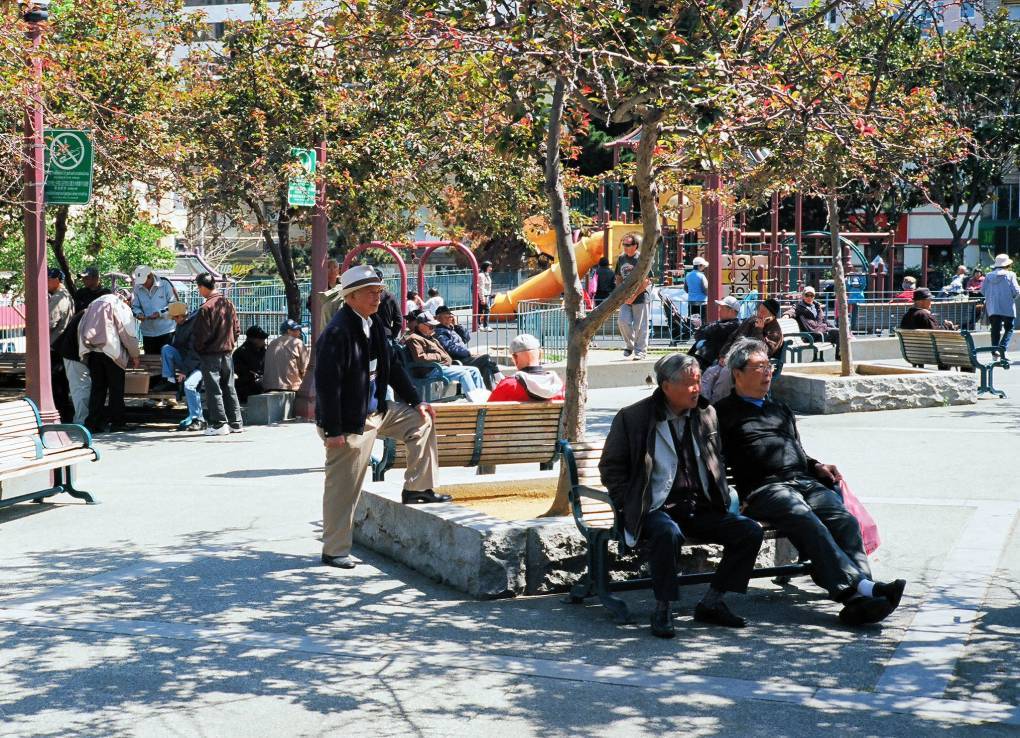
"caption": "Portsmouth Square is a community hub for San Francisco's Chinatown.",
"description": "Portsmouth Square is a community hub for San Francisco's Chinatown.",
"title": "8778871204_73dab056f3_k-1020x738",
"credit": "Michael Fraley/Flickr",
"status": "inherit",
"isLoading": false,
"fetchFailed": false
}
},
"audioPlayerReducer": {
"postId": "stream_live",
"isPaused": true,
"isPlaying": false,
"pfsActive": false,
"pledgeModalIsOpen": true,
"playerDrawerIsOpen": false,
"liveAudioPlayStartedAt": 0,
"liveAudioPlayContext": ""
},
"authorsReducer": {
"byline_arts_13884101": {
"type": "authors",
"id": "byline_arts_13884101",
"meta": {
"override": true
},
"slug": "byline_arts_13884101",
"name": "Anastasia Tsioulcas",
"isLoading": false
},
"byline_arts_13882899": {
"type": "authors",
"id": "byline_arts_13882899",
"meta": {
"override": true
},
"slug": "byline_arts_13882899",
"name": "Brandon Ruffin",
"isLoading": false
},
"byline_arts_13882645": {
"type": "authors",
"id": "byline_arts_13882645",
"meta": {
"override": true
},
"slug": "byline_arts_13882645",
"name": "Natalie Escobar",
"isLoading": false
},
"byline_arts_13882454": {
"type": "authors",
"id": "byline_arts_13882454",
"meta": {
"override": true
},
"slug": "byline_arts_13882454",
"name": "Haeryun Kang",
"isLoading": false
},
"shotchkiss": {
"type": "authors",
"id": "61",
"meta": {
"index": "authors_1716337520",
"id": "61",
"found": true
},
"name": "Sarah Hotchkiss",
"firstName": "Sarah",
"lastName": "Hotchkiss",
"slug": "shotchkiss",
"email": "shotchkiss@kqed.org",
"display_author_email": true,
"staff_mastheads": [
"arts"
],
"title": "Senior Editor",
"bio": "Sarah Hotchkiss is a San Francisco \u003ca href=\"http://www.sarahhotchkiss.com\">artist\u003c/a> and arts writer. In 2019, she received the Dorothea & Leo Rabkin Foundation grant for visual art journalism and in 2020 she received a Society of Professional Journalists, Northern California award for excellence in arts and culture reporting.",
"avatar": "https://secure.gravatar.com/avatar/bc662df144b3d27fd8b1b6f1c2a420d34e91e53154d411bb7ad353cc8b6cea8d?s=600&d=blank&r=g",
"twitter": null,
"bluesky": null,
"facebook": null,
"instagram": null,
"linkedin": null,
"sites": [
{
"site": "",
"roles": [
"editor"
]
},
{
"site": "arts",
"roles": [
"Contributor",
"administrator"
]
},
{
"site": "artschool",
"roles": [
"administrator"
]
},
{
"site": "news",
"roles": [
"editor"
]
},
{
"site": "pop",
"roles": [
"administrator"
]
},
{
"site": "bayareabites",
"roles": [
"editor"
]
},
{
"site": "spark",
"roles": [
"editor"
]
},
{
"site": "checkplease",
"roles": [
"editor"
]
}
],
"headData": {
"title": "Sarah Hotchkiss | KQED",
"description": "Senior Editor",
"ogImgSrc": "https://secure.gravatar.com/avatar/bc662df144b3d27fd8b1b6f1c2a420d34e91e53154d411bb7ad353cc8b6cea8d?s=600&d=blank&r=g",
"twImgSrc": "https://secure.gravatar.com/avatar/bc662df144b3d27fd8b1b6f1c2a420d34e91e53154d411bb7ad353cc8b6cea8d?s=600&d=blank&r=g"
},
"isLoading": false,
"link": "/author/shotchkiss"
},
"gmeline": {
"type": "authors",
"id": "185",
"meta": {
"index": "authors_1716337520",
"id": "185",
"found": true
},
"name": "Gabe Meline",
"firstName": "Gabe",
"lastName": "Meline",
"slug": "gmeline",
"email": "gmeline@kqed.org",
"display_author_email": true,
"staff_mastheads": [
"arts"
],
"title": "Senior Editor, KQED Arts & Culture",
"bio": "Gabe Meline entered journalism at age 15 making photocopied zines, and has since earned awards from the Edward R. Murrow Awards, the Society for Professional Journalists, the Online Journalism Awards, the Association of Alternative Newsweeklies and the California Newspaper Publishers Association. Prior to KQED, he was the editor of the \u003cem>North Bay Bohemian\u003c/em> and a touring musician. He lives with his wife and daughter in his hometown of Santa Rosa, CA.",
"avatar": "https://secure.gravatar.com/avatar/5bebe57be0d8bc2dd318934feb47299e2d2d10cba28d09d8d7afb389a2ce2bdd?s=600&d=blank&r=g",
"twitter": null,
"bluesky": null,
"facebook": null,
"instagram": null,
"linkedin": null,
"sites": [
{
"site": "",
"roles": [
"editor"
]
},
{
"site": "arts",
"roles": [
"administrator"
]
},
{
"site": "artschool",
"roles": [
"editor"
]
},
{
"site": "news",
"roles": [
"author"
]
},
{
"site": "pop",
"roles": [
"editor"
]
},
{
"site": "bayareabites",
"roles": [
"editor"
]
},
{
"site": "food",
"roles": [
"editor"
]
},
{
"site": "forum",
"roles": [
"administrator"
]
},
{
"site": "liveblog",
"roles": [
"editor"
]
},
{
"site": "hiphop",
"roles": [
"editor"
]
}
],
"headData": {
"title": "Gabe Meline | KQED",
"description": "Senior Editor, KQED Arts & Culture",
"ogImgSrc": "https://secure.gravatar.com/avatar/5bebe57be0d8bc2dd318934feb47299e2d2d10cba28d09d8d7afb389a2ce2bdd?s=600&d=blank&r=g",
"twImgSrc": "https://secure.gravatar.com/avatar/5bebe57be0d8bc2dd318934feb47299e2d2d10cba28d09d8d7afb389a2ce2bdd?s=600&d=blank&r=g"
},
"isLoading": false,
"link": "/author/gmeline"
},
"nvoynovskaya": {
"type": "authors",
"id": "11387",
"meta": {
"index": "authors_1716337520",
"id": "11387",
"found": true
},
"name": "Nastia Voynovskaya",
"firstName": "Nastia",
"lastName": "Voynovskaya",
"slug": "nvoynovskaya",
"email": "nvoynovskaya@kqed.org",
"display_author_email": false,
"staff_mastheads": [
"arts"
],
"title": "Editor and reporter",
"bio": "Nastia Voynovskaya is a reporter, editor and host at KQED Arts & Culture. She's been covering the arts in the Bay Area for over a decade, with a focus on music, queer culture, labor issues and grassroots organizing. She has edited KQED story series such as Trans Bay: A History of San Francisco's Gender-Diverse Community, and co-created KQED's Bay Area hip-hop history project, That's My Word. Nastia's work has been recognized by the Society of Professional Journalists and San Francisco Press Club. She regularly appears on podcasts and radio programs, including NPR's All Songs Considered, and hosts live events where music, culture and conversation meet.",
"avatar": "https://secure.gravatar.com/avatar/5025ee460e5a85d69ca20ea6c6f2f80d7e17795c828f61ea3aecfcd924e9042e?s=600&d=blank&r=g",
"twitter": null,
"bluesky": null,
"facebook": null,
"instagram": "https://www.instagram.com/nananastia/",
"linkedin": null,
"sites": [
{
"site": "",
"roles": [
"editor"
]
},
{
"site": "arts",
"roles": [
"administrator"
]
},
{
"site": "news",
"roles": [
"editor"
]
},
{
"site": "pop",
"roles": [
"administrator"
]
},
{
"site": "bayareabites",
"roles": [
"editor"
]
},
{
"site": "podcasts",
"roles": [
"editor"
]
},
{
"site": "hiphop",
"roles": [
"editor"
]
}
],
"headData": {
"title": "Nastia Voynovskaya | KQED",
"description": "Editor and reporter",
"ogImgSrc": "https://secure.gravatar.com/avatar/5025ee460e5a85d69ca20ea6c6f2f80d7e17795c828f61ea3aecfcd924e9042e?s=600&d=blank&r=g",
"twImgSrc": "https://secure.gravatar.com/avatar/5025ee460e5a85d69ca20ea6c6f2f80d7e17795c828f61ea3aecfcd924e9042e?s=600&d=blank&r=g"
},
"isLoading": false,
"link": "/author/nvoynovskaya"
},
"edayu": {
"type": "authors",
"id": "11391",
"meta": {
"index": "authors_1716337520",
"id": "11391",
"found": true
},
"name": "Eda Yu",
"firstName": "Eda",
"lastName": "Yu",
"slug": "edayu",
"email": "eda.cyu@gmail.com",
"display_author_email": false,
"staff_mastheads": [],
"title": "KQED Contributor",
"bio": "Eda Yu is a freelance writer and arts and culture journalist born and raised in Los Angeles, California. Her work centers the intersection of culture and identity, and her writing has appeared on platforms like VICE, Paper Magazine, and Complex. Follow her latest on Instagram and Twitter @edacyu.",
"avatar": "https://secure.gravatar.com/avatar/6dac2abe6c01e7b538d29f9c902136eb?s=600&d=blank&r=g",
"twitter": null,
"facebook": null,
"instagram": "https://www.instagram.com/edacyu/",
"linkedin": null,
"sites": [
{
"site": "arts",
"roles": [
"contributor"
]
}
],
"headData": {
"title": "Eda Yu | KQED",
"description": "KQED Contributor",
"ogImgSrc": "https://secure.gravatar.com/avatar/6dac2abe6c01e7b538d29f9c902136eb?s=600&d=blank&r=g",
"twImgSrc": "https://secure.gravatar.com/avatar/6dac2abe6c01e7b538d29f9c902136eb?s=600&d=blank&r=g"
},
"isLoading": false,
"link": "/author/edayu"
},
"ogpenn": {
"type": "authors",
"id": "11491",
"meta": {
"index": "authors_1716337520",
"id": "11491",
"found": true
},
"name": "Pendarvis Harshaw",
"firstName": "Pendarvis",
"lastName": "Harshaw",
"slug": "ogpenn",
"email": "ogpenn@gmail.com",
"display_author_email": false,
"staff_mastheads": [
"arts"
],
"title": "Community Engagement Reporter",
"bio": "Pendarvis Harshaw is an educator, host and writer with KQED Arts.",
"avatar": "https://secure.gravatar.com/avatar/972b77ee8e3f346ae2b00622661187fbfabd059b5693bbdc1475ea7a722fd4cd?s=600&d=blank&r=g",
"twitter": null,
"bluesky": null,
"facebook": null,
"instagram": "ogpenn",
"linkedin": null,
"sites": [
{
"site": "arts",
"roles": [
"administrator"
]
},
{
"site": "news",
"roles": [
"editor"
]
},
{
"site": "bayareabites",
"roles": [
"author"
]
},
{
"site": "hiphop",
"roles": [
"editor"
]
}
],
"headData": {
"title": "Pendarvis Harshaw | KQED",
"description": "Community Engagement Reporter",
"ogImgSrc": "https://secure.gravatar.com/avatar/972b77ee8e3f346ae2b00622661187fbfabd059b5693bbdc1475ea7a722fd4cd?s=600&d=blank&r=g",
"twImgSrc": "https://secure.gravatar.com/avatar/972b77ee8e3f346ae2b00622661187fbfabd059b5693bbdc1475ea7a722fd4cd?s=600&d=blank&r=g"
},
"isLoading": false,
"link": "/author/ogpenn"
}
},
"pagesReducer": {
"arts_tag_black-lives-matter": {
"type": "terms",
"id": "arts_3156",
"meta": {
"index": "terms_1716263798",
"site": "arts",
"id": "3156",
"score": 8.794299
},
"featImg": null,
"name": "Black Lives Matter",
"description": null,
"taxonomy": "tag",
"headData": {
"twImgId": null,
"twTitle": null,
"ogTitle": null,
"ogImgId": null,
"twDescription": null,
"description": null,
"title": "Black Lives Matter Archives | KQED Arts",
"ogDescription": null
},
"ttid": 3168,
"slug": "black-lives-matter",
"isLoading": false,
"title": "Black Lives Matter",
"pageMeta": {
"site": "arts",
"WpPageTemplate": "page-topic-editorial",
"currentPage": 3
},
"blocks": [
{
"blockName": "kqed/post-list",
"attrs": {
"layout": "cardArticle2",
"query": "posts/arts?tag=black-lives-matter",
"seeMore": false,
"paginated": true,
"page": 3
}
},
{
"blockName": "kqed/ad"
}
]
}
},
"pfsSessionReducer": {},
"postsReducer": {
"stream_live": {
"type": "live",
"id": "stream_live",
"audioUrl": "https://streams.kqed.org/kqedradio",
"title": "Live Stream",
"excerpt": "Live Stream information currently unavailable.",
"link": "/radio",
"featImg": "",
"label": {
"name": "KQED Live",
"link": "/"
}
},
"stream_kqedNewscast": {
"type": "posts",
"id": "stream_kqedNewscast",
"audioUrl": "https://www.kqed.org/.stream/anon/radio/RDnews/newscast.mp3?_=1",
"title": "KQED Newscast",
"featImg": "",
"label": {
"name": "88.5 FM",
"link": "/"
}
},
"arts_13884101": {
"type": "posts",
"id": "arts_13884101",
"meta": {
"index": "posts_1716263798",
"site": "arts",
"id": "13884101",
"score": null,
"sort": [
1596053985000
]
},
"parent": 0,
"labelTerm": {
"site": "arts",
"term": 137
},
"blocks": [],
"publishDate": 1596053985,
"format": "standard",
"title": "Yuja Wang and Other Classical Music Figures Try to Reckon With Racism",
"headTitle": "Yuja Wang and Other Classical Music Figures Try to Reckon With Racism | KQED",
"content": "\u003cp>Two controversies broke out this week regarding accusations of anti-Black racism in classical music. One involved two high-profile international soloists, pianist Yuja Wang and violinist Leonidas Kavakos. The other features less prominent individuals—a group of academics—but it also points to the slowness of the classical music community to take up difficult conversations about race and representation.\u003c/p>\n\u003cp>But in both cases, the accusations and the rebuttals have played out speedily on social media—within a community that still relies heavily on hierarchical prestige and institutional power.\u003c/p>\n\u003cp>On Monday, an anonymous person accused Kavakos and Wang of making \u003ca href=\"https://www.instagram.com/p/CDHe0e2gNXA/\" target=\"_blank\" rel=\"noopener noreferrer\">racist remarks \u003c/a>about a Black audience member after one of their joint recitals in Michigan. The allegation was made via an Instagram account called “Orchestra Is Racist,” one of several similarly geared social media accounts that have sprung up this summer.\u003c/p>\n\u003cp>Wang is one of classical music’s few current superstars; she holds endorsement deals with leading luxury brands, including \u003ca href=\"https://www.rolex.com/world-of-rolex/every-rolex-tells-a-story/yuja-wang-rolex-watch.html\" target=\"_blank\" rel=\"noopener noreferrer\">Rolex\u003c/a> and \u003ca href=\"https://www.rimowa.com/us/en/neverstill.html\" target=\"_blank\" rel=\"noopener noreferrer\">Rimowa\u003c/a>. (In 2014, this reporter produced a \u003ca href=\"https://www.npr.org/2014/02/19/279059784/on-a-chilly-factory-floor-yuja-wangs-piano-sizzles\" target=\"_blank\" rel=\"noopener noreferrer\">performance video\u003c/a> with Wang for NPR Music.) Through a representative, she sent a written statement to NPR late Tuesday night that read in full:\u003c/p>\n\u003cblockquote>\u003cp>“It has come to my attention that a post has been shared on @orchestraisracist, with an anonymous report of a post-performance conversation in a car between Leonidas Kavakos and myself a couple of years ago in Michigan. I have no recollection of this conversation, but language and actions that are judgmental or discriminatory against anyone are unacceptable. The most important thing is how we treat each other, and I offer my sincerest and most humble apology, if I have ever offended anyone.\u003c/p>\n\u003cp>I have faced personal and professional criticism, discrimination, and sexism countless times throughout my life and career. I know how hurtful that can be, and would never want to contribute to a negative culture or atmosphere that disparages others. It goes completely against what I believe. It’s important to listen to the many voices speaking out right now. We have to be open with each other to allow for the opportunity to acknowledge our missteps, to forgive and to grow from these experiences.”\u003c/p>\u003c/blockquote>\n\u003cp>Within the comments section on the “Orchestra Is Racist” post, Kavakos republished a comment that he had originally made on his own \u003ca href=\"https://www.facebook.com/leonidas.kavakos.violin/photos/a.447608832086475/1517577618422919/?type=3&theater\" target=\"_blank\" rel=\"noopener noreferrer\">Facebook page\u003c/a> on June 2, in the aftermath of George Floyd’s killing. He wrote in part: “If WE want to look at Humanity as an accord consisting of human lives, and attempting to create its own Harmony, the atrocious act of killing George Floyd, has destroyed that attempt. It is an act that stabs US ALL creating severe wounds, that threaten OUR Existence! If, additionally, this act is ‘justified’ by some kind of ‘life rating according to skin color,’ then I’m afraid, Humanity is suicidal.” Kavakos did not address the specific accusation made against him and Wang.\u003c/p>\n\u003cp>[ad fullwidth]\u003c/p>\n\u003cp>On Wednesday morning, a representative for Kavakos sent another statement to NPR, which read in full: “I find accusations of any form of racism deeply upsetting and abhorrent. I will never accept any form of discrimination and I am vehement in my commitment to equal rights and inclusivity. If I have ever offended anyone by how I have previously spoken I wholeheartedly apologize to them and can assure them that any hurt caused was completely unintentional and does not reflect the person I am and my values. I welcome the current discussions that are taking place that are teaching everyone that we all have something to learn and need to listen to all voices.”\u003c/p>\n\u003cp>Meanwhile, classical music’s academic sphere is facing its own reckoning. Last November, at the annual conference for the Society for Music Theory, a Black music theorist named \u003ca href=\"http://philipewell.com/\" target=\"_blank\" rel=\"noopener noreferrer\">Philip Ewell\u003c/a> gave an \u003ca href=\"https://vimeo.com/372726003\" target=\"_blank\" rel=\"noopener noreferrer\">address\u003c/a> titled Music Theory’s White Racial Frame. As part of his presentation, Ewell argued that Heinrich Schenker, a late 19th and early 20th century theorist whose work has been foundational in the musical analysis of Western art music, was not only explicitly racist personally, but that Schenker also contended himself that his views on race and on music were indivisible. He also pointed out that his field is still overwhelmingly dominated by white academics, and that the musical material taught to students is also heavily tilted towards the work of white (and male) composers.\u003c/p>\n\u003cp>In reply, an academic journal published by the Center for Schenkerian Studies and the University of North Texas Press called the \u003cem>Journal of Schenkerian Studies\u003c/em> published \u003ca href=\"https://drive.google.com/file/d/1dTOWwlIsuiwsgAa4f1N99AlvG3-ngnmG/view\" target=\"_blank\" rel=\"noopener noreferrer\">14 non-peer-reviewed responses\u003c/a> to Ewell’s work this month, including one anonymous essay—an anomaly for an academic project. (Ewell \u003ca href=\"https://twitter.com/philewell/status/1287210043159568386?s=20\" target=\"_blank\" rel=\"noopener noreferrer\">says\u003c/a> he was not invited to participate.)\u003c/p>\n\u003cp>In one of the essays, one of the publication’s lead editors, Timothy Jackson (a professor at UNT), accused Ewell personally—and the broader Black community—of being anti-Semitic, \u003ca href=\"https://twitter.com/pmgentry/status/1287210396068257793?s=20\" target=\"_blank\" rel=\"noopener noreferrer\">writing\u003c/a>: “Ewell’s denunciation of Schenker and Schenkerians may be seen as part and parcel of the much broader current of Black anti-Semitism. … They currently manifest themselves in myriad ways, including the pattern of violence against Jews, the obnoxious lyrics of some hip hop songs, etc.”\u003c/p>\n\u003cp>\u003c/p>\n\u003cp>Another rejoinder, from David Beach, a Schenker specialist at the University of Toronto, included this piece of scholarship: “My suggestion to Philip Ewell is that he stop complaining about us white guys.” In \u003ca href=\"https://meganlavengood.com/2020/07/27/journal-of-schenkerian-studies-proving-the-point/\" target=\"_blank\" rel=\"noopener noreferrer\">response\u003c/a>, many music theorists, musicologists and students have \u003ca href=\"https://twitter.com/kira_thurman/status/1287354686077575168\" target=\"_blank\" rel=\"noopener noreferrer\">denounced\u003c/a> the \u003cem>Journal of Schenkerian Studies\u003c/em> and several of the included authors, as has the \u003ca href=\"https://twitter.com/SMT_musictheory/status/1287918277667192833?s=20\" target=\"_blank\" rel=\"noopener noreferrer\">Society for Music Theory\u003c/a>.\u003c/p>\n\u003cdiv class=\"fullattribution\">\u003cem>Copyright 2020 NPR. To see more, visit \u003ca href=\"https://www.npr.org\" target=\"_blank\" rel=\"noopener noreferrer\">NPR\u003c/a>.\u003cimg decoding=\"async\" src=\"https://www.google-analytics.com/__utm.gif?utmac=UA-5828686-4&utmdt=Classical+Music+Tries+To+Reckon+With+Racism+%E2%80%94+On+Social+Media&utme=8(APIKey)9(MDAxOTAwOTE4MDEyMTkxMDAzNjczZDljZA004)\">\u003c/em>\u003c/div>\n\n",
"stats": {
"hasVideo": false,
"hasChartOrMap": false,
"hasAudio": false,
"hasPolis": false,
"wordCount": 958,
"hasGoogleForm": false,
"hasGallery": false,
"hasHearkenModule": false,
"iframeSrcs": [],
"paragraphCount": 14
},
"modified": 1705020352,
"excerpt": "Pianist Yuja Wang and violinist Leonidas Kavakos have been accused this week of making anti-Black comments.",
"headData": {
"twImgId": "",
"twTitle": "",
"ogTitle": "",
"ogImgId": "",
"twDescription": "",
"description": "Pianist Yuja Wang and violinist Leonidas Kavakos have been accused this week of making anti-Black comments.",
"title": "Yuja Wang and Other Classical Music Figures Try to Reckon With Racism | KQED",
"ogDescription": "",
"schema": {
"@context": "https://schema.org",
"@type": "Article",
"headline": "Yuja Wang and Other Classical Music Figures Try to Reckon With Racism",
"datePublished": "2020-07-29T13:19:45-07:00",
"dateModified": "2024-01-11T16:45:52-08:00",
"image": "https://cdn.kqed.org/wp-content/uploads/2020/02/KQED-OG-Image@1x.png"
}
},
"guestAuthors": [],
"slug": "yuja-wang-and-other-classical-music-figures-try-to-reckon-with-racism",
"status": "publish",
"nprApiLink": "http://api.npr.org/query?id=896200557&apiKey=MDAxOTAwOTE4MDEyMTkxMDAzNjczZDljZA004",
"templateType": "standard",
"nprStoryDate": "Wed, 29 Jul 2020 12:01:43 -0400",
"nprLastModifiedDate": "Wed, 29 Jul 2020 13:53:47 -0400",
"featuredImageType": "standard",
"nprHtmlLink": "https://www.npr.org/2020/07/29/896200557/classical-music-tries-to-reckon-with-racism-on-social-media?ft=nprml&f=896200557",
"nprImageAgency": "AFP via Getty Images",
"nprStoryId": "896200557",
"nprByline": "Anastasia Tsioulcas",
"sticky": false,
"nprImageCredit": "Daniel Mihailescu",
"nprRetrievedStory": "1",
"nprPubDate": "Wed, 29 Jul 2020 13:53:00 -0400",
"path": "/arts/13884101/yuja-wang-and-other-classical-music-figures-try-to-reckon-with-racism",
"audioTrackLength": null,
"parsedContent": [
{
"type": "contentString",
"content": "\u003cdiv class=\"post-body\">\u003cp>\u003cp>Two controversies broke out this week regarding accusations of anti-Black racism in classical music. One involved two high-profile international soloists, pianist Yuja Wang and violinist Leonidas Kavakos. The other features less prominent individuals—a group of academics—but it also points to the slowness of the classical music community to take up difficult conversations about race and representation.\u003c/p>\n\u003cp>But in both cases, the accusations and the rebuttals have played out speedily on social media—within a community that still relies heavily on hierarchical prestige and institutional power.\u003c/p>\n\u003cp>On Monday, an anonymous person accused Kavakos and Wang of making \u003ca href=\"https://www.instagram.com/p/CDHe0e2gNXA/\" target=\"_blank\" rel=\"noopener noreferrer\">racist remarks \u003c/a>about a Black audience member after one of their joint recitals in Michigan. The allegation was made via an Instagram account called “Orchestra Is Racist,” one of several similarly geared social media accounts that have sprung up this summer.\u003c/p>\n\u003cp>Wang is one of classical music’s few current superstars; she holds endorsement deals with leading luxury brands, including \u003ca href=\"https://www.rolex.com/world-of-rolex/every-rolex-tells-a-story/yuja-wang-rolex-watch.html\" target=\"_blank\" rel=\"noopener noreferrer\">Rolex\u003c/a> and \u003ca href=\"https://www.rimowa.com/us/en/neverstill.html\" target=\"_blank\" rel=\"noopener noreferrer\">Rimowa\u003c/a>. (In 2014, this reporter produced a \u003ca href=\"https://www.npr.org/2014/02/19/279059784/on-a-chilly-factory-floor-yuja-wangs-piano-sizzles\" target=\"_blank\" rel=\"noopener noreferrer\">performance video\u003c/a> with Wang for NPR Music.) Through a representative, she sent a written statement to NPR late Tuesday night that read in full:\u003c/p>\n\u003cblockquote>\u003cp>“It has come to my attention that a post has been shared on @orchestraisracist, with an anonymous report of a post-performance conversation in a car between Leonidas Kavakos and myself a couple of years ago in Michigan. I have no recollection of this conversation, but language and actions that are judgmental or discriminatory against anyone are unacceptable. The most important thing is how we treat each other, and I offer my sincerest and most humble apology, if I have ever offended anyone.\u003c/p>\n\u003cp>I have faced personal and professional criticism, discrimination, and sexism countless times throughout my life and career. I know how hurtful that can be, and would never want to contribute to a negative culture or atmosphere that disparages others. It goes completely against what I believe. It’s important to listen to the many voices speaking out right now. We have to be open with each other to allow for the opportunity to acknowledge our missteps, to forgive and to grow from these experiences.”\u003c/p>\u003c/blockquote>\n\u003cp>Within the comments section on the “Orchestra Is Racist” post, Kavakos republished a comment that he had originally made on his own \u003ca href=\"https://www.facebook.com/leonidas.kavakos.violin/photos/a.447608832086475/1517577618422919/?type=3&theater\" target=\"_blank\" rel=\"noopener noreferrer\">Facebook page\u003c/a> on June 2, in the aftermath of George Floyd’s killing. He wrote in part: “If WE want to look at Humanity as an accord consisting of human lives, and attempting to create its own Harmony, the atrocious act of killing George Floyd, has destroyed that attempt. It is an act that stabs US ALL creating severe wounds, that threaten OUR Existence! If, additionally, this act is ‘justified’ by some kind of ‘life rating according to skin color,’ then I’m afraid, Humanity is suicidal.” Kavakos did not address the specific accusation made against him and Wang.\u003c/p>\n\u003cp>\u003c/p>\u003c/div>",
"attributes": {
"named": {},
"numeric": []
}
},
{
"type": "component",
"content": "",
"name": "ad",
"attributes": {
"named": {
"label": "fullwidth"
},
"numeric": [
"fullwidth"
]
}
},
{
"type": "contentString",
"content": "\u003cdiv class=\"post-body\">\u003cp>\u003c/p>\n\u003cp>On Wednesday morning, a representative for Kavakos sent another statement to NPR, which read in full: “I find accusations of any form of racism deeply upsetting and abhorrent. I will never accept any form of discrimination and I am vehement in my commitment to equal rights and inclusivity. If I have ever offended anyone by how I have previously spoken I wholeheartedly apologize to them and can assure them that any hurt caused was completely unintentional and does not reflect the person I am and my values. I welcome the current discussions that are taking place that are teaching everyone that we all have something to learn and need to listen to all voices.”\u003c/p>\n\u003cp>Meanwhile, classical music’s academic sphere is facing its own reckoning. Last November, at the annual conference for the Society for Music Theory, a Black music theorist named \u003ca href=\"http://philipewell.com/\" target=\"_blank\" rel=\"noopener noreferrer\">Philip Ewell\u003c/a> gave an \u003ca href=\"https://vimeo.com/372726003\" target=\"_blank\" rel=\"noopener noreferrer\">address\u003c/a> titled Music Theory’s White Racial Frame. As part of his presentation, Ewell argued that Heinrich Schenker, a late 19th and early 20th century theorist whose work has been foundational in the musical analysis of Western art music, was not only explicitly racist personally, but that Schenker also contended himself that his views on race and on music were indivisible. He also pointed out that his field is still overwhelmingly dominated by white academics, and that the musical material taught to students is also heavily tilted towards the work of white (and male) composers.\u003c/p>\n\u003cp>In reply, an academic journal published by the Center for Schenkerian Studies and the University of North Texas Press called the \u003cem>Journal of Schenkerian Studies\u003c/em> published \u003ca href=\"https://drive.google.com/file/d/1dTOWwlIsuiwsgAa4f1N99AlvG3-ngnmG/view\" target=\"_blank\" rel=\"noopener noreferrer\">14 non-peer-reviewed responses\u003c/a> to Ewell’s work this month, including one anonymous essay—an anomaly for an academic project. (Ewell \u003ca href=\"https://twitter.com/philewell/status/1287210043159568386?s=20\" target=\"_blank\" rel=\"noopener noreferrer\">says\u003c/a> he was not invited to participate.)\u003c/p>\n\u003cp>In one of the essays, one of the publication’s lead editors, Timothy Jackson (a professor at UNT), accused Ewell personally—and the broader Black community—of being anti-Semitic, \u003ca href=\"https://twitter.com/pmgentry/status/1287210396068257793?s=20\" target=\"_blank\" rel=\"noopener noreferrer\">writing\u003c/a>: “Ewell’s denunciation of Schenker and Schenkerians may be seen as part and parcel of the much broader current of Black anti-Semitism. … They currently manifest themselves in myriad ways, including the pattern of violence against Jews, the obnoxious lyrics of some hip hop songs, etc.”\u003c/p>\n\u003cp>\u003c/p>\n\u003cp>Another rejoinder, from David Beach, a Schenker specialist at the University of Toronto, included this piece of scholarship: “My suggestion to Philip Ewell is that he stop complaining about us white guys.” In \u003ca href=\"https://meganlavengood.com/2020/07/27/journal-of-schenkerian-studies-proving-the-point/\" target=\"_blank\" rel=\"noopener noreferrer\">response\u003c/a>, many music theorists, musicologists and students have \u003ca href=\"https://twitter.com/kira_thurman/status/1287354686077575168\" target=\"_blank\" rel=\"noopener noreferrer\">denounced\u003c/a> the \u003cem>Journal of Schenkerian Studies\u003c/em> and several of the included authors, as has the \u003ca href=\"https://twitter.com/SMT_musictheory/status/1287918277667192833?s=20\" target=\"_blank\" rel=\"noopener noreferrer\">Society for Music Theory\u003c/a>.\u003c/p>\n\u003cdiv class=\"fullattribution\">\u003cem>Copyright 2020 NPR. To see more, visit \u003ca href=\"https://www.npr.org\" target=\"_blank\" rel=\"noopener noreferrer\">NPR\u003c/a>.\u003cimg decoding=\"async\" src=\"https://www.google-analytics.com/__utm.gif?utmac=UA-5828686-4&utmdt=Classical+Music+Tries+To+Reckon+With+Racism+%E2%80%94+On+Social+Media&utme=8(APIKey)9(MDAxOTAwOTE4MDEyMTkxMDAzNjczZDljZA004)\">\u003c/em>\u003c/div>\n\n\u003c/div>\u003c/p>",
"attributes": {
"named": {},
"numeric": []
}
}
],
"link": "/arts/13884101/yuja-wang-and-other-classical-music-figures-try-to-reckon-with-racism",
"authors": [
"byline_arts_13884101"
],
"categories": [
"arts_1",
"arts_69",
"arts_75"
],
"tags": [
"arts_3156",
"arts_1312",
"arts_3652",
"arts_11738"
],
"affiliates": [
"arts_137"
],
"featImg": "arts_13884104",
"label": "arts_137"
},
"arts_13883972": {
"type": "posts",
"id": "arts_13883972",
"meta": {
"index": "posts_1716263798",
"site": "arts",
"id": "13883972",
"score": null,
"sort": [
1595978494000
]
},
"guestAuthors": [],
"slug": "cca-students-quickly-raise-money-for-their-bipoc-peers",
"title": "CCA Students Quickly Raise Money for Their BIPOC Peers",
"publishDate": 1595978494,
"format": "standard",
"headTitle": "CCA Students Quickly Raise Money for Their BIPOC Peers | KQED",
"labelTerm": {
"site": "arts"
},
"content": "\u003cp>A handful of California College of the Arts students, energized by the movement for Black lives, have started a fundraiser for their classmates, hoping to offset the expense of a private art school education with unrestricted grants of $500–$1,000.\u003c/p>\n\u003cp>The \u003ca href=\"https://www.gofundme.com/f/working-class-bipoc-at-cca-fundraiser\" rel=\"noopener noreferrer\" target=\"_blank\">Working Class & BIPOC Grant Campaign\u003c/a>, launched July 2, seeks to “catalyze the change necessary to make our school viable for all of its students.” The fundraiser’s end goal, beyond raising $35,000, is to push CCA to create a separate scholarship for Black and Indigenous students and students of color.\u003c/p>\n\u003cp>[aside postID='arts_13883757,arts_13877073']Pointing to the high cost of living in the Bay Area and CCA’s 2020–21 tuition of over $50,000, the organizers, a coalition of leaders from five different student groups, hope to address an “unacceptable disconnect between higher education and the BIPOC artist community in the Bay Area.” \u003c/p>\n\u003cp>CCA’s \u003ca href=\"https://www.cca.edu/admissions/facts/\" rel=\"noopener noreferrer\" target=\"_blank\">student body\u003c/a> is 14% Asian American, 13% Hispanic/Latinx and 4% African American. (In 2010, the nine-county Bay Area was 23% Asian, 24% Hispanic/Latinx and 7% African American.)\u003c/p>\n\u003cp>And while CCA distributes millions in institutional financial aid each year, only one named scholarship is specifically earmarked for African American students, with another four categorized as “diversity” scholarships. CCA says it is unable to use race or ethnicity as a deciding factor in bestowing scholarships because of Proposition 209, which most famously ended affirmative action practices at UC schools in 1996. \u003c/p>\n\u003cp>During a nationwide reckoning for racial justice, the student leaders behind the Working Class & BIPOC Grant Campaign have moved quickly and independently to circumnavigate such restrictions, opting instead for mutual aid. Their fundraiser is both functional and symbolic, modeling a program CCA might one day be able to implement (\u003ca href=\"https://www.sfchronicle.com/politics/article/California-bill-asking-voters-whether-to-repeal-15331604.php\" rel=\"noopener noreferrer\" target=\"_blank\">a repeal of Proposition 209\u003c/a> will appear on state ballots this November). \u003c/p>\n\u003ch2>A Student-Led Campaign\u003c/h2>\n\u003cp>Lindsay Guinan, a third-year animation student, is one of ten student organizers behind the fundraiser. “I’m so grateful to be living through the literal largest civil rights movement to date,” she says. Participating in recent Black Lives Matter protests prompted her to look critically at the communities in which she was already involved: “And CCA is a community that I think desperately needs help in terms of equity for Black students and Indigenous students and students of color.” \u003c/p>\n\u003cp>The fundraiser was originally planned to conclude in October, but Guinan says they may shorten the timeframe to release funds before the fall semester starts on Sept. 3. As of publication, the group, which includes members of the 24 Frames Animation Club, the Black Brilliance Club, the Students of Color Coalition, Student Council and Student Union of California College of the Arts, has raised over $12,000 from 132 donors—a feat achieved in under four weeks. \u003c/p>\n\u003cp>https://www.instagram.com/p/CCt2bnvAJgs/\u003c/p>\n\u003cp>By establishing itself as completely independent from the school, the campaign has both advantages and disadvantages. Funds can be dispersed immediately, without going through official channels, but the campaign has to gather information about who is eligible to receive those funds on their own. To that end, they’ve created a survey for CCA students to complete; Guinan says they received 200 responses in the first two days. \u003c/p>\n\u003cp>Alongside demographic questions about ethnicity and gender identity are queries like, “Have you felt unsafe at CCA due to direct or indirect racism, ableism, transphobia, homophobia, sexism, classism, national origin?” The survey also wants to know if students notified CCA of such experiences and if the school took action in response to any complaints.\u003c/p>\n\u003cp>CCA, like most institutions of higher education across the country, is currently examining its past and current practices regarding racial justice and equity. The \u003ca href=\"https://portal.cca.edu/essentials/office-president/presidents-diversity-steering-group/\" rel=\"noopener noreferrer\" target=\"_blank\">President’s Diversity Steering Group\u003c/a>, made up of faculty, staff and students, has organized an \u003ca href=\"https://portal.cca.edu/essentials/office-president/presidents-diversity-steering-group/cca-community-recommendations-racial-justice-equity-initiatives/\" rel=\"noopener noreferrer\" target=\"_blank\">extensive list of recommendations\u003c/a> submitted by members of the CCA community since the national uprisings following the police killing of George Floyd. Among the suggestions are calls to create a center for Black visual culture and curatorial practice, to establish a land acknowledgment on the school’s website, and to require white faculty members to attend anti-racism training. \u003c/p>\n\u003cp>[ad fullwidth]\u003c/p>\n\u003ch2>‘More Funding is Needed’\u003c/h2>\n\u003cp>CCA spokesperson Taryn Lott says the school expects the list of current and ongoing initiatives to grow, especially with regards to programming and curriculum, when members of the faculty return from the summer break. As for CCA’s response to the call for additional funding for working class and BIPOC students, Lott wrote in an email, “While CCA has made progress in raising diversity scholarships, college leadership recognizes that more funding is needed and continues to pursue increased support for our students.” Lott says CCA has raised $635,000 toward diversity scholarship awards since May.\u003c/p>\n\u003cp>The school currently distributes $25 million in institutional financial aid, 65% of which Lott says went to BIPOC and working class undergraduate and graduate students last year, which includes U.S. citizens, permanent residents and DACA recipients. Diversity scholarships comprise 10% of the school’s endowment at $3 million. \u003c/p>\n\u003cp>But Guinan says what she’s heard from CCA’s Black students in particular is that the diversity scholarship program doesn’t prioritize them and they often don’t see those funds. The scholarships, according to CCA’s website, are offered to “students from educationally disadvantaged families who have demonstrated academic and artistic achievement, students with demonstrated leadership in service to the community, and students whose work focuses on social or cultural issues.”\u003c/p>\n\u003cp>The Working Class & BIPOC Grant Campaign hopes to disburse $1,000 each to those who need help with rent and larger expenses, and $500 grants for assistance with artist supplies and other “hidden fees that really add up,” Guinan explains. CCA estimates the additional costs of attending the school while living in the Bay Area, factoring in fees, housing, transportation, food and supplies, can amount to around $25,000.\u003c/p>\n\u003cfigure id=\"attachment_13883981\" class=\"wp-caption aligncenter\" style=\"max-width: 1200px\">\u003cimg loading=\"lazy\" decoding=\"async\" src=\"https://ww2.kqed.org/app/uploads/sites/2/2020/07/Glance_WhyUnification_body_2020_.2e16d0ba.fill-2160x1215-1.jpg\" alt=\"\" width=\"1200\" height=\"676\" class=\"size-full wp-image-13883981\" srcset=\"https://cdn.kqed.org/wp-content/uploads/sites/2/2020/07/Glance_WhyUnification_body_2020_.2e16d0ba.fill-2160x1215-1.jpg 1200w, https://cdn.kqed.org/wp-content/uploads/sites/2/2020/07/Glance_WhyUnification_body_2020_.2e16d0ba.fill-2160x1215-1-800x451.jpg 800w, https://cdn.kqed.org/wp-content/uploads/sites/2/2020/07/Glance_WhyUnification_body_2020_.2e16d0ba.fill-2160x1215-1-1020x575.jpg 1020w, https://cdn.kqed.org/wp-content/uploads/sites/2/2020/07/Glance_WhyUnification_body_2020_.2e16d0ba.fill-2160x1215-1-160x90.jpg 160w, https://cdn.kqed.org/wp-content/uploads/sites/2/2020/07/Glance_WhyUnification_body_2020_.2e16d0ba.fill-2160x1215-1-768x433.jpg 768w\" sizes=\"auto, (max-width: 1200px) 100vw, 1200px\">\u003cfigcaption class=\"wp-caption-text\">Student projects in the Nave at CCA’s San Francisco campus. \u003ccite>(Nicholas Lea Bruno/CCA)\u003c/cite>\u003c/figcaption>\u003c/figure>\n\u003cp>Last week, \u003ca href=\"https://portal.cca.edu/thriving/health-wellness/novel-coronavirus-covid19/fall-2020-semester-will-be-online/\" rel=\"noopener noreferrer\" target=\"_blank\">CCA announced\u003c/a> all of the upcoming fall semester’s courses will be taught completely remotely due to new guidance from the San Francisco Department of Public Health—not, as the school had hoped, in a combination of in-person and remote instruction. Though the school’s Oakland and San Francisco campuses will be completely closed to students until it is deemed safe to reopen—meaning no access to studios, wood shops, computer labs or the library—the school will continue to offer single-occupancy on-campus housing for students who need or want to live at CCA. \u003c/p>\n\u003cp>Unlike SFAI, which recently \u003ca href=\"https://www.kqed.org/arts/13883757/sfai-reinstates-degree-programs-faculty-students\" rel=\"noopener noreferrer\" target=\"_blank\">enticed students to re-enroll\u003c/a> with offers of a 50% tuition cut, CCA’s 2020–21 tuition is frozen at the previous school year’s rate. The only cuts were to a planned 4% increase. \u003c/p>\n\u003ch2>The Speedy Delivery of Grants\u003c/h2>\n\u003cp>Part of the impetus for keeping the Working Class & BIPOC Grant Campaign separate from the school, Guinan says, was a dissatisfaction with the speed at which CCA was able to disperse coronavirus-related relief funds to the student body. CCA received a total of nearly $1.4 million from the CARES Act fund, half of which will be disbursed in emergency financial aid grants of $500–$3,000 to eligible students between the 2019–20 and 2020–21 school years. Lott says their records indicate 745 students may be eligible to apply for these funds; so far 104 requests have been approved. (Dispersal \u003ca href=\"https://www.forbes.com/sites/wesleywhistle/2020/06/11/devos-finalizes-rule-blocking-undocumented-students-from-cares-act-grants/#2928675675a0\" rel=\"noopener noreferrer\" target=\"_blank\">was slowed\u003c/a> by a lack of guidance from the Department of Education.) \u003c/p>\n\u003cp>Additionally, CCA launched their own emergency fund to assist with students’ basic immediate needs in the face of the pandemic. Of the $30,686 raised, only $4,700 has been distributed to 40 students (decisions are made on a case-by-case basis and factor in the students’ financial aid and financial need) in the form of gift cards to grocery stores, general retailers and an art supplies store.\u003c/p>\n\u003cp>In the spirit of mutual aid, the student-led fundraiser will issue its grants without any such limitations, trusting recipients to know what they themselves need. Guinan hopes the success of this campaign will push the school to ultimately change the way it supports its working class and BIPOC students, from the bottom up. \u003c/p>\n\u003cp>“We all are putting our careers at CCA in some sort of jeopardy in some capacity,” she says. “And I just want to acknowledge that our team is working super hard and tackling this in multiple ways. The energy and the momentum is really strong and I just feel grateful to have this opportunity to hopefully effect some structural change at CCA.”\u003c/p>\n\u003cp>[ad floatright]\u003c/p>\n",
"blocks": [],
"excerpt": "Inspired by the movement for Black lives, student leaders hope to raise $35,000 in unrestricted grants.",
"status": "publish",
"parent": 0,
"modified": 1745356329,
"stats": {
"hasAudio": false,
"hasVideo": false,
"hasChartOrMap": false,
"iframeSrcs": [],
"hasGoogleForm": false,
"hasGallery": false,
"hasHearkenModule": false,
"hasPolis": false,
"paragraphCount": 23,
"wordCount": 1500
},
"headData": {
"title": "CCA Students Quickly Raise Money for Their BIPOC Peers | KQED",
"description": "Inspired by the movement for Black lives, student leaders hope to raise $35,000 in unrestricted grants.",
"ogTitle": "",
"ogDescription": "",
"ogImgId": "",
"twTitle": "",
"twDescription": "",
"twImgId": "",
"schema": {
"@context": "https://schema.org",
"@type": "Article",
"headline": "CCA Students Quickly Raise Money for Their BIPOC Peers",
"datePublished": "2020-07-28T16:21:34-07:00",
"dateModified": "2025-04-22T14:12:09-07:00",
"image": "https://cdn.kqed.org/wp-content/uploads/2020/02/KQED-OG-Image@1x.png"
}
},
"sticky": false,
"templateType": "standard",
"featuredImageType": "standard",
"path": "/arts/13883972/cca-students-quickly-raise-money-for-their-bipoc-peers",
"audioTrackLength": null,
"parsedContent": [
{
"type": "contentString",
"content": "\u003cdiv class=\"post-body\">\u003cp>\u003cp>A handful of California College of the Arts students, energized by the movement for Black lives, have started a fundraiser for their classmates, hoping to offset the expense of a private art school education with unrestricted grants of $500–$1,000.\u003c/p>\n\u003cp>The \u003ca href=\"https://www.gofundme.com/f/working-class-bipoc-at-cca-fundraiser\" rel=\"noopener noreferrer\" target=\"_blank\">Working Class & BIPOC Grant Campaign\u003c/a>, launched July 2, seeks to “catalyze the change necessary to make our school viable for all of its students.” The fundraiser’s end goal, beyond raising $35,000, is to push CCA to create a separate scholarship for Black and Indigenous students and students of color.\u003c/p>\n\u003cp>\u003c/p>\u003c/div>",
"attributes": {
"named": {},
"numeric": []
}
},
{
"type": "component",
"content": "",
"name": "aside",
"attributes": {
"named": {
"postid": "arts_13883757,arts_13877073",
"label": ""
},
"numeric": []
}
},
{
"type": "contentString",
"content": "\u003cdiv class=\"post-body\">\u003cp>Pointing to the high cost of living in the Bay Area and CCA’s 2020–21 tuition of over $50,000, the organizers, a coalition of leaders from five different student groups, hope to address an “unacceptable disconnect between higher education and the BIPOC artist community in the Bay Area.” \u003c/p>\n\u003cp>CCA’s \u003ca href=\"https://www.cca.edu/admissions/facts/\" rel=\"noopener noreferrer\" target=\"_blank\">student body\u003c/a> is 14% Asian American, 13% Hispanic/Latinx and 4% African American. (In 2010, the nine-county Bay Area was 23% Asian, 24% Hispanic/Latinx and 7% African American.)\u003c/p>\n\u003cp>And while CCA distributes millions in institutional financial aid each year, only one named scholarship is specifically earmarked for African American students, with another four categorized as “diversity” scholarships. CCA says it is unable to use race or ethnicity as a deciding factor in bestowing scholarships because of Proposition 209, which most famously ended affirmative action practices at UC schools in 1996. \u003c/p>\n\u003cp>During a nationwide reckoning for racial justice, the student leaders behind the Working Class & BIPOC Grant Campaign have moved quickly and independently to circumnavigate such restrictions, opting instead for mutual aid. Their fundraiser is both functional and symbolic, modeling a program CCA might one day be able to implement (\u003ca href=\"https://www.sfchronicle.com/politics/article/California-bill-asking-voters-whether-to-repeal-15331604.php\" rel=\"noopener noreferrer\" target=\"_blank\">a repeal of Proposition 209\u003c/a> will appear on state ballots this November). \u003c/p>\n\u003ch2>A Student-Led Campaign\u003c/h2>\n\u003cp>Lindsay Guinan, a third-year animation student, is one of ten student organizers behind the fundraiser. “I’m so grateful to be living through the literal largest civil rights movement to date,” she says. Participating in recent Black Lives Matter protests prompted her to look critically at the communities in which she was already involved: “And CCA is a community that I think desperately needs help in terms of equity for Black students and Indigenous students and students of color.” \u003c/p>\n\u003cp>The fundraiser was originally planned to conclude in October, but Guinan says they may shorten the timeframe to release funds before the fall semester starts on Sept. 3. As of publication, the group, which includes members of the 24 Frames Animation Club, the Black Brilliance Club, the Students of Color Coalition, Student Council and Student Union of California College of the Arts, has raised over $12,000 from 132 donors—a feat achieved in under four weeks. \u003c/p>\u003c/p>\u003c/div>",
"attributes": {
"named": {},
"numeric": []
}
},
{
"type": "component",
"content": "",
"name": "instagramLink",
"attributes": {
"named": {
"instagramUrl": "https://www.instagram.com/p/CCt2bnvAJgs/"
},
"numeric": []
}
},
{
"type": "contentString",
"content": "\u003cdiv class=\"post-body\">\u003cp>\u003cp>By establishing itself as completely independent from the school, the campaign has both advantages and disadvantages. Funds can be dispersed immediately, without going through official channels, but the campaign has to gather information about who is eligible to receive those funds on their own. To that end, they’ve created a survey for CCA students to complete; Guinan says they received 200 responses in the first two days. \u003c/p>\n\u003cp>Alongside demographic questions about ethnicity and gender identity are queries like, “Have you felt unsafe at CCA due to direct or indirect racism, ableism, transphobia, homophobia, sexism, classism, national origin?” The survey also wants to know if students notified CCA of such experiences and if the school took action in response to any complaints.\u003c/p>\n\u003cp>CCA, like most institutions of higher education across the country, is currently examining its past and current practices regarding racial justice and equity. The \u003ca href=\"https://portal.cca.edu/essentials/office-president/presidents-diversity-steering-group/\" rel=\"noopener noreferrer\" target=\"_blank\">President’s Diversity Steering Group\u003c/a>, made up of faculty, staff and students, has organized an \u003ca href=\"https://portal.cca.edu/essentials/office-president/presidents-diversity-steering-group/cca-community-recommendations-racial-justice-equity-initiatives/\" rel=\"noopener noreferrer\" target=\"_blank\">extensive list of recommendations\u003c/a> submitted by members of the CCA community since the national uprisings following the police killing of George Floyd. Among the suggestions are calls to create a center for Black visual culture and curatorial practice, to establish a land acknowledgment on the school’s website, and to require white faculty members to attend anti-racism training. \u003c/p>\n\u003cp>\u003c/p>\u003c/div>",
"attributes": {
"named": {},
"numeric": []
}
},
{
"type": "component",
"content": "",
"name": "ad",
"attributes": {
"named": {
"label": "fullwidth"
},
"numeric": [
"fullwidth"
]
}
},
{
"type": "contentString",
"content": "\u003cdiv class=\"post-body\">\u003cp>\u003c/p>\n\u003ch2>‘More Funding is Needed’\u003c/h2>\n\u003cp>CCA spokesperson Taryn Lott says the school expects the list of current and ongoing initiatives to grow, especially with regards to programming and curriculum, when members of the faculty return from the summer break. As for CCA’s response to the call for additional funding for working class and BIPOC students, Lott wrote in an email, “While CCA has made progress in raising diversity scholarships, college leadership recognizes that more funding is needed and continues to pursue increased support for our students.” Lott says CCA has raised $635,000 toward diversity scholarship awards since May.\u003c/p>\n\u003cp>The school currently distributes $25 million in institutional financial aid, 65% of which Lott says went to BIPOC and working class undergraduate and graduate students last year, which includes U.S. citizens, permanent residents and DACA recipients. Diversity scholarships comprise 10% of the school’s endowment at $3 million. \u003c/p>\n\u003cp>But Guinan says what she’s heard from CCA’s Black students in particular is that the diversity scholarship program doesn’t prioritize them and they often don’t see those funds. The scholarships, according to CCA’s website, are offered to “students from educationally disadvantaged families who have demonstrated academic and artistic achievement, students with demonstrated leadership in service to the community, and students whose work focuses on social or cultural issues.”\u003c/p>\n\u003cp>The Working Class & BIPOC Grant Campaign hopes to disburse $1,000 each to those who need help with rent and larger expenses, and $500 grants for assistance with artist supplies and other “hidden fees that really add up,” Guinan explains. CCA estimates the additional costs of attending the school while living in the Bay Area, factoring in fees, housing, transportation, food and supplies, can amount to around $25,000.\u003c/p>\n\u003cfigure id=\"attachment_13883981\" class=\"wp-caption aligncenter\" style=\"max-width: 1200px\">\u003cimg loading=\"lazy\" decoding=\"async\" src=\"https://ww2.kqed.org/app/uploads/sites/2/2020/07/Glance_WhyUnification_body_2020_.2e16d0ba.fill-2160x1215-1.jpg\" alt=\"\" width=\"1200\" height=\"676\" class=\"size-full wp-image-13883981\" srcset=\"https://cdn.kqed.org/wp-content/uploads/sites/2/2020/07/Glance_WhyUnification_body_2020_.2e16d0ba.fill-2160x1215-1.jpg 1200w, https://cdn.kqed.org/wp-content/uploads/sites/2/2020/07/Glance_WhyUnification_body_2020_.2e16d0ba.fill-2160x1215-1-800x451.jpg 800w, https://cdn.kqed.org/wp-content/uploads/sites/2/2020/07/Glance_WhyUnification_body_2020_.2e16d0ba.fill-2160x1215-1-1020x575.jpg 1020w, https://cdn.kqed.org/wp-content/uploads/sites/2/2020/07/Glance_WhyUnification_body_2020_.2e16d0ba.fill-2160x1215-1-160x90.jpg 160w, https://cdn.kqed.org/wp-content/uploads/sites/2/2020/07/Glance_WhyUnification_body_2020_.2e16d0ba.fill-2160x1215-1-768x433.jpg 768w\" sizes=\"auto, (max-width: 1200px) 100vw, 1200px\">\u003cfigcaption class=\"wp-caption-text\">Student projects in the Nave at CCA’s San Francisco campus. \u003ccite>(Nicholas Lea Bruno/CCA)\u003c/cite>\u003c/figcaption>\u003c/figure>\n\u003cp>Last week, \u003ca href=\"https://portal.cca.edu/thriving/health-wellness/novel-coronavirus-covid19/fall-2020-semester-will-be-online/\" rel=\"noopener noreferrer\" target=\"_blank\">CCA announced\u003c/a> all of the upcoming fall semester’s courses will be taught completely remotely due to new guidance from the San Francisco Department of Public Health—not, as the school had hoped, in a combination of in-person and remote instruction. Though the school’s Oakland and San Francisco campuses will be completely closed to students until it is deemed safe to reopen—meaning no access to studios, wood shops, computer labs or the library—the school will continue to offer single-occupancy on-campus housing for students who need or want to live at CCA. \u003c/p>\n\u003cp>Unlike SFAI, which recently \u003ca href=\"https://www.kqed.org/arts/13883757/sfai-reinstates-degree-programs-faculty-students\" rel=\"noopener noreferrer\" target=\"_blank\">enticed students to re-enroll\u003c/a> with offers of a 50% tuition cut, CCA’s 2020–21 tuition is frozen at the previous school year’s rate. The only cuts were to a planned 4% increase. \u003c/p>\n\u003ch2>The Speedy Delivery of Grants\u003c/h2>\n\u003cp>Part of the impetus for keeping the Working Class & BIPOC Grant Campaign separate from the school, Guinan says, was a dissatisfaction with the speed at which CCA was able to disperse coronavirus-related relief funds to the student body. CCA received a total of nearly $1.4 million from the CARES Act fund, half of which will be disbursed in emergency financial aid grants of $500–$3,000 to eligible students between the 2019–20 and 2020–21 school years. Lott says their records indicate 745 students may be eligible to apply for these funds; so far 104 requests have been approved. (Dispersal \u003ca href=\"https://www.forbes.com/sites/wesleywhistle/2020/06/11/devos-finalizes-rule-blocking-undocumented-students-from-cares-act-grants/#2928675675a0\" rel=\"noopener noreferrer\" target=\"_blank\">was slowed\u003c/a> by a lack of guidance from the Department of Education.) \u003c/p>\n\u003cp>Additionally, CCA launched their own emergency fund to assist with students’ basic immediate needs in the face of the pandemic. Of the $30,686 raised, only $4,700 has been distributed to 40 students (decisions are made on a case-by-case basis and factor in the students’ financial aid and financial need) in the form of gift cards to grocery stores, general retailers and an art supplies store.\u003c/p>\n\u003cp>In the spirit of mutual aid, the student-led fundraiser will issue its grants without any such limitations, trusting recipients to know what they themselves need. Guinan hopes the success of this campaign will push the school to ultimately change the way it supports its working class and BIPOC students, from the bottom up. \u003c/p>\n\u003cp>“We all are putting our careers at CCA in some sort of jeopardy in some capacity,” she says. “And I just want to acknowledge that our team is working super hard and tackling this in multiple ways. The energy and the momentum is really strong and I just feel grateful to have this opportunity to hopefully effect some structural change at CCA.”\u003c/p>\n\u003cp>\u003c/p>\u003c/div>",
"attributes": {
"named": {},
"numeric": []
}
},
{
"type": "component",
"content": "",
"name": "ad",
"attributes": {
"named": {
"label": "floatright"
},
"numeric": [
"floatright"
]
}
},
{
"type": "contentString",
"content": "\u003cdiv class=\"post-body\">\u003cp>\u003c/p>\n\u003c/div>\u003c/p>",
"attributes": {
"named": {},
"numeric": []
}
}
],
"link": "/arts/13883972/cca-students-quickly-raise-money-for-their-bipoc-peers",
"authors": [
"61"
],
"categories": [
"arts_1",
"arts_235"
],
"tags": [
"arts_3156",
"arts_5936",
"arts_10278",
"arts_10785",
"arts_746"
],
"featImg": "arts_13883976",
"label": "arts"
},
"arts_13883734": {
"type": "posts",
"id": "arts_13883734",
"meta": {
"index": "posts_1716263798",
"site": "arts",
"id": "13883734",
"score": null,
"sort": [
1595453951000
]
},
"guestAuthors": [],
"slug": "an-all-star-oakland-lineup-for-black-lives",
"title": "An All-Star Oakland Lineup for Black Lives",
"publishDate": 1595453951,
"format": "standard",
"headTitle": "An All-Star Oakland Lineup for Black Lives | KQED",
"labelTerm": {
"term": 140,
"site": "arts"
},
"content": "\u003cp>During the current pandemic, the loudest sounds at Yoshi’s in Oakland have been the rumbling Amtrak trains going by the famed jazz club. That’s about to change, as an all-star cast of musicians hits the stage on Thursday, July 23, for an online broadcast of live music and guest speakers.\u003c/p>\n\u003cp>The event, titled \u003ca href=\"https://www.elevateoakland.org/standtogether\" target=\"_blank\" rel=\"noopener noreferrer\">We Stand Together\u003c/a>, brings together a who’s-who of Oakland talent on the Yoshi’s stage: Sheila E., Tony! Toni! Toné!, Goapele, Ledisi, Freddie Stone, Lynn Mabry, Pete Escovedo and more. But the event’s emphasis goes beyond music and into the relationship between art and politics, and specifically the urgent movement of justice for Black lives. To that end, you’ll see celebrity guests like Damian Lillard, Dr. Angela Davis, Mahershala Ali and Dolores Huerta dropping in on Thursday’s broadcast as well.\u003c/p>\n\u003cp>It’s a natural fit for Oakland, a city where politics and art have never been mutually exclusive, from the Black Panthers’ funk band \u003ca href=\"https://www.kqed.org/arts/13851531/a-brief-history-of-the-lumpen-the-black-panthers-revolutionary-funk-band\" target=\"_blank\" rel=\"noopener noreferrer\">The Lumpen\u003c/a> to Boots Riley’s subversive \u003ca href=\"https://www.kqed.org/arts/13836455/in-sorry-to-bother-you-an-alternate-universe-oakland-is-still-true-and-familiar\" target=\"_blank\" rel=\"noopener noreferrer\">silver-screen surrealism\u003c/a>. Proceeds from the event go to YR Media, ensuring a continuum of culturally relevant work from new generations, as well as Black Lives Matter’s Arts & Culture initiatives and Elevate Oakland. The broadcast is free, and can be streamed \u003ca href=\"https://www.elevateoakland.org/standtogether\" target=\"_blank\" rel=\"noopener noreferrer\">here\u003c/a>.\u003c/p>\n\u003cp>[ad fullwidth]\u003c/p>\u003cp>\u003c/p>\n",
"blocks": [],
"excerpt": "Musicians like Sheila E., Tony! Toni! Toné!, Goapele are joined by Mahershala Ali, Dr. Angela Davis, Damian Lillard and more. ",
"status": "publish",
"parent": 0,
"modified": 1726761691,
"stats": {
"hasAudio": false,
"hasVideo": false,
"hasChartOrMap": false,
"iframeSrcs": [],
"hasGoogleForm": false,
"hasGallery": false,
"hasHearkenModule": false,
"hasPolis": false,
"paragraphCount": 5,
"wordCount": 230
},
"headData": {
"title": "An All-Star Oakland Lineup for Black Lives | KQED",
"description": "Musicians like Sheila E., Tony! Toni! Toné!, Goapele are joined by Mahershala Ali, Dr. Angela Davis, Damian Lillard and more. ",
"ogTitle": "",
"ogDescription": "",
"ogImgId": "",
"twTitle": "",
"twDescription": "",
"twImgId": "",
"schema": {
"@context": "https://schema.org",
"@type": "Article",
"headline": "An All-Star Oakland Lineup for Black Lives",
"datePublished": "2020-07-22T14:39:11-07:00",
"dateModified": "2024-09-19T09:01:31-07:00",
"image": "https://cdn.kqed.org/wp-content/uploads/2020/02/KQED-OG-Image@1x.png"
}
},
"sticky": false,
"templateType": "standard",
"featuredImageType": "standard",
"path": "/arts/13883734/an-all-star-oakland-lineup-for-black-lives",
"audioTrackLength": null,
"parsedContent": [
{
"type": "contentString",
"content": "\u003cdiv class=\"post-body\">\u003cp>\u003cp>During the current pandemic, the loudest sounds at Yoshi’s in Oakland have been the rumbling Amtrak trains going by the famed jazz club. That’s about to change, as an all-star cast of musicians hits the stage on Thursday, July 23, for an online broadcast of live music and guest speakers.\u003c/p>\n\u003cp>The event, titled \u003ca href=\"https://www.elevateoakland.org/standtogether\" target=\"_blank\" rel=\"noopener noreferrer\">We Stand Together\u003c/a>, brings together a who’s-who of Oakland talent on the Yoshi’s stage: Sheila E., Tony! Toni! Toné!, Goapele, Ledisi, Freddie Stone, Lynn Mabry, Pete Escovedo and more. But the event’s emphasis goes beyond music and into the relationship between art and politics, and specifically the urgent movement of justice for Black lives. To that end, you’ll see celebrity guests like Damian Lillard, Dr. Angela Davis, Mahershala Ali and Dolores Huerta dropping in on Thursday’s broadcast as well.\u003c/p>\n\u003cp>It’s a natural fit for Oakland, a city where politics and art have never been mutually exclusive, from the Black Panthers’ funk band \u003ca href=\"https://www.kqed.org/arts/13851531/a-brief-history-of-the-lumpen-the-black-panthers-revolutionary-funk-band\" target=\"_blank\" rel=\"noopener noreferrer\">The Lumpen\u003c/a> to Boots Riley’s subversive \u003ca href=\"https://www.kqed.org/arts/13836455/in-sorry-to-bother-you-an-alternate-universe-oakland-is-still-true-and-familiar\" target=\"_blank\" rel=\"noopener noreferrer\">silver-screen surrealism\u003c/a>. Proceeds from the event go to YR Media, ensuring a continuum of culturally relevant work from new generations, as well as Black Lives Matter’s Arts & Culture initiatives and Elevate Oakland. The broadcast is free, and can be streamed \u003ca href=\"https://www.elevateoakland.org/standtogether\" target=\"_blank\" rel=\"noopener noreferrer\">here\u003c/a>.\u003c/p>\n\u003cp>\u003c/p>\u003c/div>",
"attributes": {
"named": {},
"numeric": []
}
},
{
"type": "component",
"content": "",
"name": "ad",
"attributes": {
"named": {
"label": "fullwidth"
},
"numeric": [
"fullwidth"
]
}
},
{
"type": "contentString",
"content": "\u003cdiv class=\"post-body\">\u003cp>\u003c/p>\u003cp>\u003c/p>\n\u003c/div>\u003c/p>",
"attributes": {
"named": {},
"numeric": []
}
}
],
"link": "/arts/13883734/an-all-star-oakland-lineup-for-black-lives",
"authors": [
"185"
],
"programs": [
"arts_140"
],
"categories": [
"arts_1",
"arts_69"
],
"tags": [
"arts_3156",
"arts_585",
"arts_4107"
],
"featImg": "arts_13883735",
"label": "arts_140"
},
"arts_13883035": {
"type": "posts",
"id": "arts_13883035",
"meta": {
"index": "posts_1716263798",
"site": "arts",
"id": "13883035",
"score": null,
"sort": [
1594166862000
]
},
"parent": 0,
"labelTerm": {
"site": "arts"
},
"blocks": [],
"publishDate": 1594166862,
"format": "standard",
"title": "Martinez Residents Charged with Hate Crime After Defacing BLM Mural",
"headTitle": "Martinez Residents Charged with Hate Crime After Defacing BLM Mural | KQED",
"content": "\u003cp>After a viral video showed a man and a woman attempting to deface a Black Lives Matter mural in front of a Martinez courthouse, the Contra Costa County district attorney announced today that the pair is being charged with three misdemeanors, including a hate crime.\u003c/p>\n\u003cp>The incident unfolded on July 4, hours after another resident completed the mural, which features the words “Black Lives Matter” in large, yellow letters on the asphalt. The original mural was permitted by the city, whose demographic makeup is 75% white and 3.6% Black, according to the latest census estimates. Hours after it was completed, Martinez residents Nichole Anderson, 42, and David Nelson, 53, allegedly arrived with buckets of paint and rollers; Anderson attempted to cover the letters with black paint while Nelson yelled at onlookers, shouting “Keep America great again” and “All lives matter.” [aside postid='news_11827832']\u003c/p>\n\u003cp>In the video, Nelson wears a red “Make America Great Again” hat and a shirt that reads “Four more years.”\u003c/p>\n\u003cp>“We’re sick of this narrative. That’s what’s wrong,” Nelson told passersby. “The narrative of police brutality. The narrative of oppression. The narrative of racism. It’s a lie. There is no oppression. There is no racism. It’s a leftist lie. It’s a lie from the media, the liberal left.”\u003c/p>\n\u003cp>Nelson and Anderson have been charged with violation of civil rights, vandalism under $400 and possession of tools to commit vandalism or graffiti. If convicted, they could face a year in county jail.\u003c/p>\n\u003cp>[ad fullwidth]\u003c/p>\n\u003cp>“We must address the root and byproduct of systemic racism in our country. The Black Lives Matter movement is an important civil rights cause that deserves all of our attention,” Contra Costa County District Attorney Diana Becton said in a statement. “The mural completed last weekend was a peaceful and powerful way to communicate the importance of Black lives in Contra Costa County and the country. We must continue to elevate discussions and actually listen to one another in an effort to heal our community and country.”\u003c/p>\n\u003cp>\u003c/p>\n\u003cp>https://youtu.be/LLuESd7zidA\u003c/p>\n\n",
"stats": {
"hasVideo": false,
"hasChartOrMap": false,
"hasAudio": false,
"hasPolis": false,
"wordCount": 368,
"hasGoogleForm": false,
"hasGallery": false,
"hasHearkenModule": false,
"iframeSrcs": [],
"paragraphCount": 8
},
"modified": 1705020470,
"excerpt": "They were seen on video defacing a Black Lives Matter mural permitted by the city.",
"headData": {
"twImgId": "",
"twTitle": "",
"ogTitle": "",
"ogImgId": "",
"twDescription": "",
"description": "They were seen on video defacing a Black Lives Matter mural permitted by the city.",
"title": "Martinez Residents Charged with Hate Crime After Defacing BLM Mural | KQED",
"ogDescription": "",
"schema": {
"@context": "https://schema.org",
"@type": "Article",
"headline": "Martinez Residents Charged with Hate Crime After Defacing BLM Mural",
"datePublished": "2020-07-07T17:07:42-07:00",
"dateModified": "2024-01-11T16:47:50-08:00",
"image": "https://cdn.kqed.org/wp-content/uploads/2020/02/KQED-OG-Image@1x.png"
}
},
"guestAuthors": [],
"slug": "martinez-residents-charged-with-hate-crime-after-defacing-blm-mural",
"status": "publish",
"templateType": "standard",
"featuredImageType": "standard",
"sticky": false,
"path": "/arts/13883035/martinez-residents-charged-with-hate-crime-after-defacing-blm-mural",
"audioTrackLength": null,
"parsedContent": [
{
"type": "contentString",
"content": "\u003cdiv class=\"post-body\">\u003cp>\u003cp>After a viral video showed a man and a woman attempting to deface a Black Lives Matter mural in front of a Martinez courthouse, the Contra Costa County district attorney announced today that the pair is being charged with three misdemeanors, including a hate crime.\u003c/p>\n\u003cp>The incident unfolded on July 4, hours after another resident completed the mural, which features the words “Black Lives Matter” in large, yellow letters on the asphalt. The original mural was permitted by the city, whose demographic makeup is 75% white and 3.6% Black, according to the latest census estimates. Hours after it was completed, Martinez residents Nichole Anderson, 42, and David Nelson, 53, allegedly arrived with buckets of paint and rollers; Anderson attempted to cover the letters with black paint while Nelson yelled at onlookers, shouting “Keep America great again” and “All lives matter.” \u003c/p>\u003c/div>",
"attributes": {
"named": {},
"numeric": []
}
},
{
"type": "component",
"content": "",
"name": "aside",
"attributes": {
"named": {
"postid": "news_11827832",
"label": ""
},
"numeric": []
}
},
{
"type": "contentString",
"content": "\u003cdiv class=\"post-body\">\u003cp>\u003c/p>\n\u003cp>In the video, Nelson wears a red “Make America Great Again” hat and a shirt that reads “Four more years.”\u003c/p>\n\u003cp>“We’re sick of this narrative. That’s what’s wrong,” Nelson told passersby. “The narrative of police brutality. The narrative of oppression. The narrative of racism. It’s a lie. There is no oppression. There is no racism. It’s a leftist lie. It’s a lie from the media, the liberal left.”\u003c/p>\n\u003cp>Nelson and Anderson have been charged with violation of civil rights, vandalism under $400 and possession of tools to commit vandalism or graffiti. If convicted, they could face a year in county jail.\u003c/p>\n\u003cp>\u003c/p>\u003c/div>",
"attributes": {
"named": {},
"numeric": []
}
},
{
"type": "component",
"content": "",
"name": "ad",
"attributes": {
"named": {
"label": "fullwidth"
},
"numeric": [
"fullwidth"
]
}
},
{
"type": "contentString",
"content": "\u003cdiv class=\"post-body\">\u003cp>\u003c/p>\n\u003cp>“We must address the root and byproduct of systemic racism in our country. The Black Lives Matter movement is an important civil rights cause that deserves all of our attention,” Contra Costa County District Attorney Diana Becton said in a statement. “The mural completed last weekend was a peaceful and powerful way to communicate the importance of Black lives in Contra Costa County and the country. We must continue to elevate discussions and actually listen to one another in an effort to heal our community and country.”\u003c/p>\n\u003cp>\u003c/p>\u003c/p>\u003cp>\u003cspan class='utils-parseShortcode-shortcodes-__youtubeShortcode__embedYoutube'>\n \u003cspan class='utils-parseShortcode-shortcodes-__youtubeShortcode__embedYoutubeInside'>\n \u003ciframe\n loading='lazy'\n class='utils-parseShortcode-shortcodes-__youtubeShortcode__youtubePlayer'\n type='text/html'\n src='//www.youtube.com/embed/LLuESd7zidA'\n title='//www.youtube.com/embed/LLuESd7zidA'\n allowfullscreen='true'\n style='border:0;'>\u003c/iframe>\n \u003c/span>\n \u003c/span>\u003c/p>\u003cp>\n\u003c/div>\u003c/p>",
"attributes": {
"named": {},
"numeric": []
}
}
],
"link": "/arts/13883035/martinez-residents-charged-with-hate-crime-after-defacing-blm-mural",
"authors": [
"11387"
],
"categories": [
"arts_1",
"arts_235"
],
"tags": [
"arts_3156",
"arts_10278"
],
"featImg": "arts_13883049",
"label": "arts"
},
"arts_13882899": {
"type": "posts",
"id": "arts_13882899",
"meta": {
"index": "posts_1716263798",
"site": "arts",
"id": "13882899",
"score": null,
"sort": [
1593788449000
]
},
"parent": 0,
"labelTerm": {},
"blocks": [],
"publishDate": 1593788449,
"format": "standard",
"title": "Independence Day Isn’t Cause for Celebration for Black Americans",
"headTitle": "Independence Day Isn’t Cause for Celebration for Black Americans | KQED",
"content": "\u003cp>\u003cspan style=\"font-size: 4.6875em;float: left;line-height: 0.733em;padding: 0.05em 0.1em 0 0;font-family: times, serif, georgia\">I\u003c/span>t’s odd, the relationship America has with its history. There is this unbudging death grip on the moments that flatter this nation and selective amnesia when it comes to moments that are dark and shameful.\u003c/p>\n\u003cp>\u003cspan style=\"font-weight: 400\">We throw fits over statues of \u003c/span>\u003ca href=\"https://www.nytimes.com/2020/06/18/us/confederate-statues-monuments-removal.html\" target=\"_blank\" rel=\"noopener noreferrer\">\u003cspan style=\"font-weight: 400\">slave owners\u003c/span>\u003c/a>\u003cspan style=\"font-weight: 400\"> and \u003c/span>\u003ca href=\"https://www.kqed.org/news/11825103/san-francisco-removes-controversial-christopher-columbus-statue-on-telegraph-hill\" target=\"_blank\" rel=\"noopener noreferrer\">\u003cspan style=\"font-weight: 400\">colonizers\u003c/span>\u003c/a>\u003cspan style=\"font-weight: 400\"> being pulled down—statues that were erected as \u003c/span>\u003ca href=\"https://www.history.com/news/how-the-u-s-got-so-many-confederate-monuments\" target=\"_blank\" rel=\"noopener noreferrer\">\u003cspan style=\"font-weight: 400\">reminders of white supremacy\u003c/span>\u003c/a>\u003cspan style=\"font-weight: 400\"> during moments of heightened racial tension, such as the Reconstruction, Jim Crow era and the Civil Rights movement. Yet we don’t think twice about the fact that tragedies like the \u003c/span>\u003ca href=\"https://www.buzzfeednews.com/article/gabrielsanchez/tulsa-massacre-photos\" target=\"_blank\" rel=\"noopener noreferrer\">\u003cspan style=\"font-weight: 400\">Tulsa race massacre\u003c/span>\u003c/a>\u003cspan style=\"font-weight: 400\"> aren’t taught in American history at any level of K-12 education.\u003c/span>\u003c/p>\n\u003cp>\u003cspan style=\"font-weight: 400\">I am infuriated that I didn’t read the words of great minds like James Baldwin, W.E.B. Du Bois or Angela Davis until I was in my 30s—figures who refused to whitewash or sanitize the conversation around race and inequality in America. \u003c/span>\u003c/p>\n\u003cp>\u003cspan style=\"font-weight: 400\">When historical wounds are never mended, the rot of hate is allowed to fester and spread into other vital parts of the body. Wounds don’t heal unless they are properly diagnosed and tended to. If you take one look at the protests across the nation, you can see the wounded. \u003c/span>\u003c/p>\n\u003cfigure id=\"attachment_13882901\" class=\"wp-caption aligncenter\" style=\"max-width: 800px\">\u003cimg loading=\"lazy\" decoding=\"async\" class=\"size-medium wp-image-13882901\" src=\"https://ww2.kqed.org/app/uploads/sites/2/2020/07/Justice-For-Floyd-0031-800x533.jpg\" alt=\"\" width=\"800\" height=\"533\" srcset=\"https://cdn.kqed.org/wp-content/uploads/sites/2/2020/07/Justice-For-Floyd-0031-800x533.jpg 800w, https://cdn.kqed.org/wp-content/uploads/sites/2/2020/07/Justice-For-Floyd-0031-1020x680.jpg 1020w, https://cdn.kqed.org/wp-content/uploads/sites/2/2020/07/Justice-For-Floyd-0031-160x107.jpg 160w, https://cdn.kqed.org/wp-content/uploads/sites/2/2020/07/Justice-For-Floyd-0031-768x512.jpg 768w, https://cdn.kqed.org/wp-content/uploads/sites/2/2020/07/Justice-For-Floyd-0031-1536x1024.jpg 1536w, https://cdn.kqed.org/wp-content/uploads/sites/2/2020/07/Justice-For-Floyd-0031.jpg 1920w\" sizes=\"(max-width: 800px) 100vw, 800px\">\u003cfigcaption class=\"wp-caption-text\">Demonstrators at a Black Lives Matter protest in downtown Oakland in June 2020. \u003ccite>(Brandon Ruffin)\u003c/cite>\u003c/figcaption>\u003c/figure>\n\u003cp>\u003cspan style=\"font-size: 4.6875em;float: left;line-height: 0.733em;padding: 0.05em 0.1em 0 0;font-family: times, serif, georgia\">A\u003c/span>s the country prepares to celebrate the Fourth of July, I can’t help but think of the words \u003ca href=\"https://rbscp.lib.rochester.edu/2945\">\u003cspan style=\"font-weight: 400\">Frederick Douglass spoke\u003c/span>\u003c/a>\u003cspan style=\"font-weight: 400\"> on July 5, 1852 in Rochester, New York.\u003c/span>\u003c/p>\n\u003cblockquote>\u003cp>\u003cspan style=\"font-weight: 400\">I say with a sad sense of the disparity between us. I am not included within the pale of glorious anniversary! Your high independence only reveals the immeasurable distance between us. The blessings in which you, this day, rejoice, are not enjoyed in common. The rich inheritance of justice, liberty, prosperity, and independence, bequeathed by your fathers, is shared by you, not by me. The sunlight that brought light and healing to you, has brought stripes and death to me.The Fourth of July is yours, not mine, You may rejoice, I must mourn.\u003c/span>\u003c/p>\u003c/blockquote>\n\u003cp>\u003cspan style=\"font-weight: 400\">Ten years after Douglass gave his speech, nearly 3.5 million enslaved Black people would be given the status of “free”—that was nearly 100 years after the 13 American colonies seceded from King George III’s United Kingdom. \u003c/span>\u003c/p>\n\u003cp>[ad fullwidth]\u003c/p>\n\u003cp>\u003cspan style=\"font-weight: 400\">Challenging the hypocrisy of celebrating Independence Day isn’t new, but unfortunately it is still very relevant. Today, people aren’t just out protesting the unjust deaths of Black people at the hands of police, they are protesting the many disparities Black communities face. \u003c/span>\u003c/p>\n\u003cp>\u003cspan style=\"font-weight: 400\">Disparities in wages, the justice system, loans, housing, education and access to medical care all continue to plague Black communities. And this year, we watched a \u003c/span>\u003ca href=\"https://www.npr.org/2020/06/09/872711019/examining-racial-disparities-observed-during-coronavirus-pandemic\" target=\"_blank\" rel=\"noopener noreferrer\">\u003cspan style=\"font-weight: 400\">global pandemic\u003c/span>\u003c/a>\u003cspan style=\"font-weight: 400\"> ravage them all over the United States. \u003c/span>\u003c/p>\n\u003cp>\u003cspan style=\"font-weight: 400\">So, examining the past and the present of this country, was there ever an Independence Day when Black Americans truly felt included or proud? \u003c/span>\u003c/p>\n\u003cp>\u003cspan style=\"font-weight: 400\">Were Black Americans expected to celebrate Independence Day in 1919, during the “\u003c/span>\u003ca href=\"https://www.history.com/news/red-summer-1919-riots-chicago-dc-great-migration\" target=\"_blank\" rel=\"noopener noreferrer\">\u003cspan style=\"font-weight: 400\">Red Summer\u003c/span>\u003c/a>\u003cspan style=\"font-weight: 400\">”? That year, the \u003c/span>\u003ca href=\"https://www.smithsonianmag.com/history/death-hundreds-elaine-massacre-led-supreme-court-take-major-step-toward-equal-justice-african-americans-180969863/\" target=\"_blank\" rel=\"noopener noreferrer\">\u003cspan style=\"font-weight: 400\">Elaine Massacre in Arkansas\u003c/span>\u003c/a>\u003cspan style=\"font-weight: 400\"> led to the deaths of nearly 300 Black Americans, including World War I veteran \u003c/span>\u003ca href=\"https://ualr.edu/news/2018/09/13/leroy-johnston-medals/\" target=\"_blank\" rel=\"noopener noreferrer\">\u003cspan style=\"font-weight: 400\">Leroy Johnston\u003c/span>\u003c/a>\u003cspan style=\"font-weight: 400\">. Johnston was critically wounded in France, only to come home and be shot to death alongside his brothers by a white mob. It took over 90 years for Johnston to receive his Purple Heart earned in service to a country that barely recognized his citizenship. Even as he fought under the flag we wave on Independence Day, Johnston was not afforded the basic right to life.\u003c/span>\u003c/p>\n\u003cfigure id=\"attachment_13882903\" class=\"wp-caption alignright\" style=\"max-width: 800px\">\u003cimg loading=\"lazy\" decoding=\"async\" class=\"size-full wp-image-13882903\" src=\"https://ww2.kqed.org/app/uploads/sites/2/2020/07/Justice-For-Floyd-IV-003.jpg\" alt=\"\" width=\"800\" height=\"1200\" srcset=\"https://cdn.kqed.org/wp-content/uploads/sites/2/2020/07/Justice-For-Floyd-IV-003.jpg 800w, https://cdn.kqed.org/wp-content/uploads/sites/2/2020/07/Justice-For-Floyd-IV-003-160x240.jpg 160w, https://cdn.kqed.org/wp-content/uploads/sites/2/2020/07/Justice-For-Floyd-IV-003-768x1152.jpg 768w\" sizes=\"(max-width: 800px) 100vw, 800px\">\u003cfigcaption class=\"wp-caption-text\">Demonstrators at a Black Lives Matter protest in downtown Oakland in June 2020. \u003ccite>(Brandon Ruffin)\u003c/cite>\u003c/figcaption>\u003c/figure>\n\u003cp>\u003cspan style=\"font-weight: 400\">Were Black Americans expected to celebrate in 1896–1965, when the Jim Crow laws undermined their citizenship and voting rights?\u003c/span>\u003c/p>\n\u003cp>\u003cspan style=\"font-weight: 400\">Were Black Americans expected to celebrate in 1921,\u003c/span> \u003cspan style=\"font-weight: 400\">after the Tulsa race massacre? White mobs murdered men, women and children, using land and air attacks that leveled a 35-block district known as “Black Wall Street.” \u003c/span>\u003c/p>\n\u003cp>\u003cspan style=\"font-weight: 400\">Were Black Americans expected to celebrate in 1965, when \u003c/span>\u003ca href=\"https://freedomcenter.org/voice/death-sparked-selma-montgomery-marches-1965\" target=\"_blank\" rel=\"noopener noreferrer\">\u003cspan style=\"font-weight: 400\">Jimmie Lee Jackson\u003c/span>\u003c/a>\u003cspan style=\"font-weight: 400\"> was gunned down by a white police officer during a non-violent voting rights protest in Selma? \u003c/span>\u003c/p>\n\u003cp>\u003cspan style=\"font-weight: 400\">Were Black Americans expected to celebrate in 1998? I remember being terrified in the weeks leading up to Independence Day as I drove with my parents through Jasper, Texas on a trip to visit family in Louisiana. On June 7, just two weeks before we drove through the sleepy, Southern town, every major news network reported that three white men tied a Black man named \u003c/span>\u003ca href=\"https://www.newsweek.com/james-byrd-jr-lynching-texas-death-row-execution-1394474\" target=\"_blank\" rel=\"noopener noreferrer\">\u003cspan style=\"font-weight: 400\">James Byrd Jr\u003c/span>\u003c/a>\u003cspan style=\"font-weight: 400\">. to the back of a pickup truck and dragged him for miles until his body tore into pieces. I never forgot the chalk circles on the roadway that investigators drew to identify the location of his head, torso, arms and legs. Was I supposed to scarf down hot dogs, pop firecrackers and sing “The Star-Spangled Banner” that year?\u003c/span>\u003c/p>\n\u003cp>\u003cspan style=\"font-weight: 400\">Once again, this year’s Independence Day feels heavy for Black Americans. Just over a month ago, I watched a video of George Floyd murdered in the streets of Minneapolis as police officer Derek Chauvin jabbed his knee into his neck, stripping him of his dignity. For nearly nine minutes, I watched Chauvin kneel on Floyd’s neck like a hunter standing over a trophy bear. \u003c/span>\u003c/p>\n\u003cp>\u003cspan style=\"font-weight: 400\">Just a little over a week ago, I watched the president of the United States retweet and praise a \u003c/span>\u003ca href=\"https://www.cnn.com/2020/06/28/politics/trump-tweet-supporters-man-chants-white-power/index.html\" target=\"_blank\" rel=\"noopener noreferrer\">\u003cspan style=\"font-weight: 400\">video of a protest\u003c/span>\u003c/a>\u003cspan style=\"font-weight: 400\"> where a man chanted the phrase “white power.” \u003c/span>\u003c/p>\n\u003cp>\u003cspan style=\"font-weight: 400\">How enthusiastic about Independence Day should my family and I be? \u003c/span>\u003c/p>\n\u003cfigure id=\"attachment_13882905\" class=\"wp-caption aligncenter\" style=\"max-width: 800px\">\u003cimg loading=\"lazy\" decoding=\"async\" class=\"size-medium wp-image-13882905\" src=\"https://ww2.kqed.org/app/uploads/sites/2/2020/07/Oak-Revolution-Art-0053-800x533.jpg\" alt=\"\" width=\"800\" height=\"533\" srcset=\"https://cdn.kqed.org/wp-content/uploads/sites/2/2020/07/Oak-Revolution-Art-0053-800x533.jpg 800w, https://cdn.kqed.org/wp-content/uploads/sites/2/2020/07/Oak-Revolution-Art-0053-1020x680.jpg 1020w, https://cdn.kqed.org/wp-content/uploads/sites/2/2020/07/Oak-Revolution-Art-0053-160x107.jpg 160w, https://cdn.kqed.org/wp-content/uploads/sites/2/2020/07/Oak-Revolution-Art-0053-768x512.jpg 768w, https://cdn.kqed.org/wp-content/uploads/sites/2/2020/07/Oak-Revolution-Art-0053-1536x1024.jpg 1536w, https://cdn.kqed.org/wp-content/uploads/sites/2/2020/07/Oak-Revolution-Art-0053.jpg 1920w\" sizes=\"(max-width: 800px) 100vw, 800px\">\u003cfigcaption class=\"wp-caption-text\">Murals in downtown Oakland call for justice for victims of police violence. \u003ccite>(Brandon Ruffin)\u003c/cite>\u003c/figcaption>\u003c/figure>\n\u003cp>\u003cspan style=\"font-size: 4.6875em;float: left;line-height: 0.733em;padding: 0.05em 0.1em 0 0;font-family: times, serif, georgia\">O\u003c/span>nce you understand American history in all of its cruelty, it’s easy to see why people want to pull down statues of so-called great Americans like \u003ca href=\"https://www.washingtonpost.com/local/why-is-confederate-general-albert-pike-memorialized-at-judiciary-square/2016/10/22/9d69f26c-96ed-11e6-bc79-af1cd3d2984b_story.html\" target=\"_blank\" rel=\"noopener noreferrer\">\u003cspan style=\"font-weight: 400\">Confederate general Albert Pike\u003c/span>\u003c/a>\u003cspan style=\"font-weight: 400\">, who had strong ties to the KKK, and Confederate general Robert E. Lee, who was a slave owner. These monuments are a sham; they are a physical manifestation of gaslighting about the origins of this nation. These images, these flags, these great Americans—they are all coded language from those who have power and status to maintain. \u003c/span>\u003c/p>\n\u003cp>\u003cspan style=\"font-weight: 400\">For the rest of us, American history is made up of horror stories, and people are tired of the reminders. People have naturally grown weary to tipping their hats to falsehood. People have grown tired of begging for immovable governments to move on their behalf.\u003c/span>\u003c/p>\n\u003cp>\u003cspan style=\"font-weight: 400\">This year, we should look at Independence Day as more than a day to barbecue and drink, more than a day to light fireworks and jump in pools. I suggest that this year we take a look at ourselves, take a look at our country and celebrate it for what it is and recognize its failures.\u003c/span>\u003c/p>\n\u003cp>\u003cspan style=\"font-weight: 400\">History is not the death of time but the continuous sequence of life. The injuries endured will sustain the injured as a testament to their strength and resilience.\u003c/span>\u003c/p>\n\u003cp>[ad floatright]\u003c/p>\n\u003cp>\u003cem>\u003ca href=\"http://www.ruffdraftvisuals.com/\" target=\"_blank\" rel=\"noopener noreferrer\">Brandon Ruffin\u003c/a> is an Oakland photographer, writer and visual artist. \u003c/em>\u003c/p>\n\n",
"stats": {
"hasVideo": false,
"hasChartOrMap": false,
"hasAudio": false,
"hasPolis": false,
"wordCount": 1208,
"hasGoogleForm": false,
"hasGallery": false,
"hasHearkenModule": false,
"iframeSrcs": [],
"paragraphCount": 25
},
"modified": 1705020478,
"excerpt": "The wounds of racism can’t begin to heal in America until the country owns up to the violent atrocities in its past and present. ",
"headData": {
"twImgId": "",
"twTitle": "",
"ogTitle": "",
"ogImgId": "",
"twDescription": "",
"description": "The wounds of racism can’t begin to heal in America until the country owns up to the violent atrocities in its past and present. ",
"title": "Independence Day Isn’t Cause for Celebration for Black Americans | KQED",
"ogDescription": "",
"schema": {
"@context": "https://schema.org",
"@type": "Article",
"headline": "Independence Day Isn’t Cause for Celebration for Black Americans",
"datePublished": "2020-07-03T08:00:49-07:00",
"dateModified": "2024-01-11T16:47:58-08:00",
"image": "https://cdn.kqed.org/wp-content/uploads/2020/02/KQED-OG-Image@1x.png"
}
},
"guestAuthors": [],
"slug": "independence-day-isnt-cause-for-celebration-for-black-americans",
"status": "publish",
"templateType": "standard",
"nprByline": "Brandon Ruffin",
"featuredImageType": "standard",
"sticky": false,
"source": "Commentary",
"path": "/arts/13882899/independence-day-isnt-cause-for-celebration-for-black-americans",
"audioTrackLength": null,
"parsedContent": [
{
"type": "contentString",
"content": "\u003cdiv class=\"post-body\">\u003cp>\u003cp>\u003cspan style=\"font-size: 4.6875em;float: left;line-height: 0.733em;padding: 0.05em 0.1em 0 0;font-family: times, serif, georgia\">I\u003c/span>t’s odd, the relationship America has with its history. There is this unbudging death grip on the moments that flatter this nation and selective amnesia when it comes to moments that are dark and shameful.\u003c/p>\n\u003cp>\u003cspan style=\"font-weight: 400\">We throw fits over statues of \u003c/span>\u003ca href=\"https://www.nytimes.com/2020/06/18/us/confederate-statues-monuments-removal.html\" target=\"_blank\" rel=\"noopener noreferrer\">\u003cspan style=\"font-weight: 400\">slave owners\u003c/span>\u003c/a>\u003cspan style=\"font-weight: 400\"> and \u003c/span>\u003ca href=\"https://www.kqed.org/news/11825103/san-francisco-removes-controversial-christopher-columbus-statue-on-telegraph-hill\" target=\"_blank\" rel=\"noopener noreferrer\">\u003cspan style=\"font-weight: 400\">colonizers\u003c/span>\u003c/a>\u003cspan style=\"font-weight: 400\"> being pulled down—statues that were erected as \u003c/span>\u003ca href=\"https://www.history.com/news/how-the-u-s-got-so-many-confederate-monuments\" target=\"_blank\" rel=\"noopener noreferrer\">\u003cspan style=\"font-weight: 400\">reminders of white supremacy\u003c/span>\u003c/a>\u003cspan style=\"font-weight: 400\"> during moments of heightened racial tension, such as the Reconstruction, Jim Crow era and the Civil Rights movement. Yet we don’t think twice about the fact that tragedies like the \u003c/span>\u003ca href=\"https://www.buzzfeednews.com/article/gabrielsanchez/tulsa-massacre-photos\" target=\"_blank\" rel=\"noopener noreferrer\">\u003cspan style=\"font-weight: 400\">Tulsa race massacre\u003c/span>\u003c/a>\u003cspan style=\"font-weight: 400\"> aren’t taught in American history at any level of K-12 education.\u003c/span>\u003c/p>\n\u003cp>\u003cspan style=\"font-weight: 400\">I am infuriated that I didn’t read the words of great minds like James Baldwin, W.E.B. Du Bois or Angela Davis until I was in my 30s—figures who refused to whitewash or sanitize the conversation around race and inequality in America. \u003c/span>\u003c/p>\n\u003cp>\u003cspan style=\"font-weight: 400\">When historical wounds are never mended, the rot of hate is allowed to fester and spread into other vital parts of the body. Wounds don’t heal unless they are properly diagnosed and tended to. If you take one look at the protests across the nation, you can see the wounded. \u003c/span>\u003c/p>\n\u003cfigure id=\"attachment_13882901\" class=\"wp-caption aligncenter\" style=\"max-width: 800px\">\u003cimg loading=\"lazy\" decoding=\"async\" class=\"size-medium wp-image-13882901\" src=\"https://ww2.kqed.org/app/uploads/sites/2/2020/07/Justice-For-Floyd-0031-800x533.jpg\" alt=\"\" width=\"800\" height=\"533\" srcset=\"https://cdn.kqed.org/wp-content/uploads/sites/2/2020/07/Justice-For-Floyd-0031-800x533.jpg 800w, https://cdn.kqed.org/wp-content/uploads/sites/2/2020/07/Justice-For-Floyd-0031-1020x680.jpg 1020w, https://cdn.kqed.org/wp-content/uploads/sites/2/2020/07/Justice-For-Floyd-0031-160x107.jpg 160w, https://cdn.kqed.org/wp-content/uploads/sites/2/2020/07/Justice-For-Floyd-0031-768x512.jpg 768w, https://cdn.kqed.org/wp-content/uploads/sites/2/2020/07/Justice-For-Floyd-0031-1536x1024.jpg 1536w, https://cdn.kqed.org/wp-content/uploads/sites/2/2020/07/Justice-For-Floyd-0031.jpg 1920w\" sizes=\"(max-width: 800px) 100vw, 800px\">\u003cfigcaption class=\"wp-caption-text\">Demonstrators at a Black Lives Matter protest in downtown Oakland in June 2020. \u003ccite>(Brandon Ruffin)\u003c/cite>\u003c/figcaption>\u003c/figure>\n\u003cp>\u003cspan style=\"font-size: 4.6875em;float: left;line-height: 0.733em;padding: 0.05em 0.1em 0 0;font-family: times, serif, georgia\">A\u003c/span>s the country prepares to celebrate the Fourth of July, I can’t help but think of the words \u003ca href=\"https://rbscp.lib.rochester.edu/2945\">\u003cspan style=\"font-weight: 400\">Frederick Douglass spoke\u003c/span>\u003c/a>\u003cspan style=\"font-weight: 400\"> on July 5, 1852 in Rochester, New York.\u003c/span>\u003c/p>\n\u003cblockquote>\u003cp>\u003cspan style=\"font-weight: 400\">I say with a sad sense of the disparity between us. I am not included within the pale of glorious anniversary! Your high independence only reveals the immeasurable distance between us. The blessings in which you, this day, rejoice, are not enjoyed in common. The rich inheritance of justice, liberty, prosperity, and independence, bequeathed by your fathers, is shared by you, not by me. The sunlight that brought light and healing to you, has brought stripes and death to me.The Fourth of July is yours, not mine, You may rejoice, I must mourn.\u003c/span>\u003c/p>\u003c/blockquote>\n\u003cp>\u003cspan style=\"font-weight: 400\">Ten years after Douglass gave his speech, nearly 3.5 million enslaved Black people would be given the status of “free”—that was nearly 100 years after the 13 American colonies seceded from King George III’s United Kingdom. \u003c/span>\u003c/p>\n\u003cp>\u003c/p>\u003c/div>",
"attributes": {
"named": {},
"numeric": []
}
},
{
"type": "component",
"content": "",
"name": "ad",
"attributes": {
"named": {
"label": "fullwidth"
},
"numeric": [
"fullwidth"
]
}
},
{
"type": "contentString",
"content": "\u003cdiv class=\"post-body\">\u003cp>\u003c/p>\n\u003cp>\u003cspan style=\"font-weight: 400\">Challenging the hypocrisy of celebrating Independence Day isn’t new, but unfortunately it is still very relevant. Today, people aren’t just out protesting the unjust deaths of Black people at the hands of police, they are protesting the many disparities Black communities face. \u003c/span>\u003c/p>\n\u003cp>\u003cspan style=\"font-weight: 400\">Disparities in wages, the justice system, loans, housing, education and access to medical care all continue to plague Black communities. And this year, we watched a \u003c/span>\u003ca href=\"https://www.npr.org/2020/06/09/872711019/examining-racial-disparities-observed-during-coronavirus-pandemic\" target=\"_blank\" rel=\"noopener noreferrer\">\u003cspan style=\"font-weight: 400\">global pandemic\u003c/span>\u003c/a>\u003cspan style=\"font-weight: 400\"> ravage them all over the United States. \u003c/span>\u003c/p>\n\u003cp>\u003cspan style=\"font-weight: 400\">So, examining the past and the present of this country, was there ever an Independence Day when Black Americans truly felt included or proud? \u003c/span>\u003c/p>\n\u003cp>\u003cspan style=\"font-weight: 400\">Were Black Americans expected to celebrate Independence Day in 1919, during the “\u003c/span>\u003ca href=\"https://www.history.com/news/red-summer-1919-riots-chicago-dc-great-migration\" target=\"_blank\" rel=\"noopener noreferrer\">\u003cspan style=\"font-weight: 400\">Red Summer\u003c/span>\u003c/a>\u003cspan style=\"font-weight: 400\">”? That year, the \u003c/span>\u003ca href=\"https://www.smithsonianmag.com/history/death-hundreds-elaine-massacre-led-supreme-court-take-major-step-toward-equal-justice-african-americans-180969863/\" target=\"_blank\" rel=\"noopener noreferrer\">\u003cspan style=\"font-weight: 400\">Elaine Massacre in Arkansas\u003c/span>\u003c/a>\u003cspan style=\"font-weight: 400\"> led to the deaths of nearly 300 Black Americans, including World War I veteran \u003c/span>\u003ca href=\"https://ualr.edu/news/2018/09/13/leroy-johnston-medals/\" target=\"_blank\" rel=\"noopener noreferrer\">\u003cspan style=\"font-weight: 400\">Leroy Johnston\u003c/span>\u003c/a>\u003cspan style=\"font-weight: 400\">. Johnston was critically wounded in France, only to come home and be shot to death alongside his brothers by a white mob. It took over 90 years for Johnston to receive his Purple Heart earned in service to a country that barely recognized his citizenship. Even as he fought under the flag we wave on Independence Day, Johnston was not afforded the basic right to life.\u003c/span>\u003c/p>\n\u003cfigure id=\"attachment_13882903\" class=\"wp-caption alignright\" style=\"max-width: 800px\">\u003cimg loading=\"lazy\" decoding=\"async\" class=\"size-full wp-image-13882903\" src=\"https://ww2.kqed.org/app/uploads/sites/2/2020/07/Justice-For-Floyd-IV-003.jpg\" alt=\"\" width=\"800\" height=\"1200\" srcset=\"https://cdn.kqed.org/wp-content/uploads/sites/2/2020/07/Justice-For-Floyd-IV-003.jpg 800w, https://cdn.kqed.org/wp-content/uploads/sites/2/2020/07/Justice-For-Floyd-IV-003-160x240.jpg 160w, https://cdn.kqed.org/wp-content/uploads/sites/2/2020/07/Justice-For-Floyd-IV-003-768x1152.jpg 768w\" sizes=\"(max-width: 800px) 100vw, 800px\">\u003cfigcaption class=\"wp-caption-text\">Demonstrators at a Black Lives Matter protest in downtown Oakland in June 2020. \u003ccite>(Brandon Ruffin)\u003c/cite>\u003c/figcaption>\u003c/figure>\n\u003cp>\u003cspan style=\"font-weight: 400\">Were Black Americans expected to celebrate in 1896–1965, when the Jim Crow laws undermined their citizenship and voting rights?\u003c/span>\u003c/p>\n\u003cp>\u003cspan style=\"font-weight: 400\">Were Black Americans expected to celebrate in 1921,\u003c/span> \u003cspan style=\"font-weight: 400\">after the Tulsa race massacre? White mobs murdered men, women and children, using land and air attacks that leveled a 35-block district known as “Black Wall Street.” \u003c/span>\u003c/p>\n\u003cp>\u003cspan style=\"font-weight: 400\">Were Black Americans expected to celebrate in 1965, when \u003c/span>\u003ca href=\"https://freedomcenter.org/voice/death-sparked-selma-montgomery-marches-1965\" target=\"_blank\" rel=\"noopener noreferrer\">\u003cspan style=\"font-weight: 400\">Jimmie Lee Jackson\u003c/span>\u003c/a>\u003cspan style=\"font-weight: 400\"> was gunned down by a white police officer during a non-violent voting rights protest in Selma? \u003c/span>\u003c/p>\n\u003cp>\u003cspan style=\"font-weight: 400\">Were Black Americans expected to celebrate in 1998? I remember being terrified in the weeks leading up to Independence Day as I drove with my parents through Jasper, Texas on a trip to visit family in Louisiana. On June 7, just two weeks before we drove through the sleepy, Southern town, every major news network reported that three white men tied a Black man named \u003c/span>\u003ca href=\"https://www.newsweek.com/james-byrd-jr-lynching-texas-death-row-execution-1394474\" target=\"_blank\" rel=\"noopener noreferrer\">\u003cspan style=\"font-weight: 400\">James Byrd Jr\u003c/span>\u003c/a>\u003cspan style=\"font-weight: 400\">. to the back of a pickup truck and dragged him for miles until his body tore into pieces. I never forgot the chalk circles on the roadway that investigators drew to identify the location of his head, torso, arms and legs. Was I supposed to scarf down hot dogs, pop firecrackers and sing “The Star-Spangled Banner” that year?\u003c/span>\u003c/p>\n\u003cp>\u003cspan style=\"font-weight: 400\">Once again, this year’s Independence Day feels heavy for Black Americans. Just over a month ago, I watched a video of George Floyd murdered in the streets of Minneapolis as police officer Derek Chauvin jabbed his knee into his neck, stripping him of his dignity. For nearly nine minutes, I watched Chauvin kneel on Floyd’s neck like a hunter standing over a trophy bear. \u003c/span>\u003c/p>\n\u003cp>\u003cspan style=\"font-weight: 400\">Just a little over a week ago, I watched the president of the United States retweet and praise a \u003c/span>\u003ca href=\"https://www.cnn.com/2020/06/28/politics/trump-tweet-supporters-man-chants-white-power/index.html\" target=\"_blank\" rel=\"noopener noreferrer\">\u003cspan style=\"font-weight: 400\">video of a protest\u003c/span>\u003c/a>\u003cspan style=\"font-weight: 400\"> where a man chanted the phrase “white power.” \u003c/span>\u003c/p>\n\u003cp>\u003cspan style=\"font-weight: 400\">How enthusiastic about Independence Day should my family and I be? \u003c/span>\u003c/p>\n\u003cfigure id=\"attachment_13882905\" class=\"wp-caption aligncenter\" style=\"max-width: 800px\">\u003cimg loading=\"lazy\" decoding=\"async\" class=\"size-medium wp-image-13882905\" src=\"https://ww2.kqed.org/app/uploads/sites/2/2020/07/Oak-Revolution-Art-0053-800x533.jpg\" alt=\"\" width=\"800\" height=\"533\" srcset=\"https://cdn.kqed.org/wp-content/uploads/sites/2/2020/07/Oak-Revolution-Art-0053-800x533.jpg 800w, https://cdn.kqed.org/wp-content/uploads/sites/2/2020/07/Oak-Revolution-Art-0053-1020x680.jpg 1020w, https://cdn.kqed.org/wp-content/uploads/sites/2/2020/07/Oak-Revolution-Art-0053-160x107.jpg 160w, https://cdn.kqed.org/wp-content/uploads/sites/2/2020/07/Oak-Revolution-Art-0053-768x512.jpg 768w, https://cdn.kqed.org/wp-content/uploads/sites/2/2020/07/Oak-Revolution-Art-0053-1536x1024.jpg 1536w, https://cdn.kqed.org/wp-content/uploads/sites/2/2020/07/Oak-Revolution-Art-0053.jpg 1920w\" sizes=\"(max-width: 800px) 100vw, 800px\">\u003cfigcaption class=\"wp-caption-text\">Murals in downtown Oakland call for justice for victims of police violence. \u003ccite>(Brandon Ruffin)\u003c/cite>\u003c/figcaption>\u003c/figure>\n\u003cp>\u003cspan style=\"font-size: 4.6875em;float: left;line-height: 0.733em;padding: 0.05em 0.1em 0 0;font-family: times, serif, georgia\">O\u003c/span>nce you understand American history in all of its cruelty, it’s easy to see why people want to pull down statues of so-called great Americans like \u003ca href=\"https://www.washingtonpost.com/local/why-is-confederate-general-albert-pike-memorialized-at-judiciary-square/2016/10/22/9d69f26c-96ed-11e6-bc79-af1cd3d2984b_story.html\" target=\"_blank\" rel=\"noopener noreferrer\">\u003cspan style=\"font-weight: 400\">Confederate general Albert Pike\u003c/span>\u003c/a>\u003cspan style=\"font-weight: 400\">, who had strong ties to the KKK, and Confederate general Robert E. Lee, who was a slave owner. These monuments are a sham; they are a physical manifestation of gaslighting about the origins of this nation. These images, these flags, these great Americans—they are all coded language from those who have power and status to maintain. \u003c/span>\u003c/p>\n\u003cp>\u003cspan style=\"font-weight: 400\">For the rest of us, American history is made up of horror stories, and people are tired of the reminders. People have naturally grown weary to tipping their hats to falsehood. People have grown tired of begging for immovable governments to move on their behalf.\u003c/span>\u003c/p>\n\u003cp>\u003cspan style=\"font-weight: 400\">This year, we should look at Independence Day as more than a day to barbecue and drink, more than a day to light fireworks and jump in pools. I suggest that this year we take a look at ourselves, take a look at our country and celebrate it for what it is and recognize its failures.\u003c/span>\u003c/p>\n\u003cp>\u003cspan style=\"font-weight: 400\">History is not the death of time but the continuous sequence of life. The injuries endured will sustain the injured as a testament to their strength and resilience.\u003c/span>\u003c/p>\n\u003cp>\u003c/p>\u003c/div>",
"attributes": {
"named": {},
"numeric": []
}
},
{
"type": "component",
"content": "",
"name": "ad",
"attributes": {
"named": {
"label": "floatright"
},
"numeric": [
"floatright"
]
}
},
{
"type": "contentString",
"content": "\u003cdiv class=\"post-body\">\u003cp>\u003c/p>\n\u003cp>\u003cem>\u003ca href=\"http://www.ruffdraftvisuals.com/\" target=\"_blank\" rel=\"noopener noreferrer\">Brandon Ruffin\u003c/a> is an Oakland photographer, writer and visual artist. \u003c/em>\u003c/p>\n\n\u003c/div>\u003c/p>",
"attributes": {
"named": {},
"numeric": []
}
}
],
"link": "/arts/13882899/independence-day-isnt-cause-for-celebration-for-black-americans",
"authors": [
"byline_arts_13882899"
],
"categories": [
"arts_1",
"arts_2303"
],
"tags": [
"arts_10589",
"arts_3156",
"arts_2767",
"arts_10342"
],
"featImg": "arts_13882900",
"label": "source_arts_13882899"
},
"arts_13882856": {
"type": "posts",
"id": "arts_13882856",
"meta": {
"index": "posts_1716263798",
"site": "arts",
"id": "13882856",
"score": null,
"sort": [
1593770449000
]
},
"guestAuthors": [],
"slug": "mentoring-oaklands-youth-and-keeping-an-eye-on-opd",
"title": "Mentoring Oakland’s Youth and Keeping an Eye on OPD",
"publishDate": 1593770449,
"format": "aside",
"headTitle": "Mentoring Oakland’s Youth and Keeping an Eye on OPD | KQED",
"labelTerm": {},
"content": "\u003cp>\u003cimg loading=\"lazy\" decoding=\"async\" class=\"alignnone size-full wp-image-13882918\" src=\"https://ww2.kqed.org/app/uploads/sites/2/2020/07/ReginaJacksonInline.jpg\" alt=\"Regina Jackson\" width=\"731\" height=\"754\" srcset=\"https://cdn.kqed.org/wp-content/uploads/sites/2/2020/07/ReginaJacksonInline.jpg 731w, https://cdn.kqed.org/wp-content/uploads/sites/2/2020/07/ReginaJacksonInline-160x165.jpg 160w\" sizes=\"(max-width: 731px) 100vw, 731px\">\u003c/p>\n\u003cp>Is police reform actually achievable? That’s the question I’m most interested in asking Regina Jackson.\u003c/p>\n\u003cp>Ms. Regina, as she’s often called, has been the Executive Director of the \u003ca href=\"http://eoydc.org/president/\" target=\"_blank\" rel=\"noopener noreferrer\">East Oakland Youth Development Center\u003c/a> since 1994. That’s where she perfected her system of mentorship and community engagement.\u003c/p>\n\u003cp>I’ve seen her skills firsthand: In 2014, I was a part of a trip she organized as a part of President Barack Obama’s My Brother’s Keeper Initiative, where 17 young African American men spent two weeks in China. Through Ms. Regina’s practice of connecting men of different ages—or “staggered mentorship,” as she calls it—I saw the young men grow over the course of the trip.\u003c/p>\n\u003cp>In 2017, \u003ca href=\"https://www.instagram.com/p/CBGKS5hnz94/\" target=\"_blank\" rel=\"noopener noreferrer\">Ms. Regina\u003c/a> was elected to a four-year term as the Chair of the Oakland Police Commission—an independent review board that works outside of OPD to oversee policies and practices within the department.\u003c/p>\n\u003cp>Ms. Regina’s goal is to bring her philosophies on mentorship and community development to the Oakland Police Commission, in the hopes that it will result in substantial reform to the Oakland Police Department– which has been under a federal monitor since 2003.\u003c/p>\n\u003cp>In spite of knowing the power of Ms. Regina’s work, given all that I’ve experienced with police in America, especially over these past few weeks–with footage of George Floyd’s Death and the tale of Breonna Taylor’s death—I’m pessimistic about the potential of “reforming” police departments in America, Oakland’s included.\u003c/p>\n\u003cp>But if anyone is going to make a dent in police reform, it’s going to be someone like Ms. Regina.\u003c/p>\n\u003cp>\u003c!-- iframe plugin v.4.3 wordpress.org/plugins/iframe/ -->\u003cbr>\n\u003ciframe loading=\"lazy\" frameborder=\"0\" height=\"200\" scrolling=\"no\" src=\"https://playlist.megaphone.fm?e=KQINC1973479913&light=true\" width=\"100%\" class=\"iframe-class\">\u003c/iframe>\u003c/p>\n\u003cp>\u003cstrong>Below are lightly edited excerpts of my conversation with Regina Jackson.\u003c/strong>\u003c/p>\n\u003cp>\u003cem>Pen: I want to ask you about your work that you’re doing with the Oakland Police Department. How does hope play into your efforts to change what’s going on inside that institution?\u003c/em>\u003c/p>\n\u003cp>Regina: I have been able to create a toolkit to transform young people who have never been to college and never known how to do jobs, to be supervisors, to be doctors and PHDS and all the rest of that. So I thought the skill set that I have and the programs that I have created, these kinds of things could probably work inside policing. You know, you have to greet people in a humanizing way when you stop black males, for example. Your first question should not be, are you on probation or parole? It should be. How are you doing today? You should humanize the engagement between police, because let’s face it, they can’t do their jobs without community. And community will never feel safe if they don’t have a trusted relationship with the police.\u003c/p>\n\u003cp>\u003cem>Pen: Given everything that’s transpired recently, historically as well, I’m not believing that change can occur. And so I’m wondering: is just changing the little pebble that is the Oakland Police Department, will that help in moving the mountain in terms of the change that we’re looking to get in America?\u003c/em>\u003c/p>\n\u003cp>Regina: I absolutely believe that it will. Being able to fire the police chief already sets us on a national course around leadership. And so people are looking at us to see what it is that we’re going to do. How do you identify and support the things that are good? And how do you identify and delete the things that are bad? People kind of have to look around and say, OK. Can I get away with this? And if they see that most people can’t, they won’t even try. The only way to make change is a little bit at a time. It’s really hard to make sweeping change and then keep it there.\u003c/p>\n\u003cp>\u003cem>Pen: It’s a lifestyle change. It’s not like you just go on a strict diet for a week. And I mean, essentially, that’s what we’re seeing right now is the strict diet for a week where people sending I care about text messages and institutions are sending emails about black lives right now. We need you to have a full lifestyle change.\u003c/em>\u003c/p>\n\u003cp>Regina: I like the way you’re saying that. And that also works with diversity in hiring practices. You know, Reverend Jackson took on Silicon Valley. You know, people like, oh, my God, you know, our numbers are horrible. And it’s like it’s because you don’t think about what cultural beauty that you are welcoming into the company. They’re just looking for the tech piece. And it’s like you have to see people. And so then they would start recruiting them, but then they couldn’t retain them. Why? Because they still didn’t see them.\u003c/p>\n\u003cp>\u003cimg loading=\"lazy\" decoding=\"async\" class=\"aligncenter size-full wp-image-12127869\" src=\"https://ww2.kqed.org/app/uploads/sites/2/2016/09/Q.Logo_.Break_.jpg\" alt=\"\" width=\"800\" height=\"78\" srcset=\"https://cdn.kqed.org/wp-content/uploads/sites/2/2016/09/Q.Logo_.Break_.jpg 800w, https://cdn.kqed.org/wp-content/uploads/sites/2/2016/09/Q.Logo_.Break_-400x39.jpg 400w, https://cdn.kqed.org/wp-content/uploads/sites/2/2016/09/Q.Logo_.Break_-768x75.jpg 768w\" sizes=\"(max-width: 800px) 100vw, 800px\">\u003c/p>\n\u003cp>\u003cstrong>\u003cem>Rightnowish is an arts and culture podcast produced at KQED. Listen to it wherever you get your podcasts or click the play button at the top of this page and subscribe to the show on \u003ca href=\"https://www.npr.org/podcasts/721590300/rightnowish\">NPR One\u003c/a>, \u003ca href=\"https://open.spotify.com/show/7kEJuafTzTVan7B78ttz1I\">Spotify\u003c/a>, \u003ca href=\"https://podcasts.apple.com/us/podcast/rightnowish/id1482187648\">Apple Podcasts\u003c/a>, \u003ca href=\"https://tunein.com/podcasts/Arts--Culture-Podcasts/Rightnowish-p1258245/\">TuneIn\u003c/a>, \u003ca href=\"https://www.stitcher.com/podcast/kqed/rightnowish\">Stitcher\u003c/a> or wherever you get your podcasts. \u003c/em>\u003c/strong>\u003c/p>\n\u003cp>[ad fullwidth]\u003c/p>\n\u003cp>\u003c/p>\n",
"blocks": [],
"excerpt": "Regina Jackson has successfully brought positive change to her community in East Oakland for over 25 years, now the question is: can she help reform the Oakland Police Department?",
"status": "publish",
"parent": 0,
"modified": 1726761781,
"stats": {
"hasAudio": true,
"hasVideo": false,
"hasChartOrMap": false,
"iframeSrcs": [],
"hasGoogleForm": false,
"hasGallery": false,
"hasHearkenModule": false,
"hasPolis": false,
"paragraphCount": 20,
"wordCount": 908
},
"headData": {
"title": "Mentoring Oakland’s Youth and Keeping an Eye on OPD | KQED",
"description": "Regina Jackson has successfully brought positive change to her community in East Oakland for over 25 years, now the question is: can she help reform the Oakland Police Department?",
"ogTitle": "",
"ogDescription": "",
"ogImgId": "",
"twTitle": "",
"twDescription": "",
"twImgId": "",
"schema": {
"@context": "https://schema.org",
"@type": "Article",
"headline": "Mentoring Oakland’s Youth and Keeping an Eye on OPD",
"datePublished": "2020-07-03T03:00:49-07:00",
"dateModified": "2024-09-19T09:03:01-07:00",
"image": "https://cdn.kqed.org/wp-content/uploads/2020/02/KQED-OG-Image@1x.png"
}
},
"source": "Rightnowish",
"sourceUrl": "https://www.kqed.org/podcasts/rightnowish",
"audioUrl": "https://traffic.megaphone.fm/KQINC1973479913.mp3",
"sticky": false,
"path": "/arts/13882856/mentoring-oaklands-youth-and-keeping-an-eye-on-opd",
"audioTrackLength": null,
"parsedContent": [
{
"type": "contentString",
"content": "\u003cdiv class=\"post-body\">\u003cp>\u003cp>\u003cimg loading=\"lazy\" decoding=\"async\" class=\"alignnone size-full wp-image-13882918\" src=\"https://ww2.kqed.org/app/uploads/sites/2/2020/07/ReginaJacksonInline.jpg\" alt=\"Regina Jackson\" width=\"731\" height=\"754\" srcset=\"https://cdn.kqed.org/wp-content/uploads/sites/2/2020/07/ReginaJacksonInline.jpg 731w, https://cdn.kqed.org/wp-content/uploads/sites/2/2020/07/ReginaJacksonInline-160x165.jpg 160w\" sizes=\"(max-width: 731px) 100vw, 731px\">\u003c/p>\n\u003cp>Is police reform actually achievable? That’s the question I’m most interested in asking Regina Jackson.\u003c/p>\n\u003cp>Ms. Regina, as she’s often called, has been the Executive Director of the \u003ca href=\"http://eoydc.org/president/\" target=\"_blank\" rel=\"noopener noreferrer\">East Oakland Youth Development Center\u003c/a> since 1994. That’s where she perfected her system of mentorship and community engagement.\u003c/p>\n\u003cp>I’ve seen her skills firsthand: In 2014, I was a part of a trip she organized as a part of President Barack Obama’s My Brother’s Keeper Initiative, where 17 young African American men spent two weeks in China. Through Ms. Regina’s practice of connecting men of different ages—or “staggered mentorship,” as she calls it—I saw the young men grow over the course of the trip.\u003c/p>\n\u003cp>In 2017, \u003ca href=\"https://www.instagram.com/p/CBGKS5hnz94/\" target=\"_blank\" rel=\"noopener noreferrer\">Ms. Regina\u003c/a> was elected to a four-year term as the Chair of the Oakland Police Commission—an independent review board that works outside of OPD to oversee policies and practices within the department.\u003c/p>\n\u003cp>Ms. Regina’s goal is to bring her philosophies on mentorship and community development to the Oakland Police Commission, in the hopes that it will result in substantial reform to the Oakland Police Department– which has been under a federal monitor since 2003.\u003c/p>\n\u003cp>In spite of knowing the power of Ms. Regina’s work, given all that I’ve experienced with police in America, especially over these past few weeks–with footage of George Floyd’s Death and the tale of Breonna Taylor’s death—I’m pessimistic about the potential of “reforming” police departments in America, Oakland’s included.\u003c/p>\n\u003cp>But if anyone is going to make a dent in police reform, it’s going to be someone like Ms. Regina.\u003c/p>\n\u003cp>\u003c!-- iframe plugin v.4.3 wordpress.org/plugins/iframe/ -->\u003cbr>\n\u003ciframe loading=\"lazy\" frameborder=\"0\" height=\"200\" scrolling=\"no\" src=\"https://playlist.megaphone.fm?e=KQINC1973479913&light=true\" width=\"100%\" class=\"iframe-class\">\u003c/iframe>\u003c/p>\n\u003cp>\u003cstrong>Below are lightly edited excerpts of my conversation with Regina Jackson.\u003c/strong>\u003c/p>\n\u003cp>\u003cem>Pen: I want to ask you about your work that you’re doing with the Oakland Police Department. How does hope play into your efforts to change what’s going on inside that institution?\u003c/em>\u003c/p>\n\u003cp>Regina: I have been able to create a toolkit to transform young people who have never been to college and never known how to do jobs, to be supervisors, to be doctors and PHDS and all the rest of that. So I thought the skill set that I have and the programs that I have created, these kinds of things could probably work inside policing. You know, you have to greet people in a humanizing way when you stop black males, for example. Your first question should not be, are you on probation or parole? It should be. How are you doing today? You should humanize the engagement between police, because let’s face it, they can’t do their jobs without community. And community will never feel safe if they don’t have a trusted relationship with the police.\u003c/p>\n\u003cp>\u003cem>Pen: Given everything that’s transpired recently, historically as well, I’m not believing that change can occur. And so I’m wondering: is just changing the little pebble that is the Oakland Police Department, will that help in moving the mountain in terms of the change that we’re looking to get in America?\u003c/em>\u003c/p>\n\u003cp>Regina: I absolutely believe that it will. Being able to fire the police chief already sets us on a national course around leadership. And so people are looking at us to see what it is that we’re going to do. How do you identify and support the things that are good? And how do you identify and delete the things that are bad? People kind of have to look around and say, OK. Can I get away with this? And if they see that most people can’t, they won’t even try. The only way to make change is a little bit at a time. It’s really hard to make sweeping change and then keep it there.\u003c/p>\n\u003cp>\u003cem>Pen: It’s a lifestyle change. It’s not like you just go on a strict diet for a week. And I mean, essentially, that’s what we’re seeing right now is the strict diet for a week where people sending I care about text messages and institutions are sending emails about black lives right now. We need you to have a full lifestyle change.\u003c/em>\u003c/p>\n\u003cp>Regina: I like the way you’re saying that. And that also works with diversity in hiring practices. You know, Reverend Jackson took on Silicon Valley. You know, people like, oh, my God, you know, our numbers are horrible. And it’s like it’s because you don’t think about what cultural beauty that you are welcoming into the company. They’re just looking for the tech piece. And it’s like you have to see people. And so then they would start recruiting them, but then they couldn’t retain them. Why? Because they still didn’t see them.\u003c/p>\n\u003cp>\u003cimg loading=\"lazy\" decoding=\"async\" class=\"aligncenter size-full wp-image-12127869\" src=\"https://ww2.kqed.org/app/uploads/sites/2/2016/09/Q.Logo_.Break_.jpg\" alt=\"\" width=\"800\" height=\"78\" srcset=\"https://cdn.kqed.org/wp-content/uploads/sites/2/2016/09/Q.Logo_.Break_.jpg 800w, https://cdn.kqed.org/wp-content/uploads/sites/2/2016/09/Q.Logo_.Break_-400x39.jpg 400w, https://cdn.kqed.org/wp-content/uploads/sites/2/2016/09/Q.Logo_.Break_-768x75.jpg 768w\" sizes=\"(max-width: 800px) 100vw, 800px\">\u003c/p>\n\u003cp>\u003cstrong>\u003cem>Rightnowish is an arts and culture podcast produced at KQED. Listen to it wherever you get your podcasts or click the play button at the top of this page and subscribe to the show on \u003ca href=\"https://www.npr.org/podcasts/721590300/rightnowish\">NPR One\u003c/a>, \u003ca href=\"https://open.spotify.com/show/7kEJuafTzTVan7B78ttz1I\">Spotify\u003c/a>, \u003ca href=\"https://podcasts.apple.com/us/podcast/rightnowish/id1482187648\">Apple Podcasts\u003c/a>, \u003ca href=\"https://tunein.com/podcasts/Arts--Culture-Podcasts/Rightnowish-p1258245/\">TuneIn\u003c/a>, \u003ca href=\"https://www.stitcher.com/podcast/kqed/rightnowish\">Stitcher\u003c/a> or wherever you get your podcasts. \u003c/em>\u003c/strong>\u003c/p>\n\u003cp>\u003c/p>\u003c/div>",
"attributes": {
"named": {},
"numeric": []
}
},
{
"type": "component",
"content": "",
"name": "ad",
"attributes": {
"named": {
"label": "fullwidth"
},
"numeric": [
"fullwidth"
]
}
},
{
"type": "contentString",
"content": "\u003cdiv class=\"post-body\">\u003cp>\u003c/p>\n\u003cp>\u003c/p>\n\u003c/div>\u003c/p>",
"attributes": {
"named": {},
"numeric": []
}
}
],
"link": "/arts/13882856/mentoring-oaklands-youth-and-keeping-an-eye-on-opd",
"authors": [
"11491"
],
"programs": [
"arts_8720"
],
"categories": [
"arts_21759"
],
"tags": [
"arts_3156",
"arts_1118",
"arts_1143",
"arts_4730",
"arts_6764"
],
"featImg": "arts_13882916",
"label": "source_arts_13882856"
},
"arts_13882645": {
"type": "posts",
"id": "arts_13882645",
"meta": {
"index": "posts_1716263798",
"site": "arts",
"id": "13882645",
"score": null,
"sort": [
1593452190000
]
},
"parent": 0,
"labelTerm": {
"site": "arts"
},
"blocks": [],
"publishDate": 1593452190,
"format": "standard",
"title": "A Bittersweet Moment For Black Bookstore Owners",
"headTitle": "A Bittersweet Moment For Black Bookstore Owners | KQED",
"content": "\u003cp>A little under a year ago, \u003ca href=\"https://www.esowonbookstore.com/\" target=\"_blank\" rel=\"noopener noreferrer\">Eso Won Books\u003c/a>, a Black-owned bookstore in Los Angeles, hosted Ibram X. Kendi for a signing. Eso Won sold about 40 copies of Kendi’s newest book, \u003cem>How to Be an Antiracist\u003c/em>, that night. In the months after, they sold very few.\u003c/p>\n\u003cp>But in these past few weeks? They’ve sold 500 copies—and counting.\u003c/p>\n\u003cp>In fact, Eso Won is the busiest it’s been in three decades (and it’s hosted the likes of Barack Obama, Bill Clinton and Muhammad Ali.) The store’s owners, James Fugate and Tom Hamilton, along with a handful of other workers, are now filling hundreds of new orders each day—compared with the few dozen they normally had.\u003c/p>\n\u003cfigure id=\"attachment_13882658\" class=\"wp-caption aligncenter\" style=\"max-width: 1400px\">\u003cimg loading=\"lazy\" decoding=\"async\" src=\"https://ww2.kqed.org/app/uploads/sites/2/2020/06/smm-james-esowonbooks_custom-ac79cace81851f8d61a34fbeed3604ae1990e605-s1400-c85.jpg\" alt=\"\" width=\"1400\" height=\"1031\" class=\"size-full wp-image-13882658\" srcset=\"https://cdn.kqed.org/wp-content/uploads/sites/2/2020/06/smm-james-esowonbooks_custom-ac79cace81851f8d61a34fbeed3604ae1990e605-s1400-c85.jpg 1400w, https://cdn.kqed.org/wp-content/uploads/sites/2/2020/06/smm-james-esowonbooks_custom-ac79cace81851f8d61a34fbeed3604ae1990e605-s1400-c85-800x589.jpg 800w, https://cdn.kqed.org/wp-content/uploads/sites/2/2020/06/smm-james-esowonbooks_custom-ac79cace81851f8d61a34fbeed3604ae1990e605-s1400-c85-1020x751.jpg 1020w, https://cdn.kqed.org/wp-content/uploads/sites/2/2020/06/smm-james-esowonbooks_custom-ac79cace81851f8d61a34fbeed3604ae1990e605-s1400-c85-160x118.jpg 160w, https://cdn.kqed.org/wp-content/uploads/sites/2/2020/06/smm-james-esowonbooks_custom-ac79cace81851f8d61a34fbeed3604ae1990e605-s1400-c85-768x566.jpg 768w\" sizes=\"(max-width: 1400px) 100vw, 1400px\">\u003cfigcaption class=\"wp-caption-text\">James Fugate, co-owner of Eso Won Books in Los Angeles, says the store has never been busier. ‘We decided to stop answering the phones,’ he says. \u003ccite>(Shereen Marisol Meraji/NPR)\u003c/cite>\u003c/figcaption>\u003c/figure>\n\u003cp>As protests and conversations about race have gripped the country, two phenomena have accompanied it: \u003ca href=\"https://www.vulture.com/2020/06/anti-racist-reading-lists-what-are-they-for.html\" target=\"_blank\" rel=\"noopener noreferrer\">widespread sharing of anti-racist reading lists\u003c/a> and a renewed \u003ca href=\"https://www.npr.org/2020/06/26/883823723/activists-are-pushing-for-consumers-to-support-black-businesses-is-it-sustainabl\" target=\"_blank\" rel=\"noopener noreferrer\">call to support Black businesses\u003c/a>. Black-owned bookstores have found themselves in the middle of that zeitgeist. Local bookstores are being asked to keep up with national and even international demand. And businesses that were in danger of shutting down because of the coronavirus are suddenly selling more books than ever.\u003c/p>\n\u003cp>[aside postID='arts_13881522']But as Black bookstore owners race to meet their demands, many are dealing with complicated, sometimes painful feelings about what the new business means.\u003c/p>\n\u003cp>At Eso Won, titles such as \u003cem>How to Be an Anti-Racist\u003c/em> and \u003cem>White Fragility\u003c/em> have been popular, Fugate says, and lesser-known titles about race have also been selling unusually well. The demand has kept Fugate in the store from 6 in the morning until 8 at night, packaging books to bring to the post office, handling invoices and answering emails from customers asking for updates. “It’s never, never like this,” he says.\u003c/p>\n\u003cfigure id=\"attachment_13882659\" class=\"wp-caption aligncenter\" style=\"max-width: 1400px\">\u003cimg loading=\"lazy\" decoding=\"async\" src=\"https://ww2.kqed.org/app/uploads/sites/2/2020/06/smm-james-esowonbooks-2_custom-5c9063a62f9ad1506f228907502239870f8ab62a-s1400-c85.jpg\" alt=\"\" width=\"1400\" height=\"932\" class=\"size-full wp-image-13882659\" srcset=\"https://cdn.kqed.org/wp-content/uploads/sites/2/2020/06/smm-james-esowonbooks-2_custom-5c9063a62f9ad1506f228907502239870f8ab62a-s1400-c85.jpg 1400w, https://cdn.kqed.org/wp-content/uploads/sites/2/2020/06/smm-james-esowonbooks-2_custom-5c9063a62f9ad1506f228907502239870f8ab62a-s1400-c85-800x533.jpg 800w, https://cdn.kqed.org/wp-content/uploads/sites/2/2020/06/smm-james-esowonbooks-2_custom-5c9063a62f9ad1506f228907502239870f8ab62a-s1400-c85-1020x679.jpg 1020w, https://cdn.kqed.org/wp-content/uploads/sites/2/2020/06/smm-james-esowonbooks-2_custom-5c9063a62f9ad1506f228907502239870f8ab62a-s1400-c85-160x107.jpg 160w, https://cdn.kqed.org/wp-content/uploads/sites/2/2020/06/smm-james-esowonbooks-2_custom-5c9063a62f9ad1506f228907502239870f8ab62a-s1400-c85-768x511.jpg 768w\" sizes=\"(max-width: 1400px) 100vw, 1400px\">\u003cfigcaption class=\"wp-caption-text\">Eso Won Books has been selling popular and less-known titles about race, according to Fugate (right), who helps Esteban Zaragoza, 11, and his mom, Karina Murillo, find a book on the Black Panthers. \u003ccite>(Shereen Marisol Meraji/NPR)\u003c/cite>\u003c/figcaption>\u003c/figure>\n\u003cp>Fugate says he’s amazed at how dramatically the tide has turned for his store. He remembers a Zoom call with Paul Coates, \u003ca href=\"https://www.baltimoremagazine.com/2018/1/2/paul-coates-ta-nehisi-coates-father-on-black-classic-press\" target=\"_blank\" rel=\"noopener noreferrer\">the founder of Black Classic Press\u003c/a>, who has been organizing Black booksellers to help them stay alive during the pandemic. “I said, ‘Everybody has to promote themselves. You have to do emails promoting the books,’” he says. Now, the promotion has taken on a life of its own—one that he never envisioned.\u003c/p>\n\u003cp>“I was first [thinking] \u003cem>it’s like Christmas and we’re not prepared\u003c/em>. And [then] I thought, no, I don’t want to compare this to Christmas, because you hear [George Floyd] moaning and yelling on the ground,” he says. “It makes you sick to your stomach.”\u003c/p>\n\u003cfigure id=\"attachment_13882649\" class=\"wp-caption alignright\" style=\"max-width: 200px\">\u003cimg loading=\"lazy\" decoding=\"async\" src=\"https://ww2.kqed.org/app/uploads/sites/2/2020/06/cheryssecalhoun-nprportrait-copy_custom-31edbadac92d0d58174c7d92679aee9e1dea16c0.jpg\" alt=\"\" width=\"200\" height=\"355\" class=\"size-full wp-image-13882649\" srcset=\"https://cdn.kqed.org/wp-content/uploads/sites/2/2020/06/cheryssecalhoun-nprportrait-copy_custom-31edbadac92d0d58174c7d92679aee9e1dea16c0.jpg 200w, https://cdn.kqed.org/wp-content/uploads/sites/2/2020/06/cheryssecalhoun-nprportrait-copy_custom-31edbadac92d0d58174c7d92679aee9e1dea16c0-160x284.jpg 160w\" sizes=\"(max-width: 200px) 100vw, 200px\">\u003cfigcaption class=\"wp-caption-text\">Cherysse Calhoun, a third-generation bookseller, helps run Marcus Books in Oakland with her family. \u003ccite>(LA Johnson/NPR)\u003c/cite>\u003c/figcaption>\u003c/figure>\n\u003cp>In conversations with Black bookstore owners across the country, just about everyone echoed the same things. Managers from \u003ca href=\"http://underground-books.com/\">Underground Books\u003c/a> in Sacramento, California and \u003ca href=\"http://www.sourcebooksellers.com/about\">Source Booksellers\u003c/a> in Detroit say they’re swamped with orders and working as quickly as they can to get them out. Many say they’re grateful for the business, especially as the pandemic had forced them to close their doors temporarily. But they’re heartbroken by the circumstances—outrage over videos and stories of police brutalizing Black people—and can’t help but wonder how long the surge in interest will last.\u003c/p>\n\u003cp>Fears and uncertainty about remaining in business are rooted in these Black bookstores’ history. They’ve have always had to fight for their existence—the FBI’s COINTELPRO program even used to monitor them for supposedly being “\u003ca href=\"https://www.theatlantic.com/politics/archive/2018/02/fbi-black-bookstores/553598/\" target=\"_blank\" rel=\"noopener noreferrer\">culture centers for extremism\u003c/a>.” On top of a long legacy of Black businesses being denied loans and capital, the mandatory shutdowns during the pandemic—and Black-owned businesses’\u003ca href=\"https://www.npr.org/2020/05/12/853934104/minority-owned-small-businesses-were-supposed-to-get-priority-they-may-not-have\" target=\"_blank\" rel=\"noopener noreferrer\">difficulties accessing government relief funds\u003c/a>—became a new kind of existential threat.\u003c/p>\n\u003cp>\u003ca href=\"https://www.facebook.com/marcus.books/\">Marcus Books in Oakland\u003c/a>, California, the oldest Black independent bookstore in the country, was in danger of going under. It had launched a GoFundMe to help stay afloat as sales became “borderline stagnant” and foot traffic disappeared, says Cherysse Calhoun, who helps run Marcus Books with her mother, Blanche Richardson. Calhoun’s grandparents founded the store in 1960.\u003c/p>\n\u003cp>The store has been a community pillar ever since, attracting customers such as Malcolm X and featuring events from Maya Angelou to Toni Morrison. Locals who shopped there decades ago now bring their children and grandchildren, Calhoun says, which she treasures: “We have that base, which lifts us up every single time, any time we’re at the edge of our own exhaustion.”\u003c/p>\n\u003cfigure id=\"attachment_13882660\" class=\"wp-caption aligncenter\" style=\"max-width: 1400px\">\u003cimg loading=\"lazy\" decoding=\"async\" src=\"https://ww2.kqed.org/app/uploads/sites/2/2020/06/ccalhoun_marcus2_custom-5d2cbaf3f683394541431f40bee0502c3b1b2c2e-s1400-c85.jpg\" alt=\"\" width=\"1400\" height=\"1866\" class=\"size-full wp-image-13882660\" srcset=\"https://cdn.kqed.org/wp-content/uploads/sites/2/2020/06/ccalhoun_marcus2_custom-5d2cbaf3f683394541431f40bee0502c3b1b2c2e-s1400-c85.jpg 1400w, https://cdn.kqed.org/wp-content/uploads/sites/2/2020/06/ccalhoun_marcus2_custom-5d2cbaf3f683394541431f40bee0502c3b1b2c2e-s1400-c85-800x1066.jpg 800w, https://cdn.kqed.org/wp-content/uploads/sites/2/2020/06/ccalhoun_marcus2_custom-5d2cbaf3f683394541431f40bee0502c3b1b2c2e-s1400-c85-1020x1360.jpg 1020w, https://cdn.kqed.org/wp-content/uploads/sites/2/2020/06/ccalhoun_marcus2_custom-5d2cbaf3f683394541431f40bee0502c3b1b2c2e-s1400-c85-160x213.jpg 160w, https://cdn.kqed.org/wp-content/uploads/sites/2/2020/06/ccalhoun_marcus2_custom-5d2cbaf3f683394541431f40bee0502c3b1b2c2e-s1400-c85-768x1024.jpg 768w, https://cdn.kqed.org/wp-content/uploads/sites/2/2020/06/ccalhoun_marcus2_custom-5d2cbaf3f683394541431f40bee0502c3b1b2c2e-s1400-c85-1152x1536.jpg 1152w\" sizes=\"(max-width: 1400px) 100vw, 1400px\">\u003cfigcaption class=\"wp-caption-text\">Marcus Books in Oakland is the oldest independent Black-owned bookstore in the country. It opened in 1960. \u003ccite>(Cherysse Calhoun/Marcus Books)\u003c/cite>\u003c/figcaption>\u003c/figure>\n\u003cp>And right now, they’re exhausted. Marcus Books is a family operation, which means that cousins, aunts and uncles have been pitching in to answer phones and take messages, placing and organizing orders, and taking things to the post office. “We’ve had volunteers over the past few weeks who have just come in to answer the phone,” Calhoun says. “One of us has to step in so that they can even just use the bathroom or go to lunch … because you can literally stand there from 10 to 6 and just answer the phone.”\u003c/p>\n\u003cp>But the attention, while appreciated, feels strange. Calhoun notes that a lot of titles that have been selling out—\u003cem>The Warmth of Other Suns, Why Are All the Black Kids Sitting Together in the Cafeteria?\u003c/em> and books by James Baldwin and Assata Shakur—have been out for years, even decades.\u003c/p>\n\u003cp>[ad fullwidth]\u003c/p>\n\u003cp>“For Black booksellers, it’s so exciting for people to be interested and wanting to learn and grow their minds and their spirits with this type of literature,” Calhoun says. “But it’s also so disheartening to have to think that there’s just such a large group of people … were actually in a position not to have to educate themselves this way [before now]. That part makes me sad.”\u003c/p>\n\u003cfigure id=\"attachment_13882661\" class=\"wp-caption aligncenter\" style=\"max-width: 1400px\">\u003cimg loading=\"lazy\" decoding=\"async\" src=\"https://ww2.kqed.org/app/uploads/sites/2/2020/06/smm-malikbooks-family_slide-7a4516ff79169e6baa14ec4e17ed08cade516ad5-s1400-c85.jpg\" alt=\"\" width=\"1400\" height=\"933\" class=\"size-full wp-image-13882661\" srcset=\"https://cdn.kqed.org/wp-content/uploads/sites/2/2020/06/smm-malikbooks-family_slide-7a4516ff79169e6baa14ec4e17ed08cade516ad5-s1400-c85.jpg 1400w, https://cdn.kqed.org/wp-content/uploads/sites/2/2020/06/smm-malikbooks-family_slide-7a4516ff79169e6baa14ec4e17ed08cade516ad5-s1400-c85-800x533.jpg 800w, https://cdn.kqed.org/wp-content/uploads/sites/2/2020/06/smm-malikbooks-family_slide-7a4516ff79169e6baa14ec4e17ed08cade516ad5-s1400-c85-1020x680.jpg 1020w, https://cdn.kqed.org/wp-content/uploads/sites/2/2020/06/smm-malikbooks-family_slide-7a4516ff79169e6baa14ec4e17ed08cade516ad5-s1400-c85-160x107.jpg 160w, https://cdn.kqed.org/wp-content/uploads/sites/2/2020/06/smm-malikbooks-family_slide-7a4516ff79169e6baa14ec4e17ed08cade516ad5-s1400-c85-768x512.jpg 768w\" sizes=\"(max-width: 1400px) 100vw, 1400px\">\u003cfigcaption class=\"wp-caption-text\">Malik Muhammad runs his Los Angeles bookstore with his wife, April, and children Mecca (left) and Zahir. \u003ccite>(Shereen Marisol Meraji/NPR)\u003c/cite>\u003c/figcaption>\u003c/figure>\n\u003cp>Malik Muhammad, owner of \u003ca href=\"https://malikbooks.com/\">Malik Books in Los Angeles\u003c/a>, had recently fought to keep developers from buying Baldwin Hills Crenshaw Plaza, a historically Black mall that houses his bookstore. (The developer, CIM Group, reportedly \u003ca href=\"https://www.latimes.com/business/story/2020-06-15/developer-drops-plan-to-buy-baldwin-hills-crenshaw-plaza-and-add-offices-not-housing\" target=\"_blank\" rel=\"noopener noreferrer\">scrapped its plans to buy the mall\u003c/a> and turn it into a mixed-use complex last week.)\u003c/p>\n\u003cp>Muhammad is also excited about the renewed calls to support Black businesses such as his; he says it’s taken a lot of work and struggle to get here. He and his family, who help him run the store, have been stocking books about Black history and anti-racism for decades—long before it was popular. “The last two weeks have been overwhelming. It’s been a blessing, and it gave me hope that hard work pays off,” he says. “You know, it didn’t just happen overnight.”\u003c/p>\n\u003cp>Still, the future remains uncertain for many Black bookstores. As quickly as some Americans have ordered books on anti-racism, they’re just as likely to turn their attention to something else, says Katie Mitchell, \u003ca href=\"https://www.goodbooksatl.com/\" target=\"_blank\" rel=\"noopener noreferrer\">co-owner of Good Books in Atlanta\u003c/a>.\u003c/p>\n\u003cfigure id=\"attachment_13882662\" class=\"wp-caption aligncenter\" style=\"max-width: 1400px\">\u003cimg loading=\"lazy\" decoding=\"async\" src=\"https://ww2.kqed.org/app/uploads/sites/2/2020/06/lw4_9932_slide-1a722d2726425acdb593a3e21b4b27f43fc57e28-s1400-c85.jpg\" alt=\"\" width=\"1400\" height=\"933\" class=\"size-full wp-image-13882662\" srcset=\"https://cdn.kqed.org/wp-content/uploads/sites/2/2020/06/lw4_9932_slide-1a722d2726425acdb593a3e21b4b27f43fc57e28-s1400-c85.jpg 1400w, https://cdn.kqed.org/wp-content/uploads/sites/2/2020/06/lw4_9932_slide-1a722d2726425acdb593a3e21b4b27f43fc57e28-s1400-c85-800x533.jpg 800w, https://cdn.kqed.org/wp-content/uploads/sites/2/2020/06/lw4_9932_slide-1a722d2726425acdb593a3e21b4b27f43fc57e28-s1400-c85-1020x680.jpg 1020w, https://cdn.kqed.org/wp-content/uploads/sites/2/2020/06/lw4_9932_slide-1a722d2726425acdb593a3e21b4b27f43fc57e28-s1400-c85-160x107.jpg 160w, https://cdn.kqed.org/wp-content/uploads/sites/2/2020/06/lw4_9932_slide-1a722d2726425acdb593a3e21b4b27f43fc57e28-s1400-c85-768x512.jpg 768w\" sizes=\"(max-width: 1400px) 100vw, 1400px\">\u003cfigcaption class=\"wp-caption-text\">‘We’re making a lot of money, and we’re happy that people are reading books,’ says Katie Mitchell, co-owner of Good Books in Atlanta. ‘But … I’d much rather George Floyd be alive.’ \u003ccite>(Lynsey Weatherspoon for NPR)\u003c/cite>\u003c/figcaption>\u003c/figure>\n\u003cp>“Things are trendy for a while … and then they’re not, once it’s comfortable for people that go back to their old ways,” Mitchell says. “Will it still be going on a year from now, or is it just a flash in the pan?”\u003c/p>\n\u003cp>Mitchell says she’s been wrestling with how she feels about this moment. She spent a lot of time last year reaching out to publications about profiling her store, to little avail. Now, in a news cycle revolving around Black death, the store has been getting the kind of attention it had wanted earlier.\u003c/p>\n\u003cp>“We’re making a lot of money, and we’re happy that people are reading books. But it took the lynching of George Floyd to be played on a loop for people to be interested in things that we’ve been pushing for, you know, for a long time,” she says. “I’d much rather George Floyd be alive.”\u003c/p>\n\u003cp>\u003ci>Copyright 2020 \u003ca href=\"https://www.npr.org\" rel=\"noopener noreferrer\" target=\"_blank\">NPR\u003c/a>.\u003c/i>\u003c/p>\n\u003cp>[ad floatright]\u003c/p>\n",
"stats": {
"hasVideo": false,
"hasChartOrMap": false,
"hasAudio": false,
"hasPolis": false,
"wordCount": 1543,
"hasGoogleForm": false,
"hasGallery": false,
"hasHearkenModule": false,
"iframeSrcs": [],
"paragraphCount": 24
},
"modified": 1705020506,
"excerpt": "The increased demand for books about race and justice, brings complicated, sometimes painful feelings.",
"headData": {
"twImgId": "",
"twTitle": "",
"ogTitle": "",
"ogImgId": "",
"twDescription": "",
"description": "The increased demand for books about race and justice, brings complicated, sometimes painful feelings.",
"title": "A Bittersweet Moment For Black Bookstore Owners | KQED",
"ogDescription": "",
"schema": {
"@context": "https://schema.org",
"@type": "Article",
"headline": "A Bittersweet Moment For Black Bookstore Owners",
"datePublished": "2020-06-29T10:36:30-07:00",
"dateModified": "2024-01-11T16:48:26-08:00",
"image": "https://cdn.kqed.org/wp-content/uploads/2020/02/KQED-OG-Image@1x.png"
}
},
"guestAuthors": [],
"slug": "a-bittersweet-moment-for-black-bookstore-owners",
"status": "publish",
"nprApiLink": "http://api.npr.org/query?id=884044300&apiKey=MDAxOTAwOTE4MDEyMTkxMDAzNjczZDljZA004",
"templateType": "standard",
"nprByline": "Natalie Escobar",
"nprStoryDate": "Sat, 27 Jun 2020 06:00:29 -0400",
"nprLastModifiedDate": "Sat, 27 Jun 2020 19:40:39 -0400",
"featuredImageType": "standard",
"sticky": false,
"nprHtmlLink": "https://www.npr.org/sections/codeswitch/2020/06/27/884044300/a-bittersweet-moment-for-black-bookstore-owners?ft=nprml&f=884044300",
"nprImageAgency": "Lynsey Weatherspoon for NPR",
"nprStoryId": "884044300",
"nprRetrievedStory": "1",
"nprPubDate": "Sat, 27 Jun 2020 19:40:00 -0400",
"path": "/arts/13882645/a-bittersweet-moment-for-black-bookstore-owners",
"audioTrackLength": null,
"parsedContent": [
{
"type": "contentString",
"content": "\u003cdiv class=\"post-body\">\u003cp>\u003cp>A little under a year ago, \u003ca href=\"https://www.esowonbookstore.com/\" target=\"_blank\" rel=\"noopener noreferrer\">Eso Won Books\u003c/a>, a Black-owned bookstore in Los Angeles, hosted Ibram X. Kendi for a signing. Eso Won sold about 40 copies of Kendi’s newest book, \u003cem>How to Be an Antiracist\u003c/em>, that night. In the months after, they sold very few.\u003c/p>\n\u003cp>But in these past few weeks? They’ve sold 500 copies—and counting.\u003c/p>\n\u003cp>In fact, Eso Won is the busiest it’s been in three decades (and it’s hosted the likes of Barack Obama, Bill Clinton and Muhammad Ali.) The store’s owners, James Fugate and Tom Hamilton, along with a handful of other workers, are now filling hundreds of new orders each day—compared with the few dozen they normally had.\u003c/p>\n\u003cfigure id=\"attachment_13882658\" class=\"wp-caption aligncenter\" style=\"max-width: 1400px\">\u003cimg loading=\"lazy\" decoding=\"async\" src=\"https://ww2.kqed.org/app/uploads/sites/2/2020/06/smm-james-esowonbooks_custom-ac79cace81851f8d61a34fbeed3604ae1990e605-s1400-c85.jpg\" alt=\"\" width=\"1400\" height=\"1031\" class=\"size-full wp-image-13882658\" srcset=\"https://cdn.kqed.org/wp-content/uploads/sites/2/2020/06/smm-james-esowonbooks_custom-ac79cace81851f8d61a34fbeed3604ae1990e605-s1400-c85.jpg 1400w, https://cdn.kqed.org/wp-content/uploads/sites/2/2020/06/smm-james-esowonbooks_custom-ac79cace81851f8d61a34fbeed3604ae1990e605-s1400-c85-800x589.jpg 800w, https://cdn.kqed.org/wp-content/uploads/sites/2/2020/06/smm-james-esowonbooks_custom-ac79cace81851f8d61a34fbeed3604ae1990e605-s1400-c85-1020x751.jpg 1020w, https://cdn.kqed.org/wp-content/uploads/sites/2/2020/06/smm-james-esowonbooks_custom-ac79cace81851f8d61a34fbeed3604ae1990e605-s1400-c85-160x118.jpg 160w, https://cdn.kqed.org/wp-content/uploads/sites/2/2020/06/smm-james-esowonbooks_custom-ac79cace81851f8d61a34fbeed3604ae1990e605-s1400-c85-768x566.jpg 768w\" sizes=\"(max-width: 1400px) 100vw, 1400px\">\u003cfigcaption class=\"wp-caption-text\">James Fugate, co-owner of Eso Won Books in Los Angeles, says the store has never been busier. ‘We decided to stop answering the phones,’ he says. \u003ccite>(Shereen Marisol Meraji/NPR)\u003c/cite>\u003c/figcaption>\u003c/figure>\n\u003cp>As protests and conversations about race have gripped the country, two phenomena have accompanied it: \u003ca href=\"https://www.vulture.com/2020/06/anti-racist-reading-lists-what-are-they-for.html\" target=\"_blank\" rel=\"noopener noreferrer\">widespread sharing of anti-racist reading lists\u003c/a> and a renewed \u003ca href=\"https://www.npr.org/2020/06/26/883823723/activists-are-pushing-for-consumers-to-support-black-businesses-is-it-sustainabl\" target=\"_blank\" rel=\"noopener noreferrer\">call to support Black businesses\u003c/a>. Black-owned bookstores have found themselves in the middle of that zeitgeist. Local bookstores are being asked to keep up with national and even international demand. And businesses that were in danger of shutting down because of the coronavirus are suddenly selling more books than ever.\u003c/p>\n\u003cp>\u003c/p>\u003c/div>",
"attributes": {
"named": {},
"numeric": []
}
},
{
"type": "component",
"content": "",
"name": "aside",
"attributes": {
"named": {
"postid": "arts_13881522",
"label": ""
},
"numeric": []
}
},
{
"type": "contentString",
"content": "\u003cdiv class=\"post-body\">\u003cp>But as Black bookstore owners race to meet their demands, many are dealing with complicated, sometimes painful feelings about what the new business means.\u003c/p>\n\u003cp>At Eso Won, titles such as \u003cem>How to Be an Anti-Racist\u003c/em> and \u003cem>White Fragility\u003c/em> have been popular, Fugate says, and lesser-known titles about race have also been selling unusually well. The demand has kept Fugate in the store from 6 in the morning until 8 at night, packaging books to bring to the post office, handling invoices and answering emails from customers asking for updates. “It’s never, never like this,” he says.\u003c/p>\n\u003cfigure id=\"attachment_13882659\" class=\"wp-caption aligncenter\" style=\"max-width: 1400px\">\u003cimg loading=\"lazy\" decoding=\"async\" src=\"https://ww2.kqed.org/app/uploads/sites/2/2020/06/smm-james-esowonbooks-2_custom-5c9063a62f9ad1506f228907502239870f8ab62a-s1400-c85.jpg\" alt=\"\" width=\"1400\" height=\"932\" class=\"size-full wp-image-13882659\" srcset=\"https://cdn.kqed.org/wp-content/uploads/sites/2/2020/06/smm-james-esowonbooks-2_custom-5c9063a62f9ad1506f228907502239870f8ab62a-s1400-c85.jpg 1400w, https://cdn.kqed.org/wp-content/uploads/sites/2/2020/06/smm-james-esowonbooks-2_custom-5c9063a62f9ad1506f228907502239870f8ab62a-s1400-c85-800x533.jpg 800w, https://cdn.kqed.org/wp-content/uploads/sites/2/2020/06/smm-james-esowonbooks-2_custom-5c9063a62f9ad1506f228907502239870f8ab62a-s1400-c85-1020x679.jpg 1020w, https://cdn.kqed.org/wp-content/uploads/sites/2/2020/06/smm-james-esowonbooks-2_custom-5c9063a62f9ad1506f228907502239870f8ab62a-s1400-c85-160x107.jpg 160w, https://cdn.kqed.org/wp-content/uploads/sites/2/2020/06/smm-james-esowonbooks-2_custom-5c9063a62f9ad1506f228907502239870f8ab62a-s1400-c85-768x511.jpg 768w\" sizes=\"(max-width: 1400px) 100vw, 1400px\">\u003cfigcaption class=\"wp-caption-text\">Eso Won Books has been selling popular and less-known titles about race, according to Fugate (right), who helps Esteban Zaragoza, 11, and his mom, Karina Murillo, find a book on the Black Panthers. \u003ccite>(Shereen Marisol Meraji/NPR)\u003c/cite>\u003c/figcaption>\u003c/figure>\n\u003cp>Fugate says he’s amazed at how dramatically the tide has turned for his store. He remembers a Zoom call with Paul Coates, \u003ca href=\"https://www.baltimoremagazine.com/2018/1/2/paul-coates-ta-nehisi-coates-father-on-black-classic-press\" target=\"_blank\" rel=\"noopener noreferrer\">the founder of Black Classic Press\u003c/a>, who has been organizing Black booksellers to help them stay alive during the pandemic. “I said, ‘Everybody has to promote themselves. You have to do emails promoting the books,’” he says. Now, the promotion has taken on a life of its own—one that he never envisioned.\u003c/p>\n\u003cp>“I was first [thinking] \u003cem>it’s like Christmas and we’re not prepared\u003c/em>. And [then] I thought, no, I don’t want to compare this to Christmas, because you hear [George Floyd] moaning and yelling on the ground,” he says. “It makes you sick to your stomach.”\u003c/p>\n\u003cfigure id=\"attachment_13882649\" class=\"wp-caption alignright\" style=\"max-width: 200px\">\u003cimg loading=\"lazy\" decoding=\"async\" src=\"https://ww2.kqed.org/app/uploads/sites/2/2020/06/cheryssecalhoun-nprportrait-copy_custom-31edbadac92d0d58174c7d92679aee9e1dea16c0.jpg\" alt=\"\" width=\"200\" height=\"355\" class=\"size-full wp-image-13882649\" srcset=\"https://cdn.kqed.org/wp-content/uploads/sites/2/2020/06/cheryssecalhoun-nprportrait-copy_custom-31edbadac92d0d58174c7d92679aee9e1dea16c0.jpg 200w, https://cdn.kqed.org/wp-content/uploads/sites/2/2020/06/cheryssecalhoun-nprportrait-copy_custom-31edbadac92d0d58174c7d92679aee9e1dea16c0-160x284.jpg 160w\" sizes=\"(max-width: 200px) 100vw, 200px\">\u003cfigcaption class=\"wp-caption-text\">Cherysse Calhoun, a third-generation bookseller, helps run Marcus Books in Oakland with her family. \u003ccite>(LA Johnson/NPR)\u003c/cite>\u003c/figcaption>\u003c/figure>\n\u003cp>In conversations with Black bookstore owners across the country, just about everyone echoed the same things. Managers from \u003ca href=\"http://underground-books.com/\">Underground Books\u003c/a> in Sacramento, California and \u003ca href=\"http://www.sourcebooksellers.com/about\">Source Booksellers\u003c/a> in Detroit say they’re swamped with orders and working as quickly as they can to get them out. Many say they’re grateful for the business, especially as the pandemic had forced them to close their doors temporarily. But they’re heartbroken by the circumstances—outrage over videos and stories of police brutalizing Black people—and can’t help but wonder how long the surge in interest will last.\u003c/p>\n\u003cp>Fears and uncertainty about remaining in business are rooted in these Black bookstores’ history. They’ve have always had to fight for their existence—the FBI’s COINTELPRO program even used to monitor them for supposedly being “\u003ca href=\"https://www.theatlantic.com/politics/archive/2018/02/fbi-black-bookstores/553598/\" target=\"_blank\" rel=\"noopener noreferrer\">culture centers for extremism\u003c/a>.” On top of a long legacy of Black businesses being denied loans and capital, the mandatory shutdowns during the pandemic—and Black-owned businesses’\u003ca href=\"https://www.npr.org/2020/05/12/853934104/minority-owned-small-businesses-were-supposed-to-get-priority-they-may-not-have\" target=\"_blank\" rel=\"noopener noreferrer\">difficulties accessing government relief funds\u003c/a>—became a new kind of existential threat.\u003c/p>\n\u003cp>\u003ca href=\"https://www.facebook.com/marcus.books/\">Marcus Books in Oakland\u003c/a>, California, the oldest Black independent bookstore in the country, was in danger of going under. It had launched a GoFundMe to help stay afloat as sales became “borderline stagnant” and foot traffic disappeared, says Cherysse Calhoun, who helps run Marcus Books with her mother, Blanche Richardson. Calhoun’s grandparents founded the store in 1960.\u003c/p>\n\u003cp>The store has been a community pillar ever since, attracting customers such as Malcolm X and featuring events from Maya Angelou to Toni Morrison. Locals who shopped there decades ago now bring their children and grandchildren, Calhoun says, which she treasures: “We have that base, which lifts us up every single time, any time we’re at the edge of our own exhaustion.”\u003c/p>\n\u003cfigure id=\"attachment_13882660\" class=\"wp-caption aligncenter\" style=\"max-width: 1400px\">\u003cimg loading=\"lazy\" decoding=\"async\" src=\"https://ww2.kqed.org/app/uploads/sites/2/2020/06/ccalhoun_marcus2_custom-5d2cbaf3f683394541431f40bee0502c3b1b2c2e-s1400-c85.jpg\" alt=\"\" width=\"1400\" height=\"1866\" class=\"size-full wp-image-13882660\" srcset=\"https://cdn.kqed.org/wp-content/uploads/sites/2/2020/06/ccalhoun_marcus2_custom-5d2cbaf3f683394541431f40bee0502c3b1b2c2e-s1400-c85.jpg 1400w, https://cdn.kqed.org/wp-content/uploads/sites/2/2020/06/ccalhoun_marcus2_custom-5d2cbaf3f683394541431f40bee0502c3b1b2c2e-s1400-c85-800x1066.jpg 800w, https://cdn.kqed.org/wp-content/uploads/sites/2/2020/06/ccalhoun_marcus2_custom-5d2cbaf3f683394541431f40bee0502c3b1b2c2e-s1400-c85-1020x1360.jpg 1020w, https://cdn.kqed.org/wp-content/uploads/sites/2/2020/06/ccalhoun_marcus2_custom-5d2cbaf3f683394541431f40bee0502c3b1b2c2e-s1400-c85-160x213.jpg 160w, https://cdn.kqed.org/wp-content/uploads/sites/2/2020/06/ccalhoun_marcus2_custom-5d2cbaf3f683394541431f40bee0502c3b1b2c2e-s1400-c85-768x1024.jpg 768w, https://cdn.kqed.org/wp-content/uploads/sites/2/2020/06/ccalhoun_marcus2_custom-5d2cbaf3f683394541431f40bee0502c3b1b2c2e-s1400-c85-1152x1536.jpg 1152w\" sizes=\"(max-width: 1400px) 100vw, 1400px\">\u003cfigcaption class=\"wp-caption-text\">Marcus Books in Oakland is the oldest independent Black-owned bookstore in the country. It opened in 1960. \u003ccite>(Cherysse Calhoun/Marcus Books)\u003c/cite>\u003c/figcaption>\u003c/figure>\n\u003cp>And right now, they’re exhausted. Marcus Books is a family operation, which means that cousins, aunts and uncles have been pitching in to answer phones and take messages, placing and organizing orders, and taking things to the post office. “We’ve had volunteers over the past few weeks who have just come in to answer the phone,” Calhoun says. “One of us has to step in so that they can even just use the bathroom or go to lunch … because you can literally stand there from 10 to 6 and just answer the phone.”\u003c/p>\n\u003cp>But the attention, while appreciated, feels strange. Calhoun notes that a lot of titles that have been selling out—\u003cem>The Warmth of Other Suns, Why Are All the Black Kids Sitting Together in the Cafeteria?\u003c/em> and books by James Baldwin and Assata Shakur—have been out for years, even decades.\u003c/p>\n\u003cp>\u003c/p>\u003c/div>",
"attributes": {
"named": {},
"numeric": []
}
},
{
"type": "component",
"content": "",
"name": "ad",
"attributes": {
"named": {
"label": "fullwidth"
},
"numeric": [
"fullwidth"
]
}
},
{
"type": "contentString",
"content": "\u003cdiv class=\"post-body\">\u003cp>\u003c/p>\n\u003cp>“For Black booksellers, it’s so exciting for people to be interested and wanting to learn and grow their minds and their spirits with this type of literature,” Calhoun says. “But it’s also so disheartening to have to think that there’s just such a large group of people … were actually in a position not to have to educate themselves this way [before now]. That part makes me sad.”\u003c/p>\n\u003cfigure id=\"attachment_13882661\" class=\"wp-caption aligncenter\" style=\"max-width: 1400px\">\u003cimg loading=\"lazy\" decoding=\"async\" src=\"https://ww2.kqed.org/app/uploads/sites/2/2020/06/smm-malikbooks-family_slide-7a4516ff79169e6baa14ec4e17ed08cade516ad5-s1400-c85.jpg\" alt=\"\" width=\"1400\" height=\"933\" class=\"size-full wp-image-13882661\" srcset=\"https://cdn.kqed.org/wp-content/uploads/sites/2/2020/06/smm-malikbooks-family_slide-7a4516ff79169e6baa14ec4e17ed08cade516ad5-s1400-c85.jpg 1400w, https://cdn.kqed.org/wp-content/uploads/sites/2/2020/06/smm-malikbooks-family_slide-7a4516ff79169e6baa14ec4e17ed08cade516ad5-s1400-c85-800x533.jpg 800w, https://cdn.kqed.org/wp-content/uploads/sites/2/2020/06/smm-malikbooks-family_slide-7a4516ff79169e6baa14ec4e17ed08cade516ad5-s1400-c85-1020x680.jpg 1020w, https://cdn.kqed.org/wp-content/uploads/sites/2/2020/06/smm-malikbooks-family_slide-7a4516ff79169e6baa14ec4e17ed08cade516ad5-s1400-c85-160x107.jpg 160w, https://cdn.kqed.org/wp-content/uploads/sites/2/2020/06/smm-malikbooks-family_slide-7a4516ff79169e6baa14ec4e17ed08cade516ad5-s1400-c85-768x512.jpg 768w\" sizes=\"(max-width: 1400px) 100vw, 1400px\">\u003cfigcaption class=\"wp-caption-text\">Malik Muhammad runs his Los Angeles bookstore with his wife, April, and children Mecca (left) and Zahir. \u003ccite>(Shereen Marisol Meraji/NPR)\u003c/cite>\u003c/figcaption>\u003c/figure>\n\u003cp>Malik Muhammad, owner of \u003ca href=\"https://malikbooks.com/\">Malik Books in Los Angeles\u003c/a>, had recently fought to keep developers from buying Baldwin Hills Crenshaw Plaza, a historically Black mall that houses his bookstore. (The developer, CIM Group, reportedly \u003ca href=\"https://www.latimes.com/business/story/2020-06-15/developer-drops-plan-to-buy-baldwin-hills-crenshaw-plaza-and-add-offices-not-housing\" target=\"_blank\" rel=\"noopener noreferrer\">scrapped its plans to buy the mall\u003c/a> and turn it into a mixed-use complex last week.)\u003c/p>\n\u003cp>Muhammad is also excited about the renewed calls to support Black businesses such as his; he says it’s taken a lot of work and struggle to get here. He and his family, who help him run the store, have been stocking books about Black history and anti-racism for decades—long before it was popular. “The last two weeks have been overwhelming. It’s been a blessing, and it gave me hope that hard work pays off,” he says. “You know, it didn’t just happen overnight.”\u003c/p>\n\u003cp>Still, the future remains uncertain for many Black bookstores. As quickly as some Americans have ordered books on anti-racism, they’re just as likely to turn their attention to something else, says Katie Mitchell, \u003ca href=\"https://www.goodbooksatl.com/\" target=\"_blank\" rel=\"noopener noreferrer\">co-owner of Good Books in Atlanta\u003c/a>.\u003c/p>\n\u003cfigure id=\"attachment_13882662\" class=\"wp-caption aligncenter\" style=\"max-width: 1400px\">\u003cimg loading=\"lazy\" decoding=\"async\" src=\"https://ww2.kqed.org/app/uploads/sites/2/2020/06/lw4_9932_slide-1a722d2726425acdb593a3e21b4b27f43fc57e28-s1400-c85.jpg\" alt=\"\" width=\"1400\" height=\"933\" class=\"size-full wp-image-13882662\" srcset=\"https://cdn.kqed.org/wp-content/uploads/sites/2/2020/06/lw4_9932_slide-1a722d2726425acdb593a3e21b4b27f43fc57e28-s1400-c85.jpg 1400w, https://cdn.kqed.org/wp-content/uploads/sites/2/2020/06/lw4_9932_slide-1a722d2726425acdb593a3e21b4b27f43fc57e28-s1400-c85-800x533.jpg 800w, https://cdn.kqed.org/wp-content/uploads/sites/2/2020/06/lw4_9932_slide-1a722d2726425acdb593a3e21b4b27f43fc57e28-s1400-c85-1020x680.jpg 1020w, https://cdn.kqed.org/wp-content/uploads/sites/2/2020/06/lw4_9932_slide-1a722d2726425acdb593a3e21b4b27f43fc57e28-s1400-c85-160x107.jpg 160w, https://cdn.kqed.org/wp-content/uploads/sites/2/2020/06/lw4_9932_slide-1a722d2726425acdb593a3e21b4b27f43fc57e28-s1400-c85-768x512.jpg 768w\" sizes=\"(max-width: 1400px) 100vw, 1400px\">\u003cfigcaption class=\"wp-caption-text\">‘We’re making a lot of money, and we’re happy that people are reading books,’ says Katie Mitchell, co-owner of Good Books in Atlanta. ‘But … I’d much rather George Floyd be alive.’ \u003ccite>(Lynsey Weatherspoon for NPR)\u003c/cite>\u003c/figcaption>\u003c/figure>\n\u003cp>“Things are trendy for a while … and then they’re not, once it’s comfortable for people that go back to their old ways,” Mitchell says. “Will it still be going on a year from now, or is it just a flash in the pan?”\u003c/p>\n\u003cp>Mitchell says she’s been wrestling with how she feels about this moment. She spent a lot of time last year reaching out to publications about profiling her store, to little avail. Now, in a news cycle revolving around Black death, the store has been getting the kind of attention it had wanted earlier.\u003c/p>\n\u003cp>“We’re making a lot of money, and we’re happy that people are reading books. But it took the lynching of George Floyd to be played on a loop for people to be interested in things that we’ve been pushing for, you know, for a long time,” she says. “I’d much rather George Floyd be alive.”\u003c/p>\n\u003cp>\u003ci>Copyright 2020 \u003ca href=\"https://www.npr.org\" rel=\"noopener noreferrer\" target=\"_blank\">NPR\u003c/a>.\u003c/i>\u003c/p>\n\u003cp>\u003c/p>\u003c/div>",
"attributes": {
"named": {},
"numeric": []
}
},
{
"type": "component",
"content": "",
"name": "ad",
"attributes": {
"named": {
"label": "floatright"
},
"numeric": [
"floatright"
]
}
},
{
"type": "contentString",
"content": "\u003cdiv class=\"post-body\">\u003cp>\u003c/p>\n\u003c/div>\u003c/p>",
"attributes": {
"named": {},
"numeric": []
}
}
],
"link": "/arts/13882645/a-bittersweet-moment-for-black-bookstore-owners",
"authors": [
"byline_arts_13882645"
],
"categories": [
"arts_1",
"arts_73"
],
"tags": [
"arts_3156",
"arts_928",
"arts_11163"
],
"featImg": "arts_13882656",
"label": "arts"
},
"arts_13882347": {
"type": "posts",
"id": "arts_13882347",
"meta": {
"index": "posts_1716263798",
"site": "arts",
"id": "13882347",
"score": null,
"sort": [
1593122405000
]
},
"guestAuthors": [],
"slug": "the-pandemic-the-protests-and-the-police-songs-of-the-summer-2020",
"title": "The Pandemic, the Protests and the Police: Songs of the Summer 2020",
"publishDate": 1593122405,
"format": "standard",
"headTitle": "The Pandemic, the Protests and the Police: Songs of the Summer 2020 | KQED",
"labelTerm": {
"site": "arts"
},
"content": "\u003cp>\u003cspan style=\"font-size: 4.6875em;float: left;line-height: 0.733em;padding: 0.05em 0.1em 0 0;font-family: times, serif, georgia\">I\u003c/span> can’t tell you if it’s music for the movement, music for “the moment,” or just music to make money. But I can tell you artists have been working. And I’ve been listening.\u003c/p>\n\u003cp>\u003cimg loading=\"lazy\" decoding=\"async\" class=\"alignright size-thumbnail wp-image-13833985\" src=\"https://ww2.kqed.org/arts/wp-content/uploads/sites/2/2018/05/OGPenn.Cap_-160x184.jpg\" alt=\"\" width=\"160\" height=\"184\" srcset=\"https://cdn.kqed.org/wp-content/uploads/sites/2/2018/05/OGPenn.Cap_-160x184.jpg 160w, https://cdn.kqed.org/wp-content/uploads/sites/2/2018/05/OGPenn.Cap_.jpg 180w\" sizes=\"(max-width: 160px) 100vw, 160px\">\u003c/p>\n\u003cp>Between the COVID-19 pandemic, the nationwide protests and the push for defunding the police, a wave of songs has arrived, all of them documenting the beginning of summertime in 2020.\u003c/p>\n\u003cp>Last week, Beyoncé released the track “\u003ca href=\"https://www.youtube.com/watch?v=EJT1m1ele00\">Black Parade\u003c/a>,” a lil’ southern flavor to accompany the Juneteenth holiday. Queen B doubled down on its message of Black empowerment by teaming up with stylist Zerina Akers, who runs the \u003ca href=\"https://www.instagram.com/p/CBn6B4iFkNr/?utm_source=ig_web_copy_link\" target=\"_blank\" rel=\"noopener noreferrer\">@black.owned.everything\u003c/a> page, to create a Black business directory called the \u003ca href=\"https://www.beyonce.com/black-parade-route/\" target=\"_blank\" rel=\"noopener noreferrer\">Black Parade Route\u003c/a>.\u003c/p>\n\u003cp>J. Cole and Noname had a back-and-forth, during which Cole dropped “\u003ca href=\"https://www.youtube.com/watch?v=OZa3HyVLimQ\">Snow On The Bluff\u003c/a>,” a call for Noname to make her message accessible to the masses. Noname responded with “\u003ca href=\"https://www.youtube.com/watch?v=NFp1eW2bihg\">Song 33\u003c/a>,” a track that pretty much asked J. Cole why he was rapping about her, asking her to change her “tone,” when there are far more important issues to be addressed.\u003c/p>\n\u003cp>In the past month, \u003ca href=\"https://www.youtube.com/watch?v=_VDGysJGNoI\">Lil Baby\u003c/a>, \u003ca href=\"https://www.youtube.com/watch?v=Z5HN-4396Jo\">Tee Grizzley\u003c/a>, \u003ca href=\"https://www.youtube.com/watch?v=DWZkjXCU-ds\">Trey Songz\u003c/a>, \u003ca href=\"https://www.youtube.com/watch?v=ramteyfi9bE\">YG\u003c/a> and \u003ca href=\"https://www.youtube.com/watch?v=JUnc3kl0DcA\">Meek Mill\u003c/a> all dropped songs about police brutality and systematic racism. Wale released a six-song EP, \u003cem>\u003ca href=\"https://www.youtube.com/playlist?list=PLHzeg4D5T9v4peshRjOitaZVT9N05Kt2f&src=Linkfire&lId=747b96e4-d374-4dd3-8990-9a4dcab5c737&cId=d3d58fd7-4c47-11e6-9fd0-066c3e7a8751\">The Imperfect Storm\u003c/a>\u003c/em>, which covers those issues and more. DaBaby released a “Black Lives Matter Remix” to his chart-topping song “\u003ca href=\"https://www.youtube.com/watch?v=0Em5cZFocQ0&feature=emb_title\">Rockstar\u003c/a>” featuring Roddy Ricch.\u003c/p>\n\u003cp>And Anderson .Paak crossed off all the boxes on his “Summer Song 2020” bingo card—he put out a song called “\u003ca href=\"https://www.youtube.com/watch?v=TgItkJCm09c\">Lockdown\u003c/a>,” on Juneteenth, that managed to mention COVID, police brutality, looting, slavery, protests \u003cem>and\u003c/em> the unemployment rate.\u003c/p>\n\u003cp>https://www.youtube.com/watch?v=TgItkJCm09c\u003c/p>\n\u003cp>\u003cspan style=\"font-size: 4.6875em;float: left;line-height: 0.733em;padding: 0.05em 0.1em 0 0;font-family: times, serif, georgia\">U\u003c/span>p here in the Bay Area, one of the most politically engaged and artistically inclined regions in the country, you already know artists have been getting active.\u003c/p>\n\u003cp>E-40’s new track “\u003ca href=\"https://www.youtube.com/watch?v=OT20KfhnQow\">Give Me 6\u003c/a>” is a musical request that suggests maintaining the proper physical distance for pandemic socializing. Oakland’s Damian Lillard dropped “\u003ca href=\"https://www.youtube.com/watch?v=J1wQ7_h824U\">Blacklist\u003c/a>,” a track about the racism he faces, even as a wealthy African American man. And Berkeley’s Rexx Life Raj released a single about police brutality simply called “\u003ca href=\"https://www.youtube.com/watch?v=VL4VLUSfwg8&feature=youtu.be\">War\u003c/a>”.\u003c/p>\n\u003cp>But it’s the artists who aren’t as popular who’ve really been talking that shit.\u003c/p>\n\u003cp>I saw Oakland’s \u003ca href=\"https://twitter.com/STSpittin\" target=\"_blank\" rel=\"noopener noreferrer\">ST Spittin’\u003c/a> in traffic recently, where he said he had something for me. His latest single “Huey P. Malcolm Martin” features a sample of Stevie Wonder’s “Visions”—and I was sold on it from the first note.\u003c/p>\n\u003cp>https://youtu.be/2VM99IYLF-I\u003c/p>\n\u003cp>Berkeley’s \u003ca href=\"https://twitter.com/NettaBrielle\" target=\"_blank\" rel=\"noopener noreferrer\">Netta Brielle\u003c/a> shifted the tempo with her new release, “\u003ca href=\"https://www.youtube.com/watch?v=AU-3Uea4PyI\">Get To You\u003c/a>,” a song that’s more about embracing love than protesting hate—a needed sentiment in these times. Another track using R&B to express emotion during tumult came from Oakland’s \u003ca href=\"https://twitter.com/TalyaPatrick\">Tai Marie\u003c/a>, who recently put out a soulful R&B single titled “\u003ca href=\"https://soundcloud.com/ttaimarie/war-zone\">Warzone\u003c/a>.”\u003c/p>\n\u003cp>Dipping her toes in the classical-piano realm is San Francisco’s \u003ca href=\"https://twitter.com/ImtheJournalist\" target=\"_blank\" rel=\"noopener noreferrer\">Angélica Ekeke\u003c/a>, who just put out the song “\u003ca href=\"https://www.instagram.com/p/CByayJUh8qs/?utm_source=ig_web_copy_link\" target=\"_blank\" rel=\"noopener noreferrer\">Modern War\u003c/a>.” She says the track is inspired by her upcoming film on African American contributions during WWII at one of the nation’s largest shipyards, right here in Marin. But the words she sings, in her trademark soprano tone, are eerily relevant to today.\u003c/p>\n\u003cp>From Sacramento, Rob Woods’ \u003cem>\u003ca href=\"https://soundcloud.com/therealrobwoods/sets/the-black-tape/s-7dyuknyLjtr\">The Black Tape\u003c/a>\u003c/em> mixes rap lyrics about hope and oppression over R&B vibes, and an undertone of that church feeling throughout the project. (He even incorporates a cold saxophone on the song “Stuck.”) And Pittsburg’s Hotboikal shot the video for “\u003ca href=\"https://www.youtube.com/watch?v=VO1dP7CMy78\" target=\"_blank\" rel=\"noopener noreferrer\">Hands Up, Man Down\u003c/a>” in the \u003ca href=\"https://twitter.com/gmeline/status/1269139427751673858\" target=\"_blank\" rel=\"noopener noreferrer\">middle of a protest march\u003c/a> in Santa Rosa, with lyrics about racial profiling and police brutality.\u003c/p>\n\u003cp>https://www.youtube.com/watch?v=VO1dP7CMy78\u003c/p>\n\u003cp>Sharing that sentiment is Richmond’s \u003ca href=\"https://twitter.com/WallahUmoja\">Wallah Umoja\u003c/a>, who dropped a new video for an older track, \u003ca href=\"https://open.spotify.com/album/7vbwGIkNzDs2PKryN9BFZ0?highlight=spotify:track:3ZPM9hdhw42oKotLM4Zc2N\">Senses\u003c/a>, delivered in a boom-bap cadence. Following that flow is Dom Shalom’s “\u003ca href=\"https://open.spotify.com/album/7HmoIXj4Z0GQhNXdqqrj19?si=FgqfUqSgRDiZnmo79Tx-FA\">The Next\u003c/a>,” a chill vibe that I’d also describe as boom-bap rap.\u003c/p>\n\u003cp>And if you like music that bends genres, Oakland’s Dom Jones came through with soulful jazz-rock for the spirit. Her latest track “\u003ca href=\"https://distrokid.com/hyperfollow/domjones/sayin-nothin\" target=\"_blank\" rel=\"noopener noreferrer\">Sayin’ Nothin’\u003c/a>” is the stuff movie soundtracks are made of.\u003c/p>\n\u003cp>[ad fullwidth]\u003c/p>\n\u003cp>Speaking of movies, the content in Nicholas Easter’s “\u003ca href=\"https://www.youtube.com/watch?v=fKDyDBIOjhs&feature=youtu.be&fbclid=IwAR1AhAh620HVoEkRP5kgQAgHRIl67PQlv0gQ-B_58KHGMhC-ZvWfjerpwog\">Native Tongue\u003c/a>” video isn’t a song as much as it is a compilation of speeches and interviews from the civil rights era to today’s Black Lives Matter movement—featuring the likes of Maya Angelou, Ryan Coogler and Tupac, all layered on top of modern-day footage.\u003c/p>\n\u003cp>Want more spoken-word quotes? \u003ca href=\"https://twitter.com/ClifSoulo\" target=\"_blank\" rel=\"noopener noreferrer\">Clif Soulo\u003c/a> offers a new release titled \u003cem>\u003ca href=\"https://soundcloud.com/clifsoulo/sets/bunchy-carter-grooves/s-YAJYJ0GJAOY\" target=\"_blank\" rel=\"noopener noreferrer\">Bunchy Carter Grooves\u003c/a> \u003c/em>that’s full of clips from interviews with former members of the Black Panther Party.\u003c/p>\n\u003cp>Want something more militant? Oakland’s \u003ca href=\"https://twitter.com/BeastellaAllDat\">Beastella\u003c/a> got a verse from Jay Jonah, and dropped “\u003ca href=\"https://www.youtube.com/watch?v=Snbr-qCpxjY&feature=youtu.be&fbclid=IwAR3PK1zW-v_0moh9V2MUE6rTuIIze6fyTQ15NGdcdCzHgb-QacprRGPR1gs\">1825\u003c/a>.” The track is up there with the most aggressive songs I’ve heard all month, and I’m here for it. As Jay Jonah says on the track: “She Harriet and I’m Nat,” comparing the duo to well-known abolitionist Harriet Tubman and rebellion leader Nat Turner.\u003c/p>\n\u003cp>https://youtu.be/Snbr-qCpxjY\u003c/p>\n\u003cp>\u003cspan style=\"font-size: 4.6875em;float: left;line-height: 0.733em;padding: 0.05em 0.1em 0 0;font-family: times, serif, georgia\">S\u003c/span>o yeah, I’ve been listening. I caught the a capella \u003ca href=\"https://twitter.com/caseycopesodope/status/1270886631994613762?s=20\">Twitter\u003c/a> post from San Leandro’s Casey Cope about being a Black man in these times, and I slapped Oaktownsoul’s trippy-hop bass-heavy joint “\u003ca href=\"https://soundcloud.com/oaktownsoul/maskup\">Mask Up\u003c/a>.” I soaked in Gina Madrid’s “\u003ca href=\"https://www.youtube.com/watch?time_continue=2&v=2NYtB9g8VrE&feature=emb_title\">Dame La Mano\u003c/a>” and was reminded the need for unity across different demographics. And through Coco Peila’s track “\u003ca href=\"https://soundcloud.com/cocopeilamusic/coco-peila-whose-world-greennewdeal-prod-hawk-beatz/s-N5s69FMW0Gj\" target=\"_blank\" rel=\"noopener noreferrer\">Whose World?\u003c/a>” I was reminded that in the midst of everything, global warming is still an issue.\u003c/p>\n\u003cp>I listened to Redtone Records’ “\u003ca href=\"https://www.youtube.com/watch?v=8TQuiigys6I&feature=youtu.be&fbclid=IwAR0Gf4iyMU8EYVPksCnr7TP84x8d8WBh-MMVKR3AiiMe4a3mVaVg5QUoWIs\">Right Now\u003c/a>!,” a bouncy jazz track with some New Orleans flavor, out of East Palo Alto. Man, I even listened to \u003ca href=\"https://www.youtube.com/watch?v=6wGk8jZQfQ8&feature=youtu.be&fbclid=IwAR1EBRQ0yc2ZFzL-vonhWVVnsEaITwp8eQtrZ-pkDCnY0fKhu0w-Upn_ZlQ\">We Will Break Free, \u003c/a>written by Byron Au Yong and Aaron Jafferis and performed by an acoustic ensemble over videoconferencing:\u003c/p>\n\u003cblockquote>\u003cp>A body isn’t made for a jail, or a box.\u003cbr>\nA body will defy all the fences, all the locks.\u003cbr>\nWe will break the walls that lock us into cells.\u003cbr>\nWe will break the laws that keep us from ourselves.\u003cbr>\nWe will break free.\u003c/p>\u003c/blockquote>\n\u003cp>Taking in all these songs was like reading reports from a classroom full of students who all got the same assignment. There was no wrong answer. In fact, the only wrong would be \u003cem>not\u003c/em> saying something.\u003c/p>\n\u003cp>Chances are, the real “song of the summer”—dubbed so by the music industry itself—will probably be a pop hit. (I’ve got $10 on something that incorporates that \u003ca href=\"https://www.youtube.com/watch?v=TH_gfaiStm0&feature=emb_logo\" target=\"_blank\" rel=\"noopener noreferrer\">Hip Hop Harry remix\u003c/a>.)\u003c/p>\n\u003cp>It likely won’t be a protest song, or a song of Black celebration, and for sure not Black liberation.\u003c/p>\n\u003cp>In spite of that, there are many artists, all across this nation, making music that documents what it means to be living right now.\u003c/p>\n\u003cp>I hear ya’ll.\u003c/p>\n\u003cp>[ad floatright]\u003c/p>\n",
"blocks": [],
"excerpt": "The 'Song of the Summer' will probably be some pop hit—but here are the songs really saying something.",
"status": "publish",
"parent": 0,
"modified": 1726761807,
"stats": {
"hasAudio": false,
"hasVideo": true,
"hasChartOrMap": false,
"iframeSrcs": [],
"hasGoogleForm": false,
"hasGallery": false,
"hasHearkenModule": false,
"hasPolis": false,
"paragraphCount": 29,
"wordCount": 1272
},
"headData": {
"title": "The Pandemic, the Protests and the Police: Songs of the Summer 2020 | KQED",
"description": "The 'Song of the Summer' will probably be some pop hit—but here are the songs really saying something.",
"ogTitle": "",
"ogDescription": "",
"ogImgId": "",
"twTitle": "",
"twDescription": "",
"twImgId": "",
"schema": {
"@context": "https://schema.org",
"@type": "Article",
"headline": "The Pandemic, the Protests and the Police: Songs of the Summer 2020",
"datePublished": "2020-06-25T15:00:05-07:00",
"dateModified": "2024-09-19T09:03:27-07:00",
"image": "https://cdn.kqed.org/wp-content/uploads/2020/02/KQED-OG-Image@1x.png"
}
},
"sticky": false,
"templateType": "standard",
"featuredImageType": "standard",
"path": "/arts/13882347/the-pandemic-the-protests-and-the-police-songs-of-the-summer-2020",
"audioTrackLength": null,
"parsedContent": [
{
"type": "contentString",
"content": "\u003cdiv class=\"post-body\">\u003cp>\u003cp>\u003cspan style=\"font-size: 4.6875em;float: left;line-height: 0.733em;padding: 0.05em 0.1em 0 0;font-family: times, serif, georgia\">I\u003c/span> can’t tell you if it’s music for the movement, music for “the moment,” or just music to make money. But I can tell you artists have been working. And I’ve been listening.\u003c/p>\n\u003cp>\u003cimg loading=\"lazy\" decoding=\"async\" class=\"alignright size-thumbnail wp-image-13833985\" src=\"https://ww2.kqed.org/arts/wp-content/uploads/sites/2/2018/05/OGPenn.Cap_-160x184.jpg\" alt=\"\" width=\"160\" height=\"184\" srcset=\"https://cdn.kqed.org/wp-content/uploads/sites/2/2018/05/OGPenn.Cap_-160x184.jpg 160w, https://cdn.kqed.org/wp-content/uploads/sites/2/2018/05/OGPenn.Cap_.jpg 180w\" sizes=\"(max-width: 160px) 100vw, 160px\">\u003c/p>\n\u003cp>Between the COVID-19 pandemic, the nationwide protests and the push for defunding the police, a wave of songs has arrived, all of them documenting the beginning of summertime in 2020.\u003c/p>\n\u003cp>Last week, Beyoncé released the track “\u003ca href=\"https://www.youtube.com/watch?v=EJT1m1ele00\">Black Parade\u003c/a>,” a lil’ southern flavor to accompany the Juneteenth holiday. Queen B doubled down on its message of Black empowerment by teaming up with stylist Zerina Akers, who runs the \u003ca href=\"https://www.instagram.com/p/CBn6B4iFkNr/?utm_source=ig_web_copy_link\" target=\"_blank\" rel=\"noopener noreferrer\">@black.owned.everything\u003c/a> page, to create a Black business directory called the \u003ca href=\"https://www.beyonce.com/black-parade-route/\" target=\"_blank\" rel=\"noopener noreferrer\">Black Parade Route\u003c/a>.\u003c/p>\n\u003cp>J. Cole and Noname had a back-and-forth, during which Cole dropped “\u003ca href=\"https://www.youtube.com/watch?v=OZa3HyVLimQ\">Snow On The Bluff\u003c/a>,” a call for Noname to make her message accessible to the masses. Noname responded with “\u003ca href=\"https://www.youtube.com/watch?v=NFp1eW2bihg\">Song 33\u003c/a>,” a track that pretty much asked J. Cole why he was rapping about her, asking her to change her “tone,” when there are far more important issues to be addressed.\u003c/p>\n\u003cp>In the past month, \u003ca href=\"https://www.youtube.com/watch?v=_VDGysJGNoI\">Lil Baby\u003c/a>, \u003ca href=\"https://www.youtube.com/watch?v=Z5HN-4396Jo\">Tee Grizzley\u003c/a>, \u003ca href=\"https://www.youtube.com/watch?v=DWZkjXCU-ds\">Trey Songz\u003c/a>, \u003ca href=\"https://www.youtube.com/watch?v=ramteyfi9bE\">YG\u003c/a> and \u003ca href=\"https://www.youtube.com/watch?v=JUnc3kl0DcA\">Meek Mill\u003c/a> all dropped songs about police brutality and systematic racism. Wale released a six-song EP, \u003cem>\u003ca href=\"https://www.youtube.com/playlist?list=PLHzeg4D5T9v4peshRjOitaZVT9N05Kt2f&src=Linkfire&lId=747b96e4-d374-4dd3-8990-9a4dcab5c737&cId=d3d58fd7-4c47-11e6-9fd0-066c3e7a8751\">The Imperfect Storm\u003c/a>\u003c/em>, which covers those issues and more. DaBaby released a “Black Lives Matter Remix” to his chart-topping song “\u003ca href=\"https://www.youtube.com/watch?v=0Em5cZFocQ0&feature=emb_title\">Rockstar\u003c/a>” featuring Roddy Ricch.\u003c/p>\n\u003cp>And Anderson .Paak crossed off all the boxes on his “Summer Song 2020” bingo card—he put out a song called “\u003ca href=\"https://www.youtube.com/watch?v=TgItkJCm09c\">Lockdown\u003c/a>,” on Juneteenth, that managed to mention COVID, police brutality, looting, slavery, protests \u003cem>and\u003c/em> the unemployment rate.\u003c/p>\u003c/p>\u003cp>\u003cspan class='utils-parseShortcode-shortcodes-__youtubeShortcode__embedYoutube'>\n \u003cspan class='utils-parseShortcode-shortcodes-__youtubeShortcode__embedYoutubeInside'>\n \u003ciframe\n loading='lazy'\n class='utils-parseShortcode-shortcodes-__youtubeShortcode__youtubePlayer'\n type='text/html'\n src='//www.youtube.com/embed/TgItkJCm09c'\n title='//www.youtube.com/embed/TgItkJCm09c'\n allowfullscreen='true'\n style='border:0;'>\u003c/iframe>\n \u003c/span>\n \u003c/span>\u003c/p>\u003cp>\u003cp>\u003cspan style=\"font-size: 4.6875em;float: left;line-height: 0.733em;padding: 0.05em 0.1em 0 0;font-family: times, serif, georgia\">U\u003c/span>p here in the Bay Area, one of the most politically engaged and artistically inclined regions in the country, you already know artists have been getting active.\u003c/p>\n\u003cp>E-40’s new track “\u003ca href=\"https://www.youtube.com/watch?v=OT20KfhnQow\">Give Me 6\u003c/a>” is a musical request that suggests maintaining the proper physical distance for pandemic socializing. Oakland’s Damian Lillard dropped “\u003ca href=\"https://www.youtube.com/watch?v=J1wQ7_h824U\">Blacklist\u003c/a>,” a track about the racism he faces, even as a wealthy African American man. And Berkeley’s Rexx Life Raj released a single about police brutality simply called “\u003ca href=\"https://www.youtube.com/watch?v=VL4VLUSfwg8&feature=youtu.be\">War\u003c/a>”.\u003c/p>\n\u003cp>But it’s the artists who aren’t as popular who’ve really been talking that shit.\u003c/p>\n\u003cp>I saw Oakland’s \u003ca href=\"https://twitter.com/STSpittin\" target=\"_blank\" rel=\"noopener noreferrer\">ST Spittin’\u003c/a> in traffic recently, where he said he had something for me. His latest single “Huey P. Malcolm Martin” features a sample of Stevie Wonder’s “Visions”—and I was sold on it from the first note.\u003c/p>\u003c/p>\u003cp>\u003cspan class='utils-parseShortcode-shortcodes-__youtubeShortcode__embedYoutube'>\n \u003cspan class='utils-parseShortcode-shortcodes-__youtubeShortcode__embedYoutubeInside'>\n \u003ciframe\n loading='lazy'\n class='utils-parseShortcode-shortcodes-__youtubeShortcode__youtubePlayer'\n type='text/html'\n src='//www.youtube.com/embed/2VM99IYLF-I'\n title='//www.youtube.com/embed/2VM99IYLF-I'\n allowfullscreen='true'\n style='border:0;'>\u003c/iframe>\n \u003c/span>\n \u003c/span>\u003c/p>\u003cp>\u003cp>Berkeley’s \u003ca href=\"https://twitter.com/NettaBrielle\" target=\"_blank\" rel=\"noopener noreferrer\">Netta Brielle\u003c/a> shifted the tempo with her new release, “\u003ca href=\"https://www.youtube.com/watch?v=AU-3Uea4PyI\">Get To You\u003c/a>,” a song that’s more about embracing love than protesting hate—a needed sentiment in these times. Another track using R&B to express emotion during tumult came from Oakland’s \u003ca href=\"https://twitter.com/TalyaPatrick\">Tai Marie\u003c/a>, who recently put out a soulful R&B single titled “\u003ca href=\"https://soundcloud.com/ttaimarie/war-zone\">Warzone\u003c/a>.”\u003c/p>\n\u003cp>Dipping her toes in the classical-piano realm is San Francisco’s \u003ca href=\"https://twitter.com/ImtheJournalist\" target=\"_blank\" rel=\"noopener noreferrer\">Angélica Ekeke\u003c/a>, who just put out the song “\u003ca href=\"https://www.instagram.com/p/CByayJUh8qs/?utm_source=ig_web_copy_link\" target=\"_blank\" rel=\"noopener noreferrer\">Modern War\u003c/a>.” She says the track is inspired by her upcoming film on African American contributions during WWII at one of the nation’s largest shipyards, right here in Marin. But the words she sings, in her trademark soprano tone, are eerily relevant to today.\u003c/p>\n\u003cp>From Sacramento, Rob Woods’ \u003cem>\u003ca href=\"https://soundcloud.com/therealrobwoods/sets/the-black-tape/s-7dyuknyLjtr\">The Black Tape\u003c/a>\u003c/em> mixes rap lyrics about hope and oppression over R&B vibes, and an undertone of that church feeling throughout the project. (He even incorporates a cold saxophone on the song “Stuck.”) And Pittsburg’s Hotboikal shot the video for “\u003ca href=\"https://www.youtube.com/watch?v=VO1dP7CMy78\" target=\"_blank\" rel=\"noopener noreferrer\">Hands Up, Man Down\u003c/a>” in the \u003ca href=\"https://twitter.com/gmeline/status/1269139427751673858\" target=\"_blank\" rel=\"noopener noreferrer\">middle of a protest march\u003c/a> in Santa Rosa, with lyrics about racial profiling and police brutality.\u003c/p>\u003c/p>\u003cp>\u003cspan class='utils-parseShortcode-shortcodes-__youtubeShortcode__embedYoutube'>\n \u003cspan class='utils-parseShortcode-shortcodes-__youtubeShortcode__embedYoutubeInside'>\n \u003ciframe\n loading='lazy'\n class='utils-parseShortcode-shortcodes-__youtubeShortcode__youtubePlayer'\n type='text/html'\n src='//www.youtube.com/embed/VO1dP7CMy78'\n title='//www.youtube.com/embed/VO1dP7CMy78'\n allowfullscreen='true'\n style='border:0;'>\u003c/iframe>\n \u003c/span>\n \u003c/span>\u003c/p>\u003cp>\u003cp>Sharing that sentiment is Richmond’s \u003ca href=\"https://twitter.com/WallahUmoja\">Wallah Umoja\u003c/a>, who dropped a new video for an older track, \u003ca href=\"https://open.spotify.com/album/7vbwGIkNzDs2PKryN9BFZ0?highlight=spotify:track:3ZPM9hdhw42oKotLM4Zc2N\">Senses\u003c/a>, delivered in a boom-bap cadence. Following that flow is Dom Shalom’s “\u003ca href=\"https://open.spotify.com/album/7HmoIXj4Z0GQhNXdqqrj19?si=FgqfUqSgRDiZnmo79Tx-FA\">The Next\u003c/a>,” a chill vibe that I’d also describe as boom-bap rap.\u003c/p>\n\u003cp>And if you like music that bends genres, Oakland’s Dom Jones came through with soulful jazz-rock for the spirit. Her latest track “\u003ca href=\"https://distrokid.com/hyperfollow/domjones/sayin-nothin\" target=\"_blank\" rel=\"noopener noreferrer\">Sayin’ Nothin’\u003c/a>” is the stuff movie soundtracks are made of.\u003c/p>\n\u003cp>\u003c/p>\u003c/div>",
"attributes": {
"named": {},
"numeric": []
}
},
{
"type": "component",
"content": "",
"name": "ad",
"attributes": {
"named": {
"label": "fullwidth"
},
"numeric": [
"fullwidth"
]
}
},
{
"type": "contentString",
"content": "\u003cdiv class=\"post-body\">\u003cp>\u003c/p>\n\u003cp>Speaking of movies, the content in Nicholas Easter’s “\u003ca href=\"https://www.youtube.com/watch?v=fKDyDBIOjhs&feature=youtu.be&fbclid=IwAR1AhAh620HVoEkRP5kgQAgHRIl67PQlv0gQ-B_58KHGMhC-ZvWfjerpwog\">Native Tongue\u003c/a>” video isn’t a song as much as it is a compilation of speeches and interviews from the civil rights era to today’s Black Lives Matter movement—featuring the likes of Maya Angelou, Ryan Coogler and Tupac, all layered on top of modern-day footage.\u003c/p>\n\u003cp>Want more spoken-word quotes? \u003ca href=\"https://twitter.com/ClifSoulo\" target=\"_blank\" rel=\"noopener noreferrer\">Clif Soulo\u003c/a> offers a new release titled \u003cem>\u003ca href=\"https://soundcloud.com/clifsoulo/sets/bunchy-carter-grooves/s-YAJYJ0GJAOY\" target=\"_blank\" rel=\"noopener noreferrer\">Bunchy Carter Grooves\u003c/a> \u003c/em>that’s full of clips from interviews with former members of the Black Panther Party.\u003c/p>\n\u003cp>Want something more militant? Oakland’s \u003ca href=\"https://twitter.com/BeastellaAllDat\">Beastella\u003c/a> got a verse from Jay Jonah, and dropped “\u003ca href=\"https://www.youtube.com/watch?v=Snbr-qCpxjY&feature=youtu.be&fbclid=IwAR3PK1zW-v_0moh9V2MUE6rTuIIze6fyTQ15NGdcdCzHgb-QacprRGPR1gs\">1825\u003c/a>.” The track is up there with the most aggressive songs I’ve heard all month, and I’m here for it. As Jay Jonah says on the track: “She Harriet and I’m Nat,” comparing the duo to well-known abolitionist Harriet Tubman and rebellion leader Nat Turner.\u003c/p>\u003c/p>\u003cp>\u003cspan class='utils-parseShortcode-shortcodes-__youtubeShortcode__embedYoutube'>\n \u003cspan class='utils-parseShortcode-shortcodes-__youtubeShortcode__embedYoutubeInside'>\n \u003ciframe\n loading='lazy'\n class='utils-parseShortcode-shortcodes-__youtubeShortcode__youtubePlayer'\n type='text/html'\n src='//www.youtube.com/embed/Snbr-qCpxjY'\n title='//www.youtube.com/embed/Snbr-qCpxjY'\n allowfullscreen='true'\n style='border:0;'>\u003c/iframe>\n \u003c/span>\n \u003c/span>\u003c/p>\u003cp>\u003cp>\u003cspan style=\"font-size: 4.6875em;float: left;line-height: 0.733em;padding: 0.05em 0.1em 0 0;font-family: times, serif, georgia\">S\u003c/span>o yeah, I’ve been listening. I caught the a capella \u003ca href=\"https://twitter.com/caseycopesodope/status/1270886631994613762?s=20\">Twitter\u003c/a> post from San Leandro’s Casey Cope about being a Black man in these times, and I slapped Oaktownsoul’s trippy-hop bass-heavy joint “\u003ca href=\"https://soundcloud.com/oaktownsoul/maskup\">Mask Up\u003c/a>.” I soaked in Gina Madrid’s “\u003ca href=\"https://www.youtube.com/watch?time_continue=2&v=2NYtB9g8VrE&feature=emb_title\">Dame La Mano\u003c/a>” and was reminded the need for unity across different demographics. And through Coco Peila’s track “\u003ca href=\"https://soundcloud.com/cocopeilamusic/coco-peila-whose-world-greennewdeal-prod-hawk-beatz/s-N5s69FMW0Gj\" target=\"_blank\" rel=\"noopener noreferrer\">Whose World?\u003c/a>” I was reminded that in the midst of everything, global warming is still an issue.\u003c/p>\n\u003cp>I listened to Redtone Records’ “\u003ca href=\"https://www.youtube.com/watch?v=8TQuiigys6I&feature=youtu.be&fbclid=IwAR0Gf4iyMU8EYVPksCnr7TP84x8d8WBh-MMVKR3AiiMe4a3mVaVg5QUoWIs\">Right Now\u003c/a>!,” a bouncy jazz track with some New Orleans flavor, out of East Palo Alto. Man, I even listened to \u003ca href=\"https://www.youtube.com/watch?v=6wGk8jZQfQ8&feature=youtu.be&fbclid=IwAR1EBRQ0yc2ZFzL-vonhWVVnsEaITwp8eQtrZ-pkDCnY0fKhu0w-Upn_ZlQ\">We Will Break Free, \u003c/a>written by Byron Au Yong and Aaron Jafferis and performed by an acoustic ensemble over videoconferencing:\u003c/p>\n\u003cblockquote>\u003cp>A body isn’t made for a jail, or a box.\u003cbr>\nA body will defy all the fences, all the locks.\u003cbr>\nWe will break the walls that lock us into cells.\u003cbr>\nWe will break the laws that keep us from ourselves.\u003cbr>\nWe will break free.\u003c/p>\u003c/blockquote>\n\u003cp>Taking in all these songs was like reading reports from a classroom full of students who all got the same assignment. There was no wrong answer. In fact, the only wrong would be \u003cem>not\u003c/em> saying something.\u003c/p>\n\u003cp>Chances are, the real “song of the summer”—dubbed so by the music industry itself—will probably be a pop hit. (I’ve got $10 on something that incorporates that \u003ca href=\"https://www.youtube.com/watch?v=TH_gfaiStm0&feature=emb_logo\" target=\"_blank\" rel=\"noopener noreferrer\">Hip Hop Harry remix\u003c/a>.)\u003c/p>\n\u003cp>It likely won’t be a protest song, or a song of Black celebration, and for sure not Black liberation.\u003c/p>\n\u003cp>In spite of that, there are many artists, all across this nation, making music that documents what it means to be living right now.\u003c/p>\n\u003cp>I hear ya’ll.\u003c/p>\n\u003cp>\u003c/p>\u003c/div>",
"attributes": {
"named": {},
"numeric": []
}
},
{
"type": "component",
"content": "",
"name": "ad",
"attributes": {
"named": {
"label": "floatright"
},
"numeric": [
"floatright"
]
}
},
{
"type": "contentString",
"content": "\u003cdiv class=\"post-body\">\u003cp>\u003c/p>\n\u003c/div>\u003c/p>",
"attributes": {
"named": {},
"numeric": []
}
}
],
"link": "/arts/13882347/the-pandemic-the-protests-and-the-police-songs-of-the-summer-2020",
"authors": [
"11491"
],
"categories": [
"arts_1",
"arts_2303",
"arts_69"
],
"tags": [
"arts_4822",
"arts_5397",
"arts_3156",
"arts_2767",
"arts_1601",
"arts_10278",
"arts_1143",
"arts_5779"
],
"featImg": "arts_13882560",
"label": "arts"
},
"arts_13882499": {
"type": "posts",
"id": "arts_13882499",
"meta": {
"index": "posts_1716263798",
"site": "arts",
"id": "13882499",
"score": null,
"sort": [
1593097228000
]
},
"parent": 0,
"labelTerm": {
"site": "arts"
},
"blocks": [],
"publishDate": 1593097228,
"format": "standard",
"title": "3 Ways Asian Americans Can Fight Anti-Black Racism",
"headTitle": "3 Ways Asian Americans Can Fight Anti-Black Racism | KQED",
"content": "\u003cp>\u003cspan style=\"font-weight: 400\">Over four weeks since a police officer killed George Floyd on video in Minneapolis, a nationwide reckoning with anti-Black racism is showing no signs of slowing. In the streets, protestors have participated in demonstrations of all sizes, including \u003ca href=\"https://www.kqed.org/news/11822771/bay-area-george-floyd-protests-police-violence-curfew-orders\" target=\"_blank\" rel=\"noopener noreferrer\">a student-led march\u003c/a> of over 10,000 in San Francisco and 15,000 people \u003c/span>\u003ca href=\"https://www.thecut.com/2020/06/fifteen-thousand-marched-in-brooklyn-for-black-trans-lives.html\" target=\"_blank\" rel=\"noopener noreferrer\">\u003cspan style=\"font-weight: 400\">marching for Black trans lives\u003c/span>\u003c/a>\u003cspan style=\"font-weight: 400\"> in New York. Online, people have created and shared innumerable resources on anti-racist action and how to break down anti-Blackness in non-Black communities.\u003c/span>\u003c/p>\n\u003cp>\u003cspan style=\"font-weight: 400\">This conversation has been especially prevalent in the Asian American and Pacific Islander community—for whom (now fired) police officer Tou Thao’s role in Floyd’s death exposed the deep-rooted ways Asians and Pacific Islanders have benefited from and contributed to systemic racism in America. For much of the last month, there’s been an uncharacteristic immediacy in the AAPI community to share content around \u003c/span>\u003ca href=\"https://www.instagram.com/p/CBg1jYvjnT9/\" target=\"_blank\" rel=\"noopener noreferrer\">\u003cspan style=\"font-weight: 400\">dismantling the “model minority myth”\u003c/span>\u003c/a>\u003cspan style=\"font-weight: 400\"> and talks of returning to the Asian-Black solidarity of the 1960s. But in reality, these calls to action only scratch the surface of the long history of Asian identity in America. \u003c/span>\u003c/p>\n\u003cp>\u003cspan style=\"font-weight: 400\">To truly create sustained, long-term change for Black, Indigenous, People of Color (BIPOC) in America, we as Asian Americans must go deeper: We must understand our own racial positioning in this country and deconstruct our desire to assimilate into whiteness. We must keep having conversations with family members who lack awareness or carry racist ideals. And, finally, we must recognize that we are all on our own unique journey to solidarity—and that we must work together to create the change we all want to see.\u003c/span>\u003c/p>\n\u003ch2>Do Research Beyond Social Media\u003c/h2>\n\u003cp>\u003cspan style=\"font-weight: 400\">Social media can be an extremely useful starting point for learning about social issues. But a lot of these one-and-done posts, like ones with the slogan “Yellow Peril Supports Black Power,” make blanket statements that ignore the nuances that make the AAPI experience so difficult to unpack. While many people—myself included—first looked to the phrase as a symbol of Black and Asian solidarity, more information came to light about the slogan’s complicated history. In the ’60s, “Yellow Peril Supports Black Power” had two primary purposes: Reclaiming “yellow peril” as a derogatory phrase against Chinese laborers in the 1800s, and showing support for the Black community.\u003c/span>\u003c/p>\n\u003cfigure id=\"attachment_13880454\" class=\"wp-caption alignright\" style=\"max-width: 582px\">\u003cimg loading=\"lazy\" decoding=\"async\" class=\"size-full wp-image-13880454\" src=\"https://ww2.kqed.org/app/uploads/sites/2/2020/05/yellow_peril.jpg\" alt=\"Asian American demonstrators rally for Black Panther Party co-founder Huey P. Newton's release from prison in 1969.\" width=\"582\" height=\"717\" srcset=\"https://cdn.kqed.org/wp-content/uploads/sites/2/2020/05/yellow_peril.jpg 582w, https://cdn.kqed.org/wp-content/uploads/sites/2/2020/05/yellow_peril-160x197.jpg 160w\" sizes=\"(max-width: 582px) 100vw, 582px\">\u003cfigcaption class=\"wp-caption-text\">Asian American demonstrators rally for Black Panther Party co-founder Huey P. Newton’s release from prison in 1969. \u003ccite>(Courtesy of Roz Payne's Newsreel archive)\u003c/cite>\u003c/figcaption>\u003c/figure>\n\u003cp>\u003cspan style=\"font-weight: 400\">But using the term today becomes more complicated after learning that Richard Aoki—one of the people who popularized the phrase at a rally for Huey Newton, and the only Asian American to hold a leadership role in the Black Panther Party—was revealed to be an FBI informant in 2012. Many activists today also take issue with the term, pointing out that the term “yellow peril”\u003c/span>\u003ca href=\"https://www.nbcnews.com/news/asian-america/history-behind-yellow-peril-supports-black-power-why-some-find-n1228776\" target=\"_blank\" rel=\"noopener noreferrer\">\u003cspan style=\"font-weight: 400\"> reduces the Asian American experience exclusively to East Asians \u003c/span>\u003c/a>\u003cspan style=\"font-weight: 400\">while mistakenly equating Black and Asian struggles.\u003c/span>\u003c/p>\n\u003cp>\u003cspan style=\"font-weight: 400\">The “model minority myth” circulated by white journalists and politicians in the ’60s—which characterizes Asian Americans as a monolithic, law-abiding group that achieved success in America because of their cultural values—is another example of a flawed narrative to unpack. At a high level, we as a community understand how the “model minority myth” hurts us: It reduces the cultural and socioeconomic diversity of Asian and Pacific Islander subgroups to one and divides us from other minorities, like Black and Latinx groups. But deeper interrogation of the myth’s history shows just how deeply its stereotypes and principles have influenced the AAPI community today. \u003c/span>\u003cbr>\n[ad fullwidth]\u003c/p>\n\u003cp>\u003cspan style=\"font-weight: 400\">In the mid-1800s, after the Western states were required to enter the Union as free “non-slave” states, white elites desired a cheap and plentiful labor source. In order to position poor Chinese immigrants as these ideal laborers, white elites overtly constructed an image of Asian identity in America from 1850-1965 that deemed Asians “superior” to Black people and “inferior” to whites. But perhaps most importantly, as Claire J. Kim describes in “\u003ca href=\"https://journals.sagepub.com/doi/10.1177/0032329299027001005\" target=\"_blank\" rel=\"noopener noreferrer\">The Racial Triangulation of Asian Americans\u003c/a>,” newspapers like the San Francisco \u003c/span>\u003ci>\u003cspan style=\"font-weight: 400\">Daily Alta\u003c/span>\u003c/i>\u003cspan style=\"font-weight: 400\"> and sociologists like \u003c/span>\u003ca href=\"https://www.amazon.com/Mississippi-Chinese-Between-Black-Second/dp/0881333123\" target=\"_blank\" rel=\"noopener noreferrer\">\u003cspan style=\"font-weight: 400\">James Loewen\u003c/span>\u003c/a>\u003cspan style=\"font-weight: 400\"> alike stressed how great and \u003c/span>\u003ci>\u003cspan style=\"font-weight: 400\">apolitical\u003c/span>\u003c/i>\u003cspan style=\"font-weight: 400\"> Asians were due to their lack of ability to vote. [aside postid='arts_13880441']\u003c/span>\u003c/p>\n\u003cp>\u003cspan style=\"font-weight: 400\">Throughout that century, white lawmakers \u003c/span>\u003ca href=\"http://sites.middlebury.edu/gsfswhitepeople/files/2016/09/alcoff.pdf\" target=\"_blank\" rel=\"noopener noreferrer\">\u003cspan style=\"font-weight: 400\">oscillated between qualifying Asians as “Black” or “non-Black”\u003c/span>\u003c/a>\u003cspan style=\"font-weight: 400\"> in order to exert power over both groups. And all the while, white elites specifically created stereotypes around Asians as being successful \u003c/span>\u003ci>\u003cspan style=\"font-weight: 400\">because\u003c/span>\u003c/i>\u003cspan style=\"font-weight: 400\"> of their lack of political interest and apathy around social justice—a direct juxtaposition to Black communities fighting for civil rights.\u003c/span>\u003c/p>\n\u003cp>\u003cspan style=\"font-weight: 400\">For me, Kim’s analysis concretely shows how Asian communities have been routinely pitted against Black communities. It gives context to the behavior of Asians Americans—such as their unwillingness to speak up in terms of social justice—and helps us understand both the privilege we as AAPI folks have due to our proximity to whiteness as well as the ways we have been disenfranchised.\u003c/span>\u003c/p>\n\u003cp>\u003cspan style=\"font-weight: 400\">This kind of understanding is crucial to breaking down why we as Asian Americans have appealed to whiteness for so long. Analyzing these historical moments allows us to reject the racial position whites have defined for us and stand in a place of solidarity with other communities of color in the fight for liberation.\u003c/span>\u003c/p>\n\u003ch2>Engage with Your Peers, Family and Community\u003c/h2>\n\u003cp>\u003cspan style=\"font-weight: 400\">Sharing our knowledge of systemic racism—and its impact on Asian Americans—with those in our communities is absolutely vital to making meaningful change. While discourse on social media can be cathartic, it also often feels like an echo chamber. Taking the time to speak to those who don’t share your views can instead inspire growth in both parties.\u003c/span>\u003c/p>\n\u003cp>\u003cspan style=\"font-weight: 400\">Most young AAPI folks run into issues when speaking to our families: language barriers, sensational mainstream media, and lack of awareness around race dynamics in America often turn these conversations into moments of \u003c/span>\u003ca href=\"https://twitter.com/quvnxn/status/1267208672502923265\" target=\"_blank\" rel=\"noopener noreferrer\">\u003cspan style=\"font-weight: 400\">conflict and frustration\u003c/span>\u003c/a>\u003cspan style=\"font-weight: 400\">. \u003c/span>\u003ca href=\"https://docs.google.com/document/d/1_7sAwRnQeEBpJY26h1tlwoIcib54jqNYfNDCps5_dSY/mobilebasic\" target=\"_blank\" rel=\"noopener noreferrer\">\u003cspan style=\"font-weight: 400\">Numerous translations\u003c/span>\u003c/a>\u003cspan style=\"font-weight: 400\"> have been created to help folks overcome language barriers around the Black Lives Matter movement. Some AAPI folks have found success in framing the systemic racism Black communities face through \u003c/span>\u003ca href=\"https://timetosaygoodbyepod.substack.com/p/about-those-letters-to-my-asian-parents\" target=\"_blank\" rel=\"noopener noreferrer\">\u003cspan style=\"font-weight: 400\">historical, international lens\u003c/span>\u003c/a>\u003cspan style=\"font-weight: 400\">. Others \u003c/span>\u003ca href=\"https://www.kqed.org/news/11825466/this-is-a-fight-for-everyone-asian-parents-and-black-lives-matter\" target=\"_blank\" rel=\"noopener noreferrer\">\u003cspan style=\"font-weight: 400\">draw parallels between discrimination against Asians\u003c/span>\u003c/a>\u003cspan style=\"font-weight: 400\"> to build understanding. I worked with a friend to \u003c/span>\u003ca href=\"https://docs.google.com/document/d/1QRX5WJbnUp-zAogsVnm-UGZkBRGB4xbFmVV3JoIsQ4I/edit?usp=sharing\" target=\"_blank\" rel=\"noopener noreferrer\">\u003cspan style=\"font-weight: 400\">create a guide\u003c/span>\u003c/a>\u003cspan style=\"font-weight: 400\"> to help anticipate common rebuttals Asian immigrant families give in these discussions. [aside postid='arts_13881942']\u003c/span>\u003c/p>\n\u003cp>\u003cspan style=\"font-weight: 400\">Older Asian generations aren’t the only ones we should be engaging in conversation around anti-Blackness, too: Benjamin Hung, a 28-year-old graduate of a high school I attended freshman year, was arrested after witnesses identified him as the person who hit \u003c/span>\u003ca href=\"https://www.pasadenastarnews.com/2020/05/31/driver-seen-speeding-away-from-demonstration-with-protester-on-hood-in-pasadena-arrested/\">\u003cspan style=\"font-weight: 400\">a protester with his car in May\u003c/span>\u003c/a>\u003cspan style=\"font-weight: 400\">. I’m not sure if speaking to Hung one time would have changed what happened, but I do think that continued conversations over the years would have helped.\u003c/span>\u003c/p>\n\u003cp>\u003cspan style=\"font-weight: 400\">Ultimately, understanding creates change. And if enough people in our community understand how white supremacy has hurt us all, the more difference we as Asian Americans will make.\u003c/span>\u003c/p>\n\u003ch2>Show Up In Your Actions\u003c/h2>\n\u003cp>\u003cspan style=\"font-weight: 400\">Dismantling structures that have been around for centuries takes time—but that doesn’t mean there aren’t small actions you can do every single day: \u003c/span>\u003ca href=\"https://blacklivesmatters.carrd.co/#donate\" target=\"_blank\" rel=\"noopener noreferrer\">\u003cspan style=\"font-weight: 400\">Donate\u003c/span>\u003c/a>\u003cspan style=\"font-weight: 400\"> to mutual aid funds, Black individuals, and organizations dedicated to the long-term advancement of BIPOC. Buy from \u003c/span>\u003ca href=\"https://www.beyonce.com/black-parade-route/\" target=\"_blank\" rel=\"noopener noreferrer\">\u003cspan style=\"font-weight: 400\">Black-owned businesses\u003c/span>\u003c/a>\u003cspan style=\"font-weight: 400\">. Share educational resources. Attend protests. Read Angela Davis, Audre Lorde and other Black revolutionary authors. Learn about the history of \u003c/span>\u003ca href=\"https://www.blackwomenradicals.com/blog-feed/black-and-asian-feminist-solidarities-a-reading-list\" target=\"_blank\" rel=\"noopener noreferrer\">\u003cspan style=\"font-weight: 400\">feminist solidarity between Black and Asian communities\u003c/span>\u003c/a>\u003cspan style=\"font-weight: 400\">. Call out microaggressions every time they happen. Push for more Black leadership in your workplace. Use your privilege and your voice to consistently advocate for Black lives.\u003c/span>\u003c/p>\n\u003cp>\u003cspan style=\"font-weight: 400\">There’s also the inner, arguably more difficult work that comes with showing up too—being open to critique. Listening. Dismantling the \u003c/span>\u003ca href=\"https://twitter.com/noname/status/1275067838403772416\" target=\"_blank\" rel=\"noopener noreferrer\">\u003cspan style=\"font-weight: 400\">white supremacist in our heads\u003c/span>\u003c/a>\u003cspan style=\"font-weight: 400\">. Finding ways to educate in a constructive manner, without tearing others down or making them feel guilty. Lately, I’ve been seeing a lot of discourse around performative allyship that \u003c/span>\u003ca href=\"https://www.instagram.com/p/CBgudAgDD4E/\" target=\"_blank\" rel=\"noopener noreferrer\">\u003cspan style=\"font-weight: 400\">criticizes Asian Americans\u003c/span>\u003c/a>\u003cspan style=\"font-weight: 400\"> for a lot of the AAPI work circulating on social media. These critiques make some valid points, such as how we should de-center Asian voices, stop virtue signaling and move past guilt to act from a place of true solidarity. But at the end of the day, we’re all at different levels of awareness. [aside postid='arts_13881399']\u003c/span>\u003c/p>\n\u003cp>\u003cspan style=\"font-weight: 400\">We’re all at different points on the journey to gain the understanding we need to dismantle white supremacy. As long as we keep learning, showing support and trying to create change, that’s what matters.\u003c/span>\u003c/p>\n\u003cp>\u003cspan style=\"font-weight: 400\">Part of the work is realizing that, and understanding that this is a pivotal moment for us as Asian Americans to come together and expose this system for what it is—so that we can finally break it down for good.\u003c/span>\u003c/p>\n\u003cp>[ad floatright]\u003c/p>\n",
"stats": {
"hasVideo": false,
"hasChartOrMap": false,
"hasAudio": false,
"hasPolis": false,
"wordCount": 1544,
"hasGoogleForm": false,
"hasGallery": false,
"hasHearkenModule": false,
"iframeSrcs": [],
"paragraphCount": 19
},
"modified": 1705020523,
"excerpt": "We must understand our own racial positioning in this country and deconstruct our desire to assimilate into whiteness.",
"headData": {
"twImgId": "",
"twTitle": "",
"ogTitle": "",
"ogImgId": "",
"twDescription": "",
"description": "We must understand our own racial positioning in this country and deconstruct our desire to assimilate into whiteness.",
"title": "3 Ways Asian Americans Can Fight Anti-Black Racism | KQED",
"ogDescription": "",
"schema": {
"@context": "https://schema.org",
"@type": "Article",
"headline": "3 Ways Asian Americans Can Fight Anti-Black Racism",
"datePublished": "2020-06-25T08:00:28-07:00",
"dateModified": "2024-01-11T16:48:43-08:00",
"image": "https://cdn.kqed.org/wp-content/uploads/2020/02/KQED-OG-Image@1x.png"
}
},
"guestAuthors": [],
"slug": "3-ways-asian-americans-can-fight-anti-black-racism",
"status": "publish",
"templateType": "standard",
"featuredImageType": "standard",
"sticky": false,
"path": "/arts/13882499/3-ways-asian-americans-can-fight-anti-black-racism",
"audioTrackLength": null,
"parsedContent": [
{
"type": "contentString",
"content": "\u003cdiv class=\"post-body\">\u003cp>\u003cp>\u003cspan style=\"font-weight: 400\">Over four weeks since a police officer killed George Floyd on video in Minneapolis, a nationwide reckoning with anti-Black racism is showing no signs of slowing. In the streets, protestors have participated in demonstrations of all sizes, including \u003ca href=\"https://www.kqed.org/news/11822771/bay-area-george-floyd-protests-police-violence-curfew-orders\" target=\"_blank\" rel=\"noopener noreferrer\">a student-led march\u003c/a> of over 10,000 in San Francisco and 15,000 people \u003c/span>\u003ca href=\"https://www.thecut.com/2020/06/fifteen-thousand-marched-in-brooklyn-for-black-trans-lives.html\" target=\"_blank\" rel=\"noopener noreferrer\">\u003cspan style=\"font-weight: 400\">marching for Black trans lives\u003c/span>\u003c/a>\u003cspan style=\"font-weight: 400\"> in New York. Online, people have created and shared innumerable resources on anti-racist action and how to break down anti-Blackness in non-Black communities.\u003c/span>\u003c/p>\n\u003cp>\u003cspan style=\"font-weight: 400\">This conversation has been especially prevalent in the Asian American and Pacific Islander community—for whom (now fired) police officer Tou Thao’s role in Floyd’s death exposed the deep-rooted ways Asians and Pacific Islanders have benefited from and contributed to systemic racism in America. For much of the last month, there’s been an uncharacteristic immediacy in the AAPI community to share content around \u003c/span>\u003ca href=\"https://www.instagram.com/p/CBg1jYvjnT9/\" target=\"_blank\" rel=\"noopener noreferrer\">\u003cspan style=\"font-weight: 400\">dismantling the “model minority myth”\u003c/span>\u003c/a>\u003cspan style=\"font-weight: 400\"> and talks of returning to the Asian-Black solidarity of the 1960s. But in reality, these calls to action only scratch the surface of the long history of Asian identity in America. \u003c/span>\u003c/p>\n\u003cp>\u003cspan style=\"font-weight: 400\">To truly create sustained, long-term change for Black, Indigenous, People of Color (BIPOC) in America, we as Asian Americans must go deeper: We must understand our own racial positioning in this country and deconstruct our desire to assimilate into whiteness. We must keep having conversations with family members who lack awareness or carry racist ideals. And, finally, we must recognize that we are all on our own unique journey to solidarity—and that we must work together to create the change we all want to see.\u003c/span>\u003c/p>\n\u003ch2>Do Research Beyond Social Media\u003c/h2>\n\u003cp>\u003cspan style=\"font-weight: 400\">Social media can be an extremely useful starting point for learning about social issues. But a lot of these one-and-done posts, like ones with the slogan “Yellow Peril Supports Black Power,” make blanket statements that ignore the nuances that make the AAPI experience so difficult to unpack. While many people—myself included—first looked to the phrase as a symbol of Black and Asian solidarity, more information came to light about the slogan’s complicated history. In the ’60s, “Yellow Peril Supports Black Power” had two primary purposes: Reclaiming “yellow peril” as a derogatory phrase against Chinese laborers in the 1800s, and showing support for the Black community.\u003c/span>\u003c/p>\n\u003cfigure id=\"attachment_13880454\" class=\"wp-caption alignright\" style=\"max-width: 582px\">\u003cimg loading=\"lazy\" decoding=\"async\" class=\"size-full wp-image-13880454\" src=\"https://ww2.kqed.org/app/uploads/sites/2/2020/05/yellow_peril.jpg\" alt=\"Asian American demonstrators rally for Black Panther Party co-founder Huey P. Newton's release from prison in 1969.\" width=\"582\" height=\"717\" srcset=\"https://cdn.kqed.org/wp-content/uploads/sites/2/2020/05/yellow_peril.jpg 582w, https://cdn.kqed.org/wp-content/uploads/sites/2/2020/05/yellow_peril-160x197.jpg 160w\" sizes=\"(max-width: 582px) 100vw, 582px\">\u003cfigcaption class=\"wp-caption-text\">Asian American demonstrators rally for Black Panther Party co-founder Huey P. Newton’s release from prison in 1969. \u003ccite>(Courtesy of Roz Payne's Newsreel archive)\u003c/cite>\u003c/figcaption>\u003c/figure>\n\u003cp>\u003cspan style=\"font-weight: 400\">But using the term today becomes more complicated after learning that Richard Aoki—one of the people who popularized the phrase at a rally for Huey Newton, and the only Asian American to hold a leadership role in the Black Panther Party—was revealed to be an FBI informant in 2012. Many activists today also take issue with the term, pointing out that the term “yellow peril”\u003c/span>\u003ca href=\"https://www.nbcnews.com/news/asian-america/history-behind-yellow-peril-supports-black-power-why-some-find-n1228776\" target=\"_blank\" rel=\"noopener noreferrer\">\u003cspan style=\"font-weight: 400\"> reduces the Asian American experience exclusively to East Asians \u003c/span>\u003c/a>\u003cspan style=\"font-weight: 400\">while mistakenly equating Black and Asian struggles.\u003c/span>\u003c/p>\n\u003cp>\u003cspan style=\"font-weight: 400\">The “model minority myth” circulated by white journalists and politicians in the ’60s—which characterizes Asian Americans as a monolithic, law-abiding group that achieved success in America because of their cultural values—is another example of a flawed narrative to unpack. At a high level, we as a community understand how the “model minority myth” hurts us: It reduces the cultural and socioeconomic diversity of Asian and Pacific Islander subgroups to one and divides us from other minorities, like Black and Latinx groups. But deeper interrogation of the myth’s history shows just how deeply its stereotypes and principles have influenced the AAPI community today. \u003c/span>\u003cbr>\n\u003c/p>\u003c/div>",
"attributes": {
"named": {},
"numeric": []
}
},
{
"type": "component",
"content": "",
"name": "ad",
"attributes": {
"named": {
"label": "fullwidth"
},
"numeric": [
"fullwidth"
]
}
},
{
"type": "contentString",
"content": "\u003cdiv class=\"post-body\">\u003cp>\u003c/p>\n\u003cp>\u003cspan style=\"font-weight: 400\">In the mid-1800s, after the Western states were required to enter the Union as free “non-slave” states, white elites desired a cheap and plentiful labor source. In order to position poor Chinese immigrants as these ideal laborers, white elites overtly constructed an image of Asian identity in America from 1850-1965 that deemed Asians “superior” to Black people and “inferior” to whites. But perhaps most importantly, as Claire J. Kim describes in “\u003ca href=\"https://journals.sagepub.com/doi/10.1177/0032329299027001005\" target=\"_blank\" rel=\"noopener noreferrer\">The Racial Triangulation of Asian Americans\u003c/a>,” newspapers like the San Francisco \u003c/span>\u003ci>\u003cspan style=\"font-weight: 400\">Daily Alta\u003c/span>\u003c/i>\u003cspan style=\"font-weight: 400\"> and sociologists like \u003c/span>\u003ca href=\"https://www.amazon.com/Mississippi-Chinese-Between-Black-Second/dp/0881333123\" target=\"_blank\" rel=\"noopener noreferrer\">\u003cspan style=\"font-weight: 400\">James Loewen\u003c/span>\u003c/a>\u003cspan style=\"font-weight: 400\"> alike stressed how great and \u003c/span>\u003ci>\u003cspan style=\"font-weight: 400\">apolitical\u003c/span>\u003c/i>\u003cspan style=\"font-weight: 400\"> Asians were due to their lack of ability to vote. \u003c/p>\u003c/div>",
"attributes": {
"named": {},
"numeric": []
}
},
{
"type": "component",
"content": "",
"name": "aside",
"attributes": {
"named": {
"postid": "arts_13880441",
"label": ""
},
"numeric": []
}
},
{
"type": "contentString",
"content": "\u003cdiv class=\"post-body\">\u003cp>\u003c/span>\u003c/p>\n\u003cp>\u003cspan style=\"font-weight: 400\">Throughout that century, white lawmakers \u003c/span>\u003ca href=\"http://sites.middlebury.edu/gsfswhitepeople/files/2016/09/alcoff.pdf\" target=\"_blank\" rel=\"noopener noreferrer\">\u003cspan style=\"font-weight: 400\">oscillated between qualifying Asians as “Black” or “non-Black”\u003c/span>\u003c/a>\u003cspan style=\"font-weight: 400\"> in order to exert power over both groups. And all the while, white elites specifically created stereotypes around Asians as being successful \u003c/span>\u003ci>\u003cspan style=\"font-weight: 400\">because\u003c/span>\u003c/i>\u003cspan style=\"font-weight: 400\"> of their lack of political interest and apathy around social justice—a direct juxtaposition to Black communities fighting for civil rights.\u003c/span>\u003c/p>\n\u003cp>\u003cspan style=\"font-weight: 400\">For me, Kim’s analysis concretely shows how Asian communities have been routinely pitted against Black communities. It gives context to the behavior of Asians Americans—such as their unwillingness to speak up in terms of social justice—and helps us understand both the privilege we as AAPI folks have due to our proximity to whiteness as well as the ways we have been disenfranchised.\u003c/span>\u003c/p>\n\u003cp>\u003cspan style=\"font-weight: 400\">This kind of understanding is crucial to breaking down why we as Asian Americans have appealed to whiteness for so long. Analyzing these historical moments allows us to reject the racial position whites have defined for us and stand in a place of solidarity with other communities of color in the fight for liberation.\u003c/span>\u003c/p>\n\u003ch2>Engage with Your Peers, Family and Community\u003c/h2>\n\u003cp>\u003cspan style=\"font-weight: 400\">Sharing our knowledge of systemic racism—and its impact on Asian Americans—with those in our communities is absolutely vital to making meaningful change. While discourse on social media can be cathartic, it also often feels like an echo chamber. Taking the time to speak to those who don’t share your views can instead inspire growth in both parties.\u003c/span>\u003c/p>\n\u003cp>\u003cspan style=\"font-weight: 400\">Most young AAPI folks run into issues when speaking to our families: language barriers, sensational mainstream media, and lack of awareness around race dynamics in America often turn these conversations into moments of \u003c/span>\u003ca href=\"https://twitter.com/quvnxn/status/1267208672502923265\" target=\"_blank\" rel=\"noopener noreferrer\">\u003cspan style=\"font-weight: 400\">conflict and frustration\u003c/span>\u003c/a>\u003cspan style=\"font-weight: 400\">. \u003c/span>\u003ca href=\"https://docs.google.com/document/d/1_7sAwRnQeEBpJY26h1tlwoIcib54jqNYfNDCps5_dSY/mobilebasic\" target=\"_blank\" rel=\"noopener noreferrer\">\u003cspan style=\"font-weight: 400\">Numerous translations\u003c/span>\u003c/a>\u003cspan style=\"font-weight: 400\"> have been created to help folks overcome language barriers around the Black Lives Matter movement. Some AAPI folks have found success in framing the systemic racism Black communities face through \u003c/span>\u003ca href=\"https://timetosaygoodbyepod.substack.com/p/about-those-letters-to-my-asian-parents\" target=\"_blank\" rel=\"noopener noreferrer\">\u003cspan style=\"font-weight: 400\">historical, international lens\u003c/span>\u003c/a>\u003cspan style=\"font-weight: 400\">. Others \u003c/span>\u003ca href=\"https://www.kqed.org/news/11825466/this-is-a-fight-for-everyone-asian-parents-and-black-lives-matter\" target=\"_blank\" rel=\"noopener noreferrer\">\u003cspan style=\"font-weight: 400\">draw parallels between discrimination against Asians\u003c/span>\u003c/a>\u003cspan style=\"font-weight: 400\"> to build understanding. I worked with a friend to \u003c/span>\u003ca href=\"https://docs.google.com/document/d/1QRX5WJbnUp-zAogsVnm-UGZkBRGB4xbFmVV3JoIsQ4I/edit?usp=sharing\" target=\"_blank\" rel=\"noopener noreferrer\">\u003cspan style=\"font-weight: 400\">create a guide\u003c/span>\u003c/a>\u003cspan style=\"font-weight: 400\"> to help anticipate common rebuttals Asian immigrant families give in these discussions. \u003c/p>\u003c/div>",
"attributes": {
"named": {},
"numeric": []
}
},
{
"type": "component",
"content": "",
"name": "aside",
"attributes": {
"named": {
"postid": "arts_13881942",
"label": ""
},
"numeric": []
}
},
{
"type": "contentString",
"content": "\u003cdiv class=\"post-body\">\u003cp>\u003c/span>\u003c/p>\n\u003cp>\u003cspan style=\"font-weight: 400\">Older Asian generations aren’t the only ones we should be engaging in conversation around anti-Blackness, too: Benjamin Hung, a 28-year-old graduate of a high school I attended freshman year, was arrested after witnesses identified him as the person who hit \u003c/span>\u003ca href=\"https://www.pasadenastarnews.com/2020/05/31/driver-seen-speeding-away-from-demonstration-with-protester-on-hood-in-pasadena-arrested/\">\u003cspan style=\"font-weight: 400\">a protester with his car in May\u003c/span>\u003c/a>\u003cspan style=\"font-weight: 400\">. I’m not sure if speaking to Hung one time would have changed what happened, but I do think that continued conversations over the years would have helped.\u003c/span>\u003c/p>\n\u003cp>\u003cspan style=\"font-weight: 400\">Ultimately, understanding creates change. And if enough people in our community understand how white supremacy has hurt us all, the more difference we as Asian Americans will make.\u003c/span>\u003c/p>\n\u003ch2>Show Up In Your Actions\u003c/h2>\n\u003cp>\u003cspan style=\"font-weight: 400\">Dismantling structures that have been around for centuries takes time—but that doesn’t mean there aren’t small actions you can do every single day: \u003c/span>\u003ca href=\"https://blacklivesmatters.carrd.co/#donate\" target=\"_blank\" rel=\"noopener noreferrer\">\u003cspan style=\"font-weight: 400\">Donate\u003c/span>\u003c/a>\u003cspan style=\"font-weight: 400\"> to mutual aid funds, Black individuals, and organizations dedicated to the long-term advancement of BIPOC. Buy from \u003c/span>\u003ca href=\"https://www.beyonce.com/black-parade-route/\" target=\"_blank\" rel=\"noopener noreferrer\">\u003cspan style=\"font-weight: 400\">Black-owned businesses\u003c/span>\u003c/a>\u003cspan style=\"font-weight: 400\">. Share educational resources. Attend protests. Read Angela Davis, Audre Lorde and other Black revolutionary authors. Learn about the history of \u003c/span>\u003ca href=\"https://www.blackwomenradicals.com/blog-feed/black-and-asian-feminist-solidarities-a-reading-list\" target=\"_blank\" rel=\"noopener noreferrer\">\u003cspan style=\"font-weight: 400\">feminist solidarity between Black and Asian communities\u003c/span>\u003c/a>\u003cspan style=\"font-weight: 400\">. Call out microaggressions every time they happen. Push for more Black leadership in your workplace. Use your privilege and your voice to consistently advocate for Black lives.\u003c/span>\u003c/p>\n\u003cp>\u003cspan style=\"font-weight: 400\">There’s also the inner, arguably more difficult work that comes with showing up too—being open to critique. Listening. Dismantling the \u003c/span>\u003ca href=\"https://twitter.com/noname/status/1275067838403772416\" target=\"_blank\" rel=\"noopener noreferrer\">\u003cspan style=\"font-weight: 400\">white supremacist in our heads\u003c/span>\u003c/a>\u003cspan style=\"font-weight: 400\">. Finding ways to educate in a constructive manner, without tearing others down or making them feel guilty. Lately, I’ve been seeing a lot of discourse around performative allyship that \u003c/span>\u003ca href=\"https://www.instagram.com/p/CBgudAgDD4E/\" target=\"_blank\" rel=\"noopener noreferrer\">\u003cspan style=\"font-weight: 400\">criticizes Asian Americans\u003c/span>\u003c/a>\u003cspan style=\"font-weight: 400\"> for a lot of the AAPI work circulating on social media. These critiques make some valid points, such as how we should de-center Asian voices, stop virtue signaling and move past guilt to act from a place of true solidarity. But at the end of the day, we’re all at different levels of awareness. \u003c/p>\u003c/div>",
"attributes": {
"named": {},
"numeric": []
}
},
{
"type": "component",
"content": "",
"name": "aside",
"attributes": {
"named": {
"postid": "arts_13881399",
"label": ""
},
"numeric": []
}
},
{
"type": "contentString",
"content": "\u003cdiv class=\"post-body\">\u003cp>\u003c/span>\u003c/p>\n\u003cp>\u003cspan style=\"font-weight: 400\">We’re all at different points on the journey to gain the understanding we need to dismantle white supremacy. As long as we keep learning, showing support and trying to create change, that’s what matters.\u003c/span>\u003c/p>\n\u003cp>\u003cspan style=\"font-weight: 400\">Part of the work is realizing that, and understanding that this is a pivotal moment for us as Asian Americans to come together and expose this system for what it is—so that we can finally break it down for good.\u003c/span>\u003c/p>\n\u003cp>\u003c/p>\u003c/div>",
"attributes": {
"named": {},
"numeric": []
}
},
{
"type": "component",
"content": "",
"name": "ad",
"attributes": {
"named": {
"label": "floatright"
},
"numeric": [
"floatright"
]
}
},
{
"type": "contentString",
"content": "\u003cdiv class=\"post-body\">\u003cp>\u003c/p>\n\u003c/div>\u003c/p>",
"attributes": {
"named": {},
"numeric": []
}
}
],
"link": "/arts/13882499/3-ways-asian-americans-can-fight-anti-black-racism",
"authors": [
"11391"
],
"categories": [
"arts_1",
"arts_235"
],
"tags": [
"arts_4672",
"arts_3156",
"arts_10342",
"arts_10278",
"arts_3652"
],
"featImg": "arts_13882514",
"label": "arts"
},
"arts_13882412": {
"type": "posts",
"id": "arts_13882412",
"meta": {
"index": "posts_1716263798",
"site": "arts",
"id": "13882412",
"score": null,
"sort": [
1593026929000
]
},
"guestAuthors": [],
"slug": "what-will-become-of-oaklands-black-lives-matter-murals",
"title": "What Will Become of Oakland’s Black Lives Matter Murals?",
"publishDate": 1593026929,
"format": "standard",
"headTitle": "What Will Become of Oakland’s Black Lives Matter Murals? | KQED",
"labelTerm": {
"site": "arts"
},
"content": "\u003cp>Sometimes the energy of a movement looks like the \u003ca href=\"https://twitter.com/LinaBlanco/status/1274059418770927616\" rel=\"noopener noreferrer\" target=\"_blank\">mass mobilization of people marching towards a common goal\u003c/a>, and sometimes it’s hundreds of square feet of painted plywood.\u003c/p>\n\u003cp>In May, as protests in response to the killing of George Floyd by Minneapolis police officer Derek Chauvin began in downtown Oakland, businesses covered their storefronts with plywood, inadvertently creating surfaces primed for messages of liberation and solidarity. In the days that followed, artists and volunteers lined the sidewalks with buckets and spray cans of paint, putting up Cornel West quotes, Black Power imagery and, over and over again, the names of those killed by police.\u003c/p>\n\u003cp>Almost as soon as these large-scale murals went up, people \u003ca href=\"https://twitter.com/is_a_lau/status/1270374072166178817\" rel=\"noopener noreferrer\" target=\"_blank\">began asking\u003c/a> how the ephemeral pieces of public art could be preserved.\u003c/p>\n\u003cp>https://twitter.com/OGpenn/status/1270021040312221696\u003c/p>\n\u003cp>“The consensus is that this is an important time,” says Randolph Belle, spokesperson for the \u003ca href=\"https://www.blackculturalzone.org/\" rel=\"noopener noreferrer\" target=\"_blank\">Black Cultural Zone\u003c/a>, a coalition of Black residents, leaders and organizers working to keep Black culture and people in East Oakland. “The movement is what we’re most concerned with. But the artwork is obviously a result of the protests, and the protests are a result of the historical injustices.”\u003c/p>\n\u003cp>The Black Cultural Zone, \u003ca href=\"https://bettiono.com/\" rel=\"noopener noreferrer\" target=\"_blank\">Betti Ono Gallery\u003c/a>, and other Black-led arts organizations, with support from ally organizations like the Oakland Museum and Oakland Art Murmur, are now attempting to bring some order to the preservation of murals that emerged spontaneously and without centralized coordination. The Black Cultural Zone has launched an \u003ca href=\"https://docs.google.com/forms/d/e/1FAIpQLScwvM8ZV7Ln2CwiPtCyywTaPzE0xwTw2jXDB9947Z1rbLj1lw/viewform\" target=\"_blank\" rel=\"noopener noreferrer\">online form\u003c/a> to help identify artists and artworks, which business owners or landlords can use to let the group know if they’re planning to remove a mural.\u003c/p>\n\u003cp>(Endeavors, a project affiliated with Oakland’s Good Mother Gallery, has simultaneously created \u003ca href=\"https://www.endeavors-oakland.com/home-copy\" target=\"_blank\" rel=\"noopener noreferrer\">an online gallery\u003c/a> of mural documentation, also hosts a form which promises to notify artists when their boards are removed.)\u003c/p>\n\u003cfigure id=\"attachment_13881569\" class=\"wp-caption aligncenter\" style=\"max-width: 1200px\">\u003cimg loading=\"lazy\" decoding=\"async\" class=\"size-full wp-image-13881569\" src=\"https://ww2.kqed.org/app/uploads/sites/2/2020/06/Photo-Jun-06-3-41-25-PM.jpg\" alt=\"\" width=\"1200\" height=\"900\" srcset=\"https://cdn.kqed.org/wp-content/uploads/sites/2/2020/06/Photo-Jun-06-3-41-25-PM.jpg 1200w, https://cdn.kqed.org/wp-content/uploads/sites/2/2020/06/Photo-Jun-06-3-41-25-PM-160x120.jpg 160w, https://cdn.kqed.org/wp-content/uploads/sites/2/2020/06/Photo-Jun-06-3-41-25-PM-800x600.jpg 800w, https://cdn.kqed.org/wp-content/uploads/sites/2/2020/06/Photo-Jun-06-3-41-25-PM-768x576.jpg 768w, https://cdn.kqed.org/wp-content/uploads/sites/2/2020/06/Photo-Jun-06-3-41-25-PM-1020x765.jpg 1020w\" sizes=\"(max-width: 1200px) 100vw, 1200px\">\u003cfigcaption class=\"wp-caption-text\">Artist unknown. \u003ccite>(Cianni Jackson)\u003c/cite>\u003c/figcaption>\u003c/figure>\n\u003cp>Still, certain questions linger: Should pieces go back to the artists, stay with the businesses, go into archival storage, or remain on view at another public location?\u003c/p>\n\u003cp>Oakland Museum of California Director Lori Fogarty underscores Belle’s point about focusing on the movement, first and foremost, over the murals. Though the institution was on \u003ca href=\"https://twitter.com/Bethpikegirl/status/1270023479228686342\" target=\"_blank\" rel=\"noopener noreferrer\">many minds\u003c/a> as a \u003ca href=\"https://twitter.com/OKcouncil/status/1270033041319026688\" target=\"_blank\" rel=\"noopener noreferrer\">possible home\u003c/a> for the murals, Fogarty says the museum isn’t yet looking to accession artwork or schedule an exhibition. Instead, OMCA is providing logistical support to the preservation efforts.\u003c/p>\n\u003cp>“Black-led organizations and artists need to be at the forefront,” Fogarty says. “It is a paradigm shift we need to acknowledge and honor at every step.”\u003c/p>\n\u003cp>Curator and arts organizer \u003ca href=\"https://artistasfirstrespondercom.godaddysites.com/\" rel=\"noopener noreferrer\" target=\"_blank\">Ashara Ekundayo\u003c/a> watched the murals go up, visiting the downtown gallery every day. She says early on her conversations with artists raised red flags about the challenges of documenting and preserving the murals. “What alarmed me was that very few of the artists had thought about the importance and value of their work, and what could happen to it without them knowing and being credited or compensated,” she says. \u003c/p>\n\u003cp>She also noticed racial and cultural dynamics playing out in the murals: white artists were being commissioned to write “Black Lives Matter” on boarded-up storefronts and Black artists were not being paid for their work. Not acknowledging the artwork as valuable, particularly the work of Black artists, Ekundayo says, “will continue to perpetuate this idea that artists will make art for free and that we can disrespect them.”\u003c/p>\n\u003cp>https://www.instagram.com/p/CBygQVZhC1v/\u003c/p>\n\u003cp>“From the Black Cultural Zone specifically, we really wanted to be documenters of the documentation,” Belle says. “We don’t want to own a movement, but it is important that a Black voice holds this conversation. As people are saying that this feels different, we’ve got to make sure it \u003ci>is\u003c/i> different.”\u003c/p>\n\u003cp>[aside postID='arts_13881529']In this vein, Betti Ono Gallery is hosting a conversation on Thursday, June 25, for Black artists and community members to collectively decide how to honor, preserve and protect the art. Possible outcomes Belle lists off include reinstallation of the murals in a lot in East Oakland, a spot the Black Cultural Zone currently uses as a distribution point for hot meals, produce and other supplies. Or, he says, “Some of the panels could be used to build something semi-permanent.” An in-depth immersive exhibition incorporating video footage of the murals, or something similar, could take place several years down the road.\u003c/p>\n\u003cp>“We have no interest in nor would we support privatizing this art other than in the hands of the artists and support of our Black community,” the Black Cultural Zone writes in the description for Thursday’s event.\u003c/p>\n\u003cp>But as discussions about how to collect and preserve the murals continue, many of the artworks are already coming down—and only some of their destinations are known.\u003c/p>\n\u003cp>\u003ca href=\"https://www.kqed.org/arts/13868732/cece-carpio\" target=\"_blank\" rel=\"noopener noreferrer\">Cece Carpio\u003c/a> and the \u003ca href=\"http://www.trustyourstruggle.com/a/\" target=\"_blank\" rel=\"noopener noreferrer\">Trust Your Struggle Collective\u003c/a> painted three murals in downtown Oakland. “We just went forward and protested the way we knew how, which is to paint up the streets,” she says. They weren’t thinking, at the time, about the future of their work.\u003c/p>\n\u003cp>https://www.instagram.com/p/CBCYs9fhTF0/\u003c/p>\n\u003cp>One of those murals—featuring five raised hands and fists and the text “We Got Us” over the boarded-up doors of a Chase bank—became the backdrop for an altar to those killed by police violence. When workers later arrived with the task of removing the plywood to create an entrance to the building, they refused to dismantle the altar.\u003c/p>\n\u003cp>“They saw our crew name and made the call to make sure this is preserved,” Carpio says. “It was very lucky and fortunate that it was within the community of folks.” Carpio was able to call her friends to move the altar, and the workers delivered the plywood boards directly to her own Oakland backyard.\u003c/p>\n\u003cp>Other muralists say they too thought only passingly about the future of their murals as they worked to get them up. Estella Tse and Sofia Sharpe, who both grew up in Oakland, painted a mural in honor of Breonna Taylor on June 5—what would have been her 27th birthday.\u003c/p>\n\u003cp>“Her name was kind of getting swept in between larger events happening around her, and she wasn’t getting a lot of the recognition for the justice she deserved,” Sharpe says of the impulse behind their painting. Only one of the three officers who shot Taylor has been fired; the other two have been placed on administrative reassignment, and none have been charged.\u003c/p>\n\u003cfigure id=\"attachment_13881568\" class=\"wp-caption aligncenter\" style=\"max-width: 1200px\">\u003cimg loading=\"lazy\" decoding=\"async\" class=\"size-full wp-image-13881568\" src=\"https://ww2.kqed.org/app/uploads/sites/2/2020/06/Photo-Jun-06-3-39-53-PM.jpg\" alt=\"\" width=\"1200\" height=\"900\" srcset=\"https://cdn.kqed.org/wp-content/uploads/sites/2/2020/06/Photo-Jun-06-3-39-53-PM.jpg 1200w, https://cdn.kqed.org/wp-content/uploads/sites/2/2020/06/Photo-Jun-06-3-39-53-PM-160x120.jpg 160w, https://cdn.kqed.org/wp-content/uploads/sites/2/2020/06/Photo-Jun-06-3-39-53-PM-800x600.jpg 800w, https://cdn.kqed.org/wp-content/uploads/sites/2/2020/06/Photo-Jun-06-3-39-53-PM-768x576.jpg 768w, https://cdn.kqed.org/wp-content/uploads/sites/2/2020/06/Photo-Jun-06-3-39-53-PM-1020x765.jpg 1020w\" sizes=\"(max-width: 1200px) 100vw, 1200px\">\u003cfigcaption class=\"wp-caption-text\">The mural in honor of Breonna Taylor’s 27th birthday, painted by Sofia Sharpe and Estella Tse. \u003ccite>(Cianni Jackson)\u003c/cite>\u003c/figcaption>\u003c/figure>\n\u003cp>Sharpe echoes the Black Cultural Zone’s desire to place the murals within the context of the movement for racial justice. “It’s not just about murals, but about everything that is happening and has led up to it and where it’s going from there,” Sharpe says.\u003c/p>\n\u003cp>Objects can tell powerful stories, which is why conversations about how to preserve and honor items related to the Black Lives Matter movement and the latest uprisings are happening at both the grassroots community level and in national organizations. Coalition building and the centering of Black voices is key: The National Museum of African American History and Culture, the National Museum of American History and the Anacostia Community Museum \u003ca href=\"https://nmaahc.si.edu/about/news/statement-efforts-collect-objects-lafayette-square\" rel=\"noopener noreferrer\" target=\"_blank\">recently announced\u003c/a> a collective effort to document and preserve “expressions of protest and hope” from Lafayette Square in Washington, D.C. \u003c/p>\n\u003cp>[ad fullwidth]\u003c/p>\n\u003cp>“You never know what stories artifacts and objects will tell,” Fogarty says, pointing to architectural fragments exhibited in OMCA’s \u003ci>\u003ca href=\"https://museumca.org/exhibit/all-power-people-black-panthers-50\" rel=\"noopener noreferrer\" target=\"_blank\">All Power to the People: Black Panthers at 50\u003c/a>\u003c/i>, testaments to the physical destruction of the Black community. While it’s difficult to know exactly which objects will speak most loudly a half century from now, the mistakes of the past can be illuminating. “We’re very mindful of what the museum was not collecting in 1968,” Fogarty says.\u003c/p>\n\u003cp>For Tse and Sharpe, whether or not their own work is preserved is less important to them than the messages the murals contain, and how the desire to document those messages illustrates art’s place in social movements.\u003c/p>\n\u003cp>“We can see from this how art heals, there is an impact, there is a purpose for art,” Tse says. Citing the difficult and long process of going through official channels to create public art, she adds, “I just hope there’s more opportunities for artists to make art like this in very challenging times.”\u003c/p>\n\u003cp>Carpio agrees: “I feel like this is one way to mark this moment and is also another way of really showing that what artists can contribute to a movement, and how we can envision a different future than what we normally have lived, prior to the pandemic and prior to the uprising.”\u003c/p>\n\u003cp>[ad floatright]\u003c/p>\n",
"blocks": [],
"excerpt": "Efforts to preserve dozens of murals—and their messages—are underway in downtown Oakland.",
"status": "publish",
"parent": 0,
"modified": 1726761820,
"stats": {
"hasAudio": false,
"hasVideo": false,
"hasChartOrMap": false,
"iframeSrcs": [],
"hasGoogleForm": false,
"hasGallery": false,
"hasHearkenModule": false,
"hasPolis": false,
"paragraphCount": 28,
"wordCount": 1541
},
"headData": {
"title": "What Will Become of Oakland’s Black Lives Matter Murals? | KQED",
"description": "Efforts to preserve dozens of murals—and their messages—are underway in downtown Oakland.",
"ogTitle": "",
"ogDescription": "",
"ogImgId": "",
"twTitle": "",
"twDescription": "",
"twImgId": "",
"schema": {
"@context": "https://schema.org",
"@type": "Article",
"headline": "What Will Become of Oakland’s Black Lives Matter Murals?",
"datePublished": "2020-06-24T12:28:49-07:00",
"dateModified": "2024-09-19T09:03:40-07:00",
"image": "https://cdn.kqed.org/wp-content/uploads/2020/02/KQED-OG-Image@1x.png"
}
},
"sticky": false,
"templateType": "standard",
"featuredImageType": "standard",
"path": "/arts/13882412/what-will-become-of-oaklands-black-lives-matter-murals",
"audioTrackLength": null,
"parsedContent": [
{
"type": "contentString",
"content": "\u003cdiv class=\"post-body\">\u003cp>\u003cp>Sometimes the energy of a movement looks like the \u003ca href=\"https://twitter.com/LinaBlanco/status/1274059418770927616\" rel=\"noopener noreferrer\" target=\"_blank\">mass mobilization of people marching towards a common goal\u003c/a>, and sometimes it’s hundreds of square feet of painted plywood.\u003c/p>\n\u003cp>In May, as protests in response to the killing of George Floyd by Minneapolis police officer Derek Chauvin began in downtown Oakland, businesses covered their storefronts with plywood, inadvertently creating surfaces primed for messages of liberation and solidarity. In the days that followed, artists and volunteers lined the sidewalks with buckets and spray cans of paint, putting up Cornel West quotes, Black Power imagery and, over and over again, the names of those killed by police.\u003c/p>\n\u003cp>Almost as soon as these large-scale murals went up, people \u003ca href=\"https://twitter.com/is_a_lau/status/1270374072166178817\" rel=\"noopener noreferrer\" target=\"_blank\">began asking\u003c/a> how the ephemeral pieces of public art could be preserved.\u003c/p>\u003c/p>\u003c/div>",
"attributes": {
"named": {},
"numeric": []
}
},
{
"type": "component",
"content": "",
"name": "singleTwitterStatus",
"attributes": {
"named": {
"id": "1270021040312221696"
},
"numeric": []
}
},
{
"type": "contentString",
"content": "\u003cdiv class=\"post-body\">\u003cp>\n\u003cp>“The consensus is that this is an important time,” says Randolph Belle, spokesperson for the \u003ca href=\"https://www.blackculturalzone.org/\" rel=\"noopener noreferrer\" target=\"_blank\">Black Cultural Zone\u003c/a>, a coalition of Black residents, leaders and organizers working to keep Black culture and people in East Oakland. “The movement is what we’re most concerned with. But the artwork is obviously a result of the protests, and the protests are a result of the historical injustices.”\u003c/p>\n\u003cp>The Black Cultural Zone, \u003ca href=\"https://bettiono.com/\" rel=\"noopener noreferrer\" target=\"_blank\">Betti Ono Gallery\u003c/a>, and other Black-led arts organizations, with support from ally organizations like the Oakland Museum and Oakland Art Murmur, are now attempting to bring some order to the preservation of murals that emerged spontaneously and without centralized coordination. The Black Cultural Zone has launched an \u003ca href=\"https://docs.google.com/forms/d/e/1FAIpQLScwvM8ZV7Ln2CwiPtCyywTaPzE0xwTw2jXDB9947Z1rbLj1lw/viewform\" target=\"_blank\" rel=\"noopener noreferrer\">online form\u003c/a> to help identify artists and artworks, which business owners or landlords can use to let the group know if they’re planning to remove a mural.\u003c/p>\n\u003cp>(Endeavors, a project affiliated with Oakland’s Good Mother Gallery, has simultaneously created \u003ca href=\"https://www.endeavors-oakland.com/home-copy\" target=\"_blank\" rel=\"noopener noreferrer\">an online gallery\u003c/a> of mural documentation, also hosts a form which promises to notify artists when their boards are removed.)\u003c/p>\n\u003cfigure id=\"attachment_13881569\" class=\"wp-caption aligncenter\" style=\"max-width: 1200px\">\u003cimg loading=\"lazy\" decoding=\"async\" class=\"size-full wp-image-13881569\" src=\"https://ww2.kqed.org/app/uploads/sites/2/2020/06/Photo-Jun-06-3-41-25-PM.jpg\" alt=\"\" width=\"1200\" height=\"900\" srcset=\"https://cdn.kqed.org/wp-content/uploads/sites/2/2020/06/Photo-Jun-06-3-41-25-PM.jpg 1200w, https://cdn.kqed.org/wp-content/uploads/sites/2/2020/06/Photo-Jun-06-3-41-25-PM-160x120.jpg 160w, https://cdn.kqed.org/wp-content/uploads/sites/2/2020/06/Photo-Jun-06-3-41-25-PM-800x600.jpg 800w, https://cdn.kqed.org/wp-content/uploads/sites/2/2020/06/Photo-Jun-06-3-41-25-PM-768x576.jpg 768w, https://cdn.kqed.org/wp-content/uploads/sites/2/2020/06/Photo-Jun-06-3-41-25-PM-1020x765.jpg 1020w\" sizes=\"(max-width: 1200px) 100vw, 1200px\">\u003cfigcaption class=\"wp-caption-text\">Artist unknown. \u003ccite>(Cianni Jackson)\u003c/cite>\u003c/figcaption>\u003c/figure>\n\u003cp>Still, certain questions linger: Should pieces go back to the artists, stay with the businesses, go into archival storage, or remain on view at another public location?\u003c/p>\n\u003cp>Oakland Museum of California Director Lori Fogarty underscores Belle’s point about focusing on the movement, first and foremost, over the murals. Though the institution was on \u003ca href=\"https://twitter.com/Bethpikegirl/status/1270023479228686342\" target=\"_blank\" rel=\"noopener noreferrer\">many minds\u003c/a> as a \u003ca href=\"https://twitter.com/OKcouncil/status/1270033041319026688\" target=\"_blank\" rel=\"noopener noreferrer\">possible home\u003c/a> for the murals, Fogarty says the museum isn’t yet looking to accession artwork or schedule an exhibition. Instead, OMCA is providing logistical support to the preservation efforts.\u003c/p>\n\u003cp>“Black-led organizations and artists need to be at the forefront,” Fogarty says. “It is a paradigm shift we need to acknowledge and honor at every step.”\u003c/p>\n\u003cp>Curator and arts organizer \u003ca href=\"https://artistasfirstrespondercom.godaddysites.com/\" rel=\"noopener noreferrer\" target=\"_blank\">Ashara Ekundayo\u003c/a> watched the murals go up, visiting the downtown gallery every day. She says early on her conversations with artists raised red flags about the challenges of documenting and preserving the murals. “What alarmed me was that very few of the artists had thought about the importance and value of their work, and what could happen to it without them knowing and being credited or compensated,” she says. \u003c/p>\n\u003cp>She also noticed racial and cultural dynamics playing out in the murals: white artists were being commissioned to write “Black Lives Matter” on boarded-up storefronts and Black artists were not being paid for their work. Not acknowledging the artwork as valuable, particularly the work of Black artists, Ekundayo says, “will continue to perpetuate this idea that artists will make art for free and that we can disrespect them.”\u003c/p>\u003c/p>\u003c/div>",
"attributes": {
"named": {},
"numeric": []
}
},
{
"type": "component",
"content": "",
"name": "instagramLink",
"attributes": {
"named": {
"instagramUrl": "https://www.instagram.com/p/CBygQVZhC1v/"
},
"numeric": []
}
},
{
"type": "contentString",
"content": "\u003cdiv class=\"post-body\">\u003cp>\u003cp>“From the Black Cultural Zone specifically, we really wanted to be documenters of the documentation,” Belle says. “We don’t want to own a movement, but it is important that a Black voice holds this conversation. As people are saying that this feels different, we’ve got to make sure it \u003ci>is\u003c/i> different.”\u003c/p>\n\u003cp>\u003c/p>\u003c/div>",
"attributes": {
"named": {},
"numeric": []
}
},
{
"type": "component",
"content": "",
"name": "aside",
"attributes": {
"named": {
"postid": "arts_13881529",
"label": ""
},
"numeric": []
}
},
{
"type": "contentString",
"content": "\u003cdiv class=\"post-body\">\u003cp>In this vein, Betti Ono Gallery is hosting a conversation on Thursday, June 25, for Black artists and community members to collectively decide how to honor, preserve and protect the art. Possible outcomes Belle lists off include reinstallation of the murals in a lot in East Oakland, a spot the Black Cultural Zone currently uses as a distribution point for hot meals, produce and other supplies. Or, he says, “Some of the panels could be used to build something semi-permanent.” An in-depth immersive exhibition incorporating video footage of the murals, or something similar, could take place several years down the road.\u003c/p>\n\u003cp>“We have no interest in nor would we support privatizing this art other than in the hands of the artists and support of our Black community,” the Black Cultural Zone writes in the description for Thursday’s event.\u003c/p>\n\u003cp>But as discussions about how to collect and preserve the murals continue, many of the artworks are already coming down—and only some of their destinations are known.\u003c/p>\n\u003cp>\u003ca href=\"https://www.kqed.org/arts/13868732/cece-carpio\" target=\"_blank\" rel=\"noopener noreferrer\">Cece Carpio\u003c/a> and the \u003ca href=\"http://www.trustyourstruggle.com/a/\" target=\"_blank\" rel=\"noopener noreferrer\">Trust Your Struggle Collective\u003c/a> painted three murals in downtown Oakland. “We just went forward and protested the way we knew how, which is to paint up the streets,” she says. They weren’t thinking, at the time, about the future of their work.\u003c/p>\u003c/p>\u003c/div>",
"attributes": {
"named": {},
"numeric": []
}
},
{
"type": "component",
"content": "",
"name": "instagramLink",
"attributes": {
"named": {
"instagramUrl": "https://www.instagram.com/p/CBCYs9fhTF0/"
},
"numeric": []
}
},
{
"type": "contentString",
"content": "\u003cdiv class=\"post-body\">\u003cp>\u003cp>One of those murals—featuring five raised hands and fists and the text “We Got Us” over the boarded-up doors of a Chase bank—became the backdrop for an altar to those killed by police violence. When workers later arrived with the task of removing the plywood to create an entrance to the building, they refused to dismantle the altar.\u003c/p>\n\u003cp>“They saw our crew name and made the call to make sure this is preserved,” Carpio says. “It was very lucky and fortunate that it was within the community of folks.” Carpio was able to call her friends to move the altar, and the workers delivered the plywood boards directly to her own Oakland backyard.\u003c/p>\n\u003cp>Other muralists say they too thought only passingly about the future of their murals as they worked to get them up. Estella Tse and Sofia Sharpe, who both grew up in Oakland, painted a mural in honor of Breonna Taylor on June 5—what would have been her 27th birthday.\u003c/p>\n\u003cp>“Her name was kind of getting swept in between larger events happening around her, and she wasn’t getting a lot of the recognition for the justice she deserved,” Sharpe says of the impulse behind their painting. Only one of the three officers who shot Taylor has been fired; the other two have been placed on administrative reassignment, and none have been charged.\u003c/p>\n\u003cfigure id=\"attachment_13881568\" class=\"wp-caption aligncenter\" style=\"max-width: 1200px\">\u003cimg loading=\"lazy\" decoding=\"async\" class=\"size-full wp-image-13881568\" src=\"https://ww2.kqed.org/app/uploads/sites/2/2020/06/Photo-Jun-06-3-39-53-PM.jpg\" alt=\"\" width=\"1200\" height=\"900\" srcset=\"https://cdn.kqed.org/wp-content/uploads/sites/2/2020/06/Photo-Jun-06-3-39-53-PM.jpg 1200w, https://cdn.kqed.org/wp-content/uploads/sites/2/2020/06/Photo-Jun-06-3-39-53-PM-160x120.jpg 160w, https://cdn.kqed.org/wp-content/uploads/sites/2/2020/06/Photo-Jun-06-3-39-53-PM-800x600.jpg 800w, https://cdn.kqed.org/wp-content/uploads/sites/2/2020/06/Photo-Jun-06-3-39-53-PM-768x576.jpg 768w, https://cdn.kqed.org/wp-content/uploads/sites/2/2020/06/Photo-Jun-06-3-39-53-PM-1020x765.jpg 1020w\" sizes=\"(max-width: 1200px) 100vw, 1200px\">\u003cfigcaption class=\"wp-caption-text\">The mural in honor of Breonna Taylor’s 27th birthday, painted by Sofia Sharpe and Estella Tse. \u003ccite>(Cianni Jackson)\u003c/cite>\u003c/figcaption>\u003c/figure>\n\u003cp>Sharpe echoes the Black Cultural Zone’s desire to place the murals within the context of the movement for racial justice. “It’s not just about murals, but about everything that is happening and has led up to it and where it’s going from there,” Sharpe says.\u003c/p>\n\u003cp>Objects can tell powerful stories, which is why conversations about how to preserve and honor items related to the Black Lives Matter movement and the latest uprisings are happening at both the grassroots community level and in national organizations. Coalition building and the centering of Black voices is key: The National Museum of African American History and Culture, the National Museum of American History and the Anacostia Community Museum \u003ca href=\"https://nmaahc.si.edu/about/news/statement-efforts-collect-objects-lafayette-square\" rel=\"noopener noreferrer\" target=\"_blank\">recently announced\u003c/a> a collective effort to document and preserve “expressions of protest and hope” from Lafayette Square in Washington, D.C. \u003c/p>\n\u003cp>\u003c/p>\u003c/div>",
"attributes": {
"named": {},
"numeric": []
}
},
{
"type": "component",
"content": "",
"name": "ad",
"attributes": {
"named": {
"label": "fullwidth"
},
"numeric": [
"fullwidth"
]
}
},
{
"type": "contentString",
"content": "\u003cdiv class=\"post-body\">\u003cp>\u003c/p>\n\u003cp>“You never know what stories artifacts and objects will tell,” Fogarty says, pointing to architectural fragments exhibited in OMCA’s \u003ci>\u003ca href=\"https://museumca.org/exhibit/all-power-people-black-panthers-50\" rel=\"noopener noreferrer\" target=\"_blank\">All Power to the People: Black Panthers at 50\u003c/a>\u003c/i>, testaments to the physical destruction of the Black community. While it’s difficult to know exactly which objects will speak most loudly a half century from now, the mistakes of the past can be illuminating. “We’re very mindful of what the museum was not collecting in 1968,” Fogarty says.\u003c/p>\n\u003cp>For Tse and Sharpe, whether or not their own work is preserved is less important to them than the messages the murals contain, and how the desire to document those messages illustrates art’s place in social movements.\u003c/p>\n\u003cp>“We can see from this how art heals, there is an impact, there is a purpose for art,” Tse says. Citing the difficult and long process of going through official channels to create public art, she adds, “I just hope there’s more opportunities for artists to make art like this in very challenging times.”\u003c/p>\n\u003cp>Carpio agrees: “I feel like this is one way to mark this moment and is also another way of really showing that what artists can contribute to a movement, and how we can envision a different future than what we normally have lived, prior to the pandemic and prior to the uprising.”\u003c/p>\n\u003cp>\u003c/p>\u003c/div>",
"attributes": {
"named": {},
"numeric": []
}
},
{
"type": "component",
"content": "",
"name": "ad",
"attributes": {
"named": {
"label": "floatright"
},
"numeric": [
"floatright"
]
}
},
{
"type": "contentString",
"content": "\u003cdiv class=\"post-body\">\u003cp>\u003c/p>\n\u003c/div>\u003c/p>",
"attributes": {
"named": {},
"numeric": []
}
}
],
"link": "/arts/13882412/what-will-become-of-oaklands-black-lives-matter-murals",
"authors": [
"61"
],
"categories": [
"arts_1",
"arts_235",
"arts_70"
],
"tags": [
"arts_3156",
"arts_11162",
"arts_10342",
"arts_10278",
"arts_10422",
"arts_3649",
"arts_11163",
"arts_903",
"arts_1737",
"arts_746",
"arts_1143",
"arts_11453",
"arts_2755"
],
"featImg": "arts_13882471",
"label": "arts"
},
"arts_13882454": {
"type": "posts",
"id": "arts_13882454",
"meta": {
"index": "posts_1716263798",
"site": "arts",
"id": "13882454",
"score": null,
"sort": [
1593024014000
]
},
"parent": 0,
"labelTerm": {
"site": "arts",
"term": 137
},
"blocks": [],
"publishDate": 1593024014,
"format": "standard",
"title": "K-Pop's Digital 'Army' Musters to Meet the Moment, Baggage in Tow",
"headTitle": "K-Pop’s Digital ‘Army’ Musters to Meet the Moment, Baggage in Tow | KQED",
"content": "\u003cp>A week before Trump held his controversial campaign rally in Tulsa was when Viviana Dark, a K-pop fan from Wisconsin (who has requested pseudonymity over concerns of online harassment), first heard of plans to “sabotage” the event. Users on TikTok, the exceptionally popular social-video platform, were urging others to reserve tickets to the rally, with no intention of actually going. “You know how a TikTok Challenge happens? It was kind of like that. ‘Everybody go do this!’ And it spread like wildfire,” Dark, 19 years old, tells NPR Music.\u003c/p>\n\u003cp>She signed up for two seats, received a confirmation email from the Trump campaign—”I’m counting on my loyal supporters like you”—and never showed up to the rally, which drew just \u003ca href=\"https://www.npr.org/2020/06/20/881313605/trump-crowd-size-underwhelms-campaign-blames-protesters\" target=\"_blank\" rel=\"noopener noreferrer\">a few thousand\u003c/a> supporters to the 19,000-seat auditorium on June 20.\u003c/p>\n\u003cp>It’s \u003ca href=\"https://www.washingtonpost.com/technology/2020/06/21/tiktok-kpop-trump-tulsa-rally/\" target=\"_blank\" rel=\"noopener noreferrer\">not clear\u003c/a> how much TikTok teens and K-pop fans should be credited for the rally’s disappointing turnout; Trump’s campaign originally \u003ca href=\"https://www.theguardian.com/us-news/2020/jun/15/trump-tulsa-rally-coronavirus-calls-for-cancellation\" target=\"_blank\" rel=\"noopener noreferrer\">claimed\u003c/a> it received more than a million requests for tickets. A stage prepared for overflow was \u003ca href=\"https://twitter.com/daveweigel/status/1274481380836114433\" target=\"_blank\" rel=\"noopener noreferrer\">never used\u003c/a>.\u003c/p>\n\u003cp>Dark, who supports the girl groups TWICE and GWSN, is no stranger to political activism in coordination with her K-pop community. She has a Twitter group chat with fellow idol fans from all over the world, where they exchange info about stars, petitions and hashtag movements. To “clog up” the platform, she tweeted #WhiteLivesMatter and #KeepAmericaGreat hashtags, coupled with irrelevant fancams of her favorite stars, as a way of diluting the usefulness and relevance of the tags.\u003c/p>\n\u003cp>“I’m Black before I’m a K-pop stan,” she says. “The main point of why we were fighting was for the Black Lives Matter cause, not to get recognized [as K-pop fans].”\u003c/p>\n\u003cp>[ad fullwidth]\u003c/p>\n\u003cp>But getting recognized they are, as “\u003ca href=\"https://www.latimes.com/world-nation/story/2020-06-04/k-pop-fans-maestros-of-social-media-bring-their-powers-to-bear-on-blacklivesmatter-protests\" target=\"_blank\" rel=\"noopener noreferrer\">maestros of social media\u003c/a>,” “\u003ca href=\"https://time.com/5851211/kpop-bts-black-lives-matter-social-media/\" target=\"_blank\" rel=\"noopener noreferrer\">an unexpected ally\u003c/a>,” “\u003ca href=\"https://www.adobomagazine.com/digital-news/digital-dont-anger-the-k-pop-fans-k-pop-community-invades-racist-hashtags/\" target=\"_blank\" rel=\"noopener noreferrer\">unlikely heroes\u003c/a>.” Earlier this month, fans of BTS matched the boy band’s $1 million Black Lives Matter donation in roughly a day. Others are credited with flooding the iWatch Dallas app \u003ca href=\"https://www.insider.com/kpop-trump-tulsa-rally-hashtags-fancams-donations-activism-online-stan-2020-6#in-late-may-some-k-pop-fans-tried-to-stop-fandom-hashtags-from-trending-out-of-respect-for-blacklivesmatter-1\" target=\"_blank\" rel=\"noopener noreferrer\">with fancams\u003c/a> (and sinking its App Store \u003ca href=\"https://apps.apple.com/us/app/iwatch-dallas/id1482321757\" target=\"_blank\" rel=\"noopener noreferrer\">ranking\u003c/a>), after the Dallas police asked people to report “illegal activity” from the George Floyd and Black Lives Matter protests.\u003c/p>\n\u003cp>“I never thought I’d see the day where K-pop stans are defeating the police,” \u003ca href=\"https://twitter.com/blom_dot_com/status/1267252731959554050\" target=\"_blank\" rel=\"noopener noreferrer\">read\u003c/a> one tweet that received over 4,000 likes.\u003c/p>\n\u003cp>“Why is this so surprising? If you know the people in the K-pop fandom, this [political activism] seems natural,” says Lee Jeeheng, a cultural studies scholar and author of \u003ca href=\"https://www.amazon.com/BTS-ARMY-Culture-Lee-Jeeheng-ebook/dp/B083NJNNPR\" target=\"_blank\" rel=\"noopener noreferrer\">\u003cem>BTS and ARMY Culture\u003c/em>\u003c/a>, a book analyzing the fandom of the extremely popular group. “K-pop fandom is a digital tribe. Fans have been trained to mobilize quickly. They already have the infrastructure; when someone says, \u003cem>‘Go here!\u003c/em>‘ everybody can run towards the target.”\u003c/p>\n\u003cfigure id=\"attachment_13882460\" class=\"wp-caption aligncenter\" style=\"max-width: 800px\">\u003cimg loading=\"lazy\" decoding=\"async\" class=\"size-medium wp-image-13882460\" src=\"https://ww2.kqed.org/app/uploads/sites/2/2020/06/gettyimages-1143982902_wide-902ba8609047c8c705b9b42ce98ec20e0ed89d3e-1-800x450.jpg\" alt=\"K-pop fans in Central Park on May 15, 2019 in New York.\" width=\"800\" height=\"450\" srcset=\"https://cdn.kqed.org/wp-content/uploads/sites/2/2020/06/gettyimages-1143982902_wide-902ba8609047c8c705b9b42ce98ec20e0ed89d3e-1-800x450.jpg 800w, https://cdn.kqed.org/wp-content/uploads/sites/2/2020/06/gettyimages-1143982902_wide-902ba8609047c8c705b9b42ce98ec20e0ed89d3e-1-1020x574.jpg 1020w, https://cdn.kqed.org/wp-content/uploads/sites/2/2020/06/gettyimages-1143982902_wide-902ba8609047c8c705b9b42ce98ec20e0ed89d3e-1-160x90.jpg 160w, https://cdn.kqed.org/wp-content/uploads/sites/2/2020/06/gettyimages-1143982902_wide-902ba8609047c8c705b9b42ce98ec20e0ed89d3e-1-768x432.jpg 768w, https://cdn.kqed.org/wp-content/uploads/sites/2/2020/06/gettyimages-1143982902_wide-902ba8609047c8c705b9b42ce98ec20e0ed89d3e-1-1536x864.jpg 1536w, https://cdn.kqed.org/wp-content/uploads/sites/2/2020/06/gettyimages-1143982902_wide-902ba8609047c8c705b9b42ce98ec20e0ed89d3e-1-2048x1152.jpg 2048w, https://cdn.kqed.org/wp-content/uploads/sites/2/2020/06/gettyimages-1143982902_wide-902ba8609047c8c705b9b42ce98ec20e0ed89d3e-1-1920x1080.jpg 1920w\" sizes=\"(max-width: 800px) 100vw, 800px\">\u003cfigcaption class=\"wp-caption-text\">K-pop fans in Central Park on May 15, 2019 in New York. \u003ccite>(Drew Angerer/Getty Images)\u003c/cite>\u003c/figcaption>\u003c/figure>\n\u003cp>In the past, fans have \u003ca href=\"https://twitter.com/magic_breakfast/status/1222920159851094018\" target=\"_blank\" rel=\"noopener noreferrer\">donated to a London charity\u003c/a> to fund over 35,000 meals, reportedly \u003ca href=\"https://www.newsweek.com/chilean-government-blames-k-pop-recent-protests-1479151\" target=\"_blank\" rel=\"noopener noreferrer\">protested against\u003c/a> the Chilean government in 2019, \u003ca href=\"https://twitter.com/hyunsuinseoul/status/1268520597853581312\" target=\"_blank\" rel=\"noopener noreferrer\">raised awareness\u003c/a> about the need for safer roads in Bangladesh.\u003c/p>\n\u003cp>This activism, while not practiced by every K-pop fan, has a \u003ca href=\"https://www.koreaexpose.com/fascinating-world-k-pop-fandom-culture/\" target=\"_blank\" rel=\"noopener noreferrer\">long history\u003c/a>. In South Korea, organized music fandoms \u003ca href=\"https://www.reportshop.co.kr/social/102427\" target=\"_blank\" rel=\"noopener noreferrer\">began appearing\u003c/a> in the 1980s and ’90s. Fan philanthropy, now common in Korea beyond pop music, \u003ca href=\"https://www.newsen.com/news_view.php?uid=201812081756208010\" target=\"_blank\" rel=\"noopener noreferrer\">has its roots\u003c/a> in the early 2000s. Fans of the “first-generation” idol band Shinhwa, which debuted in 1998 and is still active, are credited with starting the “fan rice” trend in 2007, sending thousands of kilograms of rice to charity. Other fandoms \u003ca href=\"https://www.soompi.com/article/837751wpp/fans-donate-to-deaf-children-for-infinites-hoyas-birthday\" target=\"_blank\" rel=\"noopener noreferrer\">have funded\u003c/a> cochlear implants for deaf children and more recently, \u003ca href=\"http://www.wowtv.co.kr/NewsCenter/News/Read?articleId=A202006110079&t=NN\" target=\"_blank\" rel=\"noopener noreferrer\">COVID-19 efforts\u003c/a>.\u003c/p>\n\u003cp>Within and across different fandoms, political awareness is shared through loose online networks on Twitter, Instagram, fan cafes, etc.\u003c/p>\n\u003cp>Scholar Lee, a BTS fan, remembers one instance: In 2018, BTS member Jimin wore \u003ca href=\"https://www.bbc.com/news/world-asia-46147777\" target=\"_blank\" rel=\"noopener noreferrer\">a shirt\u003c/a> depicting the U.S atomic bombing of Japan, after which fans became embroiled in contentious debates about Western imperialism and Japan’s atrocities during WWII, including \u003ca href=\"https://www.npr.org/sections/parallels/2017/11/13/563838610/comfort-woman-memorial-statues-a-thorn-in-japans-side-now-sit-on-korean-buses\" target=\"_blank\" rel=\"noopener noreferrer\">sexually enslaving women\u003c/a> for its military. Multilingual fans furiously translated on Twitter, including Lee. “Fans from Southeast Asia started talking about their grandmothers who were sexually enslaved,” she recalls. “It was an incredible history lesson. It was a really moving experience. I witnessed diversity and minority representation in action.”\u003c/p>\n\u003cp>“Worldwide, K-pop is being consumed in the name of diversity politics,” \u003ca href=\"http://news.khan.co.kr/kh_news/khan_art_view.html?artid=202006082139025&code=960802#csidx183f27eda83c4abb96adce82d8be04b\" target=\"_blank\" rel=\"noopener noreferrer\">says \u003c/a>Mimyo, the editor-in-chief of \u003ca href=\"http://idology.kr/\" target=\"_blank\" rel=\"noopener noreferrer\">\u003cem>Idology\u003c/em>\u003c/a>, an online magazine specializing in K-pop idol music. “Most K-pop fans are already interested in diversity politics; combine this with K-pop fandom’s culture of collective action. That’s why K-pop’s global fandom is participating actively in social movements like Black Lives Matter.”\u003c/p>\n\u003cp>“To be a non-Korean K-pop fan is innately political, I dunno why anyone is still surprised that K-pop fans are political,” \u003ca href=\"https://twitter.com/TamarWrites/status/1274531852829765632\" target=\"_blank\" rel=\"noopener noreferrer\">tweeted \u003c/a>Tamar Herman, a K-pop correspondent for \u003cem>Billboard\u003c/em>.\u003c/p>\n\u003cp>Herman and Mimyo’s comments are part of a growing media \u003ca href=\"https://www.washingtonpost.com/opinions/2020/06/11/surprised-seeing-k-pop-fans-stand-up-black-lives-matter-you-shouldnt-be/\" target=\"_blank\" rel=\"noopener noreferrer\">narrative\u003c/a> highlighting K-pop fans’ political progressiveness. But the reality is more complicated.\u003c/p>\n\u003cp>For one, there are plenty of fans like Dionne Saville, who don’t really engage in K-pop’s political activities. “K-pop is not at all an inherently political act for me. It’s just excellent music that crosses global boundaries. I enjoy the deeper cultural connection it brings,” Saville, a 47-year-old BTS fan in Yorkshire, U.K., tells NPR Music.\u003c/p>\n\u003cp>Then there are more sinister issues. Ironically for a music industry seen as heralding diversity politics, with millions of POC fans worldwide, K-pop creators still face constant accusations of \u003ca href=\"https://www.insider.com/kpop-stans-hashtags-fancams-whitelivesmatter-bts-matchamillion-army-donation-2020-6\" target=\"_blank\" rel=\"noopener noreferrer\">cultural appropriation\u003c/a> and racism, particularly against Black people.\u003c/p>\n\u003cp>For example, \u003ca href=\"https://popcrush.com/k-pop-scandals-international-blackface-racist/\" target=\"_blank\" rel=\"noopener noreferrer\">blackface\u003c/a>, though less common now, has brought plenty of A-list idols under fire. Artists also frequently stylize themselves after Black culture, and many cite Black music as a central influence.\u003c/p>\n\u003cp>“Traditionally, K-pop has not been a space that has validated Black feelings about those choices,” \u003ca href=\"https://www.teenvogue.com/story/k-pop-stars-speaking-up-black-lives-matter\" target=\"_blank\" rel=\"noopener noreferrer\">writes\u003c/a> Natasha Mulenga for \u003cem>Teen Vogue\u003c/em>, “despite the impact Blackness has had on an industry that was reported at $5.4 billion … in 2018.”\u003c/p>\n\u003cp>Within the fandom, plenty of Black fans have voiced concerns about being \u003ca href=\"https://www.teenvogue.com/story/bts-fandom-needs-to-check-anti-blackness\" target=\"_blank\" rel=\"noopener noreferrer\">gaslit\u003c/a> by other fans when bringing up racism.\u003c/p>\n\u003cp>“It feels really hard to be a POC in K-pop,” says Dark. “When some fans try to talk about internal racism, or even cultural appropriation, it kind of gets pushed under the bed. People of color are shushed by other K-pop fans.”\u003c/p>\n\u003cp>That’s why, for Dark, some K-pop fans jumping in online to support the BLM movement feels hollow. “Some people’s gestures of ‘being an ally’ feels performative, like it’s just on a surface level.”\u003c/p>\n\u003cp>“Being a K-pop fan causes me lots of drama and issues mentally, because of the racism. But I feel it’s almost worth it to have that connection to the world, to music, to all these different ideas. K-pop helps me learn about the world.”\u003c/p>\n\u003cp>Meanwhile, many \u003ca href=\"https://abcnews.go.com/International/pop-stars-part-black-lives-matter-movement/story?id=71131938\" target=\"_blank\" rel=\"noopener noreferrer\">K-pop artists have spoken out\u003c/a> on Black Lives Matter—a rare sight, since unlike many of their fans, most artists refrain from making political statements in public.\u003c/p>\n\u003chr>\n\u003cp>[ad floatright]\u003c/p>\n\u003cp>\u003ca href=\"http://www.twitter.com/Haekoko\" target=\"_blank\" rel=\"noopener noreferrer\">\u003cem>Haeryun Kang\u003c/em>\u003c/a>\u003cem> is a freelance journalist based in Seoul and the creative director of \u003c/em>\u003ca href=\"https://twitter.com/videocusIN\" target=\"_blank\" rel=\"noopener noreferrer\">\u003cem>videocusIN\u003c/em>\u003c/a>\u003cem>, a media incubator.\u003c/em>\u003c/p>\n\u003cdiv class=\"fullattribution\">\u003cem>Copyright 2020 NPR. To see more, visit \u003ca href=\"https://www.npr.org/2020/06/24/882867577/k-pops-digital-army-musters-to-meet-the-moment-baggage-in-tow\" target=\"_blank\" rel=\"noopener noreferrer\">NPR\u003c/a>.\u003cimg decoding=\"async\" src=\"https://www.google-analytics.com/__utm.gif?utmac=UA-5828686-4&utmdt=K-Pop%27s+Digital+%27Army%27+Musters+To+Meet+The+Moment%2C+Baggage+In+Tow&utme=8(APIKey)9(MDAxOTAwOTE4MDEyMTkxMDAzNjczZDljZA004)\">\u003c/em>\u003c/div>\n\n",
"stats": {
"hasVideo": false,
"hasChartOrMap": false,
"hasAudio": false,
"hasPolis": false,
"wordCount": 1311,
"hasGoogleForm": false,
"hasGallery": false,
"hasHearkenModule": false,
"iframeSrcs": [],
"paragraphCount": 27
},
"modified": 1705020530,
"excerpt": "There's a growing narrative highlighting K-pop fans' political progressiveness. But the reality is far more complicated.",
"headData": {
"twImgId": "",
"twTitle": "",
"ogTitle": "",
"ogImgId": "",
"twDescription": "",
"description": "There's a growing narrative highlighting K-pop fans' political progressiveness. But the reality is far more complicated.",
"title": "K-Pop's Digital 'Army' Musters to Meet the Moment, Baggage in Tow | KQED",
"ogDescription": "",
"schema": {
"@context": "https://schema.org",
"@type": "Article",
"headline": "K-Pop's Digital 'Army' Musters to Meet the Moment, Baggage in Tow",
"datePublished": "2020-06-24T11:40:14-07:00",
"dateModified": "2024-01-11T16:48:50-08:00",
"image": "https://cdn.kqed.org/wp-content/uploads/2020/02/KQED-OG-Image@1x.png"
}
},
"guestAuthors": [],
"slug": "k-pops-digital-army-musters-to-meet-the-moment-baggage-in-tow",
"status": "publish",
"nprApiLink": "http://api.npr.org/query?id=882867577&apiKey=MDAxOTAwOTE4MDEyMTkxMDAzNjczZDljZA004",
"templateType": "standard",
"nprStoryDate": "Wed, 24 Jun 2020 14:00:01 -0400",
"nprLastModifiedDate": "Wed, 24 Jun 2020 14:00:01 -0400",
"featuredImageType": "standard",
"nprHtmlLink": "https://www.npr.org/2020/06/24/882867577/k-pops-digital-army-musters-to-meet-the-moment-baggage-in-tow?ft=nprml&f=882867577",
"nprImageAgency": "AFP via Getty Images",
"nprStoryId": "882867577",
"nprByline": "Haeryun Kang",
"sticky": false,
"nprImageCredit": "ED JONES",
"nprRetrievedStory": "1",
"nprPubDate": "Wed, 24 Jun 2020 14:00:00 -0400",
"path": "/arts/13882454/k-pops-digital-army-musters-to-meet-the-moment-baggage-in-tow",
"audioTrackLength": null,
"parsedContent": [
{
"type": "contentString",
"content": "\u003cdiv class=\"post-body\">\u003cp>\u003cp>A week before Trump held his controversial campaign rally in Tulsa was when Viviana Dark, a K-pop fan from Wisconsin (who has requested pseudonymity over concerns of online harassment), first heard of plans to “sabotage” the event. Users on TikTok, the exceptionally popular social-video platform, were urging others to reserve tickets to the rally, with no intention of actually going. “You know how a TikTok Challenge happens? It was kind of like that. ‘Everybody go do this!’ And it spread like wildfire,” Dark, 19 years old, tells NPR Music.\u003c/p>\n\u003cp>She signed up for two seats, received a confirmation email from the Trump campaign—”I’m counting on my loyal supporters like you”—and never showed up to the rally, which drew just \u003ca href=\"https://www.npr.org/2020/06/20/881313605/trump-crowd-size-underwhelms-campaign-blames-protesters\" target=\"_blank\" rel=\"noopener noreferrer\">a few thousand\u003c/a> supporters to the 19,000-seat auditorium on June 20.\u003c/p>\n\u003cp>It’s \u003ca href=\"https://www.washingtonpost.com/technology/2020/06/21/tiktok-kpop-trump-tulsa-rally/\" target=\"_blank\" rel=\"noopener noreferrer\">not clear\u003c/a> how much TikTok teens and K-pop fans should be credited for the rally’s disappointing turnout; Trump’s campaign originally \u003ca href=\"https://www.theguardian.com/us-news/2020/jun/15/trump-tulsa-rally-coronavirus-calls-for-cancellation\" target=\"_blank\" rel=\"noopener noreferrer\">claimed\u003c/a> it received more than a million requests for tickets. A stage prepared for overflow was \u003ca href=\"https://twitter.com/daveweigel/status/1274481380836114433\" target=\"_blank\" rel=\"noopener noreferrer\">never used\u003c/a>.\u003c/p>\n\u003cp>Dark, who supports the girl groups TWICE and GWSN, is no stranger to political activism in coordination with her K-pop community. She has a Twitter group chat with fellow idol fans from all over the world, where they exchange info about stars, petitions and hashtag movements. To “clog up” the platform, she tweeted #WhiteLivesMatter and #KeepAmericaGreat hashtags, coupled with irrelevant fancams of her favorite stars, as a way of diluting the usefulness and relevance of the tags.\u003c/p>\n\u003cp>“I’m Black before I’m a K-pop stan,” she says. “The main point of why we were fighting was for the Black Lives Matter cause, not to get recognized [as K-pop fans].”\u003c/p>\n\u003cp>\u003c/p>\u003c/div>",
"attributes": {
"named": {},
"numeric": []
}
},
{
"type": "component",
"content": "",
"name": "ad",
"attributes": {
"named": {
"label": "fullwidth"
},
"numeric": [
"fullwidth"
]
}
},
{
"type": "contentString",
"content": "\u003cdiv class=\"post-body\">\u003cp>\u003c/p>\n\u003cp>But getting recognized they are, as “\u003ca href=\"https://www.latimes.com/world-nation/story/2020-06-04/k-pop-fans-maestros-of-social-media-bring-their-powers-to-bear-on-blacklivesmatter-protests\" target=\"_blank\" rel=\"noopener noreferrer\">maestros of social media\u003c/a>,” “\u003ca href=\"https://time.com/5851211/kpop-bts-black-lives-matter-social-media/\" target=\"_blank\" rel=\"noopener noreferrer\">an unexpected ally\u003c/a>,” “\u003ca href=\"https://www.adobomagazine.com/digital-news/digital-dont-anger-the-k-pop-fans-k-pop-community-invades-racist-hashtags/\" target=\"_blank\" rel=\"noopener noreferrer\">unlikely heroes\u003c/a>.” Earlier this month, fans of BTS matched the boy band’s $1 million Black Lives Matter donation in roughly a day. Others are credited with flooding the iWatch Dallas app \u003ca href=\"https://www.insider.com/kpop-trump-tulsa-rally-hashtags-fancams-donations-activism-online-stan-2020-6#in-late-may-some-k-pop-fans-tried-to-stop-fandom-hashtags-from-trending-out-of-respect-for-blacklivesmatter-1\" target=\"_blank\" rel=\"noopener noreferrer\">with fancams\u003c/a> (and sinking its App Store \u003ca href=\"https://apps.apple.com/us/app/iwatch-dallas/id1482321757\" target=\"_blank\" rel=\"noopener noreferrer\">ranking\u003c/a>), after the Dallas police asked people to report “illegal activity” from the George Floyd and Black Lives Matter protests.\u003c/p>\n\u003cp>“I never thought I’d see the day where K-pop stans are defeating the police,” \u003ca href=\"https://twitter.com/blom_dot_com/status/1267252731959554050\" target=\"_blank\" rel=\"noopener noreferrer\">read\u003c/a> one tweet that received over 4,000 likes.\u003c/p>\n\u003cp>“Why is this so surprising? If you know the people in the K-pop fandom, this [political activism] seems natural,” says Lee Jeeheng, a cultural studies scholar and author of \u003ca href=\"https://www.amazon.com/BTS-ARMY-Culture-Lee-Jeeheng-ebook/dp/B083NJNNPR\" target=\"_blank\" rel=\"noopener noreferrer\">\u003cem>BTS and ARMY Culture\u003c/em>\u003c/a>, a book analyzing the fandom of the extremely popular group. “K-pop fandom is a digital tribe. Fans have been trained to mobilize quickly. They already have the infrastructure; when someone says, \u003cem>‘Go here!\u003c/em>‘ everybody can run towards the target.”\u003c/p>\n\u003cfigure id=\"attachment_13882460\" class=\"wp-caption aligncenter\" style=\"max-width: 800px\">\u003cimg loading=\"lazy\" decoding=\"async\" class=\"size-medium wp-image-13882460\" src=\"https://ww2.kqed.org/app/uploads/sites/2/2020/06/gettyimages-1143982902_wide-902ba8609047c8c705b9b42ce98ec20e0ed89d3e-1-800x450.jpg\" alt=\"K-pop fans in Central Park on May 15, 2019 in New York.\" width=\"800\" height=\"450\" srcset=\"https://cdn.kqed.org/wp-content/uploads/sites/2/2020/06/gettyimages-1143982902_wide-902ba8609047c8c705b9b42ce98ec20e0ed89d3e-1-800x450.jpg 800w, https://cdn.kqed.org/wp-content/uploads/sites/2/2020/06/gettyimages-1143982902_wide-902ba8609047c8c705b9b42ce98ec20e0ed89d3e-1-1020x574.jpg 1020w, https://cdn.kqed.org/wp-content/uploads/sites/2/2020/06/gettyimages-1143982902_wide-902ba8609047c8c705b9b42ce98ec20e0ed89d3e-1-160x90.jpg 160w, https://cdn.kqed.org/wp-content/uploads/sites/2/2020/06/gettyimages-1143982902_wide-902ba8609047c8c705b9b42ce98ec20e0ed89d3e-1-768x432.jpg 768w, https://cdn.kqed.org/wp-content/uploads/sites/2/2020/06/gettyimages-1143982902_wide-902ba8609047c8c705b9b42ce98ec20e0ed89d3e-1-1536x864.jpg 1536w, https://cdn.kqed.org/wp-content/uploads/sites/2/2020/06/gettyimages-1143982902_wide-902ba8609047c8c705b9b42ce98ec20e0ed89d3e-1-2048x1152.jpg 2048w, https://cdn.kqed.org/wp-content/uploads/sites/2/2020/06/gettyimages-1143982902_wide-902ba8609047c8c705b9b42ce98ec20e0ed89d3e-1-1920x1080.jpg 1920w\" sizes=\"(max-width: 800px) 100vw, 800px\">\u003cfigcaption class=\"wp-caption-text\">K-pop fans in Central Park on May 15, 2019 in New York. \u003ccite>(Drew Angerer/Getty Images)\u003c/cite>\u003c/figcaption>\u003c/figure>\n\u003cp>In the past, fans have \u003ca href=\"https://twitter.com/magic_breakfast/status/1222920159851094018\" target=\"_blank\" rel=\"noopener noreferrer\">donated to a London charity\u003c/a> to fund over 35,000 meals, reportedly \u003ca href=\"https://www.newsweek.com/chilean-government-blames-k-pop-recent-protests-1479151\" target=\"_blank\" rel=\"noopener noreferrer\">protested against\u003c/a> the Chilean government in 2019, \u003ca href=\"https://twitter.com/hyunsuinseoul/status/1268520597853581312\" target=\"_blank\" rel=\"noopener noreferrer\">raised awareness\u003c/a> about the need for safer roads in Bangladesh.\u003c/p>\n\u003cp>This activism, while not practiced by every K-pop fan, has a \u003ca href=\"https://www.koreaexpose.com/fascinating-world-k-pop-fandom-culture/\" target=\"_blank\" rel=\"noopener noreferrer\">long history\u003c/a>. In South Korea, organized music fandoms \u003ca href=\"https://www.reportshop.co.kr/social/102427\" target=\"_blank\" rel=\"noopener noreferrer\">began appearing\u003c/a> in the 1980s and ’90s. Fan philanthropy, now common in Korea beyond pop music, \u003ca href=\"https://www.newsen.com/news_view.php?uid=201812081756208010\" target=\"_blank\" rel=\"noopener noreferrer\">has its roots\u003c/a> in the early 2000s. Fans of the “first-generation” idol band Shinhwa, which debuted in 1998 and is still active, are credited with starting the “fan rice” trend in 2007, sending thousands of kilograms of rice to charity. Other fandoms \u003ca href=\"https://www.soompi.com/article/837751wpp/fans-donate-to-deaf-children-for-infinites-hoyas-birthday\" target=\"_blank\" rel=\"noopener noreferrer\">have funded\u003c/a> cochlear implants for deaf children and more recently, \u003ca href=\"http://www.wowtv.co.kr/NewsCenter/News/Read?articleId=A202006110079&t=NN\" target=\"_blank\" rel=\"noopener noreferrer\">COVID-19 efforts\u003c/a>.\u003c/p>\n\u003cp>Within and across different fandoms, political awareness is shared through loose online networks on Twitter, Instagram, fan cafes, etc.\u003c/p>\n\u003cp>Scholar Lee, a BTS fan, remembers one instance: In 2018, BTS member Jimin wore \u003ca href=\"https://www.bbc.com/news/world-asia-46147777\" target=\"_blank\" rel=\"noopener noreferrer\">a shirt\u003c/a> depicting the U.S atomic bombing of Japan, after which fans became embroiled in contentious debates about Western imperialism and Japan’s atrocities during WWII, including \u003ca href=\"https://www.npr.org/sections/parallels/2017/11/13/563838610/comfort-woman-memorial-statues-a-thorn-in-japans-side-now-sit-on-korean-buses\" target=\"_blank\" rel=\"noopener noreferrer\">sexually enslaving women\u003c/a> for its military. Multilingual fans furiously translated on Twitter, including Lee. “Fans from Southeast Asia started talking about their grandmothers who were sexually enslaved,” she recalls. “It was an incredible history lesson. It was a really moving experience. I witnessed diversity and minority representation in action.”\u003c/p>\n\u003cp>“Worldwide, K-pop is being consumed in the name of diversity politics,” \u003ca href=\"http://news.khan.co.kr/kh_news/khan_art_view.html?artid=202006082139025&code=960802#csidx183f27eda83c4abb96adce82d8be04b\" target=\"_blank\" rel=\"noopener noreferrer\">says \u003c/a>Mimyo, the editor-in-chief of \u003ca href=\"http://idology.kr/\" target=\"_blank\" rel=\"noopener noreferrer\">\u003cem>Idology\u003c/em>\u003c/a>, an online magazine specializing in K-pop idol music. “Most K-pop fans are already interested in diversity politics; combine this with K-pop fandom’s culture of collective action. That’s why K-pop’s global fandom is participating actively in social movements like Black Lives Matter.”\u003c/p>\n\u003cp>“To be a non-Korean K-pop fan is innately political, I dunno why anyone is still surprised that K-pop fans are political,” \u003ca href=\"https://twitter.com/TamarWrites/status/1274531852829765632\" target=\"_blank\" rel=\"noopener noreferrer\">tweeted \u003c/a>Tamar Herman, a K-pop correspondent for \u003cem>Billboard\u003c/em>.\u003c/p>\n\u003cp>Herman and Mimyo’s comments are part of a growing media \u003ca href=\"https://www.washingtonpost.com/opinions/2020/06/11/surprised-seeing-k-pop-fans-stand-up-black-lives-matter-you-shouldnt-be/\" target=\"_blank\" rel=\"noopener noreferrer\">narrative\u003c/a> highlighting K-pop fans’ political progressiveness. But the reality is more complicated.\u003c/p>\n\u003cp>For one, there are plenty of fans like Dionne Saville, who don’t really engage in K-pop’s political activities. “K-pop is not at all an inherently political act for me. It’s just excellent music that crosses global boundaries. I enjoy the deeper cultural connection it brings,” Saville, a 47-year-old BTS fan in Yorkshire, U.K., tells NPR Music.\u003c/p>\n\u003cp>Then there are more sinister issues. Ironically for a music industry seen as heralding diversity politics, with millions of POC fans worldwide, K-pop creators still face constant accusations of \u003ca href=\"https://www.insider.com/kpop-stans-hashtags-fancams-whitelivesmatter-bts-matchamillion-army-donation-2020-6\" target=\"_blank\" rel=\"noopener noreferrer\">cultural appropriation\u003c/a> and racism, particularly against Black people.\u003c/p>\n\u003cp>For example, \u003ca href=\"https://popcrush.com/k-pop-scandals-international-blackface-racist/\" target=\"_blank\" rel=\"noopener noreferrer\">blackface\u003c/a>, though less common now, has brought plenty of A-list idols under fire. Artists also frequently stylize themselves after Black culture, and many cite Black music as a central influence.\u003c/p>\n\u003cp>“Traditionally, K-pop has not been a space that has validated Black feelings about those choices,” \u003ca href=\"https://www.teenvogue.com/story/k-pop-stars-speaking-up-black-lives-matter\" target=\"_blank\" rel=\"noopener noreferrer\">writes\u003c/a> Natasha Mulenga for \u003cem>Teen Vogue\u003c/em>, “despite the impact Blackness has had on an industry that was reported at $5.4 billion … in 2018.”\u003c/p>\n\u003cp>Within the fandom, plenty of Black fans have voiced concerns about being \u003ca href=\"https://www.teenvogue.com/story/bts-fandom-needs-to-check-anti-blackness\" target=\"_blank\" rel=\"noopener noreferrer\">gaslit\u003c/a> by other fans when bringing up racism.\u003c/p>\n\u003cp>“It feels really hard to be a POC in K-pop,” says Dark. “When some fans try to talk about internal racism, or even cultural appropriation, it kind of gets pushed under the bed. People of color are shushed by other K-pop fans.”\u003c/p>\n\u003cp>That’s why, for Dark, some K-pop fans jumping in online to support the BLM movement feels hollow. “Some people’s gestures of ‘being an ally’ feels performative, like it’s just on a surface level.”\u003c/p>\n\u003cp>“Being a K-pop fan causes me lots of drama and issues mentally, because of the racism. But I feel it’s almost worth it to have that connection to the world, to music, to all these different ideas. K-pop helps me learn about the world.”\u003c/p>\n\u003cp>Meanwhile, many \u003ca href=\"https://abcnews.go.com/International/pop-stars-part-black-lives-matter-movement/story?id=71131938\" target=\"_blank\" rel=\"noopener noreferrer\">K-pop artists have spoken out\u003c/a> on Black Lives Matter—a rare sight, since unlike many of their fans, most artists refrain from making political statements in public.\u003c/p>\n\u003chr>\n\u003cp>\u003c/p>\u003c/div>",
"attributes": {
"named": {},
"numeric": []
}
},
{
"type": "component",
"content": "",
"name": "ad",
"attributes": {
"named": {
"label": "floatright"
},
"numeric": [
"floatright"
]
}
},
{
"type": "contentString",
"content": "\u003cdiv class=\"post-body\">\u003cp>\u003c/p>\n\u003cp>\u003ca href=\"http://www.twitter.com/Haekoko\" target=\"_blank\" rel=\"noopener noreferrer\">\u003cem>Haeryun Kang\u003c/em>\u003c/a>\u003cem> is a freelance journalist based in Seoul and the creative director of \u003c/em>\u003ca href=\"https://twitter.com/videocusIN\" target=\"_blank\" rel=\"noopener noreferrer\">\u003cem>videocusIN\u003c/em>\u003c/a>\u003cem>, a media incubator.\u003c/em>\u003c/p>\n\u003cdiv class=\"fullattribution\">\u003cem>Copyright 2020 NPR. To see more, visit \u003ca href=\"https://www.npr.org/2020/06/24/882867577/k-pops-digital-army-musters-to-meet-the-moment-baggage-in-tow\" target=\"_blank\" rel=\"noopener noreferrer\">NPR\u003c/a>.\u003cimg decoding=\"async\" src=\"https://www.google-analytics.com/__utm.gif?utmac=UA-5828686-4&utmdt=K-Pop%27s+Digital+%27Army%27+Musters+To+Meet+The+Moment%2C+Baggage+In+Tow&utme=8(APIKey)9(MDAxOTAwOTE4MDEyMTkxMDAzNjczZDljZA004)\">\u003c/em>\u003c/div>\n\n\u003c/div>\u003c/p>",
"attributes": {
"named": {},
"numeric": []
}
}
],
"link": "/arts/13882454/k-pops-digital-army-musters-to-meet-the-moment-baggage-in-tow",
"authors": [
"byline_arts_13882454"
],
"categories": [
"arts_1",
"arts_69",
"arts_75"
],
"tags": [
"arts_3156",
"arts_11272",
"arts_10124",
"arts_8017"
],
"affiliates": [
"arts_137"
],
"featImg": "arts_13882455",
"label": "arts_137"
},
"arts_13882302": {
"type": "posts",
"id": "arts_13882302",
"meta": {
"index": "posts_1716263798",
"site": "arts",
"id": "13882302",
"score": null,
"sort": [
1592599466000
]
},
"guestAuthors": [],
"slug": "mural-painting-in-sfs-chinatown-in-solidarity-with-black-lives-matter",
"title": "Mural Painting in SF’s Chinatown in Solidarity with Black Lives Matter",
"publishDate": 1592599466,
"format": "standard",
"headTitle": "Mural Painting in SF’s Chinatown in Solidarity with Black Lives Matter | KQED",
"labelTerm": {
"term": 140,
"site": "arts"
},
"content": "\u003cp>In solidarity with the Black Lives Matter movement, San Francisco’s \u003ca href=\"https://www.cccsf.us/\" target=\"_blank\" rel=\"noopener noreferrer\">Chinese Culture Center\u003c/a> has organized a day of painting in Portsmouth Square.\u003c/p>\n\u003cp>On Saturday, June 20, 11am–2pm, artists and volunteers, led by artist Vida Kuang, will paint messages in support of racial justice in the historic gathering place, continuing the square’s legacy as a site of actions, protests and resistance to white supremacy.\u003c/p>\n\u003cp>Members of the public are invited to join in the project, which will render messages in both English and Chinese. The CCC will provide painting supplies, gloves, hand-sanitizer and instructions. Volunteers are asked to bring “mess-friendly clothing” and open minds.\u003c/p>\n\u003cp>The event is timed to coincide with \u003ca href=\"https://www.kqed.org/news/11824859/juneteenth-2020-in-the-bay-area-what-to-know-where-to-go\" target=\"_blank\" rel=\"noopener noreferrer\">Juneteenth\u003c/a> celebrations honoring Black freedom and resistance.\u003c/p>\n\u003cp>\u003ca href=\"https://www.facebook.com/events/1661384060682427/\" target=\"_blank\" rel=\"noopener noreferrer\">Details here\u003c/a>.\u003c/p>\n\u003cp>[ad fullwidth]\u003c/p>\u003cp>\u003c/p>\n",
"blocks": [],
"excerpt": "The Chinese Culture Center welcomes volunteers to help paint a mural for racial justice in Portsmouth Square.",
"status": "publish",
"parent": 0,
"modified": 1726761830,
"stats": {
"hasAudio": false,
"hasVideo": false,
"hasChartOrMap": false,
"iframeSrcs": [],
"hasGoogleForm": false,
"hasGallery": false,
"hasHearkenModule": false,
"hasPolis": false,
"paragraphCount": 7,
"wordCount": 131
},
"headData": {
"title": "Mural Painting in SF’s Chinatown in Solidarity with Black Lives Matter | KQED",
"description": "The Chinese Culture Center welcomes volunteers to help paint a mural for racial justice in Portsmouth Square.",
"ogTitle": "",
"ogDescription": "",
"ogImgId": "",
"twTitle": "",
"twDescription": "",
"twImgId": "",
"schema": {
"@context": "https://schema.org",
"@type": "Article",
"headline": "Mural Painting in SF’s Chinatown in Solidarity with Black Lives Matter",
"datePublished": "2020-06-19T13:44:26-07:00",
"dateModified": "2024-09-19T09:03:50-07:00",
"image": "https://cdn.kqed.org/wp-content/uploads/2020/02/KQED-OG-Image@1x.png"
}
},
"sticky": false,
"templateType": "standard",
"featuredImageType": "standard",
"path": "/arts/13882302/mural-painting-in-sfs-chinatown-in-solidarity-with-black-lives-matter",
"audioTrackLength": null,
"parsedContent": [
{
"type": "contentString",
"content": "\u003cdiv class=\"post-body\">\u003cp>\u003cp>In solidarity with the Black Lives Matter movement, San Francisco’s \u003ca href=\"https://www.cccsf.us/\" target=\"_blank\" rel=\"noopener noreferrer\">Chinese Culture Center\u003c/a> has organized a day of painting in Portsmouth Square.\u003c/p>\n\u003cp>On Saturday, June 20, 11am–2pm, artists and volunteers, led by artist Vida Kuang, will paint messages in support of racial justice in the historic gathering place, continuing the square’s legacy as a site of actions, protests and resistance to white supremacy.\u003c/p>\n\u003cp>Members of the public are invited to join in the project, which will render messages in both English and Chinese. The CCC will provide painting supplies, gloves, hand-sanitizer and instructions. Volunteers are asked to bring “mess-friendly clothing” and open minds.\u003c/p>\n\u003cp>The event is timed to coincide with \u003ca href=\"https://www.kqed.org/news/11824859/juneteenth-2020-in-the-bay-area-what-to-know-where-to-go\" target=\"_blank\" rel=\"noopener noreferrer\">Juneteenth\u003c/a> celebrations honoring Black freedom and resistance.\u003c/p>\n\u003cp>\u003ca href=\"https://www.facebook.com/events/1661384060682427/\" target=\"_blank\" rel=\"noopener noreferrer\">Details here\u003c/a>.\u003c/p>\n\u003cp>\u003c/p>\u003c/div>",
"attributes": {
"named": {},
"numeric": []
}
},
{
"type": "component",
"content": "",
"name": "ad",
"attributes": {
"named": {
"label": "fullwidth"
},
"numeric": [
"fullwidth"
]
}
},
{
"type": "contentString",
"content": "\u003cdiv class=\"post-body\">\u003cp>\u003c/p>\u003cp>\u003c/p>\n\u003c/div>\u003c/p>",
"attributes": {
"named": {},
"numeric": []
}
}
],
"link": "/arts/13882302/mural-painting-in-sfs-chinatown-in-solidarity-with-black-lives-matter",
"authors": [
"61"
],
"programs": [
"arts_140"
],
"categories": [
"arts_1",
"arts_70"
],
"tags": [
"arts_3156",
"arts_2654",
"arts_3835",
"arts_1146",
"arts_585"
],
"featImg": "arts_13882304",
"label": "arts_140"
}
},
"podcastsReducer": {
"isFetching": false,
"fetchFailed": false,
"hasFetched": false,
"podcasts": {}
},
"radioProgramsReducer": {
"isFetching": false,
"fetchFailed": false,
"hasFetched": false,
"radioPrograms": {}
},
"radioSearchSegmentsReducer": {},
"programsReducer": {
"all-things-considered": {
"id": "all-things-considered",
"title": "All Things Considered",
"info": "Every weekday, \u003cem>All Things Considered\u003c/em> hosts Robert Siegel, Audie Cornish, Ari Shapiro, and Kelly McEvers present the program's trademark mix of news, interviews, commentaries, reviews, and offbeat features. Michel Martin hosts on the weekends.",
"airtime": "MON-FRI 1pm-2pm, 4:30pm-6:30pm\u003cbr />SAT-SUN 5pm-6pm",
"imageSrc": "https://cdn.kqed.org/wp-content/uploads/2024/04/All-Things-Considered-Podcast-Tile-360x360-1.jpg",
"officialWebsiteLink": "https://www.npr.org/programs/all-things-considered/",
"meta": {
"site": "news",
"source": "npr"
},
"link": "/radio/program/all-things-considered"
},
"american-suburb-podcast": {
"id": "american-suburb-podcast",
"title": "American Suburb: The Podcast",
"tagline": "The flip side of gentrification, told through one town",
"info": "Gentrification is changing cities across America, forcing people from neighborhoods they have long called home. Call them the displaced. Now those priced out of the Bay Area are looking for a better life in an unlikely place. American Suburb follows this migration to one California town along the Delta, 45 miles from San Francisco. But is this once sleepy suburb ready for them?",
"imageSrc": "https://cdn.kqed.org/wp-content/uploads/2024/04/American-Suburb-Podcast-Tile-703x703-1.jpg",
"officialWebsiteLink": "/news/series/american-suburb-podcast",
"meta": {
"site": "news",
"source": "kqed",
"order": 19
},
"link": "/news/series/american-suburb-podcast/",
"subscribe": {
"npr": "https://rpb3r.app.goo.gl/RBrW",
"apple": "https://itunes.apple.com/WebObjects/MZStore.woa/wa/viewPodcast?mt=2&id=1287748328",
"tuneIn": "https://tunein.com/radio/American-Suburb-p1086805/",
"rss": "https://ww2.kqed.org/news/series/american-suburb-podcast/feed/podcast",
"google": "https://podcasts.google.com/feed/aHR0cHM6Ly9mZWVkcy5tZWdhcGhvbmUuZm0vS1FJTkMzMDExODgxNjA5"
}
},
"baycurious": {
"id": "baycurious",
"title": "Bay Curious",
"tagline": "Exploring the Bay Area, one question at a time",
"info": "KQED’s new podcast, Bay Curious, gets to the bottom of the mysteries — both profound and peculiar — that give the Bay Area its unique identity. And we’ll do it with your help! You ask the questions. You decide what Bay Curious investigates. And you join us on the journey to find the answers.",
"imageSrc": "https://cdn.kqed.org/wp-content/uploads/2024/04/Bay-Curious-Podcast-Tile-703x703-1.jpg",
"imageAlt": "KQED Bay Curious",
"officialWebsiteLink": "/news/series/baycurious",
"meta": {
"site": "news",
"source": "kqed",
"order": 3
},
"link": "/podcasts/baycurious",
"subscribe": {
"apple": "https://podcasts.apple.com/us/podcast/bay-curious/id1172473406",
"npr": "https://www.npr.org/podcasts/500557090/bay-curious",
"rss": "https://ww2.kqed.org/news/category/bay-curious-podcast/feed/podcast",
"amazon": "https://music.amazon.com/podcasts/9a90d476-aa04-455d-9a4c-0871ed6216d4/bay-curious",
"stitcher": "https://www.stitcher.com/podcast/kqed/bay-curious",
"spotify": "https://open.spotify.com/show/6O76IdmhixfijmhTZLIJ8k"
}
},
"bbc-world-service": {
"id": "bbc-world-service",
"title": "BBC World Service",
"info": "The day's top stories from BBC News compiled twice daily in the week, once at weekends.",
"airtime": "MON-FRI 9pm-10pm, TUE-FRI 1am-2am",
"imageSrc": "https://cdn.kqed.org/wp-content/uploads/2024/04/BBC-World-Service-Podcast-Tile-360x360-1.jpg",
"officialWebsiteLink": "https://www.bbc.co.uk/sounds/play/live:bbc_world_service",
"meta": {
"site": "news",
"source": "BBC World Service"
},
"link": "/radio/program/bbc-world-service",
"subscribe": {
"apple": "https://itunes.apple.com/us/podcast/global-news-podcast/id135067274?mt=2",
"tuneIn": "https://tunein.com/radio/BBC-World-Service-p455581/",
"rss": "https://podcasts.files.bbci.co.uk/p02nq0gn.rss"
}
},
"californiareport": {
"id": "californiareport",
"title": "The California Report",
"tagline": "California, day by day",
"info": "KQED’s statewide radio news program providing daily coverage of issues, trends and public policy decisions.",
"imageSrc": "https://cdn.kqed.org/wp-content/uploads/2024/04/The-California-Report-Podcast-Tile-703x703-1.jpg",
"imageAlt": "KQED The California Report",
"officialWebsiteLink": "/californiareport",
"meta": {
"site": "news",
"source": "kqed",
"order": 8
},
"link": "/californiareport",
"subscribe": {
"apple": "https://podcasts.apple.com/us/podcast/kqeds-the-california-report/id79681292",
"amazon": "https://music.amazon.com/podcasts/26099305-72af-4542-9dde-ac1807fe36d5/kqed-s-the-california-report",
"npr": "https://www.npr.org/podcasts/432285393/the-california-report",
"stitcher": "https://www.stitcher.com/podcast/kqedfm-kqeds-the-california-report-podcast-8838",
"rss": "https://ww2.kqed.org/news/tag/tcram/feed/podcast"
}
},
"californiareportmagazine": {
"id": "californiareportmagazine",
"title": "The California Report Magazine",
"tagline": "Your state, your stories",
"info": "Every week, The California Report Magazine takes you on a road trip for the ears: to visit the places and meet the people who make California unique. The in-depth storytelling podcast from the California Report.",
"airtime": "FRI 4:30pm-5pm, 6:30pm-7pm, 11pm-11:30pm",
"imageSrc": "https://cdn.kqed.org/wp-content/uploads/2024/04/The-California-Report-Magazine-Podcast-Tile-703x703-1.jpg",
"imageAlt": "KQED The California Report Magazine",
"officialWebsiteLink": "/californiareportmagazine",
"meta": {
"site": "news",
"source": "kqed",
"order": 10
},
"link": "/californiareportmagazine",
"subscribe": {
"apple": "https://podcasts.apple.com/us/podcast/the-california-report-magazine/id1314750545",
"google": "https://podcasts.google.com/feed/aHR0cHM6Ly9mZWVkcy5tZWdhcGhvbmUuZm0vS1FJTkM3NjkwNjk1OTAz",
"npr": "https://www.npr.org/podcasts/564733126/the-california-report-magazine",
"stitcher": "https://www.stitcher.com/podcast/kqed/the-california-report-magazine",
"rss": "https://ww2.kqed.org/news/tag/tcrmag/feed/podcast"
}
},
"city-arts": {
"id": "city-arts",
"title": "City Arts & Lectures",
"info": "A one-hour radio program to hear celebrated writers, artists and thinkers address contemporary ideas and values, often discussing the creative process. Please note: tapes or transcripts are not available",
"imageSrc": "https://ww2.kqed.org/radio/wp-content/uploads/sites/50/2018/05/cityartsandlecture-300x300.jpg",
"officialWebsiteLink": "https://www.cityarts.net/",
"airtime": "SUN 1pm-2pm, TUE 10pm, WED 1am",
"meta": {
"site": "news",
"source": "City Arts & Lectures"
},
"link": "https://www.cityarts.net",
"subscribe": {
"tuneIn": "https://tunein.com/radio/City-Arts-and-Lectures-p692/",
"rss": "https://www.cityarts.net/feed/"
}
},
"closealltabs": {
"id": "closealltabs",
"title": "Close All Tabs",
"tagline": "Your irreverent guide to the trends redefining our world",
"info": "Close All Tabs breaks down how digital culture shapes our world through thoughtful insights and irreverent humor.",
"imageSrc": "https://cdn.kqed.org/wp-content/uploads/2025/02/CAT_2_Tile-scaled.jpg",
"imageAlt": "KQED Close All Tabs",
"officialWebsiteLink": "/podcasts/closealltabs",
"meta": {
"site": "news",
"source": "kqed",
"order": 1
},
"link": "/podcasts/closealltabs",
"subscribe": {
"apple": "https://podcasts.apple.com/us/podcast/close-all-tabs/id214663465",
"rss": "https://feeds.megaphone.fm/KQINC6993880386",
"amazon": "https://music.amazon.com/podcasts/92d9d4ac-67a3-4eed-b10a-fb45d45b1ef2/close-all-tabs",
"spotify": "https://open.spotify.com/show/6LAJFHnGK1pYXYzv6SIol6?si=deb0cae19813417c"
}
},
"code-switch-life-kit": {
"id": "code-switch-life-kit",
"title": "Code Switch / Life Kit",
"info": "\u003cem>Code Switch\u003c/em>, which listeners will hear in the first part of the hour, has fearless and much-needed conversations about race. Hosted by journalists of color, the show tackles the subject of race head-on, exploring how it impacts every part of society — from politics and pop culture to history, sports and more.\u003cbr />\u003cbr />\u003cem>Life Kit\u003c/em>, which will be in the second part of the hour, guides you through spaces and feelings no one prepares you for — from finances to mental health, from workplace microaggressions to imposter syndrome, from relationships to parenting. The show features experts with real world experience and shares their knowledge. Because everyone needs a little help being human.\u003cbr />\u003cbr />\u003ca href=\"https://www.npr.org/podcasts/510312/codeswitch\">\u003cem>Code Switch\u003c/em> offical site and podcast\u003c/a>\u003cbr />\u003ca href=\"https://www.npr.org/lifekit\">\u003cem>Life Kit\u003c/em> offical site and podcast\u003c/a>\u003cbr />",
"airtime": "SUN 9pm-10pm",
"imageSrc": "https://cdn.kqed.org/wp-content/uploads/2024/04/Code-Switch-Life-Kit-Podcast-Tile-360x360-1.jpg",
"meta": {
"site": "radio",
"source": "npr"
},
"link": "/radio/program/code-switch-life-kit",
"subscribe": {
"apple": "https://podcasts.apple.com/podcast/1112190608?mt=2&at=11l79Y&ct=nprdirectory",
"google": "https://podcasts.google.com/feed/aHR0cHM6Ly93d3cubnByLm9yZy9yc3MvcG9kY2FzdC5waHA_aWQ9NTEwMzEy",
"spotify": "https://open.spotify.com/show/3bExJ9JQpkwNhoHvaIIuyV",
"rss": "https://feeds.npr.org/510312/podcast.xml"
}
},
"commonwealth-club": {
"id": "commonwealth-club",
"title": "Commonwealth Club of California Podcast",
"info": "The Commonwealth Club of California is the nation's oldest and largest public affairs forum. As a non-partisan forum, The Club brings to the public airwaves diverse viewpoints on important topics. The Club's weekly radio broadcast - the oldest in the U.S., dating back to 1924 - is carried across the nation on public radio stations and is now podcasting. Our website archive features audio of our recent programs, as well as selected speeches from our long and distinguished history. This podcast feed is usually updated twice a week and is always un-edited.",
"airtime": "THU 10pm, FRI 1am",
"imageSrc": "https://cdn.kqed.org/wp-content/uploads/2024/04/Commonwealth-Club-Podcast-Tile-360x360-1.jpg",
"officialWebsiteLink": "https://www.commonwealthclub.org/podcasts",
"meta": {
"site": "news",
"source": "Commonwealth Club of California"
},
"link": "/radio/program/commonwealth-club",
"subscribe": {
"apple": "https://itunes.apple.com/us/podcast/commonwealth-club-of-california-podcast/id976334034?mt=2",
"google": "https://podcasts.google.com/feed/aHR0cDovL3d3dy5jb21tb253ZWFsdGhjbHViLm9yZy9hdWRpby9wb2RjYXN0L3dlZWtseS54bWw",
"tuneIn": "https://tunein.com/radio/Commonwealth-Club-of-California-p1060/"
}
},
"forum": {
"id": "forum",
"title": "Forum",
"tagline": "The conversation starts here",
"info": "KQED’s live call-in program discussing local, state, national and international issues, as well as in-depth interviews.",
"airtime": "MON-FRI 9am-11am, 10pm-11pm",
"imageSrc": "https://cdn.kqed.org/wp-content/uploads/2024/04/Forum-Podcast-Tile-703x703-1.jpg",
"imageAlt": "KQED Forum with Mina Kim and Alexis Madrigal",
"officialWebsiteLink": "/forum",
"meta": {
"site": "news",
"source": "kqed",
"order": 9
},
"link": "/forum",
"subscribe": {
"apple": "https://podcasts.apple.com/us/podcast/kqeds-forum/id73329719",
"google": "https://podcasts.google.com/feed/aHR0cHM6Ly9mZWVkcy5tZWdhcGhvbmUuZm0vS1FJTkM5NTU3MzgxNjMz",
"npr": "https://www.npr.org/podcasts/432307980/forum",
"stitcher": "https://www.stitcher.com/podcast/kqedfm-kqeds-forum-podcast",
"rss": "https://feeds.megaphone.fm/KQINC9557381633"
}
},
"freakonomics-radio": {
"id": "freakonomics-radio",
"title": "Freakonomics Radio",
"info": "Freakonomics Radio is a one-hour award-winning podcast and public-radio project hosted by Stephen Dubner, with co-author Steve Levitt as a regular guest. It is produced in partnership with WNYC.",
"imageSrc": "https://ww2.kqed.org/news/wp-content/uploads/sites/10/2018/05/freakonomicsRadio.png",
"officialWebsiteLink": "http://freakonomics.com/",
"airtime": "SUN 1am-2am, SAT 3pm-4pm",
"meta": {
"site": "radio",
"source": "WNYC"
},
"link": "/radio/program/freakonomics-radio",
"subscribe": {
"npr": "https://rpb3r.app.goo.gl/4s8b",
"apple": "https://itunes.apple.com/us/podcast/freakonomics-radio/id354668519",
"tuneIn": "https://tunein.com/podcasts/WNYC-Podcasts/Freakonomics-Radio-p272293/",
"rss": "https://feeds.feedburner.com/freakonomicsradio"
}
},
"fresh-air": {
"id": "fresh-air",
"title": "Fresh Air",
"info": "Hosted by Terry Gross, \u003cem>Fresh Air from WHYY\u003c/em> is the Peabody Award-winning weekday magazine of contemporary arts and issues. One of public radio's most popular programs, Fresh Air features intimate conversations with today's biggest luminaries.",
"airtime": "MON-FRI 7pm-8pm",
"imageSrc": "https://cdn.kqed.org/wp-content/uploads/2024/04/Fresh-Air-Podcast-Tile-360x360-1.jpg",
"officialWebsiteLink": "https://www.npr.org/programs/fresh-air/",
"meta": {
"site": "radio",
"source": "npr"
},
"link": "/radio/program/fresh-air",
"subscribe": {
"npr": "https://rpb3r.app.goo.gl/4s8b",
"apple": "https://itunes.apple.com/WebObjects/MZStore.woa/wa/viewPodcast?s=143441&mt=2&id=214089682&at=11l79Y&ct=nprdirectory",
"tuneIn": "https://tunein.com/radio/Fresh-Air-p17/",
"rss": "https://feeds.npr.org/381444908/podcast.xml"
}
},
"here-and-now": {
"id": "here-and-now",
"title": "Here & Now",
"info": "A live production of NPR and WBUR Boston, in collaboration with stations across the country, Here & Now reflects the fluid world of news as it's happening in the middle of the day, with timely, in-depth news, interviews and conversation. Hosted by Robin Young, Jeremy Hobson and Tonya Mosley.",
"airtime": "MON-THU 11am-12pm",
"imageSrc": "https://cdn.kqed.org/wp-content/uploads/2024/04/Here-And-Now-Podcast-Tile-360x360-1.jpg",
"officialWebsiteLink": "http://www.wbur.org/hereandnow",
"meta": {
"site": "news",
"source": "npr"
},
"link": "/radio/program/here-and-now",
"subsdcribe": {
"apple": "https://itunes.apple.com/WebObjects/MZStore.woa/wa/viewPodcast?mt=2&id=426698661",
"tuneIn": "https://tunein.com/radio/Here--Now-p211/",
"rss": "https://feeds.npr.org/510051/podcast.xml"
}
},
"hidden-brain": {
"id": "hidden-brain",
"title": "Hidden Brain",
"info": "Shankar Vedantam uses science and storytelling to reveal the unconscious patterns that drive human behavior, shape our choices and direct our relationships.",
"imageSrc": "https://ww2.kqed.org/radio/wp-content/uploads/sites/50/2018/05/hiddenbrain.jpg",
"officialWebsiteLink": "https://www.npr.org/series/423302056/hidden-brain",
"airtime": "SUN 7pm-8pm",
"meta": {
"site": "news",
"source": "NPR"
},
"link": "/radio/program/hidden-brain",
"subscribe": {
"apple": "https://itunes.apple.com/us/podcast/hidden-brain/id1028908750?mt=2",
"tuneIn": "https://tunein.com/podcasts/Science-Podcasts/Hidden-Brain-p787503/",
"rss": "https://feeds.npr.org/510308/podcast.xml"
}
},
"how-i-built-this": {
"id": "how-i-built-this",
"title": "How I Built This with Guy Raz",
"info": "Guy Raz dives into the stories behind some of the world's best known companies. How I Built This weaves a narrative journey about innovators, entrepreneurs and idealists—and the movements they built.",
"imageSrc": "https://ww2.kqed.org/news/wp-content/uploads/sites/10/2018/05/howIBuiltThis.png",
"officialWebsiteLink": "https://www.npr.org/podcasts/510313/how-i-built-this",
"airtime": "SUN 7:30pm-8pm",
"meta": {
"site": "news",
"source": "npr"
},
"link": "/radio/program/how-i-built-this",
"subscribe": {
"npr": "https://rpb3r.app.goo.gl/3zxy",
"apple": "https://itunes.apple.com/us/podcast/how-i-built-this-with-guy-raz/id1150510297?mt=2",
"tuneIn": "https://tunein.com/podcasts/Arts--Culture-Podcasts/How-I-Built-This-p910896/",
"rss": "https://feeds.npr.org/510313/podcast.xml"
}
},
"hyphenacion": {
"id": "hyphenacion",
"title": "Hyphenación",
"tagline": "Where conversation and cultura meet",
"info": "What kind of no sabo word is Hyphenación? For us, it’s about living within a hyphenation. Like being a third-gen Mexican-American from the Texas border now living that Bay Area Chicano life. Like Xorje! Each week we bring together a couple of hyphenated Latinos to talk all about personal life choices: family, careers, relationships, belonging … everything is on the table. ",
"imageSrc": "https://cdn.kqed.org/wp-content/uploads/2025/03/Hyphenacion_FinalAssets_PodcastTile.png",
"imageAlt": "KQED Hyphenación",
"officialWebsiteLink": "/podcasts/hyphenacion",
"meta": {
"site": "news",
"source": "kqed",
"order": 15
},
"link": "/podcasts/hyphenacion",
"subscribe": {
"apple": "https://podcasts.apple.com/us/podcast/hyphenaci%C3%B3n/id1191591838",
"spotify": "https://open.spotify.com/show/2p3Fifq96nw9BPcmFdIq0o?si=39209f7b25774f38",
"youtube": "https://www.youtube.com/c/kqedarts",
"amazon": "https://music.amazon.com/podcasts/6c3dd23c-93fb-4aab-97ba-1725fa6315f1/hyphenaci%C3%B3n",
"rss": "https://feeds.megaphone.fm/KQINC2275451163"
}
},
"jerrybrown": {
"id": "jerrybrown",
"title": "The Political Mind of Jerry Brown",
"tagline": "Lessons from a lifetime in politics",
"info": "The Political Mind of Jerry Brown brings listeners the wisdom of the former Governor, Mayor, and presidential candidate. Scott Shafer interviewed Brown for more than 40 hours, covering the former governor's life and half-century in the political game – and Brown has some lessons he'd like to share. ",
"imageSrc": "https://cdn.kqed.org/wp-content/uploads/2024/04/The-Political-Mind-of-Jerry-Brown-Podcast-Tile-703x703-1.jpg",
"imageAlt": "KQED The Political Mind of Jerry Brown",
"officialWebsiteLink": "/podcasts/jerrybrown",
"meta": {
"site": "news",
"source": "kqed",
"order": 18
},
"link": "/podcasts/jerrybrown",
"subscribe": {
"npr": "https://www.npr.org/podcasts/790253322/the-political-mind-of-jerry-brown",
"apple": "https://itunes.apple.com/us/podcast/id1492194549",
"rss": "https://ww2.kqed.org/news/series/jerrybrown/feed/podcast/",
"tuneIn": "http://tun.in/pjGcK",
"stitcher": "https://www.stitcher.com/podcast/kqed/the-political-mind-of-jerry-brown",
"spotify": "https://open.spotify.com/show/54C1dmuyFyKMFttY6X2j6r?si=K8SgRCoISNK6ZbjpXrX5-w",
"amazon": "https://music.amazon.com/podcasts/44420f75-3b0e-4301-ab3b-16da6b09e543/the-political-mind-of-jerry-brown"
}
},
"latino-usa": {
"id": "latino-usa",
"title": "Latino USA",
"airtime": "MON 1am-2am, SUN 6pm-7pm",
"info": "Latino USA, the radio journal of news and culture, is the only national, English-language radio program produced from a Latino perspective.",
"imageSrc": "https://ww2.kqed.org/radio/wp-content/uploads/sites/50/2018/04/latinoUsa.jpg",
"officialWebsiteLink": "http://latinousa.org/",
"meta": {
"site": "news",
"source": "npr"
},
"link": "/radio/program/latino-usa",
"subscribe": {
"npr": "https://rpb3r.app.goo.gl/xtTd",
"apple": "https://itunes.apple.com/WebObjects/MZStore.woa/wa/viewPodcast?s=143441&mt=2&id=79681317&at=11l79Y&ct=nprdirectory",
"tuneIn": "https://tunein.com/radio/Latino-USA-p621/",
"rss": "https://feeds.npr.org/510016/podcast.xml"
}
},
"marketplace": {
"id": "marketplace",
"title": "Marketplace",
"info": "Our flagship program, helmed by Kai Ryssdal, examines what the day in money delivered, through stories, conversations, newsworthy numbers and more. Updated Monday through Friday at about 3:30 p.m. PT.",
"airtime": "MON-FRI 4pm-4:30pm, MON-WED 6:30pm-7pm",
"imageSrc": "https://cdn.kqed.org/wp-content/uploads/2024/04/Marketplace-Podcast-Tile-360x360-1.jpg",
"officialWebsiteLink": "https://www.marketplace.org/",
"meta": {
"site": "news",
"source": "American Public Media"
},
"link": "/radio/program/marketplace",
"subscribe": {
"apple": "https://itunes.apple.com/WebObjects/MZStore.woa/wa/viewPodcast?s=143441&mt=2&id=201853034&at=11l79Y&ct=nprdirectory",
"tuneIn": "https://tunein.com/radio/APM-Marketplace-p88/",
"rss": "https://feeds.publicradio.org/public_feeds/marketplace-pm/rss/rss"
}
},
"masters-of-scale": {
"id": "masters-of-scale",
"title": "Masters of Scale",
"info": "Masters of Scale is an original podcast in which LinkedIn co-founder and Greylock Partner Reid Hoffman sets out to describe and prove theories that explain how great entrepreneurs take their companies from zero to a gazillion in ingenious fashion.",
"airtime": "Every other Wednesday June 12 through October 16 at 8pm (repeats Thursdays at 2am)",
"imageSrc": "https://cdn.kqed.org/wp-content/uploads/2024/04/Masters-of-Scale-Podcast-Tile-360x360-1.jpg",
"officialWebsiteLink": "https://mastersofscale.com/",
"meta": {
"site": "radio",
"source": "WaitWhat"
},
"link": "/radio/program/masters-of-scale",
"subscribe": {
"apple": "http://mastersofscale.app.link/",
"rss": "https://rss.art19.com/masters-of-scale"
}
},
"mindshift": {
"id": "mindshift",
"title": "MindShift",
"tagline": "A podcast about the future of learning and how we raise our kids",
"info": "The MindShift podcast explores the innovations in education that are shaping how kids learn. Hosts Ki Sung and Katrina Schwartz introduce listeners to educators, researchers, parents and students who are developing effective ways to improve how kids learn. We cover topics like how fed-up administrators are developing surprising tactics to deal with classroom disruptions; how listening to podcasts are helping kids develop reading skills; the consequences of overparenting; and why interdisciplinary learning can engage students on all ends of the traditional achievement spectrum. This podcast is part of the MindShift education site, a division of KQED News. KQED is an NPR/PBS member station based in San Francisco. You can also visit the MindShift website for episodes and supplemental blog posts or tweet us \u003ca href=\"https://twitter.com/MindShiftKQED\">@MindShiftKQED\u003c/a> or visit us at \u003ca href=\"/mindshift\">MindShift.KQED.org\u003c/a>",
"imageSrc": "https://cdn.kqed.org/wp-content/uploads/2024/04/Mindshift-Podcast-Tile-703x703-1.jpg",
"imageAlt": "KQED MindShift: How We Will Learn",
"officialWebsiteLink": "/mindshift/",
"meta": {
"site": "news",
"source": "kqed",
"order": 12
},
"link": "/podcasts/mindshift",
"subscribe": {
"apple": "https://podcasts.apple.com/us/podcast/mindshift-podcast/id1078765985",
"google": "https://podcasts.google.com/feed/aHR0cHM6Ly9mZWVkcy5tZWdhcGhvbmUuZm0vS1FJTkM1NzY0NjAwNDI5",
"npr": "https://www.npr.org/podcasts/464615685/mind-shift-podcast",
"stitcher": "https://www.stitcher.com/podcast/kqed/stories-teachers-share",
"spotify": "https://open.spotify.com/show/0MxSpNYZKNprFLCl7eEtyx"
}
},
"morning-edition": {
"id": "morning-edition",
"title": "Morning Edition",
"info": "\u003cem>Morning Edition\u003c/em> takes listeners around the country and the world with multi-faceted stories and commentaries every weekday. Hosts Steve Inskeep, David Greene and Rachel Martin bring you the latest breaking news and features to prepare you for the day.",
"airtime": "MON-FRI 3am-9am",
"imageSrc": "https://cdn.kqed.org/wp-content/uploads/2024/04/Morning-Edition-Podcast-Tile-360x360-1.jpg",
"officialWebsiteLink": "https://www.npr.org/programs/morning-edition/",
"meta": {
"site": "news",
"source": "npr"
},
"link": "/radio/program/morning-edition"
},
"onourwatch": {
"id": "onourwatch",
"title": "On Our Watch",
"tagline": "Deeply-reported investigative journalism",
"info": "For decades, the process for how police police themselves has been inconsistent – if not opaque. In some states, like California, these proceedings were completely hidden. After a new police transparency law unsealed scores of internal affairs files, our reporters set out to examine these cases and the shadow world of police discipline. On Our Watch brings listeners into the rooms where officers are questioned and witnesses are interrogated to find out who this system is really protecting. Is it the officers, or the public they've sworn to serve?",
"imageSrc": "https://cdn.kqed.org/wp-content/uploads/2024/04/On-Our-Watch-Podcast-Tile-703x703-1.jpg",
"imageAlt": "On Our Watch from NPR and KQED",
"officialWebsiteLink": "/podcasts/onourwatch",
"meta": {
"site": "news",
"source": "kqed",
"order": 11
},
"link": "/podcasts/onourwatch",
"subscribe": {
"apple": "https://podcasts.apple.com/podcast/id1567098962",
"google": "https://podcasts.google.com/feed/aHR0cHM6Ly9mZWVkcy5ucHIub3JnLzUxMDM2MC9wb2RjYXN0LnhtbD9zYz1nb29nbGVwb2RjYXN0cw",
"npr": "https://rpb3r.app.goo.gl/onourwatch",
"spotify": "https://open.spotify.com/show/0OLWoyizopu6tY1XiuX70x",
"tuneIn": "https://tunein.com/radio/On-Our-Watch-p1436229/",
"stitcher": "https://www.stitcher.com/show/on-our-watch",
"rss": "https://feeds.npr.org/510360/podcast.xml"
}
},
"on-the-media": {
"id": "on-the-media",
"title": "On The Media",
"info": "Our weekly podcast explores how the media 'sausage' is made, casts an incisive eye on fluctuations in the marketplace of ideas, and examines threats to the freedom of information and expression in America and abroad. For one hour a week, the show tries to lift the veil from the process of \"making media,\" especially news media, because it's through that lens that we see the world and the world sees us",
"airtime": "SUN 2pm-3pm, MON 12am-1am",
"imageSrc": "https://ww2.kqed.org/radio/wp-content/uploads/sites/50/2018/04/onTheMedia.png",
"officialWebsiteLink": "https://www.wnycstudios.org/shows/otm",
"meta": {
"site": "news",
"source": "wnyc"
},
"link": "/radio/program/on-the-media",
"subscribe": {
"apple": "https://itunes.apple.com/us/podcast/on-the-media/id73330715?mt=2",
"tuneIn": "https://tunein.com/radio/On-the-Media-p69/",
"rss": "http://feeds.wnyc.org/onthemedia"
}
},
"pbs-newshour": {
"id": "pbs-newshour",
"title": "PBS NewsHour",
"info": "Analysis, background reports and updates from the PBS NewsHour putting today's news in context.",
"airtime": "MON-FRI 3pm-4pm",
"imageSrc": "https://cdn.kqed.org/wp-content/uploads/2024/04/PBS-News-Hour-Podcast-Tile-360x360-1.jpg",
"officialWebsiteLink": "https://www.pbs.org/newshour/",
"meta": {
"site": "news",
"source": "pbs"
},
"link": "/radio/program/pbs-newshour",
"subscribe": {
"apple": "https://itunes.apple.com/us/podcast/pbs-newshour-full-show/id394432287?mt=2",
"tuneIn": "https://tunein.com/radio/PBS-NewsHour---Full-Show-p425698/",
"rss": "https://www.pbs.org/newshour/feeds/rss/podcasts/show"
}
},
"perspectives": {
"id": "perspectives",
"title": "Perspectives",
"tagline": "KQED's series of daily listener commentaries since 1991",
"info": "KQED's series of daily listener commentaries since 1991.",
"imageSrc": "https://cdn.kqed.org/wp-content/uploads/2025/01/Perspectives_Tile_Final.jpg",
"imageAlt": "KQED Perspectives",
"officialWebsiteLink": "/perspectives/",
"meta": {
"site": "radio",
"source": "kqed",
"order": 14
},
"link": "/perspectives",
"subscribe": {
"apple": "https://podcasts.apple.com/us/podcast/id73801135",
"npr": "https://www.npr.org/podcasts/432309616/perspectives",
"rss": "https://ww2.kqed.org/perspectives/category/perspectives/feed/",
"google": "https://podcasts.google.com/feed/aHR0cHM6Ly93dzIua3FlZC5vcmcvcGVyc3BlY3RpdmVzL2NhdGVnb3J5L3BlcnNwZWN0aXZlcy9mZWVkLw"
}
},
"planet-money": {
"id": "planet-money",
"title": "Planet Money",
"info": "The economy explained. Imagine you could call up a friend and say, Meet me at the bar and tell me what's going on with the economy. Now imagine that's actually a fun evening.",
"airtime": "SUN 3pm-4pm",
"imageSrc": "https://ww2.kqed.org/radio/wp-content/uploads/sites/50/2018/04/planetmoney.jpg",
"officialWebsiteLink": "https://www.npr.org/sections/money/",
"meta": {
"site": "news",
"source": "npr"
},
"link": "/radio/program/planet-money",
"subscribe": {
"npr": "https://rpb3r.app.goo.gl/M4f5",
"apple": "https://itunes.apple.com/us/podcast/planet-money/id290783428?mt=2",
"tuneIn": "https://tunein.com/podcasts/Business--Economics-Podcasts/Planet-Money-p164680/",
"rss": "https://feeds.npr.org/510289/podcast.xml"
}
},
"politicalbreakdown": {
"id": "politicalbreakdown",
"title": "Political Breakdown",
"tagline": "Politics from a personal perspective",
"info": "Political Breakdown is a new series that explores the political intersection of California and the nation. Each week hosts Scott Shafer and Marisa Lagos are joined with a new special guest to unpack politics -- with personality — and offer an insider’s glimpse at how politics happens.",
"airtime": "THU 6:30pm-7pm",
"imageSrc": "https://cdn.kqed.org/wp-content/uploads/2024/04/Political-Breakdown-2024-Podcast-Tile-703x703-1.jpg",
"imageAlt": "KQED Political Breakdown",
"officialWebsiteLink": "/podcasts/politicalbreakdown",
"meta": {
"site": "radio",
"source": "kqed",
"order": 5
},
"link": "/podcasts/politicalbreakdown",
"subscribe": {
"apple": "https://podcasts.apple.com/us/podcast/political-breakdown/id1327641087",
"amazon": "https://music.amazon.com/podcasts/e0c2d153-ad36-4c8d-901d-f1da6a724824/political-breakdown",
"npr": "https://www.npr.org/podcasts/572155894/political-breakdown",
"stitcher": "https://www.stitcher.com/podcast/kqed/political-breakdown",
"spotify": "https://open.spotify.com/show/07RVyIjIdk2WDuVehvBMoN",
"rss": "https://ww2.kqed.org/news/tag/political-breakdown/feed/podcast"
}
},
"possible": {
"id": "possible",
"title": "Possible",
"info": "Possible is hosted by entrepreneur Reid Hoffman and writer Aria Finger. Together in Possible, Hoffman and Finger lead enlightening discussions about building a brighter collective future. The show features interviews with visionary guests like Trevor Noah, Sam Altman and Janette Sadik-Khan. Possible paints an optimistic portrait of the world we can create through science, policy, business, art and our shared humanity. It asks: What if everything goes right for once? How can we get there? Each episode also includes a short fiction story generated by advanced AI GPT-4, serving as a thought-provoking springboard to speculate how humanity could leverage technology for good.",
"airtime": "SUN 2pm",
"imageSrc": "https://cdn.kqed.org/wp-content/uploads/2024/04/Possible-Podcast-Tile-360x360-1.jpg",
"officialWebsiteLink": "https://www.possible.fm/",
"meta": {
"site": "news",
"source": "Possible"
},
"link": "/radio/program/possible",
"subscribe": {
"apple": "https://podcasts.apple.com/us/podcast/possible/id1677184070",
"spotify": "https://open.spotify.com/show/730YpdUSNlMyPQwNnyjp4k"
}
},
"pri-the-world": {
"id": "pri-the-world",
"title": "PRI's The World: Latest Edition",
"info": "Each weekday, host Marco Werman and his team of producers bring you the world's most interesting stories in an hour of radio that reminds us just how small our planet really is.",
"airtime": "MON-FRI 2pm-3pm",
"imageSrc": "https://cdn.kqed.org/wp-content/uploads/2024/04/The-World-Podcast-Tile-360x360-1.jpg",
"officialWebsiteLink": "https://www.pri.org/programs/the-world",
"meta": {
"site": "news",
"source": "PRI"
},
"link": "/radio/program/pri-the-world",
"subscribe": {
"apple": "https://itunes.apple.com/us/podcast/pris-the-world-latest-edition/id278196007?mt=2",
"tuneIn": "https://tunein.com/podcasts/News--Politics-Podcasts/PRIs-The-World-p24/",
"rss": "http://feeds.feedburner.com/pri/theworld"
}
},
"radiolab": {
"id": "radiolab",
"title": "Radiolab",
"info": "A two-time Peabody Award-winner, Radiolab is an investigation told through sounds and stories, and centered around one big idea. In the Radiolab world, information sounds like music and science and culture collide. Hosted by Jad Abumrad and Robert Krulwich, the show is designed for listeners who demand skepticism, but appreciate wonder. WNYC Studios is the producer of other leading podcasts including Freakonomics Radio, Death, Sex & Money, On the Media and many more.",
"airtime": "SUN 12am-1am, SAT 2pm-3pm",
"imageSrc": "https://ww2.kqed.org/radio/wp-content/uploads/sites/50/2018/04/radiolab1400.png",
"officialWebsiteLink": "https://www.wnycstudios.org/shows/radiolab/",
"meta": {
"site": "science",
"source": "WNYC"
},
"link": "/radio/program/radiolab",
"subscribe": {
"apple": "https://itunes.apple.com/us/podcast/radiolab/id152249110?mt=2",
"tuneIn": "https://tunein.com/radio/RadioLab-p68032/",
"rss": "https://feeds.wnyc.org/radiolab"
}
},
"reveal": {
"id": "reveal",
"title": "Reveal",
"info": "Created by The Center for Investigative Reporting and PRX, Reveal is public radios first one-hour weekly radio show and podcast dedicated to investigative reporting. Credible, fact based and without a partisan agenda, Reveal combines the power and artistry of driveway moment storytelling with data-rich reporting on critically important issues. The result is stories that inform and inspire, arming our listeners with information to right injustices, hold the powerful accountable and improve lives.Reveal is hosted by Al Letson and showcases the award-winning work of CIR and newsrooms large and small across the nation. In a radio and podcast market crowded with choices, Reveal focuses on important and often surprising stories that illuminate the world for our listeners.",
"airtime": "SAT 4pm-5pm",
"imageSrc": "https://ww2.kqed.org/radio/wp-content/uploads/sites/50/2018/04/reveal300px.png",
"officialWebsiteLink": "https://www.revealnews.org/episodes/",
"meta": {
"site": "news",
"source": "npr"
},
"link": "/radio/program/reveal",
"subscribe": {
"apple": "https://itunes.apple.com/us/podcast/reveal/id886009669",
"tuneIn": "https://tunein.com/radio/Reveal-p679597/",
"rss": "http://feeds.revealradio.org/revealpodcast"
}
},
"rightnowish": {
"id": "rightnowish",
"title": "Rightnowish",
"tagline": "Art is where you find it",
"info": "Rightnowish digs into life in the Bay Area right now… ish. Journalist Pendarvis Harshaw takes us to galleries painted on the sides of liquor stores in West Oakland. We'll dance in warehouses in the Bayview, make smoothies with kids in South Berkeley, and listen to classical music in a 1984 Cutlass Supreme in Richmond. Every week, Pen talks to movers and shakers about how the Bay Area shapes what they create, and how they shape the place we call home.",
"imageSrc": "https://cdn.kqed.org/wp-content/uploads/2024/04/Rightnowish-Podcast-Tile-500x500-1.jpg",
"imageAlt": "KQED Rightnowish with Pendarvis Harshaw",
"officialWebsiteLink": "/podcasts/rightnowish",
"meta": {
"site": "arts",
"source": "kqed",
"order": 16
},
"link": "/podcasts/rightnowish",
"subscribe": {
"npr": "https://www.npr.org/podcasts/721590300/rightnowish",
"rss": "https://ww2.kqed.org/arts/programs/rightnowish/feed/podcast",
"apple": "https://podcasts.apple.com/us/podcast/rightnowish/id1482187648",
"stitcher": "https://www.stitcher.com/podcast/kqed/rightnowish",
"google": "https://podcasts.google.com/feed/aHR0cHM6Ly9mZWVkcy5tZWdhcGhvbmUuZm0vS1FJTkMxMjU5MTY3NDc4",
"spotify": "https://open.spotify.com/show/7kEJuafTzTVan7B78ttz1I"
}
},
"science-friday": {
"id": "science-friday",
"title": "Science Friday",
"info": "Science Friday is a weekly science talk show, broadcast live over public radio stations nationwide. Each week, the show focuses on science topics that are in the news and tries to bring an educated, balanced discussion to bear on the scientific issues at hand. Panels of expert guests join host Ira Flatow, a veteran science journalist, to discuss science and to take questions from listeners during the call-in portion of the program.",
"airtime": "FRI 11am-1pm",
"imageSrc": "https://cdn.kqed.org/wp-content/uploads/2024/04/Science-Friday-Podcast-Tile-360x360-1.jpg",
"officialWebsiteLink": "https://www.wnycstudios.org/shows/science-friday",
"meta": {
"site": "news",
"source": "npr"
},
"link": "/radio/program/science-friday",
"subscribe": {
"apple": "https://itunes.apple.com/WebObjects/MZStore.woa/wa/viewPodcast?s=143441&mt=2&id=73329284&at=11l79Y&ct=nprdirectory",
"tuneIn": "https://tunein.com/radio/Science-Friday-p394/",
"rss": "http://feeds.wnyc.org/science-friday"
}
},
"snap-judgment": {
"id": "snap-judgment",
"title": "Snap Judgment",
"tagline": "Real stories with killer beats",
"info": "The Snap Judgment radio show and podcast mixes real stories with killer beats to produce cinematic, dramatic radio. Snap's musical brand of storytelling dares listeners to see the world through the eyes of another. This is storytelling... with a BEAT!! Snap first aired on public radio stations nationwide in July 2010. Today, Snap Judgment airs on over 450 public radio stations and is brought to the airwaves by KQED & PRX.",
"airtime": "SAT 1pm-2pm, 9pm-10pm",
"imageSrc": "https://cdn.kqed.org/wp-content/uploads/2024/05/Snap-Judgment-Podcast-Tile-703x703-1.jpg",
"imageAlt": "KQED Snap Judgment",
"officialWebsiteLink": "https://snapjudgment.org",
"meta": {
"site": "arts",
"source": "kqed",
"order": 4
},
"link": "https://snapjudgment.org",
"subscribe": {
"apple": "https://podcasts.apple.com/us/podcast/snap-judgment/id283657561",
"npr": "https://www.npr.org/podcasts/449018144/snap-judgment",
"stitcher": "https://www.pandora.com/podcast/snap-judgment/PC:241?source=stitcher-sunset",
"spotify": "https://open.spotify.com/show/3Cct7ZWmxHNAtLgBTqjC5v",
"rss": "https://snap.feed.snapjudgment.org/"
}
},
"soldout": {
"id": "soldout",
"title": "SOLD OUT: Rethinking Housing in America",
"tagline": "A new future for housing",
"info": "Sold Out: Rethinking Housing in America",
"imageSrc": "https://cdn.kqed.org/wp-content/uploads/2024/04/Sold-Out-Podcast-Tile-703x703-1.jpg",
"imageAlt": "KQED Sold Out: Rethinking Housing in America",
"officialWebsiteLink": "/podcasts/soldout",
"meta": {
"site": "news",
"source": "kqed",
"order": 13
},
"link": "/podcasts/soldout",
"subscribe": {
"npr": "https://www.npr.org/podcasts/911586047/s-o-l-d-o-u-t-a-new-future-for-housing",
"apple": "https://podcasts.apple.com/us/podcast/introducing-sold-out-rethinking-housing-in-america/id1531354937",
"rss": "https://feeds.megaphone.fm/soldout",
"spotify": "https://open.spotify.com/show/38dTBSk2ISFoPiyYNoKn1X",
"stitcher": "https://www.stitcher.com/podcast/kqed/sold-out-rethinking-housing-in-america",
"tunein": "https://tunein.com/radio/SOLD-OUT-Rethinking-Housing-in-America-p1365871/"
}
},
"spooked": {
"id": "spooked",
"title": "Spooked",
"tagline": "True-life supernatural stories",
"info": "",
"imageSrc": "https://cdn.kqed.org/wp-content/uploads/2024/10/Spooked-Podcast-Tile-703x703-1.jpg",
"imageAlt": "KQED Spooked",
"officialWebsiteLink": "https://spookedpodcast.org/",
"meta": {
"site": "news",
"source": "kqed",
"order": 7
},
"link": "https://spookedpodcast.org/",
"subscribe": {
"apple": "https://podcasts.apple.com/us/podcast/spooked/id1279361017",
"npr": "https://www.npr.org/podcasts/549547848/snap-judgment-presents-spooked",
"spotify": "https://open.spotify.com/show/76571Rfl3m7PLJQZKQIGCT",
"rss": "https://feeds.simplecast.com/TBotaapn"
}
},
"tech-nation": {
"id": "tech-nation",
"title": "Tech Nation Radio Podcast",
"info": "Tech Nation is a weekly public radio program, hosted by Dr. Moira Gunn. Founded in 1993, it has grown from a simple interview show to a multi-faceted production, featuring conversations with noted technology and science leaders, and a weekly science and technology-related commentary.",
"airtime": "FRI 10pm",
"imageSrc": "https://cdn.kqed.org/wp-content/uploads/2024/04/Tech-Nation-Radio-Podcast-Tile-360x360-1.jpg",
"officialWebsiteLink": "http://technation.podomatic.com/",
"meta": {
"site": "science",
"source": "Tech Nation Media"
},
"link": "/radio/program/tech-nation",
"subscribe": {
"rss": "https://technation.podomatic.com/rss2.xml"
}
},
"ted-radio-hour": {
"id": "ted-radio-hour",
"title": "TED Radio Hour",
"info": "The TED Radio Hour is a journey through fascinating ideas, astonishing inventions, fresh approaches to old problems, and new ways to think and create.",
"airtime": "SUN 3pm-4pm, SAT 10pm-11pm",
"imageSrc": "https://ww2.kqed.org/radio/wp-content/uploads/sites/50/2018/04/tedRadioHour.jpg",
"officialWebsiteLink": "https://www.npr.org/programs/ted-radio-hour/?showDate=2018-06-22",
"meta": {
"site": "news",
"source": "npr"
},
"link": "/radio/program/ted-radio-hour",
"subscribe": {
"npr": "https://rpb3r.app.goo.gl/8vsS",
"apple": "https://itunes.apple.com/WebObjects/MZStore.woa/wa/viewPodcast?s=143441&mt=2&id=523121474&at=11l79Y&ct=nprdirectory",
"tuneIn": "https://tunein.com/radio/TED-Radio-Hour-p418021/",
"rss": "https://feeds.npr.org/510298/podcast.xml"
}
},
"thebay": {
"id": "thebay",
"title": "The Bay",
"tagline": "Local news to keep you rooted",
"info": "Host Devin Katayama walks you through the biggest story of the day with reporters and newsmakers.",
"imageSrc": "https://cdn.kqed.org/wp-content/uploads/2024/04/The-Bay-Podcast-Tile-703x703-1.jpg",
"imageAlt": "KQED The Bay",
"officialWebsiteLink": "/podcasts/thebay",
"meta": {
"site": "radio",
"source": "kqed",
"order": 2
},
"link": "/podcasts/thebay",
"subscribe": {
"apple": "https://podcasts.apple.com/us/podcast/the-bay/id1350043452",
"amazon": "https://music.amazon.com/podcasts/d800ea4c-7a2c-42f2-b861-edaf78a5db0b/the-bay",
"npr": "https://www.npr.org/podcasts/586725995/the-bay",
"stitcher": "https://www.stitcher.com/podcast/kqed/the-bay",
"spotify": "https://open.spotify.com/show/4BIKBKIujizLHlIlBNaAqQ",
"rss": "https://feeds.megaphone.fm/KQINC8259786327"
}
},
"thelatest": {
"id": "thelatest",
"title": "The Latest",
"tagline": "Trusted local news in real time",
"info": "",
"imageSrc": "https://cdn.kqed.org/wp-content/uploads/2025/05/The-Latest-2025-Podcast-Tile-703x703-1.jpg",
"imageAlt": "KQED The Latest",
"officialWebsiteLink": "/thelatest",
"meta": {
"site": "news",
"source": "kqed",
"order": 6
},
"link": "/thelatest",
"subscribe": {
"apple": "https://podcasts.apple.com/us/podcast/the-latest-from-kqed/id1197721799",
"npr": "https://www.npr.org/podcasts/1257949365/the-latest-from-k-q-e-d",
"spotify": "https://open.spotify.com/show/5KIIXMgM9GTi5AepwOYvIZ?si=bd3053fec7244dba",
"rss": "https://feeds.megaphone.fm/KQINC9137121918"
}
},
"theleap": {
"id": "theleap",
"title": "The Leap",
"tagline": "What if you closed your eyes, and jumped?",
"info": "Stories about people making dramatic, risky changes, told by award-winning public radio reporter Judy Campbell.",
"imageSrc": "https://cdn.kqed.org/wp-content/uploads/2024/04/The-Leap-Podcast-Tile-703x703-1.jpg",
"imageAlt": "KQED The Leap",
"officialWebsiteLink": "/podcasts/theleap",
"meta": {
"site": "news",
"source": "kqed",
"order": 17
},
"link": "/podcasts/theleap",
"subscribe": {
"apple": "https://podcasts.apple.com/us/podcast/the-leap/id1046668171",
"npr": "https://www.npr.org/podcasts/447248267/the-leap",
"stitcher": "https://www.stitcher.com/podcast/kqed/the-leap",
"spotify": "https://open.spotify.com/show/3sSlVHHzU0ytLwuGs1SD1U",
"rss": "https://ww2.kqed.org/news/programs/the-leap/feed/podcast"
}
},
"the-moth-radio-hour": {
"id": "the-moth-radio-hour",
"title": "The Moth Radio Hour",
"info": "Since its launch in 1997, The Moth has presented thousands of true stories, told live and without notes, to standing-room-only crowds worldwide. Moth storytellers stand alone, under a spotlight, with only a microphone and a roomful of strangers. The storyteller and the audience embark on a high-wire act of shared experience which is both terrifying and exhilarating. Since 2008, The Moth podcast has featured many of our favorite stories told live on Moth stages around the country. For information on all of our programs and live events, visit themoth.org.",
"airtime": "SAT 8pm-9pm and SUN 11am-12pm",
"imageSrc": "https://ww2.kqed.org/radio/wp-content/uploads/sites/50/2018/04/theMoth.jpg",
"officialWebsiteLink": "https://themoth.org/",
"meta": {
"site": "arts",
"source": "prx"
},
"link": "/radio/program/the-moth-radio-hour",
"subscribe": {
"apple": "https://itunes.apple.com/us/podcast/the-moth-podcast/id275699983?mt=2",
"tuneIn": "https://tunein.com/radio/The-Moth-p273888/",
"rss": "http://feeds.themoth.org/themothpodcast"
}
},
"the-new-yorker-radio-hour": {
"id": "the-new-yorker-radio-hour",
"title": "The New Yorker Radio Hour",
"info": "The New Yorker Radio Hour is a weekly program presented by the magazine's editor, David Remnick, and produced by WNYC Studios and The New Yorker. Each episode features a diverse mix of interviews, profiles, storytelling, and an occasional burst of humor inspired by the magazine, and shaped by its writers, artists, and editors. This isn't a radio version of a magazine, but something all its own, reflecting the rich possibilities of audio storytelling and conversation. Theme music for the show was composed and performed by Merrill Garbus of tUnE-YArDs.",
"airtime": "SAT 10am-11am",
"imageSrc": "https://cdn.kqed.org/wp-content/uploads/2024/04/The-New-Yorker-Podcast-Tile-360x360-1.jpg",
"officialWebsiteLink": "https://www.wnycstudios.org/shows/tnyradiohour",
"meta": {
"site": "arts",
"source": "WNYC"
},
"link": "/radio/program/the-new-yorker-radio-hour",
"subscribe": {
"apple": "https://itunes.apple.com/us/podcast/id1050430296",
"tuneIn": "https://tunein.com/podcasts/WNYC-Podcasts/New-Yorker-Radio-Hour-p803804/",
"rss": "https://feeds.feedburner.com/newyorkerradiohour"
}
},
"the-sam-sanders-show": {
"id": "the-sam-sanders-show",
"title": "The Sam Sanders Show",
"info": "One of public radio's most dynamic voices, Sam Sanders helped launch The NPR Politics Podcast and hosted NPR's hit show It's Been A Minute. Now, the award-winning host returns with something brand new, The Sam Sanders Show. Every week, Sam Sanders and friends dig into the culture that shapes our lives: what's driving the biggest trends, how artists really think, and even the memes you can't stop scrolling past. Sam is beloved for his way of unpacking the world and bringing you up close to fresh currents and engaging conversations. The Sam Sanders Show is smart, funny and always a good time.",
"airtime": "FRI 12-1pm AND SAT 11am-12pm",
"imageSrc": "https://cdn.kqed.org/wp-content/uploads/2025/11/The-Sam-Sanders-Show-Podcast-Tile-400x400-1.jpg",
"officialWebsiteLink": "https://www.kcrw.com/shows/the-sam-sanders-show/latest",
"meta": {
"site": "arts",
"source": "KCRW"
},
"link": "https://www.kcrw.com/shows/the-sam-sanders-show/latest",
"subscribe": {
"rss": "https://feed.cdnstream1.com/zjb/feed/download/ac/28/59/ac28594c-e1d0-4231-8728-61865cdc80e8.xml"
}
},
"the-splendid-table": {
"id": "the-splendid-table",
"title": "The Splendid Table",
"info": "\u003cem>The Splendid Table\u003c/em> hosts our nation's conversations about cooking, sustainability and food culture.",
"imageSrc": "https://cdn.kqed.org/wp-content/uploads/2024/04/The-Splendid-Table-Podcast-Tile-360x360-1.jpg",
"officialWebsiteLink": "https://www.splendidtable.org/",
"airtime": "SUN 10-11 pm",
"meta": {
"site": "radio",
"source": "npr"
},
"link": "/radio/program/the-splendid-table"
},
"this-american-life": {
"id": "this-american-life",
"title": "This American Life",
"info": "This American Life is a weekly public radio show, heard by 2.2 million people on more than 500 stations. Another 2.5 million people download the weekly podcast. It is hosted by Ira Glass, produced in collaboration with Chicago Public Media, delivered to stations by PRX The Public Radio Exchange, and has won all of the major broadcasting awards.",
"airtime": "SAT 12pm-1pm, 7pm-8pm",
"imageSrc": "https://ww2.kqed.org/radio/wp-content/uploads/sites/50/2018/04/thisAmericanLife.png",
"officialWebsiteLink": "https://www.thisamericanlife.org/",
"meta": {
"site": "news",
"source": "wbez"
},
"link": "/radio/program/this-american-life",
"subscribe": {
"apple": "https://itunes.apple.com/WebObjects/MZStore.woa/wa/viewPodcast?s=143441&mt=2&id=201671138&at=11l79Y&ct=nprdirectory",
"rss": "https://www.thisamericanlife.org/podcast/rss.xml"
}
},
"tinydeskradio": {
"id": "tinydeskradio",
"title": "Tiny Desk Radio",
"info": "We're bringing the best of Tiny Desk to the airwaves, only on public radio.",
"airtime": "SUN 8pm and SAT 9pm",
"imageSrc": "https://cdn.kqed.org/wp-content/uploads/2025/04/300x300-For-Member-Station-Logo-Tiny-Desk-Radio-@2x.png",
"officialWebsiteLink": "https://www.npr.org/series/g-s1-52030/tiny-desk-radio",
"meta": {
"site": "news",
"source": "npr"
},
"link": "/radio/program/tinydeskradio",
"subscribe": {
"rss": "https://feeds.npr.org/g-s1-52030/rss.xml"
}
},
"wait-wait-dont-tell-me": {
"id": "wait-wait-dont-tell-me",
"title": "Wait Wait... Don't Tell Me!",
"info": "Peter Sagal and Bill Kurtis host the weekly NPR News quiz show alongside some of the best and brightest news and entertainment personalities.",
"airtime": "SUN 10am-11am, SAT 11am-12pm, SAT 6pm-7pm",
"imageSrc": "https://cdn.kqed.org/wp-content/uploads/2024/04/Wait-Wait-Podcast-Tile-300x300-1.jpg",
"officialWebsiteLink": "https://www.npr.org/programs/wait-wait-dont-tell-me/",
"meta": {
"site": "news",
"source": "npr"
},
"link": "/radio/program/wait-wait-dont-tell-me",
"subscribe": {
"npr": "https://rpb3r.app.goo.gl/Xogv",
"apple": "https://itunes.apple.com/WebObjects/MZStore.woa/wa/viewPodcast?s=143441&mt=2&id=121493804&at=11l79Y&ct=nprdirectory",
"tuneIn": "https://tunein.com/radio/Wait-Wait-Dont-Tell-Me-p46/",
"rss": "https://feeds.npr.org/344098539/podcast.xml"
}
},
"weekend-edition-saturday": {
"id": "weekend-edition-saturday",
"title": "Weekend Edition Saturday",
"info": "Weekend Edition Saturday wraps up the week's news and offers a mix of analysis and features on a wide range of topics, including arts, sports, entertainment, and human interest stories. The two-hour program is hosted by NPR's Peabody Award-winning Scott Simon.",
"airtime": "SAT 5am-10am",
"imageSrc": "https://cdn.kqed.org/wp-content/uploads/2024/04/Weekend-Edition-Podcast-Tile-360x360-1.jpg",
"officialWebsiteLink": "https://www.npr.org/programs/weekend-edition-saturday/",
"meta": {
"site": "news",
"source": "npr"
},
"link": "/radio/program/weekend-edition-saturday"
},
"weekend-edition-sunday": {
"id": "weekend-edition-sunday",
"title": "Weekend Edition Sunday",
"info": "Weekend Edition Sunday features interviews with newsmakers, artists, scientists, politicians, musicians, writers, theologians and historians. The program has covered news events from Nelson Mandela's 1990 release from a South African prison to the capture of Saddam Hussein.",
"airtime": "SUN 5am-10am",
"imageSrc": "https://cdn.kqed.org/wp-content/uploads/2024/04/Weekend-Edition-Podcast-Tile-360x360-1.jpg",
"officialWebsiteLink": "https://www.npr.org/programs/weekend-edition-sunday/",
"meta": {
"site": "news",
"source": "npr"
},
"link": "/radio/program/weekend-edition-sunday"
}
},
"racesReducer": {},
"racesGenElectionReducer": {},
"racesGenElection2026Reducer": {},
"radioSchedulesReducer": {},
"listsReducer": {
"posts/arts?tag=black-lives-matter": {
"isFetching": false,
"latestQuery": {
"from": 24,
"size": 12
},
"vitalsOnly": false,
"totalRequested": 12,
"isLoading": false,
"isLoadingMore": true,
"total": {
"value": 57,
"relation": "eq"
},
"items": [
"arts_13884101",
"arts_13883972",
"arts_13883734",
"arts_13883035",
"arts_13882899",
"arts_13882856",
"arts_13882645",
"arts_13882347",
"arts_13882499",
"arts_13882412",
"arts_13882454",
"arts_13882302"
],
"complete": true
}
},
"recallGuideReducer": {
"intros": {},
"policy": {},
"candidates": {}
},
"savedArticleReducer": {
"articles": [],
"status": {}
},
"newslettersReducer": {
"isFetching": false,
"fetchFailed": false,
"hasFetched": false,
"newsletters": {},
"isSubscribing": false,
"isUnsubscribing": false,
"subscribedNewsletters": {}
},
"termsReducer": {
"about": {
"name": "About",
"type": "terms",
"id": "about",
"slug": "about",
"link": "/about",
"taxonomy": "site"
},
"arts": {
"name": "Arts & Culture",
"grouping": [
"arts",
"pop",
"trulyca"
],
"description": "KQED Arts provides daily in-depth coverage of the Bay Area's music, art, film, performing arts, literature and arts news, as well as cultural commentary and criticism.",
"type": "terms",
"id": "arts",
"slug": "arts",
"link": "/arts",
"taxonomy": "site"
},
"artschool": {
"name": "Art School",
"parent": "arts",
"type": "terms",
"id": "artschool",
"slug": "artschool",
"link": "/artschool",
"taxonomy": "site"
},
"bayareabites": {
"name": "KQED food",
"grouping": [
"food",
"bayareabites",
"checkplease"
],
"parent": "food",
"type": "terms",
"id": "bayareabites",
"slug": "bayareabites",
"link": "/food",
"taxonomy": "site"
},
"bayareahiphop": {
"name": "Bay Area Hiphop",
"type": "terms",
"id": "bayareahiphop",
"slug": "bayareahiphop",
"link": "/bayareahiphop",
"taxonomy": "site"
},
"campaign21": {
"name": "Campaign 21",
"type": "terms",
"id": "campaign21",
"slug": "campaign21",
"link": "/campaign21",
"taxonomy": "site"
},
"careers": {
"name": "Careers",
"type": "terms",
"id": "careers",
"slug": "careers",
"link": "/careers",
"taxonomy": "site"
},
"checkplease": {
"name": "KQED food",
"grouping": [
"food",
"bayareabites",
"checkplease"
],
"parent": "food",
"type": "terms",
"id": "checkplease",
"slug": "checkplease",
"link": "/food",
"taxonomy": "site"
},
"education": {
"name": "Education",
"grouping": [
"education"
],
"type": "terms",
"id": "education",
"slug": "education",
"link": "/education",
"taxonomy": "site"
},
"elections": {
"name": "Elections",
"type": "terms",
"id": "elections",
"slug": "elections",
"link": "/elections",
"taxonomy": "site"
},
"events": {
"name": "Events",
"type": "terms",
"id": "events",
"slug": "events",
"link": "/events",
"taxonomy": "site"
},
"event": {
"name": "Event",
"alias": "events",
"type": "terms",
"id": "event",
"slug": "event",
"link": "/event",
"taxonomy": "site"
},
"filmschoolshorts": {
"name": "Film School Shorts",
"type": "terms",
"id": "filmschoolshorts",
"slug": "filmschoolshorts",
"link": "/filmschoolshorts",
"taxonomy": "site"
},
"food": {
"name": "KQED food",
"grouping": [
"food",
"bayareabites",
"checkplease"
],
"type": "terms",
"id": "food",
"slug": "food",
"link": "/food",
"taxonomy": "site"
},
"forum": {
"name": "Forum",
"relatedContentQuery": "posts/forum?",
"parent": "news",
"type": "terms",
"id": "forum",
"slug": "forum",
"link": "/forum",
"taxonomy": "site"
},
"futureofyou": {
"name": "Future of You",
"grouping": [
"science",
"futureofyou"
],
"parent": "science",
"type": "terms",
"id": "futureofyou",
"slug": "futureofyou",
"link": "/futureofyou",
"taxonomy": "site"
},
"jpepinheart": {
"name": "KQED food",
"relatedContentQuery": "posts/food,bayareabites,checkplease",
"parent": "food",
"type": "terms",
"id": "jpepinheart",
"slug": "jpepinheart",
"link": "/food",
"taxonomy": "site"
},
"liveblog": {
"name": "Live Blog",
"type": "terms",
"id": "liveblog",
"slug": "liveblog",
"link": "/liveblog",
"taxonomy": "site"
},
"livetv": {
"name": "Live TV",
"parent": "tv",
"type": "terms",
"id": "livetv",
"slug": "livetv",
"link": "/livetv",
"taxonomy": "site"
},
"lowdown": {
"name": "The Lowdown",
"relatedContentQuery": "posts/lowdown?",
"parent": "news",
"type": "terms",
"id": "lowdown",
"slug": "lowdown",
"link": "/lowdown",
"taxonomy": "site"
},
"mindshift": {
"name": "Mindshift",
"parent": "news",
"description": "MindShift explores the future of education by highlighting the innovative – and sometimes counterintuitive – ways educators and parents are helping all children succeed.",
"type": "terms",
"id": "mindshift",
"slug": "mindshift",
"link": "/mindshift",
"taxonomy": "site"
},
"news": {
"name": "News",
"grouping": [
"news",
"forum"
],
"type": "terms",
"id": "news",
"slug": "news",
"link": "/news",
"taxonomy": "site"
},
"newsletters": {
"name": "newsletters",
"type": "terms",
"id": "newsletters",
"slug": "newsletters",
"link": "/newsletters",
"taxonomy": "site"
},
"perspectives": {
"name": "Perspectives",
"parent": "radio",
"type": "terms",
"id": "perspectives",
"slug": "perspectives",
"link": "/perspectives",
"taxonomy": "site"
},
"podcasts": {
"name": "Podcasts",
"type": "terms",
"id": "podcasts",
"slug": "podcasts",
"link": "/podcasts",
"taxonomy": "site"
},
"pop": {
"name": "Pop",
"parent": "arts",
"type": "terms",
"id": "pop",
"slug": "pop",
"link": "/pop",
"taxonomy": "site"
},
"pressroom": {
"name": "Pressroom",
"type": "terms",
"id": "pressroom",
"slug": "pressroom",
"link": "/pressroom",
"taxonomy": "site"
},
"quest": {
"name": "Quest",
"parent": "science",
"type": "terms",
"id": "quest",
"slug": "quest",
"link": "/quest",
"taxonomy": "site"
},
"radio": {
"name": "Radio",
"grouping": [
"forum",
"perspectives"
],
"description": "Listen to KQED Public Radio – home of Forum and The California Report – on 88.5 FM in San Francisco, 89.3 FM in Sacramento, 88.3 FM in Santa Rosa and 88.1 FM in Martinez.",
"type": "terms",
"id": "radio",
"slug": "radio",
"link": "/radio",
"taxonomy": "site"
},
"root": {
"name": "KQED",
"image": "https://ww2.kqed.org/app/uploads/2020/02/KQED-OG-Image@1x.png",
"imageWidth": 1200,
"imageHeight": 630,
"headData": {
"title": "KQED | News, Radio, Podcasts, TV | Public Media for Northern California",
"description": "KQED provides public radio, television, and independent reporting on issues that matter to the Bay Area. We’re the NPR and PBS member station for Northern California."
},
"type": "terms",
"id": "root",
"slug": "root",
"link": "/root",
"taxonomy": "site"
},
"science": {
"name": "Science",
"grouping": [
"science",
"futureofyou"
],
"description": "KQED Science brings you award-winning science and environment coverage from the Bay Area and beyond.",
"type": "terms",
"id": "science",
"slug": "science",
"link": "/science",
"taxonomy": "site"
},
"stateofhealth": {
"name": "State of Health",
"parent": "science",
"type": "terms",
"id": "stateofhealth",
"slug": "stateofhealth",
"link": "/stateofhealth",
"taxonomy": "site"
},
"support": {
"name": "Support",
"type": "terms",
"id": "support",
"slug": "support",
"link": "/support",
"taxonomy": "site"
},
"thedolist": {
"name": "The Do List",
"parent": "arts",
"type": "terms",
"id": "thedolist",
"slug": "thedolist",
"link": "/thedolist",
"taxonomy": "site"
},
"trulyca": {
"name": "Truly CA",
"grouping": [
"arts",
"pop",
"trulyca"
],
"parent": "arts",
"type": "terms",
"id": "trulyca",
"slug": "trulyca",
"link": "/trulyca",
"taxonomy": "site"
},
"tv": {
"name": "TV",
"type": "terms",
"id": "tv",
"slug": "tv",
"link": "/tv",
"taxonomy": "site"
},
"voterguide": {
"name": "Voter Guide",
"parent": "elections",
"alias": "elections",
"type": "terms",
"id": "voterguide",
"slug": "voterguide",
"link": "/voterguide",
"taxonomy": "site"
},
"guiaelectoral": {
"name": "Guia Electoral",
"parent": "elections",
"alias": "elections",
"type": "terms",
"id": "guiaelectoral",
"slug": "guiaelectoral",
"link": "/guiaelectoral",
"taxonomy": "site"
},
"arts_tag_black-lives-matter": {
"isLoading": true
},
"arts_3156": {
"type": "terms",
"id": "arts_3156",
"meta": {
"index": "terms_1716263798",
"site": "arts",
"id": "3156",
"found": true
},
"relationships": {},
"featImg": null,
"name": "Black Lives Matter",
"description": null,
"taxonomy": "tag",
"headData": {
"twImgId": null,
"twTitle": null,
"ogTitle": null,
"ogImgId": null,
"twDescription": null,
"description": null,
"title": "Black Lives Matter Archives | KQED Arts",
"ogDescription": null
},
"ttid": 3168,
"slug": "black-lives-matter",
"isLoading": false,
"link": "/arts/tag/black-lives-matter"
},
"source_arts_13882899": {
"type": "terms",
"id": "source_arts_13882899",
"meta": {
"override": true
},
"name": "Commentary",
"isLoading": false
},
"source_arts_13882856": {
"type": "terms",
"id": "source_arts_13882856",
"meta": {
"override": true
},
"name": "Rightnowish",
"link": "https://www.kqed.org/podcasts/rightnowish",
"isLoading": false
},
"arts_1": {
"type": "terms",
"id": "arts_1",
"meta": {
"index": "terms_1716263798",
"site": "arts",
"id": "1",
"found": true
},
"relationships": {},
"featImg": null,
"name": "Arts",
"description": null,
"taxonomy": "category",
"headData": {
"twImgId": null,
"twTitle": null,
"ogTitle": null,
"ogImgId": null,
"twDescription": null,
"description": null,
"title": "Arts Archives | KQED Arts",
"ogDescription": null
},
"ttid": 1,
"slug": "arts",
"isLoading": false,
"link": "/arts/category/arts"
},
"arts_69": {
"type": "terms",
"id": "arts_69",
"meta": {
"index": "terms_1716263798",
"site": "arts",
"id": "69",
"found": true
},
"relationships": {},
"featImg": null,
"name": "Music",
"description": null,
"taxonomy": "category",
"headData": {
"twImgId": null,
"twTitle": null,
"ogTitle": null,
"ogImgId": null,
"twDescription": null,
"description": null,
"title": "Music Archives | KQED Arts",
"ogDescription": null
},
"ttid": 70,
"slug": "music",
"isLoading": false,
"link": "/arts/category/music"
},
"arts_75": {
"type": "terms",
"id": "arts_75",
"meta": {
"index": "terms_1716263798",
"site": "arts",
"id": "75",
"found": true
},
"relationships": {},
"featImg": null,
"name": "Pop Culture",
"description": null,
"taxonomy": "category",
"headData": {
"twImgId": null,
"twTitle": null,
"ogTitle": null,
"ogImgId": null,
"twDescription": null,
"description": null,
"title": "Pop Culture Archives | KQED Arts",
"ogDescription": null
},
"ttid": 76,
"slug": "popculture",
"isLoading": false,
"link": "/arts/category/popculture"
},
"arts_1312": {
"type": "terms",
"id": "arts_1312",
"meta": {
"index": "terms_1716263798",
"site": "arts",
"id": "1312",
"found": true
},
"relationships": {},
"featImg": null,
"name": "classical music",
"description": null,
"taxonomy": "tag",
"headData": {
"twImgId": null,
"twTitle": null,
"socialTitle": "From Symphony Hall to Hidden Gems: Bay Area's Classical Music Stories",
"ogTitle": null,
"ogImgId": null,
"twDescription": null,
"description": "Immerse yourself in the Bay Area's rich classical music world! KQED brings you news, educational resources, and event listings.",
"metaRobotsNoIndex": "index",
"title": "From Symphony Hall to Hidden Gems: Bay Area's Classical Music Stories",
"ogDescription": null
},
"ttid": 1324,
"slug": "classical-music",
"isLoading": false,
"link": "/arts/tag/classical-music"
},
"arts_3652": {
"type": "terms",
"id": "arts_3652",
"meta": {
"index": "terms_1716263798",
"site": "arts",
"id": "3652",
"found": true
},
"relationships": {},
"featImg": null,
"name": "racism",
"description": null,
"taxonomy": "tag",
"headData": {
"twImgId": null,
"twTitle": null,
"ogTitle": null,
"ogImgId": null,
"twDescription": null,
"description": null,
"title": "racism Archives | KQED Arts",
"ogDescription": null
},
"ttid": 3664,
"slug": "racism",
"isLoading": false,
"link": "/arts/tag/racism"
},
"arts_11738": {
"type": "terms",
"id": "arts_11738",
"meta": {
"index": "terms_1716263798",
"site": "arts",
"id": "11738",
"found": true
},
"relationships": {},
"featImg": null,
"name": "Yuja Wang",
"description": null,
"taxonomy": "tag",
"headData": {
"twImgId": null,
"twTitle": null,
"ogTitle": null,
"ogImgId": null,
"twDescription": null,
"description": null,
"title": "Yuja Wang Archives | KQED Arts",
"ogDescription": null
},
"ttid": 11750,
"slug": "yuja-wang",
"isLoading": false,
"link": "/arts/tag/yuja-wang"
},
"arts_137": {
"type": "terms",
"id": "arts_137",
"meta": {
"index": "terms_1716263798",
"site": "arts",
"id": "137",
"found": true
},
"relationships": {},
"featImg": "https://ww2.kqed.org/app/uploads/sites/2/2014/04/logo-npr-lg1.png",
"name": "NPR",
"description": null,
"taxonomy": "affiliate",
"headData": {
"twImgId": null,
"twTitle": null,
"ogTitle": null,
"ogImgId": null,
"twDescription": null,
"description": null,
"title": "NPR Archives | KQED Arts",
"ogDescription": null
},
"ttid": 138,
"slug": "npr",
"isLoading": false,
"link": "/arts/affiliate/npr"
},
"arts_235": {
"type": "terms",
"id": "arts_235",
"meta": {
"index": "terms_1716263798",
"site": "arts",
"id": "235",
"found": true
},
"relationships": {},
"featImg": null,
"name": "News",
"description": null,
"taxonomy": "category",
"headData": {
"twImgId": null,
"twTitle": null,
"ogTitle": null,
"ogImgId": null,
"twDescription": null,
"description": null,
"title": "News Archives | KQED Arts",
"ogDescription": null
},
"ttid": 236,
"slug": "news",
"isLoading": false,
"link": "/arts/category/news"
},
"arts_5936": {
"type": "terms",
"id": "arts_5936",
"meta": {
"index": "terms_1716263798",
"site": "arts",
"id": "5936",
"found": true
},
"relationships": {},
"featImg": null,
"name": "California College of the Arts",
"description": null,
"taxonomy": "tag",
"headData": {
"twImgId": null,
"twTitle": null,
"ogTitle": null,
"ogImgId": null,
"twDescription": null,
"description": null,
"title": "California College of the Arts Archives | KQED Arts",
"ogDescription": null
},
"ttid": 5948,
"slug": "california-college-of-the-arts",
"isLoading": false,
"link": "/arts/tag/california-college-of-the-arts"
},
"arts_10278": {
"type": "terms",
"id": "arts_10278",
"meta": {
"index": "terms_1716263798",
"site": "arts",
"id": "10278",
"found": true
},
"relationships": {},
"featImg": null,
"name": "featured-arts",
"description": null,
"taxonomy": "tag",
"headData": {
"twImgId": null,
"twTitle": null,
"ogTitle": null,
"ogImgId": null,
"twDescription": null,
"description": null,
"title": "featured-arts Archives | KQED Arts",
"ogDescription": null
},
"ttid": 10290,
"slug": "featured-arts",
"isLoading": false,
"link": "/arts/tag/featured-arts"
},
"arts_10785": {
"type": "terms",
"id": "arts_10785",
"meta": {
"index": "terms_1716263798",
"site": "arts",
"id": "10785",
"found": true
},
"relationships": {},
"featImg": null,
"name": "mutual aid",
"description": null,
"taxonomy": "tag",
"headData": {
"twImgId": null,
"twTitle": null,
"ogTitle": null,
"ogImgId": null,
"twDescription": null,
"description": null,
"title": "mutual aid Archives | KQED Arts",
"ogDescription": null
},
"ttid": 10797,
"slug": "mutual-aid",
"isLoading": false,
"link": "/arts/tag/mutual-aid"
},
"arts_746": {
"type": "terms",
"id": "arts_746",
"meta": {
"index": "terms_1716263798",
"site": "arts",
"id": "746",
"found": true
},
"relationships": {},
"featImg": null,
"name": "news",
"description": null,
"taxonomy": "tag",
"headData": {
"twImgId": null,
"twTitle": null,
"ogTitle": null,
"ogImgId": null,
"twDescription": null,
"description": null,
"title": "news Archives | KQED Arts",
"ogDescription": null
},
"ttid": 764,
"slug": "news-2",
"isLoading": false,
"link": "/arts/tag/news-2"
},
"arts_140": {
"type": "terms",
"id": "arts_140",
"meta": {
"index": "terms_1716263798",
"site": "arts",
"id": "140",
"found": true
},
"relationships": {},
"name": "The Do List",
"slug": "the-do-list",
"taxonomy": "program",
"description": null,
"featImg": "https://cdn.kqed.org/wp-content/uploads/sites/2/2015/11/The-Do-LIst-logo-2014-horizontal-015.png",
"headData": {
"title": "The Do List Archives | KQED Arts",
"description": null,
"ogTitle": null,
"ogDescription": null,
"ogImgId": null,
"twTitle": null,
"twDescription": null,
"twImgId": null
},
"ttid": 141,
"isLoading": false,
"link": "/arts/program/the-do-list"
},
"arts_585": {
"type": "terms",
"id": "arts_585",
"meta": {
"index": "terms_1716263798",
"site": "arts",
"id": "585",
"found": true
},
"relationships": {},
"featImg": null,
"name": "thedolist",
"description": null,
"taxonomy": "tag",
"headData": {
"twImgId": null,
"twTitle": null,
"ogTitle": null,
"ogImgId": null,
"twDescription": null,
"description": null,
"title": "thedolist Archives | KQED Arts",
"ogDescription": null
},
"ttid": 590,
"slug": "thedolist",
"isLoading": false,
"link": "/arts/tag/thedolist"
},
"arts_4107": {
"type": "terms",
"id": "arts_4107",
"meta": {
"index": "terms_1716263798",
"site": "arts",
"id": "4107",
"found": true
},
"relationships": {},
"featImg": null,
"name": "Yoshis",
"description": null,
"taxonomy": "tag",
"headData": {
"twImgId": null,
"twTitle": null,
"ogTitle": null,
"ogImgId": null,
"twDescription": null,
"description": null,
"title": "Yoshis Archives | KQED Arts",
"ogDescription": null
},
"ttid": 4119,
"slug": "yoshis",
"isLoading": false,
"link": "/arts/tag/yoshis"
},
"arts_2303": {
"type": "terms",
"id": "arts_2303",
"meta": {
"index": "terms_1716263798",
"site": "arts",
"id": "2303",
"found": true
},
"relationships": {},
"featImg": null,
"name": "Commentary",
"description": null,
"taxonomy": "category",
"headData": {
"twImgId": null,
"twTitle": null,
"ogTitle": null,
"ogImgId": null,
"twDescription": null,
"description": null,
"title": "Commentary Archives | KQED Arts",
"ogDescription": null
},
"ttid": 2315,
"slug": "commentary",
"isLoading": false,
"link": "/arts/category/commentary"
},
"arts_10589": {
"type": "terms",
"id": "arts_10589",
"meta": {
"index": "terms_1716263798",
"site": "arts",
"id": "10589",
"found": true
},
"relationships": {},
"featImg": null,
"name": "&Music",
"description": null,
"taxonomy": "tag",
"headData": {
"twImgId": null,
"twTitle": null,
"ogTitle": null,
"ogImgId": null,
"twDescription": null,
"description": null,
"title": "&Music Archives | KQED Arts",
"ogDescription": null
},
"ttid": 10601,
"slug": "music",
"isLoading": false,
"link": "/arts/tag/music"
},
"arts_2767": {
"type": "terms",
"id": "arts_2767",
"meta": {
"index": "terms_1716263798",
"site": "arts",
"id": "2767",
"found": true
},
"relationships": {},
"featImg": null,
"name": "commentary",
"description": null,
"taxonomy": "tag",
"headData": {
"twImgId": null,
"twTitle": null,
"ogTitle": null,
"ogImgId": null,
"twDescription": null,
"description": null,
"title": "commentary Archives | KQED Arts",
"ogDescription": null
},
"ttid": 2779,
"slug": "commentary",
"isLoading": false,
"link": "/arts/tag/commentary"
},
"arts_10342": {
"type": "terms",
"id": "arts_10342",
"meta": {
"index": "terms_1716263798",
"site": "arts",
"id": "10342",
"found": true
},
"relationships": {},
"featImg": null,
"name": "editorspick",
"description": null,
"taxonomy": "tag",
"headData": {
"twImgId": null,
"twTitle": null,
"ogTitle": null,
"ogImgId": null,
"twDescription": null,
"description": null,
"title": "editorspick Archives | KQED Arts",
"ogDescription": null
},
"ttid": 10354,
"slug": "editorspick",
"isLoading": false,
"link": "/arts/tag/editorspick"
},
"arts_8720": {
"type": "terms",
"id": "arts_8720",
"meta": {
"index": "terms_1716263798",
"site": "arts",
"id": "8720",
"found": true
},
"relationships": {},
"featImg": null,
"name": "Rightnowish",
"description": null,
"taxonomy": "program",
"headData": {
"twImgId": null,
"twTitle": null,
"ogTitle": null,
"ogImgId": null,
"twDescription": null,
"description": null,
"title": "Rightnowish Archives | KQED Arts",
"ogDescription": null
},
"ttid": 8732,
"slug": "rightnowish",
"isLoading": false,
"link": "/arts/program/rightnowish"
},
"arts_21759": {
"type": "terms",
"id": "arts_21759",
"meta": {
"index": "terms_1716263798",
"site": "arts",
"id": "21759",
"found": true
},
"relationships": {},
"featImg": null,
"name": "Podcast",
"description": null,
"taxonomy": "category",
"headData": {
"twImgId": null,
"twTitle": null,
"ogTitle": null,
"ogImgId": null,
"twDescription": null,
"description": null,
"title": "Podcast Archives | KQED Arts",
"ogDescription": null
},
"ttid": 21771,
"slug": "podcast",
"isLoading": false,
"link": "/arts/category/podcast"
},
"arts_1118": {
"type": "terms",
"id": "arts_1118",
"meta": {
"index": "terms_1716263798",
"site": "arts",
"id": "1118",
"found": true
},
"relationships": {},
"featImg": null,
"name": "featured",
"description": null,
"taxonomy": "tag",
"headData": {
"twImgId": null,
"twTitle": null,
"ogTitle": null,
"ogImgId": null,
"twDescription": null,
"description": null,
"title": "featured Archives | KQED Arts",
"ogDescription": null
},
"ttid": 1135,
"slug": "featured",
"isLoading": false,
"link": "/arts/tag/featured"
},
"arts_1143": {
"type": "terms",
"id": "arts_1143",
"meta": {
"index": "terms_1716263798",
"site": "arts",
"id": "1143",
"found": true
},
"relationships": {},
"featImg": null,
"name": "Oakland",
"description": null,
"taxonomy": "tag",
"headData": {
"twImgId": null,
"twTitle": null,
"ogTitle": null,
"ogImgId": null,
"twDescription": null,
"description": null,
"title": "Oakland Archives | KQED Arts",
"ogDescription": null
},
"ttid": 692,
"slug": "oakland",
"isLoading": false,
"link": "/arts/tag/oakland"
},
"arts_4730": {
"type": "terms",
"id": "arts_4730",
"meta": {
"index": "terms_1716263798",
"site": "arts",
"id": "4730",
"found": true
},
"relationships": {},
"featImg": null,
"name": "police",
"description": null,
"taxonomy": "tag",
"headData": {
"twImgId": null,
"twTitle": null,
"ogTitle": null,
"ogImgId": null,
"twDescription": null,
"description": null,
"title": "police Archives | KQED Arts",
"ogDescription": null
},
"ttid": 4742,
"slug": "police",
"isLoading": false,
"link": "/arts/tag/police"
},
"arts_6764": {
"type": "terms",
"id": "arts_6764",
"meta": {
"index": "terms_1716263798",
"site": "arts",
"id": "6764",
"found": true
},
"relationships": {},
"featImg": "https://ww2.kqed.org/app/uploads/sites/2/2019/02/Rightnowish-Link-for-Social.jpg",
"name": "Rightnowish",
"description": "Art is where you find it. Each week, follow lifelong Oaklander, Pendarvis Harshaw, on a brief but memorable trip through the Bay Area’s creative hubs. ",
"taxonomy": "tag",
"headData": {
"twImgId": null,
"twTitle": null,
"ogTitle": null,
"ogImgId": null,
"twDescription": null,
"description": "Art is where you find it. Each week, follow lifelong Oaklander, Pendarvis Harshaw, on a brief but memorable trip through the Bay Area’s creative hubs.",
"title": "Rightnowish Archives | KQED Arts",
"ogDescription": null
},
"ttid": 6776,
"slug": "rightnowish",
"isLoading": false,
"link": "/arts/tag/rightnowish"
},
"arts_73": {
"type": "terms",
"id": "arts_73",
"meta": {
"index": "terms_1716263798",
"site": "arts",
"id": "73",
"found": true
},
"relationships": {},
"featImg": null,
"name": "Books",
"description": null,
"taxonomy": "category",
"headData": {
"twImgId": null,
"twTitle": null,
"ogTitle": null,
"ogImgId": null,
"twDescription": null,
"description": null,
"title": "Books Archives | KQED Arts",
"ogDescription": null
},
"ttid": 74,
"slug": "literature",
"isLoading": false,
"link": "/arts/category/literature"
},
"arts_928": {
"type": "terms",
"id": "arts_928",
"meta": {
"index": "terms_1716263798",
"site": "arts",
"id": "928",
"found": true
},
"relationships": {},
"featImg": null,
"name": "books",
"description": null,
"taxonomy": "tag",
"headData": {
"twImgId": null,
"twTitle": null,
"ogTitle": null,
"ogImgId": null,
"twDescription": null,
"description": null,
"title": "books Archives | KQED Arts",
"ogDescription": null
},
"ttid": 946,
"slug": "books",
"isLoading": false,
"link": "/arts/tag/books"
},
"arts_11163": {
"type": "terms",
"id": "arts_11163",
"meta": {
"index": "terms_1716263798",
"site": "arts",
"id": "11163",
"found": true
},
"relationships": {},
"featImg": null,
"name": "george floyd",
"description": null,
"taxonomy": "tag",
"headData": {
"twImgId": null,
"twTitle": null,
"ogTitle": null,
"ogImgId": null,
"twDescription": null,
"description": null,
"title": "george floyd Archives | KQED Arts",
"ogDescription": null
},
"ttid": 11175,
"slug": "george-floyd",
"isLoading": false,
"link": "/arts/tag/george-floyd"
},
"arts_4822": {
"type": "terms",
"id": "arts_4822",
"meta": {
"index": "terms_1716263798",
"site": "arts",
"id": "4822",
"found": true
},
"relationships": {},
"featImg": null,
"name": "anderson .paak",
"description": null,
"taxonomy": "tag",
"headData": {
"twImgId": null,
"twTitle": null,
"ogTitle": null,
"ogImgId": null,
"twDescription": null,
"description": null,
"title": "anderson .paak Archives | KQED Arts",
"ogDescription": null
},
"ttid": 4834,
"slug": "anderson-paak",
"isLoading": false,
"link": "/arts/tag/anderson-paak"
},
"arts_5397": {
"type": "terms",
"id": "arts_5397",
"meta": {
"index": "terms_1716263798",
"site": "arts",
"id": "5397",
"found": true
},
"relationships": {},
"featImg": null,
"name": "bay area rap",
"description": null,
"taxonomy": "tag",
"headData": {
"twImgId": null,
"twTitle": null,
"ogTitle": null,
"ogImgId": null,
"twDescription": null,
"description": null,
"title": "bay area rap Archives | KQED Arts",
"ogDescription": null
},
"ttid": 5409,
"slug": "bay-area-rap",
"isLoading": false,
"link": "/arts/tag/bay-area-rap"
},
"arts_1601": {
"type": "terms",
"id": "arts_1601",
"meta": {
"index": "terms_1716263798",
"site": "arts",
"id": "1601",
"found": true
},
"relationships": {},
"featImg": null,
"name": "E-40",
"description": null,
"taxonomy": "tag",
"headData": {
"twImgId": null,
"twTitle": null,
"ogTitle": null,
"ogImgId": null,
"twDescription": null,
"description": null,
"title": "E-40 Archives | KQED Arts",
"ogDescription": null
},
"ttid": 1613,
"slug": "e-40",
"isLoading": false,
"link": "/arts/tag/e-40"
},
"arts_5779": {
"type": "terms",
"id": "arts_5779",
"meta": {
"index": "terms_1716263798",
"site": "arts",
"id": "5779",
"found": true
},
"relationships": {},
"featImg": null,
"name": "sacramento",
"description": null,
"taxonomy": "tag",
"headData": {
"twImgId": null,
"twTitle": null,
"ogTitle": null,
"ogImgId": null,
"twDescription": null,
"description": null,
"title": "sacramento Archives | KQED Arts",
"ogDescription": null
},
"ttid": 5791,
"slug": "sacramento",
"isLoading": false,
"link": "/arts/tag/sacramento"
},
"arts_4672": {
"type": "terms",
"id": "arts_4672",
"meta": {
"index": "terms_1716263798",
"site": "arts",
"id": "4672",
"found": true
},
"relationships": {},
"featImg": null,
"name": "Asian American",
"description": null,
"taxonomy": "tag",
"headData": {
"twImgId": null,
"twTitle": null,
"ogTitle": null,
"ogImgId": null,
"twDescription": null,
"description": null,
"title": "Asian American Archives | KQED Arts",
"ogDescription": null
},
"ttid": 4684,
"slug": "asian-american",
"isLoading": false,
"link": "/arts/tag/asian-american"
},
"arts_70": {
"type": "terms",
"id": "arts_70",
"meta": {
"index": "terms_1716263798",
"site": "arts",
"id": "70",
"found": true
},
"relationships": {},
"featImg": null,
"name": "Visual Arts",
"description": null,
"taxonomy": "category",
"headData": {
"twImgId": null,
"twTitle": null,
"ogTitle": null,
"ogImgId": null,
"twDescription": null,
"description": null,
"title": "Visual Arts Archives | KQED Arts",
"ogDescription": null
},
"ttid": 71,
"slug": "visualarts",
"isLoading": false,
"link": "/arts/category/visualarts"
},
"arts_11162": {
"type": "terms",
"id": "arts_11162",
"meta": {
"index": "terms_1716263798",
"site": "arts",
"id": "11162",
"found": true
},
"relationships": {},
"featImg": null,
"name": "breonna taylor",
"description": null,
"taxonomy": "tag",
"headData": {
"twImgId": null,
"twTitle": null,
"ogTitle": null,
"ogImgId": null,
"twDescription": null,
"description": null,
"title": "breonna taylor Archives | KQED Arts",
"ogDescription": null
},
"ttid": 11174,
"slug": "breonna-taylor",
"isLoading": false,
"link": "/arts/tag/breonna-taylor"
},
"arts_10422": {
"type": "terms",
"id": "arts_10422",
"meta": {
"index": "terms_1716263798",
"site": "arts",
"id": "10422",
"found": true
},
"relationships": {},
"featImg": null,
"name": "featured-news",
"description": null,
"taxonomy": "tag",
"headData": {
"twImgId": null,
"twTitle": null,
"ogTitle": null,
"ogImgId": null,
"twDescription": null,
"description": null,
"title": "featured-news Archives | KQED Arts",
"ogDescription": null
},
"ttid": 10434,
"slug": "featured-news",
"isLoading": false,
"link": "/arts/tag/featured-news"
},
"arts_3649": {
"type": "terms",
"id": "arts_3649",
"meta": {
"index": "terms_1716263798",
"site": "arts",
"id": "3649",
"found": true
},
"relationships": {},
"featImg": null,
"name": "galleries",
"description": null,
"taxonomy": "tag",
"headData": {
"twImgId": null,
"twTitle": null,
"ogTitle": null,
"ogImgId": null,
"twDescription": null,
"description": null,
"title": "galleries Archives | KQED Arts",
"ogDescription": null
},
"ttid": 3661,
"slug": "galleries",
"isLoading": false,
"link": "/arts/tag/galleries"
},
"arts_903": {
"type": "terms",
"id": "arts_903",
"meta": {
"index": "terms_1716263798",
"site": "arts",
"id": "903",
"found": true
},
"relationships": {},
"featImg": null,
"name": "graffiti",
"description": null,
"taxonomy": "tag",
"headData": {
"twImgId": null,
"twTitle": null,
"ogTitle": null,
"ogImgId": null,
"twDescription": null,
"description": null,
"title": "graffiti Archives | KQED Arts",
"ogDescription": null
},
"ttid": 921,
"slug": "graffiti",
"isLoading": false,
"link": "/arts/tag/graffiti"
},
"arts_1737": {
"type": "terms",
"id": "arts_1737",
"meta": {
"index": "terms_1716263798",
"site": "arts",
"id": "1737",
"found": true
},
"relationships": {},
"featImg": null,
"name": "murals",
"description": null,
"taxonomy": "tag",
"headData": {
"twImgId": null,
"twTitle": null,
"ogTitle": null,
"ogImgId": null,
"twDescription": null,
"description": null,
"title": "murals Archives | KQED Arts",
"ogDescription": null
},
"ttid": 1749,
"slug": "murals",
"isLoading": false,
"link": "/arts/tag/murals"
},
"arts_11453": {
"type": "terms",
"id": "arts_11453",
"meta": {
"index": "terms_1716263798",
"site": "arts",
"id": "11453",
"found": true
},
"relationships": {},
"featImg": null,
"name": "oakland murals",
"description": null,
"taxonomy": "tag",
"headData": {
"twImgId": null,
"twTitle": null,
"ogTitle": null,
"ogImgId": null,
"twDescription": null,
"description": null,
"title": "oakland murals Archives | KQED Arts",
"ogDescription": null
},
"ttid": 11465,
"slug": "oakland-murals",
"isLoading": false,
"link": "/arts/tag/oakland-murals"
},
"arts_2755": {
"type": "terms",
"id": "arts_2755",
"meta": {
"index": "terms_1716263798",
"site": "arts",
"id": "2755",
"found": true
},
"relationships": {},
"featImg": null,
"name": "Oakland Museum of California",
"description": null,
"taxonomy": "tag",
"headData": {
"twImgId": null,
"twTitle": null,
"ogTitle": null,
"ogImgId": null,
"twDescription": null,
"description": null,
"title": "Oakland Museum of California Archives | KQED Arts",
"ogDescription": null
},
"ttid": 2767,
"slug": "oakland-museum-of-california",
"isLoading": false,
"link": "/arts/tag/oakland-museum-of-california"
},
"arts_11272": {
"type": "terms",
"id": "arts_11272",
"meta": {
"index": "terms_1716263798",
"site": "arts",
"id": "11272",
"found": true
},
"relationships": {},
"featImg": null,
"name": "BLM",
"description": null,
"taxonomy": "tag",
"headData": {
"twImgId": null,
"twTitle": null,
"ogTitle": null,
"ogImgId": null,
"twDescription": null,
"description": null,
"title": "BLM Archives | KQED Arts",
"ogDescription": null
},
"ttid": 11284,
"slug": "blm",
"isLoading": false,
"link": "/arts/tag/blm"
},
"arts_10124": {
"type": "terms",
"id": "arts_10124",
"meta": {
"index": "terms_1716263798",
"site": "arts",
"id": "10124",
"found": true
},
"relationships": {},
"featImg": null,
"name": "bts",
"description": null,
"taxonomy": "tag",
"headData": {
"twImgId": null,
"twTitle": null,
"ogTitle": null,
"ogImgId": null,
"twDescription": null,
"description": null,
"title": "bts Archives | KQED Arts",
"ogDescription": null
},
"ttid": 10136,
"slug": "bts",
"isLoading": false,
"link": "/arts/tag/bts"
},
"arts_8017": {
"type": "terms",
"id": "arts_8017",
"meta": {
"index": "terms_1716263798",
"site": "arts",
"id": "8017",
"found": true
},
"relationships": {},
"featImg": null,
"name": "tiktok",
"description": null,
"taxonomy": "tag",
"headData": {
"twImgId": null,
"twTitle": null,
"ogTitle": null,
"ogImgId": null,
"twDescription": null,
"description": null,
"title": "tiktok Archives | KQED Arts",
"ogDescription": null
},
"ttid": 8029,
"slug": "tiktok",
"isLoading": false,
"link": "/arts/tag/tiktok"
},
"arts_2654": {
"type": "terms",
"id": "arts_2654",
"meta": {
"index": "terms_1716263798",
"site": "arts",
"id": "2654",
"found": true
},
"relationships": {},
"featImg": null,
"name": "chinatown",
"description": null,
"taxonomy": "tag",
"headData": {
"twImgId": null,
"twTitle": null,
"ogTitle": null,
"ogImgId": null,
"twDescription": null,
"description": null,
"title": "chinatown Archives | KQED Arts",
"ogDescription": null
},
"ttid": 2666,
"slug": "chinatown",
"isLoading": false,
"link": "/arts/tag/chinatown"
},
"arts_3835": {
"type": "terms",
"id": "arts_3835",
"meta": {
"index": "terms_1716263798",
"site": "arts",
"id": "3835",
"found": true
},
"relationships": {},
"featImg": null,
"name": "chinese culture center",
"description": null,
"taxonomy": "tag",
"headData": {
"twImgId": null,
"twTitle": null,
"ogTitle": null,
"ogImgId": null,
"twDescription": null,
"description": null,
"title": "chinese culture center Archives | KQED Arts",
"ogDescription": null
},
"ttid": 3847,
"slug": "chinese-culture-center",
"isLoading": false,
"link": "/arts/tag/chinese-culture-center"
},
"arts_1146": {
"type": "terms",
"id": "arts_1146",
"meta": {
"index": "terms_1716263798",
"site": "arts",
"id": "1146",
"found": true
},
"relationships": {},
"featImg": null,
"name": "San Francisco",
"description": null,
"taxonomy": "tag",
"headData": {
"twImgId": null,
"twTitle": null,
"ogTitle": null,
"ogImgId": null,
"twDescription": null,
"description": null,
"title": "San Francisco Archives | KQED Arts",
"ogDescription": null
},
"ttid": 701,
"slug": "san-francisco",
"isLoading": false,
"link": "/arts/tag/san-francisco"
}
},
"userPermissionsReducer": {
"wpLoggedIn": false
},
"eventsReducer": {},
"fssReducer": {},
"tvDailyScheduleReducer": {},
"tvWeeklyScheduleReducer": {},
"tvPrimetimeScheduleReducer": {},
"tvMonthlyScheduleReducer": {},
"userAccountReducer": {
"user": {
"email": null,
"emailStatus": "EMAIL_UNVALIDATED",
"loggedStatus": "LOGGED_OUT",
"loggingChecked": false,
"articles": [],
"firstName": null,
"lastName": null,
"phoneNumber": null,
"fetchingMembership": false,
"membershipError": false,
"memberships": [
{
"id": null,
"startDate": null,
"firstName": null,
"lastName": null,
"familyNumber": null,
"memberNumber": null,
"memberSince": null,
"expirationDate": null,
"pfsEligible": false,
"isSustaining": false,
"membershipLevel": "Prospect",
"membershipStatus": "Non Member",
"lastGiftDate": null,
"renewalDate": null,
"lastDonationAmount": null
}
]
},
"authModal": {
"isOpen": false,
"view": "LANDING_VIEW"
},
"error": null
},
"youthMediaReducer": {},
"checkPleaseReducer": {
"filterData": {
"region": {
"key": "Restaurant Region",
"filters": [
"Any Region"
]
},
"cuisine": {
"key": "Restaurant Cuisine",
"filters": [
"Any Cuisine"
]
}
},
"restaurantDataById": {},
"restaurantIdsSorted": [],
"error": null
},
"userAgentReducer": {
"userAgent": "Mozilla/5.0 AppleWebKit/537.36 (KHTML, like Gecko; compatible; ClaudeBot/1.0; +claudebot@anthropic.com)",
"isBot": true
},
"requestOutcomesReducer": {
"notFound": []
}
}