window.__IS_SSR__=true
window.__INITIAL_STATE__={
"attachmentsReducer": {
"audio_0": {
"type": "attachments",
"id": "audio_0",
"imgSizes": {
"kqedFullSize": {
"file": "https://ww2.kqed.org/news/wp-content/themes/KQED-unified/img/audio_bgs/background0.jpg"
}
}
},
"audio_1": {
"type": "attachments",
"id": "audio_1",
"imgSizes": {
"kqedFullSize": {
"file": "https://ww2.kqed.org/news/wp-content/themes/KQED-unified/img/audio_bgs/background1.jpg"
}
}
},
"audio_2": {
"type": "attachments",
"id": "audio_2",
"imgSizes": {
"kqedFullSize": {
"file": "https://ww2.kqed.org/news/wp-content/themes/KQED-unified/img/audio_bgs/background2.jpg"
}
}
},
"audio_3": {
"type": "attachments",
"id": "audio_3",
"imgSizes": {
"kqedFullSize": {
"file": "https://ww2.kqed.org/news/wp-content/themes/KQED-unified/img/audio_bgs/background3.jpg"
}
}
},
"audio_4": {
"type": "attachments",
"id": "audio_4",
"imgSizes": {
"kqedFullSize": {
"file": "https://ww2.kqed.org/news/wp-content/themes/KQED-unified/img/audio_bgs/background4.jpg"
}
}
},
"placeholder": {
"type": "attachments",
"id": "placeholder",
"imgSizes": {
"thumbnail": {
"file": "https://cdn.kqed.org/wp-content/uploads/2024/12/KQED-Default-Image-816638274-2000x1333-1-160x107.jpg",
"width": 160,
"height": 107,
"mimeType": "image/jpeg"
},
"medium": {
"file": "https://cdn.kqed.org/wp-content/uploads/2024/12/KQED-Default-Image-816638274-2000x1333-1-800x533.jpg",
"width": 800,
"height": 533,
"mimeType": "image/jpeg"
},
"medium_large": {
"file": "https://cdn.kqed.org/wp-content/uploads/2024/12/KQED-Default-Image-816638274-2000x1333-1-768x512.jpg",
"width": 768,
"height": 512,
"mimeType": "image/jpeg"
},
"large": {
"file": "https://cdn.kqed.org/wp-content/uploads/2024/12/KQED-Default-Image-816638274-2000x1333-1-1020x680.jpg",
"width": 1020,
"height": 680,
"mimeType": "image/jpeg"
},
"1536x1536": {
"file": "https://cdn.kqed.org/wp-content/uploads/2024/12/KQED-Default-Image-816638274-2000x1333-1-1536x1024.jpg",
"width": 1536,
"height": 1024,
"mimeType": "image/jpeg"
},
"fd-lrg": {
"file": "https://cdn.kqed.org/wp-content/uploads/2024/12/KQED-Default-Image-816638274-2000x1333-1-1536x1024.jpg",
"width": 1536,
"height": 1024,
"mimeType": "image/jpeg"
},
"fd-med": {
"file": "https://cdn.kqed.org/wp-content/uploads/2024/12/KQED-Default-Image-816638274-2000x1333-1-1020x680.jpg",
"width": 1020,
"height": 680,
"mimeType": "image/jpeg"
},
"fd-sm": {
"file": "https://cdn.kqed.org/wp-content/uploads/2024/12/KQED-Default-Image-816638274-2000x1333-1-800x533.jpg",
"width": 800,
"height": 533,
"mimeType": "image/jpeg"
},
"post-thumbnail": {
"file": "https://cdn.kqed.org/wp-content/uploads/2024/12/KQED-Default-Image-816638274-2000x1333-1-672x372.jpg",
"width": 672,
"height": 372,
"mimeType": "image/jpeg"
},
"twentyfourteen-full-width": {
"file": "https://cdn.kqed.org/wp-content/uploads/2024/12/KQED-Default-Image-816638274-2000x1333-1-1038x576.jpg",
"width": 1038,
"height": 576,
"mimeType": "image/jpeg"
},
"xxsmall": {
"file": "https://cdn.kqed.org/wp-content/uploads/2024/12/KQED-Default-Image-816638274-2000x1333-1-160x107.jpg",
"width": 160,
"height": 107,
"mimeType": "image/jpeg"
},
"xsmall": {
"file": "https://cdn.kqed.org/wp-content/uploads/2024/12/KQED-Default-Image-816638274-2000x1333-1-672x372.jpg",
"width": 672,
"height": 372,
"mimeType": "image/jpeg"
},
"small": {
"file": "https://cdn.kqed.org/wp-content/uploads/2024/12/KQED-Default-Image-816638274-2000x1333-1-672x372.jpg",
"width": 672,
"height": 372,
"mimeType": "image/jpeg"
},
"xlarge": {
"file": "https://cdn.kqed.org/wp-content/uploads/2024/12/KQED-Default-Image-816638274-2000x1333-1-1020x680.jpg",
"width": 1020,
"height": 680,
"mimeType": "image/jpeg"
},
"full-width": {
"file": "https://cdn.kqed.org/wp-content/uploads/2024/12/KQED-Default-Image-816638274-2000x1333-1-1920x1280.jpg",
"width": 1920,
"height": 1280,
"mimeType": "image/jpeg"
},
"guest-author-32": {
"file": "https://cdn.kqed.org/wp-content/uploads/2025/01/KQED-Default-Image-816638274-1333x1333-1-160x160.jpg",
"width": 32,
"height": 32,
"mimeType": "image/jpeg"
},
"guest-author-50": {
"file": "https://cdn.kqed.org/wp-content/uploads/2025/01/KQED-Default-Image-816638274-1333x1333-1-160x160.jpg",
"width": 50,
"height": 50,
"mimeType": "image/jpeg"
},
"guest-author-64": {
"file": "https://cdn.kqed.org/wp-content/uploads/2025/01/KQED-Default-Image-816638274-1333x1333-1-160x160.jpg",
"width": 64,
"height": 64,
"mimeType": "image/jpeg"
},
"guest-author-96": {
"file": "https://cdn.kqed.org/wp-content/uploads/2025/01/KQED-Default-Image-816638274-1333x1333-1-160x160.jpg",
"width": 96,
"height": 96,
"mimeType": "image/jpeg"
},
"guest-author-128": {
"file": "https://cdn.kqed.org/wp-content/uploads/2025/01/KQED-Default-Image-816638274-1333x1333-1-160x160.jpg",
"width": 128,
"height": 128,
"mimeType": "image/jpeg"
},
"detail": {
"file": "https://cdn.kqed.org/wp-content/uploads/2025/01/KQED-Default-Image-816638274-1333x1333-1-160x160.jpg",
"width": 160,
"height": 160,
"mimeType": "image/jpeg"
},
"kqedFullSize": {
"file": "https://cdn.kqed.org/wp-content/uploads/2024/12/KQED-Default-Image-816638274-2000x1333-1.jpg",
"width": 2000,
"height": 1333
}
}
},
"arts_13931336": {
"type": "attachments",
"id": "arts_13931336",
"meta": {
"index": "attachments_1716263798",
"site": "arts",
"id": "13931336",
"found": true
},
"parent": 13931303,
"imgSizes": {
"twentyfourteen-full-width": {
"file": "https://cdn.kqed.org/wp-content/uploads/sites/2/2023/07/lulu_mezze_lead-1038x576.jpg",
"width": 1038,
"mimeType": "image/jpeg",
"height": 576
},
"thumbnail": {
"file": "https://cdn.kqed.org/wp-content/uploads/sites/2/2023/07/lulu_mezze_lead-160x120.jpg",
"width": 160,
"mimeType": "image/jpeg",
"height": 120
},
"post-thumbnail": {
"file": "https://cdn.kqed.org/wp-content/uploads/sites/2/2023/07/lulu_mezze_lead-672x372.jpg",
"width": 672,
"mimeType": "image/jpeg",
"height": 372
},
"kqedFullSize": {
"file": "https://cdn.kqed.org/wp-content/uploads/sites/2/2023/07/lulu_mezze_lead-scaled.jpg",
"width": 2560,
"height": 1920
},
"2048x2048": {
"file": "https://cdn.kqed.org/wp-content/uploads/sites/2/2023/07/lulu_mezze_lead-2048x1536.jpg",
"width": 2048,
"mimeType": "image/jpeg",
"height": 1536
},
"large": {
"file": "https://cdn.kqed.org/wp-content/uploads/sites/2/2023/07/lulu_mezze_lead-1020x765.jpg",
"width": 1020,
"mimeType": "image/jpeg",
"height": 765
},
"1536x1536": {
"file": "https://cdn.kqed.org/wp-content/uploads/sites/2/2023/07/lulu_mezze_lead-1536x1152.jpg",
"width": 1536,
"mimeType": "image/jpeg",
"height": 1152
},
"full-width": {
"file": "https://cdn.kqed.org/wp-content/uploads/sites/2/2023/07/lulu_mezze_lead-1920x1440.jpg",
"width": 1920,
"mimeType": "image/jpeg",
"height": 1440
},
"medium": {
"file": "https://cdn.kqed.org/wp-content/uploads/sites/2/2023/07/lulu_mezze_lead-800x600.jpg",
"width": 800,
"mimeType": "image/jpeg",
"height": 600
},
"medium_large": {
"file": "https://cdn.kqed.org/wp-content/uploads/sites/2/2023/07/lulu_mezze_lead-768x576.jpg",
"width": 768,
"mimeType": "image/jpeg",
"height": 576
}
},
"publishDate": 1688755313,
"modified": 1702068555,
"caption": "The mezze brunch board at Lulu in West Berkeley is a feast for the eyes and the tastebuds. ",
"description": null,
"title": "lulu_mezze_lead",
"credit": "Luke Tsai/KQED",
"status": "inherit",
"altTag": "An abundant spread of Palestinian mezzes served on a circular wooden board.",
"isLoading": false,
"fetchFailed": false
},
"arts_13930309": {
"type": "attachments",
"id": "arts_13930309",
"meta": {
"index": "attachments_1716263798",
"site": "arts",
"id": "13930309",
"found": true
},
"parent": 13930249,
"imgSizes": {
"twentyfourteen-full-width": {
"file": "https://ww2.kqed.org/app/uploads/sites/2/2023/06/Elena-3-1038x576.jpg",
"width": 1038,
"mimeType": "image/jpeg",
"height": 576
},
"thumbnail": {
"file": "https://ww2.kqed.org/app/uploads/sites/2/2023/06/Elena-3-160x160.jpg",
"width": 160,
"mimeType": "image/jpeg",
"height": 160
},
"post-thumbnail": {
"file": "https://ww2.kqed.org/app/uploads/sites/2/2023/06/Elena-3-672x372.jpg",
"width": 672,
"mimeType": "image/jpeg",
"height": 372
},
"kqedFullSize": {
"file": "https://ww2.kqed.org/app/uploads/sites/2/2023/06/Elena-3-scaled.jpg",
"width": 2560,
"height": 2560
},
"2048x2048": {
"file": "https://ww2.kqed.org/app/uploads/sites/2/2023/06/Elena-3-2048x2048.jpg",
"width": 2048,
"mimeType": "image/jpeg",
"height": 2048
},
"large": {
"file": "https://ww2.kqed.org/app/uploads/sites/2/2023/06/Elena-3-1020x1020.jpg",
"width": 1020,
"mimeType": "image/jpeg",
"height": 1020
},
"1536x1536": {
"file": "https://ww2.kqed.org/app/uploads/sites/2/2023/06/Elena-3-1536x1536.jpg",
"width": 1536,
"mimeType": "image/jpeg",
"height": 1536
},
"full-width": {
"file": "https://ww2.kqed.org/app/uploads/sites/2/2023/06/Elena-3-1920x1920.jpg",
"width": 1920,
"mimeType": "image/jpeg",
"height": 1920
},
"medium": {
"file": "https://ww2.kqed.org/app/uploads/sites/2/2023/06/Elena-3-800x800.jpg",
"width": 800,
"mimeType": "image/jpeg",
"height": 800
},
"medium_large": {
"file": "https://ww2.kqed.org/app/uploads/sites/2/2023/06/Elena-3-768x768.jpg",
"width": 768,
"mimeType": "image/jpeg",
"height": 768
}
},
"publishDate": 1686252101,
"modified": 1686266331,
"caption": "Elena Pinderhughes is an extremely talented flutist and vocalist from Berkeley. ",
"description": "Elena Pinderhughes is an extremely talented flutist and vocalist from Berkeley. ",
"title": "Elena Pinderhughes is an extremely talented flutist and vocalist from Berkeley.",
"credit": "Darrin Baldridge",
"status": "inherit",
"altTag": "Elena Pinderhughes is an extremely talented flutist and vocalist from Berkeley.",
"isLoading": false,
"fetchFailed": false
},
"arts_13931125": {
"type": "attachments",
"id": "arts_13931125",
"meta": {
"index": "attachments_1716263798",
"site": "arts",
"id": "13931125",
"found": true
},
"parent": 13931115,
"imgSizes": {
"twentyfourteen-full-width": {
"file": "https://ww2.kqed.org/app/uploads/sites/2/2023/06/tacos-el-rulas_lead-1038x576.jpg",
"width": 1038,
"mimeType": "image/jpeg",
"height": 576
},
"thumbnail": {
"file": "https://ww2.kqed.org/app/uploads/sites/2/2023/06/tacos-el-rulas_lead-160x90.jpg",
"width": 160,
"mimeType": "image/jpeg",
"height": 90
},
"post-thumbnail": {
"file": "https://ww2.kqed.org/app/uploads/sites/2/2023/06/tacos-el-rulas_lead-672x372.jpg",
"width": 672,
"mimeType": "image/jpeg",
"height": 372
},
"kqedFullSize": {
"file": "https://ww2.kqed.org/app/uploads/sites/2/2023/06/tacos-el-rulas_lead.jpg",
"width": 1920,
"height": 1080
},
"large": {
"file": "https://ww2.kqed.org/app/uploads/sites/2/2023/06/tacos-el-rulas_lead-1020x574.jpg",
"width": 1020,
"mimeType": "image/jpeg",
"height": 574
},
"1536x1536": {
"file": "https://ww2.kqed.org/app/uploads/sites/2/2023/06/tacos-el-rulas_lead-1536x864.jpg",
"width": 1536,
"mimeType": "image/jpeg",
"height": 864
},
"medium": {
"file": "https://ww2.kqed.org/app/uploads/sites/2/2023/06/tacos-el-rulas_lead-800x450.jpg",
"width": 800,
"mimeType": "image/jpeg",
"height": 450
},
"medium_large": {
"file": "https://ww2.kqed.org/app/uploads/sites/2/2023/06/tacos-el-rulas_lead-768x432.jpg",
"width": 768,
"mimeType": "image/jpeg",
"height": 432
}
},
"publishDate": 1688151434,
"modified": 1688151970,
"caption": "Richmond's Tacos El Rulas specializes in cheesy, massively portioned dishes like its papá loca (left) and its alambre, both of which have gotten a lot of attention on social media.",
"description": null,
"title": "tacos el rulas_lead",
"credit": "Luke Tsai",
"status": "inherit",
"altTag": "Overhead view of two Mexican dishes served in aluminum takeout trays, on a picnic table. On the left, potatoes are topped with meat, onions and guacamole. On the right is a cheesy mixed grill of onions, peppers and assorted meats, topped with a stack of tortillas.",
"isLoading": false,
"fetchFailed": false
},
"arts_13930737": {
"type": "attachments",
"id": "arts_13930737",
"meta": {
"index": "attachments_1716263798",
"site": "arts",
"id": "13930737",
"found": true
},
"parent": 13930727,
"imgSizes": {
"twentyfourteen-full-width": {
"file": "https://ww2.kqed.org/app/uploads/sites/2/2023/06/CafesWeHaveLost_BL_Med_1-crop-1038x576.jpg",
"width": 1038,
"mimeType": "image/jpeg",
"height": 576
},
"thumbnail": {
"file": "https://ww2.kqed.org/app/uploads/sites/2/2023/06/CafesWeHaveLost_BL_Med_1-crop-160x90.jpg",
"width": 160,
"mimeType": "image/jpeg",
"height": 90
},
"post-thumbnail": {
"file": "https://ww2.kqed.org/app/uploads/sites/2/2023/06/CafesWeHaveLost_BL_Med_1-crop-672x372.jpg",
"width": 672,
"mimeType": "image/jpeg",
"height": 372
},
"kqedFullSize": {
"file": "https://ww2.kqed.org/app/uploads/sites/2/2023/06/CafesWeHaveLost_BL_Med_1-crop.jpg",
"width": 1920,
"height": 1080
},
"large": {
"file": "https://ww2.kqed.org/app/uploads/sites/2/2023/06/CafesWeHaveLost_BL_Med_1-crop-1020x574.jpg",
"width": 1020,
"mimeType": "image/jpeg",
"height": 574
},
"1536x1536": {
"file": "https://ww2.kqed.org/app/uploads/sites/2/2023/06/CafesWeHaveLost_BL_Med_1-crop-1536x864.jpg",
"width": 1536,
"mimeType": "image/jpeg",
"height": 864
},
"medium": {
"file": "https://ww2.kqed.org/app/uploads/sites/2/2023/06/CafesWeHaveLost_BL_Med_1-crop-800x450.jpg",
"width": 800,
"mimeType": "image/jpeg",
"height": 450
},
"medium_large": {
"file": "https://ww2.kqed.org/app/uploads/sites/2/2023/06/CafesWeHaveLost_BL_Med_1-crop-768x432.jpg",
"width": 768,
"mimeType": "image/jpeg",
"height": 432
}
},
"publishDate": 1687304567,
"modified": 1687304923,
"caption": null,
"description": null,
"title": "CafesWeHaveLost_BL_Med_1-crop",
"credit": "Briana Loewinsohn",
"status": "inherit",
"altTag": "Illustration: A cafe whose green and white striped facade reads, \"Caffe Mediterraneum.\" This is the lead panel for a comic titled \"Please, Don't Forget Me: Cafes We Have Lost,\" by Briana Loewinsohn",
"isLoading": false,
"fetchFailed": false
},
"arts_13930546": {
"type": "attachments",
"id": "arts_13930546",
"meta": {
"index": "attachments_1716263798",
"site": "arts",
"id": "13930546",
"found": true
},
"parent": 0,
"imgSizes": {
"twentyfourteen-full-width": {
"file": "https://ww2.kqed.org/app/uploads/sites/2/2023/06/OhloneKorean_HW_193-crop-1038x576.jpg",
"width": 1038,
"mimeType": "image/jpeg",
"height": 576
},
"thumbnail": {
"file": "https://ww2.kqed.org/app/uploads/sites/2/2023/06/OhloneKorean_HW_193-crop-160x90.jpg",
"width": 160,
"mimeType": "image/jpeg",
"height": 90
},
"post-thumbnail": {
"file": "https://ww2.kqed.org/app/uploads/sites/2/2023/06/OhloneKorean_HW_193-crop-672x372.jpg",
"width": 672,
"mimeType": "image/jpeg",
"height": 372
},
"kqedFullSize": {
"file": "https://ww2.kqed.org/app/uploads/sites/2/2023/06/OhloneKorean_HW_193-crop.jpg",
"width": 1920,
"height": 1080
},
"large": {
"file": "https://ww2.kqed.org/app/uploads/sites/2/2023/06/OhloneKorean_HW_193-crop-1020x574.jpg",
"width": 1020,
"mimeType": "image/jpeg",
"height": 574
},
"1536x1536": {
"file": "https://ww2.kqed.org/app/uploads/sites/2/2023/06/OhloneKorean_HW_193-crop-1536x864.jpg",
"width": 1536,
"mimeType": "image/jpeg",
"height": 864
},
"medium": {
"file": "https://ww2.kqed.org/app/uploads/sites/2/2023/06/OhloneKorean_HW_193-crop-800x450.jpg",
"width": 800,
"mimeType": "image/jpeg",
"height": 450
},
"medium_large": {
"file": "https://ww2.kqed.org/app/uploads/sites/2/2023/06/OhloneKorean_HW_193-crop-768x432.jpg",
"width": 768,
"mimeType": "image/jpeg",
"height": 432
}
},
"publishDate": 1686789521,
"modified": 1686849902,
"caption": "Cafe Ohlone co-owner Vincent Medina shares a moment with Joanne Selby Kim, one of the Korean elders who attended a special Korean-Ohlone meal on Nov. 4, 2022. Organized by Ssi Ya Gi, the event focused on food memories and cross-cultural dialogue.",
"description": null,
"title": "Ohlone+Korean_HW_193-crop",
"credit": "Courtesy of Hardy Wilson",
"status": "inherit",
"altTag": "At a wooden dining table in an outdoor courtyard, an older Korean woman in an old-fashioned decorative hat and purple puffy jacket rests her hand on the arm of an Ohlone man who has squatted down to talk to her.",
"isLoading": false,
"fetchFailed": false
},
"arts_13930318": {
"type": "attachments",
"id": "arts_13930318",
"meta": {
"index": "attachments_1716263798",
"site": "arts",
"id": "13930318",
"found": true
},
"parent": 13930249,
"imgSizes": {
"twentyfourteen-full-width": {
"file": "https://ww2.kqed.org/app/uploads/sites/2/2023/06/Liner-Notes-collage-1038x576.png",
"width": 1038,
"mimeType": "image/png",
"height": 576
},
"thumbnail": {
"file": "https://ww2.kqed.org/app/uploads/sites/2/2023/06/Liner-Notes-collage-160x90.png",
"width": 160,
"mimeType": "image/png",
"height": 90
},
"post-thumbnail": {
"file": "https://ww2.kqed.org/app/uploads/sites/2/2023/06/Liner-Notes-collage-672x372.png",
"width": 672,
"mimeType": "image/png",
"height": 372
},
"kqedFullSize": {
"file": "https://ww2.kqed.org/app/uploads/sites/2/2023/06/Liner-Notes-collage.png",
"width": 1920,
"height": 1080
},
"large": {
"file": "https://ww2.kqed.org/app/uploads/sites/2/2023/06/Liner-Notes-collage-1020x574.png",
"width": 1020,
"mimeType": "image/png",
"height": 574
},
"1536x1536": {
"file": "https://ww2.kqed.org/app/uploads/sites/2/2023/06/Liner-Notes-collage-1536x864.png",
"width": 1536,
"mimeType": "image/png",
"height": 864
},
"medium": {
"file": "https://ww2.kqed.org/app/uploads/sites/2/2023/06/Liner-Notes-collage-800x450.png",
"width": 800,
"mimeType": "image/png",
"height": 450
},
"medium_large": {
"file": "https://ww2.kqed.org/app/uploads/sites/2/2023/06/Liner-Notes-collage-768x432.png",
"width": 768,
"mimeType": "image/png",
"height": 432
}
},
"publishDate": 1686257322,
"modified": 1686257543,
"caption": "From right to left Dr. Angela Wellman, Elena Pinderhughes, Lidia Rodriguez, Greg Bridges, Giulio Xavier Cetto.\n",
"description": null,
"title": "Liner Notes collage",
"credit": "Photo collage by Ryce Stoughtenborough",
"status": "inherit",
"altTag": "Black and white images of series guests in front of a purple background with aqua colored outlines of jazz instruments.",
"isLoading": false,
"fetchFailed": false
},
"arts_13930288": {
"type": "attachments",
"id": "arts_13930288",
"meta": {
"index": "attachments_1716263798",
"site": "arts",
"id": "13930288",
"found": true
},
"parent": 13930279,
"imgSizes": {
"twentyfourteen-full-width": {
"file": "https://ww2.kqed.org/app/uploads/sites/2/2023/06/Screen-Shot-2023-06-08-at-10.06.04-AM-1038x576.png",
"width": 1038,
"mimeType": "image/png",
"height": 576
},
"thumbnail": {
"file": "https://ww2.kqed.org/app/uploads/sites/2/2023/06/Screen-Shot-2023-06-08-at-10.06.04-AM-160x93.png",
"width": 160,
"mimeType": "image/png",
"height": 93
},
"post-thumbnail": {
"file": "https://ww2.kqed.org/app/uploads/sites/2/2023/06/Screen-Shot-2023-06-08-at-10.06.04-AM-672x372.png",
"width": 672,
"mimeType": "image/png",
"height": 372
},
"kqedFullSize": {
"file": "https://ww2.kqed.org/app/uploads/sites/2/2023/06/Screen-Shot-2023-06-08-at-10.06.04-AM.png",
"width": 1310,
"height": 762
},
"large": {
"file": "https://ww2.kqed.org/app/uploads/sites/2/2023/06/Screen-Shot-2023-06-08-at-10.06.04-AM-1020x593.png",
"width": 1020,
"mimeType": "image/png",
"height": 593
},
"medium": {
"file": "https://ww2.kqed.org/app/uploads/sites/2/2023/06/Screen-Shot-2023-06-08-at-10.06.04-AM-800x465.png",
"width": 800,
"mimeType": "image/png",
"height": 465
},
"medium_large": {
"file": "https://ww2.kqed.org/app/uploads/sites/2/2023/06/Screen-Shot-2023-06-08-at-10.06.04-AM-768x447.png",
"width": 768,
"mimeType": "image/png",
"height": 447
}
},
"publishDate": 1686244022,
"modified": 1686244589,
"caption": "’The Talk’ by Darrin Bell.",
"description": null,
"title": "’The Talk’ by Darrin Bell.",
"credit": "Henry Holt & Co.",
"status": "inherit",
"altTag": "An illustration depicting a young Black man wearing a grey hoodie, head cocked pensively to one side.",
"isLoading": false,
"fetchFailed": false
},
"arts_13929781": {
"type": "attachments",
"id": "arts_13929781",
"meta": {
"index": "attachments_1716263798",
"site": "arts",
"id": "13929781",
"found": true
},
"parent": 13929778,
"imgSizes": {
"twentyfourteen-full-width": {
"file": "https://ww2.kqed.org/app/uploads/sites/2/2023/05/afghan-burrito-cross-section-1038x576.jpg",
"width": 1038,
"mimeType": "image/jpeg",
"height": 576
},
"thumbnail": {
"file": "https://ww2.kqed.org/app/uploads/sites/2/2023/05/afghan-burrito-cross-section-160x90.jpg",
"width": 160,
"mimeType": "image/jpeg",
"height": 90
},
"post-thumbnail": {
"file": "https://ww2.kqed.org/app/uploads/sites/2/2023/05/afghan-burrito-cross-section-672x372.jpg",
"width": 672,
"mimeType": "image/jpeg",
"height": 372
},
"kqedFullSize": {
"file": "https://ww2.kqed.org/app/uploads/sites/2/2023/05/afghan-burrito-cross-section.jpg",
"width": 1920,
"height": 1080
},
"large": {
"file": "https://ww2.kqed.org/app/uploads/sites/2/2023/05/afghan-burrito-cross-section-1020x574.jpg",
"width": 1020,
"mimeType": "image/jpeg",
"height": 574
},
"1536x1536": {
"file": "https://ww2.kqed.org/app/uploads/sites/2/2023/05/afghan-burrito-cross-section-1536x864.jpg",
"width": 1536,
"mimeType": "image/jpeg",
"height": 864
},
"medium": {
"file": "https://ww2.kqed.org/app/uploads/sites/2/2023/05/afghan-burrito-cross-section-800x450.jpg",
"width": 800,
"mimeType": "image/jpeg",
"height": 450
},
"medium_large": {
"file": "https://ww2.kqed.org/app/uploads/sites/2/2023/05/afghan-burrito-cross-section-768x432.jpg",
"width": 768,
"mimeType": "image/jpeg",
"height": 432
}
},
"publishDate": 1685133925,
"modified": 1685134178,
"caption": "Afghan Burrito's namesake dish is similar to a classic Mission burrito in its construction, but the creamy golden sauce provides a unique flavor profile.",
"description": null,
"title": "afghan burrito cross section",
"credit": "Luke Tsai",
"status": "inherit",
"altTag": "Two halves of a cut-open burrito held so that the cross section is visible. It's stuff full of rice, beans, steak, lettuce, tomato and a creamy golden sauce.",
"isLoading": false,
"fetchFailed": false
},
"arts_13928424": {
"type": "attachments",
"id": "arts_13928424",
"meta": {
"index": "attachments_1716263798",
"site": "arts",
"id": "13928424",
"found": true
},
"parent": 13928423,
"imgSizes": {
"twentyfourteen-full-width": {
"file": "https://ww2.kqed.org/app/uploads/sites/2/2023/04/GettyImages-680812648-scaled-e1682631526472-1038x576.jpg",
"width": 1038,
"mimeType": "image/jpeg",
"height": 576
},
"thumbnail": {
"file": "https://ww2.kqed.org/app/uploads/sites/2/2023/04/GettyImages-680812648-scaled-e1682631526472-160x107.jpg",
"width": 160,
"mimeType": "image/jpeg",
"height": 107
},
"post-thumbnail": {
"file": "https://ww2.kqed.org/app/uploads/sites/2/2023/04/GettyImages-680812648-scaled-e1682631526472-672x372.jpg",
"width": 672,
"mimeType": "image/jpeg",
"height": 372
},
"kqedFullSize": {
"file": "https://ww2.kqed.org/app/uploads/sites/2/2023/04/GettyImages-680812648-scaled-e1682631526472.jpg",
"width": 1920,
"height": 1280
},
"2048x2048": {
"file": "https://ww2.kqed.org/app/uploads/sites/2/2023/04/GettyImages-680812648-2048x1365.jpg",
"width": 2048,
"mimeType": "image/jpeg",
"height": 1365
},
"large": {
"file": "https://ww2.kqed.org/app/uploads/sites/2/2023/04/GettyImages-680812648-scaled-e1682631526472-1020x680.jpg",
"width": 1020,
"mimeType": "image/jpeg",
"height": 680
},
"1536x1536": {
"file": "https://ww2.kqed.org/app/uploads/sites/2/2023/04/GettyImages-680812648-scaled-e1682631526472-1536x1024.jpg",
"width": 1536,
"mimeType": "image/jpeg",
"height": 1024
},
"full-width": {
"file": "https://ww2.kqed.org/app/uploads/sites/2/2023/04/GettyImages-680812648-1920x1280.jpg",
"width": 1920,
"mimeType": "image/jpeg",
"height": 1280
},
"medium": {
"file": "https://ww2.kqed.org/app/uploads/sites/2/2023/04/GettyImages-680812648-scaled-e1682631526472-800x533.jpg",
"width": 800,
"mimeType": "image/jpeg",
"height": 533
},
"medium_large": {
"file": "https://ww2.kqed.org/app/uploads/sites/2/2023/04/GettyImages-680812648-scaled-e1682631526472-768x512.jpg",
"width": 768,
"mimeType": "image/jpeg",
"height": 512
}
},
"publishDate": 1682631472,
"modified": 1682631680,
"caption": "Because yes, dogs are awesome.",
"description": null,
"title": "Because yes, dogs are awesome.",
"credit": "Getty Images/ damedeeso",
"status": "inherit",
"altTag": "A small dog wearing a bandana around its neck, sitting at a table with a food bowl and cup.",
"isLoading": false,
"fetchFailed": false
},
"arts_13927755": {
"type": "attachments",
"id": "arts_13927755",
"meta": {
"index": "attachments_1716263798",
"site": "arts",
"id": "13927755",
"found": true
},
"parent": 13927720,
"imgSizes": {
"twentyfourteen-full-width": {
"file": "https://ww2.kqed.org/app/uploads/sites/2/2023/04/ALCA_041023_PereginewithChicks_1-900x576.png",
"width": 900,
"mimeType": "image/png",
"height": 576
},
"thumbnail": {
"file": "https://ww2.kqed.org/app/uploads/sites/2/2023/04/ALCA_041023_PereginewithChicks_1-160x110.png",
"width": 160,
"mimeType": "image/png",
"height": 110
},
"post-thumbnail": {
"file": "https://ww2.kqed.org/app/uploads/sites/2/2023/04/ALCA_041023_PereginewithChicks_1-672x372.png",
"width": 672,
"mimeType": "image/png",
"height": 372
},
"kqedFullSize": {
"file": "https://ww2.kqed.org/app/uploads/sites/2/2023/04/ALCA_041023_PereginewithChicks_1.png",
"width": 900,
"height": 618
},
"medium": {
"file": "https://ww2.kqed.org/app/uploads/sites/2/2023/04/ALCA_041023_PereginewithChicks_1-800x549.png",
"width": 800,
"mimeType": "image/png",
"height": 549
},
"medium_large": {
"file": "https://ww2.kqed.org/app/uploads/sites/2/2023/04/ALCA_041023_PereginewithChicks_1-768x527.png",
"width": 768,
"mimeType": "image/png",
"height": 527
}
},
"publishDate": 1681416470,
"modified": 1681416568,
"caption": "Annie and Grinnell's daughter Lawrencium tends to her own chicks, currently residing on Alcatraz.",
"description": null,
"title": "Annie and Grinnell's daughter Lawrencium tends to her own chicks, currently residing on Alcatraz.",
"credit": null,
"status": "inherit",
"altTag": "Two tiny fluffy white chicks sit amongst rocks and gravel next to two unhatched eggs. An adult falcon watches over them.",
"isLoading": false,
"fetchFailed": false
},
"arts_13927661": {
"type": "attachments",
"id": "arts_13927661",
"meta": {
"index": "attachments_1716263798",
"site": "arts",
"id": "13927661",
"found": true
},
"parent": 13927659,
"imgSizes": {
"twentyfourteen-full-width": {
"file": "https://ww2.kqed.org/app/uploads/sites/2/2023/04/Feeding-Time-1038x576.png",
"width": 1038,
"mimeType": "image/png",
"height": 576
},
"thumbnail": {
"file": "https://ww2.kqed.org/app/uploads/sites/2/2023/04/Feeding-Time-160x112.png",
"width": 160,
"mimeType": "image/png",
"height": 112
},
"post-thumbnail": {
"file": "https://ww2.kqed.org/app/uploads/sites/2/2023/04/Feeding-Time-672x372.png",
"width": 672,
"mimeType": "image/png",
"height": 372
},
"kqedFullSize": {
"file": "https://ww2.kqed.org/app/uploads/sites/2/2023/04/Feeding-Time.png",
"width": 1664,
"height": 1164
},
"large": {
"file": "https://ww2.kqed.org/app/uploads/sites/2/2023/04/Feeding-Time-1020x714.png",
"width": 1020,
"mimeType": "image/png",
"height": 714
},
"1536x1536": {
"file": "https://ww2.kqed.org/app/uploads/sites/2/2023/04/Feeding-Time-1536x1074.png",
"width": 1536,
"mimeType": "image/png",
"height": 1074
},
"medium": {
"file": "https://ww2.kqed.org/app/uploads/sites/2/2023/04/Feeding-Time-800x560.png",
"width": 800,
"mimeType": "image/png",
"height": 560
},
"medium_large": {
"file": "https://ww2.kqed.org/app/uploads/sites/2/2023/04/Feeding-Time-768x537.png",
"width": 768,
"mimeType": "image/png",
"height": 537
}
},
"publishDate": 1681247424,
"modified": 1681247579,
"caption": "Annie the legendary UC Berkeley falcon feeds the first of her new brood. April 10, 2023.",
"description": null,
"title": "Annie the legendary UC Berkeley falcon feeds the first of her new brood. April 10, 2023.",
"credit": "Cal Falcons/ YouTube",
"status": "inherit",
"altTag": "A large adult falcon leans over a fluffy white chick whose beak is open in anticipation of food. Next to the chick are three intact red eggs.",
"isLoading": false,
"fetchFailed": false
},
"arts_13894444": {
"type": "attachments",
"id": "arts_13894444",
"meta": {
"index": "attachments_1716263798",
"site": "arts",
"id": "13894444",
"found": true
},
"parent": 13894423,
"imgSizes": {
"twentyfourteen-full-width": {
"file": "https://ww2.kqed.org/app/uploads/sites/2/2021/03/Flints.MAIN_-1038x576.jpg",
"width": 1038,
"mimeType": "image/jpeg",
"height": 576
},
"thumbnail": {
"file": "https://ww2.kqed.org/app/uploads/sites/2/2021/03/Flints.MAIN_-160x90.jpg",
"width": 160,
"mimeType": "image/jpeg",
"height": 90
},
"post-thumbnail": {
"file": "https://ww2.kqed.org/app/uploads/sites/2/2021/03/Flints.MAIN_-672x372.jpg",
"width": 672,
"mimeType": "image/jpeg",
"height": 372
},
"kqedFullSize": {
"file": "https://ww2.kqed.org/app/uploads/sites/2/2021/03/Flints.MAIN_.jpg",
"width": 1920,
"height": 1080
},
"large": {
"file": "https://ww2.kqed.org/app/uploads/sites/2/2021/03/Flints.MAIN_-1020x574.jpg",
"width": 1020,
"mimeType": "image/jpeg",
"height": 574
},
"1536x1536": {
"file": "https://ww2.kqed.org/app/uploads/sites/2/2021/03/Flints.MAIN_-1536x864.jpg",
"width": 1536,
"mimeType": "image/jpeg",
"height": 864
},
"medium": {
"file": "https://ww2.kqed.org/app/uploads/sites/2/2021/03/Flints.MAIN_-800x450.jpg",
"width": 800,
"mimeType": "image/jpeg",
"height": 450
},
"medium_large": {
"file": "https://ww2.kqed.org/app/uploads/sites/2/2021/03/Flints.MAIN_-768x432.jpg",
"width": 768,
"mimeType": "image/jpeg",
"height": 432
}
},
"publishDate": 1616526666,
"modified": 1680737842,
"caption": "The original Flint's Barbecue location at 3114 San Pablo Ave. was an iconic Oakland restaurant until it closed in the late '90s. The current iteration of the business operates mostly as a pop-up and catering business.",
"description": null,
"title": "Flints.MAIN",
"credit": "Our Oakland",
"status": "inherit",
"altTag": "The exterior of Flint's Barbecue, with the \"Flint's Bar-B-Q\" sign visible",
"isLoading": false,
"fetchFailed": false
}
},
"audioPlayerReducer": {
"postId": "stream_live",
"isPaused": true,
"isPlaying": false,
"pfsActive": false,
"pledgeModalIsOpen": true,
"playerDrawerIsOpen": false,
"liveAudioPlayStartedAt": 0,
"liveAudioPlayContext": ""
},
"authorsReducer": {
"byline_arts_13930279": {
"type": "authors",
"id": "byline_arts_13930279",
"meta": {
"override": true
},
"slug": "byline_arts_13930279",
"name": "Thaneer Oksman",
"isLoading": false
},
"ralexandra": {
"type": "authors",
"id": "11242",
"meta": {
"index": "authors_1716337520",
"id": "11242",
"found": true
},
"name": "Rae Alexandra",
"firstName": "Rae",
"lastName": "Alexandra",
"slug": "ralexandra",
"email": "ralexandra@kqed.org",
"display_author_email": true,
"staff_mastheads": [],
"title": "Reporter/Producer",
"bio": "Rae Alexandra is a Reporter/Producer for KQED Arts & Culture, and the creator/author of the \u003ca href=\"https://www.kqed.org/arts/program/rebel-girls-from-bay-area-history\">Rebel Girls From Bay Area History\u003c/a> and \u003ca href=\"https://www.kqed.org/bizarrebayarea\">Bizarre Bay Area\u003c/a> series. Her debut book, \u003ca href=\"https://citylights.com/politics-current-events-history/unsung-heroines35-women-who-changed/\">Unsung Heroines: 35 Women Who Changed the Bay Area\u003c/a> was published by City Lights in March 2026. In 2023, Rae was awarded an SPJ Excellence in Journalism Award for Arts & Culture. Rae was born and raised in Wales and subsequently — even after two decades in Northern California — still uses phrases that regularly baffle her coworkers.",
"avatar": "https://secure.gravatar.com/avatar/edfee8176c80cc0a382b051190f5341997df378a934a5774dcb0977732dfd401?s=600&d=blank&r=g",
"twitter": null,
"bluesky": null,
"facebook": null,
"instagram": null,
"linkedin": null,
"sites": [
{
"site": "arts",
"roles": [
"subscriber"
]
},
{
"site": "news",
"roles": [
"subscriber"
]
},
{
"site": "pop",
"roles": [
"subscriber"
]
},
{
"site": "bayareabites",
"roles": [
"subscriber"
]
},
{
"site": "science",
"roles": [
"subscriber"
]
}
],
"headData": {
"title": "Rae Alexandra | KQED",
"description": "Reporter/Producer",
"ogImgSrc": "https://secure.gravatar.com/avatar/edfee8176c80cc0a382b051190f5341997df378a934a5774dcb0977732dfd401?s=600&d=blank&r=g",
"twImgSrc": "https://secure.gravatar.com/avatar/edfee8176c80cc0a382b051190f5341997df378a934a5774dcb0977732dfd401?s=600&d=blank&r=g"
},
"isLoading": false,
"link": "/author/ralexandra"
},
"ogpenn": {
"type": "authors",
"id": "11491",
"meta": {
"index": "authors_1716337520",
"id": "11491",
"found": true
},
"name": "Pendarvis Harshaw",
"firstName": "Pendarvis",
"lastName": "Harshaw",
"slug": "ogpenn",
"email": "ogpenn@gmail.com",
"display_author_email": false,
"staff_mastheads": [
"arts"
],
"title": "Community Engagement Reporter",
"bio": "Pendarvis Harshaw is an educator, host and writer with KQED Arts.",
"avatar": "https://secure.gravatar.com/avatar/972b77ee8e3f346ae2b00622661187fbfabd059b5693bbdc1475ea7a722fd4cd?s=600&d=blank&r=g",
"twitter": null,
"bluesky": null,
"facebook": null,
"instagram": "ogpenn",
"linkedin": null,
"sites": [
{
"site": "arts",
"roles": [
"administrator"
]
},
{
"site": "news",
"roles": [
"editor"
]
},
{
"site": "bayareabites",
"roles": [
"author"
]
},
{
"site": "hiphop",
"roles": [
"editor"
]
}
],
"headData": {
"title": "Pendarvis Harshaw | KQED",
"description": "Community Engagement Reporter",
"ogImgSrc": "https://secure.gravatar.com/avatar/972b77ee8e3f346ae2b00622661187fbfabd059b5693bbdc1475ea7a722fd4cd?s=600&d=blank&r=g",
"twImgSrc": "https://secure.gravatar.com/avatar/972b77ee8e3f346ae2b00622661187fbfabd059b5693bbdc1475ea7a722fd4cd?s=600&d=blank&r=g"
},
"isLoading": false,
"link": "/author/ogpenn"
},
"mmedina": {
"type": "authors",
"id": "11528",
"meta": {
"index": "authors_1716337520",
"id": "11528",
"found": true
},
"name": "Marisol Medina-Cadena",
"firstName": "Marisol",
"lastName": "Medina-Cadena",
"slug": "mmedina",
"email": "mmedina@KQED.org",
"display_author_email": true,
"staff_mastheads": [],
"title": "Producer, Rightnowish Podcast",
"bio": "Marisol Medina-Cadena is a radio reporter and podcast producer. Before working at KQED, she produced for PBS member station, KCET, in Los Angeles. In 2017, Marisol won an Emmy Award for her work on the televised documentary, \u003cem>City Rising\u003c/em>, examining California's affordable housing crisis and the historical roots of gentrification.",
"avatar": "https://secure.gravatar.com/avatar/6c3db46a1cabb5e1fe9a365b5f4e681e?s=600&d=blank&r=g",
"twitter": "marisolreports",
"facebook": null,
"instagram": null,
"linkedin": null,
"sites": [
{
"site": "arts",
"roles": []
},
{
"site": "news",
"roles": [
"edit_others_posts"
]
}
],
"headData": {
"title": "Marisol Medina-Cadena | KQED",
"description": "Producer, Rightnowish Podcast",
"ogImgSrc": "https://secure.gravatar.com/avatar/6c3db46a1cabb5e1fe9a365b5f4e681e?s=600&d=blank&r=g",
"twImgSrc": "https://secure.gravatar.com/avatar/6c3db46a1cabb5e1fe9a365b5f4e681e?s=600&d=blank&r=g"
},
"isLoading": false,
"link": "/author/mmedina"
},
"ltsai": {
"type": "authors",
"id": "11743",
"meta": {
"index": "authors_1716337520",
"id": "11743",
"found": true
},
"name": "Luke Tsai",
"firstName": "Luke",
"lastName": "Tsai",
"slug": "ltsai",
"email": "ltsai@kqed.org",
"display_author_email": true,
"staff_mastheads": [
"arts"
],
"title": "Food Editor",
"bio": "Luke Tsai is KQED's food editor and resident stinky tofu connoisseur. Prior to KQED, he was an editor at Eater SF, \u003cem>San Francisco \u003c/em>magazine, and the \u003cem>East Bay Express\u003c/em>, and his work has also appeared in TASTE, the \u003cem>San Francisco Chronicle\u003c/em>, and the \u003cem>Best Food Writing\u003c/em> anthology. When he isn't writing or editing, you'll find him eating most everything he can get his hands on.",
"avatar": "https://secure.gravatar.com/avatar/1e59b45bf191526e7339d6ba46e33a57b2030d25c27660ecc64ea3cb863e34f7?s=600&d=blank&r=g",
"twitter": "theluketsai",
"bluesky": null,
"facebook": null,
"instagram": null,
"linkedin": null,
"sites": [
{
"site": "",
"roles": [
"editor"
]
},
{
"site": "arts",
"roles": [
"administrator"
]
},
{
"site": "news",
"roles": [
"editor",
"contributor"
]
},
{
"site": "bayareabites",
"roles": [
"editor"
]
},
{
"site": "food",
"roles": [
"editor"
]
}
],
"headData": {
"title": "Luke Tsai | KQED",
"description": "Food Editor",
"ogImgSrc": "https://secure.gravatar.com/avatar/1e59b45bf191526e7339d6ba46e33a57b2030d25c27660ecc64ea3cb863e34f7?s=600&d=blank&r=g",
"twImgSrc": "https://secure.gravatar.com/avatar/1e59b45bf191526e7339d6ba46e33a57b2030d25c27660ecc64ea3cb863e34f7?s=600&d=blank&r=g"
},
"isLoading": false,
"link": "/author/ltsai"
},
"bloewinsohn": {
"type": "authors",
"id": "11904",
"meta": {
"index": "authors_1716337520",
"id": "11904",
"found": true
},
"name": "Briana Loewinsohn",
"firstName": "Briana",
"lastName": "Loewinsohn",
"slug": "bloewinsohn",
"email": "brianabreaks@gmail.com",
"display_author_email": false,
"staff_mastheads": [],
"title": "KQED Contributor",
"bio": null,
"avatar": "https://secure.gravatar.com/avatar/939d84e992d1263b5df583828709edae706c0bba1db57ec593f24f34274ef0ec?s=600&d=blank&r=g",
"twitter": null,
"bluesky": null,
"facebook": null,
"instagram": null,
"linkedin": null,
"sites": [
{
"site": "arts",
"roles": [
"contributor"
]
}
],
"headData": {
"title": "Briana Loewinsohn | KQED",
"description": "KQED Contributor",
"ogImgSrc": "https://secure.gravatar.com/avatar/939d84e992d1263b5df583828709edae706c0bba1db57ec593f24f34274ef0ec?s=600&d=blank&r=g",
"twImgSrc": "https://secure.gravatar.com/avatar/939d84e992d1263b5df583828709edae706c0bba1db57ec593f24f34274ef0ec?s=600&d=blank&r=g"
},
"isLoading": false,
"link": "/author/bloewinsohn"
}
},
"pagesReducer": {
"arts_tag_berkeley": {
"type": "terms",
"id": "arts_1270",
"meta": {
"index": "terms_1716263798",
"site": "arts",
"id": "1270",
"score": 6.927294
},
"featImg": null,
"name": "Berkeley",
"description": null,
"taxonomy": "tag",
"headData": {
"twImgId": null,
"twTitle": null,
"ogTitle": null,
"ogImgId": null,
"twDescription": null,
"description": null,
"title": "Berkeley Archives | KQED Arts",
"ogDescription": null
},
"ttid": 1282,
"slug": "berkeley",
"isLoading": false,
"title": "Berkeley",
"pageMeta": {
"site": "arts",
"WpPageTemplate": "page-topic-editorial",
"currentPage": 9
},
"blocks": [
{
"blockName": "kqed/post-list",
"attrs": {
"layout": "cardArticle2",
"query": "posts/arts?tag=berkeley",
"seeMore": false,
"paginated": true,
"page": 9
}
},
{
"blockName": "kqed/ad"
}
]
}
},
"pfsSessionReducer": {},
"postsReducer": {
"stream_live": {
"type": "live",
"id": "stream_live",
"audioUrl": "https://streams.kqed.org/kqedradio",
"title": "Live Stream",
"excerpt": "Live Stream information currently unavailable.",
"link": "/radio",
"featImg": "",
"label": {
"name": "KQED Live",
"link": "/"
}
},
"stream_kqedNewscast": {
"type": "posts",
"id": "stream_kqedNewscast",
"audioUrl": "https://www.kqed.org/.stream/anon/radio/RDnews/newscast.mp3?_=1",
"title": "KQED Newscast",
"featImg": "",
"label": {
"name": "88.5 FM",
"link": "/"
}
},
"arts_13931303": {
"type": "posts",
"id": "arts_13931303",
"meta": {
"index": "posts_1716263798",
"site": "arts",
"id": "13931303",
"score": null,
"sort": [
1688756111000
]
},
"parent": 0,
"labelTerm": {},
"blocks": [],
"publishDate": 1688756111,
"format": "standard",
"title": "The East Bay’s Hottest Brunch Is a Dip Lover’s Paradise",
"headTitle": "The East Bay’s Hottest Brunch Is a Dip Lover’s Paradise | KQED",
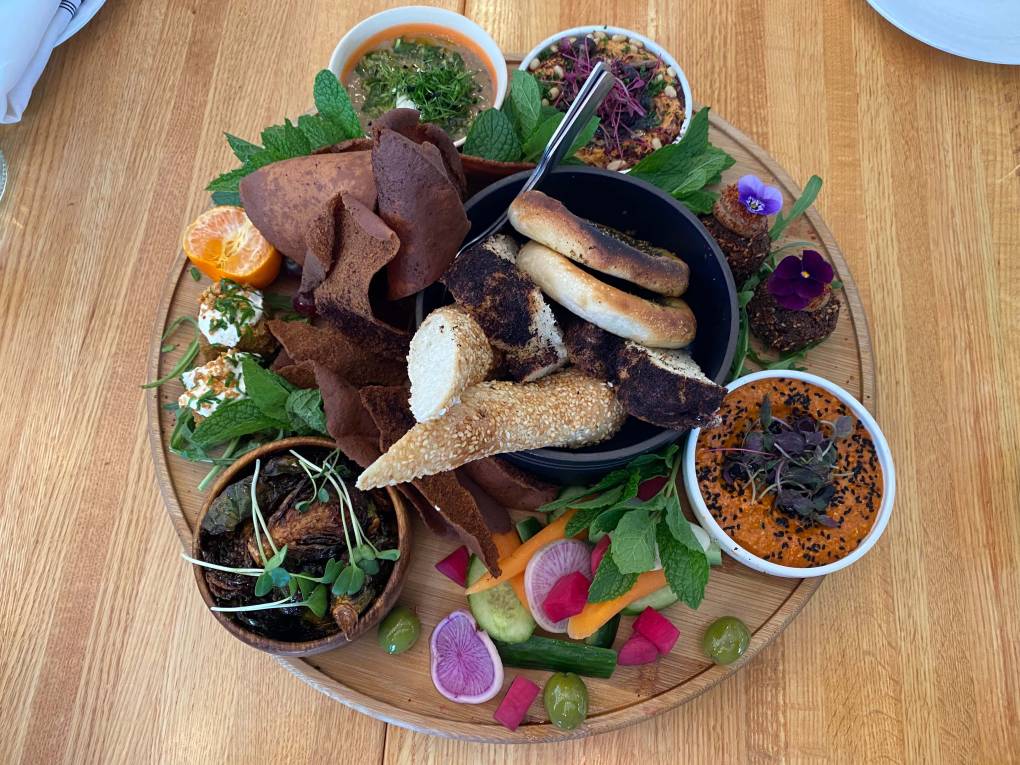
"content": "\u003cp>The first time I tried to eat at \u003ca href=\"https://www.instagram.com/p/CRW2FMbLsRd/\">Lulu\u003c/a>, I had no idea it was one of the hardest-to-snag brunch reservations in the East Bay.\u003c/p>\n\u003cp>A quick Google Maps search had clued me in to the availability of Palestinian mezzes in this sleepy stretch of West Berkeley. But the sign outside said that weekend brunch service was by reservation only — and, as a sweetly apologetic server informed us, they were already fully booked for the day. This proved to be a running refrain: The following weekend, I called first thing in the morning. Fully booked. I planned ahead and tried calling on a Wednesday. Booked all weekend long.\u003c/p>\n\u003cp>By the time I secured a table — more than a week in advance — it felt like a minor miracle. (“Usually you have to call two or three weeks ahead,” a Lulu employee later told me.) But when my family finally sat down for our long-awaited mezze brunch, it didn’t take long to understand why reservations are such a hot ticket. One bite of chef Mona Leena Michael’s silky, umami-forward chili hummus, loaded with pine nuts and shimeiji mushrooms, and I was already making plans for my next visit.\u003c/p>\n\u003cp>\u003ci>This restaurant is a dip lover’s paradise\u003c/i>, I thought to myself, scooping up more hummus with a hunk of rich sumac focaccia. And that was before I’d even tasted the creamy muhammara or the spicy, tangy fava bean dip known as ful. The spreads come as part of Lulu’s abundant and extremely \u003ca href=\"https://www.instagram.com/lulu.berkeley/tagged/\">Instagram-friendly\u003c/a> $30-a-person prix-fixe brunch spread, which takes the time-tested Palestinian tradition of feasting on assorted dips, and things to dip, and turns it into a special occasion.\u003c/p>\n\u003cfigure id=\"attachment_13931334\" class=\"wp-caption alignnone\" style=\"max-width: 1920px\">\u003cimg loading=\"lazy\" decoding=\"async\" class=\"size-full wp-image-13931334\" src=\"https://ww2.kqed.org/app/uploads/sites/2/2023/07/lulu_shouka-quiles.jpg\" alt=\"A woman's hands holding a bowl of pita chips topped with shakshouka sauce and soft-scrambled eggs.\" width=\"1920\" height=\"1281\" srcset=\"https://cdn.kqed.org/wp-content/uploads/sites/2/2023/07/lulu_shouka-quiles.jpg 1920w, https://cdn.kqed.org/wp-content/uploads/sites/2/2023/07/lulu_shouka-quiles-800x534.jpg 800w, https://cdn.kqed.org/wp-content/uploads/sites/2/2023/07/lulu_shouka-quiles-1020x681.jpg 1020w, https://cdn.kqed.org/wp-content/uploads/sites/2/2023/07/lulu_shouka-quiles-160x107.jpg 160w, https://cdn.kqed.org/wp-content/uploads/sites/2/2023/07/lulu_shouka-quiles-768x512.jpg 768w, https://cdn.kqed.org/wp-content/uploads/sites/2/2023/07/lulu_shouka-quiles-1536x1025.jpg 1536w\" sizes=\"(max-width: 1920px) 100vw, 1920px\">\u003cfigcaption class=\"wp-caption-text\">The Early Girl ‘shouka-quiles’ are a cross between shakshouka and chilaquiles. \u003ccite>(Courtesy of Lulu/StarChefs)\u003c/cite>\u003c/figcaption>\u003c/figure>\n\u003cp>As Michael tells it, the restaurant is a particular creature of the pandemic. As soon as lockdown hit, she was laid off from her job as \u003ca href=\"https://www.instagram.com/p/B01UTw6h-5g/?hl=en\">chef at Dyafa\u003c/a>, an upscale Arab restaurant on the Jack London waterfront that never wound up reopening. She hustled flatbreads out of her apartment for a while — as “\u003ca href=\"https://www.instagram.com/themanaeeshlady/\">the Mana’eesh Lady\u003c/a>” — until someone \u003ca href=\"https://www.sfchronicle.com/food/article/A-Palestinian-food-pop-up-was-shut-down-for-15558018.php\">ratted her out\u003c/a> to the Alameda County health department. It was at this point that Michael came across the tiny, out-of-the-way space on Camelia Street that used to be a British tea room. She opened Lulu there in August of 2021.\u003c/p>\n\u003cp>[ad fullwidth]\u003c/p>\n\u003cp>The setting helped shape the concept. Inspired by the charmingly bedecked three-tiered cake stands she’d always loved at classic tea rooms like Lovejoy’s in San Francisco, Michael came up with the idea of doing a big brunch board topped with elegant versions of Palestinian mezzes and dips — a kind of “Arabic high tea,” she explains.\u003c/p>\n\u003cp>\u003cspan style=\"font-weight: 400\">[aside postID='arts_13928345,arts_13894684,arts_13899700']\u003c/span>“The goal was to create something that wasn’t just a basic dining experience,” Michael says. “With the pandemic, people really needed a reason to go out — something special.”\u003c/p>\n\u003cp>What that means, in part, is that aesthetics are a big part of the restaurant’s appeal. A big mezze board is going to be a thing of beauty at almost any Turkish or Palestinian restaurant, but at Lulu, I watched a member of the staff spend several minutes arranging individual sprigs of mint on the board like a master florist. It’s the kind of eye-catching, slightly over-the-top presentation that elicits oohs and ahhs when it hits the table.\u003c/p>\n\u003cp>While the exact makeup of the brunch prix fixe changes from week to week, it generally consists of three dips, three types of bread (mana’eesh, sesame seed–topped Jerusalem bagels and sumac focaccia), crudités, falafel, a seasonal vegetable and one additional item — “something fun,” Michael says, like fried za’atar polenta topped with whipped feta.\u003c/p>\n\u003cfigure id=\"attachment_13931337\" class=\"wp-caption alignnone\" style=\"max-width: 1920px\">\u003cimg loading=\"lazy\" decoding=\"async\" class=\"size-full wp-image-13931337\" src=\"https://ww2.kqed.org/app/uploads/sites/2/2023/07/lulu_chef-leena_courtesy.jpg\" alt=\"Portrait of a chef in a pink shirt and floral apron, standing in front of her restaurant.\" width=\"1920\" height=\"1281\" srcset=\"https://cdn.kqed.org/wp-content/uploads/sites/2/2023/07/lulu_chef-leena_courtesy.jpg 1920w, https://cdn.kqed.org/wp-content/uploads/sites/2/2023/07/lulu_chef-leena_courtesy-800x534.jpg 800w, https://cdn.kqed.org/wp-content/uploads/sites/2/2023/07/lulu_chef-leena_courtesy-1020x681.jpg 1020w, https://cdn.kqed.org/wp-content/uploads/sites/2/2023/07/lulu_chef-leena_courtesy-160x107.jpg 160w, https://cdn.kqed.org/wp-content/uploads/sites/2/2023/07/lulu_chef-leena_courtesy-768x512.jpg 768w, https://cdn.kqed.org/wp-content/uploads/sites/2/2023/07/lulu_chef-leena_courtesy-1536x1025.jpg 1536w\" sizes=\"(max-width: 1920px) 100vw, 1920px\">\u003cfigcaption class=\"wp-caption-text\">Chef Mona Leena Michael’s concept for Lulu was a kind of “Arabic high tea.” \u003ccite>(Courtesy of Lulu/StarChefs)\u003c/cite>\u003c/figcaption>\u003c/figure>\n\u003cp>Really, though, all of the food is meant to be fun and not strictly traditional. “I like to say that Lulu is a California restaurant with Palestinian influence,” Michael says, explaining that she developed an appreciation for all of the Bay Area’s diverse food cultures while growing up in San Jose.\u003c/p>\n\u003cp>“Palestinians don’t flavor their hummus with chilis,” she says. “I didn’t want to open up another Arabic restaurant that just serves the same BS. I didn’t want to just do shawarma and hummus and pita bread.”\u003c/p>\n\u003cp>Every item on Lulu’s bread board takes Michael’s Palestinian family recipes — as well as the Egyptian food traditions of Lulu’s other chef, Peter Girgis — and riffs off of them in playful ways. The falafel comes crowned with a smear of chili-flecked black garlic tahini. The ful — listed on the menu as “refried beans,” in an artful bit of cultural translation — is topped with labneh and chimichurri. “We jazzed it up,” Michael says. She drew the line, though, when Girgis wanted to add a whole bunch of cumin to the ful, in the Egyptian style. (“Abso-fucking-lutely not, bro!” she says, laughing.) The \u003ca href=\"https://www.luluberkeley.com/weekend-brunch\">a la carte menu\u003c/a> includes things like a shakshuka-chilaquiles hybrid and a fried chicken sandwich with “banh mi vibes.”\u003c/p>\n\u003cfigure id=\"attachment_13931341\" class=\"wp-caption alignnone\" style=\"max-width: 1920px\">\u003cimg loading=\"lazy\" decoding=\"async\" class=\"size-full wp-image-13931341\" src=\"https://ww2.kqed.org/app/uploads/sites/2/2023/07/lulu-falafel.jpg\" alt=\"Close-up of hand holding a falafel ball topped with black garlic tahini and a purple flower.\" width=\"1920\" height=\"1440\" srcset=\"https://cdn.kqed.org/wp-content/uploads/sites/2/2023/07/lulu-falafel.jpg 1920w, https://cdn.kqed.org/wp-content/uploads/sites/2/2023/07/lulu-falafel-800x600.jpg 800w, https://cdn.kqed.org/wp-content/uploads/sites/2/2023/07/lulu-falafel-1020x765.jpg 1020w, https://cdn.kqed.org/wp-content/uploads/sites/2/2023/07/lulu-falafel-160x120.jpg 160w, https://cdn.kqed.org/wp-content/uploads/sites/2/2023/07/lulu-falafel-768x576.jpg 768w, https://cdn.kqed.org/wp-content/uploads/sites/2/2023/07/lulu-falafel-1536x1152.jpg 1536w\" sizes=\"(max-width: 1920px) 100vw, 1920px\">\u003cfigcaption class=\"wp-caption-text\">At Lulu, the falafel isn’t exactly traditional: This version is fennel-scented and topped with black garlic tahini and an edible flower. \u003ccite>(Luke Tsai)\u003c/cite>\u003c/figcaption>\u003c/figure>\n\u003cp>In about a month, the restaurant will add dinner service on Wednesdays and Thursdays. While the menu is a work in progress, Michael says customers can expect tapas-style small plates like Girgis’s pickled eggplants (inspired by his mother’s recipe) served with burrata. A signature dish will be a take on shish barak, an Arabic lamb dumpling, reimagined as a soup dumpling.\u003c/p>\n\u003cp>Meanwhile, Michael says she feels bad about how many people she’s had to turn away due to the restaurant’s small size. Fortunately, change is on the way: Sometime in November, she hopes, the restaurant will move to a bigger space a few blocks away, where she’ll have room to seat walk-ups and large groups, as well as a private dining room for special events in the back.\u003c/p>\n\u003cp>“All of our terrible reviews are people who drove from San Bruno with eight people and say, ‘What do you mean you can’t seat us?’” Michael says. “I’m just happy that I’ll be able to accommodate people in a more welcoming manner.”\u003c/p>\n\u003cp>\u003cimg loading=\"lazy\" decoding=\"async\" class=\"aligncenter size-full wp-image-12127869\" src=\"https://ww2.kqed.org/app/uploads/sites/2/2016/09/Q.Logo_.Break_.jpg\" alt=\"\" width=\"800\" height=\"78\" srcset=\"https://cdn.kqed.org/wp-content/uploads/sites/2/2016/09/Q.Logo_.Break_.jpg 800w, https://cdn.kqed.org/wp-content/uploads/sites/2/2016/09/Q.Logo_.Break_-400x39.jpg 400w, https://cdn.kqed.org/wp-content/uploads/sites/2/2016/09/Q.Logo_.Break_-768x75.jpg 768w\" sizes=\"(max-width: 800px) 100vw, 800px\">\u003c/p>\n\u003cp>[ad floatright]\u003c/p>\n\u003cp>\u003ca href=\"https://www.luluberkeley.com/\">\u003ci>Lulu\u003c/i>\u003c/a>\u003ci> is located at 1019 Camelia St. in Berkeley. It’s open for breakfast (9–11 a.m.) and lunch (11:30 a.m.–2:30 p.m.) on Wednesdays and Thursdays. Friday through Sunday, it serves brunch 9:30 a.m.–2:30 p.m., by reservation only. Soon, it will also start dinner service on Wednesdays and Thursdays.\u003c/i>\u003c/p>\n\n",
"stats": {
"hasVideo": false,
"hasChartOrMap": false,
"hasAudio": false,
"hasPolis": false,
"wordCount": 1231,
"hasGoogleForm": false,
"hasGallery": false,
"hasHearkenModule": false,
"iframeSrcs": [],
"paragraphCount": 19
},
"modified": 1705005299,
"excerpt": "Lulu in Berkeley turns California-Palestinian mezzes into an elegant ‘Arabic high tea.’",
"headData": {
"twImgId": "",
"twTitle": "The East Bay’s Hottest Brunch Is a Dip Lover’s Paradise",
"socialTitle": "Lulu in Berkeley is the East Bay’s Hottest Brunch%%page%% %%sep%% KQED",
"ogTitle": "The East Bay’s Hottest Brunch Is a Dip Lover’s Paradise",
"ogImgId": "",
"twDescription": "",
"description": "Lulu in Berkeley turns California-Palestinian mezzes into an elegant ‘Arabic high tea.’",
"title": "Lulu in Berkeley is the East Bay’s Hottest Brunch | KQED",
"ogDescription": "",
"schema": {
"@context": "https://schema.org",
"@type": "Article",
"headline": "The East Bay’s Hottest Brunch Is a Dip Lover’s Paradise",
"datePublished": "2023-07-07T11:55:11-07:00",
"dateModified": "2024-01-11T12:34:59-08:00",
"image": "https://cdn.kqed.org/wp-content/uploads/2020/02/KQED-OG-Image@1x.png"
}
},
"guestAuthors": [],
"slug": "lulu-berkeley-hottest-brunch-palestinian-mezzes",
"status": "publish",
"sourceUrl": "/food/",
"excludeFromSiteSearch": "Include",
"sticky": false,
"source": "Food",
"articleAge": "0",
"path": "/arts/13931303/lulu-berkeley-hottest-brunch-palestinian-mezzes",
"audioTrackLength": null,
"parsedContent": [
{
"type": "contentString",
"content": "\u003cdiv class=\"post-body\">\u003cp>\u003cp>The first time I tried to eat at \u003ca href=\"https://www.instagram.com/p/CRW2FMbLsRd/\">Lulu\u003c/a>, I had no idea it was one of the hardest-to-snag brunch reservations in the East Bay.\u003c/p>\n\u003cp>A quick Google Maps search had clued me in to the availability of Palestinian mezzes in this sleepy stretch of West Berkeley. But the sign outside said that weekend brunch service was by reservation only — and, as a sweetly apologetic server informed us, they were already fully booked for the day. This proved to be a running refrain: The following weekend, I called first thing in the morning. Fully booked. I planned ahead and tried calling on a Wednesday. Booked all weekend long.\u003c/p>\n\u003cp>By the time I secured a table — more than a week in advance — it felt like a minor miracle. (“Usually you have to call two or three weeks ahead,” a Lulu employee later told me.) But when my family finally sat down for our long-awaited mezze brunch, it didn’t take long to understand why reservations are such a hot ticket. One bite of chef Mona Leena Michael’s silky, umami-forward chili hummus, loaded with pine nuts and shimeiji mushrooms, and I was already making plans for my next visit.\u003c/p>\n\u003cp>\u003ci>This restaurant is a dip lover’s paradise\u003c/i>, I thought to myself, scooping up more hummus with a hunk of rich sumac focaccia. And that was before I’d even tasted the creamy muhammara or the spicy, tangy fava bean dip known as ful. The spreads come as part of Lulu’s abundant and extremely \u003ca href=\"https://www.instagram.com/lulu.berkeley/tagged/\">Instagram-friendly\u003c/a> $30-a-person prix-fixe brunch spread, which takes the time-tested Palestinian tradition of feasting on assorted dips, and things to dip, and turns it into a special occasion.\u003c/p>\n\u003cfigure id=\"attachment_13931334\" class=\"wp-caption alignnone\" style=\"max-width: 1920px\">\u003cimg loading=\"lazy\" decoding=\"async\" class=\"size-full wp-image-13931334\" src=\"https://ww2.kqed.org/app/uploads/sites/2/2023/07/lulu_shouka-quiles.jpg\" alt=\"A woman's hands holding a bowl of pita chips topped with shakshouka sauce and soft-scrambled eggs.\" width=\"1920\" height=\"1281\" srcset=\"https://cdn.kqed.org/wp-content/uploads/sites/2/2023/07/lulu_shouka-quiles.jpg 1920w, https://cdn.kqed.org/wp-content/uploads/sites/2/2023/07/lulu_shouka-quiles-800x534.jpg 800w, https://cdn.kqed.org/wp-content/uploads/sites/2/2023/07/lulu_shouka-quiles-1020x681.jpg 1020w, https://cdn.kqed.org/wp-content/uploads/sites/2/2023/07/lulu_shouka-quiles-160x107.jpg 160w, https://cdn.kqed.org/wp-content/uploads/sites/2/2023/07/lulu_shouka-quiles-768x512.jpg 768w, https://cdn.kqed.org/wp-content/uploads/sites/2/2023/07/lulu_shouka-quiles-1536x1025.jpg 1536w\" sizes=\"(max-width: 1920px) 100vw, 1920px\">\u003cfigcaption class=\"wp-caption-text\">The Early Girl ‘shouka-quiles’ are a cross between shakshouka and chilaquiles. \u003ccite>(Courtesy of Lulu/StarChefs)\u003c/cite>\u003c/figcaption>\u003c/figure>\n\u003cp>As Michael tells it, the restaurant is a particular creature of the pandemic. As soon as lockdown hit, she was laid off from her job as \u003ca href=\"https://www.instagram.com/p/B01UTw6h-5g/?hl=en\">chef at Dyafa\u003c/a>, an upscale Arab restaurant on the Jack London waterfront that never wound up reopening. She hustled flatbreads out of her apartment for a while — as “\u003ca href=\"https://www.instagram.com/themanaeeshlady/\">the Mana’eesh Lady\u003c/a>” — until someone \u003ca href=\"https://www.sfchronicle.com/food/article/A-Palestinian-food-pop-up-was-shut-down-for-15558018.php\">ratted her out\u003c/a> to the Alameda County health department. It was at this point that Michael came across the tiny, out-of-the-way space on Camelia Street that used to be a British tea room. She opened Lulu there in August of 2021.\u003c/p>\n\u003cp>\u003c/p>\u003c/div>",
"attributes": {
"named": {},
"numeric": []
}
},
{
"type": "component",
"content": "",
"name": "ad",
"attributes": {
"named": {
"label": "fullwidth"
},
"numeric": [
"fullwidth"
]
}
},
{
"type": "contentString",
"content": "\u003cdiv class=\"post-body\">\u003cp>\u003c/p>\n\u003cp>The setting helped shape the concept. Inspired by the charmingly bedecked three-tiered cake stands she’d always loved at classic tea rooms like Lovejoy’s in San Francisco, Michael came up with the idea of doing a big brunch board topped with elegant versions of Palestinian mezzes and dips — a kind of “Arabic high tea,” she explains.\u003c/p>\n\u003cp>\u003cspan style=\"font-weight: 400\">\u003c/p>\u003c/div>",
"attributes": {
"named": {},
"numeric": []
}
},
{
"type": "component",
"content": "",
"name": "aside",
"attributes": {
"named": {
"postid": "arts_13928345,arts_13894684,arts_13899700",
"label": ""
},
"numeric": []
}
},
{
"type": "contentString",
"content": "\u003cdiv class=\"post-body\">\u003cp>\u003c/span>“The goal was to create something that wasn’t just a basic dining experience,” Michael says. “With the pandemic, people really needed a reason to go out — something special.”\u003c/p>\n\u003cp>What that means, in part, is that aesthetics are a big part of the restaurant’s appeal. A big mezze board is going to be a thing of beauty at almost any Turkish or Palestinian restaurant, but at Lulu, I watched a member of the staff spend several minutes arranging individual sprigs of mint on the board like a master florist. It’s the kind of eye-catching, slightly over-the-top presentation that elicits oohs and ahhs when it hits the table.\u003c/p>\n\u003cp>While the exact makeup of the brunch prix fixe changes from week to week, it generally consists of three dips, three types of bread (mana’eesh, sesame seed–topped Jerusalem bagels and sumac focaccia), crudités, falafel, a seasonal vegetable and one additional item — “something fun,” Michael says, like fried za’atar polenta topped with whipped feta.\u003c/p>\n\u003cfigure id=\"attachment_13931337\" class=\"wp-caption alignnone\" style=\"max-width: 1920px\">\u003cimg loading=\"lazy\" decoding=\"async\" class=\"size-full wp-image-13931337\" src=\"https://ww2.kqed.org/app/uploads/sites/2/2023/07/lulu_chef-leena_courtesy.jpg\" alt=\"Portrait of a chef in a pink shirt and floral apron, standing in front of her restaurant.\" width=\"1920\" height=\"1281\" srcset=\"https://cdn.kqed.org/wp-content/uploads/sites/2/2023/07/lulu_chef-leena_courtesy.jpg 1920w, https://cdn.kqed.org/wp-content/uploads/sites/2/2023/07/lulu_chef-leena_courtesy-800x534.jpg 800w, https://cdn.kqed.org/wp-content/uploads/sites/2/2023/07/lulu_chef-leena_courtesy-1020x681.jpg 1020w, https://cdn.kqed.org/wp-content/uploads/sites/2/2023/07/lulu_chef-leena_courtesy-160x107.jpg 160w, https://cdn.kqed.org/wp-content/uploads/sites/2/2023/07/lulu_chef-leena_courtesy-768x512.jpg 768w, https://cdn.kqed.org/wp-content/uploads/sites/2/2023/07/lulu_chef-leena_courtesy-1536x1025.jpg 1536w\" sizes=\"(max-width: 1920px) 100vw, 1920px\">\u003cfigcaption class=\"wp-caption-text\">Chef Mona Leena Michael’s concept for Lulu was a kind of “Arabic high tea.” \u003ccite>(Courtesy of Lulu/StarChefs)\u003c/cite>\u003c/figcaption>\u003c/figure>\n\u003cp>Really, though, all of the food is meant to be fun and not strictly traditional. “I like to say that Lulu is a California restaurant with Palestinian influence,” Michael says, explaining that she developed an appreciation for all of the Bay Area’s diverse food cultures while growing up in San Jose.\u003c/p>\n\u003cp>“Palestinians don’t flavor their hummus with chilis,” she says. “I didn’t want to open up another Arabic restaurant that just serves the same BS. I didn’t want to just do shawarma and hummus and pita bread.”\u003c/p>\n\u003cp>Every item on Lulu’s bread board takes Michael’s Palestinian family recipes — as well as the Egyptian food traditions of Lulu’s other chef, Peter Girgis — and riffs off of them in playful ways. The falafel comes crowned with a smear of chili-flecked black garlic tahini. The ful — listed on the menu as “refried beans,” in an artful bit of cultural translation — is topped with labneh and chimichurri. “We jazzed it up,” Michael says. She drew the line, though, when Girgis wanted to add a whole bunch of cumin to the ful, in the Egyptian style. (“Abso-fucking-lutely not, bro!” she says, laughing.) The \u003ca href=\"https://www.luluberkeley.com/weekend-brunch\">a la carte menu\u003c/a> includes things like a shakshuka-chilaquiles hybrid and a fried chicken sandwich with “banh mi vibes.”\u003c/p>\n\u003cfigure id=\"attachment_13931341\" class=\"wp-caption alignnone\" style=\"max-width: 1920px\">\u003cimg loading=\"lazy\" decoding=\"async\" class=\"size-full wp-image-13931341\" src=\"https://ww2.kqed.org/app/uploads/sites/2/2023/07/lulu-falafel.jpg\" alt=\"Close-up of hand holding a falafel ball topped with black garlic tahini and a purple flower.\" width=\"1920\" height=\"1440\" srcset=\"https://cdn.kqed.org/wp-content/uploads/sites/2/2023/07/lulu-falafel.jpg 1920w, https://cdn.kqed.org/wp-content/uploads/sites/2/2023/07/lulu-falafel-800x600.jpg 800w, https://cdn.kqed.org/wp-content/uploads/sites/2/2023/07/lulu-falafel-1020x765.jpg 1020w, https://cdn.kqed.org/wp-content/uploads/sites/2/2023/07/lulu-falafel-160x120.jpg 160w, https://cdn.kqed.org/wp-content/uploads/sites/2/2023/07/lulu-falafel-768x576.jpg 768w, https://cdn.kqed.org/wp-content/uploads/sites/2/2023/07/lulu-falafel-1536x1152.jpg 1536w\" sizes=\"(max-width: 1920px) 100vw, 1920px\">\u003cfigcaption class=\"wp-caption-text\">At Lulu, the falafel isn’t exactly traditional: This version is fennel-scented and topped with black garlic tahini and an edible flower. \u003ccite>(Luke Tsai)\u003c/cite>\u003c/figcaption>\u003c/figure>\n\u003cp>In about a month, the restaurant will add dinner service on Wednesdays and Thursdays. While the menu is a work in progress, Michael says customers can expect tapas-style small plates like Girgis’s pickled eggplants (inspired by his mother’s recipe) served with burrata. A signature dish will be a take on shish barak, an Arabic lamb dumpling, reimagined as a soup dumpling.\u003c/p>\n\u003cp>Meanwhile, Michael says she feels bad about how many people she’s had to turn away due to the restaurant’s small size. Fortunately, change is on the way: Sometime in November, she hopes, the restaurant will move to a bigger space a few blocks away, where she’ll have room to seat walk-ups and large groups, as well as a private dining room for special events in the back.\u003c/p>\n\u003cp>“All of our terrible reviews are people who drove from San Bruno with eight people and say, ‘What do you mean you can’t seat us?’” Michael says. “I’m just happy that I’ll be able to accommodate people in a more welcoming manner.”\u003c/p>\n\u003cp>\u003cimg loading=\"lazy\" decoding=\"async\" class=\"aligncenter size-full wp-image-12127869\" src=\"https://ww2.kqed.org/app/uploads/sites/2/2016/09/Q.Logo_.Break_.jpg\" alt=\"\" width=\"800\" height=\"78\" srcset=\"https://cdn.kqed.org/wp-content/uploads/sites/2/2016/09/Q.Logo_.Break_.jpg 800w, https://cdn.kqed.org/wp-content/uploads/sites/2/2016/09/Q.Logo_.Break_-400x39.jpg 400w, https://cdn.kqed.org/wp-content/uploads/sites/2/2016/09/Q.Logo_.Break_-768x75.jpg 768w\" sizes=\"(max-width: 800px) 100vw, 800px\">\u003c/p>\n\u003cp>\u003c/p>\u003c/div>",
"attributes": {
"named": {},
"numeric": []
}
},
{
"type": "component",
"content": "",
"name": "ad",
"attributes": {
"named": {
"label": "floatright"
},
"numeric": [
"floatright"
]
}
},
{
"type": "contentString",
"content": "\u003cdiv class=\"post-body\">\u003cp>\u003c/p>\n\u003cp>\u003ca href=\"https://www.luluberkeley.com/\">\u003ci>Lulu\u003c/i>\u003c/a>\u003ci> is located at 1019 Camelia St. in Berkeley. It’s open for breakfast (9–11 a.m.) and lunch (11:30 a.m.–2:30 p.m.) on Wednesdays and Thursdays. Friday through Sunday, it serves brunch 9:30 a.m.–2:30 p.m., by reservation only. Soon, it will also start dinner service on Wednesdays and Thursdays.\u003c/i>\u003c/p>\n\n\u003c/div>\u003c/p>",
"attributes": {
"named": {},
"numeric": []
}
}
],
"link": "/arts/13931303/lulu-berkeley-hottest-brunch-palestinian-mezzes",
"authors": [
"11743"
],
"categories": [
"arts_1",
"arts_12276"
],
"tags": [
"arts_1270",
"arts_14873",
"arts_10278",
"arts_1297"
],
"featImg": "arts_13931336",
"label": "source_arts_13931303"
},
"arts_13931138": {
"type": "posts",
"id": "arts_13931138",
"meta": {
"index": "posts_1716263798",
"site": "arts",
"id": "13931138",
"score": null,
"sort": [
1688724034000
]
},
"parent": 0,
"labelTerm": {
"site": "arts",
"term": 8720
},
"blocks": [],
"publishDate": 1688724034,
"format": "audio",
"title": "Liner Notes: Flutist and Vocalist Elena Pinderhughes is Limitless",
"headTitle": "Liner Notes: Flutist and Vocalist Elena Pinderhughes is Limitless | KQED",
"content": "\u003cp>\u003ca href=\"https://www.instagram.com/iamelena/\" target=\"_blank\" rel=\"noopener\">Elena Pinderhughes\u003c/a> has been around the East Bay music scene since before she learned how to walk.\u003c/p>\n\u003cp>She recorded her first published work before the age of 10, and has gone on to share stages with Herbie Hancock, and work with Carlos Santana. She’s also played NPR’s Tiny Desk with Chief Xian aTunde Adjuah (formerly Christian Scott) and even played a set at Coachella with Future.\u003c/p>\n\u003cp>But Elena says she wouldn’t be where she is today without family support and the musical institutions of the East Bay. Working with her brother, pianist and vocalist Samora Pinderhughes, assisted her growth at home, while organizations like the \u003ca href=\"https://www.youngmusiciansco.org/\" target=\"_blank\" rel=\"noopener\">Young Musicians Choral Orchestra\u003c/a> aided her progress in the community.\u003c/p>\n\u003cp>As she learned more about music, she learned about the world around her and within herself. Her travels helped her realize the value of the diversity in her community back home. Through playing the flute in male-dominated bands, she gained a deeper understanding of the power she wields as a woman.\u003c/p>\n\u003cp>Now Elena is preparing for the next iteration of her career. She’s relying on the tools given to her by the Bay Area’s multi-talented musical community as she moves into the world of scoring films, making R&B music and more.\u003c/p>\n\u003cp>This week she tells us all about the depths of family bonds, and how jazz is conversation in musical form.\u003c/p>\n\u003ch5 id=\"embed-code\" class=\"inconsolata\">\n\u003c!-- iframe plugin v.4.3 wordpress.org/plugins/iframe/ -->\u003cbr>\n\u003ciframe loading=\"lazy\" frameborder=\"0\" height=\"200\" scrolling=\"no\" src=\"https://playlist.megaphone.fm/?e=KQINC9039639824&light=true\" width=\"100%\" class=\"iframe-class\">\u003c/iframe>\u003cbr>\n\u003c/h5>\n\u003cp> \u003c/p>\n\u003cp>\u003ca href=\"https://bit.ly/3NvYMuh\">Read the transcript\u003c/a>\u003c/p>\n\u003cp>Below are lightly edited excerpts of my conversation with Elena Pinderhughes\u003c/p>\n\u003cp>\u003cb>HARSHAW:\u003c/b>\u003cspan style=\"font-weight: 400\"> What do you define as jazz? \u003c/span>\u003c/p>\n\u003cp>\u003cb>PINDERHUGHES:\u003c/b>\u003cspan style=\"font-weight: 400\"> I don’t know if I have a short answer to that, but I think there’s a couple of parts of it that are really important. \u003c/span>\u003cspan style=\"font-weight: 400\">It’s creativity. It’s freedom. Its legacy. It’s music that stems from the Black experience. I think it’s really a Black cultural expression that stretches and changes with people’s experiences but is rooted in different things like call and response and different harmonic traditions that we’re all familiar with, but have been stretched and changed as the times and different generations have come through. \u003c/span>\u003c/p>\n\u003cp>\u003cspan style=\"font-weight: 400\">At its core I think it’s communication. Because when you’re playing jazz, the biggest thing is you’re listening to everybody around you, reacting. You’re communicating. \u003c/span>\u003c/p>\n\u003cp>[aside tag ='liner-notes' label= 'More From the Liner Notes Series' num='5']\u003c/p>\n\u003cp>\u003cb>HARSHAW: \u003c/b>\u003cspan style=\"font-weight: 400\">What makes the jazz scene in the Bay Area unique? \u003c/span>\u003c/p>\n\u003cp>\u003cb>PINDERHUGHES: \u003c/b>\u003cspan style=\"font-weight: 400\">I think, for me, community. I wouldn’t be who I am without that community, that mentorship, that love. The Bay Area just has this incredible group of people, musicians that lead with love. Everybody’s a mentor. Like you’d never find in the Bay Area that people aren’t willing to teach you and I think that’s unique.\u003c/span>\u003c/p>\n\u003cp>\u003cspan style=\"font-weight: 400\">No one’s going to turn you away for asking questions. They’re going to be like ‘Oh, let me let me bring you to this thing’ or ‘Let me show you where you can get this giant community of people that are just so loving, so special’ and that comes out in the music. \u003c/span>\u003c/p>\n\u003cp>\u003cimg loading=\"lazy\" decoding=\"async\" class=\"aligncenter size-full wp-image-12127869\" src=\"https://ww2.kqed.org/app/uploads/sites/2/2016/09/Q.Logo_.Break_.jpg\" alt=\"\" width=\"800\" height=\"78\" srcset=\"https://cdn.kqed.org/wp-content/uploads/sites/2/2016/09/Q.Logo_.Break_.jpg 800w, https://cdn.kqed.org/wp-content/uploads/sites/2/2016/09/Q.Logo_.Break_-400x39.jpg 400w, https://cdn.kqed.org/wp-content/uploads/sites/2/2016/09/Q.Logo_.Break_-768x75.jpg 768w\" sizes=\"(max-width: 800px) 100vw, 800px\">\u003c/p>\n\u003cp>\u003cstrong>\u003cem>Rightnowish is an arts and culture podcast produced at KQED. Listen to it wherever you get your podcasts or click the play button at the top of this page and subscribe to the show on \u003ca href=\"https://www.npr.org/podcasts/721590300/rightnowish\">NPR One\u003c/a>, \u003ca href=\"https://open.spotify.com/show/7kEJuafTzTVan7B78ttz1I\">Spotify\u003c/a>, \u003ca href=\"https://podcasts.apple.com/us/podcast/rightnowish/id1482187648\">Apple Podcasts\u003c/a>, \u003ca href=\"https://tunein.com/podcasts/Arts--Culture-Podcasts/Rightnowish-p1258245/\">TuneIn\u003c/a>, \u003ca href=\"https://www.stitcher.com/podcast/kqed/rightnowish\">Stitcher\u003c/a> or wherever you get your podcasts. \u003c/em>\u003c/strong>\u003c/p>\n\u003cp>[ad fullwidth]=\u003c/p>\n\u003cp>\u003c/p>\n",
"stats": {
"hasVideo": false,
"hasChartOrMap": false,
"hasAudio": true,
"hasPolis": false,
"wordCount": 609,
"hasGoogleForm": false,
"hasGallery": false,
"hasHearkenModule": false,
"iframeSrcs": [],
"paragraphCount": 19
},
"modified": 1710986556,
"excerpt": "Elena Pinderhughes talks about the depths of family bonds, and how jazz is conversation in musical form.",
"headData": {
"twImgId": "",
"twTitle": "",
"ogTitle": "",
"ogImgId": "",
"twDescription": "",
"description": "Elena Pinderhughes tells us all about the depths of family bonds, how jazz is conversation in musical form, and more.",
"socialDescription": "Elena Pinderhughes tells us all about the depths of family bonds, how jazz is conversation in musical form, and more.",
"title": "Liner Notes: Flutist and Vocalist Elena Pinderhughes is Limitless | KQED",
"ogDescription": "",
"schema": {
"@context": "https://schema.org",
"@type": "Article",
"headline": "Liner Notes: Flutist and Vocalist Elena Pinderhughes is Limitless",
"datePublished": "2023-07-07T03:00:34-07:00",
"dateModified": "2024-03-20T19:02:36-07:00",
"image": "https://cdn.kqed.org/wp-content/uploads/2020/02/KQED-OG-Image@1x.png"
}
},
"guestAuthors": [],
"slug": "liner-notes-flutist-and-vocalist-elena-pinderhughes-is-limitless",
"status": "publish",
"audioUrl": "https://www.podtrac.com/pts/redirect.mp3/chrt.fm/track/G6C7C3/traffic.megaphone.fm/KQINC9039639824.mp3?updated=1688686141",
"excludeFromSiteSearch": "Include",
"sticky": false,
"articleAge": "0",
"path": "/arts/13931138/liner-notes-flutist-and-vocalist-elena-pinderhughes-is-limitless",
"audioTrackLength": null,
"parsedContent": [
{
"type": "contentString",
"content": "\u003cdiv class=\"post-body\">\u003cp>\u003cp>\u003ca href=\"https://www.instagram.com/iamelena/\" target=\"_blank\" rel=\"noopener\">Elena Pinderhughes\u003c/a> has been around the East Bay music scene since before she learned how to walk.\u003c/p>\n\u003cp>She recorded her first published work before the age of 10, and has gone on to share stages with Herbie Hancock, and work with Carlos Santana. She’s also played NPR’s Tiny Desk with Chief Xian aTunde Adjuah (formerly Christian Scott) and even played a set at Coachella with Future.\u003c/p>\n\u003cp>But Elena says she wouldn’t be where she is today without family support and the musical institutions of the East Bay. Working with her brother, pianist and vocalist Samora Pinderhughes, assisted her growth at home, while organizations like the \u003ca href=\"https://www.youngmusiciansco.org/\" target=\"_blank\" rel=\"noopener\">Young Musicians Choral Orchestra\u003c/a> aided her progress in the community.\u003c/p>\n\u003cp>As she learned more about music, she learned about the world around her and within herself. Her travels helped her realize the value of the diversity in her community back home. Through playing the flute in male-dominated bands, she gained a deeper understanding of the power she wields as a woman.\u003c/p>\n\u003cp>Now Elena is preparing for the next iteration of her career. She’s relying on the tools given to her by the Bay Area’s multi-talented musical community as she moves into the world of scoring films, making R&B music and more.\u003c/p>\n\u003cp>This week she tells us all about the depths of family bonds, and how jazz is conversation in musical form.\u003c/p>\n\u003ch5 id=\"embed-code\" class=\"inconsolata\">\n\u003c!-- iframe plugin v.4.3 wordpress.org/plugins/iframe/ -->\u003cbr>\n\u003ciframe loading=\"lazy\" frameborder=\"0\" height=\"200\" scrolling=\"no\" src=\"https://playlist.megaphone.fm/?e=KQINC9039639824&light=true\" width=\"100%\" class=\"iframe-class\">\u003c/iframe>\u003cbr>\n\u003c/h5>\n\u003cp> \u003c/p>\n\u003cp>\u003ca href=\"https://bit.ly/3NvYMuh\">Read the transcript\u003c/a>\u003c/p>\n\u003cp>Below are lightly edited excerpts of my conversation with Elena Pinderhughes\u003c/p>\n\u003cp>\u003cb>HARSHAW:\u003c/b>\u003cspan style=\"font-weight: 400\"> What do you define as jazz? \u003c/span>\u003c/p>\n\u003cp>\u003cb>PINDERHUGHES:\u003c/b>\u003cspan style=\"font-weight: 400\"> I don’t know if I have a short answer to that, but I think there’s a couple of parts of it that are really important. \u003c/span>\u003cspan style=\"font-weight: 400\">It’s creativity. It’s freedom. Its legacy. It’s music that stems from the Black experience. I think it’s really a Black cultural expression that stretches and changes with people’s experiences but is rooted in different things like call and response and different harmonic traditions that we’re all familiar with, but have been stretched and changed as the times and different generations have come through. \u003c/span>\u003c/p>\n\u003cp>\u003cspan style=\"font-weight: 400\">At its core I think it’s communication. Because when you’re playing jazz, the biggest thing is you’re listening to everybody around you, reacting. You’re communicating. \u003c/span>\u003c/p>\n\u003cp>\u003c/p>\u003c/div>",
"attributes": {
"named": {},
"numeric": []
}
},
{
"type": "component",
"content": "",
"name": "aside",
"attributes": {
"named": {
"tag": "liner-notes",
"label": "More From the Liner Notes Series ",
"num": "5"
},
"numeric": []
}
},
{
"type": "contentString",
"content": "\u003cdiv class=\"post-body\">\u003cp>\u003c/p>\n\u003cp>\u003cb>HARSHAW: \u003c/b>\u003cspan style=\"font-weight: 400\">What makes the jazz scene in the Bay Area unique? \u003c/span>\u003c/p>\n\u003cp>\u003cb>PINDERHUGHES: \u003c/b>\u003cspan style=\"font-weight: 400\">I think, for me, community. I wouldn’t be who I am without that community, that mentorship, that love. The Bay Area just has this incredible group of people, musicians that lead with love. Everybody’s a mentor. Like you’d never find in the Bay Area that people aren’t willing to teach you and I think that’s unique.\u003c/span>\u003c/p>\n\u003cp>\u003cspan style=\"font-weight: 400\">No one’s going to turn you away for asking questions. They’re going to be like ‘Oh, let me let me bring you to this thing’ or ‘Let me show you where you can get this giant community of people that are just so loving, so special’ and that comes out in the music. \u003c/span>\u003c/p>\n\u003cp>\u003cimg loading=\"lazy\" decoding=\"async\" class=\"aligncenter size-full wp-image-12127869\" src=\"https://ww2.kqed.org/app/uploads/sites/2/2016/09/Q.Logo_.Break_.jpg\" alt=\"\" width=\"800\" height=\"78\" srcset=\"https://cdn.kqed.org/wp-content/uploads/sites/2/2016/09/Q.Logo_.Break_.jpg 800w, https://cdn.kqed.org/wp-content/uploads/sites/2/2016/09/Q.Logo_.Break_-400x39.jpg 400w, https://cdn.kqed.org/wp-content/uploads/sites/2/2016/09/Q.Logo_.Break_-768x75.jpg 768w\" sizes=\"(max-width: 800px) 100vw, 800px\">\u003c/p>\n\u003cp>\u003cstrong>\u003cem>Rightnowish is an arts and culture podcast produced at KQED. Listen to it wherever you get your podcasts or click the play button at the top of this page and subscribe to the show on \u003ca href=\"https://www.npr.org/podcasts/721590300/rightnowish\">NPR One\u003c/a>, \u003ca href=\"https://open.spotify.com/show/7kEJuafTzTVan7B78ttz1I\">Spotify\u003c/a>, \u003ca href=\"https://podcasts.apple.com/us/podcast/rightnowish/id1482187648\">Apple Podcasts\u003c/a>, \u003ca href=\"https://tunein.com/podcasts/Arts--Culture-Podcasts/Rightnowish-p1258245/\">TuneIn\u003c/a>, \u003ca href=\"https://www.stitcher.com/podcast/kqed/rightnowish\">Stitcher\u003c/a> or wherever you get your podcasts. \u003c/em>\u003c/strong>\u003c/p>\n\u003cp>\u003c/p>\u003c/div>",
"attributes": {
"named": {},
"numeric": []
}
},
{
"type": "component",
"content": "",
"name": "ad",
"attributes": {
"named": {
"label": "fullwidth"
},
"numeric": [
"fullwidth"
]
}
},
{
"type": "contentString",
"content": "\u003cdiv class=\"post-body\">\u003cp>=\u003c/p>\n\u003cp>\u003c/p>\n\u003c/div>\u003c/p>",
"attributes": {
"named": {},
"numeric": []
}
}
],
"link": "/arts/13931138/liner-notes-flutist-and-vocalist-elena-pinderhughes-is-limitless",
"authors": [
"11491",
"11528"
],
"programs": [
"arts_8720"
],
"categories": [
"arts_1",
"arts_69",
"arts_21759"
],
"tags": [
"arts_1270",
"arts_1420",
"arts_22035",
"arts_1143"
],
"featImg": "arts_13930309",
"label": "arts_8720"
},
"arts_13931115": {
"type": "posts",
"id": "arts_13931115",
"meta": {
"index": "posts_1716263798",
"site": "arts",
"id": "13931115",
"score": null,
"sort": [
1688153021000
]
},
"parent": 0,
"labelTerm": {},
"blocks": [],
"publishDate": 1688153021,
"format": "standard",
"title": "This New Richmond Taco Truck Is a Cheesy, Meaty Social Media Sensation",
"headTitle": "This New Richmond Taco Truck Is a Cheesy, Meaty Social Media Sensation | KQED",
"content": "\u003cp>As a crowd lines up in front of the \u003ca href=\"https://www.instagram.com/tacoselrulas/?hl=en\">Tacos El Rulas #2\u003c/a> food truck on a recent Friday night, the real show is happening a few feet away in a long, tented section of the parking lot.\u003c/p>\n\u003cp>Bookended by a big charcoal grill on one side and a spinning, sizzling al pastor trompo on the other, the taqueros work their magic on the flat-tops. They hand-press fresh tortillas, griddle onions and bell peppers in bacon fat, and layer heaps of well-charred meat and melted cheese to assemble the over-the-top creations that have become the truck’s calling card: the “papá loca” (a Mexican American analogue to the fully loaded baked potato) and the alambre — a cheesy, street food–style mixed grill that’s popular in Mexico City.\u003c/p>\n\u003cp>What I love about El Rulas is the backyard party vibe — something about the tight cluster of picnic tables and cheerful banda music and the smell of smoky grilled meats seeping deep into your clothes. All in all, it’s about as fun a place as there is right now to grab tacos in the East Bay.\u003c/p>\n\u003cfigure id=\"attachment_13931128\" class=\"wp-caption alignnone\" style=\"max-width: 1920px\">\u003cimg loading=\"lazy\" decoding=\"async\" class=\"size-full wp-image-13931128\" src=\"https://ww2.kqed.org/app/uploads/sites/2/2023/06/tacos-el-rulas_lot.jpg\" alt=\"The Tacos El Rulas #2 taco truck displays the red, green and white of the Mexican flag. To its left, the truck's taqueros prepare food on flat-top grills. To the right is a tented dining area with picnic tables.\" width=\"1920\" height=\"1440\" srcset=\"https://cdn.kqed.org/wp-content/uploads/sites/2/2023/06/tacos-el-rulas_lot.jpg 1920w, https://cdn.kqed.org/wp-content/uploads/sites/2/2023/06/tacos-el-rulas_lot-800x600.jpg 800w, https://cdn.kqed.org/wp-content/uploads/sites/2/2023/06/tacos-el-rulas_lot-1020x765.jpg 1020w, https://cdn.kqed.org/wp-content/uploads/sites/2/2023/06/tacos-el-rulas_lot-160x120.jpg 160w, https://cdn.kqed.org/wp-content/uploads/sites/2/2023/06/tacos-el-rulas_lot-768x576.jpg 768w, https://cdn.kqed.org/wp-content/uploads/sites/2/2023/06/tacos-el-rulas_lot-1536x1152.jpg 1536w\" sizes=\"(max-width: 1920px) 100vw, 1920px\">\u003cfigcaption class=\"wp-caption-text\">The taco truck’s parking lot setup feels as festive as a backyard party. \u003ccite>(Luke Tsai)\u003c/cite>\u003c/figcaption>\u003c/figure>\n\u003cp>“When a lot of people are here, it just feels like a small get-together,” says Angeles Lopez, a high school senior who helps her father, Raul Ramirez Rodriguez, operate the business. “It doesn’t really feel like I’m working.”\u003c/p>\n\u003cp>Tacos El Rulas isn’t exactly a newcomer to the East Bay taco scene. Early in the pandemic, one of its trucks — known for its \u003ca href=\"https://sf.eater.com/2021/2/11/22275500/tacos-el-rulas-truck-berkeley-quesabirria-torta-cubana-handmade-tortillas\">outlandishly overstuffed tortas\u003c/a> — debuted in the parking lot of a Berkeley auto shop. Its second truck used to be stationed at a smaller, more out-of-the-way location in Richmond, on Rumrill Road, before moving to its current spot on \u003ca href=\"https://eastbayexpress.com/a-richmond-taco-crawl-2-1/\">23rd Street\u003c/a> in March.\u003c/p>\n\u003cp>[ad fullwidth]\u003c/p>\n\u003cp>\u003cspan style=\"font-weight: 400\">[aside postID='arts_13915646,arts_13923359']\u003c/span>The new location’s popularity is, at least in part, a social media success story. I had driven past a few dozen times since it opened but, even as a fan of the Berkeley truck, never got around to stopping by. Then, a few weeks ago, three or four different \u003ca href=\"https://www.instagram.com/p/Csmwe4OpYEd/?hl=en\">food influencer\u003c/a> \u003ca href=\"https://www.instagram.com/p/CsuHiSGtc7I/?hl=en\">videos\u003c/a> featuring Tacos El Rulas popped up on my Instagram feed in the span of a couple of days — this despite the fact that the truck has almost no presence on \u003ca href=\"https://www.yelp.com/biz/tacos-el-rulas-richmond\">Yelp\u003c/a> or in traditional food media.\u003c/p>\n\u003cp>Lopez explains that the viral Instagram and TikTok videos are a deliberate part of their marketing strategy. When business lagged in the taco truck’s first couple of months, her father reached out directly to several prominent Bay Area food influencers to see if they’d be willing to help him promote his food (for a fee, of course). It seems \u003ca href=\"https://www.instagram.com/p/Cs6kFO_rIuI/?hl=en\">nearly all of them\u003c/a> said yes. According to Lopez, early boosters like \u003ca href=\"https://www.instagram.com/p/Csbu6DarI8D/?hl=en\">@booziebrunch\u003c/a> were instrumental in helping to introduce Tacos El Rulas to the Black community, which now forms a large part of the truck’s fanbase.\u003c/p>\n\u003cfigure id=\"attachment_13931130\" class=\"wp-caption alignnone\" style=\"max-width: 1920px\">\u003cimg loading=\"lazy\" decoding=\"async\" class=\"size-full wp-image-13931130\" src=\"https://ww2.kqed.org/app/uploads/sites/2/2023/06/tacos-el-rulas_alambre.jpg\" alt=\"A cheesy mix of meat, bell pappers, and onions served in an aluminum tray with a stack of corn tortillas on top.\" width=\"1920\" height=\"1440\" srcset=\"https://cdn.kqed.org/wp-content/uploads/sites/2/2023/06/tacos-el-rulas_alambre.jpg 1920w, https://cdn.kqed.org/wp-content/uploads/sites/2/2023/06/tacos-el-rulas_alambre-800x600.jpg 800w, https://cdn.kqed.org/wp-content/uploads/sites/2/2023/06/tacos-el-rulas_alambre-1020x765.jpg 1020w, https://cdn.kqed.org/wp-content/uploads/sites/2/2023/06/tacos-el-rulas_alambre-160x120.jpg 160w, https://cdn.kqed.org/wp-content/uploads/sites/2/2023/06/tacos-el-rulas_alambre-768x576.jpg 768w, https://cdn.kqed.org/wp-content/uploads/sites/2/2023/06/tacos-el-rulas_alambre-1536x1152.jpg 1536w\" sizes=\"(max-width: 1920px) 100vw, 1920px\">\u003cfigcaption class=\"wp-caption-text\">The alambre in all its glory. \u003ccite>(Luke Tsai)\u003c/cite>\u003c/figcaption>\u003c/figure>\n\u003cfigure id=\"attachment_13931129\" class=\"wp-caption alignnone\" style=\"max-width: 1920px\">\u003cimg loading=\"lazy\" decoding=\"async\" class=\"size-full wp-image-13931129\" src=\"https://ww2.kqed.org/app/uploads/sites/2/2023/06/tacos-el-rulas_alambre-closeup.jpg\" alt=\"A hand holding a taco stuffed with cheesy meat, onions, and peppers.\" width=\"1920\" height=\"1920\" srcset=\"https://cdn.kqed.org/wp-content/uploads/sites/2/2023/06/tacos-el-rulas_alambre-closeup.jpg 1920w, https://cdn.kqed.org/wp-content/uploads/sites/2/2023/06/tacos-el-rulas_alambre-closeup-800x800.jpg 800w, https://cdn.kqed.org/wp-content/uploads/sites/2/2023/06/tacos-el-rulas_alambre-closeup-1020x1020.jpg 1020w, https://cdn.kqed.org/wp-content/uploads/sites/2/2023/06/tacos-el-rulas_alambre-closeup-160x160.jpg 160w, https://cdn.kqed.org/wp-content/uploads/sites/2/2023/06/tacos-el-rulas_alambre-closeup-768x768.jpg 768w, https://cdn.kqed.org/wp-content/uploads/sites/2/2023/06/tacos-el-rulas_alambre-closeup-1536x1536.jpg 1536w\" sizes=\"(max-width: 1920px) 100vw, 1920px\">\u003cfigcaption class=\"wp-caption-text\">Assemble your own tacos. \u003ccite>(Luke Tsai)\u003c/cite>\u003c/figcaption>\u003c/figure>\n\u003cp>Of course, El Rulas’ massively portioned alambres and papás locas are uniquely suited for social media. (Everyone loves a good cheese pull, after all.) And it doesn’t hurt that those specific items — only available at the Richmond location — are legitimately delicious. The alambre is a gut-busting mix of chorizo, bacon, onions, peppers, pineapple, melted cheese and your choice of meat. As a crowning touch, a squirt of Worcestershire and Maggi seasoning adds a unique, almost stir fry–like savoriness, and the whole thing comes topped with a stack of handmade tortillas.\u003c/p>\n\u003cp>The papá loca is just as much of a crowd-pleaser: a couple of big-ass potatoes topped with an unconscionable amount of butter, bacon, cheese, onions, guacamole and, again, your choice of meat. A day’s worth of calories, probably, though it’s still hard to stop myself from eating the whole thing.\u003c/p>\n\u003cfigure id=\"attachment_13931127\" class=\"wp-caption alignnone\" style=\"max-width: 1920px\">\u003cimg loading=\"lazy\" decoding=\"async\" class=\"size-full wp-image-13931127\" src=\"https://ww2.kqed.org/app/uploads/sites/2/2023/06/tacos-el-rulas_grill.jpg\" alt=\"A man in black uses tongs to flip a rack of ribs cooking on the grill. A long chorizo sausage is coiled overhead on the frame of the grill.\" width=\"1920\" height=\"1440\" srcset=\"https://cdn.kqed.org/wp-content/uploads/sites/2/2023/06/tacos-el-rulas_grill.jpg 1920w, https://cdn.kqed.org/wp-content/uploads/sites/2/2023/06/tacos-el-rulas_grill-800x600.jpg 800w, https://cdn.kqed.org/wp-content/uploads/sites/2/2023/06/tacos-el-rulas_grill-1020x765.jpg 1020w, https://cdn.kqed.org/wp-content/uploads/sites/2/2023/06/tacos-el-rulas_grill-160x120.jpg 160w, https://cdn.kqed.org/wp-content/uploads/sites/2/2023/06/tacos-el-rulas_grill-768x576.jpg 768w, https://cdn.kqed.org/wp-content/uploads/sites/2/2023/06/tacos-el-rulas_grill-1536x1152.jpg 1536w\" sizes=\"(max-width: 1920px) 100vw, 1920px\">\u003cfigcaption class=\"wp-caption-text\">The grill station features whole racks of pork ribs, ribeye steaks and a long coil of chorizo cooking overhead. \u003ccite>(Luke Tsai)\u003c/cite>\u003c/figcaption>\u003c/figure>\n\u003cp>If anything, the Tacos El Rulas menu has so many options that it can be intimidating for a first-timer. Their signature meat is Mexico City–style al pastor sliced off a pineapple-topped vertical spit, but every time I’ve visited, something new has caught my eye: garlic-butter shrimp, racks of pork ribs, flame-grilled ribeye steaks. They do the trendy \u003ca href=\"https://sf.eater.com/2019/11/21/20937687/el-garage-quesabirria-birria-taco-richmond-instagram\">quesabirria tacos\u003c/a> here, as well as extra-crunchy vampiro tacos and quesadillas made with their fresh, hand-pressed tortillas. And while the mammoth torta Cubana has always been a star at the Berkeley truck, the Richmond location has a stand-alone torta menu with a whopping 18 varieties — more than you’ll find just about anywhere other than a dedicated torta shop.\u003c/p>\n\u003cp>“Something for everyone” might not be your typical taco truck credo, but so far, Tacos El Rulas’ maximalist, social media–driven approach seems to be working. Lopez says that customers regularly drive from as far away as Vallejo or San Francisco, often because they saw the alambre or the papá loca on TikTok or Instagram.\u003c/p>\n\u003cp>“Every time someone tells me that, I get amazed and surprised,” Lopez says. “But they always end up liking our food.”\u003c/p>\n\u003cfigure id=\"attachment_13931126\" class=\"wp-caption alignnone\" style=\"max-width: 1920px\">\u003cimg loading=\"lazy\" decoding=\"async\" class=\"size-full wp-image-13931126\" src=\"https://ww2.kqed.org/app/uploads/sites/2/2023/06/tacos-el-rulas_angeles.jpg\" alt=\"A teenage girl in a black long-sleeved Nirvana T-shirt stands in front of a green taco truck.\" width=\"1920\" height=\"1439\" srcset=\"https://cdn.kqed.org/wp-content/uploads/sites/2/2023/06/tacos-el-rulas_angeles.jpg 1920w, https://cdn.kqed.org/wp-content/uploads/sites/2/2023/06/tacos-el-rulas_angeles-800x600.jpg 800w, https://cdn.kqed.org/wp-content/uploads/sites/2/2023/06/tacos-el-rulas_angeles-1020x764.jpg 1020w, https://cdn.kqed.org/wp-content/uploads/sites/2/2023/06/tacos-el-rulas_angeles-160x120.jpg 160w, https://cdn.kqed.org/wp-content/uploads/sites/2/2023/06/tacos-el-rulas_angeles-768x576.jpg 768w, https://cdn.kqed.org/wp-content/uploads/sites/2/2023/06/tacos-el-rulas_angeles-1536x1151.jpg 1536w\" sizes=\"(max-width: 1920px) 100vw, 1920px\">\u003cfigcaption class=\"wp-caption-text\">Angeles Lopez (left), a rising high school senior, helps her father run both of the Tacos El Rulas food trucks. \u003ccite>(Luke Tsai)\u003c/cite>\u003c/figcaption>\u003c/figure>\n\u003cp>\u003c/p>\n\u003cp>\u003cimg loading=\"lazy\" decoding=\"async\" class=\"aligncenter size-full wp-image-12127869\" src=\"https://ww2.kqed.org/app/uploads/sites/2/2016/09/Q.Logo_.Break_.jpg\" alt=\"\" width=\"800\" height=\"78\" srcset=\"https://cdn.kqed.org/wp-content/uploads/sites/2/2016/09/Q.Logo_.Break_.jpg 800w, https://cdn.kqed.org/wp-content/uploads/sites/2/2016/09/Q.Logo_.Break_-400x39.jpg 400w, https://cdn.kqed.org/wp-content/uploads/sites/2/2016/09/Q.Logo_.Break_-768x75.jpg 768w\" sizes=\"(max-width: 800px) 100vw, 800px\">\u003ca href=\"https://www.instagram.com/tacoselrulas/?hl=en\">\u003ci>Tacos El Rulas #2\u003c/i>\u003c/a>\u003ci> is located at 232 23rd St. in Richmond, in a parking lot shared by a beauty salon and an astrology shop. It’s open Sundays–Thursdays from 4 p.m. to midnight, and Fridays–Saurdays from 4 p.m. to 1 a.m.\u003c/i>\u003c/p>\n\n",
"stats": {
"hasVideo": false,
"hasChartOrMap": false,
"hasAudio": false,
"hasPolis": false,
"wordCount": 1012,
"hasGoogleForm": false,
"hasGallery": false,
"hasHearkenModule": false,
"iframeSrcs": [],
"paragraphCount": 15
},
"modified": 1705005320,
"excerpt": "Tacos El Rulas is winning hearts and minds — and Instagram feeds — with its decadent alambres and papás locas.",
"headData": {
"twImgId": "",
"twTitle": "This New Richmond Taco Truck Is a Cheesy, Meaty Social Media Sensation",
"socialTitle": "Richmond's Tacos El Rulas Taco Truck Is an Instagram Sensation %%page%% %%sep%% KQED",
"ogTitle": "This New Richmond Taco Truck Is a Cheesy, Meaty Social Media Sensation",
"ogImgId": "",
"twDescription": "",
"description": "Tacos El Rulas is winning hearts and minds — and Instagram feeds — with its decadent alambres and papás locas.",
"title": "Richmond's Tacos El Rulas Taco Truck Is an Instagram Sensation | KQED",
"ogDescription": "",
"schema": {
"@context": "https://schema.org",
"@type": "Article",
"headline": "This New Richmond Taco Truck Is a Cheesy, Meaty Social Media Sensation",
"datePublished": "2023-06-30T12:23:41-07:00",
"dateModified": "2024-01-11T12:35:20-08:00",
"image": "https://cdn.kqed.org/wp-content/uploads/2020/02/KQED-OG-Image@1x.png"
}
},
"guestAuthors": [],
"slug": "tacos-el-rulas-richmond-taco-truck-alambre-papa-loca-instagram-food-influencer",
"status": "publish",
"sourceUrl": "/food/",
"excludeFromSiteSearch": "Include",
"sticky": false,
"source": "Food",
"articleAge": "0",
"path": "/arts/13931115/tacos-el-rulas-richmond-taco-truck-alambre-papa-loca-instagram-food-influencer",
"audioTrackLength": null,
"parsedContent": [
{
"type": "contentString",
"content": "\u003cdiv class=\"post-body\">\u003cp>\u003cp>As a crowd lines up in front of the \u003ca href=\"https://www.instagram.com/tacoselrulas/?hl=en\">Tacos El Rulas #2\u003c/a> food truck on a recent Friday night, the real show is happening a few feet away in a long, tented section of the parking lot.\u003c/p>\n\u003cp>Bookended by a big charcoal grill on one side and a spinning, sizzling al pastor trompo on the other, the taqueros work their magic on the flat-tops. They hand-press fresh tortillas, griddle onions and bell peppers in bacon fat, and layer heaps of well-charred meat and melted cheese to assemble the over-the-top creations that have become the truck’s calling card: the “papá loca” (a Mexican American analogue to the fully loaded baked potato) and the alambre — a cheesy, street food–style mixed grill that’s popular in Mexico City.\u003c/p>\n\u003cp>What I love about El Rulas is the backyard party vibe — something about the tight cluster of picnic tables and cheerful banda music and the smell of smoky grilled meats seeping deep into your clothes. All in all, it’s about as fun a place as there is right now to grab tacos in the East Bay.\u003c/p>\n\u003cfigure id=\"attachment_13931128\" class=\"wp-caption alignnone\" style=\"max-width: 1920px\">\u003cimg loading=\"lazy\" decoding=\"async\" class=\"size-full wp-image-13931128\" src=\"https://ww2.kqed.org/app/uploads/sites/2/2023/06/tacos-el-rulas_lot.jpg\" alt=\"The Tacos El Rulas #2 taco truck displays the red, green and white of the Mexican flag. To its left, the truck's taqueros prepare food on flat-top grills. To the right is a tented dining area with picnic tables.\" width=\"1920\" height=\"1440\" srcset=\"https://cdn.kqed.org/wp-content/uploads/sites/2/2023/06/tacos-el-rulas_lot.jpg 1920w, https://cdn.kqed.org/wp-content/uploads/sites/2/2023/06/tacos-el-rulas_lot-800x600.jpg 800w, https://cdn.kqed.org/wp-content/uploads/sites/2/2023/06/tacos-el-rulas_lot-1020x765.jpg 1020w, https://cdn.kqed.org/wp-content/uploads/sites/2/2023/06/tacos-el-rulas_lot-160x120.jpg 160w, https://cdn.kqed.org/wp-content/uploads/sites/2/2023/06/tacos-el-rulas_lot-768x576.jpg 768w, https://cdn.kqed.org/wp-content/uploads/sites/2/2023/06/tacos-el-rulas_lot-1536x1152.jpg 1536w\" sizes=\"(max-width: 1920px) 100vw, 1920px\">\u003cfigcaption class=\"wp-caption-text\">The taco truck’s parking lot setup feels as festive as a backyard party. \u003ccite>(Luke Tsai)\u003c/cite>\u003c/figcaption>\u003c/figure>\n\u003cp>“When a lot of people are here, it just feels like a small get-together,” says Angeles Lopez, a high school senior who helps her father, Raul Ramirez Rodriguez, operate the business. “It doesn’t really feel like I’m working.”\u003c/p>\n\u003cp>Tacos El Rulas isn’t exactly a newcomer to the East Bay taco scene. Early in the pandemic, one of its trucks — known for its \u003ca href=\"https://sf.eater.com/2021/2/11/22275500/tacos-el-rulas-truck-berkeley-quesabirria-torta-cubana-handmade-tortillas\">outlandishly overstuffed tortas\u003c/a> — debuted in the parking lot of a Berkeley auto shop. Its second truck used to be stationed at a smaller, more out-of-the-way location in Richmond, on Rumrill Road, before moving to its current spot on \u003ca href=\"https://eastbayexpress.com/a-richmond-taco-crawl-2-1/\">23rd Street\u003c/a> in March.\u003c/p>\n\u003cp>\u003c/p>\u003c/div>",
"attributes": {
"named": {},
"numeric": []
}
},
{
"type": "component",
"content": "",
"name": "ad",
"attributes": {
"named": {
"label": "fullwidth"
},
"numeric": [
"fullwidth"
]
}
},
{
"type": "contentString",
"content": "\u003cdiv class=\"post-body\">\u003cp>\u003c/p>\n\u003cp>\u003cspan style=\"font-weight: 400\">\u003c/p>\u003c/div>",
"attributes": {
"named": {},
"numeric": []
}
},
{
"type": "component",
"content": "",
"name": "aside",
"attributes": {
"named": {
"postid": "arts_13915646,arts_13923359",
"label": ""
},
"numeric": []
}
},
{
"type": "contentString",
"content": "\u003cdiv class=\"post-body\">\u003cp>\u003c/span>The new location’s popularity is, at least in part, a social media success story. I had driven past a few dozen times since it opened but, even as a fan of the Berkeley truck, never got around to stopping by. Then, a few weeks ago, three or four different \u003ca href=\"https://www.instagram.com/p/Csmwe4OpYEd/?hl=en\">food influencer\u003c/a> \u003ca href=\"https://www.instagram.com/p/CsuHiSGtc7I/?hl=en\">videos\u003c/a> featuring Tacos El Rulas popped up on my Instagram feed in the span of a couple of days — this despite the fact that the truck has almost no presence on \u003ca href=\"https://www.yelp.com/biz/tacos-el-rulas-richmond\">Yelp\u003c/a> or in traditional food media.\u003c/p>\n\u003cp>Lopez explains that the viral Instagram and TikTok videos are a deliberate part of their marketing strategy. When business lagged in the taco truck’s first couple of months, her father reached out directly to several prominent Bay Area food influencers to see if they’d be willing to help him promote his food (for a fee, of course). It seems \u003ca href=\"https://www.instagram.com/p/Cs6kFO_rIuI/?hl=en\">nearly all of them\u003c/a> said yes. According to Lopez, early boosters like \u003ca href=\"https://www.instagram.com/p/Csbu6DarI8D/?hl=en\">@booziebrunch\u003c/a> were instrumental in helping to introduce Tacos El Rulas to the Black community, which now forms a large part of the truck’s fanbase.\u003c/p>\n\u003cfigure id=\"attachment_13931130\" class=\"wp-caption alignnone\" style=\"max-width: 1920px\">\u003cimg loading=\"lazy\" decoding=\"async\" class=\"size-full wp-image-13931130\" src=\"https://ww2.kqed.org/app/uploads/sites/2/2023/06/tacos-el-rulas_alambre.jpg\" alt=\"A cheesy mix of meat, bell pappers, and onions served in an aluminum tray with a stack of corn tortillas on top.\" width=\"1920\" height=\"1440\" srcset=\"https://cdn.kqed.org/wp-content/uploads/sites/2/2023/06/tacos-el-rulas_alambre.jpg 1920w, https://cdn.kqed.org/wp-content/uploads/sites/2/2023/06/tacos-el-rulas_alambre-800x600.jpg 800w, https://cdn.kqed.org/wp-content/uploads/sites/2/2023/06/tacos-el-rulas_alambre-1020x765.jpg 1020w, https://cdn.kqed.org/wp-content/uploads/sites/2/2023/06/tacos-el-rulas_alambre-160x120.jpg 160w, https://cdn.kqed.org/wp-content/uploads/sites/2/2023/06/tacos-el-rulas_alambre-768x576.jpg 768w, https://cdn.kqed.org/wp-content/uploads/sites/2/2023/06/tacos-el-rulas_alambre-1536x1152.jpg 1536w\" sizes=\"(max-width: 1920px) 100vw, 1920px\">\u003cfigcaption class=\"wp-caption-text\">The alambre in all its glory. \u003ccite>(Luke Tsai)\u003c/cite>\u003c/figcaption>\u003c/figure>\n\u003cfigure id=\"attachment_13931129\" class=\"wp-caption alignnone\" style=\"max-width: 1920px\">\u003cimg loading=\"lazy\" decoding=\"async\" class=\"size-full wp-image-13931129\" src=\"https://ww2.kqed.org/app/uploads/sites/2/2023/06/tacos-el-rulas_alambre-closeup.jpg\" alt=\"A hand holding a taco stuffed with cheesy meat, onions, and peppers.\" width=\"1920\" height=\"1920\" srcset=\"https://cdn.kqed.org/wp-content/uploads/sites/2/2023/06/tacos-el-rulas_alambre-closeup.jpg 1920w, https://cdn.kqed.org/wp-content/uploads/sites/2/2023/06/tacos-el-rulas_alambre-closeup-800x800.jpg 800w, https://cdn.kqed.org/wp-content/uploads/sites/2/2023/06/tacos-el-rulas_alambre-closeup-1020x1020.jpg 1020w, https://cdn.kqed.org/wp-content/uploads/sites/2/2023/06/tacos-el-rulas_alambre-closeup-160x160.jpg 160w, https://cdn.kqed.org/wp-content/uploads/sites/2/2023/06/tacos-el-rulas_alambre-closeup-768x768.jpg 768w, https://cdn.kqed.org/wp-content/uploads/sites/2/2023/06/tacos-el-rulas_alambre-closeup-1536x1536.jpg 1536w\" sizes=\"(max-width: 1920px) 100vw, 1920px\">\u003cfigcaption class=\"wp-caption-text\">Assemble your own tacos. \u003ccite>(Luke Tsai)\u003c/cite>\u003c/figcaption>\u003c/figure>\n\u003cp>Of course, El Rulas’ massively portioned alambres and papás locas are uniquely suited for social media. (Everyone loves a good cheese pull, after all.) And it doesn’t hurt that those specific items — only available at the Richmond location — are legitimately delicious. The alambre is a gut-busting mix of chorizo, bacon, onions, peppers, pineapple, melted cheese and your choice of meat. As a crowning touch, a squirt of Worcestershire and Maggi seasoning adds a unique, almost stir fry–like savoriness, and the whole thing comes topped with a stack of handmade tortillas.\u003c/p>\n\u003cp>The papá loca is just as much of a crowd-pleaser: a couple of big-ass potatoes topped with an unconscionable amount of butter, bacon, cheese, onions, guacamole and, again, your choice of meat. A day’s worth of calories, probably, though it’s still hard to stop myself from eating the whole thing.\u003c/p>\n\u003cfigure id=\"attachment_13931127\" class=\"wp-caption alignnone\" style=\"max-width: 1920px\">\u003cimg loading=\"lazy\" decoding=\"async\" class=\"size-full wp-image-13931127\" src=\"https://ww2.kqed.org/app/uploads/sites/2/2023/06/tacos-el-rulas_grill.jpg\" alt=\"A man in black uses tongs to flip a rack of ribs cooking on the grill. A long chorizo sausage is coiled overhead on the frame of the grill.\" width=\"1920\" height=\"1440\" srcset=\"https://cdn.kqed.org/wp-content/uploads/sites/2/2023/06/tacos-el-rulas_grill.jpg 1920w, https://cdn.kqed.org/wp-content/uploads/sites/2/2023/06/tacos-el-rulas_grill-800x600.jpg 800w, https://cdn.kqed.org/wp-content/uploads/sites/2/2023/06/tacos-el-rulas_grill-1020x765.jpg 1020w, https://cdn.kqed.org/wp-content/uploads/sites/2/2023/06/tacos-el-rulas_grill-160x120.jpg 160w, https://cdn.kqed.org/wp-content/uploads/sites/2/2023/06/tacos-el-rulas_grill-768x576.jpg 768w, https://cdn.kqed.org/wp-content/uploads/sites/2/2023/06/tacos-el-rulas_grill-1536x1152.jpg 1536w\" sizes=\"(max-width: 1920px) 100vw, 1920px\">\u003cfigcaption class=\"wp-caption-text\">The grill station features whole racks of pork ribs, ribeye steaks and a long coil of chorizo cooking overhead. \u003ccite>(Luke Tsai)\u003c/cite>\u003c/figcaption>\u003c/figure>\n\u003cp>If anything, the Tacos El Rulas menu has so many options that it can be intimidating for a first-timer. Their signature meat is Mexico City–style al pastor sliced off a pineapple-topped vertical spit, but every time I’ve visited, something new has caught my eye: garlic-butter shrimp, racks of pork ribs, flame-grilled ribeye steaks. They do the trendy \u003ca href=\"https://sf.eater.com/2019/11/21/20937687/el-garage-quesabirria-birria-taco-richmond-instagram\">quesabirria tacos\u003c/a> here, as well as extra-crunchy vampiro tacos and quesadillas made with their fresh, hand-pressed tortillas. And while the mammoth torta Cubana has always been a star at the Berkeley truck, the Richmond location has a stand-alone torta menu with a whopping 18 varieties — more than you’ll find just about anywhere other than a dedicated torta shop.\u003c/p>\n\u003cp>“Something for everyone” might not be your typical taco truck credo, but so far, Tacos El Rulas’ maximalist, social media–driven approach seems to be working. Lopez says that customers regularly drive from as far away as Vallejo or San Francisco, often because they saw the alambre or the papá loca on TikTok or Instagram.\u003c/p>\n\u003cp>“Every time someone tells me that, I get amazed and surprised,” Lopez says. “But they always end up liking our food.”\u003c/p>\n\u003cfigure id=\"attachment_13931126\" class=\"wp-caption alignnone\" style=\"max-width: 1920px\">\u003cimg loading=\"lazy\" decoding=\"async\" class=\"size-full wp-image-13931126\" src=\"https://ww2.kqed.org/app/uploads/sites/2/2023/06/tacos-el-rulas_angeles.jpg\" alt=\"A teenage girl in a black long-sleeved Nirvana T-shirt stands in front of a green taco truck.\" width=\"1920\" height=\"1439\" srcset=\"https://cdn.kqed.org/wp-content/uploads/sites/2/2023/06/tacos-el-rulas_angeles.jpg 1920w, https://cdn.kqed.org/wp-content/uploads/sites/2/2023/06/tacos-el-rulas_angeles-800x600.jpg 800w, https://cdn.kqed.org/wp-content/uploads/sites/2/2023/06/tacos-el-rulas_angeles-1020x764.jpg 1020w, https://cdn.kqed.org/wp-content/uploads/sites/2/2023/06/tacos-el-rulas_angeles-160x120.jpg 160w, https://cdn.kqed.org/wp-content/uploads/sites/2/2023/06/tacos-el-rulas_angeles-768x576.jpg 768w, https://cdn.kqed.org/wp-content/uploads/sites/2/2023/06/tacos-el-rulas_angeles-1536x1151.jpg 1536w\" sizes=\"(max-width: 1920px) 100vw, 1920px\">\u003cfigcaption class=\"wp-caption-text\">Angeles Lopez (left), a rising high school senior, helps her father run both of the Tacos El Rulas food trucks. \u003ccite>(Luke Tsai)\u003c/cite>\u003c/figcaption>\u003c/figure>\n\u003cp>\u003c/p>\n\u003cp>\u003cimg loading=\"lazy\" decoding=\"async\" class=\"aligncenter size-full wp-image-12127869\" src=\"https://ww2.kqed.org/app/uploads/sites/2/2016/09/Q.Logo_.Break_.jpg\" alt=\"\" width=\"800\" height=\"78\" srcset=\"https://cdn.kqed.org/wp-content/uploads/sites/2/2016/09/Q.Logo_.Break_.jpg 800w, https://cdn.kqed.org/wp-content/uploads/sites/2/2016/09/Q.Logo_.Break_-400x39.jpg 400w, https://cdn.kqed.org/wp-content/uploads/sites/2/2016/09/Q.Logo_.Break_-768x75.jpg 768w\" sizes=\"(max-width: 800px) 100vw, 800px\">\u003ca href=\"https://www.instagram.com/tacoselrulas/?hl=en\">\u003ci>Tacos El Rulas #2\u003c/i>\u003c/a>\u003ci> is located at 232 23rd St. in Richmond, in a parking lot shared by a beauty salon and an astrology shop. It’s open Sundays–Thursdays from 4 p.m. to midnight, and Fridays–Saurdays from 4 p.m. to 1 a.m.\u003c/i>\u003c/p>\n\n\u003c/div>\u003c/p>",
"attributes": {
"named": {},
"numeric": []
}
}
],
"link": "/arts/13931115/tacos-el-rulas-richmond-taco-truck-alambre-papa-loca-instagram-food-influencer",
"authors": [
"11743"
],
"categories": [
"arts_1",
"arts_12276"
],
"tags": [
"arts_1270",
"arts_10278",
"arts_1297",
"arts_2098",
"arts_14985",
"arts_14062",
"arts_2479",
"arts_2137",
"arts_14984",
"arts_8017"
],
"featImg": "arts_13931125",
"label": "source_arts_13931115"
},
"arts_13930727": {
"type": "posts",
"id": "arts_13930727",
"meta": {
"index": "posts_1716263798",
"site": "arts",
"id": "13930727",
"score": null,
"sort": [
1687455136000
]
},
"guestAuthors": [],
"slug": "comic-lost-cafes-coffee-shops-the-med-au-coquelet-gaylords-oakland-berkeley",
"title": "Please, Don’t Forget Me: Cafes We Have Lost",
"publishDate": 1687455136,
"format": "aside",
"headTitle": "Please, Don’t Forget Me: Cafes We Have Lost | KQED",
"labelTerm": {},
"content": "\u003cp>I was born and grew up in the East Bay. We have seen a lot of change in the last ten years. A lot of great new places have opened, but we have also lost so many beloved establishments. What I covet most are the big, spacious cafes where you could sit for hours and work or do nothing — or a little of both. This piece is a love letter to the places that raised me. They haunt me in the best way possible, and I miss them like crazy.\u003c/p>\n\u003cp>\u003cimg loading=\"lazy\" decoding=\"async\" class=\"alignnone size-full wp-image-13930738\" src=\"https://ww2.kqed.org/app/uploads/sites/2/2023/06/CafesWeHaveLost_BL_Med_1.jpg\" alt=\"Illustration: A man and his young daughter stroll outside of a cafe whose green and white striped facade reads, "Caffe Mediterraneum." This is the lead panel for a comic titled "Please, Don't Forget Me: Cafes We Have Lost," by Briana Loewinsohn\" width=\"1920\" height=\"1920\" srcset=\"https://cdn.kqed.org/wp-content/uploads/sites/2/2023/06/CafesWeHaveLost_BL_Med_1.jpg 1920w, https://cdn.kqed.org/wp-content/uploads/sites/2/2023/06/CafesWeHaveLost_BL_Med_1-800x800.jpg 800w, https://cdn.kqed.org/wp-content/uploads/sites/2/2023/06/CafesWeHaveLost_BL_Med_1-1020x1020.jpg 1020w, https://cdn.kqed.org/wp-content/uploads/sites/2/2023/06/CafesWeHaveLost_BL_Med_1-160x160.jpg 160w, https://cdn.kqed.org/wp-content/uploads/sites/2/2023/06/CafesWeHaveLost_BL_Med_1-768x768.jpg 768w, https://cdn.kqed.org/wp-content/uploads/sites/2/2023/06/CafesWeHaveLost_BL_Med_1-1536x1536.jpg 1536w\" sizes=\"(max-width: 1920px) 100vw, 1920px\" />\u003c/p>\n\u003cp>\u003cimg loading=\"lazy\" decoding=\"async\" class=\"alignnone size-full wp-image-13930736\" src=\"https://ww2.kqed.org/app/uploads/sites/2/2023/06/CafesWeHaveLost_BL_Med_2.jpg\" alt=\"This panel is dated "1987." Balding father and young daughter order at the cafe counter where colorful flavored syrups are displayed in the back. The store employee is wearing a black t-shirt that says, "The Cure." "A cappuccino please," says the dad. "And a lime Italian soda, please," says the girl.\" width=\"1920\" height=\"1920\" srcset=\"https://cdn.kqed.org/wp-content/uploads/sites/2/2023/06/CafesWeHaveLost_BL_Med_2.jpg 1920w, https://cdn.kqed.org/wp-content/uploads/sites/2/2023/06/CafesWeHaveLost_BL_Med_2-800x800.jpg 800w, https://cdn.kqed.org/wp-content/uploads/sites/2/2023/06/CafesWeHaveLost_BL_Med_2-1020x1020.jpg 1020w, https://cdn.kqed.org/wp-content/uploads/sites/2/2023/06/CafesWeHaveLost_BL_Med_2-160x160.jpg 160w, https://cdn.kqed.org/wp-content/uploads/sites/2/2023/06/CafesWeHaveLost_BL_Med_2-768x768.jpg 768w, https://cdn.kqed.org/wp-content/uploads/sites/2/2023/06/CafesWeHaveLost_BL_Med_2-1536x1536.jpg 1536w\" sizes=\"(max-width: 1920px) 100vw, 1920px\" />\u003c/p>\n\u003cp>\u003cimg loading=\"lazy\" decoding=\"async\" class=\"alignnone size-full wp-image-13930735\" src=\"https://ww2.kqed.org/app/uploads/sites/2/2023/06/CafesWeHaveLost_BL_Med_3.jpg\" alt=\"The father, wearing a green A's shirt, sits at a table in the cafe with his daughter, who looks down at her glass of soda.\" width=\"1920\" height=\"1920\" srcset=\"https://cdn.kqed.org/wp-content/uploads/sites/2/2023/06/CafesWeHaveLost_BL_Med_3.jpg 1920w, https://cdn.kqed.org/wp-content/uploads/sites/2/2023/06/CafesWeHaveLost_BL_Med_3-800x800.jpg 800w, https://cdn.kqed.org/wp-content/uploads/sites/2/2023/06/CafesWeHaveLost_BL_Med_3-1020x1020.jpg 1020w, https://cdn.kqed.org/wp-content/uploads/sites/2/2023/06/CafesWeHaveLost_BL_Med_3-160x160.jpg 160w, https://cdn.kqed.org/wp-content/uploads/sites/2/2023/06/CafesWeHaveLost_BL_Med_3-768x768.jpg 768w, https://cdn.kqed.org/wp-content/uploads/sites/2/2023/06/CafesWeHaveLost_BL_Med_3-1536x1536.jpg 1536w\" sizes=\"(max-width: 1920px) 100vw, 1920px\" />\u003c/p>\n\u003cp>\u003cimg loading=\"lazy\" decoding=\"async\" class=\"alignnone size-full wp-image-13930734\" src=\"https://ww2.kqed.org/app/uploads/sites/2/2023/06/CafesWeHaveLost_BL_Med_4.jpg\" alt=\"The dad is now daydreaming. In a sepia-toned thought bubble he pictures the cafe as it was during the 1960s.\" width=\"1920\" height=\"1920\" srcset=\"https://cdn.kqed.org/wp-content/uploads/sites/2/2023/06/CafesWeHaveLost_BL_Med_4.jpg 1920w, https://cdn.kqed.org/wp-content/uploads/sites/2/2023/06/CafesWeHaveLost_BL_Med_4-800x800.jpg 800w, https://cdn.kqed.org/wp-content/uploads/sites/2/2023/06/CafesWeHaveLost_BL_Med_4-1020x1020.jpg 1020w, https://cdn.kqed.org/wp-content/uploads/sites/2/2023/06/CafesWeHaveLost_BL_Med_4-160x160.jpg 160w, https://cdn.kqed.org/wp-content/uploads/sites/2/2023/06/CafesWeHaveLost_BL_Med_4-768x768.jpg 768w, https://cdn.kqed.org/wp-content/uploads/sites/2/2023/06/CafesWeHaveLost_BL_Med_4-1536x1536.jpg 1536w\" sizes=\"(max-width: 1920px) 100vw, 1920px\" />\u003c/p>\n\u003cp>\u003cimg loading=\"lazy\" decoding=\"async\" class=\"alignnone size-full wp-image-13930733\" src=\"https://ww2.kqed.org/app/uploads/sites/2/2023/06/CafesWeHaveLost_BL_Med_5.jpg\" alt=\"The daydream bubble now takes over the entire panel. Beatnik-looking types lounge in the cafe, smoking and drinking coffee. The dad in his younger days sports a big, poofy hairstyle and wears a vest over his green, 60s-style button-down.\" width=\"1920\" height=\"1920\" srcset=\"https://cdn.kqed.org/wp-content/uploads/sites/2/2023/06/CafesWeHaveLost_BL_Med_5.jpg 1920w, https://cdn.kqed.org/wp-content/uploads/sites/2/2023/06/CafesWeHaveLost_BL_Med_5-800x800.jpg 800w, https://cdn.kqed.org/wp-content/uploads/sites/2/2023/06/CafesWeHaveLost_BL_Med_5-1020x1020.jpg 1020w, https://cdn.kqed.org/wp-content/uploads/sites/2/2023/06/CafesWeHaveLost_BL_Med_5-160x160.jpg 160w, https://cdn.kqed.org/wp-content/uploads/sites/2/2023/06/CafesWeHaveLost_BL_Med_5-768x768.jpg 768w, https://cdn.kqed.org/wp-content/uploads/sites/2/2023/06/CafesWeHaveLost_BL_Med_5-1536x1536.jpg 1536w\" sizes=\"(max-width: 1920px) 100vw, 1920px\" />\u003c/p>\n\u003cp>\u003cimg loading=\"lazy\" decoding=\"async\" class=\"alignnone size-full wp-image-13930732\" src=\"https://ww2.kqed.org/app/uploads/sites/2/2023/06/CafesWeHaveLost_BL_Med_6.jpg\" alt=\"Still in his daydream, the dad walks over to two African American men seated at another table. He daps up the one with a beard wearing a turtleneck. The other, in glasses, holds a cigarette over an ashtray.\" width=\"1920\" height=\"1920\" srcset=\"https://cdn.kqed.org/wp-content/uploads/sites/2/2023/06/CafesWeHaveLost_BL_Med_6.jpg 1920w, https://cdn.kqed.org/wp-content/uploads/sites/2/2023/06/CafesWeHaveLost_BL_Med_6-800x800.jpg 800w, https://cdn.kqed.org/wp-content/uploads/sites/2/2023/06/CafesWeHaveLost_BL_Med_6-1020x1020.jpg 1020w, https://cdn.kqed.org/wp-content/uploads/sites/2/2023/06/CafesWeHaveLost_BL_Med_6-160x160.jpg 160w, https://cdn.kqed.org/wp-content/uploads/sites/2/2023/06/CafesWeHaveLost_BL_Med_6-768x768.jpg 768w, https://cdn.kqed.org/wp-content/uploads/sites/2/2023/06/CafesWeHaveLost_BL_Med_6-1536x1536.jpg 1536w\" sizes=\"(max-width: 1920px) 100vw, 1920px\" />\u003c/p>\n\u003cp>\u003cimg loading=\"lazy\" decoding=\"async\" class=\"alignnone size-full wp-image-13930731\" src=\"https://ww2.kqed.org/app/uploads/sites/2/2023/06/CafesWeHaveLost_BL_Med_7.jpg\" alt=\"Still in the daydream, the dad now sits next to an attractive, smiling young woman holding a cigarette between her fingers. The two appear to be flirting.\" width=\"1920\" height=\"1920\" srcset=\"https://cdn.kqed.org/wp-content/uploads/sites/2/2023/06/CafesWeHaveLost_BL_Med_7.jpg 1920w, https://cdn.kqed.org/wp-content/uploads/sites/2/2023/06/CafesWeHaveLost_BL_Med_7-800x800.jpg 800w, https://cdn.kqed.org/wp-content/uploads/sites/2/2023/06/CafesWeHaveLost_BL_Med_7-1020x1020.jpg 1020w, https://cdn.kqed.org/wp-content/uploads/sites/2/2023/06/CafesWeHaveLost_BL_Med_7-160x160.jpg 160w, https://cdn.kqed.org/wp-content/uploads/sites/2/2023/06/CafesWeHaveLost_BL_Med_7-768x768.jpg 768w, https://cdn.kqed.org/wp-content/uploads/sites/2/2023/06/CafesWeHaveLost_BL_Med_7-1536x1536.jpg 1536w\" sizes=\"(max-width: 1920px) 100vw, 1920px\" />\u003c/p>\n\u003cp>\u003cimg loading=\"lazy\" decoding=\"async\" class=\"alignnone size-full wp-image-13930730\" src=\"https://ww2.kqed.org/app/uploads/sites/2/2023/06/CafesWeHaveLost_BL_Med_8.jpg\" alt=\"Back in the present day, the dad stares off into space. Both his coffee cup and the soda glass are now empty. Just outside the panel, the daughter says, "Dad?" "Dad, our drinks are empty."\" width=\"1920\" height=\"1920\" srcset=\"https://cdn.kqed.org/wp-content/uploads/sites/2/2023/06/CafesWeHaveLost_BL_Med_8.jpg 1920w, https://cdn.kqed.org/wp-content/uploads/sites/2/2023/06/CafesWeHaveLost_BL_Med_8-800x800.jpg 800w, https://cdn.kqed.org/wp-content/uploads/sites/2/2023/06/CafesWeHaveLost_BL_Med_8-1020x1020.jpg 1020w, https://cdn.kqed.org/wp-content/uploads/sites/2/2023/06/CafesWeHaveLost_BL_Med_8-160x160.jpg 160w, https://cdn.kqed.org/wp-content/uploads/sites/2/2023/06/CafesWeHaveLost_BL_Med_8-768x768.jpg 768w, https://cdn.kqed.org/wp-content/uploads/sites/2/2023/06/CafesWeHaveLost_BL_Med_8-1536x1536.jpg 1536w\" sizes=\"(max-width: 1920px) 100vw, 1920px\" />\u003c/p>\n\u003cp>\u003cimg loading=\"lazy\" decoding=\"async\" class=\"alignnone size-full wp-image-13930780\" src=\"https://ww2.kqed.org/app/uploads/sites/2/2023/06/CafesWeHaveLost_BL_Med_9-edit.jpg\" alt=\"Roused from his daydream, the dad says, "Oh. Well, let's hit the road, girl." The two are still seated in the cafe. Above them, a plaque reads, "Caffe Mediteraneum, 1956–2022"\" width=\"1920\" height=\"1920\" srcset=\"https://cdn.kqed.org/wp-content/uploads/sites/2/2023/06/CafesWeHaveLost_BL_Med_9-edit.jpg 1920w, https://cdn.kqed.org/wp-content/uploads/sites/2/2023/06/CafesWeHaveLost_BL_Med_9-edit-800x800.jpg 800w, https://cdn.kqed.org/wp-content/uploads/sites/2/2023/06/CafesWeHaveLost_BL_Med_9-edit-1020x1020.jpg 1020w, https://cdn.kqed.org/wp-content/uploads/sites/2/2023/06/CafesWeHaveLost_BL_Med_9-edit-160x160.jpg 160w, https://cdn.kqed.org/wp-content/uploads/sites/2/2023/06/CafesWeHaveLost_BL_Med_9-edit-768x768.jpg 768w, https://cdn.kqed.org/wp-content/uploads/sites/2/2023/06/CafesWeHaveLost_BL_Med_9-edit-1536x1536.jpg 1536w\" sizes=\"(max-width: 1920px) 100vw, 1920px\" />\u003c/p>\n\u003cp>\u003cimg loading=\"lazy\" decoding=\"async\" class=\"alignnone size-full wp-image-13930728\" src=\"https://ww2.kqed.org/app/uploads/sites/2/2023/06/CafesWeHaveLost_BL_Med_10_Note.jpg\" alt=\"A handwritten note reads, "The Med was a place for poets and revolutionaries. Later it was a place for college students and ex-revolutionaries. My dad loved it no matter what. He loved it in the '60s, talking about People's Park with Bobby Seale. He loved it when he dragged us to see how Telegraph Avenue fared after the Rodney King riots. He loved it because it's what he knew. Berkeley native and divorcee, why would he go anywhere else? He took us because where else could we go and just BE for a minute. Where else can you take a kid if you have them all day one Saturday a month? The Ashby Flea Market and the Med. The single dad special. I thought those murals would never ever crumble. We all did."\" width=\"1920\" height=\"1920\" srcset=\"https://cdn.kqed.org/wp-content/uploads/sites/2/2023/06/CafesWeHaveLost_BL_Med_10_Note.jpg 1920w, https://cdn.kqed.org/wp-content/uploads/sites/2/2023/06/CafesWeHaveLost_BL_Med_10_Note-800x800.jpg 800w, https://cdn.kqed.org/wp-content/uploads/sites/2/2023/06/CafesWeHaveLost_BL_Med_10_Note-1020x1020.jpg 1020w, https://cdn.kqed.org/wp-content/uploads/sites/2/2023/06/CafesWeHaveLost_BL_Med_10_Note-160x160.jpg 160w, https://cdn.kqed.org/wp-content/uploads/sites/2/2023/06/CafesWeHaveLost_BL_Med_10_Note-768x768.jpg 768w, https://cdn.kqed.org/wp-content/uploads/sites/2/2023/06/CafesWeHaveLost_BL_Med_10_Note-1536x1536.jpg 1536w\" sizes=\"(max-width: 1920px) 100vw, 1920px\" />\u003c/p>\n\u003cp>\u003cimg loading=\"lazy\" decoding=\"async\" class=\"alignnone size-full wp-image-13930798\" src=\"https://ww2.kqed.org/app/uploads/sites/2/2023/06/CafesWeHaveLost_BL_Au_Coquelet_Title.jpg\" alt=\"Title panel for a comic shows a glass of foam-topped hot chocolate and a camcorder on a table against a brick wall. The text reads, "Please, Don't Forget Me: Cafes We Have Lost" and underneath that, "Au Coquelet".\" width=\"1920\" height=\"1920\" srcset=\"https://cdn.kqed.org/wp-content/uploads/sites/2/2023/06/CafesWeHaveLost_BL_Au_Coquelet_Title.jpg 1920w, https://cdn.kqed.org/wp-content/uploads/sites/2/2023/06/CafesWeHaveLost_BL_Au_Coquelet_Title-800x800.jpg 800w, https://cdn.kqed.org/wp-content/uploads/sites/2/2023/06/CafesWeHaveLost_BL_Au_Coquelet_Title-1020x1020.jpg 1020w, https://cdn.kqed.org/wp-content/uploads/sites/2/2023/06/CafesWeHaveLost_BL_Au_Coquelet_Title-160x160.jpg 160w, https://cdn.kqed.org/wp-content/uploads/sites/2/2023/06/CafesWeHaveLost_BL_Au_Coquelet_Title-768x768.jpg 768w, https://cdn.kqed.org/wp-content/uploads/sites/2/2023/06/CafesWeHaveLost_BL_Au_Coquelet_Title-1536x1536.jpg 1536w\" sizes=\"(max-width: 1920px) 100vw, 1920px\" />\u003c/p>\n\u003cp>\u003cimg loading=\"lazy\" decoding=\"async\" class=\"alignnone size-full wp-image-13930761\" src=\"https://ww2.kqed.org/app/uploads/sites/2/2023/06/CafesWeHaveLost_BL_Au_Coquelet_1.jpg\" alt=\"In this illustrated comic panel (labeled "1997"), we seen two teenage girls — a brunette and a blonde — through the viewfinder of a camcorder. The two girls are drawing in their sketchbooks. "Are you recording?" asks the brown-haired girl. "Yes. Tell us who the real Briana is," says the person holding the camcorder.\" width=\"1920\" height=\"1920\" srcset=\"https://cdn.kqed.org/wp-content/uploads/sites/2/2023/06/CafesWeHaveLost_BL_Au_Coquelet_1.jpg 1920w, https://cdn.kqed.org/wp-content/uploads/sites/2/2023/06/CafesWeHaveLost_BL_Au_Coquelet_1-800x800.jpg 800w, https://cdn.kqed.org/wp-content/uploads/sites/2/2023/06/CafesWeHaveLost_BL_Au_Coquelet_1-1020x1020.jpg 1020w, https://cdn.kqed.org/wp-content/uploads/sites/2/2023/06/CafesWeHaveLost_BL_Au_Coquelet_1-160x160.jpg 160w, https://cdn.kqed.org/wp-content/uploads/sites/2/2023/06/CafesWeHaveLost_BL_Au_Coquelet_1-768x768.jpg 768w, https://cdn.kqed.org/wp-content/uploads/sites/2/2023/06/CafesWeHaveLost_BL_Au_Coquelet_1-1536x1536.jpg 1536w\" sizes=\"(max-width: 1920px) 100vw, 1920px\" />\u003c/p>\n\u003cp>\u003cimg loading=\"lazy\" decoding=\"async\" class=\"alignnone size-full wp-image-13930760\" src=\"https://ww2.kqed.org/app/uploads/sites/2/2023/06/CafesWeHaveLost_BL_Au_Coquelet_2.jpg\" alt=\"Still framed in the viewfinder, Briana says, "Okay. Well, Jacob — oh dang, it's...Ponytail Guy!"\" width=\"1920\" height=\"1920\" srcset=\"https://cdn.kqed.org/wp-content/uploads/sites/2/2023/06/CafesWeHaveLost_BL_Au_Coquelet_2.jpg 1920w, https://cdn.kqed.org/wp-content/uploads/sites/2/2023/06/CafesWeHaveLost_BL_Au_Coquelet_2-800x800.jpg 800w, https://cdn.kqed.org/wp-content/uploads/sites/2/2023/06/CafesWeHaveLost_BL_Au_Coquelet_2-1020x1020.jpg 1020w, https://cdn.kqed.org/wp-content/uploads/sites/2/2023/06/CafesWeHaveLost_BL_Au_Coquelet_2-160x160.jpg 160w, https://cdn.kqed.org/wp-content/uploads/sites/2/2023/06/CafesWeHaveLost_BL_Au_Coquelet_2-768x768.jpg 768w, https://cdn.kqed.org/wp-content/uploads/sites/2/2023/06/CafesWeHaveLost_BL_Au_Coquelet_2-1536x1536.jpg 1536w\" sizes=\"(max-width: 1920px) 100vw, 1920px\" />\u003c/p>\n\u003cp>\u003cimg loading=\"lazy\" decoding=\"async\" class=\"alignnone size-full wp-image-13930759\" src=\"https://ww2.kqed.org/app/uploads/sites/2/2023/06/CafesWeHaveLost_BL_Au_Coquelet_3.jpg\" alt=\"A young man with a blonde ponytail and a keychain attached to his gray pants walks past the three friends' table holding a tray. Briana (in a red shirt) covers her mouth and nudges her friend.\" width=\"1920\" height=\"1920\" srcset=\"https://cdn.kqed.org/wp-content/uploads/sites/2/2023/06/CafesWeHaveLost_BL_Au_Coquelet_3.jpg 1920w, https://cdn.kqed.org/wp-content/uploads/sites/2/2023/06/CafesWeHaveLost_BL_Au_Coquelet_3-800x800.jpg 800w, https://cdn.kqed.org/wp-content/uploads/sites/2/2023/06/CafesWeHaveLost_BL_Au_Coquelet_3-1020x1020.jpg 1020w, https://cdn.kqed.org/wp-content/uploads/sites/2/2023/06/CafesWeHaveLost_BL_Au_Coquelet_3-160x160.jpg 160w, https://cdn.kqed.org/wp-content/uploads/sites/2/2023/06/CafesWeHaveLost_BL_Au_Coquelet_3-768x768.jpg 768w, https://cdn.kqed.org/wp-content/uploads/sites/2/2023/06/CafesWeHaveLost_BL_Au_Coquelet_3-1536x1536.jpg 1536w\" sizes=\"(max-width: 1920px) 100vw, 1920px\" />\u003c/p>\n\u003cp>\u003cimg loading=\"lazy\" decoding=\"async\" class=\"alignnone size-full wp-image-13930758\" src=\"https://ww2.kqed.org/app/uploads/sites/2/2023/06/CafesWeHaveLost_BL_Au_Coquelet_4.jpg\" alt=\"The two girls turn their attention back to their sketchpads. The camcorder guy — wearing glasses and a brown plaid shirt — says, "Hot chocolate time?" Briana says, "And avocado cheese sandwich?" Blonde-haired girl says, "I got five on it."\" width=\"1920\" height=\"1920\" srcset=\"https://cdn.kqed.org/wp-content/uploads/sites/2/2023/06/CafesWeHaveLost_BL_Au_Coquelet_4.jpg 1920w, https://cdn.kqed.org/wp-content/uploads/sites/2/2023/06/CafesWeHaveLost_BL_Au_Coquelet_4-800x800.jpg 800w, https://cdn.kqed.org/wp-content/uploads/sites/2/2023/06/CafesWeHaveLost_BL_Au_Coquelet_4-1020x1020.jpg 1020w, https://cdn.kqed.org/wp-content/uploads/sites/2/2023/06/CafesWeHaveLost_BL_Au_Coquelet_4-160x160.jpg 160w, https://cdn.kqed.org/wp-content/uploads/sites/2/2023/06/CafesWeHaveLost_BL_Au_Coquelet_4-768x768.jpg 768w, https://cdn.kqed.org/wp-content/uploads/sites/2/2023/06/CafesWeHaveLost_BL_Au_Coquelet_4-1536x1536.jpg 1536w\" sizes=\"(max-width: 1920px) 100vw, 1920px\" />\u003c/p>\n\u003cp>\u003cimg loading=\"lazy\" decoding=\"async\" class=\"alignnone size-full wp-image-13930757\" src=\"https://ww2.kqed.org/app/uploads/sites/2/2023/06/CafesWeHaveLost_BL_Au_Coquelet_5.jpg\" alt=\"Briana peers at the cafe's counter display of baked goods: biscotti in a glass jar, a linzer torte with a wedge cut out of it, the last two remaining slices of a cheesecake.\" width=\"1920\" height=\"1920\" srcset=\"https://cdn.kqed.org/wp-content/uploads/sites/2/2023/06/CafesWeHaveLost_BL_Au_Coquelet_5.jpg 1920w, https://cdn.kqed.org/wp-content/uploads/sites/2/2023/06/CafesWeHaveLost_BL_Au_Coquelet_5-800x800.jpg 800w, https://cdn.kqed.org/wp-content/uploads/sites/2/2023/06/CafesWeHaveLost_BL_Au_Coquelet_5-1020x1020.jpg 1020w, https://cdn.kqed.org/wp-content/uploads/sites/2/2023/06/CafesWeHaveLost_BL_Au_Coquelet_5-160x160.jpg 160w, https://cdn.kqed.org/wp-content/uploads/sites/2/2023/06/CafesWeHaveLost_BL_Au_Coquelet_5-768x768.jpg 768w, https://cdn.kqed.org/wp-content/uploads/sites/2/2023/06/CafesWeHaveLost_BL_Au_Coquelet_5-1536x1536.jpg 1536w\" sizes=\"(max-width: 1920px) 100vw, 1920px\" />\u003c/p>\n\u003cp>\u003cimg loading=\"lazy\" decoding=\"async\" class=\"alignnone size-full wp-image-13930756\" src=\"https://ww2.kqed.org/app/uploads/sites/2/2023/06/CafesWeHaveLost_BL_Au_Coquelet_6.jpg\" alt=\"Ponytail guy and a curly red-haired employee look on from behind the counter as Briana walks away with her sandwich and hot chocolate. "Thanks!" she says. On the counter are a few scattered coins and crumpled bills. \" width=\"1920\" height=\"1920\" srcset=\"https://cdn.kqed.org/wp-content/uploads/sites/2/2023/06/CafesWeHaveLost_BL_Au_Coquelet_6.jpg 1920w, https://cdn.kqed.org/wp-content/uploads/sites/2/2023/06/CafesWeHaveLost_BL_Au_Coquelet_6-800x800.jpg 800w, https://cdn.kqed.org/wp-content/uploads/sites/2/2023/06/CafesWeHaveLost_BL_Au_Coquelet_6-1020x1020.jpg 1020w, https://cdn.kqed.org/wp-content/uploads/sites/2/2023/06/CafesWeHaveLost_BL_Au_Coquelet_6-160x160.jpg 160w, https://cdn.kqed.org/wp-content/uploads/sites/2/2023/06/CafesWeHaveLost_BL_Au_Coquelet_6-768x768.jpg 768w, https://cdn.kqed.org/wp-content/uploads/sites/2/2023/06/CafesWeHaveLost_BL_Au_Coquelet_6-1536x1536.jpg 1536w\" sizes=\"(max-width: 1920px) 100vw, 1920px\" />\u003c/p>\n\u003cp>\u003cimg loading=\"lazy\" decoding=\"async\" class=\"alignnone size-full wp-image-13930755\" src=\"https://ww2.kqed.org/app/uploads/sites/2/2023/06/CafesWeHaveLost_BL_Au_Coquelet_7.jpg\" alt=\"Seen through the camcorder viewfinder again, Briana walks back to her table. Off screen, Jacob says, "Watch Briana drop all this stuff!" "I hate you," Briana says in response.\" width=\"1920\" height=\"1920\" srcset=\"https://cdn.kqed.org/wp-content/uploads/sites/2/2023/06/CafesWeHaveLost_BL_Au_Coquelet_7.jpg 1920w, https://cdn.kqed.org/wp-content/uploads/sites/2/2023/06/CafesWeHaveLost_BL_Au_Coquelet_7-800x800.jpg 800w, https://cdn.kqed.org/wp-content/uploads/sites/2/2023/06/CafesWeHaveLost_BL_Au_Coquelet_7-1020x1020.jpg 1020w, https://cdn.kqed.org/wp-content/uploads/sites/2/2023/06/CafesWeHaveLost_BL_Au_Coquelet_7-160x160.jpg 160w, https://cdn.kqed.org/wp-content/uploads/sites/2/2023/06/CafesWeHaveLost_BL_Au_Coquelet_7-768x768.jpg 768w, https://cdn.kqed.org/wp-content/uploads/sites/2/2023/06/CafesWeHaveLost_BL_Au_Coquelet_7-1536x1536.jpg 1536w\" sizes=\"(max-width: 1920px) 100vw, 1920px\" />\u003c/p>\n\u003cp>\u003cimg loading=\"lazy\" decoding=\"async\" class=\"alignnone size-full wp-image-13930754\" src=\"https://ww2.kqed.org/app/uploads/sites/2/2023/06/CafesWeHaveLost_BL_Au_Coquelet_8.jpg\" alt=\"A panned out view from outside the window shows the three friends laughing and chattering away. The awning above reads, "SOUP SALADS OMEL". Underneath, a plaque reads, "Au Coquelet, 1976–2020"\" width=\"1920\" height=\"1920\" srcset=\"https://cdn.kqed.org/wp-content/uploads/sites/2/2023/06/CafesWeHaveLost_BL_Au_Coquelet_8.jpg 1920w, https://cdn.kqed.org/wp-content/uploads/sites/2/2023/06/CafesWeHaveLost_BL_Au_Coquelet_8-800x800.jpg 800w, https://cdn.kqed.org/wp-content/uploads/sites/2/2023/06/CafesWeHaveLost_BL_Au_Coquelet_8-1020x1020.jpg 1020w, https://cdn.kqed.org/wp-content/uploads/sites/2/2023/06/CafesWeHaveLost_BL_Au_Coquelet_8-160x160.jpg 160w, https://cdn.kqed.org/wp-content/uploads/sites/2/2023/06/CafesWeHaveLost_BL_Au_Coquelet_8-768x768.jpg 768w, https://cdn.kqed.org/wp-content/uploads/sites/2/2023/06/CafesWeHaveLost_BL_Au_Coquelet_8-1536x1536.jpg 1536w\" sizes=\"(max-width: 1920px) 100vw, 1920px\" />\u003c/p>\n\u003cp>\u003cimg loading=\"lazy\" decoding=\"async\" class=\"alignnone size-full wp-image-13930753\" src=\"https://ww2.kqed.org/app/uploads/sites/2/2023/06/CafesWeHaveLost_BL_Au_Coquelet_9_Note.jpg\" alt=\"A handwritten note reads, "We ended up at Au Coquelet pretty regularly because it was only a couple blocks from: Mod Lang, Comic Relief, 2am Chinese (I never learned the real name of that place), Paper Heaven, and the UC Theater. It had a lot of tables filled with people who seemed like adults. Being adults. Having adult conversations. Au Coquelet had items that felt fancy like Linzer Torte and steamed almond milk. We drifted in, settled down. Drew, made fun of each other. Made fun of other patrons. Made fun of people playing Dungeons and Dragons. Played Dungeons and Dragons. We escaped our homes, planned for life after high school. We made each other laugh. I'll miss those nights without end."\" width=\"1920\" height=\"1920\" srcset=\"https://cdn.kqed.org/wp-content/uploads/sites/2/2023/06/CafesWeHaveLost_BL_Au_Coquelet_9_Note.jpg 1920w, https://cdn.kqed.org/wp-content/uploads/sites/2/2023/06/CafesWeHaveLost_BL_Au_Coquelet_9_Note-800x800.jpg 800w, https://cdn.kqed.org/wp-content/uploads/sites/2/2023/06/CafesWeHaveLost_BL_Au_Coquelet_9_Note-1020x1020.jpg 1020w, https://cdn.kqed.org/wp-content/uploads/sites/2/2023/06/CafesWeHaveLost_BL_Au_Coquelet_9_Note-160x160.jpg 160w, https://cdn.kqed.org/wp-content/uploads/sites/2/2023/06/CafesWeHaveLost_BL_Au_Coquelet_9_Note-768x768.jpg 768w, https://cdn.kqed.org/wp-content/uploads/sites/2/2023/06/CafesWeHaveLost_BL_Au_Coquelet_9_Note-1536x1536.jpg 1536w\" sizes=\"(max-width: 1920px) 100vw, 1920px\" />\u003c/p>\n\u003cp>\u003cimg loading=\"lazy\" decoding=\"async\" class=\"alignnone size-full wp-image-13930797\" src=\"https://ww2.kqed.org/app/uploads/sites/2/2023/06/CafesWeHaveLost_BL_Gaylord_s_Title.jpg\" alt=\"Title panel for a comic shows a green sketchpad, a pencil and a white disposable coffee cup on a round table. The text reads, "Please, Don't Forget Me: Cafes We Have Lost" and underneath that, "Gaylord's Caffe and Espresso".\" width=\"1920\" height=\"1920\" srcset=\"https://cdn.kqed.org/wp-content/uploads/sites/2/2023/06/CafesWeHaveLost_BL_Gaylord_s_Title.jpg 1920w, https://cdn.kqed.org/wp-content/uploads/sites/2/2023/06/CafesWeHaveLost_BL_Gaylord_s_Title-800x800.jpg 800w, https://cdn.kqed.org/wp-content/uploads/sites/2/2023/06/CafesWeHaveLost_BL_Gaylord_s_Title-1020x1020.jpg 1020w, https://cdn.kqed.org/wp-content/uploads/sites/2/2023/06/CafesWeHaveLost_BL_Gaylord_s_Title-160x160.jpg 160w, https://cdn.kqed.org/wp-content/uploads/sites/2/2023/06/CafesWeHaveLost_BL_Gaylord_s_Title-768x768.jpg 768w, https://cdn.kqed.org/wp-content/uploads/sites/2/2023/06/CafesWeHaveLost_BL_Gaylord_s_Title-1536x1536.jpg 1536w\" sizes=\"(max-width: 1920px) 100vw, 1920px\" />\u003c/p>\n\u003cp>\u003cimg loading=\"lazy\" decoding=\"async\" class=\"alignnone size-full wp-image-13930776\" src=\"https://ww2.kqed.org/app/uploads/sites/2/2023/06/CafesWeHaveLost_BL_Gaylord_s_1.jpg\" alt=\"In a comics panel labeled "2004," a woman wearing a similar red shirt — but older now, with shorter hair — walks into a coffee shop with a worried expression, holding a sketchpad. An older Black gentleman with a white beard sits on a bench near the entrance reading a newspaper. The lettering on the window, seen in reverse, is cut off but the visible portion reads, "GAYL...CAFFE...BREWING"\" width=\"1920\" height=\"1920\" srcset=\"https://cdn.kqed.org/wp-content/uploads/sites/2/2023/06/CafesWeHaveLost_BL_Gaylord_s_1.jpg 1920w, https://cdn.kqed.org/wp-content/uploads/sites/2/2023/06/CafesWeHaveLost_BL_Gaylord_s_1-800x800.jpg 800w, https://cdn.kqed.org/wp-content/uploads/sites/2/2023/06/CafesWeHaveLost_BL_Gaylord_s_1-1020x1020.jpg 1020w, https://cdn.kqed.org/wp-content/uploads/sites/2/2023/06/CafesWeHaveLost_BL_Gaylord_s_1-160x160.jpg 160w, https://cdn.kqed.org/wp-content/uploads/sites/2/2023/06/CafesWeHaveLost_BL_Gaylord_s_1-768x768.jpg 768w, https://cdn.kqed.org/wp-content/uploads/sites/2/2023/06/CafesWeHaveLost_BL_Gaylord_s_1-1536x1536.jpg 1536w\" sizes=\"(max-width: 1920px) 100vw, 1920px\" />\u003c/p>\n\u003cp>\u003cimg loading=\"lazy\" decoding=\"async\" class=\"alignnone size-full wp-image-13930775\" src=\"https://ww2.kqed.org/app/uploads/sites/2/2023/06/CafesWeHaveLost_BL_Gaylord_s_2.jpg\" alt=\"The woman — Briana as an adult — sits at a table and starts sketching. The older Black gentleman gets up to return his empty coffee cup.\" width=\"1920\" height=\"1920\" srcset=\"https://cdn.kqed.org/wp-content/uploads/sites/2/2023/06/CafesWeHaveLost_BL_Gaylord_s_2.jpg 1920w, https://cdn.kqed.org/wp-content/uploads/sites/2/2023/06/CafesWeHaveLost_BL_Gaylord_s_2-800x800.jpg 800w, https://cdn.kqed.org/wp-content/uploads/sites/2/2023/06/CafesWeHaveLost_BL_Gaylord_s_2-1020x1020.jpg 1020w, https://cdn.kqed.org/wp-content/uploads/sites/2/2023/06/CafesWeHaveLost_BL_Gaylord_s_2-160x160.jpg 160w, https://cdn.kqed.org/wp-content/uploads/sites/2/2023/06/CafesWeHaveLost_BL_Gaylord_s_2-768x768.jpg 768w, https://cdn.kqed.org/wp-content/uploads/sites/2/2023/06/CafesWeHaveLost_BL_Gaylord_s_2-1536x1536.jpg 1536w\" sizes=\"(max-width: 1920px) 100vw, 1920px\" />\u003c/p>\n\u003cp>\u003cimg loading=\"lazy\" decoding=\"async\" class=\"alignnone size-full wp-image-13930774\" src=\"https://ww2.kqed.org/app/uploads/sites/2/2023/06/CafesWeHaveLost_BL_Gaylord_s_3.jpg\" alt=\"2005: Now wearing a striped tank top, Briana sits in the same coffee shop but is now joined by a friend — an Asian guy wearing a "Math Olympiad" t-shirt. The two are laughing and talking as they draw. The same older Black gentleman from the previous panel sits on his bench reading the paper.\" width=\"1920\" height=\"1920\" srcset=\"https://cdn.kqed.org/wp-content/uploads/sites/2/2023/06/CafesWeHaveLost_BL_Gaylord_s_3.jpg 1920w, https://cdn.kqed.org/wp-content/uploads/sites/2/2023/06/CafesWeHaveLost_BL_Gaylord_s_3-800x800.jpg 800w, https://cdn.kqed.org/wp-content/uploads/sites/2/2023/06/CafesWeHaveLost_BL_Gaylord_s_3-1020x1020.jpg 1020w, https://cdn.kqed.org/wp-content/uploads/sites/2/2023/06/CafesWeHaveLost_BL_Gaylord_s_3-160x160.jpg 160w, https://cdn.kqed.org/wp-content/uploads/sites/2/2023/06/CafesWeHaveLost_BL_Gaylord_s_3-768x768.jpg 768w, https://cdn.kqed.org/wp-content/uploads/sites/2/2023/06/CafesWeHaveLost_BL_Gaylord_s_3-1536x1536.jpg 1536w\" sizes=\"(max-width: 1920px) 100vw, 1920px\" />\u003c/p>\n\u003cp>\u003cimg loading=\"lazy\" decoding=\"async\" class=\"alignnone size-full wp-image-13930773\" src=\"https://ww2.kqed.org/app/uploads/sites/2/2023/06/CafesWeHaveLost_BL_Gaylord_s_4.jpg\" alt=\"2006: The two friends are still drawing in the same coffee shop. The friend, now in a black T-shirt, waves at a man in an A's cap and orange jacket who is waving back from outside the window. Briana, now in a green shirt, says, "Bro. That's him. Don't say anything!"\" width=\"1920\" height=\"1920\" srcset=\"https://cdn.kqed.org/wp-content/uploads/sites/2/2023/06/CafesWeHaveLost_BL_Gaylord_s_4.jpg 1920w, https://cdn.kqed.org/wp-content/uploads/sites/2/2023/06/CafesWeHaveLost_BL_Gaylord_s_4-800x800.jpg 800w, https://cdn.kqed.org/wp-content/uploads/sites/2/2023/06/CafesWeHaveLost_BL_Gaylord_s_4-1020x1020.jpg 1020w, https://cdn.kqed.org/wp-content/uploads/sites/2/2023/06/CafesWeHaveLost_BL_Gaylord_s_4-160x160.jpg 160w, https://cdn.kqed.org/wp-content/uploads/sites/2/2023/06/CafesWeHaveLost_BL_Gaylord_s_4-768x768.jpg 768w, https://cdn.kqed.org/wp-content/uploads/sites/2/2023/06/CafesWeHaveLost_BL_Gaylord_s_4-1536x1536.jpg 1536w\" sizes=\"(max-width: 1920px) 100vw, 1920px\" />\u003c/p>\n\u003cp>\u003cimg loading=\"lazy\" decoding=\"async\" class=\"alignnone size-full wp-image-13930772\" src=\"https://ww2.kqed.org/app/uploads/sites/2/2023/06/CafesWeHaveLost_BL_Gaylord_s_5.jpg\" alt=\"2014: The two friends are drawing in the same coffee shop, now joined by a toddler who climbs onto a chair to reach a Ms. Pac-Man arcade console. "Careful, Janie Bear," says the friend, now wearing glasses, jeans, flip flops, and a different black t-shirt. The toddler, who has short pigtails, says, "Uncle Thien! It's exciiiting." Briana, busy drawing, doesn't look up as she says, "She's fine, bro." \" width=\"1920\" height=\"1920\" srcset=\"https://cdn.kqed.org/wp-content/uploads/sites/2/2023/06/CafesWeHaveLost_BL_Gaylord_s_5.jpg 1920w, https://cdn.kqed.org/wp-content/uploads/sites/2/2023/06/CafesWeHaveLost_BL_Gaylord_s_5-800x800.jpg 800w, https://cdn.kqed.org/wp-content/uploads/sites/2/2023/06/CafesWeHaveLost_BL_Gaylord_s_5-1020x1020.jpg 1020w, https://cdn.kqed.org/wp-content/uploads/sites/2/2023/06/CafesWeHaveLost_BL_Gaylord_s_5-160x160.jpg 160w, https://cdn.kqed.org/wp-content/uploads/sites/2/2023/06/CafesWeHaveLost_BL_Gaylord_s_5-768x768.jpg 768w, https://cdn.kqed.org/wp-content/uploads/sites/2/2023/06/CafesWeHaveLost_BL_Gaylord_s_5-1536x1536.jpg 1536w\" sizes=\"(max-width: 1920px) 100vw, 1920px\" />\u003c/p>\n\u003cp>\u003cimg loading=\"lazy\" decoding=\"async\" class=\"alignnone size-full wp-image-13930771\" src=\"https://ww2.kqed.org/app/uploads/sites/2/2023/06/CafesWeHaveLost_BL_Gaylord_s_6.jpg\" alt=\"2016: Briana stands on a stool to hang up a poster that reads, "Shirts + Prints by Thien and Briana" on the wall, probably of the same coffee shop. Holding a roll of masking tape, Thien (the friend) helps from below. A t-shirt pinned to a clothesline above depicts a man holding a bowling ball and reads, "Picture Me Bowling."\" width=\"1920\" height=\"1920\" srcset=\"https://cdn.kqed.org/wp-content/uploads/sites/2/2023/06/CafesWeHaveLost_BL_Gaylord_s_6.jpg 1920w, https://cdn.kqed.org/wp-content/uploads/sites/2/2023/06/CafesWeHaveLost_BL_Gaylord_s_6-800x800.jpg 800w, https://cdn.kqed.org/wp-content/uploads/sites/2/2023/06/CafesWeHaveLost_BL_Gaylord_s_6-1020x1020.jpg 1020w, https://cdn.kqed.org/wp-content/uploads/sites/2/2023/06/CafesWeHaveLost_BL_Gaylord_s_6-160x160.jpg 160w, https://cdn.kqed.org/wp-content/uploads/sites/2/2023/06/CafesWeHaveLost_BL_Gaylord_s_6-768x768.jpg 768w, https://cdn.kqed.org/wp-content/uploads/sites/2/2023/06/CafesWeHaveLost_BL_Gaylord_s_6-1536x1536.jpg 1536w\" sizes=\"(max-width: 1920px) 100vw, 1920px\" />\u003c/p>\n\u003cp>\u003cimg loading=\"lazy\" decoding=\"async\" class=\"alignnone size-full wp-image-13930770\" src=\"https://ww2.kqed.org/app/uploads/sites/2/2023/06/CafesWeHaveLost_BL_Gaylord_s_7.jpg\" alt=\"2017: Two kids — the younger one with red hair and freckles — sit in front of what appear to be cups of hot chocolate topped with giant mounds of whipped cream and sprinkles. The older sister says, "Sonny! It might be hot." Briana, older now with glasses and her hair in a bun, sits at the same table across from Thien, still drawing. "He's fine, Janie," she says.\" width=\"1920\" height=\"1920\" srcset=\"https://cdn.kqed.org/wp-content/uploads/sites/2/2023/06/CafesWeHaveLost_BL_Gaylord_s_7.jpg 1920w, https://cdn.kqed.org/wp-content/uploads/sites/2/2023/06/CafesWeHaveLost_BL_Gaylord_s_7-800x800.jpg 800w, https://cdn.kqed.org/wp-content/uploads/sites/2/2023/06/CafesWeHaveLost_BL_Gaylord_s_7-1020x1020.jpg 1020w, https://cdn.kqed.org/wp-content/uploads/sites/2/2023/06/CafesWeHaveLost_BL_Gaylord_s_7-160x160.jpg 160w, https://cdn.kqed.org/wp-content/uploads/sites/2/2023/06/CafesWeHaveLost_BL_Gaylord_s_7-768x768.jpg 768w, https://cdn.kqed.org/wp-content/uploads/sites/2/2023/06/CafesWeHaveLost_BL_Gaylord_s_7-1536x1536.jpg 1536w\" sizes=\"(max-width: 1920px) 100vw, 1920px\" />\u003c/p>\n\u003cp>\u003cimg loading=\"lazy\" decoding=\"async\" class=\"alignnone size-full wp-image-13930769\" src=\"https://ww2.kqed.org/app/uploads/sites/2/2023/06/CafesWeHaveLost_BL_Gaylord_s_8.jpg\" alt=\"Briana in glasses and overall shorts stands outside of the coffee shop with a sad look on her face. The sign on the door says, "CLOSED," and the window lettering now clearly reads, "Gaylord's Caffe Espresso, brewing since 1976!" A plaque overhead reads, "Gaylord's Caffe Espresso, 1976–2020."\" width=\"1920\" height=\"1920\" srcset=\"https://cdn.kqed.org/wp-content/uploads/sites/2/2023/06/CafesWeHaveLost_BL_Gaylord_s_8.jpg 1920w, https://cdn.kqed.org/wp-content/uploads/sites/2/2023/06/CafesWeHaveLost_BL_Gaylord_s_8-800x800.jpg 800w, https://cdn.kqed.org/wp-content/uploads/sites/2/2023/06/CafesWeHaveLost_BL_Gaylord_s_8-1020x1020.jpg 1020w, https://cdn.kqed.org/wp-content/uploads/sites/2/2023/06/CafesWeHaveLost_BL_Gaylord_s_8-160x160.jpg 160w, https://cdn.kqed.org/wp-content/uploads/sites/2/2023/06/CafesWeHaveLost_BL_Gaylord_s_8-768x768.jpg 768w, https://cdn.kqed.org/wp-content/uploads/sites/2/2023/06/CafesWeHaveLost_BL_Gaylord_s_8-1536x1536.jpg 1536w\" sizes=\"(max-width: 1920px) 100vw, 1920px\" />\u003c/p>\n\u003cp>\u003cimg loading=\"lazy\" decoding=\"async\" class=\"alignnone size-full wp-image-13930768\" src=\"https://ww2.kqed.org/app/uploads/sites/2/2023/06/CafesWeHaveLost_BL_Gaylord_s_9_Note.jpg\" alt=\"A handwritten note reads, "I probably went to Gaylord's when I was little, but I don't remember it. When I moved back to the Bay in 2004 I had no one to draw with and nowhere to draw. Gaylord's was the spot. It had good hours and nice people. At first I drew alone, then I drew with my new bestie. We made comics and art. We lived our 20s and 30s at that cafe. I had kids, we drew, we hung our art and took it down, we were pals with the baristas and the regulars, we drew some more. And then in the early pandemic, it was closed. Without warning. We tried to buy the Ms. Pac-Man machine, but that never panned out."\" width=\"1920\" height=\"1920\" srcset=\"https://cdn.kqed.org/wp-content/uploads/sites/2/2023/06/CafesWeHaveLost_BL_Gaylord_s_9_Note.jpg 1920w, https://cdn.kqed.org/wp-content/uploads/sites/2/2023/06/CafesWeHaveLost_BL_Gaylord_s_9_Note-800x800.jpg 800w, https://cdn.kqed.org/wp-content/uploads/sites/2/2023/06/CafesWeHaveLost_BL_Gaylord_s_9_Note-1020x1020.jpg 1020w, https://cdn.kqed.org/wp-content/uploads/sites/2/2023/06/CafesWeHaveLost_BL_Gaylord_s_9_Note-160x160.jpg 160w, https://cdn.kqed.org/wp-content/uploads/sites/2/2023/06/CafesWeHaveLost_BL_Gaylord_s_9_Note-768x768.jpg 768w, https://cdn.kqed.org/wp-content/uploads/sites/2/2023/06/CafesWeHaveLost_BL_Gaylord_s_9_Note-1536x1536.jpg 1536w\" sizes=\"(max-width: 1920px) 100vw, 1920px\" />\u003c/p>\n\u003cp>\u003cimg loading=\"lazy\" decoding=\"async\" class=\"aligncenter size-full wp-image-12127869\" src=\"https://ww2.kqed.org/app/uploads/sites/2/2016/09/Q.Logo_.Break_.jpg\" alt=\"\" width=\"800\" height=\"78\" srcset=\"https://cdn.kqed.org/wp-content/uploads/sites/2/2016/09/Q.Logo_.Break_.jpg 800w, https://cdn.kqed.org/wp-content/uploads/sites/2/2016/09/Q.Logo_.Break_-400x39.jpg 400w, https://cdn.kqed.org/wp-content/uploads/sites/2/2016/09/Q.Logo_.Break_-768x75.jpg 768w\" sizes=\"(max-width: 800px) 100vw, 800px\" />\u003c/p>\n\u003cp>\u003cem>\u003ca href=\"https://www.instagram.com/brianabreaks/\">Briana Loewinsohn\u003c/a> is an American cartoonist. These days she teaches high school art and draws comic books. She is the author of the acclaimed graphic memoir \u003c/em>\u003ca href=\"https://www.kqed.org/arts/13926136/poignant-graphic-novel-ephemera-explores-an-oakland-artists-lonely-childhood\">EPHEMERA\u003c/a>\u003cem>. She lives in Oakland with her husband, daughter and son. If she doesn’t text you back, she is probably gardening.\u003c/em>\u003c/p>\n",
"blocks": [],
"excerpt": "A love letter to the East Bay coffee shops that raised me.",
"status": "publish",
"parent": 0,
"modified": 1732296468,
"stats": {
"hasAudio": false,
"hasVideo": false,
"hasChartOrMap": false,
"iframeSrcs": [],
"hasGoogleForm": false,
"hasGallery": false,
"hasHearkenModule": false,
"hasPolis": false,
"paragraphCount": 33,
"wordCount": 138
},
"headData": {
"title": "Lost Coffee Shops of the East Bay: The Med, Gaylord's, Au Coquelet | KQED",
"description": "A love letter to the East Bay coffee shops that raised me.",
"ogTitle": "Please, Don't Forget Me: Cafes We Have Lost",
"ogDescription": "",
"ogImgId": "",
"twTitle": "Please, Don't Forget Me: Cafes We Have Lost",
"twDescription": "",
"twImgId": "",
"socialTitle": "Lost Coffee Shops of the East Bay: The Med, Gaylord's, Au Coquelet %%page%% %%sep%% KQED",
"schema": {
"@context": "https://schema.org",
"@type": "Article",
"headline": "Please, Don’t Forget Me: Cafes We Have Lost",
"datePublished": "2023-06-22T10:32:16-07:00",
"dateModified": "2024-11-22T09:27:48-08:00",
"image": "https://cdn.kqed.org/wp-content/uploads/2020/02/KQED-OG-Image@1x.png"
}
},
"source": "Food",
"sourceUrl": "https://www.kqed.org/food",
"sticky": false,
"excludeFromSiteSearch": "Include",
"showOnAuthorArchivePages": "No",
"articleAge": "0",
"path": "/arts/13930727/comic-lost-cafes-coffee-shops-the-med-au-coquelet-gaylords-oakland-berkeley",
"audioTrackLength": null,
"parsedContent": [
{
"type": "contentString",
"content": "\u003cdiv class=\"post-body\">\u003cp>\u003cp>I was born and grew up in the East Bay. We have seen a lot of change in the last ten years. A lot of great new places have opened, but we have also lost so many beloved establishments. What I covet most are the big, spacious cafes where you could sit for hours and work or do nothing — or a little of both. This piece is a love letter to the places that raised me. They haunt me in the best way possible, and I miss them like crazy.\u003c/p>\n\u003cp>\u003cimg loading=\"lazy\" decoding=\"async\" class=\"alignnone size-full wp-image-13930738\" src=\"https://ww2.kqed.org/app/uploads/sites/2/2023/06/CafesWeHaveLost_BL_Med_1.jpg\" alt=\"Illustration: A man and his young daughter stroll outside of a cafe whose green and white striped facade reads, "Caffe Mediterraneum." This is the lead panel for a comic titled "Please, Don't Forget Me: Cafes We Have Lost," by Briana Loewinsohn\" width=\"1920\" height=\"1920\" srcset=\"https://cdn.kqed.org/wp-content/uploads/sites/2/2023/06/CafesWeHaveLost_BL_Med_1.jpg 1920w, https://cdn.kqed.org/wp-content/uploads/sites/2/2023/06/CafesWeHaveLost_BL_Med_1-800x800.jpg 800w, https://cdn.kqed.org/wp-content/uploads/sites/2/2023/06/CafesWeHaveLost_BL_Med_1-1020x1020.jpg 1020w, https://cdn.kqed.org/wp-content/uploads/sites/2/2023/06/CafesWeHaveLost_BL_Med_1-160x160.jpg 160w, https://cdn.kqed.org/wp-content/uploads/sites/2/2023/06/CafesWeHaveLost_BL_Med_1-768x768.jpg 768w, https://cdn.kqed.org/wp-content/uploads/sites/2/2023/06/CafesWeHaveLost_BL_Med_1-1536x1536.jpg 1536w\" sizes=\"(max-width: 1920px) 100vw, 1920px\" />\u003c/p>\n\u003cp>\u003cimg loading=\"lazy\" decoding=\"async\" class=\"alignnone size-full wp-image-13930736\" src=\"https://ww2.kqed.org/app/uploads/sites/2/2023/06/CafesWeHaveLost_BL_Med_2.jpg\" alt=\"This panel is dated "1987." Balding father and young daughter order at the cafe counter where colorful flavored syrups are displayed in the back. The store employee is wearing a black t-shirt that says, "The Cure." "A cappuccino please," says the dad. "And a lime Italian soda, please," says the girl.\" width=\"1920\" height=\"1920\" srcset=\"https://cdn.kqed.org/wp-content/uploads/sites/2/2023/06/CafesWeHaveLost_BL_Med_2.jpg 1920w, https://cdn.kqed.org/wp-content/uploads/sites/2/2023/06/CafesWeHaveLost_BL_Med_2-800x800.jpg 800w, https://cdn.kqed.org/wp-content/uploads/sites/2/2023/06/CafesWeHaveLost_BL_Med_2-1020x1020.jpg 1020w, https://cdn.kqed.org/wp-content/uploads/sites/2/2023/06/CafesWeHaveLost_BL_Med_2-160x160.jpg 160w, https://cdn.kqed.org/wp-content/uploads/sites/2/2023/06/CafesWeHaveLost_BL_Med_2-768x768.jpg 768w, https://cdn.kqed.org/wp-content/uploads/sites/2/2023/06/CafesWeHaveLost_BL_Med_2-1536x1536.jpg 1536w\" sizes=\"(max-width: 1920px) 100vw, 1920px\" />\u003c/p>\n\u003cp>\u003cimg loading=\"lazy\" decoding=\"async\" class=\"alignnone size-full wp-image-13930735\" src=\"https://ww2.kqed.org/app/uploads/sites/2/2023/06/CafesWeHaveLost_BL_Med_3.jpg\" alt=\"The father, wearing a green A's shirt, sits at a table in the cafe with his daughter, who looks down at her glass of soda.\" width=\"1920\" height=\"1920\" srcset=\"https://cdn.kqed.org/wp-content/uploads/sites/2/2023/06/CafesWeHaveLost_BL_Med_3.jpg 1920w, https://cdn.kqed.org/wp-content/uploads/sites/2/2023/06/CafesWeHaveLost_BL_Med_3-800x800.jpg 800w, https://cdn.kqed.org/wp-content/uploads/sites/2/2023/06/CafesWeHaveLost_BL_Med_3-1020x1020.jpg 1020w, https://cdn.kqed.org/wp-content/uploads/sites/2/2023/06/CafesWeHaveLost_BL_Med_3-160x160.jpg 160w, https://cdn.kqed.org/wp-content/uploads/sites/2/2023/06/CafesWeHaveLost_BL_Med_3-768x768.jpg 768w, https://cdn.kqed.org/wp-content/uploads/sites/2/2023/06/CafesWeHaveLost_BL_Med_3-1536x1536.jpg 1536w\" sizes=\"(max-width: 1920px) 100vw, 1920px\" />\u003c/p>\n\u003cp>\u003cimg loading=\"lazy\" decoding=\"async\" class=\"alignnone size-full wp-image-13930734\" src=\"https://ww2.kqed.org/app/uploads/sites/2/2023/06/CafesWeHaveLost_BL_Med_4.jpg\" alt=\"The dad is now daydreaming. In a sepia-toned thought bubble he pictures the cafe as it was during the 1960s.\" width=\"1920\" height=\"1920\" srcset=\"https://cdn.kqed.org/wp-content/uploads/sites/2/2023/06/CafesWeHaveLost_BL_Med_4.jpg 1920w, https://cdn.kqed.org/wp-content/uploads/sites/2/2023/06/CafesWeHaveLost_BL_Med_4-800x800.jpg 800w, https://cdn.kqed.org/wp-content/uploads/sites/2/2023/06/CafesWeHaveLost_BL_Med_4-1020x1020.jpg 1020w, https://cdn.kqed.org/wp-content/uploads/sites/2/2023/06/CafesWeHaveLost_BL_Med_4-160x160.jpg 160w, https://cdn.kqed.org/wp-content/uploads/sites/2/2023/06/CafesWeHaveLost_BL_Med_4-768x768.jpg 768w, https://cdn.kqed.org/wp-content/uploads/sites/2/2023/06/CafesWeHaveLost_BL_Med_4-1536x1536.jpg 1536w\" sizes=\"(max-width: 1920px) 100vw, 1920px\" />\u003c/p>\n\u003cp>\u003cimg loading=\"lazy\" decoding=\"async\" class=\"alignnone size-full wp-image-13930733\" src=\"https://ww2.kqed.org/app/uploads/sites/2/2023/06/CafesWeHaveLost_BL_Med_5.jpg\" alt=\"The daydream bubble now takes over the entire panel. Beatnik-looking types lounge in the cafe, smoking and drinking coffee. The dad in his younger days sports a big, poofy hairstyle and wears a vest over his green, 60s-style button-down.\" width=\"1920\" height=\"1920\" srcset=\"https://cdn.kqed.org/wp-content/uploads/sites/2/2023/06/CafesWeHaveLost_BL_Med_5.jpg 1920w, https://cdn.kqed.org/wp-content/uploads/sites/2/2023/06/CafesWeHaveLost_BL_Med_5-800x800.jpg 800w, https://cdn.kqed.org/wp-content/uploads/sites/2/2023/06/CafesWeHaveLost_BL_Med_5-1020x1020.jpg 1020w, https://cdn.kqed.org/wp-content/uploads/sites/2/2023/06/CafesWeHaveLost_BL_Med_5-160x160.jpg 160w, https://cdn.kqed.org/wp-content/uploads/sites/2/2023/06/CafesWeHaveLost_BL_Med_5-768x768.jpg 768w, https://cdn.kqed.org/wp-content/uploads/sites/2/2023/06/CafesWeHaveLost_BL_Med_5-1536x1536.jpg 1536w\" sizes=\"(max-width: 1920px) 100vw, 1920px\" />\u003c/p>\n\u003cp>\u003cimg loading=\"lazy\" decoding=\"async\" class=\"alignnone size-full wp-image-13930732\" src=\"https://ww2.kqed.org/app/uploads/sites/2/2023/06/CafesWeHaveLost_BL_Med_6.jpg\" alt=\"Still in his daydream, the dad walks over to two African American men seated at another table. He daps up the one with a beard wearing a turtleneck. The other, in glasses, holds a cigarette over an ashtray.\" width=\"1920\" height=\"1920\" srcset=\"https://cdn.kqed.org/wp-content/uploads/sites/2/2023/06/CafesWeHaveLost_BL_Med_6.jpg 1920w, https://cdn.kqed.org/wp-content/uploads/sites/2/2023/06/CafesWeHaveLost_BL_Med_6-800x800.jpg 800w, https://cdn.kqed.org/wp-content/uploads/sites/2/2023/06/CafesWeHaveLost_BL_Med_6-1020x1020.jpg 1020w, https://cdn.kqed.org/wp-content/uploads/sites/2/2023/06/CafesWeHaveLost_BL_Med_6-160x160.jpg 160w, https://cdn.kqed.org/wp-content/uploads/sites/2/2023/06/CafesWeHaveLost_BL_Med_6-768x768.jpg 768w, https://cdn.kqed.org/wp-content/uploads/sites/2/2023/06/CafesWeHaveLost_BL_Med_6-1536x1536.jpg 1536w\" sizes=\"(max-width: 1920px) 100vw, 1920px\" />\u003c/p>\n\u003cp>\u003cimg loading=\"lazy\" decoding=\"async\" class=\"alignnone size-full wp-image-13930731\" src=\"https://ww2.kqed.org/app/uploads/sites/2/2023/06/CafesWeHaveLost_BL_Med_7.jpg\" alt=\"Still in the daydream, the dad now sits next to an attractive, smiling young woman holding a cigarette between her fingers. The two appear to be flirting.\" width=\"1920\" height=\"1920\" srcset=\"https://cdn.kqed.org/wp-content/uploads/sites/2/2023/06/CafesWeHaveLost_BL_Med_7.jpg 1920w, https://cdn.kqed.org/wp-content/uploads/sites/2/2023/06/CafesWeHaveLost_BL_Med_7-800x800.jpg 800w, https://cdn.kqed.org/wp-content/uploads/sites/2/2023/06/CafesWeHaveLost_BL_Med_7-1020x1020.jpg 1020w, https://cdn.kqed.org/wp-content/uploads/sites/2/2023/06/CafesWeHaveLost_BL_Med_7-160x160.jpg 160w, https://cdn.kqed.org/wp-content/uploads/sites/2/2023/06/CafesWeHaveLost_BL_Med_7-768x768.jpg 768w, https://cdn.kqed.org/wp-content/uploads/sites/2/2023/06/CafesWeHaveLost_BL_Med_7-1536x1536.jpg 1536w\" sizes=\"(max-width: 1920px) 100vw, 1920px\" />\u003c/p>\n\u003cp>\u003cimg loading=\"lazy\" decoding=\"async\" class=\"alignnone size-full wp-image-13930730\" src=\"https://ww2.kqed.org/app/uploads/sites/2/2023/06/CafesWeHaveLost_BL_Med_8.jpg\" alt=\"Back in the present day, the dad stares off into space. Both his coffee cup and the soda glass are now empty. Just outside the panel, the daughter says, "Dad?" "Dad, our drinks are empty."\" width=\"1920\" height=\"1920\" srcset=\"https://cdn.kqed.org/wp-content/uploads/sites/2/2023/06/CafesWeHaveLost_BL_Med_8.jpg 1920w, https://cdn.kqed.org/wp-content/uploads/sites/2/2023/06/CafesWeHaveLost_BL_Med_8-800x800.jpg 800w, https://cdn.kqed.org/wp-content/uploads/sites/2/2023/06/CafesWeHaveLost_BL_Med_8-1020x1020.jpg 1020w, https://cdn.kqed.org/wp-content/uploads/sites/2/2023/06/CafesWeHaveLost_BL_Med_8-160x160.jpg 160w, https://cdn.kqed.org/wp-content/uploads/sites/2/2023/06/CafesWeHaveLost_BL_Med_8-768x768.jpg 768w, https://cdn.kqed.org/wp-content/uploads/sites/2/2023/06/CafesWeHaveLost_BL_Med_8-1536x1536.jpg 1536w\" sizes=\"(max-width: 1920px) 100vw, 1920px\" />\u003c/p>\n\u003cp>\u003cimg loading=\"lazy\" decoding=\"async\" class=\"alignnone size-full wp-image-13930780\" src=\"https://ww2.kqed.org/app/uploads/sites/2/2023/06/CafesWeHaveLost_BL_Med_9-edit.jpg\" alt=\"Roused from his daydream, the dad says, "Oh. Well, let's hit the road, girl." The two are still seated in the cafe. Above them, a plaque reads, "Caffe Mediteraneum, 1956–2022"\" width=\"1920\" height=\"1920\" srcset=\"https://cdn.kqed.org/wp-content/uploads/sites/2/2023/06/CafesWeHaveLost_BL_Med_9-edit.jpg 1920w, https://cdn.kqed.org/wp-content/uploads/sites/2/2023/06/CafesWeHaveLost_BL_Med_9-edit-800x800.jpg 800w, https://cdn.kqed.org/wp-content/uploads/sites/2/2023/06/CafesWeHaveLost_BL_Med_9-edit-1020x1020.jpg 1020w, https://cdn.kqed.org/wp-content/uploads/sites/2/2023/06/CafesWeHaveLost_BL_Med_9-edit-160x160.jpg 160w, https://cdn.kqed.org/wp-content/uploads/sites/2/2023/06/CafesWeHaveLost_BL_Med_9-edit-768x768.jpg 768w, https://cdn.kqed.org/wp-content/uploads/sites/2/2023/06/CafesWeHaveLost_BL_Med_9-edit-1536x1536.jpg 1536w\" sizes=\"(max-width: 1920px) 100vw, 1920px\" />\u003c/p>\n\u003cp>\u003cimg loading=\"lazy\" decoding=\"async\" class=\"alignnone size-full wp-image-13930728\" src=\"https://ww2.kqed.org/app/uploads/sites/2/2023/06/CafesWeHaveLost_BL_Med_10_Note.jpg\" alt=\"A handwritten note reads, "The Med was a place for poets and revolutionaries. Later it was a place for college students and ex-revolutionaries. My dad loved it no matter what. He loved it in the '60s, talking about People's Park with Bobby Seale. He loved it when he dragged us to see how Telegraph Avenue fared after the Rodney King riots. He loved it because it's what he knew. Berkeley native and divorcee, why would he go anywhere else? He took us because where else could we go and just BE for a minute. Where else can you take a kid if you have them all day one Saturday a month? The Ashby Flea Market and the Med. The single dad special. I thought those murals would never ever crumble. We all did."\" width=\"1920\" height=\"1920\" srcset=\"https://cdn.kqed.org/wp-content/uploads/sites/2/2023/06/CafesWeHaveLost_BL_Med_10_Note.jpg 1920w, https://cdn.kqed.org/wp-content/uploads/sites/2/2023/06/CafesWeHaveLost_BL_Med_10_Note-800x800.jpg 800w, https://cdn.kqed.org/wp-content/uploads/sites/2/2023/06/CafesWeHaveLost_BL_Med_10_Note-1020x1020.jpg 1020w, https://cdn.kqed.org/wp-content/uploads/sites/2/2023/06/CafesWeHaveLost_BL_Med_10_Note-160x160.jpg 160w, https://cdn.kqed.org/wp-content/uploads/sites/2/2023/06/CafesWeHaveLost_BL_Med_10_Note-768x768.jpg 768w, https://cdn.kqed.org/wp-content/uploads/sites/2/2023/06/CafesWeHaveLost_BL_Med_10_Note-1536x1536.jpg 1536w\" sizes=\"(max-width: 1920px) 100vw, 1920px\" />\u003c/p>\n\u003cp>\u003cimg loading=\"lazy\" decoding=\"async\" class=\"alignnone size-full wp-image-13930798\" src=\"https://ww2.kqed.org/app/uploads/sites/2/2023/06/CafesWeHaveLost_BL_Au_Coquelet_Title.jpg\" alt=\"Title panel for a comic shows a glass of foam-topped hot chocolate and a camcorder on a table against a brick wall. The text reads, "Please, Don't Forget Me: Cafes We Have Lost" and underneath that, "Au Coquelet".\" width=\"1920\" height=\"1920\" srcset=\"https://cdn.kqed.org/wp-content/uploads/sites/2/2023/06/CafesWeHaveLost_BL_Au_Coquelet_Title.jpg 1920w, https://cdn.kqed.org/wp-content/uploads/sites/2/2023/06/CafesWeHaveLost_BL_Au_Coquelet_Title-800x800.jpg 800w, https://cdn.kqed.org/wp-content/uploads/sites/2/2023/06/CafesWeHaveLost_BL_Au_Coquelet_Title-1020x1020.jpg 1020w, https://cdn.kqed.org/wp-content/uploads/sites/2/2023/06/CafesWeHaveLost_BL_Au_Coquelet_Title-160x160.jpg 160w, https://cdn.kqed.org/wp-content/uploads/sites/2/2023/06/CafesWeHaveLost_BL_Au_Coquelet_Title-768x768.jpg 768w, https://cdn.kqed.org/wp-content/uploads/sites/2/2023/06/CafesWeHaveLost_BL_Au_Coquelet_Title-1536x1536.jpg 1536w\" sizes=\"(max-width: 1920px) 100vw, 1920px\" />\u003c/p>\n\u003cp>\u003cimg loading=\"lazy\" decoding=\"async\" class=\"alignnone size-full wp-image-13930761\" src=\"https://ww2.kqed.org/app/uploads/sites/2/2023/06/CafesWeHaveLost_BL_Au_Coquelet_1.jpg\" alt=\"In this illustrated comic panel (labeled "1997"), we seen two teenage girls — a brunette and a blonde — through the viewfinder of a camcorder. The two girls are drawing in their sketchbooks. "Are you recording?" asks the brown-haired girl. "Yes. Tell us who the real Briana is," says the person holding the camcorder.\" width=\"1920\" height=\"1920\" srcset=\"https://cdn.kqed.org/wp-content/uploads/sites/2/2023/06/CafesWeHaveLost_BL_Au_Coquelet_1.jpg 1920w, https://cdn.kqed.org/wp-content/uploads/sites/2/2023/06/CafesWeHaveLost_BL_Au_Coquelet_1-800x800.jpg 800w, https://cdn.kqed.org/wp-content/uploads/sites/2/2023/06/CafesWeHaveLost_BL_Au_Coquelet_1-1020x1020.jpg 1020w, https://cdn.kqed.org/wp-content/uploads/sites/2/2023/06/CafesWeHaveLost_BL_Au_Coquelet_1-160x160.jpg 160w, https://cdn.kqed.org/wp-content/uploads/sites/2/2023/06/CafesWeHaveLost_BL_Au_Coquelet_1-768x768.jpg 768w, https://cdn.kqed.org/wp-content/uploads/sites/2/2023/06/CafesWeHaveLost_BL_Au_Coquelet_1-1536x1536.jpg 1536w\" sizes=\"(max-width: 1920px) 100vw, 1920px\" />\u003c/p>\n\u003cp>\u003cimg loading=\"lazy\" decoding=\"async\" class=\"alignnone size-full wp-image-13930760\" src=\"https://ww2.kqed.org/app/uploads/sites/2/2023/06/CafesWeHaveLost_BL_Au_Coquelet_2.jpg\" alt=\"Still framed in the viewfinder, Briana says, "Okay. Well, Jacob — oh dang, it's...Ponytail Guy!"\" width=\"1920\" height=\"1920\" srcset=\"https://cdn.kqed.org/wp-content/uploads/sites/2/2023/06/CafesWeHaveLost_BL_Au_Coquelet_2.jpg 1920w, https://cdn.kqed.org/wp-content/uploads/sites/2/2023/06/CafesWeHaveLost_BL_Au_Coquelet_2-800x800.jpg 800w, https://cdn.kqed.org/wp-content/uploads/sites/2/2023/06/CafesWeHaveLost_BL_Au_Coquelet_2-1020x1020.jpg 1020w, https://cdn.kqed.org/wp-content/uploads/sites/2/2023/06/CafesWeHaveLost_BL_Au_Coquelet_2-160x160.jpg 160w, https://cdn.kqed.org/wp-content/uploads/sites/2/2023/06/CafesWeHaveLost_BL_Au_Coquelet_2-768x768.jpg 768w, https://cdn.kqed.org/wp-content/uploads/sites/2/2023/06/CafesWeHaveLost_BL_Au_Coquelet_2-1536x1536.jpg 1536w\" sizes=\"(max-width: 1920px) 100vw, 1920px\" />\u003c/p>\n\u003cp>\u003cimg loading=\"lazy\" decoding=\"async\" class=\"alignnone size-full wp-image-13930759\" src=\"https://ww2.kqed.org/app/uploads/sites/2/2023/06/CafesWeHaveLost_BL_Au_Coquelet_3.jpg\" alt=\"A young man with a blonde ponytail and a keychain attached to his gray pants walks past the three friends' table holding a tray. Briana (in a red shirt) covers her mouth and nudges her friend.\" width=\"1920\" height=\"1920\" srcset=\"https://cdn.kqed.org/wp-content/uploads/sites/2/2023/06/CafesWeHaveLost_BL_Au_Coquelet_3.jpg 1920w, https://cdn.kqed.org/wp-content/uploads/sites/2/2023/06/CafesWeHaveLost_BL_Au_Coquelet_3-800x800.jpg 800w, https://cdn.kqed.org/wp-content/uploads/sites/2/2023/06/CafesWeHaveLost_BL_Au_Coquelet_3-1020x1020.jpg 1020w, https://cdn.kqed.org/wp-content/uploads/sites/2/2023/06/CafesWeHaveLost_BL_Au_Coquelet_3-160x160.jpg 160w, https://cdn.kqed.org/wp-content/uploads/sites/2/2023/06/CafesWeHaveLost_BL_Au_Coquelet_3-768x768.jpg 768w, https://cdn.kqed.org/wp-content/uploads/sites/2/2023/06/CafesWeHaveLost_BL_Au_Coquelet_3-1536x1536.jpg 1536w\" sizes=\"(max-width: 1920px) 100vw, 1920px\" />\u003c/p>\n\u003cp>\u003cimg loading=\"lazy\" decoding=\"async\" class=\"alignnone size-full wp-image-13930758\" src=\"https://ww2.kqed.org/app/uploads/sites/2/2023/06/CafesWeHaveLost_BL_Au_Coquelet_4.jpg\" alt=\"The two girls turn their attention back to their sketchpads. The camcorder guy — wearing glasses and a brown plaid shirt — says, "Hot chocolate time?" Briana says, "And avocado cheese sandwich?" Blonde-haired girl says, "I got five on it."\" width=\"1920\" height=\"1920\" srcset=\"https://cdn.kqed.org/wp-content/uploads/sites/2/2023/06/CafesWeHaveLost_BL_Au_Coquelet_4.jpg 1920w, https://cdn.kqed.org/wp-content/uploads/sites/2/2023/06/CafesWeHaveLost_BL_Au_Coquelet_4-800x800.jpg 800w, https://cdn.kqed.org/wp-content/uploads/sites/2/2023/06/CafesWeHaveLost_BL_Au_Coquelet_4-1020x1020.jpg 1020w, https://cdn.kqed.org/wp-content/uploads/sites/2/2023/06/CafesWeHaveLost_BL_Au_Coquelet_4-160x160.jpg 160w, https://cdn.kqed.org/wp-content/uploads/sites/2/2023/06/CafesWeHaveLost_BL_Au_Coquelet_4-768x768.jpg 768w, https://cdn.kqed.org/wp-content/uploads/sites/2/2023/06/CafesWeHaveLost_BL_Au_Coquelet_4-1536x1536.jpg 1536w\" sizes=\"(max-width: 1920px) 100vw, 1920px\" />\u003c/p>\n\u003cp>\u003cimg loading=\"lazy\" decoding=\"async\" class=\"alignnone size-full wp-image-13930757\" src=\"https://ww2.kqed.org/app/uploads/sites/2/2023/06/CafesWeHaveLost_BL_Au_Coquelet_5.jpg\" alt=\"Briana peers at the cafe's counter display of baked goods: biscotti in a glass jar, a linzer torte with a wedge cut out of it, the last two remaining slices of a cheesecake.\" width=\"1920\" height=\"1920\" srcset=\"https://cdn.kqed.org/wp-content/uploads/sites/2/2023/06/CafesWeHaveLost_BL_Au_Coquelet_5.jpg 1920w, https://cdn.kqed.org/wp-content/uploads/sites/2/2023/06/CafesWeHaveLost_BL_Au_Coquelet_5-800x800.jpg 800w, https://cdn.kqed.org/wp-content/uploads/sites/2/2023/06/CafesWeHaveLost_BL_Au_Coquelet_5-1020x1020.jpg 1020w, https://cdn.kqed.org/wp-content/uploads/sites/2/2023/06/CafesWeHaveLost_BL_Au_Coquelet_5-160x160.jpg 160w, https://cdn.kqed.org/wp-content/uploads/sites/2/2023/06/CafesWeHaveLost_BL_Au_Coquelet_5-768x768.jpg 768w, https://cdn.kqed.org/wp-content/uploads/sites/2/2023/06/CafesWeHaveLost_BL_Au_Coquelet_5-1536x1536.jpg 1536w\" sizes=\"(max-width: 1920px) 100vw, 1920px\" />\u003c/p>\n\u003cp>\u003cimg loading=\"lazy\" decoding=\"async\" class=\"alignnone size-full wp-image-13930756\" src=\"https://ww2.kqed.org/app/uploads/sites/2/2023/06/CafesWeHaveLost_BL_Au_Coquelet_6.jpg\" alt=\"Ponytail guy and a curly red-haired employee look on from behind the counter as Briana walks away with her sandwich and hot chocolate. "Thanks!" she says. On the counter are a few scattered coins and crumpled bills. \" width=\"1920\" height=\"1920\" srcset=\"https://cdn.kqed.org/wp-content/uploads/sites/2/2023/06/CafesWeHaveLost_BL_Au_Coquelet_6.jpg 1920w, https://cdn.kqed.org/wp-content/uploads/sites/2/2023/06/CafesWeHaveLost_BL_Au_Coquelet_6-800x800.jpg 800w, https://cdn.kqed.org/wp-content/uploads/sites/2/2023/06/CafesWeHaveLost_BL_Au_Coquelet_6-1020x1020.jpg 1020w, https://cdn.kqed.org/wp-content/uploads/sites/2/2023/06/CafesWeHaveLost_BL_Au_Coquelet_6-160x160.jpg 160w, https://cdn.kqed.org/wp-content/uploads/sites/2/2023/06/CafesWeHaveLost_BL_Au_Coquelet_6-768x768.jpg 768w, https://cdn.kqed.org/wp-content/uploads/sites/2/2023/06/CafesWeHaveLost_BL_Au_Coquelet_6-1536x1536.jpg 1536w\" sizes=\"(max-width: 1920px) 100vw, 1920px\" />\u003c/p>\n\u003cp>\u003cimg loading=\"lazy\" decoding=\"async\" class=\"alignnone size-full wp-image-13930755\" src=\"https://ww2.kqed.org/app/uploads/sites/2/2023/06/CafesWeHaveLost_BL_Au_Coquelet_7.jpg\" alt=\"Seen through the camcorder viewfinder again, Briana walks back to her table. Off screen, Jacob says, "Watch Briana drop all this stuff!" "I hate you," Briana says in response.\" width=\"1920\" height=\"1920\" srcset=\"https://cdn.kqed.org/wp-content/uploads/sites/2/2023/06/CafesWeHaveLost_BL_Au_Coquelet_7.jpg 1920w, https://cdn.kqed.org/wp-content/uploads/sites/2/2023/06/CafesWeHaveLost_BL_Au_Coquelet_7-800x800.jpg 800w, https://cdn.kqed.org/wp-content/uploads/sites/2/2023/06/CafesWeHaveLost_BL_Au_Coquelet_7-1020x1020.jpg 1020w, https://cdn.kqed.org/wp-content/uploads/sites/2/2023/06/CafesWeHaveLost_BL_Au_Coquelet_7-160x160.jpg 160w, https://cdn.kqed.org/wp-content/uploads/sites/2/2023/06/CafesWeHaveLost_BL_Au_Coquelet_7-768x768.jpg 768w, https://cdn.kqed.org/wp-content/uploads/sites/2/2023/06/CafesWeHaveLost_BL_Au_Coquelet_7-1536x1536.jpg 1536w\" sizes=\"(max-width: 1920px) 100vw, 1920px\" />\u003c/p>\n\u003cp>\u003cimg loading=\"lazy\" decoding=\"async\" class=\"alignnone size-full wp-image-13930754\" src=\"https://ww2.kqed.org/app/uploads/sites/2/2023/06/CafesWeHaveLost_BL_Au_Coquelet_8.jpg\" alt=\"A panned out view from outside the window shows the three friends laughing and chattering away. The awning above reads, "SOUP SALADS OMEL". Underneath, a plaque reads, "Au Coquelet, 1976–2020"\" width=\"1920\" height=\"1920\" srcset=\"https://cdn.kqed.org/wp-content/uploads/sites/2/2023/06/CafesWeHaveLost_BL_Au_Coquelet_8.jpg 1920w, https://cdn.kqed.org/wp-content/uploads/sites/2/2023/06/CafesWeHaveLost_BL_Au_Coquelet_8-800x800.jpg 800w, https://cdn.kqed.org/wp-content/uploads/sites/2/2023/06/CafesWeHaveLost_BL_Au_Coquelet_8-1020x1020.jpg 1020w, https://cdn.kqed.org/wp-content/uploads/sites/2/2023/06/CafesWeHaveLost_BL_Au_Coquelet_8-160x160.jpg 160w, https://cdn.kqed.org/wp-content/uploads/sites/2/2023/06/CafesWeHaveLost_BL_Au_Coquelet_8-768x768.jpg 768w, https://cdn.kqed.org/wp-content/uploads/sites/2/2023/06/CafesWeHaveLost_BL_Au_Coquelet_8-1536x1536.jpg 1536w\" sizes=\"(max-width: 1920px) 100vw, 1920px\" />\u003c/p>\n\u003cp>\u003cimg loading=\"lazy\" decoding=\"async\" class=\"alignnone size-full wp-image-13930753\" src=\"https://ww2.kqed.org/app/uploads/sites/2/2023/06/CafesWeHaveLost_BL_Au_Coquelet_9_Note.jpg\" alt=\"A handwritten note reads, "We ended up at Au Coquelet pretty regularly because it was only a couple blocks from: Mod Lang, Comic Relief, 2am Chinese (I never learned the real name of that place), Paper Heaven, and the UC Theater. It had a lot of tables filled with people who seemed like adults. Being adults. Having adult conversations. Au Coquelet had items that felt fancy like Linzer Torte and steamed almond milk. We drifted in, settled down. Drew, made fun of each other. Made fun of other patrons. Made fun of people playing Dungeons and Dragons. Played Dungeons and Dragons. We escaped our homes, planned for life after high school. We made each other laugh. I'll miss those nights without end."\" width=\"1920\" height=\"1920\" srcset=\"https://cdn.kqed.org/wp-content/uploads/sites/2/2023/06/CafesWeHaveLost_BL_Au_Coquelet_9_Note.jpg 1920w, https://cdn.kqed.org/wp-content/uploads/sites/2/2023/06/CafesWeHaveLost_BL_Au_Coquelet_9_Note-800x800.jpg 800w, https://cdn.kqed.org/wp-content/uploads/sites/2/2023/06/CafesWeHaveLost_BL_Au_Coquelet_9_Note-1020x1020.jpg 1020w, https://cdn.kqed.org/wp-content/uploads/sites/2/2023/06/CafesWeHaveLost_BL_Au_Coquelet_9_Note-160x160.jpg 160w, https://cdn.kqed.org/wp-content/uploads/sites/2/2023/06/CafesWeHaveLost_BL_Au_Coquelet_9_Note-768x768.jpg 768w, https://cdn.kqed.org/wp-content/uploads/sites/2/2023/06/CafesWeHaveLost_BL_Au_Coquelet_9_Note-1536x1536.jpg 1536w\" sizes=\"(max-width: 1920px) 100vw, 1920px\" />\u003c/p>\n\u003cp>\u003cimg loading=\"lazy\" decoding=\"async\" class=\"alignnone size-full wp-image-13930797\" src=\"https://ww2.kqed.org/app/uploads/sites/2/2023/06/CafesWeHaveLost_BL_Gaylord_s_Title.jpg\" alt=\"Title panel for a comic shows a green sketchpad, a pencil and a white disposable coffee cup on a round table. The text reads, "Please, Don't Forget Me: Cafes We Have Lost" and underneath that, "Gaylord's Caffe and Espresso".\" width=\"1920\" height=\"1920\" srcset=\"https://cdn.kqed.org/wp-content/uploads/sites/2/2023/06/CafesWeHaveLost_BL_Gaylord_s_Title.jpg 1920w, https://cdn.kqed.org/wp-content/uploads/sites/2/2023/06/CafesWeHaveLost_BL_Gaylord_s_Title-800x800.jpg 800w, https://cdn.kqed.org/wp-content/uploads/sites/2/2023/06/CafesWeHaveLost_BL_Gaylord_s_Title-1020x1020.jpg 1020w, https://cdn.kqed.org/wp-content/uploads/sites/2/2023/06/CafesWeHaveLost_BL_Gaylord_s_Title-160x160.jpg 160w, https://cdn.kqed.org/wp-content/uploads/sites/2/2023/06/CafesWeHaveLost_BL_Gaylord_s_Title-768x768.jpg 768w, https://cdn.kqed.org/wp-content/uploads/sites/2/2023/06/CafesWeHaveLost_BL_Gaylord_s_Title-1536x1536.jpg 1536w\" sizes=\"(max-width: 1920px) 100vw, 1920px\" />\u003c/p>\n\u003cp>\u003cimg loading=\"lazy\" decoding=\"async\" class=\"alignnone size-full wp-image-13930776\" src=\"https://ww2.kqed.org/app/uploads/sites/2/2023/06/CafesWeHaveLost_BL_Gaylord_s_1.jpg\" alt=\"In a comics panel labeled "2004," a woman wearing a similar red shirt — but older now, with shorter hair — walks into a coffee shop with a worried expression, holding a sketchpad. An older Black gentleman with a white beard sits on a bench near the entrance reading a newspaper. The lettering on the window, seen in reverse, is cut off but the visible portion reads, "GAYL...CAFFE...BREWING"\" width=\"1920\" height=\"1920\" srcset=\"https://cdn.kqed.org/wp-content/uploads/sites/2/2023/06/CafesWeHaveLost_BL_Gaylord_s_1.jpg 1920w, https://cdn.kqed.org/wp-content/uploads/sites/2/2023/06/CafesWeHaveLost_BL_Gaylord_s_1-800x800.jpg 800w, https://cdn.kqed.org/wp-content/uploads/sites/2/2023/06/CafesWeHaveLost_BL_Gaylord_s_1-1020x1020.jpg 1020w, https://cdn.kqed.org/wp-content/uploads/sites/2/2023/06/CafesWeHaveLost_BL_Gaylord_s_1-160x160.jpg 160w, https://cdn.kqed.org/wp-content/uploads/sites/2/2023/06/CafesWeHaveLost_BL_Gaylord_s_1-768x768.jpg 768w, https://cdn.kqed.org/wp-content/uploads/sites/2/2023/06/CafesWeHaveLost_BL_Gaylord_s_1-1536x1536.jpg 1536w\" sizes=\"(max-width: 1920px) 100vw, 1920px\" />\u003c/p>\n\u003cp>\u003cimg loading=\"lazy\" decoding=\"async\" class=\"alignnone size-full wp-image-13930775\" src=\"https://ww2.kqed.org/app/uploads/sites/2/2023/06/CafesWeHaveLost_BL_Gaylord_s_2.jpg\" alt=\"The woman — Briana as an adult — sits at a table and starts sketching. The older Black gentleman gets up to return his empty coffee cup.\" width=\"1920\" height=\"1920\" srcset=\"https://cdn.kqed.org/wp-content/uploads/sites/2/2023/06/CafesWeHaveLost_BL_Gaylord_s_2.jpg 1920w, https://cdn.kqed.org/wp-content/uploads/sites/2/2023/06/CafesWeHaveLost_BL_Gaylord_s_2-800x800.jpg 800w, https://cdn.kqed.org/wp-content/uploads/sites/2/2023/06/CafesWeHaveLost_BL_Gaylord_s_2-1020x1020.jpg 1020w, https://cdn.kqed.org/wp-content/uploads/sites/2/2023/06/CafesWeHaveLost_BL_Gaylord_s_2-160x160.jpg 160w, https://cdn.kqed.org/wp-content/uploads/sites/2/2023/06/CafesWeHaveLost_BL_Gaylord_s_2-768x768.jpg 768w, https://cdn.kqed.org/wp-content/uploads/sites/2/2023/06/CafesWeHaveLost_BL_Gaylord_s_2-1536x1536.jpg 1536w\" sizes=\"(max-width: 1920px) 100vw, 1920px\" />\u003c/p>\n\u003cp>\u003cimg loading=\"lazy\" decoding=\"async\" class=\"alignnone size-full wp-image-13930774\" src=\"https://ww2.kqed.org/app/uploads/sites/2/2023/06/CafesWeHaveLost_BL_Gaylord_s_3.jpg\" alt=\"2005: Now wearing a striped tank top, Briana sits in the same coffee shop but is now joined by a friend — an Asian guy wearing a "Math Olympiad" t-shirt. The two are laughing and talking as they draw. The same older Black gentleman from the previous panel sits on his bench reading the paper.\" width=\"1920\" height=\"1920\" srcset=\"https://cdn.kqed.org/wp-content/uploads/sites/2/2023/06/CafesWeHaveLost_BL_Gaylord_s_3.jpg 1920w, https://cdn.kqed.org/wp-content/uploads/sites/2/2023/06/CafesWeHaveLost_BL_Gaylord_s_3-800x800.jpg 800w, https://cdn.kqed.org/wp-content/uploads/sites/2/2023/06/CafesWeHaveLost_BL_Gaylord_s_3-1020x1020.jpg 1020w, https://cdn.kqed.org/wp-content/uploads/sites/2/2023/06/CafesWeHaveLost_BL_Gaylord_s_3-160x160.jpg 160w, https://cdn.kqed.org/wp-content/uploads/sites/2/2023/06/CafesWeHaveLost_BL_Gaylord_s_3-768x768.jpg 768w, https://cdn.kqed.org/wp-content/uploads/sites/2/2023/06/CafesWeHaveLost_BL_Gaylord_s_3-1536x1536.jpg 1536w\" sizes=\"(max-width: 1920px) 100vw, 1920px\" />\u003c/p>\n\u003cp>\u003cimg loading=\"lazy\" decoding=\"async\" class=\"alignnone size-full wp-image-13930773\" src=\"https://ww2.kqed.org/app/uploads/sites/2/2023/06/CafesWeHaveLost_BL_Gaylord_s_4.jpg\" alt=\"2006: The two friends are still drawing in the same coffee shop. The friend, now in a black T-shirt, waves at a man in an A's cap and orange jacket who is waving back from outside the window. Briana, now in a green shirt, says, "Bro. That's him. Don't say anything!"\" width=\"1920\" height=\"1920\" srcset=\"https://cdn.kqed.org/wp-content/uploads/sites/2/2023/06/CafesWeHaveLost_BL_Gaylord_s_4.jpg 1920w, https://cdn.kqed.org/wp-content/uploads/sites/2/2023/06/CafesWeHaveLost_BL_Gaylord_s_4-800x800.jpg 800w, https://cdn.kqed.org/wp-content/uploads/sites/2/2023/06/CafesWeHaveLost_BL_Gaylord_s_4-1020x1020.jpg 1020w, https://cdn.kqed.org/wp-content/uploads/sites/2/2023/06/CafesWeHaveLost_BL_Gaylord_s_4-160x160.jpg 160w, https://cdn.kqed.org/wp-content/uploads/sites/2/2023/06/CafesWeHaveLost_BL_Gaylord_s_4-768x768.jpg 768w, https://cdn.kqed.org/wp-content/uploads/sites/2/2023/06/CafesWeHaveLost_BL_Gaylord_s_4-1536x1536.jpg 1536w\" sizes=\"(max-width: 1920px) 100vw, 1920px\" />\u003c/p>\n\u003cp>\u003cimg loading=\"lazy\" decoding=\"async\" class=\"alignnone size-full wp-image-13930772\" src=\"https://ww2.kqed.org/app/uploads/sites/2/2023/06/CafesWeHaveLost_BL_Gaylord_s_5.jpg\" alt=\"2014: The two friends are drawing in the same coffee shop, now joined by a toddler who climbs onto a chair to reach a Ms. Pac-Man arcade console. "Careful, Janie Bear," says the friend, now wearing glasses, jeans, flip flops, and a different black t-shirt. The toddler, who has short pigtails, says, "Uncle Thien! It's exciiiting." Briana, busy drawing, doesn't look up as she says, "She's fine, bro." \" width=\"1920\" height=\"1920\" srcset=\"https://cdn.kqed.org/wp-content/uploads/sites/2/2023/06/CafesWeHaveLost_BL_Gaylord_s_5.jpg 1920w, https://cdn.kqed.org/wp-content/uploads/sites/2/2023/06/CafesWeHaveLost_BL_Gaylord_s_5-800x800.jpg 800w, https://cdn.kqed.org/wp-content/uploads/sites/2/2023/06/CafesWeHaveLost_BL_Gaylord_s_5-1020x1020.jpg 1020w, https://cdn.kqed.org/wp-content/uploads/sites/2/2023/06/CafesWeHaveLost_BL_Gaylord_s_5-160x160.jpg 160w, https://cdn.kqed.org/wp-content/uploads/sites/2/2023/06/CafesWeHaveLost_BL_Gaylord_s_5-768x768.jpg 768w, https://cdn.kqed.org/wp-content/uploads/sites/2/2023/06/CafesWeHaveLost_BL_Gaylord_s_5-1536x1536.jpg 1536w\" sizes=\"(max-width: 1920px) 100vw, 1920px\" />\u003c/p>\n\u003cp>\u003cimg loading=\"lazy\" decoding=\"async\" class=\"alignnone size-full wp-image-13930771\" src=\"https://ww2.kqed.org/app/uploads/sites/2/2023/06/CafesWeHaveLost_BL_Gaylord_s_6.jpg\" alt=\"2016: Briana stands on a stool to hang up a poster that reads, "Shirts + Prints by Thien and Briana" on the wall, probably of the same coffee shop. Holding a roll of masking tape, Thien (the friend) helps from below. A t-shirt pinned to a clothesline above depicts a man holding a bowling ball and reads, "Picture Me Bowling."\" width=\"1920\" height=\"1920\" srcset=\"https://cdn.kqed.org/wp-content/uploads/sites/2/2023/06/CafesWeHaveLost_BL_Gaylord_s_6.jpg 1920w, https://cdn.kqed.org/wp-content/uploads/sites/2/2023/06/CafesWeHaveLost_BL_Gaylord_s_6-800x800.jpg 800w, https://cdn.kqed.org/wp-content/uploads/sites/2/2023/06/CafesWeHaveLost_BL_Gaylord_s_6-1020x1020.jpg 1020w, https://cdn.kqed.org/wp-content/uploads/sites/2/2023/06/CafesWeHaveLost_BL_Gaylord_s_6-160x160.jpg 160w, https://cdn.kqed.org/wp-content/uploads/sites/2/2023/06/CafesWeHaveLost_BL_Gaylord_s_6-768x768.jpg 768w, https://cdn.kqed.org/wp-content/uploads/sites/2/2023/06/CafesWeHaveLost_BL_Gaylord_s_6-1536x1536.jpg 1536w\" sizes=\"(max-width: 1920px) 100vw, 1920px\" />\u003c/p>\n\u003cp>\u003cimg loading=\"lazy\" decoding=\"async\" class=\"alignnone size-full wp-image-13930770\" src=\"https://ww2.kqed.org/app/uploads/sites/2/2023/06/CafesWeHaveLost_BL_Gaylord_s_7.jpg\" alt=\"2017: Two kids — the younger one with red hair and freckles — sit in front of what appear to be cups of hot chocolate topped with giant mounds of whipped cream and sprinkles. The older sister says, "Sonny! It might be hot." Briana, older now with glasses and her hair in a bun, sits at the same table across from Thien, still drawing. "He's fine, Janie," she says.\" width=\"1920\" height=\"1920\" srcset=\"https://cdn.kqed.org/wp-content/uploads/sites/2/2023/06/CafesWeHaveLost_BL_Gaylord_s_7.jpg 1920w, https://cdn.kqed.org/wp-content/uploads/sites/2/2023/06/CafesWeHaveLost_BL_Gaylord_s_7-800x800.jpg 800w, https://cdn.kqed.org/wp-content/uploads/sites/2/2023/06/CafesWeHaveLost_BL_Gaylord_s_7-1020x1020.jpg 1020w, https://cdn.kqed.org/wp-content/uploads/sites/2/2023/06/CafesWeHaveLost_BL_Gaylord_s_7-160x160.jpg 160w, https://cdn.kqed.org/wp-content/uploads/sites/2/2023/06/CafesWeHaveLost_BL_Gaylord_s_7-768x768.jpg 768w, https://cdn.kqed.org/wp-content/uploads/sites/2/2023/06/CafesWeHaveLost_BL_Gaylord_s_7-1536x1536.jpg 1536w\" sizes=\"(max-width: 1920px) 100vw, 1920px\" />\u003c/p>\n\u003cp>\u003cimg loading=\"lazy\" decoding=\"async\" class=\"alignnone size-full wp-image-13930769\" src=\"https://ww2.kqed.org/app/uploads/sites/2/2023/06/CafesWeHaveLost_BL_Gaylord_s_8.jpg\" alt=\"Briana in glasses and overall shorts stands outside of the coffee shop with a sad look on her face. The sign on the door says, "CLOSED," and the window lettering now clearly reads, "Gaylord's Caffe Espresso, brewing since 1976!" A plaque overhead reads, "Gaylord's Caffe Espresso, 1976–2020."\" width=\"1920\" height=\"1920\" srcset=\"https://cdn.kqed.org/wp-content/uploads/sites/2/2023/06/CafesWeHaveLost_BL_Gaylord_s_8.jpg 1920w, https://cdn.kqed.org/wp-content/uploads/sites/2/2023/06/CafesWeHaveLost_BL_Gaylord_s_8-800x800.jpg 800w, https://cdn.kqed.org/wp-content/uploads/sites/2/2023/06/CafesWeHaveLost_BL_Gaylord_s_8-1020x1020.jpg 1020w, https://cdn.kqed.org/wp-content/uploads/sites/2/2023/06/CafesWeHaveLost_BL_Gaylord_s_8-160x160.jpg 160w, https://cdn.kqed.org/wp-content/uploads/sites/2/2023/06/CafesWeHaveLost_BL_Gaylord_s_8-768x768.jpg 768w, https://cdn.kqed.org/wp-content/uploads/sites/2/2023/06/CafesWeHaveLost_BL_Gaylord_s_8-1536x1536.jpg 1536w\" sizes=\"(max-width: 1920px) 100vw, 1920px\" />\u003c/p>\n\u003cp>\u003cimg loading=\"lazy\" decoding=\"async\" class=\"alignnone size-full wp-image-13930768\" src=\"https://ww2.kqed.org/app/uploads/sites/2/2023/06/CafesWeHaveLost_BL_Gaylord_s_9_Note.jpg\" alt=\"A handwritten note reads, "I probably went to Gaylord's when I was little, but I don't remember it. When I moved back to the Bay in 2004 I had no one to draw with and nowhere to draw. Gaylord's was the spot. It had good hours and nice people. At first I drew alone, then I drew with my new bestie. We made comics and art. We lived our 20s and 30s at that cafe. I had kids, we drew, we hung our art and took it down, we were pals with the baristas and the regulars, we drew some more. And then in the early pandemic, it was closed. Without warning. We tried to buy the Ms. Pac-Man machine, but that never panned out."\" width=\"1920\" height=\"1920\" srcset=\"https://cdn.kqed.org/wp-content/uploads/sites/2/2023/06/CafesWeHaveLost_BL_Gaylord_s_9_Note.jpg 1920w, https://cdn.kqed.org/wp-content/uploads/sites/2/2023/06/CafesWeHaveLost_BL_Gaylord_s_9_Note-800x800.jpg 800w, https://cdn.kqed.org/wp-content/uploads/sites/2/2023/06/CafesWeHaveLost_BL_Gaylord_s_9_Note-1020x1020.jpg 1020w, https://cdn.kqed.org/wp-content/uploads/sites/2/2023/06/CafesWeHaveLost_BL_Gaylord_s_9_Note-160x160.jpg 160w, https://cdn.kqed.org/wp-content/uploads/sites/2/2023/06/CafesWeHaveLost_BL_Gaylord_s_9_Note-768x768.jpg 768w, https://cdn.kqed.org/wp-content/uploads/sites/2/2023/06/CafesWeHaveLost_BL_Gaylord_s_9_Note-1536x1536.jpg 1536w\" sizes=\"(max-width: 1920px) 100vw, 1920px\" />\u003c/p>\n\u003cp>\u003cimg loading=\"lazy\" decoding=\"async\" class=\"aligncenter size-full wp-image-12127869\" src=\"https://ww2.kqed.org/app/uploads/sites/2/2016/09/Q.Logo_.Break_.jpg\" alt=\"\" width=\"800\" height=\"78\" srcset=\"https://cdn.kqed.org/wp-content/uploads/sites/2/2016/09/Q.Logo_.Break_.jpg 800w, https://cdn.kqed.org/wp-content/uploads/sites/2/2016/09/Q.Logo_.Break_-400x39.jpg 400w, https://cdn.kqed.org/wp-content/uploads/sites/2/2016/09/Q.Logo_.Break_-768x75.jpg 768w\" sizes=\"(max-width: 800px) 100vw, 800px\" />\u003c/p>\n\u003cp>\u003cem>\u003ca href=\"https://www.instagram.com/brianabreaks/\">Briana Loewinsohn\u003c/a> is an American cartoonist. These days she teaches high school art and draws comic books. She is the author of the acclaimed graphic memoir \u003c/em>\u003ca href=\"https://www.kqed.org/arts/13926136/poignant-graphic-novel-ephemera-explores-an-oakland-artists-lonely-childhood\">EPHEMERA\u003c/a>\u003cem>. She lives in Oakland with her husband, daughter and son. If she doesn’t text you back, she is probably gardening.\u003c/em>\u003c/p>\n\u003c/div>\u003c/p>",
"attributes": {
"named": {},
"numeric": []
}
}
],
"link": "/arts/13930727/comic-lost-cafes-coffee-shops-the-med-au-coquelet-gaylords-oakland-berkeley",
"authors": [
"11904"
],
"categories": [
"arts_1",
"arts_12276"
],
"tags": [
"arts_1270",
"arts_19985",
"arts_20950",
"arts_1942",
"arts_10278",
"arts_10629",
"arts_1143"
],
"featImg": "arts_13930737",
"label": "source_arts_13930727"
},
"arts_13930456": {
"type": "posts",
"id": "arts_13930456",
"meta": {
"index": "posts_1716263798",
"site": "arts",
"id": "13930456",
"score": null,
"sort": [
1686855338000
]
},
"parent": 0,
"labelTerm": {},
"blocks": [],
"publishDate": 1686855338,
"format": "standard",
"title": "Acorns Aren’t the Only Thing Korean and Ohlone Elders Have in Common",
"headTitle": "Acorns Aren’t the Only Thing Korean and Ohlone Elders Have in Common | KQED",
"content": "\u003cp>[dropcap]O[/dropcap]n a crisp Friday afternoon in November, an intimate group of community elders gathered at \u003ca href=\"https://www.kqed.org/arts/tag/cafe-ohlone\">Cafe Ohlone\u003c/a> for a multi-course outdoor feast made with ingredients native to Northern California: acorn flour and fernbrake, pickleweed and sweet huckleberries. Founders Vincent Medina and Louis Trevino greeted the group in the Ohlone Chochenyo language, and as the dappled Berkeley sunlight gave way to evening, they spoke of how important it was for colonized peoples to keep their cultures alive.\u003c/p>\n\u003cp>In many ways, it was a typical dinner service at the Bay Area’s \u003ca href=\"https://www.kqed.org/arts/13912976/cafe-ohlone-hearst-museum-opening-singing-trees\">only dedicated Ohlone restaurant\u003c/a>, except for one notable difference: Nearly all of the diners in attendance were Korean elders, many of them monolingual. They had come to Cafe Ohlone to break bread with Ohlone neighbors they had met for the first time that day — to savor both the Korean \u003ci>and\u003c/i> Ohlone ways of preparing shared cultural ingredients such as acorn, and to hear and share stories that showed the many points of commonality between their two communities.\u003c/p>\n\u003cp>“We both value respect for our elders, making sure that they’re taken care of and loved, and that their wisdom is carried on into the future,” Medina said in his introductory remarks. “Our peoples have also survived hard times, and so we always keep our cultures close.”\u003c/p>\n\u003cfigure id=\"attachment_13930528\" class=\"wp-caption alignnone\" style=\"max-width: 1920px\">\u003cimg loading=\"lazy\" decoding=\"async\" class=\"size-full wp-image-13930528\" src=\"https://ww2.kqed.org/app/uploads/sites/2/2023/06/OhloneKorean_HW_088.jpg\" alt=\"Two indigenous Ohlone men address a group of elderly Koreans while a female Korean translator looks on from the side. \" width=\"1920\" height=\"1281\" srcset=\"https://cdn.kqed.org/wp-content/uploads/sites/2/2023/06/OhloneKorean_HW_088.jpg 1920w, https://cdn.kqed.org/wp-content/uploads/sites/2/2023/06/OhloneKorean_HW_088-800x534.jpg 800w, https://cdn.kqed.org/wp-content/uploads/sites/2/2023/06/OhloneKorean_HW_088-1020x681.jpg 1020w, https://cdn.kqed.org/wp-content/uploads/sites/2/2023/06/OhloneKorean_HW_088-160x107.jpg 160w, https://cdn.kqed.org/wp-content/uploads/sites/2/2023/06/OhloneKorean_HW_088-768x512.jpg 768w, https://cdn.kqed.org/wp-content/uploads/sites/2/2023/06/OhloneKorean_HW_088-1536x1025.jpg 1536w\" sizes=\"(max-width: 1920px) 100vw, 1920px\">\u003cfigcaption class=\"wp-caption-text\">Medina (right) spoke of the many points of connection between the Korean and Ohlone cultures, including a respect for elders and resilience in the face of hardship. \u003ccite>(Courtesy of Hardy Wilson)\u003c/cite>\u003c/figcaption>\u003c/figure>\n\u003cp>The “story sharing supper” was a collaboration between Cafe Ohlone and a Korean American community organization called \u003ca href=\"https://www.ssiyagi.com/\">Ssi Ya Gi\u003c/a> (pronounced “shee-ya-ghee,” meaning “Seed Story” in Korean), whose members are based in Los Angeles and the Bay Area. It was the second in-person event of its kind — and the first in the Bay Area — for a group born out of the heightened sense of isolation that many homebound, elderly Korean immigrants experienced during the pandemic.\u003c/p>\n\u003cp>Hannah Pae, a Los Angeles-based landscape designer who co-founded Ssi Ya Gi in 2021, recalls how her own grandmother was living at a nursing home when the first wave of COVID hit the United States. “During lockdown, when my family could not visit her, her health deteriorated. She wasn’t eating Korean food; people in the nursing home couldn’t speak Korean,” Pae says. “It was just heartbreaking to feel so helpless and see her health decline so rapidly because of the isolation.”\u003c/p>\n\u003cfigure id=\"attachment_13930531\" class=\"wp-caption alignnone\" style=\"max-width: 1920px\">\u003cimg loading=\"lazy\" decoding=\"async\" class=\"size-full wp-image-13930531\" src=\"https://ww2.kqed.org/app/uploads/sites/2/2023/06/OhloneKorean_HW_115.jpg\" alt=\"On a dining table, a boat-shaped paper tray of Korean acorn jellies molded into the shape of actual acorns. Decorative lemons and walnuts in their shell form a centerpiece for the table.\" width=\"1920\" height=\"1281\" srcset=\"https://cdn.kqed.org/wp-content/uploads/sites/2/2023/06/OhloneKorean_HW_115.jpg 1920w, https://cdn.kqed.org/wp-content/uploads/sites/2/2023/06/OhloneKorean_HW_115-800x534.jpg 800w, https://cdn.kqed.org/wp-content/uploads/sites/2/2023/06/OhloneKorean_HW_115-1020x681.jpg 1020w, https://cdn.kqed.org/wp-content/uploads/sites/2/2023/06/OhloneKorean_HW_115-160x107.jpg 160w, https://cdn.kqed.org/wp-content/uploads/sites/2/2023/06/OhloneKorean_HW_115-768x512.jpg 768w, https://cdn.kqed.org/wp-content/uploads/sites/2/2023/06/OhloneKorean_HW_115-1536x1025.jpg 1536w\" sizes=\"(max-width: 1920px) 100vw, 1920px\">\u003cfigcaption class=\"wp-caption-text\">Acorn was served two ways: traditional Ohlone chilled acorn soup and, pictured here, Korean acorn jellies topped with soy sauce and scallions. \u003ccite>(Courtesy of Hardy Wilson)\u003c/cite>\u003c/figcaption>\u003c/figure>\n\u003cp>Pae’s grandmother wound up passing away not long after the start of the pandemic. Driven by that painful experience, Pae started talking to Hyunch Sung, a landscape design colleague based in the East Bay, about putting together a project that would allow young Korean Americans to forge a “human-to-human connection” with seniors in their community to help alleviate some of that isolation. Eventually, the two of them teamed up a handful of other like-minded folks: plant designer Ginny Hwang, Yoon Ju Ellie Lee of the diasporic Korean arts collective \u003ca href=\"https://gyopo.us/\">GYOPO\u003c/a>, and community nonprofit consultant Grace Jiyun Lee, who’d spent those early months of the pandemic organizing hot meal deliveries for Korean elders through San Francisco’s Korean American Community Foundation.\u003c/p>\n\u003cp>[ad fullwidth]\u003c/p>\n\u003cp>“We knew we wanted to connect over food and plants,” Lee says. “We wanted to do this for our seniors but also for ourselves — as a learning for us and also [to share] information that would otherwise be lost with other interested community members.”\u003c/p>\n\u003cfigure id=\"attachment_13930530\" class=\"wp-caption alignnone\" style=\"max-width: 1920px\">\u003cimg loading=\"lazy\" decoding=\"async\" class=\"size-full wp-image-13930530\" src=\"https://ww2.kqed.org/app/uploads/sites/2/2023/06/OhloneKorean_HW_031.jpg\" alt=\"A group of Korean elders seated at an outdoor wooden table toast each other with cups of makgeolli, a type of Korean rice alcohol.\" width=\"1920\" height=\"1281\" srcset=\"https://cdn.kqed.org/wp-content/uploads/sites/2/2023/06/OhloneKorean_HW_031.jpg 1920w, https://cdn.kqed.org/wp-content/uploads/sites/2/2023/06/OhloneKorean_HW_031-800x534.jpg 800w, https://cdn.kqed.org/wp-content/uploads/sites/2/2023/06/OhloneKorean_HW_031-1020x681.jpg 1020w, https://cdn.kqed.org/wp-content/uploads/sites/2/2023/06/OhloneKorean_HW_031-160x107.jpg 160w, https://cdn.kqed.org/wp-content/uploads/sites/2/2023/06/OhloneKorean_HW_031-768x512.jpg 768w, https://cdn.kqed.org/wp-content/uploads/sites/2/2023/06/OhloneKorean_HW_031-1536x1025.jpg 1536w\" sizes=\"(max-width: 1920px) 100vw, 1920px\">\u003cfigcaption class=\"wp-caption-text\">The Korean seniors toasted each other with cups of makgeolli, a milky-white rice liquor that’s traditional to Korea. \u003ccite>(Courtesy of Hardy Wilson)\u003c/cite>\u003c/figcaption>\u003c/figure>\n\u003ch2>The Power of a Zine\u003c/h2>\n\u003cp>What they came up with was a sort of cultural memory program that checked all of those boxes. First, Ssi Ya Gi volunteers would conduct extensive interviews with Korean elders about their food memories, as well as their lives at large. The interviews themselves — the act of \u003ci>really \u003c/i>listening to an elder’s story — helped provide some of the human connection that so many homebound seniors were missing during the pandemic. And because food is such an integral part of Korean culture, Ssi Yagi’s founders all agreed that it would make the perfect interview topic, providing a way to bridge language barriers and intergenerational barriers.\u003c/p>\n\u003cp>\u003cspan style=\"font-weight: 400\">[aside postID='arts_13899524,arts_13911528']\u003c/span>“We were thinking a lot about plants and food sustenance and the fact that historically, before the Industrial Revolution, Korea was a very agrarian country,” Lee explains. “So our seniors would have interesting stories about foods that they had in their childhood that couldn’t be found here — plants they would forage or grow in their home gardens.”\u003c/p>\n\u003cp>After the interviews, Ssi Ya Gi would collaborate with artists to create gorgeously illustrated zines based on each of the seniors’ food stories, both in English and translated back into Korean. The zines served a dual purpose: They made for lovely, personalized gifts to give back to those elders who had shared their stories. They also document a kind of oral history that’s too often lost to time and make those stories accessible to a whole new generation — starting with the zine-collecting folks in their 20s and 30s who make up the majority of Ssi Ya Gi’s \u003ca href=\"https://www.instagram.com/ssiyagi/?hl=en\">social media followers\u003c/a>.\u003c/p>\n\u003cfigure id=\"attachment_13930540\" class=\"wp-caption alignnone\" style=\"max-width: 1920px\">\u003cimg loading=\"lazy\" decoding=\"async\" class=\"size-full wp-image-13930540\" src=\"https://ww2.kqed.org/app/uploads/sites/2/2023/06/OhloneKorean_HW_012.jpg\" alt=\"A young Korean American woman looks on while an elderly Korean man in a face mask reads a zine.\" width=\"1920\" height=\"1281\" srcset=\"https://cdn.kqed.org/wp-content/uploads/sites/2/2023/06/OhloneKorean_HW_012.jpg 1920w, https://cdn.kqed.org/wp-content/uploads/sites/2/2023/06/OhloneKorean_HW_012-800x534.jpg 800w, https://cdn.kqed.org/wp-content/uploads/sites/2/2023/06/OhloneKorean_HW_012-1020x681.jpg 1020w, https://cdn.kqed.org/wp-content/uploads/sites/2/2023/06/OhloneKorean_HW_012-160x107.jpg 160w, https://cdn.kqed.org/wp-content/uploads/sites/2/2023/06/OhloneKorean_HW_012-768x512.jpg 768w, https://cdn.kqed.org/wp-content/uploads/sites/2/2023/06/OhloneKorean_HW_012-1536x1025.jpg 1536w\" sizes=\"(max-width: 1920px) 100vw, 1920px\">\u003cfigcaption class=\"wp-caption-text\">Myung Kwang Shik reads a zine about his own food memories — about jjajangmyeon and his family’s rice farm. Hannah Pae (left), the zine’s author and illustrator, looks on. \u003ccite>(Courtesy of Hardy Wilson)\u003c/cite>\u003c/figcaption>\u003c/figure>\n\u003cp>For Pae, who wrote and illustrated four of the zines herself, the interview process was at times quite challenging, requiring a lot of “gentle digging” to get these older immigrants to open up about their past lives. “Some of our seniors, we found it to be a little bit difficult to ask them about their favorite food memory because there was so little food at that time,” she explains. For Korean immigrants who came of age during Japanese occupation, the Korean War and the war’s aftermath, the hardships were what dominated their memories of those times. In some cases, the stories they eventually shared with Ssi Ya Gi’s interviewers were things they’d never even discussed with their own family members.\u003c/p>\n\u003cp>One senior in Los Angeles’ Koreatown talked about how, as a single mother of five, she had supported her family by working as a dairy farmer. Another recalled the shop in her coastal hometown that specialized in all different cuts of boiled whale meat. (“It tasted similar to pork belly.”) Yet another reveled in the memory of eating freshly harvested rice from his family’s rice farm. “Shiny and greasy,” as the elder described it, Korea’s original rice was, in his memory, so much more delicious than the high-yield, modern-day rice strain that was introduced in the 1970s.\u003c/p>\n\u003cp>In total, Ssi Ya Gi has published 10 zines to date — \u003ca href=\"https://www.ssiyagi.com/portfolio-2\">all available for purchase\u003c/a> as a way to support the organization’s ongoing community work with Korean elders in both Los Angeles and the Bay Area.\u003c/p>\n\u003cfigure id=\"attachment_13930547\" class=\"wp-caption alignnone\" style=\"max-width: 1920px\">\u003cimg loading=\"lazy\" decoding=\"async\" class=\"size-full wp-image-13930547\" src=\"https://ww2.kqed.org/app/uploads/sites/2/2023/06/OhloneKorean_HW_151.jpg\" alt=\"A woman sits in front of a spread of Korean and Ohlone dishes, including a colorful salad flecked with berries and nuts, and a bowl of bright red Korean spicy beef soup.\" width=\"1920\" height=\"1281\" srcset=\"https://cdn.kqed.org/wp-content/uploads/sites/2/2023/06/OhloneKorean_HW_151.jpg 1920w, https://cdn.kqed.org/wp-content/uploads/sites/2/2023/06/OhloneKorean_HW_151-800x534.jpg 800w, https://cdn.kqed.org/wp-content/uploads/sites/2/2023/06/OhloneKorean_HW_151-1020x681.jpg 1020w, https://cdn.kqed.org/wp-content/uploads/sites/2/2023/06/OhloneKorean_HW_151-160x107.jpg 160w, https://cdn.kqed.org/wp-content/uploads/sites/2/2023/06/OhloneKorean_HW_151-768x512.jpg 768w, https://cdn.kqed.org/wp-content/uploads/sites/2/2023/06/OhloneKorean_HW_151-1536x1025.jpg 1536w\" sizes=\"(max-width: 1920px) 100vw, 1920px\">\u003cfigcaption class=\"wp-caption-text\">Ssi Ya Gi’s Yoon Ju Ellie Lee enjoys a spread of Ohlone and Korean dishes, including a bountiful Ohlone salad and a bowl of soul-warming Korean fernbrake soup. \u003ccite>(Courtesy of Hardy Wilson)\u003c/cite>\u003c/figcaption>\u003c/figure>\n\u003ch2>An Acorn Story\u003c/h2>\n\u003cp>The zines featured prominently at Ssi Ya Gi’s Cafe Ohlone dinner. Several elders whose stories had been memorialized in a zine were in attendance, and at one point, Myung Kwang Shik, the Los Angeles-based senior who’d shared the story of his family’s rice farm, stood up and proudly read a short excerpt from his zine. Mostly, Lee says, the dinner was one more way for the Ssi Ya Gi team to show their appreciation to these Korean elders who had entrusted them with their food memories.\u003c/p>\n\u003cp>It was also a part of the group’s plan to expand its work with elders to beyond just the Korean immigrant community. Ssi Ya Gi had hosted an earlier event at a community garden run by \u003ca href=\"https://www.cultivala.org/\">CultivaLA\u003c/a>, an urban agriculture nonprofit focused on providing healthy food access for the local Latinx community. The idea was to provide a forum for intercultural connection — to allow Latino and Korean elders to listen to each other’s stories.\u003c/p>\n\u003cfigure id=\"attachment_13930535\" class=\"wp-caption alignnone\" style=\"max-width: 1920px\">\u003cimg loading=\"lazy\" decoding=\"async\" class=\"size-full wp-image-13930535\" src=\"https://ww2.kqed.org/app/uploads/sites/2/2023/06/OhloneKorean_HW_170.jpg\" alt=\"A elderly Korean woman in glasses looks on with a wistful expression on her face.\" width=\"1920\" height=\"1281\" srcset=\"https://cdn.kqed.org/wp-content/uploads/sites/2/2023/06/OhloneKorean_HW_170.jpg 1920w, https://cdn.kqed.org/wp-content/uploads/sites/2/2023/06/OhloneKorean_HW_170-800x534.jpg 800w, https://cdn.kqed.org/wp-content/uploads/sites/2/2023/06/OhloneKorean_HW_170-1020x681.jpg 1020w, https://cdn.kqed.org/wp-content/uploads/sites/2/2023/06/OhloneKorean_HW_170-160x107.jpg 160w, https://cdn.kqed.org/wp-content/uploads/sites/2/2023/06/OhloneKorean_HW_170-768x512.jpg 768w, https://cdn.kqed.org/wp-content/uploads/sites/2/2023/06/OhloneKorean_HW_170-1536x1025.jpg 1536w\" sizes=\"(max-width: 1920px) 100vw, 1920px\">\u003cfigcaption class=\"wp-caption-text\">Korean elders listened with rapt attention as Cafe Ohlone’s founders spoke of the connections between their two cultures. \u003ccite>(Courtesy of Hardy Wilson)\u003c/cite>\u003c/figcaption>\u003c/figure>\n\u003cp>The dinner at Cafe Ohlone was a strong point of evidence for the Ssi Ya Gi story-sharing model’s power for cross-cultural communication. The collaboration came about because Terremoto, the landscape design firm where Pae and fellow Ssi Ya Gi co-founder Hyunch Sung first met, had helped design \u003ca href=\"https://www.kqed.org/arts/13912976/cafe-ohlone-hearst-museum-opening-singing-trees\">Cafe Ohlone’s new space\u003c/a> at UC Berkeley’s Hearst Museum of Anthropology.\u003c/p>\n\u003cp>Having established a relationship with Medina and Trevino, Pae and Sung were struck by how many similarities there were between the Korean and Ohlone cultures. In addition to their mutual respect for elders and having both experienced the long-lasting effects of being colonized, Koreans and Ohlones also had a surprising number of food staples in common.\u003c/p>\n\u003cp>“There are so few cultures around the world who eat acorn,” Pae says. “We share acorn; we share fernbrake; we share buckwheat and mugwort. And we thought that this could be an incredible way to bridge our cultures.”\u003c/p>\n\u003cfigure id=\"attachment_13930536\" class=\"wp-caption alignnone\" style=\"max-width: 1920px\">\u003cimg loading=\"lazy\" decoding=\"async\" class=\"size-full wp-image-13930536\" src=\"https://ww2.kqed.org/app/uploads/sites/2/2023/06/OhloneKorean_HW_181.jpg\" alt=\"Chia porridge topped with a scattering of berries and roasted hazelnuts. \" width=\"1920\" height=\"1281\" srcset=\"https://cdn.kqed.org/wp-content/uploads/sites/2/2023/06/OhloneKorean_HW_181.jpg 1920w, https://cdn.kqed.org/wp-content/uploads/sites/2/2023/06/OhloneKorean_HW_181-800x534.jpg 800w, https://cdn.kqed.org/wp-content/uploads/sites/2/2023/06/OhloneKorean_HW_181-1020x681.jpg 1020w, https://cdn.kqed.org/wp-content/uploads/sites/2/2023/06/OhloneKorean_HW_181-160x107.jpg 160w, https://cdn.kqed.org/wp-content/uploads/sites/2/2023/06/OhloneKorean_HW_181-768x512.jpg 768w, https://cdn.kqed.org/wp-content/uploads/sites/2/2023/06/OhloneKorean_HW_181-1536x1025.jpg 1536w\" sizes=\"(max-width: 1920px) 100vw, 1920px\">\u003cfigcaption class=\"wp-caption-text\">For dessert, there was Ohlone-style chia porridge topped with sweet huckleberries. \u003ccite>(Courtesy of Hardy Wilson)\u003c/cite>\u003c/figcaption>\u003c/figure>\n\u003cp>To showcase those similarities, Cafe Ohlone and Ssi Ya Gi put together a feast cooked by local Korean chefs and the Cafe Ohlone team. The meal began with two different preparations of acorn: There was cold, velvety Ohlone black oak acorn soup, mild and refreshing. And then there were savory Korean acorn jellies, molded into the shape of actual acorns and topped with soy sauce, green onions and sesame seeds. [pullquote size=\"large\" align=\"right\" citation=\"Hannah Pae\"]“There are so few cultures around the world who eat acorn. … And we thought that this could be an incredible way to bridge our cultures.”[/pullquote]\u003c/p>\n\u003cp>A procession of similarly abundant dishes followed. A spread of variously pickled and fermented Korean banchan to be eaten with steamed rice. A colorful Ohlone salad of watercress, pickleweed, roasted hazelnuts and at least three different kinds of berries, luxuriously dressed in walnut oil and blackberry-bay laurel coulis. And, courtesy of Oakland’s \u003ca href=\"https://seoulgomtang.co/\">Seoul Gom Tang\u003c/a>, bowls of hot, soul-warming yukgaejang, a Korean spicy beef soup made with fernbrake — also a typical Ohlone ingredient — cooked until impossibly tender and delicious.\u003c/p>\n\u003cp>At one point, Cafe Ohlone’s Trevino demonstrated the traditional Ohlone method for removing the skin from acorns using a 100-year-old wooden basket, gently rocking it back and forth in order to toss the peeled acorns up into the air and catch them again. Though most of the Korean elders couldn’t understand what Trevino was saying until after the translator spoke, they watched with rapt attention, completely engrossed in what he was doing. Several of the older Korean ladies imitated his sifting motion, chattering excitedly among themselves.\u003c/p>\n\u003cfigure id=\"attachment_13930533\" class=\"wp-caption alignnone\" style=\"max-width: 1920px\">\u003cimg loading=\"lazy\" decoding=\"async\" class=\"size-full wp-image-13930533\" src=\"https://ww2.kqed.org/app/uploads/sites/2/2023/06/OhloneKorean_HW_120.jpg\" alt=\"Man in glasses tosses acorns into the air using a small wooden basket.\" width=\"1920\" height=\"1281\" srcset=\"https://cdn.kqed.org/wp-content/uploads/sites/2/2023/06/OhloneKorean_HW_120.jpg 1920w, https://cdn.kqed.org/wp-content/uploads/sites/2/2023/06/OhloneKorean_HW_120-800x534.jpg 800w, https://cdn.kqed.org/wp-content/uploads/sites/2/2023/06/OhloneKorean_HW_120-1020x681.jpg 1020w, https://cdn.kqed.org/wp-content/uploads/sites/2/2023/06/OhloneKorean_HW_120-160x107.jpg 160w, https://cdn.kqed.org/wp-content/uploads/sites/2/2023/06/OhloneKorean_HW_120-768x512.jpg 768w, https://cdn.kqed.org/wp-content/uploads/sites/2/2023/06/OhloneKorean_HW_120-1536x1025.jpg 1536w\" sizes=\"(max-width: 1920px) 100vw, 1920px\">\u003cfigcaption class=\"wp-caption-text\">Cafe Ohlone’s Louis Trevino demonstrates the traditional method for winnowing acorns. \u003ccite>(Courtesy of Hardy Wilson)\u003c/cite>\u003c/figcaption>\u003c/figure>\n\u003cfigure id=\"attachment_13930532\" class=\"wp-caption alignnone\" style=\"max-width: 1920px\">\u003cimg loading=\"lazy\" decoding=\"async\" class=\"size-full wp-image-13930532\" src=\"https://ww2.kqed.org/app/uploads/sites/2/2023/06/OhloneKorean_HW_118.jpg\" alt=\"Man in glasses tosses acorns into the air using a small wooden basket.\" width=\"1920\" height=\"1281\" srcset=\"https://cdn.kqed.org/wp-content/uploads/sites/2/2023/06/OhloneKorean_HW_118.jpg 1920w, https://cdn.kqed.org/wp-content/uploads/sites/2/2023/06/OhloneKorean_HW_118-800x534.jpg 800w, https://cdn.kqed.org/wp-content/uploads/sites/2/2023/06/OhloneKorean_HW_118-1020x681.jpg 1020w, https://cdn.kqed.org/wp-content/uploads/sites/2/2023/06/OhloneKorean_HW_118-160x107.jpg 160w, https://cdn.kqed.org/wp-content/uploads/sites/2/2023/06/OhloneKorean_HW_118-768x512.jpg 768w, https://cdn.kqed.org/wp-content/uploads/sites/2/2023/06/OhloneKorean_HW_118-1536x1025.jpg 1536w\" sizes=\"(max-width: 1920px) 100vw, 1920px\">\u003cfigcaption class=\"wp-caption-text\">As it turns out, the technique is nearly identical to the one used in Korea. \u003ccite>(Courtesy of Hardy Wilson)\u003c/cite>\u003c/figcaption>\u003c/figure>\n\u003cp>Finally, one of them stood up and said, “We have that.” As it turns out, the traditional Korean method for winnowing acorns is almost entirely the same.\u003c/p>\n\u003cp>How many people could say they’ve shared in common an experience as specific as that?\u003c/p>\n\u003cp>Ssi Ya Gi’s founders say that’s precisely the kind of intercultural connection that they hope to foster. As Lee puts it, “Even though all of us in the collective are Korean American and our focus has been on interviewing Korean seniors, the themes are universal — and the desire to create community and retain cultural memories.”\u003c/p>\n\u003cfigure id=\"attachment_13930537\" class=\"wp-caption alignnone\" style=\"max-width: 1920px\">\u003cimg loading=\"lazy\" decoding=\"async\" class=\"size-full wp-image-13930537\" src=\"https://ww2.kqed.org/app/uploads/sites/2/2023/06/OhloneKorean_HW_192.jpg\" alt=\"An elderly Korean woman in tinted glasses smiles as she shakes hands with an Ohlone man.\" width=\"1920\" height=\"1281\" srcset=\"https://cdn.kqed.org/wp-content/uploads/sites/2/2023/06/OhloneKorean_HW_192.jpg 1920w, https://cdn.kqed.org/wp-content/uploads/sites/2/2023/06/OhloneKorean_HW_192-800x534.jpg 800w, https://cdn.kqed.org/wp-content/uploads/sites/2/2023/06/OhloneKorean_HW_192-1020x681.jpg 1020w, https://cdn.kqed.org/wp-content/uploads/sites/2/2023/06/OhloneKorean_HW_192-160x107.jpg 160w, https://cdn.kqed.org/wp-content/uploads/sites/2/2023/06/OhloneKorean_HW_192-768x512.jpg 768w, https://cdn.kqed.org/wp-content/uploads/sites/2/2023/06/OhloneKorean_HW_192-1536x1025.jpg 1536w\" sizes=\"(max-width: 1920px) 100vw, 1920px\">\u003cfigcaption class=\"wp-caption-text\">Joanne Selby Kim, the subject of a zine about her memories of her father’s castella cakes, shakes hands with Medina at the end of the evening. \u003ccite>(Courtesy of Hardy Wilson)\u003c/cite>\u003c/figcaption>\u003c/figure>\n\u003cfigure id=\"attachment_13930538\" class=\"wp-caption alignnone\" style=\"max-width: 1920px\">\u003cimg loading=\"lazy\" decoding=\"async\" class=\"size-full wp-image-13930538\" src=\"https://ww2.kqed.org/app/uploads/sites/2/2023/06/OhloneKorean_HW_200.jpg\" alt=\"A Korean elder whimsically wears a colorful Ohlone blanket.\" width=\"1920\" height=\"1281\" srcset=\"https://cdn.kqed.org/wp-content/uploads/sites/2/2023/06/OhloneKorean_HW_200.jpg 1920w, https://cdn.kqed.org/wp-content/uploads/sites/2/2023/06/OhloneKorean_HW_200-800x534.jpg 800w, https://cdn.kqed.org/wp-content/uploads/sites/2/2023/06/OhloneKorean_HW_200-1020x681.jpg 1020w, https://cdn.kqed.org/wp-content/uploads/sites/2/2023/06/OhloneKorean_HW_200-160x107.jpg 160w, https://cdn.kqed.org/wp-content/uploads/sites/2/2023/06/OhloneKorean_HW_200-768x512.jpg 768w, https://cdn.kqed.org/wp-content/uploads/sites/2/2023/06/OhloneKorean_HW_200-1536x1025.jpg 1536w\" sizes=\"(max-width: 1920px) 100vw, 1920px\">\u003cfigcaption class=\"wp-caption-text\">As the evening cooled, the Cafe Ohlone team passed out colorful Ohlone blankets to keep their Korean guests warm. \u003ccite>(Courtesy of Hardy Wilson)\u003c/cite>\u003c/figcaption>\u003c/figure>\n\u003cp>In September, Ssi Ya Gi will continue that work by hosting a similar “listening supper” to celebrate Chuseok, the Korean harvest festival, in collaboration with the AAPI grassroots nonprofit \u003ca href=\"https://www.cutfruitcollective.org/\">Cut Fruit Collective\u003c/a>. Held in Oakland Chinatown, the event will bring together two different communities of elders — Korean and Chinese. Later this winter, the group will also host another event in Los Angeles to showcase oral histories that they’re collecting from both Korean and Latinx elders centered on the gochu, or chili pepper. The focus, once again, will be on cross-cultural exchange.\u003c/p>\n\u003cp>Back in Berkeley, the landmark Korean-Ohlone dinner wound down with laughter and embraces, as the Korean seniors thanked their Ohlone hosts for the delicious, one-of-a-kind meal.\u003c/p>\n\u003cp>“Come visit us again,” Cafe Ohlone’s Medina said as he leaned over to give one elderly Korean woman a hug. “We share so much in common.”\u003c/p>\n\u003cfigure id=\"attachment_13930539\" class=\"wp-caption alignnone\" style=\"max-width: 1920px\">\u003cimg loading=\"lazy\" decoding=\"async\" class=\"size-full wp-image-13930539\" src=\"https://ww2.kqed.org/app/uploads/sites/2/2023/06/OhloneKorean_HW_238.jpg\" alt=\"A group photo features Ssi Ya Gi's staff of Korean American volunteers as well as the Ohlone co-owners of Cafe Ohlone.\" width=\"1920\" height=\"1281\" srcset=\"https://cdn.kqed.org/wp-content/uploads/sites/2/2023/06/OhloneKorean_HW_238.jpg 1920w, https://cdn.kqed.org/wp-content/uploads/sites/2/2023/06/OhloneKorean_HW_238-800x534.jpg 800w, https://cdn.kqed.org/wp-content/uploads/sites/2/2023/06/OhloneKorean_HW_238-1020x681.jpg 1020w, https://cdn.kqed.org/wp-content/uploads/sites/2/2023/06/OhloneKorean_HW_238-160x107.jpg 160w, https://cdn.kqed.org/wp-content/uploads/sites/2/2023/06/OhloneKorean_HW_238-768x512.jpg 768w, https://cdn.kqed.org/wp-content/uploads/sites/2/2023/06/OhloneKorean_HW_238-1536x1025.jpg 1536w\" sizes=\"(max-width: 1920px) 100vw, 1920px\">\u003cfigcaption class=\"wp-caption-text\">Team Ssi Ya Gi + team Cafe Ohlone. \u003ccite>(Courtesy of Hardy Wilson)\u003c/cite>\u003c/figcaption>\u003c/figure>\n\u003cp>\u003cimg loading=\"lazy\" decoding=\"async\" class=\"aligncenter size-full wp-image-12127869\" src=\"https://ww2.kqed.org/app/uploads/sites/2/2016/09/Q.Logo_.Break_.jpg\" alt=\"\" width=\"800\" height=\"78\" srcset=\"https://cdn.kqed.org/wp-content/uploads/sites/2/2016/09/Q.Logo_.Break_.jpg 800w, https://cdn.kqed.org/wp-content/uploads/sites/2/2016/09/Q.Logo_.Break_-400x39.jpg 400w, https://cdn.kqed.org/wp-content/uploads/sites/2/2016/09/Q.Logo_.Break_-768x75.jpg 768w\" sizes=\"(max-width: 800px) 100vw, 800px\">\u003c/p>\n\u003cp>[ad floatright]\u003c/p>\n\u003cp>\u003cem>For updates on Ssi Ya Gi’s upcoming events in both Los Angeles and the Bay Area (specific dates TBD), following them on \u003ca href=\"https://www.instagram.com/ssiyagi/\">Instagram\u003c/a>.\u003c/em>\u003c/p>\n\n",
"stats": {
"hasVideo": false,
"hasChartOrMap": false,
"hasAudio": false,
"hasPolis": false,
"wordCount": 2366,
"hasGoogleForm": false,
"hasGallery": false,
"hasHearkenModule": false,
"iframeSrcs": [],
"paragraphCount": 31
},
"modified": 1705005371,
"excerpt": "Ssi Ya Gi used food memories to connect with elderly Korean immigrants isolated by the pandemic.",
"headData": {
"twImgId": "",
"twTitle": "Acorns Aren’t the Only Thing Korean and Ohlone Elders Have in Common",
"socialTitle": "Ssi Ya Gi Helps Korean Elders Connect Through Food Memories %%page%% %%sep%% KQED",
"ogTitle": "Acorns Aren’t the Only Thing Korean and Ohlone Elders Have in Common",
"ogImgId": "",
"twDescription": "",
"description": "Ssi Ya Gi used food memories to connect with elderly Korean immigrants isolated by the pandemic.",
"title": "Ssi Ya Gi Helps Korean Elders Connect Through Food Memories | KQED",
"ogDescription": "",
"schema": {
"@context": "https://schema.org",
"@type": "Article",
"headline": "Acorns Aren’t the Only Thing Korean and Ohlone Elders Have in Common",
"datePublished": "2023-06-15T11:55:38-07:00",
"dateModified": "2024-01-11T12:36:11-08:00",
"image": "https://cdn.kqed.org/wp-content/uploads/2020/02/KQED-OG-Image@1x.png"
}
},
"guestAuthors": [],
"slug": "ssi-ya-gi-korean-immigrant-elders-cafe-ohlone-food-memories-pandemic-berkeley",
"status": "publish",
"sourceUrl": "/food/",
"excludeFromSiteSearch": "Include",
"sticky": false,
"source": "Food",
"articleAge": "0",
"path": "/arts/13930456/ssi-ya-gi-korean-immigrant-elders-cafe-ohlone-food-memories-pandemic-berkeley",
"audioTrackLength": null,
"parsedContent": [
{
"type": "contentString",
"content": "\u003cdiv class=\"post-body\">\u003cp>\u003cp>\u003c/p>\u003cp>\u003cspan class=\"utils-parseShortcode-shortcodes-__dropcapShortcode__dropcap\">O\u003c/span>\u003c/p>\u003cp>n a crisp Friday afternoon in November, an intimate group of community elders gathered at \u003ca href=\"https://www.kqed.org/arts/tag/cafe-ohlone\">Cafe Ohlone\u003c/a> for a multi-course outdoor feast made with ingredients native to Northern California: acorn flour and fernbrake, pickleweed and sweet huckleberries. Founders Vincent Medina and Louis Trevino greeted the group in the Ohlone Chochenyo language, and as the dappled Berkeley sunlight gave way to evening, they spoke of how important it was for colonized peoples to keep their cultures alive.\u003c/p>\n\u003cp>In many ways, it was a typical dinner service at the Bay Area’s \u003ca href=\"https://www.kqed.org/arts/13912976/cafe-ohlone-hearst-museum-opening-singing-trees\">only dedicated Ohlone restaurant\u003c/a>, except for one notable difference: Nearly all of the diners in attendance were Korean elders, many of them monolingual. They had come to Cafe Ohlone to break bread with Ohlone neighbors they had met for the first time that day — to savor both the Korean \u003ci>and\u003c/i> Ohlone ways of preparing shared cultural ingredients such as acorn, and to hear and share stories that showed the many points of commonality between their two communities.\u003c/p>\n\u003cp>“We both value respect for our elders, making sure that they’re taken care of and loved, and that their wisdom is carried on into the future,” Medina said in his introductory remarks. “Our peoples have also survived hard times, and so we always keep our cultures close.”\u003c/p>\n\u003cfigure id=\"attachment_13930528\" class=\"wp-caption alignnone\" style=\"max-width: 1920px\">\u003cimg loading=\"lazy\" decoding=\"async\" class=\"size-full wp-image-13930528\" src=\"https://ww2.kqed.org/app/uploads/sites/2/2023/06/OhloneKorean_HW_088.jpg\" alt=\"Two indigenous Ohlone men address a group of elderly Koreans while a female Korean translator looks on from the side. \" width=\"1920\" height=\"1281\" srcset=\"https://cdn.kqed.org/wp-content/uploads/sites/2/2023/06/OhloneKorean_HW_088.jpg 1920w, https://cdn.kqed.org/wp-content/uploads/sites/2/2023/06/OhloneKorean_HW_088-800x534.jpg 800w, https://cdn.kqed.org/wp-content/uploads/sites/2/2023/06/OhloneKorean_HW_088-1020x681.jpg 1020w, https://cdn.kqed.org/wp-content/uploads/sites/2/2023/06/OhloneKorean_HW_088-160x107.jpg 160w, https://cdn.kqed.org/wp-content/uploads/sites/2/2023/06/OhloneKorean_HW_088-768x512.jpg 768w, https://cdn.kqed.org/wp-content/uploads/sites/2/2023/06/OhloneKorean_HW_088-1536x1025.jpg 1536w\" sizes=\"(max-width: 1920px) 100vw, 1920px\">\u003cfigcaption class=\"wp-caption-text\">Medina (right) spoke of the many points of connection between the Korean and Ohlone cultures, including a respect for elders and resilience in the face of hardship. \u003ccite>(Courtesy of Hardy Wilson)\u003c/cite>\u003c/figcaption>\u003c/figure>\n\u003cp>The “story sharing supper” was a collaboration between Cafe Ohlone and a Korean American community organization called \u003ca href=\"https://www.ssiyagi.com/\">Ssi Ya Gi\u003c/a> (pronounced “shee-ya-ghee,” meaning “Seed Story” in Korean), whose members are based in Los Angeles and the Bay Area. It was the second in-person event of its kind — and the first in the Bay Area — for a group born out of the heightened sense of isolation that many homebound, elderly Korean immigrants experienced during the pandemic.\u003c/p>\n\u003cp>Hannah Pae, a Los Angeles-based landscape designer who co-founded Ssi Ya Gi in 2021, recalls how her own grandmother was living at a nursing home when the first wave of COVID hit the United States. “During lockdown, when my family could not visit her, her health deteriorated. She wasn’t eating Korean food; people in the nursing home couldn’t speak Korean,” Pae says. “It was just heartbreaking to feel so helpless and see her health decline so rapidly because of the isolation.”\u003c/p>\n\u003cfigure id=\"attachment_13930531\" class=\"wp-caption alignnone\" style=\"max-width: 1920px\">\u003cimg loading=\"lazy\" decoding=\"async\" class=\"size-full wp-image-13930531\" src=\"https://ww2.kqed.org/app/uploads/sites/2/2023/06/OhloneKorean_HW_115.jpg\" alt=\"On a dining table, a boat-shaped paper tray of Korean acorn jellies molded into the shape of actual acorns. Decorative lemons and walnuts in their shell form a centerpiece for the table.\" width=\"1920\" height=\"1281\" srcset=\"https://cdn.kqed.org/wp-content/uploads/sites/2/2023/06/OhloneKorean_HW_115.jpg 1920w, https://cdn.kqed.org/wp-content/uploads/sites/2/2023/06/OhloneKorean_HW_115-800x534.jpg 800w, https://cdn.kqed.org/wp-content/uploads/sites/2/2023/06/OhloneKorean_HW_115-1020x681.jpg 1020w, https://cdn.kqed.org/wp-content/uploads/sites/2/2023/06/OhloneKorean_HW_115-160x107.jpg 160w, https://cdn.kqed.org/wp-content/uploads/sites/2/2023/06/OhloneKorean_HW_115-768x512.jpg 768w, https://cdn.kqed.org/wp-content/uploads/sites/2/2023/06/OhloneKorean_HW_115-1536x1025.jpg 1536w\" sizes=\"(max-width: 1920px) 100vw, 1920px\">\u003cfigcaption class=\"wp-caption-text\">Acorn was served two ways: traditional Ohlone chilled acorn soup and, pictured here, Korean acorn jellies topped with soy sauce and scallions. \u003ccite>(Courtesy of Hardy Wilson)\u003c/cite>\u003c/figcaption>\u003c/figure>\n\u003cp>Pae’s grandmother wound up passing away not long after the start of the pandemic. Driven by that painful experience, Pae started talking to Hyunch Sung, a landscape design colleague based in the East Bay, about putting together a project that would allow young Korean Americans to forge a “human-to-human connection” with seniors in their community to help alleviate some of that isolation. Eventually, the two of them teamed up a handful of other like-minded folks: plant designer Ginny Hwang, Yoon Ju Ellie Lee of the diasporic Korean arts collective \u003ca href=\"https://gyopo.us/\">GYOPO\u003c/a>, and community nonprofit consultant Grace Jiyun Lee, who’d spent those early months of the pandemic organizing hot meal deliveries for Korean elders through San Francisco’s Korean American Community Foundation.\u003c/p>\n\u003cp>\u003c/p>\u003c/div>",
"attributes": {
"named": {},
"numeric": []
}
},
{
"type": "component",
"content": "",
"name": "ad",
"attributes": {
"named": {
"label": "fullwidth"
},
"numeric": [
"fullwidth"
]
}
},
{
"type": "contentString",
"content": "\u003cdiv class=\"post-body\">\u003cp>\u003c/p>\n\u003cp>“We knew we wanted to connect over food and plants,” Lee says. “We wanted to do this for our seniors but also for ourselves — as a learning for us and also [to share] information that would otherwise be lost with other interested community members.”\u003c/p>\n\u003cfigure id=\"attachment_13930530\" class=\"wp-caption alignnone\" style=\"max-width: 1920px\">\u003cimg loading=\"lazy\" decoding=\"async\" class=\"size-full wp-image-13930530\" src=\"https://ww2.kqed.org/app/uploads/sites/2/2023/06/OhloneKorean_HW_031.jpg\" alt=\"A group of Korean elders seated at an outdoor wooden table toast each other with cups of makgeolli, a type of Korean rice alcohol.\" width=\"1920\" height=\"1281\" srcset=\"https://cdn.kqed.org/wp-content/uploads/sites/2/2023/06/OhloneKorean_HW_031.jpg 1920w, https://cdn.kqed.org/wp-content/uploads/sites/2/2023/06/OhloneKorean_HW_031-800x534.jpg 800w, https://cdn.kqed.org/wp-content/uploads/sites/2/2023/06/OhloneKorean_HW_031-1020x681.jpg 1020w, https://cdn.kqed.org/wp-content/uploads/sites/2/2023/06/OhloneKorean_HW_031-160x107.jpg 160w, https://cdn.kqed.org/wp-content/uploads/sites/2/2023/06/OhloneKorean_HW_031-768x512.jpg 768w, https://cdn.kqed.org/wp-content/uploads/sites/2/2023/06/OhloneKorean_HW_031-1536x1025.jpg 1536w\" sizes=\"(max-width: 1920px) 100vw, 1920px\">\u003cfigcaption class=\"wp-caption-text\">The Korean seniors toasted each other with cups of makgeolli, a milky-white rice liquor that’s traditional to Korea. \u003ccite>(Courtesy of Hardy Wilson)\u003c/cite>\u003c/figcaption>\u003c/figure>\n\u003ch2>The Power of a Zine\u003c/h2>\n\u003cp>What they came up with was a sort of cultural memory program that checked all of those boxes. First, Ssi Ya Gi volunteers would conduct extensive interviews with Korean elders about their food memories, as well as their lives at large. The interviews themselves — the act of \u003ci>really \u003c/i>listening to an elder’s story — helped provide some of the human connection that so many homebound seniors were missing during the pandemic. And because food is such an integral part of Korean culture, Ssi Yagi’s founders all agreed that it would make the perfect interview topic, providing a way to bridge language barriers and intergenerational barriers.\u003c/p>\n\u003cp>\u003cspan style=\"font-weight: 400\">\u003c/p>\u003c/div>",
"attributes": {
"named": {},
"numeric": []
}
},
{
"type": "component",
"content": "",
"name": "aside",
"attributes": {
"named": {
"postid": "arts_13899524,arts_13911528",
"label": ""
},
"numeric": []
}
},
{
"type": "contentString",
"content": "\u003cdiv class=\"post-body\">\u003cp>\u003c/span>“We were thinking a lot about plants and food sustenance and the fact that historically, before the Industrial Revolution, Korea was a very agrarian country,” Lee explains. “So our seniors would have interesting stories about foods that they had in their childhood that couldn’t be found here — plants they would forage or grow in their home gardens.”\u003c/p>\n\u003cp>After the interviews, Ssi Ya Gi would collaborate with artists to create gorgeously illustrated zines based on each of the seniors’ food stories, both in English and translated back into Korean. The zines served a dual purpose: They made for lovely, personalized gifts to give back to those elders who had shared their stories. They also document a kind of oral history that’s too often lost to time and make those stories accessible to a whole new generation — starting with the zine-collecting folks in their 20s and 30s who make up the majority of Ssi Ya Gi’s \u003ca href=\"https://www.instagram.com/ssiyagi/?hl=en\">social media followers\u003c/a>.\u003c/p>\n\u003cfigure id=\"attachment_13930540\" class=\"wp-caption alignnone\" style=\"max-width: 1920px\">\u003cimg loading=\"lazy\" decoding=\"async\" class=\"size-full wp-image-13930540\" src=\"https://ww2.kqed.org/app/uploads/sites/2/2023/06/OhloneKorean_HW_012.jpg\" alt=\"A young Korean American woman looks on while an elderly Korean man in a face mask reads a zine.\" width=\"1920\" height=\"1281\" srcset=\"https://cdn.kqed.org/wp-content/uploads/sites/2/2023/06/OhloneKorean_HW_012.jpg 1920w, https://cdn.kqed.org/wp-content/uploads/sites/2/2023/06/OhloneKorean_HW_012-800x534.jpg 800w, https://cdn.kqed.org/wp-content/uploads/sites/2/2023/06/OhloneKorean_HW_012-1020x681.jpg 1020w, https://cdn.kqed.org/wp-content/uploads/sites/2/2023/06/OhloneKorean_HW_012-160x107.jpg 160w, https://cdn.kqed.org/wp-content/uploads/sites/2/2023/06/OhloneKorean_HW_012-768x512.jpg 768w, https://cdn.kqed.org/wp-content/uploads/sites/2/2023/06/OhloneKorean_HW_012-1536x1025.jpg 1536w\" sizes=\"(max-width: 1920px) 100vw, 1920px\">\u003cfigcaption class=\"wp-caption-text\">Myung Kwang Shik reads a zine about his own food memories — about jjajangmyeon and his family’s rice farm. Hannah Pae (left), the zine’s author and illustrator, looks on. \u003ccite>(Courtesy of Hardy Wilson)\u003c/cite>\u003c/figcaption>\u003c/figure>\n\u003cp>For Pae, who wrote and illustrated four of the zines herself, the interview process was at times quite challenging, requiring a lot of “gentle digging” to get these older immigrants to open up about their past lives. “Some of our seniors, we found it to be a little bit difficult to ask them about their favorite food memory because there was so little food at that time,” she explains. For Korean immigrants who came of age during Japanese occupation, the Korean War and the war’s aftermath, the hardships were what dominated their memories of those times. In some cases, the stories they eventually shared with Ssi Ya Gi’s interviewers were things they’d never even discussed with their own family members.\u003c/p>\n\u003cp>One senior in Los Angeles’ Koreatown talked about how, as a single mother of five, she had supported her family by working as a dairy farmer. Another recalled the shop in her coastal hometown that specialized in all different cuts of boiled whale meat. (“It tasted similar to pork belly.”) Yet another reveled in the memory of eating freshly harvested rice from his family’s rice farm. “Shiny and greasy,” as the elder described it, Korea’s original rice was, in his memory, so much more delicious than the high-yield, modern-day rice strain that was introduced in the 1970s.\u003c/p>\n\u003cp>In total, Ssi Ya Gi has published 10 zines to date — \u003ca href=\"https://www.ssiyagi.com/portfolio-2\">all available for purchase\u003c/a> as a way to support the organization’s ongoing community work with Korean elders in both Los Angeles and the Bay Area.\u003c/p>\n\u003cfigure id=\"attachment_13930547\" class=\"wp-caption alignnone\" style=\"max-width: 1920px\">\u003cimg loading=\"lazy\" decoding=\"async\" class=\"size-full wp-image-13930547\" src=\"https://ww2.kqed.org/app/uploads/sites/2/2023/06/OhloneKorean_HW_151.jpg\" alt=\"A woman sits in front of a spread of Korean and Ohlone dishes, including a colorful salad flecked with berries and nuts, and a bowl of bright red Korean spicy beef soup.\" width=\"1920\" height=\"1281\" srcset=\"https://cdn.kqed.org/wp-content/uploads/sites/2/2023/06/OhloneKorean_HW_151.jpg 1920w, https://cdn.kqed.org/wp-content/uploads/sites/2/2023/06/OhloneKorean_HW_151-800x534.jpg 800w, https://cdn.kqed.org/wp-content/uploads/sites/2/2023/06/OhloneKorean_HW_151-1020x681.jpg 1020w, https://cdn.kqed.org/wp-content/uploads/sites/2/2023/06/OhloneKorean_HW_151-160x107.jpg 160w, https://cdn.kqed.org/wp-content/uploads/sites/2/2023/06/OhloneKorean_HW_151-768x512.jpg 768w, https://cdn.kqed.org/wp-content/uploads/sites/2/2023/06/OhloneKorean_HW_151-1536x1025.jpg 1536w\" sizes=\"(max-width: 1920px) 100vw, 1920px\">\u003cfigcaption class=\"wp-caption-text\">Ssi Ya Gi’s Yoon Ju Ellie Lee enjoys a spread of Ohlone and Korean dishes, including a bountiful Ohlone salad and a bowl of soul-warming Korean fernbrake soup. \u003ccite>(Courtesy of Hardy Wilson)\u003c/cite>\u003c/figcaption>\u003c/figure>\n\u003ch2>An Acorn Story\u003c/h2>\n\u003cp>The zines featured prominently at Ssi Ya Gi’s Cafe Ohlone dinner. Several elders whose stories had been memorialized in a zine were in attendance, and at one point, Myung Kwang Shik, the Los Angeles-based senior who’d shared the story of his family’s rice farm, stood up and proudly read a short excerpt from his zine. Mostly, Lee says, the dinner was one more way for the Ssi Ya Gi team to show their appreciation to these Korean elders who had entrusted them with their food memories.\u003c/p>\n\u003cp>It was also a part of the group’s plan to expand its work with elders to beyond just the Korean immigrant community. Ssi Ya Gi had hosted an earlier event at a community garden run by \u003ca href=\"https://www.cultivala.org/\">CultivaLA\u003c/a>, an urban agriculture nonprofit focused on providing healthy food access for the local Latinx community. The idea was to provide a forum for intercultural connection — to allow Latino and Korean elders to listen to each other’s stories.\u003c/p>\n\u003cfigure id=\"attachment_13930535\" class=\"wp-caption alignnone\" style=\"max-width: 1920px\">\u003cimg loading=\"lazy\" decoding=\"async\" class=\"size-full wp-image-13930535\" src=\"https://ww2.kqed.org/app/uploads/sites/2/2023/06/OhloneKorean_HW_170.jpg\" alt=\"A elderly Korean woman in glasses looks on with a wistful expression on her face.\" width=\"1920\" height=\"1281\" srcset=\"https://cdn.kqed.org/wp-content/uploads/sites/2/2023/06/OhloneKorean_HW_170.jpg 1920w, https://cdn.kqed.org/wp-content/uploads/sites/2/2023/06/OhloneKorean_HW_170-800x534.jpg 800w, https://cdn.kqed.org/wp-content/uploads/sites/2/2023/06/OhloneKorean_HW_170-1020x681.jpg 1020w, https://cdn.kqed.org/wp-content/uploads/sites/2/2023/06/OhloneKorean_HW_170-160x107.jpg 160w, https://cdn.kqed.org/wp-content/uploads/sites/2/2023/06/OhloneKorean_HW_170-768x512.jpg 768w, https://cdn.kqed.org/wp-content/uploads/sites/2/2023/06/OhloneKorean_HW_170-1536x1025.jpg 1536w\" sizes=\"(max-width: 1920px) 100vw, 1920px\">\u003cfigcaption class=\"wp-caption-text\">Korean elders listened with rapt attention as Cafe Ohlone’s founders spoke of the connections between their two cultures. \u003ccite>(Courtesy of Hardy Wilson)\u003c/cite>\u003c/figcaption>\u003c/figure>\n\u003cp>The dinner at Cafe Ohlone was a strong point of evidence for the Ssi Ya Gi story-sharing model’s power for cross-cultural communication. The collaboration came about because Terremoto, the landscape design firm where Pae and fellow Ssi Ya Gi co-founder Hyunch Sung first met, had helped design \u003ca href=\"https://www.kqed.org/arts/13912976/cafe-ohlone-hearst-museum-opening-singing-trees\">Cafe Ohlone’s new space\u003c/a> at UC Berkeley’s Hearst Museum of Anthropology.\u003c/p>\n\u003cp>Having established a relationship with Medina and Trevino, Pae and Sung were struck by how many similarities there were between the Korean and Ohlone cultures. In addition to their mutual respect for elders and having both experienced the long-lasting effects of being colonized, Koreans and Ohlones also had a surprising number of food staples in common.\u003c/p>\n\u003cp>“There are so few cultures around the world who eat acorn,” Pae says. “We share acorn; we share fernbrake; we share buckwheat and mugwort. And we thought that this could be an incredible way to bridge our cultures.”\u003c/p>\n\u003cfigure id=\"attachment_13930536\" class=\"wp-caption alignnone\" style=\"max-width: 1920px\">\u003cimg loading=\"lazy\" decoding=\"async\" class=\"size-full wp-image-13930536\" src=\"https://ww2.kqed.org/app/uploads/sites/2/2023/06/OhloneKorean_HW_181.jpg\" alt=\"Chia porridge topped with a scattering of berries and roasted hazelnuts. \" width=\"1920\" height=\"1281\" srcset=\"https://cdn.kqed.org/wp-content/uploads/sites/2/2023/06/OhloneKorean_HW_181.jpg 1920w, https://cdn.kqed.org/wp-content/uploads/sites/2/2023/06/OhloneKorean_HW_181-800x534.jpg 800w, https://cdn.kqed.org/wp-content/uploads/sites/2/2023/06/OhloneKorean_HW_181-1020x681.jpg 1020w, https://cdn.kqed.org/wp-content/uploads/sites/2/2023/06/OhloneKorean_HW_181-160x107.jpg 160w, https://cdn.kqed.org/wp-content/uploads/sites/2/2023/06/OhloneKorean_HW_181-768x512.jpg 768w, https://cdn.kqed.org/wp-content/uploads/sites/2/2023/06/OhloneKorean_HW_181-1536x1025.jpg 1536w\" sizes=\"(max-width: 1920px) 100vw, 1920px\">\u003cfigcaption class=\"wp-caption-text\">For dessert, there was Ohlone-style chia porridge topped with sweet huckleberries. \u003ccite>(Courtesy of Hardy Wilson)\u003c/cite>\u003c/figcaption>\u003c/figure>\n\u003cp>To showcase those similarities, Cafe Ohlone and Ssi Ya Gi put together a feast cooked by local Korean chefs and the Cafe Ohlone team. The meal began with two different preparations of acorn: There was cold, velvety Ohlone black oak acorn soup, mild and refreshing. And then there were savory Korean acorn jellies, molded into the shape of actual acorns and topped with soy sauce, green onions and sesame seeds. \u003c/p>\u003c/div>",
"attributes": {
"named": {},
"numeric": []
}
},
{
"type": "component",
"content": "“There are so few cultures around the world who eat acorn. … And we thought that this could be an incredible way to bridge our cultures.”",
"name": "pullquote",
"attributes": {
"named": {
"size": "large",
"align": "right",
"citation": "Hannah Pae",
"label": ""
},
"numeric": []
}
},
{
"type": "contentString",
"content": "\u003cdiv class=\"post-body\">\u003cp>\u003c/p>\n\u003cp>A procession of similarly abundant dishes followed. A spread of variously pickled and fermented Korean banchan to be eaten with steamed rice. A colorful Ohlone salad of watercress, pickleweed, roasted hazelnuts and at least three different kinds of berries, luxuriously dressed in walnut oil and blackberry-bay laurel coulis. And, courtesy of Oakland’s \u003ca href=\"https://seoulgomtang.co/\">Seoul Gom Tang\u003c/a>, bowls of hot, soul-warming yukgaejang, a Korean spicy beef soup made with fernbrake — also a typical Ohlone ingredient — cooked until impossibly tender and delicious.\u003c/p>\n\u003cp>At one point, Cafe Ohlone’s Trevino demonstrated the traditional Ohlone method for removing the skin from acorns using a 100-year-old wooden basket, gently rocking it back and forth in order to toss the peeled acorns up into the air and catch them again. Though most of the Korean elders couldn’t understand what Trevino was saying until after the translator spoke, they watched with rapt attention, completely engrossed in what he was doing. Several of the older Korean ladies imitated his sifting motion, chattering excitedly among themselves.\u003c/p>\n\u003cfigure id=\"attachment_13930533\" class=\"wp-caption alignnone\" style=\"max-width: 1920px\">\u003cimg loading=\"lazy\" decoding=\"async\" class=\"size-full wp-image-13930533\" src=\"https://ww2.kqed.org/app/uploads/sites/2/2023/06/OhloneKorean_HW_120.jpg\" alt=\"Man in glasses tosses acorns into the air using a small wooden basket.\" width=\"1920\" height=\"1281\" srcset=\"https://cdn.kqed.org/wp-content/uploads/sites/2/2023/06/OhloneKorean_HW_120.jpg 1920w, https://cdn.kqed.org/wp-content/uploads/sites/2/2023/06/OhloneKorean_HW_120-800x534.jpg 800w, https://cdn.kqed.org/wp-content/uploads/sites/2/2023/06/OhloneKorean_HW_120-1020x681.jpg 1020w, https://cdn.kqed.org/wp-content/uploads/sites/2/2023/06/OhloneKorean_HW_120-160x107.jpg 160w, https://cdn.kqed.org/wp-content/uploads/sites/2/2023/06/OhloneKorean_HW_120-768x512.jpg 768w, https://cdn.kqed.org/wp-content/uploads/sites/2/2023/06/OhloneKorean_HW_120-1536x1025.jpg 1536w\" sizes=\"(max-width: 1920px) 100vw, 1920px\">\u003cfigcaption class=\"wp-caption-text\">Cafe Ohlone’s Louis Trevino demonstrates the traditional method for winnowing acorns. \u003ccite>(Courtesy of Hardy Wilson)\u003c/cite>\u003c/figcaption>\u003c/figure>\n\u003cfigure id=\"attachment_13930532\" class=\"wp-caption alignnone\" style=\"max-width: 1920px\">\u003cimg loading=\"lazy\" decoding=\"async\" class=\"size-full wp-image-13930532\" src=\"https://ww2.kqed.org/app/uploads/sites/2/2023/06/OhloneKorean_HW_118.jpg\" alt=\"Man in glasses tosses acorns into the air using a small wooden basket.\" width=\"1920\" height=\"1281\" srcset=\"https://cdn.kqed.org/wp-content/uploads/sites/2/2023/06/OhloneKorean_HW_118.jpg 1920w, https://cdn.kqed.org/wp-content/uploads/sites/2/2023/06/OhloneKorean_HW_118-800x534.jpg 800w, https://cdn.kqed.org/wp-content/uploads/sites/2/2023/06/OhloneKorean_HW_118-1020x681.jpg 1020w, https://cdn.kqed.org/wp-content/uploads/sites/2/2023/06/OhloneKorean_HW_118-160x107.jpg 160w, https://cdn.kqed.org/wp-content/uploads/sites/2/2023/06/OhloneKorean_HW_118-768x512.jpg 768w, https://cdn.kqed.org/wp-content/uploads/sites/2/2023/06/OhloneKorean_HW_118-1536x1025.jpg 1536w\" sizes=\"(max-width: 1920px) 100vw, 1920px\">\u003cfigcaption class=\"wp-caption-text\">As it turns out, the technique is nearly identical to the one used in Korea. \u003ccite>(Courtesy of Hardy Wilson)\u003c/cite>\u003c/figcaption>\u003c/figure>\n\u003cp>Finally, one of them stood up and said, “We have that.” As it turns out, the traditional Korean method for winnowing acorns is almost entirely the same.\u003c/p>\n\u003cp>How many people could say they’ve shared in common an experience as specific as that?\u003c/p>\n\u003cp>Ssi Ya Gi’s founders say that’s precisely the kind of intercultural connection that they hope to foster. As Lee puts it, “Even though all of us in the collective are Korean American and our focus has been on interviewing Korean seniors, the themes are universal — and the desire to create community and retain cultural memories.”\u003c/p>\n\u003cfigure id=\"attachment_13930537\" class=\"wp-caption alignnone\" style=\"max-width: 1920px\">\u003cimg loading=\"lazy\" decoding=\"async\" class=\"size-full wp-image-13930537\" src=\"https://ww2.kqed.org/app/uploads/sites/2/2023/06/OhloneKorean_HW_192.jpg\" alt=\"An elderly Korean woman in tinted glasses smiles as she shakes hands with an Ohlone man.\" width=\"1920\" height=\"1281\" srcset=\"https://cdn.kqed.org/wp-content/uploads/sites/2/2023/06/OhloneKorean_HW_192.jpg 1920w, https://cdn.kqed.org/wp-content/uploads/sites/2/2023/06/OhloneKorean_HW_192-800x534.jpg 800w, https://cdn.kqed.org/wp-content/uploads/sites/2/2023/06/OhloneKorean_HW_192-1020x681.jpg 1020w, https://cdn.kqed.org/wp-content/uploads/sites/2/2023/06/OhloneKorean_HW_192-160x107.jpg 160w, https://cdn.kqed.org/wp-content/uploads/sites/2/2023/06/OhloneKorean_HW_192-768x512.jpg 768w, https://cdn.kqed.org/wp-content/uploads/sites/2/2023/06/OhloneKorean_HW_192-1536x1025.jpg 1536w\" sizes=\"(max-width: 1920px) 100vw, 1920px\">\u003cfigcaption class=\"wp-caption-text\">Joanne Selby Kim, the subject of a zine about her memories of her father’s castella cakes, shakes hands with Medina at the end of the evening. \u003ccite>(Courtesy of Hardy Wilson)\u003c/cite>\u003c/figcaption>\u003c/figure>\n\u003cfigure id=\"attachment_13930538\" class=\"wp-caption alignnone\" style=\"max-width: 1920px\">\u003cimg loading=\"lazy\" decoding=\"async\" class=\"size-full wp-image-13930538\" src=\"https://ww2.kqed.org/app/uploads/sites/2/2023/06/OhloneKorean_HW_200.jpg\" alt=\"A Korean elder whimsically wears a colorful Ohlone blanket.\" width=\"1920\" height=\"1281\" srcset=\"https://cdn.kqed.org/wp-content/uploads/sites/2/2023/06/OhloneKorean_HW_200.jpg 1920w, https://cdn.kqed.org/wp-content/uploads/sites/2/2023/06/OhloneKorean_HW_200-800x534.jpg 800w, https://cdn.kqed.org/wp-content/uploads/sites/2/2023/06/OhloneKorean_HW_200-1020x681.jpg 1020w, https://cdn.kqed.org/wp-content/uploads/sites/2/2023/06/OhloneKorean_HW_200-160x107.jpg 160w, https://cdn.kqed.org/wp-content/uploads/sites/2/2023/06/OhloneKorean_HW_200-768x512.jpg 768w, https://cdn.kqed.org/wp-content/uploads/sites/2/2023/06/OhloneKorean_HW_200-1536x1025.jpg 1536w\" sizes=\"(max-width: 1920px) 100vw, 1920px\">\u003cfigcaption class=\"wp-caption-text\">As the evening cooled, the Cafe Ohlone team passed out colorful Ohlone blankets to keep their Korean guests warm. \u003ccite>(Courtesy of Hardy Wilson)\u003c/cite>\u003c/figcaption>\u003c/figure>\n\u003cp>In September, Ssi Ya Gi will continue that work by hosting a similar “listening supper” to celebrate Chuseok, the Korean harvest festival, in collaboration with the AAPI grassroots nonprofit \u003ca href=\"https://www.cutfruitcollective.org/\">Cut Fruit Collective\u003c/a>. Held in Oakland Chinatown, the event will bring together two different communities of elders — Korean and Chinese. Later this winter, the group will also host another event in Los Angeles to showcase oral histories that they’re collecting from both Korean and Latinx elders centered on the gochu, or chili pepper. The focus, once again, will be on cross-cultural exchange.\u003c/p>\n\u003cp>Back in Berkeley, the landmark Korean-Ohlone dinner wound down with laughter and embraces, as the Korean seniors thanked their Ohlone hosts for the delicious, one-of-a-kind meal.\u003c/p>\n\u003cp>“Come visit us again,” Cafe Ohlone’s Medina said as he leaned over to give one elderly Korean woman a hug. “We share so much in common.”\u003c/p>\n\u003cfigure id=\"attachment_13930539\" class=\"wp-caption alignnone\" style=\"max-width: 1920px\">\u003cimg loading=\"lazy\" decoding=\"async\" class=\"size-full wp-image-13930539\" src=\"https://ww2.kqed.org/app/uploads/sites/2/2023/06/OhloneKorean_HW_238.jpg\" alt=\"A group photo features Ssi Ya Gi's staff of Korean American volunteers as well as the Ohlone co-owners of Cafe Ohlone.\" width=\"1920\" height=\"1281\" srcset=\"https://cdn.kqed.org/wp-content/uploads/sites/2/2023/06/OhloneKorean_HW_238.jpg 1920w, https://cdn.kqed.org/wp-content/uploads/sites/2/2023/06/OhloneKorean_HW_238-800x534.jpg 800w, https://cdn.kqed.org/wp-content/uploads/sites/2/2023/06/OhloneKorean_HW_238-1020x681.jpg 1020w, https://cdn.kqed.org/wp-content/uploads/sites/2/2023/06/OhloneKorean_HW_238-160x107.jpg 160w, https://cdn.kqed.org/wp-content/uploads/sites/2/2023/06/OhloneKorean_HW_238-768x512.jpg 768w, https://cdn.kqed.org/wp-content/uploads/sites/2/2023/06/OhloneKorean_HW_238-1536x1025.jpg 1536w\" sizes=\"(max-width: 1920px) 100vw, 1920px\">\u003cfigcaption class=\"wp-caption-text\">Team Ssi Ya Gi + team Cafe Ohlone. \u003ccite>(Courtesy of Hardy Wilson)\u003c/cite>\u003c/figcaption>\u003c/figure>\n\u003cp>\u003cimg loading=\"lazy\" decoding=\"async\" class=\"aligncenter size-full wp-image-12127869\" src=\"https://ww2.kqed.org/app/uploads/sites/2/2016/09/Q.Logo_.Break_.jpg\" alt=\"\" width=\"800\" height=\"78\" srcset=\"https://cdn.kqed.org/wp-content/uploads/sites/2/2016/09/Q.Logo_.Break_.jpg 800w, https://cdn.kqed.org/wp-content/uploads/sites/2/2016/09/Q.Logo_.Break_-400x39.jpg 400w, https://cdn.kqed.org/wp-content/uploads/sites/2/2016/09/Q.Logo_.Break_-768x75.jpg 768w\" sizes=\"(max-width: 800px) 100vw, 800px\">\u003c/p>\n\u003cp>\u003c/p>\u003c/div>",
"attributes": {
"named": {},
"numeric": []
}
},
{
"type": "component",
"content": "",
"name": "ad",
"attributes": {
"named": {
"label": "floatright"
},
"numeric": [
"floatright"
]
}
},
{
"type": "contentString",
"content": "\u003cdiv class=\"post-body\">\u003cp>\u003c/p>\n\u003cp>\u003cem>For updates on Ssi Ya Gi’s upcoming events in both Los Angeles and the Bay Area (specific dates TBD), following them on \u003ca href=\"https://www.instagram.com/ssiyagi/\">Instagram\u003c/a>.\u003c/em>\u003c/p>\n\n\u003c/div>\u003c/p>",
"attributes": {
"named": {},
"numeric": []
}
}
],
"link": "/arts/13930456/ssi-ya-gi-korean-immigrant-elders-cafe-ohlone-food-memories-pandemic-berkeley",
"authors": [
"11743"
],
"categories": [
"arts_1",
"arts_12276"
],
"tags": [
"arts_1270",
"arts_14835",
"arts_11014",
"arts_10278",
"arts_1297",
"arts_15803",
"arts_4681",
"arts_20871"
],
"featImg": "arts_13930546",
"label": "source_arts_13930456"
},
"arts_13930249": {
"type": "posts",
"id": "arts_13930249",
"meta": {
"index": "posts_1716263798",
"site": "arts",
"id": "13930249",
"score": null,
"sort": [
1686301256000
]
},
"parent": 0,
"labelTerm": {
"site": "arts",
"term": 8720
},
"blocks": [],
"publishDate": 1686301256,
"format": "audio",
"title": "Rightnowish Presents: Liner Notes",
"headTitle": "Rightnowish Presents: Liner Notes | KQED",
"content": "\u003cp>Welcome to Liner Notes, the Rightnowish podcast series all about jazz in the Bay Area. Through five conversations with key players in the scene, we gain some insight into the past and present of jazz in the Bay Area.\u003c/p>\n\u003cp style=\"text-align: center\">…\u003c/p>\n\u003cfigure id=\"attachment_13930276\" class=\"wp-caption alignnone\" style=\"max-width: 800px\">\u003cimg loading=\"lazy\" decoding=\"async\" class=\"wp-image-13930276 size-medium\" src=\"https://ww2.kqed.org/app/uploads/sites/2/2023/06/Screenshot-2023-06-08-at-9.39.18-AM-800x439.png\" alt=\"Greg Bridges is photographed in black and white as he sits behind a microphone and soundboard at KPFA studios in Berkeley, while hosting his jazz radio show. He is holding a cd case and reading the track list. \" width=\"800\" height=\"439\" srcset=\"https://cdn.kqed.org/wp-content/uploads/sites/2/2023/06/Screenshot-2023-06-08-at-9.39.18-AM-800x439.png 800w, https://cdn.kqed.org/wp-content/uploads/sites/2/2023/06/Screenshot-2023-06-08-at-9.39.18-AM-1020x560.png 1020w, https://cdn.kqed.org/wp-content/uploads/sites/2/2023/06/Screenshot-2023-06-08-at-9.39.18-AM-160x88.png 160w, https://cdn.kqed.org/wp-content/uploads/sites/2/2023/06/Screenshot-2023-06-08-at-9.39.18-AM-768x422.png 768w, https://cdn.kqed.org/wp-content/uploads/sites/2/2023/06/Screenshot-2023-06-08-at-9.39.18-AM-1536x843.png 1536w, https://cdn.kqed.org/wp-content/uploads/sites/2/2023/06/Screenshot-2023-06-08-at-9.39.18-AM-2048x1124.png 2048w, https://cdn.kqed.org/wp-content/uploads/sites/2/2023/06/Screenshot-2023-06-08-at-9.39.18-AM-1920x1054.png 1920w\" sizes=\"(max-width: 800px) 100vw, 800px\">\u003cfigcaption class=\"wp-caption-text\">Greg Bridges is photographed in black and white as he sits behind a microphone and soundboard at KPFA studios in Berkeley, while hosting a jazz radio show. \u003ccite>(Pendarvis Harshaw)\u003c/cite>\u003c/figcaption>\u003c/figure>\n\u003cp>\u003c!-- iframe plugin v.4.3 wordpress.org/plugins/iframe/ -->\u003cbr>\n\u003ciframe loading=\"lazy\" frameborder=\"0\" height=\"200\" scrolling=\"no\" src=\"https://playlist.megaphone.fm/?e=KQINC4300364745&light=true\" width=\"100%\" class=\"iframe-class\">\u003c/iframe>\u003c/p>\n\u003cp>\u003cstrong>Greg Bridges, Jazz Radio Host and Journalist\u003c/strong>\u003c/p>\n\u003cp>We start with a conversation with someone who has a wealth of knowledge, especially when it comes to jazz in the Bay: \u003ca href=\"https://www.instagram.com/g1rhythm/\" target=\"_blank\" rel=\"noopener\">Greg Bridges.\u003c/a>\u003c/p>\n\u003cp>As a journalist and longtime radio host at Bay Area radio stations KCSM and KPFA, Greg is steeped in Bay Area jazz history. And as a reoccurring host of events like the San Jose Jazz Festival, he has his finger on the current pulse of the culture. But this isn’t just a career choice, he was born into the world of jazz.\u003c/p>\n\u003cp>In this episode Greg shares some family history and gives us the lay of the land when it comes to jazz in the Bay. He also shares the secret ingredient that makes the Bay Area’s jazz scene unique.\u003c/p>\n\u003cfigure id=\"attachment_13930297\" class=\"wp-caption aligncenter\" style=\"max-width: 800px\">\u003cimg loading=\"lazy\" decoding=\"async\" class=\"wp-image-13930297 size-medium\" src=\"https://ww2.kqed.org/app/uploads/sites/2/2023/06/IMG_3040-800x533.jpeg\" alt=\"Lidia Rodriguez is poses with her baritone saxophone. She looks off camera and in her left hand holds a succulent in a skeleton-themed pot. \" width=\"800\" height=\"533\" srcset=\"https://cdn.kqed.org/wp-content/uploads/sites/2/2023/06/IMG_3040-800x533.jpeg 800w, https://cdn.kqed.org/wp-content/uploads/sites/2/2023/06/IMG_3040-1020x680.jpeg 1020w, https://cdn.kqed.org/wp-content/uploads/sites/2/2023/06/IMG_3040-160x107.jpeg 160w, https://cdn.kqed.org/wp-content/uploads/sites/2/2023/06/IMG_3040-768x512.jpeg 768w, https://cdn.kqed.org/wp-content/uploads/sites/2/2023/06/IMG_3040-1536x1024.jpeg 1536w, https://cdn.kqed.org/wp-content/uploads/sites/2/2023/06/IMG_3040-2048x1365.jpeg 2048w, https://cdn.kqed.org/wp-content/uploads/sites/2/2023/06/IMG_3040-1920x1280.jpeg 1920w\" sizes=\"(max-width: 800px) 100vw, 800px\">\u003cfigcaption class=\"wp-caption-text\">Lidia Rodriguez is a prominent baritone saxophone player based in San Jose by way of Stockton. She’s on a mission to spread peace and love through her instrument one show at a time. \u003ccite>(Via Lidia Rodriguez )\u003c/cite>\u003c/figcaption>\u003c/figure>\n\u003cp>\u003c!-- iframe plugin v.4.3 wordpress.org/plugins/iframe/ -->\u003cbr>\n\u003ciframe loading=\"lazy\" frameborder=\"0\" height=\"200\" scrolling=\"no\" src=\"https://playlist.megaphone.fm/?e=KQINC2510938176&light=true\" width=\"100%\" class=\"iframe-class\">\u003c/iframe>\u003cbr>\n\u003cb>\u003cbr>\nLidia Rodriguez, Baritone Saxophonist and Music Educator \u003c/b>\u003c/p>\n\u003cp>\u003ca href=\"https://www.lidiapeacelovesax.com/\">Lidia Rodriguez\u003c/a> is a premier baritone saxophone player who grew up in Mudville a.k.a. Stockton, CA. Now based in San Jose, Lidia teaches music education to K-5th grade students, helping young people discover the joys of playing instruments, and practice self-love and self-expression. In the evenings, Lidia can be found playing shows with a number of bands, including the Golden State Warriors’ jazz band, the Bay Blue Notes, and the percussive electronic artist Madame Gandhi.\u003c/p>\n\u003cp>In case you didn’t know, the baritone saxophone stands out among the other saxophones because it’s the biggest in size and plays the lowest notes. Lidia’s big personality and big curly hair are a perfect match for the baritone saxophone— together they command audience attention. To watch Lidia on the “bari sax” is to witness an artist be totally in sync with an instrument. Real talk, Lidia can go dumb playing Mac Dre on the sax.\u003c/p>\n\u003cp>In this episode, Lidia shares with us her journey from being a cantankerous kid who once took all the screws out of a flute, to an adult who shuts down machismo in the music scene, all while becoming a rockstar educator and performer.\u003c/p>\n\u003cfigure id=\"attachment_13930304\" class=\"wp-caption aligncenter\" style=\"max-width: 415px\">\u003cimg loading=\"lazy\" decoding=\"async\" class=\"wp-image-13930304 \" src=\"https://ww2.kqed.org/app/uploads/sites/2/2023/06/AMW-graduation-1-1020x1952.jpg\" alt=\"Dr. Angela Wellman wears a graduation cap and gown as she receives her PHD. \" width=\"415\" height=\"794\" srcset=\"https://cdn.kqed.org/wp-content/uploads/sites/2/2023/06/AMW-graduation-1-1020x1952.jpg 1020w, https://cdn.kqed.org/wp-content/uploads/sites/2/2023/06/AMW-graduation-1-800x1531.jpg 800w, https://cdn.kqed.org/wp-content/uploads/sites/2/2023/06/AMW-graduation-1-160x306.jpg 160w, https://cdn.kqed.org/wp-content/uploads/sites/2/2023/06/AMW-graduation-1-768x1470.jpg 768w, https://cdn.kqed.org/wp-content/uploads/sites/2/2023/06/AMW-graduation-1-803x1536.jpg 803w, https://cdn.kqed.org/wp-content/uploads/sites/2/2023/06/AMW-graduation-1.jpg 1070w\" sizes=\"(max-width: 415px) 100vw, 415px\">\u003cfigcaption class=\"wp-caption-text\">Dr. Angela Wellman celebrates her 2023 graduation. \u003ccite>(Via Dr. Angela Wellman)\u003c/cite>\u003c/figcaption>\u003c/figure>\n\u003cp>\u003c!-- iframe plugin v.4.3 wordpress.org/plugins/iframe/ -->\u003cbr>\n\u003ciframe loading=\"lazy\" frameborder=\"0\" height=\"200\" scrolling=\"no\" src=\"https://playlist.megaphone.fm/?e=KQINC8994929597&light=true\" width=\"100%\" class=\"iframe-class\">\u003c/iframe>\u003cbr>\n\u003cstrong>\u003cbr>\nDr. Angela Wellman, Trombonist and Music Education Activist\u003c/strong>\u003c/p>\n\u003cp>\u003ca href=\"https://www.instagram.com/wellmanangela/\" target=\"_blank\" rel=\"noopener\">Dr. Angela Wellman’s\u003c/a> musical journey traces back to her upbringing in Kansas City, MO. As a young person involved in a music training initiative that was backed by the CETA (Comprehensive Employment and Training Act) program, she found the trombone– or rather, it found her.\u003c/p>\n\u003cp>In 2005, after music carried her around the map, Angela founded the \u003ca href=\"https://opcclasses.squarespace.com/\" target=\"_blank\" rel=\"noopener\">Oakland Public Conservatory of Music \u003c/a>as a way to assist Black and brown kids in accessing musical education. Now, after receiving numerous accolades for her work, including the National Endowment for the Arts Jazz Study Fellowship and being inducted into the Alameda County Women’s Hall of Fame, Dr. Wellman recently completed her doctorate degree in education. The focus of her dissertation: the importance of access to music for Black and brown children.\u003c/p>\n\u003cfigure id=\"attachment_13930308\" class=\"wp-caption aligncenter\" style=\"max-width: 439px\">\u003cimg loading=\"lazy\" decoding=\"async\" class=\"wp-image-13930308 \" src=\"https://ww2.kqed.org/app/uploads/sites/2/2023/06/photo-by-Donovan-Washington.jpg\" alt=\"A black and white photo of musician Giulio Xavier Cetto playing an upright bass.\" width=\"439\" height=\"585\" srcset=\"https://cdn.kqed.org/wp-content/uploads/sites/2/2023/06/photo-by-Donovan-Washington.jpg 769w, https://cdn.kqed.org/wp-content/uploads/sites/2/2023/06/photo-by-Donovan-Washington-160x213.jpg 160w\" sizes=\"(max-width: 439px) 100vw, 439px\">\u003cfigcaption class=\"wp-caption-text\">Between touring and recording with notable musicians, bass player Giulio Xavier Cetto composes original music for his band Big Trippin. \u003ccite>(Donovan Washington)\u003c/cite>\u003c/figcaption>\u003c/figure>\n\u003cp>\u003c!-- iframe plugin v.4.3 wordpress.org/plugins/iframe/ -->\u003cbr>\n\u003ciframe loading=\"lazy\" frameborder=\"0\" height=\"200\" scrolling=\"no\" src=\"https://playlist.megaphone.fm/?e=KQINC3420729776&light=true\" width=\"100%\" class=\"iframe-class\">\u003c/iframe>\u003c/p>\n\u003cp>\u003cstrong>Giulio Xavier Cetto, Bass player and Composer\u003cbr>\n\u003c/strong>\u003c/p>\n\u003cp>Raised in musical family, \u003ca href=\"https://www.giulioxaviercetto.com/\">Giulio Xavier Cetto’s\u003c/a> musical influences range from his Venezuelan-Italian heritage to Bay Area rap. Giulio can play multiple styles and genres with ease, but at the intersection of jazz and hip hop is where his artistry truly shines. He brings an electric energy to his performances, encouraging audiences to not only vibe, but to get up and dance.\u003c/p>\n\u003cp>Playing tribute to these genres, Giulio hosts and performs at a reoccurring “Sunday Slaps” night at San Francisco’s beloved jazz venue, Black Cat. He also curates a weekly jazz set at Golden Gate Park’s Stowe Lake Boathouse.\u003c/p>\n\u003cp>Between gigging and recording with notable musicians including Kev Choice, Spelling, Kassa Overall, and Fantastic Negrito, he leads and composes original music for his own jazz band, Big Trippin. On their debut album, which drops this year, you can hear Giulio’s passion for jazz and hip hop.\u003c/p>\n\u003cp>On Rightnowish, Giulio talks about his favorite San Francisco venues to perform in, how the synthesis between jazz and hip-hop shape his sound and why the bass (upright and electric) is the heart of music.\u003c/p>\n\u003cfigure id=\"attachment_13930309\" class=\"wp-caption alignnone\" style=\"max-width: 486px\">\u003cimg loading=\"lazy\" decoding=\"async\" class=\"wp-image-13930309 \" style=\"background-color: transparent;font-weight: bold;color: #767676\" src=\"https://ww2.kqed.org/app/uploads/sites/2/2023/06/Elena-3-1020x1020.jpg\" alt=\"Elena Pinderhughes, an extremely talented flutist and vocalist from Berkeley, is pictured in a stylish brown and beige jacket and mocha shirt, hoop earrings and braids as she poses for a photo. \" width=\"486\" height=\"486\" srcset=\"https://cdn.kqed.org/wp-content/uploads/sites/2/2023/06/Elena-3-1020x1020.jpg 1020w, https://cdn.kqed.org/wp-content/uploads/sites/2/2023/06/Elena-3-800x800.jpg 800w, https://cdn.kqed.org/wp-content/uploads/sites/2/2023/06/Elena-3-160x160.jpg 160w, https://cdn.kqed.org/wp-content/uploads/sites/2/2023/06/Elena-3-768x768.jpg 768w, https://cdn.kqed.org/wp-content/uploads/sites/2/2023/06/Elena-3-1536x1536.jpg 1536w, https://cdn.kqed.org/wp-content/uploads/sites/2/2023/06/Elena-3-2048x2048.jpg 2048w, https://cdn.kqed.org/wp-content/uploads/sites/2/2023/06/Elena-3-1920x1920.jpg 1920w\" sizes=\"(max-width: 486px) 100vw, 486px\">\u003cfigcaption class=\"wp-caption-text\">Elena Pinderhughes is an extremely talented flutist and vocalist from Berkeley. \u003ccite>(Darrin Baldridge)\u003c/cite>\u003c/figcaption>\u003c/figure>\n\u003cp>\u003c!-- iframe plugin v.4.3 wordpress.org/plugins/iframe/ -->\u003cbr>\n\u003ciframe loading=\"lazy\" frameborder=\"0\" height=\"200\" scrolling=\"no\" src=\"https://playlist.megaphone.fm/?e=KQINC9039639824&light=true\" width=\"100%\" class=\"iframe-class\">\u003c/iframe>\u003cbr>\n\u003cstrong>\u003cbr>\nElena Pinderhughes, Vocalist and Flutist \u003c/strong>\u003c/p>\n\u003cp>\u003ca href=\"https://www.instagram.com/iamelena/\" target=\"_blank\" rel=\"noopener\">Elena Pinderhughes\u003c/a> has been around the East Bay jazz scene since before she learned how to walk. After recording her first published work as a kid, she has gone on to share stages with Herbie Hancock and work with Carlos Santana. She’s also played NPR’s Tiny Desk with Chief Xian aTunde Adjuah (formerly Christian Scott) and even rocked on stage at Coachella with Future.\u003c/p>\n\u003cp>But Elena says she wouldn’t be where she is today without family support and the musical institutions of the East Bay. While working with her brother, pianist and vocalist Samora Pinderhughes, assisted her growth at home, organizations like the \u003ca href=\"https://www.youngmusiciansco.org/\" target=\"_blank\" rel=\"noopener\">Young Musicians Choral Orchestra\u003c/a> aided her progress in the community.\u003c/p>\n\u003cp>Elena is preparing for the next iteration of her career, relying on the tools given to her by the Bay Area’s multi-talented musical community, as she moves into the world of scoring films, making R&B music and more.\u003c/p>\n\u003cp>\u003cimg loading=\"lazy\" decoding=\"async\" class=\"aligncenter size-full wp-image-12127869\" src=\"https://ww2.kqed.org/app/uploads/sites/2/2016/09/Q.Logo_.Break_.jpg\" alt=\"\" width=\"800\" height=\"78\" srcset=\"https://cdn.kqed.org/wp-content/uploads/sites/2/2016/09/Q.Logo_.Break_.jpg 800w, https://cdn.kqed.org/wp-content/uploads/sites/2/2016/09/Q.Logo_.Break_-400x39.jpg 400w, https://cdn.kqed.org/wp-content/uploads/sites/2/2016/09/Q.Logo_.Break_-768x75.jpg 768w\" sizes=\"(max-width: 800px) 100vw, 800px\">\u003c/p>\n\u003cp>\u003cstrong>\u003cem>Rightnowish is an arts and culture podcast produced at KQED. Listen to it wherever you get your podcasts or click the play button at the top of this page and subscribe to the show on \u003ca href=\"https://www.npr.org/podcasts/721590300/rightnowish\">NPR One\u003c/a>, \u003ca href=\"https://open.spotify.com/show/7kEJuafTzTVan7B78ttz1I\">Spotify\u003c/a>, \u003ca href=\"https://podcasts.apple.com/us/podcast/rightnowish/id1482187648\">Apple Podcasts\u003c/a>, \u003ca href=\"https://tunein.com/podcasts/Arts--Culture-Podcasts/Rightnowish-p1258245/\">TuneIn\u003c/a>, \u003ca href=\"https://www.stitcher.com/podcast/kqed/rightnowish\">Stitcher\u003c/a> or wherever you get your podcasts. \u003c/em>\u003c/strong>\u003c/p>\n\u003cp>[ad fullwidth]=\u003c/p>\n\u003cp>[ad floatright]\u003c/p>\n",
"stats": {
"hasVideo": false,
"hasChartOrMap": false,
"hasAudio": true,
"hasPolis": false,
"wordCount": 1075,
"hasGoogleForm": false,
"hasGallery": false,
"hasHearkenModule": false,
"iframeSrcs": [],
"paragraphCount": 27
},
"modified": 1710986345,
"excerpt": "Welcome to Liner Notes, the Rightnowish podcast series all about jazz in the Bay Area. ",
"headData": {
"twImgId": "",
"twTitle": "",
"ogTitle": "",
"ogImgId": "",
"twDescription": "",
"description": "Welcome to Liner Notes, the Rightnowish podcast series all about jazz in the Bay Area. ",
"title": "Rightnowish Presents: Liner Notes | KQED",
"ogDescription": "",
"schema": {
"@context": "https://schema.org",
"@type": "Article",
"headline": "Rightnowish Presents: Liner Notes",
"datePublished": "2023-06-09T02:00:56-07:00",
"dateModified": "2024-03-20T18:59:05-07:00",
"image": "https://cdn.kqed.org/wp-content/uploads/2020/02/KQED-OG-Image@1x.png"
}
},
"guestAuthors": [],
"slug": "rightnowish-presents-liner-notes",
"status": "publish",
"excludeFromSiteSearch": "Include",
"sticky": false,
"subhead": "Stories About Jazz in The Bay Area",
"articleAge": "0",
"path": "/arts/13930249/rightnowish-presents-liner-notes",
"audioTrackLength": null,
"parsedContent": [
{
"type": "contentString",
"content": "\u003cdiv class=\"post-body\">\u003cp>\u003cp>Welcome to Liner Notes, the Rightnowish podcast series all about jazz in the Bay Area. Through five conversations with key players in the scene, we gain some insight into the past and present of jazz in the Bay Area.\u003c/p>\n\u003cp style=\"text-align: center\">…\u003c/p>\n\u003cfigure id=\"attachment_13930276\" class=\"wp-caption alignnone\" style=\"max-width: 800px\">\u003cimg loading=\"lazy\" decoding=\"async\" class=\"wp-image-13930276 size-medium\" src=\"https://ww2.kqed.org/app/uploads/sites/2/2023/06/Screenshot-2023-06-08-at-9.39.18-AM-800x439.png\" alt=\"Greg Bridges is photographed in black and white as he sits behind a microphone and soundboard at KPFA studios in Berkeley, while hosting his jazz radio show. He is holding a cd case and reading the track list. \" width=\"800\" height=\"439\" srcset=\"https://cdn.kqed.org/wp-content/uploads/sites/2/2023/06/Screenshot-2023-06-08-at-9.39.18-AM-800x439.png 800w, https://cdn.kqed.org/wp-content/uploads/sites/2/2023/06/Screenshot-2023-06-08-at-9.39.18-AM-1020x560.png 1020w, https://cdn.kqed.org/wp-content/uploads/sites/2/2023/06/Screenshot-2023-06-08-at-9.39.18-AM-160x88.png 160w, https://cdn.kqed.org/wp-content/uploads/sites/2/2023/06/Screenshot-2023-06-08-at-9.39.18-AM-768x422.png 768w, https://cdn.kqed.org/wp-content/uploads/sites/2/2023/06/Screenshot-2023-06-08-at-9.39.18-AM-1536x843.png 1536w, https://cdn.kqed.org/wp-content/uploads/sites/2/2023/06/Screenshot-2023-06-08-at-9.39.18-AM-2048x1124.png 2048w, https://cdn.kqed.org/wp-content/uploads/sites/2/2023/06/Screenshot-2023-06-08-at-9.39.18-AM-1920x1054.png 1920w\" sizes=\"(max-width: 800px) 100vw, 800px\">\u003cfigcaption class=\"wp-caption-text\">Greg Bridges is photographed in black and white as he sits behind a microphone and soundboard at KPFA studios in Berkeley, while hosting a jazz radio show. \u003ccite>(Pendarvis Harshaw)\u003c/cite>\u003c/figcaption>\u003c/figure>\n\u003cp>\u003c!-- iframe plugin v.4.3 wordpress.org/plugins/iframe/ -->\u003cbr>\n\u003ciframe loading=\"lazy\" frameborder=\"0\" height=\"200\" scrolling=\"no\" src=\"https://playlist.megaphone.fm/?e=KQINC4300364745&light=true\" width=\"100%\" class=\"iframe-class\">\u003c/iframe>\u003c/p>\n\u003cp>\u003cstrong>Greg Bridges, Jazz Radio Host and Journalist\u003c/strong>\u003c/p>\n\u003cp>We start with a conversation with someone who has a wealth of knowledge, especially when it comes to jazz in the Bay: \u003ca href=\"https://www.instagram.com/g1rhythm/\" target=\"_blank\" rel=\"noopener\">Greg Bridges.\u003c/a>\u003c/p>\n\u003cp>As a journalist and longtime radio host at Bay Area radio stations KCSM and KPFA, Greg is steeped in Bay Area jazz history. And as a reoccurring host of events like the San Jose Jazz Festival, he has his finger on the current pulse of the culture. But this isn’t just a career choice, he was born into the world of jazz.\u003c/p>\n\u003cp>In this episode Greg shares some family history and gives us the lay of the land when it comes to jazz in the Bay. He also shares the secret ingredient that makes the Bay Area’s jazz scene unique.\u003c/p>\n\u003cfigure id=\"attachment_13930297\" class=\"wp-caption aligncenter\" style=\"max-width: 800px\">\u003cimg loading=\"lazy\" decoding=\"async\" class=\"wp-image-13930297 size-medium\" src=\"https://ww2.kqed.org/app/uploads/sites/2/2023/06/IMG_3040-800x533.jpeg\" alt=\"Lidia Rodriguez is poses with her baritone saxophone. She looks off camera and in her left hand holds a succulent in a skeleton-themed pot. \" width=\"800\" height=\"533\" srcset=\"https://cdn.kqed.org/wp-content/uploads/sites/2/2023/06/IMG_3040-800x533.jpeg 800w, https://cdn.kqed.org/wp-content/uploads/sites/2/2023/06/IMG_3040-1020x680.jpeg 1020w, https://cdn.kqed.org/wp-content/uploads/sites/2/2023/06/IMG_3040-160x107.jpeg 160w, https://cdn.kqed.org/wp-content/uploads/sites/2/2023/06/IMG_3040-768x512.jpeg 768w, https://cdn.kqed.org/wp-content/uploads/sites/2/2023/06/IMG_3040-1536x1024.jpeg 1536w, https://cdn.kqed.org/wp-content/uploads/sites/2/2023/06/IMG_3040-2048x1365.jpeg 2048w, https://cdn.kqed.org/wp-content/uploads/sites/2/2023/06/IMG_3040-1920x1280.jpeg 1920w\" sizes=\"(max-width: 800px) 100vw, 800px\">\u003cfigcaption class=\"wp-caption-text\">Lidia Rodriguez is a prominent baritone saxophone player based in San Jose by way of Stockton. She’s on a mission to spread peace and love through her instrument one show at a time. \u003ccite>(Via Lidia Rodriguez )\u003c/cite>\u003c/figcaption>\u003c/figure>\n\u003cp>\u003c!-- iframe plugin v.4.3 wordpress.org/plugins/iframe/ -->\u003cbr>\n\u003ciframe loading=\"lazy\" frameborder=\"0\" height=\"200\" scrolling=\"no\" src=\"https://playlist.megaphone.fm/?e=KQINC2510938176&light=true\" width=\"100%\" class=\"iframe-class\">\u003c/iframe>\u003cbr>\n\u003cb>\u003cbr>\nLidia Rodriguez, Baritone Saxophonist and Music Educator \u003c/b>\u003c/p>\n\u003cp>\u003ca href=\"https://www.lidiapeacelovesax.com/\">Lidia Rodriguez\u003c/a> is a premier baritone saxophone player who grew up in Mudville a.k.a. Stockton, CA. Now based in San Jose, Lidia teaches music education to K-5th grade students, helping young people discover the joys of playing instruments, and practice self-love and self-expression. In the evenings, Lidia can be found playing shows with a number of bands, including the Golden State Warriors’ jazz band, the Bay Blue Notes, and the percussive electronic artist Madame Gandhi.\u003c/p>\n\u003cp>In case you didn’t know, the baritone saxophone stands out among the other saxophones because it’s the biggest in size and plays the lowest notes. Lidia’s big personality and big curly hair are a perfect match for the baritone saxophone— together they command audience attention. To watch Lidia on the “bari sax” is to witness an artist be totally in sync with an instrument. Real talk, Lidia can go dumb playing Mac Dre on the sax.\u003c/p>\n\u003cp>In this episode, Lidia shares with us her journey from being a cantankerous kid who once took all the screws out of a flute, to an adult who shuts down machismo in the music scene, all while becoming a rockstar educator and performer.\u003c/p>\n\u003cfigure id=\"attachment_13930304\" class=\"wp-caption aligncenter\" style=\"max-width: 415px\">\u003cimg loading=\"lazy\" decoding=\"async\" class=\"wp-image-13930304 \" src=\"https://ww2.kqed.org/app/uploads/sites/2/2023/06/AMW-graduation-1-1020x1952.jpg\" alt=\"Dr. Angela Wellman wears a graduation cap and gown as she receives her PHD. \" width=\"415\" height=\"794\" srcset=\"https://cdn.kqed.org/wp-content/uploads/sites/2/2023/06/AMW-graduation-1-1020x1952.jpg 1020w, https://cdn.kqed.org/wp-content/uploads/sites/2/2023/06/AMW-graduation-1-800x1531.jpg 800w, https://cdn.kqed.org/wp-content/uploads/sites/2/2023/06/AMW-graduation-1-160x306.jpg 160w, https://cdn.kqed.org/wp-content/uploads/sites/2/2023/06/AMW-graduation-1-768x1470.jpg 768w, https://cdn.kqed.org/wp-content/uploads/sites/2/2023/06/AMW-graduation-1-803x1536.jpg 803w, https://cdn.kqed.org/wp-content/uploads/sites/2/2023/06/AMW-graduation-1.jpg 1070w\" sizes=\"(max-width: 415px) 100vw, 415px\">\u003cfigcaption class=\"wp-caption-text\">Dr. Angela Wellman celebrates her 2023 graduation. \u003ccite>(Via Dr. Angela Wellman)\u003c/cite>\u003c/figcaption>\u003c/figure>\n\u003cp>\u003c!-- iframe plugin v.4.3 wordpress.org/plugins/iframe/ -->\u003cbr>\n\u003ciframe loading=\"lazy\" frameborder=\"0\" height=\"200\" scrolling=\"no\" src=\"https://playlist.megaphone.fm/?e=KQINC8994929597&light=true\" width=\"100%\" class=\"iframe-class\">\u003c/iframe>\u003cbr>\n\u003cstrong>\u003cbr>\nDr. Angela Wellman, Trombonist and Music Education Activist\u003c/strong>\u003c/p>\n\u003cp>\u003ca href=\"https://www.instagram.com/wellmanangela/\" target=\"_blank\" rel=\"noopener\">Dr. Angela Wellman’s\u003c/a> musical journey traces back to her upbringing in Kansas City, MO. As a young person involved in a music training initiative that was backed by the CETA (Comprehensive Employment and Training Act) program, she found the trombone– or rather, it found her.\u003c/p>\n\u003cp>In 2005, after music carried her around the map, Angela founded the \u003ca href=\"https://opcclasses.squarespace.com/\" target=\"_blank\" rel=\"noopener\">Oakland Public Conservatory of Music \u003c/a>as a way to assist Black and brown kids in accessing musical education. Now, after receiving numerous accolades for her work, including the National Endowment for the Arts Jazz Study Fellowship and being inducted into the Alameda County Women’s Hall of Fame, Dr. Wellman recently completed her doctorate degree in education. The focus of her dissertation: the importance of access to music for Black and brown children.\u003c/p>\n\u003cfigure id=\"attachment_13930308\" class=\"wp-caption aligncenter\" style=\"max-width: 439px\">\u003cimg loading=\"lazy\" decoding=\"async\" class=\"wp-image-13930308 \" src=\"https://ww2.kqed.org/app/uploads/sites/2/2023/06/photo-by-Donovan-Washington.jpg\" alt=\"A black and white photo of musician Giulio Xavier Cetto playing an upright bass.\" width=\"439\" height=\"585\" srcset=\"https://cdn.kqed.org/wp-content/uploads/sites/2/2023/06/photo-by-Donovan-Washington.jpg 769w, https://cdn.kqed.org/wp-content/uploads/sites/2/2023/06/photo-by-Donovan-Washington-160x213.jpg 160w\" sizes=\"(max-width: 439px) 100vw, 439px\">\u003cfigcaption class=\"wp-caption-text\">Between touring and recording with notable musicians, bass player Giulio Xavier Cetto composes original music for his band Big Trippin. \u003ccite>(Donovan Washington)\u003c/cite>\u003c/figcaption>\u003c/figure>\n\u003cp>\u003c!-- iframe plugin v.4.3 wordpress.org/plugins/iframe/ -->\u003cbr>\n\u003ciframe loading=\"lazy\" frameborder=\"0\" height=\"200\" scrolling=\"no\" src=\"https://playlist.megaphone.fm/?e=KQINC3420729776&light=true\" width=\"100%\" class=\"iframe-class\">\u003c/iframe>\u003c/p>\n\u003cp>\u003cstrong>Giulio Xavier Cetto, Bass player and Composer\u003cbr>\n\u003c/strong>\u003c/p>\n\u003cp>Raised in musical family, \u003ca href=\"https://www.giulioxaviercetto.com/\">Giulio Xavier Cetto’s\u003c/a> musical influences range from his Venezuelan-Italian heritage to Bay Area rap. Giulio can play multiple styles and genres with ease, but at the intersection of jazz and hip hop is where his artistry truly shines. He brings an electric energy to his performances, encouraging audiences to not only vibe, but to get up and dance.\u003c/p>\n\u003cp>Playing tribute to these genres, Giulio hosts and performs at a reoccurring “Sunday Slaps” night at San Francisco’s beloved jazz venue, Black Cat. He also curates a weekly jazz set at Golden Gate Park’s Stowe Lake Boathouse.\u003c/p>\n\u003cp>Between gigging and recording with notable musicians including Kev Choice, Spelling, Kassa Overall, and Fantastic Negrito, he leads and composes original music for his own jazz band, Big Trippin. On their debut album, which drops this year, you can hear Giulio’s passion for jazz and hip hop.\u003c/p>\n\u003cp>On Rightnowish, Giulio talks about his favorite San Francisco venues to perform in, how the synthesis between jazz and hip-hop shape his sound and why the bass (upright and electric) is the heart of music.\u003c/p>\n\u003cfigure id=\"attachment_13930309\" class=\"wp-caption alignnone\" style=\"max-width: 486px\">\u003cimg loading=\"lazy\" decoding=\"async\" class=\"wp-image-13930309 \" style=\"background-color: transparent;font-weight: bold;color: #767676\" src=\"https://ww2.kqed.org/app/uploads/sites/2/2023/06/Elena-3-1020x1020.jpg\" alt=\"Elena Pinderhughes, an extremely talented flutist and vocalist from Berkeley, is pictured in a stylish brown and beige jacket and mocha shirt, hoop earrings and braids as she poses for a photo. \" width=\"486\" height=\"486\" srcset=\"https://cdn.kqed.org/wp-content/uploads/sites/2/2023/06/Elena-3-1020x1020.jpg 1020w, https://cdn.kqed.org/wp-content/uploads/sites/2/2023/06/Elena-3-800x800.jpg 800w, https://cdn.kqed.org/wp-content/uploads/sites/2/2023/06/Elena-3-160x160.jpg 160w, https://cdn.kqed.org/wp-content/uploads/sites/2/2023/06/Elena-3-768x768.jpg 768w, https://cdn.kqed.org/wp-content/uploads/sites/2/2023/06/Elena-3-1536x1536.jpg 1536w, https://cdn.kqed.org/wp-content/uploads/sites/2/2023/06/Elena-3-2048x2048.jpg 2048w, https://cdn.kqed.org/wp-content/uploads/sites/2/2023/06/Elena-3-1920x1920.jpg 1920w\" sizes=\"(max-width: 486px) 100vw, 486px\">\u003cfigcaption class=\"wp-caption-text\">Elena Pinderhughes is an extremely talented flutist and vocalist from Berkeley. \u003ccite>(Darrin Baldridge)\u003c/cite>\u003c/figcaption>\u003c/figure>\n\u003cp>\u003c!-- iframe plugin v.4.3 wordpress.org/plugins/iframe/ -->\u003cbr>\n\u003ciframe loading=\"lazy\" frameborder=\"0\" height=\"200\" scrolling=\"no\" src=\"https://playlist.megaphone.fm/?e=KQINC9039639824&light=true\" width=\"100%\" class=\"iframe-class\">\u003c/iframe>\u003cbr>\n\u003cstrong>\u003cbr>\nElena Pinderhughes, Vocalist and Flutist \u003c/strong>\u003c/p>\n\u003cp>\u003ca href=\"https://www.instagram.com/iamelena/\" target=\"_blank\" rel=\"noopener\">Elena Pinderhughes\u003c/a> has been around the East Bay jazz scene since before she learned how to walk. After recording her first published work as a kid, she has gone on to share stages with Herbie Hancock and work with Carlos Santana. She’s also played NPR’s Tiny Desk with Chief Xian aTunde Adjuah (formerly Christian Scott) and even rocked on stage at Coachella with Future.\u003c/p>\n\u003cp>But Elena says she wouldn’t be where she is today without family support and the musical institutions of the East Bay. While working with her brother, pianist and vocalist Samora Pinderhughes, assisted her growth at home, organizations like the \u003ca href=\"https://www.youngmusiciansco.org/\" target=\"_blank\" rel=\"noopener\">Young Musicians Choral Orchestra\u003c/a> aided her progress in the community.\u003c/p>\n\u003cp>Elena is preparing for the next iteration of her career, relying on the tools given to her by the Bay Area’s multi-talented musical community, as she moves into the world of scoring films, making R&B music and more.\u003c/p>\n\u003cp>\u003cimg loading=\"lazy\" decoding=\"async\" class=\"aligncenter size-full wp-image-12127869\" src=\"https://ww2.kqed.org/app/uploads/sites/2/2016/09/Q.Logo_.Break_.jpg\" alt=\"\" width=\"800\" height=\"78\" srcset=\"https://cdn.kqed.org/wp-content/uploads/sites/2/2016/09/Q.Logo_.Break_.jpg 800w, https://cdn.kqed.org/wp-content/uploads/sites/2/2016/09/Q.Logo_.Break_-400x39.jpg 400w, https://cdn.kqed.org/wp-content/uploads/sites/2/2016/09/Q.Logo_.Break_-768x75.jpg 768w\" sizes=\"(max-width: 800px) 100vw, 800px\">\u003c/p>\n\u003cp>\u003cstrong>\u003cem>Rightnowish is an arts and culture podcast produced at KQED. Listen to it wherever you get your podcasts or click the play button at the top of this page and subscribe to the show on \u003ca href=\"https://www.npr.org/podcasts/721590300/rightnowish\">NPR One\u003c/a>, \u003ca href=\"https://open.spotify.com/show/7kEJuafTzTVan7B78ttz1I\">Spotify\u003c/a>, \u003ca href=\"https://podcasts.apple.com/us/podcast/rightnowish/id1482187648\">Apple Podcasts\u003c/a>, \u003ca href=\"https://tunein.com/podcasts/Arts--Culture-Podcasts/Rightnowish-p1258245/\">TuneIn\u003c/a>, \u003ca href=\"https://www.stitcher.com/podcast/kqed/rightnowish\">Stitcher\u003c/a> or wherever you get your podcasts. \u003c/em>\u003c/strong>\u003c/p>\n\u003cp>\u003c/p>\u003c/div>",
"attributes": {
"named": {},
"numeric": []
}
},
{
"type": "component",
"content": "",
"name": "ad",
"attributes": {
"named": {
"label": "fullwidth"
},
"numeric": [
"fullwidth"
]
}
},
{
"type": "contentString",
"content": "\u003cdiv class=\"post-body\">\u003cp>=\u003c/p>\n\u003cp>\u003c/p>\u003c/div>",
"attributes": {
"named": {},
"numeric": []
}
},
{
"type": "component",
"content": "",
"name": "ad",
"attributes": {
"named": {
"label": "floatright"
},
"numeric": [
"floatright"
]
}
},
{
"type": "contentString",
"content": "\u003cdiv class=\"post-body\">\u003cp>\u003c/p>\n\u003c/div>\u003c/p>",
"attributes": {
"named": {},
"numeric": []
}
}
],
"link": "/arts/13930249/rightnowish-presents-liner-notes",
"authors": [
"11491",
"11528"
],
"programs": [
"arts_8720"
],
"categories": [
"arts_1",
"arts_69",
"arts_21759"
],
"tags": [
"arts_1270",
"arts_1420",
"arts_22035",
"arts_1143",
"arts_6764",
"arts_1146",
"arts_1084"
],
"featImg": "arts_13930318",
"label": "arts_8720"
},
"arts_13930279": {
"type": "posts",
"id": "arts_13930279",
"meta": {
"index": "posts_1716263798",
"site": "arts",
"id": "13930279",
"score": null,
"sort": [
1686245128000
]
},
"guestAuthors": [],
"slug": "the-talk-darrin-bell-graphic-novel-review-uc-berkeley-los-angeles",
"title": "'The Talk' is an Epic Portrait of an Artist Making His Way Through Hardships",
"publishDate": 1686245128,
"format": "aside",
"headTitle": "‘The Talk’ is an Epic Portrait of an Artist Making His Way Through Hardships | KQED",
"labelTerm": {
"term": 140,
"site": "arts"
},
"content": "\u003cfigure id=\"attachment_13930280\" class=\"wp-caption aligncenter\" style=\"max-width: 800px\">\u003cimg loading=\"lazy\" decoding=\"async\" class=\"size-medium wp-image-13930280\" src=\"https://ww2.kqed.org/app/uploads/sites/2/2023/06/bell_custom-e04492cfa2bdfacc2d1d692703410d3b9267d784-800x1124.jpg\" alt=\"The cover of a graphic novel titled 'The Talk' features an illustration of a Black boy wearing a grey hoodie. \" width=\"800\" height=\"1124\" srcset=\"https://cdn.kqed.org/wp-content/uploads/sites/2/2023/06/bell_custom-e04492cfa2bdfacc2d1d692703410d3b9267d784-800x1124.jpg 800w, https://cdn.kqed.org/wp-content/uploads/sites/2/2023/06/bell_custom-e04492cfa2bdfacc2d1d692703410d3b9267d784-1020x1434.jpg 1020w, https://cdn.kqed.org/wp-content/uploads/sites/2/2023/06/bell_custom-e04492cfa2bdfacc2d1d692703410d3b9267d784-160x225.jpg 160w, https://cdn.kqed.org/wp-content/uploads/sites/2/2023/06/bell_custom-e04492cfa2bdfacc2d1d692703410d3b9267d784-768x1080.jpg 768w, https://cdn.kqed.org/wp-content/uploads/sites/2/2023/06/bell_custom-e04492cfa2bdfacc2d1d692703410d3b9267d784-1093x1536.jpg 1093w, https://cdn.kqed.org/wp-content/uploads/sites/2/2023/06/bell_custom-e04492cfa2bdfacc2d1d692703410d3b9267d784-1457x2048.jpg 1457w, https://cdn.kqed.org/wp-content/uploads/sites/2/2023/06/bell_custom-e04492cfa2bdfacc2d1d692703410d3b9267d784.jpg 1817w\" sizes=\"auto, (max-width: 800px) 100vw, 800px\">\u003cfigcaption class=\"wp-caption-text\">’The Talk’ by Darrin Bell. \u003ccite>(Henry Holt & Co.)\u003c/cite>\u003c/figcaption>\u003c/figure>\n\u003cp>In the prologue to Darrin Bell’s expansive debut graphic memoir, \u003cem>The Talk\u003c/em>, he illustrates, in comics, his memory of being six years old and coming face to face with a pack of snarling, snaggle-toothed dogs. The children around him kneel and hold out their hands to the terrifying animals, but in the moment young Bell can only freeze.\u003c/p>\n\u003cp>[aside postid='arts_13929396']His wide eyes, drawn in simple cartoonish lines that seem nearly to jump off the page, enmesh readers in the scene. The child senses the dogs’ continued pursuit of him for weeks after, though his older brother, Steven, assures him he is just imagining the threat. At the conclusion to this prescient opening, the curly haired boy is drawn sitting safely on a school bus, riding away from what he most fears. He crouches over a piece of paper, red crayon in hand, as the adult Bell recounts of his young self, speaking in the present tense: “I draw the beast I know I saw.”\u003c/p>\n\u003cp>Bell’s galvanizing new work is all about those two interjecting words, “I know.” \u003cem>The Talk \u003c/em>explores the question of how people — in this case, a precocious, geeky, and artistic young man, the child of a white mother and Black father — know what they know. How can you make sense of the world around you when your lived experiences don’t match up with the conflicting things people around you, particularly adults, say or do?\u003c/p>\n\u003cfigure id=\"attachment_13930289\" class=\"wp-caption aligncenter\" style=\"max-width: 800px\">\u003cimg loading=\"lazy\" decoding=\"async\" class=\"size-medium wp-image-13930289\" src=\"https://ww2.kqed.org/app/uploads/sites/2/2023/06/Screen-Shot-2023-06-08-at-10.10.31-AM-800x1143.png\" alt=\"A page from 'The Talk' in which a young Black boy asks his mom why his new water pistol is green and doesn't look anything like a real gun.\" width=\"800\" height=\"1143\" srcset=\"https://cdn.kqed.org/wp-content/uploads/sites/2/2023/06/Screen-Shot-2023-06-08-at-10.10.31-AM-800x1143.png 800w, https://cdn.kqed.org/wp-content/uploads/sites/2/2023/06/Screen-Shot-2023-06-08-at-10.10.31-AM-160x229.png 160w, https://cdn.kqed.org/wp-content/uploads/sites/2/2023/06/Screen-Shot-2023-06-08-at-10.10.31-AM-768x1098.png 768w, https://cdn.kqed.org/wp-content/uploads/sites/2/2023/06/Screen-Shot-2023-06-08-at-10.10.31-AM.png 834w\" sizes=\"auto, (max-width: 800px) 100vw, 800px\">\u003cfigcaption class=\"wp-caption-text\">A page from ‘The Talk.’ \u003ccite>(Darrin Bell/ Henry Holt & Co.)\u003c/cite>\u003c/figcaption>\u003c/figure>\n\u003cp>The first chapter tracks another pivotal, horrifying moment from the same year in the boy’s young life. Bell’s mom holds off on buying her son a water gun for fear of the racialized violence that daily puts Black boys and men disproportionately at risk. When she finally succumbs to her young son’s pleas to join in on the children’s games he sees on the playground, the result, unbeknownst to her, is as disastrous as it is devastating. He is refilling his neon green water gun in a puddle on a street corner, imagining himself a heroic Luke Skywalker in hot pursuit, when a police officer descends on him. The incident stuns the child out of play and into paralysis, and he cannot talk about it for years after. That day, he goes home, dismisses his mother’s inquiries, and sits alone to draw.\u003c/p>\n\u003cp>[aside postid='arts_13929802']\u003cem>The Talk \u003c/em>goes on to trace decisive moments in the cartoonist’s childhood and adolescence as he navigates his way through Los Angeles and Berkeley in the 1980s and ’90s, and into his adult life as a successful professional, a husband and a father. It’s a portrait of an artist coming into his own — Bell is a Pulitzer-prize winning editorial cartoonist as well as the creator of a number of hugely popular syndicated comic strips, including \u003cem>Candorville.\u003c/em> Like Ta-Nehisi Coates’s \u003cem>Between the World and Me\u003c/em>, and Kwame Alexander’s more recent \u003cem>Why Fathers Cry at Night\u003c/em>, the book is in part premised on a parent’s desire to address hard subjects with his young children in mind. He wants not so much to explain how, or why, the world works as it does — though Bell’s imaginative, deeply thoughtful metaphors and analogies for racism and prejudice consistently pepper the book in trenchant ways. Instead readers might think of \u003cem>The Talk \u003c/em>in keeping with Bell’s description of editorial cartooning. Soon after he wins the Pulitzer for his work satirizing Trump and his political machinations, he narrates: “My son asks if I won for saying how to fix it. I tell him, no, I won for pointing out what’s broken.”\u003c/p>\n\u003cfigure id=\"attachment_13930290\" class=\"wp-caption aligncenter\" style=\"max-width: 800px\">\u003cimg loading=\"lazy\" decoding=\"async\" class=\"size-medium wp-image-13930290\" src=\"https://ww2.kqed.org/app/uploads/sites/2/2023/06/Screen-Shot-2023-06-08-at-10.13.33-AM-800x768.png\" alt=\"An illustration of a Black man staring at his reflection in a window. Instead of himself, he sees Trayvon Martin.\" width=\"800\" height=\"768\" srcset=\"https://cdn.kqed.org/wp-content/uploads/sites/2/2023/06/Screen-Shot-2023-06-08-at-10.13.33-AM-800x768.png 800w, https://cdn.kqed.org/wp-content/uploads/sites/2/2023/06/Screen-Shot-2023-06-08-at-10.13.33-AM-1020x979.png 1020w, https://cdn.kqed.org/wp-content/uploads/sites/2/2023/06/Screen-Shot-2023-06-08-at-10.13.33-AM-160x154.png 160w, https://cdn.kqed.org/wp-content/uploads/sites/2/2023/06/Screen-Shot-2023-06-08-at-10.13.33-AM-768x737.png 768w, https://cdn.kqed.org/wp-content/uploads/sites/2/2023/06/Screen-Shot-2023-06-08-at-10.13.33-AM.png 1292w\" sizes=\"auto, (max-width: 800px) 100vw, 800px\">\u003cfigcaption class=\"wp-caption-text\">A page from ‘The Talk.’ \u003ccite>(Darrin Bell/ Henry Holt & Co.)\u003c/cite>\u003c/figcaption>\u003c/figure>\n\u003cp>The book is visually stunning, and propulsive, with an absorbing narrative voice. Divided into almost two dozen chapters, its drawings fluctuate from the whimsically cartoonish to the delightfully painterly. The page layouts are complex and often surprising, with illustrations sometimes splitting at the seams to suggest confusion, or fluctuation. At other times single images swell across pages to convey the overwhelming atmosphere of a caustic memory.\u003c/p>\n\u003cp>[ad fullwidth]\u003c/p>\n\u003cp>[aside postid='arts_13929021']The subject matter is often difficult, as the book gathers episodes taken from years and years of micro and macro aggressions as experienced by the narrator. They are violent words and acts accrued from strangers as well as those who have known him over the years, from a school friend to a white female professor at Berkeley who baselessly accuses Bell of plagiarism at the very end of his senior year.\u003c/p>\n\u003cp>Despite its weighty, multi-tiered approach — this is not, on multiple levels, an easy read — \u003cem>The Talk \u003c/em>is difficult to put down. Reminiscent of longform comics memoirs such as Alison Bechdel’s \u003cem>Fun Home \u003c/em>and Marjane Satrapi’s \u003cem>Persepolis\u003c/em>, stories about young writers and artists finding their ways through both personal and structural hardships and strife, this epic portrait of an artist is a masterpiece. Like the effects of an unduly perceptive editorial cartoon, \u003cem>The Talk \u003c/em>makes a penetrative, and lasting, impression.\u003c/p>\n\u003cfigure id=\"attachment_13930291\" class=\"wp-caption aligncenter\" style=\"max-width: 800px\">\u003cimg loading=\"lazy\" decoding=\"async\" class=\"size-medium wp-image-13930291\" src=\"https://ww2.kqed.org/app/uploads/sites/2/2023/06/Screen-Shot-2023-06-08-at-10.17.13-AM-800x1069.png\" alt=\"An illustration depicts a close up view of an eyeball and eyelashes. Reflected in the eye is a Black man closely embracing an infant. \" width=\"800\" height=\"1069\" srcset=\"https://cdn.kqed.org/wp-content/uploads/sites/2/2023/06/Screen-Shot-2023-06-08-at-10.17.13-AM-800x1069.png 800w, https://cdn.kqed.org/wp-content/uploads/sites/2/2023/06/Screen-Shot-2023-06-08-at-10.17.13-AM-160x214.png 160w, https://cdn.kqed.org/wp-content/uploads/sites/2/2023/06/Screen-Shot-2023-06-08-at-10.17.13-AM-768x1026.png 768w, https://cdn.kqed.org/wp-content/uploads/sites/2/2023/06/Screen-Shot-2023-06-08-at-10.17.13-AM.png 964w\" sizes=\"auto, (max-width: 800px) 100vw, 800px\">\u003cfigcaption class=\"wp-caption-text\">’The Talk’ by Darrin Bell. \u003ccite>(Darrin Bell/Henry Holt & Co.)\u003c/cite>\u003c/figcaption>\u003c/figure>\n\u003cp>\u003c/p>\n\u003cp>\u003cem>Tahneer Oksman is a writer, teacher, and scholar specializing in memoir as well as graphic novels and comics. She lives in Brooklyn, NY.\u003c/em>\u003c/p>\n\u003cdiv class=\"fullattribution\">\u003cem>Copyright 2023 NPR. To see more, \u003ca href=\"https://www.npr.org\">visit NPR\u003c/a>.\u003cimg decoding=\"async\" src=\"https://www.google-analytics.com/__utm.gif?utmac=UA-5828686-4&utmdt=%27The+Talk%27+is+an+epic+portrait+of+an+artist+making+his+way+through+hardships&utme=8(APIKey)9(MDAxOTAwOTE4MDEyMTkxMDAzNjczZDljZA004)\">\u003c/em>\u003c/div>\n\n",
"blocks": [],
"excerpt": "UC Berkeley graduate Darrin Bell has created an expansive, perceptive and impactful debut graphic memoir.",
"status": "publish",
"parent": 0,
"modified": 1769638150,
"stats": {
"hasAudio": false,
"hasVideo": false,
"hasChartOrMap": false,
"iframeSrcs": [],
"hasGoogleForm": false,
"hasGallery": false,
"hasHearkenModule": false,
"hasPolis": false,
"paragraphCount": 11,
"wordCount": 944
},
"headData": {
"title": "‘The Talk‘ by Darrin Bell: A Review of the New Graphic Memoir | KQED",
"description": "UC Berkeley graduate Darrin Bell has created an expansive, perceptive and impactful debut graphic memoir.",
"ogTitle": "'The Talk' is an Epic Portrait of an Artist Making His Way Through Hardships",
"ogDescription": "",
"ogImgId": "",
"twTitle": "'The Talk' is an Epic Portrait of an Artist Making His Way Through Hardships",
"twDescription": "",
"twImgId": "",
"socialTitle": "‘The Talk‘ by Darrin Bell: A Review of the New Graphic Memoir %%page%% %%sep%% KQED",
"schema": {
"@context": "https://schema.org",
"@type": "Article",
"headline": "'The Talk' is an Epic Portrait of an Artist Making His Way Through Hardships",
"datePublished": "2023-06-08T10:25:28-07:00",
"dateModified": "2026-01-28T14:09:10-08:00",
"image": "https://cdn.kqed.org/wp-content/uploads/2020/02/KQED-OG-Image@1x.png"
}
},
"primaryCategory": {
"termId": 73,
"slug": "literature",
"name": "Books"
},
"sticky": false,
"nprByline": "Thaneer Oksman",
"nprImageAgency": "Henry Holt & Co. ",
"nprStoryId": "1180103649",
"nprApiLink": "http://api.npr.org/query?id=1180103649&apiKey=MDAxOTAwOTE4MDEyMTkxMDAzNjczZDljZA004",
"nprHtmlLink": "https://www.npr.org/2023/06/08/1180103649/the-talk-is-an-epic-portrait-of-an-artist-making-his-way-through-hardships?ft=nprml&f=1180103649",
"nprRetrievedStory": "1",
"nprPubDate": "Thu, 08 Jun 2023 06:44:00 -0400",
"nprStoryDate": "Thu, 08 Jun 2023 06:40:00 -0400",
"nprLastModifiedDate": "Thu, 08 Jun 2023 06:44:50 -0400",
"templateType": "standard",
"featuredImageType": "standard",
"excludeFromSiteSearch": "Include",
"showOnAuthorArchivePages": "No",
"articleAge": "0",
"path": "/arts/13930279/the-talk-darrin-bell-graphic-novel-review-uc-berkeley-los-angeles",
"audioTrackLength": null,
"parsedContent": [
{
"type": "contentString",
"content": "\u003cdiv class=\"post-body\">\u003cp>\u003cfigure id=\"attachment_13930280\" class=\"wp-caption aligncenter\" style=\"max-width: 800px\">\u003cimg loading=\"lazy\" decoding=\"async\" class=\"size-medium wp-image-13930280\" src=\"https://ww2.kqed.org/app/uploads/sites/2/2023/06/bell_custom-e04492cfa2bdfacc2d1d692703410d3b9267d784-800x1124.jpg\" alt=\"The cover of a graphic novel titled 'The Talk' features an illustration of a Black boy wearing a grey hoodie. \" width=\"800\" height=\"1124\" srcset=\"https://cdn.kqed.org/wp-content/uploads/sites/2/2023/06/bell_custom-e04492cfa2bdfacc2d1d692703410d3b9267d784-800x1124.jpg 800w, https://cdn.kqed.org/wp-content/uploads/sites/2/2023/06/bell_custom-e04492cfa2bdfacc2d1d692703410d3b9267d784-1020x1434.jpg 1020w, https://cdn.kqed.org/wp-content/uploads/sites/2/2023/06/bell_custom-e04492cfa2bdfacc2d1d692703410d3b9267d784-160x225.jpg 160w, https://cdn.kqed.org/wp-content/uploads/sites/2/2023/06/bell_custom-e04492cfa2bdfacc2d1d692703410d3b9267d784-768x1080.jpg 768w, https://cdn.kqed.org/wp-content/uploads/sites/2/2023/06/bell_custom-e04492cfa2bdfacc2d1d692703410d3b9267d784-1093x1536.jpg 1093w, https://cdn.kqed.org/wp-content/uploads/sites/2/2023/06/bell_custom-e04492cfa2bdfacc2d1d692703410d3b9267d784-1457x2048.jpg 1457w, https://cdn.kqed.org/wp-content/uploads/sites/2/2023/06/bell_custom-e04492cfa2bdfacc2d1d692703410d3b9267d784.jpg 1817w\" sizes=\"auto, (max-width: 800px) 100vw, 800px\">\u003cfigcaption class=\"wp-caption-text\">’The Talk’ by Darrin Bell. \u003ccite>(Henry Holt & Co.)\u003c/cite>\u003c/figcaption>\u003c/figure>\n\u003cp>In the prologue to Darrin Bell’s expansive debut graphic memoir, \u003cem>The Talk\u003c/em>, he illustrates, in comics, his memory of being six years old and coming face to face with a pack of snarling, snaggle-toothed dogs. The children around him kneel and hold out their hands to the terrifying animals, but in the moment young Bell can only freeze.\u003c/p>\n\u003cp>\u003c/p>\u003c/div>",
"attributes": {
"named": {},
"numeric": []
}
},
{
"type": "component",
"content": "",
"name": "aside",
"attributes": {
"named": {
"postid": "arts_13929396",
"label": ""
},
"numeric": []
}
},
{
"type": "contentString",
"content": "\u003cdiv class=\"post-body\">\u003cp>His wide eyes, drawn in simple cartoonish lines that seem nearly to jump off the page, enmesh readers in the scene. The child senses the dogs’ continued pursuit of him for weeks after, though his older brother, Steven, assures him he is just imagining the threat. At the conclusion to this prescient opening, the curly haired boy is drawn sitting safely on a school bus, riding away from what he most fears. He crouches over a piece of paper, red crayon in hand, as the adult Bell recounts of his young self, speaking in the present tense: “I draw the beast I know I saw.”\u003c/p>\n\u003cp>Bell’s galvanizing new work is all about those two interjecting words, “I know.” \u003cem>The Talk \u003c/em>explores the question of how people — in this case, a precocious, geeky, and artistic young man, the child of a white mother and Black father — know what they know. How can you make sense of the world around you when your lived experiences don’t match up with the conflicting things people around you, particularly adults, say or do?\u003c/p>\n\u003cfigure id=\"attachment_13930289\" class=\"wp-caption aligncenter\" style=\"max-width: 800px\">\u003cimg loading=\"lazy\" decoding=\"async\" class=\"size-medium wp-image-13930289\" src=\"https://ww2.kqed.org/app/uploads/sites/2/2023/06/Screen-Shot-2023-06-08-at-10.10.31-AM-800x1143.png\" alt=\"A page from 'The Talk' in which a young Black boy asks his mom why his new water pistol is green and doesn't look anything like a real gun.\" width=\"800\" height=\"1143\" srcset=\"https://cdn.kqed.org/wp-content/uploads/sites/2/2023/06/Screen-Shot-2023-06-08-at-10.10.31-AM-800x1143.png 800w, https://cdn.kqed.org/wp-content/uploads/sites/2/2023/06/Screen-Shot-2023-06-08-at-10.10.31-AM-160x229.png 160w, https://cdn.kqed.org/wp-content/uploads/sites/2/2023/06/Screen-Shot-2023-06-08-at-10.10.31-AM-768x1098.png 768w, https://cdn.kqed.org/wp-content/uploads/sites/2/2023/06/Screen-Shot-2023-06-08-at-10.10.31-AM.png 834w\" sizes=\"auto, (max-width: 800px) 100vw, 800px\">\u003cfigcaption class=\"wp-caption-text\">A page from ‘The Talk.’ \u003ccite>(Darrin Bell/ Henry Holt & Co.)\u003c/cite>\u003c/figcaption>\u003c/figure>\n\u003cp>The first chapter tracks another pivotal, horrifying moment from the same year in the boy’s young life. Bell’s mom holds off on buying her son a water gun for fear of the racialized violence that daily puts Black boys and men disproportionately at risk. When she finally succumbs to her young son’s pleas to join in on the children’s games he sees on the playground, the result, unbeknownst to her, is as disastrous as it is devastating. He is refilling his neon green water gun in a puddle on a street corner, imagining himself a heroic Luke Skywalker in hot pursuit, when a police officer descends on him. The incident stuns the child out of play and into paralysis, and he cannot talk about it for years after. That day, he goes home, dismisses his mother’s inquiries, and sits alone to draw.\u003c/p>\n\u003cp>\u003c/p>\u003c/div>",
"attributes": {
"named": {},
"numeric": []
}
},
{
"type": "component",
"content": "",
"name": "aside",
"attributes": {
"named": {
"postid": "arts_13929802",
"label": ""
},
"numeric": []
}
},
{
"type": "contentString",
"content": "\u003cdiv class=\"post-body\">\u003cp>\u003cem>The Talk \u003c/em>goes on to trace decisive moments in the cartoonist’s childhood and adolescence as he navigates his way through Los Angeles and Berkeley in the 1980s and ’90s, and into his adult life as a successful professional, a husband and a father. It’s a portrait of an artist coming into his own — Bell is a Pulitzer-prize winning editorial cartoonist as well as the creator of a number of hugely popular syndicated comic strips, including \u003cem>Candorville.\u003c/em> Like Ta-Nehisi Coates’s \u003cem>Between the World and Me\u003c/em>, and Kwame Alexander’s more recent \u003cem>Why Fathers Cry at Night\u003c/em>, the book is in part premised on a parent’s desire to address hard subjects with his young children in mind. He wants not so much to explain how, or why, the world works as it does — though Bell’s imaginative, deeply thoughtful metaphors and analogies for racism and prejudice consistently pepper the book in trenchant ways. Instead readers might think of \u003cem>The Talk \u003c/em>in keeping with Bell’s description of editorial cartooning. Soon after he wins the Pulitzer for his work satirizing Trump and his political machinations, he narrates: “My son asks if I won for saying how to fix it. I tell him, no, I won for pointing out what’s broken.”\u003c/p>\n\u003cfigure id=\"attachment_13930290\" class=\"wp-caption aligncenter\" style=\"max-width: 800px\">\u003cimg loading=\"lazy\" decoding=\"async\" class=\"size-medium wp-image-13930290\" src=\"https://ww2.kqed.org/app/uploads/sites/2/2023/06/Screen-Shot-2023-06-08-at-10.13.33-AM-800x768.png\" alt=\"An illustration of a Black man staring at his reflection in a window. Instead of himself, he sees Trayvon Martin.\" width=\"800\" height=\"768\" srcset=\"https://cdn.kqed.org/wp-content/uploads/sites/2/2023/06/Screen-Shot-2023-06-08-at-10.13.33-AM-800x768.png 800w, https://cdn.kqed.org/wp-content/uploads/sites/2/2023/06/Screen-Shot-2023-06-08-at-10.13.33-AM-1020x979.png 1020w, https://cdn.kqed.org/wp-content/uploads/sites/2/2023/06/Screen-Shot-2023-06-08-at-10.13.33-AM-160x154.png 160w, https://cdn.kqed.org/wp-content/uploads/sites/2/2023/06/Screen-Shot-2023-06-08-at-10.13.33-AM-768x737.png 768w, https://cdn.kqed.org/wp-content/uploads/sites/2/2023/06/Screen-Shot-2023-06-08-at-10.13.33-AM.png 1292w\" sizes=\"auto, (max-width: 800px) 100vw, 800px\">\u003cfigcaption class=\"wp-caption-text\">A page from ‘The Talk.’ \u003ccite>(Darrin Bell/ Henry Holt & Co.)\u003c/cite>\u003c/figcaption>\u003c/figure>\n\u003cp>The book is visually stunning, and propulsive, with an absorbing narrative voice. Divided into almost two dozen chapters, its drawings fluctuate from the whimsically cartoonish to the delightfully painterly. The page layouts are complex and often surprising, with illustrations sometimes splitting at the seams to suggest confusion, or fluctuation. At other times single images swell across pages to convey the overwhelming atmosphere of a caustic memory.\u003c/p>\n\u003cp>\u003c/p>\u003c/div>",
"attributes": {
"named": {},
"numeric": []
}
},
{
"type": "component",
"content": "",
"name": "ad",
"attributes": {
"named": {
"label": "fullwidth"
},
"numeric": [
"fullwidth"
]
}
},
{
"type": "contentString",
"content": "\u003cdiv class=\"post-body\">\u003cp>\u003c/p>\n\u003cp>\u003c/p>\u003c/div>",
"attributes": {
"named": {},
"numeric": []
}
},
{
"type": "component",
"content": "",
"name": "aside",
"attributes": {
"named": {
"postid": "arts_13929021",
"label": ""
},
"numeric": []
}
},
{
"type": "contentString",
"content": "\u003cdiv class=\"post-body\">\u003cp>The subject matter is often difficult, as the book gathers episodes taken from years and years of micro and macro aggressions as experienced by the narrator. They are violent words and acts accrued from strangers as well as those who have known him over the years, from a school friend to a white female professor at Berkeley who baselessly accuses Bell of plagiarism at the very end of his senior year.\u003c/p>\n\u003cp>Despite its weighty, multi-tiered approach — this is not, on multiple levels, an easy read — \u003cem>The Talk \u003c/em>is difficult to put down. Reminiscent of longform comics memoirs such as Alison Bechdel’s \u003cem>Fun Home \u003c/em>and Marjane Satrapi’s \u003cem>Persepolis\u003c/em>, stories about young writers and artists finding their ways through both personal and structural hardships and strife, this epic portrait of an artist is a masterpiece. Like the effects of an unduly perceptive editorial cartoon, \u003cem>The Talk \u003c/em>makes a penetrative, and lasting, impression.\u003c/p>\n\u003cfigure id=\"attachment_13930291\" class=\"wp-caption aligncenter\" style=\"max-width: 800px\">\u003cimg loading=\"lazy\" decoding=\"async\" class=\"size-medium wp-image-13930291\" src=\"https://ww2.kqed.org/app/uploads/sites/2/2023/06/Screen-Shot-2023-06-08-at-10.17.13-AM-800x1069.png\" alt=\"An illustration depicts a close up view of an eyeball and eyelashes. Reflected in the eye is a Black man closely embracing an infant. \" width=\"800\" height=\"1069\" srcset=\"https://cdn.kqed.org/wp-content/uploads/sites/2/2023/06/Screen-Shot-2023-06-08-at-10.17.13-AM-800x1069.png 800w, https://cdn.kqed.org/wp-content/uploads/sites/2/2023/06/Screen-Shot-2023-06-08-at-10.17.13-AM-160x214.png 160w, https://cdn.kqed.org/wp-content/uploads/sites/2/2023/06/Screen-Shot-2023-06-08-at-10.17.13-AM-768x1026.png 768w, https://cdn.kqed.org/wp-content/uploads/sites/2/2023/06/Screen-Shot-2023-06-08-at-10.17.13-AM.png 964w\" sizes=\"auto, (max-width: 800px) 100vw, 800px\">\u003cfigcaption class=\"wp-caption-text\">’The Talk’ by Darrin Bell. \u003ccite>(Darrin Bell/Henry Holt & Co.)\u003c/cite>\u003c/figcaption>\u003c/figure>\n\u003cp>\u003c/p>\n\u003cp>\u003cem>Tahneer Oksman is a writer, teacher, and scholar specializing in memoir as well as graphic novels and comics. She lives in Brooklyn, NY.\u003c/em>\u003c/p>\n\u003cdiv class=\"fullattribution\">\u003cem>Copyright 2023 NPR. To see more, \u003ca href=\"https://www.npr.org\">visit NPR\u003c/a>.\u003cimg decoding=\"async\" src=\"https://www.google-analytics.com/__utm.gif?utmac=UA-5828686-4&utmdt=%27The+Talk%27+is+an+epic+portrait+of+an+artist+making+his+way+through+hardships&utme=8(APIKey)9(MDAxOTAwOTE4MDEyMTkxMDAzNjczZDljZA004)\">\u003c/em>\u003c/div>\n\n\u003c/div>\u003c/p>",
"attributes": {
"named": {},
"numeric": []
}
}
],
"link": "/arts/13930279/the-talk-darrin-bell-graphic-novel-review-uc-berkeley-los-angeles",
"authors": [
"byline_arts_13930279"
],
"programs": [
"arts_140"
],
"categories": [
"arts_1",
"arts_73",
"arts_75"
],
"tags": [
"arts_1270",
"arts_10629",
"arts_9054",
"arts_585"
],
"affiliates": [
"arts_137"
],
"featImg": "arts_13930288",
"label": "arts_140"
},
"arts_13929778": {
"type": "posts",
"id": "arts_13929778",
"meta": {
"index": "posts_1716263798",
"site": "arts",
"id": "13929778",
"score": null,
"sort": [
1685464248000
]
},
"parent": 0,
"labelTerm": {},
"blocks": [],
"publishDate": 1685464248,
"format": "standard",
"title": "Behold the Afghan Burrito: A Bay Area Classic, Remixed",
"headTitle": "Behold the Afghan Burrito: A Bay Area Classic, Remixed | KQED",
"content": "\u003cp>No one would dispute the Mission burrito’s status as an \u003ca href=\"https://www.kqed.org/arts/13900855/garlic-noodles-sf-bay-area-iconic-foods-thanh-long-smellys\">iconic, quintessential Bay Area food\u003c/a>. But in case you needed further evidence, consider the many tortilla-wrapped spinoffs that our region’s multicultural food communities have wrought: Here in the Bay, we have Mexipino \u003ca href=\"https://www.senorsisig.com/menu\">sisig burritos\u003c/a>. We have kati roll-esque \u003ca href=\"https://www.curryupnow.com/menu\">Indian burritos\u003c/a> stuffed full of saag paneer or chicken tikka masala. Vegan barbecue burritos (aka “\u003ca href=\"https://veganmob.biz/menu\">barbequitos\u003c/a>”). \u003ca href=\"https://tacorea.com/menu\">Korean burritos\u003c/a> layered with gochujang and kimchi.\u003c/p>\n\u003cp>The latest trendsetter? West Berkeley’s \u003ca href=\"https://www.instagram.com/afghanburrito/\">Afghan Burrito\u003c/a>, whose namesake specialty comes generously stuffed with kebab-inspired chicken or steak, rice, beans and — crucially — a signature “Golden Sauce” so top-secret that co-owners Khalid Popal and Hani Kharufeh are reluctant to tell me \u003ci>any \u003c/i>of its ingredients. (“There’s water,” Kharufeh conceded the third time I asked the question.)\u003c/p>\n\u003cp>This is a tasty, well-constructed burrito by any measure: The meat has that satisfying kiss of smoke you only get from grilling over a live fire; the beans are toothsome; the rice is well seasoned. But the sauce is what sets the burrito apart, giving it a slightly sweet, buttery richness (though it’s not made with butter) and a flavor profile loosely reminiscent of something you might find at one of New York City’s famed halal chicken carts.\u003c/p>\n\u003cp>Wrapped in eye-catching gold foil, the burritos are delicious enough, and aesthetically pleasing enough, to become the Bay Area food scene’s next big thing.\u003c/p>\n\u003cfigure id=\"attachment_13929782\" class=\"wp-caption alignnone\" style=\"max-width: 1920px\">\u003cimg loading=\"lazy\" decoding=\"async\" class=\"size-full wp-image-13929782\" src=\"https://ww2.kqed.org/app/uploads/sites/2/2023/05/afghan-burrito.jpg\" alt=\"An oozy, overstuffed burrito wrapped in gold foil.\" width=\"1920\" height=\"1320\" srcset=\"https://cdn.kqed.org/wp-content/uploads/sites/2/2023/05/afghan-burrito.jpg 1920w, https://cdn.kqed.org/wp-content/uploads/sites/2/2023/05/afghan-burrito-800x550.jpg 800w, https://cdn.kqed.org/wp-content/uploads/sites/2/2023/05/afghan-burrito-1020x701.jpg 1020w, https://cdn.kqed.org/wp-content/uploads/sites/2/2023/05/afghan-burrito-160x110.jpg 160w, https://cdn.kqed.org/wp-content/uploads/sites/2/2023/05/afghan-burrito-768x528.jpg 768w, https://cdn.kqed.org/wp-content/uploads/sites/2/2023/05/afghan-burrito-1536x1056.jpg 1536w\" sizes=\"(max-width: 1920px) 100vw, 1920px\">\u003cfigcaption class=\"wp-caption-text\">The gold foil–wrapped burrito is delicious — and also ready for Instagram. \u003ccite>(Courtesy of Afghan Burrito)\u003c/cite>\u003c/figcaption>\u003c/figure>\n\u003cp>But according to the restaurant’s founders, the Afghan burrito actually has a long history in the East Bay, going back at least 30 years. That’s when Popal’s uncle, Kabir Nejat, invented it for his own restaurant, \u003ca href=\"https://www.instagram.com/thehotshopofficial/\">the Hot Shop\u003c/a> in Albany, which sells a similar style of burrito to this day, just two miles up San Pablo Avenue. Nejat is the one who created the now-famous golden sauce and then sold the recipe to Popal and Kharufeh in 2020, when the two friends were looking to open their own food business.\u003c/p>\n\u003cp>[ad fullwidth]\u003c/p>\n\u003cp>In that sense, the Afghan burrito is a cherished family recipe as much as it is some newfangled fusion creation. “We’re living off that legacy,” Kharufeh says.\u003c/p>\n\u003cp>And if Afghan burritos haven’t gotten a lot of mainstream traction up until this point, that might be in part because the Hot Shop has never branded them quite so explicitly. It lists the equivalent burrito on its menu as a “Tropical Burrito” (or “Cajun Burrito,” if you want it to be spicy). Also, the golden sauce is described as a “\u003ca href=\"https://www.facebook.com/photo/?fbid=429499815911663&set=a.429499779245000\">tropical honey curry sauce\u003c/a>” — another clue to its ingredient makeup, perhaps.\u003c/p>\n\u003cp>Kharufeh and Popal stress that their take on an Afghan burrito is mostly identical to a classic Mission burrito in its construction. Popal, the restaurant’s main chef, added his own tweaks to his uncle’s sauce, which is made with a blend of “a lot of spices” that are typical in Central Asian cooking, the only one of which he’s willing to reveal is turmeric. That’s what gives the sauce its characteristic golden hue. He also developed a new marination technique for the meats that’s based on the traditional way you would marinate Afghan kebabs.\u003c/p>\n\u003cp>The results speak for themselves. Afghan Burrito opened its San Pablo Avenue storefront last spring after an initial stint in a commercial kitchen, and the burritos have already built up a loyal and diverse fanbase. For Ramadan, earlier this spring, the restaurant stayed open late on the weekend so that Muslim customers could come for suhoor, the pre-sunrise meal eaten before the start of a day of fasting. It wound up being a huge success — though “ironically,” Kharufeh says, “Muslims didn’t show up.”\u003c/p>\n\u003cfigure id=\"attachment_13929783\" class=\"wp-caption alignnone\" style=\"max-width: 1920px\">\u003cimg loading=\"lazy\" decoding=\"async\" class=\"size-full wp-image-13929783\" src=\"https://ww2.kqed.org/app/uploads/sites/2/2023/05/afghan-burrito-outdoors.jpg\" alt=\"A restaurant's palm tree–lined parking lot and outdoor dining area lit up at night.\" width=\"1920\" height=\"1320\" srcset=\"https://cdn.kqed.org/wp-content/uploads/sites/2/2023/05/afghan-burrito-outdoors.jpg 1920w, https://cdn.kqed.org/wp-content/uploads/sites/2/2023/05/afghan-burrito-outdoors-800x550.jpg 800w, https://cdn.kqed.org/wp-content/uploads/sites/2/2023/05/afghan-burrito-outdoors-1020x701.jpg 1020w, https://cdn.kqed.org/wp-content/uploads/sites/2/2023/05/afghan-burrito-outdoors-160x110.jpg 160w, https://cdn.kqed.org/wp-content/uploads/sites/2/2023/05/afghan-burrito-outdoors-768x528.jpg 768w, https://cdn.kqed.org/wp-content/uploads/sites/2/2023/05/afghan-burrito-outdoors-1536x1056.jpg 1536w\" sizes=\"(max-width: 1920px) 100vw, 1920px\">\u003cfigcaption class=\"wp-caption-text\">Through the end of the summer, the restaurant will stay open until 1 a.m. on weekends. \u003ccite>(Courtesy of Afghan Burrito)\u003c/cite>\u003c/figcaption>\u003c/figure>\n\u003cp>Instead, the restaurant’s tented dining area filled up with folks from all backgrounds — “our tribe,” as Kharufeh puts it — who were simply thrilled to find a rare late-night food spot in Berkeley. The response was so enthusiastic that the restaurant plans to stay open until 1 a.m. on Fridays and Saturdays at least through the end of the summer.\u003c/p>\n\u003cp>[aside postID='arts_13900855,arts_13929494,arts_13895209']Meanwhile, Popal and Kharufeh have even bigger plans in the works. They say their West Berkeley location was never meant to house just one restaurant. Instead, they’ve dubbed the venue the “Cal Food Garden” and want to develop the outdoor dining area, in particular, as a welcoming, family-friendly community space. Eventually, they plan to open additional vendors within that space, including a cafe and a barbecue restaurant that will be built around another set of old recipes they’ve acquired — from Big Daddy’s Barbecue, a spot that was popular in Oakland back in the ’80s.\u003c/p>\n\u003cp>As for Afghan Burrito, Popal and Kharufeh say the burritos are just the beginning. This summer they’ll expand the menu to include crowd pleasers like fried chicken, loaded fries and something they suspect people will like even better than the burritos: Afghan \u003ci>tacos\u003c/i>, drizzled with that same golden sauce their customers can’t get enough of.\u003c/p>\n\u003cp>\u003cimg loading=\"lazy\" decoding=\"async\" class=\"aligncenter size-full wp-image-12127869\" src=\"https://ww2.kqed.org/app/uploads/sites/2/2016/09/Q.Logo_.Break_.jpg\" alt=\"\" width=\"800\" height=\"78\" srcset=\"https://cdn.kqed.org/wp-content/uploads/sites/2/2016/09/Q.Logo_.Break_.jpg 800w, https://cdn.kqed.org/wp-content/uploads/sites/2/2016/09/Q.Logo_.Break_-400x39.jpg 400w, https://cdn.kqed.org/wp-content/uploads/sites/2/2016/09/Q.Logo_.Break_-768x75.jpg 768w\" sizes=\"(max-width: 800px) 100vw, 800px\">\u003c/p>\n\u003cp>\u003c/p>\n\u003cp>\u003ci>Afghan Burrito is open Monday through Thursday 11 a.m–9 p.m. and Fri.–Sat. 11 a.m.–1 a.m. at 2309 San Pablo Ave. in Berkeley.\u003c/i>\u003c/p>\n\n",
"stats": {
"hasVideo": false,
"hasChartOrMap": false,
"hasAudio": false,
"hasPolis": false,
"wordCount": 973,
"hasGoogleForm": false,
"hasGallery": false,
"hasHearkenModule": false,
"iframeSrcs": [],
"paragraphCount": 16
},
"modified": 1705005443,
"excerpt": "The Berkeley hotspot’s secret ingredient is a golden sauce you can’t stop eating.",
"headData": {
"twImgId": "",
"twTitle": "Behold the Afghan Burrito: A Bay Area Classic, Remixed",
"socialTitle": "Berkeley's Afghan Burrito Is a Bay Area Classic, Remixed %%page%% %%sep%% KQED",
"ogTitle": "Behold the Afghan Burrito: A Bay Area Classic, Remixed",
"ogImgId": "",
"twDescription": "",
"description": "The Berkeley hotspot’s secret ingredient is a golden sauce you can’t stop eating.",
"title": "Berkeley's Afghan Burrito Is a Bay Area Classic, Remixed | KQED",
"ogDescription": "",
"schema": {
"@context": "https://schema.org",
"@type": "Article",
"headline": "Behold the Afghan Burrito: A Bay Area Classic, Remixed",
"datePublished": "2023-05-30T09:30:48-07:00",
"dateModified": "2024-01-11T12:37:23-08:00",
"image": "https://cdn.kqed.org/wp-content/uploads/2020/02/KQED-OG-Image@1x.png"
}
},
"guestAuthors": [],
"slug": "afghan-burrito-berkeley-golden-sauce",
"status": "publish",
"sourceUrl": "https://www.kqed.org/food/",
"templateType": "standard",
"excludeFromSiteSearch": "Include",
"featuredImageType": "standard",
"sticky": false,
"source": "Food",
"articleAge": "0",
"path": "/arts/13929778/afghan-burrito-berkeley-golden-sauce",
"audioTrackLength": null,
"parsedContent": [
{
"type": "contentString",
"content": "\u003cdiv class=\"post-body\">\u003cp>\u003cp>No one would dispute the Mission burrito’s status as an \u003ca href=\"https://www.kqed.org/arts/13900855/garlic-noodles-sf-bay-area-iconic-foods-thanh-long-smellys\">iconic, quintessential Bay Area food\u003c/a>. But in case you needed further evidence, consider the many tortilla-wrapped spinoffs that our region’s multicultural food communities have wrought: Here in the Bay, we have Mexipino \u003ca href=\"https://www.senorsisig.com/menu\">sisig burritos\u003c/a>. We have kati roll-esque \u003ca href=\"https://www.curryupnow.com/menu\">Indian burritos\u003c/a> stuffed full of saag paneer or chicken tikka masala. Vegan barbecue burritos (aka “\u003ca href=\"https://veganmob.biz/menu\">barbequitos\u003c/a>”). \u003ca href=\"https://tacorea.com/menu\">Korean burritos\u003c/a> layered with gochujang and kimchi.\u003c/p>\n\u003cp>The latest trendsetter? West Berkeley’s \u003ca href=\"https://www.instagram.com/afghanburrito/\">Afghan Burrito\u003c/a>, whose namesake specialty comes generously stuffed with kebab-inspired chicken or steak, rice, beans and — crucially — a signature “Golden Sauce” so top-secret that co-owners Khalid Popal and Hani Kharufeh are reluctant to tell me \u003ci>any \u003c/i>of its ingredients. (“There’s water,” Kharufeh conceded the third time I asked the question.)\u003c/p>\n\u003cp>This is a tasty, well-constructed burrito by any measure: The meat has that satisfying kiss of smoke you only get from grilling over a live fire; the beans are toothsome; the rice is well seasoned. But the sauce is what sets the burrito apart, giving it a slightly sweet, buttery richness (though it’s not made with butter) and a flavor profile loosely reminiscent of something you might find at one of New York City’s famed halal chicken carts.\u003c/p>\n\u003cp>Wrapped in eye-catching gold foil, the burritos are delicious enough, and aesthetically pleasing enough, to become the Bay Area food scene’s next big thing.\u003c/p>\n\u003cfigure id=\"attachment_13929782\" class=\"wp-caption alignnone\" style=\"max-width: 1920px\">\u003cimg loading=\"lazy\" decoding=\"async\" class=\"size-full wp-image-13929782\" src=\"https://ww2.kqed.org/app/uploads/sites/2/2023/05/afghan-burrito.jpg\" alt=\"An oozy, overstuffed burrito wrapped in gold foil.\" width=\"1920\" height=\"1320\" srcset=\"https://cdn.kqed.org/wp-content/uploads/sites/2/2023/05/afghan-burrito.jpg 1920w, https://cdn.kqed.org/wp-content/uploads/sites/2/2023/05/afghan-burrito-800x550.jpg 800w, https://cdn.kqed.org/wp-content/uploads/sites/2/2023/05/afghan-burrito-1020x701.jpg 1020w, https://cdn.kqed.org/wp-content/uploads/sites/2/2023/05/afghan-burrito-160x110.jpg 160w, https://cdn.kqed.org/wp-content/uploads/sites/2/2023/05/afghan-burrito-768x528.jpg 768w, https://cdn.kqed.org/wp-content/uploads/sites/2/2023/05/afghan-burrito-1536x1056.jpg 1536w\" sizes=\"(max-width: 1920px) 100vw, 1920px\">\u003cfigcaption class=\"wp-caption-text\">The gold foil–wrapped burrito is delicious — and also ready for Instagram. \u003ccite>(Courtesy of Afghan Burrito)\u003c/cite>\u003c/figcaption>\u003c/figure>\n\u003cp>But according to the restaurant’s founders, the Afghan burrito actually has a long history in the East Bay, going back at least 30 years. That’s when Popal’s uncle, Kabir Nejat, invented it for his own restaurant, \u003ca href=\"https://www.instagram.com/thehotshopofficial/\">the Hot Shop\u003c/a> in Albany, which sells a similar style of burrito to this day, just two miles up San Pablo Avenue. Nejat is the one who created the now-famous golden sauce and then sold the recipe to Popal and Kharufeh in 2020, when the two friends were looking to open their own food business.\u003c/p>\n\u003cp>\u003c/p>\u003c/div>",
"attributes": {
"named": {},
"numeric": []
}
},
{
"type": "component",
"content": "",
"name": "ad",
"attributes": {
"named": {
"label": "fullwidth"
},
"numeric": [
"fullwidth"
]
}
},
{
"type": "contentString",
"content": "\u003cdiv class=\"post-body\">\u003cp>\u003c/p>\n\u003cp>In that sense, the Afghan burrito is a cherished family recipe as much as it is some newfangled fusion creation. “We’re living off that legacy,” Kharufeh says.\u003c/p>\n\u003cp>And if Afghan burritos haven’t gotten a lot of mainstream traction up until this point, that might be in part because the Hot Shop has never branded them quite so explicitly. It lists the equivalent burrito on its menu as a “Tropical Burrito” (or “Cajun Burrito,” if you want it to be spicy). Also, the golden sauce is described as a “\u003ca href=\"https://www.facebook.com/photo/?fbid=429499815911663&set=a.429499779245000\">tropical honey curry sauce\u003c/a>” — another clue to its ingredient makeup, perhaps.\u003c/p>\n\u003cp>Kharufeh and Popal stress that their take on an Afghan burrito is mostly identical to a classic Mission burrito in its construction. Popal, the restaurant’s main chef, added his own tweaks to his uncle’s sauce, which is made with a blend of “a lot of spices” that are typical in Central Asian cooking, the only one of which he’s willing to reveal is turmeric. That’s what gives the sauce its characteristic golden hue. He also developed a new marination technique for the meats that’s based on the traditional way you would marinate Afghan kebabs.\u003c/p>\n\u003cp>The results speak for themselves. Afghan Burrito opened its San Pablo Avenue storefront last spring after an initial stint in a commercial kitchen, and the burritos have already built up a loyal and diverse fanbase. For Ramadan, earlier this spring, the restaurant stayed open late on the weekend so that Muslim customers could come for suhoor, the pre-sunrise meal eaten before the start of a day of fasting. It wound up being a huge success — though “ironically,” Kharufeh says, “Muslims didn’t show up.”\u003c/p>\n\u003cfigure id=\"attachment_13929783\" class=\"wp-caption alignnone\" style=\"max-width: 1920px\">\u003cimg loading=\"lazy\" decoding=\"async\" class=\"size-full wp-image-13929783\" src=\"https://ww2.kqed.org/app/uploads/sites/2/2023/05/afghan-burrito-outdoors.jpg\" alt=\"A restaurant's palm tree–lined parking lot and outdoor dining area lit up at night.\" width=\"1920\" height=\"1320\" srcset=\"https://cdn.kqed.org/wp-content/uploads/sites/2/2023/05/afghan-burrito-outdoors.jpg 1920w, https://cdn.kqed.org/wp-content/uploads/sites/2/2023/05/afghan-burrito-outdoors-800x550.jpg 800w, https://cdn.kqed.org/wp-content/uploads/sites/2/2023/05/afghan-burrito-outdoors-1020x701.jpg 1020w, https://cdn.kqed.org/wp-content/uploads/sites/2/2023/05/afghan-burrito-outdoors-160x110.jpg 160w, https://cdn.kqed.org/wp-content/uploads/sites/2/2023/05/afghan-burrito-outdoors-768x528.jpg 768w, https://cdn.kqed.org/wp-content/uploads/sites/2/2023/05/afghan-burrito-outdoors-1536x1056.jpg 1536w\" sizes=\"(max-width: 1920px) 100vw, 1920px\">\u003cfigcaption class=\"wp-caption-text\">Through the end of the summer, the restaurant will stay open until 1 a.m. on weekends. \u003ccite>(Courtesy of Afghan Burrito)\u003c/cite>\u003c/figcaption>\u003c/figure>\n\u003cp>Instead, the restaurant’s tented dining area filled up with folks from all backgrounds — “our tribe,” as Kharufeh puts it — who were simply thrilled to find a rare late-night food spot in Berkeley. The response was so enthusiastic that the restaurant plans to stay open until 1 a.m. on Fridays and Saturdays at least through the end of the summer.\u003c/p>\n\u003cp>\u003c/p>\u003c/div>",
"attributes": {
"named": {},
"numeric": []
}
},
{
"type": "component",
"content": "",
"name": "aside",
"attributes": {
"named": {
"postid": "arts_13900855,arts_13929494,arts_13895209",
"label": ""
},
"numeric": []
}
},
{
"type": "contentString",
"content": "\u003cdiv class=\"post-body\">\u003cp>Meanwhile, Popal and Kharufeh have even bigger plans in the works. They say their West Berkeley location was never meant to house just one restaurant. Instead, they’ve dubbed the venue the “Cal Food Garden” and want to develop the outdoor dining area, in particular, as a welcoming, family-friendly community space. Eventually, they plan to open additional vendors within that space, including a cafe and a barbecue restaurant that will be built around another set of old recipes they’ve acquired — from Big Daddy’s Barbecue, a spot that was popular in Oakland back in the ’80s.\u003c/p>\n\u003cp>As for Afghan Burrito, Popal and Kharufeh say the burritos are just the beginning. This summer they’ll expand the menu to include crowd pleasers like fried chicken, loaded fries and something they suspect people will like even better than the burritos: Afghan \u003ci>tacos\u003c/i>, drizzled with that same golden sauce their customers can’t get enough of.\u003c/p>\n\u003cp>\u003cimg loading=\"lazy\" decoding=\"async\" class=\"aligncenter size-full wp-image-12127869\" src=\"https://ww2.kqed.org/app/uploads/sites/2/2016/09/Q.Logo_.Break_.jpg\" alt=\"\" width=\"800\" height=\"78\" srcset=\"https://cdn.kqed.org/wp-content/uploads/sites/2/2016/09/Q.Logo_.Break_.jpg 800w, https://cdn.kqed.org/wp-content/uploads/sites/2/2016/09/Q.Logo_.Break_-400x39.jpg 400w, https://cdn.kqed.org/wp-content/uploads/sites/2/2016/09/Q.Logo_.Break_-768x75.jpg 768w\" sizes=\"(max-width: 800px) 100vw, 800px\">\u003c/p>\n\u003cp>\u003c/p>\n\u003cp>\u003ci>Afghan Burrito is open Monday through Thursday 11 a.m–9 p.m. and Fri.–Sat. 11 a.m.–1 a.m. at 2309 San Pablo Ave. in Berkeley.\u003c/i>\u003c/p>\n\n\u003c/div>\u003c/p>",
"attributes": {
"named": {},
"numeric": []
}
}
],
"link": "/arts/13929778/afghan-burrito-berkeley-golden-sauce",
"authors": [
"11743"
],
"categories": [
"arts_1",
"arts_12276"
],
"tags": [
"arts_1270",
"arts_21731",
"arts_10278",
"arts_8805",
"arts_8501"
],
"featImg": "arts_13929781",
"label": "source_arts_13929778"
},
"arts_13928423": {
"type": "posts",
"id": "arts_13928423",
"meta": {
"index": "posts_1716263798",
"site": "arts",
"id": "13928423",
"score": null,
"sort": [
1684425651000
]
},
"guestAuthors": [],
"slug": "dog-friendly-events-bay-area-summer-worlds-ugliest-dog-dog-surfing-pacifica",
"title": "Bow Wow Wow Yippee Yo in the Bay: 8 Dog-Friendly Events for Summer",
"publishDate": 1684425651,
"format": "standard",
"headTitle": "Bow Wow Wow Yippee Yo in the Bay: 8 Dog-Friendly Events for Summer | KQED",
"labelTerm": {},
"content": "\u003cp>\u003cem>\u003cstrong>Be sure to check out our full \u003ca href=\"https://www.kqed.org/summerguide2023\">2023 Summer Arts Guide to live music, movies, art, theater, festivals and more\u003c/a> in the Bay Area.\u003c/strong> \u003c/em>\u003c/p>\n\u003cp>In a \u003ca href=\"https://www.nytimes.com/2006/11/27/opinion/27foer.html\">2006 op-ed for the \u003cem>New York Times\u003c/em>\u003c/a>, novelist \u003ca href=\"https://en.wikipedia.org/wiki/Jonathan_Safran_Foer\">Jonathan Safran Foer\u003c/a> pondered: “Why does watching a dog be a dog fill one with happiness? And why does it make one feel, in the best sense of the word, human?”\u003c/p>\n\u003cp>The answer to those questions is this: Who cares, man! Let’s just agree that dogs are the greatest and take every opportunity to hang out with them. Our own dogs… other people’s dogs… all of those dogs at the same time…\u003c/p>\n\u003cp>If you, like Safran Foer, feel better when there are canines around, you’re going to want to attend at least some of the following dog-centric events in the Bay Area this summer.\u003c/p>\n\u003cfigure id=\"attachment_13929073\" class=\"wp-caption aligncenter\" style=\"max-width: 800px\">\u003cimg loading=\"lazy\" decoding=\"async\" class=\"size-medium wp-image-13929073\" src=\"https://ww2.kqed.org/app/uploads/sites/2/2023/05/GettyImages-1392000081-scaled-e1683849520487-800x533.jpg\" alt=\"A collie wearing a conical party hat.\" width=\"800\" height=\"533\" srcset=\"https://cdn.kqed.org/wp-content/uploads/sites/2/2023/05/GettyImages-1392000081-scaled-e1683849520487-800x533.jpg 800w, https://cdn.kqed.org/wp-content/uploads/sites/2/2023/05/GettyImages-1392000081-scaled-e1683849520487-1020x680.jpg 1020w, https://cdn.kqed.org/wp-content/uploads/sites/2/2023/05/GettyImages-1392000081-scaled-e1683849520487-160x107.jpg 160w, https://cdn.kqed.org/wp-content/uploads/sites/2/2023/05/GettyImages-1392000081-scaled-e1683849520487-768x512.jpg 768w, https://cdn.kqed.org/wp-content/uploads/sites/2/2023/05/GettyImages-1392000081-scaled-e1683849520487-1536x1024.jpg 1536w, https://cdn.kqed.org/wp-content/uploads/sites/2/2023/05/GettyImages-1392000081-scaled-e1683849520487.jpg 1920w\" sizes=\"(max-width: 800px) 100vw, 800px\">\u003cfigcaption class=\"wp-caption-text\">Get ready to paaaawtaaaaay. \u003ccite>(Iuliia Zavalishina, iStock/ Getty Images Plus)\u003c/cite>\u003c/figcaption>\u003c/figure>\n\u003ch2>\u003ca href=\"https://www.eventbrite.com/e/bark-at-spark-summer-paw-ty-tickets-632984332177?aff=ebdssbdestsearch\">Bark at SPARK Summer Paw-ty\u003c/a>\u003c/h2>\n\u003cp>\u003cem>May 21\u003c/em>\u003cbr>\n\u003cem>Spark Social, San Francisco\u003c/em>\u003c/p>\n\u003cp>[ad fullwidth]\u003c/p>\n\u003cp>This fundraiser for \u003ca href=\"https://ilovefamilydog.org/\">Family Dog Rescue\u003c/a> is guaranteed to make you as happy as you make your pups. There will be 20 food trucks, 12 local pet-minded businesses, pet portraits, dog training tips, a groomer, a doggy playpen and goodie bags for everyone. Oh, and if you’re reading this list even though you don’t have a dog of your own, the Summer Paw-ty is most definitely for you — there will be adoptable pooches hanging out just waiting to win you over.\u003c/p>\n\u003cfigure id=\"attachment_13928438\" class=\"wp-caption aligncenter\" style=\"max-width: 800px\">\u003cimg loading=\"lazy\" decoding=\"async\" class=\"size-medium wp-image-13928438\" src=\"https://ww2.kqed.org/app/uploads/sites/2/2023/04/GettyImages-1210146717-scaled-e1682636289583-800x534.jpg\" alt=\"A white dog with scruffy fur licks the side of a beer glass.\" width=\"800\" height=\"534\" srcset=\"https://cdn.kqed.org/wp-content/uploads/sites/2/2023/04/GettyImages-1210146717-scaled-e1682636289583-800x534.jpg 800w, https://cdn.kqed.org/wp-content/uploads/sites/2/2023/04/GettyImages-1210146717-scaled-e1682636289583-1020x681.jpg 1020w, https://cdn.kqed.org/wp-content/uploads/sites/2/2023/04/GettyImages-1210146717-scaled-e1682636289583-160x107.jpg 160w, https://cdn.kqed.org/wp-content/uploads/sites/2/2023/04/GettyImages-1210146717-scaled-e1682636289583-768x512.jpg 768w, https://cdn.kqed.org/wp-content/uploads/sites/2/2023/04/GettyImages-1210146717-scaled-e1682636289583-1536x1025.jpg 1536w, https://cdn.kqed.org/wp-content/uploads/sites/2/2023/04/GettyImages-1210146717-scaled-e1682636289583.jpg 1920w\" sizes=\"(max-width: 800px) 100vw, 800px\">\u003cfigcaption class=\"wp-caption-text\">Dogs. Beer. What’s not to like? \u003ccite>(\tGetty Images/ Javier Zayas Photography)\u003c/cite>\u003c/figcaption>\u003c/figure>\n\u003ch2>\u003ca href=\"https://berkeleyhumane.org/events/pints-for-paws/\">Pints For Paws\u003c/a>\u003c/h2>\n\u003cp>\u003cem>June 3\u003c/em>\u003cbr>\n\u003cem>Berkeley Humane, Berkeley\u003c/em>\u003c/p>\n\u003cp>Attending a beer-tasting that is also an auction might not sound like the smartest move in the world, but impulse bidding is perfectly acceptable when the proceeds are going to the \u003ca href=\"https://berkeleyhumane.org/\">Berkeley-East Bay Humane Society\u003c/a>. There will also be food trucks on hand if you need a bite to soak up all those local craft beers, wines and small-batch vodkas before the bidding starts. Expect live music, games and — of course — all of the dogs. Many, many, many dogs. And what could be better than that?\u003c/p>\n\u003cfigure id=\"attachment_13928992\" class=\"wp-caption aligncenter\" style=\"max-width: 800px\">\u003cimg loading=\"lazy\" decoding=\"async\" class=\"size-medium wp-image-13928992\" src=\"https://ww2.kqed.org/app/uploads/sites/2/2023/05/GettyImages-1125216299-800x571.jpg\" alt=\"Three women stand on one foot, one arm stretched in the air while holding small dogs.\" width=\"800\" height=\"571\" srcset=\"https://cdn.kqed.org/wp-content/uploads/sites/2/2023/05/GettyImages-1125216299-800x571.jpg 800w, https://cdn.kqed.org/wp-content/uploads/sites/2/2023/05/GettyImages-1125216299-1020x727.jpg 1020w, https://cdn.kqed.org/wp-content/uploads/sites/2/2023/05/GettyImages-1125216299-160x114.jpg 160w, https://cdn.kqed.org/wp-content/uploads/sites/2/2023/05/GettyImages-1125216299-768x548.jpg 768w, https://cdn.kqed.org/wp-content/uploads/sites/2/2023/05/GettyImages-1125216299-1536x1095.jpg 1536w, https://cdn.kqed.org/wp-content/uploads/sites/2/2023/05/GettyImages-1125216299-2048x1461.jpg 2048w, https://cdn.kqed.org/wp-content/uploads/sites/2/2023/05/GettyImages-1125216299-1920x1369.jpg 1920w\" sizes=\"(max-width: 800px) 100vw, 800px\">\u003cfigcaption class=\"wp-caption-text\">Dog yoga (doga!) in action. \u003ccite>(K. Y. Cheng/South China Morning Post via Getty Images)\u003c/cite>\u003c/figcaption>\u003c/figure>\n\u003ch2>\u003ca href=\"https://www.pupplaza.org/events\">Doga at Pup Plaza\u003c/a>\u003c/h2>\n\u003cp>\u003cem>June 4, July 9\u003c/em>\u003cbr>\n\u003cem>Pup Plaza, San Jose\u003c/em>\u003c/p>\n\u003cp>Yoga: A stress-reliever and life improver. Dogs: Same! What happens when you combine the two? Only the very best things. This 60-minute class is designed to help you deepen the bond with your dog, and leave happier and more relaxed than when you arrived. The \u003ca href=\"https://www.pupplaza.org/\">Pup Plaza\u003c/a> is part of Silicon Valley Pet Project — the first dog community center in the area and a place that only wants the best for your fur babies. Something to ponder when you’re in Downward-Facing Dog.\u003c/p>\n\u003cfigure id=\"attachment_13928993\" class=\"wp-caption aligncenter\" style=\"max-width: 800px\">\u003cimg loading=\"lazy\" decoding=\"async\" class=\"size-medium wp-image-13928993\" src=\"https://ww2.kqed.org/app/uploads/sites/2/2023/05/GettyImages-1488437182-scaled-e1683849225956-800x533.jpg\" alt=\"A black long-haired Chihuahua tilts her head and looks up.\" width=\"800\" height=\"533\" srcset=\"https://cdn.kqed.org/wp-content/uploads/sites/2/2023/05/GettyImages-1488437182-scaled-e1683849225956-800x533.jpg 800w, https://cdn.kqed.org/wp-content/uploads/sites/2/2023/05/GettyImages-1488437182-scaled-e1683849225956-1020x680.jpg 1020w, https://cdn.kqed.org/wp-content/uploads/sites/2/2023/05/GettyImages-1488437182-scaled-e1683849225956-160x107.jpg 160w, https://cdn.kqed.org/wp-content/uploads/sites/2/2023/05/GettyImages-1488437182-scaled-e1683849225956-768x512.jpg 768w, https://cdn.kqed.org/wp-content/uploads/sites/2/2023/05/GettyImages-1488437182-scaled-e1683849225956-1536x1024.jpg 1536w, https://cdn.kqed.org/wp-content/uploads/sites/2/2023/05/GettyImages-1488437182-scaled-e1683849225956.jpg 1920w\" sizes=\"(max-width: 800px) 100vw, 800px\">\u003cfigcaption class=\"wp-caption-text\">The cutest Chihuahua in the whole damn world. \u003ccite>(Shannon Finney/Getty Images)\u003c/cite>\u003c/figcaption>\u003c/figure>\n\u003ch2>\u003ca href=\"https://www.meetup.com/chihuahuas/\">South Bay Chihuahua & Small Dog Meetup\u003c/a>\u003c/h2>\n\u003cp>\u003cem>June 10, July 8, Aug. 12\u003c/em>\u003cbr>\n\u003cem>Milpitas Dog Park, Milpitas\u003c/em>\u003c/p>\n\u003cp>Chihuahuas: Let’s face it, they’re the Donald Trump of dogs. You’re either a passionate hater or an enthusiast so fervent, you’ll get into a fight with a total stranger in the street over it. If you fall into the latter category, you should probably head to Milpitas Dog Park once a month this summer to meet up with other fellows just like you. There, your tiny, shaking babies can wag, sniff and prance around with each other while you join a crew of likeminded lovers of the microdog.\u003c/p>\n\u003cfigure id=\"attachment_13928425\" class=\"wp-caption aligncenter\" style=\"max-width: 800px\">\u003cimg loading=\"lazy\" decoding=\"async\" class=\"size-medium wp-image-13928425\" src=\"https://ww2.kqed.org/app/uploads/sites/2/2023/04/GettyImages-1154512100-scaled-e1682632486754-800x533.jpg\" alt=\"A smiling man wearing a San Francisco Giants jersey and hat bends down to pet a husky dog, also wearing a Giants shirt. Crowds of people stand to one side, observing.\" width=\"800\" height=\"533\" srcset=\"https://cdn.kqed.org/wp-content/uploads/sites/2/2023/04/GettyImages-1154512100-scaled-e1682632486754-800x533.jpg 800w, https://cdn.kqed.org/wp-content/uploads/sites/2/2023/04/GettyImages-1154512100-scaled-e1682632486754-1020x680.jpg 1020w, https://cdn.kqed.org/wp-content/uploads/sites/2/2023/04/GettyImages-1154512100-scaled-e1682632486754-160x107.jpg 160w, https://cdn.kqed.org/wp-content/uploads/sites/2/2023/04/GettyImages-1154512100-scaled-e1682632486754-768x512.jpg 768w, https://cdn.kqed.org/wp-content/uploads/sites/2/2023/04/GettyImages-1154512100-scaled-e1682632486754-1536x1024.jpg 1536w, https://cdn.kqed.org/wp-content/uploads/sites/2/2023/04/GettyImages-1154512100-scaled-e1682632486754.jpg 1920w\" sizes=\"(max-width: 800px) 100vw, 800px\">\u003cfigcaption class=\"wp-caption-text\">The pre-game dog parade at Oracle Park during Dog Day, 2019. \u003ccite>(Stephen Hopson/Icon Sportswire via Getty Images)\u003c/cite>\u003c/figcaption>\u003c/figure>\n\u003ch2>\u003ca href=\"https://www.mlb.com/giants/tickets/specials/dog-day\">Dog Days of Summer (With the SF Giants)\u003c/a>\u003c/h2>\n\u003cp>\u003cem>June 11\u003c/em>\u003cbr>\n\u003cem>Oracle Park, San Francisco\u003c/em>\u003c/p>\n\u003cp>For one day and one day only, Oracle Park turns into a glorious — and fairly surreal — dog costume party. The annual Dog Days of Summer event invites Giants fans onto the warning track to parade with their pups before the game, awarding prizes to the best baseball-themed doggy outfits. Be warned that Dog Days tickets are more expensive than the average game, but try to take comfort in the fact that the experience is pretty priceless. Plus, partial proceeds benefit the very lovely people and animals of the San Francisco SPCA. This year’s Dog Days game is against the Chicago Cubs. Feel free to pretend their logo is a Newfoundland for the day…\u003c/p>\n\u003cfigure id=\"attachment_13928994\" class=\"wp-caption aligncenter\" style=\"max-width: 800px\">\u003cimg loading=\"lazy\" decoding=\"async\" class=\"size-medium wp-image-13928994\" src=\"https://ww2.kqed.org/app/uploads/sites/2/2023/05/GettyImages-1243036505-800x533.jpg\" alt=\"A french bulldog wearing a night-shirt sits on a chair.\" width=\"800\" height=\"533\" srcset=\"https://cdn.kqed.org/wp-content/uploads/sites/2/2023/05/GettyImages-1243036505-800x533.jpg 800w, https://cdn.kqed.org/wp-content/uploads/sites/2/2023/05/GettyImages-1243036505-1020x680.jpg 1020w, https://cdn.kqed.org/wp-content/uploads/sites/2/2023/05/GettyImages-1243036505-160x107.jpg 160w, https://cdn.kqed.org/wp-content/uploads/sites/2/2023/05/GettyImages-1243036505-768x512.jpg 768w, https://cdn.kqed.org/wp-content/uploads/sites/2/2023/05/GettyImages-1243036505-1536x1024.jpg 1536w, https://cdn.kqed.org/wp-content/uploads/sites/2/2023/05/GettyImages-1243036505-2048x1365.jpg 2048w, https://cdn.kqed.org/wp-content/uploads/sites/2/2023/05/GettyImages-1243036505-1920x1280.jpg 1920w\" sizes=\"(max-width: 800px) 100vw, 800px\">\u003cfigcaption class=\"wp-caption-text\">A French bulldog. Being awesome. As usual. \u003ccite>(MANAN VATSYAYANA/AFP via Getty Images)\u003c/cite>\u003c/figcaption>\u003c/figure>\n\u003ch2>\u003ca href=\"https://www.meetup.com/mill-valley-pug-sunday/\">Pug and Frenchie Sunday\u003c/a>\u003c/h2>\n\u003cp>\u003cem>June 18, July 16, Aug. 20\u003c/em>\u003cbr>\n\u003cem>Dog Park, Bayfront Park, Mill Valley\u003c/em>\u003c/p>\n\u003cp>Do you have a dog that snores louder than your grandpa in an armchair after a big meal? Then you probably have a pug or a French bulldog. Which means you probably can’t get enough of their tiny flat faces and beefy little bods. Well, get ready to start singing “\u003ca href=\"https://www.youtube.com/watch?v=sSlLNSWAXpo\">Somewhere (There’s a Place for Us)\u003c/a>” from \u003cem>West Side Story\u003c/em> because every month, a group of pugs and Frenchies get together in Milpitas to grunt and hop around together. Presumably, the humans by their sides can do the same thing, should the mood take them.\u003c/p>\n\u003cfigure id=\"attachment_13928436\" class=\"wp-caption aligncenter\" style=\"max-width: 800px\">\u003cimg loading=\"lazy\" decoding=\"async\" class=\"size-medium wp-image-13928436\" src=\"https://ww2.kqed.org/app/uploads/sites/2/2023/04/GettyImages-88710759-scaled-e1682635512987-800x588.jpg\" alt=\"A woman holds up a small, mostly bald dog while raising her other arm triumphantly. A man and a woman stand nearby smiling and clapping.\" width=\"800\" height=\"588\" srcset=\"https://cdn.kqed.org/wp-content/uploads/sites/2/2023/04/GettyImages-88710759-scaled-e1682635512987-800x588.jpg 800w, https://cdn.kqed.org/wp-content/uploads/sites/2/2023/04/GettyImages-88710759-scaled-e1682635512987-1020x750.jpg 1020w, https://cdn.kqed.org/wp-content/uploads/sites/2/2023/04/GettyImages-88710759-scaled-e1682635512987-160x118.jpg 160w, https://cdn.kqed.org/wp-content/uploads/sites/2/2023/04/GettyImages-88710759-scaled-e1682635512987-768x565.jpg 768w, https://cdn.kqed.org/wp-content/uploads/sites/2/2023/04/GettyImages-88710759-scaled-e1682635512987-1536x1130.jpg 1536w, https://cdn.kqed.org/wp-content/uploads/sites/2/2023/04/GettyImages-88710759-scaled-e1682635512987.jpg 1920w\" sizes=\"(max-width: 800px) 100vw, 800px\">\u003cfigcaption class=\"wp-caption-text\">A Chinese Crested named Miss Ellie winning the pedigree division of the Ugliest Dog Contest 2009, at the Sonoma-Marin Fairgrounds. \u003ccite>(Justin Sullivan/Getty Images)\u003c/cite>\u003c/figcaption>\u003c/figure>\n\u003ch2>\u003ca href=\"https://www.sonoma-marinfair.org/wp-content/uploads/2023/02/2023-WUD-Application-Packet.pdf\">World’s Ugliest Dog Contest\u003c/a>\u003c/h2>\n\u003cp>\u003cem>June 23\u003c/em>\u003cbr>\n\u003cem>Sonoma-Marin Fairgrounds and Event Center, Petaluma\u003c/em>\u003c/p>\n\u003cp>Yes, yes. We know. All dogs are beautiful, yada, yada, yada. Just try and think of this as an event that embraces freak flags flying and dog tongues flopping. There are several categories for pooches to enter in addition to “Ugliest Dog,” including “People’s Choice” and “Spirit Award,” and the grand prize-winning weirdo will take home $1,500. Get ready for bug eyes, bald bodies, bizarre teeth and \u003cem>tons\u003c/em> of personality. Be advised though, pawrents, that your entry form needs to be in before June 21 if you want your little darling to be in the running.\u003c/p>\n\u003cfigure id=\"attachment_13929025\" class=\"wp-caption aligncenter\" style=\"max-width: 800px\">\u003cimg loading=\"lazy\" decoding=\"async\" class=\"size-medium wp-image-13929025\" src=\"https://ww2.kqed.org/app/uploads/sites/2/2023/05/GettyImages-1235587049-800x512.jpg\" alt=\"A small scruffy dog wearing a life preserver stands on a surf board in the water.\" width=\"800\" height=\"512\" srcset=\"https://cdn.kqed.org/wp-content/uploads/sites/2/2023/05/GettyImages-1235587049-800x512.jpg 800w, https://cdn.kqed.org/wp-content/uploads/sites/2/2023/05/GettyImages-1235587049-1020x653.jpg 1020w, https://cdn.kqed.org/wp-content/uploads/sites/2/2023/05/GettyImages-1235587049-160x102.jpg 160w, https://cdn.kqed.org/wp-content/uploads/sites/2/2023/05/GettyImages-1235587049-768x492.jpg 768w, https://cdn.kqed.org/wp-content/uploads/sites/2/2023/05/GettyImages-1235587049-1536x983.jpg 1536w, https://cdn.kqed.org/wp-content/uploads/sites/2/2023/05/GettyImages-1235587049.jpg 1600w\" sizes=\"(max-width: 800px) 100vw, 800px\">\u003cfigcaption class=\"wp-caption-text\">Yes. There are, in fact, enough dogs that know how to surf that it warrants a competition. \u003ccite>(Mindy Schauer/Digital First Media/Orange County Register via Getty Images)\u003c/cite>\u003c/figcaption>\u003c/figure>\n\u003ch2>\u003ca href=\"https://www.surfdogchampionships.com/\">World Dog Surfing Championship\u003c/a>\u003c/h2>\n\u003cp>\u003cem>Aug. 5\u003c/em>\u003cbr>\n\u003cem>Linda Mar Beach, Pacifica\u003c/em>\u003c/p>\n\u003cp>[ad floatright]\u003c/p>\n\u003cp>Floofers doing human things is a winner always, but the World Dog Surfing Championship goes next-level: these puppers are doing stuff that a lot of people can’t even do! The surfing dogs are evaluated by judges on confidence level, ability to stay on their surfboard and — this isn’t a joke — tricks. Yes, actual tricks. Like surfing backwards or doing 360-degree spins mid-wave. And, as if that wasn’t enough, they’re doing all this surfing while wearing cute little wetsuits and goggles. Absurdly cute entertainment guaranteed.\u003c/p>\n\n",
"blocks": [],
"excerpt": "Can't bear to leave your pup at home? Here are the summer happenings your dog will love as much as you do.",
"status": "publish",
"parent": 0,
"modified": 1726771112,
"stats": {
"hasAudio": false,
"hasVideo": false,
"hasChartOrMap": false,
"iframeSrcs": [],
"hasGoogleForm": false,
"hasGallery": false,
"hasHearkenModule": false,
"hasPolis": false,
"paragraphCount": 22,
"wordCount": 1180
},
"headData": {
"title": "Dog-Friendly Events in the Bay Area, Summer 2023 | KQED",
"description": "Can't bear to leave your pup at home? Here are the summer happenings your dog will love as much as you do.",
"ogTitle": "Bow Wow Wow Yippee Yo in the Bay: 8 Dog-Friendly Events for Summer",
"ogDescription": "",
"ogImgId": "",
"twTitle": "Bow Wow Wow Yippee Yo in the Bay: 8 Dog-Friendly Events for Summer",
"twDescription": "",
"twImgId": "",
"socialTitle": "Dog-Friendly Events in the Bay Area, Summer 2023 %%page%% %%sep%% KQED",
"schema": {
"@context": "https://schema.org",
"@type": "Article",
"headline": "Bow Wow Wow Yippee Yo in the Bay: 8 Dog-Friendly Events for Summer",
"datePublished": "2023-05-18T09:00:51-07:00",
"dateModified": "2024-09-19T11:38:32-07:00",
"image": "https://cdn.kqed.org/wp-content/uploads/2020/02/KQED-OG-Image@1x.png"
}
},
"source": "Hot Summer Guide 2023",
"sourceUrl": "/summerguide2023",
"audioUrl": "https://traffic.omny.fm/d/clips/0af137ef-751e-4b19-a055-aaef00d2d578/ffca7e9f-6831-4[…]f-aaef00f5a073/c40c5f31-5632-43de-9cf5-b01b01606383/audio.mp3",
"sticky": false,
"WpOldSlug": "bow-wow-wow-yippee-yo-in-the-bay-8-dog-friendly-events-for-summer",
"templateType": "standard",
"featuredImageType": "standard",
"excludeFromSiteSearch": "Include",
"articleAge": "0",
"path": "/arts/13928423/dog-friendly-events-bay-area-summer-worlds-ugliest-dog-dog-surfing-pacifica",
"audioTrackLength": null,
"parsedContent": [
{
"type": "contentString",
"content": "\u003cdiv class=\"post-body\">\u003cp>\u003cp>\u003cem>\u003cstrong>Be sure to check out our full \u003ca href=\"https://www.kqed.org/summerguide2023\">2023 Summer Arts Guide to live music, movies, art, theater, festivals and more\u003c/a> in the Bay Area.\u003c/strong> \u003c/em>\u003c/p>\n\u003cp>In a \u003ca href=\"https://www.nytimes.com/2006/11/27/opinion/27foer.html\">2006 op-ed for the \u003cem>New York Times\u003c/em>\u003c/a>, novelist \u003ca href=\"https://en.wikipedia.org/wiki/Jonathan_Safran_Foer\">Jonathan Safran Foer\u003c/a> pondered: “Why does watching a dog be a dog fill one with happiness? And why does it make one feel, in the best sense of the word, human?”\u003c/p>\n\u003cp>The answer to those questions is this: Who cares, man! Let’s just agree that dogs are the greatest and take every opportunity to hang out with them. Our own dogs… other people’s dogs… all of those dogs at the same time…\u003c/p>\n\u003cp>If you, like Safran Foer, feel better when there are canines around, you’re going to want to attend at least some of the following dog-centric events in the Bay Area this summer.\u003c/p>\n\u003cfigure id=\"attachment_13929073\" class=\"wp-caption aligncenter\" style=\"max-width: 800px\">\u003cimg loading=\"lazy\" decoding=\"async\" class=\"size-medium wp-image-13929073\" src=\"https://ww2.kqed.org/app/uploads/sites/2/2023/05/GettyImages-1392000081-scaled-e1683849520487-800x533.jpg\" alt=\"A collie wearing a conical party hat.\" width=\"800\" height=\"533\" srcset=\"https://cdn.kqed.org/wp-content/uploads/sites/2/2023/05/GettyImages-1392000081-scaled-e1683849520487-800x533.jpg 800w, https://cdn.kqed.org/wp-content/uploads/sites/2/2023/05/GettyImages-1392000081-scaled-e1683849520487-1020x680.jpg 1020w, https://cdn.kqed.org/wp-content/uploads/sites/2/2023/05/GettyImages-1392000081-scaled-e1683849520487-160x107.jpg 160w, https://cdn.kqed.org/wp-content/uploads/sites/2/2023/05/GettyImages-1392000081-scaled-e1683849520487-768x512.jpg 768w, https://cdn.kqed.org/wp-content/uploads/sites/2/2023/05/GettyImages-1392000081-scaled-e1683849520487-1536x1024.jpg 1536w, https://cdn.kqed.org/wp-content/uploads/sites/2/2023/05/GettyImages-1392000081-scaled-e1683849520487.jpg 1920w\" sizes=\"(max-width: 800px) 100vw, 800px\">\u003cfigcaption class=\"wp-caption-text\">Get ready to paaaawtaaaaay. \u003ccite>(Iuliia Zavalishina, iStock/ Getty Images Plus)\u003c/cite>\u003c/figcaption>\u003c/figure>\n\u003ch2>\u003ca href=\"https://www.eventbrite.com/e/bark-at-spark-summer-paw-ty-tickets-632984332177?aff=ebdssbdestsearch\">Bark at SPARK Summer Paw-ty\u003c/a>\u003c/h2>\n\u003cp>\u003cem>May 21\u003c/em>\u003cbr>\n\u003cem>Spark Social, San Francisco\u003c/em>\u003c/p>\n\u003cp>\u003c/p>\u003c/div>",
"attributes": {
"named": {},
"numeric": []
}
},
{
"type": "component",
"content": "",
"name": "ad",
"attributes": {
"named": {
"label": "fullwidth"
},
"numeric": [
"fullwidth"
]
}
},
{
"type": "contentString",
"content": "\u003cdiv class=\"post-body\">\u003cp>\u003c/p>\n\u003cp>This fundraiser for \u003ca href=\"https://ilovefamilydog.org/\">Family Dog Rescue\u003c/a> is guaranteed to make you as happy as you make your pups. There will be 20 food trucks, 12 local pet-minded businesses, pet portraits, dog training tips, a groomer, a doggy playpen and goodie bags for everyone. Oh, and if you’re reading this list even though you don’t have a dog of your own, the Summer Paw-ty is most definitely for you — there will be adoptable pooches hanging out just waiting to win you over.\u003c/p>\n\u003cfigure id=\"attachment_13928438\" class=\"wp-caption aligncenter\" style=\"max-width: 800px\">\u003cimg loading=\"lazy\" decoding=\"async\" class=\"size-medium wp-image-13928438\" src=\"https://ww2.kqed.org/app/uploads/sites/2/2023/04/GettyImages-1210146717-scaled-e1682636289583-800x534.jpg\" alt=\"A white dog with scruffy fur licks the side of a beer glass.\" width=\"800\" height=\"534\" srcset=\"https://cdn.kqed.org/wp-content/uploads/sites/2/2023/04/GettyImages-1210146717-scaled-e1682636289583-800x534.jpg 800w, https://cdn.kqed.org/wp-content/uploads/sites/2/2023/04/GettyImages-1210146717-scaled-e1682636289583-1020x681.jpg 1020w, https://cdn.kqed.org/wp-content/uploads/sites/2/2023/04/GettyImages-1210146717-scaled-e1682636289583-160x107.jpg 160w, https://cdn.kqed.org/wp-content/uploads/sites/2/2023/04/GettyImages-1210146717-scaled-e1682636289583-768x512.jpg 768w, https://cdn.kqed.org/wp-content/uploads/sites/2/2023/04/GettyImages-1210146717-scaled-e1682636289583-1536x1025.jpg 1536w, https://cdn.kqed.org/wp-content/uploads/sites/2/2023/04/GettyImages-1210146717-scaled-e1682636289583.jpg 1920w\" sizes=\"(max-width: 800px) 100vw, 800px\">\u003cfigcaption class=\"wp-caption-text\">Dogs. Beer. What’s not to like? \u003ccite>(\tGetty Images/ Javier Zayas Photography)\u003c/cite>\u003c/figcaption>\u003c/figure>\n\u003ch2>\u003ca href=\"https://berkeleyhumane.org/events/pints-for-paws/\">Pints For Paws\u003c/a>\u003c/h2>\n\u003cp>\u003cem>June 3\u003c/em>\u003cbr>\n\u003cem>Berkeley Humane, Berkeley\u003c/em>\u003c/p>\n\u003cp>Attending a beer-tasting that is also an auction might not sound like the smartest move in the world, but impulse bidding is perfectly acceptable when the proceeds are going to the \u003ca href=\"https://berkeleyhumane.org/\">Berkeley-East Bay Humane Society\u003c/a>. There will also be food trucks on hand if you need a bite to soak up all those local craft beers, wines and small-batch vodkas before the bidding starts. Expect live music, games and — of course — all of the dogs. Many, many, many dogs. And what could be better than that?\u003c/p>\n\u003cfigure id=\"attachment_13928992\" class=\"wp-caption aligncenter\" style=\"max-width: 800px\">\u003cimg loading=\"lazy\" decoding=\"async\" class=\"size-medium wp-image-13928992\" src=\"https://ww2.kqed.org/app/uploads/sites/2/2023/05/GettyImages-1125216299-800x571.jpg\" alt=\"Three women stand on one foot, one arm stretched in the air while holding small dogs.\" width=\"800\" height=\"571\" srcset=\"https://cdn.kqed.org/wp-content/uploads/sites/2/2023/05/GettyImages-1125216299-800x571.jpg 800w, https://cdn.kqed.org/wp-content/uploads/sites/2/2023/05/GettyImages-1125216299-1020x727.jpg 1020w, https://cdn.kqed.org/wp-content/uploads/sites/2/2023/05/GettyImages-1125216299-160x114.jpg 160w, https://cdn.kqed.org/wp-content/uploads/sites/2/2023/05/GettyImages-1125216299-768x548.jpg 768w, https://cdn.kqed.org/wp-content/uploads/sites/2/2023/05/GettyImages-1125216299-1536x1095.jpg 1536w, https://cdn.kqed.org/wp-content/uploads/sites/2/2023/05/GettyImages-1125216299-2048x1461.jpg 2048w, https://cdn.kqed.org/wp-content/uploads/sites/2/2023/05/GettyImages-1125216299-1920x1369.jpg 1920w\" sizes=\"(max-width: 800px) 100vw, 800px\">\u003cfigcaption class=\"wp-caption-text\">Dog yoga (doga!) in action. \u003ccite>(K. Y. Cheng/South China Morning Post via Getty Images)\u003c/cite>\u003c/figcaption>\u003c/figure>\n\u003ch2>\u003ca href=\"https://www.pupplaza.org/events\">Doga at Pup Plaza\u003c/a>\u003c/h2>\n\u003cp>\u003cem>June 4, July 9\u003c/em>\u003cbr>\n\u003cem>Pup Plaza, San Jose\u003c/em>\u003c/p>\n\u003cp>Yoga: A stress-reliever and life improver. Dogs: Same! What happens when you combine the two? Only the very best things. This 60-minute class is designed to help you deepen the bond with your dog, and leave happier and more relaxed than when you arrived. The \u003ca href=\"https://www.pupplaza.org/\">Pup Plaza\u003c/a> is part of Silicon Valley Pet Project — the first dog community center in the area and a place that only wants the best for your fur babies. Something to ponder when you’re in Downward-Facing Dog.\u003c/p>\n\u003cfigure id=\"attachment_13928993\" class=\"wp-caption aligncenter\" style=\"max-width: 800px\">\u003cimg loading=\"lazy\" decoding=\"async\" class=\"size-medium wp-image-13928993\" src=\"https://ww2.kqed.org/app/uploads/sites/2/2023/05/GettyImages-1488437182-scaled-e1683849225956-800x533.jpg\" alt=\"A black long-haired Chihuahua tilts her head and looks up.\" width=\"800\" height=\"533\" srcset=\"https://cdn.kqed.org/wp-content/uploads/sites/2/2023/05/GettyImages-1488437182-scaled-e1683849225956-800x533.jpg 800w, https://cdn.kqed.org/wp-content/uploads/sites/2/2023/05/GettyImages-1488437182-scaled-e1683849225956-1020x680.jpg 1020w, https://cdn.kqed.org/wp-content/uploads/sites/2/2023/05/GettyImages-1488437182-scaled-e1683849225956-160x107.jpg 160w, https://cdn.kqed.org/wp-content/uploads/sites/2/2023/05/GettyImages-1488437182-scaled-e1683849225956-768x512.jpg 768w, https://cdn.kqed.org/wp-content/uploads/sites/2/2023/05/GettyImages-1488437182-scaled-e1683849225956-1536x1024.jpg 1536w, https://cdn.kqed.org/wp-content/uploads/sites/2/2023/05/GettyImages-1488437182-scaled-e1683849225956.jpg 1920w\" sizes=\"(max-width: 800px) 100vw, 800px\">\u003cfigcaption class=\"wp-caption-text\">The cutest Chihuahua in the whole damn world. \u003ccite>(Shannon Finney/Getty Images)\u003c/cite>\u003c/figcaption>\u003c/figure>\n\u003ch2>\u003ca href=\"https://www.meetup.com/chihuahuas/\">South Bay Chihuahua & Small Dog Meetup\u003c/a>\u003c/h2>\n\u003cp>\u003cem>June 10, July 8, Aug. 12\u003c/em>\u003cbr>\n\u003cem>Milpitas Dog Park, Milpitas\u003c/em>\u003c/p>\n\u003cp>Chihuahuas: Let’s face it, they’re the Donald Trump of dogs. You’re either a passionate hater or an enthusiast so fervent, you’ll get into a fight with a total stranger in the street over it. If you fall into the latter category, you should probably head to Milpitas Dog Park once a month this summer to meet up with other fellows just like you. There, your tiny, shaking babies can wag, sniff and prance around with each other while you join a crew of likeminded lovers of the microdog.\u003c/p>\n\u003cfigure id=\"attachment_13928425\" class=\"wp-caption aligncenter\" style=\"max-width: 800px\">\u003cimg loading=\"lazy\" decoding=\"async\" class=\"size-medium wp-image-13928425\" src=\"https://ww2.kqed.org/app/uploads/sites/2/2023/04/GettyImages-1154512100-scaled-e1682632486754-800x533.jpg\" alt=\"A smiling man wearing a San Francisco Giants jersey and hat bends down to pet a husky dog, also wearing a Giants shirt. Crowds of people stand to one side, observing.\" width=\"800\" height=\"533\" srcset=\"https://cdn.kqed.org/wp-content/uploads/sites/2/2023/04/GettyImages-1154512100-scaled-e1682632486754-800x533.jpg 800w, https://cdn.kqed.org/wp-content/uploads/sites/2/2023/04/GettyImages-1154512100-scaled-e1682632486754-1020x680.jpg 1020w, https://cdn.kqed.org/wp-content/uploads/sites/2/2023/04/GettyImages-1154512100-scaled-e1682632486754-160x107.jpg 160w, https://cdn.kqed.org/wp-content/uploads/sites/2/2023/04/GettyImages-1154512100-scaled-e1682632486754-768x512.jpg 768w, https://cdn.kqed.org/wp-content/uploads/sites/2/2023/04/GettyImages-1154512100-scaled-e1682632486754-1536x1024.jpg 1536w, https://cdn.kqed.org/wp-content/uploads/sites/2/2023/04/GettyImages-1154512100-scaled-e1682632486754.jpg 1920w\" sizes=\"(max-width: 800px) 100vw, 800px\">\u003cfigcaption class=\"wp-caption-text\">The pre-game dog parade at Oracle Park during Dog Day, 2019. \u003ccite>(Stephen Hopson/Icon Sportswire via Getty Images)\u003c/cite>\u003c/figcaption>\u003c/figure>\n\u003ch2>\u003ca href=\"https://www.mlb.com/giants/tickets/specials/dog-day\">Dog Days of Summer (With the SF Giants)\u003c/a>\u003c/h2>\n\u003cp>\u003cem>June 11\u003c/em>\u003cbr>\n\u003cem>Oracle Park, San Francisco\u003c/em>\u003c/p>\n\u003cp>For one day and one day only, Oracle Park turns into a glorious — and fairly surreal — dog costume party. The annual Dog Days of Summer event invites Giants fans onto the warning track to parade with their pups before the game, awarding prizes to the best baseball-themed doggy outfits. Be warned that Dog Days tickets are more expensive than the average game, but try to take comfort in the fact that the experience is pretty priceless. Plus, partial proceeds benefit the very lovely people and animals of the San Francisco SPCA. This year’s Dog Days game is against the Chicago Cubs. Feel free to pretend their logo is a Newfoundland for the day…\u003c/p>\n\u003cfigure id=\"attachment_13928994\" class=\"wp-caption aligncenter\" style=\"max-width: 800px\">\u003cimg loading=\"lazy\" decoding=\"async\" class=\"size-medium wp-image-13928994\" src=\"https://ww2.kqed.org/app/uploads/sites/2/2023/05/GettyImages-1243036505-800x533.jpg\" alt=\"A french bulldog wearing a night-shirt sits on a chair.\" width=\"800\" height=\"533\" srcset=\"https://cdn.kqed.org/wp-content/uploads/sites/2/2023/05/GettyImages-1243036505-800x533.jpg 800w, https://cdn.kqed.org/wp-content/uploads/sites/2/2023/05/GettyImages-1243036505-1020x680.jpg 1020w, https://cdn.kqed.org/wp-content/uploads/sites/2/2023/05/GettyImages-1243036505-160x107.jpg 160w, https://cdn.kqed.org/wp-content/uploads/sites/2/2023/05/GettyImages-1243036505-768x512.jpg 768w, https://cdn.kqed.org/wp-content/uploads/sites/2/2023/05/GettyImages-1243036505-1536x1024.jpg 1536w, https://cdn.kqed.org/wp-content/uploads/sites/2/2023/05/GettyImages-1243036505-2048x1365.jpg 2048w, https://cdn.kqed.org/wp-content/uploads/sites/2/2023/05/GettyImages-1243036505-1920x1280.jpg 1920w\" sizes=\"(max-width: 800px) 100vw, 800px\">\u003cfigcaption class=\"wp-caption-text\">A French bulldog. Being awesome. As usual. \u003ccite>(MANAN VATSYAYANA/AFP via Getty Images)\u003c/cite>\u003c/figcaption>\u003c/figure>\n\u003ch2>\u003ca href=\"https://www.meetup.com/mill-valley-pug-sunday/\">Pug and Frenchie Sunday\u003c/a>\u003c/h2>\n\u003cp>\u003cem>June 18, July 16, Aug. 20\u003c/em>\u003cbr>\n\u003cem>Dog Park, Bayfront Park, Mill Valley\u003c/em>\u003c/p>\n\u003cp>Do you have a dog that snores louder than your grandpa in an armchair after a big meal? Then you probably have a pug or a French bulldog. Which means you probably can’t get enough of their tiny flat faces and beefy little bods. Well, get ready to start singing “\u003ca href=\"https://www.youtube.com/watch?v=sSlLNSWAXpo\">Somewhere (There’s a Place for Us)\u003c/a>” from \u003cem>West Side Story\u003c/em> because every month, a group of pugs and Frenchies get together in Milpitas to grunt and hop around together. Presumably, the humans by their sides can do the same thing, should the mood take them.\u003c/p>\n\u003cfigure id=\"attachment_13928436\" class=\"wp-caption aligncenter\" style=\"max-width: 800px\">\u003cimg loading=\"lazy\" decoding=\"async\" class=\"size-medium wp-image-13928436\" src=\"https://ww2.kqed.org/app/uploads/sites/2/2023/04/GettyImages-88710759-scaled-e1682635512987-800x588.jpg\" alt=\"A woman holds up a small, mostly bald dog while raising her other arm triumphantly. A man and a woman stand nearby smiling and clapping.\" width=\"800\" height=\"588\" srcset=\"https://cdn.kqed.org/wp-content/uploads/sites/2/2023/04/GettyImages-88710759-scaled-e1682635512987-800x588.jpg 800w, https://cdn.kqed.org/wp-content/uploads/sites/2/2023/04/GettyImages-88710759-scaled-e1682635512987-1020x750.jpg 1020w, https://cdn.kqed.org/wp-content/uploads/sites/2/2023/04/GettyImages-88710759-scaled-e1682635512987-160x118.jpg 160w, https://cdn.kqed.org/wp-content/uploads/sites/2/2023/04/GettyImages-88710759-scaled-e1682635512987-768x565.jpg 768w, https://cdn.kqed.org/wp-content/uploads/sites/2/2023/04/GettyImages-88710759-scaled-e1682635512987-1536x1130.jpg 1536w, https://cdn.kqed.org/wp-content/uploads/sites/2/2023/04/GettyImages-88710759-scaled-e1682635512987.jpg 1920w\" sizes=\"(max-width: 800px) 100vw, 800px\">\u003cfigcaption class=\"wp-caption-text\">A Chinese Crested named Miss Ellie winning the pedigree division of the Ugliest Dog Contest 2009, at the Sonoma-Marin Fairgrounds. \u003ccite>(Justin Sullivan/Getty Images)\u003c/cite>\u003c/figcaption>\u003c/figure>\n\u003ch2>\u003ca href=\"https://www.sonoma-marinfair.org/wp-content/uploads/2023/02/2023-WUD-Application-Packet.pdf\">World’s Ugliest Dog Contest\u003c/a>\u003c/h2>\n\u003cp>\u003cem>June 23\u003c/em>\u003cbr>\n\u003cem>Sonoma-Marin Fairgrounds and Event Center, Petaluma\u003c/em>\u003c/p>\n\u003cp>Yes, yes. We know. All dogs are beautiful, yada, yada, yada. Just try and think of this as an event that embraces freak flags flying and dog tongues flopping. There are several categories for pooches to enter in addition to “Ugliest Dog,” including “People’s Choice” and “Spirit Award,” and the grand prize-winning weirdo will take home $1,500. Get ready for bug eyes, bald bodies, bizarre teeth and \u003cem>tons\u003c/em> of personality. Be advised though, pawrents, that your entry form needs to be in before June 21 if you want your little darling to be in the running.\u003c/p>\n\u003cfigure id=\"attachment_13929025\" class=\"wp-caption aligncenter\" style=\"max-width: 800px\">\u003cimg loading=\"lazy\" decoding=\"async\" class=\"size-medium wp-image-13929025\" src=\"https://ww2.kqed.org/app/uploads/sites/2/2023/05/GettyImages-1235587049-800x512.jpg\" alt=\"A small scruffy dog wearing a life preserver stands on a surf board in the water.\" width=\"800\" height=\"512\" srcset=\"https://cdn.kqed.org/wp-content/uploads/sites/2/2023/05/GettyImages-1235587049-800x512.jpg 800w, https://cdn.kqed.org/wp-content/uploads/sites/2/2023/05/GettyImages-1235587049-1020x653.jpg 1020w, https://cdn.kqed.org/wp-content/uploads/sites/2/2023/05/GettyImages-1235587049-160x102.jpg 160w, https://cdn.kqed.org/wp-content/uploads/sites/2/2023/05/GettyImages-1235587049-768x492.jpg 768w, https://cdn.kqed.org/wp-content/uploads/sites/2/2023/05/GettyImages-1235587049-1536x983.jpg 1536w, https://cdn.kqed.org/wp-content/uploads/sites/2/2023/05/GettyImages-1235587049.jpg 1600w\" sizes=\"(max-width: 800px) 100vw, 800px\">\u003cfigcaption class=\"wp-caption-text\">Yes. There are, in fact, enough dogs that know how to surf that it warrants a competition. \u003ccite>(Mindy Schauer/Digital First Media/Orange County Register via Getty Images)\u003c/cite>\u003c/figcaption>\u003c/figure>\n\u003ch2>\u003ca href=\"https://www.surfdogchampionships.com/\">World Dog Surfing Championship\u003c/a>\u003c/h2>\n\u003cp>\u003cem>Aug. 5\u003c/em>\u003cbr>\n\u003cem>Linda Mar Beach, Pacifica\u003c/em>\u003c/p>\n\u003cp>\u003c/p>\u003c/div>",
"attributes": {
"named": {},
"numeric": []
}
},
{
"type": "component",
"content": "",
"name": "ad",
"attributes": {
"named": {
"label": "floatright"
},
"numeric": [
"floatright"
]
}
},
{
"type": "contentString",
"content": "\u003cdiv class=\"post-body\">\u003cp>\u003c/p>\n\u003cp>Floofers doing human things is a winner always, but the World Dog Surfing Championship goes next-level: these puppers are doing stuff that a lot of people can’t even do! The surfing dogs are evaluated by judges on confidence level, ability to stay on their surfboard and — this isn’t a joke — tricks. Yes, actual tricks. Like surfing backwards or doing 360-degree spins mid-wave. And, as if that wasn’t enough, they’re doing all this surfing while wearing cute little wetsuits and goggles. Absurdly cute entertainment guaranteed.\u003c/p>\n\n\u003c/div>\u003c/p>",
"attributes": {
"named": {},
"numeric": []
}
}
],
"link": "/arts/13928423/dog-friendly-events-bay-area-summer-worlds-ugliest-dog-dog-surfing-pacifica",
"authors": [
"11242"
],
"programs": [
"arts_140"
],
"categories": [
"arts_1",
"arts_13238"
],
"tags": [
"arts_1270",
"arts_8819",
"arts_1006",
"arts_11661",
"arts_13077",
"arts_1146",
"arts_1084",
"arts_2822",
"arts_20565",
"arts_585"
],
"featImg": "arts_13928424",
"label": "source_arts_13928423"
},
"arts_13927720": {
"type": "posts",
"id": "arts_13927720",
"meta": {
"index": "posts_1716263798",
"site": "arts",
"id": "13927720",
"score": null,
"sort": [
1681421937000
]
},
"guestAuthors": [],
"slug": "annie-grinnell-lawrencium-four-new-falcon-chicks-alcatraz",
"title": "Annie Is a Grandparent! Four New Falcon Chicks Arrive on Alcatraz",
"publishDate": 1681421937,
"format": "standard",
"headTitle": "Annie Is a Grandparent! Four New Falcon Chicks Arrive on Alcatraz | KQED",
"labelTerm": {
"site": "arts"
},
"content": "\u003cp>Carrie Fisher once said, “There should be a term for what celebrity children go through, which is narcissistic deprivation. The family is organized around the parents or parent and not around the children.”\u003c/p>\n\u003cp>The offspring of the Bay Area’s most beloved falcon, Annie, can probably relate. All year round, Annie is showered with attention, memes and livestreams. She even has \u003ca href=\"https://www.customink.com/fundraising/campanile-falcons23\">her own merch\u003c/a>, for crying out loud! For Bay Area falcon fans, Annie’s every move — \u003ca href=\"https://www.kqed.org/arts/13907837/peregrine-falcon-annie-grinnel-berkeley-campanile-birdwatching\">her newest love interest\u003c/a>, her latest mid-air fight, \u003ca href=\"https://www.kqed.org/arts/13909929/uc-berkeley-peregrine-falcons-campanile-annie-grinnell-not-dead\">that time she went on the lam\u003c/a> for a week — isn’t hard to track. But what of her many, many babies?\u003c/p>\n\u003cp>[aside postid='arts_13927659']For the most part, Annie’s 15 kids have dropped out of the public eye as soon as they’ve left the UC Berkeley campanile. Worse, we often only hear about them when tragedy strikes. Like when 2017 chick Lux died after flying into a window, or when Lindsay, one of the two 2022 babies was killed by a hawk, two months after fledging. (A lot of us still haven’t recovered from that one, especially after losing Grinnell, her father, just months before.)\u003c/p>\n\u003cp>There are always, of course, exceptions to the rule. These are the nepo babies, the kids who are going to outshine even their famous parents. One of Annie and Grinnell’s 2020 babies, Sequoia, has been hanging around in San Jose trying to make a name for himself. But it’s \u003ca href=\"https://www.facebook.com/UCBerkeley/posts/pfbid06aiu8A635EhPpztrRr948F6ksrrkXZYw6SfPvSxDfjtPmeMd6rS7MRQ9WrdkG7Qrl\">Lawrencium\u003c/a>, one of Annie and Grinnell’s 2018 chicks, who’s really starting to follow in her mom’s famous footsteps.\u003c/p>\n\u003cfigure id=\"attachment_13927789\" class=\"wp-caption aligncenter\" style=\"max-width: 800px\">\u003cimg loading=\"lazy\" decoding=\"async\" class=\"size-medium wp-image-13927789\" src=\"https://ww2.kqed.org/app/uploads/sites/2/2023/04/Peregrine-in-flight-_-credit-to-NPS-Morgan-Barnes-800x450.jpg\" alt=\"\" width=\"800\" height=\"450\" srcset=\"https://cdn.kqed.org/wp-content/uploads/sites/2/2023/04/Peregrine-in-flight-_-credit-to-NPS-Morgan-Barnes-800x450.jpg 800w, https://cdn.kqed.org/wp-content/uploads/sites/2/2023/04/Peregrine-in-flight-_-credit-to-NPS-Morgan-Barnes-1020x574.jpg 1020w, https://cdn.kqed.org/wp-content/uploads/sites/2/2023/04/Peregrine-in-flight-_-credit-to-NPS-Morgan-Barnes-160x90.jpg 160w, https://cdn.kqed.org/wp-content/uploads/sites/2/2023/04/Peregrine-in-flight-_-credit-to-NPS-Morgan-Barnes-768x432.jpg 768w, https://cdn.kqed.org/wp-content/uploads/sites/2/2023/04/Peregrine-in-flight-_-credit-to-NPS-Morgan-Barnes.jpg 1200w\" sizes=\"(max-width: 800px) 100vw, 800px\">\u003cfigcaption class=\"wp-caption-text\">Lawrencium, being majestic AF. \u003ccite>(NPS/ Morgan Barnes)\u003c/cite>\u003c/figcaption>\u003c/figure>\n\u003cp>Lawrencium and her boyfriend, you see, are the first peregrine falcons to ever nest on Alcatraz. They moved onto The Rock in 2020 and quickly embarked on making a sex tape. Okay, not quite, but they did fornicate on top of the water tower in front of God and everyone. (By “everyone,” I mostly mean the wonderful rangers of the \u003ca href=\"https://www.facebook.com/GoldenGateNPS/\">Golden Gate National Recreation Area\u003c/a> who diligently shared the news.)\u003c/p>\n\u003cp>[ad fullwidth]\u003c/p>\n\u003cp>This act — this one right here — produced two chicks that year.\u003c/p>\n\u003cfigure id=\"attachment_13927783\" class=\"wp-caption aligncenter\" style=\"max-width: 800px\">\u003cimg loading=\"lazy\" decoding=\"async\" class=\"size-medium wp-image-13927783\" src=\"https://ww2.kqed.org/app/uploads/sites/2/2023/04/Screen-Shot-2023-04-13-at-4.33.19-PM-800x601.png\" alt=\"Two peregrine falcons mating on the lip of a white and red water tower.\" width=\"800\" height=\"601\" srcset=\"https://cdn.kqed.org/wp-content/uploads/sites/2/2023/04/Screen-Shot-2023-04-13-at-4.33.19-PM-800x601.png 800w, https://cdn.kqed.org/wp-content/uploads/sites/2/2023/04/Screen-Shot-2023-04-13-at-4.33.19-PM-1020x766.png 1020w, https://cdn.kqed.org/wp-content/uploads/sites/2/2023/04/Screen-Shot-2023-04-13-at-4.33.19-PM-160x120.png 160w, https://cdn.kqed.org/wp-content/uploads/sites/2/2023/04/Screen-Shot-2023-04-13-at-4.33.19-PM-768x577.png 768w, https://cdn.kqed.org/wp-content/uploads/sites/2/2023/04/Screen-Shot-2023-04-13-at-4.33.19-PM-1536x1153.png 1536w, https://cdn.kqed.org/wp-content/uploads/sites/2/2023/04/Screen-Shot-2023-04-13-at-4.33.19-PM-2048x1538.png 2048w, https://cdn.kqed.org/wp-content/uploads/sites/2/2023/04/Screen-Shot-2023-04-13-at-4.33.19-PM-1920x1442.png 1920w\" sizes=\"(max-width: 800px) 100vw, 800px\">\u003cfigcaption class=\"wp-caption-text\">This is it. This is the sex tape. \u003ccite>(NPS/ Tori Seher)\u003c/cite>\u003c/figcaption>\u003c/figure>\n\u003cp>This year, however, Lawrencium has really outdone herself. The new mom just successfully hatched all four of her eggs, producing a tiny band of fluffy-butted chicks who, thus far, are doing a great job of wobbling around their nest like a crew of drunk old men at closing time. It’s an especially impressive brood given the storms that battered the island for much of the falcons’ incubation period.\u003c/p>\n\u003cp>The National Park Service was kind enough to send us footage of the first two chicks, awaiting the arrival of their siblings:\u003c/p>\n\u003cp>https://vimeo.com/817396034\u003c/p>\n\u003cp>Grandpa Grinnell would be so proud.\u003c/p>\n\u003cp>Finally, for a sneak peek of what these precious little bundles are going to look like in a month or so, here’s what one of Lawrencium’s 2022 fledglings looked like.\u003c/p>\n\u003cfigure id=\"attachment_13927792\" class=\"wp-caption aligncenter\" style=\"max-width: 800px\">\u003cimg loading=\"lazy\" decoding=\"async\" class=\"size-medium wp-image-13927792\" src=\"https://ww2.kqed.org/app/uploads/sites/2/2023/04/Peregrine-fledgling-credit-to-NPS-Morgan-Barnes-800x1200.jpg\" alt=\"A young peregrine falcon squawks, beak open, while directly looking into the camera.\" width=\"800\" height=\"1200\" srcset=\"https://cdn.kqed.org/wp-content/uploads/sites/2/2023/04/Peregrine-fledgling-credit-to-NPS-Morgan-Barnes-800x1200.jpg 800w, https://cdn.kqed.org/wp-content/uploads/sites/2/2023/04/Peregrine-fledgling-credit-to-NPS-Morgan-Barnes-1020x1530.jpg 1020w, https://cdn.kqed.org/wp-content/uploads/sites/2/2023/04/Peregrine-fledgling-credit-to-NPS-Morgan-Barnes-160x240.jpg 160w, https://cdn.kqed.org/wp-content/uploads/sites/2/2023/04/Peregrine-fledgling-credit-to-NPS-Morgan-Barnes-768x1152.jpg 768w, https://cdn.kqed.org/wp-content/uploads/sites/2/2023/04/Peregrine-fledgling-credit-to-NPS-Morgan-Barnes-1024x1536.jpg 1024w, https://cdn.kqed.org/wp-content/uploads/sites/2/2023/04/Peregrine-fledgling-credit-to-NPS-Morgan-Barnes-1366x2048.jpg 1366w, https://cdn.kqed.org/wp-content/uploads/sites/2/2023/04/Peregrine-fledgling-credit-to-NPS-Morgan-Barnes-1920x2879.jpg 1920w, https://cdn.kqed.org/wp-content/uploads/sites/2/2023/04/Peregrine-fledgling-credit-to-NPS-Morgan-Barnes-scaled.jpg 1707w\" sizes=\"(max-width: 800px) 100vw, 800px\">\u003cfigcaption class=\"wp-caption-text\">One of Annie’s grandbabies, last year, being all tough. \u003ccite>(NPS/ Morgan Barnes)\u003c/cite>\u003c/figcaption>\u003c/figure>\n\u003cp>\u003c/p>\n\u003cp>They grow up so fast.\u003c/p>\n\n",
"blocks": [],
"excerpt": "Annie and Lou aren’t the only celebrity falcons in the Bay. One of Annie’s 2018 chicks with Grinnell is having her own babies on Alcatraz.",
"status": "publish",
"parent": 0,
"modified": 1726758773,
"stats": {
"hasAudio": false,
"hasVideo": false,
"hasChartOrMap": false,
"iframeSrcs": [],
"hasGoogleForm": false,
"hasGallery": false,
"hasHearkenModule": false,
"hasPolis": false,
"paragraphCount": 13,
"wordCount": 544
},
"headData": {
"title": "Four New Falcons Chicks on Alcatraz are Part of a Famous Family | KQED",
"description": "Annie and Lou aren’t the only celebrity falcons in the Bay. One of Annie’s 2018 chicks with Grinnell is having her own babies on Alcatraz.",
"ogTitle": "Annie Is a Grandparent! Four New Falcon Chicks Arrive on Alcatraz",
"ogDescription": "",
"ogImgId": "",
"twTitle": "Annie Is a Grandparent! Four New Falcon Chicks Arrive on Alcatraz",
"twDescription": "",
"twImgId": "",
"socialTitle": "Four New Falcons Chicks on Alcatraz are Part of a Famous Family %%page%% %%sep%% KQED",
"schema": {
"@context": "https://schema.org",
"@type": "Article",
"headline": "Annie Is a Grandparent! Four New Falcon Chicks Arrive on Alcatraz",
"datePublished": "2023-04-13T14:38:57-07:00",
"dateModified": "2024-09-19T08:12:53-07:00",
"image": "https://cdn.kqed.org/wp-content/uploads/2020/02/KQED-OG-Image@1x.png"
}
},
"sticky": false,
"templateType": "standard",
"featuredImageType": "standard",
"excludeFromSiteSearch": "Include",
"articleAge": "0",
"path": "/arts/13927720/annie-grinnell-lawrencium-four-new-falcon-chicks-alcatraz",
"audioTrackLength": null,
"parsedContent": [
{
"type": "contentString",
"content": "\u003cdiv class=\"post-body\">\u003cp>\u003cp>Carrie Fisher once said, “There should be a term for what celebrity children go through, which is narcissistic deprivation. The family is organized around the parents or parent and not around the children.”\u003c/p>\n\u003cp>The offspring of the Bay Area’s most beloved falcon, Annie, can probably relate. All year round, Annie is showered with attention, memes and livestreams. She even has \u003ca href=\"https://www.customink.com/fundraising/campanile-falcons23\">her own merch\u003c/a>, for crying out loud! For Bay Area falcon fans, Annie’s every move — \u003ca href=\"https://www.kqed.org/arts/13907837/peregrine-falcon-annie-grinnel-berkeley-campanile-birdwatching\">her newest love interest\u003c/a>, her latest mid-air fight, \u003ca href=\"https://www.kqed.org/arts/13909929/uc-berkeley-peregrine-falcons-campanile-annie-grinnell-not-dead\">that time she went on the lam\u003c/a> for a week — isn’t hard to track. But what of her many, many babies?\u003c/p>\n\u003cp>\u003c/p>\u003c/div>",
"attributes": {
"named": {},
"numeric": []
}
},
{
"type": "component",
"content": "",
"name": "aside",
"attributes": {
"named": {
"postid": "arts_13927659",
"label": ""
},
"numeric": []
}
},
{
"type": "contentString",
"content": "\u003cdiv class=\"post-body\">\u003cp>For the most part, Annie’s 15 kids have dropped out of the public eye as soon as they’ve left the UC Berkeley campanile. Worse, we often only hear about them when tragedy strikes. Like when 2017 chick Lux died after flying into a window, or when Lindsay, one of the two 2022 babies was killed by a hawk, two months after fledging. (A lot of us still haven’t recovered from that one, especially after losing Grinnell, her father, just months before.)\u003c/p>\n\u003cp>There are always, of course, exceptions to the rule. These are the nepo babies, the kids who are going to outshine even their famous parents. One of Annie and Grinnell’s 2020 babies, Sequoia, has been hanging around in San Jose trying to make a name for himself. But it’s \u003ca href=\"https://www.facebook.com/UCBerkeley/posts/pfbid06aiu8A635EhPpztrRr948F6ksrrkXZYw6SfPvSxDfjtPmeMd6rS7MRQ9WrdkG7Qrl\">Lawrencium\u003c/a>, one of Annie and Grinnell’s 2018 chicks, who’s really starting to follow in her mom’s famous footsteps.\u003c/p>\n\u003cfigure id=\"attachment_13927789\" class=\"wp-caption aligncenter\" style=\"max-width: 800px\">\u003cimg loading=\"lazy\" decoding=\"async\" class=\"size-medium wp-image-13927789\" src=\"https://ww2.kqed.org/app/uploads/sites/2/2023/04/Peregrine-in-flight-_-credit-to-NPS-Morgan-Barnes-800x450.jpg\" alt=\"\" width=\"800\" height=\"450\" srcset=\"https://cdn.kqed.org/wp-content/uploads/sites/2/2023/04/Peregrine-in-flight-_-credit-to-NPS-Morgan-Barnes-800x450.jpg 800w, https://cdn.kqed.org/wp-content/uploads/sites/2/2023/04/Peregrine-in-flight-_-credit-to-NPS-Morgan-Barnes-1020x574.jpg 1020w, https://cdn.kqed.org/wp-content/uploads/sites/2/2023/04/Peregrine-in-flight-_-credit-to-NPS-Morgan-Barnes-160x90.jpg 160w, https://cdn.kqed.org/wp-content/uploads/sites/2/2023/04/Peregrine-in-flight-_-credit-to-NPS-Morgan-Barnes-768x432.jpg 768w, https://cdn.kqed.org/wp-content/uploads/sites/2/2023/04/Peregrine-in-flight-_-credit-to-NPS-Morgan-Barnes.jpg 1200w\" sizes=\"(max-width: 800px) 100vw, 800px\">\u003cfigcaption class=\"wp-caption-text\">Lawrencium, being majestic AF. \u003ccite>(NPS/ Morgan Barnes)\u003c/cite>\u003c/figcaption>\u003c/figure>\n\u003cp>Lawrencium and her boyfriend, you see, are the first peregrine falcons to ever nest on Alcatraz. They moved onto The Rock in 2020 and quickly embarked on making a sex tape. Okay, not quite, but they did fornicate on top of the water tower in front of God and everyone. (By “everyone,” I mostly mean the wonderful rangers of the \u003ca href=\"https://www.facebook.com/GoldenGateNPS/\">Golden Gate National Recreation Area\u003c/a> who diligently shared the news.)\u003c/p>\n\u003cp>\u003c/p>\u003c/div>",
"attributes": {
"named": {},
"numeric": []
}
},
{
"type": "component",
"content": "",
"name": "ad",
"attributes": {
"named": {
"label": "fullwidth"
},
"numeric": [
"fullwidth"
]
}
},
{
"type": "contentString",
"content": "\u003cdiv class=\"post-body\">\u003cp>\u003c/p>\n\u003cp>This act — this one right here — produced two chicks that year.\u003c/p>\n\u003cfigure id=\"attachment_13927783\" class=\"wp-caption aligncenter\" style=\"max-width: 800px\">\u003cimg loading=\"lazy\" decoding=\"async\" class=\"size-medium wp-image-13927783\" src=\"https://ww2.kqed.org/app/uploads/sites/2/2023/04/Screen-Shot-2023-04-13-at-4.33.19-PM-800x601.png\" alt=\"Two peregrine falcons mating on the lip of a white and red water tower.\" width=\"800\" height=\"601\" srcset=\"https://cdn.kqed.org/wp-content/uploads/sites/2/2023/04/Screen-Shot-2023-04-13-at-4.33.19-PM-800x601.png 800w, https://cdn.kqed.org/wp-content/uploads/sites/2/2023/04/Screen-Shot-2023-04-13-at-4.33.19-PM-1020x766.png 1020w, https://cdn.kqed.org/wp-content/uploads/sites/2/2023/04/Screen-Shot-2023-04-13-at-4.33.19-PM-160x120.png 160w, https://cdn.kqed.org/wp-content/uploads/sites/2/2023/04/Screen-Shot-2023-04-13-at-4.33.19-PM-768x577.png 768w, https://cdn.kqed.org/wp-content/uploads/sites/2/2023/04/Screen-Shot-2023-04-13-at-4.33.19-PM-1536x1153.png 1536w, https://cdn.kqed.org/wp-content/uploads/sites/2/2023/04/Screen-Shot-2023-04-13-at-4.33.19-PM-2048x1538.png 2048w, https://cdn.kqed.org/wp-content/uploads/sites/2/2023/04/Screen-Shot-2023-04-13-at-4.33.19-PM-1920x1442.png 1920w\" sizes=\"(max-width: 800px) 100vw, 800px\">\u003cfigcaption class=\"wp-caption-text\">This is it. This is the sex tape. \u003ccite>(NPS/ Tori Seher)\u003c/cite>\u003c/figcaption>\u003c/figure>\n\u003cp>This year, however, Lawrencium has really outdone herself. The new mom just successfully hatched all four of her eggs, producing a tiny band of fluffy-butted chicks who, thus far, are doing a great job of wobbling around their nest like a crew of drunk old men at closing time. It’s an especially impressive brood given the storms that battered the island for much of the falcons’ incubation period.\u003c/p>\n\u003cp>The National Park Service was kind enough to send us footage of the first two chicks, awaiting the arrival of their siblings:\u003c/p>\u003c/p>\u003c/div>",
"attributes": {
"named": {},
"numeric": []
}
},
{
"type": "component",
"content": "",
"name": "vimeoLink",
"attributes": {
"named": {
"vimeoId": "817396034"
},
"numeric": []
}
},
{
"type": "contentString",
"content": "\u003cdiv class=\"post-body\">\u003cp>\u003cp>Grandpa Grinnell would be so proud.\u003c/p>\n\u003cp>Finally, for a sneak peek of what these precious little bundles are going to look like in a month or so, here’s what one of Lawrencium’s 2022 fledglings looked like.\u003c/p>\n\u003cfigure id=\"attachment_13927792\" class=\"wp-caption aligncenter\" style=\"max-width: 800px\">\u003cimg loading=\"lazy\" decoding=\"async\" class=\"size-medium wp-image-13927792\" src=\"https://ww2.kqed.org/app/uploads/sites/2/2023/04/Peregrine-fledgling-credit-to-NPS-Morgan-Barnes-800x1200.jpg\" alt=\"A young peregrine falcon squawks, beak open, while directly looking into the camera.\" width=\"800\" height=\"1200\" srcset=\"https://cdn.kqed.org/wp-content/uploads/sites/2/2023/04/Peregrine-fledgling-credit-to-NPS-Morgan-Barnes-800x1200.jpg 800w, https://cdn.kqed.org/wp-content/uploads/sites/2/2023/04/Peregrine-fledgling-credit-to-NPS-Morgan-Barnes-1020x1530.jpg 1020w, https://cdn.kqed.org/wp-content/uploads/sites/2/2023/04/Peregrine-fledgling-credit-to-NPS-Morgan-Barnes-160x240.jpg 160w, https://cdn.kqed.org/wp-content/uploads/sites/2/2023/04/Peregrine-fledgling-credit-to-NPS-Morgan-Barnes-768x1152.jpg 768w, https://cdn.kqed.org/wp-content/uploads/sites/2/2023/04/Peregrine-fledgling-credit-to-NPS-Morgan-Barnes-1024x1536.jpg 1024w, https://cdn.kqed.org/wp-content/uploads/sites/2/2023/04/Peregrine-fledgling-credit-to-NPS-Morgan-Barnes-1366x2048.jpg 1366w, https://cdn.kqed.org/wp-content/uploads/sites/2/2023/04/Peregrine-fledgling-credit-to-NPS-Morgan-Barnes-1920x2879.jpg 1920w, https://cdn.kqed.org/wp-content/uploads/sites/2/2023/04/Peregrine-fledgling-credit-to-NPS-Morgan-Barnes-scaled.jpg 1707w\" sizes=\"(max-width: 800px) 100vw, 800px\">\u003cfigcaption class=\"wp-caption-text\">One of Annie’s grandbabies, last year, being all tough. \u003ccite>(NPS/ Morgan Barnes)\u003c/cite>\u003c/figcaption>\u003c/figure>\n\u003cp>\u003c/p>\n\u003cp>They grow up so fast.\u003c/p>\n\n\u003c/div>\u003c/p>",
"attributes": {
"named": {},
"numeric": []
}
}
],
"link": "/arts/13927720/annie-grinnell-lawrencium-four-new-falcon-chicks-alcatraz",
"authors": [
"11242"
],
"categories": [
"arts_1"
],
"tags": [
"arts_9124",
"arts_1270",
"arts_16385",
"arts_10278",
"arts_1526"
],
"featImg": "arts_13927755",
"label": "arts"
},
"arts_13927659": {
"type": "posts",
"id": "arts_13927659",
"meta": {
"index": "posts_1716263798",
"site": "arts",
"id": "13927659",
"score": null,
"sort": [
1681261001000
]
},
"guestAuthors": [],
"slug": "uc-berkeley-cal-falcons-campanile-annie-lou-chicks-hatch-day",
"title": "Watching Cal Falcons Sit on Eggs at BAMPFA’s Very Wholesome ‘Hatch Day’",
"publishDate": 1681261001,
"format": "standard",
"headTitle": "Watching Cal Falcons Sit on Eggs at BAMPFA’s Very Wholesome ‘Hatch Day’ | KQED",
"labelTerm": {
"site": "arts"
},
"content": "\u003cp>It’s 10:30 on a Tuesday morning and a crowd is forming at the back of the Berkeley Art Museum and Pacific Film Archive’s shiny building, a stone’s throw from the UC Berkeley campus. There, on the museum’s giant video screen, is live footage of the most beloved falcons in Northern California.\u003c/p>\n\u003cp>Annie and Lou are on top of the campus campanile, taking turns to incubate three unhatched eggs and sporadically feed their first chick, who emerged pink and chirping from beneath an impressively nonchalant Annie yesterday. (This is the famous falcon mom’s seventh clutch of chicks — she’s a pro at this point.)\u003c/p>\n\u003cfigure id=\"attachment_13927665\" class=\"wp-caption aligncenter\" style=\"max-width: 800px\">\u003cimg loading=\"lazy\" decoding=\"async\" class=\"size-medium wp-image-13927665\" src=\"https://ww2.kqed.org/app/uploads/sites/2/2023/04/Bampfa-screen-scaled-e1681255761164-800x525.jpg\" alt=\"A large screen projects an image of a nesting falcon staring at the camera. People gather in front of the screen, one is holding a bicycle.\" width=\"800\" height=\"525\" srcset=\"https://cdn.kqed.org/wp-content/uploads/sites/2/2023/04/Bampfa-screen-scaled-e1681255761164-800x525.jpg 800w, https://cdn.kqed.org/wp-content/uploads/sites/2/2023/04/Bampfa-screen-scaled-e1681255761164-1020x669.jpg 1020w, https://cdn.kqed.org/wp-content/uploads/sites/2/2023/04/Bampfa-screen-scaled-e1681255761164-160x105.jpg 160w, https://cdn.kqed.org/wp-content/uploads/sites/2/2023/04/Bampfa-screen-scaled-e1681255761164-768x504.jpg 768w, https://cdn.kqed.org/wp-content/uploads/sites/2/2023/04/Bampfa-screen-scaled-e1681255761164-1536x1007.jpg 1536w, https://cdn.kqed.org/wp-content/uploads/sites/2/2023/04/Bampfa-screen-scaled-e1681255761164.jpg 1920w\" sizes=\"(max-width: 800px) 100vw, 800px\">\u003cfigcaption class=\"wp-caption-text\">Crowds begin to arrive at BAMPFA on Cal Falcons’ ‘Hatch Day,’ April 11, 2023. \u003ccite>(Rae Alexandra)\u003c/cite>\u003c/figcaption>\u003c/figure>\n\u003cp>This is the second time that the Cal Falcons crew — a team of scientists and volunteers who monitor, document and study the falcons, as well as maintain the \u003ca href=\"https://www.youtube.com/@calfalcons\">YouTube livestream\u003c/a> — have held a “Hatch Day” event at BAMPFA. The first occurred back in 2019 when Annie and her longtime partner Grinnell were first finding fame in the Bay Area. Hatch Day events were put on hold when the COVID pandemic hit.\u003c/p>\n\u003cp>[aside postid='arts_13907837']“We’re delighted to be back,” A.J. Fox, BAMPFA’s media relations manager, tells KQED Arts. “These falcons are local celebrities. Everyone in Berkeley loves them and we love to share the joy of their new arrivals with people.\u003c/p>\n\u003cp>“Everyone is watching with great attention both outside the building \u003cem>and\u003c/em> inside the building,” Fox continues, of BAMPFA’s staff. “We all had some squeals of delight when the first chick hatched yesterday.”\u003c/p>\n\u003cfigure id=\"attachment_13927666\" class=\"wp-caption aligncenter\" style=\"max-width: 800px\">\u003cimg loading=\"lazy\" decoding=\"async\" class=\"size-medium wp-image-13927666\" src=\"https://ww2.kqed.org/app/uploads/sites/2/2023/04/gathered-crowd-no-screen-800x549.jpg\" alt=\"A crowd of people stand and sit in lawn chairs on a sunny street corner.\" width=\"800\" height=\"549\" srcset=\"https://cdn.kqed.org/wp-content/uploads/sites/2/2023/04/gathered-crowd-no-screen-800x549.jpg 800w, https://cdn.kqed.org/wp-content/uploads/sites/2/2023/04/gathered-crowd-no-screen-1020x700.jpg 1020w, https://cdn.kqed.org/wp-content/uploads/sites/2/2023/04/gathered-crowd-no-screen-160x110.jpg 160w, https://cdn.kqed.org/wp-content/uploads/sites/2/2023/04/gathered-crowd-no-screen-768x527.jpg 768w, https://cdn.kqed.org/wp-content/uploads/sites/2/2023/04/gathered-crowd-no-screen-1536x1054.jpg 1536w, https://cdn.kqed.org/wp-content/uploads/sites/2/2023/04/gathered-crowd-no-screen-2048x1406.jpg 2048w, https://cdn.kqed.org/wp-content/uploads/sites/2/2023/04/gathered-crowd-no-screen-1920x1318.jpg 1920w\" sizes=\"(max-width: 800px) 100vw, 800px\">\u003cfigcaption class=\"wp-caption-text\">Bird fans gathered on Tuesday afternoon to watch a livestream of the UC Berkeley falcons, currently nesting on the campanile. \u003ccite>(Rae Alexandra)\u003c/cite>\u003c/figcaption>\u003c/figure>\n\u003cp>The people gathered at BAMPFA today are not casual observers. They are falcon fans who first got invested in Annie and her offspring during her longterm partnership with her original mate, Grinnell. Grinnell was hit by a car and killed in April 2022, shortly after Annie had laid that season’s clutch of eggs. Two chicks were born thanks to falcon step-dad Alden, who showed up at the 11th hour to support Annie through the incubation process. Annie’s latest partner, Lou, moved onto the campanile with her after Alden disappeared in November.\u003c/p>\n\u003cp>[ad fullwidth]\u003c/p>\n\u003cp>The Cal Falcons team first discovered Annie and Grinnell nesting on the campanile in 2017. In the years since, thanks to \u003ca href=\"https://docs.google.com/forms/d/e/1FAIpQLSfW9DjiDnqLAlqaHCo12ygDy_KP1k9gHTO86wTDdLJKRD9ogg/viewform\">meme competitions\u003c/a>, public votes to name Annie’s partners and offspring and, of course, the livecam, the fandom has exploded. At BAMPFA today, many people are proudly sporting \u003ca href=\"https://www.customink.com/fundraising/campanile-falcons23\">UC Berkeley Falcons T-shirts\u003c/a> — new designs are released annually to raise money for education, outreach, streaming and research about the falcons.\u003c/p>\n\u003cfigure id=\"attachment_13927667\" class=\"wp-caption aligncenter\" style=\"max-width: 800px\">\u003cimg loading=\"lazy\" decoding=\"async\" class=\"size-medium wp-image-13927667\" src=\"https://ww2.kqed.org/app/uploads/sites/2/2023/04/falcon-art-scaled-e1681253578325-800x1067.jpg\" alt=\"Homemade cutout artwork of a falcon, placed in long grass.\" width=\"800\" height=\"1067\" srcset=\"https://cdn.kqed.org/wp-content/uploads/sites/2/2023/04/falcon-art-scaled-e1681253578325-800x1067.jpg 800w, https://cdn.kqed.org/wp-content/uploads/sites/2/2023/04/falcon-art-scaled-e1681253578325-1020x1360.jpg 1020w, https://cdn.kqed.org/wp-content/uploads/sites/2/2023/04/falcon-art-scaled-e1681253578325-160x213.jpg 160w, https://cdn.kqed.org/wp-content/uploads/sites/2/2023/04/falcon-art-scaled-e1681253578325-768x1024.jpg 768w, https://cdn.kqed.org/wp-content/uploads/sites/2/2023/04/falcon-art-scaled-e1681253578325-1152x1536.jpg 1152w, https://cdn.kqed.org/wp-content/uploads/sites/2/2023/04/falcon-art-scaled-e1681253578325.jpg 1440w\" sizes=\"(max-width: 800px) 100vw, 800px\">\u003cfigcaption class=\"wp-caption-text\">Falcon fan art brought to Cal Falcon’s ‘Hatch Day’ at BAMPFA, April 11, 2023. \u003ccite>(Rae Alexandra)\u003c/cite>\u003c/figcaption>\u003c/figure>\n\u003cp>Kim Houghton, a graduate student at UC Berkeley, admits that she is “obsessed” with all things Annie. “I always have the webcams up at work and on my second monitor at home.”\u003c/p>\n\u003cp>As Lou arrives on the big screen with a dead bird to feed the new chick, I mention how funny it is that we all care so much about the falcons that we seem to have forgotten about the smaller birds that they feast on. “Oh, I’ve gotten to the point where I call the campus birds ‘falcon food,’” Houghton laughs. “Like, ‘Oh look. A robin that Lou hasn’t found yet.’”\u003c/p>\n\u003cfigure id=\"attachment_13927668\" class=\"wp-caption aligncenter\" style=\"max-width: 800px\">\u003cimg loading=\"lazy\" decoding=\"async\" class=\"size-medium wp-image-13927668\" src=\"https://ww2.kqed.org/app/uploads/sites/2/2023/04/library-folks-scaled-e1681254032404-800x600.jpg\" alt=\"A young woman and a woman in her fifties stand behind a table on a street corner. The table is covered with books about birds and coloring sheets for children.\" width=\"800\" height=\"600\" srcset=\"https://cdn.kqed.org/wp-content/uploads/sites/2/2023/04/library-folks-scaled-e1681254032404-800x600.jpg 800w, https://cdn.kqed.org/wp-content/uploads/sites/2/2023/04/library-folks-scaled-e1681254032404-1020x765.jpg 1020w, https://cdn.kqed.org/wp-content/uploads/sites/2/2023/04/library-folks-scaled-e1681254032404-160x120.jpg 160w, https://cdn.kqed.org/wp-content/uploads/sites/2/2023/04/library-folks-scaled-e1681254032404-768x576.jpg 768w, https://cdn.kqed.org/wp-content/uploads/sites/2/2023/04/library-folks-scaled-e1681254032404-1536x1152.jpg 1536w, https://cdn.kqed.org/wp-content/uploads/sites/2/2023/04/library-folks-scaled-e1681254032404.jpg 1920w\" sizes=\"(max-width: 800px) 100vw, 800px\">\u003cfigcaption class=\"wp-caption-text\">Berkeley Public Library employees Kelsey Ocker (L) and Armin Arethna (R) hand out information for kids and adults alike at Cal Falcons’ Hatch Day event at BAMPFA. \u003ccite>(Rae Alexandra)\u003c/cite>\u003c/figcaption>\u003c/figure>\n\u003cp>Nearby is Bridget Ahern, a program manager at Google, who volunteers with Cal Falcons as “an enthusiastic photographer and observer.”\u003c/p>\n\u003cp>[aside postid='arts_13912098']“I started photographing the falcons in June 2020,” Ahern tells KQED Arts. “I was walking through the campus one day and I heard what I thought were pterodactyls in the trees, so I ran home and grabbed my camera. Within a half-hour, I had my first photos of the falcons. I had been a wildlife photographer for a while, just as a hobby. But the falcons have absolutely spurred me to up my skills, to up my camera equipment, to learn everything I can about how to photograph.”\u003c/p>\n\u003cp>Ahern says this is her favorite time of year to watch the falcons. “Watching the adults interact with the chicks; watching the chicks fly for the first time. I’m an observer of birds, but I think Annie is pretty special. She’s an avid defender. It is scary and when I see her chasing off interlopers, she never ceases to amaze me.”\u003c/p>\n\u003cfigure id=\"attachment_13927669\" class=\"wp-caption aligncenter\" style=\"max-width: 800px\">\u003cimg loading=\"lazy\" decoding=\"async\" class=\"size-medium wp-image-13927669\" src=\"https://ww2.kqed.org/app/uploads/sites/2/2023/04/20230411_160408-800x1172.jpg\" alt=\"A senior woman and a middle-aged man stand near a grassy area on a street corner. They are both wearing t-shirts featuring falcons.\" width=\"800\" height=\"1172\" srcset=\"https://cdn.kqed.org/wp-content/uploads/sites/2/2023/04/20230411_160408-800x1172.jpg 800w, https://cdn.kqed.org/wp-content/uploads/sites/2/2023/04/20230411_160408-1020x1494.jpg 1020w, https://cdn.kqed.org/wp-content/uploads/sites/2/2023/04/20230411_160408-160x234.jpg 160w, https://cdn.kqed.org/wp-content/uploads/sites/2/2023/04/20230411_160408-768x1125.jpg 768w, https://cdn.kqed.org/wp-content/uploads/sites/2/2023/04/20230411_160408-1049x1536.jpg 1049w, https://cdn.kqed.org/wp-content/uploads/sites/2/2023/04/20230411_160408-1398x2048.jpg 1398w, https://cdn.kqed.org/wp-content/uploads/sites/2/2023/04/20230411_160408-1920x2812.jpg 1920w, https://cdn.kqed.org/wp-content/uploads/sites/2/2023/04/20230411_160408-scaled.jpg 1748w\" sizes=\"(max-width: 800px) 100vw, 800px\">\u003cfigcaption class=\"wp-caption-text\">Cal Falcons co-founder Mary Malec (L) hangs out with a Cal Falcons fan, Blake Edgar (R) outside BAMPFA. \u003ccite>(Rae Alexandra)\u003c/cite>\u003c/figcaption>\u003c/figure>\n\u003cp>Also present at BAMPFA today is Mary Malec, one of the co-founders of Cal Falcons. Malec spent her career working on human clinical trials at UCSF, but helped set up Cal Falcons in 2017 after she and two associates (Doug Bell and Allen Fish) noticed Annie and Grinnell nesting on the campanile in a way that meant they were losing eggs. After acquiring the appropriate permit, the trio provided Annie and Grinnell with a nesting tray filled with gravel. Annie has been laying her eggs there ever since.\u003c/p>\n\u003cp>I ask Malec why she thinks the falcons are so popular.\u003c/p>\n\u003cp>[aside postid='arts_13909929']“They’re phenomenally good parents. They’re fun to watch,” she says. “[And] the COVID pandemic, I think made a huge difference. People were isolating themselves and we were there — a lot of people have mentioned that watching the falcons was comforting.”\u003c/p>\n\u003cp>By the end of Hatch Day, the title of the event is feeling like a bit of a misnomer — the three remaining eggs are still intact. I express concern to Malec about the length of time that the second egg, which showed signs of “\u003ca href=\"https://calfalcons.berkeley.edu/glossary/\">pipping\u003c/a>” shortly after the first chick hatched, is taking. Her response is measured, though she admits to “always being worried” about the falcons.\u003c/p>\n\u003cp>Apparently 24 hours is “not outside the range [for an egg to hatch], but it is a little long,” Malec says. “We still have two others! I’m not giving up on any of them yet.”\u003c/p>\n\u003cp>Expect updates on the Cal Falcons and their chicks as we get them.\u003c/p>\n\u003cp>\u003cstrong>Update April 12, 2023:\u003c/strong> An extremely cute second chick was born overnight. (Phew!) Lou made the big reveal this morning:\u003c/p>\n\u003cp>https://www.youtube.com/watch?v=5ljpI4Im4NI\u003c/p>\n\u003cp> \u003c/p>\n\u003cp>\u003cstrong>Update April 13, 2023: \u003c/strong>Just when we thought it might be time to give up on the other eggs, a third chick has hatched! I repeat: A third chick has hatched!\u003c/p>\n\u003cp>[ad floatright]\u003c/p>\n\u003cp>https://twitter.com/CalFalconCam/status/1646593609800749056\u003c/p>\n\n",
"blocks": [],
"excerpt": "UC Berkeley’s famous falcon Annie was expected to hatch her 2023 chicks today. She didn’t — but crowds gathered to watch anyway.",
"status": "publish",
"parent": 0,
"modified": 1726771119,
"stats": {
"hasAudio": false,
"hasVideo": true,
"hasChartOrMap": false,
"iframeSrcs": [],
"hasGoogleForm": false,
"hasGallery": false,
"hasHearkenModule": false,
"hasPolis": false,
"paragraphCount": 22,
"wordCount": 1211
},
"headData": {
"title": "Cal Falcons’ ‘Hatch Day’ at BAMPFA was Good, Wholesome Fun | KQED",
"description": "UC Berkeley’s famous falcon Annie was expected to hatch her 2023 chicks today. She didn’t — but crowds gathered to watch anyway.",
"ogTitle": "Watching Cal Falcons Sit on Eggs at BAMPFA’s Very Wholesome ‘Hatch Day’",
"ogDescription": "",
"ogImgId": "",
"twTitle": "Watching Cal Falcons Sit on Eggs at BAMPFA’s Very Wholesome ‘Hatch Day’",
"twDescription": "",
"twImgId": "",
"socialTitle": "Cal Falcons’ ‘Hatch Day’ at BAMPFA was Good, Wholesome Fun %%page%% %%sep%% KQED",
"schema": {
"@context": "https://schema.org",
"@type": "Article",
"headline": "Watching Cal Falcons Sit on Eggs at BAMPFA’s Very Wholesome ‘Hatch Day’",
"datePublished": "2023-04-11T17:56:41-07:00",
"dateModified": "2024-09-19T11:38:39-07:00",
"image": "https://cdn.kqed.org/wp-content/uploads/2020/02/KQED-OG-Image@1x.png"
}
},
"sticky": false,
"templateType": "standard",
"featuredImageType": "standard",
"excludeFromSiteSearch": "Include",
"articleAge": "0",
"path": "/arts/13927659/uc-berkeley-cal-falcons-campanile-annie-lou-chicks-hatch-day",
"audioTrackLength": null,
"parsedContent": [
{
"type": "contentString",
"content": "\u003cdiv class=\"post-body\">\u003cp>\u003cp>It’s 10:30 on a Tuesday morning and a crowd is forming at the back of the Berkeley Art Museum and Pacific Film Archive’s shiny building, a stone’s throw from the UC Berkeley campus. There, on the museum’s giant video screen, is live footage of the most beloved falcons in Northern California.\u003c/p>\n\u003cp>Annie and Lou are on top of the campus campanile, taking turns to incubate three unhatched eggs and sporadically feed their first chick, who emerged pink and chirping from beneath an impressively nonchalant Annie yesterday. (This is the famous falcon mom’s seventh clutch of chicks — she’s a pro at this point.)\u003c/p>\n\u003cfigure id=\"attachment_13927665\" class=\"wp-caption aligncenter\" style=\"max-width: 800px\">\u003cimg loading=\"lazy\" decoding=\"async\" class=\"size-medium wp-image-13927665\" src=\"https://ww2.kqed.org/app/uploads/sites/2/2023/04/Bampfa-screen-scaled-e1681255761164-800x525.jpg\" alt=\"A large screen projects an image of a nesting falcon staring at the camera. People gather in front of the screen, one is holding a bicycle.\" width=\"800\" height=\"525\" srcset=\"https://cdn.kqed.org/wp-content/uploads/sites/2/2023/04/Bampfa-screen-scaled-e1681255761164-800x525.jpg 800w, https://cdn.kqed.org/wp-content/uploads/sites/2/2023/04/Bampfa-screen-scaled-e1681255761164-1020x669.jpg 1020w, https://cdn.kqed.org/wp-content/uploads/sites/2/2023/04/Bampfa-screen-scaled-e1681255761164-160x105.jpg 160w, https://cdn.kqed.org/wp-content/uploads/sites/2/2023/04/Bampfa-screen-scaled-e1681255761164-768x504.jpg 768w, https://cdn.kqed.org/wp-content/uploads/sites/2/2023/04/Bampfa-screen-scaled-e1681255761164-1536x1007.jpg 1536w, https://cdn.kqed.org/wp-content/uploads/sites/2/2023/04/Bampfa-screen-scaled-e1681255761164.jpg 1920w\" sizes=\"(max-width: 800px) 100vw, 800px\">\u003cfigcaption class=\"wp-caption-text\">Crowds begin to arrive at BAMPFA on Cal Falcons’ ‘Hatch Day,’ April 11, 2023. \u003ccite>(Rae Alexandra)\u003c/cite>\u003c/figcaption>\u003c/figure>\n\u003cp>This is the second time that the Cal Falcons crew — a team of scientists and volunteers who monitor, document and study the falcons, as well as maintain the \u003ca href=\"https://www.youtube.com/@calfalcons\">YouTube livestream\u003c/a> — have held a “Hatch Day” event at BAMPFA. The first occurred back in 2019 when Annie and her longtime partner Grinnell were first finding fame in the Bay Area. Hatch Day events were put on hold when the COVID pandemic hit.\u003c/p>\n\u003cp>\u003c/p>\u003c/div>",
"attributes": {
"named": {},
"numeric": []
}
},
{
"type": "component",
"content": "",
"name": "aside",
"attributes": {
"named": {
"postid": "arts_13907837",
"label": ""
},
"numeric": []
}
},
{
"type": "contentString",
"content": "\u003cdiv class=\"post-body\">\u003cp>“We’re delighted to be back,” A.J. Fox, BAMPFA’s media relations manager, tells KQED Arts. “These falcons are local celebrities. Everyone in Berkeley loves them and we love to share the joy of their new arrivals with people.\u003c/p>\n\u003cp>“Everyone is watching with great attention both outside the building \u003cem>and\u003c/em> inside the building,” Fox continues, of BAMPFA’s staff. “We all had some squeals of delight when the first chick hatched yesterday.”\u003c/p>\n\u003cfigure id=\"attachment_13927666\" class=\"wp-caption aligncenter\" style=\"max-width: 800px\">\u003cimg loading=\"lazy\" decoding=\"async\" class=\"size-medium wp-image-13927666\" src=\"https://ww2.kqed.org/app/uploads/sites/2/2023/04/gathered-crowd-no-screen-800x549.jpg\" alt=\"A crowd of people stand and sit in lawn chairs on a sunny street corner.\" width=\"800\" height=\"549\" srcset=\"https://cdn.kqed.org/wp-content/uploads/sites/2/2023/04/gathered-crowd-no-screen-800x549.jpg 800w, https://cdn.kqed.org/wp-content/uploads/sites/2/2023/04/gathered-crowd-no-screen-1020x700.jpg 1020w, https://cdn.kqed.org/wp-content/uploads/sites/2/2023/04/gathered-crowd-no-screen-160x110.jpg 160w, https://cdn.kqed.org/wp-content/uploads/sites/2/2023/04/gathered-crowd-no-screen-768x527.jpg 768w, https://cdn.kqed.org/wp-content/uploads/sites/2/2023/04/gathered-crowd-no-screen-1536x1054.jpg 1536w, https://cdn.kqed.org/wp-content/uploads/sites/2/2023/04/gathered-crowd-no-screen-2048x1406.jpg 2048w, https://cdn.kqed.org/wp-content/uploads/sites/2/2023/04/gathered-crowd-no-screen-1920x1318.jpg 1920w\" sizes=\"(max-width: 800px) 100vw, 800px\">\u003cfigcaption class=\"wp-caption-text\">Bird fans gathered on Tuesday afternoon to watch a livestream of the UC Berkeley falcons, currently nesting on the campanile. \u003ccite>(Rae Alexandra)\u003c/cite>\u003c/figcaption>\u003c/figure>\n\u003cp>The people gathered at BAMPFA today are not casual observers. They are falcon fans who first got invested in Annie and her offspring during her longterm partnership with her original mate, Grinnell. Grinnell was hit by a car and killed in April 2022, shortly after Annie had laid that season’s clutch of eggs. Two chicks were born thanks to falcon step-dad Alden, who showed up at the 11th hour to support Annie through the incubation process. Annie’s latest partner, Lou, moved onto the campanile with her after Alden disappeared in November.\u003c/p>\n\u003cp>\u003c/p>\u003c/div>",
"attributes": {
"named": {},
"numeric": []
}
},
{
"type": "component",
"content": "",
"name": "ad",
"attributes": {
"named": {
"label": "fullwidth"
},
"numeric": [
"fullwidth"
]
}
},
{
"type": "contentString",
"content": "\u003cdiv class=\"post-body\">\u003cp>\u003c/p>\n\u003cp>The Cal Falcons team first discovered Annie and Grinnell nesting on the campanile in 2017. In the years since, thanks to \u003ca href=\"https://docs.google.com/forms/d/e/1FAIpQLSfW9DjiDnqLAlqaHCo12ygDy_KP1k9gHTO86wTDdLJKRD9ogg/viewform\">meme competitions\u003c/a>, public votes to name Annie’s partners and offspring and, of course, the livecam, the fandom has exploded. At BAMPFA today, many people are proudly sporting \u003ca href=\"https://www.customink.com/fundraising/campanile-falcons23\">UC Berkeley Falcons T-shirts\u003c/a> — new designs are released annually to raise money for education, outreach, streaming and research about the falcons.\u003c/p>\n\u003cfigure id=\"attachment_13927667\" class=\"wp-caption aligncenter\" style=\"max-width: 800px\">\u003cimg loading=\"lazy\" decoding=\"async\" class=\"size-medium wp-image-13927667\" src=\"https://ww2.kqed.org/app/uploads/sites/2/2023/04/falcon-art-scaled-e1681253578325-800x1067.jpg\" alt=\"Homemade cutout artwork of a falcon, placed in long grass.\" width=\"800\" height=\"1067\" srcset=\"https://cdn.kqed.org/wp-content/uploads/sites/2/2023/04/falcon-art-scaled-e1681253578325-800x1067.jpg 800w, https://cdn.kqed.org/wp-content/uploads/sites/2/2023/04/falcon-art-scaled-e1681253578325-1020x1360.jpg 1020w, https://cdn.kqed.org/wp-content/uploads/sites/2/2023/04/falcon-art-scaled-e1681253578325-160x213.jpg 160w, https://cdn.kqed.org/wp-content/uploads/sites/2/2023/04/falcon-art-scaled-e1681253578325-768x1024.jpg 768w, https://cdn.kqed.org/wp-content/uploads/sites/2/2023/04/falcon-art-scaled-e1681253578325-1152x1536.jpg 1152w, https://cdn.kqed.org/wp-content/uploads/sites/2/2023/04/falcon-art-scaled-e1681253578325.jpg 1440w\" sizes=\"(max-width: 800px) 100vw, 800px\">\u003cfigcaption class=\"wp-caption-text\">Falcon fan art brought to Cal Falcon’s ‘Hatch Day’ at BAMPFA, April 11, 2023. \u003ccite>(Rae Alexandra)\u003c/cite>\u003c/figcaption>\u003c/figure>\n\u003cp>Kim Houghton, a graduate student at UC Berkeley, admits that she is “obsessed” with all things Annie. “I always have the webcams up at work and on my second monitor at home.”\u003c/p>\n\u003cp>As Lou arrives on the big screen with a dead bird to feed the new chick, I mention how funny it is that we all care so much about the falcons that we seem to have forgotten about the smaller birds that they feast on. “Oh, I’ve gotten to the point where I call the campus birds ‘falcon food,’” Houghton laughs. “Like, ‘Oh look. A robin that Lou hasn’t found yet.’”\u003c/p>\n\u003cfigure id=\"attachment_13927668\" class=\"wp-caption aligncenter\" style=\"max-width: 800px\">\u003cimg loading=\"lazy\" decoding=\"async\" class=\"size-medium wp-image-13927668\" src=\"https://ww2.kqed.org/app/uploads/sites/2/2023/04/library-folks-scaled-e1681254032404-800x600.jpg\" alt=\"A young woman and a woman in her fifties stand behind a table on a street corner. The table is covered with books about birds and coloring sheets for children.\" width=\"800\" height=\"600\" srcset=\"https://cdn.kqed.org/wp-content/uploads/sites/2/2023/04/library-folks-scaled-e1681254032404-800x600.jpg 800w, https://cdn.kqed.org/wp-content/uploads/sites/2/2023/04/library-folks-scaled-e1681254032404-1020x765.jpg 1020w, https://cdn.kqed.org/wp-content/uploads/sites/2/2023/04/library-folks-scaled-e1681254032404-160x120.jpg 160w, https://cdn.kqed.org/wp-content/uploads/sites/2/2023/04/library-folks-scaled-e1681254032404-768x576.jpg 768w, https://cdn.kqed.org/wp-content/uploads/sites/2/2023/04/library-folks-scaled-e1681254032404-1536x1152.jpg 1536w, https://cdn.kqed.org/wp-content/uploads/sites/2/2023/04/library-folks-scaled-e1681254032404.jpg 1920w\" sizes=\"(max-width: 800px) 100vw, 800px\">\u003cfigcaption class=\"wp-caption-text\">Berkeley Public Library employees Kelsey Ocker (L) and Armin Arethna (R) hand out information for kids and adults alike at Cal Falcons’ Hatch Day event at BAMPFA. \u003ccite>(Rae Alexandra)\u003c/cite>\u003c/figcaption>\u003c/figure>\n\u003cp>Nearby is Bridget Ahern, a program manager at Google, who volunteers with Cal Falcons as “an enthusiastic photographer and observer.”\u003c/p>\n\u003cp>\u003c/p>\u003c/div>",
"attributes": {
"named": {},
"numeric": []
}
},
{
"type": "component",
"content": "",
"name": "aside",
"attributes": {
"named": {
"postid": "arts_13912098",
"label": ""
},
"numeric": []
}
},
{
"type": "contentString",
"content": "\u003cdiv class=\"post-body\">\u003cp>“I started photographing the falcons in June 2020,” Ahern tells KQED Arts. “I was walking through the campus one day and I heard what I thought were pterodactyls in the trees, so I ran home and grabbed my camera. Within a half-hour, I had my first photos of the falcons. I had been a wildlife photographer for a while, just as a hobby. But the falcons have absolutely spurred me to up my skills, to up my camera equipment, to learn everything I can about how to photograph.”\u003c/p>\n\u003cp>Ahern says this is her favorite time of year to watch the falcons. “Watching the adults interact with the chicks; watching the chicks fly for the first time. I’m an observer of birds, but I think Annie is pretty special. She’s an avid defender. It is scary and when I see her chasing off interlopers, she never ceases to amaze me.”\u003c/p>\n\u003cfigure id=\"attachment_13927669\" class=\"wp-caption aligncenter\" style=\"max-width: 800px\">\u003cimg loading=\"lazy\" decoding=\"async\" class=\"size-medium wp-image-13927669\" src=\"https://ww2.kqed.org/app/uploads/sites/2/2023/04/20230411_160408-800x1172.jpg\" alt=\"A senior woman and a middle-aged man stand near a grassy area on a street corner. They are both wearing t-shirts featuring falcons.\" width=\"800\" height=\"1172\" srcset=\"https://cdn.kqed.org/wp-content/uploads/sites/2/2023/04/20230411_160408-800x1172.jpg 800w, https://cdn.kqed.org/wp-content/uploads/sites/2/2023/04/20230411_160408-1020x1494.jpg 1020w, https://cdn.kqed.org/wp-content/uploads/sites/2/2023/04/20230411_160408-160x234.jpg 160w, https://cdn.kqed.org/wp-content/uploads/sites/2/2023/04/20230411_160408-768x1125.jpg 768w, https://cdn.kqed.org/wp-content/uploads/sites/2/2023/04/20230411_160408-1049x1536.jpg 1049w, https://cdn.kqed.org/wp-content/uploads/sites/2/2023/04/20230411_160408-1398x2048.jpg 1398w, https://cdn.kqed.org/wp-content/uploads/sites/2/2023/04/20230411_160408-1920x2812.jpg 1920w, https://cdn.kqed.org/wp-content/uploads/sites/2/2023/04/20230411_160408-scaled.jpg 1748w\" sizes=\"(max-width: 800px) 100vw, 800px\">\u003cfigcaption class=\"wp-caption-text\">Cal Falcons co-founder Mary Malec (L) hangs out with a Cal Falcons fan, Blake Edgar (R) outside BAMPFA. \u003ccite>(Rae Alexandra)\u003c/cite>\u003c/figcaption>\u003c/figure>\n\u003cp>Also present at BAMPFA today is Mary Malec, one of the co-founders of Cal Falcons. Malec spent her career working on human clinical trials at UCSF, but helped set up Cal Falcons in 2017 after she and two associates (Doug Bell and Allen Fish) noticed Annie and Grinnell nesting on the campanile in a way that meant they were losing eggs. After acquiring the appropriate permit, the trio provided Annie and Grinnell with a nesting tray filled with gravel. Annie has been laying her eggs there ever since.\u003c/p>\n\u003cp>I ask Malec why she thinks the falcons are so popular.\u003c/p>\n\u003cp>\u003c/p>\u003c/div>",
"attributes": {
"named": {},
"numeric": []
}
},
{
"type": "component",
"content": "",
"name": "aside",
"attributes": {
"named": {
"postid": "arts_13909929",
"label": ""
},
"numeric": []
}
},
{
"type": "contentString",
"content": "\u003cdiv class=\"post-body\">\u003cp>“They’re phenomenally good parents. They’re fun to watch,” she says. “[And] the COVID pandemic, I think made a huge difference. People were isolating themselves and we were there — a lot of people have mentioned that watching the falcons was comforting.”\u003c/p>\n\u003cp>By the end of Hatch Day, the title of the event is feeling like a bit of a misnomer — the three remaining eggs are still intact. I express concern to Malec about the length of time that the second egg, which showed signs of “\u003ca href=\"https://calfalcons.berkeley.edu/glossary/\">pipping\u003c/a>” shortly after the first chick hatched, is taking. Her response is measured, though she admits to “always being worried” about the falcons.\u003c/p>\n\u003cp>Apparently 24 hours is “not outside the range [for an egg to hatch], but it is a little long,” Malec says. “We still have two others! I’m not giving up on any of them yet.”\u003c/p>\n\u003cp>Expect updates on the Cal Falcons and their chicks as we get them.\u003c/p>\n\u003cp>\u003cstrong>Update April 12, 2023:\u003c/strong> An extremely cute second chick was born overnight. (Phew!) Lou made the big reveal this morning:\u003c/p>\u003c/p>\u003cp>\u003cspan class='utils-parseShortcode-shortcodes-__youtubeShortcode__embedYoutube'>\n \u003cspan class='utils-parseShortcode-shortcodes-__youtubeShortcode__embedYoutubeInside'>\n \u003ciframe\n loading='lazy'\n class='utils-parseShortcode-shortcodes-__youtubeShortcode__youtubePlayer'\n type='text/html'\n src='//www.youtube.com/embed/5ljpI4Im4NI'\n title='//www.youtube.com/embed/5ljpI4Im4NI'\n allowfullscreen='true'\n style='border:0;'>\u003c/iframe>\n \u003c/span>\n \u003c/span>\u003c/p>\u003cp>\u003cp> \u003c/p>\n\u003cp>\u003cstrong>Update April 13, 2023: \u003c/strong>Just when we thought it might be time to give up on the other eggs, a third chick has hatched! I repeat: A third chick has hatched!\u003c/p>\n\u003cp>\u003c/p>\u003c/div>",
"attributes": {
"named": {},
"numeric": []
}
},
{
"type": "component",
"content": "",
"name": "ad",
"attributes": {
"named": {
"label": "floatright"
},
"numeric": [
"floatright"
]
}
},
{
"type": "contentString",
"content": "\u003cdiv class=\"post-body\">\u003cp>\u003c/p>\u003c/p>\u003c/div>",
"attributes": {
"named": {},
"numeric": []
}
},
{
"type": "component",
"content": "",
"name": "singleTwitterStatus",
"attributes": {
"named": {
"id": "1646593609800749056"
},
"numeric": []
}
},
{
"type": "contentString",
"content": "\u003cdiv class=\"post-body\">\u003cp>\n\n\u003c/div>\u003c/p>",
"attributes": {
"named": {},
"numeric": []
}
}
],
"link": "/arts/13927659/uc-berkeley-cal-falcons-campanile-annie-lou-chicks-hatch-day",
"authors": [
"11242"
],
"categories": [
"arts_1"
],
"tags": [
"arts_9124",
"arts_1270",
"arts_16385",
"arts_10278",
"arts_16798",
"arts_5878"
],
"featImg": "arts_13927661",
"label": "arts"
},
"arts_13927417": {
"type": "posts",
"id": "arts_13927417",
"meta": {
"index": "posts_1716263798",
"site": "arts",
"id": "13927417",
"score": null,
"sort": [
1680802184000
]
},
"parent": 0,
"labelTerm": {},
"blocks": [],
"publishDate": 1680802184,
"format": "standard",
"title": "Flint’s Barbecue Reopens for a One-Day Pop-up in Berkeley",
"headTitle": "Flint’s Barbecue Reopens for a One-Day Pop-up in Berkeley | KQED",
"content": "\u003cp>Most of the time, no one really remembers a restaurant 10 or 20 years after it closes. \u003ca href=\"https://www.instagram.com/flintsbarbecue/\">Flint’s Barbecue\u003c/a>, \u003ca href=\"https://www.kqed.org/arts/13894423/flints-an-icon-of-oakland-barbecue-plots-return-to-original-location\">a Bay Area legend\u003c/a> in the art of finger-licking sauce and slow-smoked meats, is the exception that proves the rule: Even though the restaurant’s heyday was back in the 1970s and ’80s, old-timers in Oakland will \u003ci>still\u003c/i> talk your head off about that ’cue to this very day.\u003c/p>\n\u003cp>That legacy is why folks were so excited when Crystal Martin, the granddaughter of Flint’s founder Willie Flintroy, \u003ca href=\"https://www.kqed.org/arts/13894423/flints-an-icon-of-oakland-barbecue-plots-return-to-original-location\">revived the family business\u003c/a> back in 2019, albeit mostly in the form of occasional pop-ups. And it’s why each of those pop-ups has been a sold-out, line-around-the-block affair.\u003c/p>\n\u003cp>\u003cspan style=\"font-weight: 400\">[aside postID='arts_13894423,arts_13915387']\u003c/span>Mark April 30 on your calendar, then, if you’re a hardcore Flint’s head — or if you just want to see what your OG uncle from around the block has been making such a fuss about. That’s when Flint’s will hold its spring pop-up event in Berkeley. It’ll be the first time its barbecue has been available for purchase by the general public in the past seven months.\u003c/p>\n\u003cp>In fact, Martin says she’s thinking about limiting the pop-up to a once-a-year tradition. These days, most of her business comes from catering and private events, and she doesn’t want the pop-ups to detract from her search for a more permanent brick-and-mortar home for Flint’s.\u003c/p>\n\u003cfigure id=\"attachment_13896599\" class=\"wp-caption alignnone\" style=\"max-width: 1920px\">\u003cimg loading=\"lazy\" decoding=\"async\" class=\"size-full wp-image-13896599\" src=\"https://ww2.kqed.org/app/uploads/sites/2/2021/04/Image-from-iOS-31.jpg\" alt=\"Crystal Martin of Flint's Barbecue at DeFremery Park in West Oakland.\" width=\"1920\" height=\"1440\" srcset=\"https://cdn.kqed.org/wp-content/uploads/sites/2/2021/04/Image-from-iOS-31.jpg 1920w, https://cdn.kqed.org/wp-content/uploads/sites/2/2021/04/Image-from-iOS-31-800x600.jpg 800w, https://cdn.kqed.org/wp-content/uploads/sites/2/2021/04/Image-from-iOS-31-1020x765.jpg 1020w, https://cdn.kqed.org/wp-content/uploads/sites/2/2021/04/Image-from-iOS-31-160x120.jpg 160w, https://cdn.kqed.org/wp-content/uploads/sites/2/2021/04/Image-from-iOS-31-768x576.jpg 768w, https://cdn.kqed.org/wp-content/uploads/sites/2/2021/04/Image-from-iOS-31-1536x1152.jpg 1536w\" sizes=\"(max-width: 1920px) 100vw, 1920px\">\u003cfigcaption class=\"wp-caption-text\">Crystal Martin of Flint’s Barbecue. \u003ccite>(Gabe Meline/KQED)\u003c/cite>\u003c/figcaption>\u003c/figure>\n\u003cp>That search has mostly been a disappointment. Martin’s original plan, to open in the original West Oakland Flint’s location on San Pablo Avenue, fell through. Then, the restaurant had a short-lived stint at a ghost kitchen facility in North Oakland. Apart from that, she’s looked at a string of locations that are way too expensive for her and her sisters to afford. “I’m beginning to get discouraged,” Martin says.\u003c/p>\n\u003cp>[ad fullwidth]\u003c/p>\n\u003cp>It’s reached the point now where Martin has resigned herself to the likelihood that if Flint’s reopens, it’ll have to be far outside of Oakland. The city of Concord has reached out to her about relocating Flint’s to there. The city of Fairfield has reached out. Thus far, however, Martin says she hasn’t had any offer of assistance from the city of Oakland or any of its local community organizations.\u003c/p>\n\u003cp>“I’m surprised because everybody loves Flint’s so much — but I haven’t heard from any of the higher-ups,” she says.\u003c/p>\n\u003cfigure id=\"attachment_13894446\" class=\"wp-caption alignnone\" style=\"max-width: 800px\">\u003cimg loading=\"lazy\" decoding=\"async\" class=\"size-full wp-image-13894446\" src=\"https://ww2.kqed.org/app/uploads/sites/2/2021/03/FlintSlinks.Crop_.jpg\" alt=\"Two trays full of Flint's house-made links.\" width=\"800\" height=\"646\" srcset=\"https://cdn.kqed.org/wp-content/uploads/sites/2/2021/03/FlintSlinks.Crop_.jpg 800w, https://cdn.kqed.org/wp-content/uploads/sites/2/2021/03/FlintSlinks.Crop_-160x129.jpg 160w, https://cdn.kqed.org/wp-content/uploads/sites/2/2021/03/FlintSlinks.Crop_-768x620.jpg 768w\" sizes=\"(max-width: 800px) 100vw, 800px\">\u003cfigcaption class=\"wp-caption-text\">Coarse-ground links are one of Flint’s signature items. \u003ccite>(Flint's Barbecue)\u003c/cite>\u003c/figcaption>\u003c/figure>\n\u003cp>The April 30 pop-up will be held at the barbecue spot’s current commercial kitchen location on Shattuck Avenue. Each $42.50 plate will come with ribs, chicken, links, a separate plate of sides and a drink. The new downtown Berkeley kitchen doesn’t have any place for people to dine in, but Martin says she’s had customers walk their food over to the UC Berkeley campus to enjoy a picnic-style barbecue feast.\u003c/p>\n\u003cp>Customers looking to stock up on the famous Flint’s barbecue sauce will have to be patient. Martin says she usually has a separate sauce pop-up just before the winter holidays.\u003c/p>\n\u003cp>\u003cimg loading=\"lazy\" decoding=\"async\" class=\"aligncenter size-full wp-image-12127869\" src=\"https://ww2.kqed.org/app/uploads/sites/2/2016/09/Q.Logo_.Break_.jpg\" alt=\"\" width=\"800\" height=\"78\" srcset=\"https://cdn.kqed.org/wp-content/uploads/sites/2/2016/09/Q.Logo_.Break_.jpg 800w, https://cdn.kqed.org/wp-content/uploads/sites/2/2016/09/Q.Logo_.Break_-400x39.jpg 400w, https://cdn.kqed.org/wp-content/uploads/sites/2/2016/09/Q.Logo_.Break_-768x75.jpg 768w\" sizes=\"(max-width: 800px) 100vw, 800px\">\u003c/p>\n\u003cp>\u003c/p>\n\u003cp>\u003ca href=\"https://www.instagram.com/flintsbarbecue/\">\u003ci>Flint’s Barbecue\u003c/i>\u003c/a>\u003ci> will pop up at 2428 Shattuck Ave. in Berkeley on Sun., April 30, 1–5 p.m. Customers must \u003c/i>\u003ca href=\"https://flintsbarbecuepopups.simpletix.com/\">\u003ci>buy tickets in advance\u003c/i>\u003c/a>\u003ci>, with pickup times available at 1, 2, 3 and 4 p.m. Ticket sales end on April 16.\u003c/i>\u003c/p>\n\n",
"stats": {
"hasVideo": false,
"hasChartOrMap": false,
"hasAudio": false,
"hasPolis": false,
"wordCount": 645,
"hasGoogleForm": false,
"hasGallery": false,
"hasHearkenModule": false,
"iframeSrcs": [],
"paragraphCount": 13
},
"modified": 1705005659,
"excerpt": "Meanwhile, the legendary barbecue spot contemplates moving outside of Oakland.",
"headData": {
"twImgId": "",
"twTitle": "",
"ogTitle": "",
"ogImgId": "",
"twDescription": "",
"description": "Meanwhile, the legendary barbecue spot contemplates moving outside of Oakland.",
"title": "Flint’s Barbecue Reopens for a One-Day Pop-up in Berkeley | KQED",
"ogDescription": "",
"schema": {
"@context": "https://schema.org",
"@type": "Article",
"headline": "Flint’s Barbecue Reopens for a One-Day Pop-up in Berkeley",
"datePublished": "2023-04-06T10:29:44-07:00",
"dateModified": "2024-01-11T12:40:59-08:00",
"image": "https://cdn.kqed.org/wp-content/uploads/2020/02/KQED-OG-Image@1x.png"
}
},
"guestAuthors": [],
"slug": "flints-bbq-spring-pop-up-2023-berkeley",
"status": "publish",
"sourceUrl": "/food/",
"templateType": "standard",
"excludeFromSiteSearch": "Include",
"featuredImageType": "standard",
"sticky": false,
"source": "Food",
"articleAge": "0",
"path": "/arts/13927417/flints-bbq-spring-pop-up-2023-berkeley",
"audioTrackLength": null,
"parsedContent": [
{
"type": "contentString",
"content": "\u003cdiv class=\"post-body\">\u003cp>\u003cp>Most of the time, no one really remembers a restaurant 10 or 20 years after it closes. \u003ca href=\"https://www.instagram.com/flintsbarbecue/\">Flint’s Barbecue\u003c/a>, \u003ca href=\"https://www.kqed.org/arts/13894423/flints-an-icon-of-oakland-barbecue-plots-return-to-original-location\">a Bay Area legend\u003c/a> in the art of finger-licking sauce and slow-smoked meats, is the exception that proves the rule: Even though the restaurant’s heyday was back in the 1970s and ’80s, old-timers in Oakland will \u003ci>still\u003c/i> talk your head off about that ’cue to this very day.\u003c/p>\n\u003cp>That legacy is why folks were so excited when Crystal Martin, the granddaughter of Flint’s founder Willie Flintroy, \u003ca href=\"https://www.kqed.org/arts/13894423/flints-an-icon-of-oakland-barbecue-plots-return-to-original-location\">revived the family business\u003c/a> back in 2019, albeit mostly in the form of occasional pop-ups. And it’s why each of those pop-ups has been a sold-out, line-around-the-block affair.\u003c/p>\n\u003cp>\u003cspan style=\"font-weight: 400\">\u003c/p>\u003c/div>",
"attributes": {
"named": {},
"numeric": []
}
},
{
"type": "component",
"content": "",
"name": "aside",
"attributes": {
"named": {
"postid": "arts_13894423,arts_13915387",
"label": ""
},
"numeric": []
}
},
{
"type": "contentString",
"content": "\u003cdiv class=\"post-body\">\u003cp>\u003c/span>Mark April 30 on your calendar, then, if you’re a hardcore Flint’s head — or if you just want to see what your OG uncle from around the block has been making such a fuss about. That’s when Flint’s will hold its spring pop-up event in Berkeley. It’ll be the first time its barbecue has been available for purchase by the general public in the past seven months.\u003c/p>\n\u003cp>In fact, Martin says she’s thinking about limiting the pop-up to a once-a-year tradition. These days, most of her business comes from catering and private events, and she doesn’t want the pop-ups to detract from her search for a more permanent brick-and-mortar home for Flint’s.\u003c/p>\n\u003cfigure id=\"attachment_13896599\" class=\"wp-caption alignnone\" style=\"max-width: 1920px\">\u003cimg loading=\"lazy\" decoding=\"async\" class=\"size-full wp-image-13896599\" src=\"https://ww2.kqed.org/app/uploads/sites/2/2021/04/Image-from-iOS-31.jpg\" alt=\"Crystal Martin of Flint's Barbecue at DeFremery Park in West Oakland.\" width=\"1920\" height=\"1440\" srcset=\"https://cdn.kqed.org/wp-content/uploads/sites/2/2021/04/Image-from-iOS-31.jpg 1920w, https://cdn.kqed.org/wp-content/uploads/sites/2/2021/04/Image-from-iOS-31-800x600.jpg 800w, https://cdn.kqed.org/wp-content/uploads/sites/2/2021/04/Image-from-iOS-31-1020x765.jpg 1020w, https://cdn.kqed.org/wp-content/uploads/sites/2/2021/04/Image-from-iOS-31-160x120.jpg 160w, https://cdn.kqed.org/wp-content/uploads/sites/2/2021/04/Image-from-iOS-31-768x576.jpg 768w, https://cdn.kqed.org/wp-content/uploads/sites/2/2021/04/Image-from-iOS-31-1536x1152.jpg 1536w\" sizes=\"(max-width: 1920px) 100vw, 1920px\">\u003cfigcaption class=\"wp-caption-text\">Crystal Martin of Flint’s Barbecue. \u003ccite>(Gabe Meline/KQED)\u003c/cite>\u003c/figcaption>\u003c/figure>\n\u003cp>That search has mostly been a disappointment. Martin’s original plan, to open in the original West Oakland Flint’s location on San Pablo Avenue, fell through. Then, the restaurant had a short-lived stint at a ghost kitchen facility in North Oakland. Apart from that, she’s looked at a string of locations that are way too expensive for her and her sisters to afford. “I’m beginning to get discouraged,” Martin says.\u003c/p>\n\u003cp>\u003c/p>\u003c/div>",
"attributes": {
"named": {},
"numeric": []
}
},
{
"type": "component",
"content": "",
"name": "ad",
"attributes": {
"named": {
"label": "fullwidth"
},
"numeric": [
"fullwidth"
]
}
},
{
"type": "contentString",
"content": "\u003cdiv class=\"post-body\">\u003cp>\u003c/p>\n\u003cp>It’s reached the point now where Martin has resigned herself to the likelihood that if Flint’s reopens, it’ll have to be far outside of Oakland. The city of Concord has reached out to her about relocating Flint’s to there. The city of Fairfield has reached out. Thus far, however, Martin says she hasn’t had any offer of assistance from the city of Oakland or any of its local community organizations.\u003c/p>\n\u003cp>“I’m surprised because everybody loves Flint’s so much — but I haven’t heard from any of the higher-ups,” she says.\u003c/p>\n\u003cfigure id=\"attachment_13894446\" class=\"wp-caption alignnone\" style=\"max-width: 800px\">\u003cimg loading=\"lazy\" decoding=\"async\" class=\"size-full wp-image-13894446\" src=\"https://ww2.kqed.org/app/uploads/sites/2/2021/03/FlintSlinks.Crop_.jpg\" alt=\"Two trays full of Flint's house-made links.\" width=\"800\" height=\"646\" srcset=\"https://cdn.kqed.org/wp-content/uploads/sites/2/2021/03/FlintSlinks.Crop_.jpg 800w, https://cdn.kqed.org/wp-content/uploads/sites/2/2021/03/FlintSlinks.Crop_-160x129.jpg 160w, https://cdn.kqed.org/wp-content/uploads/sites/2/2021/03/FlintSlinks.Crop_-768x620.jpg 768w\" sizes=\"(max-width: 800px) 100vw, 800px\">\u003cfigcaption class=\"wp-caption-text\">Coarse-ground links are one of Flint’s signature items. \u003ccite>(Flint's Barbecue)\u003c/cite>\u003c/figcaption>\u003c/figure>\n\u003cp>The April 30 pop-up will be held at the barbecue spot’s current commercial kitchen location on Shattuck Avenue. Each $42.50 plate will come with ribs, chicken, links, a separate plate of sides and a drink. The new downtown Berkeley kitchen doesn’t have any place for people to dine in, but Martin says she’s had customers walk their food over to the UC Berkeley campus to enjoy a picnic-style barbecue feast.\u003c/p>\n\u003cp>Customers looking to stock up on the famous Flint’s barbecue sauce will have to be patient. Martin says she usually has a separate sauce pop-up just before the winter holidays.\u003c/p>\n\u003cp>\u003cimg loading=\"lazy\" decoding=\"async\" class=\"aligncenter size-full wp-image-12127869\" src=\"https://ww2.kqed.org/app/uploads/sites/2/2016/09/Q.Logo_.Break_.jpg\" alt=\"\" width=\"800\" height=\"78\" srcset=\"https://cdn.kqed.org/wp-content/uploads/sites/2/2016/09/Q.Logo_.Break_.jpg 800w, https://cdn.kqed.org/wp-content/uploads/sites/2/2016/09/Q.Logo_.Break_-400x39.jpg 400w, https://cdn.kqed.org/wp-content/uploads/sites/2/2016/09/Q.Logo_.Break_-768x75.jpg 768w\" sizes=\"(max-width: 800px) 100vw, 800px\">\u003c/p>\n\u003cp>\u003c/p>\n\u003cp>\u003ca href=\"https://www.instagram.com/flintsbarbecue/\">\u003ci>Flint’s Barbecue\u003c/i>\u003c/a>\u003ci> will pop up at 2428 Shattuck Ave. in Berkeley on Sun., April 30, 1–5 p.m. Customers must \u003c/i>\u003ca href=\"https://flintsbarbecuepopups.simpletix.com/\">\u003ci>buy tickets in advance\u003c/i>\u003c/a>\u003ci>, with pickup times available at 1, 2, 3 and 4 p.m. Ticket sales end on April 16.\u003c/i>\u003c/p>\n\n\u003c/div>\u003c/p>",
"attributes": {
"named": {},
"numeric": []
}
}
],
"link": "/arts/13927417/flints-bbq-spring-pop-up-2023-berkeley",
"authors": [
"11743"
],
"programs": [
"arts_140"
],
"categories": [
"arts_1",
"arts_12276"
],
"tags": [
"arts_13831",
"arts_17546",
"arts_1270",
"arts_8080",
"arts_14089",
"arts_585"
],
"featImg": "arts_13894444",
"label": "source_arts_13927417"
}
},
"podcastsReducer": {
"isFetching": false,
"fetchFailed": false,
"hasFetched": false,
"podcasts": {}
},
"radioProgramsReducer": {
"isFetching": false,
"fetchFailed": false,
"hasFetched": false,
"radioPrograms": {}
},
"radioSearchSegmentsReducer": {},
"programsReducer": {
"all-things-considered": {
"id": "all-things-considered",
"title": "All Things Considered",
"info": "Every weekday, \u003cem>All Things Considered\u003c/em> hosts Robert Siegel, Audie Cornish, Ari Shapiro, and Kelly McEvers present the program's trademark mix of news, interviews, commentaries, reviews, and offbeat features. Michel Martin hosts on the weekends.",
"airtime": "MON-FRI 1pm-2pm, 4:30pm-6:30pm\u003cbr />SAT-SUN 5pm-6pm",
"imageSrc": "https://cdn.kqed.org/wp-content/uploads/2024/04/All-Things-Considered-Podcast-Tile-360x360-1.jpg",
"officialWebsiteLink": "https://www.npr.org/programs/all-things-considered/",
"meta": {
"site": "news",
"source": "npr"
},
"link": "/radio/program/all-things-considered"
},
"american-suburb-podcast": {
"id": "american-suburb-podcast",
"title": "American Suburb: The Podcast",
"tagline": "The flip side of gentrification, told through one town",
"info": "Gentrification is changing cities across America, forcing people from neighborhoods they have long called home. Call them the displaced. Now those priced out of the Bay Area are looking for a better life in an unlikely place. American Suburb follows this migration to one California town along the Delta, 45 miles from San Francisco. But is this once sleepy suburb ready for them?",
"imageSrc": "https://cdn.kqed.org/wp-content/uploads/2024/04/American-Suburb-Podcast-Tile-703x703-1.jpg",
"officialWebsiteLink": "/news/series/american-suburb-podcast",
"meta": {
"site": "news",
"source": "kqed",
"order": 19
},
"link": "/news/series/american-suburb-podcast/",
"subscribe": {
"npr": "https://rpb3r.app.goo.gl/RBrW",
"apple": "https://itunes.apple.com/WebObjects/MZStore.woa/wa/viewPodcast?mt=2&id=1287748328",
"tuneIn": "https://tunein.com/radio/American-Suburb-p1086805/",
"rss": "https://ww2.kqed.org/news/series/american-suburb-podcast/feed/podcast",
"google": "https://podcasts.google.com/feed/aHR0cHM6Ly9mZWVkcy5tZWdhcGhvbmUuZm0vS1FJTkMzMDExODgxNjA5"
}
},
"baycurious": {
"id": "baycurious",
"title": "Bay Curious",
"tagline": "Exploring the Bay Area, one question at a time",
"info": "KQED’s new podcast, Bay Curious, gets to the bottom of the mysteries — both profound and peculiar — that give the Bay Area its unique identity. And we’ll do it with your help! You ask the questions. You decide what Bay Curious investigates. And you join us on the journey to find the answers.",
"imageSrc": "https://cdn.kqed.org/wp-content/uploads/2024/04/Bay-Curious-Podcast-Tile-703x703-1.jpg",
"imageAlt": "KQED Bay Curious",
"officialWebsiteLink": "/news/series/baycurious",
"meta": {
"site": "news",
"source": "kqed",
"order": 3
},
"link": "/podcasts/baycurious",
"subscribe": {
"apple": "https://podcasts.apple.com/us/podcast/bay-curious/id1172473406",
"npr": "https://www.npr.org/podcasts/500557090/bay-curious",
"rss": "https://ww2.kqed.org/news/category/bay-curious-podcast/feed/podcast",
"amazon": "https://music.amazon.com/podcasts/9a90d476-aa04-455d-9a4c-0871ed6216d4/bay-curious",
"stitcher": "https://www.stitcher.com/podcast/kqed/bay-curious",
"spotify": "https://open.spotify.com/show/6O76IdmhixfijmhTZLIJ8k"
}
},
"bbc-world-service": {
"id": "bbc-world-service",
"title": "BBC World Service",
"info": "The day's top stories from BBC News compiled twice daily in the week, once at weekends.",
"airtime": "MON-FRI 9pm-10pm, TUE-FRI 1am-2am",
"imageSrc": "https://cdn.kqed.org/wp-content/uploads/2024/04/BBC-World-Service-Podcast-Tile-360x360-1.jpg",
"officialWebsiteLink": "https://www.bbc.co.uk/sounds/play/live:bbc_world_service",
"meta": {
"site": "news",
"source": "BBC World Service"
},
"link": "/radio/program/bbc-world-service",
"subscribe": {
"apple": "https://itunes.apple.com/us/podcast/global-news-podcast/id135067274?mt=2",
"tuneIn": "https://tunein.com/radio/BBC-World-Service-p455581/",
"rss": "https://podcasts.files.bbci.co.uk/p02nq0gn.rss"
}
},
"californiareport": {
"id": "californiareport",
"title": "The California Report",
"tagline": "California, day by day",
"info": "KQED’s statewide radio news program providing daily coverage of issues, trends and public policy decisions.",
"imageSrc": "https://cdn.kqed.org/wp-content/uploads/2024/04/The-California-Report-Podcast-Tile-703x703-1.jpg",
"imageAlt": "KQED The California Report",
"officialWebsiteLink": "/californiareport",
"meta": {
"site": "news",
"source": "kqed",
"order": 8
},
"link": "/californiareport",
"subscribe": {
"apple": "https://podcasts.apple.com/us/podcast/kqeds-the-california-report/id79681292",
"amazon": "https://music.amazon.com/podcasts/26099305-72af-4542-9dde-ac1807fe36d5/kqed-s-the-california-report",
"npr": "https://www.npr.org/podcasts/432285393/the-california-report",
"stitcher": "https://www.stitcher.com/podcast/kqedfm-kqeds-the-california-report-podcast-8838",
"rss": "https://ww2.kqed.org/news/tag/tcram/feed/podcast"
}
},
"californiareportmagazine": {
"id": "californiareportmagazine",
"title": "The California Report Magazine",
"tagline": "Your state, your stories",
"info": "Every week, The California Report Magazine takes you on a road trip for the ears: to visit the places and meet the people who make California unique. The in-depth storytelling podcast from the California Report.",
"airtime": "FRI 4:30pm-5pm, 6:30pm-7pm, 11pm-11:30pm",
"imageSrc": "https://cdn.kqed.org/wp-content/uploads/2024/04/The-California-Report-Magazine-Podcast-Tile-703x703-1.jpg",
"imageAlt": "KQED The California Report Magazine",
"officialWebsiteLink": "/californiareportmagazine",
"meta": {
"site": "news",
"source": "kqed",
"order": 10
},
"link": "/californiareportmagazine",
"subscribe": {
"apple": "https://podcasts.apple.com/us/podcast/the-california-report-magazine/id1314750545",
"google": "https://podcasts.google.com/feed/aHR0cHM6Ly9mZWVkcy5tZWdhcGhvbmUuZm0vS1FJTkM3NjkwNjk1OTAz",
"npr": "https://www.npr.org/podcasts/564733126/the-california-report-magazine",
"stitcher": "https://www.stitcher.com/podcast/kqed/the-california-report-magazine",
"rss": "https://ww2.kqed.org/news/tag/tcrmag/feed/podcast"
}
},
"city-arts": {
"id": "city-arts",
"title": "City Arts & Lectures",
"info": "A one-hour radio program to hear celebrated writers, artists and thinkers address contemporary ideas and values, often discussing the creative process. Please note: tapes or transcripts are not available",
"imageSrc": "https://ww2.kqed.org/radio/wp-content/uploads/sites/50/2018/05/cityartsandlecture-300x300.jpg",
"officialWebsiteLink": "https://www.cityarts.net/",
"airtime": "SUN 1pm-2pm, TUE 10pm, WED 1am",
"meta": {
"site": "news",
"source": "City Arts & Lectures"
},
"link": "https://www.cityarts.net",
"subscribe": {
"tuneIn": "https://tunein.com/radio/City-Arts-and-Lectures-p692/",
"rss": "https://www.cityarts.net/feed/"
}
},
"closealltabs": {
"id": "closealltabs",
"title": "Close All Tabs",
"tagline": "Your irreverent guide to the trends redefining our world",
"info": "Close All Tabs breaks down how digital culture shapes our world through thoughtful insights and irreverent humor.",
"imageSrc": "https://cdn.kqed.org/wp-content/uploads/2025/02/CAT_2_Tile-scaled.jpg",
"imageAlt": "KQED Close All Tabs",
"officialWebsiteLink": "/podcasts/closealltabs",
"meta": {
"site": "news",
"source": "kqed",
"order": 1
},
"link": "/podcasts/closealltabs",
"subscribe": {
"apple": "https://podcasts.apple.com/us/podcast/close-all-tabs/id214663465",
"rss": "https://feeds.megaphone.fm/KQINC6993880386",
"amazon": "https://music.amazon.com/podcasts/92d9d4ac-67a3-4eed-b10a-fb45d45b1ef2/close-all-tabs",
"spotify": "https://open.spotify.com/show/6LAJFHnGK1pYXYzv6SIol6?si=deb0cae19813417c"
}
},
"code-switch-life-kit": {
"id": "code-switch-life-kit",
"title": "Code Switch / Life Kit",
"info": "\u003cem>Code Switch\u003c/em>, which listeners will hear in the first part of the hour, has fearless and much-needed conversations about race. Hosted by journalists of color, the show tackles the subject of race head-on, exploring how it impacts every part of society — from politics and pop culture to history, sports and more.\u003cbr />\u003cbr />\u003cem>Life Kit\u003c/em>, which will be in the second part of the hour, guides you through spaces and feelings no one prepares you for — from finances to mental health, from workplace microaggressions to imposter syndrome, from relationships to parenting. The show features experts with real world experience and shares their knowledge. Because everyone needs a little help being human.\u003cbr />\u003cbr />\u003ca href=\"https://www.npr.org/podcasts/510312/codeswitch\">\u003cem>Code Switch\u003c/em> offical site and podcast\u003c/a>\u003cbr />\u003ca href=\"https://www.npr.org/lifekit\">\u003cem>Life Kit\u003c/em> offical site and podcast\u003c/a>\u003cbr />",
"airtime": "SUN 9pm-10pm",
"imageSrc": "https://cdn.kqed.org/wp-content/uploads/2024/04/Code-Switch-Life-Kit-Podcast-Tile-360x360-1.jpg",
"meta": {
"site": "radio",
"source": "npr"
},
"link": "/radio/program/code-switch-life-kit",
"subscribe": {
"apple": "https://podcasts.apple.com/podcast/1112190608?mt=2&at=11l79Y&ct=nprdirectory",
"google": "https://podcasts.google.com/feed/aHR0cHM6Ly93d3cubnByLm9yZy9yc3MvcG9kY2FzdC5waHA_aWQ9NTEwMzEy",
"spotify": "https://open.spotify.com/show/3bExJ9JQpkwNhoHvaIIuyV",
"rss": "https://feeds.npr.org/510312/podcast.xml"
}
},
"commonwealth-club": {
"id": "commonwealth-club",
"title": "Commonwealth Club of California Podcast",
"info": "The Commonwealth Club of California is the nation's oldest and largest public affairs forum. As a non-partisan forum, The Club brings to the public airwaves diverse viewpoints on important topics. The Club's weekly radio broadcast - the oldest in the U.S., dating back to 1924 - is carried across the nation on public radio stations and is now podcasting. Our website archive features audio of our recent programs, as well as selected speeches from our long and distinguished history. This podcast feed is usually updated twice a week and is always un-edited.",
"airtime": "THU 10pm, FRI 1am",
"imageSrc": "https://cdn.kqed.org/wp-content/uploads/2024/04/Commonwealth-Club-Podcast-Tile-360x360-1.jpg",
"officialWebsiteLink": "https://www.commonwealthclub.org/podcasts",
"meta": {
"site": "news",
"source": "Commonwealth Club of California"
},
"link": "/radio/program/commonwealth-club",
"subscribe": {
"apple": "https://itunes.apple.com/us/podcast/commonwealth-club-of-california-podcast/id976334034?mt=2",
"google": "https://podcasts.google.com/feed/aHR0cDovL3d3dy5jb21tb253ZWFsdGhjbHViLm9yZy9hdWRpby9wb2RjYXN0L3dlZWtseS54bWw",
"tuneIn": "https://tunein.com/radio/Commonwealth-Club-of-California-p1060/"
}
},
"forum": {
"id": "forum",
"title": "Forum",
"tagline": "The conversation starts here",
"info": "KQED’s live call-in program discussing local, state, national and international issues, as well as in-depth interviews.",
"airtime": "MON-FRI 9am-11am, 10pm-11pm",
"imageSrc": "https://cdn.kqed.org/wp-content/uploads/2024/04/Forum-Podcast-Tile-703x703-1.jpg",
"imageAlt": "KQED Forum with Mina Kim and Alexis Madrigal",
"officialWebsiteLink": "/forum",
"meta": {
"site": "news",
"source": "kqed",
"order": 9
},
"link": "/forum",
"subscribe": {
"apple": "https://podcasts.apple.com/us/podcast/kqeds-forum/id73329719",
"google": "https://podcasts.google.com/feed/aHR0cHM6Ly9mZWVkcy5tZWdhcGhvbmUuZm0vS1FJTkM5NTU3MzgxNjMz",
"npr": "https://www.npr.org/podcasts/432307980/forum",
"stitcher": "https://www.stitcher.com/podcast/kqedfm-kqeds-forum-podcast",
"rss": "https://feeds.megaphone.fm/KQINC9557381633"
}
},
"freakonomics-radio": {
"id": "freakonomics-radio",
"title": "Freakonomics Radio",
"info": "Freakonomics Radio is a one-hour award-winning podcast and public-radio project hosted by Stephen Dubner, with co-author Steve Levitt as a regular guest. It is produced in partnership with WNYC.",
"imageSrc": "https://ww2.kqed.org/news/wp-content/uploads/sites/10/2018/05/freakonomicsRadio.png",
"officialWebsiteLink": "http://freakonomics.com/",
"airtime": "SUN 1am-2am, SAT 3pm-4pm",
"meta": {
"site": "radio",
"source": "WNYC"
},
"link": "/radio/program/freakonomics-radio",
"subscribe": {
"npr": "https://rpb3r.app.goo.gl/4s8b",
"apple": "https://itunes.apple.com/us/podcast/freakonomics-radio/id354668519",
"tuneIn": "https://tunein.com/podcasts/WNYC-Podcasts/Freakonomics-Radio-p272293/",
"rss": "https://feeds.feedburner.com/freakonomicsradio"
}
},
"fresh-air": {
"id": "fresh-air",
"title": "Fresh Air",
"info": "Hosted by Terry Gross, \u003cem>Fresh Air from WHYY\u003c/em> is the Peabody Award-winning weekday magazine of contemporary arts and issues. One of public radio's most popular programs, Fresh Air features intimate conversations with today's biggest luminaries.",
"airtime": "MON-FRI 7pm-8pm",
"imageSrc": "https://cdn.kqed.org/wp-content/uploads/2024/04/Fresh-Air-Podcast-Tile-360x360-1.jpg",
"officialWebsiteLink": "https://www.npr.org/programs/fresh-air/",
"meta": {
"site": "radio",
"source": "npr"
},
"link": "/radio/program/fresh-air",
"subscribe": {
"npr": "https://rpb3r.app.goo.gl/4s8b",
"apple": "https://itunes.apple.com/WebObjects/MZStore.woa/wa/viewPodcast?s=143441&mt=2&id=214089682&at=11l79Y&ct=nprdirectory",
"tuneIn": "https://tunein.com/radio/Fresh-Air-p17/",
"rss": "https://feeds.npr.org/381444908/podcast.xml"
}
},
"here-and-now": {
"id": "here-and-now",
"title": "Here & Now",
"info": "A live production of NPR and WBUR Boston, in collaboration with stations across the country, Here & Now reflects the fluid world of news as it's happening in the middle of the day, with timely, in-depth news, interviews and conversation. Hosted by Robin Young, Jeremy Hobson and Tonya Mosley.",
"airtime": "MON-THU 11am-12pm",
"imageSrc": "https://cdn.kqed.org/wp-content/uploads/2024/04/Here-And-Now-Podcast-Tile-360x360-1.jpg",
"officialWebsiteLink": "http://www.wbur.org/hereandnow",
"meta": {
"site": "news",
"source": "npr"
},
"link": "/radio/program/here-and-now",
"subsdcribe": {
"apple": "https://itunes.apple.com/WebObjects/MZStore.woa/wa/viewPodcast?mt=2&id=426698661",
"tuneIn": "https://tunein.com/radio/Here--Now-p211/",
"rss": "https://feeds.npr.org/510051/podcast.xml"
}
},
"hidden-brain": {
"id": "hidden-brain",
"title": "Hidden Brain",
"info": "Shankar Vedantam uses science and storytelling to reveal the unconscious patterns that drive human behavior, shape our choices and direct our relationships.",
"imageSrc": "https://ww2.kqed.org/radio/wp-content/uploads/sites/50/2018/05/hiddenbrain.jpg",
"officialWebsiteLink": "https://www.npr.org/series/423302056/hidden-brain",
"airtime": "SUN 7pm-8pm",
"meta": {
"site": "news",
"source": "NPR"
},
"link": "/radio/program/hidden-brain",
"subscribe": {
"apple": "https://itunes.apple.com/us/podcast/hidden-brain/id1028908750?mt=2",
"tuneIn": "https://tunein.com/podcasts/Science-Podcasts/Hidden-Brain-p787503/",
"rss": "https://feeds.npr.org/510308/podcast.xml"
}
},
"how-i-built-this": {
"id": "how-i-built-this",
"title": "How I Built This with Guy Raz",
"info": "Guy Raz dives into the stories behind some of the world's best known companies. How I Built This weaves a narrative journey about innovators, entrepreneurs and idealists—and the movements they built.",
"imageSrc": "https://ww2.kqed.org/news/wp-content/uploads/sites/10/2018/05/howIBuiltThis.png",
"officialWebsiteLink": "https://www.npr.org/podcasts/510313/how-i-built-this",
"airtime": "SUN 7:30pm-8pm",
"meta": {
"site": "news",
"source": "npr"
},
"link": "/radio/program/how-i-built-this",
"subscribe": {
"npr": "https://rpb3r.app.goo.gl/3zxy",
"apple": "https://itunes.apple.com/us/podcast/how-i-built-this-with-guy-raz/id1150510297?mt=2",
"tuneIn": "https://tunein.com/podcasts/Arts--Culture-Podcasts/How-I-Built-This-p910896/",
"rss": "https://feeds.npr.org/510313/podcast.xml"
}
},
"hyphenacion": {
"id": "hyphenacion",
"title": "Hyphenación",
"tagline": "Where conversation and cultura meet",
"info": "What kind of no sabo word is Hyphenación? For us, it’s about living within a hyphenation. Like being a third-gen Mexican-American from the Texas border now living that Bay Area Chicano life. Like Xorje! Each week we bring together a couple of hyphenated Latinos to talk all about personal life choices: family, careers, relationships, belonging … everything is on the table. ",
"imageSrc": "https://cdn.kqed.org/wp-content/uploads/2025/03/Hyphenacion_FinalAssets_PodcastTile.png",
"imageAlt": "KQED Hyphenación",
"officialWebsiteLink": "/podcasts/hyphenacion",
"meta": {
"site": "news",
"source": "kqed",
"order": 15
},
"link": "/podcasts/hyphenacion",
"subscribe": {
"apple": "https://podcasts.apple.com/us/podcast/hyphenaci%C3%B3n/id1191591838",
"spotify": "https://open.spotify.com/show/2p3Fifq96nw9BPcmFdIq0o?si=39209f7b25774f38",
"youtube": "https://www.youtube.com/c/kqedarts",
"amazon": "https://music.amazon.com/podcasts/6c3dd23c-93fb-4aab-97ba-1725fa6315f1/hyphenaci%C3%B3n",
"rss": "https://feeds.megaphone.fm/KQINC2275451163"
}
},
"jerrybrown": {
"id": "jerrybrown",
"title": "The Political Mind of Jerry Brown",
"tagline": "Lessons from a lifetime in politics",
"info": "The Political Mind of Jerry Brown brings listeners the wisdom of the former Governor, Mayor, and presidential candidate. Scott Shafer interviewed Brown for more than 40 hours, covering the former governor's life and half-century in the political game – and Brown has some lessons he'd like to share. ",
"imageSrc": "https://cdn.kqed.org/wp-content/uploads/2024/04/The-Political-Mind-of-Jerry-Brown-Podcast-Tile-703x703-1.jpg",
"imageAlt": "KQED The Political Mind of Jerry Brown",
"officialWebsiteLink": "/podcasts/jerrybrown",
"meta": {
"site": "news",
"source": "kqed",
"order": 18
},
"link": "/podcasts/jerrybrown",
"subscribe": {
"npr": "https://www.npr.org/podcasts/790253322/the-political-mind-of-jerry-brown",
"apple": "https://itunes.apple.com/us/podcast/id1492194549",
"rss": "https://ww2.kqed.org/news/series/jerrybrown/feed/podcast/",
"tuneIn": "http://tun.in/pjGcK",
"stitcher": "https://www.stitcher.com/podcast/kqed/the-political-mind-of-jerry-brown",
"spotify": "https://open.spotify.com/show/54C1dmuyFyKMFttY6X2j6r?si=K8SgRCoISNK6ZbjpXrX5-w",
"amazon": "https://music.amazon.com/podcasts/44420f75-3b0e-4301-ab3b-16da6b09e543/the-political-mind-of-jerry-brown"
}
},
"latino-usa": {
"id": "latino-usa",
"title": "Latino USA",
"airtime": "MON 1am-2am, SUN 6pm-7pm",
"info": "Latino USA, the radio journal of news and culture, is the only national, English-language radio program produced from a Latino perspective.",
"imageSrc": "https://ww2.kqed.org/radio/wp-content/uploads/sites/50/2018/04/latinoUsa.jpg",
"officialWebsiteLink": "http://latinousa.org/",
"meta": {
"site": "news",
"source": "npr"
},
"link": "/radio/program/latino-usa",
"subscribe": {
"npr": "https://rpb3r.app.goo.gl/xtTd",
"apple": "https://itunes.apple.com/WebObjects/MZStore.woa/wa/viewPodcast?s=143441&mt=2&id=79681317&at=11l79Y&ct=nprdirectory",
"tuneIn": "https://tunein.com/radio/Latino-USA-p621/",
"rss": "https://feeds.npr.org/510016/podcast.xml"
}
},
"marketplace": {
"id": "marketplace",
"title": "Marketplace",
"info": "Our flagship program, helmed by Kai Ryssdal, examines what the day in money delivered, through stories, conversations, newsworthy numbers and more. Updated Monday through Friday at about 3:30 p.m. PT.",
"airtime": "MON-FRI 4pm-4:30pm, MON-WED 6:30pm-7pm",
"imageSrc": "https://cdn.kqed.org/wp-content/uploads/2024/04/Marketplace-Podcast-Tile-360x360-1.jpg",
"officialWebsiteLink": "https://www.marketplace.org/",
"meta": {
"site": "news",
"source": "American Public Media"
},
"link": "/radio/program/marketplace",
"subscribe": {
"apple": "https://itunes.apple.com/WebObjects/MZStore.woa/wa/viewPodcast?s=143441&mt=2&id=201853034&at=11l79Y&ct=nprdirectory",
"tuneIn": "https://tunein.com/radio/APM-Marketplace-p88/",
"rss": "https://feeds.publicradio.org/public_feeds/marketplace-pm/rss/rss"
}
},
"masters-of-scale": {
"id": "masters-of-scale",
"title": "Masters of Scale",
"info": "Masters of Scale is an original podcast in which LinkedIn co-founder and Greylock Partner Reid Hoffman sets out to describe and prove theories that explain how great entrepreneurs take their companies from zero to a gazillion in ingenious fashion.",
"airtime": "Every other Wednesday June 12 through October 16 at 8pm (repeats Thursdays at 2am)",
"imageSrc": "https://cdn.kqed.org/wp-content/uploads/2024/04/Masters-of-Scale-Podcast-Tile-360x360-1.jpg",
"officialWebsiteLink": "https://mastersofscale.com/",
"meta": {
"site": "radio",
"source": "WaitWhat"
},
"link": "/radio/program/masters-of-scale",
"subscribe": {
"apple": "http://mastersofscale.app.link/",
"rss": "https://rss.art19.com/masters-of-scale"
}
},
"mindshift": {
"id": "mindshift",
"title": "MindShift",
"tagline": "A podcast about the future of learning and how we raise our kids",
"info": "The MindShift podcast explores the innovations in education that are shaping how kids learn. Hosts Ki Sung and Katrina Schwartz introduce listeners to educators, researchers, parents and students who are developing effective ways to improve how kids learn. We cover topics like how fed-up administrators are developing surprising tactics to deal with classroom disruptions; how listening to podcasts are helping kids develop reading skills; the consequences of overparenting; and why interdisciplinary learning can engage students on all ends of the traditional achievement spectrum. This podcast is part of the MindShift education site, a division of KQED News. KQED is an NPR/PBS member station based in San Francisco. You can also visit the MindShift website for episodes and supplemental blog posts or tweet us \u003ca href=\"https://twitter.com/MindShiftKQED\">@MindShiftKQED\u003c/a> or visit us at \u003ca href=\"/mindshift\">MindShift.KQED.org\u003c/a>",
"imageSrc": "https://cdn.kqed.org/wp-content/uploads/2024/04/Mindshift-Podcast-Tile-703x703-1.jpg",
"imageAlt": "KQED MindShift: How We Will Learn",
"officialWebsiteLink": "/mindshift/",
"meta": {
"site": "news",
"source": "kqed",
"order": 12
},
"link": "/podcasts/mindshift",
"subscribe": {
"apple": "https://podcasts.apple.com/us/podcast/mindshift-podcast/id1078765985",
"google": "https://podcasts.google.com/feed/aHR0cHM6Ly9mZWVkcy5tZWdhcGhvbmUuZm0vS1FJTkM1NzY0NjAwNDI5",
"npr": "https://www.npr.org/podcasts/464615685/mind-shift-podcast",
"stitcher": "https://www.stitcher.com/podcast/kqed/stories-teachers-share",
"spotify": "https://open.spotify.com/show/0MxSpNYZKNprFLCl7eEtyx"
}
},
"morning-edition": {
"id": "morning-edition",
"title": "Morning Edition",
"info": "\u003cem>Morning Edition\u003c/em> takes listeners around the country and the world with multi-faceted stories and commentaries every weekday. Hosts Steve Inskeep, David Greene and Rachel Martin bring you the latest breaking news and features to prepare you for the day.",
"airtime": "MON-FRI 3am-9am",
"imageSrc": "https://cdn.kqed.org/wp-content/uploads/2024/04/Morning-Edition-Podcast-Tile-360x360-1.jpg",
"officialWebsiteLink": "https://www.npr.org/programs/morning-edition/",
"meta": {
"site": "news",
"source": "npr"
},
"link": "/radio/program/morning-edition"
},
"onourwatch": {
"id": "onourwatch",
"title": "On Our Watch",
"tagline": "Deeply-reported investigative journalism",
"info": "For decades, the process for how police police themselves has been inconsistent – if not opaque. In some states, like California, these proceedings were completely hidden. After a new police transparency law unsealed scores of internal affairs files, our reporters set out to examine these cases and the shadow world of police discipline. On Our Watch brings listeners into the rooms where officers are questioned and witnesses are interrogated to find out who this system is really protecting. Is it the officers, or the public they've sworn to serve?",
"imageSrc": "https://cdn.kqed.org/wp-content/uploads/2024/04/On-Our-Watch-Podcast-Tile-703x703-1.jpg",
"imageAlt": "On Our Watch from NPR and KQED",
"officialWebsiteLink": "/podcasts/onourwatch",
"meta": {
"site": "news",
"source": "kqed",
"order": 11
},
"link": "/podcasts/onourwatch",
"subscribe": {
"apple": "https://podcasts.apple.com/podcast/id1567098962",
"google": "https://podcasts.google.com/feed/aHR0cHM6Ly9mZWVkcy5ucHIub3JnLzUxMDM2MC9wb2RjYXN0LnhtbD9zYz1nb29nbGVwb2RjYXN0cw",
"npr": "https://rpb3r.app.goo.gl/onourwatch",
"spotify": "https://open.spotify.com/show/0OLWoyizopu6tY1XiuX70x",
"tuneIn": "https://tunein.com/radio/On-Our-Watch-p1436229/",
"stitcher": "https://www.stitcher.com/show/on-our-watch",
"rss": "https://feeds.npr.org/510360/podcast.xml"
}
},
"on-the-media": {
"id": "on-the-media",
"title": "On The Media",
"info": "Our weekly podcast explores how the media 'sausage' is made, casts an incisive eye on fluctuations in the marketplace of ideas, and examines threats to the freedom of information and expression in America and abroad. For one hour a week, the show tries to lift the veil from the process of \"making media,\" especially news media, because it's through that lens that we see the world and the world sees us",
"airtime": "SUN 2pm-3pm, MON 12am-1am",
"imageSrc": "https://ww2.kqed.org/radio/wp-content/uploads/sites/50/2018/04/onTheMedia.png",
"officialWebsiteLink": "https://www.wnycstudios.org/shows/otm",
"meta": {
"site": "news",
"source": "wnyc"
},
"link": "/radio/program/on-the-media",
"subscribe": {
"apple": "https://itunes.apple.com/us/podcast/on-the-media/id73330715?mt=2",
"tuneIn": "https://tunein.com/radio/On-the-Media-p69/",
"rss": "http://feeds.wnyc.org/onthemedia"
}
},
"pbs-newshour": {
"id": "pbs-newshour",
"title": "PBS NewsHour",
"info": "Analysis, background reports and updates from the PBS NewsHour putting today's news in context.",
"airtime": "MON-FRI 3pm-4pm",
"imageSrc": "https://cdn.kqed.org/wp-content/uploads/2024/04/PBS-News-Hour-Podcast-Tile-360x360-1.jpg",
"officialWebsiteLink": "https://www.pbs.org/newshour/",
"meta": {
"site": "news",
"source": "pbs"
},
"link": "/radio/program/pbs-newshour",
"subscribe": {
"apple": "https://itunes.apple.com/us/podcast/pbs-newshour-full-show/id394432287?mt=2",
"tuneIn": "https://tunein.com/radio/PBS-NewsHour---Full-Show-p425698/",
"rss": "https://www.pbs.org/newshour/feeds/rss/podcasts/show"
}
},
"perspectives": {
"id": "perspectives",
"title": "Perspectives",
"tagline": "KQED's series of daily listener commentaries since 1991",
"info": "KQED's series of daily listener commentaries since 1991.",
"imageSrc": "https://cdn.kqed.org/wp-content/uploads/2025/01/Perspectives_Tile_Final.jpg",
"imageAlt": "KQED Perspectives",
"officialWebsiteLink": "/perspectives/",
"meta": {
"site": "radio",
"source": "kqed",
"order": 14
},
"link": "/perspectives",
"subscribe": {
"apple": "https://podcasts.apple.com/us/podcast/id73801135",
"npr": "https://www.npr.org/podcasts/432309616/perspectives",
"rss": "https://ww2.kqed.org/perspectives/category/perspectives/feed/",
"google": "https://podcasts.google.com/feed/aHR0cHM6Ly93dzIua3FlZC5vcmcvcGVyc3BlY3RpdmVzL2NhdGVnb3J5L3BlcnNwZWN0aXZlcy9mZWVkLw"
}
},
"planet-money": {
"id": "planet-money",
"title": "Planet Money",
"info": "The economy explained. Imagine you could call up a friend and say, Meet me at the bar and tell me what's going on with the economy. Now imagine that's actually a fun evening.",
"airtime": "SUN 3pm-4pm",
"imageSrc": "https://ww2.kqed.org/radio/wp-content/uploads/sites/50/2018/04/planetmoney.jpg",
"officialWebsiteLink": "https://www.npr.org/sections/money/",
"meta": {
"site": "news",
"source": "npr"
},
"link": "/radio/program/planet-money",
"subscribe": {
"npr": "https://rpb3r.app.goo.gl/M4f5",
"apple": "https://itunes.apple.com/us/podcast/planet-money/id290783428?mt=2",
"tuneIn": "https://tunein.com/podcasts/Business--Economics-Podcasts/Planet-Money-p164680/",
"rss": "https://feeds.npr.org/510289/podcast.xml"
}
},
"politicalbreakdown": {
"id": "politicalbreakdown",
"title": "Political Breakdown",
"tagline": "Politics from a personal perspective",
"info": "Political Breakdown is a new series that explores the political intersection of California and the nation. Each week hosts Scott Shafer and Marisa Lagos are joined with a new special guest to unpack politics -- with personality — and offer an insider’s glimpse at how politics happens.",
"airtime": "THU 6:30pm-7pm",
"imageSrc": "https://cdn.kqed.org/wp-content/uploads/2024/04/Political-Breakdown-2024-Podcast-Tile-703x703-1.jpg",
"imageAlt": "KQED Political Breakdown",
"officialWebsiteLink": "/podcasts/politicalbreakdown",
"meta": {
"site": "radio",
"source": "kqed",
"order": 5
},
"link": "/podcasts/politicalbreakdown",
"subscribe": {
"apple": "https://podcasts.apple.com/us/podcast/political-breakdown/id1327641087",
"amazon": "https://music.amazon.com/podcasts/e0c2d153-ad36-4c8d-901d-f1da6a724824/political-breakdown",
"npr": "https://www.npr.org/podcasts/572155894/political-breakdown",
"stitcher": "https://www.stitcher.com/podcast/kqed/political-breakdown",
"spotify": "https://open.spotify.com/show/07RVyIjIdk2WDuVehvBMoN",
"rss": "https://ww2.kqed.org/news/tag/political-breakdown/feed/podcast"
}
},
"possible": {
"id": "possible",
"title": "Possible",
"info": "Possible is hosted by entrepreneur Reid Hoffman and writer Aria Finger. Together in Possible, Hoffman and Finger lead enlightening discussions about building a brighter collective future. The show features interviews with visionary guests like Trevor Noah, Sam Altman and Janette Sadik-Khan. Possible paints an optimistic portrait of the world we can create through science, policy, business, art and our shared humanity. It asks: What if everything goes right for once? How can we get there? Each episode also includes a short fiction story generated by advanced AI GPT-4, serving as a thought-provoking springboard to speculate how humanity could leverage technology for good.",
"airtime": "SUN 2pm",
"imageSrc": "https://cdn.kqed.org/wp-content/uploads/2024/04/Possible-Podcast-Tile-360x360-1.jpg",
"officialWebsiteLink": "https://www.possible.fm/",
"meta": {
"site": "news",
"source": "Possible"
},
"link": "/radio/program/possible",
"subscribe": {
"apple": "https://podcasts.apple.com/us/podcast/possible/id1677184070",
"spotify": "https://open.spotify.com/show/730YpdUSNlMyPQwNnyjp4k"
}
},
"pri-the-world": {
"id": "pri-the-world",
"title": "PRI's The World: Latest Edition",
"info": "Each weekday, host Marco Werman and his team of producers bring you the world's most interesting stories in an hour of radio that reminds us just how small our planet really is.",
"airtime": "MON-FRI 2pm-3pm",
"imageSrc": "https://cdn.kqed.org/wp-content/uploads/2024/04/The-World-Podcast-Tile-360x360-1.jpg",
"officialWebsiteLink": "https://www.pri.org/programs/the-world",
"meta": {
"site": "news",
"source": "PRI"
},
"link": "/radio/program/pri-the-world",
"subscribe": {
"apple": "https://itunes.apple.com/us/podcast/pris-the-world-latest-edition/id278196007?mt=2",
"tuneIn": "https://tunein.com/podcasts/News--Politics-Podcasts/PRIs-The-World-p24/",
"rss": "http://feeds.feedburner.com/pri/theworld"
}
},
"radiolab": {
"id": "radiolab",
"title": "Radiolab",
"info": "A two-time Peabody Award-winner, Radiolab is an investigation told through sounds and stories, and centered around one big idea. In the Radiolab world, information sounds like music and science and culture collide. Hosted by Jad Abumrad and Robert Krulwich, the show is designed for listeners who demand skepticism, but appreciate wonder. WNYC Studios is the producer of other leading podcasts including Freakonomics Radio, Death, Sex & Money, On the Media and many more.",
"airtime": "SUN 12am-1am, SAT 2pm-3pm",
"imageSrc": "https://ww2.kqed.org/radio/wp-content/uploads/sites/50/2018/04/radiolab1400.png",
"officialWebsiteLink": "https://www.wnycstudios.org/shows/radiolab/",
"meta": {
"site": "science",
"source": "WNYC"
},
"link": "/radio/program/radiolab",
"subscribe": {
"apple": "https://itunes.apple.com/us/podcast/radiolab/id152249110?mt=2",
"tuneIn": "https://tunein.com/radio/RadioLab-p68032/",
"rss": "https://feeds.wnyc.org/radiolab"
}
},
"reveal": {
"id": "reveal",
"title": "Reveal",
"info": "Created by The Center for Investigative Reporting and PRX, Reveal is public radios first one-hour weekly radio show and podcast dedicated to investigative reporting. Credible, fact based and without a partisan agenda, Reveal combines the power and artistry of driveway moment storytelling with data-rich reporting on critically important issues. The result is stories that inform and inspire, arming our listeners with information to right injustices, hold the powerful accountable and improve lives.Reveal is hosted by Al Letson and showcases the award-winning work of CIR and newsrooms large and small across the nation. In a radio and podcast market crowded with choices, Reveal focuses on important and often surprising stories that illuminate the world for our listeners.",
"airtime": "SAT 4pm-5pm",
"imageSrc": "https://ww2.kqed.org/radio/wp-content/uploads/sites/50/2018/04/reveal300px.png",
"officialWebsiteLink": "https://www.revealnews.org/episodes/",
"meta": {
"site": "news",
"source": "npr"
},
"link": "/radio/program/reveal",
"subscribe": {
"apple": "https://itunes.apple.com/us/podcast/reveal/id886009669",
"tuneIn": "https://tunein.com/radio/Reveal-p679597/",
"rss": "http://feeds.revealradio.org/revealpodcast"
}
},
"rightnowish": {
"id": "rightnowish",
"title": "Rightnowish",
"tagline": "Art is where you find it",
"info": "Rightnowish digs into life in the Bay Area right now… ish. Journalist Pendarvis Harshaw takes us to galleries painted on the sides of liquor stores in West Oakland. We'll dance in warehouses in the Bayview, make smoothies with kids in South Berkeley, and listen to classical music in a 1984 Cutlass Supreme in Richmond. Every week, Pen talks to movers and shakers about how the Bay Area shapes what they create, and how they shape the place we call home.",
"imageSrc": "https://cdn.kqed.org/wp-content/uploads/2024/04/Rightnowish-Podcast-Tile-500x500-1.jpg",
"imageAlt": "KQED Rightnowish with Pendarvis Harshaw",
"officialWebsiteLink": "/podcasts/rightnowish",
"meta": {
"site": "arts",
"source": "kqed",
"order": 16
},
"link": "/podcasts/rightnowish",
"subscribe": {
"npr": "https://www.npr.org/podcasts/721590300/rightnowish",
"rss": "https://ww2.kqed.org/arts/programs/rightnowish/feed/podcast",
"apple": "https://podcasts.apple.com/us/podcast/rightnowish/id1482187648",
"stitcher": "https://www.stitcher.com/podcast/kqed/rightnowish",
"google": "https://podcasts.google.com/feed/aHR0cHM6Ly9mZWVkcy5tZWdhcGhvbmUuZm0vS1FJTkMxMjU5MTY3NDc4",
"spotify": "https://open.spotify.com/show/7kEJuafTzTVan7B78ttz1I"
}
},
"science-friday": {
"id": "science-friday",
"title": "Science Friday",
"info": "Science Friday is a weekly science talk show, broadcast live over public radio stations nationwide. Each week, the show focuses on science topics that are in the news and tries to bring an educated, balanced discussion to bear on the scientific issues at hand. Panels of expert guests join host Ira Flatow, a veteran science journalist, to discuss science and to take questions from listeners during the call-in portion of the program.",
"airtime": "FRI 11am-1pm",
"imageSrc": "https://cdn.kqed.org/wp-content/uploads/2024/04/Science-Friday-Podcast-Tile-360x360-1.jpg",
"officialWebsiteLink": "https://www.wnycstudios.org/shows/science-friday",
"meta": {
"site": "news",
"source": "npr"
},
"link": "/radio/program/science-friday",
"subscribe": {
"apple": "https://itunes.apple.com/WebObjects/MZStore.woa/wa/viewPodcast?s=143441&mt=2&id=73329284&at=11l79Y&ct=nprdirectory",
"tuneIn": "https://tunein.com/radio/Science-Friday-p394/",
"rss": "http://feeds.wnyc.org/science-friday"
}
},
"snap-judgment": {
"id": "snap-judgment",
"title": "Snap Judgment",
"tagline": "Real stories with killer beats",
"info": "The Snap Judgment radio show and podcast mixes real stories with killer beats to produce cinematic, dramatic radio. Snap's musical brand of storytelling dares listeners to see the world through the eyes of another. This is storytelling... with a BEAT!! Snap first aired on public radio stations nationwide in July 2010. Today, Snap Judgment airs on over 450 public radio stations and is brought to the airwaves by KQED & PRX.",
"airtime": "SAT 1pm-2pm, 9pm-10pm",
"imageSrc": "https://cdn.kqed.org/wp-content/uploads/2024/05/Snap-Judgment-Podcast-Tile-703x703-1.jpg",
"imageAlt": "KQED Snap Judgment",
"officialWebsiteLink": "https://snapjudgment.org",
"meta": {
"site": "arts",
"source": "kqed",
"order": 4
},
"link": "https://snapjudgment.org",
"subscribe": {
"apple": "https://podcasts.apple.com/us/podcast/snap-judgment/id283657561",
"npr": "https://www.npr.org/podcasts/449018144/snap-judgment",
"stitcher": "https://www.pandora.com/podcast/snap-judgment/PC:241?source=stitcher-sunset",
"spotify": "https://open.spotify.com/show/3Cct7ZWmxHNAtLgBTqjC5v",
"rss": "https://snap.feed.snapjudgment.org/"
}
},
"soldout": {
"id": "soldout",
"title": "SOLD OUT: Rethinking Housing in America",
"tagline": "A new future for housing",
"info": "Sold Out: Rethinking Housing in America",
"imageSrc": "https://cdn.kqed.org/wp-content/uploads/2024/04/Sold-Out-Podcast-Tile-703x703-1.jpg",
"imageAlt": "KQED Sold Out: Rethinking Housing in America",
"officialWebsiteLink": "/podcasts/soldout",
"meta": {
"site": "news",
"source": "kqed",
"order": 13
},
"link": "/podcasts/soldout",
"subscribe": {
"npr": "https://www.npr.org/podcasts/911586047/s-o-l-d-o-u-t-a-new-future-for-housing",
"apple": "https://podcasts.apple.com/us/podcast/introducing-sold-out-rethinking-housing-in-america/id1531354937",
"rss": "https://feeds.megaphone.fm/soldout",
"spotify": "https://open.spotify.com/show/38dTBSk2ISFoPiyYNoKn1X",
"stitcher": "https://www.stitcher.com/podcast/kqed/sold-out-rethinking-housing-in-america",
"tunein": "https://tunein.com/radio/SOLD-OUT-Rethinking-Housing-in-America-p1365871/"
}
},
"spooked": {
"id": "spooked",
"title": "Spooked",
"tagline": "True-life supernatural stories",
"info": "",
"imageSrc": "https://cdn.kqed.org/wp-content/uploads/2024/10/Spooked-Podcast-Tile-703x703-1.jpg",
"imageAlt": "KQED Spooked",
"officialWebsiteLink": "https://spookedpodcast.org/",
"meta": {
"site": "news",
"source": "kqed",
"order": 7
},
"link": "https://spookedpodcast.org/",
"subscribe": {
"apple": "https://podcasts.apple.com/us/podcast/spooked/id1279361017",
"npr": "https://www.npr.org/podcasts/549547848/snap-judgment-presents-spooked",
"spotify": "https://open.spotify.com/show/76571Rfl3m7PLJQZKQIGCT",
"rss": "https://feeds.simplecast.com/TBotaapn"
}
},
"tech-nation": {
"id": "tech-nation",
"title": "Tech Nation Radio Podcast",
"info": "Tech Nation is a weekly public radio program, hosted by Dr. Moira Gunn. Founded in 1993, it has grown from a simple interview show to a multi-faceted production, featuring conversations with noted technology and science leaders, and a weekly science and technology-related commentary.",
"airtime": "FRI 10pm",
"imageSrc": "https://cdn.kqed.org/wp-content/uploads/2024/04/Tech-Nation-Radio-Podcast-Tile-360x360-1.jpg",
"officialWebsiteLink": "http://technation.podomatic.com/",
"meta": {
"site": "science",
"source": "Tech Nation Media"
},
"link": "/radio/program/tech-nation",
"subscribe": {
"rss": "https://technation.podomatic.com/rss2.xml"
}
},
"ted-radio-hour": {
"id": "ted-radio-hour",
"title": "TED Radio Hour",
"info": "The TED Radio Hour is a journey through fascinating ideas, astonishing inventions, fresh approaches to old problems, and new ways to think and create.",
"airtime": "SUN 3pm-4pm, SAT 10pm-11pm",
"imageSrc": "https://ww2.kqed.org/radio/wp-content/uploads/sites/50/2018/04/tedRadioHour.jpg",
"officialWebsiteLink": "https://www.npr.org/programs/ted-radio-hour/?showDate=2018-06-22",
"meta": {
"site": "news",
"source": "npr"
},
"link": "/radio/program/ted-radio-hour",
"subscribe": {
"npr": "https://rpb3r.app.goo.gl/8vsS",
"apple": "https://itunes.apple.com/WebObjects/MZStore.woa/wa/viewPodcast?s=143441&mt=2&id=523121474&at=11l79Y&ct=nprdirectory",
"tuneIn": "https://tunein.com/radio/TED-Radio-Hour-p418021/",
"rss": "https://feeds.npr.org/510298/podcast.xml"
}
},
"thebay": {
"id": "thebay",
"title": "The Bay",
"tagline": "Local news to keep you rooted",
"info": "Host Devin Katayama walks you through the biggest story of the day with reporters and newsmakers.",
"imageSrc": "https://cdn.kqed.org/wp-content/uploads/2024/04/The-Bay-Podcast-Tile-703x703-1.jpg",
"imageAlt": "KQED The Bay",
"officialWebsiteLink": "/podcasts/thebay",
"meta": {
"site": "radio",
"source": "kqed",
"order": 2
},
"link": "/podcasts/thebay",
"subscribe": {
"apple": "https://podcasts.apple.com/us/podcast/the-bay/id1350043452",
"amazon": "https://music.amazon.com/podcasts/d800ea4c-7a2c-42f2-b861-edaf78a5db0b/the-bay",
"npr": "https://www.npr.org/podcasts/586725995/the-bay",
"stitcher": "https://www.stitcher.com/podcast/kqed/the-bay",
"spotify": "https://open.spotify.com/show/4BIKBKIujizLHlIlBNaAqQ",
"rss": "https://feeds.megaphone.fm/KQINC8259786327"
}
},
"thelatest": {
"id": "thelatest",
"title": "The Latest",
"tagline": "Trusted local news in real time",
"info": "",
"imageSrc": "https://cdn.kqed.org/wp-content/uploads/2025/05/The-Latest-2025-Podcast-Tile-703x703-1.jpg",
"imageAlt": "KQED The Latest",
"officialWebsiteLink": "/thelatest",
"meta": {
"site": "news",
"source": "kqed",
"order": 6
},
"link": "/thelatest",
"subscribe": {
"apple": "https://podcasts.apple.com/us/podcast/the-latest-from-kqed/id1197721799",
"npr": "https://www.npr.org/podcasts/1257949365/the-latest-from-k-q-e-d",
"spotify": "https://open.spotify.com/show/5KIIXMgM9GTi5AepwOYvIZ?si=bd3053fec7244dba",
"rss": "https://feeds.megaphone.fm/KQINC9137121918"
}
},
"theleap": {
"id": "theleap",
"title": "The Leap",
"tagline": "What if you closed your eyes, and jumped?",
"info": "Stories about people making dramatic, risky changes, told by award-winning public radio reporter Judy Campbell.",
"imageSrc": "https://cdn.kqed.org/wp-content/uploads/2024/04/The-Leap-Podcast-Tile-703x703-1.jpg",
"imageAlt": "KQED The Leap",
"officialWebsiteLink": "/podcasts/theleap",
"meta": {
"site": "news",
"source": "kqed",
"order": 17
},
"link": "/podcasts/theleap",
"subscribe": {
"apple": "https://podcasts.apple.com/us/podcast/the-leap/id1046668171",
"npr": "https://www.npr.org/podcasts/447248267/the-leap",
"stitcher": "https://www.stitcher.com/podcast/kqed/the-leap",
"spotify": "https://open.spotify.com/show/3sSlVHHzU0ytLwuGs1SD1U",
"rss": "https://ww2.kqed.org/news/programs/the-leap/feed/podcast"
}
},
"the-moth-radio-hour": {
"id": "the-moth-radio-hour",
"title": "The Moth Radio Hour",
"info": "Since its launch in 1997, The Moth has presented thousands of true stories, told live and without notes, to standing-room-only crowds worldwide. Moth storytellers stand alone, under a spotlight, with only a microphone and a roomful of strangers. The storyteller and the audience embark on a high-wire act of shared experience which is both terrifying and exhilarating. Since 2008, The Moth podcast has featured many of our favorite stories told live on Moth stages around the country. For information on all of our programs and live events, visit themoth.org.",
"airtime": "SAT 8pm-9pm and SUN 11am-12pm",
"imageSrc": "https://ww2.kqed.org/radio/wp-content/uploads/sites/50/2018/04/theMoth.jpg",
"officialWebsiteLink": "https://themoth.org/",
"meta": {
"site": "arts",
"source": "prx"
},
"link": "/radio/program/the-moth-radio-hour",
"subscribe": {
"apple": "https://itunes.apple.com/us/podcast/the-moth-podcast/id275699983?mt=2",
"tuneIn": "https://tunein.com/radio/The-Moth-p273888/",
"rss": "http://feeds.themoth.org/themothpodcast"
}
},
"the-new-yorker-radio-hour": {
"id": "the-new-yorker-radio-hour",
"title": "The New Yorker Radio Hour",
"info": "The New Yorker Radio Hour is a weekly program presented by the magazine's editor, David Remnick, and produced by WNYC Studios and The New Yorker. Each episode features a diverse mix of interviews, profiles, storytelling, and an occasional burst of humor inspired by the magazine, and shaped by its writers, artists, and editors. This isn't a radio version of a magazine, but something all its own, reflecting the rich possibilities of audio storytelling and conversation. Theme music for the show was composed and performed by Merrill Garbus of tUnE-YArDs.",
"airtime": "SAT 10am-11am",
"imageSrc": "https://cdn.kqed.org/wp-content/uploads/2024/04/The-New-Yorker-Podcast-Tile-360x360-1.jpg",
"officialWebsiteLink": "https://www.wnycstudios.org/shows/tnyradiohour",
"meta": {
"site": "arts",
"source": "WNYC"
},
"link": "/radio/program/the-new-yorker-radio-hour",
"subscribe": {
"apple": "https://itunes.apple.com/us/podcast/id1050430296",
"tuneIn": "https://tunein.com/podcasts/WNYC-Podcasts/New-Yorker-Radio-Hour-p803804/",
"rss": "https://feeds.feedburner.com/newyorkerradiohour"
}
},
"the-sam-sanders-show": {
"id": "the-sam-sanders-show",
"title": "The Sam Sanders Show",
"info": "One of public radio's most dynamic voices, Sam Sanders helped launch The NPR Politics Podcast and hosted NPR's hit show It's Been A Minute. Now, the award-winning host returns with something brand new, The Sam Sanders Show. Every week, Sam Sanders and friends dig into the culture that shapes our lives: what's driving the biggest trends, how artists really think, and even the memes you can't stop scrolling past. Sam is beloved for his way of unpacking the world and bringing you up close to fresh currents and engaging conversations. The Sam Sanders Show is smart, funny and always a good time.",
"airtime": "FRI 12-1pm AND SAT 11am-12pm",
"imageSrc": "https://cdn.kqed.org/wp-content/uploads/2025/11/The-Sam-Sanders-Show-Podcast-Tile-400x400-1.jpg",
"officialWebsiteLink": "https://www.kcrw.com/shows/the-sam-sanders-show/latest",
"meta": {
"site": "arts",
"source": "KCRW"
},
"link": "https://www.kcrw.com/shows/the-sam-sanders-show/latest",
"subscribe": {
"rss": "https://feed.cdnstream1.com/zjb/feed/download/ac/28/59/ac28594c-e1d0-4231-8728-61865cdc80e8.xml"
}
},
"the-splendid-table": {
"id": "the-splendid-table",
"title": "The Splendid Table",
"info": "\u003cem>The Splendid Table\u003c/em> hosts our nation's conversations about cooking, sustainability and food culture.",
"imageSrc": "https://cdn.kqed.org/wp-content/uploads/2024/04/The-Splendid-Table-Podcast-Tile-360x360-1.jpg",
"officialWebsiteLink": "https://www.splendidtable.org/",
"airtime": "SUN 10-11 pm",
"meta": {
"site": "radio",
"source": "npr"
},
"link": "/radio/program/the-splendid-table"
},
"this-american-life": {
"id": "this-american-life",
"title": "This American Life",
"info": "This American Life is a weekly public radio show, heard by 2.2 million people on more than 500 stations. Another 2.5 million people download the weekly podcast. It is hosted by Ira Glass, produced in collaboration with Chicago Public Media, delivered to stations by PRX The Public Radio Exchange, and has won all of the major broadcasting awards.",
"airtime": "SAT 12pm-1pm, 7pm-8pm",
"imageSrc": "https://ww2.kqed.org/radio/wp-content/uploads/sites/50/2018/04/thisAmericanLife.png",
"officialWebsiteLink": "https://www.thisamericanlife.org/",
"meta": {
"site": "news",
"source": "wbez"
},
"link": "/radio/program/this-american-life",
"subscribe": {
"apple": "https://itunes.apple.com/WebObjects/MZStore.woa/wa/viewPodcast?s=143441&mt=2&id=201671138&at=11l79Y&ct=nprdirectory",
"rss": "https://www.thisamericanlife.org/podcast/rss.xml"
}
},
"tinydeskradio": {
"id": "tinydeskradio",
"title": "Tiny Desk Radio",
"info": "We're bringing the best of Tiny Desk to the airwaves, only on public radio.",
"airtime": "SUN 8pm and SAT 9pm",
"imageSrc": "https://cdn.kqed.org/wp-content/uploads/2025/04/300x300-For-Member-Station-Logo-Tiny-Desk-Radio-@2x.png",
"officialWebsiteLink": "https://www.npr.org/series/g-s1-52030/tiny-desk-radio",
"meta": {
"site": "news",
"source": "npr"
},
"link": "/radio/program/tinydeskradio",
"subscribe": {
"rss": "https://feeds.npr.org/g-s1-52030/rss.xml"
}
},
"wait-wait-dont-tell-me": {
"id": "wait-wait-dont-tell-me",
"title": "Wait Wait... Don't Tell Me!",
"info": "Peter Sagal and Bill Kurtis host the weekly NPR News quiz show alongside some of the best and brightest news and entertainment personalities.",
"airtime": "SUN 10am-11am, SAT 11am-12pm, SAT 6pm-7pm",
"imageSrc": "https://cdn.kqed.org/wp-content/uploads/2024/04/Wait-Wait-Podcast-Tile-300x300-1.jpg",
"officialWebsiteLink": "https://www.npr.org/programs/wait-wait-dont-tell-me/",
"meta": {
"site": "news",
"source": "npr"
},
"link": "/radio/program/wait-wait-dont-tell-me",
"subscribe": {
"npr": "https://rpb3r.app.goo.gl/Xogv",
"apple": "https://itunes.apple.com/WebObjects/MZStore.woa/wa/viewPodcast?s=143441&mt=2&id=121493804&at=11l79Y&ct=nprdirectory",
"tuneIn": "https://tunein.com/radio/Wait-Wait-Dont-Tell-Me-p46/",
"rss": "https://feeds.npr.org/344098539/podcast.xml"
}
},
"weekend-edition-saturday": {
"id": "weekend-edition-saturday",
"title": "Weekend Edition Saturday",
"info": "Weekend Edition Saturday wraps up the week's news and offers a mix of analysis and features on a wide range of topics, including arts, sports, entertainment, and human interest stories. The two-hour program is hosted by NPR's Peabody Award-winning Scott Simon.",
"airtime": "SAT 5am-10am",
"imageSrc": "https://cdn.kqed.org/wp-content/uploads/2024/04/Weekend-Edition-Podcast-Tile-360x360-1.jpg",
"officialWebsiteLink": "https://www.npr.org/programs/weekend-edition-saturday/",
"meta": {
"site": "news",
"source": "npr"
},
"link": "/radio/program/weekend-edition-saturday"
},
"weekend-edition-sunday": {
"id": "weekend-edition-sunday",
"title": "Weekend Edition Sunday",
"info": "Weekend Edition Sunday features interviews with newsmakers, artists, scientists, politicians, musicians, writers, theologians and historians. The program has covered news events from Nelson Mandela's 1990 release from a South African prison to the capture of Saddam Hussein.",
"airtime": "SUN 5am-10am",
"imageSrc": "https://cdn.kqed.org/wp-content/uploads/2024/04/Weekend-Edition-Podcast-Tile-360x360-1.jpg",
"officialWebsiteLink": "https://www.npr.org/programs/weekend-edition-sunday/",
"meta": {
"site": "news",
"source": "npr"
},
"link": "/radio/program/weekend-edition-sunday"
}
},
"racesReducer": {},
"racesGenElectionReducer": {},
"racesGenElection2026Reducer": {},
"radioSchedulesReducer": {},
"listsReducer": {
"posts/arts?tag=berkeley": {
"isFetching": false,
"latestQuery": {
"from": 96,
"size": 12
},
"vitalsOnly": false,
"totalRequested": 12,
"isLoading": false,
"isLoadingMore": true,
"total": {
"value": 177,
"relation": "eq"
},
"items": [
"arts_13931303",
"arts_13931138",
"arts_13931115",
"arts_13930727",
"arts_13930456",
"arts_13930249",
"arts_13930279",
"arts_13929778",
"arts_13928423",
"arts_13927720",
"arts_13927659",
"arts_13927417"
],
"complete": true
}
},
"recallGuideReducer": {
"intros": {},
"policy": {},
"candidates": {}
},
"savedArticleReducer": {
"articles": [],
"status": {}
},
"newslettersReducer": {
"isFetching": false,
"fetchFailed": false,
"hasFetched": false,
"newsletters": {},
"isSubscribing": false,
"isUnsubscribing": false,
"subscribedNewsletters": {}
},
"termsReducer": {
"about": {
"name": "About",
"type": "terms",
"id": "about",
"slug": "about",
"link": "/about",
"taxonomy": "site"
},
"arts": {
"name": "Arts & Culture",
"grouping": [
"arts",
"pop",
"trulyca"
],
"description": "KQED Arts provides daily in-depth coverage of the Bay Area's music, art, film, performing arts, literature and arts news, as well as cultural commentary and criticism.",
"type": "terms",
"id": "arts",
"slug": "arts",
"link": "/arts",
"taxonomy": "site"
},
"artschool": {
"name": "Art School",
"parent": "arts",
"type": "terms",
"id": "artschool",
"slug": "artschool",
"link": "/artschool",
"taxonomy": "site"
},
"bayareabites": {
"name": "KQED food",
"grouping": [
"food",
"bayareabites",
"checkplease"
],
"parent": "food",
"type": "terms",
"id": "bayareabites",
"slug": "bayareabites",
"link": "/food",
"taxonomy": "site"
},
"bayareahiphop": {
"name": "Bay Area Hiphop",
"type": "terms",
"id": "bayareahiphop",
"slug": "bayareahiphop",
"link": "/bayareahiphop",
"taxonomy": "site"
},
"campaign21": {
"name": "Campaign 21",
"type": "terms",
"id": "campaign21",
"slug": "campaign21",
"link": "/campaign21",
"taxonomy": "site"
},
"careers": {
"name": "Careers",
"type": "terms",
"id": "careers",
"slug": "careers",
"link": "/careers",
"taxonomy": "site"
},
"checkplease": {
"name": "KQED food",
"grouping": [
"food",
"bayareabites",
"checkplease"
],
"parent": "food",
"type": "terms",
"id": "checkplease",
"slug": "checkplease",
"link": "/food",
"taxonomy": "site"
},
"education": {
"name": "Education",
"grouping": [
"education"
],
"type": "terms",
"id": "education",
"slug": "education",
"link": "/education",
"taxonomy": "site"
},
"elections": {
"name": "Elections",
"type": "terms",
"id": "elections",
"slug": "elections",
"link": "/elections",
"taxonomy": "site"
},
"events": {
"name": "Events",
"type": "terms",
"id": "events",
"slug": "events",
"link": "/events",
"taxonomy": "site"
},
"event": {
"name": "Event",
"alias": "events",
"type": "terms",
"id": "event",
"slug": "event",
"link": "/event",
"taxonomy": "site"
},
"filmschoolshorts": {
"name": "Film School Shorts",
"type": "terms",
"id": "filmschoolshorts",
"slug": "filmschoolshorts",
"link": "/filmschoolshorts",
"taxonomy": "site"
},
"food": {
"name": "KQED food",
"grouping": [
"food",
"bayareabites",
"checkplease"
],
"type": "terms",
"id": "food",
"slug": "food",
"link": "/food",
"taxonomy": "site"
},
"forum": {
"name": "Forum",
"relatedContentQuery": "posts/forum?",
"parent": "news",
"type": "terms",
"id": "forum",
"slug": "forum",
"link": "/forum",
"taxonomy": "site"
},
"futureofyou": {
"name": "Future of You",
"grouping": [
"science",
"futureofyou"
],
"parent": "science",
"type": "terms",
"id": "futureofyou",
"slug": "futureofyou",
"link": "/futureofyou",
"taxonomy": "site"
},
"jpepinheart": {
"name": "KQED food",
"relatedContentQuery": "posts/food,bayareabites,checkplease",
"parent": "food",
"type": "terms",
"id": "jpepinheart",
"slug": "jpepinheart",
"link": "/food",
"taxonomy": "site"
},
"liveblog": {
"name": "Live Blog",
"type": "terms",
"id": "liveblog",
"slug": "liveblog",
"link": "/liveblog",
"taxonomy": "site"
},
"livetv": {
"name": "Live TV",
"parent": "tv",
"type": "terms",
"id": "livetv",
"slug": "livetv",
"link": "/livetv",
"taxonomy": "site"
},
"lowdown": {
"name": "The Lowdown",
"relatedContentQuery": "posts/lowdown?",
"parent": "news",
"type": "terms",
"id": "lowdown",
"slug": "lowdown",
"link": "/lowdown",
"taxonomy": "site"
},
"mindshift": {
"name": "Mindshift",
"parent": "news",
"description": "MindShift explores the future of education by highlighting the innovative – and sometimes counterintuitive – ways educators and parents are helping all children succeed.",
"type": "terms",
"id": "mindshift",
"slug": "mindshift",
"link": "/mindshift",
"taxonomy": "site"
},
"news": {
"name": "News",
"grouping": [
"news",
"forum"
],
"type": "terms",
"id": "news",
"slug": "news",
"link": "/news",
"taxonomy": "site"
},
"newsletters": {
"name": "newsletters",
"type": "terms",
"id": "newsletters",
"slug": "newsletters",
"link": "/newsletters",
"taxonomy": "site"
},
"perspectives": {
"name": "Perspectives",
"parent": "radio",
"type": "terms",
"id": "perspectives",
"slug": "perspectives",
"link": "/perspectives",
"taxonomy": "site"
},
"podcasts": {
"name": "Podcasts",
"type": "terms",
"id": "podcasts",
"slug": "podcasts",
"link": "/podcasts",
"taxonomy": "site"
},
"pop": {
"name": "Pop",
"parent": "arts",
"type": "terms",
"id": "pop",
"slug": "pop",
"link": "/pop",
"taxonomy": "site"
},
"pressroom": {
"name": "Pressroom",
"type": "terms",
"id": "pressroom",
"slug": "pressroom",
"link": "/pressroom",
"taxonomy": "site"
},
"quest": {
"name": "Quest",
"parent": "science",
"type": "terms",
"id": "quest",
"slug": "quest",
"link": "/quest",
"taxonomy": "site"
},
"radio": {
"name": "Radio",
"grouping": [
"forum",
"perspectives"
],
"description": "Listen to KQED Public Radio – home of Forum and The California Report – on 88.5 FM in San Francisco, 89.3 FM in Sacramento, 88.3 FM in Santa Rosa and 88.1 FM in Martinez.",
"type": "terms",
"id": "radio",
"slug": "radio",
"link": "/radio",
"taxonomy": "site"
},
"root": {
"name": "KQED",
"image": "https://ww2.kqed.org/app/uploads/2020/02/KQED-OG-Image@1x.png",
"imageWidth": 1200,
"imageHeight": 630,
"headData": {
"title": "KQED | News, Radio, Podcasts, TV | Public Media for Northern California",
"description": "KQED provides public radio, television, and independent reporting on issues that matter to the Bay Area. We’re the NPR and PBS member station for Northern California."
},
"type": "terms",
"id": "root",
"slug": "root",
"link": "/root",
"taxonomy": "site"
},
"science": {
"name": "Science",
"grouping": [
"science",
"futureofyou"
],
"description": "KQED Science brings you award-winning science and environment coverage from the Bay Area and beyond.",
"type": "terms",
"id": "science",
"slug": "science",
"link": "/science",
"taxonomy": "site"
},
"stateofhealth": {
"name": "State of Health",
"parent": "science",
"type": "terms",
"id": "stateofhealth",
"slug": "stateofhealth",
"link": "/stateofhealth",
"taxonomy": "site"
},
"support": {
"name": "Support",
"type": "terms",
"id": "support",
"slug": "support",
"link": "/support",
"taxonomy": "site"
},
"thedolist": {
"name": "The Do List",
"parent": "arts",
"type": "terms",
"id": "thedolist",
"slug": "thedolist",
"link": "/thedolist",
"taxonomy": "site"
},
"trulyca": {
"name": "Truly CA",
"grouping": [
"arts",
"pop",
"trulyca"
],
"parent": "arts",
"type": "terms",
"id": "trulyca",
"slug": "trulyca",
"link": "/trulyca",
"taxonomy": "site"
},
"tv": {
"name": "TV",
"type": "terms",
"id": "tv",
"slug": "tv",
"link": "/tv",
"taxonomy": "site"
},
"voterguide": {
"name": "Voter Guide",
"parent": "elections",
"alias": "elections",
"type": "terms",
"id": "voterguide",
"slug": "voterguide",
"link": "/voterguide",
"taxonomy": "site"
},
"guiaelectoral": {
"name": "Guia Electoral",
"parent": "elections",
"alias": "elections",
"type": "terms",
"id": "guiaelectoral",
"slug": "guiaelectoral",
"link": "/guiaelectoral",
"taxonomy": "site"
},
"arts_tag_berkeley": {
"isLoading": true
},
"arts_1270": {
"type": "terms",
"id": "arts_1270",
"meta": {
"index": "terms_1716263798",
"site": "arts",
"id": "1270",
"found": true
},
"relationships": {},
"featImg": null,
"name": "Berkeley",
"description": null,
"taxonomy": "tag",
"headData": {
"twImgId": null,
"twTitle": null,
"ogTitle": null,
"ogImgId": null,
"twDescription": null,
"description": null,
"title": "Berkeley Archives | KQED Arts",
"ogDescription": null
},
"ttid": 1282,
"slug": "berkeley",
"isLoading": false,
"link": "/arts/tag/berkeley"
},
"source_arts_13931303": {
"type": "terms",
"id": "source_arts_13931303",
"meta": {
"override": true
},
"name": "Food",
"link": "/food/",
"isLoading": false
},
"source_arts_13931115": {
"type": "terms",
"id": "source_arts_13931115",
"meta": {
"override": true
},
"name": "Food",
"link": "/food/",
"isLoading": false
},
"source_arts_13930727": {
"type": "terms",
"id": "source_arts_13930727",
"meta": {
"override": true
},
"name": "Food",
"link": "https://www.kqed.org/food",
"isLoading": false
},
"source_arts_13930456": {
"type": "terms",
"id": "source_arts_13930456",
"meta": {
"override": true
},
"name": "Food",
"link": "/food/",
"isLoading": false
},
"source_arts_13929778": {
"type": "terms",
"id": "source_arts_13929778",
"meta": {
"override": true
},
"name": "Food",
"link": "https://www.kqed.org/food/",
"isLoading": false
},
"source_arts_13928423": {
"type": "terms",
"id": "source_arts_13928423",
"meta": {
"override": true
},
"name": "Hot Summer Guide 2023",
"link": "/summerguide2023",
"isLoading": false
},
"source_arts_13927417": {
"type": "terms",
"id": "source_arts_13927417",
"meta": {
"override": true
},
"name": "Food",
"link": "/food/",
"isLoading": false
},
"arts_1": {
"type": "terms",
"id": "arts_1",
"meta": {
"index": "terms_1716263798",
"site": "arts",
"id": "1",
"found": true
},
"relationships": {},
"featImg": null,
"name": "Arts",
"description": null,
"taxonomy": "category",
"headData": {
"twImgId": null,
"twTitle": null,
"ogTitle": null,
"ogImgId": null,
"twDescription": null,
"description": null,
"title": "Arts Archives | KQED Arts",
"ogDescription": null
},
"ttid": 1,
"slug": "arts",
"isLoading": false,
"link": "/arts/category/arts"
},
"arts_12276": {
"type": "terms",
"id": "arts_12276",
"meta": {
"index": "terms_1716263798",
"site": "arts",
"id": "12276",
"found": true
},
"relationships": {},
"featImg": null,
"name": "Food",
"description": null,
"taxonomy": "category",
"headData": {
"twImgId": null,
"twTitle": null,
"ogTitle": null,
"ogImgId": null,
"twDescription": null,
"description": "Explore the Bay Area culinary scene through KQED's food stories, recipes, dining experiences, and stories from the diverse tastemakers that define the Bay's cuisines.",
"title": "Bay Area Food Archives, Articles, News, and Reviews | KQED",
"ogDescription": null
},
"ttid": 12288,
"slug": "food",
"isLoading": false,
"link": "/arts/category/food"
},
"arts_14873": {
"type": "terms",
"id": "arts_14873",
"meta": {
"index": "terms_1716263798",
"site": "arts",
"id": "14873",
"found": true
},
"relationships": {},
"featImg": null,
"name": "brunch",
"description": null,
"taxonomy": "tag",
"headData": {
"twImgId": null,
"twTitle": null,
"ogTitle": null,
"ogImgId": null,
"twDescription": null,
"description": null,
"title": "brunch Archives | KQED Arts",
"ogDescription": null
},
"ttid": 14885,
"slug": "brunch",
"isLoading": false,
"link": "/arts/tag/brunch"
},
"arts_10278": {
"type": "terms",
"id": "arts_10278",
"meta": {
"index": "terms_1716263798",
"site": "arts",
"id": "10278",
"found": true
},
"relationships": {},
"featImg": null,
"name": "featured-arts",
"description": null,
"taxonomy": "tag",
"headData": {
"twImgId": null,
"twTitle": null,
"ogTitle": null,
"ogImgId": null,
"twDescription": null,
"description": null,
"title": "featured-arts Archives | KQED Arts",
"ogDescription": null
},
"ttid": 10290,
"slug": "featured-arts",
"isLoading": false,
"link": "/arts/tag/featured-arts"
},
"arts_1297": {
"type": "terms",
"id": "arts_1297",
"meta": {
"index": "terms_1716263798",
"site": "arts",
"id": "1297",
"found": true
},
"relationships": {},
"featImg": null,
"name": "food",
"description": null,
"taxonomy": "tag",
"headData": {
"twImgId": null,
"twTitle": null,
"ogTitle": null,
"ogImgId": null,
"twDescription": null,
"description": null,
"title": "food Archives | KQED Arts",
"ogDescription": null
},
"ttid": 1309,
"slug": "food",
"isLoading": false,
"link": "/arts/tag/food"
},
"arts_8720": {
"type": "terms",
"id": "arts_8720",
"meta": {
"index": "terms_1716263798",
"site": "arts",
"id": "8720",
"found": true
},
"relationships": {},
"featImg": null,
"name": "Rightnowish",
"description": null,
"taxonomy": "program",
"headData": {
"twImgId": null,
"twTitle": null,
"ogTitle": null,
"ogImgId": null,
"twDescription": null,
"description": null,
"title": "Rightnowish Archives | KQED Arts",
"ogDescription": null
},
"ttid": 8732,
"slug": "rightnowish",
"isLoading": false,
"link": "/arts/program/rightnowish"
},
"arts_69": {
"type": "terms",
"id": "arts_69",
"meta": {
"index": "terms_1716263798",
"site": "arts",
"id": "69",
"found": true
},
"relationships": {},
"featImg": null,
"name": "Music",
"description": null,
"taxonomy": "category",
"headData": {
"twImgId": null,
"twTitle": null,
"ogTitle": null,
"ogImgId": null,
"twDescription": null,
"description": null,
"title": "Music Archives | KQED Arts",
"ogDescription": null
},
"ttid": 70,
"slug": "music",
"isLoading": false,
"link": "/arts/category/music"
},
"arts_21759": {
"type": "terms",
"id": "arts_21759",
"meta": {
"index": "terms_1716263798",
"site": "arts",
"id": "21759",
"found": true
},
"relationships": {},
"featImg": null,
"name": "Podcast",
"description": null,
"taxonomy": "category",
"headData": {
"twImgId": null,
"twTitle": null,
"ogTitle": null,
"ogImgId": null,
"twDescription": null,
"description": null,
"title": "Podcast Archives | KQED Arts",
"ogDescription": null
},
"ttid": 21771,
"slug": "podcast",
"isLoading": false,
"link": "/arts/category/podcast"
},
"arts_1420": {
"type": "terms",
"id": "arts_1420",
"meta": {
"index": "terms_1716263798",
"site": "arts",
"id": "1420",
"found": true
},
"relationships": {},
"featImg": null,
"name": "jazz",
"description": null,
"taxonomy": "tag",
"headData": {
"twImgId": null,
"twTitle": null,
"ogTitle": null,
"ogImgId": null,
"twDescription": null,
"description": null,
"title": "jazz Archives | KQED Arts",
"ogDescription": null
},
"ttid": 1432,
"slug": "jazz",
"isLoading": false,
"link": "/arts/tag/jazz"
},
"arts_22035": {
"type": "terms",
"id": "arts_22035",
"meta": {
"index": "terms_1716263798",
"site": "arts",
"id": "22035",
"found": true
},
"relationships": {},
"featImg": null,
"name": "liner-notes",
"description": null,
"taxonomy": "tag",
"headData": {
"twImgId": null,
"twTitle": null,
"ogTitle": null,
"ogImgId": null,
"twDescription": null,
"description": null,
"title": "liner-notes Archives | KQED Arts",
"ogDescription": null
},
"ttid": 22047,
"slug": "liner-notes",
"isLoading": false,
"link": "/arts/tag/liner-notes"
},
"arts_1143": {
"type": "terms",
"id": "arts_1143",
"meta": {
"index": "terms_1716263798",
"site": "arts",
"id": "1143",
"found": true
},
"relationships": {},
"featImg": null,
"name": "Oakland",
"description": null,
"taxonomy": "tag",
"headData": {
"twImgId": null,
"twTitle": null,
"ogTitle": null,
"ogImgId": null,
"twDescription": null,
"description": null,
"title": "Oakland Archives | KQED Arts",
"ogDescription": null
},
"ttid": 692,
"slug": "oakland",
"isLoading": false,
"link": "/arts/tag/oakland"
},
"arts_2098": {
"type": "terms",
"id": "arts_2098",
"meta": {
"index": "terms_1716263798",
"site": "arts",
"id": "2098",
"found": true
},
"relationships": {},
"featImg": null,
"name": "instagram",
"description": null,
"taxonomy": "tag",
"headData": {
"twImgId": null,
"twTitle": null,
"ogTitle": null,
"ogImgId": null,
"twDescription": null,
"description": null,
"title": "instagram Archives | KQED Arts",
"ogDescription": null
},
"ttid": 2110,
"slug": "instagram",
"isLoading": false,
"link": "/arts/tag/instagram"
},
"arts_14985": {
"type": "terms",
"id": "arts_14985",
"meta": {
"index": "terms_1716263798",
"site": "arts",
"id": "14985",
"found": true
},
"relationships": {},
"featImg": null,
"name": "mexican food",
"description": null,
"taxonomy": "tag",
"headData": {
"twImgId": null,
"twTitle": null,
"ogTitle": null,
"ogImgId": null,
"twDescription": null,
"description": null,
"title": "mexican food Archives | KQED Arts",
"ogDescription": null
},
"ttid": 14997,
"slug": "mexican-food",
"isLoading": false,
"link": "/arts/tag/mexican-food"
},
"arts_14062": {
"type": "terms",
"id": "arts_14062",
"meta": {
"index": "terms_1716263798",
"site": "arts",
"id": "14062",
"found": true
},
"relationships": {},
"featImg": null,
"name": "quesabirria",
"description": null,
"taxonomy": "tag",
"headData": {
"twImgId": null,
"twTitle": null,
"ogTitle": null,
"ogImgId": null,
"twDescription": null,
"description": null,
"title": "quesabirria Archives | KQED Arts",
"ogDescription": null
},
"ttid": 14074,
"slug": "quesabirria",
"isLoading": false,
"link": "/arts/tag/quesabirria"
},
"arts_2479": {
"type": "terms",
"id": "arts_2479",
"meta": {
"index": "terms_1716263798",
"site": "arts",
"id": "2479",
"found": true
},
"relationships": {},
"featImg": null,
"name": "Richmond",
"description": null,
"taxonomy": "tag",
"headData": {
"twImgId": null,
"twTitle": null,
"ogTitle": null,
"ogImgId": null,
"twDescription": null,
"description": null,
"title": "Richmond Archives | KQED Arts",
"ogDescription": null
},
"ttid": 2491,
"slug": "richmond",
"isLoading": false,
"link": "/arts/tag/richmond"
},
"arts_2137": {
"type": "terms",
"id": "arts_2137",
"meta": {
"index": "terms_1716263798",
"site": "arts",
"id": "2137",
"found": true
},
"relationships": {},
"featImg": null,
"name": "social media",
"description": null,
"taxonomy": "tag",
"headData": {
"twImgId": null,
"twTitle": null,
"ogTitle": null,
"ogImgId": null,
"twDescription": null,
"description": null,
"title": "social media Archives | KQED Arts",
"ogDescription": null
},
"ttid": 2149,
"slug": "social-media",
"isLoading": false,
"link": "/arts/tag/social-media"
},
"arts_14984": {
"type": "terms",
"id": "arts_14984",
"meta": {
"index": "terms_1716263798",
"site": "arts",
"id": "14984",
"found": true
},
"relationships": {},
"featImg": null,
"name": "tacos",
"description": null,
"taxonomy": "tag",
"headData": {
"twImgId": null,
"twTitle": null,
"ogTitle": null,
"ogImgId": null,
"twDescription": null,
"description": null,
"title": "tacos Archives | KQED Arts",
"ogDescription": null
},
"ttid": 14996,
"slug": "tacos",
"isLoading": false,
"link": "/arts/tag/tacos"
},
"arts_8017": {
"type": "terms",
"id": "arts_8017",
"meta": {
"index": "terms_1716263798",
"site": "arts",
"id": "8017",
"found": true
},
"relationships": {},
"featImg": null,
"name": "tiktok",
"description": null,
"taxonomy": "tag",
"headData": {
"twImgId": null,
"twTitle": null,
"ogTitle": null,
"ogImgId": null,
"twDescription": null,
"description": null,
"title": "tiktok Archives | KQED Arts",
"ogDescription": null
},
"ttid": 8029,
"slug": "tiktok",
"isLoading": false,
"link": "/arts/tag/tiktok"
},
"arts_19985": {
"type": "terms",
"id": "arts_19985",
"meta": {
"index": "terms_1716263798",
"site": "arts",
"id": "19985",
"found": true
},
"relationships": {},
"featImg": null,
"name": "Briana Loewinsohn",
"description": null,
"taxonomy": "tag",
"headData": {
"twImgId": null,
"twTitle": null,
"ogTitle": null,
"ogImgId": null,
"twDescription": null,
"description": null,
"title": "Briana Loewinsohn Archives | KQED Arts",
"ogDescription": null
},
"ttid": 19997,
"slug": "briana-loewinsohn",
"isLoading": false,
"link": "/arts/tag/briana-loewinsohn"
},
"arts_20950": {
"type": "terms",
"id": "arts_20950",
"meta": {
"index": "terms_1716263798",
"site": "arts",
"id": "20950",
"found": true
},
"relationships": {},
"featImg": null,
"name": "coffee shops",
"description": null,
"taxonomy": "tag",
"headData": {
"twImgId": null,
"twTitle": null,
"ogTitle": null,
"ogImgId": null,
"twDescription": null,
"description": null,
"title": "coffee shops Archives | KQED Arts",
"ogDescription": null
},
"ttid": 20962,
"slug": "coffee-shops",
"isLoading": false,
"link": "/arts/tag/coffee-shops"
},
"arts_1942": {
"type": "terms",
"id": "arts_1942",
"meta": {
"index": "terms_1716263798",
"site": "arts",
"id": "1942",
"found": true
},
"relationships": {},
"featImg": null,
"name": "comics",
"description": null,
"taxonomy": "tag",
"headData": {
"twImgId": null,
"twTitle": null,
"ogTitle": null,
"ogImgId": null,
"twDescription": null,
"description": null,
"title": "comics Archives | KQED Arts",
"ogDescription": null
},
"ttid": 1954,
"slug": "comics",
"isLoading": false,
"link": "/arts/tag/comics"
},
"arts_10629": {
"type": "terms",
"id": "arts_10629",
"meta": {
"index": "terms_1716263798",
"site": "arts",
"id": "10629",
"found": true
},
"relationships": {},
"name": "Graphic Novels",
"slug": "graphic-novels",
"taxonomy": "tag",
"description": null,
"featImg": null,
"headData": {
"title": "Graphic Novels | KQED Arts",
"description": null,
"ogTitle": null,
"ogDescription": null,
"ogImgId": null,
"twTitle": null,
"twDescription": null,
"twImgId": null
},
"ttid": 10641,
"isLoading": false,
"link": "/arts/tag/graphic-novels"
},
"arts_21866": {
"type": "terms",
"id": "arts_21866",
"meta": {
"index": "terms_1716263798",
"site": "arts",
"id": "21866",
"found": true
},
"relationships": {},
"featImg": null,
"name": "Arts and Culture",
"description": null,
"taxonomy": "interest",
"headData": {
"twImgId": null,
"twTitle": null,
"ogTitle": null,
"ogImgId": null,
"twDescription": null,
"description": null,
"title": "Arts and Culture Archives | KQED Arts",
"ogDescription": null
},
"ttid": 21878,
"slug": "arts-and-culture",
"isLoading": false,
"link": "/arts/interest/arts-and-culture"
},
"arts_21872": {
"type": "terms",
"id": "arts_21872",
"meta": {
"index": "terms_1716263798",
"site": "arts",
"id": "21872",
"found": true
},
"relationships": {},
"featImg": null,
"name": "Berkeley",
"description": null,
"taxonomy": "interest",
"headData": {
"twImgId": null,
"twTitle": null,
"ogTitle": null,
"ogImgId": null,
"twDescription": null,
"description": null,
"title": "Berkeley Archives | KQED Arts",
"ogDescription": null
},
"ttid": 21884,
"slug": "berkeley",
"isLoading": false,
"link": "/arts/interest/berkeley"
},
"arts_21871": {
"type": "terms",
"id": "arts_21871",
"meta": {
"index": "terms_1716263798",
"site": "arts",
"id": "21871",
"found": true
},
"relationships": {},
"featImg": null,
"name": "East Bay",
"description": null,
"taxonomy": "interest",
"headData": {
"twImgId": null,
"twTitle": null,
"ogTitle": null,
"ogImgId": null,
"twDescription": null,
"description": null,
"title": "East Bay Archives | KQED Arts",
"ogDescription": null
},
"ttid": 21883,
"slug": "east-bay",
"isLoading": false,
"link": "/arts/interest/east-bay"
},
"arts_21865": {
"type": "terms",
"id": "arts_21865",
"meta": {
"index": "terms_1716263798",
"site": "arts",
"id": "21865",
"found": true
},
"relationships": {},
"featImg": null,
"name": "Food and Drink",
"description": null,
"taxonomy": "interest",
"headData": {
"twImgId": null,
"twTitle": null,
"ogTitle": null,
"ogImgId": null,
"twDescription": null,
"description": null,
"title": "Food and Drink Archives | KQED Arts",
"ogDescription": null
},
"ttid": 21877,
"slug": "food-and-drink",
"isLoading": false,
"link": "/arts/interest/food-and-drink"
},
"arts_21860": {
"type": "terms",
"id": "arts_21860",
"meta": {
"index": "terms_1716263798",
"site": "arts",
"id": "21860",
"found": true
},
"relationships": {},
"featImg": null,
"name": "Oakland",
"description": null,
"taxonomy": "interest",
"headData": {
"twImgId": null,
"twTitle": null,
"ogTitle": null,
"ogImgId": null,
"twDescription": null,
"description": null,
"title": "Oakland Archives | KQED Arts",
"ogDescription": null
},
"ttid": 21872,
"slug": "oakland",
"isLoading": false,
"link": "/arts/interest/oakland"
},
"arts_14835": {
"type": "terms",
"id": "arts_14835",
"meta": {
"index": "terms_1716263798",
"site": "arts",
"id": "14835",
"found": true
},
"relationships": {},
"featImg": null,
"name": "Cafe Ohlone",
"description": null,
"taxonomy": "tag",
"headData": {
"twImgId": null,
"twTitle": null,
"ogTitle": null,
"ogImgId": null,
"twDescription": null,
"description": null,
"title": "Cafe Ohlone Archives | KQED Arts",
"ogDescription": null
},
"ttid": 14847,
"slug": "cafe-ohlone",
"isLoading": false,
"link": "/arts/tag/cafe-ohlone"
},
"arts_11014": {
"type": "terms",
"id": "arts_11014",
"meta": {
"index": "terms_1716263798",
"site": "arts",
"id": "11014",
"found": true
},
"relationships": {},
"featImg": null,
"name": "COVID",
"description": null,
"taxonomy": "tag",
"headData": {
"twImgId": null,
"twTitle": null,
"ogTitle": null,
"ogImgId": null,
"twDescription": null,
"description": null,
"title": "COVID Archives | KQED Arts",
"ogDescription": null
},
"ttid": 11026,
"slug": "covid",
"isLoading": false,
"link": "/arts/tag/covid"
},
"arts_15803": {
"type": "terms",
"id": "arts_15803",
"meta": {
"index": "terms_1716263798",
"site": "arts",
"id": "15803",
"found": true
},
"relationships": {},
"featImg": null,
"name": "korean food",
"description": null,
"taxonomy": "tag",
"headData": {
"twImgId": null,
"twTitle": null,
"ogTitle": null,
"ogImgId": null,
"twDescription": null,
"description": null,
"title": "korean food Archives | KQED Arts",
"ogDescription": null
},
"ttid": 15815,
"slug": "korean-food",
"isLoading": false,
"link": "/arts/tag/korean-food"
},
"arts_4681": {
"type": "terms",
"id": "arts_4681",
"meta": {
"index": "terms_1716263798",
"site": "arts",
"id": "4681",
"found": true
},
"relationships": {},
"featImg": null,
"name": "los angeles",
"description": null,
"taxonomy": "tag",
"headData": {
"twImgId": null,
"twTitle": null,
"ogTitle": null,
"ogImgId": null,
"twDescription": null,
"description": null,
"title": "los angeles Archives | KQED Arts",
"ogDescription": null
},
"ttid": 4693,
"slug": "los-angeles",
"isLoading": false,
"link": "/arts/tag/los-angeles"
},
"arts_20871": {
"type": "terms",
"id": "arts_20871",
"meta": {
"index": "terms_1716263798",
"site": "arts",
"id": "20871",
"found": true
},
"relationships": {},
"featImg": null,
"name": "Ssi Ya Gi",
"description": null,
"taxonomy": "tag",
"headData": {
"twImgId": null,
"twTitle": null,
"ogTitle": null,
"ogImgId": null,
"twDescription": null,
"description": null,
"title": "Ssi Ya Gi Archives | KQED Arts",
"ogDescription": null
},
"ttid": 20883,
"slug": "ssi-ya-gi",
"isLoading": false,
"link": "/arts/tag/ssi-ya-gi"
},
"arts_6764": {
"type": "terms",
"id": "arts_6764",
"meta": {
"index": "terms_1716263798",
"site": "arts",
"id": "6764",
"found": true
},
"relationships": {},
"featImg": "https://ww2.kqed.org/app/uploads/sites/2/2019/02/Rightnowish-Link-for-Social.jpg",
"name": "Rightnowish",
"description": "Art is where you find it. Each week, follow lifelong Oaklander, Pendarvis Harshaw, on a brief but memorable trip through the Bay Area’s creative hubs. ",
"taxonomy": "tag",
"headData": {
"twImgId": null,
"twTitle": null,
"ogTitle": null,
"ogImgId": null,
"twDescription": null,
"description": "Art is where you find it. Each week, follow lifelong Oaklander, Pendarvis Harshaw, on a brief but memorable trip through the Bay Area’s creative hubs.",
"title": "Rightnowish Archives | KQED Arts",
"ogDescription": null
},
"ttid": 6776,
"slug": "rightnowish",
"isLoading": false,
"link": "/arts/tag/rightnowish"
},
"arts_1146": {
"type": "terms",
"id": "arts_1146",
"meta": {
"index": "terms_1716263798",
"site": "arts",
"id": "1146",
"found": true
},
"relationships": {},
"featImg": null,
"name": "San Francisco",
"description": null,
"taxonomy": "tag",
"headData": {
"twImgId": null,
"twTitle": null,
"ogTitle": null,
"ogImgId": null,
"twDescription": null,
"description": null,
"title": "San Francisco Archives | KQED Arts",
"ogDescription": null
},
"ttid": 701,
"slug": "san-francisco",
"isLoading": false,
"link": "/arts/tag/san-francisco"
},
"arts_1084": {
"type": "terms",
"id": "arts_1084",
"meta": {
"index": "terms_1716263798",
"site": "arts",
"id": "1084",
"found": true
},
"relationships": {},
"featImg": null,
"name": "San Jose",
"description": null,
"taxonomy": "tag",
"headData": {
"twImgId": null,
"twTitle": null,
"ogTitle": null,
"ogImgId": null,
"twDescription": null,
"description": null,
"title": "San Jose Archives | KQED Arts",
"ogDescription": null
},
"ttid": 1101,
"slug": "san-jose",
"isLoading": false,
"link": "/arts/tag/san-jose"
},
"arts_140": {
"type": "terms",
"id": "arts_140",
"meta": {
"index": "terms_1716263798",
"site": "arts",
"id": "140",
"found": true
},
"relationships": {},
"name": "The Do List",
"slug": "the-do-list",
"taxonomy": "program",
"description": null,
"featImg": "https://cdn.kqed.org/wp-content/uploads/sites/2/2015/11/The-Do-LIst-logo-2014-horizontal-015.png",
"headData": {
"title": "The Do List Archives | KQED Arts",
"description": null,
"ogTitle": null,
"ogDescription": null,
"ogImgId": null,
"twTitle": null,
"twDescription": null,
"twImgId": null
},
"ttid": 141,
"isLoading": false,
"link": "/arts/program/the-do-list"
},
"arts_73": {
"type": "terms",
"id": "arts_73",
"meta": {
"index": "terms_1716263798",
"site": "arts",
"id": "73",
"found": true
},
"relationships": {},
"featImg": null,
"name": "Books",
"description": null,
"taxonomy": "category",
"headData": {
"twImgId": null,
"twTitle": null,
"ogTitle": null,
"ogImgId": null,
"twDescription": null,
"description": null,
"title": "Books Archives | KQED Arts",
"ogDescription": null
},
"ttid": 74,
"slug": "literature",
"isLoading": false,
"link": "/arts/category/literature"
},
"arts_75": {
"type": "terms",
"id": "arts_75",
"meta": {
"index": "terms_1716263798",
"site": "arts",
"id": "75",
"found": true
},
"relationships": {},
"featImg": null,
"name": "Pop Culture",
"description": null,
"taxonomy": "category",
"headData": {
"twImgId": null,
"twTitle": null,
"ogTitle": null,
"ogImgId": null,
"twDescription": null,
"description": null,
"title": "Pop Culture Archives | KQED Arts",
"ogDescription": null
},
"ttid": 76,
"slug": "popculture",
"isLoading": false,
"link": "/arts/category/popculture"
},
"arts_9054": {
"type": "terms",
"id": "arts_9054",
"meta": {
"index": "terms_1716263798",
"site": "arts",
"id": "9054",
"found": true
},
"relationships": {},
"featImg": null,
"name": "memoir",
"description": null,
"taxonomy": "tag",
"headData": {
"twImgId": null,
"twTitle": null,
"ogTitle": null,
"ogImgId": null,
"twDescription": null,
"description": null,
"title": "memoir Archives | KQED Arts",
"ogDescription": null
},
"ttid": 9066,
"slug": "memoir",
"isLoading": false,
"link": "/arts/tag/memoir"
},
"arts_585": {
"type": "terms",
"id": "arts_585",
"meta": {
"index": "terms_1716263798",
"site": "arts",
"id": "585",
"found": true
},
"relationships": {},
"featImg": null,
"name": "thedolist",
"description": null,
"taxonomy": "tag",
"headData": {
"twImgId": null,
"twTitle": null,
"ogTitle": null,
"ogImgId": null,
"twDescription": null,
"description": null,
"title": "thedolist Archives | KQED Arts",
"ogDescription": null
},
"ttid": 590,
"slug": "thedolist",
"isLoading": false,
"link": "/arts/tag/thedolist"
},
"arts_137": {
"type": "terms",
"id": "arts_137",
"meta": {
"index": "terms_1716263798",
"site": "arts",
"id": "137",
"found": true
},
"relationships": {},
"featImg": "https://ww2.kqed.org/app/uploads/sites/2/2014/04/logo-npr-lg1.png",
"name": "NPR",
"description": null,
"taxonomy": "affiliate",
"headData": {
"twImgId": null,
"twTitle": null,
"ogTitle": null,
"ogImgId": null,
"twDescription": null,
"description": null,
"title": "NPR Archives | KQED Arts",
"ogDescription": null
},
"ttid": 138,
"slug": "npr",
"isLoading": false,
"link": "/arts/affiliate/npr"
},
"arts_21731": {
"type": "terms",
"id": "arts_21731",
"meta": {
"index": "terms_1716263798",
"site": "arts",
"id": "21731",
"found": true
},
"relationships": {},
"featImg": null,
"name": "burrito",
"description": null,
"taxonomy": "tag",
"headData": {
"twImgId": null,
"twTitle": null,
"ogTitle": null,
"ogImgId": null,
"twDescription": null,
"description": null,
"title": "burrito Archives | KQED Arts",
"ogDescription": null
},
"ttid": 21743,
"slug": "burrito",
"isLoading": false,
"link": "/arts/tag/burrito"
},
"arts_8805": {
"type": "terms",
"id": "arts_8805",
"meta": {
"index": "terms_1716263798",
"site": "arts",
"id": "8805",
"found": true
},
"relationships": {},
"featImg": null,
"name": "late night",
"description": null,
"taxonomy": "tag",
"headData": {
"twImgId": null,
"twTitle": null,
"ogTitle": null,
"ogImgId": null,
"twDescription": null,
"description": null,
"title": "late night Archives | KQED Arts",
"ogDescription": null
},
"ttid": 8817,
"slug": "late-night",
"isLoading": false,
"link": "/arts/tag/late-night"
},
"arts_8501": {
"type": "terms",
"id": "arts_8501",
"meta": {
"index": "terms_1716263798",
"site": "arts",
"id": "8501",
"found": true
},
"relationships": {},
"featImg": null,
"name": "religion",
"description": null,
"taxonomy": "tag",
"headData": {
"twImgId": null,
"twTitle": null,
"ogTitle": null,
"ogImgId": null,
"twDescription": null,
"description": null,
"title": "religion Archives | KQED Arts",
"ogDescription": null
},
"ttid": 8513,
"slug": "religion",
"isLoading": false,
"link": "/arts/tag/religion"
},
"arts_13238": {
"type": "terms",
"id": "arts_13238",
"meta": {
"index": "terms_1716263798",
"site": "arts",
"id": "13238",
"found": true
},
"relationships": {},
"featImg": null,
"name": "Sports",
"description": null,
"taxonomy": "category",
"headData": {
"twImgId": null,
"twTitle": null,
"ogTitle": null,
"ogImgId": null,
"twDescription": null,
"description": null,
"title": "Sports Archives | KQED Arts",
"ogDescription": null
},
"ttid": 13250,
"slug": "sports",
"isLoading": false,
"link": "/arts/category/sports"
},
"arts_8819": {
"type": "terms",
"id": "arts_8819",
"meta": {
"index": "terms_1716263798",
"site": "arts",
"id": "8819",
"found": true
},
"relationships": {},
"featImg": null,
"name": "dogs",
"description": null,
"taxonomy": "tag",
"headData": {
"twImgId": null,
"twTitle": null,
"ogTitle": null,
"ogImgId": null,
"twDescription": null,
"description": null,
"title": "dogs Archives | KQED Arts",
"ogDescription": null
},
"ttid": 8831,
"slug": "dogs",
"isLoading": false,
"link": "/arts/tag/dogs"
},
"arts_1006": {
"type": "terms",
"id": "arts_1006",
"meta": {
"index": "terms_1716263798",
"site": "arts",
"id": "1006",
"found": true
},
"relationships": {},
"featImg": null,
"name": "guide",
"description": null,
"taxonomy": "tag",
"headData": {
"twImgId": null,
"twTitle": null,
"ogTitle": null,
"ogImgId": null,
"twDescription": null,
"description": null,
"title": "guide Archives | KQED Arts",
"ogDescription": null
},
"ttid": 1023,
"slug": "guide",
"isLoading": false,
"link": "/arts/tag/guide"
},
"arts_11661": {
"type": "terms",
"id": "arts_11661",
"meta": {
"index": "terms_1716263798",
"site": "arts",
"id": "11661",
"found": true
},
"relationships": {},
"featImg": null,
"name": "marin county",
"description": null,
"taxonomy": "tag",
"headData": {
"twImgId": null,
"twTitle": null,
"ogTitle": null,
"ogImgId": null,
"twDescription": null,
"description": null,
"title": "marin county Archives | KQED Arts",
"ogDescription": null
},
"ttid": 11673,
"slug": "marin-county",
"isLoading": false,
"link": "/arts/tag/marin-county"
},
"arts_13077": {
"type": "terms",
"id": "arts_13077",
"meta": {
"index": "terms_1716263798",
"site": "arts",
"id": "13077",
"found": true
},
"relationships": {},
"featImg": null,
"name": "mill valley",
"description": null,
"taxonomy": "tag",
"headData": {
"twImgId": null,
"twTitle": null,
"ogTitle": null,
"ogImgId": null,
"twDescription": null,
"description": null,
"title": "mill valley Archives | KQED Arts",
"ogDescription": null
},
"ttid": 13089,
"slug": "mill-valley",
"isLoading": false,
"link": "/arts/tag/mill-valley"
},
"arts_2822": {
"type": "terms",
"id": "arts_2822",
"meta": {
"index": "terms_1716263798",
"site": "arts",
"id": "2822",
"found": true
},
"relationships": {},
"featImg": null,
"name": "Sonoma",
"description": null,
"taxonomy": "tag",
"headData": {
"twImgId": null,
"twTitle": null,
"ogTitle": null,
"ogImgId": null,
"twDescription": null,
"description": null,
"title": "Sonoma Archives | KQED Arts",
"ogDescription": null
},
"ttid": 2834,
"slug": "sonoma",
"isLoading": false,
"link": "/arts/tag/sonoma"
},
"arts_20565": {
"type": "terms",
"id": "arts_20565",
"meta": {
"index": "terms_1716263798",
"site": "arts",
"id": "20565",
"found": true
},
"relationships": {},
"featImg": null,
"name": "summerguide2023",
"description": null,
"taxonomy": "tag",
"headData": {
"twImgId": null,
"twTitle": null,
"ogTitle": null,
"ogImgId": null,
"twDescription": null,
"description": null,
"title": "summerguide2023 Archives | KQED Arts",
"ogDescription": null
},
"ttid": 20577,
"slug": "summerguide2023",
"isLoading": false,
"link": "/arts/tag/summerguide2023"
},
"arts_9124": {
"type": "terms",
"id": "arts_9124",
"meta": {
"index": "terms_1716263798",
"site": "arts",
"id": "9124",
"found": true
},
"relationships": {},
"name": "Animals",
"slug": "animals",
"taxonomy": "tag",
"description": null,
"featImg": null,
"headData": {
"title": "Animals | KQED Arts",
"description": null,
"ogTitle": null,
"ogDescription": null,
"ogImgId": null,
"twTitle": null,
"twDescription": null,
"twImgId": null
},
"ttid": 9136,
"isLoading": false,
"link": "/arts/tag/animals"
},
"arts_16385": {
"type": "terms",
"id": "arts_16385",
"meta": {
"index": "terms_1716263798",
"site": "arts",
"id": "16385",
"found": true
},
"relationships": {},
"featImg": null,
"name": "birds",
"description": null,
"taxonomy": "tag",
"headData": {
"twImgId": null,
"twTitle": null,
"ogTitle": null,
"ogImgId": null,
"twDescription": null,
"description": null,
"title": "birds Archives | KQED Arts",
"ogDescription": null
},
"ttid": 16397,
"slug": "birds",
"isLoading": false,
"link": "/arts/tag/birds"
},
"arts_1526": {
"type": "terms",
"id": "arts_1526",
"meta": {
"index": "terms_1716263798",
"site": "arts",
"id": "1526",
"found": true
},
"relationships": {},
"featImg": null,
"name": "prison",
"description": null,
"taxonomy": "tag",
"headData": {
"twImgId": null,
"twTitle": null,
"ogTitle": null,
"ogImgId": null,
"twDescription": null,
"description": null,
"title": "prison Archives | KQED Arts",
"ogDescription": null
},
"ttid": 1538,
"slug": "prison",
"isLoading": false,
"link": "/arts/tag/prison"
},
"arts_16798": {
"type": "terms",
"id": "arts_16798",
"meta": {
"index": "terms_1716263798",
"site": "arts",
"id": "16798",
"found": true
},
"relationships": {},
"featImg": null,
"name": "ornithology",
"description": null,
"taxonomy": "tag",
"headData": {
"twImgId": null,
"twTitle": null,
"ogTitle": null,
"ogImgId": null,
"twDescription": null,
"description": null,
"title": "ornithology Archives | KQED Arts",
"ogDescription": null
},
"ttid": 16810,
"slug": "ornithology",
"isLoading": false,
"link": "/arts/tag/ornithology"
},
"arts_5878": {
"type": "terms",
"id": "arts_5878",
"meta": {
"index": "terms_1716263798",
"site": "arts",
"id": "5878",
"found": true
},
"relationships": {},
"featImg": null,
"name": "wildlife",
"description": null,
"taxonomy": "tag",
"headData": {
"twImgId": null,
"twTitle": null,
"ogTitle": null,
"ogImgId": null,
"twDescription": null,
"description": null,
"title": "wildlife Archives | KQED Arts",
"ogDescription": null
},
"ttid": 5890,
"slug": "wildlife",
"isLoading": false,
"link": "/arts/tag/wildlife"
},
"arts_13831": {
"type": "terms",
"id": "arts_13831",
"meta": {
"index": "terms_1716263798",
"site": "arts",
"id": "13831",
"found": true
},
"relationships": {},
"featImg": null,
"name": "barbecue",
"description": null,
"taxonomy": "tag",
"headData": {
"twImgId": null,
"twTitle": null,
"ogTitle": null,
"ogImgId": null,
"twDescription": null,
"description": null,
"title": "barbecue Archives | KQED Arts",
"ogDescription": null
},
"ttid": 13843,
"slug": "barbecue",
"isLoading": false,
"link": "/arts/tag/barbecue"
},
"arts_17546": {
"type": "terms",
"id": "arts_17546",
"meta": {
"index": "terms_1716263798",
"site": "arts",
"id": "17546",
"found": true
},
"relationships": {},
"featImg": null,
"name": "BBQ",
"description": null,
"taxonomy": "tag",
"headData": {
"twImgId": null,
"twTitle": null,
"ogTitle": null,
"ogImgId": null,
"twDescription": null,
"description": null,
"title": "BBQ Archives | KQED Arts",
"ogDescription": null
},
"ttid": 17558,
"slug": "bbq",
"isLoading": false,
"link": "/arts/tag/bbq"
},
"arts_8080": {
"type": "terms",
"id": "arts_8080",
"meta": {
"index": "terms_1716263798",
"site": "arts",
"id": "8080",
"found": true
},
"relationships": {},
"featImg": null,
"name": "concord",
"description": null,
"taxonomy": "tag",
"headData": {
"twImgId": null,
"twTitle": null,
"ogTitle": null,
"ogImgId": null,
"twDescription": null,
"description": null,
"title": "concord Archives | KQED Arts",
"ogDescription": null
},
"ttid": 8092,
"slug": "concord",
"isLoading": false,
"link": "/arts/tag/concord"
},
"arts_14089": {
"type": "terms",
"id": "arts_14089",
"meta": {
"index": "terms_1716263798",
"site": "arts",
"id": "14089",
"found": true
},
"relationships": {},
"featImg": null,
"name": "pop-up",
"description": null,
"taxonomy": "tag",
"headData": {
"twImgId": null,
"twTitle": null,
"ogTitle": null,
"ogImgId": null,
"twDescription": null,
"description": null,
"title": "pop-up Archives | KQED Arts",
"ogDescription": null
},
"ttid": 14101,
"slug": "pop-up",
"isLoading": false,
"link": "/arts/tag/pop-up"
}
},
"userPermissionsReducer": {
"wpLoggedIn": false
},
"eventsReducer": {},
"fssReducer": {},
"tvDailyScheduleReducer": {},
"tvWeeklyScheduleReducer": {},
"tvPrimetimeScheduleReducer": {},
"tvMonthlyScheduleReducer": {},
"userAccountReducer": {
"user": {
"email": null,
"emailStatus": "EMAIL_UNVALIDATED",
"loggedStatus": "LOGGED_OUT",
"loggingChecked": false,
"articles": [],
"firstName": null,
"lastName": null,
"phoneNumber": null,
"fetchingMembership": false,
"membershipError": false,
"memberships": [
{
"id": null,
"startDate": null,
"firstName": null,
"lastName": null,
"familyNumber": null,
"memberNumber": null,
"memberSince": null,
"expirationDate": null,
"pfsEligible": false,
"isSustaining": false,
"membershipLevel": "Prospect",
"membershipStatus": "Non Member",
"lastGiftDate": null,
"renewalDate": null,
"lastDonationAmount": null
}
]
},
"authModal": {
"isOpen": false,
"view": "LANDING_VIEW"
},
"error": null
},
"youthMediaReducer": {},
"checkPleaseReducer": {
"filterData": {
"region": {
"key": "Restaurant Region",
"filters": [
"Any Region"
]
},
"cuisine": {
"key": "Restaurant Cuisine",
"filters": [
"Any Cuisine"
]
}
},
"restaurantDataById": {},
"restaurantIdsSorted": [],
"error": null
},
"userAgentReducer": {
"userAgent": "Mozilla/5.0 AppleWebKit/537.36 (KHTML, like Gecko; compatible; ClaudeBot/1.0; +claudebot@anthropic.com)",
"isBot": true
},
"requestOutcomesReducer": {
"notFound": []
}
}