window.__IS_SSR__=true
window.__INITIAL_STATE__={
"attachmentsReducer": {
"audio_0": {
"type": "attachments",
"id": "audio_0",
"imgSizes": {
"kqedFullSize": {
"file": "https://ww2.kqed.org/news/wp-content/themes/KQED-unified/img/audio_bgs/background0.jpg"
}
}
},
"audio_1": {
"type": "attachments",
"id": "audio_1",
"imgSizes": {
"kqedFullSize": {
"file": "https://ww2.kqed.org/news/wp-content/themes/KQED-unified/img/audio_bgs/background1.jpg"
}
}
},
"audio_2": {
"type": "attachments",
"id": "audio_2",
"imgSizes": {
"kqedFullSize": {
"file": "https://ww2.kqed.org/news/wp-content/themes/KQED-unified/img/audio_bgs/background2.jpg"
}
}
},
"audio_3": {
"type": "attachments",
"id": "audio_3",
"imgSizes": {
"kqedFullSize": {
"file": "https://ww2.kqed.org/news/wp-content/themes/KQED-unified/img/audio_bgs/background3.jpg"
}
}
},
"audio_4": {
"type": "attachments",
"id": "audio_4",
"imgSizes": {
"kqedFullSize": {
"file": "https://ww2.kqed.org/news/wp-content/themes/KQED-unified/img/audio_bgs/background4.jpg"
}
}
},
"placeholder": {
"type": "attachments",
"id": "placeholder",
"imgSizes": {
"thumbnail": {
"file": "https://cdn.kqed.org/wp-content/uploads/2024/12/KQED-Default-Image-816638274-2000x1333-1-160x107.jpg",
"width": 160,
"height": 107,
"mimeType": "image/jpeg"
},
"medium": {
"file": "https://cdn.kqed.org/wp-content/uploads/2024/12/KQED-Default-Image-816638274-2000x1333-1-800x533.jpg",
"width": 800,
"height": 533,
"mimeType": "image/jpeg"
},
"medium_large": {
"file": "https://cdn.kqed.org/wp-content/uploads/2024/12/KQED-Default-Image-816638274-2000x1333-1-768x512.jpg",
"width": 768,
"height": 512,
"mimeType": "image/jpeg"
},
"large": {
"file": "https://cdn.kqed.org/wp-content/uploads/2024/12/KQED-Default-Image-816638274-2000x1333-1-1020x680.jpg",
"width": 1020,
"height": 680,
"mimeType": "image/jpeg"
},
"1536x1536": {
"file": "https://cdn.kqed.org/wp-content/uploads/2024/12/KQED-Default-Image-816638274-2000x1333-1-1536x1024.jpg",
"width": 1536,
"height": 1024,
"mimeType": "image/jpeg"
},
"fd-lrg": {
"file": "https://cdn.kqed.org/wp-content/uploads/2024/12/KQED-Default-Image-816638274-2000x1333-1-1536x1024.jpg",
"width": 1536,
"height": 1024,
"mimeType": "image/jpeg"
},
"fd-med": {
"file": "https://cdn.kqed.org/wp-content/uploads/2024/12/KQED-Default-Image-816638274-2000x1333-1-1020x680.jpg",
"width": 1020,
"height": 680,
"mimeType": "image/jpeg"
},
"fd-sm": {
"file": "https://cdn.kqed.org/wp-content/uploads/2024/12/KQED-Default-Image-816638274-2000x1333-1-800x533.jpg",
"width": 800,
"height": 533,
"mimeType": "image/jpeg"
},
"post-thumbnail": {
"file": "https://cdn.kqed.org/wp-content/uploads/2024/12/KQED-Default-Image-816638274-2000x1333-1-672x372.jpg",
"width": 672,
"height": 372,
"mimeType": "image/jpeg"
},
"twentyfourteen-full-width": {
"file": "https://cdn.kqed.org/wp-content/uploads/2024/12/KQED-Default-Image-816638274-2000x1333-1-1038x576.jpg",
"width": 1038,
"height": 576,
"mimeType": "image/jpeg"
},
"xxsmall": {
"file": "https://cdn.kqed.org/wp-content/uploads/2024/12/KQED-Default-Image-816638274-2000x1333-1-160x107.jpg",
"width": 160,
"height": 107,
"mimeType": "image/jpeg"
},
"xsmall": {
"file": "https://cdn.kqed.org/wp-content/uploads/2024/12/KQED-Default-Image-816638274-2000x1333-1-672x372.jpg",
"width": 672,
"height": 372,
"mimeType": "image/jpeg"
},
"small": {
"file": "https://cdn.kqed.org/wp-content/uploads/2024/12/KQED-Default-Image-816638274-2000x1333-1-672x372.jpg",
"width": 672,
"height": 372,
"mimeType": "image/jpeg"
},
"xlarge": {
"file": "https://cdn.kqed.org/wp-content/uploads/2024/12/KQED-Default-Image-816638274-2000x1333-1-1020x680.jpg",
"width": 1020,
"height": 680,
"mimeType": "image/jpeg"
},
"full-width": {
"file": "https://cdn.kqed.org/wp-content/uploads/2024/12/KQED-Default-Image-816638274-2000x1333-1-1920x1280.jpg",
"width": 1920,
"height": 1280,
"mimeType": "image/jpeg"
},
"guest-author-32": {
"file": "https://cdn.kqed.org/wp-content/uploads/2025/01/KQED-Default-Image-816638274-1333x1333-1-160x160.jpg",
"width": 32,
"height": 32,
"mimeType": "image/jpeg"
},
"guest-author-50": {
"file": "https://cdn.kqed.org/wp-content/uploads/2025/01/KQED-Default-Image-816638274-1333x1333-1-160x160.jpg",
"width": 50,
"height": 50,
"mimeType": "image/jpeg"
},
"guest-author-64": {
"file": "https://cdn.kqed.org/wp-content/uploads/2025/01/KQED-Default-Image-816638274-1333x1333-1-160x160.jpg",
"width": 64,
"height": 64,
"mimeType": "image/jpeg"
},
"guest-author-96": {
"file": "https://cdn.kqed.org/wp-content/uploads/2025/01/KQED-Default-Image-816638274-1333x1333-1-160x160.jpg",
"width": 96,
"height": 96,
"mimeType": "image/jpeg"
},
"guest-author-128": {
"file": "https://cdn.kqed.org/wp-content/uploads/2025/01/KQED-Default-Image-816638274-1333x1333-1-160x160.jpg",
"width": 128,
"height": 128,
"mimeType": "image/jpeg"
},
"detail": {
"file": "https://cdn.kqed.org/wp-content/uploads/2025/01/KQED-Default-Image-816638274-1333x1333-1-160x160.jpg",
"width": 160,
"height": 160,
"mimeType": "image/jpeg"
},
"kqedFullSize": {
"file": "https://cdn.kqed.org/wp-content/uploads/2024/12/KQED-Default-Image-816638274-2000x1333-1.jpg",
"width": 2000,
"height": 1333
}
}
},
"arts_13920459": {
"type": "attachments",
"id": "arts_13920459",
"meta": {
"index": "attachments_1716263798",
"site": "arts",
"id": "13920459",
"found": true
},
"parent": 13920414,
"imgSizes": {
"twentyfourteen-full-width": {
"file": "https://ww2.kqed.org/app/uploads/sites/2/2022/10/PP_Exhibition4-1038x576.jpg",
"width": 1038,
"mimeType": "image/jpeg",
"height": 576
},
"thumbnail": {
"file": "https://ww2.kqed.org/app/uploads/sites/2/2022/10/PP_Exhibition4-160x120.jpg",
"width": 160,
"mimeType": "image/jpeg",
"height": 120
},
"post-thumbnail": {
"file": "https://ww2.kqed.org/app/uploads/sites/2/2022/10/PP_Exhibition4-672x372.jpg",
"width": 672,
"mimeType": "image/jpeg",
"height": 372
},
"kqedFullSize": {
"file": "https://ww2.kqed.org/app/uploads/sites/2/2022/10/PP_Exhibition4.jpg",
"width": 1500,
"height": 1125
},
"large": {
"file": "https://ww2.kqed.org/app/uploads/sites/2/2022/10/PP_Exhibition4-1020x765.jpg",
"width": 1020,
"mimeType": "image/jpeg",
"height": 765
},
"medium": {
"file": "https://ww2.kqed.org/app/uploads/sites/2/2022/10/PP_Exhibition4-800x600.jpg",
"width": 800,
"mimeType": "image/jpeg",
"height": 600
},
"medium_large": {
"file": "https://ww2.kqed.org/app/uploads/sites/2/2022/10/PP_Exhibition4-768x576.jpg",
"width": 768,
"mimeType": "image/jpeg",
"height": 576
}
},
"publishDate": 1666028816,
"modified": 1666028885,
"caption": "Edward Gunawan installs his 'Press Pay' exhibition at the Oakland Asian Cultural Center.",
"description": null,
"title": "PP_Exhibition4",
"credit": "Rachall Lee",
"status": "inherit",
"altTag": null,
"isLoading": false,
"fetchFailed": false
},
"arts_13916262": {
"type": "attachments",
"id": "arts_13916262",
"meta": {
"index": "attachments_1716263798",
"site": "arts",
"id": "13916262",
"found": true
},
"parent": 13916258,
"imgSizes": {
"twentyfourteen-full-width": {
"file": "https://ww2.kqed.org/app/uploads/sites/2/2022/07/GettyImages-1404614011-1038x576.jpg",
"width": 1038,
"mimeType": "image/jpeg",
"height": 576
},
"thumbnail": {
"file": "https://ww2.kqed.org/app/uploads/sites/2/2022/07/GettyImages-1404614011-160x107.jpg",
"width": 160,
"mimeType": "image/jpeg",
"height": 107
},
"post-thumbnail": {
"file": "https://ww2.kqed.org/app/uploads/sites/2/2022/07/GettyImages-1404614011-672x372.jpg",
"width": 672,
"mimeType": "image/jpeg",
"height": 372
},
"kqedFullSize": {
"file": "https://ww2.kqed.org/app/uploads/sites/2/2022/07/GettyImages-1404614011-scaled.jpg",
"width": 2560,
"height": 1707
},
"2048x2048": {
"file": "https://ww2.kqed.org/app/uploads/sites/2/2022/07/GettyImages-1404614011-2048x1365.jpg",
"width": 2048,
"mimeType": "image/jpeg",
"height": 1365
},
"large": {
"file": "https://ww2.kqed.org/app/uploads/sites/2/2022/07/GettyImages-1404614011-1020x680.jpg",
"width": 1020,
"mimeType": "image/jpeg",
"height": 680
},
"1536x1536": {
"file": "https://ww2.kqed.org/app/uploads/sites/2/2022/07/GettyImages-1404614011-1536x1024.jpg",
"width": 1536,
"mimeType": "image/jpeg",
"height": 1024
},
"full-width": {
"file": "https://ww2.kqed.org/app/uploads/sites/2/2022/07/GettyImages-1404614011-1920x1280.jpg",
"width": 1920,
"mimeType": "image/jpeg",
"height": 1280
},
"medium": {
"file": "https://ww2.kqed.org/app/uploads/sites/2/2022/07/GettyImages-1404614011-800x533.jpg",
"width": 800,
"mimeType": "image/jpeg",
"height": 533
},
"medium_large": {
"file": "https://ww2.kqed.org/app/uploads/sites/2/2022/07/GettyImages-1404614011-768x512.jpg",
"width": 768,
"mimeType": "image/jpeg",
"height": 512
}
},
"publishDate": 1658192588,
"modified": 1658192862,
"caption": "Constance Wu attends the 'The Terminal List' premiere in L.A. on June 22, 2022.",
"description": null,
"title": "Constance Wu attends the 'The Terminal List' premiere in L.A. on June 22, 2022.",
"credit": "Axelle/Bauer-Griffin/FilmMagic",
"status": "inherit",
"altTag": "Constance Wu in fresh, dewy make-up turns towards the camera, half-smiling.",
"isLoading": false,
"fetchFailed": false
},
"arts_13914499": {
"type": "attachments",
"id": "arts_13914499",
"meta": {
"index": "attachments_1716263798",
"site": "arts",
"id": "13914499",
"found": true
},
"parent": 13914498,
"imgSizes": {
"twentyfourteen-full-width": {
"file": "https://ww2.kqed.org/app/uploads/sites/2/2022/06/unnamed-11-f5881063f8c2c3d8ea927b75c5db9ebd6f22069c-1003x576.jpg",
"width": 1003,
"mimeType": "image/jpeg",
"height": 576
},
"thumbnail": {
"file": "https://ww2.kqed.org/app/uploads/sites/2/2022/06/unnamed-11-f5881063f8c2c3d8ea927b75c5db9ebd6f22069c-160x120.jpg",
"width": 160,
"mimeType": "image/jpeg",
"height": 120
},
"post-thumbnail": {
"file": "https://ww2.kqed.org/app/uploads/sites/2/2022/06/unnamed-11-f5881063f8c2c3d8ea927b75c5db9ebd6f22069c-672x372.jpg",
"width": 672,
"mimeType": "image/jpeg",
"height": 372
},
"kqedFullSize": {
"file": "https://ww2.kqed.org/app/uploads/sites/2/2022/06/unnamed-11-f5881063f8c2c3d8ea927b75c5db9ebd6f22069c.jpg",
"width": 1003,
"height": 752
},
"medium": {
"file": "https://ww2.kqed.org/app/uploads/sites/2/2022/06/unnamed-11-f5881063f8c2c3d8ea927b75c5db9ebd6f22069c-800x600.jpg",
"width": 800,
"mimeType": "image/jpeg",
"height": 600
},
"medium_large": {
"file": "https://ww2.kqed.org/app/uploads/sites/2/2022/06/unnamed-11-f5881063f8c2c3d8ea927b75c5db9ebd6f22069c-768x576.jpg",
"width": 768,
"mimeType": "image/jpeg",
"height": 576
}
},
"publishDate": 1654621142,
"modified": 1654622561,
"caption": "The Library of America has just released a volume of Kingston's writings, including her her three most famous works. ",
"description": null,
"title": "The Library of America has just released a volume of Kingston's writings, including her her three most famous works.",
"credit": "Library of America",
"status": "inherit",
"altTag": "A young Asian woman, wavy dark hair worn in a central part, gazes at the camera with an enigmatic smile. She is seated in front of a neat hedge.",
"isLoading": false,
"fetchFailed": false
},
"arts_13914043": {
"type": "attachments",
"id": "arts_13914043",
"meta": {
"index": "attachments_1716263798",
"site": "arts",
"id": "13914043",
"found": true
},
"parent": 13914042,
"imgSizes": {
"twentyfourteen-full-width": {
"file": "https://ww2.kqed.org/app/uploads/sites/2/2022/05/smax-okonomiyaki-1038x576.jpg",
"width": 1038,
"mimeType": "image/jpeg",
"height": 576
},
"thumbnail": {
"file": "https://ww2.kqed.org/app/uploads/sites/2/2022/05/smax-okonomiyaki-160x90.jpg",
"width": 160,
"mimeType": "image/jpeg",
"height": 90
},
"post-thumbnail": {
"file": "https://ww2.kqed.org/app/uploads/sites/2/2022/05/smax-okonomiyaki-672x372.jpg",
"width": 672,
"mimeType": "image/jpeg",
"height": 372
},
"kqedFullSize": {
"file": "https://ww2.kqed.org/app/uploads/sites/2/2022/05/smax-okonomiyaki-scaled.jpg",
"width": 2560,
"height": 1440
},
"2048x2048": {
"file": "https://ww2.kqed.org/app/uploads/sites/2/2022/05/smax-okonomiyaki-2048x1152.jpg",
"width": 2048,
"mimeType": "image/jpeg",
"height": 1152
},
"large": {
"file": "https://ww2.kqed.org/app/uploads/sites/2/2022/05/smax-okonomiyaki-1020x574.jpg",
"width": 1020,
"mimeType": "image/jpeg",
"height": 574
},
"1536x1536": {
"file": "https://ww2.kqed.org/app/uploads/sites/2/2022/05/smax-okonomiyaki-1536x864.jpg",
"width": 1536,
"mimeType": "image/jpeg",
"height": 864
},
"full-width": {
"file": "https://ww2.kqed.org/app/uploads/sites/2/2022/05/smax-okonomiyaki-1920x1080.jpg",
"width": 1920,
"mimeType": "image/jpeg",
"height": 1080
},
"medium": {
"file": "https://ww2.kqed.org/app/uploads/sites/2/2022/05/smax-okonomiyaki-800x450.jpg",
"width": 800,
"mimeType": "image/jpeg",
"height": 450
},
"medium_large": {
"file": "https://ww2.kqed.org/app/uploads/sites/2/2022/05/smax-okonomiyaki-768x432.jpg",
"width": 768,
"mimeType": "image/jpeg",
"height": 432
}
},
"publishDate": 1653588620,
"modified": 1653591155,
"caption": "The signature \"Animal Style\" okonomiyaki at SMAX—a veggie pancake with crispy noodles, secret sauce, bacon and more.",
"description": null,
"title": "smax-okonomiyaki",
"credit": "Alan Chazaro",
"status": "inherit",
"altTag": "A plate of okonomiyaki, which is a Japanese style pancake. The ingredients include a fried egg, dried fish, mayonnaise, and scallions, all drizzled on top.",
"isLoading": false,
"fetchFailed": false
},
"arts_13913661": {
"type": "attachments",
"id": "arts_13913661",
"meta": {
"index": "attachments_1716263798",
"site": "arts",
"id": "13913661",
"found": true
},
"parent": 13913648,
"imgSizes": {
"twentyfourteen-full-width": {
"file": "https://ww2.kqed.org/app/uploads/sites/2/2022/05/Americanized_FilmStill_7-DP-Drew-Daniels-1038x576.jpeg",
"width": 1038,
"mimeType": "image/jpeg",
"height": 576
},
"thumbnail": {
"file": "https://ww2.kqed.org/app/uploads/sites/2/2022/05/Americanized_FilmStill_7-DP-Drew-Daniels-160x59.jpeg",
"width": 160,
"mimeType": "image/jpeg",
"height": 59
},
"post-thumbnail": {
"file": "https://ww2.kqed.org/app/uploads/sites/2/2022/05/Americanized_FilmStill_7-DP-Drew-Daniels-672x372.jpeg",
"width": 672,
"mimeType": "image/jpeg",
"height": 372
},
"kqedFullSize": {
"file": "https://ww2.kqed.org/app/uploads/sites/2/2022/05/Americanized_FilmStill_7-DP-Drew-Daniels-scaled.jpeg",
"width": 2560,
"height": 945
},
"2048x2048": {
"file": "https://ww2.kqed.org/app/uploads/sites/2/2022/05/Americanized_FilmStill_7-DP-Drew-Daniels-2048x756.jpeg",
"width": 2048,
"mimeType": "image/jpeg",
"height": 756
},
"large": {
"file": "https://ww2.kqed.org/app/uploads/sites/2/2022/05/Americanized_FilmStill_7-DP-Drew-Daniels-1020x376.jpeg",
"width": 1020,
"mimeType": "image/jpeg",
"height": 376
},
"1536x1536": {
"file": "https://ww2.kqed.org/app/uploads/sites/2/2022/05/Americanized_FilmStill_7-DP-Drew-Daniels-1536x567.jpeg",
"width": 1536,
"mimeType": "image/jpeg",
"height": 567
},
"full-width": {
"file": "https://ww2.kqed.org/app/uploads/sites/2/2022/05/Americanized_FilmStill_7-DP-Drew-Daniels-1920x709.jpeg",
"width": 1920,
"mimeType": "image/jpeg",
"height": 709
},
"medium": {
"file": "https://ww2.kqed.org/app/uploads/sites/2/2022/05/Americanized_FilmStill_7-DP-Drew-Daniels-800x295.jpeg",
"width": 800,
"mimeType": "image/jpeg",
"height": 295
},
"medium_large": {
"file": "https://ww2.kqed.org/app/uploads/sites/2/2022/05/Americanized_FilmStill_7-DP-Drew-Daniels-768x283.jpeg",
"width": 768,
"mimeType": "image/jpeg",
"height": 283
}
},
"publishDate": 1652987533,
"modified": 1652988816,
"caption": "Terry Hu stars in Erica Eng's 'Americanized.'",
"description": null,
"title": "Americanized_FilmStill_7 (DP Drew Daniels)",
"credit": "Courtesy of Erica Eng. Director of photography: Drew Daniels.",
"status": "inherit",
"altTag": null,
"isLoading": false,
"fetchFailed": false
},
"arts_13913610": {
"type": "attachments",
"id": "arts_13913610",
"meta": {
"index": "attachments_1716263798",
"site": "arts",
"id": "13913610",
"found": true
},
"parent": 13913560,
"imgSizes": {
"twentyfourteen-full-width": {
"file": "https://ww2.kqed.org/app/uploads/sites/2/2022/05/Screen-Shot-2022-05-18-at-2.24.39-PM-1038x576.png",
"width": 1038,
"mimeType": "image/png",
"height": 576
},
"thumbnail": {
"file": "https://ww2.kqed.org/app/uploads/sites/2/2022/05/Screen-Shot-2022-05-18-at-2.24.39-PM-160x94.png",
"width": 160,
"mimeType": "image/png",
"height": 94
},
"post-thumbnail": {
"file": "https://ww2.kqed.org/app/uploads/sites/2/2022/05/Screen-Shot-2022-05-18-at-2.24.39-PM-672x372.png",
"width": 672,
"mimeType": "image/png",
"height": 372
},
"kqedFullSize": {
"file": "https://ww2.kqed.org/app/uploads/sites/2/2022/05/Screen-Shot-2022-05-18-at-2.24.39-PM-e1652927482299.png",
"width": 1920,
"height": 1129
},
"2048x2048": {
"file": "https://ww2.kqed.org/app/uploads/sites/2/2022/05/Screen-Shot-2022-05-18-at-2.24.39-PM-2048x1205.png",
"width": 2048,
"mimeType": "image/png",
"height": 1205
},
"large": {
"file": "https://ww2.kqed.org/app/uploads/sites/2/2022/05/Screen-Shot-2022-05-18-at-2.24.39-PM-1020x600.png",
"width": 1020,
"mimeType": "image/png",
"height": 600
},
"1536x1536": {
"file": "https://ww2.kqed.org/app/uploads/sites/2/2022/05/Screen-Shot-2022-05-18-at-2.24.39-PM-1536x904.png",
"width": 1536,
"mimeType": "image/png",
"height": 904
},
"full-width": {
"file": "https://ww2.kqed.org/app/uploads/sites/2/2022/05/Screen-Shot-2022-05-18-at-2.24.39-PM-1920x1129.png",
"width": 1920,
"mimeType": "image/png",
"height": 1129
},
"medium": {
"file": "https://ww2.kqed.org/app/uploads/sites/2/2022/05/Screen-Shot-2022-05-18-at-2.24.39-PM-800x471.png",
"width": 800,
"mimeType": "image/png",
"height": 471
},
"medium_large": {
"file": "https://ww2.kqed.org/app/uploads/sites/2/2022/05/Screen-Shot-2022-05-18-at-2.24.39-PM-768x452.png",
"width": 768,
"mimeType": "image/png",
"height": 452
}
},
"publishDate": 1652927207,
"modified": 1652928071,
"caption": "Four small Korean children practice knitting at an orphanage, 1950s.",
"description": null,
"title": "Four small Korean children practice knitting at an orphanage, 1950s.",
"credit": "'Geographies of Kinship'",
"status": "inherit",
"altTag": null,
"isLoading": false,
"fetchFailed": false
},
"arts_13912702": {
"type": "attachments",
"id": "arts_13912702",
"meta": {
"index": "attachments_1716263798",
"site": "arts",
"id": "13912702",
"found": true
},
"parent": 13912681,
"imgSizes": {
"twentyfourteen-full-width": {
"file": "https://ww2.kqed.org/app/uploads/sites/2/2022/04/bbm_people-1038x576.jpg",
"width": 1038,
"mimeType": "image/jpeg",
"height": 576
},
"thumbnail": {
"file": "https://ww2.kqed.org/app/uploads/sites/2/2022/04/bbm_people-160x90.jpg",
"width": 160,
"mimeType": "image/jpeg",
"height": 90
},
"post-thumbnail": {
"file": "https://ww2.kqed.org/app/uploads/sites/2/2022/04/bbm_people-672x372.jpg",
"width": 672,
"mimeType": "image/jpeg",
"height": 372
},
"kqedFullSize": {
"file": "https://ww2.kqed.org/app/uploads/sites/2/2022/04/bbm_people-scaled.jpg",
"width": 2560,
"height": 1440
},
"2048x2048": {
"file": "https://ww2.kqed.org/app/uploads/sites/2/2022/04/bbm_people-2048x1152.jpg",
"width": 2048,
"mimeType": "image/jpeg",
"height": 1152
},
"large": {
"file": "https://ww2.kqed.org/app/uploads/sites/2/2022/04/bbm_people-1020x574.jpg",
"width": 1020,
"mimeType": "image/jpeg",
"height": 574
},
"1536x1536": {
"file": "https://ww2.kqed.org/app/uploads/sites/2/2022/04/bbm_people-1536x864.jpg",
"width": 1536,
"mimeType": "image/jpeg",
"height": 864
},
"full-width": {
"file": "https://ww2.kqed.org/app/uploads/sites/2/2022/04/bbm_people-1920x1080.jpg",
"width": 1920,
"mimeType": "image/jpeg",
"height": 1080
},
"medium": {
"file": "https://ww2.kqed.org/app/uploads/sites/2/2022/04/bbm_people-800x450.jpg",
"width": 800,
"mimeType": "image/jpeg",
"height": 450
},
"medium_large": {
"file": "https://ww2.kqed.org/app/uploads/sites/2/2022/04/bbm_people-768x432.jpg",
"width": 768,
"mimeType": "image/jpeg",
"height": 432
}
},
"publishDate": 1651188629,
"modified": 1651188845,
"caption": "Big Boi Mochi's Hawaiian-style butter mochi span a variety of Asian cultures, from Vietnamese pandan to Chinese salted egg yolk. The Instagram-based business is part of a new wave of Asian American home bakeries in the Bay Area.",
"description": null,
"title": "bbm_people",
"credit": "Big Boi Mochi",
"status": "inherit",
"altTag": "The two founders of Big Boi Mochi hold up small cards showing the logo for the Asian American home bakery business, with a tray of their butter mochi in front of them.",
"isLoading": false,
"fetchFailed": false
},
"arts_13911297": {
"type": "attachments",
"id": "arts_13911297",
"meta": {
"index": "attachments_1716263798",
"site": "arts",
"id": "13911297",
"found": true
},
"parent": 13911290,
"imgSizes": {
"twentyfourteen-full-width": {
"file": "https://ww2.kqed.org/app/uploads/sites/2/2022/03/ICCD503_SAC_20220108_FS7_10144.MXF_.04_05_38_09.Still010-2-1038x576.jpg",
"width": 1038,
"mimeType": "image/jpeg",
"height": 576
},
"thumbnail": {
"file": "https://ww2.kqed.org/app/uploads/sites/2/2022/03/ICCD503_SAC_20220108_FS7_10144.MXF_.04_05_38_09.Still010-2-160x90.jpg",
"width": 160,
"mimeType": "image/jpeg",
"height": 90
},
"post-thumbnail": {
"file": "https://ww2.kqed.org/app/uploads/sites/2/2022/03/ICCD503_SAC_20220108_FS7_10144.MXF_.04_05_38_09.Still010-2-672x372.jpg",
"width": 672,
"mimeType": "image/jpeg",
"height": 372
},
"kqedFullSize": {
"file": "https://ww2.kqed.org/app/uploads/sites/2/2022/03/ICCD503_SAC_20220108_FS7_10144.MXF_.04_05_38_09.Still010-2.jpg",
"width": 1695,
"height": 953
},
"large": {
"file": "https://ww2.kqed.org/app/uploads/sites/2/2022/03/ICCD503_SAC_20220108_FS7_10144.MXF_.04_05_38_09.Still010-2-1020x573.jpg",
"width": 1020,
"mimeType": "image/jpeg",
"height": 573
},
"1536x1536": {
"file": "https://ww2.kqed.org/app/uploads/sites/2/2022/03/ICCD503_SAC_20220108_FS7_10144.MXF_.04_05_38_09.Still010-2-1536x864.jpg",
"width": 1536,
"mimeType": "image/jpeg",
"height": 864
},
"medium": {
"file": "https://ww2.kqed.org/app/uploads/sites/2/2022/03/ICCD503_SAC_20220108_FS7_10144.MXF_.04_05_38_09.Still010-2-800x450.jpg",
"width": 800,
"mimeType": "image/jpeg",
"height": 450
},
"medium_large": {
"file": "https://ww2.kqed.org/app/uploads/sites/2/2022/03/ICCD503_SAC_20220108_FS7_10144.MXF_.04_05_38_09.Still010-2-768x432.jpg",
"width": 768,
"mimeType": "image/jpeg",
"height": 432
}
},
"publishDate": 1648601064,
"modified": 1648601361,
"caption": "From left to right: Nicole Stansbury, Tiffany Tamaribuchi, and Sascha Molina are playing taiko drums at William Land Regional Park in Sacramento, CA.",
"description": "From left to right: Nicole Stansbury, Tiffany Tamaribuchi, and Sascha Molina are playing taiko drums at William Land Regional Park in Sacramento, CA.",
"title": "ICCD503_SAC_20220108_FS7_10144.MXF.04_05_38_09.Still010-2",
"credit": "Elie M. Khadra",
"status": "inherit",
"altTag": "Three women wearing traditional taiko player attire raise their arms to srike big taiko drums with wooden sticks.",
"isLoading": false,
"fetchFailed": false
},
"arts_13908961": {
"type": "attachments",
"id": "arts_13908961",
"meta": {
"index": "attachments_1716263798",
"site": "arts",
"id": "13908961",
"found": true
},
"parent": 13908947,
"imgSizes": {
"twentyfourteen-full-width": {
"file": "https://ww2.kqed.org/app/uploads/sites/2/2022/02/kinleaftea_main-1038x576.jpg",
"width": 1038,
"mimeType": "image/jpeg",
"height": 576
},
"thumbnail": {
"file": "https://ww2.kqed.org/app/uploads/sites/2/2022/02/kinleaftea_main-160x90.jpg",
"width": 160,
"mimeType": "image/jpeg",
"height": 90
},
"post-thumbnail": {
"file": "https://ww2.kqed.org/app/uploads/sites/2/2022/02/kinleaftea_main-672x372.jpg",
"width": 672,
"mimeType": "image/jpeg",
"height": 372
},
"kqedFullSize": {
"file": "https://ww2.kqed.org/app/uploads/sites/2/2022/02/kinleaftea_main-scaled.jpg",
"width": 2560,
"height": 1440
},
"2048x2048": {
"file": "https://ww2.kqed.org/app/uploads/sites/2/2022/02/kinleaftea_main-2048x1152.jpg",
"width": 2048,
"mimeType": "image/jpeg",
"height": 1152
},
"large": {
"file": "https://ww2.kqed.org/app/uploads/sites/2/2022/02/kinleaftea_main-1020x574.jpg",
"width": 1020,
"mimeType": "image/jpeg",
"height": 574
},
"1536x1536": {
"file": "https://ww2.kqed.org/app/uploads/sites/2/2022/02/kinleaftea_main-1536x864.jpg",
"width": 1536,
"mimeType": "image/jpeg",
"height": 864
},
"full-width": {
"file": "https://ww2.kqed.org/app/uploads/sites/2/2022/02/kinleaftea_main-1920x1080.jpg",
"width": 1920,
"mimeType": "image/jpeg",
"height": 1080
},
"medium": {
"file": "https://ww2.kqed.org/app/uploads/sites/2/2022/02/kinleaftea_main-800x450.jpg",
"width": 800,
"mimeType": "image/jpeg",
"height": 450
},
"medium_large": {
"file": "https://ww2.kqed.org/app/uploads/sites/2/2022/02/kinleaftea_main-768x432.jpg",
"width": 768,
"mimeType": "image/jpeg",
"height": 432
}
},
"publishDate": 1643926073,
"modified": 1643926228,
"caption": "For each of Kin Leaf's tea blends, Violet Diana Nguyen draws on memories from her Vietnamese American upbringing.",
"description": null,
"title": "kinleaftea_main",
"credit": "Violet Diana Nguyen",
"status": "inherit",
"altTag": "Kin Leaf Tea founder Violet Diana Nguyen poses with three canisters of her tea blends, in front of an ornamental fan.",
"isLoading": false,
"fetchFailed": false
},
"arts_13905098": {
"type": "attachments",
"id": "arts_13905098",
"meta": {
"index": "attachments_1716263798",
"site": "arts",
"id": "13905098",
"found": true
},
"parent": 13904788,
"imgSizes": {
"twentyfourteen-full-width": {
"file": "https://ww2.kqed.org/app/uploads/sites/2/2021/10/ThumbnailFeature-Image-San-Jose-Food-Project-2-1038x576.jpg",
"width": 1038,
"mimeType": "image/jpeg",
"height": 576
},
"thumbnail": {
"file": "https://ww2.kqed.org/app/uploads/sites/2/2021/10/ThumbnailFeature-Image-San-Jose-Food-Project-2-160x90.jpg",
"width": 160,
"mimeType": "image/jpeg",
"height": 90
},
"post-thumbnail": {
"file": "https://ww2.kqed.org/app/uploads/sites/2/2021/10/ThumbnailFeature-Image-San-Jose-Food-Project-2-672x372.jpg",
"width": 672,
"mimeType": "image/jpeg",
"height": 372
},
"kqedFullSize": {
"file": "https://ww2.kqed.org/app/uploads/sites/2/2021/10/ThumbnailFeature-Image-San-Jose-Food-Project-2.jpg",
"width": 1920,
"height": 1080
},
"large": {
"file": "https://ww2.kqed.org/app/uploads/sites/2/2021/10/ThumbnailFeature-Image-San-Jose-Food-Project-2-1020x574.jpg",
"width": 1020,
"mimeType": "image/jpeg",
"height": 574
},
"1536x1536": {
"file": "https://ww2.kqed.org/app/uploads/sites/2/2021/10/ThumbnailFeature-Image-San-Jose-Food-Project-2-1536x864.jpg",
"width": 1536,
"mimeType": "image/jpeg",
"height": 864
},
"medium": {
"file": "https://ww2.kqed.org/app/uploads/sites/2/2021/10/ThumbnailFeature-Image-San-Jose-Food-Project-2-800x450.jpg",
"width": 800,
"mimeType": "image/jpeg",
"height": 450
},
"medium_large": {
"file": "https://ww2.kqed.org/app/uploads/sites/2/2021/10/ThumbnailFeature-Image-San-Jose-Food-Project-2-768x432.jpg",
"width": 768,
"mimeType": "image/jpeg",
"height": 432
}
},
"publishDate": 1634933044,
"modified": 1634933296,
"caption": "(Photo by Grace Hwang Lynch)",
"description": null,
"title": "{ThumbnailFeature Image} San Jose Food Project (2)",
"credit": null,
"status": "inherit",
"altTag": "A man in a \"Japantown\" T-shirt holds a tray of poke; the text to the left reads, \"San Jose: The Bay Area's Great Immigrant Food City.\"",
"isLoading": false,
"fetchFailed": false
},
"arts_13905100": {
"type": "attachments",
"id": "arts_13905100",
"meta": {
"index": "attachments_1716263798",
"site": "arts",
"id": "13905100",
"found": true
},
"parent": 13904788,
"imgSizes": {
"twentyfourteen-full-width": {
"file": "https://ww2.kqed.org/app/uploads/sites/2/2021/10/San-Jose-Japantown-17-1038x576.jpg",
"width": 1038,
"mimeType": "image/jpeg",
"height": 576
},
"thumbnail": {
"file": "https://ww2.kqed.org/app/uploads/sites/2/2021/10/San-Jose-Japantown-17-160x107.jpg",
"width": 160,
"mimeType": "image/jpeg",
"height": 107
},
"post-thumbnail": {
"file": "https://ww2.kqed.org/app/uploads/sites/2/2021/10/San-Jose-Japantown-17-672x372.jpg",
"width": 672,
"mimeType": "image/jpeg",
"height": 372
},
"kqedFullSize": {
"file": "https://ww2.kqed.org/app/uploads/sites/2/2021/10/San-Jose-Japantown-17.jpg",
"width": 1800,
"height": 1200
},
"large": {
"file": "https://ww2.kqed.org/app/uploads/sites/2/2021/10/San-Jose-Japantown-17-1020x680.jpg",
"width": 1020,
"mimeType": "image/jpeg",
"height": 680
},
"1536x1536": {
"file": "https://ww2.kqed.org/app/uploads/sites/2/2021/10/San-Jose-Japantown-17-1536x1024.jpg",
"width": 1536,
"mimeType": "image/jpeg",
"height": 1024
},
"medium": {
"file": "https://ww2.kqed.org/app/uploads/sites/2/2021/10/San-Jose-Japantown-17-800x533.jpg",
"width": 800,
"mimeType": "image/jpeg",
"height": 533
},
"medium_large": {
"file": "https://ww2.kqed.org/app/uploads/sites/2/2021/10/San-Jose-Japantown-17-768x512.jpg",
"width": 768,
"mimeType": "image/jpeg",
"height": 512
}
},
"publishDate": 1634933373,
"modified": 1634933971,
"caption": "During the pandemic, Mark Santo started serving poke bowls at his 75-year-old Japantown grocery store, Santo Market. ",
"description": null,
"title": "San Jose Japantown-17",
"credit": "Grace Hwang Lynch",
"status": "inherit",
"altTag": "A man in a \"Japantown\" shirt holds out a tray of poke from the window of a Japanese market.",
"isLoading": false,
"fetchFailed": false
},
"arts_13902479": {
"type": "attachments",
"id": "arts_13902479",
"meta": {
"index": "attachments_1716263798",
"site": "arts",
"id": "13902479",
"found": true
},
"parent": 13902470,
"imgSizes": {
"twentyfourteen-full-width": {
"file": "https://ww2.kqed.org/app/uploads/sites/2/2021/09/ShangChi.Tunnel-1038x576.jpg",
"width": 1038,
"mimeType": "image/jpeg",
"height": 576
},
"thumbnail": {
"file": "https://ww2.kqed.org/app/uploads/sites/2/2021/09/ShangChi.Tunnel-160x80.jpg",
"width": 160,
"mimeType": "image/jpeg",
"height": 80
},
"post-thumbnail": {
"file": "https://ww2.kqed.org/app/uploads/sites/2/2021/09/ShangChi.Tunnel-672x372.jpg",
"width": 672,
"mimeType": "image/jpeg",
"height": 372
},
"kqedFullSize": {
"file": "https://ww2.kqed.org/app/uploads/sites/2/2021/09/ShangChi.Tunnel.jpg",
"width": 2000,
"height": 1000
},
"large": {
"file": "https://ww2.kqed.org/app/uploads/sites/2/2021/09/ShangChi.Tunnel-1020x510.jpg",
"width": 1020,
"mimeType": "image/jpeg",
"height": 510
},
"1536x1536": {
"file": "https://ww2.kqed.org/app/uploads/sites/2/2021/09/ShangChi.Tunnel-1536x768.jpg",
"width": 1536,
"mimeType": "image/jpeg",
"height": 768
},
"full-width": {
"file": "https://ww2.kqed.org/app/uploads/sites/2/2021/09/ShangChi.Tunnel-1920x960.jpg",
"width": 1920,
"mimeType": "image/jpeg",
"height": 960
},
"medium": {
"file": "https://ww2.kqed.org/app/uploads/sites/2/2021/09/ShangChi.Tunnel-800x400.jpg",
"width": 800,
"mimeType": "image/jpeg",
"height": 400
},
"medium_large": {
"file": "https://ww2.kqed.org/app/uploads/sites/2/2021/09/ShangChi.Tunnel-768x384.jpg",
"width": 768,
"mimeType": "image/jpeg",
"height": 384
}
},
"publishDate": 1630681060,
"modified": 1630682661,
"caption": "Shang-Chi gets ready to fight on a Muni bus going through the Stockton Street Tunnel. ",
"description": "Shang-Chi gets ready to fight on a Muni bus going through the Stockton Street Tunnel. ",
"title": "ShangChi.Tunnel",
"credit": "Disney",
"status": "inherit",
"altTag": null,
"isLoading": false,
"fetchFailed": false
},
"arts_13898188": {
"type": "attachments",
"id": "arts_13898188",
"meta": {
"index": "attachments_1716263798",
"site": "arts",
"id": "13898188",
"found": true
},
"parent": 13898185,
"imgSizes": {
"twentyfourteen-full-width": {
"file": "https://ww2.kqed.org/app/uploads/sites/2/2021/06/LunchboxMoments_main-1038x576.jpg",
"width": 1038,
"mimeType": "image/jpeg",
"height": 576
},
"thumbnail": {
"file": "https://ww2.kqed.org/app/uploads/sites/2/2021/06/LunchboxMoments_main-160x90.jpg",
"width": 160,
"mimeType": "image/jpeg",
"height": 90
},
"post-thumbnail": {
"file": "https://ww2.kqed.org/app/uploads/sites/2/2021/06/LunchboxMoments_main-672x372.jpg",
"width": 672,
"mimeType": "image/jpeg",
"height": 372
},
"kqedFullSize": {
"file": "https://ww2.kqed.org/app/uploads/sites/2/2021/06/LunchboxMoments_main-scaled.jpg",
"width": 2560,
"height": 1440
},
"2048x2048": {
"file": "https://ww2.kqed.org/app/uploads/sites/2/2021/06/LunchboxMoments_main-2048x1152.jpg",
"width": 2048,
"mimeType": "image/jpeg",
"height": 1152
},
"large": {
"file": "https://ww2.kqed.org/app/uploads/sites/2/2021/06/LunchboxMoments_main-1020x574.jpg",
"width": 1020,
"mimeType": "image/jpeg",
"height": 574
},
"1536x1536": {
"file": "https://ww2.kqed.org/app/uploads/sites/2/2021/06/LunchboxMoments_main-1536x864.jpg",
"width": 1536,
"mimeType": "image/jpeg",
"height": 864
},
"full-width": {
"file": "https://ww2.kqed.org/app/uploads/sites/2/2021/06/LunchboxMoments_main-1920x1080.jpg",
"width": 1920,
"mimeType": "image/jpeg",
"height": 1080
},
"medium": {
"file": "https://ww2.kqed.org/app/uploads/sites/2/2021/06/LunchboxMoments_main-800x450.jpg",
"width": 800,
"mimeType": "image/jpeg",
"height": 450
},
"medium_large": {
"file": "https://ww2.kqed.org/app/uploads/sites/2/2021/06/LunchboxMoments_main-768x432.jpg",
"width": 768,
"mimeType": "image/jpeg",
"height": 432
}
},
"publishDate": 1622662920,
"modified": 1622663669,
"caption": "The bento-themed cover of the \"Lunchbox Moments\" zine, flanked by two of the featured illustrations.",
"description": "The bento-themed cover of the \"Lunchbox Moments\" zine, flanked by two of the featured illustrations.",
"title": "LunchboxMoments_main",
"credit": "Left to right: Shizue Seigel, Haylie Chan and Jeffrey Liu, Kingston Xu",
"status": "inherit",
"altTag": "Three side by side illustrations: a pink, old-fashioned stove with a Chinese takeout carton on top and a scroll of text coming out of the oven; a bento box with simple shapes representing an egg, a fish, a mound of rice; a ancient Terra Cotta Warrior statue holding a gigantic fork.",
"isLoading": false,
"fetchFailed": false
}
},
"audioPlayerReducer": {
"postId": "stream_live",
"isPaused": true,
"isPlaying": false,
"pfsActive": false,
"pledgeModalIsOpen": true,
"playerDrawerIsOpen": false,
"liveAudioPlayStartedAt": 0,
"liveAudioPlayContext": ""
},
"authorsReducer": {
"byline_arts_13916258": {
"type": "authors",
"id": "byline_arts_13916258",
"meta": {
"override": true
},
"slug": "byline_arts_13916258",
"name": "Juliana Kim",
"isLoading": false
},
"byline_arts_13914498": {
"type": "authors",
"id": "byline_arts_13914498",
"meta": {
"override": true
},
"slug": "byline_arts_13914498",
"name": "John Powers",
"isLoading": false
},
"byline_arts_13913648": {
"type": "authors",
"id": "byline_arts_13913648",
"meta": {
"override": true
},
"slug": "byline_arts_13913648",
"name": "Amyra Soriano",
"isLoading": false
},
"byline_arts_13912681": {
"type": "authors",
"id": "byline_arts_13912681",
"meta": {
"override": true
},
"slug": "byline_arts_13912681",
"name": "Evan Sun",
"isLoading": false
},
"byline_arts_13911290": {
"type": "authors",
"id": "byline_arts_13911290",
"meta": {
"override": true
},
"slug": "byline_arts_13911290",
"name": "Lauren Kawana",
"isLoading": false
},
"byline_arts_13908947": {
"type": "authors",
"id": "byline_arts_13908947",
"meta": {
"override": true
},
"slug": "byline_arts_13908947",
"name": "Anthony Shu",
"isLoading": false
},
"byline_arts_13902724": {
"type": "authors",
"id": "byline_arts_13902724",
"meta": {
"override": true
},
"slug": "byline_arts_13902724",
"name": "Ashley Ng",
"isLoading": false
},
"ralexandra": {
"type": "authors",
"id": "11242",
"meta": {
"index": "authors_1716337520",
"id": "11242",
"found": true
},
"name": "Rae Alexandra",
"firstName": "Rae",
"lastName": "Alexandra",
"slug": "ralexandra",
"email": "ralexandra@kqed.org",
"display_author_email": true,
"staff_mastheads": [],
"title": "Reporter/Producer",
"bio": "Rae Alexandra is a Reporter/Producer for KQED Arts & Culture, and the creator/author of the \u003ca href=\"https://www.kqed.org/arts/program/rebel-girls-from-bay-area-history\">Rebel Girls From Bay Area History\u003c/a> and \u003ca href=\"https://www.kqed.org/bizarrebayarea\">Bizarre Bay Area\u003c/a> series. Her debut book, \u003ca href=\"https://citylights.com/politics-current-events-history/unsung-heroines35-women-who-changed/\">Unsung Heroines: 35 Women Who Changed the Bay Area\u003c/a> was published by City Lights in March 2026. In 2023, Rae was awarded an SPJ Excellence in Journalism Award for Arts & Culture. Rae was born and raised in Wales and subsequently — even after two decades in Northern California — still uses phrases that regularly baffle her coworkers.",
"avatar": "https://secure.gravatar.com/avatar/edfee8176c80cc0a382b051190f5341997df378a934a5774dcb0977732dfd401?s=600&d=blank&r=g",
"twitter": null,
"bluesky": null,
"facebook": null,
"instagram": null,
"linkedin": null,
"sites": [
{
"site": "arts",
"roles": [
"subscriber"
]
},
{
"site": "news",
"roles": [
"subscriber"
]
},
{
"site": "pop",
"roles": [
"subscriber"
]
},
{
"site": "bayareabites",
"roles": [
"subscriber"
]
},
{
"site": "science",
"roles": [
"subscriber"
]
}
],
"headData": {
"title": "Rae Alexandra | KQED",
"description": "Reporter/Producer",
"ogImgSrc": "https://secure.gravatar.com/avatar/edfee8176c80cc0a382b051190f5341997df378a934a5774dcb0977732dfd401?s=600&d=blank&r=g",
"twImgSrc": "https://secure.gravatar.com/avatar/edfee8176c80cc0a382b051190f5341997df378a934a5774dcb0977732dfd401?s=600&d=blank&r=g"
},
"isLoading": false,
"link": "/author/ralexandra"
},
"gracehwanglynch": {
"type": "authors",
"id": "11713",
"meta": {
"index": "authors_1716337520",
"id": "11713",
"found": true
},
"name": "Grace Hwang Lynch",
"firstName": "Grace Hwang",
"lastName": "Lynch",
"slug": "gracehwanglynch",
"email": "gracehwanglynch@gmail.com",
"display_author_email": false,
"staff_mastheads": [],
"title": "KQED Contributor",
"bio": null,
"avatar": "https://secure.gravatar.com/avatar/ce75e1abf2f68f1fd3b9c1f429047fd3149abed5b3617d0c13736984ddfcae06?s=600&d=blank&r=g",
"twitter": null,
"bluesky": null,
"facebook": null,
"instagram": null,
"linkedin": null,
"sites": [
{
"site": "arts",
"roles": [
"subscriber"
]
}
],
"headData": {
"title": "Grace Hwang Lynch | KQED",
"description": "KQED Contributor",
"ogImgSrc": "https://secure.gravatar.com/avatar/ce75e1abf2f68f1fd3b9c1f429047fd3149abed5b3617d0c13736984ddfcae06?s=600&d=blank&r=g",
"twImgSrc": "https://secure.gravatar.com/avatar/ce75e1abf2f68f1fd3b9c1f429047fd3149abed5b3617d0c13736984ddfcae06?s=600&d=blank&r=g"
},
"isLoading": false,
"link": "/author/gracehwanglynch"
},
"ltsai": {
"type": "authors",
"id": "11743",
"meta": {
"index": "authors_1716337520",
"id": "11743",
"found": true
},
"name": "Luke Tsai",
"firstName": "Luke",
"lastName": "Tsai",
"slug": "ltsai",
"email": "ltsai@kqed.org",
"display_author_email": true,
"staff_mastheads": [
"arts"
],
"title": "Food Editor",
"bio": "Luke Tsai is KQED's food editor and resident stinky tofu connoisseur. Prior to KQED, he was an editor at Eater SF, \u003cem>San Francisco \u003c/em>magazine, and the \u003cem>East Bay Express\u003c/em>, and his work has also appeared in TASTE, the \u003cem>San Francisco Chronicle\u003c/em>, and the \u003cem>Best Food Writing\u003c/em> anthology. When he isn't writing or editing, you'll find him eating most everything he can get his hands on.",
"avatar": "https://secure.gravatar.com/avatar/1e59b45bf191526e7339d6ba46e33a57b2030d25c27660ecc64ea3cb863e34f7?s=600&d=blank&r=g",
"twitter": "theluketsai",
"bluesky": null,
"facebook": null,
"instagram": null,
"linkedin": null,
"sites": [
{
"site": "",
"roles": [
"editor"
]
},
{
"site": "arts",
"roles": [
"administrator"
]
},
{
"site": "news",
"roles": [
"editor",
"contributor"
]
},
{
"site": "bayareabites",
"roles": [
"editor"
]
},
{
"site": "food",
"roles": [
"editor"
]
}
],
"headData": {
"title": "Luke Tsai | KQED",
"description": "Food Editor",
"ogImgSrc": "https://secure.gravatar.com/avatar/1e59b45bf191526e7339d6ba46e33a57b2030d25c27660ecc64ea3cb863e34f7?s=600&d=blank&r=g",
"twImgSrc": "https://secure.gravatar.com/avatar/1e59b45bf191526e7339d6ba46e33a57b2030d25c27660ecc64ea3cb863e34f7?s=600&d=blank&r=g"
},
"isLoading": false,
"link": "/author/ltsai"
},
"achazaro": {
"type": "authors",
"id": "11748",
"meta": {
"index": "authors_1716337520",
"id": "11748",
"found": true
},
"name": "Alan Chazaro",
"firstName": "Alan",
"lastName": "Chazaro",
"slug": "achazaro",
"email": "agchazaro@gmail.com",
"display_author_email": true,
"staff_mastheads": [],
"title": "Food Writer and Reporter",
"bio": "Alan Chazaro is the author of \u003cem>This Is Not a Frank Ocean Cover Album\u003c/em> (Black Lawrence Press, 2019), \u003cem>Piñata Theory\u003c/em> (Black Lawrence Press, 2020), and \u003cem>Notes from the Eastern Span of the Bay Bridge\u003c/em> (Ghost City Press, 2021). He is a graduate of June Jordan’s Poetry for the People program at UC Berkeley and a former Lawrence Ferlinghetti Fellow at the University of San Francisco. He writes about sports, food, art, music, education, and culture while repping the Bay on \u003ca href=\"https://twitter.com/alan_chazaro\">Twitter\u003c/a> and \u003ca href=\"https://www.instagram.com/alan_chazaro/?hl=en\">Instagram\u003c/a> at @alan_chazaro.",
"avatar": "https://secure.gravatar.com/avatar/ea8b6dd970fc5c29e7a188e7d5861df7?s=600&d=blank&r=g",
"twitter": "alan_chazaro",
"facebook": null,
"instagram": null,
"linkedin": null,
"sites": [
{
"site": "arts",
"roles": [
"contributor"
]
},
{
"site": "news",
"roles": [
"editor"
]
}
],
"headData": {
"title": "Alan Chazaro | KQED",
"description": "Food Writer and Reporter",
"ogImgSrc": "https://secure.gravatar.com/avatar/ea8b6dd970fc5c29e7a188e7d5861df7?s=600&d=blank&r=g",
"twImgSrc": "https://secure.gravatar.com/avatar/ea8b6dd970fc5c29e7a188e7d5861df7?s=600&d=blank&r=g"
},
"isLoading": false,
"link": "/author/achazaro"
},
"vesposito": {
"type": "authors",
"id": "11934",
"meta": {
"index": "authors_1716337520",
"id": "11934",
"found": true
},
"name": "Veronica Esposito",
"firstName": "Veronica",
"lastName": "Esposito",
"slug": "vesposito",
"email": "ladoppiavitadinica@gmail.com",
"display_author_email": false,
"staff_mastheads": [],
"title": "KQED Contributor",
"bio": "Veronica Esposito is a Licensed Marriage and Family Therapist, as well as a freelance journalist covering the arts, lifestyle, and social justice for venues including The Guardian, KQED, World Literature Today, and many others. Her writing has appeared in dozens of venues, and she has published four books. As a therapist, she specializes in supporting and advocating for trans individuals, and more generally helps clients process and overcome traumatic histories, manage life transitions, and tell their own story.",
"avatar": "https://secure.gravatar.com/avatar/503a7126ebd8cb299fb632f755dac767?s=600&d=blank&r=g",
"twitter": null,
"facebook": null,
"instagram": null,
"linkedin": null,
"sites": [
{
"site": "arts",
"roles": [
"author"
]
}
],
"headData": {
"title": "Veronica Esposito | KQED",
"description": "KQED Contributor",
"ogImgSrc": "https://secure.gravatar.com/avatar/503a7126ebd8cb299fb632f755dac767?s=600&d=blank&r=g",
"twImgSrc": "https://secure.gravatar.com/avatar/503a7126ebd8cb299fb632f755dac767?s=600&d=blank&r=g"
},
"isLoading": false,
"link": "/author/vesposito"
}
},
"pagesReducer": {
"arts_tag_asian-american": {
"type": "terms",
"id": "arts_4672",
"meta": {
"index": "terms_1716263798",
"site": "arts",
"id": "4672",
"score": 8.79375
},
"featImg": null,
"name": "Asian American",
"description": null,
"taxonomy": "tag",
"headData": {
"twImgId": null,
"twTitle": null,
"ogTitle": null,
"ogImgId": null,
"twDescription": null,
"description": null,
"title": "Asian American Archives | KQED Arts",
"ogDescription": null
},
"ttid": 4684,
"slug": "asian-american",
"isLoading": false,
"title": "Asian American",
"pageMeta": {
"site": "arts",
"WpPageTemplate": "page-topic-editorial",
"currentPage": 4
},
"blocks": [
{
"blockName": "kqed/post-list",
"attrs": {
"layout": "cardArticle2",
"query": "posts/arts?tag=asian-american",
"seeMore": false,
"paginated": true,
"page": 4
}
},
{
"blockName": "kqed/ad"
}
]
}
},
"pfsSessionReducer": {},
"postsReducer": {
"stream_live": {
"type": "live",
"id": "stream_live",
"audioUrl": "https://streams.kqed.org/kqedradio",
"title": "Live Stream",
"excerpt": "Live Stream information currently unavailable.",
"link": "/radio",
"featImg": "",
"label": {
"name": "KQED Live",
"link": "/"
}
},
"stream_kqedNewscast": {
"type": "posts",
"id": "stream_kqedNewscast",
"audioUrl": "https://www.kqed.org/.stream/anon/radio/RDnews/newscast.mp3?_=1",
"title": "KQED Newscast",
"featImg": "",
"label": {
"name": "88.5 FM",
"link": "/"
}
},
"arts_13920414": {
"type": "posts",
"id": "arts_13920414",
"meta": {
"index": "posts_1716263798",
"site": "arts",
"id": "13920414",
"score": null,
"sort": [
1666029528000
]
},
"guestAuthors": [],
"slug": "press-play-edward-gunawan-oakland-asian-cultural-center-mental-health-comic",
"title": "Writer Edward Gunawan Wants to Destigmatize Asian Mental Health",
"publishDate": 1666029528,
"format": "standard",
"headTitle": "Writer Edward Gunawan Wants to Destigmatize Asian Mental Health | KQED",
"labelTerm": {
"term": 140,
"site": "arts"
},
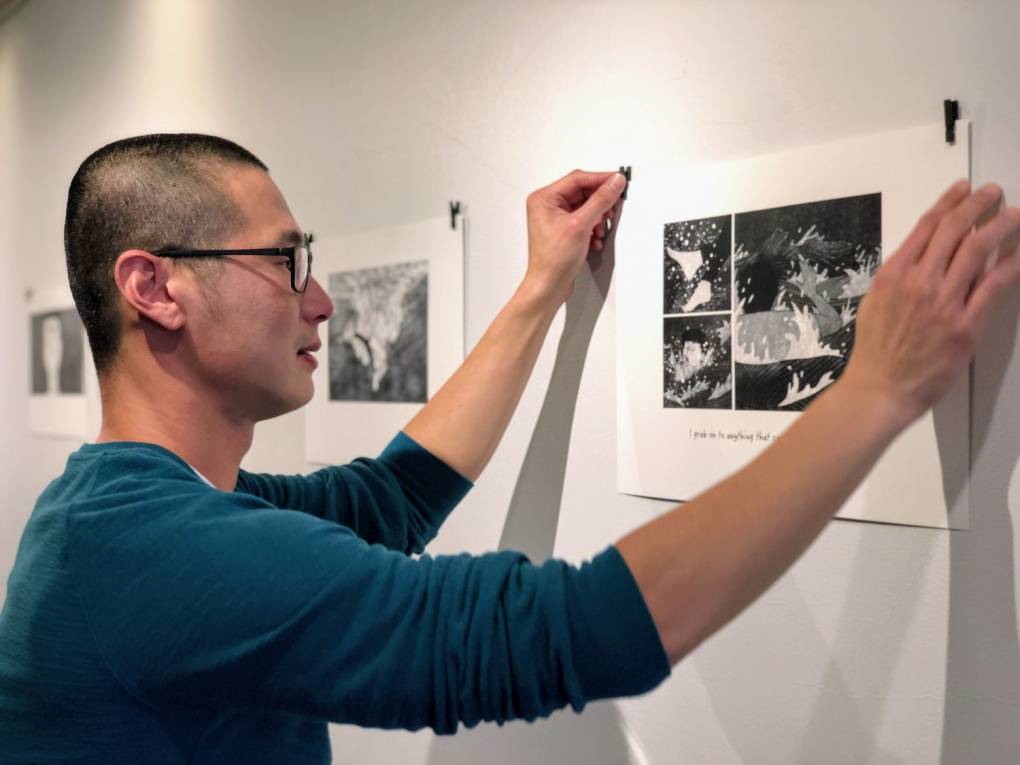
"content": "\u003cp>Writer and filmmaker \u003ca href=\"https://addword.com/\" target=\"_blank\" rel=\"noopener noreferrer\">Edward Gunawan\u003c/a> has personally experienced the stigma that often prevents people from getting mental health support. Years ago, while living in Indonesia, Gunawan felt smothered beneath the weight of coming to terms with a quarter-life crisis, while also processing his queerness amid a homophobic culture and unaccepting Chinese parents. Alone and overwhelmed, he fell deep into depression but was unable to ask for the support he needed.\u003c/p>\n\u003cp>“During my episode I felt like I’d done everything I could to be successful, but it still felt very empty, and the emptiness created a lot of instability,” he said.\u003c/p>\n\u003cp>At a writing retreat in 2017, Gunawan began to take down short notes describing his mental health challenges, and later that year he started sharing his experiences through live storytelling while still living in Asia. He wanted to use his own example to help people with similar backgrounds overcome the cultural stigma against sharing mental health struggles and getting support.\u003c/p>\n\u003cp>It worked: The more Gunawan told his story, the more audiences were inspired to be vulnerable and share their experiences with him. It was during one such presentation that a chance encounter with an audience member connected Gunawan to mental health professionals, starting a process that culminated in him sharing his journey through depression in a web comic called \u003cem>\u003ca href=\"https://www.projectpressplay.com/english\" target=\"_blank\" rel=\"noopener noreferrer\">Press Play.\u003c/a>\u003c/em>\u003c/p>\n\u003cfigure id=\"attachment_13920460\" class=\"wp-caption aligncenter\" style=\"max-width: 800px\">\u003cimg loading=\"lazy\" decoding=\"async\" class=\"size-medium wp-image-13920460\" src=\"https://ww2.kqed.org/app/uploads/sites/2/2022/10/PP_Panel2-800x450.jpeg\" alt=\"\" width=\"800\" height=\"450\" srcset=\"https://cdn.kqed.org/wp-content/uploads/sites/2/2022/10/PP_Panel2-800x450.jpeg 800w, https://cdn.kqed.org/wp-content/uploads/sites/2/2022/10/PP_Panel2-1020x574.jpeg 1020w, https://cdn.kqed.org/wp-content/uploads/sites/2/2022/10/PP_Panel2-160x90.jpeg 160w, https://cdn.kqed.org/wp-content/uploads/sites/2/2022/10/PP_Panel2-768x432.jpeg 768w, https://cdn.kqed.org/wp-content/uploads/sites/2/2022/10/PP_Panel2.jpeg 1500w\" sizes=\"(max-width: 800px) 100vw, 800px\">\u003cfigcaption class=\"wp-caption-text\">A panel from award-winning mental health comic ‘Press Play.’ \u003ccite>(Text by Edward Gunawan and illustration by Elbert Lim)\u003c/cite>\u003c/figcaption>\u003c/figure>\n\u003cp>“As I began sharing my lived experience in classrooms and other venues, I learned that it was hard for me to share this story live all of the time,” he says. “It took a toll, and I realized that as a media maker there’s potential to have more impact if I can make this more portable. That’s when I started thinking of adapting this story into a comic. It’s a very playful kind of medium, and I wondered if I could make such a serious topic more approachable.”\u003c/p>\n\u003cp>[ad fullwidth]\u003c/p>\n\u003cp>Gunawan recruited his brother, a visual storyteller named Elbert Lim, to help him create \u003cem>Press Play\u003c/em>. Since its release in 2019, their web comic has been viewed thousands of times by people all over the world and translated into six languages. The project received an award for de-stigmatizing mental health support.\u003c/p>\n\u003cp>Throughout the month of October, \u003cem>Press Play\u003c/em> is being exhibited in its entirety at the \u003ca href=\"https://oacc.cc/oacc-exhibitions/\" target=\"_blank\" rel=\"noopener noreferrer\">Oakland Asian Cultural Center\u003c/a> (OACC) on the second floor of the Pacific Renaissance Plaza in Oakland’s Chinatown. Taking up two long hallways in the OACC, the exhibition invites viewers to physically wander through Gunawan’s mental health journey, lingering over individual panels in the comic — not just on a website, but as a full-body, sensory experience.\u003c/p>\n\u003cfigure id=\"attachment_13920461\" class=\"wp-caption aligncenter\" style=\"max-width: 800px\">\u003cimg loading=\"lazy\" decoding=\"async\" class=\"size-medium wp-image-13920461\" src=\"https://ww2.kqed.org/app/uploads/sites/2/2022/10/PP_Panel7-800x492.jpeg\" alt=\"\" width=\"800\" height=\"492\" srcset=\"https://cdn.kqed.org/wp-content/uploads/sites/2/2022/10/PP_Panel7-800x492.jpeg 800w, https://cdn.kqed.org/wp-content/uploads/sites/2/2022/10/PP_Panel7-1020x627.jpeg 1020w, https://cdn.kqed.org/wp-content/uploads/sites/2/2022/10/PP_Panel7-160x98.jpeg 160w, https://cdn.kqed.org/wp-content/uploads/sites/2/2022/10/PP_Panel7-768x472.jpeg 768w, https://cdn.kqed.org/wp-content/uploads/sites/2/2022/10/PP_Panel7.jpeg 1218w\" sizes=\"(max-width: 800px) 100vw, 800px\">\u003cfigcaption class=\"wp-caption-text\">A panel from ‘Press Play’ by Edward Gunawan and Elbert Lim. \u003ccite>(Illustration by Elbert Lim)\u003c/cite>\u003c/figcaption>\u003c/figure>\n\u003cp>The OACC’s exhibition also comes with events to help individuals make progress on their own journeys through mental health and social justice. The next one is a \u003ca href=\"https://dothebay.com/events/2022/10/13/press-play-exhibition-tickets\" target=\"_blank\" rel=\"noopener noreferrer\">writers’ discussion panel featuring Bay Area poets Michelle Lin and Christine No\u003c/a> on Oct. 29.\u003c/p>\n\u003cp>“The way Edward and Elbert talk about their mental health is really open and clear,” said Saly Lee, executive director of Oakland Asian Cultural Center. “Anyone can connect to those personal stories, which is what makes this exhibition really powerful. Some of their story really spoke to me — I realized that I felt the same, I felt all these pressures to be strong and outstanding and perfect.”\u003c/p>\n\u003cp>Gunawan and Lee were particularly keen on sharing \u003cem>Press Play\u003c/em> in light of the substantial mental health challenges visited on the Asian American and Pacific Islander community following the isolation of the COVID-19 pandemic, as well as the increased stigmatization of and violence toward AAPI individuals. Even with all of these reasons to seek out mental health support, those in the AAPI community often feel unable to because of cultural bias and lack of resources. [aside postid='arts_13881725']\u003c/p>\n\u003cp>“Asian Americans have always been considered the model minority,” said Gunawan. “There are stereotypes that we’re quiet but very high-performing, and that doesn’t serve individuals in the community, because then we’re boxed into a category that doesn’t serve us. In the immigrant and refugee community there are even more challenges in terms of culture and resources, and a lot of newcomers to the country may not be a financially resourced to access things like therapy.”\u003c/p>\n\u003cp>Gunawan hopes that \u003cem>Press Play\u003c/em> and the exhibition at the OACC will help change all that. For him, curating and installing an exhibition of his web comic at the OACC has proven to be a full-circle moment in his lifelong mental health journey. It’s given him a chance to take stock of all the progress he’s made, while also to realize how the tale he began telling five years ago has taken on a life of its own.\u003c/p>\n\u003cp>“It was a kind of weird experience to see this story in this format,” Gunawan said. “I recognized it as my story, but it wasn’t just my story any longer. There’s a distance now. Seeing it all together, I was like, ‘Wow, I can’t believe we did all that.’”\u003c/p>\n\u003ch2>Resources\u003c/h2>\n\u003cp>\u003ca href=\"https://asianhealthservices.org/\" target=\"_blank\" rel=\"noopener noreferrer\">Asian Health Services\u003c/a> offers mental health services with staff who are bilingual and bicultural in Cantonese, Japanese, Khmer, Korean, Mandarin, Mien, Vietnamese and English. To schedule an appointment call 510-735-3900. They also offer an ACCESS Line at 510-735-3939.\u003c/p>\n\u003cp>\u003ca href=\"https://www.namisf.org/\" target=\"_blank\" rel=\"noopener noreferrer\">The National Alliance on Mental Illness San Francisco\u003c/a> provides online support groups for individuals who identify as Black, Indigenous or people of color, as well as a Cantonese-language support group for families and caregivers. It also offers various presentations on overcoming mental health stigma.\u003c/p>\n\u003cp>\u003ca href=\"https://ramsinc.org/\" target=\"_blank\" rel=\"noopener noreferrer\">Richmond Area Multi-Services\u003c/a> offers culturally competent mental health support for the API community via both peer-based services and clinical counseling.\u003c/p>\n\u003cp>\u003c/p>\n\u003cp>\u003ca href=\"https://www.asianmhc.org/\" target=\"_blank\" rel=\"noopener noreferrer\">The Asian Mental Health Collective\u003c/a> offers a database of Asian therapists to provide those in need with culturally competent clinicians.\u003c/p>\n\n",
"blocks": [],
"excerpt": "His comic 'Press Play,' illustrated by Elbert Lim, is on display at Oakland Asian Cultural Center.",
"status": "publish",
"parent": 0,
"modified": 1732650996,
"stats": {
"hasAudio": false,
"hasVideo": false,
"hasChartOrMap": false,
"iframeSrcs": [],
"hasGoogleForm": false,
"hasGallery": false,
"hasHearkenModule": false,
"hasPolis": false,
"paragraphCount": 19,
"wordCount": 1050
},
"headData": {
"title": "Writer Edward Gunawan Wants to Destigmatize Asian Mental Health | KQED",
"description": "His comic 'Press Play,' illustrated by Elbert Lim, is on display at Oakland Asian Cultural Center.",
"ogTitle": "",
"ogDescription": "",
"ogImgId": "",
"twTitle": "",
"twDescription": "",
"twImgId": "",
"schema": {
"@context": "https://schema.org",
"@type": "Article",
"headline": "Writer Edward Gunawan Wants to Destigmatize Asian Mental Health",
"datePublished": "2022-10-17T10:58:48-07:00",
"dateModified": "2024-11-26T11:56:36-08:00",
"image": "https://cdn.kqed.org/wp-content/uploads/2020/02/KQED-OG-Image@1x.png"
}
},
"sticky": false,
"templateType": "standard",
"featuredImageType": "standard",
"excludeFromSiteSearch": "Include",
"showOnAuthorArchivePages": "No",
"articleAge": "0",
"path": "/arts/13920414/press-play-edward-gunawan-oakland-asian-cultural-center-mental-health-comic",
"audioTrackLength": null,
"parsedContent": [
{
"type": "contentString",
"content": "\u003cdiv class=\"post-body\">\u003cp>\u003cp>Writer and filmmaker \u003ca href=\"https://addword.com/\" target=\"_blank\" rel=\"noopener noreferrer\">Edward Gunawan\u003c/a> has personally experienced the stigma that often prevents people from getting mental health support. Years ago, while living in Indonesia, Gunawan felt smothered beneath the weight of coming to terms with a quarter-life crisis, while also processing his queerness amid a homophobic culture and unaccepting Chinese parents. Alone and overwhelmed, he fell deep into depression but was unable to ask for the support he needed.\u003c/p>\n\u003cp>“During my episode I felt like I’d done everything I could to be successful, but it still felt very empty, and the emptiness created a lot of instability,” he said.\u003c/p>\n\u003cp>At a writing retreat in 2017, Gunawan began to take down short notes describing his mental health challenges, and later that year he started sharing his experiences through live storytelling while still living in Asia. He wanted to use his own example to help people with similar backgrounds overcome the cultural stigma against sharing mental health struggles and getting support.\u003c/p>\n\u003cp>It worked: The more Gunawan told his story, the more audiences were inspired to be vulnerable and share their experiences with him. It was during one such presentation that a chance encounter with an audience member connected Gunawan to mental health professionals, starting a process that culminated in him sharing his journey through depression in a web comic called \u003cem>\u003ca href=\"https://www.projectpressplay.com/english\" target=\"_blank\" rel=\"noopener noreferrer\">Press Play.\u003c/a>\u003c/em>\u003c/p>\n\u003cfigure id=\"attachment_13920460\" class=\"wp-caption aligncenter\" style=\"max-width: 800px\">\u003cimg loading=\"lazy\" decoding=\"async\" class=\"size-medium wp-image-13920460\" src=\"https://ww2.kqed.org/app/uploads/sites/2/2022/10/PP_Panel2-800x450.jpeg\" alt=\"\" width=\"800\" height=\"450\" srcset=\"https://cdn.kqed.org/wp-content/uploads/sites/2/2022/10/PP_Panel2-800x450.jpeg 800w, https://cdn.kqed.org/wp-content/uploads/sites/2/2022/10/PP_Panel2-1020x574.jpeg 1020w, https://cdn.kqed.org/wp-content/uploads/sites/2/2022/10/PP_Panel2-160x90.jpeg 160w, https://cdn.kqed.org/wp-content/uploads/sites/2/2022/10/PP_Panel2-768x432.jpeg 768w, https://cdn.kqed.org/wp-content/uploads/sites/2/2022/10/PP_Panel2.jpeg 1500w\" sizes=\"(max-width: 800px) 100vw, 800px\">\u003cfigcaption class=\"wp-caption-text\">A panel from award-winning mental health comic ‘Press Play.’ \u003ccite>(Text by Edward Gunawan and illustration by Elbert Lim)\u003c/cite>\u003c/figcaption>\u003c/figure>\n\u003cp>“As I began sharing my lived experience in classrooms and other venues, I learned that it was hard for me to share this story live all of the time,” he says. “It took a toll, and I realized that as a media maker there’s potential to have more impact if I can make this more portable. That’s when I started thinking of adapting this story into a comic. It’s a very playful kind of medium, and I wondered if I could make such a serious topic more approachable.”\u003c/p>\n\u003cp>\u003c/p>\u003c/div>",
"attributes": {
"named": {},
"numeric": []
}
},
{
"type": "component",
"content": "",
"name": "ad",
"attributes": {
"named": {
"label": "fullwidth"
},
"numeric": [
"fullwidth"
]
}
},
{
"type": "contentString",
"content": "\u003cdiv class=\"post-body\">\u003cp>\u003c/p>\n\u003cp>Gunawan recruited his brother, a visual storyteller named Elbert Lim, to help him create \u003cem>Press Play\u003c/em>. Since its release in 2019, their web comic has been viewed thousands of times by people all over the world and translated into six languages. The project received an award for de-stigmatizing mental health support.\u003c/p>\n\u003cp>Throughout the month of October, \u003cem>Press Play\u003c/em> is being exhibited in its entirety at the \u003ca href=\"https://oacc.cc/oacc-exhibitions/\" target=\"_blank\" rel=\"noopener noreferrer\">Oakland Asian Cultural Center\u003c/a> (OACC) on the second floor of the Pacific Renaissance Plaza in Oakland’s Chinatown. Taking up two long hallways in the OACC, the exhibition invites viewers to physically wander through Gunawan’s mental health journey, lingering over individual panels in the comic — not just on a website, but as a full-body, sensory experience.\u003c/p>\n\u003cfigure id=\"attachment_13920461\" class=\"wp-caption aligncenter\" style=\"max-width: 800px\">\u003cimg loading=\"lazy\" decoding=\"async\" class=\"size-medium wp-image-13920461\" src=\"https://ww2.kqed.org/app/uploads/sites/2/2022/10/PP_Panel7-800x492.jpeg\" alt=\"\" width=\"800\" height=\"492\" srcset=\"https://cdn.kqed.org/wp-content/uploads/sites/2/2022/10/PP_Panel7-800x492.jpeg 800w, https://cdn.kqed.org/wp-content/uploads/sites/2/2022/10/PP_Panel7-1020x627.jpeg 1020w, https://cdn.kqed.org/wp-content/uploads/sites/2/2022/10/PP_Panel7-160x98.jpeg 160w, https://cdn.kqed.org/wp-content/uploads/sites/2/2022/10/PP_Panel7-768x472.jpeg 768w, https://cdn.kqed.org/wp-content/uploads/sites/2/2022/10/PP_Panel7.jpeg 1218w\" sizes=\"(max-width: 800px) 100vw, 800px\">\u003cfigcaption class=\"wp-caption-text\">A panel from ‘Press Play’ by Edward Gunawan and Elbert Lim. \u003ccite>(Illustration by Elbert Lim)\u003c/cite>\u003c/figcaption>\u003c/figure>\n\u003cp>The OACC’s exhibition also comes with events to help individuals make progress on their own journeys through mental health and social justice. The next one is a \u003ca href=\"https://dothebay.com/events/2022/10/13/press-play-exhibition-tickets\" target=\"_blank\" rel=\"noopener noreferrer\">writers’ discussion panel featuring Bay Area poets Michelle Lin and Christine No\u003c/a> on Oct. 29.\u003c/p>\n\u003cp>“The way Edward and Elbert talk about their mental health is really open and clear,” said Saly Lee, executive director of Oakland Asian Cultural Center. “Anyone can connect to those personal stories, which is what makes this exhibition really powerful. Some of their story really spoke to me — I realized that I felt the same, I felt all these pressures to be strong and outstanding and perfect.”\u003c/p>\n\u003cp>Gunawan and Lee were particularly keen on sharing \u003cem>Press Play\u003c/em> in light of the substantial mental health challenges visited on the Asian American and Pacific Islander community following the isolation of the COVID-19 pandemic, as well as the increased stigmatization of and violence toward AAPI individuals. Even with all of these reasons to seek out mental health support, those in the AAPI community often feel unable to because of cultural bias and lack of resources. \u003c/p>\u003c/div>",
"attributes": {
"named": {},
"numeric": []
}
},
{
"type": "component",
"content": "",
"name": "aside",
"attributes": {
"named": {
"postid": "arts_13881725",
"label": ""
},
"numeric": []
}
},
{
"type": "contentString",
"content": "\u003cdiv class=\"post-body\">\u003cp>\u003c/p>\n\u003cp>“Asian Americans have always been considered the model minority,” said Gunawan. “There are stereotypes that we’re quiet but very high-performing, and that doesn’t serve individuals in the community, because then we’re boxed into a category that doesn’t serve us. In the immigrant and refugee community there are even more challenges in terms of culture and resources, and a lot of newcomers to the country may not be a financially resourced to access things like therapy.”\u003c/p>\n\u003cp>Gunawan hopes that \u003cem>Press Play\u003c/em> and the exhibition at the OACC will help change all that. For him, curating and installing an exhibition of his web comic at the OACC has proven to be a full-circle moment in his lifelong mental health journey. It’s given him a chance to take stock of all the progress he’s made, while also to realize how the tale he began telling five years ago has taken on a life of its own.\u003c/p>\n\u003cp>“It was a kind of weird experience to see this story in this format,” Gunawan said. “I recognized it as my story, but it wasn’t just my story any longer. There’s a distance now. Seeing it all together, I was like, ‘Wow, I can’t believe we did all that.’”\u003c/p>\n\u003ch2>Resources\u003c/h2>\n\u003cp>\u003ca href=\"https://asianhealthservices.org/\" target=\"_blank\" rel=\"noopener noreferrer\">Asian Health Services\u003c/a> offers mental health services with staff who are bilingual and bicultural in Cantonese, Japanese, Khmer, Korean, Mandarin, Mien, Vietnamese and English. To schedule an appointment call 510-735-3900. They also offer an ACCESS Line at 510-735-3939.\u003c/p>\n\u003cp>\u003ca href=\"https://www.namisf.org/\" target=\"_blank\" rel=\"noopener noreferrer\">The National Alliance on Mental Illness San Francisco\u003c/a> provides online support groups for individuals who identify as Black, Indigenous or people of color, as well as a Cantonese-language support group for families and caregivers. It also offers various presentations on overcoming mental health stigma.\u003c/p>\n\u003cp>\u003ca href=\"https://ramsinc.org/\" target=\"_blank\" rel=\"noopener noreferrer\">Richmond Area Multi-Services\u003c/a> offers culturally competent mental health support for the API community via both peer-based services and clinical counseling.\u003c/p>\n\u003cp>\u003c/p>\n\u003cp>\u003ca href=\"https://www.asianmhc.org/\" target=\"_blank\" rel=\"noopener noreferrer\">The Asian Mental Health Collective\u003c/a> offers a database of Asian therapists to provide those in need with culturally competent clinicians.\u003c/p>\n\n\u003c/div>\u003c/p>",
"attributes": {
"named": {},
"numeric": []
}
}
],
"link": "/arts/13920414/press-play-edward-gunawan-oakland-asian-cultural-center-mental-health-comic",
"authors": [
"11934"
],
"programs": [
"arts_140"
],
"categories": [
"arts_1",
"arts_70"
],
"tags": [
"arts_11007",
"arts_4672",
"arts_10278",
"arts_4773",
"arts_1143",
"arts_585"
],
"featImg": "arts_13920459",
"label": "arts_140"
},
"arts_13916258": {
"type": "posts",
"id": "arts_13916258",
"meta": {
"index": "posts_1716263798",
"site": "arts",
"id": "13916258",
"score": null,
"sort": [
1658240403000
]
},
"parent": 0,
"labelTerm": {
"site": "arts",
"term": 137
},
"blocks": [],
"publishDate": 1658240403,
"format": "standard",
"title": "Constance Wu's Reveal Speaks to the Profound Pressure Asian American Women Face",
"headTitle": "Constance Wu’s Reveal Speaks to the Profound Pressure Asian American Women Face | KQED",
"content": "\u003cp>After being largely under the radar for three years, Hollywood actor Constance Wu broke her silence last week, opening up about her mental health, and in doing so, admitting there’s still a lot of work left to do to for and within the Asian American community.\u003c/p>\n\u003cp>It all started back in 2019, when Wu’s ABC sitcom \u003cem>Fresh Off the Boat\u003c/em> announced it would be renewed for a sixth season. Wu responded to the news with frustration, writing on Twitter: “So upset right now that I’m literally crying. Ugh. F***” and “F***ing hell.”\u003c/p>\n\u003cp>Wu, who has also starred in the movies \u003cem>Crazy Rich Asians\u003c/em> and \u003cem>Hustlers\u003c/em>, later clarified that her grievances were related to a missed work opportunity. Despite her explanation, users on social media still condemned Wu’s comments, branding her as ungrateful, selfish and a diva. The backlash led her to a mental health crisis and a suicide attempt, \u003ca href=\"https://twitter.com/ConstanceWu/status/1547661204545359877\" target=\"_blank\" rel=\"noopener noreferrer\">Wu revealed on Twitter\u003c/a> last week.\u003c/p>\n\u003cp>https://twitter.com/ConstanceWu/status/1547661204545359877\u003c/p>\n\u003cp>“I was afraid of coming back on social media because I almost lost my life from it,” Wu wrote. “[Asian Americans] don’t talk about mental health enough. While we’re quick to celebrate representation wins, there’s a lot of avoidance around the more uncomfortable issues within our community.”\u003c/p>\n\u003ch3>When Asian American women try to be ambitious, it’s often been met with pushback\u003c/h3>\n\u003cp>In her statement, Wu wrote, “I’m not poised or graceful or perfect. I’m emotional. I make mistakes.”\u003c/p>\n\u003cp>[ad fullwidth]\u003c/p>\n\u003cp>Asian American experts say while that confession may not appear profound to some, for others, it spoke volumes about the pressures typically felt by Asian American women.\u003c/p>\n\u003cp>“Asian American women want to be their authentic selves but their image and behavior are prescribed by society and family expectations,” says Hyeouk Chris Hahm, an associate dean of research at Boston University’s School of Social Work, who has extensively studied mental health disparities in the Asian American community.\u003c/p>\n\u003cp>[aside postid='arts_13911935']While no two experiences are alike, Hahm points out that in spaces like the workplace, many Asian American women are stereotyped to be soft-spoken, respectful and followers rather than leaders. When they try to break out of that mold by speaking up for themselves, they can be met with pushback, Hahm added.\u003c/p>\n\u003cp>“When Asian American women try to be autonomous, ambitious, self-fulfilling, it’s been historically perceived as threatening the social order and social norm,” Hahm said.\u003c/p>\n\u003cp>Recently, Twitter users have pointed out that double standard after comparing Wu’s backlash to actors such as Robert Pattinson, who received a\u003ca href=\"https://www.buzzfeed.com/farrahpenn/robert-pattinson-trolls-twilight\" target=\"_blank\" rel=\"noopener noreferrer\"> more positive reception\u003c/a> after bad-mouthing his breakout film, \u003cem>Twilight.\u003c/em>\u003c/p>\n\u003cp>“The harshness behind the overall reaction to Wu’s tweets demonstrates the implicit yet widely-held hostility towards Asian women,” said culture writer Roslyn Talusan in a \u003ca href=\"https://www.playboy.com/read/on-constance-wu-and-angry-asian-women\" target=\"_blank\" rel=\"noopener noreferrer\">2019 \u003cem>Playboy\u003c/em> article\u003c/a>. “As it stands, humanity isn’t afforded to angry, insubordinate Asian women.”\u003c/p>\n\u003ch3>For many people of Asian descent, individual reputation is tied to their community’s reputation\u003c/h3>\n\u003cp>In her tweet, Wu said it wasn’t just the online harassment, but shame from other Asian American acquaintances that felt traumatizing.\u003c/p>\n\u003cp>According to Wu, a fellow Asian American actress—who she didn’t name—privately condemned her, calling Wu a “blight” to their community.\u003c/p>\n\u003cp>“I started feeling like I didn’t even deserve to live anymore. That I was a disgrace to [Asian Americans], and they’d be better off without me,” she wrote.\u003c/p>\n\u003cp>[aside postid='arts_13880441']Words like “blight” and “disgrace” can be especially hurtful to Asian Americans, said Jenn Fang, the founder and editor of \u003ca href=\"http://reappropriate.co/\" target=\"_blank\" rel=\"noopener noreferrer\">Reappropriate\u003c/a>, an Asian American-centered race and gender blog.\u003c/p>\n\u003cp>“Being a public figure, especially on social media, criticism happens,” Fang said. “But for Asian Americans, this thread of criticism is particularly personal and difficult to bear because it suggests we don’t belong and we should leave the Asian American community.”\u003c/p>\n\u003cp>Hahm points out that it’s not just people of Asian descent—many immigrants of all backgrounds can relate to the burden that comes when an individual’s reputation is seen as a reflection of their family or community’s reputation.\u003c/p>\n\u003cp>“Reputation is important for many immigrants because it creates trust and trust becomes a foundation for immigrants rebuilding their wealth, social networks, and resources,” Hahm said.\u003c/p>\n\u003ch3>Hollywood is only one of the places where representation matters\u003c/h3>\n\u003cp>To Fang, part of Wu’s online criticism also had to do with fans’ staunch loyalty to \u003cem>Fresh Off the Boat\u003c/em>, and the pressure for Asian American representation in media.\u003c/p>\n\u003cp>When the sitcom first aired, there was a lot of anticipation amongst Asian Americans, Fang recalled, mainly because it was the first time in \u003ca href=\"https://www.npr.org/sections/codeswitch/2015/02/05/383520596/a-brief-weird-history-of-squashed-asian-american-tv-shows\" target=\"_blank\" rel=\"noopener noreferrer\">roughly two decades\u003c/a> that network television focused on an Asian American family.\u003c/p>\n\u003cp>[aside postid='arts_13914487']“There’s a sense within the community that if we can see more of ourselves in media, we will feel more like we belong,” Fang said. “Common among Asian Americans is this question of where we fit, where do we belong?”\u003c/p>\n\u003cp>According to Fang, that’s why on-screen representation matters, and why there’s still a lot of room for improvement—whether that’s forgoing harmful stereotypes or accurately reflecting the experiences of South Asians and Pacific Islanders. But she also underscores that Hollywood is only one avenue where representation matters for Asian Americans.\u003c/p>\n\u003cp>\u003c/p>\n\u003cp>“The problem, however, is that when we focus exclusively on issues of media representation without addressing it alongside other issues, we run the risk of forgetting that improved media representation is not by itself a solution to anti-Asian racism,” she said.\u003c/p>\n\u003cdiv class=\"fullattribution\">\u003cem>Copyright 2022 NPR. To see more,\u003ca href=\"https://www.npr.org\" target=\"_blank\" rel=\"noopener noreferrer\"> visit NPR\u003c/a>.\u003cimg decoding=\"async\" src=\"https://www.google-analytics.com/__utm.gif?utmac=UA-5828686-4&utmdt=Constance+Wu%27s+reveal+speaks+to+the+profound+pressure+Asian+American+women+face&utme=8(APIKey)9(MDAxOTAwOTE4MDEyMTkxMDAzNjczZDljZA004)\">\u003c/em>\u003c/div>\n\n",
"stats": {
"hasVideo": false,
"hasChartOrMap": false,
"hasAudio": false,
"hasPolis": false,
"wordCount": 1013,
"hasGoogleForm": false,
"hasGallery": false,
"hasHearkenModule": false,
"iframeSrcs": [],
"paragraphCount": 25
},
"modified": 1705006601,
"excerpt": "\"It's surreal that a few DMs convinced me to end my own life,\" Wu said. \"Luckily a friend found me and rushed me to the ER.\"",
"headData": {
"twImgId": "",
"twTitle": "",
"ogTitle": "",
"ogImgId": "",
"twDescription": "",
"description": ""It's surreal that a few DMs convinced me to end my own life," Wu said. "Luckily a friend found me and rushed me to the ER."",
"title": "Constance Wu's Reveal Speaks to the Profound Pressure Asian American Women Face | KQED",
"ogDescription": "",
"schema": {
"@context": "https://schema.org",
"@type": "Article",
"headline": "Constance Wu's Reveal Speaks to the Profound Pressure Asian American Women Face",
"datePublished": "2022-07-19T07:20:03-07:00",
"dateModified": "2024-01-11T12:56:41-08:00",
"image": "https://cdn.kqed.org/wp-content/uploads/2020/02/KQED-OG-Image@1x.png"
}
},
"guestAuthors": [],
"slug": "constance-wus-reveal-speaks-to-the-profound-pressure-asian-american-women-face",
"status": "publish",
"nprApiLink": "http://api.npr.org/query?id=1112055817&apiKey=MDAxOTAwOTE4MDEyMTkxMDAzNjczZDljZA004",
"templateType": "standard",
"nprStoryDate": "Mon, 18 Jul 2022 19:33:43 -0400",
"excludeFromSiteSearch": "Include",
"nprLastModifiedDate": "Mon, 18 Jul 2022 19:33:43 -0400",
"featuredImageType": "standard",
"nprHtmlLink": "https://www.npr.org/2022/07/18/1112055817/constance-wu-asian-american-women?ft=nprml&f=1112055817",
"nprImageAgency": "Getty Images",
"nprStoryId": "1112055817",
"nprByline": "Juliana Kim",
"sticky": false,
"nprImageCredit": "Emma McIntyre",
"showOnAuthorArchivePages": "No",
"nprRetrievedStory": "1",
"nprPubDate": "Mon, 18 Jul 2022 19:33:00 -0400",
"path": "/arts/13916258/constance-wus-reveal-speaks-to-the-profound-pressure-asian-american-women-face",
"audioTrackLength": null,
"parsedContent": [
{
"type": "contentString",
"content": "\u003cdiv class=\"post-body\">\u003cp>\u003cp>After being largely under the radar for three years, Hollywood actor Constance Wu broke her silence last week, opening up about her mental health, and in doing so, admitting there’s still a lot of work left to do to for and within the Asian American community.\u003c/p>\n\u003cp>It all started back in 2019, when Wu’s ABC sitcom \u003cem>Fresh Off the Boat\u003c/em> announced it would be renewed for a sixth season. Wu responded to the news with frustration, writing on Twitter: “So upset right now that I’m literally crying. Ugh. F***” and “F***ing hell.”\u003c/p>\n\u003cp>Wu, who has also starred in the movies \u003cem>Crazy Rich Asians\u003c/em> and \u003cem>Hustlers\u003c/em>, later clarified that her grievances were related to a missed work opportunity. Despite her explanation, users on social media still condemned Wu’s comments, branding her as ungrateful, selfish and a diva. The backlash led her to a mental health crisis and a suicide attempt, \u003ca href=\"https://twitter.com/ConstanceWu/status/1547661204545359877\" target=\"_blank\" rel=\"noopener noreferrer\">Wu revealed on Twitter\u003c/a> last week.\u003c/p>\u003c/p>\u003c/div>",
"attributes": {
"named": {},
"numeric": []
}
},
{
"type": "component",
"content": "",
"name": "singleTwitterStatus",
"attributes": {
"named": {
"id": "1547661204545359877"
},
"numeric": []
}
},
{
"type": "contentString",
"content": "\u003cdiv class=\"post-body\">\u003cp>\n\u003cp>“I was afraid of coming back on social media because I almost lost my life from it,” Wu wrote. “[Asian Americans] don’t talk about mental health enough. While we’re quick to celebrate representation wins, there’s a lot of avoidance around the more uncomfortable issues within our community.”\u003c/p>\n\u003ch3>When Asian American women try to be ambitious, it’s often been met with pushback\u003c/h3>\n\u003cp>In her statement, Wu wrote, “I’m not poised or graceful or perfect. I’m emotional. I make mistakes.”\u003c/p>\n\u003cp>\u003c/p>\u003c/div>",
"attributes": {
"named": {},
"numeric": []
}
},
{
"type": "component",
"content": "",
"name": "ad",
"attributes": {
"named": {
"label": "fullwidth"
},
"numeric": [
"fullwidth"
]
}
},
{
"type": "contentString",
"content": "\u003cdiv class=\"post-body\">\u003cp>\u003c/p>\n\u003cp>Asian American experts say while that confession may not appear profound to some, for others, it spoke volumes about the pressures typically felt by Asian American women.\u003c/p>\n\u003cp>“Asian American women want to be their authentic selves but their image and behavior are prescribed by society and family expectations,” says Hyeouk Chris Hahm, an associate dean of research at Boston University’s School of Social Work, who has extensively studied mental health disparities in the Asian American community.\u003c/p>\n\u003cp>\u003c/p>\u003c/div>",
"attributes": {
"named": {},
"numeric": []
}
},
{
"type": "component",
"content": "",
"name": "aside",
"attributes": {
"named": {
"postid": "arts_13911935",
"label": ""
},
"numeric": []
}
},
{
"type": "contentString",
"content": "\u003cdiv class=\"post-body\">\u003cp>While no two experiences are alike, Hahm points out that in spaces like the workplace, many Asian American women are stereotyped to be soft-spoken, respectful and followers rather than leaders. When they try to break out of that mold by speaking up for themselves, they can be met with pushback, Hahm added.\u003c/p>\n\u003cp>“When Asian American women try to be autonomous, ambitious, self-fulfilling, it’s been historically perceived as threatening the social order and social norm,” Hahm said.\u003c/p>\n\u003cp>Recently, Twitter users have pointed out that double standard after comparing Wu’s backlash to actors such as Robert Pattinson, who received a\u003ca href=\"https://www.buzzfeed.com/farrahpenn/robert-pattinson-trolls-twilight\" target=\"_blank\" rel=\"noopener noreferrer\"> more positive reception\u003c/a> after bad-mouthing his breakout film, \u003cem>Twilight.\u003c/em>\u003c/p>\n\u003cp>“The harshness behind the overall reaction to Wu’s tweets demonstrates the implicit yet widely-held hostility towards Asian women,” said culture writer Roslyn Talusan in a \u003ca href=\"https://www.playboy.com/read/on-constance-wu-and-angry-asian-women\" target=\"_blank\" rel=\"noopener noreferrer\">2019 \u003cem>Playboy\u003c/em> article\u003c/a>. “As it stands, humanity isn’t afforded to angry, insubordinate Asian women.”\u003c/p>\n\u003ch3>For many people of Asian descent, individual reputation is tied to their community’s reputation\u003c/h3>\n\u003cp>In her tweet, Wu said it wasn’t just the online harassment, but shame from other Asian American acquaintances that felt traumatizing.\u003c/p>\n\u003cp>According to Wu, a fellow Asian American actress—who she didn’t name—privately condemned her, calling Wu a “blight” to their community.\u003c/p>\n\u003cp>“I started feeling like I didn’t even deserve to live anymore. That I was a disgrace to [Asian Americans], and they’d be better off without me,” she wrote.\u003c/p>\n\u003cp>\u003c/p>\u003c/div>",
"attributes": {
"named": {},
"numeric": []
}
},
{
"type": "component",
"content": "",
"name": "aside",
"attributes": {
"named": {
"postid": "arts_13880441",
"label": ""
},
"numeric": []
}
},
{
"type": "contentString",
"content": "\u003cdiv class=\"post-body\">\u003cp>Words like “blight” and “disgrace” can be especially hurtful to Asian Americans, said Jenn Fang, the founder and editor of \u003ca href=\"http://reappropriate.co/\" target=\"_blank\" rel=\"noopener noreferrer\">Reappropriate\u003c/a>, an Asian American-centered race and gender blog.\u003c/p>\n\u003cp>“Being a public figure, especially on social media, criticism happens,” Fang said. “But for Asian Americans, this thread of criticism is particularly personal and difficult to bear because it suggests we don’t belong and we should leave the Asian American community.”\u003c/p>\n\u003cp>Hahm points out that it’s not just people of Asian descent—many immigrants of all backgrounds can relate to the burden that comes when an individual’s reputation is seen as a reflection of their family or community’s reputation.\u003c/p>\n\u003cp>“Reputation is important for many immigrants because it creates trust and trust becomes a foundation for immigrants rebuilding their wealth, social networks, and resources,” Hahm said.\u003c/p>\n\u003ch3>Hollywood is only one of the places where representation matters\u003c/h3>\n\u003cp>To Fang, part of Wu’s online criticism also had to do with fans’ staunch loyalty to \u003cem>Fresh Off the Boat\u003c/em>, and the pressure for Asian American representation in media.\u003c/p>\n\u003cp>When the sitcom first aired, there was a lot of anticipation amongst Asian Americans, Fang recalled, mainly because it was the first time in \u003ca href=\"https://www.npr.org/sections/codeswitch/2015/02/05/383520596/a-brief-weird-history-of-squashed-asian-american-tv-shows\" target=\"_blank\" rel=\"noopener noreferrer\">roughly two decades\u003c/a> that network television focused on an Asian American family.\u003c/p>\n\u003cp>\u003c/p>\u003c/div>",
"attributes": {
"named": {},
"numeric": []
}
},
{
"type": "component",
"content": "",
"name": "aside",
"attributes": {
"named": {
"postid": "arts_13914487",
"label": ""
},
"numeric": []
}
},
{
"type": "contentString",
"content": "\u003cdiv class=\"post-body\">\u003cp>“There’s a sense within the community that if we can see more of ourselves in media, we will feel more like we belong,” Fang said. “Common among Asian Americans is this question of where we fit, where do we belong?”\u003c/p>\n\u003cp>According to Fang, that’s why on-screen representation matters, and why there’s still a lot of room for improvement—whether that’s forgoing harmful stereotypes or accurately reflecting the experiences of South Asians and Pacific Islanders. But she also underscores that Hollywood is only one avenue where representation matters for Asian Americans.\u003c/p>\n\u003cp>\u003c/p>\n\u003cp>“The problem, however, is that when we focus exclusively on issues of media representation without addressing it alongside other issues, we run the risk of forgetting that improved media representation is not by itself a solution to anti-Asian racism,” she said.\u003c/p>\n\u003cdiv class=\"fullattribution\">\u003cem>Copyright 2022 NPR. To see more,\u003ca href=\"https://www.npr.org\" target=\"_blank\" rel=\"noopener noreferrer\"> visit NPR\u003c/a>.\u003cimg decoding=\"async\" src=\"https://www.google-analytics.com/__utm.gif?utmac=UA-5828686-4&utmdt=Constance+Wu%27s+reveal+speaks+to+the+profound+pressure+Asian+American+women+face&utme=8(APIKey)9(MDAxOTAwOTE4MDEyMTkxMDAzNjczZDljZA004)\">\u003c/em>\u003c/div>\n\n\u003c/div>\u003c/p>",
"attributes": {
"named": {},
"numeric": []
}
}
],
"link": "/arts/13916258/constance-wus-reveal-speaks-to-the-profound-pressure-asian-american-women-face",
"authors": [
"byline_arts_13916258"
],
"categories": [
"arts_1",
"arts_74",
"arts_75",
"arts_990"
],
"tags": [
"arts_11007",
"arts_4672",
"arts_4773"
],
"affiliates": [
"arts_137"
],
"featImg": "arts_13916262",
"label": "arts_137"
},
"arts_13914498": {
"type": "posts",
"id": "arts_13914498",
"meta": {
"index": "posts_1716263798",
"site": "arts",
"id": "13914498",
"score": null,
"sort": [
1654622993000
]
},
"guestAuthors": [],
"slug": "maxine-hong-kingstons-work-is-as-wondrous-and-alive-as-ever-in-a-new-collection",
"title": "Maxine Hong Kingston's Work is as Wondrous and Alive as Ever in a New Collection",
"publishDate": 1654622993,
"format": "standard",
"headTitle": "Maxine Hong Kingston’s Work is as Wondrous and Alive as Ever in a New Collection | KQED",
"labelTerm": {
"term": 137,
"site": "arts"
},
"content": "\u003cp>Near the end of her incandescent 1976 memoir, \u003cem>The Woman Warrior\u003c/em>, Maxine Hong Kingston tells the story of a knot-maker in China who tied a knot so complicated that it made him blind. In response, the emperor outlawed the knot. “If I had lived in China,” Kingston tells us, “I would have been an outlaw knot-maker.”\u003c/p>\n\u003cp>[aside postid='arts_13880960']Instead, she put her defiant love of complication into knotty books that tie together biography, history, myth, movies and fiction to show us an America that is too often overlooked. Born to Chinese immigrants who ran a laundromat in Stockton, the 81-year-old Kingston is at once an Asian American writer, a feminist storyteller, a chronicler of immigrant experience and a literary innovator. One of those rare figures who shifted American culture, and who keeps on being relevant, she belongs on the same shelf as \u003ca href=\"https://www.npr.org/templates/story/story.php?storyId=129281259\" target=\"_blank\" rel=\"noopener noreferrer\">James Baldwin\u003c/a>, \u003ca href=\"https://www.npr.org/2011/11/02/141808816/joan-didion-crafting-an-elegy-for-her-daughter\" target=\"_blank\" rel=\"noopener noreferrer\">Joan Didion\u003c/a> and \u003ca href=\"https://www.npr.org/2011/05/31/136823289/kurt-vonnegut-still-speaking-to-the-war-weary\" target=\"_blank\" rel=\"noopener noreferrer\">Kurt Vonnegut\u003c/a>.\u003c/p>\n\u003cp>She’s now been placed alongside them in the prestigious Library of America, which has just released a volume that collects, among other great things, her three most famous works: \u003ca href=\"https://www.npr.org/templates/story/story.php?storyId=11163242\" target=\"_blank\" rel=\"noopener noreferrer\">\u003cem>The Woman Warrior\u003c/em>\u003c/a>, \u003cem>China Men\u003c/em> and \u003cem>Tripmaster Monkey: His Fake Book\u003c/em>. She tells stories about creating your own identity, not settling for the one the world tries to give you.\u003c/p>\n\u003cp>\u003cimg loading=\"lazy\" decoding=\"async\" class=\"size-medium wp-image-13914502 aligncenter\" src=\"https://ww2.kqed.org/app/uploads/sites/2/2022/06/Screen-Shot-2022-06-07-at-10.24.16-AM-800x1167.png\" alt=\"\" width=\"800\" height=\"1167\" srcset=\"https://cdn.kqed.org/wp-content/uploads/sites/2/2022/06/Screen-Shot-2022-06-07-at-10.24.16-AM-800x1167.png 800w, https://cdn.kqed.org/wp-content/uploads/sites/2/2022/06/Screen-Shot-2022-06-07-at-10.24.16-AM-1020x1488.png 1020w, https://cdn.kqed.org/wp-content/uploads/sites/2/2022/06/Screen-Shot-2022-06-07-at-10.24.16-AM-160x233.png 160w, https://cdn.kqed.org/wp-content/uploads/sites/2/2022/06/Screen-Shot-2022-06-07-at-10.24.16-AM-768x1120.png 768w, https://cdn.kqed.org/wp-content/uploads/sites/2/2022/06/Screen-Shot-2022-06-07-at-10.24.16-AM-1053x1536.png 1053w, https://cdn.kqed.org/wp-content/uploads/sites/2/2022/06/Screen-Shot-2022-06-07-at-10.24.16-AM.png 1086w\" sizes=\"(max-width: 800px) 100vw, 800px\">\u003c/p>\n\u003cp>This was clear from her first book, \u003cem>The Woman Warrior: Memoirs of a Girlhood Among Ghosts\u003c/em>, which begins with one of the killer opening lines in American literature: “‘You must not tell anyone,’ my mother said, ‘what I’m about to tell you.'” Naturally, the narrator \u003cem>does\u003c/em> tell us. We learn that Maxine’s father had a sister who got pregnant out of wedlock, killed herself and her baby in disgrace, and her whole family simply pretended she never existed.\u003c/p>\n\u003cp>[ad fullwidth]\u003c/p>\n\u003cp>In telling this story she’s not supposed to tell us, Kingston underscores a cruel truth about traditional Chinese culture—its oppression of women. She also asserts her right, as an act of self-liberation, to scrutinize her mother’s dictates, the ghosts that haunt the Chinese past, and the American values that surround her.\u003c/p>\n\u003cp>Kingston continued that search for freedom in her more expansive and angrier second book, \u003cem>China Men\u003c/em>, which focuses on the experience of the Chinese men who came to the U.S. in search of prosperity only to encounter a racism as ghastly as the misogyny highlighted in \u003cem>The Woman Warrior\u003c/em>.\u003c/p>\n\u003cp>Unlike most writers who tackle such volatile material, Kingston never simplifies. She offers no tear-jerking melodrama, no sentimental clichés about immigrants, no grind-you-down realism. Too original for that, she offers her personal version of storytelling—what the Chinese call “talk-story.” She explores the ideas of “Chineseness” and “Americanness” by weaving together far-ranging elements, be it an indelible evocation of her family’s laundry, a haunting, movie-laced reverie on her brother heading off to Vietnam, or the inspirational myth of the woman warrior Mulan, whose now-Hollywoodized story first became well known in the West because Kingston wrote about it.\u003c/p>\n\u003cp>[aside postid='arts_13902268']Writing as she damn well pleased, she followed these first two brilliant books with a novel, \u003cem>Tripmaster Monkey\u003c/em>, which is probably \u003cem>too\u003c/em> brilliant. Set in a marvelously evoked early-’60s Bay Area, the book focuses on Wittman Ah Sing, a writer seeking to cook up a workable Chinese American identity from a postmodern salad of influences, tossing together the Beats, the poet Rilke, Hollywood movies, the Chinese epic \u003cem>Journey to the West\u003c/em>, and countless other things. While it proved too hip for the room of 1989 America, \u003cem>Tripmaster Monkey\u003c/em> crackles with an ambition and brio that’s still dazzling.\u003c/p>\n\u003cp>Although Kingston had her detractors, her transgressive willingness to go for broke made her a pioneering inspiration for the scads of wonderful writers who began mapping the territory she first opened. You can find her footprints in, among others, \u003ca href=\"https://www.npr.org/2017/10/17/558295524/-i-am-full-of-contradictions-novelist-amy-tan-on-fate-and-family\" target=\"_blank\" rel=\"noopener noreferrer\">Amy Tan\u003c/a>‘s \u003cem>The Joy Luck Club\u003c/em>, \u003ca href=\"https://www.npr.org/templates/story/story.php?storyId=90111248\" target=\"_blank\" rel=\"noopener noreferrer\">Junot Diaz\u003c/a>‘s \u003cem>The Brief Wondrous Life of Oscar Wao\u003c/em>, \u003ca href=\"https://www.npr.org/2020/01/25/799340952/interior-chinatown-puts-that-guy-in-the-background-front-and-center\" target=\"_blank\" rel=\"noopener noreferrer\">Charles Yu\u003c/a>‘s \u003cem>Interior Chinatown\u003c/em> and \u003cem>The Sympathizer, \u003c/em>by \u003ca href=\"https://www.npr.org/2016/05/17/478384200/author-viet-thanh-nguyen-discusses-the-sympathizer-and-his-escape-from-vietnam\" target=\"_blank\" rel=\"noopener noreferrer\">Viet Thanh Nguyen\u003c/a>, who edited this collection.\u003c/p>\n\u003cp>\u003c/p>\n\u003cp>She opened up new territory for readers like me, too. Re-reading these books today, I’ve been struck by how much of what I now think of as conventional wisdom became so because of her unconventional work. In a way, Maxine Hong Kingston truly is an outlaw knot-maker, but her work doesn’t make anyone go blind—it helps us to see.\u003c/p>\n\u003cdiv class=\"fullattribution\">\u003cem>Copyright 2022 Fresh Air. To see more, visit \u003ca href=\"http://www.npr.org/programs/fresh-air/\" target=\"_blank\" rel=\"noopener noreferrer\">Fresh Air\u003c/a>.\u003cimg decoding=\"async\" src=\"https://www.google-analytics.com/__utm.gif?utmac=UA-5828686-4&utmdt=Maxine+Hong+Kingston%27s+work+is+as+wondrous+and+alive+as+ever+in+this+collection&utme=8(APIKey)9(MDAxOTAwOTE4MDEyMTkxMDAzNjczZDljZA004)\">\u003c/em>\u003c/div>\n\n",
"blocks": [],
"excerpt": "The innovative Stockton author (and UC Berkeley Professor Emerita) first shot to fame in 1976 with 'The Woman Warrior.'",
"status": "publish",
"parent": 0,
"modified": 1726771200,
"stats": {
"hasAudio": false,
"hasVideo": false,
"hasChartOrMap": false,
"iframeSrcs": [],
"hasGoogleForm": false,
"hasGallery": false,
"hasHearkenModule": false,
"hasPolis": false,
"paragraphCount": 13,
"wordCount": 787
},
"headData": {
"title": "Maxine Hong Kingston's Work is as Wondrous and Alive as Ever in a New Collection | KQED",
"description": "The innovative Stockton author (and UC Berkeley Professor Emerita) first shot to fame in 1976 with 'The Woman Warrior.'",
"ogTitle": "",
"ogDescription": "",
"ogImgId": "",
"twTitle": "",
"twDescription": "",
"twImgId": "",
"schema": {
"@context": "https://schema.org",
"@type": "Article",
"headline": "Maxine Hong Kingston's Work is as Wondrous and Alive as Ever in a New Collection",
"datePublished": "2022-06-07T10:29:53-07:00",
"dateModified": "2024-09-19T11:40:00-07:00",
"image": "https://cdn.kqed.org/wp-content/uploads/2020/02/KQED-OG-Image@1x.png"
}
},
"sticky": false,
"nprByline": "John Powers",
"nprImageAgency": "Library of America",
"nprStoryId": "1103464464",
"nprApiLink": "http://api.npr.org/query?id=1103464464&apiKey=MDAxOTAwOTE4MDEyMTkxMDAzNjczZDljZA004",
"nprHtmlLink": "https://www.npr.org/2022/06/07/1103464464/maxine-hong-kingstons-anthology-review?ft=nprml&f=1103464464",
"nprRetrievedStory": "1",
"nprPubDate": "Tue, 07 Jun 2022 12:46:00 -0400",
"nprStoryDate": "Tue, 07 Jun 2022 12:02:45 -0400",
"nprLastModifiedDate": "Tue, 07 Jun 2022 12:46:32 -0400",
"templateType": "standard",
"featuredImageType": "standard",
"excludeFromSiteSearch": "Include",
"showOnAuthorArchivePages": "No",
"path": "/arts/13914498/maxine-hong-kingstons-work-is-as-wondrous-and-alive-as-ever-in-a-new-collection",
"audioTrackLength": null,
"parsedContent": [
{
"type": "contentString",
"content": "\u003cdiv class=\"post-body\">\u003cp>\u003cp>Near the end of her incandescent 1976 memoir, \u003cem>The Woman Warrior\u003c/em>, Maxine Hong Kingston tells the story of a knot-maker in China who tied a knot so complicated that it made him blind. In response, the emperor outlawed the knot. “If I had lived in China,” Kingston tells us, “I would have been an outlaw knot-maker.”\u003c/p>\n\u003cp>\u003c/p>\u003c/div>",
"attributes": {
"named": {},
"numeric": []
}
},
{
"type": "component",
"content": "",
"name": "aside",
"attributes": {
"named": {
"postid": "arts_13880960",
"label": ""
},
"numeric": []
}
},
{
"type": "contentString",
"content": "\u003cdiv class=\"post-body\">\u003cp>Instead, she put her defiant love of complication into knotty books that tie together biography, history, myth, movies and fiction to show us an America that is too often overlooked. Born to Chinese immigrants who ran a laundromat in Stockton, the 81-year-old Kingston is at once an Asian American writer, a feminist storyteller, a chronicler of immigrant experience and a literary innovator. One of those rare figures who shifted American culture, and who keeps on being relevant, she belongs on the same shelf as \u003ca href=\"https://www.npr.org/templates/story/story.php?storyId=129281259\" target=\"_blank\" rel=\"noopener noreferrer\">James Baldwin\u003c/a>, \u003ca href=\"https://www.npr.org/2011/11/02/141808816/joan-didion-crafting-an-elegy-for-her-daughter\" target=\"_blank\" rel=\"noopener noreferrer\">Joan Didion\u003c/a> and \u003ca href=\"https://www.npr.org/2011/05/31/136823289/kurt-vonnegut-still-speaking-to-the-war-weary\" target=\"_blank\" rel=\"noopener noreferrer\">Kurt Vonnegut\u003c/a>.\u003c/p>\n\u003cp>She’s now been placed alongside them in the prestigious Library of America, which has just released a volume that collects, among other great things, her three most famous works: \u003ca href=\"https://www.npr.org/templates/story/story.php?storyId=11163242\" target=\"_blank\" rel=\"noopener noreferrer\">\u003cem>The Woman Warrior\u003c/em>\u003c/a>, \u003cem>China Men\u003c/em> and \u003cem>Tripmaster Monkey: His Fake Book\u003c/em>. She tells stories about creating your own identity, not settling for the one the world tries to give you.\u003c/p>\n\u003cp>\u003cimg loading=\"lazy\" decoding=\"async\" class=\"size-medium wp-image-13914502 aligncenter\" src=\"https://ww2.kqed.org/app/uploads/sites/2/2022/06/Screen-Shot-2022-06-07-at-10.24.16-AM-800x1167.png\" alt=\"\" width=\"800\" height=\"1167\" srcset=\"https://cdn.kqed.org/wp-content/uploads/sites/2/2022/06/Screen-Shot-2022-06-07-at-10.24.16-AM-800x1167.png 800w, https://cdn.kqed.org/wp-content/uploads/sites/2/2022/06/Screen-Shot-2022-06-07-at-10.24.16-AM-1020x1488.png 1020w, https://cdn.kqed.org/wp-content/uploads/sites/2/2022/06/Screen-Shot-2022-06-07-at-10.24.16-AM-160x233.png 160w, https://cdn.kqed.org/wp-content/uploads/sites/2/2022/06/Screen-Shot-2022-06-07-at-10.24.16-AM-768x1120.png 768w, https://cdn.kqed.org/wp-content/uploads/sites/2/2022/06/Screen-Shot-2022-06-07-at-10.24.16-AM-1053x1536.png 1053w, https://cdn.kqed.org/wp-content/uploads/sites/2/2022/06/Screen-Shot-2022-06-07-at-10.24.16-AM.png 1086w\" sizes=\"(max-width: 800px) 100vw, 800px\">\u003c/p>\n\u003cp>This was clear from her first book, \u003cem>The Woman Warrior: Memoirs of a Girlhood Among Ghosts\u003c/em>, which begins with one of the killer opening lines in American literature: “‘You must not tell anyone,’ my mother said, ‘what I’m about to tell you.'” Naturally, the narrator \u003cem>does\u003c/em> tell us. We learn that Maxine’s father had a sister who got pregnant out of wedlock, killed herself and her baby in disgrace, and her whole family simply pretended she never existed.\u003c/p>\n\u003cp>\u003c/p>\u003c/div>",
"attributes": {
"named": {},
"numeric": []
}
},
{
"type": "component",
"content": "",
"name": "ad",
"attributes": {
"named": {
"label": "fullwidth"
},
"numeric": [
"fullwidth"
]
}
},
{
"type": "contentString",
"content": "\u003cdiv class=\"post-body\">\u003cp>\u003c/p>\n\u003cp>In telling this story she’s not supposed to tell us, Kingston underscores a cruel truth about traditional Chinese culture—its oppression of women. She also asserts her right, as an act of self-liberation, to scrutinize her mother’s dictates, the ghosts that haunt the Chinese past, and the American values that surround her.\u003c/p>\n\u003cp>Kingston continued that search for freedom in her more expansive and angrier second book, \u003cem>China Men\u003c/em>, which focuses on the experience of the Chinese men who came to the U.S. in search of prosperity only to encounter a racism as ghastly as the misogyny highlighted in \u003cem>The Woman Warrior\u003c/em>.\u003c/p>\n\u003cp>Unlike most writers who tackle such volatile material, Kingston never simplifies. She offers no tear-jerking melodrama, no sentimental clichés about immigrants, no grind-you-down realism. Too original for that, she offers her personal version of storytelling—what the Chinese call “talk-story.” She explores the ideas of “Chineseness” and “Americanness” by weaving together far-ranging elements, be it an indelible evocation of her family’s laundry, a haunting, movie-laced reverie on her brother heading off to Vietnam, or the inspirational myth of the woman warrior Mulan, whose now-Hollywoodized story first became well known in the West because Kingston wrote about it.\u003c/p>\n\u003cp>\u003c/p>\u003c/div>",
"attributes": {
"named": {},
"numeric": []
}
},
{
"type": "component",
"content": "",
"name": "aside",
"attributes": {
"named": {
"postid": "arts_13902268",
"label": ""
},
"numeric": []
}
},
{
"type": "contentString",
"content": "\u003cdiv class=\"post-body\">\u003cp>Writing as she damn well pleased, she followed these first two brilliant books with a novel, \u003cem>Tripmaster Monkey\u003c/em>, which is probably \u003cem>too\u003c/em> brilliant. Set in a marvelously evoked early-’60s Bay Area, the book focuses on Wittman Ah Sing, a writer seeking to cook up a workable Chinese American identity from a postmodern salad of influences, tossing together the Beats, the poet Rilke, Hollywood movies, the Chinese epic \u003cem>Journey to the West\u003c/em>, and countless other things. While it proved too hip for the room of 1989 America, \u003cem>Tripmaster Monkey\u003c/em> crackles with an ambition and brio that’s still dazzling.\u003c/p>\n\u003cp>Although Kingston had her detractors, her transgressive willingness to go for broke made her a pioneering inspiration for the scads of wonderful writers who began mapping the territory she first opened. You can find her footprints in, among others, \u003ca href=\"https://www.npr.org/2017/10/17/558295524/-i-am-full-of-contradictions-novelist-amy-tan-on-fate-and-family\" target=\"_blank\" rel=\"noopener noreferrer\">Amy Tan\u003c/a>‘s \u003cem>The Joy Luck Club\u003c/em>, \u003ca href=\"https://www.npr.org/templates/story/story.php?storyId=90111248\" target=\"_blank\" rel=\"noopener noreferrer\">Junot Diaz\u003c/a>‘s \u003cem>The Brief Wondrous Life of Oscar Wao\u003c/em>, \u003ca href=\"https://www.npr.org/2020/01/25/799340952/interior-chinatown-puts-that-guy-in-the-background-front-and-center\" target=\"_blank\" rel=\"noopener noreferrer\">Charles Yu\u003c/a>‘s \u003cem>Interior Chinatown\u003c/em> and \u003cem>The Sympathizer, \u003c/em>by \u003ca href=\"https://www.npr.org/2016/05/17/478384200/author-viet-thanh-nguyen-discusses-the-sympathizer-and-his-escape-from-vietnam\" target=\"_blank\" rel=\"noopener noreferrer\">Viet Thanh Nguyen\u003c/a>, who edited this collection.\u003c/p>\n\u003cp>\u003c/p>\n\u003cp>She opened up new territory for readers like me, too. Re-reading these books today, I’ve been struck by how much of what I now think of as conventional wisdom became so because of her unconventional work. In a way, Maxine Hong Kingston truly is an outlaw knot-maker, but her work doesn’t make anyone go blind—it helps us to see.\u003c/p>\n\u003cdiv class=\"fullattribution\">\u003cem>Copyright 2022 Fresh Air. To see more, visit \u003ca href=\"http://www.npr.org/programs/fresh-air/\" target=\"_blank\" rel=\"noopener noreferrer\">Fresh Air\u003c/a>.\u003cimg decoding=\"async\" src=\"https://www.google-analytics.com/__utm.gif?utmac=UA-5828686-4&utmdt=Maxine+Hong+Kingston%27s+work+is+as+wondrous+and+alive+as+ever+in+this+collection&utme=8(APIKey)9(MDAxOTAwOTE4MDEyMTkxMDAzNjczZDljZA004)\">\u003c/em>\u003c/div>\n\n\u003c/div>\u003c/p>",
"attributes": {
"named": {},
"numeric": []
}
}
],
"link": "/arts/13914498/maxine-hong-kingstons-work-is-as-wondrous-and-alive-as-ever-in-a-new-collection",
"authors": [
"byline_arts_13914498"
],
"categories": [
"arts_1",
"arts_73"
],
"tags": [
"arts_11007",
"arts_4672"
],
"affiliates": [
"arts_137"
],
"featImg": "arts_13914499",
"label": "arts_137"
},
"arts_13914042": {
"type": "posts",
"id": "arts_13914042",
"meta": {
"index": "posts_1716263798",
"site": "arts",
"id": "13914042",
"score": null,
"sort": [
1653591793000
]
},
"guestAuthors": [],
"slug": "smax-okonomiyaki-chopped-cheese-asian-american-pop-up-vallejo-san-francisco",
"title": "At Roving Pop-Up SMAX, the Okonomiyaki Comes Animal Style—and Yes, It Smacks",
"publishDate": 1653591793,
"format": "standard",
"headTitle": "At Roving Pop-Up SMAX, the Okonomiyaki Comes Animal Style—and Yes, It Smacks | KQED",
"labelTerm": {},
"content": "\u003cp>\u003cb>\u003ci>¡Hella Hungry! is a weekly conversation with Bay Area foodmakers, exploring the region’s culinary culture through the mouth of a first-generation local.\u003c/i>\u003c/b>\u003c/p>\n\u003cp>\u003cspan style=\"font-weight: 400\">When it comes to local food and culture, there are certain rules and codes that Baydestrians abide by.\u003c/span>\u003c/p>\n\u003cp>\u003cspan style=\"font-weight: 400\">The DO’s: Share the love. In the words of rising Vallejo rapper, LaRussell, the Bay is a place where we \u003c/span>\u003ca href=\"https://eastbayexpress.com/cook-together-eat-together-larussels-latest-album-harkens-back-to-bay-area-tradition-while-shining-a-light-on-the-future-with-a-passed-torch/\">\u003ci>\u003cspan style=\"font-weight: 400\">Cook Together, Eat Together\u003c/span>\u003c/i>\u003c/a>\u003cspan style=\"font-weight: 400\">. Around here, it’s all about breaking bread with your folks and feeding your kin.\u003c/span>\u003c/p>\n\u003cp>\u003cspan style=\"font-weight: 400\">The DON’T’s: Do not say “food slaps.” As the Yay Area’s leading chef, E-40, made clear on his Verzuz appearance with Too $hort, \u003c/span>\u003ca href=\"https://www.kqed.org/arts/13908052/food-doesnt-slap\">\u003cspan style=\"font-weight: 400\">“food don’t slap”\u003c/span>\u003c/a>\u003cspan style=\"font-weight: 400\">—a mantra which \u003c/span>\u003ca href=\"https://www.kqed.org/arts/13908052/food-doesnt-slap\">\u003cspan style=\"font-weight: 400\">fellow KQED writer Pendarvis Harshaw\u003c/span>\u003c/a>\u003cspan style=\"font-weight: 400\"> emphatically supports.\u003c/span>\u003c/p>\n\u003cp>\u003cspan style=\"font-weight: 400\">Instead, Bay Area food “smacks,” “shhhhmacks” or “SMAX.” And when done right, it’s something we can all appreciate.\u003c/span>\u003c/p>\n\u003cp>[ad fullwidth]\u003c/p>\n\u003cp>\u003cspan style=\"font-weight: 400\">Such is the art of delivering delicious cuisine—and teaching proper Bay Area slanguage—at \u003c/span>\u003ca href=\"https://www.instagram.com/that_smax/?hl=en\">\u003cspan style=\"font-weight: 400\">SMAX, a pop-up and test kitchen\u003c/span>\u003c/a>\u003cspan style=\"font-weight: 400\"> that focuses on creatively assembled sandwiches and treats served by Paris and Joog, two friends from San Francisco and Vallejo, respectively. Usually posted up at events like \u003c/span>\u003ca href=\"https://www.kqed.org/arts/13911888/415-day-san-francisco-rap-rbl-posse-stunnaman02-fillmore-hunters-point\">\u003cspan style=\"font-weight: 400\">District Six’s 415 Day\u003c/span>\u003c/a>\u003cspan style=\"font-weight: 400\">, you’ll find P running the kitchen and Joog overseeing operations and management.\u003c/span>\u003c/p>\n\u003cp>\u003cspan style=\"font-weight: 400\">Together, the duo draws from their Asian American upbringing and nostalgia to provide a rotating menu of wildly reimagined flavors. Their foods are artfully expressive creations in which identity, dreams, culture, friendship and flavor mingle in each bite.\u003c/span>\u003c/p>\n\u003cp>\u003cspan style=\"font-weight: 400\">A beefy, bodega-certified chopped cheese? Got that. Guava BBQ chicken banh mi made with freshly whipped fruits? You already know. And perhaps the most inventive of their ideas, honey walnut shrimp like you can only find at your neighborhood Chinese joint, now reincarnated as a katsu sandwich? Smackin’.\u003c/span>\u003c/p>\n\u003cfigure id=\"attachment_13914044\" class=\"wp-caption alignnone\" style=\"max-width: 800px\">\u003cimg loading=\"lazy\" decoding=\"async\" class=\"size-medium wp-image-13914044\" src=\"https://ww2.kqed.org/app/uploads/sites/2/2022/05/smax_islandboi2-800x533.jpg\" alt=\"A sandwich with spam, American cheese, egg, and mac salad, being served on a food tray\" width=\"800\" height=\"533\" srcset=\"https://cdn.kqed.org/wp-content/uploads/sites/2/2022/05/smax_islandboi2-800x533.jpg 800w, https://cdn.kqed.org/wp-content/uploads/sites/2/2022/05/smax_islandboi2-1020x680.jpg 1020w, https://cdn.kqed.org/wp-content/uploads/sites/2/2022/05/smax_islandboi2-160x107.jpg 160w, https://cdn.kqed.org/wp-content/uploads/sites/2/2022/05/smax_islandboi2-768x512.jpg 768w, https://cdn.kqed.org/wp-content/uploads/sites/2/2022/05/smax_islandboi2-1536x1024.jpg 1536w, https://cdn.kqed.org/wp-content/uploads/sites/2/2022/05/smax_islandboi2.jpg 1920w\" sizes=\"(max-width: 800px) 100vw, 800px\">\u003cfigcaption class=\"wp-caption-text\">The Island Boi features house-made spam, American cheese and mac salad on a sweet pineapple bun. \u003ccite>(Alan Chazaro)\u003c/cite>\u003c/figcaption>\u003c/figure>\n\u003cp>\u003cspan style=\"font-weight: 400\">If you’re looking for more than a flavorful sando, they don’t just stack bread at this roving pop-up; they also dish up savory plates and sugary desserts while providing \u003c/span>\u003ca href=\"https://thatsmax.bigcartel.com/product/smax-chili-oil-og-not-spicy\">\u003cspan style=\"font-weight: 400\">take-home sauces\u003c/span>\u003c/a>\u003cspan style=\"font-weight: 400\"> and \u003c/span>\u003ca href=\"https://thatsmax.bigcartel.com/product/fooddontslap\">\u003cspan style=\"font-weight: 400\">merch\u003c/span>\u003c/a>\u003cspan style=\"font-weight: 400\">.\u003c/span>\u003c/p>\n\u003cp>\u003cspan style=\"font-weight: 400\">They’ve experimented with an “Oko scallion pancake”—a Chinese-style green onion pancake topped with Japanese okonomiyaki ingredients such as cabbage, thick-cut bacon, mayonnaise and a fried egg.\u003c/span>\u003c/p>\n\u003cp>\u003cspan style=\"font-weight: 400\">They’ve also messed around with pastrami fried rice—a New York City twist on the Chinese food staple, fueled by their summer trips to the East Coast after late-night DJ runs at the club. (In true Bay fashion, \u003c/span>\u003ca href=\"https://soundcloud.com/djjoog\">\u003cspan style=\"font-weight: 400\">DJ Joog has a music side hustle\u003c/span>\u003c/a>\u003cspan style=\"font-weight: 400\">.) Oh, and you can’t forget their orange creamsicle cookies to cap off your culinary nostalgia, like a late-night liquor store run.\u003c/span>\u003c/p>\n\u003cp>\u003cspan style=\"font-weight: 400\">Personally, I came for the “Animal Style” okonomiyaki—a version of the traditional Japanese hotcakes made with In-N-Out style dressing and bacon—and “The Island Boi”—a Hawaiian-inspired sandwich with house-made Spam, melted American cheese, egg and mac salad between chewy Hong Kong-style pineapple buns. I paired that with a sweet, sesame-filled ube mochi.\u003c/span>\u003c/p>\n\u003cp>\u003cspan style=\"font-weight: 400\">I slid by \u003c/span>\u003ca href=\"https://www.instagram.com/thisisbabas.house/?hl=en\">\u003cspan style=\"font-weight: 400\">Baba’s House\u003c/span>\u003c/a>\u003cspan style=\"font-weight: 400\">—a restaurant and specialty Asian snack store that doubles as one of SMAX’s temporary locations in the East Bay—where I had the privilege to taste these delicacies that the friends have been offering for the past five years.\u003c/span>\u003c/p>\n\u003cp>\u003ci>\u003cspan style=\"font-weight: 400\">This interview has been edited for length and clarity.\u003c/span>\u003c/i>\u003c/p>\n\u003cp>\u003cspan style=\"font-weight: 400\">********\u003c/span>\u003c/p>\n\u003cp>\u003cb>KQED: How would you describe the food at SMAX?\u003c/b>\u003c/p>\n\u003cp>\u003cspan style=\"font-weight: 400\">PARIS: We make specialty sandwiches that are rooted in the nostalgic dishes we really enjoy eating or that we grew up on. We talk about what we used to eat around the neighborhood, and that inspires us for our new dishes. We want to bring folks back to better times, when we were all younger, and we just package that all in our food with new ideas.\u003c/span>\u003c/p>\n\u003cfigure id=\"attachment_13914045\" class=\"wp-caption alignnone\" style=\"max-width: 800px\">\u003cimg loading=\"lazy\" decoding=\"async\" class=\"size-medium wp-image-13914045\" src=\"https://ww2.kqed.org/app/uploads/sites/2/2022/05/smax_chefs-800x533.jpg\" alt=\"Two young men, Paris and Joog, stand in front of Baba's House Kitchen. Joog is wearing a shirt that says "food don't slap" while P is beside him, pointing at the shirt.\" width=\"800\" height=\"533\" srcset=\"https://cdn.kqed.org/wp-content/uploads/sites/2/2022/05/smax_chefs-800x533.jpg 800w, https://cdn.kqed.org/wp-content/uploads/sites/2/2022/05/smax_chefs-1020x680.jpg 1020w, https://cdn.kqed.org/wp-content/uploads/sites/2/2022/05/smax_chefs-160x107.jpg 160w, https://cdn.kqed.org/wp-content/uploads/sites/2/2022/05/smax_chefs-768x512.jpg 768w, https://cdn.kqed.org/wp-content/uploads/sites/2/2022/05/smax_chefs-1536x1024.jpg 1536w, https://cdn.kqed.org/wp-content/uploads/sites/2/2022/05/smax_chefs.jpg 1920w\" sizes=\"(max-width: 800px) 100vw, 800px\">\u003cfigcaption class=\"wp-caption-text\">Joog (left) and P (right) stand in front of Baba’s House, rocking a “Food Don’t Slap” tee available on their site. \u003ccite>(Alan Chazaro)\u003c/cite>\u003c/figcaption>\u003c/figure>\n\u003cp>\u003cb>With such a vast rotating menu, what’s been your most popular item?\u003c/b>\u003c/p>\n\u003cp>\u003cspan style=\"font-weight: 400\">JOOG: We’re constantly shifting and experimenting. One [item] that got the best reviews is the “chopped cheese.” We plan to do that more regularly with rotating specials. It was a new way to present a New York burger that people in the Bay haven’t seen before. We love that sandwich.\u003c/span>\u003c/p>\n\u003cp>\u003cspan style=\"font-weight: 400\">P: Chopped cheese, for sure. But all around, people have been fucking with all our crazy creations. People get excited for the new things we create. We like to get feedback and see how people interact with a new sandwich, but then we might only do it once and keep inventing new things.\u003c/span>\u003c/p>\n\u003cp>\u003cb>How does your food reflect the Bay Area you grew up in?\u003c/b>\u003c/p>\n\u003cp>\u003cspan style=\"font-weight: 400\">J: I’m from Vallejo. We always want it to be accessible to our folks, to serve the communities that we care about. That shows up in our food because we’re always looking to serve other creative independent people, anyone trying to just do something on their own. It’s hard to be financially independent in the Bay. But we want to provide that community and good feeling for folks without ever seeming exclusive. Whoever is doing their own hustle and doing their thing, that’s inspiring. Whether it’s art, music or organizing the community. Those are all valid and influence how we cook because those are the people we serve.\u003c/span>\u003c/p>\n\u003cp>\u003cspan style=\"font-weight: 400\">P: I’m from San Francisco. It’s just about looking out for others here. We might not be available for a pop up, but we’ll hook someone up with another person who is. Artists, vendors, DJs, it’s all a big community of putting each other on so we can all eat. Meeting new creatives and finding new products that local people sell is dope, and we strive to make those connections with others, especially since we’re all from the same soil here.\u003c/span>\u003c/p>\n\u003cp>https://www.instagram.com/p/CbDSCMll08O/\u003c/p>\n\u003cp>\u003cb>What’s been the biggest challenge in being a pop-up over the past half decade?\u003c/b>\u003c/p>\n\u003cp>\u003cspan style=\"font-weight: 400\">J: It’s hard to keep up with overhead and set our roots down as an independent business in the Bay. It’s almost impossible to buy a house or have property. We’ve always wanted a place to permanently be in, but it’s really hard to make that transition from mobile to having our own spot. We’ve been in this for so long and have hella experience, but [running a business like this] is a lot harder because we’re in the Bay Area. \u003c/span>\u003c/p>\n\u003cp>\u003cspan style=\"font-weight: 400\">P: Our food menus are a form of creative expression. That’s why we switch it up. If you miss an item, you might not see it again. It’s our artistic expression in the moment. But we also realize we need to have some idea or main menu item that folks can hold on to as well. We need to provide consistent service but express ourselves as chefs. It’s a slower route for us to convince folks because we might switch it up. It’s a challenge, but people seem to enjoy trying our new stuff.\u003c/span>\u003c/p>\n\u003cp>\u003cb>What are your thoughts on the whole “slaps” versus “smacks” food war?\u003c/b>\u003c/p>\n\u003cp>\u003cspan style=\"font-weight: 400\">[aside postID='arts_13913592,arts_13908052']P: Food definitely smacks. We wanted a name that was fun and encapsulated our energy and the vibe we were going for. What’s a word that people out here really connect with, especially with food? Smacks. The funny thing is that at first we were actually called “Slaps and Smacks” because we did events with DJs at first, too.\u003c/span>\u003c/p>\n\u003cp>\u003cspan style=\"font-weight: 400\">J: We broke away from the “Slaps” part and stopped having DJs, and we just became “Smacks.” After a few years, we wanted our own personality to stand out so we changed the spelling to “SMAX.” \u003c/span>\u003c/p>\n\u003cp>\u003cspan style=\"font-weight: 400\">P: Now, we see more and more pop-ups with smacks in the name, so I’m kinda glad we pivoted and changed up the spelling early on.\u003c/span>\u003c/p>\n\u003cp>\u003cspan style=\"font-weight: 400\">J: At the end of the day, we want our food to be rooted in the Bay. We can do that because we’re from out here, and we will always push that culture. \u003c/span>\u003c/p>\n\u003cfigure id=\"attachment_13914046\" class=\"wp-caption alignnone\" style=\"max-width: 800px\">\u003cimg loading=\"lazy\" decoding=\"async\" class=\"size-medium wp-image-13914046\" src=\"https://ww2.kqed.org/app/uploads/sites/2/2022/05/smax-yee-800x533.jpg\" alt=\"A cartoon mural of an Asian cat wearing a beanie, sunglasses, and holding chopsticks. The mural is located inside Baba's House Kitchen restuarant.\" width=\"800\" height=\"533\" srcset=\"https://cdn.kqed.org/wp-content/uploads/sites/2/2022/05/smax-yee-800x533.jpg 800w, https://cdn.kqed.org/wp-content/uploads/sites/2/2022/05/smax-yee-1020x680.jpg 1020w, https://cdn.kqed.org/wp-content/uploads/sites/2/2022/05/smax-yee-160x107.jpg 160w, https://cdn.kqed.org/wp-content/uploads/sites/2/2022/05/smax-yee-768x512.jpg 768w, https://cdn.kqed.org/wp-content/uploads/sites/2/2022/05/smax-yee-1536x1024.jpg 1536w, https://cdn.kqed.org/wp-content/uploads/sites/2/2022/05/smax-yee.jpg 1920w\" sizes=\"(max-width: 800px) 100vw, 800px\">\u003cfigcaption class=\"wp-caption-text\">An Illuminaries mural provides authentic Bay vibes inside Baba’s House. \u003ccite>(Alan Chazaro)\u003c/cite>\u003c/figcaption>\u003c/figure>\n\u003cp>\u003cimg loading=\"lazy\" decoding=\"async\" class=\"aligncenter size-full wp-image-12904247\" src=\"https://ww2.kqed.org/app/uploads/sites/2/2017/03/Q.Logo_.Break_-400x39.jpg\" alt=\"\" width=\"400\" height=\"39\" srcset=\"https://cdn.kqed.org/wp-content/uploads/sites/2/2017/03/Q.Logo_.Break_-400x39.jpg 400w, https://cdn.kqed.org/wp-content/uploads/sites/2/2017/03/Q.Logo_.Break_-400x39-160x16.jpg 160w, https://cdn.kqed.org/wp-content/uploads/sites/2/2017/03/Q.Logo_.Break_-400x39-240x23.jpg 240w, https://cdn.kqed.org/wp-content/uploads/sites/2/2017/03/Q.Logo_.Break_-400x39-375x37.jpg 375w\" sizes=\"(max-width: 400px) 100vw, 400px\">\u003c/p>\n\u003cp>[ad floatright]\u003c/p>\n\u003cp>\u003ci>\u003cspan style=\"font-weight: 400\">Upcoming events: June 5 at \u003ca href=\"https://www.instagram.com/birdhausbeergarden/?hl=en\">Birdhaus Beer Garden\u003c/a>, 3821 Smith St., Union City from 11 am to 4 pm. June 12th at \u003ca href=\"https://www.instagram.com/p/CdJT4stFZOB/\">Grow Off Market\u003c/a>, 400 Contra Costa St., Vallejo from 10 am to 4 pm. For future updates, follow \u003c/span>\u003c/i>\u003ca href=\"https://www.instagram.com/that_smax/?hl=en\">\u003ci>\u003cspan style=\"font-weight: 400\">SMAX on Instagram\u003c/span>\u003c/i>\u003c/a>\u003ci>\u003cspan style=\"font-weight: 400\">. \u003c/span>\u003c/i>\u003c/p>\n\n",
"blocks": [],
"excerpt": "The wildly creative menu draws on Asian American nostalgia.",
"status": "publish",
"parent": 0,
"modified": 1727131969,
"stats": {
"hasAudio": false,
"hasVideo": false,
"hasChartOrMap": false,
"iframeSrcs": [],
"hasGoogleForm": false,
"hasGallery": false,
"hasHearkenModule": false,
"hasPolis": false,
"paragraphCount": 35,
"wordCount": 1533
},
"headData": {
"title": "At Roving Pop-Up SMAX, the Okonomiyaki Comes Animal Style—and Yes, It Smacks | KQED",
"description": "The wildly creative menu draws on Asian American nostalgia.",
"ogTitle": "",
"ogDescription": "",
"ogImgId": "",
"twTitle": "",
"twDescription": "",
"twImgId": "",
"schema": {
"@context": "https://schema.org",
"@type": "Article",
"headline": "At Roving Pop-Up SMAX, the Okonomiyaki Comes Animal Style—and Yes, It Smacks",
"datePublished": "2022-05-26T12:03:13-07:00",
"dateModified": "2024-09-23T15:52:49-07:00",
"image": "https://cdn.kqed.org/wp-content/uploads/2020/02/KQED-OG-Image@1x.png"
}
},
"source": "Food",
"sourceUrl": "https://www.kqed.org/food",
"sticky": false,
"excludeFromSiteSearch": "Include",
"path": "/arts/13914042/smax-okonomiyaki-chopped-cheese-asian-american-pop-up-vallejo-san-francisco",
"audioTrackLength": null,
"parsedContent": [
{
"type": "contentString",
"content": "\u003cdiv class=\"post-body\">\u003cp>\u003cp>\u003cb>\u003ci>¡Hella Hungry! is a weekly conversation with Bay Area foodmakers, exploring the region’s culinary culture through the mouth of a first-generation local.\u003c/i>\u003c/b>\u003c/p>\n\u003cp>\u003cspan style=\"font-weight: 400\">When it comes to local food and culture, there are certain rules and codes that Baydestrians abide by.\u003c/span>\u003c/p>\n\u003cp>\u003cspan style=\"font-weight: 400\">The DO’s: Share the love. In the words of rising Vallejo rapper, LaRussell, the Bay is a place where we \u003c/span>\u003ca href=\"https://eastbayexpress.com/cook-together-eat-together-larussels-latest-album-harkens-back-to-bay-area-tradition-while-shining-a-light-on-the-future-with-a-passed-torch/\">\u003ci>\u003cspan style=\"font-weight: 400\">Cook Together, Eat Together\u003c/span>\u003c/i>\u003c/a>\u003cspan style=\"font-weight: 400\">. Around here, it’s all about breaking bread with your folks and feeding your kin.\u003c/span>\u003c/p>\n\u003cp>\u003cspan style=\"font-weight: 400\">The DON’T’s: Do not say “food slaps.” As the Yay Area’s leading chef, E-40, made clear on his Verzuz appearance with Too $hort, \u003c/span>\u003ca href=\"https://www.kqed.org/arts/13908052/food-doesnt-slap\">\u003cspan style=\"font-weight: 400\">“food don’t slap”\u003c/span>\u003c/a>\u003cspan style=\"font-weight: 400\">—a mantra which \u003c/span>\u003ca href=\"https://www.kqed.org/arts/13908052/food-doesnt-slap\">\u003cspan style=\"font-weight: 400\">fellow KQED writer Pendarvis Harshaw\u003c/span>\u003c/a>\u003cspan style=\"font-weight: 400\"> emphatically supports.\u003c/span>\u003c/p>\n\u003cp>\u003cspan style=\"font-weight: 400\">Instead, Bay Area food “smacks,” “shhhhmacks” or “SMAX.” And when done right, it’s something we can all appreciate.\u003c/span>\u003c/p>\n\u003cp>\u003c/p>\u003c/div>",
"attributes": {
"named": {},
"numeric": []
}
},
{
"type": "component",
"content": "",
"name": "ad",
"attributes": {
"named": {
"label": "fullwidth"
},
"numeric": [
"fullwidth"
]
}
},
{
"type": "contentString",
"content": "\u003cdiv class=\"post-body\">\u003cp>\u003c/p>\n\u003cp>\u003cspan style=\"font-weight: 400\">Such is the art of delivering delicious cuisine—and teaching proper Bay Area slanguage—at \u003c/span>\u003ca href=\"https://www.instagram.com/that_smax/?hl=en\">\u003cspan style=\"font-weight: 400\">SMAX, a pop-up and test kitchen\u003c/span>\u003c/a>\u003cspan style=\"font-weight: 400\"> that focuses on creatively assembled sandwiches and treats served by Paris and Joog, two friends from San Francisco and Vallejo, respectively. Usually posted up at events like \u003c/span>\u003ca href=\"https://www.kqed.org/arts/13911888/415-day-san-francisco-rap-rbl-posse-stunnaman02-fillmore-hunters-point\">\u003cspan style=\"font-weight: 400\">District Six’s 415 Day\u003c/span>\u003c/a>\u003cspan style=\"font-weight: 400\">, you’ll find P running the kitchen and Joog overseeing operations and management.\u003c/span>\u003c/p>\n\u003cp>\u003cspan style=\"font-weight: 400\">Together, the duo draws from their Asian American upbringing and nostalgia to provide a rotating menu of wildly reimagined flavors. Their foods are artfully expressive creations in which identity, dreams, culture, friendship and flavor mingle in each bite.\u003c/span>\u003c/p>\n\u003cp>\u003cspan style=\"font-weight: 400\">A beefy, bodega-certified chopped cheese? Got that. Guava BBQ chicken banh mi made with freshly whipped fruits? You already know. And perhaps the most inventive of their ideas, honey walnut shrimp like you can only find at your neighborhood Chinese joint, now reincarnated as a katsu sandwich? Smackin’.\u003c/span>\u003c/p>\n\u003cfigure id=\"attachment_13914044\" class=\"wp-caption alignnone\" style=\"max-width: 800px\">\u003cimg loading=\"lazy\" decoding=\"async\" class=\"size-medium wp-image-13914044\" src=\"https://ww2.kqed.org/app/uploads/sites/2/2022/05/smax_islandboi2-800x533.jpg\" alt=\"A sandwich with spam, American cheese, egg, and mac salad, being served on a food tray\" width=\"800\" height=\"533\" srcset=\"https://cdn.kqed.org/wp-content/uploads/sites/2/2022/05/smax_islandboi2-800x533.jpg 800w, https://cdn.kqed.org/wp-content/uploads/sites/2/2022/05/smax_islandboi2-1020x680.jpg 1020w, https://cdn.kqed.org/wp-content/uploads/sites/2/2022/05/smax_islandboi2-160x107.jpg 160w, https://cdn.kqed.org/wp-content/uploads/sites/2/2022/05/smax_islandboi2-768x512.jpg 768w, https://cdn.kqed.org/wp-content/uploads/sites/2/2022/05/smax_islandboi2-1536x1024.jpg 1536w, https://cdn.kqed.org/wp-content/uploads/sites/2/2022/05/smax_islandboi2.jpg 1920w\" sizes=\"(max-width: 800px) 100vw, 800px\">\u003cfigcaption class=\"wp-caption-text\">The Island Boi features house-made spam, American cheese and mac salad on a sweet pineapple bun. \u003ccite>(Alan Chazaro)\u003c/cite>\u003c/figcaption>\u003c/figure>\n\u003cp>\u003cspan style=\"font-weight: 400\">If you’re looking for more than a flavorful sando, they don’t just stack bread at this roving pop-up; they also dish up savory plates and sugary desserts while providing \u003c/span>\u003ca href=\"https://thatsmax.bigcartel.com/product/smax-chili-oil-og-not-spicy\">\u003cspan style=\"font-weight: 400\">take-home sauces\u003c/span>\u003c/a>\u003cspan style=\"font-weight: 400\"> and \u003c/span>\u003ca href=\"https://thatsmax.bigcartel.com/product/fooddontslap\">\u003cspan style=\"font-weight: 400\">merch\u003c/span>\u003c/a>\u003cspan style=\"font-weight: 400\">.\u003c/span>\u003c/p>\n\u003cp>\u003cspan style=\"font-weight: 400\">They’ve experimented with an “Oko scallion pancake”—a Chinese-style green onion pancake topped with Japanese okonomiyaki ingredients such as cabbage, thick-cut bacon, mayonnaise and a fried egg.\u003c/span>\u003c/p>\n\u003cp>\u003cspan style=\"font-weight: 400\">They’ve also messed around with pastrami fried rice—a New York City twist on the Chinese food staple, fueled by their summer trips to the East Coast after late-night DJ runs at the club. (In true Bay fashion, \u003c/span>\u003ca href=\"https://soundcloud.com/djjoog\">\u003cspan style=\"font-weight: 400\">DJ Joog has a music side hustle\u003c/span>\u003c/a>\u003cspan style=\"font-weight: 400\">.) Oh, and you can’t forget their orange creamsicle cookies to cap off your culinary nostalgia, like a late-night liquor store run.\u003c/span>\u003c/p>\n\u003cp>\u003cspan style=\"font-weight: 400\">Personally, I came for the “Animal Style” okonomiyaki—a version of the traditional Japanese hotcakes made with In-N-Out style dressing and bacon—and “The Island Boi”—a Hawaiian-inspired sandwich with house-made Spam, melted American cheese, egg and mac salad between chewy Hong Kong-style pineapple buns. I paired that with a sweet, sesame-filled ube mochi.\u003c/span>\u003c/p>\n\u003cp>\u003cspan style=\"font-weight: 400\">I slid by \u003c/span>\u003ca href=\"https://www.instagram.com/thisisbabas.house/?hl=en\">\u003cspan style=\"font-weight: 400\">Baba’s House\u003c/span>\u003c/a>\u003cspan style=\"font-weight: 400\">—a restaurant and specialty Asian snack store that doubles as one of SMAX’s temporary locations in the East Bay—where I had the privilege to taste these delicacies that the friends have been offering for the past five years.\u003c/span>\u003c/p>\n\u003cp>\u003ci>\u003cspan style=\"font-weight: 400\">This interview has been edited for length and clarity.\u003c/span>\u003c/i>\u003c/p>\n\u003cp>\u003cspan style=\"font-weight: 400\">********\u003c/span>\u003c/p>\n\u003cp>\u003cb>KQED: How would you describe the food at SMAX?\u003c/b>\u003c/p>\n\u003cp>\u003cspan style=\"font-weight: 400\">PARIS: We make specialty sandwiches that are rooted in the nostalgic dishes we really enjoy eating or that we grew up on. We talk about what we used to eat around the neighborhood, and that inspires us for our new dishes. We want to bring folks back to better times, when we were all younger, and we just package that all in our food with new ideas.\u003c/span>\u003c/p>\n\u003cfigure id=\"attachment_13914045\" class=\"wp-caption alignnone\" style=\"max-width: 800px\">\u003cimg loading=\"lazy\" decoding=\"async\" class=\"size-medium wp-image-13914045\" src=\"https://ww2.kqed.org/app/uploads/sites/2/2022/05/smax_chefs-800x533.jpg\" alt=\"Two young men, Paris and Joog, stand in front of Baba's House Kitchen. Joog is wearing a shirt that says "food don't slap" while P is beside him, pointing at the shirt.\" width=\"800\" height=\"533\" srcset=\"https://cdn.kqed.org/wp-content/uploads/sites/2/2022/05/smax_chefs-800x533.jpg 800w, https://cdn.kqed.org/wp-content/uploads/sites/2/2022/05/smax_chefs-1020x680.jpg 1020w, https://cdn.kqed.org/wp-content/uploads/sites/2/2022/05/smax_chefs-160x107.jpg 160w, https://cdn.kqed.org/wp-content/uploads/sites/2/2022/05/smax_chefs-768x512.jpg 768w, https://cdn.kqed.org/wp-content/uploads/sites/2/2022/05/smax_chefs-1536x1024.jpg 1536w, https://cdn.kqed.org/wp-content/uploads/sites/2/2022/05/smax_chefs.jpg 1920w\" sizes=\"(max-width: 800px) 100vw, 800px\">\u003cfigcaption class=\"wp-caption-text\">Joog (left) and P (right) stand in front of Baba’s House, rocking a “Food Don’t Slap” tee available on their site. \u003ccite>(Alan Chazaro)\u003c/cite>\u003c/figcaption>\u003c/figure>\n\u003cp>\u003cb>With such a vast rotating menu, what’s been your most popular item?\u003c/b>\u003c/p>\n\u003cp>\u003cspan style=\"font-weight: 400\">JOOG: We’re constantly shifting and experimenting. One [item] that got the best reviews is the “chopped cheese.” We plan to do that more regularly with rotating specials. It was a new way to present a New York burger that people in the Bay haven’t seen before. We love that sandwich.\u003c/span>\u003c/p>\n\u003cp>\u003cspan style=\"font-weight: 400\">P: Chopped cheese, for sure. But all around, people have been fucking with all our crazy creations. People get excited for the new things we create. We like to get feedback and see how people interact with a new sandwich, but then we might only do it once and keep inventing new things.\u003c/span>\u003c/p>\n\u003cp>\u003cb>How does your food reflect the Bay Area you grew up in?\u003c/b>\u003c/p>\n\u003cp>\u003cspan style=\"font-weight: 400\">J: I’m from Vallejo. We always want it to be accessible to our folks, to serve the communities that we care about. That shows up in our food because we’re always looking to serve other creative independent people, anyone trying to just do something on their own. It’s hard to be financially independent in the Bay. But we want to provide that community and good feeling for folks without ever seeming exclusive. Whoever is doing their own hustle and doing their thing, that’s inspiring. Whether it’s art, music or organizing the community. Those are all valid and influence how we cook because those are the people we serve.\u003c/span>\u003c/p>\n\u003cp>\u003cspan style=\"font-weight: 400\">P: I’m from San Francisco. It’s just about looking out for others here. We might not be available for a pop up, but we’ll hook someone up with another person who is. Artists, vendors, DJs, it’s all a big community of putting each other on so we can all eat. Meeting new creatives and finding new products that local people sell is dope, and we strive to make those connections with others, especially since we’re all from the same soil here.\u003c/span>\u003c/p>\u003c/p>\u003c/div>",
"attributes": {
"named": {},
"numeric": []
}
},
{
"type": "component",
"content": "",
"name": "instagramLink",
"attributes": {
"named": {
"instagramUrl": "https://www.instagram.com/p/CbDSCMll08O/"
},
"numeric": []
}
},
{
"type": "contentString",
"content": "\u003cdiv class=\"post-body\">\u003cp>\u003cp>\u003cb>What’s been the biggest challenge in being a pop-up over the past half decade?\u003c/b>\u003c/p>\n\u003cp>\u003cspan style=\"font-weight: 400\">J: It’s hard to keep up with overhead and set our roots down as an independent business in the Bay. It’s almost impossible to buy a house or have property. We’ve always wanted a place to permanently be in, but it’s really hard to make that transition from mobile to having our own spot. We’ve been in this for so long and have hella experience, but [running a business like this] is a lot harder because we’re in the Bay Area. \u003c/span>\u003c/p>\n\u003cp>\u003cspan style=\"font-weight: 400\">P: Our food menus are a form of creative expression. That’s why we switch it up. If you miss an item, you might not see it again. It’s our artistic expression in the moment. But we also realize we need to have some idea or main menu item that folks can hold on to as well. We need to provide consistent service but express ourselves as chefs. It’s a slower route for us to convince folks because we might switch it up. It’s a challenge, but people seem to enjoy trying our new stuff.\u003c/span>\u003c/p>\n\u003cp>\u003cb>What are your thoughts on the whole “slaps” versus “smacks” food war?\u003c/b>\u003c/p>\n\u003cp>\u003cspan style=\"font-weight: 400\">\u003c/p>\u003c/div>",
"attributes": {
"named": {},
"numeric": []
}
},
{
"type": "component",
"content": "",
"name": "aside",
"attributes": {
"named": {
"postid": "arts_13913592,arts_13908052",
"label": ""
},
"numeric": []
}
},
{
"type": "contentString",
"content": "\u003cdiv class=\"post-body\">\u003cp>P: Food definitely smacks. We wanted a name that was fun and encapsulated our energy and the vibe we were going for. What’s a word that people out here really connect with, especially with food? Smacks. The funny thing is that at first we were actually called “Slaps and Smacks” because we did events with DJs at first, too.\u003c/span>\u003c/p>\n\u003cp>\u003cspan style=\"font-weight: 400\">J: We broke away from the “Slaps” part and stopped having DJs, and we just became “Smacks.” After a few years, we wanted our own personality to stand out so we changed the spelling to “SMAX.” \u003c/span>\u003c/p>\n\u003cp>\u003cspan style=\"font-weight: 400\">P: Now, we see more and more pop-ups with smacks in the name, so I’m kinda glad we pivoted and changed up the spelling early on.\u003c/span>\u003c/p>\n\u003cp>\u003cspan style=\"font-weight: 400\">J: At the end of the day, we want our food to be rooted in the Bay. We can do that because we’re from out here, and we will always push that culture. \u003c/span>\u003c/p>\n\u003cfigure id=\"attachment_13914046\" class=\"wp-caption alignnone\" style=\"max-width: 800px\">\u003cimg loading=\"lazy\" decoding=\"async\" class=\"size-medium wp-image-13914046\" src=\"https://ww2.kqed.org/app/uploads/sites/2/2022/05/smax-yee-800x533.jpg\" alt=\"A cartoon mural of an Asian cat wearing a beanie, sunglasses, and holding chopsticks. The mural is located inside Baba's House Kitchen restuarant.\" width=\"800\" height=\"533\" srcset=\"https://cdn.kqed.org/wp-content/uploads/sites/2/2022/05/smax-yee-800x533.jpg 800w, https://cdn.kqed.org/wp-content/uploads/sites/2/2022/05/smax-yee-1020x680.jpg 1020w, https://cdn.kqed.org/wp-content/uploads/sites/2/2022/05/smax-yee-160x107.jpg 160w, https://cdn.kqed.org/wp-content/uploads/sites/2/2022/05/smax-yee-768x512.jpg 768w, https://cdn.kqed.org/wp-content/uploads/sites/2/2022/05/smax-yee-1536x1024.jpg 1536w, https://cdn.kqed.org/wp-content/uploads/sites/2/2022/05/smax-yee.jpg 1920w\" sizes=\"(max-width: 800px) 100vw, 800px\">\u003cfigcaption class=\"wp-caption-text\">An Illuminaries mural provides authentic Bay vibes inside Baba’s House. \u003ccite>(Alan Chazaro)\u003c/cite>\u003c/figcaption>\u003c/figure>\n\u003cp>\u003cimg loading=\"lazy\" decoding=\"async\" class=\"aligncenter size-full wp-image-12904247\" src=\"https://ww2.kqed.org/app/uploads/sites/2/2017/03/Q.Logo_.Break_-400x39.jpg\" alt=\"\" width=\"400\" height=\"39\" srcset=\"https://cdn.kqed.org/wp-content/uploads/sites/2/2017/03/Q.Logo_.Break_-400x39.jpg 400w, https://cdn.kqed.org/wp-content/uploads/sites/2/2017/03/Q.Logo_.Break_-400x39-160x16.jpg 160w, https://cdn.kqed.org/wp-content/uploads/sites/2/2017/03/Q.Logo_.Break_-400x39-240x23.jpg 240w, https://cdn.kqed.org/wp-content/uploads/sites/2/2017/03/Q.Logo_.Break_-400x39-375x37.jpg 375w\" sizes=\"(max-width: 400px) 100vw, 400px\">\u003c/p>\n\u003cp>\u003c/p>\u003c/div>",
"attributes": {
"named": {},
"numeric": []
}
},
{
"type": "component",
"content": "",
"name": "ad",
"attributes": {
"named": {
"label": "floatright"
},
"numeric": [
"floatright"
]
}
},
{
"type": "contentString",
"content": "\u003cdiv class=\"post-body\">\u003cp>\u003c/p>\n\u003cp>\u003ci>\u003cspan style=\"font-weight: 400\">Upcoming events: June 5 at \u003ca href=\"https://www.instagram.com/birdhausbeergarden/?hl=en\">Birdhaus Beer Garden\u003c/a>, 3821 Smith St., Union City from 11 am to 4 pm. June 12th at \u003ca href=\"https://www.instagram.com/p/CdJT4stFZOB/\">Grow Off Market\u003c/a>, 400 Contra Costa St., Vallejo from 10 am to 4 pm. For future updates, follow \u003c/span>\u003c/i>\u003ca href=\"https://www.instagram.com/that_smax/?hl=en\">\u003ci>\u003cspan style=\"font-weight: 400\">SMAX on Instagram\u003c/span>\u003c/i>\u003c/a>\u003ci>\u003cspan style=\"font-weight: 400\">. \u003c/span>\u003c/i>\u003c/p>\n\n\u003c/div>\u003c/p>",
"attributes": {
"named": {},
"numeric": []
}
}
],
"link": "/arts/13914042/smax-okonomiyaki-chopped-cheese-asian-american-pop-up-vallejo-san-francisco",
"authors": [
"11748"
],
"series": [
"arts_22307"
],
"categories": [
"arts_1",
"arts_12276"
],
"tags": [
"arts_4672",
"arts_16433",
"arts_17573",
"arts_14089",
"arts_1146",
"arts_3800"
],
"featImg": "arts_13914043",
"label": "source_arts_13914042"
},
"arts_13913648": {
"type": "posts",
"id": "arts_13913648",
"meta": {
"index": "posts_1716263798",
"site": "arts",
"id": "13913648",
"score": null,
"sort": [
1652988987000
]
},
"parent": 0,
"labelTerm": {
"site": "arts",
"term": 140
},
"blocks": [],
"publishDate": 1652988987,
"format": "standard",
"title": "‘Americanized’ Explores Identity On and Off the Basketball Court at CAAM Fest",
"headTitle": "‘Americanized’ Explores Identity On and Off the Basketball Court at CAAM Fest | KQED",
"content": "\u003cp>High school. Whether you loved it or hated it, you’ll never forget those four years. Cue the not-so-cute braces, growing body parts and beginner booze. Hpnotiq, I’m looking at you.\u003c/p>\n\u003cp>While classic films like \u003cem>The Breakfast Club\u003c/em>, \u003cem>Love & Basketball\u003c/em> and \u003cem>Clueless\u003c/em> fixated on jocks, popular kids, nerds and misfits, the high school experience in a city as dynamic as Oakland is a universe of its own.\u003c/p>\n\u003cp>Writer and director \u003ca href=\"https://www.ericaeng.com/\" target=\"_blank\" rel=\"noopener noreferrer\">Erica Eng\u003c/a> brings us back to those formative years in her 2021 short film \u003ca href=\"https://www.ericaeng.com/americanized\" target=\"_blank\" rel=\"noopener noreferrer\">\u003cem>Americanized\u003c/em>\u003c/a>, shot at her old stomping grounds at Skyline High School in The Town.\u003c/p>\n\u003cp>https://youtu.be/kDoBVpN5rY0\u003c/p>\n\u003cp>The film, which screens on May 22 at Oakland’s New Parkway Theater as part of \u003ca href=\"https://caamedia.org/caamfest/\" target=\"_blank\" rel=\"noopener noreferrer\">CAAMFest\u003c/a>, starts off with a cornrowed basketball player (also named Eng) slappin’ Zion I’s “\u003ca href=\"https://www.youtube.com/watch?v=Tt7wJnQxWwg\" target=\"_blank\" rel=\"noopener noreferrer\">The Bay\u003c/a>,” a track the Oakland-bred director listened to on repeat in college.\u003c/p>\n\u003cp>[ad fullwidth]\u003c/p>\n\u003cp>Having been benched most of the season, the protagonist (played by Terry Hu) must fight hard to prove that, even as a newbie, she deserves her shot on the court. And like Eng in real life, the main character grapples with her identity and fitting in.\u003c/p>\n\u003cp>Looking back at her teenage years, Eng says, “I felt very Bay Area-culture embedded. I felt proud of coming from the city, and just being a part of the Bay.” The writer-director graduated high school in the early 2000s, when the hyphy movement was taking off thanks to now-iconic tracks like Mac Dre’s “Thizzle Dance.”\u003c/p>\n\u003cp>If you’re from the Bay, an unwritten code exists. It’s like, if you know, you know. “The music, the style, like the hip-hop culture, it was all to show how the main character identified with American culture the most,” Eng says.\u003c/p>\n\u003cfigure id=\"attachment_13913662\" class=\"wp-caption aligncenter\" style=\"max-width: 800px\">\u003cimg loading=\"lazy\" decoding=\"async\" class=\"size-medium wp-image-13913662\" src=\"https://ww2.kqed.org/app/uploads/sites/2/2022/05/Americanized-BTS-1-photo-cred-Pete-Lee-800x533.jpeg\" alt=\"\" width=\"800\" height=\"533\" srcset=\"https://cdn.kqed.org/wp-content/uploads/sites/2/2022/05/Americanized-BTS-1-photo-cred-Pete-Lee-800x533.jpeg 800w, https://cdn.kqed.org/wp-content/uploads/sites/2/2022/05/Americanized-BTS-1-photo-cred-Pete-Lee-1020x680.jpeg 1020w, https://cdn.kqed.org/wp-content/uploads/sites/2/2022/05/Americanized-BTS-1-photo-cred-Pete-Lee-160x107.jpeg 160w, https://cdn.kqed.org/wp-content/uploads/sites/2/2022/05/Americanized-BTS-1-photo-cred-Pete-Lee-768x512.jpeg 768w, https://cdn.kqed.org/wp-content/uploads/sites/2/2022/05/Americanized-BTS-1-photo-cred-Pete-Lee-1536x1024.jpeg 1536w, https://cdn.kqed.org/wp-content/uploads/sites/2/2022/05/Americanized-BTS-1-photo-cred-Pete-Lee-2048x1366.jpeg 2048w, https://cdn.kqed.org/wp-content/uploads/sites/2/2022/05/Americanized-BTS-1-photo-cred-Pete-Lee-1920x1280.jpeg 1920w\" sizes=\"(max-width: 800px) 100vw, 800px\">\u003cfigcaption class=\"wp-caption-text\">Erica Eng (center right) on the set of ‘Americanized.’ \u003ccite>(Pete Lee)\u003c/cite>\u003c/figcaption>\u003c/figure>\n\u003cp>Off the court, it’s another battle in the 17-minute narrative. Skyline’s Asian clique doesn’t see eye to eye with the main character and deems her too “Americanized.” “Others might feel like she doesn’t know where she comes from,” Eng explains. “And that could also be true too.”\u003c/p>\n\u003cp>The film explores Eng’s Chinese heritage when we see the protagonist’s home life and her affectionate relationship with her grandmother. However, the fictional Eng pushes her family aside. Like most teenagers, she wants to find acceptance with the kids at school instead. [aside postid='arts_13823736']\u003c/p>\n\u003cp>“My understanding of my identity didn’t just happen in high school,” Eng reflects. “It’s been something I’ve always been kind of working through until my late 20s. So, I think some of the realizations I’ve had in my life I tried to condense into the day in the life of a girl.”\u003c/p>\n\u003cp>Societal norms create all-or-nothing depictions of identity, but \u003cem>Americanized\u003c/em> refuses to put its main character in a box. “I know people look at it like, ‘Oh, the only Asian on the team,’ and I was. But it’s not about race on the team. And if people were to watch the film carefully, they never talked about race,” Eng explains. “The end of the film really talks about how she’s a bad player. And that to me was really important that people understood that nuance.”\u003c/p>\n\u003cfigure id=\"attachment_13913660\" class=\"wp-caption aligncenter\" style=\"max-width: 800px\">\u003cimg loading=\"lazy\" decoding=\"async\" class=\"size-medium wp-image-13913660\" src=\"https://ww2.kqed.org/app/uploads/sites/2/2022/05/Americanized_FilmStill_3-DP-Drew-Daniels-800x292.jpeg\" alt=\"\" width=\"800\" height=\"292\" srcset=\"https://cdn.kqed.org/wp-content/uploads/sites/2/2022/05/Americanized_FilmStill_3-DP-Drew-Daniels-800x292.jpeg 800w, https://cdn.kqed.org/wp-content/uploads/sites/2/2022/05/Americanized_FilmStill_3-DP-Drew-Daniels-1020x372.jpeg 1020w, https://cdn.kqed.org/wp-content/uploads/sites/2/2022/05/Americanized_FilmStill_3-DP-Drew-Daniels-160x58.jpeg 160w, https://cdn.kqed.org/wp-content/uploads/sites/2/2022/05/Americanized_FilmStill_3-DP-Drew-Daniels-768x280.jpeg 768w, https://cdn.kqed.org/wp-content/uploads/sites/2/2022/05/Americanized_FilmStill_3-DP-Drew-Daniels-1536x561.jpeg 1536w, https://cdn.kqed.org/wp-content/uploads/sites/2/2022/05/Americanized_FilmStill_3-DP-Drew-Daniels-2048x748.jpeg 2048w, https://cdn.kqed.org/wp-content/uploads/sites/2/2022/05/Americanized_FilmStill_3-DP-Drew-Daniels-1920x701.jpeg 1920w\" sizes=\"(max-width: 800px) 100vw, 800px\">\u003cfigcaption class=\"wp-caption-text\">A still from ‘Americanized.’ \u003ccite>(Courtesy of Erica Eng. Director of photography: Drew Daniels.)\u003c/cite>\u003c/figcaption>\u003c/figure>\n\u003cp>As a director, Eng has created commercials for Netflix, Verizon, McAfee and Bank of America as well as numerous music videos, such as D Smoke’s “\u003ca href=\"https://www.youtube.com/watch?v=sprU1lvqacU\" target=\"_blank\" rel=\"noopener noreferrer\">Fighter\u003c/a>” and J.Lately’s “\u003ca href=\"https://www.youtube.com/watch?v=Y6fYrOmmT-w\" target=\"_blank\" rel=\"noopener noreferrer\">Papayas & Blunt Smoke\u003c/a>.”\u003c/p>\n\u003cp>\u003cem>Americanized\u003c/em> is the first short film Eng wrote and directed herself. It’s taken home 16 awards, including Best Dramatic Short and Audience Choice Award at Cinequest Film & VR Festival and the Young Cineastes Award at Palm Springs International ShortFest.\u003c/p>\n\u003cp>On the big screen, we get a feel of Eng’s cinematic style, alongside that of Drew Daniels, the director of photography. The film’s visual appeal comes from a mix of handheld, point-of-view tracking and close-up shots that set viewers right in the center of it all–almost like you’re a friend tagging along. [aside postid='arts_13913577']\u003c/p>\n\u003cp>Recently, Eng was chosen for Disney’s Launchpad Shorts Incubator program, SHOOT Magazine’s New Directors Showcase and Commercial Directors Diversity Program. Eng’s next short, titled \u003cem>Off Fairfax\u003c/em>, will premiere at New York’s Tribeca Film Festival in June.\u003c/p>\n\u003cp>\u003cem>Americanized\u003c/em> is a story about learning who you are and accepting the parts that you or others may view as not enough. “We’re all so similar,” Eng says. “We’re all the same, but we all feel like we’re so isolated when we’re young.”\u003c/p>\n\u003cp>\u003cimg loading=\"lazy\" decoding=\"async\" class=\"aligncenter size-medium wp-image-12127869\" src=\"https://ww2.kqed.org/app/uploads/sites/2/2016/09/Q.Logo_.Break_-800x78.jpg\" alt=\"\" width=\"800\" height=\"78\" srcset=\"https://cdn.kqed.org/wp-content/uploads/sites/2/2016/09/Q.Logo_.Break_.jpg 800w, https://cdn.kqed.org/wp-content/uploads/sites/2/2016/09/Q.Logo_.Break_-400x39.jpg 400w, https://cdn.kqed.org/wp-content/uploads/sites/2/2016/09/Q.Logo_.Break_-768x75.jpg 768w\" sizes=\"(max-width: 800px) 100vw, 800px\">\u003c/p>\n\u003cp>\u003c/p>\n\u003cp>\u003cem>Americanized is part of \u003ca href=\"https://prod3.agileticketing.net/websales/pages/info.aspx?evtinfo=734799~d7bba85b-e59d-45d4-98ef-a83d94035b4e&epguid=9e517fbf-c251-4398-89a8-971865c19146&\" target=\"_blank\" rel=\"noopener noreferrer\">CAAMFest’s Homegrown Shorts\u003c/a> program alongside My Name is Lai (directed by Lucy Saephan), Crashing Wheels on Concrete (directed by So Young Shelly Yo), Love & Corona (directed by Nicole Maxali) and Hannah’s Biography (directed by Patricia Lee). The screening takes place on May 22 at 2pm at New Parkway Theater.\u003c/em>\u003c/p>\n\n",
"stats": {
"hasVideo": false,
"hasChartOrMap": false,
"hasAudio": false,
"hasPolis": false,
"wordCount": 923,
"hasGoogleForm": false,
"hasGallery": false,
"hasHearkenModule": false,
"iframeSrcs": [],
"paragraphCount": 20
},
"modified": 1705006826,
"excerpt": "Erica Eng's autobiographical short film navigates belonging and Chinese heritage in Oakland.",
"headData": {
"twImgId": "",
"twTitle": "",
"ogTitle": "",
"ogImgId": "",
"twDescription": "",
"description": "Erica Eng's autobiographical short film navigates belonging and Chinese heritage in Oakland.",
"title": "‘Americanized’ Explores Identity On and Off the Basketball Court at CAAM Fest | KQED",
"ogDescription": "",
"schema": {
"@context": "https://schema.org",
"@type": "Article",
"headline": "‘Americanized’ Explores Identity On and Off the Basketball Court at CAAM Fest",
"datePublished": "2022-05-19T12:36:27-07:00",
"dateModified": "2024-01-11T13:00:26-08:00",
"image": "https://cdn.kqed.org/wp-content/uploads/2020/02/KQED-OG-Image@1x.png"
}
},
"guestAuthors": [],
"slug": "erica-eng-americanized-caamfest-skyline-oakland",
"status": "publish",
"templateType": "standard",
"nprByline": "Amyra Soriano",
"excludeFromSiteSearch": "Include",
"featuredImageType": "standard",
"sticky": false,
"showOnAuthorArchivePages": "No",
"path": "/arts/13913648/erica-eng-americanized-caamfest-skyline-oakland",
"audioTrackLength": null,
"parsedContent": [
{
"type": "contentString",
"content": "\u003cdiv class=\"post-body\">\u003cp>\u003cp>High school. Whether you loved it or hated it, you’ll never forget those four years. Cue the not-so-cute braces, growing body parts and beginner booze. Hpnotiq, I’m looking at you.\u003c/p>\n\u003cp>While classic films like \u003cem>The Breakfast Club\u003c/em>, \u003cem>Love & Basketball\u003c/em> and \u003cem>Clueless\u003c/em> fixated on jocks, popular kids, nerds and misfits, the high school experience in a city as dynamic as Oakland is a universe of its own.\u003c/p>\n\u003cp>Writer and director \u003ca href=\"https://www.ericaeng.com/\" target=\"_blank\" rel=\"noopener noreferrer\">Erica Eng\u003c/a> brings us back to those formative years in her 2021 short film \u003ca href=\"https://www.ericaeng.com/americanized\" target=\"_blank\" rel=\"noopener noreferrer\">\u003cem>Americanized\u003c/em>\u003c/a>, shot at her old stomping grounds at Skyline High School in The Town.\u003c/p>\u003c/p>\u003cp>\u003cspan class='utils-parseShortcode-shortcodes-__youtubeShortcode__embedYoutube'>\n \u003cspan class='utils-parseShortcode-shortcodes-__youtubeShortcode__embedYoutubeInside'>\n \u003ciframe\n loading='lazy'\n class='utils-parseShortcode-shortcodes-__youtubeShortcode__youtubePlayer'\n type='text/html'\n src='//www.youtube.com/embed/kDoBVpN5rY0'\n title='//www.youtube.com/embed/kDoBVpN5rY0'\n allowfullscreen='true'\n style='border:0;'>\u003c/iframe>\n \u003c/span>\n \u003c/span>\u003c/p>\u003cp>\u003cp>The film, which screens on May 22 at Oakland’s New Parkway Theater as part of \u003ca href=\"https://caamedia.org/caamfest/\" target=\"_blank\" rel=\"noopener noreferrer\">CAAMFest\u003c/a>, starts off with a cornrowed basketball player (also named Eng) slappin’ Zion I’s “\u003ca href=\"https://www.youtube.com/watch?v=Tt7wJnQxWwg\" target=\"_blank\" rel=\"noopener noreferrer\">The Bay\u003c/a>,” a track the Oakland-bred director listened to on repeat in college.\u003c/p>\n\u003cp>\u003c/p>\u003c/div>",
"attributes": {
"named": {},
"numeric": []
}
},
{
"type": "component",
"content": "",
"name": "ad",
"attributes": {
"named": {
"label": "fullwidth"
},
"numeric": [
"fullwidth"
]
}
},
{
"type": "contentString",
"content": "\u003cdiv class=\"post-body\">\u003cp>\u003c/p>\n\u003cp>Having been benched most of the season, the protagonist (played by Terry Hu) must fight hard to prove that, even as a newbie, she deserves her shot on the court. And like Eng in real life, the main character grapples with her identity and fitting in.\u003c/p>\n\u003cp>Looking back at her teenage years, Eng says, “I felt very Bay Area-culture embedded. I felt proud of coming from the city, and just being a part of the Bay.” The writer-director graduated high school in the early 2000s, when the hyphy movement was taking off thanks to now-iconic tracks like Mac Dre’s “Thizzle Dance.”\u003c/p>\n\u003cp>If you’re from the Bay, an unwritten code exists. It’s like, if you know, you know. “The music, the style, like the hip-hop culture, it was all to show how the main character identified with American culture the most,” Eng says.\u003c/p>\n\u003cfigure id=\"attachment_13913662\" class=\"wp-caption aligncenter\" style=\"max-width: 800px\">\u003cimg loading=\"lazy\" decoding=\"async\" class=\"size-medium wp-image-13913662\" src=\"https://ww2.kqed.org/app/uploads/sites/2/2022/05/Americanized-BTS-1-photo-cred-Pete-Lee-800x533.jpeg\" alt=\"\" width=\"800\" height=\"533\" srcset=\"https://cdn.kqed.org/wp-content/uploads/sites/2/2022/05/Americanized-BTS-1-photo-cred-Pete-Lee-800x533.jpeg 800w, https://cdn.kqed.org/wp-content/uploads/sites/2/2022/05/Americanized-BTS-1-photo-cred-Pete-Lee-1020x680.jpeg 1020w, https://cdn.kqed.org/wp-content/uploads/sites/2/2022/05/Americanized-BTS-1-photo-cred-Pete-Lee-160x107.jpeg 160w, https://cdn.kqed.org/wp-content/uploads/sites/2/2022/05/Americanized-BTS-1-photo-cred-Pete-Lee-768x512.jpeg 768w, https://cdn.kqed.org/wp-content/uploads/sites/2/2022/05/Americanized-BTS-1-photo-cred-Pete-Lee-1536x1024.jpeg 1536w, https://cdn.kqed.org/wp-content/uploads/sites/2/2022/05/Americanized-BTS-1-photo-cred-Pete-Lee-2048x1366.jpeg 2048w, https://cdn.kqed.org/wp-content/uploads/sites/2/2022/05/Americanized-BTS-1-photo-cred-Pete-Lee-1920x1280.jpeg 1920w\" sizes=\"(max-width: 800px) 100vw, 800px\">\u003cfigcaption class=\"wp-caption-text\">Erica Eng (center right) on the set of ‘Americanized.’ \u003ccite>(Pete Lee)\u003c/cite>\u003c/figcaption>\u003c/figure>\n\u003cp>Off the court, it’s another battle in the 17-minute narrative. Skyline’s Asian clique doesn’t see eye to eye with the main character and deems her too “Americanized.” “Others might feel like she doesn’t know where she comes from,” Eng explains. “And that could also be true too.”\u003c/p>\n\u003cp>The film explores Eng’s Chinese heritage when we see the protagonist’s home life and her affectionate relationship with her grandmother. However, the fictional Eng pushes her family aside. Like most teenagers, she wants to find acceptance with the kids at school instead. \u003c/p>\u003c/div>",
"attributes": {
"named": {},
"numeric": []
}
},
{
"type": "component",
"content": "",
"name": "aside",
"attributes": {
"named": {
"postid": "arts_13823736",
"label": ""
},
"numeric": []
}
},
{
"type": "contentString",
"content": "\u003cdiv class=\"post-body\">\u003cp>\u003c/p>\n\u003cp>“My understanding of my identity didn’t just happen in high school,” Eng reflects. “It’s been something I’ve always been kind of working through until my late 20s. So, I think some of the realizations I’ve had in my life I tried to condense into the day in the life of a girl.”\u003c/p>\n\u003cp>Societal norms create all-or-nothing depictions of identity, but \u003cem>Americanized\u003c/em> refuses to put its main character in a box. “I know people look at it like, ‘Oh, the only Asian on the team,’ and I was. But it’s not about race on the team. And if people were to watch the film carefully, they never talked about race,” Eng explains. “The end of the film really talks about how she’s a bad player. And that to me was really important that people understood that nuance.”\u003c/p>\n\u003cfigure id=\"attachment_13913660\" class=\"wp-caption aligncenter\" style=\"max-width: 800px\">\u003cimg loading=\"lazy\" decoding=\"async\" class=\"size-medium wp-image-13913660\" src=\"https://ww2.kqed.org/app/uploads/sites/2/2022/05/Americanized_FilmStill_3-DP-Drew-Daniels-800x292.jpeg\" alt=\"\" width=\"800\" height=\"292\" srcset=\"https://cdn.kqed.org/wp-content/uploads/sites/2/2022/05/Americanized_FilmStill_3-DP-Drew-Daniels-800x292.jpeg 800w, https://cdn.kqed.org/wp-content/uploads/sites/2/2022/05/Americanized_FilmStill_3-DP-Drew-Daniels-1020x372.jpeg 1020w, https://cdn.kqed.org/wp-content/uploads/sites/2/2022/05/Americanized_FilmStill_3-DP-Drew-Daniels-160x58.jpeg 160w, https://cdn.kqed.org/wp-content/uploads/sites/2/2022/05/Americanized_FilmStill_3-DP-Drew-Daniels-768x280.jpeg 768w, https://cdn.kqed.org/wp-content/uploads/sites/2/2022/05/Americanized_FilmStill_3-DP-Drew-Daniels-1536x561.jpeg 1536w, https://cdn.kqed.org/wp-content/uploads/sites/2/2022/05/Americanized_FilmStill_3-DP-Drew-Daniels-2048x748.jpeg 2048w, https://cdn.kqed.org/wp-content/uploads/sites/2/2022/05/Americanized_FilmStill_3-DP-Drew-Daniels-1920x701.jpeg 1920w\" sizes=\"(max-width: 800px) 100vw, 800px\">\u003cfigcaption class=\"wp-caption-text\">A still from ‘Americanized.’ \u003ccite>(Courtesy of Erica Eng. Director of photography: Drew Daniels.)\u003c/cite>\u003c/figcaption>\u003c/figure>\n\u003cp>As a director, Eng has created commercials for Netflix, Verizon, McAfee and Bank of America as well as numerous music videos, such as D Smoke’s “\u003ca href=\"https://www.youtube.com/watch?v=sprU1lvqacU\" target=\"_blank\" rel=\"noopener noreferrer\">Fighter\u003c/a>” and J.Lately’s “\u003ca href=\"https://www.youtube.com/watch?v=Y6fYrOmmT-w\" target=\"_blank\" rel=\"noopener noreferrer\">Papayas & Blunt Smoke\u003c/a>.”\u003c/p>\n\u003cp>\u003cem>Americanized\u003c/em> is the first short film Eng wrote and directed herself. It’s taken home 16 awards, including Best Dramatic Short and Audience Choice Award at Cinequest Film & VR Festival and the Young Cineastes Award at Palm Springs International ShortFest.\u003c/p>\n\u003cp>On the big screen, we get a feel of Eng’s cinematic style, alongside that of Drew Daniels, the director of photography. The film’s visual appeal comes from a mix of handheld, point-of-view tracking and close-up shots that set viewers right in the center of it all–almost like you’re a friend tagging along. \u003c/p>\u003c/div>",
"attributes": {
"named": {},
"numeric": []
}
},
{
"type": "component",
"content": "",
"name": "aside",
"attributes": {
"named": {
"postid": "arts_13913577",
"label": ""
},
"numeric": []
}
},
{
"type": "contentString",
"content": "\u003cdiv class=\"post-body\">\u003cp>\u003c/p>\n\u003cp>Recently, Eng was chosen for Disney’s Launchpad Shorts Incubator program, SHOOT Magazine’s New Directors Showcase and Commercial Directors Diversity Program. Eng’s next short, titled \u003cem>Off Fairfax\u003c/em>, will premiere at New York’s Tribeca Film Festival in June.\u003c/p>\n\u003cp>\u003cem>Americanized\u003c/em> is a story about learning who you are and accepting the parts that you or others may view as not enough. “We’re all so similar,” Eng says. “We’re all the same, but we all feel like we’re so isolated when we’re young.”\u003c/p>\n\u003cp>\u003cimg loading=\"lazy\" decoding=\"async\" class=\"aligncenter size-medium wp-image-12127869\" src=\"https://ww2.kqed.org/app/uploads/sites/2/2016/09/Q.Logo_.Break_-800x78.jpg\" alt=\"\" width=\"800\" height=\"78\" srcset=\"https://cdn.kqed.org/wp-content/uploads/sites/2/2016/09/Q.Logo_.Break_.jpg 800w, https://cdn.kqed.org/wp-content/uploads/sites/2/2016/09/Q.Logo_.Break_-400x39.jpg 400w, https://cdn.kqed.org/wp-content/uploads/sites/2/2016/09/Q.Logo_.Break_-768x75.jpg 768w\" sizes=\"(max-width: 800px) 100vw, 800px\">\u003c/p>\n\u003cp>\u003c/p>\n\u003cp>\u003cem>Americanized is part of \u003ca href=\"https://prod3.agileticketing.net/websales/pages/info.aspx?evtinfo=734799~d7bba85b-e59d-45d4-98ef-a83d94035b4e&epguid=9e517fbf-c251-4398-89a8-971865c19146&\" target=\"_blank\" rel=\"noopener noreferrer\">CAAMFest’s Homegrown Shorts\u003c/a> program alongside My Name is Lai (directed by Lucy Saephan), Crashing Wheels on Concrete (directed by So Young Shelly Yo), Love & Corona (directed by Nicole Maxali) and Hannah’s Biography (directed by Patricia Lee). The screening takes place on May 22 at 2pm at New Parkway Theater.\u003c/em>\u003c/p>\n\n\u003c/div>\u003c/p>",
"attributes": {
"named": {},
"numeric": []
}
}
],
"link": "/arts/13913648/erica-eng-americanized-caamfest-skyline-oakland",
"authors": [
"byline_arts_13913648"
],
"programs": [
"arts_140"
],
"categories": [
"arts_1",
"arts_74"
],
"tags": [
"arts_4672",
"arts_4762",
"arts_10278",
"arts_977",
"arts_585"
],
"featImg": "arts_13913661",
"label": "arts_140"
},
"arts_13913560": {
"type": "posts",
"id": "arts_13913560",
"meta": {
"index": "posts_1716263798",
"site": "arts",
"id": "13913560",
"score": null,
"sort": [
1652984797000
]
},
"parent": 0,
"labelTerm": {
"site": "arts"
},
"blocks": [],
"publishDate": 1652984797,
"format": "standard",
"title": "This Korean Adoption Documentary is a Heartbreaking History Lesson",
"headTitle": "This Korean Adoption Documentary is a Heartbreaking History Lesson | KQED",
"content": "\u003cp>\u003cem>\u003ca href=\"https://worldchannel.org/episode/america-reframed-geographies-of-kinship/\" target=\"_blank\" rel=\"noopener noreferrer\">Geographies of Kinship\u003c/a>\u003c/em> is an engrossing film by Berkeley filmmaker Deann Borshay Liem that had me quietly weeping one moment and angrily yelling at the screen the next.\u003c/p>\n\u003cp>The documentary details the complex and often shocking history of how Korea became the largest exporter of babies in the world. \u003cem>Kinship\u003c/em>’s strength lies in how it humanizes the fallout of the adoption practices that found their footing during the Korean War, and became a booming business by the 1980s. The film’s heart is in its profiles of four adoptees born in Korea and raised in the West—two in America, one in Sweden and one in Switzerland. But it’s also bolstered by efficient explainers that detail how Korean culture and politics clashed in a perfect storm that turned orphans into an industry.\u003c/p>\n\u003cp>[aside postid='arts_13912887']As \u003cem>Kinship\u003c/em> so effectively explains, though the Korean children arriving in the West were, for decades, presented as orphans, that often was not the case. It’s true that the first orphans brought to the U.S. were some of the 100,000 Korean children who lost their parents in the war. But after some high-profile adoptions by Americans returning home, demand for Korean babies shot up. Soon, hundreds of children were being sent to America to live with new parents they’d never met before and knew nothing about. Despite the fact that many of them had living family members.\u003c/p>\n\u003cp>In \u003cem>Kinship\u003c/em>, this is the experience of Jane Jeong Trenka, whose Minnesotan parents were told they were adopting an orphan, only to have her arrive with family photos. Trenka’s birth mother sent regular letters to her American home throughout her life—correspondence Trenka did not get until she actively started checking the mailbox herself. Trenka’s birth mother, and thousands of women like her, had given her daughter up because she was caught in an impossible situation.\u003c/p>\n\u003cp>https://www.youtube.com/watch?v=3Kx0UNkyEgU\u003c/p>\n\u003cp>[ad fullwidth]\u003c/p>\n\u003cp>Until 2008, Korea’s children had to be in the hojuk—a registry that only acknowledged babies with male guardians—in order to acquire citizenship rights or access to an education. Put simply: no father, no future. And the Korean War left behind a lot of fatherless babies. These children were the result of rape, consensual affairs with American servicemen, or sex work. (Sex work that was sanctioned by the Korean government to keep the American forces happy.)\u003c/p>\n\u003cp>[aside postid='arts_13909125']Exacerbating the hojuk problem was the stigma that came with babies who were visibly mixed race. The automatic assumption was that their mother was a prostitute, impregnated by an American G.I. And the prevailing attitude in Korea was: if the father was American, then the baby belonged in America. Needless to say, not all of those who were adopted and sent overseas were guaranteed a happy ending.\u003c/p>\n\u003cp>Estelle Cooke-Sampson was born to a Korean mother and a Black American father. After years spent languishing in an orphanage, she was taken home by an American sergeant to live with him, his wife and his four sons. On arrival, despite her young age, Cooke-Sampson was treated like a domestic servant. That treatment persisted until she was able to extricate herself in her teens. Cooke-Sampson’s interviews about her early life in \u003ci>Kinship\u003c/i> are devastating, as is the footage of her trying in adulthood to find out where she came from. Watching her struggle to figure out her real birth date is quite stunning.\u003c/p>\n\u003cp>Yet more babies were abandoned after the mass industrialization of Korea began in 1961, and the poverty rates went up. Parents who couldn’t afford to send their kids to school sometimes gave them to orphanages where children were guaranteed a basic education.\u003c/p>\n\u003cfigure id=\"attachment_13913613\" class=\"wp-caption aligncenter\" style=\"max-width: 800px\">\u003cimg loading=\"lazy\" decoding=\"async\" class=\"size-medium wp-image-13913613\" src=\"https://ww2.kqed.org/app/uploads/sites/2/2022/05/Screen-Shot-2022-05-18-at-1.09.04-PM-800x465.png\" alt=\"A white woman with blue eyes, wearing a white jacket and blue hat holds an Asian baby close to her, smiling warmly.\" width=\"800\" height=\"465\" srcset=\"https://cdn.kqed.org/wp-content/uploads/sites/2/2022/05/Screen-Shot-2022-05-18-at-1.09.04-PM-800x465.png 800w, https://cdn.kqed.org/wp-content/uploads/sites/2/2022/05/Screen-Shot-2022-05-18-at-1.09.04-PM-1020x593.png 1020w, https://cdn.kqed.org/wp-content/uploads/sites/2/2022/05/Screen-Shot-2022-05-18-at-1.09.04-PM-160x93.png 160w, https://cdn.kqed.org/wp-content/uploads/sites/2/2022/05/Screen-Shot-2022-05-18-at-1.09.04-PM-768x447.png 768w, https://cdn.kqed.org/wp-content/uploads/sites/2/2022/05/Screen-Shot-2022-05-18-at-1.09.04-PM-1536x894.png 1536w, https://cdn.kqed.org/wp-content/uploads/sites/2/2022/05/Screen-Shot-2022-05-18-at-1.09.04-PM-2048x1191.png 2048w, https://cdn.kqed.org/wp-content/uploads/sites/2/2022/05/Screen-Shot-2022-05-18-at-1.09.04-PM-1920x1117.png 1920w\" sizes=\"(max-width: 800px) 100vw, 800px\">\u003cfigcaption class=\"wp-caption-text\">LenaKim Arctaedius as a baby, in the arms of her Swedish adoptive mother, as seen in ‘Geographies of Kinship.’ Arctaedius is the only subject in the documentary who had a truly happy childhood. \u003ccite>('Geographies of Kinship')\u003c/cite>\u003c/figcaption>\u003c/figure>\n\u003cp>All the while, hunger to adopt Korean babies increased across the United States and Europe. Orphanages and adoption agencies began actively seeking out children in impoverished areas, tempting birth parents with promises of better lives for their kids. Yet there were no regulations in place to give those children a safety net. \u003cem>Kinship\u003c/em> is precise about just how many children got caught in the crossfire. In Korea in 1955, 715 children were abandoned to about 300 orphanages. In 1968, there were 600 orphanages housing around 70,000 children. Overseas adoption rates went from under 3,000 in the 1950s to over 66,000 in the 1980s.\u003c/p>\n\u003cp>[aside postid='arts_13913134']\u003cem>Geographies of Kinship\u003c/em> made the film festival rounds back in 2019. It’s being revived now as part of \u003ca href=\"https://worldchannel.org/\" target=\"_blank\" rel=\"noopener noreferrer\">WORLD Channel\u003c/a>’s celebration of AAPI Heritage Month. But it’s a documentary that will be important long into the future.\u003c/p>\n\u003cp>It’s a testament to humanity’s longing for roots and family. It’s an important history lesson related to American intervention overseas. And it also acts as an indictment: this is what happens when single and working-class mothers are not given the support they need to give their kids even basic opportunities. That final point is something well worth discussing, especially as American women face a future where motherhood is no longer a choice.\u003c/p>\n\u003cp>\u003cimg loading=\"lazy\" decoding=\"async\" class=\"aligncenter size-medium wp-image-12127869\" src=\"https://ww2.kqed.org/arts/wp-content/uploads/sites/2/2016/09/Q.Logo_.Break_-800x78.jpg\" alt=\"\" width=\"800\" height=\"78\" srcset=\"https://cdn.kqed.org/wp-content/uploads/sites/2/2016/09/Q.Logo_.Break_.jpg 800w, https://cdn.kqed.org/wp-content/uploads/sites/2/2016/09/Q.Logo_.Break_-400x39.jpg 400w, https://cdn.kqed.org/wp-content/uploads/sites/2/2016/09/Q.Logo_.Break_-768x75.jpg 768w\" sizes=\"(max-width: 800px) 100vw, 800px\">\u003c/p>\n\u003cp>\u003c/p>\n\u003cp>\u003cem>‘Geographies of Kinship’ is streaming now on the WORLD Channel. \u003ca href=\"https://worldchannel.org/episode/america-reframed-geographies-of-kinship/\" target=\"_blank\" rel=\"noopener noreferrer\">Watch here\u003c/a>. \u003c/em>\u003c/p>\n\n",
"stats": {
"hasVideo": true,
"hasChartOrMap": false,
"hasAudio": false,
"hasPolis": false,
"wordCount": 924,
"hasGoogleForm": false,
"hasGallery": false,
"hasHearkenModule": false,
"iframeSrcs": [],
"paragraphCount": 15
},
"modified": 1705006830,
"excerpt": "Policies made Korea the largest exporter of babies in the world; ‘Geographies of Kinship’ focuses on those adoptees.",
"headData": {
"twImgId": "",
"twTitle": "This Korean Adoption Documentary is a Heartbreaking History Lesson",
"socialTitle": "‘Geographies of Kinship’ Review: The Fallout of Korean Adoption %%page%% %%sep%% KQED",
"ogTitle": "This Korean Adoption Documentary is a Heartbreaking History Lesson",
"ogImgId": "",
"twDescription": "",
"description": "Policies made Korea the largest exporter of babies in the world; ‘Geographies of Kinship’ focuses on those adoptees.",
"title": "‘Geographies of Kinship’ Review: The Fallout of Korean Adoption | KQED",
"ogDescription": "",
"schema": {
"@context": "https://schema.org",
"@type": "Article",
"headline": "This Korean Adoption Documentary is a Heartbreaking History Lesson",
"datePublished": "2022-05-19T11:26:37-07:00",
"dateModified": "2024-01-11T13:00:30-08:00",
"image": "https://cdn.kqed.org/wp-content/uploads/2020/02/KQED-OG-Image@1x.png"
}
},
"guestAuthors": [],
"slug": "korean-adoption-documentary-geographies-of-kinship",
"status": "publish",
"templateType": "standard",
"excludeFromSiteSearch": "Include",
"featuredImageType": "standard",
"sticky": false,
"path": "/arts/13913560/korean-adoption-documentary-geographies-of-kinship",
"audioTrackLength": null,
"parsedContent": [
{
"type": "contentString",
"content": "\u003cdiv class=\"post-body\">\u003cp>\u003cp>\u003cem>\u003ca href=\"https://worldchannel.org/episode/america-reframed-geographies-of-kinship/\" target=\"_blank\" rel=\"noopener noreferrer\">Geographies of Kinship\u003c/a>\u003c/em> is an engrossing film by Berkeley filmmaker Deann Borshay Liem that had me quietly weeping one moment and angrily yelling at the screen the next.\u003c/p>\n\u003cp>The documentary details the complex and often shocking history of how Korea became the largest exporter of babies in the world. \u003cem>Kinship\u003c/em>’s strength lies in how it humanizes the fallout of the adoption practices that found their footing during the Korean War, and became a booming business by the 1980s. The film’s heart is in its profiles of four adoptees born in Korea and raised in the West—two in America, one in Sweden and one in Switzerland. But it’s also bolstered by efficient explainers that detail how Korean culture and politics clashed in a perfect storm that turned orphans into an industry.\u003c/p>\n\u003cp>\u003c/p>\u003c/div>",
"attributes": {
"named": {},
"numeric": []
}
},
{
"type": "component",
"content": "",
"name": "aside",
"attributes": {
"named": {
"postid": "arts_13912887",
"label": ""
},
"numeric": []
}
},
{
"type": "contentString",
"content": "\u003cdiv class=\"post-body\">\u003cp>As \u003cem>Kinship\u003c/em> so effectively explains, though the Korean children arriving in the West were, for decades, presented as orphans, that often was not the case. It’s true that the first orphans brought to the U.S. were some of the 100,000 Korean children who lost their parents in the war. But after some high-profile adoptions by Americans returning home, demand for Korean babies shot up. Soon, hundreds of children were being sent to America to live with new parents they’d never met before and knew nothing about. Despite the fact that many of them had living family members.\u003c/p>\n\u003cp>In \u003cem>Kinship\u003c/em>, this is the experience of Jane Jeong Trenka, whose Minnesotan parents were told they were adopting an orphan, only to have her arrive with family photos. Trenka’s birth mother sent regular letters to her American home throughout her life—correspondence Trenka did not get until she actively started checking the mailbox herself. Trenka’s birth mother, and thousands of women like her, had given her daughter up because she was caught in an impossible situation.\u003c/p>\u003c/p>\u003cp>\u003cspan class='utils-parseShortcode-shortcodes-__youtubeShortcode__embedYoutube'>\n \u003cspan class='utils-parseShortcode-shortcodes-__youtubeShortcode__embedYoutubeInside'>\n \u003ciframe\n loading='lazy'\n class='utils-parseShortcode-shortcodes-__youtubeShortcode__youtubePlayer'\n type='text/html'\n src='//www.youtube.com/embed/3Kx0UNkyEgU'\n title='//www.youtube.com/embed/3Kx0UNkyEgU'\n allowfullscreen='true'\n style='border:0;'>\u003c/iframe>\n \u003c/span>\n \u003c/span>\u003c/p>\u003cp>\u003cp>\u003c/p>\u003c/div>",
"attributes": {
"named": {},
"numeric": []
}
},
{
"type": "component",
"content": "",
"name": "ad",
"attributes": {
"named": {
"label": "fullwidth"
},
"numeric": [
"fullwidth"
]
}
},
{
"type": "contentString",
"content": "\u003cdiv class=\"post-body\">\u003cp>\u003c/p>\n\u003cp>Until 2008, Korea’s children had to be in the hojuk—a registry that only acknowledged babies with male guardians—in order to acquire citizenship rights or access to an education. Put simply: no father, no future. And the Korean War left behind a lot of fatherless babies. These children were the result of rape, consensual affairs with American servicemen, or sex work. (Sex work that was sanctioned by the Korean government to keep the American forces happy.)\u003c/p>\n\u003cp>\u003c/p>\u003c/div>",
"attributes": {
"named": {},
"numeric": []
}
},
{
"type": "component",
"content": "",
"name": "aside",
"attributes": {
"named": {
"postid": "arts_13909125",
"label": ""
},
"numeric": []
}
},
{
"type": "contentString",
"content": "\u003cdiv class=\"post-body\">\u003cp>Exacerbating the hojuk problem was the stigma that came with babies who were visibly mixed race. The automatic assumption was that their mother was a prostitute, impregnated by an American G.I. And the prevailing attitude in Korea was: if the father was American, then the baby belonged in America. Needless to say, not all of those who were adopted and sent overseas were guaranteed a happy ending.\u003c/p>\n\u003cp>Estelle Cooke-Sampson was born to a Korean mother and a Black American father. After years spent languishing in an orphanage, she was taken home by an American sergeant to live with him, his wife and his four sons. On arrival, despite her young age, Cooke-Sampson was treated like a domestic servant. That treatment persisted until she was able to extricate herself in her teens. Cooke-Sampson’s interviews about her early life in \u003ci>Kinship\u003c/i> are devastating, as is the footage of her trying in adulthood to find out where she came from. Watching her struggle to figure out her real birth date is quite stunning.\u003c/p>\n\u003cp>Yet more babies were abandoned after the mass industrialization of Korea began in 1961, and the poverty rates went up. Parents who couldn’t afford to send their kids to school sometimes gave them to orphanages where children were guaranteed a basic education.\u003c/p>\n\u003cfigure id=\"attachment_13913613\" class=\"wp-caption aligncenter\" style=\"max-width: 800px\">\u003cimg loading=\"lazy\" decoding=\"async\" class=\"size-medium wp-image-13913613\" src=\"https://ww2.kqed.org/app/uploads/sites/2/2022/05/Screen-Shot-2022-05-18-at-1.09.04-PM-800x465.png\" alt=\"A white woman with blue eyes, wearing a white jacket and blue hat holds an Asian baby close to her, smiling warmly.\" width=\"800\" height=\"465\" srcset=\"https://cdn.kqed.org/wp-content/uploads/sites/2/2022/05/Screen-Shot-2022-05-18-at-1.09.04-PM-800x465.png 800w, https://cdn.kqed.org/wp-content/uploads/sites/2/2022/05/Screen-Shot-2022-05-18-at-1.09.04-PM-1020x593.png 1020w, https://cdn.kqed.org/wp-content/uploads/sites/2/2022/05/Screen-Shot-2022-05-18-at-1.09.04-PM-160x93.png 160w, https://cdn.kqed.org/wp-content/uploads/sites/2/2022/05/Screen-Shot-2022-05-18-at-1.09.04-PM-768x447.png 768w, https://cdn.kqed.org/wp-content/uploads/sites/2/2022/05/Screen-Shot-2022-05-18-at-1.09.04-PM-1536x894.png 1536w, https://cdn.kqed.org/wp-content/uploads/sites/2/2022/05/Screen-Shot-2022-05-18-at-1.09.04-PM-2048x1191.png 2048w, https://cdn.kqed.org/wp-content/uploads/sites/2/2022/05/Screen-Shot-2022-05-18-at-1.09.04-PM-1920x1117.png 1920w\" sizes=\"(max-width: 800px) 100vw, 800px\">\u003cfigcaption class=\"wp-caption-text\">LenaKim Arctaedius as a baby, in the arms of her Swedish adoptive mother, as seen in ‘Geographies of Kinship.’ Arctaedius is the only subject in the documentary who had a truly happy childhood. \u003ccite>('Geographies of Kinship')\u003c/cite>\u003c/figcaption>\u003c/figure>\n\u003cp>All the while, hunger to adopt Korean babies increased across the United States and Europe. Orphanages and adoption agencies began actively seeking out children in impoverished areas, tempting birth parents with promises of better lives for their kids. Yet there were no regulations in place to give those children a safety net. \u003cem>Kinship\u003c/em> is precise about just how many children got caught in the crossfire. In Korea in 1955, 715 children were abandoned to about 300 orphanages. In 1968, there were 600 orphanages housing around 70,000 children. Overseas adoption rates went from under 3,000 in the 1950s to over 66,000 in the 1980s.\u003c/p>\n\u003cp>\u003c/p>\u003c/div>",
"attributes": {
"named": {},
"numeric": []
}
},
{
"type": "component",
"content": "",
"name": "aside",
"attributes": {
"named": {
"postid": "arts_13913134",
"label": ""
},
"numeric": []
}
},
{
"type": "contentString",
"content": "\u003cdiv class=\"post-body\">\u003cp>\u003cem>Geographies of Kinship\u003c/em> made the film festival rounds back in 2019. It’s being revived now as part of \u003ca href=\"https://worldchannel.org/\" target=\"_blank\" rel=\"noopener noreferrer\">WORLD Channel\u003c/a>’s celebration of AAPI Heritage Month. But it’s a documentary that will be important long into the future.\u003c/p>\n\u003cp>It’s a testament to humanity’s longing for roots and family. It’s an important history lesson related to American intervention overseas. And it also acts as an indictment: this is what happens when single and working-class mothers are not given the support they need to give their kids even basic opportunities. That final point is something well worth discussing, especially as American women face a future where motherhood is no longer a choice.\u003c/p>\n\u003cp>\u003cimg loading=\"lazy\" decoding=\"async\" class=\"aligncenter size-medium wp-image-12127869\" src=\"https://ww2.kqed.org/arts/wp-content/uploads/sites/2/2016/09/Q.Logo_.Break_-800x78.jpg\" alt=\"\" width=\"800\" height=\"78\" srcset=\"https://cdn.kqed.org/wp-content/uploads/sites/2/2016/09/Q.Logo_.Break_.jpg 800w, https://cdn.kqed.org/wp-content/uploads/sites/2/2016/09/Q.Logo_.Break_-400x39.jpg 400w, https://cdn.kqed.org/wp-content/uploads/sites/2/2016/09/Q.Logo_.Break_-768x75.jpg 768w\" sizes=\"(max-width: 800px) 100vw, 800px\">\u003c/p>\n\u003cp>\u003c/p>\n\u003cp>\u003cem>‘Geographies of Kinship’ is streaming now on the WORLD Channel. \u003ca href=\"https://worldchannel.org/episode/america-reframed-geographies-of-kinship/\" target=\"_blank\" rel=\"noopener noreferrer\">Watch here\u003c/a>. \u003c/em>\u003c/p>\n\n\u003c/div>\u003c/p>",
"attributes": {
"named": {},
"numeric": []
}
}
],
"link": "/arts/13913560/korean-adoption-documentary-geographies-of-kinship",
"authors": [
"11242"
],
"categories": [
"arts_1",
"arts_74",
"arts_990"
],
"tags": [
"arts_4672",
"arts_13672",
"arts_10278",
"arts_585"
],
"featImg": "arts_13913610",
"label": "arts"
},
"arts_13912681": {
"type": "posts",
"id": "arts_13912681",
"meta": {
"index": "posts_1716263798",
"site": "arts",
"id": "13912681",
"score": null,
"sort": [
1651251626000
]
},
"parent": 0,
"labelTerm": {},
"blocks": [],
"publishDate": 1651251626,
"format": "standard",
"title": "New Asian American Home Bakeries Explore Identity, One Treat at a Time",
"headTitle": "New Asian American Home Bakeries Explore Identity, One Treat at a Time | KQED",
"content": "\u003cp>\u003cem>\u003cstrong>Editor’s note:\u003c/strong> It’s \u003ca href=\"https://www.kqed.org/youthtakeover\" target=\"_blank\" rel=\"noopener noreferrer\">KQED Youth Takeover week\u003c/a>. From April 25-29, we’re featuring stories by high school students from around the Bay Area.\u003c/em>\u003c/p>\n\u003cp>\u003cspan style=\"font-weight: 400\">[dropcap]Q[/dropcap]uarantine ignited the long-lost baker inside many Americans, who spent the early days of the pandemic tearing through yeast packets, with all their leavening glory. The kitchen became a haven for creativity during these bewildering times. For a while, \u003c/span>\u003ca href=\"https://www.npr.org/2020/06/16/877479936/the-great-pandemic-bake-off-may-be-over\">\u003cspan style=\"font-weight: 400\">it felt as though everyone in America was baking sourdough or focaccia\u003c/span>\u003c/a>\u003cspan style=\"font-weight: 400\">.\u003c/span>\u003c/p>\n\u003cp>\u003cspan style=\"font-weight: 400\">Some Asian American bakers, on the other hand, looked toward their identities for inspiration. Instead of sourdough bread, their ovens churned out trays of Hawaiian butter mochi, ube bread pudding and garlic-scallion cream cheese buns. These home bakers used many of the same ingredients as their sourdough-obsessed counterparts—flour, water, yeast and sugar. But they also incorporated traditional flavors from their own culture. \u003c/span>\u003c/p>\n\u003cp>\u003cimg loading=\"lazy\" decoding=\"async\" class=\"alignright size-thumbnail wp-image-13912603\" src=\"https://ww2.kqed.org/app/uploads/sites/2/2022/04/EvanSun.headshot-1-160x178.jpg\" alt=\"\" width=\"160\" height=\"178\" srcset=\"https://cdn.kqed.org/wp-content/uploads/sites/2/2022/04/EvanSun.headshot-1-160x178.jpg 160w, https://cdn.kqed.org/wp-content/uploads/sites/2/2022/04/EvanSun.headshot-1.jpg 180w\" sizes=\"(max-width: 160px) 100vw, 160px\">\u003c/p>\n\u003cp>\u003cspan style=\"font-weight: 400\">As the pandemic progressed, a number of Asian American home bakers started sharing these treats on Instagram and other social media platforms—and, in many cases, turned their hobby into an online business. Here in the Bay Area, the past two years have given rise to a growing movement of Asian American home bakeries. For these Instagram-based businesses, the pandemic did more than just provide a chance to explore new recipes. It also allowed Asian American bakers to develop a deeper connection to their own heritage. \u003c/span>\u003c/p>\n\u003ch2>Homage to Ube\u003c/h2>\n\u003cp>\u003cspan style=\"font-weight: 400\">South San Francisco-based \u003c/span>\u003ca href=\"https://www.instagram.com/kapwabakingco/?hl=en\">\u003cspan style=\"font-weight: 400\">Kapwa Baking Company\u003c/span>\u003c/a>\u003cspan style=\"font-weight: 400\"> is one of the many Instagram-based home businesses that popped up during the pandemic. As work turned remote and schools switched to Zoom, Faye Baltazar-Caylao and Ryan Caylao finally had the spare time to jumpstart an idea that had been stuck on the backburner for years. The couple wanted to start a business that encapsulates their Filipino heritage and the idea of “kapwa.” \u003c/span>\u003c/p>\n\u003cfigure id=\"attachment_13912703\" class=\"wp-caption alignnone\" style=\"max-width: 2199px\">\u003cimg loading=\"lazy\" decoding=\"async\" class=\"size-full wp-image-13912703\" src=\"https://ww2.kqed.org/app/uploads/sites/2/2022/04/kapwa_cookies.jpg\" alt=\"Close-up photo of a box of chocolate chip cookies, with a row of bright purple ube white chocolate cookies on the left and more conventional-looking chocolate chip cookies on the right.\" width=\"2199\" height=\"1512\" srcset=\"https://cdn.kqed.org/wp-content/uploads/sites/2/2022/04/kapwa_cookies.jpg 2199w, https://cdn.kqed.org/wp-content/uploads/sites/2/2022/04/kapwa_cookies-800x550.jpg 800w, https://cdn.kqed.org/wp-content/uploads/sites/2/2022/04/kapwa_cookies-1020x701.jpg 1020w, https://cdn.kqed.org/wp-content/uploads/sites/2/2022/04/kapwa_cookies-160x110.jpg 160w, https://cdn.kqed.org/wp-content/uploads/sites/2/2022/04/kapwa_cookies-768x528.jpg 768w, https://cdn.kqed.org/wp-content/uploads/sites/2/2022/04/kapwa_cookies-1536x1056.jpg 1536w, https://cdn.kqed.org/wp-content/uploads/sites/2/2022/04/kapwa_cookies-2048x1408.jpg 2048w, https://cdn.kqed.org/wp-content/uploads/sites/2/2022/04/kapwa_cookies-1920x1320.jpg 1920w\" sizes=\"(max-width: 2199px) 100vw, 2199px\">\u003cfigcaption class=\"wp-caption-text\">At Kapwa Baking Company, even the chocolate chip cookies are spiked with ube. \u003ccite>(Kapwa Baking Company)\u003c/cite>\u003c/figcaption>\u003c/figure>\n\u003cp>\u003cspan style=\"font-weight: 400\">Kapwa is “Filipino for neighbor, community, or a shared sense of self,” the Caylaos explained. “There’s not a concrete definition for kapwa. It’s an essence or feeling for Filipino independence. It’s almost like ‘we are kapwa’ ‘we are united’.” It’s a sense of pride that seeps through generations of Filipinos and through hundreds of years of Spanish colonialism. This Filipino pride is evident on Kapwa Baking Company’s Instagram feed, which spills bright violets—\u003ca href=\"https://www.kqed.org/arts/13912001/ube-festival-filipino-kapwa-gardens-yum-yams-san-francisco-marleys-treats\">an homage to ube, a purple yam native to the Philippines\u003c/a>. \u003c/span>\u003c/p>\n\u003cp>[ad fullwidth]\u003c/p>\n\u003cp>\u003cspan style=\"font-weight: 400\">Flavors like ube are deemed exotic and “out there” in the States, Baltazar-Caylao explains: “It was always Americanized desserts like buttercream, cakes and cupcakes. American flavors like vanilla, chocolate, and cookies and cream”. Baltazar-Caylao, on the other hand, placed ube at the heart of her business. All of Kapwa’s sweets have an ube variety.\u003c/span>\u003c/p>\n\u003cp>\u003cspan style=\"font-weight: 400\">One of Kapwa’s signature sweets is their ube bread pudding, which shows off the rich and decadent nature of ube. Each warm bite is like a hug, as the dessert’s nutty, delicate flavor coats your mouth. Ube is also the star ingredient of the ube pastilla milk jam, a sweet paste reminiscent of condensed milk that goes well with several of the bakery’s desserts.\u003c/span>\u003c/p>\n\u003cp>\u003cspan style=\"font-weight: 400\">Other items give a Filipino twist to all-American desserts like brownies and white chocolate chip cookies. By giving these treats an ube punch, the Caylaos encapsulate the Filipino American experience, in which a crossfire of characteristics—Tagalog and English, ube and chocolate, Filipino and American—all come together. \u003c/span>\u003c/p>\n\u003ch2>Cross-Cultural Relations\u003c/h2>\n\u003cp>\u003cspan style=\"font-weight: 400\">Across the bay in Oakland, Chinese Americans Tina Lee and Irene Pan started \u003c/span>\u003ca href=\"https://www.instagram.com/bigboimochi/?hl=en\">\u003cspan style=\"font-weight: 400\">Big Boi Mochi\u003c/span>\u003c/a>\u003cspan style=\"font-weight: 400\"> as a way to highlight another element of Asian American culture: bouncy Hawaiian-style butter mochi. \u003c/span>\u003c/p>\n\u003cp>\u003cspan style=\"font-weight: 400\">Like the Caylaos, Lee and Pan had an epiphany during the middle of the pandemic. Lee, the baker, was “stuck in limbo” after graduating from college. Meanwhile, Pan noticed the new trend of home bakers selling desserts on Instagram, and she remembered Lee’s mouthwatering Hawaiian butter mochi—a recipe she’d inherited from her mom. So, Pan pitched her friend on the idea of turning that mochi into a business. Big Boi Mochi was born after Lee tweaked the original recipe to fit a variety of distinct Asian flavors. \u003c/span>\u003c/p>\n\u003cfigure id=\"attachment_13912742\" class=\"wp-caption alignnone\" style=\"max-width: 1920px\">\u003cimg loading=\"lazy\" decoding=\"async\" class=\"size-full wp-image-13912742\" src=\"https://ww2.kqed.org/app/uploads/sites/2/2022/04/BigBoiMochi_Melon.jpg\" alt=\"Three squares of melon-flavored mochi on a plate, next to a melon popsicle with the same pale green color.\" width=\"1920\" height=\"1280\" srcset=\"https://cdn.kqed.org/wp-content/uploads/sites/2/2022/04/BigBoiMochi_Melon.jpg 1920w, https://cdn.kqed.org/wp-content/uploads/sites/2/2022/04/BigBoiMochi_Melon-800x533.jpg 800w, https://cdn.kqed.org/wp-content/uploads/sites/2/2022/04/BigBoiMochi_Melon-1020x680.jpg 1020w, https://cdn.kqed.org/wp-content/uploads/sites/2/2022/04/BigBoiMochi_Melon-160x107.jpg 160w, https://cdn.kqed.org/wp-content/uploads/sites/2/2022/04/BigBoiMochi_Melon-768x512.jpg 768w, https://cdn.kqed.org/wp-content/uploads/sites/2/2022/04/BigBoiMochi_Melon-1536x1024.jpg 1536w\" sizes=\"(max-width: 1920px) 100vw, 1920px\">\u003cfigcaption class=\"wp-caption-text\">The melon mochi were inspired by a popular brand of Korean ice cream bars. \u003ccite>(Big Boi Mochi)\u003c/cite>\u003c/figcaption>\u003c/figure>\n\u003cp>\u003cspan style=\"font-weight: 400\">During their pop-ups, Pan and Lee say, many non-Asian customers “come for the flavor, but they stay for that chewy, soft texture of mochi.” Their mochi also emphasizes the depth of diversity and cross-cultural relations between Asian communities in the Bay Area. And mochi offers new experiences to customers who are unfamiliar with flavors like Vietnamese coffee and pandan, a popular Southeast Asian leaf with an earthy, grassy taste. \u003c/span>\u003c/p>\n\u003cp>\u003cspan style=\"font-weight: 400\">[aside postID='arts_13912364,arts_13912562,arts_13912001']Despite incorporating a plethora of diverse Asian cultures in its products, Big Boi Mochi is rooted in its founders’ Chinese American identities. The black sesame and salted egg mochi, for instance, are chewy little flavor bombs that capture the memories and nostalgia of growing up Chinese: They’re familiar flavors for anyone who has tasted the salted yolk in a mooncake or the nuttiness of zi ma wu (black sesame paste). \u003c/span>\u003c/p>\n\u003cp>\u003cspan style=\"font-weight: 400\">Raised in a predominantly white area, Pan and Lee say they were always labeled as “diverse.” After being forced into the margins for so long, they’re now using their pride in being Chinese American to bring their products to life. And after the \u003c/span>\u003ca href=\"https://www.kqed.org/news/11876061/report-asian-americas-more-stressed-by-anti-asian-hate-than-covid-19\">\u003cspan style=\"font-weight: 400\">influx of xenophobia and anti-Asian hate\u003c/span>\u003c/a>\u003cspan style=\"font-weight: 400\"> that we’ve seen in our communities during the pandemic, finding solidarity through food feels especially important. Businesses like Big Boi Mochi allow a wide range of Asian Americans to join together, even if it’s around something as small as a butter mochi. \u003c/span>\u003c/p>\n\u003ch2>A Taste of Hong Kong\u003c/h2>\n\u003cfigure id=\"attachment_13912743\" class=\"wp-caption alignright\" style=\"max-width: 1242px\">\u003cimg loading=\"lazy\" decoding=\"async\" class=\"size-full wp-image-13912743\" src=\"https://ww2.kqed.org/app/uploads/sites/2/2022/04/291CAA9D-EB4D-4339-80B5-B639496B49AB.jpg\" alt=\"The owner of MamaLin's Baker stands in front of the sidewalk table she's set up to sell her baked treats.\" width=\"1242\" height=\"1710\" srcset=\"https://cdn.kqed.org/wp-content/uploads/sites/2/2022/04/291CAA9D-EB4D-4339-80B5-B639496B49AB.jpg 1242w, https://cdn.kqed.org/wp-content/uploads/sites/2/2022/04/291CAA9D-EB4D-4339-80B5-B639496B49AB-800x1101.jpg 800w, https://cdn.kqed.org/wp-content/uploads/sites/2/2022/04/291CAA9D-EB4D-4339-80B5-B639496B49AB-1020x1404.jpg 1020w, https://cdn.kqed.org/wp-content/uploads/sites/2/2022/04/291CAA9D-EB4D-4339-80B5-B639496B49AB-160x220.jpg 160w, https://cdn.kqed.org/wp-content/uploads/sites/2/2022/04/291CAA9D-EB4D-4339-80B5-B639496B49AB-768x1057.jpg 768w, https://cdn.kqed.org/wp-content/uploads/sites/2/2022/04/291CAA9D-EB4D-4339-80B5-B639496B49AB-1116x1536.jpg 1116w\" sizes=\"(max-width: 1242px) 100vw, 1242px\">\u003cfigcaption class=\"wp-caption-text\">Jacqualine Li started MamaLin’s Bakery to help give customers “a piece of Hong Kong” through her food. \u003ccite>(MamaLin's Bakery)\u003c/cite>\u003c/figcaption>\u003c/figure>\n\u003cp>\u003cspan style=\"font-weight: 400\">Many of the newer Asian American home bakeries have formed their own collaborative community during the pandemic, often promoting each other’s pop-ups and tagging each other on Instagram. Pan and Lee, for instance, made a point of mentioning their friendship with San Francisco’s \u003c/span>\u003ca href=\"https://www.instagram.com/cookdelish_bymamalin/?hl=en\">\u003cspan style=\"font-weight: 400\">MamaLin’s Bakery\u003c/span>\u003c/a>\u003cspan style=\"font-weight: 400\">, a Hong Kong-style home bakery that sells a swath of savory and sweet Asian treats that are hard to find elsewhere in the Bay Area. \u003c/span>\u003c/p>\n\u003cp>\u003cspan style=\"font-weight: 400\">When the pandemic hit, founder Jacqualine Li became a stay-at-home mom after not being able to find work. With her extra free time, she began experimenting with different recipes that she’d learned in her native Hong Kong. “Whenever I go back to Hong Kong, I would always try to take a cooking class to learn different techniques and cuisine that isn’t common in America,” Li explains.\u003c/span>\u003c/p>\n\u003cp>\u003cspan style=\"font-weight: 400\">It wasn’t until she accumulated a surplus from all the baking she was doing for her family that Li started giving away samples to friends and extended family. Posting her creations on Instagram allowed her to reach an even bigger audience. \u003c/span>\u003c/p>\n\u003cp>\u003cspan style=\"font-weight: 400\">After immigrating from Hong Kong in her 20s, Li says her ability to recreate culturally nostalgic foods like pork floss buns and mooncakes has always helped her feel connected to her heritage. She hopes customers, especially other immigrants, will “find a piece of Hong Kong in [her] food.” \u003c/span>\u003c/p>\n\u003cp>\u003cspan style=\"font-weight: 400\">Li makes the kind of buns and other fresh baked goods that you might stumble upon in a bakery in Hong Kong, but the treats are also unique in their presentation or in the way they incorporate ingredients such as cream cheese or durian. For instance, MamaLin’s signature scallion garlic cream cheese buns reminded me of the scallion buns prevalent in Cantonese and Hong Kong-style bakeries—but Li combines the salty scallion flavor of the topping with a velvety, honey-flavored cream cheese filling. To say that the combination was addictive would be an understatement. \u003c/span>\u003c/p>\n\u003cfigure id=\"attachment_13912748\" class=\"wp-caption alignnone\" style=\"max-width: 1242px\">\u003cimg loading=\"lazy\" decoding=\"async\" class=\"size-full wp-image-13912748\" src=\"https://ww2.kqed.org/app/uploads/sites/2/2022/04/471E59F3-7366-43DB-9D6D-1F21CB7B540B.jpg\" alt=\"Scallion garlic cream cheese bun on a wooden cutting board, with the bun's oozy cream cheese interior visible.\" width=\"1242\" height=\"1656\" srcset=\"https://cdn.kqed.org/wp-content/uploads/sites/2/2022/04/471E59F3-7366-43DB-9D6D-1F21CB7B540B.jpg 1242w, https://cdn.kqed.org/wp-content/uploads/sites/2/2022/04/471E59F3-7366-43DB-9D6D-1F21CB7B540B-800x1067.jpg 800w, https://cdn.kqed.org/wp-content/uploads/sites/2/2022/04/471E59F3-7366-43DB-9D6D-1F21CB7B540B-1020x1360.jpg 1020w, https://cdn.kqed.org/wp-content/uploads/sites/2/2022/04/471E59F3-7366-43DB-9D6D-1F21CB7B540B-160x213.jpg 160w, https://cdn.kqed.org/wp-content/uploads/sites/2/2022/04/471E59F3-7366-43DB-9D6D-1F21CB7B540B-768x1024.jpg 768w, https://cdn.kqed.org/wp-content/uploads/sites/2/2022/04/471E59F3-7366-43DB-9D6D-1F21CB7B540B-1152x1536.jpg 1152w\" sizes=\"(max-width: 1242px) 100vw, 1242px\">\u003cfigcaption class=\"wp-caption-text\">The scallion garlic cream cheese bun takes a standard Hong Kong-style scallion bun and adds sweet, velvety cream cheese to the mix. \u003ccite>(MamaLin's Bakery)\u003c/cite>\u003c/figcaption>\u003c/figure>\n\u003cp>\u003cspan style=\"font-weight: 400\">Like Kapwa Baking Company’s Filipino American twists, Li’s creations sit at an intersection between cultures. The durian daifuku mochi features the potent flavor of the durian, a fruit native to Southeast Asia—an unexpected addition to Japanese mochi since the stereotypically smelly fruit isn’t especially popular in Japan. But that’s what makes MamaLin’s so innovative, as it brings different corners of Asia together in one harmonious treat.\u003c/span>\u003c/p>\n\u003cp>\u003cspan style=\"font-weight: 400\">[pullquote size=\"large\" align=\"right\"]“Asian American home bakeries…have proven more than their baking abilities. They’ve also helped both the bakers and their customers come to a deeper understanding of their heritage.”[/pullquote]Meanwhile, the business itself is the epitome of Asian American duality: Li writes the \u003c/span>\u003ca href=\"https://www.instagram.com/cookdelish_bymamalin/?hl=en\">\u003cspan style=\"font-weight: 400\">Instagram\u003c/span>\u003c/a>\u003cspan style=\"font-weight: 400\"> captions in both English and traditional Chinese characters, aspiring to reach speakers of both languages. \u003c/span>\u003c/p>\n\u003cp>\u003cspan style=\"font-weight: 400\">In that sense, Asian American home bakeries like MamaLin’s across the Bay Area have proven more than their baking abilities. They’ve also helped both the bakers and their customers come to a deeper understanding of their heritage and their dual identities, juxtaposing flavors from the East and the West. \u003c/span>\u003c/p>\n\u003cp>\u003cspan style=\"font-weight: 400\">Quarantine ignited the long-lost baker inside many Americans—not just of sourdough but also salted egg yolks and all their auspicious glory.\u003c/span> \u003cspan style=\"font-weight: 400\">The kitchen became a haven for culture and family recipes during these bewildering times. And, at least for some Asian Americans, baking became an important way to rewrite the narrative.\u003c/span>\u003c/p>\n\u003cp>\u003cimg loading=\"lazy\" decoding=\"async\" class=\"aligncenter size-full wp-image-12904247\" src=\"https://ww2.kqed.org/app/uploads/sites/2/2017/03/Q.Logo_.Break_-400x39.jpg\" alt=\"\" width=\"400\" height=\"39\" srcset=\"https://cdn.kqed.org/wp-content/uploads/sites/2/2017/03/Q.Logo_.Break_-400x39.jpg 400w, https://cdn.kqed.org/wp-content/uploads/sites/2/2017/03/Q.Logo_.Break_-400x39-160x16.jpg 160w, https://cdn.kqed.org/wp-content/uploads/sites/2/2017/03/Q.Logo_.Break_-400x39-240x23.jpg 240w, https://cdn.kqed.org/wp-content/uploads/sites/2/2017/03/Q.Logo_.Break_-400x39-375x37.jpg 375w\" sizes=\"(max-width: 400px) 100vw, 400px\">\u003c/p>\n\u003cp>\u003ci>\u003cspan style=\"font-weight: 400\">Kapwa Baking Company takes orders for delivery and pickup (in South San Francisco) via online forms available on its \u003c/span>\u003c/i>\u003ca href=\"https://instagram.com/kapwabakingco?igshid=YmMyMTA2M2Y=\">\u003ci>\u003cspan style=\"font-weight: 400\">Instagram\u003c/span>\u003c/i>\u003c/a>\u003ci>\u003cspan style=\"font-weight: 400\"> page. \u003c/span>\u003c/i>\u003c/p>\n\u003cp>\u003ca href=\"https://www.instagram.com/bigboimochi/?hl=en\">\u003ci>\u003cspan style=\"font-weight: 400\">Big Boi Mochi\u003c/span>\u003c/i>\u003c/a>\u003ci>\u003cspan style=\"font-weight: 400\"> takes orders for delivery and pickup (in Oakland) via its \u003c/span>\u003c/i>\u003ca href=\"https://bigboimochi.co/\">\u003ci>\u003cspan style=\"font-weight: 400\">website\u003c/span>\u003c/i>\u003c/a>\u003ci>\u003cspan style=\"font-weight: 400\">. \u003c/span>\u003c/i>\u003c/p>\n\u003cp>\u003ci>\u003cspan style=\"font-weight: 400\">MamaLin’s Bakery takes orders for delivery and pickup (in Hayes Valley or Daly City) via online forms available on its \u003c/span>\u003c/i>\u003ca href=\"https://instagram.com/cookdelish_bymamalin?igshid=YmMyMTA2M2Y=\">\u003ci>\u003cspan style=\"font-weight: 400\">Instagram\u003c/span>\u003c/i>\u003c/a>\u003ci>\u003cspan style=\"font-weight: 400\"> page. \u003c/span>\u003c/i>\u003c/p>\n\u003cp>[ad floatright]\u003c/p>\n\u003cp>\u003ci>\u003cspan style=\"font-weight: 400\">Evan Sun is a junior at Saint Ignatius College Preparatory who loves Boudin clam chowder bread bowls and Cantonese pineapple buns. When he isn’t scoping out new hole-in-the-walls, he’s probably out on the water as coxswain for his school’s rowing team.\u003c/span>\u003c/i>\u003c/p>\n\n",
"stats": {
"hasVideo": false,
"hasChartOrMap": false,
"hasAudio": false,
"hasPolis": false,
"wordCount": 1808,
"hasGoogleForm": false,
"hasGallery": false,
"hasHearkenModule": false,
"iframeSrcs": [],
"paragraphCount": 31
},
"modified": 1705006906,
"excerpt": "These Instagram-based businesses prove there’s a lot more than just sourdough coming out of the oven during the pandemic.",
"headData": {
"twImgId": "",
"twTitle": "New Asian American Home Bakeries Explore Identity, One Treat at a Time",
"socialTitle": "Bay Area Home Bakeries Explore Asian American Identity %%page%% %%sep%% KQED",
"ogTitle": "New Asian American Home Bakeries Explore Identity, One Treat at a Time",
"ogImgId": "",
"twDescription": "",
"description": "These Instagram-based businesses prove there’s a lot more than just sourdough coming out of the oven during the pandemic.",
"title": "Bay Area Home Bakeries Explore Asian American Identity | KQED",
"ogDescription": "",
"schema": {
"@context": "https://schema.org",
"@type": "Article",
"headline": "New Asian American Home Bakeries Explore Identity, One Treat at a Time",
"datePublished": "2022-04-29T10:00:26-07:00",
"dateModified": "2024-01-11T13:01:46-08:00",
"image": "https://cdn.kqed.org/wp-content/uploads/2020/02/KQED-OG-Image@1x.png"
}
},
"guestAuthors": [],
"slug": "home-bakeries-asian-american-identity-kapwa-baking-company-big-boi-mochi-mamalins-identity",
"status": "publish",
"sourceUrl": "https://www.kqed.org/youthtakeover",
"nprByline": "Evan Sun",
"excludeFromSiteSearch": "Include",
"sticky": false,
"source": "Youth Takeover",
"showOnAuthorArchivePages": "No",
"path": "/arts/13912681/home-bakeries-asian-american-identity-kapwa-baking-company-big-boi-mochi-mamalins-identity",
"audioTrackLength": null,
"parsedContent": [
{
"type": "contentString",
"content": "\u003cdiv class=\"post-body\">\u003cp>\u003cp>\u003cem>\u003cstrong>Editor’s note:\u003c/strong> It’s \u003ca href=\"https://www.kqed.org/youthtakeover\" target=\"_blank\" rel=\"noopener noreferrer\">KQED Youth Takeover week\u003c/a>. From April 25-29, we’re featuring stories by high school students from around the Bay Area.\u003c/em>\u003c/p>\n\u003cp>\u003cspan style=\"font-weight: 400\">\u003c/p>\u003cp>\u003cspan class=\"utils-parseShortcode-shortcodes-__dropcapShortcode__dropcap\">Q\u003c/span>\u003c/p>\u003cp>uarantine ignited the long-lost baker inside many Americans, who spent the early days of the pandemic tearing through yeast packets, with all their leavening glory. The kitchen became a haven for creativity during these bewildering times. For a while, \u003c/span>\u003ca href=\"https://www.npr.org/2020/06/16/877479936/the-great-pandemic-bake-off-may-be-over\">\u003cspan style=\"font-weight: 400\">it felt as though everyone in America was baking sourdough or focaccia\u003c/span>\u003c/a>\u003cspan style=\"font-weight: 400\">.\u003c/span>\u003c/p>\n\u003cp>\u003cspan style=\"font-weight: 400\">Some Asian American bakers, on the other hand, looked toward their identities for inspiration. Instead of sourdough bread, their ovens churned out trays of Hawaiian butter mochi, ube bread pudding and garlic-scallion cream cheese buns. These home bakers used many of the same ingredients as their sourdough-obsessed counterparts—flour, water, yeast and sugar. But they also incorporated traditional flavors from their own culture. \u003c/span>\u003c/p>\n\u003cp>\u003cimg loading=\"lazy\" decoding=\"async\" class=\"alignright size-thumbnail wp-image-13912603\" src=\"https://ww2.kqed.org/app/uploads/sites/2/2022/04/EvanSun.headshot-1-160x178.jpg\" alt=\"\" width=\"160\" height=\"178\" srcset=\"https://cdn.kqed.org/wp-content/uploads/sites/2/2022/04/EvanSun.headshot-1-160x178.jpg 160w, https://cdn.kqed.org/wp-content/uploads/sites/2/2022/04/EvanSun.headshot-1.jpg 180w\" sizes=\"(max-width: 160px) 100vw, 160px\">\u003c/p>\n\u003cp>\u003cspan style=\"font-weight: 400\">As the pandemic progressed, a number of Asian American home bakers started sharing these treats on Instagram and other social media platforms—and, in many cases, turned their hobby into an online business. Here in the Bay Area, the past two years have given rise to a growing movement of Asian American home bakeries. For these Instagram-based businesses, the pandemic did more than just provide a chance to explore new recipes. It also allowed Asian American bakers to develop a deeper connection to their own heritage. \u003c/span>\u003c/p>\n\u003ch2>Homage to Ube\u003c/h2>\n\u003cp>\u003cspan style=\"font-weight: 400\">South San Francisco-based \u003c/span>\u003ca href=\"https://www.instagram.com/kapwabakingco/?hl=en\">\u003cspan style=\"font-weight: 400\">Kapwa Baking Company\u003c/span>\u003c/a>\u003cspan style=\"font-weight: 400\"> is one of the many Instagram-based home businesses that popped up during the pandemic. As work turned remote and schools switched to Zoom, Faye Baltazar-Caylao and Ryan Caylao finally had the spare time to jumpstart an idea that had been stuck on the backburner for years. The couple wanted to start a business that encapsulates their Filipino heritage and the idea of “kapwa.” \u003c/span>\u003c/p>\n\u003cfigure id=\"attachment_13912703\" class=\"wp-caption alignnone\" style=\"max-width: 2199px\">\u003cimg loading=\"lazy\" decoding=\"async\" class=\"size-full wp-image-13912703\" src=\"https://ww2.kqed.org/app/uploads/sites/2/2022/04/kapwa_cookies.jpg\" alt=\"Close-up photo of a box of chocolate chip cookies, with a row of bright purple ube white chocolate cookies on the left and more conventional-looking chocolate chip cookies on the right.\" width=\"2199\" height=\"1512\" srcset=\"https://cdn.kqed.org/wp-content/uploads/sites/2/2022/04/kapwa_cookies.jpg 2199w, https://cdn.kqed.org/wp-content/uploads/sites/2/2022/04/kapwa_cookies-800x550.jpg 800w, https://cdn.kqed.org/wp-content/uploads/sites/2/2022/04/kapwa_cookies-1020x701.jpg 1020w, https://cdn.kqed.org/wp-content/uploads/sites/2/2022/04/kapwa_cookies-160x110.jpg 160w, https://cdn.kqed.org/wp-content/uploads/sites/2/2022/04/kapwa_cookies-768x528.jpg 768w, https://cdn.kqed.org/wp-content/uploads/sites/2/2022/04/kapwa_cookies-1536x1056.jpg 1536w, https://cdn.kqed.org/wp-content/uploads/sites/2/2022/04/kapwa_cookies-2048x1408.jpg 2048w, https://cdn.kqed.org/wp-content/uploads/sites/2/2022/04/kapwa_cookies-1920x1320.jpg 1920w\" sizes=\"(max-width: 2199px) 100vw, 2199px\">\u003cfigcaption class=\"wp-caption-text\">At Kapwa Baking Company, even the chocolate chip cookies are spiked with ube. \u003ccite>(Kapwa Baking Company)\u003c/cite>\u003c/figcaption>\u003c/figure>\n\u003cp>\u003cspan style=\"font-weight: 400\">Kapwa is “Filipino for neighbor, community, or a shared sense of self,” the Caylaos explained. “There’s not a concrete definition for kapwa. It’s an essence or feeling for Filipino independence. It’s almost like ‘we are kapwa’ ‘we are united’.” It’s a sense of pride that seeps through generations of Filipinos and through hundreds of years of Spanish colonialism. This Filipino pride is evident on Kapwa Baking Company’s Instagram feed, which spills bright violets—\u003ca href=\"https://www.kqed.org/arts/13912001/ube-festival-filipino-kapwa-gardens-yum-yams-san-francisco-marleys-treats\">an homage to ube, a purple yam native to the Philippines\u003c/a>. \u003c/span>\u003c/p>\n\u003cp>\u003c/p>\u003c/div>",
"attributes": {
"named": {},
"numeric": []
}
},
{
"type": "component",
"content": "",
"name": "ad",
"attributes": {
"named": {
"label": "fullwidth"
},
"numeric": [
"fullwidth"
]
}
},
{
"type": "contentString",
"content": "\u003cdiv class=\"post-body\">\u003cp>\u003c/p>\n\u003cp>\u003cspan style=\"font-weight: 400\">Flavors like ube are deemed exotic and “out there” in the States, Baltazar-Caylao explains: “It was always Americanized desserts like buttercream, cakes and cupcakes. American flavors like vanilla, chocolate, and cookies and cream”. Baltazar-Caylao, on the other hand, placed ube at the heart of her business. All of Kapwa’s sweets have an ube variety.\u003c/span>\u003c/p>\n\u003cp>\u003cspan style=\"font-weight: 400\">One of Kapwa’s signature sweets is their ube bread pudding, which shows off the rich and decadent nature of ube. Each warm bite is like a hug, as the dessert’s nutty, delicate flavor coats your mouth. Ube is also the star ingredient of the ube pastilla milk jam, a sweet paste reminiscent of condensed milk that goes well with several of the bakery’s desserts.\u003c/span>\u003c/p>\n\u003cp>\u003cspan style=\"font-weight: 400\">Other items give a Filipino twist to all-American desserts like brownies and white chocolate chip cookies. By giving these treats an ube punch, the Caylaos encapsulate the Filipino American experience, in which a crossfire of characteristics—Tagalog and English, ube and chocolate, Filipino and American—all come together. \u003c/span>\u003c/p>\n\u003ch2>Cross-Cultural Relations\u003c/h2>\n\u003cp>\u003cspan style=\"font-weight: 400\">Across the bay in Oakland, Chinese Americans Tina Lee and Irene Pan started \u003c/span>\u003ca href=\"https://www.instagram.com/bigboimochi/?hl=en\">\u003cspan style=\"font-weight: 400\">Big Boi Mochi\u003c/span>\u003c/a>\u003cspan style=\"font-weight: 400\"> as a way to highlight another element of Asian American culture: bouncy Hawaiian-style butter mochi. \u003c/span>\u003c/p>\n\u003cp>\u003cspan style=\"font-weight: 400\">Like the Caylaos, Lee and Pan had an epiphany during the middle of the pandemic. Lee, the baker, was “stuck in limbo” after graduating from college. Meanwhile, Pan noticed the new trend of home bakers selling desserts on Instagram, and she remembered Lee’s mouthwatering Hawaiian butter mochi—a recipe she’d inherited from her mom. So, Pan pitched her friend on the idea of turning that mochi into a business. Big Boi Mochi was born after Lee tweaked the original recipe to fit a variety of distinct Asian flavors. \u003c/span>\u003c/p>\n\u003cfigure id=\"attachment_13912742\" class=\"wp-caption alignnone\" style=\"max-width: 1920px\">\u003cimg loading=\"lazy\" decoding=\"async\" class=\"size-full wp-image-13912742\" src=\"https://ww2.kqed.org/app/uploads/sites/2/2022/04/BigBoiMochi_Melon.jpg\" alt=\"Three squares of melon-flavored mochi on a plate, next to a melon popsicle with the same pale green color.\" width=\"1920\" height=\"1280\" srcset=\"https://cdn.kqed.org/wp-content/uploads/sites/2/2022/04/BigBoiMochi_Melon.jpg 1920w, https://cdn.kqed.org/wp-content/uploads/sites/2/2022/04/BigBoiMochi_Melon-800x533.jpg 800w, https://cdn.kqed.org/wp-content/uploads/sites/2/2022/04/BigBoiMochi_Melon-1020x680.jpg 1020w, https://cdn.kqed.org/wp-content/uploads/sites/2/2022/04/BigBoiMochi_Melon-160x107.jpg 160w, https://cdn.kqed.org/wp-content/uploads/sites/2/2022/04/BigBoiMochi_Melon-768x512.jpg 768w, https://cdn.kqed.org/wp-content/uploads/sites/2/2022/04/BigBoiMochi_Melon-1536x1024.jpg 1536w\" sizes=\"(max-width: 1920px) 100vw, 1920px\">\u003cfigcaption class=\"wp-caption-text\">The melon mochi were inspired by a popular brand of Korean ice cream bars. \u003ccite>(Big Boi Mochi)\u003c/cite>\u003c/figcaption>\u003c/figure>\n\u003cp>\u003cspan style=\"font-weight: 400\">During their pop-ups, Pan and Lee say, many non-Asian customers “come for the flavor, but they stay for that chewy, soft texture of mochi.” Their mochi also emphasizes the depth of diversity and cross-cultural relations between Asian communities in the Bay Area. And mochi offers new experiences to customers who are unfamiliar with flavors like Vietnamese coffee and pandan, a popular Southeast Asian leaf with an earthy, grassy taste. \u003c/span>\u003c/p>\n\u003cp>\u003cspan style=\"font-weight: 400\">\u003c/p>\u003c/div>",
"attributes": {
"named": {},
"numeric": []
}
},
{
"type": "component",
"content": "",
"name": "aside",
"attributes": {
"named": {
"postid": "arts_13912364,arts_13912562,arts_13912001",
"label": ""
},
"numeric": []
}
},
{
"type": "contentString",
"content": "\u003cdiv class=\"post-body\">\u003cp>Despite incorporating a plethora of diverse Asian cultures in its products, Big Boi Mochi is rooted in its founders’ Chinese American identities. The black sesame and salted egg mochi, for instance, are chewy little flavor bombs that capture the memories and nostalgia of growing up Chinese: They’re familiar flavors for anyone who has tasted the salted yolk in a mooncake or the nuttiness of zi ma wu (black sesame paste). \u003c/span>\u003c/p>\n\u003cp>\u003cspan style=\"font-weight: 400\">Raised in a predominantly white area, Pan and Lee say they were always labeled as “diverse.” After being forced into the margins for so long, they’re now using their pride in being Chinese American to bring their products to life. And after the \u003c/span>\u003ca href=\"https://www.kqed.org/news/11876061/report-asian-americas-more-stressed-by-anti-asian-hate-than-covid-19\">\u003cspan style=\"font-weight: 400\">influx of xenophobia and anti-Asian hate\u003c/span>\u003c/a>\u003cspan style=\"font-weight: 400\"> that we’ve seen in our communities during the pandemic, finding solidarity through food feels especially important. Businesses like Big Boi Mochi allow a wide range of Asian Americans to join together, even if it’s around something as small as a butter mochi. \u003c/span>\u003c/p>\n\u003ch2>A Taste of Hong Kong\u003c/h2>\n\u003cfigure id=\"attachment_13912743\" class=\"wp-caption alignright\" style=\"max-width: 1242px\">\u003cimg loading=\"lazy\" decoding=\"async\" class=\"size-full wp-image-13912743\" src=\"https://ww2.kqed.org/app/uploads/sites/2/2022/04/291CAA9D-EB4D-4339-80B5-B639496B49AB.jpg\" alt=\"The owner of MamaLin's Baker stands in front of the sidewalk table she's set up to sell her baked treats.\" width=\"1242\" height=\"1710\" srcset=\"https://cdn.kqed.org/wp-content/uploads/sites/2/2022/04/291CAA9D-EB4D-4339-80B5-B639496B49AB.jpg 1242w, https://cdn.kqed.org/wp-content/uploads/sites/2/2022/04/291CAA9D-EB4D-4339-80B5-B639496B49AB-800x1101.jpg 800w, https://cdn.kqed.org/wp-content/uploads/sites/2/2022/04/291CAA9D-EB4D-4339-80B5-B639496B49AB-1020x1404.jpg 1020w, https://cdn.kqed.org/wp-content/uploads/sites/2/2022/04/291CAA9D-EB4D-4339-80B5-B639496B49AB-160x220.jpg 160w, https://cdn.kqed.org/wp-content/uploads/sites/2/2022/04/291CAA9D-EB4D-4339-80B5-B639496B49AB-768x1057.jpg 768w, https://cdn.kqed.org/wp-content/uploads/sites/2/2022/04/291CAA9D-EB4D-4339-80B5-B639496B49AB-1116x1536.jpg 1116w\" sizes=\"(max-width: 1242px) 100vw, 1242px\">\u003cfigcaption class=\"wp-caption-text\">Jacqualine Li started MamaLin’s Bakery to help give customers “a piece of Hong Kong” through her food. \u003ccite>(MamaLin's Bakery)\u003c/cite>\u003c/figcaption>\u003c/figure>\n\u003cp>\u003cspan style=\"font-weight: 400\">Many of the newer Asian American home bakeries have formed their own collaborative community during the pandemic, often promoting each other’s pop-ups and tagging each other on Instagram. Pan and Lee, for instance, made a point of mentioning their friendship with San Francisco’s \u003c/span>\u003ca href=\"https://www.instagram.com/cookdelish_bymamalin/?hl=en\">\u003cspan style=\"font-weight: 400\">MamaLin’s Bakery\u003c/span>\u003c/a>\u003cspan style=\"font-weight: 400\">, a Hong Kong-style home bakery that sells a swath of savory and sweet Asian treats that are hard to find elsewhere in the Bay Area. \u003c/span>\u003c/p>\n\u003cp>\u003cspan style=\"font-weight: 400\">When the pandemic hit, founder Jacqualine Li became a stay-at-home mom after not being able to find work. With her extra free time, she began experimenting with different recipes that she’d learned in her native Hong Kong. “Whenever I go back to Hong Kong, I would always try to take a cooking class to learn different techniques and cuisine that isn’t common in America,” Li explains.\u003c/span>\u003c/p>\n\u003cp>\u003cspan style=\"font-weight: 400\">It wasn’t until she accumulated a surplus from all the baking she was doing for her family that Li started giving away samples to friends and extended family. Posting her creations on Instagram allowed her to reach an even bigger audience. \u003c/span>\u003c/p>\n\u003cp>\u003cspan style=\"font-weight: 400\">After immigrating from Hong Kong in her 20s, Li says her ability to recreate culturally nostalgic foods like pork floss buns and mooncakes has always helped her feel connected to her heritage. She hopes customers, especially other immigrants, will “find a piece of Hong Kong in [her] food.” \u003c/span>\u003c/p>\n\u003cp>\u003cspan style=\"font-weight: 400\">Li makes the kind of buns and other fresh baked goods that you might stumble upon in a bakery in Hong Kong, but the treats are also unique in their presentation or in the way they incorporate ingredients such as cream cheese or durian. For instance, MamaLin’s signature scallion garlic cream cheese buns reminded me of the scallion buns prevalent in Cantonese and Hong Kong-style bakeries—but Li combines the salty scallion flavor of the topping with a velvety, honey-flavored cream cheese filling. To say that the combination was addictive would be an understatement. \u003c/span>\u003c/p>\n\u003cfigure id=\"attachment_13912748\" class=\"wp-caption alignnone\" style=\"max-width: 1242px\">\u003cimg loading=\"lazy\" decoding=\"async\" class=\"size-full wp-image-13912748\" src=\"https://ww2.kqed.org/app/uploads/sites/2/2022/04/471E59F3-7366-43DB-9D6D-1F21CB7B540B.jpg\" alt=\"Scallion garlic cream cheese bun on a wooden cutting board, with the bun's oozy cream cheese interior visible.\" width=\"1242\" height=\"1656\" srcset=\"https://cdn.kqed.org/wp-content/uploads/sites/2/2022/04/471E59F3-7366-43DB-9D6D-1F21CB7B540B.jpg 1242w, https://cdn.kqed.org/wp-content/uploads/sites/2/2022/04/471E59F3-7366-43DB-9D6D-1F21CB7B540B-800x1067.jpg 800w, https://cdn.kqed.org/wp-content/uploads/sites/2/2022/04/471E59F3-7366-43DB-9D6D-1F21CB7B540B-1020x1360.jpg 1020w, https://cdn.kqed.org/wp-content/uploads/sites/2/2022/04/471E59F3-7366-43DB-9D6D-1F21CB7B540B-160x213.jpg 160w, https://cdn.kqed.org/wp-content/uploads/sites/2/2022/04/471E59F3-7366-43DB-9D6D-1F21CB7B540B-768x1024.jpg 768w, https://cdn.kqed.org/wp-content/uploads/sites/2/2022/04/471E59F3-7366-43DB-9D6D-1F21CB7B540B-1152x1536.jpg 1152w\" sizes=\"(max-width: 1242px) 100vw, 1242px\">\u003cfigcaption class=\"wp-caption-text\">The scallion garlic cream cheese bun takes a standard Hong Kong-style scallion bun and adds sweet, velvety cream cheese to the mix. \u003ccite>(MamaLin's Bakery)\u003c/cite>\u003c/figcaption>\u003c/figure>\n\u003cp>\u003cspan style=\"font-weight: 400\">Like Kapwa Baking Company’s Filipino American twists, Li’s creations sit at an intersection between cultures. The durian daifuku mochi features the potent flavor of the durian, a fruit native to Southeast Asia—an unexpected addition to Japanese mochi since the stereotypically smelly fruit isn’t especially popular in Japan. But that’s what makes MamaLin’s so innovative, as it brings different corners of Asia together in one harmonious treat.\u003c/span>\u003c/p>\n\u003cp>\u003cspan style=\"font-weight: 400\">\u003c/p>\u003c/div>",
"attributes": {
"named": {},
"numeric": []
}
},
{
"type": "component",
"content": "“Asian American home bakeries…have proven more than their baking abilities. They’ve also helped both the bakers and their customers come to a deeper understanding of their heritage.”",
"name": "pullquote",
"attributes": {
"named": {
"size": "large",
"align": "right",
"label": ""
},
"numeric": []
}
},
{
"type": "contentString",
"content": "\u003cdiv class=\"post-body\">\u003cp>Meanwhile, the business itself is the epitome of Asian American duality: Li writes the \u003c/span>\u003ca href=\"https://www.instagram.com/cookdelish_bymamalin/?hl=en\">\u003cspan style=\"font-weight: 400\">Instagram\u003c/span>\u003c/a>\u003cspan style=\"font-weight: 400\"> captions in both English and traditional Chinese characters, aspiring to reach speakers of both languages. \u003c/span>\u003c/p>\n\u003cp>\u003cspan style=\"font-weight: 400\">In that sense, Asian American home bakeries like MamaLin’s across the Bay Area have proven more than their baking abilities. They’ve also helped both the bakers and their customers come to a deeper understanding of their heritage and their dual identities, juxtaposing flavors from the East and the West. \u003c/span>\u003c/p>\n\u003cp>\u003cspan style=\"font-weight: 400\">Quarantine ignited the long-lost baker inside many Americans—not just of sourdough but also salted egg yolks and all their auspicious glory.\u003c/span> \u003cspan style=\"font-weight: 400\">The kitchen became a haven for culture and family recipes during these bewildering times. And, at least for some Asian Americans, baking became an important way to rewrite the narrative.\u003c/span>\u003c/p>\n\u003cp>\u003cimg loading=\"lazy\" decoding=\"async\" class=\"aligncenter size-full wp-image-12904247\" src=\"https://ww2.kqed.org/app/uploads/sites/2/2017/03/Q.Logo_.Break_-400x39.jpg\" alt=\"\" width=\"400\" height=\"39\" srcset=\"https://cdn.kqed.org/wp-content/uploads/sites/2/2017/03/Q.Logo_.Break_-400x39.jpg 400w, https://cdn.kqed.org/wp-content/uploads/sites/2/2017/03/Q.Logo_.Break_-400x39-160x16.jpg 160w, https://cdn.kqed.org/wp-content/uploads/sites/2/2017/03/Q.Logo_.Break_-400x39-240x23.jpg 240w, https://cdn.kqed.org/wp-content/uploads/sites/2/2017/03/Q.Logo_.Break_-400x39-375x37.jpg 375w\" sizes=\"(max-width: 400px) 100vw, 400px\">\u003c/p>\n\u003cp>\u003ci>\u003cspan style=\"font-weight: 400\">Kapwa Baking Company takes orders for delivery and pickup (in South San Francisco) via online forms available on its \u003c/span>\u003c/i>\u003ca href=\"https://instagram.com/kapwabakingco?igshid=YmMyMTA2M2Y=\">\u003ci>\u003cspan style=\"font-weight: 400\">Instagram\u003c/span>\u003c/i>\u003c/a>\u003ci>\u003cspan style=\"font-weight: 400\"> page. \u003c/span>\u003c/i>\u003c/p>\n\u003cp>\u003ca href=\"https://www.instagram.com/bigboimochi/?hl=en\">\u003ci>\u003cspan style=\"font-weight: 400\">Big Boi Mochi\u003c/span>\u003c/i>\u003c/a>\u003ci>\u003cspan style=\"font-weight: 400\"> takes orders for delivery and pickup (in Oakland) via its \u003c/span>\u003c/i>\u003ca href=\"https://bigboimochi.co/\">\u003ci>\u003cspan style=\"font-weight: 400\">website\u003c/span>\u003c/i>\u003c/a>\u003ci>\u003cspan style=\"font-weight: 400\">. \u003c/span>\u003c/i>\u003c/p>\n\u003cp>\u003ci>\u003cspan style=\"font-weight: 400\">MamaLin’s Bakery takes orders for delivery and pickup (in Hayes Valley or Daly City) via online forms available on its \u003c/span>\u003c/i>\u003ca href=\"https://instagram.com/cookdelish_bymamalin?igshid=YmMyMTA2M2Y=\">\u003ci>\u003cspan style=\"font-weight: 400\">Instagram\u003c/span>\u003c/i>\u003c/a>\u003ci>\u003cspan style=\"font-weight: 400\"> page. \u003c/span>\u003c/i>\u003c/p>\n\u003cp>\u003c/p>\u003c/div>",
"attributes": {
"named": {},
"numeric": []
}
},
{
"type": "component",
"content": "",
"name": "ad",
"attributes": {
"named": {
"label": "floatright"
},
"numeric": [
"floatright"
]
}
},
{
"type": "contentString",
"content": "\u003cdiv class=\"post-body\">\u003cp>\u003c/p>\n\u003cp>\u003ci>\u003cspan style=\"font-weight: 400\">Evan Sun is a junior at Saint Ignatius College Preparatory who loves Boudin clam chowder bread bowls and Cantonese pineapple buns. When he isn’t scoping out new hole-in-the-walls, he’s probably out on the water as coxswain for his school’s rowing team.\u003c/span>\u003c/i>\u003c/p>\n\n\u003c/div>\u003c/p>",
"attributes": {
"named": {},
"numeric": []
}
}
],
"link": "/arts/13912681/home-bakeries-asian-american-identity-kapwa-baking-company-big-boi-mochi-mamalins-identity",
"authors": [
"byline_arts_13912681"
],
"categories": [
"arts_1",
"arts_12276"
],
"tags": [
"arts_4672",
"arts_1297",
"arts_2098",
"arts_16240",
"arts_4533"
],
"featImg": "arts_13912702",
"label": "source_arts_13912681"
},
"arts_13911290": {
"type": "posts",
"id": "arts_13911290",
"meta": {
"index": "posts_1716263798",
"site": "arts",
"id": "13911290",
"score": null,
"sort": [
1648656022000
]
},
"guestAuthors": [],
"slug": "if-cities-could-dance-sacramento-taiko",
"title": "Meet Women Drummers Keeping the Japanese Art of Taiko Strong",
"publishDate": 1648656022,
"format": "video",
"headTitle": "Meet Women Drummers Keeping the Japanese Art of Taiko Strong | KQED",
"labelTerm": {
"term": 4422,
"site": "arts"
},
"content": "\u003cp>\u003cem>\u003ca href=\"https://youtube.com/playlist?list=PLeGdTT0--8KhbKEVbBBpeaZd9fAznBzz9\" target=\"_blank\" rel=\"noopener noreferrer\">If Cities Could Dance\u003c/a> is KQED Arts and Culture’s award-winning video series featuring dancers across the country who represent their city’s signature moves. \u003ca href=\"https://bit.ly/SubscribeKQEDArts\" target=\"_blank\" rel=\"noopener noreferrer\">Subscribe to our YouTube Channel\u003c/a> to never miss a new episode.\u003c/em>\u003c/p>\n\u003cp>Throughout her career as a professional taiko player and instructor, Tiffany Tamaribuchi has always managed to elevate women in taiko. In the ’90s, she traveled the world touring with the first international taiko performance group from Japan, \u003ca href=\"http://ondekoza.com/aboutus.html\" target=\"_blank\" rel=\"noopener noreferrer\">Ondekoza\u003c/a>, honing her skills on the odaiko—the largest drum in an ensemble usually played by men. In 2002, she was the only woman out of 23 contestants in a national odaiko competition in Fukui, Japan—and she took home the trophy.\u003c/p>\n\u003cp>As a child, the Sacramento native was captivated by the Japanese folk music and the big drum that kept a steady beat as people danced at the Placer Buddhist Church during Obon, the Japanese festival honoring one’s ancestors. She clearly remembers being told she could not play the drum because of her gender, but she didn’t let that stop her.\u003c/p>\n\u003cp>“After decades of only men doing Obon dance drumming, I’m the first woman in Sacramento to be the Obon dance drummer,” Tamaribuchi says, recalling the many years she dedicated to observing, learning and patiently waiting to be given the honor. “The traditions are changing. Here I am.”\u003c/p>\n\u003cp>In 1988, Tamaribuchi established \u003ca href=\"https://www.taikoandcommunity.org/jodaiko\" target=\"_blank\" rel=\"noopener noreferrer\">Jodaiko\u003c/a>, the first all-women taiko ensemble which showcased the talent of the many female taiko players she had met through her classes and workshops. “It was basically to practice the power styles that we weren’t encouraged to necessarily perform,” Tamaribuchi says.\u003c/p>\n\u003cp>[ad fullwidth]\u003c/p>\n\u003cp>A year later, she founded \u003ca href=\"http://sactaiko.com/\" target=\"_blank\" rel=\"noopener noreferrer\">Sacramento Taiko Dan\u003c/a> to keep the heartbeat of Japanese culture and community alive in her hometown. “ I realized that it was really accessible and really popular and people could find a sense of joy, accomplishment and empowerment through it,” Tamaribuchi says. “One of the best things about it is that it doesn’t matter who you are, or where you’re from…You can play taiko.”\u003c/p>\n\u003cp>Just off the I-80 in the industrial Arden Arcade area of Sacramento, sandwiched between a shipping container facility and some auto body shops, Sacramento Taiko Dan has occupied a nondescript warehouse space for nearly 20 years. On one end of the dojo, about 50 drums of various sizes sit at the ready for those interested in learning to play. This space is also currently home to the largest traditionally crafted odaiko in North America, on loan to Tamaribuchi from 413-year-old Japanese manufacturer Asano Taiko.\u003c/p>\n\u003cfigure id=\"attachment_13911304\" class=\"wp-caption aligncenter\" style=\"max-width: 800px\">\u003cimg loading=\"lazy\" decoding=\"async\" class=\"wp-image-13911304 size-medium\" src=\"https://ww2.kqed.org/app/uploads/sites/2/2022/03/TaikoDan_Tiffany_6-800x450.jpg\" alt=\"A woman dressed in traditional taiko player attire is about to hit a huge drum with a pair of wooden sticks.\" width=\"800\" height=\"450\" srcset=\"https://cdn.kqed.org/wp-content/uploads/sites/2/2022/03/TaikoDan_Tiffany_6-800x450.jpg 800w, https://cdn.kqed.org/wp-content/uploads/sites/2/2022/03/TaikoDan_Tiffany_6-1020x574.jpg 1020w, https://cdn.kqed.org/wp-content/uploads/sites/2/2022/03/TaikoDan_Tiffany_6-160x90.jpg 160w, https://cdn.kqed.org/wp-content/uploads/sites/2/2022/03/TaikoDan_Tiffany_6-768x432.jpg 768w, https://cdn.kqed.org/wp-content/uploads/sites/2/2022/03/TaikoDan_Tiffany_6-1536x864.jpg 1536w, https://cdn.kqed.org/wp-content/uploads/sites/2/2022/03/TaikoDan_Tiffany_6.jpg 1660w\" sizes=\"(max-width: 800px) 100vw, 800px\">\u003cfigcaption class=\"wp-caption-text\">Tiffany Tamaribuchi plays the largest traditionally crafted odaiko in North America. \u003ccite>(Elie M. Khadra)\u003c/cite>\u003c/figcaption>\u003c/figure>\n\u003cp>Tamaribuchi pays her respects to the 780-pound drum with a light bow before she begins to play, planting her feet firmly and drawing in a grounding breath. She hits her bachi, or drumsticks, powerfully against the hide of the drum, pausing with her arms in the air to leave space for reverberation before she strikes again—a mesmerizing duet of decisive movement and booming sound.\u003c/p>\n\u003cp>“It’s more feeling than thinking,” Tamaribuchi says. “I’m reaching for that state of no mind. In Buddhism, it’s called mushin, a state of empty-mindedness, so that I’m not just reacting to what’s happening, but I’m open and connected in a way.”\u003c/p>\n\u003cp>Today, Assistant Director Sascha Molina leads the educational component of Sacramento Taiko Dan, teaching four classes a week for students ages “five to 89,” Molina says. After coming across a YouTube video of Kodo, another professional taiko group from Japan, “I saw it and instantly was just drawn to it and thought, ‘Oh man, I want to do this,’” Molina says.\u003c/p>\n\u003cp>\u003ciframe loading=\"lazy\" title=\"Learn 3 Taiko Drumming Beats for Beginners | If Cities Could Dance\" width=\"640\" height=\"360\" src=\"https://www.youtube.com/embed/-Qsa5JWs8f4?feature=oembed\" frameborder=\"0\" allow=\"accelerometer; autoplay; clipboard-write; encrypted-media; gyroscope; picture-in-picture; web-share\" referrerpolicy=\"strict-origin-when-cross-origin\" allowfullscreen>\u003c/iframe>\u003c/p>\n\u003cp>Training under Tamaribuchi since 2006, Molina enjoyed performing with the group her first couple of years, but says she had to “get over not being Japanese” when Tamaribuchi asked her if she wanted to teach.\u003c/p>\n\u003cp>“I was a little apprehensive, because I am African American and it’s a Japanese cultural art,” Molina says. “But as I started teaching, I realized that I really had a voice. Because I wasn’t a Japanese American teaching taiko, I could be a model—that you could learn an art of a culture that’s not yours and show it respect.”\u003c/p>\n\u003cp>Fellow player Nicole Stansbury was introduced to taiko during a special collaborative performance between dancers and taiko players in 2005 at ORTS Theatre for Dance in Tucson, Arizona. “I was a tap dancer all through elementary and high school—taiko mixed in my love of rhythm and dance.” In 2014, Stansbury began officially learning taiko from Tamaribuchi as her deshi, or apprentice, traveling to Sacramento from Tucson for lessons.\u003c/p>\n\u003cfigure id=\"attachment_13911306\" class=\"wp-caption aligncenter\" style=\"max-width: 800px\">\u003cimg loading=\"lazy\" decoding=\"async\" class=\"size-medium wp-image-13911306\" src=\"https://ww2.kqed.org/app/uploads/sites/2/2022/03/ICCD503_SAC_20220108_FS7_10141.MXF_.04_01_29_21.Still002-2-800x450.jpg\" alt=\"Three women taiko drummers raise their right hand holding a drumstick.\" width=\"800\" height=\"450\" srcset=\"https://cdn.kqed.org/wp-content/uploads/sites/2/2022/03/ICCD503_SAC_20220108_FS7_10141.MXF_.04_01_29_21.Still002-2-800x450.jpg 800w, https://cdn.kqed.org/wp-content/uploads/sites/2/2022/03/ICCD503_SAC_20220108_FS7_10141.MXF_.04_01_29_21.Still002-2-1020x574.jpg 1020w, https://cdn.kqed.org/wp-content/uploads/sites/2/2022/03/ICCD503_SAC_20220108_FS7_10141.MXF_.04_01_29_21.Still002-2-160x90.jpg 160w, https://cdn.kqed.org/wp-content/uploads/sites/2/2022/03/ICCD503_SAC_20220108_FS7_10141.MXF_.04_01_29_21.Still002-2-768x432.jpg 768w, https://cdn.kqed.org/wp-content/uploads/sites/2/2022/03/ICCD503_SAC_20220108_FS7_10141.MXF_.04_01_29_21.Still002-2-1536x864.jpg 1536w, https://cdn.kqed.org/wp-content/uploads/sites/2/2022/03/ICCD503_SAC_20220108_FS7_10141.MXF_.04_01_29_21.Still002-2-2048x1152.jpg 2048w, https://cdn.kqed.org/wp-content/uploads/sites/2/2022/03/ICCD503_SAC_20220108_FS7_10141.MXF_.04_01_29_21.Still002-2-1920x1080.jpg 1920w\" sizes=\"(max-width: 800px) 100vw, 800px\">\u003cfigcaption class=\"wp-caption-text\">From left to right: Nicole Stansbury, Tiffany Tamaribuchi, and Sascha Molina play taiko drums at William Land Regional Park in Sacramento, CA. \u003ccite>(Elie M. Khadra)\u003c/cite>\u003c/figcaption>\u003c/figure>\n\u003cp>Now Stansbury is mastering Tamaribuchi’s other passion, ondeko, or “demon taiko.” It is a festival tradition that originated in Sado Island, Japan. Dancers wear oni, or demon, masks and visit homes and businesses to pull out all the bad energy, banish it through taiko beats and invite in good luck and prosperity.\u003c/p>\n\u003cp>“We really work to cultivate these relationships with Japanese artists and practice things like ondeko as true to the origins and traditions as we can get,” says Tamaribuchi, who, pre-pandemic, traveled to Sado Island every spring to participate in the Ondeko festival.\u003c/p>\n\u003cp>The lunging, crouching, jumping and drumming of this grounded dance form is done all while wearing a hand-carved mask with a 45-pound horsehair wig. “I was always told I danced too much like a boy, jumped too much, too hard-edged,” Stansbury says. “[With ondeko,] I can be the things I naturally am as a dancer.” Tamaribuchi, Molina and Stansbury are all members of the Kasuga Onigumi on Sado Island, which is one of the first ondeko groups to allow women to dance.\u003c/p>\n\u003cfigure id=\"attachment_13911308\" class=\"wp-caption aligncenter\" style=\"max-width: 800px\">\u003cimg loading=\"lazy\" decoding=\"async\" class=\"size-medium wp-image-13911308\" src=\"https://ww2.kqed.org/app/uploads/sites/2/2022/03/OsakaYa_Group_Shot_3-800x450.jpg\" alt=\"Two people on the left hold Japanese lanterns, while the woman on the right plays a taiko drum, with another woman in the center striking a pose while wearing a hand-carved mask.\" width=\"800\" height=\"450\" srcset=\"https://cdn.kqed.org/wp-content/uploads/sites/2/2022/03/OsakaYa_Group_Shot_3-800x450.jpg 800w, https://cdn.kqed.org/wp-content/uploads/sites/2/2022/03/OsakaYa_Group_Shot_3-1020x574.jpg 1020w, https://cdn.kqed.org/wp-content/uploads/sites/2/2022/03/OsakaYa_Group_Shot_3-160x90.jpg 160w, https://cdn.kqed.org/wp-content/uploads/sites/2/2022/03/OsakaYa_Group_Shot_3-768x432.jpg 768w, https://cdn.kqed.org/wp-content/uploads/sites/2/2022/03/OsakaYa_Group_Shot_3-1536x864.jpg 1536w, https://cdn.kqed.org/wp-content/uploads/sites/2/2022/03/OsakaYa_Group_Shot_3.jpg 1920w\" sizes=\"(max-width: 800px) 100vw, 800px\">\u003cfigcaption class=\"wp-caption-text\">From left to right: Ezrah Molina, Claire Yee, Nicole Stansbury, and Sascha Molina perform ondeko or “demon taiko” in front of one of the last remaining Japantown businesses in Sacramento, CA. \u003ccite>(Elie M. Khadra)\u003c/cite>\u003c/figcaption>\u003c/figure>\n\u003cp>Just before the pandemic, women in taiko celebrated an exciting milestone. In February 2020, Tamaribuchi and Jennifer Weir of TaikoArts MidWest organized a program called “\u003ca href=\"https://www.taikoartsmidwest.org/herbeat\" target=\"_blank\" rel=\"noopener noreferrer\">HERBeat\u003c/a>,” bringing women from North American and Japanese taiko groups together for the first time for a two-week cultural exchange culminating in an inspiring performance. A documentary profiling their efforts, \u003ca href=\"https://www.herbeatfilm.com/\" target=\"_blank\" rel=\"noopener noreferrer\">\u003cem>Finding Her Beat\u003c/em>\u003c/a>, is currently in production.\u003c/p>\n\u003cp>“I feel so fortunate to be part of this legacy of awesome women taiko players that Tiffany has somehow corralled and brought together in order to make magic happen,” Molina says. “Taiko is my joy.”\u003c/p>\n\u003cp>[ad floatright]\u003c/p>\n\u003cp>Watch the taiko players perform at William Land Park and in what remains of Sacramento’s Japantown.\u003c/p>\n\n",
"blocks": [],
"excerpt": "While men once dominated taiko, Sacramento’s Tiffany Tamaribuchi is among today’s master practitioners.",
"status": "publish",
"parent": 0,
"modified": 1727396056,
"stats": {
"hasAudio": false,
"hasVideo": true,
"hasChartOrMap": false,
"iframeSrcs": [],
"hasGoogleForm": false,
"hasGallery": false,
"hasHearkenModule": false,
"hasPolis": false,
"paragraphCount": 22,
"wordCount": 1216
},
"headData": {
"title": "Meet Women Drummers Keeping the Japanese Art of Taiko Strong | KQED",
"description": "While men once dominated taiko, Sacramento’s Tiffany Tamaribuchi is among today’s master practitioners.",
"ogTitle": "",
"ogDescription": "",
"ogImgId": "",
"twTitle": "",
"twDescription": "",
"twImgId": "",
"schema": {
"@context": "https://schema.org",
"@type": "Article",
"headline": "Meet Women Drummers Keeping the Japanese Art of Taiko Strong",
"datePublished": "2022-03-30T09:00:22-07:00",
"dateModified": "2024-09-26T17:14:16-07:00",
"image": "https://cdn.kqed.org/wp-content/uploads/2020/02/KQED-OG-Image@1x.png"
}
},
"videoEmbed": "https://youtu.be/szc8nR9wU-M",
"pbsMediaId": "3071278363",
"sticky": false,
"nprByline": "Lauren Kawana",
"templateType": "standard",
"featuredImageType": "standard",
"excludeFromSiteSearch": "Include",
"showOnAuthorArchivePages": "Yes",
"articleAge": "0",
"path": "/arts/13911290/if-cities-could-dance-sacramento-taiko",
"audioTrackLength": null,
"parsedContent": [
{
"type": "contentString",
"content": "\u003cdiv class=\"post-body\">\u003cp>\u003cp>\u003cem>\u003ca href=\"https://youtube.com/playlist?list=PLeGdTT0--8KhbKEVbBBpeaZd9fAznBzz9\" target=\"_blank\" rel=\"noopener noreferrer\">If Cities Could Dance\u003c/a> is KQED Arts and Culture’s award-winning video series featuring dancers across the country who represent their city’s signature moves. \u003ca href=\"https://bit.ly/SubscribeKQEDArts\" target=\"_blank\" rel=\"noopener noreferrer\">Subscribe to our YouTube Channel\u003c/a> to never miss a new episode.\u003c/em>\u003c/p>\n\u003cp>Throughout her career as a professional taiko player and instructor, Tiffany Tamaribuchi has always managed to elevate women in taiko. In the ’90s, she traveled the world touring with the first international taiko performance group from Japan, \u003ca href=\"http://ondekoza.com/aboutus.html\" target=\"_blank\" rel=\"noopener noreferrer\">Ondekoza\u003c/a>, honing her skills on the odaiko—the largest drum in an ensemble usually played by men. In 2002, she was the only woman out of 23 contestants in a national odaiko competition in Fukui, Japan—and she took home the trophy.\u003c/p>\n\u003cp>As a child, the Sacramento native was captivated by the Japanese folk music and the big drum that kept a steady beat as people danced at the Placer Buddhist Church during Obon, the Japanese festival honoring one’s ancestors. She clearly remembers being told she could not play the drum because of her gender, but she didn’t let that stop her.\u003c/p>\n\u003cp>“After decades of only men doing Obon dance drumming, I’m the first woman in Sacramento to be the Obon dance drummer,” Tamaribuchi says, recalling the many years she dedicated to observing, learning and patiently waiting to be given the honor. “The traditions are changing. Here I am.”\u003c/p>\n\u003cp>In 1988, Tamaribuchi established \u003ca href=\"https://www.taikoandcommunity.org/jodaiko\" target=\"_blank\" rel=\"noopener noreferrer\">Jodaiko\u003c/a>, the first all-women taiko ensemble which showcased the talent of the many female taiko players she had met through her classes and workshops. “It was basically to practice the power styles that we weren’t encouraged to necessarily perform,” Tamaribuchi says.\u003c/p>\n\u003cp>\u003c/p>\u003c/div>",
"attributes": {
"named": {},
"numeric": []
}
},
{
"type": "component",
"content": "",
"name": "ad",
"attributes": {
"named": {
"label": "fullwidth"
},
"numeric": [
"fullwidth"
]
}
},
{
"type": "contentString",
"content": "\u003cdiv class=\"post-body\">\u003cp>\u003c/p>\n\u003cp>A year later, she founded \u003ca href=\"http://sactaiko.com/\" target=\"_blank\" rel=\"noopener noreferrer\">Sacramento Taiko Dan\u003c/a> to keep the heartbeat of Japanese culture and community alive in her hometown. “ I realized that it was really accessible and really popular and people could find a sense of joy, accomplishment and empowerment through it,” Tamaribuchi says. “One of the best things about it is that it doesn’t matter who you are, or where you’re from…You can play taiko.”\u003c/p>\n\u003cp>Just off the I-80 in the industrial Arden Arcade area of Sacramento, sandwiched between a shipping container facility and some auto body shops, Sacramento Taiko Dan has occupied a nondescript warehouse space for nearly 20 years. On one end of the dojo, about 50 drums of various sizes sit at the ready for those interested in learning to play. This space is also currently home to the largest traditionally crafted odaiko in North America, on loan to Tamaribuchi from 413-year-old Japanese manufacturer Asano Taiko.\u003c/p>\n\u003cfigure id=\"attachment_13911304\" class=\"wp-caption aligncenter\" style=\"max-width: 800px\">\u003cimg loading=\"lazy\" decoding=\"async\" class=\"wp-image-13911304 size-medium\" src=\"https://ww2.kqed.org/app/uploads/sites/2/2022/03/TaikoDan_Tiffany_6-800x450.jpg\" alt=\"A woman dressed in traditional taiko player attire is about to hit a huge drum with a pair of wooden sticks.\" width=\"800\" height=\"450\" srcset=\"https://cdn.kqed.org/wp-content/uploads/sites/2/2022/03/TaikoDan_Tiffany_6-800x450.jpg 800w, https://cdn.kqed.org/wp-content/uploads/sites/2/2022/03/TaikoDan_Tiffany_6-1020x574.jpg 1020w, https://cdn.kqed.org/wp-content/uploads/sites/2/2022/03/TaikoDan_Tiffany_6-160x90.jpg 160w, https://cdn.kqed.org/wp-content/uploads/sites/2/2022/03/TaikoDan_Tiffany_6-768x432.jpg 768w, https://cdn.kqed.org/wp-content/uploads/sites/2/2022/03/TaikoDan_Tiffany_6-1536x864.jpg 1536w, https://cdn.kqed.org/wp-content/uploads/sites/2/2022/03/TaikoDan_Tiffany_6.jpg 1660w\" sizes=\"(max-width: 800px) 100vw, 800px\">\u003cfigcaption class=\"wp-caption-text\">Tiffany Tamaribuchi plays the largest traditionally crafted odaiko in North America. \u003ccite>(Elie M. Khadra)\u003c/cite>\u003c/figcaption>\u003c/figure>\n\u003cp>Tamaribuchi pays her respects to the 780-pound drum with a light bow before she begins to play, planting her feet firmly and drawing in a grounding breath. She hits her bachi, or drumsticks, powerfully against the hide of the drum, pausing with her arms in the air to leave space for reverberation before she strikes again—a mesmerizing duet of decisive movement and booming sound.\u003c/p>\n\u003cp>“It’s more feeling than thinking,” Tamaribuchi says. “I’m reaching for that state of no mind. In Buddhism, it’s called mushin, a state of empty-mindedness, so that I’m not just reacting to what’s happening, but I’m open and connected in a way.”\u003c/p>\n\u003cp>Today, Assistant Director Sascha Molina leads the educational component of Sacramento Taiko Dan, teaching four classes a week for students ages “five to 89,” Molina says. After coming across a YouTube video of Kodo, another professional taiko group from Japan, “I saw it and instantly was just drawn to it and thought, ‘Oh man, I want to do this,’” Molina says.\u003c/p>\n\u003cp>\u003ciframe loading=\"lazy\" title=\"Learn 3 Taiko Drumming Beats for Beginners | If Cities Could Dance\" width=\"640\" height=\"360\" src=\"https://www.youtube.com/embed/-Qsa5JWs8f4?feature=oembed\" frameborder=\"0\" allow=\"accelerometer; autoplay; clipboard-write; encrypted-media; gyroscope; picture-in-picture; web-share\" referrerpolicy=\"strict-origin-when-cross-origin\" allowfullscreen>\u003c/iframe>\u003c/p>\n\u003cp>Training under Tamaribuchi since 2006, Molina enjoyed performing with the group her first couple of years, but says she had to “get over not being Japanese” when Tamaribuchi asked her if she wanted to teach.\u003c/p>\n\u003cp>“I was a little apprehensive, because I am African American and it’s a Japanese cultural art,” Molina says. “But as I started teaching, I realized that I really had a voice. Because I wasn’t a Japanese American teaching taiko, I could be a model—that you could learn an art of a culture that’s not yours and show it respect.”\u003c/p>\n\u003cp>Fellow player Nicole Stansbury was introduced to taiko during a special collaborative performance between dancers and taiko players in 2005 at ORTS Theatre for Dance in Tucson, Arizona. “I was a tap dancer all through elementary and high school—taiko mixed in my love of rhythm and dance.” In 2014, Stansbury began officially learning taiko from Tamaribuchi as her deshi, or apprentice, traveling to Sacramento from Tucson for lessons.\u003c/p>\n\u003cfigure id=\"attachment_13911306\" class=\"wp-caption aligncenter\" style=\"max-width: 800px\">\u003cimg loading=\"lazy\" decoding=\"async\" class=\"size-medium wp-image-13911306\" src=\"https://ww2.kqed.org/app/uploads/sites/2/2022/03/ICCD503_SAC_20220108_FS7_10141.MXF_.04_01_29_21.Still002-2-800x450.jpg\" alt=\"Three women taiko drummers raise their right hand holding a drumstick.\" width=\"800\" height=\"450\" srcset=\"https://cdn.kqed.org/wp-content/uploads/sites/2/2022/03/ICCD503_SAC_20220108_FS7_10141.MXF_.04_01_29_21.Still002-2-800x450.jpg 800w, https://cdn.kqed.org/wp-content/uploads/sites/2/2022/03/ICCD503_SAC_20220108_FS7_10141.MXF_.04_01_29_21.Still002-2-1020x574.jpg 1020w, https://cdn.kqed.org/wp-content/uploads/sites/2/2022/03/ICCD503_SAC_20220108_FS7_10141.MXF_.04_01_29_21.Still002-2-160x90.jpg 160w, https://cdn.kqed.org/wp-content/uploads/sites/2/2022/03/ICCD503_SAC_20220108_FS7_10141.MXF_.04_01_29_21.Still002-2-768x432.jpg 768w, https://cdn.kqed.org/wp-content/uploads/sites/2/2022/03/ICCD503_SAC_20220108_FS7_10141.MXF_.04_01_29_21.Still002-2-1536x864.jpg 1536w, https://cdn.kqed.org/wp-content/uploads/sites/2/2022/03/ICCD503_SAC_20220108_FS7_10141.MXF_.04_01_29_21.Still002-2-2048x1152.jpg 2048w, https://cdn.kqed.org/wp-content/uploads/sites/2/2022/03/ICCD503_SAC_20220108_FS7_10141.MXF_.04_01_29_21.Still002-2-1920x1080.jpg 1920w\" sizes=\"(max-width: 800px) 100vw, 800px\">\u003cfigcaption class=\"wp-caption-text\">From left to right: Nicole Stansbury, Tiffany Tamaribuchi, and Sascha Molina play taiko drums at William Land Regional Park in Sacramento, CA. \u003ccite>(Elie M. Khadra)\u003c/cite>\u003c/figcaption>\u003c/figure>\n\u003cp>Now Stansbury is mastering Tamaribuchi’s other passion, ondeko, or “demon taiko.” It is a festival tradition that originated in Sado Island, Japan. Dancers wear oni, or demon, masks and visit homes and businesses to pull out all the bad energy, banish it through taiko beats and invite in good luck and prosperity.\u003c/p>\n\u003cp>“We really work to cultivate these relationships with Japanese artists and practice things like ondeko as true to the origins and traditions as we can get,” says Tamaribuchi, who, pre-pandemic, traveled to Sado Island every spring to participate in the Ondeko festival.\u003c/p>\n\u003cp>The lunging, crouching, jumping and drumming of this grounded dance form is done all while wearing a hand-carved mask with a 45-pound horsehair wig. “I was always told I danced too much like a boy, jumped too much, too hard-edged,” Stansbury says. “[With ondeko,] I can be the things I naturally am as a dancer.” Tamaribuchi, Molina and Stansbury are all members of the Kasuga Onigumi on Sado Island, which is one of the first ondeko groups to allow women to dance.\u003c/p>\n\u003cfigure id=\"attachment_13911308\" class=\"wp-caption aligncenter\" style=\"max-width: 800px\">\u003cimg loading=\"lazy\" decoding=\"async\" class=\"size-medium wp-image-13911308\" src=\"https://ww2.kqed.org/app/uploads/sites/2/2022/03/OsakaYa_Group_Shot_3-800x450.jpg\" alt=\"Two people on the left hold Japanese lanterns, while the woman on the right plays a taiko drum, with another woman in the center striking a pose while wearing a hand-carved mask.\" width=\"800\" height=\"450\" srcset=\"https://cdn.kqed.org/wp-content/uploads/sites/2/2022/03/OsakaYa_Group_Shot_3-800x450.jpg 800w, https://cdn.kqed.org/wp-content/uploads/sites/2/2022/03/OsakaYa_Group_Shot_3-1020x574.jpg 1020w, https://cdn.kqed.org/wp-content/uploads/sites/2/2022/03/OsakaYa_Group_Shot_3-160x90.jpg 160w, https://cdn.kqed.org/wp-content/uploads/sites/2/2022/03/OsakaYa_Group_Shot_3-768x432.jpg 768w, https://cdn.kqed.org/wp-content/uploads/sites/2/2022/03/OsakaYa_Group_Shot_3-1536x864.jpg 1536w, https://cdn.kqed.org/wp-content/uploads/sites/2/2022/03/OsakaYa_Group_Shot_3.jpg 1920w\" sizes=\"(max-width: 800px) 100vw, 800px\">\u003cfigcaption class=\"wp-caption-text\">From left to right: Ezrah Molina, Claire Yee, Nicole Stansbury, and Sascha Molina perform ondeko or “demon taiko” in front of one of the last remaining Japantown businesses in Sacramento, CA. \u003ccite>(Elie M. Khadra)\u003c/cite>\u003c/figcaption>\u003c/figure>\n\u003cp>Just before the pandemic, women in taiko celebrated an exciting milestone. In February 2020, Tamaribuchi and Jennifer Weir of TaikoArts MidWest organized a program called “\u003ca href=\"https://www.taikoartsmidwest.org/herbeat\" target=\"_blank\" rel=\"noopener noreferrer\">HERBeat\u003c/a>,” bringing women from North American and Japanese taiko groups together for the first time for a two-week cultural exchange culminating in an inspiring performance. A documentary profiling their efforts, \u003ca href=\"https://www.herbeatfilm.com/\" target=\"_blank\" rel=\"noopener noreferrer\">\u003cem>Finding Her Beat\u003c/em>\u003c/a>, is currently in production.\u003c/p>\n\u003cp>“I feel so fortunate to be part of this legacy of awesome women taiko players that Tiffany has somehow corralled and brought together in order to make magic happen,” Molina says. “Taiko is my joy.”\u003c/p>\n\u003cp>\u003c/p>\u003c/div>",
"attributes": {
"named": {},
"numeric": []
}
},
{
"type": "component",
"content": "",
"name": "ad",
"attributes": {
"named": {
"label": "floatright"
},
"numeric": [
"floatright"
]
}
},
{
"type": "contentString",
"content": "\u003cdiv class=\"post-body\">\u003cp>\u003c/p>\n\u003cp>Watch the taiko players perform at William Land Park and in what remains of Sacramento’s Japantown.\u003c/p>\n\n\u003c/div>\u003c/p>",
"attributes": {
"named": {},
"numeric": []
}
}
],
"link": "/arts/13911290/if-cities-could-dance-sacramento-taiko",
"authors": [
"byline_arts_13911290"
],
"series": [
"arts_4422"
],
"categories": [
"arts_1",
"arts_22189"
],
"tags": [
"arts_11374",
"arts_2944",
"arts_4672",
"arts_10278",
"arts_17110",
"arts_4522",
"arts_4524",
"arts_17106",
"arts_17097",
"arts_596",
"arts_5779",
"arts_4204",
"arts_1007"
],
"featImg": "arts_13911297",
"label": "arts_4422"
},
"arts_13908947": {
"type": "posts",
"id": "arts_13908947",
"meta": {
"index": "posts_1716263798",
"site": "arts",
"id": "13908947",
"score": null,
"sort": [
1643929021000
]
},
"parent": 0,
"labelTerm": {},
"blocks": [],
"publishDate": 1643929021,
"format": "standard",
"title": "A Next-Gen Tea Company Blends Vietnamese American Memories to Create New Flavors",
"headTitle": "A Next-Gen Tea Company Blends Vietnamese American Memories to Create New Flavors | KQED",
"content": "\u003cp>\u003cspan style=\"font-weight: 400\">[dropcap]V[/dropcap]iolet Diana Nguyen has a vivid memory of dismounting from a moped onto the dirt road that led to her auntie’s house in Vietnam, where she sat down to a sumptuous spread of dragon fruit, longan and lychee while her relatives badgered her about her romantic life. \u003c/span>\u003c/p>\n\u003cp>\u003cspan style=\"font-weight: 400\">How do you translate a memory like that into a flavor or an aroma? \u003c/span>\u003cspan style=\"font-weight: 400\">That’s the type of question Nguyen attempts to answer when she creates tea blends for her new business, \u003c/span>\u003ca href=\"https://kinleaftea.com/\">\u003cspan style=\"font-weight: 400\">Kin Leaf Tea\u003c/span>\u003c/a>\u003cspan style=\"font-weight: 400\">. Frequently sold out since it launched in November 2021,\u003c/span> \u003cspan style=\"font-weight: 400\">the South Bay company offers blended loose leaf teas rooted in Nguyen’s Vietnamese American upbringing—her memories of pandan waffles and sugarcane juice from San Jose’s food courts and meals shared with family during childhood visits to Vietnam.\u003c/span>\u003c/p>\n\u003cp>\u003cspan style=\"font-weight: 400\">The company’s story begins at a place that has become\u003c/span>\u003ca href=\"https://www.eater.com/2019/11/5/20942192/bubble-tea-boba-asian-american-diaspora\"> \u003cspan style=\"font-weight: 400\">a crucial marker of identity for many of the Bay Area’s Asian Americans\u003c/span>\u003c/a>\u003cspan style=\"font-weight: 400\">: a boba shop. While working as a boba barista on the Peninsula in her early 20s, Nguyen found that the food service industry’s rapid pace, combined with an unlimited access to caffeine, caused her to develop an unhealthy relationship with tea. She would leave work with jitters. At home, Nguyen started to treat the process of brewing hot tea as a ritual, carefully watching the water turn golden. She found that slowly sipping a cup of tea with friends and family inspired thoughtful conversations too. “It really forced me to slow down, make smaller batches and brew them for one or two people,” Nguyen says. “In that moment of brewing, you have to be present.”\u003c/span>\u003c/p>\n\u003cp>\u003cspan style=\"font-weight: 400\">Nguyen remains an avid boba drinker, but she sees her new company as a retort to a fast-paced Silicon Valley fueled by caramelized tapioca pearls and 32-ounce cups of syrup-laden beverages. With Kin Leaf Tea, she wanted to combine the creative flavors found at boba shops with a more mindful approach, so she started exploring tea blends—mixtures of teas that may include flavorings like flowers, herbs and fruits. Typically, Nguyen says, these blends tend to use cheap filler ingredients and low-quality tea leaves that produce watery drinks. For example, lychee-flavored teas are often paired with overpowering amounts of rose: “It drove me nuts because I don’t want to drink potpourri on a daily basis.”\u003c/span>\u003c/p>\n\u003cfigure id=\"attachment_13908970\" class=\"wp-caption alignnone\" style=\"max-width: 2000px\">\u003cimg loading=\"lazy\" decoding=\"async\" class=\"size-full wp-image-13908970\" src=\"https://ww2.kqed.org/app/uploads/sites/2/2022/02/image_6483441-3.jpg\" alt='Hot water poured from a kettle into a white ceramic mug next to a canister of \"Milky Pandan\" tea leaves.' width=\"2000\" height=\"1333\" srcset=\"https://cdn.kqed.org/wp-content/uploads/sites/2/2022/02/image_6483441-3.jpg 2000w, https://cdn.kqed.org/wp-content/uploads/sites/2/2022/02/image_6483441-3-800x533.jpg 800w, https://cdn.kqed.org/wp-content/uploads/sites/2/2022/02/image_6483441-3-1020x680.jpg 1020w, https://cdn.kqed.org/wp-content/uploads/sites/2/2022/02/image_6483441-3-160x107.jpg 160w, https://cdn.kqed.org/wp-content/uploads/sites/2/2022/02/image_6483441-3-768x512.jpg 768w, https://cdn.kqed.org/wp-content/uploads/sites/2/2022/02/image_6483441-3-1536x1024.jpg 1536w, https://cdn.kqed.org/wp-content/uploads/sites/2/2022/02/image_6483441-3-1920x1280.jpg 1920w\" sizes=\"(max-width: 2000px) 100vw, 2000px\">\u003cfigcaption class=\"wp-caption-text\">The “Milky Pandan” blend is an ode to pandan waffles, a classic Vietnamese treat. \u003ccite>(Violet Diana Nguyen)\u003c/cite>\u003c/figcaption>\u003c/figure>\n\u003cp>\u003cspan style=\"font-weight: 400\">So, Nguyen set about the task of creating new tea blends using high-quality ingredients. For inspiration, she turned to her Vietnamese American childhood. After all, her aromatic school lunches and the family pictures she took amongst durian trees all served as a marker of difference for her when she was growing up. \u003c/span>\u003c/p>\n\u003cp>[ad fullwidth]\u003c/p>\n\u003cp>\u003cspan style=\"font-weight: 400\">Her process begins with matching each category of tea—black, white, oolong and so forth—to a specific memory. She asks herself, “What memories do I have, what sweets have I eaten, or what other foods are common in Asian culture or Vietnam?”\u003c/span>\u003c/p>\n\u003cp>\u003cspan style=\"font-weight: 400\">[pullquote size=\"large\" align=\"right\"]“Kin Leaf is a part of a movement that is changing the way both first-generation immigrants \u003cem>and\u003c/em> people unfamiliar with Vietnam understand Vietnamese culture.”[/pullquote]For example, the pool of coffee that sits at the bottom of Vietnamese bánh flan cà phê inspired Nguyen’s choice of similarly dark black tea leaves for Kin Leaf’s Black Amber blend. Then, in order to select the specific varieties of black tea in the blend, Nguyen attempted to recreate the flan’s sweetness, roasted flavor and soothing iced-coffee base. She eventually arrived at a mixture that minimized astringency and bitterness while embracing the dessert’s honey and caramel flavor profiles. Slivered almonds complement the tea leaves and add nuttiness. The blend evokes flan, Vietnamese coffee and sweetened condensed milk despite having no added sugar. \u003c/span>\u003c/p>\n\u003cp>\u003cspan style=\"font-weight: 400\">Kin Leaf Tea currently offers three other blends: Abundance, a celebration of the dried fruit and candies shared during the Lunar New Year; Lychee’s Pearls, which evokes fruit platters laid out during family visits; and Milky Pandan, an ode to one of Nguyen’s favorite childhood treats—the aromatic, bright green pandan waffle.\u003c/span>\u003c/p>\n\u003cp>\u003cspan style=\"font-weight: 400\">Each new blend requires weeks of experimentation. Sometimes, Nguyen explains, an ingredient’s effects can be unpredictable. Dried dragon fruit produced teas with a vibrant pink color but lacked flavor. Pandan added a pleasant, grassy aroma to oolong tea.\u003c/span>\u003c/p>\n\u003cp>\u003cspan style=\"font-weight: 400\">Drawing inspiration from other second-generation Asian American businesses in the Bay Area like\u003c/span>\u003ca href=\"https://www.socolachocolates.com/products/the-little-saigon-box\"> \u003cspan style=\"font-weight: 400\">Socola Chocolatier\u003c/span>\u003c/a>\u003cspan style=\"font-weight: 400\">, \u003c/span>\u003ca href=\"http://www.cabakehouse.com/\">\u003cspan style=\"font-weight: 400\">CA Bakehouse\u003c/span>\u003c/a>\u003cspan style=\"font-weight: 400\"> and \u003c/span>\u003ca href=\"https://christinescookie.com/\">\u003cspan style=\"font-weight: 400\">Christine’s Cookie Co.\u003c/span>\u003c/a>\u003cspan style=\"font-weight: 400\">, Nguyen believes Kin Leaf is a part of a movement that is changing the way both first-generation immigrants \u003cem>and\u003c/em> people unfamiliar with Vietnam understand Vietnamese culture. For instance, Nguyen is a fan of Socola’s “Little Saigon Box,” which uses unexpected flavors like ph\u003c/span>\u003cspan style=\"font-weight: 400\">ở and sriracha in its truffles.\u003c/span>\u003c/p>\n\u003cp>\u003cspan style=\"font-weight: 400\">On the other hand, when Nguyen told her relatives in Vietnam about the origins of Kin Leaf’s Milky Pandan blend, one of them was surprised that she would draw inspiration from such a common, everyday food. Why turn a waffle into a tea blend? Her response: “It takes a lot of experience with being proud of your heritage.” \u003c/span>\u003c/p>\n\u003cp>\u003cspan style=\"font-weight: 400\">[pullquote size=\"large\" align=\"right\"]“[Kin Leaf Tea] is me saying [to my parents], ‘This is what I learned from you and your work ethic.'”[/pullquote]Nguyen, who holds a master’s degree in sustainable international development, explains that academics often reduce developing countries like Vietnam to their agricultural and economic outputs. But second-generation businesses like Kin Leaf Tea believe there’s value in telling stories about their cultures’ everyday flavors. Nguyen struggles to find the right word to explain Kin Leaf’s relationship to Vietnamese culture—elevate, change, reshape? She knows that rich cultural traditions have long existed in Vietnam, but she also believes her worldview can inspire new ways to celebrate those traditions.\u003c/span>\u003c/p>\n\u003cp>\u003cspan style=\"font-weight: 400\">[aside postID='arts_13908681,arts_13904913,arts_13902507']For Nguyen, Kin Leaf Tea is all about “changing perspectives, getting people excited about something that has already been there, but showing them how it’s exciting to me because I see it differently.” Her tea blends are a way of publicly embracing dishes that she was mocked for throughout school, even in college. They honor and remix longstanding Vietnamese food traditions from the perspective of a second-generation Vietnamese American who has had to learn to love them.\u003c/span>\u003c/p>\n\u003cp>\u003cspan style=\"font-weight: 400\">A lifelong hustler, Nguyen credits her immigrant parents for inspiring her to turn this interest in tea into a business. Wanting to chip in while her mother worked tiring jobs in the fast-food industry, a younger Nguyen would fill up hundreds of water balloons and sell them for quarters. Now, Nguyen hopes that her parents can see Kin Leaf Tea as an expression of gratitude, even if\u003c/span>\u003ca href=\"https://www.huffpost.com/archive/ca/entry/proud-of-you-children-of-immigrant-parents_b_11397946\"> \u003cspan style=\"font-weight: 400\">cultural barriers make this a difficult conversation to have\u003c/span>\u003c/a>\u003cspan style=\"font-weight: 400\">. \u003c/span>\u003c/p>\n\u003cp>[ad floatright]\u003c/p>\n\u003cp>\u003cspan style=\"font-weight: 400\">“I feel that in Asian cultures, it’s very common to not express your feelings or your thoughts,” Nguyen explains. “[Kin Leaf Tea] is me saying [to my parents], ‘This is what I learned from you and your work ethic.’”\u003c/span>\u003c/p>\n\n",
"stats": {
"hasVideo": false,
"hasChartOrMap": false,
"hasAudio": false,
"hasPolis": false,
"wordCount": 1263,
"hasGoogleForm": false,
"hasGallery": false,
"hasHearkenModule": false,
"iframeSrcs": [],
"paragraphCount": 17
},
"modified": 1705007242,
"excerpt": "Kin Leaf Tea draws inspiration from pandan waffles and Vietnamese coffee flan.",
"headData": {
"twImgId": "",
"twTitle": "A Next-Gen Tea Company Blends Vietnamese American Memories to Create New Flavors",
"socialTitle": "Kin Leaf Tea Blends Vietnamese American Memories to Create New Flavors %%page%% %%sep%% KQED",
"ogTitle": "A Next-Gen Tea Company Blends Vietnamese American Memories to Create New Flavors",
"ogImgId": "",
"twDescription": "",
"description": "Kin Leaf Tea draws inspiration from pandan waffles and Vietnamese coffee flan.",
"title": "Kin Leaf Tea Blends Vietnamese American Memories to Create New Flavors | KQED",
"ogDescription": "",
"schema": {
"@context": "https://schema.org",
"@type": "Article",
"headline": "A Next-Gen Tea Company Blends Vietnamese American Memories to Create New Flavors",
"datePublished": "2022-02-03T14:57:01-08:00",
"dateModified": "2024-01-11T13:07:22-08:00",
"image": "https://cdn.kqed.org/wp-content/uploads/2020/02/KQED-OG-Image@1x.png"
}
},
"guestAuthors": [],
"slug": "kin-leaf-tea-vietnamese-american-san-jose",
"status": "publish",
"sourceUrl": "/food/",
"nprByline": "Anthony Shu",
"excludeFromSiteSearch": "Include",
"sticky": false,
"source": "Food",
"showOnAuthorArchivePages": "No",
"path": "/arts/13908947/kin-leaf-tea-vietnamese-american-san-jose",
"audioTrackLength": null,
"parsedContent": [
{
"type": "contentString",
"content": "\u003cdiv class=\"post-body\">\u003cp>\u003cp>\u003cspan style=\"font-weight: 400\">\u003c/p>\u003cp>\u003cspan class=\"utils-parseShortcode-shortcodes-__dropcapShortcode__dropcap\">V\u003c/span>\u003c/p>\u003cp>iolet Diana Nguyen has a vivid memory of dismounting from a moped onto the dirt road that led to her auntie’s house in Vietnam, where she sat down to a sumptuous spread of dragon fruit, longan and lychee while her relatives badgered her about her romantic life. \u003c/span>\u003c/p>\n\u003cp>\u003cspan style=\"font-weight: 400\">How do you translate a memory like that into a flavor or an aroma? \u003c/span>\u003cspan style=\"font-weight: 400\">That’s the type of question Nguyen attempts to answer when she creates tea blends for her new business, \u003c/span>\u003ca href=\"https://kinleaftea.com/\">\u003cspan style=\"font-weight: 400\">Kin Leaf Tea\u003c/span>\u003c/a>\u003cspan style=\"font-weight: 400\">. Frequently sold out since it launched in November 2021,\u003c/span> \u003cspan style=\"font-weight: 400\">the South Bay company offers blended loose leaf teas rooted in Nguyen’s Vietnamese American upbringing—her memories of pandan waffles and sugarcane juice from San Jose’s food courts and meals shared with family during childhood visits to Vietnam.\u003c/span>\u003c/p>\n\u003cp>\u003cspan style=\"font-weight: 400\">The company’s story begins at a place that has become\u003c/span>\u003ca href=\"https://www.eater.com/2019/11/5/20942192/bubble-tea-boba-asian-american-diaspora\"> \u003cspan style=\"font-weight: 400\">a crucial marker of identity for many of the Bay Area’s Asian Americans\u003c/span>\u003c/a>\u003cspan style=\"font-weight: 400\">: a boba shop. While working as a boba barista on the Peninsula in her early 20s, Nguyen found that the food service industry’s rapid pace, combined with an unlimited access to caffeine, caused her to develop an unhealthy relationship with tea. She would leave work with jitters. At home, Nguyen started to treat the process of brewing hot tea as a ritual, carefully watching the water turn golden. She found that slowly sipping a cup of tea with friends and family inspired thoughtful conversations too. “It really forced me to slow down, make smaller batches and brew them for one or two people,” Nguyen says. “In that moment of brewing, you have to be present.”\u003c/span>\u003c/p>\n\u003cp>\u003cspan style=\"font-weight: 400\">Nguyen remains an avid boba drinker, but she sees her new company as a retort to a fast-paced Silicon Valley fueled by caramelized tapioca pearls and 32-ounce cups of syrup-laden beverages. With Kin Leaf Tea, she wanted to combine the creative flavors found at boba shops with a more mindful approach, so she started exploring tea blends—mixtures of teas that may include flavorings like flowers, herbs and fruits. Typically, Nguyen says, these blends tend to use cheap filler ingredients and low-quality tea leaves that produce watery drinks. For example, lychee-flavored teas are often paired with overpowering amounts of rose: “It drove me nuts because I don’t want to drink potpourri on a daily basis.”\u003c/span>\u003c/p>\n\u003cfigure id=\"attachment_13908970\" class=\"wp-caption alignnone\" style=\"max-width: 2000px\">\u003cimg loading=\"lazy\" decoding=\"async\" class=\"size-full wp-image-13908970\" src=\"https://ww2.kqed.org/app/uploads/sites/2/2022/02/image_6483441-3.jpg\" alt='Hot water poured from a kettle into a white ceramic mug next to a canister of \"Milky Pandan\" tea leaves.' width=\"2000\" height=\"1333\" srcset=\"https://cdn.kqed.org/wp-content/uploads/sites/2/2022/02/image_6483441-3.jpg 2000w, https://cdn.kqed.org/wp-content/uploads/sites/2/2022/02/image_6483441-3-800x533.jpg 800w, https://cdn.kqed.org/wp-content/uploads/sites/2/2022/02/image_6483441-3-1020x680.jpg 1020w, https://cdn.kqed.org/wp-content/uploads/sites/2/2022/02/image_6483441-3-160x107.jpg 160w, https://cdn.kqed.org/wp-content/uploads/sites/2/2022/02/image_6483441-3-768x512.jpg 768w, https://cdn.kqed.org/wp-content/uploads/sites/2/2022/02/image_6483441-3-1536x1024.jpg 1536w, https://cdn.kqed.org/wp-content/uploads/sites/2/2022/02/image_6483441-3-1920x1280.jpg 1920w\" sizes=\"(max-width: 2000px) 100vw, 2000px\">\u003cfigcaption class=\"wp-caption-text\">The “Milky Pandan” blend is an ode to pandan waffles, a classic Vietnamese treat. \u003ccite>(Violet Diana Nguyen)\u003c/cite>\u003c/figcaption>\u003c/figure>\n\u003cp>\u003cspan style=\"font-weight: 400\">So, Nguyen set about the task of creating new tea blends using high-quality ingredients. For inspiration, she turned to her Vietnamese American childhood. After all, her aromatic school lunches and the family pictures she took amongst durian trees all served as a marker of difference for her when she was growing up. \u003c/span>\u003c/p>\n\u003cp>\u003c/p>\u003c/div>",
"attributes": {
"named": {},
"numeric": []
}
},
{
"type": "component",
"content": "",
"name": "ad",
"attributes": {
"named": {
"label": "fullwidth"
},
"numeric": [
"fullwidth"
]
}
},
{
"type": "contentString",
"content": "\u003cdiv class=\"post-body\">\u003cp>\u003c/p>\n\u003cp>\u003cspan style=\"font-weight: 400\">Her process begins with matching each category of tea—black, white, oolong and so forth—to a specific memory. She asks herself, “What memories do I have, what sweets have I eaten, or what other foods are common in Asian culture or Vietnam?”\u003c/span>\u003c/p>\n\u003cp>\u003cspan style=\"font-weight: 400\">\u003c/p>\u003c/div>",
"attributes": {
"named": {},
"numeric": []
}
},
{
"type": "component",
"content": "“Kin Leaf is a part of a movement that is changing the way both first-generation immigrants \u003cem>and\u003c/em> people unfamiliar with Vietnam understand Vietnamese culture.”",
"name": "pullquote",
"attributes": {
"named": {
"size": "large",
"align": "right",
"label": ""
},
"numeric": []
}
},
{
"type": "contentString",
"content": "\u003cdiv class=\"post-body\">\u003cp>For example, the pool of coffee that sits at the bottom of Vietnamese bánh flan cà phê inspired Nguyen’s choice of similarly dark black tea leaves for Kin Leaf’s Black Amber blend. Then, in order to select the specific varieties of black tea in the blend, Nguyen attempted to recreate the flan’s sweetness, roasted flavor and soothing iced-coffee base. She eventually arrived at a mixture that minimized astringency and bitterness while embracing the dessert’s honey and caramel flavor profiles. Slivered almonds complement the tea leaves and add nuttiness. The blend evokes flan, Vietnamese coffee and sweetened condensed milk despite having no added sugar. \u003c/span>\u003c/p>\n\u003cp>\u003cspan style=\"font-weight: 400\">Kin Leaf Tea currently offers three other blends: Abundance, a celebration of the dried fruit and candies shared during the Lunar New Year; Lychee’s Pearls, which evokes fruit platters laid out during family visits; and Milky Pandan, an ode to one of Nguyen’s favorite childhood treats—the aromatic, bright green pandan waffle.\u003c/span>\u003c/p>\n\u003cp>\u003cspan style=\"font-weight: 400\">Each new blend requires weeks of experimentation. Sometimes, Nguyen explains, an ingredient’s effects can be unpredictable. Dried dragon fruit produced teas with a vibrant pink color but lacked flavor. Pandan added a pleasant, grassy aroma to oolong tea.\u003c/span>\u003c/p>\n\u003cp>\u003cspan style=\"font-weight: 400\">Drawing inspiration from other second-generation Asian American businesses in the Bay Area like\u003c/span>\u003ca href=\"https://www.socolachocolates.com/products/the-little-saigon-box\"> \u003cspan style=\"font-weight: 400\">Socola Chocolatier\u003c/span>\u003c/a>\u003cspan style=\"font-weight: 400\">, \u003c/span>\u003ca href=\"http://www.cabakehouse.com/\">\u003cspan style=\"font-weight: 400\">CA Bakehouse\u003c/span>\u003c/a>\u003cspan style=\"font-weight: 400\"> and \u003c/span>\u003ca href=\"https://christinescookie.com/\">\u003cspan style=\"font-weight: 400\">Christine’s Cookie Co.\u003c/span>\u003c/a>\u003cspan style=\"font-weight: 400\">, Nguyen believes Kin Leaf is a part of a movement that is changing the way both first-generation immigrants \u003cem>and\u003c/em> people unfamiliar with Vietnam understand Vietnamese culture. For instance, Nguyen is a fan of Socola’s “Little Saigon Box,” which uses unexpected flavors like ph\u003c/span>\u003cspan style=\"font-weight: 400\">ở and sriracha in its truffles.\u003c/span>\u003c/p>\n\u003cp>\u003cspan style=\"font-weight: 400\">On the other hand, when Nguyen told her relatives in Vietnam about the origins of Kin Leaf’s Milky Pandan blend, one of them was surprised that she would draw inspiration from such a common, everyday food. Why turn a waffle into a tea blend? Her response: “It takes a lot of experience with being proud of your heritage.” \u003c/span>\u003c/p>\n\u003cp>\u003cspan style=\"font-weight: 400\">\u003c/p>\u003c/div>",
"attributes": {
"named": {},
"numeric": []
}
},
{
"type": "component",
"content": "“[Kin Leaf Tea] is me saying [to my parents], ‘This is what I learned from you and your work ethic.'”",
"name": "pullquote",
"attributes": {
"named": {
"size": "large",
"align": "right",
"label": ""
},
"numeric": []
}
},
{
"type": "contentString",
"content": "\u003cdiv class=\"post-body\">\u003cp>Nguyen, who holds a master’s degree in sustainable international development, explains that academics often reduce developing countries like Vietnam to their agricultural and economic outputs. But second-generation businesses like Kin Leaf Tea believe there’s value in telling stories about their cultures’ everyday flavors. Nguyen struggles to find the right word to explain Kin Leaf’s relationship to Vietnamese culture—elevate, change, reshape? She knows that rich cultural traditions have long existed in Vietnam, but she also believes her worldview can inspire new ways to celebrate those traditions.\u003c/span>\u003c/p>\n\u003cp>\u003cspan style=\"font-weight: 400\">\u003c/p>\u003c/div>",
"attributes": {
"named": {},
"numeric": []
}
},
{
"type": "component",
"content": "",
"name": "aside",
"attributes": {
"named": {
"postid": "arts_13908681,arts_13904913,arts_13902507",
"label": ""
},
"numeric": []
}
},
{
"type": "contentString",
"content": "\u003cdiv class=\"post-body\">\u003cp>For Nguyen, Kin Leaf Tea is all about “changing perspectives, getting people excited about something that has already been there, but showing them how it’s exciting to me because I see it differently.” Her tea blends are a way of publicly embracing dishes that she was mocked for throughout school, even in college. They honor and remix longstanding Vietnamese food traditions from the perspective of a second-generation Vietnamese American who has had to learn to love them.\u003c/span>\u003c/p>\n\u003cp>\u003cspan style=\"font-weight: 400\">A lifelong hustler, Nguyen credits her immigrant parents for inspiring her to turn this interest in tea into a business. Wanting to chip in while her mother worked tiring jobs in the fast-food industry, a younger Nguyen would fill up hundreds of water balloons and sell them for quarters. Now, Nguyen hopes that her parents can see Kin Leaf Tea as an expression of gratitude, even if\u003c/span>\u003ca href=\"https://www.huffpost.com/archive/ca/entry/proud-of-you-children-of-immigrant-parents_b_11397946\"> \u003cspan style=\"font-weight: 400\">cultural barriers make this a difficult conversation to have\u003c/span>\u003c/a>\u003cspan style=\"font-weight: 400\">. \u003c/span>\u003c/p>\n\u003cp>\u003c/p>\u003c/div>",
"attributes": {
"named": {},
"numeric": []
}
},
{
"type": "component",
"content": "",
"name": "ad",
"attributes": {
"named": {
"label": "floatright"
},
"numeric": [
"floatright"
]
}
},
{
"type": "contentString",
"content": "\u003cdiv class=\"post-body\">\u003cp>\u003c/p>\n\u003cp>\u003cspan style=\"font-weight: 400\">“I feel that in Asian cultures, it’s very common to not express your feelings or your thoughts,” Nguyen explains. “[Kin Leaf Tea] is me saying [to my parents], ‘This is what I learned from you and your work ethic.’”\u003c/span>\u003c/p>\n\n\u003c/div>\u003c/p>",
"attributes": {
"named": {},
"numeric": []
}
}
],
"link": "/arts/13908947/kin-leaf-tea-vietnamese-american-san-jose",
"authors": [
"byline_arts_13908947"
],
"categories": [
"arts_1",
"arts_12276"
],
"tags": [
"arts_4672",
"arts_14423",
"arts_10278",
"arts_1084",
"arts_2475",
"arts_4385"
],
"featImg": "arts_13908961",
"label": "source_arts_13908947"
},
"arts_13904788": {
"type": "posts",
"id": "arts_13904788",
"meta": {
"index": "posts_1716263798",
"site": "arts",
"id": "13904788",
"score": null,
"sort": [
1635179449000
]
},
"parent": 0,
"labelTerm": {},
"blocks": [],
"publishDate": 1635179449,
"format": "aside",
"title": "San Jose's Japantown Stayed the Same for More Than 70 Years. Now, Change Is Coming.",
"headTitle": "San Jose’s Japantown Stayed the Same for More Than 70 Years. Now, Change Is Coming. | KQED",
"content": "\u003cfigure id=\"attachment_13905100\" class=\"wp-caption alignnone\" style=\"max-width: 1800px\">\u003cimg loading=\"lazy\" decoding=\"async\" class=\"size-full wp-image-13905100\" src=\"https://ww2.kqed.org/app/uploads/sites/2/2021/10/San-Jose-Japantown-17.jpg\" alt='A man in a \"Japantown\" shirt holds out a tray of poke from the window of a Japanese market.' width=\"1800\" height=\"1200\" srcset=\"https://cdn.kqed.org/wp-content/uploads/sites/2/2021/10/San-Jose-Japantown-17.jpg 1800w, https://cdn.kqed.org/wp-content/uploads/sites/2/2021/10/San-Jose-Japantown-17-800x533.jpg 800w, https://cdn.kqed.org/wp-content/uploads/sites/2/2021/10/San-Jose-Japantown-17-1020x680.jpg 1020w, https://cdn.kqed.org/wp-content/uploads/sites/2/2021/10/San-Jose-Japantown-17-160x107.jpg 160w, https://cdn.kqed.org/wp-content/uploads/sites/2/2021/10/San-Jose-Japantown-17-768x512.jpg 768w, https://cdn.kqed.org/wp-content/uploads/sites/2/2021/10/San-Jose-Japantown-17-1536x1024.jpg 1536w\" sizes=\"(max-width: 1800px) 100vw, 1800px\">\u003cfigcaption class=\"wp-caption-text\">During the pandemic, Mark Santo started serving poke bowls at his 75-year-old Japantown grocery store, Santo Market. \u003ccite>(Grace Hwang Lynch)\u003c/cite>\u003c/figcaption>\u003c/figure>\n\u003cp>\u003cem>\u003ci data-stringify-type=\"italic\">KQED’s \u003c/i>\u003c/em>San Jose: The Bay Area’s Great Immigrant Food City\u003cem>\u003ci data-stringify-type=\"italic\"> is a \u003ca href=\"https://www.kqed.org/sanjosefood\">series of stories\u003c/a> exploring San Jose’s wonderfully diverse immigrant food scene. A new installment will post each weekday from Oct. 20–29. \u003c/i>\u003c/em>\u003c/p>\n\u003cp>\u003cspan style=\"font-weight: 400\">[dropcap]O[/dropcap]n Jackson Street in San Jose, the one- and two-story wooden buildings—with their mid-century neon signs and lunch specials in the windows—haven’t changed much since Evelyn Hori first visited the neighborhood 30 years ago. A group of fellow Japanese Americans brought the homesick UC Santa Cruz student to \u003ca href=\"http://gombei.com/\">Gombei\u003c/a> restaurant, where the flavors transported her to her mother’s kitchen in Los Angeles. \u003c/span>\u003c/p>\n\u003cp>\u003cspan style=\"font-weight: 400\">“The style of Gombei restaurant is just so homey, traditional,” recalls Hori. “It’s the side dishes, like ohitashi—spinach with ground sesame seeds, fresh tofu. They’re not fancy, something you would make a batch of at home. When you have their fish, it’s with the bones and all.”\u003c/span>\u003c/p>\n\u003cp>\u003cspan style=\"font-weight: 400\">Hori was so charmed by that first visit to San Jose’s Japantown that she took a job at the senior center after graduation. And she’s raised her own family in the community, too. Since the end of World War II, Jackson Street has been a home away from home for Japanese Americans—first as refuge from racism and, more recently, as a place to attend cultural events, pick up fresh manju or slurp a bowl of udon. Unlike its counterparts in San Francisco and Los Angeles, San Jose’s Japantown is often overlooked. It’s just three blocks of low-slung buildings, and, like San Jose itself, it’s a place even other Bay Area residents don’t know much about.\u003c/span>\u003c/p>\n\u003cp>\u003cspan style=\"font-weight: 400\">Author Gil Asakawa, whose history of Japanese food in America, \u003c/span>\u003ci>\u003cspan style=\"font-weight: 400\">Tabemasho!\u003c/span>\u003c/i>\u003cspan style=\"font-weight: 400\">, is slated for publication in 2022, calls it “Japanese American Mayberry.” Like the impossibly wholesome 1950s town from \u003c/span>\u003ci>\u003cspan style=\"font-weight: 400\">The Andy Griffith Show\u003c/span>\u003c/i>\u003cspan style=\"font-weight: 400\">, it’s a safe, friendly neighborhood—with a Japanese twist. Bonsai trees stand in front of tidy bungalows, the main church is Buddhist and the corner grocery stocks miso and natto. \u003c/span>\u003c/p>\n\u003cp>[ad fullwidth]\u003c/p>\n\u003cp>\u003cspan style=\"font-weight: 400\">This area between downtown and Mineta International Airport is also prime real estate in a housing-strapped market. For decades, Japantown has been a place to get a taste of the past, but a wave of ongoing development projects could bring new life into this sleepy burg—or wipe out its character altogether. \u003c/span>\u003c/p>\n\u003cfigure id=\"attachment_13905128\" class=\"wp-caption alignnone\" style=\"max-width: 1800px\">\u003cimg loading=\"lazy\" decoding=\"async\" class=\"size-full wp-image-13905128\" src=\"https://ww2.kqed.org/app/uploads/sites/2/2021/10/San-Jose-Japantown-Gombei.jpg\" alt=\"From inside a restaurant kitchen, a chef in a black uniform holds out a plate of katsu curry.\" width=\"1800\" height=\"1200\" srcset=\"https://cdn.kqed.org/wp-content/uploads/sites/2/2021/10/San-Jose-Japantown-Gombei.jpg 1800w, https://cdn.kqed.org/wp-content/uploads/sites/2/2021/10/San-Jose-Japantown-Gombei-800x533.jpg 800w, https://cdn.kqed.org/wp-content/uploads/sites/2/2021/10/San-Jose-Japantown-Gombei-1020x680.jpg 1020w, https://cdn.kqed.org/wp-content/uploads/sites/2/2021/10/San-Jose-Japantown-Gombei-160x107.jpg 160w, https://cdn.kqed.org/wp-content/uploads/sites/2/2021/10/San-Jose-Japantown-Gombei-768x512.jpg 768w, https://cdn.kqed.org/wp-content/uploads/sites/2/2021/10/San-Jose-Japantown-Gombei-1536x1024.jpg 1536w\" sizes=\"(max-width: 1800px) 100vw, 1800px\">\u003cfigcaption class=\"wp-caption-text\">Shiro Kubota opened Gombei 40 years ago, but he still considers himself one neighborhood’s more “recent” immigrants. \u003ccite>(Grace Hwang Lynch)\u003c/cite>\u003c/figcaption>\u003c/figure>\n\u003cp>\u003cspan style=\"font-weight: 400\">What could be lost is a piece of Asian American history. The neighborhood has attracted immigrants from Asia for over 100 years, as far back as when it was part of a Chinatown that has long since been demolished. Its Japanese identity was cemented during the post-World War II years. After Americans of Japanese descent were released from remote camps, such as Tule Lake or Topaz, at the end of the war, many of them gravitated toward San Jose, where a population of Chinese and Filipinos had maintained homes and businesses. Soon, the blocks around Jackson and Fifth Streets came to life with grocers, dentists and hair salons, as well as Buddhist and Christian houses of worship. In their native tongue, they called it Nihonmachi. For decades, all of the shops in Japantown have been mom-and-pop businesses, some of them handed down through three or four generations. \u003c/span>\u003c/p>\n\u003cp>\u003cspan style=\"font-weight: 400\">Hovering over Jackson Street’s historic streetscape is the construction of a housing and retail complex that will bring 500 new apartments to the neighborhood. That means an influx of new residents, likely non-Japanese. Will they dine on donburi and join in the Nikkei Matsuri and Obon festivals? Or will they usher in a demand for Starbucks and Chipotle? \u003c/span>\u003c/p>\n\u003ch2>\u003cb>America’s Most Traditional Japantown\u003c/b>\u003c/h2>\n\u003cp>\u003cspan style=\"font-weight: 400\">Meanwhile, the comforting flavors at old mainstays like Gombei continue to draw visitors from near and far. “My wife and I go there every time we go to San Francisco. We love driving straight from SFO down to San Jose to have lunch,” Asakawa, the author, explains. “That’s definitely the kind of food I grew up with.” \u003c/span>\u003c/p>\n\u003cp>\u003cspan style=\"font-weight: 400\">Shiro Kubota opened Gombei 40 years ago, dishing up homestyle meals to salarymen from the nearby Sony and Hitachi campuses. Now 70, he’s still behind the counter almost every day alongside a small crew of mostly Latino cooks. Although his staff fries croquettes and grills mackerel, he insists on arriving at the kitchen at 7am to make the curry and soups himself, keeping the flavor consistent, as he’s done nearly every day since 1981. “I have a recipe in here,” he says, chuckling and pointing to his head, “but it’s not written down.” \u003c/span>\u003c/p>\n\u003cp>\u003cspan style=\"font-weight: 400\">[pullquote size=\"large\" align=\"right\"]“Will [new Japantown residents] dine on donburi and join in the Nikkei Matsuri and Obon festivals? Or will they usher in a demand for Starbucks and Chipotle?”[/pullquote]Although Kubota occasionally allows new specials, his goal is to serve meals that remind him of growing up in Japan. Even though he arrived in America in the 1970s, he’s still considered one of the “recent” immigrants here. \u003c/span>\u003c/p>\n\u003cp>\u003cspan style=\"font-weight: 400\">Some of Japantown’s restaurants go back much further. They evolved from the lunch counters that served the first wave of immigrants, farmers who began arriving around 1900 from rural southern Japan. The fare still reflects these down home roots. \u003c/span>\u003c/p>\n\u003cp>\u003cspan style=\"font-weight: 400\">“Originally, with the Exclusion Act, there were mostly just guys here, so there were pool halls and barber shops,” says Gene Yoneda, who with his wife JoAnn owns Minato, the oldest operating Japanese restaurant in San Jose. Minato opened its doors in 1961 and changed ownership a few times before the Yonedas bought it. They still serve some of the original dishes, such as deep brown curry over rice or simmering pots of sukiyaki, but other entrées—such as homestyle butadofu, a stir-fry of pork and bean curd—have fallen off the menu. \u003c/span>\u003c/p>\n\u003cfigure id=\"attachment_13905129\" class=\"wp-caption alignnone\" style=\"max-width: 1800px\">\u003cimg loading=\"lazy\" decoding=\"async\" class=\"size-full wp-image-13905129\" src=\"https://ww2.kqed.org/app/uploads/sites/2/2021/10/San-Jose-Japantown-minato-food.jpg\" alt=\"A spread of homey Japanese dishes; a plate of Japanese brown curry over rice is in the foreground.\" width=\"1800\" height=\"1200\" srcset=\"https://cdn.kqed.org/wp-content/uploads/sites/2/2021/10/San-Jose-Japantown-minato-food.jpg 1800w, https://cdn.kqed.org/wp-content/uploads/sites/2/2021/10/San-Jose-Japantown-minato-food-800x533.jpg 800w, https://cdn.kqed.org/wp-content/uploads/sites/2/2021/10/San-Jose-Japantown-minato-food-1020x680.jpg 1020w, https://cdn.kqed.org/wp-content/uploads/sites/2/2021/10/San-Jose-Japantown-minato-food-160x107.jpg 160w, https://cdn.kqed.org/wp-content/uploads/sites/2/2021/10/San-Jose-Japantown-minato-food-768x512.jpg 768w, https://cdn.kqed.org/wp-content/uploads/sites/2/2021/10/San-Jose-Japantown-minato-food-1536x1024.jpg 1536w\" sizes=\"(max-width: 1800px) 100vw, 1800px\">\u003cfigcaption class=\"wp-caption-text\">Minato’s curry over rice has been a menu staple since the restaurant first opened in 1961. \u003ccite>(Grace Hwang Lynch)\u003c/cite>\u003c/figcaption>\u003c/figure>\n\u003cp>\u003cspan style=\"font-weight: 400\">In the 1980s, Minato opened San Jose’s first sushi bar, which has now been replaced with additional seating. Today, the menu offers a little bit of this and that, including chicken-and-egg oyakodon or pork chop katsudon, along with several varieties of udon. It’s the kind of family-friendly place where Evelyn Hori brought her children to lunch after preschool or scout meetings. Kids receive tickets to trade in for plastic beads or a Disney notebook. Construction workers might sit next to local politicians. If a presidential candidate were to stump in Japantown, Minato would be the place.\u003c/span>\u003c/p>\n\u003cp>\u003cspan style=\"font-weight: 400\">The restaurant also sits directly across the street from the site of the new retail and housing complex under construction, whose exterior is now close to finished. “It was dusty, noisy, with tractors going back and forth,” Yoneda says.\u003c/span>\u003c/p>\n\u003cp>\u003cspan style=\"font-weight: 400\">Will hundreds of new residents mean more patrons for restaurants like Minato? Japantown eateries walk a fine line between too much and not enough. Even if newcomers choose bentos over burrito bowls, too many new customers could flood these small dining rooms, leaving restaurateurs unable to serve their regulars, much less greet them by name. \u003c/span>\u003c/p>\n\u003cp>\u003cspan style=\"font-weight: 400\">For the most part, Yoneda tries to be optimistic. “Parking is the only issue I have,” he says. “We welcome everybody. Anybody that wants to come down here. It’s kind of cool.”\u003c/span>\u003c/p>\n\u003cfigure id=\"attachment_13905130\" class=\"wp-caption alignnone\" style=\"max-width: 1800px\">\u003cimg loading=\"lazy\" decoding=\"async\" class=\"size-full wp-image-13905130\" src=\"https://ww2.kqed.org/app/uploads/sites/2/2021/10/San-Jose-Japantown-minato-exterior.jpg\" alt=\"A view of one of the main stretches of Japantown, with a large construction zone to the right.\" width=\"1800\" height=\"1200\" srcset=\"https://cdn.kqed.org/wp-content/uploads/sites/2/2021/10/San-Jose-Japantown-minato-exterior.jpg 1800w, https://cdn.kqed.org/wp-content/uploads/sites/2/2021/10/San-Jose-Japantown-minato-exterior-800x533.jpg 800w, https://cdn.kqed.org/wp-content/uploads/sites/2/2021/10/San-Jose-Japantown-minato-exterior-1020x680.jpg 1020w, https://cdn.kqed.org/wp-content/uploads/sites/2/2021/10/San-Jose-Japantown-minato-exterior-160x107.jpg 160w, https://cdn.kqed.org/wp-content/uploads/sites/2/2021/10/San-Jose-Japantown-minato-exterior-768x512.jpg 768w, https://cdn.kqed.org/wp-content/uploads/sites/2/2021/10/San-Jose-Japantown-minato-exterior-1536x1024.jpg 1536w\" sizes=\"(max-width: 1800px) 100vw, 1800px\">\u003cfigcaption class=\"wp-caption-text\">Minato sits directly across the street from the site of the new housing and retail complex. \u003ccite>(Grace Hwang Lynch)\u003c/cite>\u003c/figcaption>\u003c/figure>\n\u003cp>\u003cspan style=\"font-weight: 400\">In spite of the looming changes, many of the shops in San Jose’s Japantown seem frozen in time. Shuei-Do Manju, a tiny storefront on Jackson Street, sells nearly a thousand pieces of mochi and other traditional sweets every day. Open since 1953, the shop gives off an old-fashioned candy store vibe. Youth sports trophies and a Kristi Yamaguchi cereal box are proudly displayed behind the counter, which features a glass case with round mochi, wafer-like monaka and pastel cubes of chi chi dango arrayed in lacquer trays. \u003c/span>\u003c/p>\n\u003cp>\u003cspan style=\"font-weight: 400\">When Tom and Judy Kumamaru bought the shop in 1987, they spent six months learning the art of making manju from the original owners. Unlike packaged rice cakes sold in many Asian supermarket chains, the fillings and the chewy exteriors are all made from scratch each day, without preservatives. Each morning, the couple soaks azuki and lima beans for the fillings, which they wrap into handmade skins of mochiko sweet rice flour. Judy, whose parents were good friends of the founders, tests the fillings to make sure they’re just like she remembers. \u003c/span>\u003c/p>\n\u003cp>\u003cspan style=\"font-weight: 400\">Over the decades, Tom has tested out various machines in hopes of perhaps modernizing the mochi-making process, but the equipment couldn’t handle Shuei-Do’s recipe for delicate, chewy dough. He says shops like theirs don’t even exist in Japanese cities. “They’re coming up with different types. Some really fancy, too, so fancy that you don’t want to eat them,” he explains. “When you go into the different countryside areas, the shops are kind of like ours.” \u003c/span>\u003c/p>\n\u003cfigure id=\"attachment_13905126\" class=\"wp-caption alignnone\" style=\"max-width: 1800px\">\u003cimg loading=\"lazy\" decoding=\"async\" class=\"size-full wp-image-13905126\" src=\"https://ww2.kqed.org/app/uploads/sites/2/2021/10/San-Jose-Japantown-shuei-do2.jpg\" alt=\"An assortment of manju wrapped in paper sleeves.\" width=\"1800\" height=\"1200\" srcset=\"https://cdn.kqed.org/wp-content/uploads/sites/2/2021/10/San-Jose-Japantown-shuei-do2.jpg 1800w, https://cdn.kqed.org/wp-content/uploads/sites/2/2021/10/San-Jose-Japantown-shuei-do2-800x533.jpg 800w, https://cdn.kqed.org/wp-content/uploads/sites/2/2021/10/San-Jose-Japantown-shuei-do2-1020x680.jpg 1020w, https://cdn.kqed.org/wp-content/uploads/sites/2/2021/10/San-Jose-Japantown-shuei-do2-160x107.jpg 160w, https://cdn.kqed.org/wp-content/uploads/sites/2/2021/10/San-Jose-Japantown-shuei-do2-768x512.jpg 768w, https://cdn.kqed.org/wp-content/uploads/sites/2/2021/10/San-Jose-Japantown-shuei-do2-1536x1024.jpg 1536w\" sizes=\"(max-width: 1800px) 100vw, 1800px\">\u003cfigcaption class=\"wp-caption-text\">The manju at Shuei-Do are made by hand from scratch each day. \u003ccite>(Grace Hwang Lynch)\u003c/cite>\u003c/figcaption>\u003c/figure>\n\u003cp>\u003cspan style=\"font-weight: 400\">When asked if they plan to branch out into the mochi donuts or muffins that are lighting up Instagram, Tom laughs and points to the peanut butter filled manju as their most adventurous variety. He prefers the kinako flavor, dusted with roasted soybean powder.\u003c/span>\u003c/p>\n\u003ch2>\u003cb>Less Nihonmachi, More JTown\u003c/b>\u003c/h2>\n\u003cp>\u003cspan style=\"font-weight: 400\">There’s a deep sense of community in Japantown, and perhaps no one is more deeply invested than James Nagareda. Not only does Nagareda oversee the local history museum, he serves on the board of the Japantown Business Association, and runs the Nikkei Traditions gift store and, until recently, an ice cream shop called Jimbo’s. He’s idealistic yet practical. “You have to look at it from both points of view, right?” Nagareda says about the new shopping plaza. “We’d rather have a small independent or family, which is awesome. But again, economics, it’s got to work.” Today, the only corporate presence is the San Diego-based Niijiya market. For many mom-and-pop shops, survival requires changing with the times. Nagareda sold Jimbo’s to new owners who have rebranded it as JT Express, serving take-out friendly sushi burritos as well as taiyaki and Bubbie’s ice cream mochi. \u003c/span>\u003c/p>\n\u003cp>\u003cspan style=\"font-weight: 400\">One of the businesses that Nagareda hopes to preserve, however, is Santo Market, the small Japanese-Hawaiian grocery store kitty-corner to the new housing complex. A giant ocean mural on the exterior befits a business riding the wave of change. Mark Santo leads his three siblings in running the store, which has been in the family since 1946. When local artist Juan Carlos Araujo approached him about having one of the first murals commissioned in Japantown, Santo convinced his nonagenarian parents to approve the work and persuaded Araujo to take inspiration from Hokusai’s classic art. \u003c/span>\u003c/p>\n\u003cp>\u003cspan style=\"font-weight: 400\">[pullquote size=\"large\" align=\"right\"]“Many of Japantown’s legacy restaurateurs are in their sixties or seventies. Their children and grandchildren build websites, set up credit card systems and even design T-shirts, but not many of them want to take on the hard work of the food industry.”[/pullquote]To keep island transplants from driving up to San Mateo to buy haupia mix and poi at Takahashi Market, the shop started expanding its selection of Hawaiian goods. The family developed a poke recipe, and Mark’s sisters started making strawberry daifuku on Tuesdays and Saturdays, tucking a whole berry and red bean filling into mochi dough. To fill the void left by the closure of San Jose’s beloved Aki’s Bakery, the market started selling guava cake by the slice at the takeout window. \u003c/span>\u003c/p>\n\u003cp>\u003cspan style=\"font-weight: 400\">Closed for in-person shopping since the beginning of the pandemic, Santo Market is now more of a takeout joint than a grocery. There’s usually a crowd in the small parking lot; the market averages 60 pounds of tuna a day, in addition to barbecued tri-tip and teriyaki sandwiches. The daifuku often sells out before noon. \u003c/span>\u003c/p>\n\u003cp>\u003cspan style=\"font-weight: 400\">In early October, the market celebrated its 75\u003c/span>\u003cspan style=\"font-weight: 400\">th\u003c/span>\u003cspan style=\"font-weight: 400\"> birthday. Mark Santo himself turned 60 this year, and many of Japantown’s legacy restaurateurs are also in their sixties or seventies. Their children and grandchildren build websites, set up credit card systems and even design T-shirts, but not many of them want to take on the hard work of the food industry.\u003c/span>\u003c/p>\n\u003cfigure id=\"attachment_13905127\" class=\"wp-caption alignnone\" style=\"max-width: 1800px\">\u003cimg loading=\"lazy\" decoding=\"async\" class=\"size-full wp-image-13905127\" src=\"https://ww2.kqed.org/app/uploads/sites/2/2021/10/San-Jose-Japantown-santo.jpg\" alt=\"Two men stand in front of a large, ocean-themed mural on the exterior wall of Santo Market.\" width=\"1800\" height=\"1200\" srcset=\"https://cdn.kqed.org/wp-content/uploads/sites/2/2021/10/San-Jose-Japantown-santo.jpg 1800w, https://cdn.kqed.org/wp-content/uploads/sites/2/2021/10/San-Jose-Japantown-santo-800x533.jpg 800w, https://cdn.kqed.org/wp-content/uploads/sites/2/2021/10/San-Jose-Japantown-santo-1020x680.jpg 1020w, https://cdn.kqed.org/wp-content/uploads/sites/2/2021/10/San-Jose-Japantown-santo-160x107.jpg 160w, https://cdn.kqed.org/wp-content/uploads/sites/2/2021/10/San-Jose-Japantown-santo-768x512.jpg 768w, https://cdn.kqed.org/wp-content/uploads/sites/2/2021/10/San-Jose-Japantown-santo-1536x1024.jpg 1536w\" sizes=\"(max-width: 1800px) 100vw, 1800px\">\u003cfigcaption class=\"wp-caption-text\">The pandemic forced Mark Santo (right) to modernize and diversify his traditional Japanese market. Here, he poses in front of the market with his brother, Scott Santo. \u003ccite>(Grace Hwang Lynch)\u003c/cite>\u003c/figcaption>\u003c/figure>\n\u003cp>\u003cspan style=\"font-weight: 400\">San Jose’s Japanese population has been shrinking for decades, because of aging and exodus to the suburbs. Only one percent of the local residents \u003c/span>\u003ca href=\"https://data.census.gov/cedsci/table?g=8600000US95112&tid=ACSDP5Y2019.DP05\">\u003cspan style=\"font-weight: 400\">identified as Japanese\u003c/span>\u003c/a>\u003cspan style=\"font-weight: 400\"> in the latest census survey. In many ways, even without the massive new complex, change in San Jose’s Japantown is already well underway. A younger, more diverse crowd is drawn to the neighborhood for art walks and car shows. “Those who are coming to Obon were me and my parents, their friends who’ve been coming for 60 years,” Santo says of the annual Japanese Buddhist festival honoring the spirits of one’s ancestors. “Where these guys are bringing in fresh blood, fresh people, new people.”\u003c/span>\u003c/p>\n\u003cp>\u003cspan style=\"font-weight: 400\">Walk down Jackson Street today, and you can see the changes all around. A Depression-era gas station owned by Roy Murotsune, whose family bought the property after World War II, has been converted by his daughter and grandchildren into Roy’s Station. At this popular cafe, purple-haired Gen-Zers sip Verve coffee alongside Japanese retirees. Joggers with Labradoodles swerve around senior citizens ambling down the sidewalk. “I get annoyed sometimes when I’m trying to buy groceries at Nijiya and there are millennials and tech bros clogging the aisles, tripping out over the ‘crazy’ Japanese snacks and laughing at the labels,” says music journalist and longtime San Jose resident Todd Inoue, who frequents the neighborhood a few times a month.\u003c/span>\u003c/p>\n\u003cp>\u003cspan style=\"font-weight: 400\">Along with the customers, the merchants are also becoming more diverse. Lotus blossom banners are fading, while street-art style murals brighten once blank walls. Empty storefronts fill up with snapbacks and T-shirts, succulents and art supplies, reflecting an urban, multicultural aesthetic. It’s less Nihonmachi and more JTown. In a way, it’s a return to the neighborhood’s pan-Asian roots, with Filipino, Vietnamese and Hawaiian business owners.\u003c/span>\u003c/p>\n\u003cp>\u003cspan style=\"font-weight: 400\">[aside postID='arts_13904861,arts_13905293,arts_13904835' label='More San Jose Food']In fact, the earliest restaurants in the area were not Japanese, but Chinese. The oldest one was Ken Ying Low, housed in a two-story Victorian era building across from the construction site, which was once the center of \u003c/span>\u003ca href=\"https://www.kqed.org/news/11877801/san-jose-had-5-chinatowns-why-did-they-vanish\">\u003cspan style=\"font-weight: 400\">San Jose’s last Chinatown\u003c/span>\u003c/a>\u003cspan style=\"font-weight: 400\">. According to historian Curt Fukuda, the banquet room was the site of many Japanese Americans wedding and funeral banquets in the olden days. After housing Filipino, Cuban and Chinese cuisines, the building became home to a new tenant: a pizza shop whose signature pie, the “JTown Street,” is loosely modeled after Japanese okonomiyaki—hoisin sauce and sweet mayo drizzled over shiitake mushrooms and shredded romaine. Inoue, the music writer, enjoys the tekka don at Ginza restaurant, but he’ll also grab a beer at the pizza shop.\u003c/span>\u003c/p>\n\u003cp>\u003cspan style=\"font-weight: 400\">Despite its moniker, Japantown has always been a big tent: There are Korean and Mexican restaurants, and even stalwart Gombei sometimes offers chicken adobo, a nod to its longtime Filipino neighbors. Being the overlooked country cousin, the community around Jackson Street has quietly watched and learned from redevelopment in San Francisco and LA in the 1960s and ’70s. And San Jose, a \u003c/span>\u003ca href=\"https://www.kqed.org/news/11890341/san-jose-to-apologize-for-the-1887-burning-of-the-citys-chinatown\">\u003cspan style=\"font-weight: 400\">city that recently apologized for the burning of an early Chinatown\u003c/span>\u003c/a>\u003cspan style=\"font-weight: 400\">, may have the kind of multicultural ethos where Japantown can grow, yet stay true to its roots.\u003c/span>\u003c/p>\n\u003cp>\u003cspan style=\"font-weight: 400\">After decades of exodus, some Japanese Americans are interested in returning to this urban village\u003c/span>\u003cspan style=\"font-weight: 400\">. At age 55, Inoue is considering a move from the suburbs to one of the new apartments when he retires. “Japantown is still a living, breathing community and you see that in the people and the business. You see the Lotus preschool kids doing their rounds, the elders at Yu-Ai Kai [senior center] and Fuji Towers,” says Inoue. “There’s a comfort and familiarity in the daily life, but also glints of progressive change.”\u003c/span>\u003c/p>\n\u003cp>\u003cimg loading=\"lazy\" decoding=\"async\" class=\"aligncenter size-full wp-image-12904247\" src=\"https://ww2.kqed.org/app/uploads/sites/2/2017/03/Q.Logo_.Break_-400x39.jpg\" alt=\"\" width=\"400\" height=\"39\" srcset=\"https://cdn.kqed.org/wp-content/uploads/sites/2/2017/03/Q.Logo_.Break_-400x39.jpg 400w, https://cdn.kqed.org/wp-content/uploads/sites/2/2017/03/Q.Logo_.Break_-400x39-160x16.jpg 160w, https://cdn.kqed.org/wp-content/uploads/sites/2/2017/03/Q.Logo_.Break_-400x39-240x23.jpg 240w, https://cdn.kqed.org/wp-content/uploads/sites/2/2017/03/Q.Logo_.Break_-400x39-375x37.jpg 375w\" sizes=\"(max-width: 400px) 100vw, 400px\">\u003c/p>\n\u003cp>[ad floatright]\u003c/p>\n\u003cp>\u003ci>Grace Hwang Lynch is a San Francisco Bay Area journalist and essayist, with an eye for Asian American culture and food. Her work can be found at PRI, NPR, Tin House and Catapult. She’s at work on a memoir about Taiwanese food and family. Follow her on Twitter \u003ca href=\"https://twitter.com/GraceHwangLynch\">@GraceHwangLynch\u003c/a>.\u003c/i>\u003c/p>\n\n",
"stats": {
"hasVideo": false,
"hasChartOrMap": false,
"hasAudio": false,
"hasPolis": false,
"wordCount": 2986,
"hasGoogleForm": false,
"hasGallery": false,
"hasHearkenModule": false,
"iframeSrcs": [],
"paragraphCount": 36
},
"modified": 1705007574,
"excerpt": "America's most traditional Japantown reaches a crossroads due to new development and demographic shifts.",
"headData": {
"twImgId": "arts_13905100",
"twTitle": "San Jose's Japantown Stayed the Same for More Than 70 Years. Now, Change Is Coming.",
"socialTitle": "San Jose's Japantown Is Preserving History Amid New Development %%page%% %%sep%% KQED",
"ogTitle": "San Jose's Japantown Stayed the Same for More Than 70 Years. Now, Change Is Coming.",
"ogImgId": "arts_13905100",
"twDescription": "",
"description": "America's most traditional Japantown reaches a crossroads due to new development and demographic shifts.",
"title": "San Jose's Japantown Is Preserving History Amid New Development | KQED",
"ogDescription": "",
"schema": {
"@context": "https://schema.org",
"@type": "Article",
"headline": "San Jose's Japantown Stayed the Same for More Than 70 Years. Now, Change Is Coming.",
"datePublished": "2021-10-25T09:30:49-07:00",
"dateModified": "2024-01-11T13:12:54-08:00",
"image": "https://cdn.kqed.org/wp-content/uploads/2020/02/KQED-OG-Image@1x.png"
}
},
"guestAuthors": [],
"slug": "san-jose-japantown-changes-minato-gombei-shuei-do-santo-market",
"status": "publish",
"sourceUrl": "/food/",
"excludeFromSiteSearch": "Include",
"sticky": false,
"source": "Food",
"path": "/arts/13904788/san-jose-japantown-changes-minato-gombei-shuei-do-santo-market",
"audioTrackLength": null,
"parsedContent": [
{
"type": "contentString",
"content": "\u003cdiv class=\"post-body\">\u003cp>\u003cfigure id=\"attachment_13905100\" class=\"wp-caption alignnone\" style=\"max-width: 1800px\">\u003cimg loading=\"lazy\" decoding=\"async\" class=\"size-full wp-image-13905100\" src=\"https://ww2.kqed.org/app/uploads/sites/2/2021/10/San-Jose-Japantown-17.jpg\" alt='A man in a \"Japantown\" shirt holds out a tray of poke from the window of a Japanese market.' width=\"1800\" height=\"1200\" srcset=\"https://cdn.kqed.org/wp-content/uploads/sites/2/2021/10/San-Jose-Japantown-17.jpg 1800w, https://cdn.kqed.org/wp-content/uploads/sites/2/2021/10/San-Jose-Japantown-17-800x533.jpg 800w, https://cdn.kqed.org/wp-content/uploads/sites/2/2021/10/San-Jose-Japantown-17-1020x680.jpg 1020w, https://cdn.kqed.org/wp-content/uploads/sites/2/2021/10/San-Jose-Japantown-17-160x107.jpg 160w, https://cdn.kqed.org/wp-content/uploads/sites/2/2021/10/San-Jose-Japantown-17-768x512.jpg 768w, https://cdn.kqed.org/wp-content/uploads/sites/2/2021/10/San-Jose-Japantown-17-1536x1024.jpg 1536w\" sizes=\"(max-width: 1800px) 100vw, 1800px\">\u003cfigcaption class=\"wp-caption-text\">During the pandemic, Mark Santo started serving poke bowls at his 75-year-old Japantown grocery store, Santo Market. \u003ccite>(Grace Hwang Lynch)\u003c/cite>\u003c/figcaption>\u003c/figure>\n\u003cp>\u003cem>\u003ci data-stringify-type=\"italic\">KQED’s \u003c/i>\u003c/em>San Jose: The Bay Area’s Great Immigrant Food City\u003cem>\u003ci data-stringify-type=\"italic\"> is a \u003ca href=\"https://www.kqed.org/sanjosefood\">series of stories\u003c/a> exploring San Jose’s wonderfully diverse immigrant food scene. A new installment will post each weekday from Oct. 20–29. \u003c/i>\u003c/em>\u003c/p>\n\u003cp>\u003cspan style=\"font-weight: 400\">\u003c/p>\u003cp>\u003cspan class=\"utils-parseShortcode-shortcodes-__dropcapShortcode__dropcap\">O\u003c/span>\u003c/p>\u003cp>n Jackson Street in San Jose, the one- and two-story wooden buildings—with their mid-century neon signs and lunch specials in the windows—haven’t changed much since Evelyn Hori first visited the neighborhood 30 years ago. A group of fellow Japanese Americans brought the homesick UC Santa Cruz student to \u003ca href=\"http://gombei.com/\">Gombei\u003c/a> restaurant, where the flavors transported her to her mother’s kitchen in Los Angeles. \u003c/span>\u003c/p>\n\u003cp>\u003cspan style=\"font-weight: 400\">“The style of Gombei restaurant is just so homey, traditional,” recalls Hori. “It’s the side dishes, like ohitashi—spinach with ground sesame seeds, fresh tofu. They’re not fancy, something you would make a batch of at home. When you have their fish, it’s with the bones and all.”\u003c/span>\u003c/p>\n\u003cp>\u003cspan style=\"font-weight: 400\">Hori was so charmed by that first visit to San Jose’s Japantown that she took a job at the senior center after graduation. And she’s raised her own family in the community, too. Since the end of World War II, Jackson Street has been a home away from home for Japanese Americans—first as refuge from racism and, more recently, as a place to attend cultural events, pick up fresh manju or slurp a bowl of udon. Unlike its counterparts in San Francisco and Los Angeles, San Jose’s Japantown is often overlooked. It’s just three blocks of low-slung buildings, and, like San Jose itself, it’s a place even other Bay Area residents don’t know much about.\u003c/span>\u003c/p>\n\u003cp>\u003cspan style=\"font-weight: 400\">Author Gil Asakawa, whose history of Japanese food in America, \u003c/span>\u003ci>\u003cspan style=\"font-weight: 400\">Tabemasho!\u003c/span>\u003c/i>\u003cspan style=\"font-weight: 400\">, is slated for publication in 2022, calls it “Japanese American Mayberry.” Like the impossibly wholesome 1950s town from \u003c/span>\u003ci>\u003cspan style=\"font-weight: 400\">The Andy Griffith Show\u003c/span>\u003c/i>\u003cspan style=\"font-weight: 400\">, it’s a safe, friendly neighborhood—with a Japanese twist. Bonsai trees stand in front of tidy bungalows, the main church is Buddhist and the corner grocery stocks miso and natto. \u003c/span>\u003c/p>\n\u003cp>\u003c/p>\u003c/div>",
"attributes": {
"named": {},
"numeric": []
}
},
{
"type": "component",
"content": "",
"name": "ad",
"attributes": {
"named": {
"label": "fullwidth"
},
"numeric": [
"fullwidth"
]
}
},
{
"type": "contentString",
"content": "\u003cdiv class=\"post-body\">\u003cp>\u003c/p>\n\u003cp>\u003cspan style=\"font-weight: 400\">This area between downtown and Mineta International Airport is also prime real estate in a housing-strapped market. For decades, Japantown has been a place to get a taste of the past, but a wave of ongoing development projects could bring new life into this sleepy burg—or wipe out its character altogether. \u003c/span>\u003c/p>\n\u003cfigure id=\"attachment_13905128\" class=\"wp-caption alignnone\" style=\"max-width: 1800px\">\u003cimg loading=\"lazy\" decoding=\"async\" class=\"size-full wp-image-13905128\" src=\"https://ww2.kqed.org/app/uploads/sites/2/2021/10/San-Jose-Japantown-Gombei.jpg\" alt=\"From inside a restaurant kitchen, a chef in a black uniform holds out a plate of katsu curry.\" width=\"1800\" height=\"1200\" srcset=\"https://cdn.kqed.org/wp-content/uploads/sites/2/2021/10/San-Jose-Japantown-Gombei.jpg 1800w, https://cdn.kqed.org/wp-content/uploads/sites/2/2021/10/San-Jose-Japantown-Gombei-800x533.jpg 800w, https://cdn.kqed.org/wp-content/uploads/sites/2/2021/10/San-Jose-Japantown-Gombei-1020x680.jpg 1020w, https://cdn.kqed.org/wp-content/uploads/sites/2/2021/10/San-Jose-Japantown-Gombei-160x107.jpg 160w, https://cdn.kqed.org/wp-content/uploads/sites/2/2021/10/San-Jose-Japantown-Gombei-768x512.jpg 768w, https://cdn.kqed.org/wp-content/uploads/sites/2/2021/10/San-Jose-Japantown-Gombei-1536x1024.jpg 1536w\" sizes=\"(max-width: 1800px) 100vw, 1800px\">\u003cfigcaption class=\"wp-caption-text\">Shiro Kubota opened Gombei 40 years ago, but he still considers himself one neighborhood’s more “recent” immigrants. \u003ccite>(Grace Hwang Lynch)\u003c/cite>\u003c/figcaption>\u003c/figure>\n\u003cp>\u003cspan style=\"font-weight: 400\">What could be lost is a piece of Asian American history. The neighborhood has attracted immigrants from Asia for over 100 years, as far back as when it was part of a Chinatown that has long since been demolished. Its Japanese identity was cemented during the post-World War II years. After Americans of Japanese descent were released from remote camps, such as Tule Lake or Topaz, at the end of the war, many of them gravitated toward San Jose, where a population of Chinese and Filipinos had maintained homes and businesses. Soon, the blocks around Jackson and Fifth Streets came to life with grocers, dentists and hair salons, as well as Buddhist and Christian houses of worship. In their native tongue, they called it Nihonmachi. For decades, all of the shops in Japantown have been mom-and-pop businesses, some of them handed down through three or four generations. \u003c/span>\u003c/p>\n\u003cp>\u003cspan style=\"font-weight: 400\">Hovering over Jackson Street’s historic streetscape is the construction of a housing and retail complex that will bring 500 new apartments to the neighborhood. That means an influx of new residents, likely non-Japanese. Will they dine on donburi and join in the Nikkei Matsuri and Obon festivals? Or will they usher in a demand for Starbucks and Chipotle? \u003c/span>\u003c/p>\n\u003ch2>\u003cb>America’s Most Traditional Japantown\u003c/b>\u003c/h2>\n\u003cp>\u003cspan style=\"font-weight: 400\">Meanwhile, the comforting flavors at old mainstays like Gombei continue to draw visitors from near and far. “My wife and I go there every time we go to San Francisco. We love driving straight from SFO down to San Jose to have lunch,” Asakawa, the author, explains. “That’s definitely the kind of food I grew up with.” \u003c/span>\u003c/p>\n\u003cp>\u003cspan style=\"font-weight: 400\">Shiro Kubota opened Gombei 40 years ago, dishing up homestyle meals to salarymen from the nearby Sony and Hitachi campuses. Now 70, he’s still behind the counter almost every day alongside a small crew of mostly Latino cooks. Although his staff fries croquettes and grills mackerel, he insists on arriving at the kitchen at 7am to make the curry and soups himself, keeping the flavor consistent, as he’s done nearly every day since 1981. “I have a recipe in here,” he says, chuckling and pointing to his head, “but it’s not written down.” \u003c/span>\u003c/p>\n\u003cp>\u003cspan style=\"font-weight: 400\">\u003c/p>\u003c/div>",
"attributes": {
"named": {},
"numeric": []
}
},
{
"type": "component",
"content": "“Will [new Japantown residents] dine on donburi and join in the Nikkei Matsuri and Obon festivals? Or will they usher in a demand for Starbucks and Chipotle?”",
"name": "pullquote",
"attributes": {
"named": {
"size": "large",
"align": "right",
"label": ""
},
"numeric": []
}
},
{
"type": "contentString",
"content": "\u003cdiv class=\"post-body\">\u003cp>Although Kubota occasionally allows new specials, his goal is to serve meals that remind him of growing up in Japan. Even though he arrived in America in the 1970s, he’s still considered one of the “recent” immigrants here. \u003c/span>\u003c/p>\n\u003cp>\u003cspan style=\"font-weight: 400\">Some of Japantown’s restaurants go back much further. They evolved from the lunch counters that served the first wave of immigrants, farmers who began arriving around 1900 from rural southern Japan. The fare still reflects these down home roots. \u003c/span>\u003c/p>\n\u003cp>\u003cspan style=\"font-weight: 400\">“Originally, with the Exclusion Act, there were mostly just guys here, so there were pool halls and barber shops,” says Gene Yoneda, who with his wife JoAnn owns Minato, the oldest operating Japanese restaurant in San Jose. Minato opened its doors in 1961 and changed ownership a few times before the Yonedas bought it. They still serve some of the original dishes, such as deep brown curry over rice or simmering pots of sukiyaki, but other entrées—such as homestyle butadofu, a stir-fry of pork and bean curd—have fallen off the menu. \u003c/span>\u003c/p>\n\u003cfigure id=\"attachment_13905129\" class=\"wp-caption alignnone\" style=\"max-width: 1800px\">\u003cimg loading=\"lazy\" decoding=\"async\" class=\"size-full wp-image-13905129\" src=\"https://ww2.kqed.org/app/uploads/sites/2/2021/10/San-Jose-Japantown-minato-food.jpg\" alt=\"A spread of homey Japanese dishes; a plate of Japanese brown curry over rice is in the foreground.\" width=\"1800\" height=\"1200\" srcset=\"https://cdn.kqed.org/wp-content/uploads/sites/2/2021/10/San-Jose-Japantown-minato-food.jpg 1800w, https://cdn.kqed.org/wp-content/uploads/sites/2/2021/10/San-Jose-Japantown-minato-food-800x533.jpg 800w, https://cdn.kqed.org/wp-content/uploads/sites/2/2021/10/San-Jose-Japantown-minato-food-1020x680.jpg 1020w, https://cdn.kqed.org/wp-content/uploads/sites/2/2021/10/San-Jose-Japantown-minato-food-160x107.jpg 160w, https://cdn.kqed.org/wp-content/uploads/sites/2/2021/10/San-Jose-Japantown-minato-food-768x512.jpg 768w, https://cdn.kqed.org/wp-content/uploads/sites/2/2021/10/San-Jose-Japantown-minato-food-1536x1024.jpg 1536w\" sizes=\"(max-width: 1800px) 100vw, 1800px\">\u003cfigcaption class=\"wp-caption-text\">Minato’s curry over rice has been a menu staple since the restaurant first opened in 1961. \u003ccite>(Grace Hwang Lynch)\u003c/cite>\u003c/figcaption>\u003c/figure>\n\u003cp>\u003cspan style=\"font-weight: 400\">In the 1980s, Minato opened San Jose’s first sushi bar, which has now been replaced with additional seating. Today, the menu offers a little bit of this and that, including chicken-and-egg oyakodon or pork chop katsudon, along with several varieties of udon. It’s the kind of family-friendly place where Evelyn Hori brought her children to lunch after preschool or scout meetings. Kids receive tickets to trade in for plastic beads or a Disney notebook. Construction workers might sit next to local politicians. If a presidential candidate were to stump in Japantown, Minato would be the place.\u003c/span>\u003c/p>\n\u003cp>\u003cspan style=\"font-weight: 400\">The restaurant also sits directly across the street from the site of the new retail and housing complex under construction, whose exterior is now close to finished. “It was dusty, noisy, with tractors going back and forth,” Yoneda says.\u003c/span>\u003c/p>\n\u003cp>\u003cspan style=\"font-weight: 400\">Will hundreds of new residents mean more patrons for restaurants like Minato? Japantown eateries walk a fine line between too much and not enough. Even if newcomers choose bentos over burrito bowls, too many new customers could flood these small dining rooms, leaving restaurateurs unable to serve their regulars, much less greet them by name. \u003c/span>\u003c/p>\n\u003cp>\u003cspan style=\"font-weight: 400\">For the most part, Yoneda tries to be optimistic. “Parking is the only issue I have,” he says. “We welcome everybody. Anybody that wants to come down here. It’s kind of cool.”\u003c/span>\u003c/p>\n\u003cfigure id=\"attachment_13905130\" class=\"wp-caption alignnone\" style=\"max-width: 1800px\">\u003cimg loading=\"lazy\" decoding=\"async\" class=\"size-full wp-image-13905130\" src=\"https://ww2.kqed.org/app/uploads/sites/2/2021/10/San-Jose-Japantown-minato-exterior.jpg\" alt=\"A view of one of the main stretches of Japantown, with a large construction zone to the right.\" width=\"1800\" height=\"1200\" srcset=\"https://cdn.kqed.org/wp-content/uploads/sites/2/2021/10/San-Jose-Japantown-minato-exterior.jpg 1800w, https://cdn.kqed.org/wp-content/uploads/sites/2/2021/10/San-Jose-Japantown-minato-exterior-800x533.jpg 800w, https://cdn.kqed.org/wp-content/uploads/sites/2/2021/10/San-Jose-Japantown-minato-exterior-1020x680.jpg 1020w, https://cdn.kqed.org/wp-content/uploads/sites/2/2021/10/San-Jose-Japantown-minato-exterior-160x107.jpg 160w, https://cdn.kqed.org/wp-content/uploads/sites/2/2021/10/San-Jose-Japantown-minato-exterior-768x512.jpg 768w, https://cdn.kqed.org/wp-content/uploads/sites/2/2021/10/San-Jose-Japantown-minato-exterior-1536x1024.jpg 1536w\" sizes=\"(max-width: 1800px) 100vw, 1800px\">\u003cfigcaption class=\"wp-caption-text\">Minato sits directly across the street from the site of the new housing and retail complex. \u003ccite>(Grace Hwang Lynch)\u003c/cite>\u003c/figcaption>\u003c/figure>\n\u003cp>\u003cspan style=\"font-weight: 400\">In spite of the looming changes, many of the shops in San Jose’s Japantown seem frozen in time. Shuei-Do Manju, a tiny storefront on Jackson Street, sells nearly a thousand pieces of mochi and other traditional sweets every day. Open since 1953, the shop gives off an old-fashioned candy store vibe. Youth sports trophies and a Kristi Yamaguchi cereal box are proudly displayed behind the counter, which features a glass case with round mochi, wafer-like monaka and pastel cubes of chi chi dango arrayed in lacquer trays. \u003c/span>\u003c/p>\n\u003cp>\u003cspan style=\"font-weight: 400\">When Tom and Judy Kumamaru bought the shop in 1987, they spent six months learning the art of making manju from the original owners. Unlike packaged rice cakes sold in many Asian supermarket chains, the fillings and the chewy exteriors are all made from scratch each day, without preservatives. Each morning, the couple soaks azuki and lima beans for the fillings, which they wrap into handmade skins of mochiko sweet rice flour. Judy, whose parents were good friends of the founders, tests the fillings to make sure they’re just like she remembers. \u003c/span>\u003c/p>\n\u003cp>\u003cspan style=\"font-weight: 400\">Over the decades, Tom has tested out various machines in hopes of perhaps modernizing the mochi-making process, but the equipment couldn’t handle Shuei-Do’s recipe for delicate, chewy dough. He says shops like theirs don’t even exist in Japanese cities. “They’re coming up with different types. Some really fancy, too, so fancy that you don’t want to eat them,” he explains. “When you go into the different countryside areas, the shops are kind of like ours.” \u003c/span>\u003c/p>\n\u003cfigure id=\"attachment_13905126\" class=\"wp-caption alignnone\" style=\"max-width: 1800px\">\u003cimg loading=\"lazy\" decoding=\"async\" class=\"size-full wp-image-13905126\" src=\"https://ww2.kqed.org/app/uploads/sites/2/2021/10/San-Jose-Japantown-shuei-do2.jpg\" alt=\"An assortment of manju wrapped in paper sleeves.\" width=\"1800\" height=\"1200\" srcset=\"https://cdn.kqed.org/wp-content/uploads/sites/2/2021/10/San-Jose-Japantown-shuei-do2.jpg 1800w, https://cdn.kqed.org/wp-content/uploads/sites/2/2021/10/San-Jose-Japantown-shuei-do2-800x533.jpg 800w, https://cdn.kqed.org/wp-content/uploads/sites/2/2021/10/San-Jose-Japantown-shuei-do2-1020x680.jpg 1020w, https://cdn.kqed.org/wp-content/uploads/sites/2/2021/10/San-Jose-Japantown-shuei-do2-160x107.jpg 160w, https://cdn.kqed.org/wp-content/uploads/sites/2/2021/10/San-Jose-Japantown-shuei-do2-768x512.jpg 768w, https://cdn.kqed.org/wp-content/uploads/sites/2/2021/10/San-Jose-Japantown-shuei-do2-1536x1024.jpg 1536w\" sizes=\"(max-width: 1800px) 100vw, 1800px\">\u003cfigcaption class=\"wp-caption-text\">The manju at Shuei-Do are made by hand from scratch each day. \u003ccite>(Grace Hwang Lynch)\u003c/cite>\u003c/figcaption>\u003c/figure>\n\u003cp>\u003cspan style=\"font-weight: 400\">When asked if they plan to branch out into the mochi donuts or muffins that are lighting up Instagram, Tom laughs and points to the peanut butter filled manju as their most adventurous variety. He prefers the kinako flavor, dusted with roasted soybean powder.\u003c/span>\u003c/p>\n\u003ch2>\u003cb>Less Nihonmachi, More JTown\u003c/b>\u003c/h2>\n\u003cp>\u003cspan style=\"font-weight: 400\">There’s a deep sense of community in Japantown, and perhaps no one is more deeply invested than James Nagareda. Not only does Nagareda oversee the local history museum, he serves on the board of the Japantown Business Association, and runs the Nikkei Traditions gift store and, until recently, an ice cream shop called Jimbo’s. He’s idealistic yet practical. “You have to look at it from both points of view, right?” Nagareda says about the new shopping plaza. “We’d rather have a small independent or family, which is awesome. But again, economics, it’s got to work.” Today, the only corporate presence is the San Diego-based Niijiya market. For many mom-and-pop shops, survival requires changing with the times. Nagareda sold Jimbo’s to new owners who have rebranded it as JT Express, serving take-out friendly sushi burritos as well as taiyaki and Bubbie’s ice cream mochi. \u003c/span>\u003c/p>\n\u003cp>\u003cspan style=\"font-weight: 400\">One of the businesses that Nagareda hopes to preserve, however, is Santo Market, the small Japanese-Hawaiian grocery store kitty-corner to the new housing complex. A giant ocean mural on the exterior befits a business riding the wave of change. Mark Santo leads his three siblings in running the store, which has been in the family since 1946. When local artist Juan Carlos Araujo approached him about having one of the first murals commissioned in Japantown, Santo convinced his nonagenarian parents to approve the work and persuaded Araujo to take inspiration from Hokusai’s classic art. \u003c/span>\u003c/p>\n\u003cp>\u003cspan style=\"font-weight: 400\">\u003c/p>\u003c/div>",
"attributes": {
"named": {},
"numeric": []
}
},
{
"type": "component",
"content": "“Many of Japantown’s legacy restaurateurs are in their sixties or seventies. Their children and grandchildren build websites, set up credit card systems and even design T-shirts, but not many of them want to take on the hard work of the food industry.”",
"name": "pullquote",
"attributes": {
"named": {
"size": "large",
"align": "right",
"label": ""
},
"numeric": []
}
},
{
"type": "contentString",
"content": "\u003cdiv class=\"post-body\">\u003cp>To keep island transplants from driving up to San Mateo to buy haupia mix and poi at Takahashi Market, the shop started expanding its selection of Hawaiian goods. The family developed a poke recipe, and Mark’s sisters started making strawberry daifuku on Tuesdays and Saturdays, tucking a whole berry and red bean filling into mochi dough. To fill the void left by the closure of San Jose’s beloved Aki’s Bakery, the market started selling guava cake by the slice at the takeout window. \u003c/span>\u003c/p>\n\u003cp>\u003cspan style=\"font-weight: 400\">Closed for in-person shopping since the beginning of the pandemic, Santo Market is now more of a takeout joint than a grocery. There’s usually a crowd in the small parking lot; the market averages 60 pounds of tuna a day, in addition to barbecued tri-tip and teriyaki sandwiches. The daifuku often sells out before noon. \u003c/span>\u003c/p>\n\u003cp>\u003cspan style=\"font-weight: 400\">In early October, the market celebrated its 75\u003c/span>\u003cspan style=\"font-weight: 400\">th\u003c/span>\u003cspan style=\"font-weight: 400\"> birthday. Mark Santo himself turned 60 this year, and many of Japantown’s legacy restaurateurs are also in their sixties or seventies. Their children and grandchildren build websites, set up credit card systems and even design T-shirts, but not many of them want to take on the hard work of the food industry.\u003c/span>\u003c/p>\n\u003cfigure id=\"attachment_13905127\" class=\"wp-caption alignnone\" style=\"max-width: 1800px\">\u003cimg loading=\"lazy\" decoding=\"async\" class=\"size-full wp-image-13905127\" src=\"https://ww2.kqed.org/app/uploads/sites/2/2021/10/San-Jose-Japantown-santo.jpg\" alt=\"Two men stand in front of a large, ocean-themed mural on the exterior wall of Santo Market.\" width=\"1800\" height=\"1200\" srcset=\"https://cdn.kqed.org/wp-content/uploads/sites/2/2021/10/San-Jose-Japantown-santo.jpg 1800w, https://cdn.kqed.org/wp-content/uploads/sites/2/2021/10/San-Jose-Japantown-santo-800x533.jpg 800w, https://cdn.kqed.org/wp-content/uploads/sites/2/2021/10/San-Jose-Japantown-santo-1020x680.jpg 1020w, https://cdn.kqed.org/wp-content/uploads/sites/2/2021/10/San-Jose-Japantown-santo-160x107.jpg 160w, https://cdn.kqed.org/wp-content/uploads/sites/2/2021/10/San-Jose-Japantown-santo-768x512.jpg 768w, https://cdn.kqed.org/wp-content/uploads/sites/2/2021/10/San-Jose-Japantown-santo-1536x1024.jpg 1536w\" sizes=\"(max-width: 1800px) 100vw, 1800px\">\u003cfigcaption class=\"wp-caption-text\">The pandemic forced Mark Santo (right) to modernize and diversify his traditional Japanese market. Here, he poses in front of the market with his brother, Scott Santo. \u003ccite>(Grace Hwang Lynch)\u003c/cite>\u003c/figcaption>\u003c/figure>\n\u003cp>\u003cspan style=\"font-weight: 400\">San Jose’s Japanese population has been shrinking for decades, because of aging and exodus to the suburbs. Only one percent of the local residents \u003c/span>\u003ca href=\"https://data.census.gov/cedsci/table?g=8600000US95112&tid=ACSDP5Y2019.DP05\">\u003cspan style=\"font-weight: 400\">identified as Japanese\u003c/span>\u003c/a>\u003cspan style=\"font-weight: 400\"> in the latest census survey. In many ways, even without the massive new complex, change in San Jose’s Japantown is already well underway. A younger, more diverse crowd is drawn to the neighborhood for art walks and car shows. “Those who are coming to Obon were me and my parents, their friends who’ve been coming for 60 years,” Santo says of the annual Japanese Buddhist festival honoring the spirits of one’s ancestors. “Where these guys are bringing in fresh blood, fresh people, new people.”\u003c/span>\u003c/p>\n\u003cp>\u003cspan style=\"font-weight: 400\">Walk down Jackson Street today, and you can see the changes all around. A Depression-era gas station owned by Roy Murotsune, whose family bought the property after World War II, has been converted by his daughter and grandchildren into Roy’s Station. At this popular cafe, purple-haired Gen-Zers sip Verve coffee alongside Japanese retirees. Joggers with Labradoodles swerve around senior citizens ambling down the sidewalk. “I get annoyed sometimes when I’m trying to buy groceries at Nijiya and there are millennials and tech bros clogging the aisles, tripping out over the ‘crazy’ Japanese snacks and laughing at the labels,” says music journalist and longtime San Jose resident Todd Inoue, who frequents the neighborhood a few times a month.\u003c/span>\u003c/p>\n\u003cp>\u003cspan style=\"font-weight: 400\">Along with the customers, the merchants are also becoming more diverse. Lotus blossom banners are fading, while street-art style murals brighten once blank walls. Empty storefronts fill up with snapbacks and T-shirts, succulents and art supplies, reflecting an urban, multicultural aesthetic. It’s less Nihonmachi and more JTown. In a way, it’s a return to the neighborhood’s pan-Asian roots, with Filipino, Vietnamese and Hawaiian business owners.\u003c/span>\u003c/p>\n\u003cp>\u003cspan style=\"font-weight: 400\">\u003c/p>\u003c/div>",
"attributes": {
"named": {},
"numeric": []
}
},
{
"type": "component",
"content": "",
"name": "aside",
"attributes": {
"named": {
"postid": "arts_13904861,arts_13905293,arts_13904835",
"label": "More San Jose Food "
},
"numeric": []
}
},
{
"type": "contentString",
"content": "\u003cdiv class=\"post-body\">\u003cp>In fact, the earliest restaurants in the area were not Japanese, but Chinese. The oldest one was Ken Ying Low, housed in a two-story Victorian era building across from the construction site, which was once the center of \u003c/span>\u003ca href=\"https://www.kqed.org/news/11877801/san-jose-had-5-chinatowns-why-did-they-vanish\">\u003cspan style=\"font-weight: 400\">San Jose’s last Chinatown\u003c/span>\u003c/a>\u003cspan style=\"font-weight: 400\">. According to historian Curt Fukuda, the banquet room was the site of many Japanese Americans wedding and funeral banquets in the olden days. After housing Filipino, Cuban and Chinese cuisines, the building became home to a new tenant: a pizza shop whose signature pie, the “JTown Street,” is loosely modeled after Japanese okonomiyaki—hoisin sauce and sweet mayo drizzled over shiitake mushrooms and shredded romaine. Inoue, the music writer, enjoys the tekka don at Ginza restaurant, but he’ll also grab a beer at the pizza shop.\u003c/span>\u003c/p>\n\u003cp>\u003cspan style=\"font-weight: 400\">Despite its moniker, Japantown has always been a big tent: There are Korean and Mexican restaurants, and even stalwart Gombei sometimes offers chicken adobo, a nod to its longtime Filipino neighbors. Being the overlooked country cousin, the community around Jackson Street has quietly watched and learned from redevelopment in San Francisco and LA in the 1960s and ’70s. And San Jose, a \u003c/span>\u003ca href=\"https://www.kqed.org/news/11890341/san-jose-to-apologize-for-the-1887-burning-of-the-citys-chinatown\">\u003cspan style=\"font-weight: 400\">city that recently apologized for the burning of an early Chinatown\u003c/span>\u003c/a>\u003cspan style=\"font-weight: 400\">, may have the kind of multicultural ethos where Japantown can grow, yet stay true to its roots.\u003c/span>\u003c/p>\n\u003cp>\u003cspan style=\"font-weight: 400\">After decades of exodus, some Japanese Americans are interested in returning to this urban village\u003c/span>\u003cspan style=\"font-weight: 400\">. At age 55, Inoue is considering a move from the suburbs to one of the new apartments when he retires. “Japantown is still a living, breathing community and you see that in the people and the business. You see the Lotus preschool kids doing their rounds, the elders at Yu-Ai Kai [senior center] and Fuji Towers,” says Inoue. “There’s a comfort and familiarity in the daily life, but also glints of progressive change.”\u003c/span>\u003c/p>\n\u003cp>\u003cimg loading=\"lazy\" decoding=\"async\" class=\"aligncenter size-full wp-image-12904247\" src=\"https://ww2.kqed.org/app/uploads/sites/2/2017/03/Q.Logo_.Break_-400x39.jpg\" alt=\"\" width=\"400\" height=\"39\" srcset=\"https://cdn.kqed.org/wp-content/uploads/sites/2/2017/03/Q.Logo_.Break_-400x39.jpg 400w, https://cdn.kqed.org/wp-content/uploads/sites/2/2017/03/Q.Logo_.Break_-400x39-160x16.jpg 160w, https://cdn.kqed.org/wp-content/uploads/sites/2/2017/03/Q.Logo_.Break_-400x39-240x23.jpg 240w, https://cdn.kqed.org/wp-content/uploads/sites/2/2017/03/Q.Logo_.Break_-400x39-375x37.jpg 375w\" sizes=\"(max-width: 400px) 100vw, 400px\">\u003c/p>\n\u003cp>\u003c/p>\u003c/div>",
"attributes": {
"named": {},
"numeric": []
}
},
{
"type": "component",
"content": "",
"name": "ad",
"attributes": {
"named": {
"label": "floatright"
},
"numeric": [
"floatright"
]
}
},
{
"type": "contentString",
"content": "\u003cdiv class=\"post-body\">\u003cp>\u003c/p>\n\u003cp>\u003ci>Grace Hwang Lynch is a San Francisco Bay Area journalist and essayist, with an eye for Asian American culture and food. Her work can be found at PRI, NPR, Tin House and Catapult. She’s at work on a memoir about Taiwanese food and family. Follow her on Twitter \u003ca href=\"https://twitter.com/GraceHwangLynch\">@GraceHwangLynch\u003c/a>.\u003c/i>\u003c/p>\n\n\u003c/div>\u003c/p>",
"attributes": {
"named": {},
"numeric": []
}
}
],
"link": "/arts/13904788/san-jose-japantown-changes-minato-gombei-shuei-do-santo-market",
"authors": [
"11713"
],
"categories": [
"arts_1",
"arts_12276"
],
"tags": [
"arts_4672",
"arts_10278",
"arts_1297",
"arts_14294",
"arts_1084",
"arts_15822"
],
"featImg": "arts_13905098",
"label": "source_arts_13904788"
},
"arts_13902724": {
"type": "posts",
"id": "arts_13902724",
"meta": {
"index": "posts_1716263798",
"site": "arts",
"id": "13902724",
"score": null,
"sort": [
1631206833000
]
},
"parent": 0,
"labelTerm": {
"site": "arts"
},
"blocks": [],
"publishDate": 1631206833,
"format": "standard",
"title": "In Marvel’s ‘Shang-Chi,’ Asian Americans Are Heroes, Not Sidekicks",
"headTitle": "In Marvel’s ‘Shang-Chi,’ Asian Americans Are Heroes, Not Sidekicks | KQED",
"content": "\u003cp>\u003cspan style=\"font-weight: 400\">As an Asian American growing up in a predominantly white Bay Area community, I never saw much Asian representation, if any, in movies or on TV. When I did, Asian characters were always sidekicks who got minimal screen time and then never reappeared in sequels. With the exception of \u003c/span>\u003ci>\u003cspan style=\"font-weight: 400\">Doctor Strange\u003c/span>\u003c/i>\u003cspan style=\"font-weight: 400\">’s Wong, played by Benedict Wong, and \u003c/span>\u003ci>\u003cspan style=\"font-weight: 400\">Spider-Man\u003c/span>\u003c/i>\u003cspan style=\"font-weight: 400\">’s Ned Leeds, played by Jacob Batalon, most Asian characters in superhero films are thrown into the background. Seeing these one-dimensional portrayals infuriates me because Asian Americans are incredibly diverse in terms of ethnicity, class, cultural background and language. There is no singular, defining Asian American experience.\u003c/span>\u003c/p>\n\u003cp>\u003cspan style=\"font-weight: 400\">Marvel’s \u003c/span>\u003ci>\u003cspan style=\"font-weight: 400\">Shang-Chi and the Legend of the Ten Rings\u003c/span>\u003c/i>\u003cspan style=\"font-weight: 400\"> shows none of the typical “model minority” stereotypes. The protagonist, Shang-Chi (Simu Liu), has a job as a valet driver for the Fairmont Hotel in San Francisco. He isn’t some hot-shot doctor or a successful lawyer; he parks cars for tips and lives in a garage in a back alley of the city. \u003c/span>\u003c/p>\n\u003cp>\u003cspan style=\"font-weight: 400\">His best friend, Katy, played by Awkwafina, lives with her mom, grandma and younger brother, and is also a Fairmont valet driver—a point of contention with her mother. Katy knows and understands some Chinese, but as we discover later in the film, she’s far from fluent. Shang-Chi and his sister, Xialing, played by Meng’er Zhang, understand and speak the language. These complex family and cultural dynamics are refreshing, and stand in contrast to the flat Asian characters we typically see in film.\u003c/span>\u003c/p>\n\u003cp>\u003cspan style=\"font-weight: 400\">The film has all the characteristics of a classic Chinese martial arts film: well-choreographed fights that are almost like dances, the traditional Chinese music, accurate costumes (especially with the Ta Lo villagers) and even creatures from Chinese mythology. Simu Liu’s performance as Shang-Chi is raw and real. During the more serious and sad moments, you can tell what his character is feeling as his emotions emanate from the screen. \u003c/span>\u003c/p>\n\u003cp>\u003cspan style=\"font-weight: 400\">It made me happy to see a Marvel film portray Asian characters with nuance, and even happier to know that this film is succeeding in the box office. People are embracing Shang-Chi the character, which is a big deal after all the violence Asians and Asian Americans have been through \u003ca href=\"https://www.kqed.org/arts/13896306/public-safety-for-asian-americans-starts-with-nurturing-our-communities\" target=\"_blank\" rel=\"noopener noreferrer\">during the COVID-19 crisis\u003c/a>. [aside postid='arts_13902293']\u003c/span>\u003c/p>\n\u003cp>\u003cspan style=\"font-weight: 400\">Just as 2018’s \u003c/span>\u003ci>\u003cspan style=\"font-weight: 400\">Black Panther\u003c/span>\u003c/i>\u003cspan style=\"font-weight: 400\"> gave America a Black superhero to root for, \u003c/span>\u003ci>\u003cspan style=\"font-weight: 400\">Shang-Chi\u003c/span>\u003c/i>\u003cspan style=\"font-weight: 400\"> marks a major shift in popular culture. This film shows that Asian superheroes can exist as leads of their own stories. It reaffirms that we matter and that we are important, even though the U.S. entertainment industry has historically mocked or ignored us.\u003c/span>\u003c/p>\n\u003cp>\u003cspan style=\"font-weight: 400\">You don’t have to be a Marvel expert to appreciate \u003c/span>\u003ci>\u003cspan style=\"font-weight: 400\">Shang-Chi\u003c/span>\u003c/i>\u003cspan style=\"font-weight: 400\">, as it barely references previous films and can pretty much stand alone, other than the mid-end credits scene (no spoilers here). Instead, director Destin Daniel Cretton establishes the storylines of this band of characters and gets us prepared for more stories featuring Shang-Chi—and, perhaps most excitingly, his sister, Xialing. [aside postid='arts_13902470']\u003c/span>\u003c/p>\n\u003cp>\u003cspan style=\"font-weight: 400\">Xialing is fierce. While Shang-Chi trained with his father, Wenwu (played by Tony Leung), leader of the international criminal organization The Ten Rings\u003c/span>\u003cspan style=\"font-weight: 400\">, Xialing secretly taught herself to master the rope dart and other martial arts. While Shang-Chi is parking cars, she’s running an underground fight club in Macau. When we first meet her, she beats Shang-Chi in a cage fight, only a day after he demonstrated his own formidable skills while battling members of the Ten Rings on a \u003ca href=\"https://www.instagram.com/p/CTPx418FkL_/\" target=\"_blank\" rel=\"noopener noreferrer\">speeding San Francisco Muni bus\u003c/a>. Xialing gives young Asian girls a character to look up to; she proves to be just as powerful as her male counterparts in the film, if not more so. \u003c/span>\u003c/p>\n\u003cp>\u003cspan style=\"font-weight: 400\">The entire cast is no less stellar, and are among some of the best actors in the Marvel Cinematic Universe. Their performances and the brilliant choreography, music and set design make for a film that entertains and destroys stereotypes along the way.\u003c/span>\u003c/p>\n\u003cp>[ad fullwidth]\u003c/p>\n\u003cp>\u003c/p>\n",
"stats": {
"hasVideo": false,
"hasChartOrMap": false,
"hasAudio": false,
"hasPolis": false,
"wordCount": 698,
"hasGoogleForm": false,
"hasGallery": false,
"hasHearkenModule": false,
"iframeSrcs": [],
"paragraphCount": 11
},
"modified": 1705007777,
"excerpt": "The new superhero film entertains while destroying Hollywood clichés about class, language and culture along the way. ",
"headData": {
"twImgId": "",
"twTitle": "",
"ogTitle": "",
"ogImgId": "",
"twDescription": "",
"description": "The new superhero film entertains while destroying Hollywood clichés about class, language and culture along the way. ",
"title": "In Marvel’s ‘Shang-Chi,’ Asian Americans Are Heroes, Not Sidekicks | KQED",
"ogDescription": "",
"schema": {
"@context": "https://schema.org",
"@type": "Article",
"headline": "In Marvel’s ‘Shang-Chi,’ Asian Americans Are Heroes, Not Sidekicks",
"datePublished": "2021-09-09T10:00:33-07:00",
"dateModified": "2024-01-11T13:16:17-08:00",
"image": "https://cdn.kqed.org/wp-content/uploads/2020/02/KQED-OG-Image@1x.png"
}
},
"guestAuthors": [],
"slug": "in-marvels-shang-chi-asian-americans-are-heroes-not-sidekicks",
"status": "publish",
"templateType": "standard",
"nprByline": "Ashley Ng",
"featuredImageType": "standard",
"sticky": false,
"path": "/arts/13902724/in-marvels-shang-chi-asian-americans-are-heroes-not-sidekicks",
"audioTrackLength": null,
"parsedContent": [
{
"type": "contentString",
"content": "\u003cdiv class=\"post-body\">\u003cp>\u003cp>\u003cspan style=\"font-weight: 400\">As an Asian American growing up in a predominantly white Bay Area community, I never saw much Asian representation, if any, in movies or on TV. When I did, Asian characters were always sidekicks who got minimal screen time and then never reappeared in sequels. With the exception of \u003c/span>\u003ci>\u003cspan style=\"font-weight: 400\">Doctor Strange\u003c/span>\u003c/i>\u003cspan style=\"font-weight: 400\">’s Wong, played by Benedict Wong, and \u003c/span>\u003ci>\u003cspan style=\"font-weight: 400\">Spider-Man\u003c/span>\u003c/i>\u003cspan style=\"font-weight: 400\">’s Ned Leeds, played by Jacob Batalon, most Asian characters in superhero films are thrown into the background. Seeing these one-dimensional portrayals infuriates me because Asian Americans are incredibly diverse in terms of ethnicity, class, cultural background and language. There is no singular, defining Asian American experience.\u003c/span>\u003c/p>\n\u003cp>\u003cspan style=\"font-weight: 400\">Marvel’s \u003c/span>\u003ci>\u003cspan style=\"font-weight: 400\">Shang-Chi and the Legend of the Ten Rings\u003c/span>\u003c/i>\u003cspan style=\"font-weight: 400\"> shows none of the typical “model minority” stereotypes. The protagonist, Shang-Chi (Simu Liu), has a job as a valet driver for the Fairmont Hotel in San Francisco. He isn’t some hot-shot doctor or a successful lawyer; he parks cars for tips and lives in a garage in a back alley of the city. \u003c/span>\u003c/p>\n\u003cp>\u003cspan style=\"font-weight: 400\">His best friend, Katy, played by Awkwafina, lives with her mom, grandma and younger brother, and is also a Fairmont valet driver—a point of contention with her mother. Katy knows and understands some Chinese, but as we discover later in the film, she’s far from fluent. Shang-Chi and his sister, Xialing, played by Meng’er Zhang, understand and speak the language. These complex family and cultural dynamics are refreshing, and stand in contrast to the flat Asian characters we typically see in film.\u003c/span>\u003c/p>\n\u003cp>\u003cspan style=\"font-weight: 400\">The film has all the characteristics of a classic Chinese martial arts film: well-choreographed fights that are almost like dances, the traditional Chinese music, accurate costumes (especially with the Ta Lo villagers) and even creatures from Chinese mythology. Simu Liu’s performance as Shang-Chi is raw and real. During the more serious and sad moments, you can tell what his character is feeling as his emotions emanate from the screen. \u003c/span>\u003c/p>\n\u003cp>\u003cspan style=\"font-weight: 400\">It made me happy to see a Marvel film portray Asian characters with nuance, and even happier to know that this film is succeeding in the box office. People are embracing Shang-Chi the character, which is a big deal after all the violence Asians and Asian Americans have been through \u003ca href=\"https://www.kqed.org/arts/13896306/public-safety-for-asian-americans-starts-with-nurturing-our-communities\" target=\"_blank\" rel=\"noopener noreferrer\">during the COVID-19 crisis\u003c/a>. \u003c/p>\u003c/div>",
"attributes": {
"named": {},
"numeric": []
}
},
{
"type": "component",
"content": "",
"name": "aside",
"attributes": {
"named": {
"postid": "arts_13902293",
"label": ""
},
"numeric": []
}
},
{
"type": "contentString",
"content": "\u003cdiv class=\"post-body\">\u003cp>\u003c/span>\u003c/p>\n\u003cp>\u003cspan style=\"font-weight: 400\">Just as 2018’s \u003c/span>\u003ci>\u003cspan style=\"font-weight: 400\">Black Panther\u003c/span>\u003c/i>\u003cspan style=\"font-weight: 400\"> gave America a Black superhero to root for, \u003c/span>\u003ci>\u003cspan style=\"font-weight: 400\">Shang-Chi\u003c/span>\u003c/i>\u003cspan style=\"font-weight: 400\"> marks a major shift in popular culture. This film shows that Asian superheroes can exist as leads of their own stories. It reaffirms that we matter and that we are important, even though the U.S. entertainment industry has historically mocked or ignored us.\u003c/span>\u003c/p>\n\u003cp>\u003cspan style=\"font-weight: 400\">You don’t have to be a Marvel expert to appreciate \u003c/span>\u003ci>\u003cspan style=\"font-weight: 400\">Shang-Chi\u003c/span>\u003c/i>\u003cspan style=\"font-weight: 400\">, as it barely references previous films and can pretty much stand alone, other than the mid-end credits scene (no spoilers here). Instead, director Destin Daniel Cretton establishes the storylines of this band of characters and gets us prepared for more stories featuring Shang-Chi—and, perhaps most excitingly, his sister, Xialing. \u003c/p>\u003c/div>",
"attributes": {
"named": {},
"numeric": []
}
},
{
"type": "component",
"content": "",
"name": "aside",
"attributes": {
"named": {
"postid": "arts_13902470",
"label": ""
},
"numeric": []
}
},
{
"type": "contentString",
"content": "\u003cdiv class=\"post-body\">\u003cp>\u003c/span>\u003c/p>\n\u003cp>\u003cspan style=\"font-weight: 400\">Xialing is fierce. While Shang-Chi trained with his father, Wenwu (played by Tony Leung), leader of the international criminal organization The Ten Rings\u003c/span>\u003cspan style=\"font-weight: 400\">, Xialing secretly taught herself to master the rope dart and other martial arts. While Shang-Chi is parking cars, she’s running an underground fight club in Macau. When we first meet her, she beats Shang-Chi in a cage fight, only a day after he demonstrated his own formidable skills while battling members of the Ten Rings on a \u003ca href=\"https://www.instagram.com/p/CTPx418FkL_/\" target=\"_blank\" rel=\"noopener noreferrer\">speeding San Francisco Muni bus\u003c/a>. Xialing gives young Asian girls a character to look up to; she proves to be just as powerful as her male counterparts in the film, if not more so. \u003c/span>\u003c/p>\n\u003cp>\u003cspan style=\"font-weight: 400\">The entire cast is no less stellar, and are among some of the best actors in the Marvel Cinematic Universe. Their performances and the brilliant choreography, music and set design make for a film that entertains and destroys stereotypes along the way.\u003c/span>\u003c/p>\n\u003cp>\u003c/p>\u003c/div>",
"attributes": {
"named": {},
"numeric": []
}
},
{
"type": "component",
"content": "",
"name": "ad",
"attributes": {
"named": {
"label": "fullwidth"
},
"numeric": [
"fullwidth"
]
}
},
{
"type": "contentString",
"content": "\u003cdiv class=\"post-body\">\u003cp>\u003c/p>\n\u003cp>\u003c/p>\n\u003c/div>\u003c/p>",
"attributes": {
"named": {},
"numeric": []
}
}
],
"link": "/arts/13902724/in-marvels-shang-chi-asian-americans-are-heroes-not-sidekicks",
"authors": [
"byline_arts_13902724"
],
"categories": [
"arts_1",
"arts_74"
],
"tags": [
"arts_4672",
"arts_977",
"arts_3570"
],
"featImg": "arts_13902479",
"label": "arts"
},
"arts_13898185": {
"type": "posts",
"id": "arts_13898185",
"meta": {
"index": "posts_1716263798",
"site": "arts",
"id": "13898185",
"score": null,
"sort": [
1622736331000
]
},
"parent": 0,
"labelTerm": {},
"blocks": [],
"publishDate": 1622736331,
"format": "standard",
"title": "New ‘Lunchbox Moments’ Zine Offers One Antidote to Anti-Asian Racism",
"headTitle": "New ‘Lunchbox Moments’ Zine Offers One Antidote to Anti-Asian Racism | KQED",
"content": "\u003cp>\u003cspan style=\"font-weight: 400\">If you run in first- and second-generation immigrant circles, you’ve probably heard your share of “stinky lunchbox” stories—about the time someone’s mother packed them dumplings or curry, and the other elementary school kids acted like it was the grossest thing ever. Deep shame ensues, followed eventually by acceptance.\u003c/span>\u003c/p>\n\u003cp>\u003cspan style=\"font-weight: 400\">Or so the narrative goes.\u003c/span> \u003cspan style=\"font-weight: 400\">For many Asian Americans, in particular, the \u003c/span>\u003ca href=\"https://www.eater.com/22239499/lunchbox-moment-pop-culture-tropes\">\u003cspan style=\"font-weight: 400\">“lunchbox moment” anecdote\u003c/span>\u003c/a>\u003cspan style=\"font-weight: 400\"> has become a stand-in for the broad range of microaggressions they suffer in this country. It’s fitting, then, that a new Bay Area-based zine called \u003c/span>\u003ca href=\"https://lunchboxmoments.com/\">\u003ci>\u003cspan style=\"font-weight: 400\">Lunchbox Moments\u003c/span>\u003c/i>\u003c/a>\u003cspan style=\"font-weight: 400\"> would use these types of memories as a vehicle for Asian Americans and Pacific Islanders to share personal stories about food and identity on the heels of AAPI Heritage Month—and to do so during a time when \u003c/span>\u003ca href=\"https://www.kqed.org/arts/13896306/public-safety-for-asian-americans-starts-with-nurturing-our-communities\">\u003cspan style=\"font-weight: 400\">violent attacks against Asian Americans\u003c/span>\u003c/a>\u003cspan style=\"font-weight: 400\"> have dominated the headlines.\u003c/span>\u003c/p>\n\u003cp>\u003cspan style=\"font-weight: 400\">Starting on Monday, June 7, the zine will be \u003c/span>\u003ca href=\"https://lunchboxmoments.com/\">\u003cspan style=\"font-weight: 400\">available for purchase online\u003c/span>\u003c/a>\u003cspan style=\"font-weight: 400\"> for $30 a copy. All proceeds will benefit San Francisco’s Chinatown Community Development Center (CCDC), which has run two iterations of its \u003c/span>\u003ca href=\"https://www.chinatowncdc.org/feed-fuel-chinatown-2\">\u003cspan style=\"font-weight: 400\">Feed + Fuel Chinatown Fund\u003c/span>\u003c/a>\u003cspan style=\"font-weight: 400\">, a COVID relief program that pays Chinatown restaurants to provide free meals for the low-income residents of the neighborhood’s Single Resident Occupancy hotels (SROs). \u003c/span>\u003c/p>\n\u003cp>\u003cspan style=\"font-weight: 400\">The zine is the brainchild of Shirley Huey, Diann Leo-Omine and Anthony Shu, Bay Area food writers who met at the \u003c/span>\u003ca href=\"https://www.thefoodmedialab.com/\">\u003cspan style=\"font-weight: 400\">Food Media Lab\u003c/span>\u003c/a>\u003cspan style=\"font-weight: 400\"> workshop in San Francisco in 2019. The three had been talking about collaborating on some kind of project when the double whammy of 2020 hit—the pandemic, of course, but also the wave of anti-Chinese, anti-Asian sentiment that accompanied its arrival in the U.S.\u003c/span>\u003c/p>\n\u003cp>\u003cspan style=\"font-weight: 400\">“Even before the government shutdowns, we all saw that restaurants in Chinatowns were completely deserted of customers,” Huey says. “And we saw, also, the rhetoric that was happening all around. We wanted to do something that would respond to what we were seeing.”\u003c/span>\u003c/p>\n\u003cp>[ad fullwidth]\u003c/p>\n\u003cp>\u003cspan style=\"font-weight: 400\">[aside postID='arts_13896306']Despite an initial blitz of media coverage on some of the most egregious attacks on Asian elders, Shu says he felt there weren’t a lot of platforms for stories about the racism that Asian Americans and Pacific Islanders experience in this country. A collection of stories about these often fraught lunchbox memories seemed like one way to respond to the current wave of hatred.\u003c/span>\u003c/p>\n\u003cp>\u003cspan style=\"font-weight: 400\">“It was a project that satisfied our passion for food but also storytelling,” Shu says. “We didn’t want to do a pure fundraiser or a bake sale.”\u003c/span>\u003c/p>\n\u003cp>\u003cspan style=\"font-weight: 400\">The lunchbox moment theme seemed apt. For many Asian Americans, memories of those so-called “stinky lunchbox” moments became the impetus, years later, for their own political awakening: They saw that Asian food had suddenly become trendy—that the same type of person who may have bullied them for their dumpling/curry/kimchi lunch as a kid might now own the hip, $40-an-entree Asian-inspired restaurant that just got a photo spread in \u003c/span>\u003ci>\u003cspan style=\"font-weight: 400\">Bon Appetit\u003c/span>\u003c/i>\u003cspan style=\"font-weight: 400\">.\u003c/span>\u003c/p>\n\u003cp>\u003cspan style=\"font-weight: 400\">In fact, this type of story is now so commonplace that it has become something of a cliche. “Being bullied for your lunch only to grow up and find white people putting chile crisp on everything is a trajectory that’s easy to understand—and easy to sell to a white editor,” Eater’s Jaya Saxena writes in “\u003c/span>\u003ca href=\"https://www.eater.com/22239499/lunchbox-moment-pop-culture-tropes\">\u003cspan style=\"font-weight: 400\">The Limits of the Lunchbox Moment\u003c/span>\u003c/a>\u003cspan style=\"font-weight: 400\">.” Among the trope’s other shortcomings, including the fact that not \u003cem>all\u003c/em> immigrants experience it, Saxena argues that these lunchbox stories let white readers off the hook too easily—as though they couldn’t possibly be racist if they’re willing to try new foods.\u003c/span>\u003c/p>\n\u003cp>\u003cspan style=\"font-weight: 400\">The creators of the \u003c/span>\u003ci>\u003cspan style=\"font-weight: 400\">Lunchbox Moments \u003c/span>\u003c/i>\u003cspan style=\"font-weight: 400\">zine say they’re well aware of the pitfalls of leaning too heavily into the trope. “We realized we didn’t want 30 pieces on how ashamed people were of their food,” Shu says. “It’s not just this simple narrative: I brought food, I was ashamed, and now I’m proud.”\u003c/span>\u003c/p>\n\u003cp>\u003cspan style=\"font-weight: 400\">Instead, Shu says, they aimed to collect a wide variety of different lunchbox stories. Yes, there is a story about a Chinese American girl who secretly threw away her mother’s oxtail stew, or the Taiwanese American whose long string of white boyfriends treated the food she grew up eating as either unpalatable or exotic. But there’s also an essay about the way the \u003c/span>\u003ci>\u003cspan style=\"font-weight: 400\">Betty Crocker Cookbook\u003c/span>\u003c/i>\u003cspan style=\"font-weight: 400\"> and the sitcom \u003c/span>\u003ci>\u003cspan style=\"font-weight: 400\">Father Knows Best\u003c/span>\u003c/i>\u003cspan style=\"font-weight: 400\"> complicated a Japanese American girl’s relationship with her own mother during the 1950s. The Bay Area writer Grace Hwang Lynch writes about her love of picture menus, as an Asian American who can’t read the Chinese characters on the menus of her favorite restaurants. There are stories by Asian Americans who were \u003c/span>\u003ci>\u003cspan style=\"font-weight: 400\">always\u003c/span>\u003c/i>\u003cspan style=\"font-weight: 400\"> proud of their food. \u003c/span>\u003c/p>\n\u003cp>\u003cspan style=\"font-weight: 400\">“Often, [the lunchbox moment is] in relation to white supremacy and white culture,” Leo-Omine explains. “But in many of these stories, it’s actually not—it’s in relation to our families and to ourselves.”\u003c/span>\u003c/p>\n\u003cfigure id=\"attachment_13898199\" class=\"wp-caption alignnone\" style=\"max-width: 528px\">\u003cimg loading=\"lazy\" decoding=\"async\" class=\"size-full wp-image-13898199\" src=\"https://ww2.kqed.org/app/uploads/sites/2/2021/06/LunchboxMoments_LeeDaisy.jpg\" alt=\"A comic strip: 1st panel - "House Special! Braised chicken with mushroom," the dish is pictured in a black clay pot. Second panel: "A server approaches the table. "So! How are you enjoying the special?" "Well, for starters..." 3rd panel: Tears running down the diner's cheeks - "Way too much MSG! And oily! Please bring back a different dish." 4th panel: server walks away holding the clay pot. "Alright I will bring back something that will fit your taste." Fifth panel: "15 minutes later" Customer says, "This tastes heavenly! What is this dish called?" 6th panel: Server's enraged face. "Orange chicken. It's the same dish you had, but we took out the herbs, deep-fried it, added dangerous levels of high fructose corn syrup. We stripped all the cultural aspects of our food JUST FOR YOU."\" width=\"528\" height=\"792\" srcset=\"https://cdn.kqed.org/wp-content/uploads/sites/2/2021/06/LunchboxMoments_LeeDaisy.jpg 528w, https://cdn.kqed.org/wp-content/uploads/sites/2/2021/06/LunchboxMoments_LeeDaisy-160x240.jpg 160w\" sizes=\"(max-width: 528px) 100vw, 528px\">\u003cfigcaption class=\"wp-caption-text\">“American Chinese Restaurant” by Daisy Lee.\u003c/figcaption>\u003c/figure>\n\u003cp>\u003cspan style=\"font-weight: 400\">All told, the zine collects essays and artwork from 28 contributors from around the country, with colorful illustrations—like from a children’s picture book—by designers Haylie Chan and Jeffrey Liu interspersed throughout. On the heels of this very, very difficult year for Asian Americans, the \u003c/span>\u003ci>\u003cspan style=\"font-weight: 400\">Lunchbox Moments\u003c/span>\u003c/i>\u003cspan style=\"font-weight: 400\"> curators say they hope the zine will help show the broad diversity of the AAPI experience.\u003c/span>\u003c/p>\n\u003cp>\u003c/p>\n\u003cp>\u003cspan style=\"font-weight: 400\">“There’s a kind of stereotype about silence or lack of voice or lack of presence of Asians that isn’t true,” Huey says. “People have been telling their stories and speaking their stories for a long time. It’s just this larger world has started paying attention.”\u003c/span>\u003c/p>\n\n",
"stats": {
"hasVideo": false,
"hasChartOrMap": false,
"hasAudio": false,
"hasPolis": false,
"wordCount": 1024,
"hasGoogleForm": false,
"hasGallery": false,
"hasHearkenModule": false,
"iframeSrcs": [],
"paragraphCount": 16
},
"modified": 1705008277,
"excerpt": "The charity zine riffs on the “stinky lunchbox” trope to raise money for SF Chinatown restaurants.",
"headData": {
"twImgId": "",
"twTitle": "",
"ogTitle": "",
"ogImgId": "",
"twDescription": "",
"description": "The charity zine riffs on the “stinky lunchbox” trope to raise money for SF Chinatown restaurants.",
"title": "New ‘Lunchbox Moments’ Zine Offers One Antidote to Anti-Asian Racism | KQED",
"ogDescription": "",
"schema": {
"@context": "https://schema.org",
"@type": "Article",
"headline": "New ‘Lunchbox Moments’ Zine Offers One Antidote to Anti-Asian Racism",
"datePublished": "2021-06-03T09:05:31-07:00",
"dateModified": "2024-01-11T13:24:37-08:00",
"image": "https://cdn.kqed.org/wp-content/uploads/2020/02/KQED-OG-Image@1x.png"
}
},
"guestAuthors": [],
"slug": "lunchbox-moments-zine-anti-asian-racism-aapi-sf-chinatown",
"status": "publish",
"sourceUrl": "https://www.kqed.org/food",
"sticky": false,
"source": "Food",
"path": "/arts/13898185/lunchbox-moments-zine-anti-asian-racism-aapi-sf-chinatown",
"audioTrackLength": null,
"parsedContent": [
{
"type": "contentString",
"content": "\u003cdiv class=\"post-body\">\u003cp>\u003cp>\u003cspan style=\"font-weight: 400\">If you run in first- and second-generation immigrant circles, you’ve probably heard your share of “stinky lunchbox” stories—about the time someone’s mother packed them dumplings or curry, and the other elementary school kids acted like it was the grossest thing ever. Deep shame ensues, followed eventually by acceptance.\u003c/span>\u003c/p>\n\u003cp>\u003cspan style=\"font-weight: 400\">Or so the narrative goes.\u003c/span> \u003cspan style=\"font-weight: 400\">For many Asian Americans, in particular, the \u003c/span>\u003ca href=\"https://www.eater.com/22239499/lunchbox-moment-pop-culture-tropes\">\u003cspan style=\"font-weight: 400\">“lunchbox moment” anecdote\u003c/span>\u003c/a>\u003cspan style=\"font-weight: 400\"> has become a stand-in for the broad range of microaggressions they suffer in this country. It’s fitting, then, that a new Bay Area-based zine called \u003c/span>\u003ca href=\"https://lunchboxmoments.com/\">\u003ci>\u003cspan style=\"font-weight: 400\">Lunchbox Moments\u003c/span>\u003c/i>\u003c/a>\u003cspan style=\"font-weight: 400\"> would use these types of memories as a vehicle for Asian Americans and Pacific Islanders to share personal stories about food and identity on the heels of AAPI Heritage Month—and to do so during a time when \u003c/span>\u003ca href=\"https://www.kqed.org/arts/13896306/public-safety-for-asian-americans-starts-with-nurturing-our-communities\">\u003cspan style=\"font-weight: 400\">violent attacks against Asian Americans\u003c/span>\u003c/a>\u003cspan style=\"font-weight: 400\"> have dominated the headlines.\u003c/span>\u003c/p>\n\u003cp>\u003cspan style=\"font-weight: 400\">Starting on Monday, June 7, the zine will be \u003c/span>\u003ca href=\"https://lunchboxmoments.com/\">\u003cspan style=\"font-weight: 400\">available for purchase online\u003c/span>\u003c/a>\u003cspan style=\"font-weight: 400\"> for $30 a copy. All proceeds will benefit San Francisco’s Chinatown Community Development Center (CCDC), which has run two iterations of its \u003c/span>\u003ca href=\"https://www.chinatowncdc.org/feed-fuel-chinatown-2\">\u003cspan style=\"font-weight: 400\">Feed + Fuel Chinatown Fund\u003c/span>\u003c/a>\u003cspan style=\"font-weight: 400\">, a COVID relief program that pays Chinatown restaurants to provide free meals for the low-income residents of the neighborhood’s Single Resident Occupancy hotels (SROs). \u003c/span>\u003c/p>\n\u003cp>\u003cspan style=\"font-weight: 400\">The zine is the brainchild of Shirley Huey, Diann Leo-Omine and Anthony Shu, Bay Area food writers who met at the \u003c/span>\u003ca href=\"https://www.thefoodmedialab.com/\">\u003cspan style=\"font-weight: 400\">Food Media Lab\u003c/span>\u003c/a>\u003cspan style=\"font-weight: 400\"> workshop in San Francisco in 2019. The three had been talking about collaborating on some kind of project when the double whammy of 2020 hit—the pandemic, of course, but also the wave of anti-Chinese, anti-Asian sentiment that accompanied its arrival in the U.S.\u003c/span>\u003c/p>\n\u003cp>\u003cspan style=\"font-weight: 400\">“Even before the government shutdowns, we all saw that restaurants in Chinatowns were completely deserted of customers,” Huey says. “And we saw, also, the rhetoric that was happening all around. We wanted to do something that would respond to what we were seeing.”\u003c/span>\u003c/p>\n\u003cp>\u003c/p>\u003c/div>",
"attributes": {
"named": {},
"numeric": []
}
},
{
"type": "component",
"content": "",
"name": "ad",
"attributes": {
"named": {
"label": "fullwidth"
},
"numeric": [
"fullwidth"
]
}
},
{
"type": "contentString",
"content": "\u003cdiv class=\"post-body\">\u003cp>\u003c/p>\n\u003cp>\u003cspan style=\"font-weight: 400\">\u003c/p>\u003c/div>",
"attributes": {
"named": {},
"numeric": []
}
},
{
"type": "component",
"content": "",
"name": "aside",
"attributes": {
"named": {
"postid": "arts_13896306",
"label": ""
},
"numeric": []
}
},
{
"type": "contentString",
"content": "\u003cdiv class=\"post-body\">\u003cp>Despite an initial blitz of media coverage on some of the most egregious attacks on Asian elders, Shu says he felt there weren’t a lot of platforms for stories about the racism that Asian Americans and Pacific Islanders experience in this country. A collection of stories about these often fraught lunchbox memories seemed like one way to respond to the current wave of hatred.\u003c/span>\u003c/p>\n\u003cp>\u003cspan style=\"font-weight: 400\">“It was a project that satisfied our passion for food but also storytelling,” Shu says. “We didn’t want to do a pure fundraiser or a bake sale.”\u003c/span>\u003c/p>\n\u003cp>\u003cspan style=\"font-weight: 400\">The lunchbox moment theme seemed apt. For many Asian Americans, memories of those so-called “stinky lunchbox” moments became the impetus, years later, for their own political awakening: They saw that Asian food had suddenly become trendy—that the same type of person who may have bullied them for their dumpling/curry/kimchi lunch as a kid might now own the hip, $40-an-entree Asian-inspired restaurant that just got a photo spread in \u003c/span>\u003ci>\u003cspan style=\"font-weight: 400\">Bon Appetit\u003c/span>\u003c/i>\u003cspan style=\"font-weight: 400\">.\u003c/span>\u003c/p>\n\u003cp>\u003cspan style=\"font-weight: 400\">In fact, this type of story is now so commonplace that it has become something of a cliche. “Being bullied for your lunch only to grow up and find white people putting chile crisp on everything is a trajectory that’s easy to understand—and easy to sell to a white editor,” Eater’s Jaya Saxena writes in “\u003c/span>\u003ca href=\"https://www.eater.com/22239499/lunchbox-moment-pop-culture-tropes\">\u003cspan style=\"font-weight: 400\">The Limits of the Lunchbox Moment\u003c/span>\u003c/a>\u003cspan style=\"font-weight: 400\">.” Among the trope’s other shortcomings, including the fact that not \u003cem>all\u003c/em> immigrants experience it, Saxena argues that these lunchbox stories let white readers off the hook too easily—as though they couldn’t possibly be racist if they’re willing to try new foods.\u003c/span>\u003c/p>\n\u003cp>\u003cspan style=\"font-weight: 400\">The creators of the \u003c/span>\u003ci>\u003cspan style=\"font-weight: 400\">Lunchbox Moments \u003c/span>\u003c/i>\u003cspan style=\"font-weight: 400\">zine say they’re well aware of the pitfalls of leaning too heavily into the trope. “We realized we didn’t want 30 pieces on how ashamed people were of their food,” Shu says. “It’s not just this simple narrative: I brought food, I was ashamed, and now I’m proud.”\u003c/span>\u003c/p>\n\u003cp>\u003cspan style=\"font-weight: 400\">Instead, Shu says, they aimed to collect a wide variety of different lunchbox stories. Yes, there is a story about a Chinese American girl who secretly threw away her mother’s oxtail stew, or the Taiwanese American whose long string of white boyfriends treated the food she grew up eating as either unpalatable or exotic. But there’s also an essay about the way the \u003c/span>\u003ci>\u003cspan style=\"font-weight: 400\">Betty Crocker Cookbook\u003c/span>\u003c/i>\u003cspan style=\"font-weight: 400\"> and the sitcom \u003c/span>\u003ci>\u003cspan style=\"font-weight: 400\">Father Knows Best\u003c/span>\u003c/i>\u003cspan style=\"font-weight: 400\"> complicated a Japanese American girl’s relationship with her own mother during the 1950s. The Bay Area writer Grace Hwang Lynch writes about her love of picture menus, as an Asian American who can’t read the Chinese characters on the menus of her favorite restaurants. There are stories by Asian Americans who were \u003c/span>\u003ci>\u003cspan style=\"font-weight: 400\">always\u003c/span>\u003c/i>\u003cspan style=\"font-weight: 400\"> proud of their food. \u003c/span>\u003c/p>\n\u003cp>\u003cspan style=\"font-weight: 400\">“Often, [the lunchbox moment is] in relation to white supremacy and white culture,” Leo-Omine explains. “But in many of these stories, it’s actually not—it’s in relation to our families and to ourselves.”\u003c/span>\u003c/p>\n\u003cfigure id=\"attachment_13898199\" class=\"wp-caption alignnone\" style=\"max-width: 528px\">\u003cimg loading=\"lazy\" decoding=\"async\" class=\"size-full wp-image-13898199\" src=\"https://ww2.kqed.org/app/uploads/sites/2/2021/06/LunchboxMoments_LeeDaisy.jpg\" alt=\"A comic strip: 1st panel - "House Special! Braised chicken with mushroom," the dish is pictured in a black clay pot. Second panel: "A server approaches the table. "So! How are you enjoying the special?" "Well, for starters..." 3rd panel: Tears running down the diner's cheeks - "Way too much MSG! And oily! Please bring back a different dish." 4th panel: server walks away holding the clay pot. "Alright I will bring back something that will fit your taste." Fifth panel: "15 minutes later" Customer says, "This tastes heavenly! What is this dish called?" 6th panel: Server's enraged face. "Orange chicken. It's the same dish you had, but we took out the herbs, deep-fried it, added dangerous levels of high fructose corn syrup. We stripped all the cultural aspects of our food JUST FOR YOU."\" width=\"528\" height=\"792\" srcset=\"https://cdn.kqed.org/wp-content/uploads/sites/2/2021/06/LunchboxMoments_LeeDaisy.jpg 528w, https://cdn.kqed.org/wp-content/uploads/sites/2/2021/06/LunchboxMoments_LeeDaisy-160x240.jpg 160w\" sizes=\"(max-width: 528px) 100vw, 528px\">\u003cfigcaption class=\"wp-caption-text\">“American Chinese Restaurant” by Daisy Lee.\u003c/figcaption>\u003c/figure>\n\u003cp>\u003cspan style=\"font-weight: 400\">All told, the zine collects essays and artwork from 28 contributors from around the country, with colorful illustrations—like from a children’s picture book—by designers Haylie Chan and Jeffrey Liu interspersed throughout. On the heels of this very, very difficult year for Asian Americans, the \u003c/span>\u003ci>\u003cspan style=\"font-weight: 400\">Lunchbox Moments\u003c/span>\u003c/i>\u003cspan style=\"font-weight: 400\"> curators say they hope the zine will help show the broad diversity of the AAPI experience.\u003c/span>\u003c/p>\n\u003cp>\u003c/p>\n\u003cp>\u003cspan style=\"font-weight: 400\">“There’s a kind of stereotype about silence or lack of voice or lack of presence of Asians that isn’t true,” Huey says. “People have been telling their stories and speaking their stories for a long time. It’s just this larger world has started paying attention.”\u003c/span>\u003c/p>\n\n\u003c/div>\u003c/p>",
"attributes": {
"named": {},
"numeric": []
}
}
],
"link": "/arts/13898185/lunchbox-moments-zine-anti-asian-racism-aapi-sf-chinatown",
"authors": [
"11743"
],
"categories": [
"arts_1",
"arts_12276"
],
"tags": [
"arts_4672",
"arts_2654",
"arts_10278",
"arts_914"
],
"featImg": "arts_13898188",
"label": "source_arts_13898185"
}
},
"podcastsReducer": {
"isFetching": false,
"fetchFailed": false,
"hasFetched": false,
"podcasts": {}
},
"radioProgramsReducer": {
"isFetching": false,
"fetchFailed": false,
"hasFetched": false,
"radioPrograms": {}
},
"radioSearchSegmentsReducer": {},
"programsReducer": {
"all-things-considered": {
"id": "all-things-considered",
"title": "All Things Considered",
"info": "Every weekday, \u003cem>All Things Considered\u003c/em> hosts Robert Siegel, Audie Cornish, Ari Shapiro, and Kelly McEvers present the program's trademark mix of news, interviews, commentaries, reviews, and offbeat features. Michel Martin hosts on the weekends.",
"airtime": "MON-FRI 1pm-2pm, 4:30pm-6:30pm\u003cbr />SAT-SUN 5pm-6pm",
"imageSrc": "https://cdn.kqed.org/wp-content/uploads/2024/04/All-Things-Considered-Podcast-Tile-360x360-1.jpg",
"officialWebsiteLink": "https://www.npr.org/programs/all-things-considered/",
"meta": {
"site": "news",
"source": "npr"
},
"link": "/radio/program/all-things-considered"
},
"american-suburb-podcast": {
"id": "american-suburb-podcast",
"title": "American Suburb: The Podcast",
"tagline": "The flip side of gentrification, told through one town",
"info": "Gentrification is changing cities across America, forcing people from neighborhoods they have long called home. Call them the displaced. Now those priced out of the Bay Area are looking for a better life in an unlikely place. American Suburb follows this migration to one California town along the Delta, 45 miles from San Francisco. But is this once sleepy suburb ready for them?",
"imageSrc": "https://cdn.kqed.org/wp-content/uploads/2024/04/American-Suburb-Podcast-Tile-703x703-1.jpg",
"officialWebsiteLink": "/news/series/american-suburb-podcast",
"meta": {
"site": "news",
"source": "kqed",
"order": 19
},
"link": "/news/series/american-suburb-podcast/",
"subscribe": {
"npr": "https://rpb3r.app.goo.gl/RBrW",
"apple": "https://itunes.apple.com/WebObjects/MZStore.woa/wa/viewPodcast?mt=2&id=1287748328",
"tuneIn": "https://tunein.com/radio/American-Suburb-p1086805/",
"rss": "https://ww2.kqed.org/news/series/american-suburb-podcast/feed/podcast",
"google": "https://podcasts.google.com/feed/aHR0cHM6Ly9mZWVkcy5tZWdhcGhvbmUuZm0vS1FJTkMzMDExODgxNjA5"
}
},
"baycurious": {
"id": "baycurious",
"title": "Bay Curious",
"tagline": "Exploring the Bay Area, one question at a time",
"info": "KQED’s new podcast, Bay Curious, gets to the bottom of the mysteries — both profound and peculiar — that give the Bay Area its unique identity. And we’ll do it with your help! You ask the questions. You decide what Bay Curious investigates. And you join us on the journey to find the answers.",
"imageSrc": "https://cdn.kqed.org/wp-content/uploads/2024/04/Bay-Curious-Podcast-Tile-703x703-1.jpg",
"imageAlt": "KQED Bay Curious",
"officialWebsiteLink": "/news/series/baycurious",
"meta": {
"site": "news",
"source": "kqed",
"order": 3
},
"link": "/podcasts/baycurious",
"subscribe": {
"apple": "https://podcasts.apple.com/us/podcast/bay-curious/id1172473406",
"npr": "https://www.npr.org/podcasts/500557090/bay-curious",
"rss": "https://ww2.kqed.org/news/category/bay-curious-podcast/feed/podcast",
"amazon": "https://music.amazon.com/podcasts/9a90d476-aa04-455d-9a4c-0871ed6216d4/bay-curious",
"stitcher": "https://www.stitcher.com/podcast/kqed/bay-curious",
"spotify": "https://open.spotify.com/show/6O76IdmhixfijmhTZLIJ8k"
}
},
"bbc-world-service": {
"id": "bbc-world-service",
"title": "BBC World Service",
"info": "The day's top stories from BBC News compiled twice daily in the week, once at weekends.",
"airtime": "MON-FRI 9pm-10pm, TUE-FRI 1am-2am",
"imageSrc": "https://cdn.kqed.org/wp-content/uploads/2024/04/BBC-World-Service-Podcast-Tile-360x360-1.jpg",
"officialWebsiteLink": "https://www.bbc.co.uk/sounds/play/live:bbc_world_service",
"meta": {
"site": "news",
"source": "BBC World Service"
},
"link": "/radio/program/bbc-world-service",
"subscribe": {
"apple": "https://itunes.apple.com/us/podcast/global-news-podcast/id135067274?mt=2",
"tuneIn": "https://tunein.com/radio/BBC-World-Service-p455581/",
"rss": "https://podcasts.files.bbci.co.uk/p02nq0gn.rss"
}
},
"californiareport": {
"id": "californiareport",
"title": "The California Report",
"tagline": "California, day by day",
"info": "KQED’s statewide radio news program providing daily coverage of issues, trends and public policy decisions.",
"imageSrc": "https://cdn.kqed.org/wp-content/uploads/2024/04/The-California-Report-Podcast-Tile-703x703-1.jpg",
"imageAlt": "KQED The California Report",
"officialWebsiteLink": "/californiareport",
"meta": {
"site": "news",
"source": "kqed",
"order": 8
},
"link": "/californiareport",
"subscribe": {
"apple": "https://podcasts.apple.com/us/podcast/kqeds-the-california-report/id79681292",
"amazon": "https://music.amazon.com/podcasts/26099305-72af-4542-9dde-ac1807fe36d5/kqed-s-the-california-report",
"npr": "https://www.npr.org/podcasts/432285393/the-california-report",
"stitcher": "https://www.stitcher.com/podcast/kqedfm-kqeds-the-california-report-podcast-8838",
"rss": "https://ww2.kqed.org/news/tag/tcram/feed/podcast"
}
},
"californiareportmagazine": {
"id": "californiareportmagazine",
"title": "The California Report Magazine",
"tagline": "Your state, your stories",
"info": "Every week, The California Report Magazine takes you on a road trip for the ears: to visit the places and meet the people who make California unique. The in-depth storytelling podcast from the California Report.",
"airtime": "FRI 4:30pm-5pm, 6:30pm-7pm, 11pm-11:30pm",
"imageSrc": "https://cdn.kqed.org/wp-content/uploads/2024/04/The-California-Report-Magazine-Podcast-Tile-703x703-1.jpg",
"imageAlt": "KQED The California Report Magazine",
"officialWebsiteLink": "/californiareportmagazine",
"meta": {
"site": "news",
"source": "kqed",
"order": 10
},
"link": "/californiareportmagazine",
"subscribe": {
"apple": "https://podcasts.apple.com/us/podcast/the-california-report-magazine/id1314750545",
"google": "https://podcasts.google.com/feed/aHR0cHM6Ly9mZWVkcy5tZWdhcGhvbmUuZm0vS1FJTkM3NjkwNjk1OTAz",
"npr": "https://www.npr.org/podcasts/564733126/the-california-report-magazine",
"stitcher": "https://www.stitcher.com/podcast/kqed/the-california-report-magazine",
"rss": "https://ww2.kqed.org/news/tag/tcrmag/feed/podcast"
}
},
"city-arts": {
"id": "city-arts",
"title": "City Arts & Lectures",
"info": "A one-hour radio program to hear celebrated writers, artists and thinkers address contemporary ideas and values, often discussing the creative process. Please note: tapes or transcripts are not available",
"imageSrc": "https://ww2.kqed.org/radio/wp-content/uploads/sites/50/2018/05/cityartsandlecture-300x300.jpg",
"officialWebsiteLink": "https://www.cityarts.net/",
"airtime": "SUN 1pm-2pm, TUE 10pm, WED 1am",
"meta": {
"site": "news",
"source": "City Arts & Lectures"
},
"link": "https://www.cityarts.net",
"subscribe": {
"tuneIn": "https://tunein.com/radio/City-Arts-and-Lectures-p692/",
"rss": "https://www.cityarts.net/feed/"
}
},
"closealltabs": {
"id": "closealltabs",
"title": "Close All Tabs",
"tagline": "Your irreverent guide to the trends redefining our world",
"info": "Close All Tabs breaks down how digital culture shapes our world through thoughtful insights and irreverent humor.",
"imageSrc": "https://cdn.kqed.org/wp-content/uploads/2025/02/CAT_2_Tile-scaled.jpg",
"imageAlt": "KQED Close All Tabs",
"officialWebsiteLink": "/podcasts/closealltabs",
"meta": {
"site": "news",
"source": "kqed",
"order": 1
},
"link": "/podcasts/closealltabs",
"subscribe": {
"apple": "https://podcasts.apple.com/us/podcast/close-all-tabs/id214663465",
"rss": "https://feeds.megaphone.fm/KQINC6993880386",
"amazon": "https://music.amazon.com/podcasts/92d9d4ac-67a3-4eed-b10a-fb45d45b1ef2/close-all-tabs",
"spotify": "https://open.spotify.com/show/6LAJFHnGK1pYXYzv6SIol6?si=deb0cae19813417c"
}
},
"code-switch-life-kit": {
"id": "code-switch-life-kit",
"title": "Code Switch / Life Kit",
"info": "\u003cem>Code Switch\u003c/em>, which listeners will hear in the first part of the hour, has fearless and much-needed conversations about race. Hosted by journalists of color, the show tackles the subject of race head-on, exploring how it impacts every part of society — from politics and pop culture to history, sports and more.\u003cbr />\u003cbr />\u003cem>Life Kit\u003c/em>, which will be in the second part of the hour, guides you through spaces and feelings no one prepares you for — from finances to mental health, from workplace microaggressions to imposter syndrome, from relationships to parenting. The show features experts with real world experience and shares their knowledge. Because everyone needs a little help being human.\u003cbr />\u003cbr />\u003ca href=\"https://www.npr.org/podcasts/510312/codeswitch\">\u003cem>Code Switch\u003c/em> offical site and podcast\u003c/a>\u003cbr />\u003ca href=\"https://www.npr.org/lifekit\">\u003cem>Life Kit\u003c/em> offical site and podcast\u003c/a>\u003cbr />",
"airtime": "SUN 9pm-10pm",
"imageSrc": "https://cdn.kqed.org/wp-content/uploads/2024/04/Code-Switch-Life-Kit-Podcast-Tile-360x360-1.jpg",
"meta": {
"site": "radio",
"source": "npr"
},
"link": "/radio/program/code-switch-life-kit",
"subscribe": {
"apple": "https://podcasts.apple.com/podcast/1112190608?mt=2&at=11l79Y&ct=nprdirectory",
"google": "https://podcasts.google.com/feed/aHR0cHM6Ly93d3cubnByLm9yZy9yc3MvcG9kY2FzdC5waHA_aWQ9NTEwMzEy",
"spotify": "https://open.spotify.com/show/3bExJ9JQpkwNhoHvaIIuyV",
"rss": "https://feeds.npr.org/510312/podcast.xml"
}
},
"commonwealth-club": {
"id": "commonwealth-club",
"title": "Commonwealth Club of California Podcast",
"info": "The Commonwealth Club of California is the nation's oldest and largest public affairs forum. As a non-partisan forum, The Club brings to the public airwaves diverse viewpoints on important topics. The Club's weekly radio broadcast - the oldest in the U.S., dating back to 1924 - is carried across the nation on public radio stations and is now podcasting. Our website archive features audio of our recent programs, as well as selected speeches from our long and distinguished history. This podcast feed is usually updated twice a week and is always un-edited.",
"airtime": "THU 10pm, FRI 1am",
"imageSrc": "https://cdn.kqed.org/wp-content/uploads/2024/04/Commonwealth-Club-Podcast-Tile-360x360-1.jpg",
"officialWebsiteLink": "https://www.commonwealthclub.org/podcasts",
"meta": {
"site": "news",
"source": "Commonwealth Club of California"
},
"link": "/radio/program/commonwealth-club",
"subscribe": {
"apple": "https://itunes.apple.com/us/podcast/commonwealth-club-of-california-podcast/id976334034?mt=2",
"google": "https://podcasts.google.com/feed/aHR0cDovL3d3dy5jb21tb253ZWFsdGhjbHViLm9yZy9hdWRpby9wb2RjYXN0L3dlZWtseS54bWw",
"tuneIn": "https://tunein.com/radio/Commonwealth-Club-of-California-p1060/"
}
},
"forum": {
"id": "forum",
"title": "Forum",
"tagline": "The conversation starts here",
"info": "KQED’s live call-in program discussing local, state, national and international issues, as well as in-depth interviews.",
"airtime": "MON-FRI 9am-11am, 10pm-11pm",
"imageSrc": "https://cdn.kqed.org/wp-content/uploads/2024/04/Forum-Podcast-Tile-703x703-1.jpg",
"imageAlt": "KQED Forum with Mina Kim and Alexis Madrigal",
"officialWebsiteLink": "/forum",
"meta": {
"site": "news",
"source": "kqed",
"order": 9
},
"link": "/forum",
"subscribe": {
"apple": "https://podcasts.apple.com/us/podcast/kqeds-forum/id73329719",
"google": "https://podcasts.google.com/feed/aHR0cHM6Ly9mZWVkcy5tZWdhcGhvbmUuZm0vS1FJTkM5NTU3MzgxNjMz",
"npr": "https://www.npr.org/podcasts/432307980/forum",
"stitcher": "https://www.stitcher.com/podcast/kqedfm-kqeds-forum-podcast",
"rss": "https://feeds.megaphone.fm/KQINC9557381633"
}
},
"freakonomics-radio": {
"id": "freakonomics-radio",
"title": "Freakonomics Radio",
"info": "Freakonomics Radio is a one-hour award-winning podcast and public-radio project hosted by Stephen Dubner, with co-author Steve Levitt as a regular guest. It is produced in partnership with WNYC.",
"imageSrc": "https://ww2.kqed.org/news/wp-content/uploads/sites/10/2018/05/freakonomicsRadio.png",
"officialWebsiteLink": "http://freakonomics.com/",
"airtime": "SUN 1am-2am, SAT 3pm-4pm",
"meta": {
"site": "radio",
"source": "WNYC"
},
"link": "/radio/program/freakonomics-radio",
"subscribe": {
"npr": "https://rpb3r.app.goo.gl/4s8b",
"apple": "https://itunes.apple.com/us/podcast/freakonomics-radio/id354668519",
"tuneIn": "https://tunein.com/podcasts/WNYC-Podcasts/Freakonomics-Radio-p272293/",
"rss": "https://feeds.feedburner.com/freakonomicsradio"
}
},
"fresh-air": {
"id": "fresh-air",
"title": "Fresh Air",
"info": "Hosted by Terry Gross, \u003cem>Fresh Air from WHYY\u003c/em> is the Peabody Award-winning weekday magazine of contemporary arts and issues. One of public radio's most popular programs, Fresh Air features intimate conversations with today's biggest luminaries.",
"airtime": "MON-FRI 7pm-8pm",
"imageSrc": "https://cdn.kqed.org/wp-content/uploads/2024/04/Fresh-Air-Podcast-Tile-360x360-1.jpg",
"officialWebsiteLink": "https://www.npr.org/programs/fresh-air/",
"meta": {
"site": "radio",
"source": "npr"
},
"link": "/radio/program/fresh-air",
"subscribe": {
"npr": "https://rpb3r.app.goo.gl/4s8b",
"apple": "https://itunes.apple.com/WebObjects/MZStore.woa/wa/viewPodcast?s=143441&mt=2&id=214089682&at=11l79Y&ct=nprdirectory",
"tuneIn": "https://tunein.com/radio/Fresh-Air-p17/",
"rss": "https://feeds.npr.org/381444908/podcast.xml"
}
},
"here-and-now": {
"id": "here-and-now",
"title": "Here & Now",
"info": "A live production of NPR and WBUR Boston, in collaboration with stations across the country, Here & Now reflects the fluid world of news as it's happening in the middle of the day, with timely, in-depth news, interviews and conversation. Hosted by Robin Young, Jeremy Hobson and Tonya Mosley.",
"airtime": "MON-THU 11am-12pm",
"imageSrc": "https://cdn.kqed.org/wp-content/uploads/2024/04/Here-And-Now-Podcast-Tile-360x360-1.jpg",
"officialWebsiteLink": "http://www.wbur.org/hereandnow",
"meta": {
"site": "news",
"source": "npr"
},
"link": "/radio/program/here-and-now",
"subsdcribe": {
"apple": "https://itunes.apple.com/WebObjects/MZStore.woa/wa/viewPodcast?mt=2&id=426698661",
"tuneIn": "https://tunein.com/radio/Here--Now-p211/",
"rss": "https://feeds.npr.org/510051/podcast.xml"
}
},
"hidden-brain": {
"id": "hidden-brain",
"title": "Hidden Brain",
"info": "Shankar Vedantam uses science and storytelling to reveal the unconscious patterns that drive human behavior, shape our choices and direct our relationships.",
"imageSrc": "https://ww2.kqed.org/radio/wp-content/uploads/sites/50/2018/05/hiddenbrain.jpg",
"officialWebsiteLink": "https://www.npr.org/series/423302056/hidden-brain",
"airtime": "SUN 7pm-8pm",
"meta": {
"site": "news",
"source": "NPR"
},
"link": "/radio/program/hidden-brain",
"subscribe": {
"apple": "https://itunes.apple.com/us/podcast/hidden-brain/id1028908750?mt=2",
"tuneIn": "https://tunein.com/podcasts/Science-Podcasts/Hidden-Brain-p787503/",
"rss": "https://feeds.npr.org/510308/podcast.xml"
}
},
"how-i-built-this": {
"id": "how-i-built-this",
"title": "How I Built This with Guy Raz",
"info": "Guy Raz dives into the stories behind some of the world's best known companies. How I Built This weaves a narrative journey about innovators, entrepreneurs and idealists—and the movements they built.",
"imageSrc": "https://ww2.kqed.org/news/wp-content/uploads/sites/10/2018/05/howIBuiltThis.png",
"officialWebsiteLink": "https://www.npr.org/podcasts/510313/how-i-built-this",
"airtime": "SUN 7:30pm-8pm",
"meta": {
"site": "news",
"source": "npr"
},
"link": "/radio/program/how-i-built-this",
"subscribe": {
"npr": "https://rpb3r.app.goo.gl/3zxy",
"apple": "https://itunes.apple.com/us/podcast/how-i-built-this-with-guy-raz/id1150510297?mt=2",
"tuneIn": "https://tunein.com/podcasts/Arts--Culture-Podcasts/How-I-Built-This-p910896/",
"rss": "https://feeds.npr.org/510313/podcast.xml"
}
},
"hyphenacion": {
"id": "hyphenacion",
"title": "Hyphenación",
"tagline": "Where conversation and cultura meet",
"info": "What kind of no sabo word is Hyphenación? For us, it’s about living within a hyphenation. Like being a third-gen Mexican-American from the Texas border now living that Bay Area Chicano life. Like Xorje! Each week we bring together a couple of hyphenated Latinos to talk all about personal life choices: family, careers, relationships, belonging … everything is on the table. ",
"imageSrc": "https://cdn.kqed.org/wp-content/uploads/2025/03/Hyphenacion_FinalAssets_PodcastTile.png",
"imageAlt": "KQED Hyphenación",
"officialWebsiteLink": "/podcasts/hyphenacion",
"meta": {
"site": "news",
"source": "kqed",
"order": 15
},
"link": "/podcasts/hyphenacion",
"subscribe": {
"apple": "https://podcasts.apple.com/us/podcast/hyphenaci%C3%B3n/id1191591838",
"spotify": "https://open.spotify.com/show/2p3Fifq96nw9BPcmFdIq0o?si=39209f7b25774f38",
"youtube": "https://www.youtube.com/c/kqedarts",
"amazon": "https://music.amazon.com/podcasts/6c3dd23c-93fb-4aab-97ba-1725fa6315f1/hyphenaci%C3%B3n",
"rss": "https://feeds.megaphone.fm/KQINC2275451163"
}
},
"jerrybrown": {
"id": "jerrybrown",
"title": "The Political Mind of Jerry Brown",
"tagline": "Lessons from a lifetime in politics",
"info": "The Political Mind of Jerry Brown brings listeners the wisdom of the former Governor, Mayor, and presidential candidate. Scott Shafer interviewed Brown for more than 40 hours, covering the former governor's life and half-century in the political game – and Brown has some lessons he'd like to share. ",
"imageSrc": "https://cdn.kqed.org/wp-content/uploads/2024/04/The-Political-Mind-of-Jerry-Brown-Podcast-Tile-703x703-1.jpg",
"imageAlt": "KQED The Political Mind of Jerry Brown",
"officialWebsiteLink": "/podcasts/jerrybrown",
"meta": {
"site": "news",
"source": "kqed",
"order": 18
},
"link": "/podcasts/jerrybrown",
"subscribe": {
"npr": "https://www.npr.org/podcasts/790253322/the-political-mind-of-jerry-brown",
"apple": "https://itunes.apple.com/us/podcast/id1492194549",
"rss": "https://ww2.kqed.org/news/series/jerrybrown/feed/podcast/",
"tuneIn": "http://tun.in/pjGcK",
"stitcher": "https://www.stitcher.com/podcast/kqed/the-political-mind-of-jerry-brown",
"spotify": "https://open.spotify.com/show/54C1dmuyFyKMFttY6X2j6r?si=K8SgRCoISNK6ZbjpXrX5-w",
"amazon": "https://music.amazon.com/podcasts/44420f75-3b0e-4301-ab3b-16da6b09e543/the-political-mind-of-jerry-brown"
}
},
"latino-usa": {
"id": "latino-usa",
"title": "Latino USA",
"airtime": "MON 1am-2am, SUN 6pm-7pm",
"info": "Latino USA, the radio journal of news and culture, is the only national, English-language radio program produced from a Latino perspective.",
"imageSrc": "https://ww2.kqed.org/radio/wp-content/uploads/sites/50/2018/04/latinoUsa.jpg",
"officialWebsiteLink": "http://latinousa.org/",
"meta": {
"site": "news",
"source": "npr"
},
"link": "/radio/program/latino-usa",
"subscribe": {
"npr": "https://rpb3r.app.goo.gl/xtTd",
"apple": "https://itunes.apple.com/WebObjects/MZStore.woa/wa/viewPodcast?s=143441&mt=2&id=79681317&at=11l79Y&ct=nprdirectory",
"tuneIn": "https://tunein.com/radio/Latino-USA-p621/",
"rss": "https://feeds.npr.org/510016/podcast.xml"
}
},
"marketplace": {
"id": "marketplace",
"title": "Marketplace",
"info": "Our flagship program, helmed by Kai Ryssdal, examines what the day in money delivered, through stories, conversations, newsworthy numbers and more. Updated Monday through Friday at about 3:30 p.m. PT.",
"airtime": "MON-FRI 4pm-4:30pm, MON-WED 6:30pm-7pm",
"imageSrc": "https://cdn.kqed.org/wp-content/uploads/2024/04/Marketplace-Podcast-Tile-360x360-1.jpg",
"officialWebsiteLink": "https://www.marketplace.org/",
"meta": {
"site": "news",
"source": "American Public Media"
},
"link": "/radio/program/marketplace",
"subscribe": {
"apple": "https://itunes.apple.com/WebObjects/MZStore.woa/wa/viewPodcast?s=143441&mt=2&id=201853034&at=11l79Y&ct=nprdirectory",
"tuneIn": "https://tunein.com/radio/APM-Marketplace-p88/",
"rss": "https://feeds.publicradio.org/public_feeds/marketplace-pm/rss/rss"
}
},
"masters-of-scale": {
"id": "masters-of-scale",
"title": "Masters of Scale",
"info": "Masters of Scale is an original podcast in which LinkedIn co-founder and Greylock Partner Reid Hoffman sets out to describe and prove theories that explain how great entrepreneurs take their companies from zero to a gazillion in ingenious fashion.",
"airtime": "Every other Wednesday June 12 through October 16 at 8pm (repeats Thursdays at 2am)",
"imageSrc": "https://cdn.kqed.org/wp-content/uploads/2024/04/Masters-of-Scale-Podcast-Tile-360x360-1.jpg",
"officialWebsiteLink": "https://mastersofscale.com/",
"meta": {
"site": "radio",
"source": "WaitWhat"
},
"link": "/radio/program/masters-of-scale",
"subscribe": {
"apple": "http://mastersofscale.app.link/",
"rss": "https://rss.art19.com/masters-of-scale"
}
},
"mindshift": {
"id": "mindshift",
"title": "MindShift",
"tagline": "A podcast about the future of learning and how we raise our kids",
"info": "The MindShift podcast explores the innovations in education that are shaping how kids learn. Hosts Ki Sung and Katrina Schwartz introduce listeners to educators, researchers, parents and students who are developing effective ways to improve how kids learn. We cover topics like how fed-up administrators are developing surprising tactics to deal with classroom disruptions; how listening to podcasts are helping kids develop reading skills; the consequences of overparenting; and why interdisciplinary learning can engage students on all ends of the traditional achievement spectrum. This podcast is part of the MindShift education site, a division of KQED News. KQED is an NPR/PBS member station based in San Francisco. You can also visit the MindShift website for episodes and supplemental blog posts or tweet us \u003ca href=\"https://twitter.com/MindShiftKQED\">@MindShiftKQED\u003c/a> or visit us at \u003ca href=\"/mindshift\">MindShift.KQED.org\u003c/a>",
"imageSrc": "https://cdn.kqed.org/wp-content/uploads/2024/04/Mindshift-Podcast-Tile-703x703-1.jpg",
"imageAlt": "KQED MindShift: How We Will Learn",
"officialWebsiteLink": "/mindshift/",
"meta": {
"site": "news",
"source": "kqed",
"order": 12
},
"link": "/podcasts/mindshift",
"subscribe": {
"apple": "https://podcasts.apple.com/us/podcast/mindshift-podcast/id1078765985",
"google": "https://podcasts.google.com/feed/aHR0cHM6Ly9mZWVkcy5tZWdhcGhvbmUuZm0vS1FJTkM1NzY0NjAwNDI5",
"npr": "https://www.npr.org/podcasts/464615685/mind-shift-podcast",
"stitcher": "https://www.stitcher.com/podcast/kqed/stories-teachers-share",
"spotify": "https://open.spotify.com/show/0MxSpNYZKNprFLCl7eEtyx"
}
},
"morning-edition": {
"id": "morning-edition",
"title": "Morning Edition",
"info": "\u003cem>Morning Edition\u003c/em> takes listeners around the country and the world with multi-faceted stories and commentaries every weekday. Hosts Steve Inskeep, David Greene and Rachel Martin bring you the latest breaking news and features to prepare you for the day.",
"airtime": "MON-FRI 3am-9am",
"imageSrc": "https://cdn.kqed.org/wp-content/uploads/2024/04/Morning-Edition-Podcast-Tile-360x360-1.jpg",
"officialWebsiteLink": "https://www.npr.org/programs/morning-edition/",
"meta": {
"site": "news",
"source": "npr"
},
"link": "/radio/program/morning-edition"
},
"onourwatch": {
"id": "onourwatch",
"title": "On Our Watch",
"tagline": "Deeply-reported investigative journalism",
"info": "For decades, the process for how police police themselves has been inconsistent – if not opaque. In some states, like California, these proceedings were completely hidden. After a new police transparency law unsealed scores of internal affairs files, our reporters set out to examine these cases and the shadow world of police discipline. On Our Watch brings listeners into the rooms where officers are questioned and witnesses are interrogated to find out who this system is really protecting. Is it the officers, or the public they've sworn to serve?",
"imageSrc": "https://cdn.kqed.org/wp-content/uploads/2024/04/On-Our-Watch-Podcast-Tile-703x703-1.jpg",
"imageAlt": "On Our Watch from NPR and KQED",
"officialWebsiteLink": "/podcasts/onourwatch",
"meta": {
"site": "news",
"source": "kqed",
"order": 11
},
"link": "/podcasts/onourwatch",
"subscribe": {
"apple": "https://podcasts.apple.com/podcast/id1567098962",
"google": "https://podcasts.google.com/feed/aHR0cHM6Ly9mZWVkcy5ucHIub3JnLzUxMDM2MC9wb2RjYXN0LnhtbD9zYz1nb29nbGVwb2RjYXN0cw",
"npr": "https://rpb3r.app.goo.gl/onourwatch",
"spotify": "https://open.spotify.com/show/0OLWoyizopu6tY1XiuX70x",
"tuneIn": "https://tunein.com/radio/On-Our-Watch-p1436229/",
"stitcher": "https://www.stitcher.com/show/on-our-watch",
"rss": "https://feeds.npr.org/510360/podcast.xml"
}
},
"on-the-media": {
"id": "on-the-media",
"title": "On The Media",
"info": "Our weekly podcast explores how the media 'sausage' is made, casts an incisive eye on fluctuations in the marketplace of ideas, and examines threats to the freedom of information and expression in America and abroad. For one hour a week, the show tries to lift the veil from the process of \"making media,\" especially news media, because it's through that lens that we see the world and the world sees us",
"airtime": "SUN 2pm-3pm, MON 12am-1am",
"imageSrc": "https://ww2.kqed.org/radio/wp-content/uploads/sites/50/2018/04/onTheMedia.png",
"officialWebsiteLink": "https://www.wnycstudios.org/shows/otm",
"meta": {
"site": "news",
"source": "wnyc"
},
"link": "/radio/program/on-the-media",
"subscribe": {
"apple": "https://itunes.apple.com/us/podcast/on-the-media/id73330715?mt=2",
"tuneIn": "https://tunein.com/radio/On-the-Media-p69/",
"rss": "http://feeds.wnyc.org/onthemedia"
}
},
"pbs-newshour": {
"id": "pbs-newshour",
"title": "PBS NewsHour",
"info": "Analysis, background reports and updates from the PBS NewsHour putting today's news in context.",
"airtime": "MON-FRI 3pm-4pm",
"imageSrc": "https://cdn.kqed.org/wp-content/uploads/2024/04/PBS-News-Hour-Podcast-Tile-360x360-1.jpg",
"officialWebsiteLink": "https://www.pbs.org/newshour/",
"meta": {
"site": "news",
"source": "pbs"
},
"link": "/radio/program/pbs-newshour",
"subscribe": {
"apple": "https://itunes.apple.com/us/podcast/pbs-newshour-full-show/id394432287?mt=2",
"tuneIn": "https://tunein.com/radio/PBS-NewsHour---Full-Show-p425698/",
"rss": "https://www.pbs.org/newshour/feeds/rss/podcasts/show"
}
},
"perspectives": {
"id": "perspectives",
"title": "Perspectives",
"tagline": "KQED's series of daily listener commentaries since 1991",
"info": "KQED's series of daily listener commentaries since 1991.",
"imageSrc": "https://cdn.kqed.org/wp-content/uploads/2025/01/Perspectives_Tile_Final.jpg",
"imageAlt": "KQED Perspectives",
"officialWebsiteLink": "/perspectives/",
"meta": {
"site": "radio",
"source": "kqed",
"order": 14
},
"link": "/perspectives",
"subscribe": {
"apple": "https://podcasts.apple.com/us/podcast/id73801135",
"npr": "https://www.npr.org/podcasts/432309616/perspectives",
"rss": "https://ww2.kqed.org/perspectives/category/perspectives/feed/",
"google": "https://podcasts.google.com/feed/aHR0cHM6Ly93dzIua3FlZC5vcmcvcGVyc3BlY3RpdmVzL2NhdGVnb3J5L3BlcnNwZWN0aXZlcy9mZWVkLw"
}
},
"planet-money": {
"id": "planet-money",
"title": "Planet Money",
"info": "The economy explained. Imagine you could call up a friend and say, Meet me at the bar and tell me what's going on with the economy. Now imagine that's actually a fun evening.",
"airtime": "SUN 3pm-4pm",
"imageSrc": "https://ww2.kqed.org/radio/wp-content/uploads/sites/50/2018/04/planetmoney.jpg",
"officialWebsiteLink": "https://www.npr.org/sections/money/",
"meta": {
"site": "news",
"source": "npr"
},
"link": "/radio/program/planet-money",
"subscribe": {
"npr": "https://rpb3r.app.goo.gl/M4f5",
"apple": "https://itunes.apple.com/us/podcast/planet-money/id290783428?mt=2",
"tuneIn": "https://tunein.com/podcasts/Business--Economics-Podcasts/Planet-Money-p164680/",
"rss": "https://feeds.npr.org/510289/podcast.xml"
}
},
"politicalbreakdown": {
"id": "politicalbreakdown",
"title": "Political Breakdown",
"tagline": "Politics from a personal perspective",
"info": "Political Breakdown is a new series that explores the political intersection of California and the nation. Each week hosts Scott Shafer and Marisa Lagos are joined with a new special guest to unpack politics -- with personality — and offer an insider’s glimpse at how politics happens.",
"airtime": "THU 6:30pm-7pm",
"imageSrc": "https://cdn.kqed.org/wp-content/uploads/2024/04/Political-Breakdown-2024-Podcast-Tile-703x703-1.jpg",
"imageAlt": "KQED Political Breakdown",
"officialWebsiteLink": "/podcasts/politicalbreakdown",
"meta": {
"site": "radio",
"source": "kqed",
"order": 5
},
"link": "/podcasts/politicalbreakdown",
"subscribe": {
"apple": "https://podcasts.apple.com/us/podcast/political-breakdown/id1327641087",
"amazon": "https://music.amazon.com/podcasts/e0c2d153-ad36-4c8d-901d-f1da6a724824/political-breakdown",
"npr": "https://www.npr.org/podcasts/572155894/political-breakdown",
"stitcher": "https://www.stitcher.com/podcast/kqed/political-breakdown",
"spotify": "https://open.spotify.com/show/07RVyIjIdk2WDuVehvBMoN",
"rss": "https://ww2.kqed.org/news/tag/political-breakdown/feed/podcast"
}
},
"possible": {
"id": "possible",
"title": "Possible",
"info": "Possible is hosted by entrepreneur Reid Hoffman and writer Aria Finger. Together in Possible, Hoffman and Finger lead enlightening discussions about building a brighter collective future. The show features interviews with visionary guests like Trevor Noah, Sam Altman and Janette Sadik-Khan. Possible paints an optimistic portrait of the world we can create through science, policy, business, art and our shared humanity. It asks: What if everything goes right for once? How can we get there? Each episode also includes a short fiction story generated by advanced AI GPT-4, serving as a thought-provoking springboard to speculate how humanity could leverage technology for good.",
"airtime": "SUN 2pm",
"imageSrc": "https://cdn.kqed.org/wp-content/uploads/2024/04/Possible-Podcast-Tile-360x360-1.jpg",
"officialWebsiteLink": "https://www.possible.fm/",
"meta": {
"site": "news",
"source": "Possible"
},
"link": "/radio/program/possible",
"subscribe": {
"apple": "https://podcasts.apple.com/us/podcast/possible/id1677184070",
"spotify": "https://open.spotify.com/show/730YpdUSNlMyPQwNnyjp4k"
}
},
"pri-the-world": {
"id": "pri-the-world",
"title": "PRI's The World: Latest Edition",
"info": "Each weekday, host Marco Werman and his team of producers bring you the world's most interesting stories in an hour of radio that reminds us just how small our planet really is.",
"airtime": "MON-FRI 2pm-3pm",
"imageSrc": "https://cdn.kqed.org/wp-content/uploads/2024/04/The-World-Podcast-Tile-360x360-1.jpg",
"officialWebsiteLink": "https://www.pri.org/programs/the-world",
"meta": {
"site": "news",
"source": "PRI"
},
"link": "/radio/program/pri-the-world",
"subscribe": {
"apple": "https://itunes.apple.com/us/podcast/pris-the-world-latest-edition/id278196007?mt=2",
"tuneIn": "https://tunein.com/podcasts/News--Politics-Podcasts/PRIs-The-World-p24/",
"rss": "http://feeds.feedburner.com/pri/theworld"
}
},
"radiolab": {
"id": "radiolab",
"title": "Radiolab",
"info": "A two-time Peabody Award-winner, Radiolab is an investigation told through sounds and stories, and centered around one big idea. In the Radiolab world, information sounds like music and science and culture collide. Hosted by Jad Abumrad and Robert Krulwich, the show is designed for listeners who demand skepticism, but appreciate wonder. WNYC Studios is the producer of other leading podcasts including Freakonomics Radio, Death, Sex & Money, On the Media and many more.",
"airtime": "SUN 12am-1am, SAT 2pm-3pm",
"imageSrc": "https://ww2.kqed.org/radio/wp-content/uploads/sites/50/2018/04/radiolab1400.png",
"officialWebsiteLink": "https://www.wnycstudios.org/shows/radiolab/",
"meta": {
"site": "science",
"source": "WNYC"
},
"link": "/radio/program/radiolab",
"subscribe": {
"apple": "https://itunes.apple.com/us/podcast/radiolab/id152249110?mt=2",
"tuneIn": "https://tunein.com/radio/RadioLab-p68032/",
"rss": "https://feeds.wnyc.org/radiolab"
}
},
"reveal": {
"id": "reveal",
"title": "Reveal",
"info": "Created by The Center for Investigative Reporting and PRX, Reveal is public radios first one-hour weekly radio show and podcast dedicated to investigative reporting. Credible, fact based and without a partisan agenda, Reveal combines the power and artistry of driveway moment storytelling with data-rich reporting on critically important issues. The result is stories that inform and inspire, arming our listeners with information to right injustices, hold the powerful accountable and improve lives.Reveal is hosted by Al Letson and showcases the award-winning work of CIR and newsrooms large and small across the nation. In a radio and podcast market crowded with choices, Reveal focuses on important and often surprising stories that illuminate the world for our listeners.",
"airtime": "SAT 4pm-5pm",
"imageSrc": "https://ww2.kqed.org/radio/wp-content/uploads/sites/50/2018/04/reveal300px.png",
"officialWebsiteLink": "https://www.revealnews.org/episodes/",
"meta": {
"site": "news",
"source": "npr"
},
"link": "/radio/program/reveal",
"subscribe": {
"apple": "https://itunes.apple.com/us/podcast/reveal/id886009669",
"tuneIn": "https://tunein.com/radio/Reveal-p679597/",
"rss": "http://feeds.revealradio.org/revealpodcast"
}
},
"rightnowish": {
"id": "rightnowish",
"title": "Rightnowish",
"tagline": "Art is where you find it",
"info": "Rightnowish digs into life in the Bay Area right now… ish. Journalist Pendarvis Harshaw takes us to galleries painted on the sides of liquor stores in West Oakland. We'll dance in warehouses in the Bayview, make smoothies with kids in South Berkeley, and listen to classical music in a 1984 Cutlass Supreme in Richmond. Every week, Pen talks to movers and shakers about how the Bay Area shapes what they create, and how they shape the place we call home.",
"imageSrc": "https://cdn.kqed.org/wp-content/uploads/2024/04/Rightnowish-Podcast-Tile-500x500-1.jpg",
"imageAlt": "KQED Rightnowish with Pendarvis Harshaw",
"officialWebsiteLink": "/podcasts/rightnowish",
"meta": {
"site": "arts",
"source": "kqed",
"order": 16
},
"link": "/podcasts/rightnowish",
"subscribe": {
"npr": "https://www.npr.org/podcasts/721590300/rightnowish",
"rss": "https://ww2.kqed.org/arts/programs/rightnowish/feed/podcast",
"apple": "https://podcasts.apple.com/us/podcast/rightnowish/id1482187648",
"stitcher": "https://www.stitcher.com/podcast/kqed/rightnowish",
"google": "https://podcasts.google.com/feed/aHR0cHM6Ly9mZWVkcy5tZWdhcGhvbmUuZm0vS1FJTkMxMjU5MTY3NDc4",
"spotify": "https://open.spotify.com/show/7kEJuafTzTVan7B78ttz1I"
}
},
"science-friday": {
"id": "science-friday",
"title": "Science Friday",
"info": "Science Friday is a weekly science talk show, broadcast live over public radio stations nationwide. Each week, the show focuses on science topics that are in the news and tries to bring an educated, balanced discussion to bear on the scientific issues at hand. Panels of expert guests join host Ira Flatow, a veteran science journalist, to discuss science and to take questions from listeners during the call-in portion of the program.",
"airtime": "FRI 11am-1pm",
"imageSrc": "https://cdn.kqed.org/wp-content/uploads/2024/04/Science-Friday-Podcast-Tile-360x360-1.jpg",
"officialWebsiteLink": "https://www.wnycstudios.org/shows/science-friday",
"meta": {
"site": "news",
"source": "npr"
},
"link": "/radio/program/science-friday",
"subscribe": {
"apple": "https://itunes.apple.com/WebObjects/MZStore.woa/wa/viewPodcast?s=143441&mt=2&id=73329284&at=11l79Y&ct=nprdirectory",
"tuneIn": "https://tunein.com/radio/Science-Friday-p394/",
"rss": "http://feeds.wnyc.org/science-friday"
}
},
"snap-judgment": {
"id": "snap-judgment",
"title": "Snap Judgment",
"tagline": "Real stories with killer beats",
"info": "The Snap Judgment radio show and podcast mixes real stories with killer beats to produce cinematic, dramatic radio. Snap's musical brand of storytelling dares listeners to see the world through the eyes of another. This is storytelling... with a BEAT!! Snap first aired on public radio stations nationwide in July 2010. Today, Snap Judgment airs on over 450 public radio stations and is brought to the airwaves by KQED & PRX.",
"airtime": "SAT 1pm-2pm, 9pm-10pm",
"imageSrc": "https://cdn.kqed.org/wp-content/uploads/2024/05/Snap-Judgment-Podcast-Tile-703x703-1.jpg",
"imageAlt": "KQED Snap Judgment",
"officialWebsiteLink": "https://snapjudgment.org",
"meta": {
"site": "arts",
"source": "kqed",
"order": 4
},
"link": "https://snapjudgment.org",
"subscribe": {
"apple": "https://podcasts.apple.com/us/podcast/snap-judgment/id283657561",
"npr": "https://www.npr.org/podcasts/449018144/snap-judgment",
"stitcher": "https://www.pandora.com/podcast/snap-judgment/PC:241?source=stitcher-sunset",
"spotify": "https://open.spotify.com/show/3Cct7ZWmxHNAtLgBTqjC5v",
"rss": "https://snap.feed.snapjudgment.org/"
}
},
"soldout": {
"id": "soldout",
"title": "SOLD OUT: Rethinking Housing in America",
"tagline": "A new future for housing",
"info": "Sold Out: Rethinking Housing in America",
"imageSrc": "https://cdn.kqed.org/wp-content/uploads/2024/04/Sold-Out-Podcast-Tile-703x703-1.jpg",
"imageAlt": "KQED Sold Out: Rethinking Housing in America",
"officialWebsiteLink": "/podcasts/soldout",
"meta": {
"site": "news",
"source": "kqed",
"order": 13
},
"link": "/podcasts/soldout",
"subscribe": {
"npr": "https://www.npr.org/podcasts/911586047/s-o-l-d-o-u-t-a-new-future-for-housing",
"apple": "https://podcasts.apple.com/us/podcast/introducing-sold-out-rethinking-housing-in-america/id1531354937",
"rss": "https://feeds.megaphone.fm/soldout",
"spotify": "https://open.spotify.com/show/38dTBSk2ISFoPiyYNoKn1X",
"stitcher": "https://www.stitcher.com/podcast/kqed/sold-out-rethinking-housing-in-america",
"tunein": "https://tunein.com/radio/SOLD-OUT-Rethinking-Housing-in-America-p1365871/"
}
},
"spooked": {
"id": "spooked",
"title": "Spooked",
"tagline": "True-life supernatural stories",
"info": "",
"imageSrc": "https://cdn.kqed.org/wp-content/uploads/2024/10/Spooked-Podcast-Tile-703x703-1.jpg",
"imageAlt": "KQED Spooked",
"officialWebsiteLink": "https://spookedpodcast.org/",
"meta": {
"site": "news",
"source": "kqed",
"order": 7
},
"link": "https://spookedpodcast.org/",
"subscribe": {
"apple": "https://podcasts.apple.com/us/podcast/spooked/id1279361017",
"npr": "https://www.npr.org/podcasts/549547848/snap-judgment-presents-spooked",
"spotify": "https://open.spotify.com/show/76571Rfl3m7PLJQZKQIGCT",
"rss": "https://feeds.simplecast.com/TBotaapn"
}
},
"tech-nation": {
"id": "tech-nation",
"title": "Tech Nation Radio Podcast",
"info": "Tech Nation is a weekly public radio program, hosted by Dr. Moira Gunn. Founded in 1993, it has grown from a simple interview show to a multi-faceted production, featuring conversations with noted technology and science leaders, and a weekly science and technology-related commentary.",
"airtime": "FRI 10pm",
"imageSrc": "https://cdn.kqed.org/wp-content/uploads/2024/04/Tech-Nation-Radio-Podcast-Tile-360x360-1.jpg",
"officialWebsiteLink": "http://technation.podomatic.com/",
"meta": {
"site": "science",
"source": "Tech Nation Media"
},
"link": "/radio/program/tech-nation",
"subscribe": {
"rss": "https://technation.podomatic.com/rss2.xml"
}
},
"ted-radio-hour": {
"id": "ted-radio-hour",
"title": "TED Radio Hour",
"info": "The TED Radio Hour is a journey through fascinating ideas, astonishing inventions, fresh approaches to old problems, and new ways to think and create.",
"airtime": "SUN 3pm-4pm, SAT 10pm-11pm",
"imageSrc": "https://ww2.kqed.org/radio/wp-content/uploads/sites/50/2018/04/tedRadioHour.jpg",
"officialWebsiteLink": "https://www.npr.org/programs/ted-radio-hour/?showDate=2018-06-22",
"meta": {
"site": "news",
"source": "npr"
},
"link": "/radio/program/ted-radio-hour",
"subscribe": {
"npr": "https://rpb3r.app.goo.gl/8vsS",
"apple": "https://itunes.apple.com/WebObjects/MZStore.woa/wa/viewPodcast?s=143441&mt=2&id=523121474&at=11l79Y&ct=nprdirectory",
"tuneIn": "https://tunein.com/radio/TED-Radio-Hour-p418021/",
"rss": "https://feeds.npr.org/510298/podcast.xml"
}
},
"thebay": {
"id": "thebay",
"title": "The Bay",
"tagline": "Local news to keep you rooted",
"info": "Host Devin Katayama walks you through the biggest story of the day with reporters and newsmakers.",
"imageSrc": "https://cdn.kqed.org/wp-content/uploads/2024/04/The-Bay-Podcast-Tile-703x703-1.jpg",
"imageAlt": "KQED The Bay",
"officialWebsiteLink": "/podcasts/thebay",
"meta": {
"site": "radio",
"source": "kqed",
"order": 2
},
"link": "/podcasts/thebay",
"subscribe": {
"apple": "https://podcasts.apple.com/us/podcast/the-bay/id1350043452",
"amazon": "https://music.amazon.com/podcasts/d800ea4c-7a2c-42f2-b861-edaf78a5db0b/the-bay",
"npr": "https://www.npr.org/podcasts/586725995/the-bay",
"stitcher": "https://www.stitcher.com/podcast/kqed/the-bay",
"spotify": "https://open.spotify.com/show/4BIKBKIujizLHlIlBNaAqQ",
"rss": "https://feeds.megaphone.fm/KQINC8259786327"
}
},
"thelatest": {
"id": "thelatest",
"title": "The Latest",
"tagline": "Trusted local news in real time",
"info": "",
"imageSrc": "https://cdn.kqed.org/wp-content/uploads/2025/05/The-Latest-2025-Podcast-Tile-703x703-1.jpg",
"imageAlt": "KQED The Latest",
"officialWebsiteLink": "/thelatest",
"meta": {
"site": "news",
"source": "kqed",
"order": 6
},
"link": "/thelatest",
"subscribe": {
"apple": "https://podcasts.apple.com/us/podcast/the-latest-from-kqed/id1197721799",
"npr": "https://www.npr.org/podcasts/1257949365/the-latest-from-k-q-e-d",
"spotify": "https://open.spotify.com/show/5KIIXMgM9GTi5AepwOYvIZ?si=bd3053fec7244dba",
"rss": "https://feeds.megaphone.fm/KQINC9137121918"
}
},
"theleap": {
"id": "theleap",
"title": "The Leap",
"tagline": "What if you closed your eyes, and jumped?",
"info": "Stories about people making dramatic, risky changes, told by award-winning public radio reporter Judy Campbell.",
"imageSrc": "https://cdn.kqed.org/wp-content/uploads/2024/04/The-Leap-Podcast-Tile-703x703-1.jpg",
"imageAlt": "KQED The Leap",
"officialWebsiteLink": "/podcasts/theleap",
"meta": {
"site": "news",
"source": "kqed",
"order": 17
},
"link": "/podcasts/theleap",
"subscribe": {
"apple": "https://podcasts.apple.com/us/podcast/the-leap/id1046668171",
"npr": "https://www.npr.org/podcasts/447248267/the-leap",
"stitcher": "https://www.stitcher.com/podcast/kqed/the-leap",
"spotify": "https://open.spotify.com/show/3sSlVHHzU0ytLwuGs1SD1U",
"rss": "https://ww2.kqed.org/news/programs/the-leap/feed/podcast"
}
},
"the-moth-radio-hour": {
"id": "the-moth-radio-hour",
"title": "The Moth Radio Hour",
"info": "Since its launch in 1997, The Moth has presented thousands of true stories, told live and without notes, to standing-room-only crowds worldwide. Moth storytellers stand alone, under a spotlight, with only a microphone and a roomful of strangers. The storyteller and the audience embark on a high-wire act of shared experience which is both terrifying and exhilarating. Since 2008, The Moth podcast has featured many of our favorite stories told live on Moth stages around the country. For information on all of our programs and live events, visit themoth.org.",
"airtime": "SAT 8pm-9pm and SUN 11am-12pm",
"imageSrc": "https://ww2.kqed.org/radio/wp-content/uploads/sites/50/2018/04/theMoth.jpg",
"officialWebsiteLink": "https://themoth.org/",
"meta": {
"site": "arts",
"source": "prx"
},
"link": "/radio/program/the-moth-radio-hour",
"subscribe": {
"apple": "https://itunes.apple.com/us/podcast/the-moth-podcast/id275699983?mt=2",
"tuneIn": "https://tunein.com/radio/The-Moth-p273888/",
"rss": "http://feeds.themoth.org/themothpodcast"
}
},
"the-new-yorker-radio-hour": {
"id": "the-new-yorker-radio-hour",
"title": "The New Yorker Radio Hour",
"info": "The New Yorker Radio Hour is a weekly program presented by the magazine's editor, David Remnick, and produced by WNYC Studios and The New Yorker. Each episode features a diverse mix of interviews, profiles, storytelling, and an occasional burst of humor inspired by the magazine, and shaped by its writers, artists, and editors. This isn't a radio version of a magazine, but something all its own, reflecting the rich possibilities of audio storytelling and conversation. Theme music for the show was composed and performed by Merrill Garbus of tUnE-YArDs.",
"airtime": "SAT 10am-11am",
"imageSrc": "https://cdn.kqed.org/wp-content/uploads/2024/04/The-New-Yorker-Podcast-Tile-360x360-1.jpg",
"officialWebsiteLink": "https://www.wnycstudios.org/shows/tnyradiohour",
"meta": {
"site": "arts",
"source": "WNYC"
},
"link": "/radio/program/the-new-yorker-radio-hour",
"subscribe": {
"apple": "https://itunes.apple.com/us/podcast/id1050430296",
"tuneIn": "https://tunein.com/podcasts/WNYC-Podcasts/New-Yorker-Radio-Hour-p803804/",
"rss": "https://feeds.feedburner.com/newyorkerradiohour"
}
},
"the-sam-sanders-show": {
"id": "the-sam-sanders-show",
"title": "The Sam Sanders Show",
"info": "One of public radio's most dynamic voices, Sam Sanders helped launch The NPR Politics Podcast and hosted NPR's hit show It's Been A Minute. Now, the award-winning host returns with something brand new, The Sam Sanders Show. Every week, Sam Sanders and friends dig into the culture that shapes our lives: what's driving the biggest trends, how artists really think, and even the memes you can't stop scrolling past. Sam is beloved for his way of unpacking the world and bringing you up close to fresh currents and engaging conversations. The Sam Sanders Show is smart, funny and always a good time.",
"airtime": "FRI 12-1pm AND SAT 11am-12pm",
"imageSrc": "https://cdn.kqed.org/wp-content/uploads/2025/11/The-Sam-Sanders-Show-Podcast-Tile-400x400-1.jpg",
"officialWebsiteLink": "https://www.kcrw.com/shows/the-sam-sanders-show/latest",
"meta": {
"site": "arts",
"source": "KCRW"
},
"link": "https://www.kcrw.com/shows/the-sam-sanders-show/latest",
"subscribe": {
"rss": "https://feed.cdnstream1.com/zjb/feed/download/ac/28/59/ac28594c-e1d0-4231-8728-61865cdc80e8.xml"
}
},
"the-splendid-table": {
"id": "the-splendid-table",
"title": "The Splendid Table",
"info": "\u003cem>The Splendid Table\u003c/em> hosts our nation's conversations about cooking, sustainability and food culture.",
"imageSrc": "https://cdn.kqed.org/wp-content/uploads/2024/04/The-Splendid-Table-Podcast-Tile-360x360-1.jpg",
"officialWebsiteLink": "https://www.splendidtable.org/",
"airtime": "SUN 10-11 pm",
"meta": {
"site": "radio",
"source": "npr"
},
"link": "/radio/program/the-splendid-table"
},
"this-american-life": {
"id": "this-american-life",
"title": "This American Life",
"info": "This American Life is a weekly public radio show, heard by 2.2 million people on more than 500 stations. Another 2.5 million people download the weekly podcast. It is hosted by Ira Glass, produced in collaboration with Chicago Public Media, delivered to stations by PRX The Public Radio Exchange, and has won all of the major broadcasting awards.",
"airtime": "SAT 12pm-1pm, 7pm-8pm",
"imageSrc": "https://ww2.kqed.org/radio/wp-content/uploads/sites/50/2018/04/thisAmericanLife.png",
"officialWebsiteLink": "https://www.thisamericanlife.org/",
"meta": {
"site": "news",
"source": "wbez"
},
"link": "/radio/program/this-american-life",
"subscribe": {
"apple": "https://itunes.apple.com/WebObjects/MZStore.woa/wa/viewPodcast?s=143441&mt=2&id=201671138&at=11l79Y&ct=nprdirectory",
"rss": "https://www.thisamericanlife.org/podcast/rss.xml"
}
},
"tinydeskradio": {
"id": "tinydeskradio",
"title": "Tiny Desk Radio",
"info": "We're bringing the best of Tiny Desk to the airwaves, only on public radio.",
"airtime": "SUN 8pm and SAT 9pm",
"imageSrc": "https://cdn.kqed.org/wp-content/uploads/2025/04/300x300-For-Member-Station-Logo-Tiny-Desk-Radio-@2x.png",
"officialWebsiteLink": "https://www.npr.org/series/g-s1-52030/tiny-desk-radio",
"meta": {
"site": "news",
"source": "npr"
},
"link": "/radio/program/tinydeskradio",
"subscribe": {
"rss": "https://feeds.npr.org/g-s1-52030/rss.xml"
}
},
"wait-wait-dont-tell-me": {
"id": "wait-wait-dont-tell-me",
"title": "Wait Wait... Don't Tell Me!",
"info": "Peter Sagal and Bill Kurtis host the weekly NPR News quiz show alongside some of the best and brightest news and entertainment personalities.",
"airtime": "SUN 10am-11am, SAT 11am-12pm, SAT 6pm-7pm",
"imageSrc": "https://cdn.kqed.org/wp-content/uploads/2024/04/Wait-Wait-Podcast-Tile-300x300-1.jpg",
"officialWebsiteLink": "https://www.npr.org/programs/wait-wait-dont-tell-me/",
"meta": {
"site": "news",
"source": "npr"
},
"link": "/radio/program/wait-wait-dont-tell-me",
"subscribe": {
"npr": "https://rpb3r.app.goo.gl/Xogv",
"apple": "https://itunes.apple.com/WebObjects/MZStore.woa/wa/viewPodcast?s=143441&mt=2&id=121493804&at=11l79Y&ct=nprdirectory",
"tuneIn": "https://tunein.com/radio/Wait-Wait-Dont-Tell-Me-p46/",
"rss": "https://feeds.npr.org/344098539/podcast.xml"
}
},
"weekend-edition-saturday": {
"id": "weekend-edition-saturday",
"title": "Weekend Edition Saturday",
"info": "Weekend Edition Saturday wraps up the week's news and offers a mix of analysis and features on a wide range of topics, including arts, sports, entertainment, and human interest stories. The two-hour program is hosted by NPR's Peabody Award-winning Scott Simon.",
"airtime": "SAT 5am-10am",
"imageSrc": "https://cdn.kqed.org/wp-content/uploads/2024/04/Weekend-Edition-Podcast-Tile-360x360-1.jpg",
"officialWebsiteLink": "https://www.npr.org/programs/weekend-edition-saturday/",
"meta": {
"site": "news",
"source": "npr"
},
"link": "/radio/program/weekend-edition-saturday"
},
"weekend-edition-sunday": {
"id": "weekend-edition-sunday",
"title": "Weekend Edition Sunday",
"info": "Weekend Edition Sunday features interviews with newsmakers, artists, scientists, politicians, musicians, writers, theologians and historians. The program has covered news events from Nelson Mandela's 1990 release from a South African prison to the capture of Saddam Hussein.",
"airtime": "SUN 5am-10am",
"imageSrc": "https://cdn.kqed.org/wp-content/uploads/2024/04/Weekend-Edition-Podcast-Tile-360x360-1.jpg",
"officialWebsiteLink": "https://www.npr.org/programs/weekend-edition-sunday/",
"meta": {
"site": "news",
"source": "npr"
},
"link": "/radio/program/weekend-edition-sunday"
}
},
"racesReducer": {},
"racesGenElectionReducer": {},
"racesGenElection2026Reducer": {},
"radioSchedulesReducer": {},
"listsReducer": {
"posts/arts?tag=asian-american": {
"isFetching": false,
"latestQuery": {
"from": 36,
"size": 12
},
"vitalsOnly": false,
"totalRequested": 12,
"isLoading": false,
"isLoadingMore": true,
"total": {
"value": 64,
"relation": "eq"
},
"items": [
"arts_13920414",
"arts_13916258",
"arts_13914498",
"arts_13914042",
"arts_13913648",
"arts_13913560",
"arts_13912681",
"arts_13911290",
"arts_13908947",
"arts_13904788",
"arts_13902724",
"arts_13898185"
],
"complete": true
}
},
"recallGuideReducer": {
"intros": {},
"policy": {},
"candidates": {}
},
"savedArticleReducer": {
"articles": [],
"status": {}
},
"newslettersReducer": {
"isFetching": false,
"fetchFailed": false,
"hasFetched": false,
"newsletters": {},
"isSubscribing": false,
"isUnsubscribing": false,
"subscribedNewsletters": {}
},
"termsReducer": {
"about": {
"name": "About",
"type": "terms",
"id": "about",
"slug": "about",
"link": "/about",
"taxonomy": "site"
},
"arts": {
"name": "Arts & Culture",
"grouping": [
"arts",
"pop",
"trulyca"
],
"description": "KQED Arts provides daily in-depth coverage of the Bay Area's music, art, film, performing arts, literature and arts news, as well as cultural commentary and criticism.",
"type": "terms",
"id": "arts",
"slug": "arts",
"link": "/arts",
"taxonomy": "site"
},
"artschool": {
"name": "Art School",
"parent": "arts",
"type": "terms",
"id": "artschool",
"slug": "artschool",
"link": "/artschool",
"taxonomy": "site"
},
"bayareabites": {
"name": "KQED food",
"grouping": [
"food",
"bayareabites",
"checkplease"
],
"parent": "food",
"type": "terms",
"id": "bayareabites",
"slug": "bayareabites",
"link": "/food",
"taxonomy": "site"
},
"bayareahiphop": {
"name": "Bay Area Hiphop",
"type": "terms",
"id": "bayareahiphop",
"slug": "bayareahiphop",
"link": "/bayareahiphop",
"taxonomy": "site"
},
"campaign21": {
"name": "Campaign 21",
"type": "terms",
"id": "campaign21",
"slug": "campaign21",
"link": "/campaign21",
"taxonomy": "site"
},
"careers": {
"name": "Careers",
"type": "terms",
"id": "careers",
"slug": "careers",
"link": "/careers",
"taxonomy": "site"
},
"checkplease": {
"name": "KQED food",
"grouping": [
"food",
"bayareabites",
"checkplease"
],
"parent": "food",
"type": "terms",
"id": "checkplease",
"slug": "checkplease",
"link": "/food",
"taxonomy": "site"
},
"education": {
"name": "Education",
"grouping": [
"education"
],
"type": "terms",
"id": "education",
"slug": "education",
"link": "/education",
"taxonomy": "site"
},
"elections": {
"name": "Elections",
"type": "terms",
"id": "elections",
"slug": "elections",
"link": "/elections",
"taxonomy": "site"
},
"events": {
"name": "Events",
"type": "terms",
"id": "events",
"slug": "events",
"link": "/events",
"taxonomy": "site"
},
"event": {
"name": "Event",
"alias": "events",
"type": "terms",
"id": "event",
"slug": "event",
"link": "/event",
"taxonomy": "site"
},
"filmschoolshorts": {
"name": "Film School Shorts",
"type": "terms",
"id": "filmschoolshorts",
"slug": "filmschoolshorts",
"link": "/filmschoolshorts",
"taxonomy": "site"
},
"food": {
"name": "KQED food",
"grouping": [
"food",
"bayareabites",
"checkplease"
],
"type": "terms",
"id": "food",
"slug": "food",
"link": "/food",
"taxonomy": "site"
},
"forum": {
"name": "Forum",
"relatedContentQuery": "posts/forum?",
"parent": "news",
"type": "terms",
"id": "forum",
"slug": "forum",
"link": "/forum",
"taxonomy": "site"
},
"futureofyou": {
"name": "Future of You",
"grouping": [
"science",
"futureofyou"
],
"parent": "science",
"type": "terms",
"id": "futureofyou",
"slug": "futureofyou",
"link": "/futureofyou",
"taxonomy": "site"
},
"jpepinheart": {
"name": "KQED food",
"relatedContentQuery": "posts/food,bayareabites,checkplease",
"parent": "food",
"type": "terms",
"id": "jpepinheart",
"slug": "jpepinheart",
"link": "/food",
"taxonomy": "site"
},
"liveblog": {
"name": "Live Blog",
"type": "terms",
"id": "liveblog",
"slug": "liveblog",
"link": "/liveblog",
"taxonomy": "site"
},
"livetv": {
"name": "Live TV",
"parent": "tv",
"type": "terms",
"id": "livetv",
"slug": "livetv",
"link": "/livetv",
"taxonomy": "site"
},
"lowdown": {
"name": "The Lowdown",
"relatedContentQuery": "posts/lowdown?",
"parent": "news",
"type": "terms",
"id": "lowdown",
"slug": "lowdown",
"link": "/lowdown",
"taxonomy": "site"
},
"mindshift": {
"name": "Mindshift",
"parent": "news",
"description": "MindShift explores the future of education by highlighting the innovative – and sometimes counterintuitive – ways educators and parents are helping all children succeed.",
"type": "terms",
"id": "mindshift",
"slug": "mindshift",
"link": "/mindshift",
"taxonomy": "site"
},
"news": {
"name": "News",
"grouping": [
"news",
"forum"
],
"type": "terms",
"id": "news",
"slug": "news",
"link": "/news",
"taxonomy": "site"
},
"newsletters": {
"name": "newsletters",
"type": "terms",
"id": "newsletters",
"slug": "newsletters",
"link": "/newsletters",
"taxonomy": "site"
},
"perspectives": {
"name": "Perspectives",
"parent": "radio",
"type": "terms",
"id": "perspectives",
"slug": "perspectives",
"link": "/perspectives",
"taxonomy": "site"
},
"podcasts": {
"name": "Podcasts",
"type": "terms",
"id": "podcasts",
"slug": "podcasts",
"link": "/podcasts",
"taxonomy": "site"
},
"pop": {
"name": "Pop",
"parent": "arts",
"type": "terms",
"id": "pop",
"slug": "pop",
"link": "/pop",
"taxonomy": "site"
},
"pressroom": {
"name": "Pressroom",
"type": "terms",
"id": "pressroom",
"slug": "pressroom",
"link": "/pressroom",
"taxonomy": "site"
},
"quest": {
"name": "Quest",
"parent": "science",
"type": "terms",
"id": "quest",
"slug": "quest",
"link": "/quest",
"taxonomy": "site"
},
"radio": {
"name": "Radio",
"grouping": [
"forum",
"perspectives"
],
"description": "Listen to KQED Public Radio – home of Forum and The California Report – on 88.5 FM in San Francisco, 89.3 FM in Sacramento, 88.3 FM in Santa Rosa and 88.1 FM in Martinez.",
"type": "terms",
"id": "radio",
"slug": "radio",
"link": "/radio",
"taxonomy": "site"
},
"root": {
"name": "KQED",
"image": "https://ww2.kqed.org/app/uploads/2020/02/KQED-OG-Image@1x.png",
"imageWidth": 1200,
"imageHeight": 630,
"headData": {
"title": "KQED | News, Radio, Podcasts, TV | Public Media for Northern California",
"description": "KQED provides public radio, television, and independent reporting on issues that matter to the Bay Area. We’re the NPR and PBS member station for Northern California."
},
"type": "terms",
"id": "root",
"slug": "root",
"link": "/root",
"taxonomy": "site"
},
"science": {
"name": "Science",
"grouping": [
"science",
"futureofyou"
],
"description": "KQED Science brings you award-winning science and environment coverage from the Bay Area and beyond.",
"type": "terms",
"id": "science",
"slug": "science",
"link": "/science",
"taxonomy": "site"
},
"stateofhealth": {
"name": "State of Health",
"parent": "science",
"type": "terms",
"id": "stateofhealth",
"slug": "stateofhealth",
"link": "/stateofhealth",
"taxonomy": "site"
},
"support": {
"name": "Support",
"type": "terms",
"id": "support",
"slug": "support",
"link": "/support",
"taxonomy": "site"
},
"thedolist": {
"name": "The Do List",
"parent": "arts",
"type": "terms",
"id": "thedolist",
"slug": "thedolist",
"link": "/thedolist",
"taxonomy": "site"
},
"trulyca": {
"name": "Truly CA",
"grouping": [
"arts",
"pop",
"trulyca"
],
"parent": "arts",
"type": "terms",
"id": "trulyca",
"slug": "trulyca",
"link": "/trulyca",
"taxonomy": "site"
},
"tv": {
"name": "TV",
"type": "terms",
"id": "tv",
"slug": "tv",
"link": "/tv",
"taxonomy": "site"
},
"voterguide": {
"name": "Voter Guide",
"parent": "elections",
"alias": "elections",
"type": "terms",
"id": "voterguide",
"slug": "voterguide",
"link": "/voterguide",
"taxonomy": "site"
},
"guiaelectoral": {
"name": "Guia Electoral",
"parent": "elections",
"alias": "elections",
"type": "terms",
"id": "guiaelectoral",
"slug": "guiaelectoral",
"link": "/guiaelectoral",
"taxonomy": "site"
},
"arts_tag_asian-american": {
"isLoading": true
},
"arts_4672": {
"type": "terms",
"id": "arts_4672",
"meta": {
"index": "terms_1716263798",
"site": "arts",
"id": "4672",
"found": true
},
"relationships": {},
"featImg": null,
"name": "Asian American",
"description": null,
"taxonomy": "tag",
"headData": {
"twImgId": null,
"twTitle": null,
"ogTitle": null,
"ogImgId": null,
"twDescription": null,
"description": null,
"title": "Asian American Archives | KQED Arts",
"ogDescription": null
},
"ttid": 4684,
"slug": "asian-american",
"isLoading": false,
"link": "/arts/tag/asian-american"
},
"source_arts_13914042": {
"type": "terms",
"id": "source_arts_13914042",
"meta": {
"override": true
},
"name": "Food",
"link": "https://www.kqed.org/food",
"isLoading": false
},
"source_arts_13912681": {
"type": "terms",
"id": "source_arts_13912681",
"meta": {
"override": true
},
"name": "Youth Takeover",
"link": "https://www.kqed.org/youthtakeover",
"isLoading": false
},
"source_arts_13908947": {
"type": "terms",
"id": "source_arts_13908947",
"meta": {
"override": true
},
"name": "Food",
"link": "/food/",
"isLoading": false
},
"source_arts_13904788": {
"type": "terms",
"id": "source_arts_13904788",
"meta": {
"override": true
},
"name": "Food",
"link": "/food/",
"isLoading": false
},
"source_arts_13898185": {
"type": "terms",
"id": "source_arts_13898185",
"meta": {
"override": true
},
"name": "Food",
"link": "https://www.kqed.org/food",
"isLoading": false
},
"arts_140": {
"type": "terms",
"id": "arts_140",
"meta": {
"index": "terms_1716263798",
"site": "arts",
"id": "140",
"found": true
},
"relationships": {},
"name": "The Do List",
"slug": "the-do-list",
"taxonomy": "program",
"description": null,
"featImg": "https://cdn.kqed.org/wp-content/uploads/sites/2/2015/11/The-Do-LIst-logo-2014-horizontal-015.png",
"headData": {
"title": "The Do List Archives | KQED Arts",
"description": null,
"ogTitle": null,
"ogDescription": null,
"ogImgId": null,
"twTitle": null,
"twDescription": null,
"twImgId": null
},
"ttid": 141,
"isLoading": false,
"link": "/arts/program/the-do-list"
},
"arts_1": {
"type": "terms",
"id": "arts_1",
"meta": {
"index": "terms_1716263798",
"site": "arts",
"id": "1",
"found": true
},
"relationships": {},
"featImg": null,
"name": "Arts",
"description": null,
"taxonomy": "category",
"headData": {
"twImgId": null,
"twTitle": null,
"ogTitle": null,
"ogImgId": null,
"twDescription": null,
"description": null,
"title": "Arts Archives | KQED Arts",
"ogDescription": null
},
"ttid": 1,
"slug": "arts",
"isLoading": false,
"link": "/arts/category/arts"
},
"arts_70": {
"type": "terms",
"id": "arts_70",
"meta": {
"index": "terms_1716263798",
"site": "arts",
"id": "70",
"found": true
},
"relationships": {},
"featImg": null,
"name": "Visual Arts",
"description": null,
"taxonomy": "category",
"headData": {
"twImgId": null,
"twTitle": null,
"ogTitle": null,
"ogImgId": null,
"twDescription": null,
"description": null,
"title": "Visual Arts Archives | KQED Arts",
"ogDescription": null
},
"ttid": 71,
"slug": "visualarts",
"isLoading": false,
"link": "/arts/category/visualarts"
},
"arts_11007": {
"type": "terms",
"id": "arts_11007",
"meta": {
"index": "terms_1716263798",
"site": "arts",
"id": "11007",
"found": true
},
"relationships": {},
"featImg": null,
"name": "AAPI",
"description": null,
"taxonomy": "tag",
"headData": {
"twImgId": null,
"twTitle": null,
"ogTitle": null,
"ogImgId": null,
"twDescription": null,
"description": null,
"title": "AAPI Archives | KQED Arts",
"ogDescription": null
},
"ttid": 11019,
"slug": "aapi",
"isLoading": false,
"link": "/arts/tag/aapi"
},
"arts_10278": {
"type": "terms",
"id": "arts_10278",
"meta": {
"index": "terms_1716263798",
"site": "arts",
"id": "10278",
"found": true
},
"relationships": {},
"featImg": null,
"name": "featured-arts",
"description": null,
"taxonomy": "tag",
"headData": {
"twImgId": null,
"twTitle": null,
"ogTitle": null,
"ogImgId": null,
"twDescription": null,
"description": null,
"title": "featured-arts Archives | KQED Arts",
"ogDescription": null
},
"ttid": 10290,
"slug": "featured-arts",
"isLoading": false,
"link": "/arts/tag/featured-arts"
},
"arts_4773": {
"type": "terms",
"id": "arts_4773",
"meta": {
"index": "terms_1716263798",
"site": "arts",
"id": "4773",
"found": true
},
"relationships": {},
"featImg": null,
"name": "mental health",
"description": null,
"taxonomy": "tag",
"headData": {
"twImgId": null,
"twTitle": null,
"ogTitle": null,
"ogImgId": null,
"twDescription": null,
"description": null,
"title": "mental health Archives | KQED Arts",
"ogDescription": null
},
"ttid": 4785,
"slug": "mental-health",
"isLoading": false,
"link": "/arts/tag/mental-health"
},
"arts_1143": {
"type": "terms",
"id": "arts_1143",
"meta": {
"index": "terms_1716263798",
"site": "arts",
"id": "1143",
"found": true
},
"relationships": {},
"featImg": null,
"name": "Oakland",
"description": null,
"taxonomy": "tag",
"headData": {
"twImgId": null,
"twTitle": null,
"ogTitle": null,
"ogImgId": null,
"twDescription": null,
"description": null,
"title": "Oakland Archives | KQED Arts",
"ogDescription": null
},
"ttid": 692,
"slug": "oakland",
"isLoading": false,
"link": "/arts/tag/oakland"
},
"arts_585": {
"type": "terms",
"id": "arts_585",
"meta": {
"index": "terms_1716263798",
"site": "arts",
"id": "585",
"found": true
},
"relationships": {},
"featImg": null,
"name": "thedolist",
"description": null,
"taxonomy": "tag",
"headData": {
"twImgId": null,
"twTitle": null,
"ogTitle": null,
"ogImgId": null,
"twDescription": null,
"description": null,
"title": "thedolist Archives | KQED Arts",
"ogDescription": null
},
"ttid": 590,
"slug": "thedolist",
"isLoading": false,
"link": "/arts/tag/thedolist"
},
"arts_74": {
"type": "terms",
"id": "arts_74",
"meta": {
"index": "terms_1716263798",
"site": "arts",
"id": "74",
"found": true
},
"relationships": {},
"featImg": null,
"name": "Movies",
"description": null,
"taxonomy": "category",
"headData": {
"twImgId": null,
"twTitle": null,
"ogTitle": null,
"ogImgId": null,
"twDescription": null,
"description": null,
"title": "Movies Archives | KQED Arts",
"ogDescription": null
},
"ttid": 75,
"slug": "movies",
"isLoading": false,
"link": "/arts/category/movies"
},
"arts_75": {
"type": "terms",
"id": "arts_75",
"meta": {
"index": "terms_1716263798",
"site": "arts",
"id": "75",
"found": true
},
"relationships": {},
"featImg": null,
"name": "Pop Culture",
"description": null,
"taxonomy": "category",
"headData": {
"twImgId": null,
"twTitle": null,
"ogTitle": null,
"ogImgId": null,
"twDescription": null,
"description": null,
"title": "Pop Culture Archives | KQED Arts",
"ogDescription": null
},
"ttid": 76,
"slug": "popculture",
"isLoading": false,
"link": "/arts/category/popculture"
},
"arts_990": {
"type": "terms",
"id": "arts_990",
"meta": {
"index": "terms_1716263798",
"site": "arts",
"id": "990",
"found": true
},
"relationships": {},
"featImg": null,
"name": "TV",
"description": null,
"taxonomy": "category",
"headData": {
"twImgId": null,
"twTitle": null,
"ogTitle": null,
"ogImgId": null,
"twDescription": null,
"description": null,
"title": "TV Archives | KQED Arts",
"ogDescription": null
},
"ttid": 1008,
"slug": "tv",
"isLoading": false,
"link": "/arts/category/tv"
},
"arts_137": {
"type": "terms",
"id": "arts_137",
"meta": {
"index": "terms_1716263798",
"site": "arts",
"id": "137",
"found": true
},
"relationships": {},
"featImg": "https://ww2.kqed.org/app/uploads/sites/2/2014/04/logo-npr-lg1.png",
"name": "NPR",
"description": null,
"taxonomy": "affiliate",
"headData": {
"twImgId": null,
"twTitle": null,
"ogTitle": null,
"ogImgId": null,
"twDescription": null,
"description": null,
"title": "NPR Archives | KQED Arts",
"ogDescription": null
},
"ttid": 138,
"slug": "npr",
"isLoading": false,
"link": "/arts/affiliate/npr"
},
"arts_73": {
"type": "terms",
"id": "arts_73",
"meta": {
"index": "terms_1716263798",
"site": "arts",
"id": "73",
"found": true
},
"relationships": {},
"featImg": null,
"name": "Books",
"description": null,
"taxonomy": "category",
"headData": {
"twImgId": null,
"twTitle": null,
"ogTitle": null,
"ogImgId": null,
"twDescription": null,
"description": null,
"title": "Books Archives | KQED Arts",
"ogDescription": null
},
"ttid": 74,
"slug": "literature",
"isLoading": false,
"link": "/arts/category/literature"
},
"arts_22307": {
"type": "terms",
"id": "arts_22307",
"meta": {
"index": "terms_1716263798",
"site": "arts",
"id": "22307",
"found": true
},
"relationships": {},
"name": "¡Hella Hungry!",
"slug": "hella-hungry",
"taxonomy": "series",
"description": null,
"featImg": null,
"headData": {
"title": "¡Hella Hungry! | KQED Arts",
"description": null,
"ogTitle": null,
"ogDescription": null,
"ogImgId": null,
"twTitle": null,
"twDescription": null,
"twImgId": null
},
"ttid": 22319,
"isLoading": false,
"link": "/arts/series/hella-hungry"
},
"arts_12276": {
"type": "terms",
"id": "arts_12276",
"meta": {
"index": "terms_1716263798",
"site": "arts",
"id": "12276",
"found": true
},
"relationships": {},
"featImg": null,
"name": "Food",
"description": null,
"taxonomy": "category",
"headData": {
"twImgId": null,
"twTitle": null,
"ogTitle": null,
"ogImgId": null,
"twDescription": null,
"description": "Explore the Bay Area culinary scene through KQED's food stories, recipes, dining experiences, and stories from the diverse tastemakers that define the Bay's cuisines.",
"title": "Bay Area Food Archives, Articles, News, and Reviews | KQED",
"ogDescription": null
},
"ttid": 12288,
"slug": "food",
"isLoading": false,
"link": "/arts/category/food"
},
"arts_16433": {
"type": "terms",
"id": "arts_16433",
"meta": {
"index": "terms_1716263798",
"site": "arts",
"id": "16433",
"found": true
},
"relationships": {},
"featImg": null,
"name": "food doesn't slap",
"description": null,
"taxonomy": "tag",
"headData": {
"twImgId": null,
"twTitle": null,
"ogTitle": null,
"ogImgId": null,
"twDescription": null,
"description": null,
"title": "food doesn't slap Archives | KQED Arts",
"ogDescription": null
},
"ttid": 16445,
"slug": "food-doesnt-slap",
"isLoading": false,
"link": "/arts/tag/food-doesnt-slap"
},
"arts_17573": {
"type": "terms",
"id": "arts_17573",
"meta": {
"index": "terms_1716263798",
"site": "arts",
"id": "17573",
"found": true
},
"relationships": {},
"featImg": null,
"name": "hella hungry",
"description": null,
"taxonomy": "tag",
"headData": {
"twImgId": null,
"twTitle": null,
"socialTitle": "From Tamales to Trendy Toasts: Hella Hungry Tours Bay Area Flavors",
"ogTitle": null,
"ogImgId": null,
"twDescription": null,
"description": "KQED's food blog, Hella Hungry, dives into the Bay Area's diverse culinary scene. Discover hidden gems, meet passionate chefs, and explore the stories behind the flavors.",
"metaRobotsNoIndex": "index",
"title": "From Tamales to Trendy Toasts: Hella Hungry Tours Bay Area Flavors",
"ogDescription": null
},
"ttid": 17585,
"slug": "hella-hungry",
"isLoading": false,
"link": "/arts/tag/hella-hungry"
},
"arts_14089": {
"type": "terms",
"id": "arts_14089",
"meta": {
"index": "terms_1716263798",
"site": "arts",
"id": "14089",
"found": true
},
"relationships": {},
"featImg": null,
"name": "pop-up",
"description": null,
"taxonomy": "tag",
"headData": {
"twImgId": null,
"twTitle": null,
"ogTitle": null,
"ogImgId": null,
"twDescription": null,
"description": null,
"title": "pop-up Archives | KQED Arts",
"ogDescription": null
},
"ttid": 14101,
"slug": "pop-up",
"isLoading": false,
"link": "/arts/tag/pop-up"
},
"arts_1146": {
"type": "terms",
"id": "arts_1146",
"meta": {
"index": "terms_1716263798",
"site": "arts",
"id": "1146",
"found": true
},
"relationships": {},
"featImg": null,
"name": "San Francisco",
"description": null,
"taxonomy": "tag",
"headData": {
"twImgId": null,
"twTitle": null,
"ogTitle": null,
"ogImgId": null,
"twDescription": null,
"description": null,
"title": "San Francisco Archives | KQED Arts",
"ogDescription": null
},
"ttid": 701,
"slug": "san-francisco",
"isLoading": false,
"link": "/arts/tag/san-francisco"
},
"arts_3800": {
"type": "terms",
"id": "arts_3800",
"meta": {
"index": "terms_1716263798",
"site": "arts",
"id": "3800",
"found": true
},
"relationships": {},
"featImg": null,
"name": "vallejo",
"description": null,
"taxonomy": "tag",
"headData": {
"twImgId": null,
"twTitle": null,
"ogTitle": null,
"ogImgId": null,
"twDescription": null,
"description": null,
"title": "vallejo Archives | KQED Arts",
"ogDescription": null
},
"ttid": 3812,
"slug": "vallejo",
"isLoading": false,
"link": "/arts/tag/vallejo"
},
"arts_4762": {
"type": "terms",
"id": "arts_4762",
"meta": {
"index": "terms_1716263798",
"site": "arts",
"id": "4762",
"found": true
},
"relationships": {},
"featImg": null,
"name": "caamfest",
"description": null,
"taxonomy": "tag",
"headData": {
"twImgId": null,
"twTitle": null,
"ogTitle": null,
"ogImgId": null,
"twDescription": null,
"description": null,
"title": "caamfest Archives | KQED Arts",
"ogDescription": null
},
"ttid": 4774,
"slug": "caamfest",
"isLoading": false,
"link": "/arts/tag/caamfest"
},
"arts_977": {
"type": "terms",
"id": "arts_977",
"meta": {
"index": "terms_1716263798",
"site": "arts",
"id": "977",
"found": true
},
"relationships": {},
"name": "Film",
"slug": "film",
"taxonomy": "tag",
"description": null,
"featImg": null,
"headData": {
"title": "Film Archives | KQED Arts",
"description": null,
"ogTitle": null,
"ogDescription": null,
"ogImgId": null,
"twTitle": null,
"twDescription": null,
"twImgId": null
},
"ttid": 995,
"isLoading": false,
"link": "/arts/tag/film"
},
"arts_13672": {
"type": "terms",
"id": "arts_13672",
"meta": {
"index": "terms_1716263798",
"site": "arts",
"id": "13672",
"found": true
},
"relationships": {},
"name": "Documentaries",
"slug": "documentaries",
"taxonomy": "tag",
"description": null,
"featImg": null,
"headData": {
"title": "Documentaries | KQED Arts",
"description": null,
"ogTitle": null,
"ogDescription": null,
"ogImgId": null,
"twTitle": null,
"twDescription": null,
"twImgId": null
},
"ttid": 13684,
"isLoading": false,
"link": "/arts/tag/documentaries"
},
"arts_1297": {
"type": "terms",
"id": "arts_1297",
"meta": {
"index": "terms_1716263798",
"site": "arts",
"id": "1297",
"found": true
},
"relationships": {},
"featImg": null,
"name": "food",
"description": null,
"taxonomy": "tag",
"headData": {
"twImgId": null,
"twTitle": null,
"ogTitle": null,
"ogImgId": null,
"twDescription": null,
"description": null,
"title": "food Archives | KQED Arts",
"ogDescription": null
},
"ttid": 1309,
"slug": "food",
"isLoading": false,
"link": "/arts/tag/food"
},
"arts_2098": {
"type": "terms",
"id": "arts_2098",
"meta": {
"index": "terms_1716263798",
"site": "arts",
"id": "2098",
"found": true
},
"relationships": {},
"featImg": null,
"name": "instagram",
"description": null,
"taxonomy": "tag",
"headData": {
"twImgId": null,
"twTitle": null,
"ogTitle": null,
"ogImgId": null,
"twDescription": null,
"description": null,
"title": "instagram Archives | KQED Arts",
"ogDescription": null
},
"ttid": 2110,
"slug": "instagram",
"isLoading": false,
"link": "/arts/tag/instagram"
},
"arts_16240": {
"type": "terms",
"id": "arts_16240",
"meta": {
"index": "terms_1716263798",
"site": "arts",
"id": "16240",
"found": true
},
"relationships": {},
"featImg": null,
"name": "ube",
"description": null,
"taxonomy": "tag",
"headData": {
"twImgId": null,
"twTitle": null,
"ogTitle": null,
"ogImgId": null,
"twDescription": null,
"description": null,
"title": "ube Archives | KQED Arts",
"ogDescription": null
},
"ttid": 16252,
"slug": "ube",
"isLoading": false,
"link": "/arts/tag/ube"
},
"arts_4533": {
"type": "terms",
"id": "arts_4533",
"meta": {
"index": "terms_1716263798",
"site": "arts",
"id": "4533",
"found": true
},
"relationships": {},
"featImg": null,
"name": "Youth Takeover",
"description": null,
"taxonomy": "tag",
"headData": {
"twImgId": null,
"twTitle": null,
"ogTitle": null,
"ogImgId": null,
"twDescription": null,
"description": null,
"title": "Youth Takeover Archives | KQED Arts",
"ogDescription": null
},
"ttid": 4545,
"slug": "youth-takeover",
"isLoading": false,
"link": "/arts/tag/youth-takeover"
},
"arts_4422": {
"type": "terms",
"id": "arts_4422",
"meta": {
"index": "terms_1716263798",
"site": "arts",
"id": "4422",
"found": true
},
"relationships": {},
"featImg": null,
"name": "If Cities Could Dance: A Video Series",
"description": null,
"taxonomy": "series",
"headData": {
"twImgId": null,
"twTitle": null,
"ogTitle": null,
"ogImgId": null,
"twDescription": null,
"description": null,
"title": "If Cities Could Dance: A Video Series Archives | KQED Arts",
"ogDescription": null
},
"ttid": 4434,
"slug": "ifcitiescoulddance",
"isLoading": false,
"link": "/arts/series/ifcitiescoulddance"
},
"arts_22189": {
"type": "terms",
"id": "arts_22189",
"meta": {
"index": "terms_1716263798",
"site": "arts",
"id": "22189",
"found": true
},
"relationships": {},
"name": "Video",
"slug": "video",
"taxonomy": "category",
"description": null,
"featImg": null,
"headData": {
"title": "Video Archives | KQED Arts",
"description": null,
"ogTitle": null,
"ogDescription": null,
"ogImgId": null,
"twTitle": null,
"twDescription": null,
"twImgId": null
},
"ttid": 22201,
"isLoading": false,
"link": "/arts/category/video"
},
"arts_11374": {
"type": "terms",
"id": "arts_11374",
"meta": {
"index": "terms_1716263798",
"site": "arts",
"id": "11374",
"found": true
},
"relationships": {},
"featImg": null,
"name": "arts-featured",
"description": null,
"taxonomy": "tag",
"headData": {
"twImgId": null,
"twTitle": null,
"ogTitle": null,
"ogImgId": null,
"twDescription": null,
"description": null,
"title": "arts-featured Archives | KQED Arts",
"ogDescription": null
},
"ttid": 11386,
"slug": "arts-featured",
"isLoading": false,
"link": "/arts/tag/arts-featured"
},
"arts_2944": {
"type": "terms",
"id": "arts_2944",
"meta": {
"index": "terms_1716263798",
"site": "arts",
"id": "2944",
"found": true
},
"relationships": {},
"featImg": null,
"name": "arts-video",
"description": null,
"taxonomy": "tag",
"headData": {
"twImgId": null,
"twTitle": null,
"ogTitle": null,
"ogImgId": null,
"twDescription": null,
"description": null,
"title": "arts-video Archives | KQED Arts",
"ogDescription": null
},
"ttid": 2956,
"slug": "arts-video",
"isLoading": false,
"link": "/arts/tag/arts-video"
},
"arts_17110": {
"type": "terms",
"id": "arts_17110",
"meta": {
"index": "terms_1716263798",
"site": "arts",
"id": "17110",
"found": true
},
"relationships": {},
"featImg": null,
"name": "female musicians",
"description": null,
"taxonomy": "tag",
"headData": {
"twImgId": null,
"twTitle": null,
"ogTitle": null,
"ogImgId": null,
"twDescription": null,
"description": null,
"title": "female musicians Archives | KQED Arts",
"ogDescription": null
},
"ttid": 17122,
"slug": "female-musicians",
"isLoading": false,
"link": "/arts/tag/female-musicians"
},
"arts_4522": {
"type": "terms",
"id": "arts_4522",
"meta": {
"index": "terms_1716263798",
"site": "arts",
"id": "4522",
"found": true
},
"relationships": {},
"featImg": null,
"name": "if cities could dance",
"description": null,
"taxonomy": "tag",
"headData": {
"twImgId": null,
"twTitle": null,
"ogTitle": null,
"ogImgId": null,
"twDescription": null,
"description": null,
"title": "if cities could dance Archives | KQED Arts",
"ogDescription": null
},
"ttid": 4534,
"slug": "if-cities-could-dance",
"isLoading": false,
"link": "/arts/tag/if-cities-could-dance"
},
"arts_4524": {
"type": "terms",
"id": "arts_4524",
"meta": {
"index": "terms_1716263798",
"site": "arts",
"id": "4524",
"found": true
},
"relationships": {},
"featImg": null,
"name": "if-cities-could-dance-featured",
"description": null,
"taxonomy": "tag",
"headData": {
"twImgId": null,
"twTitle": null,
"ogTitle": null,
"ogImgId": null,
"twDescription": null,
"description": null,
"title": "if-cities-could-dance-featured Archives | KQED Arts",
"ogDescription": null
},
"ttid": 4536,
"slug": "if-cities-could-dance-featured",
"isLoading": false,
"link": "/arts/tag/if-cities-could-dance-featured"
},
"arts_17106": {
"type": "terms",
"id": "arts_17106",
"meta": {
"index": "terms_1716263798",
"site": "arts",
"id": "17106",
"found": true
},
"relationships": {},
"featImg": null,
"name": "japanese american culture",
"description": null,
"taxonomy": "tag",
"headData": {
"twImgId": null,
"twTitle": null,
"ogTitle": null,
"ogImgId": null,
"twDescription": null,
"description": null,
"title": "japanese american culture Archives | KQED Arts",
"ogDescription": null
},
"ttid": 17118,
"slug": "japanese-american-culture",
"isLoading": false,
"link": "/arts/tag/japanese-american-culture"
},
"arts_17097": {
"type": "terms",
"id": "arts_17097",
"meta": {
"index": "terms_1716263798",
"site": "arts",
"id": "17097",
"found": true
},
"relationships": {},
"featImg": null,
"name": "japanese drumming",
"description": null,
"taxonomy": "tag",
"headData": {
"twImgId": null,
"twTitle": null,
"ogTitle": null,
"ogImgId": null,
"twDescription": null,
"description": null,
"title": "japanese drumming Archives | KQED Arts",
"ogDescription": null
},
"ttid": 17109,
"slug": "japanese-drumming",
"isLoading": false,
"link": "/arts/tag/japanese-drumming"
},
"arts_596": {
"type": "terms",
"id": "arts_596",
"meta": {
"index": "terms_1716263798",
"site": "arts",
"id": "596",
"found": true
},
"relationships": {},
"featImg": null,
"name": "ntv",
"description": null,
"taxonomy": "tag",
"headData": {
"twImgId": null,
"twTitle": null,
"ogTitle": null,
"ogImgId": null,
"twDescription": null,
"description": null,
"title": "ntv Archives | KQED Arts",
"ogDescription": null
},
"ttid": 602,
"slug": "ntv",
"isLoading": false,
"link": "/arts/tag/ntv"
},
"arts_5779": {
"type": "terms",
"id": "arts_5779",
"meta": {
"index": "terms_1716263798",
"site": "arts",
"id": "5779",
"found": true
},
"relationships": {},
"featImg": null,
"name": "sacramento",
"description": null,
"taxonomy": "tag",
"headData": {
"twImgId": null,
"twTitle": null,
"ogTitle": null,
"ogImgId": null,
"twDescription": null,
"description": null,
"title": "sacramento Archives | KQED Arts",
"ogDescription": null
},
"ttid": 5791,
"slug": "sacramento",
"isLoading": false,
"link": "/arts/tag/sacramento"
},
"arts_4204": {
"type": "terms",
"id": "arts_4204",
"meta": {
"index": "terms_1716263798",
"site": "arts",
"id": "4204",
"found": true
},
"relationships": {},
"featImg": null,
"name": "top video",
"description": null,
"taxonomy": "tag",
"headData": {
"twImgId": null,
"twTitle": null,
"ogTitle": null,
"ogImgId": null,
"twDescription": null,
"description": null,
"title": "top video Archives | KQED Arts",
"ogDescription": null
},
"ttid": 4216,
"slug": "top-video",
"isLoading": false,
"link": "/arts/tag/top-video"
},
"arts_1007": {
"type": "terms",
"id": "arts_1007",
"meta": {
"index": "terms_1716263798",
"site": "arts",
"id": "1007",
"found": true
},
"relationships": {},
"featImg": null,
"name": "video",
"description": null,
"taxonomy": "tag",
"headData": {
"twImgId": null,
"twTitle": null,
"ogTitle": null,
"ogImgId": null,
"twDescription": null,
"description": null,
"title": "video Archives | KQED Arts",
"ogDescription": null
},
"ttid": 1024,
"slug": "video",
"isLoading": false,
"link": "/arts/tag/video"
},
"arts_14423": {
"type": "terms",
"id": "arts_14423",
"meta": {
"index": "terms_1716263798",
"site": "arts",
"id": "14423",
"found": true
},
"relationships": {},
"featImg": null,
"name": "boba",
"description": null,
"taxonomy": "tag",
"headData": {
"twImgId": null,
"twTitle": null,
"ogTitle": null,
"ogImgId": null,
"twDescription": null,
"description": null,
"title": "boba Archives | KQED Arts",
"ogDescription": null
},
"ttid": 14435,
"slug": "boba",
"isLoading": false,
"link": "/arts/tag/boba"
},
"arts_1084": {
"type": "terms",
"id": "arts_1084",
"meta": {
"index": "terms_1716263798",
"site": "arts",
"id": "1084",
"found": true
},
"relationships": {},
"featImg": null,
"name": "San Jose",
"description": null,
"taxonomy": "tag",
"headData": {
"twImgId": null,
"twTitle": null,
"ogTitle": null,
"ogImgId": null,
"twDescription": null,
"description": null,
"title": "San Jose Archives | KQED Arts",
"ogDescription": null
},
"ttid": 1101,
"slug": "san-jose",
"isLoading": false,
"link": "/arts/tag/san-jose"
},
"arts_2475": {
"type": "terms",
"id": "arts_2475",
"meta": {
"index": "terms_1716263798",
"site": "arts",
"id": "2475",
"found": true
},
"relationships": {},
"featImg": null,
"name": "South Bay",
"description": null,
"taxonomy": "tag",
"headData": {
"twImgId": null,
"twTitle": null,
"ogTitle": null,
"ogImgId": null,
"twDescription": null,
"description": null,
"title": "South Bay Archives | KQED Arts",
"ogDescription": null
},
"ttid": 2487,
"slug": "south-bay",
"isLoading": false,
"link": "/arts/tag/south-bay"
},
"arts_4385": {
"type": "terms",
"id": "arts_4385",
"meta": {
"index": "terms_1716263798",
"site": "arts",
"id": "4385",
"found": true
},
"relationships": {},
"featImg": null,
"name": "Vietnamese",
"description": null,
"taxonomy": "tag",
"headData": {
"twImgId": null,
"twTitle": null,
"ogTitle": null,
"ogImgId": null,
"twDescription": null,
"description": null,
"title": "Vietnamese Archives | KQED Arts",
"ogDescription": null
},
"ttid": 4397,
"slug": "vietnamese",
"isLoading": false,
"link": "/arts/tag/vietnamese"
},
"arts_14294": {
"type": "terms",
"id": "arts_14294",
"meta": {
"index": "terms_1716263798",
"site": "arts",
"id": "14294",
"found": true
},
"relationships": {},
"featImg": null,
"name": "japantown",
"description": null,
"taxonomy": "tag",
"headData": {
"twImgId": null,
"twTitle": null,
"ogTitle": null,
"ogImgId": null,
"twDescription": null,
"description": null,
"title": "japantown Archives | KQED Arts",
"ogDescription": null
},
"ttid": 14306,
"slug": "japantown",
"isLoading": false,
"link": "/arts/tag/japantown"
},
"arts_15822": {
"type": "terms",
"id": "arts_15822",
"meta": {
"index": "terms_1716263798",
"site": "arts",
"id": "15822",
"found": true
},
"relationships": {},
"featImg": null,
"name": "sanjosefood",
"description": null,
"taxonomy": "tag",
"headData": {
"twImgId": null,
"twTitle": null,
"ogTitle": null,
"ogImgId": null,
"twDescription": null,
"description": null,
"title": "sanjosefood Archives | KQED Arts",
"ogDescription": null
},
"ttid": 15834,
"slug": "sanjosefood",
"isLoading": false,
"link": "/arts/tag/sanjosefood"
},
"arts_3570": {
"type": "terms",
"id": "arts_3570",
"meta": {
"index": "terms_1716263798",
"site": "arts",
"id": "3570",
"found": true
},
"relationships": {},
"featImg": null,
"name": "Marvel",
"description": null,
"taxonomy": "tag",
"headData": {
"twImgId": null,
"twTitle": null,
"ogTitle": null,
"ogImgId": null,
"twDescription": null,
"description": null,
"title": "Marvel Archives | KQED Arts",
"ogDescription": null
},
"ttid": 3582,
"slug": "marvel",
"isLoading": false,
"link": "/arts/tag/marvel"
},
"arts_2654": {
"type": "terms",
"id": "arts_2654",
"meta": {
"index": "terms_1716263798",
"site": "arts",
"id": "2654",
"found": true
},
"relationships": {},
"featImg": null,
"name": "chinatown",
"description": null,
"taxonomy": "tag",
"headData": {
"twImgId": null,
"twTitle": null,
"ogTitle": null,
"ogImgId": null,
"twDescription": null,
"description": null,
"title": "chinatown Archives | KQED Arts",
"ogDescription": null
},
"ttid": 2666,
"slug": "chinatown",
"isLoading": false,
"link": "/arts/tag/chinatown"
},
"arts_914": {
"type": "terms",
"id": "arts_914",
"meta": {
"index": "terms_1716263798",
"site": "arts",
"id": "914",
"found": true
},
"relationships": {},
"featImg": null,
"name": "zines",
"description": null,
"taxonomy": "tag",
"headData": {
"twImgId": null,
"twTitle": null,
"ogTitle": null,
"ogImgId": null,
"twDescription": null,
"description": null,
"title": "zines Archives | KQED Arts",
"ogDescription": null
},
"ttid": 932,
"slug": "zines",
"isLoading": false,
"link": "/arts/tag/zines"
}
},
"userPermissionsReducer": {
"wpLoggedIn": false
},
"eventsReducer": {},
"fssReducer": {},
"tvDailyScheduleReducer": {},
"tvWeeklyScheduleReducer": {},
"tvPrimetimeScheduleReducer": {},
"tvMonthlyScheduleReducer": {},
"userAccountReducer": {
"user": {
"email": null,
"emailStatus": "EMAIL_UNVALIDATED",
"loggedStatus": "LOGGED_OUT",
"loggingChecked": false,
"articles": [],
"firstName": null,
"lastName": null,
"phoneNumber": null,
"fetchingMembership": false,
"membershipError": false,
"memberships": [
{
"id": null,
"startDate": null,
"firstName": null,
"lastName": null,
"familyNumber": null,
"memberNumber": null,
"memberSince": null,
"expirationDate": null,
"pfsEligible": false,
"isSustaining": false,
"membershipLevel": "Prospect",
"membershipStatus": "Non Member",
"lastGiftDate": null,
"renewalDate": null,
"lastDonationAmount": null
}
]
},
"authModal": {
"isOpen": false,
"view": "LANDING_VIEW"
},
"error": null
},
"youthMediaReducer": {},
"checkPleaseReducer": {
"filterData": {
"region": {
"key": "Restaurant Region",
"filters": [
"Any Region"
]
},
"cuisine": {
"key": "Restaurant Cuisine",
"filters": [
"Any Cuisine"
]
}
},
"restaurantDataById": {},
"restaurantIdsSorted": [],
"error": null
},
"userAgentReducer": {
"userAgent": "Mozilla/5.0 AppleWebKit/537.36 (KHTML, like Gecko; compatible; ClaudeBot/1.0; +claudebot@anthropic.com)",
"isBot": true
},
"requestOutcomesReducer": {
"notFound": []
}
}