window.__IS_SSR__=true
window.__INITIAL_STATE__={
"attachmentsReducer": {
"audio_0": {
"type": "attachments",
"id": "audio_0",
"imgSizes": {
"kqedFullSize": {
"file": "https://ww2.kqed.org/news/wp-content/themes/KQED-unified/img/audio_bgs/background0.jpg"
}
}
},
"audio_1": {
"type": "attachments",
"id": "audio_1",
"imgSizes": {
"kqedFullSize": {
"file": "https://ww2.kqed.org/news/wp-content/themes/KQED-unified/img/audio_bgs/background1.jpg"
}
}
},
"audio_2": {
"type": "attachments",
"id": "audio_2",
"imgSizes": {
"kqedFullSize": {
"file": "https://ww2.kqed.org/news/wp-content/themes/KQED-unified/img/audio_bgs/background2.jpg"
}
}
},
"audio_3": {
"type": "attachments",
"id": "audio_3",
"imgSizes": {
"kqedFullSize": {
"file": "https://ww2.kqed.org/news/wp-content/themes/KQED-unified/img/audio_bgs/background3.jpg"
}
}
},
"audio_4": {
"type": "attachments",
"id": "audio_4",
"imgSizes": {
"kqedFullSize": {
"file": "https://ww2.kqed.org/news/wp-content/themes/KQED-unified/img/audio_bgs/background4.jpg"
}
}
},
"placeholder": {
"type": "attachments",
"id": "placeholder",
"imgSizes": {
"thumbnail": {
"file": "https://cdn.kqed.org/wp-content/uploads/2024/12/KQED-Default-Image-816638274-2000x1333-1-160x107.jpg",
"width": 160,
"height": 107,
"mimeType": "image/jpeg"
},
"medium": {
"file": "https://cdn.kqed.org/wp-content/uploads/2024/12/KQED-Default-Image-816638274-2000x1333-1-800x533.jpg",
"width": 800,
"height": 533,
"mimeType": "image/jpeg"
},
"medium_large": {
"file": "https://cdn.kqed.org/wp-content/uploads/2024/12/KQED-Default-Image-816638274-2000x1333-1-768x512.jpg",
"width": 768,
"height": 512,
"mimeType": "image/jpeg"
},
"large": {
"file": "https://cdn.kqed.org/wp-content/uploads/2024/12/KQED-Default-Image-816638274-2000x1333-1-1020x680.jpg",
"width": 1020,
"height": 680,
"mimeType": "image/jpeg"
},
"1536x1536": {
"file": "https://cdn.kqed.org/wp-content/uploads/2024/12/KQED-Default-Image-816638274-2000x1333-1-1536x1024.jpg",
"width": 1536,
"height": 1024,
"mimeType": "image/jpeg"
},
"fd-lrg": {
"file": "https://cdn.kqed.org/wp-content/uploads/2024/12/KQED-Default-Image-816638274-2000x1333-1-1536x1024.jpg",
"width": 1536,
"height": 1024,
"mimeType": "image/jpeg"
},
"fd-med": {
"file": "https://cdn.kqed.org/wp-content/uploads/2024/12/KQED-Default-Image-816638274-2000x1333-1-1020x680.jpg",
"width": 1020,
"height": 680,
"mimeType": "image/jpeg"
},
"fd-sm": {
"file": "https://cdn.kqed.org/wp-content/uploads/2024/12/KQED-Default-Image-816638274-2000x1333-1-800x533.jpg",
"width": 800,
"height": 533,
"mimeType": "image/jpeg"
},
"post-thumbnail": {
"file": "https://cdn.kqed.org/wp-content/uploads/2024/12/KQED-Default-Image-816638274-2000x1333-1-672x372.jpg",
"width": 672,
"height": 372,
"mimeType": "image/jpeg"
},
"twentyfourteen-full-width": {
"file": "https://cdn.kqed.org/wp-content/uploads/2024/12/KQED-Default-Image-816638274-2000x1333-1-1038x576.jpg",
"width": 1038,
"height": 576,
"mimeType": "image/jpeg"
},
"xxsmall": {
"file": "https://cdn.kqed.org/wp-content/uploads/2024/12/KQED-Default-Image-816638274-2000x1333-1-160x107.jpg",
"width": 160,
"height": 107,
"mimeType": "image/jpeg"
},
"xsmall": {
"file": "https://cdn.kqed.org/wp-content/uploads/2024/12/KQED-Default-Image-816638274-2000x1333-1-672x372.jpg",
"width": 672,
"height": 372,
"mimeType": "image/jpeg"
},
"small": {
"file": "https://cdn.kqed.org/wp-content/uploads/2024/12/KQED-Default-Image-816638274-2000x1333-1-672x372.jpg",
"width": 672,
"height": 372,
"mimeType": "image/jpeg"
},
"xlarge": {
"file": "https://cdn.kqed.org/wp-content/uploads/2024/12/KQED-Default-Image-816638274-2000x1333-1-1020x680.jpg",
"width": 1020,
"height": 680,
"mimeType": "image/jpeg"
},
"full-width": {
"file": "https://cdn.kqed.org/wp-content/uploads/2024/12/KQED-Default-Image-816638274-2000x1333-1-1920x1280.jpg",
"width": 1920,
"height": 1280,
"mimeType": "image/jpeg"
},
"guest-author-32": {
"file": "https://cdn.kqed.org/wp-content/uploads/2025/01/KQED-Default-Image-816638274-1333x1333-1-160x160.jpg",
"width": 32,
"height": 32,
"mimeType": "image/jpeg"
},
"guest-author-50": {
"file": "https://cdn.kqed.org/wp-content/uploads/2025/01/KQED-Default-Image-816638274-1333x1333-1-160x160.jpg",
"width": 50,
"height": 50,
"mimeType": "image/jpeg"
},
"guest-author-64": {
"file": "https://cdn.kqed.org/wp-content/uploads/2025/01/KQED-Default-Image-816638274-1333x1333-1-160x160.jpg",
"width": 64,
"height": 64,
"mimeType": "image/jpeg"
},
"guest-author-96": {
"file": "https://cdn.kqed.org/wp-content/uploads/2025/01/KQED-Default-Image-816638274-1333x1333-1-160x160.jpg",
"width": 96,
"height": 96,
"mimeType": "image/jpeg"
},
"guest-author-128": {
"file": "https://cdn.kqed.org/wp-content/uploads/2025/01/KQED-Default-Image-816638274-1333x1333-1-160x160.jpg",
"width": 128,
"height": 128,
"mimeType": "image/jpeg"
},
"detail": {
"file": "https://cdn.kqed.org/wp-content/uploads/2025/01/KQED-Default-Image-816638274-1333x1333-1-160x160.jpg",
"width": 160,
"height": 160,
"mimeType": "image/jpeg"
},
"kqedFullSize": {
"file": "https://cdn.kqed.org/wp-content/uploads/2024/12/KQED-Default-Image-816638274-2000x1333-1.jpg",
"width": 2000,
"height": 1333
}
}
},
"science_1947887": {
"type": "attachments",
"id": "science_1947887",
"meta": {
"index": "attachments_1716263798",
"site": "science",
"id": "1947887",
"found": true
},
"parent": 1947882,
"imgSizes": {
"twentyfourteen-full-width": {
"file": "https://ww2.kqed.org/app/uploads/sites/35/2019/09/Chinook_salmon_32849474990-1-1038x576.jpg",
"width": 1038,
"mimeType": "image/jpeg",
"height": 576
},
"thumbnail": {
"file": "https://ww2.kqed.org/app/uploads/sites/35/2019/09/Chinook_salmon_32849474990-1-160x120.jpg",
"width": 160,
"mimeType": "image/jpeg",
"height": 120
},
"post-thumbnail": {
"file": "https://ww2.kqed.org/app/uploads/sites/35/2019/09/Chinook_salmon_32849474990-1-672x372.jpg",
"width": 672,
"mimeType": "image/jpeg",
"height": 372
},
"kqedFullSize": {
"file": "https://ww2.kqed.org/app/uploads/sites/35/2019/09/Chinook_salmon_32849474990-1.jpg",
"width": 1200,
"height": 900
},
"large": {
"file": "https://ww2.kqed.org/app/uploads/sites/35/2019/09/Chinook_salmon_32849474990-1-1020x765.jpg",
"width": 1020,
"mimeType": "image/jpeg",
"height": 765
},
"complete_open_graph": {
"file": "https://ww2.kqed.org/app/uploads/sites/35/2019/09/Chinook_salmon_32849474990-1-1200x900.jpg",
"width": 1200,
"mimeType": "image/jpeg",
"height": 900
},
"medium": {
"file": "https://ww2.kqed.org/app/uploads/sites/35/2019/09/Chinook_salmon_32849474990-1-800x600.jpg",
"width": 800,
"mimeType": "image/jpeg",
"height": 600
},
"medium_large": {
"file": "https://ww2.kqed.org/app/uploads/sites/35/2019/09/Chinook_salmon_32849474990-1-768x576.jpg",
"width": 768,
"mimeType": "image/jpeg",
"height": 576
}
},
"publishDate": 1569275942,
"modified": 1569275975,
"caption": "A Chinook salmon on the Feather River. ",
"description": null,
"title": "Chinook_salmon_32849474990-1",
"credit": "Photo by California Department of Fish & Wildlife, Wikimedia Commons",
"status": "inherit",
"isLoading": false,
"fetchFailed": false
},
"science_1947906": {
"type": "attachments",
"id": "science_1947906",
"meta": {
"index": "attachments_1716263798",
"site": "science",
"id": "1947906",
"found": true
},
"parent": 1947901,
"imgSizes": {
"twentyfourteen-full-width": {
"file": "https://ww2.kqed.org/app/uploads/sites/35/2019/09/Michael_Mann_The_Madhouse_Effect_How_Climate_Change_Denial_Is_Threatening_Our_Planet_Destroying_Our_Politics_and_Driving_Us_Crazy_CSICon_2016-1038x576.jpg",
"width": 1038,
"mimeType": "image/jpeg",
"height": 576
},
"thumbnail": {
"file": "https://ww2.kqed.org/app/uploads/sites/35/2019/09/Michael_Mann_The_Madhouse_Effect_How_Climate_Change_Denial_Is_Threatening_Our_Planet_Destroying_Our_Politics_and_Driving_Us_Crazy_CSICon_2016-160x152.jpg",
"width": 160,
"mimeType": "image/jpeg",
"height": 152
},
"post-thumbnail": {
"file": "https://ww2.kqed.org/app/uploads/sites/35/2019/09/Michael_Mann_The_Madhouse_Effect_How_Climate_Change_Denial_Is_Threatening_Our_Planet_Destroying_Our_Politics_and_Driving_Us_Crazy_CSICon_2016-672x372.jpg",
"width": 672,
"mimeType": "image/jpeg",
"height": 372
},
"kqedFullSize": {
"file": "https://ww2.kqed.org/app/uploads/sites/35/2019/09/Michael_Mann_The_Madhouse_Effect_How_Climate_Change_Denial_Is_Threatening_Our_Planet_Destroying_Our_Politics_and_Driving_Us_Crazy_CSICon_2016-e1569279776260.jpg",
"width": 1925,
"height": 1831
},
"large": {
"file": "https://ww2.kqed.org/app/uploads/sites/35/2019/09/Michael_Mann_The_Madhouse_Effect_How_Climate_Change_Denial_Is_Threatening_Our_Planet_Destroying_Our_Politics_and_Driving_Us_Crazy_CSICon_2016-1020x970.jpg",
"width": 1020,
"mimeType": "image/jpeg",
"height": 970
},
"complete_open_graph": {
"file": "https://ww2.kqed.org/app/uploads/sites/35/2019/09/Michael_Mann_The_Madhouse_Effect_How_Climate_Change_Denial_Is_Threatening_Our_Planet_Destroying_Our_Politics_and_Driving_Us_Crazy_CSICon_2016-1200x1141.jpg",
"width": 1200,
"mimeType": "image/jpeg",
"height": 1141
},
"full-width": {
"file": "https://ww2.kqed.org/app/uploads/sites/35/2019/09/Michael_Mann_The_Madhouse_Effect_How_Climate_Change_Denial_Is_Threatening_Our_Planet_Destroying_Our_Politics_and_Driving_Us_Crazy_CSICon_2016-1920x1826.jpg",
"width": 1920,
"mimeType": "image/jpeg",
"height": 1826
},
"medium": {
"file": "https://ww2.kqed.org/app/uploads/sites/35/2019/09/Michael_Mann_The_Madhouse_Effect_How_Climate_Change_Denial_Is_Threatening_Our_Planet_Destroying_Our_Politics_and_Driving_Us_Crazy_CSICon_2016-800x761.jpg",
"width": 800,
"mimeType": "image/jpeg",
"height": 761
},
"medium_large": {
"file": "https://ww2.kqed.org/app/uploads/sites/35/2019/09/Michael_Mann_The_Madhouse_Effect_How_Climate_Change_Denial_Is_Threatening_Our_Planet_Destroying_Our_Politics_and_Driving_Us_Crazy_CSICon_2016-768x730.jpg",
"width": 768,
"mimeType": "image/jpeg",
"height": 730
}
},
"publishDate": 1569279759,
"modified": 1569279795,
"caption": "Michael Mann The Madhouse Effect How Climate Change Denial Is Threatening Our Planet Destroying Our Politics and Driving Us Crazy CSICon 2016",
"description": null,
"title": "Michael_Mann_The_Madhouse_Effect_How_Climate_Change_Denial_Is_Threatening_Our_Planet_Destroying_Our_Politics_and_Driving_Us_Crazy_CSICon_2016",
"credit": "Wikimedia Commons",
"status": "inherit",
"isLoading": false,
"fetchFailed": false
},
"science_1947899": {
"type": "attachments",
"id": "science_1947899",
"meta": {
"index": "attachments_1716263798",
"site": "science",
"id": "1947899",
"found": true
},
"parent": 1947893,
"imgSizes": {
"twentyfourteen-full-width": {
"file": "https://ww2.kqed.org/app/uploads/sites/35/2019/09/RS3750_SaltPond120119-1038x576.jpg",
"width": 1038,
"mimeType": "image/jpeg",
"height": 576
},
"thumbnail": {
"file": "https://ww2.kqed.org/app/uploads/sites/35/2019/09/RS3750_SaltPond120119-160x120.jpg",
"width": 160,
"mimeType": "image/jpeg",
"height": 120
},
"post-thumbnail": {
"file": "https://ww2.kqed.org/app/uploads/sites/35/2019/09/RS3750_SaltPond120119-672x372.jpg",
"width": 672,
"mimeType": "image/jpeg",
"height": 372
},
"kqedFullSize": {
"file": "https://ww2.kqed.org/app/uploads/sites/35/2019/09/RS3750_SaltPond120119.jpg",
"width": 2048,
"height": 1536
},
"large": {
"file": "https://ww2.kqed.org/app/uploads/sites/35/2019/09/RS3750_SaltPond120119-1020x765.jpg",
"width": 1020,
"mimeType": "image/jpeg",
"height": 765
},
"complete_open_graph": {
"file": "https://ww2.kqed.org/app/uploads/sites/35/2019/09/RS3750_SaltPond120119-1200x900.jpg",
"width": 1200,
"mimeType": "image/jpeg",
"height": 900
},
"full-width": {
"file": "https://ww2.kqed.org/app/uploads/sites/35/2019/09/RS3750_SaltPond120119-1920x1440.jpg",
"width": 1920,
"mimeType": "image/jpeg",
"height": 1440
},
"medium": {
"file": "https://ww2.kqed.org/app/uploads/sites/35/2019/09/RS3750_SaltPond120119-800x600.jpg",
"width": 800,
"mimeType": "image/jpeg",
"height": 600
},
"medium_large": {
"file": "https://ww2.kqed.org/app/uploads/sites/35/2019/09/RS3750_SaltPond120119-768x576.jpg",
"width": 768,
"mimeType": "image/jpeg",
"height": 576
}
},
"publishDate": 1569278107,
"modified": 1569278145,
"caption": "Natural marsh on the left side, a salt pond being restored to marsh on the right.",
"description": null,
"title": "RS3750_SaltPond120119",
"credit": "Molly Samuel/KQED",
"status": "inherit",
"isLoading": false,
"fetchFailed": false
},
"science_1947801": {
"type": "attachments",
"id": "science_1947801",
"meta": {
"index": "attachments_1716263798",
"site": "science",
"id": "1947801",
"found": true
},
"parent": 1947795,
"imgSizes": {
"twentyfourteen-full-width": {
"file": "https://ww2.kqed.org/app/uploads/sites/35/2019/09/sugar-pine-seedlings-1038x576.jpg",
"width": 1038,
"mimeType": "image/jpeg",
"height": 576
},
"thumbnail": {
"file": "https://ww2.kqed.org/app/uploads/sites/35/2019/09/sugar-pine-seedlings-160x90.jpg",
"width": 160,
"mimeType": "image/jpeg",
"height": 90
},
"post-thumbnail": {
"file": "https://ww2.kqed.org/app/uploads/sites/35/2019/09/sugar-pine-seedlings-672x372.jpg",
"width": 672,
"mimeType": "image/jpeg",
"height": 372
},
"kqedFullSize": {
"file": "https://ww2.kqed.org/app/uploads/sites/35/2019/09/sugar-pine-seedlings.jpg",
"width": 1920,
"height": 1080
},
"large": {
"file": "https://ww2.kqed.org/app/uploads/sites/35/2019/09/sugar-pine-seedlings-1020x574.jpg",
"width": 1020,
"mimeType": "image/jpeg",
"height": 574
},
"complete_open_graph": {
"file": "https://ww2.kqed.org/app/uploads/sites/35/2019/09/sugar-pine-seedlings-1200x675.jpg",
"width": 1200,
"mimeType": "image/jpeg",
"height": 675
},
"full-width": {
"file": "https://ww2.kqed.org/app/uploads/sites/35/2019/09/sugar-pine-seedlings-1920x1080.jpg",
"width": 1920,
"mimeType": "image/jpeg",
"height": 1080
},
"medium": {
"file": "https://ww2.kqed.org/app/uploads/sites/35/2019/09/sugar-pine-seedlings-800x450.jpg",
"width": 800,
"mimeType": "image/jpeg",
"height": 450
},
"medium_large": {
"file": "https://ww2.kqed.org/app/uploads/sites/35/2019/09/sugar-pine-seedlings-768x432.jpg",
"width": 768,
"mimeType": "image/jpeg",
"height": 432
}
},
"publishDate": 1569027034,
"modified": 1569175694,
"caption": "Forest biologist Patricia Maloney is raising 10,000 sugar pine seedlings descended from trees that survived California's historic drought.",
"description": null,
"title": "sugar-pine-seedlings",
"credit": "Lauren Sommer/KQED",
"status": "inherit",
"isLoading": false,
"fetchFailed": false
},
"science_1947596": {
"type": "attachments",
"id": "science_1947596",
"meta": {
"index": "attachments_1716263798",
"site": "science",
"id": "1947596",
"found": true
},
"parent": 1947575,
"imgSizes": {
"twentyfourteen-full-width": {
"file": "https://ww2.kqed.org/app/uploads/sites/35/2019/09/Oxnard-CA-1024x576.jpg",
"width": 1024,
"mimeType": "image/jpeg",
"height": 576
},
"thumbnail": {
"file": "https://ww2.kqed.org/app/uploads/sites/35/2019/09/Oxnard-CA-160x128.jpg",
"width": 160,
"mimeType": "image/jpeg",
"height": 128
},
"post-thumbnail": {
"file": "https://ww2.kqed.org/app/uploads/sites/35/2019/09/Oxnard-CA-672x372.jpg",
"width": 672,
"mimeType": "image/jpeg",
"height": 372
},
"kqedFullSize": {
"file": "https://ww2.kqed.org/app/uploads/sites/35/2019/09/Oxnard-CA.jpg",
"width": 1024,
"height": 819
},
"large": {
"file": "https://ww2.kqed.org/app/uploads/sites/35/2019/09/Oxnard-CA-1020x816.jpg",
"width": 1020,
"mimeType": "image/jpeg",
"height": 816
},
"medium": {
"file": "https://ww2.kqed.org/app/uploads/sites/35/2019/09/Oxnard-CA-800x640.jpg",
"width": 800,
"mimeType": "image/jpeg",
"height": 640
},
"medium_large": {
"file": "https://ww2.kqed.org/app/uploads/sites/35/2019/09/Oxnard-CA-768x614.jpg",
"width": 768,
"mimeType": "image/jpeg",
"height": 614
}
},
"publishDate": 1568929511,
"modified": 1568929681,
"caption": "Coastal Cleanup Day Oxnard, California 2018. ",
"description": null,
"title": "Oxnard-CA",
"credit": "California Coastal Commission",
"status": "inherit",
"isLoading": false,
"fetchFailed": false
},
"science_1947610": {
"type": "attachments",
"id": "science_1947610",
"meta": {
"index": "attachments_1716263798",
"site": "science",
"id": "1947610",
"found": true
},
"parent": 1947609,
"imgSizes": {
"twentyfourteen-full-width": {
"file": "https://ww2.kqed.org/app/uploads/sites/35/2019/09/bird_collage-4_wide-c02cccfed23fdec5365e5494ebfa62464f4de93f-1038x576.jpg",
"width": 1038,
"mimeType": "image/jpeg",
"height": 576
},
"thumbnail": {
"file": "https://ww2.kqed.org/app/uploads/sites/35/2019/09/bird_collage-4_wide-c02cccfed23fdec5365e5494ebfa62464f4de93f-160x90.jpg",
"width": 160,
"mimeType": "image/jpeg",
"height": 90
},
"post-thumbnail": {
"file": "https://ww2.kqed.org/app/uploads/sites/35/2019/09/bird_collage-4_wide-c02cccfed23fdec5365e5494ebfa62464f4de93f-672x372.jpg",
"width": 672,
"mimeType": "image/jpeg",
"height": 372
},
"kqedFullSize": {
"file": "https://ww2.kqed.org/app/uploads/sites/35/2019/09/bird_collage-4_wide-c02cccfed23fdec5365e5494ebfa62464f4de93f.jpg",
"width": 2048,
"height": 1152
},
"large": {
"file": "https://ww2.kqed.org/app/uploads/sites/35/2019/09/bird_collage-4_wide-c02cccfed23fdec5365e5494ebfa62464f4de93f-1020x574.jpg",
"width": 1020,
"mimeType": "image/jpeg",
"height": 574
},
"complete_open_graph": {
"file": "https://ww2.kqed.org/app/uploads/sites/35/2019/09/bird_collage-4_wide-c02cccfed23fdec5365e5494ebfa62464f4de93f-1200x675.jpg",
"width": 1200,
"mimeType": "image/jpeg",
"height": 675
},
"full-width": {
"file": "https://ww2.kqed.org/app/uploads/sites/35/2019/09/bird_collage-4_wide-c02cccfed23fdec5365e5494ebfa62464f4de93f-1920x1080.jpg",
"width": 1920,
"mimeType": "image/jpeg",
"height": 1080
},
"medium": {
"file": "https://ww2.kqed.org/app/uploads/sites/35/2019/09/bird_collage-4_wide-c02cccfed23fdec5365e5494ebfa62464f4de93f-800x450.jpg",
"width": 800,
"mimeType": "image/jpeg",
"height": 450
},
"medium_large": {
"file": "https://ww2.kqed.org/app/uploads/sites/35/2019/09/bird_collage-4_wide-c02cccfed23fdec5365e5494ebfa62464f4de93f-768x432.jpg",
"width": 768,
"mimeType": "image/jpeg",
"height": 432
}
},
"publishDate": 1568931519,
"modified": 1568931519,
"caption": null,
"description": "(Left to right) Dark-eyed Junco, Eastern Meadowlark, Red-winged Blackbird",
"title": "(Left to right) Dark-eyed Junco, Eastern Meadowlark, Red-winged Blackbird",
"credit": null,
"status": "inherit",
"isLoading": false,
"fetchFailed": false
},
"science_1947542": {
"type": "attachments",
"id": "science_1947542",
"meta": {
"index": "attachments_1716263798",
"site": "science",
"id": "1947542",
"found": true
},
"parent": 1947538,
"imgSizes": {
"twentyfourteen-full-width": {
"file": "https://ww2.kqed.org/app/uploads/sites/35/2019/09/GettyImages-78713689-1038x576.jpg",
"width": 1038,
"mimeType": "image/jpeg",
"height": 576
},
"thumbnail": {
"file": "https://ww2.kqed.org/app/uploads/sites/35/2019/09/GettyImages-78713689-160x107.jpg",
"width": 160,
"mimeType": "image/jpeg",
"height": 107
},
"post-thumbnail": {
"file": "https://ww2.kqed.org/app/uploads/sites/35/2019/09/GettyImages-78713689-672x372.jpg",
"width": 672,
"mimeType": "image/jpeg",
"height": 372
},
"kqedFullSize": {
"file": "https://ww2.kqed.org/app/uploads/sites/35/2019/09/GettyImages-78713689.jpg",
"width": 2048,
"height": 1367
},
"large": {
"file": "https://ww2.kqed.org/app/uploads/sites/35/2019/09/GettyImages-78713689-1020x681.jpg",
"width": 1020,
"mimeType": "image/jpeg",
"height": 681
},
"complete_open_graph": {
"file": "https://ww2.kqed.org/app/uploads/sites/35/2019/09/GettyImages-78713689-1200x801.jpg",
"width": 1200,
"mimeType": "image/jpeg",
"height": 801
},
"full-width": {
"file": "https://ww2.kqed.org/app/uploads/sites/35/2019/09/GettyImages-78713689-1920x1281.jpg",
"width": 1920,
"mimeType": "image/jpeg",
"height": 1281
},
"medium": {
"file": "https://ww2.kqed.org/app/uploads/sites/35/2019/09/GettyImages-78713689-800x534.jpg",
"width": 800,
"mimeType": "image/jpeg",
"height": 534
},
"medium_large": {
"file": "https://ww2.kqed.org/app/uploads/sites/35/2019/09/GettyImages-78713689-768x512.jpg",
"width": 768,
"mimeType": "image/jpeg",
"height": 512
}
},
"publishDate": 1568836135,
"modified": 1568836162,
"caption": "Exhaust billows out of a car tailpipe January 2, 2008 in San Francisco, California. ",
"description": null,
"title": "California Sues EPA Over Ruling Blocking State Emissions Law",
"credit": "Photo by David Paul Morris/Getty Images",
"status": "inherit",
"isLoading": false,
"fetchFailed": false
},
"science_1947478": {
"type": "attachments",
"id": "science_1947478",
"meta": {
"index": "attachments_1716263798",
"site": "science",
"id": "1947478",
"found": true
},
"parent": 1947465,
"imgSizes": {
"twentyfourteen-full-width": {
"file": "https://ww2.kqed.org/app/uploads/sites/35/2040/09/Trump-California-waiver-1038x576.jpg",
"width": 1038,
"mimeType": "image/jpeg",
"height": 576
},
"thumbnail": {
"file": "https://ww2.kqed.org/app/uploads/sites/35/2040/09/Trump-California-waiver-160x107.jpg",
"width": 160,
"mimeType": "image/jpeg",
"height": 107
},
"post-thumbnail": {
"file": "https://ww2.kqed.org/app/uploads/sites/35/2040/09/Trump-California-waiver-672x372.jpg",
"width": 672,
"mimeType": "image/jpeg",
"height": 372
},
"kqedFullSize": {
"file": "https://ww2.kqed.org/app/uploads/sites/35/2040/09/Trump-California-waiver.jpg",
"width": 1920,
"height": 1279
},
"large": {
"file": "https://ww2.kqed.org/app/uploads/sites/35/2040/09/Trump-California-waiver-1020x679.jpg",
"width": 1020,
"mimeType": "image/jpeg",
"height": 679
},
"complete_open_graph": {
"file": "https://ww2.kqed.org/app/uploads/sites/35/2040/09/Trump-California-waiver-1200x799.jpg",
"width": 1200,
"mimeType": "image/jpeg",
"height": 799
},
"full-width": {
"file": "https://ww2.kqed.org/app/uploads/sites/35/2040/09/Trump-California-waiver-1920x1279.jpg",
"width": 1920,
"mimeType": "image/jpeg",
"height": 1279
},
"medium": {
"file": "https://ww2.kqed.org/app/uploads/sites/35/2040/09/Trump-California-waiver-800x533.jpg",
"width": 800,
"mimeType": "image/jpeg",
"height": 533
},
"medium_large": {
"file": "https://ww2.kqed.org/app/uploads/sites/35/2040/09/Trump-California-waiver-768x512.jpg",
"width": 768,
"mimeType": "image/jpeg",
"height": 512
}
},
"publishDate": 1568749948,
"modified": 1600883180,
"caption": "FILE PHOTO: Cars sit in a miles-long traffic jam on Highway 101 in 2014. ",
"description": null,
"title": "Trump-California-waiver",
"credit": "Justin Sullivan/Getty Images",
"status": "inherit",
"isLoading": false,
"fetchFailed": false
},
"science_1947200": {
"type": "attachments",
"id": "science_1947200",
"meta": {
"index": "attachments_1716263798",
"site": "science",
"id": "1947200",
"found": true
},
"parent": 1947132,
"imgSizes": {
"twentyfourteen-full-width": {
"file": "https://ww2.kqed.org/app/uploads/sites/35/2019/09/Plastic-recycling-California-1038x576.jpg",
"width": 1038,
"mimeType": "image/jpeg",
"height": 576
},
"thumbnail": {
"file": "https://ww2.kqed.org/app/uploads/sites/35/2019/09/Plastic-recycling-California-160x107.jpg",
"width": 160,
"mimeType": "image/jpeg",
"height": 107
},
"post-thumbnail": {
"file": "https://ww2.kqed.org/app/uploads/sites/35/2019/09/Plastic-recycling-California-672x372.jpg",
"width": 672,
"mimeType": "image/jpeg",
"height": 372
},
"kqedFullSize": {
"file": "https://ww2.kqed.org/app/uploads/sites/35/2019/09/Plastic-recycling-California.jpg",
"width": 1920,
"height": 1280
},
"large": {
"file": "https://ww2.kqed.org/app/uploads/sites/35/2019/09/Plastic-recycling-California-1020x680.jpg",
"width": 1020,
"mimeType": "image/jpeg",
"height": 680
},
"complete_open_graph": {
"file": "https://ww2.kqed.org/app/uploads/sites/35/2019/09/Plastic-recycling-California-1200x800.jpg",
"width": 1200,
"mimeType": "image/jpeg",
"height": 800
},
"full-width": {
"file": "https://ww2.kqed.org/app/uploads/sites/35/2019/09/Plastic-recycling-California-1920x1280.jpg",
"width": 1920,
"mimeType": "image/jpeg",
"height": 1280
},
"medium": {
"file": "https://ww2.kqed.org/app/uploads/sites/35/2019/09/Plastic-recycling-California-800x533.jpg",
"width": 800,
"mimeType": "image/jpeg",
"height": 533
},
"medium_large": {
"file": "https://ww2.kqed.org/app/uploads/sites/35/2019/09/Plastic-recycling-California-768x512.jpg",
"width": 768,
"mimeType": "image/jpeg",
"height": 512
}
},
"publishDate": 1568044483,
"modified": 1568044588,
"caption": "Plastic bottles piled on the floor at the Recology recycling center in San Francisco on Sept.6, 2019. ",
"description": null,
"title": "Plastic-recycling-California",
"credit": "Lindsey Moore/KQED",
"status": "inherit",
"isLoading": false,
"fetchFailed": false
},
"science_1947347": {
"type": "attachments",
"id": "science_1947347",
"meta": {
"index": "attachments_1716263798",
"site": "science",
"id": "1947347",
"found": true
},
"title": "San Francisco Waste Management Firm Uses Cutting Edge Recycling Facility",
"publishDate": 1568322728,
"status": "inherit",
"parent": 1947320,
"modified": 1763685129,
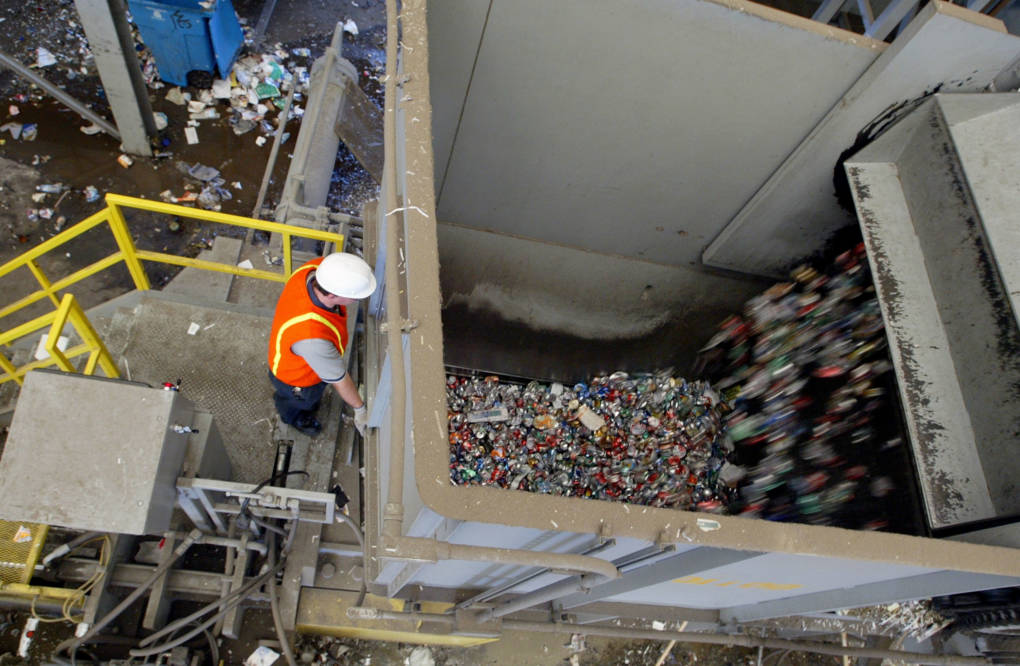
"caption": "A worker watches as aluminum cans are emptied into a bailer at the Norcal Waste recycling facility on July 11, 2003 in San Francisco. ",
"credit": "Justin Sullivan/Getty Images",
"altTag": null,
"description": null,
"imgSizes": {
"thumbnail": {
"file": "https://cdn.kqed.org/wp-content/uploads/sites/35/2019/09/GettyImages-2154411-160x105.jpg",
"width": 160,
"height": 105,
"mimeType": "image/jpeg"
},
"medium": {
"file": "https://cdn.kqed.org/wp-content/uploads/sites/35/2019/09/GettyImages-2154411-800x523.jpg",
"width": 800,
"height": 523,
"mimeType": "image/jpeg"
},
"medium_large": {
"file": "https://cdn.kqed.org/wp-content/uploads/sites/35/2019/09/GettyImages-2154411-768x502.jpg",
"width": 768,
"height": 502,
"mimeType": "image/jpeg"
},
"large": {
"file": "https://cdn.kqed.org/wp-content/uploads/sites/35/2019/09/GettyImages-2154411-1020x666.jpg",
"width": 1020,
"height": 666,
"mimeType": "image/jpeg"
},
"complete_open_graph": {
"file": "https://cdn.kqed.org/wp-content/uploads/sites/35/2019/09/GettyImages-2154411-1200x784.jpg",
"width": 1200,
"height": 784,
"mimeType": "image/jpeg"
},
"post-thumbnail": {
"file": "https://cdn.kqed.org/wp-content/uploads/sites/35/2019/09/GettyImages-2154411-672x372.jpg",
"width": 672,
"height": 372,
"mimeType": "image/jpeg"
},
"twentyfourteen-full-width": {
"file": "https://cdn.kqed.org/wp-content/uploads/sites/35/2019/09/GettyImages-2154411-1038x576.jpg",
"width": 1038,
"height": 576,
"mimeType": "image/jpeg"
},
"full-width": {
"file": "https://cdn.kqed.org/wp-content/uploads/sites/35/2019/09/GettyImages-2154411-1920x1254.jpg",
"width": 1920,
"height": 1254,
"mimeType": "image/jpeg"
},
"kqedFullSize": {
"file": "https://cdn.kqed.org/wp-content/uploads/sites/35/2019/09/GettyImages-2154411-e1568322782842.jpg",
"width": 1925,
"height": 1258
}
},
"isLoading": false,
"fetchFailed": false
},
"science_1947263": {
"type": "attachments",
"id": "science_1947263",
"meta": {
"index": "attachments_1716263798",
"site": "science",
"id": "1947263",
"found": true
},
"parent": 1947260,
"imgSizes": {
"twentyfourteen-full-width": {
"file": "https://ww2.kqed.org/app/uploads/sites/35/2019/09/iStock-1077963794-1038x576.jpg",
"width": 1038,
"mimeType": "image/jpeg",
"height": 576
},
"thumbnail": {
"file": "https://ww2.kqed.org/app/uploads/sites/35/2019/09/iStock-1077963794-160x107.jpg",
"width": 160,
"mimeType": "image/jpeg",
"height": 107
},
"post-thumbnail": {
"file": "https://ww2.kqed.org/app/uploads/sites/35/2019/09/iStock-1077963794-672x372.jpg",
"width": 672,
"mimeType": "image/jpeg",
"height": 372
},
"kqedFullSize": {
"file": "https://ww2.kqed.org/app/uploads/sites/35/2019/09/iStock-1077963794.jpg",
"width": 2048,
"height": 1367
},
"large": {
"file": "https://ww2.kqed.org/app/uploads/sites/35/2019/09/iStock-1077963794-1020x681.jpg",
"width": 1020,
"mimeType": "image/jpeg",
"height": 681
},
"complete_open_graph": {
"file": "https://ww2.kqed.org/app/uploads/sites/35/2019/09/iStock-1077963794-1200x801.jpg",
"width": 1200,
"mimeType": "image/jpeg",
"height": 801
},
"full-width": {
"file": "https://ww2.kqed.org/app/uploads/sites/35/2019/09/iStock-1077963794-1920x1281.jpg",
"width": 1920,
"mimeType": "image/jpeg",
"height": 1281
},
"medium": {
"file": "https://ww2.kqed.org/app/uploads/sites/35/2019/09/iStock-1077963794-800x534.jpg",
"width": 800,
"mimeType": "image/jpeg",
"height": 534
},
"medium_large": {
"file": "https://ww2.kqed.org/app/uploads/sites/35/2019/09/iStock-1077963794-768x512.jpg",
"width": 768,
"mimeType": "image/jpeg",
"height": 512
}
},
"publishDate": 1568142651,
"modified": 1568142686,
"caption": "Raw whole meat sample in laboratory Petri dish. ",
"description": null,
"title": "Clean cultured meat concept",
"credit": "iStock",
"status": "inherit",
"isLoading": false,
"fetchFailed": false
},
"science_1947007": {
"type": "attachments",
"id": "science_1947007",
"meta": {
"index": "attachments_1716263798",
"site": "science",
"id": "1947007",
"found": true
},
"parent": 1946988,
"imgSizes": {
"twentyfourteen-full-width": {
"file": "https://ww2.kqed.org/app/uploads/sites/35/2019/09/42276716064_3d367c40e6_o-1024x576.jpg",
"width": 1024,
"mimeType": "image/jpeg",
"height": 576
},
"thumbnail": {
"file": "https://ww2.kqed.org/app/uploads/sites/35/2019/09/42276716064_3d367c40e6_o-160x100.jpg",
"width": 160,
"mimeType": "image/jpeg",
"height": 100
},
"post-thumbnail": {
"file": "https://ww2.kqed.org/app/uploads/sites/35/2019/09/42276716064_3d367c40e6_o-672x372.jpg",
"width": 672,
"mimeType": "image/jpeg",
"height": 372
},
"kqedFullSize": {
"file": "https://ww2.kqed.org/app/uploads/sites/35/2019/09/42276716064_3d367c40e6_o.jpg",
"width": 1024,
"height": 640
},
"large": {
"file": "https://ww2.kqed.org/app/uploads/sites/35/2019/09/42276716064_3d367c40e6_o-1020x638.jpg",
"width": 1020,
"mimeType": "image/jpeg",
"height": 638
},
"medium": {
"file": "https://ww2.kqed.org/app/uploads/sites/35/2019/09/42276716064_3d367c40e6_o-800x500.jpg",
"width": 800,
"mimeType": "image/jpeg",
"height": 500
},
"medium_large": {
"file": "https://ww2.kqed.org/app/uploads/sites/35/2019/09/42276716064_3d367c40e6_o-768x480.jpg",
"width": 768,
"mimeType": "image/jpeg",
"height": 480
}
},
"publishDate": 1567375659,
"modified": 1567546013,
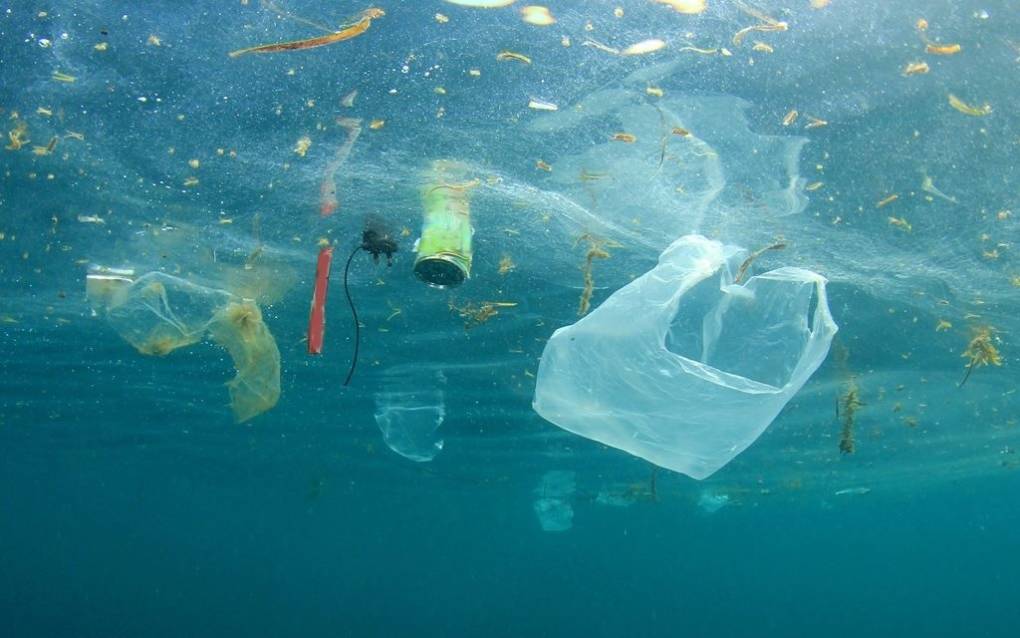
"caption": "Around 1.8 trillion bits of plastic waste have accumulated along the Pacific Ocean between Hawaii and California. ",
"description": null,
"title": "42276716064_3d367c40e6_o",
"credit": "Satpalda Geospatial Service",
"status": "inherit",
"isLoading": false,
"fetchFailed": false
}
},
"audioPlayerReducer": {
"postId": "stream_live",
"isPaused": true,
"isPlaying": false,
"pfsActive": false,
"pledgeModalIsOpen": true,
"playerDrawerIsOpen": false,
"liveAudioPlayStartedAt": 0,
"liveAudioPlayContext": ""
},
"authorsReducer": {
"byline_science_1947882": {
"type": "authors",
"id": "byline_science_1947882",
"meta": {
"override": true
},
"slug": "byline_science_1947882",
"name": "Jane Braxton Little \u003cbr/> Bay Nature \u003cbr>",
"isLoading": false
},
"byline_science_1947901": {
"type": "authors",
"id": "byline_science_1947901",
"meta": {
"override": true
},
"slug": "byline_science_1947901",
"name": "Brendan Fitzgerald \u003cbr/>Columbia Journalism Review\u003cbr>",
"isLoading": false
},
"byline_science_1947893": {
"type": "authors",
"id": "byline_science_1947893",
"meta": {
"override": true
},
"slug": "byline_science_1947893",
"name": "Moises Velasquez-Manoff \u003cbr/>Bay Nature\u003cbr>",
"isLoading": false
},
"byline_science_1947609": {
"type": "authors",
"id": "byline_science_1947609",
"meta": {
"override": true
},
"slug": "byline_science_1947609",
"name": "Nell Greenfieldboyce \u003cbr/>NPR\u003cbr>",
"isLoading": false
},
"byline_science_1947465": {
"type": "authors",
"id": "byline_science_1947465",
"meta": {
"override": true
},
"slug": "byline_science_1947465",
"name": "Michael Biesecker\u003cbr />Associated Press",
"isLoading": false
},
"laurensommer": {
"type": "authors",
"id": "239",
"meta": {
"index": "authors_1716337520",
"id": "239",
"found": true
},
"name": "Lauren Sommer",
"firstName": "Lauren",
"lastName": "Sommer",
"slug": "laurensommer",
"email": "lsommer@kqed.org",
"display_author_email": false,
"staff_mastheads": [],
"title": "KQED Contributor",
"bio": "Lauren is a radio reporter formerly covering environment, water, and energy for KQED Science. As part of her day job, she has scaled Sierra Nevada peaks, run from charging elephant seals, and desperately tried to get her sea legs - all in pursuit of good radio. Her work has appeared on Marketplace, Living on Earth, Science Friday and NPR's Morning Edition and All Things Considered. You can find her on Twitter at \u003ca href=\"https://twitter.com/lesommer\">@lesommer\u003c/a>.",
"avatar": "https://secure.gravatar.com/avatar/33aa3772bb86c6ad45b8aca6a238bbdf?s=600&d=blank&r=g",
"twitter": null,
"facebook": null,
"instagram": null,
"linkedin": null,
"sites": [
{
"site": "news",
"roles": [
"author"
]
},
{
"site": "science",
"roles": [
"editor",
"manage_content_types",
"manage_taxonomies"
]
},
{
"site": "quest",
"roles": [
"editor"
]
}
],
"headData": {
"title": "Lauren Sommer | KQED",
"description": "KQED Contributor",
"ogImgSrc": "https://secure.gravatar.com/avatar/33aa3772bb86c6ad45b8aca6a238bbdf?s=600&d=blank&r=g",
"twImgSrc": "https://secure.gravatar.com/avatar/33aa3772bb86c6ad45b8aca6a238bbdf?s=600&d=blank&r=g"
},
"isLoading": false,
"link": "/author/laurensommer"
},
"lesleymcclurg": {
"type": "authors",
"id": "11229",
"meta": {
"index": "authors_1716337520",
"id": "11229",
"found": true
},
"name": "Lesley McClurg",
"firstName": "Lesley",
"lastName": "McClurg",
"slug": "lesleymcclurg",
"email": "lmcclurg@KQED.org",
"display_author_email": false,
"staff_mastheads": [
"news",
"science"
],
"title": "KQED Health Correspondent",
"bio": "Lesley McClurg is a health correspondent and fill-in host whose work is regularly rebroadcast on NPR and PBS programs. She’s earned multiple regional Emmy awards, a national and a regional Edward R. Murrow award, and was named Best Beat Reporter by the Association of Health Care Journalists. The Society of Professional Journalists has recognized her work several times, and the Society of Environmental Journalists spotlighted her coverage of California’s historic drought.\r\n\r\nBefore joining KQED in 2016, Lesley covered food and sustainability for Capital Public Radio, environmental issues for Colorado Public Radio, and reported for KUOW and KCTS 9 in Seattle. Away from the newsroom, she loves skiing with her daughter, mountain biking with her partner, and playing with Ollie, the family’s goldendoodle. On deadline, she runs almost entirely on chocolate chips.\r\n\r\n ",
"avatar": "https://secure.gravatar.com/avatar/bab49e972ea10c774fe0f5e29dba1722b158f7c0d58a360923d1389d380b2978?s=600&d=blank&r=g",
"twitter": "lesleywmcclurg",
"bluesky": null,
"facebook": null,
"instagram": null,
"linkedin": null,
"sites": [
{
"site": "arts",
"roles": [
"author"
]
},
{
"site": "news",
"roles": [
"editor"
]
},
{
"site": "futureofyou",
"roles": [
"editor"
]
},
{
"site": "stateofhealth",
"roles": [
"author"
]
},
{
"site": "science",
"roles": [
"editor"
]
},
{
"site": "quest",
"roles": [
"subscriber"
]
},
{
"site": "forum",
"roles": [
"administrator"
]
},
{
"site": "liveblog",
"roles": [
"author"
]
}
],
"headData": {
"title": "Lesley McClurg | KQED",
"description": "KQED Health Correspondent",
"ogImgSrc": "https://secure.gravatar.com/avatar/bab49e972ea10c774fe0f5e29dba1722b158f7c0d58a360923d1389d380b2978?s=600&d=blank&r=g",
"twImgSrc": "https://secure.gravatar.com/avatar/bab49e972ea10c774fe0f5e29dba1722b158f7c0d58a360923d1389d380b2978?s=600&d=blank&r=g"
},
"isLoading": false,
"link": "/author/lesleymcclurg"
},
"parcuni": {
"type": "authors",
"id": "11368",
"meta": {
"index": "authors_1716337520",
"id": "11368",
"found": true
},
"name": "Peter Arcuni",
"firstName": "Peter",
"lastName": "Arcuni",
"slug": "parcuni",
"email": "parcuni@KQED.org",
"display_author_email": false,
"staff_mastheads": [
"science"
],
"title": "Reporter",
"bio": "Peter reports radio and online stories for \u003cem>KQED Science\u003c/em>. His work has also appeared on the \u003cem>The California Report\u003c/em> morning show and \u003cem>KQED News\u003c/em>. His production credits include \u003cem>The California Report, The California Report Magazine\u003c/em> and KQED's local news podcast \u003cem>The Bay\u003c/em>. Other credits include NPR's \u003cem>All Things Considered\u003c/em>, WNYC's \u003cem>Science Friday\u003c/em>, WBUR's \u003cem>Here & Now\u003c/em>, WIRED and SFGate. Peter graduated from Brown University and earned a master's degree in journalism from Stanford. He's covered everything from homelessness to wildfires, health, the environment, arts and Thanksgiving in San Quentin prison. In other lives, he played rock n roll music and studied neuroscience. You can email him at: parcuni@kqed.org",
"avatar": "https://secure.gravatar.com/avatar/d5032f6f27199d478af34ad2e1d98732?s=600&d=blank&r=g",
"twitter": "peterarcuni",
"facebook": null,
"instagram": null,
"linkedin": null,
"sites": [
{
"site": "news",
"roles": [
"editor"
]
},
{
"site": "science",
"roles": [
"editor"
]
}
],
"headData": {
"title": "Peter Arcuni | KQED",
"description": "Reporter",
"ogImgSrc": "https://secure.gravatar.com/avatar/d5032f6f27199d478af34ad2e1d98732?s=600&d=blank&r=g",
"twImgSrc": "https://secure.gravatar.com/avatar/d5032f6f27199d478af34ad2e1d98732?s=600&d=blank&r=g"
},
"isLoading": false,
"link": "/author/parcuni"
},
"kevinstark": {
"type": "authors",
"id": "11608",
"meta": {
"index": "authors_1716337520",
"id": "11608",
"found": true
},
"name": "Kevin Stark",
"firstName": "Kevin",
"lastName": "Stark",
"slug": "kevinstark",
"email": "kstark@kqed.org",
"display_author_email": true,
"staff_mastheads": [
"science"
],
"title": "Senior Editor",
"bio": "Kevin is a senior editor for KQED Science, managing the station's health and climate desks. His journalism career began in the Pacific Northwest, and he later became a lead reporter for the San Francisco Public Press. His work has appeared in Pacific Standard magazine, the Energy News Network, the Center for Investigative Reporting's Reveal and WBEZ in Chicago. Kevin joined KQED in 2019, and has covered issues related to energy, wildfire, climate change and the environment.",
"avatar": "https://secure.gravatar.com/avatar/365aaa4b597d3a8374f67504ff0facd323d7906e8eb4be0a7efd2427408e802c?s=600&d=blank&r=g",
"twitter": "starkkev",
"bluesky": null,
"facebook": null,
"instagram": null,
"linkedin": null,
"sites": [
{
"site": "",
"roles": [
"editor"
]
},
{
"site": "news",
"roles": [
"editor"
]
},
{
"site": "science",
"roles": [
"administrator"
]
}
],
"headData": {
"title": "Kevin Stark | KQED",
"description": "Senior Editor",
"ogImgSrc": "https://secure.gravatar.com/avatar/365aaa4b597d3a8374f67504ff0facd323d7906e8eb4be0a7efd2427408e802c?s=600&d=blank&r=g",
"twImgSrc": "https://secure.gravatar.com/avatar/365aaa4b597d3a8374f67504ff0facd323d7906e8eb4be0a7efd2427408e802c?s=600&d=blank&r=g"
},
"isLoading": false,
"link": "/author/kevinstark"
},
"jmejiamunoz": {
"type": "authors",
"id": "11616",
"meta": {
"index": "authors_1716337520",
"id": "11616",
"found": true
},
"name": "Jazmine Mejia-Muñoz",
"firstName": "Jazmine",
"lastName": "Mejia-Muñoz",
"slug": "jmejiamunoz",
"email": "jmejiamunoz@kqed.org",
"display_author_email": false,
"staff_mastheads": [],
"title": null,
"bio": "\u003cem>KQED Science Fuhs Fellow- Summer 2019\u003c/em>",
"avatar": "https://secure.gravatar.com/avatar/bbfd276dfdd4279114cadd5ffe3e4c14?s=600&d=blank&r=g",
"twitter": null,
"facebook": null,
"instagram": null,
"linkedin": null,
"sites": [
{
"site": "science",
"roles": [
"author"
]
}
],
"headData": {
"title": "Jazmine Mejia-Muñoz | KQED",
"description": null,
"ogImgSrc": "https://secure.gravatar.com/avatar/bbfd276dfdd4279114cadd5ffe3e4c14?s=600&d=blank&r=g",
"twImgSrc": "https://secure.gravatar.com/avatar/bbfd276dfdd4279114cadd5ffe3e4c14?s=600&d=blank&r=g"
},
"isLoading": false,
"link": "/author/jmejiamunoz"
}
},
"pagesReducer": {
"science_category_environment": {
"type": "terms",
"id": "science_35",
"meta": {
"index": "terms_1716263798",
"site": "science",
"id": "35",
"score": 12.138525
},
"featImg": null,
"name": "Environment",
"description": null,
"taxonomy": "category",
"headData": {
"twImgId": null,
"twTitle": null,
"ogTitle": null,
"ogImgId": null,
"twDescription": null,
"description": null,
"title": "Environment Archives | KQED Science",
"ogDescription": null
},
"ttid": 37,
"slug": "environment",
"isLoading": false,
"title": "Environment",
"pageMeta": {
"site": "science",
"WpPageTemplate": "page-topic-editorial",
"currentPage": 53
},
"blocks": [
{
"blockName": "kqed/post-list",
"attrs": {
"layout": "cardArticle2",
"query": "posts/science?category=environment",
"seeMore": false,
"paginated": true,
"page": 53
}
},
{
"blockName": "kqed/ad"
}
]
}
},
"pfsSessionReducer": {},
"postsReducer": {
"stream_live": {
"type": "live",
"id": "stream_live",
"audioUrl": "https://streams.kqed.org/kqedradio",
"title": "Live Stream",
"excerpt": "Live Stream information currently unavailable.",
"link": "/radio",
"featImg": "",
"label": {
"name": "KQED Live",
"link": "/"
}
},
"stream_kqedNewscast": {
"type": "posts",
"id": "stream_kqedNewscast",
"audioUrl": "https://www.kqed.org/.stream/anon/radio/RDnews/newscast.mp3?_=1",
"title": "KQED Newscast",
"featImg": "",
"label": {
"name": "88.5 FM",
"link": "/"
}
},
"science_1947882": {
"type": "posts",
"id": "science_1947882",
"meta": {
"index": "posts_1716263798",
"site": "science",
"id": "1947882",
"score": null,
"sort": [
1569308472000
]
},
"parent": 0,
"labelTerm": {},
"blocks": [],
"publishDate": 1569308472,
"format": "standard",
"title": "‘There’s No Ambiguity. It Will Be Gone.’ How California's Animals Will Feel the Warming Climate",
"headTitle": "‘There’s No Ambiguity. It Will Be Gone.’ How California’s Animals Will Feel the Warming Climate | KQED",
"content": "\u003cp class=\"has-drop-cap\">A blue copper butterfly perches waist height on a buckwheat blossom blooming in the cloud dunes near Bodega Bay. In the thick fog its gossamer wings are folded, keeping its sky-blue hues to itself and the milk-white flower. Normally found at higher elevations in California’s Sierra Nevada and Cascade mountains, this colony of blue coppers exists in this chilly coastal prairie because of the low clouds that drip with moisture.\u003c/p>\n\u003cp>\u003ca href=\"https://ww2.kqed.org/science/wp-content/uploads/sites/35/2019/09/Covering-Climate-Now-Logo.png\">\u003cimg loading=\"lazy\" decoding=\"async\" class=\"alignright wp-image-1947420\" src=\"https://ww2.kqed.org/science/wp-content/uploads/sites/35/2019/09/Covering-Climate-Now-Logo-1020x1019.png\" alt=\"\" width=\"245\" height=\"245\" srcset=\"https://cdn.kqed.org/wp-content/uploads/sites/35/2019/09/Covering-Climate-Now-Logo-1020x1019.png 1020w, https://cdn.kqed.org/wp-content/uploads/sites/35/2019/09/Covering-Climate-Now-Logo-160x160.png 160w, https://cdn.kqed.org/wp-content/uploads/sites/35/2019/09/Covering-Climate-Now-Logo-800x799.png 800w, https://cdn.kqed.org/wp-content/uploads/sites/35/2019/09/Covering-Climate-Now-Logo-768x767.png 768w, https://cdn.kqed.org/wp-content/uploads/sites/35/2019/09/Covering-Climate-Now-Logo.png 1116w\" sizes=\"(max-width: 245px) 100vw, 245px\">\u003c/a>If the fog belt burns off permanently, this butterfly population will become extinct. “There’s no ambiguity. It will be gone,” said Arthur Shapiro, an evolution and ecology professor at University of California, Davis.\u003c/p>\n\u003cp>Heat is threatening animals around the world. At a time when scientists are certain that human greenhouse gas emissions are warming ocean waters and raising temperatures, however, they are still sorting out how turning up the thermostat is affecting the specific ecosystems that plants and animals rely on – including the coastal fogs so critical to redwoods, these blue coppers and a host of other species. Researchers are also raising questions about the impacts of an additional 8 degrees Fahrenheit on California’s inland species, from the Central Valley to the Sierra Nevada. While there is little doubt that changes in climate are shifting the habitats of virtually every living being on Earth, an examination of Northern California, one of the most biologically diverse places on the planet because of its mix of habitats, illustrates the challenges of trying to predict the future for evolving species.\u003c/p>\n\u003cp>Clearly there will be losers. The latest Intergovernmental Panel on Climate Change report found that around 1 million animal and plant species are now threatened with extinction, many within decades, more than ever before in human history.\u003cstrong> \u003c/strong>But there may also be winners, at least temporarily. As scientists wrestle with the impacts of global temperatures already 2.7 degrees hotter than pre-industrial levels, they are entering a phase of scientific inquiry without parallels, said Shapiro: “Climate change is leading to environments that have no analog in our modern world.”\u003c/p>\n\u003cfigure id=\"attachment_1947884\" class=\"wp-caption alignright\" style=\"max-width: 800px\">\u003cimg loading=\"lazy\" decoding=\"async\" class=\"size-medium wp-image-1947884\" src=\"https://ww2.kqed.org/science/wp-content/uploads/sites/35/2019/09/Cassins_Auklet-800x600.jpg\" alt=\"\" width=\"800\" height=\"600\">\u003cfigcaption class=\"wp-caption-text\">A Cassin’s auklet on the Farallon Island \u003ccite>(Duncan Wright, Wikimedia Commons)\u003c/cite>\u003c/figcaption>\u003c/figure>\n\u003cp>In the San Francisco Bay Area, the effects of climate change on local species begin at sea. Like oceans around the world, the Pacific has warmed by as much as a half-degree Fahrenheit every decade since 1910. For Cassin’s auklets, the results have been devastating. These chunky fist-sized birds are common in the waters around the Farallon Islands. During the winter of 2014 more than 1,200 young Cassin’s auklets washed up dead – and tens of thousands are thought to have starved, said Shaye Wolf, a climate change scientist with the Center for Biological Diversity. An enormous slog of warm water had developed off the Pacific coast. Known as the Blob, this marine heat wave caused massive die-offs and a 30 percent drop in the population of humpback whales.\u003c/p>\n\u003cp>[ad fullwidth]\u003c/p>\n\u003cp>The warming waters hit Cassin’s auklets, along with many other seabirds and marine mammals, through their food supply. The auklets feed on krill and copepods, small crustaceans found in most of the world’s oceans. Scientists believe the over-heated waters drastically reduced the numbers of the shrimp-like krill, depriving the birds of a dietary mainstay. Warm waters also drew southern copepods north. And while Cassin’s auklets will eat them, they are less nutritious than their fat northern counterparts, “a kind of junk food,” said Wolf.\u003c/p>\n\u003cp>Scientists detected \u003ca href=\"https://baynature.org/2019/09/12/review-of-the-pacific-warm-blob-sequel-not-yet-a-phenomena-like-the-original/\">another heat wave developing this summer\u003c/a> in the same area of the previous Blob, this one already 4 degrees Celsius above normal in places. With warmer waters leading to less food, Cassin’s auklets suffered an alarming breeding failure this summer. “Parents abandoned nests and chicks just starved,” Wolf said.\u003c/p>\n\u003cp class=\"has-drop-cap\">Warming waters are also taking a toll on salmon, threatening these cold-loving fish in several ways. Chinook, the largest of the salmon family, live in both ocean water and freshwater at different stages of their lifecycle. They are extremely resilient and have adapted to some of the warming, said Lisa Crozier, a National Oceanic and Atmospheric Administration salmon researcher and lead author of a July \u003ca href=\"https://journals.plos.org/plosone/article?id=10.1371/journal.pone.0217711\" target=\"_blank\" rel=\"nofollow noopener\">study\u003c/a> published in \u003cem>PLOS One\u003c/em>. Still, Chinook, already listed as a federally endangered species, are stressed by warmer temperatures in the Sacramento and other rivers. That makes them susceptible to parasites and disease. If stream temperatures rise beyond 3.6 degrees Fahrenheit above the pre-industrial era all bets are off, Crozier said. Chinook salmon in the Central Valley may be the first of the many salmon species to blink out.\u003c/p>\n\u003cp>In inland California, butterflies at various elevations have shown mixed responses to record-setting temperatures. During the state’s five-year drought, researchers found the number of butterfly species and individuals observed per year increased at lower elevations but decreased at higher elevations. A 2018 \u003ca href=\"https://climatechangeresponses.biomedcentral.com/articles/10.1186/s40665-018-0039-x\" target=\"_blank\" rel=\"nofollow noopener\">study\u003c/a> documented those at sea level reversing long-term declines, while butterflies in the Sierra Nevada were severely harmed, said Shapiro, the UC Davis professor.\u003c/p>\n\u003cp>Butterflies generally do not do well in warm, wet winters, he said. During the drought, species at low elevation sites benefitted from hot sunny days and cold nights with minimal humidity. But the drought reduced the high-elevation snowpack that helps overwintering butterflies survive until spring. It may also have caused them to emerge earlier in the season, which could have put them out of sync with the flowers and other resources they depend upon. When ecosystems warm to the extent that they are no longer capable of supporting these and other species, “it’s bye bye,” Shapiro said.\u003c/p>\n\u003cp class=\"has-drop-cap\">How animals will respond is not always straightforward. When \u003ca href=\"https://www.pointblue.org/employee_bios/jay-roberts/\" target=\"_blank\" rel=\"nofollow noopener\">Jay Roberts, a Point Blue forest ecologist\u003c/a>, began a study of birds in the Sierra he assumed the five-year drought that killed 147 million trees would be analogous to the climate conditions predicted to occur in the future. He expected to find negative effects to the dusky flycatchers, golden-crowned kinglets and others among the 45 species he monitored. Instead, his \u003ca href=\"https://esajournals.onlinelibrary.wiley.com/doi/10.1002/eap.1848\" target=\"_blank\" rel=\"nofollow noopener\">research\u003c/a> documented an overall abundance of birds. Nearly half of the species responded positively to higher temperatures; only 20 percent declined. As climate change continues to increase temperatures, Roberts believes many species may benefit, especially if it is coupled with an increase in precipitation.\u003c/p>\n\u003cp>We can’t conclude this trend will continue, Roberts said, but the birds’ response to a drastic shift in temperature over a very few years demonstrates that they are resilient. Like other species in the Sierra, birds have evolved to adjust to disturbances that include drought and fire. “These responses are in their DNA,” he said.\u003c/p>\n\u003cp>Still, if some of the effects of heat on animals are counterintuitive, the general results are not. Of the state’s 300 at-risk species, those already gone include two populations of the Bay Checkerspot butterfly. \u003ca href=\"http://www.climateassessment.ca.gov/\" target=\"_blank\" rel=\"nofollow noopener\">California’s Fourth Climate Change Assessment\u003c/a> predicts temperatures will climb another 5 to 8 degrees Fahrenheit by 2100. Glaciers will continue to melt. In the San Francisco area, where sea level is already 8 inches higher than a century ago, the 2018 assessment projects it will rise an additional 4.5 feet by 2100 – and possibly as much as 9 feet along the California coast. Northern California farmers will face water shortages of up to 16 percent in some regions. Winter storms will likely become more intense in a boom-bust cycle with very wet and very dry years. And in the Sierra Nevada, the snowpack will decline by two-thirds over the next century and temperatures will increase up to 9 degrees Fahrenheit, according to an assessment led by David Ackerly, a biology professor at University of California, Berkeley.\u003c/p>\n\u003cp>As scientists continue to document the sometimes surprising ways that animals respond to heat, blue coppers will continue to lay eggs and nibble on buckwheat as caterpillars before spreading their bright blue wings as butterflies. But for how long? These are uncharted times in a hot and entirely novel climate regime.\u003c/p>\n\u003cp>[ad floatright]\u003c/p>\n\u003cp>\u003cem>This \u003ca href=\"https://baynature.org/2019/09/20/theres-no-ambiguity-it-will-be-gone-how-animals-will-feel-the-warming-climate/\" target=\"_blank\" rel=\"noopener\">story\u003c/a> originally appeared in \u003ca href=\"https://baynature.org/\" target=\"_blank\" rel=\"noopener\">Bay Nature\u003c/a>. It is republished here as part of \u003ca href=\"http://kqed.org/climate\" target=\"_blank\" rel=\"noopener\">KQED Science’s\u003c/a> partnership with Covering Climate Now, a global collaboration of more than 250 news outlets to strengthen coverage of the climate story.\u003c/em>\u003c/p>\n\u003cdiv class=\"author-name\">\u003cem>Based in the northern Sierra Nevada, \u003ca href=\"https://www.janebraxtonlittle.com/\" target=\"_blank\" rel=\"noopener\">Jane Braxton Little\u003c/a> is an independent journalist covering science and natural resource issues for publications that include Scientific American, National Geographic, Audubon, Discover, High Country News and, with this story, Bay Nature.\u003c/em>\u003c/div>\n\n",
"stats": {
"hasVideo": false,
"hasChartOrMap": false,
"hasAudio": false,
"hasPolis": false,
"wordCount": 1470,
"hasGoogleForm": false,
"hasGallery": false,
"hasHearkenModule": false,
"iframeSrcs": [],
"paragraphCount": 14
},
"modified": 1704848304,
"excerpt": "Clearly there will be losers. ",
"headData": {
"twImgId": "",
"twTitle": "",
"ogTitle": "",
"ogImgId": "",
"twDescription": "",
"description": "Clearly there will be losers. ",
"title": "‘There’s No Ambiguity. It Will Be Gone.’ How California's Animals Will Feel the Warming Climate | KQED",
"ogDescription": "",
"schema": {
"@context": "https://schema.org",
"@type": "Article",
"headline": "‘There’s No Ambiguity. It Will Be Gone.’ How California's Animals Will Feel the Warming Climate",
"datePublished": "2019-09-24T00:01:12-07:00",
"dateModified": "2024-01-09T16:58:24-08:00",
"image": "https://cdn.kqed.org/wp-content/uploads/2020/02/KQED-OG-Image@1x.png"
}
},
"guestAuthors": [],
"slug": "theres-no-ambiguity-it-will-be-gone-how-californias-animals-will-feel-the-warming-climate",
"status": "publish",
"templateType": "standard",
"nprByline": "Jane Braxton Little \u003cbr/> Bay Nature \u003cbr>",
"featuredImageType": "standard",
"sticky": false,
"source": "Covering Climate Now",
"path": "/science/1947882/theres-no-ambiguity-it-will-be-gone-how-californias-animals-will-feel-the-warming-climate",
"audioTrackLength": null,
"parsedContent": [
{
"type": "contentString",
"content": "\u003cdiv class=\"post-body\">\u003cp>\u003cp class=\"has-drop-cap\">A blue copper butterfly perches waist height on a buckwheat blossom blooming in the cloud dunes near Bodega Bay. In the thick fog its gossamer wings are folded, keeping its sky-blue hues to itself and the milk-white flower. Normally found at higher elevations in California’s Sierra Nevada and Cascade mountains, this colony of blue coppers exists in this chilly coastal prairie because of the low clouds that drip with moisture.\u003c/p>\n\u003cp>\u003ca href=\"https://ww2.kqed.org/science/wp-content/uploads/sites/35/2019/09/Covering-Climate-Now-Logo.png\">\u003cimg loading=\"lazy\" decoding=\"async\" class=\"alignright wp-image-1947420\" src=\"https://ww2.kqed.org/science/wp-content/uploads/sites/35/2019/09/Covering-Climate-Now-Logo-1020x1019.png\" alt=\"\" width=\"245\" height=\"245\" srcset=\"https://cdn.kqed.org/wp-content/uploads/sites/35/2019/09/Covering-Climate-Now-Logo-1020x1019.png 1020w, https://cdn.kqed.org/wp-content/uploads/sites/35/2019/09/Covering-Climate-Now-Logo-160x160.png 160w, https://cdn.kqed.org/wp-content/uploads/sites/35/2019/09/Covering-Climate-Now-Logo-800x799.png 800w, https://cdn.kqed.org/wp-content/uploads/sites/35/2019/09/Covering-Climate-Now-Logo-768x767.png 768w, https://cdn.kqed.org/wp-content/uploads/sites/35/2019/09/Covering-Climate-Now-Logo.png 1116w\" sizes=\"(max-width: 245px) 100vw, 245px\">\u003c/a>If the fog belt burns off permanently, this butterfly population will become extinct. “There’s no ambiguity. It will be gone,” said Arthur Shapiro, an evolution and ecology professor at University of California, Davis.\u003c/p>\n\u003cp>Heat is threatening animals around the world. At a time when scientists are certain that human greenhouse gas emissions are warming ocean waters and raising temperatures, however, they are still sorting out how turning up the thermostat is affecting the specific ecosystems that plants and animals rely on – including the coastal fogs so critical to redwoods, these blue coppers and a host of other species. Researchers are also raising questions about the impacts of an additional 8 degrees Fahrenheit on California’s inland species, from the Central Valley to the Sierra Nevada. While there is little doubt that changes in climate are shifting the habitats of virtually every living being on Earth, an examination of Northern California, one of the most biologically diverse places on the planet because of its mix of habitats, illustrates the challenges of trying to predict the future for evolving species.\u003c/p>\n\u003cp>Clearly there will be losers. The latest Intergovernmental Panel on Climate Change report found that around 1 million animal and plant species are now threatened with extinction, many within decades, more than ever before in human history.\u003cstrong> \u003c/strong>But there may also be winners, at least temporarily. As scientists wrestle with the impacts of global temperatures already 2.7 degrees hotter than pre-industrial levels, they are entering a phase of scientific inquiry without parallels, said Shapiro: “Climate change is leading to environments that have no analog in our modern world.”\u003c/p>\n\u003cfigure id=\"attachment_1947884\" class=\"wp-caption alignright\" style=\"max-width: 800px\">\u003cimg loading=\"lazy\" decoding=\"async\" class=\"size-medium wp-image-1947884\" src=\"https://ww2.kqed.org/science/wp-content/uploads/sites/35/2019/09/Cassins_Auklet-800x600.jpg\" alt=\"\" width=\"800\" height=\"600\">\u003cfigcaption class=\"wp-caption-text\">A Cassin’s auklet on the Farallon Island \u003ccite>(Duncan Wright, Wikimedia Commons)\u003c/cite>\u003c/figcaption>\u003c/figure>\n\u003cp>In the San Francisco Bay Area, the effects of climate change on local species begin at sea. Like oceans around the world, the Pacific has warmed by as much as a half-degree Fahrenheit every decade since 1910. For Cassin’s auklets, the results have been devastating. These chunky fist-sized birds are common in the waters around the Farallon Islands. During the winter of 2014 more than 1,200 young Cassin’s auklets washed up dead – and tens of thousands are thought to have starved, said Shaye Wolf, a climate change scientist with the Center for Biological Diversity. An enormous slog of warm water had developed off the Pacific coast. Known as the Blob, this marine heat wave caused massive die-offs and a 30 percent drop in the population of humpback whales.\u003c/p>\n\u003cp>\u003c/p>\u003c/div>",
"attributes": {
"named": {},
"numeric": []
}
},
{
"type": "component",
"content": "",
"name": "ad",
"attributes": {
"named": {
"label": "fullwidth"
},
"numeric": [
"fullwidth"
]
}
},
{
"type": "contentString",
"content": "\u003cdiv class=\"post-body\">\u003cp>\u003c/p>\n\u003cp>The warming waters hit Cassin’s auklets, along with many other seabirds and marine mammals, through their food supply. The auklets feed on krill and copepods, small crustaceans found in most of the world’s oceans. Scientists believe the over-heated waters drastically reduced the numbers of the shrimp-like krill, depriving the birds of a dietary mainstay. Warm waters also drew southern copepods north. And while Cassin’s auklets will eat them, they are less nutritious than their fat northern counterparts, “a kind of junk food,” said Wolf.\u003c/p>\n\u003cp>Scientists detected \u003ca href=\"https://baynature.org/2019/09/12/review-of-the-pacific-warm-blob-sequel-not-yet-a-phenomena-like-the-original/\">another heat wave developing this summer\u003c/a> in the same area of the previous Blob, this one already 4 degrees Celsius above normal in places. With warmer waters leading to less food, Cassin’s auklets suffered an alarming breeding failure this summer. “Parents abandoned nests and chicks just starved,” Wolf said.\u003c/p>\n\u003cp class=\"has-drop-cap\">Warming waters are also taking a toll on salmon, threatening these cold-loving fish in several ways. Chinook, the largest of the salmon family, live in both ocean water and freshwater at different stages of their lifecycle. They are extremely resilient and have adapted to some of the warming, said Lisa Crozier, a National Oceanic and Atmospheric Administration salmon researcher and lead author of a July \u003ca href=\"https://journals.plos.org/plosone/article?id=10.1371/journal.pone.0217711\" target=\"_blank\" rel=\"nofollow noopener\">study\u003c/a> published in \u003cem>PLOS One\u003c/em>. Still, Chinook, already listed as a federally endangered species, are stressed by warmer temperatures in the Sacramento and other rivers. That makes them susceptible to parasites and disease. If stream temperatures rise beyond 3.6 degrees Fahrenheit above the pre-industrial era all bets are off, Crozier said. Chinook salmon in the Central Valley may be the first of the many salmon species to blink out.\u003c/p>\n\u003cp>In inland California, butterflies at various elevations have shown mixed responses to record-setting temperatures. During the state’s five-year drought, researchers found the number of butterfly species and individuals observed per year increased at lower elevations but decreased at higher elevations. A 2018 \u003ca href=\"https://climatechangeresponses.biomedcentral.com/articles/10.1186/s40665-018-0039-x\" target=\"_blank\" rel=\"nofollow noopener\">study\u003c/a> documented those at sea level reversing long-term declines, while butterflies in the Sierra Nevada were severely harmed, said Shapiro, the UC Davis professor.\u003c/p>\n\u003cp>Butterflies generally do not do well in warm, wet winters, he said. During the drought, species at low elevation sites benefitted from hot sunny days and cold nights with minimal humidity. But the drought reduced the high-elevation snowpack that helps overwintering butterflies survive until spring. It may also have caused them to emerge earlier in the season, which could have put them out of sync with the flowers and other resources they depend upon. When ecosystems warm to the extent that they are no longer capable of supporting these and other species, “it’s bye bye,” Shapiro said.\u003c/p>\n\u003cp class=\"has-drop-cap\">How animals will respond is not always straightforward. When \u003ca href=\"https://www.pointblue.org/employee_bios/jay-roberts/\" target=\"_blank\" rel=\"nofollow noopener\">Jay Roberts, a Point Blue forest ecologist\u003c/a>, began a study of birds in the Sierra he assumed the five-year drought that killed 147 million trees would be analogous to the climate conditions predicted to occur in the future. He expected to find negative effects to the dusky flycatchers, golden-crowned kinglets and others among the 45 species he monitored. Instead, his \u003ca href=\"https://esajournals.onlinelibrary.wiley.com/doi/10.1002/eap.1848\" target=\"_blank\" rel=\"nofollow noopener\">research\u003c/a> documented an overall abundance of birds. Nearly half of the species responded positively to higher temperatures; only 20 percent declined. As climate change continues to increase temperatures, Roberts believes many species may benefit, especially if it is coupled with an increase in precipitation.\u003c/p>\n\u003cp>We can’t conclude this trend will continue, Roberts said, but the birds’ response to a drastic shift in temperature over a very few years demonstrates that they are resilient. Like other species in the Sierra, birds have evolved to adjust to disturbances that include drought and fire. “These responses are in their DNA,” he said.\u003c/p>\n\u003cp>Still, if some of the effects of heat on animals are counterintuitive, the general results are not. Of the state’s 300 at-risk species, those already gone include two populations of the Bay Checkerspot butterfly. \u003ca href=\"http://www.climateassessment.ca.gov/\" target=\"_blank\" rel=\"nofollow noopener\">California’s Fourth Climate Change Assessment\u003c/a> predicts temperatures will climb another 5 to 8 degrees Fahrenheit by 2100. Glaciers will continue to melt. In the San Francisco area, where sea level is already 8 inches higher than a century ago, the 2018 assessment projects it will rise an additional 4.5 feet by 2100 – and possibly as much as 9 feet along the California coast. Northern California farmers will face water shortages of up to 16 percent in some regions. Winter storms will likely become more intense in a boom-bust cycle with very wet and very dry years. And in the Sierra Nevada, the snowpack will decline by two-thirds over the next century and temperatures will increase up to 9 degrees Fahrenheit, according to an assessment led by David Ackerly, a biology professor at University of California, Berkeley.\u003c/p>\n\u003cp>As scientists continue to document the sometimes surprising ways that animals respond to heat, blue coppers will continue to lay eggs and nibble on buckwheat as caterpillars before spreading their bright blue wings as butterflies. But for how long? These are uncharted times in a hot and entirely novel climate regime.\u003c/p>\n\u003cp>\u003c/p>\u003c/div>",
"attributes": {
"named": {},
"numeric": []
}
},
{
"type": "component",
"content": "",
"name": "ad",
"attributes": {
"named": {
"label": "floatright"
},
"numeric": [
"floatright"
]
}
},
{
"type": "contentString",
"content": "\u003cdiv class=\"post-body\">\u003cp>\u003c/p>\n\u003cp>\u003cem>This \u003ca href=\"https://baynature.org/2019/09/20/theres-no-ambiguity-it-will-be-gone-how-animals-will-feel-the-warming-climate/\" target=\"_blank\" rel=\"noopener\">story\u003c/a> originally appeared in \u003ca href=\"https://baynature.org/\" target=\"_blank\" rel=\"noopener\">Bay Nature\u003c/a>. It is republished here as part of \u003ca href=\"http://kqed.org/climate\" target=\"_blank\" rel=\"noopener\">KQED Science’s\u003c/a> partnership with Covering Climate Now, a global collaboration of more than 250 news outlets to strengthen coverage of the climate story.\u003c/em>\u003c/p>\n\u003cdiv class=\"author-name\">\u003cem>Based in the northern Sierra Nevada, \u003ca href=\"https://www.janebraxtonlittle.com/\" target=\"_blank\" rel=\"noopener\">Jane Braxton Little\u003c/a> is an independent journalist covering science and natural resource issues for publications that include Scientific American, National Geographic, Audubon, Discover, High Country News and, with this story, Bay Nature.\u003c/em>\u003c/div>\n\n\u003c/div>\u003c/p>",
"attributes": {
"named": {},
"numeric": []
}
}
],
"link": "/science/1947882/theres-no-ambiguity-it-will-be-gone-how-californias-animals-will-feel-the-warming-climate",
"authors": [
"byline_science_1947882"
],
"categories": [
"science_2874",
"science_31",
"science_33",
"science_35",
"science_40",
"science_98"
],
"tags": [
"science_194",
"science_4203",
"science_3838"
],
"featImg": "science_1947887",
"label": "source_science_1947882"
},
"science_1947901": {
"type": "posts",
"id": "science_1947901",
"meta": {
"index": "posts_1716263798",
"site": "science",
"id": "1947901",
"score": null,
"sort": [
1569280975000
]
},
"parent": 0,
"labelTerm": {},
"blocks": [],
"publishDate": 1569280975,
"format": "standard",
"title": "Q&A: Michael Mann on coverage since ‘Climategate’",
"headTitle": "Q&A: Michael Mann on coverage since ‘Climategate’ | KQED",
"content": "\u003cp>Michael Mann’s work as a press critic began in earnest a decade ago. Ahead of the 2009 international climate-change summit in Copenhagen, hackers stole email correspondence between Mann and other climate scientists from a computer server at the University of East Anglia. Climate-change deniers used portions of the emails, freed from context, to attack the credibility of Mann, whose “hockey stick” graph charting the rapid rise of the Earth’s\u003cbr>\ntemperature since industrialization would become an emblem of the climate fight. Coverage of what news outlets called “Climategate” saved space for Mann’s critics; such choices emphasized conflict out of all proportion with the scientific consensus on a warming planet. In \u003ci>The Hockey Stick and the Climate Wars\u003c/i>, his 2012 book, Mann called such false balance and sympathetic framing “a sweet victory for climate change deniers.”\u003c/p>\n\u003cp>\u003ca href=\"https://ww2.kqed.org/science/wp-content/uploads/sites/35/2019/09/Covering-Climate-Now-Logo.png\">\u003cimg loading=\"lazy\" decoding=\"async\" class=\"alignright wp-image-1947420\" src=\"https://ww2.kqed.org/science/wp-content/uploads/sites/35/2019/09/Covering-Climate-Now-Logo-1020x1019.png\" alt=\"\" width=\"240\" height=\"240\" srcset=\"https://cdn.kqed.org/wp-content/uploads/sites/35/2019/09/Covering-Climate-Now-Logo-1020x1019.png 1020w, https://cdn.kqed.org/wp-content/uploads/sites/35/2019/09/Covering-Climate-Now-Logo-160x160.png 160w, https://cdn.kqed.org/wp-content/uploads/sites/35/2019/09/Covering-Climate-Now-Logo-800x799.png 800w, https://cdn.kqed.org/wp-content/uploads/sites/35/2019/09/Covering-Climate-Now-Logo-768x767.png 768w, https://cdn.kqed.org/wp-content/uploads/sites/35/2019/09/Covering-Climate-Now-Logo.png 1116w\" sizes=\"(max-width: 240px) 100vw, 240px\">\u003c/a>Though multiple investigations upheld the integrity of Mann’s research, such vindication took years. Mann has vigorously contested misinformation concerning his work and climate science \u003ca href=\"https://twitter.com/search?q=(reporter%20OR%20reporters%20OR%20journalist%20OR%20journalists)%20(from%3Amichaelemann)&src=typed_query\" target=\"_blank\" rel=\"noopener noreferrer\">on social media\u003c/a> as well as in the courts. In 2011, Mann filed \u003ca href=\"https://web.archive.org/web/20160905215806/http://www.courthousenews.com/2011/03/28/ClimateGuy.pdf\" target=\"_blank\" rel=\"noopener noreferrer\">a defamation claim\u003c/a> in a British Columbia court against the Frontier Center for Public Policy (FCPP), a Canadian think-tank, and Tim Ball, a former geography professor, after Ball suggested in an interview that Mann should be imprisoned. In June, the FCPP settled with Mann and \u003ca href=\"https://web.archive.org/web/20190609170116/https://fcpp.org/retraction-and-apology-to-michael-mann/\" target=\"_blank\" rel=\"noopener noreferrer\">apologized\u003c/a> for its characterization of his work. Last month, after Ball’s lawyers cited their client’s poor health and his website’s low ranking, a judge \u003ca href=\"https://www.bccourts.ca/jdb-txt/sc/19/15/2019BCSC1580.htm\" target=\"_blank\" rel=\"noopener noreferrer\">dismissed the case\u003c/a>, for delays he attributed to Mann. (The judge also noted the two parties’ “dramatically different opinions on climate change,” which the court did not address.) Mann then took to Twitter to counter climate-denial sites that spun the dismissal.\u003c/p>\n\u003cp>Mann, a climatologist who directs the Penn State Earth System Science Center, spoke with CJR last week, one day after \u003ci>The New Yorker\u003c/i> published a widely derided climate-change column by Jonathan Franzen. (Writing in her “Heated” newsletter, journalist Emily Atkin called Franzen’s take “the most brilliantly unintentional fossil fuel industry propaganda I’ve ever read.”) Mann talked about the lessons learned by newsrooms since “Climategate,” and the new pitfalls that await reporters covering the planet’s most important story. Our conversation has been edited for length and clarity.\u003c/p>\n\u003cp>\u003cb>This year marks a decade since news coverage of what many news outlets called “Climategate.” What gains have journalists made in their coverage of climate science and global warming since then?\u003c/b>\u003c/p>\n\u003cp>We’ve seen a pretty dramatic move away from the false balance that we used to see, where every news story about climate change had to have a contrarian, a climate-change denier, representing the other side—as if there’s equal weight on the side of science and science denial.\u003c/p>\n\u003cp>[ad fullwidth]\u003c/p>\n\u003cp>At the same time, I think there are other problems that we’re seeing crop up in media coverage of this issue. [Franzen’s piece is] emblematic of a trend toward doomist framing; my worry is it leads people down a path of despair and hopelessness and inaction, which actually leads us to the same place as outright climate-change denialism.\u003c/p>\n\u003cp>We’re also seeing a tendency to emphasize personal responsibility and choice over systemic change. \u003ci>The New York Times\u003c/i>, in the space of a month or two, had a half-dozen articles touting the importance of individuals. \u003ci>The problem is us and our eating habits, our travel habits\u003c/i>. Again, I think this may not be intentional, but it is actually playing into a deflection campaign that is being used by fossil-fuel interests, trying to emphasize the role of individuals to take the pressure off regulation of industry and systemic changes.\u003c/p>\n\u003cp>It’s impossible now to deny that climate change is happening. The fossil-fuel industry has essentially give up on their campaign to deny the reality of climate change. So instead they’re focused on this kinder, gentler form of denialism. This is the new climate war, and we need to recognize that it’s being waged and understand that it’s every bit as dangerous as the old climate war—the old-fashioned, outright denial of the science. In some ways, it has the veneer of credibility. It seems reasonable to many people. And that makes it, to some extent, even more pernicious.\u003c/p>\n\u003cp>\u003cb>There’s a tension in climate communication between alerting people and alarming them. How do you spur people to action without paralyzing them with fear?\u003c/b>\u003c/p>\n\u003cp>There is a fine line there. We have to convey both urgency and agency. Yes, we have an urgent problem; you could call it a crisis or an emergency, if you’d like. But we can do something about it. Urgency and agency have to go hand-in-hand. Only now are we seeing the sort of action that needs to be mobilized to shift us away from the business-as-usual paradigm.\u003c/p>\n\u003cp>The reality is that different people are going to be motivated by different things, and some amount of concern and even fear can motivate—we know that, psychologists have established that. But it can also elicit other, disabling instinctual reactions—paralysis and disengagement. Different people are going to respond differently.\u003c/p>\n\u003cp>There’s a logical fallacy, right? It’s like, \u003ci>Look, we still have the problem, so it’s not working.\u003c/i> And Franzen, in essence, in his latest article, to me, is doing this. He’s saying, \u003ci>Look, it hasn’t worked, so this isn’t going to work, so let’s adapt to the changes that are coming. \u003c/i>To me, it was unambiguous that that was his message. I don’t think that sort of messaging is helpful.\u003c/p>\n\u003cp>In Franzen’s case, I was actually \u003ca href=\"https://twitter.com/MichaelEMann/status/1170847152060477440\" target=\"_blank\" rel=\"noopener noreferrer\">contacted by a fact-checker\u003c/a> to check a fact in the article, and I pointed out that it was wrong. When you look at model projections, and there’s an average and then there’s a spread, the estimate is that there’s an equal likelihood that the reality is above and below that spread. He had implied it was one-sided—that somehow the average is systematically underestimating the warming. He got that wrong. I pointed that out, and the error persists in the piece that appeared.\u003c/p>\n\u003cp>https://twitter.com/MichaelEMann/status/1170851084111425538?s=20\u003c/p>\n\u003cp>I don’t think it’s accidental that the errors that I’m talking about, the misrepresentations of the science, are systematically in the direction that paints an overly sort of gloomy, doomist picture. It’s exactly what climate-change deniers do in the opposite direction. They always cherry-pick the model projections and observations to understate the threat of climate change. Here, the doomists, in my view, are doing the same thing in the opposite direction.\u003c/p>\n\u003cp>\u003cb>How would you characterize your interactions with journalists? \u003c/b>\u003c/p>\n\u003cp>Personally, I find journalists to be a very thoughtful lot, and even though many of them don’t have training in physical science, I’ve always found it fairly easy to communicate the science to them and to help them frame it in ways that the general public can understand.\u003c/p>\n\u003cp>The extent to which we still have some problems and challenges has less to do with journalists and more to do with management and editorial staff. The business model sort of favors clickbait and exaggeration. Some of the nuance and some of the key scientific framing are lost, and what you have is a more biased article that exaggerates the science in one way or another, that favors the sort of “\u003ca href=\"https://dotearth.blogs.nytimes.com/2008/07/29/climate-research-media-focus-whiplash/\" target=\"_blank\" rel=\"noopener noreferrer\">whiplash effect\u003c/a>” that Andy Revkin has talked about: \u003ci>Climate change is a hoax\u003c/i>, or \u003ci>Climate change is far worse than we thought\u003c/i>.\u003c/p>\n\u003cp>\u003cb>You have about as many Twitter followers as CJR—\u003c/b>\u003c/p>\n\u003cp>Yeah.\u003c/p>\n\u003cp>\u003cb>—and more than many news outlets. You curate a lot of reporting and criticism concerning the climate crisis and the environmental changes of a warming planet. How do you engage that audience responsibly?\u003c/b>\u003c/p>\n\u003cp>When I need some humility, I’ll look at how many followers Miley Cyrus has. [\u003ci>Editor’s note: She has 43.9 million.\u003c/i>]\u003c/p>\n\u003cp>It’s not necessarily an objective measure of the intellectual contribution you’re making to the public discourse. And I recognize that. And, I guess, I feel like I’ve been given this great privilege of having a fairly large following, and I have a responsibility to use it responsibly. I do my best to do that, but I’m a human being.\u003c/p>\n\u003cp>Social media is often about the moment, the here-and-now, the hot take. We respond to impulses, to individual events. We’re less good at seeing things in broader context. I try to be aware of that, and I try to control my impulses. If something makes me really angry and I want to react, I’ll try to catch myself. I try to be as constructive as I can. I try to provide what I feel is important context to news articles and commentary that will help people see the climate crisis more broadly, and more deeply.\u003c/p>\n\u003cp>\u003cb>You responded on social media to misinformation published about your court case against Tim Ball. After I saw your responses, I realized hadn’t seen any coverage from actual news outlets. Is there some conclusion about the press to draw from that?\u003c/b>\u003cb> \u003c/b>\u003c/p>\n\u003cp>I’d say in a phrase, \u003ci>Fool me once\u003c/i>. I think the journalism community learned its lesson from the so-called “Climategate” affair. Climate-change deniers and the organizations that front for the fossil-fuel industry did a very good job at putting huge amounts of pressure on journalists to cover this fake story. Eventually, the mainstream media took the bait, because, well, \u003ci>If there’s this much smoke\u003c/i>. Of course, it took a while for the various investigations to play out. Ultimately, when they did, what we saw was: there was no fire. The only wrongdoing was the theft of the emails. There was no indiscretion on the part of the scientists. The denial machine sort of lost its credibility.\u003c/p>\n\u003cp>In the end, I think it’s now a damp squib, but [climate-change deniers] generated a solid week or so of noise and distraction, and I actually think it folds into something larger. Right now, we’re seeing \u003ca href=\"https://insideclimatenews.org/news/16092019/trollbot-twitter-climate-change-attacks-disinformation-campaign-mann-mckenna-greta-targeted\" target=\"_blank\" rel=\"noopener noreferrer\">an uptick in online climate-denial trolling\u003c/a> and bot armies being deployed to promote misinformation and disinformation. We see that in attacks on folks like Greta Thunberg, who’s become the figurehead of the youth climate movement. OPEC declared the movement “perhaps the greatest threat to our industry.” There’s all this ire and vitriol that’s been directed her way.\u003c/p>\n\u003cp>This has happened in the past. “Climategate” was intended to distract the public and policymakers going into the Copenhagen summit, back in December 2009. I think we’ve seen an uptick in denialist trolling and bot armies in the lead-up \u003ca href=\"https://www.un.org/en/climatechange/\" target=\"_blank\" rel=\"noopener noreferrer\">to this UN summit\u003c/a>. I’ve seen other people comment on that; I think there’s clear recognition that there’s a ramping-up of this disinformation machine right now.\u003c/p>\n\u003cp>\u003cem>This \u003ca href=\"https://www.cjr.org/covering_climate_now/michael-mann-climategate-franzen.php\" target=\"_blank\" rel=\"noopener\">story\u003c/a> originally appeared in \u003ca href=\"https://www.cjr.org/covering_climate_now/michael-mann-climategate-franzen.php\" target=\"_blank\" rel=\"noopener\">Columbia Journalism Review\u003c/a>. It is republished here as part of \u003ca href=\"http://kqed.org/climate\" target=\"_blank\" rel=\"noopener\">KQED Science’s\u003c/a> partnership with Covering Climate Now, a global collaboration of more than 250 news outlets to strengthen coverage of the climate story.\u003c/em>\u003c/p>\n\u003cp>[ad floatright]\u003c/p>\n\u003cp> \u003c/p>\n\n",
"stats": {
"hasVideo": false,
"hasChartOrMap": false,
"hasAudio": false,
"hasPolis": false,
"wordCount": 2013,
"hasGoogleForm": false,
"hasGallery": false,
"hasHearkenModule": false,
"iframeSrcs": [],
"paragraphCount": 30
},
"modified": 1704848305,
"excerpt": "Mann has vigorously contested misinformation concerning his work and climate science.",
"headData": {
"twImgId": "",
"twTitle": "",
"ogTitle": "",
"ogImgId": "",
"twDescription": "",
"description": "Mann has vigorously contested misinformation concerning his work and climate science.",
"title": "Q&A: Michael Mann on coverage since ‘Climategate’ | KQED",
"ogDescription": "",
"schema": {
"@context": "https://schema.org",
"@type": "Article",
"headline": "Q&A: Michael Mann on coverage since ‘Climategate’",
"datePublished": "2019-09-23T16:22:55-07:00",
"dateModified": "2024-01-09T16:58:25-08:00",
"image": "https://cdn.kqed.org/wp-content/uploads/2020/02/KQED-OG-Image@1x.png"
}
},
"guestAuthors": [],
"slug": "qa-michael-mann-on-coverage-since-climategate",
"status": "publish",
"nprByline": "Brendan Fitzgerald \u003cbr/>Columbia Journalism Review\u003cbr>",
"sticky": false,
"source": "Covering Climate Now",
"path": "/science/1947901/qa-michael-mann-on-coverage-since-climategate",
"audioTrackLength": null,
"parsedContent": [
{
"type": "contentString",
"content": "\u003cdiv class=\"post-body\">\u003cp>\u003cp>Michael Mann’s work as a press critic began in earnest a decade ago. Ahead of the 2009 international climate-change summit in Copenhagen, hackers stole email correspondence between Mann and other climate scientists from a computer server at the University of East Anglia. Climate-change deniers used portions of the emails, freed from context, to attack the credibility of Mann, whose “hockey stick” graph charting the rapid rise of the Earth’s\u003cbr>\ntemperature since industrialization would become an emblem of the climate fight. Coverage of what news outlets called “Climategate” saved space for Mann’s critics; such choices emphasized conflict out of all proportion with the scientific consensus on a warming planet. In \u003ci>The Hockey Stick and the Climate Wars\u003c/i>, his 2012 book, Mann called such false balance and sympathetic framing “a sweet victory for climate change deniers.”\u003c/p>\n\u003cp>\u003ca href=\"https://ww2.kqed.org/science/wp-content/uploads/sites/35/2019/09/Covering-Climate-Now-Logo.png\">\u003cimg loading=\"lazy\" decoding=\"async\" class=\"alignright wp-image-1947420\" src=\"https://ww2.kqed.org/science/wp-content/uploads/sites/35/2019/09/Covering-Climate-Now-Logo-1020x1019.png\" alt=\"\" width=\"240\" height=\"240\" srcset=\"https://cdn.kqed.org/wp-content/uploads/sites/35/2019/09/Covering-Climate-Now-Logo-1020x1019.png 1020w, https://cdn.kqed.org/wp-content/uploads/sites/35/2019/09/Covering-Climate-Now-Logo-160x160.png 160w, https://cdn.kqed.org/wp-content/uploads/sites/35/2019/09/Covering-Climate-Now-Logo-800x799.png 800w, https://cdn.kqed.org/wp-content/uploads/sites/35/2019/09/Covering-Climate-Now-Logo-768x767.png 768w, https://cdn.kqed.org/wp-content/uploads/sites/35/2019/09/Covering-Climate-Now-Logo.png 1116w\" sizes=\"(max-width: 240px) 100vw, 240px\">\u003c/a>Though multiple investigations upheld the integrity of Mann’s research, such vindication took years. Mann has vigorously contested misinformation concerning his work and climate science \u003ca href=\"https://twitter.com/search?q=(reporter%20OR%20reporters%20OR%20journalist%20OR%20journalists)%20(from%3Amichaelemann)&src=typed_query\" target=\"_blank\" rel=\"noopener noreferrer\">on social media\u003c/a> as well as in the courts. In 2011, Mann filed \u003ca href=\"https://web.archive.org/web/20160905215806/http://www.courthousenews.com/2011/03/28/ClimateGuy.pdf\" target=\"_blank\" rel=\"noopener noreferrer\">a defamation claim\u003c/a> in a British Columbia court against the Frontier Center for Public Policy (FCPP), a Canadian think-tank, and Tim Ball, a former geography professor, after Ball suggested in an interview that Mann should be imprisoned. In June, the FCPP settled with Mann and \u003ca href=\"https://web.archive.org/web/20190609170116/https://fcpp.org/retraction-and-apology-to-michael-mann/\" target=\"_blank\" rel=\"noopener noreferrer\">apologized\u003c/a> for its characterization of his work. Last month, after Ball’s lawyers cited their client’s poor health and his website’s low ranking, a judge \u003ca href=\"https://www.bccourts.ca/jdb-txt/sc/19/15/2019BCSC1580.htm\" target=\"_blank\" rel=\"noopener noreferrer\">dismissed the case\u003c/a>, for delays he attributed to Mann. (The judge also noted the two parties’ “dramatically different opinions on climate change,” which the court did not address.) Mann then took to Twitter to counter climate-denial sites that spun the dismissal.\u003c/p>\n\u003cp>Mann, a climatologist who directs the Penn State Earth System Science Center, spoke with CJR last week, one day after \u003ci>The New Yorker\u003c/i> published a widely derided climate-change column by Jonathan Franzen. (Writing in her “Heated” newsletter, journalist Emily Atkin called Franzen’s take “the most brilliantly unintentional fossil fuel industry propaganda I’ve ever read.”) Mann talked about the lessons learned by newsrooms since “Climategate,” and the new pitfalls that await reporters covering the planet’s most important story. Our conversation has been edited for length and clarity.\u003c/p>\n\u003cp>\u003cb>This year marks a decade since news coverage of what many news outlets called “Climategate.” What gains have journalists made in their coverage of climate science and global warming since then?\u003c/b>\u003c/p>\n\u003cp>We’ve seen a pretty dramatic move away from the false balance that we used to see, where every news story about climate change had to have a contrarian, a climate-change denier, representing the other side—as if there’s equal weight on the side of science and science denial.\u003c/p>\n\u003cp>\u003c/p>\u003c/div>",
"attributes": {
"named": {},
"numeric": []
}
},
{
"type": "component",
"content": "",
"name": "ad",
"attributes": {
"named": {
"label": "fullwidth"
},
"numeric": [
"fullwidth"
]
}
},
{
"type": "contentString",
"content": "\u003cdiv class=\"post-body\">\u003cp>\u003c/p>\n\u003cp>At the same time, I think there are other problems that we’re seeing crop up in media coverage of this issue. [Franzen’s piece is] emblematic of a trend toward doomist framing; my worry is it leads people down a path of despair and hopelessness and inaction, which actually leads us to the same place as outright climate-change denialism.\u003c/p>\n\u003cp>We’re also seeing a tendency to emphasize personal responsibility and choice over systemic change. \u003ci>The New York Times\u003c/i>, in the space of a month or two, had a half-dozen articles touting the importance of individuals. \u003ci>The problem is us and our eating habits, our travel habits\u003c/i>. Again, I think this may not be intentional, but it is actually playing into a deflection campaign that is being used by fossil-fuel interests, trying to emphasize the role of individuals to take the pressure off regulation of industry and systemic changes.\u003c/p>\n\u003cp>It’s impossible now to deny that climate change is happening. The fossil-fuel industry has essentially give up on their campaign to deny the reality of climate change. So instead they’re focused on this kinder, gentler form of denialism. This is the new climate war, and we need to recognize that it’s being waged and understand that it’s every bit as dangerous as the old climate war—the old-fashioned, outright denial of the science. In some ways, it has the veneer of credibility. It seems reasonable to many people. And that makes it, to some extent, even more pernicious.\u003c/p>\n\u003cp>\u003cb>There’s a tension in climate communication between alerting people and alarming them. How do you spur people to action without paralyzing them with fear?\u003c/b>\u003c/p>\n\u003cp>There is a fine line there. We have to convey both urgency and agency. Yes, we have an urgent problem; you could call it a crisis or an emergency, if you’d like. But we can do something about it. Urgency and agency have to go hand-in-hand. Only now are we seeing the sort of action that needs to be mobilized to shift us away from the business-as-usual paradigm.\u003c/p>\n\u003cp>The reality is that different people are going to be motivated by different things, and some amount of concern and even fear can motivate—we know that, psychologists have established that. But it can also elicit other, disabling instinctual reactions—paralysis and disengagement. Different people are going to respond differently.\u003c/p>\n\u003cp>There’s a logical fallacy, right? It’s like, \u003ci>Look, we still have the problem, so it’s not working.\u003c/i> And Franzen, in essence, in his latest article, to me, is doing this. He’s saying, \u003ci>Look, it hasn’t worked, so this isn’t going to work, so let’s adapt to the changes that are coming. \u003c/i>To me, it was unambiguous that that was his message. I don’t think that sort of messaging is helpful.\u003c/p>\n\u003cp>In Franzen’s case, I was actually \u003ca href=\"https://twitter.com/MichaelEMann/status/1170847152060477440\" target=\"_blank\" rel=\"noopener noreferrer\">contacted by a fact-checker\u003c/a> to check a fact in the article, and I pointed out that it was wrong. When you look at model projections, and there’s an average and then there’s a spread, the estimate is that there’s an equal likelihood that the reality is above and below that spread. He had implied it was one-sided—that somehow the average is systematically underestimating the warming. He got that wrong. I pointed that out, and the error persists in the piece that appeared.\u003c/p>\u003c/p>\u003c/div>",
"attributes": {
"named": {},
"numeric": []
}
},
{
"type": "component",
"content": "",
"name": "singleTwitterStatus",
"attributes": {
"named": {
"id": "1170851084111425538"
},
"numeric": []
}
},
{
"type": "contentString",
"content": "\u003cdiv class=\"post-body\">\u003cp>\n\u003cp>I don’t think it’s accidental that the errors that I’m talking about, the misrepresentations of the science, are systematically in the direction that paints an overly sort of gloomy, doomist picture. It’s exactly what climate-change deniers do in the opposite direction. They always cherry-pick the model projections and observations to understate the threat of climate change. Here, the doomists, in my view, are doing the same thing in the opposite direction.\u003c/p>\n\u003cp>\u003cb>How would you characterize your interactions with journalists? \u003c/b>\u003c/p>\n\u003cp>Personally, I find journalists to be a very thoughtful lot, and even though many of them don’t have training in physical science, I’ve always found it fairly easy to communicate the science to them and to help them frame it in ways that the general public can understand.\u003c/p>\n\u003cp>The extent to which we still have some problems and challenges has less to do with journalists and more to do with management and editorial staff. The business model sort of favors clickbait and exaggeration. Some of the nuance and some of the key scientific framing are lost, and what you have is a more biased article that exaggerates the science in one way or another, that favors the sort of “\u003ca href=\"https://dotearth.blogs.nytimes.com/2008/07/29/climate-research-media-focus-whiplash/\" target=\"_blank\" rel=\"noopener noreferrer\">whiplash effect\u003c/a>” that Andy Revkin has talked about: \u003ci>Climate change is a hoax\u003c/i>, or \u003ci>Climate change is far worse than we thought\u003c/i>.\u003c/p>\n\u003cp>\u003cb>You have about as many Twitter followers as CJR—\u003c/b>\u003c/p>\n\u003cp>Yeah.\u003c/p>\n\u003cp>\u003cb>—and more than many news outlets. You curate a lot of reporting and criticism concerning the climate crisis and the environmental changes of a warming planet. How do you engage that audience responsibly?\u003c/b>\u003c/p>\n\u003cp>When I need some humility, I’ll look at how many followers Miley Cyrus has. [\u003ci>Editor’s note: She has 43.9 million.\u003c/i>]\u003c/p>\n\u003cp>It’s not necessarily an objective measure of the intellectual contribution you’re making to the public discourse. And I recognize that. And, I guess, I feel like I’ve been given this great privilege of having a fairly large following, and I have a responsibility to use it responsibly. I do my best to do that, but I’m a human being.\u003c/p>\n\u003cp>Social media is often about the moment, the here-and-now, the hot take. We respond to impulses, to individual events. We’re less good at seeing things in broader context. I try to be aware of that, and I try to control my impulses. If something makes me really angry and I want to react, I’ll try to catch myself. I try to be as constructive as I can. I try to provide what I feel is important context to news articles and commentary that will help people see the climate crisis more broadly, and more deeply.\u003c/p>\n\u003cp>\u003cb>You responded on social media to misinformation published about your court case against Tim Ball. After I saw your responses, I realized hadn’t seen any coverage from actual news outlets. Is there some conclusion about the press to draw from that?\u003c/b>\u003cb> \u003c/b>\u003c/p>\n\u003cp>I’d say in a phrase, \u003ci>Fool me once\u003c/i>. I think the journalism community learned its lesson from the so-called “Climategate” affair. Climate-change deniers and the organizations that front for the fossil-fuel industry did a very good job at putting huge amounts of pressure on journalists to cover this fake story. Eventually, the mainstream media took the bait, because, well, \u003ci>If there’s this much smoke\u003c/i>. Of course, it took a while for the various investigations to play out. Ultimately, when they did, what we saw was: there was no fire. The only wrongdoing was the theft of the emails. There was no indiscretion on the part of the scientists. The denial machine sort of lost its credibility.\u003c/p>\n\u003cp>In the end, I think it’s now a damp squib, but [climate-change deniers] generated a solid week or so of noise and distraction, and I actually think it folds into something larger. Right now, we’re seeing \u003ca href=\"https://insideclimatenews.org/news/16092019/trollbot-twitter-climate-change-attacks-disinformation-campaign-mann-mckenna-greta-targeted\" target=\"_blank\" rel=\"noopener noreferrer\">an uptick in online climate-denial trolling\u003c/a> and bot armies being deployed to promote misinformation and disinformation. We see that in attacks on folks like Greta Thunberg, who’s become the figurehead of the youth climate movement. OPEC declared the movement “perhaps the greatest threat to our industry.” There’s all this ire and vitriol that’s been directed her way.\u003c/p>\n\u003cp>This has happened in the past. “Climategate” was intended to distract the public and policymakers going into the Copenhagen summit, back in December 2009. I think we’ve seen an uptick in denialist trolling and bot armies in the lead-up \u003ca href=\"https://www.un.org/en/climatechange/\" target=\"_blank\" rel=\"noopener noreferrer\">to this UN summit\u003c/a>. I’ve seen other people comment on that; I think there’s clear recognition that there’s a ramping-up of this disinformation machine right now.\u003c/p>\n\u003cp>\u003cem>This \u003ca href=\"https://www.cjr.org/covering_climate_now/michael-mann-climategate-franzen.php\" target=\"_blank\" rel=\"noopener\">story\u003c/a> originally appeared in \u003ca href=\"https://www.cjr.org/covering_climate_now/michael-mann-climategate-franzen.php\" target=\"_blank\" rel=\"noopener\">Columbia Journalism Review\u003c/a>. It is republished here as part of \u003ca href=\"http://kqed.org/climate\" target=\"_blank\" rel=\"noopener\">KQED Science’s\u003c/a> partnership with Covering Climate Now, a global collaboration of more than 250 news outlets to strengthen coverage of the climate story.\u003c/em>\u003c/p>\n\u003cp>\u003c/p>\u003c/div>",
"attributes": {
"named": {},
"numeric": []
}
},
{
"type": "component",
"content": "",
"name": "ad",
"attributes": {
"named": {
"label": "floatright"
},
"numeric": [
"floatright"
]
}
},
{
"type": "contentString",
"content": "\u003cdiv class=\"post-body\">\u003cp>\u003c/p>\n\u003cp> \u003c/p>\n\n\u003c/div>\u003c/p>",
"attributes": {
"named": {},
"numeric": []
}
}
],
"link": "/science/1947901/qa-michael-mann-on-coverage-since-climategate",
"authors": [
"byline_science_1947901"
],
"categories": [
"science_31",
"science_35",
"science_39",
"science_40"
],
"tags": [
"science_194",
"science_4193",
"science_4203",
"science_3838"
],
"featImg": "science_1947906",
"label": "source_science_1947901"
},
"science_1947893": {
"type": "posts",
"id": "science_1947893",
"meta": {
"index": "posts_1716263798",
"site": "science",
"id": "1947893",
"score": null,
"sort": [
1569280862000
]
},
"guestAuthors": [],
"slug": "want-to-prevent-californias-katrina-grow-a-marsh",
"title": "Want to Prevent California’s Katrina? Grow a Marsh",
"publishDate": 1569280862,
"format": "standard",
"headTitle": "Want to Prevent California’s Katrina? Grow a Marsh | KQED",
"labelTerm": {},
"content": "\u003cp class=\"has-drop-cap\">Something is amiss on Sherman Island, a whale-shaped swath of farm and grazing land at the confluence of the Sacramento and San Joaquin rivers. If you don’t know what ails the place, it might be hard to pinpoint the problem. The island, in the Sacramento Delta, is roughly 16 square miles. Its asphalt roads, cracked and sagging at the edges, look like cheese melted over a lumpy pizza. The telephone\u003cbr>\npoles, many of them kept erect by taut guy-wires, stand conspicuously at non-right angles. The landscape feels Dr. Seussian—a wacky, slightly absurdist version of farmland, right down to the exaggerated industrial backdrop: a steady stream of cars driving past on State Highway 160, which traverses the island; steaming smokestacks from the power plant across the river; the Antioch Bridge arcing dramatically over the San Joaquin River; enormous wind turbines turning lazily on a hill to the northwest.\u003c/p>\n\u003cp>\u003ca href=\"https://ww2.kqed.org/science/wp-content/uploads/sites/35/2019/09/Covering-Climate-Now-Logo.png\">\u003cimg loading=\"lazy\" decoding=\"async\" class=\"alignright wp-image-1947420\" src=\"https://ww2.kqed.org/science/wp-content/uploads/sites/35/2019/09/Covering-Climate-Now-Logo-1020x1019.png\" alt=\"\" width=\"251\" height=\"251\" srcset=\"https://cdn.kqed.org/wp-content/uploads/sites/35/2019/09/Covering-Climate-Now-Logo-1020x1019.png 1020w, https://cdn.kqed.org/wp-content/uploads/sites/35/2019/09/Covering-Climate-Now-Logo-160x160.png 160w, https://cdn.kqed.org/wp-content/uploads/sites/35/2019/09/Covering-Climate-Now-Logo-800x799.png 800w, https://cdn.kqed.org/wp-content/uploads/sites/35/2019/09/Covering-Climate-Now-Logo-768x767.png 768w, https://cdn.kqed.org/wp-content/uploads/sites/35/2019/09/Covering-Climate-Now-Logo.png 1116w\" sizes=\"(max-width: 251px) 100vw, 251px\">\u003c/a>What’s wrong?\u003c/p>\n\u003cp>“We’re standing 10 feet below sea level,” Bryan Brock, an engineer with California’s Department of Water Resources, told me during a visit in May. Brock, who has a white-blond goatee sprouting from his chin like tuft grass, evinced supreme calm as he explained: “None of these people realize it driving past, but they’re below sea level. And that’s a problem.”\u003c/p>\n\u003cp>The land here, and hundreds of thousands of acres elsewhere in the Delta, began to sink in the late 1800s as people started draining the region’s vast wetlands. As they walled off rivers and created dry islands from what was previously soggy marsh, they discovered incredibly rich soil. In contrast to other fertile regions like Iowa, where topsoil two feet deep was considered bounteous when farmers began plowing it in the 19th century, Delta peat soils—created over thousands of years, by wetland plants growing and dying and not quite decomposing—could be 50 feet deep. No one foresaw that this very bounty—soil rich with organic material—would, over time, become a curse of sorts.\u003c/p>\n\u003cp>River and marsh bottoms typically have low oxygen levels, which slows the decomposition of organic material that collects there. That organic material contains copious amounts of carbon. Once the waterlogged Delta soils dried out, microbes began to consume the organic detritus, transforming it into gas. Millions of tons of solid ground started going up into the air as microbial exhaust.\u003c/p>\n\u003cp>[ad fullwidth]\u003c/p>\n\u003cp>And the land began to sink.\u003c/p>\n\u003cp>In some places, including parts of Sherman Island, the land has now subsided 25 feet since the late 1800s—and continues to sink between half an inch and 1.5 inches yearly.\u003c/p>\n\u003cp>These “islands” aren’t really islands at all anymore, Brock told me, but empty bathtubs whose bottoms are receding. The deepening cauldrons, now sitting well below sea level, are creating a situation that grows more precarious with each passing year. The more the islands sink, the greater the pressure on the aging mounded dirt levees that keep the water back, and the greater the likelihood that they’ll fail.\u003c/p>\n\u003cp>This situation, called subsidence, worries the California Department of Water Resources and many others, not just because farmers could lose pasture and farmland, but because much of the water that irrigates the Central Valley, and that many Californians depend on for drinking water, is pumped through a sprawling network of canals from the Delta. A large enough breach of those levees—especially if it affected many of the Delta’s 57 islands simultaneously—could hamper the flow of fresh water to the Central Valley, leaving huge swaths of the state without usable water for months, even years.\u003c/p>\n\u003cp>Brock describes the mechanics of the threat as the “big gulp.” Water in the 1,100-square-mile Delta—nearly the size of Rhode Island—sits at sea level. Only the pressure of the fresh water flowing down the leveed Sacramento and San Joaquin rivers prevents salt water from the San Francisco Bay from pushing inland. If many levees fail at once, the fresh water that otherwise keeps the salt water away would rush to fill all those empty bathtubs. Brackish water from San Francisco Bay would then flow inland. The water used to irrigate the Central Valley and its $17 billion agricultural economy, and the drinking water for about 25 million people, could become salty and unusable.\u003c/p>\n\u003cp>“It’s Katrina on steroids,” Dennis Baldocchi, a professor of biometeorology at UC Berkeley who studies the Delta, told me. “We’re a $4 trillion economy. Think of shutting down water for 30 million Californians.”\u003c/p>\n\u003cp>Because the region is prone to earthquakes—and because faults pass right through the Delta region—an earthquake that could trigger a catastrophic levee failure, defined as 20 islands flooding at once, has a 62 percent chance of occurring in the next two decades if subsidence isn’t addressed, DWR’s own analysis suggests. The event would likely incur tens of billions of dollars’ worth of damage and could take a year-and-a-half to repair. Nor is the flooding of Delta islands unprecedented. When Jones Tract, a Delta island, flooded in 2004, the damage cost $90 million to fix. In earlier times, several islands that were inundated were simply abandoned: Google Maps reveals lakes—the Mildred Tract, Franks Tract— where farmland once existed, discernible by the ring-shaped remains of levees rising, like coral atolls, from the Delta water.\u003c/p>\n\u003cp>“We’re not paying attention,” Baldocchi told me; the disaster-in-waiting, he asserts, has not drawn the concern it deserves. Action to address the problem has been stymied for years by, in part, the sheer number and variety of agencies, sometimes with competing agendas, operating in the Delta. Interagency rivalry and distrust have yielded what Ray Seed, a UC Berkeley professor of environmental engineering and an expert on the Delta, once described as a “60- to 70-year stalemate” in which “we will all lose together.”\u003c/p>\n\u003cp>“It’s truly a wicked problem,” agrees Campbell Ingram, head of the Delta Conservancy, a state agency tasked with ecosystem restoration in the area. Yet for the first time in his 13-plus years working on the issue, he says, the majority of stakeholders now concur that the subsidence issue needs to be addressed urgently. “We’re kind of in this weird space where we simultaneously can’t \u003cem>prevent\u003c/em> the Delta from failing, and we can’t \u003cem>allow\u003c/em> it to fail,” he adds.\u003c/p>\n\u003cp>One solution is for the landowners, with some state funding, to keep repairing the levees, building them higher and wider. But as sea levels rise and the islands continue to subside, the costs of fortifying and maintaining the structures may exceed the value of the land and agricultural production behind them, says Alf Brandt, counsel to the State Assembly Speaker Anthony Rendon. For some of the deepest islands, the conclusion of that cost-benefit analysis already looks unfavorable, he says.\u003c/p>\n\u003cp>For decades, DWR has been working on another more ecosystem-based fix. Since the 1990s, the agency has experimentally re-flooded pieces of land in the Delta, with the goal of reestablishing wetlands like those that created the soil in the first place. The reasoning is that once wet, the land will stop losing carbon and the sinking will come to a halt. Even if that doesn’t entirely resolve the problem, Ingram says, it prevents the situation from getting worse. And over the long term, marsh plants may, through photosynthesis, capture enough carbon from the atmosphere that the ground begins rising again.\u003c/p>\n\u003cp>It’s through this last mechanism—plants’ ability to pull carbon from the atmosphere—that a project originally conceived to protect California’s water infrastructure has, over the years, evolved into something more interdisciplinary, and of potentially greater importance. Although they can produce powerful greenhouse gases, wetlands can also sequester and store immense quantities of carbon. Policymakers have historically ignored these places in discussions about greenhouse gas emissions, but that’s now changing as they come to appreciate the huge stores of carbon that wetlands already contain—and the large quantities of greenhouse gases they release when destroyed.\u003c/p>\n\u003cp>An expanding body of research has prompted land managers to consider, for the first time, creating wetland carbon credits that might be traded in carbon markets. In California, at least, efforts to address one worsening disaster could enable prevention of another. Mounting anxiety over global heating may be what spurs creation of carbon credits that, by providing funding for Delta wetland restoration, also produce badly needed funds to protect California’s water infrastructure. “It would have been great to have done this 30 or 40 years ago,” Kristopher Tjernell, deputy director of DWR’s Integrated Watershed Management Program, told me. “But you know, it wasn’t ripe. And it’s ripe now.”\u003c/p>\n\u003cp class=\"has-drop-cap\">“Blue carbon” refers to carbon momentarily trapped—or slowed down, really—in waterlogged ecosystems. Because the microbes that break down carbon in wet conditions work much more slowly than those in more aerated environs and through different biochemical pathways, wetland ecosystems can accumulate and store far more carbon per acre than forests and savannas can. Scientists have known this in a roundabout way for a long time: After all, the coal and oil deposits that have fueled civilization since the Industrial Revolution come from ancient marsh and marine ecosystems that, after accumulating huge quantities of carbon, were buried and fossilized over millions of years. Fossil fuels, you might say, are an aged form of blue carbon.\u003c/p>\n\u003cp>Historically, policymakers and scientists have been daunted by the many variables involved in calculating the amount of carbon held in wetlands and, more broadly, in the web of living things we call the biosphere, according to Stephen Crooks, cofounder of Silvestrum Climate associates in San Francisco. It’s far more complicated than quantifying how much comes out of smokestacks and tailpipes, he says: “It was seen as more challenging and somewhat scary to include.” But the omission has always been, in his view, untenable.\u003c/p>\n\u003cp>Worldwide, about 450 million tons of carbon dioxide enter the atmosphere yearly from wetland degradation—destroyed mangrove forests, drained marshes, and smothered seagrass beds. That’s equal to the yearly human-caused greenhouse gas emissions of France, the U.K., or California. “When your emissions are the size of California’s economy and you weren’t counting it,” he told me, “that’s a very big surprise.”\u003c/p>\n\u003cp>Wetland ecosystems comprise just 5 to 8 percent of the planet’s land area but contain between 20 and 30 percent of the world’s soil carbon. “When you destroy a wetland, you can release thousands of years of carbon in just a few decades,” Crooks says. On the flip side, by preserving wetlands, you can protect millennia’s worth of accumulated carbon with, in theory, relatively little effort. The Sacramento Delta, the largest estuary along the western edge of the Americas, has become a test case for this idea.\u003c/p>\n\u003cp>The Delta may have once held the largest freshwater wetland carbon reserves on the West Coast. Since it was drained over a century ago, it has released an amount of carbon equal to one-quarter of California’s forests—all the redwoods, pines, and oaks in the nation’s third-largest state, according to Baldocchi and his colleagues. And it’s still emitting carbon. Although it comprises less than 1 percent of the state’s cropland, every year the Delta releases a quantity of carbon equal to one-quarter of all plant-related agriculture—all the tractors, plows, and combine harvesters operated in the state. “I’ve been making measurements my whole career, and I’ve never seen fluxes as large as what’s happening from these peat soils,” Baldocchi told me. The near-term goal in the Delta, and in any degraded wetland really, is to stop subsidence and emissions. The longer-term goal is to reverse them.\u003c/p>\n\u003cp>Crossing over the blue-gray San Joaquin River on the Antioch Bridge, you can just glimpse the glittering wetlands to the west on Sherman Island. They’re easy to miss at 60 miles an hour. But as I stood with Brock on a wooden walkway a few feet above them in May, the low roar of the semi-industrial landscape—cars speeding over the bridge and boats motoring by on the other side of the levee—receded as I watched birds flit acrobatically among the rustling tule reeds and dragonflies hover over the dark water. The wetlands, hemmed in as they are by levees, roads, and fields of grazing cows, look remarkably healthy. They represent the implementation phase of DWR’s ongoing project, which seeks to shore up the threatened levees by creating wetlands on their subsided “bathtub” sides.\u003c/p>\n\u003cp>“Isn’t it beautiful,” Brock said, looking out over the reeds. “Sometimes nature can do things better than humans.” Which is not to say the DWR restoration project was as easy as opening the floodgates and watching the cattails return. Before water was allowed back, he explained, the land had to be carefully sculpted to ensure the optimal water depth for marsh plants to grow.\u003c/p>\n\u003cp>Brock’s predecessors created the first experimental wetlands, on nearby Twitchell Island, in the 1990s. Not only did bringing water back halt the loss of carbon from the soil and stop subsidence, experts discovered, but the wetland plants grew so rapidly that, as they died and left tangled masses of roots and stalks, they raised the elevation of ground at an average rate of 4 centimeters per year. A common assertion among soil scientists is that an inch of topsoil takes a century to accumulate, maybe longer. But these wetland plants were turning carbon dioxide into solid earth at a rate observable by humans from one year to the next.\u003c/p>\n\u003cp>Even so, given the magnitude of the subsidence problem, that rate of soil accretion can seem sorely inadequate. It will take roughly 150 years to get the most sunken areas of these islands back to sea level, Baldocchi told me. “People have trouble thinking in 100-year time scales,” he said. “We can’t get bored with these projects in 15 years.”\u003c/p>\n\u003cp>Yet the long-term time frame doesn’t mean we have to wait till the end for the project to bear fruit. Campbell Ingram of the Delta Conservancy emphasizes the importance of “stopping increased risk”—of halting subsidence. What’s key to understand, he says, is that the risk of levee breach does not increase linearly with subsidence, but exponentially. So by halting subsidence, you prevent the ballooning probability of catastrophic failure.\u003c/p>\n\u003cp>And if the ground regains just a few feet over the years, the risk of catastrophe declines non-linearly as well. Meaning you don’t need to grow the ground back to sea level to dramatically reduce the possibility of a calamitous breach. Some modeling suggests that just gaining half the lost ground back—about 50 to 75 years as opposed to 150—could bring the likelihood of widespread failure to nearly zero.\u003c/p>\n\u003cp>Even so, the major challenge facing the project is how to reach a scale of wetland restoration that’s meaningful for the greater Delta. DWR has so far flooded about 1,700 acres in four separate wetlands. But altogether there are about 250,000 acres of deeply subsided land in the Delta, most of it owned by farmers. So success depends in part on convincing farmers to forgo cash crops and flood their land instead, something that’s unlikely to happen without adequate monetary incentive.\u003c/p>\n\u003cp>Ideally, Ingram says, the state would pay farmers to convert cropland to wetland. (There is also an intermediate option, a wetland that sustains a crop: rice in flooded fields. In experiments, rice paddies stopped subsidence, but they didn’t reverse it.)\u003c/p>\n\u003cp>California does have a relatively new program, called the Healthy Soils Initiative, whereby state money goes to farmers who implement practices thought to benefit soil health. It’s a model of what’s possible, Ingram says, but regrettably no such program exists for Delta wetlands. Marsh provides critical habitat for various species, so other income sources for farmers might include duck clubs or federal and state programs that pay for creation of endangered-animal habitat. But for now Ingram is betting on carbon markets, particularly California’s cap-and-trade system.\u003c/p>\n\u003cp>“We want to get to a point where a farmer wakes up and says, ‘I can earn more flooding my land than growing corn,’” Ingram told me.\u003c/p>\n\u003cp>Established in 2006 by the law AB32, the cap-and-trade system seeks to reduce the state’s greenhouse gas emissions by harnessing market forces. The state establishes an upper limit on greenhouse gas pollution—the cap—and then gives polluters a certain number of allowances to emit the offending gases. The quantity of allowances given out declines over time, forcing polluters to either clean up their operations or to purchase allowances from polluters who have a surfeit. Polluters can also buy a certain number of offset carbon credits from projects that either prevent the emission of greenhouse gases or remove them from the atmosphere. This is where restored Delta marshes might come in—as a source of offset credits for purchase.\u003c/p>\n\u003cp>Ingram and Steve Deverel—one of the scientists who, when with USGS, conducted the original pilot projects on reversing subsidence in the Delta and is now with the consulting firm Hydrofocus—developed a Delta wetland carbon protocol that the American Carbon Registry approved in 2017. Meaning that they can sell offsets in the voluntary carbon market.\u003c/p>\n\u003cp>Approval for the state’s cap-and-trade system, where offset credits now trade for roughly double the rate seen on the voluntary market and might actually compete with earnings from crops, is likely a year-and-a-half away, Ingram says.\u003c/p>\n\u003cp>And these are complicated carbon offsets. Freshwater wetland plants can pull carbon from the atmosphere at a spectacular rate—about 5.7 tons per acre per year in the Delta—but freshwater wetlands also emit the greenhouse gas methane, which has about 30 times the warming potential of carbon dioxide. According to Baldocchi, the warming caused by the methane released from Delta wetlands about equals, in the short term, the cooling potential of the carbon dioxide removed from the atmosphere.\u003c/p>\n\u003cdiv class=\"entry-content\">\n\u003cp>Why go through all the trouble, then, if we end up right where we started? Think of it as preventive medicine. By re-flooding one acre of peatland in the Sacramento Delta, you prevent between 10 and 20 tons of carbon dioxide from entering the atmosphere—via the organic material that microbes would have turned into gas if the land remained dry. That’s equivalent to between two and four years of driving your average car. In addition, you prevent worsening of the subsidence problem and its threat to the state’s water supply.\u003c/p>\n\u003cp>Lisamarie Windham-Myers, a scientist with USGS, thinks she may eventually be able to improve the climate-cooling potential of these wetlands by emulating what happens in certain marshes that \u003cem>don’t\u003c/em> produce greenhouse gases. Saltwater and brackish marshes don’t release nearly as much methane as freshwater wetlands, she explains. That’s because ocean water contains sulfate, which changes the biochemical pathways available to microbes that break down organic material. With sulfate present, instead of creating methane as a byproduct, microbes produce sulfide, which isn’t a greenhouse gas.\u003c/p>\n\u003cp>Windham-Myers studies the Suisun marshes, not far from Sherman Island. She’s found that even trace amounts of sulfate in the water prevent those counterproductive methane emissions. In Suisun, the sulfate comes from the small quantity of seawater that pushes into the system from San Francisco Bay. But even freshwater systems, she emphasizes, can contain trace amounts of sulfate—or iron, which also prevents methane production. In fact, she has observed that methane emissions from different parts of the restored DWR wetlands vary greatly, likely because of how water moves through them—carrying tiny concentrations of sulfate or iron to some areas, but not to others. Once scientists better understand such dynamics, they may be able to control the flow of water through resurrected wetlands in a way that limits methane, increases the net climate benefit, and raises the value of the carbon credit sold against restored Delta wetlands.\u003c/p>\n\u003cp>“The role of hydrology is definitely emerging as a knob we can turn,” Windham-Myers told me. “Let’s fine-tune these wetlands to make them as amazing as possible.”\u003c/p>\n\u003c/div>\n\u003cp>\u003cem>This \u003ca href=\"https://baynature.org/article/want-to-prevent-californias-katrina-grow-a-marsh/\" target=\"_blank\" rel=\"noopener\">story\u003c/a> originally appeared in \u003ca href=\"https://baynature.org/\" target=\"_blank\" rel=\"noopener\">Bay Nature\u003c/a>. It is republished here as part of \u003ca href=\"http://kqed.org/climate\" target=\"_blank\" rel=\"noopener\">KQED Science’s\u003c/a> partnership with Covering Climate Now, a global collaboration of more than 250 news outlets to strengthen coverage of the climate story.\u003c/em>\u003c/p>\n\u003cp>[ad floatright]\u003c/p>\n\u003cp>\u003cem>Moises Velasquez-Manoff is Bay Nature’s senior editor and the author of An Epidemic of Absence.\u003c/em>\u003c/p>\n\n",
"blocks": [],
"excerpt": "Wetland plants turn carbon dioxide into solid earth at a rate observable by humans from one year to the next.",
"status": "publish",
"parent": 0,
"modified": 1725577915,
"stats": {
"hasAudio": false,
"hasVideo": false,
"hasChartOrMap": false,
"iframeSrcs": [],
"hasGoogleForm": false,
"hasGallery": false,
"hasHearkenModule": false,
"hasPolis": false,
"paragraphCount": 43,
"wordCount": 3640
},
"headData": {
"title": "Want to Prevent California’s Katrina? Grow a Marsh | KQED",
"description": "Wetland plants turn carbon dioxide into solid earth at a rate observable by humans from one year to the next.",
"ogTitle": "",
"ogDescription": "",
"ogImgId": "",
"twTitle": "",
"twDescription": "",
"twImgId": "",
"schema": {
"@context": "https://schema.org",
"@type": "Article",
"headline": "Want to Prevent California’s Katrina? Grow a Marsh",
"datePublished": "2019-09-23T16:21:02-07:00",
"dateModified": "2024-09-05T16:11:55-07:00",
"image": "https://cdn.kqed.org/wp-content/uploads/2020/02/KQED-OG-Image@1x.png"
}
},
"source": "Covering Climate Now",
"sticky": false,
"nprByline": "Moises Velasquez-Manoff \u003cbr/>Bay Nature\u003cbr>",
"path": "/science/1947893/want-to-prevent-californias-katrina-grow-a-marsh",
"audioTrackLength": null,
"parsedContent": [
{
"type": "contentString",
"content": "\u003cdiv class=\"post-body\">\u003cp>\u003cp class=\"has-drop-cap\">Something is amiss on Sherman Island, a whale-shaped swath of farm and grazing land at the confluence of the Sacramento and San Joaquin rivers. If you don’t know what ails the place, it might be hard to pinpoint the problem. The island, in the Sacramento Delta, is roughly 16 square miles. Its asphalt roads, cracked and sagging at the edges, look like cheese melted over a lumpy pizza. The telephone\u003cbr>\npoles, many of them kept erect by taut guy-wires, stand conspicuously at non-right angles. The landscape feels Dr. Seussian—a wacky, slightly absurdist version of farmland, right down to the exaggerated industrial backdrop: a steady stream of cars driving past on State Highway 160, which traverses the island; steaming smokestacks from the power plant across the river; the Antioch Bridge arcing dramatically over the San Joaquin River; enormous wind turbines turning lazily on a hill to the northwest.\u003c/p>\n\u003cp>\u003ca href=\"https://ww2.kqed.org/science/wp-content/uploads/sites/35/2019/09/Covering-Climate-Now-Logo.png\">\u003cimg loading=\"lazy\" decoding=\"async\" class=\"alignright wp-image-1947420\" src=\"https://ww2.kqed.org/science/wp-content/uploads/sites/35/2019/09/Covering-Climate-Now-Logo-1020x1019.png\" alt=\"\" width=\"251\" height=\"251\" srcset=\"https://cdn.kqed.org/wp-content/uploads/sites/35/2019/09/Covering-Climate-Now-Logo-1020x1019.png 1020w, https://cdn.kqed.org/wp-content/uploads/sites/35/2019/09/Covering-Climate-Now-Logo-160x160.png 160w, https://cdn.kqed.org/wp-content/uploads/sites/35/2019/09/Covering-Climate-Now-Logo-800x799.png 800w, https://cdn.kqed.org/wp-content/uploads/sites/35/2019/09/Covering-Climate-Now-Logo-768x767.png 768w, https://cdn.kqed.org/wp-content/uploads/sites/35/2019/09/Covering-Climate-Now-Logo.png 1116w\" sizes=\"(max-width: 251px) 100vw, 251px\">\u003c/a>What’s wrong?\u003c/p>\n\u003cp>“We’re standing 10 feet below sea level,” Bryan Brock, an engineer with California’s Department of Water Resources, told me during a visit in May. Brock, who has a white-blond goatee sprouting from his chin like tuft grass, evinced supreme calm as he explained: “None of these people realize it driving past, but they’re below sea level. And that’s a problem.”\u003c/p>\n\u003cp>The land here, and hundreds of thousands of acres elsewhere in the Delta, began to sink in the late 1800s as people started draining the region’s vast wetlands. As they walled off rivers and created dry islands from what was previously soggy marsh, they discovered incredibly rich soil. In contrast to other fertile regions like Iowa, where topsoil two feet deep was considered bounteous when farmers began plowing it in the 19th century, Delta peat soils—created over thousands of years, by wetland plants growing and dying and not quite decomposing—could be 50 feet deep. No one foresaw that this very bounty—soil rich with organic material—would, over time, become a curse of sorts.\u003c/p>\n\u003cp>River and marsh bottoms typically have low oxygen levels, which slows the decomposition of organic material that collects there. That organic material contains copious amounts of carbon. Once the waterlogged Delta soils dried out, microbes began to consume the organic detritus, transforming it into gas. Millions of tons of solid ground started going up into the air as microbial exhaust.\u003c/p>\n\u003cp>\u003c/p>\u003c/div>",
"attributes": {
"named": {},
"numeric": []
}
},
{
"type": "component",
"content": "",
"name": "ad",
"attributes": {
"named": {
"label": "fullwidth"
},
"numeric": [
"fullwidth"
]
}
},
{
"type": "contentString",
"content": "\u003cdiv class=\"post-body\">\u003cp>\u003c/p>\n\u003cp>And the land began to sink.\u003c/p>\n\u003cp>In some places, including parts of Sherman Island, the land has now subsided 25 feet since the late 1800s—and continues to sink between half an inch and 1.5 inches yearly.\u003c/p>\n\u003cp>These “islands” aren’t really islands at all anymore, Brock told me, but empty bathtubs whose bottoms are receding. The deepening cauldrons, now sitting well below sea level, are creating a situation that grows more precarious with each passing year. The more the islands sink, the greater the pressure on the aging mounded dirt levees that keep the water back, and the greater the likelihood that they’ll fail.\u003c/p>\n\u003cp>This situation, called subsidence, worries the California Department of Water Resources and many others, not just because farmers could lose pasture and farmland, but because much of the water that irrigates the Central Valley, and that many Californians depend on for drinking water, is pumped through a sprawling network of canals from the Delta. A large enough breach of those levees—especially if it affected many of the Delta’s 57 islands simultaneously—could hamper the flow of fresh water to the Central Valley, leaving huge swaths of the state without usable water for months, even years.\u003c/p>\n\u003cp>Brock describes the mechanics of the threat as the “big gulp.” Water in the 1,100-square-mile Delta—nearly the size of Rhode Island—sits at sea level. Only the pressure of the fresh water flowing down the leveed Sacramento and San Joaquin rivers prevents salt water from the San Francisco Bay from pushing inland. If many levees fail at once, the fresh water that otherwise keeps the salt water away would rush to fill all those empty bathtubs. Brackish water from San Francisco Bay would then flow inland. The water used to irrigate the Central Valley and its $17 billion agricultural economy, and the drinking water for about 25 million people, could become salty and unusable.\u003c/p>\n\u003cp>“It’s Katrina on steroids,” Dennis Baldocchi, a professor of biometeorology at UC Berkeley who studies the Delta, told me. “We’re a $4 trillion economy. Think of shutting down water for 30 million Californians.”\u003c/p>\n\u003cp>Because the region is prone to earthquakes—and because faults pass right through the Delta region—an earthquake that could trigger a catastrophic levee failure, defined as 20 islands flooding at once, has a 62 percent chance of occurring in the next two decades if subsidence isn’t addressed, DWR’s own analysis suggests. The event would likely incur tens of billions of dollars’ worth of damage and could take a year-and-a-half to repair. Nor is the flooding of Delta islands unprecedented. When Jones Tract, a Delta island, flooded in 2004, the damage cost $90 million to fix. In earlier times, several islands that were inundated were simply abandoned: Google Maps reveals lakes—the Mildred Tract, Franks Tract— where farmland once existed, discernible by the ring-shaped remains of levees rising, like coral atolls, from the Delta water.\u003c/p>\n\u003cp>“We’re not paying attention,” Baldocchi told me; the disaster-in-waiting, he asserts, has not drawn the concern it deserves. Action to address the problem has been stymied for years by, in part, the sheer number and variety of agencies, sometimes with competing agendas, operating in the Delta. Interagency rivalry and distrust have yielded what Ray Seed, a UC Berkeley professor of environmental engineering and an expert on the Delta, once described as a “60- to 70-year stalemate” in which “we will all lose together.”\u003c/p>\n\u003cp>“It’s truly a wicked problem,” agrees Campbell Ingram, head of the Delta Conservancy, a state agency tasked with ecosystem restoration in the area. Yet for the first time in his 13-plus years working on the issue, he says, the majority of stakeholders now concur that the subsidence issue needs to be addressed urgently. “We’re kind of in this weird space where we simultaneously can’t \u003cem>prevent\u003c/em> the Delta from failing, and we can’t \u003cem>allow\u003c/em> it to fail,” he adds.\u003c/p>\n\u003cp>One solution is for the landowners, with some state funding, to keep repairing the levees, building them higher and wider. But as sea levels rise and the islands continue to subside, the costs of fortifying and maintaining the structures may exceed the value of the land and agricultural production behind them, says Alf Brandt, counsel to the State Assembly Speaker Anthony Rendon. For some of the deepest islands, the conclusion of that cost-benefit analysis already looks unfavorable, he says.\u003c/p>\n\u003cp>For decades, DWR has been working on another more ecosystem-based fix. Since the 1990s, the agency has experimentally re-flooded pieces of land in the Delta, with the goal of reestablishing wetlands like those that created the soil in the first place. The reasoning is that once wet, the land will stop losing carbon and the sinking will come to a halt. Even if that doesn’t entirely resolve the problem, Ingram says, it prevents the situation from getting worse. And over the long term, marsh plants may, through photosynthesis, capture enough carbon from the atmosphere that the ground begins rising again.\u003c/p>\n\u003cp>It’s through this last mechanism—plants’ ability to pull carbon from the atmosphere—that a project originally conceived to protect California’s water infrastructure has, over the years, evolved into something more interdisciplinary, and of potentially greater importance. Although they can produce powerful greenhouse gases, wetlands can also sequester and store immense quantities of carbon. Policymakers have historically ignored these places in discussions about greenhouse gas emissions, but that’s now changing as they come to appreciate the huge stores of carbon that wetlands already contain—and the large quantities of greenhouse gases they release when destroyed.\u003c/p>\n\u003cp>An expanding body of research has prompted land managers to consider, for the first time, creating wetland carbon credits that might be traded in carbon markets. In California, at least, efforts to address one worsening disaster could enable prevention of another. Mounting anxiety over global heating may be what spurs creation of carbon credits that, by providing funding for Delta wetland restoration, also produce badly needed funds to protect California’s water infrastructure. “It would have been great to have done this 30 or 40 years ago,” Kristopher Tjernell, deputy director of DWR’s Integrated Watershed Management Program, told me. “But you know, it wasn’t ripe. And it’s ripe now.”\u003c/p>\n\u003cp class=\"has-drop-cap\">“Blue carbon” refers to carbon momentarily trapped—or slowed down, really—in waterlogged ecosystems. Because the microbes that break down carbon in wet conditions work much more slowly than those in more aerated environs and through different biochemical pathways, wetland ecosystems can accumulate and store far more carbon per acre than forests and savannas can. Scientists have known this in a roundabout way for a long time: After all, the coal and oil deposits that have fueled civilization since the Industrial Revolution come from ancient marsh and marine ecosystems that, after accumulating huge quantities of carbon, were buried and fossilized over millions of years. Fossil fuels, you might say, are an aged form of blue carbon.\u003c/p>\n\u003cp>Historically, policymakers and scientists have been daunted by the many variables involved in calculating the amount of carbon held in wetlands and, more broadly, in the web of living things we call the biosphere, according to Stephen Crooks, cofounder of Silvestrum Climate associates in San Francisco. It’s far more complicated than quantifying how much comes out of smokestacks and tailpipes, he says: “It was seen as more challenging and somewhat scary to include.” But the omission has always been, in his view, untenable.\u003c/p>\n\u003cp>Worldwide, about 450 million tons of carbon dioxide enter the atmosphere yearly from wetland degradation—destroyed mangrove forests, drained marshes, and smothered seagrass beds. That’s equal to the yearly human-caused greenhouse gas emissions of France, the U.K., or California. “When your emissions are the size of California’s economy and you weren’t counting it,” he told me, “that’s a very big surprise.”\u003c/p>\n\u003cp>Wetland ecosystems comprise just 5 to 8 percent of the planet’s land area but contain between 20 and 30 percent of the world’s soil carbon. “When you destroy a wetland, you can release thousands of years of carbon in just a few decades,” Crooks says. On the flip side, by preserving wetlands, you can protect millennia’s worth of accumulated carbon with, in theory, relatively little effort. The Sacramento Delta, the largest estuary along the western edge of the Americas, has become a test case for this idea.\u003c/p>\n\u003cp>The Delta may have once held the largest freshwater wetland carbon reserves on the West Coast. Since it was drained over a century ago, it has released an amount of carbon equal to one-quarter of California’s forests—all the redwoods, pines, and oaks in the nation’s third-largest state, according to Baldocchi and his colleagues. And it’s still emitting carbon. Although it comprises less than 1 percent of the state’s cropland, every year the Delta releases a quantity of carbon equal to one-quarter of all plant-related agriculture—all the tractors, plows, and combine harvesters operated in the state. “I’ve been making measurements my whole career, and I’ve never seen fluxes as large as what’s happening from these peat soils,” Baldocchi told me. The near-term goal in the Delta, and in any degraded wetland really, is to stop subsidence and emissions. The longer-term goal is to reverse them.\u003c/p>\n\u003cp>Crossing over the blue-gray San Joaquin River on the Antioch Bridge, you can just glimpse the glittering wetlands to the west on Sherman Island. They’re easy to miss at 60 miles an hour. But as I stood with Brock on a wooden walkway a few feet above them in May, the low roar of the semi-industrial landscape—cars speeding over the bridge and boats motoring by on the other side of the levee—receded as I watched birds flit acrobatically among the rustling tule reeds and dragonflies hover over the dark water. The wetlands, hemmed in as they are by levees, roads, and fields of grazing cows, look remarkably healthy. They represent the implementation phase of DWR’s ongoing project, which seeks to shore up the threatened levees by creating wetlands on their subsided “bathtub” sides.\u003c/p>\n\u003cp>“Isn’t it beautiful,” Brock said, looking out over the reeds. “Sometimes nature can do things better than humans.” Which is not to say the DWR restoration project was as easy as opening the floodgates and watching the cattails return. Before water was allowed back, he explained, the land had to be carefully sculpted to ensure the optimal water depth for marsh plants to grow.\u003c/p>\n\u003cp>Brock’s predecessors created the first experimental wetlands, on nearby Twitchell Island, in the 1990s. Not only did bringing water back halt the loss of carbon from the soil and stop subsidence, experts discovered, but the wetland plants grew so rapidly that, as they died and left tangled masses of roots and stalks, they raised the elevation of ground at an average rate of 4 centimeters per year. A common assertion among soil scientists is that an inch of topsoil takes a century to accumulate, maybe longer. But these wetland plants were turning carbon dioxide into solid earth at a rate observable by humans from one year to the next.\u003c/p>\n\u003cp>Even so, given the magnitude of the subsidence problem, that rate of soil accretion can seem sorely inadequate. It will take roughly 150 years to get the most sunken areas of these islands back to sea level, Baldocchi told me. “People have trouble thinking in 100-year time scales,” he said. “We can’t get bored with these projects in 15 years.”\u003c/p>\n\u003cp>Yet the long-term time frame doesn’t mean we have to wait till the end for the project to bear fruit. Campbell Ingram of the Delta Conservancy emphasizes the importance of “stopping increased risk”—of halting subsidence. What’s key to understand, he says, is that the risk of levee breach does not increase linearly with subsidence, but exponentially. So by halting subsidence, you prevent the ballooning probability of catastrophic failure.\u003c/p>\n\u003cp>And if the ground regains just a few feet over the years, the risk of catastrophe declines non-linearly as well. Meaning you don’t need to grow the ground back to sea level to dramatically reduce the possibility of a calamitous breach. Some modeling suggests that just gaining half the lost ground back—about 50 to 75 years as opposed to 150—could bring the likelihood of widespread failure to nearly zero.\u003c/p>\n\u003cp>Even so, the major challenge facing the project is how to reach a scale of wetland restoration that’s meaningful for the greater Delta. DWR has so far flooded about 1,700 acres in four separate wetlands. But altogether there are about 250,000 acres of deeply subsided land in the Delta, most of it owned by farmers. So success depends in part on convincing farmers to forgo cash crops and flood their land instead, something that’s unlikely to happen without adequate monetary incentive.\u003c/p>\n\u003cp>Ideally, Ingram says, the state would pay farmers to convert cropland to wetland. (There is also an intermediate option, a wetland that sustains a crop: rice in flooded fields. In experiments, rice paddies stopped subsidence, but they didn’t reverse it.)\u003c/p>\n\u003cp>California does have a relatively new program, called the Healthy Soils Initiative, whereby state money goes to farmers who implement practices thought to benefit soil health. It’s a model of what’s possible, Ingram says, but regrettably no such program exists for Delta wetlands. Marsh provides critical habitat for various species, so other income sources for farmers might include duck clubs or federal and state programs that pay for creation of endangered-animal habitat. But for now Ingram is betting on carbon markets, particularly California’s cap-and-trade system.\u003c/p>\n\u003cp>“We want to get to a point where a farmer wakes up and says, ‘I can earn more flooding my land than growing corn,’” Ingram told me.\u003c/p>\n\u003cp>Established in 2006 by the law AB32, the cap-and-trade system seeks to reduce the state’s greenhouse gas emissions by harnessing market forces. The state establishes an upper limit on greenhouse gas pollution—the cap—and then gives polluters a certain number of allowances to emit the offending gases. The quantity of allowances given out declines over time, forcing polluters to either clean up their operations or to purchase allowances from polluters who have a surfeit. Polluters can also buy a certain number of offset carbon credits from projects that either prevent the emission of greenhouse gases or remove them from the atmosphere. This is where restored Delta marshes might come in—as a source of offset credits for purchase.\u003c/p>\n\u003cp>Ingram and Steve Deverel—one of the scientists who, when with USGS, conducted the original pilot projects on reversing subsidence in the Delta and is now with the consulting firm Hydrofocus—developed a Delta wetland carbon protocol that the American Carbon Registry approved in 2017. Meaning that they can sell offsets in the voluntary carbon market.\u003c/p>\n\u003cp>Approval for the state’s cap-and-trade system, where offset credits now trade for roughly double the rate seen on the voluntary market and might actually compete with earnings from crops, is likely a year-and-a-half away, Ingram says.\u003c/p>\n\u003cp>And these are complicated carbon offsets. Freshwater wetland plants can pull carbon from the atmosphere at a spectacular rate—about 5.7 tons per acre per year in the Delta—but freshwater wetlands also emit the greenhouse gas methane, which has about 30 times the warming potential of carbon dioxide. According to Baldocchi, the warming caused by the methane released from Delta wetlands about equals, in the short term, the cooling potential of the carbon dioxide removed from the atmosphere.\u003c/p>\n\u003cdiv class=\"entry-content\">\n\u003cp>Why go through all the trouble, then, if we end up right where we started? Think of it as preventive medicine. By re-flooding one acre of peatland in the Sacramento Delta, you prevent between 10 and 20 tons of carbon dioxide from entering the atmosphere—via the organic material that microbes would have turned into gas if the land remained dry. That’s equivalent to between two and four years of driving your average car. In addition, you prevent worsening of the subsidence problem and its threat to the state’s water supply.\u003c/p>\n\u003cp>Lisamarie Windham-Myers, a scientist with USGS, thinks she may eventually be able to improve the climate-cooling potential of these wetlands by emulating what happens in certain marshes that \u003cem>don’t\u003c/em> produce greenhouse gases. Saltwater and brackish marshes don’t release nearly as much methane as freshwater wetlands, she explains. That’s because ocean water contains sulfate, which changes the biochemical pathways available to microbes that break down organic material. With sulfate present, instead of creating methane as a byproduct, microbes produce sulfide, which isn’t a greenhouse gas.\u003c/p>\n\u003cp>Windham-Myers studies the Suisun marshes, not far from Sherman Island. She’s found that even trace amounts of sulfate in the water prevent those counterproductive methane emissions. In Suisun, the sulfate comes from the small quantity of seawater that pushes into the system from San Francisco Bay. But even freshwater systems, she emphasizes, can contain trace amounts of sulfate—or iron, which also prevents methane production. In fact, she has observed that methane emissions from different parts of the restored DWR wetlands vary greatly, likely because of how water moves through them—carrying tiny concentrations of sulfate or iron to some areas, but not to others. Once scientists better understand such dynamics, they may be able to control the flow of water through resurrected wetlands in a way that limits methane, increases the net climate benefit, and raises the value of the carbon credit sold against restored Delta wetlands.\u003c/p>\n\u003cp>“The role of hydrology is definitely emerging as a knob we can turn,” Windham-Myers told me. “Let’s fine-tune these wetlands to make them as amazing as possible.”\u003c/p>\n\u003c/div>\n\u003cp>\u003cem>This \u003ca href=\"https://baynature.org/article/want-to-prevent-californias-katrina-grow-a-marsh/\" target=\"_blank\" rel=\"noopener\">story\u003c/a> originally appeared in \u003ca href=\"https://baynature.org/\" target=\"_blank\" rel=\"noopener\">Bay Nature\u003c/a>. It is republished here as part of \u003ca href=\"http://kqed.org/climate\" target=\"_blank\" rel=\"noopener\">KQED Science’s\u003c/a> partnership with Covering Climate Now, a global collaboration of more than 250 news outlets to strengthen coverage of the climate story.\u003c/em>\u003c/p>\n\u003cp>\u003c/p>\u003c/div>",
"attributes": {
"named": {},
"numeric": []
}
},
{
"type": "component",
"content": "",
"name": "ad",
"attributes": {
"named": {
"label": "floatright"
},
"numeric": [
"floatright"
]
}
},
{
"type": "contentString",
"content": "\u003cdiv class=\"post-body\">\u003cp>\u003c/p>\n\u003cp>\u003cem>Moises Velasquez-Manoff is Bay Nature’s senior editor and the author of An Epidemic of Absence.\u003c/em>\u003c/p>\n\n\u003c/div>\u003c/p>",
"attributes": {
"named": {},
"numeric": []
}
}
],
"link": "/science/1947893/want-to-prevent-californias-katrina-grow-a-marsh",
"authors": [
"byline_science_1947893"
],
"categories": [
"science_2874",
"science_31",
"science_35",
"science_39",
"science_40",
"science_98"
],
"tags": [
"science_194",
"science_4203"
],
"featImg": "science_1947899",
"label": "source_science_1947893"
},
"science_1947795": {
"type": "posts",
"id": "science_1947795",
"meta": {
"index": "posts_1716263798",
"site": "science",
"id": "1947795",
"score": null,
"sort": [
1569222079000
]
},
"parent": 0,
"labelTerm": {},
"blocks": [],
"publishDate": 1569222079,
"format": "audio",
"title": "These Trees Survived California’s Drought and That’s Giving Scientists Hope for Climate Change",
"headTitle": "These Trees Survived California’s Drought and That’s Giving Scientists Hope for Climate Change | KQED",
"content": "\u003cp>When California’s historic five-year drought finally relented a few years ago, the tally of dead trees in the Sierra Nevada was higher than almost anyone expected: 129 million. Most are still standing, the dry patches dotting the mountainsides.\u003c/p>\n\u003cp>\u003ca href=\"https://ww2.kqed.org/science/wp-content/uploads/sites/35/2019/09/Covering-Climate-Now-Logo.png\">\u003cimg loading=\"lazy\" decoding=\"async\" class=\"alignright wp-image-1947420\" src=\"https://ww2.kqed.org/science/wp-content/uploads/sites/35/2019/09/Covering-Climate-Now-Logo-1020x1019.png\" alt=\"\" width=\"209\" height=\"209\" srcset=\"https://cdn.kqed.org/wp-content/uploads/sites/35/2019/09/Covering-Climate-Now-Logo-1020x1019.png 1020w, https://cdn.kqed.org/wp-content/uploads/sites/35/2019/09/Covering-Climate-Now-Logo-160x160.png 160w, https://cdn.kqed.org/wp-content/uploads/sites/35/2019/09/Covering-Climate-Now-Logo-800x799.png 800w, https://cdn.kqed.org/wp-content/uploads/sites/35/2019/09/Covering-Climate-Now-Logo-768x767.png 768w, https://cdn.kqed.org/wp-content/uploads/sites/35/2019/09/Covering-Climate-Now-Logo.png 1116w\" sizes=\"(max-width: 209px) 100vw, 209px\">\u003c/a>But some trees did survive the test of heat and drought. Now, scientists are racing to collect them and other species around the globe in the hope that these “climate survivors” may have a natural advantage, allowing them to cope with a warming world a bit better than others in their species.\u003c/p>\n\u003cp>On the north shore of Lake Tahoe, Patricia Maloney, a UC Davis forest and conservation biologist, hunts for these survivors. Most people focus on the dead trees, their brown pine needles standing out against the glittering blue of the lake. But Maloney tends not to notice them.\u003c/p>\n\u003cp>“I look for the good,” she said. “Like in people, you look for the good, not the bad. I do the same in forest systems.”\u003c/p>\n\u003cp>Maloney studies sugar pines, a tree John Muir once called the “king” of conifers. “They have these huge, beautiful cones,” Maloney said. “They’re stunning trees.”\u003c/p>\n\u003cp>The sugar pines on these slopes endured some of the worst water stress in the region. Winter snowpack melts earliest on south-facing slopes, leaving the trees with little soil moisture over the summer. That opens the door for the trees’ tiny nemesis, which would deal the fatal blow.\u003c/p>\n\u003cp>[pullquote size=\"medium\" align=\"left\" citation=\"Steve Palumbi, Stanford\"]‘Evolution is a tool that we can bring to bear in helping us get through this future.’[/pullquote]“Here you have some really good mountain pine beetle galleries,” Maloney said, as she peeled the bark off a dead sugar pine to \u003ca href=\"https://www.youtube.com/watch?v=wR5O48zsbnc\" target=\"_blank\" rel=\"noopener\">show winding channels eaten into the wood\u003c/a>. “Like little beetle highways.”\u003c/p>\n\u003cp>Pine beetle outbreaks are a normal occurrence in the Sierra. As the beetles try to bore into the bark, pine trees can usually fight them off by spewing a sticky, gummy resin, entrapping the insects. But trees need water to make resin.\u003c/p>\n\u003cp>“The tank ran dry, and they weren’t able to mobilize any sort of resin,” Maloney said.\u003c/p>\n\u003cp>But next to this dead tree, Maloney points to one towering above, with healthy green pine needles. Somehow, it was able to fight the beetles off and survive the drought. As she’s found more and more of these survivors, Maloney has studied them, trying to figure out what their secret is.\u003c/p>\n\u003cp>“What we found is that the ones that were green, like this one, were more water-use efficient than their dead counterparts,” she said.\u003c/p>\n\u003cfigure id=\"attachment_1947800\" class=\"wp-caption alignright\" style=\"max-width: 515px\">\u003cimg loading=\"lazy\" decoding=\"async\" class=\" wp-image-1947800\" src=\"https://ww2.kqed.org/science/wp-content/uploads/sites/35/2019/09/pine-beetle-800x666.jpg\" alt=\"\" width=\"515\" height=\"429\" srcset=\"https://cdn.kqed.org/wp-content/uploads/sites/35/2019/09/pine-beetle-800x666.jpg 800w, https://cdn.kqed.org/wp-content/uploads/sites/35/2019/09/pine-beetle-160x133.jpg 160w, https://cdn.kqed.org/wp-content/uploads/sites/35/2019/09/pine-beetle-768x639.jpg 768w, https://cdn.kqed.org/wp-content/uploads/sites/35/2019/09/pine-beetle.jpg 1000w\" sizes=\"(max-width: 515px) 100vw, 515px\">\u003cfigcaption class=\"wp-caption-text\">Mountain pine beetle larvae leave holes in sugar pine bark after emerging. \u003ccite>(Lauren Sommer/KQED)\u003c/cite>\u003c/figcaption>\u003c/figure>\n\u003cp>In other words, the survivors had an innate ability to do more with less.\u003c/p>\n\u003cp>Individual members of any species can vary dramatically, something tied to genetic differences. That diversity comes in handy when environmental conditions change.\u003c/p>\n\u003cp>The drought, heat and beetle outbreaks in recent years put extreme pressure on sugar pines, creating a natural experiment that weeded out all but the toughest.\u003c/p>\n\u003cp>“I think what we’re seeing is contemporary natural selection,” Maloney said.\u003c/p>\n\u003cp>Now, she’s trying to ensure their descendents survive.\u003c/p>\n\u003cp>Inside a greenhouse at her Tahoe City field station, Maloney showed off a sea of young green trees in their own containers. These 10,000 sugar pine seedlings grew from seeds Maloney and her team collected from 100 of the surviving sugar pines.\u003c/p>\n\u003cp>Over the next year, these young trees will be replanted around Lake Tahoe, both on national forest and private land. The hope is the trees, due to their genetics, will be better able to handle a warming climate, more extreme droughts and more frequent beetle outbreaks.\u003c/p>\n\u003cp>“These survivors matter,” Maloney said.\u003c/p>\n\u003cp>She plans to study the genetics of these trees as they grow, research that could help in other climate-threatened forests.\u003c/p>\n\u003cfigure id=\"attachment_1947799\" class=\"wp-caption aligncenter\" style=\"max-width: 800px\">\u003cimg loading=\"lazy\" decoding=\"async\" class=\"size-medium wp-image-1947799\" src=\"https://ww2.kqed.org/science/wp-content/uploads/sites/35/2019/09/patricia-maloney-800x481.jpg\" alt=\"Patricia Maloney next to a dead sugar pine on Lake Tahoe.\" width=\"800\" height=\"481\" srcset=\"https://cdn.kqed.org/wp-content/uploads/sites/35/2019/09/patricia-maloney-800x481.jpg 800w, https://cdn.kqed.org/wp-content/uploads/sites/35/2019/09/patricia-maloney-160x96.jpg 160w, https://cdn.kqed.org/wp-content/uploads/sites/35/2019/09/patricia-maloney-768x462.jpg 768w, https://cdn.kqed.org/wp-content/uploads/sites/35/2019/09/patricia-maloney-1020x613.jpg 1020w, https://cdn.kqed.org/wp-content/uploads/sites/35/2019/09/patricia-maloney-1200x721.jpg 1200w, https://cdn.kqed.org/wp-content/uploads/sites/35/2019/09/patricia-maloney.jpg 1900w\" sizes=\"(max-width: 800px) 100vw, 800px\">\u003cfigcaption class=\"wp-caption-text\">Patricia Maloney next to a dead sugar pine on Lake Tahoe. \u003ccite>(Lauren Sommer/KQED)\u003c/cite>\u003c/figcaption>\u003c/figure>\n\u003cp>\u003cstrong>Coral Survivors\u003c/strong>\u003c/p>\n\u003cp>Maloney’s not alone in searching for species that can handle the warming climate.\u003c/p>\n\u003cp>Steve Palumbi, a biology professor at Stanford University, has been \u003ca href=\"https://vimeo.com/259609055\" target=\"_blank\" rel=\"noopener\">looking for coral that can handle heat\u003c/a>.\u003c/p>\n\u003cp>“Evolution is a tool that we can bring to bear in helping us get through this future,” he said.\u003c/p>\n\u003cp>Coral reefs are bleaching and dying as oceans warm, so Palumbi is growing surviving corals in the hope they can build new reefs, full of “super corals.” Reefs aren’t just tourist attractions, he says. They’re also biodiversity hotspots that protect coastlines from flooding by absorbing wave energy.\u003c/p>\n\u003cp>“If it gives us another decade, if it gives us another two generations, that’ll be good, we’ll take it,” he said. “I see these next 80 years as the time where we have to save as much as possible.”\u003c/p>\n\u003cp>But beyond that, it gets trickier, given the rate the climate is changing.\u003c/p>\n\u003cp>“The question in the future is: When the environment changes and it changes really fast, can these populations keep up? How fast can they adapt? How much help will they give us in keeping those ecosystems going?”\u003c/p>\n\u003cp>Palumbi says, ultimately, the best solution for these species is for humans to curb emissions of heat-trapping gases.\u003c/p>\n\u003cp>In the meantime, scientists are trying to buy them a little more time.\u003c/p>\n\u003cp>[ad fullwidth]\u003c/p>\n\u003cp>\u003c/p>\n",
"stats": {
"hasVideo": false,
"hasChartOrMap": false,
"hasAudio": false,
"hasPolis": false,
"wordCount": 936,
"hasGoogleForm": false,
"hasGallery": false,
"hasHearkenModule": false,
"iframeSrcs": [],
"paragraphCount": 32
},
"modified": 1704848312,
"excerpt": "Scientists are racing to find species that have a slight edge in surviving a warming world.",
"headData": {
"twImgId": "",
"twTitle": "",
"ogTitle": "",
"ogImgId": "",
"twDescription": "",
"description": "Scientists are racing to find species that have a slight edge in surviving a warming world.",
"title": "These Trees Survived California’s Drought and That’s Giving Scientists Hope for Climate Change | KQED",
"ogDescription": "",
"schema": {
"@context": "https://schema.org",
"@type": "Article",
"headline": "These Trees Survived California’s Drought and That’s Giving Scientists Hope for Climate Change",
"datePublished": "2019-09-23T00:01:19-07:00",
"dateModified": "2024-01-09T16:58:32-08:00",
"image": "https://cdn.kqed.org/wp-content/uploads/2020/02/KQED-OG-Image@1x.png"
}
},
"guestAuthors": [],
"slug": "these-trees-survived-californias-drought-and-thats-giving-scientists-hope-for-climate-change",
"status": "publish",
"audioUrl": "https://www.kqed.org/.stream/anon/radio/science/2019/09/SommerSuperAdapters.mp3",
"sticky": false,
"source": "Climate",
"path": "/science/1947795/these-trees-survived-californias-drought-and-thats-giving-scientists-hope-for-climate-change",
"audioTrackLength": null,
"parsedContent": [
{
"type": "contentString",
"content": "\u003cdiv class=\"post-body\">\u003cp>\u003cp>When California’s historic five-year drought finally relented a few years ago, the tally of dead trees in the Sierra Nevada was higher than almost anyone expected: 129 million. Most are still standing, the dry patches dotting the mountainsides.\u003c/p>\n\u003cp>\u003ca href=\"https://ww2.kqed.org/science/wp-content/uploads/sites/35/2019/09/Covering-Climate-Now-Logo.png\">\u003cimg loading=\"lazy\" decoding=\"async\" class=\"alignright wp-image-1947420\" src=\"https://ww2.kqed.org/science/wp-content/uploads/sites/35/2019/09/Covering-Climate-Now-Logo-1020x1019.png\" alt=\"\" width=\"209\" height=\"209\" srcset=\"https://cdn.kqed.org/wp-content/uploads/sites/35/2019/09/Covering-Climate-Now-Logo-1020x1019.png 1020w, https://cdn.kqed.org/wp-content/uploads/sites/35/2019/09/Covering-Climate-Now-Logo-160x160.png 160w, https://cdn.kqed.org/wp-content/uploads/sites/35/2019/09/Covering-Climate-Now-Logo-800x799.png 800w, https://cdn.kqed.org/wp-content/uploads/sites/35/2019/09/Covering-Climate-Now-Logo-768x767.png 768w, https://cdn.kqed.org/wp-content/uploads/sites/35/2019/09/Covering-Climate-Now-Logo.png 1116w\" sizes=\"(max-width: 209px) 100vw, 209px\">\u003c/a>But some trees did survive the test of heat and drought. Now, scientists are racing to collect them and other species around the globe in the hope that these “climate survivors” may have a natural advantage, allowing them to cope with a warming world a bit better than others in their species.\u003c/p>\n\u003cp>On the north shore of Lake Tahoe, Patricia Maloney, a UC Davis forest and conservation biologist, hunts for these survivors. Most people focus on the dead trees, their brown pine needles standing out against the glittering blue of the lake. But Maloney tends not to notice them.\u003c/p>\n\u003cp>“I look for the good,” she said. “Like in people, you look for the good, not the bad. I do the same in forest systems.”\u003c/p>\n\u003cp>Maloney studies sugar pines, a tree John Muir once called the “king” of conifers. “They have these huge, beautiful cones,” Maloney said. “They’re stunning trees.”\u003c/p>\n\u003cp>The sugar pines on these slopes endured some of the worst water stress in the region. Winter snowpack melts earliest on south-facing slopes, leaving the trees with little soil moisture over the summer. That opens the door for the trees’ tiny nemesis, which would deal the fatal blow.\u003c/p>\n\u003cp>\u003c/p>\u003c/div>",
"attributes": {
"named": {},
"numeric": []
}
},
{
"type": "component",
"content": "‘Evolution is a tool that we can bring to bear in helping us get through this future.’",
"name": "pullquote",
"attributes": {
"named": {
"size": "medium",
"align": "left",
"citation": "Steve Palumbi, Stanford",
"label": ""
},
"numeric": []
}
},
{
"type": "contentString",
"content": "\u003cdiv class=\"post-body\">\u003cp>“Here you have some really good mountain pine beetle galleries,” Maloney said, as she peeled the bark off a dead sugar pine to \u003ca href=\"https://www.youtube.com/watch?v=wR5O48zsbnc\" target=\"_blank\" rel=\"noopener\">show winding channels eaten into the wood\u003c/a>. “Like little beetle highways.”\u003c/p>\n\u003cp>Pine beetle outbreaks are a normal occurrence in the Sierra. As the beetles try to bore into the bark, pine trees can usually fight them off by spewing a sticky, gummy resin, entrapping the insects. But trees need water to make resin.\u003c/p>\n\u003cp>“The tank ran dry, and they weren’t able to mobilize any sort of resin,” Maloney said.\u003c/p>\n\u003cp>But next to this dead tree, Maloney points to one towering above, with healthy green pine needles. Somehow, it was able to fight the beetles off and survive the drought. As she’s found more and more of these survivors, Maloney has studied them, trying to figure out what their secret is.\u003c/p>\n\u003cp>“What we found is that the ones that were green, like this one, were more water-use efficient than their dead counterparts,” she said.\u003c/p>\n\u003cfigure id=\"attachment_1947800\" class=\"wp-caption alignright\" style=\"max-width: 515px\">\u003cimg loading=\"lazy\" decoding=\"async\" class=\" wp-image-1947800\" src=\"https://ww2.kqed.org/science/wp-content/uploads/sites/35/2019/09/pine-beetle-800x666.jpg\" alt=\"\" width=\"515\" height=\"429\" srcset=\"https://cdn.kqed.org/wp-content/uploads/sites/35/2019/09/pine-beetle-800x666.jpg 800w, https://cdn.kqed.org/wp-content/uploads/sites/35/2019/09/pine-beetle-160x133.jpg 160w, https://cdn.kqed.org/wp-content/uploads/sites/35/2019/09/pine-beetle-768x639.jpg 768w, https://cdn.kqed.org/wp-content/uploads/sites/35/2019/09/pine-beetle.jpg 1000w\" sizes=\"(max-width: 515px) 100vw, 515px\">\u003cfigcaption class=\"wp-caption-text\">Mountain pine beetle larvae leave holes in sugar pine bark after emerging. \u003ccite>(Lauren Sommer/KQED)\u003c/cite>\u003c/figcaption>\u003c/figure>\n\u003cp>In other words, the survivors had an innate ability to do more with less.\u003c/p>\n\u003cp>Individual members of any species can vary dramatically, something tied to genetic differences. That diversity comes in handy when environmental conditions change.\u003c/p>\n\u003cp>The drought, heat and beetle outbreaks in recent years put extreme pressure on sugar pines, creating a natural experiment that weeded out all but the toughest.\u003c/p>\n\u003cp>“I think what we’re seeing is contemporary natural selection,” Maloney said.\u003c/p>\n\u003cp>Now, she’s trying to ensure their descendents survive.\u003c/p>\n\u003cp>Inside a greenhouse at her Tahoe City field station, Maloney showed off a sea of young green trees in their own containers. These 10,000 sugar pine seedlings grew from seeds Maloney and her team collected from 100 of the surviving sugar pines.\u003c/p>\n\u003cp>Over the next year, these young trees will be replanted around Lake Tahoe, both on national forest and private land. The hope is the trees, due to their genetics, will be better able to handle a warming climate, more extreme droughts and more frequent beetle outbreaks.\u003c/p>\n\u003cp>“These survivors matter,” Maloney said.\u003c/p>\n\u003cp>She plans to study the genetics of these trees as they grow, research that could help in other climate-threatened forests.\u003c/p>\n\u003cfigure id=\"attachment_1947799\" class=\"wp-caption aligncenter\" style=\"max-width: 800px\">\u003cimg loading=\"lazy\" decoding=\"async\" class=\"size-medium wp-image-1947799\" src=\"https://ww2.kqed.org/science/wp-content/uploads/sites/35/2019/09/patricia-maloney-800x481.jpg\" alt=\"Patricia Maloney next to a dead sugar pine on Lake Tahoe.\" width=\"800\" height=\"481\" srcset=\"https://cdn.kqed.org/wp-content/uploads/sites/35/2019/09/patricia-maloney-800x481.jpg 800w, https://cdn.kqed.org/wp-content/uploads/sites/35/2019/09/patricia-maloney-160x96.jpg 160w, https://cdn.kqed.org/wp-content/uploads/sites/35/2019/09/patricia-maloney-768x462.jpg 768w, https://cdn.kqed.org/wp-content/uploads/sites/35/2019/09/patricia-maloney-1020x613.jpg 1020w, https://cdn.kqed.org/wp-content/uploads/sites/35/2019/09/patricia-maloney-1200x721.jpg 1200w, https://cdn.kqed.org/wp-content/uploads/sites/35/2019/09/patricia-maloney.jpg 1900w\" sizes=\"(max-width: 800px) 100vw, 800px\">\u003cfigcaption class=\"wp-caption-text\">Patricia Maloney next to a dead sugar pine on Lake Tahoe. \u003ccite>(Lauren Sommer/KQED)\u003c/cite>\u003c/figcaption>\u003c/figure>\n\u003cp>\u003cstrong>Coral Survivors\u003c/strong>\u003c/p>\n\u003cp>Maloney’s not alone in searching for species that can handle the warming climate.\u003c/p>\n\u003cp>Steve Palumbi, a biology professor at Stanford University, has been \u003ca href=\"https://vimeo.com/259609055\" target=\"_blank\" rel=\"noopener\">looking for coral that can handle heat\u003c/a>.\u003c/p>\n\u003cp>“Evolution is a tool that we can bring to bear in helping us get through this future,” he said.\u003c/p>\n\u003cp>Coral reefs are bleaching and dying as oceans warm, so Palumbi is growing surviving corals in the hope they can build new reefs, full of “super corals.” Reefs aren’t just tourist attractions, he says. They’re also biodiversity hotspots that protect coastlines from flooding by absorbing wave energy.\u003c/p>\n\u003cp>“If it gives us another decade, if it gives us another two generations, that’ll be good, we’ll take it,” he said. “I see these next 80 years as the time where we have to save as much as possible.”\u003c/p>\n\u003cp>But beyond that, it gets trickier, given the rate the climate is changing.\u003c/p>\n\u003cp>“The question in the future is: When the environment changes and it changes really fast, can these populations keep up? How fast can they adapt? How much help will they give us in keeping those ecosystems going?”\u003c/p>\n\u003cp>Palumbi says, ultimately, the best solution for these species is for humans to curb emissions of heat-trapping gases.\u003c/p>\n\u003cp>In the meantime, scientists are trying to buy them a little more time.\u003c/p>\n\u003cp>\u003c/p>\u003c/div>",
"attributes": {
"named": {},
"numeric": []
}
},
{
"type": "component",
"content": "",
"name": "ad",
"attributes": {
"named": {
"label": "fullwidth"
},
"numeric": [
"fullwidth"
]
}
},
{
"type": "contentString",
"content": "\u003cdiv class=\"post-body\">\u003cp>\u003c/p>\n\u003cp>\u003c/p>\n\u003c/div>\u003c/p>",
"attributes": {
"named": {},
"numeric": []
}
}
],
"link": "/science/1947795/these-trees-survived-californias-drought-and-thats-giving-scientists-hope-for-climate-change",
"authors": [
"239"
],
"categories": [
"science_31",
"science_35",
"science_40",
"science_43",
"science_98"
],
"tags": [
"science_194",
"science_4193",
"science_572",
"science_3370",
"science_3833",
"science_762",
"science_109",
"science_787"
],
"featImg": "science_1947801",
"label": "source_science_1947795"
},
"science_1947575": {
"type": "posts",
"id": "science_1947575",
"meta": {
"index": "posts_1716263798",
"site": "science",
"id": "1947575",
"score": null,
"sort": [
1569016732000
]
},
"parent": 0,
"labelTerm": {},
"blocks": [],
"publishDate": 1569016732,
"format": "standard",
"title": "Tens of Thousands Expected to Take Out California’s Trash",
"headTitle": "Tens of Thousands Expected to Take Out California’s Trash | KQED",
"content": "\u003cp>It’s a big feat to get 65,000 people to do anything, let alone spend three hours picking up soiled trash.\u003c/p>\n\u003cp>Yet, state officials are expecting around that number to turn out Saturday for the 35th annual \u003ca href=\"www.coastalcleanupday.org\">Coastal Cleanup Day\u003c/a>. The event attracts volunteers who spread out across more than 1,000 coastal beaches, rivers and parks in 55 of California’s 58 counties. Merced, Sutter, and Trinity counties do not participate. \u003cstrong>\u003cbr>\n\u003c/strong>\u003cbr>\nThe cleanup is the state’s largest volunteer event and one of its longest-running. The first beach cleanup took place in 1985. Last year, almost 72,000 people showed up to collect nearly a million pounds of trash and debris in just three hours, said Eben Schwartz, manager of marine debris programs at the California Coastal Commission.\u003c/p>\n\u003cp>“There’s really a huge impact from this one-day event because we’re able to spread our reach so far into inland California, where much of the trash that is entering the ocean starts,” he said.\u003c/p>\n\u003cp>The state estimates that over the last three decades, more than 1.5 million people have removed 25 million pounds of trash during the annual cleanups.\u003c/p>\n\u003cp>To commemorate the anniversary, the commission built a \u003ca href=\"https://coastalcomm.maps.arcgis.com/apps/Cascade/index.html?appid=de6a98eb91a24bd3ab51826f5e8eb7d2\" target=\"_blank\" rel=\"noopener\">website\u003c/a> describing the event’s history, impact, and photos going back two decades.\u003c/p>\n\u003cp>[ad fullwidth]\u003c/p>\n\u003cp>In recent years, volunteers have taken \u003ca href=\"https://www.kqed.org/news/11692763/coastal-cleanup-day-takes-aim-at-manufacturers\" target=\"_blank\" rel=\"noopener\">aim\u003c/a> at plastic coffee lids, to-go boxes, silverware and other items that people typically use once before tossing out.\u003c/p>\n\u003cp>Such items don’t fully decompose but will break down into tiny bits that are consumed by ocean creatures, entering the food chain. The \u003ca href=\"http://www.unesco.org/new/en/natural-sciences/ioc-oceans/focus-areas/rio-20-ocean/blueprint-for-the-future-we-want/marine-pollution/facts-and-figures-on-marine-pollution/\" target=\"_blank\" rel=\"noopener\">United Nations\u003c/a> estimates that more than 1 million marine mammals die every year due to microplastic debris.\u003c/p>\n\u003cp>A UC Santa Barbara \u003ca href=\"https://advances.sciencemag.org/content/3/7/e1700782.full\" target=\"_blank\" rel=\"noopener\">study\u003c/a> conducted in 2017 found that half of all the plastic ever produced was manufactured in the previous 13 years.\u003c/p>\n\u003cp>The cleanup event on Saturday, Sept. 21 will begin at 9 a.m. and end at noon in most places.\u003c/p>\n\u003cp>The state keeps a list of event coordinators \u003ca href=\"https://www.coastal.ca.gov/publiced/ccd/Coord_info_for_web.pdf\" target=\"_blank\" rel=\"noopener\">here\u003c/a>, instructions for what to bring \u003ca href=\"https://www.coastal.ca.gov/publiced/ccd/byo.html\" target=\"_blank\" rel=\"noopener\">here\u003c/a>, and answers to frequently asked questions \u003ca href=\"https://www.coastal.ca.gov/publiced/ccd/bring.html\" target=\"_blank\" rel=\"noopener\">here\u003c/a>.\u003c/p>\n\u003cp>\u003c/p>\n\u003cp> \u003c/p>\n\n",
"stats": {
"hasVideo": false,
"hasChartOrMap": false,
"hasAudio": false,
"hasPolis": false,
"wordCount": 362,
"hasGoogleForm": false,
"hasGallery": false,
"hasHearkenModule": false,
"iframeSrcs": [],
"paragraphCount": 12
},
"modified": 1704848316,
"excerpt": "California's 35th annual Coastal Cleanup Day begins 9 a.m. Saturday.",
"headData": {
"twImgId": "",
"twTitle": "",
"ogTitle": "",
"ogImgId": "",
"twDescription": "",
"description": "California's 35th annual Coastal Cleanup Day begins 9 a.m. Saturday.",
"title": "Tens of Thousands Expected to Take Out California’s Trash | KQED",
"ogDescription": "",
"schema": {
"@context": "https://schema.org",
"@type": "Article",
"headline": "Tens of Thousands Expected to Take Out California’s Trash",
"datePublished": "2019-09-20T14:58:52-07:00",
"dateModified": "2024-01-09T16:58:36-08:00",
"image": "https://cdn.kqed.org/wp-content/uploads/2020/02/KQED-OG-Image@1x.png"
}
},
"guestAuthors": [],
"slug": "tens-of-thousands-expected-to-take-out-californias-trash",
"status": "publish",
"sticky": false,
"source": "Oceans",
"path": "/science/1947575/tens-of-thousands-expected-to-take-out-californias-trash",
"audioTrackLength": null,
"parsedContent": [
{
"type": "contentString",
"content": "\u003cdiv class=\"post-body\">\u003cp>\u003cp>It’s a big feat to get 65,000 people to do anything, let alone spend three hours picking up soiled trash.\u003c/p>\n\u003cp>Yet, state officials are expecting around that number to turn out Saturday for the 35th annual \u003ca href=\"www.coastalcleanupday.org\">Coastal Cleanup Day\u003c/a>. The event attracts volunteers who spread out across more than 1,000 coastal beaches, rivers and parks in 55 of California’s 58 counties. Merced, Sutter, and Trinity counties do not participate. \u003cstrong>\u003cbr>\n\u003c/strong>\u003cbr>\nThe cleanup is the state’s largest volunteer event and one of its longest-running. The first beach cleanup took place in 1985. Last year, almost 72,000 people showed up to collect nearly a million pounds of trash and debris in just three hours, said Eben Schwartz, manager of marine debris programs at the California Coastal Commission.\u003c/p>\n\u003cp>“There’s really a huge impact from this one-day event because we’re able to spread our reach so far into inland California, where much of the trash that is entering the ocean starts,” he said.\u003c/p>\n\u003cp>The state estimates that over the last three decades, more than 1.5 million people have removed 25 million pounds of trash during the annual cleanups.\u003c/p>\n\u003cp>To commemorate the anniversary, the commission built a \u003ca href=\"https://coastalcomm.maps.arcgis.com/apps/Cascade/index.html?appid=de6a98eb91a24bd3ab51826f5e8eb7d2\" target=\"_blank\" rel=\"noopener\">website\u003c/a> describing the event’s history, impact, and photos going back two decades.\u003c/p>\n\u003cp>\u003c/p>\u003c/div>",
"attributes": {
"named": {},
"numeric": []
}
},
{
"type": "component",
"content": "",
"name": "ad",
"attributes": {
"named": {
"label": "fullwidth"
},
"numeric": [
"fullwidth"
]
}
},
{
"type": "contentString",
"content": "\u003cdiv class=\"post-body\">\u003cp>\u003c/p>\n\u003cp>In recent years, volunteers have taken \u003ca href=\"https://www.kqed.org/news/11692763/coastal-cleanup-day-takes-aim-at-manufacturers\" target=\"_blank\" rel=\"noopener\">aim\u003c/a> at plastic coffee lids, to-go boxes, silverware and other items that people typically use once before tossing out.\u003c/p>\n\u003cp>Such items don’t fully decompose but will break down into tiny bits that are consumed by ocean creatures, entering the food chain. The \u003ca href=\"http://www.unesco.org/new/en/natural-sciences/ioc-oceans/focus-areas/rio-20-ocean/blueprint-for-the-future-we-want/marine-pollution/facts-and-figures-on-marine-pollution/\" target=\"_blank\" rel=\"noopener\">United Nations\u003c/a> estimates that more than 1 million marine mammals die every year due to microplastic debris.\u003c/p>\n\u003cp>A UC Santa Barbara \u003ca href=\"https://advances.sciencemag.org/content/3/7/e1700782.full\" target=\"_blank\" rel=\"noopener\">study\u003c/a> conducted in 2017 found that half of all the plastic ever produced was manufactured in the previous 13 years.\u003c/p>\n\u003cp>The cleanup event on Saturday, Sept. 21 will begin at 9 a.m. and end at noon in most places.\u003c/p>\n\u003cp>The state keeps a list of event coordinators \u003ca href=\"https://www.coastal.ca.gov/publiced/ccd/Coord_info_for_web.pdf\" target=\"_blank\" rel=\"noopener\">here\u003c/a>, instructions for what to bring \u003ca href=\"https://www.coastal.ca.gov/publiced/ccd/byo.html\" target=\"_blank\" rel=\"noopener\">here\u003c/a>, and answers to frequently asked questions \u003ca href=\"https://www.coastal.ca.gov/publiced/ccd/bring.html\" target=\"_blank\" rel=\"noopener\">here\u003c/a>.\u003c/p>\n\u003cp>\u003c/p>\n\u003cp> \u003c/p>\n\n\u003c/div>\u003c/p>",
"attributes": {
"named": {},
"numeric": []
}
}
],
"link": "/science/1947575/tens-of-thousands-expected-to-take-out-californias-trash",
"authors": [
"11608"
],
"categories": [
"science_2874",
"science_35",
"science_40",
"science_98"
],
"tags": [
"science_715",
"science_3840",
"science_843",
"science_1155"
],
"featImg": "science_1947596",
"label": "source_science_1947575"
},
"science_1947609": {
"type": "posts",
"id": "science_1947609",
"meta": {
"index": "posts_1716263798",
"site": "science",
"id": "1947609",
"score": null,
"sort": [
1568934574000
]
},
"parent": 0,
"labelTerm": {},
"blocks": [],
"publishDate": 1568934574,
"format": "standard",
"title": "North America Has Lost 3 Billion Birds, Scientists Say",
"headTitle": "North America Has Lost 3 Billion Birds, Scientists Say | KQED",
"content": "\u003cp>Over the past half-century, North America has lost more than a quarter of its entire bird population, or around 3 billion birds.\u003c/p>\n\u003cp>That’s according to a \u003ca href=\"https://science.sciencemag.org/lookup/doi/10.1126/science.aaw1313\">new estimate\u003c/a> published in the journal \u003cem>Science \u003c/em>by researchers who brought together a variety of information that has been collected on 529 bird species since 1970.\u003c/p>\n\u003cp>“We saw this tremendous net loss across the entire bird community,” says \u003ca href=\"https://www.birds.cornell.edu/home/staff/ken-rosenberg/\">Ken Rosenberg\u003c/a>, an applied conservation scientist at the \u003ca href=\"https://www.birds.cornell.edu/home/\">Cornell Lab of Ornithology\u003c/a> in Ithaca, N.Y. “By our estimates, it’s a 30% loss in the total number of breeding birds.”\u003c/p>\n\u003cp>Rosenberg and his colleagues already knew that a number of bird populations had been decreasing.\u003c/p>\n\u003cp>“But we also knew that other bird populations were increasing,” he says. “And what we didn’t know is whether there was a net change.” Scientists thought there might simply be a shift in the total bird population toward more generalist birds adapted to living around humans.\u003c/p>\n\u003cp>[ad fullwidth]\u003c/p>\n\u003cp>To find out, the researchers collected data from long-running surveys conducted with the help of volunteer bird spotters, such as the \u003ca href=\"https://www.pwrc.usgs.gov/bbs/\">North American Breeding Bird Survey\u003c/a> and the \u003ca href=\"https://www.audubon.org/conservation/science/christmas-bird-count\">Audubon Christmas Bird Count\u003c/a>. They combined that data with a decade’s worth of data on migrating bird flocks detected by 143 weather radar installations.\u003c/p>\n\u003cp>Their results show that more than 90% of the loss can be attributed to just a dozen bird families, including sparrows, warblers, blackbirds and finches.\u003c/p>\n\u003cp>Common birds with decreasing populations include meadowlarks, dark-eyed juncos, horned larks and red-winged blackbirds, says Rosenberg. Grassland birds have suffered a 53% decrease in their numbers, and more than a third of the shorebird population has been lost.\u003c/p>\n\u003cp>Bird populations that have increased include raptors, like the bald eagle, and waterfowl.\u003c/p>\n\u003cp>“The numbers of ducks and geese are larger than they’ve ever been, and that’s not an accident,” says Rosenberg. “It’s because hunters who primarily want to see healthy waterfowl populations for recreational hunting have raised their voices.”\u003c/p>\n\u003cp>Applied ecologist \u003ca href=\"https://sites.google.com/a/ncsu.edu/simons/\">Ted Simons\u003c/a> of North Carolina State University says that trying to enumerate bird populations and tracking them over time is a daunting task with a lot of uncertainty.\u003c/p>\n\u003cp>“People are doing a wonderful effort to try and understand our bird populations, but the actual systems that we have in place to try and answer really tough questions like this are really far short of what we need,” says Simons. “We’re certainly far from having the tools and having the resources to have real high confidence in our estimates of these populations.”\u003c/p>\n\u003cp>Still, he says, “I think it is very likely that we are seeing substantial declines in our bird populations, particularly migratory birds.”\u003c/p>\n\u003cp>Other researchers say this continent wide decrease in bird numbers is about what they expected.\u003c/p>\n\u003cp>“I think that I buy the magnitude of loss,” says \u003ca href=\"https://sites.google.com/rams.colostate.edu/ruegglab/people?authuser=0\">Kristen Ruegg\u003c/a>, a biologist at Colorado State University in Fort Collins. “Overall, the conclusions weren’t necessarily surprising. I mean, they were depressing but not surprising,”\u003c/p>\n\u003cp>Ruegg says there have been hints that the loss was this large from a variety of sources over the past few decades. But in most cases, these were species-specific accounts of local extinctions or models of projected losses resulting from things like climate change.\u003c/p>\n\u003cp>This study, she says, “really sort of wakes people up to the idea that this is happening.”\u003c/p>\n\u003cp>\u003ca href=\"https://msu.edu/user/ezipkin/lab-members.html\">Elise Zipkin\u003c/a>, a quantitative ecologist at Michigan State University, says the loss of individuals can be a big problem.\u003c/p>\n\u003cp>“Just because a species hasn’t gone extinct or isn’t even necessarily close to extinction, it might still be in trouble,” she says. “We need to be thinking about conservation efforts for that.”\u003c/p>\n\u003cp>The researchers cite a variety of potential causes for the loss of birds, including habitat degradation, urbanization and the use of toxic pesticides, notes Zipkin.\u003c/p>\n\u003cp>\u003c/p>\n\u003cp>“And so I think this kind of lays the gauntlet,” she says, “for people to be thinking about ‘All right, how can we estimate maybe the relative contributions of these things to individual populations and their declines.’ ”\u003c/p>\n\u003cdiv class=\"fullattribution\">Copyright 2019 NPR. To see more, visit https://www.npr.org.\u003cimg decoding=\"async\" src=\"https://www.google-analytics.com/__utm.gif?utmac=UA-5828686-4&utmdt=North+America+Has+Lost+3+Billion+Birds%2C+Scientists+Say&utme=8(APIKey)9(MDAxOTAwOTE4MDEyMTkxMDAzNjczZDljZA004)\">\u003c/div>\n\n",
"stats": {
"hasVideo": false,
"hasChartOrMap": false,
"hasAudio": false,
"hasPolis": false,
"wordCount": 733,
"hasGoogleForm": false,
"hasGallery": false,
"hasHearkenModule": false,
"iframeSrcs": [],
"paragraphCount": 23
},
"modified": 1704848322,
"excerpt": "Researchers estimate that the bird population has fallen by a quarter since 1970. More than 90% of the loss can be attributed to just a dozen bird families, including sparrows, blackbirds and finches.",
"headData": {
"twImgId": "",
"twTitle": "",
"ogTitle": "",
"ogImgId": "",
"twDescription": "",
"description": "Researchers estimate that the bird population has fallen by a quarter since 1970. More than 90% of the loss can be attributed to just a dozen bird families, including sparrows, blackbirds and finches.",
"title": "North America Has Lost 3 Billion Birds, Scientists Say | KQED",
"ogDescription": "",
"schema": {
"@context": "https://schema.org",
"@type": "Article",
"headline": "North America Has Lost 3 Billion Birds, Scientists Say",
"datePublished": "2019-09-19T16:09:34-07:00",
"dateModified": "2024-01-09T16:58:42-08:00",
"image": "https://cdn.kqed.org/wp-content/uploads/2020/02/KQED-OG-Image@1x.png"
}
},
"guestAuthors": [],
"slug": "north-america-has-lost-3-billion-birds-scientists-say",
"status": "publish",
"nprApiLink": "http://api.npr.org/query?id=762090471&apiKey=MDAxOTAwOTE4MDEyMTkxMDAzNjczZDljZA004",
"nprStoryDate": "Thu, 19 Sep 2019 14:01:00 -0400",
"nprLastModifiedDate": "Thu, 19 Sep 2019 16:42:04 -0400",
"nprHtmlLink": "https://www.npr.org/2019/09/19/762090471/north-america-has-lost-3-billion-birds-scientists-say?ft=nprml&f=762090471",
"nprAudio": "https://ondemand.npr.org/anon.npr-mp3/npr/atc/2019/09/20190919_atc_north_america_has_lost_3_billion_birds_scientists_say.mp3?orgId=1&topicId=1007&d=172&p=2&story=762090471&ft=nprml&f=762090471",
"nprImageAgency": "Steven Mlodinow/EOL.org; Greg Lasley/EOL.org; dfwuw/EOL.org",
"source": "NPR",
"nprAudioM3u": "http://api.npr.org/m3u/1762485856-e80961.m3u?orgId=1&topicId=1007&d=172&p=2&story=762090471&ft=nprml&f=762090471",
"nprStoryId": "762090471",
"nprByline": "Nell Greenfieldboyce \u003cbr/>NPR\u003cbr>",
"sticky": false,
"audioTrackLength": 173,
"nprRetrievedStory": "1",
"nprPubDate": "Thu, 19 Sep 2019 17:28:00 -0400",
"path": "/science/1947609/north-america-has-lost-3-billion-birds-scientists-say",
"audioUrl": "https://ondemand.npr.org/anon.npr-mp3/npr/atc/2019/09/20190919_atc_north_america_has_lost_3_billion_birds_scientists_say.mp3?orgId=1&topicId=1007&d=172&p=2&story=762090471&ft=nprml&f=762090471",
"parsedContent": [
{
"type": "contentString",
"content": "\u003cdiv class=\"post-body\">\u003cp>\u003cp>Over the past half-century, North America has lost more than a quarter of its entire bird population, or around 3 billion birds.\u003c/p>\n\u003cp>That’s according to a \u003ca href=\"https://science.sciencemag.org/lookup/doi/10.1126/science.aaw1313\">new estimate\u003c/a> published in the journal \u003cem>Science \u003c/em>by researchers who brought together a variety of information that has been collected on 529 bird species since 1970.\u003c/p>\n\u003cp>“We saw this tremendous net loss across the entire bird community,” says \u003ca href=\"https://www.birds.cornell.edu/home/staff/ken-rosenberg/\">Ken Rosenberg\u003c/a>, an applied conservation scientist at the \u003ca href=\"https://www.birds.cornell.edu/home/\">Cornell Lab of Ornithology\u003c/a> in Ithaca, N.Y. “By our estimates, it’s a 30% loss in the total number of breeding birds.”\u003c/p>\n\u003cp>Rosenberg and his colleagues already knew that a number of bird populations had been decreasing.\u003c/p>\n\u003cp>“But we also knew that other bird populations were increasing,” he says. “And what we didn’t know is whether there was a net change.” Scientists thought there might simply be a shift in the total bird population toward more generalist birds adapted to living around humans.\u003c/p>\n\u003cp>\u003c/p>\u003c/div>",
"attributes": {
"named": {},
"numeric": []
}
},
{
"type": "component",
"content": "",
"name": "ad",
"attributes": {
"named": {
"label": "fullwidth"
},
"numeric": [
"fullwidth"
]
}
},
{
"type": "contentString",
"content": "\u003cdiv class=\"post-body\">\u003cp>\u003c/p>\n\u003cp>To find out, the researchers collected data from long-running surveys conducted with the help of volunteer bird spotters, such as the \u003ca href=\"https://www.pwrc.usgs.gov/bbs/\">North American Breeding Bird Survey\u003c/a> and the \u003ca href=\"https://www.audubon.org/conservation/science/christmas-bird-count\">Audubon Christmas Bird Count\u003c/a>. They combined that data with a decade’s worth of data on migrating bird flocks detected by 143 weather radar installations.\u003c/p>\n\u003cp>Their results show that more than 90% of the loss can be attributed to just a dozen bird families, including sparrows, warblers, blackbirds and finches.\u003c/p>\n\u003cp>Common birds with decreasing populations include meadowlarks, dark-eyed juncos, horned larks and red-winged blackbirds, says Rosenberg. Grassland birds have suffered a 53% decrease in their numbers, and more than a third of the shorebird population has been lost.\u003c/p>\n\u003cp>Bird populations that have increased include raptors, like the bald eagle, and waterfowl.\u003c/p>\n\u003cp>“The numbers of ducks and geese are larger than they’ve ever been, and that’s not an accident,” says Rosenberg. “It’s because hunters who primarily want to see healthy waterfowl populations for recreational hunting have raised their voices.”\u003c/p>\n\u003cp>Applied ecologist \u003ca href=\"https://sites.google.com/a/ncsu.edu/simons/\">Ted Simons\u003c/a> of North Carolina State University says that trying to enumerate bird populations and tracking them over time is a daunting task with a lot of uncertainty.\u003c/p>\n\u003cp>“People are doing a wonderful effort to try and understand our bird populations, but the actual systems that we have in place to try and answer really tough questions like this are really far short of what we need,” says Simons. “We’re certainly far from having the tools and having the resources to have real high confidence in our estimates of these populations.”\u003c/p>\n\u003cp>Still, he says, “I think it is very likely that we are seeing substantial declines in our bird populations, particularly migratory birds.”\u003c/p>\n\u003cp>Other researchers say this continent wide decrease in bird numbers is about what they expected.\u003c/p>\n\u003cp>“I think that I buy the magnitude of loss,” says \u003ca href=\"https://sites.google.com/rams.colostate.edu/ruegglab/people?authuser=0\">Kristen Ruegg\u003c/a>, a biologist at Colorado State University in Fort Collins. “Overall, the conclusions weren’t necessarily surprising. I mean, they were depressing but not surprising,”\u003c/p>\n\u003cp>Ruegg says there have been hints that the loss was this large from a variety of sources over the past few decades. But in most cases, these were species-specific accounts of local extinctions or models of projected losses resulting from things like climate change.\u003c/p>\n\u003cp>This study, she says, “really sort of wakes people up to the idea that this is happening.”\u003c/p>\n\u003cp>\u003ca href=\"https://msu.edu/user/ezipkin/lab-members.html\">Elise Zipkin\u003c/a>, a quantitative ecologist at Michigan State University, says the loss of individuals can be a big problem.\u003c/p>\n\u003cp>“Just because a species hasn’t gone extinct or isn’t even necessarily close to extinction, it might still be in trouble,” she says. “We need to be thinking about conservation efforts for that.”\u003c/p>\n\u003cp>The researchers cite a variety of potential causes for the loss of birds, including habitat degradation, urbanization and the use of toxic pesticides, notes Zipkin.\u003c/p>\n\u003cp>\u003c/p>\n\u003cp>“And so I think this kind of lays the gauntlet,” she says, “for people to be thinking about ‘All right, how can we estimate maybe the relative contributions of these things to individual populations and their declines.’ ”\u003c/p>\n\u003cdiv class=\"fullattribution\">Copyright 2019 NPR. To see more, visit https://www.npr.org.\u003cimg decoding=\"async\" src=\"https://www.google-analytics.com/__utm.gif?utmac=UA-5828686-4&utmdt=North+America+Has+Lost+3+Billion+Birds%2C+Scientists+Say&utme=8(APIKey)9(MDAxOTAwOTE4MDEyMTkxMDAzNjczZDljZA004)\">\u003c/div>\n\n\u003c/div>\u003c/p>",
"attributes": {
"named": {},
"numeric": []
}
}
],
"link": "/science/1947609/north-america-has-lost-3-billion-birds-scientists-say",
"authors": [
"byline_science_1947609"
],
"categories": [
"science_2874",
"science_35",
"science_40"
],
"tags": [
"science_163",
"science_3838",
"science_2936"
],
"featImg": "science_1947610",
"label": "source_science_1947609"
},
"science_1947538": {
"type": "posts",
"id": "science_1947538",
"meta": {
"index": "posts_1716263798",
"site": "science",
"id": "1947538",
"score": null,
"sort": [
1568844792000
]
},
"parent": 0,
"labelTerm": {},
"blocks": [],
"publishDate": 1568844792,
"format": "standard",
"title": "Trump Aims to Kill California's Clean-Air Powers. Lawyers Doubt He Can.",
"headTitle": "Trump Aims to Kill California’s Clean-Air Powers. Lawyers Doubt He Can. | KQED",
"content": "\u003cp>\u003cspan style=\"font-weight: 400\">\u003cstrong>Update, Sept. 19, 2019:\u003c/strong> The Trump administration today \u003ca href=\"https://www.epa.gov/newsreleases/trump-administration-announces-one-national-program-rule-federal-preemption-state-fuel\">formally announced\u003c/a> it will finalize uniform vehicle emission standards for the U.S. and take away California’s right to enact stricter rules as it has for more than half a century.\u003c/span>\u003c/p>\n\u003cp>A statement from the federal Environmental Protection Agency announced the administration’s a final action called the “One National Program Rule.” It will enable the federal government to provide nationwide uniform fuel economy and greenhouse gas emission standards for automobiles and light duty trucks.\u003c/p>\n\u003cp>The initiative goes by the acronym SAFE, for “Safer, Affordable, Fuel-Efficient.”\u003c/p>\n\u003cp>California officials are poised to fight the administration’s effort in court.\u003c/p>\n\u003cp>The EPA statement continues: “Pursuant to Congress’s mandate in the Energy Policy and Conservation Act, only the federal government may set fuel economy standards, and state and local governments may not establish their own separate fuel economy standards. This includes state laws that substantially affect fuel economy standards (such as tailpipe GHG emissions standards and ZEV mandates).\u003c/p>\n\u003cp>The agency also is withdrawing the 2013 Clean Air Act waiver that authorized California to pursue its own tailpipe greenhouse gas emission standard (fuel economy standard) and ZEV mandate. As a result, the statement said, these two programs are also prohibited by the Clean Air Act.\u003c/p>\n\u003cp>The administration’s statement emphasized that “California must continue to enforce its programs to address smog and other forms of traditional air pollution caused by motor vehicles. The state must redouble its efforts to address the worst air quality in the United States and finally achieve compliance with EPA’s National Ambient Air Quality Standards, where for decades it has failed to address serious, severe, and extreme non-compliance status in several areas within the state.”\u003c/p>\n\u003cp>\u003cstrong>Original post:\u003c/strong> \u003cspan style=\"font-weight: 400\">In a \u003ca href=\"https://twitter.com/realDonaldTrump/status/1174342163141812224?s=20\">tweet\u003c/a> Wednesday morning, President Donald Trump announced the revocation of California’s legal authority to set tailpipe pollution standards, upending 50 years of precedent under the federal Clean Air Act of 1970.\u003c/span>\u003c/p>\n\u003cp>https://twitter.com/realDonaldTrump/status/1174342163141812224?s=20\u003c/p>\n\u003cp>\u003cspan style=\"font-weight: 400\">The latest attempt by the administration to dismantle longstanding environmental regulations follows California’s voluntary framework agreement in July with Ford, Honda, Volkswagen and BMW on clean-car standards. That effort was supposed to circumvent the Trump administration’s efforts to loosen emission rules for new small cars and trucks set under President Barack Obama. \u003c/span>\u003cspan style=\"font-weight: 400\">The stronger pollution requirements were central to the Obama administration’s plans to address the climate crisis. \u003c/span>\u003cspan style=\"font-weight: 400\">In response, the Trump administration’s opened an \u003c/span>\u003ca href=\"https://www.nytimes.com/2019/09/06/climate/automakers-california-emissions-antitrust.html\">\u003cspan style=\"font-weight: 400\">antitrust investigation\u003c/span>\u003c/a>\u003cspan style=\"font-weight: 400\"> of the deal.\u003c/span>\u003cspan style=\"font-weight: 400\">\u003cbr>\n\u003c/span>\u003cspan style=\"font-weight: 400\">\u003cbr>\n\u003c/span>\u003cspan style=\"font-weight: 400\">During a press conference Wednesday, \u003c/span>\u003cspan style=\"font-weight: 400\">Gov. Gavin Newsom slammed the plan to revoke California’s authority and accused the Trump administration of bullying the state and the car companies. He expressed confidence th\u003c/span>\u003cspan style=\"font-weight: 400\">at California would prevail in a\u003c/span>\u003cspan style=\"font-weight: 400\"> legal challenge.\u003c/span>\u003c/p>\n\u003cp>\u003cspan style=\"font-weight: 400\">He added that the market, as well as the future of the auto industry, are on California’s side. \u003c/span>\u003cspan style=\"font-weight: 400\">“The innovation genie is out of the bottle,” Newsom said. “Every single one of these companies know where the consumer is going and the world is going. That is the elimination of the internal combustion engine. California gets that because we are in the future business.”\u003c/span>\u003c/p>\n\u003cp>\u003cspan style=\"font-weight: 400\">\u003cstrong>California’s Waiver\u003c/strong>\u003cbr>\n\u003c/span>\u003cspan style=\"font-weight: 400\">\u003cbr>\n\u003c/span>\u003cspan style=\"font-weight: 400\">California has a long history of writing its own car emission rules. Starting in the early 1960s, the state required that car makers prevent exhaust from going straight into the air from a vehicle’s engine. California passed the nation’s first tailpipe emissions standards for carbon monoxide in 1966. \u003c/span>\u003c/p>\n\u003cp>\u003cspan style=\"font-weight: 400\">When the federal government passed the Clean Air Act in 1970, it recognized California’s existing rules and the state’s extraordinary air pollution problem by providing for a waiver through which the state could set emission standards more stringent than those in the rest of the U.S.\u003c/span>\u003cspan style=\"font-weight: 400\">\u003cbr>\n\u003c/span>\u003cspan style=\"font-weight: 400\">\u003cbr>\n\u003c/span>\u003cspan style=\"font-weight: 400\">The state Air Resources Board reports that California is home to 7 of 10 cities with the worst air pollution in the country, and that 10 million people breathe punishing smog in the San Joaquin Valley and Los Angeles air basins. Scientists expect climate change to exacerbate these problems. \u003c/span>\u003cspan style=\"font-weight: 400\">\u003cbr>\n\u003c/span>\u003cspan style=\"font-weight: 400\">\u003cbr>\n\u003c/span>\u003cspan style=\"font-weight: 400\">In order to receive the waiver, California’s emission standards have to meet certain technical requirements and provide enough lead time for car manufacturers to adapt. California must also demonstrate the need for a waiver that meets “compelling and extraordinary conditions.” \u003c/span>\u003c/p>\n\u003cp>\u003cspan style=\"font-weight: 400\">Legal scholars describe as unprecedented any formal revocation of California’s ability to set its own tailpipe emissions standards. They also question whether the federal Environmental Protection Agency has legal authority to do so.\u003c/span>\u003c/p>\n\u003cp>\u003cspan style=\"font-weight: 400\">In 2008, President George W. Bush threatened to deny a waiver. California sued, and a federal appeals court had not ruled on the issue by the time Obama took office the following year and granted the waiver.\u003c/span>\u003cspan style=\"font-weight: 400\">\u003cbr>\n\u003c/span>\u003c/p>\n\u003cp>[ad fullwidth]\u003cbr>\n\u003cspan style=\"font-weight: 400\">‘\u003c/span>\u003cb>Trying to Muddy the Waters’\u003c/b>\u003cspan style=\"font-weight: 400\">\u003cbr>\n\u003c/span>\u003cspan style=\"font-weight: 400\">\u003cbr>\n\u003c/span>\u003cspan style=\"font-weight: 400\">EPA Administrator Andrew Wheeler raised the issue of the waiver when he addressed the National Automobile Dealers Association \u003c/span>\u003ca href=\"https://www.epa.gov/newsreleases/administrator-wheeler-addresses-national-automobile-dealers-association\" target=\"_blank\" rel=\"noopener\">\u003cspan style=\"font-weight: 400\">Tuesday\u003c/span>\u003c/a>. He said his agency will work with the U.S. Department of Transportation to “bring clarity to the proper — and improper — scope and use of the Clean Air Act pre-emption waiver.”\u003cspan style=\"font-weight: 400\">\u003cbr>\n\u003c/span>\u003cspan style=\"font-weight: 400\">\u003cbr>\n\u003c/span>\u003cspan style=\"font-weight: 400\">Wheeler said the the current standards set in the previous administration “focused almost exclusively on energy efficiency and carbon dioxide reductions.” Bloomberg, which first \u003ca href=\"https://www.bloomberg.com/news/articles/2019-09-17/epa-to-unveil-plan-to-yank-california-s-car-emissions-authority\" target=\"_blank\" rel=\"noopener\">reported\u003c/a> the coming announcement of the waiver’s revocation, said the administration’s plan “leaves intact California’s power to regulate smog-forming pollutants from autos and other sources.”\u003c/span>\u003c/p>\n\u003cp>\u003cspan style=\"font-weight: 400\">Wheeler seemed to say as much to the auto dealers.\u003c/span>\u003cspan style=\"font-weight: 400\">\u003cbr>\n\u003c/span>\u003cspan style=\"font-weight: 400\">\u003cbr>\n\u003c/span>\u003cspan style=\"font-weight: 400\">“\u003c/span>\u003cspan style=\"font-weight: 400\">Our actions will not impact California’s health-based standards and programs,” he said. “California will be able to keep in place and enforce programs to address smog and other forms of air pollution caused by motor vehicles. This will allow the state to redouble its efforts to address its air quality problems and finally achieve compliance with EPA’s National Ambient Air Quality Standards.” \u003c/span>\u003c/p>\n\u003cp>\u003cspan style=\"font-weight: 400\">California routinely fails to meet federal smog standards. \u003c/span>\u003c/p>\n\u003cp>\u003cspan style=\"font-weight: 400\">Mary Nichols, chairwoman of the California Air Resources Board, pushed back against the notion of separating the issues of climate change from air quality and public health. \u003c/span>\u003cspan style=\"font-weight: 400\">\u003cbr>\n\u003c/span>\u003cspan style=\"font-weight: 400\">\u003cbr>\n\u003c/span>\u003cspan style=\"font-weight: 400\">“They are trying to muddy the waters,” Nichols said. “The standards that we are in the process of enforcing are necessary to protect the public health and welfare. Not just because we care about the future of the planet. We need these extra clean cars in order to meet the health standards set by the federal government that we violate now on a regular basis throughout Southern California and the San Joaquin Valley.”\u003c/span>\u003c/p>\n\u003cp>\u003cspan style=\"font-weight: 400\">Ann Carlson, a law professor at UCLA, says the Trump administration has struggled to implement its long-promised plan of rolling back Obama-era auto emission standards. The process the EPA has to complete in order to formally roll back those rules has resulted in a “a mess full of \u003c/span>\u003ca href=\"https://www.theatlantic.com/science/archive/2018/10/trumps-clean-car-rollback-is-riddled-with-math-errors-clouding-its-legal-future/574249/\">\u003cspan style=\"font-weight: 400\">errors\u003c/span>\u003c/a>\u003cspan style=\"font-weight: 400\">,” she said. \u003c/span>\u003cspan style=\"font-weight: 400\">“The Trump administration is not yet in a position to roll back the Obama standards because their legal justifications are weak.” \u003c/span>\u003c/p>\n\u003cp>\u003cspan style=\"font-weight: 400\">Carlson added that\u003c/span>\u003cspan style=\"font-weight: 400\"> the timing of the EPA’s announcement on California’s waiver is “completely suspect.” \u003c/span>\u003cspan style=\"font-weight: 400\">On the heels of the states agreement with automakers, Carlson said, the lifting of the waiver looks motivated by spite.\u003c/span>\u003c/p>\n\u003cp>\u003cspan style=\"font-weight: 400\">“It’s also terrible for the climate and clean air,” she said.\u003c/span>\u003c/p>\n\u003cp>\u003cspan style=\"font-weight: 400\">The Trump administration \u003c/span>\u003ca href=\"https://www.nhtsa.gov/sites/nhtsa.dot.gov/files/documents/ld_cafe_my2021-26_deis_0.pdf\">\u003cspan style=\"font-weight: 400\">estimates\u003c/span>\u003c/a>\u003cspan style=\"font-weight: 400\"> that the rollbacks could increase total vehicle greenhouse gas emissions between 2% and 10%. That’s the \u003c/span>\u003ca href=\"https://calmatters.org/explainers/california-auto-emissions-standards-fight-with-donald-trump-explained/\">\u003cspan style=\"font-weight: 400\">equivalent\u003c/span>\u003c/a>\u003cspan style=\"font-weight: 400\"> of putting 9 million additional vehicles on the road.\u003c/span>\u003c/p>\n\u003cp>\u003cspan style=\"font-weight: 400\">Top California officials and environmental groups pledged legal action. \u003c/span>\u003cspan style=\"font-weight: 400\">Attorney General Xavier Becerra promised to meet Trump in court.\u003c/span>\u003c/p>\n\u003cp>\u003cspan style=\"font-weight: 400\">“While the White House clings to the past, automakers and American families embrace cleaner cars,” Becerra said in a statement. “The evidence is irrefutable: Today’s clean car standards are achievable, science-based, and a boon for hardworking American families and public health.” \u003c/span>\u003cspan style=\"font-weight: 400\">\u003cbr>\n\u003c/span>\u003cb>\u003cbr>\n\u003c/b>\u003cb>Legal Outlook\u003c/b>\u003c/p>\n\u003cp>\u003cspan style=\"font-weight: 400\">It’s unclear when President Trump’s order will go into effect — California air regulators have yet to see any paperwork. It’s also unclear whether California will retain regulatory authority while the case is litigated.\u003c/span>\u003c/p>\n\u003cp>\u003cspan style=\"font-weight: 400\">While the law is clear that the\u003c/span>\u003cspan style=\"font-weight: 400\"> EPA can grant the waiver, it says nothing about whether the agency can revoke it, said Julia Stein, a supervising attorney with UCLA’s environmental law clinic.\u003c/span>\u003cspan style=\"font-weight: 400\">\u003cbr>\n\u003c/span>\u003cspan style=\"font-weight: 400\">\u003cbr>\n\u003c/span>\u003cspan style=\"font-weight: 400\">“There has never been a waiver revocation in the entire 50-year history of the Clean Air Act,” she said. “We’re really in unprecedented territory here.”\u003c/span>\u003c/p>\n\u003cp>\u003cspan style=\"font-weight: 400\">Stein said that normally when a federal regulatory action will have fiscal impacts, as is the case with Trump’s plan, the Office of Information and Regulatory Affairs must review that action within 90 days. However, it’s possible that because a draft of the waiver went to the agency earlier this year, the review could take only 45 days.\u003c/span>\u003c/p>\n\u003cp>\u003cspan style=\"font-weight: 400\">The Trump administration could pursue an expedited review if it designates the changes an emergency, but Stein called into question the rationale for such an action.\u003c/span>\u003c/p>\n\u003cp>\u003cspan style=\"font-weight: 400\">Once the regulatory affairs office finishes its review, California will have 60 days to sue.\u003c/span>\u003c/p>\n\u003cp>\u003cspan style=\"font-weight: 400\">“Once litigation is filed, it is possible that California could seek a stay to keep waiver authority in place while the case is pending,” Stein said. “If a court were to grant a stay, California would continue to have the right to enforce its standards until the action is resolved.”\u003c/span>\u003c/p>\n\u003cp>\u003cstrong>‘Chaos’\u003c/strong>\u003c/p>\n\u003cp>\u003cspan style=\"font-weight: 400\">Michael Wara, a lawyer and research fellow at Stanford University, said the administration is pursuing an agenda of regulatory rollbacks that extends beyond what businesses want. In this case, Trump’s plan could set off deep uncertainty within the auto industry.\u003c/span>\u003c/p>\n\u003cp>\u003cspan style=\"font-weight: 400\">“This is chaos,” he said.\u003c/span>\u003c/p>\n\u003cp>\u003cspan style=\"font-weight: 400\">Wara added that the timing of the announcement was clearly made with the upcoming presidential election in mind. “They want the litigation to be concluded with a final Supreme Court decision by the time that the November 2020 elections occur,” Wara said. “They are looking at the clock.”\u003c/span>\u003c/p>\n\u003cp>\u003cstrong>Reducing Emissions Through Technology … and Burning Less Gas\u003c/strong>\u003c/p>\n\u003cp>\u003cspan style=\"font-weight: 400\">While California can set tougher rules for tailpipe emissions, a 1975 law that requires what’s called corporate average fuel economy standards says only the federal government can set gas mileage standards.\u003c/span>\u003c/p>\n\u003cp>\u003cspan style=\"font-weight: 400\">So automakers can reduce greenhouse gases through innovation and technology, or they can make cars that burn less gasoline, and California’s rules have had the effect of pushing manufacturers to build more fuel-efficient cars.\u003c/span>\u003c/p>\n\u003cp>\u003cspan style=\"font-weight: 400\">Over decades, EPA granted waivers to California so it could reduce smog from vehicles by requiring tighter-fitting fuel caps, catalytic converters, check-engine lights and other measures.\u003c/span>\u003c/p>\n\u003cp>\u003cspan style=\"font-weight: 400\">In 2007, the U.S. Supreme Court ruled in the landmark \u003c/span>\u003ca href=\"https://www.justice.gov/enrd/massachusetts-v-epa\">\u003cspan style=\"font-weight: 400\">Massachusetts v. EPA\u003c/span>\u003c/a>\u003cspan style=\"font-weight: 400\"> decision that the federal government could use the Clean Air Act to regulate greenhouse gases. Afterward, California passed rules to reduce greenhouse gas emissions from vehicles. \u003c/span>\u003c/p>\n\u003cp>[ad floatright]\u003c/p>\n",
"stats": {
"hasVideo": false,
"hasChartOrMap": false,
"hasAudio": false,
"hasPolis": false,
"wordCount": 1903,
"hasGoogleForm": false,
"hasGallery": false,
"hasHearkenModule": false,
"iframeSrcs": [],
"paragraphCount": 40
},
"modified": 1704848324,
"excerpt": "California leaders are promising to fight Trump's plan to revoke the state's legal authority to set tailpipe pollution rules, and lawyers are dubious.",
"headData": {
"twImgId": "",
"twTitle": "",
"ogTitle": "",
"ogImgId": "",
"twDescription": "",
"description": "California leaders are promising to fight Trump's plan to revoke the state's legal authority to set tailpipe pollution rules, and lawyers are dubious.",
"title": "Trump Aims to Kill California's Clean-Air Powers. Lawyers Doubt He Can. | KQED",
"ogDescription": "",
"schema": {
"@context": "https://schema.org",
"@type": "Article",
"headline": "Trump Aims to Kill California's Clean-Air Powers. Lawyers Doubt He Can.",
"datePublished": "2019-09-18T15:13:12-07:00",
"dateModified": "2024-01-09T16:58:44-08:00",
"image": "https://cdn.kqed.org/wp-content/uploads/2020/02/KQED-OG-Image@1x.png"
}
},
"guestAuthors": [],
"slug": "can-he-do-that-lawyers-doubt-trump-can-kill-californias-clean-air-powers",
"status": "publish",
"audioUrl": "https://od1.kqed.org/anon.kqed/radio/RDnews/2019/09/StarkEmissions.mp3?listeningSessionID=5c51409d12940a9a_20019015_ydLOMXsX__0000000xhGO",
"sticky": false,
"audioTrackLength": 254,
"source": "Air Quality",
"path": "/science/1947538/can-he-do-that-lawyers-doubt-trump-can-kill-californias-clean-air-powers",
"parsedContent": [
{
"type": "contentString",
"content": "\u003cdiv class=\"post-body\">\u003cp>\u003cp>\u003cspan style=\"font-weight: 400\">\u003cstrong>Update, Sept. 19, 2019:\u003c/strong> The Trump administration today \u003ca href=\"https://www.epa.gov/newsreleases/trump-administration-announces-one-national-program-rule-federal-preemption-state-fuel\">formally announced\u003c/a> it will finalize uniform vehicle emission standards for the U.S. and take away California’s right to enact stricter rules as it has for more than half a century.\u003c/span>\u003c/p>\n\u003cp>A statement from the federal Environmental Protection Agency announced the administration’s a final action called the “One National Program Rule.” It will enable the federal government to provide nationwide uniform fuel economy and greenhouse gas emission standards for automobiles and light duty trucks.\u003c/p>\n\u003cp>The initiative goes by the acronym SAFE, for “Safer, Affordable, Fuel-Efficient.”\u003c/p>\n\u003cp>California officials are poised to fight the administration’s effort in court.\u003c/p>\n\u003cp>The EPA statement continues: “Pursuant to Congress’s mandate in the Energy Policy and Conservation Act, only the federal government may set fuel economy standards, and state and local governments may not establish their own separate fuel economy standards. This includes state laws that substantially affect fuel economy standards (such as tailpipe GHG emissions standards and ZEV mandates).\u003c/p>\n\u003cp>The agency also is withdrawing the 2013 Clean Air Act waiver that authorized California to pursue its own tailpipe greenhouse gas emission standard (fuel economy standard) and ZEV mandate. As a result, the statement said, these two programs are also prohibited by the Clean Air Act.\u003c/p>\n\u003cp>The administration’s statement emphasized that “California must continue to enforce its programs to address smog and other forms of traditional air pollution caused by motor vehicles. The state must redouble its efforts to address the worst air quality in the United States and finally achieve compliance with EPA’s National Ambient Air Quality Standards, where for decades it has failed to address serious, severe, and extreme non-compliance status in several areas within the state.”\u003c/p>\n\u003cp>\u003cstrong>Original post:\u003c/strong> \u003cspan style=\"font-weight: 400\">In a \u003ca href=\"https://twitter.com/realDonaldTrump/status/1174342163141812224?s=20\">tweet\u003c/a> Wednesday morning, President Donald Trump announced the revocation of California’s legal authority to set tailpipe pollution standards, upending 50 years of precedent under the federal Clean Air Act of 1970.\u003c/span>\u003c/p>\u003c/p>\u003c/div>",
"attributes": {
"named": {},
"numeric": []
}
},
{
"type": "component",
"content": "",
"name": "singleTwitterStatus",
"attributes": {
"named": {
"id": "1174342163141812224"
},
"numeric": []
}
},
{
"type": "contentString",
"content": "\u003cdiv class=\"post-body\">\u003cp>\n\u003cp>\u003cspan style=\"font-weight: 400\">The latest attempt by the administration to dismantle longstanding environmental regulations follows California’s voluntary framework agreement in July with Ford, Honda, Volkswagen and BMW on clean-car standards. That effort was supposed to circumvent the Trump administration’s efforts to loosen emission rules for new small cars and trucks set under President Barack Obama. \u003c/span>\u003cspan style=\"font-weight: 400\">The stronger pollution requirements were central to the Obama administration’s plans to address the climate crisis. \u003c/span>\u003cspan style=\"font-weight: 400\">In response, the Trump administration’s opened an \u003c/span>\u003ca href=\"https://www.nytimes.com/2019/09/06/climate/automakers-california-emissions-antitrust.html\">\u003cspan style=\"font-weight: 400\">antitrust investigation\u003c/span>\u003c/a>\u003cspan style=\"font-weight: 400\"> of the deal.\u003c/span>\u003cspan style=\"font-weight: 400\">\u003cbr>\n\u003c/span>\u003cspan style=\"font-weight: 400\">\u003cbr>\n\u003c/span>\u003cspan style=\"font-weight: 400\">During a press conference Wednesday, \u003c/span>\u003cspan style=\"font-weight: 400\">Gov. Gavin Newsom slammed the plan to revoke California’s authority and accused the Trump administration of bullying the state and the car companies. He expressed confidence th\u003c/span>\u003cspan style=\"font-weight: 400\">at California would prevail in a\u003c/span>\u003cspan style=\"font-weight: 400\"> legal challenge.\u003c/span>\u003c/p>\n\u003cp>\u003cspan style=\"font-weight: 400\">He added that the market, as well as the future of the auto industry, are on California’s side. \u003c/span>\u003cspan style=\"font-weight: 400\">“The innovation genie is out of the bottle,” Newsom said. “Every single one of these companies know where the consumer is going and the world is going. That is the elimination of the internal combustion engine. California gets that because we are in the future business.”\u003c/span>\u003c/p>\n\u003cp>\u003cspan style=\"font-weight: 400\">\u003cstrong>California’s Waiver\u003c/strong>\u003cbr>\n\u003c/span>\u003cspan style=\"font-weight: 400\">\u003cbr>\n\u003c/span>\u003cspan style=\"font-weight: 400\">California has a long history of writing its own car emission rules. Starting in the early 1960s, the state required that car makers prevent exhaust from going straight into the air from a vehicle’s engine. California passed the nation’s first tailpipe emissions standards for carbon monoxide in 1966. \u003c/span>\u003c/p>\n\u003cp>\u003cspan style=\"font-weight: 400\">When the federal government passed the Clean Air Act in 1970, it recognized California’s existing rules and the state’s extraordinary air pollution problem by providing for a waiver through which the state could set emission standards more stringent than those in the rest of the U.S.\u003c/span>\u003cspan style=\"font-weight: 400\">\u003cbr>\n\u003c/span>\u003cspan style=\"font-weight: 400\">\u003cbr>\n\u003c/span>\u003cspan style=\"font-weight: 400\">The state Air Resources Board reports that California is home to 7 of 10 cities with the worst air pollution in the country, and that 10 million people breathe punishing smog in the San Joaquin Valley and Los Angeles air basins. Scientists expect climate change to exacerbate these problems. \u003c/span>\u003cspan style=\"font-weight: 400\">\u003cbr>\n\u003c/span>\u003cspan style=\"font-weight: 400\">\u003cbr>\n\u003c/span>\u003cspan style=\"font-weight: 400\">In order to receive the waiver, California’s emission standards have to meet certain technical requirements and provide enough lead time for car manufacturers to adapt. California must also demonstrate the need for a waiver that meets “compelling and extraordinary conditions.” \u003c/span>\u003c/p>\n\u003cp>\u003cspan style=\"font-weight: 400\">Legal scholars describe as unprecedented any formal revocation of California’s ability to set its own tailpipe emissions standards. They also question whether the federal Environmental Protection Agency has legal authority to do so.\u003c/span>\u003c/p>\n\u003cp>\u003cspan style=\"font-weight: 400\">In 2008, President George W. Bush threatened to deny a waiver. California sued, and a federal appeals court had not ruled on the issue by the time Obama took office the following year and granted the waiver.\u003c/span>\u003cspan style=\"font-weight: 400\">\u003cbr>\n\u003c/span>\u003c/p>\n\u003cp>\u003c/p>\u003c/div>",
"attributes": {
"named": {},
"numeric": []
}
},
{
"type": "component",
"content": "",
"name": "ad",
"attributes": {
"named": {
"label": "fullwidth"
},
"numeric": [
"fullwidth"
]
}
},
{
"type": "contentString",
"content": "\u003cdiv class=\"post-body\">\u003cp>\u003cbr>\n\u003cspan style=\"font-weight: 400\">‘\u003c/span>\u003cb>Trying to Muddy the Waters’\u003c/b>\u003cspan style=\"font-weight: 400\">\u003cbr>\n\u003c/span>\u003cspan style=\"font-weight: 400\">\u003cbr>\n\u003c/span>\u003cspan style=\"font-weight: 400\">EPA Administrator Andrew Wheeler raised the issue of the waiver when he addressed the National Automobile Dealers Association \u003c/span>\u003ca href=\"https://www.epa.gov/newsreleases/administrator-wheeler-addresses-national-automobile-dealers-association\" target=\"_blank\" rel=\"noopener\">\u003cspan style=\"font-weight: 400\">Tuesday\u003c/span>\u003c/a>. He said his agency will work with the U.S. Department of Transportation to “bring clarity to the proper — and improper — scope and use of the Clean Air Act pre-emption waiver.”\u003cspan style=\"font-weight: 400\">\u003cbr>\n\u003c/span>\u003cspan style=\"font-weight: 400\">\u003cbr>\n\u003c/span>\u003cspan style=\"font-weight: 400\">Wheeler said the the current standards set in the previous administration “focused almost exclusively on energy efficiency and carbon dioxide reductions.” Bloomberg, which first \u003ca href=\"https://www.bloomberg.com/news/articles/2019-09-17/epa-to-unveil-plan-to-yank-california-s-car-emissions-authority\" target=\"_blank\" rel=\"noopener\">reported\u003c/a> the coming announcement of the waiver’s revocation, said the administration’s plan “leaves intact California’s power to regulate smog-forming pollutants from autos and other sources.”\u003c/span>\u003c/p>\n\u003cp>\u003cspan style=\"font-weight: 400\">Wheeler seemed to say as much to the auto dealers.\u003c/span>\u003cspan style=\"font-weight: 400\">\u003cbr>\n\u003c/span>\u003cspan style=\"font-weight: 400\">\u003cbr>\n\u003c/span>\u003cspan style=\"font-weight: 400\">“\u003c/span>\u003cspan style=\"font-weight: 400\">Our actions will not impact California’s health-based standards and programs,” he said. “California will be able to keep in place and enforce programs to address smog and other forms of air pollution caused by motor vehicles. This will allow the state to redouble its efforts to address its air quality problems and finally achieve compliance with EPA’s National Ambient Air Quality Standards.” \u003c/span>\u003c/p>\n\u003cp>\u003cspan style=\"font-weight: 400\">California routinely fails to meet federal smog standards. \u003c/span>\u003c/p>\n\u003cp>\u003cspan style=\"font-weight: 400\">Mary Nichols, chairwoman of the California Air Resources Board, pushed back against the notion of separating the issues of climate change from air quality and public health. \u003c/span>\u003cspan style=\"font-weight: 400\">\u003cbr>\n\u003c/span>\u003cspan style=\"font-weight: 400\">\u003cbr>\n\u003c/span>\u003cspan style=\"font-weight: 400\">“They are trying to muddy the waters,” Nichols said. “The standards that we are in the process of enforcing are necessary to protect the public health and welfare. Not just because we care about the future of the planet. We need these extra clean cars in order to meet the health standards set by the federal government that we violate now on a regular basis throughout Southern California and the San Joaquin Valley.”\u003c/span>\u003c/p>\n\u003cp>\u003cspan style=\"font-weight: 400\">Ann Carlson, a law professor at UCLA, says the Trump administration has struggled to implement its long-promised plan of rolling back Obama-era auto emission standards. The process the EPA has to complete in order to formally roll back those rules has resulted in a “a mess full of \u003c/span>\u003ca href=\"https://www.theatlantic.com/science/archive/2018/10/trumps-clean-car-rollback-is-riddled-with-math-errors-clouding-its-legal-future/574249/\">\u003cspan style=\"font-weight: 400\">errors\u003c/span>\u003c/a>\u003cspan style=\"font-weight: 400\">,” she said. \u003c/span>\u003cspan style=\"font-weight: 400\">“The Trump administration is not yet in a position to roll back the Obama standards because their legal justifications are weak.” \u003c/span>\u003c/p>\n\u003cp>\u003cspan style=\"font-weight: 400\">Carlson added that\u003c/span>\u003cspan style=\"font-weight: 400\"> the timing of the EPA’s announcement on California’s waiver is “completely suspect.” \u003c/span>\u003cspan style=\"font-weight: 400\">On the heels of the states agreement with automakers, Carlson said, the lifting of the waiver looks motivated by spite.\u003c/span>\u003c/p>\n\u003cp>\u003cspan style=\"font-weight: 400\">“It’s also terrible for the climate and clean air,” she said.\u003c/span>\u003c/p>\n\u003cp>\u003cspan style=\"font-weight: 400\">The Trump administration \u003c/span>\u003ca href=\"https://www.nhtsa.gov/sites/nhtsa.dot.gov/files/documents/ld_cafe_my2021-26_deis_0.pdf\">\u003cspan style=\"font-weight: 400\">estimates\u003c/span>\u003c/a>\u003cspan style=\"font-weight: 400\"> that the rollbacks could increase total vehicle greenhouse gas emissions between 2% and 10%. That’s the \u003c/span>\u003ca href=\"https://calmatters.org/explainers/california-auto-emissions-standards-fight-with-donald-trump-explained/\">\u003cspan style=\"font-weight: 400\">equivalent\u003c/span>\u003c/a>\u003cspan style=\"font-weight: 400\"> of putting 9 million additional vehicles on the road.\u003c/span>\u003c/p>\n\u003cp>\u003cspan style=\"font-weight: 400\">Top California officials and environmental groups pledged legal action. \u003c/span>\u003cspan style=\"font-weight: 400\">Attorney General Xavier Becerra promised to meet Trump in court.\u003c/span>\u003c/p>\n\u003cp>\u003cspan style=\"font-weight: 400\">“While the White House clings to the past, automakers and American families embrace cleaner cars,” Becerra said in a statement. “The evidence is irrefutable: Today’s clean car standards are achievable, science-based, and a boon for hardworking American families and public health.” \u003c/span>\u003cspan style=\"font-weight: 400\">\u003cbr>\n\u003c/span>\u003cb>\u003cbr>\n\u003c/b>\u003cb>Legal Outlook\u003c/b>\u003c/p>\n\u003cp>\u003cspan style=\"font-weight: 400\">It’s unclear when President Trump’s order will go into effect — California air regulators have yet to see any paperwork. It’s also unclear whether California will retain regulatory authority while the case is litigated.\u003c/span>\u003c/p>\n\u003cp>\u003cspan style=\"font-weight: 400\">While the law is clear that the\u003c/span>\u003cspan style=\"font-weight: 400\"> EPA can grant the waiver, it says nothing about whether the agency can revoke it, said Julia Stein, a supervising attorney with UCLA’s environmental law clinic.\u003c/span>\u003cspan style=\"font-weight: 400\">\u003cbr>\n\u003c/span>\u003cspan style=\"font-weight: 400\">\u003cbr>\n\u003c/span>\u003cspan style=\"font-weight: 400\">“There has never been a waiver revocation in the entire 50-year history of the Clean Air Act,” she said. “We’re really in unprecedented territory here.”\u003c/span>\u003c/p>\n\u003cp>\u003cspan style=\"font-weight: 400\">Stein said that normally when a federal regulatory action will have fiscal impacts, as is the case with Trump’s plan, the Office of Information and Regulatory Affairs must review that action within 90 days. However, it’s possible that because a draft of the waiver went to the agency earlier this year, the review could take only 45 days.\u003c/span>\u003c/p>\n\u003cp>\u003cspan style=\"font-weight: 400\">The Trump administration could pursue an expedited review if it designates the changes an emergency, but Stein called into question the rationale for such an action.\u003c/span>\u003c/p>\n\u003cp>\u003cspan style=\"font-weight: 400\">Once the regulatory affairs office finishes its review, California will have 60 days to sue.\u003c/span>\u003c/p>\n\u003cp>\u003cspan style=\"font-weight: 400\">“Once litigation is filed, it is possible that California could seek a stay to keep waiver authority in place while the case is pending,” Stein said. “If a court were to grant a stay, California would continue to have the right to enforce its standards until the action is resolved.”\u003c/span>\u003c/p>\n\u003cp>\u003cstrong>‘Chaos’\u003c/strong>\u003c/p>\n\u003cp>\u003cspan style=\"font-weight: 400\">Michael Wara, a lawyer and research fellow at Stanford University, said the administration is pursuing an agenda of regulatory rollbacks that extends beyond what businesses want. In this case, Trump’s plan could set off deep uncertainty within the auto industry.\u003c/span>\u003c/p>\n\u003cp>\u003cspan style=\"font-weight: 400\">“This is chaos,” he said.\u003c/span>\u003c/p>\n\u003cp>\u003cspan style=\"font-weight: 400\">Wara added that the timing of the announcement was clearly made with the upcoming presidential election in mind. “They want the litigation to be concluded with a final Supreme Court decision by the time that the November 2020 elections occur,” Wara said. “They are looking at the clock.”\u003c/span>\u003c/p>\n\u003cp>\u003cstrong>Reducing Emissions Through Technology … and Burning Less Gas\u003c/strong>\u003c/p>\n\u003cp>\u003cspan style=\"font-weight: 400\">While California can set tougher rules for tailpipe emissions, a 1975 law that requires what’s called corporate average fuel economy standards says only the federal government can set gas mileage standards.\u003c/span>\u003c/p>\n\u003cp>\u003cspan style=\"font-weight: 400\">So automakers can reduce greenhouse gases through innovation and technology, or they can make cars that burn less gasoline, and California’s rules have had the effect of pushing manufacturers to build more fuel-efficient cars.\u003c/span>\u003c/p>\n\u003cp>\u003cspan style=\"font-weight: 400\">Over decades, EPA granted waivers to California so it could reduce smog from vehicles by requiring tighter-fitting fuel caps, catalytic converters, check-engine lights and other measures.\u003c/span>\u003c/p>\n\u003cp>\u003cspan style=\"font-weight: 400\">In 2007, the U.S. Supreme Court ruled in the landmark \u003c/span>\u003ca href=\"https://www.justice.gov/enrd/massachusetts-v-epa\">\u003cspan style=\"font-weight: 400\">Massachusetts v. EPA\u003c/span>\u003c/a>\u003cspan style=\"font-weight: 400\"> decision that the federal government could use the Clean Air Act to regulate greenhouse gases. Afterward, California passed rules to reduce greenhouse gas emissions from vehicles. \u003c/span>\u003c/p>\n\u003cp>\u003c/p>\u003c/div>",
"attributes": {
"named": {},
"numeric": []
}
},
{
"type": "component",
"content": "",
"name": "ad",
"attributes": {
"named": {
"label": "floatright"
},
"numeric": [
"floatright"
]
}
},
{
"type": "contentString",
"content": "\u003cdiv class=\"post-body\">\u003cp>\u003c/p>\n\u003c/div>\u003c/p>",
"attributes": {
"named": {},
"numeric": []
}
}
],
"link": "/science/1947538/can-he-do-that-lawyers-doubt-trump-can-kill-californias-clean-air-powers",
"authors": [
"11608",
"11368"
],
"categories": [
"science_31",
"science_33",
"science_35",
"science_39",
"science_40"
],
"tags": [
"science_5178",
"science_4093",
"science_3840",
"science_3370"
],
"featImg": "science_1947542",
"label": "source_science_1947538"
},
"science_1947465": {
"type": "posts",
"id": "science_1947465",
"meta": {
"index": "posts_1716263798",
"site": "science",
"id": "1947465",
"score": null,
"sort": [
1568756166000
]
},
"parent": 0,
"labelTerm": {},
"blocks": [],
"publishDate": 1568756166,
"format": "audio",
"title": "EPA Set to End California Authority Over Car Emissions",
"headTitle": "EPA Set to End California Authority Over Car Emissions | KQED",
"content": "\u003cp>The Trump administration is poised to revoke California’s authority to set tailpipe emission standards, asserting that only the federal government has the power to regulate greenhouse gas emissions and fuel economy.\u003c/p>\n\u003cp>Bloomberg is \u003ca href=\"https://www.bloomberg.com/news/articles/2019-09-17/epa-to-unveil-plan-to-yank-california-s-car-emissions-authority\" target=\"_blank\" rel=\"noopener\">reporting\u003c/a> the administration’s plan “leaves intact California’s power to regulate smog-forming pollutants from autos and other sources.”\u003c/p>\n\u003cp>Conservative and free-market groups have been asked to attend a formal announcement of the rollback set for Wednesday afternoon at Environmental Protection Agency headquarters in Washington.\u003c/p>\n\u003cp>Gloria Bergquist, spokeswoman for the Alliance of Automobile Manufacturers, said Tuesday that her group was among those invited to the event featuring EPA Administrator Andrew Wheeler and Transportation Secretary Elaine Chao.\u003c/p>\n\u003cp>The move comes after the Justice Department recently opened an antitrust investigation into a deal between California and four automakers for tougher pollution and related mileage requirements than those sought by President Donald Trump. Trump also has sought to relax Obama-era federal mileage standards nationwide, weakening a key effort by his Democratic predecessor to slow climate change.\u003c/p>\n\u003cp>[ad fullwidth]\u003c/p>\n\u003cp>Top California officials and environmental groups pledged legal action to stop the rollback.\u003c/p>\n\u003cp>“California won’t ever wait for permission from Washington to protect the health and safety of children and families,” said Gov. Gavin Newsom, in a statement.\u003c/p>\n\u003cp>California senator and Democratic presidential candidate Kamala Harris said in a statement that the administration “has put a target on California’s back, and sought only to score political points by attacking our state.”\u003c/p>\n\u003cp>The White House declined to comment Tuesday, referring questions to EPA. EPA’s press office did not respond to a phone message and email seeking comment.\u003c/p>\n\u003cp>But EPA Administrator Andrew Wheeler told the National Automobile Dealers Association on Tuesday that the Trump administration would move “in the very near future” to take steps toward establishing one nationwide set of fuel-economy standards.\u003c/p>\n\u003cp>“We embrace federalism and the role of the states, but federalism does not mean that one state can dictate standards for the nation,” he said, adding that higher fuel economy standards would hurt consumers by increasing the average sticker price of new cars and requiring automakers to produce more electric vehicles.\u003c/p>\n\u003cp>Word of the pending announcement came as Trump traveled to California on Tuesday for an overnight trip that includes GOP fundraising events near San Francisco, Los Angeles and San Diego.\u003c/p>\n\u003cp>California’s authority to set its own, tougher emissions standards goes back to a waiver issued by Congress during passage of the Clean Air Act in 1970. The state has long pushed automakers to adopt more fuel-efficient passenger vehicles that emit less pollution. A dozen states and the District of Columbia also follow California’s fuel economy standards.\u003c/p>\n\u003cp>California Attorney General Xavier Becerra said Tuesday that the Trump administration’s action will hurt both U.S. automakers and American families. He said California would fight the administration in federal court.\u003c/p>\n\u003cp>“You have no basis and no authority to pull this waiver,” Becerra, a Democrat, said in a statement, referring to Trump. “We’re ready to fight for a future that you seem unable to comprehend.”\u003c/p>\n\u003cp>California Gov. Gavin Newsom said the White House “has abdicated its responsibility to the rest of the world on cutting emissions and fighting global warming.”\u003c/p>\n\u003cp>“California won’t ever wait for permission from Washington to protect the health and safety of children and families,” said Newsom, a Democrat.\u003c/p>\n\u003cp>The deal struck in July between California and four of the world’s largest automakers — Ford, Honda, BMW and Volkswagen — bypassed the Trump administration’s plan to freeze emissions and fuel economy standards adopted under Obama at 2021 levels.\u003c/p>\n\u003cp>The four automakers agreed with California to reduce emissions by 3.7% per year starting with the 2022 model year, through 2026. That compares with 4.7% yearly reductions through 2025 under the Obama standards. Emissions standards are closely linked with fuel economy requirements because vehicles pollute less if they burn fewer gallons of fuel.\u003c/p>\n\u003cp>The U.S. transportation sector is the nation’s biggest single source of planet-warming greenhouse gasses.\u003c/p>\n\u003cp>Wheeler said Tuesday: “California will be able to keep in place and enforce programs to address smog and other forms of air pollution caused by motor vehicles.” But fuel economy has been one of the key regulatory tools the state has used to reduce harmful emissions.\u003c/p>\n\u003cp>Environmentalists condemned the Trump administration’s expected announcement.\u003c/p>\n\u003cp>\u003c/p>\n\u003cp>“Everyone wins when we adopt strong clean car standards as our public policy,” said Fred Krupp, president of Environmental Defense Fund. “Strong clean car standards give us healthier air to breathe, help protect us from the urgent threat of climate change and save Americans hundreds of dollars a year in gas expenses.”\u003cbr>\n___\u003cbr>\nAssociated Press writer Adam Beam contributed to this report from Sacramento, California.\u003c/p>\n\n",
"stats": {
"hasVideo": false,
"hasChartOrMap": false,
"hasAudio": false,
"hasPolis": false,
"wordCount": 833,
"hasGoogleForm": false,
"hasGallery": false,
"hasHearkenModule": false,
"iframeSrcs": [],
"paragraphCount": 25
},
"modified": 1704848328,
"excerpt": "The Trump administration is challenging California's authority to set more stringent emissions standards than those issued by the federal government, a right that goes back to a waiver issued by Congress in the Clean Air Act of 1970. ",
"headData": {
"twImgId": "",
"twTitle": "",
"ogTitle": "",
"ogImgId": "",
"twDescription": "",
"description": "The Trump administration is challenging California's authority to set more stringent emissions standards than those issued by the federal government, a right that goes back to a waiver issued by Congress in the Clean Air Act of 1970. ",
"title": "EPA Set to End California Authority Over Car Emissions | KQED",
"ogDescription": "",
"schema": {
"@context": "https://schema.org",
"@type": "Article",
"headline": "EPA Set to End California Authority Over Car Emissions",
"datePublished": "2019-09-17T14:36:06-07:00",
"dateModified": "2024-01-09T16:58:48-08:00",
"image": "https://cdn.kqed.org/wp-content/uploads/2020/02/KQED-OG-Image@1x.png"
}
},
"guestAuthors": [],
"slug": "epa-set-to-end-california-authority-over-car-emissions",
"status": "publish",
"audioUrl": "https://www.kqed.org/.stream/anon/radio/tcr/2019/09/307900RosenhallJamali2way.mp3",
"nprByline": "Michael Biesecker\u003cbr />Associated Press",
"sticky": false,
"audioTrackLength": 137,
"source": "California Auto Emissions Waiver",
"path": "/science/1947465/epa-set-to-end-california-authority-over-car-emissions",
"audioDuration": 137000,
"parsedContent": [
{
"type": "contentString",
"content": "\u003cdiv class=\"post-body\">\u003cp>\u003cp>The Trump administration is poised to revoke California’s authority to set tailpipe emission standards, asserting that only the federal government has the power to regulate greenhouse gas emissions and fuel economy.\u003c/p>\n\u003cp>Bloomberg is \u003ca href=\"https://www.bloomberg.com/news/articles/2019-09-17/epa-to-unveil-plan-to-yank-california-s-car-emissions-authority\" target=\"_blank\" rel=\"noopener\">reporting\u003c/a> the administration’s plan “leaves intact California’s power to regulate smog-forming pollutants from autos and other sources.”\u003c/p>\n\u003cp>Conservative and free-market groups have been asked to attend a formal announcement of the rollback set for Wednesday afternoon at Environmental Protection Agency headquarters in Washington.\u003c/p>\n\u003cp>Gloria Bergquist, spokeswoman for the Alliance of Automobile Manufacturers, said Tuesday that her group was among those invited to the event featuring EPA Administrator Andrew Wheeler and Transportation Secretary Elaine Chao.\u003c/p>\n\u003cp>The move comes after the Justice Department recently opened an antitrust investigation into a deal between California and four automakers for tougher pollution and related mileage requirements than those sought by President Donald Trump. Trump also has sought to relax Obama-era federal mileage standards nationwide, weakening a key effort by his Democratic predecessor to slow climate change.\u003c/p>\n\u003cp>\u003c/p>\u003c/div>",
"attributes": {
"named": {},
"numeric": []
}
},
{
"type": "component",
"content": "",
"name": "ad",
"attributes": {
"named": {
"label": "fullwidth"
},
"numeric": [
"fullwidth"
]
}
},
{
"type": "contentString",
"content": "\u003cdiv class=\"post-body\">\u003cp>\u003c/p>\n\u003cp>Top California officials and environmental groups pledged legal action to stop the rollback.\u003c/p>\n\u003cp>“California won’t ever wait for permission from Washington to protect the health and safety of children and families,” said Gov. Gavin Newsom, in a statement.\u003c/p>\n\u003cp>California senator and Democratic presidential candidate Kamala Harris said in a statement that the administration “has put a target on California’s back, and sought only to score political points by attacking our state.”\u003c/p>\n\u003cp>The White House declined to comment Tuesday, referring questions to EPA. EPA’s press office did not respond to a phone message and email seeking comment.\u003c/p>\n\u003cp>But EPA Administrator Andrew Wheeler told the National Automobile Dealers Association on Tuesday that the Trump administration would move “in the very near future” to take steps toward establishing one nationwide set of fuel-economy standards.\u003c/p>\n\u003cp>“We embrace federalism and the role of the states, but federalism does not mean that one state can dictate standards for the nation,” he said, adding that higher fuel economy standards would hurt consumers by increasing the average sticker price of new cars and requiring automakers to produce more electric vehicles.\u003c/p>\n\u003cp>Word of the pending announcement came as Trump traveled to California on Tuesday for an overnight trip that includes GOP fundraising events near San Francisco, Los Angeles and San Diego.\u003c/p>\n\u003cp>California’s authority to set its own, tougher emissions standards goes back to a waiver issued by Congress during passage of the Clean Air Act in 1970. The state has long pushed automakers to adopt more fuel-efficient passenger vehicles that emit less pollution. A dozen states and the District of Columbia also follow California’s fuel economy standards.\u003c/p>\n\u003cp>California Attorney General Xavier Becerra said Tuesday that the Trump administration’s action will hurt both U.S. automakers and American families. He said California would fight the administration in federal court.\u003c/p>\n\u003cp>“You have no basis and no authority to pull this waiver,” Becerra, a Democrat, said in a statement, referring to Trump. “We’re ready to fight for a future that you seem unable to comprehend.”\u003c/p>\n\u003cp>California Gov. Gavin Newsom said the White House “has abdicated its responsibility to the rest of the world on cutting emissions and fighting global warming.”\u003c/p>\n\u003cp>“California won’t ever wait for permission from Washington to protect the health and safety of children and families,” said Newsom, a Democrat.\u003c/p>\n\u003cp>The deal struck in July between California and four of the world’s largest automakers — Ford, Honda, BMW and Volkswagen — bypassed the Trump administration’s plan to freeze emissions and fuel economy standards adopted under Obama at 2021 levels.\u003c/p>\n\u003cp>The four automakers agreed with California to reduce emissions by 3.7% per year starting with the 2022 model year, through 2026. That compares with 4.7% yearly reductions through 2025 under the Obama standards. Emissions standards are closely linked with fuel economy requirements because vehicles pollute less if they burn fewer gallons of fuel.\u003c/p>\n\u003cp>The U.S. transportation sector is the nation’s biggest single source of planet-warming greenhouse gasses.\u003c/p>\n\u003cp>Wheeler said Tuesday: “California will be able to keep in place and enforce programs to address smog and other forms of air pollution caused by motor vehicles.” But fuel economy has been one of the key regulatory tools the state has used to reduce harmful emissions.\u003c/p>\n\u003cp>Environmentalists condemned the Trump administration’s expected announcement.\u003c/p>\n\u003cp>\u003c/p>\n\u003cp>“Everyone wins when we adopt strong clean car standards as our public policy,” said Fred Krupp, president of Environmental Defense Fund. “Strong clean car standards give us healthier air to breathe, help protect us from the urgent threat of climate change and save Americans hundreds of dollars a year in gas expenses.”\u003cbr>\n___\u003cbr>\nAssociated Press writer Adam Beam contributed to this report from Sacramento, California.\u003c/p>\n\n\u003c/div>\u003c/p>",
"attributes": {
"named": {},
"numeric": []
}
}
],
"link": "/science/1947465/epa-set-to-end-california-authority-over-car-emissions",
"authors": [
"byline_science_1947465"
],
"categories": [
"science_31",
"science_35",
"science_40"
],
"tags": [
"science_194",
"science_3370",
"science_3838"
],
"featImg": "science_1947478",
"label": "source_science_1947465"
},
"science_1947132": {
"type": "posts",
"id": "science_1947132",
"meta": {
"index": "posts_1716263798",
"site": "science",
"id": "1947132",
"score": null,
"sort": [
1568660433000
]
},
"parent": 0,
"labelTerm": {},
"blocks": [],
"publishDate": 1568660433,
"format": "audio",
"title": "California Lawmakers Punt On Landmark Plastic Pollution Bill",
"headTitle": "California Lawmakers Punt On Landmark Plastic Pollution Bill | KQED",
"content": "\u003cp>\u003cstrong>Update 12:00 a.m. Monday, Sept. 16:\u003c/strong> During the early morning hours Saturday, California’s legislative session ended with lawmakers failing to pass legislation aimed at dramatically reducing plastic pollution from common manufactured goods like utensils, packaging and beverage lids.\u003c/p>\n\u003cp>The proposed legislation, companion bills \u003ca href=\"https://leginfo.legislature.ca.gov/faces/billNavClient.xhtml?bill_id=201920200AB1080\">AB 1080\u003c/a> and \u003ca href=\"https://leginfo.legislature.ca.gov/faces/billTextClient.xhtml?bill_id=201920200SB54\">SB 54\u003c/a>, was a first-in-the-nation attempt at requiring plastic manufacturers to take responsibility for the fate of their single-use products, many of which end up in landfills and oceans.\u003c/p>\n\u003cp>Because the session ended without lawmakers voting on the measures, they can be taken up again next year, and supporters vowed to pick them back up.\u003c/p>\n\u003cp>Christy Leavitt, plastics campaign director for Oceana, a major California environmental group, said that it’s time for policymakers and companies to take action to curb the production of plastic items that people use once and toss.\u003c/p>\n\u003cp>“This is a corporate-driven crisis, and it’s up to policymakers to ensure the onus falls on companies to clean it up,” Leavitt said in a statement emailed to reporters. “While today’s lack of action is disappointing, this fight is not over.”\u003c/p>\n\u003cp>[ad fullwidth]\u003c/p>\n\u003cp>The legislation would have required companies to ensure that their products are recyclable or else face having them potentially banned.\u003c/p>\n\u003cp>The bill was fiercely opposed by industry groups, which saw a threat to their bottom line. The industry argued that complying with the legislation would be unfeasible and end up as an added cost to consumers.\u003c/p>\n\u003cp>The proposed rules set a deadline of 2030 for several new requirements on manufacturers. First, all of California’s plastic forks, bowls and other utensils that are routinely used once and discarded must be recyclable or compostable; companies must reduce waste from plastic packaging by 75%; and single-use products made from unrecyclable material will be banned.\u003c/p>\n\u003cp>With recycling centers \u003ca href=\"https://www.latimes.com/california/story/2019-08-13/recycling-crisis-bottle-can-deposit-redemption\" target=\"_blank\" rel=\"noopener\">closing\u003c/a> across the state and China no longer accepting soiled plastic from the U.S., the bill signals a growing recognition from lawmakers that California faces a recycling crisis and pervasive plastic pollution.\u003c/p>\n\u003cp>The Legislature passed another plastics bill, \u003ca href=\"https://leginfo.legislature.ca.gov/faces/billNavClient.xhtml?bill_id=201920200AB792\" target=\"_blank\" rel=\"noopener\">AB 792\u003c/a>, that establishes a minimum recycled content level in plastic bottles.\u003c/p>\n\u003cp>Julia Stein, a supervising attorney with UCLA’s environmental law clinic, said \u003ca href=\"https://leginfo.legislature.ca.gov/faces/billNavClient.xhtml?bill_id=201920200AB1080\">AB 1080\u003c/a> and \u003ca href=\"https://leginfo.legislature.ca.gov/faces/billTextClient.xhtml?bill_id=201920200SB54\">SB 54 \u003c/a>are attempts to comprehensively address plastic pollution, and that industry groups are concerned California could be a bellwether. “That’s what is spurring the industry opposition to this bill,” Stein said.\u003c/p>\n\u003cp>Business lobbying has already resulted in changes. Two of the bills’ authors, Assembly member Lorena Gonzalez, D-San Diego, and Sen. Ben Allen, D-Santa Monica, released amendments meant to appease critics and reluctant lawmakers who worried the state’s recycling infrastructure could not support the additional materials resulting from the new rules, and who were concerned about a shortage of food-safe plastic.\u003c/p>\n\u003cp>Originally, the bill automatically banned a product if a company couldn’t show that the material met the recycling requirements. Now, CalRecycle, the state agency that will administer the rules, must initiate a review process before a product is disallowed. The agency can also issue a penalty of up to $50,000 per day, but can give a company as long as two years to meet the regulations.\u003c/p>\n\u003cp>Mark Murray, executive director of the environmental advocacy organization Californians Against Waste, which lobbied for the bill, acknowledged the changes were necessary to secure votes.\u003c/p>\n\u003cp>“We feel really good about the current administration and the current department, but it does add an additional step, which will add time,” Murray said.\u003c/p>\n\u003cp>\u003cstrong>Plenty of Opposition\u003c/strong>\u003c/p>\n\u003cp>After the bills’ authors amended the legislation, the California Grocers Association dropped its opposition, the Los Angeles Times \u003ca href=\"https://www.latimes.com/environment/story/2019-09-04/plastics-single-use-containers-california-recycling-crisis\" target=\"_blank\" rel=\"noopener\">reported\u003c/a>.\u003c/p>\n\u003cp>A separate organization, the Grocery Manufacturers Association, \u003ca href=\"https://www.gmaonline.org/news-events/newsroom/cpg-industry-calls-on-california-to-pass-workable-recycling-policy/\" target=\"_blank\" rel=\"noopener\">signaled\u003c/a> it was open to a compromise.\u003c/p>\n\u003cfigure id=\"attachment_1947201\" class=\"wp-caption alignright\" style=\"max-width: 800px\">\u003cimg loading=\"lazy\" decoding=\"async\" class=\"size-medium wp-image-1947201\" src=\"https://ww2.kqed.org/science/wp-content/uploads/sites/35/2019/09/Plastic-recycling-800x553.jpg\" alt=\"\" width=\"800\" height=\"553\" srcset=\"https://cdn.kqed.org/wp-content/uploads/sites/35/2019/09/Plastic-recycling-800x553.jpg 800w, https://cdn.kqed.org/wp-content/uploads/sites/35/2019/09/Plastic-recycling-160x111.jpg 160w, https://cdn.kqed.org/wp-content/uploads/sites/35/2019/09/Plastic-recycling-768x530.jpg 768w, https://cdn.kqed.org/wp-content/uploads/sites/35/2019/09/Plastic-recycling-1020x704.jpg 1020w, https://cdn.kqed.org/wp-content/uploads/sites/35/2019/09/Plastic-recycling-1200x829.jpg 1200w, https://cdn.kqed.org/wp-content/uploads/sites/35/2019/09/Plastic-recycling.jpg 1920w\" sizes=\"(max-width: 800px) 100vw, 800px\">\u003cfigcaption class=\"wp-caption-text\">Harder plastics like milk and detergent containers are sorted, crushed and separated into bales at the Recology recycling center in San Francisco. Photo from Sept. 6, 2019 \u003ccite>(Lindsey Moore/KQED)\u003c/cite>\u003c/figcaption>\u003c/figure>\n\u003cp>But Mike Gruber, vice president of government affairs for the group, said it’s unhappy with the recent changes and opposes the bill. “The size and the scope of the bill has dramatically increased,” he said. “We have major concerns about the state’s ability to implement it.”\u003c/p>\n\u003cp>The group supports recycling goals, Gruber said, “but there needs to be more discussion of California’s broken recycling system, and that needs to be fixed.”\u003c/p>\n\u003cp>The bill is drawing a lot of attention from outside the state, says Jennie Romer, an attorney with the Surfrider Foundation’s Plastic Pollution Initiative.\u003c/p>\n\u003cp>“The whole country is looking at California to see whether this is going to pass, and there’s a lot riding on it right now,” she said. “The plastic industry is going to go down swinging, for sure.”\u003c/p>\n\u003cp>A \u003ca href=\"https://leginfo.legislature.ca.gov/faces/billAnalysisClient.xhtml?bill_id=201920200AB1080\">July analysis\u003c/a> of the Assembly bill by a legislative committee on the environment listed opposition from the \u003ca href=\"http://cal-access.sos.ca.gov/Lobbying/Employers/Detail.aspx?id=1254509&session=2019&view=activity\" target=\"_blank\" rel=\"noopener\">Western Plastics Association\u003c/a>, \u003ca href=\"http://cal-access.sos.ca.gov/Lobbying/Employers/Detail.aspx?id=1147195&session=2019&view=activity\" target=\"_blank\" rel=\"noopener\">Western States Petroleum Association\u003c/a>, \u003ca href=\"http://cal-access.sos.ca.gov/Lobbying/Employers/Detail.aspx?id=1254511&session=2019&view=activity\" target=\"_blank\" rel=\"noopener\">Plastics Industry Association\u003c/a>, \u003ca href=\"http://cal-access.sos.ca.gov/Lobbying/Employers/Detail.aspx?id=1253580&session=2019&view=activity\" target=\"_blank\" rel=\"noopener\">International Bottled Water Association\u003c/a>, \u003ca href=\"http://cal-access.sos.ca.gov/Lobbying/Employers/Detail.aspx?id=1143117&session=2019&view=activity\" target=\"_blank\" rel=\"noopener\">Household and Commercial Products Association\u003c/a>, among dozens of other groups, many of which lobbied on the legislation, according to financial activity records filed with the state.\u003c/p>\n\u003cp>In a letter opposing the bill , the Southwest California Legislative Council, a regional association of business groups, called it a “logistical nightmare” and said it would be “impossible to track products from cradle to the grave.” The group also said the measure would raise the cost of goods.\u003c/p>\n\u003cp>The Western Plastics Association dropped its opposition to the bill after the amendments were introduced in September.\u003c/p>\n\u003cp>The list of the bill’s supporters includes Sierra Club California, Natural Resources Defense Council, SEIU, Ocean Conservancy and many other public advocacy groups, as well as city agencies and governmental bodies like the San Francisco Department of the Environment and the Los Angeles City Council.\u003c/p>\n\u003cp>Supporters say the plastic industry isn’t always arguing in good faith, and that some groups are being deceptive.\u003c/p>\n\u003cp>Murray, of Californians Against Waste, called out one industry-backed organization with a disingenuous name as an example.\u003c/p>\n\u003cp>In recent months, \u003ca href=\"https://www.recycle4ca.org/\" target=\"_blank\" rel=\"noopener\">Californians for Recyling and the Environment\u003c/a> circulated social media posts with links to a web page promoting the idea that the legislation “threatens to negatively impact the availability, affordability and quality of many products California families rely on for our health and well-being.” The web page includes graphics of baby and pet food.\u003c/p>\n\u003cp>“That’s a bridge too far,” Murray said. “In terms of trying to make an argument. Were we unsafe before we didn’t have all this plastic packaging?”\u003c/p>\n\u003cp>The group’s state lobbying \u003ca href=\"http://cal-access.sos.ca.gov/Lobbying/Employers/Detail.aspx?id=1420035&session=2019&view=activity\" target=\"_blank\" rel=\"noopener\">records\u003c/a> names its president as Philip Rozenski, who is also the \u003ca href=\"https://novolex.com/news/novolex-expands-sustainability-and-public-affairs-team/\" target=\"_blank\" rel=\"noopener\">vice president\u003c/a> of public affairs for \u003ca href=\"https://novolex.com/\" target=\"_blank\" rel=\"noopener\">Novolex\u003c/a>, a U.S. manufacturer of plastic packaging.\u003c/p>\n\u003cp>Rozenski also served as the policy lead for another industry-backed group with a name connoting sustainability. The American Progressive Bag Alliance raised $6.1 million in an unsuccessful fight against a California ban on plastic bags in 2016, according to the \u003ca href=\"https://www.sacbee.com/news/politics-government/capitol-alert/article106779332.html\" target=\"_blank\" rel=\"noopener\">Sacramento Bee\u003c/a>\u003ca href=\"https://www.sacbee.com/news/politics-government/capitol-alert/article106779332.html\">.\u003c/a>\u003c/p>\n\u003cp>An email request to Novolex to speak with Rozenski was answered by a spokesperson for Californians for Recycling and the Environment. Micah Grant said the bill’s recycling targets are “simply infeasible” and that the Legislature should “hit the pause button.”\u003c/p>\n\u003cp>Grant also referred KQED to a member of the group, William Smart, president of the Southern California Chapter of the Southern Christian Leadership Conference.\u003c/p>\n\u003cp>Smart said lawmakers should “slow down” and examine the impacts of the regulations on communities of color.\u003c/p>\n\u003cp>“African Americans use a lot of these products, and we want to make sure good alternatives are in place,” he said.\u003c/p>\n\u003cp>Eric Potashner, director of strategic affairs for Recology, a San Francisco-based waste management company, which \u003ca href=\"http://cal-access.sos.ca.gov/Lobbying/Employers/Detail.aspx?id=1147183&session=2019&view=activity\" target=\"_blank\" rel=\"noopener\">lobbied\u003c/a> for the legislation, said the plastics industry was “throwing a lot of spaghetti at the wall and seeing what sticks.”\u003c/p>\n\u003cp>\u003cstrong>Plastic Pollution\u003c/strong>\u003c/p>\n\u003cp>The plastic problem extends well beyond the state. Right now, 335 million tons — that’s 670 billion pounds — of plastic are produced each year, and only about 9% is recycled, according to sources compiled in the bill.\u003c/p>\n\u003cp>A UC Santa Barbara \u003ca href=\"https://advances.sciencemag.org/content/3/7/e1700782.full\" target=\"_blank\" rel=\"noopener\">study\u003c/a> conducted in 2017 found that half of all the plastic ever produced was manufactured in the previous 13 years.\u003c/p>\n\u003cp>Plastic is an incredibly durable material. A plastic fork, for example, that makes its way into the ocean will break down over time into bits of confetti-sized-or-smaller scraps of plastic. This microplastic can eventually make its way into the food chain.\u003c/p>\n\u003cp>More than a million seabirds and 100,000 dolphins, seals and other marine mammals are killed every year due to plastic debris in the ocean, according to the \u003ca href=\"http://www.unesco.org/new/en/natural-sciences/ioc-oceans/focus-areas/rio-20-ocean/blueprint-for-the-future-we-want/marine-pollution/facts-and-figures-on-marine-pollution/\">United Nations\u003c/a>.\u003c/p>\n\u003cp>This year, researchers found Monterey Bay, long considered to be an environmental success story, \u003ca href=\"https://www.kqed.org/science/1943007/the-new-pollution-monterey-bay-is-swimming-in-microplastic\">full\u003c/a> of microplastic. Researchers also \u003ca href=\"https://www.kqed.org/forum/2010101871514/study-monterey-bay-infested-by-microplastic-pollution\" target=\"_blank\" rel=\"noopener\">found\u003c/a> scraps of the stuff in Lake Tahoe.\u003c/p>\n\u003cp>And according to one \u003ca href=\"https://www.kqed.org/science/1943187/there-may-be-way-more-plastic-in-your-diet-than-you-thought\">study\u003c/a>\u003ca href=\"https://www.kqed.org/science/1943187/there-may-be-way-more-plastic-in-your-diet-than-you-thought\">, \u003c/a>the average person in the U.S. consumes between 74,000 and 121,000 particles of plastic contained in food and beverages every year.\u003c/p>\n\u003cp>https://www.youtube.com/watch?v=4nWTa8w3SHc&=&feature=youtu.be\u003c/p>\n\u003cp>[ad floatright]\u003c/p>\n\n",
"stats": {
"hasVideo": true,
"hasChartOrMap": false,
"hasAudio": false,
"hasPolis": false,
"wordCount": 1578,
"hasGoogleForm": false,
"hasGallery": false,
"hasHearkenModule": false,
"iframeSrcs": [],
"paragraphCount": 46
},
"modified": 1704848333,
"excerpt": "California lawmakers failed to pass a first-in the nation attempt at requiring plastic manufacturers to take responsibility for the fate of their products. ",
"headData": {
"twImgId": "",
"twTitle": "",
"ogTitle": "",
"ogImgId": "",
"twDescription": "",
"description": "California lawmakers failed to pass a first-in the nation attempt at requiring plastic manufacturers to take responsibility for the fate of their products. ",
"title": "California Lawmakers Punt On Landmark Plastic Pollution Bill | KQED",
"ogDescription": "",
"schema": {
"@context": "https://schema.org",
"@type": "Article",
"headline": "California Lawmakers Punt On Landmark Plastic Pollution Bill",
"datePublished": "2019-09-16T12:00:33-07:00",
"dateModified": "2024-01-09T16:58:53-08:00",
"image": "https://cdn.kqed.org/wp-content/uploads/2020/02/KQED-OG-Image@1x.png"
}
},
"guestAuthors": [],
"slug": "california-bill-puts-recycling-onus-on-plastic-manufacturers-theyre-not-happy-about-it",
"status": "publish",
"audioUrl": "https://www.kqed.org/.stream/anon/radio/RDnews/2019/09/StarkPlastics2way.mp3",
"sticky": false,
"audioTrackLength": 282,
"source": "Plastics Recycling",
"path": "/science/1947132/california-bill-puts-recycling-onus-on-plastic-manufacturers-theyre-not-happy-about-it",
"parsedContent": [
{
"type": "contentString",
"content": "\u003cdiv class=\"post-body\">\u003cp>\u003cp>\u003cstrong>Update 12:00 a.m. Monday, Sept. 16:\u003c/strong> During the early morning hours Saturday, California’s legislative session ended with lawmakers failing to pass legislation aimed at dramatically reducing plastic pollution from common manufactured goods like utensils, packaging and beverage lids.\u003c/p>\n\u003cp>The proposed legislation, companion bills \u003ca href=\"https://leginfo.legislature.ca.gov/faces/billNavClient.xhtml?bill_id=201920200AB1080\">AB 1080\u003c/a> and \u003ca href=\"https://leginfo.legislature.ca.gov/faces/billTextClient.xhtml?bill_id=201920200SB54\">SB 54\u003c/a>, was a first-in-the-nation attempt at requiring plastic manufacturers to take responsibility for the fate of their single-use products, many of which end up in landfills and oceans.\u003c/p>\n\u003cp>Because the session ended without lawmakers voting on the measures, they can be taken up again next year, and supporters vowed to pick them back up.\u003c/p>\n\u003cp>Christy Leavitt, plastics campaign director for Oceana, a major California environmental group, said that it’s time for policymakers and companies to take action to curb the production of plastic items that people use once and toss.\u003c/p>\n\u003cp>“This is a corporate-driven crisis, and it’s up to policymakers to ensure the onus falls on companies to clean it up,” Leavitt said in a statement emailed to reporters. “While today’s lack of action is disappointing, this fight is not over.”\u003c/p>\n\u003cp>\u003c/p>\u003c/div>",
"attributes": {
"named": {},
"numeric": []
}
},
{
"type": "component",
"content": "",
"name": "ad",
"attributes": {
"named": {
"label": "fullwidth"
},
"numeric": [
"fullwidth"
]
}
},
{
"type": "contentString",
"content": "\u003cdiv class=\"post-body\">\u003cp>\u003c/p>\n\u003cp>The legislation would have required companies to ensure that their products are recyclable or else face having them potentially banned.\u003c/p>\n\u003cp>The bill was fiercely opposed by industry groups, which saw a threat to their bottom line. The industry argued that complying with the legislation would be unfeasible and end up as an added cost to consumers.\u003c/p>\n\u003cp>The proposed rules set a deadline of 2030 for several new requirements on manufacturers. First, all of California’s plastic forks, bowls and other utensils that are routinely used once and discarded must be recyclable or compostable; companies must reduce waste from plastic packaging by 75%; and single-use products made from unrecyclable material will be banned.\u003c/p>\n\u003cp>With recycling centers \u003ca href=\"https://www.latimes.com/california/story/2019-08-13/recycling-crisis-bottle-can-deposit-redemption\" target=\"_blank\" rel=\"noopener\">closing\u003c/a> across the state and China no longer accepting soiled plastic from the U.S., the bill signals a growing recognition from lawmakers that California faces a recycling crisis and pervasive plastic pollution.\u003c/p>\n\u003cp>The Legislature passed another plastics bill, \u003ca href=\"https://leginfo.legislature.ca.gov/faces/billNavClient.xhtml?bill_id=201920200AB792\" target=\"_blank\" rel=\"noopener\">AB 792\u003c/a>, that establishes a minimum recycled content level in plastic bottles.\u003c/p>\n\u003cp>Julia Stein, a supervising attorney with UCLA’s environmental law clinic, said \u003ca href=\"https://leginfo.legislature.ca.gov/faces/billNavClient.xhtml?bill_id=201920200AB1080\">AB 1080\u003c/a> and \u003ca href=\"https://leginfo.legislature.ca.gov/faces/billTextClient.xhtml?bill_id=201920200SB54\">SB 54 \u003c/a>are attempts to comprehensively address plastic pollution, and that industry groups are concerned California could be a bellwether. “That’s what is spurring the industry opposition to this bill,” Stein said.\u003c/p>\n\u003cp>Business lobbying has already resulted in changes. Two of the bills’ authors, Assembly member Lorena Gonzalez, D-San Diego, and Sen. Ben Allen, D-Santa Monica, released amendments meant to appease critics and reluctant lawmakers who worried the state’s recycling infrastructure could not support the additional materials resulting from the new rules, and who were concerned about a shortage of food-safe plastic.\u003c/p>\n\u003cp>Originally, the bill automatically banned a product if a company couldn’t show that the material met the recycling requirements. Now, CalRecycle, the state agency that will administer the rules, must initiate a review process before a product is disallowed. The agency can also issue a penalty of up to $50,000 per day, but can give a company as long as two years to meet the regulations.\u003c/p>\n\u003cp>Mark Murray, executive director of the environmental advocacy organization Californians Against Waste, which lobbied for the bill, acknowledged the changes were necessary to secure votes.\u003c/p>\n\u003cp>“We feel really good about the current administration and the current department, but it does add an additional step, which will add time,” Murray said.\u003c/p>\n\u003cp>\u003cstrong>Plenty of Opposition\u003c/strong>\u003c/p>\n\u003cp>After the bills’ authors amended the legislation, the California Grocers Association dropped its opposition, the Los Angeles Times \u003ca href=\"https://www.latimes.com/environment/story/2019-09-04/plastics-single-use-containers-california-recycling-crisis\" target=\"_blank\" rel=\"noopener\">reported\u003c/a>.\u003c/p>\n\u003cp>A separate organization, the Grocery Manufacturers Association, \u003ca href=\"https://www.gmaonline.org/news-events/newsroom/cpg-industry-calls-on-california-to-pass-workable-recycling-policy/\" target=\"_blank\" rel=\"noopener\">signaled\u003c/a> it was open to a compromise.\u003c/p>\n\u003cfigure id=\"attachment_1947201\" class=\"wp-caption alignright\" style=\"max-width: 800px\">\u003cimg loading=\"lazy\" decoding=\"async\" class=\"size-medium wp-image-1947201\" src=\"https://ww2.kqed.org/science/wp-content/uploads/sites/35/2019/09/Plastic-recycling-800x553.jpg\" alt=\"\" width=\"800\" height=\"553\" srcset=\"https://cdn.kqed.org/wp-content/uploads/sites/35/2019/09/Plastic-recycling-800x553.jpg 800w, https://cdn.kqed.org/wp-content/uploads/sites/35/2019/09/Plastic-recycling-160x111.jpg 160w, https://cdn.kqed.org/wp-content/uploads/sites/35/2019/09/Plastic-recycling-768x530.jpg 768w, https://cdn.kqed.org/wp-content/uploads/sites/35/2019/09/Plastic-recycling-1020x704.jpg 1020w, https://cdn.kqed.org/wp-content/uploads/sites/35/2019/09/Plastic-recycling-1200x829.jpg 1200w, https://cdn.kqed.org/wp-content/uploads/sites/35/2019/09/Plastic-recycling.jpg 1920w\" sizes=\"(max-width: 800px) 100vw, 800px\">\u003cfigcaption class=\"wp-caption-text\">Harder plastics like milk and detergent containers are sorted, crushed and separated into bales at the Recology recycling center in San Francisco. Photo from Sept. 6, 2019 \u003ccite>(Lindsey Moore/KQED)\u003c/cite>\u003c/figcaption>\u003c/figure>\n\u003cp>But Mike Gruber, vice president of government affairs for the group, said it’s unhappy with the recent changes and opposes the bill. “The size and the scope of the bill has dramatically increased,” he said. “We have major concerns about the state’s ability to implement it.”\u003c/p>\n\u003cp>The group supports recycling goals, Gruber said, “but there needs to be more discussion of California’s broken recycling system, and that needs to be fixed.”\u003c/p>\n\u003cp>The bill is drawing a lot of attention from outside the state, says Jennie Romer, an attorney with the Surfrider Foundation’s Plastic Pollution Initiative.\u003c/p>\n\u003cp>“The whole country is looking at California to see whether this is going to pass, and there’s a lot riding on it right now,” she said. “The plastic industry is going to go down swinging, for sure.”\u003c/p>\n\u003cp>A \u003ca href=\"https://leginfo.legislature.ca.gov/faces/billAnalysisClient.xhtml?bill_id=201920200AB1080\">July analysis\u003c/a> of the Assembly bill by a legislative committee on the environment listed opposition from the \u003ca href=\"http://cal-access.sos.ca.gov/Lobbying/Employers/Detail.aspx?id=1254509&session=2019&view=activity\" target=\"_blank\" rel=\"noopener\">Western Plastics Association\u003c/a>, \u003ca href=\"http://cal-access.sos.ca.gov/Lobbying/Employers/Detail.aspx?id=1147195&session=2019&view=activity\" target=\"_blank\" rel=\"noopener\">Western States Petroleum Association\u003c/a>, \u003ca href=\"http://cal-access.sos.ca.gov/Lobbying/Employers/Detail.aspx?id=1254511&session=2019&view=activity\" target=\"_blank\" rel=\"noopener\">Plastics Industry Association\u003c/a>, \u003ca href=\"http://cal-access.sos.ca.gov/Lobbying/Employers/Detail.aspx?id=1253580&session=2019&view=activity\" target=\"_blank\" rel=\"noopener\">International Bottled Water Association\u003c/a>, \u003ca href=\"http://cal-access.sos.ca.gov/Lobbying/Employers/Detail.aspx?id=1143117&session=2019&view=activity\" target=\"_blank\" rel=\"noopener\">Household and Commercial Products Association\u003c/a>, among dozens of other groups, many of which lobbied on the legislation, according to financial activity records filed with the state.\u003c/p>\n\u003cp>In a letter opposing the bill , the Southwest California Legislative Council, a regional association of business groups, called it a “logistical nightmare” and said it would be “impossible to track products from cradle to the grave.” The group also said the measure would raise the cost of goods.\u003c/p>\n\u003cp>The Western Plastics Association dropped its opposition to the bill after the amendments were introduced in September.\u003c/p>\n\u003cp>The list of the bill’s supporters includes Sierra Club California, Natural Resources Defense Council, SEIU, Ocean Conservancy and many other public advocacy groups, as well as city agencies and governmental bodies like the San Francisco Department of the Environment and the Los Angeles City Council.\u003c/p>\n\u003cp>Supporters say the plastic industry isn’t always arguing in good faith, and that some groups are being deceptive.\u003c/p>\n\u003cp>Murray, of Californians Against Waste, called out one industry-backed organization with a disingenuous name as an example.\u003c/p>\n\u003cp>In recent months, \u003ca href=\"https://www.recycle4ca.org/\" target=\"_blank\" rel=\"noopener\">Californians for Recyling and the Environment\u003c/a> circulated social media posts with links to a web page promoting the idea that the legislation “threatens to negatively impact the availability, affordability and quality of many products California families rely on for our health and well-being.” The web page includes graphics of baby and pet food.\u003c/p>\n\u003cp>“That’s a bridge too far,” Murray said. “In terms of trying to make an argument. Were we unsafe before we didn’t have all this plastic packaging?”\u003c/p>\n\u003cp>The group’s state lobbying \u003ca href=\"http://cal-access.sos.ca.gov/Lobbying/Employers/Detail.aspx?id=1420035&session=2019&view=activity\" target=\"_blank\" rel=\"noopener\">records\u003c/a> names its president as Philip Rozenski, who is also the \u003ca href=\"https://novolex.com/news/novolex-expands-sustainability-and-public-affairs-team/\" target=\"_blank\" rel=\"noopener\">vice president\u003c/a> of public affairs for \u003ca href=\"https://novolex.com/\" target=\"_blank\" rel=\"noopener\">Novolex\u003c/a>, a U.S. manufacturer of plastic packaging.\u003c/p>\n\u003cp>Rozenski also served as the policy lead for another industry-backed group with a name connoting sustainability. The American Progressive Bag Alliance raised $6.1 million in an unsuccessful fight against a California ban on plastic bags in 2016, according to the \u003ca href=\"https://www.sacbee.com/news/politics-government/capitol-alert/article106779332.html\" target=\"_blank\" rel=\"noopener\">Sacramento Bee\u003c/a>\u003ca href=\"https://www.sacbee.com/news/politics-government/capitol-alert/article106779332.html\">.\u003c/a>\u003c/p>\n\u003cp>An email request to Novolex to speak with Rozenski was answered by a spokesperson for Californians for Recycling and the Environment. Micah Grant said the bill’s recycling targets are “simply infeasible” and that the Legislature should “hit the pause button.”\u003c/p>\n\u003cp>Grant also referred KQED to a member of the group, William Smart, president of the Southern California Chapter of the Southern Christian Leadership Conference.\u003c/p>\n\u003cp>Smart said lawmakers should “slow down” and examine the impacts of the regulations on communities of color.\u003c/p>\n\u003cp>“African Americans use a lot of these products, and we want to make sure good alternatives are in place,” he said.\u003c/p>\n\u003cp>Eric Potashner, director of strategic affairs for Recology, a San Francisco-based waste management company, which \u003ca href=\"http://cal-access.sos.ca.gov/Lobbying/Employers/Detail.aspx?id=1147183&session=2019&view=activity\" target=\"_blank\" rel=\"noopener\">lobbied\u003c/a> for the legislation, said the plastics industry was “throwing a lot of spaghetti at the wall and seeing what sticks.”\u003c/p>\n\u003cp>\u003cstrong>Plastic Pollution\u003c/strong>\u003c/p>\n\u003cp>The plastic problem extends well beyond the state. Right now, 335 million tons — that’s 670 billion pounds — of plastic are produced each year, and only about 9% is recycled, according to sources compiled in the bill.\u003c/p>\n\u003cp>A UC Santa Barbara \u003ca href=\"https://advances.sciencemag.org/content/3/7/e1700782.full\" target=\"_blank\" rel=\"noopener\">study\u003c/a> conducted in 2017 found that half of all the plastic ever produced was manufactured in the previous 13 years.\u003c/p>\n\u003cp>Plastic is an incredibly durable material. A plastic fork, for example, that makes its way into the ocean will break down over time into bits of confetti-sized-or-smaller scraps of plastic. This microplastic can eventually make its way into the food chain.\u003c/p>\n\u003cp>More than a million seabirds and 100,000 dolphins, seals and other marine mammals are killed every year due to plastic debris in the ocean, according to the \u003ca href=\"http://www.unesco.org/new/en/natural-sciences/ioc-oceans/focus-areas/rio-20-ocean/blueprint-for-the-future-we-want/marine-pollution/facts-and-figures-on-marine-pollution/\">United Nations\u003c/a>.\u003c/p>\n\u003cp>This year, researchers found Monterey Bay, long considered to be an environmental success story, \u003ca href=\"https://www.kqed.org/science/1943007/the-new-pollution-monterey-bay-is-swimming-in-microplastic\">full\u003c/a> of microplastic. Researchers also \u003ca href=\"https://www.kqed.org/forum/2010101871514/study-monterey-bay-infested-by-microplastic-pollution\" target=\"_blank\" rel=\"noopener\">found\u003c/a> scraps of the stuff in Lake Tahoe.\u003c/p>\n\u003cp>And according to one \u003ca href=\"https://www.kqed.org/science/1943187/there-may-be-way-more-plastic-in-your-diet-than-you-thought\">study\u003c/a>\u003ca href=\"https://www.kqed.org/science/1943187/there-may-be-way-more-plastic-in-your-diet-than-you-thought\">, \u003c/a>the average person in the U.S. consumes between 74,000 and 121,000 particles of plastic contained in food and beverages every year.\u003c/p>\u003c/p>\u003cp>\u003cspan class='utils-parseShortcode-shortcodes-__youtubeShortcode__embedYoutube'>\n \u003cspan class='utils-parseShortcode-shortcodes-__youtubeShortcode__embedYoutubeInside'>\n \u003ciframe\n loading='lazy'\n class='utils-parseShortcode-shortcodes-__youtubeShortcode__youtubePlayer'\n type='text/html'\n src='//www.youtube.com/embed/4nWTa8w3SHc'\n title='//www.youtube.com/embed/4nWTa8w3SHc'\n allowfullscreen='true'\n style='border:0;'>\u003c/iframe>\n \u003c/span>\n \u003c/span>\u003c/p>\u003cp>\u003cp>\u003c/p>\u003c/div>",
"attributes": {
"named": {},
"numeric": []
}
},
{
"type": "component",
"content": "",
"name": "ad",
"attributes": {
"named": {
"label": "floatright"
},
"numeric": [
"floatright"
]
}
},
{
"type": "contentString",
"content": "\u003cdiv class=\"post-body\">\u003cp>\u003c/p>\n\n\u003c/div>\u003c/p>",
"attributes": {
"named": {},
"numeric": []
}
}
],
"link": "/science/1947132/california-bill-puts-recycling-onus-on-plastic-manufacturers-theyre-not-happy-about-it",
"authors": [
"11608"
],
"categories": [
"science_35",
"science_40",
"science_2873",
"science_98"
],
"tags": [
"science_3832",
"science_1189"
],
"featImg": "science_1947200",
"label": "source_science_1947132"
},
"science_1947320": {
"type": "posts",
"id": "science_1947320",
"meta": {
"index": "posts_1716263798",
"site": "science",
"id": "1947320",
"score": null,
"sort": [
1568656827000
]
},
"parent": 0,
"labelTerm": {},
"blocks": [],
"publishDate": 1568656827,
"format": "standard",
"title": "Legislature Passes Bill to Shore Up State's Recycling Centers",
"headTitle": "Legislature Passes Bill to Shore Up State’s Recycling Centers | KQED",
"content": "\u003cp>\u003cstrong>Update 11:00 a.m. Monday, Sept. 16:\u003c/strong> An emergency recycling bill introduced by San Francisco Assemblyman Phil Ting passed the Legislature Friday and was sent to Governor Gavin Newsom. Ting introduced \u003ca href=\"https://leginfo.legislature.ca.gov/faces/billNavClient.xhtml?bill_id=201920200AB54\" target=\"_blank\" rel=\"noopener\">AB 54\u003c/a> with five days before the end of the session.\u003c/p>\n\u003cp>Ting says the bill will bring temporary relief to cities, grocers and small convenience stores that have been pinched by the abrupt closing of recycling centers across the state.\u003c/p>\n\u003cp>\u003cstrong>Original post 6:00 a.m. Thursday, Sept. 12:\u003c/strong> “People are lining up at different recycling facilities,” he said. “They are waiting for hours at a time and are unable to redeem their aluminum cans, their bottles.”\u003c/p>\n\u003cp>The bill provides $5 million to launch recycling trucks (“mobile recycling centers,” in legislative parlance) and $5 million to shore up existing recycling programs.\u003c/p>\n\u003cp>Ting introduced the proposal during the hurried last week of the legislative session in Sacramento, while lawmakers wrangled votes for sweeping new plastic regulations, including those proposed in another of his measures, \u003ca href=\"https://leginfo.legislature.ca.gov/faces/billNavClient.xhtml?bill_id=201920200AB792\" target=\"_blank\" rel=\"noopener\">AB 792,\u003c/a> which also passed.\u003c/p>\n\u003cp>[ad fullwidth]\u003c/p>\n\u003cp>That \u003ca href=\"https://www.kqed.org/news/11739302/a-future-with-100-recycled-beverage-bottles-a-new-state-bill-would-require-it\" target=\"_blank\" rel=\"noopener\">bill\u003c/a> establishes a minimum level of recycled content in plastic bottles. Newsom has until October 13 to sign both bills.\u003cbr>\nhttps://twitter.com/PhilTing/status/1173379446721507329?s=20\u003cbr>\nThe Legislature did not vote on a high profile\u003ca href=\"https://www.kqed.org/science/1947132/california-bill-puts-recycling-onus-on-plastic-manufacturers-theyre-not-happy-about-it\" target=\"_blank\" rel=\"noopener\"> plan\u003c/a> to require manufacturers of single-use plastic to take responsibility for the fate of their products.\u003c/p>\n\u003cp>Industry groups lobbied hard against the bill, and supporters promised to push the measure next year.\u003c/p>\n\u003cp>\u003cstrong>Recycling Center Closings\u003c/strong>\u003c/p>\n\u003cp>In August, rePlanet, California’s largest operator of recycling centers closed 284 facilities and laid off 750 employees. The shutdowns resulted in the state losing nearly a fifth of its redemption centers in a \u003ca href=\"https://www.latimes.com/california/story/2019-08-13/recycling-crisis-bottle-can-deposit-redemption\" target=\"_blank\" rel=\"noopener\">single day\u003c/a>.\u003c/p>\n\u003cp>The company cited economic pressures, including the plummeting value price of aluminum and recycled plastics, as a reason for going out of business. In the past, recycling centers bundled materials and resold them, often overseas to China, but that country is now \u003ca href=\"https://www.npr.org/sections/goatsandsoda/2018/06/28/623972937/china-has-refused-to-recycle-the-wests-plastics-what-now\" target=\"_blank\" rel=\"noopener\">refusing\u003c/a> much of the plastic from the U.S.\u003c/p>\n\u003cp>A powerful environmental advocacy organization on the issue of recycling, Californians Against Waste, opposed Ting’s plan. A memo from the group said the bill doesn’t address the root causes of recycling center closings.\u003c/p>\n\u003cp>\u003cstrong>Grocers and Recycling\u003c/strong>\u003c/p>\n\u003cp>California collects a 5 or 10 cent deposit that consumers pay on cans and bottles. Consumers who bring their used cans and bottles to recycling centers can get that money back, and the state uses these funds to pay for recycling programs.\u003cstrong>\u003cbr>\n\u003c/strong>\u003c/p>\n\u003cp>California’s Bottle Bill from 1986 created half-mile areas around grocery stores where consumers can redeem their deposits (3 miles for rural areas). If a recycling center doesn’t exist inside of one of these convenience zones, then any business that sells soda, beer and other beverages in bottles and cans is mandated to take empties from consumers or pay a $100-a-day waiver. \u003cstrong>\u003cbr>\n\u003c/strong>\u003c/p>\n\u003cp>The closure of recycling centers created an issue for stores that were not prepared to absorb people’s bottles but were suddenly required to do so.\u003c/p>\n\u003cp>With Ting’s plan, grocers won’t have to pay the fee until March 1, 2020.\u003c/p>\n\u003cp>The California Grocers Association supported Ting’s proposal. Ron Fong, the group’s president and CEO, said the state’s recycling system is outdated and needs to be fixed. He hopes the mobile recycling centers will give people more opportunity to redeem their deposits.\u003c/p>\n\u003cp>“A hundred dollars a day is onerous and small grocery stores cannot afford to pay it,” he said. “It’s not the grocers fault that rePlanet decided to close the centers, but we are left holding the bag. This gives us a reprieve.”\u003c/p>\n\u003cp>But, consumer advocates have long criticized big grocers for not accepting recycling, even before rePlanet shuttered all its recycling centers in August.\u003c/p>\n\u003cp>In May, Consumer Watchdog \u003ca href=\"https://www.dailynews.com/2019/04/24/consumer-group-says-66-of-stores-names-you-know-refused-to-accept-empty-cans-and-bottles-for-recycling/\" target=\"_blank\" rel=\"noopener\">surveyed\u003c/a> 50 Los Angeles-area businesses, including Rite Aid, Ralphs, Vons, Pavilions, Albertsons, and others, and found that two-thirds of the companies refused to redeem the deposits they are legally required to.\u003c/p>\n\u003cp>The legislative deadline for lawmakers to introduce new bills passed months ago, but Ting removed the text of different, unrelated bill and rewrote it, a procedure called gut-and-amend.\u003c/p>\n\u003cp>Jamie Court, president of Consumer Watchdog, says the bills amount to a corporate giveaway because they would release retail stores from their legal recycling requirements.\u003c/p>\n\u003cp>In an \u003ca href=\"https://www.sacbee.com/opinion/op-ed/article234899717.html\">editorial\u003c/a> published in the Sacramento Bee, Court argues that Ting’s bill is filled with “rotten scraps of failed legislation the grocers lobby packed into” a last-minute bill.\u003c/p>\n\u003cp>\u003c/p>\n\u003cp>She argues that Californians pay \u003ca href=\"https://www.consumerwatchdog.org/energy/watchdog-report-finds-california-consumers-lose-half-every-nickel-bottle-deposit\" target=\"_blank\" rel=\"noopener\">$1.5 billion each year\u003c/a> for bottle and can deposits, but they only get about half of that money back. When no recycling centers are close, grocers should be the ones that redeem. “Too often,” she said, “they don’t.”\u003c/p>\n\n",
"stats": {
"hasVideo": false,
"hasChartOrMap": false,
"hasAudio": false,
"hasPolis": false,
"wordCount": 836,
"hasGoogleForm": false,
"hasGallery": false,
"hasHearkenModule": false,
"iframeSrcs": [],
"paragraphCount": 26
},
"modified": 1704848335,
"excerpt": "Along with $10 million for recycling centers, the bill gives grocers a temporary reprieve from fees. ",
"headData": {
"twImgId": "",
"twTitle": "",
"ogTitle": "",
"ogImgId": "",
"twDescription": "",
"description": "Along with $10 million for recycling centers, the bill gives grocers a temporary reprieve from fees. ",
"title": "Legislature Passes Bill to Shore Up State's Recycling Centers | KQED",
"ogDescription": "",
"schema": {
"@context": "https://schema.org",
"@type": "Article",
"headline": "Legislature Passes Bill to Shore Up State's Recycling Centers",
"datePublished": "2019-09-16T11:00:27-07:00",
"dateModified": "2024-01-09T16:58:55-08:00",
"image": "https://cdn.kqed.org/wp-content/uploads/2020/02/KQED-OG-Image@1x.png"
}
},
"guestAuthors": [],
"slug": "bay-area-lawmaker-introduces-recycling-bill-with-relief-for-grocers",
"status": "publish",
"sticky": false,
"source": "Recycling",
"path": "/science/1947320/bay-area-lawmaker-introduces-recycling-bill-with-relief-for-grocers",
"audioTrackLength": null,
"parsedContent": [
{
"type": "contentString",
"content": "\u003cdiv class=\"post-body\">\u003cp>\u003cp>\u003cstrong>Update 11:00 a.m. Monday, Sept. 16:\u003c/strong> An emergency recycling bill introduced by San Francisco Assemblyman Phil Ting passed the Legislature Friday and was sent to Governor Gavin Newsom. Ting introduced \u003ca href=\"https://leginfo.legislature.ca.gov/faces/billNavClient.xhtml?bill_id=201920200AB54\" target=\"_blank\" rel=\"noopener\">AB 54\u003c/a> with five days before the end of the session.\u003c/p>\n\u003cp>Ting says the bill will bring temporary relief to cities, grocers and small convenience stores that have been pinched by the abrupt closing of recycling centers across the state.\u003c/p>\n\u003cp>\u003cstrong>Original post 6:00 a.m. Thursday, Sept. 12:\u003c/strong> “People are lining up at different recycling facilities,” he said. “They are waiting for hours at a time and are unable to redeem their aluminum cans, their bottles.”\u003c/p>\n\u003cp>The bill provides $5 million to launch recycling trucks (“mobile recycling centers,” in legislative parlance) and $5 million to shore up existing recycling programs.\u003c/p>\n\u003cp>Ting introduced the proposal during the hurried last week of the legislative session in Sacramento, while lawmakers wrangled votes for sweeping new plastic regulations, including those proposed in another of his measures, \u003ca href=\"https://leginfo.legislature.ca.gov/faces/billNavClient.xhtml?bill_id=201920200AB792\" target=\"_blank\" rel=\"noopener\">AB 792,\u003c/a> which also passed.\u003c/p>\n\u003cp>\u003c/p>\u003c/div>",
"attributes": {
"named": {},
"numeric": []
}
},
{
"type": "component",
"content": "",
"name": "ad",
"attributes": {
"named": {
"label": "fullwidth"
},
"numeric": [
"fullwidth"
]
}
},
{
"type": "contentString",
"content": "\u003cdiv class=\"post-body\">\u003cp>\u003c/p>\n\u003cp>That \u003ca href=\"https://www.kqed.org/news/11739302/a-future-with-100-recycled-beverage-bottles-a-new-state-bill-would-require-it\" target=\"_blank\" rel=\"noopener\">bill\u003c/a> establishes a minimum level of recycled content in plastic bottles. Newsom has until October 13 to sign both bills.\u003cbr>\u003c/p>\u003c/div>",
"attributes": {
"named": {},
"numeric": []
}
},
{
"type": "component",
"content": "",
"name": "singleTwitterStatus",
"attributes": {
"named": {
"id": "1173379446721507329"
},
"numeric": []
}
},
{
"type": "contentString",
"content": "\u003cdiv class=\"post-body\">\u003cp>\u003cbr>\nThe Legislature did not vote on a high profile\u003ca href=\"https://www.kqed.org/science/1947132/california-bill-puts-recycling-onus-on-plastic-manufacturers-theyre-not-happy-about-it\" target=\"_blank\" rel=\"noopener\"> plan\u003c/a> to require manufacturers of single-use plastic to take responsibility for the fate of their products.\u003c/p>\n\u003cp>Industry groups lobbied hard against the bill, and supporters promised to push the measure next year.\u003c/p>\n\u003cp>\u003cstrong>Recycling Center Closings\u003c/strong>\u003c/p>\n\u003cp>In August, rePlanet, California’s largest operator of recycling centers closed 284 facilities and laid off 750 employees. The shutdowns resulted in the state losing nearly a fifth of its redemption centers in a \u003ca href=\"https://www.latimes.com/california/story/2019-08-13/recycling-crisis-bottle-can-deposit-redemption\" target=\"_blank\" rel=\"noopener\">single day\u003c/a>.\u003c/p>\n\u003cp>The company cited economic pressures, including the plummeting value price of aluminum and recycled plastics, as a reason for going out of business. In the past, recycling centers bundled materials and resold them, often overseas to China, but that country is now \u003ca href=\"https://www.npr.org/sections/goatsandsoda/2018/06/28/623972937/china-has-refused-to-recycle-the-wests-plastics-what-now\" target=\"_blank\" rel=\"noopener\">refusing\u003c/a> much of the plastic from the U.S.\u003c/p>\n\u003cp>A powerful environmental advocacy organization on the issue of recycling, Californians Against Waste, opposed Ting’s plan. A memo from the group said the bill doesn’t address the root causes of recycling center closings.\u003c/p>\n\u003cp>\u003cstrong>Grocers and Recycling\u003c/strong>\u003c/p>\n\u003cp>California collects a 5 or 10 cent deposit that consumers pay on cans and bottles. Consumers who bring their used cans and bottles to recycling centers can get that money back, and the state uses these funds to pay for recycling programs.\u003cstrong>\u003cbr>\n\u003c/strong>\u003c/p>\n\u003cp>California’s Bottle Bill from 1986 created half-mile areas around grocery stores where consumers can redeem their deposits (3 miles for rural areas). If a recycling center doesn’t exist inside of one of these convenience zones, then any business that sells soda, beer and other beverages in bottles and cans is mandated to take empties from consumers or pay a $100-a-day waiver. \u003cstrong>\u003cbr>\n\u003c/strong>\u003c/p>\n\u003cp>The closure of recycling centers created an issue for stores that were not prepared to absorb people’s bottles but were suddenly required to do so.\u003c/p>\n\u003cp>With Ting’s plan, grocers won’t have to pay the fee until March 1, 2020.\u003c/p>\n\u003cp>The California Grocers Association supported Ting’s proposal. Ron Fong, the group’s president and CEO, said the state’s recycling system is outdated and needs to be fixed. He hopes the mobile recycling centers will give people more opportunity to redeem their deposits.\u003c/p>\n\u003cp>“A hundred dollars a day is onerous and small grocery stores cannot afford to pay it,” he said. “It’s not the grocers fault that rePlanet decided to close the centers, but we are left holding the bag. This gives us a reprieve.”\u003c/p>\n\u003cp>But, consumer advocates have long criticized big grocers for not accepting recycling, even before rePlanet shuttered all its recycling centers in August.\u003c/p>\n\u003cp>In May, Consumer Watchdog \u003ca href=\"https://www.dailynews.com/2019/04/24/consumer-group-says-66-of-stores-names-you-know-refused-to-accept-empty-cans-and-bottles-for-recycling/\" target=\"_blank\" rel=\"noopener\">surveyed\u003c/a> 50 Los Angeles-area businesses, including Rite Aid, Ralphs, Vons, Pavilions, Albertsons, and others, and found that two-thirds of the companies refused to redeem the deposits they are legally required to.\u003c/p>\n\u003cp>The legislative deadline for lawmakers to introduce new bills passed months ago, but Ting removed the text of different, unrelated bill and rewrote it, a procedure called gut-and-amend.\u003c/p>\n\u003cp>Jamie Court, president of Consumer Watchdog, says the bills amount to a corporate giveaway because they would release retail stores from their legal recycling requirements.\u003c/p>\n\u003cp>In an \u003ca href=\"https://www.sacbee.com/opinion/op-ed/article234899717.html\">editorial\u003c/a> published in the Sacramento Bee, Court argues that Ting’s bill is filled with “rotten scraps of failed legislation the grocers lobby packed into” a last-minute bill.\u003c/p>\n\u003cp>\u003c/p>\n\u003cp>She argues that Californians pay \u003ca href=\"https://www.consumerwatchdog.org/energy/watchdog-report-finds-california-consumers-lose-half-every-nickel-bottle-deposit\" target=\"_blank\" rel=\"noopener\">$1.5 billion each year\u003c/a> for bottle and can deposits, but they only get about half of that money back. When no recycling centers are close, grocers should be the ones that redeem. “Too often,” she said, “they don’t.”\u003c/p>\n\n\u003c/div>\u003c/p>",
"attributes": {
"named": {},
"numeric": []
}
}
],
"link": "/science/1947320/bay-area-lawmaker-introduces-recycling-bill-with-relief-for-grocers",
"authors": [
"11608"
],
"categories": [
"science_35",
"science_36",
"science_39",
"science_40"
],
"tags": [
"science_3840",
"science_3370",
"science_1189",
"science_269"
],
"featImg": "science_1947347",
"label": "source_science_1947320"
},
"science_1947260": {
"type": "posts",
"id": "science_1947260",
"meta": {
"index": "posts_1716263798",
"site": "science",
"id": "1947260",
"score": null,
"sort": [
1568206886000
]
},
"guestAuthors": [],
"slug": "hows-our-appetite-for-lab-grown-meat",
"title": "How About a Burger With Everything - Except the Animals?",
"publishDate": 1568206886,
"format": "audio",
"headTitle": "How About a Burger With Everything – Except the Animals? | KQED",
"labelTerm": {},
"content": "\u003cp>Someday you could slice into a steak from a Petri dish, or savor sashimi from a test tube. By growing meat in labs, a slew of Bay Area startups promise a future of tasty dishes for carnivores without making billions of animals suffer.\u003c/p>\n\u003cp>\u003ca href=\"https://www.ju.st/en-us\">Just Inc.\u003c/a>, \u003ca href=\"https://finlessfoods.com/\">Finless Foods\u003c/a> and \u003ca href=\"https://www.memphismeats.com/\">Memphis Meats\u003c/a> are making beef, pork, poultry and seafood by harvesting cells from muscle tissue instead of living animals. Others like \u003ca href=\"https://www.clarafoods.com/\">Clara Foods\u003c/a> and \u003ca href=\"https://geltor.com/\">Geltor\u003c/a> ferment yeast cells to make egg whites and collagen.\u003c/p>\n\u003cp>Recently, teams from many of these companies gathered to discuss this trend at the \u003ca href=\"https://goodfoodconference.com/\" target=\"_blank\" rel=\"noopener\">Good Food Conference \u003c/a>in San Francisco.\u003c/p>\n\u003cp>\u003cstrong>The Process\u003c/strong>\u003c/p>\n\u003cp>\u003cspan style=\"font-weight: 400\">To make cultured meat, companies use techniques very similar to what doctors do to help burn victims heal. Physicians take skin grafts, replicate the cells outside the body and add the new cells back to the wound. The biggest difference with growing cultured meat is the result. \u003c/span>\u003c/p>\n\u003cp>[ad fullwidth]\u003c/p>\n\u003cp>\u003cspan style=\"font-weight: 400\">Scientists begin with a biopsy of animal muscle tissue. Technicians collect stem cells from the tissue, multiply them dramatically and allow them to differentiate into fibers that eventually bulk up and form muscle tissue. \u003c/span>\u003c/p>\n\u003cp>\u003cspan style=\"font-weight: 400\">Voila! Sirloin without a slaughterhouse. \u003c/span>\u003c/p>\n\u003cp>\u003cspan style=\"font-weight: 400\">Well, not yet.\u003c/span>\u003c/p>\n\u003cp>\u003cspan style=\"font-weight: 400\">For now, companies focus on ground products like chicken nuggets, sausages and hamburger. This first line of offerings will likely include fillers, flavors and additives to help lab grown meat look, taste and feel the way people expect it to. Before scientists can create pork chops and filet mignon, they must learn how to design and replicate blood vessels. \u003c/span>\u003c/p>\n\u003cp>\u003cstrong>From Yuck…to Yum!?!\u003c/strong>\u003c/p>\n\u003cp>Customers’ aversion to genetic engineering and artificial flavors in food could make it tricky to market lab-grown meat. Cultured meat companies are quick to point out that labs allow much more control over flavor and food safety than farms do. Also, their products could save farm animals from enormous suffering and help the planet by reducing the number of methane-producing cattle and other livestock.\u003c/p>\n\u003cp>Farms generate a hefty carbon footprint. Raising animals in California \u003ca href=\"https://ww3.arb.ca.gov/cc/inventory/data/tables/ghg_inventory_sector_sum_2000-17.pdf\" target=\"_blank\" rel=\"noopener\">emits 8 percent\u003c/a> of the state’s total greenhouse gases. That’s more than all the state’s oil refineries combined.\u003c/p>\n\u003cp>\u003cspan style=\"font-weight: 400\">In theory, lab-grown meat is a sensible solution because it removes the need for vast acres of land to grow cattle, chickens and pigs. Not to mention chemical fertilizers that pollute air and water. That said,\u003c/span>\u003cspan style=\"font-weight: 400\"> the environmental reality is much less certain. \u003c/span>\u003c/p>\n\u003cp>\u003cspan style=\"font-weight: 400\">A\u003c/span>\u003ca href=\"https://www.frontiersin.org/articles/10.3389/fsufs.2019.00005/full\"> new study\u003c/a> suggests lab-grown meat could accelerate climate change more than regular beef does. The claims, pro and con, are based on theoretical models. We won’t know what cultured meat on a commercial scale requires until labs are able to feed large populations.\u003c/p>\n\u003cp>\u003cstrong>When Can I Order a Lab-Grown Burger?\u003c/strong>\u003c/p>\n\u003cp>Bay Area CEOs promise their products will be ready for public consumption in a year or two. Industry buzz suggests that’ll happen in Asia first. In countries like Singapore and Japan – where land is limited and meat imports are very expensive – excitement is brewing. Asian cultures tend to embrace, instead of scoff, novel foods.\u003c/p>\n\u003cp>But the industry faces significant scientific, regulatory, manufacturing, economic and cultural hurdles before it catches on in the U.S.\u003c/p>\n\u003cp>There’s no proof that producing meat in labs could endanger human health, but the federal Food and Drug Administration would need to regulate an entirely new industry. There’s also pushback from traditional farmers and ranchers who argue vehemently against labeling these products as meat. Marketers will have to coax consumers past the gross-out factor.\u003c/p>\n\u003cp>Finally, companies need to create a commercially viable product. Mark Post, the co-founder of Mosa Meat, developed the first lab-grown burger in 2013. That patty cost $300,000. Prices have dropped a lot since then, but not to a level that can compete with U.S. beef on the hoof. For all these reasons, food industry skeptics suggest it will be at least a decade or even two before diners can order cultured meat on local menus.\u003c/p>\n\u003cp>\u003c/p>\n\u003cp> \u003c/p>\n\n",
"blocks": [],
"excerpt": "Bay Area start-ups hope to replace slaughterhouses with Petri dishes by growing meat in a lab. ",
"status": "publish",
"parent": 0,
"modified": 1725577917,
"stats": {
"hasAudio": false,
"hasVideo": false,
"hasChartOrMap": false,
"iframeSrcs": [],
"hasGoogleForm": false,
"hasGallery": false,
"hasHearkenModule": false,
"hasPolis": false,
"paragraphCount": 21,
"wordCount": 689
},
"headData": {
"title": "How About a Burger With Everything - Except the Animals? | KQED",
"description": "Bay Area start-ups hope to replace slaughterhouses with Petri dishes by growing meat in a lab. ",
"ogTitle": "",
"ogDescription": "",
"ogImgId": "",
"twTitle": "",
"twDescription": "",
"twImgId": "",
"schema": {
"@context": "https://schema.org",
"@type": "Article",
"headline": "How About a Burger With Everything - Except the Animals?",
"datePublished": "2019-09-11T06:01:26-07:00",
"dateModified": "2024-09-05T16:11:57-07:00",
"image": "https://cdn.kqed.org/wp-content/uploads/2020/02/KQED-OG-Image@1x.png"
}
},
"source": "Food",
"sourceUrl": "/food/",
"audioUrl": "https://www.kqed.org/.stream/anon/radio/RDnews/2019/09/McClurgCulturedMeat.mp3",
"sticky": false,
"path": "/science/1947260/hows-our-appetite-for-lab-grown-meat",
"audioTrackLength": null,
"parsedContent": [
{
"type": "contentString",
"content": "\u003cdiv class=\"post-body\">\u003cp>\u003cp>Someday you could slice into a steak from a Petri dish, or savor sashimi from a test tube. By growing meat in labs, a slew of Bay Area startups promise a future of tasty dishes for carnivores without making billions of animals suffer.\u003c/p>\n\u003cp>\u003ca href=\"https://www.ju.st/en-us\">Just Inc.\u003c/a>, \u003ca href=\"https://finlessfoods.com/\">Finless Foods\u003c/a> and \u003ca href=\"https://www.memphismeats.com/\">Memphis Meats\u003c/a> are making beef, pork, poultry and seafood by harvesting cells from muscle tissue instead of living animals. Others like \u003ca href=\"https://www.clarafoods.com/\">Clara Foods\u003c/a> and \u003ca href=\"https://geltor.com/\">Geltor\u003c/a> ferment yeast cells to make egg whites and collagen.\u003c/p>\n\u003cp>Recently, teams from many of these companies gathered to discuss this trend at the \u003ca href=\"https://goodfoodconference.com/\" target=\"_blank\" rel=\"noopener\">Good Food Conference \u003c/a>in San Francisco.\u003c/p>\n\u003cp>\u003cstrong>The Process\u003c/strong>\u003c/p>\n\u003cp>\u003cspan style=\"font-weight: 400\">To make cultured meat, companies use techniques very similar to what doctors do to help burn victims heal. Physicians take skin grafts, replicate the cells outside the body and add the new cells back to the wound. The biggest difference with growing cultured meat is the result. \u003c/span>\u003c/p>\n\u003cp>\u003c/p>\u003c/div>",
"attributes": {
"named": {},
"numeric": []
}
},
{
"type": "component",
"content": "",
"name": "ad",
"attributes": {
"named": {
"label": "fullwidth"
},
"numeric": [
"fullwidth"
]
}
},
{
"type": "contentString",
"content": "\u003cdiv class=\"post-body\">\u003cp>\u003c/p>\n\u003cp>\u003cspan style=\"font-weight: 400\">Scientists begin with a biopsy of animal muscle tissue. Technicians collect stem cells from the tissue, multiply them dramatically and allow them to differentiate into fibers that eventually bulk up and form muscle tissue. \u003c/span>\u003c/p>\n\u003cp>\u003cspan style=\"font-weight: 400\">Voila! Sirloin without a slaughterhouse. \u003c/span>\u003c/p>\n\u003cp>\u003cspan style=\"font-weight: 400\">Well, not yet.\u003c/span>\u003c/p>\n\u003cp>\u003cspan style=\"font-weight: 400\">For now, companies focus on ground products like chicken nuggets, sausages and hamburger. This first line of offerings will likely include fillers, flavors and additives to help lab grown meat look, taste and feel the way people expect it to. Before scientists can create pork chops and filet mignon, they must learn how to design and replicate blood vessels. \u003c/span>\u003c/p>\n\u003cp>\u003cstrong>From Yuck…to Yum!?!\u003c/strong>\u003c/p>\n\u003cp>Customers’ aversion to genetic engineering and artificial flavors in food could make it tricky to market lab-grown meat. Cultured meat companies are quick to point out that labs allow much more control over flavor and food safety than farms do. Also, their products could save farm animals from enormous suffering and help the planet by reducing the number of methane-producing cattle and other livestock.\u003c/p>\n\u003cp>Farms generate a hefty carbon footprint. Raising animals in California \u003ca href=\"https://ww3.arb.ca.gov/cc/inventory/data/tables/ghg_inventory_sector_sum_2000-17.pdf\" target=\"_blank\" rel=\"noopener\">emits 8 percent\u003c/a> of the state’s total greenhouse gases. That’s more than all the state’s oil refineries combined.\u003c/p>\n\u003cp>\u003cspan style=\"font-weight: 400\">In theory, lab-grown meat is a sensible solution because it removes the need for vast acres of land to grow cattle, chickens and pigs. Not to mention chemical fertilizers that pollute air and water. That said,\u003c/span>\u003cspan style=\"font-weight: 400\"> the environmental reality is much less certain. \u003c/span>\u003c/p>\n\u003cp>\u003cspan style=\"font-weight: 400\">A\u003c/span>\u003ca href=\"https://www.frontiersin.org/articles/10.3389/fsufs.2019.00005/full\"> new study\u003c/a> suggests lab-grown meat could accelerate climate change more than regular beef does. The claims, pro and con, are based on theoretical models. We won’t know what cultured meat on a commercial scale requires until labs are able to feed large populations.\u003c/p>\n\u003cp>\u003cstrong>When Can I Order a Lab-Grown Burger?\u003c/strong>\u003c/p>\n\u003cp>Bay Area CEOs promise their products will be ready for public consumption in a year or two. Industry buzz suggests that’ll happen in Asia first. In countries like Singapore and Japan – where land is limited and meat imports are very expensive – excitement is brewing. Asian cultures tend to embrace, instead of scoff, novel foods.\u003c/p>\n\u003cp>But the industry faces significant scientific, regulatory, manufacturing, economic and cultural hurdles before it catches on in the U.S.\u003c/p>\n\u003cp>There’s no proof that producing meat in labs could endanger human health, but the federal Food and Drug Administration would need to regulate an entirely new industry. There’s also pushback from traditional farmers and ranchers who argue vehemently against labeling these products as meat. Marketers will have to coax consumers past the gross-out factor.\u003c/p>\n\u003cp>Finally, companies need to create a commercially viable product. Mark Post, the co-founder of Mosa Meat, developed the first lab-grown burger in 2013. That patty cost $300,000. Prices have dropped a lot since then, but not to a level that can compete with U.S. beef on the hoof. For all these reasons, food industry skeptics suggest it will be at least a decade or even two before diners can order cultured meat on local menus.\u003c/p>\n\u003cp>\u003c/p>\n\u003cp> \u003c/p>\n\n\u003c/div>\u003c/p>",
"attributes": {
"named": {},
"numeric": []
}
}
],
"link": "/science/1947260/hows-our-appetite-for-lab-grown-meat",
"authors": [
"11229"
],
"categories": [
"science_2874",
"science_30",
"science_29",
"science_31",
"science_33",
"science_35",
"science_36"
],
"tags": [
"science_392",
"science_194",
"science_3370"
],
"featImg": "science_1947263",
"label": "source_science_1947260"
},
"science_1946988": {
"type": "posts",
"id": "science_1946988",
"meta": {
"index": "posts_1716263798",
"site": "science",
"id": "1946988",
"score": null,
"sort": [
1568034082000
]
},
"parent": 0,
"labelTerm": {
"site": "science"
},
"blocks": [],
"publishDate": 1568034082,
"format": "standard",
"title": "The Great Pacific Garbage Patch Is a Toxic Soup",
"headTitle": "The Great Pacific Garbage Patch Is a Toxic Soup | KQED",
"content": "\u003cp>\u003cspan style=\"font-weight: 400;\">Imagine a giant aquatic vortex between Hawaii and California where converging ocean currents stir a toxic soup of discarded fishing nets, bottles, ropes, toilet seats, toothbrushes, bottle caps, bags and microplastics smaller than your pinky nail.\u003c/span>\u003c/p>\n\u003cp>\u003cspan style=\"font-weight: 400;\">It’s out there, and it has a name: The Great Pacific Garbage Patch.\u003c/span>\u003c/p>\n\u003cp>\u003cspan style=\"font-weight: 400;\">You could sail right through it without noticing you are in the midst of almost\u003ca href=\"https://www.nature.com/articles/s41598-018-22939-w\" target=\"_blank\" rel=\"noopener\"> 2 trillion\u003c/a> pieces of plastics churning between the surface and the bottom of the ocean. Most people can’t perceive how big it really is.\u003c/span>\u003c/p>\n\u003cp>\u003cspan style=\"font-weight: 400;\">[pullquote size='medium align='right' citation='Kara Law]‘It’s easier to collect a floating bottle in the harbor than it is – some number of years later – to try to pick up 5,000 pieces of broken bottles, distributed over hundreds of square kilometers in the middle of the ocean.[/pullquote]\u003c/span>\u003c/p>\n\u003cp>\u003cspan style=\"font-weight: 400;\"> “People picture a landfill or a dump floating out in the middle of the ocean. That is just not accurate,” says Kara Lavender Law of the\u003c/span>\u003ca href=\"https://www.sea.edu/\" target=\"_blank\" rel=\"noopener\"> \u003cspan style=\"font-weight: 400;\">Sea Education Association\u003c/span>\u003c/a>\u003cspan style=\"font-weight: 400;\">.\u003c/span>\u003c/p>\n\u003cp>\u003cspan style=\"font-weight: 400;\">Think of it more as an accumulation of little things — a balloon, a red rubber flip-flop, a coffee can — far from where they belong. In 1972, the sight of these plastic objects in midocean surprised an observer enough that she wrote about it for the first time.\u003c/span>\u003c/p>\n\u003cp>\u003cspan style=\"font-weight: 400;\">Elizabeth Venrick, a biologist at UC San Diego’s Scripps Institution of Oceanography, was aboard a research vessel that broke down in the Central North Pacific Ocean. “From this vantage point,” she wrote, “it was obvious that the sea surface is littered with a startling array of man-made objects, even 600 miles from the nearest major civilization (Hawaii) and outside the major shipping lanes.” \u003c/span>\u003c/p>\n\u003cp>\u003cspan style=\"font-weight: 400;\">Venrick’s log marked the first scientific record of the garbage accumulation in the Pacific Ocean. The journal \u003cem>Nature\u003c/em> published a paper based on the researchers’ observations in 1973.\u003c/span>\u003c/p>\n\u003cp>\u003cspan style=\"font-weight: 400;\">At the time, Venrick and her colleagues dismissed the plastic as an aesthetic affront unlikely to enter the food chain and threaten human well-being. \u003c/span>\u003c/p>\n\u003cp>\u003cspan style=\"font-weight: 400;\">But her article concluded with a warning and a reference to a nursery rhyme:\u003c/span>\u003c/p>\n\u003cp>\u003cspan style=\"font-weight: 400;\">“Unless we find adequate means of disposing of our plastic products soon,” she wrote, “we can anticipate that the ‘\u003ca href=\"https://poets.org/poem/wynken-blynken-and-nod\" target=\"_blank\" rel=\"noopener\">Wynken, Blynken and Nod’\u003c/a> of our children will set sail into a plastic sea, accompanied by all the ‘no-deposit, no-return’ products of our technology.”\u003c/span>\u003c/p>\n\u003cp>\u003cspan style=\"font-weight: 400;\">Almost 50 years later, researchers continue to study what Venrick saw, and some ambitious enterprises are trying to apply technological solutions. \u003c/span>\u003c/p>\n\u003cp>\u003cb>Desire to Clean\u003c/b>\u003c/p>\n\u003cp>\u003ca href=\"https://theoceancleanup.com/\" target=\"_blank\" rel=\"noopener\">\u003cspan style=\"font-weight: 400;\">The Ocean Cleanup\u003c/span>\u003c/a>\u003cspan style=\"font-weight: 400;\">, a Netherlands-based nonprofit, has promised that its technology would remove half of the Great Pacific Garbage Patch in just five years. From a list of donors that included Silicon Valley billionaires Peter Thiel and Marc Benioff, the organization raised $40 million.\u003c/span>\u003c/p>\n\u003cp>\u003cspan style=\"font-weight: 400;\">Last year, it launched a giant \u003ca href=\"https://www.kqed.org/news/11691328/massive-barrier-sets-out-from-san-francisco-to-collect-the-pacific-oceans-plastic-trash\" target=\"_blank\" rel=\"noopener\">U-shaped barrier\u003c/a> on the San Francisco Bay. The structure is supposed to function like a coastline that collects plastic from the Pacific Ocean. In a couple of months, a 59-foot end-section fell off and the system \u003ca href=\"https://www.kqed.org/news/11716204/an-engineering-wunderkinds-ocean-plastics-cleanup-device-hits-a-setback\" target=\"_blank\" rel=\"noopener\">returned\u003c/a> to land for repairs. The organization relaunched it in June.\u003c/span>\u003c/p>\n\u003cp>\u003cspan style=\"font-weight: 400;\">International media have been paying attention to cleanup efforts. and to the growing realization that ocean plastics are an ugly, harmful and potentially toxic pollution problem for marine wildlife, one that’s expensive, and maybe impossible, to solve. Some environmentalists wonder if it’s even possible to clean up the Great Pacific Patch.\u003c/span>\u003c/p>\n\u003cp>\u003cspan style=\"font-weight: 400;\">“The goal isn’t to get everything,” explained Mary Crowley, founder and director of the Sausalito-based\u003c/span>\u003ca href=\"https://www.oceanvoyagesinstitute.org/\" target=\"_blank\" rel=\"noopener\"> \u003cspan style=\"font-weight: 400;\">Ocean Voyages Institute\u003c/span>\u003c/a>\u003cspan style=\"font-weight: 400;\">. “I think that is an unrealistic goal. But I think we can help make the ocean a healthier habitat for all the life within it.”\u003c/span>\u003c/p>\n\u003cp>\u003cspan style=\"font-weight: 400;\">Earlier this year, with the help of satellite-based GPS trackers, the Institute extracted \u003ca href=\"https://www.kqed.org/science/1944183/pacific-plastic-purge-attempt-serves-as-a-reminder-of-the-daunting-task-ahead\" target=\"_blank\" rel=\"noopener\">40 tons\u003c/a> of “ghost” fishing nets and other plastics from the North Pacific garbage patch. The expedition’s haul accounted for less than 0.1% of the abandoned nets scientists believe are still in the Pacific.\u003c/span>\u003c/p>\n\u003cfigure id=\"attachment_1944194\" class=\"wp-caption aligncenter\" style=\"max-width: 800px\">\u003cimg loading=\"lazy\" decoding=\"async\" class=\"size-medium wp-image-1944194\" src=\"https://ww2.kqed.org/science/wp-content/uploads/sites/35/2019/06/0027-Net-3._DSC1046-1-800x534.jpg\" alt=\"\" width=\"800\" height=\"534\" srcset=\"https://cdn.kqed.org/wp-content/uploads/sites/35/2019/06/0027-Net-3._DSC1046-1.jpg 800w, https://cdn.kqed.org/wp-content/uploads/sites/35/2019/06/0027-Net-3._DSC1046-1-160x107.jpg 160w, https://cdn.kqed.org/wp-content/uploads/sites/35/2019/06/0027-Net-3._DSC1046-1-768x513.jpg 768w\" sizes=\"(max-width: 800px) 100vw, 800px\">\u003cfigcaption class=\"wp-caption-text\">The crew of the Greenpeace ship MY Arctic Sunrise voyage into the Great Pacific Garbage Patch, documenting plastics and other marine debris. The Great Pacific Garbage Patch is a soupy mix of plastics and microplastics, now twice the size of Texas, in the middle of the North Pacific Ocean. \u003ccite>(Ocean Voyage Institute)\u003c/cite>\u003c/figcaption>\u003c/figure>\n\u003cp>\u003cb>Start Near the Shore\u003c/b>\u003c/p>\n\u003cp>\u003cspan style=\"font-weight: 400;\">There are no cost-effective fixes for the offshore trash problem. It’ll take time, money, political will and technologies that might not exist yet to collect all the microplastics from the vast, constantly moving ocean. \u003c/span>\u003c/p>\n\u003cp>\u003cspan style=\"font-weight: 400;\">One ocean expert, Sherry Lippiatt with the National Oceanic and Atmospheric Administration’s Marine Debris Program, offers an idea of how to get our heads around this. “If you walk into a bathroom and the toilet is overflowing, would you grab a mop or turn off the water at the source?”\u003c/span>\u003c/p>\n\u003cp>\u003cspan style=\"font-weight: 400;\">To approach this problem at its source, her program makes it a priority to remove debris near the ocean shore.\u003c/span>\u003c/p>\n\u003cp>\u003cspan style=\"font-weight: 400;\">NOAA has funded a volunteer-based beach cleanup that’s cleared over two tons of debris and lost fishing gear from the Channel Islands. It’s also paying for Surfrider San Francisco’s Hold on to Your Butt program aimed at changing smokers’ habits on and around beaches. On Aug. 15, NOAA announced $2.7 million in grants for onshore marine debris removal and research.\u003c/span>\u003c/p>\n\u003cp>\u003cspan style=\"font-weight: 400;\">“It’s easier to collect a floating bottle in the harbor than it is – some number of years later – to try to pick up 5,000 pieces of broken bottles, distributed over hundreds of square kilometers in the middle of the ocean,” says the Sea Education Association’s Kara Lavender Law.\u003c/span>\u003c/p>\n\u003cp>\u003cspan style=\"font-weight: 400;\">[ad fullwidth]\u003c/span>\u003c/p>\n\u003cp>\u003cb>Consumer Choice\u003c/b>\u003c/p>\n\u003cp>\u003cspan style=\"font-weight: 400;\">Experts like her remind us that the enormity of the problem is no excuse for inaction. Consumers can choose to recycle, refill and reduce the amount of plastic we use and throw away. “The convenience lifestyle [of single use plastic] is not essential,” says Law.\u003c/span>\u003c/p>\n\u003cp>\u003cspan style=\"font-weight: 400;\">The idea is to learn from what people did decades before they relied on plastic. In the 1920s, Americans routinely refilled the glass and metal containers that held their milk and motor oil. \u003c/span>\u003c/p>\n\u003cp>\u003cspan style=\"font-weight: 400;\">In an effort to reboot this idea, the recycling company\u003c/span>\u003ca href=\"https://www.terracycle.com/en-US/pages/closed-loop-solutions\" target=\"_blank\" rel=\"noopener\"> \u003cspan style=\"font-weight: 400;\">TerraCycle\u003c/span>\u003c/a>\u003cspan style=\"font-weight: 400;\"> has established a new shopping service called Loop.\u003c/span>\u003c/p>\n\u003cp>\u003cspan style=\"font-weight: 400;\">“You can now access your favorite brands, from your Häagen-Dazs ice cream to Tide laundry detergent, in durable refillable packages,” said TerraCycle CEO Tom Szkay. Next year, his company plans to launch Loop reusable containers in California, Canada, Germany, Japan and Australia. He says he hopes people will endorse these products with their wallets and a commitment to reduce and eliminate plastic waste.\u003c/span>\u003c/p>\n\u003cp>In the meantime, though, plastic has made its way into \u003ca href=\"https://www.kqed.org/science/1943007/the-new-pollution-monterey-bay-is-swimming-in-microplastic\">bodies of water many Californians treasure.\u003c/a> as well as into the bodies of creatures that include \u003ca href=\"https://www.kqed.org/science/1943187/there-may-be-way-more-plastic-in-your-diet-than-you-thought\">human beings\u003c/a>.\u003c/p>\n\u003cp>State lawmakers are trying to play catch-up by introducing bills that would phase out the sale and distribution of plastics and require a minimum recycled content level in plastic bottles. Each of these bills passed the house that introduced them and await further consideration.\u003c/p>\n\u003cp>[ad floatright]\u003c/p>\n",
"stats": {
"hasVideo": false,
"hasChartOrMap": false,
"hasAudio": false,
"hasPolis": false,
"wordCount": 1251,
"hasGoogleForm": false,
"hasGallery": false,
"hasHearkenModule": false,
"iframeSrcs": [],
"paragraphCount": 32
},
"modified": 1704848346,
"excerpt": "Forty-seven years after researchers first observed it, the Patch remains a toxic soup created by consumers.",
"headData": {
"twImgId": "",
"twTitle": "",
"ogTitle": "",
"ogImgId": "",
"twDescription": "",
"description": "Forty-seven years after researchers first observed it, the Patch remains a toxic soup created by consumers.",
"title": "The Great Pacific Garbage Patch Is a Toxic Soup | KQED",
"ogDescription": "",
"schema": {
"@context": "https://schema.org",
"@type": "Article",
"headline": "The Great Pacific Garbage Patch Is a Toxic Soup",
"datePublished": "2019-09-09T06:01:22-07:00",
"dateModified": "2024-01-09T16:59:06-08:00",
"image": "https://cdn.kqed.org/wp-content/uploads/2020/02/KQED-OG-Image@1x.png"
}
},
"guestAuthors": [],
"slug": "a-toxic-soup-the-great-pacific-garbage-patch",
"status": "publish",
"sticky": false,
"path": "/science/1946988/a-toxic-soup-the-great-pacific-garbage-patch",
"audioTrackLength": null,
"parsedContent": [
{
"type": "contentString",
"content": "\u003cdiv class=\"post-body\">\u003cp>\u003cp>\u003cspan style=\"font-weight: 400;\">Imagine a giant aquatic vortex between Hawaii and California where converging ocean currents stir a toxic soup of discarded fishing nets, bottles, ropes, toilet seats, toothbrushes, bottle caps, bags and microplastics smaller than your pinky nail.\u003c/span>\u003c/p>\n\u003cp>\u003cspan style=\"font-weight: 400;\">It’s out there, and it has a name: The Great Pacific Garbage Patch.\u003c/span>\u003c/p>\n\u003cp>\u003cspan style=\"font-weight: 400;\">You could sail right through it without noticing you are in the midst of almost\u003ca href=\"https://www.nature.com/articles/s41598-018-22939-w\" target=\"_blank\" rel=\"noopener\"> 2 trillion\u003c/a> pieces of plastics churning between the surface and the bottom of the ocean. Most people can’t perceive how big it really is.\u003c/span>\u003c/p>\n\u003cp>\u003cspan style=\"font-weight: 400;\">\u003c/p>\u003c/div>",
"attributes": {
"named": {},
"numeric": []
}
},
{
"type": "component",
"content": "‘It’s easier to collect a floating bottle in the harbor than it is – some number of years later – to try to pick up 5,000 pieces of broken bottles, distributed over hundreds of square kilometers in the middle of the ocean.",
"name": "pullquote",
"attributes": {
"named": {
"align": "right",
"label": "size='medium citation='Kara Law"
},
"numeric": [
"size='medium",
"citation='Kara",
"Law"
]
}
},
{
"type": "contentString",
"content": "\u003cdiv class=\"post-body\">\u003cp>\u003c/span>\u003c/p>\n\u003cp>\u003cspan style=\"font-weight: 400;\"> “People picture a landfill or a dump floating out in the middle of the ocean. That is just not accurate,” says Kara Lavender Law of the\u003c/span>\u003ca href=\"https://www.sea.edu/\" target=\"_blank\" rel=\"noopener\"> \u003cspan style=\"font-weight: 400;\">Sea Education Association\u003c/span>\u003c/a>\u003cspan style=\"font-weight: 400;\">.\u003c/span>\u003c/p>\n\u003cp>\u003cspan style=\"font-weight: 400;\">Think of it more as an accumulation of little things — a balloon, a red rubber flip-flop, a coffee can — far from where they belong. In 1972, the sight of these plastic objects in midocean surprised an observer enough that she wrote about it for the first time.\u003c/span>\u003c/p>\n\u003cp>\u003cspan style=\"font-weight: 400;\">Elizabeth Venrick, a biologist at UC San Diego’s Scripps Institution of Oceanography, was aboard a research vessel that broke down in the Central North Pacific Ocean. “From this vantage point,” she wrote, “it was obvious that the sea surface is littered with a startling array of man-made objects, even 600 miles from the nearest major civilization (Hawaii) and outside the major shipping lanes.” \u003c/span>\u003c/p>\n\u003cp>\u003cspan style=\"font-weight: 400;\">Venrick’s log marked the first scientific record of the garbage accumulation in the Pacific Ocean. The journal \u003cem>Nature\u003c/em> published a paper based on the researchers’ observations in 1973.\u003c/span>\u003c/p>\n\u003cp>\u003cspan style=\"font-weight: 400;\">At the time, Venrick and her colleagues dismissed the plastic as an aesthetic affront unlikely to enter the food chain and threaten human well-being. \u003c/span>\u003c/p>\n\u003cp>\u003cspan style=\"font-weight: 400;\">But her article concluded with a warning and a reference to a nursery rhyme:\u003c/span>\u003c/p>\n\u003cp>\u003cspan style=\"font-weight: 400;\">“Unless we find adequate means of disposing of our plastic products soon,” she wrote, “we can anticipate that the ‘\u003ca href=\"https://poets.org/poem/wynken-blynken-and-nod\" target=\"_blank\" rel=\"noopener\">Wynken, Blynken and Nod’\u003c/a> of our children will set sail into a plastic sea, accompanied by all the ‘no-deposit, no-return’ products of our technology.”\u003c/span>\u003c/p>\n\u003cp>\u003cspan style=\"font-weight: 400;\">Almost 50 years later, researchers continue to study what Venrick saw, and some ambitious enterprises are trying to apply technological solutions. \u003c/span>\u003c/p>\n\u003cp>\u003cb>Desire to Clean\u003c/b>\u003c/p>\n\u003cp>\u003ca href=\"https://theoceancleanup.com/\" target=\"_blank\" rel=\"noopener\">\u003cspan style=\"font-weight: 400;\">The Ocean Cleanup\u003c/span>\u003c/a>\u003cspan style=\"font-weight: 400;\">, a Netherlands-based nonprofit, has promised that its technology would remove half of the Great Pacific Garbage Patch in just five years. From a list of donors that included Silicon Valley billionaires Peter Thiel and Marc Benioff, the organization raised $40 million.\u003c/span>\u003c/p>\n\u003cp>\u003cspan style=\"font-weight: 400;\">Last year, it launched a giant \u003ca href=\"https://www.kqed.org/news/11691328/massive-barrier-sets-out-from-san-francisco-to-collect-the-pacific-oceans-plastic-trash\" target=\"_blank\" rel=\"noopener\">U-shaped barrier\u003c/a> on the San Francisco Bay. The structure is supposed to function like a coastline that collects plastic from the Pacific Ocean. In a couple of months, a 59-foot end-section fell off and the system \u003ca href=\"https://www.kqed.org/news/11716204/an-engineering-wunderkinds-ocean-plastics-cleanup-device-hits-a-setback\" target=\"_blank\" rel=\"noopener\">returned\u003c/a> to land for repairs. The organization relaunched it in June.\u003c/span>\u003c/p>\n\u003cp>\u003cspan style=\"font-weight: 400;\">International media have been paying attention to cleanup efforts. and to the growing realization that ocean plastics are an ugly, harmful and potentially toxic pollution problem for marine wildlife, one that’s expensive, and maybe impossible, to solve. Some environmentalists wonder if it’s even possible to clean up the Great Pacific Patch.\u003c/span>\u003c/p>\n\u003cp>\u003cspan style=\"font-weight: 400;\">“The goal isn’t to get everything,” explained Mary Crowley, founder and director of the Sausalito-based\u003c/span>\u003ca href=\"https://www.oceanvoyagesinstitute.org/\" target=\"_blank\" rel=\"noopener\"> \u003cspan style=\"font-weight: 400;\">Ocean Voyages Institute\u003c/span>\u003c/a>\u003cspan style=\"font-weight: 400;\">. “I think that is an unrealistic goal. But I think we can help make the ocean a healthier habitat for all the life within it.”\u003c/span>\u003c/p>\n\u003cp>\u003cspan style=\"font-weight: 400;\">Earlier this year, with the help of satellite-based GPS trackers, the Institute extracted \u003ca href=\"https://www.kqed.org/science/1944183/pacific-plastic-purge-attempt-serves-as-a-reminder-of-the-daunting-task-ahead\" target=\"_blank\" rel=\"noopener\">40 tons\u003c/a> of “ghost” fishing nets and other plastics from the North Pacific garbage patch. The expedition’s haul accounted for less than 0.1% of the abandoned nets scientists believe are still in the Pacific.\u003c/span>\u003c/p>\n\u003cfigure id=\"attachment_1944194\" class=\"wp-caption aligncenter\" style=\"max-width: 800px\">\u003cimg loading=\"lazy\" decoding=\"async\" class=\"size-medium wp-image-1944194\" src=\"https://ww2.kqed.org/science/wp-content/uploads/sites/35/2019/06/0027-Net-3._DSC1046-1-800x534.jpg\" alt=\"\" width=\"800\" height=\"534\" srcset=\"https://cdn.kqed.org/wp-content/uploads/sites/35/2019/06/0027-Net-3._DSC1046-1.jpg 800w, https://cdn.kqed.org/wp-content/uploads/sites/35/2019/06/0027-Net-3._DSC1046-1-160x107.jpg 160w, https://cdn.kqed.org/wp-content/uploads/sites/35/2019/06/0027-Net-3._DSC1046-1-768x513.jpg 768w\" sizes=\"(max-width: 800px) 100vw, 800px\">\u003cfigcaption class=\"wp-caption-text\">The crew of the Greenpeace ship MY Arctic Sunrise voyage into the Great Pacific Garbage Patch, documenting plastics and other marine debris. The Great Pacific Garbage Patch is a soupy mix of plastics and microplastics, now twice the size of Texas, in the middle of the North Pacific Ocean. \u003ccite>(Ocean Voyage Institute)\u003c/cite>\u003c/figcaption>\u003c/figure>\n\u003cp>\u003cb>Start Near the Shore\u003c/b>\u003c/p>\n\u003cp>\u003cspan style=\"font-weight: 400;\">There are no cost-effective fixes for the offshore trash problem. It’ll take time, money, political will and technologies that might not exist yet to collect all the microplastics from the vast, constantly moving ocean. \u003c/span>\u003c/p>\n\u003cp>\u003cspan style=\"font-weight: 400;\">One ocean expert, Sherry Lippiatt with the National Oceanic and Atmospheric Administration’s Marine Debris Program, offers an idea of how to get our heads around this. “If you walk into a bathroom and the toilet is overflowing, would you grab a mop or turn off the water at the source?”\u003c/span>\u003c/p>\n\u003cp>\u003cspan style=\"font-weight: 400;\">To approach this problem at its source, her program makes it a priority to remove debris near the ocean shore.\u003c/span>\u003c/p>\n\u003cp>\u003cspan style=\"font-weight: 400;\">NOAA has funded a volunteer-based beach cleanup that’s cleared over two tons of debris and lost fishing gear from the Channel Islands. It’s also paying for Surfrider San Francisco’s Hold on to Your Butt program aimed at changing smokers’ habits on and around beaches. On Aug. 15, NOAA announced $2.7 million in grants for onshore marine debris removal and research.\u003c/span>\u003c/p>\n\u003cp>\u003cspan style=\"font-weight: 400;\">“It’s easier to collect a floating bottle in the harbor than it is – some number of years later – to try to pick up 5,000 pieces of broken bottles, distributed over hundreds of square kilometers in the middle of the ocean,” says the Sea Education Association’s Kara Lavender Law.\u003c/span>\u003c/p>\n\u003cp>\u003cspan style=\"font-weight: 400;\">\u003c/p>\u003c/div>",
"attributes": {
"named": {},
"numeric": []
}
},
{
"type": "component",
"content": "",
"name": "ad",
"attributes": {
"named": {
"label": "fullwidth"
},
"numeric": [
"fullwidth"
]
}
},
{
"type": "contentString",
"content": "\u003cdiv class=\"post-body\">\u003cp>\u003c/span>\u003c/p>\n\u003cp>\u003cb>Consumer Choice\u003c/b>\u003c/p>\n\u003cp>\u003cspan style=\"font-weight: 400;\">Experts like her remind us that the enormity of the problem is no excuse for inaction. Consumers can choose to recycle, refill and reduce the amount of plastic we use and throw away. “The convenience lifestyle [of single use plastic] is not essential,” says Law.\u003c/span>\u003c/p>\n\u003cp>\u003cspan style=\"font-weight: 400;\">The idea is to learn from what people did decades before they relied on plastic. In the 1920s, Americans routinely refilled the glass and metal containers that held their milk and motor oil. \u003c/span>\u003c/p>\n\u003cp>\u003cspan style=\"font-weight: 400;\">In an effort to reboot this idea, the recycling company\u003c/span>\u003ca href=\"https://www.terracycle.com/en-US/pages/closed-loop-solutions\" target=\"_blank\" rel=\"noopener\"> \u003cspan style=\"font-weight: 400;\">TerraCycle\u003c/span>\u003c/a>\u003cspan style=\"font-weight: 400;\"> has established a new shopping service called Loop.\u003c/span>\u003c/p>\n\u003cp>\u003cspan style=\"font-weight: 400;\">“You can now access your favorite brands, from your Häagen-Dazs ice cream to Tide laundry detergent, in durable refillable packages,” said TerraCycle CEO Tom Szkay. Next year, his company plans to launch Loop reusable containers in California, Canada, Germany, Japan and Australia. He says he hopes people will endorse these products with their wallets and a commitment to reduce and eliminate plastic waste.\u003c/span>\u003c/p>\n\u003cp>In the meantime, though, plastic has made its way into \u003ca href=\"https://www.kqed.org/science/1943007/the-new-pollution-monterey-bay-is-swimming-in-microplastic\">bodies of water many Californians treasure.\u003c/a> as well as into the bodies of creatures that include \u003ca href=\"https://www.kqed.org/science/1943187/there-may-be-way-more-plastic-in-your-diet-than-you-thought\">human beings\u003c/a>.\u003c/p>\n\u003cp>State lawmakers are trying to play catch-up by introducing bills that would phase out the sale and distribution of plastics and require a minimum recycled content level in plastic bottles. Each of these bills passed the house that introduced them and await further consideration.\u003c/p>\n\u003cp>\u003c/p>\u003c/div>",
"attributes": {
"named": {},
"numeric": []
}
},
{
"type": "component",
"content": "",
"name": "ad",
"attributes": {
"named": {
"label": "floatright"
},
"numeric": [
"floatright"
]
}
},
{
"type": "contentString",
"content": "\u003cdiv class=\"post-body\">\u003cp>\u003c/p>\n\u003c/div>\u003c/p>",
"attributes": {
"named": {},
"numeric": []
}
}
],
"link": "/science/1946988/a-toxic-soup-the-great-pacific-garbage-patch",
"authors": [
"11616"
],
"categories": [
"science_35",
"science_2873"
],
"tags": [
"science_3103",
"science_843"
],
"featImg": "science_1947007",
"label": "science"
}
},
"podcastsReducer": {
"isFetching": false,
"fetchFailed": false,
"hasFetched": false,
"podcasts": {}
},
"radioProgramsReducer": {
"isFetching": false,
"fetchFailed": false,
"hasFetched": false,
"radioPrograms": {}
},
"radioSearchSegmentsReducer": {},
"programsReducer": {
"all-things-considered": {
"id": "all-things-considered",
"title": "All Things Considered",
"info": "Every weekday, \u003cem>All Things Considered\u003c/em> hosts Robert Siegel, Audie Cornish, Ari Shapiro, and Kelly McEvers present the program's trademark mix of news, interviews, commentaries, reviews, and offbeat features. Michel Martin hosts on the weekends.",
"airtime": "MON-FRI 1pm-2pm, 4:30pm-6:30pm\u003cbr />SAT-SUN 5pm-6pm",
"imageSrc": "https://cdn.kqed.org/wp-content/uploads/2024/04/All-Things-Considered-Podcast-Tile-360x360-1.jpg",
"officialWebsiteLink": "https://www.npr.org/programs/all-things-considered/",
"meta": {
"site": "news",
"source": "npr"
},
"link": "/radio/program/all-things-considered"
},
"american-suburb-podcast": {
"id": "american-suburb-podcast",
"title": "American Suburb: The Podcast",
"tagline": "The flip side of gentrification, told through one town",
"info": "Gentrification is changing cities across America, forcing people from neighborhoods they have long called home. Call them the displaced. Now those priced out of the Bay Area are looking for a better life in an unlikely place. American Suburb follows this migration to one California town along the Delta, 45 miles from San Francisco. But is this once sleepy suburb ready for them?",
"imageSrc": "https://cdn.kqed.org/wp-content/uploads/2024/04/American-Suburb-Podcast-Tile-703x703-1.jpg",
"officialWebsiteLink": "/news/series/american-suburb-podcast",
"meta": {
"site": "news",
"source": "kqed",
"order": 19
},
"link": "/news/series/american-suburb-podcast/",
"subscribe": {
"npr": "https://rpb3r.app.goo.gl/RBrW",
"apple": "https://itunes.apple.com/WebObjects/MZStore.woa/wa/viewPodcast?mt=2&id=1287748328",
"tuneIn": "https://tunein.com/radio/American-Suburb-p1086805/",
"rss": "https://ww2.kqed.org/news/series/american-suburb-podcast/feed/podcast",
"google": "https://podcasts.google.com/feed/aHR0cHM6Ly9mZWVkcy5tZWdhcGhvbmUuZm0vS1FJTkMzMDExODgxNjA5"
}
},
"baycurious": {
"id": "baycurious",
"title": "Bay Curious",
"tagline": "Exploring the Bay Area, one question at a time",
"info": "KQED’s new podcast, Bay Curious, gets to the bottom of the mysteries — both profound and peculiar — that give the Bay Area its unique identity. And we’ll do it with your help! You ask the questions. You decide what Bay Curious investigates. And you join us on the journey to find the answers.",
"imageSrc": "https://cdn.kqed.org/wp-content/uploads/2024/04/Bay-Curious-Podcast-Tile-703x703-1.jpg",
"imageAlt": "KQED Bay Curious",
"officialWebsiteLink": "/news/series/baycurious",
"meta": {
"site": "news",
"source": "kqed",
"order": 3
},
"link": "/podcasts/baycurious",
"subscribe": {
"apple": "https://podcasts.apple.com/us/podcast/bay-curious/id1172473406",
"npr": "https://www.npr.org/podcasts/500557090/bay-curious",
"rss": "https://ww2.kqed.org/news/category/bay-curious-podcast/feed/podcast",
"amazon": "https://music.amazon.com/podcasts/9a90d476-aa04-455d-9a4c-0871ed6216d4/bay-curious",
"stitcher": "https://www.stitcher.com/podcast/kqed/bay-curious",
"spotify": "https://open.spotify.com/show/6O76IdmhixfijmhTZLIJ8k"
}
},
"bbc-world-service": {
"id": "bbc-world-service",
"title": "BBC World Service",
"info": "The day's top stories from BBC News compiled twice daily in the week, once at weekends.",
"airtime": "MON-FRI 9pm-10pm, TUE-FRI 1am-2am",
"imageSrc": "https://cdn.kqed.org/wp-content/uploads/2024/04/BBC-World-Service-Podcast-Tile-360x360-1.jpg",
"officialWebsiteLink": "https://www.bbc.co.uk/sounds/play/live:bbc_world_service",
"meta": {
"site": "news",
"source": "BBC World Service"
},
"link": "/radio/program/bbc-world-service",
"subscribe": {
"apple": "https://itunes.apple.com/us/podcast/global-news-podcast/id135067274?mt=2",
"tuneIn": "https://tunein.com/radio/BBC-World-Service-p455581/",
"rss": "https://podcasts.files.bbci.co.uk/p02nq0gn.rss"
}
},
"californiareport": {
"id": "californiareport",
"title": "The California Report",
"tagline": "California, day by day",
"info": "KQED’s statewide radio news program providing daily coverage of issues, trends and public policy decisions.",
"imageSrc": "https://cdn.kqed.org/wp-content/uploads/2024/04/The-California-Report-Podcast-Tile-703x703-1.jpg",
"imageAlt": "KQED The California Report",
"officialWebsiteLink": "/californiareport",
"meta": {
"site": "news",
"source": "kqed",
"order": 8
},
"link": "/californiareport",
"subscribe": {
"apple": "https://podcasts.apple.com/us/podcast/kqeds-the-california-report/id79681292",
"amazon": "https://music.amazon.com/podcasts/26099305-72af-4542-9dde-ac1807fe36d5/kqed-s-the-california-report",
"npr": "https://www.npr.org/podcasts/432285393/the-california-report",
"stitcher": "https://www.stitcher.com/podcast/kqedfm-kqeds-the-california-report-podcast-8838",
"rss": "https://ww2.kqed.org/news/tag/tcram/feed/podcast"
}
},
"californiareportmagazine": {
"id": "californiareportmagazine",
"title": "The California Report Magazine",
"tagline": "Your state, your stories",
"info": "Every week, The California Report Magazine takes you on a road trip for the ears: to visit the places and meet the people who make California unique. The in-depth storytelling podcast from the California Report.",
"airtime": "FRI 4:30pm-5pm, 6:30pm-7pm, 11pm-11:30pm",
"imageSrc": "https://cdn.kqed.org/wp-content/uploads/2024/04/The-California-Report-Magazine-Podcast-Tile-703x703-1.jpg",
"imageAlt": "KQED The California Report Magazine",
"officialWebsiteLink": "/californiareportmagazine",
"meta": {
"site": "news",
"source": "kqed",
"order": 10
},
"link": "/californiareportmagazine",
"subscribe": {
"apple": "https://podcasts.apple.com/us/podcast/the-california-report-magazine/id1314750545",
"google": "https://podcasts.google.com/feed/aHR0cHM6Ly9mZWVkcy5tZWdhcGhvbmUuZm0vS1FJTkM3NjkwNjk1OTAz",
"npr": "https://www.npr.org/podcasts/564733126/the-california-report-magazine",
"stitcher": "https://www.stitcher.com/podcast/kqed/the-california-report-magazine",
"rss": "https://ww2.kqed.org/news/tag/tcrmag/feed/podcast"
}
},
"city-arts": {
"id": "city-arts",
"title": "City Arts & Lectures",
"info": "A one-hour radio program to hear celebrated writers, artists and thinkers address contemporary ideas and values, often discussing the creative process. Please note: tapes or transcripts are not available",
"imageSrc": "https://ww2.kqed.org/radio/wp-content/uploads/sites/50/2018/05/cityartsandlecture-300x300.jpg",
"officialWebsiteLink": "https://www.cityarts.net/",
"airtime": "SUN 1pm-2pm, TUE 10pm, WED 1am",
"meta": {
"site": "news",
"source": "City Arts & Lectures"
},
"link": "https://www.cityarts.net",
"subscribe": {
"tuneIn": "https://tunein.com/radio/City-Arts-and-Lectures-p692/",
"rss": "https://www.cityarts.net/feed/"
}
},
"closealltabs": {
"id": "closealltabs",
"title": "Close All Tabs",
"tagline": "Your irreverent guide to the trends redefining our world",
"info": "Close All Tabs breaks down how digital culture shapes our world through thoughtful insights and irreverent humor.",
"imageSrc": "https://cdn.kqed.org/wp-content/uploads/2025/02/CAT_2_Tile-scaled.jpg",
"imageAlt": "KQED Close All Tabs",
"officialWebsiteLink": "/podcasts/closealltabs",
"meta": {
"site": "news",
"source": "kqed",
"order": 1
},
"link": "/podcasts/closealltabs",
"subscribe": {
"apple": "https://podcasts.apple.com/us/podcast/close-all-tabs/id214663465",
"rss": "https://feeds.megaphone.fm/KQINC6993880386",
"amazon": "https://music.amazon.com/podcasts/92d9d4ac-67a3-4eed-b10a-fb45d45b1ef2/close-all-tabs",
"spotify": "https://open.spotify.com/show/6LAJFHnGK1pYXYzv6SIol6?si=deb0cae19813417c"
}
},
"code-switch-life-kit": {
"id": "code-switch-life-kit",
"title": "Code Switch / Life Kit",
"info": "\u003cem>Code Switch\u003c/em>, which listeners will hear in the first part of the hour, has fearless and much-needed conversations about race. Hosted by journalists of color, the show tackles the subject of race head-on, exploring how it impacts every part of society — from politics and pop culture to history, sports and more.\u003cbr />\u003cbr />\u003cem>Life Kit\u003c/em>, which will be in the second part of the hour, guides you through spaces and feelings no one prepares you for — from finances to mental health, from workplace microaggressions to imposter syndrome, from relationships to parenting. The show features experts with real world experience and shares their knowledge. Because everyone needs a little help being human.\u003cbr />\u003cbr />\u003ca href=\"https://www.npr.org/podcasts/510312/codeswitch\">\u003cem>Code Switch\u003c/em> offical site and podcast\u003c/a>\u003cbr />\u003ca href=\"https://www.npr.org/lifekit\">\u003cem>Life Kit\u003c/em> offical site and podcast\u003c/a>\u003cbr />",
"airtime": "SUN 9pm-10pm",
"imageSrc": "https://cdn.kqed.org/wp-content/uploads/2024/04/Code-Switch-Life-Kit-Podcast-Tile-360x360-1.jpg",
"meta": {
"site": "radio",
"source": "npr"
},
"link": "/radio/program/code-switch-life-kit",
"subscribe": {
"apple": "https://podcasts.apple.com/podcast/1112190608?mt=2&at=11l79Y&ct=nprdirectory",
"google": "https://podcasts.google.com/feed/aHR0cHM6Ly93d3cubnByLm9yZy9yc3MvcG9kY2FzdC5waHA_aWQ9NTEwMzEy",
"spotify": "https://open.spotify.com/show/3bExJ9JQpkwNhoHvaIIuyV",
"rss": "https://feeds.npr.org/510312/podcast.xml"
}
},
"commonwealth-club": {
"id": "commonwealth-club",
"title": "Commonwealth Club of California Podcast",
"info": "The Commonwealth Club of California is the nation's oldest and largest public affairs forum. As a non-partisan forum, The Club brings to the public airwaves diverse viewpoints on important topics. The Club's weekly radio broadcast - the oldest in the U.S., dating back to 1924 - is carried across the nation on public radio stations and is now podcasting. Our website archive features audio of our recent programs, as well as selected speeches from our long and distinguished history. This podcast feed is usually updated twice a week and is always un-edited.",
"airtime": "THU 10pm, FRI 1am",
"imageSrc": "https://cdn.kqed.org/wp-content/uploads/2024/04/Commonwealth-Club-Podcast-Tile-360x360-1.jpg",
"officialWebsiteLink": "https://www.commonwealthclub.org/podcasts",
"meta": {
"site": "news",
"source": "Commonwealth Club of California"
},
"link": "/radio/program/commonwealth-club",
"subscribe": {
"apple": "https://itunes.apple.com/us/podcast/commonwealth-club-of-california-podcast/id976334034?mt=2",
"google": "https://podcasts.google.com/feed/aHR0cDovL3d3dy5jb21tb253ZWFsdGhjbHViLm9yZy9hdWRpby9wb2RjYXN0L3dlZWtseS54bWw",
"tuneIn": "https://tunein.com/radio/Commonwealth-Club-of-California-p1060/"
}
},
"forum": {
"id": "forum",
"title": "Forum",
"tagline": "The conversation starts here",
"info": "KQED’s live call-in program discussing local, state, national and international issues, as well as in-depth interviews.",
"airtime": "MON-FRI 9am-11am, 10pm-11pm",
"imageSrc": "https://cdn.kqed.org/wp-content/uploads/2024/04/Forum-Podcast-Tile-703x703-1.jpg",
"imageAlt": "KQED Forum with Mina Kim and Alexis Madrigal",
"officialWebsiteLink": "/forum",
"meta": {
"site": "news",
"source": "kqed",
"order": 9
},
"link": "/forum",
"subscribe": {
"apple": "https://podcasts.apple.com/us/podcast/kqeds-forum/id73329719",
"google": "https://podcasts.google.com/feed/aHR0cHM6Ly9mZWVkcy5tZWdhcGhvbmUuZm0vS1FJTkM5NTU3MzgxNjMz",
"npr": "https://www.npr.org/podcasts/432307980/forum",
"stitcher": "https://www.stitcher.com/podcast/kqedfm-kqeds-forum-podcast",
"rss": "https://feeds.megaphone.fm/KQINC9557381633"
}
},
"freakonomics-radio": {
"id": "freakonomics-radio",
"title": "Freakonomics Radio",
"info": "Freakonomics Radio is a one-hour award-winning podcast and public-radio project hosted by Stephen Dubner, with co-author Steve Levitt as a regular guest. It is produced in partnership with WNYC.",
"imageSrc": "https://ww2.kqed.org/news/wp-content/uploads/sites/10/2018/05/freakonomicsRadio.png",
"officialWebsiteLink": "http://freakonomics.com/",
"airtime": "SUN 1am-2am, SAT 3pm-4pm",
"meta": {
"site": "radio",
"source": "WNYC"
},
"link": "/radio/program/freakonomics-radio",
"subscribe": {
"npr": "https://rpb3r.app.goo.gl/4s8b",
"apple": "https://itunes.apple.com/us/podcast/freakonomics-radio/id354668519",
"tuneIn": "https://tunein.com/podcasts/WNYC-Podcasts/Freakonomics-Radio-p272293/",
"rss": "https://feeds.feedburner.com/freakonomicsradio"
}
},
"fresh-air": {
"id": "fresh-air",
"title": "Fresh Air",
"info": "Hosted by Terry Gross, \u003cem>Fresh Air from WHYY\u003c/em> is the Peabody Award-winning weekday magazine of contemporary arts and issues. One of public radio's most popular programs, Fresh Air features intimate conversations with today's biggest luminaries.",
"airtime": "MON-FRI 7pm-8pm",
"imageSrc": "https://cdn.kqed.org/wp-content/uploads/2024/04/Fresh-Air-Podcast-Tile-360x360-1.jpg",
"officialWebsiteLink": "https://www.npr.org/programs/fresh-air/",
"meta": {
"site": "radio",
"source": "npr"
},
"link": "/radio/program/fresh-air",
"subscribe": {
"npr": "https://rpb3r.app.goo.gl/4s8b",
"apple": "https://itunes.apple.com/WebObjects/MZStore.woa/wa/viewPodcast?s=143441&mt=2&id=214089682&at=11l79Y&ct=nprdirectory",
"tuneIn": "https://tunein.com/radio/Fresh-Air-p17/",
"rss": "https://feeds.npr.org/381444908/podcast.xml"
}
},
"here-and-now": {
"id": "here-and-now",
"title": "Here & Now",
"info": "A live production of NPR and WBUR Boston, in collaboration with stations across the country, Here & Now reflects the fluid world of news as it's happening in the middle of the day, with timely, in-depth news, interviews and conversation. Hosted by Robin Young, Jeremy Hobson and Tonya Mosley.",
"airtime": "MON-THU 11am-12pm",
"imageSrc": "https://cdn.kqed.org/wp-content/uploads/2024/04/Here-And-Now-Podcast-Tile-360x360-1.jpg",
"officialWebsiteLink": "http://www.wbur.org/hereandnow",
"meta": {
"site": "news",
"source": "npr"
},
"link": "/radio/program/here-and-now",
"subsdcribe": {
"apple": "https://itunes.apple.com/WebObjects/MZStore.woa/wa/viewPodcast?mt=2&id=426698661",
"tuneIn": "https://tunein.com/radio/Here--Now-p211/",
"rss": "https://feeds.npr.org/510051/podcast.xml"
}
},
"hidden-brain": {
"id": "hidden-brain",
"title": "Hidden Brain",
"info": "Shankar Vedantam uses science and storytelling to reveal the unconscious patterns that drive human behavior, shape our choices and direct our relationships.",
"imageSrc": "https://ww2.kqed.org/radio/wp-content/uploads/sites/50/2018/05/hiddenbrain.jpg",
"officialWebsiteLink": "https://www.npr.org/series/423302056/hidden-brain",
"airtime": "SUN 7pm-8pm",
"meta": {
"site": "news",
"source": "NPR"
},
"link": "/radio/program/hidden-brain",
"subscribe": {
"apple": "https://itunes.apple.com/us/podcast/hidden-brain/id1028908750?mt=2",
"tuneIn": "https://tunein.com/podcasts/Science-Podcasts/Hidden-Brain-p787503/",
"rss": "https://feeds.npr.org/510308/podcast.xml"
}
},
"how-i-built-this": {
"id": "how-i-built-this",
"title": "How I Built This with Guy Raz",
"info": "Guy Raz dives into the stories behind some of the world's best known companies. How I Built This weaves a narrative journey about innovators, entrepreneurs and idealists—and the movements they built.",
"imageSrc": "https://ww2.kqed.org/news/wp-content/uploads/sites/10/2018/05/howIBuiltThis.png",
"officialWebsiteLink": "https://www.npr.org/podcasts/510313/how-i-built-this",
"airtime": "SUN 7:30pm-8pm",
"meta": {
"site": "news",
"source": "npr"
},
"link": "/radio/program/how-i-built-this",
"subscribe": {
"npr": "https://rpb3r.app.goo.gl/3zxy",
"apple": "https://itunes.apple.com/us/podcast/how-i-built-this-with-guy-raz/id1150510297?mt=2",
"tuneIn": "https://tunein.com/podcasts/Arts--Culture-Podcasts/How-I-Built-This-p910896/",
"rss": "https://feeds.npr.org/510313/podcast.xml"
}
},
"hyphenacion": {
"id": "hyphenacion",
"title": "Hyphenación",
"tagline": "Where conversation and cultura meet",
"info": "What kind of no sabo word is Hyphenación? For us, it’s about living within a hyphenation. Like being a third-gen Mexican-American from the Texas border now living that Bay Area Chicano life. Like Xorje! Each week we bring together a couple of hyphenated Latinos to talk all about personal life choices: family, careers, relationships, belonging … everything is on the table. ",
"imageSrc": "https://cdn.kqed.org/wp-content/uploads/2025/03/Hyphenacion_FinalAssets_PodcastTile.png",
"imageAlt": "KQED Hyphenación",
"officialWebsiteLink": "/podcasts/hyphenacion",
"meta": {
"site": "news",
"source": "kqed",
"order": 15
},
"link": "/podcasts/hyphenacion",
"subscribe": {
"apple": "https://podcasts.apple.com/us/podcast/hyphenaci%C3%B3n/id1191591838",
"spotify": "https://open.spotify.com/show/2p3Fifq96nw9BPcmFdIq0o?si=39209f7b25774f38",
"youtube": "https://www.youtube.com/c/kqedarts",
"amazon": "https://music.amazon.com/podcasts/6c3dd23c-93fb-4aab-97ba-1725fa6315f1/hyphenaci%C3%B3n",
"rss": "https://feeds.megaphone.fm/KQINC2275451163"
}
},
"jerrybrown": {
"id": "jerrybrown",
"title": "The Political Mind of Jerry Brown",
"tagline": "Lessons from a lifetime in politics",
"info": "The Political Mind of Jerry Brown brings listeners the wisdom of the former Governor, Mayor, and presidential candidate. Scott Shafer interviewed Brown for more than 40 hours, covering the former governor's life and half-century in the political game – and Brown has some lessons he'd like to share. ",
"imageSrc": "https://cdn.kqed.org/wp-content/uploads/2024/04/The-Political-Mind-of-Jerry-Brown-Podcast-Tile-703x703-1.jpg",
"imageAlt": "KQED The Political Mind of Jerry Brown",
"officialWebsiteLink": "/podcasts/jerrybrown",
"meta": {
"site": "news",
"source": "kqed",
"order": 18
},
"link": "/podcasts/jerrybrown",
"subscribe": {
"npr": "https://www.npr.org/podcasts/790253322/the-political-mind-of-jerry-brown",
"apple": "https://itunes.apple.com/us/podcast/id1492194549",
"rss": "https://ww2.kqed.org/news/series/jerrybrown/feed/podcast/",
"tuneIn": "http://tun.in/pjGcK",
"stitcher": "https://www.stitcher.com/podcast/kqed/the-political-mind-of-jerry-brown",
"spotify": "https://open.spotify.com/show/54C1dmuyFyKMFttY6X2j6r?si=K8SgRCoISNK6ZbjpXrX5-w",
"amazon": "https://music.amazon.com/podcasts/44420f75-3b0e-4301-ab3b-16da6b09e543/the-political-mind-of-jerry-brown"
}
},
"latino-usa": {
"id": "latino-usa",
"title": "Latino USA",
"airtime": "MON 1am-2am, SUN 6pm-7pm",
"info": "Latino USA, the radio journal of news and culture, is the only national, English-language radio program produced from a Latino perspective.",
"imageSrc": "https://ww2.kqed.org/radio/wp-content/uploads/sites/50/2018/04/latinoUsa.jpg",
"officialWebsiteLink": "http://latinousa.org/",
"meta": {
"site": "news",
"source": "npr"
},
"link": "/radio/program/latino-usa",
"subscribe": {
"npr": "https://rpb3r.app.goo.gl/xtTd",
"apple": "https://itunes.apple.com/WebObjects/MZStore.woa/wa/viewPodcast?s=143441&mt=2&id=79681317&at=11l79Y&ct=nprdirectory",
"tuneIn": "https://tunein.com/radio/Latino-USA-p621/",
"rss": "https://feeds.npr.org/510016/podcast.xml"
}
},
"marketplace": {
"id": "marketplace",
"title": "Marketplace",
"info": "Our flagship program, helmed by Kai Ryssdal, examines what the day in money delivered, through stories, conversations, newsworthy numbers and more. Updated Monday through Friday at about 3:30 p.m. PT.",
"airtime": "MON-FRI 4pm-4:30pm, MON-WED 6:30pm-7pm",
"imageSrc": "https://cdn.kqed.org/wp-content/uploads/2024/04/Marketplace-Podcast-Tile-360x360-1.jpg",
"officialWebsiteLink": "https://www.marketplace.org/",
"meta": {
"site": "news",
"source": "American Public Media"
},
"link": "/radio/program/marketplace",
"subscribe": {
"apple": "https://itunes.apple.com/WebObjects/MZStore.woa/wa/viewPodcast?s=143441&mt=2&id=201853034&at=11l79Y&ct=nprdirectory",
"tuneIn": "https://tunein.com/radio/APM-Marketplace-p88/",
"rss": "https://feeds.publicradio.org/public_feeds/marketplace-pm/rss/rss"
}
},
"masters-of-scale": {
"id": "masters-of-scale",
"title": "Masters of Scale",
"info": "Masters of Scale is an original podcast in which LinkedIn co-founder and Greylock Partner Reid Hoffman sets out to describe and prove theories that explain how great entrepreneurs take their companies from zero to a gazillion in ingenious fashion.",
"airtime": "Every other Wednesday June 12 through October 16 at 8pm (repeats Thursdays at 2am)",
"imageSrc": "https://cdn.kqed.org/wp-content/uploads/2024/04/Masters-of-Scale-Podcast-Tile-360x360-1.jpg",
"officialWebsiteLink": "https://mastersofscale.com/",
"meta": {
"site": "radio",
"source": "WaitWhat"
},
"link": "/radio/program/masters-of-scale",
"subscribe": {
"apple": "http://mastersofscale.app.link/",
"rss": "https://rss.art19.com/masters-of-scale"
}
},
"mindshift": {
"id": "mindshift",
"title": "MindShift",
"tagline": "A podcast about the future of learning and how we raise our kids",
"info": "The MindShift podcast explores the innovations in education that are shaping how kids learn. Hosts Ki Sung and Katrina Schwartz introduce listeners to educators, researchers, parents and students who are developing effective ways to improve how kids learn. We cover topics like how fed-up administrators are developing surprising tactics to deal with classroom disruptions; how listening to podcasts are helping kids develop reading skills; the consequences of overparenting; and why interdisciplinary learning can engage students on all ends of the traditional achievement spectrum. This podcast is part of the MindShift education site, a division of KQED News. KQED is an NPR/PBS member station based in San Francisco. You can also visit the MindShift website for episodes and supplemental blog posts or tweet us \u003ca href=\"https://twitter.com/MindShiftKQED\">@MindShiftKQED\u003c/a> or visit us at \u003ca href=\"/mindshift\">MindShift.KQED.org\u003c/a>",
"imageSrc": "https://cdn.kqed.org/wp-content/uploads/2024/04/Mindshift-Podcast-Tile-703x703-1.jpg",
"imageAlt": "KQED MindShift: How We Will Learn",
"officialWebsiteLink": "/mindshift/",
"meta": {
"site": "news",
"source": "kqed",
"order": 12
},
"link": "/podcasts/mindshift",
"subscribe": {
"apple": "https://podcasts.apple.com/us/podcast/mindshift-podcast/id1078765985",
"google": "https://podcasts.google.com/feed/aHR0cHM6Ly9mZWVkcy5tZWdhcGhvbmUuZm0vS1FJTkM1NzY0NjAwNDI5",
"npr": "https://www.npr.org/podcasts/464615685/mind-shift-podcast",
"stitcher": "https://www.stitcher.com/podcast/kqed/stories-teachers-share",
"spotify": "https://open.spotify.com/show/0MxSpNYZKNprFLCl7eEtyx"
}
},
"morning-edition": {
"id": "morning-edition",
"title": "Morning Edition",
"info": "\u003cem>Morning Edition\u003c/em> takes listeners around the country and the world with multi-faceted stories and commentaries every weekday. Hosts Steve Inskeep, David Greene and Rachel Martin bring you the latest breaking news and features to prepare you for the day.",
"airtime": "MON-FRI 3am-9am",
"imageSrc": "https://cdn.kqed.org/wp-content/uploads/2024/04/Morning-Edition-Podcast-Tile-360x360-1.jpg",
"officialWebsiteLink": "https://www.npr.org/programs/morning-edition/",
"meta": {
"site": "news",
"source": "npr"
},
"link": "/radio/program/morning-edition"
},
"onourwatch": {
"id": "onourwatch",
"title": "On Our Watch",
"tagline": "Deeply-reported investigative journalism",
"info": "For decades, the process for how police police themselves has been inconsistent – if not opaque. In some states, like California, these proceedings were completely hidden. After a new police transparency law unsealed scores of internal affairs files, our reporters set out to examine these cases and the shadow world of police discipline. On Our Watch brings listeners into the rooms where officers are questioned and witnesses are interrogated to find out who this system is really protecting. Is it the officers, or the public they've sworn to serve?",
"imageSrc": "https://cdn.kqed.org/wp-content/uploads/2024/04/On-Our-Watch-Podcast-Tile-703x703-1.jpg",
"imageAlt": "On Our Watch from NPR and KQED",
"officialWebsiteLink": "/podcasts/onourwatch",
"meta": {
"site": "news",
"source": "kqed",
"order": 11
},
"link": "/podcasts/onourwatch",
"subscribe": {
"apple": "https://podcasts.apple.com/podcast/id1567098962",
"google": "https://podcasts.google.com/feed/aHR0cHM6Ly9mZWVkcy5ucHIub3JnLzUxMDM2MC9wb2RjYXN0LnhtbD9zYz1nb29nbGVwb2RjYXN0cw",
"npr": "https://rpb3r.app.goo.gl/onourwatch",
"spotify": "https://open.spotify.com/show/0OLWoyizopu6tY1XiuX70x",
"tuneIn": "https://tunein.com/radio/On-Our-Watch-p1436229/",
"stitcher": "https://www.stitcher.com/show/on-our-watch",
"rss": "https://feeds.npr.org/510360/podcast.xml"
}
},
"on-the-media": {
"id": "on-the-media",
"title": "On The Media",
"info": "Our weekly podcast explores how the media 'sausage' is made, casts an incisive eye on fluctuations in the marketplace of ideas, and examines threats to the freedom of information and expression in America and abroad. For one hour a week, the show tries to lift the veil from the process of \"making media,\" especially news media, because it's through that lens that we see the world and the world sees us",
"airtime": "SUN 2pm-3pm, MON 12am-1am",
"imageSrc": "https://ww2.kqed.org/radio/wp-content/uploads/sites/50/2018/04/onTheMedia.png",
"officialWebsiteLink": "https://www.wnycstudios.org/shows/otm",
"meta": {
"site": "news",
"source": "wnyc"
},
"link": "/radio/program/on-the-media",
"subscribe": {
"apple": "https://itunes.apple.com/us/podcast/on-the-media/id73330715?mt=2",
"tuneIn": "https://tunein.com/radio/On-the-Media-p69/",
"rss": "http://feeds.wnyc.org/onthemedia"
}
},
"pbs-newshour": {
"id": "pbs-newshour",
"title": "PBS NewsHour",
"info": "Analysis, background reports and updates from the PBS NewsHour putting today's news in context.",
"airtime": "MON-FRI 3pm-4pm",
"imageSrc": "https://cdn.kqed.org/wp-content/uploads/2024/04/PBS-News-Hour-Podcast-Tile-360x360-1.jpg",
"officialWebsiteLink": "https://www.pbs.org/newshour/",
"meta": {
"site": "news",
"source": "pbs"
},
"link": "/radio/program/pbs-newshour",
"subscribe": {
"apple": "https://itunes.apple.com/us/podcast/pbs-newshour-full-show/id394432287?mt=2",
"tuneIn": "https://tunein.com/radio/PBS-NewsHour---Full-Show-p425698/",
"rss": "https://www.pbs.org/newshour/feeds/rss/podcasts/show"
}
},
"perspectives": {
"id": "perspectives",
"title": "Perspectives",
"tagline": "KQED's series of daily listener commentaries since 1991",
"info": "KQED's series of daily listener commentaries since 1991.",
"imageSrc": "https://cdn.kqed.org/wp-content/uploads/2025/01/Perspectives_Tile_Final.jpg",
"imageAlt": "KQED Perspectives",
"officialWebsiteLink": "/perspectives/",
"meta": {
"site": "radio",
"source": "kqed",
"order": 14
},
"link": "/perspectives",
"subscribe": {
"apple": "https://podcasts.apple.com/us/podcast/id73801135",
"npr": "https://www.npr.org/podcasts/432309616/perspectives",
"rss": "https://ww2.kqed.org/perspectives/category/perspectives/feed/",
"google": "https://podcasts.google.com/feed/aHR0cHM6Ly93dzIua3FlZC5vcmcvcGVyc3BlY3RpdmVzL2NhdGVnb3J5L3BlcnNwZWN0aXZlcy9mZWVkLw"
}
},
"planet-money": {
"id": "planet-money",
"title": "Planet Money",
"info": "The economy explained. Imagine you could call up a friend and say, Meet me at the bar and tell me what's going on with the economy. Now imagine that's actually a fun evening.",
"airtime": "SUN 3pm-4pm",
"imageSrc": "https://ww2.kqed.org/radio/wp-content/uploads/sites/50/2018/04/planetmoney.jpg",
"officialWebsiteLink": "https://www.npr.org/sections/money/",
"meta": {
"site": "news",
"source": "npr"
},
"link": "/radio/program/planet-money",
"subscribe": {
"npr": "https://rpb3r.app.goo.gl/M4f5",
"apple": "https://itunes.apple.com/us/podcast/planet-money/id290783428?mt=2",
"tuneIn": "https://tunein.com/podcasts/Business--Economics-Podcasts/Planet-Money-p164680/",
"rss": "https://feeds.npr.org/510289/podcast.xml"
}
},
"politicalbreakdown": {
"id": "politicalbreakdown",
"title": "Political Breakdown",
"tagline": "Politics from a personal perspective",
"info": "Political Breakdown is a new series that explores the political intersection of California and the nation. Each week hosts Scott Shafer and Marisa Lagos are joined with a new special guest to unpack politics -- with personality — and offer an insider’s glimpse at how politics happens.",
"airtime": "THU 6:30pm-7pm",
"imageSrc": "https://cdn.kqed.org/wp-content/uploads/2024/04/Political-Breakdown-2024-Podcast-Tile-703x703-1.jpg",
"imageAlt": "KQED Political Breakdown",
"officialWebsiteLink": "/podcasts/politicalbreakdown",
"meta": {
"site": "radio",
"source": "kqed",
"order": 5
},
"link": "/podcasts/politicalbreakdown",
"subscribe": {
"apple": "https://podcasts.apple.com/us/podcast/political-breakdown/id1327641087",
"amazon": "https://music.amazon.com/podcasts/e0c2d153-ad36-4c8d-901d-f1da6a724824/political-breakdown",
"npr": "https://www.npr.org/podcasts/572155894/political-breakdown",
"stitcher": "https://www.stitcher.com/podcast/kqed/political-breakdown",
"spotify": "https://open.spotify.com/show/07RVyIjIdk2WDuVehvBMoN",
"rss": "https://ww2.kqed.org/news/tag/political-breakdown/feed/podcast"
}
},
"possible": {
"id": "possible",
"title": "Possible",
"info": "Possible is hosted by entrepreneur Reid Hoffman and writer Aria Finger. Together in Possible, Hoffman and Finger lead enlightening discussions about building a brighter collective future. The show features interviews with visionary guests like Trevor Noah, Sam Altman and Janette Sadik-Khan. Possible paints an optimistic portrait of the world we can create through science, policy, business, art and our shared humanity. It asks: What if everything goes right for once? How can we get there? Each episode also includes a short fiction story generated by advanced AI GPT-4, serving as a thought-provoking springboard to speculate how humanity could leverage technology for good.",
"airtime": "SUN 2pm",
"imageSrc": "https://cdn.kqed.org/wp-content/uploads/2024/04/Possible-Podcast-Tile-360x360-1.jpg",
"officialWebsiteLink": "https://www.possible.fm/",
"meta": {
"site": "news",
"source": "Possible"
},
"link": "/radio/program/possible",
"subscribe": {
"apple": "https://podcasts.apple.com/us/podcast/possible/id1677184070",
"spotify": "https://open.spotify.com/show/730YpdUSNlMyPQwNnyjp4k"
}
},
"pri-the-world": {
"id": "pri-the-world",
"title": "PRI's The World: Latest Edition",
"info": "Each weekday, host Marco Werman and his team of producers bring you the world's most interesting stories in an hour of radio that reminds us just how small our planet really is.",
"airtime": "MON-FRI 2pm-3pm",
"imageSrc": "https://cdn.kqed.org/wp-content/uploads/2024/04/The-World-Podcast-Tile-360x360-1.jpg",
"officialWebsiteLink": "https://www.pri.org/programs/the-world",
"meta": {
"site": "news",
"source": "PRI"
},
"link": "/radio/program/pri-the-world",
"subscribe": {
"apple": "https://itunes.apple.com/us/podcast/pris-the-world-latest-edition/id278196007?mt=2",
"tuneIn": "https://tunein.com/podcasts/News--Politics-Podcasts/PRIs-The-World-p24/",
"rss": "http://feeds.feedburner.com/pri/theworld"
}
},
"radiolab": {
"id": "radiolab",
"title": "Radiolab",
"info": "A two-time Peabody Award-winner, Radiolab is an investigation told through sounds and stories, and centered around one big idea. In the Radiolab world, information sounds like music and science and culture collide. Hosted by Jad Abumrad and Robert Krulwich, the show is designed for listeners who demand skepticism, but appreciate wonder. WNYC Studios is the producer of other leading podcasts including Freakonomics Radio, Death, Sex & Money, On the Media and many more.",
"airtime": "SUN 12am-1am, SAT 2pm-3pm",
"imageSrc": "https://ww2.kqed.org/radio/wp-content/uploads/sites/50/2018/04/radiolab1400.png",
"officialWebsiteLink": "https://www.wnycstudios.org/shows/radiolab/",
"meta": {
"site": "science",
"source": "WNYC"
},
"link": "/radio/program/radiolab",
"subscribe": {
"apple": "https://itunes.apple.com/us/podcast/radiolab/id152249110?mt=2",
"tuneIn": "https://tunein.com/radio/RadioLab-p68032/",
"rss": "https://feeds.wnyc.org/radiolab"
}
},
"reveal": {
"id": "reveal",
"title": "Reveal",
"info": "Created by The Center for Investigative Reporting and PRX, Reveal is public radios first one-hour weekly radio show and podcast dedicated to investigative reporting. Credible, fact based and without a partisan agenda, Reveal combines the power and artistry of driveway moment storytelling with data-rich reporting on critically important issues. The result is stories that inform and inspire, arming our listeners with information to right injustices, hold the powerful accountable and improve lives.Reveal is hosted by Al Letson and showcases the award-winning work of CIR and newsrooms large and small across the nation. In a radio and podcast market crowded with choices, Reveal focuses on important and often surprising stories that illuminate the world for our listeners.",
"airtime": "SAT 4pm-5pm",
"imageSrc": "https://ww2.kqed.org/radio/wp-content/uploads/sites/50/2018/04/reveal300px.png",
"officialWebsiteLink": "https://www.revealnews.org/episodes/",
"meta": {
"site": "news",
"source": "npr"
},
"link": "/radio/program/reveal",
"subscribe": {
"apple": "https://itunes.apple.com/us/podcast/reveal/id886009669",
"tuneIn": "https://tunein.com/radio/Reveal-p679597/",
"rss": "http://feeds.revealradio.org/revealpodcast"
}
},
"rightnowish": {
"id": "rightnowish",
"title": "Rightnowish",
"tagline": "Art is where you find it",
"info": "Rightnowish digs into life in the Bay Area right now… ish. Journalist Pendarvis Harshaw takes us to galleries painted on the sides of liquor stores in West Oakland. We'll dance in warehouses in the Bayview, make smoothies with kids in South Berkeley, and listen to classical music in a 1984 Cutlass Supreme in Richmond. Every week, Pen talks to movers and shakers about how the Bay Area shapes what they create, and how they shape the place we call home.",
"imageSrc": "https://cdn.kqed.org/wp-content/uploads/2024/04/Rightnowish-Podcast-Tile-500x500-1.jpg",
"imageAlt": "KQED Rightnowish with Pendarvis Harshaw",
"officialWebsiteLink": "/podcasts/rightnowish",
"meta": {
"site": "arts",
"source": "kqed",
"order": 16
},
"link": "/podcasts/rightnowish",
"subscribe": {
"npr": "https://www.npr.org/podcasts/721590300/rightnowish",
"rss": "https://ww2.kqed.org/arts/programs/rightnowish/feed/podcast",
"apple": "https://podcasts.apple.com/us/podcast/rightnowish/id1482187648",
"stitcher": "https://www.stitcher.com/podcast/kqed/rightnowish",
"google": "https://podcasts.google.com/feed/aHR0cHM6Ly9mZWVkcy5tZWdhcGhvbmUuZm0vS1FJTkMxMjU5MTY3NDc4",
"spotify": "https://open.spotify.com/show/7kEJuafTzTVan7B78ttz1I"
}
},
"science-friday": {
"id": "science-friday",
"title": "Science Friday",
"info": "Science Friday is a weekly science talk show, broadcast live over public radio stations nationwide. Each week, the show focuses on science topics that are in the news and tries to bring an educated, balanced discussion to bear on the scientific issues at hand. Panels of expert guests join host Ira Flatow, a veteran science journalist, to discuss science and to take questions from listeners during the call-in portion of the program.",
"airtime": "FRI 11am-1pm",
"imageSrc": "https://cdn.kqed.org/wp-content/uploads/2024/04/Science-Friday-Podcast-Tile-360x360-1.jpg",
"officialWebsiteLink": "https://www.wnycstudios.org/shows/science-friday",
"meta": {
"site": "news",
"source": "npr"
},
"link": "/radio/program/science-friday",
"subscribe": {
"apple": "https://itunes.apple.com/WebObjects/MZStore.woa/wa/viewPodcast?s=143441&mt=2&id=73329284&at=11l79Y&ct=nprdirectory",
"tuneIn": "https://tunein.com/radio/Science-Friday-p394/",
"rss": "http://feeds.wnyc.org/science-friday"
}
},
"snap-judgment": {
"id": "snap-judgment",
"title": "Snap Judgment",
"tagline": "Real stories with killer beats",
"info": "The Snap Judgment radio show and podcast mixes real stories with killer beats to produce cinematic, dramatic radio. Snap's musical brand of storytelling dares listeners to see the world through the eyes of another. This is storytelling... with a BEAT!! Snap first aired on public radio stations nationwide in July 2010. Today, Snap Judgment airs on over 450 public radio stations and is brought to the airwaves by KQED & PRX.",
"airtime": "SAT 1pm-2pm, 9pm-10pm",
"imageSrc": "https://cdn.kqed.org/wp-content/uploads/2024/05/Snap-Judgment-Podcast-Tile-703x703-1.jpg",
"imageAlt": "KQED Snap Judgment",
"officialWebsiteLink": "https://snapjudgment.org",
"meta": {
"site": "arts",
"source": "kqed",
"order": 4
},
"link": "https://snapjudgment.org",
"subscribe": {
"apple": "https://podcasts.apple.com/us/podcast/snap-judgment/id283657561",
"npr": "https://www.npr.org/podcasts/449018144/snap-judgment",
"stitcher": "https://www.pandora.com/podcast/snap-judgment/PC:241?source=stitcher-sunset",
"spotify": "https://open.spotify.com/show/3Cct7ZWmxHNAtLgBTqjC5v",
"rss": "https://snap.feed.snapjudgment.org/"
}
},
"soldout": {
"id": "soldout",
"title": "SOLD OUT: Rethinking Housing in America",
"tagline": "A new future for housing",
"info": "Sold Out: Rethinking Housing in America",
"imageSrc": "https://cdn.kqed.org/wp-content/uploads/2024/04/Sold-Out-Podcast-Tile-703x703-1.jpg",
"imageAlt": "KQED Sold Out: Rethinking Housing in America",
"officialWebsiteLink": "/podcasts/soldout",
"meta": {
"site": "news",
"source": "kqed",
"order": 13
},
"link": "/podcasts/soldout",
"subscribe": {
"npr": "https://www.npr.org/podcasts/911586047/s-o-l-d-o-u-t-a-new-future-for-housing",
"apple": "https://podcasts.apple.com/us/podcast/introducing-sold-out-rethinking-housing-in-america/id1531354937",
"rss": "https://feeds.megaphone.fm/soldout",
"spotify": "https://open.spotify.com/show/38dTBSk2ISFoPiyYNoKn1X",
"stitcher": "https://www.stitcher.com/podcast/kqed/sold-out-rethinking-housing-in-america",
"tunein": "https://tunein.com/radio/SOLD-OUT-Rethinking-Housing-in-America-p1365871/"
}
},
"spooked": {
"id": "spooked",
"title": "Spooked",
"tagline": "True-life supernatural stories",
"info": "",
"imageSrc": "https://cdn.kqed.org/wp-content/uploads/2024/10/Spooked-Podcast-Tile-703x703-1.jpg",
"imageAlt": "KQED Spooked",
"officialWebsiteLink": "https://spookedpodcast.org/",
"meta": {
"site": "news",
"source": "kqed",
"order": 7
},
"link": "https://spookedpodcast.org/",
"subscribe": {
"apple": "https://podcasts.apple.com/us/podcast/spooked/id1279361017",
"npr": "https://www.npr.org/podcasts/549547848/snap-judgment-presents-spooked",
"spotify": "https://open.spotify.com/show/76571Rfl3m7PLJQZKQIGCT",
"rss": "https://feeds.simplecast.com/TBotaapn"
}
},
"tech-nation": {
"id": "tech-nation",
"title": "Tech Nation Radio Podcast",
"info": "Tech Nation is a weekly public radio program, hosted by Dr. Moira Gunn. Founded in 1993, it has grown from a simple interview show to a multi-faceted production, featuring conversations with noted technology and science leaders, and a weekly science and technology-related commentary.",
"airtime": "FRI 10pm",
"imageSrc": "https://cdn.kqed.org/wp-content/uploads/2024/04/Tech-Nation-Radio-Podcast-Tile-360x360-1.jpg",
"officialWebsiteLink": "http://technation.podomatic.com/",
"meta": {
"site": "science",
"source": "Tech Nation Media"
},
"link": "/radio/program/tech-nation",
"subscribe": {
"rss": "https://technation.podomatic.com/rss2.xml"
}
},
"ted-radio-hour": {
"id": "ted-radio-hour",
"title": "TED Radio Hour",
"info": "The TED Radio Hour is a journey through fascinating ideas, astonishing inventions, fresh approaches to old problems, and new ways to think and create.",
"airtime": "SUN 3pm-4pm, SAT 10pm-11pm",
"imageSrc": "https://ww2.kqed.org/radio/wp-content/uploads/sites/50/2018/04/tedRadioHour.jpg",
"officialWebsiteLink": "https://www.npr.org/programs/ted-radio-hour/?showDate=2018-06-22",
"meta": {
"site": "news",
"source": "npr"
},
"link": "/radio/program/ted-radio-hour",
"subscribe": {
"npr": "https://rpb3r.app.goo.gl/8vsS",
"apple": "https://itunes.apple.com/WebObjects/MZStore.woa/wa/viewPodcast?s=143441&mt=2&id=523121474&at=11l79Y&ct=nprdirectory",
"tuneIn": "https://tunein.com/radio/TED-Radio-Hour-p418021/",
"rss": "https://feeds.npr.org/510298/podcast.xml"
}
},
"thebay": {
"id": "thebay",
"title": "The Bay",
"tagline": "Local news to keep you rooted",
"info": "Host Devin Katayama walks you through the biggest story of the day with reporters and newsmakers.",
"imageSrc": "https://cdn.kqed.org/wp-content/uploads/2024/04/The-Bay-Podcast-Tile-703x703-1.jpg",
"imageAlt": "KQED The Bay",
"officialWebsiteLink": "/podcasts/thebay",
"meta": {
"site": "radio",
"source": "kqed",
"order": 2
},
"link": "/podcasts/thebay",
"subscribe": {
"apple": "https://podcasts.apple.com/us/podcast/the-bay/id1350043452",
"amazon": "https://music.amazon.com/podcasts/d800ea4c-7a2c-42f2-b861-edaf78a5db0b/the-bay",
"npr": "https://www.npr.org/podcasts/586725995/the-bay",
"stitcher": "https://www.stitcher.com/podcast/kqed/the-bay",
"spotify": "https://open.spotify.com/show/4BIKBKIujizLHlIlBNaAqQ",
"rss": "https://feeds.megaphone.fm/KQINC8259786327"
}
},
"thelatest": {
"id": "thelatest",
"title": "The Latest",
"tagline": "Trusted local news in real time",
"info": "",
"imageSrc": "https://cdn.kqed.org/wp-content/uploads/2025/05/The-Latest-2025-Podcast-Tile-703x703-1.jpg",
"imageAlt": "KQED The Latest",
"officialWebsiteLink": "/thelatest",
"meta": {
"site": "news",
"source": "kqed",
"order": 6
},
"link": "/thelatest",
"subscribe": {
"apple": "https://podcasts.apple.com/us/podcast/the-latest-from-kqed/id1197721799",
"npr": "https://www.npr.org/podcasts/1257949365/the-latest-from-k-q-e-d",
"spotify": "https://open.spotify.com/show/5KIIXMgM9GTi5AepwOYvIZ?si=bd3053fec7244dba",
"rss": "https://feeds.megaphone.fm/KQINC9137121918"
}
},
"theleap": {
"id": "theleap",
"title": "The Leap",
"tagline": "What if you closed your eyes, and jumped?",
"info": "Stories about people making dramatic, risky changes, told by award-winning public radio reporter Judy Campbell.",
"imageSrc": "https://cdn.kqed.org/wp-content/uploads/2024/04/The-Leap-Podcast-Tile-703x703-1.jpg",
"imageAlt": "KQED The Leap",
"officialWebsiteLink": "/podcasts/theleap",
"meta": {
"site": "news",
"source": "kqed",
"order": 17
},
"link": "/podcasts/theleap",
"subscribe": {
"apple": "https://podcasts.apple.com/us/podcast/the-leap/id1046668171",
"npr": "https://www.npr.org/podcasts/447248267/the-leap",
"stitcher": "https://www.stitcher.com/podcast/kqed/the-leap",
"spotify": "https://open.spotify.com/show/3sSlVHHzU0ytLwuGs1SD1U",
"rss": "https://ww2.kqed.org/news/programs/the-leap/feed/podcast"
}
},
"the-moth-radio-hour": {
"id": "the-moth-radio-hour",
"title": "The Moth Radio Hour",
"info": "Since its launch in 1997, The Moth has presented thousands of true stories, told live and without notes, to standing-room-only crowds worldwide. Moth storytellers stand alone, under a spotlight, with only a microphone and a roomful of strangers. The storyteller and the audience embark on a high-wire act of shared experience which is both terrifying and exhilarating. Since 2008, The Moth podcast has featured many of our favorite stories told live on Moth stages around the country. For information on all of our programs and live events, visit themoth.org.",
"airtime": "SAT 8pm-9pm and SUN 11am-12pm",
"imageSrc": "https://ww2.kqed.org/radio/wp-content/uploads/sites/50/2018/04/theMoth.jpg",
"officialWebsiteLink": "https://themoth.org/",
"meta": {
"site": "arts",
"source": "prx"
},
"link": "/radio/program/the-moth-radio-hour",
"subscribe": {
"apple": "https://itunes.apple.com/us/podcast/the-moth-podcast/id275699983?mt=2",
"tuneIn": "https://tunein.com/radio/The-Moth-p273888/",
"rss": "http://feeds.themoth.org/themothpodcast"
}
},
"the-new-yorker-radio-hour": {
"id": "the-new-yorker-radio-hour",
"title": "The New Yorker Radio Hour",
"info": "The New Yorker Radio Hour is a weekly program presented by the magazine's editor, David Remnick, and produced by WNYC Studios and The New Yorker. Each episode features a diverse mix of interviews, profiles, storytelling, and an occasional burst of humor inspired by the magazine, and shaped by its writers, artists, and editors. This isn't a radio version of a magazine, but something all its own, reflecting the rich possibilities of audio storytelling and conversation. Theme music for the show was composed and performed by Merrill Garbus of tUnE-YArDs.",
"airtime": "SAT 10am-11am",
"imageSrc": "https://cdn.kqed.org/wp-content/uploads/2024/04/The-New-Yorker-Podcast-Tile-360x360-1.jpg",
"officialWebsiteLink": "https://www.wnycstudios.org/shows/tnyradiohour",
"meta": {
"site": "arts",
"source": "WNYC"
},
"link": "/radio/program/the-new-yorker-radio-hour",
"subscribe": {
"apple": "https://itunes.apple.com/us/podcast/id1050430296",
"tuneIn": "https://tunein.com/podcasts/WNYC-Podcasts/New-Yorker-Radio-Hour-p803804/",
"rss": "https://feeds.feedburner.com/newyorkerradiohour"
}
},
"the-sam-sanders-show": {
"id": "the-sam-sanders-show",
"title": "The Sam Sanders Show",
"info": "One of public radio's most dynamic voices, Sam Sanders helped launch The NPR Politics Podcast and hosted NPR's hit show It's Been A Minute. Now, the award-winning host returns with something brand new, The Sam Sanders Show. Every week, Sam Sanders and friends dig into the culture that shapes our lives: what's driving the biggest trends, how artists really think, and even the memes you can't stop scrolling past. Sam is beloved for his way of unpacking the world and bringing you up close to fresh currents and engaging conversations. The Sam Sanders Show is smart, funny and always a good time.",
"airtime": "FRI 12-1pm AND SAT 11am-12pm",
"imageSrc": "https://cdn.kqed.org/wp-content/uploads/2025/11/The-Sam-Sanders-Show-Podcast-Tile-400x400-1.jpg",
"officialWebsiteLink": "https://www.kcrw.com/shows/the-sam-sanders-show/latest",
"meta": {
"site": "arts",
"source": "KCRW"
},
"link": "https://www.kcrw.com/shows/the-sam-sanders-show/latest",
"subscribe": {
"rss": "https://feed.cdnstream1.com/zjb/feed/download/ac/28/59/ac28594c-e1d0-4231-8728-61865cdc80e8.xml"
}
},
"the-splendid-table": {
"id": "the-splendid-table",
"title": "The Splendid Table",
"info": "\u003cem>The Splendid Table\u003c/em> hosts our nation's conversations about cooking, sustainability and food culture.",
"imageSrc": "https://cdn.kqed.org/wp-content/uploads/2024/04/The-Splendid-Table-Podcast-Tile-360x360-1.jpg",
"officialWebsiteLink": "https://www.splendidtable.org/",
"airtime": "SUN 10-11 pm",
"meta": {
"site": "radio",
"source": "npr"
},
"link": "/radio/program/the-splendid-table"
},
"this-american-life": {
"id": "this-american-life",
"title": "This American Life",
"info": "This American Life is a weekly public radio show, heard by 2.2 million people on more than 500 stations. Another 2.5 million people download the weekly podcast. It is hosted by Ira Glass, produced in collaboration with Chicago Public Media, delivered to stations by PRX The Public Radio Exchange, and has won all of the major broadcasting awards.",
"airtime": "SAT 12pm-1pm, 7pm-8pm",
"imageSrc": "https://ww2.kqed.org/radio/wp-content/uploads/sites/50/2018/04/thisAmericanLife.png",
"officialWebsiteLink": "https://www.thisamericanlife.org/",
"meta": {
"site": "news",
"source": "wbez"
},
"link": "/radio/program/this-american-life",
"subscribe": {
"apple": "https://itunes.apple.com/WebObjects/MZStore.woa/wa/viewPodcast?s=143441&mt=2&id=201671138&at=11l79Y&ct=nprdirectory",
"rss": "https://www.thisamericanlife.org/podcast/rss.xml"
}
},
"tinydeskradio": {
"id": "tinydeskradio",
"title": "Tiny Desk Radio",
"info": "We're bringing the best of Tiny Desk to the airwaves, only on public radio.",
"airtime": "SUN 8pm and SAT 9pm",
"imageSrc": "https://cdn.kqed.org/wp-content/uploads/2025/04/300x300-For-Member-Station-Logo-Tiny-Desk-Radio-@2x.png",
"officialWebsiteLink": "https://www.npr.org/series/g-s1-52030/tiny-desk-radio",
"meta": {
"site": "news",
"source": "npr"
},
"link": "/radio/program/tinydeskradio",
"subscribe": {
"rss": "https://feeds.npr.org/g-s1-52030/rss.xml"
}
},
"wait-wait-dont-tell-me": {
"id": "wait-wait-dont-tell-me",
"title": "Wait Wait... Don't Tell Me!",
"info": "Peter Sagal and Bill Kurtis host the weekly NPR News quiz show alongside some of the best and brightest news and entertainment personalities.",
"airtime": "SUN 10am-11am, SAT 11am-12pm, SAT 6pm-7pm",
"imageSrc": "https://cdn.kqed.org/wp-content/uploads/2024/04/Wait-Wait-Podcast-Tile-300x300-1.jpg",
"officialWebsiteLink": "https://www.npr.org/programs/wait-wait-dont-tell-me/",
"meta": {
"site": "news",
"source": "npr"
},
"link": "/radio/program/wait-wait-dont-tell-me",
"subscribe": {
"npr": "https://rpb3r.app.goo.gl/Xogv",
"apple": "https://itunes.apple.com/WebObjects/MZStore.woa/wa/viewPodcast?s=143441&mt=2&id=121493804&at=11l79Y&ct=nprdirectory",
"tuneIn": "https://tunein.com/radio/Wait-Wait-Dont-Tell-Me-p46/",
"rss": "https://feeds.npr.org/344098539/podcast.xml"
}
},
"weekend-edition-saturday": {
"id": "weekend-edition-saturday",
"title": "Weekend Edition Saturday",
"info": "Weekend Edition Saturday wraps up the week's news and offers a mix of analysis and features on a wide range of topics, including arts, sports, entertainment, and human interest stories. The two-hour program is hosted by NPR's Peabody Award-winning Scott Simon.",
"airtime": "SAT 5am-10am",
"imageSrc": "https://cdn.kqed.org/wp-content/uploads/2024/04/Weekend-Edition-Podcast-Tile-360x360-1.jpg",
"officialWebsiteLink": "https://www.npr.org/programs/weekend-edition-saturday/",
"meta": {
"site": "news",
"source": "npr"
},
"link": "/radio/program/weekend-edition-saturday"
},
"weekend-edition-sunday": {
"id": "weekend-edition-sunday",
"title": "Weekend Edition Sunday",
"info": "Weekend Edition Sunday features interviews with newsmakers, artists, scientists, politicians, musicians, writers, theologians and historians. The program has covered news events from Nelson Mandela's 1990 release from a South African prison to the capture of Saddam Hussein.",
"airtime": "SUN 5am-10am",
"imageSrc": "https://cdn.kqed.org/wp-content/uploads/2024/04/Weekend-Edition-Podcast-Tile-360x360-1.jpg",
"officialWebsiteLink": "https://www.npr.org/programs/weekend-edition-sunday/",
"meta": {
"site": "news",
"source": "npr"
},
"link": "/radio/program/weekend-edition-sunday"
}
},
"racesReducer": {},
"racesGenElectionReducer": {},
"racesGenElection2026Reducer": {},
"racesGenElection2026PresidentialReducer": {},
"radioSchedulesReducer": {},
"listsReducer": {
"posts/science?category=environment": {
"isFetching": false,
"latestQuery": {
"from": 624,
"size": 12
},
"vitalsOnly": false,
"totalRequested": 12,
"isLoading": false,
"isLoadingMore": true,
"total": {
"value": 2655,
"relation": "eq"
},
"items": [
"science_1947882",
"science_1947901",
"science_1947893",
"science_1947795",
"science_1947575",
"science_1947609",
"science_1947538",
"science_1947465",
"science_1947132",
"science_1947320",
"science_1947260",
"science_1946988"
],
"complete": true
}
},
"recallGuideReducer": {
"intros": {},
"policy": {},
"candidates": {}
},
"savedArticleReducer": {
"articles": [],
"status": {}
},
"newslettersReducer": {
"isFetching": false,
"fetchFailed": false,
"hasFetched": false,
"newsletters": {},
"isSubscribing": false,
"isUnsubscribing": false,
"subscribedNewsletters": {}
},
"termsReducer": {
"about": {
"name": "About",
"type": "terms",
"id": "about",
"slug": "about",
"link": "/about",
"taxonomy": "site"
},
"arts": {
"name": "Arts & Culture",
"grouping": [
"arts",
"pop",
"trulyca"
],
"description": "KQED Arts provides daily in-depth coverage of the Bay Area's music, art, film, performing arts, literature and arts news, as well as cultural commentary and criticism.",
"type": "terms",
"id": "arts",
"slug": "arts",
"link": "/arts",
"taxonomy": "site"
},
"artschool": {
"name": "Art School",
"parent": "arts",
"type": "terms",
"id": "artschool",
"slug": "artschool",
"link": "/artschool",
"taxonomy": "site"
},
"bayareabites": {
"name": "KQED food",
"grouping": [
"food",
"bayareabites",
"checkplease"
],
"parent": "food",
"type": "terms",
"id": "bayareabites",
"slug": "bayareabites",
"link": "/food",
"taxonomy": "site"
},
"bayareahiphop": {
"name": "Bay Area Hiphop",
"type": "terms",
"id": "bayareahiphop",
"slug": "bayareahiphop",
"link": "/bayareahiphop",
"taxonomy": "site"
},
"campaign21": {
"name": "Campaign 21",
"type": "terms",
"id": "campaign21",
"slug": "campaign21",
"link": "/campaign21",
"taxonomy": "site"
},
"careers": {
"name": "Careers",
"type": "terms",
"id": "careers",
"slug": "careers",
"link": "/careers",
"taxonomy": "site"
},
"checkplease": {
"name": "KQED food",
"grouping": [
"food",
"bayareabites",
"checkplease"
],
"parent": "food",
"type": "terms",
"id": "checkplease",
"slug": "checkplease",
"link": "/food",
"taxonomy": "site"
},
"education": {
"name": "Education",
"grouping": [
"education"
],
"type": "terms",
"id": "education",
"slug": "education",
"link": "/education",
"taxonomy": "site"
},
"elections": {
"name": "Elections",
"type": "terms",
"id": "elections",
"slug": "elections",
"link": "/elections",
"taxonomy": "site"
},
"events": {
"name": "Events",
"type": "terms",
"id": "events",
"slug": "events",
"link": "/events",
"taxonomy": "site"
},
"event": {
"name": "Event",
"alias": "events",
"type": "terms",
"id": "event",
"slug": "event",
"link": "/event",
"taxonomy": "site"
},
"filmschoolshorts": {
"name": "Film School Shorts",
"type": "terms",
"id": "filmschoolshorts",
"slug": "filmschoolshorts",
"link": "/filmschoolshorts",
"taxonomy": "site"
},
"food": {
"name": "KQED food",
"grouping": [
"food",
"bayareabites",
"checkplease"
],
"type": "terms",
"id": "food",
"slug": "food",
"link": "/food",
"taxonomy": "site"
},
"forum": {
"name": "Forum",
"relatedContentQuery": "posts/forum?",
"parent": "news",
"type": "terms",
"id": "forum",
"slug": "forum",
"link": "/forum",
"taxonomy": "site"
},
"futureofyou": {
"name": "Future of You",
"grouping": [
"science",
"futureofyou"
],
"parent": "science",
"type": "terms",
"id": "futureofyou",
"slug": "futureofyou",
"link": "/futureofyou",
"taxonomy": "site"
},
"jpepinheart": {
"name": "KQED food",
"relatedContentQuery": "posts/food,bayareabites,checkplease",
"parent": "food",
"type": "terms",
"id": "jpepinheart",
"slug": "jpepinheart",
"link": "/food",
"taxonomy": "site"
},
"liveblog": {
"name": "Live Blog",
"type": "terms",
"id": "liveblog",
"slug": "liveblog",
"link": "/liveblog",
"taxonomy": "site"
},
"livetv": {
"name": "Live TV",
"parent": "tv",
"type": "terms",
"id": "livetv",
"slug": "livetv",
"link": "/livetv",
"taxonomy": "site"
},
"lowdown": {
"name": "The Lowdown",
"relatedContentQuery": "posts/lowdown?",
"parent": "news",
"type": "terms",
"id": "lowdown",
"slug": "lowdown",
"link": "/lowdown",
"taxonomy": "site"
},
"mindshift": {
"name": "Mindshift",
"parent": "news",
"description": "MindShift explores the future of education by highlighting the innovative – and sometimes counterintuitive – ways educators and parents are helping all children succeed.",
"type": "terms",
"id": "mindshift",
"slug": "mindshift",
"link": "/mindshift",
"taxonomy": "site"
},
"news": {
"name": "News",
"grouping": [
"news",
"forum"
],
"type": "terms",
"id": "news",
"slug": "news",
"link": "/news",
"taxonomy": "site"
},
"newsletters": {
"name": "newsletters",
"type": "terms",
"id": "newsletters",
"slug": "newsletters",
"link": "/newsletters",
"taxonomy": "site"
},
"perspectives": {
"name": "Perspectives",
"parent": "radio",
"type": "terms",
"id": "perspectives",
"slug": "perspectives",
"link": "/perspectives",
"taxonomy": "site"
},
"podcasts": {
"name": "Podcasts",
"type": "terms",
"id": "podcasts",
"slug": "podcasts",
"link": "/podcasts",
"taxonomy": "site"
},
"pop": {
"name": "Pop",
"parent": "arts",
"type": "terms",
"id": "pop",
"slug": "pop",
"link": "/pop",
"taxonomy": "site"
},
"pressroom": {
"name": "Pressroom",
"type": "terms",
"id": "pressroom",
"slug": "pressroom",
"link": "/pressroom",
"taxonomy": "site"
},
"quest": {
"name": "Quest",
"parent": "science",
"type": "terms",
"id": "quest",
"slug": "quest",
"link": "/quest",
"taxonomy": "site"
},
"radio": {
"name": "Radio",
"grouping": [
"forum",
"perspectives"
],
"description": "Listen to KQED Public Radio – home of Forum and The California Report – on 88.5 FM in San Francisco, 89.3 FM in Sacramento, 88.3 FM in Santa Rosa and 88.1 FM in Martinez.",
"type": "terms",
"id": "radio",
"slug": "radio",
"link": "/radio",
"taxonomy": "site"
},
"root": {
"name": "KQED",
"image": "https://ww2.kqed.org/app/uploads/2020/02/KQED-OG-Image@1x.png",
"imageWidth": 1200,
"imageHeight": 630,
"headData": {
"title": "KQED | News, Radio, Podcasts, TV | Public Media for Northern California",
"description": "KQED provides public radio, television, and independent reporting on issues that matter to the Bay Area. We’re the NPR and PBS member station for Northern California."
},
"type": "terms",
"id": "root",
"slug": "root",
"link": "/root",
"taxonomy": "site"
},
"science": {
"name": "Science",
"grouping": [
"science",
"futureofyou"
],
"description": "KQED Science brings you award-winning science and environment coverage from the Bay Area and beyond.",
"type": "terms",
"id": "science",
"slug": "science",
"link": "/science",
"taxonomy": "site"
},
"stateofhealth": {
"name": "State of Health",
"parent": "science",
"type": "terms",
"id": "stateofhealth",
"slug": "stateofhealth",
"link": "/stateofhealth",
"taxonomy": "site"
},
"support": {
"name": "Support",
"type": "terms",
"id": "support",
"slug": "support",
"link": "/support",
"taxonomy": "site"
},
"thedolist": {
"name": "The Do List",
"parent": "arts",
"type": "terms",
"id": "thedolist",
"slug": "thedolist",
"link": "/thedolist",
"taxonomy": "site"
},
"trulyca": {
"name": "Truly CA",
"grouping": [
"arts",
"pop",
"trulyca"
],
"parent": "arts",
"type": "terms",
"id": "trulyca",
"slug": "trulyca",
"link": "/trulyca",
"taxonomy": "site"
},
"tv": {
"name": "TV",
"type": "terms",
"id": "tv",
"slug": "tv",
"link": "/tv",
"taxonomy": "site"
},
"voterguide": {
"name": "Voter Guide",
"parent": "elections",
"alias": "elections",
"type": "terms",
"id": "voterguide",
"slug": "voterguide",
"link": "/voterguide",
"taxonomy": "site"
},
"guiaelectoral": {
"name": "Guia Electoral",
"parent": "elections",
"alias": "elections",
"type": "terms",
"id": "guiaelectoral",
"slug": "guiaelectoral",
"link": "/guiaelectoral",
"taxonomy": "site"
},
"science_category_environment": {
"isLoading": true
},
"science_35": {
"type": "terms",
"id": "science_35",
"meta": {
"index": "terms_1716263798",
"site": "science",
"id": "35",
"found": true
},
"relationships": {},
"featImg": null,
"name": "Environment",
"description": null,
"taxonomy": "category",
"headData": {
"twImgId": null,
"twTitle": null,
"ogTitle": null,
"ogImgId": null,
"twDescription": null,
"description": null,
"title": "Environment Archives | KQED Science",
"ogDescription": null
},
"ttid": 37,
"slug": "environment",
"isLoading": false,
"link": "/science/category/environment"
},
"source_science_1947882": {
"type": "terms",
"id": "source_science_1947882",
"meta": {
"override": true
},
"name": "Covering Climate Now",
"isLoading": false
},
"source_science_1947901": {
"type": "terms",
"id": "source_science_1947901",
"meta": {
"override": true
},
"name": "Covering Climate Now",
"isLoading": false
},
"source_science_1947893": {
"type": "terms",
"id": "source_science_1947893",
"meta": {
"override": true
},
"name": "Covering Climate Now",
"isLoading": false
},
"source_science_1947795": {
"type": "terms",
"id": "source_science_1947795",
"meta": {
"override": true
},
"name": "Climate",
"isLoading": false
},
"source_science_1947575": {
"type": "terms",
"id": "source_science_1947575",
"meta": {
"override": true
},
"name": "Oceans",
"isLoading": false
},
"source_science_1947609": {
"type": "terms",
"id": "source_science_1947609",
"meta": {
"override": true
},
"name": "NPR",
"isLoading": false
},
"source_science_1947538": {
"type": "terms",
"id": "source_science_1947538",
"meta": {
"override": true
},
"name": "Air Quality",
"isLoading": false
},
"source_science_1947465": {
"type": "terms",
"id": "source_science_1947465",
"meta": {
"override": true
},
"name": "California Auto Emissions Waiver",
"isLoading": false
},
"source_science_1947132": {
"type": "terms",
"id": "source_science_1947132",
"meta": {
"override": true
},
"name": "Plastics Recycling",
"isLoading": false
},
"source_science_1947320": {
"type": "terms",
"id": "source_science_1947320",
"meta": {
"override": true
},
"name": "Recycling",
"isLoading": false
},
"source_science_1947260": {
"type": "terms",
"id": "source_science_1947260",
"meta": {
"override": true
},
"name": "Food",
"link": "/food/",
"isLoading": false
},
"science_2874": {
"type": "terms",
"id": "science_2874",
"meta": {
"index": "terms_1716263798",
"site": "science",
"id": "2874",
"found": true
},
"relationships": {},
"featImg": null,
"name": "Animals",
"description": null,
"taxonomy": "category",
"headData": {
"twImgId": null,
"twTitle": null,
"ogTitle": null,
"ogImgId": null,
"twDescription": null,
"description": null,
"title": "Animals Archives | KQED Science",
"ogDescription": null
},
"ttid": 2874,
"slug": "animals",
"isLoading": false,
"link": "/science/category/animals"
},
"science_31": {
"type": "terms",
"id": "science_31",
"meta": {
"index": "terms_1716263798",
"site": "science",
"id": "31",
"found": true
},
"relationships": {},
"featImg": null,
"name": "Climate",
"description": null,
"taxonomy": "category",
"headData": {
"twImgId": null,
"twTitle": null,
"ogTitle": null,
"ogImgId": null,
"twDescription": null,
"description": null,
"title": "Climate Archives | KQED Science",
"ogDescription": null
},
"ttid": 33,
"slug": "climate",
"isLoading": false,
"link": "/science/category/climate"
},
"science_33": {
"type": "terms",
"id": "science_33",
"meta": {
"index": "terms_1716263798",
"site": "science",
"id": "33",
"found": true
},
"relationships": {},
"featImg": null,
"name": "Energy",
"description": null,
"taxonomy": "category",
"headData": {
"twImgId": null,
"twTitle": null,
"ogTitle": null,
"ogImgId": null,
"twDescription": null,
"description": null,
"title": "Energy Archives | KQED Science",
"ogDescription": null
},
"ttid": 35,
"slug": "energy",
"isLoading": false,
"link": "/science/category/energy"
},
"science_40": {
"type": "terms",
"id": "science_40",
"meta": {
"index": "terms_1716263798",
"site": "science",
"id": "40",
"found": true
},
"relationships": {},
"featImg": null,
"name": "News",
"description": null,
"taxonomy": "category",
"headData": {
"twImgId": null,
"twTitle": null,
"ogTitle": null,
"ogImgId": null,
"twDescription": null,
"description": null,
"title": "News Archives | KQED Science",
"ogDescription": null
},
"ttid": 42,
"slug": "news",
"isLoading": false,
"link": "/science/category/news"
},
"science_98": {
"type": "terms",
"id": "science_98",
"meta": {
"index": "terms_1716263798",
"site": "science",
"id": "98",
"found": true
},
"relationships": {},
"featImg": null,
"name": "Water",
"description": null,
"taxonomy": "category",
"headData": {
"twImgId": null,
"twTitle": null,
"ogTitle": null,
"ogImgId": null,
"twDescription": null,
"description": null,
"title": "Water Archives | KQED Science",
"ogDescription": null
},
"ttid": 102,
"slug": "water",
"isLoading": false,
"link": "/science/category/water"
},
"science_194": {
"type": "terms",
"id": "science_194",
"meta": {
"index": "terms_1716263798",
"site": "science",
"id": "194",
"found": true
},
"relationships": {},
"featImg": null,
"name": "climate change",
"description": null,
"taxonomy": "tag",
"headData": {
"twImgId": null,
"twTitle": null,
"ogTitle": null,
"ogImgId": null,
"twDescription": null,
"description": null,
"title": "climate change Archives | KQED Science",
"ogDescription": null
},
"ttid": 198,
"slug": "climate-change",
"isLoading": false,
"link": "/science/tag/climate-change"
},
"science_4203": {
"type": "terms",
"id": "science_4203",
"meta": {
"index": "terms_1716263798",
"site": "science",
"id": "4203",
"found": true
},
"relationships": {},
"featImg": null,
"name": "Covering Climate Now",
"description": null,
"taxonomy": "tag",
"headData": {
"twImgId": null,
"twTitle": null,
"ogTitle": null,
"ogImgId": null,
"twDescription": null,
"description": null,
"title": "Covering Climate Now Archives | KQED Science",
"ogDescription": null
},
"ttid": 4203,
"slug": "covering-climate-now",
"isLoading": false,
"link": "/science/tag/covering-climate-now"
},
"science_3838": {
"type": "terms",
"id": "science_3838",
"meta": {
"index": "terms_1716263798",
"site": "science",
"id": "3838",
"found": true
},
"relationships": {},
"featImg": null,
"name": "ingest",
"description": null,
"taxonomy": "tag",
"headData": {
"twImgId": null,
"twTitle": null,
"ogTitle": null,
"ogImgId": null,
"twDescription": null,
"description": null,
"title": "ingest Archives | KQED Science",
"ogDescription": null
},
"ttid": 3838,
"slug": "ingest",
"isLoading": false,
"link": "/science/tag/ingest"
},
"science_39": {
"type": "terms",
"id": "science_39",
"meta": {
"index": "terms_1716263798",
"site": "science",
"id": "39",
"found": true
},
"relationships": {},
"featImg": null,
"name": "Health",
"description": null,
"taxonomy": "category",
"headData": {
"twImgId": null,
"twTitle": null,
"ogTitle": null,
"ogImgId": null,
"twDescription": null,
"description": null,
"title": "Health Archives | KQED Science",
"ogDescription": null
},
"ttid": 41,
"slug": "health",
"isLoading": false,
"link": "/science/category/health"
},
"science_4193": {
"type": "terms",
"id": "science_4193",
"meta": {
"index": "terms_1716263798",
"site": "science",
"id": "4193",
"found": true
},
"relationships": {},
"featImg": null,
"name": "Covering Climate Now",
"description": "It's the defining question of our time—can humans live cooperatively with Earth? We're joining a global media collaboration called \u003ca href=\"https://www.cjr.org/covering_climate_now/covering-climate-partnerships.php\">Covering Climate Now\u003c/a> to tell stories of people breaking new ground through action, science, laws and innovation. Because climate change is everyone's story.",
"taxonomy": "tag",
"headData": {
"twImgId": null,
"twTitle": null,
"ogTitle": null,
"ogImgId": null,
"twDescription": null,
"description": "It's the defining question of our time—can humans live cooperatively with Earth? We're joining a global media collaboration called Covering Climate Now to tell stories of people breaking new ground through action, science, laws and innovation. Because climate change is everyone's story.",
"title": "Covering Climate Now Archives | KQED Science",
"ogDescription": null
},
"ttid": 4193,
"slug": "climatenow",
"isLoading": false,
"link": "/science/tag/climatenow"
},
"science_43": {
"type": "terms",
"id": "science_43",
"meta": {
"index": "terms_1716263798",
"site": "science",
"id": "43",
"found": true
},
"relationships": {},
"featImg": null,
"name": "Radio",
"description": null,
"taxonomy": "category",
"headData": {
"twImgId": null,
"twTitle": null,
"ogTitle": null,
"ogImgId": null,
"twDescription": null,
"description": null,
"title": "Radio Archives | KQED Science",
"ogDescription": null
},
"ttid": 45,
"slug": "radio",
"isLoading": false,
"link": "/science/category/radio"
},
"science_572": {
"type": "terms",
"id": "science_572",
"meta": {
"index": "terms_1716263798",
"site": "science",
"id": "572",
"found": true
},
"relationships": {},
"featImg": null,
"name": "drought",
"description": null,
"taxonomy": "tag",
"headData": {
"twImgId": null,
"twTitle": null,
"ogTitle": null,
"ogImgId": null,
"twDescription": null,
"description": null,
"title": "drought Archives | KQED Science",
"ogDescription": null
},
"ttid": 578,
"slug": "drought",
"isLoading": false,
"link": "/science/tag/drought"
},
"science_3370": {
"type": "terms",
"id": "science_3370",
"meta": {
"index": "terms_1716263798",
"site": "science",
"id": "3370",
"found": true
},
"relationships": {},
"featImg": null,
"name": "featured",
"description": null,
"taxonomy": "tag",
"headData": {
"twImgId": null,
"twTitle": null,
"ogTitle": null,
"ogImgId": null,
"twDescription": null,
"description": null,
"title": "featured Archives | KQED Science",
"ogDescription": null
},
"ttid": 3370,
"slug": "featured",
"isLoading": false,
"link": "/science/tag/featured"
},
"science_3833": {
"type": "terms",
"id": "science_3833",
"meta": {
"index": "terms_1716263798",
"site": "science",
"id": "3833",
"found": true
},
"relationships": {},
"featImg": null,
"name": "FeatureRadio",
"description": null,
"taxonomy": "tag",
"headData": {
"twImgId": null,
"twTitle": null,
"ogTitle": null,
"ogImgId": null,
"twDescription": null,
"description": null,
"title": "FeatureRadio Archives | KQED Science",
"ogDescription": null
},
"ttid": 3833,
"slug": "featureradio",
"isLoading": false,
"link": "/science/tag/featureradio"
},
"science_762": {
"type": "terms",
"id": "science_762",
"meta": {
"index": "terms_1716263798",
"site": "science",
"id": "762",
"found": true
},
"relationships": {},
"featImg": null,
"name": "forest",
"description": null,
"taxonomy": "tag",
"headData": {
"twImgId": null,
"twTitle": null,
"ogTitle": null,
"ogImgId": null,
"twDescription": null,
"description": null,
"title": "forest Archives | KQED Science",
"ogDescription": null
},
"ttid": 769,
"slug": "forest",
"isLoading": false,
"link": "/science/tag/forest"
},
"science_109": {
"type": "terms",
"id": "science_109",
"meta": {
"index": "terms_1716263798",
"site": "science",
"id": "109",
"found": true
},
"relationships": {},
"featImg": null,
"name": "sierra nevada",
"description": null,
"taxonomy": "tag",
"headData": {
"twImgId": null,
"twTitle": null,
"ogTitle": null,
"ogImgId": null,
"twDescription": null,
"description": null,
"title": "sierra nevada Archives | KQED Science",
"ogDescription": null
},
"ttid": 113,
"slug": "sierra-nevada",
"isLoading": false,
"link": "/science/tag/sierra-nevada"
},
"science_787": {
"type": "terms",
"id": "science_787",
"meta": {
"index": "terms_1716263798",
"site": "science",
"id": "787",
"found": true
},
"relationships": {},
"featImg": null,
"name": "trees",
"description": null,
"taxonomy": "tag",
"headData": {
"twImgId": null,
"twTitle": null,
"ogTitle": null,
"ogImgId": null,
"twDescription": null,
"description": null,
"title": "trees Archives | KQED Science",
"ogDescription": null
},
"ttid": 794,
"slug": "trees",
"isLoading": false,
"link": "/science/tag/trees"
},
"science_715": {
"type": "terms",
"id": "science_715",
"meta": {
"index": "terms_1716263798",
"site": "science",
"id": "715",
"found": true
},
"relationships": {},
"featImg": null,
"name": "California Coastal Commission",
"description": null,
"taxonomy": "tag",
"headData": {
"twImgId": null,
"twTitle": null,
"ogTitle": null,
"ogImgId": null,
"twDescription": null,
"description": null,
"title": "California Coastal Commission Archives | KQED Science",
"ogDescription": null
},
"ttid": 722,
"slug": "california-coastal-commission",
"isLoading": false,
"link": "/science/tag/california-coastal-commission"
},
"science_3840": {
"type": "terms",
"id": "science_3840",
"meta": {
"index": "terms_1716263798",
"site": "science",
"id": "3840",
"found": true
},
"relationships": {},
"featImg": null,
"name": "daily",
"description": null,
"taxonomy": "tag",
"headData": {
"twImgId": null,
"twTitle": null,
"ogTitle": null,
"ogImgId": null,
"twDescription": null,
"description": null,
"title": "daily Archives | KQED Science",
"ogDescription": null
},
"ttid": 3840,
"slug": "daily",
"isLoading": false,
"link": "/science/tag/daily"
},
"science_843": {
"type": "terms",
"id": "science_843",
"meta": {
"index": "terms_1716263798",
"site": "science",
"id": "843",
"found": true
},
"relationships": {},
"featImg": null,
"name": "ocean",
"description": null,
"taxonomy": "tag",
"headData": {
"twImgId": null,
"twTitle": null,
"ogTitle": null,
"ogImgId": null,
"twDescription": null,
"description": null,
"title": "ocean Archives | KQED Science",
"ogDescription": null
},
"ttid": 849,
"slug": "ocean",
"isLoading": false,
"link": "/science/tag/ocean"
},
"science_1155": {
"type": "terms",
"id": "science_1155",
"meta": {
"index": "terms_1716263798",
"site": "science",
"id": "1155",
"found": true
},
"relationships": {},
"featImg": null,
"name": "pacific ocean",
"description": null,
"taxonomy": "tag",
"headData": {
"twImgId": null,
"twTitle": null,
"ogTitle": null,
"ogImgId": null,
"twDescription": null,
"description": null,
"title": "pacific ocean Archives | KQED Science",
"ogDescription": null
},
"ttid": 1164,
"slug": "pacific-ocean",
"isLoading": false,
"link": "/science/tag/pacific-ocean"
},
"science_163": {
"type": "terms",
"id": "science_163",
"meta": {
"index": "terms_1716263798",
"site": "science",
"id": "163",
"found": true
},
"relationships": {},
"featImg": null,
"name": "birds",
"description": null,
"taxonomy": "tag",
"headData": {
"twImgId": null,
"twTitle": null,
"ogTitle": null,
"ogImgId": null,
"twDescription": null,
"description": null,
"title": "birds Archives | KQED Science",
"ogDescription": null
},
"ttid": 167,
"slug": "birds",
"isLoading": false,
"link": "/science/tag/birds"
},
"science_2936": {
"type": "terms",
"id": "science_2936",
"meta": {
"index": "terms_1716263798",
"site": "science",
"id": "2936",
"found": true
},
"relationships": {},
"featImg": null,
"name": "NPR",
"description": null,
"taxonomy": "tag",
"headData": {
"twImgId": null,
"twTitle": null,
"ogTitle": null,
"ogImgId": null,
"twDescription": null,
"description": null,
"title": "NPR Archives | KQED Science",
"ogDescription": null
},
"ttid": 2936,
"slug": "npr",
"isLoading": false,
"link": "/science/tag/npr"
},
"science_5178": {
"type": "terms",
"id": "science_5178",
"meta": {
"index": "terms_1716263798",
"site": "science",
"id": "5178",
"found": true
},
"relationships": {},
"featImg": null,
"name": "California",
"description": null,
"taxonomy": "tag",
"headData": {
"twImgId": null,
"twTitle": null,
"ogTitle": null,
"ogImgId": null,
"twDescription": null,
"description": null,
"title": "California Archives | KQED Science",
"ogDescription": null
},
"ttid": 5178,
"slug": "california",
"isLoading": false,
"link": "/science/tag/california"
},
"science_4093": {
"type": "terms",
"id": "science_4093",
"meta": {
"index": "terms_1716263798",
"site": "science",
"id": "4093",
"found": true
},
"relationships": {},
"featImg": null,
"name": "CARB",
"description": null,
"taxonomy": "tag",
"headData": {
"twImgId": null,
"twTitle": null,
"ogTitle": null,
"ogImgId": null,
"twDescription": null,
"description": null,
"title": "CARB Archives | KQED Science",
"ogDescription": null
},
"ttid": 4093,
"slug": "carb",
"isLoading": false,
"link": "/science/tag/carb"
},
"science_2873": {
"type": "terms",
"id": "science_2873",
"meta": {
"index": "terms_1716263798",
"site": "science",
"id": "2873",
"found": true
},
"relationships": {},
"featImg": null,
"name": "Oceans",
"description": null,
"taxonomy": "category",
"headData": {
"twImgId": null,
"twTitle": null,
"ogTitle": null,
"ogImgId": null,
"twDescription": null,
"description": null,
"title": "Oceans Archives | KQED Science",
"ogDescription": null
},
"ttid": 2873,
"slug": "oceans",
"isLoading": false,
"link": "/science/category/oceans"
},
"science_3832": {
"type": "terms",
"id": "science_3832",
"meta": {
"index": "terms_1716263798",
"site": "science",
"id": "3832",
"found": true
},
"relationships": {},
"featImg": null,
"name": "FeatureText",
"description": null,
"taxonomy": "tag",
"headData": {
"twImgId": null,
"twTitle": null,
"ogTitle": null,
"ogImgId": null,
"twDescription": null,
"description": null,
"title": "FeatureText Archives | KQED Science",
"ogDescription": null
},
"ttid": 3832,
"slug": "featuretext",
"isLoading": false,
"link": "/science/tag/featuretext"
},
"science_1189": {
"type": "terms",
"id": "science_1189",
"meta": {
"index": "terms_1716263798",
"site": "science",
"id": "1189",
"found": true
},
"relationships": {},
"featImg": null,
"name": "plastic",
"description": null,
"taxonomy": "tag",
"headData": {
"twImgId": null,
"twTitle": null,
"ogTitle": null,
"ogImgId": null,
"twDescription": null,
"description": null,
"title": "plastic Archives | KQED Science",
"ogDescription": null
},
"ttid": 1198,
"slug": "plastic",
"isLoading": false,
"link": "/science/tag/plastic"
},
"science_36": {
"type": "terms",
"id": "science_36",
"meta": {
"index": "terms_1716263798",
"site": "science",
"id": "36",
"found": true
},
"relationships": {},
"featImg": null,
"name": "Food",
"description": null,
"taxonomy": "category",
"headData": {
"twImgId": null,
"twTitle": null,
"ogTitle": null,
"ogImgId": null,
"twDescription": null,
"description": null,
"title": "Food Archives | KQED Science",
"ogDescription": null
},
"ttid": 38,
"slug": "food",
"isLoading": false,
"link": "/science/category/food"
},
"science_269": {
"type": "terms",
"id": "science_269",
"meta": {
"index": "terms_1716263798",
"site": "science",
"id": "269",
"found": true
},
"relationships": {},
"featImg": null,
"name": "recycling",
"description": null,
"taxonomy": "tag",
"headData": {
"twImgId": null,
"twTitle": null,
"ogTitle": null,
"ogImgId": null,
"twDescription": null,
"description": null,
"title": "recycling Archives | KQED Science",
"ogDescription": null
},
"ttid": 273,
"slug": "recycling",
"isLoading": false,
"link": "/science/tag/recycling"
},
"science_30": {
"type": "terms",
"id": "science_30",
"meta": {
"index": "terms_1716263798",
"site": "science",
"id": "30",
"found": true
},
"relationships": {},
"featImg": null,
"name": "Biology",
"description": null,
"taxonomy": "category",
"headData": {
"twImgId": null,
"twTitle": null,
"ogTitle": null,
"ogImgId": null,
"twDescription": null,
"description": null,
"title": "Biology Archives | KQED Science",
"ogDescription": null
},
"ttid": 32,
"slug": "biology",
"isLoading": false,
"link": "/science/category/biology"
},
"science_29": {
"type": "terms",
"id": "science_29",
"meta": {
"index": "terms_1716263798",
"site": "science",
"id": "29",
"found": true
},
"relationships": {},
"featImg": null,
"name": "Chemistry",
"description": null,
"taxonomy": "category",
"headData": {
"twImgId": null,
"twTitle": null,
"ogTitle": null,
"ogImgId": null,
"twDescription": null,
"description": null,
"title": "Chemistry Archives | KQED Science",
"ogDescription": null
},
"ttid": 31,
"slug": "chemistry",
"isLoading": false,
"link": "/science/category/chemistry"
},
"science_392": {
"type": "terms",
"id": "science_392",
"meta": {
"index": "terms_1716263798",
"site": "science",
"id": "392",
"found": true
},
"relationships": {},
"featImg": null,
"name": "agriculture",
"description": null,
"taxonomy": "tag",
"headData": {
"twImgId": null,
"twTitle": null,
"ogTitle": null,
"ogImgId": null,
"twDescription": null,
"description": null,
"title": "agriculture Archives | KQED Science",
"ogDescription": null
},
"ttid": 398,
"slug": "agriculture",
"isLoading": false,
"link": "/science/tag/agriculture"
},
"science_3103": {
"type": "terms",
"id": "science_3103",
"meta": {
"index": "terms_1716263798",
"site": "science",
"id": "3103",
"found": true
},
"relationships": {},
"featImg": null,
"name": "microplastics",
"description": null,
"taxonomy": "tag",
"headData": {
"twImgId": null,
"twTitle": null,
"ogTitle": null,
"ogImgId": null,
"twDescription": null,
"description": null,
"title": "microplastics Archives | KQED Science",
"ogDescription": null
},
"ttid": 3103,
"slug": "microplastics",
"isLoading": false,
"link": "/science/tag/microplastics"
}
},
"userPermissionsReducer": {
"wpLoggedIn": false
},
"eventsReducer": {},
"fssReducer": {},
"tvDailyScheduleReducer": {},
"tvWeeklyScheduleReducer": {},
"tvPrimetimeScheduleReducer": {},
"tvMonthlyScheduleReducer": {},
"userAccountReducer": {
"user": {
"email": null,
"emailStatus": "EMAIL_UNVALIDATED",
"loggedStatus": "LOGGED_OUT",
"loggingChecked": false,
"articles": [],
"firstName": null,
"lastName": null,
"phoneNumber": null,
"fetchingMembership": false,
"membershipError": false,
"memberships": [
{
"id": null,
"startDate": null,
"firstName": null,
"lastName": null,
"familyNumber": null,
"memberNumber": null,
"memberSince": null,
"expirationDate": null,
"pfsEligible": false,
"isSustaining": false,
"membershipLevel": "Prospect",
"membershipStatus": "Non Member",
"lastGiftDate": null,
"renewalDate": null,
"lastDonationAmount": null
}
]
},
"authModal": {
"isOpen": false,
"view": "LANDING_VIEW"
},
"error": null
},
"youthMediaReducer": {},
"checkPleaseReducer": {
"filterData": {
"region": {
"key": "Restaurant Region",
"filters": [
"Any Region"
]
},
"cuisine": {
"key": "Restaurant Cuisine",
"filters": [
"Any Cuisine"
]
}
},
"restaurantDataById": {},
"restaurantIdsSorted": [],
"error": null
},
"userAgentReducer": {
"userAgent": "Mozilla/5.0 AppleWebKit/537.36 (KHTML, like Gecko; compatible; ClaudeBot/1.0; +claudebot@anthropic.com)",
"isBot": true
},
"requestOutcomesReducer": {
"notFound": []
}
}