window.__IS_SSR__=true
window.__INITIAL_STATE__={
"attachmentsReducer": {
"audio_0": {
"type": "attachments",
"id": "audio_0",
"imgSizes": {
"kqedFullSize": {
"file": "https://ww2.kqed.org/news/wp-content/themes/KQED-unified/img/audio_bgs/background0.jpg"
}
}
},
"audio_1": {
"type": "attachments",
"id": "audio_1",
"imgSizes": {
"kqedFullSize": {
"file": "https://ww2.kqed.org/news/wp-content/themes/KQED-unified/img/audio_bgs/background1.jpg"
}
}
},
"audio_2": {
"type": "attachments",
"id": "audio_2",
"imgSizes": {
"kqedFullSize": {
"file": "https://ww2.kqed.org/news/wp-content/themes/KQED-unified/img/audio_bgs/background2.jpg"
}
}
},
"audio_3": {
"type": "attachments",
"id": "audio_3",
"imgSizes": {
"kqedFullSize": {
"file": "https://ww2.kqed.org/news/wp-content/themes/KQED-unified/img/audio_bgs/background3.jpg"
}
}
},
"audio_4": {
"type": "attachments",
"id": "audio_4",
"imgSizes": {
"kqedFullSize": {
"file": "https://ww2.kqed.org/news/wp-content/themes/KQED-unified/img/audio_bgs/background4.jpg"
}
}
},
"placeholder": {
"type": "attachments",
"id": "placeholder",
"imgSizes": {
"thumbnail": {
"file": "https://cdn.kqed.org/wp-content/uploads/2024/12/KQED-Default-Image-816638274-2000x1333-1-160x107.jpg",
"width": 160,
"height": 107,
"mimeType": "image/jpeg"
},
"medium": {
"file": "https://cdn.kqed.org/wp-content/uploads/2024/12/KQED-Default-Image-816638274-2000x1333-1-800x533.jpg",
"width": 800,
"height": 533,
"mimeType": "image/jpeg"
},
"medium_large": {
"file": "https://cdn.kqed.org/wp-content/uploads/2024/12/KQED-Default-Image-816638274-2000x1333-1-768x512.jpg",
"width": 768,
"height": 512,
"mimeType": "image/jpeg"
},
"large": {
"file": "https://cdn.kqed.org/wp-content/uploads/2024/12/KQED-Default-Image-816638274-2000x1333-1-1020x680.jpg",
"width": 1020,
"height": 680,
"mimeType": "image/jpeg"
},
"1536x1536": {
"file": "https://cdn.kqed.org/wp-content/uploads/2024/12/KQED-Default-Image-816638274-2000x1333-1-1536x1024.jpg",
"width": 1536,
"height": 1024,
"mimeType": "image/jpeg"
},
"fd-lrg": {
"file": "https://cdn.kqed.org/wp-content/uploads/2024/12/KQED-Default-Image-816638274-2000x1333-1-1536x1024.jpg",
"width": 1536,
"height": 1024,
"mimeType": "image/jpeg"
},
"fd-med": {
"file": "https://cdn.kqed.org/wp-content/uploads/2024/12/KQED-Default-Image-816638274-2000x1333-1-1020x680.jpg",
"width": 1020,
"height": 680,
"mimeType": "image/jpeg"
},
"fd-sm": {
"file": "https://cdn.kqed.org/wp-content/uploads/2024/12/KQED-Default-Image-816638274-2000x1333-1-800x533.jpg",
"width": 800,
"height": 533,
"mimeType": "image/jpeg"
},
"post-thumbnail": {
"file": "https://cdn.kqed.org/wp-content/uploads/2024/12/KQED-Default-Image-816638274-2000x1333-1-672x372.jpg",
"width": 672,
"height": 372,
"mimeType": "image/jpeg"
},
"twentyfourteen-full-width": {
"file": "https://cdn.kqed.org/wp-content/uploads/2024/12/KQED-Default-Image-816638274-2000x1333-1-1038x576.jpg",
"width": 1038,
"height": 576,
"mimeType": "image/jpeg"
},
"xxsmall": {
"file": "https://cdn.kqed.org/wp-content/uploads/2024/12/KQED-Default-Image-816638274-2000x1333-1-160x107.jpg",
"width": 160,
"height": 107,
"mimeType": "image/jpeg"
},
"xsmall": {
"file": "https://cdn.kqed.org/wp-content/uploads/2024/12/KQED-Default-Image-816638274-2000x1333-1-672x372.jpg",
"width": 672,
"height": 372,
"mimeType": "image/jpeg"
},
"small": {
"file": "https://cdn.kqed.org/wp-content/uploads/2024/12/KQED-Default-Image-816638274-2000x1333-1-672x372.jpg",
"width": 672,
"height": 372,
"mimeType": "image/jpeg"
},
"xlarge": {
"file": "https://cdn.kqed.org/wp-content/uploads/2024/12/KQED-Default-Image-816638274-2000x1333-1-1020x680.jpg",
"width": 1020,
"height": 680,
"mimeType": "image/jpeg"
},
"full-width": {
"file": "https://cdn.kqed.org/wp-content/uploads/2024/12/KQED-Default-Image-816638274-2000x1333-1-1920x1280.jpg",
"width": 1920,
"height": 1280,
"mimeType": "image/jpeg"
},
"guest-author-32": {
"file": "https://cdn.kqed.org/wp-content/uploads/2025/01/KQED-Default-Image-816638274-1333x1333-1-160x160.jpg",
"width": 32,
"height": 32,
"mimeType": "image/jpeg"
},
"guest-author-50": {
"file": "https://cdn.kqed.org/wp-content/uploads/2025/01/KQED-Default-Image-816638274-1333x1333-1-160x160.jpg",
"width": 50,
"height": 50,
"mimeType": "image/jpeg"
},
"guest-author-64": {
"file": "https://cdn.kqed.org/wp-content/uploads/2025/01/KQED-Default-Image-816638274-1333x1333-1-160x160.jpg",
"width": 64,
"height": 64,
"mimeType": "image/jpeg"
},
"guest-author-96": {
"file": "https://cdn.kqed.org/wp-content/uploads/2025/01/KQED-Default-Image-816638274-1333x1333-1-160x160.jpg",
"width": 96,
"height": 96,
"mimeType": "image/jpeg"
},
"guest-author-128": {
"file": "https://cdn.kqed.org/wp-content/uploads/2025/01/KQED-Default-Image-816638274-1333x1333-1-160x160.jpg",
"width": 128,
"height": 128,
"mimeType": "image/jpeg"
},
"detail": {
"file": "https://cdn.kqed.org/wp-content/uploads/2025/01/KQED-Default-Image-816638274-1333x1333-1-160x160.jpg",
"width": 160,
"height": 160,
"mimeType": "image/jpeg"
},
"kqedFullSize": {
"file": "https://cdn.kqed.org/wp-content/uploads/2024/12/KQED-Default-Image-816638274-2000x1333-1.jpg",
"width": 2000,
"height": 1333
}
}
},
"news_11866325": {
"type": "attachments",
"id": "news_11866325",
"meta": {
"index": "attachments_1716263798",
"site": "news",
"id": "11866325",
"found": true
},
"parent": 11865953,
"imgSizes": {
"twentyfourteen-full-width": {
"file": "https://ww2.kqed.org/app/uploads/sites/10/2021/03/image-1038x576.png",
"width": 1038,
"mimeType": "image/png",
"height": 576
},
"thumbnail": {
"file": "https://ww2.kqed.org/app/uploads/sites/10/2021/03/image-160x107.png",
"width": 160,
"mimeType": "image/png",
"height": 107
},
"post-thumbnail": {
"file": "https://ww2.kqed.org/app/uploads/sites/10/2021/03/image-672x372.png",
"width": 672,
"mimeType": "image/png",
"height": 372
},
"kqedFullSize": {
"file": "https://ww2.kqed.org/app/uploads/sites/10/2021/03/image.png",
"width": 1920,
"height": 1278
},
"large": {
"file": "https://ww2.kqed.org/app/uploads/sites/10/2021/03/image-1020x679.png",
"width": 1020,
"mimeType": "image/png",
"height": 679
},
"1536x1536": {
"file": "https://ww2.kqed.org/app/uploads/sites/10/2021/03/image-1536x1022.png",
"width": 1536,
"mimeType": "image/png",
"height": 1022
},
"medium": {
"file": "https://ww2.kqed.org/app/uploads/sites/10/2021/03/image-800x533.png",
"width": 800,
"mimeType": "image/png",
"height": 533
}
},
"publishDate": 1616625948,
"modified": 1616649412,
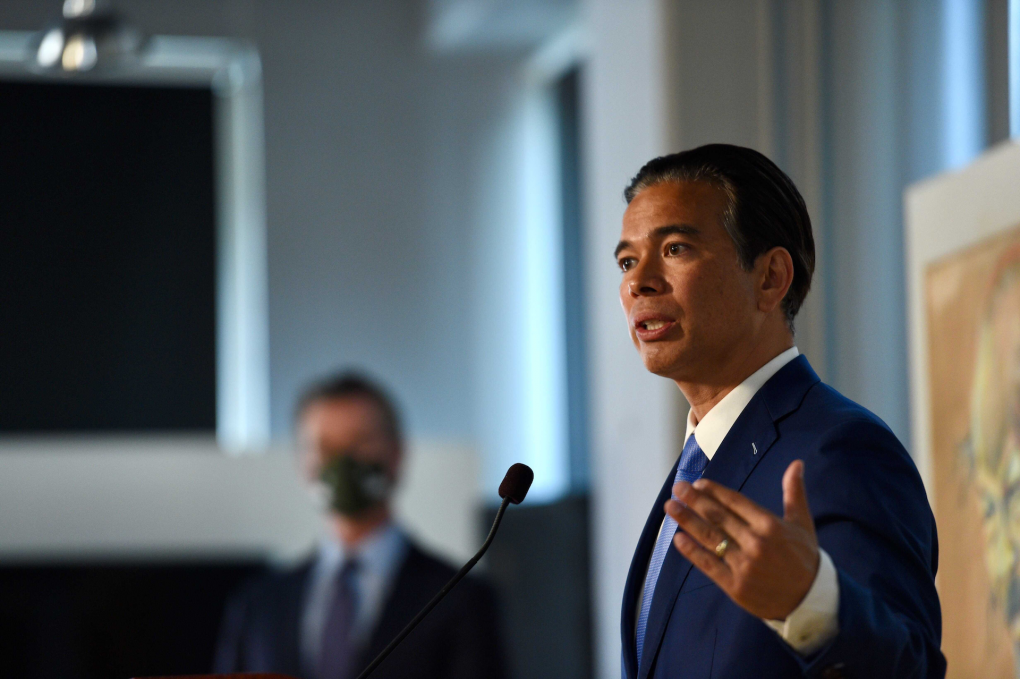
"caption": "East Bay Assemblyman Rob Bonta speaks during a press conference at the International Hotel in San Francisco's Chinatown on March 24, 2021, where he was nominated by Gov. Gavin Newsom to be California attorney general, replacing Xavier Becerra.",
"description": null,
"title": "Rob Bonta",
"credit": "Beth LaBerge/KQED",
"status": "inherit",
"altTag": "Rob Bonta",
"isLoading": false,
"fetchFailed": false
},
"news_11865377": {
"type": "attachments",
"id": "news_11865377",
"meta": {
"index": "attachments_1716263798",
"site": "news",
"id": "11865377",
"found": true
},
"parent": 11865371,
"imgSizes": {
"twentyfourteen-full-width": {
"file": "https://ww2.kqed.org/app/uploads/sites/10/2021/03/GettyImages-1231365238-1024x576.jpg",
"width": 1024,
"mimeType": "image/jpeg",
"height": 576
},
"thumbnail": {
"file": "https://ww2.kqed.org/app/uploads/sites/10/2021/03/GettyImages-1231365238-160x107.jpg",
"width": 160,
"mimeType": "image/jpeg",
"height": 107
},
"post-thumbnail": {
"file": "https://ww2.kqed.org/app/uploads/sites/10/2021/03/GettyImages-1231365238-672x372.jpg",
"width": 672,
"mimeType": "image/jpeg",
"height": 372
},
"kqedFullSize": {
"file": "https://ww2.kqed.org/app/uploads/sites/10/2021/03/GettyImages-1231365238.jpg",
"width": 1024,
"height": 683
},
"large": {
"file": "https://ww2.kqed.org/app/uploads/sites/10/2021/03/GettyImages-1231365238-1020x680.jpg",
"width": 1020,
"mimeType": "image/jpeg",
"height": 680
},
"medium": {
"file": "https://ww2.kqed.org/app/uploads/sites/10/2021/03/GettyImages-1231365238-800x534.jpg",
"width": 800,
"mimeType": "image/jpeg",
"height": 534
}
},
"publishDate": 1616089042,
"modified": 1616089298,
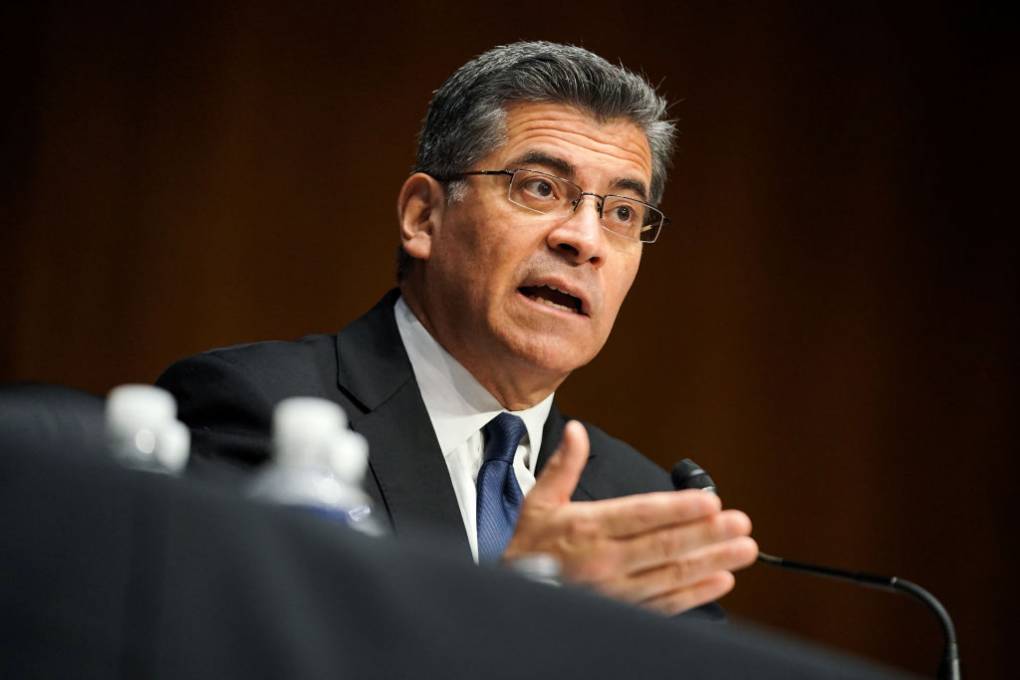
"caption": "California Attorney General Xavier Becerra answers questions during his confirmation hearing before the Senate Finance Committee on Feb. 24, 2021, in Washington, DC. Becerra was confirmed on March 18, as secretary of Health and Human Services, making him the first Latino to lead the department.",
"description": null,
"title": "Senate Finance Committee Considers Xavier Becerra For HHS Secretary",
"credit": "Greg Nash-Pool/Getty Images",
"status": "inherit",
"altTag": null,
"isLoading": false,
"fetchFailed": false
},
"news_11051787": {
"type": "attachments",
"id": "news_11051787",
"meta": {
"index": "attachments_1716263798",
"site": "news",
"id": "11051787",
"found": true
},
"parent": 11051780,
"imgSizes": {
"twentyfourteen-full-width": {
"file": "https://ww2.kqed.org/app/uploads/sites/10/2016/08/1920-guns-1038x576.jpg",
"width": 1038,
"mimeType": "image/jpeg",
"height": 576
},
"thumbnail": {
"file": "https://ww2.kqed.org/app/uploads/sites/10/2016/08/1920-guns-400x268.jpg",
"width": 400,
"mimeType": "image/jpeg",
"height": 268
},
"fd-sm": {
"file": "https://ww2.kqed.org/app/uploads/sites/10/2016/08/1920-guns-960x643.jpg",
"width": 960,
"mimeType": "image/jpeg",
"height": 643
},
"post-thumbnail": {
"file": "https://ww2.kqed.org/app/uploads/sites/10/2016/08/1920-guns-672x372.jpg",
"width": 672,
"mimeType": "image/jpeg",
"height": 372
},
"kqedFullSize": {
"file": "https://ww2.kqed.org/app/uploads/sites/10/2016/08/1920-guns.jpg",
"width": 1920,
"height": 1286
},
"large": {
"file": "https://ww2.kqed.org/app/uploads/sites/10/2016/08/1920-guns-1920x1286.jpg",
"width": 1920,
"mimeType": "image/jpeg",
"height": 1286
},
"guest-author-50": {
"file": "https://ww2.kqed.org/app/uploads/sites/10/2016/08/1920-guns-50x50.jpg",
"width": 50,
"mimeType": "image/jpeg",
"height": 50
},
"guest-author-96": {
"file": "https://ww2.kqed.org/app/uploads/sites/10/2016/08/1920-guns-96x96.jpg",
"width": 96,
"mimeType": "image/jpeg",
"height": 96
},
"medium": {
"file": "https://ww2.kqed.org/app/uploads/sites/10/2016/08/1920-guns-800x536.jpg",
"width": 800,
"mimeType": "image/jpeg",
"height": 536
},
"guest-author-64": {
"file": "https://ww2.kqed.org/app/uploads/sites/10/2016/08/1920-guns-64x64.jpg",
"width": 64,
"mimeType": "image/jpeg",
"height": 64
},
"guest-author-32": {
"file": "https://ww2.kqed.org/app/uploads/sites/10/2016/08/1920-guns-32x32.jpg",
"width": 32,
"mimeType": "image/jpeg",
"height": 32
},
"jmtc-small-thumb": {
"file": "https://ww2.kqed.org/app/uploads/sites/10/2016/08/1920-guns-280x150.jpg",
"width": 280,
"mimeType": "image/jpeg",
"height": 150
},
"fd-lrg": {
"file": "https://ww2.kqed.org/app/uploads/sites/10/2016/08/1920-guns-1920x1286.jpg",
"width": 1920,
"mimeType": "image/jpeg",
"height": 1286
},
"fd-med": {
"file": "https://ww2.kqed.org/app/uploads/sites/10/2016/08/1920-guns-1180x790.jpg",
"width": 1180,
"mimeType": "image/jpeg",
"height": 790
},
"detail": {
"file": "https://ww2.kqed.org/app/uploads/sites/10/2016/08/1920-guns-150x150.jpg",
"width": 150,
"mimeType": "image/jpeg",
"height": 150
},
"guest-author-128": {
"file": "https://ww2.kqed.org/app/uploads/sites/10/2016/08/1920-guns-128x128.jpg",
"width": 128,
"mimeType": "image/jpeg",
"height": 128
}
},
"publishDate": 1471300463,
"modified": 1471300912,
"caption": "Customers shopping at a gun show.",
"description": null,
"title": "A gun show",
"credit": "Michael Glasgow/Flickr",
"status": "inherit",
"isLoading": false,
"fetchFailed": false
},
"news_11861693": {
"type": "attachments",
"id": "news_11861693",
"meta": {
"index": "attachments_1716263798",
"site": "news",
"id": "11861693",
"found": true
},
"parent": 11861676,
"imgSizes": {
"apple_news_ca_landscape_5_5": {
"file": "https://ww2.kqed.org/app/uploads/sites/10/2021/02/RS47372_GettyImages-1231340817-qut-1044x783.jpg",
"width": 1044,
"mimeType": "image/jpeg",
"height": 783
},
"apple_news_ca_square_4_0": {
"file": "https://ww2.kqed.org/app/uploads/sites/10/2021/02/RS47372_GettyImages-1231340817-qut-470x470.jpg",
"width": 470,
"mimeType": "image/jpeg",
"height": 470
},
"twentyfourteen-full-width": {
"file": "https://ww2.kqed.org/app/uploads/sites/10/2021/02/RS47372_GettyImages-1231340817-qut-1038x576.jpg",
"width": 1038,
"mimeType": "image/jpeg",
"height": 576
},
"thumbnail": {
"file": "https://ww2.kqed.org/app/uploads/sites/10/2021/02/RS47372_GettyImages-1231340817-qut-160x107.jpg",
"width": 160,
"mimeType": "image/jpeg",
"height": 107
},
"post-thumbnail": {
"file": "https://ww2.kqed.org/app/uploads/sites/10/2021/02/RS47372_GettyImages-1231340817-qut-672x372.jpg",
"width": 672,
"mimeType": "image/jpeg",
"height": 372
},
"kqedFullSize": {
"file": "https://ww2.kqed.org/app/uploads/sites/10/2021/02/RS47372_GettyImages-1231340817-qut.jpg",
"width": 1920,
"height": 1280
},
"apple_news_ca_landscape_4_7": {
"file": "https://ww2.kqed.org/app/uploads/sites/10/2021/02/RS47372_GettyImages-1231340817-qut-632x474.jpg",
"width": 632,
"mimeType": "image/jpeg",
"height": 474
},
"large": {
"file": "https://ww2.kqed.org/app/uploads/sites/10/2021/02/RS47372_GettyImages-1231340817-qut-1020x680.jpg",
"width": 1020,
"mimeType": "image/jpeg",
"height": 680
},
"apple_news_ca_landscape_4_0": {
"file": "https://ww2.kqed.org/app/uploads/sites/10/2021/02/RS47372_GettyImages-1231340817-qut-536x402.jpg",
"width": 536,
"mimeType": "image/jpeg",
"height": 402
},
"apple_news_ca_portrait_12_9": {
"file": "https://ww2.kqed.org/app/uploads/sites/10/2021/02/RS47372_GettyImages-1231340817-qut-1122x1280.jpg",
"width": 1122,
"mimeType": "image/jpeg",
"height": 1280
},
"medium": {
"file": "https://ww2.kqed.org/app/uploads/sites/10/2021/02/RS47372_GettyImages-1231340817-qut-800x533.jpg",
"width": 800,
"mimeType": "image/jpeg",
"height": 533
},
"apple_news_ca_portrait_4_0": {
"file": "https://ww2.kqed.org/app/uploads/sites/10/2021/02/RS47372_GettyImages-1231340817-qut-354x472.jpg",
"width": 354,
"mimeType": "image/jpeg",
"height": 472
},
"apple_news_ca_portrait_9_7": {
"file": "https://ww2.kqed.org/app/uploads/sites/10/2021/02/RS47372_GettyImages-1231340817-qut-840x1120.jpg",
"width": 840,
"mimeType": "image/jpeg",
"height": 1120
},
"apple_news_ca_landscape_12_9": {
"file": "https://ww2.kqed.org/app/uploads/sites/10/2021/02/RS47372_GettyImages-1231340817-qut-1832x1280.jpg",
"width": 1832,
"mimeType": "image/jpeg",
"height": 1280
},
"apple_news_ca_square_9_7": {
"file": "https://ww2.kqed.org/app/uploads/sites/10/2021/02/RS47372_GettyImages-1231340817-qut-1104x1104.jpg",
"width": 1104,
"mimeType": "image/jpeg",
"height": 1104
},
"1536x1536": {
"file": "https://ww2.kqed.org/app/uploads/sites/10/2021/02/RS47372_GettyImages-1231340817-qut-1536x1024.jpg",
"width": 1536,
"mimeType": "image/jpeg",
"height": 1024
},
"apple_news_ca_portrait_4_7": {
"file": "https://ww2.kqed.org/app/uploads/sites/10/2021/02/RS47372_GettyImages-1231340817-qut-414x552.jpg",
"width": 414,
"mimeType": "image/jpeg",
"height": 552
},
"apple_news_ca_square_12_9": {
"file": "https://ww2.kqed.org/app/uploads/sites/10/2021/02/RS47372_GettyImages-1231340817-qut-1472x1280.jpg",
"width": 1472,
"mimeType": "image/jpeg",
"height": 1280
},
"apple_news_ca_portrait_5_5": {
"file": "https://ww2.kqed.org/app/uploads/sites/10/2021/02/RS47372_GettyImages-1231340817-qut-687x916.jpg",
"width": 687,
"mimeType": "image/jpeg",
"height": 916
},
"apple_news_ca_square_4_7": {
"file": "https://ww2.kqed.org/app/uploads/sites/10/2021/02/RS47372_GettyImages-1231340817-qut-550x550.jpg",
"width": 550,
"mimeType": "image/jpeg",
"height": 550
},
"apple_news_ca_landscape_9_7": {
"file": "https://ww2.kqed.org/app/uploads/sites/10/2021/02/RS47372_GettyImages-1231340817-qut-1376x1032.jpg",
"width": 1376,
"mimeType": "image/jpeg",
"height": 1032
},
"apple_news_ca_square_5_5": {
"file": "https://ww2.kqed.org/app/uploads/sites/10/2021/02/RS47372_GettyImages-1231340817-qut-912x912.jpg",
"width": 912,
"mimeType": "image/jpeg",
"height": 912
}
},
"publishDate": 1614110355,
"modified": 1614114731,
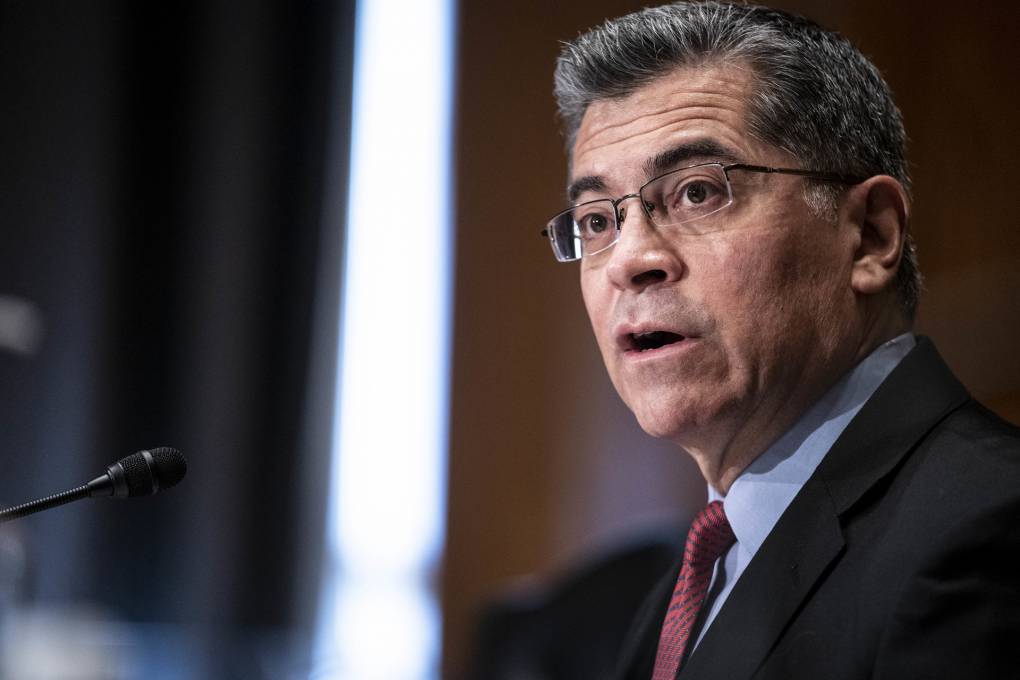
"caption": "California Attorney General Xavier Becerra, President Joe Biden's nominee for Secretary of Health and Human Services, testifies during his first Senate confirmation hearing on Feb. 23, 2021.",
"description": "California Attorney General Xavier Becerra, President Biden's nominee for Secretary of Health and Human Services, testifies during his first Senate confirmation hearing on Feb. 23, 2021.",
"title": "US-POLITICS-HEARING-HEALTH",
"credit": "Sarah Silbiger/POOL/AFP via Getty Images",
"status": "inherit",
"altTag": null,
"isLoading": false,
"fetchFailed": false
},
"news_11850121": {
"type": "attachments",
"id": "news_11850121",
"meta": {
"index": "attachments_1716263798",
"site": "news",
"id": "11850121",
"found": true
},
"title": "California Gov. Newsom And CA Attorney Gen. Becerra Hold News Conference Responding To Trump Revoking State's Emissions Waiver",
"publishDate": 1607385365,
"status": "inherit",
"parent": 11850090,
"modified": 1778885595,
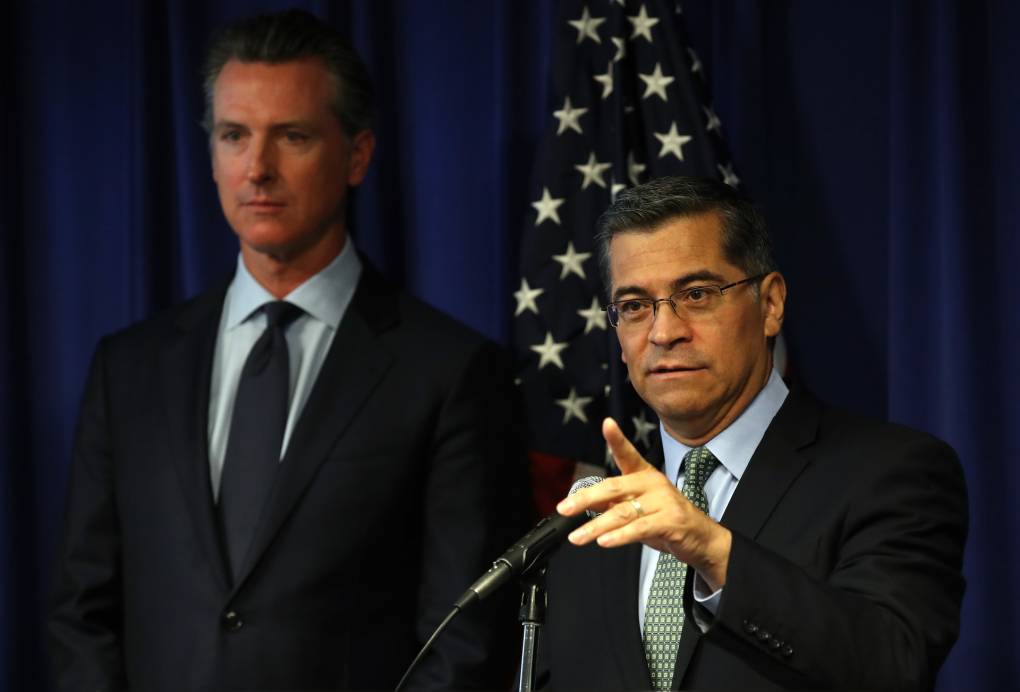
"caption": "Former California Attorney General Xavier Becerra speaks as Gov. Gavin Newsom looks on during a news conference in September 2019.",
"credit": "Justin Sullivan/Getty Images",
"altTag": "\"\"",
"description": "California Attorney General Xavier Becerra speaks as Gov. Gavin Newsom looks on during a news conference in Sept. 2019.",
"imgSizes": {
"medium": {
"file": "https://cdn.kqed.org/wp-content/uploads/sites/10/2020/12/RS46247_GettyImages-1175529279-qut-800x543.jpg",
"width": 800,
"height": 543,
"mimeType": "image/jpeg"
},
"large": {
"file": "https://cdn.kqed.org/wp-content/uploads/sites/10/2020/12/RS46247_GettyImages-1175529279-qut-1020x692.jpg",
"width": 1020,
"height": 692,
"mimeType": "image/jpeg"
},
"thumbnail": {
"file": "https://cdn.kqed.org/wp-content/uploads/sites/10/2020/12/RS46247_GettyImages-1175529279-qut-160x109.jpg",
"width": 160,
"height": 109,
"mimeType": "image/jpeg"
},
"1536x1536": {
"file": "https://cdn.kqed.org/wp-content/uploads/sites/10/2020/12/RS46247_GettyImages-1175529279-qut-1536x1042.jpg",
"width": 1536,
"height": 1042,
"mimeType": "image/jpeg"
},
"post-thumbnail": {
"file": "https://cdn.kqed.org/wp-content/uploads/sites/10/2020/12/RS46247_GettyImages-1175529279-qut-672x372.jpg",
"width": 672,
"height": 372,
"mimeType": "image/jpeg"
},
"twentyfourteen-full-width": {
"file": "https://cdn.kqed.org/wp-content/uploads/sites/10/2020/12/RS46247_GettyImages-1175529279-qut-1038x576.jpg",
"width": 1038,
"height": 576,
"mimeType": "image/jpeg"
},
"apple_news_ca_landscape_12_9": {
"file": "https://cdn.kqed.org/wp-content/uploads/sites/10/2020/12/RS46247_GettyImages-1175529279-qut-1832x1302.jpg",
"width": 1832,
"height": 1302,
"mimeType": "image/jpeg"
},
"apple_news_ca_landscape_9_7": {
"file": "https://cdn.kqed.org/wp-content/uploads/sites/10/2020/12/RS46247_GettyImages-1175529279-qut-1376x1032.jpg",
"width": 1376,
"height": 1032,
"mimeType": "image/jpeg"
},
"apple_news_ca_landscape_5_5": {
"file": "https://cdn.kqed.org/wp-content/uploads/sites/10/2020/12/RS46247_GettyImages-1175529279-qut-1044x783.jpg",
"width": 1044,
"height": 783,
"mimeType": "image/jpeg"
},
"apple_news_ca_landscape_4_7": {
"file": "https://cdn.kqed.org/wp-content/uploads/sites/10/2020/12/RS46247_GettyImages-1175529279-qut-632x474.jpg",
"width": 632,
"height": 474,
"mimeType": "image/jpeg"
},
"apple_news_ca_landscape_4_0": {
"file": "https://cdn.kqed.org/wp-content/uploads/sites/10/2020/12/RS46247_GettyImages-1175529279-qut-536x402.jpg",
"width": 536,
"height": 402,
"mimeType": "image/jpeg"
},
"apple_news_ca_portrait_12_9": {
"file": "https://cdn.kqed.org/wp-content/uploads/sites/10/2020/12/RS46247_GettyImages-1175529279-qut-1122x1302.jpg",
"width": 1122,
"height": 1302,
"mimeType": "image/jpeg"
},
"apple_news_ca_portrait_9_7": {
"file": "https://cdn.kqed.org/wp-content/uploads/sites/10/2020/12/RS46247_GettyImages-1175529279-qut-840x1120.jpg",
"width": 840,
"height": 1120,
"mimeType": "image/jpeg"
},
"apple_news_ca_portrait_5_5": {
"file": "https://cdn.kqed.org/wp-content/uploads/sites/10/2020/12/RS46247_GettyImages-1175529279-qut-687x916.jpg",
"width": 687,
"height": 916,
"mimeType": "image/jpeg"
},
"apple_news_ca_portrait_4_7": {
"file": "https://cdn.kqed.org/wp-content/uploads/sites/10/2020/12/RS46247_GettyImages-1175529279-qut-414x552.jpg",
"width": 414,
"height": 552,
"mimeType": "image/jpeg"
},
"apple_news_ca_portrait_4_0": {
"file": "https://cdn.kqed.org/wp-content/uploads/sites/10/2020/12/RS46247_GettyImages-1175529279-qut-354x472.jpg",
"width": 354,
"height": 472,
"mimeType": "image/jpeg"
},
"apple_news_ca_square_12_9": {
"file": "https://cdn.kqed.org/wp-content/uploads/sites/10/2020/12/RS46247_GettyImages-1175529279-qut-1472x1302.jpg",
"width": 1472,
"height": 1302,
"mimeType": "image/jpeg"
},
"apple_news_ca_square_9_7": {
"file": "https://cdn.kqed.org/wp-content/uploads/sites/10/2020/12/RS46247_GettyImages-1175529279-qut-1104x1104.jpg",
"width": 1104,
"height": 1104,
"mimeType": "image/jpeg"
},
"apple_news_ca_square_5_5": {
"file": "https://cdn.kqed.org/wp-content/uploads/sites/10/2020/12/RS46247_GettyImages-1175529279-qut-912x912.jpg",
"width": 912,
"height": 912,
"mimeType": "image/jpeg"
},
"apple_news_ca_square_4_7": {
"file": "https://cdn.kqed.org/wp-content/uploads/sites/10/2020/12/RS46247_GettyImages-1175529279-qut-550x550.jpg",
"width": 550,
"height": 550,
"mimeType": "image/jpeg"
},
"apple_news_ca_square_4_0": {
"file": "https://cdn.kqed.org/wp-content/uploads/sites/10/2020/12/RS46247_GettyImages-1175529279-qut-470x470.jpg",
"width": 470,
"height": 470,
"mimeType": "image/jpeg"
},
"kqedFullSize": {
"file": "https://cdn.kqed.org/wp-content/uploads/sites/10/2020/12/RS46247_GettyImages-1175529279-qut.jpg",
"width": 1920,
"height": 1302
}
},
"isLoading": false,
"fetchFailed": false
},
"news_11851084": {
"type": "attachments",
"id": "news_11851084",
"meta": {
"index": "attachments_1716263798",
"site": "news",
"id": "11851084",
"found": true
},
"title": "Amazon-Shipping-Container",
"publishDate": 1607989656,
"status": "inherit",
"parent": 11851063,
"modified": 1721163918,
"caption": "An Amazon shipping container rolls through the Port of Long Beach on April 22, 2020. Amazon's Prime Day sale will run from July 16 to 17, and the retailer has promised to offer its lowest prices so far this year.",
"credit": "Robyn Beck/AFP via Getty Images",
"altTag": "A shipping container with an arrow pointing to the word \"prime\" is seen on the street. One person in a safety vest stands to the right side of the container.",
"description": "An Amazon shipping container rolls through the Port of Long Beach on April 22, 2020.",
"imgSizes": {
"medium": {
"file": "https://cdn.kqed.org/wp-content/uploads/sites/10/2020/12/Amazon-Shipping-Container-800x598.jpg",
"width": 800,
"height": 598,
"mimeType": "image/jpeg"
},
"large": {
"file": "https://cdn.kqed.org/wp-content/uploads/sites/10/2020/12/Amazon-Shipping-Container-1020x762.jpg",
"width": 1020,
"height": 762,
"mimeType": "image/jpeg"
},
"thumbnail": {
"file": "https://cdn.kqed.org/wp-content/uploads/sites/10/2020/12/Amazon-Shipping-Container-160x120.jpg",
"width": 160,
"height": 120,
"mimeType": "image/jpeg"
},
"1536x1536": {
"file": "https://cdn.kqed.org/wp-content/uploads/sites/10/2020/12/Amazon-Shipping-Container-1536x1147.jpg",
"width": 1536,
"height": 1147,
"mimeType": "image/jpeg"
},
"post-thumbnail": {
"file": "https://cdn.kqed.org/wp-content/uploads/sites/10/2020/12/Amazon-Shipping-Container-672x372.jpg",
"width": 672,
"height": 372,
"mimeType": "image/jpeg"
},
"twentyfourteen-full-width": {
"file": "https://cdn.kqed.org/wp-content/uploads/sites/10/2020/12/Amazon-Shipping-Container-1038x576.jpg",
"width": 1038,
"height": 576,
"mimeType": "image/jpeg"
},
"apple_news_ca_landscape_12_9": {
"file": "https://cdn.kqed.org/wp-content/uploads/sites/10/2020/12/Amazon-Shipping-Container-1832x1374.jpg",
"width": 1832,
"height": 1374,
"mimeType": "image/jpeg"
},
"apple_news_ca_landscape_9_7": {
"file": "https://cdn.kqed.org/wp-content/uploads/sites/10/2020/12/Amazon-Shipping-Container-1376x1032.jpg",
"width": 1376,
"height": 1032,
"mimeType": "image/jpeg"
},
"apple_news_ca_landscape_5_5": {
"file": "https://cdn.kqed.org/wp-content/uploads/sites/10/2020/12/Amazon-Shipping-Container-1044x783.jpg",
"width": 1044,
"height": 783,
"mimeType": "image/jpeg"
},
"apple_news_ca_landscape_4_7": {
"file": "https://cdn.kqed.org/wp-content/uploads/sites/10/2020/12/Amazon-Shipping-Container-632x474.jpg",
"width": 632,
"height": 474,
"mimeType": "image/jpeg"
},
"apple_news_ca_landscape_4_0": {
"file": "https://cdn.kqed.org/wp-content/uploads/sites/10/2020/12/Amazon-Shipping-Container-536x402.jpg",
"width": 536,
"height": 402,
"mimeType": "image/jpeg"
},
"apple_news_ca_portrait_12_9": {
"file": "https://cdn.kqed.org/wp-content/uploads/sites/10/2020/12/Amazon-Shipping-Container-1122x1434.jpg",
"width": 1122,
"height": 1434,
"mimeType": "image/jpeg"
},
"apple_news_ca_portrait_9_7": {
"file": "https://cdn.kqed.org/wp-content/uploads/sites/10/2020/12/Amazon-Shipping-Container-840x1120.jpg",
"width": 840,
"height": 1120,
"mimeType": "image/jpeg"
},
"apple_news_ca_portrait_5_5": {
"file": "https://cdn.kqed.org/wp-content/uploads/sites/10/2020/12/Amazon-Shipping-Container-687x916.jpg",
"width": 687,
"height": 916,
"mimeType": "image/jpeg"
},
"apple_news_ca_portrait_4_7": {
"file": "https://cdn.kqed.org/wp-content/uploads/sites/10/2020/12/Amazon-Shipping-Container-414x552.jpg",
"width": 414,
"height": 552,
"mimeType": "image/jpeg"
},
"apple_news_ca_portrait_4_0": {
"file": "https://cdn.kqed.org/wp-content/uploads/sites/10/2020/12/Amazon-Shipping-Container-354x472.jpg",
"width": 354,
"height": 472,
"mimeType": "image/jpeg"
},
"apple_news_ca_square_12_9": {
"file": "https://cdn.kqed.org/wp-content/uploads/sites/10/2020/12/Amazon-Shipping-Container-1472x1434.jpg",
"width": 1472,
"height": 1434,
"mimeType": "image/jpeg"
},
"apple_news_ca_square_9_7": {
"file": "https://cdn.kqed.org/wp-content/uploads/sites/10/2020/12/Amazon-Shipping-Container-1104x1104.jpg",
"width": 1104,
"height": 1104,
"mimeType": "image/jpeg"
},
"apple_news_ca_square_5_5": {
"file": "https://cdn.kqed.org/wp-content/uploads/sites/10/2020/12/Amazon-Shipping-Container-912x912.jpg",
"width": 912,
"height": 912,
"mimeType": "image/jpeg"
},
"apple_news_ca_square_4_7": {
"file": "https://cdn.kqed.org/wp-content/uploads/sites/10/2020/12/Amazon-Shipping-Container-550x550.jpg",
"width": 550,
"height": 550,
"mimeType": "image/jpeg"
},
"apple_news_ca_square_4_0": {
"file": "https://cdn.kqed.org/wp-content/uploads/sites/10/2020/12/Amazon-Shipping-Container-470x470.jpg",
"width": 470,
"height": 470,
"mimeType": "image/jpeg"
},
"kqedFullSize": {
"file": "https://cdn.kqed.org/wp-content/uploads/sites/10/2020/12/Amazon-Shipping-Container.jpg",
"width": 1920,
"height": 1434
}
},
"isLoading": false,
"fetchFailed": false
},
"news_11752399": {
"type": "attachments",
"id": "news_11752399",
"meta": {
"index": "attachments_1716263798",
"site": "news",
"id": "11752399",
"found": true
},
"parent": 11752360,
"imgSizes": {
"apple_news_ca_landscape_5_5": {
"file": "https://ww2.kqed.org/app/uploads/sites/10/2019/06/06042019_Becerra10-qut-1044x783.jpg",
"width": 1044,
"mimeType": "image/jpeg",
"height": 783
},
"apple_news_ca_square_4_0": {
"file": "https://ww2.kqed.org/app/uploads/sites/10/2019/06/06042019_Becerra10-qut-470x470.jpg",
"width": 470,
"mimeType": "image/jpeg",
"height": 470
},
"twentyfourteen-full-width": {
"file": "https://ww2.kqed.org/app/uploads/sites/10/2019/06/06042019_Becerra10-qut-1038x576.jpg",
"width": 1038,
"mimeType": "image/jpeg",
"height": 576
},
"thumbnail": {
"file": "https://ww2.kqed.org/app/uploads/sites/10/2019/06/06042019_Becerra10-qut-160x107.jpg",
"width": 160,
"mimeType": "image/jpeg",
"height": 107
},
"post-thumbnail": {
"file": "https://ww2.kqed.org/app/uploads/sites/10/2019/06/06042019_Becerra10-qut-672x372.jpg",
"width": 672,
"mimeType": "image/jpeg",
"height": 372
},
"kqedFullSize": {
"file": "https://ww2.kqed.org/app/uploads/sites/10/2019/06/06042019_Becerra10-qut.jpg",
"width": 1920,
"height": 1280
},
"apple_news_ca_landscape_4_7": {
"file": "https://ww2.kqed.org/app/uploads/sites/10/2019/06/06042019_Becerra10-qut-632x474.jpg",
"width": 632,
"mimeType": "image/jpeg",
"height": 474
},
"large": {
"file": "https://ww2.kqed.org/app/uploads/sites/10/2019/06/06042019_Becerra10-qut-1020x680.jpg",
"width": 1020,
"mimeType": "image/jpeg",
"height": 680
},
"complete_open_graph": {
"file": "https://ww2.kqed.org/app/uploads/sites/10/2019/06/06042019_Becerra10-qut-1200x800.jpg",
"width": 1200,
"mimeType": "image/jpeg",
"height": 800
},
"apple_news_ca_landscape_4_0": {
"file": "https://ww2.kqed.org/app/uploads/sites/10/2019/06/06042019_Becerra10-qut-536x402.jpg",
"width": 536,
"mimeType": "image/jpeg",
"height": 402
},
"apple_news_ca_portrait_12_9": {
"file": "https://ww2.kqed.org/app/uploads/sites/10/2019/06/06042019_Becerra10-qut-1122x1280.jpg",
"width": 1122,
"mimeType": "image/jpeg",
"height": 1280
},
"medium": {
"file": "https://ww2.kqed.org/app/uploads/sites/10/2019/06/06042019_Becerra10-qut-800x533.jpg",
"width": 800,
"mimeType": "image/jpeg",
"height": 533
},
"apple_news_ca_portrait_4_0": {
"file": "https://ww2.kqed.org/app/uploads/sites/10/2019/06/06042019_Becerra10-qut-354x472.jpg",
"width": 354,
"mimeType": "image/jpeg",
"height": 472
},
"apple_news_ca_portrait_9_7": {
"file": "https://ww2.kqed.org/app/uploads/sites/10/2019/06/06042019_Becerra10-qut-840x1120.jpg",
"width": 840,
"mimeType": "image/jpeg",
"height": 1120
},
"apple_news_ca_landscape_12_9": {
"file": "https://ww2.kqed.org/app/uploads/sites/10/2019/06/06042019_Becerra10-qut-1832x1280.jpg",
"width": 1832,
"mimeType": "image/jpeg",
"height": 1280
},
"apple_news_ca_square_9_7": {
"file": "https://ww2.kqed.org/app/uploads/sites/10/2019/06/06042019_Becerra10-qut-1104x1104.jpg",
"width": 1104,
"mimeType": "image/jpeg",
"height": 1104
},
"apple_news_ca_portrait_4_7": {
"file": "https://ww2.kqed.org/app/uploads/sites/10/2019/06/06042019_Becerra10-qut-414x552.jpg",
"width": 414,
"mimeType": "image/jpeg",
"height": 552
},
"apple_news_ca_square_12_9": {
"file": "https://ww2.kqed.org/app/uploads/sites/10/2019/06/06042019_Becerra10-qut-1472x1280.jpg",
"width": 1472,
"mimeType": "image/jpeg",
"height": 1280
},
"apple_news_ca_portrait_5_5": {
"file": "https://ww2.kqed.org/app/uploads/sites/10/2019/06/06042019_Becerra10-qut-687x916.jpg",
"width": 687,
"mimeType": "image/jpeg",
"height": 916
},
"full-width": {
"file": "https://ww2.kqed.org/app/uploads/sites/10/2019/06/06042019_Becerra10-qut-1920x1280.jpg",
"width": 1920,
"mimeType": "image/jpeg",
"height": 1280
},
"apple_news_ca_square_4_7": {
"file": "https://ww2.kqed.org/app/uploads/sites/10/2019/06/06042019_Becerra10-qut-550x550.jpg",
"width": 550,
"mimeType": "image/jpeg",
"height": 550
},
"apple_news_ca_landscape_9_7": {
"file": "https://ww2.kqed.org/app/uploads/sites/10/2019/06/06042019_Becerra10-qut-1376x1032.jpg",
"width": 1376,
"mimeType": "image/jpeg",
"height": 1032
},
"apple_news_ca_square_5_5": {
"file": "https://ww2.kqed.org/app/uploads/sites/10/2019/06/06042019_Becerra10-qut-912x912.jpg",
"width": 912,
"mimeType": "image/jpeg",
"height": 912
}
},
"publishDate": 1559692999,
"modified": 1559696170,
"caption": "California Attorney General Xavier Becerra speaks in San Francisco on Sept. 7, 2018.",
"description": "California Attorney General Xavier Becerra speaks at the Department of Justice San Francisco building on Sept. 7, 2018.",
"title": "06042019_Becerra10-qut",
"credit": "Anne Wernikoff/KQED",
"status": "inherit",
"isLoading": false,
"fetchFailed": false
},
"news_11846757": {
"type": "attachments",
"id": "news_11846757",
"meta": {
"index": "attachments_1716263798",
"site": "news",
"id": "11846757",
"found": true
},
"parent": 11846750,
"imgSizes": {
"apple_news_ca_landscape_5_5": {
"file": "https://ww2.kqed.org/app/uploads/sites/10/2020/11/RS44172_GettyImages-1181924353-qut-1044x783.jpg",
"width": 1044,
"mimeType": "image/jpeg",
"height": 783
},
"apple_news_ca_square_4_0": {
"file": "https://ww2.kqed.org/app/uploads/sites/10/2020/11/RS44172_GettyImages-1181924353-qut-470x470.jpg",
"width": 470,
"mimeType": "image/jpeg",
"height": 470
},
"twentyfourteen-full-width": {
"file": "https://ww2.kqed.org/app/uploads/sites/10/2020/11/RS44172_GettyImages-1181924353-qut-1038x576.jpg",
"width": 1038,
"mimeType": "image/jpeg",
"height": 576
},
"thumbnail": {
"file": "https://ww2.kqed.org/app/uploads/sites/10/2020/11/RS44172_GettyImages-1181924353-qut-160x110.jpg",
"width": 160,
"mimeType": "image/jpeg",
"height": 110
},
"post-thumbnail": {
"file": "https://ww2.kqed.org/app/uploads/sites/10/2020/11/RS44172_GettyImages-1181924353-qut-672x372.jpg",
"width": 672,
"mimeType": "image/jpeg",
"height": 372
},
"kqedFullSize": {
"file": "https://ww2.kqed.org/app/uploads/sites/10/2020/11/RS44172_GettyImages-1181924353-qut.jpg",
"width": 1920,
"height": 1316
},
"apple_news_ca_landscape_4_7": {
"file": "https://ww2.kqed.org/app/uploads/sites/10/2020/11/RS44172_GettyImages-1181924353-qut-632x474.jpg",
"width": 632,
"mimeType": "image/jpeg",
"height": 474
},
"large": {
"file": "https://ww2.kqed.org/app/uploads/sites/10/2020/11/RS44172_GettyImages-1181924353-qut-1020x699.jpg",
"width": 1020,
"mimeType": "image/jpeg",
"height": 699
},
"apple_news_ca_landscape_4_0": {
"file": "https://ww2.kqed.org/app/uploads/sites/10/2020/11/RS44172_GettyImages-1181924353-qut-536x402.jpg",
"width": 536,
"mimeType": "image/jpeg",
"height": 402
},
"apple_news_ca_portrait_12_9": {
"file": "https://ww2.kqed.org/app/uploads/sites/10/2020/11/RS44172_GettyImages-1181924353-qut-1122x1316.jpg",
"width": 1122,
"mimeType": "image/jpeg",
"height": 1316
},
"medium": {
"file": "https://ww2.kqed.org/app/uploads/sites/10/2020/11/RS44172_GettyImages-1181924353-qut-800x548.jpg",
"width": 800,
"mimeType": "image/jpeg",
"height": 548
},
"apple_news_ca_portrait_4_0": {
"file": "https://ww2.kqed.org/app/uploads/sites/10/2020/11/RS44172_GettyImages-1181924353-qut-354x472.jpg",
"width": 354,
"mimeType": "image/jpeg",
"height": 472
},
"apple_news_ca_portrait_9_7": {
"file": "https://ww2.kqed.org/app/uploads/sites/10/2020/11/RS44172_GettyImages-1181924353-qut-840x1120.jpg",
"width": 840,
"mimeType": "image/jpeg",
"height": 1120
},
"apple_news_ca_landscape_12_9": {
"file": "https://ww2.kqed.org/app/uploads/sites/10/2020/11/RS44172_GettyImages-1181924353-qut-1832x1316.jpg",
"width": 1832,
"mimeType": "image/jpeg",
"height": 1316
},
"apple_news_ca_square_9_7": {
"file": "https://ww2.kqed.org/app/uploads/sites/10/2020/11/RS44172_GettyImages-1181924353-qut-1104x1104.jpg",
"width": 1104,
"mimeType": "image/jpeg",
"height": 1104
},
"1536x1536": {
"file": "https://ww2.kqed.org/app/uploads/sites/10/2020/11/RS44172_GettyImages-1181924353-qut-1536x1053.jpg",
"width": 1536,
"mimeType": "image/jpeg",
"height": 1053
},
"apple_news_ca_portrait_4_7": {
"file": "https://ww2.kqed.org/app/uploads/sites/10/2020/11/RS44172_GettyImages-1181924353-qut-414x552.jpg",
"width": 414,
"mimeType": "image/jpeg",
"height": 552
},
"apple_news_ca_square_12_9": {
"file": "https://ww2.kqed.org/app/uploads/sites/10/2020/11/RS44172_GettyImages-1181924353-qut-1472x1316.jpg",
"width": 1472,
"mimeType": "image/jpeg",
"height": 1316
},
"apple_news_ca_portrait_5_5": {
"file": "https://ww2.kqed.org/app/uploads/sites/10/2020/11/RS44172_GettyImages-1181924353-qut-687x916.jpg",
"width": 687,
"mimeType": "image/jpeg",
"height": 916
},
"apple_news_ca_square_4_7": {
"file": "https://ww2.kqed.org/app/uploads/sites/10/2020/11/RS44172_GettyImages-1181924353-qut-550x550.jpg",
"width": 550,
"mimeType": "image/jpeg",
"height": 550
},
"apple_news_ca_landscape_9_7": {
"file": "https://ww2.kqed.org/app/uploads/sites/10/2020/11/RS44172_GettyImages-1181924353-qut-1376x1032.jpg",
"width": 1376,
"mimeType": "image/jpeg",
"height": 1032
},
"apple_news_ca_square_5_5": {
"file": "https://ww2.kqed.org/app/uploads/sites/10/2020/11/RS44172_GettyImages-1181924353-qut-912x912.jpg",
"width": 912,
"mimeType": "image/jpeg",
"height": 912
}
},
"publishDate": 1604968550,
"modified": 1614088825,
"caption": null,
"description": "California Attorney General Xavier Becerra, backed by more than 20 other states, is defending the Affordable Care Act against the challenge brought by a coalition of Republican state officials two years ago.",
"title": "US-COURT-IMMIGRATION-DREAMERS",
"credit": "SAUL LOEB/AFP via Getty Images",
"status": "inherit",
"altTag": "Xavier Becerra",
"isLoading": false,
"fetchFailed": false
},
"news_11842142": {
"type": "attachments",
"id": "news_11842142",
"meta": {
"index": "attachments_1716263798",
"site": "news",
"id": "11842142",
"found": true
},
"parent": 11842137,
"imgSizes": {
"apple_news_ca_landscape_5_5": {
"file": "https://ww2.kqed.org/app/uploads/sites/10/2020/10/promise_101320_final-1044x783.png",
"width": 1044,
"mimeType": "image/png",
"height": 783
},
"apple_news_ca_square_4_0": {
"file": "https://ww2.kqed.org/app/uploads/sites/10/2020/10/promise_101320_final-470x470.png",
"width": 470,
"mimeType": "image/png",
"height": 470
},
"twentyfourteen-full-width": {
"file": "https://ww2.kqed.org/app/uploads/sites/10/2020/10/promise_101320_final-1038x576.png",
"width": 1038,
"mimeType": "image/png",
"height": 576
},
"thumbnail": {
"file": "https://ww2.kqed.org/app/uploads/sites/10/2020/10/promise_101320_final-160x105.png",
"width": 160,
"mimeType": "image/png",
"height": 105
},
"post-thumbnail": {
"file": "https://ww2.kqed.org/app/uploads/sites/10/2020/10/promise_101320_final-672x372.png",
"width": 672,
"mimeType": "image/png",
"height": 372
},
"kqedFullSize": {
"file": "https://ww2.kqed.org/app/uploads/sites/10/2020/10/promise_101320_final.png",
"width": 1920,
"height": 1265
},
"apple_news_ca_landscape_4_7": {
"file": "https://ww2.kqed.org/app/uploads/sites/10/2020/10/promise_101320_final-632x474.png",
"width": 632,
"mimeType": "image/png",
"height": 474
},
"large": {
"file": "https://ww2.kqed.org/app/uploads/sites/10/2020/10/promise_101320_final-1020x672.png",
"width": 1020,
"mimeType": "image/png",
"height": 672
},
"apple_news_ca_landscape_4_0": {
"file": "https://ww2.kqed.org/app/uploads/sites/10/2020/10/promise_101320_final-536x402.png",
"width": 536,
"mimeType": "image/png",
"height": 402
},
"apple_news_ca_portrait_12_9": {
"file": "https://ww2.kqed.org/app/uploads/sites/10/2020/10/promise_101320_final-1122x1265.png",
"width": 1122,
"mimeType": "image/png",
"height": 1265
},
"medium": {
"file": "https://ww2.kqed.org/app/uploads/sites/10/2020/10/promise_101320_final-800x527.png",
"width": 800,
"mimeType": "image/png",
"height": 527
},
"apple_news_ca_portrait_4_0": {
"file": "https://ww2.kqed.org/app/uploads/sites/10/2020/10/promise_101320_final-354x472.png",
"width": 354,
"mimeType": "image/png",
"height": 472
},
"apple_news_ca_portrait_9_7": {
"file": "https://ww2.kqed.org/app/uploads/sites/10/2020/10/promise_101320_final-840x1120.png",
"width": 840,
"mimeType": "image/png",
"height": 1120
},
"apple_news_ca_landscape_12_9": {
"file": "https://ww2.kqed.org/app/uploads/sites/10/2020/10/promise_101320_final-1832x1265.png",
"width": 1832,
"mimeType": "image/png",
"height": 1265
},
"apple_news_ca_square_9_7": {
"file": "https://ww2.kqed.org/app/uploads/sites/10/2020/10/promise_101320_final-1104x1104.png",
"width": 1104,
"mimeType": "image/png",
"height": 1104
},
"1536x1536": {
"file": "https://ww2.kqed.org/app/uploads/sites/10/2020/10/promise_101320_final-1536x1012.png",
"width": 1536,
"mimeType": "image/png",
"height": 1012
},
"apple_news_ca_portrait_4_7": {
"file": "https://ww2.kqed.org/app/uploads/sites/10/2020/10/promise_101320_final-414x552.png",
"width": 414,
"mimeType": "image/png",
"height": 552
},
"apple_news_ca_square_12_9": {
"file": "https://ww2.kqed.org/app/uploads/sites/10/2020/10/promise_101320_final-1472x1265.png",
"width": 1472,
"mimeType": "image/png",
"height": 1265
},
"apple_news_ca_portrait_5_5": {
"file": "https://ww2.kqed.org/app/uploads/sites/10/2020/10/promise_101320_final-687x916.png",
"width": 687,
"mimeType": "image/png",
"height": 916
},
"apple_news_ca_square_4_7": {
"file": "https://ww2.kqed.org/app/uploads/sites/10/2020/10/promise_101320_final-550x550.png",
"width": 550,
"mimeType": "image/png",
"height": 550
},
"apple_news_ca_landscape_9_7": {
"file": "https://ww2.kqed.org/app/uploads/sites/10/2020/10/promise_101320_final-1376x1032.png",
"width": 1376,
"mimeType": "image/png",
"height": 1032
},
"apple_news_ca_square_5_5": {
"file": "https://ww2.kqed.org/app/uploads/sites/10/2020/10/promise_101320_final-912x912.png",
"width": 912,
"mimeType": "image/png",
"height": 912
}
},
"publishDate": 1602624479,
"modified": 1602624522,
"caption": null,
"description": null,
"title": "promise_101320_final",
"credit": null,
"status": "inherit",
"isLoading": false,
"fetchFailed": false
},
"news_10936373": {
"type": "attachments",
"id": "news_10936373",
"meta": {
"index": "attachments_1716263798",
"site": "news",
"id": "10936373",
"found": true
},
"parent": 10936309,
"imgSizes": {
"twentyfourteen-full-width": {
"file": "https://ww2.kqed.org/app/uploads/sites/10/2016/04/GettyImages-156449384-1038x576.jpg",
"width": 1038,
"mimeType": "image/jpeg",
"height": 576
},
"thumbnail": {
"file": "https://ww2.kqed.org/app/uploads/sites/10/2016/04/GettyImages-156449384-400x267.jpg",
"width": 400,
"mimeType": "image/jpeg",
"height": 267
},
"fd-sm": {
"file": "https://ww2.kqed.org/app/uploads/sites/10/2016/04/GettyImages-156449384-960x640.jpg",
"width": 960,
"mimeType": "image/jpeg",
"height": 640
},
"post-thumbnail": {
"file": "https://ww2.kqed.org/app/uploads/sites/10/2016/04/GettyImages-156449384-672x372.jpg",
"width": 672,
"mimeType": "image/jpeg",
"height": 372
},
"kqedFullSize": {
"file": "https://ww2.kqed.org/app/uploads/sites/10/2016/04/GettyImages-156449384-e1461282834418.jpg",
"width": 1920,
"height": 1280
},
"large": {
"file": "https://ww2.kqed.org/app/uploads/sites/10/2016/04/GettyImages-156449384-1920x1280.jpg",
"width": 1920,
"mimeType": "image/jpeg",
"height": 1280
},
"guest-author-96": {
"file": "https://ww2.kqed.org/app/uploads/sites/10/2016/04/GettyImages-156449384-96x96.jpg",
"width": 96,
"mimeType": "image/jpeg",
"height": 96
},
"medium": {
"file": "https://ww2.kqed.org/app/uploads/sites/10/2016/04/GettyImages-156449384-800x533.jpg",
"width": 800,
"mimeType": "image/jpeg",
"height": 533
},
"guest-author-64": {
"file": "https://ww2.kqed.org/app/uploads/sites/10/2016/04/GettyImages-156449384-64x64.jpg",
"width": 64,
"mimeType": "image/jpeg",
"height": 64
},
"guest-author-32": {
"file": "https://ww2.kqed.org/app/uploads/sites/10/2016/04/GettyImages-156449384-32x32.jpg",
"width": 32,
"mimeType": "image/jpeg",
"height": 32
},
"jmtc-small-thumb": {
"file": "https://ww2.kqed.org/app/uploads/sites/10/2016/04/GettyImages-156449384-280x150.jpg",
"width": 280,
"mimeType": "image/jpeg",
"height": 150
},
"fd-lrg": {
"file": "https://ww2.kqed.org/app/uploads/sites/10/2016/04/GettyImages-156449384-1920x1280.jpg",
"width": 1920,
"mimeType": "image/jpeg",
"height": 1280
},
"fd-med": {
"file": "https://ww2.kqed.org/app/uploads/sites/10/2016/04/GettyImages-156449384-1180x787.jpg",
"width": 1180,
"mimeType": "image/jpeg",
"height": 787
},
"detail": {
"file": "https://ww2.kqed.org/app/uploads/sites/10/2016/04/GettyImages-156449384-75x75.jpg",
"width": 75,
"mimeType": "image/jpeg",
"height": 75
},
"guest-author-128": {
"file": "https://ww2.kqed.org/app/uploads/sites/10/2016/04/GettyImages-156449384-128x128.jpg",
"width": 128,
"mimeType": "image/jpeg",
"height": 128
}
},
"publishDate": 1461282744,
"modified": 1461282825,
"caption": "A U.S. Postal Service mailbox in Miami, Florida.",
"description": null,
"title": "U.S. Postal Service",
"credit": " Joe Raedle/Getty Images",
"status": "inherit",
"isLoading": false,
"fetchFailed": false
},
"news_11825171": {
"type": "attachments",
"id": "news_11825171",
"meta": {
"index": "attachments_1716263798",
"site": "news",
"id": "11825171",
"found": true
},
"parent": 11825137,
"imgSizes": {
"apple_news_ca_landscape_5_5": {
"file": "https://ww2.kqed.org/app/uploads/sites/10/2020/06/RS17015_mailin-qut-1044x783.jpg",
"width": 1044,
"mimeType": "image/jpeg",
"height": 783
},
"apple_news_ca_square_4_0": {
"file": "https://ww2.kqed.org/app/uploads/sites/10/2020/06/RS17015_mailin-qut-470x470.jpg",
"width": 470,
"mimeType": "image/jpeg",
"height": 470
},
"twentyfourteen-full-width": {
"file": "https://ww2.kqed.org/app/uploads/sites/10/2020/06/RS17015_mailin-qut-1038x576.jpg",
"width": 1038,
"mimeType": "image/jpeg",
"height": 576
},
"thumbnail": {
"file": "https://ww2.kqed.org/app/uploads/sites/10/2020/06/RS17015_mailin-qut-160x120.jpg",
"width": 160,
"mimeType": "image/jpeg",
"height": 120
},
"post-thumbnail": {
"file": "https://ww2.kqed.org/app/uploads/sites/10/2020/06/RS17015_mailin-qut-672x372.jpg",
"width": 672,
"mimeType": "image/jpeg",
"height": 372
},
"kqedFullSize": {
"file": "https://ww2.kqed.org/app/uploads/sites/10/2020/06/RS17015_mailin-qut.jpg",
"width": 1920,
"height": 1440
},
"apple_news_ca_landscape_4_7": {
"file": "https://ww2.kqed.org/app/uploads/sites/10/2020/06/RS17015_mailin-qut-632x474.jpg",
"width": 632,
"mimeType": "image/jpeg",
"height": 474
},
"large": {
"file": "https://ww2.kqed.org/app/uploads/sites/10/2020/06/RS17015_mailin-qut-1020x765.jpg",
"width": 1020,
"mimeType": "image/jpeg",
"height": 765
},
"apple_news_ca_landscape_4_0": {
"file": "https://ww2.kqed.org/app/uploads/sites/10/2020/06/RS17015_mailin-qut-536x402.jpg",
"width": 536,
"mimeType": "image/jpeg",
"height": 402
},
"apple_news_ca_portrait_12_9": {
"file": "https://ww2.kqed.org/app/uploads/sites/10/2020/06/RS17015_mailin-qut-1122x1440.jpg",
"width": 1122,
"mimeType": "image/jpeg",
"height": 1440
},
"medium": {
"file": "https://ww2.kqed.org/app/uploads/sites/10/2020/06/RS17015_mailin-qut-800x600.jpg",
"width": 800,
"mimeType": "image/jpeg",
"height": 600
},
"apple_news_ca_portrait_4_0": {
"file": "https://ww2.kqed.org/app/uploads/sites/10/2020/06/RS17015_mailin-qut-354x472.jpg",
"width": 354,
"mimeType": "image/jpeg",
"height": 472
},
"apple_news_ca_portrait_9_7": {
"file": "https://ww2.kqed.org/app/uploads/sites/10/2020/06/RS17015_mailin-qut-840x1120.jpg",
"width": 840,
"mimeType": "image/jpeg",
"height": 1120
},
"apple_news_ca_landscape_12_9": {
"file": "https://ww2.kqed.org/app/uploads/sites/10/2020/06/RS17015_mailin-qut-1832x1374.jpg",
"width": 1832,
"mimeType": "image/jpeg",
"height": 1374
},
"apple_news_ca_square_9_7": {
"file": "https://ww2.kqed.org/app/uploads/sites/10/2020/06/RS17015_mailin-qut-1104x1104.jpg",
"width": 1104,
"mimeType": "image/jpeg",
"height": 1104
},
"apple_news_ca_portrait_4_7": {
"file": "https://ww2.kqed.org/app/uploads/sites/10/2020/06/RS17015_mailin-qut-414x552.jpg",
"width": 414,
"mimeType": "image/jpeg",
"height": 552
},
"apple_news_ca_square_12_9": {
"file": "https://ww2.kqed.org/app/uploads/sites/10/2020/06/RS17015_mailin-qut-1472x1440.jpg",
"width": 1472,
"mimeType": "image/jpeg",
"height": 1440
},
"apple_news_ca_portrait_5_5": {
"file": "https://ww2.kqed.org/app/uploads/sites/10/2020/06/RS17015_mailin-qut-687x916.jpg",
"width": 687,
"mimeType": "image/jpeg",
"height": 916
},
"full-width": {
"file": "https://ww2.kqed.org/app/uploads/sites/10/2020/06/RS17015_mailin-qut-1920x1440.jpg",
"width": 1920,
"mimeType": "image/jpeg",
"height": 1440
},
"apple_news_ca_square_4_7": {
"file": "https://ww2.kqed.org/app/uploads/sites/10/2020/06/RS17015_mailin-qut-550x550.jpg",
"width": 550,
"mimeType": "image/jpeg",
"height": 550
},
"apple_news_ca_landscape_9_7": {
"file": "https://ww2.kqed.org/app/uploads/sites/10/2020/06/RS17015_mailin-qut-1376x1032.jpg",
"width": 1376,
"mimeType": "image/jpeg",
"height": 1032
},
"apple_news_ca_square_5_5": {
"file": "https://ww2.kqed.org/app/uploads/sites/10/2020/06/RS17015_mailin-qut-912x912.jpg",
"width": 912,
"mimeType": "image/jpeg",
"height": 912
}
},
"publishDate": 1592509299,
"modified": 1592517709,
"caption": "A San Mateo County vote-by-mail ballot in a mail slot.",
"description": "A San Mateo County vote-by-mail ballot in a mail slot.",
"title": "RS17015_mailin-qut",
"credit": "Olivia Allen-Price/KQED",
"status": "inherit",
"isLoading": false,
"fetchFailed": false
}
},
"audioPlayerReducer": {
"postId": "stream_live",
"isPaused": true,
"isPlaying": false,
"pfsActive": false,
"pledgeModalIsOpen": true,
"playerDrawerIsOpen": false,
"liveAudioPlayStartedAt": 0,
"liveAudioPlayContext": ""
},
"authorsReducer": {
"byline_news_11865371": {
"type": "authors",
"id": "byline_news_11865371",
"meta": {
"override": true
},
"slug": "byline_news_11865371",
"name": "Ricardo Alonso-Zaldivar\u003cbr>Associated Press",
"isLoading": false
},
"byline_news_11861676": {
"type": "authors",
"id": "byline_news_11861676",
"meta": {
"override": true
},
"slug": "byline_news_11861676",
"name": "Ricardo Alonso-Zaldivar \u003cbr> Associated Press",
"isLoading": false
},
"byline_news_11851063": {
"type": "authors",
"id": "byline_news_11851063",
"meta": {
"override": true
},
"slug": "byline_news_11851063",
"name": "The Associated Press",
"isLoading": false
},
"byline_news_11849981": {
"type": "authors",
"id": "byline_news_11849981",
"meta": {
"override": true
},
"slug": "byline_news_11849981",
"name": "Michael Balsamo, Ricardo Alonso-Zaldivar, and KQED Staff",
"isLoading": false
},
"byline_news_11846750": {
"type": "authors",
"id": "byline_news_11846750",
"meta": {
"override": true
},
"slug": "byline_news_11846750",
"name": "\u003ca href=\"https://khn.org/news/author/samantha-young/\">Samantha Young\u003c/a>",
"isLoading": false
},
"scottshafer": {
"type": "authors",
"id": "255",
"meta": {
"index": "authors_1716337520",
"id": "255",
"found": true
},
"name": "Scott Shafer",
"firstName": "Scott",
"lastName": "Shafer",
"slug": "scottshafer",
"email": "sshafer@kqed.org",
"display_author_email": false,
"staff_mastheads": [
"news"
],
"title": "KQED Contributor",
"bio": "Scott Shafer is a senior editor with the KQED Politics and Government desk. He is co-host of Political Breakdown, the award-winning radio show and podcast with a personal take on the world of politics. Scott came to KQED in 1998 to host the statewide\u003cem> California Report\u003c/em>. Prior to that he had extended stints in politics and government\u003cem>.\u003c/em> He uses that inside experience at KQED in his, reporting, hosting and analysis for the politics desk. Scott collaborated \u003cem>Political Breakdown a\u003c/em>nd on \u003cem>The Political Mind of Jerry Brown, \u003c/em>an eight-part series about the life and extraordinary political career of the former governor. For fun, he plays water polo with the San Francisco Tsunami.",
"avatar": "https://secure.gravatar.com/avatar/a62ebae45b79d7aed1a39a0e3bf68104?s=600&d=blank&r=g",
"twitter": "scottshafer",
"bluesky": null,
"facebook": null,
"instagram": null,
"linkedin": null,
"sites": [
{
"site": "news",
"roles": [
"editor"
]
},
{
"site": "stateofhealth",
"roles": [
"author"
]
},
{
"site": "science",
"roles": [
"author"
]
},
{
"site": "forum",
"roles": [
"subscriber"
]
},
{
"site": "liveblog",
"roles": [
"author"
]
}
],
"headData": {
"title": "Scott Shafer | KQED",
"description": "KQED Contributor",
"ogImgSrc": "https://secure.gravatar.com/avatar/a62ebae45b79d7aed1a39a0e3bf68104?s=600&d=blank&r=g",
"twImgSrc": "https://secure.gravatar.com/avatar/a62ebae45b79d7aed1a39a0e3bf68104?s=600&d=blank&r=g"
},
"isLoading": false,
"link": "/author/scottshafer"
},
"markfiore": {
"type": "authors",
"id": "3236",
"meta": {
"index": "authors_1716337520",
"id": "3236",
"found": true
},
"name": "Mark Fiore",
"firstName": "Mark",
"lastName": "Fiore",
"slug": "markfiore",
"email": "mark@markfiore.com",
"display_author_email": false,
"staff_mastheads": [
"news"
],
"title": "KQED News Cartoonist",
"bio": "\u003ca href=\"http://www.MarkFiore.com\">MarkFiore.com\u003c/a> | \u003ca href=\"https://twitter.com/markfiore\">Follow on Twitter\u003c/a> | \u003ca href=\"https://www.facebook.com/pages/Mark-Fiore-Animated-Political-Cartoons/94451707396?ref=bookmarks\">Facebook\u003c/a> | \u003ca href=\"mailto:mark@markfiore.com\">email\u003c/a>\r\n\r\nPulitzer Prize-winner, Mark Fiore, who the Wall Street Journal has called “the undisputed guru of the form,” creates animated political cartoons in San Francisco, where his work has been featured regularly on the San Francisco Chronicle’s web site, SFGate.com. His work has appeared on Newsweek.com, Slate.com, CBSNews.com, MotherJones.com, DailyKos.com and NPR’s web site. Fiore’s political animation has appeared on CNN, Frontline, Bill Moyers Journal, Salon.com and cable and broadcast outlets across the globe.\r\n\r\nBeginning his professional life by drawing traditional political cartoons for newspapers, Fiore’s work appeared in publications ranging from the Washington Post to the Los Angeles Times. In the late 1990s, he began to experiment with animating political cartoons and, after a short stint at the San Jose Mercury News as their staff cartoonist, Fiore devoted all his energies to animation.\r\nGrowing up in California, Fiore also spent a good portion of his life in the backwoods of Idaho. It was this combination that shaped him politically. Mark majored in political science at Colorado College, where, in a perfect send-off for a cartoonist, he received his diploma in 1991 as commencement speaker Dick Cheney smiled approvingly.\r\nMark Fiore was awarded the Pulitzer Prize for political cartooning in 2010, a Robert F. Kennedy Journalism Award in 2004 and has twice received an Online Journalism Award for commentary from the Online News Association (2002, 2008). Fiore has received two awards for his work in new media from the National Cartoonists Society (2001, 2002), and in 2006 received The James Madison Freedom of Information Award from The Society of Professional Journalists.",
"avatar": "https://secure.gravatar.com/avatar/fc4e2a612b15b67bad0c6f0e1db4ca9b?s=600&d=blank&r=g",
"twitter": "MarkFiore",
"facebook": null,
"instagram": "https://www.instagram.com/markfiore/?hl=en",
"linkedin": null,
"sites": [
{
"site": "arts",
"roles": [
"contributor"
]
},
{
"site": "news",
"roles": [
"editor"
]
},
{
"site": "futureofyou",
"roles": [
"editor"
]
},
{
"site": "science",
"roles": [
"editor"
]
}
],
"headData": {
"title": "Mark Fiore | KQED",
"description": "KQED News Cartoonist",
"ogImgSrc": "https://secure.gravatar.com/avatar/fc4e2a612b15b67bad0c6f0e1db4ca9b?s=600&d=blank&r=g",
"twImgSrc": "https://secure.gravatar.com/avatar/fc4e2a612b15b67bad0c6f0e1db4ca9b?s=600&d=blank&r=g"
},
"isLoading": false,
"link": "/author/markfiore"
},
"korr": {
"type": "authors",
"id": "11200",
"meta": {
"index": "authors_1716337520",
"id": "11200",
"found": true
},
"name": "Katie Orr",
"firstName": "Katie",
"lastName": "Orr",
"slug": "korr",
"email": "korr@kqed.org",
"display_author_email": false,
"staff_mastheads": [],
"title": "KQED Contributor",
"bio": "Katie Orr was a Sacramento-based reporter for KQED's Politics and Government Desk, covering the state Capitol and a variety of issues including women in politics, voting and elections and legislation. Prior to joining KQED in 2016, Katie was state government reporter for Capital Public Radio in Sacramento. She's also worked for KPBS in San Diego, where she covered City Hall.\r\n\r\nKatie received her masters degree in political science from San Diego State University and holds a Bachelors degree in broadcast journalism from Arizona State University.\r\n\r\nIn 2015 Katie won a national Clarion Award for a series of stories she did on women in California politics. She's been honored by the Society for Professional Journalists and, in 2013, was named by \u003cem>The Washington Post\u003c/em> as one of the country's top state Capitol reporters. She's also reported for the award-winning documentary series \u003cem>The View from Here \u003c/em>and was part of the team that won national PRNDI and Gabriel Awards in 2015. She lives in Sacramento with her husband. Twitter: @1KatieOrr",
"avatar": "https://secure.gravatar.com/avatar/41a40b25845adc78f50808670860449e?s=600&d=blank&r=g",
"twitter": "1katieorr",
"facebook": null,
"instagram": null,
"linkedin": null,
"sites": [
{
"site": "news",
"roles": [
"subscriber"
]
},
{
"site": "stateofhealth",
"roles": [
"author"
]
},
{
"site": "forum",
"roles": [
"author"
]
}
],
"headData": {
"title": "Katie Orr | KQED",
"description": "KQED Contributor",
"ogImgSrc": "https://secure.gravatar.com/avatar/41a40b25845adc78f50808670860449e?s=600&d=blank&r=g",
"twImgSrc": "https://secure.gravatar.com/avatar/41a40b25845adc78f50808670860449e?s=600&d=blank&r=g"
},
"isLoading": false,
"link": "/author/korr"
}
},
"pagesReducer": {
"news_tag_xavier-becerra": {
"type": "terms",
"id": "news_20378",
"meta": {
"index": "terms_1716263798",
"site": "news",
"id": "20378",
"score": 10.404303
},
"featImg": null,
"name": "Xavier Becerra",
"description": null,
"taxonomy": "tag",
"headData": {
"twImgId": null,
"twTitle": null,
"ogTitle": null,
"ogImgId": null,
"twDescription": null,
"description": null,
"title": "Xavier Becerra Archives | KQED News",
"ogDescription": null
},
"ttid": 20395,
"slug": "xavier-becerra",
"isLoading": false,
"title": "Xavier Becerra",
"pageMeta": {
"site": "news",
"WpPageTemplate": "page-topic-editorial",
"currentPage": 4
},
"blocks": [
{
"blockName": "kqed/post-list",
"attrs": {
"layout": "cardArticle2",
"query": "posts/news?tag=xavier-becerra",
"seeMore": false,
"paginated": true,
"page": 4
}
},
{
"blockName": "kqed/ad"
}
]
}
},
"pfsSessionReducer": {},
"postsReducer": {
"stream_live": {
"type": "live",
"id": "stream_live",
"audioUrl": "https://streams.kqed.org/kqedradio",
"title": "Live Stream",
"excerpt": "Live Stream information currently unavailable.",
"link": "/radio",
"featImg": "",
"label": {
"name": "KQED Live",
"link": "/"
}
},
"stream_kqedNewscast": {
"type": "posts",
"id": "stream_kqedNewscast",
"audioUrl": "https://www.kqed.org/.stream/anon/radio/RDnews/newscast.mp3?_=1",
"title": "KQED Newscast",
"featImg": "",
"label": {
"name": "88.5 FM",
"link": "/"
}
},
"news_11865953": {
"type": "posts",
"id": "news_11865953",
"meta": {
"index": "posts_1716263798",
"site": "news",
"id": "11865953",
"score": null,
"sort": [
1616618745000
]
},
"guestAuthors": [],
"slug": "newsom-names-east-bay-assemblyman-rob-bonta-as-californias-new-attorney-general",
"title": "Newsom Names East Bay Assemblyman Rob Bonta to Be California Attorney General",
"publishDate": 1616618745,
"format": "standard",
"headTitle": "Newsom Names East Bay Assemblyman Rob Bonta to Be California Attorney General | KQED",
"labelTerm": {
"site": "news"
},
"content": "\u003cp>Gov. Gavin Newsom tapped Democratic East Bay Assemblyman Rob Bonta Wednesday to be California’s next attorney general, a position vacated by Xavier Becerra, who was recently confirmed as secretary of Health and Human Services for the Biden administration.\u003c/p>\n\u003cp>Bonta, a 48-year-old Filipino American, will take the job amid escalating violence against Asian Americans, an issue that has gained growing national prominence.\u003c/p>\n\u003cp>Newsom made the announcement at the International Hotel in San Francisco’s Chinatown. He praised Bonta, who will be the first Filipino American to hold the position, as having the history and experience to lead the powerful office in this moment.\u003c/p>\n\u003cp>“This is someone ready to hit the ground running. Someone who has been working hand in glove on many of the issues that are front and center and are certainly topical today,” Newsom said. “And I appreciate Rob bringing up the most salient and most obvious point around the issue of API hate in this state, in our region, in this city, our nation, for that matter, globally. And I think from his unique life and lived experience, we have someone that doesn’t need to be educated on these things, that truly will be a potent, powerful figure.”\u003c/p>\n\u003cp>[pullquote align=\"right\" size=\"medium\" citation=\"Gov. Gavin Newsom\"]‘This is someone ready to hit the ground running. Someone who has been working hand in glove on many of the issues that are front and center and are certainly topical today.’[/pullquote]\u003c/p>\n\u003cp>Bonta has represented the 18th Assembly District, which includes areas of Oakland, Alameda and San Leandro, since 2012.\u003c/p>\n\u003cp>If confirmed by the state Legislature, as is widely expected, Bonta will serve out the remainder of Becerra’s four-year term, which ends in 2022. As such, he would presumably run next year for a full term.\u003c/p>\n\u003cp>Bonta has authored several criminal justice reform bills, including ones that ban the use of private prisons, mandate independent reviews by the state Department of Justice of officer-involved shootings and eliminate cash bail. All three of those were signed into law, but Senate Bill 10 — the bail measure — never took effect and was \u003ca href=\"https://www.kqed.org/news/11845036/voters-reject-proposition-25-preserving-cash-bail-in-california\">overturned by voters\u003c/a> last year.\u003c/p>\n\u003cp>The assemblymember has also earned broad support from leaders in California’s criminal justice community, including Black Lives Matter co-founder Alicia Garza and Lenore Anderson, chief executive and president of Alliance for Safety and Justice.\u003c/p>\n\u003cp>“Rob has been a champion in the Legislature for safety and justice reform, and he has been a steadfast and forward-thinking partner for the reform movement,” Anderson said in a statement before Bonta was named.\u003c/p>\n\u003cp>[ad fullwidth]Civil rights advocate Tim Silard, president of the Rosenberg Foundation, called Bonta a leader in the fight to reform California’s criminal justice system.\u003c/p>\n\u003cp>“I’ve worked closely with him and have seen up close his resolve and determination to create a more just world,” Silard said.\u003c/p>\n\u003cp>When asked by a reporter on Wednesday how he plans to charge serious repeat offenders, including those convicted of hate crimes, Bonta doubled down on his commitment to criminal justice reform.\u003c/p>\n\u003cp>“My values don’t change when it comes to specific application to a certain type of crime,” he said. “We have enough enhancements, enough criminalization, enough mass incarceration, enough over-sentencing, more than we need. We need prevention. We need healing. Rather than retributive justice, we need restorative justice.”\u003c/p>\n\u003cp>Bonta was born in Quezon City, Philippines, in 1972 and came to California with his parents when he was just 2 months old, after Filipino President Ferdinand Marcos declared martial law. In California, his mother worked for the United Farm Workers union, helping to organize Filipino farmworkers.\u003c/p>\n\u003cp>Bonta graduated from Yale Law School in 1998 and served as San Francisco deputy city attorney from 2003 to 2012, until he was elected to the Assembly.\u003c/p>\n\u003cp>In a statement announcing the appointment, Bonta said he became a lawyer because he saw it “as the best way to make a positive difference for the most people.” He pledged to “work tirelessly every day to ensure that every Californian who has been wronged can find justice and that every person is treated fairly under the law.”\u003c/p>\n\u003cp>Even though he has won his recent elections overwhelmingly, Bonta is known as a prolific fundraiser, finishing 2020 with \u003ca href=\"https://cal-access.sos.ca.gov/Campaign/Committees/Detail.aspx?id=1434826&session=2019\">$2.4 million in the bank\u003c/a>, money that can now be used for his 2022 campaign for attorney general.\u003c/p>\n\u003cp>California’s attorney general is sometimes referred to as “the state’s top cop,” managing the Department of Justice, with broad jurisdiction and power.\u003c/p>\n\u003cfigure id=\"attachment_11866327\" class=\"wp-caption aligncenter\" style=\"max-width: 1920px\">\u003ca href=\"https://ww2.kqed.org/app/uploads/sites/10/2021/03/Image-from-iOS-14.jpg\">\u003cimg loading=\"lazy\" decoding=\"async\" class=\"size-full wp-image-11866327\" src=\"https://ww2.kqed.org/app/uploads/sites/10/2021/03/Image-from-iOS-14.jpg\" alt=\"Gov. Gavin Newsom and state Assemblymember Rob Bonta\" width=\"1920\" height=\"1278\" srcset=\"https://cdn.kqed.org/wp-content/uploads/sites/10/2021/03/Image-from-iOS-14.jpg 1920w, https://cdn.kqed.org/wp-content/uploads/sites/10/2021/03/Image-from-iOS-14-800x533.jpg 800w, https://cdn.kqed.org/wp-content/uploads/sites/10/2021/03/Image-from-iOS-14-1020x679.jpg 1020w, https://cdn.kqed.org/wp-content/uploads/sites/10/2021/03/Image-from-iOS-14-160x107.jpg 160w, https://cdn.kqed.org/wp-content/uploads/sites/10/2021/03/Image-from-iOS-14-1536x1022.jpg 1536w\" sizes=\"(max-width: 1920px) 100vw, 1920px\">\u003c/a>\u003cfigcaption class=\"wp-caption-text\">Gov. Gavin Newsom and state Assemblymember Rob Bonta exchange pandemic-style greetings at an event in San Francisco’s Chinatown on March 24, during which Newsom announced Bonta as his pick for California attorney general. \u003ccite>(Beth LaBerge/KQED)\u003c/cite>\u003c/figcaption>\u003c/figure>\n\u003cp>The office includes 4,500 attorneys, investigators and other employees who oversee a vast portfolio of legal issues, including public safety, hate crimes, consumer protection, environmental justice, elections, civil rights and narcotics enforcement. The office also handles \u003ca href=\"https://oag.ca.gov/civil/sections/policemis\">civil rights issues\u003c/a> related to police practices, including the review of allegations of misconduct by local law enforcement agencies and their officers.\u003c/p>\n\u003cp>Additionally, the state DOJ represents “the people of California” in all civil and criminal matters before trial and appellate courts as well as the state Supreme Court. It also provides legal counsel to state government boards, commissions and agencies.\u003c/p>\n\u003cp>[aside label=\"related coverage\" tag=\"rob-bonta\"]With a possible recall of Newsom on the electoral horizon, it’s notable that the attorney general’s office also writes ballot titles and summaries for statewide ballot measures and can offer legal opinions on election-related issues. While the office is supposed to be nonpartisan, its actions often reflect the political party of its chief.\u003c/p>\n\u003cp>But as the state’s top law enforcement official, the attorney general generally maintains good working relationships with county district attorneys, sheriffs and police departments. This can lead to friction, criticism or disappointment from criminal justice advocates when the AG does not go as far as they would like in pushing for reform on hot-button issues such as police misconduct.\u003c/p>\n\u003cp>Becerra was roundly criticized by media organizations, \u003ca href=\"https://www.kqed.org/news/11798901/state-attorney-general-must-disclose-police-misconduct-files-on-local-cops-appeals-court-rules\">including KQED\u003c/a>, for withholding thousands of records on police misconduct and shootings made public by a landmark transparency law, SB 1421. Becerra claimed the law was not retroactive, a position rejected by the courts.\u003c/p>\n\u003cp>The former attorney general also earned the wrath of Republicans for the more than 100 lawsuits his office filed against the Trump administration.\u003c/p>\n\u003cp>The attorney general post is considered an important springboard to higher office, In fact, there’s an old joke that “AG” stands for “aspiring governor.” In California, the last three AG’s — Jerry Brown, Kamala Harris and Xavier Becerra — went on to become governor, U.S. vice president and secretary for Health and Human Services, respectively.\u003c/p>\n\u003cp>Other Democrats that Newsom reportedly considered for the job included Sacramento Mayor Darrell Steinberg, U.S. Rep. Adam Schiff and Rick Chavez Zbur, executive director of Equality California, an LGBT rights organization.\u003c/p>\n\u003cp>The last Republican attorney general elected in California was Dan Lungren, who served two terms from 1991 to 1999.\u003c/p>\n\u003cp>The position pays about $182,000 a year.\u003c/p>\n\u003cp>[ad floatright]\u003c/p>\n",
"blocks": [],
"excerpt": "Gov. Gavin Newsom on Wednesday appointed Bonta to fill the position vacated by Xavier Becerra, who was recently confirmed as U.S. Health and Human Services secretary. If confirmed, Bonta will be the first Filipino American to lead the department.",
"status": "publish",
"parent": 0,
"modified": 1727137236,
"stats": {
"hasAudio": false,
"hasVideo": false,
"hasChartOrMap": false,
"iframeSrcs": [],
"hasGoogleForm": false,
"hasGallery": false,
"hasHearkenModule": false,
"hasPolis": false,
"paragraphCount": 30,
"wordCount": 1243
},
"headData": {
"title": "Newsom Names East Bay Assemblyman Rob Bonta to Be California Attorney General | KQED",
"description": "Gov. Gavin Newsom on Wednesday appointed Bonta to fill the position vacated by Xavier Becerra, who was recently confirmed as U.S. Health and Human Services secretary. If confirmed, Bonta will be the first Filipino American to lead the department.",
"ogTitle": "",
"ogDescription": "",
"ogImgId": "",
"twTitle": "",
"twDescription": "",
"twImgId": "",
"schema": {
"@context": "https://schema.org",
"@type": "NewsArticle",
"headline": "Newsom Names East Bay Assemblyman Rob Bonta to Be California Attorney General",
"datePublished": "2021-03-24T13:45:45-07:00",
"dateModified": "2024-09-23T17:20:36-07:00",
"image": "https://cdn.kqed.org/wp-content/uploads/2020/02/KQED-OG-Image@1x.png",
"isAccessibleForFree": "True",
"publisher": {
"@type": "NewsMediaOrganization",
"@id": "https://www.kqed.org/#organization",
"name": "KQED",
"logo": "https://cdn.kqed.org/wp-content/uploads/2020/02/KQED-OG-Image@1x.png",
"url": "https://www.kqed.org",
"sameAs": [
"https://www.facebook.com/KQED",
"https://twitter.com/KQED",
"https://www.instagram.com/kqed/",
"https://www.tiktok.com/@kqedofficial",
"https://www.linkedin.com/company/kqed",
"https://www.youtube.com/channel/UCeC0IOo7i1P_61zVUWbJ4nw"
]
}
}
},
"sticky": false,
"path": "/news/11865953/newsom-names-east-bay-assemblyman-rob-bonta-as-californias-new-attorney-general",
"audioTrackLength": null,
"parsedContent": [
{
"type": "contentString",
"content": "\u003cdiv class=\"post-body\">\u003cp>\u003cp>Gov. Gavin Newsom tapped Democratic East Bay Assemblyman Rob Bonta Wednesday to be California’s next attorney general, a position vacated by Xavier Becerra, who was recently confirmed as secretary of Health and Human Services for the Biden administration.\u003c/p>\n\u003cp>Bonta, a 48-year-old Filipino American, will take the job amid escalating violence against Asian Americans, an issue that has gained growing national prominence.\u003c/p>\n\u003cp>Newsom made the announcement at the International Hotel in San Francisco’s Chinatown. He praised Bonta, who will be the first Filipino American to hold the position, as having the history and experience to lead the powerful office in this moment.\u003c/p>\n\u003cp>“This is someone ready to hit the ground running. Someone who has been working hand in glove on many of the issues that are front and center and are certainly topical today,” Newsom said. “And I appreciate Rob bringing up the most salient and most obvious point around the issue of API hate in this state, in our region, in this city, our nation, for that matter, globally. And I think from his unique life and lived experience, we have someone that doesn’t need to be educated on these things, that truly will be a potent, powerful figure.”\u003c/p>\n\u003cp>\u003c/p>\u003c/div>",
"attributes": {
"named": {},
"numeric": []
}
},
{
"type": "component",
"content": "‘This is someone ready to hit the ground running. Someone who has been working hand in glove on many of the issues that are front and center and are certainly topical today.’",
"name": "pullquote",
"attributes": {
"named": {
"align": "right",
"size": "medium",
"citation": "Gov. Gavin Newsom",
"label": ""
},
"numeric": []
}
},
{
"type": "contentString",
"content": "\u003cdiv class=\"post-body\">\u003cp>\u003c/p>\n\u003cp>Bonta has represented the 18th Assembly District, which includes areas of Oakland, Alameda and San Leandro, since 2012.\u003c/p>\n\u003cp>If confirmed by the state Legislature, as is widely expected, Bonta will serve out the remainder of Becerra’s four-year term, which ends in 2022. As such, he would presumably run next year for a full term.\u003c/p>\n\u003cp>Bonta has authored several criminal justice reform bills, including ones that ban the use of private prisons, mandate independent reviews by the state Department of Justice of officer-involved shootings and eliminate cash bail. All three of those were signed into law, but Senate Bill 10 — the bail measure — never took effect and was \u003ca href=\"https://www.kqed.org/news/11845036/voters-reject-proposition-25-preserving-cash-bail-in-california\">overturned by voters\u003c/a> last year.\u003c/p>\n\u003cp>The assemblymember has also earned broad support from leaders in California’s criminal justice community, including Black Lives Matter co-founder Alicia Garza and Lenore Anderson, chief executive and president of Alliance for Safety and Justice.\u003c/p>\n\u003cp>“Rob has been a champion in the Legislature for safety and justice reform, and he has been a steadfast and forward-thinking partner for the reform movement,” Anderson said in a statement before Bonta was named.\u003c/p>\n\u003cp>\u003c/p>\u003c/div>",
"attributes": {
"named": {},
"numeric": []
}
},
{
"type": "component",
"content": "",
"name": "ad",
"attributes": {
"named": {
"label": "fullwidth"
},
"numeric": [
"fullwidth"
]
}
},
{
"type": "contentString",
"content": "\u003cdiv class=\"post-body\">\u003cp>Civil rights advocate Tim Silard, president of the Rosenberg Foundation, called Bonta a leader in the fight to reform California’s criminal justice system.\u003c/p>\n\u003cp>“I’ve worked closely with him and have seen up close his resolve and determination to create a more just world,” Silard said.\u003c/p>\n\u003cp>When asked by a reporter on Wednesday how he plans to charge serious repeat offenders, including those convicted of hate crimes, Bonta doubled down on his commitment to criminal justice reform.\u003c/p>\n\u003cp>“My values don’t change when it comes to specific application to a certain type of crime,” he said. “We have enough enhancements, enough criminalization, enough mass incarceration, enough over-sentencing, more than we need. We need prevention. We need healing. Rather than retributive justice, we need restorative justice.”\u003c/p>\n\u003cp>Bonta was born in Quezon City, Philippines, in 1972 and came to California with his parents when he was just 2 months old, after Filipino President Ferdinand Marcos declared martial law. In California, his mother worked for the United Farm Workers union, helping to organize Filipino farmworkers.\u003c/p>\n\u003cp>Bonta graduated from Yale Law School in 1998 and served as San Francisco deputy city attorney from 2003 to 2012, until he was elected to the Assembly.\u003c/p>\n\u003cp>In a statement announcing the appointment, Bonta said he became a lawyer because he saw it “as the best way to make a positive difference for the most people.” He pledged to “work tirelessly every day to ensure that every Californian who has been wronged can find justice and that every person is treated fairly under the law.”\u003c/p>\n\u003cp>Even though he has won his recent elections overwhelmingly, Bonta is known as a prolific fundraiser, finishing 2020 with \u003ca href=\"https://cal-access.sos.ca.gov/Campaign/Committees/Detail.aspx?id=1434826&session=2019\">$2.4 million in the bank\u003c/a>, money that can now be used for his 2022 campaign for attorney general.\u003c/p>\n\u003cp>California’s attorney general is sometimes referred to as “the state’s top cop,” managing the Department of Justice, with broad jurisdiction and power.\u003c/p>\n\u003cfigure id=\"attachment_11866327\" class=\"wp-caption aligncenter\" style=\"max-width: 1920px\">\u003ca href=\"https://ww2.kqed.org/app/uploads/sites/10/2021/03/Image-from-iOS-14.jpg\">\u003cimg loading=\"lazy\" decoding=\"async\" class=\"size-full wp-image-11866327\" src=\"https://ww2.kqed.org/app/uploads/sites/10/2021/03/Image-from-iOS-14.jpg\" alt=\"Gov. Gavin Newsom and state Assemblymember Rob Bonta\" width=\"1920\" height=\"1278\" srcset=\"https://cdn.kqed.org/wp-content/uploads/sites/10/2021/03/Image-from-iOS-14.jpg 1920w, https://cdn.kqed.org/wp-content/uploads/sites/10/2021/03/Image-from-iOS-14-800x533.jpg 800w, https://cdn.kqed.org/wp-content/uploads/sites/10/2021/03/Image-from-iOS-14-1020x679.jpg 1020w, https://cdn.kqed.org/wp-content/uploads/sites/10/2021/03/Image-from-iOS-14-160x107.jpg 160w, https://cdn.kqed.org/wp-content/uploads/sites/10/2021/03/Image-from-iOS-14-1536x1022.jpg 1536w\" sizes=\"(max-width: 1920px) 100vw, 1920px\">\u003c/a>\u003cfigcaption class=\"wp-caption-text\">Gov. Gavin Newsom and state Assemblymember Rob Bonta exchange pandemic-style greetings at an event in San Francisco’s Chinatown on March 24, during which Newsom announced Bonta as his pick for California attorney general. \u003ccite>(Beth LaBerge/KQED)\u003c/cite>\u003c/figcaption>\u003c/figure>\n\u003cp>The office includes 4,500 attorneys, investigators and other employees who oversee a vast portfolio of legal issues, including public safety, hate crimes, consumer protection, environmental justice, elections, civil rights and narcotics enforcement. The office also handles \u003ca href=\"https://oag.ca.gov/civil/sections/policemis\">civil rights issues\u003c/a> related to police practices, including the review of allegations of misconduct by local law enforcement agencies and their officers.\u003c/p>\n\u003cp>Additionally, the state DOJ represents “the people of California” in all civil and criminal matters before trial and appellate courts as well as the state Supreme Court. It also provides legal counsel to state government boards, commissions and agencies.\u003c/p>\n\u003cp>\u003c/p>\u003c/div>",
"attributes": {
"named": {},
"numeric": []
}
},
{
"type": "component",
"content": "",
"name": "aside",
"attributes": {
"named": {
"label": "related coverage ",
"tag": "rob-bonta"
},
"numeric": []
}
},
{
"type": "contentString",
"content": "\u003cdiv class=\"post-body\">\u003cp>With a possible recall of Newsom on the electoral horizon, it’s notable that the attorney general’s office also writes ballot titles and summaries for statewide ballot measures and can offer legal opinions on election-related issues. While the office is supposed to be nonpartisan, its actions often reflect the political party of its chief.\u003c/p>\n\u003cp>But as the state’s top law enforcement official, the attorney general generally maintains good working relationships with county district attorneys, sheriffs and police departments. This can lead to friction, criticism or disappointment from criminal justice advocates when the AG does not go as far as they would like in pushing for reform on hot-button issues such as police misconduct.\u003c/p>\n\u003cp>Becerra was roundly criticized by media organizations, \u003ca href=\"https://www.kqed.org/news/11798901/state-attorney-general-must-disclose-police-misconduct-files-on-local-cops-appeals-court-rules\">including KQED\u003c/a>, for withholding thousands of records on police misconduct and shootings made public by a landmark transparency law, SB 1421. Becerra claimed the law was not retroactive, a position rejected by the courts.\u003c/p>\n\u003cp>The former attorney general also earned the wrath of Republicans for the more than 100 lawsuits his office filed against the Trump administration.\u003c/p>\n\u003cp>The attorney general post is considered an important springboard to higher office, In fact, there’s an old joke that “AG” stands for “aspiring governor.” In California, the last three AG’s — Jerry Brown, Kamala Harris and Xavier Becerra — went on to become governor, U.S. vice president and secretary for Health and Human Services, respectively.\u003c/p>\n\u003cp>Other Democrats that Newsom reportedly considered for the job included Sacramento Mayor Darrell Steinberg, U.S. Rep. Adam Schiff and Rick Chavez Zbur, executive director of Equality California, an LGBT rights organization.\u003c/p>\n\u003cp>The last Republican attorney general elected in California was Dan Lungren, who served two terms from 1991 to 1999.\u003c/p>\n\u003cp>The position pays about $182,000 a year.\u003c/p>\n\u003cp>\u003c/p>\u003c/div>",
"attributes": {
"named": {},
"numeric": []
}
},
{
"type": "component",
"content": "",
"name": "ad",
"attributes": {
"named": {
"label": "floatright"
},
"numeric": [
"floatright"
]
}
},
{
"type": "contentString",
"content": "\u003cdiv class=\"post-body\">\u003cp>\u003c/p>\n\u003c/div>\u003c/p>",
"attributes": {
"named": {},
"numeric": []
}
}
],
"link": "/news/11865953/newsom-names-east-bay-assemblyman-rob-bonta-as-californias-new-attorney-general",
"authors": [
"255"
],
"categories": [
"news_6188",
"news_8",
"news_13"
],
"tags": [
"news_27626",
"news_16",
"news_17968",
"news_3674",
"news_20378"
],
"featImg": "news_11866325",
"label": "news"
},
"news_11865371": {
"type": "posts",
"id": "news_11865371",
"meta": {
"index": "posts_1716263798",
"site": "news",
"id": "11865371",
"score": null,
"sort": [
1616089461000
]
},
"guestAuthors": [],
"slug": "xavier-becerra-narrowly-confirmed-as-health-secretary-by-sharply-divided-senate",
"title": "Xavier Becerra Narrowly Confirmed as Health Secretary by Sharply Divided Senate",
"publishDate": 1616089461,
"format": "standard",
"headTitle": "Xavier Becerra Narrowly Confirmed as Health Secretary by Sharply Divided Senate | KQED",
"labelTerm": {
"site": "news"
},
"content": "\u003cp>The U.S. Senate on Thursday narrowly confirmed California Attorney General \u003ca href=\"https://apnews.com/article/joe-biden-politics-coronavirus-pandemic-california-xavier-becerra-23dfc30794f976ac9799b8ce04701068\">Xavier Becerra\u003c/a> as President Biden’s health secretary, filling a \u003ca href=\"https://apnews.com/article/joe-biden-biden-cabinet-coronavirus-pandemic-hispanics-california-3f3fbd24de4a57f324397d0d5b438cc8\">key position\u003c/a> in the administration’s coronavirus response and its ambitious push to lower drug costs, expand insurance coverage and eliminate racial disparities in medical care.\u003c/p>\n\u003cp>The 50-49 largely party-line vote — with just one Republican supporting his confirmation — makes the 63-year-old \u003ca href=\"https://oag.ca.gov/about\">Becerra\u003c/a> the first Latino to head the Department of Health and Human Services. The $1.4 trillion agency encompasses health insurance programs, drug safety and approvals, advanced medical research, substance abuse treatment, and the welfare of children, including \u003ca href=\"https://apnews.com/article/is-us-mexico-border-in-crisis-explained-aea57dde734f5cccb920e0d5d6111e65\">hundreds of Central American migrants now arriving daily\u003c/a> at the U.S.-Mexico border.\u003c/p>\n\u003cp>Becerra has been California’s attorney general since 2017. He sued the Trump administration 124 times on a range of policy issues, earning the ire of conservatives. Before that, he represented a Los Angeles-area district in the U.S. House for 24 years.\u003c/p>\n\u003cp>A lawyer, not a doctor, his main experience with the health care system came through helping to pass the Obama-era \u003ca href=\"https://www.healthcare.gov/glossary/affordable-care-act/\">Affordable Care Act\u003c/a> and defending it when Donald Trump was president.\u003c/p>\n\u003cp>[aside label=\"related coverage\" tag=\"xavier-becerra\"]Becerra\u003ca href=\"https://apnews.com/article/2a41bfdffd344b3a954a98bd44bd9ac9\"> comes from a working-class Mexican American family\u003c/a>; his father was in road construction and his mother was a secretary\u003ca href=\"https://apnews.com/article/2a41bfdffd344b3a954a98bd44bd9ac9\">.\u003c/a>\u003c/p>\n\u003cp>“I understand the enormous challenges before us and our solemn responsibility to be faithful stewards of an agency that touches almost every aspect of our lives,” he said recently at his confirmation hearing. “I’m humbled by the task, and I’m ready for it.”\u003c/p>\n\u003cp>Leading Republicans have dismissed Becerra as unfit. But the American Medical Association and the American Hospital Association supported his nomination. A powerful drug industry lobby, the Pharmaceutical Research and Manufacturers of America, congratulated Becerra on his confirmation and said it looks forward to a collaborative working relationship.\u003c/p>\n\u003cp>But to Senate Republican leader Mitch McConnell of Kentucky, “the distinguishing feature of this nominee’s resume is not his expertise in health, medicine or administration — that part of the resume is very brief. What stands out are Mr. Becerra’s commitment to partisan warfare and his far-left ideology.”\u003c/p>\n\u003cp>Although Becerra was reliably liberal in his nearly quarter-century stint in the House, he was not seen as a left-wing firebrand. His issues were education, immigration and equal treatment for minorities. His profile was of a low-key insider who could work with Republicans.\u003c/p>\n\u003cp>Senate Majority Leader Chuck Schumer, D-New York, said GOP arguments against Becerra “almost verge on the ridiculous.” Schumer said Republicans “complained loudly that he had no direct experience as a medical professional, even though Republicans voted in lockstep” to make pharmaceutical executive Alex Azar health secretary under Trump.\u003c/p>\n\u003cp>The Biden administration’s COVID-19 response is already in high gear, directed out of the White House. Biden has signed his $1.9 trillion relief bill into law and agencies are making announcements almost daily. But having a health secretary in the mix will make a big difference, said Kathleen Sebelius, who led HHS during much of President Barack Obama’s administration.\u003c/p>\n\u003cp>“Many of the assets that will be important to this effort are in HHS, and he’ll have the key coordinating role within the department,” Sebelius said. “It adds a force multiplier and expertise to the efforts already under way.”\u003c/p>\n\u003cp>[ad fullwidth]Core components of HHS are the boots on the ground of the coronavirus response.\u003c/p>\n\u003cp>The Food and Drug Administration oversees vaccines and treatments. Much of the underlying scientific and medical research comes from the National Institutes of Health. The Centers for Disease Control and Prevention takes the lead containing the spread of the virus and developing guidance to safely reopen schools and offices. The Centers for Medicare and Medicaid Services provides insurance coverage for more than 1 in 3 Americans, including vulnerable seniors, as well as many children and low-income people.\u003c/p>\n\u003cp>Becerra will also be the point man on Biden’s health care agenda, which includes insurance for all Americans, deputizing Medicare to negotiate prescription drug prices, and tackling persistent racial and ethnic disparities in the health care system.\u003c/p>\n\u003cp>Prescription drugs and health insurance will lead to major legislative battles. Democrats may have to go it alone and again use the special budget maneuver they relied on to muscle the COVID-19 relief bill through the Senate without Republican support.\u003c/p>\n\u003cp>Leslie Dach, a former senior adviser at HHS in the Obama administration, said Becerra appears poised to take advantage of a shift in the politics of health care.\u003c/p>\n\u003cp>“It’s a different time and it’s a time of tremendous opportunity in health care,” he said. “Whereas the Obama years were against a backdrop of tough politics and a [health care] law that still had to earn its stripes, he enters with a proven and popular law, an issue that won for the Democrats.” Dach now leads the advocacy group Protect Our Care, which pushes to expand coverage.\u003c/p>\n\u003cp>Becerra’s Senate confirmation was a defeat for religious and social conservatives who worked to derail it over his support for \u003ca href=\"https://apnews.com/article/xavier-becerra-health-secretary-nominee-abortion-rights-d62603802d5b5b5bcc752cf38ea953ee\">abortion rights\u003c/a>. During his confirmation hearings, Becerra tried to play down the issue, acknowledging Americans have deeply held differences on abortion and assuring senators that he would follow the law. The law says abortion is legal but also that taxpayer money cannot be used to pay for abortions except in cases of rape, incest or to save the life of the woman.\u003c/p>\n\u003cp>On the Senate floor Thursday, Republicans mostly closed ranks against Becerra. But during committee hearings, several indicated a willingness to work him with on prescription drugs, rural health care and other matters.\u003c/p>\n\u003cp>“Although there are issues where I strongly disagree with Mr. Becerra, I believe he merits confirmation as HHS secretary,” said Sen. Susan Collins, R-Maine, the only Republican to vote for him. “I look forward to working with the department to achieve bipartisan results on behalf of the American people.”\u003c/p>\n\u003cp>\u003c/p>\n",
"blocks": [],
"excerpt": "The 50-49 largely party-line vote makes the 63-year-old Becerra the first Latino to head the Department of Health and Human Services.",
"status": "publish",
"parent": 0,
"modified": 1738186554,
"stats": {
"hasAudio": false,
"hasVideo": false,
"hasChartOrMap": false,
"iframeSrcs": [],
"hasGoogleForm": false,
"hasGallery": false,
"hasHearkenModule": false,
"hasPolis": false,
"paragraphCount": 22,
"wordCount": 1044
},
"headData": {
"title": "Xavier Becerra Narrowly Confirmed as Health Secretary by Sharply Divided Senate | KQED",
"description": "The 50-49 largely party-line vote makes the 63-year-old Becerra the first Latino to head the Department of Health and Human Services.",
"ogTitle": "",
"ogDescription": "",
"ogImgId": "",
"twTitle": "",
"twDescription": "",
"twImgId": "",
"schema": {
"@context": "https://schema.org",
"@type": "NewsArticle",
"headline": "Xavier Becerra Narrowly Confirmed as Health Secretary by Sharply Divided Senate",
"datePublished": "2021-03-18T10:44:21-07:00",
"dateModified": "2025-01-29T13:35:54-08:00",
"image": "https://cdn.kqed.org/wp-content/uploads/2020/02/KQED-OG-Image@1x.png",
"isAccessibleForFree": "True",
"publisher": {
"@type": "NewsMediaOrganization",
"@id": "https://www.kqed.org/#organization",
"name": "KQED",
"logo": "https://cdn.kqed.org/wp-content/uploads/2020/02/KQED-OG-Image@1x.png",
"url": "https://www.kqed.org",
"sameAs": [
"https://www.facebook.com/KQED",
"https://twitter.com/KQED",
"https://www.instagram.com/kqed/",
"https://www.tiktok.com/@kqedofficial",
"https://www.linkedin.com/company/kqed",
"https://www.youtube.com/channel/UCeC0IOo7i1P_61zVUWbJ4nw"
]
}
}
},
"sticky": false,
"nprByline": "Ricardo Alonso-Zaldivar\u003cbr>Associated Press",
"path": "/news/11865371/xavier-becerra-narrowly-confirmed-as-health-secretary-by-sharply-divided-senate",
"audioTrackLength": null,
"parsedContent": [
{
"type": "contentString",
"content": "\u003cdiv class=\"post-body\">\u003cp>\u003cp>The U.S. Senate on Thursday narrowly confirmed California Attorney General \u003ca href=\"https://apnews.com/article/joe-biden-politics-coronavirus-pandemic-california-xavier-becerra-23dfc30794f976ac9799b8ce04701068\">Xavier Becerra\u003c/a> as President Biden’s health secretary, filling a \u003ca href=\"https://apnews.com/article/joe-biden-biden-cabinet-coronavirus-pandemic-hispanics-california-3f3fbd24de4a57f324397d0d5b438cc8\">key position\u003c/a> in the administration’s coronavirus response and its ambitious push to lower drug costs, expand insurance coverage and eliminate racial disparities in medical care.\u003c/p>\n\u003cp>The 50-49 largely party-line vote — with just one Republican supporting his confirmation — makes the 63-year-old \u003ca href=\"https://oag.ca.gov/about\">Becerra\u003c/a> the first Latino to head the Department of Health and Human Services. The $1.4 trillion agency encompasses health insurance programs, drug safety and approvals, advanced medical research, substance abuse treatment, and the welfare of children, including \u003ca href=\"https://apnews.com/article/is-us-mexico-border-in-crisis-explained-aea57dde734f5cccb920e0d5d6111e65\">hundreds of Central American migrants now arriving daily\u003c/a> at the U.S.-Mexico border.\u003c/p>\n\u003cp>Becerra has been California’s attorney general since 2017. He sued the Trump administration 124 times on a range of policy issues, earning the ire of conservatives. Before that, he represented a Los Angeles-area district in the U.S. House for 24 years.\u003c/p>\n\u003cp>A lawyer, not a doctor, his main experience with the health care system came through helping to pass the Obama-era \u003ca href=\"https://www.healthcare.gov/glossary/affordable-care-act/\">Affordable Care Act\u003c/a> and defending it when Donald Trump was president.\u003c/p>\n\u003cp>\u003c/p>\u003c/div>",
"attributes": {
"named": {},
"numeric": []
}
},
{
"type": "component",
"content": "",
"name": "aside",
"attributes": {
"named": {
"label": "related coverage ",
"tag": "xavier-becerra"
},
"numeric": []
}
},
{
"type": "contentString",
"content": "\u003cdiv class=\"post-body\">\u003cp>Becerra\u003ca href=\"https://apnews.com/article/2a41bfdffd344b3a954a98bd44bd9ac9\"> comes from a working-class Mexican American family\u003c/a>; his father was in road construction and his mother was a secretary\u003ca href=\"https://apnews.com/article/2a41bfdffd344b3a954a98bd44bd9ac9\">.\u003c/a>\u003c/p>\n\u003cp>“I understand the enormous challenges before us and our solemn responsibility to be faithful stewards of an agency that touches almost every aspect of our lives,” he said recently at his confirmation hearing. “I’m humbled by the task, and I’m ready for it.”\u003c/p>\n\u003cp>Leading Republicans have dismissed Becerra as unfit. But the American Medical Association and the American Hospital Association supported his nomination. A powerful drug industry lobby, the Pharmaceutical Research and Manufacturers of America, congratulated Becerra on his confirmation and said it looks forward to a collaborative working relationship.\u003c/p>\n\u003cp>But to Senate Republican leader Mitch McConnell of Kentucky, “the distinguishing feature of this nominee’s resume is not his expertise in health, medicine or administration — that part of the resume is very brief. What stands out are Mr. Becerra’s commitment to partisan warfare and his far-left ideology.”\u003c/p>\n\u003cp>Although Becerra was reliably liberal in his nearly quarter-century stint in the House, he was not seen as a left-wing firebrand. His issues were education, immigration and equal treatment for minorities. His profile was of a low-key insider who could work with Republicans.\u003c/p>\n\u003cp>Senate Majority Leader Chuck Schumer, D-New York, said GOP arguments against Becerra “almost verge on the ridiculous.” Schumer said Republicans “complained loudly that he had no direct experience as a medical professional, even though Republicans voted in lockstep” to make pharmaceutical executive Alex Azar health secretary under Trump.\u003c/p>\n\u003cp>The Biden administration’s COVID-19 response is already in high gear, directed out of the White House. Biden has signed his $1.9 trillion relief bill into law and agencies are making announcements almost daily. But having a health secretary in the mix will make a big difference, said Kathleen Sebelius, who led HHS during much of President Barack Obama’s administration.\u003c/p>\n\u003cp>“Many of the assets that will be important to this effort are in HHS, and he’ll have the key coordinating role within the department,” Sebelius said. “It adds a force multiplier and expertise to the efforts already under way.”\u003c/p>\n\u003cp>\u003c/p>\u003c/div>",
"attributes": {
"named": {},
"numeric": []
}
},
{
"type": "component",
"content": "",
"name": "ad",
"attributes": {
"named": {
"label": "fullwidth"
},
"numeric": [
"fullwidth"
]
}
},
{
"type": "contentString",
"content": "\u003cdiv class=\"post-body\">\u003cp>Core components of HHS are the boots on the ground of the coronavirus response.\u003c/p>\n\u003cp>The Food and Drug Administration oversees vaccines and treatments. Much of the underlying scientific and medical research comes from the National Institutes of Health. The Centers for Disease Control and Prevention takes the lead containing the spread of the virus and developing guidance to safely reopen schools and offices. The Centers for Medicare and Medicaid Services provides insurance coverage for more than 1 in 3 Americans, including vulnerable seniors, as well as many children and low-income people.\u003c/p>\n\u003cp>Becerra will also be the point man on Biden’s health care agenda, which includes insurance for all Americans, deputizing Medicare to negotiate prescription drug prices, and tackling persistent racial and ethnic disparities in the health care system.\u003c/p>\n\u003cp>Prescription drugs and health insurance will lead to major legislative battles. Democrats may have to go it alone and again use the special budget maneuver they relied on to muscle the COVID-19 relief bill through the Senate without Republican support.\u003c/p>\n\u003cp>Leslie Dach, a former senior adviser at HHS in the Obama administration, said Becerra appears poised to take advantage of a shift in the politics of health care.\u003c/p>\n\u003cp>“It’s a different time and it’s a time of tremendous opportunity in health care,” he said. “Whereas the Obama years were against a backdrop of tough politics and a [health care] law that still had to earn its stripes, he enters with a proven and popular law, an issue that won for the Democrats.” Dach now leads the advocacy group Protect Our Care, which pushes to expand coverage.\u003c/p>\n\u003cp>Becerra’s Senate confirmation was a defeat for religious and social conservatives who worked to derail it over his support for \u003ca href=\"https://apnews.com/article/xavier-becerra-health-secretary-nominee-abortion-rights-d62603802d5b5b5bcc752cf38ea953ee\">abortion rights\u003c/a>. During his confirmation hearings, Becerra tried to play down the issue, acknowledging Americans have deeply held differences on abortion and assuring senators that he would follow the law. The law says abortion is legal but also that taxpayer money cannot be used to pay for abortions except in cases of rape, incest or to save the life of the woman.\u003c/p>\n\u003cp>On the Senate floor Thursday, Republicans mostly closed ranks against Becerra. But during committee hearings, several indicated a willingness to work him with on prescription drugs, rural health care and other matters.\u003c/p>\n\u003cp>“Although there are issues where I strongly disagree with Mr. Becerra, I believe he merits confirmation as HHS secretary,” said Sen. Susan Collins, R-Maine, the only Republican to vote for him. “I look forward to working with the department to achieve bipartisan results on behalf of the American people.”\u003c/p>\n\u003cp>\u003c/p>\n\u003c/div>\u003c/p>",
"attributes": {
"named": {},
"numeric": []
}
}
],
"link": "/news/11865371/xavier-becerra-narrowly-confirmed-as-health-secretary-by-sharply-divided-senate",
"authors": [
"byline_news_11865371"
],
"categories": [
"news_8",
"news_13"
],
"tags": [
"news_29052",
"news_18543",
"news_24935",
"news_20378"
],
"featImg": "news_11865377",
"label": "news"
},
"news_11864335": {
"type": "posts",
"id": "news_11864335",
"meta": {
"index": "posts_1716263798",
"site": "news",
"id": "11864335",
"score": null,
"sort": [
1615581485000
]
},
"parent": 0,
"labelTerm": {
"site": "news"
},
"blocks": [],
"publishDate": 1615581485,
"format": "standard",
"disqusTitle": "AG Becerra Takes Heat for DOJ's Move to Restrict Release of Gun Violence Data",
"title": "AG Becerra Takes Heat for DOJ's Move to Restrict Release of Gun Violence Data",
"headTitle": "KQED News",
"content": "\u003cp>With one foot already out the door, state Attorney General Xavier Becerra is facing criticism from gun safety advocates, researchers and some lawmakers following his department's move to limit the amount of gun-violence data it makes publicly available.\u003c/p>\n\u003cp>The state Justice Department, which Becerra leads, is considering a rule change it says is based on privacy concerns that would restrict the release of identifying information related to \u003ca href=\"https://www.kqed.org/news/11769142/shooting-of-sacramento-police-officer-highlights-underuse-of-californias-red-flag-gun-law\">gun-violence restraining orders\u003c/a>.\u003c/p>\n\u003cp>Garen Wintemute, who directs the state-funded \u003ca href=\"https://health.ucdavis.edu/vprp/UCFC/index.html\">Firearm Violence Research Center\u003c/a> at UC Davis, said that information is critical to his research process.\u003c/p>\n\u003cp>\"To find the right records, we have to know who those records might be on,\" he said. \"That information is public. DOJ has that public information aggregated at the statewide level. They are the only source of that information at the statewide level. They know that.\"\u003c/p>\n\u003cp>News of the DOJ rule change comes as Becerra prepares to leave office and move to Washington, D.C., where he is \u003ca href=\"https://www.politico.com/news/2021/03/11/senate-xavier-becerra-hhs-475335\">likely to soon be confirmed\u003c/a> as secretary of Health and Human Services in the Biden administration.\u003c/p>\n\u003cp>[ad fullwidth]\u003c/p>\n\u003cp>Wintemute, who's been using data from the agency for decades, said the state DOJ stopped providing identifying information in 2020 — even before announcing the potential rule change.\u003c/p>\n\u003cp>[aside label=\"related coverage\" tag=\"gun-violence\"]In a recent statement, the DOJ said it values data-driven research and its role in pushing forward smart policies that help prevent gun violence.\u003c/p>\n\u003cp>But, it added, \"We also take seriously our duty to protect Californians’ sensitive personally identifying information. The proposed draft regulations are intended to balance these concerns and establish best practices.\"\u003c/p>\n\u003cp>The DOJ said it welcomes feedback on the rule — which it's now receiving in spades.\u003c/p>\n\u003cp>Wintemute's center has used the data to study the effectiveness of California's gun-violence restraining order in preventing mass shootings, as well as other incidents of gun violence, including suicide.\u003c/p>\n\u003cp>“There are other ways to work on firearm violence that will matter without DOJ data,\" Wintemute said. \"But there are entire types of studies that can only be done with access to DOJ data.”\u003c/p>\n\u003cp>The proposed changes have many researchers scratching their heads, particularly because the state in 2016 \u003ca href=\"https://www.kqed.org/news/10898271/bill-would-fund-gun-violence-research-center-at-uc\">passed legislation\u003c/a> specifically funding Wintemute's organization in an effort to make up for the dearth of nationally available research and data.\u003c/p>\n\u003cp>Assemblymember Phil Ting, D-San Francisco, called the recent move surprising, and in response, has authored a bill to require the state DOJ to \u003ca href=\"https://leginfo.legislature.ca.gov/faces/billNavClient.xhtml?bill_id=202120220AB1237\">continue sharing its data\u003c/a> with the research center.\u003c/p>\n\u003cp>\u003c/p>\n\u003cp>\"Obviously, we've made our intentions very, very clear about how important this data is and how important this research is,\" Ting said.\u003c/p>\n\n",
"disqusIdentifier": "11864335 https://ww2.kqed.org/news/?p=11864335",
"disqusUrl": "https://ww2.kqed.org/news/2021/03/12/ag-becerra-takes-heat-for-dojs-move-to-restrict-release-of-gun-violence-data/",
"stats": {
"hasVideo": false,
"hasChartOrMap": false,
"hasAudio": false,
"hasPolis": false,
"wordCount": 451,
"hasGoogleForm": false,
"hasGallery": false,
"hasHearkenModule": false,
"iframeSrcs": [],
"paragraphCount": 16
},
"modified": 1615583172,
"excerpt": "News of the rule change comes as Becerra prepares to leave California, pending his likely confirmation as Health and Human Services secretary in the Biden administration.",
"headData": {
"twImgId": "",
"twTitle": "",
"ogTitle": "",
"ogImgId": "",
"twDescription": "",
"description": "News of the rule change comes as Becerra prepares to leave California, pending his likely confirmation as Health and Human Services secretary in the Biden administration.",
"title": "AG Becerra Takes Heat for DOJ's Move to Restrict Release of Gun Violence Data | KQED",
"ogDescription": "",
"schema": {
"@context": "https://schema.org",
"@type": "NewsArticle",
"headline": "AG Becerra Takes Heat for DOJ's Move to Restrict Release of Gun Violence Data",
"datePublished": "2021-03-12T12:38:05-08:00",
"dateModified": "2021-03-12T13:06:12-08:00",
"image": "https://cdn.kqed.org/wp-content/uploads/2020/02/KQED-OG-Image@1x.png",
"isAccessibleForFree": "True",
"publisher": {
"@type": "NewsMediaOrganization",
"@id": "https://www.kqed.org/#organization",
"name": "KQED",
"logo": "https://cdn.kqed.org/wp-content/uploads/2020/02/KQED-OG-Image@1x.png",
"url": "https://www.kqed.org",
"sameAs": [
"https://www.facebook.com/KQED",
"https://twitter.com/KQED",
"https://www.instagram.com/kqed/",
"https://www.tiktok.com/@kqedofficial",
"https://www.linkedin.com/company/kqed",
"https://www.youtube.com/channel/UCeC0IOo7i1P_61zVUWbJ4nw"
]
}
}
},
"guestAuthors": [],
"slug": "ag-becerra-takes-heat-for-dojs-move-to-restrict-release-of-gun-violence-data",
"status": "publish",
"audioUrl": "https://traffic.omny.fm/d/clips/0af137ef-751e-4b19-a055-aaef00d2d578/ffca7e9f-6831-41c5-bcaf-aaef00f5a073/0afca027-a98d-43a5-bc47-ace900fd4767/audio.mp3",
"path": "/news/11864335/ag-becerra-takes-heat-for-dojs-move-to-restrict-release-of-gun-violence-data",
"audioTrackLength": null,
"parsedContent": [
{
"type": "contentString",
"content": "\u003cdiv class=\"post-body\">\u003cp>\u003cp>With one foot already out the door, state Attorney General Xavier Becerra is facing criticism from gun safety advocates, researchers and some lawmakers following his department's move to limit the amount of gun-violence data it makes publicly available.\u003c/p>\n\u003cp>The state Justice Department, which Becerra leads, is considering a rule change it says is based on privacy concerns that would restrict the release of identifying information related to \u003ca href=\"https://www.kqed.org/news/11769142/shooting-of-sacramento-police-officer-highlights-underuse-of-californias-red-flag-gun-law\">gun-violence restraining orders\u003c/a>.\u003c/p>\n\u003cp>Garen Wintemute, who directs the state-funded \u003ca href=\"https://health.ucdavis.edu/vprp/UCFC/index.html\">Firearm Violence Research Center\u003c/a> at UC Davis, said that information is critical to his research process.\u003c/p>\n\u003cp>\"To find the right records, we have to know who those records might be on,\" he said. \"That information is public. DOJ has that public information aggregated at the statewide level. They are the only source of that information at the statewide level. They know that.\"\u003c/p>\n\u003cp>News of the DOJ rule change comes as Becerra prepares to leave office and move to Washington, D.C., where he is \u003ca href=\"https://www.politico.com/news/2021/03/11/senate-xavier-becerra-hhs-475335\">likely to soon be confirmed\u003c/a> as secretary of Health and Human Services in the Biden administration.\u003c/p>\n\u003cp>\u003c/p>\u003c/div>",
"attributes": {
"named": {},
"numeric": []
}
},
{
"type": "component",
"content": "",
"name": "ad",
"attributes": {
"named": {
"label": "fullwidth"
},
"numeric": [
"fullwidth"
]
}
},
{
"type": "contentString",
"content": "\u003cdiv class=\"post-body\">\u003cp>\u003c/p>\n\u003cp>Wintemute, who's been using data from the agency for decades, said the state DOJ stopped providing identifying information in 2020 — even before announcing the potential rule change.\u003c/p>\n\u003cp>\u003c/p>\u003c/div>",
"attributes": {
"named": {},
"numeric": []
}
},
{
"type": "component",
"content": "",
"name": "aside",
"attributes": {
"named": {
"label": "related coverage ",
"tag": "gun-violence"
},
"numeric": []
}
},
{
"type": "contentString",
"content": "\u003cdiv class=\"post-body\">\u003cp>In a recent statement, the DOJ said it values data-driven research and its role in pushing forward smart policies that help prevent gun violence.\u003c/p>\n\u003cp>But, it added, \"We also take seriously our duty to protect Californians’ sensitive personally identifying information. The proposed draft regulations are intended to balance these concerns and establish best practices.\"\u003c/p>\n\u003cp>The DOJ said it welcomes feedback on the rule — which it's now receiving in spades.\u003c/p>\n\u003cp>Wintemute's center has used the data to study the effectiveness of California's gun-violence restraining order in preventing mass shootings, as well as other incidents of gun violence, including suicide.\u003c/p>\n\u003cp>“There are other ways to work on firearm violence that will matter without DOJ data,\" Wintemute said. \"But there are entire types of studies that can only be done with access to DOJ data.”\u003c/p>\n\u003cp>The proposed changes have many researchers scratching their heads, particularly because the state in 2016 \u003ca href=\"https://www.kqed.org/news/10898271/bill-would-fund-gun-violence-research-center-at-uc\">passed legislation\u003c/a> specifically funding Wintemute's organization in an effort to make up for the dearth of nationally available research and data.\u003c/p>\n\u003cp>Assemblymember Phil Ting, D-San Francisco, called the recent move surprising, and in response, has authored a bill to require the state DOJ to \u003ca href=\"https://leginfo.legislature.ca.gov/faces/billNavClient.xhtml?bill_id=202120220AB1237\">continue sharing its data\u003c/a> with the research center.\u003c/p>\n\u003cp>\u003c/p>\n\u003cp>\"Obviously, we've made our intentions very, very clear about how important this data is and how important this research is,\" Ting said.\u003c/p>\n\n\u003c/div>\u003c/p>",
"attributes": {
"named": {},
"numeric": []
}
}
],
"link": "/news/11864335/ag-becerra-takes-heat-for-dojs-move-to-restrict-release-of-gun-violence-data",
"authors": [
"11200"
],
"categories": [
"news_8",
"news_13"
],
"tags": [
"news_3014",
"news_29237",
"news_18246",
"news_1103",
"news_17968",
"news_20378"
],
"featImg": "news_11051787",
"label": "news"
},
"news_11861676": {
"type": "posts",
"id": "news_11861676",
"meta": {
"index": "posts_1716263798",
"site": "news",
"id": "11861676",
"score": null,
"sort": [
1614113003000
]
},
"parent": 0,
"labelTerm": {
"site": "news"
},
"blocks": [],
"publishDate": 1614113003,
"format": "standard",
"disqusTitle": "Becerra Says Pandemic Comes First, Pledges to Expand Health Coverage in First Confirmation Hearing",
"title": "Becerra Says Pandemic Comes First, Pledges to Expand Health Coverage in First Confirmation Hearing",
"headTitle": "KQED News",
"content": "\u003cp>President Biden's pick for health secretary – California Attorney General Xavier Becerra – told senators Tuesday that tackling the coronavirus pandemic will be his first priority if confirmed. But he also pledged to expand health insurance, rein in prescription drug costs and reduce racial and ethnic disparities in medical care.\u003c/p>\n\u003cp>\"To meet this moment, we need strong federal leadership,\" Becerra said at the first of two hearings on his nomination. \"I understand the enormous challenges before us and our solemn responsibility to faithfully steward this agency that touches almost every aspect of our lives.\"\u003c/p>\n\u003cp>Before becoming California's attorney general, Becerra, 63, represented the Los Angeles area for more than 20 years in the U.S. House. He faces opposition from many GOP senators, who question his support for abortion rights and government-run health insurance, along with his lack of a clinical background. In the past 25 years, only one medical doctor has led the Department of Health and Human Services in a permanent capacity.\u003c/p>\n\u003cp>Appearing before the Senate health committee, Becerra seconded Biden's goals of 100 million vaccine shots in his first 100 days, increased coronavirus testing, ramped up DNA mapping of the virus to track worrisome mutations and reopening schools and businesses.\u003c/p>\n\u003cp>On health insurance, he pledged to work to expand the Obama-era Affordable Care Act, although in the past he's supported a government-run system like Sen. Bernie Sanders' \"Medicare for All\" idea. \u003c/p>\n\u003cp>He also pledged action to lower drug prices, particularly the cost of insulin. It's an idea that has bipartisan backing. Republican Sen. Mike Braun of Indiana noted that Becerra seems to have no drug industry support, adding, \"I think I know why.\"\u003c/p>\n\u003cp>[ad fullwidth]\u003c/p>\n\u003cp>Although leading Republicans are portraying Becerra as unfit, Democrats seem unfazed about his prospects, accusing the GOP of playing politics despite the urgency of dealing with the coronavirus pandemic.\u003c/p>\n\u003cp>Following Tuesday's appearance before the Health, Education, Labor and Pensions Committee, Becerra will be questioned Wednesday by the Finance Committee, which will vote on sending his nomination to the Senate floor. If confirmed, he'd be the first Latino to head HHS, a $1.4 trillion agency with a broad portfolio that includes health insurance programs, drug safety and approvals, advanced medical research and the welfare of children.\u003c/p>\n\u003cp>Ranking health committee Republican Sen. Richard Burr of North Carolina left no doubt Becerra faces tough scrutiny from the GOP.\u003c/p>\n\u003cp>\"I'm not sold yet,\" Burr said at Tuesday's hearing, looking straight at the nominee. \"I'm not sure that you have the necessary experience or skills to do this job at this moment.\" Burr questioned whether Becerra respects the role of private companies in the health care system, particularly innovative pharmaceutical firms.\u003c/p>\n\u003cp>But other Republican senators sidestepped ideological confrontation and asked questions that centered on home state concerns. Sen. Tommy Tuberville, R-Alabama, made a reference to \"when\" Becerra is confirmed, not \"if.\" And Sen. Lisa Murkowski, R-Alaska, said she would encourage him to visit her state early.\u003c/p>\n\u003cp>Becerra sought to soften his image as an enemy of drug companies. \u003c/p>\n\u003cp>\"We need the pharmaceutical industry in America to always feel like we've got their back to innovate,\" he told Sen. Chris Murphy, D-Connecticut. \"COVID is a perfect example of how we can come up with a vaccine, but we have to make sure that we're getting our dollar's worth.\"\u003c/p>\n\u003cp>And he also credited the Trump administration for its shepherding two highly effective coronavirus vaccines. \"There are a lot of people to thank, but without the work that the previous administration did, we would certainly not be here,\" he told Braun.\u003c/p>\n\u003cp>[aside label='Related Coverage' tag='xavier-becerra']Still, Republican opposition has grown louder ahead of his nomination hearings. On Monday, Sens. John Kennedy of Louisiana and Tom Cotton of Arkansas released a letter in which they asked Biden to withdraw the nomination, calling Becerra \"unfit for any position of public trust.\" Senate Minority Leader Mitch McConnell, R-Kentucky, has called him \"famously partisan.\" \u003c/p>\n\u003cp>Abortion opponents had signaled from the beginning they would fight the nomination, and the political group Heritage Action for America launched a cable and digital ad campaign against Becerra.\u003c/p>\n\u003cp>Democrats are shrugging it off.\u003c/p>\n\u003cp>Republicans are \"just flailing around,\" Finance Committee Chairman Ron Wyden of Oregon said Monday.\u003c/p>\n\u003cp>In many ways, Becerra was California's early face of opposition to the Trump administration. He was appointed by then-Gov. Jerry Brown to replace now-Vice President Harris and took over as attorney general in early 2017 as Trump became president. \u003c/p>\n\u003cp>Over four years, he filed 124 lawsuits, challenging the Trump administration on immigration, environmental and health care policies. His litigiousness and vocal resistance to Trump's policies could allow Republicans to paint him as an overly partisan figure. California took pride in viewing itself as the resistance to Trump, and Becerra embodied that ethos. \u003c/p>\n\u003cp>Lack of medical experience doesn't disqualify a nominee for HHS secretary, although it can be a plus. Recent Senate-confirmed secretaries have included one doctor but also a pharmaceutical executive, a White House budget director and three governors.\u003c/p>\n\u003cp>\u003c/p>\n",
"disqusIdentifier": "11861676 https://ww2.kqed.org/news/?p=11861676",
"disqusUrl": "https://ww2.kqed.org/news/2021/02/23/becerra-says-pandemic-comes-first-pledges-to-expand-health-coverage-in-first-confirmation-hearing/",
"stats": {
"hasVideo": false,
"hasChartOrMap": false,
"hasAudio": false,
"hasPolis": false,
"wordCount": 857,
"hasGoogleForm": false,
"hasGallery": false,
"hasHearkenModule": false,
"iframeSrcs": [],
"paragraphCount": 23
},
"modified": 1614114751,
"excerpt": "California Attorney General Xavier Becerra also pledged to rein in prescription drug costs and reduce racial disparities in medical care in his first hearing to be Joe Biden's health secretary.",
"headData": {
"twImgId": "",
"twTitle": "",
"ogTitle": "",
"ogImgId": "",
"twDescription": "",
"description": "California Attorney General Xavier Becerra also pledged to rein in prescription drug costs and reduce racial disparities in medical care in his first hearing to be Joe Biden's health secretary.",
"title": "Becerra Says Pandemic Comes First, Pledges to Expand Health Coverage in First Confirmation Hearing | KQED",
"ogDescription": "",
"schema": {
"@context": "https://schema.org",
"@type": "NewsArticle",
"headline": "Becerra Says Pandemic Comes First, Pledges to Expand Health Coverage in First Confirmation Hearing",
"datePublished": "2021-02-23T12:43:23-08:00",
"dateModified": "2021-02-23T13:12:31-08:00",
"image": "https://cdn.kqed.org/wp-content/uploads/2020/02/KQED-OG-Image@1x.png",
"isAccessibleForFree": "True",
"publisher": {
"@type": "NewsMediaOrganization",
"@id": "https://www.kqed.org/#organization",
"name": "KQED",
"logo": "https://cdn.kqed.org/wp-content/uploads/2020/02/KQED-OG-Image@1x.png",
"url": "https://www.kqed.org",
"sameAs": [
"https://www.facebook.com/KQED",
"https://twitter.com/KQED",
"https://www.instagram.com/kqed/",
"https://www.tiktok.com/@kqedofficial",
"https://www.linkedin.com/company/kqed",
"https://www.youtube.com/channel/UCeC0IOo7i1P_61zVUWbJ4nw"
]
}
}
},
"guestAuthors": [],
"slug": "becerra-says-pandemic-comes-first-pledges-to-expand-health-coverage-in-first-confirmation-hearing",
"status": "publish",
"nprByline": "Ricardo Alonso-Zaldivar \u003cbr> Associated Press",
"path": "/news/11861676/becerra-says-pandemic-comes-first-pledges-to-expand-health-coverage-in-first-confirmation-hearing",
"audioTrackLength": null,
"parsedContent": [
{
"type": "contentString",
"content": "\u003cdiv class=\"post-body\">\u003cp>\u003cp>President Biden's pick for health secretary – California Attorney General Xavier Becerra – told senators Tuesday that tackling the coronavirus pandemic will be his first priority if confirmed. But he also pledged to expand health insurance, rein in prescription drug costs and reduce racial and ethnic disparities in medical care.\u003c/p>\n\u003cp>\"To meet this moment, we need strong federal leadership,\" Becerra said at the first of two hearings on his nomination. \"I understand the enormous challenges before us and our solemn responsibility to faithfully steward this agency that touches almost every aspect of our lives.\"\u003c/p>\n\u003cp>Before becoming California's attorney general, Becerra, 63, represented the Los Angeles area for more than 20 years in the U.S. House. He faces opposition from many GOP senators, who question his support for abortion rights and government-run health insurance, along with his lack of a clinical background. In the past 25 years, only one medical doctor has led the Department of Health and Human Services in a permanent capacity.\u003c/p>\n\u003cp>Appearing before the Senate health committee, Becerra seconded Biden's goals of 100 million vaccine shots in his first 100 days, increased coronavirus testing, ramped up DNA mapping of the virus to track worrisome mutations and reopening schools and businesses.\u003c/p>\n\u003cp>On health insurance, he pledged to work to expand the Obama-era Affordable Care Act, although in the past he's supported a government-run system like Sen. Bernie Sanders' \"Medicare for All\" idea. \u003c/p>\n\u003cp>He also pledged action to lower drug prices, particularly the cost of insulin. It's an idea that has bipartisan backing. Republican Sen. Mike Braun of Indiana noted that Becerra seems to have no drug industry support, adding, \"I think I know why.\"\u003c/p>\n\u003cp>\u003c/p>\u003c/div>",
"attributes": {
"named": {},
"numeric": []
}
},
{
"type": "component",
"content": "",
"name": "ad",
"attributes": {
"named": {
"label": "fullwidth"
},
"numeric": [
"fullwidth"
]
}
},
{
"type": "contentString",
"content": "\u003cdiv class=\"post-body\">\u003cp>\u003c/p>\n\u003cp>Although leading Republicans are portraying Becerra as unfit, Democrats seem unfazed about his prospects, accusing the GOP of playing politics despite the urgency of dealing with the coronavirus pandemic.\u003c/p>\n\u003cp>Following Tuesday's appearance before the Health, Education, Labor and Pensions Committee, Becerra will be questioned Wednesday by the Finance Committee, which will vote on sending his nomination to the Senate floor. If confirmed, he'd be the first Latino to head HHS, a $1.4 trillion agency with a broad portfolio that includes health insurance programs, drug safety and approvals, advanced medical research and the welfare of children.\u003c/p>\n\u003cp>Ranking health committee Republican Sen. Richard Burr of North Carolina left no doubt Becerra faces tough scrutiny from the GOP.\u003c/p>\n\u003cp>\"I'm not sold yet,\" Burr said at Tuesday's hearing, looking straight at the nominee. \"I'm not sure that you have the necessary experience or skills to do this job at this moment.\" Burr questioned whether Becerra respects the role of private companies in the health care system, particularly innovative pharmaceutical firms.\u003c/p>\n\u003cp>But other Republican senators sidestepped ideological confrontation and asked questions that centered on home state concerns. Sen. Tommy Tuberville, R-Alabama, made a reference to \"when\" Becerra is confirmed, not \"if.\" And Sen. Lisa Murkowski, R-Alaska, said she would encourage him to visit her state early.\u003c/p>\n\u003cp>Becerra sought to soften his image as an enemy of drug companies. \u003c/p>\n\u003cp>\"We need the pharmaceutical industry in America to always feel like we've got their back to innovate,\" he told Sen. Chris Murphy, D-Connecticut. \"COVID is a perfect example of how we can come up with a vaccine, but we have to make sure that we're getting our dollar's worth.\"\u003c/p>\n\u003cp>And he also credited the Trump administration for its shepherding two highly effective coronavirus vaccines. \"There are a lot of people to thank, but without the work that the previous administration did, we would certainly not be here,\" he told Braun.\u003c/p>\n\u003cp>\u003c/p>\u003c/div>",
"attributes": {
"named": {},
"numeric": []
}
},
{
"type": "component",
"content": "",
"name": "aside",
"attributes": {
"named": {
"label": "Related Coverage ",
"tag": "xavier-becerra"
},
"numeric": []
}
},
{
"type": "contentString",
"content": "\u003cdiv class=\"post-body\">\u003cp>Still, Republican opposition has grown louder ahead of his nomination hearings. On Monday, Sens. John Kennedy of Louisiana and Tom Cotton of Arkansas released a letter in which they asked Biden to withdraw the nomination, calling Becerra \"unfit for any position of public trust.\" Senate Minority Leader Mitch McConnell, R-Kentucky, has called him \"famously partisan.\" \u003c/p>\n\u003cp>Abortion opponents had signaled from the beginning they would fight the nomination, and the political group Heritage Action for America launched a cable and digital ad campaign against Becerra.\u003c/p>\n\u003cp>Democrats are shrugging it off.\u003c/p>\n\u003cp>Republicans are \"just flailing around,\" Finance Committee Chairman Ron Wyden of Oregon said Monday.\u003c/p>\n\u003cp>In many ways, Becerra was California's early face of opposition to the Trump administration. He was appointed by then-Gov. Jerry Brown to replace now-Vice President Harris and took over as attorney general in early 2017 as Trump became president. \u003c/p>\n\u003cp>Over four years, he filed 124 lawsuits, challenging the Trump administration on immigration, environmental and health care policies. His litigiousness and vocal resistance to Trump's policies could allow Republicans to paint him as an overly partisan figure. California took pride in viewing itself as the resistance to Trump, and Becerra embodied that ethos. \u003c/p>\n\u003cp>Lack of medical experience doesn't disqualify a nominee for HHS secretary, although it can be a plus. Recent Senate-confirmed secretaries have included one doctor but also a pharmaceutical executive, a White House budget director and three governors.\u003c/p>\n\u003cp>\u003c/p>\n\u003c/div>\u003c/p>",
"attributes": {
"named": {},
"numeric": []
}
}
],
"link": "/news/11861676/becerra-says-pandemic-comes-first-pledges-to-expand-health-coverage-in-first-confirmation-hearing",
"authors": [
"byline_news_11861676"
],
"categories": [
"news_457",
"news_8",
"news_13"
],
"tags": [
"news_18538",
"news_717",
"news_17968",
"news_20378"
],
"featImg": "news_11861693",
"label": "news"
},
"news_11856475": {
"type": "posts",
"id": "news_11856475",
"meta": {
"index": "posts_1716263798",
"site": "news",
"id": "11856475",
"score": null,
"sort": [
1611345788000
]
},
"guestAuthors": [],
"slug": "as-californias-attorney-general-prepares-to-move-up-democrats-vie-for-coveted-job",
"title": "As California's Attorney General Prepares to Move Up, Democrats Vie for Coveted Job",
"publishDate": 1611345788,
"format": "audio",
"headTitle": "As California’s Attorney General Prepares to Move Up, Democrats Vie for Coveted Job | KQED",
"labelTerm": {
"term": 72,
"site": "news"
},
"content": "\u003cp>The post of California attorney general may be one of the most coveted political positions in the state, if not the country. It has served as a launching pad to higher office for several former attorneys general, including Vice President Kamala Harris.\u003c/p>\n\u003cp>Now, like so many before him, current Attorney General Xavier Becerra is moving up. \u003c/p>\n\u003cp>Becerra \u003ca href=\"https://www.kqed.org/news/11849981/biden-picks-ca-attorney-general-to-be-first-latino-health-secretary\">has been tapped\u003c/a> as President Joe Biden’s nominee for secretary of the U.S. Department of Health and Human Services. His confirmation is likely now that Democrats \u003ca href=\"https://www.npr.org/2021/01/06/953712195/democrats-move-closer-to-senate-control-as-counting-continues-in-georgia\">control the U.S. Senate\u003c/a>. Becerra’s resignation would mean Gov. Gavin Newsom gets to pick a new attorney general for the state. Democratic consultant Brian Brokaw, who’s worked for both Harris and Newsom, said competition is stiff.\u003c/p>\n\u003cp>“It is a very powerful position and it’s a very unique position,” Brokaw said. “There’s a reason why it is so sought after now, and every election year.”\u003c/p>\n\u003cp>There’s an old joke that AG actually stands for \u003cem>aspiring governor\u003c/em>. That may be one reason Brokaw said the job is drawing a lot of interest.\u003c/p>\n\u003cp>“I certainly know there are people in Washington who would be willing and interested in coming back to serve in the role,” he said. “I think there are a lot of people in Sacramento and throughout the state who are interested in the position.”\u003c/p>\n\u003cp>[ad fullwidth]\u003c/p>\n\u003cp>Several Democrats well known around the state Capitol have been mentioned as contenders, including Sacramento Mayor and former state Senate President Darrell Steinberg, and Oakland Assemblyman Rob Bonta. Both have good relationships with Newsom. The names of U.S. Reps. Ted Lieu, D-Torrance, and Adam Schiff, D-Burbank, are also in the mix. \u003c/p>\n\u003cp>Women in the California Legislature are pushing Newsom to \u003ca href=\"https://womenscaucus.legislature.ca.gov/news/2021-01-07-democratic-legislative-womens-caucus-releases-statement-regarding-attorney-general\">appoint a woman\u003c/a>.\u003c/p>\n\u003cp>[aside label='Politics Coverage' tag='politics']Loyola Law School professor Jessica Levinson said Newsom will likely want someone he feels comfortable with. He may take gender or racial diversity into consideration, and, Levinson said, Newsom has shown he likes to break barriers with his appointments.\u003c/p>\n\u003cp>“I just think that Gov. Newsom really loves being a king or queen maker,” she said. “And he wants to put his stamp on the next big up and comer.”\u003c/p>\n\u003ch3>‘A Very, Very Different Job’\u003c/h3>\n\u003cp>Whoever the pick, he or she won’t be in the same situation as Becerra was. He served during the entire Trump administration, filing more than 120 lawsuits against the president. And while that put Becerra in a very public-facing position, Levinson said the next attorney general probably won’t be as visible.\u003c/p>\n\u003cp>“We now have a federal administration where California will probably be working with that administration, will be supporting the administration. And that is just a very, very different job,” she said.\u003c/p>\n\u003cp>However, Levinson said the next attorney general will probably still spend a lot of time pressing California’s case on environmental and immigration issues. \u003c/p>\n\u003cp>Former Gov. Jerry Brown (and another former attorney general) agrees the job will be different under the Biden administration. But he said there will still be plenty to do.\u003c/p>\n\u003cp>“The appetite for litigation is endless and the opportunities to sue people are endless,” Brown said. “So don’t worry about the lawyers sitting around the water cooler twiddling their thumbs. They’ll find plenty of paper to push around.”\u003c/p>\n\u003cp>Maybe while dreaming about what office they might hold next.\u003c/p>\n\u003cp>\u003c/p>\n",
"blocks": [],
"excerpt": "California Attorney General Xavier Becerra will likely be appointed to Biden's cabinet, leaving behind one of the most coveted political positions in the state.",
"status": "publish",
"parent": 0,
"modified": 1727137025,
"stats": {
"hasAudio": false,
"hasVideo": false,
"hasChartOrMap": false,
"iframeSrcs": [],
"hasGoogleForm": false,
"hasGallery": false,
"hasHearkenModule": false,
"hasPolis": false,
"paragraphCount": 18,
"wordCount": 594
},
"headData": {
"title": "As California's Attorney General Prepares to Move Up, Democrats Vie for Coveted Job | KQED",
"description": "California Attorney General Xavier Becerra will likely be appointed to Biden's cabinet, leaving behind one of the most coveted political positions in the state.",
"ogTitle": "",
"ogDescription": "",
"ogImgId": "",
"twTitle": "",
"twDescription": "",
"twImgId": "",
"schema": {
"@context": "https://schema.org",
"@type": "NewsArticle",
"headline": "As California's Attorney General Prepares to Move Up, Democrats Vie for Coveted Job",
"datePublished": "2021-01-22T12:03:08-08:00",
"dateModified": "2024-09-23T17:17:05-07:00",
"image": "https://cdn.kqed.org/wp-content/uploads/2020/02/KQED-OG-Image@1x.png",
"isAccessibleForFree": "True",
"publisher": {
"@type": "NewsMediaOrganization",
"@id": "https://www.kqed.org/#organization",
"name": "KQED",
"logo": "https://cdn.kqed.org/wp-content/uploads/2020/02/KQED-OG-Image@1x.png",
"url": "https://www.kqed.org",
"sameAs": [
"https://www.facebook.com/KQED",
"https://twitter.com/KQED",
"https://www.instagram.com/kqed/",
"https://www.tiktok.com/@kqedofficial",
"https://www.linkedin.com/company/kqed",
"https://www.youtube.com/channel/UCeC0IOo7i1P_61zVUWbJ4nw"
]
}
}
},
"audioUrl": "https://traffic.omny.fm/d/clips/0af137ef-751e-4b19-a055-aaef00d2d578/ffca7e9f-6831-41c5-bcaf-aaef00f5a073/52664c8b-207b-4b6c-ba83-acb801073622/audio.mp3",
"sticky": false,
"path": "/news/11856475/as-californias-attorney-general-prepares-to-move-up-democrats-vie-for-coveted-job",
"audioDuration": 210000,
"audioTrackLength": null,
"parsedContent": [
{
"type": "contentString",
"content": "\u003cdiv class=\"post-body\">\u003cp>\u003cp>The post of California attorney general may be one of the most coveted political positions in the state, if not the country. It has served as a launching pad to higher office for several former attorneys general, including Vice President Kamala Harris.\u003c/p>\n\u003cp>Now, like so many before him, current Attorney General Xavier Becerra is moving up. \u003c/p>\n\u003cp>Becerra \u003ca href=\"https://www.kqed.org/news/11849981/biden-picks-ca-attorney-general-to-be-first-latino-health-secretary\">has been tapped\u003c/a> as President Joe Biden’s nominee for secretary of the U.S. Department of Health and Human Services. His confirmation is likely now that Democrats \u003ca href=\"https://www.npr.org/2021/01/06/953712195/democrats-move-closer-to-senate-control-as-counting-continues-in-georgia\">control the U.S. Senate\u003c/a>. Becerra’s resignation would mean Gov. Gavin Newsom gets to pick a new attorney general for the state. Democratic consultant Brian Brokaw, who’s worked for both Harris and Newsom, said competition is stiff.\u003c/p>\n\u003cp>“It is a very powerful position and it’s a very unique position,” Brokaw said. “There’s a reason why it is so sought after now, and every election year.”\u003c/p>\n\u003cp>There’s an old joke that AG actually stands for \u003cem>aspiring governor\u003c/em>. That may be one reason Brokaw said the job is drawing a lot of interest.\u003c/p>\n\u003cp>“I certainly know there are people in Washington who would be willing and interested in coming back to serve in the role,” he said. “I think there are a lot of people in Sacramento and throughout the state who are interested in the position.”\u003c/p>\n\u003cp>\u003c/p>\u003c/div>",
"attributes": {
"named": {},
"numeric": []
}
},
{
"type": "component",
"content": "",
"name": "ad",
"attributes": {
"named": {
"label": "fullwidth"
},
"numeric": [
"fullwidth"
]
}
},
{
"type": "contentString",
"content": "\u003cdiv class=\"post-body\">\u003cp>\u003c/p>\n\u003cp>Several Democrats well known around the state Capitol have been mentioned as contenders, including Sacramento Mayor and former state Senate President Darrell Steinberg, and Oakland Assemblyman Rob Bonta. Both have good relationships with Newsom. The names of U.S. Reps. Ted Lieu, D-Torrance, and Adam Schiff, D-Burbank, are also in the mix. \u003c/p>\n\u003cp>Women in the California Legislature are pushing Newsom to \u003ca href=\"https://womenscaucus.legislature.ca.gov/news/2021-01-07-democratic-legislative-womens-caucus-releases-statement-regarding-attorney-general\">appoint a woman\u003c/a>.\u003c/p>\n\u003cp>\u003c/p>\u003c/div>",
"attributes": {
"named": {},
"numeric": []
}
},
{
"type": "component",
"content": "",
"name": "aside",
"attributes": {
"named": {
"label": "Politics Coverage ",
"tag": "politics"
},
"numeric": []
}
},
{
"type": "contentString",
"content": "\u003cdiv class=\"post-body\">\u003cp>Loyola Law School professor Jessica Levinson said Newsom will likely want someone he feels comfortable with. He may take gender or racial diversity into consideration, and, Levinson said, Newsom has shown he likes to break barriers with his appointments.\u003c/p>\n\u003cp>“I just think that Gov. Newsom really loves being a king or queen maker,” she said. “And he wants to put his stamp on the next big up and comer.”\u003c/p>\n\u003ch3>‘A Very, Very Different Job’\u003c/h3>\n\u003cp>Whoever the pick, he or she won’t be in the same situation as Becerra was. He served during the entire Trump administration, filing more than 120 lawsuits against the president. And while that put Becerra in a very public-facing position, Levinson said the next attorney general probably won’t be as visible.\u003c/p>\n\u003cp>“We now have a federal administration where California will probably be working with that administration, will be supporting the administration. And that is just a very, very different job,” she said.\u003c/p>\n\u003cp>However, Levinson said the next attorney general will probably still spend a lot of time pressing California’s case on environmental and immigration issues. \u003c/p>\n\u003cp>Former Gov. Jerry Brown (and another former attorney general) agrees the job will be different under the Biden administration. But he said there will still be plenty to do.\u003c/p>\n\u003cp>“The appetite for litigation is endless and the opportunities to sue people are endless,” Brown said. “So don’t worry about the lawyers sitting around the water cooler twiddling their thumbs. They’ll find plenty of paper to push around.”\u003c/p>\n\u003cp>Maybe while dreaming about what office they might hold next.\u003c/p>\n\u003cp>\u003c/p>\n\u003c/div>\u003c/p>",
"attributes": {
"named": {},
"numeric": []
}
}
],
"link": "/news/11856475/as-californias-attorney-general-prepares-to-move-up-democrats-vie-for-coveted-job",
"authors": [
"11200"
],
"programs": [
"news_72"
],
"categories": [
"news_8",
"news_33520",
"news_13"
],
"tags": [
"news_18538",
"news_16",
"news_717",
"news_61",
"news_17968",
"news_20378"
],
"featImg": "news_11850121",
"label": "news_72"
},
"news_11851063": {
"type": "posts",
"id": "news_11851063",
"meta": {
"index": "posts_1716263798",
"site": "news",
"id": "11851063",
"score": null,
"sort": [
1607990398000
]
},
"parent": 0,
"labelTerm": {
"site": "news"
},
"blocks": [],
"publishDate": 1607990398,
"format": "standard",
"disqusTitle": "California Demands Amazon Comply With Subpoenas Over COVID-19 Worker Safety",
"title": "California Demands Amazon Comply With Subpoenas Over COVID-19 Worker Safety",
"headTitle": "KQED News",
"content": "\u003cp>California Attorney General Xavier Becerra on Monday asked a judge to order Amazon to comply with subpoenas his office issued nearly four months ago as part of an investigation into how the company is protecting workers from the coronavirus at its facilities.\u003c/p>\n\u003cp>Becerra said the online sales giant hasn't provided enough information on its coronavirus safety steps and the status of infections and deaths at its shipping facilities across California. The attorney general \u003ca href=\"https://www.kqed.org/news/11850090/why-some-advocates-say-ag-becerra-makes-sense-as-bidens-health-secretary\">is President-elect Joe Biden's pick\u003c/a> to be the first Latino to lead the Health and Human Services Department.\u003c/p>\n\u003cp>[pullquote size=\"medium\" align=\"right\" citation=\"Attorney General Xavier Becerra\"]'While Amazon continues to operate profitably, it has been less than forthcoming about its operations and its practices to protect its workers.'[/pullquote]\"We're investigating because we got reports, information, complaints about conditions, incidents,\" Becerra said. While the investigation is ongoing, \"we believe that it merits looking into Amazon's protocols, practices, based on information that we have received.\" \u003c/p>\n\u003cp>The company did not immediately respond to a request for comment left through an email that the company provides for members of the media.\u003c/p>\n\u003cp>Becerra wants a Sacramento County Superior Court judge to find that the company hasn't given specific details on its coronavirus prevention efforts in response to subpoenas issued Aug. 19, including its sick leave policies and cleaning procedures. He also wants access to the company's raw data on the number of infections and deaths at its facilities in California.\u003c/p>\n\u003cp>\"We urgently need to know about complaints made by Amazon associates to the company about working conditions, potential retaliation taken against employees who raise these workplace safety concerns,\" he said. \"We don't have time to drag our feet ... our state finds itself in the thick of this pandemic.\" \u003c/p>\n\u003cp>His office wants to know which facilities have the highest infection rates, how the company defines which employees have been diagnosed with the virus, any contacts it has had with health officials, and documents related to any lawsuits or investigations by either individuals or other agencies. \u003c/p>\n\u003cp>[ad fullwidth]\u003c/p>\n\u003cp>Becerra routinely declines comment on ongoing investigations, but called a virtual news conference to criticize Amazon for making billions of dollars during the pandemic as consumers increasingly turn to online purchases over brick-and-mortar stores — profits that he said are built on the labor of employees who put themselves at risk.\u003c/p>\n\u003cp>The company projects sales will top $100 billion in the final quarter of 2020, and in the third quarter \"its revenues soared while its profits tripled compared to 2019,\" Becerra said. \u003c/p>\n\u003cp>\"While Amazon continues to operate profitably, it has been less than forthcoming about its operations and its practices to protect its workers.\"\u003c/p>\n\u003cp>He said the subpoenas followed months of informal communications with the company over its health and safety policies. \u003c/p>\n\u003cp>[aside label='Coronavirus Coverage' tag='coronavirus']The company has missed several chances to comply, he said, but he said the investigation is continuing and he has made no decision on whether its practices are adequate — in part because he has not received enough information from the company.\u003c/p>\n\u003cp>The probe began last spring, his office said in seeking the court order, and officials first sent Amazon a letter in May seeking information. \u003c/p>\n\u003cp>Becerra's court filing lists media reports about three Amazon workers' deaths, but said the company mentioned none of them in its responses.\u003c/p>\n\u003cp>Becerra's office first publicly disclosed the investigation in a court filing in July in a San Francisco Superior Court case in which an employee accused the company of not doing enough to safeguard staff, such as requiring social distancing and cleaning equipment.\u003c/p>\n\u003cp>Cal/OSHA, more formally the known as the state's Division of Occupational Safety and Health, and the San Francisco Department of Public Health have also launched investigations, according to that court filing. Officials in other states have also launched investigations into Amazon workers' complaints.\u003c/p>\n\u003cp>\u003c/p>\n",
"disqusIdentifier": "11851063 https://ww2.kqed.org/news/?p=11851063",
"disqusUrl": "https://ww2.kqed.org/news/2020/12/14/california-demands-amazon-comply-with-subpoenas-over-covid-19-worker-safety/",
"stats": {
"hasVideo": false,
"hasChartOrMap": false,
"hasAudio": false,
"hasPolis": false,
"wordCount": 652,
"hasGoogleForm": false,
"hasGallery": false,
"hasHearkenModule": false,
"iframeSrcs": [],
"paragraphCount": 18
},
"modified": 1607994128,
"excerpt": "Attorney General Xavier Becerra on Monday asked a judge to order Amazon to comply with subpoenas his office issued as part of an investigation into how Amazon is protecting workers.",
"headData": {
"twImgId": "",
"twTitle": "",
"ogTitle": "",
"ogImgId": "",
"twDescription": "",
"description": "Attorney General Xavier Becerra on Monday asked a judge to order Amazon to comply with subpoenas his office issued as part of an investigation into how Amazon is protecting workers.",
"title": "California Demands Amazon Comply With Subpoenas Over COVID-19 Worker Safety | KQED",
"ogDescription": "",
"schema": {
"@context": "https://schema.org",
"@type": "NewsArticle",
"headline": "California Demands Amazon Comply With Subpoenas Over COVID-19 Worker Safety",
"datePublished": "2020-12-14T15:59:58-08:00",
"dateModified": "2020-12-14T17:02:08-08:00",
"image": "https://cdn.kqed.org/wp-content/uploads/2020/02/KQED-OG-Image@1x.png",
"isAccessibleForFree": "True",
"publisher": {
"@type": "NewsMediaOrganization",
"@id": "https://www.kqed.org/#organization",
"name": "KQED",
"logo": "https://cdn.kqed.org/wp-content/uploads/2020/02/KQED-OG-Image@1x.png",
"url": "https://www.kqed.org",
"sameAs": [
"https://www.facebook.com/KQED",
"https://twitter.com/KQED",
"https://www.instagram.com/kqed/",
"https://www.tiktok.com/@kqedofficial",
"https://www.linkedin.com/company/kqed",
"https://www.youtube.com/channel/UCeC0IOo7i1P_61zVUWbJ4nw"
]
}
}
},
"guestAuthors": [],
"slug": "california-demands-amazon-comply-with-subpoenas-over-covid-19-worker-safety",
"status": "publish",
"nprByline": "The Associated Press",
"path": "/news/11851063/california-demands-amazon-comply-with-subpoenas-over-covid-19-worker-safety",
"audioTrackLength": null,
"parsedContent": [
{
"type": "contentString",
"content": "\u003cdiv class=\"post-body\">\u003cp>\u003cp>California Attorney General Xavier Becerra on Monday asked a judge to order Amazon to comply with subpoenas his office issued nearly four months ago as part of an investigation into how the company is protecting workers from the coronavirus at its facilities.\u003c/p>\n\u003cp>Becerra said the online sales giant hasn't provided enough information on its coronavirus safety steps and the status of infections and deaths at its shipping facilities across California. The attorney general \u003ca href=\"https://www.kqed.org/news/11850090/why-some-advocates-say-ag-becerra-makes-sense-as-bidens-health-secretary\">is President-elect Joe Biden's pick\u003c/a> to be the first Latino to lead the Health and Human Services Department.\u003c/p>\n\u003cp>\u003c/p>\u003c/div>",
"attributes": {
"named": {},
"numeric": []
}
},
{
"type": "component",
"content": "'While Amazon continues to operate profitably, it has been less than forthcoming about its operations and its practices to protect its workers.'",
"name": "pullquote",
"attributes": {
"named": {
"size": "medium",
"align": "right",
"citation": "Attorney General Xavier Becerra",
"label": ""
},
"numeric": []
}
},
{
"type": "contentString",
"content": "\u003cdiv class=\"post-body\">\u003cp>\"We're investigating because we got reports, information, complaints about conditions, incidents,\" Becerra said. While the investigation is ongoing, \"we believe that it merits looking into Amazon's protocols, practices, based on information that we have received.\" \u003c/p>\n\u003cp>The company did not immediately respond to a request for comment left through an email that the company provides for members of the media.\u003c/p>\n\u003cp>Becerra wants a Sacramento County Superior Court judge to find that the company hasn't given specific details on its coronavirus prevention efforts in response to subpoenas issued Aug. 19, including its sick leave policies and cleaning procedures. He also wants access to the company's raw data on the number of infections and deaths at its facilities in California.\u003c/p>\n\u003cp>\"We urgently need to know about complaints made by Amazon associates to the company about working conditions, potential retaliation taken against employees who raise these workplace safety concerns,\" he said. \"We don't have time to drag our feet ... our state finds itself in the thick of this pandemic.\" \u003c/p>\n\u003cp>His office wants to know which facilities have the highest infection rates, how the company defines which employees have been diagnosed with the virus, any contacts it has had with health officials, and documents related to any lawsuits or investigations by either individuals or other agencies. \u003c/p>\n\u003cp>\u003c/p>\u003c/div>",
"attributes": {
"named": {},
"numeric": []
}
},
{
"type": "component",
"content": "",
"name": "ad",
"attributes": {
"named": {
"label": "fullwidth"
},
"numeric": [
"fullwidth"
]
}
},
{
"type": "contentString",
"content": "\u003cdiv class=\"post-body\">\u003cp>\u003c/p>\n\u003cp>Becerra routinely declines comment on ongoing investigations, but called a virtual news conference to criticize Amazon for making billions of dollars during the pandemic as consumers increasingly turn to online purchases over brick-and-mortar stores — profits that he said are built on the labor of employees who put themselves at risk.\u003c/p>\n\u003cp>The company projects sales will top $100 billion in the final quarter of 2020, and in the third quarter \"its revenues soared while its profits tripled compared to 2019,\" Becerra said. \u003c/p>\n\u003cp>\"While Amazon continues to operate profitably, it has been less than forthcoming about its operations and its practices to protect its workers.\"\u003c/p>\n\u003cp>He said the subpoenas followed months of informal communications with the company over its health and safety policies. \u003c/p>\n\u003cp>\u003c/p>\u003c/div>",
"attributes": {
"named": {},
"numeric": []
}
},
{
"type": "component",
"content": "",
"name": "aside",
"attributes": {
"named": {
"label": "Coronavirus Coverage ",
"tag": "coronavirus"
},
"numeric": []
}
},
{
"type": "contentString",
"content": "\u003cdiv class=\"post-body\">\u003cp>The company has missed several chances to comply, he said, but he said the investigation is continuing and he has made no decision on whether its practices are adequate — in part because he has not received enough information from the company.\u003c/p>\n\u003cp>The probe began last spring, his office said in seeking the court order, and officials first sent Amazon a letter in May seeking information. \u003c/p>\n\u003cp>Becerra's court filing lists media reports about three Amazon workers' deaths, but said the company mentioned none of them in its responses.\u003c/p>\n\u003cp>Becerra's office first publicly disclosed the investigation in a court filing in July in a San Francisco Superior Court case in which an employee accused the company of not doing enough to safeguard staff, such as requiring social distancing and cleaning equipment.\u003c/p>\n\u003cp>Cal/OSHA, more formally the known as the state's Division of Occupational Safety and Health, and the San Francisco Department of Public Health have also launched investigations, according to that court filing. Officials in other states have also launched investigations into Amazon workers' complaints.\u003c/p>\n\u003cp>\u003c/p>\n\u003c/div>\u003c/p>",
"attributes": {
"named": {},
"numeric": []
}
}
],
"link": "/news/11851063/california-demands-amazon-comply-with-subpoenas-over-covid-19-worker-safety",
"authors": [
"byline_news_11851063"
],
"categories": [
"news_1758",
"news_457",
"news_6188",
"news_8"
],
"tags": [
"news_1611",
"news_18538",
"news_27350",
"news_27504",
"news_19904",
"news_23007",
"news_20378"
],
"featImg": "news_11851084",
"label": "news"
},
"news_11850090": {
"type": "posts",
"id": "news_11850090",
"meta": {
"index": "posts_1716263798",
"site": "news",
"id": "11850090",
"score": null,
"sort": [
1607390724000
]
},
"guestAuthors": [],
"slug": "why-some-advocates-say-ag-becerra-makes-sense-as-bidens-health-secretary",
"title": "Why Some Advocates Say AG Becerra Makes Sense as Biden’s Health Secretary",
"publishDate": 1607390724,
"format": "audio",
"headTitle": "Why Some Advocates Say AG Becerra Makes Sense as Biden’s Health Secretary | KQED",
"labelTerm": {
"site": "news"
},
"content": "\u003cp>That President-elect Joe Biden wants Xavier Becerra to be part of his administration is not surprising, but choosing California’s top law enforcement official to be his health secretary raised a few eyebrows.\u003c/p>\n\u003cp>Becerra, the 62-year-old son of immigrants from Mexico, was rumored to be on Biden’s short list for attorney general. But it wasn’t until recent days that he emerged as a serious contender to head up the Department of Health and Human Services — a massive bureaucracy whose portfolio includes overseeing Medicare, the U.S. Food and Drug Administration and the Centers for Disease Control and Prevention.\u003c/p>\n\u003cp>Neither Biden nor Becerra have commented on reports that the attorney general is the choice for health secretary, but NPR and many other news organizations have confirmed it, and Gov. Gavin Newsom tweeted his congratulations to Becerra.\u003c/p>\n\u003cp>https://twitter.com/GavinNewsom/status/1335730236562886658?s=20\u003c/p>\n\u003cp>A formal announcement could come any day.\u003c/p>\n\u003cp>“He’s almost ideally suited to lead that department,” said Drew Altman, president and CEO of the Kaiser Family Foundation. “These days, health care is dominated by politics and by money. And you have to know how to navigate those waters to get stuff done.”\u003c/p>\n\u003cp>Altman and others noted Becerra’s 12 terms in Congress where he represented Los Angeles and became a staunch advocate for access to health care before then-Gov. Jerry Brown picked him to replace Attorney General Kamala Harris when she was elected to the U.S. Senate.\u003c/p>\n\u003cp>“He has probably been the number one defender of the Affordable Care Act under the Trump administration, and he’s done it well and articulately,” said Peter Lee, executive director of Covered California, which oversees the state’s implementation of the ACA. “But it doesn’t end there because he … also recognizes that health care in America has problems that need to be addressed, that go beyond what the Affordable Care Act alone.”\u003c/p>\n\u003cp>[pullquote size='medium' align='right' citation='Drew Altman, president and CEO of the Kaiser Family Foundation']‘He’s almost ideally suited to lead that department … These days, health care is dominated by politics and by money. And you have to know how to navigate those waters to get stuff done.’[/pullquote]\u003c/p>\n\u003cp>As California’s attorney general, Becerra has sued the Trump administration more than a hundred times over issues ranging from immigration to the environment and health care.\u003c/p>\n\u003cp>“He’s really been the leading national champion against the Trump administration in order to protect health care for Americans both in California and across the country,” said Mayra Alvarez, president of the Children’s Partnership in Los Angeles. “Reproductive health, health coverage, you name it. He was there front and center, pushing back on regulation changes and other efforts by the Trump administration that would have taken away health care for some 20 million Americans.”\u003c/p>\n\u003cp>But Becerra’s tenure as attorney general has not been met with universal praise. Advocates of releasing personnel and use-of-force records of problematic police officers based on Senate Bill 1421, a law signed by Gov. Jerry Brown, have been extremely critical of Becerra’s unwillingness to fully comply with the law until forced to do so by the courts.\u003c/p>\n\u003cp>“He is no friend of government transparency,” said David Snyder, executive director of the First Amendment Coalition.\u003c/p>\n\u003cp>Snyder said Becerra’s position on SB 1421 was devoid of valid legal arguments. While stopping short of opposing the law, Becerra said the courts should weigh in on various challenges brought by law enforcement unions throughout the state. KQED joined the First Amendment Coalition’s lawsuit last year against the attorney general and state Department of Justice for access to those records. [aside tag=\"health-care\" label=\"more coverage\"]\u003c/p>\n\u003cp>“That’s just not a position that the state’s highest law enforcement officer should be taking if they want to directly oppose the law and they want to take the position that certain records simply don’t have to be released,” Snyder said.\u003c/p>\n\u003cp>Becerra was born in Sacramento in 1958 to parents who came to the U.S. from Mexico. In an interview with KQED’s \u003ca href=\"https://www.kqed.org/news/11680365/attorney-general-xavier-becerra-on-californias-legal-battles-with-the-trump-administration\" target=\"_blank\" rel=\"noopener noreferrer\">Political Breakdown\u003c/a> after he became attorney general, Becerra talked about how his parents influenced him.\u003c/p>\n\u003cp>“My dad couldn’t walk into a restaurant because of the signs that said ‘no dogs or Mexicans allowed’ even though he was a U.S. citizen! This is when he was a younger man. But you know, he never spoke one time in any of the times that I’ve had an opportunity with him ill about this country because it’s offered him so much and it let his four kids go on and have college or serve in the military,” Becerra said.\u003c/p>\n\u003cp>It seems like Becerra’s focus in public life and policymaking is in some ways a response to the injustices he witnessed, and continues to see directed at immigrants.\u003c/p>\n\u003cp>Becerra said he thinks his parents, and immigrant in the state “feel very proud that there’s an attorney general for the state of California that can absorb, learn and punch back.”\u003c/p>\n\u003cp>[ad fullwidth]\u003c/p>\n\u003cp>If confirmed, Becerra will take over HHS at a time when the coronavirus pandemic is raging and the nation prepares to begin distributing vaccines that hopefully will bring an end to this era of death, despair and disagreement over masks and government shutdowns.\u003c/p>\n\u003cp>“The good news is in a year, the pandemic is going to be behind us and we should be focusing on issues of health disparities, focusing on how the CDC gets ramped up better. What do we do about the FDA? How do Medicare and Medicaid truly meet the needs of all Americans?” said Covered California’s Lee.\u003c/p>\n\u003cp>He’s hopeful that Becerra’s ascension to health secretary will usher in a new era of more equity in the delivery of health care in the United States.\u003c/p>\n\u003cp>“Having someone at the top of Health and Human Services that understands from experience that health care is defined all too often by the color of your skin and your ZIP code. That’s not the America we want to have,” Lee said.\u003c/p>\n\u003cp>If Becerra is confirmed, his replacement will be chosen by Newsom, who already has a plum appointment still to be made for the remainder of Vice President-elect Kamala Harris’s U.S. Senate term.\u003c/p>\n\u003cp>\u003cem>KQED’s Alex Emslie contributed to this report.\u003c/em>\u003c/p>\n\u003cp>[ad floatright]\u003c/p>\n",
"blocks": [],
"excerpt": "Xavier Becerra was rumored to be on Biden’s short list for attorney general. It wasn’t until recent days that he emerged as a serious contender to head up the Department of Health and Human Services.",
"status": "publish",
"parent": 0,
"modified": 1738186589,
"stats": {
"hasAudio": false,
"hasVideo": false,
"hasChartOrMap": false,
"iframeSrcs": [],
"hasGoogleForm": false,
"hasGallery": false,
"hasHearkenModule": false,
"hasPolis": false,
"paragraphCount": 26,
"wordCount": 1135
},
"headData": {
"title": "Why Some Advocates Say AG Becerra Makes Sense as Biden’s Health Secretary | KQED",
"description": "Xavier Becerra was rumored to be on Biden’s short list for attorney general. It wasn’t until recent days that he emerged as a serious contender to head up the Department of Health and Human Services.",
"ogTitle": "",
"ogDescription": "",
"ogImgId": "",
"twTitle": "",
"twDescription": "",
"twImgId": "",
"schema": {
"@context": "https://schema.org",
"@type": "NewsArticle",
"headline": "Why Some Advocates Say AG Becerra Makes Sense as Biden’s Health Secretary",
"datePublished": "2020-12-07T17:25:24-08:00",
"dateModified": "2025-01-29T13:36:29-08:00",
"image": "https://cdn.kqed.org/wp-content/uploads/2020/02/KQED-OG-Image@1x.png",
"isAccessibleForFree": "True",
"publisher": {
"@type": "NewsMediaOrganization",
"@id": "https://www.kqed.org/#organization",
"name": "KQED",
"logo": "https://cdn.kqed.org/wp-content/uploads/2020/02/KQED-OG-Image@1x.png",
"url": "https://www.kqed.org",
"sameAs": [
"https://www.facebook.com/KQED",
"https://twitter.com/KQED",
"https://www.instagram.com/kqed/",
"https://www.tiktok.com/@kqedofficial",
"https://www.linkedin.com/company/kqed",
"https://www.youtube.com/channel/UCeC0IOo7i1P_61zVUWbJ4nw"
]
}
}
},
"audioUrl": "https://traffic.omny.fm/d/clips/0af137ef-751e-4b19-a055-aaef00d2d578/ffca7e9f-6831-41c5-bcaf-aaef00f5a073/db3e0fdb-a05d-42e8-b2ba-ac8a01132cfe/audio.mp3",
"sticky": false,
"path": "/news/11850090/why-some-advocates-say-ag-becerra-makes-sense-as-bidens-health-secretary",
"audioTrackLength": null,
"parsedContent": [
{
"type": "contentString",
"content": "\u003cdiv class=\"post-body\">\u003cp>\u003cp>That President-elect Joe Biden wants Xavier Becerra to be part of his administration is not surprising, but choosing California’s top law enforcement official to be his health secretary raised a few eyebrows.\u003c/p>\n\u003cp>Becerra, the 62-year-old son of immigrants from Mexico, was rumored to be on Biden’s short list for attorney general. But it wasn’t until recent days that he emerged as a serious contender to head up the Department of Health and Human Services — a massive bureaucracy whose portfolio includes overseeing Medicare, the U.S. Food and Drug Administration and the Centers for Disease Control and Prevention.\u003c/p>\n\u003cp>Neither Biden nor Becerra have commented on reports that the attorney general is the choice for health secretary, but NPR and many other news organizations have confirmed it, and Gov. Gavin Newsom tweeted his congratulations to Becerra.\u003c/p>\u003c/p>\u003c/div>",
"attributes": {
"named": {},
"numeric": []
}
},
{
"type": "component",
"content": "",
"name": "singleTwitterStatus",
"attributes": {
"named": {
"id": "1335730236562886658"
},
"numeric": []
}
},
{
"type": "contentString",
"content": "\u003cdiv class=\"post-body\">\u003cp>\n\u003cp>A formal announcement could come any day.\u003c/p>\n\u003cp>“He’s almost ideally suited to lead that department,” said Drew Altman, president and CEO of the Kaiser Family Foundation. “These days, health care is dominated by politics and by money. And you have to know how to navigate those waters to get stuff done.”\u003c/p>\n\u003cp>Altman and others noted Becerra’s 12 terms in Congress where he represented Los Angeles and became a staunch advocate for access to health care before then-Gov. Jerry Brown picked him to replace Attorney General Kamala Harris when she was elected to the U.S. Senate.\u003c/p>\n\u003cp>“He has probably been the number one defender of the Affordable Care Act under the Trump administration, and he’s done it well and articulately,” said Peter Lee, executive director of Covered California, which oversees the state’s implementation of the ACA. “But it doesn’t end there because he … also recognizes that health care in America has problems that need to be addressed, that go beyond what the Affordable Care Act alone.”\u003c/p>\n\u003cp>\u003c/p>\u003c/div>",
"attributes": {
"named": {},
"numeric": []
}
},
{
"type": "component",
"content": "‘He’s almost ideally suited to lead that department … These days, health care is dominated by politics and by money. And you have to know how to navigate those waters to get stuff done.’",
"name": "pullquote",
"attributes": {
"named": {
"size": "medium",
"align": "right",
"citation": "Drew Altman, president and CEO of the Kaiser Family Foundation",
"label": ""
},
"numeric": []
}
},
{
"type": "contentString",
"content": "\u003cdiv class=\"post-body\">\u003cp>\u003c/p>\n\u003cp>As California’s attorney general, Becerra has sued the Trump administration more than a hundred times over issues ranging from immigration to the environment and health care.\u003c/p>\n\u003cp>“He’s really been the leading national champion against the Trump administration in order to protect health care for Americans both in California and across the country,” said Mayra Alvarez, president of the Children’s Partnership in Los Angeles. “Reproductive health, health coverage, you name it. He was there front and center, pushing back on regulation changes and other efforts by the Trump administration that would have taken away health care for some 20 million Americans.”\u003c/p>\n\u003cp>But Becerra’s tenure as attorney general has not been met with universal praise. Advocates of releasing personnel and use-of-force records of problematic police officers based on Senate Bill 1421, a law signed by Gov. Jerry Brown, have been extremely critical of Becerra’s unwillingness to fully comply with the law until forced to do so by the courts.\u003c/p>\n\u003cp>“He is no friend of government transparency,” said David Snyder, executive director of the First Amendment Coalition.\u003c/p>\n\u003cp>Snyder said Becerra’s position on SB 1421 was devoid of valid legal arguments. While stopping short of opposing the law, Becerra said the courts should weigh in on various challenges brought by law enforcement unions throughout the state. KQED joined the First Amendment Coalition’s lawsuit last year against the attorney general and state Department of Justice for access to those records. \u003c/p>\u003c/div>",
"attributes": {
"named": {},
"numeric": []
}
},
{
"type": "component",
"content": "",
"name": "aside",
"attributes": {
"named": {
"tag": "health-care",
"label": "more coverage "
},
"numeric": []
}
},
{
"type": "contentString",
"content": "\u003cdiv class=\"post-body\">\u003cp>\u003c/p>\n\u003cp>“That’s just not a position that the state’s highest law enforcement officer should be taking if they want to directly oppose the law and they want to take the position that certain records simply don’t have to be released,” Snyder said.\u003c/p>\n\u003cp>Becerra was born in Sacramento in 1958 to parents who came to the U.S. from Mexico. In an interview with KQED’s \u003ca href=\"https://www.kqed.org/news/11680365/attorney-general-xavier-becerra-on-californias-legal-battles-with-the-trump-administration\" target=\"_blank\" rel=\"noopener noreferrer\">Political Breakdown\u003c/a> after he became attorney general, Becerra talked about how his parents influenced him.\u003c/p>\n\u003cp>“My dad couldn’t walk into a restaurant because of the signs that said ‘no dogs or Mexicans allowed’ even though he was a U.S. citizen! This is when he was a younger man. But you know, he never spoke one time in any of the times that I’ve had an opportunity with him ill about this country because it’s offered him so much and it let his four kids go on and have college or serve in the military,” Becerra said.\u003c/p>\n\u003cp>It seems like Becerra’s focus in public life and policymaking is in some ways a response to the injustices he witnessed, and continues to see directed at immigrants.\u003c/p>\n\u003cp>Becerra said he thinks his parents, and immigrant in the state “feel very proud that there’s an attorney general for the state of California that can absorb, learn and punch back.”\u003c/p>\n\u003cp>\u003c/p>\u003c/div>",
"attributes": {
"named": {},
"numeric": []
}
},
{
"type": "component",
"content": "",
"name": "ad",
"attributes": {
"named": {
"label": "fullwidth"
},
"numeric": [
"fullwidth"
]
}
},
{
"type": "contentString",
"content": "\u003cdiv class=\"post-body\">\u003cp>\u003c/p>\n\u003cp>If confirmed, Becerra will take over HHS at a time when the coronavirus pandemic is raging and the nation prepares to begin distributing vaccines that hopefully will bring an end to this era of death, despair and disagreement over masks and government shutdowns.\u003c/p>\n\u003cp>“The good news is in a year, the pandemic is going to be behind us and we should be focusing on issues of health disparities, focusing on how the CDC gets ramped up better. What do we do about the FDA? How do Medicare and Medicaid truly meet the needs of all Americans?” said Covered California’s Lee.\u003c/p>\n\u003cp>He’s hopeful that Becerra’s ascension to health secretary will usher in a new era of more equity in the delivery of health care in the United States.\u003c/p>\n\u003cp>“Having someone at the top of Health and Human Services that understands from experience that health care is defined all too often by the color of your skin and your ZIP code. That’s not the America we want to have,” Lee said.\u003c/p>\n\u003cp>If Becerra is confirmed, his replacement will be chosen by Newsom, who already has a plum appointment still to be made for the remainder of Vice President-elect Kamala Harris’s U.S. Senate term.\u003c/p>\n\u003cp>\u003cem>KQED’s Alex Emslie contributed to this report.\u003c/em>\u003c/p>\n\u003cp>\u003c/p>\u003c/div>",
"attributes": {
"named": {},
"numeric": []
}
},
{
"type": "component",
"content": "",
"name": "ad",
"attributes": {
"named": {
"label": "floatright"
},
"numeric": [
"floatright"
]
}
},
{
"type": "contentString",
"content": "\u003cdiv class=\"post-body\">\u003cp>\u003c/p>\n\u003c/div>\u003c/p>",
"attributes": {
"named": {},
"numeric": []
}
}
],
"link": "/news/11850090/why-some-advocates-say-ag-becerra-makes-sense-as-bidens-health-secretary",
"authors": [
"255"
],
"categories": [
"news_6188",
"news_8",
"news_13"
],
"tags": [
"news_2409",
"news_18543",
"news_17968",
"news_24935",
"news_20378"
],
"featImg": "news_11850121",
"label": "news"
},
"news_11849981": {
"type": "posts",
"id": "news_11849981",
"meta": {
"index": "posts_1716263798",
"site": "news",
"id": "11849981",
"score": null,
"sort": [
1607299360000
]
},
"guestAuthors": [],
"slug": "biden-picks-ca-attorney-general-to-be-first-latino-health-secretary",
"title": "Biden Picks California Attorney General to Be First Latino Health Secretary",
"publishDate": 1607299360,
"format": "standard",
"headTitle": "Biden Picks California Attorney General to Be First Latino Health Secretary | KQED",
"labelTerm": {},
"content": "\u003cp>President-elect Joe Biden has picked California Attorney General Xavier Becerra to be his health secretary, putting a defender of the Affordable Care Act in a leading role to oversee his administration’s coronavirus response.\u003c/p>\n\u003cp>If confirmed by the Senate, Becerra, 62, will be the first Latino to head the Department of Health and Human Services, a $1 trillion-plus agency with 80,000 employees and a portfolio that includes drugs and vaccines, leading-edge medical research and health insurance programs covering more than 130 million Americans.\u003c/p>\n\u003cp>Becerra was also said to be among Gov. Gavin Newsom’s \u003ca href=\"https://www.kqed.org/news/11849699/pressure-mounts-on-newsom-over-pick-to-succeed-harris-as-californias-new-senator\">potential picks to fill Vice President-elect Kamala Harris’ Senate seat\u003c/a>. Newsom has until late January to appoint a new senator, as multiple Democratic factions push him to choose between competing constituencies.\u003c/p>\n\u003cp>Some Democrats were pushing Newsom to consider appointing a Latino to the seat, with Becerra and California Secretary of State Alex Padilla topping that list. Others want Newsom to appoint a Black woman to maintain the representation Harris brought to the Senate.\u003c/p>\n\u003cp>https://twitter.com/GavinNewsom/status/1335730236562886658\u003c/p>\n\u003cp>[ad fullwidth]\u003c/p>\n\u003cp>As California’s attorney general, Becerra has led the coalition of Democratic states defending Obamacare from the Trump administration’s latest effort to overturn it, a legal case awaiting a Supreme Court decision next year.\u003c/p>\n\u003cp>A former senior House Democrat, Becerra played a role in steering the Obama health law through Congress in 2009 and 2010. At the time he would tell reporters that one of the primary motivations for him was having tens of thousands of uninsured people in his Southern California district.\u003c/p>\n\u003cp>Overseeing the coronavirus response will be the most complicated task Becerra has ever contemplated. By next year, the U.S. will be engaged in a mass vaccination campaign, the groundwork for which has been laid under the Trump administration. Although the vaccines appear very promising, and no effort has been spared to plan for their distribution, it’s impossible to tell yet how well things will go when it’s time to get shots in the arms of millions of Americans.\u003c/p>\n\u003cp>The core components of HHS are the boots on the ground of the government’s coronavirus response. The Food and Drug Administration oversees vaccines and treatments, while much of the underlying scientific and medical research comes from the National Institutes of Health. The Centers for Disease Control and Prevention takes the lead in detecting and containing the spread of diseases. The Centers for Medicare and Medicaid Services provides insurance coverage for more than 1 in 3 Americans, including vulnerable seniors, as well as many children and low-income people.\u003c/p>\n\u003cp>https://twitter.com/scottshafer/status/1335726132369342464\u003c/p>\n\u003cp>Under President Trump, CDC was relegated to a lesser role after agency scientists issued a stark early warning that contradicted Trump’s assurances the virus was under control, rattling financial markets. The FDA was the target of repeated attacks from a president who suspected its scientists were politically motivated and who also wanted them to rubber-stamp unproven treatments.\u003c/p>\n\u003cp>As California’s attorney general, Becerra jokingly became known in Democratic legal circles as the man who sued Trump more than anyone else. Beyond health care, the lawsuits centered on issues from immigration to environmental policies.\u003c/p>\n\u003cp>Before he became California’s attorney general, Becerra had served for more than a decade in Congress, representing parts of Los Angeles County. He had also served in the California state Assembly after attending law school at Stanford.\u003c/p>\n\u003cp>\u003c/p>\n\u003cp>His mother was born in Jalisco, Mexico, and emigrated to the U.S. after marrying his father.\u003c/p>\n\n",
"blocks": [],
"excerpt": "California Attorney General Xavier Becerra will serve in the Biden administration. Becerra was also among Gov. Gavin Newsom's potential picks for a Senate appointment.",
"status": "publish",
"parent": 0,
"modified": 1722644538,
"stats": {
"hasAudio": false,
"hasVideo": false,
"hasChartOrMap": false,
"iframeSrcs": [],
"hasGoogleForm": false,
"hasGallery": false,
"hasHearkenModule": false,
"hasPolis": false,
"paragraphCount": 14,
"wordCount": 601
},
"headData": {
"title": "Biden Picks California Attorney General to Be First Latino Health Secretary | KQED",
"description": "California Attorney General Xavier Becerra will serve in the Biden administration. Becerra was also among Gov. Gavin Newsom's potential picks for a Senate appointment.",
"ogTitle": "",
"ogDescription": "",
"ogImgId": "",
"twTitle": "",
"twDescription": "",
"twImgId": "",
"schema": {
"@context": "https://schema.org",
"@type": "NewsArticle",
"headline": "Biden Picks California Attorney General to Be First Latino Health Secretary",
"datePublished": "2020-12-06T16:02:40-08:00",
"dateModified": "2024-08-02T17:22:18-07:00",
"image": "https://cdn.kqed.org/wp-content/uploads/2020/02/KQED-OG-Image@1x.png",
"isAccessibleForFree": "True",
"publisher": {
"@type": "NewsMediaOrganization",
"@id": "https://www.kqed.org/#organization",
"name": "KQED",
"logo": "https://cdn.kqed.org/wp-content/uploads/2020/02/KQED-OG-Image@1x.png",
"url": "https://www.kqed.org",
"sameAs": [
"https://www.facebook.com/KQED",
"https://twitter.com/KQED",
"https://www.instagram.com/kqed/",
"https://www.tiktok.com/@kqedofficial",
"https://www.linkedin.com/company/kqed",
"https://www.youtube.com/channel/UCeC0IOo7i1P_61zVUWbJ4nw"
]
}
}
},
"source": "AP",
"sticky": false,
"nprByline": "Michael Balsamo, Ricardo Alonso-Zaldivar, and KQED Staff",
"subhead": "CA Attorney General Xavier Becerra was also among CA Gov. Gavin Newsom's potential picks for a Senate appointment",
"excludeFromSiteSearch": "Include",
"showOnAuthorArchivePages": "No",
"articleAge": "0",
"path": "/news/11849981/biden-picks-ca-attorney-general-to-be-first-latino-health-secretary",
"audioTrackLength": null,
"parsedContent": [
{
"type": "contentString",
"content": "\u003cdiv class=\"post-body\">\u003cp>\u003cp>President-elect Joe Biden has picked California Attorney General Xavier Becerra to be his health secretary, putting a defender of the Affordable Care Act in a leading role to oversee his administration’s coronavirus response.\u003c/p>\n\u003cp>If confirmed by the Senate, Becerra, 62, will be the first Latino to head the Department of Health and Human Services, a $1 trillion-plus agency with 80,000 employees and a portfolio that includes drugs and vaccines, leading-edge medical research and health insurance programs covering more than 130 million Americans.\u003c/p>\n\u003cp>Becerra was also said to be among Gov. Gavin Newsom’s \u003ca href=\"https://www.kqed.org/news/11849699/pressure-mounts-on-newsom-over-pick-to-succeed-harris-as-californias-new-senator\">potential picks to fill Vice President-elect Kamala Harris’ Senate seat\u003c/a>. Newsom has until late January to appoint a new senator, as multiple Democratic factions push him to choose between competing constituencies.\u003c/p>\n\u003cp>Some Democrats were pushing Newsom to consider appointing a Latino to the seat, with Becerra and California Secretary of State Alex Padilla topping that list. Others want Newsom to appoint a Black woman to maintain the representation Harris brought to the Senate.\u003c/p>\u003c/p>\u003c/div>",
"attributes": {
"named": {},
"numeric": []
}
},
{
"type": "component",
"content": "",
"name": "singleTwitterStatus",
"attributes": {
"named": {
"id": "1335730236562886658"
},
"numeric": []
}
},
{
"type": "contentString",
"content": "\u003cdiv class=\"post-body\">\u003cp>\n\u003cp>\u003c/p>\u003c/div>",
"attributes": {
"named": {},
"numeric": []
}
},
{
"type": "component",
"content": "",
"name": "ad",
"attributes": {
"named": {
"label": "fullwidth"
},
"numeric": [
"fullwidth"
]
}
},
{
"type": "contentString",
"content": "\u003cdiv class=\"post-body\">\u003cp>\u003c/p>\n\u003cp>As California’s attorney general, Becerra has led the coalition of Democratic states defending Obamacare from the Trump administration’s latest effort to overturn it, a legal case awaiting a Supreme Court decision next year.\u003c/p>\n\u003cp>A former senior House Democrat, Becerra played a role in steering the Obama health law through Congress in 2009 and 2010. At the time he would tell reporters that one of the primary motivations for him was having tens of thousands of uninsured people in his Southern California district.\u003c/p>\n\u003cp>Overseeing the coronavirus response will be the most complicated task Becerra has ever contemplated. By next year, the U.S. will be engaged in a mass vaccination campaign, the groundwork for which has been laid under the Trump administration. Although the vaccines appear very promising, and no effort has been spared to plan for their distribution, it’s impossible to tell yet how well things will go when it’s time to get shots in the arms of millions of Americans.\u003c/p>\n\u003cp>The core components of HHS are the boots on the ground of the government’s coronavirus response. The Food and Drug Administration oversees vaccines and treatments, while much of the underlying scientific and medical research comes from the National Institutes of Health. The Centers for Disease Control and Prevention takes the lead in detecting and containing the spread of diseases. The Centers for Medicare and Medicaid Services provides insurance coverage for more than 1 in 3 Americans, including vulnerable seniors, as well as many children and low-income people.\u003c/p>\u003c/p>\u003c/div>",
"attributes": {
"named": {},
"numeric": []
}
},
{
"type": "component",
"content": "",
"name": "singleTwitterStatus",
"attributes": {
"named": {
"id": "1335726132369342464"
},
"numeric": []
}
},
{
"type": "contentString",
"content": "\u003cdiv class=\"post-body\">\u003cp>\n\u003cp>Under President Trump, CDC was relegated to a lesser role after agency scientists issued a stark early warning that contradicted Trump’s assurances the virus was under control, rattling financial markets. The FDA was the target of repeated attacks from a president who suspected its scientists were politically motivated and who also wanted them to rubber-stamp unproven treatments.\u003c/p>\n\u003cp>As California’s attorney general, Becerra jokingly became known in Democratic legal circles as the man who sued Trump more than anyone else. Beyond health care, the lawsuits centered on issues from immigration to environmental policies.\u003c/p>\n\u003cp>Before he became California’s attorney general, Becerra had served for more than a decade in Congress, representing parts of Los Angeles County. He had also served in the California state Assembly after attending law school at Stanford.\u003c/p>\n\u003cp>\u003c/p>\n\u003cp>His mother was born in Jalisco, Mexico, and emigrated to the U.S. after marrying his father.\u003c/p>\n\n\u003c/div>\u003c/p>",
"attributes": {
"named": {},
"numeric": []
}
}
],
"link": "/news/11849981/biden-picks-ca-attorney-general-to-be-first-latino-health-secretary",
"authors": [
"byline_news_11849981"
],
"categories": [
"news_8"
],
"tags": [
"news_27626",
"news_16",
"news_61",
"news_20378"
],
"featImg": "news_11752399",
"label": "source_news_11849981"
},
"news_11846750": {
"type": "posts",
"id": "news_11846750",
"meta": {
"index": "posts_1716263798",
"site": "news",
"id": "11846750",
"score": null,
"sort": [
1604979045000
]
},
"parent": 0,
"labelTerm": {},
"blocks": [],
"publishDate": 1604979045,
"format": "audio",
"disqusTitle": "As the Supreme Court Takes Up the ACA Again, California Is Leading the Defense",
"title": "As the Supreme Court Takes Up the ACA Again, California Is Leading the Defense",
"headTitle": "KQED News",
"content": "\u003cp>When the U.S. Supreme Court hears a case Tuesday that could decide the fate of the Affordable Care Act, California will be leading the defense to uphold the federal law that touches nearly every aspect of the country’s health care system.\u003c/p>\n\u003cp>It’s usually the federal government’s job to defend a federal law, but President Donald Trump’s administration wants this law, also known as Obamacare, to be overturned.\u003c/p>\n\u003cp>So California Attorney General Xavier Becerra, backed by more than 20 other states, is defending the law against the challenge brought by a coalition of Republican state officials two years ago.\u003c/p>\n\u003cp>Becerra has been one of Trump’s most formidable adversaries, taking the administration to court scores of times over its policies, ranging from immigration and birth control to climate change. He is considered one of the leading \u003ca href=\"https://www.kqed.org/news/11846531/replacement-for-kamala-harris-a-very-long-list-of-contenders\">contenders\u003c/a> to fill the Senate vacancy that will open now that Sen. Kamala Harris of California has been elected vice president.\u003c/p>\n\u003cp>[pullquote size=\"medium\" align=\"right\" citation=\"Xavier Becerra\"]'[The ACA] has been upheld by the Supreme Court as constitutional twice before. And we are optimistic that it will withstand this challenge as well.'[/pullquote]\u003c/p>\n\u003cp>“Just as vigorously as a president and his administration are fighting to destroy the Affordable Care Act, we are fighting to save it for every American,” Becerra told reporters in a press conference Monday.\u003c/p>\n\u003cp>\"It has been upheld by the Supreme Court as constitutional twice before. And we are optimistic that it will withstand this challenge as well. It has to: American lives depend on it.\"\u003c/p>\n\u003cp>Should the court overturn the entire law, the impact would be felt widely. The law provides health insurance to more than 23 million Americans. It allows qualified people to buy subsidized insurance through federal or state insurance exchanges; permits states to expand their Medicaid programs to more people; prevents insurance companies from denying coverage to people with preexisting medical conditions; bans lifetime limits on coverage; adds benefits to Medicare; and allows children to stay on their parents’ plans up to age 26. [aside tag=\"health\" label=\"More Related Coverage\"]\u003c/p>\n\u003cp>At issue in \u003ca href=\"https://www.kff.org/health-reform/issue-brief/explaining-california-v-texas-a-guide-to-the-case-challenging-the-aca/https:/www.kff.org/health-reform/issue-brief/explaining-california-v-texas-a-guide-to-the-case-challenging-the-aca/\">\u003cem>California v. Texas\u003c/em>\u003c/a> is the federal tax penalty for not having health insurance, as the law requires. The Republican-led Congress in 2017 zeroed out the penalty but kept the rest of the health law intact, a move Becerra and some other legal experts say shows congressional intent to support the law. The Republican state officials, however, say the loss of the tax invalidates the mandate to have insurance — as well as the entire law.\u003c/p>\n\u003cp>Becerra said it’s possible the court may determine that the challengers don’t have standing to sue the government because no one has been harmed by a zero-tax penalty.\u003c/p>\n\u003cp>Although the court has twice upheld the federal health care law, the composition of the court has changed since its last ACA ruling in 2015. Trump has appointed three conservative judges since then. Two replaced other conservatives, but Amy Coney Barrett, who was confirmed in late October, took the seat of a liberal icon, Justice Ruth Bader Ginsburg.\u003c/p>\n\u003cp>Abbe Gluck, faculty director of the Solomon Center for Health Law and Policy at Yale Law School, said that if the court believes the health insurance requirement is unconstitutional without the penalty, it should just hold that section of the law invalid but not overturn the entire law.\u003c/p>\n\u003cp>But “I have learned that you can never predict what happens in court when it comes to the Affordable Care Act,” Gluck said. “And that is why there is this heightened sense of concern, because the statute has become so fundamentally important to one-fifth of our economy and the health care of virtually all Americans.”\u003c/p>\n\u003cp>[ad fullwidth]\u003c/p>\n\u003cp>\u003cem>Becerra spoke with California Healthline’s Samantha Young about his defense of Obamacare and the far-reaching influence of the law. The interview has been edited for length and clarity.\u003c/em>\u003c/p>\n\u003cp>\u003cstrong>Q: What are the chances the Supreme Court could overturn the Affordable Care Act?\u003c/strong>\u003c/p>\n\u003cp>We’re confident they will see not just the legal logic behind it, but the wisdom and the practical success of the Affordable Care Act — all of which weigh heavily in favor of the justices recognizing that it’s not only legal but indispensable. When the justices look to the fundamentals of the Affordable Care Act, they’re going to find that it is constitutional.\u003c/p>\n\u003cp>\u003cstrong>Q: The makeup of the U.S. Supreme Court has changed since it last ruled on the ACA. Why do you think these justices will rule the same way?\u003c/strong>\u003c/p>\n\u003cp>That shouldn’t change the fact that the fundamentals of the law have remained the same. The fundamentals of the ACA are grounded, they’re solid and they work. I would hope that nine justices reviewing the same law would look at that precedent.\u003c/p>\n\u003cp>\u003cstrong>Q: What should the public pay attention to during the oral arguments? \u003c/strong>\u003c/p>\n\u003cp>One interesting thing to watch is how the court interprets the actions taken by Congress in 2017 when they passed the tax break bill and zeroed out the individual mandate fee or penalty. Now, we’re looking at a president and at least one house in Congress that’s prepared to defend the Affordable Care Act. How might the court look at the fact that another Congress could reinstitute part of that mandate?\u003c/p>\n\u003cp>What does that do to the legal argument that having zeroed out the mandate somehow triggered the unconstitutionality of the entire law? I think that’s a question the court will have to examine.\u003c/p>\n\u003cp>\u003cstrong>Q: What happens if the U.S. Supreme Court declares the Affordable Care Act unconstitutional?\u003c/strong>\u003c/p>\n\u003cp>The worries return. Preventative care under Medicare would be gone. The days when Americans don’t have to worry about going personally bankrupt for having visited a hospital would pretty much be gone.\u003c/p>\n\u003cp>I’ve got three daughters. There was a time when all three of them as adults were on our health care coverage. That would be gone because the provision that allows adult children under the age of 26 to remain on a parent’s coverage would disappear. I could go on and on.\u003c/p>\n\u003cp>\u003cstrong>Q: Could states, including California, afford to step in on their own? \u003c/strong>\u003c/p>\n\u003cp>I don’t know if there’s any state who has the capacity to replace what the Affordable Care Act does. It’d be almost insurmountable. Part of that is because we can’t replicate some of the things that the federal government can do. We don’t have that federal jurisdiction, we don’t have that breadth and depth of reach.\u003c/p>\n\u003cp>\u003cstrong>Q: If the court overturns the ACA, can’t Congress pass piecemeal protections that have Republican support, such as coverage for preexisting conditions?\u003c/strong>\u003c/p>\n\u003cp>We have heard Republicans say “repeal and replace” for more than 10 years, and it’s been empty rhetoric from the beginning. I’ve gotta tell you that for parents who have children with preexisting medical conditions, it is no comfort to have someone promise you that they will replace a right that you know you now have for your child to visit a hospital. And, why would you throw that away for an empty promise that’s 10 years old?\u003c/p>\n\u003cp>Most Americans would say, keep building on the Affordable Care Act. Let’s make it better, but don’t scrap what’s worked.\u003c/p>\n\u003cp>\u003cstrong>Q: How do you know the Affordable Care Act is working?\u003c/strong>\u003c/p>\n\u003cp>My former congressional district in Los Angeles ranked among the most uninsured congressional districts in the nation. In a matter of years, once the Affordable Care Act took place, the uninsured rate in that congressional district had gone down by 50%. It was just astronomical.\u003c/p>\n\u003cp>The Affordable Care Act made it possible for working families to secure coverage and that’s huge. That’s the kind of burden that’s lifted off your soul.\u003c/p>\n\u003cp>\u003cstrong>Q: Do you think having a President Joe Biden and a Vice President Kamala Harris in the White House will lead to an improved Affordable Care Act?\u003c/strong>\u003c/p>\n\u003cp>As a candidate for president, Joe Biden said that he would build on the success of the Obama-Biden presidency and make sure that we continue to increase the number of Americans who have access to affordable health care. The good thing is you finally have someone at the top of the totem pole who says we’re going to make it better. And that’s why this election was so important.\u003c/p>\n\u003cp>\u003ca href=\"https://khn.org/morning-briefing/\">Subscribe\u003c/a> to KHN's free Morning Briefing.\u003c/p>\n\u003cp>[ad floatright]\u003c/p>\n",
"disqusIdentifier": "11846750 https://ww2.kqed.org/news/?p=11846750",
"disqusUrl": "https://ww2.kqed.org/news/2020/11/09/as-the-supreme-court-takes-up-the-aca-again-california-is-leading-the-defense/",
"stats": {
"hasVideo": false,
"hasChartOrMap": false,
"hasAudio": false,
"hasPolis": false,
"wordCount": 1467,
"hasGoogleForm": false,
"hasGallery": false,
"hasHearkenModule": false,
"iframeSrcs": [],
"paragraphCount": 37
},
"modified": 1605038154,
"excerpt": "When the U.S. Supreme Court hears a case Tuesday that could decide the fate of the Affordable Care Act, California Attorney General Xavier Becerra will be leading the defense.",
"headData": {
"twImgId": "",
"twTitle": "",
"ogTitle": "",
"ogImgId": "",
"twDescription": "",
"description": "When the U.S. Supreme Court hears a case Tuesday that could decide the fate of the Affordable Care Act, California Attorney General Xavier Becerra will be leading the defense.",
"title": "As the Supreme Court Takes Up the ACA Again, California Is Leading the Defense | KQED",
"ogDescription": "",
"schema": {
"@context": "https://schema.org",
"@type": "NewsArticle",
"headline": "As the Supreme Court Takes Up the ACA Again, California Is Leading the Defense",
"datePublished": "2020-11-09T19:30:45-08:00",
"dateModified": "2020-11-10T11:55:54-08:00",
"image": "https://cdn.kqed.org/wp-content/uploads/2020/02/KQED-OG-Image@1x.png",
"isAccessibleForFree": "True",
"publisher": {
"@type": "NewsMediaOrganization",
"@id": "https://www.kqed.org/#organization",
"name": "KQED",
"logo": "https://cdn.kqed.org/wp-content/uploads/2020/02/KQED-OG-Image@1x.png",
"url": "https://www.kqed.org",
"sameAs": [
"https://www.facebook.com/KQED",
"https://twitter.com/KQED",
"https://www.instagram.com/kqed/",
"https://www.tiktok.com/@kqedofficial",
"https://www.linkedin.com/company/kqed",
"https://www.youtube.com/channel/UCeC0IOo7i1P_61zVUWbJ4nw"
]
}
}
},
"guestAuthors": [],
"slug": "as-the-supreme-court-takes-up-the-aca-again-california-is-leading-the-defense",
"status": "publish",
"sourceUrl": "https://khn.org/",
"audioUrl": "https://traffic.omny.fm/d/clips/0af137ef-751e-4b19-a055-aaef00d2d578/ffca7e9f-6831-41c5-bcaf-aaef00f5a073/1338ad64-dc8d-4f63-8770-ac6f0133eba7/audio.mp3",
"nprByline": "\u003ca href=\"https://khn.org/news/author/samantha-young/\">Samantha Young\u003c/a>",
"source": "KHN",
"path": "/news/11846750/as-the-supreme-court-takes-up-the-aca-again-california-is-leading-the-defense",
"audioDuration": 161000,
"audioTrackLength": null,
"parsedContent": [
{
"type": "contentString",
"content": "\u003cdiv class=\"post-body\">\u003cp>\u003cp>When the U.S. Supreme Court hears a case Tuesday that could decide the fate of the Affordable Care Act, California will be leading the defense to uphold the federal law that touches nearly every aspect of the country’s health care system.\u003c/p>\n\u003cp>It’s usually the federal government’s job to defend a federal law, but President Donald Trump’s administration wants this law, also known as Obamacare, to be overturned.\u003c/p>\n\u003cp>So California Attorney General Xavier Becerra, backed by more than 20 other states, is defending the law against the challenge brought by a coalition of Republican state officials two years ago.\u003c/p>\n\u003cp>Becerra has been one of Trump’s most formidable adversaries, taking the administration to court scores of times over its policies, ranging from immigration and birth control to climate change. He is considered one of the leading \u003ca href=\"https://www.kqed.org/news/11846531/replacement-for-kamala-harris-a-very-long-list-of-contenders\">contenders\u003c/a> to fill the Senate vacancy that will open now that Sen. Kamala Harris of California has been elected vice president.\u003c/p>\n\u003cp>\u003c/p>\u003c/div>",
"attributes": {
"named": {},
"numeric": []
}
},
{
"type": "component",
"content": "'[The ACA] has been upheld by the Supreme Court as constitutional twice before. And we are optimistic that it will withstand this challenge as well.'",
"name": "pullquote",
"attributes": {
"named": {
"size": "medium",
"align": "right",
"citation": "Xavier Becerra",
"label": ""
},
"numeric": []
}
},
{
"type": "contentString",
"content": "\u003cdiv class=\"post-body\">\u003cp>\u003c/p>\n\u003cp>“Just as vigorously as a president and his administration are fighting to destroy the Affordable Care Act, we are fighting to save it for every American,” Becerra told reporters in a press conference Monday.\u003c/p>\n\u003cp>\"It has been upheld by the Supreme Court as constitutional twice before. And we are optimistic that it will withstand this challenge as well. It has to: American lives depend on it.\"\u003c/p>\n\u003cp>Should the court overturn the entire law, the impact would be felt widely. The law provides health insurance to more than 23 million Americans. It allows qualified people to buy subsidized insurance through federal or state insurance exchanges; permits states to expand their Medicaid programs to more people; prevents insurance companies from denying coverage to people with preexisting medical conditions; bans lifetime limits on coverage; adds benefits to Medicare; and allows children to stay on their parents’ plans up to age 26. \u003c/p>\u003c/div>",
"attributes": {
"named": {},
"numeric": []
}
},
{
"type": "component",
"content": "",
"name": "aside",
"attributes": {
"named": {
"tag": "health",
"label": "More Related Coverage "
},
"numeric": []
}
},
{
"type": "contentString",
"content": "\u003cdiv class=\"post-body\">\u003cp>\u003c/p>\n\u003cp>At issue in \u003ca href=\"https://www.kff.org/health-reform/issue-brief/explaining-california-v-texas-a-guide-to-the-case-challenging-the-aca/https:/www.kff.org/health-reform/issue-brief/explaining-california-v-texas-a-guide-to-the-case-challenging-the-aca/\">\u003cem>California v. Texas\u003c/em>\u003c/a> is the federal tax penalty for not having health insurance, as the law requires. The Republican-led Congress in 2017 zeroed out the penalty but kept the rest of the health law intact, a move Becerra and some other legal experts say shows congressional intent to support the law. The Republican state officials, however, say the loss of the tax invalidates the mandate to have insurance — as well as the entire law.\u003c/p>\n\u003cp>Becerra said it’s possible the court may determine that the challengers don’t have standing to sue the government because no one has been harmed by a zero-tax penalty.\u003c/p>\n\u003cp>Although the court has twice upheld the federal health care law, the composition of the court has changed since its last ACA ruling in 2015. Trump has appointed three conservative judges since then. Two replaced other conservatives, but Amy Coney Barrett, who was confirmed in late October, took the seat of a liberal icon, Justice Ruth Bader Ginsburg.\u003c/p>\n\u003cp>Abbe Gluck, faculty director of the Solomon Center for Health Law and Policy at Yale Law School, said that if the court believes the health insurance requirement is unconstitutional without the penalty, it should just hold that section of the law invalid but not overturn the entire law.\u003c/p>\n\u003cp>But “I have learned that you can never predict what happens in court when it comes to the Affordable Care Act,” Gluck said. “And that is why there is this heightened sense of concern, because the statute has become so fundamentally important to one-fifth of our economy and the health care of virtually all Americans.”\u003c/p>\n\u003cp>\u003c/p>\u003c/div>",
"attributes": {
"named": {},
"numeric": []
}
},
{
"type": "component",
"content": "",
"name": "ad",
"attributes": {
"named": {
"label": "fullwidth"
},
"numeric": [
"fullwidth"
]
}
},
{
"type": "contentString",
"content": "\u003cdiv class=\"post-body\">\u003cp>\u003c/p>\n\u003cp>\u003cem>Becerra spoke with California Healthline’s Samantha Young about his defense of Obamacare and the far-reaching influence of the law. The interview has been edited for length and clarity.\u003c/em>\u003c/p>\n\u003cp>\u003cstrong>Q: What are the chances the Supreme Court could overturn the Affordable Care Act?\u003c/strong>\u003c/p>\n\u003cp>We’re confident they will see not just the legal logic behind it, but the wisdom and the practical success of the Affordable Care Act — all of which weigh heavily in favor of the justices recognizing that it’s not only legal but indispensable. When the justices look to the fundamentals of the Affordable Care Act, they’re going to find that it is constitutional.\u003c/p>\n\u003cp>\u003cstrong>Q: The makeup of the U.S. Supreme Court has changed since it last ruled on the ACA. Why do you think these justices will rule the same way?\u003c/strong>\u003c/p>\n\u003cp>That shouldn’t change the fact that the fundamentals of the law have remained the same. The fundamentals of the ACA are grounded, they’re solid and they work. I would hope that nine justices reviewing the same law would look at that precedent.\u003c/p>\n\u003cp>\u003cstrong>Q: What should the public pay attention to during the oral arguments? \u003c/strong>\u003c/p>\n\u003cp>One interesting thing to watch is how the court interprets the actions taken by Congress in 2017 when they passed the tax break bill and zeroed out the individual mandate fee or penalty. Now, we’re looking at a president and at least one house in Congress that’s prepared to defend the Affordable Care Act. How might the court look at the fact that another Congress could reinstitute part of that mandate?\u003c/p>\n\u003cp>What does that do to the legal argument that having zeroed out the mandate somehow triggered the unconstitutionality of the entire law? I think that’s a question the court will have to examine.\u003c/p>\n\u003cp>\u003cstrong>Q: What happens if the U.S. Supreme Court declares the Affordable Care Act unconstitutional?\u003c/strong>\u003c/p>\n\u003cp>The worries return. Preventative care under Medicare would be gone. The days when Americans don’t have to worry about going personally bankrupt for having visited a hospital would pretty much be gone.\u003c/p>\n\u003cp>I’ve got three daughters. There was a time when all three of them as adults were on our health care coverage. That would be gone because the provision that allows adult children under the age of 26 to remain on a parent’s coverage would disappear. I could go on and on.\u003c/p>\n\u003cp>\u003cstrong>Q: Could states, including California, afford to step in on their own? \u003c/strong>\u003c/p>\n\u003cp>I don’t know if there’s any state who has the capacity to replace what the Affordable Care Act does. It’d be almost insurmountable. Part of that is because we can’t replicate some of the things that the federal government can do. We don’t have that federal jurisdiction, we don’t have that breadth and depth of reach.\u003c/p>\n\u003cp>\u003cstrong>Q: If the court overturns the ACA, can’t Congress pass piecemeal protections that have Republican support, such as coverage for preexisting conditions?\u003c/strong>\u003c/p>\n\u003cp>We have heard Republicans say “repeal and replace” for more than 10 years, and it’s been empty rhetoric from the beginning. I’ve gotta tell you that for parents who have children with preexisting medical conditions, it is no comfort to have someone promise you that they will replace a right that you know you now have for your child to visit a hospital. And, why would you throw that away for an empty promise that’s 10 years old?\u003c/p>\n\u003cp>Most Americans would say, keep building on the Affordable Care Act. Let’s make it better, but don’t scrap what’s worked.\u003c/p>\n\u003cp>\u003cstrong>Q: How do you know the Affordable Care Act is working?\u003c/strong>\u003c/p>\n\u003cp>My former congressional district in Los Angeles ranked among the most uninsured congressional districts in the nation. In a matter of years, once the Affordable Care Act took place, the uninsured rate in that congressional district had gone down by 50%. It was just astronomical.\u003c/p>\n\u003cp>The Affordable Care Act made it possible for working families to secure coverage and that’s huge. That’s the kind of burden that’s lifted off your soul.\u003c/p>\n\u003cp>\u003cstrong>Q: Do you think having a President Joe Biden and a Vice President Kamala Harris in the White House will lead to an improved Affordable Care Act?\u003c/strong>\u003c/p>\n\u003cp>As a candidate for president, Joe Biden said that he would build on the success of the Obama-Biden presidency and make sure that we continue to increase the number of Americans who have access to affordable health care. The good thing is you finally have someone at the top of the totem pole who says we’re going to make it better. And that’s why this election was so important.\u003c/p>\n\u003cp>\u003ca href=\"https://khn.org/morning-briefing/\">Subscribe\u003c/a> to KHN's free Morning Briefing.\u003c/p>\n\u003cp>\u003c/p>\u003c/div>",
"attributes": {
"named": {},
"numeric": []
}
},
{
"type": "component",
"content": "",
"name": "ad",
"attributes": {
"named": {
"label": "floatright"
},
"numeric": [
"floatright"
]
}
},
{
"type": "contentString",
"content": "\u003cdiv class=\"post-body\">\u003cp>\u003c/p>\n\u003c/div>\u003c/p>",
"attributes": {
"named": {},
"numeric": []
}
}
],
"link": "/news/11846750/as-the-supreme-court-takes-up-the-aca-again-california-is-leading-the-defense",
"authors": [
"byline_news_11846750"
],
"categories": [
"news_457",
"news_8",
"news_13"
],
"tags": [
"news_20578",
"news_2409",
"news_17968",
"news_1172",
"news_20378"
],
"featImg": "news_11846757",
"label": "source_news_11846750"
},
"news_11842137": {
"type": "posts",
"id": "news_11842137",
"meta": {
"index": "posts_1716263798",
"site": "news",
"id": "11842137",
"score": null,
"sort": [
1602625692000
]
},
"guestAuthors": [],
"slug": "about-those-unofficial-official-ballot-drop-boxes",
"title": "About Those Unofficial 'Official' Ballot Drop Boxes",
"publishDate": 1602625692,
"format": "standard",
"headTitle": "About Those Unofficial ‘Official’ Ballot Drop Boxes | KQED",
"labelTerm": {
"term": 18515,
"site": "news"
},
"content": "\u003cp>California’s attorney general ordered state Republicans to remove unofficial ballot drop boxes that had been placed at churches, gun shops and other locations and \u003ca href=\"http://bit.ly/fioregopballotboxes\">warned against “vote tampering.”\u003c/a>\u003c/p>\n\u003cp>State GOP leaders claimed perfect innocence and said they are just trying to get out the vote, while pinning blame on Democrats for expanding voting access.\u003c/p>\n\u003cp>No matter what you think about “ballot harvesting,” competing ballot boxes from counties and rival political parties is definitely not the way to go.\u003c/p>\n\u003cp>[ad fullwidth]\u003c/p>\n\u003cp>\u003c/p>\n",
"blocks": [],
"excerpt": "California's attorney general ordered state Republicans to remove unofficial ballot drop boxes that had been placed at churches, gun shops and other locations and warned against 'vote tampering.'",
"status": "publish",
"parent": 0,
"modified": 1728430652,
"stats": {
"hasAudio": false,
"hasVideo": false,
"hasChartOrMap": false,
"iframeSrcs": [],
"hasGoogleForm": false,
"hasGallery": false,
"hasHearkenModule": false,
"hasPolis": false,
"paragraphCount": 5,
"wordCount": 86
},
"headData": {
"title": "About Those Unofficial 'Official' Ballot Drop Boxes | KQED",
"description": "California's attorney general ordered state Republicans to remove unofficial ballot drop boxes that had been placed at churches, gun shops and other locations and warned against 'vote tampering.'",
"ogTitle": "",
"ogDescription": "",
"ogImgId": "",
"twTitle": "",
"twDescription": "",
"twImgId": "",
"schema": {
"@context": "https://schema.org",
"@type": "NewsArticle",
"headline": "About Those Unofficial 'Official' Ballot Drop Boxes",
"datePublished": "2020-10-13T14:48:12-07:00",
"dateModified": "2024-10-08T16:37:32-07:00",
"image": "https://cdn.kqed.org/wp-content/uploads/2020/02/KQED-OG-Image@1x.png",
"isAccessibleForFree": "True",
"publisher": {
"@type": "NewsMediaOrganization",
"@id": "https://www.kqed.org/#organization",
"name": "KQED",
"logo": "https://cdn.kqed.org/wp-content/uploads/2020/02/KQED-OG-Image@1x.png",
"url": "https://www.kqed.org",
"sameAs": [
"https://www.facebook.com/KQED",
"https://twitter.com/KQED",
"https://www.instagram.com/kqed/",
"https://www.tiktok.com/@kqedofficial",
"https://www.linkedin.com/company/kqed",
"https://www.youtube.com/channel/UCeC0IOo7i1P_61zVUWbJ4nw"
]
}
}
},
"sticky": false,
"path": "/news/11842137/about-those-unofficial-official-ballot-drop-boxes",
"audioTrackLength": null,
"parsedContent": [
{
"type": "contentString",
"content": "\u003cdiv class=\"post-body\">\u003cp>\u003cp>California’s attorney general ordered state Republicans to remove unofficial ballot drop boxes that had been placed at churches, gun shops and other locations and \u003ca href=\"http://bit.ly/fioregopballotboxes\">warned against “vote tampering.”\u003c/a>\u003c/p>\n\u003cp>State GOP leaders claimed perfect innocence and said they are just trying to get out the vote, while pinning blame on Democrats for expanding voting access.\u003c/p>\n\u003cp>No matter what you think about “ballot harvesting,” competing ballot boxes from counties and rival political parties is definitely not the way to go.\u003c/p>\n\u003cp>\u003c/p>\u003c/div>",
"attributes": {
"named": {},
"numeric": []
}
},
{
"type": "component",
"content": "",
"name": "ad",
"attributes": {
"named": {
"label": "fullwidth"
},
"numeric": [
"fullwidth"
]
}
},
{
"type": "contentString",
"content": "\u003cdiv class=\"post-body\">\u003cp>\u003c/p>\n\u003cp>\u003c/p>\n\u003c/div>\u003c/p>",
"attributes": {
"named": {},
"numeric": []
}
}
],
"link": "/news/11842137/about-those-unofficial-official-ballot-drop-boxes",
"authors": [
"3236"
],
"series": [
"news_18515"
],
"categories": [
"news_6188",
"news_13"
],
"tags": [
"news_19112",
"news_23177",
"news_28756",
"news_28404",
"news_20949",
"news_17968",
"news_20378"
],
"featImg": "news_11842142",
"label": "news_18515"
},
"news_11836470": {
"type": "posts",
"id": "news_11836470",
"meta": {
"index": "posts_1716263798",
"site": "news",
"id": "11836470",
"score": null,
"sort": [
1599143438000
]
},
"guestAuthors": [],
"slug": "california-files-injunction-against-us-postal-service-changes",
"title": "California Files Injunction Against US Postal Service Changes",
"publishDate": 1599143438,
"format": "standard",
"headTitle": "California Files Injunction Against US Postal Service Changes | KQED",
"labelTerm": {},
"content": "\u003cp>California is pushing the U.S. Postal Service to roll back changes that have led to mail delays. Those include removing mail sorting machines and limiting employee overtime. Critics of the changes maintain they’re designed to hamper mail-in voting during the presidential election.\u003c/p>\n\u003cp>Attorney General Xavier Becerra said California is joining a group of states filing a preliminary injunction to reverse the changes while a \u003ca href=\"https://www.kqed.org/news/11833858/postal-service-halts-controversial-changes-as-california-other-states-threaten-lawsuit\" target=\"_blank\" rel=\"noopener noreferrer\">related lawsuit moves\u003c/a> forward. [aside postID=news_11832224,news_11835370 label=\"More on Voting\"]\u003c/p>\n\u003cp>“We want to make sure that the U.S. Postal Service is not violating the law, that the Trump administration isn’t trying to tamper with the mail,” Becerra said.\u003c/p>\n\u003cp>In recent testimony to the U.S. House Oversight Committee, Postmaster General Louis DeJoy acknowledged the USPS has made some changes, but insisted they were not politically motivated.\u003c/p>\n\u003cp>“I am not engaged in sabotaging the election,” DeJoy said, adding that, like President Trump, he personally plans to vote by mail.\u003c/p>\n\u003cp>Still, DeJoy refused to restore decommissioned mail-sorting machines and blue collection boxes, saying they are not needed. [ad fullwidth]\u003c/p>\n\u003cp>The injunction being filed by California and other states asks the court to reinstate the status quo prior to the changes.\u003c/p>\n\u003cp>“They had no right to do that in the first place,” Becerra said. “And so simply stopping what was already dismantling of the Postal Service operations isn’t sufficient.”\u003c/p>\n\u003cp>The pandemic has pushed the Postal Service into a central role in the 2020 elections, with tens of millions of people expected to vote by mail rather than in person. At the same time, Trump has acknowledged he is withholding emergency aid from the service to make it harder to process mail-in ballots, as his election campaign legally challenges mail voting procedures in key states.\u003c/p>\n\u003cp>\u003cem>The Associated Press contributed to the report.\u003c/em>\u003c/p>\n\u003cp>\u003c/p>\n",
"blocks": [],
"excerpt": "California is joining a group of states filing a preliminary injunction to reverse changes to the U.S. Postal Service while a related lawsuit moves forward.",
"status": "publish",
"parent": 0,
"modified": 1727137033,
"stats": {
"hasAudio": false,
"hasVideo": false,
"hasChartOrMap": false,
"iframeSrcs": [],
"hasGoogleForm": false,
"hasGallery": false,
"hasHearkenModule": false,
"hasPolis": false,
"paragraphCount": 11,
"wordCount": 313
},
"headData": {
"title": "California Files Injunction Against US Postal Service Changes | KQED",
"description": "California is joining a group of states filing a preliminary injunction to reverse changes to the U.S. Postal Service while a related lawsuit moves forward.",
"ogTitle": "",
"ogDescription": "",
"ogImgId": "",
"twTitle": "",
"twDescription": "",
"twImgId": "",
"schema": {
"@context": "https://schema.org",
"@type": "NewsArticle",
"headline": "California Files Injunction Against US Postal Service Changes",
"datePublished": "2020-09-03T07:30:38-07:00",
"dateModified": "2024-09-23T17:17:13-07:00",
"image": "https://cdn.kqed.org/wp-content/uploads/2020/02/KQED-OG-Image@1x.png",
"isAccessibleForFree": "True",
"publisher": {
"@type": "NewsMediaOrganization",
"@id": "https://www.kqed.org/#organization",
"name": "KQED",
"logo": "https://cdn.kqed.org/wp-content/uploads/2020/02/KQED-OG-Image@1x.png",
"url": "https://www.kqed.org",
"sameAs": [
"https://www.facebook.com/KQED",
"https://twitter.com/KQED",
"https://www.instagram.com/kqed/",
"https://www.tiktok.com/@kqedofficial",
"https://www.linkedin.com/company/kqed",
"https://www.youtube.com/channel/UCeC0IOo7i1P_61zVUWbJ4nw"
]
}
}
},
"source": "News",
"sourceUrl": "https://www.kqed.org/",
"sticky": false,
"path": "/news/11836470/california-files-injunction-against-us-postal-service-changes",
"audioTrackLength": null,
"parsedContent": [
{
"type": "contentString",
"content": "\u003cdiv class=\"post-body\">\u003cp>\u003cp>California is pushing the U.S. Postal Service to roll back changes that have led to mail delays. Those include removing mail sorting machines and limiting employee overtime. Critics of the changes maintain they’re designed to hamper mail-in voting during the presidential election.\u003c/p>\n\u003cp>Attorney General Xavier Becerra said California is joining a group of states filing a preliminary injunction to reverse the changes while a \u003ca href=\"https://www.kqed.org/news/11833858/postal-service-halts-controversial-changes-as-california-other-states-threaten-lawsuit\" target=\"_blank\" rel=\"noopener noreferrer\">related lawsuit moves\u003c/a> forward. \u003c/p>\u003c/div>",
"attributes": {
"named": {},
"numeric": []
}
},
{
"type": "component",
"content": "",
"name": "aside",
"attributes": {
"named": {
"postid": "news_11832224,news_11835370",
"label": "More on Voting "
},
"numeric": []
}
},
{
"type": "contentString",
"content": "\u003cdiv class=\"post-body\">\u003cp>\u003c/p>\n\u003cp>“We want to make sure that the U.S. Postal Service is not violating the law, that the Trump administration isn’t trying to tamper with the mail,” Becerra said.\u003c/p>\n\u003cp>In recent testimony to the U.S. House Oversight Committee, Postmaster General Louis DeJoy acknowledged the USPS has made some changes, but insisted they were not politically motivated.\u003c/p>\n\u003cp>“I am not engaged in sabotaging the election,” DeJoy said, adding that, like President Trump, he personally plans to vote by mail.\u003c/p>\n\u003cp>Still, DeJoy refused to restore decommissioned mail-sorting machines and blue collection boxes, saying they are not needed. \u003c/p>\u003c/div>",
"attributes": {
"named": {},
"numeric": []
}
},
{
"type": "component",
"content": "",
"name": "ad",
"attributes": {
"named": {
"label": "fullwidth"
},
"numeric": [
"fullwidth"
]
}
},
{
"type": "contentString",
"content": "\u003cdiv class=\"post-body\">\u003cp>\u003c/p>\n\u003cp>The injunction being filed by California and other states asks the court to reinstate the status quo prior to the changes.\u003c/p>\n\u003cp>“They had no right to do that in the first place,” Becerra said. “And so simply stopping what was already dismantling of the Postal Service operations isn’t sufficient.”\u003c/p>\n\u003cp>The pandemic has pushed the Postal Service into a central role in the 2020 elections, with tens of millions of people expected to vote by mail rather than in person. At the same time, Trump has acknowledged he is withholding emergency aid from the service to make it harder to process mail-in ballots, as his election campaign legally challenges mail voting procedures in key states.\u003c/p>\n\u003cp>\u003cem>The Associated Press contributed to the report.\u003c/em>\u003c/p>\n\u003cp>\u003c/p>\n\u003c/div>\u003c/p>",
"attributes": {
"named": {},
"numeric": []
}
}
],
"link": "/news/11836470/california-files-injunction-against-us-postal-service-changes",
"authors": [
"11200"
],
"categories": [
"news_8",
"news_13"
],
"tags": [
"news_28756",
"news_28404",
"news_28403",
"news_17968",
"news_831",
"news_19319",
"news_20378"
],
"featImg": "news_10936373",
"label": "source_news_11836470"
},
"news_11833858": {
"type": "posts",
"id": "news_11833858",
"meta": {
"index": "posts_1716263798",
"site": "news",
"id": "11833858",
"score": null,
"sort": [
1597800186000
]
},
"guestAuthors": [],
"slug": "postal-service-halts-controversial-changes-as-california-other-states-threaten-lawsuit",
"title": "Postal Service Halts Controversial Changes as California, Other States Threaten Lawsuit",
"publishDate": 1597800186,
"format": "standard",
"headTitle": "Postal Service Halts Controversial Changes as California, Other States Threaten Lawsuit | KQED",
"labelTerm": {
"site": "news"
},
"content": "\u003cp>The U.S. Postal Service will suspend proposed changes that critics said could compromise the upcoming presidential election, Postmaster General Louis DeJoy announced Tuesday.\u003c/p>\n\u003cp>“To avoid even the appearance of any impact on election mail, I am suspending these initiatives until after the election is concluded,” DeJoy said in a statement.\u003c/p>\n\u003cp>DeJoy said post office retail hours will not change, mail processing equipment and blue collection boxes will not be removed and no mail processing facilities will be closed. Additionally, DeJoy said overtime will continue to be approved as needed.\u003c/p>\n\u003cp>The post office will be able to handle the increased volume of mail expected during the election, he added. But it’s unclear whether the post office will replace \u003ca href=\"https://www.npr.org/2020/08/15/902878419/democrats-warn-of-assault-on-the-postal-service-as-election-nears\">mailboxes that have been removed and sorting equipment\u003c/a> that has been shut off or moved.\u003c/p>\n\u003cp>California was among a coalition of 14 states preparing to file a lawsuit over the proposed changes. Attorney General Xavier Becerra said he’ll be watching to see if the Postmaster makes good on his promises.\u003c/p>\n\u003cp>[pullquote size=\"medium\" align=\"right\" citation=\"California Attorney General Xavier Becerra\"]‘We will act if they don’t follow the law. Their words today seemed to imply that they’ve recognized that they were in violation of the law. We’ll see moving forward, what they do next.’[/pullquote]\u003c/p>\n\u003cp>“We will act if they don’t follow the law,” Becerra told KQED. “Their words today seemed to imply that they’ve recognized that they were in violation of the law. We’ll see moving forward, what they do next. Their words are just that. It’s the deeds that are going to count.”\u003c/p>\n\u003cp>Becerra said he’ll do anything necessary to make sure people’s votes are counted in the election.\u003c/p>\n\u003cp>In a statement, California Secretary of State Alex Padilla echoed Becerra and also called for the reversal of changes that have already been made.\u003c/p>\n\u003cp>“Postal workers deserve clarity from U.S. Postal Service leadership on why so many operations changes occurred. And voters deserve to know that their ballots will not be delayed,” Padilla said. “I want to see a public release of memos and directives from USPS leadership to postal workers about recent operational changes, including today’s announcement. The postmaster general and the White House still have more questions to answer.”\u003c/p>\n\u003cp>Many more Americans are expected to cast votes by mail this year due to the COVID-19 pandemic, and Democrats are particularly concerned that delivery delays could lead to thousands of mail-in ballots being rejected this fall.\u003c/p>\n\u003cp>[ad fullwidth]\u003c/p>\n\u003cp>“The people are speaking, this is like a volcano. They haven’t seen anything like this. They touched a nerve in America,” said House Speaker Nancy Pelosi on Tuesday.\u003c/p>\n\u003cp>The U.S. House of Representatives plans to vote Saturday on a $25 billion bill that would provide funding for the U.S. Postal Service and prohibit any changes in operation or level of service it had in place on Jan. 1.\u003c/p>\n\u003cp>“You know what — talk’s cheap,” said Rep. Jackie Speier, D-Hillsborough, on Tuesday. “It’s going to require us to keep a laser focus on both his words and his actions and whether or not he’s going to reinstate all of the functions and services that were in operation on Jan. 1, 2020, which is what the legislation requires.”\u003c/p>\n\u003cp>[aside postID=\"news_11833935,forum_2010101879211,arts_13884826\" label=\"Related coverage\" hero=\"https://cdn.kqed.org/wp-content/uploads/sites/10/2020/08/retreat_081820_final-1020x792.png\"]\u003c/p>\n\u003cp>DeJoy, an ally of President Trump and major GOP donor, has \u003ca href=\"https://www.npr.org/2020/08/18/903477948/postmaster-general-will-testify-at-senate-hearing-friday\">come under fire in recent weeks\u003c/a> for mail delivery problems across the country following major operational changes since taking over the service earlier this summer.\u003c/p>\n\u003cp>Last week, Trump indicated to Fox Business Network’s Maria Bartiromo that he opposed Democrats’ proposed boost in funding for the U.S. Postal Service because he wants to make it harder to expand voting by mail.\u003c/p>\n\u003cp>“They want $25 billion for the post office. Now, they need that money in order to have the post office work so it can take all of these millions and millions of ballots. Now, in the meantime, they aren’t getting there. But if they don’t get those two items, that means you can’t have universal mail-in voting because they’re not equipped to have it,” Trump said.\u003c/p>\n\u003cp>He later \u003ca href=\"https://www.npr.org/2020/08/13/902109991/trump-admits-to-opposing-funding-for-postal-service-to-block-more-voting-by-mail\">walked those remarks back\u003c/a>, claiming his only goal is to ensure the integrity of the Nov. 3 election, although there is no evidence that mail ballot systems lead to the fraud Trump says he’s worried about. \u003ca href=\"https://www.nytimes.com/2020/04/10/us/politics/vote-by-mail.html\">Numerous studies and experts\u003c/a> also say vote-by-mail doesn’t create any significant partisan advantage.\u003c/p>\n\u003cp>DeJoy is also scheduled to testify Friday before the Senate Committee on Homeland Security and Governmental Affairs on the “finances and operations of the postal service during COVID-19 and upcoming elections,” the committee said.\u003c/p>\n\u003cp>\u003cem>NPR’s Barbara Sprunt and KQED’s Tara Siler contributed to this report.\u003c/em>\u003c/p>\n\u003cp>\u003c/p>\n",
"blocks": [],
"excerpt": "The U.S. Postal Service will suspend proposed changes that critics said could compromise the upcoming presidential election.",
"status": "publish",
"parent": 0,
"modified": 1722891990,
"stats": {
"hasAudio": false,
"hasVideo": false,
"hasChartOrMap": false,
"iframeSrcs": [],
"hasGoogleForm": false,
"hasGallery": false,
"hasHearkenModule": false,
"hasPolis": false,
"paragraphCount": 23,
"wordCount": 883
},
"headData": {
"title": "Postal Service Halts Controversial Changes as California, Other States Threaten Lawsuit | KQED",
"description": "The U.S. Postal Service will suspend proposed changes that critics said could compromise the upcoming presidential election.",
"ogTitle": "",
"ogDescription": "",
"ogImgId": "",
"twTitle": "",
"twDescription": "",
"twImgId": "",
"schema": {
"@context": "https://schema.org",
"@type": "NewsArticle",
"headline": "Postal Service Halts Controversial Changes as California, Other States Threaten Lawsuit",
"datePublished": "2020-08-18T18:23:06-07:00",
"dateModified": "2024-08-05T14:06:30-07:00",
"image": "https://cdn.kqed.org/wp-content/uploads/2020/02/KQED-OG-Image@1x.png",
"isAccessibleForFree": "True",
"publisher": {
"@type": "NewsMediaOrganization",
"@id": "https://www.kqed.org/#organization",
"name": "KQED",
"logo": "https://cdn.kqed.org/wp-content/uploads/2020/02/KQED-OG-Image@1x.png",
"url": "https://www.kqed.org",
"sameAs": [
"https://www.facebook.com/KQED",
"https://twitter.com/KQED",
"https://www.instagram.com/kqed/",
"https://www.tiktok.com/@kqedofficial",
"https://www.linkedin.com/company/kqed",
"https://www.youtube.com/channel/UCeC0IOo7i1P_61zVUWbJ4nw"
]
}
}
},
"sticky": false,
"path": "/news/11833858/postal-service-halts-controversial-changes-as-california-other-states-threaten-lawsuit",
"audioTrackLength": null,
"parsedContent": [
{
"type": "contentString",
"content": "\u003cdiv class=\"post-body\">\u003cp>\u003cp>The U.S. Postal Service will suspend proposed changes that critics said could compromise the upcoming presidential election, Postmaster General Louis DeJoy announced Tuesday.\u003c/p>\n\u003cp>“To avoid even the appearance of any impact on election mail, I am suspending these initiatives until after the election is concluded,” DeJoy said in a statement.\u003c/p>\n\u003cp>DeJoy said post office retail hours will not change, mail processing equipment and blue collection boxes will not be removed and no mail processing facilities will be closed. Additionally, DeJoy said overtime will continue to be approved as needed.\u003c/p>\n\u003cp>The post office will be able to handle the increased volume of mail expected during the election, he added. But it’s unclear whether the post office will replace \u003ca href=\"https://www.npr.org/2020/08/15/902878419/democrats-warn-of-assault-on-the-postal-service-as-election-nears\">mailboxes that have been removed and sorting equipment\u003c/a> that has been shut off or moved.\u003c/p>\n\u003cp>California was among a coalition of 14 states preparing to file a lawsuit over the proposed changes. Attorney General Xavier Becerra said he’ll be watching to see if the Postmaster makes good on his promises.\u003c/p>\n\u003cp>\u003c/p>\u003c/div>",
"attributes": {
"named": {},
"numeric": []
}
},
{
"type": "component",
"content": "‘We will act if they don’t follow the law. Their words today seemed to imply that they’ve recognized that they were in violation of the law. We’ll see moving forward, what they do next.’",
"name": "pullquote",
"attributes": {
"named": {
"size": "medium",
"align": "right",
"citation": "California Attorney General Xavier Becerra",
"label": ""
},
"numeric": []
}
},
{
"type": "contentString",
"content": "\u003cdiv class=\"post-body\">\u003cp>\u003c/p>\n\u003cp>“We will act if they don’t follow the law,” Becerra told KQED. “Their words today seemed to imply that they’ve recognized that they were in violation of the law. We’ll see moving forward, what they do next. Their words are just that. It’s the deeds that are going to count.”\u003c/p>\n\u003cp>Becerra said he’ll do anything necessary to make sure people’s votes are counted in the election.\u003c/p>\n\u003cp>In a statement, California Secretary of State Alex Padilla echoed Becerra and also called for the reversal of changes that have already been made.\u003c/p>\n\u003cp>“Postal workers deserve clarity from U.S. Postal Service leadership on why so many operations changes occurred. And voters deserve to know that their ballots will not be delayed,” Padilla said. “I want to see a public release of memos and directives from USPS leadership to postal workers about recent operational changes, including today’s announcement. The postmaster general and the White House still have more questions to answer.”\u003c/p>\n\u003cp>Many more Americans are expected to cast votes by mail this year due to the COVID-19 pandemic, and Democrats are particularly concerned that delivery delays could lead to thousands of mail-in ballots being rejected this fall.\u003c/p>\n\u003cp>\u003c/p>\u003c/div>",
"attributes": {
"named": {},
"numeric": []
}
},
{
"type": "component",
"content": "",
"name": "ad",
"attributes": {
"named": {
"label": "fullwidth"
},
"numeric": [
"fullwidth"
]
}
},
{
"type": "contentString",
"content": "\u003cdiv class=\"post-body\">\u003cp>\u003c/p>\n\u003cp>“The people are speaking, this is like a volcano. They haven’t seen anything like this. They touched a nerve in America,” said House Speaker Nancy Pelosi on Tuesday.\u003c/p>\n\u003cp>The U.S. House of Representatives plans to vote Saturday on a $25 billion bill that would provide funding for the U.S. Postal Service and prohibit any changes in operation or level of service it had in place on Jan. 1.\u003c/p>\n\u003cp>“You know what — talk’s cheap,” said Rep. Jackie Speier, D-Hillsborough, on Tuesday. “It’s going to require us to keep a laser focus on both his words and his actions and whether or not he’s going to reinstate all of the functions and services that were in operation on Jan. 1, 2020, which is what the legislation requires.”\u003c/p>\n\u003cp>\u003c/p>\u003c/div>",
"attributes": {
"named": {},
"numeric": []
}
},
{
"type": "component",
"content": "",
"name": "aside",
"attributes": {
"named": {
"postid": "news_11833935,forum_2010101879211,arts_13884826",
"label": "Related coverage ",
"hero": "https://cdn.kqed.org/wp-content/uploads/sites/10/2020/08/retreat_081820_final-1020x792.png"
},
"numeric": []
}
},
{
"type": "contentString",
"content": "\u003cdiv class=\"post-body\">\u003cp>\u003c/p>\n\u003cp>DeJoy, an ally of President Trump and major GOP donor, has \u003ca href=\"https://www.npr.org/2020/08/18/903477948/postmaster-general-will-testify-at-senate-hearing-friday\">come under fire in recent weeks\u003c/a> for mail delivery problems across the country following major operational changes since taking over the service earlier this summer.\u003c/p>\n\u003cp>Last week, Trump indicated to Fox Business Network’s Maria Bartiromo that he opposed Democrats’ proposed boost in funding for the U.S. Postal Service because he wants to make it harder to expand voting by mail.\u003c/p>\n\u003cp>“They want $25 billion for the post office. Now, they need that money in order to have the post office work so it can take all of these millions and millions of ballots. Now, in the meantime, they aren’t getting there. But if they don’t get those two items, that means you can’t have universal mail-in voting because they’re not equipped to have it,” Trump said.\u003c/p>\n\u003cp>He later \u003ca href=\"https://www.npr.org/2020/08/13/902109991/trump-admits-to-opposing-funding-for-postal-service-to-block-more-voting-by-mail\">walked those remarks back\u003c/a>, claiming his only goal is to ensure the integrity of the Nov. 3 election, although there is no evidence that mail ballot systems lead to the fraud Trump says he’s worried about. \u003ca href=\"https://www.nytimes.com/2020/04/10/us/politics/vote-by-mail.html\">Numerous studies and experts\u003c/a> also say vote-by-mail doesn’t create any significant partisan advantage.\u003c/p>\n\u003cp>DeJoy is also scheduled to testify Friday before the Senate Committee on Homeland Security and Governmental Affairs on the “finances and operations of the postal service during COVID-19 and upcoming elections,” the committee said.\u003c/p>\n\u003cp>\u003cem>NPR’s Barbara Sprunt and KQED’s Tara Siler contributed to this report.\u003c/em>\u003c/p>\n\u003cp>\u003c/p>\n\u003c/div>\u003c/p>",
"attributes": {
"named": {},
"numeric": []
}
}
],
"link": "/news/11833858/postal-service-halts-controversial-changes-as-california-other-states-threaten-lawsuit",
"authors": [
"11200"
],
"categories": [
"news_8",
"news_13"
],
"tags": [
"news_1323",
"news_28756",
"news_831",
"news_20378"
],
"featImg": "news_11825171",
"label": "news"
}
},
"podcastsReducer": {
"isFetching": false,
"fetchFailed": false,
"hasFetched": false,
"podcasts": {}
},
"radioProgramsReducer": {
"isFetching": false,
"fetchFailed": false,
"hasFetched": false,
"radioPrograms": {}
},
"radioSearchSegmentsReducer": {},
"programsReducer": {
"all-things-considered": {
"id": "all-things-considered",
"title": "All Things Considered",
"info": "Every weekday, \u003cem>All Things Considered\u003c/em> hosts Robert Siegel, Audie Cornish, Ari Shapiro, and Kelly McEvers present the program's trademark mix of news, interviews, commentaries, reviews, and offbeat features. Michel Martin hosts on the weekends.",
"airtime": "MON-FRI 1pm-2pm, 4:30pm-6:30pm\u003cbr />SAT-SUN 5pm-6pm",
"imageSrc": "https://cdn.kqed.org/wp-content/uploads/2024/04/All-Things-Considered-Podcast-Tile-360x360-1.jpg",
"officialWebsiteLink": "https://www.npr.org/programs/all-things-considered/",
"meta": {
"site": "news",
"source": "npr"
},
"link": "/radio/program/all-things-considered"
},
"american-suburb-podcast": {
"id": "american-suburb-podcast",
"title": "American Suburb: The Podcast",
"tagline": "The flip side of gentrification, told through one town",
"info": "Gentrification is changing cities across America, forcing people from neighborhoods they have long called home. Call them the displaced. Now those priced out of the Bay Area are looking for a better life in an unlikely place. American Suburb follows this migration to one California town along the Delta, 45 miles from San Francisco. But is this once sleepy suburb ready for them?",
"imageSrc": "https://cdn.kqed.org/wp-content/uploads/2024/04/American-Suburb-Podcast-Tile-703x703-1.jpg",
"officialWebsiteLink": "/news/series/american-suburb-podcast",
"meta": {
"site": "news",
"source": "kqed",
"order": 19
},
"link": "/news/series/american-suburb-podcast/",
"subscribe": {
"npr": "https://rpb3r.app.goo.gl/RBrW",
"apple": "https://itunes.apple.com/WebObjects/MZStore.woa/wa/viewPodcast?mt=2&id=1287748328",
"tuneIn": "https://tunein.com/radio/American-Suburb-p1086805/",
"rss": "https://ww2.kqed.org/news/series/american-suburb-podcast/feed/podcast",
"google": "https://podcasts.google.com/feed/aHR0cHM6Ly9mZWVkcy5tZWdhcGhvbmUuZm0vS1FJTkMzMDExODgxNjA5"
}
},
"baycurious": {
"id": "baycurious",
"title": "Bay Curious",
"tagline": "Exploring the Bay Area, one question at a time",
"info": "KQED’s new podcast, Bay Curious, gets to the bottom of the mysteries — both profound and peculiar — that give the Bay Area its unique identity. And we’ll do it with your help! You ask the questions. You decide what Bay Curious investigates. And you join us on the journey to find the answers.",
"imageSrc": "https://cdn.kqed.org/wp-content/uploads/2024/04/Bay-Curious-Podcast-Tile-703x703-1.jpg",
"imageAlt": "KQED Bay Curious",
"officialWebsiteLink": "/news/series/baycurious",
"meta": {
"site": "news",
"source": "kqed",
"order": 3
},
"link": "/podcasts/baycurious",
"subscribe": {
"apple": "https://podcasts.apple.com/us/podcast/bay-curious/id1172473406",
"npr": "https://www.npr.org/podcasts/500557090/bay-curious",
"rss": "https://ww2.kqed.org/news/category/bay-curious-podcast/feed/podcast",
"amazon": "https://music.amazon.com/podcasts/9a90d476-aa04-455d-9a4c-0871ed6216d4/bay-curious",
"stitcher": "https://www.stitcher.com/podcast/kqed/bay-curious",
"spotify": "https://open.spotify.com/show/6O76IdmhixfijmhTZLIJ8k"
}
},
"bbc-world-service": {
"id": "bbc-world-service",
"title": "BBC World Service",
"info": "The day's top stories from BBC News compiled twice daily in the week, once at weekends.",
"airtime": "MON-FRI 9pm-10pm, TUE-FRI 1am-2am",
"imageSrc": "https://cdn.kqed.org/wp-content/uploads/2024/04/BBC-World-Service-Podcast-Tile-360x360-1.jpg",
"officialWebsiteLink": "https://www.bbc.co.uk/sounds/play/live:bbc_world_service",
"meta": {
"site": "news",
"source": "BBC World Service"
},
"link": "/radio/program/bbc-world-service",
"subscribe": {
"apple": "https://itunes.apple.com/us/podcast/global-news-podcast/id135067274?mt=2",
"tuneIn": "https://tunein.com/radio/BBC-World-Service-p455581/",
"rss": "https://podcasts.files.bbci.co.uk/p02nq0gn.rss"
}
},
"californiareport": {
"id": "californiareport",
"title": "The California Report",
"tagline": "California, day by day",
"info": "KQED’s statewide radio news program providing daily coverage of issues, trends and public policy decisions.",
"imageSrc": "https://cdn.kqed.org/wp-content/uploads/2024/04/The-California-Report-Podcast-Tile-703x703-1.jpg",
"imageAlt": "KQED The California Report",
"officialWebsiteLink": "/californiareport",
"meta": {
"site": "news",
"source": "kqed",
"order": 8
},
"link": "/californiareport",
"subscribe": {
"apple": "https://podcasts.apple.com/us/podcast/kqeds-the-california-report/id79681292",
"amazon": "https://music.amazon.com/podcasts/26099305-72af-4542-9dde-ac1807fe36d5/kqed-s-the-california-report",
"npr": "https://www.npr.org/podcasts/432285393/the-california-report",
"stitcher": "https://www.stitcher.com/podcast/kqedfm-kqeds-the-california-report-podcast-8838",
"rss": "https://ww2.kqed.org/news/tag/tcram/feed/podcast"
}
},
"californiareportmagazine": {
"id": "californiareportmagazine",
"title": "The California Report Magazine",
"tagline": "Your state, your stories",
"info": "Every week, The California Report Magazine takes you on a road trip for the ears: to visit the places and meet the people who make California unique. The in-depth storytelling podcast from the California Report.",
"airtime": "FRI 4:30pm-5pm, 6:30pm-7pm, 11pm-11:30pm",
"imageSrc": "https://cdn.kqed.org/wp-content/uploads/2024/04/The-California-Report-Magazine-Podcast-Tile-703x703-1.jpg",
"imageAlt": "KQED The California Report Magazine",
"officialWebsiteLink": "/californiareportmagazine",
"meta": {
"site": "news",
"source": "kqed",
"order": 10
},
"link": "/californiareportmagazine",
"subscribe": {
"apple": "https://podcasts.apple.com/us/podcast/the-california-report-magazine/id1314750545",
"google": "https://podcasts.google.com/feed/aHR0cHM6Ly9mZWVkcy5tZWdhcGhvbmUuZm0vS1FJTkM3NjkwNjk1OTAz",
"npr": "https://www.npr.org/podcasts/564733126/the-california-report-magazine",
"stitcher": "https://www.stitcher.com/podcast/kqed/the-california-report-magazine",
"rss": "https://ww2.kqed.org/news/tag/tcrmag/feed/podcast"
}
},
"city-arts": {
"id": "city-arts",
"title": "City Arts & Lectures",
"info": "A one-hour radio program to hear celebrated writers, artists and thinkers address contemporary ideas and values, often discussing the creative process. Please note: tapes or transcripts are not available",
"imageSrc": "https://ww2.kqed.org/radio/wp-content/uploads/sites/50/2018/05/cityartsandlecture-300x300.jpg",
"officialWebsiteLink": "https://www.cityarts.net/",
"airtime": "SUN 1pm-2pm, TUE 10pm, WED 1am",
"meta": {
"site": "news",
"source": "City Arts & Lectures"
},
"link": "https://www.cityarts.net",
"subscribe": {
"tuneIn": "https://tunein.com/radio/City-Arts-and-Lectures-p692/",
"rss": "https://www.cityarts.net/feed/"
}
},
"closealltabs": {
"id": "closealltabs",
"title": "Close All Tabs",
"tagline": "Your irreverent guide to the trends redefining our world",
"info": "Close All Tabs breaks down how digital culture shapes our world through thoughtful insights and irreverent humor.",
"imageSrc": "https://cdn.kqed.org/wp-content/uploads/2025/02/CAT_2_Tile-scaled.jpg",
"imageAlt": "KQED Close All Tabs",
"officialWebsiteLink": "/podcasts/closealltabs",
"meta": {
"site": "news",
"source": "kqed",
"order": 1
},
"link": "/podcasts/closealltabs",
"subscribe": {
"apple": "https://podcasts.apple.com/us/podcast/close-all-tabs/id214663465",
"rss": "https://feeds.megaphone.fm/KQINC6993880386",
"amazon": "https://music.amazon.com/podcasts/92d9d4ac-67a3-4eed-b10a-fb45d45b1ef2/close-all-tabs",
"spotify": "https://open.spotify.com/show/6LAJFHnGK1pYXYzv6SIol6?si=deb0cae19813417c"
}
},
"code-switch-life-kit": {
"id": "code-switch-life-kit",
"title": "Code Switch / Life Kit",
"info": "\u003cem>Code Switch\u003c/em>, which listeners will hear in the first part of the hour, has fearless and much-needed conversations about race. Hosted by journalists of color, the show tackles the subject of race head-on, exploring how it impacts every part of society — from politics and pop culture to history, sports and more.\u003cbr />\u003cbr />\u003cem>Life Kit\u003c/em>, which will be in the second part of the hour, guides you through spaces and feelings no one prepares you for — from finances to mental health, from workplace microaggressions to imposter syndrome, from relationships to parenting. The show features experts with real world experience and shares their knowledge. Because everyone needs a little help being human.\u003cbr />\u003cbr />\u003ca href=\"https://www.npr.org/podcasts/510312/codeswitch\">\u003cem>Code Switch\u003c/em> offical site and podcast\u003c/a>\u003cbr />\u003ca href=\"https://www.npr.org/lifekit\">\u003cem>Life Kit\u003c/em> offical site and podcast\u003c/a>\u003cbr />",
"airtime": "SUN 9pm-10pm",
"imageSrc": "https://cdn.kqed.org/wp-content/uploads/2024/04/Code-Switch-Life-Kit-Podcast-Tile-360x360-1.jpg",
"meta": {
"site": "radio",
"source": "npr"
},
"link": "/radio/program/code-switch-life-kit",
"subscribe": {
"apple": "https://podcasts.apple.com/podcast/1112190608?mt=2&at=11l79Y&ct=nprdirectory",
"google": "https://podcasts.google.com/feed/aHR0cHM6Ly93d3cubnByLm9yZy9yc3MvcG9kY2FzdC5waHA_aWQ9NTEwMzEy",
"spotify": "https://open.spotify.com/show/3bExJ9JQpkwNhoHvaIIuyV",
"rss": "https://feeds.npr.org/510312/podcast.xml"
}
},
"commonwealth-club": {
"id": "commonwealth-club",
"title": "Commonwealth Club of California Podcast",
"info": "The Commonwealth Club of California is the nation's oldest and largest public affairs forum. As a non-partisan forum, The Club brings to the public airwaves diverse viewpoints on important topics. The Club's weekly radio broadcast - the oldest in the U.S., dating back to 1924 - is carried across the nation on public radio stations and is now podcasting. Our website archive features audio of our recent programs, as well as selected speeches from our long and distinguished history. This podcast feed is usually updated twice a week and is always un-edited.",
"airtime": "THU 10pm, FRI 1am",
"imageSrc": "https://cdn.kqed.org/wp-content/uploads/2024/04/Commonwealth-Club-Podcast-Tile-360x360-1.jpg",
"officialWebsiteLink": "https://www.commonwealthclub.org/podcasts",
"meta": {
"site": "news",
"source": "Commonwealth Club of California"
},
"link": "/radio/program/commonwealth-club",
"subscribe": {
"apple": "https://itunes.apple.com/us/podcast/commonwealth-club-of-california-podcast/id976334034?mt=2",
"google": "https://podcasts.google.com/feed/aHR0cDovL3d3dy5jb21tb253ZWFsdGhjbHViLm9yZy9hdWRpby9wb2RjYXN0L3dlZWtseS54bWw",
"tuneIn": "https://tunein.com/radio/Commonwealth-Club-of-California-p1060/"
}
},
"forum": {
"id": "forum",
"title": "Forum",
"tagline": "The conversation starts here",
"info": "KQED’s live call-in program discussing local, state, national and international issues, as well as in-depth interviews.",
"airtime": "MON-FRI 9am-11am, 10pm-11pm",
"imageSrc": "https://cdn.kqed.org/wp-content/uploads/2024/04/Forum-Podcast-Tile-703x703-1.jpg",
"imageAlt": "KQED Forum with Mina Kim and Alexis Madrigal",
"officialWebsiteLink": "/forum",
"meta": {
"site": "news",
"source": "kqed",
"order": 9
},
"link": "/forum",
"subscribe": {
"apple": "https://podcasts.apple.com/us/podcast/kqeds-forum/id73329719",
"google": "https://podcasts.google.com/feed/aHR0cHM6Ly9mZWVkcy5tZWdhcGhvbmUuZm0vS1FJTkM5NTU3MzgxNjMz",
"npr": "https://www.npr.org/podcasts/432307980/forum",
"stitcher": "https://www.stitcher.com/podcast/kqedfm-kqeds-forum-podcast",
"rss": "https://feeds.megaphone.fm/KQINC9557381633"
}
},
"freakonomics-radio": {
"id": "freakonomics-radio",
"title": "Freakonomics Radio",
"info": "Freakonomics Radio is a one-hour award-winning podcast and public-radio project hosted by Stephen Dubner, with co-author Steve Levitt as a regular guest. It is produced in partnership with WNYC.",
"imageSrc": "https://ww2.kqed.org/news/wp-content/uploads/sites/10/2018/05/freakonomicsRadio.png",
"officialWebsiteLink": "http://freakonomics.com/",
"airtime": "SUN 1am-2am, SAT 3pm-4pm",
"meta": {
"site": "radio",
"source": "WNYC"
},
"link": "/radio/program/freakonomics-radio",
"subscribe": {
"npr": "https://rpb3r.app.goo.gl/4s8b",
"apple": "https://itunes.apple.com/us/podcast/freakonomics-radio/id354668519",
"tuneIn": "https://tunein.com/podcasts/WNYC-Podcasts/Freakonomics-Radio-p272293/",
"rss": "https://feeds.feedburner.com/freakonomicsradio"
}
},
"fresh-air": {
"id": "fresh-air",
"title": "Fresh Air",
"info": "Hosted by Terry Gross, \u003cem>Fresh Air from WHYY\u003c/em> is the Peabody Award-winning weekday magazine of contemporary arts and issues. One of public radio's most popular programs, Fresh Air features intimate conversations with today's biggest luminaries.",
"airtime": "MON-FRI 7pm-8pm",
"imageSrc": "https://cdn.kqed.org/wp-content/uploads/2024/04/Fresh-Air-Podcast-Tile-360x360-1.jpg",
"officialWebsiteLink": "https://www.npr.org/programs/fresh-air/",
"meta": {
"site": "radio",
"source": "npr"
},
"link": "/radio/program/fresh-air",
"subscribe": {
"npr": "https://rpb3r.app.goo.gl/4s8b",
"apple": "https://itunes.apple.com/WebObjects/MZStore.woa/wa/viewPodcast?s=143441&mt=2&id=214089682&at=11l79Y&ct=nprdirectory",
"tuneIn": "https://tunein.com/radio/Fresh-Air-p17/",
"rss": "https://feeds.npr.org/381444908/podcast.xml"
}
},
"here-and-now": {
"id": "here-and-now",
"title": "Here & Now",
"info": "A live production of NPR and WBUR Boston, in collaboration with stations across the country, Here & Now reflects the fluid world of news as it's happening in the middle of the day, with timely, in-depth news, interviews and conversation. Hosted by Robin Young, Jeremy Hobson and Tonya Mosley.",
"airtime": "MON-THU 11am-12pm",
"imageSrc": "https://cdn.kqed.org/wp-content/uploads/2024/04/Here-And-Now-Podcast-Tile-360x360-1.jpg",
"officialWebsiteLink": "http://www.wbur.org/hereandnow",
"meta": {
"site": "news",
"source": "npr"
},
"link": "/radio/program/here-and-now",
"subsdcribe": {
"apple": "https://itunes.apple.com/WebObjects/MZStore.woa/wa/viewPodcast?mt=2&id=426698661",
"tuneIn": "https://tunein.com/radio/Here--Now-p211/",
"rss": "https://feeds.npr.org/510051/podcast.xml"
}
},
"hidden-brain": {
"id": "hidden-brain",
"title": "Hidden Brain",
"info": "Shankar Vedantam uses science and storytelling to reveal the unconscious patterns that drive human behavior, shape our choices and direct our relationships.",
"imageSrc": "https://ww2.kqed.org/radio/wp-content/uploads/sites/50/2018/05/hiddenbrain.jpg",
"officialWebsiteLink": "https://www.npr.org/series/423302056/hidden-brain",
"airtime": "SUN 7pm-8pm",
"meta": {
"site": "news",
"source": "NPR"
},
"link": "/radio/program/hidden-brain",
"subscribe": {
"apple": "https://itunes.apple.com/us/podcast/hidden-brain/id1028908750?mt=2",
"tuneIn": "https://tunein.com/podcasts/Science-Podcasts/Hidden-Brain-p787503/",
"rss": "https://feeds.npr.org/510308/podcast.xml"
}
},
"how-i-built-this": {
"id": "how-i-built-this",
"title": "How I Built This with Guy Raz",
"info": "Guy Raz dives into the stories behind some of the world's best known companies. How I Built This weaves a narrative journey about innovators, entrepreneurs and idealists—and the movements they built.",
"imageSrc": "https://ww2.kqed.org/news/wp-content/uploads/sites/10/2018/05/howIBuiltThis.png",
"officialWebsiteLink": "https://www.npr.org/podcasts/510313/how-i-built-this",
"airtime": "SUN 7:30pm-8pm",
"meta": {
"site": "news",
"source": "npr"
},
"link": "/radio/program/how-i-built-this",
"subscribe": {
"npr": "https://rpb3r.app.goo.gl/3zxy",
"apple": "https://itunes.apple.com/us/podcast/how-i-built-this-with-guy-raz/id1150510297?mt=2",
"tuneIn": "https://tunein.com/podcasts/Arts--Culture-Podcasts/How-I-Built-This-p910896/",
"rss": "https://feeds.npr.org/510313/podcast.xml"
}
},
"hyphenacion": {
"id": "hyphenacion",
"title": "Hyphenación",
"tagline": "Where conversation and cultura meet",
"info": "What kind of no sabo word is Hyphenación? For us, it’s about living within a hyphenation. Like being a third-gen Mexican-American from the Texas border now living that Bay Area Chicano life. Like Xorje! Each week we bring together a couple of hyphenated Latinos to talk all about personal life choices: family, careers, relationships, belonging … everything is on the table. ",
"imageSrc": "https://cdn.kqed.org/wp-content/uploads/2025/03/Hyphenacion_FinalAssets_PodcastTile.png",
"imageAlt": "KQED Hyphenación",
"officialWebsiteLink": "/podcasts/hyphenacion",
"meta": {
"site": "news",
"source": "kqed",
"order": 15
},
"link": "/podcasts/hyphenacion",
"subscribe": {
"apple": "https://podcasts.apple.com/us/podcast/hyphenaci%C3%B3n/id1191591838",
"spotify": "https://open.spotify.com/show/2p3Fifq96nw9BPcmFdIq0o?si=39209f7b25774f38",
"youtube": "https://www.youtube.com/c/kqedarts",
"amazon": "https://music.amazon.com/podcasts/6c3dd23c-93fb-4aab-97ba-1725fa6315f1/hyphenaci%C3%B3n",
"rss": "https://feeds.megaphone.fm/KQINC2275451163"
}
},
"jerrybrown": {
"id": "jerrybrown",
"title": "The Political Mind of Jerry Brown",
"tagline": "Lessons from a lifetime in politics",
"info": "The Political Mind of Jerry Brown brings listeners the wisdom of the former Governor, Mayor, and presidential candidate. Scott Shafer interviewed Brown for more than 40 hours, covering the former governor's life and half-century in the political game – and Brown has some lessons he'd like to share. ",
"imageSrc": "https://cdn.kqed.org/wp-content/uploads/2024/04/The-Political-Mind-of-Jerry-Brown-Podcast-Tile-703x703-1.jpg",
"imageAlt": "KQED The Political Mind of Jerry Brown",
"officialWebsiteLink": "/podcasts/jerrybrown",
"meta": {
"site": "news",
"source": "kqed",
"order": 18
},
"link": "/podcasts/jerrybrown",
"subscribe": {
"npr": "https://www.npr.org/podcasts/790253322/the-political-mind-of-jerry-brown",
"apple": "https://itunes.apple.com/us/podcast/id1492194549",
"rss": "https://ww2.kqed.org/news/series/jerrybrown/feed/podcast/",
"tuneIn": "http://tun.in/pjGcK",
"stitcher": "https://www.stitcher.com/podcast/kqed/the-political-mind-of-jerry-brown",
"spotify": "https://open.spotify.com/show/54C1dmuyFyKMFttY6X2j6r?si=K8SgRCoISNK6ZbjpXrX5-w",
"amazon": "https://music.amazon.com/podcasts/44420f75-3b0e-4301-ab3b-16da6b09e543/the-political-mind-of-jerry-brown"
}
},
"latino-usa": {
"id": "latino-usa",
"title": "Latino USA",
"airtime": "MON 1am-2am, SUN 6pm-7pm",
"info": "Latino USA, the radio journal of news and culture, is the only national, English-language radio program produced from a Latino perspective.",
"imageSrc": "https://ww2.kqed.org/radio/wp-content/uploads/sites/50/2018/04/latinoUsa.jpg",
"officialWebsiteLink": "http://latinousa.org/",
"meta": {
"site": "news",
"source": "npr"
},
"link": "/radio/program/latino-usa",
"subscribe": {
"npr": "https://rpb3r.app.goo.gl/xtTd",
"apple": "https://itunes.apple.com/WebObjects/MZStore.woa/wa/viewPodcast?s=143441&mt=2&id=79681317&at=11l79Y&ct=nprdirectory",
"tuneIn": "https://tunein.com/radio/Latino-USA-p621/",
"rss": "https://feeds.npr.org/510016/podcast.xml"
}
},
"marketplace": {
"id": "marketplace",
"title": "Marketplace",
"info": "Our flagship program, helmed by Kai Ryssdal, examines what the day in money delivered, through stories, conversations, newsworthy numbers and more. Updated Monday through Friday at about 3:30 p.m. PT.",
"airtime": "MON-FRI 4pm-4:30pm, MON-WED 6:30pm-7pm",
"imageSrc": "https://cdn.kqed.org/wp-content/uploads/2024/04/Marketplace-Podcast-Tile-360x360-1.jpg",
"officialWebsiteLink": "https://www.marketplace.org/",
"meta": {
"site": "news",
"source": "American Public Media"
},
"link": "/radio/program/marketplace",
"subscribe": {
"apple": "https://itunes.apple.com/WebObjects/MZStore.woa/wa/viewPodcast?s=143441&mt=2&id=201853034&at=11l79Y&ct=nprdirectory",
"tuneIn": "https://tunein.com/radio/APM-Marketplace-p88/",
"rss": "https://feeds.publicradio.org/public_feeds/marketplace-pm/rss/rss"
}
},
"masters-of-scale": {
"id": "masters-of-scale",
"title": "Masters of Scale",
"info": "Masters of Scale is an original podcast in which LinkedIn co-founder and Greylock Partner Reid Hoffman sets out to describe and prove theories that explain how great entrepreneurs take their companies from zero to a gazillion in ingenious fashion.",
"airtime": "Every other Wednesday June 12 through October 16 at 8pm (repeats Thursdays at 2am)",
"imageSrc": "https://cdn.kqed.org/wp-content/uploads/2024/04/Masters-of-Scale-Podcast-Tile-360x360-1.jpg",
"officialWebsiteLink": "https://mastersofscale.com/",
"meta": {
"site": "radio",
"source": "WaitWhat"
},
"link": "/radio/program/masters-of-scale",
"subscribe": {
"apple": "http://mastersofscale.app.link/",
"rss": "https://rss.art19.com/masters-of-scale"
}
},
"mindshift": {
"id": "mindshift",
"title": "MindShift",
"tagline": "A podcast about the future of learning and how we raise our kids",
"info": "The MindShift podcast explores the innovations in education that are shaping how kids learn. Hosts Ki Sung and Katrina Schwartz introduce listeners to educators, researchers, parents and students who are developing effective ways to improve how kids learn. We cover topics like how fed-up administrators are developing surprising tactics to deal with classroom disruptions; how listening to podcasts are helping kids develop reading skills; the consequences of overparenting; and why interdisciplinary learning can engage students on all ends of the traditional achievement spectrum. This podcast is part of the MindShift education site, a division of KQED News. KQED is an NPR/PBS member station based in San Francisco. You can also visit the MindShift website for episodes and supplemental blog posts or tweet us \u003ca href=\"https://twitter.com/MindShiftKQED\">@MindShiftKQED\u003c/a> or visit us at \u003ca href=\"/mindshift\">MindShift.KQED.org\u003c/a>",
"imageSrc": "https://cdn.kqed.org/wp-content/uploads/2024/04/Mindshift-Podcast-Tile-703x703-1.jpg",
"imageAlt": "KQED MindShift: How We Will Learn",
"officialWebsiteLink": "/mindshift/",
"meta": {
"site": "news",
"source": "kqed",
"order": 12
},
"link": "/podcasts/mindshift",
"subscribe": {
"apple": "https://podcasts.apple.com/us/podcast/mindshift-podcast/id1078765985",
"google": "https://podcasts.google.com/feed/aHR0cHM6Ly9mZWVkcy5tZWdhcGhvbmUuZm0vS1FJTkM1NzY0NjAwNDI5",
"npr": "https://www.npr.org/podcasts/464615685/mind-shift-podcast",
"stitcher": "https://www.stitcher.com/podcast/kqed/stories-teachers-share",
"spotify": "https://open.spotify.com/show/0MxSpNYZKNprFLCl7eEtyx"
}
},
"morning-edition": {
"id": "morning-edition",
"title": "Morning Edition",
"info": "\u003cem>Morning Edition\u003c/em> takes listeners around the country and the world with multi-faceted stories and commentaries every weekday. Hosts Steve Inskeep, David Greene and Rachel Martin bring you the latest breaking news and features to prepare you for the day.",
"airtime": "MON-FRI 3am-9am",
"imageSrc": "https://cdn.kqed.org/wp-content/uploads/2024/04/Morning-Edition-Podcast-Tile-360x360-1.jpg",
"officialWebsiteLink": "https://www.npr.org/programs/morning-edition/",
"meta": {
"site": "news",
"source": "npr"
},
"link": "/radio/program/morning-edition"
},
"onourwatch": {
"id": "onourwatch",
"title": "On Our Watch",
"tagline": "Deeply-reported investigative journalism",
"info": "For decades, the process for how police police themselves has been inconsistent – if not opaque. In some states, like California, these proceedings were completely hidden. After a new police transparency law unsealed scores of internal affairs files, our reporters set out to examine these cases and the shadow world of police discipline. On Our Watch brings listeners into the rooms where officers are questioned and witnesses are interrogated to find out who this system is really protecting. Is it the officers, or the public they've sworn to serve?",
"imageSrc": "https://cdn.kqed.org/wp-content/uploads/2024/04/On-Our-Watch-Podcast-Tile-703x703-1.jpg",
"imageAlt": "On Our Watch from NPR and KQED",
"officialWebsiteLink": "/podcasts/onourwatch",
"meta": {
"site": "news",
"source": "kqed",
"order": 11
},
"link": "/podcasts/onourwatch",
"subscribe": {
"apple": "https://podcasts.apple.com/podcast/id1567098962",
"google": "https://podcasts.google.com/feed/aHR0cHM6Ly9mZWVkcy5ucHIub3JnLzUxMDM2MC9wb2RjYXN0LnhtbD9zYz1nb29nbGVwb2RjYXN0cw",
"npr": "https://rpb3r.app.goo.gl/onourwatch",
"spotify": "https://open.spotify.com/show/0OLWoyizopu6tY1XiuX70x",
"tuneIn": "https://tunein.com/radio/On-Our-Watch-p1436229/",
"stitcher": "https://www.stitcher.com/show/on-our-watch",
"rss": "https://feeds.npr.org/510360/podcast.xml"
}
},
"on-the-media": {
"id": "on-the-media",
"title": "On The Media",
"info": "Our weekly podcast explores how the media 'sausage' is made, casts an incisive eye on fluctuations in the marketplace of ideas, and examines threats to the freedom of information and expression in America and abroad. For one hour a week, the show tries to lift the veil from the process of \"making media,\" especially news media, because it's through that lens that we see the world and the world sees us",
"airtime": "SUN 2pm-3pm, MON 12am-1am",
"imageSrc": "https://ww2.kqed.org/radio/wp-content/uploads/sites/50/2018/04/onTheMedia.png",
"officialWebsiteLink": "https://www.wnycstudios.org/shows/otm",
"meta": {
"site": "news",
"source": "wnyc"
},
"link": "/radio/program/on-the-media",
"subscribe": {
"apple": "https://itunes.apple.com/us/podcast/on-the-media/id73330715?mt=2",
"tuneIn": "https://tunein.com/radio/On-the-Media-p69/",
"rss": "http://feeds.wnyc.org/onthemedia"
}
},
"pbs-newshour": {
"id": "pbs-newshour",
"title": "PBS NewsHour",
"info": "Analysis, background reports and updates from the PBS NewsHour putting today's news in context.",
"airtime": "MON-FRI 3pm-4pm",
"imageSrc": "https://cdn.kqed.org/wp-content/uploads/2024/04/PBS-News-Hour-Podcast-Tile-360x360-1.jpg",
"officialWebsiteLink": "https://www.pbs.org/newshour/",
"meta": {
"site": "news",
"source": "pbs"
},
"link": "/radio/program/pbs-newshour",
"subscribe": {
"apple": "https://itunes.apple.com/us/podcast/pbs-newshour-full-show/id394432287?mt=2",
"tuneIn": "https://tunein.com/radio/PBS-NewsHour---Full-Show-p425698/",
"rss": "https://www.pbs.org/newshour/feeds/rss/podcasts/show"
}
},
"perspectives": {
"id": "perspectives",
"title": "Perspectives",
"tagline": "KQED's series of daily listener commentaries since 1991",
"info": "KQED's series of daily listener commentaries since 1991.",
"imageSrc": "https://cdn.kqed.org/wp-content/uploads/2025/01/Perspectives_Tile_Final.jpg",
"imageAlt": "KQED Perspectives",
"officialWebsiteLink": "/perspectives/",
"meta": {
"site": "radio",
"source": "kqed",
"order": 14
},
"link": "/perspectives",
"subscribe": {
"apple": "https://podcasts.apple.com/us/podcast/id73801135",
"npr": "https://www.npr.org/podcasts/432309616/perspectives",
"rss": "https://ww2.kqed.org/perspectives/category/perspectives/feed/",
"google": "https://podcasts.google.com/feed/aHR0cHM6Ly93dzIua3FlZC5vcmcvcGVyc3BlY3RpdmVzL2NhdGVnb3J5L3BlcnNwZWN0aXZlcy9mZWVkLw"
}
},
"planet-money": {
"id": "planet-money",
"title": "Planet Money",
"info": "The economy explained. Imagine you could call up a friend and say, Meet me at the bar and tell me what's going on with the economy. Now imagine that's actually a fun evening.",
"airtime": "SUN 3pm-4pm",
"imageSrc": "https://ww2.kqed.org/radio/wp-content/uploads/sites/50/2018/04/planetmoney.jpg",
"officialWebsiteLink": "https://www.npr.org/sections/money/",
"meta": {
"site": "news",
"source": "npr"
},
"link": "/radio/program/planet-money",
"subscribe": {
"npr": "https://rpb3r.app.goo.gl/M4f5",
"apple": "https://itunes.apple.com/us/podcast/planet-money/id290783428?mt=2",
"tuneIn": "https://tunein.com/podcasts/Business--Economics-Podcasts/Planet-Money-p164680/",
"rss": "https://feeds.npr.org/510289/podcast.xml"
}
},
"politicalbreakdown": {
"id": "politicalbreakdown",
"title": "Political Breakdown",
"tagline": "Politics from a personal perspective",
"info": "Political Breakdown is a new series that explores the political intersection of California and the nation. Each week hosts Scott Shafer and Marisa Lagos are joined with a new special guest to unpack politics -- with personality — and offer an insider’s glimpse at how politics happens.",
"airtime": "THU 6:30pm-7pm",
"imageSrc": "https://cdn.kqed.org/wp-content/uploads/2024/04/Political-Breakdown-2024-Podcast-Tile-703x703-1.jpg",
"imageAlt": "KQED Political Breakdown",
"officialWebsiteLink": "/podcasts/politicalbreakdown",
"meta": {
"site": "radio",
"source": "kqed",
"order": 5
},
"link": "/podcasts/politicalbreakdown",
"subscribe": {
"apple": "https://podcasts.apple.com/us/podcast/political-breakdown/id1327641087",
"amazon": "https://music.amazon.com/podcasts/e0c2d153-ad36-4c8d-901d-f1da6a724824/political-breakdown",
"npr": "https://www.npr.org/podcasts/572155894/political-breakdown",
"stitcher": "https://www.stitcher.com/podcast/kqed/political-breakdown",
"spotify": "https://open.spotify.com/show/07RVyIjIdk2WDuVehvBMoN",
"rss": "https://ww2.kqed.org/news/tag/political-breakdown/feed/podcast"
}
},
"possible": {
"id": "possible",
"title": "Possible",
"info": "Possible is hosted by entrepreneur Reid Hoffman and writer Aria Finger. Together in Possible, Hoffman and Finger lead enlightening discussions about building a brighter collective future. The show features interviews with visionary guests like Trevor Noah, Sam Altman and Janette Sadik-Khan. Possible paints an optimistic portrait of the world we can create through science, policy, business, art and our shared humanity. It asks: What if everything goes right for once? How can we get there? Each episode also includes a short fiction story generated by advanced AI GPT-4, serving as a thought-provoking springboard to speculate how humanity could leverage technology for good.",
"airtime": "SUN 2pm",
"imageSrc": "https://cdn.kqed.org/wp-content/uploads/2024/04/Possible-Podcast-Tile-360x360-1.jpg",
"officialWebsiteLink": "https://www.possible.fm/",
"meta": {
"site": "news",
"source": "Possible"
},
"link": "/radio/program/possible",
"subscribe": {
"apple": "https://podcasts.apple.com/us/podcast/possible/id1677184070",
"spotify": "https://open.spotify.com/show/730YpdUSNlMyPQwNnyjp4k"
}
},
"pri-the-world": {
"id": "pri-the-world",
"title": "PRI's The World: Latest Edition",
"info": "Each weekday, host Marco Werman and his team of producers bring you the world's most interesting stories in an hour of radio that reminds us just how small our planet really is.",
"airtime": "MON-FRI 2pm-3pm",
"imageSrc": "https://cdn.kqed.org/wp-content/uploads/2024/04/The-World-Podcast-Tile-360x360-1.jpg",
"officialWebsiteLink": "https://www.pri.org/programs/the-world",
"meta": {
"site": "news",
"source": "PRI"
},
"link": "/radio/program/pri-the-world",
"subscribe": {
"apple": "https://itunes.apple.com/us/podcast/pris-the-world-latest-edition/id278196007?mt=2",
"tuneIn": "https://tunein.com/podcasts/News--Politics-Podcasts/PRIs-The-World-p24/",
"rss": "http://feeds.feedburner.com/pri/theworld"
}
},
"radiolab": {
"id": "radiolab",
"title": "Radiolab",
"info": "A two-time Peabody Award-winner, Radiolab is an investigation told through sounds and stories, and centered around one big idea. In the Radiolab world, information sounds like music and science and culture collide. Hosted by Jad Abumrad and Robert Krulwich, the show is designed for listeners who demand skepticism, but appreciate wonder. WNYC Studios is the producer of other leading podcasts including Freakonomics Radio, Death, Sex & Money, On the Media and many more.",
"airtime": "SUN 12am-1am, SAT 2pm-3pm",
"imageSrc": "https://ww2.kqed.org/radio/wp-content/uploads/sites/50/2018/04/radiolab1400.png",
"officialWebsiteLink": "https://www.wnycstudios.org/shows/radiolab/",
"meta": {
"site": "science",
"source": "WNYC"
},
"link": "/radio/program/radiolab",
"subscribe": {
"apple": "https://itunes.apple.com/us/podcast/radiolab/id152249110?mt=2",
"tuneIn": "https://tunein.com/radio/RadioLab-p68032/",
"rss": "https://feeds.wnyc.org/radiolab"
}
},
"reveal": {
"id": "reveal",
"title": "Reveal",
"info": "Created by The Center for Investigative Reporting and PRX, Reveal is public radios first one-hour weekly radio show and podcast dedicated to investigative reporting. Credible, fact based and without a partisan agenda, Reveal combines the power and artistry of driveway moment storytelling with data-rich reporting on critically important issues. The result is stories that inform and inspire, arming our listeners with information to right injustices, hold the powerful accountable and improve lives.Reveal is hosted by Al Letson and showcases the award-winning work of CIR and newsrooms large and small across the nation. In a radio and podcast market crowded with choices, Reveal focuses on important and often surprising stories that illuminate the world for our listeners.",
"airtime": "SAT 4pm-5pm",
"imageSrc": "https://ww2.kqed.org/radio/wp-content/uploads/sites/50/2018/04/reveal300px.png",
"officialWebsiteLink": "https://www.revealnews.org/episodes/",
"meta": {
"site": "news",
"source": "npr"
},
"link": "/radio/program/reveal",
"subscribe": {
"apple": "https://itunes.apple.com/us/podcast/reveal/id886009669",
"tuneIn": "https://tunein.com/radio/Reveal-p679597/",
"rss": "http://feeds.revealradio.org/revealpodcast"
}
},
"rightnowish": {
"id": "rightnowish",
"title": "Rightnowish",
"tagline": "Art is where you find it",
"info": "Rightnowish digs into life in the Bay Area right now… ish. Journalist Pendarvis Harshaw takes us to galleries painted on the sides of liquor stores in West Oakland. We'll dance in warehouses in the Bayview, make smoothies with kids in South Berkeley, and listen to classical music in a 1984 Cutlass Supreme in Richmond. Every week, Pen talks to movers and shakers about how the Bay Area shapes what they create, and how they shape the place we call home.",
"imageSrc": "https://cdn.kqed.org/wp-content/uploads/2024/04/Rightnowish-Podcast-Tile-500x500-1.jpg",
"imageAlt": "KQED Rightnowish with Pendarvis Harshaw",
"officialWebsiteLink": "/podcasts/rightnowish",
"meta": {
"site": "arts",
"source": "kqed",
"order": 16
},
"link": "/podcasts/rightnowish",
"subscribe": {
"npr": "https://www.npr.org/podcasts/721590300/rightnowish",
"rss": "https://ww2.kqed.org/arts/programs/rightnowish/feed/podcast",
"apple": "https://podcasts.apple.com/us/podcast/rightnowish/id1482187648",
"stitcher": "https://www.stitcher.com/podcast/kqed/rightnowish",
"google": "https://podcasts.google.com/feed/aHR0cHM6Ly9mZWVkcy5tZWdhcGhvbmUuZm0vS1FJTkMxMjU5MTY3NDc4",
"spotify": "https://open.spotify.com/show/7kEJuafTzTVan7B78ttz1I"
}
},
"science-friday": {
"id": "science-friday",
"title": "Science Friday",
"info": "Science Friday is a weekly science talk show, broadcast live over public radio stations nationwide. Each week, the show focuses on science topics that are in the news and tries to bring an educated, balanced discussion to bear on the scientific issues at hand. Panels of expert guests join host Ira Flatow, a veteran science journalist, to discuss science and to take questions from listeners during the call-in portion of the program.",
"airtime": "FRI 11am-1pm",
"imageSrc": "https://cdn.kqed.org/wp-content/uploads/2024/04/Science-Friday-Podcast-Tile-360x360-1.jpg",
"officialWebsiteLink": "https://www.wnycstudios.org/shows/science-friday",
"meta": {
"site": "news",
"source": "npr"
},
"link": "/radio/program/science-friday",
"subscribe": {
"apple": "https://itunes.apple.com/WebObjects/MZStore.woa/wa/viewPodcast?s=143441&mt=2&id=73329284&at=11l79Y&ct=nprdirectory",
"tuneIn": "https://tunein.com/radio/Science-Friday-p394/",
"rss": "http://feeds.wnyc.org/science-friday"
}
},
"snap-judgment": {
"id": "snap-judgment",
"title": "Snap Judgment",
"tagline": "Real stories with killer beats",
"info": "The Snap Judgment radio show and podcast mixes real stories with killer beats to produce cinematic, dramatic radio. Snap's musical brand of storytelling dares listeners to see the world through the eyes of another. This is storytelling... with a BEAT!! Snap first aired on public radio stations nationwide in July 2010. Today, Snap Judgment airs on over 450 public radio stations and is brought to the airwaves by KQED & PRX.",
"airtime": "SAT 1pm-2pm, 9pm-10pm",
"imageSrc": "https://cdn.kqed.org/wp-content/uploads/2024/05/Snap-Judgment-Podcast-Tile-703x703-1.jpg",
"imageAlt": "KQED Snap Judgment",
"officialWebsiteLink": "https://snapjudgment.org",
"meta": {
"site": "arts",
"source": "kqed",
"order": 4
},
"link": "https://snapjudgment.org",
"subscribe": {
"apple": "https://podcasts.apple.com/us/podcast/snap-judgment/id283657561",
"npr": "https://www.npr.org/podcasts/449018144/snap-judgment",
"stitcher": "https://www.pandora.com/podcast/snap-judgment/PC:241?source=stitcher-sunset",
"spotify": "https://open.spotify.com/show/3Cct7ZWmxHNAtLgBTqjC5v",
"rss": "https://snap.feed.snapjudgment.org/"
}
},
"soldout": {
"id": "soldout",
"title": "SOLD OUT: Rethinking Housing in America",
"tagline": "A new future for housing",
"info": "Sold Out: Rethinking Housing in America",
"imageSrc": "https://cdn.kqed.org/wp-content/uploads/2024/04/Sold-Out-Podcast-Tile-703x703-1.jpg",
"imageAlt": "KQED Sold Out: Rethinking Housing in America",
"officialWebsiteLink": "/podcasts/soldout",
"meta": {
"site": "news",
"source": "kqed",
"order": 13
},
"link": "/podcasts/soldout",
"subscribe": {
"npr": "https://www.npr.org/podcasts/911586047/s-o-l-d-o-u-t-a-new-future-for-housing",
"apple": "https://podcasts.apple.com/us/podcast/introducing-sold-out-rethinking-housing-in-america/id1531354937",
"rss": "https://feeds.megaphone.fm/soldout",
"spotify": "https://open.spotify.com/show/38dTBSk2ISFoPiyYNoKn1X",
"stitcher": "https://www.stitcher.com/podcast/kqed/sold-out-rethinking-housing-in-america",
"tunein": "https://tunein.com/radio/SOLD-OUT-Rethinking-Housing-in-America-p1365871/"
}
},
"spooked": {
"id": "spooked",
"title": "Spooked",
"tagline": "True-life supernatural stories",
"info": "",
"imageSrc": "https://cdn.kqed.org/wp-content/uploads/2024/10/Spooked-Podcast-Tile-703x703-1.jpg",
"imageAlt": "KQED Spooked",
"officialWebsiteLink": "https://spookedpodcast.org/",
"meta": {
"site": "news",
"source": "kqed",
"order": 7
},
"link": "https://spookedpodcast.org/",
"subscribe": {
"apple": "https://podcasts.apple.com/us/podcast/spooked/id1279361017",
"npr": "https://www.npr.org/podcasts/549547848/snap-judgment-presents-spooked",
"spotify": "https://open.spotify.com/show/76571Rfl3m7PLJQZKQIGCT",
"rss": "https://feeds.simplecast.com/TBotaapn"
}
},
"tech-nation": {
"id": "tech-nation",
"title": "Tech Nation Radio Podcast",
"info": "Tech Nation is a weekly public radio program, hosted by Dr. Moira Gunn. Founded in 1993, it has grown from a simple interview show to a multi-faceted production, featuring conversations with noted technology and science leaders, and a weekly science and technology-related commentary.",
"airtime": "FRI 10pm",
"imageSrc": "https://cdn.kqed.org/wp-content/uploads/2024/04/Tech-Nation-Radio-Podcast-Tile-360x360-1.jpg",
"officialWebsiteLink": "http://technation.podomatic.com/",
"meta": {
"site": "science",
"source": "Tech Nation Media"
},
"link": "/radio/program/tech-nation",
"subscribe": {
"rss": "https://technation.podomatic.com/rss2.xml"
}
},
"ted-radio-hour": {
"id": "ted-radio-hour",
"title": "TED Radio Hour",
"info": "The TED Radio Hour is a journey through fascinating ideas, astonishing inventions, fresh approaches to old problems, and new ways to think and create.",
"airtime": "SUN 3pm-4pm, SAT 10pm-11pm",
"imageSrc": "https://ww2.kqed.org/radio/wp-content/uploads/sites/50/2018/04/tedRadioHour.jpg",
"officialWebsiteLink": "https://www.npr.org/programs/ted-radio-hour/?showDate=2018-06-22",
"meta": {
"site": "news",
"source": "npr"
},
"link": "/radio/program/ted-radio-hour",
"subscribe": {
"npr": "https://rpb3r.app.goo.gl/8vsS",
"apple": "https://itunes.apple.com/WebObjects/MZStore.woa/wa/viewPodcast?s=143441&mt=2&id=523121474&at=11l79Y&ct=nprdirectory",
"tuneIn": "https://tunein.com/radio/TED-Radio-Hour-p418021/",
"rss": "https://feeds.npr.org/510298/podcast.xml"
}
},
"thebay": {
"id": "thebay",
"title": "The Bay",
"tagline": "Local news to keep you rooted",
"info": "Host Devin Katayama walks you through the biggest story of the day with reporters and newsmakers.",
"imageSrc": "https://cdn.kqed.org/wp-content/uploads/2024/04/The-Bay-Podcast-Tile-703x703-1.jpg",
"imageAlt": "KQED The Bay",
"officialWebsiteLink": "/podcasts/thebay",
"meta": {
"site": "radio",
"source": "kqed",
"order": 2
},
"link": "/podcasts/thebay",
"subscribe": {
"apple": "https://podcasts.apple.com/us/podcast/the-bay/id1350043452",
"amazon": "https://music.amazon.com/podcasts/d800ea4c-7a2c-42f2-b861-edaf78a5db0b/the-bay",
"npr": "https://www.npr.org/podcasts/586725995/the-bay",
"stitcher": "https://www.stitcher.com/podcast/kqed/the-bay",
"spotify": "https://open.spotify.com/show/4BIKBKIujizLHlIlBNaAqQ",
"rss": "https://feeds.megaphone.fm/KQINC8259786327"
}
},
"thelatest": {
"id": "thelatest",
"title": "The Latest",
"tagline": "Trusted local news in real time",
"info": "",
"imageSrc": "https://cdn.kqed.org/wp-content/uploads/2025/05/The-Latest-2025-Podcast-Tile-703x703-1.jpg",
"imageAlt": "KQED The Latest",
"officialWebsiteLink": "/thelatest",
"meta": {
"site": "news",
"source": "kqed",
"order": 6
},
"link": "/thelatest",
"subscribe": {
"apple": "https://podcasts.apple.com/us/podcast/the-latest-from-kqed/id1197721799",
"npr": "https://www.npr.org/podcasts/1257949365/the-latest-from-k-q-e-d",
"spotify": "https://open.spotify.com/show/5KIIXMgM9GTi5AepwOYvIZ?si=bd3053fec7244dba",
"rss": "https://feeds.megaphone.fm/KQINC9137121918"
}
},
"theleap": {
"id": "theleap",
"title": "The Leap",
"tagline": "What if you closed your eyes, and jumped?",
"info": "Stories about people making dramatic, risky changes, told by award-winning public radio reporter Judy Campbell.",
"imageSrc": "https://cdn.kqed.org/wp-content/uploads/2024/04/The-Leap-Podcast-Tile-703x703-1.jpg",
"imageAlt": "KQED The Leap",
"officialWebsiteLink": "/podcasts/theleap",
"meta": {
"site": "news",
"source": "kqed",
"order": 17
},
"link": "/podcasts/theleap",
"subscribe": {
"apple": "https://podcasts.apple.com/us/podcast/the-leap/id1046668171",
"npr": "https://www.npr.org/podcasts/447248267/the-leap",
"stitcher": "https://www.stitcher.com/podcast/kqed/the-leap",
"spotify": "https://open.spotify.com/show/3sSlVHHzU0ytLwuGs1SD1U",
"rss": "https://ww2.kqed.org/news/programs/the-leap/feed/podcast"
}
},
"the-moth-radio-hour": {
"id": "the-moth-radio-hour",
"title": "The Moth Radio Hour",
"info": "Since its launch in 1997, The Moth has presented thousands of true stories, told live and without notes, to standing-room-only crowds worldwide. Moth storytellers stand alone, under a spotlight, with only a microphone and a roomful of strangers. The storyteller and the audience embark on a high-wire act of shared experience which is both terrifying and exhilarating. Since 2008, The Moth podcast has featured many of our favorite stories told live on Moth stages around the country. For information on all of our programs and live events, visit themoth.org.",
"airtime": "SAT 8pm-9pm and SUN 11am-12pm",
"imageSrc": "https://ww2.kqed.org/radio/wp-content/uploads/sites/50/2018/04/theMoth.jpg",
"officialWebsiteLink": "https://themoth.org/",
"meta": {
"site": "arts",
"source": "prx"
},
"link": "/radio/program/the-moth-radio-hour",
"subscribe": {
"apple": "https://itunes.apple.com/us/podcast/the-moth-podcast/id275699983?mt=2",
"tuneIn": "https://tunein.com/radio/The-Moth-p273888/",
"rss": "http://feeds.themoth.org/themothpodcast"
}
},
"the-new-yorker-radio-hour": {
"id": "the-new-yorker-radio-hour",
"title": "The New Yorker Radio Hour",
"info": "The New Yorker Radio Hour is a weekly program presented by the magazine's editor, David Remnick, and produced by WNYC Studios and The New Yorker. Each episode features a diverse mix of interviews, profiles, storytelling, and an occasional burst of humor inspired by the magazine, and shaped by its writers, artists, and editors. This isn't a radio version of a magazine, but something all its own, reflecting the rich possibilities of audio storytelling and conversation. Theme music for the show was composed and performed by Merrill Garbus of tUnE-YArDs.",
"airtime": "SAT 10am-11am",
"imageSrc": "https://cdn.kqed.org/wp-content/uploads/2024/04/The-New-Yorker-Podcast-Tile-360x360-1.jpg",
"officialWebsiteLink": "https://www.wnycstudios.org/shows/tnyradiohour",
"meta": {
"site": "arts",
"source": "WNYC"
},
"link": "/radio/program/the-new-yorker-radio-hour",
"subscribe": {
"apple": "https://itunes.apple.com/us/podcast/id1050430296",
"tuneIn": "https://tunein.com/podcasts/WNYC-Podcasts/New-Yorker-Radio-Hour-p803804/",
"rss": "https://feeds.feedburner.com/newyorkerradiohour"
}
},
"the-sam-sanders-show": {
"id": "the-sam-sanders-show",
"title": "The Sam Sanders Show",
"info": "One of public radio's most dynamic voices, Sam Sanders helped launch The NPR Politics Podcast and hosted NPR's hit show It's Been A Minute. Now, the award-winning host returns with something brand new, The Sam Sanders Show. Every week, Sam Sanders and friends dig into the culture that shapes our lives: what's driving the biggest trends, how artists really think, and even the memes you can't stop scrolling past. Sam is beloved for his way of unpacking the world and bringing you up close to fresh currents and engaging conversations. The Sam Sanders Show is smart, funny and always a good time.",
"airtime": "FRI 12-1pm AND SAT 11am-12pm",
"imageSrc": "https://cdn.kqed.org/wp-content/uploads/2025/11/The-Sam-Sanders-Show-Podcast-Tile-400x400-1.jpg",
"officialWebsiteLink": "https://www.kcrw.com/shows/the-sam-sanders-show/latest",
"meta": {
"site": "arts",
"source": "KCRW"
},
"link": "https://www.kcrw.com/shows/the-sam-sanders-show/latest",
"subscribe": {
"rss": "https://feed.cdnstream1.com/zjb/feed/download/ac/28/59/ac28594c-e1d0-4231-8728-61865cdc80e8.xml"
}
},
"the-splendid-table": {
"id": "the-splendid-table",
"title": "The Splendid Table",
"info": "\u003cem>The Splendid Table\u003c/em> hosts our nation's conversations about cooking, sustainability and food culture.",
"imageSrc": "https://cdn.kqed.org/wp-content/uploads/2024/04/The-Splendid-Table-Podcast-Tile-360x360-1.jpg",
"officialWebsiteLink": "https://www.splendidtable.org/",
"airtime": "SUN 10-11 pm",
"meta": {
"site": "radio",
"source": "npr"
},
"link": "/radio/program/the-splendid-table"
},
"this-american-life": {
"id": "this-american-life",
"title": "This American Life",
"info": "This American Life is a weekly public radio show, heard by 2.2 million people on more than 500 stations. Another 2.5 million people download the weekly podcast. It is hosted by Ira Glass, produced in collaboration with Chicago Public Media, delivered to stations by PRX The Public Radio Exchange, and has won all of the major broadcasting awards.",
"airtime": "SAT 12pm-1pm, 7pm-8pm",
"imageSrc": "https://ww2.kqed.org/radio/wp-content/uploads/sites/50/2018/04/thisAmericanLife.png",
"officialWebsiteLink": "https://www.thisamericanlife.org/",
"meta": {
"site": "news",
"source": "wbez"
},
"link": "/radio/program/this-american-life",
"subscribe": {
"apple": "https://itunes.apple.com/WebObjects/MZStore.woa/wa/viewPodcast?s=143441&mt=2&id=201671138&at=11l79Y&ct=nprdirectory",
"rss": "https://www.thisamericanlife.org/podcast/rss.xml"
}
},
"tinydeskradio": {
"id": "tinydeskradio",
"title": "Tiny Desk Radio",
"info": "We're bringing the best of Tiny Desk to the airwaves, only on public radio.",
"airtime": "SUN 8pm and SAT 9pm",
"imageSrc": "https://cdn.kqed.org/wp-content/uploads/2025/04/300x300-For-Member-Station-Logo-Tiny-Desk-Radio-@2x.png",
"officialWebsiteLink": "https://www.npr.org/series/g-s1-52030/tiny-desk-radio",
"meta": {
"site": "news",
"source": "npr"
},
"link": "/radio/program/tinydeskradio",
"subscribe": {
"rss": "https://feeds.npr.org/g-s1-52030/rss.xml"
}
},
"wait-wait-dont-tell-me": {
"id": "wait-wait-dont-tell-me",
"title": "Wait Wait... Don't Tell Me!",
"info": "Peter Sagal and Bill Kurtis host the weekly NPR News quiz show alongside some of the best and brightest news and entertainment personalities.",
"airtime": "SUN 10am-11am, SAT 11am-12pm, SAT 6pm-7pm",
"imageSrc": "https://cdn.kqed.org/wp-content/uploads/2024/04/Wait-Wait-Podcast-Tile-300x300-1.jpg",
"officialWebsiteLink": "https://www.npr.org/programs/wait-wait-dont-tell-me/",
"meta": {
"site": "news",
"source": "npr"
},
"link": "/radio/program/wait-wait-dont-tell-me",
"subscribe": {
"npr": "https://rpb3r.app.goo.gl/Xogv",
"apple": "https://itunes.apple.com/WebObjects/MZStore.woa/wa/viewPodcast?s=143441&mt=2&id=121493804&at=11l79Y&ct=nprdirectory",
"tuneIn": "https://tunein.com/radio/Wait-Wait-Dont-Tell-Me-p46/",
"rss": "https://feeds.npr.org/344098539/podcast.xml"
}
},
"weekend-edition-saturday": {
"id": "weekend-edition-saturday",
"title": "Weekend Edition Saturday",
"info": "Weekend Edition Saturday wraps up the week's news and offers a mix of analysis and features on a wide range of topics, including arts, sports, entertainment, and human interest stories. The two-hour program is hosted by NPR's Peabody Award-winning Scott Simon.",
"airtime": "SAT 5am-10am",
"imageSrc": "https://cdn.kqed.org/wp-content/uploads/2024/04/Weekend-Edition-Podcast-Tile-360x360-1.jpg",
"officialWebsiteLink": "https://www.npr.org/programs/weekend-edition-saturday/",
"meta": {
"site": "news",
"source": "npr"
},
"link": "/radio/program/weekend-edition-saturday"
},
"weekend-edition-sunday": {
"id": "weekend-edition-sunday",
"title": "Weekend Edition Sunday",
"info": "Weekend Edition Sunday features interviews with newsmakers, artists, scientists, politicians, musicians, writers, theologians and historians. The program has covered news events from Nelson Mandela's 1990 release from a South African prison to the capture of Saddam Hussein.",
"airtime": "SUN 5am-10am",
"imageSrc": "https://cdn.kqed.org/wp-content/uploads/2024/04/Weekend-Edition-Podcast-Tile-360x360-1.jpg",
"officialWebsiteLink": "https://www.npr.org/programs/weekend-edition-sunday/",
"meta": {
"site": "news",
"source": "npr"
},
"link": "/radio/program/weekend-edition-sunday"
}
},
"racesReducer": {},
"racesGenElectionReducer": {},
"racesGenElection2026Reducer": {},
"racesGenElection2026PresidentialReducer": {},
"radioSchedulesReducer": {},
"listsReducer": {
"posts/news?tag=xavier-becerra": {
"isFetching": false,
"latestQuery": {
"from": 36,
"size": 12
},
"vitalsOnly": false,
"totalRequested": 12,
"isLoading": false,
"isLoadingMore": true,
"total": {
"value": 156,
"relation": "eq"
},
"items": [
"news_11865953",
"news_11865371",
"news_11864335",
"news_11861676",
"news_11856475",
"news_11851063",
"news_11850090",
"news_11849981",
"news_11846750",
"news_11842137",
"news_11836470",
"news_11833858"
],
"complete": true
}
},
"recallGuideReducer": {
"intros": {},
"policy": {},
"candidates": {}
},
"savedArticleReducer": {
"articles": [],
"status": {}
},
"newslettersReducer": {
"isFetching": false,
"fetchFailed": false,
"hasFetched": false,
"newsletters": {},
"isSubscribing": false,
"isUnsubscribing": false,
"subscribedNewsletters": {}
},
"termsReducer": {
"about": {
"name": "About",
"type": "terms",
"id": "about",
"slug": "about",
"link": "/about",
"taxonomy": "site"
},
"arts": {
"name": "Arts & Culture",
"grouping": [
"arts",
"pop",
"trulyca"
],
"description": "KQED Arts provides daily in-depth coverage of the Bay Area's music, art, film, performing arts, literature and arts news, as well as cultural commentary and criticism.",
"type": "terms",
"id": "arts",
"slug": "arts",
"link": "/arts",
"taxonomy": "site"
},
"artschool": {
"name": "Art School",
"parent": "arts",
"type": "terms",
"id": "artschool",
"slug": "artschool",
"link": "/artschool",
"taxonomy": "site"
},
"bayareabites": {
"name": "KQED food",
"grouping": [
"food",
"bayareabites",
"checkplease"
],
"parent": "food",
"type": "terms",
"id": "bayareabites",
"slug": "bayareabites",
"link": "/food",
"taxonomy": "site"
},
"bayareahiphop": {
"name": "Bay Area Hiphop",
"type": "terms",
"id": "bayareahiphop",
"slug": "bayareahiphop",
"link": "/bayareahiphop",
"taxonomy": "site"
},
"campaign21": {
"name": "Campaign 21",
"type": "terms",
"id": "campaign21",
"slug": "campaign21",
"link": "/campaign21",
"taxonomy": "site"
},
"careers": {
"name": "Careers",
"type": "terms",
"id": "careers",
"slug": "careers",
"link": "/careers",
"taxonomy": "site"
},
"checkplease": {
"name": "KQED food",
"grouping": [
"food",
"bayareabites",
"checkplease"
],
"parent": "food",
"type": "terms",
"id": "checkplease",
"slug": "checkplease",
"link": "/food",
"taxonomy": "site"
},
"education": {
"name": "Education",
"grouping": [
"education"
],
"type": "terms",
"id": "education",
"slug": "education",
"link": "/education",
"taxonomy": "site"
},
"elections": {
"name": "Elections",
"type": "terms",
"id": "elections",
"slug": "elections",
"link": "/elections",
"taxonomy": "site"
},
"events": {
"name": "Events",
"type": "terms",
"id": "events",
"slug": "events",
"link": "/events",
"taxonomy": "site"
},
"event": {
"name": "Event",
"alias": "events",
"type": "terms",
"id": "event",
"slug": "event",
"link": "/event",
"taxonomy": "site"
},
"filmschoolshorts": {
"name": "Film School Shorts",
"type": "terms",
"id": "filmschoolshorts",
"slug": "filmschoolshorts",
"link": "/filmschoolshorts",
"taxonomy": "site"
},
"food": {
"name": "KQED food",
"grouping": [
"food",
"bayareabites",
"checkplease"
],
"type": "terms",
"id": "food",
"slug": "food",
"link": "/food",
"taxonomy": "site"
},
"forum": {
"name": "Forum",
"relatedContentQuery": "posts/forum?",
"parent": "news",
"type": "terms",
"id": "forum",
"slug": "forum",
"link": "/forum",
"taxonomy": "site"
},
"futureofyou": {
"name": "Future of You",
"grouping": [
"science",
"futureofyou"
],
"parent": "science",
"type": "terms",
"id": "futureofyou",
"slug": "futureofyou",
"link": "/futureofyou",
"taxonomy": "site"
},
"jpepinheart": {
"name": "KQED food",
"relatedContentQuery": "posts/food,bayareabites,checkplease",
"parent": "food",
"type": "terms",
"id": "jpepinheart",
"slug": "jpepinheart",
"link": "/food",
"taxonomy": "site"
},
"liveblog": {
"name": "Live Blog",
"type": "terms",
"id": "liveblog",
"slug": "liveblog",
"link": "/liveblog",
"taxonomy": "site"
},
"livetv": {
"name": "Live TV",
"parent": "tv",
"type": "terms",
"id": "livetv",
"slug": "livetv",
"link": "/livetv",
"taxonomy": "site"
},
"lowdown": {
"name": "The Lowdown",
"relatedContentQuery": "posts/lowdown?",
"parent": "news",
"type": "terms",
"id": "lowdown",
"slug": "lowdown",
"link": "/lowdown",
"taxonomy": "site"
},
"mindshift": {
"name": "Mindshift",
"parent": "news",
"description": "MindShift explores the future of education by highlighting the innovative – and sometimes counterintuitive – ways educators and parents are helping all children succeed.",
"type": "terms",
"id": "mindshift",
"slug": "mindshift",
"link": "/mindshift",
"taxonomy": "site"
},
"news": {
"name": "News",
"grouping": [
"news",
"forum"
],
"type": "terms",
"id": "news",
"slug": "news",
"link": "/news",
"taxonomy": "site"
},
"newsletters": {
"name": "newsletters",
"type": "terms",
"id": "newsletters",
"slug": "newsletters",
"link": "/newsletters",
"taxonomy": "site"
},
"perspectives": {
"name": "Perspectives",
"parent": "radio",
"type": "terms",
"id": "perspectives",
"slug": "perspectives",
"link": "/perspectives",
"taxonomy": "site"
},
"podcasts": {
"name": "Podcasts",
"type": "terms",
"id": "podcasts",
"slug": "podcasts",
"link": "/podcasts",
"taxonomy": "site"
},
"pop": {
"name": "Pop",
"parent": "arts",
"type": "terms",
"id": "pop",
"slug": "pop",
"link": "/pop",
"taxonomy": "site"
},
"pressroom": {
"name": "Pressroom",
"type": "terms",
"id": "pressroom",
"slug": "pressroom",
"link": "/pressroom",
"taxonomy": "site"
},
"quest": {
"name": "Quest",
"parent": "science",
"type": "terms",
"id": "quest",
"slug": "quest",
"link": "/quest",
"taxonomy": "site"
},
"radio": {
"name": "Radio",
"grouping": [
"forum",
"perspectives"
],
"description": "Listen to KQED Public Radio – home of Forum and The California Report – on 88.5 FM in San Francisco, 89.3 FM in Sacramento, 88.3 FM in Santa Rosa and 88.1 FM in Martinez.",
"type": "terms",
"id": "radio",
"slug": "radio",
"link": "/radio",
"taxonomy": "site"
},
"root": {
"name": "KQED",
"image": "https://ww2.kqed.org/app/uploads/2020/02/KQED-OG-Image@1x.png",
"imageWidth": 1200,
"imageHeight": 630,
"headData": {
"title": "KQED | News, Radio, Podcasts, TV | Public Media for Northern California",
"description": "KQED provides public radio, television, and independent reporting on issues that matter to the Bay Area. We’re the NPR and PBS member station for Northern California."
},
"type": "terms",
"id": "root",
"slug": "root",
"link": "/root",
"taxonomy": "site"
},
"science": {
"name": "Science",
"grouping": [
"science",
"futureofyou"
],
"description": "KQED Science brings you award-winning science and environment coverage from the Bay Area and beyond.",
"type": "terms",
"id": "science",
"slug": "science",
"link": "/science",
"taxonomy": "site"
},
"stateofhealth": {
"name": "State of Health",
"parent": "science",
"type": "terms",
"id": "stateofhealth",
"slug": "stateofhealth",
"link": "/stateofhealth",
"taxonomy": "site"
},
"support": {
"name": "Support",
"type": "terms",
"id": "support",
"slug": "support",
"link": "/support",
"taxonomy": "site"
},
"thedolist": {
"name": "The Do List",
"parent": "arts",
"type": "terms",
"id": "thedolist",
"slug": "thedolist",
"link": "/thedolist",
"taxonomy": "site"
},
"trulyca": {
"name": "Truly CA",
"grouping": [
"arts",
"pop",
"trulyca"
],
"parent": "arts",
"type": "terms",
"id": "trulyca",
"slug": "trulyca",
"link": "/trulyca",
"taxonomy": "site"
},
"tv": {
"name": "TV",
"type": "terms",
"id": "tv",
"slug": "tv",
"link": "/tv",
"taxonomy": "site"
},
"voterguide": {
"name": "Voter Guide",
"parent": "elections",
"alias": "elections",
"type": "terms",
"id": "voterguide",
"slug": "voterguide",
"link": "/voterguide",
"taxonomy": "site"
},
"guiaelectoral": {
"name": "Guia Electoral",
"parent": "elections",
"alias": "elections",
"type": "terms",
"id": "guiaelectoral",
"slug": "guiaelectoral",
"link": "/guiaelectoral",
"taxonomy": "site"
},
"news_tag_xavier-becerra": {
"isLoading": true
},
"news_20378": {
"type": "terms",
"id": "news_20378",
"meta": {
"index": "terms_1716263798",
"site": "news",
"id": "20378",
"found": true
},
"relationships": {},
"featImg": null,
"name": "Xavier Becerra",
"description": null,
"taxonomy": "tag",
"headData": {
"twImgId": null,
"twTitle": null,
"ogTitle": null,
"ogImgId": null,
"twDescription": null,
"description": null,
"title": "Xavier Becerra Archives | KQED News",
"ogDescription": null
},
"ttid": 20395,
"slug": "xavier-becerra",
"isLoading": false,
"link": "/news/tag/xavier-becerra"
},
"source_news_11849981": {
"type": "terms",
"id": "source_news_11849981",
"meta": {
"override": true
},
"name": "AP",
"isLoading": false
},
"source_news_11846750": {
"type": "terms",
"id": "source_news_11846750",
"meta": {
"override": true
},
"name": "KHN",
"link": "https://khn.org/",
"isLoading": false
},
"source_news_11836470": {
"type": "terms",
"id": "source_news_11836470",
"meta": {
"override": true
},
"name": "News",
"link": "https://www.kqed.org/",
"isLoading": false
},
"news_6188": {
"type": "terms",
"id": "news_6188",
"meta": {
"index": "terms_1716263798",
"site": "news",
"id": "6188",
"found": true
},
"relationships": {},
"featImg": null,
"name": "Law and Justice",
"description": null,
"taxonomy": "category",
"headData": {
"twImgId": null,
"twTitle": null,
"ogTitle": null,
"ogImgId": null,
"twDescription": null,
"description": null,
"title": "Law and Justice Archives | KQED News",
"ogDescription": null
},
"ttid": 6212,
"slug": "law-and-justice",
"isLoading": false,
"link": "/news/category/law-and-justice"
},
"news_8": {
"type": "terms",
"id": "news_8",
"meta": {
"index": "terms_1716263798",
"site": "news",
"id": "8",
"found": true
},
"relationships": {},
"featImg": null,
"name": "News",
"description": null,
"taxonomy": "category",
"headData": {
"twImgId": null,
"twTitle": null,
"ogTitle": null,
"ogImgId": null,
"twDescription": null,
"description": null,
"title": "News Archives | KQED News",
"ogDescription": null
},
"ttid": 8,
"slug": "news",
"isLoading": false,
"link": "/news/category/news"
},
"news_13": {
"type": "terms",
"id": "news_13",
"meta": {
"index": "terms_1716263798",
"site": "news",
"id": "13",
"found": true
},
"relationships": {},
"name": "Politics",
"slug": "politics",
"taxonomy": "category",
"description": null,
"featImg": null,
"headData": {
"title": "Politics | KQED News",
"description": null,
"ogTitle": null,
"ogDescription": null,
"ogImgId": null,
"twTitle": null,
"twDescription": null,
"twImgId": null
},
"ttid": 13,
"isLoading": false,
"link": "/news/category/politics"
},
"news_27626": {
"type": "terms",
"id": "news_27626",
"meta": {
"index": "terms_1716263798",
"site": "news",
"id": "27626",
"found": true
},
"relationships": {},
"featImg": null,
"name": "featured-news",
"description": null,
"taxonomy": "tag",
"headData": {
"twImgId": null,
"twTitle": null,
"ogTitle": null,
"ogImgId": null,
"twDescription": null,
"description": null,
"title": "featured-news Archives | KQED News",
"ogDescription": null
},
"ttid": 27643,
"slug": "featured-news",
"isLoading": false,
"link": "/news/tag/featured-news"
},
"news_16": {
"type": "terms",
"id": "news_16",
"meta": {
"index": "terms_1716263798",
"site": "news",
"id": "16",
"found": true
},
"relationships": {},
"featImg": null,
"name": "Gavin Newsom",
"description": null,
"taxonomy": "tag",
"headData": {
"twImgId": null,
"twTitle": null,
"ogTitle": null,
"ogImgId": null,
"twDescription": null,
"description": null,
"title": "Gavin Newsom Archives | KQED News",
"ogDescription": null
},
"ttid": 16,
"slug": "gavin-newsom",
"isLoading": false,
"link": "/news/tag/gavin-newsom"
},
"news_17968": {
"type": "terms",
"id": "news_17968",
"meta": {
"index": "terms_1716263798",
"site": "news",
"id": "17968",
"found": true
},
"relationships": {},
"name": "Politics",
"slug": "politics",
"taxonomy": "tag",
"description": null,
"featImg": null,
"headData": {
"title": "Politics | KQED News",
"description": null,
"ogTitle": null,
"ogDescription": null,
"ogImgId": null,
"twTitle": null,
"twDescription": null,
"twImgId": null
},
"ttid": 18002,
"isLoading": false,
"link": "/news/tag/politics"
},
"news_3674": {
"type": "terms",
"id": "news_3674",
"meta": {
"index": "terms_1716263798",
"site": "news",
"id": "3674",
"found": true
},
"relationships": {},
"featImg": null,
"name": "Rob Bonta",
"description": null,
"taxonomy": "tag",
"headData": {
"twImgId": null,
"twTitle": null,
"ogTitle": null,
"ogImgId": null,
"twDescription": null,
"description": null,
"title": "Rob Bonta Archives | KQED News",
"ogDescription": null
},
"ttid": 3692,
"slug": "rob-bonta",
"isLoading": false,
"link": "/news/tag/rob-bonta"
},
"news_29052": {
"type": "terms",
"id": "news_29052",
"meta": {
"index": "terms_1716263798",
"site": "news",
"id": "29052",
"found": true
},
"relationships": {},
"featImg": null,
"name": "biden administration",
"description": null,
"taxonomy": "tag",
"headData": {
"twImgId": null,
"twTitle": null,
"ogTitle": null,
"ogImgId": null,
"twDescription": null,
"description": null,
"title": "biden administration Archives | KQED News",
"ogDescription": null
},
"ttid": 29069,
"slug": "biden-administration",
"isLoading": false,
"link": "/news/tag/biden-administration"
},
"news_18543": {
"type": "terms",
"id": "news_18543",
"meta": {
"index": "terms_1716263798",
"site": "news",
"id": "18543",
"found": true
},
"relationships": {},
"featImg": null,
"name": "Health",
"description": null,
"taxonomy": "tag",
"headData": {
"twImgId": null,
"twTitle": null,
"ogTitle": null,
"ogImgId": null,
"twDescription": null,
"description": null,
"title": "Health Archives | KQED News",
"ogDescription": null
},
"ttid": 466,
"slug": "health",
"isLoading": false,
"link": "/news/tag/health"
},
"news_24935": {
"type": "terms",
"id": "news_24935",
"meta": {
"index": "terms_1716263798",
"site": "news",
"id": "24935",
"found": true
},
"relationships": {},
"featImg": null,
"name": "U.S. Department of Health and Human Services",
"description": null,
"taxonomy": "tag",
"headData": {
"twImgId": null,
"twTitle": null,
"ogTitle": null,
"ogImgId": null,
"twDescription": null,
"description": null,
"title": "U.S. Department of Health and Human Services Archives | KQED News",
"ogDescription": null
},
"ttid": 24952,
"slug": "u-s-department-of-health-and-human-services",
"isLoading": false,
"link": "/news/tag/u-s-department-of-health-and-human-services"
},
"news_3014": {
"type": "terms",
"id": "news_3014",
"meta": {
"index": "terms_1716263798",
"site": "news",
"id": "3014",
"found": true
},
"relationships": {},
"featImg": null,
"name": "California Department of Justice",
"description": null,
"taxonomy": "tag",
"headData": {
"twImgId": null,
"twTitle": null,
"ogTitle": null,
"ogImgId": null,
"twDescription": null,
"description": null,
"title": "California Department of Justice Archives | KQED News",
"ogDescription": null
},
"ttid": 3032,
"slug": "california-department-of-justice",
"isLoading": false,
"link": "/news/tag/california-department-of-justice"
},
"news_1103": {
"type": "terms",
"id": "news_1103",
"meta": {
"index": "terms_1716263798",
"site": "news",
"id": "1103",
"found": true
},
"relationships": {},
"featImg": null,
"name": "guns",
"description": null,
"taxonomy": "tag",
"headData": {
"twImgId": null,
"twTitle": null,
"ogTitle": null,
"ogImgId": null,
"twDescription": null,
"description": null,
"title": "guns Archives | KQED News",
"ogDescription": null
},
"ttid": 1114,
"slug": "guns",
"isLoading": false,
"link": "/news/tag/guns"
},
"news_457": {
"type": "terms",
"id": "news_457",
"meta": {
"index": "terms_1716263798",
"site": "news",
"id": "457",
"found": true
},
"relationships": {},
"featImg": null,
"name": "Health",
"description": null,
"taxonomy": "category",
"headData": {
"twImgId": null,
"twTitle": null,
"ogTitle": null,
"ogImgId": null,
"twDescription": null,
"description": null,
"title": "Health Archives | KQED News",
"ogDescription": null
},
"ttid": 16998,
"slug": "health",
"isLoading": false,
"link": "/news/category/health"
},
"news_18538": {
"type": "terms",
"id": "news_18538",
"meta": {
"index": "terms_1716263798",
"site": "news",
"id": "18538",
"found": true
},
"relationships": {},
"featImg": null,
"name": "California",
"description": null,
"taxonomy": "tag",
"headData": {
"twImgId": null,
"twTitle": null,
"ogTitle": null,
"ogImgId": null,
"twDescription": null,
"description": null,
"title": "California Archives | KQED News",
"ogDescription": null
},
"ttid": 31,
"slug": "california",
"isLoading": false,
"link": "/news/tag/california"
},
"news_717": {
"type": "terms",
"id": "news_717",
"meta": {
"index": "terms_1716263798",
"site": "news",
"id": "717",
"found": true
},
"relationships": {},
"featImg": null,
"name": "Joe Biden",
"description": null,
"taxonomy": "tag",
"headData": {
"twImgId": null,
"twTitle": null,
"ogTitle": null,
"ogImgId": null,
"twDescription": null,
"description": null,
"title": "Joe Biden Archives | KQED News",
"ogDescription": null
},
"ttid": 726,
"slug": "joe-biden",
"isLoading": false,
"link": "/news/tag/joe-biden"
},
"news_72": {
"type": "terms",
"id": "news_72",
"meta": {
"index": "terms_1716263798",
"site": "news",
"id": "72",
"found": true
},
"relationships": {},
"featImg": "https://ww2.kqed.org/app/uploads/sites/10/2014/10/TCR-2-Logo-Web-Banners-03.png",
"name": "The California Report",
"description": null,
"taxonomy": "program",
"headData": {
"twImgId": null,
"twTitle": null,
"ogTitle": null,
"ogImgId": null,
"twDescription": null,
"description": null,
"title": "The California Report Archives | KQED News",
"ogDescription": null
},
"ttid": 6969,
"slug": "the-california-report",
"isLoading": false,
"link": "/news/program/the-california-report"
},
"news_33520": {
"type": "terms",
"id": "news_33520",
"meta": {
"index": "terms_1716263798",
"site": "news",
"id": "33520",
"found": true
},
"relationships": {},
"featImg": null,
"name": "Podcast",
"description": null,
"taxonomy": "category",
"headData": {
"twImgId": null,
"twTitle": null,
"ogTitle": null,
"ogImgId": null,
"twDescription": null,
"description": null,
"title": "Podcast Archives | KQED News",
"ogDescription": null
},
"ttid": 33537,
"slug": "podcast",
"isLoading": false,
"link": "/news/category/podcast"
},
"news_61": {
"type": "terms",
"id": "news_61",
"meta": {
"index": "terms_1716263798",
"site": "news",
"id": "61",
"found": true
},
"relationships": {},
"name": "Kamala Harris",
"slug": "kamala-harris",
"taxonomy": "tag",
"description": "Browse all our stories on Vice President Kamala Harris, including archive coverage of her accomplishments — and controversies — during her time in Bay Area and California politics before 2020.\r\n\r\nThe Oakland-born, Berkeley-raised Harris was San Francisco district attorney from 2004–10, California attorney general from 2011–17 and United States senator for California from 2017–21. In 2020, she became the first woman, the first Black woman and the first South Asian woman to be elected to vice president.",
"featImg": null,
"headData": {
"title": "Kamala Harris Archives | KQED News",
"description": "Browse all our stories on Vice President Kamala Harris, including archive coverage of her accomplishments — and controversies — during her time in Bay Area and California politics before 2020. The Oakland-born, Berkeley-raised Harris was San Francisco district attorney from 2004–10, California attorney general from 2011–17 and United States senator for California from 2017–21. In 2020, she became the first woman, the first Black woman and the first South Asian woman to be elected to vice president.",
"ogTitle": null,
"ogDescription": null,
"ogImgId": null,
"twTitle": null,
"twDescription": null,
"twImgId": null
},
"ttid": 62,
"isLoading": false,
"link": "/news/tag/kamala-harris"
},
"news_1758": {
"type": "terms",
"id": "news_1758",
"meta": {
"index": "terms_1716263798",
"site": "news",
"id": "1758",
"found": true
},
"relationships": {},
"featImg": null,
"name": "Economy",
"description": null,
"taxonomy": "category",
"headData": {
"twImgId": null,
"twTitle": null,
"ogTitle": null,
"ogImgId": null,
"twDescription": null,
"description": "Full coverage of the economy",
"title": "Economy Archives | KQED News",
"ogDescription": null
},
"ttid": 2648,
"slug": "economy",
"isLoading": false,
"link": "/news/category/economy"
},
"news_1611": {
"type": "terms",
"id": "news_1611",
"meta": {
"index": "terms_1716263798",
"site": "news",
"id": "1611",
"found": true
},
"relationships": {},
"featImg": null,
"name": "Amazon",
"description": null,
"taxonomy": "tag",
"headData": {
"twImgId": null,
"twTitle": null,
"ogTitle": null,
"ogImgId": null,
"twDescription": null,
"description": null,
"title": "Amazon Archives | KQED News",
"ogDescription": null
},
"ttid": 1623,
"slug": "amazon",
"isLoading": false,
"link": "/news/tag/amazon"
},
"news_27350": {
"type": "terms",
"id": "news_27350",
"meta": {
"index": "terms_1716263798",
"site": "news",
"id": "27350",
"found": true
},
"relationships": {},
"featImg": null,
"name": "coronavirus",
"description": null,
"taxonomy": "tag",
"headData": {
"twImgId": null,
"twTitle": null,
"ogTitle": null,
"ogImgId": null,
"twDescription": null,
"description": null,
"title": "coronavirus Archives | KQED News",
"ogDescription": null
},
"ttid": 27367,
"slug": "coronavirus",
"isLoading": false,
"link": "/news/tag/coronavirus"
},
"news_27504": {
"type": "terms",
"id": "news_27504",
"meta": {
"index": "terms_1716263798",
"site": "news",
"id": "27504",
"found": true
},
"relationships": {},
"featImg": null,
"name": "covid-19",
"description": null,
"taxonomy": "tag",
"headData": {
"twImgId": null,
"twTitle": null,
"ogTitle": null,
"ogImgId": null,
"twDescription": null,
"description": null,
"title": "covid-19 Archives | KQED News",
"ogDescription": null
},
"ttid": 27521,
"slug": "covid-19",
"isLoading": false,
"link": "/news/tag/covid-19"
},
"news_19904": {
"type": "terms",
"id": "news_19904",
"meta": {
"index": "terms_1716263798",
"site": "news",
"id": "19904",
"found": true
},
"relationships": {},
"name": "Labor",
"slug": "labor",
"taxonomy": "tag",
"description": null,
"featImg": null,
"headData": {
"title": "Labor | KQED News",
"description": null,
"ogTitle": null,
"ogDescription": null,
"ogImgId": null,
"twTitle": null,
"twDescription": null,
"twImgId": null
},
"ttid": 19921,
"isLoading": false,
"link": "/news/tag/labor"
},
"news_23007": {
"type": "terms",
"id": "news_23007",
"meta": {
"index": "terms_1716263798",
"site": "news",
"id": "23007",
"found": true
},
"relationships": {},
"featImg": null,
"name": "worker safety",
"description": null,
"taxonomy": "tag",
"headData": {
"twImgId": null,
"twTitle": null,
"ogTitle": null,
"ogImgId": null,
"twDescription": null,
"description": null,
"title": "worker safety Archives | KQED News",
"ogDescription": null
},
"ttid": 23024,
"slug": "worker-safety",
"isLoading": false,
"link": "/news/tag/worker-safety"
},
"news_2409": {
"type": "terms",
"id": "news_2409",
"meta": {
"index": "terms_1716263798",
"site": "news",
"id": "2409",
"found": true
},
"relationships": {},
"featImg": null,
"name": "Affordable Care Act",
"description": null,
"taxonomy": "tag",
"headData": {
"twImgId": null,
"twTitle": null,
"ogTitle": null,
"ogImgId": null,
"twDescription": null,
"description": null,
"title": "Affordable Care Act Archives | KQED News",
"ogDescription": null
},
"ttid": 2424,
"slug": "affordable-care-act",
"isLoading": false,
"link": "/news/tag/affordable-care-act"
},
"news_20578": {
"type": "terms",
"id": "news_20578",
"meta": {
"index": "terms_1716263798",
"site": "news",
"id": "20578",
"found": true
},
"relationships": {},
"featImg": null,
"name": "ACA",
"description": null,
"taxonomy": "tag",
"headData": {
"twImgId": null,
"twTitle": null,
"ogTitle": null,
"ogImgId": null,
"twDescription": null,
"description": null,
"title": "ACA Archives | KQED News",
"ogDescription": null
},
"ttid": 20595,
"slug": "aca",
"isLoading": false,
"link": "/news/tag/aca"
},
"news_1172": {
"type": "terms",
"id": "news_1172",
"meta": {
"index": "terms_1716263798",
"site": "news",
"id": "1172",
"found": true
},
"relationships": {},
"featImg": null,
"name": "U.S. Supreme Court",
"description": null,
"taxonomy": "tag",
"headData": {
"twImgId": null,
"twTitle": null,
"ogTitle": null,
"ogImgId": null,
"twDescription": null,
"description": null,
"title": "U.S. Supreme Court Archives | KQED News",
"ogDescription": null
},
"ttid": 1183,
"slug": "u-s-supreme-court",
"isLoading": false,
"link": "/news/tag/u-s-supreme-court"
},
"news_18515": {
"type": "terms",
"id": "news_18515",
"meta": {
"index": "terms_1716263798",
"site": "news",
"id": "18515",
"found": true
},
"relationships": {},
"featImg": "https://ww2.kqed.org/app/uploads/sites/10/2015/09/DrawnBayHeader.jpg",
"name": "Mark Fiore: Drawn to the Bay",
"description": "\"Mark Fiore: Drawn to the Bay\" is a look at the Bay Area through the eyes of a longtime local cartoonist. Sometimes current, sometimes quirky, always interesting and engaging, you can find Drawn to the Bay here and on KQED’s Facebook, Twitter and Instagram feeds Monday through Friday. Mark Fiore is a Pulitzer Prize-winning political animator and cartoonist who hatched in California before the Intertubes were even invented.\r\n",
"taxonomy": "series",
"headData": {
"twImgId": null,
"twTitle": null,
"ogTitle": null,
"ogImgId": null,
"twDescription": null,
"description": "\"Mark Fiore: Drawn to the Bay\" is a look at the Bay Area through the eyes of a longtime local cartoonist. Sometimes current, sometimes quirky, always interesting and engaging, you can find Drawn to the Bay here and on KQED’s Facebook, Twitter and Instagram feeds Monday through Friday. Mark Fiore is a Pulitzer Prize-winning political animator and cartoonist who hatched in California before the Intertubes were even invented.",
"title": "Mark Fiore: Drawn to the Bay Archives | KQED News",
"ogDescription": null
},
"ttid": 18549,
"slug": "mark-fiore-drawn-to-the-bay",
"isLoading": false,
"link": "/news/series/mark-fiore-drawn-to-the-bay"
},
"news_19112": {
"type": "terms",
"id": "news_19112",
"meta": {
"index": "terms_1716263798",
"site": "news",
"id": "19112",
"found": true
},
"relationships": {},
"featImg": null,
"name": "Alex Padilla",
"description": null,
"taxonomy": "tag",
"headData": {
"twImgId": null,
"twTitle": null,
"ogTitle": null,
"ogImgId": null,
"twDescription": null,
"description": null,
"title": "Alex Padilla Archives | KQED News",
"ogDescription": null
},
"ttid": 19129,
"slug": "alex-padilla",
"isLoading": false,
"link": "/news/tag/alex-padilla"
},
"news_23177": {
"type": "terms",
"id": "news_23177",
"meta": {
"index": "terms_1716263798",
"site": "news",
"id": "23177",
"found": true
},
"relationships": {},
"featImg": null,
"name": "California Republican Party",
"description": null,
"taxonomy": "tag",
"headData": {
"twImgId": null,
"twTitle": null,
"ogTitle": null,
"ogImgId": null,
"twDescription": null,
"description": null,
"title": "California Republican Party Archives | KQED News",
"ogDescription": null
},
"ttid": 23194,
"slug": "california-republican-party",
"isLoading": false,
"link": "/news/tag/california-republican-party"
},
"news_28756": {
"type": "terms",
"id": "news_28756",
"meta": {
"index": "terms_1716263798",
"site": "news",
"id": "28756",
"found": true
},
"relationships": {},
"name": "Election 2020",
"slug": "election-2020",
"taxonomy": "tag",
"description": null,
"featImg": null,
"headData": {
"title": "Election 2020 | KQED News",
"description": null,
"ogTitle": null,
"ogDescription": null,
"ogImgId": null,
"twTitle": null,
"twDescription": null,
"twImgId": null
},
"ttid": 28773,
"isLoading": false,
"link": "/news/tag/election-2020"
},
"news_28404": {
"type": "terms",
"id": "news_28404",
"meta": {
"index": "terms_1716263798",
"site": "news",
"id": "28404",
"found": true
},
"relationships": {},
"featImg": null,
"name": "mail-in ballots",
"description": null,
"taxonomy": "tag",
"headData": {
"twImgId": null,
"twTitle": null,
"ogTitle": null,
"ogImgId": null,
"twDescription": null,
"description": null,
"title": "mail-in ballots Archives | KQED News",
"ogDescription": null
},
"ttid": 28421,
"slug": "mail-in-ballots",
"isLoading": false,
"link": "/news/tag/mail-in-ballots"
},
"news_20949": {
"type": "terms",
"id": "news_20949",
"meta": {
"index": "terms_1716263798",
"site": "news",
"id": "20949",
"found": true
},
"relationships": {},
"featImg": null,
"name": "mark-fiore-drawn-to-the-bay-featured",
"description": null,
"taxonomy": "tag",
"headData": {
"twImgId": null,
"twTitle": null,
"ogTitle": null,
"ogImgId": null,
"twDescription": null,
"description": null,
"title": "mark-fiore-drawn-to-the-bay-featured Archives | KQED News",
"ogDescription": null
},
"ttid": 20966,
"slug": "mark-fiore-drawn-to-the-bay-featured",
"isLoading": false,
"link": "/news/tag/mark-fiore-drawn-to-the-bay-featured"
},
"news_28403": {
"type": "terms",
"id": "news_28403",
"meta": {
"index": "terms_1716263798",
"site": "news",
"id": "28403",
"found": true
},
"relationships": {},
"featImg": null,
"name": "mail-in voting",
"description": null,
"taxonomy": "tag",
"headData": {
"twImgId": null,
"twTitle": null,
"ogTitle": null,
"ogImgId": null,
"twDescription": null,
"description": null,
"title": "mail-in voting Archives | KQED News",
"ogDescription": null
},
"ttid": 28420,
"slug": "mail-in-voting",
"isLoading": false,
"link": "/news/tag/mail-in-voting"
},
"news_831": {
"type": "terms",
"id": "news_831",
"meta": {
"index": "terms_1716263798",
"site": "news",
"id": "831",
"found": true
},
"relationships": {},
"featImg": null,
"name": "usps",
"description": null,
"taxonomy": "tag",
"headData": {
"twImgId": null,
"twTitle": null,
"ogTitle": null,
"ogImgId": null,
"twDescription": null,
"description": null,
"title": "usps Archives | KQED News",
"ogDescription": null
},
"ttid": 841,
"slug": "usps",
"isLoading": false,
"link": "/news/tag/usps"
},
"news_19319": {
"type": "terms",
"id": "news_19319",
"meta": {
"index": "terms_1716263798",
"site": "news",
"id": "19319",
"found": true
},
"relationships": {},
"featImg": null,
"name": "vote-by-mail",
"description": null,
"taxonomy": "tag",
"headData": {
"twImgId": null,
"twTitle": null,
"ogTitle": null,
"ogImgId": null,
"twDescription": null,
"description": null,
"title": "vote-by-mail Archives | KQED News",
"ogDescription": null
},
"ttid": 19336,
"slug": "vote-by-mail",
"isLoading": false,
"link": "/news/tag/vote-by-mail"
},
"news_1323": {
"type": "terms",
"id": "news_1323",
"meta": {
"index": "terms_1716263798",
"site": "news",
"id": "1323",
"found": true
},
"relationships": {},
"featImg": null,
"name": "Donald Trump",
"description": null,
"taxonomy": "tag",
"headData": {
"twImgId": null,
"twTitle": null,
"ogTitle": null,
"ogImgId": null,
"twDescription": null,
"description": null,
"title": "Donald Trump Archives | KQED News",
"ogDescription": null
},
"ttid": 1335,
"slug": "donald-trump",
"isLoading": false,
"link": "/news/tag/donald-trump"
}
},
"userPermissionsReducer": {
"wpLoggedIn": false
},
"eventsReducer": {},
"fssReducer": {},
"tvDailyScheduleReducer": {},
"tvWeeklyScheduleReducer": {},
"tvPrimetimeScheduleReducer": {},
"tvMonthlyScheduleReducer": {},
"userAccountReducer": {
"user": {
"email": null,
"emailStatus": "EMAIL_UNVALIDATED",
"loggedStatus": "LOGGED_OUT",
"loggingChecked": false,
"articles": [],
"firstName": null,
"lastName": null,
"phoneNumber": null,
"fetchingMembership": false,
"membershipError": false,
"memberships": [
{
"id": null,
"startDate": null,
"firstName": null,
"lastName": null,
"familyNumber": null,
"memberNumber": null,
"memberSince": null,
"expirationDate": null,
"pfsEligible": false,
"isSustaining": false,
"membershipLevel": "Prospect",
"membershipStatus": "Non Member",
"lastGiftDate": null,
"renewalDate": null,
"lastDonationAmount": null
}
]
},
"authModal": {
"isOpen": false,
"view": "LANDING_VIEW"
},
"error": null
},
"youthMediaReducer": {},
"checkPleaseReducer": {
"filterData": {
"region": {
"key": "Restaurant Region",
"filters": [
"Any Region"
]
},
"cuisine": {
"key": "Restaurant Cuisine",
"filters": [
"Any Cuisine"
]
}
},
"restaurantDataById": {},
"restaurantIdsSorted": [],
"error": null
},
"userAgentReducer": {
"userAgent": "Mozilla/5.0 AppleWebKit/537.36 (KHTML, like Gecko; compatible; ClaudeBot/1.0; +claudebot@anthropic.com)",
"isBot": true
},
"requestOutcomesReducer": {
"notFound": []
}
}