window.__IS_SSR__=true
window.__INITIAL_STATE__={
"attachmentsReducer": {
"audio_0": {
"type": "attachments",
"id": "audio_0",
"imgSizes": {
"kqedFullSize": {
"file": "https://ww2.kqed.org/news/wp-content/themes/KQED-unified/img/audio_bgs/background0.jpg"
}
}
},
"audio_1": {
"type": "attachments",
"id": "audio_1",
"imgSizes": {
"kqedFullSize": {
"file": "https://ww2.kqed.org/news/wp-content/themes/KQED-unified/img/audio_bgs/background1.jpg"
}
}
},
"audio_2": {
"type": "attachments",
"id": "audio_2",
"imgSizes": {
"kqedFullSize": {
"file": "https://ww2.kqed.org/news/wp-content/themes/KQED-unified/img/audio_bgs/background2.jpg"
}
}
},
"audio_3": {
"type": "attachments",
"id": "audio_3",
"imgSizes": {
"kqedFullSize": {
"file": "https://ww2.kqed.org/news/wp-content/themes/KQED-unified/img/audio_bgs/background3.jpg"
}
}
},
"audio_4": {
"type": "attachments",
"id": "audio_4",
"imgSizes": {
"kqedFullSize": {
"file": "https://ww2.kqed.org/news/wp-content/themes/KQED-unified/img/audio_bgs/background4.jpg"
}
}
},
"placeholder": {
"type": "attachments",
"id": "placeholder",
"imgSizes": {
"thumbnail": {
"file": "https://cdn.kqed.org/wp-content/uploads/2024/12/KQED-Default-Image-816638274-2000x1333-1-160x107.jpg",
"width": 160,
"height": 107,
"mimeType": "image/jpeg"
},
"medium": {
"file": "https://cdn.kqed.org/wp-content/uploads/2024/12/KQED-Default-Image-816638274-2000x1333-1-800x533.jpg",
"width": 800,
"height": 533,
"mimeType": "image/jpeg"
},
"medium_large": {
"file": "https://cdn.kqed.org/wp-content/uploads/2024/12/KQED-Default-Image-816638274-2000x1333-1-768x512.jpg",
"width": 768,
"height": 512,
"mimeType": "image/jpeg"
},
"large": {
"file": "https://cdn.kqed.org/wp-content/uploads/2024/12/KQED-Default-Image-816638274-2000x1333-1-1020x680.jpg",
"width": 1020,
"height": 680,
"mimeType": "image/jpeg"
},
"1536x1536": {
"file": "https://cdn.kqed.org/wp-content/uploads/2024/12/KQED-Default-Image-816638274-2000x1333-1-1536x1024.jpg",
"width": 1536,
"height": 1024,
"mimeType": "image/jpeg"
},
"fd-lrg": {
"file": "https://cdn.kqed.org/wp-content/uploads/2024/12/KQED-Default-Image-816638274-2000x1333-1-1536x1024.jpg",
"width": 1536,
"height": 1024,
"mimeType": "image/jpeg"
},
"fd-med": {
"file": "https://cdn.kqed.org/wp-content/uploads/2024/12/KQED-Default-Image-816638274-2000x1333-1-1020x680.jpg",
"width": 1020,
"height": 680,
"mimeType": "image/jpeg"
},
"fd-sm": {
"file": "https://cdn.kqed.org/wp-content/uploads/2024/12/KQED-Default-Image-816638274-2000x1333-1-800x533.jpg",
"width": 800,
"height": 533,
"mimeType": "image/jpeg"
},
"post-thumbnail": {
"file": "https://cdn.kqed.org/wp-content/uploads/2024/12/KQED-Default-Image-816638274-2000x1333-1-672x372.jpg",
"width": 672,
"height": 372,
"mimeType": "image/jpeg"
},
"twentyfourteen-full-width": {
"file": "https://cdn.kqed.org/wp-content/uploads/2024/12/KQED-Default-Image-816638274-2000x1333-1-1038x576.jpg",
"width": 1038,
"height": 576,
"mimeType": "image/jpeg"
},
"xxsmall": {
"file": "https://cdn.kqed.org/wp-content/uploads/2024/12/KQED-Default-Image-816638274-2000x1333-1-160x107.jpg",
"width": 160,
"height": 107,
"mimeType": "image/jpeg"
},
"xsmall": {
"file": "https://cdn.kqed.org/wp-content/uploads/2024/12/KQED-Default-Image-816638274-2000x1333-1-672x372.jpg",
"width": 672,
"height": 372,
"mimeType": "image/jpeg"
},
"small": {
"file": "https://cdn.kqed.org/wp-content/uploads/2024/12/KQED-Default-Image-816638274-2000x1333-1-672x372.jpg",
"width": 672,
"height": 372,
"mimeType": "image/jpeg"
},
"xlarge": {
"file": "https://cdn.kqed.org/wp-content/uploads/2024/12/KQED-Default-Image-816638274-2000x1333-1-1020x680.jpg",
"width": 1020,
"height": 680,
"mimeType": "image/jpeg"
},
"full-width": {
"file": "https://cdn.kqed.org/wp-content/uploads/2024/12/KQED-Default-Image-816638274-2000x1333-1-1920x1280.jpg",
"width": 1920,
"height": 1280,
"mimeType": "image/jpeg"
},
"guest-author-32": {
"file": "https://cdn.kqed.org/wp-content/uploads/2025/01/KQED-Default-Image-816638274-1333x1333-1-160x160.jpg",
"width": 32,
"height": 32,
"mimeType": "image/jpeg"
},
"guest-author-50": {
"file": "https://cdn.kqed.org/wp-content/uploads/2025/01/KQED-Default-Image-816638274-1333x1333-1-160x160.jpg",
"width": 50,
"height": 50,
"mimeType": "image/jpeg"
},
"guest-author-64": {
"file": "https://cdn.kqed.org/wp-content/uploads/2025/01/KQED-Default-Image-816638274-1333x1333-1-160x160.jpg",
"width": 64,
"height": 64,
"mimeType": "image/jpeg"
},
"guest-author-96": {
"file": "https://cdn.kqed.org/wp-content/uploads/2025/01/KQED-Default-Image-816638274-1333x1333-1-160x160.jpg",
"width": 96,
"height": 96,
"mimeType": "image/jpeg"
},
"guest-author-128": {
"file": "https://cdn.kqed.org/wp-content/uploads/2025/01/KQED-Default-Image-816638274-1333x1333-1-160x160.jpg",
"width": 128,
"height": 128,
"mimeType": "image/jpeg"
},
"detail": {
"file": "https://cdn.kqed.org/wp-content/uploads/2025/01/KQED-Default-Image-816638274-1333x1333-1-160x160.jpg",
"width": 160,
"height": 160,
"mimeType": "image/jpeg"
},
"kqedFullSize": {
"file": "https://cdn.kqed.org/wp-content/uploads/2024/12/KQED-Default-Image-816638274-2000x1333-1.jpg",
"width": 2000,
"height": 1333
}
}
},
"news_11929406": {
"type": "attachments",
"id": "news_11929406",
"meta": {
"index": "attachments_1716263798",
"site": "news",
"id": "11929406",
"found": true
},
"parent": 11929398,
"imgSizes": {
"twentyfourteen-full-width": {
"file": "https://ww2.kqed.org/app/uploads/sites/10/2022/10/101322-Lege-and-Wage-Theft-CM-1-1038x576.jpg",
"width": 1038,
"mimeType": "image/jpeg",
"height": 576
},
"thumbnail": {
"file": "https://ww2.kqed.org/app/uploads/sites/10/2022/10/101322-Lege-and-Wage-Theft-CM-1-160x107.jpg",
"width": 160,
"mimeType": "image/jpeg",
"height": 107
},
"post-thumbnail": {
"file": "https://ww2.kqed.org/app/uploads/sites/10/2022/10/101322-Lege-and-Wage-Theft-CM-1-672x372.jpg",
"width": 672,
"mimeType": "image/jpeg",
"height": 372
},
"kqedFullSize": {
"file": "https://ww2.kqed.org/app/uploads/sites/10/2022/10/101322-Lege-and-Wage-Theft-CM-1.jpg",
"width": 2000,
"height": 1333
},
"large": {
"file": "https://ww2.kqed.org/app/uploads/sites/10/2022/10/101322-Lege-and-Wage-Theft-CM-1-1020x680.jpg",
"width": 1020,
"mimeType": "image/jpeg",
"height": 680
},
"1536x1536": {
"file": "https://ww2.kqed.org/app/uploads/sites/10/2022/10/101322-Lege-and-Wage-Theft-CM-1-1536x1024.jpg",
"width": 1536,
"mimeType": "image/jpeg",
"height": 1024
},
"full-width": {
"file": "https://ww2.kqed.org/app/uploads/sites/10/2022/10/101322-Lege-and-Wage-Theft-CM-1-1920x1280.jpg",
"width": 1920,
"mimeType": "image/jpeg",
"height": 1280
},
"medium": {
"file": "https://ww2.kqed.org/app/uploads/sites/10/2022/10/101322-Lege-and-Wage-Theft-CM-1-800x533.jpg",
"width": 800,
"mimeType": "image/jpeg",
"height": 533
}
},
"publishDate": 1666129113,
"modified": 1666212365,
"caption": "The state is a national leader in labor law, experts say, but its agency enforcing wage theft rules in California still struggles to staff up.",
"description": null,
"title": "101322-Lege-and-Wage-Theft-CM-1",
"credit": "Illustration by Miguel Gutierrez Jr., CalMatters/iStock",
"status": "inherit",
"altTag": "a collage with the capitol building, a dollar bill torn in pieces and people protesting wage theft",
"isLoading": false,
"fetchFailed": false
},
"news_11925794": {
"type": "attachments",
"id": "news_11925794",
"meta": {
"index": "attachments_1716263798",
"site": "news",
"id": "11925794",
"found": true
},
"parent": 11925744,
"imgSizes": {
"twentyfourteen-full-width": {
"file": "https://ww2.kqed.org/app/uploads/sites/10/2022/09/Manuel-Chavez-1038x576.jpg",
"width": 1038,
"mimeType": "image/jpeg",
"height": 576
},
"thumbnail": {
"file": "https://ww2.kqed.org/app/uploads/sites/10/2022/09/Manuel-Chavez-160x107.jpg",
"width": 160,
"mimeType": "image/jpeg",
"height": 107
},
"post-thumbnail": {
"file": "https://ww2.kqed.org/app/uploads/sites/10/2022/09/Manuel-Chavez-672x372.jpg",
"width": 672,
"mimeType": "image/jpeg",
"height": 372
},
"kqedFullSize": {
"file": "https://ww2.kqed.org/app/uploads/sites/10/2022/09/Manuel-Chavez.jpg",
"width": 1980,
"height": 1320
},
"large": {
"file": "https://ww2.kqed.org/app/uploads/sites/10/2022/09/Manuel-Chavez-1020x680.jpg",
"width": 1020,
"mimeType": "image/jpeg",
"height": 680
},
"1536x1536": {
"file": "https://ww2.kqed.org/app/uploads/sites/10/2022/09/Manuel-Chavez-1536x1024.jpg",
"width": 1536,
"mimeType": "image/jpeg",
"height": 1024
},
"full-width": {
"file": "https://ww2.kqed.org/app/uploads/sites/10/2022/09/Manuel-Chavez-1920x1280.jpg",
"width": 1920,
"mimeType": "image/jpeg",
"height": 1280
},
"medium": {
"file": "https://ww2.kqed.org/app/uploads/sites/10/2022/09/Manuel-Chavez-800x533.jpg",
"width": 800,
"mimeType": "image/jpeg",
"height": 533
}
},
"publishDate": 1663270381,
"modified": 1663277404,
"caption": "Manuel Chavez, who is involved in a protracted wage theft case that has been appealed multiple times, stands for a portrait in Downey on Sept. 4, 2022. 'I worked hard hours, and sometimes all night long,' Chavez said, in regard to his work as a hotel employee. 'The pay always seemed to come up short for the amount of work I did.'",
"description": "Manuel Chavez, who is involved in a protracted wage theft case that has been appealed multiple times, stands for a portrait in Downey on Sept. 4, 2022. “I worked hard hours, and sometimes all night long,” Chavez said, in regards to working as a hotel employee. “The pay always seemed to come up short for the amount of work I did.”",
"title": "Manuel Chavez",
"credit": "Pablo Unzueta/CalMatters",
"status": "inherit",
"altTag": "In the center of the frame stands a middle-aged Latino man with short, swept-back, dyed brown hair, his hands clasped in front of him, wearing a black short-sleeved polo shirt and black trousers. He looks a bit forlornly to the right of the camera. Beyond him is a grassy lawn in the center of a two-story apartment complex, with dappled sunlight lighting the green through the leaves of multiple deciduous trees.",
"isLoading": false,
"fetchFailed": false
},
"news_11924155": {
"type": "attachments",
"id": "news_11924155",
"meta": {
"index": "attachments_1716263798",
"site": "news",
"id": "11924155",
"found": true
},
"parent": 11924154,
"imgSizes": {
"twentyfourteen-full-width": {
"file": "https://ww2.kqed.org/app/uploads/sites/10/2022/08/RS58237_IMG_5501-qut-1038x576.jpg",
"width": 1038,
"mimeType": "image/jpeg",
"height": 576
},
"thumbnail": {
"file": "https://ww2.kqed.org/app/uploads/sites/10/2022/08/RS58237_IMG_5501-qut-160x120.jpg",
"width": 160,
"mimeType": "image/jpeg",
"height": 120
},
"post-thumbnail": {
"file": "https://ww2.kqed.org/app/uploads/sites/10/2022/08/RS58237_IMG_5501-qut-672x372.jpg",
"width": 672,
"mimeType": "image/jpeg",
"height": 372
},
"kqedFullSize": {
"file": "https://ww2.kqed.org/app/uploads/sites/10/2022/08/RS58237_IMG_5501-qut.jpg",
"width": 1920,
"height": 1440
},
"large": {
"file": "https://ww2.kqed.org/app/uploads/sites/10/2022/08/RS58237_IMG_5501-qut-1020x765.jpg",
"width": 1020,
"mimeType": "image/jpeg",
"height": 765
},
"1536x1536": {
"file": "https://ww2.kqed.org/app/uploads/sites/10/2022/08/RS58237_IMG_5501-qut-1536x1152.jpg",
"width": 1536,
"mimeType": "image/jpeg",
"height": 1152
},
"medium": {
"file": "https://ww2.kqed.org/app/uploads/sites/10/2022/08/RS58237_IMG_5501-qut-800x600.jpg",
"width": 800,
"mimeType": "image/jpeg",
"height": 600
}
},
"publishDate": 1661903576,
"modified": 1661913479,
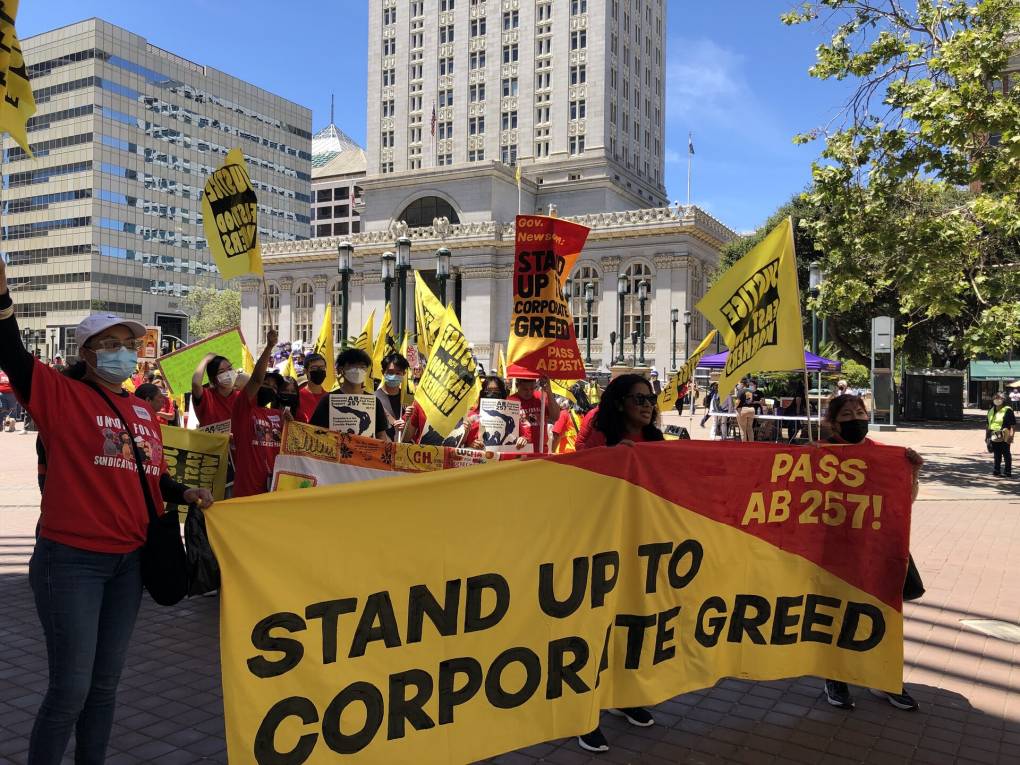
"caption": "AB 257 supporters march in Frank Ogawa Plaza in downtown Oakland on June 9, 2022.",
"description": null,
"title": "RS58237_IMG_5501-qut",
"credit": "Farida Jhabvala Romero/KQED",
"status": "inherit",
"altTag": null,
"isLoading": false,
"fetchFailed": false
},
"news_11924025": {
"type": "attachments",
"id": "news_11924025",
"meta": {
"index": "attachments_1716263798",
"site": "news",
"id": "11924025",
"found": true
},
"parent": 11924013,
"imgSizes": {
"twentyfourteen-full-width": {
"file": "https://ww2.kqed.org/app/uploads/sites/10/2022/08/07212022_Car_Wash_CleanOP_PU_CM_023-1038x576.jpg",
"width": 1038,
"mimeType": "image/jpeg",
"height": 576
},
"thumbnail": {
"file": "https://ww2.kqed.org/app/uploads/sites/10/2022/08/07212022_Car_Wash_CleanOP_PU_CM_023-160x107.jpg",
"width": 160,
"mimeType": "image/jpeg",
"height": 107
},
"post-thumbnail": {
"file": "https://ww2.kqed.org/app/uploads/sites/10/2022/08/07212022_Car_Wash_CleanOP_PU_CM_023-672x372.jpg",
"width": 672,
"mimeType": "image/jpeg",
"height": 372
},
"kqedFullSize": {
"file": "https://ww2.kqed.org/app/uploads/sites/10/2022/08/07212022_Car_Wash_CleanOP_PU_CM_023.jpg",
"width": 2000,
"height": 1334
},
"large": {
"file": "https://ww2.kqed.org/app/uploads/sites/10/2022/08/07212022_Car_Wash_CleanOP_PU_CM_023-1020x680.jpg",
"width": 1020,
"mimeType": "image/jpeg",
"height": 680
},
"1536x1536": {
"file": "https://ww2.kqed.org/app/uploads/sites/10/2022/08/07212022_Car_Wash_CleanOP_PU_CM_023-1536x1025.jpg",
"width": 1536,
"mimeType": "image/jpeg",
"height": 1025
},
"full-width": {
"file": "https://ww2.kqed.org/app/uploads/sites/10/2022/08/07212022_Car_Wash_CleanOP_PU_CM_023-1920x1281.jpg",
"width": 1920,
"mimeType": "image/jpeg",
"height": 1281
},
"medium": {
"file": "https://ww2.kqed.org/app/uploads/sites/10/2022/08/07212022_Car_Wash_CleanOP_PU_CM_023-800x534.jpg",
"width": 800,
"mimeType": "image/jpeg",
"height": 534
}
},
"publishDate": 1661817491,
"modified": 1661890058,
"caption": "Rodrigo Hernandez finishes up a car after washing it outside the CLEAN Carwash Worker Center, in Los Angeles on July 21, 2022.",
"description": null,
"title": "07212022_Car_Wash_CleanOP_PU_CM_023",
"credit": "Pablo Unzueta/CalMatters",
"status": "inherit",
"altTag": "a man in a black mask wipes a windshield at a car wash",
"isLoading": false,
"fetchFailed": false
},
"news_11922930": {
"type": "attachments",
"id": "news_11922930",
"meta": {
"index": "attachments_1716263798",
"site": "news",
"id": "11922930",
"found": true
},
"parent": 11922927,
"imgSizes": {
"twentyfourteen-full-width": {
"file": "https://ww2.kqed.org/app/uploads/sites/10/2022/08/Screen-Shot-2022-08-18-at-10.23.31-AM-1038x576.png",
"width": 1038,
"mimeType": "image/png",
"height": 576
},
"thumbnail": {
"file": "https://ww2.kqed.org/app/uploads/sites/10/2022/08/Screen-Shot-2022-08-18-at-10.23.31-AM-160x105.png",
"width": 160,
"mimeType": "image/png",
"height": 105
},
"post-thumbnail": {
"file": "https://ww2.kqed.org/app/uploads/sites/10/2022/08/Screen-Shot-2022-08-18-at-10.23.31-AM-672x372.png",
"width": 672,
"mimeType": "image/png",
"height": 372
},
"kqedFullSize": {
"file": "https://ww2.kqed.org/app/uploads/sites/10/2022/08/Screen-Shot-2022-08-18-at-10.23.31-AM.png",
"width": 2374,
"height": 1562
},
"2048x2048": {
"file": "https://ww2.kqed.org/app/uploads/sites/10/2022/08/Screen-Shot-2022-08-18-at-10.23.31-AM-2048x1348.png",
"width": 2048,
"mimeType": "image/png",
"height": 1348
},
"large": {
"file": "https://ww2.kqed.org/app/uploads/sites/10/2022/08/Screen-Shot-2022-08-18-at-10.23.31-AM-1020x671.png",
"width": 1020,
"mimeType": "image/png",
"height": 671
},
"1536x1536": {
"file": "https://ww2.kqed.org/app/uploads/sites/10/2022/08/Screen-Shot-2022-08-18-at-10.23.31-AM-1536x1011.png",
"width": 1536,
"mimeType": "image/png",
"height": 1011
},
"full-width": {
"file": "https://ww2.kqed.org/app/uploads/sites/10/2022/08/Screen-Shot-2022-08-18-at-10.23.31-AM-1920x1263.png",
"width": 1920,
"mimeType": "image/png",
"height": 1263
},
"medium": {
"file": "https://ww2.kqed.org/app/uploads/sites/10/2022/08/Screen-Shot-2022-08-18-at-10.23.31-AM-800x526.png",
"width": 800,
"mimeType": "image/png",
"height": 526
}
},
"publishDate": 1660844212,
"modified": 1661868367,
"caption": null,
"description": "Fast-food workers from across California rallied at the state Capitol in Sacramento on Aug. 16, 2022, urging lawmakers to pass AB 257.",
"title": "Screen Shot 2022-08-18 at 10.23.31 AM",
"credit": "Rahul Lal/CalMatters",
"status": "inherit",
"altTag": "A silhouette of two people holding flags that read \"AB257.\"",
"isLoading": false,
"fetchFailed": false
},
"news_11920428": {
"type": "attachments",
"id": "news_11920428",
"meta": {
"index": "attachments_1716263798",
"site": "news",
"id": "11920428",
"found": true
},
"parent": 11920425,
"imgSizes": {
"twentyfourteen-full-width": {
"file": "https://ww2.kqed.org/app/uploads/sites/10/2022/07/Screen-Shot-2022-07-25-at-1.12.16-PM-1038x576.png",
"width": 1038,
"mimeType": "image/png",
"height": 576
},
"thumbnail": {
"file": "https://ww2.kqed.org/app/uploads/sites/10/2022/07/Screen-Shot-2022-07-25-at-1.12.16-PM-160x105.png",
"width": 160,
"mimeType": "image/png",
"height": 105
},
"post-thumbnail": {
"file": "https://ww2.kqed.org/app/uploads/sites/10/2022/07/Screen-Shot-2022-07-25-at-1.12.16-PM-672x372.png",
"width": 672,
"mimeType": "image/png",
"height": 372
},
"kqedFullSize": {
"file": "https://ww2.kqed.org/app/uploads/sites/10/2022/07/Screen-Shot-2022-07-25-at-1.12.16-PM.png",
"width": 1558,
"height": 1026
},
"large": {
"file": "https://ww2.kqed.org/app/uploads/sites/10/2022/07/Screen-Shot-2022-07-25-at-1.12.16-PM-1020x672.png",
"width": 1020,
"mimeType": "image/png",
"height": 672
},
"1536x1536": {
"file": "https://ww2.kqed.org/app/uploads/sites/10/2022/07/Screen-Shot-2022-07-25-at-1.12.16-PM-1536x1012.png",
"width": 1536,
"mimeType": "image/png",
"height": 1012
},
"medium": {
"file": "https://ww2.kqed.org/app/uploads/sites/10/2022/07/Screen-Shot-2022-07-25-at-1.12.16-PM-800x527.png",
"width": 800,
"mimeType": "image/png",
"height": 527
}
},
"publishDate": 1658780985,
"modified": 1658784771,
"caption": "In California, workers lost nearly $2 billion from not being paid the minimum wage in 2015, according to the Economic Policy Institute, a left-leaning think tank. ",
"description": null,
"title": "Screen Shot 2022-07-25 at 1.12.16 PM",
"credit": "Miguel Gutierrez Jr./CalMatters/iStock",
"status": "inherit",
"altTag": "Five people are seeing performing different activities with the one in the middle holding a sign that reads \"Wage Theft is a Crime.\"",
"isLoading": false,
"fetchFailed": false
},
"news_11916305": {
"type": "attachments",
"id": "news_11916305",
"meta": {
"index": "attachments_1716263798",
"site": "news",
"id": "11916305",
"found": true
},
"parent": 11916303,
"imgSizes": {
"twentyfourteen-full-width": {
"file": "https://ww2.kqed.org/app/uploads/sites/10/2022/06/RS53933_IMG_2360-Mirna-holds-Aaron-qut-1038x576.jpg",
"width": 1038,
"mimeType": "image/jpeg",
"height": 576
},
"thumbnail": {
"file": "https://ww2.kqed.org/app/uploads/sites/10/2022/06/RS53933_IMG_2360-Mirna-holds-Aaron-qut-160x107.jpg",
"width": 160,
"mimeType": "image/jpeg",
"height": 107
},
"post-thumbnail": {
"file": "https://ww2.kqed.org/app/uploads/sites/10/2022/06/RS53933_IMG_2360-Mirna-holds-Aaron-qut-672x372.jpg",
"width": 672,
"mimeType": "image/jpeg",
"height": 372
},
"kqedFullSize": {
"file": "https://ww2.kqed.org/app/uploads/sites/10/2022/06/RS53933_IMG_2360-Mirna-holds-Aaron-qut.jpg",
"width": 1920,
"height": 1280
},
"large": {
"file": "https://ww2.kqed.org/app/uploads/sites/10/2022/06/RS53933_IMG_2360-Mirna-holds-Aaron-qut-1020x680.jpg",
"width": 1020,
"mimeType": "image/jpeg",
"height": 680
},
"1536x1536": {
"file": "https://ww2.kqed.org/app/uploads/sites/10/2022/06/RS53933_IMG_2360-Mirna-holds-Aaron-qut-1536x1024.jpg",
"width": 1536,
"mimeType": "image/jpeg",
"height": 1024
},
"medium": {
"file": "https://ww2.kqed.org/app/uploads/sites/10/2022/06/RS53933_IMG_2360-Mirna-holds-Aaron-qut-800x533.jpg",
"width": 800,
"mimeType": "image/jpeg",
"height": 533
}
},
"publishDate": 1654638872,
"modified": 1654638888,
"caption": "Mirna Arana holds her 3-year-old son at a park in Oakland, Calif. on Feb. 17, 2022. After waiting for more than three years for a hearing on her wage claim, the Labor Commissioner's Office ruled her old employer owes her nearly $183,000. But it's unclear when -- or if -- she'll recover the money, she said.",
"description": null,
"title": "RS53933_IMG_2360 Mirna holds Aaron-qut",
"credit": "Farida Jhabvala Romero/KQED",
"status": "inherit",
"altTag": null,
"isLoading": false,
"fetchFailed": false
},
"news_11913924": {
"type": "attachments",
"id": "news_11913924",
"meta": {
"index": "attachments_1716263798",
"site": "news",
"id": "11913924",
"found": true
},
"parent": 11913910,
"imgSizes": {
"twentyfourteen-full-width": {
"file": "https://ww2.kqed.org/app/uploads/sites/10/2022/05/RS55947_IMG_2442-Good-one-qut-1038x576.jpg",
"width": 1038,
"mimeType": "image/jpeg",
"height": 576
},
"thumbnail": {
"file": "https://ww2.kqed.org/app/uploads/sites/10/2022/05/RS55947_IMG_2442-Good-one-qut-160x107.jpg",
"width": 160,
"mimeType": "image/jpeg",
"height": 107
},
"post-thumbnail": {
"file": "https://ww2.kqed.org/app/uploads/sites/10/2022/05/RS55947_IMG_2442-Good-one-qut-672x372.jpg",
"width": 672,
"mimeType": "image/jpeg",
"height": 372
},
"kqedFullSize": {
"file": "https://ww2.kqed.org/app/uploads/sites/10/2022/05/RS55947_IMG_2442-Good-one-qut.jpg",
"width": 1920,
"height": 1280
},
"large": {
"file": "https://ww2.kqed.org/app/uploads/sites/10/2022/05/RS55947_IMG_2442-Good-one-qut-1020x680.jpg",
"width": 1020,
"mimeType": "image/jpeg",
"height": 680
},
"1536x1536": {
"file": "https://ww2.kqed.org/app/uploads/sites/10/2022/05/RS55947_IMG_2442-Good-one-qut-1536x1024.jpg",
"width": 1536,
"mimeType": "image/jpeg",
"height": 1024
},
"medium": {
"file": "https://ww2.kqed.org/app/uploads/sites/10/2022/05/RS55947_IMG_2442-Good-one-qut-800x533.jpg",
"width": 800,
"mimeType": "image/jpeg",
"height": 533
}
},
"publishDate": 1652314178,
"modified": 1652389455,
"caption": "María says her former employer at the Berkeley restaurant where she worked for more than 10 years owes her $35,000 in unpaid wages. Her claim with the Labor Commissioner's Office is one of thousands that have been pending for three or more years.",
"description": null,
"title": "RS55947_IMG_2442 Good one-qut",
"credit": "Farida Jhabvala Romero/KQED",
"status": "inherit",
"altTag": "A women standing in a field at a park.",
"isLoading": false,
"fetchFailed": false
},
"news_11913645": {
"type": "attachments",
"id": "news_11913645",
"meta": {
"index": "attachments_1716263798",
"site": "news",
"id": "11913645",
"found": true
},
"parent": 11913643,
"imgSizes": {
"twentyfourteen-full-width": {
"file": "https://ww2.kqed.org/app/uploads/sites/10/2022/05/RS55854_IMG_2416-OK-qut-1038x576.jpg",
"width": 1038,
"mimeType": "image/jpeg",
"height": 576
},
"thumbnail": {
"file": "https://ww2.kqed.org/app/uploads/sites/10/2022/05/RS55854_IMG_2416-OK-qut-160x107.jpg",
"width": 160,
"mimeType": "image/jpeg",
"height": 107
},
"post-thumbnail": {
"file": "https://ww2.kqed.org/app/uploads/sites/10/2022/05/RS55854_IMG_2416-OK-qut-672x372.jpg",
"width": 672,
"mimeType": "image/jpeg",
"height": 372
},
"kqedFullSize": {
"file": "https://ww2.kqed.org/app/uploads/sites/10/2022/05/RS55854_IMG_2416-OK-qut.jpg",
"width": 1920,
"height": 1280
},
"large": {
"file": "https://ww2.kqed.org/app/uploads/sites/10/2022/05/RS55854_IMG_2416-OK-qut-1020x680.jpg",
"width": 1020,
"mimeType": "image/jpeg",
"height": 680
},
"1536x1536": {
"file": "https://ww2.kqed.org/app/uploads/sites/10/2022/05/RS55854_IMG_2416-OK-qut-1536x1024.jpg",
"width": 1536,
"mimeType": "image/jpeg",
"height": 1024
},
"medium": {
"file": "https://ww2.kqed.org/app/uploads/sites/10/2022/05/RS55854_IMG_2416-OK-qut-800x533.jpg",
"width": 800,
"mimeType": "image/jpeg",
"height": 533
}
},
"publishDate": 1652131498,
"modified": 1652287106,
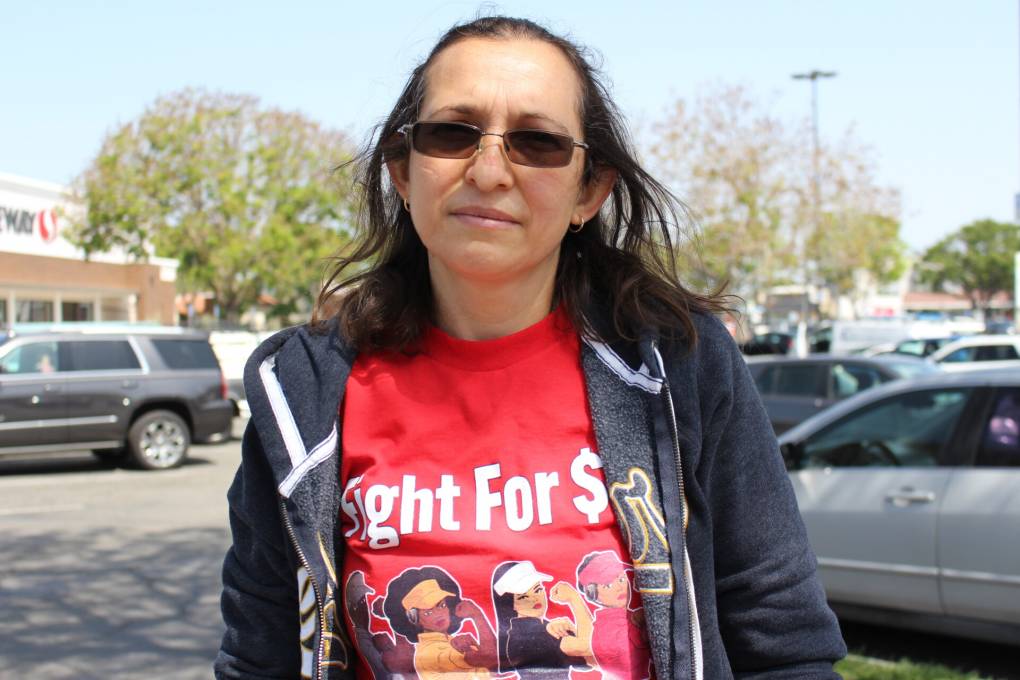
"caption": "Maria Yolanda Torres, outside a shopping mall in San José on April 26, 2022, said her employer at a Subway franchise did not compensate her and other workers for paid sick time they earned, in what she called a violation of state labor laws. Torres, a volunteer with the Fight for $15 campaign, was one of the 410 fast-food workers who responded to a new survey on wage theft.",
"description": null,
"title": "RS55854_IMG_2416 OK-qut",
"credit": "Farida Jhabvala Romero/KQED",
"status": "inherit",
"altTag": "A woman wearing sunglasses and a red shirt that says \"Fight for $15\" stands in a shopping center parking lot.",
"isLoading": false,
"fetchFailed": false
},
"news_11903654": {
"type": "attachments",
"id": "news_11903654",
"meta": {
"index": "attachments_1716263798",
"site": "news",
"id": "11903654",
"found": true
},
"parent": 11903639,
"imgSizes": {
"twentyfourteen-full-width": {
"file": "https://ww2.kqed.org/app/uploads/sites/10/2022/02/waiting_020122_final-1038x576.png",
"width": 1038,
"mimeType": "image/png",
"height": 576
},
"thumbnail": {
"file": "https://ww2.kqed.org/app/uploads/sites/10/2022/02/waiting_020122_final-160x112.png",
"width": 160,
"mimeType": "image/png",
"height": 112
},
"post-thumbnail": {
"file": "https://ww2.kqed.org/app/uploads/sites/10/2022/02/waiting_020122_final-672x372.png",
"width": 672,
"mimeType": "image/png",
"height": 372
},
"kqedFullSize": {
"file": "https://ww2.kqed.org/app/uploads/sites/10/2022/02/waiting_020122_final.png",
"width": 1920,
"height": 1343
},
"large": {
"file": "https://ww2.kqed.org/app/uploads/sites/10/2022/02/waiting_020122_final-1020x713.png",
"width": 1020,
"mimeType": "image/png",
"height": 713
},
"1536x1536": {
"file": "https://ww2.kqed.org/app/uploads/sites/10/2022/02/waiting_020122_final-1536x1074.png",
"width": 1536,
"mimeType": "image/png",
"height": 1074
},
"medium": {
"file": "https://ww2.kqed.org/app/uploads/sites/10/2022/02/waiting_020122_final-800x560.png",
"width": 800,
"mimeType": "image/png",
"height": 560
}
},
"publishDate": 1643761584,
"modified": 1643761641,
"caption": null,
"description": null,
"title": "waiting_020122_final",
"credit": null,
"status": "inherit",
"altTag": "Cartoon: a bacon cheeseburger labeled, \"$1.99, ready in one minute,\" opposite a crowd of fast food workers labeled, \"$2 million and still waiting.\"",
"isLoading": false,
"fetchFailed": false
},
"news_11903297": {
"type": "attachments",
"id": "news_11903297",
"meta": {
"index": "attachments_1716263798",
"site": "news",
"id": "11903297",
"found": true
},
"parent": 11903291,
"imgSizes": {
"twentyfourteen-full-width": {
"file": "https://ww2.kqed.org/app/uploads/sites/10/2022/01/RS53268_008_SanFrancisco_WageTheftSoniaCrisostomo_01242022-qut-1038x576.jpg",
"width": 1038,
"mimeType": "image/jpeg",
"height": 576
},
"thumbnail": {
"file": "https://ww2.kqed.org/app/uploads/sites/10/2022/01/RS53268_008_SanFrancisco_WageTheftSoniaCrisostomo_01242022-qut-160x107.jpg",
"width": 160,
"mimeType": "image/jpeg",
"height": 107
},
"post-thumbnail": {
"file": "https://ww2.kqed.org/app/uploads/sites/10/2022/01/RS53268_008_SanFrancisco_WageTheftSoniaCrisostomo_01242022-qut-672x372.jpg",
"width": 672,
"mimeType": "image/jpeg",
"height": 372
},
"kqedFullSize": {
"file": "https://ww2.kqed.org/app/uploads/sites/10/2022/01/RS53268_008_SanFrancisco_WageTheftSoniaCrisostomo_01242022-qut.jpg",
"width": 1920,
"height": 1280
},
"large": {
"file": "https://ww2.kqed.org/app/uploads/sites/10/2022/01/RS53268_008_SanFrancisco_WageTheftSoniaCrisostomo_01242022-qut-1020x680.jpg",
"width": 1020,
"mimeType": "image/jpeg",
"height": 680
},
"1536x1536": {
"file": "https://ww2.kqed.org/app/uploads/sites/10/2022/01/RS53268_008_SanFrancisco_WageTheftSoniaCrisostomo_01242022-qut-1536x1024.jpg",
"width": 1536,
"mimeType": "image/jpeg",
"height": 1024
},
"medium": {
"file": "https://ww2.kqed.org/app/uploads/sites/10/2022/01/RS53268_008_SanFrancisco_WageTheftSoniaCrisostomo_01242022-qut-800x533.jpg",
"width": 800,
"mimeType": "image/jpeg",
"height": 533
}
},
"publishDate": 1643413856,
"modified": 1643474094,
"caption": "Sonia Crisostomo rides the bus home after work in downtown San Francisco on Jan. 24, 2022. She is one of more than 230 workers who are owed nearly $2 million by their former employer, Golden Gate Restaurant Group Inc., according to a state citation.",
"description": null,
"title": "RS53268_008_SanFrancisco_WageTheftSoniaCrisostomo_01242022-qut",
"credit": "Beth LaBerge/KQED",
"status": "inherit",
"altTag": "A woman wearing a face mask sits on a public bus.",
"isLoading": false,
"fetchFailed": false
},
"news_11838142": {
"type": "attachments",
"id": "news_11838142",
"meta": {
"index": "attachments_1716263798",
"site": "news",
"id": "11838142",
"found": true
},
"parent": 11838137,
"imgSizes": {
"apple_news_ca_landscape_5_5": {
"file": "https://ww2.kqed.org/app/uploads/sites/10/2020/09/RS44906_IMG_8037-Jimmy-qut-1044x783.jpg",
"width": 1044,
"mimeType": "image/jpeg",
"height": 783
},
"apple_news_ca_square_4_0": {
"file": "https://ww2.kqed.org/app/uploads/sites/10/2020/09/RS44906_IMG_8037-Jimmy-qut-470x470.jpg",
"width": 470,
"mimeType": "image/jpeg",
"height": 470
},
"twentyfourteen-full-width": {
"file": "https://ww2.kqed.org/app/uploads/sites/10/2020/09/RS44906_IMG_8037-Jimmy-qut-1038x576.jpg",
"width": 1038,
"mimeType": "image/jpeg",
"height": 576
},
"thumbnail": {
"file": "https://ww2.kqed.org/app/uploads/sites/10/2020/09/RS44906_IMG_8037-Jimmy-qut-160x107.jpg",
"width": 160,
"mimeType": "image/jpeg",
"height": 107
},
"post-thumbnail": {
"file": "https://ww2.kqed.org/app/uploads/sites/10/2020/09/RS44906_IMG_8037-Jimmy-qut-672x372.jpg",
"width": 672,
"mimeType": "image/jpeg",
"height": 372
},
"kqedFullSize": {
"file": "https://ww2.kqed.org/app/uploads/sites/10/2020/09/RS44906_IMG_8037-Jimmy-qut.jpg",
"width": 1920,
"height": 1282
},
"apple_news_ca_landscape_4_7": {
"file": "https://ww2.kqed.org/app/uploads/sites/10/2020/09/RS44906_IMG_8037-Jimmy-qut-632x474.jpg",
"width": 632,
"mimeType": "image/jpeg",
"height": 474
},
"large": {
"file": "https://ww2.kqed.org/app/uploads/sites/10/2020/09/RS44906_IMG_8037-Jimmy-qut-1020x681.jpg",
"width": 1020,
"mimeType": "image/jpeg",
"height": 681
},
"apple_news_ca_landscape_4_0": {
"file": "https://ww2.kqed.org/app/uploads/sites/10/2020/09/RS44906_IMG_8037-Jimmy-qut-536x402.jpg",
"width": 536,
"mimeType": "image/jpeg",
"height": 402
},
"apple_news_ca_portrait_12_9": {
"file": "https://ww2.kqed.org/app/uploads/sites/10/2020/09/RS44906_IMG_8037-Jimmy-qut-1122x1282.jpg",
"width": 1122,
"mimeType": "image/jpeg",
"height": 1282
},
"medium": {
"file": "https://ww2.kqed.org/app/uploads/sites/10/2020/09/RS44906_IMG_8037-Jimmy-qut-800x534.jpg",
"width": 800,
"mimeType": "image/jpeg",
"height": 534
},
"apple_news_ca_portrait_4_0": {
"file": "https://ww2.kqed.org/app/uploads/sites/10/2020/09/RS44906_IMG_8037-Jimmy-qut-354x472.jpg",
"width": 354,
"mimeType": "image/jpeg",
"height": 472
},
"apple_news_ca_portrait_9_7": {
"file": "https://ww2.kqed.org/app/uploads/sites/10/2020/09/RS44906_IMG_8037-Jimmy-qut-840x1120.jpg",
"width": 840,
"mimeType": "image/jpeg",
"height": 1120
},
"apple_news_ca_landscape_12_9": {
"file": "https://ww2.kqed.org/app/uploads/sites/10/2020/09/RS44906_IMG_8037-Jimmy-qut-1832x1282.jpg",
"width": 1832,
"mimeType": "image/jpeg",
"height": 1282
},
"apple_news_ca_square_9_7": {
"file": "https://ww2.kqed.org/app/uploads/sites/10/2020/09/RS44906_IMG_8037-Jimmy-qut-1104x1104.jpg",
"width": 1104,
"mimeType": "image/jpeg",
"height": 1104
},
"1536x1536": {
"file": "https://ww2.kqed.org/app/uploads/sites/10/2020/09/RS44906_IMG_8037-Jimmy-qut-1536x1026.jpg",
"width": 1536,
"mimeType": "image/jpeg",
"height": 1026
},
"apple_news_ca_portrait_4_7": {
"file": "https://ww2.kqed.org/app/uploads/sites/10/2020/09/RS44906_IMG_8037-Jimmy-qut-414x552.jpg",
"width": 414,
"mimeType": "image/jpeg",
"height": 552
},
"apple_news_ca_square_12_9": {
"file": "https://ww2.kqed.org/app/uploads/sites/10/2020/09/RS44906_IMG_8037-Jimmy-qut-1472x1282.jpg",
"width": 1472,
"mimeType": "image/jpeg",
"height": 1282
},
"apple_news_ca_portrait_5_5": {
"file": "https://ww2.kqed.org/app/uploads/sites/10/2020/09/RS44906_IMG_8037-Jimmy-qut-687x916.jpg",
"width": 687,
"mimeType": "image/jpeg",
"height": 916
},
"apple_news_ca_square_4_7": {
"file": "https://ww2.kqed.org/app/uploads/sites/10/2020/09/RS44906_IMG_8037-Jimmy-qut-550x550.jpg",
"width": 550,
"mimeType": "image/jpeg",
"height": 550
},
"apple_news_ca_landscape_9_7": {
"file": "https://ww2.kqed.org/app/uploads/sites/10/2020/09/RS44906_IMG_8037-Jimmy-qut-1376x1032.jpg",
"width": 1376,
"mimeType": "image/jpeg",
"height": 1032
},
"apple_news_ca_square_5_5": {
"file": "https://ww2.kqed.org/app/uploads/sites/10/2020/09/RS44906_IMG_8037-Jimmy-qut-912x912.jpg",
"width": 912,
"mimeType": "image/jpeg",
"height": 912
}
},
"publishDate": 1600218571,
"modified": 1600218752,
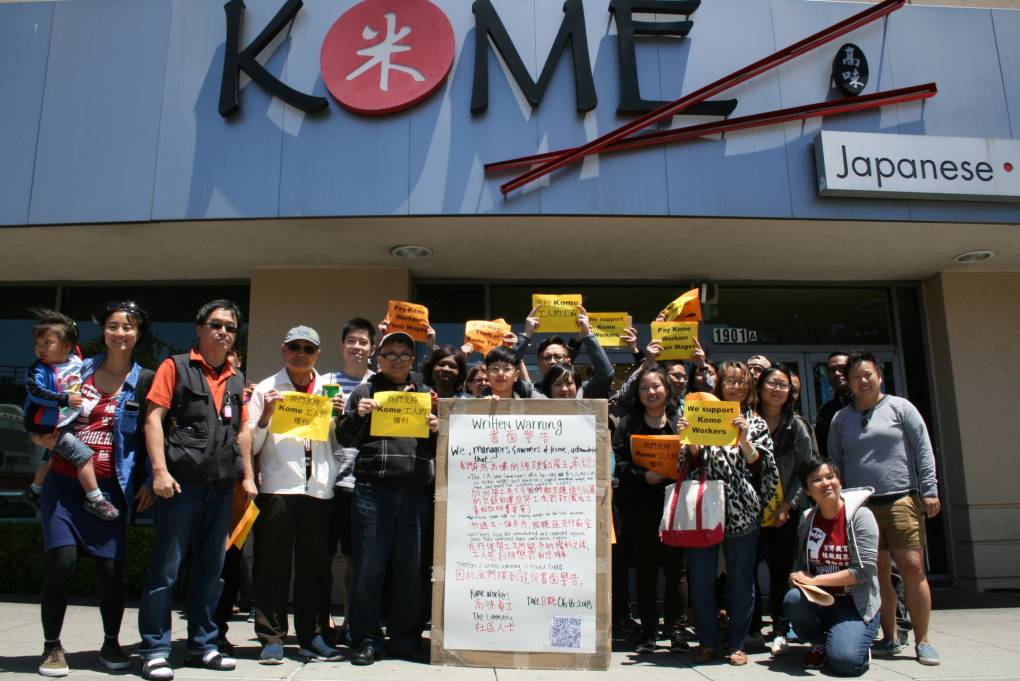
"caption": "Supporters of workers at Kome Japanese Seafood Buffet stand outside the restaurant in Daly City in 2018. The California Labor Commissioner cited Kome for minimum wage and other violations before the restaurant closed last year.",
"description": null,
"title": "RS44906_IMG_8037 Jimmy-qut",
"credit": "Courtesy of Chinese Progressive Association",
"status": "inherit",
"isLoading": false,
"fetchFailed": false
}
},
"audioPlayerReducer": {
"postId": "stream_live",
"isPaused": true,
"isPlaying": false,
"pfsActive": false,
"pledgeModalIsOpen": true,
"playerDrawerIsOpen": false,
"liveAudioPlayStartedAt": 0,
"liveAudioPlayContext": ""
},
"authorsReducer": {
"byline_news_11929398": {
"type": "authors",
"id": "byline_news_11929398",
"meta": {
"override": true
},
"slug": "byline_news_11929398",
"name": "Alejandro Lazo, Jeanne Kuang and Julie Watts",
"isLoading": false
},
"byline_news_11925744": {
"type": "authors",
"id": "byline_news_11925744",
"meta": {
"override": true
},
"slug": "byline_news_11925744",
"name": "Jeanne Kuang and Alejandro Lazo",
"isLoading": false
},
"byline_news_11924013": {
"type": "authors",
"id": "byline_news_11924013",
"meta": {
"override": true
},
"slug": "byline_news_11924013",
"name": "\u003ca href=\"https://calmatters.org/author/alejandro-lazo/\">Alejandro Lazo\u003c/a> and \u003ca href=\"https://calmatters.org/author/lil-kalish/\">Lil Kalish\u003c/a>",
"isLoading": false
},
"byline_news_11922927": {
"type": "authors",
"id": "byline_news_11922927",
"meta": {
"override": true
},
"slug": "byline_news_11922927",
"name": "Jeanne Kuang",
"isLoading": false
},
"byline_news_11920425": {
"type": "authors",
"id": "byline_news_11920425",
"meta": {
"override": true
},
"slug": "byline_news_11920425",
"name": "Alejandro Lazo, Jeanne Kuang, Lil Kalish, Agnes Lee and Erica Yee",
"isLoading": false
},
"markfiore": {
"type": "authors",
"id": "3236",
"meta": {
"index": "authors_1716337520",
"id": "3236",
"found": true
},
"name": "Mark Fiore",
"firstName": "Mark",
"lastName": "Fiore",
"slug": "markfiore",
"email": "mark@markfiore.com",
"display_author_email": false,
"staff_mastheads": [
"news"
],
"title": "KQED News Cartoonist",
"bio": "\u003ca href=\"http://www.MarkFiore.com\">MarkFiore.com\u003c/a> | \u003ca href=\"https://twitter.com/markfiore\">Follow on Twitter\u003c/a> | \u003ca href=\"https://www.facebook.com/pages/Mark-Fiore-Animated-Political-Cartoons/94451707396?ref=bookmarks\">Facebook\u003c/a> | \u003ca href=\"mailto:mark@markfiore.com\">email\u003c/a>\r\n\r\nPulitzer Prize-winner, Mark Fiore, who the Wall Street Journal has called “the undisputed guru of the form,” creates animated political cartoons in San Francisco, where his work has been featured regularly on the San Francisco Chronicle’s web site, SFGate.com. His work has appeared on Newsweek.com, Slate.com, CBSNews.com, MotherJones.com, DailyKos.com and NPR’s web site. Fiore’s political animation has appeared on CNN, Frontline, Bill Moyers Journal, Salon.com and cable and broadcast outlets across the globe.\r\n\r\nBeginning his professional life by drawing traditional political cartoons for newspapers, Fiore’s work appeared in publications ranging from the Washington Post to the Los Angeles Times. In the late 1990s, he began to experiment with animating political cartoons and, after a short stint at the San Jose Mercury News as their staff cartoonist, Fiore devoted all his energies to animation.\r\nGrowing up in California, Fiore also spent a good portion of his life in the backwoods of Idaho. It was this combination that shaped him politically. Mark majored in political science at Colorado College, where, in a perfect send-off for a cartoonist, he received his diploma in 1991 as commencement speaker Dick Cheney smiled approvingly.\r\nMark Fiore was awarded the Pulitzer Prize for political cartooning in 2010, a Robert F. Kennedy Journalism Award in 2004 and has twice received an Online Journalism Award for commentary from the Online News Association (2002, 2008). Fiore has received two awards for his work in new media from the National Cartoonists Society (2001, 2002), and in 2006 received The James Madison Freedom of Information Award from The Society of Professional Journalists.",
"avatar": "https://secure.gravatar.com/avatar/fc4e2a612b15b67bad0c6f0e1db4ca9b?s=600&d=blank&r=g",
"twitter": "MarkFiore",
"facebook": null,
"instagram": "https://www.instagram.com/markfiore/?hl=en",
"linkedin": null,
"sites": [
{
"site": "arts",
"roles": [
"contributor"
]
},
{
"site": "news",
"roles": [
"editor"
]
},
{
"site": "futureofyou",
"roles": [
"editor"
]
},
{
"site": "science",
"roles": [
"editor"
]
}
],
"headData": {
"title": "Mark Fiore | KQED",
"description": "KQED News Cartoonist",
"ogImgSrc": "https://secure.gravatar.com/avatar/fc4e2a612b15b67bad0c6f0e1db4ca9b?s=600&d=blank&r=g",
"twImgSrc": "https://secure.gravatar.com/avatar/fc4e2a612b15b67bad0c6f0e1db4ca9b?s=600&d=blank&r=g"
},
"isLoading": false,
"link": "/author/markfiore"
},
"ecruzguevarra": {
"type": "authors",
"id": "8654",
"meta": {
"index": "authors_1716337520",
"id": "8654",
"found": true
},
"name": "Ericka Cruz Guevarra",
"firstName": "Ericka",
"lastName": "Cruz Guevarra",
"slug": "ecruzguevarra",
"email": "ecruzguevarra@kqed.org",
"display_author_email": true,
"staff_mastheads": [
"news"
],
"title": "Producer, The Bay Podcast",
"bio": "Ericka Cruz Guevarra is host of \u003ca href=\"https://www.kqed.org/podcasts/thebay\">\u003cem>The Bay\u003c/em>\u003c/a> podcast at KQED. Before host, she was the show’s producer. Her work in that capacity includes a three-part reported series on policing in Vallejo, which won a 2020 excellence in journalism award from the Society of Professional Journalists. Ericka has worked as a breaking news reporter at Oregon Public Broadcasting, helped produce the Code Switch podcast, and was KQED’s inaugural Raul Ramirez Diversity Fund intern. She’s also an alumna of NPR’s Next Generation Radio program. Send her an email if you have strong feelings about whether Fairfield and Suisun City are the Bay. Ericka is represented by SAG-AFTRA.",
"avatar": "https://secure.gravatar.com/avatar/25e5ab8d3d53fad2dcc7bb2b5c506b1a?s=600&d=blank&r=g",
"twitter": "NotoriousECG",
"facebook": null,
"instagram": null,
"linkedin": null,
"sites": [
{
"site": "arts",
"roles": [
"subscriber"
]
},
{
"site": "news",
"roles": [
"editor",
"manage_categories"
]
},
{
"site": "futureofyou",
"roles": [
"subscriber"
]
},
{
"site": "stateofhealth",
"roles": [
"subscriber"
]
},
{
"site": "science",
"roles": [
"editor"
]
},
{
"site": "forum",
"roles": [
"subscriber"
]
}
],
"headData": {
"title": "Ericka Cruz Guevarra | KQED",
"description": "Producer, The Bay Podcast",
"ogImgSrc": "https://secure.gravatar.com/avatar/25e5ab8d3d53fad2dcc7bb2b5c506b1a?s=600&d=blank&r=g",
"twImgSrc": "https://secure.gravatar.com/avatar/25e5ab8d3d53fad2dcc7bb2b5c506b1a?s=600&d=blank&r=g"
},
"isLoading": false,
"link": "/author/ecruzguevarra"
},
"fjhabvala": {
"type": "authors",
"id": "8659",
"meta": {
"index": "authors_1716337520",
"id": "8659",
"found": true
},
"name": "Farida Jhabvala Romero",
"firstName": "Farida",
"lastName": "Jhabvala Romero",
"slug": "fjhabvala",
"email": "fjhabvala@kqed.org",
"display_author_email": true,
"staff_mastheads": [
"news"
],
"title": "KQED Contributor",
"bio": "\u003cspan style=\"font-weight: 400;\">Farida Jhabvala Romero is a Labor Correspondent for KQED. She previously covered immigration. Farida was \u003ca href=\"https://www.ccnma.org/2022-most-influential-latina-journalists\">named\u003c/a> one of the 10 Most Influential Latina Journalists in California in 2022 by the California Chicano News Media Association. Her work has won awards from the Society of Professional Journalists (Northern California), as well as a national and regional Edward M. Murrow Award for the collaborative reporting projects “Dangerous Air” and “Graying California.” \u003c/span>\u003cspan style=\"font-weight: 400;\">Before joining KQED, Farida worked as a producer at Radio Bilingüe, a national public radio network. Farida earned her master’s degree in journalism from Stanford University.\u003c/span>",
"avatar": "https://secure.gravatar.com/avatar/c3ab27c5554b67b478f80971e515aa02?s=600&d=blank&r=g",
"twitter": "FaridaJhabvala",
"facebook": null,
"instagram": null,
"linkedin": "https://www.linkedin.com/in/faridajhabvala/",
"sites": [
{
"site": "news",
"roles": [
"editor"
]
},
{
"site": "stateofhealth",
"roles": [
"author"
]
}
],
"headData": {
"title": "Farida Jhabvala Romero | KQED",
"description": "KQED Contributor",
"ogImgSrc": "https://secure.gravatar.com/avatar/c3ab27c5554b67b478f80971e515aa02?s=600&d=blank&r=g",
"twImgSrc": "https://secure.gravatar.com/avatar/c3ab27c5554b67b478f80971e515aa02?s=600&d=blank&r=g"
},
"isLoading": false,
"link": "/author/fjhabvala"
},
"amontecillo": {
"type": "authors",
"id": "11649",
"meta": {
"index": "authors_1716337520",
"id": "11649",
"found": true
},
"name": "Alan Montecillo",
"firstName": "Alan",
"lastName": "Montecillo",
"slug": "amontecillo",
"email": "amontecillo@kqed.org",
"display_author_email": false,
"staff_mastheads": [
"news"
],
"title": "KQED Contributor",
"bio": "Alan Montecillo is the senior editor of \u003cem>\u003ca href=\"http://kqed.org/thebay\">The Bay\u003c/a>, \u003c/em> KQED's local news podcast. Before moving to the Bay Area, he worked as a senior talk show producer for WILL in Champaign-Urbana, Illinois and at Oregon Public Broadcasting in Portland, Oregon. He has won journalism awards from the Society of Professional Journalists Northern California, the Public Media Journalists Association, The Signal Awards, and has also received a regional Edward R. Murrow award. Alan is a Filipino American from Hong Kong and a graduate of Reed College.",
"avatar": "https://secure.gravatar.com/avatar/d5e4e7a76481969ccba76f4e2b5ccabc?s=600&d=blank&r=g",
"twitter": "alanmontecillo",
"facebook": null,
"instagram": null,
"linkedin": null,
"sites": [
{
"site": "",
"roles": [
"editor"
]
},
{
"site": "news",
"roles": [
"editor",
"manage_categories"
]
}
],
"headData": {
"title": "Alan Montecillo | KQED",
"description": "KQED Contributor",
"ogImgSrc": "https://secure.gravatar.com/avatar/d5e4e7a76481969ccba76f4e2b5ccabc?s=600&d=blank&r=g",
"twImgSrc": "https://secure.gravatar.com/avatar/d5e4e7a76481969ccba76f4e2b5ccabc?s=600&d=blank&r=g"
},
"isLoading": false,
"link": "/author/amontecillo"
},
"mesquinca": {
"type": "authors",
"id": "11802",
"meta": {
"index": "authors_1716337520",
"id": "11802",
"found": true
},
"name": "Maria Esquinca",
"firstName": "Maria",
"lastName": "Esquinca",
"slug": "mesquinca",
"email": "mesquinca@kqed.org",
"display_author_email": false,
"staff_mastheads": [],
"title": "Producer, The Bay",
"bio": "María Esquinca is a producer of The Bay. Before that, she was a New York Women’s Foundation IGNITE Fellow at Latino USA. She worked at Radio Bilingue where she covered the San Joaquin Valley. Maria has interned at WLRN, News 21, The New York Times Student Journalism Institute and at Crain’s Detroit Business as a Dow Jones News Fund Business Reporting Intern. She is an MFA graduate from the University of Miami. In 2017, she graduated from the Walter Cronkite School of Journalism and Mass Communication with a Master of Mass Communication. A fronteriza, she was born in Ciudad Juárez, Chihuahua, Mexico and grew up in El Paso, Texas.",
"avatar": "https://secure.gravatar.com/avatar/77cedba18aae91da775038ba06dcd8d0?s=600&d=blank&r=g",
"twitter": "@m_esquinca",
"facebook": null,
"instagram": null,
"linkedin": null,
"sites": [
{
"site": "news",
"roles": []
}
],
"headData": {
"title": "Maria Esquinca | KQED",
"description": "Producer, The Bay",
"ogImgSrc": "https://secure.gravatar.com/avatar/77cedba18aae91da775038ba06dcd8d0?s=600&d=blank&r=g",
"twImgSrc": "https://secure.gravatar.com/avatar/77cedba18aae91da775038ba06dcd8d0?s=600&d=blank&r=g"
},
"isLoading": false,
"link": "/author/mesquinca"
}
},
"pagesReducer": {
"news_tag_wage-theft": {
"type": "terms",
"id": "news_18208",
"meta": {
"index": "terms_1716263798",
"site": "news",
"id": "18208",
"score": 9.890193
},
"featImg": null,
"name": "wage theft",
"description": null,
"taxonomy": "tag",
"headData": {
"twImgId": null,
"twTitle": null,
"ogTitle": null,
"ogImgId": null,
"twDescription": null,
"description": null,
"title": "wage theft Archives | KQED News",
"ogDescription": null
},
"ttid": 18242,
"slug": "wage-theft",
"isLoading": false,
"title": "wage theft",
"pageMeta": {
"site": "news",
"WpPageTemplate": "page-topic-editorial",
"currentPage": 3
},
"blocks": [
{
"blockName": "kqed/post-list",
"attrs": {
"layout": "cardArticle2",
"query": "posts/news?tag=wage-theft",
"seeMore": false,
"paginated": true,
"page": 3
}
},
{
"blockName": "kqed/ad"
}
]
}
},
"pfsSessionReducer": {},
"postsReducer": {
"stream_live": {
"type": "live",
"id": "stream_live",
"audioUrl": "https://streams.kqed.org/kqedradio",
"title": "Live Stream",
"excerpt": "Live Stream information currently unavailable.",
"link": "/radio",
"featImg": "",
"label": {
"name": "KQED Live",
"link": "/"
}
},
"stream_kqedNewscast": {
"type": "posts",
"id": "stream_kqedNewscast",
"audioUrl": "https://www.kqed.org/.stream/anon/radio/RDnews/newscast.mp3?_=1",
"title": "KQED Newscast",
"featImg": "",
"label": {
"name": "88.5 FM",
"link": "/"
}
},
"news_11929398": {
"type": "posts",
"id": "news_11929398",
"meta": {
"index": "posts_1716263798",
"site": "news",
"id": "11929398",
"score": null,
"sort": [
1666214398000
]
},
"guestAuthors": [],
"slug": "agency-tasked-with-battling-wage-theft-in-california-is-too-short-staffed-to-do-its-job",
"title": "Agency Tasked With Battling Wage Theft in California Is Too Short-Staffed to Do Its Job",
"publishDate": 1666214398,
"format": "standard",
"headTitle": "Agency Tasked With Battling Wage Theft in California Is Too Short-Staffed to Do Its Job | KQED",
"labelTerm": {},
"content": "\u003cp>For decades, California’s lawmakers and regulators have taken aim at \u003ca href=\"https://calmatters.org/explainers/when-employers-steal-wages-from-workers/?series=unpaid-wages-california-workers\">employers who rob their workers\u003c/a> of pay, overtime premiums, tips and other forms of compensation.\u003c/p>\n\u003cp>Just last year, legislators made \u003ca href=\"https://leginfo.legislature.ca.gov/faces/billNavClient.xhtml?bill_id=202120220AB1003\">certain instances of wage theft a felony\u003c/a>. They also fixed their sights on \u003ca href=\"https://leginfo.legislature.ca.gov/faces/billNavClient.xhtml?bill_id=202120220SB62\">wage theft in the garment industry\u003c/a>, eliminating some long-standing pay practices that often resulted in workers being paid below the minimum wage.\u003c/p>\n\u003cp>[aside label=\"Related Stories\" postID=\"news_11916303,news_11913910,news_11925744\"]Earlier this month, California Labor Commissioner Lilia García-Brower \u003ca href=\"https://www.dir.ca.gov/DIRNews/2022/2022-81.html\">recovered $282,000 in stolen wages\u003c/a> and penalties for 22 workers of a Long Beach car wash using a law enacted in January that empowers her office to \u003ca href=\"https://leginfo.legislature.ca.gov/faces/billNavClient.xhtml?bill_id=202120220SB572\">place liens on the property of problematic worksites\u003c/a>.\u003c/p>\n\u003cp>California’s laws targeting wage theft — which is the failure by bosses to pay workers what they are owed — make it a leader among states, national labor experts say. But enforcing those laws has not been easy.\u003c/p>\n\u003cp>State officials and lawmakers say the Labor Commissioner’s office, the California agency overseeing wage and hour violations, has been too short-staffed to do its job, a problem that worsened during the pandemic and subsequent labor shortage.\u003c/p>\n\u003cp>Last year alone, California workers filed nearly 19,000 individual claims totaling more than $338 million in stolen wages. Many claims take three times longer than the legal minimum of 135 days to resolve, data provided by the Labor Commissioner’s office shows.\u003c/p>\n\u003ch2>‘Three strikes’\u003c/h2>\n\u003cp>Assemblymember Ash Kalra, a San José Democrat who chairs the Assembly’s labor committee, said the Labor Commissioner does not have enough agents or other workers to process all the wage claims made by California workers effectively.\u003c/p>\n\u003cp>Nearly a third of the Labor Commissioner’s positions were vacant in May, officials told a state Senate budget committee. In August, a spokesperson for the Labor Commissioner’s office told CalMatters \u003ca href=\"https://calmatters.org/california-divide/2022/08/wage-theft-california-car-wash/\">the office had hired 288 people since January 2021\u003c/a>, but not how many people had left the office during that period.\u003c/p>\n\u003cp>The Labor Commissioner’s budget this year is $166 million, enough funding for nearly 840 positions.\u003c/p>\n\u003cp>“We need to put more urgency into it,” Kalra said, ”and that could include having hiring bonuses, whatever it takes to increase the staffing, because it’s unacceptable — the current state of affairs. If we really care about these workers, we need to show it.”\u003c/p>\n\u003cfigure id=\"attachment_11929428\" class=\"wp-caption alignnone\" style=\"max-width: 1024px\">\u003ca href=\"https://ww2.kqed.org/app/uploads/sites/10/2022/10/GettyImages-1430447016.jpg\">\u003cimg loading=\"lazy\" decoding=\"async\" class=\"wp-image-11929428 size-full\" src=\"https://ww2.kqed.org/app/uploads/sites/10/2022/10/GettyImages-1430447016.jpg\" alt=\"a woman in a blue blazer speaks behind a podium at a press conference\" width=\"1024\" height=\"683\" srcset=\"https://cdn.kqed.org/wp-content/uploads/sites/10/2022/10/GettyImages-1430447016.jpg 1024w, https://cdn.kqed.org/wp-content/uploads/sites/10/2022/10/GettyImages-1430447016-800x534.jpg 800w, https://cdn.kqed.org/wp-content/uploads/sites/10/2022/10/GettyImages-1430447016-1020x680.jpg 1020w, https://cdn.kqed.org/wp-content/uploads/sites/10/2022/10/GettyImages-1430447016-160x107.jpg 160w\" sizes=\"(max-width: 1024px) 100vw, 1024px\">\u003c/a>\u003cfigcaption class=\"wp-caption-text\">California Labor Commissioner Lilia García-Brower speaks during a press conference in Long Beach on Tuesday, Oct. 4, 2022. The state Labor Commissioner’s Office returned more than $200,000 in stolen wages to 22 Long Beach car wash workers. The wages were recovered through a new law, SB 572. But insiders say issues with staffing and retention at the Commissioner’s office have made the law hard to enforce. \u003ccite>(Brittany Murray/MediaNews Group/Long Beach Press-Telegram via Getty Images)\u003c/cite>\u003c/figcaption>\u003c/figure>\n\u003cp>Experts and legislators say California’s bureaucratic hiring processes and below-market salaries are complicating its hiring efforts.\u003c/p>\n\u003cp>When it comes to recruiting workers, “it’s three strikes against them right now, just the government in general,” said Patrick Murphy, director of resource equity and public finance at The Opportunity Institute, a nonprofit that studies poverty and racial inequality in California. “It’s the nature of government, the tight labor market, and then the specialization that goes with these jobs.”\u003c/p>\n\u003cp>The state’s hiring and retention issues at agencies enforcing labor laws have existed for years. The Little Hoover Commission, California’s bipartisan oversight agency, studied wage theft in 2015 as part of \u003ca href=\"https://lhc.ca.gov/sites/lhc.ca.gov/files/Reports/226/Report226.pdf\">an investigation of California’s underground economy\u003c/a>.\u003c/p>\n\u003ch2>Hiring frustrations\u003c/h2>\n\u003cp>The study found that state investigators across agencies are paid less than those in police forces and often required to have more training and education. The state’s hiring process for such jobs can take up to a year, the report found, making hiring frustrating for all parties.\u003c/p>\n\u003cp>“We’re just not a competitive employer,” said Krystal Beckham, project manager with the commission, who led the study. “You can see that when it comes to enforcement in the underground economy.”\u003c/p>\n\u003cp>California stands out among states for \u003ca href=\"https://calmatters.org/explainers/when-employers-steal-wages-from-workers/#89a79d79-151c-4aa7-856c-919c81bdb37f\">its efforts and policies to tackle wage theft given its union density\u003c/a>, number of worker centers and public dollars committed to combating the problem, said David Cooper, a researcher who has studied wage theft at the left-leaning Economic Policy Institute, which is based in Washington, D.C.\u003c/p>\n\u003cp>\u003ca href=\"https://www.bls.gov/regions/west/news-release/unionmembership_california.htm\">Union members accounted for 15.9% of wage and salary workers in California\u003c/a>, compared to 10.3% nationally. That higher-than-average membership helps workers identify wage theft, Cooper said.\u003c/p>\n\u003cp>[pullquote align=\"right\" size=\"medium\" citation=\"Assemblymember Ash Kalra, D-San José\"]‘We need to put more urgency into it, and that could include having hiring bonuses, whatever it takes to increase the staffing, because it’s unacceptable.’[/pullquote]\u003ca href=\"https://mitsloan.mit.edu/sites/default/files/2022-06/Report%20on%20Worker%20Organizing%20Landscape%20in%20US%20by%20Kochan%20Fine%20Bronfenbrenner%20Naidu%20et%20al%20June%202022.pdf\">The state also has 47 worker centers\u003c/a>, more than any other, according to a recent report by the Worker Empowerment Research Network, a national collection of labor experts. Worker centers are community-based organizations providing training and support for lower-income workers. California’s labor offices have partnered with a coalition of 17 centers to bring wage theft investigations in certain industries.\u003c/p>\n\u003cp>Also, workers can file lawsuits against employers through California’s Private Attorneys General Act (PAGA), which gives workers the same powers as the state to sue employers and recover penalties on behalf of co-workers. Last year the Department of Industrial Relations received 6,501 notices of new PAGA suits, according to data provided to CalMatters in response to a records request.\u003c/p>\n\u003ch2>Abusive practices\u003c/h2>\n\u003cp>The size of California’s economy, its diversity and its demographics also give cover to abusive practices by employers, experts said. The state has a vast service economy, a robust agricultural sector and one of the nation’s largest immigrant populations, including about \u003ca href=\"https://www.migrationpolicy.org/data/unauthorized-immigrant-population/state/CA\">1.7 million undocumented workers\u003c/a>, according to the Migration Policy Institute.\u003c/p>\n\u003cp>Wage theft typically affects society’s most vulnerable workers: those with the least education and financial means and the fewest legal protections. Often those workers are immigrants.\u003c/p>\n\u003cp>“California has far more immigrants than a lot of other places, and we know that immigrants, and people of color generally, tend to more likely be victims of wage theft,” said Cooper, director of the institute’s Economic Analysis and Research Network, which coordinates nearly 60 state and local research and advocacy efforts nationally.\u003c/p>\n\u003cp>“Immigrants who are either undocumented, or may have family who are undocumented, are not going to speak up as vocally if their rights are being violated,” he said.\u003c/p>\n\u003cp>Cooper said the thousands of wage theft claims filed in California each year are likely an undercount of stolen-pay cases.\u003c/p>\n\u003ch2>‘Good faith dispute’\u003c/h2>\n\u003cp>On the other hand, the California Chamber of Commerce said those claims represent only a fragment of a percent of California’s $1 trillion-a-year payroll, and the vast majority of claims are misunderstandings of California law.\u003c/p>\n\u003cp>CalChamber CEO Jennifer Barrera, who represented employers as an attorney before joining the business group, said wage theft claims at large employers often come down to a “good faith dispute” about whether a worker was properly classified. With small employers, there often was a lack of education about labor laws, she said.\u003c/p>\n\u003cp>“When you got into the smaller employers, it was just a lack of understanding of what actually the law required but thinking that they were doing things right,” she said.\u003c/p>\n\u003cp>California’s policymakers over the years have focused on accountability in cases of wage theft. The state, for instance, requires businesses in certain industries, such as car washes and garment manufacturers, to register with the state and post bonds with the state, so there are funds available to recoup stolen wages for workers.\u003c/p>\n\u003cp>The Legislature also has taken on the growing prevalence of contracting and subcontracting in various industries by passing laws that make the “parent” employer or company responsible for a contractor’s labor violations.\u003c/p>\n\u003cp>California’s former Labor Commissioner, Julie Su, instituted a statewide, multilingual “Wage Theft Is A Crime” public awareness campaign in 2014. Two years later she launched a strategy of partnering with various workers’ rights organizations throughout the state to bring targeted, high-profile enforcement actions against some large employers.\u003c/p>\n\u003ch2>Advocates, not umpires\u003c/h2>\n\u003cp>Experts credit much of California’s wage theft enforcement philosophy to Su’s advocacy.\u003c/p>\n\u003cp>“Su lifted up an entirely different way of thinking about the role of government and was not afraid to say, ‘We are not neutral. That is not our role. We are not umpires,’” said Janice Fine, professor of labor studies and employment relations at Rutgers University. “‘We are advocates for worker rights.’”\u003c/p>\n\u003cp>Su, now deputy secretary of labor in President Biden’s administration, through a spokesperson declined to comment.\u003c/p>\n\u003cp>Some experts have argued that gig economy companies such as Uber and Lyft have committed wholesale wage theft by classifying their workers as contractors rather than employees.\u003c/p>\n\u003cp>California, the birthplace of the gig economy, has been at the forefront of those battles.\u003c/p>\n\u003cp>[pullquote align=\"right\" size=\"medium\" citation=\"Janice Fine, professor of labor studies and employment relations, Rutgers University\"]‘Su lifted up a different way of thinking about the role of government and was not afraid to say, ‘We are not neutral. That is not our role. We are not umpires.”[/pullquote]In 2019, Gov. Gavin Newsom signed \u003ca href=\"https://www.wsj.com/articles/california-enacts-law-to-classify-some-gig-workers-as-employees-11568831719\">legislation intended to classify some independent contractors as employees\u003c/a>. In response, Uber, Lyft and other gig giants spent more than $200 million on a successful ballot measure, Proposition 22, that exempted them from that law. The ballot measure was \u003ca href=\"https://www.sfchronicle.com/tech/article/Prop-22-the-gig-worker-exemption-for-Uber-and-16401915.php\">ruled unconstitutional last year\u003c/a> but remains in place while the case is being appealed.\u003c/p>\n\u003cp>In 2020, García-Brower’s office sued the ride-sharing companies, accusing them of “systemic wage theft” for misclassifying workers and failing to meet their obligations under California law, including paying minimum wage and overtime, providing rest breaks and other requirements. That suit also remains outstanding, but the debate over worker classification is now a national one: On October 11, the Biden administration released a proposal that would make it easier for contract workers to be classified as employees, giving them federal labor protections.\u003c/p>\n\u003ch2>505 days\u003c/h2>\n\u003cp>In California, García-Brower, who was appointed by Newsom, has continued the pro-worker philosophy of her agency. She was a former executive director of the Maintenance Cooperation Trust Fund, a Los Angeles-based organization that investigates wage theft and other abuses in the janitorial industry.\u003c/p>\n\u003cp>“My No. 1 goal is to improve our ability to enforce the law, to make workers’ protections real in a very practical way for the poorest workers, for those vulnerable communities,” García-Brower said in an interview with CalMatters last month.\u003c/p>\n\u003cp>Most pressing for García-Brower is addressing backlogs for those workers waiting to have their wage claims heard. For workers who don’t drop or settle their cases, \u003ca href=\"https://calmatters.org/california-divide/2022/08/wage-theft-california-car-wash/\">the state averages 505 days to decide an individual worker’s wage claim\u003c/a>, data from 2017 to 2021 shows. That is much longer than the 135-day maximum set by state law.\u003c/p>\n\u003cp>Kalra, the Assembly member, said California needs to quickly address those wait times by staffing the commissioner’s office.\u003c/p>\n\u003cp>“We’re having these massive budget surpluses. If we can’t give them the resources now, then it may just show that it’s not a priority,” he said. “I really hope that’s not the case.”\u003c/p>\n\u003cp>\u003cem>CalMatters staff reporters Lil Kalish and Grace Gedye contributed to this report. Julie Watts is an investigative journalist at CBS13 in Sacramento. \u003c/em>\u003c/p>\n\u003cp>\u003cem>This article is part of the \u003ca href=\"https://calmatters.org/projects/california-divide/\">California Divide\u003c/a> project examining income inequality and economic survival in California.\u003c/em>\u003c/p>\n\u003cp>[ad fullwidth]\u003c/p>\n\u003cp>[ad floatright]\u003c/p>\n",
"blocks": [],
"excerpt": "California is a national leader in labor law, experts say, but the state agency enforcing wage theft rules is struggling to staff up.\r\n",
"status": "publish",
"parent": 0,
"modified": 1721132497,
"stats": {
"hasAudio": false,
"hasVideo": false,
"hasChartOrMap": false,
"iframeSrcs": [],
"hasGoogleForm": false,
"hasGallery": false,
"hasHearkenModule": false,
"hasPolis": false,
"paragraphCount": 46,
"wordCount": 2043
},
"headData": {
"title": "Agency Tasked With Battling Wage Theft in California Is Too Short-Staffed to Do Its Job | KQED",
"description": "California is a national leader in labor law, experts say, but the state agency enforcing wage theft rules is struggling to staff up.\r\n",
"ogTitle": "",
"ogDescription": "",
"ogImgId": "",
"twTitle": "",
"twDescription": "",
"twImgId": "",
"schema": {
"@context": "https://schema.org",
"@type": "NewsArticle",
"headline": "Agency Tasked With Battling Wage Theft in California Is Too Short-Staffed to Do Its Job",
"datePublished": "2022-10-19T14:19:58-07:00",
"dateModified": "2024-07-16T05:21:37-07:00",
"image": "https://cdn.kqed.org/wp-content/uploads/2020/02/KQED-OG-Image@1x.png",
"isAccessibleForFree": "True",
"publisher": {
"@type": "NewsMediaOrganization",
"@id": "https://www.kqed.org/#organization",
"name": "KQED",
"logo": "https://cdn.kqed.org/wp-content/uploads/2020/02/KQED-OG-Image@1x.png",
"url": "https://www.kqed.org",
"sameAs": [
"https://www.facebook.com/KQED",
"https://twitter.com/KQED",
"https://www.instagram.com/kqed/",
"https://www.tiktok.com/@kqedofficial",
"https://www.linkedin.com/company/kqed",
"https://www.youtube.com/channel/UCeC0IOo7i1P_61zVUWbJ4nw"
]
}
}
},
"source": "CalMatters",
"sticky": false,
"nprByline": "Alejandro Lazo, Jeanne Kuang and Julie Watts",
"excludeFromSiteSearch": "Include",
"showOnAuthorArchivePages": "No",
"path": "/news/11929398/agency-tasked-with-battling-wage-theft-in-california-is-too-short-staffed-to-do-its-job",
"audioTrackLength": null,
"parsedContent": [
{
"type": "contentString",
"content": "\u003cdiv class=\"post-body\">\u003cp>\u003cp>For decades, California’s lawmakers and regulators have taken aim at \u003ca href=\"https://calmatters.org/explainers/when-employers-steal-wages-from-workers/?series=unpaid-wages-california-workers\">employers who rob their workers\u003c/a> of pay, overtime premiums, tips and other forms of compensation.\u003c/p>\n\u003cp>Just last year, legislators made \u003ca href=\"https://leginfo.legislature.ca.gov/faces/billNavClient.xhtml?bill_id=202120220AB1003\">certain instances of wage theft a felony\u003c/a>. They also fixed their sights on \u003ca href=\"https://leginfo.legislature.ca.gov/faces/billNavClient.xhtml?bill_id=202120220SB62\">wage theft in the garment industry\u003c/a>, eliminating some long-standing pay practices that often resulted in workers being paid below the minimum wage.\u003c/p>\n\u003cp>\u003c/p>\u003c/div>",
"attributes": {
"named": {},
"numeric": []
}
},
{
"type": "component",
"content": "",
"name": "aside",
"attributes": {
"named": {
"label": "Related Stories ",
"postid": "news_11916303,news_11913910,news_11925744"
},
"numeric": []
}
},
{
"type": "contentString",
"content": "\u003cdiv class=\"post-body\">\u003cp>Earlier this month, California Labor Commissioner Lilia García-Brower \u003ca href=\"https://www.dir.ca.gov/DIRNews/2022/2022-81.html\">recovered $282,000 in stolen wages\u003c/a> and penalties for 22 workers of a Long Beach car wash using a law enacted in January that empowers her office to \u003ca href=\"https://leginfo.legislature.ca.gov/faces/billNavClient.xhtml?bill_id=202120220SB572\">place liens on the property of problematic worksites\u003c/a>.\u003c/p>\n\u003cp>California’s laws targeting wage theft — which is the failure by bosses to pay workers what they are owed — make it a leader among states, national labor experts say. But enforcing those laws has not been easy.\u003c/p>\n\u003cp>State officials and lawmakers say the Labor Commissioner’s office, the California agency overseeing wage and hour violations, has been too short-staffed to do its job, a problem that worsened during the pandemic and subsequent labor shortage.\u003c/p>\n\u003cp>Last year alone, California workers filed nearly 19,000 individual claims totaling more than $338 million in stolen wages. Many claims take three times longer than the legal minimum of 135 days to resolve, data provided by the Labor Commissioner’s office shows.\u003c/p>\n\u003ch2>‘Three strikes’\u003c/h2>\n\u003cp>Assemblymember Ash Kalra, a San José Democrat who chairs the Assembly’s labor committee, said the Labor Commissioner does not have enough agents or other workers to process all the wage claims made by California workers effectively.\u003c/p>\n\u003cp>Nearly a third of the Labor Commissioner’s positions were vacant in May, officials told a state Senate budget committee. In August, a spokesperson for the Labor Commissioner’s office told CalMatters \u003ca href=\"https://calmatters.org/california-divide/2022/08/wage-theft-california-car-wash/\">the office had hired 288 people since January 2021\u003c/a>, but not how many people had left the office during that period.\u003c/p>\n\u003cp>The Labor Commissioner’s budget this year is $166 million, enough funding for nearly 840 positions.\u003c/p>\n\u003cp>“We need to put more urgency into it,” Kalra said, ”and that could include having hiring bonuses, whatever it takes to increase the staffing, because it’s unacceptable — the current state of affairs. If we really care about these workers, we need to show it.”\u003c/p>\n\u003cfigure id=\"attachment_11929428\" class=\"wp-caption alignnone\" style=\"max-width: 1024px\">\u003ca href=\"https://ww2.kqed.org/app/uploads/sites/10/2022/10/GettyImages-1430447016.jpg\">\u003cimg loading=\"lazy\" decoding=\"async\" class=\"wp-image-11929428 size-full\" src=\"https://ww2.kqed.org/app/uploads/sites/10/2022/10/GettyImages-1430447016.jpg\" alt=\"a woman in a blue blazer speaks behind a podium at a press conference\" width=\"1024\" height=\"683\" srcset=\"https://cdn.kqed.org/wp-content/uploads/sites/10/2022/10/GettyImages-1430447016.jpg 1024w, https://cdn.kqed.org/wp-content/uploads/sites/10/2022/10/GettyImages-1430447016-800x534.jpg 800w, https://cdn.kqed.org/wp-content/uploads/sites/10/2022/10/GettyImages-1430447016-1020x680.jpg 1020w, https://cdn.kqed.org/wp-content/uploads/sites/10/2022/10/GettyImages-1430447016-160x107.jpg 160w\" sizes=\"(max-width: 1024px) 100vw, 1024px\">\u003c/a>\u003cfigcaption class=\"wp-caption-text\">California Labor Commissioner Lilia García-Brower speaks during a press conference in Long Beach on Tuesday, Oct. 4, 2022. The state Labor Commissioner’s Office returned more than $200,000 in stolen wages to 22 Long Beach car wash workers. The wages were recovered through a new law, SB 572. But insiders say issues with staffing and retention at the Commissioner’s office have made the law hard to enforce. \u003ccite>(Brittany Murray/MediaNews Group/Long Beach Press-Telegram via Getty Images)\u003c/cite>\u003c/figcaption>\u003c/figure>\n\u003cp>Experts and legislators say California’s bureaucratic hiring processes and below-market salaries are complicating its hiring efforts.\u003c/p>\n\u003cp>When it comes to recruiting workers, “it’s three strikes against them right now, just the government in general,” said Patrick Murphy, director of resource equity and public finance at The Opportunity Institute, a nonprofit that studies poverty and racial inequality in California. “It’s the nature of government, the tight labor market, and then the specialization that goes with these jobs.”\u003c/p>\n\u003cp>The state’s hiring and retention issues at agencies enforcing labor laws have existed for years. The Little Hoover Commission, California’s bipartisan oversight agency, studied wage theft in 2015 as part of \u003ca href=\"https://lhc.ca.gov/sites/lhc.ca.gov/files/Reports/226/Report226.pdf\">an investigation of California’s underground economy\u003c/a>.\u003c/p>\n\u003ch2>Hiring frustrations\u003c/h2>\n\u003cp>The study found that state investigators across agencies are paid less than those in police forces and often required to have more training and education. The state’s hiring process for such jobs can take up to a year, the report found, making hiring frustrating for all parties.\u003c/p>\n\u003cp>“We’re just not a competitive employer,” said Krystal Beckham, project manager with the commission, who led the study. “You can see that when it comes to enforcement in the underground economy.”\u003c/p>\n\u003cp>California stands out among states for \u003ca href=\"https://calmatters.org/explainers/when-employers-steal-wages-from-workers/#89a79d79-151c-4aa7-856c-919c81bdb37f\">its efforts and policies to tackle wage theft given its union density\u003c/a>, number of worker centers and public dollars committed to combating the problem, said David Cooper, a researcher who has studied wage theft at the left-leaning Economic Policy Institute, which is based in Washington, D.C.\u003c/p>\n\u003cp>\u003ca href=\"https://www.bls.gov/regions/west/news-release/unionmembership_california.htm\">Union members accounted for 15.9% of wage and salary workers in California\u003c/a>, compared to 10.3% nationally. That higher-than-average membership helps workers identify wage theft, Cooper said.\u003c/p>\n\u003cp>\u003c/p>\u003c/div>",
"attributes": {
"named": {},
"numeric": []
}
},
{
"type": "component",
"content": "‘We need to put more urgency into it, and that could include having hiring bonuses, whatever it takes to increase the staffing, because it’s unacceptable.’",
"name": "pullquote",
"attributes": {
"named": {
"align": "right",
"size": "medium",
"citation": "Assemblymember Ash Kalra, D-San José",
"label": ""
},
"numeric": []
}
},
{
"type": "contentString",
"content": "\u003cdiv class=\"post-body\">\u003cp>\u003ca href=\"https://mitsloan.mit.edu/sites/default/files/2022-06/Report%20on%20Worker%20Organizing%20Landscape%20in%20US%20by%20Kochan%20Fine%20Bronfenbrenner%20Naidu%20et%20al%20June%202022.pdf\">The state also has 47 worker centers\u003c/a>, more than any other, according to a recent report by the Worker Empowerment Research Network, a national collection of labor experts. Worker centers are community-based organizations providing training and support for lower-income workers. California’s labor offices have partnered with a coalition of 17 centers to bring wage theft investigations in certain industries.\u003c/p>\n\u003cp>Also, workers can file lawsuits against employers through California’s Private Attorneys General Act (PAGA), which gives workers the same powers as the state to sue employers and recover penalties on behalf of co-workers. Last year the Department of Industrial Relations received 6,501 notices of new PAGA suits, according to data provided to CalMatters in response to a records request.\u003c/p>\n\u003ch2>Abusive practices\u003c/h2>\n\u003cp>The size of California’s economy, its diversity and its demographics also give cover to abusive practices by employers, experts said. The state has a vast service economy, a robust agricultural sector and one of the nation’s largest immigrant populations, including about \u003ca href=\"https://www.migrationpolicy.org/data/unauthorized-immigrant-population/state/CA\">1.7 million undocumented workers\u003c/a>, according to the Migration Policy Institute.\u003c/p>\n\u003cp>Wage theft typically affects society’s most vulnerable workers: those with the least education and financial means and the fewest legal protections. Often those workers are immigrants.\u003c/p>\n\u003cp>“California has far more immigrants than a lot of other places, and we know that immigrants, and people of color generally, tend to more likely be victims of wage theft,” said Cooper, director of the institute’s Economic Analysis and Research Network, which coordinates nearly 60 state and local research and advocacy efforts nationally.\u003c/p>\n\u003cp>“Immigrants who are either undocumented, or may have family who are undocumented, are not going to speak up as vocally if their rights are being violated,” he said.\u003c/p>\n\u003cp>Cooper said the thousands of wage theft claims filed in California each year are likely an undercount of stolen-pay cases.\u003c/p>\n\u003ch2>‘Good faith dispute’\u003c/h2>\n\u003cp>On the other hand, the California Chamber of Commerce said those claims represent only a fragment of a percent of California’s $1 trillion-a-year payroll, and the vast majority of claims are misunderstandings of California law.\u003c/p>\n\u003cp>CalChamber CEO Jennifer Barrera, who represented employers as an attorney before joining the business group, said wage theft claims at large employers often come down to a “good faith dispute” about whether a worker was properly classified. With small employers, there often was a lack of education about labor laws, she said.\u003c/p>\n\u003cp>“When you got into the smaller employers, it was just a lack of understanding of what actually the law required but thinking that they were doing things right,” she said.\u003c/p>\n\u003cp>California’s policymakers over the years have focused on accountability in cases of wage theft. The state, for instance, requires businesses in certain industries, such as car washes and garment manufacturers, to register with the state and post bonds with the state, so there are funds available to recoup stolen wages for workers.\u003c/p>\n\u003cp>The Legislature also has taken on the growing prevalence of contracting and subcontracting in various industries by passing laws that make the “parent” employer or company responsible for a contractor’s labor violations.\u003c/p>\n\u003cp>California’s former Labor Commissioner, Julie Su, instituted a statewide, multilingual “Wage Theft Is A Crime” public awareness campaign in 2014. Two years later she launched a strategy of partnering with various workers’ rights organizations throughout the state to bring targeted, high-profile enforcement actions against some large employers.\u003c/p>\n\u003ch2>Advocates, not umpires\u003c/h2>\n\u003cp>Experts credit much of California’s wage theft enforcement philosophy to Su’s advocacy.\u003c/p>\n\u003cp>“Su lifted up an entirely different way of thinking about the role of government and was not afraid to say, ‘We are not neutral. That is not our role. We are not umpires,’” said Janice Fine, professor of labor studies and employment relations at Rutgers University. “‘We are advocates for worker rights.’”\u003c/p>\n\u003cp>Su, now deputy secretary of labor in President Biden’s administration, through a spokesperson declined to comment.\u003c/p>\n\u003cp>Some experts have argued that gig economy companies such as Uber and Lyft have committed wholesale wage theft by classifying their workers as contractors rather than employees.\u003c/p>\n\u003cp>California, the birthplace of the gig economy, has been at the forefront of those battles.\u003c/p>\n\u003cp>\u003c/p>\u003c/div>",
"attributes": {
"named": {},
"numeric": []
}
},
{
"type": "component",
"content": "‘Su lifted up a different way of thinking about the role of government and was not afraid to say, ‘We are not neutral. That is not our role. We are not umpires.”",
"name": "pullquote",
"attributes": {
"named": {
"align": "right",
"size": "medium",
"citation": "Janice Fine, professor of labor studies and employment relations, Rutgers University",
"label": ""
},
"numeric": []
}
},
{
"type": "contentString",
"content": "\u003cdiv class=\"post-body\">\u003cp>In 2019, Gov. Gavin Newsom signed \u003ca href=\"https://www.wsj.com/articles/california-enacts-law-to-classify-some-gig-workers-as-employees-11568831719\">legislation intended to classify some independent contractors as employees\u003c/a>. In response, Uber, Lyft and other gig giants spent more than $200 million on a successful ballot measure, Proposition 22, that exempted them from that law. The ballot measure was \u003ca href=\"https://www.sfchronicle.com/tech/article/Prop-22-the-gig-worker-exemption-for-Uber-and-16401915.php\">ruled unconstitutional last year\u003c/a> but remains in place while the case is being appealed.\u003c/p>\n\u003cp>In 2020, García-Brower’s office sued the ride-sharing companies, accusing them of “systemic wage theft” for misclassifying workers and failing to meet their obligations under California law, including paying minimum wage and overtime, providing rest breaks and other requirements. That suit also remains outstanding, but the debate over worker classification is now a national one: On October 11, the Biden administration released a proposal that would make it easier for contract workers to be classified as employees, giving them federal labor protections.\u003c/p>\n\u003ch2>505 days\u003c/h2>\n\u003cp>In California, García-Brower, who was appointed by Newsom, has continued the pro-worker philosophy of her agency. She was a former executive director of the Maintenance Cooperation Trust Fund, a Los Angeles-based organization that investigates wage theft and other abuses in the janitorial industry.\u003c/p>\n\u003cp>“My No. 1 goal is to improve our ability to enforce the law, to make workers’ protections real in a very practical way for the poorest workers, for those vulnerable communities,” García-Brower said in an interview with CalMatters last month.\u003c/p>\n\u003cp>Most pressing for García-Brower is addressing backlogs for those workers waiting to have their wage claims heard. For workers who don’t drop or settle their cases, \u003ca href=\"https://calmatters.org/california-divide/2022/08/wage-theft-california-car-wash/\">the state averages 505 days to decide an individual worker’s wage claim\u003c/a>, data from 2017 to 2021 shows. That is much longer than the 135-day maximum set by state law.\u003c/p>\n\u003cp>Kalra, the Assembly member, said California needs to quickly address those wait times by staffing the commissioner’s office.\u003c/p>\n\u003cp>“We’re having these massive budget surpluses. If we can’t give them the resources now, then it may just show that it’s not a priority,” he said. “I really hope that’s not the case.”\u003c/p>\n\u003cp>\u003cem>CalMatters staff reporters Lil Kalish and Grace Gedye contributed to this report. Julie Watts is an investigative journalist at CBS13 in Sacramento. \u003c/em>\u003c/p>\n\u003cp>\u003cem>This article is part of the \u003ca href=\"https://calmatters.org/projects/california-divide/\">California Divide\u003c/a> project examining income inequality and economic survival in California.\u003c/em>\u003c/p>\n\u003cp>\u003c/p>\u003c/div>",
"attributes": {
"named": {},
"numeric": []
}
},
{
"type": "component",
"content": "",
"name": "ad",
"attributes": {
"named": {
"label": "fullwidth"
},
"numeric": [
"fullwidth"
]
}
},
{
"type": "contentString",
"content": "\u003cdiv class=\"post-body\">\u003cp>\u003c/p>\n\u003cp>\u003c/p>\u003c/div>",
"attributes": {
"named": {},
"numeric": []
}
},
{
"type": "component",
"content": "",
"name": "ad",
"attributes": {
"named": {
"label": "floatright"
},
"numeric": [
"floatright"
]
}
},
{
"type": "contentString",
"content": "\u003cdiv class=\"post-body\">\u003cp>\u003c/p>\n\u003c/div>\u003c/p>",
"attributes": {
"named": {},
"numeric": []
}
}
],
"link": "/news/11929398/agency-tasked-with-battling-wage-theft-in-california-is-too-short-staffed-to-do-its-job",
"authors": [
"byline_news_11929398"
],
"categories": [
"news_8"
],
"tags": [
"news_30731",
"news_19904",
"news_18208"
],
"affiliates": [
"news_18481"
],
"featImg": "news_11929406",
"label": "source_news_11929398"
},
"news_11925744": {
"type": "posts",
"id": "news_11925744",
"meta": {
"index": "posts_1716263798",
"site": "news",
"id": "11925744",
"score": null,
"sort": [
1663281482000
]
},
"guestAuthors": [],
"slug": "many-california-workers-win-judgments-for-wage-theft-but-still-dont-get-paid",
"title": "Many California Workers Win Judgments for Wage Theft — But Still Don't Get Paid",
"publishDate": 1663281482,
"format": "standard",
"headTitle": "Many California Workers Win Judgments for Wage Theft — But Still Don’t Get Paid | KQED",
"labelTerm": {
"term": 18481,
"site": "news"
},
"content": "\u003cp>Manuel Chavez, a former front-desk manager at the Stuart Hotel in Los Angeles’ MacArthur Park neighborhood, was elated when he won a wage claim victory of more than $200,000 against his old boss in 2017.\u003c/p>\n\u003cp>California’s Labor Commissioner ruled Chavez had worked thousands more hours than his employer paid him for over a three-year period — \u003ca href=\"https://calmatters.org/wp-content/uploads/2022/06/Chavez-v-Patel-Labor-Commissioner-ODA.pdf\">a clear case of wage theft\u003c/a>, the state decided after administrative hearings.\u003c/p>\n\u003cp>“I felt good, very content, after so much work and so much suffering,” Chavez said about his case.\u003c/p>\n\u003cp>Rather than paying Chavez, his former employer countersued, taking the case to appeals courts multiple times and trying and failing to get it heard by the U.S. Supreme Court — twice.\u003c/p>\n\u003cp>Chavez hasn’t been compensated. His experience may be unusual, but it underscores a plight common for thousands of California workers who win wage theft claims: Many bosses don’t pay, even after courts order them to.\u003c/p>\n\u003ch2>Paper victories\u003c/h2>\n\u003cp>Only 1 in 7 employers who were issued court judgments in wage claim cases in 2017 have paid their workers the full amount of the claims five years later, according to data from the Labor Commissioner.\u003c/p>\n\u003cp>[ad fullwidth]\u003c/p>\n\u003cp>That’s the state’s best estimate; a disclaimer on the agency’s website reads, “Defendants often make payments to claimants directly without the knowledge of the Labor Commissioner’s Office.” In other words, the agency admits it doesn’t always know whether those judgments are paid, although state law says the office “shall make every reasonable effort to ensure that judgments are satisfied.”\u003c/p>\n\u003cp>What’s more, California’s wage claim system is so backlogged it takes nearly four times longer than state law permits for the average case to reach a decision, according to a CalMatters analysis of state data. Most workers drop or settle their claims before a hearing. Judgments are issued if a worker persists and wins.\u003c/p>\n\u003cp>Labor Commissioner Lilia García-Brower, through a spokesperson, refused to be interviewed about her office’s work on wage theft, which is the failure to pay employees what they’re legally owed.\u003c/p>\n\u003ch2>505 days\u003c/h2>\n\u003cp>Wage theft has been a significant focus of California policymakers for years given \u003ca href=\"https://www.kqed.org/news/11906414/did-the-pandemic-create-more-income-inequality-in-california\">the state’s high income inequality\u003c/a>.\u003c/p>\n\u003cp>When a worker files a \u003ca href=\"https://www.kqed.org/news/11920425/heres-how-californians-can-get-their-money-back-when-employers-steal-wages\">wage claim\u003c/a> with the California Department of Industrial Relations, the Labor Commissioner’s Office holds a settlement conference with the employer. If the claim isn’t settled, a deputy commissioner holds a hearing. If they decide the employer owes the worker wages and the employer doesn’t pay or appeal the decision, that debt becomes a judgment filed in court.\u003c/p>\n\u003cp>The Labor Commissioner, whom the governor appoints, does seek payment of wage judgments on behalf of some workers. In general, workers are directed to \u003ca href=\"https://wagetheftisacrime.com/Legal-Tools.html\">collect these debts on their own\u003c/a>, like any other creditor might.\u003c/p>\n\u003cp>But the power disparities between workers and employers means California’s worker-versus-employer claim system is flawed, said UCLA labor researcher Tia Koonse.\u003c/p>\n\u003cp>“You cannot play whack-a-mole with wage theft,” Koonse said. “It is not an effective strategy to go after every actor on a complaint basis.”\u003c/p>\n\u003cp>When Chavez filed his claim in 2015, he was making $425 a week, and working every day at the Stuart Hotel, case records show. It took him 16 months to get his case heard by a Labor Commissioner’s hearing officer and another six months to get a winning decision.\u003cbr>\n\u003c!-- iframe plugin v.4.3 wordpress.org/plugins/iframe/ -->\u003cbr>\n\u003ciframe loading=\"lazy\" src=\"https://flo.uri.sh/visualisation/10646865/embed\" width=\"800\" height=\"500\" scrolling=\"yes\" class=\"iframe-class\" frameborder=\"0\">\u003c/iframe>\u003cbr>\nThe wait for the average California worker who files a wage theft claim has grown since then, according to Labor Commissioner data.\u003c/p>\n\u003cp>For workers who didn’t drop or settle their cases, the state averaged 505 days to decide an individual worker’s wage claim, data from 2017 to 2021 shows — a violation of the 135 days’ maximum set by law.\u003c/p>\n\u003ch2>Battling backlogs\u003c/h2>\n\u003cp>Erika Monterroza, a spokesperson for the Labor Commissioner, told CalMatters last month \u003ca href=\"https://www.kqed.org/news/11924013/wage-theft-car-wash-workers-still-await-millions-in-pay-3-years-later\">the office was addressing backlogs and had hired 288 people since January 2021\u003c/a>. She did not say how many people had left the office during that period. Nearly a third of the Labor Commissioner’s 733 positions were vacant as of May.\u003c/p>\n\u003cp>Paola Laverde, another spokesperson for the Labor Commissioner, wrote in an email that the office processes claims “diligently.”[pullquote align=\"right\" size=\"medium\" citation=\"Tia Koonse, labor researcher, UCLA\"]‘You cannot play whack-a-mole with wage theft. It is not an effective strategy to go after every actor on a complaint basis.’[/pullquote]During the pandemic, the commissioner’s office closed in-person operations and shifted to virtual hearings, labor advocates said. Workers’ attorneys said the office appears to be increasing the frequency of hearings this year.\u003c/p>\n\u003cp>Californians filed 19,000 individual wage claims against employers last year.\u003c/p>\n\u003cp>Koonse and other advocates said an alternative approach to wage theft enforcement may be better for workers than the individual claims route. They said that, since 2016, the Labor Commissioner has partnered with labor and worker groups to initiate \u003ca href=\"https://www.kqed.org/news/11924013/wage-theft-car-wash-workers-still-await-millions-in-pay-3-years-later\">company-wide wage investigations\u003c/a> through the agency’s field enforcement division. Advocates say these result in large-scale, sometimes multimillion-dollar citations, sending messages of deterrence to employers in targeted low-wage industries.\u003c/p>\n\u003ch2>Accident or intent?\u003c/h2>\n\u003cp>Wage claim backlogs in general are a problem for businesses, too, said Jennifer Barrera, chief executive officer of the California Chamber of Commerce.\u003c/p>\n\u003cp>“We would like to see claims handled in the most efficient way possible,” Barrera said. “The employer, as well, wants to have these claims resolved and dealt with.”\u003c/p>\n\u003cp>Aside from wage claims, workers also can file lawsuits against their bosses through California’s Private Attorneys General Act — which gives workers the same powers as the state to sue and recover penalties on behalf of co-workers — and they can file class-action lawsuits and other kinds of suits using California’s regulations.[aside label=\"Related Stories\" tag=\"wage-theft\"]Barrera said only a fraction of California’s employers intentionally steal wages from their employees; many wage claims result from employers misunderstanding California’s evolving labor laws.\u003c/p>\n\u003cp>“We have the most complex labor and employment laws, I would argue, in the country,” Barrera said. “We don’t really do a great job, once the laws are passed, educating employers.”\u003c/p>\n\u003cp>Those who misinterpret labor laws shouldn’t be considered guilty of wage theft, she said, although their workers should be repaid.\u003c/p>\n\u003cp>“The enforcement really should be focused on the bad actors who are intentionally stealing wages from employees,” she said.\u003c/p>\n\u003ch2>A bit of satisfaction\u003c/h2>\n\u003cp>Despite its hurdles, the individual wage claim system still provides victories for some workers — often in the form of settlements.\u003c/p>\n\u003cp>Mayra Perez, a former San Francisco office janitor, initially hoped to win a wage theft claim she filed with the state in January 2020 against San Mateo-based Eat My Dust Inc. Perez, an immigrant from El Salvador, claimed more than $38,000 in unpaid hours, untaken breaks, vacation owed, out-of-pocket expenses and other violations for two years and four months that ended May 30, 2019.\u003c/p>\n\u003cp>In its written response to her claim, Eat My Dust contended Perez had refused to use the company’s time-tracking software and that the company had no records of her complaining about not getting breaks.\u003c/p>\n\u003cp>After the case dragged on for more than two years, Perez settled for $20,000 on June 3 of this year, she said.\u003c/p>\n\u003cp>An attorney for the company, Jeanine DeBacker, said it was an “amicable resolution.”\u003c/p>\n\u003cp>Perez said she is satisfied with the money, because she believes she would have gotten less had she joined a class-action suit other workers brought against the company that recently was nearly settled.\u003c/p>\n\u003cp>Nevertheless, she said, she would have liked to have faced her former direct manager at her wage theft hearing, but the pandemic robbed her of that opportunity; her hearing was scheduled as a Zoom call.\u003c/p>\n\u003cp>“I did want to see him and see the expression he had,” she said.\u003c/p>\n\u003cfigure id=\"attachment_11925795\" class=\"wp-caption alignnone\" style=\"max-width: 800px\">\u003cimg loading=\"lazy\" decoding=\"async\" class=\"wp-image-11925795 size-medium\" src=\"https://ww2.kqed.org/app/uploads/sites/10/2022/09/Mayra-Perez-800x533.jpg\" alt=\"A woman with dark clothing stands out of focus on the right side of the frame with her back to the camera in the middle of a large, mostly dirt lot with small patches of grass. The sun, out of frame to the right, illuminates her brown hair. The woman faces towards toward the backside of a home roughly 100 feet in front of her with a fence blocking the view of the home's first floor. Behind the home, far in the distance, the San Francisco skyline peaks out over the top of the fence. \" width=\"800\" height=\"533\" srcset=\"https://cdn.kqed.org/wp-content/uploads/sites/10/2022/09/Mayra-Perez-800x533.jpg 800w, https://cdn.kqed.org/wp-content/uploads/sites/10/2022/09/Mayra-Perez-1020x680.jpg 1020w, https://cdn.kqed.org/wp-content/uploads/sites/10/2022/09/Mayra-Perez-160x107.jpg 160w, https://cdn.kqed.org/wp-content/uploads/sites/10/2022/09/Mayra-Perez-1536x1024.jpg 1536w, https://cdn.kqed.org/wp-content/uploads/sites/10/2022/09/Mayra-Perez-1920x1280.jpg 1920w, https://cdn.kqed.org/wp-content/uploads/sites/10/2022/09/Mayra-Perez.jpg 1980w\" sizes=\"auto, (max-width: 800px) 100vw, 800px\">\u003cfigcaption class=\"wp-caption-text\">Mayra Perez can see the financial district in San Francisco from outside her home on Treasure Island. \u003ccite>(Martin do Nascimento/CalMatters)\u003c/cite>\u003c/figcaption>\u003c/figure>\n\u003ch2>Manager’s hours\u003c/h2>\n\u003cp>Chavez had no such resolution after winning his case. The 60-year-old immigrant from Mexico had worked and lived at the Stuart Hotel since 2002, first working overnight and evening shifts, before becoming manager and working long days, he told CalMatters.\u003c/p>\n\u003cp>His duties included sweeping, cleaning rooms, collecting rent, making repairs and dealing with fights between tenants, he told the Labor Commissioner’s Office at his wage claim hearings.\u003c/p>\n\u003cp>In a recent interview, Chavez said there were always loiterers in the building and tenants coming and going.\u003c/p>\n\u003cp>“My son would tell me, ‘Don’t be stupid, Dad. You work too much, and they pay you too little, and you never rest,’” Chavez told CalMatters.\u003c/p>\n\u003cp>After Chavez filed his claim, hotel owner Balubhai Patel sued Chavez, accusing him of stealing from the business. Patel later dropped the suit. He said afterward, during a wage claim hearing, that Chavez did not work overtime and often spent time in his room.\u003c/p>\n\u003cp>The Labor Commissioner in 2017 ordered Patel and his company to pay Chavez $202,000: about $115,000 in wages for about 5,800 overtime hours, plus meal and rest breaks, and the rest in damages and penalties workers can claim under state law. The state also awarded Chavez $33,000 from Stuart Union, a company that managed the hotel for four months before Chavez left.\u003c/p>\n\u003ch2>‘A cottage industry’\u003c/h2>\n\u003cp>Neither Patel nor Stuart Union paid. Instead, a few months later, Patel and the new manager jointly sued Chavez and the Labor Commissioner in Los Angeles County Superior Court, alleging false testimony and civil rights violations. They sought $10 million as well as a reversal of the state’s decision.\u003c/p>\n\u003cp>In a recent phone interview, Patel said Chavez did not deserve the money because he didn’t work nearly the number of hours he claimed. The money would be a “donation,” Patel said.\u003c/p>\n\u003cp>“It’s damn lies,” Patel said. “I’ve been doing business a long time. I never cheat.”\u003c/p>\n\u003cp>Frank Weiser, a lawyer representing Patel, said his client is a leader among local Indian immigrant motel operators. He also called wage claims a “cottage industry” for workers.\u003c/p>\n\u003cp>“The laws are so skewed in favor of employees you do see some abuse,” Weiser said, though he acknowledged Chavez had won his case.\u003c/p>\n\u003cp>“We lost, fair and square,” Weiser said. Payment is still being disputed in court.\u003c/p>\n\u003cp>Chavez’s situation demonstrates how some employers choose to fight or ignore Labor Commissioner decisions.\u003c/p>\n\u003cp>The Labor Commissioner asks courts to enforce unpaid wage theft decisions, and the commissioner’s office maintains a public database reporting those judgments.\u003cbr>\n\u003c!-- iframe plugin v.4.3 wordpress.org/plugins/iframe/ -->\u003cbr>\n\u003ciframe loading=\"lazy\" src=\"https://flo.uri.sh/visualisation/11125127/embed\" width=\"800\" height=\"650\" scrolling=\"yes\" class=\"iframe-class\" frameborder=\"0\">\u003c/iframe>\u003cbr>\nAn analysis of five years of the agency’s public data (2017 through 2021) by CalMatters revealed that 9% of court judgments were recorded as satisfied, or paid in full. Another 16% of those judgments were paid in part or in installments.\u003c/p>\n\u003cp>Three-quarters of workers were recorded as receiving no payment.\u003c/p>\n\u003cp>Those employers who received judgments against them in 2017 — and therefore had five years to pay workers — paid in full 14% of the time, the data shows.\u003c/p>\n\u003cp>The commissioner’s office did not answer questions about the database nor about CalMatters’ analysis.\u003c/p>\n\u003ch2>State’s scorecard\u003c/h2>\n\u003cp>State law allows the agency to recover money on behalf of workers but doesn’t require it to do so in every judgment. In 2021, a Labor Commissioner unit dedicated to enforcing court judgments collected $2.8 million in wage claims on behalf of 311 workers, spokesperson Laverde wrote in an email. The same unit collected $6.2 million on behalf of the commissioner’s field enforcement division.\u003c/p>\n\u003cp>By comparison, the state recorded more than 2,300 wage judgments totaling $50.5 million that year.\u003c/p>\n\u003cp>If a business does not pay a judgment against it, the Labor Commissioner can file liens on an employer’s property and garnish money from the employer’s bank accounts on behalf of workers. The commissioner last year filed 1,328 levies, Laverde wrote.\u003cbr>\n[pullquote align=\"right\" size=\"medium\" citation=\"Jan Collatz, staff attorney, Wage Justice Center\"]‘There’s this assumption that once you get a judgment, you’ve won. Ultimately, a judgment is just a piece of paper.’[/pullquote]The commissioner’s office staff informs workers of this option, and they regularly offer assistance filing levies to workers who prevail in the wage claim adjudication process, Laverde wrote.\u003c/p>\n\u003cp>The agency also can order a business to stop operating if it doesn’t pay workers. But many businesses would not have the cash or assets to pay workers if they weren’t operating, said Jan Collatz, staff attorney at the Los Angeles-based Wage Justice Center, which assists workers and the Labor Commissioner in collecting wage claims.\u003c/p>\n\u003cp>Criminal cases also can complicate collections.\u003c/p>\n\u003cp>Eugene Lee, a Los Angeles attorney who represented Chavez, also won wage theft claims for 13 workers at a Los Angeles soccer merchandise store in 2018. Court dockets do not reflect any payments: Neither A-1 Soccer Warehouse, nor its owner, Enyinnaya Ojogho, have paid the workers despite court judgments against both, Lee said.\u003c/p>\n\u003cp>The California attorney general’s office has accused Ojogho of \u003ca href=\"https://oag.ca.gov/news/press-releases/attorney-general-becerra-announces-charges-against-business-owner-alleged-tax\">stiffing the state $1.6 million\u003c/a> in a pending felony tax evasion case. Ojogho has pleaded not guilty. His defense attorney Robert Schwartz declined to comment on the wage judgments or on whether his client is in a financial position to pay them.\u003c/p>\n\u003ch2>Fear of law\u003c/h2>\n\u003cp>The legal system is set up to decide commercial disputes, Collatz said, but it is stacked against people with lower incomes who often can’t afford to pay attorneys or court filing fees.\u003c/p>\n\u003cp>“There’s this assumption that once you get a judgment, you’ve won,” Collatz said. “Ultimately, a judgment is just a piece of paper.”\u003c/p>\n\u003cp>Assemblymember Ash Kalra, a San José Democrat who chairs his house’s labor committee, called the low payment of judgments unacceptable.\u003c/p>\n\u003cp>“The outcome of that is that employers don’t fear the law,” he said.\u003c/p>\n\u003cp>Kalra said he supports adding funding to the Labor Commissioner’s Office to increase staff. But in the face of the office’s current backlogs, he said workers may need to rely on local and county governments to enforce judgments.\u003c/p>\n\u003cp>Santa Clara County, for instance, threatened to revoke the food permits of restaurants that haven’t paid judgments. County officials said all eight of the restaurants that were cited have paid or are on a payment plan.\u003c/p>\n\u003ch2>A life on hold\u003c/h2>\n\u003cp>In the Stuart Hotel case, the years of countersuits and appeals have so far been “a long war of attrition,” said Lee, Chavez’s attorney. Chavez has prevailed in the trial and appellate courts, including getting the civil rights claims dismissed by the superior court. But Patel appealed all the way to the California Supreme Court, which declined to hear that case, and then he appealed to the U.S. Supreme Court, which also declined.\u003c/p>\n\u003cp>After another round of appeals, the Supreme Court declined to hear another part of Patel’s case this April.\u003c/p>\n\u003cp>Back in 2017, when Chavez first won his case, he told his son he might buy him a car or take him to Mexico to meet relatives.\u003c/p>\n\u003cp>These days he hardly mentions the money, Chavez said.\u003c/p>\n\u003cp>Recently he celebrated his 60th birthday. He lives with his son in Downey and earns a $15-an-hour minimum wage at a temp agency. The appeals have put his entire life on hold, he said.\u003c/p>\n\u003cp>“I just start thinking about it and I get sad,” Chavez said, “and then tell myself, ‘Oh, hopefully one day. Hopefully one day.’”\u003c/p>\n\u003cp>[ad floatright]\u003c/p>\n\u003cp>\u003cem>CalMatters’ Lil Kalish and CBS News’ Julie Watts contributed reporting to this story.\u003c/em>\u003c/p>\n\n",
"blocks": [],
"excerpt": "California workers filing wage theft claims report months-long delays for hearings, and even after workers are awarded a judgment, many employers ignore the debt or fight back.",
"status": "publish",
"parent": 0,
"modified": 1740182262,
"stats": {
"hasAudio": false,
"hasVideo": false,
"hasChartOrMap": true,
"iframeSrcs": [
"https://flo.uri.sh/visualisation/10646865/embed",
"https://flo.uri.sh/visualisation/11125127/embed"
],
"hasGoogleForm": false,
"hasGallery": false,
"hasHearkenModule": false,
"hasPolis": false,
"paragraphCount": 73,
"wordCount": 2758
},
"headData": {
"title": "Many California Workers Win Judgments for Wage Theft — But Still Don't Get Paid | KQED",
"description": "California workers filing wage theft claims report months-long delays for hearings, and even after workers are awarded a judgment, many employers ignore the debt or fight back.",
"ogTitle": "",
"ogDescription": "",
"ogImgId": "",
"twTitle": "",
"twDescription": "",
"twImgId": "",
"schema": {
"@context": "https://schema.org",
"@type": "NewsArticle",
"headline": "Many California Workers Win Judgments for Wage Theft — But Still Don't Get Paid",
"datePublished": "2022-09-15T15:38:02-07:00",
"dateModified": "2025-02-21T15:57:42-08:00",
"image": "https://cdn.kqed.org/wp-content/uploads/2020/02/KQED-OG-Image@1x.png",
"isAccessibleForFree": "True",
"publisher": {
"@type": "NewsMediaOrganization",
"@id": "https://www.kqed.org/#organization",
"name": "KQED",
"logo": "https://cdn.kqed.org/wp-content/uploads/2020/02/KQED-OG-Image@1x.png",
"url": "https://www.kqed.org",
"sameAs": [
"https://www.facebook.com/KQED",
"https://twitter.com/KQED",
"https://www.instagram.com/kqed/",
"https://www.tiktok.com/@kqedofficial",
"https://www.linkedin.com/company/kqed",
"https://www.youtube.com/channel/UCeC0IOo7i1P_61zVUWbJ4nw"
]
}
}
},
"sticky": false,
"nprByline": "Jeanne Kuang and Alejandro Lazo",
"excludeFromSiteSearch": "Include",
"showOnAuthorArchivePages": "No",
"path": "/news/11925744/many-california-workers-win-judgments-for-wage-theft-but-still-dont-get-paid",
"audioTrackLength": null,
"parsedContent": [
{
"type": "contentString",
"content": "\u003cdiv class=\"post-body\">\u003cp>\u003cp>Manuel Chavez, a former front-desk manager at the Stuart Hotel in Los Angeles’ MacArthur Park neighborhood, was elated when he won a wage claim victory of more than $200,000 against his old boss in 2017.\u003c/p>\n\u003cp>California’s Labor Commissioner ruled Chavez had worked thousands more hours than his employer paid him for over a three-year period — \u003ca href=\"https://calmatters.org/wp-content/uploads/2022/06/Chavez-v-Patel-Labor-Commissioner-ODA.pdf\">a clear case of wage theft\u003c/a>, the state decided after administrative hearings.\u003c/p>\n\u003cp>“I felt good, very content, after so much work and so much suffering,” Chavez said about his case.\u003c/p>\n\u003cp>Rather than paying Chavez, his former employer countersued, taking the case to appeals courts multiple times and trying and failing to get it heard by the U.S. Supreme Court — twice.\u003c/p>\n\u003cp>Chavez hasn’t been compensated. His experience may be unusual, but it underscores a plight common for thousands of California workers who win wage theft claims: Many bosses don’t pay, even after courts order them to.\u003c/p>\n\u003ch2>Paper victories\u003c/h2>\n\u003cp>Only 1 in 7 employers who were issued court judgments in wage claim cases in 2017 have paid their workers the full amount of the claims five years later, according to data from the Labor Commissioner.\u003c/p>\n\u003cp>\u003c/p>\u003c/div>",
"attributes": {
"named": {},
"numeric": []
}
},
{
"type": "component",
"content": "",
"name": "ad",
"attributes": {
"named": {
"label": "fullwidth"
},
"numeric": [
"fullwidth"
]
}
},
{
"type": "contentString",
"content": "\u003cdiv class=\"post-body\">\u003cp>\u003c/p>\n\u003cp>That’s the state’s best estimate; a disclaimer on the agency’s website reads, “Defendants often make payments to claimants directly without the knowledge of the Labor Commissioner’s Office.” In other words, the agency admits it doesn’t always know whether those judgments are paid, although state law says the office “shall make every reasonable effort to ensure that judgments are satisfied.”\u003c/p>\n\u003cp>What’s more, California’s wage claim system is so backlogged it takes nearly four times longer than state law permits for the average case to reach a decision, according to a CalMatters analysis of state data. Most workers drop or settle their claims before a hearing. Judgments are issued if a worker persists and wins.\u003c/p>\n\u003cp>Labor Commissioner Lilia García-Brower, through a spokesperson, refused to be interviewed about her office’s work on wage theft, which is the failure to pay employees what they’re legally owed.\u003c/p>\n\u003ch2>505 days\u003c/h2>\n\u003cp>Wage theft has been a significant focus of California policymakers for years given \u003ca href=\"https://www.kqed.org/news/11906414/did-the-pandemic-create-more-income-inequality-in-california\">the state’s high income inequality\u003c/a>.\u003c/p>\n\u003cp>When a worker files a \u003ca href=\"https://www.kqed.org/news/11920425/heres-how-californians-can-get-their-money-back-when-employers-steal-wages\">wage claim\u003c/a> with the California Department of Industrial Relations, the Labor Commissioner’s Office holds a settlement conference with the employer. If the claim isn’t settled, a deputy commissioner holds a hearing. If they decide the employer owes the worker wages and the employer doesn’t pay or appeal the decision, that debt becomes a judgment filed in court.\u003c/p>\n\u003cp>The Labor Commissioner, whom the governor appoints, does seek payment of wage judgments on behalf of some workers. In general, workers are directed to \u003ca href=\"https://wagetheftisacrime.com/Legal-Tools.html\">collect these debts on their own\u003c/a>, like any other creditor might.\u003c/p>\n\u003cp>But the power disparities between workers and employers means California’s worker-versus-employer claim system is flawed, said UCLA labor researcher Tia Koonse.\u003c/p>\n\u003cp>“You cannot play whack-a-mole with wage theft,” Koonse said. “It is not an effective strategy to go after every actor on a complaint basis.”\u003c/p>\n\u003cp>When Chavez filed his claim in 2015, he was making $425 a week, and working every day at the Stuart Hotel, case records show. It took him 16 months to get his case heard by a Labor Commissioner’s hearing officer and another six months to get a winning decision.\u003cbr>\n\u003c!-- iframe plugin v.4.3 wordpress.org/plugins/iframe/ -->\u003cbr>\n\u003ciframe loading=\"lazy\" src=\"https://flo.uri.sh/visualisation/10646865/embed\" width=\"800\" height=\"500\" scrolling=\"yes\" class=\"iframe-class\" frameborder=\"0\">\u003c/iframe>\u003cbr>\nThe wait for the average California worker who files a wage theft claim has grown since then, according to Labor Commissioner data.\u003c/p>\n\u003cp>For workers who didn’t drop or settle their cases, the state averaged 505 days to decide an individual worker’s wage claim, data from 2017 to 2021 shows — a violation of the 135 days’ maximum set by law.\u003c/p>\n\u003ch2>Battling backlogs\u003c/h2>\n\u003cp>Erika Monterroza, a spokesperson for the Labor Commissioner, told CalMatters last month \u003ca href=\"https://www.kqed.org/news/11924013/wage-theft-car-wash-workers-still-await-millions-in-pay-3-years-later\">the office was addressing backlogs and had hired 288 people since January 2021\u003c/a>. She did not say how many people had left the office during that period. Nearly a third of the Labor Commissioner’s 733 positions were vacant as of May.\u003c/p>\n\u003cp>Paola Laverde, another spokesperson for the Labor Commissioner, wrote in an email that the office processes claims “diligently.”\u003c/p>\u003c/div>",
"attributes": {
"named": {},
"numeric": []
}
},
{
"type": "component",
"content": "‘You cannot play whack-a-mole with wage theft. It is not an effective strategy to go after every actor on a complaint basis.’",
"name": "pullquote",
"attributes": {
"named": {
"align": "right",
"size": "medium",
"citation": "Tia Koonse, labor researcher, UCLA",
"label": ""
},
"numeric": []
}
},
{
"type": "contentString",
"content": "\u003cdiv class=\"post-body\">\u003cp>During the pandemic, the commissioner’s office closed in-person operations and shifted to virtual hearings, labor advocates said. Workers’ attorneys said the office appears to be increasing the frequency of hearings this year.\u003c/p>\n\u003cp>Californians filed 19,000 individual wage claims against employers last year.\u003c/p>\n\u003cp>Koonse and other advocates said an alternative approach to wage theft enforcement may be better for workers than the individual claims route. They said that, since 2016, the Labor Commissioner has partnered with labor and worker groups to initiate \u003ca href=\"https://www.kqed.org/news/11924013/wage-theft-car-wash-workers-still-await-millions-in-pay-3-years-later\">company-wide wage investigations\u003c/a> through the agency’s field enforcement division. Advocates say these result in large-scale, sometimes multimillion-dollar citations, sending messages of deterrence to employers in targeted low-wage industries.\u003c/p>\n\u003ch2>Accident or intent?\u003c/h2>\n\u003cp>Wage claim backlogs in general are a problem for businesses, too, said Jennifer Barrera, chief executive officer of the California Chamber of Commerce.\u003c/p>\n\u003cp>“We would like to see claims handled in the most efficient way possible,” Barrera said. “The employer, as well, wants to have these claims resolved and dealt with.”\u003c/p>\n\u003cp>Aside from wage claims, workers also can file lawsuits against their bosses through California’s Private Attorneys General Act — which gives workers the same powers as the state to sue and recover penalties on behalf of co-workers — and they can file class-action lawsuits and other kinds of suits using California’s regulations.\u003c/p>\u003c/div>",
"attributes": {
"named": {},
"numeric": []
}
},
{
"type": "component",
"content": "",
"name": "aside",
"attributes": {
"named": {
"label": "Related Stories ",
"tag": "wage-theft"
},
"numeric": []
}
},
{
"type": "contentString",
"content": "\u003cdiv class=\"post-body\">\u003cp>Barrera said only a fraction of California’s employers intentionally steal wages from their employees; many wage claims result from employers misunderstanding California’s evolving labor laws.\u003c/p>\n\u003cp>“We have the most complex labor and employment laws, I would argue, in the country,” Barrera said. “We don’t really do a great job, once the laws are passed, educating employers.”\u003c/p>\n\u003cp>Those who misinterpret labor laws shouldn’t be considered guilty of wage theft, she said, although their workers should be repaid.\u003c/p>\n\u003cp>“The enforcement really should be focused on the bad actors who are intentionally stealing wages from employees,” she said.\u003c/p>\n\u003ch2>A bit of satisfaction\u003c/h2>\n\u003cp>Despite its hurdles, the individual wage claim system still provides victories for some workers — often in the form of settlements.\u003c/p>\n\u003cp>Mayra Perez, a former San Francisco office janitor, initially hoped to win a wage theft claim she filed with the state in January 2020 against San Mateo-based Eat My Dust Inc. Perez, an immigrant from El Salvador, claimed more than $38,000 in unpaid hours, untaken breaks, vacation owed, out-of-pocket expenses and other violations for two years and four months that ended May 30, 2019.\u003c/p>\n\u003cp>In its written response to her claim, Eat My Dust contended Perez had refused to use the company’s time-tracking software and that the company had no records of her complaining about not getting breaks.\u003c/p>\n\u003cp>After the case dragged on for more than two years, Perez settled for $20,000 on June 3 of this year, she said.\u003c/p>\n\u003cp>An attorney for the company, Jeanine DeBacker, said it was an “amicable resolution.”\u003c/p>\n\u003cp>Perez said she is satisfied with the money, because she believes she would have gotten less had she joined a class-action suit other workers brought against the company that recently was nearly settled.\u003c/p>\n\u003cp>Nevertheless, she said, she would have liked to have faced her former direct manager at her wage theft hearing, but the pandemic robbed her of that opportunity; her hearing was scheduled as a Zoom call.\u003c/p>\n\u003cp>“I did want to see him and see the expression he had,” she said.\u003c/p>\n\u003cfigure id=\"attachment_11925795\" class=\"wp-caption alignnone\" style=\"max-width: 800px\">\u003cimg loading=\"lazy\" decoding=\"async\" class=\"wp-image-11925795 size-medium\" src=\"https://ww2.kqed.org/app/uploads/sites/10/2022/09/Mayra-Perez-800x533.jpg\" alt=\"A woman with dark clothing stands out of focus on the right side of the frame with her back to the camera in the middle of a large, mostly dirt lot with small patches of grass. The sun, out of frame to the right, illuminates her brown hair. The woman faces towards toward the backside of a home roughly 100 feet in front of her with a fence blocking the view of the home's first floor. Behind the home, far in the distance, the San Francisco skyline peaks out over the top of the fence. \" width=\"800\" height=\"533\" srcset=\"https://cdn.kqed.org/wp-content/uploads/sites/10/2022/09/Mayra-Perez-800x533.jpg 800w, https://cdn.kqed.org/wp-content/uploads/sites/10/2022/09/Mayra-Perez-1020x680.jpg 1020w, https://cdn.kqed.org/wp-content/uploads/sites/10/2022/09/Mayra-Perez-160x107.jpg 160w, https://cdn.kqed.org/wp-content/uploads/sites/10/2022/09/Mayra-Perez-1536x1024.jpg 1536w, https://cdn.kqed.org/wp-content/uploads/sites/10/2022/09/Mayra-Perez-1920x1280.jpg 1920w, https://cdn.kqed.org/wp-content/uploads/sites/10/2022/09/Mayra-Perez.jpg 1980w\" sizes=\"auto, (max-width: 800px) 100vw, 800px\">\u003cfigcaption class=\"wp-caption-text\">Mayra Perez can see the financial district in San Francisco from outside her home on Treasure Island. \u003ccite>(Martin do Nascimento/CalMatters)\u003c/cite>\u003c/figcaption>\u003c/figure>\n\u003ch2>Manager’s hours\u003c/h2>\n\u003cp>Chavez had no such resolution after winning his case. The 60-year-old immigrant from Mexico had worked and lived at the Stuart Hotel since 2002, first working overnight and evening shifts, before becoming manager and working long days, he told CalMatters.\u003c/p>\n\u003cp>His duties included sweeping, cleaning rooms, collecting rent, making repairs and dealing with fights between tenants, he told the Labor Commissioner’s Office at his wage claim hearings.\u003c/p>\n\u003cp>In a recent interview, Chavez said there were always loiterers in the building and tenants coming and going.\u003c/p>\n\u003cp>“My son would tell me, ‘Don’t be stupid, Dad. You work too much, and they pay you too little, and you never rest,’” Chavez told CalMatters.\u003c/p>\n\u003cp>After Chavez filed his claim, hotel owner Balubhai Patel sued Chavez, accusing him of stealing from the business. Patel later dropped the suit. He said afterward, during a wage claim hearing, that Chavez did not work overtime and often spent time in his room.\u003c/p>\n\u003cp>The Labor Commissioner in 2017 ordered Patel and his company to pay Chavez $202,000: about $115,000 in wages for about 5,800 overtime hours, plus meal and rest breaks, and the rest in damages and penalties workers can claim under state law. The state also awarded Chavez $33,000 from Stuart Union, a company that managed the hotel for four months before Chavez left.\u003c/p>\n\u003ch2>‘A cottage industry’\u003c/h2>\n\u003cp>Neither Patel nor Stuart Union paid. Instead, a few months later, Patel and the new manager jointly sued Chavez and the Labor Commissioner in Los Angeles County Superior Court, alleging false testimony and civil rights violations. They sought $10 million as well as a reversal of the state’s decision.\u003c/p>\n\u003cp>In a recent phone interview, Patel said Chavez did not deserve the money because he didn’t work nearly the number of hours he claimed. The money would be a “donation,” Patel said.\u003c/p>\n\u003cp>“It’s damn lies,” Patel said. “I’ve been doing business a long time. I never cheat.”\u003c/p>\n\u003cp>Frank Weiser, a lawyer representing Patel, said his client is a leader among local Indian immigrant motel operators. He also called wage claims a “cottage industry” for workers.\u003c/p>\n\u003cp>“The laws are so skewed in favor of employees you do see some abuse,” Weiser said, though he acknowledged Chavez had won his case.\u003c/p>\n\u003cp>“We lost, fair and square,” Weiser said. Payment is still being disputed in court.\u003c/p>\n\u003cp>Chavez’s situation demonstrates how some employers choose to fight or ignore Labor Commissioner decisions.\u003c/p>\n\u003cp>The Labor Commissioner asks courts to enforce unpaid wage theft decisions, and the commissioner’s office maintains a public database reporting those judgments.\u003cbr>\n\u003c!-- iframe plugin v.4.3 wordpress.org/plugins/iframe/ -->\u003cbr>\n\u003ciframe loading=\"lazy\" src=\"https://flo.uri.sh/visualisation/11125127/embed\" width=\"800\" height=\"650\" scrolling=\"yes\" class=\"iframe-class\" frameborder=\"0\">\u003c/iframe>\u003cbr>\nAn analysis of five years of the agency’s public data (2017 through 2021) by CalMatters revealed that 9% of court judgments were recorded as satisfied, or paid in full. Another 16% of those judgments were paid in part or in installments.\u003c/p>\n\u003cp>Three-quarters of workers were recorded as receiving no payment.\u003c/p>\n\u003cp>Those employers who received judgments against them in 2017 — and therefore had five years to pay workers — paid in full 14% of the time, the data shows.\u003c/p>\n\u003cp>The commissioner’s office did not answer questions about the database nor about CalMatters’ analysis.\u003c/p>\n\u003ch2>State’s scorecard\u003c/h2>\n\u003cp>State law allows the agency to recover money on behalf of workers but doesn’t require it to do so in every judgment. In 2021, a Labor Commissioner unit dedicated to enforcing court judgments collected $2.8 million in wage claims on behalf of 311 workers, spokesperson Laverde wrote in an email. The same unit collected $6.2 million on behalf of the commissioner’s field enforcement division.\u003c/p>\n\u003cp>By comparison, the state recorded more than 2,300 wage judgments totaling $50.5 million that year.\u003c/p>\n\u003cp>If a business does not pay a judgment against it, the Labor Commissioner can file liens on an employer’s property and garnish money from the employer’s bank accounts on behalf of workers. The commissioner last year filed 1,328 levies, Laverde wrote.\u003cbr>\n\u003c/p>\u003c/div>",
"attributes": {
"named": {},
"numeric": []
}
},
{
"type": "component",
"content": "‘There’s this assumption that once you get a judgment, you’ve won. Ultimately, a judgment is just a piece of paper.’",
"name": "pullquote",
"attributes": {
"named": {
"align": "right",
"size": "medium",
"citation": "Jan Collatz, staff attorney, Wage Justice Center",
"label": ""
},
"numeric": []
}
},
{
"type": "contentString",
"content": "\u003cdiv class=\"post-body\">\u003cp>The commissioner’s office staff informs workers of this option, and they regularly offer assistance filing levies to workers who prevail in the wage claim adjudication process, Laverde wrote.\u003c/p>\n\u003cp>The agency also can order a business to stop operating if it doesn’t pay workers. But many businesses would not have the cash or assets to pay workers if they weren’t operating, said Jan Collatz, staff attorney at the Los Angeles-based Wage Justice Center, which assists workers and the Labor Commissioner in collecting wage claims.\u003c/p>\n\u003cp>Criminal cases also can complicate collections.\u003c/p>\n\u003cp>Eugene Lee, a Los Angeles attorney who represented Chavez, also won wage theft claims for 13 workers at a Los Angeles soccer merchandise store in 2018. Court dockets do not reflect any payments: Neither A-1 Soccer Warehouse, nor its owner, Enyinnaya Ojogho, have paid the workers despite court judgments against both, Lee said.\u003c/p>\n\u003cp>The California attorney general’s office has accused Ojogho of \u003ca href=\"https://oag.ca.gov/news/press-releases/attorney-general-becerra-announces-charges-against-business-owner-alleged-tax\">stiffing the state $1.6 million\u003c/a> in a pending felony tax evasion case. Ojogho has pleaded not guilty. His defense attorney Robert Schwartz declined to comment on the wage judgments or on whether his client is in a financial position to pay them.\u003c/p>\n\u003ch2>Fear of law\u003c/h2>\n\u003cp>The legal system is set up to decide commercial disputes, Collatz said, but it is stacked against people with lower incomes who often can’t afford to pay attorneys or court filing fees.\u003c/p>\n\u003cp>“There’s this assumption that once you get a judgment, you’ve won,” Collatz said. “Ultimately, a judgment is just a piece of paper.”\u003c/p>\n\u003cp>Assemblymember Ash Kalra, a San José Democrat who chairs his house’s labor committee, called the low payment of judgments unacceptable.\u003c/p>\n\u003cp>“The outcome of that is that employers don’t fear the law,” he said.\u003c/p>\n\u003cp>Kalra said he supports adding funding to the Labor Commissioner’s Office to increase staff. But in the face of the office’s current backlogs, he said workers may need to rely on local and county governments to enforce judgments.\u003c/p>\n\u003cp>Santa Clara County, for instance, threatened to revoke the food permits of restaurants that haven’t paid judgments. County officials said all eight of the restaurants that were cited have paid or are on a payment plan.\u003c/p>\n\u003ch2>A life on hold\u003c/h2>\n\u003cp>In the Stuart Hotel case, the years of countersuits and appeals have so far been “a long war of attrition,” said Lee, Chavez’s attorney. Chavez has prevailed in the trial and appellate courts, including getting the civil rights claims dismissed by the superior court. But Patel appealed all the way to the California Supreme Court, which declined to hear that case, and then he appealed to the U.S. Supreme Court, which also declined.\u003c/p>\n\u003cp>After another round of appeals, the Supreme Court declined to hear another part of Patel’s case this April.\u003c/p>\n\u003cp>Back in 2017, when Chavez first won his case, he told his son he might buy him a car or take him to Mexico to meet relatives.\u003c/p>\n\u003cp>These days he hardly mentions the money, Chavez said.\u003c/p>\n\u003cp>Recently he celebrated his 60th birthday. He lives with his son in Downey and earns a $15-an-hour minimum wage at a temp agency. The appeals have put his entire life on hold, he said.\u003c/p>\n\u003cp>“I just start thinking about it and I get sad,” Chavez said, “and then tell myself, ‘Oh, hopefully one day. Hopefully one day.’”\u003c/p>\n\u003cp>\u003c/p>\u003c/div>",
"attributes": {
"named": {},
"numeric": []
}
},
{
"type": "component",
"content": "",
"name": "ad",
"attributes": {
"named": {
"label": "floatright"
},
"numeric": [
"floatright"
]
}
},
{
"type": "contentString",
"content": "\u003cdiv class=\"post-body\">\u003cp>\u003c/p>\n\u003cp>\u003cem>CalMatters’ Lil Kalish and CBS News’ Julie Watts contributed reporting to this story.\u003c/em>\u003c/p>\n\n\u003c/div>\u003c/p>",
"attributes": {
"named": {},
"numeric": []
}
}
],
"link": "/news/11925744/many-california-workers-win-judgments-for-wage-theft-but-still-dont-get-paid",
"authors": [
"byline_news_11925744"
],
"categories": [
"news_1758",
"news_8"
],
"tags": [
"news_18538",
"news_19904",
"news_18208",
"news_31387"
],
"affiliates": [
"news_18481"
],
"featImg": "news_11925794",
"label": "news_18481"
},
"news_11924154": {
"type": "posts",
"id": "news_11924154",
"meta": {
"index": "posts_1716263798",
"site": "news",
"id": "11924154",
"score": null,
"sort": [
1661913788000
]
},
"guestAuthors": [],
"slug": "california-lawmakers-pass-bill-to-improve-conditions-for-fast-food-workers",
"title": "California Lawmakers Pass Bill to Improve Conditions for Fast-Food Workers",
"publishDate": 1661913788,
"format": "standard",
"headTitle": "California Lawmakers Pass Bill to Improve Conditions for Fast-Food Workers | KQED",
"labelTerm": {},
"content": "\u003cp>State lawmakers approved a first-of-its-kind bill that supporters say could improve working conditions for roughly half a million fast-food employees in California and spur nationwide ramifications. Gov. Gavin Newsom has until Sept. 30, 2022, to sign or veto the legislation, amid stiff industry opposition.\u003c/p>\n\u003cp>\u003ca href=\"https://leginfo.legislature.ca.gov/faces/billNavClient.xhtml?bill_id=202120220AB257\">AB 257\u003c/a> promises to give some of the lowest-paid workers a bigger voice to shape workplace policies tackling pay and safety violations that labor experts say are \u003ca href=\"https://laborcenter.berkeley.edu/fast-recovery-act-will-raise-labor-standards-and-open-new-opportunities-for-fast-food-worker-organizing-in-california/\">rampant in the industry\u003c/a>, led by some of the country’s most recognizable corporations.\u003c/p>\n\u003cp>[aside label=\"Related Stories\" postID=\"news_11924068,news_11913643,news_11922927\"]Dozens of people at the state Capitol erupted in cheers and chants of “Si, se pudo!” (“Yes, it could be done” in Spanish) on Monday afternoon, as a narrow majority of 21 state senators pushed past outspoken opposition from Republican colleagues. Industry lobbyists fought hard against the legislation, arguing it will hurt small franchise owners, kill jobs and raise prices for California consumers.\u003c/p>\n\u003cp>Angelica Hernandez, a longtime fast-food worker who slept outside the state Capitol earlier this month to push for the Fast Food Accountability and Standards (FAST) Recovery Act, also celebrated its advance.\u003c/p>\n\u003cp>“It’s so important this bill was passed because we’ll stop suffering from wage theft and being victims of sexual harassment. That’s why I fought day after day for this bill,” said Hernandez, adding that she has worked at a McDonald’s restaurant in Los Angeles for 18 years. She spoke at a press conference organized by the Service Employees International Union, which co-sponsored the FAST Act.\u003c/p>\n\u003cp>[ad fullwidth]\u003c/p>\n\u003cp>AB 257 aims to create a Fast Food Council made up of worker, employer and government agency representatives to set minimum standards that would apply to large chains with 100 or more establishments nationwide. The 10-member council would have the authority to boost minimum wages for cooks and cashiers to $22 an hour next year. Subsequent minimum wage increases would be tied to the consumer price index.\u003c/p>\n\u003cp>At least 10,000 fast-food restaurant employees would need to sign a petition calling for the council’s creation before it’s set up.\u003c/p>\n\u003cp>The bill, by Assemblymember Chris Holden (D-Pasadena), initially made fast-food corporations liable for wage theft and other law violations found at their franchise restaurants, which are owned by small-business owners who pay fees to represent the brands. But Holden nixed that section from the final bill in a compromise with critics. Another amendment limits the council’s life span to six years.\u003c/p>\n\u003cp>Still, the legislation represents “one of the most important pro-worker bills in decades,” following the example of fast-food workers enjoying higher wages and benefits in countries like Denmark, said David Madland, a senior fellow at the left-leaning Center for American Progress in Washington, D.C.\u003c/p>\n\u003cp>“It’s such a big deal … not only for the workers in California, but many workers all around the country who are similarly situated and have so much to gain by seeing this succeed,” said Madland, who also spoke at the press conference.\u003c/p>\n\u003cp>“It has the potential to transform the fast-food industry, a quintessential low-wage industry, into [one that delivers] jobs with good wages and decent work and dignity,” he said. “But it also shows a path forward for other low-wage industries.”\u003c/p>\n\u003cfigure id=\"attachment_11922931\" class=\"wp-caption aligncenter\" style=\"max-width: 1542px\">\u003ca href=\"https://ww2.kqed.org/app/uploads/sites/10/2022/08/Screen-Shot-2022-08-18-at-10.23.57-AM.png\">\u003cimg loading=\"lazy\" decoding=\"async\" class=\"size-full wp-image-11922931\" src=\"https://ww2.kqed.org/app/uploads/sites/10/2022/08/Screen-Shot-2022-08-18-at-10.23.57-AM.png\" alt=\"Camping tents outside with some signs.\" width=\"1542\" height=\"1012\" srcset=\"https://cdn.kqed.org/wp-content/uploads/sites/10/2022/08/Screen-Shot-2022-08-18-at-10.23.57-AM.png 1542w, https://cdn.kqed.org/wp-content/uploads/sites/10/2022/08/Screen-Shot-2022-08-18-at-10.23.57-AM-800x525.png 800w, https://cdn.kqed.org/wp-content/uploads/sites/10/2022/08/Screen-Shot-2022-08-18-at-10.23.57-AM-1020x669.png 1020w, https://cdn.kqed.org/wp-content/uploads/sites/10/2022/08/Screen-Shot-2022-08-18-at-10.23.57-AM-160x105.png 160w, https://cdn.kqed.org/wp-content/uploads/sites/10/2022/08/Screen-Shot-2022-08-18-at-10.23.57-AM-1536x1008.png 1536w\" sizes=\"(max-width: 1542px) 100vw, 1542px\">\u003c/a>\u003cfigcaption class=\"wp-caption-text\">AB 257 supporters set up a camp to raise awareness of the legislation at the state Capitol in Sacramento on Aug. 16, 2022. \u003ccite>(Rahul Lal/CalMatters)\u003c/cite>\u003c/figcaption>\u003c/figure>\n\u003cp>Opponents, such as the International Franchise Association, called AB 257 a “reckless bill” that would unfairly target the industry, increase fast-food prices for consumers and risk putting small-franchise owners out of business. Those concerns were echoed by \u003ca href=\"https://www.documentcloud.org/documents/22273184-usbc-ab-257\">diverse business groups\u003c/a>, including the California Black Chamber of Commerce and the CalAsian Chamber of Commerce.\u003c/p>\n\u003cp>“Franchising has opened the door for hundreds of thousands of entrepreneurs to pursue their dreams and millions of workers to establish a career, but this bill stands to break all that down while raising prices for Californians and forcing restaurants to close their doors,” said IFA’s President and CEO Matthew Haller in a statement. “Gov. Newsom should stand up for local businesses, the people of California, and responsible government, and veto this legislation.”\u003c/p>\n\u003cp>Higher costs would translate into \u003ca href=\"https://ucreconomicforecast.org/wp-content/uploads/2022/08/WorkerCompensation_Impact_On_Prices_Limited_Service_Restaurant_8_18_2022pdf.pdf\">higher food prices and less employment in the industry\u003c/a>, according to a UC Riverside School of Business Center for Economic Forecasting and Development analysis earlier this month. The center’s director, Christopher Thornberg, who authored the study, told KQED it was commissioned by the IFA and released before the announcement of final amendments to the bill, such as a cap on minimum wage increases.\u003c/p>\n\u003cp>The association also disputed that working conditions are worse in fast food establishments compared to other businesses. Limited-service restaurants represent a much lower proportion of wage-theft complaints per 1,000 employees filed with the state than other industries, such as transportation and warehousing, according to a \u003ca href=\"https://epionline.org/app/uploads/2022/08/220728_EPI_NotSoFAST_Doc.pdf\">study\u003c/a> by the Employment Policies Institute, a research group with ties to the restaurant industry.\u003c/p>\n\u003cp>Cases of wage theft are often \u003ca href=\"https://www.epi.org/publication/wage-theft-2021/\">underreported\u003c/a>. Vulnerable workers, such as undocumented immigrants, are less likely to complain because they fear retaliation, ignore their rights, or distrust state agencies, according to advocates and researchers.\u003c/p>\n\u003cp>A recent survey of fast-food workers by the SEIU, a main supporter of AB 257, found \u003ca href=\"https://www.kqed.org/news/11913643/most-fast-food-workers-are-victims-of-wage-theft-survey-finds\">eight in 10 said they experienced at least one form of wage theft\u003c/a>, while prior surveys also have found a high rate of pay violations.\u003c/p>\n\u003cp>\u003c/p>\n\u003cp>Most of the estimated 550,000 fast-food employees in California earn close to minimum wage at franchise fast-food restaurants, and are adults of color, including many immigrants.\u003c/p>\n\n",
"blocks": [],
"excerpt": "State lawmakers approved a first-of-its-kind bill that supporters say could improve working conditions for roughly half a million fast-food employees in California and spur nationwide ramifications. ",
"status": "publish",
"parent": 0,
"modified": 1721132218,
"stats": {
"hasAudio": false,
"hasVideo": false,
"hasChartOrMap": false,
"iframeSrcs": [],
"hasGoogleForm": false,
"hasGallery": false,
"hasHearkenModule": false,
"hasPolis": false,
"paragraphCount": 20,
"wordCount": 980
},
"headData": {
"title": "California Lawmakers Pass Bill to Improve Conditions for Fast-Food Workers | KQED",
"description": "State lawmakers approved a first-of-its-kind bill that supporters say could improve working conditions for roughly half a million fast-food employees in California and spur nationwide ramifications. ",
"ogTitle": "",
"ogDescription": "",
"ogImgId": "",
"twTitle": "",
"twDescription": "",
"twImgId": "",
"schema": {
"@context": "https://schema.org",
"@type": "NewsArticle",
"headline": "California Lawmakers Pass Bill to Improve Conditions for Fast-Food Workers",
"datePublished": "2022-08-30T19:43:08-07:00",
"dateModified": "2024-07-16T05:16:58-07:00",
"image": "https://cdn.kqed.org/wp-content/uploads/2020/02/KQED-OG-Image@1x.png",
"isAccessibleForFree": "True",
"publisher": {
"@type": "NewsMediaOrganization",
"@id": "https://www.kqed.org/#organization",
"name": "KQED",
"logo": "https://cdn.kqed.org/wp-content/uploads/2020/02/KQED-OG-Image@1x.png",
"url": "https://www.kqed.org",
"sameAs": [
"https://www.facebook.com/KQED",
"https://twitter.com/KQED",
"https://www.instagram.com/kqed/",
"https://www.tiktok.com/@kqedofficial",
"https://www.linkedin.com/company/kqed",
"https://www.youtube.com/channel/UCeC0IOo7i1P_61zVUWbJ4nw"
]
}
}
},
"source": "Food",
"sourceUrl": "/food/",
"audioUrl": "https://traffic.omny.fm/d/clips/0af137ef-751e-4b19-a055-aaef00d2d578/ffca7e9f-6831-4[…]f-aaef00f5a073/6707bb1b-2591-4ab2-bd98-af01010ae244/audio.mp3",
"sticky": false,
"excludeFromSiteSearch": "Include",
"path": "/news/11924154/california-lawmakers-pass-bill-to-improve-conditions-for-fast-food-workers",
"audioTrackLength": null,
"parsedContent": [
{
"type": "contentString",
"content": "\u003cdiv class=\"post-body\">\u003cp>\u003cp>State lawmakers approved a first-of-its-kind bill that supporters say could improve working conditions for roughly half a million fast-food employees in California and spur nationwide ramifications. Gov. Gavin Newsom has until Sept. 30, 2022, to sign or veto the legislation, amid stiff industry opposition.\u003c/p>\n\u003cp>\u003ca href=\"https://leginfo.legislature.ca.gov/faces/billNavClient.xhtml?bill_id=202120220AB257\">AB 257\u003c/a> promises to give some of the lowest-paid workers a bigger voice to shape workplace policies tackling pay and safety violations that labor experts say are \u003ca href=\"https://laborcenter.berkeley.edu/fast-recovery-act-will-raise-labor-standards-and-open-new-opportunities-for-fast-food-worker-organizing-in-california/\">rampant in the industry\u003c/a>, led by some of the country’s most recognizable corporations.\u003c/p>\n\u003cp>\u003c/p>\u003c/div>",
"attributes": {
"named": {},
"numeric": []
}
},
{
"type": "component",
"content": "",
"name": "aside",
"attributes": {
"named": {
"label": "Related Stories ",
"postid": "news_11924068,news_11913643,news_11922927"
},
"numeric": []
}
},
{
"type": "contentString",
"content": "\u003cdiv class=\"post-body\">\u003cp>Dozens of people at the state Capitol erupted in cheers and chants of “Si, se pudo!” (“Yes, it could be done” in Spanish) on Monday afternoon, as a narrow majority of 21 state senators pushed past outspoken opposition from Republican colleagues. Industry lobbyists fought hard against the legislation, arguing it will hurt small franchise owners, kill jobs and raise prices for California consumers.\u003c/p>\n\u003cp>Angelica Hernandez, a longtime fast-food worker who slept outside the state Capitol earlier this month to push for the Fast Food Accountability and Standards (FAST) Recovery Act, also celebrated its advance.\u003c/p>\n\u003cp>“It’s so important this bill was passed because we’ll stop suffering from wage theft and being victims of sexual harassment. That’s why I fought day after day for this bill,” said Hernandez, adding that she has worked at a McDonald’s restaurant in Los Angeles for 18 years. She spoke at a press conference organized by the Service Employees International Union, which co-sponsored the FAST Act.\u003c/p>\n\u003cp>\u003c/p>\u003c/div>",
"attributes": {
"named": {},
"numeric": []
}
},
{
"type": "component",
"content": "",
"name": "ad",
"attributes": {
"named": {
"label": "fullwidth"
},
"numeric": [
"fullwidth"
]
}
},
{
"type": "contentString",
"content": "\u003cdiv class=\"post-body\">\u003cp>\u003c/p>\n\u003cp>AB 257 aims to create a Fast Food Council made up of worker, employer and government agency representatives to set minimum standards that would apply to large chains with 100 or more establishments nationwide. The 10-member council would have the authority to boost minimum wages for cooks and cashiers to $22 an hour next year. Subsequent minimum wage increases would be tied to the consumer price index.\u003c/p>\n\u003cp>At least 10,000 fast-food restaurant employees would need to sign a petition calling for the council’s creation before it’s set up.\u003c/p>\n\u003cp>The bill, by Assemblymember Chris Holden (D-Pasadena), initially made fast-food corporations liable for wage theft and other law violations found at their franchise restaurants, which are owned by small-business owners who pay fees to represent the brands. But Holden nixed that section from the final bill in a compromise with critics. Another amendment limits the council’s life span to six years.\u003c/p>\n\u003cp>Still, the legislation represents “one of the most important pro-worker bills in decades,” following the example of fast-food workers enjoying higher wages and benefits in countries like Denmark, said David Madland, a senior fellow at the left-leaning Center for American Progress in Washington, D.C.\u003c/p>\n\u003cp>“It’s such a big deal … not only for the workers in California, but many workers all around the country who are similarly situated and have so much to gain by seeing this succeed,” said Madland, who also spoke at the press conference.\u003c/p>\n\u003cp>“It has the potential to transform the fast-food industry, a quintessential low-wage industry, into [one that delivers] jobs with good wages and decent work and dignity,” he said. “But it also shows a path forward for other low-wage industries.”\u003c/p>\n\u003cfigure id=\"attachment_11922931\" class=\"wp-caption aligncenter\" style=\"max-width: 1542px\">\u003ca href=\"https://ww2.kqed.org/app/uploads/sites/10/2022/08/Screen-Shot-2022-08-18-at-10.23.57-AM.png\">\u003cimg loading=\"lazy\" decoding=\"async\" class=\"size-full wp-image-11922931\" src=\"https://ww2.kqed.org/app/uploads/sites/10/2022/08/Screen-Shot-2022-08-18-at-10.23.57-AM.png\" alt=\"Camping tents outside with some signs.\" width=\"1542\" height=\"1012\" srcset=\"https://cdn.kqed.org/wp-content/uploads/sites/10/2022/08/Screen-Shot-2022-08-18-at-10.23.57-AM.png 1542w, https://cdn.kqed.org/wp-content/uploads/sites/10/2022/08/Screen-Shot-2022-08-18-at-10.23.57-AM-800x525.png 800w, https://cdn.kqed.org/wp-content/uploads/sites/10/2022/08/Screen-Shot-2022-08-18-at-10.23.57-AM-1020x669.png 1020w, https://cdn.kqed.org/wp-content/uploads/sites/10/2022/08/Screen-Shot-2022-08-18-at-10.23.57-AM-160x105.png 160w, https://cdn.kqed.org/wp-content/uploads/sites/10/2022/08/Screen-Shot-2022-08-18-at-10.23.57-AM-1536x1008.png 1536w\" sizes=\"(max-width: 1542px) 100vw, 1542px\">\u003c/a>\u003cfigcaption class=\"wp-caption-text\">AB 257 supporters set up a camp to raise awareness of the legislation at the state Capitol in Sacramento on Aug. 16, 2022. \u003ccite>(Rahul Lal/CalMatters)\u003c/cite>\u003c/figcaption>\u003c/figure>\n\u003cp>Opponents, such as the International Franchise Association, called AB 257 a “reckless bill” that would unfairly target the industry, increase fast-food prices for consumers and risk putting small-franchise owners out of business. Those concerns were echoed by \u003ca href=\"https://www.documentcloud.org/documents/22273184-usbc-ab-257\">diverse business groups\u003c/a>, including the California Black Chamber of Commerce and the CalAsian Chamber of Commerce.\u003c/p>\n\u003cp>“Franchising has opened the door for hundreds of thousands of entrepreneurs to pursue their dreams and millions of workers to establish a career, but this bill stands to break all that down while raising prices for Californians and forcing restaurants to close their doors,” said IFA’s President and CEO Matthew Haller in a statement. “Gov. Newsom should stand up for local businesses, the people of California, and responsible government, and veto this legislation.”\u003c/p>\n\u003cp>Higher costs would translate into \u003ca href=\"https://ucreconomicforecast.org/wp-content/uploads/2022/08/WorkerCompensation_Impact_On_Prices_Limited_Service_Restaurant_8_18_2022pdf.pdf\">higher food prices and less employment in the industry\u003c/a>, according to a UC Riverside School of Business Center for Economic Forecasting and Development analysis earlier this month. The center’s director, Christopher Thornberg, who authored the study, told KQED it was commissioned by the IFA and released before the announcement of final amendments to the bill, such as a cap on minimum wage increases.\u003c/p>\n\u003cp>The association also disputed that working conditions are worse in fast food establishments compared to other businesses. Limited-service restaurants represent a much lower proportion of wage-theft complaints per 1,000 employees filed with the state than other industries, such as transportation and warehousing, according to a \u003ca href=\"https://epionline.org/app/uploads/2022/08/220728_EPI_NotSoFAST_Doc.pdf\">study\u003c/a> by the Employment Policies Institute, a research group with ties to the restaurant industry.\u003c/p>\n\u003cp>Cases of wage theft are often \u003ca href=\"https://www.epi.org/publication/wage-theft-2021/\">underreported\u003c/a>. Vulnerable workers, such as undocumented immigrants, are less likely to complain because they fear retaliation, ignore their rights, or distrust state agencies, according to advocates and researchers.\u003c/p>\n\u003cp>A recent survey of fast-food workers by the SEIU, a main supporter of AB 257, found \u003ca href=\"https://www.kqed.org/news/11913643/most-fast-food-workers-are-victims-of-wage-theft-survey-finds\">eight in 10 said they experienced at least one form of wage theft\u003c/a>, while prior surveys also have found a high rate of pay violations.\u003c/p>\n\u003cp>\u003c/p>\n\u003cp>Most of the estimated 550,000 fast-food employees in California earn close to minimum wage at franchise fast-food restaurants, and are adults of color, including many immigrants.\u003c/p>\n\n\u003c/div>\u003c/p>",
"attributes": {
"named": {},
"numeric": []
}
}
],
"link": "/news/11924154/california-lawmakers-pass-bill-to-improve-conditions-for-fast-food-workers",
"authors": [
"8659"
],
"categories": [
"news_1758",
"news_24114",
"news_8"
],
"tags": [
"news_29044",
"news_27626",
"news_17968",
"news_794",
"news_18208"
],
"featImg": "news_11924155",
"label": "source_news_11924154"
},
"news_11924013": {
"type": "posts",
"id": "news_11924013",
"meta": {
"index": "posts_1716263798",
"site": "news",
"id": "11924013",
"score": null,
"sort": [
1661888825000
]
},
"guestAuthors": [],
"slug": "wage-theft-car-wash-workers-still-await-millions-in-pay-3-years-later",
"title": "Wage Theft: Car Wash Workers Still Await Millions in Pay, 3 Years Later",
"publishDate": 1661888825,
"format": "standard",
"headTitle": "Wage Theft: Car Wash Workers Still Await Millions in Pay, 3 Years Later | KQED",
"labelTerm": {
"term": 18481,
"site": "news"
},
"content": "\u003cp>\u003cem>Lea este artículo \u003ca href=\"https://calmatters.org/calmatters-en-espanol/2022/08/robo-de-salarios-trabajadores-de-lavado-de-autos-en-caso-de-2-3-millones-aun-esperan-su-pago-luego-de-3-anos/\">en español\u003c/a>.\u003c/em>\u003c/p>\n\u003cp>Antonio Dominguez had never seen a car wash before moving to Los Angeles from Mexico in 1997. As a 24-year-old day laborer, he’d walk home each day, stop along a palm-lined boulevard and watch a team of mostly Mexican workers sponge, rinse, dry and polish a line of cars.\u003c/p>\n\u003cp>He was charmed by the waiting customers who seemed pleased with how their vehicles were left gleaming. And he simply loved the cars. In his Mexican hometown, there were few paved roads and cars were luxuries. “I just wanted to touch those cars, those new cars,” Dominguez said. “They came out so pretty.”\u003c/p>\n\u003cp class=\"p1\">[aside label=\"Related Stories\" postID=\"news_11906889,news_11916303,news_11920425\"]Dominguez worked five years at his first car wash job, earning only cash tips, and then was put on the payroll, though his weekly check often didn’t pay him for all of his hours, he said.\u003c/p>\n\u003cp>In his next job, at the Playa Vista Car Wash in Culver City, sometimes Dominguez and the other workers were told to wait in an alley for hours, uncompensated, or they were sent home with no pay, he and the state of California have said.\u003c/p>\n\u003cp>In 2019 the state Labor Commissioner’s office found Playa Vista had shortchanged Dominguez and 63 other workers in wages. It said it was fining the company more than $2.3 million in wage theft violations and penalties, its largest fine ever issued against a car wash business.\u003c/p>\n\u003cp>Three years later, those workers have not been paid. Playa Vista appealed the fine. Last week the Labor Commissioner said both sides had reached a settlement agreement in principle, without describing the details.\u003c/p>\n\u003ch2>An exercise in frustration\u003c/h2>\n\u003cp>Playa Vista’s owner, Hooman Nissani, in his appeal of the fines and citations has said the investigation was flawed and that an audit his company paid for indicates the car wash overpaid some of the staff. Through an attorney, he declined to comment to CalMatters.\u003c/p>\n\u003cp>California’s enforcement of wage theft laws remains an exercise in frustration for workers and businesses alike, despite years of legislative efforts, some of America’s toughest labor laws, and some of the nation’s highest levels of \u003ca href=\"https://www.ppic.org/publication/income-inequality-in-california/\">income inequality\u003c/a>, many experts and advocates said. In California’s wage theft cases, workers can wait months or years to be repaid lost or stolen wages — even when state regulators step in.\u003c/p>\n\u003cp>Last year California workers filed nearly 19,000 individual stolen wage claims totaling more than $338 million, according to a \u003ca href=\"https://calmatters.org/explainers/when-employers-steal-wages-from-workers/\">database\u003c/a> provided to CalMatters by the Labor Commissioner’s office.\u003c/p>\n\u003cp>While many claims did settle, the average case filed last year that got to a decision was 334 days old — well over the 135-day limit set by law — and thousands of cases filed in 2021 remain pending.\u003c/p>\n\u003cp>“While the timeline for investigations can be lengthy, improvements in our laws have given the Labor Commissioner’s Office … new tools to assist workers in recovering stolen wages,” said Erika Monterroza, a spokesperson, adding the state has made progress on hiring people to help enforce those laws.\u003c/p>\n\u003cp>[pullquote align=\"right\" size=\"medium\" citation=\"Antonio Dominguez, car wash worker\"]‘I would tell myself that in this country, I was nobody.’[/pullquote]She did not comment on the Playa Vista car wash case. The Playa Vista action was brought not by individual workers but by a state enforcement office, yet it is involved, years later, in a quasi-judicial and a civil litigation process, according to state documents.\u003c/p>\n\u003cp>It is one of many investigations aimed at targeting wage theft in specific industries.\u003c/p>\n\u003ch2>The most vulnerable\u003c/h2>\n\u003cp>Wage theft — or the failure by employers to pay employees what they are owed — typically affects the most vulnerable: people with the least education and financial means and fewest legal protections. Often they are immigrants.\u003c/p>\n\u003cfigure id=\"attachment_11924034\" class=\"wp-caption aligncenter\" style=\"max-width: 1568px\">\u003ca href=\"https://ww2.kqed.org/app/uploads/sites/10/2022/08/07212022_Car_Wash_CleanOP_Dominguez_PU_CM_12.jpg\">\u003cimg loading=\"lazy\" decoding=\"async\" class=\"size-full wp-image-11924034\" src=\"https://ww2.kqed.org/app/uploads/sites/10/2022/08/07212022_Car_Wash_CleanOP_Dominguez_PU_CM_12.jpg\" alt=\"A portrait of a Latino man in a beige polo shirt\" width=\"1568\" height=\"1045\" srcset=\"https://cdn.kqed.org/wp-content/uploads/sites/10/2022/08/07212022_Car_Wash_CleanOP_Dominguez_PU_CM_12.jpg 1568w, https://cdn.kqed.org/wp-content/uploads/sites/10/2022/08/07212022_Car_Wash_CleanOP_Dominguez_PU_CM_12-800x533.jpg 800w, https://cdn.kqed.org/wp-content/uploads/sites/10/2022/08/07212022_Car_Wash_CleanOP_Dominguez_PU_CM_12-1020x680.jpg 1020w, https://cdn.kqed.org/wp-content/uploads/sites/10/2022/08/07212022_Car_Wash_CleanOP_Dominguez_PU_CM_12-160x107.jpg 160w, https://cdn.kqed.org/wp-content/uploads/sites/10/2022/08/07212022_Car_Wash_CleanOP_Dominguez_PU_CM_12-1536x1024.jpg 1536w\" sizes=\"(max-width: 1568px) 100vw, 1568px\">\u003c/a>\u003cfigcaption class=\"wp-caption-text\">Antonio Dominguez, 48, started CleanWash Mobile with other car wash workers in Los Angeles. Nearby, the CLEAN Car Wash Center, a nonprofit, provides peer training, an auto detail program and information about health, safety and labor protections. ‘When one comes to this country, one thinks that it is normal to not be paid justly,’ said Dominguez, who has worked in the car wash industry for 23 years. \u003ccite>(Pablo Unzueta/CalMatters)\u003c/cite>\u003c/figcaption>\u003c/figure>\n\u003cp>Dominguez said he believes he was taken advantage of because he was ignorant of his rights. “I would tell myself that in this country, I was nobody,” he said.\u003c/p>\n\u003cp>Now 48, Dominguez has graying black hair, bags under his eyes, deep wrinkles and a weary smile. He has described his experiences working at car washes to state investigators, in testimony and in interviews with CalMatters.\u003c/p>\n\u003cp>He grew up the son of a small-plot farmer in the Mexican village of Molcaxac, which he said means “bird’s nest” in Náhuatl, the Aztec language. Dominguez remembers the countryside, situated in the central state of Puebla, as a semi-desert marvel of jaguars, eagles, coyotes, cacti, oak trees and cascading waterfalls. His childhood home was a sheet-metal house, and his father wore huaraches, a type of leather sandal, instead of shoes. They could only get by and never get ahead.\u003c/p>\n\u003cp>“We had nothing,” Dominguez said. “We were poor by nature. There was only enough to eat, and just the essentials.”\u003c/p>\n\u003cp>Dominguez migrated to Los Angeles, finding himself in Mar Vista, a neighborhood of midcentury homes and cramped apartment complexes east of Venice Beach. With few connections, Dominguez first found work as a day laborer. On his walk home each day, he passed a large full-service car wash. He got a job there, he said, after striking up a conversation with a car wash worker who coincidentally was from his village.\u003c/p>\n\u003ch2>A low-paying industry\u003c/h2>\n\u003cp>Dominguez said he worked at that car wash from about 1997 to 2005. For the first five years, he said, he made tips only, often little more than $15 a day, and in his final years he was paid with weekly checks that barely were enough to cover his expenses and send some money home to his family in Mexico, chiefly his mother and sister.\u003c/p>\n\u003cp>Dominguez advanced in his car-washing skills, learning all aspects of the business, he said. But in 2005 he returned to Mexico after longing for home and feeling disillusioned.\u003c/p>\n\u003cp>“You arrive at that moment where you say, ‘What am I doing here?’” Dominguez said. “Why suffer here if you’re better off over there?”\u003c/p>\n\u003cp>Around the same time that Dominguez began working in the car wash industry, Victor Narro, now a law professor and project director at the UCLA Labor Center, began researching low-wage workers as an advocate for the Coalition for Humane Immigrant Rights, a Los Angeles nonprofit.\u003c/p>\n\u003cp>\u003c!-- iframe plugin v.4.3 wordpress.org/plugins/iframe/ -->\u003cbr>\n\u003ciframe loading=\"lazy\" width=\"800\" height=\"450\" sandbox=\"allow-scripts allow-same-origin allow-popups\" layout=\"responsive\" frameborder=\"0\" resizable src=\"https://calmatters-car-wash.netlify.app/industry-stats\" class=\"i-amphtml-layout-responsive i-amphtml-layout-size-defined\" role=\"button\" scrolling=\"yes\">\u003c/iframe>\u003c/p>\n\u003cp>In 2002, Narro helped UCLA law students interview 23 car wash workers for one of the earliest research papers on the industry in Los Angeles. Interviewers found several of the younger, more recently hired car washers were being paid only in tips, and many expressed the attitude of gratitude for the work — calling themselves propineros, a play on the Spanish word for “tip.” Narro presented the paper to Sacramento lawmakers as evidence that the industry needed regulation.\u003c/p>\n\u003cp>“I was shocked when I was encountering that,” Narro told CalMatters. “It was a major practice, and we knew it was a crisis.”\u003c/p>\n\u003ch2>Car wash laws\u003c/h2>\n\u003cp>Workers also were being paid per car, or daily rates, and some were being asked to work off the clock, Narro said. He found an ally in civil rights and antiwar activist Tom Hayden, a state senator who in 1999 authored \u003ca href=\"https://leginfo.legislature.ca.gov/faces/billNavClient.xhtml?bill_id=199920000SB1097\">a bill that would have required car wash businesses\u003c/a> to register with the Labor Commissioner and post surety bonds that could be used to recover unpaid wages and benefits.\u003c/p>\n\u003cp>Democratic Gov. Gray Davis initially vetoed the bill in 2000 but \u003ca href=\"https://leginfo.legislature.ca.gov/faces/billTextClient.xhtml?bill_id=200320040AB1688\">signed an even more robust version three years later\u003c/a>, which, along with the registration requirement, created a restitution fund for car wash workers. The law required employers to carry surety bonds of at least $15,000.\u003c/p>\n\u003cp>In 2008 the United Steelworkers and the AFL-CIO launched a mostly unsuccessful attempt to organize Southern California car wash workers. Democratic Gov. Jerry Brown in 2013 \u003ca href=\"https://leginfo.legislature.ca.gov/faces/billNavClient.xhtml?bill_id=201320140AB1387\">signed a bill\u003c/a> that increased the bond car washes are required to carry to $150,000, but it exempted owners who signed bargaining agreements with unions. These days there are 28 Los Angeles car washes with United Steelworkers Local 675 members, two others in Orange County and one in San Diego.\u003c/p>\n\u003cp>[pullquote align=\"right\" size=\"medium\" citation=\"Ash Kalra, assemblymember from San José\"]‘We are collectively failing our workers throughout the state in industries where they need us the most.’[/pullquote]Critics say California’s enforcement of its requirement that car washes register with the state has lacked enforcement, particularly during the pandemic. A report this year by UCLA graduate students found 770 car washes registered with the state in 2020. But there were 2,015 of these establishments operating in California, according to 2020 U.S. census figures. Los Angeles County alone had 576 car washes.\u003c/p>\n\u003cp>\u003c!-- iframe plugin v.4.3 wordpress.org/plugins/iframe/ -->\u003cbr>\n\u003ciframe loading=\"lazy\" src=\"https://flo.uri.sh/visualisation/10992949/embed\" title=\"Interactive or visual content\" class=\"flourish-embed-iframe\" frameborder=\"0\" scrolling=\"no\" style=\"width:100%;height:600px;\" sandbox=\"allow-same-origin allow-forms allow-scripts allow-downloads allow-popups allow-popups-to-escape-sandbox allow-top-navigation-by-user-activation\" width=\"100%\" height=\"500\">\u003c/iframe>\u003c/p>\n\u003cp>The Labor Commissioner issued only five citations in 2020 to car washes for not registering, and 13 in 2021. The agency had averaged 108 citations a year in the 10 years prior to the pandemic.\u003c/p>\n\u003ch2>More wage theft enforcement\u003c/h2>\n\u003cp>Assemblymember Ash Kalra, the San José Democrat who chairs the house’s Committee on Labor and Employment, said the Legislature needs to commit more funds to enforcement and the Labor Commissioner needs to deploy them.\u003c/p>\n\u003cp>“We need more resources and more accountability, particularly in industries like the car wash industry,” he said. “We need to raise our voices and make it very clear that we are collectively failing our workers throughout the state in industries where they need us the most.”\u003c/p>\n\u003cp>The state has added 288 people to the Labor Commissioner’s Office since January 2021, Monterroza said, including 116 in the Wage Claim Adjudication Unit and 63 in the Bureau of Field Enforcement.\u003c/p>\n\u003cp>The Labor Commissioner also gained new authority last year to put liens on the properties of businesses that are the subject of the state’s Bureau of Field Enforcement actions, she said, to secure final payments for things such as wage theft. Recently, the commission office used this tool to collect $282,000 from another car wash business, she said.\u003c/p>\n\u003ch2>Getting a bad rap\u003c/h2>\n\u003cp>David Murillo, executive director of the Western Carwash Association, said California’s enforcement of its car wash regulations puts those who comply at a competitive disadvantage.\u003c/p>\n\u003cp>“The good actors are paying for the bad actors,” added Chris Buscaglia, a former board member of the association. “We get the bad rap; we pay all the money. It’s a thorn in our side.”\u003c/p>\n\u003cp>\u003c!-- iframe plugin v.4.3 wordpress.org/plugins/iframe/ -->\u003cbr>\n\u003ciframe loading=\"lazy\" src=\"https://flo.uri.sh/visualisation/10992981/embed\" title=\"Interactive or visual content\" class=\"flourish-embed-iframe\" frameborder=\"0\" scrolling=\"no\" style=\"width:100%;height:600px;\" width=\"100%\" height=\"500\">\u003c/iframe>\u003c/p>\n\u003cdiv style=\"width: 100%!;margin-top: 4px!important;text-align: right!important\">\u003ca class=\"flourish-credit\" style=\"text-decoration: none!important\" href=\"https://public.flourish.studio/visualisation/10992981/?utm_source=embed&utm_campaign=visualisation/10992981\" target=\"_top\" rel=\"noopener noreferrer\">\u003cimg decoding=\"async\" style=\"width: 105px!important;height: 16px!important;border: none!important;margin: 0!important\" src=\"https://public.flourish.studio/resources/made_with_flourish.svg\" alt=\"Made with Flourish\"> \u003c/a>\u003c/div>\n\u003cp>By 2009, Dominguez, said he had returned to Los Angeles and was working a new job at Playa Vista, a full-service car wash with a gas station and convenience store on the corner of Centinela Avenue. With his years of experience, Dominguez said, he started at $10.25 an hour, which was $2.25 above the minimum wage then. He was content and proud, he said, to send money home to support his family in Mexico. He was later promoted to detailer and got a dollar-an-hour raise, he said.\u003c/p>\n\u003cp>“Everything was going so well,” he said.\u003c/p>\n\u003cp>In 2014, Nissani took over the business, and the pay and work environment changed, said Dominguez, as did other former Playa Vista workers interviewed by CalMatters.\u003c/p>\n\u003cp>The workers described not getting paid for all their work, having to wait long hours off the clock and not being paid overtime, according to a state press release in 2019 describing citations the state issued against Playa Vista.\u003c/p>\n\u003cp>Nissani appealed the state’s citations, saying some of the workers’ statements are untrue. Since then, COVID-19 and the administrative hearing process have made the case drag on for three years.\u003c/p>\n\u003ch2>‘Hearsay evidence’\u003c/h2>\n\u003cp>In July 2020, the Labor Commissioner also filed a lawsuit against the car wash, Nissani and general manager Keyvan Shamshoni in an attempt to compel them to pay the fines and back wages. Shamshoni also was named in the original citation.\u003c/p>\n\u003cp>Nissani filed objections to the suit, claiming the workers’ statements to the state inspector were hearsay and not backed by evidence.\u003c/p>\n\u003cp>A trial in that civil case was postponed. During his appeal before the Labor Commissioner, Nissani has argued the investigation into his car wash was flawed and relied on anecdotal evidence. His appeal brief said the state’s investigator coaxed workers to sign “untruthful statements” and that the state’s fines and wage assumptions are “grossly inflated” and “riddled with erroneous, unfounded assumptions.”\u003c/p>\n\u003cfigure id=\"attachment_11924073\" class=\"wp-caption aligncenter\" style=\"max-width: 1568px\">\u003ca href=\"https://ww2.kqed.org/app/uploads/sites/10/2022/08/07212022_Playa_Vista_Car_Wash_PU_CM_39-1.jpg\">\u003cimg loading=\"lazy\" decoding=\"async\" class=\"size-full wp-image-11924073\" src=\"https://ww2.kqed.org/app/uploads/sites/10/2022/08/07212022_Playa_Vista_Car_Wash_PU_CM_39-1.jpg\" alt=\"a car wash\" width=\"1568\" height=\"1045\" srcset=\"https://cdn.kqed.org/wp-content/uploads/sites/10/2022/08/07212022_Playa_Vista_Car_Wash_PU_CM_39-1.jpg 1568w, https://cdn.kqed.org/wp-content/uploads/sites/10/2022/08/07212022_Playa_Vista_Car_Wash_PU_CM_39-1-800x533.jpg 800w, https://cdn.kqed.org/wp-content/uploads/sites/10/2022/08/07212022_Playa_Vista_Car_Wash_PU_CM_39-1-1020x680.jpg 1020w, https://cdn.kqed.org/wp-content/uploads/sites/10/2022/08/07212022_Playa_Vista_Car_Wash_PU_CM_39-1-160x107.jpg 160w, https://cdn.kqed.org/wp-content/uploads/sites/10/2022/08/07212022_Playa_Vista_Car_Wash_PU_CM_39-1-1536x1024.jpg 1536w\" sizes=\"(max-width: 1568px) 100vw, 1568px\">\u003c/a>\u003cfigcaption class=\"wp-caption-text\">The Playa Vista Car Wash in Culver City on July 21, 2022. \u003ccite>(Pablo Unzueta/CalMatters)\u003c/cite>\u003c/figcaption>\u003c/figure>\n\u003cp>In August 2021 Playa Vista submitted evidence supporting its case, including its own audit by a Los Angeles consulting firm that concluded the car wash may have overpaid its workers.\u003c/p>\n\u003cp>Two former Playa Vista workers interviewed by CalMatters, Cesar Jacobo and Luis Diaz, told a different story. They also have described the changes under Nissani in sworn statements in the Labor Commissioner’s court case.\u003c/p>\n\u003cp>In his statement, 47-year-old Jacobo said the following: Nissani called a worker meeting in November 2014. With one of the managers translating, Nissani introduced himself as the new owner and announced there would no longer be overtime pay. Nissani then asked workers to sign letters agreeing to no further overtime.\u003c/p>\n\u003cfigure id=\"attachment_11924074\" class=\"wp-caption aligncenter\" style=\"max-width: 1568px\">\u003ca href=\"https://ww2.kqed.org/app/uploads/sites/10/2022/08/07212022_Playa_Vista_Car_Wash_PU_CM_42-1.jpg\">\u003cimg loading=\"lazy\" decoding=\"async\" class=\"size-full wp-image-11924074\" src=\"https://ww2.kqed.org/app/uploads/sites/10/2022/08/07212022_Playa_Vista_Car_Wash_PU_CM_42-1.jpg\" alt=\"a car wash\" width=\"1568\" height=\"1045\" srcset=\"https://cdn.kqed.org/wp-content/uploads/sites/10/2022/08/07212022_Playa_Vista_Car_Wash_PU_CM_42-1.jpg 1568w, https://cdn.kqed.org/wp-content/uploads/sites/10/2022/08/07212022_Playa_Vista_Car_Wash_PU_CM_42-1-800x533.jpg 800w, https://cdn.kqed.org/wp-content/uploads/sites/10/2022/08/07212022_Playa_Vista_Car_Wash_PU_CM_42-1-1020x680.jpg 1020w, https://cdn.kqed.org/wp-content/uploads/sites/10/2022/08/07212022_Playa_Vista_Car_Wash_PU_CM_42-1-160x107.jpg 160w, https://cdn.kqed.org/wp-content/uploads/sites/10/2022/08/07212022_Playa_Vista_Car_Wash_PU_CM_42-1-1536x1024.jpg 1536w\" sizes=\"(max-width: 1568px) 100vw, 1568px\">\u003c/a>\u003cfigcaption class=\"wp-caption-text\">The Playa Vista Car Wash in Culver City on July 21, 2022. \u003ccite>(Pablo Unzueta/CalMatters)\u003c/cite>\u003c/figcaption>\u003c/figure>\n\u003cp>A few months later, Shamshoni told the staff they needed to report to work at 7:30 a.m. but workers would begin their shifts whenever managers decided.\u003c/p>\n\u003cp>“He said that we could not walk or wait around the car wash, as that would disturb the clients that were waiting if they saw us and wanted us to work on their cars,” he continued in his statement.\u003c/p>\n\u003ch2>Unpredictable hours\u003c/h2>\n\u003cp>The workers waited in alleys near the car wash, resulting in unpredictable work hours. When Jacobo complained, he said, he was given fewer hours in retaliation. Lunch also grew to be a problem, with workers asked to wait long stretches, sometimes two hours uncompensated, before returning to work.\u003c/p>\n\u003cp>In early 2018, Jacobo said that he was promoted to manager but asked to be demoted — in part because he felt uncomfortable choosing which workers would get work and which would not.\u003c/p>\n\u003cp>In his statement, Diaz, 56, said he was a manager who had worked at Playa Vista for 18 years when Nissani took over.\u003c/p>\n\u003cfigure id=\"attachment_11924075\" class=\"wp-caption aligncenter\" style=\"max-width: 1568px\">\u003ca href=\"https://ww2.kqed.org/app/uploads/sites/10/2022/08/07212022_Car_Wash_CleanOP_PU_CM_05-1.jpg\">\u003cimg loading=\"lazy\" decoding=\"async\" class=\"size-full wp-image-11924075\" src=\"https://ww2.kqed.org/app/uploads/sites/10/2022/08/07212022_Car_Wash_CleanOP_PU_CM_05-1.jpg\" alt=\"a portrait of a middle-aged man posing by a green van\" width=\"1568\" height=\"1045\" srcset=\"https://cdn.kqed.org/wp-content/uploads/sites/10/2022/08/07212022_Car_Wash_CleanOP_PU_CM_05-1.jpg 1568w, https://cdn.kqed.org/wp-content/uploads/sites/10/2022/08/07212022_Car_Wash_CleanOP_PU_CM_05-1-800x533.jpg 800w, https://cdn.kqed.org/wp-content/uploads/sites/10/2022/08/07212022_Car_Wash_CleanOP_PU_CM_05-1-1020x680.jpg 1020w, https://cdn.kqed.org/wp-content/uploads/sites/10/2022/08/07212022_Car_Wash_CleanOP_PU_CM_05-1-160x107.jpg 160w, https://cdn.kqed.org/wp-content/uploads/sites/10/2022/08/07212022_Car_Wash_CleanOP_PU_CM_05-1-1536x1024.jpg 1536w\" sizes=\"(max-width: 1568px) 100vw, 1568px\">\u003c/a>\u003cfigcaption class=\"wp-caption-text\">Luis Diaz worked in the garment industry for eight years until a friend offered to teach him how to wash cars for a living. ‘I realized that the tips really helped double my pay, and ever since then, it has been 24 years since I got into the car-washing industry,’ Diaz said. \u003ccite>(Pablo Unzueta/CalMatters)\u003c/cite>\u003c/figcaption>\u003c/figure>\n\u003cp>In their statements, both Diaz and Jacobo said the new managers refused to call in additional workers even when the car wash was backed up with clients, in an effort to cut costs. Business deteriorated and workers went past eight hours a day as a result, they said.\u003c/p>\n\u003cp>“Under Hooman (Nissani), the car wash was almost always understaffed: The managers hired way fewer people to operate the car wash on a daily basis than the previous owners, but we still had the same number of cars to service,” Jacobo said. “Oftentimes, I was the only person working in the detailing section, or in other sections of the business, and leaving those sections to take a break would result in leaving a part of the business unattended.”\u003c/p>\n\u003cp>Playa Vista’s attorneys in their appeal wrote that the car wash was undergoing renovations, getting new car-washing equipment, and “as a result, the need for manual labor by employees diminished.”\u003c/p>\n\u003ch2>Lost earnings\u003c/h2>\n\u003cp>Dominguez said he remembers no punch clock, no means provided to record his hours. Managers kept track of workers’ hours, he said, a point also made by Jacobo and Diaz in their sworn statements. Like Dominguez, they said workers were given no process to keep track of their hours.\u003c/p>\n\u003cp>More than anything, those long waits in the alley stand out in Dominguez’s memory. At times they would begin work at 8 a.m., other times 10 a.m., other times later, he said. As they waited their turn to work, the workers chatted, rested, played various games, even an occasional match of pickup soccer, Dominguez said. But mostly, they sat in frustration, he said, because they weren’t earning money.\u003c/p>\n\u003cp>Losing income when his family in Mexico depended on him plunged Dominguez into despair, he said. He worked other jobs on his days off, at times returning to day labor.\u003c/p>\n\u003cp>“If you lose a day, you have to make it up some other way,” Dominguez said. “There isn’t an option of being without work.”\u003c/p>\n\u003cp>In December 2017, Alejandra Hernandez, an inspector with the Labor Commissioner’s Bureau of Field Enforcement, received a tip about the pay practices at the Playa Vista Car Wash, according to court filings and records in Nissani’s appeal. By then, with 18 years’ experience, Hernandez had worked on at least 600 audits, 200 workplace inspections and 100 citations. The Playa Vista referral came from the CLEAN Carwash Worker Center, a nonprofit organization born out of the 2008 unionization efforts. Jacobo is now an employee of CLEAN, and Dominguez has done occasional outreach and education work for the nonprofit.\u003c/p>\n\u003cp>The referral was one of many stemming from the state’s enforcement efforts to eliminate wage theft in certain low-wage industries, including car wash businesses.\u003c/p>\n\u003ch2>Ripple effects\u003c/h2>\n\u003cp>After years of individual workers struggling to navigate California’s lengthy wage claim process — often unsuccessfully — then-California Labor Secretary Julie Su began partnering with workers’ rights organizations in California to bring targeted, high-profile actions.\u003c/p>\n\u003cp>“The theory of this partnership is that your average worker who works in janitorial or in a restaurant or even in agriculture, they’re not just going to go on their own to report the labor law violation,” said Amaya Jennifer Lin, a campaign manager for the National Employment Law Project who has worked with 17 worker centers and the Labor Commissioner’s office over the last six years.\u003c/p>\n\u003cp>“We hope to create, ideally, ripple effects across not just a worksite but across multiple employers and across industries,” Lin said.\u003c/p>\n\u003cp>Business groups argue that the thousands of claims filed by workers last year are only a tiny fraction of California’s $3.5 trillion economy and that most businesses are trying to comply with labor laws.\u003c/p>\n\u003cfigure id=\"attachment_11924078\" class=\"wp-caption aligncenter\" style=\"max-width: 1568px\">\u003ca href=\"https://ww2.kqed.org/app/uploads/sites/10/2022/08/07212022_Car_Wash_CleanOP_PU_CM_24.jpg\">\u003cimg loading=\"lazy\" decoding=\"async\" class=\"size-full wp-image-11924078\" src=\"https://ww2.kqed.org/app/uploads/sites/10/2022/08/07212022_Car_Wash_CleanOP_PU_CM_24.jpg\" alt=\"a man's hand wrings out a yellow washcloth\" width=\"1568\" height=\"1045\" srcset=\"https://cdn.kqed.org/wp-content/uploads/sites/10/2022/08/07212022_Car_Wash_CleanOP_PU_CM_24.jpg 1568w, https://cdn.kqed.org/wp-content/uploads/sites/10/2022/08/07212022_Car_Wash_CleanOP_PU_CM_24-800x533.jpg 800w, https://cdn.kqed.org/wp-content/uploads/sites/10/2022/08/07212022_Car_Wash_CleanOP_PU_CM_24-1020x680.jpg 1020w, https://cdn.kqed.org/wp-content/uploads/sites/10/2022/08/07212022_Car_Wash_CleanOP_PU_CM_24-160x107.jpg 160w, https://cdn.kqed.org/wp-content/uploads/sites/10/2022/08/07212022_Car_Wash_CleanOP_PU_CM_24-1536x1024.jpg 1536w\" sizes=\"(max-width: 1568px) 100vw, 1568px\">\u003c/a>\u003cfigcaption class=\"wp-caption-text\">Luis Diaz rinses a cloth used to dry cars. \u003ccite>(Pablo Unzueta/CalMatters)\u003c/cite>\u003c/figcaption>\u003c/figure>\n\u003cp>“The vast majority … of California employers are compliant in paying wages timely and fairly while trying to untangle and decipher California’s complex and ever-growing body of employment law,” said Denise Davis, spokesperson for the California Chamber of Commerce.\u003c/p>\n\u003cp>Economists who study the issue argue that such claims data doesn’t fully capture how much wage theft exists in the economy because so many workers simply don’t report these violations.\u003c/p>\n\u003ch2>A new inspection\u003c/h2>\n\u003cp>When CLEAN’s referral about Playa Vista came to Hernandez, the inspector began an investigation that included surveillance of Playa Vista, two on-site inspections — including an “inspection warrant” on March 9, 2018 — and 19 worker interviews, she said in court records. Jacobo was one of the workers interviewed, Hernandez said in a sworn statement. Dominguez also spoke to investigators, according to records obtained through a public records request from the Labor Commissioner’s office.\u003c/p>\n\u003cp>Employees, including Shamshoni, gave sworn depositions, and the Labor Commissioner’s office issued subpoenas for payroll records and other business documents after Nissani refused to cooperate, according to filings in the court case. A central part of Nissani’s defense has been challenging Hernandez’s audit, arguing she did not interview all of the workers and therefore the state’s citations were too high.\u003c/p>\n\u003cp>After the audit was completed in March 2019, the state issued 12 citations against Nissani, Shamshoni and the business entity totaling $2.36 million.\u003c/p>\n\u003cp>The state noted “workers were required to report to an alley next to the car wash 30 minutes before the business opened to be selected to work that day. Those not selected were typically sent home several hours later without being paid for the waiting time. Workers were also frequently required to take extended lunch breaks with no split shift premium, or worked up to 10 hours a day with no overtime pay. Managers regularly altered workers’ time cards to reduce total hours worked,” in a press release about its findings and citations.\u003c/p>\n\u003cfigure id=\"attachment_11924080\" class=\"wp-caption aligncenter\" style=\"max-width: 1568px\">\u003ca href=\"https://ww2.kqed.org/app/uploads/sites/10/2022/08/07212022_Car_Wash_CleanOP_PU_CM_26.jpg\">\u003cimg loading=\"lazy\" decoding=\"async\" class=\"size-full wp-image-11924080\" src=\"https://ww2.kqed.org/app/uploads/sites/10/2022/08/07212022_Car_Wash_CleanOP_PU_CM_26.jpg\" alt=\"two men in beige shirts wash a car\" width=\"1568\" height=\"1045\" srcset=\"https://cdn.kqed.org/wp-content/uploads/sites/10/2022/08/07212022_Car_Wash_CleanOP_PU_CM_26.jpg 1568w, https://cdn.kqed.org/wp-content/uploads/sites/10/2022/08/07212022_Car_Wash_CleanOP_PU_CM_26-800x533.jpg 800w, https://cdn.kqed.org/wp-content/uploads/sites/10/2022/08/07212022_Car_Wash_CleanOP_PU_CM_26-1020x680.jpg 1020w, https://cdn.kqed.org/wp-content/uploads/sites/10/2022/08/07212022_Car_Wash_CleanOP_PU_CM_26-160x107.jpg 160w, https://cdn.kqed.org/wp-content/uploads/sites/10/2022/08/07212022_Car_Wash_CleanOP_PU_CM_26-1536x1024.jpg 1536w\" sizes=\"(max-width: 1568px) 100vw, 1568px\">\u003c/a>\u003cfigcaption class=\"wp-caption-text\">Luis Diaz (left) and Rodrigo Hernandez wash a car outside the CLEAN Carwash Worker Center in Los Angeles, an organization that fights for fair wages and health and safety protections for workers. \u003ccite>(Pablo Unzueta/CalMatters)\u003c/cite>\u003c/figcaption>\u003c/figure>\n\u003cp>Dominguez said the process has been frustrating, like the days he worked at the car wash and waited in the alley. For the case, he would show up some days at a state office to testify remotely on one of their computers, only to wait around and eventually be sent home, he said.\u003c/p>\n\u003ch2>A worker model\u003c/h2>\n\u003cp>While he awaits resolution of the case, Dominguez and four other car wash workers have launched a new venture. On a recent weekday in July, Dominguez awoke at 6 a.m., he said, left his Mar Vista apartment and drove east to Montebello, traversing much of the city before traffic set in. He parked near a garage where he and a team of other self-employed workers, some from the Playa Vista case, keep a van stocked with car-washing equipment.\u003c/p>\n\u003cp>Dominguez, Diaz and some other car wash veterans started \u003ca href=\"https://www.cleancarwash.org/cooperative#cleanwashmobile\">CleanWash Mobile\u003c/a>, a worker-owned alternative to the car washes they’ve spent their lives in.\u003c/p>\n\u003cp>Before 7:30 a.m. Dominguez had pulled the CleanWash Mobile van up to the cracked, uneven driveway of CLEAN’s Los Angeles headquarters, a no-frills storefront with barred windows and a Farmers Insurance office as their back neighbor.\u003c/p>\n\u003cp>The cooperative had 10 customers lined up for a range of car-washing services, including some detailing work. By 8:30 a.m. Diaz and Rodrigo Hernandez, another former Playa Vista worker, had arrived, donning broad-brimmed hats to protect them from the rising sun and light beige polo shirts over their work clothes.\u003c/p>\n\u003ch2>Future in his hands\u003c/h2>\n\u003cp>Their prices range from $40 for a sedan express wash to a full detail for $300. \u003ca href=\"https://www.gov.ca.gov/2022/04/27/governor-newsom-announces-appointments-4-27-22/\">Adonia Lugo\u003c/a>, a bicycle activist, university lecturer and recent appointee to the California Transportation Commission, got her car washed that day, saying she wanted to support the movement.\u003c/p>\n\u003cp>“This is worker-owned and these are people who are fighting to improve working conditions,” she said. “That’s totally a sustainable transportation issue.”\u003c/p>\n\u003cp>The pandemic ended Dominguez’s time at Playa Vista, he said, and like many lower-income workers, he struggled during lockdowns. He and his sisters sold food out of their kitchen to make ends meet.\u003c/p>\n\u003cp>“The bills don’t stop,” Dominguez said. “We all helped each other out, and that was the only way we survived.”\u003c/p>\n\u003cfigure id=\"attachment_11924089\" class=\"wp-caption aligncenter\" style=\"max-width: 1568px\">\u003ca href=\"https://ww2.kqed.org/app/uploads/sites/10/2022/08/07212022_CleanOP_PU_CM_31.jpg\">\u003cimg loading=\"lazy\" decoding=\"async\" class=\"size-full wp-image-11924089\" src=\"https://ww2.kqed.org/app/uploads/sites/10/2022/08/07212022_CleanOP_PU_CM_31.jpg\" alt=\"a man in a beige shirt and bucket hat washes a car\" width=\"1568\" height=\"1045\" srcset=\"https://cdn.kqed.org/wp-content/uploads/sites/10/2022/08/07212022_CleanOP_PU_CM_31.jpg 1568w, https://cdn.kqed.org/wp-content/uploads/sites/10/2022/08/07212022_CleanOP_PU_CM_31-800x533.jpg 800w, https://cdn.kqed.org/wp-content/uploads/sites/10/2022/08/07212022_CleanOP_PU_CM_31-1020x680.jpg 1020w, https://cdn.kqed.org/wp-content/uploads/sites/10/2022/08/07212022_CleanOP_PU_CM_31-160x107.jpg 160w, https://cdn.kqed.org/wp-content/uploads/sites/10/2022/08/07212022_CleanOP_PU_CM_31-1536x1024.jpg 1536w\" sizes=\"(max-width: 1568px) 100vw, 1568px\">\u003c/a>\u003cfigcaption class=\"wp-caption-text\">Luis Diaz washes a vehicle outside the CLEAN Carwash Worker Center in Los Angeles on July 21, 2022. \u003ccite>(Pablo Unzueta/CalMatters)\u003c/cite>\u003c/figcaption>\u003c/figure>\n\u003cp>Dominguez counts himself lucky. One of his co-workers, Eduardo Flores, who also was a party to the Playa Vista case, died of COVID.\u003c/p>\n\u003cp>Dominguez has suffered his own losses. His sister died in July. His mother died a year ago.\u003c/p>\n\u003cp>“I lost my mom, I lost my sister, and they depended a lot on me, so now only I depend on myself,” Dominguez said. “My future is in my own hands.”\u003c/p>\n\u003cp>As more customers pulled their cars up, Hernandez, Díaz and Dominguez took turns lathering and scrubbing exteriors with sponges and neon-colored towels. The men’s movements were measured, their gaits slow. After a few hours all of the men’s cheeks were red and sweaty.\u003c/p>\n\u003cp>Dominguez would work until 7 p.m., not unlike the hours he put in at a commercial car wash, but the pressure was different, he said, taking a break, watching cars zoom by on Washington Boulevard. Working for yourself, he said, you can set the pace, take your time, cast your thoughts back toward home, toward a little village to which you might one day return.\u003c/p>\n\u003cp>For the work they do now, the men pay themselves $17.25 an hour.\u003c/p>\n\u003cp>\u003cem>CalMatters reporter Jeanne Kuang and data reporter Erica Yee contributed reporting.\u003c/em>\u003c/p>\n\u003cp>[ad fullwidth]\u003c/p>\n\u003cp>[ad floatright]\u003c/p>\n",
"blocks": [],
"excerpt": "The state said the case against the Playa Vista Car Wash in Culver City would be the largest wage theft payout by a California car wash — but Antonio Dominguez and dozens of other car washers have yet to see their unpaid wages.",
"status": "publish",
"parent": 0,
"modified": 1721128164,
"stats": {
"hasAudio": false,
"hasVideo": false,
"hasChartOrMap": true,
"iframeSrcs": [
"https://calmatters-car-wash.netlify.app/industry-stats",
"https://flo.uri.sh/visualisation/10992949/embed",
"https://flo.uri.sh/visualisation/10992981/embed"
],
"hasGoogleForm": false,
"hasGallery": false,
"hasHearkenModule": false,
"hasPolis": false,
"paragraphCount": 92,
"wordCount": 4273
},
"headData": {
"title": "Wage Theft: Car Wash Workers Still Await Millions in Pay, 3 Years Later | KQED",
"description": "The state said the case against the Playa Vista Car Wash in Culver City would be the largest wage theft payout by a California car wash — but Antonio Dominguez and dozens of other car washers have yet to see their unpaid wages.",
"ogTitle": "",
"ogDescription": "",
"ogImgId": "",
"twTitle": "",
"twDescription": "",
"twImgId": "",
"schema": {
"@context": "https://schema.org",
"@type": "NewsArticle",
"headline": "Wage Theft: Car Wash Workers Still Await Millions in Pay, 3 Years Later",
"datePublished": "2022-08-30T12:47:05-07:00",
"dateModified": "2024-07-16T04:09:24-07:00",
"image": "https://cdn.kqed.org/wp-content/uploads/2020/02/KQED-OG-Image@1x.png",
"isAccessibleForFree": "True",
"publisher": {
"@type": "NewsMediaOrganization",
"@id": "https://www.kqed.org/#organization",
"name": "KQED",
"logo": "https://cdn.kqed.org/wp-content/uploads/2020/02/KQED-OG-Image@1x.png",
"url": "https://www.kqed.org",
"sameAs": [
"https://www.facebook.com/KQED",
"https://twitter.com/KQED",
"https://www.instagram.com/kqed/",
"https://www.tiktok.com/@kqedofficial",
"https://www.linkedin.com/company/kqed",
"https://www.youtube.com/channel/UCeC0IOo7i1P_61zVUWbJ4nw"
]
}
}
},
"sticky": false,
"nprByline": "\u003ca href=\"https://calmatters.org/author/alejandro-lazo/\">Alejandro Lazo\u003c/a> and \u003ca href=\"https://calmatters.org/author/lil-kalish/\">Lil Kalish\u003c/a>",
"excludeFromSiteSearch": "Include",
"showOnAuthorArchivePages": "No",
"path": "/news/11924013/wage-theft-car-wash-workers-still-await-millions-in-pay-3-years-later",
"audioTrackLength": null,
"parsedContent": [
{
"type": "contentString",
"content": "\u003cdiv class=\"post-body\">\u003cp>\u003cp>\u003cem>Lea este artículo \u003ca href=\"https://calmatters.org/calmatters-en-espanol/2022/08/robo-de-salarios-trabajadores-de-lavado-de-autos-en-caso-de-2-3-millones-aun-esperan-su-pago-luego-de-3-anos/\">en español\u003c/a>.\u003c/em>\u003c/p>\n\u003cp>Antonio Dominguez had never seen a car wash before moving to Los Angeles from Mexico in 1997. As a 24-year-old day laborer, he’d walk home each day, stop along a palm-lined boulevard and watch a team of mostly Mexican workers sponge, rinse, dry and polish a line of cars.\u003c/p>\n\u003cp>He was charmed by the waiting customers who seemed pleased with how their vehicles were left gleaming. And he simply loved the cars. In his Mexican hometown, there were few paved roads and cars were luxuries. “I just wanted to touch those cars, those new cars,” Dominguez said. “They came out so pretty.”\u003c/p>\n\u003cp class=\"p1\">\u003c/p>\u003c/div>",
"attributes": {
"named": {},
"numeric": []
}
},
{
"type": "component",
"content": "",
"name": "aside",
"attributes": {
"named": {
"label": "Related Stories ",
"postid": "news_11906889,news_11916303,news_11920425"
},
"numeric": []
}
},
{
"type": "contentString",
"content": "\u003cdiv class=\"post-body\">\u003cp>Dominguez worked five years at his first car wash job, earning only cash tips, and then was put on the payroll, though his weekly check often didn’t pay him for all of his hours, he said.\u003c/p>\n\u003cp>In his next job, at the Playa Vista Car Wash in Culver City, sometimes Dominguez and the other workers were told to wait in an alley for hours, uncompensated, or they were sent home with no pay, he and the state of California have said.\u003c/p>\n\u003cp>In 2019 the state Labor Commissioner’s office found Playa Vista had shortchanged Dominguez and 63 other workers in wages. It said it was fining the company more than $2.3 million in wage theft violations and penalties, its largest fine ever issued against a car wash business.\u003c/p>\n\u003cp>Three years later, those workers have not been paid. Playa Vista appealed the fine. Last week the Labor Commissioner said both sides had reached a settlement agreement in principle, without describing the details.\u003c/p>\n\u003ch2>An exercise in frustration\u003c/h2>\n\u003cp>Playa Vista’s owner, Hooman Nissani, in his appeal of the fines and citations has said the investigation was flawed and that an audit his company paid for indicates the car wash overpaid some of the staff. Through an attorney, he declined to comment to CalMatters.\u003c/p>\n\u003cp>California’s enforcement of wage theft laws remains an exercise in frustration for workers and businesses alike, despite years of legislative efforts, some of America’s toughest labor laws, and some of the nation’s highest levels of \u003ca href=\"https://www.ppic.org/publication/income-inequality-in-california/\">income inequality\u003c/a>, many experts and advocates said. In California’s wage theft cases, workers can wait months or years to be repaid lost or stolen wages — even when state regulators step in.\u003c/p>\n\u003cp>Last year California workers filed nearly 19,000 individual stolen wage claims totaling more than $338 million, according to a \u003ca href=\"https://calmatters.org/explainers/when-employers-steal-wages-from-workers/\">database\u003c/a> provided to CalMatters by the Labor Commissioner’s office.\u003c/p>\n\u003cp>While many claims did settle, the average case filed last year that got to a decision was 334 days old — well over the 135-day limit set by law — and thousands of cases filed in 2021 remain pending.\u003c/p>\n\u003cp>“While the timeline for investigations can be lengthy, improvements in our laws have given the Labor Commissioner’s Office … new tools to assist workers in recovering stolen wages,” said Erika Monterroza, a spokesperson, adding the state has made progress on hiring people to help enforce those laws.\u003c/p>\n\u003cp>\u003c/p>\u003c/div>",
"attributes": {
"named": {},
"numeric": []
}
},
{
"type": "component",
"content": "‘I would tell myself that in this country, I was nobody.’",
"name": "pullquote",
"attributes": {
"named": {
"align": "right",
"size": "medium",
"citation": "Antonio Dominguez, car wash worker",
"label": ""
},
"numeric": []
}
},
{
"type": "contentString",
"content": "\u003cdiv class=\"post-body\">\u003cp>She did not comment on the Playa Vista car wash case. The Playa Vista action was brought not by individual workers but by a state enforcement office, yet it is involved, years later, in a quasi-judicial and a civil litigation process, according to state documents.\u003c/p>\n\u003cp>It is one of many investigations aimed at targeting wage theft in specific industries.\u003c/p>\n\u003ch2>The most vulnerable\u003c/h2>\n\u003cp>Wage theft — or the failure by employers to pay employees what they are owed — typically affects the most vulnerable: people with the least education and financial means and fewest legal protections. Often they are immigrants.\u003c/p>\n\u003cfigure id=\"attachment_11924034\" class=\"wp-caption aligncenter\" style=\"max-width: 1568px\">\u003ca href=\"https://ww2.kqed.org/app/uploads/sites/10/2022/08/07212022_Car_Wash_CleanOP_Dominguez_PU_CM_12.jpg\">\u003cimg loading=\"lazy\" decoding=\"async\" class=\"size-full wp-image-11924034\" src=\"https://ww2.kqed.org/app/uploads/sites/10/2022/08/07212022_Car_Wash_CleanOP_Dominguez_PU_CM_12.jpg\" alt=\"A portrait of a Latino man in a beige polo shirt\" width=\"1568\" height=\"1045\" srcset=\"https://cdn.kqed.org/wp-content/uploads/sites/10/2022/08/07212022_Car_Wash_CleanOP_Dominguez_PU_CM_12.jpg 1568w, https://cdn.kqed.org/wp-content/uploads/sites/10/2022/08/07212022_Car_Wash_CleanOP_Dominguez_PU_CM_12-800x533.jpg 800w, https://cdn.kqed.org/wp-content/uploads/sites/10/2022/08/07212022_Car_Wash_CleanOP_Dominguez_PU_CM_12-1020x680.jpg 1020w, https://cdn.kqed.org/wp-content/uploads/sites/10/2022/08/07212022_Car_Wash_CleanOP_Dominguez_PU_CM_12-160x107.jpg 160w, https://cdn.kqed.org/wp-content/uploads/sites/10/2022/08/07212022_Car_Wash_CleanOP_Dominguez_PU_CM_12-1536x1024.jpg 1536w\" sizes=\"(max-width: 1568px) 100vw, 1568px\">\u003c/a>\u003cfigcaption class=\"wp-caption-text\">Antonio Dominguez, 48, started CleanWash Mobile with other car wash workers in Los Angeles. Nearby, the CLEAN Car Wash Center, a nonprofit, provides peer training, an auto detail program and information about health, safety and labor protections. ‘When one comes to this country, one thinks that it is normal to not be paid justly,’ said Dominguez, who has worked in the car wash industry for 23 years. \u003ccite>(Pablo Unzueta/CalMatters)\u003c/cite>\u003c/figcaption>\u003c/figure>\n\u003cp>Dominguez said he believes he was taken advantage of because he was ignorant of his rights. “I would tell myself that in this country, I was nobody,” he said.\u003c/p>\n\u003cp>Now 48, Dominguez has graying black hair, bags under his eyes, deep wrinkles and a weary smile. He has described his experiences working at car washes to state investigators, in testimony and in interviews with CalMatters.\u003c/p>\n\u003cp>He grew up the son of a small-plot farmer in the Mexican village of Molcaxac, which he said means “bird’s nest” in Náhuatl, the Aztec language. Dominguez remembers the countryside, situated in the central state of Puebla, as a semi-desert marvel of jaguars, eagles, coyotes, cacti, oak trees and cascading waterfalls. His childhood home was a sheet-metal house, and his father wore huaraches, a type of leather sandal, instead of shoes. They could only get by and never get ahead.\u003c/p>\n\u003cp>“We had nothing,” Dominguez said. “We were poor by nature. There was only enough to eat, and just the essentials.”\u003c/p>\n\u003cp>Dominguez migrated to Los Angeles, finding himself in Mar Vista, a neighborhood of midcentury homes and cramped apartment complexes east of Venice Beach. With few connections, Dominguez first found work as a day laborer. On his walk home each day, he passed a large full-service car wash. He got a job there, he said, after striking up a conversation with a car wash worker who coincidentally was from his village.\u003c/p>\n\u003ch2>A low-paying industry\u003c/h2>\n\u003cp>Dominguez said he worked at that car wash from about 1997 to 2005. For the first five years, he said, he made tips only, often little more than $15 a day, and in his final years he was paid with weekly checks that barely were enough to cover his expenses and send some money home to his family in Mexico, chiefly his mother and sister.\u003c/p>\n\u003cp>Dominguez advanced in his car-washing skills, learning all aspects of the business, he said. But in 2005 he returned to Mexico after longing for home and feeling disillusioned.\u003c/p>\n\u003cp>“You arrive at that moment where you say, ‘What am I doing here?’” Dominguez said. “Why suffer here if you’re better off over there?”\u003c/p>\n\u003cp>Around the same time that Dominguez began working in the car wash industry, Victor Narro, now a law professor and project director at the UCLA Labor Center, began researching low-wage workers as an advocate for the Coalition for Humane Immigrant Rights, a Los Angeles nonprofit.\u003c/p>\n\u003cp>\u003c!-- iframe plugin v.4.3 wordpress.org/plugins/iframe/ -->\u003cbr>\n\u003ciframe loading=\"lazy\" width=\"800\" height=\"450\" sandbox=\"allow-scripts allow-same-origin allow-popups\" layout=\"responsive\" frameborder=\"0\" resizable src=\"https://calmatters-car-wash.netlify.app/industry-stats\" class=\"i-amphtml-layout-responsive i-amphtml-layout-size-defined\" role=\"button\" scrolling=\"yes\">\u003c/iframe>\u003c/p>\n\u003cp>In 2002, Narro helped UCLA law students interview 23 car wash workers for one of the earliest research papers on the industry in Los Angeles. Interviewers found several of the younger, more recently hired car washers were being paid only in tips, and many expressed the attitude of gratitude for the work — calling themselves propineros, a play on the Spanish word for “tip.” Narro presented the paper to Sacramento lawmakers as evidence that the industry needed regulation.\u003c/p>\n\u003cp>“I was shocked when I was encountering that,” Narro told CalMatters. “It was a major practice, and we knew it was a crisis.”\u003c/p>\n\u003ch2>Car wash laws\u003c/h2>\n\u003cp>Workers also were being paid per car, or daily rates, and some were being asked to work off the clock, Narro said. He found an ally in civil rights and antiwar activist Tom Hayden, a state senator who in 1999 authored \u003ca href=\"https://leginfo.legislature.ca.gov/faces/billNavClient.xhtml?bill_id=199920000SB1097\">a bill that would have required car wash businesses\u003c/a> to register with the Labor Commissioner and post surety bonds that could be used to recover unpaid wages and benefits.\u003c/p>\n\u003cp>Democratic Gov. Gray Davis initially vetoed the bill in 2000 but \u003ca href=\"https://leginfo.legislature.ca.gov/faces/billTextClient.xhtml?bill_id=200320040AB1688\">signed an even more robust version three years later\u003c/a>, which, along with the registration requirement, created a restitution fund for car wash workers. The law required employers to carry surety bonds of at least $15,000.\u003c/p>\n\u003cp>In 2008 the United Steelworkers and the AFL-CIO launched a mostly unsuccessful attempt to organize Southern California car wash workers. Democratic Gov. Jerry Brown in 2013 \u003ca href=\"https://leginfo.legislature.ca.gov/faces/billNavClient.xhtml?bill_id=201320140AB1387\">signed a bill\u003c/a> that increased the bond car washes are required to carry to $150,000, but it exempted owners who signed bargaining agreements with unions. These days there are 28 Los Angeles car washes with United Steelworkers Local 675 members, two others in Orange County and one in San Diego.\u003c/p>\n\u003cp>\u003c/p>\u003c/div>",
"attributes": {
"named": {},
"numeric": []
}
},
{
"type": "component",
"content": "‘We are collectively failing our workers throughout the state in industries where they need us the most.’",
"name": "pullquote",
"attributes": {
"named": {
"align": "right",
"size": "medium",
"citation": "Ash Kalra, assemblymember from San José",
"label": ""
},
"numeric": []
}
},
{
"type": "contentString",
"content": "\u003cdiv class=\"post-body\">\u003cp>Critics say California’s enforcement of its requirement that car washes register with the state has lacked enforcement, particularly during the pandemic. A report this year by UCLA graduate students found 770 car washes registered with the state in 2020. But there were 2,015 of these establishments operating in California, according to 2020 U.S. census figures. Los Angeles County alone had 576 car washes.\u003c/p>\n\u003cp>\u003c!-- iframe plugin v.4.3 wordpress.org/plugins/iframe/ -->\u003cbr>\n\u003ciframe loading=\"lazy\" src=\"https://flo.uri.sh/visualisation/10992949/embed\" title=\"Interactive or visual content\" class=\"flourish-embed-iframe\" frameborder=\"0\" scrolling=\"no\" style=\"width:100%;height:600px;\" sandbox=\"allow-same-origin allow-forms allow-scripts allow-downloads allow-popups allow-popups-to-escape-sandbox allow-top-navigation-by-user-activation\" width=\"100%\" height=\"500\">\u003c/iframe>\u003c/p>\n\u003cp>The Labor Commissioner issued only five citations in 2020 to car washes for not registering, and 13 in 2021. The agency had averaged 108 citations a year in the 10 years prior to the pandemic.\u003c/p>\n\u003ch2>More wage theft enforcement\u003c/h2>\n\u003cp>Assemblymember Ash Kalra, the San José Democrat who chairs the house’s Committee on Labor and Employment, said the Legislature needs to commit more funds to enforcement and the Labor Commissioner needs to deploy them.\u003c/p>\n\u003cp>“We need more resources and more accountability, particularly in industries like the car wash industry,” he said. “We need to raise our voices and make it very clear that we are collectively failing our workers throughout the state in industries where they need us the most.”\u003c/p>\n\u003cp>The state has added 288 people to the Labor Commissioner’s Office since January 2021, Monterroza said, including 116 in the Wage Claim Adjudication Unit and 63 in the Bureau of Field Enforcement.\u003c/p>\n\u003cp>The Labor Commissioner also gained new authority last year to put liens on the properties of businesses that are the subject of the state’s Bureau of Field Enforcement actions, she said, to secure final payments for things such as wage theft. Recently, the commission office used this tool to collect $282,000 from another car wash business, she said.\u003c/p>\n\u003ch2>Getting a bad rap\u003c/h2>\n\u003cp>David Murillo, executive director of the Western Carwash Association, said California’s enforcement of its car wash regulations puts those who comply at a competitive disadvantage.\u003c/p>\n\u003cp>“The good actors are paying for the bad actors,” added Chris Buscaglia, a former board member of the association. “We get the bad rap; we pay all the money. It’s a thorn in our side.”\u003c/p>\n\u003cp>\u003c!-- iframe plugin v.4.3 wordpress.org/plugins/iframe/ -->\u003cbr>\n\u003ciframe loading=\"lazy\" src=\"https://flo.uri.sh/visualisation/10992981/embed\" title=\"Interactive or visual content\" class=\"flourish-embed-iframe\" frameborder=\"0\" scrolling=\"no\" style=\"width:100%;height:600px;\" width=\"100%\" height=\"500\">\u003c/iframe>\u003c/p>\n\u003cdiv style=\"width: 100%!;margin-top: 4px!important;text-align: right!important\">\u003ca class=\"flourish-credit\" style=\"text-decoration: none!important\" href=\"https://public.flourish.studio/visualisation/10992981/?utm_source=embed&utm_campaign=visualisation/10992981\" target=\"_top\" rel=\"noopener noreferrer\">\u003cimg decoding=\"async\" style=\"width: 105px!important;height: 16px!important;border: none!important;margin: 0!important\" src=\"https://public.flourish.studio/resources/made_with_flourish.svg\" alt=\"Made with Flourish\"> \u003c/a>\u003c/div>\n\u003cp>By 2009, Dominguez, said he had returned to Los Angeles and was working a new job at Playa Vista, a full-service car wash with a gas station and convenience store on the corner of Centinela Avenue. With his years of experience, Dominguez said, he started at $10.25 an hour, which was $2.25 above the minimum wage then. He was content and proud, he said, to send money home to support his family in Mexico. He was later promoted to detailer and got a dollar-an-hour raise, he said.\u003c/p>\n\u003cp>“Everything was going so well,” he said.\u003c/p>\n\u003cp>In 2014, Nissani took over the business, and the pay and work environment changed, said Dominguez, as did other former Playa Vista workers interviewed by CalMatters.\u003c/p>\n\u003cp>The workers described not getting paid for all their work, having to wait long hours off the clock and not being paid overtime, according to a state press release in 2019 describing citations the state issued against Playa Vista.\u003c/p>\n\u003cp>Nissani appealed the state’s citations, saying some of the workers’ statements are untrue. Since then, COVID-19 and the administrative hearing process have made the case drag on for three years.\u003c/p>\n\u003ch2>‘Hearsay evidence’\u003c/h2>\n\u003cp>In July 2020, the Labor Commissioner also filed a lawsuit against the car wash, Nissani and general manager Keyvan Shamshoni in an attempt to compel them to pay the fines and back wages. Shamshoni also was named in the original citation.\u003c/p>\n\u003cp>Nissani filed objections to the suit, claiming the workers’ statements to the state inspector were hearsay and not backed by evidence.\u003c/p>\n\u003cp>A trial in that civil case was postponed. During his appeal before the Labor Commissioner, Nissani has argued the investigation into his car wash was flawed and relied on anecdotal evidence. His appeal brief said the state’s investigator coaxed workers to sign “untruthful statements” and that the state’s fines and wage assumptions are “grossly inflated” and “riddled with erroneous, unfounded assumptions.”\u003c/p>\n\u003cfigure id=\"attachment_11924073\" class=\"wp-caption aligncenter\" style=\"max-width: 1568px\">\u003ca href=\"https://ww2.kqed.org/app/uploads/sites/10/2022/08/07212022_Playa_Vista_Car_Wash_PU_CM_39-1.jpg\">\u003cimg loading=\"lazy\" decoding=\"async\" class=\"size-full wp-image-11924073\" src=\"https://ww2.kqed.org/app/uploads/sites/10/2022/08/07212022_Playa_Vista_Car_Wash_PU_CM_39-1.jpg\" alt=\"a car wash\" width=\"1568\" height=\"1045\" srcset=\"https://cdn.kqed.org/wp-content/uploads/sites/10/2022/08/07212022_Playa_Vista_Car_Wash_PU_CM_39-1.jpg 1568w, https://cdn.kqed.org/wp-content/uploads/sites/10/2022/08/07212022_Playa_Vista_Car_Wash_PU_CM_39-1-800x533.jpg 800w, https://cdn.kqed.org/wp-content/uploads/sites/10/2022/08/07212022_Playa_Vista_Car_Wash_PU_CM_39-1-1020x680.jpg 1020w, https://cdn.kqed.org/wp-content/uploads/sites/10/2022/08/07212022_Playa_Vista_Car_Wash_PU_CM_39-1-160x107.jpg 160w, https://cdn.kqed.org/wp-content/uploads/sites/10/2022/08/07212022_Playa_Vista_Car_Wash_PU_CM_39-1-1536x1024.jpg 1536w\" sizes=\"(max-width: 1568px) 100vw, 1568px\">\u003c/a>\u003cfigcaption class=\"wp-caption-text\">The Playa Vista Car Wash in Culver City on July 21, 2022. \u003ccite>(Pablo Unzueta/CalMatters)\u003c/cite>\u003c/figcaption>\u003c/figure>\n\u003cp>In August 2021 Playa Vista submitted evidence supporting its case, including its own audit by a Los Angeles consulting firm that concluded the car wash may have overpaid its workers.\u003c/p>\n\u003cp>Two former Playa Vista workers interviewed by CalMatters, Cesar Jacobo and Luis Diaz, told a different story. They also have described the changes under Nissani in sworn statements in the Labor Commissioner’s court case.\u003c/p>\n\u003cp>In his statement, 47-year-old Jacobo said the following: Nissani called a worker meeting in November 2014. With one of the managers translating, Nissani introduced himself as the new owner and announced there would no longer be overtime pay. Nissani then asked workers to sign letters agreeing to no further overtime.\u003c/p>\n\u003cfigure id=\"attachment_11924074\" class=\"wp-caption aligncenter\" style=\"max-width: 1568px\">\u003ca href=\"https://ww2.kqed.org/app/uploads/sites/10/2022/08/07212022_Playa_Vista_Car_Wash_PU_CM_42-1.jpg\">\u003cimg loading=\"lazy\" decoding=\"async\" class=\"size-full wp-image-11924074\" src=\"https://ww2.kqed.org/app/uploads/sites/10/2022/08/07212022_Playa_Vista_Car_Wash_PU_CM_42-1.jpg\" alt=\"a car wash\" width=\"1568\" height=\"1045\" srcset=\"https://cdn.kqed.org/wp-content/uploads/sites/10/2022/08/07212022_Playa_Vista_Car_Wash_PU_CM_42-1.jpg 1568w, https://cdn.kqed.org/wp-content/uploads/sites/10/2022/08/07212022_Playa_Vista_Car_Wash_PU_CM_42-1-800x533.jpg 800w, https://cdn.kqed.org/wp-content/uploads/sites/10/2022/08/07212022_Playa_Vista_Car_Wash_PU_CM_42-1-1020x680.jpg 1020w, https://cdn.kqed.org/wp-content/uploads/sites/10/2022/08/07212022_Playa_Vista_Car_Wash_PU_CM_42-1-160x107.jpg 160w, https://cdn.kqed.org/wp-content/uploads/sites/10/2022/08/07212022_Playa_Vista_Car_Wash_PU_CM_42-1-1536x1024.jpg 1536w\" sizes=\"(max-width: 1568px) 100vw, 1568px\">\u003c/a>\u003cfigcaption class=\"wp-caption-text\">The Playa Vista Car Wash in Culver City on July 21, 2022. \u003ccite>(Pablo Unzueta/CalMatters)\u003c/cite>\u003c/figcaption>\u003c/figure>\n\u003cp>A few months later, Shamshoni told the staff they needed to report to work at 7:30 a.m. but workers would begin their shifts whenever managers decided.\u003c/p>\n\u003cp>“He said that we could not walk or wait around the car wash, as that would disturb the clients that were waiting if they saw us and wanted us to work on their cars,” he continued in his statement.\u003c/p>\n\u003ch2>Unpredictable hours\u003c/h2>\n\u003cp>The workers waited in alleys near the car wash, resulting in unpredictable work hours. When Jacobo complained, he said, he was given fewer hours in retaliation. Lunch also grew to be a problem, with workers asked to wait long stretches, sometimes two hours uncompensated, before returning to work.\u003c/p>\n\u003cp>In early 2018, Jacobo said that he was promoted to manager but asked to be demoted — in part because he felt uncomfortable choosing which workers would get work and which would not.\u003c/p>\n\u003cp>In his statement, Diaz, 56, said he was a manager who had worked at Playa Vista for 18 years when Nissani took over.\u003c/p>\n\u003cfigure id=\"attachment_11924075\" class=\"wp-caption aligncenter\" style=\"max-width: 1568px\">\u003ca href=\"https://ww2.kqed.org/app/uploads/sites/10/2022/08/07212022_Car_Wash_CleanOP_PU_CM_05-1.jpg\">\u003cimg loading=\"lazy\" decoding=\"async\" class=\"size-full wp-image-11924075\" src=\"https://ww2.kqed.org/app/uploads/sites/10/2022/08/07212022_Car_Wash_CleanOP_PU_CM_05-1.jpg\" alt=\"a portrait of a middle-aged man posing by a green van\" width=\"1568\" height=\"1045\" srcset=\"https://cdn.kqed.org/wp-content/uploads/sites/10/2022/08/07212022_Car_Wash_CleanOP_PU_CM_05-1.jpg 1568w, https://cdn.kqed.org/wp-content/uploads/sites/10/2022/08/07212022_Car_Wash_CleanOP_PU_CM_05-1-800x533.jpg 800w, https://cdn.kqed.org/wp-content/uploads/sites/10/2022/08/07212022_Car_Wash_CleanOP_PU_CM_05-1-1020x680.jpg 1020w, https://cdn.kqed.org/wp-content/uploads/sites/10/2022/08/07212022_Car_Wash_CleanOP_PU_CM_05-1-160x107.jpg 160w, https://cdn.kqed.org/wp-content/uploads/sites/10/2022/08/07212022_Car_Wash_CleanOP_PU_CM_05-1-1536x1024.jpg 1536w\" sizes=\"(max-width: 1568px) 100vw, 1568px\">\u003c/a>\u003cfigcaption class=\"wp-caption-text\">Luis Diaz worked in the garment industry for eight years until a friend offered to teach him how to wash cars for a living. ‘I realized that the tips really helped double my pay, and ever since then, it has been 24 years since I got into the car-washing industry,’ Diaz said. \u003ccite>(Pablo Unzueta/CalMatters)\u003c/cite>\u003c/figcaption>\u003c/figure>\n\u003cp>In their statements, both Diaz and Jacobo said the new managers refused to call in additional workers even when the car wash was backed up with clients, in an effort to cut costs. Business deteriorated and workers went past eight hours a day as a result, they said.\u003c/p>\n\u003cp>“Under Hooman (Nissani), the car wash was almost always understaffed: The managers hired way fewer people to operate the car wash on a daily basis than the previous owners, but we still had the same number of cars to service,” Jacobo said. “Oftentimes, I was the only person working in the detailing section, or in other sections of the business, and leaving those sections to take a break would result in leaving a part of the business unattended.”\u003c/p>\n\u003cp>Playa Vista’s attorneys in their appeal wrote that the car wash was undergoing renovations, getting new car-washing equipment, and “as a result, the need for manual labor by employees diminished.”\u003c/p>\n\u003ch2>Lost earnings\u003c/h2>\n\u003cp>Dominguez said he remembers no punch clock, no means provided to record his hours. Managers kept track of workers’ hours, he said, a point also made by Jacobo and Diaz in their sworn statements. Like Dominguez, they said workers were given no process to keep track of their hours.\u003c/p>\n\u003cp>More than anything, those long waits in the alley stand out in Dominguez’s memory. At times they would begin work at 8 a.m., other times 10 a.m., other times later, he said. As they waited their turn to work, the workers chatted, rested, played various games, even an occasional match of pickup soccer, Dominguez said. But mostly, they sat in frustration, he said, because they weren’t earning money.\u003c/p>\n\u003cp>Losing income when his family in Mexico depended on him plunged Dominguez into despair, he said. He worked other jobs on his days off, at times returning to day labor.\u003c/p>\n\u003cp>“If you lose a day, you have to make it up some other way,” Dominguez said. “There isn’t an option of being without work.”\u003c/p>\n\u003cp>In December 2017, Alejandra Hernandez, an inspector with the Labor Commissioner’s Bureau of Field Enforcement, received a tip about the pay practices at the Playa Vista Car Wash, according to court filings and records in Nissani’s appeal. By then, with 18 years’ experience, Hernandez had worked on at least 600 audits, 200 workplace inspections and 100 citations. The Playa Vista referral came from the CLEAN Carwash Worker Center, a nonprofit organization born out of the 2008 unionization efforts. Jacobo is now an employee of CLEAN, and Dominguez has done occasional outreach and education work for the nonprofit.\u003c/p>\n\u003cp>The referral was one of many stemming from the state’s enforcement efforts to eliminate wage theft in certain low-wage industries, including car wash businesses.\u003c/p>\n\u003ch2>Ripple effects\u003c/h2>\n\u003cp>After years of individual workers struggling to navigate California’s lengthy wage claim process — often unsuccessfully — then-California Labor Secretary Julie Su began partnering with workers’ rights organizations in California to bring targeted, high-profile actions.\u003c/p>\n\u003cp>“The theory of this partnership is that your average worker who works in janitorial or in a restaurant or even in agriculture, they’re not just going to go on their own to report the labor law violation,” said Amaya Jennifer Lin, a campaign manager for the National Employment Law Project who has worked with 17 worker centers and the Labor Commissioner’s office over the last six years.\u003c/p>\n\u003cp>“We hope to create, ideally, ripple effects across not just a worksite but across multiple employers and across industries,” Lin said.\u003c/p>\n\u003cp>Business groups argue that the thousands of claims filed by workers last year are only a tiny fraction of California’s $3.5 trillion economy and that most businesses are trying to comply with labor laws.\u003c/p>\n\u003cfigure id=\"attachment_11924078\" class=\"wp-caption aligncenter\" style=\"max-width: 1568px\">\u003ca href=\"https://ww2.kqed.org/app/uploads/sites/10/2022/08/07212022_Car_Wash_CleanOP_PU_CM_24.jpg\">\u003cimg loading=\"lazy\" decoding=\"async\" class=\"size-full wp-image-11924078\" src=\"https://ww2.kqed.org/app/uploads/sites/10/2022/08/07212022_Car_Wash_CleanOP_PU_CM_24.jpg\" alt=\"a man's hand wrings out a yellow washcloth\" width=\"1568\" height=\"1045\" srcset=\"https://cdn.kqed.org/wp-content/uploads/sites/10/2022/08/07212022_Car_Wash_CleanOP_PU_CM_24.jpg 1568w, https://cdn.kqed.org/wp-content/uploads/sites/10/2022/08/07212022_Car_Wash_CleanOP_PU_CM_24-800x533.jpg 800w, https://cdn.kqed.org/wp-content/uploads/sites/10/2022/08/07212022_Car_Wash_CleanOP_PU_CM_24-1020x680.jpg 1020w, https://cdn.kqed.org/wp-content/uploads/sites/10/2022/08/07212022_Car_Wash_CleanOP_PU_CM_24-160x107.jpg 160w, https://cdn.kqed.org/wp-content/uploads/sites/10/2022/08/07212022_Car_Wash_CleanOP_PU_CM_24-1536x1024.jpg 1536w\" sizes=\"(max-width: 1568px) 100vw, 1568px\">\u003c/a>\u003cfigcaption class=\"wp-caption-text\">Luis Diaz rinses a cloth used to dry cars. \u003ccite>(Pablo Unzueta/CalMatters)\u003c/cite>\u003c/figcaption>\u003c/figure>\n\u003cp>“The vast majority … of California employers are compliant in paying wages timely and fairly while trying to untangle and decipher California’s complex and ever-growing body of employment law,” said Denise Davis, spokesperson for the California Chamber of Commerce.\u003c/p>\n\u003cp>Economists who study the issue argue that such claims data doesn’t fully capture how much wage theft exists in the economy because so many workers simply don’t report these violations.\u003c/p>\n\u003ch2>A new inspection\u003c/h2>\n\u003cp>When CLEAN’s referral about Playa Vista came to Hernandez, the inspector began an investigation that included surveillance of Playa Vista, two on-site inspections — including an “inspection warrant” on March 9, 2018 — and 19 worker interviews, she said in court records. Jacobo was one of the workers interviewed, Hernandez said in a sworn statement. Dominguez also spoke to investigators, according to records obtained through a public records request from the Labor Commissioner’s office.\u003c/p>\n\u003cp>Employees, including Shamshoni, gave sworn depositions, and the Labor Commissioner’s office issued subpoenas for payroll records and other business documents after Nissani refused to cooperate, according to filings in the court case. A central part of Nissani’s defense has been challenging Hernandez’s audit, arguing she did not interview all of the workers and therefore the state’s citations were too high.\u003c/p>\n\u003cp>After the audit was completed in March 2019, the state issued 12 citations against Nissani, Shamshoni and the business entity totaling $2.36 million.\u003c/p>\n\u003cp>The state noted “workers were required to report to an alley next to the car wash 30 minutes before the business opened to be selected to work that day. Those not selected were typically sent home several hours later without being paid for the waiting time. Workers were also frequently required to take extended lunch breaks with no split shift premium, or worked up to 10 hours a day with no overtime pay. Managers regularly altered workers’ time cards to reduce total hours worked,” in a press release about its findings and citations.\u003c/p>\n\u003cfigure id=\"attachment_11924080\" class=\"wp-caption aligncenter\" style=\"max-width: 1568px\">\u003ca href=\"https://ww2.kqed.org/app/uploads/sites/10/2022/08/07212022_Car_Wash_CleanOP_PU_CM_26.jpg\">\u003cimg loading=\"lazy\" decoding=\"async\" class=\"size-full wp-image-11924080\" src=\"https://ww2.kqed.org/app/uploads/sites/10/2022/08/07212022_Car_Wash_CleanOP_PU_CM_26.jpg\" alt=\"two men in beige shirts wash a car\" width=\"1568\" height=\"1045\" srcset=\"https://cdn.kqed.org/wp-content/uploads/sites/10/2022/08/07212022_Car_Wash_CleanOP_PU_CM_26.jpg 1568w, https://cdn.kqed.org/wp-content/uploads/sites/10/2022/08/07212022_Car_Wash_CleanOP_PU_CM_26-800x533.jpg 800w, https://cdn.kqed.org/wp-content/uploads/sites/10/2022/08/07212022_Car_Wash_CleanOP_PU_CM_26-1020x680.jpg 1020w, https://cdn.kqed.org/wp-content/uploads/sites/10/2022/08/07212022_Car_Wash_CleanOP_PU_CM_26-160x107.jpg 160w, https://cdn.kqed.org/wp-content/uploads/sites/10/2022/08/07212022_Car_Wash_CleanOP_PU_CM_26-1536x1024.jpg 1536w\" sizes=\"(max-width: 1568px) 100vw, 1568px\">\u003c/a>\u003cfigcaption class=\"wp-caption-text\">Luis Diaz (left) and Rodrigo Hernandez wash a car outside the CLEAN Carwash Worker Center in Los Angeles, an organization that fights for fair wages and health and safety protections for workers. \u003ccite>(Pablo Unzueta/CalMatters)\u003c/cite>\u003c/figcaption>\u003c/figure>\n\u003cp>Dominguez said the process has been frustrating, like the days he worked at the car wash and waited in the alley. For the case, he would show up some days at a state office to testify remotely on one of their computers, only to wait around and eventually be sent home, he said.\u003c/p>\n\u003ch2>A worker model\u003c/h2>\n\u003cp>While he awaits resolution of the case, Dominguez and four other car wash workers have launched a new venture. On a recent weekday in July, Dominguez awoke at 6 a.m., he said, left his Mar Vista apartment and drove east to Montebello, traversing much of the city before traffic set in. He parked near a garage where he and a team of other self-employed workers, some from the Playa Vista case, keep a van stocked with car-washing equipment.\u003c/p>\n\u003cp>Dominguez, Diaz and some other car wash veterans started \u003ca href=\"https://www.cleancarwash.org/cooperative#cleanwashmobile\">CleanWash Mobile\u003c/a>, a worker-owned alternative to the car washes they’ve spent their lives in.\u003c/p>\n\u003cp>Before 7:30 a.m. Dominguez had pulled the CleanWash Mobile van up to the cracked, uneven driveway of CLEAN’s Los Angeles headquarters, a no-frills storefront with barred windows and a Farmers Insurance office as their back neighbor.\u003c/p>\n\u003cp>The cooperative had 10 customers lined up for a range of car-washing services, including some detailing work. By 8:30 a.m. Diaz and Rodrigo Hernandez, another former Playa Vista worker, had arrived, donning broad-brimmed hats to protect them from the rising sun and light beige polo shirts over their work clothes.\u003c/p>\n\u003ch2>Future in his hands\u003c/h2>\n\u003cp>Their prices range from $40 for a sedan express wash to a full detail for $300. \u003ca href=\"https://www.gov.ca.gov/2022/04/27/governor-newsom-announces-appointments-4-27-22/\">Adonia Lugo\u003c/a>, a bicycle activist, university lecturer and recent appointee to the California Transportation Commission, got her car washed that day, saying she wanted to support the movement.\u003c/p>\n\u003cp>“This is worker-owned and these are people who are fighting to improve working conditions,” she said. “That’s totally a sustainable transportation issue.”\u003c/p>\n\u003cp>The pandemic ended Dominguez’s time at Playa Vista, he said, and like many lower-income workers, he struggled during lockdowns. He and his sisters sold food out of their kitchen to make ends meet.\u003c/p>\n\u003cp>“The bills don’t stop,” Dominguez said. “We all helped each other out, and that was the only way we survived.”\u003c/p>\n\u003cfigure id=\"attachment_11924089\" class=\"wp-caption aligncenter\" style=\"max-width: 1568px\">\u003ca href=\"https://ww2.kqed.org/app/uploads/sites/10/2022/08/07212022_CleanOP_PU_CM_31.jpg\">\u003cimg loading=\"lazy\" decoding=\"async\" class=\"size-full wp-image-11924089\" src=\"https://ww2.kqed.org/app/uploads/sites/10/2022/08/07212022_CleanOP_PU_CM_31.jpg\" alt=\"a man in a beige shirt and bucket hat washes a car\" width=\"1568\" height=\"1045\" srcset=\"https://cdn.kqed.org/wp-content/uploads/sites/10/2022/08/07212022_CleanOP_PU_CM_31.jpg 1568w, https://cdn.kqed.org/wp-content/uploads/sites/10/2022/08/07212022_CleanOP_PU_CM_31-800x533.jpg 800w, https://cdn.kqed.org/wp-content/uploads/sites/10/2022/08/07212022_CleanOP_PU_CM_31-1020x680.jpg 1020w, https://cdn.kqed.org/wp-content/uploads/sites/10/2022/08/07212022_CleanOP_PU_CM_31-160x107.jpg 160w, https://cdn.kqed.org/wp-content/uploads/sites/10/2022/08/07212022_CleanOP_PU_CM_31-1536x1024.jpg 1536w\" sizes=\"(max-width: 1568px) 100vw, 1568px\">\u003c/a>\u003cfigcaption class=\"wp-caption-text\">Luis Diaz washes a vehicle outside the CLEAN Carwash Worker Center in Los Angeles on July 21, 2022. \u003ccite>(Pablo Unzueta/CalMatters)\u003c/cite>\u003c/figcaption>\u003c/figure>\n\u003cp>Dominguez counts himself lucky. One of his co-workers, Eduardo Flores, who also was a party to the Playa Vista case, died of COVID.\u003c/p>\n\u003cp>Dominguez has suffered his own losses. His sister died in July. His mother died a year ago.\u003c/p>\n\u003cp>“I lost my mom, I lost my sister, and they depended a lot on me, so now only I depend on myself,” Dominguez said. “My future is in my own hands.”\u003c/p>\n\u003cp>As more customers pulled their cars up, Hernandez, Díaz and Dominguez took turns lathering and scrubbing exteriors with sponges and neon-colored towels. The men’s movements were measured, their gaits slow. After a few hours all of the men’s cheeks were red and sweaty.\u003c/p>\n\u003cp>Dominguez would work until 7 p.m., not unlike the hours he put in at a commercial car wash, but the pressure was different, he said, taking a break, watching cars zoom by on Washington Boulevard. Working for yourself, he said, you can set the pace, take your time, cast your thoughts back toward home, toward a little village to which you might one day return.\u003c/p>\n\u003cp>For the work they do now, the men pay themselves $17.25 an hour.\u003c/p>\n\u003cp>\u003cem>CalMatters reporter Jeanne Kuang and data reporter Erica Yee contributed reporting.\u003c/em>\u003c/p>\n\u003cp>\u003c/p>\u003c/div>",
"attributes": {
"named": {},
"numeric": []
}
},
{
"type": "component",
"content": "",
"name": "ad",
"attributes": {
"named": {
"label": "fullwidth"
},
"numeric": [
"fullwidth"
]
}
},
{
"type": "contentString",
"content": "\u003cdiv class=\"post-body\">\u003cp>\u003c/p>\n\u003cp>\u003c/p>\u003c/div>",
"attributes": {
"named": {},
"numeric": []
}
},
{
"type": "component",
"content": "",
"name": "ad",
"attributes": {
"named": {
"label": "floatright"
},
"numeric": [
"floatright"
]
}
},
{
"type": "contentString",
"content": "\u003cdiv class=\"post-body\">\u003cp>\u003c/p>\n\u003c/div>\u003c/p>",
"attributes": {
"named": {},
"numeric": []
}
}
],
"link": "/news/11924013/wage-theft-car-wash-workers-still-await-millions-in-pay-3-years-later",
"authors": [
"byline_news_11924013"
],
"categories": [
"news_8"
],
"tags": [
"news_19904",
"news_18208"
],
"affiliates": [
"news_18481"
],
"featImg": "news_11924025",
"label": "news_18481"
},
"news_11922927": {
"type": "posts",
"id": "news_11922927",
"meta": {
"index": "posts_1716263798",
"site": "news",
"id": "11922927",
"score": null,
"sort": [
1660846538000
]
},
"parent": 0,
"labelTerm": {},
"blocks": [],
"publishDate": 1660846538,
"format": "standard",
"disqusTitle": "California's Fast-Food Bill Could Link Chains to Wage Theft and Other Workplace Violations",
"title": "California's Fast-Food Bill Could Link Chains to Wage Theft and Other Workplace Violations",
"headTitle": "CALmatters | KQED News",
"content": "\u003cp data-reader-unique-id=\"7\">California lawmakers this month are considering a fast-food bill that would significantly shift the relationship between restaurant workers and the corporate chains whose products they sell.\u003c/p>\n\u003cp data-reader-unique-id=\"8\">If Assembly Bill 257 passes, California would be the first state to assign labor liability to fast-food corporations and not just their individual franchise owners.\u003c/p>\n\u003cp data-reader-unique-id=\"9\">The bill’s provisions would let workers and the state name fast-food chains as a responsible party when workers claim minimum wage violations or unpaid overtime at a franchise location.\u003c/p>\n\u003cp>[pullquote size=\"medium\" align=\"right\" citation=\"Jeff Hanscom, spokesperson, International Franchise Association\"]'You'd be holding an entity responsible or assigning liability for things they don't have control over.'[/pullquote]\u003c/p>\n\u003cp data-reader-unique-id=\"10\">The bill’s language also would allow a franchisee to sue a restaurant chain if their franchise contracts contain strict terms that leave them no choice but to violate labor law.\u003c/p>\n\u003cp data-reader-unique-id=\"16\">It’s part of a larger \u003ca href=\"https://calmatters.org/california-divide/2022/06/california-fast-food-workers/\">bill pushed by unions\u003c/a> to more strictly regulate fast-food businesses. AB 257 also includes a measure to create a state-run, fast-food sector council to set wage and labor standards across the industry.\u003c/p>\n\u003cp data-reader-unique-id=\"19\">Last week the bill survived the \u003ca href=\"https://calmatters.org/politics/california-legislature/2022/08/california-bills-lawmakers/\">\"suspense file\" process\u003c/a>, where controversial bills often are quietly killed. After clearing the Senate Appropriations Committee, the bill awaits a vote on the floor.\u003c/p>\n\u003cp data-reader-unique-id=\"21\">Gov. Gavin Newsom has not stated a position on the bill, but his \u003ca href=\"https://esd.dof.ca.gov/LegAnalysis/getPdf/066D8BA5-C012-ED11-913B-00505685B5D1\">Department of Finance opposes it\u003c/a>, saying it would create “ongoing costs” and \u003ca href=\"https://calmatters.org/explainers/when-employers-steal-wages-from-workers/\">worsen delays\u003c/a> in the state’s labor enforcement system.\u003c/p>\n\u003cp data-reader-unique-id=\"25\">If it becomes law, proponents said it could deter wage theft and other abuses in the low-wage industry.\u003c/p>\n\u003cp data-reader-unique-id=\"26\">“How you hold the companies at the top of the food chain, who are really setting the terms and conditions of employment, responsible for the lower levels — California has been way ahead on that,” said Janice Fine, professor of labor studies and employment relations at Rutgers University. “What’s happened in California is a real effort to try to figure out the fissured economy.”\u003c/p>\n\u003ch2>California's fast-food bill\u003c/h2>\n\u003cp data-reader-unique-id=\"28\">The fast-food bill is one of the most contentious measures the Legislature is considering during its final weeks in session.\u003c/p>\n\u003cp data-reader-unique-id=\"29\">The California Chamber of Commerce and the state restaurant association have lobbied hard against it, arguing the bill would upend the franchise business model and ultimately raise costs for franchise owners and consumers. On Wednesday, a group of franchisees flooded the Capitol to oppose the bill.[aside postID=\"news_11920425,news_11916303,news_11913643\" label=\"Related Posts\"]The Service Employees International Union and its Fight for $15 campaign led a series of strikes this summer to rally for the bill’s passage\u003cstrong data-reader-unique-id=\"31\">,\u003c/strong> including an overnight rally at the Capitol this week.\u003c/p>\n\u003cp data-reader-unique-id=\"32\">Currently most workers who allege wage theft at, say, a McDonald’s, Burger King or Jack in the Box can only name the owner of their specific franchise location as responsible for paying them back — even as they work under the banner of a multibillion-dollar fast-food corporation.\u003c/p>\n\u003cp data-reader-unique-id=\"38\">In other industries, California already has done some of what AB 257 proposes to do for fast food. In some cases, the state has expanded responsibility for employment conditions beyond the subcontractor or supplier level to the larger companies they do business with, even though they don’t directly employ the workers.\u003c/p>\n\u003cp data-reader-unique-id=\"39\">For instance, in 2014 the Legislature made businesses that use contract workers liable for wage theft committed by those workers’ agencies. Lawmakers later did the same for contractors in the janitorial, gardening, construction and nursing home industries.\u003c/p>\n\u003cp data-reader-unique-id=\"40\">Last year the Legislature passed a measure putting \u003ca href=\"https://calmatters.org/california-divide/2021/08/garment-manufacturers-los-angeles-california-bill-threatens-jobs/\">major fashion brands on the hook for wage theft\u003c/a> by garment manufacturers in their supply chains.\u003c/p>\n\u003ch2>Wage theft in fast food\u003c/h2>\n\u003cp data-reader-unique-id=\"43\">Fast food is the latest industry attracting this type of regulation, and it is one of the largest and most visible.\u003c/p>\n\u003cp data-reader-unique-id=\"44\">Restaurants such as fast-food joints, takeout businesses and cafes employed more than 700,000 workers across the state, according to June federal data. Proponents of the bill estimate 80% of the workers are Black, Latino or Asian and two-thirds are women.\u003c/p>\n\u003cp data-reader-unique-id=\"45\">SEIU and Fight for $15 say the industry is rife with labor violations. The union released a survey of 400 workers this year in which \u003ca href=\"https://fastfoodjusticeahora.com/wp-content/uploads/2022/05/May-2022-Skimmed-and-Scammed-Wage-Theft-in-CA-Fast-Food-.pdf\">85% said they were victims of wage theft\u003c/a>.\u003c/p>\n\u003cp data-reader-unique-id=\"47\">Business groups said the bill targets fast food unnecessarily. The Employment Policies Institute, a national think tank with restaurant ties, published a report this month showing the \u003ca href=\"https://epionline.org/app/uploads/2022/08/220728_EPI_NotSoFAST_Doc.pdf\">percentage of wage claims filed against this segment of business is lower than its share of the California workforce\u003c/a>.\u003c/p>\n\u003cfigure id=\"attachment_11922931\" class=\"wp-caption aligncenter\" style=\"max-width: 800px\">\u003ca href=\"https://ww2.kqed.org/app/uploads/sites/10/2022/08/Screen-Shot-2022-08-18-at-10.23.57-AM.png\">\u003cimg class=\"size-medium wp-image-11922931\" src=\"https://ww2.kqed.org/app/uploads/sites/10/2022/08/Screen-Shot-2022-08-18-at-10.23.57-AM-800x525.png\" alt=\"Camping tents outside with some signs.\" width=\"800\" height=\"525\" srcset=\"https://ww2.kqed.org/app/uploads/sites/10/2022/08/Screen-Shot-2022-08-18-at-10.23.57-AM-800x525.png 800w, https://ww2.kqed.org/app/uploads/sites/10/2022/08/Screen-Shot-2022-08-18-at-10.23.57-AM-1020x669.png 1020w, https://ww2.kqed.org/app/uploads/sites/10/2022/08/Screen-Shot-2022-08-18-at-10.23.57-AM-160x105.png 160w, https://ww2.kqed.org/app/uploads/sites/10/2022/08/Screen-Shot-2022-08-18-at-10.23.57-AM-1536x1008.png 1536w, https://ww2.kqed.org/app/uploads/sites/10/2022/08/Screen-Shot-2022-08-18-at-10.23.57-AM.png 1542w\" sizes=\"(max-width: 800px) 100vw, 800px\">\u003c/a>\u003cfigcaption class=\"wp-caption-text\">AB 257 supporters set up a camp to raise awareness of the legislation at the state Capitol in Sacramento on Aug. 16, 2022. \u003ccite>(Rahul Lal/CalMatters)\u003c/cite>\u003c/figcaption>\u003c/figure>\n\u003cp data-reader-unique-id=\"53\">If approved, the proposed legislation could mark a turning point in American labor law.\u003c/p>\n\u003cp data-reader-unique-id=\"61\">Typically under the franchise model, fast-food corporations strike agreements with franchisees that dictate a variety of standards for selling food under their brand — but leave wages, hours and labor conditions up to the franchisee.\u003c/p>\n\u003cp data-reader-unique-id=\"63\">The model has provided inroads to business ownership for many minority entrepreneurs, supporters point out.\u003c/p>\n\u003cp data-reader-unique-id=\"64\">But critics say companies like McDonald’s and \u003ca href=\"https://www.nytimes.com/2016/05/25/nyregion/new-york-attorney-general-accuses-dominos-of-wage-theft-in-lawsuit.html?searchResultPosition=2\" data-reader-unique-id=\"65\">Domino’s\u003c/a> have been allowed to profit while distancing themselves from any responsibility for how restaurant employees are treated.\u003c/p>\n\u003ch2>Joint employers?\u003c/h2>\n\u003cp data-reader-unique-id=\"67\">The question of franchisors’ relationship to workers remains unsettled at the federal level. Across three presidential administrations, the National Labor Relations Board has gone back and forth on whether to automatically consider franchisors and franchisees “joint employers.” The courts, including the \u003ca href=\"https://caselaw.findlaw.com/ca-court-of-appeal/1604712.html\" data-reader-unique-id=\"68\">California Supreme Court\u003c/a>, have generally rejected that idea under current laws.\u003c/p>\n\u003cp data-reader-unique-id=\"69\">“These franchise models have been an avenue and way for companies to avoid responsibility for being employers,” said Emily Andrews, director of education, labor and worker justice at the Center for Law and Social Policy, a national, left-leaning anti-poverty organization.\u003c/p>\n\u003cp data-reader-unique-id=\"70\">Studies have found franchisors can exert a significant amount of pressure and control over franchise business owners.\u003c/p>\n\u003cfigure data-reader-unique-id=\"71\">\u003c/figure>\n\u003cp data-reader-unique-id=\"75\">In a paper published last year, law professors at the University of Miami and Cornell University examined 44 franchise contracts from 2016 and found that \u003ca href=\"https://papers.ssrn.com/sol3/papers.cfm?abstract_id=3767661\">more than three-quarters gave the chain exclusive power to terminate contracts\u003c/a>, putting a franchisee “in a position of economic dependence.”\u003c/p>\n\u003cp data-reader-unique-id=\"78\">“Franchisees can respond to intensive franchisor monitoring and tight profit margins by unlawfully chiseling wages as the only cost variable that the franchisor does not directly monitor,” the law professors wrote.\u003c/p>\n\u003cp data-reader-unique-id=\"79\">The International Franchise Association disagrees, arguing the business model is defined by franchise owners’ independence in labor decisions. The fast-food bill, they said, would reduce those owners to middle managers, and larger companies would pull back opportunities in California if they’re required to monitor labor law compliance.\u003c/p>\n\u003cp data-reader-unique-id=\"80\">“You’d be holding an entity responsible or assigning liability for things they don’t have control over,” said Jeff Hanscom, spokesperson for the Washington, D.C.-based association, which includes franchisors and franchisees. “You’re taking a franchise and turning it into the corporate entity.”\u003c/p>\n\u003ch2>The Cheesecake Factory case\u003c/h2>\n\u003cp data-reader-unique-id=\"82\">That argument holds some sway with lawmakers in the state Senate.\u003c/p>\n\u003cp data-reader-unique-id=\"83\">During a June hearing for the fast-food bill before the Senate Judiciary Committee, some Democratic lawmakers questioned whether an automatic expansion of liability is necessary. Sen. Bob Wieckowski, a Fremont Democrat, pointed out that under current law a judge can already find a franchisor liable for a labor violation if it’s proven on a case-by-case basis.\u003c/p>\n\u003cp data-reader-unique-id=\"105\">Representatives for some franchisors, including McDonald’s, Jack in the Box and Burger King, did not respond to requests for comment on California’s fast-food bill.\u003c/p>\n\u003cp data-reader-unique-id=\"106\">To worker advocates, extending liability is key to enforcing wage and labor laws.\u003c/p>\n\u003cp data-reader-unique-id=\"107\">Yardenna Aaron is executive director of the Maintenance Cooperation Trust Fund, a janitorial worker center that pushed for joint liability in that industry in 2015.\u003c/p>\n\u003cp data-reader-unique-id=\"108\">Prior to that law’s passage, Aaron said, contractors often closed up shop or declared bankruptcy when faced with allegations of wage theft, only to reopen under another name or business entity later.\u003c/p>\n\u003cp data-reader-unique-id=\"109\">The new law has enabled the state’s labor commissioner to issue citations against larger and more prominent companies in cases of alleged wage theft.\u003c/p>\n\u003cp data-reader-unique-id=\"110\">In a highly publicized 2018 case, the \u003ca href=\"https://www.dir.ca.gov/DIRNews/2018/2018-40.pdf\">California Labor Commissioner named the Cheesecake Factory\u003c/a> jointly responsible with a janitorial services firm, saying they owed nearly $4 million to 559 janitorial workers who cleaned eight of the chain’s Southern California restaurants. It was one of the state’s largest cases of wage theft.\u003c/p>\n\u003cp data-reader-unique-id=\"113\">The state has brought similar cases \u003ca href=\"https://www.janitorialwatch.org/2019/10/24/tesla-and-its-contractors-again-cited-and-fined-for-labor-violations-in-california/\" data-reader-unique-id=\"114\">against electric car manufacturer Tesla\u003c/a> for its contractors allegedly underpaying janitors at its San José factories, and \u003ca href=\"https://www.dir.ca.gov/DIRNews/2021/2021-27.html\" data-reader-unique-id=\"115\">e-commerce giant Amazon\u003c/a> for a contractor allegedly failing to pay overtime to its delivery drivers.\u003c/p>\n\u003ch2 data-reader-unique-id=\"116\">The power of the purse\u003c/h2>\n\u003cp data-reader-unique-id=\"117\">Labor experts said it’s too soon to tell whether joint liability has made it easier for the state to recover unpaid wages. State investigations of wage theft take months. And when the state cites employers, seeking unpaid wages and penalties, employers usually appeal, setting off administrative hearing processes that can take years.\u003c/p>\n\u003cp data-reader-unique-id=\"118\">The Cheesecake Factory case is still awaiting a hearing, four years later. Advocates expect a resolution this year, Aaron said. The Maintenance Cooperation Trust Fund represented the workers interviewed in that case; its director at the time, Lilia Garcia-Brower, is now the California Labor Commissioner.\u003c/p>\n\u003cp data-reader-unique-id=\"119\">Officials in the labor commissioner’s office in 2020 pointed to the growing \u003ca href=\"https://esd.dof.ca.gov/Documents/bcp/2021/FY2021_ORG7350_BCP3767.pdf\" data-reader-unique-id=\"120\">complexity of liability laws\u003c/a> for the long delays in processing the tens of thousands of individual wage claims workers file each year.\u003c/p>\n\u003cp data-reader-unique-id=\"121\">Still, legislative staffers predicted joint liability would “almost certainly” improve labor compliance in fast food by forcing the larger businesses to monitor the behavior of franchisees.\u003c/p>\n\u003cp data-reader-unique-id=\"124\">Aaron said that has been evident in the janitorial industry since the 2015 law change. The worker center meets with client companies that hire janitorial contractors to educate them about labor laws.\u003c/p>\n\u003cp data-reader-unique-id=\"125\">“We find, generally, clients want to avoid the liability that contractors would bring in terms of wage theft cases,” Aaron said. “The power of the purse is real.”\u003c/p>\n\u003cp>[ad fullwidth]\u003c/p>\n\u003cp>[ad floatright]\u003c/p>\n",
"disqusIdentifier": "11922927 https://ww2.kqed.org/news/?p=11922927",
"disqusUrl": "https://ww2.kqed.org/news/2022/08/18/californias-fast-food-bill-could-link-chains-to-wage-theft-and-other-workplace-violations/",
"stats": {
"hasVideo": false,
"hasChartOrMap": false,
"hasAudio": false,
"hasPolis": false,
"wordCount": 1733,
"hasGoogleForm": false,
"hasGallery": false,
"hasHearkenModule": false,
"iframeSrcs": [],
"paragraphCount": 3
},
"modified": 1660856919,
"excerpt": "Proponents say AB 257 could curb wage theft, but restaurateurs say it could raise costs and prices and fundamentally change relationships with fast-food chains.",
"headData": {
"twImgId": "",
"twTitle": "",
"ogTitle": "",
"ogImgId": "",
"twDescription": "",
"description": "Proponents say AB 257 could curb wage theft, but restaurateurs say it could raise costs and prices and fundamentally change relationships with fast-food chains.",
"title": "California's Fast-Food Bill Could Link Chains to Wage Theft and Other Workplace Violations | KQED",
"ogDescription": "",
"schema": {
"@context": "https://schema.org",
"@type": "NewsArticle",
"headline": "California's Fast-Food Bill Could Link Chains to Wage Theft and Other Workplace Violations",
"datePublished": "2022-08-18T11:15:38-07:00",
"dateModified": "2022-08-18T14:08:39-07:00",
"image": "https://cdn.kqed.org/wp-content/uploads/2020/02/KQED-OG-Image@1x.png",
"isAccessibleForFree": "True",
"publisher": {
"@type": "NewsMediaOrganization",
"@id": "https://www.kqed.org/#organization",
"name": "KQED",
"logo": "https://cdn.kqed.org/wp-content/uploads/2020/02/KQED-OG-Image@1x.png",
"url": "https://www.kqed.org",
"sameAs": [
"https://www.facebook.com/KQED",
"https://twitter.com/KQED",
"https://www.instagram.com/kqed/",
"https://www.tiktok.com/@kqedofficial",
"https://www.linkedin.com/company/kqed",
"https://www.youtube.com/channel/UCeC0IOo7i1P_61zVUWbJ4nw"
]
}
}
},
"guestAuthors": [],
"slug": "californias-fast-food-bill-could-link-chains-to-wage-theft-and-other-workplace-violations",
"status": "publish",
"sourceUrl": "https://calmatters.org/",
"nprByline": "Jeanne Kuang",
"excludeFromSiteSearch": "Include",
"source": "CalMatters",
"showOnAuthorArchivePages": "No",
"path": "/news/11922927/californias-fast-food-bill-could-link-chains-to-wage-theft-and-other-workplace-violations",
"audioTrackLength": null,
"parsedContent": [
{
"type": "contentString",
"content": "\u003cdiv class=\"post-body\">\u003cp>\u003cp data-reader-unique-id=\"7\">California lawmakers this month are considering a fast-food bill that would significantly shift the relationship between restaurant workers and the corporate chains whose products they sell.\u003c/p>\n\u003cp data-reader-unique-id=\"8\">If Assembly Bill 257 passes, California would be the first state to assign labor liability to fast-food corporations and not just their individual franchise owners.\u003c/p>\n\u003cp data-reader-unique-id=\"9\">The bill’s provisions would let workers and the state name fast-food chains as a responsible party when workers claim minimum wage violations or unpaid overtime at a franchise location.\u003c/p>\n\u003cp>\u003c/p>\u003c/div>",
"attributes": {
"named": {},
"numeric": []
}
},
{
"type": "component",
"content": "'You'd be holding an entity responsible or assigning liability for things they don't have control over.'",
"name": "pullquote",
"attributes": {
"named": {
"size": "medium",
"align": "right",
"citation": "Jeff Hanscom, spokesperson, International Franchise Association",
"label": ""
},
"numeric": []
}
},
{
"type": "contentString",
"content": "\u003cdiv class=\"post-body\">\u003cp>\u003c/p>\n\u003cp data-reader-unique-id=\"10\">The bill’s language also would allow a franchisee to sue a restaurant chain if their franchise contracts contain strict terms that leave them no choice but to violate labor law.\u003c/p>\n\u003cp data-reader-unique-id=\"16\">It’s part of a larger \u003ca href=\"https://calmatters.org/california-divide/2022/06/california-fast-food-workers/\">bill pushed by unions\u003c/a> to more strictly regulate fast-food businesses. AB 257 also includes a measure to create a state-run, fast-food sector council to set wage and labor standards across the industry.\u003c/p>\n\u003cp data-reader-unique-id=\"19\">Last week the bill survived the \u003ca href=\"https://calmatters.org/politics/california-legislature/2022/08/california-bills-lawmakers/\">\"suspense file\" process\u003c/a>, where controversial bills often are quietly killed. After clearing the Senate Appropriations Committee, the bill awaits a vote on the floor.\u003c/p>\n\u003cp data-reader-unique-id=\"21\">Gov. Gavin Newsom has not stated a position on the bill, but his \u003ca href=\"https://esd.dof.ca.gov/LegAnalysis/getPdf/066D8BA5-C012-ED11-913B-00505685B5D1\">Department of Finance opposes it\u003c/a>, saying it would create “ongoing costs” and \u003ca href=\"https://calmatters.org/explainers/when-employers-steal-wages-from-workers/\">worsen delays\u003c/a> in the state’s labor enforcement system.\u003c/p>\n\u003cp data-reader-unique-id=\"25\">If it becomes law, proponents said it could deter wage theft and other abuses in the low-wage industry.\u003c/p>\n\u003cp data-reader-unique-id=\"26\">“How you hold the companies at the top of the food chain, who are really setting the terms and conditions of employment, responsible for the lower levels — California has been way ahead on that,” said Janice Fine, professor of labor studies and employment relations at Rutgers University. “What’s happened in California is a real effort to try to figure out the fissured economy.”\u003c/p>\n\u003ch2>California's fast-food bill\u003c/h2>\n\u003cp data-reader-unique-id=\"28\">The fast-food bill is one of the most contentious measures the Legislature is considering during its final weeks in session.\u003c/p>\n\u003cp data-reader-unique-id=\"29\">The California Chamber of Commerce and the state restaurant association have lobbied hard against it, arguing the bill would upend the franchise business model and ultimately raise costs for franchise owners and consumers. On Wednesday, a group of franchisees flooded the Capitol to oppose the bill.\u003c/p>\u003c/div>",
"attributes": {
"named": {},
"numeric": []
}
},
{
"type": "component",
"content": "",
"name": "aside",
"attributes": {
"named": {
"postid": "news_11920425,news_11916303,news_11913643",
"label": "Related Posts "
},
"numeric": []
}
},
{
"type": "contentString",
"content": "\u003cdiv class=\"post-body\">\u003cp>The Service Employees International Union and its Fight for $15 campaign led a series of strikes this summer to rally for the bill’s passage\u003cstrong data-reader-unique-id=\"31\">,\u003c/strong> including an overnight rally at the Capitol this week.\u003c/p>\n\u003cp data-reader-unique-id=\"32\">Currently most workers who allege wage theft at, say, a McDonald’s, Burger King or Jack in the Box can only name the owner of their specific franchise location as responsible for paying them back — even as they work under the banner of a multibillion-dollar fast-food corporation.\u003c/p>\n\u003cp data-reader-unique-id=\"38\">In other industries, California already has done some of what AB 257 proposes to do for fast food. In some cases, the state has expanded responsibility for employment conditions beyond the subcontractor or supplier level to the larger companies they do business with, even though they don’t directly employ the workers.\u003c/p>\n\u003cp data-reader-unique-id=\"39\">For instance, in 2014 the Legislature made businesses that use contract workers liable for wage theft committed by those workers’ agencies. Lawmakers later did the same for contractors in the janitorial, gardening, construction and nursing home industries.\u003c/p>\n\u003cp data-reader-unique-id=\"40\">Last year the Legislature passed a measure putting \u003ca href=\"https://calmatters.org/california-divide/2021/08/garment-manufacturers-los-angeles-california-bill-threatens-jobs/\">major fashion brands on the hook for wage theft\u003c/a> by garment manufacturers in their supply chains.\u003c/p>\n\u003ch2>Wage theft in fast food\u003c/h2>\n\u003cp data-reader-unique-id=\"43\">Fast food is the latest industry attracting this type of regulation, and it is one of the largest and most visible.\u003c/p>\n\u003cp data-reader-unique-id=\"44\">Restaurants such as fast-food joints, takeout businesses and cafes employed more than 700,000 workers across the state, according to June federal data. Proponents of the bill estimate 80% of the workers are Black, Latino or Asian and two-thirds are women.\u003c/p>\n\u003cp data-reader-unique-id=\"45\">SEIU and Fight for $15 say the industry is rife with labor violations. The union released a survey of 400 workers this year in which \u003ca href=\"https://fastfoodjusticeahora.com/wp-content/uploads/2022/05/May-2022-Skimmed-and-Scammed-Wage-Theft-in-CA-Fast-Food-.pdf\">85% said they were victims of wage theft\u003c/a>.\u003c/p>\n\u003cp data-reader-unique-id=\"47\">Business groups said the bill targets fast food unnecessarily. The Employment Policies Institute, a national think tank with restaurant ties, published a report this month showing the \u003ca href=\"https://epionline.org/app/uploads/2022/08/220728_EPI_NotSoFAST_Doc.pdf\">percentage of wage claims filed against this segment of business is lower than its share of the California workforce\u003c/a>.\u003c/p>\n\u003cfigure id=\"attachment_11922931\" class=\"wp-caption aligncenter\" style=\"max-width: 800px\">\u003ca href=\"https://ww2.kqed.org/app/uploads/sites/10/2022/08/Screen-Shot-2022-08-18-at-10.23.57-AM.png\">\u003cimg class=\"size-medium wp-image-11922931\" src=\"https://ww2.kqed.org/app/uploads/sites/10/2022/08/Screen-Shot-2022-08-18-at-10.23.57-AM-800x525.png\" alt=\"Camping tents outside with some signs.\" width=\"800\" height=\"525\" srcset=\"https://ww2.kqed.org/app/uploads/sites/10/2022/08/Screen-Shot-2022-08-18-at-10.23.57-AM-800x525.png 800w, https://ww2.kqed.org/app/uploads/sites/10/2022/08/Screen-Shot-2022-08-18-at-10.23.57-AM-1020x669.png 1020w, https://ww2.kqed.org/app/uploads/sites/10/2022/08/Screen-Shot-2022-08-18-at-10.23.57-AM-160x105.png 160w, https://ww2.kqed.org/app/uploads/sites/10/2022/08/Screen-Shot-2022-08-18-at-10.23.57-AM-1536x1008.png 1536w, https://ww2.kqed.org/app/uploads/sites/10/2022/08/Screen-Shot-2022-08-18-at-10.23.57-AM.png 1542w\" sizes=\"(max-width: 800px) 100vw, 800px\">\u003c/a>\u003cfigcaption class=\"wp-caption-text\">AB 257 supporters set up a camp to raise awareness of the legislation at the state Capitol in Sacramento on Aug. 16, 2022. \u003ccite>(Rahul Lal/CalMatters)\u003c/cite>\u003c/figcaption>\u003c/figure>\n\u003cp data-reader-unique-id=\"53\">If approved, the proposed legislation could mark a turning point in American labor law.\u003c/p>\n\u003cp data-reader-unique-id=\"61\">Typically under the franchise model, fast-food corporations strike agreements with franchisees that dictate a variety of standards for selling food under their brand — but leave wages, hours and labor conditions up to the franchisee.\u003c/p>\n\u003cp data-reader-unique-id=\"63\">The model has provided inroads to business ownership for many minority entrepreneurs, supporters point out.\u003c/p>\n\u003cp data-reader-unique-id=\"64\">But critics say companies like McDonald’s and \u003ca href=\"https://www.nytimes.com/2016/05/25/nyregion/new-york-attorney-general-accuses-dominos-of-wage-theft-in-lawsuit.html?searchResultPosition=2\" data-reader-unique-id=\"65\">Domino’s\u003c/a> have been allowed to profit while distancing themselves from any responsibility for how restaurant employees are treated.\u003c/p>\n\u003ch2>Joint employers?\u003c/h2>\n\u003cp data-reader-unique-id=\"67\">The question of franchisors’ relationship to workers remains unsettled at the federal level. Across three presidential administrations, the National Labor Relations Board has gone back and forth on whether to automatically consider franchisors and franchisees “joint employers.” The courts, including the \u003ca href=\"https://caselaw.findlaw.com/ca-court-of-appeal/1604712.html\" data-reader-unique-id=\"68\">California Supreme Court\u003c/a>, have generally rejected that idea under current laws.\u003c/p>\n\u003cp data-reader-unique-id=\"69\">“These franchise models have been an avenue and way for companies to avoid responsibility for being employers,” said Emily Andrews, director of education, labor and worker justice at the Center for Law and Social Policy, a national, left-leaning anti-poverty organization.\u003c/p>\n\u003cp data-reader-unique-id=\"70\">Studies have found franchisors can exert a significant amount of pressure and control over franchise business owners.\u003c/p>\n\u003cfigure data-reader-unique-id=\"71\">\u003c/figure>\n\u003cp data-reader-unique-id=\"75\">In a paper published last year, law professors at the University of Miami and Cornell University examined 44 franchise contracts from 2016 and found that \u003ca href=\"https://papers.ssrn.com/sol3/papers.cfm?abstract_id=3767661\">more than three-quarters gave the chain exclusive power to terminate contracts\u003c/a>, putting a franchisee “in a position of economic dependence.”\u003c/p>\n\u003cp data-reader-unique-id=\"78\">“Franchisees can respond to intensive franchisor monitoring and tight profit margins by unlawfully chiseling wages as the only cost variable that the franchisor does not directly monitor,” the law professors wrote.\u003c/p>\n\u003cp data-reader-unique-id=\"79\">The International Franchise Association disagrees, arguing the business model is defined by franchise owners’ independence in labor decisions. The fast-food bill, they said, would reduce those owners to middle managers, and larger companies would pull back opportunities in California if they’re required to monitor labor law compliance.\u003c/p>\n\u003cp data-reader-unique-id=\"80\">“You’d be holding an entity responsible or assigning liability for things they don’t have control over,” said Jeff Hanscom, spokesperson for the Washington, D.C.-based association, which includes franchisors and franchisees. “You’re taking a franchise and turning it into the corporate entity.”\u003c/p>\n\u003ch2>The Cheesecake Factory case\u003c/h2>\n\u003cp data-reader-unique-id=\"82\">That argument holds some sway with lawmakers in the state Senate.\u003c/p>\n\u003cp data-reader-unique-id=\"83\">During a June hearing for the fast-food bill before the Senate Judiciary Committee, some Democratic lawmakers questioned whether an automatic expansion of liability is necessary. Sen. Bob Wieckowski, a Fremont Democrat, pointed out that under current law a judge can already find a franchisor liable for a labor violation if it’s proven on a case-by-case basis.\u003c/p>\n\u003cp data-reader-unique-id=\"105\">Representatives for some franchisors, including McDonald’s, Jack in the Box and Burger King, did not respond to requests for comment on California’s fast-food bill.\u003c/p>\n\u003cp data-reader-unique-id=\"106\">To worker advocates, extending liability is key to enforcing wage and labor laws.\u003c/p>\n\u003cp data-reader-unique-id=\"107\">Yardenna Aaron is executive director of the Maintenance Cooperation Trust Fund, a janitorial worker center that pushed for joint liability in that industry in 2015.\u003c/p>\n\u003cp data-reader-unique-id=\"108\">Prior to that law’s passage, Aaron said, contractors often closed up shop or declared bankruptcy when faced with allegations of wage theft, only to reopen under another name or business entity later.\u003c/p>\n\u003cp data-reader-unique-id=\"109\">The new law has enabled the state’s labor commissioner to issue citations against larger and more prominent companies in cases of alleged wage theft.\u003c/p>\n\u003cp data-reader-unique-id=\"110\">In a highly publicized 2018 case, the \u003ca href=\"https://www.dir.ca.gov/DIRNews/2018/2018-40.pdf\">California Labor Commissioner named the Cheesecake Factory\u003c/a> jointly responsible with a janitorial services firm, saying they owed nearly $4 million to 559 janitorial workers who cleaned eight of the chain’s Southern California restaurants. It was one of the state’s largest cases of wage theft.\u003c/p>\n\u003cp data-reader-unique-id=\"113\">The state has brought similar cases \u003ca href=\"https://www.janitorialwatch.org/2019/10/24/tesla-and-its-contractors-again-cited-and-fined-for-labor-violations-in-california/\" data-reader-unique-id=\"114\">against electric car manufacturer Tesla\u003c/a> for its contractors allegedly underpaying janitors at its San José factories, and \u003ca href=\"https://www.dir.ca.gov/DIRNews/2021/2021-27.html\" data-reader-unique-id=\"115\">e-commerce giant Amazon\u003c/a> for a contractor allegedly failing to pay overtime to its delivery drivers.\u003c/p>\n\u003ch2 data-reader-unique-id=\"116\">The power of the purse\u003c/h2>\n\u003cp data-reader-unique-id=\"117\">Labor experts said it’s too soon to tell whether joint liability has made it easier for the state to recover unpaid wages. State investigations of wage theft take months. And when the state cites employers, seeking unpaid wages and penalties, employers usually appeal, setting off administrative hearing processes that can take years.\u003c/p>\n\u003cp data-reader-unique-id=\"118\">The Cheesecake Factory case is still awaiting a hearing, four years later. Advocates expect a resolution this year, Aaron said. The Maintenance Cooperation Trust Fund represented the workers interviewed in that case; its director at the time, Lilia Garcia-Brower, is now the California Labor Commissioner.\u003c/p>\n\u003cp data-reader-unique-id=\"119\">Officials in the labor commissioner’s office in 2020 pointed to the growing \u003ca href=\"https://esd.dof.ca.gov/Documents/bcp/2021/FY2021_ORG7350_BCP3767.pdf\" data-reader-unique-id=\"120\">complexity of liability laws\u003c/a> for the long delays in processing the tens of thousands of individual wage claims workers file each year.\u003c/p>\n\u003cp data-reader-unique-id=\"121\">Still, legislative staffers predicted joint liability would “almost certainly” improve labor compliance in fast food by forcing the larger businesses to monitor the behavior of franchisees.\u003c/p>\n\u003cp data-reader-unique-id=\"124\">Aaron said that has been evident in the janitorial industry since the 2015 law change. The worker center meets with client companies that hire janitorial contractors to educate them about labor laws.\u003c/p>\n\u003cp data-reader-unique-id=\"125\">“We find, generally, clients want to avoid the liability that contractors would bring in terms of wage theft cases,” Aaron said. “The power of the purse is real.”\u003c/p>\n\u003cp>\u003c/p>\u003c/div>",
"attributes": {
"named": {},
"numeric": []
}
},
{
"type": "component",
"content": "",
"name": "ad",
"attributes": {
"named": {
"label": "fullwidth"
},
"numeric": [
"fullwidth"
]
}
},
{
"type": "contentString",
"content": "\u003cdiv class=\"post-body\">\u003cp>\u003c/p>\n\u003cp>\u003c/p>\u003c/div>",
"attributes": {
"named": {},
"numeric": []
}
},
{
"type": "component",
"content": "",
"name": "ad",
"attributes": {
"named": {
"label": "floatright"
},
"numeric": [
"floatright"
]
}
},
{
"type": "contentString",
"content": "\u003cdiv class=\"post-body\">\u003cp>\u003c/p>\n\u003c/div>\u003c/p>",
"attributes": {
"named": {},
"numeric": []
}
}
],
"link": "/news/11922927/californias-fast-food-bill-could-link-chains-to-wage-theft-and-other-workplace-violations",
"authors": [
"byline_news_11922927"
],
"categories": [
"news_8"
],
"tags": [
"news_31475",
"news_31476",
"news_31477",
"news_31478",
"news_18208"
],
"affiliates": [
"news_18481"
],
"featImg": "news_11922930",
"label": "source_news_11922927"
},
"news_11920425": {
"type": "posts",
"id": "news_11920425",
"meta": {
"index": "posts_1716263798",
"site": "news",
"id": "11920425",
"score": null,
"sort": [
1658782448000
]
},
"guestAuthors": [],
"slug": "heres-how-californians-can-get-their-money-back-when-employers-steal-wages",
"title": "When Employers Steal Wages, Here's How You Can Get Your Money Back",
"publishDate": 1658782448,
"format": "standard",
"headTitle": "When Employers Steal Wages, Here’s How You Can Get Your Money Back | KQED",
"labelTerm": {},
"content": "\u003cp>Some of the lowest-wage workers are getting their livelihoods stolen by their own employers.\u003c/p>\n\u003cp data-reader-unique-id=\"4\">Employers deny workers overtime premiums, ask them to work “off the clock” or take their tips.\u003c/p>\n\u003cp data-reader-unique-id=\"5\">In California, workers lost nearly $2 billion from not being paid the minimum wage in 2015, according to the Economic Policy Institute, a left-leaning think tank.\u003c/p>\n\u003cp data-reader-unique-id=\"6\">Most often the victims of wage theft are women, immigrants and people of color, researchers say; many work in restaurants, construction, hotels, car washes, garment businesses, farms, warehouses and nail salons. These workers are among those who \u003ca href=\"https://calmatters.org/california-divide/ca-divide-economic-inequality/2022/02/california-income-inequality/\" data-reader-unique-id=\"7\">bore the brunt\u003c/a> of job losses during the pandemic and have the most ground to make up.\u003c/p>\n\u003cp>[aside postID=\"news_11916303,news_11919749,news_11913643\" label=\"Related Posts\"]\u003c/p>\n\u003cp data-reader-unique-id=\"8\">For years, California’s lawmakers have tried solving the wage theft problem by strengthening labor laws. Most workers who file wage theft claims wait months or years before getting a resolution; only a fraction who prevail get repaid lost wages.\u003c/p>\n\u003cp data-reader-unique-id=\"9\">Usually no one goes to jail for the theft.\u003c/p>\n\u003cp data-reader-unique-id=\"10\">Last year California made most wage theft a criminal offense. It also did away with the garment industry’s \u003ca href=\"https://leginfo.legislature.ca.gov/faces/billTextClient.xhtml?bill_id=202120220SB62\" data-reader-unique-id=\"11\">system of paying workers by the piece \u003c/a>instead of by the hour. Now lawmakers are considering creating a statewide council to set wage and work conditions for the fast food industry. Here’s what you need to know about wage theft in California.\u003c/p>\n\u003ch2 data-reader-unique-id=\"13\">\u003cspan data-reader-unique-id=\"14\">What is wage theft?\u003c/span>\u003c/h2>\n\u003cp data-reader-unique-id=\"36\">State officials list many ways employers steal workers’ money. Here are some common wage theft practices.\u003c/p>\n\u003cp data-reader-unique-id=\"39\">The Economic Policy Institute has cited other examples, such as an employer taking illegal deductions, confiscating tips or failing to pay tipped workers the difference between their tips and minimum wage, and misclassifying employees as independent contractors to pay a wage lower than the legal minimum.\u003c/p>\n\u003ch2 data-reader-unique-id=\"44\">\u003cspan data-reader-unique-id=\"45\">How big is the problem of wage theft?\u003c/span>\u003c/h2>\n\u003cp data-reader-unique-id=\"67\">One way to look at it is how much workers try to recover in unpaid wages.\u003c/p>\n\u003cp data-reader-unique-id=\"68\">Last year California workers filed nearly 17,000 claims totaling more than $300 million in stolen wages, according to a database provided by the Labor Commissioner’s office. That may be an undercount; the office’s public website indicates as many as 19,000 claims filed last year. State officials haven’t explained the discrepancy.\u003c/p>\n\u003cp data-reader-unique-id=\"69\">Either way, that’s down from prior years, when on average 30,000 workers annually claimed $320 million in unpaid wages, the office told the Legislative Analyst’s Office in 2020. Workers recovered about $40 million, or one-eighth, of those claims, the LAO said.\u003c/p>\n\u003ch2 data-reader-unique-id=\"86\">\u003cspan data-reader-unique-id=\"87\">Wait times: How long does it take to get back stolen wages in California?\u003c/span>\u003c/h2>\n\u003cp data-reader-unique-id=\"109\">The state violates its own deadlines with wage theft cases.\u003c/p>\n\u003cp data-reader-unique-id=\"110\">By law the individual wage claims workers file with the Labor Commissioner’s Office are supposed to reach a hearing in 120 days. Then the office gets 15 days to decide whether or not the worker is owed money and how much.\u003c/p>\n\u003cp data-reader-unique-id=\"111\">That can become a court judgment allowing the worker to claim the money.\u003c/p>\n\u003cp data-reader-unique-id=\"112\">While the vast majority of cases settle before the hearing, other workers have faced long delays just to get a hearing before the Labor Commissioner’s Office. The average case filed last year that actually got a decision took double the time allowed by law. Thousands of cases filed in 2021 remain pending.\u003c/p>\n\u003cp data-reader-unique-id=\"119\">This chart measures the time between a worker filing a claim and the Labor Commissioner’s Office’s decision. CalMatters obtained data on these claims through a public records request.\u003c/p>\n\u003ch2 data-reader-unique-id=\"124\">\u003cspan data-reader-unique-id=\"125\">Who is affected most by wage theft?\u003c/span>\u003c/h2>\n\u003cp data-reader-unique-id=\"147\">Wage theft is most prevalent in low-wage industries, according to advocates who say such workers often are not unionized and are reluctant to endanger their livelihoods by objecting to the theft.\u003c/p>\n\u003cp data-reader-unique-id=\"148\">Many of these jobs, other than construction, are service-sector jobs with a history of employing immigrants or minority workforces.\u003c/p>\n\u003ch2 data-reader-unique-id=\"155\">\u003cspan data-reader-unique-id=\"156\">What does wage theft cost a typical worker’s family?\u003c/span>\u003c/h2>\n\u003cp data-reader-unique-id=\"178\">An \u003ca href=\"https://www.courts.ca.gov/opinions/links/S241812-LINK1.PDF\" data-reader-unique-id=\"179\">Economic Policy Institute\u003c/a> report found California workers who were victims of minimum wage theft — who were paid less than the legal minimum wage — lost out on $64 in pay a week, or about $3,400 a year in 2015, the most recent data available. Adjusting for inflation, that’s about $80 stolen each week, or $4,250 a year, based on June’s record 9.1% inflation rate.\u003c/p>\n\u003cp data-reader-unique-id=\"180\">For workers in low-wage industries, that means less food on the table, a harder time paying rent, or delayed trips to the doctor.\u003c/p>\n\u003cp data-reader-unique-id=\"181\">A week’s worth of stolen wages can mean an empty 12-gallon gas tank in a car.\u003c/p>\n\u003cp data-reader-unique-id=\"182\">A year of lost wages is the equivalent of three \u003ca href=\"https://www.epi.org/child-care-costs-in-the-united-states/#/CA\" data-reader-unique-id=\"183\">months of child care\u003c/a> in California, or nearly one-and-a-half month’s rent in San Jose, nearly two months’ rent in Sacramento, and a little over a month’s rent in Los Angeles, according to \u003ca href=\"https://www.rent.com/research/average-rent-price-report/\" data-reader-unique-id=\"184\">Rent.com.\u003c/a>\u003c/p>\n\u003cp data-reader-unique-id=\"185\">Ironically, a year of stolen wages used to equate to a year of groceries for a family of four, but not this year. According to the Bureau of Labor Statistics, now it would pay for only 75% of that typical family’s annual grocery bill.\u003c/p>\n\u003ch2 data-reader-unique-id=\"192\">\u003cspan data-reader-unique-id=\"193\">California’s history of trying to tackle wage theft\u003c/span>\u003c/h2>\n\u003cp data-reader-unique-id=\"215\">California lawmakers passed several laws in recent years to strengthen worker protections in industries where contracting is common, and to help workers collect unpaid wages.\u003c/p>\n\u003cp data-reader-unique-id=\"216\">Contracting allows big firms to escape liability for wage theft, advocates say, because the big firms hire contractors, who directly employ the workers and are often accused of wage theft.\u003c/p>\n\u003cp data-reader-unique-id=\"217\">If they were jointly liable, then the larger firms would be legally on the hook for any unpaid wages along with\u003cstrong> \u003c/strong>their contractors and subcontractors.\u003c/p>\n\u003ch2 data-reader-unique-id=\"225\">\u003cspan data-reader-unique-id=\"226\">How do California workers get their money back?\u003c/span>\u003c/h2>\n\u003cp data-reader-unique-id=\"248\">California law allows workers several ways to accuse employers of wage theft and to open a case for recovering alleged losses. The vast majority of claims are made by individual workers in an administrative hearing system run by the Department of Industrial Relations’ Labor Commissioner’s Office. In theory it’s intended to be a quick, inexpensive, accessible way to resolve complaints without needing to go to court, with opportunities to settle each step along the way.\u003c/p>\n\u003cp data-reader-unique-id=\"251\">–Filing a complaint with the Bureau of Field Enforcement. The bureau, which also falls under the Labor Commissioner, conducts larger investigations of workplaces and issues citations or brings suits against employers that it says committed wage theft. The bureau relies on complaints and testimony from workers. Unlike the individual wage claims, these cases tend to be worksite-wide, and the bureau targets specific industries, some of which were picked by the Legislature.\u003c/p>\n\u003cp data-reader-unique-id=\"252\">–Filing a lawsuit. A worker can file a private lawsuit against the employer for labor law violations. This is relatively rare, because it involves the worker hiring an attorney. If a worker finds a lawyer willing to take it on, the worker also can file suit under the state’s Private Attorneys General Act, which lets a worker sue the employer on behalf of the state. This takes the burden off the state to conduct its own investigation of every complaint, and the worker could represent all co-workers without having to get a judge to deem it a class action.\u003c/p>\n\u003cp data-reader-unique-id=\"253\">–Seeking federal action by the U.S. Department of Labor. An employee must allege that federal labor laws were violated. The employee may file a wage-and-hour complaint with the \u003ca href=\"https://www.dol.gov/agencies/whd/contact/local-offices#ca\" data-reader-unique-id=\"254\">regional offices \u003c/a>in Fresno, Los Angeles, Sacramento, San Diego, Orange County, Walnut Creek, San Jose, West Covina or Ontario.\u003c/p>\n\u003ch2 data-reader-unique-id=\"259\">\u003cspan data-reader-unique-id=\"260\">Where do people most often file wage theft claims?\u003c/span>\u003c/h2>\n\u003cp data-reader-unique-id=\"282\">Workers file wage claims based on where they performed their jobs, legal experts say.\u003c/p>\n\u003cp data-reader-unique-id=\"283\">A CalMatters analysis of claims filed with the Labor Commissioner’s office shows San Bernardino and Los Angeles — two cities with millions of low-wage workers in warehouse, garment, restaurant, and other industry work — had the highest numbers of individual wage claims.\u003c/p>\n\u003cp data-reader-unique-id=\"284\">The data paints a partial portrait of where wage theft occurs across the state. It includes claims at the Wage Claim Adjudication unit for 2021 gathered from the department’s search portal and from a public records request. It does not include the Bureau of Field Enforcement cases, which involve multiple workers at individual employers.\u003c/p>\n\u003ch2 data-reader-unique-id=\"295\">\u003cspan data-reader-unique-id=\"296\">Have you experienced wage theft?\u003c/span>\u003c/h2>\n\u003cp data-reader-unique-id=\"319\">If you suspect your wages are being stolen, you can start by reaching out to your employer or manager to see if they can address the issue.\u003c/p>\n\u003cp data-reader-unique-id=\"320\">But if you’re routinely not allowed to take your meal or rest breaks, and if your employer takes away the tips you’ve made, you may want to seek help outside your workplace.\u003c/p>\n\u003cp data-reader-unique-id=\"321\">Advocates suggest keeping track of the hours and dates you work. Hold on to paychecks and pay stubs; you may need copies if you choose to submit a claim. Also, keep a log of any correspondence between you and your employer about the suspected wage theft.\u003c/p>\n\u003cp data-reader-unique-id=\"322\">Another option is to contact one of California’s \u003ca href=\"https://www.californiaworkerpower.org/about_us\" data-reader-unique-id=\"323\">30 worker centers\u003c/a> or organizations like the \u003ca href=\"https://garmentworkercenter.org/\" data-reader-unique-id=\"324\">Garment Worker Center\u003c/a> or the \u003ca href=\"https://warehouseworkers.org/\" data-reader-unique-id=\"325\">Warehouse Worker Resource Center\u003c/a>, which help workers build their claims or connect with other workers who had wages stolen. Depending on the claim, a worker center may bring the case to the Labor Commissioner to trigger a Bureau of Field Enforcement investigation, which would require workers to give testimony.\u003c/p>\n\u003cp data-reader-unique-id=\"326\">You also may file a wage-and-hour complaint with the U.S. Department of Labor, which operates \u003ca href=\"https://www.dol.gov/agencies/whd/contact/local-offices#ca\" data-reader-unique-id=\"327\">regional offices \u003c/a>throughout the state.\u003c/p>\n\u003cp data-reader-unique-id=\"328\">Neither the California Labor Commissioner nor the U.S. Department of Labor will ask about immigration or citizenship status.\u003c/p>\n\u003cp>[ad fullwidth]\u003c/p>\n\u003cp>[ad floatright]\u003c/p>\n",
"blocks": [],
"excerpt": "In California, workers lost nearly $2 billion from not being paid the minimum wage in 2015, according to the Economic Policy Institute, a left-leaning think tank.",
"status": "publish",
"parent": 0,
"modified": 1721134007,
"stats": {
"hasAudio": false,
"hasVideo": false,
"hasChartOrMap": false,
"iframeSrcs": [],
"hasGoogleForm": false,
"hasGallery": false,
"hasHearkenModule": false,
"hasPolis": false,
"paragraphCount": 4,
"wordCount": 1660
},
"headData": {
"title": "When Employers Steal Wages, Here's How You Can Get Your Money Back | KQED",
"description": "In California, workers lost nearly $2 billion from not being paid the minimum wage in 2015, according to the Economic Policy Institute, a left-leaning think tank.",
"ogTitle": "",
"ogDescription": "",
"ogImgId": "",
"twTitle": "",
"twDescription": "",
"twImgId": "",
"schema": {
"@context": "https://schema.org",
"@type": "NewsArticle",
"headline": "When Employers Steal Wages, Here's How You Can Get Your Money Back",
"datePublished": "2022-07-25T13:54:08-07:00",
"dateModified": "2024-07-16T05:46:47-07:00",
"image": "https://cdn.kqed.org/wp-content/uploads/2020/02/KQED-OG-Image@1x.png",
"isAccessibleForFree": "True",
"publisher": {
"@type": "NewsMediaOrganization",
"@id": "https://www.kqed.org/#organization",
"name": "KQED",
"logo": "https://cdn.kqed.org/wp-content/uploads/2020/02/KQED-OG-Image@1x.png",
"url": "https://www.kqed.org",
"sameAs": [
"https://www.facebook.com/KQED",
"https://twitter.com/KQED",
"https://www.instagram.com/kqed/",
"https://www.tiktok.com/@kqedofficial",
"https://www.linkedin.com/company/kqed",
"https://www.youtube.com/channel/UCeC0IOo7i1P_61zVUWbJ4nw"
]
}
}
},
"source": "CalMatters",
"sourceUrl": "https://calmatters.org",
"sticky": false,
"nprByline": "Alejandro Lazo, Jeanne Kuang, Lil Kalish, Agnes Lee and Erica Yee",
"excludeFromSiteSearch": "Include",
"showOnAuthorArchivePages": "No",
"path": "/news/11920425/heres-how-californians-can-get-their-money-back-when-employers-steal-wages",
"audioTrackLength": null,
"parsedContent": [
{
"type": "contentString",
"content": "\u003cdiv class=\"post-body\">\u003cp>\u003cp>Some of the lowest-wage workers are getting their livelihoods stolen by their own employers.\u003c/p>\n\u003cp data-reader-unique-id=\"4\">Employers deny workers overtime premiums, ask them to work “off the clock” or take their tips.\u003c/p>\n\u003cp data-reader-unique-id=\"5\">In California, workers lost nearly $2 billion from not being paid the minimum wage in 2015, according to the Economic Policy Institute, a left-leaning think tank.\u003c/p>\n\u003cp data-reader-unique-id=\"6\">Most often the victims of wage theft are women, immigrants and people of color, researchers say; many work in restaurants, construction, hotels, car washes, garment businesses, farms, warehouses and nail salons. These workers are among those who \u003ca href=\"https://calmatters.org/california-divide/ca-divide-economic-inequality/2022/02/california-income-inequality/\" data-reader-unique-id=\"7\">bore the brunt\u003c/a> of job losses during the pandemic and have the most ground to make up.\u003c/p>\n\u003cp>\u003c/p>\u003c/div>",
"attributes": {
"named": {},
"numeric": []
}
},
{
"type": "component",
"content": "",
"name": "aside",
"attributes": {
"named": {
"postid": "news_11916303,news_11919749,news_11913643",
"label": "Related Posts "
},
"numeric": []
}
},
{
"type": "contentString",
"content": "\u003cdiv class=\"post-body\">\u003cp>\u003c/p>\n\u003cp data-reader-unique-id=\"8\">For years, California’s lawmakers have tried solving the wage theft problem by strengthening labor laws. Most workers who file wage theft claims wait months or years before getting a resolution; only a fraction who prevail get repaid lost wages.\u003c/p>\n\u003cp data-reader-unique-id=\"9\">Usually no one goes to jail for the theft.\u003c/p>\n\u003cp data-reader-unique-id=\"10\">Last year California made most wage theft a criminal offense. It also did away with the garment industry’s \u003ca href=\"https://leginfo.legislature.ca.gov/faces/billTextClient.xhtml?bill_id=202120220SB62\" data-reader-unique-id=\"11\">system of paying workers by the piece \u003c/a>instead of by the hour. Now lawmakers are considering creating a statewide council to set wage and work conditions for the fast food industry. Here’s what you need to know about wage theft in California.\u003c/p>\n\u003ch2 data-reader-unique-id=\"13\">\u003cspan data-reader-unique-id=\"14\">What is wage theft?\u003c/span>\u003c/h2>\n\u003cp data-reader-unique-id=\"36\">State officials list many ways employers steal workers’ money. Here are some common wage theft practices.\u003c/p>\n\u003cp data-reader-unique-id=\"39\">The Economic Policy Institute has cited other examples, such as an employer taking illegal deductions, confiscating tips or failing to pay tipped workers the difference between their tips and minimum wage, and misclassifying employees as independent contractors to pay a wage lower than the legal minimum.\u003c/p>\n\u003ch2 data-reader-unique-id=\"44\">\u003cspan data-reader-unique-id=\"45\">How big is the problem of wage theft?\u003c/span>\u003c/h2>\n\u003cp data-reader-unique-id=\"67\">One way to look at it is how much workers try to recover in unpaid wages.\u003c/p>\n\u003cp data-reader-unique-id=\"68\">Last year California workers filed nearly 17,000 claims totaling more than $300 million in stolen wages, according to a database provided by the Labor Commissioner’s office. That may be an undercount; the office’s public website indicates as many as 19,000 claims filed last year. State officials haven’t explained the discrepancy.\u003c/p>\n\u003cp data-reader-unique-id=\"69\">Either way, that’s down from prior years, when on average 30,000 workers annually claimed $320 million in unpaid wages, the office told the Legislative Analyst’s Office in 2020. Workers recovered about $40 million, or one-eighth, of those claims, the LAO said.\u003c/p>\n\u003ch2 data-reader-unique-id=\"86\">\u003cspan data-reader-unique-id=\"87\">Wait times: How long does it take to get back stolen wages in California?\u003c/span>\u003c/h2>\n\u003cp data-reader-unique-id=\"109\">The state violates its own deadlines with wage theft cases.\u003c/p>\n\u003cp data-reader-unique-id=\"110\">By law the individual wage claims workers file with the Labor Commissioner’s Office are supposed to reach a hearing in 120 days. Then the office gets 15 days to decide whether or not the worker is owed money and how much.\u003c/p>\n\u003cp data-reader-unique-id=\"111\">That can become a court judgment allowing the worker to claim the money.\u003c/p>\n\u003cp data-reader-unique-id=\"112\">While the vast majority of cases settle before the hearing, other workers have faced long delays just to get a hearing before the Labor Commissioner’s Office. The average case filed last year that actually got a decision took double the time allowed by law. Thousands of cases filed in 2021 remain pending.\u003c/p>\n\u003cp data-reader-unique-id=\"119\">This chart measures the time between a worker filing a claim and the Labor Commissioner’s Office’s decision. CalMatters obtained data on these claims through a public records request.\u003c/p>\n\u003ch2 data-reader-unique-id=\"124\">\u003cspan data-reader-unique-id=\"125\">Who is affected most by wage theft?\u003c/span>\u003c/h2>\n\u003cp data-reader-unique-id=\"147\">Wage theft is most prevalent in low-wage industries, according to advocates who say such workers often are not unionized and are reluctant to endanger their livelihoods by objecting to the theft.\u003c/p>\n\u003cp data-reader-unique-id=\"148\">Many of these jobs, other than construction, are service-sector jobs with a history of employing immigrants or minority workforces.\u003c/p>\n\u003ch2 data-reader-unique-id=\"155\">\u003cspan data-reader-unique-id=\"156\">What does wage theft cost a typical worker’s family?\u003c/span>\u003c/h2>\n\u003cp data-reader-unique-id=\"178\">An \u003ca href=\"https://www.courts.ca.gov/opinions/links/S241812-LINK1.PDF\" data-reader-unique-id=\"179\">Economic Policy Institute\u003c/a> report found California workers who were victims of minimum wage theft — who were paid less than the legal minimum wage — lost out on $64 in pay a week, or about $3,400 a year in 2015, the most recent data available. Adjusting for inflation, that’s about $80 stolen each week, or $4,250 a year, based on June’s record 9.1% inflation rate.\u003c/p>\n\u003cp data-reader-unique-id=\"180\">For workers in low-wage industries, that means less food on the table, a harder time paying rent, or delayed trips to the doctor.\u003c/p>\n\u003cp data-reader-unique-id=\"181\">A week’s worth of stolen wages can mean an empty 12-gallon gas tank in a car.\u003c/p>\n\u003cp data-reader-unique-id=\"182\">A year of lost wages is the equivalent of three \u003ca href=\"https://www.epi.org/child-care-costs-in-the-united-states/#/CA\" data-reader-unique-id=\"183\">months of child care\u003c/a> in California, or nearly one-and-a-half month’s rent in San Jose, nearly two months’ rent in Sacramento, and a little over a month’s rent in Los Angeles, according to \u003ca href=\"https://www.rent.com/research/average-rent-price-report/\" data-reader-unique-id=\"184\">Rent.com.\u003c/a>\u003c/p>\n\u003cp data-reader-unique-id=\"185\">Ironically, a year of stolen wages used to equate to a year of groceries for a family of four, but not this year. According to the Bureau of Labor Statistics, now it would pay for only 75% of that typical family’s annual grocery bill.\u003c/p>\n\u003ch2 data-reader-unique-id=\"192\">\u003cspan data-reader-unique-id=\"193\">California’s history of trying to tackle wage theft\u003c/span>\u003c/h2>\n\u003cp data-reader-unique-id=\"215\">California lawmakers passed several laws in recent years to strengthen worker protections in industries where contracting is common, and to help workers collect unpaid wages.\u003c/p>\n\u003cp data-reader-unique-id=\"216\">Contracting allows big firms to escape liability for wage theft, advocates say, because the big firms hire contractors, who directly employ the workers and are often accused of wage theft.\u003c/p>\n\u003cp data-reader-unique-id=\"217\">If they were jointly liable, then the larger firms would be legally on the hook for any unpaid wages along with\u003cstrong> \u003c/strong>their contractors and subcontractors.\u003c/p>\n\u003ch2 data-reader-unique-id=\"225\">\u003cspan data-reader-unique-id=\"226\">How do California workers get their money back?\u003c/span>\u003c/h2>\n\u003cp data-reader-unique-id=\"248\">California law allows workers several ways to accuse employers of wage theft and to open a case for recovering alleged losses. The vast majority of claims are made by individual workers in an administrative hearing system run by the Department of Industrial Relations’ Labor Commissioner’s Office. In theory it’s intended to be a quick, inexpensive, accessible way to resolve complaints without needing to go to court, with opportunities to settle each step along the way.\u003c/p>\n\u003cp data-reader-unique-id=\"251\">–Filing a complaint with the Bureau of Field Enforcement. The bureau, which also falls under the Labor Commissioner, conducts larger investigations of workplaces and issues citations or brings suits against employers that it says committed wage theft. The bureau relies on complaints and testimony from workers. Unlike the individual wage claims, these cases tend to be worksite-wide, and the bureau targets specific industries, some of which were picked by the Legislature.\u003c/p>\n\u003cp data-reader-unique-id=\"252\">–Filing a lawsuit. A worker can file a private lawsuit against the employer for labor law violations. This is relatively rare, because it involves the worker hiring an attorney. If a worker finds a lawyer willing to take it on, the worker also can file suit under the state’s Private Attorneys General Act, which lets a worker sue the employer on behalf of the state. This takes the burden off the state to conduct its own investigation of every complaint, and the worker could represent all co-workers without having to get a judge to deem it a class action.\u003c/p>\n\u003cp data-reader-unique-id=\"253\">–Seeking federal action by the U.S. Department of Labor. An employee must allege that federal labor laws were violated. The employee may file a wage-and-hour complaint with the \u003ca href=\"https://www.dol.gov/agencies/whd/contact/local-offices#ca\" data-reader-unique-id=\"254\">regional offices \u003c/a>in Fresno, Los Angeles, Sacramento, San Diego, Orange County, Walnut Creek, San Jose, West Covina or Ontario.\u003c/p>\n\u003ch2 data-reader-unique-id=\"259\">\u003cspan data-reader-unique-id=\"260\">Where do people most often file wage theft claims?\u003c/span>\u003c/h2>\n\u003cp data-reader-unique-id=\"282\">Workers file wage claims based on where they performed their jobs, legal experts say.\u003c/p>\n\u003cp data-reader-unique-id=\"283\">A CalMatters analysis of claims filed with the Labor Commissioner’s office shows San Bernardino and Los Angeles — two cities with millions of low-wage workers in warehouse, garment, restaurant, and other industry work — had the highest numbers of individual wage claims.\u003c/p>\n\u003cp data-reader-unique-id=\"284\">The data paints a partial portrait of where wage theft occurs across the state. It includes claims at the Wage Claim Adjudication unit for 2021 gathered from the department’s search portal and from a public records request. It does not include the Bureau of Field Enforcement cases, which involve multiple workers at individual employers.\u003c/p>\n\u003ch2 data-reader-unique-id=\"295\">\u003cspan data-reader-unique-id=\"296\">Have you experienced wage theft?\u003c/span>\u003c/h2>\n\u003cp data-reader-unique-id=\"319\">If you suspect your wages are being stolen, you can start by reaching out to your employer or manager to see if they can address the issue.\u003c/p>\n\u003cp data-reader-unique-id=\"320\">But if you’re routinely not allowed to take your meal or rest breaks, and if your employer takes away the tips you’ve made, you may want to seek help outside your workplace.\u003c/p>\n\u003cp data-reader-unique-id=\"321\">Advocates suggest keeping track of the hours and dates you work. Hold on to paychecks and pay stubs; you may need copies if you choose to submit a claim. Also, keep a log of any correspondence between you and your employer about the suspected wage theft.\u003c/p>\n\u003cp data-reader-unique-id=\"322\">Another option is to contact one of California’s \u003ca href=\"https://www.californiaworkerpower.org/about_us\" data-reader-unique-id=\"323\">30 worker centers\u003c/a> or organizations like the \u003ca href=\"https://garmentworkercenter.org/\" data-reader-unique-id=\"324\">Garment Worker Center\u003c/a> or the \u003ca href=\"https://warehouseworkers.org/\" data-reader-unique-id=\"325\">Warehouse Worker Resource Center\u003c/a>, which help workers build their claims or connect with other workers who had wages stolen. Depending on the claim, a worker center may bring the case to the Labor Commissioner to trigger a Bureau of Field Enforcement investigation, which would require workers to give testimony.\u003c/p>\n\u003cp data-reader-unique-id=\"326\">You also may file a wage-and-hour complaint with the U.S. Department of Labor, which operates \u003ca href=\"https://www.dol.gov/agencies/whd/contact/local-offices#ca\" data-reader-unique-id=\"327\">regional offices \u003c/a>throughout the state.\u003c/p>\n\u003cp data-reader-unique-id=\"328\">Neither the California Labor Commissioner nor the U.S. Department of Labor will ask about immigration or citizenship status.\u003c/p>\n\u003cp>\u003c/p>\u003c/div>",
"attributes": {
"named": {},
"numeric": []
}
},
{
"type": "component",
"content": "",
"name": "ad",
"attributes": {
"named": {
"label": "fullwidth"
},
"numeric": [
"fullwidth"
]
}
},
{
"type": "contentString",
"content": "\u003cdiv class=\"post-body\">\u003cp>\u003c/p>\n\u003cp>\u003c/p>\u003c/div>",
"attributes": {
"named": {},
"numeric": []
}
},
{
"type": "component",
"content": "",
"name": "ad",
"attributes": {
"named": {
"label": "floatright"
},
"numeric": [
"floatright"
]
}
},
{
"type": "contentString",
"content": "\u003cdiv class=\"post-body\">\u003cp>\u003c/p>\n\u003c/div>\u003c/p>",
"attributes": {
"named": {},
"numeric": []
}
}
],
"link": "/news/11920425/heres-how-californians-can-get-their-money-back-when-employers-steal-wages",
"authors": [
"byline_news_11920425"
],
"categories": [
"news_8"
],
"tags": [
"news_19904",
"news_18208"
],
"featImg": "news_11920428",
"label": "source_news_11920425"
},
"news_11916303": {
"type": "posts",
"id": "news_11916303",
"meta": {
"index": "posts_1716263798",
"site": "news",
"id": "11916303",
"score": null,
"sort": [
1654682433000
]
},
"parent": 0,
"labelTerm": {},
"blocks": [],
"publishDate": 1654682433,
"format": "audio",
"title": "We Need to Talk About Wage Theft",
"headTitle": "We Need to Talk About Wage Theft | KQED",
"content": "\u003cp>\u003cspan style=\"font-weight: 400\">In California, tens of thousands of workers aren’t getting paid what they’re owed by their employers. Many of these workers are low-wage earning immigrants in industries like construction, home care, and food service.\u003c/span>\u003c/p>\n\u003cp>\u003cspan style=\"font-weight: 400\">The state actually has a system in place where people can file claims of wage theft. But the system currently has a huge backlog, leaving people waiting years before they can try and and recover their money. In some cases, workers claim their employers stole tens or even hundreds of thousands of dollars from them. \u003c/span>\u003c/p>\n\u003cp>\u003cspan style=\"font-weight: 400\">The result? Many low-wage Californians miss out on rent, food, and can even lose their homes.\u003c/span>\u003c/p>\n\u003cp>\u003cb>Guest\u003c/b>\u003cspan style=\"font-weight: 400\">: \u003ca href=\"https://twitter.com/FaridaJhabvala\">Farida Jhabvala Romero\u003c/a>, KQED labor correspondent\u003c/span>\u003c/p>\n\u003cdiv class=\"card card--enclosed grey\">\n\u003cp id=\"embed-code\" class=\"inconsolata\">\n\u003c!-- iframe plugin v.4.3 wordpress.org/plugins/iframe/ -->\u003cbr>\n\u003ciframe loading=\"lazy\" frameborder=\"0\" height=\"200\" scrolling=\"no\" src=\"https://playlist.megaphone.fm?e=KQINC2436357748&light=true\" width=\"100%\" class=\"iframe-class\">\u003c/iframe>\n\u003c/p>\n\u003c/div>\n\u003cp>\u003cstrong>Related links:\u003c/strong>\u003c/p>\n\u003cul>\n\u003cli>\u003ca href=\"https://www.kqed.org/news/11913643/most-fast-food-workers-are-victims-of-wage-theft-survey-finds\">\u003cb>Most Fast-Food Workers Are Victims of Wage Theft, Survey Find\u003c/b>\u003c/a>\u003c/li>\n\u003cli>\u003ca href=\"https://www.kqed.org/news/11913910/despite-record-budget-surplus-california-unlikely-to-fix-massive-wage-theft-claim-delays-anytime-soon\">\u003cb>Despite Record Budget Surplus, California Unlikely to Fix Massive Wage-Theft Claim Backlog Anytime Soon\u003c/b>\u003c/a>\u003c/li>\n\u003c/ul>\n\u003cp>[ad fullwidth]\u003c/p>\u003cp>\u003c/p>\n",
"stats": {
"hasVideo": false,
"hasChartOrMap": false,
"hasAudio": true,
"hasPolis": false,
"wordCount": 148,
"hasGoogleForm": false,
"hasGallery": false,
"hasHearkenModule": false,
"iframeSrcs": [],
"paragraphCount": 7
},
"modified": 1700690513,
"excerpt": null,
"headData": {
"twImgId": "",
"twTitle": "",
"ogTitle": "",
"ogImgId": "",
"twDescription": "",
"description": "In California, tens of thousands of workers aren’t getting paid what they’re owed by their employers. Many of these workers are low-wage earning immigrants in industries like construction, home care, and food service. The state actually has a system in place where people can file claims of wage theft. But the system currently has a",
"title": "We Need to Talk About Wage Theft | KQED",
"ogDescription": "",
"schema": {
"@context": "https://schema.org",
"@type": "NewsArticle",
"headline": "We Need to Talk About Wage Theft",
"datePublished": "2022-06-08T03:00:33-07:00",
"dateModified": "2023-11-22T14:01:53-08:00",
"image": "https://cdn.kqed.org/wp-content/uploads/2020/02/KQED-OG-Image@1x.png",
"isAccessibleForFree": "True",
"publisher": {
"@type": "NewsMediaOrganization",
"@id": "https://www.kqed.org/#organization",
"name": "KQED",
"logo": "https://cdn.kqed.org/wp-content/uploads/2020/02/KQED-OG-Image@1x.png",
"url": "https://www.kqed.org",
"sameAs": [
"https://www.facebook.com/KQED",
"https://twitter.com/KQED",
"https://www.instagram.com/kqed/",
"https://www.tiktok.com/@kqedofficial",
"https://www.linkedin.com/company/kqed",
"https://www.youtube.com/channel/UCeC0IOo7i1P_61zVUWbJ4nw"
]
}
}
},
"guestAuthors": [],
"slug": "we-need-to-talk-about-wage-theft",
"status": "publish",
"sourceUrl": "https://www.kqed.org/podcasts/thebay",
"audioUrl": "https://www.podtrac.com/pts/redirect.mp3/traffic.megaphone.fm/KQINC2436357748.mp3?updated=1654639432",
"excludeFromSiteSearch": "Include",
"source": "The Bay",
"path": "/news/11916303/we-need-to-talk-about-wage-theft",
"audioTrackLength": null,
"parsedContent": [
{
"type": "contentString",
"content": "\u003cdiv class=\"post-body\">\u003cp>\u003cp>\u003cspan style=\"font-weight: 400\">In California, tens of thousands of workers aren’t getting paid what they’re owed by their employers. Many of these workers are low-wage earning immigrants in industries like construction, home care, and food service.\u003c/span>\u003c/p>\n\u003cp>\u003cspan style=\"font-weight: 400\">The state actually has a system in place where people can file claims of wage theft. But the system currently has a huge backlog, leaving people waiting years before they can try and and recover their money. In some cases, workers claim their employers stole tens or even hundreds of thousands of dollars from them. \u003c/span>\u003c/p>\n\u003cp>\u003cspan style=\"font-weight: 400\">The result? Many low-wage Californians miss out on rent, food, and can even lose their homes.\u003c/span>\u003c/p>\n\u003cp>\u003cb>Guest\u003c/b>\u003cspan style=\"font-weight: 400\">: \u003ca href=\"https://twitter.com/FaridaJhabvala\">Farida Jhabvala Romero\u003c/a>, KQED labor correspondent\u003c/span>\u003c/p>\n\u003cdiv class=\"card card--enclosed grey\">\n\u003cp id=\"embed-code\" class=\"inconsolata\">\n\u003c!-- iframe plugin v.4.3 wordpress.org/plugins/iframe/ -->\u003cbr>\n\u003ciframe loading=\"lazy\" frameborder=\"0\" height=\"200\" scrolling=\"no\" src=\"https://playlist.megaphone.fm?e=KQINC2436357748&light=true\" width=\"100%\" class=\"iframe-class\">\u003c/iframe>\n\u003c/p>\n\u003c/div>\n\u003cp>\u003cstrong>Related links:\u003c/strong>\u003c/p>\n\u003cul>\n\u003cli>\u003ca href=\"https://www.kqed.org/news/11913643/most-fast-food-workers-are-victims-of-wage-theft-survey-finds\">\u003cb>Most Fast-Food Workers Are Victims of Wage Theft, Survey Find\u003c/b>\u003c/a>\u003c/li>\n\u003cli>\u003ca href=\"https://www.kqed.org/news/11913910/despite-record-budget-surplus-california-unlikely-to-fix-massive-wage-theft-claim-delays-anytime-soon\">\u003cb>Despite Record Budget Surplus, California Unlikely to Fix Massive Wage-Theft Claim Backlog Anytime Soon\u003c/b>\u003c/a>\u003c/li>\n\u003c/ul>\n\u003cp>\u003c/p>\u003c/div>",
"attributes": {
"named": {},
"numeric": []
}
},
{
"type": "component",
"content": "",
"name": "ad",
"attributes": {
"named": {
"label": "fullwidth"
},
"numeric": [
"fullwidth"
]
}
},
{
"type": "contentString",
"content": "\u003cdiv class=\"post-body\">\u003cp>\u003c/p>\u003cp>\u003c/p>\n\u003c/div>\u003c/p>",
"attributes": {
"named": {},
"numeric": []
}
}
],
"link": "/news/11916303/we-need-to-talk-about-wage-theft",
"authors": [
"8654",
"8659",
"11649",
"11802"
],
"programs": [
"news_28779"
],
"categories": [
"news_8",
"news_33520"
],
"tags": [
"news_27698",
"news_29865",
"news_22598",
"news_244",
"news_18208"
],
"featImg": "news_11916305",
"label": "source_news_11916303"
},
"news_11913910": {
"type": "posts",
"id": "news_11913910",
"meta": {
"index": "posts_1716263798",
"site": "news",
"id": "11913910",
"score": null,
"sort": [
1652315413000
]
},
"guestAuthors": [],
"slug": "despite-record-budget-surplus-california-unlikely-to-fix-massive-wage-theft-claim-delays-anytime-soon",
"title": "Despite Record Budget Surplus, California Unlikely to Fix Massive Wage-Theft Claim Backlog Anytime Soon",
"publishDate": 1652315413,
"format": "standard",
"headTitle": "Despite Record Budget Surplus, California Unlikely to Fix Massive Wage-Theft Claim Backlog Anytime Soon | KQED",
"labelTerm": {
"site": "news"
},
"content": "\u003cp>Even as California enjoys a staggering budget surplus estimated at $68 billion, tens of thousands of workers who claim they were shorted on their paychecks are expected to continue to endure exasperating delays — often stretching years — at the state agency charged with investigating wage theft.\u003c/p>\n\u003cp>The California Labor Commissioner’s Office, plagued by vacancies, is struggling to efficiently process 36,200 pending claims for unpaid wages. Close to half of those cases have taken longer than a year to resolve, while nearly 4,000 have languished for three years or more, according to Labor Commissioner’s Office records requested by KQED.[pullquote align=\"right\" size=\"medium\" citation=\"María, restaurant worker in Berkeley\"]‘It’s very difficult for me to support my family and keep up with all of our expenses and bills. It’s taken too many years. As workers we have rights, and we need the authorities to solve this problem and do their job as it should be.’[/pullquote]The number of Californians directly hurt by the long wait times could be much higher, as multiple employees often jointly file one claim against an employer. The delays, which worsened during the pandemic, can make it \u003ca href=\"https://www.kqed.org/news/11903291/its-so-unfair-major-delays-at-state-labor-agency-leave-many-wage-theft-victims-uncompensated\">more difficult for workers to ultimately recover any owed wages\u003c/a>, and fuel an environment of impunity, according to labor enforcement experts and worker advocates.\u003c/p>\n\u003cp>María, a restaurant worker, has waited almost four years for a ruling on her claim for $35,000 in unpaid wages. KQED is withholding her full name because she fears it could hurt her case.\u003c/p>\n\u003cp>In the more than a decade that she washed dishes and cleaned at a Berkeley restaurant, María often worked overtime, she said. But her employer didn’t compensate her for those hours, or provide her with meal and rest breaks or paid sick leave, as required by law, according to her complaint filed in July 2018.\u003c/p>\n\u003cp>Meanwhile, the 50-year-old single mother of four, who is originally from Mexico, said she needs a resolution to her case urgently, noting that she has fallen behind on rent and fears her family could soon be evicted from their apartment.\u003c/p>\n\u003cp>“It’s very difficult for me to support my family and keep up with all of our expenses and bills,” María said in Spanish. “It’s taken too many years. As workers we have rights, and we need the authorities to solve this problem and do their job as it should be.”\u003c/p>\n\u003cp>\u003c!-- iframe plugin v.4.3 wordpress.org/plugins/iframe/ -->\u003cbr>\n\u003ciframe loading=\"lazy\" title=\"Open Wage-Theft Cases Filed With the CA Labor Commissioner's Office\" aria-label=\"Column Chart\" id=\"datawrapper-chart-KRx6d\" src=\"https://datawrapper.dwcdn.net/KRx6d/6/\" scrolling=\"no\" frameborder=\"0\" style=\"border: none;\" width=\"800\" height=\"600\" class=\"iframe-class\">\u003c/iframe>\u003c/p>\n\u003ch2>Why the wait is so long\u003c/h2>\n\u003cp>Many cases reach a settlement early in the Labor Commissioner’s wage-claim process, one originally designed as a faster and free-of-cost alternative to filing a lawsuit in state court. But the \u003ca href=\"https://www.dir.ca.gov/dlse/howtofilewageclaim.htm\">disputes that remain unresolved are given a hearing\u003c/a>, a trial-like event that aims to offer due process to both employers and workers.\u003c/p>\n\u003cp>By law, the Labor Commissioner, also known as the Division of Labor Standards Enforcement, must hold hearings within 120 days of the date the claim was filed. Yet California workers are forced to wait an average of 808 days, or more than two years, for a hearing to resolve their case, according to agency data. The worst delays, averaging more than three years, are in the Oakland branch, where María submitted her claim.\u003c/p>\n\u003cp>A spokesperson with the Department of Industrial Relations, which oversees the Labor Commissioner’s Office, said the number of pending claims may include cases where the status was not updated, as the agency began using a new computer-management system in 2016. But she did not elaborate on why those errors have not yet been fixed, or how many cases still listed as pending may actually have been closed.\u003c/p>\n\u003cp>Nearly 24,000 claims have been filed on average per year since 2015.\u003c/p>\n\u003cp>In a statement, Labor Commissioner Lilia García-Brower acknowledged that the wait times for wage claim and citation hearings are “unacceptable.”\u003c/p>\n\u003cp>“While the problem of backlogs is not a new one, I am committed to doing everything in my power to reduce the amount of time workers who have suffered wage theft have to wait for justice,” she wrote. “My office is working tirelessly to improve the existing backlogs that were worsened by the COVID-19 pandemic.”\u003c/p>\n\u003cp>Understaffing is a big problem at the agency, which scheduled more than 29,000 hearings for wage claims from 2019 thru 2021. Hearing officers must consider evidence and issue a final decision on individual worker complaints, as well as employer appeals on hundreds of \u003ca href=\"https://www.kqed.org/news/11903291/its-so-unfair-major-delays-at-state-labor-agency-leave-many-wage-theft-victims-uncompensated\">citations issued by the agency\u003c/a>. Millions of dollars in fines and back wages are often at stake in those more complex cases, which can affect hundreds of employees at a time, and require hearings that last several days.\u003c/p>\n\u003cp>But currently, the Labor Commissioner has only 64 hearing-officer positions, and not all of them are filled.\u003c/p>\n\u003cp>Gov. Gavin Newsom’s office has proposed adding just six more hearing officers and 17 other staff to support the wage-claim process statewide for the next fiscal year, which starts in July. That’s in part due to the increased workload the agency expects to have, resulting from new laws expanding its enforcement authority.\u003c/p>\n\u003cp>Worker advocates have applauded that expansion, but warn that far more hearing officers are needed to address the huge backlog in a timely manner.\u003c/p>\n\u003cp>“Given the numbers we are talking about, I’m not confident it’s going to make a meaningful dent” for workers, said Shane Gusman, who directs the California Teamsters Public Affairs Council. Gusman has lobbied in Sacramento for improvements at labor enforcement agencies, which he says have been historically starved for cash.\u003c/p>\n\u003cp>“Even though there’s been growth in personnel and resources, they’ve never caught up,” said Gusman. “You could double the Labor Commissioner’s Office budget, and they would still be underfunded.”\u003c/p>\n\u003cp>In fact, \u003ca href=\"https://www.ebudget.ca.gov/2022-23/pdf/GovernorsBudget/7000/7350.pdf\">Newsom’s office has proposed cutting the agency’s relatively small budget\u003c/a>, of about $155 million, by 6% next fiscal year, including a decrease of nearly $1 million for its wage-claim adjudication unit, according to records from the state Department of Finance. The overall budget reduction is due to the expiration of one-time funds for pilots and other projects at the division, finance officials said.\u003c/p>\n\u003ch2>\u003cstrong>Vacancies fueled by a catch-22\u003c/strong>\u003c/h2>\n\u003cp>Officials at the Labor Commissioner and its parent agency, the Department of Industrial Relations (DIR), could request more funds from the budget being negotiated in Sacramento to hire additional hearing officers, \u003ca href=\"https://esd.dof.ca.gov/Documents/bcp/2021/FY2021_ORG7350_BCP3767.pdf\">as they’ve done in previous years\u003c/a>. But any significant increases are unlikely to be approved by Newsom’s office and the Legislature, given DIR’s already high vacancy rate of 25%, a gap lawmakers mentioned during a February budget hearing.\u003c/p>\n\u003cp>“We wouldn’t necessarily give them more money if they have all these vacancies for the positions they currently already have” funds for, said San Francisco Assemblymember Phil Ting, who chairs the Assembly’s Budget Committee.\u003c/p>\n\u003cp>“We have more money, more resources. We could definitely assist,” said Ting, referring to the state’s abundant surplus. “But all we can do is just keep pushing them to hire those [vacancies] as fast as possible, get them up to speed as soon as possible so that they can start processing these claims.”\u003c/p>\n\u003cp>Ting, who used to work for a nonprofit organization that represents lower-income workers in wage-theft cases, said the budget committee would look into holding another oversight hearing into the long-standing vacancy problem in the fall.[aside label=\"related coverage\" tag=\"wage-theft\"]In fairness, many employers are having trouble hiring and retaining workers as the pandemic drags on, and the state hiring process can be slower than that of the private sector, with several layers of bureaucracy that may be involved.\u003c/p>\n\u003cp>For example, DIR vets many steps of the hiring process, from the language in job postings to the list of questions candidates can be asked during an interview, and the department is notoriously slow in approving hires, said Garrett Brown, a retired inspector from the Division of Occupational Health and Safety, or Cal/OSHA, another agency beholden to DIR’s hiring approval.\u003c/p>\n\u003cp>“The problem here is failing to hire, and the failure to hire [is due to] difficulties in the state employment situation generally, magnified by many, many times, by the inability of the DIR HR staff to competently and swiftly hire and fill vacant positions,” said Brown, who has tracked vacancies for safety inspectors and other positions at his former agency for decades.\u003c/p>\n\u003cp>“The buck stops with the DIR director, Katie Hagen,” said Brown. “She was supposed to solve this problem.”\u003c/p>\n\u003cp>Hagen, who was appointed by Newsom in March 2020, does have a background in human resources. She declined an interview with KQED, but said in a statement that her department and the Labor Commissioner’s Office strive to hire qualified candidates “in line with the state’s merit based hiring requirements.”\u003c/p>\n\u003cp>“The goal of DIR and the Labor Commissioner’s Office is to fill all vacant positions within the Department as quickly as possible, and the Department is making steady progress,” wrote Hagen. She added that the Labor Commissioner made 104 hires in its wage-claim adjudication unit between January 2021 and last April.\u003c/p>\n\u003cp>That figure points to jaw-dropping turnover at the unit, which has a total of \u003ca href=\"https://dof.ca.gov/wp-content/uploads/budget/publications/2022-23/salaries-and-wages-updates/LWD.pdf\">250 positions\u003c/a> this year. The vacancies are contributing to low morale, said local attorneys who represent Bay Area workers in wage-theft cases. (\u003ca href=\"https://news.bloomberglaw.com/daily-labor-report/low-morale-at-labors-wage-and-hour-shrinks-investigative-ranks\">Low morale also is leading to attrition at a federal labor law enforcement agency\u003c/a>, according to a recent Bloomberg report.)\u003c/p>\n\u003cp>María, the restaurant worker in Berkeley, said she’s cutting costs by going without things like new clothes, while trying to fight a gnawing fear that she might not recover the wages she believes she’s owed.\u003c/p>\n\u003cp>She feels frustrated not just for herself, she said, but for the thousands of working Californians who also are forced to wait years for a resolution, including many who can’t afford to have their wages stolen — and is incredulous the state hasn’t found a way to fix the delays.\u003c/p>\n\u003cp>“The state has enough money,” María said. “Why don’t they solve this problem?”\u003c/p>\n\u003cp>\u003cem>This story was produced in collaboration with the California Newsroom.\u003c/em> [ad fullwidth]\u003c/p>\n\u003cp>[ad floatright]\u003c/p>\n",
"blocks": [],
"excerpt": "Severe understaffing has long been a big problem at the state agency responsible for enforcing minimum wage and other labor laws. Nearly half of the 36,200 pending claims for unpaid wages have taken more than a year to get resolved.",
"status": "publish",
"parent": 0,
"modified": 1721132501,
"stats": {
"hasAudio": false,
"hasVideo": false,
"hasChartOrMap": true,
"iframeSrcs": [
"https://datawrapper.dwcdn.net/KRx6d/6/"
],
"hasGoogleForm": false,
"hasGallery": false,
"hasHearkenModule": false,
"hasPolis": false,
"paragraphCount": 35,
"wordCount": 1795
},
"headData": {
"title": "Despite Record Budget Surplus, California Unlikely to Fix Massive Wage-Theft Claim Backlog Anytime Soon | KQED",
"description": "Severe understaffing has long been a big problem at the state agency responsible for enforcing minimum wage and other labor laws. Nearly half of the 36,200 pending claims for unpaid wages have taken more than a year to get resolved.",
"ogTitle": "",
"ogDescription": "",
"ogImgId": "",
"twTitle": "",
"twDescription": "",
"twImgId": "",
"schema": {
"@context": "https://schema.org",
"@type": "NewsArticle",
"headline": "Despite Record Budget Surplus, California Unlikely to Fix Massive Wage-Theft Claim Backlog Anytime Soon",
"datePublished": "2022-05-11T17:30:13-07:00",
"dateModified": "2024-07-16T05:21:41-07:00",
"image": "https://cdn.kqed.org/wp-content/uploads/2020/02/KQED-OG-Image@1x.png",
"isAccessibleForFree": "True",
"publisher": {
"@type": "NewsMediaOrganization",
"@id": "https://www.kqed.org/#organization",
"name": "KQED",
"logo": "https://cdn.kqed.org/wp-content/uploads/2020/02/KQED-OG-Image@1x.png",
"url": "https://www.kqed.org",
"sameAs": [
"https://www.facebook.com/KQED",
"https://twitter.com/KQED",
"https://www.instagram.com/kqed/",
"https://www.tiktok.com/@kqedofficial",
"https://www.linkedin.com/company/kqed",
"https://www.youtube.com/channel/UCeC0IOo7i1P_61zVUWbJ4nw"
]
}
}
},
"audioUrl": "https://traffic.omny.fm/d/clips/0af137ef-751e-4b19-a055-aaef00d2d578/ffca7e9f-6831-41c5-bcaf-aaef00f5a073/97e457b3-7294-4184-a231-ae92010bdcb2/audio.mp3",
"sticky": false,
"excludeFromSiteSearch": "Include",
"path": "/news/11913910/despite-record-budget-surplus-california-unlikely-to-fix-massive-wage-theft-claim-delays-anytime-soon",
"audioTrackLength": null,
"parsedContent": [
{
"type": "contentString",
"content": "\u003cdiv class=\"post-body\">\u003cp>\u003cp>Even as California enjoys a staggering budget surplus estimated at $68 billion, tens of thousands of workers who claim they were shorted on their paychecks are expected to continue to endure exasperating delays — often stretching years — at the state agency charged with investigating wage theft.\u003c/p>\n\u003cp>The California Labor Commissioner’s Office, plagued by vacancies, is struggling to efficiently process 36,200 pending claims for unpaid wages. Close to half of those cases have taken longer than a year to resolve, while nearly 4,000 have languished for three years or more, according to Labor Commissioner’s Office records requested by KQED.\u003c/p>\u003c/div>",
"attributes": {
"named": {},
"numeric": []
}
},
{
"type": "component",
"content": "‘It’s very difficult for me to support my family and keep up with all of our expenses and bills. It’s taken too many years. As workers we have rights, and we need the authorities to solve this problem and do their job as it should be.’",
"name": "pullquote",
"attributes": {
"named": {
"align": "right",
"size": "medium",
"citation": "María, restaurant worker in Berkeley",
"label": ""
},
"numeric": []
}
},
{
"type": "contentString",
"content": "\u003cdiv class=\"post-body\">\u003cp>The number of Californians directly hurt by the long wait times could be much higher, as multiple employees often jointly file one claim against an employer. The delays, which worsened during the pandemic, can make it \u003ca href=\"https://www.kqed.org/news/11903291/its-so-unfair-major-delays-at-state-labor-agency-leave-many-wage-theft-victims-uncompensated\">more difficult for workers to ultimately recover any owed wages\u003c/a>, and fuel an environment of impunity, according to labor enforcement experts and worker advocates.\u003c/p>\n\u003cp>María, a restaurant worker, has waited almost four years for a ruling on her claim for $35,000 in unpaid wages. KQED is withholding her full name because she fears it could hurt her case.\u003c/p>\n\u003cp>In the more than a decade that she washed dishes and cleaned at a Berkeley restaurant, María often worked overtime, she said. But her employer didn’t compensate her for those hours, or provide her with meal and rest breaks or paid sick leave, as required by law, according to her complaint filed in July 2018.\u003c/p>\n\u003cp>Meanwhile, the 50-year-old single mother of four, who is originally from Mexico, said she needs a resolution to her case urgently, noting that she has fallen behind on rent and fears her family could soon be evicted from their apartment.\u003c/p>\n\u003cp>“It’s very difficult for me to support my family and keep up with all of our expenses and bills,” María said in Spanish. “It’s taken too many years. As workers we have rights, and we need the authorities to solve this problem and do their job as it should be.”\u003c/p>\n\u003cp>\u003c!-- iframe plugin v.4.3 wordpress.org/plugins/iframe/ -->\u003cbr>\n\u003ciframe loading=\"lazy\" title=\"Open Wage-Theft Cases Filed With the CA Labor Commissioner's Office\" aria-label=\"Column Chart\" id=\"datawrapper-chart-KRx6d\" src=\"https://datawrapper.dwcdn.net/KRx6d/6/\" scrolling=\"no\" frameborder=\"0\" style=\"border: none;\" width=\"800\" height=\"600\" class=\"iframe-class\">\u003c/iframe>\u003c/p>\n\u003ch2>Why the wait is so long\u003c/h2>\n\u003cp>Many cases reach a settlement early in the Labor Commissioner’s wage-claim process, one originally designed as a faster and free-of-cost alternative to filing a lawsuit in state court. But the \u003ca href=\"https://www.dir.ca.gov/dlse/howtofilewageclaim.htm\">disputes that remain unresolved are given a hearing\u003c/a>, a trial-like event that aims to offer due process to both employers and workers.\u003c/p>\n\u003cp>By law, the Labor Commissioner, also known as the Division of Labor Standards Enforcement, must hold hearings within 120 days of the date the claim was filed. Yet California workers are forced to wait an average of 808 days, or more than two years, for a hearing to resolve their case, according to agency data. The worst delays, averaging more than three years, are in the Oakland branch, where María submitted her claim.\u003c/p>\n\u003cp>A spokesperson with the Department of Industrial Relations, which oversees the Labor Commissioner’s Office, said the number of pending claims may include cases where the status was not updated, as the agency began using a new computer-management system in 2016. But she did not elaborate on why those errors have not yet been fixed, or how many cases still listed as pending may actually have been closed.\u003c/p>\n\u003cp>Nearly 24,000 claims have been filed on average per year since 2015.\u003c/p>\n\u003cp>In a statement, Labor Commissioner Lilia García-Brower acknowledged that the wait times for wage claim and citation hearings are “unacceptable.”\u003c/p>\n\u003cp>“While the problem of backlogs is not a new one, I am committed to doing everything in my power to reduce the amount of time workers who have suffered wage theft have to wait for justice,” she wrote. “My office is working tirelessly to improve the existing backlogs that were worsened by the COVID-19 pandemic.”\u003c/p>\n\u003cp>Understaffing is a big problem at the agency, which scheduled more than 29,000 hearings for wage claims from 2019 thru 2021. Hearing officers must consider evidence and issue a final decision on individual worker complaints, as well as employer appeals on hundreds of \u003ca href=\"https://www.kqed.org/news/11903291/its-so-unfair-major-delays-at-state-labor-agency-leave-many-wage-theft-victims-uncompensated\">citations issued by the agency\u003c/a>. Millions of dollars in fines and back wages are often at stake in those more complex cases, which can affect hundreds of employees at a time, and require hearings that last several days.\u003c/p>\n\u003cp>But currently, the Labor Commissioner has only 64 hearing-officer positions, and not all of them are filled.\u003c/p>\n\u003cp>Gov. Gavin Newsom’s office has proposed adding just six more hearing officers and 17 other staff to support the wage-claim process statewide for the next fiscal year, which starts in July. That’s in part due to the increased workload the agency expects to have, resulting from new laws expanding its enforcement authority.\u003c/p>\n\u003cp>Worker advocates have applauded that expansion, but warn that far more hearing officers are needed to address the huge backlog in a timely manner.\u003c/p>\n\u003cp>“Given the numbers we are talking about, I’m not confident it’s going to make a meaningful dent” for workers, said Shane Gusman, who directs the California Teamsters Public Affairs Council. Gusman has lobbied in Sacramento for improvements at labor enforcement agencies, which he says have been historically starved for cash.\u003c/p>\n\u003cp>“Even though there’s been growth in personnel and resources, they’ve never caught up,” said Gusman. “You could double the Labor Commissioner’s Office budget, and they would still be underfunded.”\u003c/p>\n\u003cp>In fact, \u003ca href=\"https://www.ebudget.ca.gov/2022-23/pdf/GovernorsBudget/7000/7350.pdf\">Newsom’s office has proposed cutting the agency’s relatively small budget\u003c/a>, of about $155 million, by 6% next fiscal year, including a decrease of nearly $1 million for its wage-claim adjudication unit, according to records from the state Department of Finance. The overall budget reduction is due to the expiration of one-time funds for pilots and other projects at the division, finance officials said.\u003c/p>\n\u003ch2>\u003cstrong>Vacancies fueled by a catch-22\u003c/strong>\u003c/h2>\n\u003cp>Officials at the Labor Commissioner and its parent agency, the Department of Industrial Relations (DIR), could request more funds from the budget being negotiated in Sacramento to hire additional hearing officers, \u003ca href=\"https://esd.dof.ca.gov/Documents/bcp/2021/FY2021_ORG7350_BCP3767.pdf\">as they’ve done in previous years\u003c/a>. But any significant increases are unlikely to be approved by Newsom’s office and the Legislature, given DIR’s already high vacancy rate of 25%, a gap lawmakers mentioned during a February budget hearing.\u003c/p>\n\u003cp>“We wouldn’t necessarily give them more money if they have all these vacancies for the positions they currently already have” funds for, said San Francisco Assemblymember Phil Ting, who chairs the Assembly’s Budget Committee.\u003c/p>\n\u003cp>“We have more money, more resources. We could definitely assist,” said Ting, referring to the state’s abundant surplus. “But all we can do is just keep pushing them to hire those [vacancies] as fast as possible, get them up to speed as soon as possible so that they can start processing these claims.”\u003c/p>\n\u003cp>Ting, who used to work for a nonprofit organization that represents lower-income workers in wage-theft cases, said the budget committee would look into holding another oversight hearing into the long-standing vacancy problem in the fall.\u003c/p>\u003c/div>",
"attributes": {
"named": {},
"numeric": []
}
},
{
"type": "component",
"content": "",
"name": "aside",
"attributes": {
"named": {
"label": "related coverage ",
"tag": "wage-theft"
},
"numeric": []
}
},
{
"type": "contentString",
"content": "\u003cdiv class=\"post-body\">\u003cp>In fairness, many employers are having trouble hiring and retaining workers as the pandemic drags on, and the state hiring process can be slower than that of the private sector, with several layers of bureaucracy that may be involved.\u003c/p>\n\u003cp>For example, DIR vets many steps of the hiring process, from the language in job postings to the list of questions candidates can be asked during an interview, and the department is notoriously slow in approving hires, said Garrett Brown, a retired inspector from the Division of Occupational Health and Safety, or Cal/OSHA, another agency beholden to DIR’s hiring approval.\u003c/p>\n\u003cp>“The problem here is failing to hire, and the failure to hire [is due to] difficulties in the state employment situation generally, magnified by many, many times, by the inability of the DIR HR staff to competently and swiftly hire and fill vacant positions,” said Brown, who has tracked vacancies for safety inspectors and other positions at his former agency for decades.\u003c/p>\n\u003cp>“The buck stops with the DIR director, Katie Hagen,” said Brown. “She was supposed to solve this problem.”\u003c/p>\n\u003cp>Hagen, who was appointed by Newsom in March 2020, does have a background in human resources. She declined an interview with KQED, but said in a statement that her department and the Labor Commissioner’s Office strive to hire qualified candidates “in line with the state’s merit based hiring requirements.”\u003c/p>\n\u003cp>“The goal of DIR and the Labor Commissioner’s Office is to fill all vacant positions within the Department as quickly as possible, and the Department is making steady progress,” wrote Hagen. She added that the Labor Commissioner made 104 hires in its wage-claim adjudication unit between January 2021 and last April.\u003c/p>\n\u003cp>That figure points to jaw-dropping turnover at the unit, which has a total of \u003ca href=\"https://dof.ca.gov/wp-content/uploads/budget/publications/2022-23/salaries-and-wages-updates/LWD.pdf\">250 positions\u003c/a> this year. The vacancies are contributing to low morale, said local attorneys who represent Bay Area workers in wage-theft cases. (\u003ca href=\"https://news.bloomberglaw.com/daily-labor-report/low-morale-at-labors-wage-and-hour-shrinks-investigative-ranks\">Low morale also is leading to attrition at a federal labor law enforcement agency\u003c/a>, according to a recent Bloomberg report.)\u003c/p>\n\u003cp>María, the restaurant worker in Berkeley, said she’s cutting costs by going without things like new clothes, while trying to fight a gnawing fear that she might not recover the wages she believes she’s owed.\u003c/p>\n\u003cp>She feels frustrated not just for herself, she said, but for the thousands of working Californians who also are forced to wait years for a resolution, including many who can’t afford to have their wages stolen — and is incredulous the state hasn’t found a way to fix the delays.\u003c/p>\n\u003cp>“The state has enough money,” María said. “Why don’t they solve this problem?”\u003c/p>\n\u003cp>\u003cem>This story was produced in collaboration with the California Newsroom.\u003c/em> \u003c/p>\u003c/div>",
"attributes": {
"named": {},
"numeric": []
}
},
{
"type": "component",
"content": "",
"name": "ad",
"attributes": {
"named": {
"label": "fullwidth"
},
"numeric": [
"fullwidth"
]
}
},
{
"type": "contentString",
"content": "\u003cdiv class=\"post-body\">\u003cp>\u003c/p>\n\u003cp>\u003c/p>\u003c/div>",
"attributes": {
"named": {},
"numeric": []
}
},
{
"type": "component",
"content": "",
"name": "ad",
"attributes": {
"named": {
"label": "floatright"
},
"numeric": [
"floatright"
]
}
},
{
"type": "contentString",
"content": "\u003cdiv class=\"post-body\">\u003cp>\u003c/p>\n\u003c/div>\u003c/p>",
"attributes": {
"named": {},
"numeric": []
}
}
],
"link": "/news/11913910/despite-record-budget-surplus-california-unlikely-to-fix-massive-wage-theft-claim-delays-anytime-soon",
"authors": [
"8659"
],
"categories": [
"news_8"
],
"tags": [
"news_30731",
"news_27626",
"news_19904",
"news_18208"
],
"featImg": "news_11913924",
"label": "news"
},
"news_11913643": {
"type": "posts",
"id": "news_11913643",
"meta": {
"index": "posts_1716263798",
"site": "news",
"id": "11913643",
"score": null,
"sort": [
1652187622000
]
},
"parent": 0,
"labelTerm": {
"site": "news"
},
"blocks": [],
"publishDate": 1652187622,
"format": "standard",
"disqusTitle": "Most Fast-Food Workers Are Victims of Wage Theft, Survey Finds",
"title": "Most Fast-Food Workers Are Victims of Wage Theft, Survey Finds",
"headTitle": "KQED News",
"content": "\u003cp>Some of California’s lowest-paid workers at fast-food restaurants report that their employers have shorted them on their paychecks. A survey, released today by Fight for $15, a campaign funded by the Service Employees International Union, or SEIU, concludes wage theft is a pervasive problem in an industry where top corporations earned billions of dollars of profit during the pandemic.\u003c/p>\n\u003cp>A whopping 85% of the more than 400 survey respondents in dozens of California cities said they experienced at least one form of labor law violation, such as insufficient overtime pay or not getting compensated for hours worked off the clock. Nearly \u003ca href=\"https://fastfoodjusticeahora.com/scammed\">60% were victims of multiple types of wage theft\u003c/a>, according to the survey, which was conducted by bilingual outreach workers with \u003ca href=\"https://fightfor15.org/\">Fight for $15\u003c/a>.\u003c/p>\n\u003cp>The report’s authors argue a big part of the problem is the franchise model common in fast food — namely, that the economic relationship between corporations and franchisees incentivizes the latter to cut corners on payroll, one of the few business expenses under their control. Meanwhile, corporations, which contractually control most aspects of franchise operations, are insulated by those same contracts from any responsibility for wage theft or other violations.[pullquote size=\"medium\" align=\"right\" citation=\"Ken Jacobs, chair, UC Berkeley Center for Labor Research and Education\"]'It becomes very difficult to run a profitable store and follow labor employment laws.'[/pullquote]\u003c/p>\n\u003cp>The SEIU is co-sponsoring a bill in the state Legislature that would make California the first state in the nation to make corporations liable for any labor law violations affecting an estimated \u003ca href=\"https://laborcenter.berkeley.edu/fiscal-effects-of-the-fast-food-accountability-and-standards-recovery-act-ab-257/\">550,000 fast-food workers\u003c/a>. Most workers are adult people of color, including many immigrants, making close to minimum wage. In California, minimum wage is $14 an hour for employees in firms with 25 employees or less, and $15 an hour for larger businesses.\u003c/p>\n\u003ch2>\u003cstrong>The consequences of wage theft\u003c/strong>\u003c/h2>\n\u003cp>For years, María Bernal says she often completed double shifts of 14 hours a day at a Jack in the Box restaurant near Sacramento. But she was paid for only about two thirds of that time, she said.\u003c/p>\n\u003cp>“It made me very angry because I needed that money to pay for my expenses,” said Bernal, in Spanish.\u003c/p>\n\u003cp>The single mother of three, originally from Mexico, said she asked the store manager for the owed wages, but was rebuffed and even threatened with significantly fewer work hours if she kept raising concerns. Close to a third of respondents to the SEIU survey said they were retaliated against for requesting owed wages or compensation for a sick day.\u003c/p>\n\u003cp>About two years ago, when Bernal’s youngest son was 3 years old, she fell behind on her rent and the family was evicted. They slept in their car for about six months, she said. Her worst fear: that someone would break into their car while they were sleeping.\u003c/p>\n\u003cp>“It was very difficult,” said Bernal, 43. “I cried often just looking at my kids in that situation. I’d think, ‘God, how can we be living like this if I’m working so much?’”\u003c/p>\n\u003cp>In January, with the help of union organizers, Bernal filed a claim with the state agency tasked with investigating wage theft for $86,200 in unpaid wages over a period of more than three years. But the Labor Commissioner’s Office is struggling with understaffing, and there are \u003ca href=\"https://www.kqed.org/news/11906889/california-workers-face-years-long-waits-for-justice-in-wage-theft-cases-state-data-shows\">years-long delays for hearings\u003c/a> needed to resolve cases.\u003c/p>\n\u003cp>That means Bernal, and another fast-food worker who filed a wage claim with the agency, María Yolanda Torres, might not see a timely resolution in their cases. Even after state authorities rule in favor of workers, it’s often \u003ca href=\"https://www.nelp.org/wp-content/uploads/2015/03/Hollow-Victories-Unpaid-Wages-Report.pdf\">difficult for them to recover the money they earned\u003c/a>.\u003c/p>\n\u003ch2>\u003cstrong>'With the money I didn't get, I was planning to buy food'\u003c/strong>\u003c/h2>\n\u003cp>Torres said her employer at a Subway franchise in San José refused to pay her for sick time off — the most common type of wage theft in the state, according to the survey. Her employer also erased dozens of accrued paid sick hours from her pay stubs without compensating her, she said, including when she missed work for a day due to a painful bladder infection.\u003c/p>\n\u003cp>“With the money I didn’t get, I was planning to buy food,” said Torres, 47, the mother of two kids. “I felt so disappointed or angry, because I reached him trying to get my money back. And he ignored me.”\u003c/p>\n\u003cp>[aside label=\"related-coverage\" tag=\"wage-theft\"]Other co-workers at the Subway who got sick with COVID weren’t paid either, according to the complaint Torres filed with the Labor Commissioner’s Office. California law guarantees at least three days of paid sick leave per year and up to \u003ca href=\"https://www.dir.ca.gov/dlse/COVID19Resources/2022-SPSL-FAQs.html\">two weeks of COVID-related sick leave\u003c/a> for businesses with 26 or more employees, like the franchise where Torres works.\u003c/p>\n\u003cp>Bernal’s and Torres’s employers declined to respond to KQED’s requests for comment.\u003c/p>\n\u003cp>Many fast-food giants were highly profitable during the pandemic, as chains did not shut down operations as demand increased at drive-thrus. \u003ca href=\"https://www.qsrmagazine.com/fast-food/mcdonalds-rewrites-record-book-2021\">McDonald’s Corp., for instance, reaped nearly $10 billion in profits\u003c/a>, as operating income, in 2021, according to company reports to shareholders noted in the survey.\u003c/p>\n\u003cp>But the financial picture can be remarkably different for the small-business owners who own the chains’ franchise stores, which represent the vast majority of fast-food restaurants, said Ken Jacobs, who chairs the UC Berkeley Center for Labor Research and Education.\u003c/p>\n\u003cp>\u003ca href=\"https://www.investopedia.com/articles/insights/072516/cost-buying-mcdonalds-franchise-mcd.asp#:~:text=McDonald's%20franchisee%20applicants%20must%20have,of%20%241%20million%20or%20more.\">Corporations charge franchisees expensive fees\u003c/a> while controlling most aspects of operating a chain store, from the way stores look to the ingredients in meals. One thing franchisees can control is what they pay employees. That’s what makes shaving paychecks an attractive option for employers looking to bolster slim profit margins, Jacobs said.\u003c/p>\n\u003cp>“It becomes very difficult to run a profitable store and follow labor employment laws,” said Jacobs, whose own \u003ca href=\"https://www.labor.ucla.edu/wp-content/uploads/2022/01/Fast-Food-Frontline-Report-1-3-22.pdf\">research also has found frequent wage theft in the fast-food industry\u003c/a>. “The real responsible party there is the corporate headquarters. They’re the ones who are setting the rules that are creating the situation. But who the law currently holds accountable is the store owner because they are making that decision on the ground.”\u003c/p>\n\u003cp>Previous studies also have found high levels of wage theft in the fast-food industry. But industry lobbyists and representatives countered that the new results were misleading, partly because of the sample size of respondents.\u003c/p>\n\u003cp>“This survey relies on a small sample size and does not represent how McDonald’s and its local franchisees are focusing on the well-being of restaurant employees,” a spokesperson for McDonald’s Corp. said in a statement.\u003c/p>\n\u003cp>The spokesperson added that in 2021, \u003ca href=\"https://corporate.mcdonalds.com/corpmcd/en-us/our-stories/article/.mcopco-wage-raise.html\">McDonald’s increased hourly wages at company-owned restaurants by an average of 10%\u003c/a>, and saw many franchises also raise wages and offer their staffers benefits like additional paid time off and tuition assistance.\u003c/p>\n\u003cp>“We will continue to focus on what’s most important to our people — including pay and benefits, training and growth opportunities, and recognition and appreciation — to attract and retain talent in this competitive hiring environment,” the spokesperson said.\u003c/p>\n\u003cp>Jack in the Box, Subway, Taco Bell, KFC, Carl’s Junior and other companies did not return KQED’s request for comment.\u003c/p>\n\u003cp>\u003ca href=\"https://leginfo.legislature.ca.gov/faces/billNavClient.xhtml?bill_id=202120220AB257\">AB 257\u003c/a>, known as the FAST Recovery Act, would allow workers to have a greater say in their labor conditions, by creating a council that includes them, as well as employers, franchisers and state labor enforcement agencies. The council would have the authority to set minimum standards for the industry and tackle problems like wage theft.\u003c/p>\n\u003cp>The bill, which passed the state Assembly with the minimum number of votes and now faces a battle in the state Senate, also would make fast-food corporations liable for fines for labor law or other violations by franchisees, and allow those small-business owners to sue corporations for contracts that prevent compliance with the laws.\u003c/p>\n\u003cp>Supporters contend that if the companies saw hits to their profits, they’d change franchise rules to ultimately improve working conditions for frontline workers.\u003c/p>\n\u003cp>David Huerta, president of SEIU California, said lawmakers should support vulnerable food workers who were considered essential at the height of the pandemic.\u003c/p>\n\u003cp>“Fast-food workers understand that they are victims of a system, cards that have been stacked against them,” he said. “They want a change.”\u003c/p>\n\u003cp>But Jeff Hanscom of the International Franchise Association, which opposes the bill, said the state should focus on enforcing the laws already on the books to address bad actors, rather than “taking away opportunities” from small-business owners. The proposed regulation would also hike fast-food prices, he said.\u003c/p>\n\u003cp>“In addition to forcing these hard working entrepreneurs to become employees of their brands, the FAST Act will increase prices at the worst time for millions of working Californians hit hardest by rising food, gas and housing prices,” Hanscom, who leads the associations’ lobbying efforts at the state level, said in a statement.\u003c/p>\n\u003cp>[ad fullwidth]\u003c/p>\n\u003cp>[ad floatright]\u003c/p>\n",
"disqusIdentifier": "11913643 https://ww2.kqed.org/news/?p=11913643",
"disqusUrl": "https://ww2.kqed.org/news/2022/05/10/most-fast-food-workers-are-victims-of-wage-theft-survey-finds/",
"stats": {
"hasVideo": false,
"hasChartOrMap": false,
"hasAudio": false,
"hasPolis": false,
"wordCount": 1564,
"hasGoogleForm": false,
"hasGallery": false,
"hasHearkenModule": false,
"iframeSrcs": [],
"paragraphCount": 33
},
"modified": 1652309686,
"excerpt": "A whopping 85% of the more than 400 survey respondents in dozens of California cities said they experienced at least one form of labor law violation, such as insufficient overtime pay.",
"headData": {
"twImgId": "",
"twTitle": "",
"ogTitle": "",
"ogImgId": "",
"twDescription": "",
"description": "A whopping 85% of the more than 400 survey respondents in dozens of California cities said they experienced at least one form of labor law violation, such as insufficient overtime pay.",
"title": "Most Fast-Food Workers Are Victims of Wage Theft, Survey Finds | KQED",
"ogDescription": "",
"schema": {
"@context": "https://schema.org",
"@type": "NewsArticle",
"headline": "Most Fast-Food Workers Are Victims of Wage Theft, Survey Finds",
"datePublished": "2022-05-10T06:00:22-07:00",
"dateModified": "2022-05-11T15:54:46-07:00",
"image": "https://cdn.kqed.org/wp-content/uploads/2020/02/KQED-OG-Image@1x.png",
"isAccessibleForFree": "True",
"publisher": {
"@type": "NewsMediaOrganization",
"@id": "https://www.kqed.org/#organization",
"name": "KQED",
"logo": "https://cdn.kqed.org/wp-content/uploads/2020/02/KQED-OG-Image@1x.png",
"url": "https://www.kqed.org",
"sameAs": [
"https://www.facebook.com/KQED",
"https://twitter.com/KQED",
"https://www.instagram.com/kqed/",
"https://www.tiktok.com/@kqedofficial",
"https://www.linkedin.com/company/kqed",
"https://www.youtube.com/channel/UCeC0IOo7i1P_61zVUWbJ4nw"
]
}
}
},
"guestAuthors": [],
"slug": "most-fast-food-workers-are-victims-of-wage-theft-survey-finds",
"status": "publish",
"audioUrl": "https://traffic.omny.fm/d/clips/0af137ef-751e-4b19-a055-aaef00d2d578/ffca7e9f-6831-4[…]f-aaef00f5a073/bf9df17b-666e-48fe-ab27-ae9101063bff/audio.mp3",
"excludeFromSiteSearch": "Include",
"path": "/news/11913643/most-fast-food-workers-are-victims-of-wage-theft-survey-finds",
"audioTrackLength": null,
"parsedContent": [
{
"type": "contentString",
"content": "\u003cdiv class=\"post-body\">\u003cp>\u003cp>Some of California’s lowest-paid workers at fast-food restaurants report that their employers have shorted them on their paychecks. A survey, released today by Fight for $15, a campaign funded by the Service Employees International Union, or SEIU, concludes wage theft is a pervasive problem in an industry where top corporations earned billions of dollars of profit during the pandemic.\u003c/p>\n\u003cp>A whopping 85% of the more than 400 survey respondents in dozens of California cities said they experienced at least one form of labor law violation, such as insufficient overtime pay or not getting compensated for hours worked off the clock. Nearly \u003ca href=\"https://fastfoodjusticeahora.com/scammed\">60% were victims of multiple types of wage theft\u003c/a>, according to the survey, which was conducted by bilingual outreach workers with \u003ca href=\"https://fightfor15.org/\">Fight for $15\u003c/a>.\u003c/p>\n\u003cp>The report’s authors argue a big part of the problem is the franchise model common in fast food — namely, that the economic relationship between corporations and franchisees incentivizes the latter to cut corners on payroll, one of the few business expenses under their control. Meanwhile, corporations, which contractually control most aspects of franchise operations, are insulated by those same contracts from any responsibility for wage theft or other violations.\u003c/p>\u003c/div>",
"attributes": {
"named": {},
"numeric": []
}
},
{
"type": "component",
"content": "'It becomes very difficult to run a profitable store and follow labor employment laws.'",
"name": "pullquote",
"attributes": {
"named": {
"size": "medium",
"align": "right",
"citation": "Ken Jacobs, chair, UC Berkeley Center for Labor Research and Education",
"label": ""
},
"numeric": []
}
},
{
"type": "contentString",
"content": "\u003cdiv class=\"post-body\">\u003cp>\u003c/p>\n\u003cp>The SEIU is co-sponsoring a bill in the state Legislature that would make California the first state in the nation to make corporations liable for any labor law violations affecting an estimated \u003ca href=\"https://laborcenter.berkeley.edu/fiscal-effects-of-the-fast-food-accountability-and-standards-recovery-act-ab-257/\">550,000 fast-food workers\u003c/a>. Most workers are adult people of color, including many immigrants, making close to minimum wage. In California, minimum wage is $14 an hour for employees in firms with 25 employees or less, and $15 an hour for larger businesses.\u003c/p>\n\u003ch2>\u003cstrong>The consequences of wage theft\u003c/strong>\u003c/h2>\n\u003cp>For years, María Bernal says she often completed double shifts of 14 hours a day at a Jack in the Box restaurant near Sacramento. But she was paid for only about two thirds of that time, she said.\u003c/p>\n\u003cp>“It made me very angry because I needed that money to pay for my expenses,” said Bernal, in Spanish.\u003c/p>\n\u003cp>The single mother of three, originally from Mexico, said she asked the store manager for the owed wages, but was rebuffed and even threatened with significantly fewer work hours if she kept raising concerns. Close to a third of respondents to the SEIU survey said they were retaliated against for requesting owed wages or compensation for a sick day.\u003c/p>\n\u003cp>About two years ago, when Bernal’s youngest son was 3 years old, she fell behind on her rent and the family was evicted. They slept in their car for about six months, she said. Her worst fear: that someone would break into their car while they were sleeping.\u003c/p>\n\u003cp>“It was very difficult,” said Bernal, 43. “I cried often just looking at my kids in that situation. I’d think, ‘God, how can we be living like this if I’m working so much?’”\u003c/p>\n\u003cp>In January, with the help of union organizers, Bernal filed a claim with the state agency tasked with investigating wage theft for $86,200 in unpaid wages over a period of more than three years. But the Labor Commissioner’s Office is struggling with understaffing, and there are \u003ca href=\"https://www.kqed.org/news/11906889/california-workers-face-years-long-waits-for-justice-in-wage-theft-cases-state-data-shows\">years-long delays for hearings\u003c/a> needed to resolve cases.\u003c/p>\n\u003cp>That means Bernal, and another fast-food worker who filed a wage claim with the agency, María Yolanda Torres, might not see a timely resolution in their cases. Even after state authorities rule in favor of workers, it’s often \u003ca href=\"https://www.nelp.org/wp-content/uploads/2015/03/Hollow-Victories-Unpaid-Wages-Report.pdf\">difficult for them to recover the money they earned\u003c/a>.\u003c/p>\n\u003ch2>\u003cstrong>'With the money I didn't get, I was planning to buy food'\u003c/strong>\u003c/h2>\n\u003cp>Torres said her employer at a Subway franchise in San José refused to pay her for sick time off — the most common type of wage theft in the state, according to the survey. Her employer also erased dozens of accrued paid sick hours from her pay stubs without compensating her, she said, including when she missed work for a day due to a painful bladder infection.\u003c/p>\n\u003cp>“With the money I didn’t get, I was planning to buy food,” said Torres, 47, the mother of two kids. “I felt so disappointed or angry, because I reached him trying to get my money back. And he ignored me.”\u003c/p>\n\u003cp>\u003c/p>\u003c/div>",
"attributes": {
"named": {},
"numeric": []
}
},
{
"type": "component",
"content": "",
"name": "aside",
"attributes": {
"named": {
"label": "related-coverage ",
"tag": "wage-theft"
},
"numeric": []
}
},
{
"type": "contentString",
"content": "\u003cdiv class=\"post-body\">\u003cp>Other co-workers at the Subway who got sick with COVID weren’t paid either, according to the complaint Torres filed with the Labor Commissioner’s Office. California law guarantees at least three days of paid sick leave per year and up to \u003ca href=\"https://www.dir.ca.gov/dlse/COVID19Resources/2022-SPSL-FAQs.html\">two weeks of COVID-related sick leave\u003c/a> for businesses with 26 or more employees, like the franchise where Torres works.\u003c/p>\n\u003cp>Bernal’s and Torres’s employers declined to respond to KQED’s requests for comment.\u003c/p>\n\u003cp>Many fast-food giants were highly profitable during the pandemic, as chains did not shut down operations as demand increased at drive-thrus. \u003ca href=\"https://www.qsrmagazine.com/fast-food/mcdonalds-rewrites-record-book-2021\">McDonald’s Corp., for instance, reaped nearly $10 billion in profits\u003c/a>, as operating income, in 2021, according to company reports to shareholders noted in the survey.\u003c/p>\n\u003cp>But the financial picture can be remarkably different for the small-business owners who own the chains’ franchise stores, which represent the vast majority of fast-food restaurants, said Ken Jacobs, who chairs the UC Berkeley Center for Labor Research and Education.\u003c/p>\n\u003cp>\u003ca href=\"https://www.investopedia.com/articles/insights/072516/cost-buying-mcdonalds-franchise-mcd.asp#:~:text=McDonald's%20franchisee%20applicants%20must%20have,of%20%241%20million%20or%20more.\">Corporations charge franchisees expensive fees\u003c/a> while controlling most aspects of operating a chain store, from the way stores look to the ingredients in meals. One thing franchisees can control is what they pay employees. That’s what makes shaving paychecks an attractive option for employers looking to bolster slim profit margins, Jacobs said.\u003c/p>\n\u003cp>“It becomes very difficult to run a profitable store and follow labor employment laws,” said Jacobs, whose own \u003ca href=\"https://www.labor.ucla.edu/wp-content/uploads/2022/01/Fast-Food-Frontline-Report-1-3-22.pdf\">research also has found frequent wage theft in the fast-food industry\u003c/a>. “The real responsible party there is the corporate headquarters. They’re the ones who are setting the rules that are creating the situation. But who the law currently holds accountable is the store owner because they are making that decision on the ground.”\u003c/p>\n\u003cp>Previous studies also have found high levels of wage theft in the fast-food industry. But industry lobbyists and representatives countered that the new results were misleading, partly because of the sample size of respondents.\u003c/p>\n\u003cp>“This survey relies on a small sample size and does not represent how McDonald’s and its local franchisees are focusing on the well-being of restaurant employees,” a spokesperson for McDonald’s Corp. said in a statement.\u003c/p>\n\u003cp>The spokesperson added that in 2021, \u003ca href=\"https://corporate.mcdonalds.com/corpmcd/en-us/our-stories/article/.mcopco-wage-raise.html\">McDonald’s increased hourly wages at company-owned restaurants by an average of 10%\u003c/a>, and saw many franchises also raise wages and offer their staffers benefits like additional paid time off and tuition assistance.\u003c/p>\n\u003cp>“We will continue to focus on what’s most important to our people — including pay and benefits, training and growth opportunities, and recognition and appreciation — to attract and retain talent in this competitive hiring environment,” the spokesperson said.\u003c/p>\n\u003cp>Jack in the Box, Subway, Taco Bell, KFC, Carl’s Junior and other companies did not return KQED’s request for comment.\u003c/p>\n\u003cp>\u003ca href=\"https://leginfo.legislature.ca.gov/faces/billNavClient.xhtml?bill_id=202120220AB257\">AB 257\u003c/a>, known as the FAST Recovery Act, would allow workers to have a greater say in their labor conditions, by creating a council that includes them, as well as employers, franchisers and state labor enforcement agencies. The council would have the authority to set minimum standards for the industry and tackle problems like wage theft.\u003c/p>\n\u003cp>The bill, which passed the state Assembly with the minimum number of votes and now faces a battle in the state Senate, also would make fast-food corporations liable for fines for labor law or other violations by franchisees, and allow those small-business owners to sue corporations for contracts that prevent compliance with the laws.\u003c/p>\n\u003cp>Supporters contend that if the companies saw hits to their profits, they’d change franchise rules to ultimately improve working conditions for frontline workers.\u003c/p>\n\u003cp>David Huerta, president of SEIU California, said lawmakers should support vulnerable food workers who were considered essential at the height of the pandemic.\u003c/p>\n\u003cp>“Fast-food workers understand that they are victims of a system, cards that have been stacked against them,” he said. “They want a change.”\u003c/p>\n\u003cp>But Jeff Hanscom of the International Franchise Association, which opposes the bill, said the state should focus on enforcing the laws already on the books to address bad actors, rather than “taking away opportunities” from small-business owners. The proposed regulation would also hike fast-food prices, he said.\u003c/p>\n\u003cp>“In addition to forcing these hard working entrepreneurs to become employees of their brands, the FAST Act will increase prices at the worst time for millions of working Californians hit hardest by rising food, gas and housing prices,” Hanscom, who leads the associations’ lobbying efforts at the state level, said in a statement.\u003c/p>\n\u003cp>\u003c/p>\u003c/div>",
"attributes": {
"named": {},
"numeric": []
}
},
{
"type": "component",
"content": "",
"name": "ad",
"attributes": {
"named": {
"label": "fullwidth"
},
"numeric": [
"fullwidth"
]
}
},
{
"type": "contentString",
"content": "\u003cdiv class=\"post-body\">\u003cp>\u003c/p>\n\u003cp>\u003c/p>\u003c/div>",
"attributes": {
"named": {},
"numeric": []
}
},
{
"type": "component",
"content": "",
"name": "ad",
"attributes": {
"named": {
"label": "floatright"
},
"numeric": [
"floatright"
]
}
},
{
"type": "contentString",
"content": "\u003cdiv class=\"post-body\">\u003cp>\u003c/p>\n\u003c/div>\u003c/p>",
"attributes": {
"named": {},
"numeric": []
}
}
],
"link": "/news/11913643/most-fast-food-workers-are-victims-of-wage-theft-survey-finds",
"authors": [
"8659"
],
"categories": [
"news_8"
],
"tags": [
"news_29044",
"news_27626",
"news_29865",
"news_31084",
"news_18208"
],
"featImg": "news_11913645",
"label": "news"
},
"news_11903639": {
"type": "posts",
"id": "news_11903639",
"meta": {
"index": "posts_1716263798",
"site": "news",
"id": "11903639",
"score": null,
"sort": [
1643762703000
]
},
"parent": 0,
"labelTerm": {
"site": "news",
"term": 18515
},
"blocks": [],
"publishDate": 1643762703,
"format": "aside",
"disqusTitle": "Not Everything About Fast Food Is Fast",
"title": "Not Everything About Fast Food Is Fast",
"headTitle": "Mark Fiore: Drawn to the Bay | KQED News",
"content": "\u003cp>\u003ca href=\"https://ww2.kqed.org/app/uploads/sites/10/2022/02/waiting_020122_final.png\">\u003cimg class=\"alignnone size-full wp-image-11903654\" src=\"https://ww2.kqed.org/app/uploads/sites/10/2022/02/waiting_020122_final.png\" alt='Cartoon: a bacon cheeseburger labeled, \"$1.99, ready in one minute,\" opposite a crowd of fast food workers labeled, \"$2 million and still waiting.\"' width=\"1920\" height=\"1343\" srcset=\"https://ww2.kqed.org/app/uploads/sites/10/2022/02/waiting_020122_final.png 1920w, https://ww2.kqed.org/app/uploads/sites/10/2022/02/waiting_020122_final-800x560.png 800w, https://ww2.kqed.org/app/uploads/sites/10/2022/02/waiting_020122_final-1020x713.png 1020w, https://ww2.kqed.org/app/uploads/sites/10/2022/02/waiting_020122_final-160x112.png 160w, https://ww2.kqed.org/app/uploads/sites/10/2022/02/waiting_020122_final-1536x1074.png 1536w\" sizes=\"(max-width: 1920px) 100vw, 1920px\">\u003c/a>\u003c/p>\n\u003cp>While the state Assembly \u003ca href=\"https://www.kqed.org/news/11903450/state-assembly-backs-new-council-to-oversee-fast-food-industry\">passed a bill\u003c/a> on Monday that would establish a council to regulate the fast food industry, thousands of \u003ca href=\"https://bit.ly/fiorewagetheft\">victims of wage theft continue to wait for the money they're owed\u003c/a>.\u003c/p>\n\u003cp>Though many different businesses stiff their workers, the fast food industry is notorious for not paying its employees for overtime and meal or rest breaks as required by law.\u003c/p>\n\u003cp>A restaurant group that owned several Burger King franchises in San Francisco is on the hook for around $2 million in wage theft.\u003c/p>\n\u003cp>Unfortunately, the California Labor Commissioner’s Office, which is tasked with distributing restitution to victims of wage theft, seems to be about as efficient as a snail towing a glacier.\u003c/p>\n\u003cp>The people who can least afford to go without their wages are suffering thanks to greedy corporations and an overwhelmed state agency.\u003c/p>\n\u003cp>[ad fullwidth]\u003c/p>\n\u003cp>\u003c/p>\n",
"disqusIdentifier": "11903639 https://ww2.kqed.org/news/?p=11903639",
"disqusUrl": "https://ww2.kqed.org/news/2022/02/01/not-everything-about-fast-food-is-fast/",
"stats": {
"hasVideo": false,
"hasChartOrMap": false,
"hasAudio": false,
"hasPolis": false,
"wordCount": 142,
"hasGoogleForm": false,
"hasGallery": false,
"hasHearkenModule": false,
"iframeSrcs": [],
"paragraphCount": 8
},
"modified": 1643763045,
"excerpt": "While the state Assembly passed a bill on Monday that would establish a council to regulate the fast food industry, thousands of victims of wage theft continue to wait for the money they're owed.",
"headData": {
"twImgId": "",
"twTitle": "",
"ogTitle": "",
"ogImgId": "",
"twDescription": "",
"description": "While the state Assembly passed a bill on Monday that would establish a council to regulate the fast food industry, thousands of victims of wage theft continue to wait for the money they're owed.",
"title": "Not Everything About Fast Food Is Fast | KQED",
"ogDescription": "",
"schema": {
"@context": "https://schema.org",
"@type": "NewsArticle",
"headline": "Not Everything About Fast Food Is Fast",
"datePublished": "2022-02-01T16:45:03-08:00",
"dateModified": "2022-02-01T16:50:45-08:00",
"image": "https://cdn.kqed.org/wp-content/uploads/2020/02/KQED-OG-Image@1x.png",
"isAccessibleForFree": "True",
"publisher": {
"@type": "NewsMediaOrganization",
"@id": "https://www.kqed.org/#organization",
"name": "KQED",
"logo": "https://cdn.kqed.org/wp-content/uploads/2020/02/KQED-OG-Image@1x.png",
"url": "https://www.kqed.org",
"sameAs": [
"https://www.facebook.com/KQED",
"https://twitter.com/KQED",
"https://www.instagram.com/kqed/",
"https://www.tiktok.com/@kqedofficial",
"https://www.linkedin.com/company/kqed",
"https://www.youtube.com/channel/UCeC0IOo7i1P_61zVUWbJ4nw"
]
}
}
},
"guestAuthors": [],
"slug": "not-everything-about-fast-food-is-fast",
"status": "publish",
"excludeFromSiteSearch": "Include",
"path": "/news/11903639/not-everything-about-fast-food-is-fast",
"audioTrackLength": null,
"parsedContent": [
{
"type": "contentString",
"content": "\u003cdiv class=\"post-body\">\u003cp>\u003cp>\u003ca href=\"https://ww2.kqed.org/app/uploads/sites/10/2022/02/waiting_020122_final.png\">\u003cimg class=\"alignnone size-full wp-image-11903654\" src=\"https://ww2.kqed.org/app/uploads/sites/10/2022/02/waiting_020122_final.png\" alt='Cartoon: a bacon cheeseburger labeled, \"$1.99, ready in one minute,\" opposite a crowd of fast food workers labeled, \"$2 million and still waiting.\"' width=\"1920\" height=\"1343\" srcset=\"https://ww2.kqed.org/app/uploads/sites/10/2022/02/waiting_020122_final.png 1920w, https://ww2.kqed.org/app/uploads/sites/10/2022/02/waiting_020122_final-800x560.png 800w, https://ww2.kqed.org/app/uploads/sites/10/2022/02/waiting_020122_final-1020x713.png 1020w, https://ww2.kqed.org/app/uploads/sites/10/2022/02/waiting_020122_final-160x112.png 160w, https://ww2.kqed.org/app/uploads/sites/10/2022/02/waiting_020122_final-1536x1074.png 1536w\" sizes=\"(max-width: 1920px) 100vw, 1920px\">\u003c/a>\u003c/p>\n\u003cp>While the state Assembly \u003ca href=\"https://www.kqed.org/news/11903450/state-assembly-backs-new-council-to-oversee-fast-food-industry\">passed a bill\u003c/a> on Monday that would establish a council to regulate the fast food industry, thousands of \u003ca href=\"https://bit.ly/fiorewagetheft\">victims of wage theft continue to wait for the money they're owed\u003c/a>.\u003c/p>\n\u003cp>Though many different businesses stiff their workers, the fast food industry is notorious for not paying its employees for overtime and meal or rest breaks as required by law.\u003c/p>\n\u003cp>A restaurant group that owned several Burger King franchises in San Francisco is on the hook for around $2 million in wage theft.\u003c/p>\n\u003cp>Unfortunately, the California Labor Commissioner’s Office, which is tasked with distributing restitution to victims of wage theft, seems to be about as efficient as a snail towing a glacier.\u003c/p>\n\u003cp>The people who can least afford to go without their wages are suffering thanks to greedy corporations and an overwhelmed state agency.\u003c/p>\n\u003cp>\u003c/p>\u003c/div>",
"attributes": {
"named": {},
"numeric": []
}
},
{
"type": "component",
"content": "",
"name": "ad",
"attributes": {
"named": {
"label": "fullwidth"
},
"numeric": [
"fullwidth"
]
}
},
{
"type": "contentString",
"content": "\u003cdiv class=\"post-body\">\u003cp>\u003c/p>\n\u003cp>\u003c/p>\n\u003c/div>\u003c/p>",
"attributes": {
"named": {},
"numeric": []
}
}
],
"link": "/news/11903639/not-everything-about-fast-food-is-fast",
"authors": [
"3236"
],
"series": [
"news_18515"
],
"categories": [
"news_6188",
"news_13"
],
"tags": [
"news_19113",
"news_913",
"news_29044",
"news_19904",
"news_20949",
"news_20252",
"news_18208"
],
"featImg": "news_11903654",
"label": "news_18515"
},
"news_11903291": {
"type": "posts",
"id": "news_11903291",
"meta": {
"index": "posts_1716263798",
"site": "news",
"id": "11903291",
"score": null,
"sort": [
1643637641000
]
},
"guestAuthors": [],
"slug": "its-so-unfair-major-delays-at-state-labor-agency-leave-many-wage-theft-victims-uncompensated",
"title": "'It's So Unfair': Major Delays at State Labor Agency Leave Many Wage Theft Victims Unpaid",
"publishDate": 1643637641,
"format": "standard",
"headTitle": "‘It’s So Unfair’: Major Delays at State Labor Agency Leave Many Wage Theft Victims Unpaid | KQED",
"labelTerm": {
"site": "news"
},
"content": "\u003cp>Thousands of California workers whose employers collectively owe them millions of dollars in unpaid wages are at risk of never seeing the money they earned, as the state watchdog agency investigating wage-theft cases is failing to resolve them in a timely way, according to labor enforcement experts and worker advocates.\u003c/p>\n\u003cp>Many of the businesses in question were cited by the California Labor Commissioner’s Office for systematically dodging labor laws, after investigators conducted lengthy reviews, including payroll record audits and interviews with employees.\u003c/p>\n\u003cp>Employers have the right to appeal those citations — which typically come with hefty fines — and most do, said worker attorneys. The next step is a hearing at the Labor Commissioner’s Office. But the agency, whose mission is to combat wage theft, can take years to schedule those hearings, delaying restitution for workers, most of whom are in lower-wage industries.[pullquote align=\"right\" size=\"medium\" citation=\"State Sen. Dave Cortese, D-San Jose\"]‘This is exactly the opposite of what the government is supposed to be doing. Government should be stepping in and policing these employers that are ripping people off, and it’s not happening. And it’s causing real pain.’[/pullquote]The longer the cases drag on, the harder it is for workers to collect what’s owed them, advocates said. The backlog has only worsened during the pandemic.\u003c/p>\n\u003cp>State Sen. Dave Cortese, D-San Jose, said the delays at the agency, also known as the Division of Labor Standards Enforcement, are “unacceptable.”\u003c/p>\n\u003cp>“This is exactly the opposite of what the government is supposed to be doing,” said Cortese, who chairs the state Senate Labor, Employment and Retirement Committee. “Government should be stepping in and policing these employers that are ripping people off, and it’s not happening. And it’s causing real pain.”\u003c/p>\n\u003cp>For workers living paycheck to paycheck, that pain is palpable.\u003c/p>\n\u003cp>Sonia Crisostomo, a 47-year-old single mother, worked as a prep cook and cashier at a San Francisco Burger King franchise from 2016 to 2019. But her boss consistently shorted her paychecks, and she is now owed more than $38,000, according to a June 2020 citation issued by state investigators.\u003c/p>\n\u003cp>If she had received at least some of that money in a timely manner, it could have saved her family from losing their apartment, she said. Instead, when her next job, cleaning offices, ended during the pandemic, Crisostomo was unable to make rent. She and her children moved into the crowded home of a relative and relied on food banks to eat, she said.\u003c/p>\n\u003cp>“I was left with nothing,” said Crisostomo, who said she’s not eligible for unemployment benefits. “It was really hard. … With at least some of that money, we wouldn’t have had so many limitations. I wouldn’t have left my apartment, I wouldn’t have gotten into debt with rent, with bills.”\u003c/p>\n\u003cp>Crisostomo’s former employer, Golden Gate Restaurant Group Inc., was \u003ca href=\"https://www.documentcloud.org/documents/21192427-golden-gate-restaurant-group-inc-cure-letter-for-amended-citation-wa-568497-1\" target=\"_blank\" rel=\"noopener noreferrer\">found liable\u003c/a> for a total of nearly $2 million for failing to pay more than 230 of its employees minimum wage, overtime or meal and rest breaks at several of the Burger King restaurants it operated in the city.\u003c/p>\n\u003cp>None of the wronged employees has collected a cent from that citation, because — 19 months later — the state Labor Commissioner’s Office has not yet scheduled a hearing on the company’s appeal, said attorneys representing workers. Until that happens, the case cannot move forward, unless the employer chooses to settle.\u003c/p>\n\u003cp>“It’s so unfair that the state is not trying to speed this up,” said Crisostomo, an immigrant from El Salvador, speaking in Spanish. “They should be more strict with this type of employer and pressure them to follow the law. If it’s true that workers have rights, the state should enforce them.”\u003c/p>\n\u003cfigure id=\"attachment_11903311\" class=\"wp-caption aligncenter\" style=\"max-width: 1920px\">\u003ca href=\"https://ww2.kqed.org/app/uploads/sites/10/2022/01/RS53264_003_SanFrancisco_WageTheftSoniaCrisostomo_01242022-qut.jpg\">\u003cimg loading=\"lazy\" decoding=\"async\" class=\"size-full wp-image-11903311\" src=\"https://ww2.kqed.org/app/uploads/sites/10/2022/01/RS53264_003_SanFrancisco_WageTheftSoniaCrisostomo_01242022-qut.jpg\" alt=\"A woman standing on a street.\" width=\"1920\" height=\"1280\" srcset=\"https://cdn.kqed.org/wp-content/uploads/sites/10/2022/01/RS53264_003_SanFrancisco_WageTheftSoniaCrisostomo_01242022-qut.jpg 1920w, https://cdn.kqed.org/wp-content/uploads/sites/10/2022/01/RS53264_003_SanFrancisco_WageTheftSoniaCrisostomo_01242022-qut-800x533.jpg 800w, https://cdn.kqed.org/wp-content/uploads/sites/10/2022/01/RS53264_003_SanFrancisco_WageTheftSoniaCrisostomo_01242022-qut-1020x680.jpg 1020w, https://cdn.kqed.org/wp-content/uploads/sites/10/2022/01/RS53264_003_SanFrancisco_WageTheftSoniaCrisostomo_01242022-qut-160x107.jpg 160w, https://cdn.kqed.org/wp-content/uploads/sites/10/2022/01/RS53264_003_SanFrancisco_WageTheftSoniaCrisostomo_01242022-qut-1536x1024.jpg 1536w\" sizes=\"auto, (max-width: 1920px) 100vw, 1920px\">\u003c/a>\u003cfigcaption class=\"wp-caption-text\">Sonia Crisostomo, 47, waits for the bus home after work in downtown San Francisco on Jan. 24, 2022. Her old employer owes her more than $38,000, state investigators found. \u003ccite>(Beth LaBerge/KQED)\u003c/cite>\u003c/figcaption>\u003c/figure>\n\u003cp>Neither Monu Singh, Golden Gate Restaurant Group’s CEO and president, nor Sanjay Ahuja, its secretary at the time of the investigation, returned KQED’s requests for comment.\u003c/p>\n\u003cp>Meanwhile, the company has taken advantage of the delay to shield its assets, which doesn’t bode well for the cheated employees, said Alexx Campbell, who is representing workers in the case.\u003c/p>\n\u003cp>“The company that did this to them has been starting to move assets around and to shut down restaurants in San Francisco and is potentially making moves to avoid payment altogether,” said Campbell, an attorney with the nonprofit group Legal Aid at Work.\u003c/p>\n\u003cp>The Labor Commissioner’s Office declined several interview requests, and would not comment on hearing delays for this case or others investigated by its Bureau of Field Enforcement (BOFE), the branch of the agency that handles pay violations affecting multiple employees at a single company.\u003c/p>\n\u003cp>However, in 2019, agency officials acknowledged that delays were hurting workers. They said changes in the law had given them new tools to combat wage theft but made the process take longer. And they asked the Legislature for a budget increase to hire more staff for its \u003ca href=\"https://www.dir.ca.gov/dlse/dlseWagesandHours.html\">Wage Claim Adjudication\u003c/a> (WCA) unit, whose officers generally handle appeals of both big BOFE citations and wage claims brought by individual workers — the latter of which totaled more than 32,000 in 2018. WCA may also refer more complex BOFE cases to the Labor Commissioner’s legal unit for an attorney to act as a hearing officer. [aside label=\"Related Coverage\" tag=\"labor-rights\"]In the \u003ca href=\"https://esd.dof.ca.gov/Documents/bcp/2021/FY2021_ORG7350_BCP3767.pdf\">budget request\u003c/a>, officials wrote that, by law, those individual hearings are supposed to take place within 120 days of the date of the complaint. But the average wait time for individuals was nearly 400 days in 2018, and administrators projected that it would grow to 572 days — 19 months — by 2020.\u003c/p>\n\u003cp>“With the WCA drowning in stale wage claims awaiting hearing, all the while receiving more new claims each year, the WCA unit is in desperate need of Deputies and Hearing Officers to address burgeoning processing times and ensure cheated workers are receiving justice in a reasonable amount of time,” wrote Carlos Torres, assistant chief of the WCA unit.\u003c/p>\n\u003cp>After the pandemic hit, the backlog got significantly worse, as the agency temporarily halted in-person proceedings and struggled to conduct business remotely, advocates said.\u003c/p>\n\u003cp>KQED tracked several large cases that have languished without a hearing, including:\u003c/p>\n\u003cul>\n\u003cli>A $4.5 million \u003ca href=\"https://www.dir.ca.gov/DIRNews/2018/2018-40.pdf\">citation\u003c/a> against Cheesecake Factory Restaurants Inc. and contractors in San Diego and Orange counties for underpaying 559 janitorial workers. The fines were issued in June 2018, but 3 1/2 years later, a hearing has not yet been held, according to the Maintenance Cooperation Trust Fund, a janitorial industry watchdog group.\u003c/li>\n\u003cp>\u003c/p>\n\u003cli>A $12 million \u003ca href=\"https://www.dir.ca.gov/DIRNews/2019/2019-16.html\">citation\u003c/a> against RDV Construction Inc. in the Los Angeles area for withholding wages from more than a 1,000 workers. The fines were issued in February 2019, but no hearing has yet occurred nearly three years later, according to the Carpenters/Contractors Cooperation Committee, a group that helped tip the state to the violations.\u003c/li>\n\u003c/ul>\n\u003cp>These cases represent just a few of the \u003ca href=\"https://www.dir.ca.gov/dlse/DLSEReports.htm\">6,831 violations\u003c/a> BOFE cited in fiscal years 2017-2019, according to its enforcement reports to the Legislature. The proposed fines totaled more than $228 million, but only about 12% of that amount was collected in those years.\u003c/p>\n\u003cp>As cases drag on, businesses can close or go bankrupt, while witnesses move away or give up on the case, complicating efforts to get restitution for workers, said Patrick Mulligan, who directs San Francisco’s Office of Labor Standards Enforcement.\u003c/p>\n\u003cp>Mulligan’s office cited Golden Gate Restaurant Group, the Burger King franchisee, after its own investigation found the company violated a city health care ordinance. The company settled in September 2020, agreeing to pay employees more than $803,000 over the course of 10 years, of which about $150,000 has been collected, he said.\u003c/p>\n\u003cp>Noting the long payment plan, Mulligan acknowledged the agreement was not “everything the workers deserved,” but said at least it’s money they can put in their pockets.\u003c/p>\n\u003cfigure id=\"attachment_11903335\" class=\"wp-caption aligncenter\" style=\"max-width: 1920px\">\u003ca href=\"https://ww2.kqed.org/app/uploads/sites/10/2022/01/IMG_7563.jpg\">\u003cimg loading=\"lazy\" decoding=\"async\" class=\"wp-image-11903335 size-full\" src=\"https://ww2.kqed.org/app/uploads/sites/10/2022/01/IMG_7563.jpg\" alt=\"A group of people holding signs in Spanish, protesting in front of a Burger King restaurant.\" width=\"1920\" height=\"1273\" srcset=\"https://cdn.kqed.org/wp-content/uploads/sites/10/2022/01/IMG_7563.jpg 1920w, https://cdn.kqed.org/wp-content/uploads/sites/10/2022/01/IMG_7563-800x530.jpg 800w, https://cdn.kqed.org/wp-content/uploads/sites/10/2022/01/IMG_7563-1020x676.jpg 1020w, https://cdn.kqed.org/wp-content/uploads/sites/10/2022/01/IMG_7563-160x106.jpg 160w, https://cdn.kqed.org/wp-content/uploads/sites/10/2022/01/IMG_7563-1536x1018.jpg 1536w\" sizes=\"auto, (max-width: 1920px) 100vw, 1920px\">\u003c/a>\u003cfigcaption class=\"wp-caption-text\">Workers demand a Burger King franchisee pay wages owed to them, on Oct. 25, 2019. The company operating the franchise, Golden Gate Restaurant Group Inc. was cited by the state Labor Commissioner’s Office for multiple violations, including failing to pay workers minimum wage and overtime. \u003ccite>(Farida Jhabvala Romero/KQED)\u003c/cite>\u003c/figcaption>\u003c/figure>\n\u003cp>“For us, ultimately, our goal of establishing a strong atmosphere of labor enforcement means timely and responsive enforcement actions,” he said. “And then on the other side, it limits the amount of hardship for workers if the matter gets resolved as expeditiously as possible.”\u003c/p>\n\u003cp>Torres, at the state Labor Commissioner’s WCA unit, recognized that delays give unscrupulous employers an “increased opportunity to further evade the responsibility of unpaid wages.”\u003c/p>\n\u003cp>“Low-wage workers may be in situations where they are forced to give up in the process … that may result in a paper judgment that leaves little promise of collectability after so much time has passed by,” wrote Torres in his 2019 budget request for more staffers.\u003c/p>\n\u003cp>The unit, which was initially established to give workers a no-cost, quick alternative to suing an employer in state court, has \u003ca href=\"https://dof.ca.gov/Budget/Salaries_Wages_Supplement/documents/LWD_combined.pdf\">just 64 hearing officer positions\u003c/a>, according to state Department of Finance records.\u003c/p>\n\u003cp>“They have way more cases than one person should be assigned,” said Renee Amador, legal director with the Maintenance Cooperation Trust Fund. “We have the Labor Commissioner’s Office who is passionate about enforcing the law. But if they don’t have the people that can do so, they’re [only] going to be able to do so much.”\u003c/p>\n\u003cp>In 2020, the Legislature approved funding to increase the unit by 63 positions, including 14 new hearing officers, by mid-2024. And the agency has since hired more staff. But it’s unclear whether that has resulted in shorter processing times.\u003c/p>\n\u003cp>Sen. Cortese said the agency remains inefficient, and plans to hold committee hearings on the delays in coming months.\u003c/p>\n\u003cp>“This has been the case over the years at the Labor Commissioner’s. This is not a new problem,” Cortese said. “And that usually means the entire culture of the operation needs to be addressed and revisited and restructured.”[ad fullwidth]\u003c/p>\n\u003cp>\u003cem>This post has been updated to reflect a potential additional step in the Labor Commissioner’s processing of large wage-theft cases.\u003c/em>\u003c/p>\n\u003cp>[ad floatright]\u003c/p>\n",
"blocks": [],
"excerpt": "When an employer who's been cited for underpaying workers files an appeal, it often takes the state's labor agency years just to set a hearing, a delay that can be crushing for many lower-wage workers.",
"status": "publish",
"parent": 0,
"modified": 1740182282,
"stats": {
"hasAudio": false,
"hasVideo": false,
"hasChartOrMap": false,
"iframeSrcs": [],
"hasGoogleForm": false,
"hasGallery": false,
"hasHearkenModule": false,
"hasPolis": false,
"paragraphCount": 35,
"wordCount": 1822
},
"headData": {
"title": "'It's So Unfair': Major Delays at State Labor Agency Leave Many Wage Theft Victims Unpaid | KQED",
"description": "When an employer who's been cited for underpaying workers files an appeal, it often takes the state's labor agency years just to set a hearing, a delay that can be crushing for many lower-wage workers.",
"ogTitle": "",
"ogDescription": "",
"ogImgId": "",
"twTitle": "",
"twDescription": "",
"twImgId": "",
"schema": {
"@context": "https://schema.org",
"@type": "NewsArticle",
"headline": "'It's So Unfair': Major Delays at State Labor Agency Leave Many Wage Theft Victims Unpaid",
"datePublished": "2022-01-31T06:00:41-08:00",
"dateModified": "2025-02-21T15:58:02-08:00",
"image": "https://cdn.kqed.org/wp-content/uploads/2020/02/KQED-OG-Image@1x.png",
"isAccessibleForFree": "True",
"publisher": {
"@type": "NewsMediaOrganization",
"@id": "https://www.kqed.org/#organization",
"name": "KQED",
"logo": "https://cdn.kqed.org/wp-content/uploads/2020/02/KQED-OG-Image@1x.png",
"url": "https://www.kqed.org",
"sameAs": [
"https://www.facebook.com/KQED",
"https://twitter.com/KQED",
"https://www.instagram.com/kqed/",
"https://www.tiktok.com/@kqedofficial",
"https://www.linkedin.com/company/kqed",
"https://www.youtube.com/channel/UCeC0IOo7i1P_61zVUWbJ4nw"
]
}
}
},
"audioUrl": "https://traffic.omny.fm/d/clips/0af137ef-751e-4b19-a055-aaef00d2d578/ffca7e9f-6831-4[…]f-aaef00f5a073/c71e8457-4f52-426f-8028-ae2e0135a9a0/audio.mp3",
"sticky": false,
"excludeFromSiteSearch": "Include",
"path": "/news/11903291/its-so-unfair-major-delays-at-state-labor-agency-leave-many-wage-theft-victims-uncompensated",
"audioTrackLength": null,
"parsedContent": [
{
"type": "contentString",
"content": "\u003cdiv class=\"post-body\">\u003cp>\u003cp>Thousands of California workers whose employers collectively owe them millions of dollars in unpaid wages are at risk of never seeing the money they earned, as the state watchdog agency investigating wage-theft cases is failing to resolve them in a timely way, according to labor enforcement experts and worker advocates.\u003c/p>\n\u003cp>Many of the businesses in question were cited by the California Labor Commissioner’s Office for systematically dodging labor laws, after investigators conducted lengthy reviews, including payroll record audits and interviews with employees.\u003c/p>\n\u003cp>Employers have the right to appeal those citations — which typically come with hefty fines — and most do, said worker attorneys. The next step is a hearing at the Labor Commissioner’s Office. But the agency, whose mission is to combat wage theft, can take years to schedule those hearings, delaying restitution for workers, most of whom are in lower-wage industries.\u003c/p>\u003c/div>",
"attributes": {
"named": {},
"numeric": []
}
},
{
"type": "component",
"content": "‘This is exactly the opposite of what the government is supposed to be doing. Government should be stepping in and policing these employers that are ripping people off, and it’s not happening. And it’s causing real pain.’",
"name": "pullquote",
"attributes": {
"named": {
"align": "right",
"size": "medium",
"citation": "State Sen. Dave Cortese, D-San Jose",
"label": ""
},
"numeric": []
}
},
{
"type": "contentString",
"content": "\u003cdiv class=\"post-body\">\u003cp>The longer the cases drag on, the harder it is for workers to collect what’s owed them, advocates said. The backlog has only worsened during the pandemic.\u003c/p>\n\u003cp>State Sen. Dave Cortese, D-San Jose, said the delays at the agency, also known as the Division of Labor Standards Enforcement, are “unacceptable.”\u003c/p>\n\u003cp>“This is exactly the opposite of what the government is supposed to be doing,” said Cortese, who chairs the state Senate Labor, Employment and Retirement Committee. “Government should be stepping in and policing these employers that are ripping people off, and it’s not happening. And it’s causing real pain.”\u003c/p>\n\u003cp>For workers living paycheck to paycheck, that pain is palpable.\u003c/p>\n\u003cp>Sonia Crisostomo, a 47-year-old single mother, worked as a prep cook and cashier at a San Francisco Burger King franchise from 2016 to 2019. But her boss consistently shorted her paychecks, and she is now owed more than $38,000, according to a June 2020 citation issued by state investigators.\u003c/p>\n\u003cp>If she had received at least some of that money in a timely manner, it could have saved her family from losing their apartment, she said. Instead, when her next job, cleaning offices, ended during the pandemic, Crisostomo was unable to make rent. She and her children moved into the crowded home of a relative and relied on food banks to eat, she said.\u003c/p>\n\u003cp>“I was left with nothing,” said Crisostomo, who said she’s not eligible for unemployment benefits. “It was really hard. … With at least some of that money, we wouldn’t have had so many limitations. I wouldn’t have left my apartment, I wouldn’t have gotten into debt with rent, with bills.”\u003c/p>\n\u003cp>Crisostomo’s former employer, Golden Gate Restaurant Group Inc., was \u003ca href=\"https://www.documentcloud.org/documents/21192427-golden-gate-restaurant-group-inc-cure-letter-for-amended-citation-wa-568497-1\" target=\"_blank\" rel=\"noopener noreferrer\">found liable\u003c/a> for a total of nearly $2 million for failing to pay more than 230 of its employees minimum wage, overtime or meal and rest breaks at several of the Burger King restaurants it operated in the city.\u003c/p>\n\u003cp>None of the wronged employees has collected a cent from that citation, because — 19 months later — the state Labor Commissioner’s Office has not yet scheduled a hearing on the company’s appeal, said attorneys representing workers. Until that happens, the case cannot move forward, unless the employer chooses to settle.\u003c/p>\n\u003cp>“It’s so unfair that the state is not trying to speed this up,” said Crisostomo, an immigrant from El Salvador, speaking in Spanish. “They should be more strict with this type of employer and pressure them to follow the law. If it’s true that workers have rights, the state should enforce them.”\u003c/p>\n\u003cfigure id=\"attachment_11903311\" class=\"wp-caption aligncenter\" style=\"max-width: 1920px\">\u003ca href=\"https://ww2.kqed.org/app/uploads/sites/10/2022/01/RS53264_003_SanFrancisco_WageTheftSoniaCrisostomo_01242022-qut.jpg\">\u003cimg loading=\"lazy\" decoding=\"async\" class=\"size-full wp-image-11903311\" src=\"https://ww2.kqed.org/app/uploads/sites/10/2022/01/RS53264_003_SanFrancisco_WageTheftSoniaCrisostomo_01242022-qut.jpg\" alt=\"A woman standing on a street.\" width=\"1920\" height=\"1280\" srcset=\"https://cdn.kqed.org/wp-content/uploads/sites/10/2022/01/RS53264_003_SanFrancisco_WageTheftSoniaCrisostomo_01242022-qut.jpg 1920w, https://cdn.kqed.org/wp-content/uploads/sites/10/2022/01/RS53264_003_SanFrancisco_WageTheftSoniaCrisostomo_01242022-qut-800x533.jpg 800w, https://cdn.kqed.org/wp-content/uploads/sites/10/2022/01/RS53264_003_SanFrancisco_WageTheftSoniaCrisostomo_01242022-qut-1020x680.jpg 1020w, https://cdn.kqed.org/wp-content/uploads/sites/10/2022/01/RS53264_003_SanFrancisco_WageTheftSoniaCrisostomo_01242022-qut-160x107.jpg 160w, https://cdn.kqed.org/wp-content/uploads/sites/10/2022/01/RS53264_003_SanFrancisco_WageTheftSoniaCrisostomo_01242022-qut-1536x1024.jpg 1536w\" sizes=\"auto, (max-width: 1920px) 100vw, 1920px\">\u003c/a>\u003cfigcaption class=\"wp-caption-text\">Sonia Crisostomo, 47, waits for the bus home after work in downtown San Francisco on Jan. 24, 2022. Her old employer owes her more than $38,000, state investigators found. \u003ccite>(Beth LaBerge/KQED)\u003c/cite>\u003c/figcaption>\u003c/figure>\n\u003cp>Neither Monu Singh, Golden Gate Restaurant Group’s CEO and president, nor Sanjay Ahuja, its secretary at the time of the investigation, returned KQED’s requests for comment.\u003c/p>\n\u003cp>Meanwhile, the company has taken advantage of the delay to shield its assets, which doesn’t bode well for the cheated employees, said Alexx Campbell, who is representing workers in the case.\u003c/p>\n\u003cp>“The company that did this to them has been starting to move assets around and to shut down restaurants in San Francisco and is potentially making moves to avoid payment altogether,” said Campbell, an attorney with the nonprofit group Legal Aid at Work.\u003c/p>\n\u003cp>The Labor Commissioner’s Office declined several interview requests, and would not comment on hearing delays for this case or others investigated by its Bureau of Field Enforcement (BOFE), the branch of the agency that handles pay violations affecting multiple employees at a single company.\u003c/p>\n\u003cp>However, in 2019, agency officials acknowledged that delays were hurting workers. They said changes in the law had given them new tools to combat wage theft but made the process take longer. And they asked the Legislature for a budget increase to hire more staff for its \u003ca href=\"https://www.dir.ca.gov/dlse/dlseWagesandHours.html\">Wage Claim Adjudication\u003c/a> (WCA) unit, whose officers generally handle appeals of both big BOFE citations and wage claims brought by individual workers — the latter of which totaled more than 32,000 in 2018. WCA may also refer more complex BOFE cases to the Labor Commissioner’s legal unit for an attorney to act as a hearing officer. \u003c/p>\u003c/div>",
"attributes": {
"named": {},
"numeric": []
}
},
{
"type": "component",
"content": "",
"name": "aside",
"attributes": {
"named": {
"label": "Related Coverage ",
"tag": "labor-rights"
},
"numeric": []
}
},
{
"type": "contentString",
"content": "\u003cdiv class=\"post-body\">\u003cp>In the \u003ca href=\"https://esd.dof.ca.gov/Documents/bcp/2021/FY2021_ORG7350_BCP3767.pdf\">budget request\u003c/a>, officials wrote that, by law, those individual hearings are supposed to take place within 120 days of the date of the complaint. But the average wait time for individuals was nearly 400 days in 2018, and administrators projected that it would grow to 572 days — 19 months — by 2020.\u003c/p>\n\u003cp>“With the WCA drowning in stale wage claims awaiting hearing, all the while receiving more new claims each year, the WCA unit is in desperate need of Deputies and Hearing Officers to address burgeoning processing times and ensure cheated workers are receiving justice in a reasonable amount of time,” wrote Carlos Torres, assistant chief of the WCA unit.\u003c/p>\n\u003cp>After the pandemic hit, the backlog got significantly worse, as the agency temporarily halted in-person proceedings and struggled to conduct business remotely, advocates said.\u003c/p>\n\u003cp>KQED tracked several large cases that have languished without a hearing, including:\u003c/p>\n\u003cul>\n\u003cli>A $4.5 million \u003ca href=\"https://www.dir.ca.gov/DIRNews/2018/2018-40.pdf\">citation\u003c/a> against Cheesecake Factory Restaurants Inc. and contractors in San Diego and Orange counties for underpaying 559 janitorial workers. The fines were issued in June 2018, but 3 1/2 years later, a hearing has not yet been held, according to the Maintenance Cooperation Trust Fund, a janitorial industry watchdog group.\u003c/li>\n\u003cp>\u003c/p>\n\u003cli>A $12 million \u003ca href=\"https://www.dir.ca.gov/DIRNews/2019/2019-16.html\">citation\u003c/a> against RDV Construction Inc. in the Los Angeles area for withholding wages from more than a 1,000 workers. The fines were issued in February 2019, but no hearing has yet occurred nearly three years later, according to the Carpenters/Contractors Cooperation Committee, a group that helped tip the state to the violations.\u003c/li>\n\u003c/ul>\n\u003cp>These cases represent just a few of the \u003ca href=\"https://www.dir.ca.gov/dlse/DLSEReports.htm\">6,831 violations\u003c/a> BOFE cited in fiscal years 2017-2019, according to its enforcement reports to the Legislature. The proposed fines totaled more than $228 million, but only about 12% of that amount was collected in those years.\u003c/p>\n\u003cp>As cases drag on, businesses can close or go bankrupt, while witnesses move away or give up on the case, complicating efforts to get restitution for workers, said Patrick Mulligan, who directs San Francisco’s Office of Labor Standards Enforcement.\u003c/p>\n\u003cp>Mulligan’s office cited Golden Gate Restaurant Group, the Burger King franchisee, after its own investigation found the company violated a city health care ordinance. The company settled in September 2020, agreeing to pay employees more than $803,000 over the course of 10 years, of which about $150,000 has been collected, he said.\u003c/p>\n\u003cp>Noting the long payment plan, Mulligan acknowledged the agreement was not “everything the workers deserved,” but said at least it’s money they can put in their pockets.\u003c/p>\n\u003cfigure id=\"attachment_11903335\" class=\"wp-caption aligncenter\" style=\"max-width: 1920px\">\u003ca href=\"https://ww2.kqed.org/app/uploads/sites/10/2022/01/IMG_7563.jpg\">\u003cimg loading=\"lazy\" decoding=\"async\" class=\"wp-image-11903335 size-full\" src=\"https://ww2.kqed.org/app/uploads/sites/10/2022/01/IMG_7563.jpg\" alt=\"A group of people holding signs in Spanish, protesting in front of a Burger King restaurant.\" width=\"1920\" height=\"1273\" srcset=\"https://cdn.kqed.org/wp-content/uploads/sites/10/2022/01/IMG_7563.jpg 1920w, https://cdn.kqed.org/wp-content/uploads/sites/10/2022/01/IMG_7563-800x530.jpg 800w, https://cdn.kqed.org/wp-content/uploads/sites/10/2022/01/IMG_7563-1020x676.jpg 1020w, https://cdn.kqed.org/wp-content/uploads/sites/10/2022/01/IMG_7563-160x106.jpg 160w, https://cdn.kqed.org/wp-content/uploads/sites/10/2022/01/IMG_7563-1536x1018.jpg 1536w\" sizes=\"auto, (max-width: 1920px) 100vw, 1920px\">\u003c/a>\u003cfigcaption class=\"wp-caption-text\">Workers demand a Burger King franchisee pay wages owed to them, on Oct. 25, 2019. The company operating the franchise, Golden Gate Restaurant Group Inc. was cited by the state Labor Commissioner’s Office for multiple violations, including failing to pay workers minimum wage and overtime. \u003ccite>(Farida Jhabvala Romero/KQED)\u003c/cite>\u003c/figcaption>\u003c/figure>\n\u003cp>“For us, ultimately, our goal of establishing a strong atmosphere of labor enforcement means timely and responsive enforcement actions,” he said. “And then on the other side, it limits the amount of hardship for workers if the matter gets resolved as expeditiously as possible.”\u003c/p>\n\u003cp>Torres, at the state Labor Commissioner’s WCA unit, recognized that delays give unscrupulous employers an “increased opportunity to further evade the responsibility of unpaid wages.”\u003c/p>\n\u003cp>“Low-wage workers may be in situations where they are forced to give up in the process … that may result in a paper judgment that leaves little promise of collectability after so much time has passed by,” wrote Torres in his 2019 budget request for more staffers.\u003c/p>\n\u003cp>The unit, which was initially established to give workers a no-cost, quick alternative to suing an employer in state court, has \u003ca href=\"https://dof.ca.gov/Budget/Salaries_Wages_Supplement/documents/LWD_combined.pdf\">just 64 hearing officer positions\u003c/a>, according to state Department of Finance records.\u003c/p>\n\u003cp>“They have way more cases than one person should be assigned,” said Renee Amador, legal director with the Maintenance Cooperation Trust Fund. “We have the Labor Commissioner’s Office who is passionate about enforcing the law. But if they don’t have the people that can do so, they’re [only] going to be able to do so much.”\u003c/p>\n\u003cp>In 2020, the Legislature approved funding to increase the unit by 63 positions, including 14 new hearing officers, by mid-2024. And the agency has since hired more staff. But it’s unclear whether that has resulted in shorter processing times.\u003c/p>\n\u003cp>Sen. Cortese said the agency remains inefficient, and plans to hold committee hearings on the delays in coming months.\u003c/p>\n\u003cp>“This has been the case over the years at the Labor Commissioner’s. This is not a new problem,” Cortese said. “And that usually means the entire culture of the operation needs to be addressed and revisited and restructured.”\u003c/p>\u003c/div>",
"attributes": {
"named": {},
"numeric": []
}
},
{
"type": "component",
"content": "",
"name": "ad",
"attributes": {
"named": {
"label": "fullwidth"
},
"numeric": [
"fullwidth"
]
}
},
{
"type": "contentString",
"content": "\u003cdiv class=\"post-body\">\u003cp>\u003c/p>\n\u003cp>\u003cem>This post has been updated to reflect a potential additional step in the Labor Commissioner’s processing of large wage-theft cases.\u003c/em>\u003c/p>\n\u003cp>\u003c/p>\u003c/div>",
"attributes": {
"named": {},
"numeric": []
}
},
{
"type": "component",
"content": "",
"name": "ad",
"attributes": {
"named": {
"label": "floatright"
},
"numeric": [
"floatright"
]
}
},
{
"type": "contentString",
"content": "\u003cdiv class=\"post-body\">\u003cp>\u003c/p>\n\u003c/div>\u003c/p>",
"attributes": {
"named": {},
"numeric": []
}
}
],
"link": "/news/11903291/its-so-unfair-major-delays-at-state-labor-agency-leave-many-wage-theft-victims-uncompensated",
"authors": [
"8659"
],
"categories": [
"news_34551",
"news_8"
],
"tags": [
"news_27626",
"news_19904",
"news_29865",
"news_18208"
],
"featImg": "news_11903297",
"label": "news"
},
"news_11838137": {
"type": "posts",
"id": "news_11838137",
"meta": {
"index": "posts_1716263798",
"site": "news",
"id": "11838137",
"score": null,
"sort": [
1600264845000
]
},
"parent": 0,
"labelTerm": {
"site": "news",
"term": 72
},
"blocks": [],
"publishDate": 1600264845,
"format": "standard",
"disqusTitle": "Immigrants Win Back Stolen Wages, But Few May Report Violations During Pandemic",
"title": "Immigrants Win Back Stolen Wages, But Few May Report Violations During Pandemic",
"headTitle": "The California Report | KQED News",
"content": "\u003cp>Before it went out of business last year, Kome Japanese Seafood Buffet in Daly City was a popular spot for families celebrating birthdays and graduations.\u003c/p>\n\u003cp>Ping Tam, 29, started working at the Daly City restaurant in 2012, prepping food in the kitchen for the sushi bar.\u003c/p>\n\u003cp>From his very first paycheck, Tam said, he noticed that his wages only covered eight-hour shifts. But Tam was clocking 10-hour workdays, six days a week, he said. And the \u003ca href=\"http://wagetheftisacrime.com/\" target=\"_blank\" rel=\"noopener noreferrer\">wage theft\u003c/a> went on for several years.\u003c/p>\n\u003cp>\"I was angry, but also felt powerless,” said Tam, an immigrant from Hong Kong, speaking in Cantonese. “Many of us complained to management but nothing would change. They just ignored us.\"\u003c/p>\n\u003cfigure id=\"attachment_11838154\" class=\"wp-caption alignright\" style=\"max-width: 640px\">\u003cimg class=\"size-large wp-image-11838154\" src=\"https://ww2.kqed.org/app/uploads/sites/10/2020/09/RS44905_IMG_4096-scaled-e1600230297200-1020x1360.jpg\" alt=\"Ping Tam, 29, testified against his former employers at a hearing at the Labor Commissioner's Office.\" width=\"640\" height=\"853\" srcset=\"https://ww2.kqed.org/app/uploads/sites/10/2020/09/RS44905_IMG_4096-scaled-e1600230297200-1020x1360.jpg 1020w, https://ww2.kqed.org/app/uploads/sites/10/2020/09/RS44905_IMG_4096-scaled-e1600230297200-800x1067.jpg 800w, https://ww2.kqed.org/app/uploads/sites/10/2020/09/RS44905_IMG_4096-scaled-e1600230297200-160x213.jpg 160w, https://ww2.kqed.org/app/uploads/sites/10/2020/09/RS44905_IMG_4096-scaled-e1600230297200-1152x1536.jpg 1152w, https://ww2.kqed.org/app/uploads/sites/10/2020/09/RS44905_IMG_4096-scaled-e1600230297200-1536x2048.jpg 1536w, https://ww2.kqed.org/app/uploads/sites/10/2020/09/RS44905_IMG_4096-scaled-e1600230297200-1122x1496.jpg 1122w, https://ww2.kqed.org/app/uploads/sites/10/2020/09/RS44905_IMG_4096-scaled-e1600230297200-840x1120.jpg 840w, https://ww2.kqed.org/app/uploads/sites/10/2020/09/RS44905_IMG_4096-scaled-e1600230297200-687x916.jpg 687w, https://ww2.kqed.org/app/uploads/sites/10/2020/09/RS44905_IMG_4096-scaled-e1600230297200-414x552.jpg 414w, https://ww2.kqed.org/app/uploads/sites/10/2020/09/RS44905_IMG_4096-scaled-e1600230297200-354x472.jpg 354w, https://ww2.kqed.org/app/uploads/sites/10/2020/09/RS44905_IMG_4096-scaled-e1600230297200.jpg 1920w\" sizes=\"(max-width: 640px) 100vw, 640px\">\u003cfigcaption class=\"wp-caption-text\">Ping Tam, 29, testified against his former employers at a hearing at the California Labor Commissioner's Office. \u003ccite>(Courtesy of Chinese Progressive Association)\u003c/cite>\u003c/figcaption>\u003c/figure>\n\u003cp>After a four-year legal battle, Tam and more than a hundred sushi chefs, servers, dishwashers and other restaurant staff won a multi-million dollar settlement against Kome’s owners. It was announced \u003ca href=\"https://www.dir.ca.gov/DIRNews/2020/2020-68.html\" target=\"_blank\" rel=\"noopener noreferrer\">last month\u003c/a> by the California Labor Commissioner's Office.\u003c/p>\n\u003cp>In recent years, a series of well-known restaurants in the Bay Area, including \u003ca href=\"https://sfist.com/2020/06/04/current-and-former-burma-superstar-employees-win-1-3m-class-action-suit/\" target=\"_blank\" rel=\"noopener noreferrer\">Burma Superstar\u003c/a> and \u003ca href=\"https://www.sfchronicle.com/bayarea/article/La-Taqueria-workers-risky-complaints-over-13040018.php?utm_campaign=twitter-premium&utm_source=CMS%20Sharing%20Button&utm_medium=social\" target=\"_blank\" rel=\"noopener noreferrer\">La Taqueria\u003c/a>, have settled or received fines for allegedly stealing wages from their workers.\u003c/p>\n\u003cp>But advocates and state officials in charge of upholding labor laws worry that vulnerable workers today will be less likely to report mistreatment, because the pandemic has resulted in widespread job insecurity.\u003c/p>\n\u003cp>The California Labor Commissioner's Office opened an investigation and payroll audit at Kome in 2016, after some employees \u003ca href=\"http://wagetheftisacrime.com/Report-Laborlaw-Violation.html\" target=\"_blank\" rel=\"noopener noreferrer\">complained\u003c/a> that the restaurant’s owners were using workers’ tips to pay minimum wage salaries.\u003c/p>\n\u003cp>Building a case requires those impacted to cooperate with the labor agency and testify during hearings, said Winnie Kao, an attorney with the Asian Law Caucus in San Francisco. But workers may be afraid of losing their jobs or facing retaliation from their employers, and some are too scared to proceed, she said.\u003c/p>\n\u003cp>“Some of the most abused workers involve workers who are unfamiliar with the legal system, who are sometimes fearful of government agencies,” said Kao, who represented some of the Kome workers. “There can be language barriers or cultural barriers.”\u003c/p>\n\u003cp>Tam was one of a handful of Kome workers who were willing to step forward.\u003c/p>\n\u003cp>[ad fullwidth]\u003c/p>\n\u003cp>The nonprofit Chinese Progressive Association helped them organize. The workers passed out flyers outside the restaurant about the violations they said they experienced and garnered attention from the San Francisco Board of Supervisors, which passed a \u003ca href=\"https://sfgov.legistar.com/LegislationDetail.aspx?ID=3936648&GUID=22262B66-A541-4EBD-AA22-BF981A0AF44B\" target=\"_blank\" rel=\"noopener noreferrer\">resolution\u003c/a> urging San Franciscans to stop going to Kome until the Labor Commissioner’s citation was resolved.\u003c/p>\n\u003cp>Tam, who moved to the U.S. in 2008 in search of economic opportunities, said he decided to speak up about his experience after his employers retaliated against him and other workers, cutting their hours and even firing one employee.\u003c/p>\n\u003cp>When Tam testified in person against his former employers at a hearing last year, Kao said he held his ground and inspired others.[pullquote size=\"medium\" align=\"right\" citation=\"Cindy Elias, attorney\"]'You had workers who were brave enough to come forward and file a complaint ... the amount of courage and strength it takes for workers to do that.'[/pullquote]\u003c/p>\n\u003cp>“He was really centered and just matter-of-fact about telling the truth,” said Kao. “Just a really strong, solid leader.”\u003c/p>\n\u003cp>The Labor Commissioner \u003ca href=\"https://www.dir.ca.gov/DIRNews/2018/2018-39.pdf\" target=\"_blank\" rel=\"noopener noreferrer\">found\u003c/a> that between 2014 and 2017, dozens of cooks, sushi chefs and dishwashers were paid a fixed amount that didn’t include overtime, even though they typically worked 55 hours per week. California law requires that most hourly workers be paid one and a half times their regular rate when they put in more than eight hours a day or more than 40 hours a week.\u003c/p>\n\u003cp>The restaurant’s owners also stole overtime from other staffers, such as servers and busers, and illegally counted the workers’ tips as part of their hourly wage, according to the investigation.\u003c/p>\n\u003cp>Under the settlement, Kome’s owners agreed to pay $2.6 million, mostly in back wages owed to 133 workers. The employers did not admit to any wrongdoing, however, said Cindy Elias, an attorney with the Bureau of Field Enforcement at the Labor Commissioner’s Office, who worked on the case.\u003c/p>\n\u003cp>The labor agency initially issued wage assessments and civil penalties totaling $5.16 million in the summer of 2018, but officials reduced the amount after the employers presented evidence that they had already paid employees some of that money.\u003c/p>\n\u003cp>Each worker will get on average $14,200. A first check was sent out in August, and a second payment will go out by the end of the year, said Elias.\u003c/p>\n\u003cp>“It's a huge victory for the unheard voices, the people that are most vulnerable,” she said. “You had workers who were brave enough to come forward and file a complaint. ... I mean the amount of courage and strength it takes for workers to do that.”\u003c/p>\n\u003cp>She added that all workers in California are protected by labor laws, regardless of their immigration status.[aside label='More Immigration Coverage' tag='immigrants']\u003c/p>\n\u003cp>The restaurant owners named in the settlement are David Leung, Wendy Lai Ip, Gang Zhou, Jun Zheng, Bai Dong Zhang and Tiffany Leung. They did not return a request for comment sent to their attorney.\u003c/p>\n\u003cp>A spokeswoman for the California Restaurant Association said that restaurants who cheat not only harm their employees but also put other law-abiding businesses at a disadvantage.\u003c/p>\n\u003cp>“People should be held to account when wage theft occurs,” said the association’s spokeswoman, Sharokina Shams, in a statement. “Beyond the obvious damage done to the workers involved, there is damage to neighboring businesses as well since they are forced to compete with an operator who is failing to comply with laws.”\u003c/p>\n\u003cp>Wage theft costs the state’s workforce a whopping $2 billion in earnings per year, according to a 2017 \u003ca href=\"https://www.epi.org/publication/employers-steal-billions-from-workers-paychecks-each-year/\" target=\"_blank\" rel=\"noopener noreferrer\">report\u003c/a> by the Economic Policy Institute, a nonprofit think tank in Washington, D.C.\u003c/p>\n\u003cp>Elias and Kao, with the Asian Law Caucus, worry that with millions of Californians unemployed, low-wage workers who do have jobs will be less willing to cooperate in investigations of abuse or retaliation.\u003c/p>\n\u003cp>“It's much more difficult for people to report labor law violations because they're very afraid of the consequences and losing their job, especially during this time,” said Elias. “I am sure that’s a consideration that workers are taking into account.”\u003c/p>\n\u003cp>Still, Ping Tam said the fact that he and his co-workers are finally recovering thousands of dollars in wages they were owed sends a message that employers can be held accountable.\u003c/p>\n\u003cp>“This settlement provides a credible signal that if owners exploit their workers, there will be oversight and workers will be compensated,” said Tam, who lives with his mother in a single-room occupancy hotel in San Francisco’s Chinatown.\u003c/p>\n\u003cp>“What I want out of this is to send the message that workers have rights that will be protected, that workers can have a recourse,” he said.\u003c/p>\n\u003cp>[ad floatright]\u003c/p>\n",
"disqusIdentifier": "11838137 https://ww2.kqed.org/news/?p=11838137",
"disqusUrl": "https://ww2.kqed.org/news/2020/09/16/immigrants-win-back-stolen-wages-but-few-may-report-violations-during-pandemic/",
"stats": {
"hasVideo": false,
"hasChartOrMap": false,
"hasAudio": false,
"hasPolis": false,
"wordCount": 1216,
"hasGoogleForm": false,
"hasGallery": false,
"hasHearkenModule": false,
"iframeSrcs": [],
"paragraphCount": 33
},
"modified": 1600290180,
"excerpt": "Advocates say the kind of investigation that led to a multi-million dollar wage theft settlement would be tougher today as more workers fear losing their jobs. ",
"headData": {
"twImgId": "",
"twTitle": "",
"ogTitle": "",
"ogImgId": "",
"twDescription": "",
"description": "Advocates say the kind of investigation that led to a multi-million dollar wage theft settlement would be tougher today as more workers fear losing their jobs. ",
"title": "Immigrants Win Back Stolen Wages, But Few May Report Violations During Pandemic | KQED",
"ogDescription": "",
"schema": {
"@context": "https://schema.org",
"@type": "NewsArticle",
"headline": "Immigrants Win Back Stolen Wages, But Few May Report Violations During Pandemic",
"datePublished": "2020-09-16T07:00:45-07:00",
"dateModified": "2020-09-16T14:03:00-07:00",
"image": "https://cdn.kqed.org/wp-content/uploads/2020/02/KQED-OG-Image@1x.png",
"isAccessibleForFree": "True",
"publisher": {
"@type": "NewsMediaOrganization",
"@id": "https://www.kqed.org/#organization",
"name": "KQED",
"logo": "https://cdn.kqed.org/wp-content/uploads/2020/02/KQED-OG-Image@1x.png",
"url": "https://www.kqed.org",
"sameAs": [
"https://www.facebook.com/KQED",
"https://twitter.com/KQED",
"https://www.instagram.com/kqed/",
"https://www.tiktok.com/@kqedofficial",
"https://www.linkedin.com/company/kqed",
"https://www.youtube.com/channel/UCeC0IOo7i1P_61zVUWbJ4nw"
]
}
}
},
"guestAuthors": [],
"slug": "immigrants-win-back-stolen-wages-but-few-may-report-violations-during-pandemic",
"status": "publish",
"audioUrl": "https://traffic.omny.fm/d/clips/0af137ef-751e-4b19-a055-aaef00d2d578/ffca7e9f-6831-41c5-bcaf-aaef00f5a073/6f12d284-5537-47bf-8416-ac37012abd56/audio.mp3",
"path": "/news/11838137/immigrants-win-back-stolen-wages-but-few-may-report-violations-during-pandemic",
"audioTrackLength": null,
"parsedContent": [
{
"type": "contentString",
"content": "\u003cdiv class=\"post-body\">\u003cp>\u003cp>Before it went out of business last year, Kome Japanese Seafood Buffet in Daly City was a popular spot for families celebrating birthdays and graduations.\u003c/p>\n\u003cp>Ping Tam, 29, started working at the Daly City restaurant in 2012, prepping food in the kitchen for the sushi bar.\u003c/p>\n\u003cp>From his very first paycheck, Tam said, he noticed that his wages only covered eight-hour shifts. But Tam was clocking 10-hour workdays, six days a week, he said. And the \u003ca href=\"http://wagetheftisacrime.com/\" target=\"_blank\" rel=\"noopener noreferrer\">wage theft\u003c/a> went on for several years.\u003c/p>\n\u003cp>\"I was angry, but also felt powerless,” said Tam, an immigrant from Hong Kong, speaking in Cantonese. “Many of us complained to management but nothing would change. They just ignored us.\"\u003c/p>\n\u003cfigure id=\"attachment_11838154\" class=\"wp-caption alignright\" style=\"max-width: 640px\">\u003cimg class=\"size-large wp-image-11838154\" src=\"https://ww2.kqed.org/app/uploads/sites/10/2020/09/RS44905_IMG_4096-scaled-e1600230297200-1020x1360.jpg\" alt=\"Ping Tam, 29, testified against his former employers at a hearing at the Labor Commissioner's Office.\" width=\"640\" height=\"853\" srcset=\"https://ww2.kqed.org/app/uploads/sites/10/2020/09/RS44905_IMG_4096-scaled-e1600230297200-1020x1360.jpg 1020w, https://ww2.kqed.org/app/uploads/sites/10/2020/09/RS44905_IMG_4096-scaled-e1600230297200-800x1067.jpg 800w, https://ww2.kqed.org/app/uploads/sites/10/2020/09/RS44905_IMG_4096-scaled-e1600230297200-160x213.jpg 160w, https://ww2.kqed.org/app/uploads/sites/10/2020/09/RS44905_IMG_4096-scaled-e1600230297200-1152x1536.jpg 1152w, https://ww2.kqed.org/app/uploads/sites/10/2020/09/RS44905_IMG_4096-scaled-e1600230297200-1536x2048.jpg 1536w, https://ww2.kqed.org/app/uploads/sites/10/2020/09/RS44905_IMG_4096-scaled-e1600230297200-1122x1496.jpg 1122w, https://ww2.kqed.org/app/uploads/sites/10/2020/09/RS44905_IMG_4096-scaled-e1600230297200-840x1120.jpg 840w, https://ww2.kqed.org/app/uploads/sites/10/2020/09/RS44905_IMG_4096-scaled-e1600230297200-687x916.jpg 687w, https://ww2.kqed.org/app/uploads/sites/10/2020/09/RS44905_IMG_4096-scaled-e1600230297200-414x552.jpg 414w, https://ww2.kqed.org/app/uploads/sites/10/2020/09/RS44905_IMG_4096-scaled-e1600230297200-354x472.jpg 354w, https://ww2.kqed.org/app/uploads/sites/10/2020/09/RS44905_IMG_4096-scaled-e1600230297200.jpg 1920w\" sizes=\"(max-width: 640px) 100vw, 640px\">\u003cfigcaption class=\"wp-caption-text\">Ping Tam, 29, testified against his former employers at a hearing at the California Labor Commissioner's Office. \u003ccite>(Courtesy of Chinese Progressive Association)\u003c/cite>\u003c/figcaption>\u003c/figure>\n\u003cp>After a four-year legal battle, Tam and more than a hundred sushi chefs, servers, dishwashers and other restaurant staff won a multi-million dollar settlement against Kome’s owners. It was announced \u003ca href=\"https://www.dir.ca.gov/DIRNews/2020/2020-68.html\" target=\"_blank\" rel=\"noopener noreferrer\">last month\u003c/a> by the California Labor Commissioner's Office.\u003c/p>\n\u003cp>In recent years, a series of well-known restaurants in the Bay Area, including \u003ca href=\"https://sfist.com/2020/06/04/current-and-former-burma-superstar-employees-win-1-3m-class-action-suit/\" target=\"_blank\" rel=\"noopener noreferrer\">Burma Superstar\u003c/a> and \u003ca href=\"https://www.sfchronicle.com/bayarea/article/La-Taqueria-workers-risky-complaints-over-13040018.php?utm_campaign=twitter-premium&utm_source=CMS%20Sharing%20Button&utm_medium=social\" target=\"_blank\" rel=\"noopener noreferrer\">La Taqueria\u003c/a>, have settled or received fines for allegedly stealing wages from their workers.\u003c/p>\n\u003cp>But advocates and state officials in charge of upholding labor laws worry that vulnerable workers today will be less likely to report mistreatment, because the pandemic has resulted in widespread job insecurity.\u003c/p>\n\u003cp>The California Labor Commissioner's Office opened an investigation and payroll audit at Kome in 2016, after some employees \u003ca href=\"http://wagetheftisacrime.com/Report-Laborlaw-Violation.html\" target=\"_blank\" rel=\"noopener noreferrer\">complained\u003c/a> that the restaurant’s owners were using workers’ tips to pay minimum wage salaries.\u003c/p>\n\u003cp>Building a case requires those impacted to cooperate with the labor agency and testify during hearings, said Winnie Kao, an attorney with the Asian Law Caucus in San Francisco. But workers may be afraid of losing their jobs or facing retaliation from their employers, and some are too scared to proceed, she said.\u003c/p>\n\u003cp>“Some of the most abused workers involve workers who are unfamiliar with the legal system, who are sometimes fearful of government agencies,” said Kao, who represented some of the Kome workers. “There can be language barriers or cultural barriers.”\u003c/p>\n\u003cp>Tam was one of a handful of Kome workers who were willing to step forward.\u003c/p>\n\u003cp>\u003c/p>\u003c/div>",
"attributes": {
"named": {},
"numeric": []
}
},
{
"type": "component",
"content": "",
"name": "ad",
"attributes": {
"named": {
"label": "fullwidth"
},
"numeric": [
"fullwidth"
]
}
},
{
"type": "contentString",
"content": "\u003cdiv class=\"post-body\">\u003cp>\u003c/p>\n\u003cp>The nonprofit Chinese Progressive Association helped them organize. The workers passed out flyers outside the restaurant about the violations they said they experienced and garnered attention from the San Francisco Board of Supervisors, which passed a \u003ca href=\"https://sfgov.legistar.com/LegislationDetail.aspx?ID=3936648&GUID=22262B66-A541-4EBD-AA22-BF981A0AF44B\" target=\"_blank\" rel=\"noopener noreferrer\">resolution\u003c/a> urging San Franciscans to stop going to Kome until the Labor Commissioner’s citation was resolved.\u003c/p>\n\u003cp>Tam, who moved to the U.S. in 2008 in search of economic opportunities, said he decided to speak up about his experience after his employers retaliated against him and other workers, cutting their hours and even firing one employee.\u003c/p>\n\u003cp>When Tam testified in person against his former employers at a hearing last year, Kao said he held his ground and inspired others.\u003c/p>\u003c/div>",
"attributes": {
"named": {},
"numeric": []
}
},
{
"type": "component",
"content": "'You had workers who were brave enough to come forward and file a complaint ... the amount of courage and strength it takes for workers to do that.'",
"name": "pullquote",
"attributes": {
"named": {
"size": "medium",
"align": "right",
"citation": "Cindy Elias, attorney",
"label": ""
},
"numeric": []
}
},
{
"type": "contentString",
"content": "\u003cdiv class=\"post-body\">\u003cp>\u003c/p>\n\u003cp>“He was really centered and just matter-of-fact about telling the truth,” said Kao. “Just a really strong, solid leader.”\u003c/p>\n\u003cp>The Labor Commissioner \u003ca href=\"https://www.dir.ca.gov/DIRNews/2018/2018-39.pdf\" target=\"_blank\" rel=\"noopener noreferrer\">found\u003c/a> that between 2014 and 2017, dozens of cooks, sushi chefs and dishwashers were paid a fixed amount that didn’t include overtime, even though they typically worked 55 hours per week. California law requires that most hourly workers be paid one and a half times their regular rate when they put in more than eight hours a day or more than 40 hours a week.\u003c/p>\n\u003cp>The restaurant’s owners also stole overtime from other staffers, such as servers and busers, and illegally counted the workers’ tips as part of their hourly wage, according to the investigation.\u003c/p>\n\u003cp>Under the settlement, Kome’s owners agreed to pay $2.6 million, mostly in back wages owed to 133 workers. The employers did not admit to any wrongdoing, however, said Cindy Elias, an attorney with the Bureau of Field Enforcement at the Labor Commissioner’s Office, who worked on the case.\u003c/p>\n\u003cp>The labor agency initially issued wage assessments and civil penalties totaling $5.16 million in the summer of 2018, but officials reduced the amount after the employers presented evidence that they had already paid employees some of that money.\u003c/p>\n\u003cp>Each worker will get on average $14,200. A first check was sent out in August, and a second payment will go out by the end of the year, said Elias.\u003c/p>\n\u003cp>“It's a huge victory for the unheard voices, the people that are most vulnerable,” she said. “You had workers who were brave enough to come forward and file a complaint. ... I mean the amount of courage and strength it takes for workers to do that.”\u003c/p>\n\u003cp>She added that all workers in California are protected by labor laws, regardless of their immigration status.\u003c/p>\u003c/div>",
"attributes": {
"named": {},
"numeric": []
}
},
{
"type": "component",
"content": "",
"name": "aside",
"attributes": {
"named": {
"label": "More Immigration Coverage ",
"tag": "immigrants"
},
"numeric": []
}
},
{
"type": "contentString",
"content": "\u003cdiv class=\"post-body\">\u003cp>\u003c/p>\n\u003cp>The restaurant owners named in the settlement are David Leung, Wendy Lai Ip, Gang Zhou, Jun Zheng, Bai Dong Zhang and Tiffany Leung. They did not return a request for comment sent to their attorney.\u003c/p>\n\u003cp>A spokeswoman for the California Restaurant Association said that restaurants who cheat not only harm their employees but also put other law-abiding businesses at a disadvantage.\u003c/p>\n\u003cp>“People should be held to account when wage theft occurs,” said the association’s spokeswoman, Sharokina Shams, in a statement. “Beyond the obvious damage done to the workers involved, there is damage to neighboring businesses as well since they are forced to compete with an operator who is failing to comply with laws.”\u003c/p>\n\u003cp>Wage theft costs the state’s workforce a whopping $2 billion in earnings per year, according to a 2017 \u003ca href=\"https://www.epi.org/publication/employers-steal-billions-from-workers-paychecks-each-year/\" target=\"_blank\" rel=\"noopener noreferrer\">report\u003c/a> by the Economic Policy Institute, a nonprofit think tank in Washington, D.C.\u003c/p>\n\u003cp>Elias and Kao, with the Asian Law Caucus, worry that with millions of Californians unemployed, low-wage workers who do have jobs will be less willing to cooperate in investigations of abuse or retaliation.\u003c/p>\n\u003cp>“It's much more difficult for people to report labor law violations because they're very afraid of the consequences and losing their job, especially during this time,” said Elias. “I am sure that’s a consideration that workers are taking into account.”\u003c/p>\n\u003cp>Still, Ping Tam said the fact that he and his co-workers are finally recovering thousands of dollars in wages they were owed sends a message that employers can be held accountable.\u003c/p>\n\u003cp>“This settlement provides a credible signal that if owners exploit their workers, there will be oversight and workers will be compensated,” said Tam, who lives with his mother in a single-room occupancy hotel in San Francisco’s Chinatown.\u003c/p>\n\u003cp>“What I want out of this is to send the message that workers have rights that will be protected, that workers can have a recourse,” he said.\u003c/p>\n\u003cp>\u003c/p>\u003c/div>",
"attributes": {
"named": {},
"numeric": []
}
},
{
"type": "component",
"content": "",
"name": "ad",
"attributes": {
"named": {
"label": "floatright"
},
"numeric": [
"floatright"
]
}
},
{
"type": "contentString",
"content": "\u003cdiv class=\"post-body\">\u003cp>\u003c/p>\n\u003c/div>\u003c/p>",
"attributes": {
"named": {},
"numeric": []
}
}
],
"link": "/news/11838137/immigrants-win-back-stolen-wages-but-few-may-report-violations-during-pandemic",
"authors": [
"8659"
],
"programs": [
"news_72"
],
"categories": [
"news_1169",
"news_8"
],
"tags": [
"news_23078",
"news_27626",
"news_17708",
"news_20202",
"news_19904",
"news_22714",
"news_18208"
],
"featImg": "news_11838142",
"label": "news_72"
}
},
"podcastsReducer": {
"isFetching": false,
"fetchFailed": false,
"hasFetched": false,
"podcasts": {}
},
"radioProgramsReducer": {
"isFetching": false,
"fetchFailed": false,
"hasFetched": false,
"radioPrograms": {}
},
"programsReducer": {
"all-things-considered": {
"id": "all-things-considered",
"title": "All Things Considered",
"info": "Every weekday, \u003cem>All Things Considered\u003c/em> hosts Robert Siegel, Audie Cornish, Ari Shapiro, and Kelly McEvers present the program's trademark mix of news, interviews, commentaries, reviews, and offbeat features. Michel Martin hosts on the weekends.",
"airtime": "MON-FRI 1pm-2pm, 4:30pm-6:30pm\u003cbr />SAT-SUN 5pm-6pm",
"imageSrc": "https://cdn.kqed.org/wp-content/uploads/2024/04/All-Things-Considered-Podcast-Tile-360x360-1.jpg",
"officialWebsiteLink": "https://www.npr.org/programs/all-things-considered/",
"meta": {
"site": "news",
"source": "npr"
},
"link": "/radio/program/all-things-considered"
},
"american-suburb-podcast": {
"id": "american-suburb-podcast",
"title": "American Suburb: The Podcast",
"tagline": "The flip side of gentrification, told through one town",
"info": "Gentrification is changing cities across America, forcing people from neighborhoods they have long called home. Call them the displaced. Now those priced out of the Bay Area are looking for a better life in an unlikely place. American Suburb follows this migration to one California town along the Delta, 45 miles from San Francisco. But is this once sleepy suburb ready for them?",
"imageSrc": "https://cdn.kqed.org/wp-content/uploads/2024/04/American-Suburb-Podcast-Tile-703x703-1.jpg",
"officialWebsiteLink": "/news/series/american-suburb-podcast",
"meta": {
"site": "news",
"source": "kqed",
"order": 19
},
"link": "/news/series/american-suburb-podcast/",
"subscribe": {
"npr": "https://rpb3r.app.goo.gl/RBrW",
"apple": "https://itunes.apple.com/WebObjects/MZStore.woa/wa/viewPodcast?mt=2&id=1287748328",
"tuneIn": "https://tunein.com/radio/American-Suburb-p1086805/",
"rss": "https://ww2.kqed.org/news/series/american-suburb-podcast/feed/podcast",
"google": "https://podcasts.google.com/feed/aHR0cHM6Ly9mZWVkcy5tZWdhcGhvbmUuZm0vS1FJTkMzMDExODgxNjA5"
}
},
"baycurious": {
"id": "baycurious",
"title": "Bay Curious",
"tagline": "Exploring the Bay Area, one question at a time",
"info": "KQED’s new podcast, Bay Curious, gets to the bottom of the mysteries — both profound and peculiar — that give the Bay Area its unique identity. And we’ll do it with your help! You ask the questions. You decide what Bay Curious investigates. And you join us on the journey to find the answers.",
"imageSrc": "https://cdn.kqed.org/wp-content/uploads/2024/04/Bay-Curious-Podcast-Tile-703x703-1.jpg",
"imageAlt": "KQED Bay Curious",
"officialWebsiteLink": "/news/series/baycurious",
"meta": {
"site": "news",
"source": "kqed",
"order": 3
},
"link": "/podcasts/baycurious",
"subscribe": {
"apple": "https://podcasts.apple.com/us/podcast/bay-curious/id1172473406",
"npr": "https://www.npr.org/podcasts/500557090/bay-curious",
"rss": "https://ww2.kqed.org/news/category/bay-curious-podcast/feed/podcast",
"amazon": "https://music.amazon.com/podcasts/9a90d476-aa04-455d-9a4c-0871ed6216d4/bay-curious",
"stitcher": "https://www.stitcher.com/podcast/kqed/bay-curious",
"spotify": "https://open.spotify.com/show/6O76IdmhixfijmhTZLIJ8k"
}
},
"bbc-world-service": {
"id": "bbc-world-service",
"title": "BBC World Service",
"info": "The day's top stories from BBC News compiled twice daily in the week, once at weekends.",
"airtime": "MON-FRI 9pm-10pm, TUE-FRI 1am-2am",
"imageSrc": "https://cdn.kqed.org/wp-content/uploads/2024/04/BBC-World-Service-Podcast-Tile-360x360-1.jpg",
"officialWebsiteLink": "https://www.bbc.co.uk/sounds/play/live:bbc_world_service",
"meta": {
"site": "news",
"source": "BBC World Service"
},
"link": "/radio/program/bbc-world-service",
"subscribe": {
"apple": "https://itunes.apple.com/us/podcast/global-news-podcast/id135067274?mt=2",
"tuneIn": "https://tunein.com/radio/BBC-World-Service-p455581/",
"rss": "https://podcasts.files.bbci.co.uk/p02nq0gn.rss"
}
},
"californiareport": {
"id": "californiareport",
"title": "The California Report",
"tagline": "California, day by day",
"info": "KQED’s statewide radio news program providing daily coverage of issues, trends and public policy decisions.",
"imageSrc": "https://cdn.kqed.org/wp-content/uploads/2024/04/The-California-Report-Podcast-Tile-703x703-1.jpg",
"imageAlt": "KQED The California Report",
"officialWebsiteLink": "/californiareport",
"meta": {
"site": "news",
"source": "kqed",
"order": 8
},
"link": "/californiareport",
"subscribe": {
"apple": "https://podcasts.apple.com/us/podcast/kqeds-the-california-report/id79681292",
"amazon": "https://music.amazon.com/podcasts/26099305-72af-4542-9dde-ac1807fe36d5/kqed-s-the-california-report",
"npr": "https://www.npr.org/podcasts/432285393/the-california-report",
"stitcher": "https://www.stitcher.com/podcast/kqedfm-kqeds-the-california-report-podcast-8838",
"rss": "https://ww2.kqed.org/news/tag/tcram/feed/podcast"
}
},
"californiareportmagazine": {
"id": "californiareportmagazine",
"title": "The California Report Magazine",
"tagline": "Your state, your stories",
"info": "Every week, The California Report Magazine takes you on a road trip for the ears: to visit the places and meet the people who make California unique. The in-depth storytelling podcast from the California Report.",
"airtime": "FRI 4:30pm-5pm, 6:30pm-7pm, 11pm-11:30pm",
"imageSrc": "https://cdn.kqed.org/wp-content/uploads/2024/04/The-California-Report-Magazine-Podcast-Tile-703x703-1.jpg",
"imageAlt": "KQED The California Report Magazine",
"officialWebsiteLink": "/californiareportmagazine",
"meta": {
"site": "news",
"source": "kqed",
"order": 10
},
"link": "/californiareportmagazine",
"subscribe": {
"apple": "https://podcasts.apple.com/us/podcast/the-california-report-magazine/id1314750545",
"google": "https://podcasts.google.com/feed/aHR0cHM6Ly9mZWVkcy5tZWdhcGhvbmUuZm0vS1FJTkM3NjkwNjk1OTAz",
"npr": "https://www.npr.org/podcasts/564733126/the-california-report-magazine",
"stitcher": "https://www.stitcher.com/podcast/kqed/the-california-report-magazine",
"rss": "https://ww2.kqed.org/news/tag/tcrmag/feed/podcast"
}
},
"city-arts": {
"id": "city-arts",
"title": "City Arts & Lectures",
"info": "A one-hour radio program to hear celebrated writers, artists and thinkers address contemporary ideas and values, often discussing the creative process. Please note: tapes or transcripts are not available",
"imageSrc": "https://ww2.kqed.org/radio/wp-content/uploads/sites/50/2018/05/cityartsandlecture-300x300.jpg",
"officialWebsiteLink": "https://www.cityarts.net/",
"airtime": "SUN 1pm-2pm, TUE 10pm, WED 1am",
"meta": {
"site": "news",
"source": "City Arts & Lectures"
},
"link": "https://www.cityarts.net",
"subscribe": {
"tuneIn": "https://tunein.com/radio/City-Arts-and-Lectures-p692/",
"rss": "https://www.cityarts.net/feed/"
}
},
"closealltabs": {
"id": "closealltabs",
"title": "Close All Tabs",
"tagline": "Your irreverent guide to the trends redefining our world",
"info": "Close All Tabs breaks down how digital culture shapes our world through thoughtful insights and irreverent humor.",
"imageSrc": "https://cdn.kqed.org/wp-content/uploads/2025/02/CAT_2_Tile-scaled.jpg",
"imageAlt": "KQED Close All Tabs",
"officialWebsiteLink": "/podcasts/closealltabs",
"meta": {
"site": "news",
"source": "kqed",
"order": 1
},
"link": "/podcasts/closealltabs",
"subscribe": {
"apple": "https://podcasts.apple.com/us/podcast/close-all-tabs/id214663465",
"rss": "https://feeds.megaphone.fm/KQINC6993880386",
"amazon": "https://music.amazon.com/podcasts/92d9d4ac-67a3-4eed-b10a-fb45d45b1ef2/close-all-tabs",
"spotify": "https://open.spotify.com/show/6LAJFHnGK1pYXYzv6SIol6?si=deb0cae19813417c"
}
},
"code-switch-life-kit": {
"id": "code-switch-life-kit",
"title": "Code Switch / Life Kit",
"info": "\u003cem>Code Switch\u003c/em>, which listeners will hear in the first part of the hour, has fearless and much-needed conversations about race. Hosted by journalists of color, the show tackles the subject of race head-on, exploring how it impacts every part of society — from politics and pop culture to history, sports and more.\u003cbr />\u003cbr />\u003cem>Life Kit\u003c/em>, which will be in the second part of the hour, guides you through spaces and feelings no one prepares you for — from finances to mental health, from workplace microaggressions to imposter syndrome, from relationships to parenting. The show features experts with real world experience and shares their knowledge. Because everyone needs a little help being human.\u003cbr />\u003cbr />\u003ca href=\"https://www.npr.org/podcasts/510312/codeswitch\">\u003cem>Code Switch\u003c/em> offical site and podcast\u003c/a>\u003cbr />\u003ca href=\"https://www.npr.org/lifekit\">\u003cem>Life Kit\u003c/em> offical site and podcast\u003c/a>\u003cbr />",
"airtime": "SUN 9pm-10pm",
"imageSrc": "https://cdn.kqed.org/wp-content/uploads/2024/04/Code-Switch-Life-Kit-Podcast-Tile-360x360-1.jpg",
"meta": {
"site": "radio",
"source": "npr"
},
"link": "/radio/program/code-switch-life-kit",
"subscribe": {
"apple": "https://podcasts.apple.com/podcast/1112190608?mt=2&at=11l79Y&ct=nprdirectory",
"google": "https://podcasts.google.com/feed/aHR0cHM6Ly93d3cubnByLm9yZy9yc3MvcG9kY2FzdC5waHA_aWQ9NTEwMzEy",
"spotify": "https://open.spotify.com/show/3bExJ9JQpkwNhoHvaIIuyV",
"rss": "https://feeds.npr.org/510312/podcast.xml"
}
},
"commonwealth-club": {
"id": "commonwealth-club",
"title": "Commonwealth Club of California Podcast",
"info": "The Commonwealth Club of California is the nation's oldest and largest public affairs forum. As a non-partisan forum, The Club brings to the public airwaves diverse viewpoints on important topics. The Club's weekly radio broadcast - the oldest in the U.S., dating back to 1924 - is carried across the nation on public radio stations and is now podcasting. Our website archive features audio of our recent programs, as well as selected speeches from our long and distinguished history. This podcast feed is usually updated twice a week and is always un-edited.",
"airtime": "THU 10pm, FRI 1am",
"imageSrc": "https://cdn.kqed.org/wp-content/uploads/2024/04/Commonwealth-Club-Podcast-Tile-360x360-1.jpg",
"officialWebsiteLink": "https://www.commonwealthclub.org/podcasts",
"meta": {
"site": "news",
"source": "Commonwealth Club of California"
},
"link": "/radio/program/commonwealth-club",
"subscribe": {
"apple": "https://itunes.apple.com/us/podcast/commonwealth-club-of-california-podcast/id976334034?mt=2",
"google": "https://podcasts.google.com/feed/aHR0cDovL3d3dy5jb21tb253ZWFsdGhjbHViLm9yZy9hdWRpby9wb2RjYXN0L3dlZWtseS54bWw",
"tuneIn": "https://tunein.com/radio/Commonwealth-Club-of-California-p1060/"
}
},
"forum": {
"id": "forum",
"title": "Forum",
"tagline": "The conversation starts here",
"info": "KQED’s live call-in program discussing local, state, national and international issues, as well as in-depth interviews.",
"airtime": "MON-FRI 9am-11am, 10pm-11pm",
"imageSrc": "https://cdn.kqed.org/wp-content/uploads/2024/04/Forum-Podcast-Tile-703x703-1.jpg",
"imageAlt": "KQED Forum with Mina Kim and Alexis Madrigal",
"officialWebsiteLink": "/forum",
"meta": {
"site": "news",
"source": "kqed",
"order": 9
},
"link": "/forum",
"subscribe": {
"apple": "https://podcasts.apple.com/us/podcast/kqeds-forum/id73329719",
"google": "https://podcasts.google.com/feed/aHR0cHM6Ly9mZWVkcy5tZWdhcGhvbmUuZm0vS1FJTkM5NTU3MzgxNjMz",
"npr": "https://www.npr.org/podcasts/432307980/forum",
"stitcher": "https://www.stitcher.com/podcast/kqedfm-kqeds-forum-podcast",
"rss": "https://feeds.megaphone.fm/KQINC9557381633"
}
},
"freakonomics-radio": {
"id": "freakonomics-radio",
"title": "Freakonomics Radio",
"info": "Freakonomics Radio is a one-hour award-winning podcast and public-radio project hosted by Stephen Dubner, with co-author Steve Levitt as a regular guest. It is produced in partnership with WNYC.",
"imageSrc": "https://ww2.kqed.org/news/wp-content/uploads/sites/10/2018/05/freakonomicsRadio.png",
"officialWebsiteLink": "http://freakonomics.com/",
"airtime": "SUN 1am-2am, SAT 3pm-4pm",
"meta": {
"site": "radio",
"source": "WNYC"
},
"link": "/radio/program/freakonomics-radio",
"subscribe": {
"npr": "https://rpb3r.app.goo.gl/4s8b",
"apple": "https://itunes.apple.com/us/podcast/freakonomics-radio/id354668519",
"tuneIn": "https://tunein.com/podcasts/WNYC-Podcasts/Freakonomics-Radio-p272293/",
"rss": "https://feeds.feedburner.com/freakonomicsradio"
}
},
"fresh-air": {
"id": "fresh-air",
"title": "Fresh Air",
"info": "Hosted by Terry Gross, \u003cem>Fresh Air from WHYY\u003c/em> is the Peabody Award-winning weekday magazine of contemporary arts and issues. One of public radio's most popular programs, Fresh Air features intimate conversations with today's biggest luminaries.",
"airtime": "MON-FRI 7pm-8pm",
"imageSrc": "https://cdn.kqed.org/wp-content/uploads/2024/04/Fresh-Air-Podcast-Tile-360x360-1.jpg",
"officialWebsiteLink": "https://www.npr.org/programs/fresh-air/",
"meta": {
"site": "radio",
"source": "npr"
},
"link": "/radio/program/fresh-air",
"subscribe": {
"npr": "https://rpb3r.app.goo.gl/4s8b",
"apple": "https://itunes.apple.com/WebObjects/MZStore.woa/wa/viewPodcast?s=143441&mt=2&id=214089682&at=11l79Y&ct=nprdirectory",
"tuneIn": "https://tunein.com/radio/Fresh-Air-p17/",
"rss": "https://feeds.npr.org/381444908/podcast.xml"
}
},
"here-and-now": {
"id": "here-and-now",
"title": "Here & Now",
"info": "A live production of NPR and WBUR Boston, in collaboration with stations across the country, Here & Now reflects the fluid world of news as it's happening in the middle of the day, with timely, in-depth news, interviews and conversation. Hosted by Robin Young, Jeremy Hobson and Tonya Mosley.",
"airtime": "MON-THU 11am-12pm",
"imageSrc": "https://cdn.kqed.org/wp-content/uploads/2024/04/Here-And-Now-Podcast-Tile-360x360-1.jpg",
"officialWebsiteLink": "http://www.wbur.org/hereandnow",
"meta": {
"site": "news",
"source": "npr"
},
"link": "/radio/program/here-and-now",
"subsdcribe": {
"apple": "https://itunes.apple.com/WebObjects/MZStore.woa/wa/viewPodcast?mt=2&id=426698661",
"tuneIn": "https://tunein.com/radio/Here--Now-p211/",
"rss": "https://feeds.npr.org/510051/podcast.xml"
}
},
"hidden-brain": {
"id": "hidden-brain",
"title": "Hidden Brain",
"info": "Shankar Vedantam uses science and storytelling to reveal the unconscious patterns that drive human behavior, shape our choices and direct our relationships.",
"imageSrc": "https://ww2.kqed.org/radio/wp-content/uploads/sites/50/2018/05/hiddenbrain.jpg",
"officialWebsiteLink": "https://www.npr.org/series/423302056/hidden-brain",
"airtime": "SUN 7pm-8pm",
"meta": {
"site": "news",
"source": "NPR"
},
"link": "/radio/program/hidden-brain",
"subscribe": {
"apple": "https://itunes.apple.com/us/podcast/hidden-brain/id1028908750?mt=2",
"tuneIn": "https://tunein.com/podcasts/Science-Podcasts/Hidden-Brain-p787503/",
"rss": "https://feeds.npr.org/510308/podcast.xml"
}
},
"how-i-built-this": {
"id": "how-i-built-this",
"title": "How I Built This with Guy Raz",
"info": "Guy Raz dives into the stories behind some of the world's best known companies. How I Built This weaves a narrative journey about innovators, entrepreneurs and idealists—and the movements they built.",
"imageSrc": "https://ww2.kqed.org/news/wp-content/uploads/sites/10/2018/05/howIBuiltThis.png",
"officialWebsiteLink": "https://www.npr.org/podcasts/510313/how-i-built-this",
"airtime": "SUN 7:30pm-8pm",
"meta": {
"site": "news",
"source": "npr"
},
"link": "/radio/program/how-i-built-this",
"subscribe": {
"npr": "https://rpb3r.app.goo.gl/3zxy",
"apple": "https://itunes.apple.com/us/podcast/how-i-built-this-with-guy-raz/id1150510297?mt=2",
"tuneIn": "https://tunein.com/podcasts/Arts--Culture-Podcasts/How-I-Built-This-p910896/",
"rss": "https://feeds.npr.org/510313/podcast.xml"
}
},
"hyphenacion": {
"id": "hyphenacion",
"title": "Hyphenación",
"tagline": "Where conversation and cultura meet",
"info": "What kind of no sabo word is Hyphenación? For us, it’s about living within a hyphenation. Like being a third-gen Mexican-American from the Texas border now living that Bay Area Chicano life. Like Xorje! Each week we bring together a couple of hyphenated Latinos to talk all about personal life choices: family, careers, relationships, belonging … everything is on the table. ",
"imageSrc": "https://cdn.kqed.org/wp-content/uploads/2025/03/Hyphenacion_FinalAssets_PodcastTile.png",
"imageAlt": "KQED Hyphenación",
"officialWebsiteLink": "/podcasts/hyphenacion",
"meta": {
"site": "news",
"source": "kqed",
"order": 15
},
"link": "/podcasts/hyphenacion",
"subscribe": {
"apple": "https://podcasts.apple.com/us/podcast/hyphenaci%C3%B3n/id1191591838",
"spotify": "https://open.spotify.com/show/2p3Fifq96nw9BPcmFdIq0o?si=39209f7b25774f38",
"youtube": "https://www.youtube.com/c/kqedarts",
"amazon": "https://music.amazon.com/podcasts/6c3dd23c-93fb-4aab-97ba-1725fa6315f1/hyphenaci%C3%B3n",
"rss": "https://feeds.megaphone.fm/KQINC2275451163"
}
},
"jerrybrown": {
"id": "jerrybrown",
"title": "The Political Mind of Jerry Brown",
"tagline": "Lessons from a lifetime in politics",
"info": "The Political Mind of Jerry Brown brings listeners the wisdom of the former Governor, Mayor, and presidential candidate. Scott Shafer interviewed Brown for more than 40 hours, covering the former governor's life and half-century in the political game – and Brown has some lessons he'd like to share. ",
"imageSrc": "https://cdn.kqed.org/wp-content/uploads/2024/04/The-Political-Mind-of-Jerry-Brown-Podcast-Tile-703x703-1.jpg",
"imageAlt": "KQED The Political Mind of Jerry Brown",
"officialWebsiteLink": "/podcasts/jerrybrown",
"meta": {
"site": "news",
"source": "kqed",
"order": 18
},
"link": "/podcasts/jerrybrown",
"subscribe": {
"npr": "https://www.npr.org/podcasts/790253322/the-political-mind-of-jerry-brown",
"apple": "https://itunes.apple.com/us/podcast/id1492194549",
"rss": "https://ww2.kqed.org/news/series/jerrybrown/feed/podcast/",
"tuneIn": "http://tun.in/pjGcK",
"stitcher": "https://www.stitcher.com/podcast/kqed/the-political-mind-of-jerry-brown",
"spotify": "https://open.spotify.com/show/54C1dmuyFyKMFttY6X2j6r?si=K8SgRCoISNK6ZbjpXrX5-w",
"amazon": "https://music.amazon.com/podcasts/44420f75-3b0e-4301-ab3b-16da6b09e543/the-political-mind-of-jerry-brown"
}
},
"latino-usa": {
"id": "latino-usa",
"title": "Latino USA",
"airtime": "MON 1am-2am, SUN 6pm-7pm",
"info": "Latino USA, the radio journal of news and culture, is the only national, English-language radio program produced from a Latino perspective.",
"imageSrc": "https://ww2.kqed.org/radio/wp-content/uploads/sites/50/2018/04/latinoUsa.jpg",
"officialWebsiteLink": "http://latinousa.org/",
"meta": {
"site": "news",
"source": "npr"
},
"link": "/radio/program/latino-usa",
"subscribe": {
"npr": "https://rpb3r.app.goo.gl/xtTd",
"apple": "https://itunes.apple.com/WebObjects/MZStore.woa/wa/viewPodcast?s=143441&mt=2&id=79681317&at=11l79Y&ct=nprdirectory",
"tuneIn": "https://tunein.com/radio/Latino-USA-p621/",
"rss": "https://feeds.npr.org/510016/podcast.xml"
}
},
"marketplace": {
"id": "marketplace",
"title": "Marketplace",
"info": "Our flagship program, helmed by Kai Ryssdal, examines what the day in money delivered, through stories, conversations, newsworthy numbers and more. Updated Monday through Friday at about 3:30 p.m. PT.",
"airtime": "MON-FRI 4pm-4:30pm, MON-WED 6:30pm-7pm",
"imageSrc": "https://cdn.kqed.org/wp-content/uploads/2024/04/Marketplace-Podcast-Tile-360x360-1.jpg",
"officialWebsiteLink": "https://www.marketplace.org/",
"meta": {
"site": "news",
"source": "American Public Media"
},
"link": "/radio/program/marketplace",
"subscribe": {
"apple": "https://itunes.apple.com/WebObjects/MZStore.woa/wa/viewPodcast?s=143441&mt=2&id=201853034&at=11l79Y&ct=nprdirectory",
"tuneIn": "https://tunein.com/radio/APM-Marketplace-p88/",
"rss": "https://feeds.publicradio.org/public_feeds/marketplace-pm/rss/rss"
}
},
"masters-of-scale": {
"id": "masters-of-scale",
"title": "Masters of Scale",
"info": "Masters of Scale is an original podcast in which LinkedIn co-founder and Greylock Partner Reid Hoffman sets out to describe and prove theories that explain how great entrepreneurs take their companies from zero to a gazillion in ingenious fashion.",
"airtime": "Every other Wednesday June 12 through October 16 at 8pm (repeats Thursdays at 2am)",
"imageSrc": "https://cdn.kqed.org/wp-content/uploads/2024/04/Masters-of-Scale-Podcast-Tile-360x360-1.jpg",
"officialWebsiteLink": "https://mastersofscale.com/",
"meta": {
"site": "radio",
"source": "WaitWhat"
},
"link": "/radio/program/masters-of-scale",
"subscribe": {
"apple": "http://mastersofscale.app.link/",
"rss": "https://rss.art19.com/masters-of-scale"
}
},
"mindshift": {
"id": "mindshift",
"title": "MindShift",
"tagline": "A podcast about the future of learning and how we raise our kids",
"info": "The MindShift podcast explores the innovations in education that are shaping how kids learn. Hosts Ki Sung and Katrina Schwartz introduce listeners to educators, researchers, parents and students who are developing effective ways to improve how kids learn. We cover topics like how fed-up administrators are developing surprising tactics to deal with classroom disruptions; how listening to podcasts are helping kids develop reading skills; the consequences of overparenting; and why interdisciplinary learning can engage students on all ends of the traditional achievement spectrum. This podcast is part of the MindShift education site, a division of KQED News. KQED is an NPR/PBS member station based in San Francisco. You can also visit the MindShift website for episodes and supplemental blog posts or tweet us \u003ca href=\"https://twitter.com/MindShiftKQED\">@MindShiftKQED\u003c/a> or visit us at \u003ca href=\"/mindshift\">MindShift.KQED.org\u003c/a>",
"imageSrc": "https://cdn.kqed.org/wp-content/uploads/2024/04/Mindshift-Podcast-Tile-703x703-1.jpg",
"imageAlt": "KQED MindShift: How We Will Learn",
"officialWebsiteLink": "/mindshift/",
"meta": {
"site": "news",
"source": "kqed",
"order": 12
},
"link": "/podcasts/mindshift",
"subscribe": {
"apple": "https://podcasts.apple.com/us/podcast/mindshift-podcast/id1078765985",
"google": "https://podcasts.google.com/feed/aHR0cHM6Ly9mZWVkcy5tZWdhcGhvbmUuZm0vS1FJTkM1NzY0NjAwNDI5",
"npr": "https://www.npr.org/podcasts/464615685/mind-shift-podcast",
"stitcher": "https://www.stitcher.com/podcast/kqed/stories-teachers-share",
"spotify": "https://open.spotify.com/show/0MxSpNYZKNprFLCl7eEtyx"
}
},
"morning-edition": {
"id": "morning-edition",
"title": "Morning Edition",
"info": "\u003cem>Morning Edition\u003c/em> takes listeners around the country and the world with multi-faceted stories and commentaries every weekday. Hosts Steve Inskeep, David Greene and Rachel Martin bring you the latest breaking news and features to prepare you for the day.",
"airtime": "MON-FRI 3am-9am",
"imageSrc": "https://cdn.kqed.org/wp-content/uploads/2024/04/Morning-Edition-Podcast-Tile-360x360-1.jpg",
"officialWebsiteLink": "https://www.npr.org/programs/morning-edition/",
"meta": {
"site": "news",
"source": "npr"
},
"link": "/radio/program/morning-edition"
},
"onourwatch": {
"id": "onourwatch",
"title": "On Our Watch",
"tagline": "Deeply-reported investigative journalism",
"info": "For decades, the process for how police police themselves has been inconsistent – if not opaque. In some states, like California, these proceedings were completely hidden. After a new police transparency law unsealed scores of internal affairs files, our reporters set out to examine these cases and the shadow world of police discipline. On Our Watch brings listeners into the rooms where officers are questioned and witnesses are interrogated to find out who this system is really protecting. Is it the officers, or the public they've sworn to serve?",
"imageSrc": "https://cdn.kqed.org/wp-content/uploads/2024/04/On-Our-Watch-Podcast-Tile-703x703-1.jpg",
"imageAlt": "On Our Watch from NPR and KQED",
"officialWebsiteLink": "/podcasts/onourwatch",
"meta": {
"site": "news",
"source": "kqed",
"order": 11
},
"link": "/podcasts/onourwatch",
"subscribe": {
"apple": "https://podcasts.apple.com/podcast/id1567098962",
"google": "https://podcasts.google.com/feed/aHR0cHM6Ly9mZWVkcy5ucHIub3JnLzUxMDM2MC9wb2RjYXN0LnhtbD9zYz1nb29nbGVwb2RjYXN0cw",
"npr": "https://rpb3r.app.goo.gl/onourwatch",
"spotify": "https://open.spotify.com/show/0OLWoyizopu6tY1XiuX70x",
"tuneIn": "https://tunein.com/radio/On-Our-Watch-p1436229/",
"stitcher": "https://www.stitcher.com/show/on-our-watch",
"rss": "https://feeds.npr.org/510360/podcast.xml"
}
},
"on-the-media": {
"id": "on-the-media",
"title": "On The Media",
"info": "Our weekly podcast explores how the media 'sausage' is made, casts an incisive eye on fluctuations in the marketplace of ideas, and examines threats to the freedom of information and expression in America and abroad. For one hour a week, the show tries to lift the veil from the process of \"making media,\" especially news media, because it's through that lens that we see the world and the world sees us",
"airtime": "SUN 2pm-3pm, MON 12am-1am",
"imageSrc": "https://ww2.kqed.org/radio/wp-content/uploads/sites/50/2018/04/onTheMedia.png",
"officialWebsiteLink": "https://www.wnycstudios.org/shows/otm",
"meta": {
"site": "news",
"source": "wnyc"
},
"link": "/radio/program/on-the-media",
"subscribe": {
"apple": "https://itunes.apple.com/us/podcast/on-the-media/id73330715?mt=2",
"tuneIn": "https://tunein.com/radio/On-the-Media-p69/",
"rss": "http://feeds.wnyc.org/onthemedia"
}
},
"pbs-newshour": {
"id": "pbs-newshour",
"title": "PBS NewsHour",
"info": "Analysis, background reports and updates from the PBS NewsHour putting today's news in context.",
"airtime": "MON-FRI 3pm-4pm",
"imageSrc": "https://cdn.kqed.org/wp-content/uploads/2024/04/PBS-News-Hour-Podcast-Tile-360x360-1.jpg",
"officialWebsiteLink": "https://www.pbs.org/newshour/",
"meta": {
"site": "news",
"source": "pbs"
},
"link": "/radio/program/pbs-newshour",
"subscribe": {
"apple": "https://itunes.apple.com/us/podcast/pbs-newshour-full-show/id394432287?mt=2",
"tuneIn": "https://tunein.com/radio/PBS-NewsHour---Full-Show-p425698/",
"rss": "https://www.pbs.org/newshour/feeds/rss/podcasts/show"
}
},
"perspectives": {
"id": "perspectives",
"title": "Perspectives",
"tagline": "KQED's series of daily listener commentaries since 1991",
"info": "KQED's series of daily listener commentaries since 1991.",
"imageSrc": "https://cdn.kqed.org/wp-content/uploads/2025/01/Perspectives_Tile_Final.jpg",
"imageAlt": "KQED Perspectives",
"officialWebsiteLink": "/perspectives/",
"meta": {
"site": "radio",
"source": "kqed",
"order": 14
},
"link": "/perspectives",
"subscribe": {
"apple": "https://podcasts.apple.com/us/podcast/id73801135",
"npr": "https://www.npr.org/podcasts/432309616/perspectives",
"rss": "https://ww2.kqed.org/perspectives/category/perspectives/feed/",
"google": "https://podcasts.google.com/feed/aHR0cHM6Ly93dzIua3FlZC5vcmcvcGVyc3BlY3RpdmVzL2NhdGVnb3J5L3BlcnNwZWN0aXZlcy9mZWVkLw"
}
},
"planet-money": {
"id": "planet-money",
"title": "Planet Money",
"info": "The economy explained. Imagine you could call up a friend and say, Meet me at the bar and tell me what's going on with the economy. Now imagine that's actually a fun evening.",
"airtime": "SUN 3pm-4pm",
"imageSrc": "https://ww2.kqed.org/radio/wp-content/uploads/sites/50/2018/04/planetmoney.jpg",
"officialWebsiteLink": "https://www.npr.org/sections/money/",
"meta": {
"site": "news",
"source": "npr"
},
"link": "/radio/program/planet-money",
"subscribe": {
"npr": "https://rpb3r.app.goo.gl/M4f5",
"apple": "https://itunes.apple.com/us/podcast/planet-money/id290783428?mt=2",
"tuneIn": "https://tunein.com/podcasts/Business--Economics-Podcasts/Planet-Money-p164680/",
"rss": "https://feeds.npr.org/510289/podcast.xml"
}
},
"politicalbreakdown": {
"id": "politicalbreakdown",
"title": "Political Breakdown",
"tagline": "Politics from a personal perspective",
"info": "Political Breakdown is a new series that explores the political intersection of California and the nation. Each week hosts Scott Shafer and Marisa Lagos are joined with a new special guest to unpack politics -- with personality — and offer an insider’s glimpse at how politics happens.",
"airtime": "THU 6:30pm-7pm",
"imageSrc": "https://cdn.kqed.org/wp-content/uploads/2024/04/Political-Breakdown-2024-Podcast-Tile-703x703-1.jpg",
"imageAlt": "KQED Political Breakdown",
"officialWebsiteLink": "/podcasts/politicalbreakdown",
"meta": {
"site": "radio",
"source": "kqed",
"order": 5
},
"link": "/podcasts/politicalbreakdown",
"subscribe": {
"apple": "https://podcasts.apple.com/us/podcast/political-breakdown/id1327641087",
"amazon": "https://music.amazon.com/podcasts/e0c2d153-ad36-4c8d-901d-f1da6a724824/political-breakdown",
"npr": "https://www.npr.org/podcasts/572155894/political-breakdown",
"stitcher": "https://www.stitcher.com/podcast/kqed/political-breakdown",
"spotify": "https://open.spotify.com/show/07RVyIjIdk2WDuVehvBMoN",
"rss": "https://ww2.kqed.org/news/tag/political-breakdown/feed/podcast"
}
},
"possible": {
"id": "possible",
"title": "Possible",
"info": "Possible is hosted by entrepreneur Reid Hoffman and writer Aria Finger. Together in Possible, Hoffman and Finger lead enlightening discussions about building a brighter collective future. The show features interviews with visionary guests like Trevor Noah, Sam Altman and Janette Sadik-Khan. Possible paints an optimistic portrait of the world we can create through science, policy, business, art and our shared humanity. It asks: What if everything goes right for once? How can we get there? Each episode also includes a short fiction story generated by advanced AI GPT-4, serving as a thought-provoking springboard to speculate how humanity could leverage technology for good.",
"airtime": "SUN 2pm",
"imageSrc": "https://cdn.kqed.org/wp-content/uploads/2024/04/Possible-Podcast-Tile-360x360-1.jpg",
"officialWebsiteLink": "https://www.possible.fm/",
"meta": {
"site": "news",
"source": "Possible"
},
"link": "/radio/program/possible",
"subscribe": {
"apple": "https://podcasts.apple.com/us/podcast/possible/id1677184070",
"spotify": "https://open.spotify.com/show/730YpdUSNlMyPQwNnyjp4k"
}
},
"pri-the-world": {
"id": "pri-the-world",
"title": "PRI's The World: Latest Edition",
"info": "Each weekday, host Marco Werman and his team of producers bring you the world's most interesting stories in an hour of radio that reminds us just how small our planet really is.",
"airtime": "MON-FRI 2pm-3pm",
"imageSrc": "https://cdn.kqed.org/wp-content/uploads/2024/04/The-World-Podcast-Tile-360x360-1.jpg",
"officialWebsiteLink": "https://www.pri.org/programs/the-world",
"meta": {
"site": "news",
"source": "PRI"
},
"link": "/radio/program/pri-the-world",
"subscribe": {
"apple": "https://itunes.apple.com/us/podcast/pris-the-world-latest-edition/id278196007?mt=2",
"tuneIn": "https://tunein.com/podcasts/News--Politics-Podcasts/PRIs-The-World-p24/",
"rss": "http://feeds.feedburner.com/pri/theworld"
}
},
"radiolab": {
"id": "radiolab",
"title": "Radiolab",
"info": "A two-time Peabody Award-winner, Radiolab is an investigation told through sounds and stories, and centered around one big idea. In the Radiolab world, information sounds like music and science and culture collide. Hosted by Jad Abumrad and Robert Krulwich, the show is designed for listeners who demand skepticism, but appreciate wonder. WNYC Studios is the producer of other leading podcasts including Freakonomics Radio, Death, Sex & Money, On the Media and many more.",
"airtime": "SUN 12am-1am, SAT 2pm-3pm",
"imageSrc": "https://ww2.kqed.org/radio/wp-content/uploads/sites/50/2018/04/radiolab1400.png",
"officialWebsiteLink": "https://www.wnycstudios.org/shows/radiolab/",
"meta": {
"site": "science",
"source": "WNYC"
},
"link": "/radio/program/radiolab",
"subscribe": {
"apple": "https://itunes.apple.com/us/podcast/radiolab/id152249110?mt=2",
"tuneIn": "https://tunein.com/radio/RadioLab-p68032/",
"rss": "https://feeds.wnyc.org/radiolab"
}
},
"reveal": {
"id": "reveal",
"title": "Reveal",
"info": "Created by The Center for Investigative Reporting and PRX, Reveal is public radios first one-hour weekly radio show and podcast dedicated to investigative reporting. Credible, fact based and without a partisan agenda, Reveal combines the power and artistry of driveway moment storytelling with data-rich reporting on critically important issues. The result is stories that inform and inspire, arming our listeners with information to right injustices, hold the powerful accountable and improve lives.Reveal is hosted by Al Letson and showcases the award-winning work of CIR and newsrooms large and small across the nation. In a radio and podcast market crowded with choices, Reveal focuses on important and often surprising stories that illuminate the world for our listeners.",
"airtime": "SAT 4pm-5pm",
"imageSrc": "https://ww2.kqed.org/radio/wp-content/uploads/sites/50/2018/04/reveal300px.png",
"officialWebsiteLink": "https://www.revealnews.org/episodes/",
"meta": {
"site": "news",
"source": "npr"
},
"link": "/radio/program/reveal",
"subscribe": {
"apple": "https://itunes.apple.com/us/podcast/reveal/id886009669",
"tuneIn": "https://tunein.com/radio/Reveal-p679597/",
"rss": "http://feeds.revealradio.org/revealpodcast"
}
},
"rightnowish": {
"id": "rightnowish",
"title": "Rightnowish",
"tagline": "Art is where you find it",
"info": "Rightnowish digs into life in the Bay Area right now… ish. Journalist Pendarvis Harshaw takes us to galleries painted on the sides of liquor stores in West Oakland. We'll dance in warehouses in the Bayview, make smoothies with kids in South Berkeley, and listen to classical music in a 1984 Cutlass Supreme in Richmond. Every week, Pen talks to movers and shakers about how the Bay Area shapes what they create, and how they shape the place we call home.",
"imageSrc": "https://cdn.kqed.org/wp-content/uploads/2024/04/Rightnowish-Podcast-Tile-500x500-1.jpg",
"imageAlt": "KQED Rightnowish with Pendarvis Harshaw",
"officialWebsiteLink": "/podcasts/rightnowish",
"meta": {
"site": "arts",
"source": "kqed",
"order": 16
},
"link": "/podcasts/rightnowish",
"subscribe": {
"npr": "https://www.npr.org/podcasts/721590300/rightnowish",
"rss": "https://ww2.kqed.org/arts/programs/rightnowish/feed/podcast",
"apple": "https://podcasts.apple.com/us/podcast/rightnowish/id1482187648",
"stitcher": "https://www.stitcher.com/podcast/kqed/rightnowish",
"google": "https://podcasts.google.com/feed/aHR0cHM6Ly9mZWVkcy5tZWdhcGhvbmUuZm0vS1FJTkMxMjU5MTY3NDc4",
"spotify": "https://open.spotify.com/show/7kEJuafTzTVan7B78ttz1I"
}
},
"science-friday": {
"id": "science-friday",
"title": "Science Friday",
"info": "Science Friday is a weekly science talk show, broadcast live over public radio stations nationwide. Each week, the show focuses on science topics that are in the news and tries to bring an educated, balanced discussion to bear on the scientific issues at hand. Panels of expert guests join host Ira Flatow, a veteran science journalist, to discuss science and to take questions from listeners during the call-in portion of the program.",
"airtime": "FRI 11am-1pm",
"imageSrc": "https://cdn.kqed.org/wp-content/uploads/2024/04/Science-Friday-Podcast-Tile-360x360-1.jpg",
"officialWebsiteLink": "https://www.wnycstudios.org/shows/science-friday",
"meta": {
"site": "news",
"source": "npr"
},
"link": "/radio/program/science-friday",
"subscribe": {
"apple": "https://itunes.apple.com/WebObjects/MZStore.woa/wa/viewPodcast?s=143441&mt=2&id=73329284&at=11l79Y&ct=nprdirectory",
"tuneIn": "https://tunein.com/radio/Science-Friday-p394/",
"rss": "http://feeds.wnyc.org/science-friday"
}
},
"snap-judgment": {
"id": "snap-judgment",
"title": "Snap Judgment",
"tagline": "Real stories with killer beats",
"info": "The Snap Judgment radio show and podcast mixes real stories with killer beats to produce cinematic, dramatic radio. Snap's musical brand of storytelling dares listeners to see the world through the eyes of another. This is storytelling... with a BEAT!! Snap first aired on public radio stations nationwide in July 2010. Today, Snap Judgment airs on over 450 public radio stations and is brought to the airwaves by KQED & PRX.",
"airtime": "SAT 1pm-2pm, 9pm-10pm",
"imageSrc": "https://cdn.kqed.org/wp-content/uploads/2024/05/Snap-Judgment-Podcast-Tile-703x703-1.jpg",
"imageAlt": "KQED Snap Judgment",
"officialWebsiteLink": "https://snapjudgment.org",
"meta": {
"site": "arts",
"source": "kqed",
"order": 4
},
"link": "https://snapjudgment.org",
"subscribe": {
"apple": "https://podcasts.apple.com/us/podcast/snap-judgment/id283657561",
"npr": "https://www.npr.org/podcasts/449018144/snap-judgment",
"stitcher": "https://www.pandora.com/podcast/snap-judgment/PC:241?source=stitcher-sunset",
"spotify": "https://open.spotify.com/show/3Cct7ZWmxHNAtLgBTqjC5v",
"rss": "https://snap.feed.snapjudgment.org/"
}
},
"soldout": {
"id": "soldout",
"title": "SOLD OUT: Rethinking Housing in America",
"tagline": "A new future for housing",
"info": "Sold Out: Rethinking Housing in America",
"imageSrc": "https://cdn.kqed.org/wp-content/uploads/2024/04/Sold-Out-Podcast-Tile-703x703-1.jpg",
"imageAlt": "KQED Sold Out: Rethinking Housing in America",
"officialWebsiteLink": "/podcasts/soldout",
"meta": {
"site": "news",
"source": "kqed",
"order": 13
},
"link": "/podcasts/soldout",
"subscribe": {
"npr": "https://www.npr.org/podcasts/911586047/s-o-l-d-o-u-t-a-new-future-for-housing",
"apple": "https://podcasts.apple.com/us/podcast/introducing-sold-out-rethinking-housing-in-america/id1531354937",
"rss": "https://feeds.megaphone.fm/soldout",
"spotify": "https://open.spotify.com/show/38dTBSk2ISFoPiyYNoKn1X",
"stitcher": "https://www.stitcher.com/podcast/kqed/sold-out-rethinking-housing-in-america",
"tunein": "https://tunein.com/radio/SOLD-OUT-Rethinking-Housing-in-America-p1365871/"
}
},
"spooked": {
"id": "spooked",
"title": "Spooked",
"tagline": "True-life supernatural stories",
"info": "",
"imageSrc": "https://cdn.kqed.org/wp-content/uploads/2024/10/Spooked-Podcast-Tile-703x703-1.jpg",
"imageAlt": "KQED Spooked",
"officialWebsiteLink": "https://spookedpodcast.org/",
"meta": {
"site": "news",
"source": "kqed",
"order": 7
},
"link": "https://spookedpodcast.org/",
"subscribe": {
"apple": "https://podcasts.apple.com/us/podcast/spooked/id1279361017",
"npr": "https://www.npr.org/podcasts/549547848/snap-judgment-presents-spooked",
"spotify": "https://open.spotify.com/show/76571Rfl3m7PLJQZKQIGCT",
"rss": "https://feeds.simplecast.com/TBotaapn"
}
},
"tech-nation": {
"id": "tech-nation",
"title": "Tech Nation Radio Podcast",
"info": "Tech Nation is a weekly public radio program, hosted by Dr. Moira Gunn. Founded in 1993, it has grown from a simple interview show to a multi-faceted production, featuring conversations with noted technology and science leaders, and a weekly science and technology-related commentary.",
"airtime": "FRI 10pm",
"imageSrc": "https://cdn.kqed.org/wp-content/uploads/2024/04/Tech-Nation-Radio-Podcast-Tile-360x360-1.jpg",
"officialWebsiteLink": "http://technation.podomatic.com/",
"meta": {
"site": "science",
"source": "Tech Nation Media"
},
"link": "/radio/program/tech-nation",
"subscribe": {
"rss": "https://technation.podomatic.com/rss2.xml"
}
},
"ted-radio-hour": {
"id": "ted-radio-hour",
"title": "TED Radio Hour",
"info": "The TED Radio Hour is a journey through fascinating ideas, astonishing inventions, fresh approaches to old problems, and new ways to think and create.",
"airtime": "SUN 3pm-4pm, SAT 10pm-11pm",
"imageSrc": "https://ww2.kqed.org/radio/wp-content/uploads/sites/50/2018/04/tedRadioHour.jpg",
"officialWebsiteLink": "https://www.npr.org/programs/ted-radio-hour/?showDate=2018-06-22",
"meta": {
"site": "news",
"source": "npr"
},
"link": "/radio/program/ted-radio-hour",
"subscribe": {
"npr": "https://rpb3r.app.goo.gl/8vsS",
"apple": "https://itunes.apple.com/WebObjects/MZStore.woa/wa/viewPodcast?s=143441&mt=2&id=523121474&at=11l79Y&ct=nprdirectory",
"tuneIn": "https://tunein.com/radio/TED-Radio-Hour-p418021/",
"rss": "https://feeds.npr.org/510298/podcast.xml"
}
},
"thebay": {
"id": "thebay",
"title": "The Bay",
"tagline": "Local news to keep you rooted",
"info": "Host Devin Katayama walks you through the biggest story of the day with reporters and newsmakers.",
"imageSrc": "https://cdn.kqed.org/wp-content/uploads/2024/04/The-Bay-Podcast-Tile-703x703-1.jpg",
"imageAlt": "KQED The Bay",
"officialWebsiteLink": "/podcasts/thebay",
"meta": {
"site": "radio",
"source": "kqed",
"order": 2
},
"link": "/podcasts/thebay",
"subscribe": {
"apple": "https://podcasts.apple.com/us/podcast/the-bay/id1350043452",
"amazon": "https://music.amazon.com/podcasts/d800ea4c-7a2c-42f2-b861-edaf78a5db0b/the-bay",
"npr": "https://www.npr.org/podcasts/586725995/the-bay",
"stitcher": "https://www.stitcher.com/podcast/kqed/the-bay",
"spotify": "https://open.spotify.com/show/4BIKBKIujizLHlIlBNaAqQ",
"rss": "https://feeds.megaphone.fm/KQINC8259786327"
}
},
"thelatest": {
"id": "thelatest",
"title": "The Latest",
"tagline": "Trusted local news in real time",
"info": "",
"imageSrc": "https://cdn.kqed.org/wp-content/uploads/2025/05/The-Latest-2025-Podcast-Tile-703x703-1.jpg",
"imageAlt": "KQED The Latest",
"officialWebsiteLink": "/thelatest",
"meta": {
"site": "news",
"source": "kqed",
"order": 6
},
"link": "/thelatest",
"subscribe": {
"apple": "https://podcasts.apple.com/us/podcast/the-latest-from-kqed/id1197721799",
"npr": "https://www.npr.org/podcasts/1257949365/the-latest-from-k-q-e-d",
"spotify": "https://open.spotify.com/show/5KIIXMgM9GTi5AepwOYvIZ?si=bd3053fec7244dba",
"rss": "https://feeds.megaphone.fm/KQINC9137121918"
}
},
"theleap": {
"id": "theleap",
"title": "The Leap",
"tagline": "What if you closed your eyes, and jumped?",
"info": "Stories about people making dramatic, risky changes, told by award-winning public radio reporter Judy Campbell.",
"imageSrc": "https://cdn.kqed.org/wp-content/uploads/2024/04/The-Leap-Podcast-Tile-703x703-1.jpg",
"imageAlt": "KQED The Leap",
"officialWebsiteLink": "/podcasts/theleap",
"meta": {
"site": "news",
"source": "kqed",
"order": 17
},
"link": "/podcasts/theleap",
"subscribe": {
"apple": "https://podcasts.apple.com/us/podcast/the-leap/id1046668171",
"npr": "https://www.npr.org/podcasts/447248267/the-leap",
"stitcher": "https://www.stitcher.com/podcast/kqed/the-leap",
"spotify": "https://open.spotify.com/show/3sSlVHHzU0ytLwuGs1SD1U",
"rss": "https://ww2.kqed.org/news/programs/the-leap/feed/podcast"
}
},
"the-moth-radio-hour": {
"id": "the-moth-radio-hour",
"title": "The Moth Radio Hour",
"info": "Since its launch in 1997, The Moth has presented thousands of true stories, told live and without notes, to standing-room-only crowds worldwide. Moth storytellers stand alone, under a spotlight, with only a microphone and a roomful of strangers. The storyteller and the audience embark on a high-wire act of shared experience which is both terrifying and exhilarating. Since 2008, The Moth podcast has featured many of our favorite stories told live on Moth stages around the country. For information on all of our programs and live events, visit themoth.org.",
"airtime": "SAT 8pm-9pm and SUN 11am-12pm",
"imageSrc": "https://ww2.kqed.org/radio/wp-content/uploads/sites/50/2018/04/theMoth.jpg",
"officialWebsiteLink": "https://themoth.org/",
"meta": {
"site": "arts",
"source": "prx"
},
"link": "/radio/program/the-moth-radio-hour",
"subscribe": {
"apple": "https://itunes.apple.com/us/podcast/the-moth-podcast/id275699983?mt=2",
"tuneIn": "https://tunein.com/radio/The-Moth-p273888/",
"rss": "http://feeds.themoth.org/themothpodcast"
}
},
"the-new-yorker-radio-hour": {
"id": "the-new-yorker-radio-hour",
"title": "The New Yorker Radio Hour",
"info": "The New Yorker Radio Hour is a weekly program presented by the magazine's editor, David Remnick, and produced by WNYC Studios and The New Yorker. Each episode features a diverse mix of interviews, profiles, storytelling, and an occasional burst of humor inspired by the magazine, and shaped by its writers, artists, and editors. This isn't a radio version of a magazine, but something all its own, reflecting the rich possibilities of audio storytelling and conversation. Theme music for the show was composed and performed by Merrill Garbus of tUnE-YArDs.",
"airtime": "SAT 10am-11am",
"imageSrc": "https://cdn.kqed.org/wp-content/uploads/2024/04/The-New-Yorker-Podcast-Tile-360x360-1.jpg",
"officialWebsiteLink": "https://www.wnycstudios.org/shows/tnyradiohour",
"meta": {
"site": "arts",
"source": "WNYC"
},
"link": "/radio/program/the-new-yorker-radio-hour",
"subscribe": {
"apple": "https://itunes.apple.com/us/podcast/id1050430296",
"tuneIn": "https://tunein.com/podcasts/WNYC-Podcasts/New-Yorker-Radio-Hour-p803804/",
"rss": "https://feeds.feedburner.com/newyorkerradiohour"
}
},
"the-sam-sanders-show": {
"id": "the-sam-sanders-show",
"title": "The Sam Sanders Show",
"info": "One of public radio's most dynamic voices, Sam Sanders helped launch The NPR Politics Podcast and hosted NPR's hit show It's Been A Minute. Now, the award-winning host returns with something brand new, The Sam Sanders Show. Every week, Sam Sanders and friends dig into the culture that shapes our lives: what's driving the biggest trends, how artists really think, and even the memes you can't stop scrolling past. Sam is beloved for his way of unpacking the world and bringing you up close to fresh currents and engaging conversations. The Sam Sanders Show is smart, funny and always a good time.",
"airtime": "FRI 12-1pm AND SAT 11am-12pm",
"imageSrc": "https://cdn.kqed.org/wp-content/uploads/2025/11/The-Sam-Sanders-Show-Podcast-Tile-400x400-1.jpg",
"officialWebsiteLink": "https://www.kcrw.com/shows/the-sam-sanders-show/latest",
"meta": {
"site": "arts",
"source": "KCRW"
},
"link": "https://www.kcrw.com/shows/the-sam-sanders-show/latest",
"subscribe": {
"rss": "https://feed.cdnstream1.com/zjb/feed/download/ac/28/59/ac28594c-e1d0-4231-8728-61865cdc80e8.xml"
}
},
"the-splendid-table": {
"id": "the-splendid-table",
"title": "The Splendid Table",
"info": "\u003cem>The Splendid Table\u003c/em> hosts our nation's conversations about cooking, sustainability and food culture.",
"imageSrc": "https://cdn.kqed.org/wp-content/uploads/2024/04/The-Splendid-Table-Podcast-Tile-360x360-1.jpg",
"officialWebsiteLink": "https://www.splendidtable.org/",
"airtime": "SUN 10-11 pm",
"meta": {
"site": "radio",
"source": "npr"
},
"link": "/radio/program/the-splendid-table"
},
"this-american-life": {
"id": "this-american-life",
"title": "This American Life",
"info": "This American Life is a weekly public radio show, heard by 2.2 million people on more than 500 stations. Another 2.5 million people download the weekly podcast. It is hosted by Ira Glass, produced in collaboration with Chicago Public Media, delivered to stations by PRX The Public Radio Exchange, and has won all of the major broadcasting awards.",
"airtime": "SAT 12pm-1pm, 7pm-8pm",
"imageSrc": "https://ww2.kqed.org/radio/wp-content/uploads/sites/50/2018/04/thisAmericanLife.png",
"officialWebsiteLink": "https://www.thisamericanlife.org/",
"meta": {
"site": "news",
"source": "wbez"
},
"link": "/radio/program/this-american-life",
"subscribe": {
"apple": "https://itunes.apple.com/WebObjects/MZStore.woa/wa/viewPodcast?s=143441&mt=2&id=201671138&at=11l79Y&ct=nprdirectory",
"rss": "https://www.thisamericanlife.org/podcast/rss.xml"
}
},
"tinydeskradio": {
"id": "tinydeskradio",
"title": "Tiny Desk Radio",
"info": "We're bringing the best of Tiny Desk to the airwaves, only on public radio.",
"airtime": "SUN 8pm and SAT 9pm",
"imageSrc": "https://cdn.kqed.org/wp-content/uploads/2025/04/300x300-For-Member-Station-Logo-Tiny-Desk-Radio-@2x.png",
"officialWebsiteLink": "https://www.npr.org/series/g-s1-52030/tiny-desk-radio",
"meta": {
"site": "news",
"source": "npr"
},
"link": "/radio/program/tinydeskradio",
"subscribe": {
"rss": "https://feeds.npr.org/g-s1-52030/rss.xml"
}
},
"wait-wait-dont-tell-me": {
"id": "wait-wait-dont-tell-me",
"title": "Wait Wait... Don't Tell Me!",
"info": "Peter Sagal and Bill Kurtis host the weekly NPR News quiz show alongside some of the best and brightest news and entertainment personalities.",
"airtime": "SUN 10am-11am, SAT 11am-12pm, SAT 6pm-7pm",
"imageSrc": "https://cdn.kqed.org/wp-content/uploads/2024/04/Wait-Wait-Podcast-Tile-300x300-1.jpg",
"officialWebsiteLink": "https://www.npr.org/programs/wait-wait-dont-tell-me/",
"meta": {
"site": "news",
"source": "npr"
},
"link": "/radio/program/wait-wait-dont-tell-me",
"subscribe": {
"npr": "https://rpb3r.app.goo.gl/Xogv",
"apple": "https://itunes.apple.com/WebObjects/MZStore.woa/wa/viewPodcast?s=143441&mt=2&id=121493804&at=11l79Y&ct=nprdirectory",
"tuneIn": "https://tunein.com/radio/Wait-Wait-Dont-Tell-Me-p46/",
"rss": "https://feeds.npr.org/344098539/podcast.xml"
}
},
"weekend-edition-saturday": {
"id": "weekend-edition-saturday",
"title": "Weekend Edition Saturday",
"info": "Weekend Edition Saturday wraps up the week's news and offers a mix of analysis and features on a wide range of topics, including arts, sports, entertainment, and human interest stories. The two-hour program is hosted by NPR's Peabody Award-winning Scott Simon.",
"airtime": "SAT 5am-10am",
"imageSrc": "https://cdn.kqed.org/wp-content/uploads/2024/04/Weekend-Edition-Podcast-Tile-360x360-1.jpg",
"officialWebsiteLink": "https://www.npr.org/programs/weekend-edition-saturday/",
"meta": {
"site": "news",
"source": "npr"
},
"link": "/radio/program/weekend-edition-saturday"
},
"weekend-edition-sunday": {
"id": "weekend-edition-sunday",
"title": "Weekend Edition Sunday",
"info": "Weekend Edition Sunday features interviews with newsmakers, artists, scientists, politicians, musicians, writers, theologians and historians. The program has covered news events from Nelson Mandela's 1990 release from a South African prison to the capture of Saddam Hussein.",
"airtime": "SUN 5am-10am",
"imageSrc": "https://cdn.kqed.org/wp-content/uploads/2024/04/Weekend-Edition-Podcast-Tile-360x360-1.jpg",
"officialWebsiteLink": "https://www.npr.org/programs/weekend-edition-sunday/",
"meta": {
"site": "news",
"source": "npr"
},
"link": "/radio/program/weekend-edition-sunday"
}
},
"racesReducer": {},
"racesGenElectionReducer": {},
"racesGenElection2026Reducer": {},
"radioSchedulesReducer": {},
"listsReducer": {
"posts/news?tag=wage-theft": {
"isFetching": false,
"latestQuery": {
"from": 24,
"size": 12
},
"vitalsOnly": false,
"totalRequested": 12,
"isLoading": false,
"isLoadingMore": true,
"total": {
"value": 41,
"relation": "eq"
},
"items": [
"news_11929398",
"news_11925744",
"news_11924154",
"news_11924013",
"news_11922927",
"news_11920425",
"news_11916303",
"news_11913910",
"news_11913643",
"news_11903639",
"news_11903291",
"news_11838137"
],
"complete": true
}
},
"recallGuideReducer": {
"intros": {},
"policy": {},
"candidates": {}
},
"savedArticleReducer": {
"articles": [],
"status": {}
},
"newslettersReducer": {
"isFetching": false,
"fetchFailed": false,
"hasFetched": false,
"newsletters": {},
"isSubscribing": false,
"isUnsubscribing": false,
"subscribedNewsletters": {}
},
"termsReducer": {
"about": {
"name": "About",
"type": "terms",
"id": "about",
"slug": "about",
"link": "/about",
"taxonomy": "site"
},
"arts": {
"name": "Arts & Culture",
"grouping": [
"arts",
"pop",
"trulyca"
],
"description": "KQED Arts provides daily in-depth coverage of the Bay Area's music, art, film, performing arts, literature and arts news, as well as cultural commentary and criticism.",
"type": "terms",
"id": "arts",
"slug": "arts",
"link": "/arts",
"taxonomy": "site"
},
"artschool": {
"name": "Art School",
"parent": "arts",
"type": "terms",
"id": "artschool",
"slug": "artschool",
"link": "/artschool",
"taxonomy": "site"
},
"bayareabites": {
"name": "KQED food",
"grouping": [
"food",
"bayareabites",
"checkplease"
],
"parent": "food",
"type": "terms",
"id": "bayareabites",
"slug": "bayareabites",
"link": "/food",
"taxonomy": "site"
},
"bayareahiphop": {
"name": "Bay Area Hiphop",
"type": "terms",
"id": "bayareahiphop",
"slug": "bayareahiphop",
"link": "/bayareahiphop",
"taxonomy": "site"
},
"campaign21": {
"name": "Campaign 21",
"type": "terms",
"id": "campaign21",
"slug": "campaign21",
"link": "/campaign21",
"taxonomy": "site"
},
"careers": {
"name": "Careers",
"type": "terms",
"id": "careers",
"slug": "careers",
"link": "/careers",
"taxonomy": "site"
},
"checkplease": {
"name": "KQED food",
"grouping": [
"food",
"bayareabites",
"checkplease"
],
"parent": "food",
"type": "terms",
"id": "checkplease",
"slug": "checkplease",
"link": "/food",
"taxonomy": "site"
},
"education": {
"name": "Education",
"grouping": [
"education"
],
"type": "terms",
"id": "education",
"slug": "education",
"link": "/education",
"taxonomy": "site"
},
"elections": {
"name": "Elections",
"type": "terms",
"id": "elections",
"slug": "elections",
"link": "/elections",
"taxonomy": "site"
},
"events": {
"name": "Events",
"type": "terms",
"id": "events",
"slug": "events",
"link": "/events",
"taxonomy": "site"
},
"event": {
"name": "Event",
"alias": "events",
"type": "terms",
"id": "event",
"slug": "event",
"link": "/event",
"taxonomy": "site"
},
"filmschoolshorts": {
"name": "Film School Shorts",
"type": "terms",
"id": "filmschoolshorts",
"slug": "filmschoolshorts",
"link": "/filmschoolshorts",
"taxonomy": "site"
},
"food": {
"name": "KQED food",
"grouping": [
"food",
"bayareabites",
"checkplease"
],
"type": "terms",
"id": "food",
"slug": "food",
"link": "/food",
"taxonomy": "site"
},
"forum": {
"name": "Forum",
"relatedContentQuery": "posts/forum?",
"parent": "news",
"type": "terms",
"id": "forum",
"slug": "forum",
"link": "/forum",
"taxonomy": "site"
},
"futureofyou": {
"name": "Future of You",
"grouping": [
"science",
"futureofyou"
],
"parent": "science",
"type": "terms",
"id": "futureofyou",
"slug": "futureofyou",
"link": "/futureofyou",
"taxonomy": "site"
},
"jpepinheart": {
"name": "KQED food",
"relatedContentQuery": "posts/food,bayareabites,checkplease",
"parent": "food",
"type": "terms",
"id": "jpepinheart",
"slug": "jpepinheart",
"link": "/food",
"taxonomy": "site"
},
"liveblog": {
"name": "Live Blog",
"type": "terms",
"id": "liveblog",
"slug": "liveblog",
"link": "/liveblog",
"taxonomy": "site"
},
"livetv": {
"name": "Live TV",
"parent": "tv",
"type": "terms",
"id": "livetv",
"slug": "livetv",
"link": "/livetv",
"taxonomy": "site"
},
"lowdown": {
"name": "The Lowdown",
"relatedContentQuery": "posts/lowdown?",
"parent": "news",
"type": "terms",
"id": "lowdown",
"slug": "lowdown",
"link": "/lowdown",
"taxonomy": "site"
},
"mindshift": {
"name": "Mindshift",
"parent": "news",
"description": "MindShift explores the future of education by highlighting the innovative – and sometimes counterintuitive – ways educators and parents are helping all children succeed.",
"type": "terms",
"id": "mindshift",
"slug": "mindshift",
"link": "/mindshift",
"taxonomy": "site"
},
"news": {
"name": "News",
"grouping": [
"news",
"forum"
],
"type": "terms",
"id": "news",
"slug": "news",
"link": "/news",
"taxonomy": "site"
},
"newsletters": {
"name": "newsletters",
"type": "terms",
"id": "newsletters",
"slug": "newsletters",
"link": "/newsletters",
"taxonomy": "site"
},
"perspectives": {
"name": "Perspectives",
"parent": "radio",
"type": "terms",
"id": "perspectives",
"slug": "perspectives",
"link": "/perspectives",
"taxonomy": "site"
},
"podcasts": {
"name": "Podcasts",
"type": "terms",
"id": "podcasts",
"slug": "podcasts",
"link": "/podcasts",
"taxonomy": "site"
},
"pop": {
"name": "Pop",
"parent": "arts",
"type": "terms",
"id": "pop",
"slug": "pop",
"link": "/pop",
"taxonomy": "site"
},
"pressroom": {
"name": "Pressroom",
"type": "terms",
"id": "pressroom",
"slug": "pressroom",
"link": "/pressroom",
"taxonomy": "site"
},
"quest": {
"name": "Quest",
"parent": "science",
"type": "terms",
"id": "quest",
"slug": "quest",
"link": "/quest",
"taxonomy": "site"
},
"radio": {
"name": "Radio",
"grouping": [
"forum",
"perspectives"
],
"description": "Listen to KQED Public Radio – home of Forum and The California Report – on 88.5 FM in San Francisco, 89.3 FM in Sacramento, 88.3 FM in Santa Rosa and 88.1 FM in Martinez.",
"type": "terms",
"id": "radio",
"slug": "radio",
"link": "/radio",
"taxonomy": "site"
},
"root": {
"name": "KQED",
"image": "https://ww2.kqed.org/app/uploads/2020/02/KQED-OG-Image@1x.png",
"imageWidth": 1200,
"imageHeight": 630,
"headData": {
"title": "KQED | News, Radio, Podcasts, TV | Public Media for Northern California",
"description": "KQED provides public radio, television, and independent reporting on issues that matter to the Bay Area. We’re the NPR and PBS member station for Northern California."
},
"type": "terms",
"id": "root",
"slug": "root",
"link": "/root",
"taxonomy": "site"
},
"science": {
"name": "Science",
"grouping": [
"science",
"futureofyou"
],
"description": "KQED Science brings you award-winning science and environment coverage from the Bay Area and beyond.",
"type": "terms",
"id": "science",
"slug": "science",
"link": "/science",
"taxonomy": "site"
},
"stateofhealth": {
"name": "State of Health",
"parent": "science",
"type": "terms",
"id": "stateofhealth",
"slug": "stateofhealth",
"link": "/stateofhealth",
"taxonomy": "site"
},
"support": {
"name": "Support",
"type": "terms",
"id": "support",
"slug": "support",
"link": "/support",
"taxonomy": "site"
},
"thedolist": {
"name": "The Do List",
"parent": "arts",
"type": "terms",
"id": "thedolist",
"slug": "thedolist",
"link": "/thedolist",
"taxonomy": "site"
},
"trulyca": {
"name": "Truly CA",
"grouping": [
"arts",
"pop",
"trulyca"
],
"parent": "arts",
"type": "terms",
"id": "trulyca",
"slug": "trulyca",
"link": "/trulyca",
"taxonomy": "site"
},
"tv": {
"name": "TV",
"type": "terms",
"id": "tv",
"slug": "tv",
"link": "/tv",
"taxonomy": "site"
},
"voterguide": {
"name": "Voter Guide",
"parent": "elections",
"alias": "elections",
"type": "terms",
"id": "voterguide",
"slug": "voterguide",
"link": "/voterguide",
"taxonomy": "site"
},
"guiaelectoral": {
"name": "Guia Electoral",
"parent": "elections",
"alias": "elections",
"type": "terms",
"id": "guiaelectoral",
"slug": "guiaelectoral",
"link": "/guiaelectoral",
"taxonomy": "site"
},
"news_tag_wage-theft": {
"isLoading": true
},
"news_18208": {
"type": "terms",
"id": "news_18208",
"meta": {
"index": "terms_1716263798",
"site": "news",
"id": "18208",
"found": true
},
"relationships": {},
"featImg": null,
"name": "wage theft",
"description": null,
"taxonomy": "tag",
"headData": {
"twImgId": null,
"twTitle": null,
"ogTitle": null,
"ogImgId": null,
"twDescription": null,
"description": null,
"title": "wage theft Archives | KQED News",
"ogDescription": null
},
"ttid": 18242,
"slug": "wage-theft",
"isLoading": false,
"link": "/news/tag/wage-theft"
},
"source_news_11929398": {
"type": "terms",
"id": "source_news_11929398",
"meta": {
"override": true
},
"name": "CalMatters",
"isLoading": false
},
"source_news_11924154": {
"type": "terms",
"id": "source_news_11924154",
"meta": {
"override": true
},
"name": "Food",
"link": "/food/",
"isLoading": false
},
"source_news_11922927": {
"type": "terms",
"id": "source_news_11922927",
"meta": {
"override": true
},
"name": "CalMatters",
"link": "https://calmatters.org/",
"isLoading": false
},
"source_news_11920425": {
"type": "terms",
"id": "source_news_11920425",
"meta": {
"override": true
},
"name": "CalMatters",
"link": "https://calmatters.org",
"isLoading": false
},
"source_news_11916303": {
"type": "terms",
"id": "source_news_11916303",
"meta": {
"override": true
},
"name": "The Bay",
"link": "https://www.kqed.org/podcasts/thebay",
"isLoading": false
},
"news_8": {
"type": "terms",
"id": "news_8",
"meta": {
"index": "terms_1716263798",
"site": "news",
"id": "8",
"found": true
},
"relationships": {},
"featImg": null,
"name": "News",
"description": null,
"taxonomy": "category",
"headData": {
"twImgId": null,
"twTitle": null,
"ogTitle": null,
"ogImgId": null,
"twDescription": null,
"description": null,
"title": "News Archives | KQED News",
"ogDescription": null
},
"ttid": 8,
"slug": "news",
"isLoading": false,
"link": "/news/category/news"
},
"news_30731": {
"type": "terms",
"id": "news_30731",
"meta": {
"index": "terms_1716263798",
"site": "news",
"id": "30731",
"found": true
},
"relationships": {},
"featImg": null,
"name": "California Labor Commissioner’s Office",
"description": null,
"taxonomy": "tag",
"headData": {
"twImgId": null,
"twTitle": null,
"ogTitle": null,
"ogImgId": null,
"twDescription": null,
"description": null,
"title": "California Labor Commissioner’s Office Archives | KQED News",
"ogDescription": null
},
"ttid": 30748,
"slug": "california-labor-commissioners-office",
"isLoading": false,
"link": "/news/tag/california-labor-commissioners-office"
},
"news_19904": {
"type": "terms",
"id": "news_19904",
"meta": {
"index": "terms_1716263798",
"site": "news",
"id": "19904",
"found": true
},
"relationships": {},
"name": "Labor",
"slug": "labor",
"taxonomy": "tag",
"description": null,
"featImg": null,
"headData": {
"title": "Labor | KQED News",
"description": null,
"ogTitle": null,
"ogDescription": null,
"ogImgId": null,
"twTitle": null,
"twDescription": null,
"twImgId": null
},
"ttid": 19921,
"isLoading": false,
"link": "/news/tag/labor"
},
"news_18481": {
"type": "terms",
"id": "news_18481",
"meta": {
"index": "terms_1716263798",
"site": "news",
"id": "18481",
"found": true
},
"relationships": {},
"featImg": null,
"name": "CALmatters",
"description": null,
"taxonomy": "affiliate",
"headData": {
"twImgId": null,
"twTitle": null,
"ogTitle": null,
"ogImgId": null,
"twDescription": null,
"description": null,
"title": "CALmatters Archives | KQED Arts",
"ogDescription": null
},
"ttid": 18515,
"slug": "calmatters",
"isLoading": false,
"link": "/news/affiliate/calmatters"
},
"news_1758": {
"type": "terms",
"id": "news_1758",
"meta": {
"index": "terms_1716263798",
"site": "news",
"id": "1758",
"found": true
},
"relationships": {},
"featImg": null,
"name": "Economy",
"description": null,
"taxonomy": "category",
"headData": {
"twImgId": null,
"twTitle": null,
"ogTitle": null,
"ogImgId": null,
"twDescription": null,
"description": "Full coverage of the economy",
"title": "Economy Archives | KQED News",
"ogDescription": null
},
"ttid": 2648,
"slug": "economy",
"isLoading": false,
"link": "/news/category/economy"
},
"news_18538": {
"type": "terms",
"id": "news_18538",
"meta": {
"index": "terms_1716263798",
"site": "news",
"id": "18538",
"found": true
},
"relationships": {},
"featImg": null,
"name": "California",
"description": null,
"taxonomy": "tag",
"headData": {
"twImgId": null,
"twTitle": null,
"ogTitle": null,
"ogImgId": null,
"twDescription": null,
"description": null,
"title": "California Archives | KQED News",
"ogDescription": null
},
"ttid": 31,
"slug": "california",
"isLoading": false,
"link": "/news/tag/california"
},
"news_31387": {
"type": "terms",
"id": "news_31387",
"meta": {
"index": "terms_1716263798",
"site": "news",
"id": "31387",
"found": true
},
"relationships": {},
"featImg": null,
"name": "workers' rights",
"description": null,
"taxonomy": "tag",
"headData": {
"twImgId": null,
"twTitle": null,
"ogTitle": null,
"ogImgId": null,
"twDescription": null,
"description": null,
"title": "workers' rights Archives | KQED News",
"ogDescription": null
},
"ttid": 31404,
"slug": "workers-rights",
"isLoading": false,
"link": "/news/tag/workers-rights"
},
"news_24114": {
"type": "terms",
"id": "news_24114",
"meta": {
"index": "terms_1716263798",
"site": "news",
"id": "24114",
"found": true
},
"relationships": {},
"featImg": null,
"name": "Food",
"description": null,
"taxonomy": "category",
"headData": {
"twImgId": null,
"twTitle": null,
"ogTitle": null,
"ogImgId": null,
"twDescription": null,
"description": null,
"title": "Food Archives | KQED News",
"ogDescription": null
},
"ttid": 24131,
"slug": "food",
"isLoading": false,
"link": "/news/category/food"
},
"news_29044": {
"type": "terms",
"id": "news_29044",
"meta": {
"index": "terms_1716263798",
"site": "news",
"id": "29044",
"found": true
},
"relationships": {},
"featImg": null,
"name": "fast food workers",
"description": null,
"taxonomy": "tag",
"headData": {
"twImgId": null,
"twTitle": null,
"ogTitle": null,
"ogImgId": null,
"twDescription": null,
"description": null,
"title": "fast food workers Archives | KQED News",
"ogDescription": null
},
"ttid": 29061,
"slug": "fast-food-workers",
"isLoading": false,
"link": "/news/tag/fast-food-workers"
},
"news_27626": {
"type": "terms",
"id": "news_27626",
"meta": {
"index": "terms_1716263798",
"site": "news",
"id": "27626",
"found": true
},
"relationships": {},
"featImg": null,
"name": "featured-news",
"description": null,
"taxonomy": "tag",
"headData": {
"twImgId": null,
"twTitle": null,
"ogTitle": null,
"ogImgId": null,
"twDescription": null,
"description": null,
"title": "featured-news Archives | KQED News",
"ogDescription": null
},
"ttid": 27643,
"slug": "featured-news",
"isLoading": false,
"link": "/news/tag/featured-news"
},
"news_17968": {
"type": "terms",
"id": "news_17968",
"meta": {
"index": "terms_1716263798",
"site": "news",
"id": "17968",
"found": true
},
"relationships": {},
"name": "Politics",
"slug": "politics",
"taxonomy": "tag",
"description": null,
"featImg": null,
"headData": {
"title": "Politics | KQED News",
"description": null,
"ogTitle": null,
"ogDescription": null,
"ogImgId": null,
"twTitle": null,
"twDescription": null,
"twImgId": null
},
"ttid": 18002,
"isLoading": false,
"link": "/news/tag/politics"
},
"news_794": {
"type": "terms",
"id": "news_794",
"meta": {
"index": "terms_1716263798",
"site": "news",
"id": "794",
"found": true
},
"relationships": {},
"name": "Unions",
"slug": "unions",
"taxonomy": "tag",
"description": null,
"featImg": null,
"headData": {
"title": "Unions | KQED News",
"description": null,
"ogTitle": null,
"ogDescription": null,
"ogImgId": null,
"twTitle": null,
"twDescription": null,
"twImgId": null
},
"ttid": 804,
"isLoading": false,
"link": "/news/tag/unions"
},
"news_31475": {
"type": "terms",
"id": "news_31475",
"meta": {
"index": "terms_1716263798",
"site": "news",
"id": "31475",
"found": true
},
"relationships": {},
"name": "fast food corporations",
"slug": "fast-food-corporations",
"taxonomy": "tag",
"description": null,
"featImg": null,
"headData": {
"title": "fast food corporations | KQED News",
"description": null,
"ogTitle": null,
"ogDescription": null,
"ogImgId": null,
"twTitle": null,
"twDescription": null,
"twImgId": null,
"metaRobotsNoIndex": "noindex"
},
"ttid": 31492,
"isLoading": false,
"link": "/news/tag/fast-food-corporations"
},
"news_28779": {
"type": "terms",
"id": "news_28779",
"meta": {
"index": "terms_1716263798",
"site": "news",
"id": "28779",
"found": true
},
"relationships": {},
"featImg": null,
"name": "The Bay",
"description": null,
"taxonomy": "program",
"headData": {
"twImgId": null,
"twTitle": null,
"ogTitle": null,
"ogImgId": null,
"twDescription": null,
"description": "The Bay is a daily news and culture program from KQED that covers the latest headlines, trends, and stories that matter to the Bay Area.",
"title": "The Bay Area Archives | KQED",
"ogDescription": null
},
"ttid": 28796,
"slug": "the-bay",
"isLoading": false,
"link": "/news/program/the-bay"
},
"news_33520": {
"type": "terms",
"id": "news_33520",
"meta": {
"index": "terms_1716263798",
"site": "news",
"id": "33520",
"found": true
},
"relationships": {},
"featImg": null,
"name": "Podcast",
"description": null,
"taxonomy": "category",
"headData": {
"twImgId": null,
"twTitle": null,
"ogTitle": null,
"ogImgId": null,
"twDescription": null,
"description": null,
"title": "Podcast Archives | KQED News",
"ogDescription": null
},
"ttid": 33537,
"slug": "podcast",
"isLoading": false,
"link": "/news/category/podcast"
},
"news_27698": {
"type": "terms",
"id": "news_27698",
"meta": {
"index": "terms_1716263798",
"site": "news",
"id": "27698",
"found": true
},
"relationships": {},
"featImg": null,
"name": "essential workers",
"description": null,
"taxonomy": "tag",
"headData": {
"twImgId": null,
"twTitle": null,
"ogTitle": null,
"ogImgId": null,
"twDescription": null,
"description": null,
"title": "essential workers Archives | KQED News",
"ogDescription": null
},
"ttid": 27715,
"slug": "essential-workers",
"isLoading": false,
"link": "/news/tag/essential-workers"
},
"news_29865": {
"type": "terms",
"id": "news_29865",
"meta": {
"index": "terms_1716263798",
"site": "news",
"id": "29865",
"found": true
},
"relationships": {},
"featImg": null,
"name": "labor rights",
"description": null,
"taxonomy": "tag",
"headData": {
"twImgId": null,
"twTitle": null,
"ogTitle": null,
"ogImgId": null,
"twDescription": null,
"description": null,
"title": "labor rights Archives | KQED News",
"ogDescription": null
},
"ttid": 29882,
"slug": "labor-rights",
"isLoading": false,
"link": "/news/tag/labor-rights"
},
"news_22598": {
"type": "terms",
"id": "news_22598",
"meta": {
"index": "terms_1716263798",
"site": "news",
"id": "22598",
"found": true
},
"relationships": {},
"featImg": null,
"name": "The Bay",
"description": "\u003cimg class=\"alignnone size-medium wp-image-11638190\" src=\"https://ww2.kqed.org/news/wp-content/uploads/sites/10/2018/02/TheBay_1200x6301.png\" alt=\"\" />\r\n\u003cbr/>\r\n\r\nEvery good story starts local. So that’s where we start. \u003ci>The Bay\u003c/i> is storytelling for daily news. KQED host Devin Katayama talks with reporters to help us make sense of what’s happening in the Bay Area. One story. One conversation. One idea.\r\n\r\n\u003cstrong>Subscribe to The Bay:\u003c/strong>\r\n\r\n\u003ca href=\"https://itunes.apple.com/us/podcast/the-bay/id1350043452?mt=2\">\u003cimg src=\"https://ww2.kqed.org/news/wp-content/uploads/sites/10/2018/01/Listen_on_Apple_Podcasts_sRGB_US-e1515635079510.png\" />\u003c/a>",
"taxonomy": "tag",
"headData": {
"twImgId": null,
"twTitle": null,
"ogTitle": null,
"ogImgId": null,
"twDescription": null,
"description": "Every good story starts local. So that’s where we start. The Bay is storytelling for daily news. KQED host Devin Katayama talks with reporters to help us make sense of what’s happening in the Bay Area. One story. One conversation. One idea. Subscribe to The Bay:",
"title": "The Bay Archives | KQED News",
"ogDescription": null
},
"ttid": 22615,
"slug": "the-bay",
"isLoading": false,
"link": "/news/tag/the-bay"
},
"news_244": {
"type": "terms",
"id": "news_244",
"meta": {
"index": "terms_1716263798",
"site": "news",
"id": "244",
"found": true
},
"relationships": {},
"featImg": null,
"name": "undocumented immigrants",
"description": null,
"taxonomy": "tag",
"headData": {
"twImgId": null,
"twTitle": null,
"ogTitle": null,
"ogImgId": null,
"twDescription": null,
"description": null,
"title": "undocumented immigrants Archives | KQED News",
"ogDescription": null
},
"ttid": 252,
"slug": "undocumented-immigrants",
"isLoading": false,
"link": "/news/tag/undocumented-immigrants"
},
"news_18515": {
"type": "terms",
"id": "news_18515",
"meta": {
"index": "terms_1716263798",
"site": "news",
"id": "18515",
"found": true
},
"relationships": {},
"featImg": "https://ww2.kqed.org/app/uploads/sites/10/2015/09/DrawnBayHeader.jpg",
"name": "Mark Fiore: Drawn to the Bay",
"description": "\"Mark Fiore: Drawn to the Bay\" is a look at the Bay Area through the eyes of a longtime local cartoonist. Sometimes current, sometimes quirky, always interesting and engaging, you can find Drawn to the Bay here and on KQED’s Facebook, Twitter and Instagram feeds Monday through Friday. Mark Fiore is a Pulitzer Prize-winning political animator and cartoonist who hatched in California before the Intertubes were even invented.\r\n",
"taxonomy": "series",
"headData": {
"twImgId": null,
"twTitle": null,
"ogTitle": null,
"ogImgId": null,
"twDescription": null,
"description": "\"Mark Fiore: Drawn to the Bay\" is a look at the Bay Area through the eyes of a longtime local cartoonist. Sometimes current, sometimes quirky, always interesting and engaging, you can find Drawn to the Bay here and on KQED’s Facebook, Twitter and Instagram feeds Monday through Friday. Mark Fiore is a Pulitzer Prize-winning political animator and cartoonist who hatched in California before the Intertubes were even invented.",
"title": "Mark Fiore: Drawn to the Bay Archives | KQED News",
"ogDescription": null
},
"ttid": 18549,
"slug": "mark-fiore-drawn-to-the-bay",
"isLoading": false,
"link": "/news/series/mark-fiore-drawn-to-the-bay"
},
"news_6188": {
"type": "terms",
"id": "news_6188",
"meta": {
"index": "terms_1716263798",
"site": "news",
"id": "6188",
"found": true
},
"relationships": {},
"featImg": null,
"name": "Law and Justice",
"description": null,
"taxonomy": "category",
"headData": {
"twImgId": null,
"twTitle": null,
"ogTitle": null,
"ogImgId": null,
"twDescription": null,
"description": null,
"title": "Law and Justice Archives | KQED News",
"ogDescription": null
},
"ttid": 6212,
"slug": "law-and-justice",
"isLoading": false,
"link": "/news/category/law-and-justice"
},
"news_13": {
"type": "terms",
"id": "news_13",
"meta": {
"index": "terms_1716263798",
"site": "news",
"id": "13",
"found": true
},
"relationships": {},
"name": "Politics",
"slug": "politics",
"taxonomy": "category",
"description": null,
"featImg": null,
"headData": {
"title": "Politics | KQED News",
"description": null,
"ogTitle": null,
"ogDescription": null,
"ogImgId": null,
"twTitle": null,
"twDescription": null,
"twImgId": null
},
"ttid": 13,
"isLoading": false,
"link": "/news/category/politics"
},
"news_19113": {
"type": "terms",
"id": "news_19113",
"meta": {
"index": "terms_1716263798",
"site": "news",
"id": "19113",
"found": true
},
"relationships": {},
"featImg": null,
"name": "assembly",
"description": null,
"taxonomy": "tag",
"headData": {
"twImgId": null,
"twTitle": null,
"ogTitle": null,
"ogImgId": null,
"twDescription": null,
"description": null,
"title": "assembly Archives | KQED News",
"ogDescription": null
},
"ttid": 19130,
"slug": "assembly",
"isLoading": false,
"link": "/news/tag/assembly"
},
"news_913": {
"type": "terms",
"id": "news_913",
"meta": {
"index": "terms_1716263798",
"site": "news",
"id": "913",
"found": true
},
"relationships": {},
"featImg": null,
"name": "California Assembly",
"description": null,
"taxonomy": "tag",
"headData": {
"twImgId": null,
"twTitle": null,
"ogTitle": null,
"ogImgId": null,
"twDescription": null,
"description": null,
"title": "California Assembly Archives | KQED News",
"ogDescription": null
},
"ttid": 923,
"slug": "california-assembly",
"isLoading": false,
"link": "/news/tag/california-assembly"
},
"news_20949": {
"type": "terms",
"id": "news_20949",
"meta": {
"index": "terms_1716263798",
"site": "news",
"id": "20949",
"found": true
},
"relationships": {},
"featImg": null,
"name": "mark-fiore-drawn-to-the-bay-featured",
"description": null,
"taxonomy": "tag",
"headData": {
"twImgId": null,
"twTitle": null,
"ogTitle": null,
"ogImgId": null,
"twDescription": null,
"description": null,
"title": "mark-fiore-drawn-to-the-bay-featured Archives | KQED News",
"ogDescription": null
},
"ttid": 20966,
"slug": "mark-fiore-drawn-to-the-bay-featured",
"isLoading": false,
"link": "/news/tag/mark-fiore-drawn-to-the-bay-featured"
},
"news_20252": {
"type": "terms",
"id": "news_20252",
"meta": {
"index": "terms_1716263798",
"site": "news",
"id": "20252",
"found": true
},
"relationships": {},
"featImg": null,
"name": "State Assembly",
"description": null,
"taxonomy": "tag",
"headData": {
"twImgId": null,
"twTitle": null,
"ogTitle": null,
"ogImgId": null,
"twDescription": null,
"description": null,
"title": "State Assembly Archives | KQED News",
"ogDescription": null
},
"ttid": 20269,
"slug": "state-assembly",
"isLoading": false,
"link": "/news/tag/state-assembly"
},
"news_34551": {
"type": "terms",
"id": "news_34551",
"meta": {
"index": "terms_1716263798",
"site": "news",
"id": "34551",
"found": true
},
"relationships": {},
"name": "Labor",
"slug": "labor",
"taxonomy": "category",
"description": "We examine worker safety, workplace regulation, employment trends and union organizing.",
"featImg": null,
"headData": {
"title": "Labor | KQED News",
"description": "We examine worker safety, workplace regulation, employment trends and union organizing.",
"ogTitle": null,
"ogDescription": null,
"ogImgId": null,
"twTitle": null,
"twDescription": null,
"twImgId": null
},
"ttid": 34568,
"isLoading": false,
"link": "/news/category/labor"
},
"news_72": {
"type": "terms",
"id": "news_72",
"meta": {
"index": "terms_1716263798",
"site": "news",
"id": "72",
"found": true
},
"relationships": {},
"featImg": "https://ww2.kqed.org/app/uploads/sites/10/2014/10/TCR-2-Logo-Web-Banners-03.png",
"name": "The California Report",
"description": null,
"taxonomy": "program",
"headData": {
"twImgId": null,
"twTitle": null,
"ogTitle": null,
"ogImgId": null,
"twDescription": null,
"description": null,
"title": "The California Report Archives | KQED News",
"ogDescription": null
},
"ttid": 6969,
"slug": "the-california-report",
"isLoading": false,
"link": "/news/program/the-california-report"
},
"news_1169": {
"type": "terms",
"id": "news_1169",
"meta": {
"index": "terms_1716263798",
"site": "news",
"id": "1169",
"found": true
},
"relationships": {},
"featImg": null,
"name": "Immigration",
"description": null,
"taxonomy": "category",
"headData": {
"twImgId": null,
"twTitle": null,
"ogTitle": null,
"ogImgId": null,
"twDescription": null,
"description": null,
"title": "Immigration Archives | KQED News",
"ogDescription": null
},
"ttid": 1180,
"slug": "immigration",
"isLoading": false,
"link": "/news/category/immigration"
},
"news_23078": {
"type": "terms",
"id": "news_23078",
"meta": {
"index": "terms_1716263798",
"site": "news",
"id": "23078",
"found": true
},
"relationships": {},
"featImg": null,
"name": "Chinese Americans",
"description": null,
"taxonomy": "tag",
"headData": {
"twImgId": null,
"twTitle": null,
"ogTitle": null,
"ogImgId": null,
"twDescription": null,
"description": null,
"title": "Chinese Americans Archives | KQED News",
"ogDescription": null
},
"ttid": 23095,
"slug": "chinese-americans",
"isLoading": false,
"link": "/news/tag/chinese-americans"
},
"news_17708": {
"type": "terms",
"id": "news_17708",
"meta": {
"index": "terms_1716263798",
"site": "news",
"id": "17708",
"found": true
},
"relationships": {},
"featImg": null,
"name": "immigrants",
"description": null,
"taxonomy": "tag",
"headData": {
"twImgId": null,
"twTitle": null,
"ogTitle": null,
"ogImgId": null,
"twDescription": null,
"description": null,
"title": "immigrants Archives | KQED News",
"ogDescription": null
},
"ttid": 17742,
"slug": "immigrants",
"isLoading": false,
"link": "/news/tag/immigrants"
},
"news_20202": {
"type": "terms",
"id": "news_20202",
"meta": {
"index": "terms_1716263798",
"site": "news",
"id": "20202",
"found": true
},
"relationships": {},
"featImg": null,
"name": "immigration",
"description": null,
"taxonomy": "tag",
"headData": {
"twImgId": null,
"twTitle": null,
"ogTitle": null,
"ogImgId": null,
"twDescription": null,
"description": null,
"title": "immigration Archives | KQED News",
"ogDescription": null
},
"ttid": 20219,
"slug": "immigration",
"isLoading": false,
"link": "/news/tag/immigration"
},
"news_22714": {
"type": "terms",
"id": "news_22714",
"meta": {
"index": "terms_1716263798",
"site": "news",
"id": "22714",
"found": true
},
"relationships": {},
"featImg": null,
"name": "restaurants",
"description": null,
"taxonomy": "tag",
"headData": {
"twImgId": null,
"twTitle": null,
"ogTitle": null,
"ogImgId": null,
"twDescription": null,
"description": null,
"title": "restaurants Archives | KQED News",
"ogDescription": null
},
"ttid": 22731,
"slug": "restaurants",
"isLoading": false,
"link": "/news/tag/restaurants"
}
},
"userPermissionsReducer": {
"wpLoggedIn": false
},
"eventsReducer": {},
"fssReducer": {},
"tvDailyScheduleReducer": {},
"tvWeeklyScheduleReducer": {},
"tvPrimetimeScheduleReducer": {},
"tvMonthlyScheduleReducer": {},
"userAccountReducer": {
"user": {
"email": null,
"emailStatus": "EMAIL_UNVALIDATED",
"loggedStatus": "LOGGED_OUT",
"loggingChecked": false,
"articles": [],
"firstName": null,
"lastName": null,
"phoneNumber": null,
"fetchingMembership": false,
"membershipError": false,
"memberships": [
{
"id": null,
"startDate": null,
"firstName": null,
"lastName": null,
"familyNumber": null,
"memberNumber": null,
"memberSince": null,
"expirationDate": null,
"pfsEligible": false,
"isSustaining": false,
"membershipLevel": "Prospect",
"membershipStatus": "Non Member",
"lastGiftDate": null,
"renewalDate": null,
"lastDonationAmount": null
}
]
},
"authModal": {
"isOpen": false,
"view": "LANDING_VIEW"
},
"error": null
},
"youthMediaReducer": {},
"checkPleaseReducer": {
"filterData": {
"region": {
"key": "Restaurant Region",
"filters": [
"Any Region"
]
},
"cuisine": {
"key": "Restaurant Cuisine",
"filters": [
"Any Cuisine"
]
}
},
"restaurantDataById": {},
"restaurantIdsSorted": [],
"error": null
},
"userAgentReducer": {
"userAgent": "Mozilla/5.0 AppleWebKit/537.36 (KHTML, like Gecko; compatible; ClaudeBot/1.0; +claudebot@anthropic.com)",
"isBot": true
}
}