window.__IS_SSR__=true
window.__INITIAL_STATE__={
"attachmentsReducer": {
"audio_0": {
"type": "attachments",
"id": "audio_0",
"imgSizes": {
"kqedFullSize": {
"file": "https://ww2.kqed.org/news/wp-content/themes/KQED-unified/img/audio_bgs/background0.jpg"
}
}
},
"audio_1": {
"type": "attachments",
"id": "audio_1",
"imgSizes": {
"kqedFullSize": {
"file": "https://ww2.kqed.org/news/wp-content/themes/KQED-unified/img/audio_bgs/background1.jpg"
}
}
},
"audio_2": {
"type": "attachments",
"id": "audio_2",
"imgSizes": {
"kqedFullSize": {
"file": "https://ww2.kqed.org/news/wp-content/themes/KQED-unified/img/audio_bgs/background2.jpg"
}
}
},
"audio_3": {
"type": "attachments",
"id": "audio_3",
"imgSizes": {
"kqedFullSize": {
"file": "https://ww2.kqed.org/news/wp-content/themes/KQED-unified/img/audio_bgs/background3.jpg"
}
}
},
"audio_4": {
"type": "attachments",
"id": "audio_4",
"imgSizes": {
"kqedFullSize": {
"file": "https://ww2.kqed.org/news/wp-content/themes/KQED-unified/img/audio_bgs/background4.jpg"
}
}
},
"placeholder": {
"type": "attachments",
"id": "placeholder",
"imgSizes": {
"thumbnail": {
"file": "https://cdn.kqed.org/wp-content/uploads/2024/12/KQED-Default-Image-816638274-2000x1333-1-160x107.jpg",
"width": 160,
"height": 107,
"mimeType": "image/jpeg"
},
"medium": {
"file": "https://cdn.kqed.org/wp-content/uploads/2024/12/KQED-Default-Image-816638274-2000x1333-1-800x533.jpg",
"width": 800,
"height": 533,
"mimeType": "image/jpeg"
},
"medium_large": {
"file": "https://cdn.kqed.org/wp-content/uploads/2024/12/KQED-Default-Image-816638274-2000x1333-1-768x512.jpg",
"width": 768,
"height": 512,
"mimeType": "image/jpeg"
},
"large": {
"file": "https://cdn.kqed.org/wp-content/uploads/2024/12/KQED-Default-Image-816638274-2000x1333-1-1020x680.jpg",
"width": 1020,
"height": 680,
"mimeType": "image/jpeg"
},
"1536x1536": {
"file": "https://cdn.kqed.org/wp-content/uploads/2024/12/KQED-Default-Image-816638274-2000x1333-1-1536x1024.jpg",
"width": 1536,
"height": 1024,
"mimeType": "image/jpeg"
},
"fd-lrg": {
"file": "https://cdn.kqed.org/wp-content/uploads/2024/12/KQED-Default-Image-816638274-2000x1333-1-1536x1024.jpg",
"width": 1536,
"height": 1024,
"mimeType": "image/jpeg"
},
"fd-med": {
"file": "https://cdn.kqed.org/wp-content/uploads/2024/12/KQED-Default-Image-816638274-2000x1333-1-1020x680.jpg",
"width": 1020,
"height": 680,
"mimeType": "image/jpeg"
},
"fd-sm": {
"file": "https://cdn.kqed.org/wp-content/uploads/2024/12/KQED-Default-Image-816638274-2000x1333-1-800x533.jpg",
"width": 800,
"height": 533,
"mimeType": "image/jpeg"
},
"post-thumbnail": {
"file": "https://cdn.kqed.org/wp-content/uploads/2024/12/KQED-Default-Image-816638274-2000x1333-1-672x372.jpg",
"width": 672,
"height": 372,
"mimeType": "image/jpeg"
},
"twentyfourteen-full-width": {
"file": "https://cdn.kqed.org/wp-content/uploads/2024/12/KQED-Default-Image-816638274-2000x1333-1-1038x576.jpg",
"width": 1038,
"height": 576,
"mimeType": "image/jpeg"
},
"xxsmall": {
"file": "https://cdn.kqed.org/wp-content/uploads/2024/12/KQED-Default-Image-816638274-2000x1333-1-160x107.jpg",
"width": 160,
"height": 107,
"mimeType": "image/jpeg"
},
"xsmall": {
"file": "https://cdn.kqed.org/wp-content/uploads/2024/12/KQED-Default-Image-816638274-2000x1333-1-672x372.jpg",
"width": 672,
"height": 372,
"mimeType": "image/jpeg"
},
"small": {
"file": "https://cdn.kqed.org/wp-content/uploads/2024/12/KQED-Default-Image-816638274-2000x1333-1-672x372.jpg",
"width": 672,
"height": 372,
"mimeType": "image/jpeg"
},
"xlarge": {
"file": "https://cdn.kqed.org/wp-content/uploads/2024/12/KQED-Default-Image-816638274-2000x1333-1-1020x680.jpg",
"width": 1020,
"height": 680,
"mimeType": "image/jpeg"
},
"full-width": {
"file": "https://cdn.kqed.org/wp-content/uploads/2024/12/KQED-Default-Image-816638274-2000x1333-1-1920x1280.jpg",
"width": 1920,
"height": 1280,
"mimeType": "image/jpeg"
},
"guest-author-32": {
"file": "https://cdn.kqed.org/wp-content/uploads/2025/01/KQED-Default-Image-816638274-1333x1333-1-160x160.jpg",
"width": 32,
"height": 32,
"mimeType": "image/jpeg"
},
"guest-author-50": {
"file": "https://cdn.kqed.org/wp-content/uploads/2025/01/KQED-Default-Image-816638274-1333x1333-1-160x160.jpg",
"width": 50,
"height": 50,
"mimeType": "image/jpeg"
},
"guest-author-64": {
"file": "https://cdn.kqed.org/wp-content/uploads/2025/01/KQED-Default-Image-816638274-1333x1333-1-160x160.jpg",
"width": 64,
"height": 64,
"mimeType": "image/jpeg"
},
"guest-author-96": {
"file": "https://cdn.kqed.org/wp-content/uploads/2025/01/KQED-Default-Image-816638274-1333x1333-1-160x160.jpg",
"width": 96,
"height": 96,
"mimeType": "image/jpeg"
},
"guest-author-128": {
"file": "https://cdn.kqed.org/wp-content/uploads/2025/01/KQED-Default-Image-816638274-1333x1333-1-160x160.jpg",
"width": 128,
"height": 128,
"mimeType": "image/jpeg"
},
"detail": {
"file": "https://cdn.kqed.org/wp-content/uploads/2025/01/KQED-Default-Image-816638274-1333x1333-1-160x160.jpg",
"width": 160,
"height": 160,
"mimeType": "image/jpeg"
},
"kqedFullSize": {
"file": "https://cdn.kqed.org/wp-content/uploads/2024/12/KQED-Default-Image-816638274-2000x1333-1.jpg",
"width": 2000,
"height": 1333
}
}
},
"news_11765503": {
"type": "attachments",
"id": "news_11765503",
"meta": {
"index": "attachments_1716263798",
"site": "news",
"id": "11765503",
"found": true
},
"parent": 11765473,
"imgSizes": {
"apple_news_ca_square_4_0": {
"file": "https://ww2.kqed.org/app/uploads/sites/10/2019/08/12376863283_03b3599962_b-1-470x470.jpg",
"width": 470,
"mimeType": "image/jpeg",
"height": 470
},
"twentyfourteen-full-width": {
"file": "https://ww2.kqed.org/app/uploads/sites/10/2019/08/12376863283_03b3599962_b-1-1024x576.jpg",
"width": 1024,
"mimeType": "image/jpeg",
"height": 576
},
"thumbnail": {
"file": "https://ww2.kqed.org/app/uploads/sites/10/2019/08/12376863283_03b3599962_b-1-160x120.jpg",
"width": 160,
"mimeType": "image/jpeg",
"height": 120
},
"post-thumbnail": {
"file": "https://ww2.kqed.org/app/uploads/sites/10/2019/08/12376863283_03b3599962_b-1-672x372.jpg",
"width": 672,
"mimeType": "image/jpeg",
"height": 372
},
"kqedFullSize": {
"file": "https://ww2.kqed.org/app/uploads/sites/10/2019/08/12376863283_03b3599962_b-1-e1564879090675.jpg",
"width": 1024,
"height": 768
},
"apple_news_ca_landscape_4_7": {
"file": "https://ww2.kqed.org/app/uploads/sites/10/2019/08/12376863283_03b3599962_b-1-632x474.jpg",
"width": 632,
"mimeType": "image/jpeg",
"height": 474
},
"large": {
"file": "https://ww2.kqed.org/app/uploads/sites/10/2019/08/12376863283_03b3599962_b-1-1020x765.jpg",
"width": 1020,
"mimeType": "image/jpeg",
"height": 765
},
"apple_news_ca_landscape_4_0": {
"file": "https://ww2.kqed.org/app/uploads/sites/10/2019/08/12376863283_03b3599962_b-1-536x402.jpg",
"width": 536,
"mimeType": "image/jpeg",
"height": 402
},
"medium": {
"file": "https://ww2.kqed.org/app/uploads/sites/10/2019/08/12376863283_03b3599962_b-1-800x600.jpg",
"width": 800,
"mimeType": "image/jpeg",
"height": 600
},
"apple_news_ca_portrait_4_0": {
"file": "https://ww2.kqed.org/app/uploads/sites/10/2019/08/12376863283_03b3599962_b-1-354x472.jpg",
"width": 354,
"mimeType": "image/jpeg",
"height": 472
},
"apple_news_ca_portrait_9_7": {
"file": "https://ww2.kqed.org/app/uploads/sites/10/2019/08/12376863283_03b3599962_b-1-840x768.jpg",
"width": 840,
"mimeType": "image/jpeg",
"height": 768
},
"apple_news_ca_portrait_4_7": {
"file": "https://ww2.kqed.org/app/uploads/sites/10/2019/08/12376863283_03b3599962_b-1-414x552.jpg",
"width": 414,
"mimeType": "image/jpeg",
"height": 552
},
"apple_news_ca_portrait_5_5": {
"file": "https://ww2.kqed.org/app/uploads/sites/10/2019/08/12376863283_03b3599962_b-1-687x768.jpg",
"width": 687,
"mimeType": "image/jpeg",
"height": 768
},
"apple_news_ca_square_4_7": {
"file": "https://ww2.kqed.org/app/uploads/sites/10/2019/08/12376863283_03b3599962_b-1-550x550.jpg",
"width": 550,
"mimeType": "image/jpeg",
"height": 550
},
"apple_news_ca_square_5_5": {
"file": "https://ww2.kqed.org/app/uploads/sites/10/2019/08/12376863283_03b3599962_b-1-912x768.jpg",
"width": 912,
"mimeType": "image/jpeg",
"height": 768
}
},
"publishDate": 1564879069,
"modified": 1564879173,
"caption": "Officials on Saturday reopened a popular surf beach in Encinitas where a sea cliff collapsed on Friday, killing three people.",
"description": "Officials on Saturday reopened a popular surf beach in Encinitas where a sea cliff collapsed on Friday, killing three people.",
"title": "12376863283_03b3599962_b-1",
"credit": "Ellen Macdonald/Flickr",
"status": "inherit",
"isLoading": false,
"fetchFailed": false
},
"news_11764550": {
"type": "attachments",
"id": "news_11764550",
"meta": {
"index": "attachments_1716263798",
"site": "news",
"id": "11764550",
"found": true
},
"parent": 11764540,
"imgSizes": {
"apple_news_ca_landscape_5_5": {
"file": "https://ww2.kqed.org/app/uploads/sites/10/2019/07/Baby-White-Rhino-San-Diego-1044x783.jpg",
"width": 1044,
"mimeType": "image/jpeg",
"height": 783
},
"apple_news_ca_square_4_0": {
"file": "https://ww2.kqed.org/app/uploads/sites/10/2019/07/Baby-White-Rhino-San-Diego-470x470.jpg",
"width": 470,
"mimeType": "image/jpeg",
"height": 470
},
"twentyfourteen-full-width": {
"file": "https://ww2.kqed.org/app/uploads/sites/10/2019/07/Baby-White-Rhino-San-Diego-1038x576.jpg",
"width": 1038,
"mimeType": "image/jpeg",
"height": 576
},
"thumbnail": {
"file": "https://ww2.kqed.org/app/uploads/sites/10/2019/07/Baby-White-Rhino-San-Diego-160x101.jpg",
"width": 160,
"mimeType": "image/jpeg",
"height": 101
},
"post-thumbnail": {
"file": "https://ww2.kqed.org/app/uploads/sites/10/2019/07/Baby-White-Rhino-San-Diego-672x372.jpg",
"width": 672,
"mimeType": "image/jpeg",
"height": 372
},
"kqedFullSize": {
"file": "https://ww2.kqed.org/app/uploads/sites/10/2019/07/Baby-White-Rhino-San-Diego.jpg",
"width": 1920,
"height": 1208
},
"apple_news_ca_landscape_4_7": {
"file": "https://ww2.kqed.org/app/uploads/sites/10/2019/07/Baby-White-Rhino-San-Diego-632x474.jpg",
"width": 632,
"mimeType": "image/jpeg",
"height": 474
},
"large": {
"file": "https://ww2.kqed.org/app/uploads/sites/10/2019/07/Baby-White-Rhino-San-Diego-1020x642.jpg",
"width": 1020,
"mimeType": "image/jpeg",
"height": 642
},
"complete_open_graph": {
"file": "https://ww2.kqed.org/app/uploads/sites/10/2019/07/Baby-White-Rhino-San-Diego-1200x755.jpg",
"width": 1200,
"mimeType": "image/jpeg",
"height": 755
},
"apple_news_ca_landscape_4_0": {
"file": "https://ww2.kqed.org/app/uploads/sites/10/2019/07/Baby-White-Rhino-San-Diego-536x402.jpg",
"width": 536,
"mimeType": "image/jpeg",
"height": 402
},
"apple_news_ca_portrait_12_9": {
"file": "https://ww2.kqed.org/app/uploads/sites/10/2019/07/Baby-White-Rhino-San-Diego-1122x1208.jpg",
"width": 1122,
"mimeType": "image/jpeg",
"height": 1208
},
"medium": {
"file": "https://ww2.kqed.org/app/uploads/sites/10/2019/07/Baby-White-Rhino-San-Diego-800x503.jpg",
"width": 800,
"mimeType": "image/jpeg",
"height": 503
},
"apple_news_ca_portrait_4_0": {
"file": "https://ww2.kqed.org/app/uploads/sites/10/2019/07/Baby-White-Rhino-San-Diego-354x472.jpg",
"width": 354,
"mimeType": "image/jpeg",
"height": 472
},
"apple_news_ca_portrait_9_7": {
"file": "https://ww2.kqed.org/app/uploads/sites/10/2019/07/Baby-White-Rhino-San-Diego-840x1120.jpg",
"width": 840,
"mimeType": "image/jpeg",
"height": 1120
},
"apple_news_ca_landscape_12_9": {
"file": "https://ww2.kqed.org/app/uploads/sites/10/2019/07/Baby-White-Rhino-San-Diego-1832x1208.jpg",
"width": 1832,
"mimeType": "image/jpeg",
"height": 1208
},
"apple_news_ca_square_9_7": {
"file": "https://ww2.kqed.org/app/uploads/sites/10/2019/07/Baby-White-Rhino-San-Diego-1104x1104.jpg",
"width": 1104,
"mimeType": "image/jpeg",
"height": 1104
},
"apple_news_ca_portrait_4_7": {
"file": "https://ww2.kqed.org/app/uploads/sites/10/2019/07/Baby-White-Rhino-San-Diego-414x552.jpg",
"width": 414,
"mimeType": "image/jpeg",
"height": 552
},
"apple_news_ca_square_12_9": {
"file": "https://ww2.kqed.org/app/uploads/sites/10/2019/07/Baby-White-Rhino-San-Diego-1472x1208.jpg",
"width": 1472,
"mimeType": "image/jpeg",
"height": 1208
},
"apple_news_ca_portrait_5_5": {
"file": "https://ww2.kqed.org/app/uploads/sites/10/2019/07/Baby-White-Rhino-San-Diego-687x916.jpg",
"width": 687,
"mimeType": "image/jpeg",
"height": 916
},
"full-width": {
"file": "https://ww2.kqed.org/app/uploads/sites/10/2019/07/Baby-White-Rhino-San-Diego-1920x1208.jpg",
"width": 1920,
"mimeType": "image/jpeg",
"height": 1208
},
"apple_news_ca_square_4_7": {
"file": "https://ww2.kqed.org/app/uploads/sites/10/2019/07/Baby-White-Rhino-San-Diego-550x550.jpg",
"width": 550,
"mimeType": "image/jpeg",
"height": 550
},
"apple_news_ca_landscape_9_7": {
"file": "https://ww2.kqed.org/app/uploads/sites/10/2019/07/Baby-White-Rhino-San-Diego-1376x1032.jpg",
"width": 1376,
"mimeType": "image/jpeg",
"height": 1032
},
"apple_news_ca_square_5_5": {
"file": "https://ww2.kqed.org/app/uploads/sites/10/2019/07/Baby-White-Rhino-San-Diego-912x912.jpg",
"width": 912,
"mimeType": "image/jpeg",
"height": 912
}
},
"publishDate": 1564597395,
"modified": 1564608170,
"caption": "The San Diego Zoo's brand-new baby white rhino.",
"description": "The San Diego Zoo's brand new baby white rhino.",
"title": "Baby-White-Rhino-San-Diego",
"credit": "San Diego Zoo Safari Park/YouTube",
"status": "inherit",
"isLoading": false,
"fetchFailed": false
},
"news_11764527": {
"type": "attachments",
"id": "news_11764527",
"meta": {
"index": "attachments_1716263798",
"site": "news",
"id": "11764527",
"found": true
},
"parent": 11764463,
"imgSizes": {
"apple_news_ca_landscape_5_5": {
"file": "https://ww2.kqed.org/app/uploads/sites/10/2019/07/GettyImages-1159806928-1044x783.jpg",
"width": 1044,
"mimeType": "image/jpeg",
"height": 783
},
"apple_news_ca_square_4_0": {
"file": "https://ww2.kqed.org/app/uploads/sites/10/2019/07/GettyImages-1159806928-470x470.jpg",
"width": 470,
"mimeType": "image/jpeg",
"height": 470
},
"twentyfourteen-full-width": {
"file": "https://ww2.kqed.org/app/uploads/sites/10/2019/07/GettyImages-1159806928-1038x576.jpg",
"width": 1038,
"mimeType": "image/jpeg",
"height": 576
},
"thumbnail": {
"file": "https://ww2.kqed.org/app/uploads/sites/10/2019/07/GettyImages-1159806928-160x107.jpg",
"width": 160,
"mimeType": "image/jpeg",
"height": 107
},
"post-thumbnail": {
"file": "https://ww2.kqed.org/app/uploads/sites/10/2019/07/GettyImages-1159806928-672x372.jpg",
"width": 672,
"mimeType": "image/jpeg",
"height": 372
},
"kqedFullSize": {
"file": "https://ww2.kqed.org/app/uploads/sites/10/2019/07/GettyImages-1159806928-e1564588162357.jpg",
"width": 1920,
"height": 1280
},
"apple_news_ca_landscape_4_7": {
"file": "https://ww2.kqed.org/app/uploads/sites/10/2019/07/GettyImages-1159806928-632x474.jpg",
"width": 632,
"mimeType": "image/jpeg",
"height": 474
},
"large": {
"file": "https://ww2.kqed.org/app/uploads/sites/10/2019/07/GettyImages-1159806928-1020x680.jpg",
"width": 1020,
"mimeType": "image/jpeg",
"height": 680
},
"complete_open_graph": {
"file": "https://ww2.kqed.org/app/uploads/sites/10/2019/07/GettyImages-1159806928-1200x800.jpg",
"width": 1200,
"mimeType": "image/jpeg",
"height": 800
},
"apple_news_ca_landscape_4_0": {
"file": "https://ww2.kqed.org/app/uploads/sites/10/2019/07/GettyImages-1159806928-536x402.jpg",
"width": 536,
"mimeType": "image/jpeg",
"height": 402
},
"apple_news_ca_portrait_12_9": {
"file": "https://ww2.kqed.org/app/uploads/sites/10/2019/07/GettyImages-1159806928-1122x1496.jpg",
"width": 1122,
"mimeType": "image/jpeg",
"height": 1496
},
"medium": {
"file": "https://ww2.kqed.org/app/uploads/sites/10/2019/07/GettyImages-1159806928-800x533.jpg",
"width": 800,
"mimeType": "image/jpeg",
"height": 533
},
"apple_news_ca_portrait_4_0": {
"file": "https://ww2.kqed.org/app/uploads/sites/10/2019/07/GettyImages-1159806928-354x472.jpg",
"width": 354,
"mimeType": "image/jpeg",
"height": 472
},
"apple_news_ca_portrait_9_7": {
"file": "https://ww2.kqed.org/app/uploads/sites/10/2019/07/GettyImages-1159806928-840x1120.jpg",
"width": 840,
"mimeType": "image/jpeg",
"height": 1120
},
"apple_news_ca_landscape_12_9": {
"file": "https://ww2.kqed.org/app/uploads/sites/10/2019/07/GettyImages-1159806928-1832x1374.jpg",
"width": 1832,
"mimeType": "image/jpeg",
"height": 1374
},
"apple_news_ca_square_9_7": {
"file": "https://ww2.kqed.org/app/uploads/sites/10/2019/07/GettyImages-1159806928-1104x1104.jpg",
"width": 1104,
"mimeType": "image/jpeg",
"height": 1104
},
"apple_news_ca_portrait_4_7": {
"file": "https://ww2.kqed.org/app/uploads/sites/10/2019/07/GettyImages-1159806928-414x552.jpg",
"width": 414,
"mimeType": "image/jpeg",
"height": 552
},
"apple_news_ca_square_12_9": {
"file": "https://ww2.kqed.org/app/uploads/sites/10/2019/07/GettyImages-1159806928-1472x1472.jpg",
"width": 1472,
"mimeType": "image/jpeg",
"height": 1472
},
"apple_news_ca_portrait_5_5": {
"file": "https://ww2.kqed.org/app/uploads/sites/10/2019/07/GettyImages-1159806928-687x916.jpg",
"width": 687,
"mimeType": "image/jpeg",
"height": 916
},
"full-width": {
"file": "https://ww2.kqed.org/app/uploads/sites/10/2019/07/GettyImages-1159806928-1920x1280.jpg",
"width": 1920,
"mimeType": "image/jpeg",
"height": 1280
},
"apple_news_ca_square_4_7": {
"file": "https://ww2.kqed.org/app/uploads/sites/10/2019/07/GettyImages-1159806928-550x550.jpg",
"width": 550,
"mimeType": "image/jpeg",
"height": 550
},
"apple_news_ca_landscape_9_7": {
"file": "https://ww2.kqed.org/app/uploads/sites/10/2019/07/GettyImages-1159806928-1376x1032.jpg",
"width": 1376,
"mimeType": "image/jpeg",
"height": 1032
},
"apple_news_ca_square_5_5": {
"file": "https://ww2.kqed.org/app/uploads/sites/10/2019/07/GettyImages-1159806928-912x912.jpg",
"width": 912,
"mimeType": "image/jpeg",
"height": 912
}
},
"publishDate": 1564588131,
"modified": 1564588734,
"caption": "Despite a judge's order to restrict family separations more than a year ago, a motion filed by ACLU attorneys says border officials have since taken more than 900 migrant children from their parents.",
"description": null,
"title": "US Border Patrol Receives Asylum Seekers In Texas' Rio Grande Valley",
"credit": "John Moore/Getty Images",
"status": "inherit",
"isLoading": false,
"fetchFailed": false
},
"news_11761963": {
"type": "attachments",
"id": "news_11761963",
"meta": {
"index": "attachments_1716263798",
"site": "news",
"id": "11761963",
"found": true
},
"parent": 11761940,
"imgSizes": {
"apple_news_ca_landscape_5_5": {
"file": "https://ww2.kqed.org/app/uploads/sites/10/2019/07/07172019_lead-paint_california_sherwin-williams_conagra_nl-industries-1044x783.jpg",
"width": 1044,
"mimeType": "image/jpeg",
"height": 783
},
"apple_news_ca_square_4_0": {
"file": "https://ww2.kqed.org/app/uploads/sites/10/2019/07/07172019_lead-paint_california_sherwin-williams_conagra_nl-industries-470x470.jpg",
"width": 470,
"mimeType": "image/jpeg",
"height": 470
},
"twentyfourteen-full-width": {
"file": "https://ww2.kqed.org/app/uploads/sites/10/2019/07/07172019_lead-paint_california_sherwin-williams_conagra_nl-industries-1038x576.jpg",
"width": 1038,
"mimeType": "image/jpeg",
"height": 576
},
"thumbnail": {
"file": "https://ww2.kqed.org/app/uploads/sites/10/2019/07/07172019_lead-paint_california_sherwin-williams_conagra_nl-industries-160x107.jpg",
"width": 160,
"mimeType": "image/jpeg",
"height": 107
},
"post-thumbnail": {
"file": "https://ww2.kqed.org/app/uploads/sites/10/2019/07/07172019_lead-paint_california_sherwin-williams_conagra_nl-industries-672x372.jpg",
"width": 672,
"mimeType": "image/jpeg",
"height": 372
},
"kqedFullSize": {
"file": "https://ww2.kqed.org/app/uploads/sites/10/2019/07/07172019_lead-paint_california_sherwin-williams_conagra_nl-industries.jpg",
"width": 2048,
"height": 1368
},
"apple_news_ca_landscape_4_7": {
"file": "https://ww2.kqed.org/app/uploads/sites/10/2019/07/07172019_lead-paint_california_sherwin-williams_conagra_nl-industries-632x474.jpg",
"width": 632,
"mimeType": "image/jpeg",
"height": 474
},
"large": {
"file": "https://ww2.kqed.org/app/uploads/sites/10/2019/07/07172019_lead-paint_california_sherwin-williams_conagra_nl-industries-1020x681.jpg",
"width": 1020,
"mimeType": "image/jpeg",
"height": 681
},
"complete_open_graph": {
"file": "https://ww2.kqed.org/app/uploads/sites/10/2019/07/07172019_lead-paint_california_sherwin-williams_conagra_nl-industries-1200x802.jpg",
"width": 1200,
"mimeType": "image/jpeg",
"height": 802
},
"apple_news_ca_landscape_4_0": {
"file": "https://ww2.kqed.org/app/uploads/sites/10/2019/07/07172019_lead-paint_california_sherwin-williams_conagra_nl-industries-536x402.jpg",
"width": 536,
"mimeType": "image/jpeg",
"height": 402
},
"apple_news_ca_portrait_12_9": {
"file": "https://ww2.kqed.org/app/uploads/sites/10/2019/07/07172019_lead-paint_california_sherwin-williams_conagra_nl-industries-1122x1496.jpg",
"width": 1122,
"mimeType": "image/jpeg",
"height": 1496
},
"medium": {
"file": "https://ww2.kqed.org/app/uploads/sites/10/2019/07/07172019_lead-paint_california_sherwin-williams_conagra_nl-industries-800x534.jpg",
"width": 800,
"mimeType": "image/jpeg",
"height": 534
},
"apple_news_ca_portrait_4_0": {
"file": "https://ww2.kqed.org/app/uploads/sites/10/2019/07/07172019_lead-paint_california_sherwin-williams_conagra_nl-industries-354x472.jpg",
"width": 354,
"mimeType": "image/jpeg",
"height": 472
},
"apple_news_ca_portrait_9_7": {
"file": "https://ww2.kqed.org/app/uploads/sites/10/2019/07/07172019_lead-paint_california_sherwin-williams_conagra_nl-industries-840x1120.jpg",
"width": 840,
"mimeType": "image/jpeg",
"height": 1120
},
"apple_news_ca_landscape_12_9": {
"file": "https://ww2.kqed.org/app/uploads/sites/10/2019/07/07172019_lead-paint_california_sherwin-williams_conagra_nl-industries-1832x1374.jpg",
"width": 1832,
"mimeType": "image/jpeg",
"height": 1374
},
"apple_news_ca_square_9_7": {
"file": "https://ww2.kqed.org/app/uploads/sites/10/2019/07/07172019_lead-paint_california_sherwin-williams_conagra_nl-industries-1104x1104.jpg",
"width": 1104,
"mimeType": "image/jpeg",
"height": 1104
},
"apple_news_ca_portrait_4_7": {
"file": "https://ww2.kqed.org/app/uploads/sites/10/2019/07/07172019_lead-paint_california_sherwin-williams_conagra_nl-industries-414x552.jpg",
"width": 414,
"mimeType": "image/jpeg",
"height": 552
},
"apple_news_ca_square_12_9": {
"file": "https://ww2.kqed.org/app/uploads/sites/10/2019/07/07172019_lead-paint_california_sherwin-williams_conagra_nl-industries-1472x1472.jpg",
"width": 1472,
"mimeType": "image/jpeg",
"height": 1472
},
"apple_news_ca_portrait_5_5": {
"file": "https://ww2.kqed.org/app/uploads/sites/10/2019/07/07172019_lead-paint_california_sherwin-williams_conagra_nl-industries-687x916.jpg",
"width": 687,
"mimeType": "image/jpeg",
"height": 916
},
"full-width": {
"file": "https://ww2.kqed.org/app/uploads/sites/10/2019/07/07172019_lead-paint_california_sherwin-williams_conagra_nl-industries-1920x1283.jpg",
"width": 1920,
"mimeType": "image/jpeg",
"height": 1283
},
"apple_news_ca_square_4_7": {
"file": "https://ww2.kqed.org/app/uploads/sites/10/2019/07/07172019_lead-paint_california_sherwin-williams_conagra_nl-industries-550x550.jpg",
"width": 550,
"mimeType": "image/jpeg",
"height": 550
},
"apple_news_ca_landscape_9_7": {
"file": "https://ww2.kqed.org/app/uploads/sites/10/2019/07/07172019_lead-paint_california_sherwin-williams_conagra_nl-industries-1376x1032.jpg",
"width": 1376,
"mimeType": "image/jpeg",
"height": 1032
},
"apple_news_ca_square_5_5": {
"file": "https://ww2.kqed.org/app/uploads/sites/10/2019/07/07172019_lead-paint_california_sherwin-williams_conagra_nl-industries-912x912.jpg",
"width": 912,
"mimeType": "image/jpeg",
"height": 912
}
},
"publishDate": 1563398118,
"modified": 1563403142,
"caption": "Children who have high levels of lead in their blood stand next to a peeling lead paint wall in their apartment on Oct. 22, 2003, in New York City. ",
"description": "Children who have high levels of lead in their blood stand next to a peeling lead paint wall in their apartment Oct. 22, 2003, in New York City. ",
"title": "New Study Shows High Risk Of Lead Poisoning In NYC Housing",
"credit": "Spencer Platt/Getty Images",
"status": "inherit",
"isLoading": false,
"fetchFailed": false
},
"news_11755179": {
"type": "attachments",
"id": "news_11755179",
"meta": {
"index": "attachments_1716263798",
"site": "news",
"id": "11755179",
"found": true
},
"parent": 11755172,
"imgSizes": {
"apple_news_ca_landscape_5_5": {
"file": "https://ww2.kqed.org/app/uploads/sites/10/2019/06/06172019_chabad-poway-john-earnest-hate-crime-qut-1044x783.jpg",
"width": 1044,
"mimeType": "image/jpeg",
"height": 783
},
"apple_news_ca_square_4_0": {
"file": "https://ww2.kqed.org/app/uploads/sites/10/2019/06/06172019_chabad-poway-john-earnest-hate-crime-qut-470x470.jpg",
"width": 470,
"mimeType": "image/jpeg",
"height": 470
},
"twentyfourteen-full-width": {
"file": "https://ww2.kqed.org/app/uploads/sites/10/2019/06/06172019_chabad-poway-john-earnest-hate-crime-qut-1038x576.jpg",
"width": 1038,
"mimeType": "image/jpeg",
"height": 576
},
"thumbnail": {
"file": "https://ww2.kqed.org/app/uploads/sites/10/2019/06/06172019_chabad-poway-john-earnest-hate-crime-qut-160x114.jpg",
"width": 160,
"mimeType": "image/jpeg",
"height": 114
},
"post-thumbnail": {
"file": "https://ww2.kqed.org/app/uploads/sites/10/2019/06/06172019_chabad-poway-john-earnest-hate-crime-qut-672x372.jpg",
"width": 672,
"mimeType": "image/jpeg",
"height": 372
},
"kqedFullSize": {
"file": "https://ww2.kqed.org/app/uploads/sites/10/2019/06/06172019_chabad-poway-john-earnest-hate-crime-qut.jpg",
"width": 1920,
"height": 1364
},
"apple_news_ca_landscape_4_7": {
"file": "https://ww2.kqed.org/app/uploads/sites/10/2019/06/06172019_chabad-poway-john-earnest-hate-crime-qut-632x474.jpg",
"width": 632,
"mimeType": "image/jpeg",
"height": 474
},
"large": {
"file": "https://ww2.kqed.org/app/uploads/sites/10/2019/06/06172019_chabad-poway-john-earnest-hate-crime-qut-1020x725.jpg",
"width": 1020,
"mimeType": "image/jpeg",
"height": 725
},
"complete_open_graph": {
"file": "https://ww2.kqed.org/app/uploads/sites/10/2019/06/06172019_chabad-poway-john-earnest-hate-crime-qut-1200x853.jpg",
"width": 1200,
"mimeType": "image/jpeg",
"height": 853
},
"apple_news_ca_landscape_4_0": {
"file": "https://ww2.kqed.org/app/uploads/sites/10/2019/06/06172019_chabad-poway-john-earnest-hate-crime-qut-536x402.jpg",
"width": 536,
"mimeType": "image/jpeg",
"height": 402
},
"apple_news_ca_portrait_12_9": {
"file": "https://ww2.kqed.org/app/uploads/sites/10/2019/06/06172019_chabad-poway-john-earnest-hate-crime-qut-1122x1364.jpg",
"width": 1122,
"mimeType": "image/jpeg",
"height": 1364
},
"medium": {
"file": "https://ww2.kqed.org/app/uploads/sites/10/2019/06/06172019_chabad-poway-john-earnest-hate-crime-qut-800x568.jpg",
"width": 800,
"mimeType": "image/jpeg",
"height": 568
},
"apple_news_ca_portrait_4_0": {
"file": "https://ww2.kqed.org/app/uploads/sites/10/2019/06/06172019_chabad-poway-john-earnest-hate-crime-qut-354x472.jpg",
"width": 354,
"mimeType": "image/jpeg",
"height": 472
},
"apple_news_ca_portrait_9_7": {
"file": "https://ww2.kqed.org/app/uploads/sites/10/2019/06/06172019_chabad-poway-john-earnest-hate-crime-qut-840x1120.jpg",
"width": 840,
"mimeType": "image/jpeg",
"height": 1120
},
"apple_news_ca_landscape_12_9": {
"file": "https://ww2.kqed.org/app/uploads/sites/10/2019/06/06172019_chabad-poway-john-earnest-hate-crime-qut-1832x1364.jpg",
"width": 1832,
"mimeType": "image/jpeg",
"height": 1364
},
"apple_news_ca_square_9_7": {
"file": "https://ww2.kqed.org/app/uploads/sites/10/2019/06/06172019_chabad-poway-john-earnest-hate-crime-qut-1104x1104.jpg",
"width": 1104,
"mimeType": "image/jpeg",
"height": 1104
},
"apple_news_ca_portrait_4_7": {
"file": "https://ww2.kqed.org/app/uploads/sites/10/2019/06/06172019_chabad-poway-john-earnest-hate-crime-qut-414x552.jpg",
"width": 414,
"mimeType": "image/jpeg",
"height": 552
},
"apple_news_ca_square_12_9": {
"file": "https://ww2.kqed.org/app/uploads/sites/10/2019/06/06172019_chabad-poway-john-earnest-hate-crime-qut-1472x1364.jpg",
"width": 1472,
"mimeType": "image/jpeg",
"height": 1364
},
"apple_news_ca_portrait_5_5": {
"file": "https://ww2.kqed.org/app/uploads/sites/10/2019/06/06172019_chabad-poway-john-earnest-hate-crime-qut-687x916.jpg",
"width": 687,
"mimeType": "image/jpeg",
"height": 916
},
"full-width": {
"file": "https://ww2.kqed.org/app/uploads/sites/10/2019/06/06172019_chabad-poway-john-earnest-hate-crime-qut-1920x1364.jpg",
"width": 1920,
"mimeType": "image/jpeg",
"height": 1364
},
"apple_news_ca_square_4_7": {
"file": "https://ww2.kqed.org/app/uploads/sites/10/2019/06/06172019_chabad-poway-john-earnest-hate-crime-qut-550x550.jpg",
"width": 550,
"mimeType": "image/jpeg",
"height": 550
},
"apple_news_ca_landscape_9_7": {
"file": "https://ww2.kqed.org/app/uploads/sites/10/2019/06/06172019_chabad-poway-john-earnest-hate-crime-qut-1376x1032.jpg",
"width": 1376,
"mimeType": "image/jpeg",
"height": 1032
},
"apple_news_ca_square_5_5": {
"file": "https://ww2.kqed.org/app/uploads/sites/10/2019/06/06172019_chabad-poway-john-earnest-hate-crime-qut-912x912.jpg",
"width": 912,
"mimeType": "image/jpeg",
"height": 912
}
},
"publishDate": 1560796378,
"modified": 1560796421,
"caption": "John T. Earnest stands at his arraignment hearing in San Diego County Superior Court on April 30, 2019, in San Diego.",
"description": "John T. Earnest stands at his arraignment hearing in San Diego County Superior Court on April 30, 2019, in San Diego.",
"title": "Accused Synagogue Shooter John Earnest Arraigned In San Diego County Court",
"credit": "Nelvin C. Cepeda-Pool/Getty Images",
"status": "inherit",
"isLoading": false,
"fetchFailed": false
},
"news_11752941": {
"type": "attachments",
"id": "news_11752941",
"meta": {
"index": "attachments_1716263798",
"site": "news",
"id": "11752941",
"found": true
},
"parent": 11752787,
"imgSizes": {
"apple_news_ca_landscape_5_5": {
"file": "https://ww2.kqed.org/app/uploads/sites/10/2019/06/RS37547_IMG_4864-qut-1044x783.jpg",
"width": 1044,
"mimeType": "image/jpeg",
"height": 783
},
"apple_news_ca_square_4_0": {
"file": "https://ww2.kqed.org/app/uploads/sites/10/2019/06/RS37547_IMG_4864-qut-470x470.jpg",
"width": 470,
"mimeType": "image/jpeg",
"height": 470
},
"twentyfourteen-full-width": {
"file": "https://ww2.kqed.org/app/uploads/sites/10/2019/06/RS37547_IMG_4864-qut-1038x576.jpg",
"width": 1038,
"mimeType": "image/jpeg",
"height": 576
},
"thumbnail": {
"file": "https://ww2.kqed.org/app/uploads/sites/10/2019/06/RS37547_IMG_4864-qut-160x107.jpg",
"width": 160,
"mimeType": "image/jpeg",
"height": 107
},
"post-thumbnail": {
"file": "https://ww2.kqed.org/app/uploads/sites/10/2019/06/RS37547_IMG_4864-qut-672x372.jpg",
"width": 672,
"mimeType": "image/jpeg",
"height": 372
},
"kqedFullSize": {
"file": "https://ww2.kqed.org/app/uploads/sites/10/2019/06/RS37547_IMG_4864-qut.jpg",
"width": 1920,
"height": 1280
},
"apple_news_ca_landscape_4_7": {
"file": "https://ww2.kqed.org/app/uploads/sites/10/2019/06/RS37547_IMG_4864-qut-632x474.jpg",
"width": 632,
"mimeType": "image/jpeg",
"height": 474
},
"large": {
"file": "https://ww2.kqed.org/app/uploads/sites/10/2019/06/RS37547_IMG_4864-qut-1020x680.jpg",
"width": 1020,
"mimeType": "image/jpeg",
"height": 680
},
"complete_open_graph": {
"file": "https://ww2.kqed.org/app/uploads/sites/10/2019/06/RS37547_IMG_4864-qut-1200x800.jpg",
"width": 1200,
"mimeType": "image/jpeg",
"height": 800
},
"apple_news_ca_landscape_4_0": {
"file": "https://ww2.kqed.org/app/uploads/sites/10/2019/06/RS37547_IMG_4864-qut-536x402.jpg",
"width": 536,
"mimeType": "image/jpeg",
"height": 402
},
"apple_news_ca_portrait_12_9": {
"file": "https://ww2.kqed.org/app/uploads/sites/10/2019/06/RS37547_IMG_4864-qut-1122x1280.jpg",
"width": 1122,
"mimeType": "image/jpeg",
"height": 1280
},
"medium": {
"file": "https://ww2.kqed.org/app/uploads/sites/10/2019/06/RS37547_IMG_4864-qut-800x533.jpg",
"width": 800,
"mimeType": "image/jpeg",
"height": 533
},
"apple_news_ca_portrait_4_0": {
"file": "https://ww2.kqed.org/app/uploads/sites/10/2019/06/RS37547_IMG_4864-qut-354x472.jpg",
"width": 354,
"mimeType": "image/jpeg",
"height": 472
},
"apple_news_ca_portrait_9_7": {
"file": "https://ww2.kqed.org/app/uploads/sites/10/2019/06/RS37547_IMG_4864-qut-840x1120.jpg",
"width": 840,
"mimeType": "image/jpeg",
"height": 1120
},
"apple_news_ca_landscape_12_9": {
"file": "https://ww2.kqed.org/app/uploads/sites/10/2019/06/RS37547_IMG_4864-qut-1832x1280.jpg",
"width": 1832,
"mimeType": "image/jpeg",
"height": 1280
},
"apple_news_ca_square_9_7": {
"file": "https://ww2.kqed.org/app/uploads/sites/10/2019/06/RS37547_IMG_4864-qut-1104x1104.jpg",
"width": 1104,
"mimeType": "image/jpeg",
"height": 1104
},
"apple_news_ca_portrait_4_7": {
"file": "https://ww2.kqed.org/app/uploads/sites/10/2019/06/RS37547_IMG_4864-qut-414x552.jpg",
"width": 414,
"mimeType": "image/jpeg",
"height": 552
},
"apple_news_ca_square_12_9": {
"file": "https://ww2.kqed.org/app/uploads/sites/10/2019/06/RS37547_IMG_4864-qut-1472x1280.jpg",
"width": 1472,
"mimeType": "image/jpeg",
"height": 1280
},
"apple_news_ca_portrait_5_5": {
"file": "https://ww2.kqed.org/app/uploads/sites/10/2019/06/RS37547_IMG_4864-qut-687x916.jpg",
"width": 687,
"mimeType": "image/jpeg",
"height": 916
},
"full-width": {
"file": "https://ww2.kqed.org/app/uploads/sites/10/2019/06/RS37547_IMG_4864-qut-1920x1280.jpg",
"width": 1920,
"mimeType": "image/jpeg",
"height": 1280
},
"apple_news_ca_square_4_7": {
"file": "https://ww2.kqed.org/app/uploads/sites/10/2019/06/RS37547_IMG_4864-qut-550x550.jpg",
"width": 550,
"mimeType": "image/jpeg",
"height": 550
},
"apple_news_ca_landscape_9_7": {
"file": "https://ww2.kqed.org/app/uploads/sites/10/2019/06/RS37547_IMG_4864-qut-1376x1032.jpg",
"width": 1376,
"mimeType": "image/jpeg",
"height": 1032
},
"apple_news_ca_square_5_5": {
"file": "https://ww2.kqed.org/app/uploads/sites/10/2019/06/RS37547_IMG_4864-qut-912x912.jpg",
"width": 912,
"mimeType": "image/jpeg",
"height": 912
}
},
"publishDate": 1559863988,
"modified": 1559955331,
"caption": "45,000 cars pass through the San Ysidro Port of Entry's vehicle inspection lanes every day on their way from Mexico to the U.S., according to U.S. Customs and Border Protection.",
"description": null,
"title": "RS37547_IMG_4864-qut",
"credit": "Alex Hall/KQED",
"status": "inherit",
"isLoading": false,
"fetchFailed": false
},
"news_11752819": {
"type": "attachments",
"id": "news_11752819",
"meta": {
"index": "attachments_1716263798",
"site": "news",
"id": "11752819",
"found": true
},
"parent": 11752804,
"imgSizes": {
"apple_news_ca_square_4_0": {
"file": "https://ww2.kqed.org/app/uploads/sites/10/2019/06/06062019_Clairemont-Lutheran-Church-San-Diego-YIGBY-affordable-housing-qut-470x450.jpg",
"width": 470,
"mimeType": "image/jpeg",
"height": 450
},
"thumbnail": {
"file": "https://ww2.kqed.org/app/uploads/sites/10/2019/06/06062019_Clairemont-Lutheran-Church-San-Diego-YIGBY-affordable-housing-qut-160x90.jpg",
"width": 160,
"mimeType": "image/jpeg",
"height": 90
},
"post-thumbnail": {
"file": "https://ww2.kqed.org/app/uploads/sites/10/2019/06/06062019_Clairemont-Lutheran-Church-San-Diego-YIGBY-affordable-housing-qut-672x372.jpg",
"width": 672,
"mimeType": "image/jpeg",
"height": 372
},
"kqedFullSize": {
"file": "https://ww2.kqed.org/app/uploads/sites/10/2019/06/06062019_Clairemont-Lutheran-Church-San-Diego-YIGBY-affordable-housing-qut.jpg",
"width": 800,
"height": 450
},
"apple_news_ca_landscape_4_7": {
"file": "https://ww2.kqed.org/app/uploads/sites/10/2019/06/06062019_Clairemont-Lutheran-Church-San-Diego-YIGBY-affordable-housing-qut-632x450.jpg",
"width": 632,
"mimeType": "image/jpeg",
"height": 450
},
"apple_news_ca_portrait_4_7": {
"file": "https://ww2.kqed.org/app/uploads/sites/10/2019/06/06062019_Clairemont-Lutheran-Church-San-Diego-YIGBY-affordable-housing-qut-414x450.jpg",
"width": 414,
"mimeType": "image/jpeg",
"height": 450
},
"apple_news_ca_portrait_5_5": {
"file": "https://ww2.kqed.org/app/uploads/sites/10/2019/06/06062019_Clairemont-Lutheran-Church-San-Diego-YIGBY-affordable-housing-qut-687x450.jpg",
"width": 687,
"mimeType": "image/jpeg",
"height": 450
},
"apple_news_ca_square_4_7": {
"file": "https://ww2.kqed.org/app/uploads/sites/10/2019/06/06062019_Clairemont-Lutheran-Church-San-Diego-YIGBY-affordable-housing-qut-550x450.jpg",
"width": 550,
"mimeType": "image/jpeg",
"height": 450
},
"apple_news_ca_landscape_4_0": {
"file": "https://ww2.kqed.org/app/uploads/sites/10/2019/06/06062019_Clairemont-Lutheran-Church-San-Diego-YIGBY-affordable-housing-qut-536x402.jpg",
"width": 536,
"mimeType": "image/jpeg",
"height": 402
},
"medium": {
"file": "https://ww2.kqed.org/app/uploads/sites/10/2019/06/06062019_Clairemont-Lutheran-Church-San-Diego-YIGBY-affordable-housing-qut-800x450.jpg",
"width": 800,
"mimeType": "image/jpeg",
"height": 450
},
"apple_news_ca_portrait_4_0": {
"file": "https://ww2.kqed.org/app/uploads/sites/10/2019/06/06062019_Clairemont-Lutheran-Church-San-Diego-YIGBY-affordable-housing-qut-354x450.jpg",
"width": 354,
"mimeType": "image/jpeg",
"height": 450
}
},
"publishDate": 1559853009,
"modified": 1559853115,
"caption": "The parking lot of Clairemont Lutheran Church, where religious leaders and housing advocates hope to build apartments, on May 28, 2019.",
"description": "The parking lot of Clairemont Lutheran Church, where religious leaders and housing advocates hope to build apartments, on May 28, 2019.",
"title": "06062019_Clairemont Lutheran Church San Diego YIGBY affordable housing-qut",
"credit": "Andrew Bowen/KPBS",
"status": "inherit",
"isLoading": false,
"fetchFailed": false
},
"news_11748814": {
"type": "attachments",
"id": "news_11748814",
"meta": {
"index": "attachments_1716263798",
"site": "news",
"id": "11748814",
"found": true
},
"parent": 11748722,
"imgSizes": {
"apple_news_ca_landscape_5_5": {
"file": "https://ww2.kqed.org/app/uploads/sites/10/2019/05/Migrants-Line-Up-Texas-1044x783.jpg",
"width": 1044,
"mimeType": "image/jpeg",
"height": 783
},
"apple_news_ca_square_4_0": {
"file": "https://ww2.kqed.org/app/uploads/sites/10/2019/05/Migrants-Line-Up-Texas-470x470.jpg",
"width": 470,
"mimeType": "image/jpeg",
"height": 470
},
"twentyfourteen-full-width": {
"file": "https://ww2.kqed.org/app/uploads/sites/10/2019/05/Migrants-Line-Up-Texas-1038x576.jpg",
"width": 1038,
"mimeType": "image/jpeg",
"height": 576
},
"thumbnail": {
"file": "https://ww2.kqed.org/app/uploads/sites/10/2019/05/Migrants-Line-Up-Texas-160x102.jpg",
"width": 160,
"mimeType": "image/jpeg",
"height": 102
},
"post-thumbnail": {
"file": "https://ww2.kqed.org/app/uploads/sites/10/2019/05/Migrants-Line-Up-Texas-672x372.jpg",
"width": 672,
"mimeType": "image/jpeg",
"height": 372
},
"kqedFullSize": {
"file": "https://ww2.kqed.org/app/uploads/sites/10/2019/05/Migrants-Line-Up-Texas.jpg",
"width": 1920,
"height": 1222
},
"apple_news_ca_landscape_4_7": {
"file": "https://ww2.kqed.org/app/uploads/sites/10/2019/05/Migrants-Line-Up-Texas-632x474.jpg",
"width": 632,
"mimeType": "image/jpeg",
"height": 474
},
"large": {
"file": "https://ww2.kqed.org/app/uploads/sites/10/2019/05/Migrants-Line-Up-Texas-1020x649.jpg",
"width": 1020,
"mimeType": "image/jpeg",
"height": 649
},
"complete_open_graph": {
"file": "https://ww2.kqed.org/app/uploads/sites/10/2019/05/Migrants-Line-Up-Texas-1200x764.jpg",
"width": 1200,
"mimeType": "image/jpeg",
"height": 764
},
"apple_news_ca_landscape_4_0": {
"file": "https://ww2.kqed.org/app/uploads/sites/10/2019/05/Migrants-Line-Up-Texas-536x402.jpg",
"width": 536,
"mimeType": "image/jpeg",
"height": 402
},
"apple_news_ca_portrait_12_9": {
"file": "https://ww2.kqed.org/app/uploads/sites/10/2019/05/Migrants-Line-Up-Texas-1122x1222.jpg",
"width": 1122,
"mimeType": "image/jpeg",
"height": 1222
},
"medium": {
"file": "https://ww2.kqed.org/app/uploads/sites/10/2019/05/Migrants-Line-Up-Texas-800x509.jpg",
"width": 800,
"mimeType": "image/jpeg",
"height": 509
},
"apple_news_ca_portrait_4_0": {
"file": "https://ww2.kqed.org/app/uploads/sites/10/2019/05/Migrants-Line-Up-Texas-354x472.jpg",
"width": 354,
"mimeType": "image/jpeg",
"height": 472
},
"apple_news_ca_portrait_9_7": {
"file": "https://ww2.kqed.org/app/uploads/sites/10/2019/05/Migrants-Line-Up-Texas-840x1120.jpg",
"width": 840,
"mimeType": "image/jpeg",
"height": 1120
},
"apple_news_ca_landscape_12_9": {
"file": "https://ww2.kqed.org/app/uploads/sites/10/2019/05/Migrants-Line-Up-Texas-1832x1222.jpg",
"width": 1832,
"mimeType": "image/jpeg",
"height": 1222
},
"apple_news_ca_square_9_7": {
"file": "https://ww2.kqed.org/app/uploads/sites/10/2019/05/Migrants-Line-Up-Texas-1104x1104.jpg",
"width": 1104,
"mimeType": "image/jpeg",
"height": 1104
},
"apple_news_ca_portrait_4_7": {
"file": "https://ww2.kqed.org/app/uploads/sites/10/2019/05/Migrants-Line-Up-Texas-414x552.jpg",
"width": 414,
"mimeType": "image/jpeg",
"height": 552
},
"apple_news_ca_square_12_9": {
"file": "https://ww2.kqed.org/app/uploads/sites/10/2019/05/Migrants-Line-Up-Texas-1472x1222.jpg",
"width": 1472,
"mimeType": "image/jpeg",
"height": 1222
},
"apple_news_ca_portrait_5_5": {
"file": "https://ww2.kqed.org/app/uploads/sites/10/2019/05/Migrants-Line-Up-Texas-687x916.jpg",
"width": 687,
"mimeType": "image/jpeg",
"height": 916
},
"full-width": {
"file": "https://ww2.kqed.org/app/uploads/sites/10/2019/05/Migrants-Line-Up-Texas-1920x1222.jpg",
"width": 1920,
"mimeType": "image/jpeg",
"height": 1222
},
"apple_news_ca_square_4_7": {
"file": "https://ww2.kqed.org/app/uploads/sites/10/2019/05/Migrants-Line-Up-Texas-550x550.jpg",
"width": 550,
"mimeType": "image/jpeg",
"height": 550
},
"apple_news_ca_landscape_9_7": {
"file": "https://ww2.kqed.org/app/uploads/sites/10/2019/05/Migrants-Line-Up-Texas-1376x1032.jpg",
"width": 1376,
"mimeType": "image/jpeg",
"height": 1032
},
"apple_news_ca_square_5_5": {
"file": "https://ww2.kqed.org/app/uploads/sites/10/2019/05/Migrants-Line-Up-Texas-912x912.jpg",
"width": 912,
"mimeType": "image/jpeg",
"height": 912
}
},
"publishDate": 1558465973,
"modified": 1558466072,
"caption": "Migrants stand while being detained by U.S. Border Patrol, after crossing the U.S.-Mexico border barrier on May 17, 2019 in El Paso, Texas.",
"description": "Migrants stand while being detained by U.S. Border Patrol, after crossing the U.S.-Mexico border barrier on May 17, 2019 in El Paso, Texas.",
"title": "Migrants-Line-Up-Texas",
"credit": "Mario Tama/Getty Images",
"status": "inherit",
"isLoading": false,
"fetchFailed": false
},
"news_11747415": {
"type": "attachments",
"id": "news_11747415",
"meta": {
"index": "attachments_1716263798",
"site": "news",
"id": "11747415",
"found": true
},
"parent": 11747357,
"imgSizes": {
"apple_news_ca_square_4_0": {
"file": "https://ww2.kqed.org/app/uploads/sites/10/2019/05/van_web_t800-470x436.jpg",
"width": 470,
"mimeType": "image/jpeg",
"height": 436
},
"thumbnail": {
"file": "https://ww2.kqed.org/app/uploads/sites/10/2019/05/van_web_t800-160x87.jpg",
"width": 160,
"mimeType": "image/jpeg",
"height": 87
},
"post-thumbnail": {
"file": "https://ww2.kqed.org/app/uploads/sites/10/2019/05/van_web_t800-672x372.jpg",
"width": 672,
"mimeType": "image/jpeg",
"height": 372
},
"kqedFullSize": {
"file": "https://ww2.kqed.org/app/uploads/sites/10/2019/05/van_web_t800.jpg",
"width": 800,
"height": 436
},
"apple_news_ca_landscape_4_7": {
"file": "https://ww2.kqed.org/app/uploads/sites/10/2019/05/van_web_t800-632x436.jpg",
"width": 632,
"mimeType": "image/jpeg",
"height": 436
},
"apple_news_ca_portrait_4_7": {
"file": "https://ww2.kqed.org/app/uploads/sites/10/2019/05/van_web_t800-414x436.jpg",
"width": 414,
"mimeType": "image/jpeg",
"height": 436
},
"apple_news_ca_portrait_5_5": {
"file": "https://ww2.kqed.org/app/uploads/sites/10/2019/05/van_web_t800-687x436.jpg",
"width": 687,
"mimeType": "image/jpeg",
"height": 436
},
"apple_news_ca_square_4_7": {
"file": "https://ww2.kqed.org/app/uploads/sites/10/2019/05/van_web_t800-550x436.jpg",
"width": 550,
"mimeType": "image/jpeg",
"height": 436
},
"apple_news_ca_landscape_4_0": {
"file": "https://ww2.kqed.org/app/uploads/sites/10/2019/05/van_web_t800-536x402.jpg",
"width": 536,
"mimeType": "image/jpeg",
"height": 402
},
"medium": {
"file": "https://ww2.kqed.org/app/uploads/sites/10/2019/05/van_web_t800-800x436.jpg",
"width": 800,
"mimeType": "image/jpeg",
"height": 436
},
"apple_news_ca_portrait_4_0": {
"file": "https://ww2.kqed.org/app/uploads/sites/10/2019/05/van_web_t800-354x436.jpg",
"width": 354,
"mimeType": "image/jpeg",
"height": 436
}
},
"publishDate": 1557949298,
"modified": 1557949458,
"caption": "A conversion van parked at San Diego's Ocean Beach in March 2019.",
"description": "A conversion van parked at San Diego's Ocean Beach in March 2019.",
"title": "van_web_t800",
"credit": "Kris Arciaga/KPBS",
"status": "inherit",
"isLoading": false,
"fetchFailed": false
},
"news_11747186": {
"type": "attachments",
"id": "news_11747186",
"meta": {
"index": "attachments_1716263798",
"site": "news",
"id": "11747186",
"found": true
},
"parent": 11747178,
"imgSizes": {
"apple_news_ca_landscape_5_5": {
"file": "https://ww2.kqed.org/app/uploads/sites/10/2019/05/Lori-Gilbert-Kaye-Funeral-1044x783.jpg",
"width": 1044,
"mimeType": "image/jpeg",
"height": 783
},
"apple_news_ca_square_4_0": {
"file": "https://ww2.kqed.org/app/uploads/sites/10/2019/05/Lori-Gilbert-Kaye-Funeral-470x470.jpg",
"width": 470,
"mimeType": "image/jpeg",
"height": 470
},
"twentyfourteen-full-width": {
"file": "https://ww2.kqed.org/app/uploads/sites/10/2019/05/Lori-Gilbert-Kaye-Funeral-1038x576.jpg",
"width": 1038,
"mimeType": "image/jpeg",
"height": 576
},
"thumbnail": {
"file": "https://ww2.kqed.org/app/uploads/sites/10/2019/05/Lori-Gilbert-Kaye-Funeral-160x105.jpg",
"width": 160,
"mimeType": "image/jpeg",
"height": 105
},
"post-thumbnail": {
"file": "https://ww2.kqed.org/app/uploads/sites/10/2019/05/Lori-Gilbert-Kaye-Funeral-672x372.jpg",
"width": 672,
"mimeType": "image/jpeg",
"height": 372
},
"kqedFullSize": {
"file": "https://ww2.kqed.org/app/uploads/sites/10/2019/05/Lori-Gilbert-Kaye-Funeral.jpg",
"width": 1920,
"height": 1265
},
"apple_news_ca_landscape_4_7": {
"file": "https://ww2.kqed.org/app/uploads/sites/10/2019/05/Lori-Gilbert-Kaye-Funeral-632x474.jpg",
"width": 632,
"mimeType": "image/jpeg",
"height": 474
},
"large": {
"file": "https://ww2.kqed.org/app/uploads/sites/10/2019/05/Lori-Gilbert-Kaye-Funeral-1020x672.jpg",
"width": 1020,
"mimeType": "image/jpeg",
"height": 672
},
"complete_open_graph": {
"file": "https://ww2.kqed.org/app/uploads/sites/10/2019/05/Lori-Gilbert-Kaye-Funeral-1200x791.jpg",
"width": 1200,
"mimeType": "image/jpeg",
"height": 791
},
"apple_news_ca_landscape_4_0": {
"file": "https://ww2.kqed.org/app/uploads/sites/10/2019/05/Lori-Gilbert-Kaye-Funeral-536x402.jpg",
"width": 536,
"mimeType": "image/jpeg",
"height": 402
},
"apple_news_ca_portrait_12_9": {
"file": "https://ww2.kqed.org/app/uploads/sites/10/2019/05/Lori-Gilbert-Kaye-Funeral-1122x1265.jpg",
"width": 1122,
"mimeType": "image/jpeg",
"height": 1265
},
"medium": {
"file": "https://ww2.kqed.org/app/uploads/sites/10/2019/05/Lori-Gilbert-Kaye-Funeral-800x527.jpg",
"width": 800,
"mimeType": "image/jpeg",
"height": 527
},
"apple_news_ca_portrait_4_0": {
"file": "https://ww2.kqed.org/app/uploads/sites/10/2019/05/Lori-Gilbert-Kaye-Funeral-354x472.jpg",
"width": 354,
"mimeType": "image/jpeg",
"height": 472
},
"apple_news_ca_portrait_9_7": {
"file": "https://ww2.kqed.org/app/uploads/sites/10/2019/05/Lori-Gilbert-Kaye-Funeral-840x1120.jpg",
"width": 840,
"mimeType": "image/jpeg",
"height": 1120
},
"apple_news_ca_landscape_12_9": {
"file": "https://ww2.kqed.org/app/uploads/sites/10/2019/05/Lori-Gilbert-Kaye-Funeral-1832x1265.jpg",
"width": 1832,
"mimeType": "image/jpeg",
"height": 1265
},
"apple_news_ca_square_9_7": {
"file": "https://ww2.kqed.org/app/uploads/sites/10/2019/05/Lori-Gilbert-Kaye-Funeral-1104x1104.jpg",
"width": 1104,
"mimeType": "image/jpeg",
"height": 1104
},
"apple_news_ca_portrait_4_7": {
"file": "https://ww2.kqed.org/app/uploads/sites/10/2019/05/Lori-Gilbert-Kaye-Funeral-414x552.jpg",
"width": 414,
"mimeType": "image/jpeg",
"height": 552
},
"apple_news_ca_square_12_9": {
"file": "https://ww2.kqed.org/app/uploads/sites/10/2019/05/Lori-Gilbert-Kaye-Funeral-1472x1265.jpg",
"width": 1472,
"mimeType": "image/jpeg",
"height": 1265
},
"apple_news_ca_portrait_5_5": {
"file": "https://ww2.kqed.org/app/uploads/sites/10/2019/05/Lori-Gilbert-Kaye-Funeral-687x916.jpg",
"width": 687,
"mimeType": "image/jpeg",
"height": 916
},
"full-width": {
"file": "https://ww2.kqed.org/app/uploads/sites/10/2019/05/Lori-Gilbert-Kaye-Funeral-1920x1265.jpg",
"width": 1920,
"mimeType": "image/jpeg",
"height": 1265
},
"apple_news_ca_square_4_7": {
"file": "https://ww2.kqed.org/app/uploads/sites/10/2019/05/Lori-Gilbert-Kaye-Funeral-550x550.jpg",
"width": 550,
"mimeType": "image/jpeg",
"height": 550
},
"apple_news_ca_landscape_9_7": {
"file": "https://ww2.kqed.org/app/uploads/sites/10/2019/05/Lori-Gilbert-Kaye-Funeral-1376x1032.jpg",
"width": 1376,
"mimeType": "image/jpeg",
"height": 1032
},
"apple_news_ca_square_5_5": {
"file": "https://ww2.kqed.org/app/uploads/sites/10/2019/05/Lori-Gilbert-Kaye-Funeral-912x912.jpg",
"width": 912,
"mimeType": "image/jpeg",
"height": 912
}
},
"publishDate": 1557874702,
"modified": 1557874744,
"caption": "Hannah Kaye (2nd L), daughter of shooting victim Lori Gilbert Kaye, is held by her father Howard Kaye (L) during a graveside service on April 29, 2019 in San Diego, California. Lori Gilbert Kaye was killed inside the Chabad of Poway synagogue on April 27 by a gunman who opened fire as worshippers attended services.",
"description": "Hannah Kaye (2nd L), daughter of shooting victim Lori Gilbert Kaye, is held by her father Howard Kaye (L) during a graveside service on April 29, 2019 in San Diego, California. Lori Gilbert Kaye was killed inside the Chabad of Poway synagogue on April 27 by a gunman who opened fire as worshippers attended services.",
"title": "Lori-Gilbert-Kaye-Funeral",
"credit": "Mario Tama/Getty Images",
"status": "inherit",
"isLoading": false,
"fetchFailed": false
},
"news_11743640": {
"type": "attachments",
"id": "news_11743640",
"meta": {
"index": "attachments_1716263798",
"site": "news",
"id": "11743640",
"found": true
},
"parent": 11743594,
"imgSizes": {
"twentyfourteen-full-width": {
"file": "https://ww2.kqed.org/app/uploads/sites/10/2019/04/Poway-Synagogue-Shooting-Memorial-1-1038x576.jpg",
"width": 1038,
"mimeType": "image/jpeg",
"height": 576
},
"thumbnail": {
"file": "https://ww2.kqed.org/app/uploads/sites/10/2019/04/Poway-Synagogue-Shooting-Memorial-1-160x107.jpg",
"width": 160,
"mimeType": "image/jpeg",
"height": 107
},
"post-thumbnail": {
"file": "https://ww2.kqed.org/app/uploads/sites/10/2019/04/Poway-Synagogue-Shooting-Memorial-1-672x372.jpg",
"width": 672,
"mimeType": "image/jpeg",
"height": 372
},
"kqedFullSize": {
"file": "https://ww2.kqed.org/app/uploads/sites/10/2019/04/Poway-Synagogue-Shooting-Memorial-1.jpg",
"width": 1920,
"height": 1281
},
"large": {
"file": "https://ww2.kqed.org/app/uploads/sites/10/2019/04/Poway-Synagogue-Shooting-Memorial-1-1020x681.jpg",
"width": 1020,
"mimeType": "image/jpeg",
"height": 681
},
"complete_open_graph": {
"file": "https://ww2.kqed.org/app/uploads/sites/10/2019/04/Poway-Synagogue-Shooting-Memorial-1-1200x801.jpg",
"width": 1200,
"mimeType": "image/jpeg",
"height": 801
},
"full-width": {
"file": "https://ww2.kqed.org/app/uploads/sites/10/2019/04/Poway-Synagogue-Shooting-Memorial-1-1920x1281.jpg",
"width": 1920,
"mimeType": "image/jpeg",
"height": 1281
},
"medium": {
"file": "https://ww2.kqed.org/app/uploads/sites/10/2019/04/Poway-Synagogue-Shooting-Memorial-1-800x534.jpg",
"width": 800,
"mimeType": "image/jpeg",
"height": 534
}
},
"publishDate": 1556565170,
"modified": 1556581106,
"caption": "Mourners Heather Foy and her son, Marshall, who live in the neighborhood, embrace at a makeshift memorial across the street from the Chabad of Poway synagogue on Sunday, April 28, 2019 in Poway.",
"description": "Mourners Heather Foy and her son Marshall, who live in the neighborhood, embrace at a makeshift memorial across the street from the Chabad of Poway Synagogue on Sunday, April 28, 2019 in Poway.",
"title": "Poway-Synagogue-Shooting-Memorial",
"credit": "SANDY HUFFAKER/AFP/Getty Images",
"status": "inherit",
"isLoading": false,
"fetchFailed": false
},
"news_11743394": {
"type": "attachments",
"id": "news_11743394",
"meta": {
"index": "attachments_1716263798",
"site": "news",
"id": "11743394",
"found": true
},
"parent": 11743349,
"imgSizes": {
"twentyfourteen-full-width": {
"file": "https://ww2.kqed.org/app/uploads/sites/10/2019/04/GettyImages-1139774118-PowayShooting-1038x576.jpg",
"width": 1038,
"mimeType": "image/jpeg",
"height": 576
},
"thumbnail": {
"file": "https://ww2.kqed.org/app/uploads/sites/10/2019/04/GettyImages-1139774118-PowayShooting-160x120.jpg",
"width": 160,
"mimeType": "image/jpeg",
"height": 120
},
"post-thumbnail": {
"file": "https://ww2.kqed.org/app/uploads/sites/10/2019/04/GettyImages-1139774118-PowayShooting-672x372.jpg",
"width": 672,
"mimeType": "image/jpeg",
"height": 372
},
"kqedFullSize": {
"file": "https://ww2.kqed.org/app/uploads/sites/10/2019/04/GettyImages-1139774118-PowayShooting.jpg",
"width": 1920,
"height": 1440
},
"large": {
"file": "https://ww2.kqed.org/app/uploads/sites/10/2019/04/GettyImages-1139774118-PowayShooting-1020x765.jpg",
"width": 1020,
"mimeType": "image/jpeg",
"height": 765
},
"complete_open_graph": {
"file": "https://ww2.kqed.org/app/uploads/sites/10/2019/04/GettyImages-1139774118-PowayShooting-1200x900.jpg",
"width": 1200,
"mimeType": "image/jpeg",
"height": 900
},
"full-width": {
"file": "https://ww2.kqed.org/app/uploads/sites/10/2019/04/GettyImages-1139774118-PowayShooting-1920x1440.jpg",
"width": 1920,
"mimeType": "image/jpeg",
"height": 1440
},
"medium": {
"file": "https://ww2.kqed.org/app/uploads/sites/10/2019/04/GettyImages-1139774118-PowayShooting-800x600.jpg",
"width": 800,
"mimeType": "image/jpeg",
"height": 600
}
},
"publishDate": 1556461501,
"modified": 1556564273,
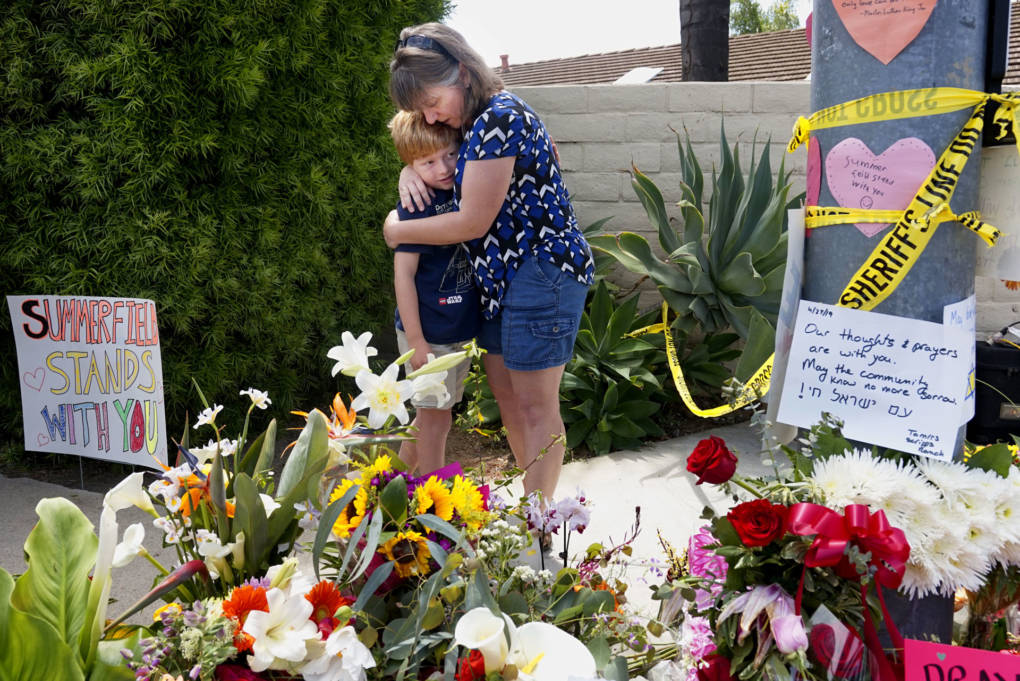
"caption": "Mourners participate in a candle light vigil for the victims of the Chabad of Poway Synagogue shooting at the Rancho Bernardo Community Presbyterian Church on April 27, 2019 in Poway, California. A teenage gunman who wrote a hate-filled manifesto opened fire at the synagogue, killing one person and injuring three others including the rabbi as worshippers marked the final day of Passover, authorities said.",
"description": "Mourners participate in a candle light vigil for the victims of the Chabad of Poway Synagogue shooting at the Rancho Bernardo Community Presbyterian Church on April 27, 2019 in Poway, California. A teenage gunman who wrote a hate-filled manifesto opened fire at the synagogue, killing one person and injuring three others including the rabbi as worshippers marked the final day of Passover, authorities said.",
"title": "GettyImages-1139774118-PowayShooting",
"credit": "Sandy Huffaker/AFP/Getty Images",
"status": "inherit",
"isLoading": false,
"fetchFailed": false
}
},
"audioPlayerReducer": {
"postId": "stream_live",
"isPaused": true,
"isPlaying": false,
"pfsActive": false,
"pledgeModalIsOpen": true,
"playerDrawerIsOpen": false,
"liveAudioPlayStartedAt": 0,
"liveAudioPlayContext": ""
},
"authorsReducer": {
"byline_news_11765473": {
"type": "authors",
"id": "byline_news_11765473",
"meta": {
"override": true
},
"slug": "byline_news_11765473",
"name": "Associated Press",
"isLoading": false
},
"byline_news_11764540": {
"type": "authors",
"id": "byline_news_11764540",
"meta": {
"override": true
},
"slug": "byline_news_11764540",
"name": "\u003ca href=\"https://www.kpbs.org/staff/erik-anderson/\">Erik Anderson\u003c/a>",
"isLoading": false
},
"byline_news_11755172": {
"type": "authors",
"id": "byline_news_11755172",
"meta": {
"override": true
},
"slug": "byline_news_11755172",
"name": "\u003cstrong>Elliot Spagat\u003c/strong>",
"isLoading": false
},
"byline_news_11752804": {
"type": "authors",
"id": "byline_news_11752804",
"meta": {
"override": true
},
"slug": "byline_news_11752804",
"name": "\u003cstrong>Andrew Bowen\u003c/strong>",
"isLoading": false
},
"byline_news_11748722": {
"type": "authors",
"id": "byline_news_11748722",
"meta": {
"override": true
},
"slug": "byline_news_11748722",
"name": "\u003ca href= \"https://www.kpbs.org/staff/andrew-bowen/\"> Andrew Bowen \u003ca/>",
"isLoading": false
},
"byline_news_11747357": {
"type": "authors",
"id": "byline_news_11747357",
"meta": {
"override": true
},
"slug": "byline_news_11747357",
"name": "\u003ca href=\"https://twitter.com/MaxRivlinNadler?ref_src=twsrc%5Egoogle%7Ctwcamp%5Eserp%7Ctwgr%5Eauthor\" rel=\"noopener\" target=\"_blank\">Max Rivlin-Nadler\u003c/a>",
"isLoading": false
},
"byline_news_11747178": {
"type": "authors",
"id": "byline_news_11747178",
"meta": {
"override": true
},
"slug": "byline_news_11747178",
"name": "Elliot Spagat \u003cbr> Associated Press",
"isLoading": false
},
"byline_news_11743594": {
"type": "authors",
"id": "byline_news_11743594",
"meta": {
"override": true
},
"slug": "byline_news_11743594",
"name": "Amy Taxin, Christopher Weber and Michael Balsamo \u003cbr> Associated Press",
"isLoading": false
},
"byline_news_11743349": {
"type": "authors",
"id": "byline_news_11743349",
"meta": {
"override": true
},
"slug": "byline_news_11743349",
"name": "Shannon Van Sant\u003cbr>\u003cstrong>NPR\u003c/strong>",
"isLoading": false
},
"tychehendricks": {
"type": "authors",
"id": "259",
"meta": {
"index": "authors_1716337520",
"id": "259",
"found": true
},
"name": "Tyche Hendricks",
"firstName": "Tyche",
"lastName": "Hendricks",
"slug": "tychehendricks",
"email": "thendricks@kqed.org",
"display_author_email": true,
"staff_mastheads": [
"news"
],
"title": "KQED Senior Editor, Immigration",
"bio": "\u003cspan style=\"font-weight: 400;\">Tyche Hendricks is KQED’s senior editor for immigration, leading coverage of the policy and politics that affect California’s immigrant communities. Her work for KQED’s radio and online audiences is also carried on NPR and other national outlets. She has been recognized with awards from the Radio and Television News Directors Association, the Society for Professional Journalists; the Education Writers Association; the Best of the West and the National Federation of Community Broadcasters. Before joining KQED in 2010, Tyche spent more than a dozen years as a newspaper reporter, notably at the \u003c/span>\u003ci>\u003cspan style=\"font-weight: 400;\">San Francisco Chronicle\u003c/span>\u003c/i>\u003cspan style=\"font-weight: 400;\">. At different times she has covered criminal justice, government and politics and urban planning. Tyche has taught in the MFA Creative Writing program at the University of San Francisco and at UC Berkeley’s Graduate School of Journalism, where she was co-director of a national immigration symposium for professional journalists. She is the author of \u003c/span>\u003ci>\u003cspan style=\"font-weight: 400;\">The Wind Doesn't Need a Passport: Stories from the U.S.-Mexico Borderlands\u003c/span>\u003c/i>\u003cspan style=\"font-weight: 400;\"> (University of California Press). \u003c/span>",
"avatar": "https://secure.gravatar.com/avatar/b8ee458e2731c2d43df86882ce17267e?s=600&d=blank&r=g",
"twitter": "tychehendricks",
"facebook": null,
"instagram": null,
"linkedin": null,
"sites": [
{
"site": "news",
"roles": [
"editor"
]
},
{
"site": "stateofhealth",
"roles": [
"editor"
]
}
],
"headData": {
"title": "Tyche Hendricks | KQED",
"description": "KQED Senior Editor, Immigration",
"ogImgSrc": "https://secure.gravatar.com/avatar/b8ee458e2731c2d43df86882ce17267e?s=600&d=blank&r=g",
"twImgSrc": "https://secure.gravatar.com/avatar/b8ee458e2731c2d43df86882ce17267e?s=600&d=blank&r=g"
},
"isLoading": false,
"link": "/author/tychehendricks"
},
"mleitsinger": {
"type": "authors",
"id": "11310",
"meta": {
"index": "authors_1716337520",
"id": "11310",
"found": true
},
"name": "Miranda Leitsinger",
"firstName": "Miranda",
"lastName": "Leitsinger",
"slug": "mleitsinger",
"email": "mleitsinger@KQED.org",
"display_author_email": false,
"staff_mastheads": [
"news"
],
"title": "KQED Contributor",
"bio": "Miranda Leitsinger has worked in journalism as a reporter and editor since 2000, including seven years at The Associated Press in locales such as Cambodia and Puerto Rico, four years at NBC News Digital in New York and 2.5 years at CNN.com International in Hong Kong. Major stories she has covered included sexual abuse in the yoga community, the rise of women in local politics post-2016 election, the struggle over LGBTQ inclusion in the Boy Scouts, aftermath of the 2004 and 2011 tsunamis, the Aurora movie theater attack, the Newtown school shooting, Superstorm Sandy and the Boston Marathon bombing.",
"avatar": "https://secure.gravatar.com/avatar/cdd00de7be92aab3b7fd3d915e02033d?s=600&d=blank&r=g",
"twitter": "mimileitsinger",
"facebook": null,
"instagram": null,
"linkedin": null,
"sites": [
{
"site": "arts",
"roles": [
"author"
]
},
{
"site": "news",
"roles": [
"subscriber"
]
},
{
"site": "futureofyou",
"roles": [
"editor"
]
},
{
"site": "stateofhealth",
"roles": [
"editor"
]
}
],
"headData": {
"title": "Miranda Leitsinger | KQED",
"description": "KQED Contributor",
"ogImgSrc": "https://secure.gravatar.com/avatar/cdd00de7be92aab3b7fd3d915e02033d?s=600&d=blank&r=g",
"twImgSrc": "https://secure.gravatar.com/avatar/cdd00de7be92aab3b7fd3d915e02033d?s=600&d=blank&r=g"
},
"isLoading": false,
"link": "/author/mleitsinger"
},
"ahall": {
"type": "authors",
"id": "11490",
"meta": {
"index": "authors_1716337520",
"id": "11490",
"found": true
},
"name": "Alex Hall",
"firstName": "Alex",
"lastName": "Hall",
"slug": "ahall",
"email": "ahall@kqed.org",
"display_author_email": false,
"staff_mastheads": [
"news"
],
"title": "KQED Enterprise & Accountability Reporter",
"bio": "Alex Hall is KQED's Enterprise and Accountability Reporter. She previously covered the Central Valley for five years from KQED's bureau in Fresno. Before joining KQED, Alex was an investigative reporting fellow at Wisconsin Public Radio and the Wisconsin Center for Investigative Journalism. She has also worked as a bilingual producer for NPR's investigative unit and freelance video producer for Reuters TV on the Latin America desk. She got her start in journalism in South America, where she worked as a radio producer and Spanish-English translator for CNN Chile. Her documentary and investigation into the series of deadly COVID-19 outbreaks at Foster Farms won a national Edward R. Murrow award and was named an Investigative Reporters & Editors award finalist. Alex's reporting for Reveal on the Wisconsin dairy industry's reliance on undocumented immigrant labor was made into a film, Los Lecheros, which won a regional Edward R. Murrow award for best news documentary.",
"avatar": "https://secure.gravatar.com/avatar/defcbeb88b0bf591ff9af41f22644051?s=600&d=blank&r=g",
"twitter": "@chalexhall",
"facebook": null,
"instagram": null,
"linkedin": null,
"sites": [
{
"site": "news",
"roles": [
"editor"
]
},
{
"site": "liveblog",
"roles": [
"author"
]
}
],
"headData": {
"title": "Alex Hall | KQED",
"description": "KQED Enterprise & Accountability Reporter",
"ogImgSrc": "https://secure.gravatar.com/avatar/defcbeb88b0bf591ff9af41f22644051?s=600&d=blank&r=g",
"twImgSrc": "https://secure.gravatar.com/avatar/defcbeb88b0bf591ff9af41f22644051?s=600&d=blank&r=g"
},
"isLoading": false,
"link": "/author/ahall"
}
},
"pagesReducer": {
"news_tag_san-diego": {
"type": "terms",
"id": "news_4486",
"meta": {
"index": "terms_1716263798",
"site": "news",
"id": "4486",
"score": 9.103905
},
"featImg": null,
"name": "San Diego",
"description": null,
"taxonomy": "tag",
"headData": {
"twImgId": null,
"twTitle": null,
"ogTitle": null,
"ogImgId": null,
"twDescription": null,
"description": null,
"title": "San Diego Archives | KQED News",
"ogDescription": null
},
"ttid": 4505,
"slug": "san-diego",
"isLoading": false,
"title": "San Diego",
"pageMeta": {
"site": "news",
"WpPageTemplate": "page-topic-editorial",
"currentPage": 4
},
"blocks": [
{
"blockName": "kqed/post-list",
"attrs": {
"layout": "cardArticle2",
"query": "posts/news?tag=san-diego",
"seeMore": false,
"paginated": true,
"page": 4
}
},
{
"blockName": "kqed/ad"
}
]
}
},
"pfsSessionReducer": {},
"postsReducer": {
"stream_live": {
"type": "live",
"id": "stream_live",
"audioUrl": "https://streams.kqed.org/kqedradio",
"title": "Live Stream",
"excerpt": "Live Stream information currently unavailable.",
"link": "/radio",
"featImg": "",
"label": {
"name": "KQED Live",
"link": "/"
}
},
"stream_kqedNewscast": {
"type": "posts",
"id": "stream_kqedNewscast",
"audioUrl": "https://www.kqed.org/.stream/anon/radio/RDnews/newscast.mp3?_=1",
"title": "KQED Newscast",
"featImg": "",
"label": {
"name": "88.5 FM",
"link": "/"
}
},
"news_11765473": {
"type": "posts",
"id": "news_11765473",
"meta": {
"index": "posts_1716263798",
"site": "news",
"id": "11765473",
"score": null,
"sort": [
1564879832000
]
},
"parent": 0,
"labelTerm": {},
"blocks": [],
"publishDate": 1564879832,
"format": "standard",
"disqusTitle": "3 Family Members Killed in San Diego County Sea Cliff Collapse",
"title": "3 Family Members Killed in San Diego County Sea Cliff Collapse",
"headTitle": "The California Report | KQED News",
"content": "\u003cp>Three women killed when a Southern California sea cliff collapsed were members of a family gathered on a beach to celebrate one of them having survived breast cancer, authorities and relatives said Saturday.\u003c/p>\n\u003cp>Anne Clave, 35, and her mother, Julie Davis, 65, died at hospitals after tons of sandstone were unleashed Friday at Grandview Beach, the San Diego County Medical Examiner said. A family email obtained Saturday by KNSD-TV identified the third victim as Elizabeth Cox, Clave's aunt.\u003c/p>\n\u003cp>The victims were part of a family gathering celebrating Cox surviving breast cancer, according to the email.\u003c/p>\n\u003cp>Cox died instantly at the scene, the email said. Her age wasn't given.\u003c/p>\n\u003cp>Clave \"enriched the lives of all those around her with the joy and fun she brought to all,\" the email said, and Davis was an \"incredible grandmother.\"\u003c/p>\n\u003cp>[ad fullwidth]\u003c/p>\n\u003cp>The three women leave behind spouses, children, and many members of their extended families, the news station reported.\u003c/p>\n\u003cp>\"The nature of the accident and the loss is incomprehensible to all of us, our children and those around us,\" the email said.\u003c/p>\n\u003cp>Officials on Saturday reopened much of the popular surf beach that was closed following the tragedy.\u003c/p>\n\u003cp>Encinitas Lifeguard Capt. Larry Giles said a lifeguard was posted near the collapse zone, which is still marked by yellow caution tape. Someone left a bouquet of flowers on a nearby rock.\u003c/p>\n\u003cp>A 30-foot-long slab of the cliff plunged onto the sand Friday afternoon north of downtown San Diego.\u003c/p>\n\u003cp>Geologists were on scene Saturday assessing the area around the collapse zone. Homes on top of the cliff were in no immediate danger, Giles said.\u003c/p>\n\u003cp>A lifeguard reported feeling and hearing the thud as the dense dirt landed on the beach.\u003c/p>\n\u003cp>\"It just happened to take place outside his peripheral (vision),\" Giles said, noting that the lifeguard had his eyes trained on the water.\u003c/p>\n\u003cp>Lifeguards and beachgoers scrambled to the towering pile of debris — estimated to weigh tens of thousands of pounds — to help search for victims.\u003c/p>\n\u003cp>\"I saw first responders, and I saw lifeguards frantically digging people out of the debris,\" Jim Pepperdine, who lives nearby, told the San Diego Union-Tribune.\u003c/p>\n\u003cp>Pepperdine said he saw people trying to resuscitate a woman before her body was covered.\u003c/p>\n\u003cp>The woman died at the scene, and two more people later died at hospitals. Another person was taken to a hospital, and a person who had minor injuries was treated at the scene, officials said.\u003c/p>\n\u003cp>Authorities said they were all adults.\u003c/p>\n\u003cp>Search dogs were brought in to hunt for other possible victims, and a skip loader was used to move the dense, heavy debris. No other victims were found.\u003c/p>\n\u003cp>Suburbs north of San Diego have long contended with rising water levels in the Pacific Ocean that pressure bluffs along the coast. Some are fortified with concrete walls to prevent multimillion-dollar homes from falling into the sea.\u003c/p>\n\u003cp>Long stretches of beach in Encinitas are narrow strips of sand between stiff waves and towering rock walls. People lounging on beach chairs or blankets are sometimes surprised as waves roll past them and within a few feet of the walls.\u003c/p>\n\u003cp>Grandview Beach can be reached by wooden stairs from a parking lot above. It is fairly narrow, with tides high this week. Surfers often lay their boards upright against the bluff.\u003c/p>\n\u003cp>Cliffside collapses are not unusual as the ocean chews away at the base of the sandstone, authorities said. Some beach areas have been marked with signs warning of slide dangers.\u003c/p>\n\u003cp>Several people have died or been injured over the years in bluff collapses.\u003c/p>\n\u003cp>Bluffs give way four to eight times a year in Southern California, but \"nothing of this magnitude,\" said Brian Ketterer, southern field division chief of California State Parks.\u003c/p>\n\u003cp>\u003c/p>\n\u003cp>\"This is a naturally eroding coastline,\" Giles said. \"There's really no rhyme or reason, but that's what it does naturally.\"\u003c/p>\n\n",
"disqusIdentifier": "11765473 https://ww2.kqed.org/news/?p=11765473",
"disqusUrl": "https://ww2.kqed.org/news/2019/08/03/3-family-members-killed-in-san-diego-county-sea-cliff-collapse/",
"stats": {
"hasVideo": false,
"hasChartOrMap": false,
"hasAudio": false,
"hasPolis": false,
"wordCount": 650,
"hasGoogleForm": false,
"hasGallery": false,
"hasHearkenModule": false,
"iframeSrcs": [],
"paragraphCount": 28
},
"modified": 1564879832,
"excerpt": "The three women killed when the cliff collapsed were members of a family gathered on a beach to celebrate one of them having survived breast cancer, authorities and relatives said on Saturday.\r\n",
"headData": {
"twImgId": "",
"twTitle": "",
"ogTitle": "",
"ogImgId": "",
"twDescription": "",
"description": "The three women killed when the cliff collapsed were members of a family gathered on a beach to celebrate one of them having survived breast cancer, authorities and relatives said on Saturday.\r\n",
"title": "3 Family Members Killed in San Diego County Sea Cliff Collapse | KQED",
"ogDescription": "",
"schema": {
"@context": "https://schema.org",
"@type": "NewsArticle",
"headline": "3 Family Members Killed in San Diego County Sea Cliff Collapse",
"datePublished": "2019-08-03T17:50:32-07:00",
"dateModified": "2019-08-03T17:50:32-07:00",
"image": "https://cdn.kqed.org/wp-content/uploads/2020/02/KQED-OG-Image@1x.png",
"isAccessibleForFree": "True",
"publisher": {
"@type": "NewsMediaOrganization",
"@id": "https://www.kqed.org/#organization",
"name": "KQED",
"logo": "https://cdn.kqed.org/wp-content/uploads/2020/02/KQED-OG-Image@1x.png",
"url": "https://www.kqed.org",
"sameAs": [
"https://www.facebook.com/KQED",
"https://twitter.com/KQED",
"https://www.instagram.com/kqed/",
"https://www.tiktok.com/@kqedofficial",
"https://www.linkedin.com/company/kqed",
"https://www.youtube.com/channel/UCeC0IOo7i1P_61zVUWbJ4nw"
]
}
}
},
"guestAuthors": [],
"slug": "3-family-members-killed-in-san-diego-county-sea-cliff-collapse",
"status": "publish",
"sourceUrl": "https://www.apnews.com/",
"nprByline": "Associated Press",
"source": "Associated Press",
"path": "/news/11765473/3-family-members-killed-in-san-diego-county-sea-cliff-collapse",
"audioTrackLength": null,
"parsedContent": [
{
"type": "contentString",
"content": "\u003cdiv class=\"post-body\">\u003cp>\u003cp>Three women killed when a Southern California sea cliff collapsed were members of a family gathered on a beach to celebrate one of them having survived breast cancer, authorities and relatives said Saturday.\u003c/p>\n\u003cp>Anne Clave, 35, and her mother, Julie Davis, 65, died at hospitals after tons of sandstone were unleashed Friday at Grandview Beach, the San Diego County Medical Examiner said. A family email obtained Saturday by KNSD-TV identified the third victim as Elizabeth Cox, Clave's aunt.\u003c/p>\n\u003cp>The victims were part of a family gathering celebrating Cox surviving breast cancer, according to the email.\u003c/p>\n\u003cp>Cox died instantly at the scene, the email said. Her age wasn't given.\u003c/p>\n\u003cp>Clave \"enriched the lives of all those around her with the joy and fun she brought to all,\" the email said, and Davis was an \"incredible grandmother.\"\u003c/p>\n\u003cp>\u003c/p>\u003c/div>",
"attributes": {
"named": {},
"numeric": []
}
},
{
"type": "component",
"content": "",
"name": "ad",
"attributes": {
"named": {
"label": "fullwidth"
},
"numeric": [
"fullwidth"
]
}
},
{
"type": "contentString",
"content": "\u003cdiv class=\"post-body\">\u003cp>\u003c/p>\n\u003cp>The three women leave behind spouses, children, and many members of their extended families, the news station reported.\u003c/p>\n\u003cp>\"The nature of the accident and the loss is incomprehensible to all of us, our children and those around us,\" the email said.\u003c/p>\n\u003cp>Officials on Saturday reopened much of the popular surf beach that was closed following the tragedy.\u003c/p>\n\u003cp>Encinitas Lifeguard Capt. Larry Giles said a lifeguard was posted near the collapse zone, which is still marked by yellow caution tape. Someone left a bouquet of flowers on a nearby rock.\u003c/p>\n\u003cp>A 30-foot-long slab of the cliff plunged onto the sand Friday afternoon north of downtown San Diego.\u003c/p>\n\u003cp>Geologists were on scene Saturday assessing the area around the collapse zone. Homes on top of the cliff were in no immediate danger, Giles said.\u003c/p>\n\u003cp>A lifeguard reported feeling and hearing the thud as the dense dirt landed on the beach.\u003c/p>\n\u003cp>\"It just happened to take place outside his peripheral (vision),\" Giles said, noting that the lifeguard had his eyes trained on the water.\u003c/p>\n\u003cp>Lifeguards and beachgoers scrambled to the towering pile of debris — estimated to weigh tens of thousands of pounds — to help search for victims.\u003c/p>\n\u003cp>\"I saw first responders, and I saw lifeguards frantically digging people out of the debris,\" Jim Pepperdine, who lives nearby, told the San Diego Union-Tribune.\u003c/p>\n\u003cp>Pepperdine said he saw people trying to resuscitate a woman before her body was covered.\u003c/p>\n\u003cp>The woman died at the scene, and two more people later died at hospitals. Another person was taken to a hospital, and a person who had minor injuries was treated at the scene, officials said.\u003c/p>\n\u003cp>Authorities said they were all adults.\u003c/p>\n\u003cp>Search dogs were brought in to hunt for other possible victims, and a skip loader was used to move the dense, heavy debris. No other victims were found.\u003c/p>\n\u003cp>Suburbs north of San Diego have long contended with rising water levels in the Pacific Ocean that pressure bluffs along the coast. Some are fortified with concrete walls to prevent multimillion-dollar homes from falling into the sea.\u003c/p>\n\u003cp>Long stretches of beach in Encinitas are narrow strips of sand between stiff waves and towering rock walls. People lounging on beach chairs or blankets are sometimes surprised as waves roll past them and within a few feet of the walls.\u003c/p>\n\u003cp>Grandview Beach can be reached by wooden stairs from a parking lot above. It is fairly narrow, with tides high this week. Surfers often lay their boards upright against the bluff.\u003c/p>\n\u003cp>Cliffside collapses are not unusual as the ocean chews away at the base of the sandstone, authorities said. Some beach areas have been marked with signs warning of slide dangers.\u003c/p>\n\u003cp>Several people have died or been injured over the years in bluff collapses.\u003c/p>\n\u003cp>Bluffs give way four to eight times a year in Southern California, but \"nothing of this magnitude,\" said Brian Ketterer, southern field division chief of California State Parks.\u003c/p>\n\u003cp>\u003c/p>\n\u003cp>\"This is a naturally eroding coastline,\" Giles said. \"There's really no rhyme or reason, but that's what it does naturally.\"\u003c/p>\n\n\u003c/div>\u003c/p>",
"attributes": {
"named": {},
"numeric": []
}
}
],
"link": "/news/11765473/3-family-members-killed-in-san-diego-county-sea-cliff-collapse",
"authors": [
"byline_news_11765473"
],
"programs": [
"news_72"
],
"categories": [
"news_19906",
"news_8"
],
"tags": [
"news_4486"
],
"featImg": "news_11765503",
"label": "source_news_11765473"
},
"news_11764540": {
"type": "posts",
"id": "news_11764540",
"meta": {
"index": "posts_1716263798",
"site": "news",
"id": "11764540",
"score": null,
"sort": [
1564598446000
]
},
"guestAuthors": [],
"slug": "its-a-boy-san-diego-zoo-announces-historic-birth-of-baby-white-rhino",
"title": "It's a Boy: San Diego Zoo Announces Historic Birth of Baby White Rhino",
"publishDate": 1564598446,
"format": "standard",
"headTitle": "It’s a Boy: San Diego Zoo Announces Historic Birth of Baby White Rhino | KQED",
"labelTerm": {},
"content": "\u003cp>A southern white rhino gave birth to a male baby conceived by artificial insemination at the \u003ca href=\"https://twitter.com/sdzsafaripark\" target=\"_blank\" rel=\"noopener\">San Diego Zoo Safari Park\u003c/a> on Sunday.\u003c/p>\n\u003cp>The birth took about 30 minutes. Both mother and calf are doing well.\u003c/p>\n\u003cp>The calf is the first baby rhino born using artificial insemination at the San Diego Zoo facility.\u003c/p>\n\u003cp>The mother, Victoria, carried her baby for more than 490 days.\u003c/p>\n\u003cp>https://twitter.com/KPBSErik/status/1155990197336600577?s=20\u003c/p>\n\u003cp>“Not only are we thankful for a healthy calf, but this birth is significant, as it also represents a critical step in our effort to save the northern white rhino from the brink of extinction,” said Barbara Durrant, director of reproductive science at San Diego Zoo Global.\u003c/p>\n\u003cp>Victoria is one of six southern white rhinos that could become surrogate moms for critically endangered northern white rhinos.\u003c/p>\n\u003cp>There are only two northern white rhinos left alive on Earth. Both are female, and beyond breeding age.\u003c/p>\n\u003cp>https://www.youtube.com/watch?v=qz07i_XteNk\u003c/p>\n\u003cp>The last male northern white rhino, named Sudan, died in March 2018. Scientists preserved frozen sperm samples from several males they are hoping to use to revive the species.\u003c/p>\n\u003cp>Zoo officials are working to develop artificial insemination and embryo implantation techniques so they can put a northern white embryo into a southern white female.\u003c/p>\n\u003cp>Meanwhile, there’s another southern white rhino at the Safari Park that was artificially inseminated. She is due around September.\u003c/p>\n\u003cp>\u003cem>This story includes reporting from The Associated Press.\u003c/em>\u003c/p>\n\u003cp>[ad fullwidth]\u003c/p>\n\u003cp>\u003c/p>\n",
"blocks": [],
"excerpt": "The mother, Victoria, is one of six southern white rhinos that could become surrogate moms for critically endangered northern white rhinos.",
"status": "publish",
"parent": 0,
"modified": 1721122430,
"stats": {
"hasAudio": false,
"hasVideo": true,
"hasChartOrMap": false,
"iframeSrcs": [],
"hasGoogleForm": false,
"hasGallery": false,
"hasHearkenModule": false,
"hasPolis": false,
"paragraphCount": 13,
"wordCount": 250
},
"headData": {
"title": "It's a Boy: San Diego Zoo Announces Historic Birth of Baby White Rhino | KQED",
"description": "The mother, Victoria, is one of six southern white rhinos that could become surrogate moms for critically endangered northern white rhinos.",
"ogTitle": "",
"ogDescription": "",
"ogImgId": "",
"twTitle": "",
"twDescription": "",
"twImgId": "",
"schema": {
"@context": "https://schema.org",
"@type": "NewsArticle",
"headline": "It's a Boy: San Diego Zoo Announces Historic Birth of Baby White Rhino",
"datePublished": "2019-07-31T11:40:46-07:00",
"dateModified": "2024-07-16T02:33:50-07:00",
"image": "https://cdn.kqed.org/wp-content/uploads/2020/02/KQED-OG-Image@1x.png",
"isAccessibleForFree": "True",
"publisher": {
"@type": "NewsMediaOrganization",
"@id": "https://www.kqed.org/#organization",
"name": "KQED",
"logo": "https://cdn.kqed.org/wp-content/uploads/2020/02/KQED-OG-Image@1x.png",
"url": "https://www.kqed.org",
"sameAs": [
"https://www.facebook.com/KQED",
"https://twitter.com/KQED",
"https://www.instagram.com/kqed/",
"https://www.tiktok.com/@kqedofficial",
"https://www.linkedin.com/company/kqed",
"https://www.youtube.com/channel/UCeC0IOo7i1P_61zVUWbJ4nw"
]
}
}
},
"source": "KPBS",
"sourceUrl": "https://www.kpbs.org/",
"sticky": false,
"nprByline": "\u003ca href=\"https://www.kpbs.org/staff/erik-anderson/\">Erik Anderson\u003c/a>",
"path": "/news/11764540/its-a-boy-san-diego-zoo-announces-historic-birth-of-baby-white-rhino",
"audioTrackLength": null,
"parsedContent": [
{
"type": "contentString",
"content": "\u003cdiv class=\"post-body\">\u003cp>\u003cp>A southern white rhino gave birth to a male baby conceived by artificial insemination at the \u003ca href=\"https://twitter.com/sdzsafaripark\" target=\"_blank\" rel=\"noopener\">San Diego Zoo Safari Park\u003c/a> on Sunday.\u003c/p>\n\u003cp>The birth took about 30 minutes. Both mother and calf are doing well.\u003c/p>\n\u003cp>The calf is the first baby rhino born using artificial insemination at the San Diego Zoo facility.\u003c/p>\n\u003cp>The mother, Victoria, carried her baby for more than 490 days.\u003c/p>\u003c/p>\u003c/div>",
"attributes": {
"named": {},
"numeric": []
}
},
{
"type": "component",
"content": "",
"name": "singleTwitterStatus",
"attributes": {
"named": {
"id": "1155990197336600577"
},
"numeric": []
}
},
{
"type": "contentString",
"content": "\u003cdiv class=\"post-body\">\u003cp>\n\u003cp>“Not only are we thankful for a healthy calf, but this birth is significant, as it also represents a critical step in our effort to save the northern white rhino from the brink of extinction,” said Barbara Durrant, director of reproductive science at San Diego Zoo Global.\u003c/p>\n\u003cp>Victoria is one of six southern white rhinos that could become surrogate moms for critically endangered northern white rhinos.\u003c/p>\n\u003cp>There are only two northern white rhinos left alive on Earth. Both are female, and beyond breeding age.\u003c/p>\u003c/p>\u003cp>\u003cspan class='utils-parseShortcode-shortcodes-__youtubeShortcode__embedYoutube'>\n \u003cspan class='utils-parseShortcode-shortcodes-__youtubeShortcode__embedYoutubeInside'>\n \u003ciframe\n loading='lazy'\n class='utils-parseShortcode-shortcodes-__youtubeShortcode__youtubePlayer'\n type='text/html'\n src='//www.youtube.com/embed/qz07i_XteNk'\n title='//www.youtube.com/embed/qz07i_XteNk'\n allowfullscreen='true'\n style='border:0;'>\u003c/iframe>\n \u003c/span>\n \u003c/span>\u003c/p>\u003cp>\u003cp>The last male northern white rhino, named Sudan, died in March 2018. Scientists preserved frozen sperm samples from several males they are hoping to use to revive the species.\u003c/p>\n\u003cp>Zoo officials are working to develop artificial insemination and embryo implantation techniques so they can put a northern white embryo into a southern white female.\u003c/p>\n\u003cp>Meanwhile, there’s another southern white rhino at the Safari Park that was artificially inseminated. She is due around September.\u003c/p>\n\u003cp>\u003cem>This story includes reporting from The Associated Press.\u003c/em>\u003c/p>\n\u003cp>\u003c/p>\u003c/div>",
"attributes": {
"named": {},
"numeric": []
}
},
{
"type": "component",
"content": "",
"name": "ad",
"attributes": {
"named": {
"label": "fullwidth"
},
"numeric": [
"fullwidth"
]
}
},
{
"type": "contentString",
"content": "\u003cdiv class=\"post-body\">\u003cp>\u003c/p>\n\u003cp>\u003c/p>\n\u003c/div>\u003c/p>",
"attributes": {
"named": {},
"numeric": []
}
}
],
"link": "/news/11764540/its-a-boy-san-diego-zoo-announces-historic-birth-of-baby-white-rhino",
"authors": [
"byline_news_11764540"
],
"programs": [
"news_72"
],
"categories": [
"news_19906",
"news_8",
"news_356"
],
"tags": [
"news_18132",
"news_4486",
"news_17800"
],
"affiliates": [
"news_7054"
],
"featImg": "news_11764550",
"label": "source_news_11764540"
},
"news_11764463": {
"type": "posts",
"id": "news_11764463",
"meta": {
"index": "posts_1716263798",
"site": "news",
"id": "11764463",
"score": null,
"sort": [
1564588779000
]
},
"parent": 0,
"labelTerm": {
"site": "news",
"term": 72
},
"blocks": [],
"publishDate": 1564588779,
"format": "audio",
"disqusTitle": "Border Agents Still Separating Hundreds of Migrant Kids From Parents, Says ACLU",
"title": "Border Agents Still Separating Hundreds of Migrant Kids From Parents, Says ACLU",
"headTitle": "The California Report | KQED News",
"content": "\u003cp>Border officials have taken more than 900 migrant children from their parents over the past year, despite a judge's order to restrict family separations, according to a \u003ca href=\"https://www.courtlistener.com/recap/gov.uscourts.casd.564097/gov.uscourts.casd.564097.439.0_3.pdf\" target=\"_blank\" rel=\"noopener\">motion\u003c/a> filed by ACLU attorneys Tuesday in federal court in San Diego.\u003c/p>\n\u003cp>In the filing, the attorneys said that some migrant parents lost their children over minor convictions, including driving without a license or marijuana possession, and in one case because a border agent blamed a father for not changing a diaper promptly. The ACLU also alleged that Homeland Security officials had taken children away based on clerical errors or misunderstandings due to language barriers.\u003c/p>\n\u003cp>The ACLU, which represents migrant parents in a class action lawsuit (Ms. L. v. ICE), based its information on reports provided to the plaintiffs by Trump administration lawyers, documenting 911 children separated from parents at the border between June 26, 2018 and June 29, 2019.\u003c/p>\n\u003cp>U.S. District Judge Dana Sabraw \u003ca href=\"https://www.kqed.org/news/11677646/judge-bars-migrant-family-separations-orders-return-of-children-within-30-days\" target=\"_blank\" rel=\"noopener\">issued an injunction\u003c/a> on June 26 last year ordering the Department of Homeland Security to halt most migrant family separations and promptly reunite children with their parents. Sabraw allowed for individual exceptions, in cases where the government found a parent unfit or a danger to the child.\u003c/p>\n\u003cp>In Tuesday's motion, ACLU attorneys asked the judge to clarify when those exceptions can be made. They noted that Sabraw had initially allowed separations based on a parent's criminal history.\u003c/p>\n\u003cp>[ad fullwidth]\u003c/p>\n\u003cp>But they said that the government has been using minor criminal convictions and unsubstantiated allegations of wrongdoing as a reason to take children from their parents, disregarding the fact that \"the Court’s decision relied on traditional due process and child custody standards, which permit the drastic step of separating a child and parent only where the criminal history is so significant that it bears on whether the parent is a danger to the child or is an unfit parent.\"\u003c/p>\n\u003cp>[aside tag=\"family-separation\" label=\"Family Separation at the Southern Border\"]\u003c/p>\n\u003cp>In May, Acting Homeland Security Secretary Kevin McAleenan \u003ca href=\"https://www.c-span.org/video/?460999-1/national-security-resources#&start=5013\" target=\"_blank\" rel=\"noopener\">told a Senate committee\u003c/a> that family separations have become \"extraordinarily rare.\"\u003c/p>\n\u003cp>\"It's done for the safety of the child,\" he said, \"if there's a serious criminal violation, an indication that the parent presents a risk to the child, if there's a communicable disease issue for either the parent or the child, they need to go to emergency care. \"\u003c/p>\n\u003cp>McAleenan said Homeland Security personnel only take children from parents based on \"defined criteria\" that are in accordance with the Ms. L. court order.\u003c/p>\n\u003cp>The ACLU motion noted that more than half of the 911 children are under 10 years old — and 185, or 20 percent of them, are under 5 years old, including numerous infants.\u003c/p>\n\u003cp>\"Hundreds of children, some literally just babies, are being irreparably damaged because their parent may have committed a minor offense in the past, even a traffic offense,\" the lawyers wrote.\u003c/p>\n\u003cp>\u003c/p>\n\u003cp>In addition to these migrant families separated since last June, the original class of separated families comprised more than 2,800 children. In January, a government watchdog agency found that hundreds or thousands of additional families may have \u003ca href=\"https://www.kqed.org/news/11727820/judge-says-families-separated-in-2017-suffered-same-injustice-as-more-recent-cases\" target=\"_blank\" rel=\"noopener\">previously been separated\u003c/a> at the border, beginning in 2017.\u003c/p>\n\n",
"disqusIdentifier": "11764463 https://ww2.kqed.org/news/?p=11764463",
"disqusUrl": "https://ww2.kqed.org/news/2019/07/31/border-agents-still-separating-hundreds-of-migrant-kids-from-parents-says-aclu/",
"stats": {
"hasVideo": false,
"hasChartOrMap": false,
"hasAudio": false,
"hasPolis": false,
"wordCount": 536,
"hasGoogleForm": false,
"hasGallery": false,
"hasHearkenModule": false,
"iframeSrcs": [],
"paragraphCount": 15
},
"modified": 1564594192,
"excerpt": "More than a year after a federal judge ordered a halt to family separations, over 900 children have been taken from their parents, according to a new court filing.",
"headData": {
"twImgId": "",
"twTitle": "",
"ogTitle": "",
"ogImgId": "",
"twDescription": "",
"description": "More than a year after a federal judge ordered a halt to family separations, over 900 children have been taken from their parents, according to a new court filing.",
"title": "Border Agents Still Separating Hundreds of Migrant Kids From Parents, Says ACLU | KQED",
"ogDescription": "",
"schema": {
"@context": "https://schema.org",
"@type": "NewsArticle",
"headline": "Border Agents Still Separating Hundreds of Migrant Kids From Parents, Says ACLU",
"datePublished": "2019-07-31T08:59:39-07:00",
"dateModified": "2019-07-31T10:29:52-07:00",
"image": "https://cdn.kqed.org/wp-content/uploads/2020/02/KQED-OG-Image@1x.png",
"isAccessibleForFree": "True",
"publisher": {
"@type": "NewsMediaOrganization",
"@id": "https://www.kqed.org/#organization",
"name": "KQED",
"logo": "https://cdn.kqed.org/wp-content/uploads/2020/02/KQED-OG-Image@1x.png",
"url": "https://www.kqed.org",
"sameAs": [
"https://www.facebook.com/KQED",
"https://twitter.com/KQED",
"https://www.instagram.com/kqed/",
"https://www.tiktok.com/@kqedofficial",
"https://www.linkedin.com/company/kqed",
"https://www.youtube.com/channel/UCeC0IOo7i1P_61zVUWbJ4nw"
]
}
}
},
"guestAuthors": [],
"slug": "border-agents-still-separating-hundreds-of-migrant-kids-from-parents-says-aclu",
"status": "publish",
"audioUrl": "https://www.kqed.org/.stream/anon/radio/tcr/2019/07/227775GonzalesImmigration.mp3",
"audioTrackLength": 37,
"path": "/news/11764463/border-agents-still-separating-hundreds-of-migrant-kids-from-parents-says-aclu",
"audioDuration": 37000,
"parsedContent": [
{
"type": "contentString",
"content": "\u003cdiv class=\"post-body\">\u003cp>\u003cp>Border officials have taken more than 900 migrant children from their parents over the past year, despite a judge's order to restrict family separations, according to a \u003ca href=\"https://www.courtlistener.com/recap/gov.uscourts.casd.564097/gov.uscourts.casd.564097.439.0_3.pdf\" target=\"_blank\" rel=\"noopener\">motion\u003c/a> filed by ACLU attorneys Tuesday in federal court in San Diego.\u003c/p>\n\u003cp>In the filing, the attorneys said that some migrant parents lost their children over minor convictions, including driving without a license or marijuana possession, and in one case because a border agent blamed a father for not changing a diaper promptly. The ACLU also alleged that Homeland Security officials had taken children away based on clerical errors or misunderstandings due to language barriers.\u003c/p>\n\u003cp>The ACLU, which represents migrant parents in a class action lawsuit (Ms. L. v. ICE), based its information on reports provided to the plaintiffs by Trump administration lawyers, documenting 911 children separated from parents at the border between June 26, 2018 and June 29, 2019.\u003c/p>\n\u003cp>U.S. District Judge Dana Sabraw \u003ca href=\"https://www.kqed.org/news/11677646/judge-bars-migrant-family-separations-orders-return-of-children-within-30-days\" target=\"_blank\" rel=\"noopener\">issued an injunction\u003c/a> on June 26 last year ordering the Department of Homeland Security to halt most migrant family separations and promptly reunite children with their parents. Sabraw allowed for individual exceptions, in cases where the government found a parent unfit or a danger to the child.\u003c/p>\n\u003cp>In Tuesday's motion, ACLU attorneys asked the judge to clarify when those exceptions can be made. They noted that Sabraw had initially allowed separations based on a parent's criminal history.\u003c/p>\n\u003cp>\u003c/p>\u003c/div>",
"attributes": {
"named": {},
"numeric": []
}
},
{
"type": "component",
"content": "",
"name": "ad",
"attributes": {
"named": {
"label": "fullwidth"
},
"numeric": [
"fullwidth"
]
}
},
{
"type": "contentString",
"content": "\u003cdiv class=\"post-body\">\u003cp>\u003c/p>\n\u003cp>But they said that the government has been using minor criminal convictions and unsubstantiated allegations of wrongdoing as a reason to take children from their parents, disregarding the fact that \"the Court’s decision relied on traditional due process and child custody standards, which permit the drastic step of separating a child and parent only where the criminal history is so significant that it bears on whether the parent is a danger to the child or is an unfit parent.\"\u003c/p>\n\u003cp>\u003c/p>\u003c/div>",
"attributes": {
"named": {},
"numeric": []
}
},
{
"type": "component",
"content": "",
"name": "aside",
"attributes": {
"named": {
"tag": "family-separation",
"label": "Family Separation at the Southern Border "
},
"numeric": []
}
},
{
"type": "contentString",
"content": "\u003cdiv class=\"post-body\">\u003cp>\u003c/p>\n\u003cp>In May, Acting Homeland Security Secretary Kevin McAleenan \u003ca href=\"https://www.c-span.org/video/?460999-1/national-security-resources#&start=5013\" target=\"_blank\" rel=\"noopener\">told a Senate committee\u003c/a> that family separations have become \"extraordinarily rare.\"\u003c/p>\n\u003cp>\"It's done for the safety of the child,\" he said, \"if there's a serious criminal violation, an indication that the parent presents a risk to the child, if there's a communicable disease issue for either the parent or the child, they need to go to emergency care. \"\u003c/p>\n\u003cp>McAleenan said Homeland Security personnel only take children from parents based on \"defined criteria\" that are in accordance with the Ms. L. court order.\u003c/p>\n\u003cp>The ACLU motion noted that more than half of the 911 children are under 10 years old — and 185, or 20 percent of them, are under 5 years old, including numerous infants.\u003c/p>\n\u003cp>\"Hundreds of children, some literally just babies, are being irreparably damaged because their parent may have committed a minor offense in the past, even a traffic offense,\" the lawyers wrote.\u003c/p>\n\u003cp>\u003c/p>\n\u003cp>In addition to these migrant families separated since last June, the original class of separated families comprised more than 2,800 children. In January, a government watchdog agency found that hundreds or thousands of additional families may have \u003ca href=\"https://www.kqed.org/news/11727820/judge-says-families-separated-in-2017-suffered-same-injustice-as-more-recent-cases\" target=\"_blank\" rel=\"noopener\">previously been separated\u003c/a> at the border, beginning in 2017.\u003c/p>\n\n\u003c/div>\u003c/p>",
"attributes": {
"named": {},
"numeric": []
}
}
],
"link": "/news/11764463/border-agents-still-separating-hundreds-of-migrant-kids-from-parents-says-aclu",
"authors": [
"259"
],
"programs": [
"news_72"
],
"categories": [
"news_1169",
"news_6188",
"news_8",
"news_13"
],
"tags": [
"news_350",
"news_24082",
"news_3716",
"news_1323",
"news_23456",
"news_19542",
"news_23792",
"news_4486",
"news_17041"
],
"featImg": "news_11764527",
"label": "news_72"
},
"news_11761940": {
"type": "posts",
"id": "news_11761940",
"meta": {
"index": "posts_1716263798",
"site": "news",
"id": "11761940",
"score": null,
"sort": [
1563401280000
]
},
"guestAuthors": [],
"slug": "california-counties-to-get-share-of-305-million-lead-paint-settlement-after-decades-of-litigation",
"title": "California Counties to Get Share of $305 Million Lead Paint Settlement After Decades of Litigation",
"publishDate": 1563401280,
"format": "standard",
"headTitle": "California Counties to Get Share of $305 Million Lead Paint Settlement After Decades of Litigation | KQED",
"labelTerm": {
"term": 72,
"site": "news"
},
"content": "\u003cp>Three paint manufacturers will pay $305 million to eight counties, including many in the Bay Area, and three cities to clean up lead paint, which poisons tens of thousands of children in California every year, the San Francisco City Attorney’s Office said Wednesday.\u003c/p>\n\u003cp>[pullquote size='small' align='right' citation='Sherwin-Williams']‘This litigation … challenged the companies’ legal advertising of lead-based paints over a century ago when lead-based paints were the gold standard ….’[/pullquote]\u003c/p>\n\u003cp>The \u003ca href=\"https://documentcloud.adobe.com/link/track?uri=urn%3Aaaid%3Ascds%3AUS%3Aebff20da-50a6-4c0d-9848-b087bca32872\" target=\"_blank\" rel=\"noopener\">settlement\u003c/a> came nearly 20 years after litigation initiated by the Santa Clara County Counsel’s Office began. Under the agreement, the defendants — ConAgra Grocery Products Co., Sherwin-Williams Co. and NL Industries Inc. — will pay the funds to Santa Clara, Alameda, Los Angeles, Monterey, San Mateo, Solano and Ventura counties; the city and county of San Francisco; and the cities of Oakland and San Diego.\u003c/p>\n\u003cp>The communities will split up the funds based on the number of homes with lead paint in each area.\u003c/p>\n\u003cp>“Today’s settlement holds former manufacturers of lead paint responsible for the harm they have caused to generations of California’s children,” Santa Clara County Counsel James R. Williams said in a statement.\u003c/p>\n\u003cp>[ad fullwidth]\u003c/p>\n\u003cp>The agreement ensures resources will go to address the lead paint crisis and give local governments flexibility in dealing with “this pervasive environmental hazard,” San Francisco City Attorney Dennis Herrera said in a statement.\u003c/p>\n\u003cp>“Lead paint has created a public health crisis for communities in California and across our nation,” he added.\u003c/p>\n\u003cp>[pullquote size='small' align='right' citation='Santa Clara County Counsel James R. Williams']‘Today’s settlement holds former manufacturers of lead paint responsible for the harm they have caused to generations of California’s children.’[/pullquote]\u003c/p>\n\u003cp>In statements responding to the settlement, ConAgra said it was “pleased to have reached a resolution,” while NL said that, though the company “disputes it has any liability for any nuisance,” it looks forward to ending the litigation.\u003c/p>\n\u003cp>“This litigation … challenged the companies’ legal advertising of lead-based paints over a century ago when lead-based paints were the ‘gold standard’ and specified for use by the federal government, as well as state and local governments across the country,” \u003ca href=\"https://investors.sherwin-williams.com/cs/Satellite?c=Page&childpagename=SWIR%2FSWIRLayout&cid=1385095405046&pagename=SWIRWrapper\" target=\"_blank\" rel=\"noopener\">Sherwin-Williams said\u003c/a>.\u003c/p>\n\u003cp>“The agreement among the parties dissolves the residential lead paint abatement program that plaintiffs sought from the court and represents a significant reduction in their recovery.”\u003c/p>\n\u003cp>[aside tag='lead-paint' label='More Coverage']\u003c/p>\n\u003cp>Young children are particularly vulnerable to lead poisoning, and its effects are irreversible. Lead paint can harm a child’s nervous system and brain. High amounts of exposure to it can damage major organs and even lead to death, according to the state’s \u003ca href=\"https://www.cdph.ca.gov/Programs/CCDPHP/DEODC/CLPPB/Pages/CLPPBhome.aspx\" target=\"_blank\" rel=\"noopener\">Childhood Lead Poisoning Prevention Branch\u003c/a>.\u003c/p>\n\u003cp>Lead paint was banned for residential use in 1978, but remains in millions of homes in California and is the leading cause of childhood lead poisoning statewide, said the San Francisco City Attorney’s Office.\u003c/p>\n\u003cp>Santa Clara County Superior Court ruled in 2014 that the three manufacturers were liable for knowingly marketing lead paint, a toxic product. The court ordered the manufacturers to clean up lead paint in homes built before 1978 in the three cities and eight counties.\u003c/p>\n\u003cp>California’s Court of Appeal in 2017 limited the manufacturers’ liability to clean up homes constructed before 1951.\u003c/p>\n\u003cp>With Wednesday’s settlement, each of the cities and counties can immediately access abatement funds and craft cleanup programs for their communities.\u003c/p>\n\u003cp>[documentcloud url=\"https://www.documentcloud.org/documents/6205434-2019-07-17-JOINT-MTN-for-JUDGMENT-EXH-a-File.html\" responsive=true height=800]\u003c/p>\n\u003cp>\u003c/p>\n",
"blocks": [],
"excerpt": "Lead paint was banned for residential use in 1978, but it remains in millions of homes in California and is the leading cause of childhood lead poisoning statewide, said the San Francisco City Attorney’s Office.",
"status": "publish",
"parent": 0,
"modified": 1721149472,
"stats": {
"hasAudio": false,
"hasVideo": false,
"hasChartOrMap": false,
"iframeSrcs": [],
"hasGoogleForm": false,
"hasGallery": false,
"hasHearkenModule": false,
"hasPolis": false,
"paragraphCount": 20,
"wordCount": 629
},
"headData": {
"title": "California Counties to Get Share of $305 Million Lead Paint Settlement After Decades of Litigation | KQED",
"description": "Lead paint was banned for residential use in 1978, but it remains in millions of homes in California and is the leading cause of childhood lead poisoning statewide, said the San Francisco City Attorney’s Office.",
"ogTitle": "",
"ogDescription": "",
"ogImgId": "",
"twTitle": "",
"twDescription": "",
"twImgId": "",
"schema": {
"@context": "https://schema.org",
"@type": "NewsArticle",
"headline": "California Counties to Get Share of $305 Million Lead Paint Settlement After Decades of Litigation",
"datePublished": "2019-07-17T15:08:00-07:00",
"dateModified": "2024-07-16T10:04:32-07:00",
"image": "https://cdn.kqed.org/wp-content/uploads/2020/02/KQED-OG-Image@1x.png",
"isAccessibleForFree": "True",
"publisher": {
"@type": "NewsMediaOrganization",
"@id": "https://www.kqed.org/#organization",
"name": "KQED",
"logo": "https://cdn.kqed.org/wp-content/uploads/2020/02/KQED-OG-Image@1x.png",
"url": "https://www.kqed.org",
"sameAs": [
"https://www.facebook.com/KQED",
"https://twitter.com/KQED",
"https://www.instagram.com/kqed/",
"https://www.tiktok.com/@kqedofficial",
"https://www.linkedin.com/company/kqed",
"https://www.youtube.com/channel/UCeC0IOo7i1P_61zVUWbJ4nw"
]
}
}
},
"sticky": false,
"path": "/news/11761940/california-counties-to-get-share-of-305-million-lead-paint-settlement-after-decades-of-litigation",
"audioTrackLength": null,
"parsedContent": [
{
"type": "contentString",
"content": "\u003cdiv class=\"post-body\">\u003cp>\u003cp>Three paint manufacturers will pay $305 million to eight counties, including many in the Bay Area, and three cities to clean up lead paint, which poisons tens of thousands of children in California every year, the San Francisco City Attorney’s Office said Wednesday.\u003c/p>\n\u003cp>\u003c/p>\u003c/div>",
"attributes": {
"named": {},
"numeric": []
}
},
{
"type": "component",
"content": "‘This litigation … challenged the companies’ legal advertising of lead-based paints over a century ago when lead-based paints were the gold standard ….’",
"name": "pullquote",
"attributes": {
"named": {
"size": "small",
"align": "right",
"citation": "Sherwin-Williams",
"label": ""
},
"numeric": []
}
},
{
"type": "contentString",
"content": "\u003cdiv class=\"post-body\">\u003cp>\u003c/p>\n\u003cp>The \u003ca href=\"https://documentcloud.adobe.com/link/track?uri=urn%3Aaaid%3Ascds%3AUS%3Aebff20da-50a6-4c0d-9848-b087bca32872\" target=\"_blank\" rel=\"noopener\">settlement\u003c/a> came nearly 20 years after litigation initiated by the Santa Clara County Counsel’s Office began. Under the agreement, the defendants — ConAgra Grocery Products Co., Sherwin-Williams Co. and NL Industries Inc. — will pay the funds to Santa Clara, Alameda, Los Angeles, Monterey, San Mateo, Solano and Ventura counties; the city and county of San Francisco; and the cities of Oakland and San Diego.\u003c/p>\n\u003cp>The communities will split up the funds based on the number of homes with lead paint in each area.\u003c/p>\n\u003cp>“Today’s settlement holds former manufacturers of lead paint responsible for the harm they have caused to generations of California’s children,” Santa Clara County Counsel James R. Williams said in a statement.\u003c/p>\n\u003cp>\u003c/p>\u003c/div>",
"attributes": {
"named": {},
"numeric": []
}
},
{
"type": "component",
"content": "",
"name": "ad",
"attributes": {
"named": {
"label": "fullwidth"
},
"numeric": [
"fullwidth"
]
}
},
{
"type": "contentString",
"content": "\u003cdiv class=\"post-body\">\u003cp>\u003c/p>\n\u003cp>The agreement ensures resources will go to address the lead paint crisis and give local governments flexibility in dealing with “this pervasive environmental hazard,” San Francisco City Attorney Dennis Herrera said in a statement.\u003c/p>\n\u003cp>“Lead paint has created a public health crisis for communities in California and across our nation,” he added.\u003c/p>\n\u003cp>\u003c/p>\u003c/div>",
"attributes": {
"named": {},
"numeric": []
}
},
{
"type": "component",
"content": "‘Today’s settlement holds former manufacturers of lead paint responsible for the harm they have caused to generations of California’s children.’",
"name": "pullquote",
"attributes": {
"named": {
"size": "small",
"align": "right",
"citation": "Santa Clara County Counsel James R. Williams",
"label": ""
},
"numeric": []
}
},
{
"type": "contentString",
"content": "\u003cdiv class=\"post-body\">\u003cp>\u003c/p>\n\u003cp>In statements responding to the settlement, ConAgra said it was “pleased to have reached a resolution,” while NL said that, though the company “disputes it has any liability for any nuisance,” it looks forward to ending the litigation.\u003c/p>\n\u003cp>“This litigation … challenged the companies’ legal advertising of lead-based paints over a century ago when lead-based paints were the ‘gold standard’ and specified for use by the federal government, as well as state and local governments across the country,” \u003ca href=\"https://investors.sherwin-williams.com/cs/Satellite?c=Page&childpagename=SWIR%2FSWIRLayout&cid=1385095405046&pagename=SWIRWrapper\" target=\"_blank\" rel=\"noopener\">Sherwin-Williams said\u003c/a>.\u003c/p>\n\u003cp>“The agreement among the parties dissolves the residential lead paint abatement program that plaintiffs sought from the court and represents a significant reduction in their recovery.”\u003c/p>\n\u003cp>\u003c/p>\u003c/div>",
"attributes": {
"named": {},
"numeric": []
}
},
{
"type": "component",
"content": "",
"name": "aside",
"attributes": {
"named": {
"tag": "lead-paint",
"label": "More Coverage "
},
"numeric": []
}
},
{
"type": "contentString",
"content": "\u003cdiv class=\"post-body\">\u003cp>\u003c/p>\n\u003cp>Young children are particularly vulnerable to lead poisoning, and its effects are irreversible. Lead paint can harm a child’s nervous system and brain. High amounts of exposure to it can damage major organs and even lead to death, according to the state’s \u003ca href=\"https://www.cdph.ca.gov/Programs/CCDPHP/DEODC/CLPPB/Pages/CLPPBhome.aspx\" target=\"_blank\" rel=\"noopener\">Childhood Lead Poisoning Prevention Branch\u003c/a>.\u003c/p>\n\u003cp>Lead paint was banned for residential use in 1978, but remains in millions of homes in California and is the leading cause of childhood lead poisoning statewide, said the San Francisco City Attorney’s Office.\u003c/p>\n\u003cp>Santa Clara County Superior Court ruled in 2014 that the three manufacturers were liable for knowingly marketing lead paint, a toxic product. The court ordered the manufacturers to clean up lead paint in homes built before 1978 in the three cities and eight counties.\u003c/p>\n\u003cp>California’s Court of Appeal in 2017 limited the manufacturers’ liability to clean up homes constructed before 1951.\u003c/p>\n\u003cp>With Wednesday’s settlement, each of the cities and counties can immediately access abatement funds and craft cleanup programs for their communities.\u003c/p>\n\u003cp>\u003c/p>\u003c/div>",
"attributes": {
"named": {},
"numeric": []
}
},
{
"type": "component",
"content": "",
"name": "documentcloud",
"attributes": {
"named": {
"url": "https://www.documentcloud.org/documents/6205434-2019-07-17-JOINT-MTN-for-JUDGMENT-EXH-a-File.html",
"responsive": "true",
"height": "800",
"label": ""
},
"numeric": []
}
},
{
"type": "contentString",
"content": "\u003cdiv class=\"post-body\">\u003cp>\u003c/p>\n\u003cp>\u003c/p>\n\u003c/div>\u003c/p>",
"attributes": {
"named": {},
"numeric": []
}
}
],
"link": "/news/11761940/california-counties-to-get-share-of-305-million-lead-paint-settlement-after-decades-of-litigation",
"authors": [
"11310"
],
"programs": [
"news_72"
],
"categories": [
"news_457",
"news_6266",
"news_6188",
"news_8",
"news_356"
],
"tags": [
"news_20013",
"news_5355",
"news_5356",
"news_4486",
"news_38",
"news_17041"
],
"featImg": "news_11761963",
"label": "news_72"
},
"news_11755172": {
"type": "posts",
"id": "news_11755172",
"meta": {
"index": "posts_1716263798",
"site": "news",
"id": "11755172",
"score": null,
"sort": [
1560797410000
]
},
"parent": 0,
"labelTerm": {},
"blocks": [],
"publishDate": 1560797410,
"format": "standard",
"disqusTitle": "Authorities: Alleged San Diego Synagogue Shooter Inspired by Adolf Hitler, New Zealand Mosque Gunman",
"title": "Authorities: Alleged San Diego Synagogue Shooter Inspired by Adolf Hitler, New Zealand Mosque Gunman",
"headTitle": "The California Report | KQED News",
"content": "\u003cp>The sole gunman in a Southern California synagogue shooting in which a woman was killed told an investigator he adopted his hatred of Judaism 18 months before the fatal attack, according to a federal search warrant.\u003c/p>\n\u003cp>John T. Earnest, 19, also told a San Diego Sheriff's detective that he was inspired by Adolf Hitler and the suspected gunman in the New Zealand mosque shooting last March.\u003c/p>\n\u003cp>[pullquote]'A federal affidavit describes a deeply disturbed man filled with hatred toward Jews and Muslims, which is detailed in online writings.'[/pullquote]The search warrant, which was unsealed in a hate crimes case against Earnest, offered some new details about the attack on the Chabad of Poway synagogue on the last day of the Jewish holiday of Passover, including when Earnest became drawn to anti-Semitism and hatred of Islam.\u003c/p>\n\u003cp>San Diego police found a helmet with a video camera on it in Earnest's car when the San Diego man was arrested almost immediately after the April 27 shooting, which killed 60-year-old Lori Kaye and injured three others. He had an AR-15 rifle in the vehicle. It was previously known that Earnest said on the 8chan website that he planned to stream the attack live on Facebook. He never did.\u003c/p>\n\u003cp>\"At that time, Earnest did not appear to be under the influence of a controlled substance but did appear to have a 'flat affect' as though he was detached or unaffected by his actions,\" the warrant states in recounting an interview that he gave to a San Diego police detective immediately after he was detained.\u003c/p>\n\u003cp>[ad fullwidth]\u003c/p>\n\u003cp>[aside tag='chabad-of-poway' label='More Coverage of the Poway Synagogue Shooting']Earnest, an accomplished student and pianist, has pleaded not guilty to a 113-count federal indictment and faces charges of murder and attempted murder in state court, both of which may make him eligible for the death penalty if convicted.\u003c/p>\n\u003cp>Earnest also pleaded not guilty to state and federal charges of trying to burn a mosque in the nearby city of Escondido. Those charges include attempted arson at a mosque in nearby Escondido a month earlier.\u003c/p>\n\u003cp>A federal affidavit describes a deeply disturbed man filled with hatred toward Jews and Muslims, which is detailed in online writings. Earnest claimed to be inspired by the attacks on the mosques in New Zealand and a shooting at a Pittsburgh synagogue last fall.\u003c/p>\n\u003cp>\u003c/p>\n\u003cp>Court documents said Earnest dialed 911 after fleeing the house of worship in his car and said: \"I just shot up a synagogue.\" He went on to tell the dispatcher that he did it \"because Jewish people are destroying the white race,\" according to the affidavit. He was arrested without a struggle.\u003c/p>\n\n",
"disqusIdentifier": "11755172 https://ww2.kqed.org/news/?p=11755172",
"disqusUrl": "https://ww2.kqed.org/news/2019/06/17/authorities-alleged-san-diego-synagogue-shooter-inspired-by-adolf-hitler-new-zealand-mosque-gunman/",
"stats": {
"hasVideo": false,
"hasChartOrMap": false,
"hasAudio": false,
"hasPolis": false,
"wordCount": 454,
"hasGoogleForm": false,
"hasGallery": false,
"hasHearkenModule": false,
"iframeSrcs": [],
"paragraphCount": 11
},
"modified": 1560797410,
"excerpt": "The suspected gunman is accused of killing 60-year-old Lori Kaye and injuring three others in the attack on the Chabad of Poway synagogue. Authorities are pursuing the case as a hate crime.",
"headData": {
"twImgId": "",
"twTitle": "",
"ogTitle": "",
"ogImgId": "",
"twDescription": "",
"description": "The suspected gunman is accused of killing 60-year-old Lori Kaye and injuring three others in the attack on the Chabad of Poway synagogue. Authorities are pursuing the case as a hate crime.",
"title": "Authorities: Alleged San Diego Synagogue Shooter Inspired by Adolf Hitler, New Zealand Mosque Gunman | KQED",
"ogDescription": "",
"schema": {
"@context": "https://schema.org",
"@type": "NewsArticle",
"headline": "Authorities: Alleged San Diego Synagogue Shooter Inspired by Adolf Hitler, New Zealand Mosque Gunman",
"datePublished": "2019-06-17T11:50:10-07:00",
"dateModified": "2019-06-17T11:50:10-07:00",
"image": "https://cdn.kqed.org/wp-content/uploads/2020/02/KQED-OG-Image@1x.png",
"isAccessibleForFree": "True",
"publisher": {
"@type": "NewsMediaOrganization",
"@id": "https://www.kqed.org/#organization",
"name": "KQED",
"logo": "https://cdn.kqed.org/wp-content/uploads/2020/02/KQED-OG-Image@1x.png",
"url": "https://www.kqed.org",
"sameAs": [
"https://www.facebook.com/KQED",
"https://twitter.com/KQED",
"https://www.instagram.com/kqed/",
"https://www.tiktok.com/@kqedofficial",
"https://www.linkedin.com/company/kqed",
"https://www.youtube.com/channel/UCeC0IOo7i1P_61zVUWbJ4nw"
]
}
}
},
"guestAuthors": [],
"slug": "authorities-alleged-san-diego-synagogue-shooter-inspired-by-adolf-hitler-new-zealand-mosque-gunman",
"status": "publish",
"nprByline": "\u003cstrong>Elliot Spagat\u003c/strong>",
"source": "Associated Press",
"path": "/news/11755172/authorities-alleged-san-diego-synagogue-shooter-inspired-by-adolf-hitler-new-zealand-mosque-gunman",
"audioTrackLength": null,
"parsedContent": [
{
"type": "contentString",
"content": "\u003cdiv class=\"post-body\">\u003cp>\u003cp>The sole gunman in a Southern California synagogue shooting in which a woman was killed told an investigator he adopted his hatred of Judaism 18 months before the fatal attack, according to a federal search warrant.\u003c/p>\n\u003cp>John T. Earnest, 19, also told a San Diego Sheriff's detective that he was inspired by Adolf Hitler and the suspected gunman in the New Zealand mosque shooting last March.\u003c/p>\n\u003cp>\u003c/p>\u003c/div>",
"attributes": {
"named": {},
"numeric": []
}
},
{
"type": "component",
"content": "'A federal affidavit describes a deeply disturbed man filled with hatred toward Jews and Muslims, which is detailed in online writings.'",
"name": "pullquote",
"attributes": {
"named": {
"label": ""
},
"numeric": []
}
},
{
"type": "contentString",
"content": "\u003cdiv class=\"post-body\">\u003cp>The search warrant, which was unsealed in a hate crimes case against Earnest, offered some new details about the attack on the Chabad of Poway synagogue on the last day of the Jewish holiday of Passover, including when Earnest became drawn to anti-Semitism and hatred of Islam.\u003c/p>\n\u003cp>San Diego police found a helmet with a video camera on it in Earnest's car when the San Diego man was arrested almost immediately after the April 27 shooting, which killed 60-year-old Lori Kaye and injured three others. He had an AR-15 rifle in the vehicle. It was previously known that Earnest said on the 8chan website that he planned to stream the attack live on Facebook. He never did.\u003c/p>\n\u003cp>\"At that time, Earnest did not appear to be under the influence of a controlled substance but did appear to have a 'flat affect' as though he was detached or unaffected by his actions,\" the warrant states in recounting an interview that he gave to a San Diego police detective immediately after he was detained.\u003c/p>\n\u003cp>\u003c/p>\u003c/div>",
"attributes": {
"named": {},
"numeric": []
}
},
{
"type": "component",
"content": "",
"name": "ad",
"attributes": {
"named": {
"label": "fullwidth"
},
"numeric": [
"fullwidth"
]
}
},
{
"type": "contentString",
"content": "\u003cdiv class=\"post-body\">\u003cp>\u003c/p>\n\u003cp>\u003c/p>\u003c/div>",
"attributes": {
"named": {},
"numeric": []
}
},
{
"type": "component",
"content": "",
"name": "aside",
"attributes": {
"named": {
"tag": "chabad-of-poway",
"label": "More Coverage of the Poway Synagogue Shooting "
},
"numeric": []
}
},
{
"type": "contentString",
"content": "\u003cdiv class=\"post-body\">\u003cp>Earnest, an accomplished student and pianist, has pleaded not guilty to a 113-count federal indictment and faces charges of murder and attempted murder in state court, both of which may make him eligible for the death penalty if convicted.\u003c/p>\n\u003cp>Earnest also pleaded not guilty to state and federal charges of trying to burn a mosque in the nearby city of Escondido. Those charges include attempted arson at a mosque in nearby Escondido a month earlier.\u003c/p>\n\u003cp>A federal affidavit describes a deeply disturbed man filled with hatred toward Jews and Muslims, which is detailed in online writings. Earnest claimed to be inspired by the attacks on the mosques in New Zealand and a shooting at a Pittsburgh synagogue last fall.\u003c/p>\n\u003cp>\u003c/p>\n\u003cp>Court documents said Earnest dialed 911 after fleeing the house of worship in his car and said: \"I just shot up a synagogue.\" He went on to tell the dispatcher that he did it \"because Jewish people are destroying the white race,\" according to the affidavit. He was arrested without a struggle.\u003c/p>\n\n\u003c/div>\u003c/p>",
"attributes": {
"named": {},
"numeric": []
}
}
],
"link": "/news/11755172/authorities-alleged-san-diego-synagogue-shooter-inspired-by-adolf-hitler-new-zealand-mosque-gunman",
"authors": [
"byline_news_11755172"
],
"programs": [
"news_72"
],
"categories": [
"news_6188",
"news_8"
],
"tags": [
"news_24276",
"news_25574",
"news_4486"
],
"featImg": "news_11755179",
"label": "source_news_11755172"
},
"news_11752787": {
"type": "posts",
"id": "news_11752787",
"meta": {
"index": "posts_1716263798",
"site": "news",
"id": "11752787",
"score": null,
"sort": [
1560193201000
]
},
"guestAuthors": [],
"slug": "seeking-asylum-at-the-california-border-in-the-basement-cells-at-san-ysidro-port-of-entry",
"title": "Seeking Asylum at the California Border: In the Basement Cells at San Ysidro Port of Entry",
"publishDate": 1560193201,
"format": "audio",
"headTitle": "Seeking Asylum at the California Border: In the Basement Cells at San Ysidro Port of Entry | KQED",
"labelTerm": {
"term": 72,
"site": "news"
},
"content": "\u003cp>On a recent Friday at the San Ysidro Port of Entry, the modern, well-lit pedestrian crossing bustled with travelers on their way from Tijuana into San Diego. As they waited in line for a border officer to inspect their passports or other documents, another line began forming in a separate part of the building. This one was for asylum-seekers.\u003c/p>\n\u003cp>[pullquote size='small' align='right' citation='Kevin, asylum-seeker from Honduras']‘It’s like you lose hope. Maybe asylum isn’t real. Sometimes I wonder.’[/pullquote]In this room, hidden from the routine flow of traffic, men, women and small children from Africa, the Caribbean and Central America stood in silence — single file, with their hands behind their backs. They waited for an officer to take them down several flights of stairs to the port basement, where they would be placed in a holding cell while U.S. Customs and Border Protection (CBP) decided where they would go next.\u003c/p>\n\u003cp>In late May, KQED got a rare glimpse inside CBP’s Admissibility Enforcement Unit, the basement of the San Ysidro Port of Entry where asylum-seekers attempting to enter the U.S. legally from Tijuana are initially processed. Under \u003ca href=\"https://www.cbp.gov/sites/default/files/assets/documents/2017-Sep/CBP%20TEDS%20Policy%20Oct2015.pdf\">CBP standards\u003c/a>, people should generally not be held in such facilities for more than 72 hours, but the time limit is often exceeded. Migrants told KQED they were recently detained there for weeks.\u003c/p>\n\u003cp>Asylum-seeking migrants often travel for weeks or even months to get to the U.S.-Mexico border. But officials say they are overwhelmed and can process only a limited number of requests each day, so the migrants put their names on an informal list and then wait in Tijuana — sometimes for months — until it’s their turn to return to the port of entry and ask for asylum. As large numbers of asylum-seekers arrive here, the basement has become ground zero for what the agency describes as a \u003ca href=\"https://www.judiciary.senate.gov/imo/media/doc/Owen-Provost-Padilla%20Joint%20Testimony.pdf\">crisis\u003c/a>.\u003c/p>\n\u003cp>Four asylum-seekers recently detained here told KQED that border officers denied them food, delayed medical treatment, used physical force against them or other detainees and pressured them to sign paperwork that would trigger their return to Mexico. While KQED was not able to independently verify the accounts from asylum-seekers, several individuals repeated the same observations in separate interviews.\u003c/p>\n\u003cp>A CBP spokeswoman denied those allegations, calling them unsubstantiated, and said the agency “treats those in its custody with dignity and respect and provides multiple avenues to report any misconduct.” She said the agency investigates all formal complaints.\u003c/p>\n\u003cp>\u003cstrong>The San Ysidro Port of Entry\u003c/strong>\u003c/p>\n\u003cp>Every day, 34,000 people walk north through the San Ysidro Port of Entry’s pedestrian crossings, and 45,000 cars move through its vehicle inspection lines, according to CBP. With 19% of all traffic coming into the United States here, San Ysidro is the busiest land border crossing in the Western Hemisphere.\u003c/p>\n\u003cp>https://www.youtube.com/watch?v=qx01gsmr8RI&feature=youtu.be\u003c/p>\n\u003cp>The port’s underground facility looks like a jail, but cleaner. White cinder block walls enclose hallways with surveillance cameras. The floor is gray linoleum with drains. Migrants first undergo a medical screening. People with contagious illnesses, transgender migrants and other vulnerable detainees must be isolated, according to CBP.\u003c/p>\n\u003cp>[pullquote]‘A CBP spokeswoman denied allegations made by four asylum-seekers who spoke to KQED, calling them unsubstantiated.’[/pullquote]After the initial intake process, migrants pass through a chain-link gate and stand at a counter to answer questions from officers sitting behind computers. Mothers and children sit together beneath a large American flag hanging in a waiting room. Meanwhile, migrants shuffle back and forth from holding cells to the cafeteria or showers, walking in single file with their hands behind their backs.\u003c/p>\n\u003cp>The cells are the size of a small bedroom. Inside, migrants sit on metal benches or use the toilet — shielded only by a waist-high divider. Detainees hold aluminum blankets and thin, rolled-up sleeping mats.\u003c/p>\n\u003cp>All of the people who spoke to KQED are Central Americans who underwent an initial screening and were sent back to Tijuana to await their hearings in U.S. immigration court under the government’s recent Migrant Protection Protocols, or “Return to Mexico” policy.\u003c/p>\n\u003cp>Below are accounts of detention inside the San Ysidro Port of Entry from four asylum-seekers. KQED has agreed to identify them by partially naming them— generally using their first names— because they all have ongoing asylum cases.\u003c/p>\n\u003cfigure id=\"attachment_11752913\" class=\"wp-caption alignnone\" style=\"max-width: 800px\">\u003cimg loading=\"lazy\" decoding=\"async\" class=\"size-medium wp-image-11752913\" src=\"https://ww2.kqed.org/news/wp-content/uploads/sites/10/2019/06/10-800x533.jpg\" alt=\"\" width=\"800\" height=\"533\" srcset=\"https://cdn.kqed.org/wp-content/uploads/sites/10/2019/06/10-800x533.jpg 800w, https://cdn.kqed.org/wp-content/uploads/sites/10/2019/06/10-160x107.jpg 160w, https://cdn.kqed.org/wp-content/uploads/sites/10/2019/06/10-1020x680.jpg 1020w, https://cdn.kqed.org/wp-content/uploads/sites/10/2019/06/10-1200x800.jpg 1200w, https://cdn.kqed.org/wp-content/uploads/sites/10/2019/06/10-1920x1280.jpg 1920w, https://cdn.kqed.org/wp-content/uploads/sites/10/2019/06/10.jpg 2048w\" sizes=\"(max-width: 800px) 100vw, 800px\">\u003cfigcaption class=\"wp-caption-text\">Carmen Lovo looks out from a rooftop in Tijuana, Mexico, on May 23, 2019. Lovo said she lost her baby while being detained at the San Ysidro Port of Entry. (Ariana Drehsler/KQED)\u003c/figcaption>\u003c/figure>\n\u003cp>\u003cstrong>Carmen Lovo: Miscarriage in a Cell\u003c/strong>\u003c/p>\n\u003cp>Carmen Lovo, 34, from El Salvador (not her full name), said she was detained twice. She said she found out she was pregnant while she was held for three days in March the first time and suffered a miscarriage. She believes delayed access to medical attention played a role in the loss of her child.\u003c/p>\n\u003cp>[pullquote size='small' align='right' citation='Carmen Lovo, asylum-seeker from El Salvador']“The officials told me, ‘You have to sign.’ “[/pullquote]Lovo said she told officers she was experiencing pain and asked to see a doctor, but she waited four hours to be assessed. An ambulance arrived around midnight, another five hours later, she said.\u003c/p>\n\u003cp>Lovo said she received no documentation of the hospital visit. She said she returned from the hospital to the port of entry with blood-stained pants, and was released in Tijuana the next day. Lovo said she planned to file a complaint but decided not to because she no longer had proof of the incident.\u003c/p>\n\u003cp>Two women told KQED they were detained in the same holding cell as Lovo and witnessed what she described.\u003c/p>\n\u003cp>Lovo also said CBP officers pressured asylum-seekers to sign documents when they refused to do so because they feared returning to Mexico.\u003c/p>\n\u003cp>“Even when you don’t want to sign, they make you sign,” Lovo said. “The officials told me, ‘You have to sign. Why are you crying?’ ‘Because I don’t want to return to Tijuana, because I’m scared.’\u003c/p>\n\u003cp>“They said, ‘If you don’t want to be here anymore …’ ” she added. “In the moment, you feel desperate because it’s hard to be locked up.”\u003c/p>\n\u003cp>CBP’s director of field operations in San Diego, Pete Flores, said officers never have asylum-seekers refuse to sign paperwork required for processing under the Migrant Protection Protocols, and if they did, an officer would simply note it.\u003c/p>\n\u003cfigure id=\"attachment_11752903\" class=\"wp-caption alignnone\" style=\"max-width: 800px\">\u003cimg loading=\"lazy\" decoding=\"async\" class=\"size-medium wp-image-11752903\" src=\"https://ww2.kqed.org/news/wp-content/uploads/sites/10/2019/06/43-800x533.jpg\" alt=\"\" width=\"800\" height=\"533\" srcset=\"https://cdn.kqed.org/wp-content/uploads/sites/10/2019/06/43-800x533.jpg 800w, https://cdn.kqed.org/wp-content/uploads/sites/10/2019/06/43-160x107.jpg 160w, https://cdn.kqed.org/wp-content/uploads/sites/10/2019/06/43-1020x680.jpg 1020w, https://cdn.kqed.org/wp-content/uploads/sites/10/2019/06/43-1200x800.jpg 1200w, https://cdn.kqed.org/wp-content/uploads/sites/10/2019/06/43-1920x1280.jpg 1920w, https://cdn.kqed.org/wp-content/uploads/sites/10/2019/06/43.jpg 2048w\" sizes=\"(max-width: 800px) 100vw, 800px\">\u003cfigcaption class=\"wp-caption-text\">Kevin inside a shelter in Tijuana, Mexico, on May 23, 2019. (Ariana Drehsler/KQED)\u003c/figcaption>\u003c/figure>\n\u003cp>\u003cstrong>Kevin: ‘Maybe Asylum Isn’t Real’\u003c/strong>\u003c/p>\n\u003cp>Kevin, 20, from Honduras, said he got sick while in detention at the port of entry for 20 days. The first time, he thought he had the flu. Another time, it was a bad stomach ache and constipation.\u003c/p>\n\u003cp>At one point, a man in his cell started throwing up blood, he said, so Kevin and other migrants knocked on the door to summon help. After a while, an officer responded and administered an EKG, he said. Later, a second man began vomiting blood in a frightening episode, said Kevin.\u003c/p>\n\u003cp>Again, the detainees called for help, he said, and a different CBP agent came to the cell.\u003c/p>\n\u003cp>Kevin said she told the detainees she didn’t understand what they were saying. “She told me ‘No speak Spanish,’ ” Kevin said, but he added that he had heard her speak Spanish previously, and thought she wanted to avoid having to deal with a problem.\u003c/p>\n\u003cp>Another time, he says an immigration judge told him he would have an interview, but that he never did, and was simply sent back to Mexico.\u003c/p>\n\u003cp>“It’s weird, right? That they say one thing, and then it doesn’t happen. It’s like you lose hope. Maybe asylum isn’t real. Sometimes I wonder,” Kevin said.\u003c/p>\n\u003cfigure id=\"attachment_11752916\" class=\"wp-caption alignnone\" style=\"max-width: 800px\">\u003cimg loading=\"lazy\" decoding=\"async\" class=\"size-medium wp-image-11752916\" src=\"https://ww2.kqed.org/news/wp-content/uploads/sites/10/2019/06/45-800x533.jpg\" alt=\"\" width=\"800\" height=\"533\" srcset=\"https://cdn.kqed.org/wp-content/uploads/sites/10/2019/06/45-800x533.jpg 800w, https://cdn.kqed.org/wp-content/uploads/sites/10/2019/06/45-160x107.jpg 160w, https://cdn.kqed.org/wp-content/uploads/sites/10/2019/06/45-1020x680.jpg 1020w, https://cdn.kqed.org/wp-content/uploads/sites/10/2019/06/45-1200x800.jpg 1200w, https://cdn.kqed.org/wp-content/uploads/sites/10/2019/06/45-1920x1280.jpg 1920w, https://cdn.kqed.org/wp-content/uploads/sites/10/2019/06/45.jpg 2048w\" sizes=\"(max-width: 800px) 100vw, 800px\">\u003cfigcaption class=\"wp-caption-text\">Adela stands in a stairwell above a coffee shop in Tijuana, Mexico, on May 23, 2019. (Ariana Drehsler/KQED)\u003c/figcaption>\u003c/figure>\n\u003cp>\u003cstrong>Adela: ‘You Sign or We Deport’\u003c/strong>\u003c/p>\n\u003cp>Adela, 32, said she lived alone in Honduras with her two children before coming to the port of entry. She said her kids got sick when they were detained.\u003c/p>\n\u003cp>The most recent time they were detained, she said her son became ill from the cold temperatures in the holding cell, which prevented him from sleeping. She said she and her 7-year-old daughter were held in a cell with many other women and children.\u003c/p>\n\u003cp>[pullquote size='small' align='right' citation='Adela, asylum-seeker from Honduras']‘You had to walk on the benches because the people couldn’t fit in there.’[/pullquote]Adela said she could not sleep because there were so many people packed into the cell that there was only space to sleep sitting up on a bench. A woman who she estimated to be six to eight months pregnant slept beneath her on the floor, she said.\u003c/p>\n\u003cp>“We couldn’t lay down or even stand up,” Adela said. “You had to walk on the benches because the people couldn’t fit in there. I couldn’t sleep because everything is made of metal. It’s freezing.”\u003c/p>\n\u003cp>She also claimed that, during the first time she was detained, an officer pressured her into signing a form required for sending migrants back to await their asylum hearings in Mexico. Initially, a male officer who interviewed her noted that she refused to sign the document. Early the next morning, she said, a different officer retrieved her.\u003c/p>\n\u003cp>“She said ‘Sign.’ And I didn’t want to so she took me to a room. It was like an office. I’m not sure, but there was no one (else) there,” Adela said. “She yelled at me to sign. I cried. I didn’t want to sign. She said ‘Sign! I don’t have all day to be with here with you.’\u003c/p>\n\u003cp>“She talked to me really loudly. ‘You sign or we deport you to your country,’ she said. So I grabbed the pen and I signed,” she added.\u003c/p>\n\u003cfigure id=\"attachment_11752907\" class=\"wp-caption alignnone\" style=\"max-width: 800px\">\u003cimg loading=\"lazy\" decoding=\"async\" class=\"size-medium wp-image-11752907\" src=\"https://ww2.kqed.org/news/wp-content/uploads/sites/10/2019/06/16-800x533.jpg\" alt=\"\" width=\"800\" height=\"533\" srcset=\"https://cdn.kqed.org/wp-content/uploads/sites/10/2019/06/16-800x533.jpg 800w, https://cdn.kqed.org/wp-content/uploads/sites/10/2019/06/16-160x107.jpg 160w, https://cdn.kqed.org/wp-content/uploads/sites/10/2019/06/16-1020x680.jpg 1020w, https://cdn.kqed.org/wp-content/uploads/sites/10/2019/06/16-1200x800.jpg 1200w, https://cdn.kqed.org/wp-content/uploads/sites/10/2019/06/16-1920x1280.jpg 1920w, https://cdn.kqed.org/wp-content/uploads/sites/10/2019/06/16.jpg 2048w\" sizes=\"(max-width: 800px) 100vw, 800px\">\u003cfigcaption class=\"wp-caption-text\">Gerson, who now works in a barbershop in Tijuana, Mexico, said he was detained at the San Ysidro Port of Entry for 13 days. (Ariana Drehsler/KQED)\u003c/figcaption>\u003c/figure>\n\u003cp>\u003cstrong>Gerson: Laughter and Song Among the Asylum-Seekers\u003c/strong>\u003c/p>\n\u003cp>Gerson, a 22-year-old from Honduras, said he was detained at the port of entry for 13 days following a hearing in immigration court. He is now working as a barber in Tijuana while he awaits his next hearing.\u003c/p>\n\u003cp>Gerson described being locked in a cell with migrants from all over the world, sometimes as many as 30 people. To pass the time, they would recall stories about their lives and tell jokes. Even if a punchline was lost to the language barrier, the other detainees would still laugh, he said, and sometimes, they would sing, too.\u003c/p>\n\u003cp>“One time I was singing and (an officer) told me to shut up and so we did,” Gerson said. “A little while later, we started to sing again and all of a sudden the officer grabbed my arm and twisted it and pushed me up against a wall. He said, ‘What did I tell you? I told you to shut up.’ I couldn’t say anything. I just kept quiet.”\u003c/p>\n\u003cp>\u003cstrong>CBP’s Challenges\u003c/strong>\u003c/p>\n\u003cp>From 2008 to 2018, the total number of asylum applications \u003ca href=\"https://www.justice.gov/eoir/page/file/1163606/download\" target=\"_blank\" rel=\"noopener\">almost quadrupled\u003c/a>.\u003c/p>\n\u003cp>[aside tag='border' label='More Border Coverage']San Ysidro’s Port Director Sidney Aki said that while CBP officers typically process unaccompanied migrant children in one day and families within three days, officers can’t always move detainees out of the facility as quickly as needed.\u003c/p>\n\u003cp>“In the past, what we have normally taken into custody were single individuals,” Aki said. “Now there’s this new era with regards to family units now being a good majority of what we take in.”\u003c/p>\n\u003cp>In a statement, a spokeswoman for CBP said the agency strives to process individuals as expeditiously as possible, and that most individuals are in custody for 72 hours or less.\u003c/p>\n\u003cp>“There are exceptions when a given individual may remain in CBP custody for a longer period of time for one of any number of reasons, such as the need to maintain family unity; availability of appropriate detention space in another facility; translation requirements, and more,” the spokeswoman said.\u003c/p>\n\u003cp>CBP also holds families and unaccompanied children for more time when Immigration and Customs Enforcement, which transports migrants to detention facilities, does not have enough space for them, according to CBP spokesman Ralph DeSio.\u003c/p>\n\u003cp>“If there are no openings with ICE, you can’t move them on,” DeSio said.\u003c/p>\n\u003cp>Most recently, from October 2018 to May 2019, the number of migrants deemed “inadmissible” at ports of entry along the southern border increased from 9,769 to 11,391 people, according to \u003ca href=\"https://www.cbp.gov/newsroom/stats/sw-border-migration\">CBP data\u003c/a>. (The term “inadmissible” includes people seeking “humanitarian protection under our laws,” according to the CBP website.)\u003c/p>\n\u003cp>While CBP tries to make San Ysidro’s holding cells as hospitable as possible, the purpose of the facility is to secure people, Aki said, adding that the agency only takes in a specific number of asylum-seekers for processing each day so that conditions and care are not compromised.\u003c/p>\n\u003cp>“If we overload individuals into our custody, there is a somewhat decrease in care provided to individuals,” Aki said. “Individuals may not get the proper checks and medical care, may not get fed in a timely manner … all those things happen when you’re overcrowded.”\u003c/p>\n\u003cp>[ad fullwidth]\u003c/p>\n\u003cp>[ad floatright]\u003c/p>\n",
"blocks": [],
"excerpt": "Migrants tell KQED what it was like trying to enter the U.S. as an asylum-seeker. In recent years, the number of asylum-seekers at the port of entry has gone up. U.S. Customs and Border Protection says it can’t keep taking them in.",
"status": "publish",
"parent": 0,
"modified": 1721121612,
"stats": {
"hasAudio": false,
"hasVideo": true,
"hasChartOrMap": false,
"iframeSrcs": [],
"hasGoogleForm": false,
"hasGallery": false,
"hasHearkenModule": false,
"hasPolis": false,
"paragraphCount": 54,
"wordCount": 2382
},
"headData": {
"title": "Seeking Asylum at the California Border: In the Basement Cells at San Ysidro Port of Entry | KQED",
"description": "Migrants tell KQED what it was like trying to enter the U.S. as an asylum-seeker. In recent years, the number of asylum-seekers at the port of entry has gone up. U.S. Customs and Border Protection says it can’t keep taking them in.",
"ogTitle": "",
"ogDescription": "",
"ogImgId": "",
"twTitle": "",
"twDescription": "",
"twImgId": "",
"schema": {
"@context": "https://schema.org",
"@type": "NewsArticle",
"headline": "Seeking Asylum at the California Border: In the Basement Cells at San Ysidro Port of Entry",
"datePublished": "2019-06-10T12:00:01-07:00",
"dateModified": "2024-07-16T02:20:12-07:00",
"image": "https://cdn.kqed.org/wp-content/uploads/2020/02/KQED-OG-Image@1x.png",
"isAccessibleForFree": "True",
"publisher": {
"@type": "NewsMediaOrganization",
"@id": "https://www.kqed.org/#organization",
"name": "KQED",
"logo": "https://cdn.kqed.org/wp-content/uploads/2020/02/KQED-OG-Image@1x.png",
"url": "https://www.kqed.org",
"sameAs": [
"https://www.facebook.com/KQED",
"https://twitter.com/KQED",
"https://www.instagram.com/kqed/",
"https://www.tiktok.com/@kqedofficial",
"https://www.linkedin.com/company/kqed",
"https://www.youtube.com/channel/UCeC0IOo7i1P_61zVUWbJ4nw"
]
}
}
},
"sticky": false,
"audioTrackLength": 245,
"path": "/news/11752787/seeking-asylum-at-the-california-border-in-the-basement-cells-at-san-ysidro-port-of-entry",
"audioUrl": "https://www.kqed.org/.stream/anon/radio/tcr/2019/06/HallCBPTCR190613.mp3",
"audioDuration": 245000,
"parsedContent": [
{
"type": "contentString",
"content": "\u003cdiv class=\"post-body\">\u003cp>\u003cp>On a recent Friday at the San Ysidro Port of Entry, the modern, well-lit pedestrian crossing bustled with travelers on their way from Tijuana into San Diego. As they waited in line for a border officer to inspect their passports or other documents, another line began forming in a separate part of the building. This one was for asylum-seekers.\u003c/p>\n\u003cp>\u003c/p>\u003c/div>",
"attributes": {
"named": {},
"numeric": []
}
},
{
"type": "component",
"content": "‘It’s like you lose hope. Maybe asylum isn’t real. Sometimes I wonder.’",
"name": "pullquote",
"attributes": {
"named": {
"size": "small",
"align": "right",
"citation": "Kevin, asylum-seeker from Honduras",
"label": ""
},
"numeric": []
}
},
{
"type": "contentString",
"content": "\u003cdiv class=\"post-body\">\u003cp>In this room, hidden from the routine flow of traffic, men, women and small children from Africa, the Caribbean and Central America stood in silence — single file, with their hands behind their backs. They waited for an officer to take them down several flights of stairs to the port basement, where they would be placed in a holding cell while U.S. Customs and Border Protection (CBP) decided where they would go next.\u003c/p>\n\u003cp>In late May, KQED got a rare glimpse inside CBP’s Admissibility Enforcement Unit, the basement of the San Ysidro Port of Entry where asylum-seekers attempting to enter the U.S. legally from Tijuana are initially processed. Under \u003ca href=\"https://www.cbp.gov/sites/default/files/assets/documents/2017-Sep/CBP%20TEDS%20Policy%20Oct2015.pdf\">CBP standards\u003c/a>, people should generally not be held in such facilities for more than 72 hours, but the time limit is often exceeded. Migrants told KQED they were recently detained there for weeks.\u003c/p>\n\u003cp>Asylum-seeking migrants often travel for weeks or even months to get to the U.S.-Mexico border. But officials say they are overwhelmed and can process only a limited number of requests each day, so the migrants put their names on an informal list and then wait in Tijuana — sometimes for months — until it’s their turn to return to the port of entry and ask for asylum. As large numbers of asylum-seekers arrive here, the basement has become ground zero for what the agency describes as a \u003ca href=\"https://www.judiciary.senate.gov/imo/media/doc/Owen-Provost-Padilla%20Joint%20Testimony.pdf\">crisis\u003c/a>.\u003c/p>\n\u003cp>Four asylum-seekers recently detained here told KQED that border officers denied them food, delayed medical treatment, used physical force against them or other detainees and pressured them to sign paperwork that would trigger their return to Mexico. While KQED was not able to independently verify the accounts from asylum-seekers, several individuals repeated the same observations in separate interviews.\u003c/p>\n\u003cp>A CBP spokeswoman denied those allegations, calling them unsubstantiated, and said the agency “treats those in its custody with dignity and respect and provides multiple avenues to report any misconduct.” She said the agency investigates all formal complaints.\u003c/p>\n\u003cp>\u003cstrong>The San Ysidro Port of Entry\u003c/strong>\u003c/p>\n\u003cp>Every day, 34,000 people walk north through the San Ysidro Port of Entry’s pedestrian crossings, and 45,000 cars move through its vehicle inspection lines, according to CBP. With 19% of all traffic coming into the United States here, San Ysidro is the busiest land border crossing in the Western Hemisphere.\u003c/p>\u003c/p>\u003cp>\u003cspan class='utils-parseShortcode-shortcodes-__youtubeShortcode__embedYoutube'>\n \u003cspan class='utils-parseShortcode-shortcodes-__youtubeShortcode__embedYoutubeInside'>\n \u003ciframe\n loading='lazy'\n class='utils-parseShortcode-shortcodes-__youtubeShortcode__youtubePlayer'\n type='text/html'\n src='//www.youtube.com/embed/qx01gsmr8RI'\n title='//www.youtube.com/embed/qx01gsmr8RI'\n allowfullscreen='true'\n style='border:0;'>\u003c/iframe>\n \u003c/span>\n \u003c/span>\u003c/p>\u003cp>\u003cp>The port’s underground facility looks like a jail, but cleaner. White cinder block walls enclose hallways with surveillance cameras. The floor is gray linoleum with drains. Migrants first undergo a medical screening. People with contagious illnesses, transgender migrants and other vulnerable detainees must be isolated, according to CBP.\u003c/p>\n\u003cp>\u003c/p>\u003c/div>",
"attributes": {
"named": {},
"numeric": []
}
},
{
"type": "component",
"content": "‘A CBP spokeswoman denied allegations made by four asylum-seekers who spoke to KQED, calling them unsubstantiated.’",
"name": "pullquote",
"attributes": {
"named": {
"label": ""
},
"numeric": []
}
},
{
"type": "contentString",
"content": "\u003cdiv class=\"post-body\">\u003cp>After the initial intake process, migrants pass through a chain-link gate and stand at a counter to answer questions from officers sitting behind computers. Mothers and children sit together beneath a large American flag hanging in a waiting room. Meanwhile, migrants shuffle back and forth from holding cells to the cafeteria or showers, walking in single file with their hands behind their backs.\u003c/p>\n\u003cp>The cells are the size of a small bedroom. Inside, migrants sit on metal benches or use the toilet — shielded only by a waist-high divider. Detainees hold aluminum blankets and thin, rolled-up sleeping mats.\u003c/p>\n\u003cp>All of the people who spoke to KQED are Central Americans who underwent an initial screening and were sent back to Tijuana to await their hearings in U.S. immigration court under the government’s recent Migrant Protection Protocols, or “Return to Mexico” policy.\u003c/p>\n\u003cp>Below are accounts of detention inside the San Ysidro Port of Entry from four asylum-seekers. KQED has agreed to identify them by partially naming them— generally using their first names— because they all have ongoing asylum cases.\u003c/p>\n\u003cfigure id=\"attachment_11752913\" class=\"wp-caption alignnone\" style=\"max-width: 800px\">\u003cimg loading=\"lazy\" decoding=\"async\" class=\"size-medium wp-image-11752913\" src=\"https://ww2.kqed.org/news/wp-content/uploads/sites/10/2019/06/10-800x533.jpg\" alt=\"\" width=\"800\" height=\"533\" srcset=\"https://cdn.kqed.org/wp-content/uploads/sites/10/2019/06/10-800x533.jpg 800w, https://cdn.kqed.org/wp-content/uploads/sites/10/2019/06/10-160x107.jpg 160w, https://cdn.kqed.org/wp-content/uploads/sites/10/2019/06/10-1020x680.jpg 1020w, https://cdn.kqed.org/wp-content/uploads/sites/10/2019/06/10-1200x800.jpg 1200w, https://cdn.kqed.org/wp-content/uploads/sites/10/2019/06/10-1920x1280.jpg 1920w, https://cdn.kqed.org/wp-content/uploads/sites/10/2019/06/10.jpg 2048w\" sizes=\"(max-width: 800px) 100vw, 800px\">\u003cfigcaption class=\"wp-caption-text\">Carmen Lovo looks out from a rooftop in Tijuana, Mexico, on May 23, 2019. Lovo said she lost her baby while being detained at the San Ysidro Port of Entry. (Ariana Drehsler/KQED)\u003c/figcaption>\u003c/figure>\n\u003cp>\u003cstrong>Carmen Lovo: Miscarriage in a Cell\u003c/strong>\u003c/p>\n\u003cp>Carmen Lovo, 34, from El Salvador (not her full name), said she was detained twice. She said she found out she was pregnant while she was held for three days in March the first time and suffered a miscarriage. She believes delayed access to medical attention played a role in the loss of her child.\u003c/p>\n\u003cp>\u003c/p>\u003c/div>",
"attributes": {
"named": {},
"numeric": []
}
},
{
"type": "component",
"content": "“The officials told me, ‘You have to sign.’ “",
"name": "pullquote",
"attributes": {
"named": {
"size": "small",
"align": "right",
"citation": "Carmen Lovo, asylum-seeker from El Salvador",
"label": ""
},
"numeric": []
}
},
{
"type": "contentString",
"content": "\u003cdiv class=\"post-body\">\u003cp>Lovo said she told officers she was experiencing pain and asked to see a doctor, but she waited four hours to be assessed. An ambulance arrived around midnight, another five hours later, she said.\u003c/p>\n\u003cp>Lovo said she received no documentation of the hospital visit. She said she returned from the hospital to the port of entry with blood-stained pants, and was released in Tijuana the next day. Lovo said she planned to file a complaint but decided not to because she no longer had proof of the incident.\u003c/p>\n\u003cp>Two women told KQED they were detained in the same holding cell as Lovo and witnessed what she described.\u003c/p>\n\u003cp>Lovo also said CBP officers pressured asylum-seekers to sign documents when they refused to do so because they feared returning to Mexico.\u003c/p>\n\u003cp>“Even when you don’t want to sign, they make you sign,” Lovo said. “The officials told me, ‘You have to sign. Why are you crying?’ ‘Because I don’t want to return to Tijuana, because I’m scared.’\u003c/p>\n\u003cp>“They said, ‘If you don’t want to be here anymore …’ ” she added. “In the moment, you feel desperate because it’s hard to be locked up.”\u003c/p>\n\u003cp>CBP’s director of field operations in San Diego, Pete Flores, said officers never have asylum-seekers refuse to sign paperwork required for processing under the Migrant Protection Protocols, and if they did, an officer would simply note it.\u003c/p>\n\u003cfigure id=\"attachment_11752903\" class=\"wp-caption alignnone\" style=\"max-width: 800px\">\u003cimg loading=\"lazy\" decoding=\"async\" class=\"size-medium wp-image-11752903\" src=\"https://ww2.kqed.org/news/wp-content/uploads/sites/10/2019/06/43-800x533.jpg\" alt=\"\" width=\"800\" height=\"533\" srcset=\"https://cdn.kqed.org/wp-content/uploads/sites/10/2019/06/43-800x533.jpg 800w, https://cdn.kqed.org/wp-content/uploads/sites/10/2019/06/43-160x107.jpg 160w, https://cdn.kqed.org/wp-content/uploads/sites/10/2019/06/43-1020x680.jpg 1020w, https://cdn.kqed.org/wp-content/uploads/sites/10/2019/06/43-1200x800.jpg 1200w, https://cdn.kqed.org/wp-content/uploads/sites/10/2019/06/43-1920x1280.jpg 1920w, https://cdn.kqed.org/wp-content/uploads/sites/10/2019/06/43.jpg 2048w\" sizes=\"(max-width: 800px) 100vw, 800px\">\u003cfigcaption class=\"wp-caption-text\">Kevin inside a shelter in Tijuana, Mexico, on May 23, 2019. (Ariana Drehsler/KQED)\u003c/figcaption>\u003c/figure>\n\u003cp>\u003cstrong>Kevin: ‘Maybe Asylum Isn’t Real’\u003c/strong>\u003c/p>\n\u003cp>Kevin, 20, from Honduras, said he got sick while in detention at the port of entry for 20 days. The first time, he thought he had the flu. Another time, it was a bad stomach ache and constipation.\u003c/p>\n\u003cp>At one point, a man in his cell started throwing up blood, he said, so Kevin and other migrants knocked on the door to summon help. After a while, an officer responded and administered an EKG, he said. Later, a second man began vomiting blood in a frightening episode, said Kevin.\u003c/p>\n\u003cp>Again, the detainees called for help, he said, and a different CBP agent came to the cell.\u003c/p>\n\u003cp>Kevin said she told the detainees she didn’t understand what they were saying. “She told me ‘No speak Spanish,’ ” Kevin said, but he added that he had heard her speak Spanish previously, and thought she wanted to avoid having to deal with a problem.\u003c/p>\n\u003cp>Another time, he says an immigration judge told him he would have an interview, but that he never did, and was simply sent back to Mexico.\u003c/p>\n\u003cp>“It’s weird, right? That they say one thing, and then it doesn’t happen. It’s like you lose hope. Maybe asylum isn’t real. Sometimes I wonder,” Kevin said.\u003c/p>\n\u003cfigure id=\"attachment_11752916\" class=\"wp-caption alignnone\" style=\"max-width: 800px\">\u003cimg loading=\"lazy\" decoding=\"async\" class=\"size-medium wp-image-11752916\" src=\"https://ww2.kqed.org/news/wp-content/uploads/sites/10/2019/06/45-800x533.jpg\" alt=\"\" width=\"800\" height=\"533\" srcset=\"https://cdn.kqed.org/wp-content/uploads/sites/10/2019/06/45-800x533.jpg 800w, https://cdn.kqed.org/wp-content/uploads/sites/10/2019/06/45-160x107.jpg 160w, https://cdn.kqed.org/wp-content/uploads/sites/10/2019/06/45-1020x680.jpg 1020w, https://cdn.kqed.org/wp-content/uploads/sites/10/2019/06/45-1200x800.jpg 1200w, https://cdn.kqed.org/wp-content/uploads/sites/10/2019/06/45-1920x1280.jpg 1920w, https://cdn.kqed.org/wp-content/uploads/sites/10/2019/06/45.jpg 2048w\" sizes=\"(max-width: 800px) 100vw, 800px\">\u003cfigcaption class=\"wp-caption-text\">Adela stands in a stairwell above a coffee shop in Tijuana, Mexico, on May 23, 2019. (Ariana Drehsler/KQED)\u003c/figcaption>\u003c/figure>\n\u003cp>\u003cstrong>Adela: ‘You Sign or We Deport’\u003c/strong>\u003c/p>\n\u003cp>Adela, 32, said she lived alone in Honduras with her two children before coming to the port of entry. She said her kids got sick when they were detained.\u003c/p>\n\u003cp>The most recent time they were detained, she said her son became ill from the cold temperatures in the holding cell, which prevented him from sleeping. She said she and her 7-year-old daughter were held in a cell with many other women and children.\u003c/p>\n\u003cp>\u003c/p>\u003c/div>",
"attributes": {
"named": {},
"numeric": []
}
},
{
"type": "component",
"content": "‘You had to walk on the benches because the people couldn’t fit in there.’",
"name": "pullquote",
"attributes": {
"named": {
"size": "small",
"align": "right",
"citation": "Adela, asylum-seeker from Honduras",
"label": ""
},
"numeric": []
}
},
{
"type": "contentString",
"content": "\u003cdiv class=\"post-body\">\u003cp>Adela said she could not sleep because there were so many people packed into the cell that there was only space to sleep sitting up on a bench. A woman who she estimated to be six to eight months pregnant slept beneath her on the floor, she said.\u003c/p>\n\u003cp>“We couldn’t lay down or even stand up,” Adela said. “You had to walk on the benches because the people couldn’t fit in there. I couldn’t sleep because everything is made of metal. It’s freezing.”\u003c/p>\n\u003cp>She also claimed that, during the first time she was detained, an officer pressured her into signing a form required for sending migrants back to await their asylum hearings in Mexico. Initially, a male officer who interviewed her noted that she refused to sign the document. Early the next morning, she said, a different officer retrieved her.\u003c/p>\n\u003cp>“She said ‘Sign.’ And I didn’t want to so she took me to a room. It was like an office. I’m not sure, but there was no one (else) there,” Adela said. “She yelled at me to sign. I cried. I didn’t want to sign. She said ‘Sign! I don’t have all day to be with here with you.’\u003c/p>\n\u003cp>“She talked to me really loudly. ‘You sign or we deport you to your country,’ she said. So I grabbed the pen and I signed,” she added.\u003c/p>\n\u003cfigure id=\"attachment_11752907\" class=\"wp-caption alignnone\" style=\"max-width: 800px\">\u003cimg loading=\"lazy\" decoding=\"async\" class=\"size-medium wp-image-11752907\" src=\"https://ww2.kqed.org/news/wp-content/uploads/sites/10/2019/06/16-800x533.jpg\" alt=\"\" width=\"800\" height=\"533\" srcset=\"https://cdn.kqed.org/wp-content/uploads/sites/10/2019/06/16-800x533.jpg 800w, https://cdn.kqed.org/wp-content/uploads/sites/10/2019/06/16-160x107.jpg 160w, https://cdn.kqed.org/wp-content/uploads/sites/10/2019/06/16-1020x680.jpg 1020w, https://cdn.kqed.org/wp-content/uploads/sites/10/2019/06/16-1200x800.jpg 1200w, https://cdn.kqed.org/wp-content/uploads/sites/10/2019/06/16-1920x1280.jpg 1920w, https://cdn.kqed.org/wp-content/uploads/sites/10/2019/06/16.jpg 2048w\" sizes=\"(max-width: 800px) 100vw, 800px\">\u003cfigcaption class=\"wp-caption-text\">Gerson, who now works in a barbershop in Tijuana, Mexico, said he was detained at the San Ysidro Port of Entry for 13 days. (Ariana Drehsler/KQED)\u003c/figcaption>\u003c/figure>\n\u003cp>\u003cstrong>Gerson: Laughter and Song Among the Asylum-Seekers\u003c/strong>\u003c/p>\n\u003cp>Gerson, a 22-year-old from Honduras, said he was detained at the port of entry for 13 days following a hearing in immigration court. He is now working as a barber in Tijuana while he awaits his next hearing.\u003c/p>\n\u003cp>Gerson described being locked in a cell with migrants from all over the world, sometimes as many as 30 people. To pass the time, they would recall stories about their lives and tell jokes. Even if a punchline was lost to the language barrier, the other detainees would still laugh, he said, and sometimes, they would sing, too.\u003c/p>\n\u003cp>“One time I was singing and (an officer) told me to shut up and so we did,” Gerson said. “A little while later, we started to sing again and all of a sudden the officer grabbed my arm and twisted it and pushed me up against a wall. He said, ‘What did I tell you? I told you to shut up.’ I couldn’t say anything. I just kept quiet.”\u003c/p>\n\u003cp>\u003cstrong>CBP’s Challenges\u003c/strong>\u003c/p>\n\u003cp>From 2008 to 2018, the total number of asylum applications \u003ca href=\"https://www.justice.gov/eoir/page/file/1163606/download\" target=\"_blank\" rel=\"noopener\">almost quadrupled\u003c/a>.\u003c/p>\n\u003cp>\u003c/p>\u003c/div>",
"attributes": {
"named": {},
"numeric": []
}
},
{
"type": "component",
"content": "",
"name": "aside",
"attributes": {
"named": {
"tag": "border",
"label": "More Border Coverage "
},
"numeric": []
}
},
{
"type": "contentString",
"content": "\u003cdiv class=\"post-body\">\u003cp>San Ysidro’s Port Director Sidney Aki said that while CBP officers typically process unaccompanied migrant children in one day and families within three days, officers can’t always move detainees out of the facility as quickly as needed.\u003c/p>\n\u003cp>“In the past, what we have normally taken into custody were single individuals,” Aki said. “Now there’s this new era with regards to family units now being a good majority of what we take in.”\u003c/p>\n\u003cp>In a statement, a spokeswoman for CBP said the agency strives to process individuals as expeditiously as possible, and that most individuals are in custody for 72 hours or less.\u003c/p>\n\u003cp>“There are exceptions when a given individual may remain in CBP custody for a longer period of time for one of any number of reasons, such as the need to maintain family unity; availability of appropriate detention space in another facility; translation requirements, and more,” the spokeswoman said.\u003c/p>\n\u003cp>CBP also holds families and unaccompanied children for more time when Immigration and Customs Enforcement, which transports migrants to detention facilities, does not have enough space for them, according to CBP spokesman Ralph DeSio.\u003c/p>\n\u003cp>“If there are no openings with ICE, you can’t move them on,” DeSio said.\u003c/p>\n\u003cp>Most recently, from October 2018 to May 2019, the number of migrants deemed “inadmissible” at ports of entry along the southern border increased from 9,769 to 11,391 people, according to \u003ca href=\"https://www.cbp.gov/newsroom/stats/sw-border-migration\">CBP data\u003c/a>. (The term “inadmissible” includes people seeking “humanitarian protection under our laws,” according to the CBP website.)\u003c/p>\n\u003cp>While CBP tries to make San Ysidro’s holding cells as hospitable as possible, the purpose of the facility is to secure people, Aki said, adding that the agency only takes in a specific number of asylum-seekers for processing each day so that conditions and care are not compromised.\u003c/p>\n\u003cp>“If we overload individuals into our custody, there is a somewhat decrease in care provided to individuals,” Aki said. “Individuals may not get the proper checks and medical care, may not get fed in a timely manner … all those things happen when you’re overcrowded.”\u003c/p>\n\u003cp>\u003c/p>\u003c/div>",
"attributes": {
"named": {},
"numeric": []
}
},
{
"type": "component",
"content": "",
"name": "ad",
"attributes": {
"named": {
"label": "fullwidth"
},
"numeric": [
"fullwidth"
]
}
},
{
"type": "contentString",
"content": "\u003cdiv class=\"post-body\">\u003cp>\u003c/p>\n\u003cp>\u003c/p>\u003c/div>",
"attributes": {
"named": {},
"numeric": []
}
},
{
"type": "component",
"content": "",
"name": "ad",
"attributes": {
"named": {
"label": "floatright"
},
"numeric": [
"floatright"
]
}
},
{
"type": "contentString",
"content": "\u003cdiv class=\"post-body\">\u003cp>\u003c/p>\n\u003c/div>\u003c/p>",
"attributes": {
"named": {},
"numeric": []
}
}
],
"link": "/news/11752787/seeking-asylum-at-the-california-border-in-the-basement-cells-at-san-ysidro-port-of-entry",
"authors": [
"11490"
],
"programs": [
"news_72"
],
"categories": [
"news_1169",
"news_6188",
"news_8",
"news_13"
],
"tags": [
"news_23087",
"news_23653",
"news_19542",
"news_17708",
"news_20202",
"news_23978",
"news_4486",
"news_17041",
"news_23796",
"news_21038",
"news_244"
],
"featImg": "news_11752941",
"label": "news_72"
},
"news_11752804": {
"type": "posts",
"id": "news_11752804",
"meta": {
"index": "posts_1716263798",
"site": "news",
"id": "11752804",
"score": null,
"sort": [
1559854131000
]
},
"guestAuthors": [],
"slug": "yes-in-gods-backyard-or-yigby-group-aims-to-build-affordable-housing-on-religious-land",
"title": "‘Yes in God’s Backyard,’ or YIGBY: Group Aims to Build Affordable Housing on Religious Land",
"publishDate": 1559854131,
"format": "standard",
"headTitle": "‘Yes in God’s Backyard,’ or YIGBY: Group Aims to Build Affordable Housing on Religious Land | KQED",
"labelTerm": {},
"content": "\u003cp>Several years ago, the congregation of Clairemont Lutheran Church had an idea: The planned redevelopment of their fellowship hall was slowly moving through San Diego’s approval process. Perhaps they could speed things up if they agreed to include affordable housing.\u003c/p>\n\u003cp>The idea was somewhat unconventional, but the church was hearing city leaders talk more and more about the need for affordable housing and felt they could help.\u003c/p>\n\u003cp>\u003cspan style=\"font-weight: 400;\">[pullquote size='medium' align='right' citation=' Tom Theisen, helping to put together the YIGBY initiative']‘I cannot tell you how many faith communities have come to me and said, ‘What can we do to address homelessness?”[/pullquote]\u003c/span>The redeveloped fellowship hall is now nearing final approval, but the housing is still in the idea phase. Yet church leaders and a small group of advocates are persevering in hopes that the housing can serve as a proof of concept project to be replicated by other faith communities across the county.\u003c/p>\n\u003cp>They are branding their initiative “Yes in God’s Backyard,” or YIGBY — a play on the YIMBY, or “yes in my backyard,” movement.\u003c/p>\n\u003cp>Houses of worship are in a good position to help alleviate the affordable housing shortage, said Jon Doolittle, senior pastor at Clairemont Lutheran Church.\u003c/p>\n\u003cp>[ad fullwidth]\u003c/p>\n\u003cp>“They have the property, they have the ability to provide the space and the place for these kinds of structures to be built,” he said. “Jesus told us to clothe the naked, to provide shelter for the homeless. So here we are doing that in a real tangible way, making sure that our resources are put to good use as part of the ministry for the good of the world.”\u003c/p>\n\u003cp>https://youtu.be/Bnu7eRv4Ubg\u003c/p>\n\u003cp>The plans to build housing on the church’s property have hit several roadblocks, including the city’s parking regulations. The church envisions putting between 16 and 21 apartments on top of its parking lot, which typically sits mostly empty except for a few hours on Sundays.\u003c/p>\n\u003cp>But city code includes a formula dictating how many parking spaces a church needs based on square inches of pew space. City officials told Doolittle even without the loss of parking created by the new homes, the church had a parking deficit and would have to conduct a study to quantify its parking use.\u003c/p>\n\u003cp>For a month, congregants counted all the vacant parking spaces in the church lot and the surrounding neighborhood four times a day. Doolittle said their study determined they had a parking surplus but that city officials still were not satisfied.\u003c/p>\n\u003cp>“It’s been one frustrating meeting after another,” Doolittle said.\u003c/p>\n\u003cp>A few months ago, Clairemont Lutheran Church got help from Tom Theisen and Monica Ball, two housing advocates who had already been putting together a YIGBY initiative. Theisen is a retired attorney and former chair of the \u003ca href=\"https://www.rtfhsd.org/\" target=\"_blank\" rel=\"noopener\">Regional Task Force on the Homeless San Diego\u003c/a>, and Ball is a real estate agent and board member of \u003ca href=\"https://www.upliftsandiego.org/\" target=\"_blank\" rel=\"noopener\">UPLIFT San Diego\u003c/a>, a faith-based nonprofit.\u003c/p>\n\u003cfigure id=\"attachment_11752823\" class=\"wp-caption aligncenter\" style=\"max-width: 600px\">\u003cimg loading=\"lazy\" decoding=\"async\" class=\"size-full wp-image-11752823\" src=\"https://ww2.kqed.org/news/wp-content/uploads/sites/10/2019/06/06062019_Clairemont-Lutheran-Church-San-Diego-YIGBY-affordable-housing-pastor.jpg\" alt=\"\" width=\"600\" height=\"450\" srcset=\"https://cdn.kqed.org/wp-content/uploads/sites/10/2019/06/06062019_Clairemont-Lutheran-Church-San-Diego-YIGBY-affordable-housing-pastor.jpg 600w, https://cdn.kqed.org/wp-content/uploads/sites/10/2019/06/06062019_Clairemont-Lutheran-Church-San-Diego-YIGBY-affordable-housing-pastor-160x120.jpg 160w, https://cdn.kqed.org/wp-content/uploads/sites/10/2019/06/06062019_Clairemont-Lutheran-Church-San-Diego-YIGBY-affordable-housing-pastor-536x402.jpg 536w\" sizes=\"(max-width: 600px) 100vw, 600px\">\u003cfigcaption class=\"wp-caption-text\">Pastor Jon Doolittle stands in the sanctuary of Clairemont Lutheran Church in San Diego on May 28, 2019. \u003ccite>(Andrew Bowen/KPBS)\u003c/cite>\u003c/figcaption>\u003c/figure>\n\u003cp>Theisen said the genesis for YIGBY came from San Diego County Tax Collector Dan McAllister, who had compiled a list of more than 1,100 properties zoned for religious use. Together, they represent more than 2,000 acres of land across the county, much of it also zoned for housing.\u003c/p>\n\u003cp>“I cannot tell you how many faith communities have come to me and said, ‘What can we do to address homelessness?’ ” said Theisen. “And I have a real hard time telling them to go out, hand out blankets or peanut butter and jelly sandwiches or that type of stuff. They’re looking for a way to be relevant and to do something that really makes a difference, and building housing really makes a difference.”\u003c/p>\n\u003cp>\u003cspan style=\"font-weight: 400;\">[pullquote size='medium' align='right' citation='Jon Doolittle, senior pastor, Clairemont Lutheran Church']‘Jesus told us to clothe the naked, to provide shelter for the homeless. So here we are doing that in a real tangible way.’[/pullquote]\u003c/span>To save time and money on construction, the YIGBY team is suggesting faith communities consider modular homes made of recycled shipping containers rather than traditional wood frame housing. And they are exploring private financing models to avoid the difficult and lengthy process of applying for government tax credits.\u003c/p>\n\u003cp>Faith communities could be the perfect test drivers of less conventional construction models that traditional affordable housing developers have been wary of, Ball said.\u003c/p>\n\u003cp>“Should construction delays occur for whatever reason, that could potentially compromise their entire finance structure for the project,” she said. “So that’s too big a risk for the traditional affordable housing developers really to take.”\u003c/p>\n\u003cp>In April, Ball and Theisen presented their YIGBY proposal to the Community Planners Committee, which represents San Diego’s neighborhood planning groups. Wally Wulfeck, of the committee, said the presentation was well received and members were interested in the initiative’s progress.\u003c/p>\n\u003cp>Then last week, Ball and Theisen met with San Diego city staffers to discuss how the city can speed up approval of housing on religious properties. Planning Department director Mike Hansen said in an email that the city welcomes the support of faith leaders in addressing the housing crisis.\u003c/p>\n\u003cp>\u003cspan style=\"font-weight: 400;\">[aside tag='affordable-housing' label='Related Coverage']\u003c/span>“This is a promising concept and the city is in discussions with the YIGBY team as well as other affordable housing stakeholders about how the city can make the process easier, faster and less expensive,” he said.\u003c/p>\n\u003cp>Doolittle hesitated to predict when the housing might be complete, given the number of roadblocks the church has already hit. But he said he is not expecting serious resistance from neighbors, in part because of the small scale of their housing plans and the church’s decades-long relationship with the community.\u003c/p>\n\u003cp>[ad floatright]\u003c/p>\n\u003cp>“It’s our calling, it’s our responsibility to be neighbors to those who are around us and to be neighborly to those who need a hand up,” Doolittle said. “As God always says yes to God’s people, we too need to say yes to those who are in need.”\u003c/p>\n\n",
"blocks": [],
"excerpt": "Church leaders and advocates hope the housing project can serve as a proof of concept to be replicated by other faith communities.",
"status": "publish",
"parent": 0,
"modified": 1721117920,
"stats": {
"hasAudio": false,
"hasVideo": false,
"hasChartOrMap": false,
"iframeSrcs": [],
"hasGoogleForm": false,
"hasGallery": false,
"hasHearkenModule": false,
"hasPolis": false,
"paragraphCount": 23,
"wordCount": 1070
},
"headData": {
"title": "‘Yes in God’s Backyard,’ or YIGBY: Group Aims to Build Affordable Housing on Religious Land | KQED",
"description": "Church leaders and advocates hope the housing project can serve as a proof of concept to be replicated by other faith communities.",
"ogTitle": "",
"ogDescription": "",
"ogImgId": "",
"twTitle": "",
"twDescription": "",
"twImgId": "",
"schema": {
"@context": "https://schema.org",
"@type": "NewsArticle",
"headline": "‘Yes in God’s Backyard,’ or YIGBY: Group Aims to Build Affordable Housing on Religious Land",
"datePublished": "2019-06-06T13:48:51-07:00",
"dateModified": "2024-07-16T01:18:40-07:00",
"image": "https://cdn.kqed.org/wp-content/uploads/2020/02/KQED-OG-Image@1x.png",
"isAccessibleForFree": "True",
"publisher": {
"@type": "NewsMediaOrganization",
"@id": "https://www.kqed.org/#organization",
"name": "KQED",
"logo": "https://cdn.kqed.org/wp-content/uploads/2020/02/KQED-OG-Image@1x.png",
"url": "https://www.kqed.org",
"sameAs": [
"https://www.facebook.com/KQED",
"https://twitter.com/KQED",
"https://www.instagram.com/kqed/",
"https://www.tiktok.com/@kqedofficial",
"https://www.linkedin.com/company/kqed",
"https://www.youtube.com/channel/UCeC0IOo7i1P_61zVUWbJ4nw"
]
}
}
},
"source": "KPBS",
"sourceUrl": "https://www.kpbs.org/",
"sticky": false,
"nprByline": "\u003cstrong>Andrew Bowen\u003c/strong>",
"path": "/news/11752804/yes-in-gods-backyard-or-yigby-group-aims-to-build-affordable-housing-on-religious-land",
"audioTrackLength": null,
"parsedContent": [
{
"type": "contentString",
"content": "\u003cdiv class=\"post-body\">\u003cp>\u003cp>Several years ago, the congregation of Clairemont Lutheran Church had an idea: The planned redevelopment of their fellowship hall was slowly moving through San Diego’s approval process. Perhaps they could speed things up if they agreed to include affordable housing.\u003c/p>\n\u003cp>The idea was somewhat unconventional, but the church was hearing city leaders talk more and more about the need for affordable housing and felt they could help.\u003c/p>\n\u003cp>\u003cspan style=\"font-weight: 400;\">\u003c/p>\u003c/div>",
"attributes": {
"named": {},
"numeric": []
}
},
{
"type": "component",
"content": "‘I cannot tell you how many faith communities have come to me and said, ‘What can we do to address homelessness?”",
"name": "pullquote",
"attributes": {
"named": {
"size": "medium",
"align": "right",
"citation": " Tom Theisen, helping to put together the YIGBY initiative",
"label": ""
},
"numeric": []
}
},
{
"type": "contentString",
"content": "\u003cdiv class=\"post-body\">\u003cp>\u003c/span>The redeveloped fellowship hall is now nearing final approval, but the housing is still in the idea phase. Yet church leaders and a small group of advocates are persevering in hopes that the housing can serve as a proof of concept project to be replicated by other faith communities across the county.\u003c/p>\n\u003cp>They are branding their initiative “Yes in God’s Backyard,” or YIGBY — a play on the YIMBY, or “yes in my backyard,” movement.\u003c/p>\n\u003cp>Houses of worship are in a good position to help alleviate the affordable housing shortage, said Jon Doolittle, senior pastor at Clairemont Lutheran Church.\u003c/p>\n\u003cp>\u003c/p>\u003c/div>",
"attributes": {
"named": {},
"numeric": []
}
},
{
"type": "component",
"content": "",
"name": "ad",
"attributes": {
"named": {
"label": "fullwidth"
},
"numeric": [
"fullwidth"
]
}
},
{
"type": "contentString",
"content": "\u003cdiv class=\"post-body\">\u003cp>\u003c/p>\n\u003cp>“They have the property, they have the ability to provide the space and the place for these kinds of structures to be built,” he said. “Jesus told us to clothe the naked, to provide shelter for the homeless. So here we are doing that in a real tangible way, making sure that our resources are put to good use as part of the ministry for the good of the world.”\u003c/p>\u003c/p>\u003cp>\u003cspan class='utils-parseShortcode-shortcodes-__youtubeShortcode__embedYoutube'>\n \u003cspan class='utils-parseShortcode-shortcodes-__youtubeShortcode__embedYoutubeInside'>\n \u003ciframe\n loading='lazy'\n class='utils-parseShortcode-shortcodes-__youtubeShortcode__youtubePlayer'\n type='text/html'\n src='//www.youtube.com/embed/Bnu7eRv4Ubg'\n title='//www.youtube.com/embed/Bnu7eRv4Ubg'\n allowfullscreen='true'\n style='border:0;'>\u003c/iframe>\n \u003c/span>\n \u003c/span>\u003c/p>\u003cp>\u003cp>The plans to build housing on the church’s property have hit several roadblocks, including the city’s parking regulations. The church envisions putting between 16 and 21 apartments on top of its parking lot, which typically sits mostly empty except for a few hours on Sundays.\u003c/p>\n\u003cp>But city code includes a formula dictating how many parking spaces a church needs based on square inches of pew space. City officials told Doolittle even without the loss of parking created by the new homes, the church had a parking deficit and would have to conduct a study to quantify its parking use.\u003c/p>\n\u003cp>For a month, congregants counted all the vacant parking spaces in the church lot and the surrounding neighborhood four times a day. Doolittle said their study determined they had a parking surplus but that city officials still were not satisfied.\u003c/p>\n\u003cp>“It’s been one frustrating meeting after another,” Doolittle said.\u003c/p>\n\u003cp>A few months ago, Clairemont Lutheran Church got help from Tom Theisen and Monica Ball, two housing advocates who had already been putting together a YIGBY initiative. Theisen is a retired attorney and former chair of the \u003ca href=\"https://www.rtfhsd.org/\" target=\"_blank\" rel=\"noopener\">Regional Task Force on the Homeless San Diego\u003c/a>, and Ball is a real estate agent and board member of \u003ca href=\"https://www.upliftsandiego.org/\" target=\"_blank\" rel=\"noopener\">UPLIFT San Diego\u003c/a>, a faith-based nonprofit.\u003c/p>\n\u003cfigure id=\"attachment_11752823\" class=\"wp-caption aligncenter\" style=\"max-width: 600px\">\u003cimg loading=\"lazy\" decoding=\"async\" class=\"size-full wp-image-11752823\" src=\"https://ww2.kqed.org/news/wp-content/uploads/sites/10/2019/06/06062019_Clairemont-Lutheran-Church-San-Diego-YIGBY-affordable-housing-pastor.jpg\" alt=\"\" width=\"600\" height=\"450\" srcset=\"https://cdn.kqed.org/wp-content/uploads/sites/10/2019/06/06062019_Clairemont-Lutheran-Church-San-Diego-YIGBY-affordable-housing-pastor.jpg 600w, https://cdn.kqed.org/wp-content/uploads/sites/10/2019/06/06062019_Clairemont-Lutheran-Church-San-Diego-YIGBY-affordable-housing-pastor-160x120.jpg 160w, https://cdn.kqed.org/wp-content/uploads/sites/10/2019/06/06062019_Clairemont-Lutheran-Church-San-Diego-YIGBY-affordable-housing-pastor-536x402.jpg 536w\" sizes=\"(max-width: 600px) 100vw, 600px\">\u003cfigcaption class=\"wp-caption-text\">Pastor Jon Doolittle stands in the sanctuary of Clairemont Lutheran Church in San Diego on May 28, 2019. \u003ccite>(Andrew Bowen/KPBS)\u003c/cite>\u003c/figcaption>\u003c/figure>\n\u003cp>Theisen said the genesis for YIGBY came from San Diego County Tax Collector Dan McAllister, who had compiled a list of more than 1,100 properties zoned for religious use. Together, they represent more than 2,000 acres of land across the county, much of it also zoned for housing.\u003c/p>\n\u003cp>“I cannot tell you how many faith communities have come to me and said, ‘What can we do to address homelessness?’ ” said Theisen. “And I have a real hard time telling them to go out, hand out blankets or peanut butter and jelly sandwiches or that type of stuff. They’re looking for a way to be relevant and to do something that really makes a difference, and building housing really makes a difference.”\u003c/p>\n\u003cp>\u003cspan style=\"font-weight: 400;\">\u003c/p>\u003c/div>",
"attributes": {
"named": {},
"numeric": []
}
},
{
"type": "component",
"content": "‘Jesus told us to clothe the naked, to provide shelter for the homeless. So here we are doing that in a real tangible way.’",
"name": "pullquote",
"attributes": {
"named": {
"size": "medium",
"align": "right",
"citation": "Jon Doolittle, senior pastor, Clairemont Lutheran Church",
"label": ""
},
"numeric": []
}
},
{
"type": "contentString",
"content": "\u003cdiv class=\"post-body\">\u003cp>\u003c/span>To save time and money on construction, the YIGBY team is suggesting faith communities consider modular homes made of recycled shipping containers rather than traditional wood frame housing. And they are exploring private financing models to avoid the difficult and lengthy process of applying for government tax credits.\u003c/p>\n\u003cp>Faith communities could be the perfect test drivers of less conventional construction models that traditional affordable housing developers have been wary of, Ball said.\u003c/p>\n\u003cp>“Should construction delays occur for whatever reason, that could potentially compromise their entire finance structure for the project,” she said. “So that’s too big a risk for the traditional affordable housing developers really to take.”\u003c/p>\n\u003cp>In April, Ball and Theisen presented their YIGBY proposal to the Community Planners Committee, which represents San Diego’s neighborhood planning groups. Wally Wulfeck, of the committee, said the presentation was well received and members were interested in the initiative’s progress.\u003c/p>\n\u003cp>Then last week, Ball and Theisen met with San Diego city staffers to discuss how the city can speed up approval of housing on religious properties. Planning Department director Mike Hansen said in an email that the city welcomes the support of faith leaders in addressing the housing crisis.\u003c/p>\n\u003cp>\u003cspan style=\"font-weight: 400;\">\u003c/p>\u003c/div>",
"attributes": {
"named": {},
"numeric": []
}
},
{
"type": "component",
"content": "",
"name": "aside",
"attributes": {
"named": {
"tag": "affordable-housing",
"label": "Related Coverage "
},
"numeric": []
}
},
{
"type": "contentString",
"content": "\u003cdiv class=\"post-body\">\u003cp>\u003c/span>“This is a promising concept and the city is in discussions with the YIGBY team as well as other affordable housing stakeholders about how the city can make the process easier, faster and less expensive,” he said.\u003c/p>\n\u003cp>Doolittle hesitated to predict when the housing might be complete, given the number of roadblocks the church has already hit. But he said he is not expecting serious resistance from neighbors, in part because of the small scale of their housing plans and the church’s decades-long relationship with the community.\u003c/p>\n\u003cp>\u003c/p>\u003c/div>",
"attributes": {
"named": {},
"numeric": []
}
},
{
"type": "component",
"content": "",
"name": "ad",
"attributes": {
"named": {
"label": "floatright"
},
"numeric": [
"floatright"
]
}
},
{
"type": "contentString",
"content": "\u003cdiv class=\"post-body\">\u003cp>\u003c/p>\n\u003cp>“It’s our calling, it’s our responsibility to be neighbors to those who are around us and to be neighborly to those who need a hand up,” Doolittle said. “As God always says yes to God’s people, we too need to say yes to those who are in need.”\u003c/p>\n\n\u003c/div>\u003c/p>",
"attributes": {
"named": {},
"numeric": []
}
}
],
"link": "/news/11752804/yes-in-gods-backyard-or-yigby-group-aims-to-build-affordable-housing-on-religious-land",
"authors": [
"byline_news_11752804"
],
"programs": [
"news_72"
],
"categories": [
"news_6266",
"news_8"
],
"tags": [
"news_3921",
"news_4020",
"news_1775",
"news_4486"
],
"featImg": "news_11752819",
"label": "source_news_11752804"
},
"news_11748722": {
"type": "posts",
"id": "news_11748722",
"meta": {
"index": "posts_1716263798",
"site": "news",
"id": "11748722",
"score": null,
"sort": [
1558466207000
]
},
"guestAuthors": [],
"slug": "san-diego-asks-for-federal-aid-as-border-patrol-flies-in-hundreds-of-migrants-from-texas",
"title": "San Diego Asks for Federal Aid as Border Patrol Flies in Hundreds of Migrants From Texas",
"publishDate": 1558466207,
"format": "audio",
"headTitle": "San Diego Asks for Federal Aid as Border Patrol Flies in Hundreds of Migrants From Texas | KQED",
"labelTerm": {},
"content": "\u003cp>San Diego officials asked for additional resources from the federal government on Monday to help deal with hundreds of migrant families expected to be flown to San Diego from Texas in the coming weeks.\u003c/p>\n\u003cp>[pullquote size='medium' align='right' citation='Dianne Jacob, San Diego County supervisor']‘Immigration is clearly the responsibility of the federal government, but now it’s sticking San Diego County with the bill.’[/pullquote]\u003c/p>\n\u003cp>U.S. Customs and Border Protection officials announced Friday that they would begin sending flights of between 120 and 135 migrants to San Diego from the Rio Grande Valley, saying Border Patrol stations there are overwhelmed by a surge in migrant apprehensions. \u003c/p>\n\u003cp>The flights began last week, and the agency said it is planning three such flights per week going forward.\u003c/p>\n\u003cp>San Diego County Supervisor Dianne Jacob said in an email she was “deeply concerned” that the additional migrants flown to San Diego would put an even greater strain on \u003ca href=\"https://www.npr.org/2018/12/14/676901089/asylum-seekers-awaiting-court-proceedings-turn-to-volunteer-organizations-for-he\" target=\"_blank\" rel=\"noopener\">local nonprofits\u003c/a> and taxpayers.\u003c/p>\n\u003cp>“Immigration is clearly the responsibility of the federal government, but now it’s sticking San Diego County with the bill,” Jacob said. “Since the opening of an emergency shelter downtown in October, the county has had to spend nearly $2 million to screen and process some 14,000 asylum seekers. Local taxpayers should not be on the hook for this.”\u003c/p>\n\u003cp>[ad fullwidth]\u003c/p>\n\u003cp>Since last fall, a group of nonprofits operating as the \u003ca href=\"http://www.rapidresponsesd.org\" target=\"_blank\" rel=\"noopener\">San Diego Rapid Response Network\u003c/a> has been operating a temporary shelter for migrants released from federal custody. The shelter is funded in part by county and state dollars.\u003c/p>\n\u003cp>[aside postID='news_11747705,news_11746698,news_11736409,news_11715117' label='migrant families']\u003c/p>\n\u003cp>County Supervisor Nathan Fletcher \u003ca href=\"https://twitter.com/SupFletcher/status/1129528361275936768\" target=\"_blank\" rel=\"noopener\">released a statement\u003c/a> on Friday saying the county would continue to do everything it could to help the families being flown to San Diego.\u003c/p>\n\u003cp>“Donald Trump has manufactured this immigration crisis to drive his political agenda,” Fletcher said. “His inability to lead has put undue burden on local communities. We stand ready to help immigrants and protect the public’s health.”\u003c/p>\n\u003cp>Mayor Kevin Faulconer said Monday the shelter’s operators were doing “tremendous work” under difficult circumstances, and that they should be getting federal resources.\u003c/p>\n\u003cp>“It’s incredibly important that the federal government jump in and … provide help and support, and that is the message that I will continue to be advocating in Washington, D.C.,” Faulconer said.\u003c/p>\n\u003cp>The flights to San Diego, which are operated by U.S. Immigration and Customs Enforcement, are part of a larger policy to transport migrants held on suspicion of illegal entry into the United States to sectors with excess capacity. \u003c/p>\n\u003cp>ICE is also transporting migrants by bus from the Yuma Sector to the El Centro Sector, and from the Rio Grande Valley Sector to the Laredo Sector.\u003c/p>\n\u003cp>\u003c/p>\n",
"blocks": [],
"excerpt": "San Diego officials called for additional resources from the federal government to help deal with hundreds of migrants expected to be flown to San Diego from Texas in the coming weeks.",
"status": "publish",
"parent": 0,
"modified": 1738715955,
"stats": {
"hasAudio": false,
"hasVideo": false,
"hasChartOrMap": false,
"iframeSrcs": [],
"hasGoogleForm": false,
"hasGallery": false,
"hasHearkenModule": false,
"hasPolis": false,
"paragraphCount": 16,
"wordCount": 480
},
"headData": {
"title": "San Diego Asks for Federal Aid as Border Patrol Flies in Hundreds of Migrants From Texas | KQED",
"description": "San Diego officials called for additional resources from the federal government to help deal with hundreds of migrants expected to be flown to San Diego from Texas in the coming weeks.",
"ogTitle": "",
"ogDescription": "",
"ogImgId": "",
"twTitle": "",
"twDescription": "",
"twImgId": "",
"schema": {
"@context": "https://schema.org",
"@type": "NewsArticle",
"headline": "San Diego Asks for Federal Aid as Border Patrol Flies in Hundreds of Migrants From Texas",
"datePublished": "2019-05-21T12:16:47-07:00",
"dateModified": "2025-02-04T16:39:15-08:00",
"image": "https://cdn.kqed.org/wp-content/uploads/2020/02/KQED-OG-Image@1x.png",
"isAccessibleForFree": "True",
"publisher": {
"@type": "NewsMediaOrganization",
"@id": "https://www.kqed.org/#organization",
"name": "KQED",
"logo": "https://cdn.kqed.org/wp-content/uploads/2020/02/KQED-OG-Image@1x.png",
"url": "https://www.kqed.org",
"sameAs": [
"https://www.facebook.com/KQED",
"https://twitter.com/KQED",
"https://www.instagram.com/kqed/",
"https://www.tiktok.com/@kqedofficial",
"https://www.linkedin.com/company/kqed",
"https://www.youtube.com/channel/UCeC0IOo7i1P_61zVUWbJ4nw"
]
}
}
},
"source": "KPBS",
"sourceUrl": "https://www.kpbs.org/",
"audioUrl": "https://www.kqed.org/.stream/anon/radio/tcr/2019/05/BowenMigrantFlights.mp3",
"sticky": false,
"nprByline": "\u003ca href= \"https://www.kpbs.org/staff/andrew-bowen/\"> Andrew Bowen \u003ca/>",
"audioTrackLength": 74,
"path": "/news/11748722/san-diego-asks-for-federal-aid-as-border-patrol-flies-in-hundreds-of-migrants-from-texas",
"parsedContent": [
{
"type": "contentString",
"content": "\u003cdiv class=\"post-body\">\u003cp>\u003cp>San Diego officials asked for additional resources from the federal government on Monday to help deal with hundreds of migrant families expected to be flown to San Diego from Texas in the coming weeks.\u003c/p>\n\u003cp>\u003c/p>\u003c/div>",
"attributes": {
"named": {},
"numeric": []
}
},
{
"type": "component",
"content": "‘Immigration is clearly the responsibility of the federal government, but now it’s sticking San Diego County with the bill.’",
"name": "pullquote",
"attributes": {
"named": {
"size": "medium",
"align": "right",
"citation": "Dianne Jacob, San Diego County supervisor",
"label": ""
},
"numeric": []
}
},
{
"type": "contentString",
"content": "\u003cdiv class=\"post-body\">\u003cp>\u003c/p>\n\u003cp>U.S. Customs and Border Protection officials announced Friday that they would begin sending flights of between 120 and 135 migrants to San Diego from the Rio Grande Valley, saying Border Patrol stations there are overwhelmed by a surge in migrant apprehensions. \u003c/p>\n\u003cp>The flights began last week, and the agency said it is planning three such flights per week going forward.\u003c/p>\n\u003cp>San Diego County Supervisor Dianne Jacob said in an email she was “deeply concerned” that the additional migrants flown to San Diego would put an even greater strain on \u003ca href=\"https://www.npr.org/2018/12/14/676901089/asylum-seekers-awaiting-court-proceedings-turn-to-volunteer-organizations-for-he\" target=\"_blank\" rel=\"noopener\">local nonprofits\u003c/a> and taxpayers.\u003c/p>\n\u003cp>“Immigration is clearly the responsibility of the federal government, but now it’s sticking San Diego County with the bill,” Jacob said. “Since the opening of an emergency shelter downtown in October, the county has had to spend nearly $2 million to screen and process some 14,000 asylum seekers. Local taxpayers should not be on the hook for this.”\u003c/p>\n\u003cp>\u003c/p>\u003c/div>",
"attributes": {
"named": {},
"numeric": []
}
},
{
"type": "component",
"content": "",
"name": "ad",
"attributes": {
"named": {
"label": "fullwidth"
},
"numeric": [
"fullwidth"
]
}
},
{
"type": "contentString",
"content": "\u003cdiv class=\"post-body\">\u003cp>\u003c/p>\n\u003cp>Since last fall, a group of nonprofits operating as the \u003ca href=\"http://www.rapidresponsesd.org\" target=\"_blank\" rel=\"noopener\">San Diego Rapid Response Network\u003c/a> has been operating a temporary shelter for migrants released from federal custody. The shelter is funded in part by county and state dollars.\u003c/p>\n\u003cp>\u003c/p>\u003c/div>",
"attributes": {
"named": {},
"numeric": []
}
},
{
"type": "component",
"content": "",
"name": "aside",
"attributes": {
"named": {
"postid": "news_11747705,news_11746698,news_11736409,news_11715117",
"label": "migrant families "
},
"numeric": []
}
},
{
"type": "contentString",
"content": "\u003cdiv class=\"post-body\">\u003cp>\u003c/p>\n\u003cp>County Supervisor Nathan Fletcher \u003ca href=\"https://twitter.com/SupFletcher/status/1129528361275936768\" target=\"_blank\" rel=\"noopener\">released a statement\u003c/a> on Friday saying the county would continue to do everything it could to help the families being flown to San Diego.\u003c/p>\n\u003cp>“Donald Trump has manufactured this immigration crisis to drive his political agenda,” Fletcher said. “His inability to lead has put undue burden on local communities. We stand ready to help immigrants and protect the public’s health.”\u003c/p>\n\u003cp>Mayor Kevin Faulconer said Monday the shelter’s operators were doing “tremendous work” under difficult circumstances, and that they should be getting federal resources.\u003c/p>\n\u003cp>“It’s incredibly important that the federal government jump in and … provide help and support, and that is the message that I will continue to be advocating in Washington, D.C.,” Faulconer said.\u003c/p>\n\u003cp>The flights to San Diego, which are operated by U.S. Immigration and Customs Enforcement, are part of a larger policy to transport migrants held on suspicion of illegal entry into the United States to sectors with excess capacity. \u003c/p>\n\u003cp>ICE is also transporting migrants by bus from the Yuma Sector to the El Centro Sector, and from the Rio Grande Valley Sector to the Laredo Sector.\u003c/p>\n\u003cp>\u003c/p>\n\u003c/div>\u003c/p>",
"attributes": {
"named": {},
"numeric": []
}
}
],
"link": "/news/11748722/san-diego-asks-for-federal-aid-as-border-patrol-flies-in-hundreds-of-migrants-from-texas",
"authors": [
"byline_news_11748722"
],
"programs": [
"news_72"
],
"categories": [
"news_1169",
"news_6188",
"news_8",
"news_33520",
"news_13"
],
"tags": [
"news_23653",
"news_20458",
"news_21200",
"news_21027",
"news_23138",
"news_23792",
"news_4486",
"news_21540",
"news_17041"
],
"affiliates": [
"news_7054"
],
"featImg": "news_11748814",
"label": "source_news_11748722"
},
"news_11747357": {
"type": "posts",
"id": "news_11747357",
"meta": {
"index": "posts_1716263798",
"site": "news",
"id": "11747357",
"score": null,
"sort": [
1557955755000
]
},
"guestAuthors": [],
"slug": "san-diego-once-again-bans-homeless-from-sleeping-living-in-cars",
"title": "San Diego Bans Homeless From Sleeping, Living in Cars — Once Again",
"publishDate": 1557955755,
"format": "audio",
"headTitle": "San Diego Bans Homeless From Sleeping, Living in Cars — Once Again | KQED",
"labelTerm": {
"term": 72,
"site": "news"
},
"content": "\u003cp>The San Diego City Council on Tuesday passed an ordinance that criminalizes living or sleeping in vehicles overnight as the city grapples with the challenges posed by having the nation’s fourth-largest homeless population.\u003c/p>\n\u003cp>The new law bars people from sleeping in their cars between 9 p.m. and 6 a.m., or at any time within 500 feet of a home or school. The ordinance considers residents to be living in their vehicle if they use it for things like sleeping, bathing or preparing meals.\u003c/p>\n\u003cp>San Diego’s previous “vehicle habitation” ordinance, which had been in effect since 1983, was deemed “too board” by a federal judge last year and an injunction was issued preventing the city from enforcing it.\u003c/p>\n\u003cp>[pullquote align='right' citation='Will Rodriguez-Kennedy, chair of the San Diego County Democratic Party']‘We’re creating a policy that’s criminalizing someone without fixing the systemic issue .’[/pullquote]The City Council unanimously \u003ca href=\"https://www.kqed.org/news/11723830/san-diego-repeals-ban-on-people-living-in-cars\" target=\"_blank\" rel=\"noopener\">voted to repeal that law in February \u003c/a>after a group of disabled people sued the city, arguing it was discriminatory.\u003c/p>\n\u003cp>Since the repeal of the previous law, local politicians had struggled to come up with legislation that would \u003ca href=\"https://www.kpbs.org/news/2018/dec/17/san-diego-has-fourth-highest-homeless-population/\" target=\"_blank\" rel=\"noopener\">cut down\u003c/a> on the number of people living in vehicles while also addressing the needs of the homeless.\u003c/p>\n\u003cp>[ad fullwidth]\u003c/p>\n\u003cp>Shirley Baum, 50, has lived in her car for 2.5 years with her dog, Luna, in the Pacific Beach neighborhood. She grew up in San Diego, supports herself on disability and is concerned about the new ordinance.\u003c/p>\n\u003cp>“It’s going to lead to further harassment of people,” Baum said at the council meeting on Tuesday. “There are some people who can protect themselves better, like myself. I have intelligence, I’m more presentable then some other homeless people, but that’s just conditional.”\u003c/p>\n\u003cp>Public comments stretched for two hours, as homeowners in beach neighborhoods squared off against the homeless and their advocates.\u003c/p>\n\u003cp>[aside tag='homelessness' label='More Coverage of Homelessness in California']\u003c/p>\n\u003cp>Homeowners complained of trash and human waste accumulating near the city’s beaches. Homeless speakers responded by pointing out that the only public restrooms and showers in the city were located at those same beaches, which is why the homeless tended to congregate there.\u003c/p>\n\u003cp>Rob Rubin, a homeowner in Ocean Beach, spoke in favor of the bill.\u003c/p>\n\u003cp>“The only question I have is: When do our rights get superseded by people’s privileges?” Rubin said.\u003c/p>\n\u003cp>Will Rodriguez-Kennedy, chair of the San Diego County Democratic Party, opposed the bill. He slept in his car for a brief time after being discharged from the Marines.\u003c/p>\n\u003cp>“We’re creating a policy that’s criminalizing someone without fixing the systemic issue for which they would be criminalized,” Rodriguez-Kennedy said. “It is unfortunate that we have a homeless crisis in this city, but we should fix that problem first, and then we should talk about whether there should be ordinances that suggest more people need to have penalties associated with living in a vehicle.”\u003c/p>\n\u003cp>[pullquote align='right' citation='Rob Rubin, a homeowner in Ocean Beach']‘When do our rights get superseded by people’s privileges?’[/pullquote]In recent months, the city has coordinated with nonprofits to open two overnight lots designated for the homeless. The lots connect people to social services and housing opportunities, and provides them with sanitation stations and places to put waste. There are currently 190 parking spaces in the lot and 400 more are planned to open in the coming months.\u003c/p>\n\u003cp>Valerie Grischy, who is homeless, told the council she was worried about what would happen if people couldn’t find room in those city-approved parking lots. Homeless people in San Diego \u003ca href=\"https://www.sandiegouniontribune.com/news/homelessness/sd-me-homeless-criminalization-20180716-story.html\" rel=\"noopener\" target=\"_blank\">have gone to jail\u003c/a> for failing to appear in court after a citation.\u003c/p>\n\u003cp>“Those of us that can’t find a safe parking space can go to jail and end up with a record for being disabled and poor,” Grischy said.\u003c/p>\n\u003cp>\u003c/p>\n\u003cp>The new ordinance went into effect at midnight, hours after the law passed. Opponents have vowed to challenge the ban in court.\u003c/p>\n\n",
"blocks": [],
"excerpt": "After repealing a similar law in February, the law imposes new restrictions on the city's homeless that take effect immediately. ",
"status": "publish",
"parent": 0,
"modified": 1740517494,
"stats": {
"hasAudio": false,
"hasVideo": false,
"hasChartOrMap": false,
"iframeSrcs": [],
"hasGoogleForm": false,
"hasGallery": false,
"hasHearkenModule": false,
"hasPolis": false,
"paragraphCount": 20,
"wordCount": 715
},
"headData": {
"title": "San Diego Bans Homeless From Sleeping, Living in Cars — Once Again | KQED",
"description": "After repealing a similar law in February, the law imposes new restrictions on the city's homeless that take effect immediately. ",
"ogTitle": "",
"ogDescription": "",
"ogImgId": "",
"twTitle": "",
"twDescription": "",
"twImgId": "",
"schema": {
"@context": "https://schema.org",
"@type": "NewsArticle",
"headline": "San Diego Bans Homeless From Sleeping, Living in Cars — Once Again",
"datePublished": "2019-05-15T14:29:15-07:00",
"dateModified": "2025-02-25T13:04:54-08:00",
"image": "https://cdn.kqed.org/wp-content/uploads/2020/02/KQED-OG-Image@1x.png",
"isAccessibleForFree": "True",
"publisher": {
"@type": "NewsMediaOrganization",
"@id": "https://www.kqed.org/#organization",
"name": "KQED",
"logo": "https://cdn.kqed.org/wp-content/uploads/2020/02/KQED-OG-Image@1x.png",
"url": "https://www.kqed.org",
"sameAs": [
"https://www.facebook.com/KQED",
"https://twitter.com/KQED",
"https://www.instagram.com/kqed/",
"https://www.tiktok.com/@kqedofficial",
"https://www.linkedin.com/company/kqed",
"https://www.youtube.com/channel/UCeC0IOo7i1P_61zVUWbJ4nw"
]
}
}
},
"audioUrl": "https://www.kqed.org/.stream/anon/radio/tcr/2019/05/RivlinNadlerSDHomelessness.mp3",
"sticky": false,
"nprByline": "\u003ca href=\"https://twitter.com/MaxRivlinNadler?ref_src=twsrc%5Egoogle%7Ctwcamp%5Eserp%7Ctwgr%5Eauthor\" rel=\"noopener\" target=\"_blank\">Max Rivlin-Nadler\u003c/a>",
"audioTrackLength": 150,
"path": "/news/11747357/san-diego-once-again-bans-homeless-from-sleeping-living-in-cars",
"parsedContent": [
{
"type": "contentString",
"content": "\u003cdiv class=\"post-body\">\u003cp>\u003cp>The San Diego City Council on Tuesday passed an ordinance that criminalizes living or sleeping in vehicles overnight as the city grapples with the challenges posed by having the nation’s fourth-largest homeless population.\u003c/p>\n\u003cp>The new law bars people from sleeping in their cars between 9 p.m. and 6 a.m., or at any time within 500 feet of a home or school. The ordinance considers residents to be living in their vehicle if they use it for things like sleeping, bathing or preparing meals.\u003c/p>\n\u003cp>San Diego’s previous “vehicle habitation” ordinance, which had been in effect since 1983, was deemed “too board” by a federal judge last year and an injunction was issued preventing the city from enforcing it.\u003c/p>\n\u003cp>\u003c/p>\u003c/div>",
"attributes": {
"named": {},
"numeric": []
}
},
{
"type": "component",
"content": "‘We’re creating a policy that’s criminalizing someone without fixing the systemic issue .’",
"name": "pullquote",
"attributes": {
"named": {
"align": "right",
"citation": "Will Rodriguez-Kennedy, chair of the San Diego County Democratic Party",
"label": ""
},
"numeric": []
}
},
{
"type": "contentString",
"content": "\u003cdiv class=\"post-body\">\u003cp>The City Council unanimously \u003ca href=\"https://www.kqed.org/news/11723830/san-diego-repeals-ban-on-people-living-in-cars\" target=\"_blank\" rel=\"noopener\">voted to repeal that law in February \u003c/a>after a group of disabled people sued the city, arguing it was discriminatory.\u003c/p>\n\u003cp>Since the repeal of the previous law, local politicians had struggled to come up with legislation that would \u003ca href=\"https://www.kpbs.org/news/2018/dec/17/san-diego-has-fourth-highest-homeless-population/\" target=\"_blank\" rel=\"noopener\">cut down\u003c/a> on the number of people living in vehicles while also addressing the needs of the homeless.\u003c/p>\n\u003cp>\u003c/p>\u003c/div>",
"attributes": {
"named": {},
"numeric": []
}
},
{
"type": "component",
"content": "",
"name": "ad",
"attributes": {
"named": {
"label": "fullwidth"
},
"numeric": [
"fullwidth"
]
}
},
{
"type": "contentString",
"content": "\u003cdiv class=\"post-body\">\u003cp>\u003c/p>\n\u003cp>Shirley Baum, 50, has lived in her car for 2.5 years with her dog, Luna, in the Pacific Beach neighborhood. She grew up in San Diego, supports herself on disability and is concerned about the new ordinance.\u003c/p>\n\u003cp>“It’s going to lead to further harassment of people,” Baum said at the council meeting on Tuesday. “There are some people who can protect themselves better, like myself. I have intelligence, I’m more presentable then some other homeless people, but that’s just conditional.”\u003c/p>\n\u003cp>Public comments stretched for two hours, as homeowners in beach neighborhoods squared off against the homeless and their advocates.\u003c/p>\n\u003cp>\u003c/p>\u003c/div>",
"attributes": {
"named": {},
"numeric": []
}
},
{
"type": "component",
"content": "",
"name": "aside",
"attributes": {
"named": {
"tag": "homelessness",
"label": "More Coverage of Homelessness in California "
},
"numeric": []
}
},
{
"type": "contentString",
"content": "\u003cdiv class=\"post-body\">\u003cp>\u003c/p>\n\u003cp>Homeowners complained of trash and human waste accumulating near the city’s beaches. Homeless speakers responded by pointing out that the only public restrooms and showers in the city were located at those same beaches, which is why the homeless tended to congregate there.\u003c/p>\n\u003cp>Rob Rubin, a homeowner in Ocean Beach, spoke in favor of the bill.\u003c/p>\n\u003cp>“The only question I have is: When do our rights get superseded by people’s privileges?” Rubin said.\u003c/p>\n\u003cp>Will Rodriguez-Kennedy, chair of the San Diego County Democratic Party, opposed the bill. He slept in his car for a brief time after being discharged from the Marines.\u003c/p>\n\u003cp>“We’re creating a policy that’s criminalizing someone without fixing the systemic issue for which they would be criminalized,” Rodriguez-Kennedy said. “It is unfortunate that we have a homeless crisis in this city, but we should fix that problem first, and then we should talk about whether there should be ordinances that suggest more people need to have penalties associated with living in a vehicle.”\u003c/p>\n\u003cp>\u003c/p>\u003c/div>",
"attributes": {
"named": {},
"numeric": []
}
},
{
"type": "component",
"content": "‘When do our rights get superseded by people’s privileges?’",
"name": "pullquote",
"attributes": {
"named": {
"align": "right",
"citation": "Rob Rubin, a homeowner in Ocean Beach",
"label": ""
},
"numeric": []
}
},
{
"type": "contentString",
"content": "\u003cdiv class=\"post-body\">\u003cp>In recent months, the city has coordinated with nonprofits to open two overnight lots designated for the homeless. The lots connect people to social services and housing opportunities, and provides them with sanitation stations and places to put waste. There are currently 190 parking spaces in the lot and 400 more are planned to open in the coming months.\u003c/p>\n\u003cp>Valerie Grischy, who is homeless, told the council she was worried about what would happen if people couldn’t find room in those city-approved parking lots. Homeless people in San Diego \u003ca href=\"https://www.sandiegouniontribune.com/news/homelessness/sd-me-homeless-criminalization-20180716-story.html\" rel=\"noopener\" target=\"_blank\">have gone to jail\u003c/a> for failing to appear in court after a citation.\u003c/p>\n\u003cp>“Those of us that can’t find a safe parking space can go to jail and end up with a record for being disabled and poor,” Grischy said.\u003c/p>\n\u003cp>\u003c/p>\n\u003cp>The new ordinance went into effect at midnight, hours after the law passed. Opponents have vowed to challenge the ban in court.\u003c/p>\n\n\u003c/div>\u003c/p>",
"attributes": {
"named": {},
"numeric": []
}
}
],
"link": "/news/11747357/san-diego-once-again-bans-homeless-from-sleeping-living-in-cars",
"authors": [
"byline_news_11747357"
],
"programs": [
"news_72"
],
"categories": [
"news_6266",
"news_6188",
"news_8",
"news_33520",
"news_13"
],
"tags": [
"news_4020",
"news_4486"
],
"featImg": "news_11747415",
"label": "news_72"
},
"news_11747178": {
"type": "posts",
"id": "news_11747178",
"meta": {
"index": "posts_1716263798",
"site": "news",
"id": "11747178",
"score": null,
"sort": [
1557875456000
]
},
"guestAuthors": [],
"slug": "california-synagogue-shooting-suspect-pleads-not-guilty-to-hate-crimes",
"title": "California Synagogue Shooting Suspect Pleads Not Guilty to Hate Crimes",
"publishDate": 1557875456,
"format": "standard",
"headTitle": "California Synagogue Shooting Suspect Pleads Not Guilty to Hate Crimes | KQED",
"labelTerm": {
"term": 72,
"site": "news"
},
"content": "\u003cp>SAN DIEGO — The man suspected of killing a woman in a shooting at a Southern California synagogue pleaded not guilty to federal hate crime charges Tuesday.\u003c/p>\n\u003cp>John T. Earnest spoke twice during the brief hearing — to acknowledge his name and to say he agreed with his court-appointed attorney’s decision against seeking bail.\u003c/p>\n\u003cp>[aside label=\"The Poway Synagogue Shooting\" tag=\"chabad-of-poway\"]\u003c/p>\n\u003cp>Earnest, 19, is charged with bursting into the Chabad of Poway synagogue on April 27 and opening fire with an assault rifle, killing one and injuring three.\u003c/p>\n\u003cp>Peter Ko, an assistant U.S. attorney, told the judge that the government had not decided whether to seek the death penalty. He reaffirmed plans to try Earnest separately and simultaneously with a state charge of murder that is classified as a hate crime, which also exposes Earnest to a potential death sentence.\u003c/p>\n\u003cp>Earnest had a buzz haircut and didn’t wear glasses, unlike his first appearance in state court two weeks ago, when he had a full head of hair. He looked blankly at Magistrate Judge Michael Berg as the judge explained the proceedings and followed along with his attorney, Kathryn Nester, as she flipped pages of the charging document that the judge read aloud. Earnest’s wrists and ankles were shackled.\u003c/p>\n\u003cp>A federal affidavit detailing the hate crime charges that was filed last week describes a deeply disturbed man filled with hatred toward Jews and Muslims, which are detailed in a manifesto he allegedly published online. \u003c/p>\n\u003cp>[ad fullwidth]\u003c/p>\n\u003cp>Earnest claimed to be inspired by the attacks on the mosques in New Zealand and the shooting at the Pittsburgh Tree of Life synagogue last fall, the affidavit said.\u003c/p>\n\u003cp>Court documents said Earnest dialed 911 after fleeing the synagogue in his car and said: “I just shot up a synagogue.” He went on to tell the dispatcher he did it “because Jewish people are destroying the white race,” according to the affidavit. He was quickly arrested without a struggle.\u003c/p>\n\u003cfigure id=\"attachment_11747203\" class=\"wp-caption aligncenter\" style=\"max-width: 800px\">\u003cimg loading=\"lazy\" decoding=\"async\" src=\"https://ww2.kqed.org/news/wp-content/uploads/sites/10/2019/05/John-T-Earnest-800x568.jpg\" alt=\"Poway synagogue shooting suspect John T. Earnest stands at his arraignment hearing in San Diego on April 30, 2019.\" width=\"800\" height=\"568\" class=\"size-medium wp-image-11747203\" srcset=\"https://cdn.kqed.org/wp-content/uploads/sites/10/2019/05/John-T-Earnest-800x568.jpg 800w, https://cdn.kqed.org/wp-content/uploads/sites/10/2019/05/John-T-Earnest-160x114.jpg 160w, https://cdn.kqed.org/wp-content/uploads/sites/10/2019/05/John-T-Earnest-1020x725.jpg 1020w, https://cdn.kqed.org/wp-content/uploads/sites/10/2019/05/John-T-Earnest-1200x853.jpg 1200w, https://cdn.kqed.org/wp-content/uploads/sites/10/2019/05/John-T-Earnest.jpg 1920w\" sizes=\"(max-width: 800px) 100vw, 800px\">\u003cfigcaption class=\"wp-caption-text\">Poway synagogue shooting suspect John T. Earnest stands at his arraignment hearing in San Diego on April 30, 2019. \u003ccite>(Nelvin C. Cepeda-Pool/Getty Images)\u003c/cite>\u003c/figcaption>\u003c/figure>\n\u003cp>Following the shooting, Earnest’s parents said they were shocked and saddened that “he is now part of the history of evil that has been perpetrated on Jewish people for centuries.”\u003c/p>\n\u003cp>[aside postID=news_11743594]\u003c/p>\n\u003cp>“How our son was attracted to such darkness is a terrifying mystery to us, though we are confident that law enforcement will uncover many details of the path that he took to this evil and despicable act,” Earnest’s parents said in a statement.\u003c/p>\n\u003cp>Earnest has pleaded not guilty to state murder charges in the death of 60-year-old Lori Kaye, who was hit twice as she prayed in the synagogue foyer. Wounded were Rabbi Yisroel Goldstein, who was leading the service, an 8-year-old girl and her uncle.\u003c/p>\n\u003cp>He also pleaded not guilty to state and federal charges of trying to burn a mosque in the nearby city of Escondido.\u003c/p>\n\u003cp>Outside the mosque was the scrawled name of the man suspected of carrying out shootings at two mosques in New Zealand that killed 50 people.\u003c/p>\n\u003cp>\u003c/p>\n",
"blocks": [],
"excerpt": "John T. Earnest, 19, is charged with bursting into the Chabad of Poway synagogue on April 27 and opening fire with an assault rifle, killing one and injuring three.",
"status": "publish",
"parent": 0,
"modified": 1721120928,
"stats": {
"hasAudio": false,
"hasVideo": false,
"hasChartOrMap": false,
"iframeSrcs": [],
"hasGoogleForm": false,
"hasGallery": false,
"hasHearkenModule": false,
"hasPolis": false,
"paragraphCount": 17,
"wordCount": 542
},
"headData": {
"title": "California Synagogue Shooting Suspect Pleads Not Guilty to Hate Crimes | KQED",
"description": "John T. Earnest, 19, is charged with bursting into the Chabad of Poway synagogue on April 27 and opening fire with an assault rifle, killing one and injuring three.",
"ogTitle": "",
"ogDescription": "",
"ogImgId": "",
"twTitle": "",
"twDescription": "",
"twImgId": "",
"schema": {
"@context": "https://schema.org",
"@type": "NewsArticle",
"headline": "California Synagogue Shooting Suspect Pleads Not Guilty to Hate Crimes",
"datePublished": "2019-05-14T16:10:56-07:00",
"dateModified": "2024-07-16T02:08:48-07:00",
"image": "https://cdn.kqed.org/wp-content/uploads/2020/02/KQED-OG-Image@1x.png",
"isAccessibleForFree": "True",
"publisher": {
"@type": "NewsMediaOrganization",
"@id": "https://www.kqed.org/#organization",
"name": "KQED",
"logo": "https://cdn.kqed.org/wp-content/uploads/2020/02/KQED-OG-Image@1x.png",
"url": "https://www.kqed.org",
"sameAs": [
"https://www.facebook.com/KQED",
"https://twitter.com/KQED",
"https://www.instagram.com/kqed/",
"https://www.tiktok.com/@kqedofficial",
"https://www.linkedin.com/company/kqed",
"https://www.youtube.com/channel/UCeC0IOo7i1P_61zVUWbJ4nw"
]
}
}
},
"sticky": false,
"nprByline": "Elliot Spagat \u003cbr> Associated Press",
"path": "/news/11747178/california-synagogue-shooting-suspect-pleads-not-guilty-to-hate-crimes",
"audioTrackLength": null,
"parsedContent": [
{
"type": "contentString",
"content": "\u003cdiv class=\"post-body\">\u003cp>\u003cp>SAN DIEGO — The man suspected of killing a woman in a shooting at a Southern California synagogue pleaded not guilty to federal hate crime charges Tuesday.\u003c/p>\n\u003cp>John T. Earnest spoke twice during the brief hearing — to acknowledge his name and to say he agreed with his court-appointed attorney’s decision against seeking bail.\u003c/p>\n\u003cp>\u003c/p>\u003c/div>",
"attributes": {
"named": {},
"numeric": []
}
},
{
"type": "component",
"content": "",
"name": "aside",
"attributes": {
"named": {
"label": "The Poway Synagogue Shooting ",
"tag": "chabad-of-poway"
},
"numeric": []
}
},
{
"type": "contentString",
"content": "\u003cdiv class=\"post-body\">\u003cp>\u003c/p>\n\u003cp>Earnest, 19, is charged with bursting into the Chabad of Poway synagogue on April 27 and opening fire with an assault rifle, killing one and injuring three.\u003c/p>\n\u003cp>Peter Ko, an assistant U.S. attorney, told the judge that the government had not decided whether to seek the death penalty. He reaffirmed plans to try Earnest separately and simultaneously with a state charge of murder that is classified as a hate crime, which also exposes Earnest to a potential death sentence.\u003c/p>\n\u003cp>Earnest had a buzz haircut and didn’t wear glasses, unlike his first appearance in state court two weeks ago, when he had a full head of hair. He looked blankly at Magistrate Judge Michael Berg as the judge explained the proceedings and followed along with his attorney, Kathryn Nester, as she flipped pages of the charging document that the judge read aloud. Earnest’s wrists and ankles were shackled.\u003c/p>\n\u003cp>A federal affidavit detailing the hate crime charges that was filed last week describes a deeply disturbed man filled with hatred toward Jews and Muslims, which are detailed in a manifesto he allegedly published online. \u003c/p>\n\u003cp>\u003c/p>\u003c/div>",
"attributes": {
"named": {},
"numeric": []
}
},
{
"type": "component",
"content": "",
"name": "ad",
"attributes": {
"named": {
"label": "fullwidth"
},
"numeric": [
"fullwidth"
]
}
},
{
"type": "contentString",
"content": "\u003cdiv class=\"post-body\">\u003cp>\u003c/p>\n\u003cp>Earnest claimed to be inspired by the attacks on the mosques in New Zealand and the shooting at the Pittsburgh Tree of Life synagogue last fall, the affidavit said.\u003c/p>\n\u003cp>Court documents said Earnest dialed 911 after fleeing the synagogue in his car and said: “I just shot up a synagogue.” He went on to tell the dispatcher he did it “because Jewish people are destroying the white race,” according to the affidavit. He was quickly arrested without a struggle.\u003c/p>\n\u003cfigure id=\"attachment_11747203\" class=\"wp-caption aligncenter\" style=\"max-width: 800px\">\u003cimg loading=\"lazy\" decoding=\"async\" src=\"https://ww2.kqed.org/news/wp-content/uploads/sites/10/2019/05/John-T-Earnest-800x568.jpg\" alt=\"Poway synagogue shooting suspect John T. Earnest stands at his arraignment hearing in San Diego on April 30, 2019.\" width=\"800\" height=\"568\" class=\"size-medium wp-image-11747203\" srcset=\"https://cdn.kqed.org/wp-content/uploads/sites/10/2019/05/John-T-Earnest-800x568.jpg 800w, https://cdn.kqed.org/wp-content/uploads/sites/10/2019/05/John-T-Earnest-160x114.jpg 160w, https://cdn.kqed.org/wp-content/uploads/sites/10/2019/05/John-T-Earnest-1020x725.jpg 1020w, https://cdn.kqed.org/wp-content/uploads/sites/10/2019/05/John-T-Earnest-1200x853.jpg 1200w, https://cdn.kqed.org/wp-content/uploads/sites/10/2019/05/John-T-Earnest.jpg 1920w\" sizes=\"(max-width: 800px) 100vw, 800px\">\u003cfigcaption class=\"wp-caption-text\">Poway synagogue shooting suspect John T. Earnest stands at his arraignment hearing in San Diego on April 30, 2019. \u003ccite>(Nelvin C. Cepeda-Pool/Getty Images)\u003c/cite>\u003c/figcaption>\u003c/figure>\n\u003cp>Following the shooting, Earnest’s parents said they were shocked and saddened that “he is now part of the history of evil that has been perpetrated on Jewish people for centuries.”\u003c/p>\n\u003cp>\u003c/p>\u003c/div>",
"attributes": {
"named": {},
"numeric": []
}
},
{
"type": "component",
"content": "",
"name": "aside",
"attributes": {
"named": {
"postid": "news_11743594",
"label": ""
},
"numeric": []
}
},
{
"type": "contentString",
"content": "\u003cdiv class=\"post-body\">\u003cp>\u003c/p>\n\u003cp>“How our son was attracted to such darkness is a terrifying mystery to us, though we are confident that law enforcement will uncover many details of the path that he took to this evil and despicable act,” Earnest’s parents said in a statement.\u003c/p>\n\u003cp>Earnest has pleaded not guilty to state murder charges in the death of 60-year-old Lori Kaye, who was hit twice as she prayed in the synagogue foyer. Wounded were Rabbi Yisroel Goldstein, who was leading the service, an 8-year-old girl and her uncle.\u003c/p>\n\u003cp>He also pleaded not guilty to state and federal charges of trying to burn a mosque in the nearby city of Escondido.\u003c/p>\n\u003cp>Outside the mosque was the scrawled name of the man suspected of carrying out shootings at two mosques in New Zealand that killed 50 people.\u003c/p>\n\u003cp>\u003c/p>\n\u003c/div>\u003c/p>",
"attributes": {
"named": {},
"numeric": []
}
}
],
"link": "/news/11747178/california-synagogue-shooting-suspect-pleads-not-guilty-to-hate-crimes",
"authors": [
"byline_news_11747178"
],
"programs": [
"news_72"
],
"categories": [
"news_6188",
"news_8"
],
"tags": [
"news_25574",
"news_4273",
"news_18939",
"news_4486",
"news_23074",
"news_25573"
],
"featImg": "news_11747186",
"label": "news_72"
},
"news_11743594": {
"type": "posts",
"id": "news_11743594",
"meta": {
"index": "posts_1716263798",
"site": "news",
"id": "11743594",
"score": null,
"sort": [
1556564051000
]
},
"guestAuthors": [],
"slug": "fbi-got-tips-about-threat-minutes-before-synagogue-shooting",
"title": "Parents Say Synagogue Shooting Suspect Is Part of 'History of Evil'",
"publishDate": 1556564051,
"format": "standard",
"headTitle": "Parents Say Synagogue Shooting Suspect Is Part of ‘History of Evil’ | KQED",
"labelTerm": {
"term": 72,
"site": "news"
},
"content": "\u003cp>POWAY, Calif. — The parents of a 19-year-old college student suspected of attacking a Southern California synagogue said Monday that they are shocked and saddened that “he is now part of the history of evil that has been perpetrated on Jewish people for centuries.”\u003c/p>\n\u003cp>John T. Earnest’s parents said they raised him and his five siblings in a family, faith and community that rejected hate.\u003c/p>\n\u003cp>“Our son’s actions were informed by people we do not know, and ideas we do not hold,” the parents said in a statement, which didn’t include their names.\u003c/p>\n\u003cp>[pullquote size=\"medium\" align=”right”]‘How our son was attracted to such darkness is a terrifying mystery to us.’[/pullquote]\u003c/p>\n\u003cp>A gunman on Saturday burst into the Chabad of Poway near San Diego on the last day of Passover, a major Jewish holiday that celebrates freedom, and opened fire with an assault-style rifle, killing a woman and wounding a rabbi and two others.\u003c/p>\n\u003cp>“How our son was attracted to such darkness is a terrifying mystery to us, though we are confident that law enforcement will uncover many details of the path that he took to this evil and despicable act,” the statement said.\u003c/p>\n\u003cp>Earnest’s parents, who are cooperating with investigators, said their sadness “pales in comparison to the grief and anguish our son has caused for so many innocent people.”\u003c/p>\n\u003cp>Earll Pott, a family attorney who issued the statement, said the parents will not provide a legal defense for their son, who will likely be represented by a public defender. They asked for privacy and do not plan to make additional comments until the criminal case is resolved.\u003c/p>\n\u003cp>California’s Democratic governor vowed late Monday to spend $15 million for increased security at “soft targets” like the synagogue in Poway. \u003c/p>\n\u003cp>Newsom said he will include the money in his $144 billion general fund budget proposal, which he intends to revise by the middle of May. The California Legislative Jewish Caucus had requested it, calling for a 30-fold increase in a state program that last year spent $500,000 on grants to nonprofits organizations vulnerable to hate crimes.\u003c/p>\n\u003cp>“It was self-evident, the need to do more,” Newsom told reporters. “That money pales in comparison to the need for mosques, for synagogues, for other institutions.”\u003c/p>\n\u003cp>California has spent $4.5 million since 2015 to augment a federal grant program created after the 2001 terrorist attacks, including $2 million in 2017. But lawmakers and previous Gov. Jerry Brown reduced the funding to $500,000 this year.\u003c/p>\n\u003cp>The FBI said earlier Monday that it received tips on a threatening social media post about five minutes before a gunman burst into a Southern California synagogue and opened fire with an assault-style rifle, killing a woman and wounding a rabbi and two others.\u003c/p>\n\u003cp>The tips to the FBI’s website and phone number included a link to the anonymous post but did not offer specific information about its author or location of the threat. The FBI said employees immediately tried to determine who wrote the post, but the shooting occurred before they could establish his identity.\u003c/p>\n\u003cp>“The FBI thanks the alert citizens who saw and reported the post,” the agency said.\u003c/p>\n\u003cp>[aside label=\"The Poway Synagogue Shooting\" tag=\"chabad-of-poway\"]\u003c/p>\n\u003cp>One of the tipsters told The Associated Press that he called the FBI tip line at 11:15 a.m. Saturday because the post linked to a manifesto that said the author was responsible for a mosque arson in the city of Escondido last month. He said he found online that the mosque attack had happened and feared the new threat was real.\u003c/p>\n\u003cp>The tipster, who refused to provide his name because of security concerns, said the call with the FBI lasted four or five minutes and the shooting happened soon after. He described the FBI as quick and professional, and said he doesn’t know what they could have done.\u003c/p>\n\u003cp>The shooting happened around 11:30 a.m. Moments afterward, police arrested 19-year-old John T. Earnest of San Diego. He is being held on suspicion of murder and attempted murder.\u003c/p>\n\u003cp>The online manifesto written by a person identifying himself as John Earnest was an anti-Jewish screed posted about an hour before the attack. The poster described himself as a nursing school student and praised the suspects accused of carrying out attacks on mosques in New Zealand that killed 50 people last month and at Pittsburgh’s Tree of Life synagogue that killed 11 on Oct. 27.\u003c/p>\n\u003cp>About 100 congregants were worshipping at the Chabad of Poway near San Diego on the last day of the Jewish holiday of Passover, which celebrates freedom, when the gunman killed Lori Kaye, 60. He also wounded the synagogue’s rabbi, Yisroel Goldstein; Noya Dahan, 8; and her uncle, Almog Peretz.\u003c/p>\n\u003cp>Goldstein said he was preparing for a service and heard a loud sound, turned around and a saw a young man wearing sunglasses standing in front of him with a rifle.\u003c/p>\n\u003cp>“I couldn’t see his eyes. I couldn’t see his soul,” Goldstein said. He raised his hands and lost one of his fingers in the shooting.\u003c/p>\n\u003cp>And then, Goldstein said, “miraculously the gun jammed.”\u003c/p>\n\u003cfigure id=\"attachment_11743601\" class=\"wp-caption aligncenter\" style=\"max-width: 800px\">\u003cimg loading=\"lazy\" decoding=\"async\" class=\"size-medium wp-image-11743601\" src=\"https://ww2.kqed.org/news/wp-content/uploads/sites/10/2019/04/Rabbi-Yisroel-Goldstein-Poway-800x533.jpg\" alt=\"Executive Director Rabbi Yisroel Goldstein, who was shot in the hands, speaks to members of the media duringa press conference outside of the Chabad of Poway Synagogue on April 28, 2019 in Poway.\" width=\"800\" height=\"533\" srcset=\"https://cdn.kqed.org/wp-content/uploads/sites/10/2019/04/Rabbi-Yisroel-Goldstein-Poway-800x533.jpg 800w, https://cdn.kqed.org/wp-content/uploads/sites/10/2019/04/Rabbi-Yisroel-Goldstein-Poway-160x107.jpg 160w, https://cdn.kqed.org/wp-content/uploads/sites/10/2019/04/Rabbi-Yisroel-Goldstein-Poway-1020x680.jpg 1020w, https://cdn.kqed.org/wp-content/uploads/sites/10/2019/04/Rabbi-Yisroel-Goldstein-Poway-1200x800.jpg 1200w, https://cdn.kqed.org/wp-content/uploads/sites/10/2019/04/Rabbi-Yisroel-Goldstein-Poway.jpg 1920w\" sizes=\"(max-width: 800px) 100vw, 800px\">\u003cfigcaption class=\"wp-caption-text\">Executive Director Rabbi Yisroel Goldstein, who was shot in the hands, speaks to members of the media during a press conference outside the Chabad of Poway synagogue on April 28, 2019, in Poway. \u003ccite>(SANDY HUFFAKER/AFP/Getty Images)\u003c/cite>\u003c/figcaption>\u003c/figure>\n\u003cp>In the moments that followed, Goldstein said he wrapped his bloodied hand in a prayer shawl and addressed congregants gathered outside the building, vowing to stay strong in the face of the deadly attack targeting his community.\u003c/p>\n\u003cp>“We are a Jewish nation that will stand tall. We will not let anyone take us down. Terrorism like this will not take us down,” Goldstein recalled telling the community.\u003c/p>\n\u003cp>Authorities said Earnest had no previous contact with law enforcement and may face a hate crime charge in addition to homicide charges when he’s arraigned later this week. He was being held without bail, and it was unclear if he had an attorney.\u003c/p>\n\u003cp>Police searched Earnest’s house and said he was also being investigated in connection with an arson attack on a mosque in nearby Escondido, California, on March 24.\u003c/p>\n\u003cp>There were indications an AR-type assault weapon might have malfunctioned after the gunman fired numerous rounds inside, San Diego County Sheriff William Gore said. An off-duty Border Patrol agent fired at the shooter as he fled, missing him but striking the getaway vehicle, the sheriff said.\u003c/p>\n\u003cp>Shortly after fleeing, Earnest called 911 to report the shooting, San Diego Police Chief David Nisleit said. When an officer reached him on a roadway, “the suspect pulled over, jumped out of his car with his hands up and was immediately taken into custody,” he said.\u003c/p>\n\u003cp>Goldstein described Kaye as a pioneering founding member of the congregation and said he was heartbroken by her death. He said the attack could have harmed many more people had the shooter turned toward the sanctuary where so many were praying.\u003c/p>\n\u003cp>“Lori took the bullet for all of us,” the rabbi said, his hands wrapped in bandages. “She didn’t deserve to die.”\u003c/p>\n\u003cp>He said that Kaye’s physician husband was called to tend to a wounded worshipper and fainted when he realized it was his wife.\u003c/p>\n\u003cfigure id=\"attachment_11743633\" class=\"wp-caption aligncenter\" style=\"max-width: 800px\">\u003cimg loading=\"lazy\" decoding=\"async\" class=\"size-medium wp-image-11743633\" src=\"https://ww2.kqed.org/news/wp-content/uploads/sites/10/2019/04/Poway-Synagogue-Shooting-Memorial-800x534.jpg\" alt=\"A makeshift memorial sits across the street from the Chabad of Poway Synagogue on Sunday, April 28, 2019 in Poway.\" width=\"800\" height=\"534\" srcset=\"https://cdn.kqed.org/wp-content/uploads/sites/10/2019/04/Poway-Synagogue-Shooting-Memorial-800x534.jpg 800w, https://cdn.kqed.org/wp-content/uploads/sites/10/2019/04/Poway-Synagogue-Shooting-Memorial-160x107.jpg 160w, https://cdn.kqed.org/wp-content/uploads/sites/10/2019/04/Poway-Synagogue-Shooting-Memorial-1020x681.jpg 1020w, https://cdn.kqed.org/wp-content/uploads/sites/10/2019/04/Poway-Synagogue-Shooting-Memorial-1200x801.jpg 1200w, https://cdn.kqed.org/wp-content/uploads/sites/10/2019/04/Poway-Synagogue-Shooting-Memorial.jpg 1920w\" sizes=\"(max-width: 800px) 100vw, 800px\">\u003cfigcaption class=\"wp-caption-text\">A makeshift memorial sits across the street from the Chabad of Poway synagogue on Sunday, April 28, 2019, in Poway. \u003ccite>(SANDY HUFFAKER/AFP/Getty Images)\u003c/cite>\u003c/figcaption>\u003c/figure>\n\u003cp>Friends described Kaye as giving, warm and attentive to community members on their birthdays and when they were sick. A wife and mother, she loved gardening and made delicious challah for her family and friends, said Roneet Lev, 55.\u003c/p>\n\u003cp>When the gunfire erupted, another worshipper, Shimon Abitbul, said he immediately placed his 2-year-old grandson on the floor and waited for a break in the shooting to grab the boy and sprint away.\u003c/p>\n\u003cp>Abitbul, who was visiting from Israel and staying with his daughter and her family in Southern California, said he was still coming to grips with the carnage.\u003c/p>\n\u003cp>“All of us are human beings,” he said. “It doesn’t matter if you are Jews or Christians or Muslims.”\u003c/p>\n\u003cp>Peretz, who was wounded in the leg, said he turned around after hearing gunfire and saw the shooter standing by the door. He grabbed his niece by the hand and carried out another child.\u003c/p>\n\u003cp>He then saw a group of children and got them running, “I tell them, ‘go this way, go this way,’ ” said Peretz, who is visiting from Israel.\u003c/p>\n\u003cp>[ad fullwidth]\u003c/p>\n\u003cp>Gore said authorities were reviewing Earnest’s social media posts, including what he described as a “manifesto.” There was no known threat after Earnest was arrested, but authorities boosted patrols at places of worship Saturday and again on Sunday as a precaution, police said.\u003c/p>\n\u003cp>“It was a hate crime, no doubt about it,” national security adviser John Bolton said on “Fox News Sunday.” He said investigators have not seen any connection between the suspect and other extremist groups.\u003c/p>\n\u003cp>California State University, San Marcos, confirmed that Earnest was a student who was on the dean’s list and said the school was “dismayed and disheartened” that he was suspected in “this despicable act.”\u003c/p>\n\u003cp>Goldstein said President Trump called him to share condolences on behalf of the American people.\u003c/p>\n\u003cp>The White House acknowledged the call. “The President expressed his love for the Jewish people and the entire community of Poway,” Deputy Press Secretary Judd Deere said in a statement.\u003c/p>\n\u003cfigure id=\"attachment_11743394\" class=\"wp-caption aligncenter\" style=\"max-width: 800px\">\u003cimg loading=\"lazy\" decoding=\"async\" class=\"wp-image-11743394 size-medium\" src=\"https://ww2.kqed.org/news/wp-content/uploads/sites/10/2019/04/GettyImages-1139774118-PowayShooting-800x600.jpg\" alt=\"Mourners participate in a candle light vigil for the victims of the Chabad of Poway Synagogue shooting at the Rancho Bernardo Community Presbyterian Church on April 27, 2019 in Poway, California. A teenage gunman who wrote a hate-filled manifesto opened fire at the synagogue, killing one person and injuring three others including the rabbi as worshippers marked the final day of Passover, authorities said.\" width=\"800\" height=\"600\" srcset=\"https://cdn.kqed.org/wp-content/uploads/sites/10/2019/04/GettyImages-1139774118-PowayShooting-800x600.jpg 800w, https://cdn.kqed.org/wp-content/uploads/sites/10/2019/04/GettyImages-1139774118-PowayShooting-160x120.jpg 160w, https://cdn.kqed.org/wp-content/uploads/sites/10/2019/04/GettyImages-1139774118-PowayShooting-1020x765.jpg 1020w, https://cdn.kqed.org/wp-content/uploads/sites/10/2019/04/GettyImages-1139774118-PowayShooting-1200x900.jpg 1200w, https://cdn.kqed.org/wp-content/uploads/sites/10/2019/04/GettyImages-1139774118-PowayShooting.jpg 1920w\" sizes=\"(max-width: 800px) 100vw, 800px\">\u003cfigcaption class=\"wp-caption-text\">Mourners participate in a candlelight vigil for the victims of the Chabad of Poway synagogue shooting at the Rancho Bernardo Community Presbyterian Church on April 27, 2019 in Poway, California. A teenage gunman who wrote a hate-filled manifesto opened fire at the synagogue, killing one person and injuring three others, including the rabbi, as worshippers marked the final day of Passover, authorities said. \u003ccite>(Sandy Huffaker/AFP/Getty Images)\u003c/cite>\u003c/figcaption>\u003c/figure>\n\u003cp>On Sunday night, hundreds of people gathered at a park for a vigil to honor the victims.\u003c/p>\n\u003cp>People at the community park near Chabad synagogue in Poway held candles and listened to prayer in Hebrew. Leaders asked community members to do acts of kindness to remember Kaye.\u003c/p>\n\u003cp>Poway Mayor Steve Vaus said he would stand with the community, and Rabbi Goldstein said seeing the crowd come together provided consolation.\u003c/p>\n\u003cp>“What happened to us, happened to all of us,” Goldstein said.\u003c/p>\n\u003cp>\u003cem>R.J. Rico in Atlanta, Elliot Spagat in Poway, Daisy Nguyen in San Francisco, and Adam Beam and Don Thompson in Sacramento contributed to this report.\u003c/em>\u003c/p>\n\u003cp>[ad floatright]\u003c/p>\n",
"blocks": [],
"excerpt": "The parents of a 19-year-old suspected of attacking a Southern California synagogue said they are shocked and saddened that \"he is now part of the history of evil that has been perpetrated on Jewish people for centuries.\"",
"status": "publish",
"parent": 0,
"modified": 1721120942,
"stats": {
"hasAudio": false,
"hasVideo": false,
"hasChartOrMap": false,
"iframeSrcs": [],
"hasGoogleForm": false,
"hasGallery": false,
"hasHearkenModule": false,
"hasPolis": false,
"paragraphCount": 51,
"wordCount": 1848
},
"headData": {
"title": "Parents Say Synagogue Shooting Suspect Is Part of 'History of Evil' | KQED",
"description": "The parents of a 19-year-old suspected of attacking a Southern California synagogue said they are shocked and saddened that "he is now part of the history of evil that has been perpetrated on Jewish people for centuries."",
"ogTitle": "",
"ogDescription": "",
"ogImgId": "",
"twTitle": "",
"twDescription": "",
"twImgId": "",
"schema": {
"@context": "https://schema.org",
"@type": "NewsArticle",
"headline": "Parents Say Synagogue Shooting Suspect Is Part of 'History of Evil'",
"datePublished": "2019-04-29T11:54:11-07:00",
"dateModified": "2024-07-16T02:09:02-07:00",
"image": "https://cdn.kqed.org/wp-content/uploads/2020/02/KQED-OG-Image@1x.png",
"isAccessibleForFree": "True",
"publisher": {
"@type": "NewsMediaOrganization",
"@id": "https://www.kqed.org/#organization",
"name": "KQED",
"logo": "https://cdn.kqed.org/wp-content/uploads/2020/02/KQED-OG-Image@1x.png",
"url": "https://www.kqed.org",
"sameAs": [
"https://www.facebook.com/KQED",
"https://twitter.com/KQED",
"https://www.instagram.com/kqed/",
"https://www.tiktok.com/@kqedofficial",
"https://www.linkedin.com/company/kqed",
"https://www.youtube.com/channel/UCeC0IOo7i1P_61zVUWbJ4nw"
]
}
}
},
"sticky": false,
"nprByline": "Amy Taxin, Christopher Weber and Michael Balsamo \u003cbr> Associated Press",
"path": "/news/11743594/fbi-got-tips-about-threat-minutes-before-synagogue-shooting",
"audioTrackLength": null,
"parsedContent": [
{
"type": "contentString",
"content": "\u003cdiv class=\"post-body\">\u003cp>\u003cp>POWAY, Calif. — The parents of a 19-year-old college student suspected of attacking a Southern California synagogue said Monday that they are shocked and saddened that “he is now part of the history of evil that has been perpetrated on Jewish people for centuries.”\u003c/p>\n\u003cp>John T. Earnest’s parents said they raised him and his five siblings in a family, faith and community that rejected hate.\u003c/p>\n\u003cp>“Our son’s actions were informed by people we do not know, and ideas we do not hold,” the parents said in a statement, which didn’t include their names.\u003c/p>\n\u003cp>\u003c/p>\u003c/div>",
"attributes": {
"named": {},
"numeric": []
}
},
{
"type": "component",
"content": "‘How our son was attracted to such darkness is a terrifying mystery to us.’",
"name": "pullquote",
"attributes": {
"named": {
"size": "medium",
"align": "”right”",
"label": ""
},
"numeric": []
}
},
{
"type": "contentString",
"content": "\u003cdiv class=\"post-body\">\u003cp>\u003c/p>\n\u003cp>A gunman on Saturday burst into the Chabad of Poway near San Diego on the last day of Passover, a major Jewish holiday that celebrates freedom, and opened fire with an assault-style rifle, killing a woman and wounding a rabbi and two others.\u003c/p>\n\u003cp>“How our son was attracted to such darkness is a terrifying mystery to us, though we are confident that law enforcement will uncover many details of the path that he took to this evil and despicable act,” the statement said.\u003c/p>\n\u003cp>Earnest’s parents, who are cooperating with investigators, said their sadness “pales in comparison to the grief and anguish our son has caused for so many innocent people.”\u003c/p>\n\u003cp>Earll Pott, a family attorney who issued the statement, said the parents will not provide a legal defense for their son, who will likely be represented by a public defender. They asked for privacy and do not plan to make additional comments until the criminal case is resolved.\u003c/p>\n\u003cp>California’s Democratic governor vowed late Monday to spend $15 million for increased security at “soft targets” like the synagogue in Poway. \u003c/p>\n\u003cp>Newsom said he will include the money in his $144 billion general fund budget proposal, which he intends to revise by the middle of May. The California Legislative Jewish Caucus had requested it, calling for a 30-fold increase in a state program that last year spent $500,000 on grants to nonprofits organizations vulnerable to hate crimes.\u003c/p>\n\u003cp>“It was self-evident, the need to do more,” Newsom told reporters. “That money pales in comparison to the need for mosques, for synagogues, for other institutions.”\u003c/p>\n\u003cp>California has spent $4.5 million since 2015 to augment a federal grant program created after the 2001 terrorist attacks, including $2 million in 2017. But lawmakers and previous Gov. Jerry Brown reduced the funding to $500,000 this year.\u003c/p>\n\u003cp>The FBI said earlier Monday that it received tips on a threatening social media post about five minutes before a gunman burst into a Southern California synagogue and opened fire with an assault-style rifle, killing a woman and wounding a rabbi and two others.\u003c/p>\n\u003cp>The tips to the FBI’s website and phone number included a link to the anonymous post but did not offer specific information about its author or location of the threat. The FBI said employees immediately tried to determine who wrote the post, but the shooting occurred before they could establish his identity.\u003c/p>\n\u003cp>“The FBI thanks the alert citizens who saw and reported the post,” the agency said.\u003c/p>\n\u003cp>\u003c/p>\u003c/div>",
"attributes": {
"named": {},
"numeric": []
}
},
{
"type": "component",
"content": "",
"name": "aside",
"attributes": {
"named": {
"label": "The Poway Synagogue Shooting ",
"tag": "chabad-of-poway"
},
"numeric": []
}
},
{
"type": "contentString",
"content": "\u003cdiv class=\"post-body\">\u003cp>\u003c/p>\n\u003cp>One of the tipsters told The Associated Press that he called the FBI tip line at 11:15 a.m. Saturday because the post linked to a manifesto that said the author was responsible for a mosque arson in the city of Escondido last month. He said he found online that the mosque attack had happened and feared the new threat was real.\u003c/p>\n\u003cp>The tipster, who refused to provide his name because of security concerns, said the call with the FBI lasted four or five minutes and the shooting happened soon after. He described the FBI as quick and professional, and said he doesn’t know what they could have done.\u003c/p>\n\u003cp>The shooting happened around 11:30 a.m. Moments afterward, police arrested 19-year-old John T. Earnest of San Diego. He is being held on suspicion of murder and attempted murder.\u003c/p>\n\u003cp>The online manifesto written by a person identifying himself as John Earnest was an anti-Jewish screed posted about an hour before the attack. The poster described himself as a nursing school student and praised the suspects accused of carrying out attacks on mosques in New Zealand that killed 50 people last month and at Pittsburgh’s Tree of Life synagogue that killed 11 on Oct. 27.\u003c/p>\n\u003cp>About 100 congregants were worshipping at the Chabad of Poway near San Diego on the last day of the Jewish holiday of Passover, which celebrates freedom, when the gunman killed Lori Kaye, 60. He also wounded the synagogue’s rabbi, Yisroel Goldstein; Noya Dahan, 8; and her uncle, Almog Peretz.\u003c/p>\n\u003cp>Goldstein said he was preparing for a service and heard a loud sound, turned around and a saw a young man wearing sunglasses standing in front of him with a rifle.\u003c/p>\n\u003cp>“I couldn’t see his eyes. I couldn’t see his soul,” Goldstein said. He raised his hands and lost one of his fingers in the shooting.\u003c/p>\n\u003cp>And then, Goldstein said, “miraculously the gun jammed.”\u003c/p>\n\u003cfigure id=\"attachment_11743601\" class=\"wp-caption aligncenter\" style=\"max-width: 800px\">\u003cimg loading=\"lazy\" decoding=\"async\" class=\"size-medium wp-image-11743601\" src=\"https://ww2.kqed.org/news/wp-content/uploads/sites/10/2019/04/Rabbi-Yisroel-Goldstein-Poway-800x533.jpg\" alt=\"Executive Director Rabbi Yisroel Goldstein, who was shot in the hands, speaks to members of the media duringa press conference outside of the Chabad of Poway Synagogue on April 28, 2019 in Poway.\" width=\"800\" height=\"533\" srcset=\"https://cdn.kqed.org/wp-content/uploads/sites/10/2019/04/Rabbi-Yisroel-Goldstein-Poway-800x533.jpg 800w, https://cdn.kqed.org/wp-content/uploads/sites/10/2019/04/Rabbi-Yisroel-Goldstein-Poway-160x107.jpg 160w, https://cdn.kqed.org/wp-content/uploads/sites/10/2019/04/Rabbi-Yisroel-Goldstein-Poway-1020x680.jpg 1020w, https://cdn.kqed.org/wp-content/uploads/sites/10/2019/04/Rabbi-Yisroel-Goldstein-Poway-1200x800.jpg 1200w, https://cdn.kqed.org/wp-content/uploads/sites/10/2019/04/Rabbi-Yisroel-Goldstein-Poway.jpg 1920w\" sizes=\"(max-width: 800px) 100vw, 800px\">\u003cfigcaption class=\"wp-caption-text\">Executive Director Rabbi Yisroel Goldstein, who was shot in the hands, speaks to members of the media during a press conference outside the Chabad of Poway synagogue on April 28, 2019, in Poway. \u003ccite>(SANDY HUFFAKER/AFP/Getty Images)\u003c/cite>\u003c/figcaption>\u003c/figure>\n\u003cp>In the moments that followed, Goldstein said he wrapped his bloodied hand in a prayer shawl and addressed congregants gathered outside the building, vowing to stay strong in the face of the deadly attack targeting his community.\u003c/p>\n\u003cp>“We are a Jewish nation that will stand tall. We will not let anyone take us down. Terrorism like this will not take us down,” Goldstein recalled telling the community.\u003c/p>\n\u003cp>Authorities said Earnest had no previous contact with law enforcement and may face a hate crime charge in addition to homicide charges when he’s arraigned later this week. He was being held without bail, and it was unclear if he had an attorney.\u003c/p>\n\u003cp>Police searched Earnest’s house and said he was also being investigated in connection with an arson attack on a mosque in nearby Escondido, California, on March 24.\u003c/p>\n\u003cp>There were indications an AR-type assault weapon might have malfunctioned after the gunman fired numerous rounds inside, San Diego County Sheriff William Gore said. An off-duty Border Patrol agent fired at the shooter as he fled, missing him but striking the getaway vehicle, the sheriff said.\u003c/p>\n\u003cp>Shortly after fleeing, Earnest called 911 to report the shooting, San Diego Police Chief David Nisleit said. When an officer reached him on a roadway, “the suspect pulled over, jumped out of his car with his hands up and was immediately taken into custody,” he said.\u003c/p>\n\u003cp>Goldstein described Kaye as a pioneering founding member of the congregation and said he was heartbroken by her death. He said the attack could have harmed many more people had the shooter turned toward the sanctuary where so many were praying.\u003c/p>\n\u003cp>“Lori took the bullet for all of us,” the rabbi said, his hands wrapped in bandages. “She didn’t deserve to die.”\u003c/p>\n\u003cp>He said that Kaye’s physician husband was called to tend to a wounded worshipper and fainted when he realized it was his wife.\u003c/p>\n\u003cfigure id=\"attachment_11743633\" class=\"wp-caption aligncenter\" style=\"max-width: 800px\">\u003cimg loading=\"lazy\" decoding=\"async\" class=\"size-medium wp-image-11743633\" src=\"https://ww2.kqed.org/news/wp-content/uploads/sites/10/2019/04/Poway-Synagogue-Shooting-Memorial-800x534.jpg\" alt=\"A makeshift memorial sits across the street from the Chabad of Poway Synagogue on Sunday, April 28, 2019 in Poway.\" width=\"800\" height=\"534\" srcset=\"https://cdn.kqed.org/wp-content/uploads/sites/10/2019/04/Poway-Synagogue-Shooting-Memorial-800x534.jpg 800w, https://cdn.kqed.org/wp-content/uploads/sites/10/2019/04/Poway-Synagogue-Shooting-Memorial-160x107.jpg 160w, https://cdn.kqed.org/wp-content/uploads/sites/10/2019/04/Poway-Synagogue-Shooting-Memorial-1020x681.jpg 1020w, https://cdn.kqed.org/wp-content/uploads/sites/10/2019/04/Poway-Synagogue-Shooting-Memorial-1200x801.jpg 1200w, https://cdn.kqed.org/wp-content/uploads/sites/10/2019/04/Poway-Synagogue-Shooting-Memorial.jpg 1920w\" sizes=\"(max-width: 800px) 100vw, 800px\">\u003cfigcaption class=\"wp-caption-text\">A makeshift memorial sits across the street from the Chabad of Poway synagogue on Sunday, April 28, 2019, in Poway. \u003ccite>(SANDY HUFFAKER/AFP/Getty Images)\u003c/cite>\u003c/figcaption>\u003c/figure>\n\u003cp>Friends described Kaye as giving, warm and attentive to community members on their birthdays and when they were sick. A wife and mother, she loved gardening and made delicious challah for her family and friends, said Roneet Lev, 55.\u003c/p>\n\u003cp>When the gunfire erupted, another worshipper, Shimon Abitbul, said he immediately placed his 2-year-old grandson on the floor and waited for a break in the shooting to grab the boy and sprint away.\u003c/p>\n\u003cp>Abitbul, who was visiting from Israel and staying with his daughter and her family in Southern California, said he was still coming to grips with the carnage.\u003c/p>\n\u003cp>“All of us are human beings,” he said. “It doesn’t matter if you are Jews or Christians or Muslims.”\u003c/p>\n\u003cp>Peretz, who was wounded in the leg, said he turned around after hearing gunfire and saw the shooter standing by the door. He grabbed his niece by the hand and carried out another child.\u003c/p>\n\u003cp>He then saw a group of children and got them running, “I tell them, ‘go this way, go this way,’ ” said Peretz, who is visiting from Israel.\u003c/p>\n\u003cp>\u003c/p>\u003c/div>",
"attributes": {
"named": {},
"numeric": []
}
},
{
"type": "component",
"content": "",
"name": "ad",
"attributes": {
"named": {
"label": "fullwidth"
},
"numeric": [
"fullwidth"
]
}
},
{
"type": "contentString",
"content": "\u003cdiv class=\"post-body\">\u003cp>\u003c/p>\n\u003cp>Gore said authorities were reviewing Earnest’s social media posts, including what he described as a “manifesto.” There was no known threat after Earnest was arrested, but authorities boosted patrols at places of worship Saturday and again on Sunday as a precaution, police said.\u003c/p>\n\u003cp>“It was a hate crime, no doubt about it,” national security adviser John Bolton said on “Fox News Sunday.” He said investigators have not seen any connection between the suspect and other extremist groups.\u003c/p>\n\u003cp>California State University, San Marcos, confirmed that Earnest was a student who was on the dean’s list and said the school was “dismayed and disheartened” that he was suspected in “this despicable act.”\u003c/p>\n\u003cp>Goldstein said President Trump called him to share condolences on behalf of the American people.\u003c/p>\n\u003cp>The White House acknowledged the call. “The President expressed his love for the Jewish people and the entire community of Poway,” Deputy Press Secretary Judd Deere said in a statement.\u003c/p>\n\u003cfigure id=\"attachment_11743394\" class=\"wp-caption aligncenter\" style=\"max-width: 800px\">\u003cimg loading=\"lazy\" decoding=\"async\" class=\"wp-image-11743394 size-medium\" src=\"https://ww2.kqed.org/news/wp-content/uploads/sites/10/2019/04/GettyImages-1139774118-PowayShooting-800x600.jpg\" alt=\"Mourners participate in a candle light vigil for the victims of the Chabad of Poway Synagogue shooting at the Rancho Bernardo Community Presbyterian Church on April 27, 2019 in Poway, California. A teenage gunman who wrote a hate-filled manifesto opened fire at the synagogue, killing one person and injuring three others including the rabbi as worshippers marked the final day of Passover, authorities said.\" width=\"800\" height=\"600\" srcset=\"https://cdn.kqed.org/wp-content/uploads/sites/10/2019/04/GettyImages-1139774118-PowayShooting-800x600.jpg 800w, https://cdn.kqed.org/wp-content/uploads/sites/10/2019/04/GettyImages-1139774118-PowayShooting-160x120.jpg 160w, https://cdn.kqed.org/wp-content/uploads/sites/10/2019/04/GettyImages-1139774118-PowayShooting-1020x765.jpg 1020w, https://cdn.kqed.org/wp-content/uploads/sites/10/2019/04/GettyImages-1139774118-PowayShooting-1200x900.jpg 1200w, https://cdn.kqed.org/wp-content/uploads/sites/10/2019/04/GettyImages-1139774118-PowayShooting.jpg 1920w\" sizes=\"(max-width: 800px) 100vw, 800px\">\u003cfigcaption class=\"wp-caption-text\">Mourners participate in a candlelight vigil for the victims of the Chabad of Poway synagogue shooting at the Rancho Bernardo Community Presbyterian Church on April 27, 2019 in Poway, California. A teenage gunman who wrote a hate-filled manifesto opened fire at the synagogue, killing one person and injuring three others, including the rabbi, as worshippers marked the final day of Passover, authorities said. \u003ccite>(Sandy Huffaker/AFP/Getty Images)\u003c/cite>\u003c/figcaption>\u003c/figure>\n\u003cp>On Sunday night, hundreds of people gathered at a park for a vigil to honor the victims.\u003c/p>\n\u003cp>People at the community park near Chabad synagogue in Poway held candles and listened to prayer in Hebrew. Leaders asked community members to do acts of kindness to remember Kaye.\u003c/p>\n\u003cp>Poway Mayor Steve Vaus said he would stand with the community, and Rabbi Goldstein said seeing the crowd come together provided consolation.\u003c/p>\n\u003cp>“What happened to us, happened to all of us,” Goldstein said.\u003c/p>\n\u003cp>\u003cem>R.J. Rico in Atlanta, Elliot Spagat in Poway, Daisy Nguyen in San Francisco, and Adam Beam and Don Thompson in Sacramento contributed to this report.\u003c/em>\u003c/p>\n\u003cp>\u003c/p>\u003c/div>",
"attributes": {
"named": {},
"numeric": []
}
},
{
"type": "component",
"content": "",
"name": "ad",
"attributes": {
"named": {
"label": "floatright"
},
"numeric": [
"floatright"
]
}
},
{
"type": "contentString",
"content": "\u003cdiv class=\"post-body\">\u003cp>\u003c/p>\n\u003c/div>\u003c/p>",
"attributes": {
"named": {},
"numeric": []
}
}
],
"link": "/news/11743594/fbi-got-tips-about-threat-minutes-before-synagogue-shooting",
"authors": [
"byline_news_11743594"
],
"programs": [
"news_72"
],
"categories": [
"news_6188",
"news_8"
],
"tags": [
"news_25574",
"news_425",
"news_19542",
"news_4273",
"news_18939",
"news_4486",
"news_23074",
"news_25573",
"news_17041"
],
"featImg": "news_11743640",
"label": "news_72"
},
"news_11743349": {
"type": "posts",
"id": "news_11743349",
"meta": {
"index": "posts_1716263798",
"site": "news",
"id": "11743349",
"score": null,
"sort": [
1556460030000
]
},
"guestAuthors": [],
"slug": "at-least-one-person-dead-in-shooting-at-california-synagogue",
"title": "California Synagogue Shooting Investigated as a Hate Crime After 1 Killed, 3 Injured",
"publishDate": 1556460030,
"format": "standard",
"headTitle": "California Synagogue Shooting Investigated as a Hate Crime After 1 Killed, 3 Injured | KQED",
"labelTerm": {},
"content": "\u003cp>\u003cstrong>Updated at April 28, 5:32 a.m. PDT\u003c/strong>\u003c/p>\n\u003cp>A gunman opened fire at a San Diego-area synagogue Saturday morning, killing one and wounding three more people.\u003c/p>\n\u003cp>The incident took place at the Chabad of Poway synagogue about 30 minutes north of San Diego, and came on the final day of Passover.\u003c/p>\n\u003cp>Authorities say the suspect fled the synagogue and called police to say he was involved in the shooting. Following his arrest, they identified him as 19-year-old John Earnest of San Diego.\u003c/p>\n\u003cp>Reports say a document posted online by someone with the same name is full of anti-Semitic and anti-Muslim views and claims responsibility for setting a nearby mosque on fire in March.\u003c/p>\n\u003cp>[ad fullwidth]\u003c/p>\n\u003cp>Four people were wounded and taken to a hospital, where a woman died from her wounds, police said.\u003c/p>\n\u003cp>Friends and members of the congregation identified the woman who died as 60-year-old Lori Gilbert Kaye of Poway.\u003c/p>\n\u003cp>Wervy said Gilbert Kaye was a generous person who will be missed.\u003c/p>\n\u003cp>“She’s a huge presence here. She’s just one of those people that were always here in some form or fashion,” fellow congregant Tanya Wervy told Max Rivlin-Nadler in a report for NPR.\u003c/p>\n\u003cp>“Witnesses said she jumped in front of the synagogue’s founding rabbi, Yisroel Goldstein, who was wounded in the index fingers on both hands,” The San Diego Union-Tribune reports.\u003c/p>\n\u003cp>Police say a rabbi suffered gunshot wounds to his hands and underwent surgery, while a 34-year-old man and child were hit by bullet shrapnel. Doctors say they are doing well, the San Diego County Sheriff’s Department said.\u003c/p>\n\u003cp>The child was transferred to a children’s hospital.\u003c/p>\n\u003cp>The suspect had an AR-style assault weapon in his vehicle when he was arrested, according to authorities. They say he had no prior arrest warrants or contact with law enforcement, and that they are reviewing social media posts and a letter attributed to the suspect.\u003c/p>\n\u003cp>The shooting is being investigated as a possible homicide, hate crime and federal civil rights violation. Authorities are also working with the FBI to investigate whether the suspect is linked to the mosque arson.\u003c/p>\n\u003cp>“This is not Poway,” Mayor Steve Vaus told reporters. “We always walk with our arms around each other, and we will walk through this tragedy with our arms around each other … Poway will stay strong, and we will always be a community that cares for each other.”\u003c/p>\n\u003cp>The shooting occurred six months to the day since 11 people were killed at the Tree of Life synagogue in Pittsburgh.\u003c/p>\n\u003cp>Sara Bloomfield, the Director of the U.S. Holocaust Memorial Museum, said in a statement, “Moving forward this must serve as yet another wake-up call that antisemitism is a growing and deadly menace. The Holocaust is a reminder of the dangers of unchecked antisemitism and the way hate can infect a society. All Americans must unequivocally condemn it and confront it in wherever it appears.”\u003c/p>\n\u003cp>The Chabad of Poway synagogue was scheduled to host a Passover Holiday Celebration on Saturday, beginning at 11 a.m., according to its website. The festivities were scheduled to conclude with a holiday meal at 7 p.m.\u003c/p>\n\u003cp>But shortly after the scheduled start time, deputies were called to the area.\u003c/p>\n\u003cp>Speaking to a crowd of supporters at a rally in Green Bay, Wis. on Saturday, President Trump offered his condolences to members of the synagogue.\u003c/p>\n\u003cp>“Tonight, America’s heart is with the victims of the horrific synagogue shooting in Poway, Calif., just now,” the president said. “Our entire nation mourns the loss of life, prays for the wounded and stands in solidarity with the Jewish community. We forcefully condemn the evil of anti-Semitism and hate, which must be defeated.”\u003c/p>\n\u003cp>He also thanked law enforcement for their “courageous response.”\u003c/p>\n\u003cp>The sheriff’s department said it was not aware of any more threats to the community.\u003c/p>\n\u003cp>\u003c/p>\n\u003cp>\u003cem>NPR’s Emma Bowman contributed to this report.\u003c/em>\u003c/p>\n\n",
"blocks": [],
"excerpt": "The mayor of Poway, Calif. said the shooting at the Chabad of Poway synagogue near San Diego was a \"hate crime.\" A 19-year-old man has been arrested.",
"status": "publish",
"parent": 0,
"modified": 1721120947,
"stats": {
"hasAudio": false,
"hasVideo": false,
"hasChartOrMap": false,
"iframeSrcs": [],
"hasGoogleForm": false,
"hasGallery": false,
"hasHearkenModule": false,
"hasPolis": false,
"paragraphCount": 26,
"wordCount": 688
},
"headData": {
"title": "California Synagogue Shooting Investigated as a Hate Crime After 1 Killed, 3 Injured | KQED",
"description": "The mayor of Poway, Calif. said the shooting at the Chabad of Poway synagogue near San Diego was a "hate crime." A 19-year-old man has been arrested.",
"ogTitle": "",
"ogDescription": "",
"ogImgId": "",
"twTitle": "",
"twDescription": "",
"twImgId": "",
"schema": {
"@context": "https://schema.org",
"@type": "NewsArticle",
"headline": "California Synagogue Shooting Investigated as a Hate Crime After 1 Killed, 3 Injured",
"datePublished": "2019-04-28T07:00:30-07:00",
"dateModified": "2024-07-16T02:09:07-07:00",
"image": "https://cdn.kqed.org/wp-content/uploads/2020/02/KQED-OG-Image@1x.png",
"isAccessibleForFree": "True",
"publisher": {
"@type": "NewsMediaOrganization",
"@id": "https://www.kqed.org/#organization",
"name": "KQED",
"logo": "https://cdn.kqed.org/wp-content/uploads/2020/02/KQED-OG-Image@1x.png",
"url": "https://www.kqed.org",
"sameAs": [
"https://www.facebook.com/KQED",
"https://twitter.com/KQED",
"https://www.instagram.com/kqed/",
"https://www.tiktok.com/@kqedofficial",
"https://www.linkedin.com/company/kqed",
"https://www.youtube.com/channel/UCeC0IOo7i1P_61zVUWbJ4nw"
]
}
}
},
"source": "NPR",
"sourceUrl": "https://www.npr.org/2019/04/27/717849871/injuries-reported-in-shooting-at-california-synagogue",
"sticky": false,
"nprImageCredit": "Denis Poroy",
"nprByline": "Shannon Van Sant\u003cbr>\u003cstrong>NPR\u003c/strong>",
"nprImageAgency": "AP",
"nprStoryId": "717849871",
"nprApiLink": "http://api.npr.org/query?id=717849871&apiKey=MDAxOTAwOTE4MDEyMTkxMDAzNjczZDljZA004",
"nprHtmlLink": "https://www.npr.org/2019/04/27/717849871/injuries-reported-in-shooting-at-california-synagogue?ft=nprml&f=717849871",
"nprRetrievedStory": "1",
"nprPubDate": "Sat, 27 Apr 2019 20:45:00 -0400",
"nprStoryDate": "Sat, 27 Apr 2019 16:17:30 -0400",
"nprLastModifiedDate": "Sat, 27 Apr 2019 20:45:12 -0400",
"path": "/news/11743349/at-least-one-person-dead-in-shooting-at-california-synagogue",
"audioTrackLength": null,
"parsedContent": [
{
"type": "contentString",
"content": "\u003cdiv class=\"post-body\">\u003cp>\u003cp>\u003cstrong>Updated at April 28, 5:32 a.m. PDT\u003c/strong>\u003c/p>\n\u003cp>A gunman opened fire at a San Diego-area synagogue Saturday morning, killing one and wounding three more people.\u003c/p>\n\u003cp>The incident took place at the Chabad of Poway synagogue about 30 minutes north of San Diego, and came on the final day of Passover.\u003c/p>\n\u003cp>Authorities say the suspect fled the synagogue and called police to say he was involved in the shooting. Following his arrest, they identified him as 19-year-old John Earnest of San Diego.\u003c/p>\n\u003cp>Reports say a document posted online by someone with the same name is full of anti-Semitic and anti-Muslim views and claims responsibility for setting a nearby mosque on fire in March.\u003c/p>\n\u003cp>\u003c/p>\u003c/div>",
"attributes": {
"named": {},
"numeric": []
}
},
{
"type": "component",
"content": "",
"name": "ad",
"attributes": {
"named": {
"label": "fullwidth"
},
"numeric": [
"fullwidth"
]
}
},
{
"type": "contentString",
"content": "\u003cdiv class=\"post-body\">\u003cp>\u003c/p>\n\u003cp>Four people were wounded and taken to a hospital, where a woman died from her wounds, police said.\u003c/p>\n\u003cp>Friends and members of the congregation identified the woman who died as 60-year-old Lori Gilbert Kaye of Poway.\u003c/p>\n\u003cp>Wervy said Gilbert Kaye was a generous person who will be missed.\u003c/p>\n\u003cp>“She’s a huge presence here. She’s just one of those people that were always here in some form or fashion,” fellow congregant Tanya Wervy told Max Rivlin-Nadler in a report for NPR.\u003c/p>\n\u003cp>“Witnesses said she jumped in front of the synagogue’s founding rabbi, Yisroel Goldstein, who was wounded in the index fingers on both hands,” The San Diego Union-Tribune reports.\u003c/p>\n\u003cp>Police say a rabbi suffered gunshot wounds to his hands and underwent surgery, while a 34-year-old man and child were hit by bullet shrapnel. Doctors say they are doing well, the San Diego County Sheriff’s Department said.\u003c/p>\n\u003cp>The child was transferred to a children’s hospital.\u003c/p>\n\u003cp>The suspect had an AR-style assault weapon in his vehicle when he was arrested, according to authorities. They say he had no prior arrest warrants or contact with law enforcement, and that they are reviewing social media posts and a letter attributed to the suspect.\u003c/p>\n\u003cp>The shooting is being investigated as a possible homicide, hate crime and federal civil rights violation. Authorities are also working with the FBI to investigate whether the suspect is linked to the mosque arson.\u003c/p>\n\u003cp>“This is not Poway,” Mayor Steve Vaus told reporters. “We always walk with our arms around each other, and we will walk through this tragedy with our arms around each other … Poway will stay strong, and we will always be a community that cares for each other.”\u003c/p>\n\u003cp>The shooting occurred six months to the day since 11 people were killed at the Tree of Life synagogue in Pittsburgh.\u003c/p>\n\u003cp>Sara Bloomfield, the Director of the U.S. Holocaust Memorial Museum, said in a statement, “Moving forward this must serve as yet another wake-up call that antisemitism is a growing and deadly menace. The Holocaust is a reminder of the dangers of unchecked antisemitism and the way hate can infect a society. All Americans must unequivocally condemn it and confront it in wherever it appears.”\u003c/p>\n\u003cp>The Chabad of Poway synagogue was scheduled to host a Passover Holiday Celebration on Saturday, beginning at 11 a.m., according to its website. The festivities were scheduled to conclude with a holiday meal at 7 p.m.\u003c/p>\n\u003cp>But shortly after the scheduled start time, deputies were called to the area.\u003c/p>\n\u003cp>Speaking to a crowd of supporters at a rally in Green Bay, Wis. on Saturday, President Trump offered his condolences to members of the synagogue.\u003c/p>\n\u003cp>“Tonight, America’s heart is with the victims of the horrific synagogue shooting in Poway, Calif., just now,” the president said. “Our entire nation mourns the loss of life, prays for the wounded and stands in solidarity with the Jewish community. We forcefully condemn the evil of anti-Semitism and hate, which must be defeated.”\u003c/p>\n\u003cp>He also thanked law enforcement for their “courageous response.”\u003c/p>\n\u003cp>The sheriff’s department said it was not aware of any more threats to the community.\u003c/p>\n\u003cp>\u003c/p>\n\u003cp>\u003cem>NPR’s Emma Bowman contributed to this report.\u003c/em>\u003c/p>\n\n\u003c/div>\u003c/p>",
"attributes": {
"named": {},
"numeric": []
}
}
],
"link": "/news/11743349/at-least-one-person-dead-in-shooting-at-california-synagogue",
"authors": [
"byline_news_11743349"
],
"programs": [
"news_72"
],
"categories": [
"news_8"
],
"tags": [
"news_25574",
"news_18939",
"news_4486",
"news_1102",
"news_23074",
"news_25573"
],
"affiliates": [
"news_253"
],
"featImg": "news_11743394",
"label": "source_news_11743349"
}
},
"podcastsReducer": {
"isFetching": false,
"fetchFailed": false,
"hasFetched": false,
"podcasts": {}
},
"radioProgramsReducer": {
"isFetching": false,
"fetchFailed": false,
"hasFetched": false,
"radioPrograms": {}
},
"radioSearchSegmentsReducer": {},
"programsReducer": {
"all-things-considered": {
"id": "all-things-considered",
"title": "All Things Considered",
"info": "Every weekday, \u003cem>All Things Considered\u003c/em> hosts Robert Siegel, Audie Cornish, Ari Shapiro, and Kelly McEvers present the program's trademark mix of news, interviews, commentaries, reviews, and offbeat features. Michel Martin hosts on the weekends.",
"airtime": "MON-FRI 1pm-2pm, 4:30pm-6:30pm\u003cbr />SAT-SUN 5pm-6pm",
"imageSrc": "https://cdn.kqed.org/wp-content/uploads/2024/04/All-Things-Considered-Podcast-Tile-360x360-1.jpg",
"officialWebsiteLink": "https://www.npr.org/programs/all-things-considered/",
"meta": {
"site": "news",
"source": "npr"
},
"link": "/radio/program/all-things-considered"
},
"american-suburb-podcast": {
"id": "american-suburb-podcast",
"title": "American Suburb: The Podcast",
"tagline": "The flip side of gentrification, told through one town",
"info": "Gentrification is changing cities across America, forcing people from neighborhoods they have long called home. Call them the displaced. Now those priced out of the Bay Area are looking for a better life in an unlikely place. American Suburb follows this migration to one California town along the Delta, 45 miles from San Francisco. But is this once sleepy suburb ready for them?",
"imageSrc": "https://cdn.kqed.org/wp-content/uploads/2024/04/American-Suburb-Podcast-Tile-703x703-1.jpg",
"officialWebsiteLink": "/news/series/american-suburb-podcast",
"meta": {
"site": "news",
"source": "kqed",
"order": 19
},
"link": "/news/series/american-suburb-podcast/",
"subscribe": {
"npr": "https://rpb3r.app.goo.gl/RBrW",
"apple": "https://itunes.apple.com/WebObjects/MZStore.woa/wa/viewPodcast?mt=2&id=1287748328",
"tuneIn": "https://tunein.com/radio/American-Suburb-p1086805/",
"rss": "https://ww2.kqed.org/news/series/american-suburb-podcast/feed/podcast",
"google": "https://podcasts.google.com/feed/aHR0cHM6Ly9mZWVkcy5tZWdhcGhvbmUuZm0vS1FJTkMzMDExODgxNjA5"
}
},
"baycurious": {
"id": "baycurious",
"title": "Bay Curious",
"tagline": "Exploring the Bay Area, one question at a time",
"info": "KQED’s new podcast, Bay Curious, gets to the bottom of the mysteries — both profound and peculiar — that give the Bay Area its unique identity. And we’ll do it with your help! You ask the questions. You decide what Bay Curious investigates. And you join us on the journey to find the answers.",
"imageSrc": "https://cdn.kqed.org/wp-content/uploads/2024/04/Bay-Curious-Podcast-Tile-703x703-1.jpg",
"imageAlt": "KQED Bay Curious",
"officialWebsiteLink": "/news/series/baycurious",
"meta": {
"site": "news",
"source": "kqed",
"order": 3
},
"link": "/podcasts/baycurious",
"subscribe": {
"apple": "https://podcasts.apple.com/us/podcast/bay-curious/id1172473406",
"npr": "https://www.npr.org/podcasts/500557090/bay-curious",
"rss": "https://ww2.kqed.org/news/category/bay-curious-podcast/feed/podcast",
"amazon": "https://music.amazon.com/podcasts/9a90d476-aa04-455d-9a4c-0871ed6216d4/bay-curious",
"stitcher": "https://www.stitcher.com/podcast/kqed/bay-curious",
"spotify": "https://open.spotify.com/show/6O76IdmhixfijmhTZLIJ8k"
}
},
"bbc-world-service": {
"id": "bbc-world-service",
"title": "BBC World Service",
"info": "The day's top stories from BBC News compiled twice daily in the week, once at weekends.",
"airtime": "MON-FRI 9pm-10pm, TUE-FRI 1am-2am",
"imageSrc": "https://cdn.kqed.org/wp-content/uploads/2024/04/BBC-World-Service-Podcast-Tile-360x360-1.jpg",
"officialWebsiteLink": "https://www.bbc.co.uk/sounds/play/live:bbc_world_service",
"meta": {
"site": "news",
"source": "BBC World Service"
},
"link": "/radio/program/bbc-world-service",
"subscribe": {
"apple": "https://itunes.apple.com/us/podcast/global-news-podcast/id135067274?mt=2",
"tuneIn": "https://tunein.com/radio/BBC-World-Service-p455581/",
"rss": "https://podcasts.files.bbci.co.uk/p02nq0gn.rss"
}
},
"californiareport": {
"id": "californiareport",
"title": "The California Report",
"tagline": "California, day by day",
"info": "KQED’s statewide radio news program providing daily coverage of issues, trends and public policy decisions.",
"imageSrc": "https://cdn.kqed.org/wp-content/uploads/2024/04/The-California-Report-Podcast-Tile-703x703-1.jpg",
"imageAlt": "KQED The California Report",
"officialWebsiteLink": "/californiareport",
"meta": {
"site": "news",
"source": "kqed",
"order": 8
},
"link": "/californiareport",
"subscribe": {
"apple": "https://podcasts.apple.com/us/podcast/kqeds-the-california-report/id79681292",
"amazon": "https://music.amazon.com/podcasts/26099305-72af-4542-9dde-ac1807fe36d5/kqed-s-the-california-report",
"npr": "https://www.npr.org/podcasts/432285393/the-california-report",
"stitcher": "https://www.stitcher.com/podcast/kqedfm-kqeds-the-california-report-podcast-8838",
"rss": "https://ww2.kqed.org/news/tag/tcram/feed/podcast"
}
},
"californiareportmagazine": {
"id": "californiareportmagazine",
"title": "The California Report Magazine",
"tagline": "Your state, your stories",
"info": "Every week, The California Report Magazine takes you on a road trip for the ears: to visit the places and meet the people who make California unique. The in-depth storytelling podcast from the California Report.",
"airtime": "FRI 4:30pm-5pm, 6:30pm-7pm, 11pm-11:30pm",
"imageSrc": "https://cdn.kqed.org/wp-content/uploads/2024/04/The-California-Report-Magazine-Podcast-Tile-703x703-1.jpg",
"imageAlt": "KQED The California Report Magazine",
"officialWebsiteLink": "/californiareportmagazine",
"meta": {
"site": "news",
"source": "kqed",
"order": 10
},
"link": "/californiareportmagazine",
"subscribe": {
"apple": "https://podcasts.apple.com/us/podcast/the-california-report-magazine/id1314750545",
"google": "https://podcasts.google.com/feed/aHR0cHM6Ly9mZWVkcy5tZWdhcGhvbmUuZm0vS1FJTkM3NjkwNjk1OTAz",
"npr": "https://www.npr.org/podcasts/564733126/the-california-report-magazine",
"stitcher": "https://www.stitcher.com/podcast/kqed/the-california-report-magazine",
"rss": "https://ww2.kqed.org/news/tag/tcrmag/feed/podcast"
}
},
"city-arts": {
"id": "city-arts",
"title": "City Arts & Lectures",
"info": "A one-hour radio program to hear celebrated writers, artists and thinkers address contemporary ideas and values, often discussing the creative process. Please note: tapes or transcripts are not available",
"imageSrc": "https://ww2.kqed.org/radio/wp-content/uploads/sites/50/2018/05/cityartsandlecture-300x300.jpg",
"officialWebsiteLink": "https://www.cityarts.net/",
"airtime": "SUN 1pm-2pm, TUE 10pm, WED 1am",
"meta": {
"site": "news",
"source": "City Arts & Lectures"
},
"link": "https://www.cityarts.net",
"subscribe": {
"tuneIn": "https://tunein.com/radio/City-Arts-and-Lectures-p692/",
"rss": "https://www.cityarts.net/feed/"
}
},
"closealltabs": {
"id": "closealltabs",
"title": "Close All Tabs",
"tagline": "Your irreverent guide to the trends redefining our world",
"info": "Close All Tabs breaks down how digital culture shapes our world through thoughtful insights and irreverent humor.",
"imageSrc": "https://cdn.kqed.org/wp-content/uploads/2025/02/CAT_2_Tile-scaled.jpg",
"imageAlt": "KQED Close All Tabs",
"officialWebsiteLink": "/podcasts/closealltabs",
"meta": {
"site": "news",
"source": "kqed",
"order": 1
},
"link": "/podcasts/closealltabs",
"subscribe": {
"apple": "https://podcasts.apple.com/us/podcast/close-all-tabs/id214663465",
"rss": "https://feeds.megaphone.fm/KQINC6993880386",
"amazon": "https://music.amazon.com/podcasts/92d9d4ac-67a3-4eed-b10a-fb45d45b1ef2/close-all-tabs",
"spotify": "https://open.spotify.com/show/6LAJFHnGK1pYXYzv6SIol6?si=deb0cae19813417c"
}
},
"code-switch-life-kit": {
"id": "code-switch-life-kit",
"title": "Code Switch / Life Kit",
"info": "\u003cem>Code Switch\u003c/em>, which listeners will hear in the first part of the hour, has fearless and much-needed conversations about race. Hosted by journalists of color, the show tackles the subject of race head-on, exploring how it impacts every part of society — from politics and pop culture to history, sports and more.\u003cbr />\u003cbr />\u003cem>Life Kit\u003c/em>, which will be in the second part of the hour, guides you through spaces and feelings no one prepares you for — from finances to mental health, from workplace microaggressions to imposter syndrome, from relationships to parenting. The show features experts with real world experience and shares their knowledge. Because everyone needs a little help being human.\u003cbr />\u003cbr />\u003ca href=\"https://www.npr.org/podcasts/510312/codeswitch\">\u003cem>Code Switch\u003c/em> offical site and podcast\u003c/a>\u003cbr />\u003ca href=\"https://www.npr.org/lifekit\">\u003cem>Life Kit\u003c/em> offical site and podcast\u003c/a>\u003cbr />",
"airtime": "SUN 9pm-10pm",
"imageSrc": "https://cdn.kqed.org/wp-content/uploads/2024/04/Code-Switch-Life-Kit-Podcast-Tile-360x360-1.jpg",
"meta": {
"site": "radio",
"source": "npr"
},
"link": "/radio/program/code-switch-life-kit",
"subscribe": {
"apple": "https://podcasts.apple.com/podcast/1112190608?mt=2&at=11l79Y&ct=nprdirectory",
"google": "https://podcasts.google.com/feed/aHR0cHM6Ly93d3cubnByLm9yZy9yc3MvcG9kY2FzdC5waHA_aWQ9NTEwMzEy",
"spotify": "https://open.spotify.com/show/3bExJ9JQpkwNhoHvaIIuyV",
"rss": "https://feeds.npr.org/510312/podcast.xml"
}
},
"commonwealth-club": {
"id": "commonwealth-club",
"title": "Commonwealth Club of California Podcast",
"info": "The Commonwealth Club of California is the nation's oldest and largest public affairs forum. As a non-partisan forum, The Club brings to the public airwaves diverse viewpoints on important topics. The Club's weekly radio broadcast - the oldest in the U.S., dating back to 1924 - is carried across the nation on public radio stations and is now podcasting. Our website archive features audio of our recent programs, as well as selected speeches from our long and distinguished history. This podcast feed is usually updated twice a week and is always un-edited.",
"airtime": "THU 10pm, FRI 1am",
"imageSrc": "https://cdn.kqed.org/wp-content/uploads/2024/04/Commonwealth-Club-Podcast-Tile-360x360-1.jpg",
"officialWebsiteLink": "https://www.commonwealthclub.org/podcasts",
"meta": {
"site": "news",
"source": "Commonwealth Club of California"
},
"link": "/radio/program/commonwealth-club",
"subscribe": {
"apple": "https://itunes.apple.com/us/podcast/commonwealth-club-of-california-podcast/id976334034?mt=2",
"google": "https://podcasts.google.com/feed/aHR0cDovL3d3dy5jb21tb253ZWFsdGhjbHViLm9yZy9hdWRpby9wb2RjYXN0L3dlZWtseS54bWw",
"tuneIn": "https://tunein.com/radio/Commonwealth-Club-of-California-p1060/"
}
},
"forum": {
"id": "forum",
"title": "Forum",
"tagline": "The conversation starts here",
"info": "KQED’s live call-in program discussing local, state, national and international issues, as well as in-depth interviews.",
"airtime": "MON-FRI 9am-11am, 10pm-11pm",
"imageSrc": "https://cdn.kqed.org/wp-content/uploads/2024/04/Forum-Podcast-Tile-703x703-1.jpg",
"imageAlt": "KQED Forum with Mina Kim and Alexis Madrigal",
"officialWebsiteLink": "/forum",
"meta": {
"site": "news",
"source": "kqed",
"order": 9
},
"link": "/forum",
"subscribe": {
"apple": "https://podcasts.apple.com/us/podcast/kqeds-forum/id73329719",
"google": "https://podcasts.google.com/feed/aHR0cHM6Ly9mZWVkcy5tZWdhcGhvbmUuZm0vS1FJTkM5NTU3MzgxNjMz",
"npr": "https://www.npr.org/podcasts/432307980/forum",
"stitcher": "https://www.stitcher.com/podcast/kqedfm-kqeds-forum-podcast",
"rss": "https://feeds.megaphone.fm/KQINC9557381633"
}
},
"freakonomics-radio": {
"id": "freakonomics-radio",
"title": "Freakonomics Radio",
"info": "Freakonomics Radio is a one-hour award-winning podcast and public-radio project hosted by Stephen Dubner, with co-author Steve Levitt as a regular guest. It is produced in partnership with WNYC.",
"imageSrc": "https://ww2.kqed.org/news/wp-content/uploads/sites/10/2018/05/freakonomicsRadio.png",
"officialWebsiteLink": "http://freakonomics.com/",
"airtime": "SUN 1am-2am, SAT 3pm-4pm",
"meta": {
"site": "radio",
"source": "WNYC"
},
"link": "/radio/program/freakonomics-radio",
"subscribe": {
"npr": "https://rpb3r.app.goo.gl/4s8b",
"apple": "https://itunes.apple.com/us/podcast/freakonomics-radio/id354668519",
"tuneIn": "https://tunein.com/podcasts/WNYC-Podcasts/Freakonomics-Radio-p272293/",
"rss": "https://feeds.feedburner.com/freakonomicsradio"
}
},
"fresh-air": {
"id": "fresh-air",
"title": "Fresh Air",
"info": "Hosted by Terry Gross, \u003cem>Fresh Air from WHYY\u003c/em> is the Peabody Award-winning weekday magazine of contemporary arts and issues. One of public radio's most popular programs, Fresh Air features intimate conversations with today's biggest luminaries.",
"airtime": "MON-FRI 7pm-8pm",
"imageSrc": "https://cdn.kqed.org/wp-content/uploads/2024/04/Fresh-Air-Podcast-Tile-360x360-1.jpg",
"officialWebsiteLink": "https://www.npr.org/programs/fresh-air/",
"meta": {
"site": "radio",
"source": "npr"
},
"link": "/radio/program/fresh-air",
"subscribe": {
"npr": "https://rpb3r.app.goo.gl/4s8b",
"apple": "https://itunes.apple.com/WebObjects/MZStore.woa/wa/viewPodcast?s=143441&mt=2&id=214089682&at=11l79Y&ct=nprdirectory",
"tuneIn": "https://tunein.com/radio/Fresh-Air-p17/",
"rss": "https://feeds.npr.org/381444908/podcast.xml"
}
},
"here-and-now": {
"id": "here-and-now",
"title": "Here & Now",
"info": "A live production of NPR and WBUR Boston, in collaboration with stations across the country, Here & Now reflects the fluid world of news as it's happening in the middle of the day, with timely, in-depth news, interviews and conversation. Hosted by Robin Young, Jeremy Hobson and Tonya Mosley.",
"airtime": "MON-THU 11am-12pm",
"imageSrc": "https://cdn.kqed.org/wp-content/uploads/2024/04/Here-And-Now-Podcast-Tile-360x360-1.jpg",
"officialWebsiteLink": "http://www.wbur.org/hereandnow",
"meta": {
"site": "news",
"source": "npr"
},
"link": "/radio/program/here-and-now",
"subsdcribe": {
"apple": "https://itunes.apple.com/WebObjects/MZStore.woa/wa/viewPodcast?mt=2&id=426698661",
"tuneIn": "https://tunein.com/radio/Here--Now-p211/",
"rss": "https://feeds.npr.org/510051/podcast.xml"
}
},
"hidden-brain": {
"id": "hidden-brain",
"title": "Hidden Brain",
"info": "Shankar Vedantam uses science and storytelling to reveal the unconscious patterns that drive human behavior, shape our choices and direct our relationships.",
"imageSrc": "https://ww2.kqed.org/radio/wp-content/uploads/sites/50/2018/05/hiddenbrain.jpg",
"officialWebsiteLink": "https://www.npr.org/series/423302056/hidden-brain",
"airtime": "SUN 7pm-8pm",
"meta": {
"site": "news",
"source": "NPR"
},
"link": "/radio/program/hidden-brain",
"subscribe": {
"apple": "https://itunes.apple.com/us/podcast/hidden-brain/id1028908750?mt=2",
"tuneIn": "https://tunein.com/podcasts/Science-Podcasts/Hidden-Brain-p787503/",
"rss": "https://feeds.npr.org/510308/podcast.xml"
}
},
"how-i-built-this": {
"id": "how-i-built-this",
"title": "How I Built This with Guy Raz",
"info": "Guy Raz dives into the stories behind some of the world's best known companies. How I Built This weaves a narrative journey about innovators, entrepreneurs and idealists—and the movements they built.",
"imageSrc": "https://ww2.kqed.org/news/wp-content/uploads/sites/10/2018/05/howIBuiltThis.png",
"officialWebsiteLink": "https://www.npr.org/podcasts/510313/how-i-built-this",
"airtime": "SUN 7:30pm-8pm",
"meta": {
"site": "news",
"source": "npr"
},
"link": "/radio/program/how-i-built-this",
"subscribe": {
"npr": "https://rpb3r.app.goo.gl/3zxy",
"apple": "https://itunes.apple.com/us/podcast/how-i-built-this-with-guy-raz/id1150510297?mt=2",
"tuneIn": "https://tunein.com/podcasts/Arts--Culture-Podcasts/How-I-Built-This-p910896/",
"rss": "https://feeds.npr.org/510313/podcast.xml"
}
},
"hyphenacion": {
"id": "hyphenacion",
"title": "Hyphenación",
"tagline": "Where conversation and cultura meet",
"info": "What kind of no sabo word is Hyphenación? For us, it’s about living within a hyphenation. Like being a third-gen Mexican-American from the Texas border now living that Bay Area Chicano life. Like Xorje! Each week we bring together a couple of hyphenated Latinos to talk all about personal life choices: family, careers, relationships, belonging … everything is on the table. ",
"imageSrc": "https://cdn.kqed.org/wp-content/uploads/2025/03/Hyphenacion_FinalAssets_PodcastTile.png",
"imageAlt": "KQED Hyphenación",
"officialWebsiteLink": "/podcasts/hyphenacion",
"meta": {
"site": "news",
"source": "kqed",
"order": 15
},
"link": "/podcasts/hyphenacion",
"subscribe": {
"apple": "https://podcasts.apple.com/us/podcast/hyphenaci%C3%B3n/id1191591838",
"spotify": "https://open.spotify.com/show/2p3Fifq96nw9BPcmFdIq0o?si=39209f7b25774f38",
"youtube": "https://www.youtube.com/c/kqedarts",
"amazon": "https://music.amazon.com/podcasts/6c3dd23c-93fb-4aab-97ba-1725fa6315f1/hyphenaci%C3%B3n",
"rss": "https://feeds.megaphone.fm/KQINC2275451163"
}
},
"jerrybrown": {
"id": "jerrybrown",
"title": "The Political Mind of Jerry Brown",
"tagline": "Lessons from a lifetime in politics",
"info": "The Political Mind of Jerry Brown brings listeners the wisdom of the former Governor, Mayor, and presidential candidate. Scott Shafer interviewed Brown for more than 40 hours, covering the former governor's life and half-century in the political game – and Brown has some lessons he'd like to share. ",
"imageSrc": "https://cdn.kqed.org/wp-content/uploads/2024/04/The-Political-Mind-of-Jerry-Brown-Podcast-Tile-703x703-1.jpg",
"imageAlt": "KQED The Political Mind of Jerry Brown",
"officialWebsiteLink": "/podcasts/jerrybrown",
"meta": {
"site": "news",
"source": "kqed",
"order": 18
},
"link": "/podcasts/jerrybrown",
"subscribe": {
"npr": "https://www.npr.org/podcasts/790253322/the-political-mind-of-jerry-brown",
"apple": "https://itunes.apple.com/us/podcast/id1492194549",
"rss": "https://ww2.kqed.org/news/series/jerrybrown/feed/podcast/",
"tuneIn": "http://tun.in/pjGcK",
"stitcher": "https://www.stitcher.com/podcast/kqed/the-political-mind-of-jerry-brown",
"spotify": "https://open.spotify.com/show/54C1dmuyFyKMFttY6X2j6r?si=K8SgRCoISNK6ZbjpXrX5-w",
"amazon": "https://music.amazon.com/podcasts/44420f75-3b0e-4301-ab3b-16da6b09e543/the-political-mind-of-jerry-brown"
}
},
"latino-usa": {
"id": "latino-usa",
"title": "Latino USA",
"airtime": "MON 1am-2am, SUN 6pm-7pm",
"info": "Latino USA, the radio journal of news and culture, is the only national, English-language radio program produced from a Latino perspective.",
"imageSrc": "https://ww2.kqed.org/radio/wp-content/uploads/sites/50/2018/04/latinoUsa.jpg",
"officialWebsiteLink": "http://latinousa.org/",
"meta": {
"site": "news",
"source": "npr"
},
"link": "/radio/program/latino-usa",
"subscribe": {
"npr": "https://rpb3r.app.goo.gl/xtTd",
"apple": "https://itunes.apple.com/WebObjects/MZStore.woa/wa/viewPodcast?s=143441&mt=2&id=79681317&at=11l79Y&ct=nprdirectory",
"tuneIn": "https://tunein.com/radio/Latino-USA-p621/",
"rss": "https://feeds.npr.org/510016/podcast.xml"
}
},
"marketplace": {
"id": "marketplace",
"title": "Marketplace",
"info": "Our flagship program, helmed by Kai Ryssdal, examines what the day in money delivered, through stories, conversations, newsworthy numbers and more. Updated Monday through Friday at about 3:30 p.m. PT.",
"airtime": "MON-FRI 4pm-4:30pm, MON-WED 6:30pm-7pm",
"imageSrc": "https://cdn.kqed.org/wp-content/uploads/2024/04/Marketplace-Podcast-Tile-360x360-1.jpg",
"officialWebsiteLink": "https://www.marketplace.org/",
"meta": {
"site": "news",
"source": "American Public Media"
},
"link": "/radio/program/marketplace",
"subscribe": {
"apple": "https://itunes.apple.com/WebObjects/MZStore.woa/wa/viewPodcast?s=143441&mt=2&id=201853034&at=11l79Y&ct=nprdirectory",
"tuneIn": "https://tunein.com/radio/APM-Marketplace-p88/",
"rss": "https://feeds.publicradio.org/public_feeds/marketplace-pm/rss/rss"
}
},
"masters-of-scale": {
"id": "masters-of-scale",
"title": "Masters of Scale",
"info": "Masters of Scale is an original podcast in which LinkedIn co-founder and Greylock Partner Reid Hoffman sets out to describe and prove theories that explain how great entrepreneurs take their companies from zero to a gazillion in ingenious fashion.",
"airtime": "Every other Wednesday June 12 through October 16 at 8pm (repeats Thursdays at 2am)",
"imageSrc": "https://cdn.kqed.org/wp-content/uploads/2024/04/Masters-of-Scale-Podcast-Tile-360x360-1.jpg",
"officialWebsiteLink": "https://mastersofscale.com/",
"meta": {
"site": "radio",
"source": "WaitWhat"
},
"link": "/radio/program/masters-of-scale",
"subscribe": {
"apple": "http://mastersofscale.app.link/",
"rss": "https://rss.art19.com/masters-of-scale"
}
},
"mindshift": {
"id": "mindshift",
"title": "MindShift",
"tagline": "A podcast about the future of learning and how we raise our kids",
"info": "The MindShift podcast explores the innovations in education that are shaping how kids learn. Hosts Ki Sung and Katrina Schwartz introduce listeners to educators, researchers, parents and students who are developing effective ways to improve how kids learn. We cover topics like how fed-up administrators are developing surprising tactics to deal with classroom disruptions; how listening to podcasts are helping kids develop reading skills; the consequences of overparenting; and why interdisciplinary learning can engage students on all ends of the traditional achievement spectrum. This podcast is part of the MindShift education site, a division of KQED News. KQED is an NPR/PBS member station based in San Francisco. You can also visit the MindShift website for episodes and supplemental blog posts or tweet us \u003ca href=\"https://twitter.com/MindShiftKQED\">@MindShiftKQED\u003c/a> or visit us at \u003ca href=\"/mindshift\">MindShift.KQED.org\u003c/a>",
"imageSrc": "https://cdn.kqed.org/wp-content/uploads/2024/04/Mindshift-Podcast-Tile-703x703-1.jpg",
"imageAlt": "KQED MindShift: How We Will Learn",
"officialWebsiteLink": "/mindshift/",
"meta": {
"site": "news",
"source": "kqed",
"order": 12
},
"link": "/podcasts/mindshift",
"subscribe": {
"apple": "https://podcasts.apple.com/us/podcast/mindshift-podcast/id1078765985",
"google": "https://podcasts.google.com/feed/aHR0cHM6Ly9mZWVkcy5tZWdhcGhvbmUuZm0vS1FJTkM1NzY0NjAwNDI5",
"npr": "https://www.npr.org/podcasts/464615685/mind-shift-podcast",
"stitcher": "https://www.stitcher.com/podcast/kqed/stories-teachers-share",
"spotify": "https://open.spotify.com/show/0MxSpNYZKNprFLCl7eEtyx"
}
},
"morning-edition": {
"id": "morning-edition",
"title": "Morning Edition",
"info": "\u003cem>Morning Edition\u003c/em> takes listeners around the country and the world with multi-faceted stories and commentaries every weekday. Hosts Steve Inskeep, David Greene and Rachel Martin bring you the latest breaking news and features to prepare you for the day.",
"airtime": "MON-FRI 3am-9am",
"imageSrc": "https://cdn.kqed.org/wp-content/uploads/2024/04/Morning-Edition-Podcast-Tile-360x360-1.jpg",
"officialWebsiteLink": "https://www.npr.org/programs/morning-edition/",
"meta": {
"site": "news",
"source": "npr"
},
"link": "/radio/program/morning-edition"
},
"onourwatch": {
"id": "onourwatch",
"title": "On Our Watch",
"tagline": "Deeply-reported investigative journalism",
"info": "For decades, the process for how police police themselves has been inconsistent – if not opaque. In some states, like California, these proceedings were completely hidden. After a new police transparency law unsealed scores of internal affairs files, our reporters set out to examine these cases and the shadow world of police discipline. On Our Watch brings listeners into the rooms where officers are questioned and witnesses are interrogated to find out who this system is really protecting. Is it the officers, or the public they've sworn to serve?",
"imageSrc": "https://cdn.kqed.org/wp-content/uploads/2024/04/On-Our-Watch-Podcast-Tile-703x703-1.jpg",
"imageAlt": "On Our Watch from NPR and KQED",
"officialWebsiteLink": "/podcasts/onourwatch",
"meta": {
"site": "news",
"source": "kqed",
"order": 11
},
"link": "/podcasts/onourwatch",
"subscribe": {
"apple": "https://podcasts.apple.com/podcast/id1567098962",
"google": "https://podcasts.google.com/feed/aHR0cHM6Ly9mZWVkcy5ucHIub3JnLzUxMDM2MC9wb2RjYXN0LnhtbD9zYz1nb29nbGVwb2RjYXN0cw",
"npr": "https://rpb3r.app.goo.gl/onourwatch",
"spotify": "https://open.spotify.com/show/0OLWoyizopu6tY1XiuX70x",
"tuneIn": "https://tunein.com/radio/On-Our-Watch-p1436229/",
"stitcher": "https://www.stitcher.com/show/on-our-watch",
"rss": "https://feeds.npr.org/510360/podcast.xml"
}
},
"on-the-media": {
"id": "on-the-media",
"title": "On The Media",
"info": "Our weekly podcast explores how the media 'sausage' is made, casts an incisive eye on fluctuations in the marketplace of ideas, and examines threats to the freedom of information and expression in America and abroad. For one hour a week, the show tries to lift the veil from the process of \"making media,\" especially news media, because it's through that lens that we see the world and the world sees us",
"airtime": "SUN 2pm-3pm, MON 12am-1am",
"imageSrc": "https://ww2.kqed.org/radio/wp-content/uploads/sites/50/2018/04/onTheMedia.png",
"officialWebsiteLink": "https://www.wnycstudios.org/shows/otm",
"meta": {
"site": "news",
"source": "wnyc"
},
"link": "/radio/program/on-the-media",
"subscribe": {
"apple": "https://itunes.apple.com/us/podcast/on-the-media/id73330715?mt=2",
"tuneIn": "https://tunein.com/radio/On-the-Media-p69/",
"rss": "http://feeds.wnyc.org/onthemedia"
}
},
"pbs-newshour": {
"id": "pbs-newshour",
"title": "PBS NewsHour",
"info": "Analysis, background reports and updates from the PBS NewsHour putting today's news in context.",
"airtime": "MON-FRI 3pm-4pm",
"imageSrc": "https://cdn.kqed.org/wp-content/uploads/2024/04/PBS-News-Hour-Podcast-Tile-360x360-1.jpg",
"officialWebsiteLink": "https://www.pbs.org/newshour/",
"meta": {
"site": "news",
"source": "pbs"
},
"link": "/radio/program/pbs-newshour",
"subscribe": {
"apple": "https://itunes.apple.com/us/podcast/pbs-newshour-full-show/id394432287?mt=2",
"tuneIn": "https://tunein.com/radio/PBS-NewsHour---Full-Show-p425698/",
"rss": "https://www.pbs.org/newshour/feeds/rss/podcasts/show"
}
},
"perspectives": {
"id": "perspectives",
"title": "Perspectives",
"tagline": "KQED's series of daily listener commentaries since 1991",
"info": "KQED's series of daily listener commentaries since 1991.",
"imageSrc": "https://cdn.kqed.org/wp-content/uploads/2025/01/Perspectives_Tile_Final.jpg",
"imageAlt": "KQED Perspectives",
"officialWebsiteLink": "/perspectives/",
"meta": {
"site": "radio",
"source": "kqed",
"order": 14
},
"link": "/perspectives",
"subscribe": {
"apple": "https://podcasts.apple.com/us/podcast/id73801135",
"npr": "https://www.npr.org/podcasts/432309616/perspectives",
"rss": "https://ww2.kqed.org/perspectives/category/perspectives/feed/",
"google": "https://podcasts.google.com/feed/aHR0cHM6Ly93dzIua3FlZC5vcmcvcGVyc3BlY3RpdmVzL2NhdGVnb3J5L3BlcnNwZWN0aXZlcy9mZWVkLw"
}
},
"planet-money": {
"id": "planet-money",
"title": "Planet Money",
"info": "The economy explained. Imagine you could call up a friend and say, Meet me at the bar and tell me what's going on with the economy. Now imagine that's actually a fun evening.",
"airtime": "SUN 3pm-4pm",
"imageSrc": "https://ww2.kqed.org/radio/wp-content/uploads/sites/50/2018/04/planetmoney.jpg",
"officialWebsiteLink": "https://www.npr.org/sections/money/",
"meta": {
"site": "news",
"source": "npr"
},
"link": "/radio/program/planet-money",
"subscribe": {
"npr": "https://rpb3r.app.goo.gl/M4f5",
"apple": "https://itunes.apple.com/us/podcast/planet-money/id290783428?mt=2",
"tuneIn": "https://tunein.com/podcasts/Business--Economics-Podcasts/Planet-Money-p164680/",
"rss": "https://feeds.npr.org/510289/podcast.xml"
}
},
"politicalbreakdown": {
"id": "politicalbreakdown",
"title": "Political Breakdown",
"tagline": "Politics from a personal perspective",
"info": "Political Breakdown is a new series that explores the political intersection of California and the nation. Each week hosts Scott Shafer and Marisa Lagos are joined with a new special guest to unpack politics -- with personality — and offer an insider’s glimpse at how politics happens.",
"airtime": "THU 6:30pm-7pm",
"imageSrc": "https://cdn.kqed.org/wp-content/uploads/2024/04/Political-Breakdown-2024-Podcast-Tile-703x703-1.jpg",
"imageAlt": "KQED Political Breakdown",
"officialWebsiteLink": "/podcasts/politicalbreakdown",
"meta": {
"site": "radio",
"source": "kqed",
"order": 5
},
"link": "/podcasts/politicalbreakdown",
"subscribe": {
"apple": "https://podcasts.apple.com/us/podcast/political-breakdown/id1327641087",
"amazon": "https://music.amazon.com/podcasts/e0c2d153-ad36-4c8d-901d-f1da6a724824/political-breakdown",
"npr": "https://www.npr.org/podcasts/572155894/political-breakdown",
"stitcher": "https://www.stitcher.com/podcast/kqed/political-breakdown",
"spotify": "https://open.spotify.com/show/07RVyIjIdk2WDuVehvBMoN",
"rss": "https://ww2.kqed.org/news/tag/political-breakdown/feed/podcast"
}
},
"possible": {
"id": "possible",
"title": "Possible",
"info": "Possible is hosted by entrepreneur Reid Hoffman and writer Aria Finger. Together in Possible, Hoffman and Finger lead enlightening discussions about building a brighter collective future. The show features interviews with visionary guests like Trevor Noah, Sam Altman and Janette Sadik-Khan. Possible paints an optimistic portrait of the world we can create through science, policy, business, art and our shared humanity. It asks: What if everything goes right for once? How can we get there? Each episode also includes a short fiction story generated by advanced AI GPT-4, serving as a thought-provoking springboard to speculate how humanity could leverage technology for good.",
"airtime": "SUN 2pm",
"imageSrc": "https://cdn.kqed.org/wp-content/uploads/2024/04/Possible-Podcast-Tile-360x360-1.jpg",
"officialWebsiteLink": "https://www.possible.fm/",
"meta": {
"site": "news",
"source": "Possible"
},
"link": "/radio/program/possible",
"subscribe": {
"apple": "https://podcasts.apple.com/us/podcast/possible/id1677184070",
"spotify": "https://open.spotify.com/show/730YpdUSNlMyPQwNnyjp4k"
}
},
"pri-the-world": {
"id": "pri-the-world",
"title": "PRI's The World: Latest Edition",
"info": "Each weekday, host Marco Werman and his team of producers bring you the world's most interesting stories in an hour of radio that reminds us just how small our planet really is.",
"airtime": "MON-FRI 2pm-3pm",
"imageSrc": "https://cdn.kqed.org/wp-content/uploads/2024/04/The-World-Podcast-Tile-360x360-1.jpg",
"officialWebsiteLink": "https://www.pri.org/programs/the-world",
"meta": {
"site": "news",
"source": "PRI"
},
"link": "/radio/program/pri-the-world",
"subscribe": {
"apple": "https://itunes.apple.com/us/podcast/pris-the-world-latest-edition/id278196007?mt=2",
"tuneIn": "https://tunein.com/podcasts/News--Politics-Podcasts/PRIs-The-World-p24/",
"rss": "http://feeds.feedburner.com/pri/theworld"
}
},
"radiolab": {
"id": "radiolab",
"title": "Radiolab",
"info": "A two-time Peabody Award-winner, Radiolab is an investigation told through sounds and stories, and centered around one big idea. In the Radiolab world, information sounds like music and science and culture collide. Hosted by Jad Abumrad and Robert Krulwich, the show is designed for listeners who demand skepticism, but appreciate wonder. WNYC Studios is the producer of other leading podcasts including Freakonomics Radio, Death, Sex & Money, On the Media and many more.",
"airtime": "SUN 12am-1am, SAT 2pm-3pm",
"imageSrc": "https://ww2.kqed.org/radio/wp-content/uploads/sites/50/2018/04/radiolab1400.png",
"officialWebsiteLink": "https://www.wnycstudios.org/shows/radiolab/",
"meta": {
"site": "science",
"source": "WNYC"
},
"link": "/radio/program/radiolab",
"subscribe": {
"apple": "https://itunes.apple.com/us/podcast/radiolab/id152249110?mt=2",
"tuneIn": "https://tunein.com/radio/RadioLab-p68032/",
"rss": "https://feeds.wnyc.org/radiolab"
}
},
"reveal": {
"id": "reveal",
"title": "Reveal",
"info": "Created by The Center for Investigative Reporting and PRX, Reveal is public radios first one-hour weekly radio show and podcast dedicated to investigative reporting. Credible, fact based and without a partisan agenda, Reveal combines the power and artistry of driveway moment storytelling with data-rich reporting on critically important issues. The result is stories that inform and inspire, arming our listeners with information to right injustices, hold the powerful accountable and improve lives.Reveal is hosted by Al Letson and showcases the award-winning work of CIR and newsrooms large and small across the nation. In a radio and podcast market crowded with choices, Reveal focuses on important and often surprising stories that illuminate the world for our listeners.",
"airtime": "SAT 4pm-5pm",
"imageSrc": "https://ww2.kqed.org/radio/wp-content/uploads/sites/50/2018/04/reveal300px.png",
"officialWebsiteLink": "https://www.revealnews.org/episodes/",
"meta": {
"site": "news",
"source": "npr"
},
"link": "/radio/program/reveal",
"subscribe": {
"apple": "https://itunes.apple.com/us/podcast/reveal/id886009669",
"tuneIn": "https://tunein.com/radio/Reveal-p679597/",
"rss": "http://feeds.revealradio.org/revealpodcast"
}
},
"rightnowish": {
"id": "rightnowish",
"title": "Rightnowish",
"tagline": "Art is where you find it",
"info": "Rightnowish digs into life in the Bay Area right now… ish. Journalist Pendarvis Harshaw takes us to galleries painted on the sides of liquor stores in West Oakland. We'll dance in warehouses in the Bayview, make smoothies with kids in South Berkeley, and listen to classical music in a 1984 Cutlass Supreme in Richmond. Every week, Pen talks to movers and shakers about how the Bay Area shapes what they create, and how they shape the place we call home.",
"imageSrc": "https://cdn.kqed.org/wp-content/uploads/2024/04/Rightnowish-Podcast-Tile-500x500-1.jpg",
"imageAlt": "KQED Rightnowish with Pendarvis Harshaw",
"officialWebsiteLink": "/podcasts/rightnowish",
"meta": {
"site": "arts",
"source": "kqed",
"order": 16
},
"link": "/podcasts/rightnowish",
"subscribe": {
"npr": "https://www.npr.org/podcasts/721590300/rightnowish",
"rss": "https://ww2.kqed.org/arts/programs/rightnowish/feed/podcast",
"apple": "https://podcasts.apple.com/us/podcast/rightnowish/id1482187648",
"stitcher": "https://www.stitcher.com/podcast/kqed/rightnowish",
"google": "https://podcasts.google.com/feed/aHR0cHM6Ly9mZWVkcy5tZWdhcGhvbmUuZm0vS1FJTkMxMjU5MTY3NDc4",
"spotify": "https://open.spotify.com/show/7kEJuafTzTVan7B78ttz1I"
}
},
"science-friday": {
"id": "science-friday",
"title": "Science Friday",
"info": "Science Friday is a weekly science talk show, broadcast live over public radio stations nationwide. Each week, the show focuses on science topics that are in the news and tries to bring an educated, balanced discussion to bear on the scientific issues at hand. Panels of expert guests join host Ira Flatow, a veteran science journalist, to discuss science and to take questions from listeners during the call-in portion of the program.",
"airtime": "FRI 11am-1pm",
"imageSrc": "https://cdn.kqed.org/wp-content/uploads/2024/04/Science-Friday-Podcast-Tile-360x360-1.jpg",
"officialWebsiteLink": "https://www.wnycstudios.org/shows/science-friday",
"meta": {
"site": "news",
"source": "npr"
},
"link": "/radio/program/science-friday",
"subscribe": {
"apple": "https://itunes.apple.com/WebObjects/MZStore.woa/wa/viewPodcast?s=143441&mt=2&id=73329284&at=11l79Y&ct=nprdirectory",
"tuneIn": "https://tunein.com/radio/Science-Friday-p394/",
"rss": "http://feeds.wnyc.org/science-friday"
}
},
"snap-judgment": {
"id": "snap-judgment",
"title": "Snap Judgment",
"tagline": "Real stories with killer beats",
"info": "The Snap Judgment radio show and podcast mixes real stories with killer beats to produce cinematic, dramatic radio. Snap's musical brand of storytelling dares listeners to see the world through the eyes of another. This is storytelling... with a BEAT!! Snap first aired on public radio stations nationwide in July 2010. Today, Snap Judgment airs on over 450 public radio stations and is brought to the airwaves by KQED & PRX.",
"airtime": "SAT 1pm-2pm, 9pm-10pm",
"imageSrc": "https://cdn.kqed.org/wp-content/uploads/2024/05/Snap-Judgment-Podcast-Tile-703x703-1.jpg",
"imageAlt": "KQED Snap Judgment",
"officialWebsiteLink": "https://snapjudgment.org",
"meta": {
"site": "arts",
"source": "kqed",
"order": 4
},
"link": "https://snapjudgment.org",
"subscribe": {
"apple": "https://podcasts.apple.com/us/podcast/snap-judgment/id283657561",
"npr": "https://www.npr.org/podcasts/449018144/snap-judgment",
"stitcher": "https://www.pandora.com/podcast/snap-judgment/PC:241?source=stitcher-sunset",
"spotify": "https://open.spotify.com/show/3Cct7ZWmxHNAtLgBTqjC5v",
"rss": "https://snap.feed.snapjudgment.org/"
}
},
"soldout": {
"id": "soldout",
"title": "SOLD OUT: Rethinking Housing in America",
"tagline": "A new future for housing",
"info": "Sold Out: Rethinking Housing in America",
"imageSrc": "https://cdn.kqed.org/wp-content/uploads/2024/04/Sold-Out-Podcast-Tile-703x703-1.jpg",
"imageAlt": "KQED Sold Out: Rethinking Housing in America",
"officialWebsiteLink": "/podcasts/soldout",
"meta": {
"site": "news",
"source": "kqed",
"order": 13
},
"link": "/podcasts/soldout",
"subscribe": {
"npr": "https://www.npr.org/podcasts/911586047/s-o-l-d-o-u-t-a-new-future-for-housing",
"apple": "https://podcasts.apple.com/us/podcast/introducing-sold-out-rethinking-housing-in-america/id1531354937",
"rss": "https://feeds.megaphone.fm/soldout",
"spotify": "https://open.spotify.com/show/38dTBSk2ISFoPiyYNoKn1X",
"stitcher": "https://www.stitcher.com/podcast/kqed/sold-out-rethinking-housing-in-america",
"tunein": "https://tunein.com/radio/SOLD-OUT-Rethinking-Housing-in-America-p1365871/"
}
},
"spooked": {
"id": "spooked",
"title": "Spooked",
"tagline": "True-life supernatural stories",
"info": "",
"imageSrc": "https://cdn.kqed.org/wp-content/uploads/2024/10/Spooked-Podcast-Tile-703x703-1.jpg",
"imageAlt": "KQED Spooked",
"officialWebsiteLink": "https://spookedpodcast.org/",
"meta": {
"site": "news",
"source": "kqed",
"order": 7
},
"link": "https://spookedpodcast.org/",
"subscribe": {
"apple": "https://podcasts.apple.com/us/podcast/spooked/id1279361017",
"npr": "https://www.npr.org/podcasts/549547848/snap-judgment-presents-spooked",
"spotify": "https://open.spotify.com/show/76571Rfl3m7PLJQZKQIGCT",
"rss": "https://feeds.simplecast.com/TBotaapn"
}
},
"tech-nation": {
"id": "tech-nation",
"title": "Tech Nation Radio Podcast",
"info": "Tech Nation is a weekly public radio program, hosted by Dr. Moira Gunn. Founded in 1993, it has grown from a simple interview show to a multi-faceted production, featuring conversations with noted technology and science leaders, and a weekly science and technology-related commentary.",
"airtime": "FRI 10pm",
"imageSrc": "https://cdn.kqed.org/wp-content/uploads/2024/04/Tech-Nation-Radio-Podcast-Tile-360x360-1.jpg",
"officialWebsiteLink": "http://technation.podomatic.com/",
"meta": {
"site": "science",
"source": "Tech Nation Media"
},
"link": "/radio/program/tech-nation",
"subscribe": {
"rss": "https://technation.podomatic.com/rss2.xml"
}
},
"ted-radio-hour": {
"id": "ted-radio-hour",
"title": "TED Radio Hour",
"info": "The TED Radio Hour is a journey through fascinating ideas, astonishing inventions, fresh approaches to old problems, and new ways to think and create.",
"airtime": "SUN 3pm-4pm, SAT 10pm-11pm",
"imageSrc": "https://ww2.kqed.org/radio/wp-content/uploads/sites/50/2018/04/tedRadioHour.jpg",
"officialWebsiteLink": "https://www.npr.org/programs/ted-radio-hour/?showDate=2018-06-22",
"meta": {
"site": "news",
"source": "npr"
},
"link": "/radio/program/ted-radio-hour",
"subscribe": {
"npr": "https://rpb3r.app.goo.gl/8vsS",
"apple": "https://itunes.apple.com/WebObjects/MZStore.woa/wa/viewPodcast?s=143441&mt=2&id=523121474&at=11l79Y&ct=nprdirectory",
"tuneIn": "https://tunein.com/radio/TED-Radio-Hour-p418021/",
"rss": "https://feeds.npr.org/510298/podcast.xml"
}
},
"thebay": {
"id": "thebay",
"title": "The Bay",
"tagline": "Local news to keep you rooted",
"info": "Host Devin Katayama walks you through the biggest story of the day with reporters and newsmakers.",
"imageSrc": "https://cdn.kqed.org/wp-content/uploads/2024/04/The-Bay-Podcast-Tile-703x703-1.jpg",
"imageAlt": "KQED The Bay",
"officialWebsiteLink": "/podcasts/thebay",
"meta": {
"site": "radio",
"source": "kqed",
"order": 2
},
"link": "/podcasts/thebay",
"subscribe": {
"apple": "https://podcasts.apple.com/us/podcast/the-bay/id1350043452",
"amazon": "https://music.amazon.com/podcasts/d800ea4c-7a2c-42f2-b861-edaf78a5db0b/the-bay",
"npr": "https://www.npr.org/podcasts/586725995/the-bay",
"stitcher": "https://www.stitcher.com/podcast/kqed/the-bay",
"spotify": "https://open.spotify.com/show/4BIKBKIujizLHlIlBNaAqQ",
"rss": "https://feeds.megaphone.fm/KQINC8259786327"
}
},
"thelatest": {
"id": "thelatest",
"title": "The Latest",
"tagline": "Trusted local news in real time",
"info": "",
"imageSrc": "https://cdn.kqed.org/wp-content/uploads/2025/05/The-Latest-2025-Podcast-Tile-703x703-1.jpg",
"imageAlt": "KQED The Latest",
"officialWebsiteLink": "/thelatest",
"meta": {
"site": "news",
"source": "kqed",
"order": 6
},
"link": "/thelatest",
"subscribe": {
"apple": "https://podcasts.apple.com/us/podcast/the-latest-from-kqed/id1197721799",
"npr": "https://www.npr.org/podcasts/1257949365/the-latest-from-k-q-e-d",
"spotify": "https://open.spotify.com/show/5KIIXMgM9GTi5AepwOYvIZ?si=bd3053fec7244dba",
"rss": "https://feeds.megaphone.fm/KQINC9137121918"
}
},
"theleap": {
"id": "theleap",
"title": "The Leap",
"tagline": "What if you closed your eyes, and jumped?",
"info": "Stories about people making dramatic, risky changes, told by award-winning public radio reporter Judy Campbell.",
"imageSrc": "https://cdn.kqed.org/wp-content/uploads/2024/04/The-Leap-Podcast-Tile-703x703-1.jpg",
"imageAlt": "KQED The Leap",
"officialWebsiteLink": "/podcasts/theleap",
"meta": {
"site": "news",
"source": "kqed",
"order": 17
},
"link": "/podcasts/theleap",
"subscribe": {
"apple": "https://podcasts.apple.com/us/podcast/the-leap/id1046668171",
"npr": "https://www.npr.org/podcasts/447248267/the-leap",
"stitcher": "https://www.stitcher.com/podcast/kqed/the-leap",
"spotify": "https://open.spotify.com/show/3sSlVHHzU0ytLwuGs1SD1U",
"rss": "https://ww2.kqed.org/news/programs/the-leap/feed/podcast"
}
},
"the-moth-radio-hour": {
"id": "the-moth-radio-hour",
"title": "The Moth Radio Hour",
"info": "Since its launch in 1997, The Moth has presented thousands of true stories, told live and without notes, to standing-room-only crowds worldwide. Moth storytellers stand alone, under a spotlight, with only a microphone and a roomful of strangers. The storyteller and the audience embark on a high-wire act of shared experience which is both terrifying and exhilarating. Since 2008, The Moth podcast has featured many of our favorite stories told live on Moth stages around the country. For information on all of our programs and live events, visit themoth.org.",
"airtime": "SAT 8pm-9pm and SUN 11am-12pm",
"imageSrc": "https://ww2.kqed.org/radio/wp-content/uploads/sites/50/2018/04/theMoth.jpg",
"officialWebsiteLink": "https://themoth.org/",
"meta": {
"site": "arts",
"source": "prx"
},
"link": "/radio/program/the-moth-radio-hour",
"subscribe": {
"apple": "https://itunes.apple.com/us/podcast/the-moth-podcast/id275699983?mt=2",
"tuneIn": "https://tunein.com/radio/The-Moth-p273888/",
"rss": "http://feeds.themoth.org/themothpodcast"
}
},
"the-new-yorker-radio-hour": {
"id": "the-new-yorker-radio-hour",
"title": "The New Yorker Radio Hour",
"info": "The New Yorker Radio Hour is a weekly program presented by the magazine's editor, David Remnick, and produced by WNYC Studios and The New Yorker. Each episode features a diverse mix of interviews, profiles, storytelling, and an occasional burst of humor inspired by the magazine, and shaped by its writers, artists, and editors. This isn't a radio version of a magazine, but something all its own, reflecting the rich possibilities of audio storytelling and conversation. Theme music for the show was composed and performed by Merrill Garbus of tUnE-YArDs.",
"airtime": "SAT 10am-11am",
"imageSrc": "https://cdn.kqed.org/wp-content/uploads/2024/04/The-New-Yorker-Podcast-Tile-360x360-1.jpg",
"officialWebsiteLink": "https://www.wnycstudios.org/shows/tnyradiohour",
"meta": {
"site": "arts",
"source": "WNYC"
},
"link": "/radio/program/the-new-yorker-radio-hour",
"subscribe": {
"apple": "https://itunes.apple.com/us/podcast/id1050430296",
"tuneIn": "https://tunein.com/podcasts/WNYC-Podcasts/New-Yorker-Radio-Hour-p803804/",
"rss": "https://feeds.feedburner.com/newyorkerradiohour"
}
},
"the-sam-sanders-show": {
"id": "the-sam-sanders-show",
"title": "The Sam Sanders Show",
"info": "One of public radio's most dynamic voices, Sam Sanders helped launch The NPR Politics Podcast and hosted NPR's hit show It's Been A Minute. Now, the award-winning host returns with something brand new, The Sam Sanders Show. Every week, Sam Sanders and friends dig into the culture that shapes our lives: what's driving the biggest trends, how artists really think, and even the memes you can't stop scrolling past. Sam is beloved for his way of unpacking the world and bringing you up close to fresh currents and engaging conversations. The Sam Sanders Show is smart, funny and always a good time.",
"airtime": "FRI 12-1pm AND SAT 11am-12pm",
"imageSrc": "https://cdn.kqed.org/wp-content/uploads/2025/11/The-Sam-Sanders-Show-Podcast-Tile-400x400-1.jpg",
"officialWebsiteLink": "https://www.kcrw.com/shows/the-sam-sanders-show/latest",
"meta": {
"site": "arts",
"source": "KCRW"
},
"link": "https://www.kcrw.com/shows/the-sam-sanders-show/latest",
"subscribe": {
"rss": "https://feed.cdnstream1.com/zjb/feed/download/ac/28/59/ac28594c-e1d0-4231-8728-61865cdc80e8.xml"
}
},
"the-splendid-table": {
"id": "the-splendid-table",
"title": "The Splendid Table",
"info": "\u003cem>The Splendid Table\u003c/em> hosts our nation's conversations about cooking, sustainability and food culture.",
"imageSrc": "https://cdn.kqed.org/wp-content/uploads/2024/04/The-Splendid-Table-Podcast-Tile-360x360-1.jpg",
"officialWebsiteLink": "https://www.splendidtable.org/",
"airtime": "SUN 10-11 pm",
"meta": {
"site": "radio",
"source": "npr"
},
"link": "/radio/program/the-splendid-table"
},
"this-american-life": {
"id": "this-american-life",
"title": "This American Life",
"info": "This American Life is a weekly public radio show, heard by 2.2 million people on more than 500 stations. Another 2.5 million people download the weekly podcast. It is hosted by Ira Glass, produced in collaboration with Chicago Public Media, delivered to stations by PRX The Public Radio Exchange, and has won all of the major broadcasting awards.",
"airtime": "SAT 12pm-1pm, 7pm-8pm",
"imageSrc": "https://ww2.kqed.org/radio/wp-content/uploads/sites/50/2018/04/thisAmericanLife.png",
"officialWebsiteLink": "https://www.thisamericanlife.org/",
"meta": {
"site": "news",
"source": "wbez"
},
"link": "/radio/program/this-american-life",
"subscribe": {
"apple": "https://itunes.apple.com/WebObjects/MZStore.woa/wa/viewPodcast?s=143441&mt=2&id=201671138&at=11l79Y&ct=nprdirectory",
"rss": "https://www.thisamericanlife.org/podcast/rss.xml"
}
},
"tinydeskradio": {
"id": "tinydeskradio",
"title": "Tiny Desk Radio",
"info": "We're bringing the best of Tiny Desk to the airwaves, only on public radio.",
"airtime": "SUN 8pm and SAT 9pm",
"imageSrc": "https://cdn.kqed.org/wp-content/uploads/2025/04/300x300-For-Member-Station-Logo-Tiny-Desk-Radio-@2x.png",
"officialWebsiteLink": "https://www.npr.org/series/g-s1-52030/tiny-desk-radio",
"meta": {
"site": "news",
"source": "npr"
},
"link": "/radio/program/tinydeskradio",
"subscribe": {
"rss": "https://feeds.npr.org/g-s1-52030/rss.xml"
}
},
"wait-wait-dont-tell-me": {
"id": "wait-wait-dont-tell-me",
"title": "Wait Wait... Don't Tell Me!",
"info": "Peter Sagal and Bill Kurtis host the weekly NPR News quiz show alongside some of the best and brightest news and entertainment personalities.",
"airtime": "SUN 10am-11am, SAT 11am-12pm, SAT 6pm-7pm",
"imageSrc": "https://cdn.kqed.org/wp-content/uploads/2024/04/Wait-Wait-Podcast-Tile-300x300-1.jpg",
"officialWebsiteLink": "https://www.npr.org/programs/wait-wait-dont-tell-me/",
"meta": {
"site": "news",
"source": "npr"
},
"link": "/radio/program/wait-wait-dont-tell-me",
"subscribe": {
"npr": "https://rpb3r.app.goo.gl/Xogv",
"apple": "https://itunes.apple.com/WebObjects/MZStore.woa/wa/viewPodcast?s=143441&mt=2&id=121493804&at=11l79Y&ct=nprdirectory",
"tuneIn": "https://tunein.com/radio/Wait-Wait-Dont-Tell-Me-p46/",
"rss": "https://feeds.npr.org/344098539/podcast.xml"
}
},
"weekend-edition-saturday": {
"id": "weekend-edition-saturday",
"title": "Weekend Edition Saturday",
"info": "Weekend Edition Saturday wraps up the week's news and offers a mix of analysis and features on a wide range of topics, including arts, sports, entertainment, and human interest stories. The two-hour program is hosted by NPR's Peabody Award-winning Scott Simon.",
"airtime": "SAT 5am-10am",
"imageSrc": "https://cdn.kqed.org/wp-content/uploads/2024/04/Weekend-Edition-Podcast-Tile-360x360-1.jpg",
"officialWebsiteLink": "https://www.npr.org/programs/weekend-edition-saturday/",
"meta": {
"site": "news",
"source": "npr"
},
"link": "/radio/program/weekend-edition-saturday"
},
"weekend-edition-sunday": {
"id": "weekend-edition-sunday",
"title": "Weekend Edition Sunday",
"info": "Weekend Edition Sunday features interviews with newsmakers, artists, scientists, politicians, musicians, writers, theologians and historians. The program has covered news events from Nelson Mandela's 1990 release from a South African prison to the capture of Saddam Hussein.",
"airtime": "SUN 5am-10am",
"imageSrc": "https://cdn.kqed.org/wp-content/uploads/2024/04/Weekend-Edition-Podcast-Tile-360x360-1.jpg",
"officialWebsiteLink": "https://www.npr.org/programs/weekend-edition-sunday/",
"meta": {
"site": "news",
"source": "npr"
},
"link": "/radio/program/weekend-edition-sunday"
}
},
"racesReducer": {},
"racesGenElectionReducer": {},
"racesGenElection2026Reducer": {},
"radioSchedulesReducer": {},
"listsReducer": {
"posts/news?tag=san-diego": {
"isFetching": false,
"latestQuery": {
"from": 36,
"size": 12
},
"vitalsOnly": false,
"totalRequested": 12,
"isLoading": false,
"isLoadingMore": true,
"total": {
"value": 146,
"relation": "eq"
},
"items": [
"news_11765473",
"news_11764540",
"news_11764463",
"news_11761940",
"news_11755172",
"news_11752787",
"news_11752804",
"news_11748722",
"news_11747357",
"news_11747178",
"news_11743594",
"news_11743349"
],
"complete": true
}
},
"recallGuideReducer": {
"intros": {},
"policy": {},
"candidates": {}
},
"savedArticleReducer": {
"articles": [],
"status": {}
},
"newslettersReducer": {
"isFetching": false,
"fetchFailed": false,
"hasFetched": false,
"newsletters": {},
"isSubscribing": false,
"isUnsubscribing": false,
"subscribedNewsletters": {}
},
"termsReducer": {
"about": {
"name": "About",
"type": "terms",
"id": "about",
"slug": "about",
"link": "/about",
"taxonomy": "site"
},
"arts": {
"name": "Arts & Culture",
"grouping": [
"arts",
"pop",
"trulyca"
],
"description": "KQED Arts provides daily in-depth coverage of the Bay Area's music, art, film, performing arts, literature and arts news, as well as cultural commentary and criticism.",
"type": "terms",
"id": "arts",
"slug": "arts",
"link": "/arts",
"taxonomy": "site"
},
"artschool": {
"name": "Art School",
"parent": "arts",
"type": "terms",
"id": "artschool",
"slug": "artschool",
"link": "/artschool",
"taxonomy": "site"
},
"bayareabites": {
"name": "KQED food",
"grouping": [
"food",
"bayareabites",
"checkplease"
],
"parent": "food",
"type": "terms",
"id": "bayareabites",
"slug": "bayareabites",
"link": "/food",
"taxonomy": "site"
},
"bayareahiphop": {
"name": "Bay Area Hiphop",
"type": "terms",
"id": "bayareahiphop",
"slug": "bayareahiphop",
"link": "/bayareahiphop",
"taxonomy": "site"
},
"campaign21": {
"name": "Campaign 21",
"type": "terms",
"id": "campaign21",
"slug": "campaign21",
"link": "/campaign21",
"taxonomy": "site"
},
"careers": {
"name": "Careers",
"type": "terms",
"id": "careers",
"slug": "careers",
"link": "/careers",
"taxonomy": "site"
},
"checkplease": {
"name": "KQED food",
"grouping": [
"food",
"bayareabites",
"checkplease"
],
"parent": "food",
"type": "terms",
"id": "checkplease",
"slug": "checkplease",
"link": "/food",
"taxonomy": "site"
},
"education": {
"name": "Education",
"grouping": [
"education"
],
"type": "terms",
"id": "education",
"slug": "education",
"link": "/education",
"taxonomy": "site"
},
"elections": {
"name": "Elections",
"type": "terms",
"id": "elections",
"slug": "elections",
"link": "/elections",
"taxonomy": "site"
},
"events": {
"name": "Events",
"type": "terms",
"id": "events",
"slug": "events",
"link": "/events",
"taxonomy": "site"
},
"event": {
"name": "Event",
"alias": "events",
"type": "terms",
"id": "event",
"slug": "event",
"link": "/event",
"taxonomy": "site"
},
"filmschoolshorts": {
"name": "Film School Shorts",
"type": "terms",
"id": "filmschoolshorts",
"slug": "filmschoolshorts",
"link": "/filmschoolshorts",
"taxonomy": "site"
},
"food": {
"name": "KQED food",
"grouping": [
"food",
"bayareabites",
"checkplease"
],
"type": "terms",
"id": "food",
"slug": "food",
"link": "/food",
"taxonomy": "site"
},
"forum": {
"name": "Forum",
"relatedContentQuery": "posts/forum?",
"parent": "news",
"type": "terms",
"id": "forum",
"slug": "forum",
"link": "/forum",
"taxonomy": "site"
},
"futureofyou": {
"name": "Future of You",
"grouping": [
"science",
"futureofyou"
],
"parent": "science",
"type": "terms",
"id": "futureofyou",
"slug": "futureofyou",
"link": "/futureofyou",
"taxonomy": "site"
},
"jpepinheart": {
"name": "KQED food",
"relatedContentQuery": "posts/food,bayareabites,checkplease",
"parent": "food",
"type": "terms",
"id": "jpepinheart",
"slug": "jpepinheart",
"link": "/food",
"taxonomy": "site"
},
"liveblog": {
"name": "Live Blog",
"type": "terms",
"id": "liveblog",
"slug": "liveblog",
"link": "/liveblog",
"taxonomy": "site"
},
"livetv": {
"name": "Live TV",
"parent": "tv",
"type": "terms",
"id": "livetv",
"slug": "livetv",
"link": "/livetv",
"taxonomy": "site"
},
"lowdown": {
"name": "The Lowdown",
"relatedContentQuery": "posts/lowdown?",
"parent": "news",
"type": "terms",
"id": "lowdown",
"slug": "lowdown",
"link": "/lowdown",
"taxonomy": "site"
},
"mindshift": {
"name": "Mindshift",
"parent": "news",
"description": "MindShift explores the future of education by highlighting the innovative – and sometimes counterintuitive – ways educators and parents are helping all children succeed.",
"type": "terms",
"id": "mindshift",
"slug": "mindshift",
"link": "/mindshift",
"taxonomy": "site"
},
"news": {
"name": "News",
"grouping": [
"news",
"forum"
],
"type": "terms",
"id": "news",
"slug": "news",
"link": "/news",
"taxonomy": "site"
},
"newsletters": {
"name": "newsletters",
"type": "terms",
"id": "newsletters",
"slug": "newsletters",
"link": "/newsletters",
"taxonomy": "site"
},
"perspectives": {
"name": "Perspectives",
"parent": "radio",
"type": "terms",
"id": "perspectives",
"slug": "perspectives",
"link": "/perspectives",
"taxonomy": "site"
},
"podcasts": {
"name": "Podcasts",
"type": "terms",
"id": "podcasts",
"slug": "podcasts",
"link": "/podcasts",
"taxonomy": "site"
},
"pop": {
"name": "Pop",
"parent": "arts",
"type": "terms",
"id": "pop",
"slug": "pop",
"link": "/pop",
"taxonomy": "site"
},
"pressroom": {
"name": "Pressroom",
"type": "terms",
"id": "pressroom",
"slug": "pressroom",
"link": "/pressroom",
"taxonomy": "site"
},
"quest": {
"name": "Quest",
"parent": "science",
"type": "terms",
"id": "quest",
"slug": "quest",
"link": "/quest",
"taxonomy": "site"
},
"radio": {
"name": "Radio",
"grouping": [
"forum",
"perspectives"
],
"description": "Listen to KQED Public Radio – home of Forum and The California Report – on 88.5 FM in San Francisco, 89.3 FM in Sacramento, 88.3 FM in Santa Rosa and 88.1 FM in Martinez.",
"type": "terms",
"id": "radio",
"slug": "radio",
"link": "/radio",
"taxonomy": "site"
},
"root": {
"name": "KQED",
"image": "https://ww2.kqed.org/app/uploads/2020/02/KQED-OG-Image@1x.png",
"imageWidth": 1200,
"imageHeight": 630,
"headData": {
"title": "KQED | News, Radio, Podcasts, TV | Public Media for Northern California",
"description": "KQED provides public radio, television, and independent reporting on issues that matter to the Bay Area. We’re the NPR and PBS member station for Northern California."
},
"type": "terms",
"id": "root",
"slug": "root",
"link": "/root",
"taxonomy": "site"
},
"science": {
"name": "Science",
"grouping": [
"science",
"futureofyou"
],
"description": "KQED Science brings you award-winning science and environment coverage from the Bay Area and beyond.",
"type": "terms",
"id": "science",
"slug": "science",
"link": "/science",
"taxonomy": "site"
},
"stateofhealth": {
"name": "State of Health",
"parent": "science",
"type": "terms",
"id": "stateofhealth",
"slug": "stateofhealth",
"link": "/stateofhealth",
"taxonomy": "site"
},
"support": {
"name": "Support",
"type": "terms",
"id": "support",
"slug": "support",
"link": "/support",
"taxonomy": "site"
},
"thedolist": {
"name": "The Do List",
"parent": "arts",
"type": "terms",
"id": "thedolist",
"slug": "thedolist",
"link": "/thedolist",
"taxonomy": "site"
},
"trulyca": {
"name": "Truly CA",
"grouping": [
"arts",
"pop",
"trulyca"
],
"parent": "arts",
"type": "terms",
"id": "trulyca",
"slug": "trulyca",
"link": "/trulyca",
"taxonomy": "site"
},
"tv": {
"name": "TV",
"type": "terms",
"id": "tv",
"slug": "tv",
"link": "/tv",
"taxonomy": "site"
},
"voterguide": {
"name": "Voter Guide",
"parent": "elections",
"alias": "elections",
"type": "terms",
"id": "voterguide",
"slug": "voterguide",
"link": "/voterguide",
"taxonomy": "site"
},
"guiaelectoral": {
"name": "Guia Electoral",
"parent": "elections",
"alias": "elections",
"type": "terms",
"id": "guiaelectoral",
"slug": "guiaelectoral",
"link": "/guiaelectoral",
"taxonomy": "site"
},
"news_tag_san-diego": {
"isLoading": true
},
"news_4486": {
"type": "terms",
"id": "news_4486",
"meta": {
"index": "terms_1716263798",
"site": "news",
"id": "4486",
"found": true
},
"relationships": {},
"featImg": null,
"name": "San Diego",
"description": null,
"taxonomy": "tag",
"headData": {
"twImgId": null,
"twTitle": null,
"ogTitle": null,
"ogImgId": null,
"twDescription": null,
"description": null,
"title": "San Diego Archives | KQED News",
"ogDescription": null
},
"ttid": 4505,
"slug": "san-diego",
"isLoading": false,
"link": "/news/tag/san-diego"
},
"source_news_11765473": {
"type": "terms",
"id": "source_news_11765473",
"meta": {
"override": true
},
"name": "Associated Press",
"link": "https://www.apnews.com/",
"isLoading": false
},
"source_news_11764540": {
"type": "terms",
"id": "source_news_11764540",
"meta": {
"override": true
},
"name": "KPBS",
"link": "https://www.kpbs.org/",
"isLoading": false
},
"source_news_11755172": {
"type": "terms",
"id": "source_news_11755172",
"meta": {
"override": true
},
"name": "Associated Press",
"isLoading": false
},
"source_news_11752804": {
"type": "terms",
"id": "source_news_11752804",
"meta": {
"override": true
},
"name": "KPBS",
"link": "https://www.kpbs.org/",
"isLoading": false
},
"source_news_11748722": {
"type": "terms",
"id": "source_news_11748722",
"meta": {
"override": true
},
"name": "KPBS",
"link": "https://www.kpbs.org/",
"isLoading": false
},
"source_news_11743349": {
"type": "terms",
"id": "source_news_11743349",
"meta": {
"override": true
},
"name": "NPR",
"link": "https://www.npr.org/2019/04/27/717849871/injuries-reported-in-shooting-at-california-synagogue",
"isLoading": false
},
"news_72": {
"type": "terms",
"id": "news_72",
"meta": {
"index": "terms_1716263798",
"site": "news",
"id": "72",
"found": true
},
"relationships": {},
"featImg": "https://ww2.kqed.org/app/uploads/sites/10/2014/10/TCR-2-Logo-Web-Banners-03.png",
"name": "The California Report",
"description": null,
"taxonomy": "program",
"headData": {
"twImgId": null,
"twTitle": null,
"ogTitle": null,
"ogImgId": null,
"twDescription": null,
"description": null,
"title": "The California Report Archives | KQED News",
"ogDescription": null
},
"ttid": 6969,
"slug": "the-california-report",
"isLoading": false,
"link": "/news/program/the-california-report"
},
"news_19906": {
"type": "terms",
"id": "news_19906",
"meta": {
"index": "terms_1716263798",
"site": "news",
"id": "19906",
"found": true
},
"relationships": {},
"featImg": null,
"name": "Environment",
"description": null,
"taxonomy": "category",
"headData": {
"twImgId": null,
"twTitle": null,
"ogTitle": null,
"ogImgId": null,
"twDescription": null,
"description": null,
"title": "Environment Archives | KQED News",
"ogDescription": null
},
"ttid": 19923,
"slug": "environment",
"isLoading": false,
"link": "/news/category/environment"
},
"news_8": {
"type": "terms",
"id": "news_8",
"meta": {
"index": "terms_1716263798",
"site": "news",
"id": "8",
"found": true
},
"relationships": {},
"featImg": null,
"name": "News",
"description": null,
"taxonomy": "category",
"headData": {
"twImgId": null,
"twTitle": null,
"ogTitle": null,
"ogImgId": null,
"twDescription": null,
"description": null,
"title": "News Archives | KQED News",
"ogDescription": null
},
"ttid": 8,
"slug": "news",
"isLoading": false,
"link": "/news/category/news"
},
"news_356": {
"type": "terms",
"id": "news_356",
"meta": {
"index": "terms_1716263798",
"site": "news",
"id": "356",
"found": true
},
"relationships": {},
"featImg": null,
"name": "Science",
"description": null,
"taxonomy": "category",
"headData": {
"twImgId": null,
"twTitle": null,
"ogTitle": null,
"ogImgId": null,
"twDescription": null,
"description": null,
"title": "Science Archives | KQED News",
"ogDescription": null
},
"ttid": 364,
"slug": "science",
"isLoading": false,
"link": "/news/category/science"
},
"news_18132": {
"type": "terms",
"id": "news_18132",
"meta": {
"index": "terms_1716263798",
"site": "news",
"id": "18132",
"found": true
},
"relationships": {},
"featImg": null,
"name": "animals",
"description": null,
"taxonomy": "tag",
"headData": {
"twImgId": null,
"twTitle": null,
"ogTitle": null,
"ogImgId": null,
"twDescription": null,
"description": null,
"title": "animals Archives | KQED News",
"ogDescription": null
},
"ttid": 18166,
"slug": "animals",
"isLoading": false,
"link": "/news/tag/animals"
},
"news_17800": {
"type": "terms",
"id": "news_17800",
"meta": {
"index": "terms_1716263798",
"site": "news",
"id": "17800",
"found": true
},
"relationships": {},
"name": "San Diego Zoo",
"slug": "san-diego-zoo",
"taxonomy": "tag",
"description": null,
"featImg": null,
"headData": {
"title": "San Diego Zoo | KQED News",
"description": null,
"ogTitle": null,
"ogDescription": null,
"ogImgId": null,
"twTitle": null,
"twDescription": null,
"twImgId": null,
"metaRobotsNoIndex": "noindex"
},
"ttid": 17834,
"isLoading": false,
"link": "/news/tag/san-diego-zoo"
},
"news_7054": {
"type": "terms",
"id": "news_7054",
"meta": {
"index": "terms_1716263798",
"site": "news",
"id": "7054",
"found": true
},
"relationships": {},
"featImg": null,
"name": "KPBS",
"description": null,
"taxonomy": "affiliate",
"headData": {
"twImgId": null,
"twTitle": null,
"ogTitle": null,
"ogImgId": null,
"twDescription": null,
"description": null,
"title": "KPBS Archives | KQED Arts",
"ogDescription": null
},
"ttid": 7081,
"slug": "kpbs",
"isLoading": false,
"link": "/news/affiliate/kpbs"
},
"news_1169": {
"type": "terms",
"id": "news_1169",
"meta": {
"index": "terms_1716263798",
"site": "news",
"id": "1169",
"found": true
},
"relationships": {},
"featImg": null,
"name": "Immigration",
"description": null,
"taxonomy": "category",
"headData": {
"twImgId": null,
"twTitle": null,
"ogTitle": null,
"ogImgId": null,
"twDescription": null,
"description": null,
"title": "Immigration Archives | KQED News",
"ogDescription": null
},
"ttid": 1180,
"slug": "immigration",
"isLoading": false,
"link": "/news/category/immigration"
},
"news_6188": {
"type": "terms",
"id": "news_6188",
"meta": {
"index": "terms_1716263798",
"site": "news",
"id": "6188",
"found": true
},
"relationships": {},
"featImg": null,
"name": "Law and Justice",
"description": null,
"taxonomy": "category",
"headData": {
"twImgId": null,
"twTitle": null,
"ogTitle": null,
"ogImgId": null,
"twDescription": null,
"description": null,
"title": "Law and Justice Archives | KQED News",
"ogDescription": null
},
"ttid": 6212,
"slug": "law-and-justice",
"isLoading": false,
"link": "/news/category/law-and-justice"
},
"news_13": {
"type": "terms",
"id": "news_13",
"meta": {
"index": "terms_1716263798",
"site": "news",
"id": "13",
"found": true
},
"relationships": {},
"name": "Politics",
"slug": "politics",
"taxonomy": "category",
"description": null,
"featImg": null,
"headData": {
"title": "Politics | KQED News",
"description": null,
"ogTitle": null,
"ogDescription": null,
"ogImgId": null,
"twTitle": null,
"twDescription": null,
"twImgId": null
},
"ttid": 13,
"isLoading": false,
"link": "/news/category/politics"
},
"news_350": {
"type": "terms",
"id": "news_350",
"meta": {
"index": "terms_1716263798",
"site": "news",
"id": "350",
"found": true
},
"relationships": {},
"featImg": null,
"name": "ACLU",
"description": null,
"taxonomy": "tag",
"headData": {
"twImgId": null,
"twTitle": null,
"ogTitle": null,
"ogImgId": null,
"twDescription": null,
"description": null,
"title": "ACLU Archives | KQED News",
"ogDescription": null
},
"ttid": 358,
"slug": "aclu",
"isLoading": false,
"link": "/news/tag/aclu"
},
"news_24082": {
"type": "terms",
"id": "news_24082",
"meta": {
"index": "terms_1716263798",
"site": "news",
"id": "24082",
"found": true
},
"relationships": {},
"featImg": null,
"name": "child migrants",
"description": null,
"taxonomy": "tag",
"headData": {
"twImgId": null,
"twTitle": null,
"ogTitle": null,
"ogImgId": null,
"twDescription": null,
"description": null,
"title": "child migrants Archives | KQED News",
"ogDescription": null
},
"ttid": 24099,
"slug": "child-migrants",
"isLoading": false,
"link": "/news/tag/child-migrants"
},
"news_3716": {
"type": "terms",
"id": "news_3716",
"meta": {
"index": "terms_1716263798",
"site": "news",
"id": "3716",
"found": true
},
"relationships": {},
"featImg": null,
"name": "Department of Homeland Security",
"description": null,
"taxonomy": "tag",
"headData": {
"twImgId": null,
"twTitle": null,
"ogTitle": null,
"ogImgId": null,
"twDescription": null,
"description": null,
"title": "Department of Homeland Security Archives | KQED News",
"ogDescription": null
},
"ttid": 3734,
"slug": "department-of-homeland-security",
"isLoading": false,
"link": "/news/tag/department-of-homeland-security"
},
"news_1323": {
"type": "terms",
"id": "news_1323",
"meta": {
"index": "terms_1716263798",
"site": "news",
"id": "1323",
"found": true
},
"relationships": {},
"featImg": null,
"name": "Donald Trump",
"description": null,
"taxonomy": "tag",
"headData": {
"twImgId": null,
"twTitle": null,
"ogTitle": null,
"ogImgId": null,
"twDescription": null,
"description": null,
"title": "Donald Trump Archives | KQED News",
"ogDescription": null
},
"ttid": 1335,
"slug": "donald-trump",
"isLoading": false,
"link": "/news/tag/donald-trump"
},
"news_23456": {
"type": "terms",
"id": "news_23456",
"meta": {
"index": "terms_1716263798",
"site": "news",
"id": "23456",
"found": true
},
"relationships": {},
"featImg": null,
"name": "family separation",
"description": null,
"taxonomy": "tag",
"headData": {
"twImgId": null,
"twTitle": null,
"ogTitle": null,
"ogImgId": null,
"twDescription": null,
"description": null,
"title": "family separation Archives | KQED News",
"ogDescription": null
},
"ttid": 23473,
"slug": "family-separation",
"isLoading": false,
"link": "/news/tag/family-separation"
},
"news_19542": {
"type": "terms",
"id": "news_19542",
"meta": {
"index": "terms_1716263798",
"site": "news",
"id": "19542",
"found": true
},
"relationships": {},
"featImg": null,
"name": "featured",
"description": null,
"taxonomy": "tag",
"headData": {
"twImgId": null,
"twTitle": null,
"ogTitle": null,
"ogImgId": null,
"twDescription": null,
"description": null,
"title": "featured Archives | KQED News",
"ogDescription": null
},
"ttid": 19559,
"slug": "featured",
"isLoading": false,
"link": "/news/tag/featured"
},
"news_23792": {
"type": "terms",
"id": "news_23792",
"meta": {
"index": "terms_1716263798",
"site": "news",
"id": "23792",
"found": true
},
"relationships": {},
"featImg": null,
"name": "migrant families",
"description": null,
"taxonomy": "tag",
"headData": {
"twImgId": null,
"twTitle": null,
"ogTitle": null,
"ogImgId": null,
"twDescription": null,
"description": null,
"title": "migrant families Archives | KQED News",
"ogDescription": null
},
"ttid": 23809,
"slug": "migrant-families",
"isLoading": false,
"link": "/news/tag/migrant-families"
},
"news_17041": {
"type": "terms",
"id": "news_17041",
"meta": {
"index": "terms_1716263798",
"site": "news",
"id": "17041",
"found": true
},
"relationships": {},
"featImg": null,
"name": "the-california-report-featured",
"description": null,
"taxonomy": "tag",
"headData": {
"twImgId": null,
"twTitle": null,
"ogTitle": null,
"ogImgId": null,
"twDescription": null,
"description": null,
"title": "the-california-report-featured Archives | KQED News",
"ogDescription": null
},
"ttid": 17067,
"slug": "the-california-report-featured",
"isLoading": false,
"link": "/news/tag/the-california-report-featured"
},
"news_457": {
"type": "terms",
"id": "news_457",
"meta": {
"index": "terms_1716263798",
"site": "news",
"id": "457",
"found": true
},
"relationships": {},
"featImg": null,
"name": "Health",
"description": null,
"taxonomy": "category",
"headData": {
"twImgId": null,
"twTitle": null,
"ogTitle": null,
"ogImgId": null,
"twDescription": null,
"description": null,
"title": "Health Archives | KQED News",
"ogDescription": null
},
"ttid": 16998,
"slug": "health",
"isLoading": false,
"link": "/news/category/health"
},
"news_6266": {
"type": "terms",
"id": "news_6266",
"meta": {
"index": "terms_1716263798",
"site": "news",
"id": "6266",
"found": true
},
"relationships": {},
"featImg": null,
"name": "Housing",
"description": null,
"taxonomy": "category",
"headData": {
"twImgId": null,
"twTitle": null,
"ogTitle": null,
"ogImgId": null,
"twDescription": null,
"description": null,
"title": "Housing Archives | KQED News",
"ogDescription": null
},
"ttid": 6290,
"slug": "housing",
"isLoading": false,
"link": "/news/category/housing"
},
"news_20013": {
"type": "terms",
"id": "news_20013",
"meta": {
"index": "terms_1716263798",
"site": "news",
"id": "20013",
"found": true
},
"relationships": {},
"featImg": null,
"name": "education",
"description": null,
"taxonomy": "tag",
"headData": {
"twImgId": null,
"twTitle": null,
"ogTitle": null,
"ogImgId": null,
"twDescription": null,
"description": null,
"title": "education Archives | KQED News",
"ogDescription": null
},
"ttid": 20030,
"slug": "education",
"isLoading": false,
"link": "/news/tag/education"
},
"news_5355": {
"type": "terms",
"id": "news_5355",
"meta": {
"index": "terms_1716263798",
"site": "news",
"id": "5355",
"found": true
},
"relationships": {},
"featImg": null,
"name": "lead paint",
"description": null,
"taxonomy": "tag",
"headData": {
"twImgId": null,
"twTitle": null,
"ogTitle": null,
"ogImgId": null,
"twDescription": null,
"description": null,
"title": "lead paint Archives | KQED News",
"ogDescription": null
},
"ttid": 5377,
"slug": "lead-paint",
"isLoading": false,
"link": "/news/tag/lead-paint"
},
"news_5356": {
"type": "terms",
"id": "news_5356",
"meta": {
"index": "terms_1716263798",
"site": "news",
"id": "5356",
"found": true
},
"relationships": {},
"featImg": null,
"name": "lead poisoning",
"description": null,
"taxonomy": "tag",
"headData": {
"twImgId": null,
"twTitle": null,
"ogTitle": null,
"ogImgId": null,
"twDescription": null,
"description": null,
"title": "lead poisoning Archives | KQED News",
"ogDescription": null
},
"ttid": 5378,
"slug": "lead-poisoning",
"isLoading": false,
"link": "/news/tag/lead-poisoning"
},
"news_38": {
"type": "terms",
"id": "news_38",
"meta": {
"index": "terms_1716263798",
"site": "news",
"id": "38",
"found": true
},
"relationships": {},
"featImg": null,
"name": "San Francisco",
"description": null,
"taxonomy": "tag",
"headData": {
"twImgId": null,
"twTitle": null,
"ogTitle": null,
"ogImgId": null,
"twDescription": null,
"description": null,
"title": "San Francisco Archives | KQED News",
"ogDescription": null
},
"ttid": 58,
"slug": "san-francisco",
"isLoading": false,
"link": "/news/tag/san-francisco"
},
"news_24276": {
"type": "terms",
"id": "news_24276",
"meta": {
"index": "terms_1716263798",
"site": "news",
"id": "24276",
"found": true
},
"relationships": {},
"featImg": null,
"name": "Anti-Semitism",
"description": null,
"taxonomy": "tag",
"headData": {
"twImgId": null,
"twTitle": null,
"ogTitle": null,
"ogImgId": null,
"twDescription": null,
"description": null,
"title": "Anti-Semitism Archives | KQED News",
"ogDescription": null
},
"ttid": 24293,
"slug": "anti-semitism",
"isLoading": false,
"link": "/news/tag/anti-semitism"
},
"news_25574": {
"type": "terms",
"id": "news_25574",
"meta": {
"index": "terms_1716263798",
"site": "news",
"id": "25574",
"found": true
},
"relationships": {},
"featImg": null,
"name": "Chabad of Poway",
"description": null,
"taxonomy": "tag",
"headData": {
"twImgId": null,
"twTitle": null,
"ogTitle": null,
"ogImgId": null,
"twDescription": null,
"description": null,
"title": "Chabad of Poway Archives | KQED News",
"ogDescription": null
},
"ttid": 25591,
"slug": "chabad-of-poway",
"isLoading": false,
"link": "/news/tag/chabad-of-poway"
},
"news_23087": {
"type": "terms",
"id": "news_23087",
"meta": {
"index": "terms_1716263798",
"site": "news",
"id": "23087",
"found": true
},
"relationships": {},
"featImg": null,
"name": "Asylum",
"description": null,
"taxonomy": "tag",
"headData": {
"twImgId": null,
"twTitle": null,
"ogTitle": null,
"ogImgId": null,
"twDescription": null,
"description": null,
"title": "Asylum Archives | KQED News",
"ogDescription": null
},
"ttid": 23104,
"slug": "asylum",
"isLoading": false,
"link": "/news/tag/asylum"
},
"news_23653": {
"type": "terms",
"id": "news_23653",
"meta": {
"index": "terms_1716263798",
"site": "news",
"id": "23653",
"found": true
},
"relationships": {},
"featImg": null,
"name": "Asylum-seekers",
"description": null,
"taxonomy": "tag",
"headData": {
"twImgId": null,
"twTitle": null,
"ogTitle": null,
"ogImgId": null,
"twDescription": null,
"description": null,
"title": "Asylum-seekers Archives | KQED News",
"ogDescription": null
},
"ttid": 23670,
"slug": "asylum-seekers",
"isLoading": false,
"link": "/news/tag/asylum-seekers"
},
"news_17708": {
"type": "terms",
"id": "news_17708",
"meta": {
"index": "terms_1716263798",
"site": "news",
"id": "17708",
"found": true
},
"relationships": {},
"featImg": null,
"name": "immigrants",
"description": null,
"taxonomy": "tag",
"headData": {
"twImgId": null,
"twTitle": null,
"ogTitle": null,
"ogImgId": null,
"twDescription": null,
"description": null,
"title": "immigrants Archives | KQED News",
"ogDescription": null
},
"ttid": 17742,
"slug": "immigrants",
"isLoading": false,
"link": "/news/tag/immigrants"
},
"news_20202": {
"type": "terms",
"id": "news_20202",
"meta": {
"index": "terms_1716263798",
"site": "news",
"id": "20202",
"found": true
},
"relationships": {},
"featImg": null,
"name": "immigration",
"description": null,
"taxonomy": "tag",
"headData": {
"twImgId": null,
"twTitle": null,
"ogTitle": null,
"ogImgId": null,
"twDescription": null,
"description": null,
"title": "immigration Archives | KQED News",
"ogDescription": null
},
"ttid": 20219,
"slug": "immigration",
"isLoading": false,
"link": "/news/tag/immigration"
},
"news_23978": {
"type": "terms",
"id": "news_23978",
"meta": {
"index": "terms_1716263798",
"site": "news",
"id": "23978",
"found": true
},
"relationships": {},
"featImg": null,
"name": "migrants",
"description": null,
"taxonomy": "tag",
"headData": {
"twImgId": null,
"twTitle": null,
"ogTitle": null,
"ogImgId": null,
"twDescription": null,
"description": null,
"title": "migrants Archives | KQED News",
"ogDescription": null
},
"ttid": 23995,
"slug": "migrants",
"isLoading": false,
"link": "/news/tag/migrants"
},
"news_23796": {
"type": "terms",
"id": "news_23796",
"meta": {
"index": "terms_1716263798",
"site": "news",
"id": "23796",
"found": true
},
"relationships": {},
"featImg": null,
"name": "U.S. Border Patrol",
"description": null,
"taxonomy": "tag",
"headData": {
"twImgId": null,
"twTitle": null,
"ogTitle": null,
"ogImgId": null,
"twDescription": null,
"description": null,
"title": "U.S. Border Patrol Archives | KQED News",
"ogDescription": null
},
"ttid": 23813,
"slug": "u-s-border-patrol",
"isLoading": false,
"link": "/news/tag/u-s-border-patrol"
},
"news_21038": {
"type": "terms",
"id": "news_21038",
"meta": {
"index": "terms_1716263798",
"site": "news",
"id": "21038",
"found": true
},
"relationships": {},
"featImg": null,
"name": "U.S. Mexico border",
"description": null,
"taxonomy": "tag",
"headData": {
"twImgId": null,
"twTitle": null,
"ogTitle": null,
"ogImgId": null,
"twDescription": null,
"description": null,
"title": "U.S. Mexico border Archives | KQED News",
"ogDescription": null
},
"ttid": 21055,
"slug": "u-s-mexico-border",
"isLoading": false,
"link": "/news/tag/u-s-mexico-border"
},
"news_244": {
"type": "terms",
"id": "news_244",
"meta": {
"index": "terms_1716263798",
"site": "news",
"id": "244",
"found": true
},
"relationships": {},
"featImg": null,
"name": "undocumented immigrants",
"description": null,
"taxonomy": "tag",
"headData": {
"twImgId": null,
"twTitle": null,
"ogTitle": null,
"ogImgId": null,
"twDescription": null,
"description": null,
"title": "undocumented immigrants Archives | KQED News",
"ogDescription": null
},
"ttid": 252,
"slug": "undocumented-immigrants",
"isLoading": false,
"link": "/news/tag/undocumented-immigrants"
},
"news_3921": {
"type": "terms",
"id": "news_3921",
"meta": {
"index": "terms_1716263798",
"site": "news",
"id": "3921",
"found": true
},
"relationships": {},
"featImg": null,
"name": "affordable housing",
"description": null,
"taxonomy": "tag",
"headData": {
"twImgId": null,
"twTitle": null,
"ogTitle": null,
"ogImgId": null,
"twDescription": null,
"description": null,
"title": "affordable housing Archives | KQED News",
"ogDescription": null
},
"ttid": 3940,
"slug": "affordable-housing",
"isLoading": false,
"link": "/news/tag/affordable-housing"
},
"news_4020": {
"type": "terms",
"id": "news_4020",
"meta": {
"index": "terms_1716263798",
"site": "news",
"id": "4020",
"found": true
},
"relationships": {},
"name": "Homelessness",
"slug": "homelessness",
"taxonomy": "tag",
"description": null,
"featImg": null,
"headData": {
"title": "Homelessness | KQED News",
"description": null,
"ogTitle": null,
"ogDescription": null,
"ogImgId": null,
"twTitle": null,
"twDescription": null,
"twImgId": null,
"metaRobotsNoIndex": "index"
},
"ttid": 4039,
"isLoading": false,
"link": "/news/tag/homelessness"
},
"news_1775": {
"type": "terms",
"id": "news_1775",
"meta": {
"index": "terms_1716263798",
"site": "news",
"id": "1775",
"found": true
},
"relationships": {},
"featImg": null,
"name": "housing",
"description": null,
"taxonomy": "tag",
"headData": {
"twImgId": null,
"twTitle": null,
"ogTitle": null,
"ogImgId": null,
"twDescription": null,
"description": null,
"title": "housing Archives | KQED News",
"ogDescription": null
},
"ttid": 1790,
"slug": "housing",
"isLoading": false,
"link": "/news/tag/housing"
},
"news_33520": {
"type": "terms",
"id": "news_33520",
"meta": {
"index": "terms_1716263798",
"site": "news",
"id": "33520",
"found": true
},
"relationships": {},
"featImg": null,
"name": "Podcast",
"description": null,
"taxonomy": "category",
"headData": {
"twImgId": null,
"twTitle": null,
"ogTitle": null,
"ogImgId": null,
"twDescription": null,
"description": null,
"title": "Podcast Archives | KQED News",
"ogDescription": null
},
"ttid": 33537,
"slug": "podcast",
"isLoading": false,
"link": "/news/category/podcast"
},
"news_20458": {
"type": "terms",
"id": "news_20458",
"meta": {
"index": "terms_1716263798",
"site": "news",
"id": "20458",
"found": true
},
"relationships": {},
"featImg": null,
"name": "border",
"description": null,
"taxonomy": "tag",
"headData": {
"twImgId": null,
"twTitle": null,
"ogTitle": null,
"ogImgId": null,
"twDescription": null,
"description": null,
"title": "border Archives | KQED News",
"ogDescription": null
},
"ttid": 20475,
"slug": "border",
"isLoading": false,
"link": "/news/tag/border"
},
"news_21200": {
"type": "terms",
"id": "news_21200",
"meta": {
"index": "terms_1716263798",
"site": "news",
"id": "21200",
"found": true
},
"relationships": {},
"featImg": null,
"name": "Customs and Border Protection",
"description": null,
"taxonomy": "tag",
"headData": {
"twImgId": null,
"twTitle": null,
"ogTitle": null,
"ogImgId": null,
"twDescription": null,
"description": null,
"title": "Customs and Border Protection Archives | KQED News",
"ogDescription": null
},
"ttid": 21217,
"slug": "customs-and-border-protection",
"isLoading": false,
"link": "/news/tag/customs-and-border-protection"
},
"news_21027": {
"type": "terms",
"id": "news_21027",
"meta": {
"index": "terms_1716263798",
"site": "news",
"id": "21027",
"found": true
},
"relationships": {},
"featImg": null,
"name": "ICE",
"description": null,
"taxonomy": "tag",
"headData": {
"twImgId": null,
"twTitle": null,
"ogTitle": null,
"ogImgId": null,
"twDescription": null,
"description": null,
"title": "ICE Archives | KQED News",
"ogDescription": null
},
"ttid": 21044,
"slug": "ice",
"isLoading": false,
"link": "/news/tag/ice"
},
"news_23138": {
"type": "terms",
"id": "news_23138",
"meta": {
"index": "terms_1716263798",
"site": "news",
"id": "23138",
"found": true
},
"relationships": {},
"featImg": null,
"name": "migrant caravan",
"description": null,
"taxonomy": "tag",
"headData": {
"twImgId": null,
"twTitle": null,
"ogTitle": null,
"ogImgId": null,
"twDescription": null,
"description": null,
"title": "migrant caravan Archives | KQED News",
"ogDescription": null
},
"ttid": 23155,
"slug": "migrant-caravan",
"isLoading": false,
"link": "/news/tag/migrant-caravan"
},
"news_21540": {
"type": "terms",
"id": "news_21540",
"meta": {
"index": "terms_1716263798",
"site": "news",
"id": "21540",
"found": true
},
"relationships": {},
"featImg": null,
"name": "Texas",
"description": null,
"taxonomy": "tag",
"headData": {
"twImgId": null,
"twTitle": null,
"ogTitle": null,
"ogImgId": null,
"twDescription": null,
"description": null,
"title": "Texas Archives | KQED News",
"ogDescription": null
},
"ttid": 21557,
"slug": "texas",
"isLoading": false,
"link": "/news/tag/texas"
},
"news_4273": {
"type": "terms",
"id": "news_4273",
"meta": {
"index": "terms_1716263798",
"site": "news",
"id": "4273",
"found": true
},
"relationships": {},
"featImg": null,
"name": "hate crimes",
"description": null,
"taxonomy": "tag",
"headData": {
"twImgId": null,
"twTitle": null,
"ogTitle": null,
"ogImgId": null,
"twDescription": null,
"description": null,
"title": "hate crimes Archives | KQED News",
"ogDescription": null
},
"ttid": 4292,
"slug": "hate-crimes",
"isLoading": false,
"link": "/news/tag/hate-crimes"
},
"news_18939": {
"type": "terms",
"id": "news_18939",
"meta": {
"index": "terms_1716263798",
"site": "news",
"id": "18939",
"found": true
},
"relationships": {},
"featImg": null,
"name": "mass shootings",
"description": null,
"taxonomy": "tag",
"headData": {
"twImgId": null,
"twTitle": null,
"ogTitle": null,
"ogImgId": null,
"twDescription": null,
"description": null,
"title": "mass shootings Archives | KQED News",
"ogDescription": null
},
"ttid": 18956,
"slug": "mass-shootings",
"isLoading": false,
"link": "/news/tag/mass-shootings"
},
"news_23074": {
"type": "terms",
"id": "news_23074",
"meta": {
"index": "terms_1716263798",
"site": "news",
"id": "23074",
"found": true
},
"relationships": {},
"featImg": null,
"name": "shootings",
"description": null,
"taxonomy": "tag",
"headData": {
"twImgId": null,
"twTitle": null,
"ogTitle": null,
"ogImgId": null,
"twDescription": null,
"description": null,
"title": "shootings Archives | KQED News",
"ogDescription": null
},
"ttid": 23091,
"slug": "shootings",
"isLoading": false,
"link": "/news/tag/shootings"
},
"news_25573": {
"type": "terms",
"id": "news_25573",
"meta": {
"index": "terms_1716263798",
"site": "news",
"id": "25573",
"found": true
},
"relationships": {},
"featImg": null,
"name": "synagogue",
"description": null,
"taxonomy": "tag",
"headData": {
"twImgId": null,
"twTitle": null,
"ogTitle": null,
"ogImgId": null,
"twDescription": null,
"description": null,
"title": "synagogue Archives | KQED News",
"ogDescription": null
},
"ttid": 25590,
"slug": "synagogue",
"isLoading": false,
"link": "/news/tag/synagogue"
},
"news_425": {
"type": "terms",
"id": "news_425",
"meta": {
"index": "terms_1716263798",
"site": "news",
"id": "425",
"found": true
},
"relationships": {},
"featImg": null,
"name": "FBI",
"description": null,
"taxonomy": "tag",
"headData": {
"twImgId": null,
"twTitle": null,
"ogTitle": null,
"ogImgId": null,
"twDescription": null,
"description": null,
"title": "FBI Archives | KQED News",
"ogDescription": null
},
"ttid": 434,
"slug": "fbi",
"isLoading": false,
"link": "/news/tag/fbi"
},
"news_1102": {
"type": "terms",
"id": "news_1102",
"meta": {
"index": "terms_1716263798",
"site": "news",
"id": "1102",
"found": true
},
"relationships": {},
"featImg": null,
"name": "shooting",
"description": null,
"taxonomy": "tag",
"headData": {
"twImgId": null,
"twTitle": null,
"ogTitle": null,
"ogImgId": null,
"twDescription": null,
"description": null,
"title": "shooting Archives | KQED News",
"ogDescription": null
},
"ttid": 1113,
"slug": "shooting",
"isLoading": false,
"link": "/news/tag/shooting"
},
"news_253": {
"type": "terms",
"id": "news_253",
"meta": {
"index": "terms_1716263798",
"site": "news",
"id": "253",
"found": true
},
"relationships": {},
"featImg": null,
"name": "NPR",
"description": null,
"taxonomy": "affiliate",
"headData": {
"twImgId": null,
"twTitle": null,
"ogTitle": null,
"ogImgId": null,
"twDescription": null,
"description": "KQED is the NPR station for the Bay Area, providing award-winning news, programming, and community engagement.",
"title": "NPR Archives - Get the Latest News and Reports from California | KQED",
"ogDescription": null
},
"ttid": 7083,
"slug": "npr",
"isLoading": false,
"link": "/news/affiliate/npr"
}
},
"userPermissionsReducer": {
"wpLoggedIn": false
},
"eventsReducer": {},
"fssReducer": {},
"tvDailyScheduleReducer": {},
"tvWeeklyScheduleReducer": {},
"tvPrimetimeScheduleReducer": {},
"tvMonthlyScheduleReducer": {},
"userAccountReducer": {
"user": {
"email": null,
"emailStatus": "EMAIL_UNVALIDATED",
"loggedStatus": "LOGGED_OUT",
"loggingChecked": false,
"articles": [],
"firstName": null,
"lastName": null,
"phoneNumber": null,
"fetchingMembership": false,
"membershipError": false,
"memberships": [
{
"id": null,
"startDate": null,
"firstName": null,
"lastName": null,
"familyNumber": null,
"memberNumber": null,
"memberSince": null,
"expirationDate": null,
"pfsEligible": false,
"isSustaining": false,
"membershipLevel": "Prospect",
"membershipStatus": "Non Member",
"lastGiftDate": null,
"renewalDate": null,
"lastDonationAmount": null
}
]
},
"authModal": {
"isOpen": false,
"view": "LANDING_VIEW"
},
"error": null
},
"youthMediaReducer": {},
"checkPleaseReducer": {
"filterData": {
"region": {
"key": "Restaurant Region",
"filters": [
"Any Region"
]
},
"cuisine": {
"key": "Restaurant Cuisine",
"filters": [
"Any Cuisine"
]
}
},
"restaurantDataById": {},
"restaurantIdsSorted": [],
"error": null
},
"userAgentReducer": {
"userAgent": "Mozilla/5.0 AppleWebKit/537.36 (KHTML, like Gecko; compatible; ClaudeBot/1.0; +claudebot@anthropic.com)",
"isBot": true
},
"requestOutcomesReducer": {
"notFound": []
}
}