window.__IS_SSR__=true
window.__INITIAL_STATE__={
"attachmentsReducer": {
"audio_0": {
"type": "attachments",
"id": "audio_0",
"imgSizes": {
"kqedFullSize": {
"file": "https://ww2.kqed.org/news/wp-content/themes/KQED-unified/img/audio_bgs/background0.jpg"
}
}
},
"audio_1": {
"type": "attachments",
"id": "audio_1",
"imgSizes": {
"kqedFullSize": {
"file": "https://ww2.kqed.org/news/wp-content/themes/KQED-unified/img/audio_bgs/background1.jpg"
}
}
},
"audio_2": {
"type": "attachments",
"id": "audio_2",
"imgSizes": {
"kqedFullSize": {
"file": "https://ww2.kqed.org/news/wp-content/themes/KQED-unified/img/audio_bgs/background2.jpg"
}
}
},
"audio_3": {
"type": "attachments",
"id": "audio_3",
"imgSizes": {
"kqedFullSize": {
"file": "https://ww2.kqed.org/news/wp-content/themes/KQED-unified/img/audio_bgs/background3.jpg"
}
}
},
"audio_4": {
"type": "attachments",
"id": "audio_4",
"imgSizes": {
"kqedFullSize": {
"file": "https://ww2.kqed.org/news/wp-content/themes/KQED-unified/img/audio_bgs/background4.jpg"
}
}
},
"placeholder": {
"type": "attachments",
"id": "placeholder",
"imgSizes": {
"thumbnail": {
"file": "https://cdn.kqed.org/wp-content/uploads/2024/12/KQED-Default-Image-816638274-2000x1333-1-160x107.jpg",
"width": 160,
"height": 107,
"mimeType": "image/jpeg"
},
"medium": {
"file": "https://cdn.kqed.org/wp-content/uploads/2024/12/KQED-Default-Image-816638274-2000x1333-1-800x533.jpg",
"width": 800,
"height": 533,
"mimeType": "image/jpeg"
},
"medium_large": {
"file": "https://cdn.kqed.org/wp-content/uploads/2024/12/KQED-Default-Image-816638274-2000x1333-1-768x512.jpg",
"width": 768,
"height": 512,
"mimeType": "image/jpeg"
},
"large": {
"file": "https://cdn.kqed.org/wp-content/uploads/2024/12/KQED-Default-Image-816638274-2000x1333-1-1020x680.jpg",
"width": 1020,
"height": 680,
"mimeType": "image/jpeg"
},
"1536x1536": {
"file": "https://cdn.kqed.org/wp-content/uploads/2024/12/KQED-Default-Image-816638274-2000x1333-1-1536x1024.jpg",
"width": 1536,
"height": 1024,
"mimeType": "image/jpeg"
},
"fd-lrg": {
"file": "https://cdn.kqed.org/wp-content/uploads/2024/12/KQED-Default-Image-816638274-2000x1333-1-1536x1024.jpg",
"width": 1536,
"height": 1024,
"mimeType": "image/jpeg"
},
"fd-med": {
"file": "https://cdn.kqed.org/wp-content/uploads/2024/12/KQED-Default-Image-816638274-2000x1333-1-1020x680.jpg",
"width": 1020,
"height": 680,
"mimeType": "image/jpeg"
},
"fd-sm": {
"file": "https://cdn.kqed.org/wp-content/uploads/2024/12/KQED-Default-Image-816638274-2000x1333-1-800x533.jpg",
"width": 800,
"height": 533,
"mimeType": "image/jpeg"
},
"post-thumbnail": {
"file": "https://cdn.kqed.org/wp-content/uploads/2024/12/KQED-Default-Image-816638274-2000x1333-1-672x372.jpg",
"width": 672,
"height": 372,
"mimeType": "image/jpeg"
},
"twentyfourteen-full-width": {
"file": "https://cdn.kqed.org/wp-content/uploads/2024/12/KQED-Default-Image-816638274-2000x1333-1-1038x576.jpg",
"width": 1038,
"height": 576,
"mimeType": "image/jpeg"
},
"xxsmall": {
"file": "https://cdn.kqed.org/wp-content/uploads/2024/12/KQED-Default-Image-816638274-2000x1333-1-160x107.jpg",
"width": 160,
"height": 107,
"mimeType": "image/jpeg"
},
"xsmall": {
"file": "https://cdn.kqed.org/wp-content/uploads/2024/12/KQED-Default-Image-816638274-2000x1333-1-672x372.jpg",
"width": 672,
"height": 372,
"mimeType": "image/jpeg"
},
"small": {
"file": "https://cdn.kqed.org/wp-content/uploads/2024/12/KQED-Default-Image-816638274-2000x1333-1-672x372.jpg",
"width": 672,
"height": 372,
"mimeType": "image/jpeg"
},
"xlarge": {
"file": "https://cdn.kqed.org/wp-content/uploads/2024/12/KQED-Default-Image-816638274-2000x1333-1-1020x680.jpg",
"width": 1020,
"height": 680,
"mimeType": "image/jpeg"
},
"full-width": {
"file": "https://cdn.kqed.org/wp-content/uploads/2024/12/KQED-Default-Image-816638274-2000x1333-1-1920x1280.jpg",
"width": 1920,
"height": 1280,
"mimeType": "image/jpeg"
},
"guest-author-32": {
"file": "https://cdn.kqed.org/wp-content/uploads/2025/01/KQED-Default-Image-816638274-1333x1333-1-160x160.jpg",
"width": 32,
"height": 32,
"mimeType": "image/jpeg"
},
"guest-author-50": {
"file": "https://cdn.kqed.org/wp-content/uploads/2025/01/KQED-Default-Image-816638274-1333x1333-1-160x160.jpg",
"width": 50,
"height": 50,
"mimeType": "image/jpeg"
},
"guest-author-64": {
"file": "https://cdn.kqed.org/wp-content/uploads/2025/01/KQED-Default-Image-816638274-1333x1333-1-160x160.jpg",
"width": 64,
"height": 64,
"mimeType": "image/jpeg"
},
"guest-author-96": {
"file": "https://cdn.kqed.org/wp-content/uploads/2025/01/KQED-Default-Image-816638274-1333x1333-1-160x160.jpg",
"width": 96,
"height": 96,
"mimeType": "image/jpeg"
},
"guest-author-128": {
"file": "https://cdn.kqed.org/wp-content/uploads/2025/01/KQED-Default-Image-816638274-1333x1333-1-160x160.jpg",
"width": 128,
"height": 128,
"mimeType": "image/jpeg"
},
"detail": {
"file": "https://cdn.kqed.org/wp-content/uploads/2025/01/KQED-Default-Image-816638274-1333x1333-1-160x160.jpg",
"width": 160,
"height": 160,
"mimeType": "image/jpeg"
},
"kqedFullSize": {
"file": "https://cdn.kqed.org/wp-content/uploads/2024/12/KQED-Default-Image-816638274-2000x1333-1.jpg",
"width": 2000,
"height": 1333
}
}
},
"news_11970528": {
"type": "attachments",
"id": "news_11970528",
"meta": {
"index": "attachments_1716263798",
"site": "news",
"id": "11970528",
"found": true
},
"parent": 11970527,
"imgSizes": {
"twentyfourteen-full-width": {
"file": "https://cdn.kqed.org/wp-content/uploads/sites/10/2023/12/ap23340591748181-5651d97437fbb94ac55d057bc5a764605b7069bc-1038x576.jpg",
"width": 1038,
"mimeType": "image/jpeg",
"height": 576
},
"thumbnail": {
"file": "https://cdn.kqed.org/wp-content/uploads/sites/10/2023/12/ap23340591748181-5651d97437fbb94ac55d057bc5a764605b7069bc-160x120.jpg",
"width": 160,
"mimeType": "image/jpeg",
"height": 120
},
"post-thumbnail": {
"file": "https://cdn.kqed.org/wp-content/uploads/sites/10/2023/12/ap23340591748181-5651d97437fbb94ac55d057bc5a764605b7069bc-672x372.jpg",
"width": 672,
"mimeType": "image/jpeg",
"height": 372
},
"kqedFullSize": {
"file": "https://cdn.kqed.org/wp-content/uploads/sites/10/2023/12/ap23340591748181-5651d97437fbb94ac55d057bc5a764605b7069bc-scaled.jpg",
"width": 2560,
"height": 1920
},
"2048x2048": {
"file": "https://cdn.kqed.org/wp-content/uploads/sites/10/2023/12/ap23340591748181-5651d97437fbb94ac55d057bc5a764605b7069bc-2048x1536.jpg",
"width": 2048,
"mimeType": "image/jpeg",
"height": 1536
},
"large": {
"file": "https://cdn.kqed.org/wp-content/uploads/sites/10/2023/12/ap23340591748181-5651d97437fbb94ac55d057bc5a764605b7069bc-1020x765.jpg",
"width": 1020,
"mimeType": "image/jpeg",
"height": 765
},
"1536x1536": {
"file": "https://cdn.kqed.org/wp-content/uploads/sites/10/2023/12/ap23340591748181-5651d97437fbb94ac55d057bc5a764605b7069bc-1536x1152.jpg",
"width": 1536,
"mimeType": "image/jpeg",
"height": 1152
},
"full-width": {
"file": "https://cdn.kqed.org/wp-content/uploads/sites/10/2023/12/ap23340591748181-5651d97437fbb94ac55d057bc5a764605b7069bc-1920x1440.jpg",
"width": 1920,
"mimeType": "image/jpeg",
"height": 1440
},
"medium": {
"file": "https://cdn.kqed.org/wp-content/uploads/sites/10/2023/12/ap23340591748181-5651d97437fbb94ac55d057bc5a764605b7069bc-800x600.jpg",
"width": 800,
"mimeType": "image/jpeg",
"height": 600
}
},
"publishDate": 1703099043,
"modified": 1703099043,
"caption": null,
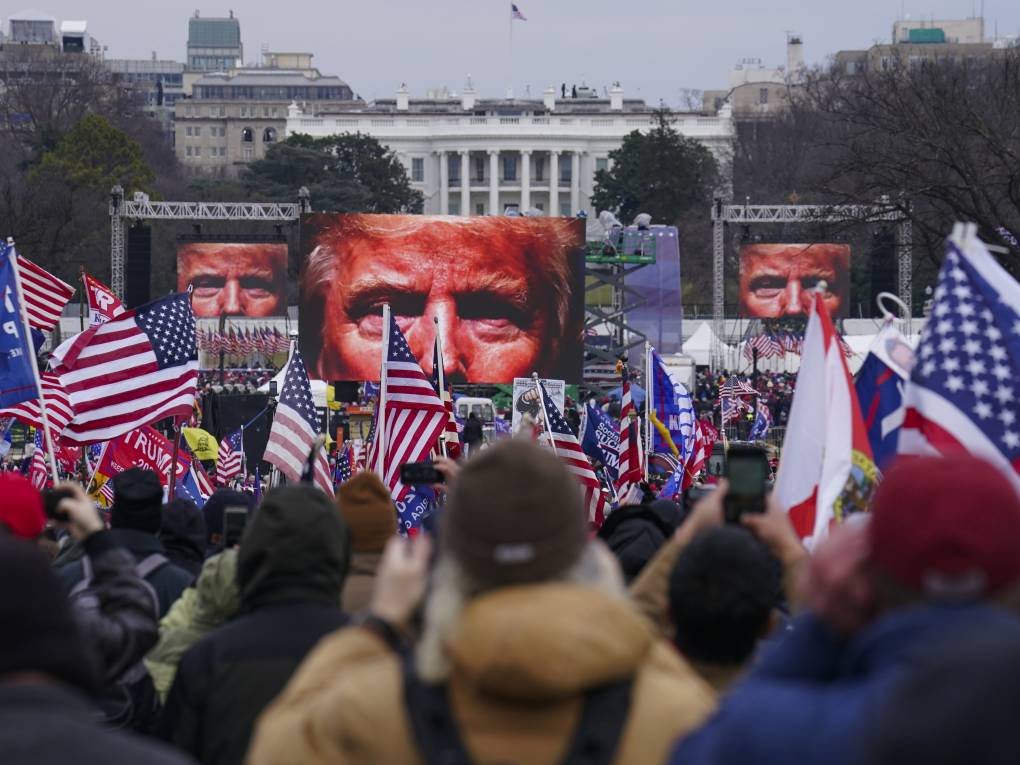
"description": "FILE - Trump supporters participate in a rally Jan. 6, 2021, in Washington. The Colorado Supreme Court hears arguments in a case seeking to use the Constitution’s insurrection clause to keep former President Donald Trump off the ballot. Both sides are appealing a ruling from a district court judge who found Trump incited an insurrection on Jan. 6, 2021, but could remain on the ballot regardless. (AP Photo/John Minchillo, File)",
"title": "The Colorado Supreme Court ruled that Donald Trump's actions on and around Jan. 6 disqualify him from the presidency and from appearing on the state's 2024 primary ballot.",
"credit": null,
"status": "inherit",
"altTag": null,
"isLoading": false,
"fetchFailed": false
},
"news_141513": {
"type": "attachments",
"id": "news_141513",
"meta": {
"index": "attachments_1716263798",
"site": "news",
"id": "141513",
"found": true
},
"parent": 141502,
"imgSizes": {
"kqedFullSize": {
"file": "https://ww2.kqed.org/app/uploads/sites/10/2014/07/RS9516_Chevron032714-JoshC-5177-lpr-e1478109513540.jpg",
"width": 1920,
"height": 1280
}
},
"publishDate": 1405024797,
"modified": 1612213302,
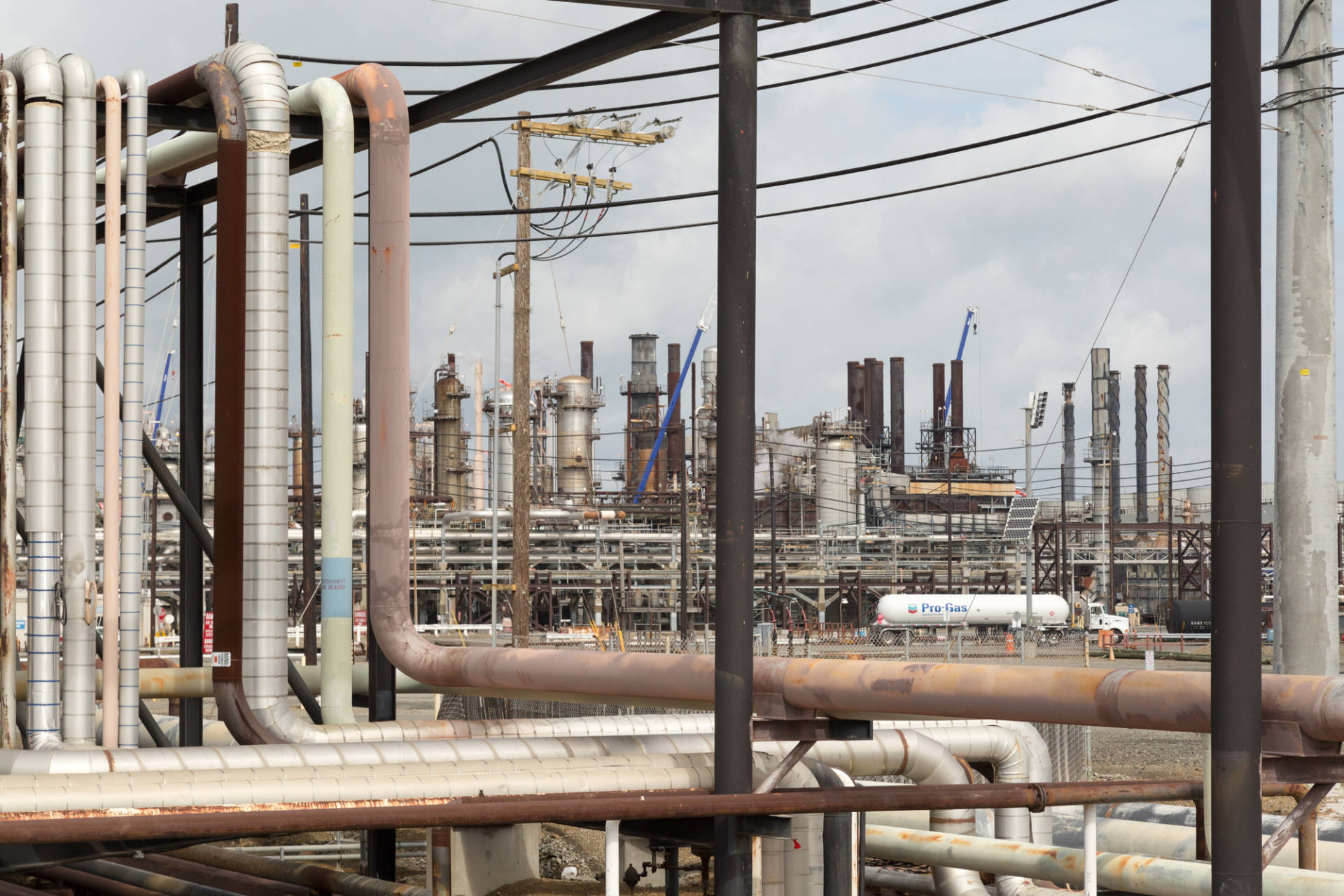
"caption": "A section of Chevron’s Richmond oil refinery.",
"description": "A section of Chevron’s Richmond oil refinery. ",
"title": "Richmond-Chevron Refinery",
"credit": "Josh Cassidy/KQED",
"status": "inherit",
"altTag": null,
"isLoading": false,
"fetchFailed": false
},
"news_11854055": {
"type": "attachments",
"id": "news_11854055",
"meta": {
"index": "attachments_1716263798",
"site": "news",
"id": "11854055",
"found": true
},
"parent": 11854009,
"imgSizes": {
"apple_news_ca_landscape_5_5": {
"file": "https://ww2.kqed.org/app/uploads/sites/10/2021/01/Trump-Flag-Broken-Doors-1044x783.jpg",
"width": 1044,
"mimeType": "image/jpeg",
"height": 783
},
"apple_news_ca_square_4_0": {
"file": "https://ww2.kqed.org/app/uploads/sites/10/2021/01/Trump-Flag-Broken-Doors-470x470.jpg",
"width": 470,
"mimeType": "image/jpeg",
"height": 470
},
"twentyfourteen-full-width": {
"file": "https://ww2.kqed.org/app/uploads/sites/10/2021/01/Trump-Flag-Broken-Doors-1038x576.jpg",
"width": 1038,
"mimeType": "image/jpeg",
"height": 576
},
"thumbnail": {
"file": "https://ww2.kqed.org/app/uploads/sites/10/2021/01/Trump-Flag-Broken-Doors-160x107.jpg",
"width": 160,
"mimeType": "image/jpeg",
"height": 107
},
"post-thumbnail": {
"file": "https://ww2.kqed.org/app/uploads/sites/10/2021/01/Trump-Flag-Broken-Doors-672x372.jpg",
"width": 672,
"mimeType": "image/jpeg",
"height": 372
},
"kqedFullSize": {
"file": "https://ww2.kqed.org/app/uploads/sites/10/2021/01/Trump-Flag-Broken-Doors.jpg",
"width": 1920,
"height": 1281
},
"apple_news_ca_landscape_4_7": {
"file": "https://ww2.kqed.org/app/uploads/sites/10/2021/01/Trump-Flag-Broken-Doors-632x474.jpg",
"width": 632,
"mimeType": "image/jpeg",
"height": 474
},
"large": {
"file": "https://ww2.kqed.org/app/uploads/sites/10/2021/01/Trump-Flag-Broken-Doors-1020x681.jpg",
"width": 1020,
"mimeType": "image/jpeg",
"height": 681
},
"apple_news_ca_landscape_4_0": {
"file": "https://ww2.kqed.org/app/uploads/sites/10/2021/01/Trump-Flag-Broken-Doors-536x402.jpg",
"width": 536,
"mimeType": "image/jpeg",
"height": 402
},
"apple_news_ca_portrait_12_9": {
"file": "https://ww2.kqed.org/app/uploads/sites/10/2021/01/Trump-Flag-Broken-Doors-1122x1281.jpg",
"width": 1122,
"mimeType": "image/jpeg",
"height": 1281
},
"medium": {
"file": "https://ww2.kqed.org/app/uploads/sites/10/2021/01/Trump-Flag-Broken-Doors-800x534.jpg",
"width": 800,
"mimeType": "image/jpeg",
"height": 534
},
"apple_news_ca_portrait_4_0": {
"file": "https://ww2.kqed.org/app/uploads/sites/10/2021/01/Trump-Flag-Broken-Doors-354x472.jpg",
"width": 354,
"mimeType": "image/jpeg",
"height": 472
},
"apple_news_ca_portrait_9_7": {
"file": "https://ww2.kqed.org/app/uploads/sites/10/2021/01/Trump-Flag-Broken-Doors-840x1120.jpg",
"width": 840,
"mimeType": "image/jpeg",
"height": 1120
},
"apple_news_ca_landscape_12_9": {
"file": "https://ww2.kqed.org/app/uploads/sites/10/2021/01/Trump-Flag-Broken-Doors-1832x1281.jpg",
"width": 1832,
"mimeType": "image/jpeg",
"height": 1281
},
"apple_news_ca_square_9_7": {
"file": "https://ww2.kqed.org/app/uploads/sites/10/2021/01/Trump-Flag-Broken-Doors-1104x1104.jpg",
"width": 1104,
"mimeType": "image/jpeg",
"height": 1104
},
"1536x1536": {
"file": "https://ww2.kqed.org/app/uploads/sites/10/2021/01/Trump-Flag-Broken-Doors-1536x1025.jpg",
"width": 1536,
"mimeType": "image/jpeg",
"height": 1025
},
"apple_news_ca_portrait_4_7": {
"file": "https://ww2.kqed.org/app/uploads/sites/10/2021/01/Trump-Flag-Broken-Doors-414x552.jpg",
"width": 414,
"mimeType": "image/jpeg",
"height": 552
},
"apple_news_ca_square_12_9": {
"file": "https://ww2.kqed.org/app/uploads/sites/10/2021/01/Trump-Flag-Broken-Doors-1472x1281.jpg",
"width": 1472,
"mimeType": "image/jpeg",
"height": 1281
},
"apple_news_ca_portrait_5_5": {
"file": "https://ww2.kqed.org/app/uploads/sites/10/2021/01/Trump-Flag-Broken-Doors-687x916.jpg",
"width": 687,
"mimeType": "image/jpeg",
"height": 916
},
"apple_news_ca_square_4_7": {
"file": "https://ww2.kqed.org/app/uploads/sites/10/2021/01/Trump-Flag-Broken-Doors-550x550.jpg",
"width": 550,
"mimeType": "image/jpeg",
"height": 550
},
"apple_news_ca_landscape_9_7": {
"file": "https://ww2.kqed.org/app/uploads/sites/10/2021/01/Trump-Flag-Broken-Doors-1376x1032.jpg",
"width": 1376,
"mimeType": "image/jpeg",
"height": 1032
},
"apple_news_ca_square_5_5": {
"file": "https://ww2.kqed.org/app/uploads/sites/10/2021/01/Trump-Flag-Broken-Doors-912x912.jpg",
"width": 912,
"mimeType": "image/jpeg",
"height": 912
}
},
"publishDate": 1609982692,
"modified": 1609986808,
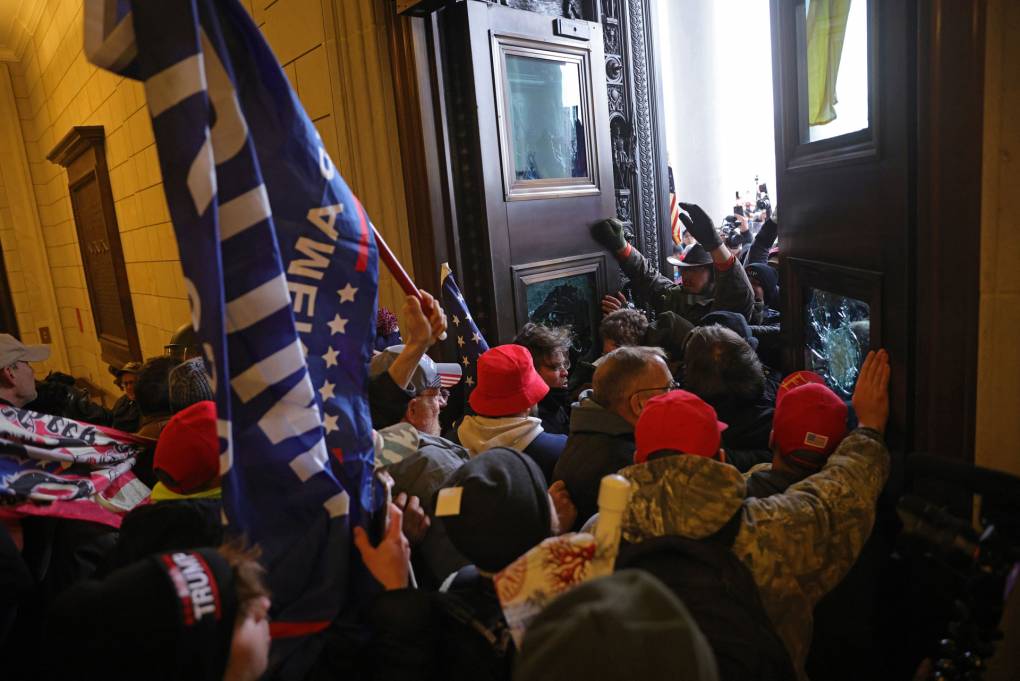
"caption": "A mob of pro-Trump extremists break into the U.S. Capitol on Jan. 06, 2021 in Washington, D.C.",
"description": "A mob of pro-Trump extremists breaks into the U.S. Capitol on Jan. 06, 2021 in Washington, D.C.",
"title": "Trump-Flag-Broken-Doors",
"credit": "Win McNamee/Getty Images",
"status": "inherit",
"altTag": null,
"isLoading": false,
"fetchFailed": false
},
"news_11836859": {
"type": "attachments",
"id": "news_11836859",
"meta": {
"index": "attachments_1716263798",
"site": "news",
"id": "11836859",
"found": true
},
"parent": 11836800,
"imgSizes": {
"apple_news_ca_landscape_5_5": {
"file": "https://ww2.kqed.org/app/uploads/sites/10/2020/09/1920GettyImages-1228115249-1044x783.jpg",
"width": 1044,
"mimeType": "image/jpeg",
"height": 783
},
"apple_news_ca_square_4_0": {
"file": "https://ww2.kqed.org/app/uploads/sites/10/2020/09/1920GettyImages-1228115249-470x470.jpg",
"width": 470,
"mimeType": "image/jpeg",
"height": 470
},
"twentyfourteen-full-width": {
"file": "https://ww2.kqed.org/app/uploads/sites/10/2020/09/1920GettyImages-1228115249-1038x576.jpg",
"width": 1038,
"mimeType": "image/jpeg",
"height": 576
},
"thumbnail": {
"file": "https://ww2.kqed.org/app/uploads/sites/10/2020/09/1920GettyImages-1228115249-160x90.jpg",
"width": 160,
"mimeType": "image/jpeg",
"height": 90
},
"post-thumbnail": {
"file": "https://ww2.kqed.org/app/uploads/sites/10/2020/09/1920GettyImages-1228115249-672x372.jpg",
"width": 672,
"mimeType": "image/jpeg",
"height": 372
},
"kqedFullSize": {
"file": "https://ww2.kqed.org/app/uploads/sites/10/2020/09/1920GettyImages-1228115249-scaled.jpg",
"width": 2560,
"height": 1439
},
"2048x2048": {
"file": "https://ww2.kqed.org/app/uploads/sites/10/2020/09/1920GettyImages-1228115249-2048x1151.jpg",
"width": 2048,
"mimeType": "image/jpeg",
"height": 1151
},
"apple_news_ca_landscape_4_7": {
"file": "https://ww2.kqed.org/app/uploads/sites/10/2020/09/1920GettyImages-1228115249-632x474.jpg",
"width": 632,
"mimeType": "image/jpeg",
"height": 474
},
"large": {
"file": "https://ww2.kqed.org/app/uploads/sites/10/2020/09/1920GettyImages-1228115249-1020x573.jpg",
"width": 1020,
"mimeType": "image/jpeg",
"height": 573
},
"apple_news_ca_landscape_4_0": {
"file": "https://ww2.kqed.org/app/uploads/sites/10/2020/09/1920GettyImages-1228115249-536x402.jpg",
"width": 536,
"mimeType": "image/jpeg",
"height": 402
},
"apple_news_ca_portrait_12_9": {
"file": "https://ww2.kqed.org/app/uploads/sites/10/2020/09/1920GettyImages-1228115249-1122x1496.jpg",
"width": 1122,
"mimeType": "image/jpeg",
"height": 1496
},
"medium": {
"file": "https://ww2.kqed.org/app/uploads/sites/10/2020/09/1920GettyImages-1228115249-800x450.jpg",
"width": 800,
"mimeType": "image/jpeg",
"height": 450
},
"apple_news_ca_portrait_4_0": {
"file": "https://ww2.kqed.org/app/uploads/sites/10/2020/09/1920GettyImages-1228115249-354x472.jpg",
"width": 354,
"mimeType": "image/jpeg",
"height": 472
},
"apple_news_ca_portrait_9_7": {
"file": "https://ww2.kqed.org/app/uploads/sites/10/2020/09/1920GettyImages-1228115249-840x1120.jpg",
"width": 840,
"mimeType": "image/jpeg",
"height": 1120
},
"apple_news_ca_landscape_12_9": {
"file": "https://ww2.kqed.org/app/uploads/sites/10/2020/09/1920GettyImages-1228115249-1832x1374.jpg",
"width": 1832,
"mimeType": "image/jpeg",
"height": 1374
},
"apple_news_ca_square_9_7": {
"file": "https://ww2.kqed.org/app/uploads/sites/10/2020/09/1920GettyImages-1228115249-1104x1104.jpg",
"width": 1104,
"mimeType": "image/jpeg",
"height": 1104
},
"1536x1536": {
"file": "https://ww2.kqed.org/app/uploads/sites/10/2020/09/1920GettyImages-1228115249-1536x864.jpg",
"width": 1536,
"mimeType": "image/jpeg",
"height": 864
},
"apple_news_ca_portrait_4_7": {
"file": "https://ww2.kqed.org/app/uploads/sites/10/2020/09/1920GettyImages-1228115249-414x552.jpg",
"width": 414,
"mimeType": "image/jpeg",
"height": 552
},
"apple_news_ca_square_12_9": {
"file": "https://ww2.kqed.org/app/uploads/sites/10/2020/09/1920GettyImages-1228115249-1472x1472.jpg",
"width": 1472,
"mimeType": "image/jpeg",
"height": 1472
},
"apple_news_ca_portrait_5_5": {
"file": "https://ww2.kqed.org/app/uploads/sites/10/2020/09/1920GettyImages-1228115249-687x916.jpg",
"width": 687,
"mimeType": "image/jpeg",
"height": 916
},
"full-width": {
"file": "https://ww2.kqed.org/app/uploads/sites/10/2020/09/1920GettyImages-1228115249-1920x1079.jpg",
"width": 1920,
"mimeType": "image/jpeg",
"height": 1079
},
"apple_news_ca_square_4_7": {
"file": "https://ww2.kqed.org/app/uploads/sites/10/2020/09/1920GettyImages-1228115249-550x550.jpg",
"width": 550,
"mimeType": "image/jpeg",
"height": 550
},
"apple_news_ca_landscape_9_7": {
"file": "https://ww2.kqed.org/app/uploads/sites/10/2020/09/1920GettyImages-1228115249-1376x1032.jpg",
"width": 1376,
"mimeType": "image/jpeg",
"height": 1032
},
"apple_news_ca_square_5_5": {
"file": "https://ww2.kqed.org/app/uploads/sites/10/2020/09/1920GettyImages-1228115249-912x912.jpg",
"width": 912,
"mimeType": "image/jpeg",
"height": 912
}
},
"publishDate": 1599333728,
"modified": 1599600582,
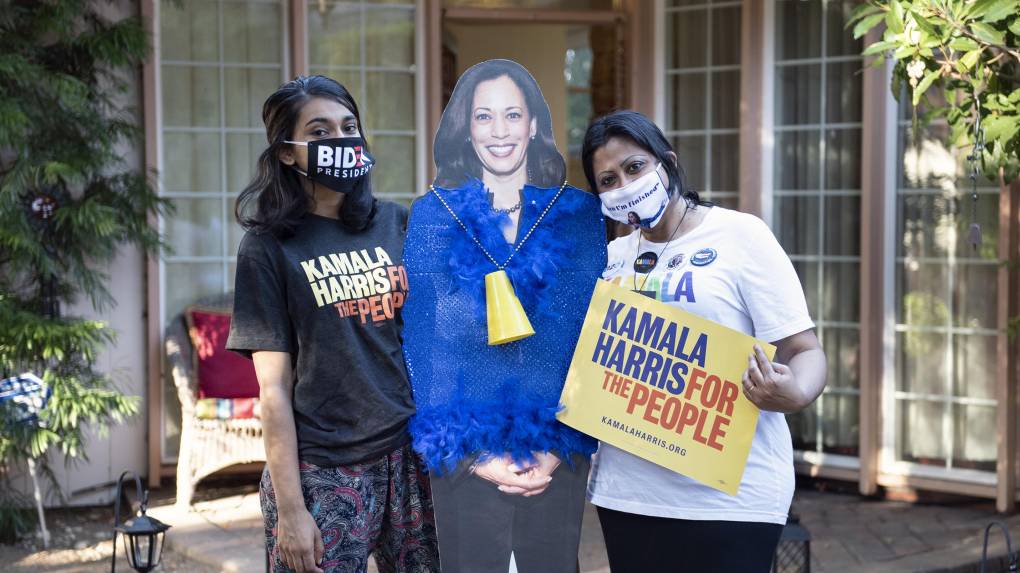
"caption": "Harini Krishnan (R), the co-California state director of South Asians for Biden and a former campaign delegate for Democratic Vice Presidential nominee U.S. Sen. Kamala Harris, poses with a cardboard cut out of Harris with her daughter Janani Krishnan-Jha ahead of the third day of the virtual Democratic National Convention at her home on Aug. 19, 2020 in Hillsborough, California.",
"description": null,
"title": "Americans Across The Nation Watch Virtually Held Democratic National Convention",
"credit": "Michael Short/Getty Images)",
"status": "inherit",
"isLoading": false,
"fetchFailed": false
},
"news_11804779": {
"type": "attachments",
"id": "news_11804779",
"meta": {
"index": "attachments_1716263798",
"site": "news",
"id": "11804779",
"found": true
},
"parent": 11804553,
"imgSizes": {
"apple_news_ca_square_4_0": {
"file": "https://ww2.kqed.org/app/uploads/sites/10/2020/03/GettyImages-1204945352-470x470.jpg",
"width": 470,
"mimeType": "image/jpeg",
"height": 470
},
"twentyfourteen-full-width": {
"file": "https://ww2.kqed.org/app/uploads/sites/10/2020/03/GettyImages-1204945352-1024x576.jpg",
"width": 1024,
"mimeType": "image/jpeg",
"height": 576
},
"thumbnail": {
"file": "https://ww2.kqed.org/app/uploads/sites/10/2020/03/GettyImages-1204945352-160x107.jpg",
"width": 160,
"mimeType": "image/jpeg",
"height": 107
},
"post-thumbnail": {
"file": "https://ww2.kqed.org/app/uploads/sites/10/2020/03/GettyImages-1204945352-672x372.jpg",
"width": 672,
"mimeType": "image/jpeg",
"height": 372
},
"kqedFullSize": {
"file": "https://ww2.kqed.org/app/uploads/sites/10/2020/03/GettyImages-1204945352.jpg",
"width": 1024,
"height": 686
},
"apple_news_ca_landscape_4_7": {
"file": "https://ww2.kqed.org/app/uploads/sites/10/2020/03/GettyImages-1204945352-632x474.jpg",
"width": 632,
"mimeType": "image/jpeg",
"height": 474
},
"large": {
"file": "https://ww2.kqed.org/app/uploads/sites/10/2020/03/GettyImages-1204945352-1020x683.jpg",
"width": 1020,
"mimeType": "image/jpeg",
"height": 683
},
"apple_news_ca_landscape_4_0": {
"file": "https://ww2.kqed.org/app/uploads/sites/10/2020/03/GettyImages-1204945352-536x402.jpg",
"width": 536,
"mimeType": "image/jpeg",
"height": 402
},
"medium": {
"file": "https://ww2.kqed.org/app/uploads/sites/10/2020/03/GettyImages-1204945352-800x536.jpg",
"width": 800,
"mimeType": "image/jpeg",
"height": 536
},
"apple_news_ca_portrait_4_0": {
"file": "https://ww2.kqed.org/app/uploads/sites/10/2020/03/GettyImages-1204945352-354x472.jpg",
"width": 354,
"mimeType": "image/jpeg",
"height": 472
},
"apple_news_ca_portrait_9_7": {
"file": "https://ww2.kqed.org/app/uploads/sites/10/2020/03/GettyImages-1204945352-840x686.jpg",
"width": 840,
"mimeType": "image/jpeg",
"height": 686
},
"apple_news_ca_portrait_4_7": {
"file": "https://ww2.kqed.org/app/uploads/sites/10/2020/03/GettyImages-1204945352-414x552.jpg",
"width": 414,
"mimeType": "image/jpeg",
"height": 552
},
"apple_news_ca_portrait_5_5": {
"file": "https://ww2.kqed.org/app/uploads/sites/10/2020/03/GettyImages-1204945352-687x686.jpg",
"width": 687,
"mimeType": "image/jpeg",
"height": 686
},
"apple_news_ca_square_4_7": {
"file": "https://ww2.kqed.org/app/uploads/sites/10/2020/03/GettyImages-1204945352-550x550.jpg",
"width": 550,
"mimeType": "image/jpeg",
"height": 550
},
"apple_news_ca_square_5_5": {
"file": "https://ww2.kqed.org/app/uploads/sites/10/2020/03/GettyImages-1204945352-912x686.jpg",
"width": 912,
"mimeType": "image/jpeg",
"height": 686
}
},
"publishDate": 1583273803,
"modified": 1583277892,
"caption": "A voter exits the San Diego Registrar of Voters after casting her ballot on March 3, 2020 in San Diego. California is one of 14 states holding primary elections on Super Tuesday.",
"description": null,
"title": "Voters In 14 States Head To The Polls On Super Tuesday",
"credit": "Sandy Huffaker/Getty Images",
"status": "inherit",
"isLoading": false,
"fetchFailed": false
},
"news_11804603": {
"type": "attachments",
"id": "news_11804603",
"meta": {
"index": "attachments_1716263798",
"site": "news",
"id": "11804603",
"found": true
},
"parent": 11804529,
"imgSizes": {
"apple_news_ca_square_4_0": {
"file": "https://ww2.kqed.org/app/uploads/sites/10/2020/03/GettyImages-1204820408-470x470.jpg",
"width": 470,
"mimeType": "image/jpeg",
"height": 470
},
"twentyfourteen-full-width": {
"file": "https://ww2.kqed.org/app/uploads/sites/10/2020/03/GettyImages-1204820408-1024x576.jpg",
"width": 1024,
"mimeType": "image/jpeg",
"height": 576
},
"thumbnail": {
"file": "https://ww2.kqed.org/app/uploads/sites/10/2020/03/GettyImages-1204820408-160x105.jpg",
"width": 160,
"mimeType": "image/jpeg",
"height": 105
},
"post-thumbnail": {
"file": "https://ww2.kqed.org/app/uploads/sites/10/2020/03/GettyImages-1204820408-672x372.jpg",
"width": 672,
"mimeType": "image/jpeg",
"height": 372
},
"kqedFullSize": {
"file": "https://ww2.kqed.org/app/uploads/sites/10/2020/03/GettyImages-1204820408.jpg",
"width": 1024,
"height": 671
},
"apple_news_ca_landscape_4_7": {
"file": "https://ww2.kqed.org/app/uploads/sites/10/2020/03/GettyImages-1204820408-632x474.jpg",
"width": 632,
"mimeType": "image/jpeg",
"height": 474
},
"large": {
"file": "https://ww2.kqed.org/app/uploads/sites/10/2020/03/GettyImages-1204820408-1020x668.jpg",
"width": 1020,
"mimeType": "image/jpeg",
"height": 668
},
"apple_news_ca_landscape_4_0": {
"file": "https://ww2.kqed.org/app/uploads/sites/10/2020/03/GettyImages-1204820408-536x402.jpg",
"width": 536,
"mimeType": "image/jpeg",
"height": 402
},
"medium": {
"file": "https://ww2.kqed.org/app/uploads/sites/10/2020/03/GettyImages-1204820408-800x524.jpg",
"width": 800,
"mimeType": "image/jpeg",
"height": 524
},
"apple_news_ca_portrait_4_0": {
"file": "https://ww2.kqed.org/app/uploads/sites/10/2020/03/GettyImages-1204820408-354x472.jpg",
"width": 354,
"mimeType": "image/jpeg",
"height": 472
},
"apple_news_ca_portrait_9_7": {
"file": "https://ww2.kqed.org/app/uploads/sites/10/2020/03/GettyImages-1204820408-840x671.jpg",
"width": 840,
"mimeType": "image/jpeg",
"height": 671
},
"apple_news_ca_portrait_4_7": {
"file": "https://ww2.kqed.org/app/uploads/sites/10/2020/03/GettyImages-1204820408-414x552.jpg",
"width": 414,
"mimeType": "image/jpeg",
"height": 552
},
"apple_news_ca_portrait_5_5": {
"file": "https://ww2.kqed.org/app/uploads/sites/10/2020/03/GettyImages-1204820408-687x671.jpg",
"width": 687,
"mimeType": "image/jpeg",
"height": 671
},
"apple_news_ca_square_4_7": {
"file": "https://ww2.kqed.org/app/uploads/sites/10/2020/03/GettyImages-1204820408-550x550.jpg",
"width": 550,
"mimeType": "image/jpeg",
"height": 550
},
"apple_news_ca_square_5_5": {
"file": "https://ww2.kqed.org/app/uploads/sites/10/2020/03/GettyImages-1204820408-912x671.jpg",
"width": 912,
"mimeType": "image/jpeg",
"height": 671
}
},
"publishDate": 1583192246,
"modified": 1583460545,
"caption": "Angela Marie Volpe casts her ballot after a yoga class at the YMCA in Burbank, California, on March 2, 2020, during early voting for the California presidential primary election ahead of Super Tuesday.",
"description": "Angela Marie Volpe casts her ballot after a yoga class at the YMCA in Burbank, California, on March 2, 2020, during early voting for the California presidential primary election ahead of Super Tuesday.",
"title": "US-POLITICS-VOTE-DEMOCRATS-PRIMARY",
"credit": "Robyn Beck/AFP",
"status": "inherit",
"isLoading": false,
"fetchFailed": false
},
"news_11798877": {
"type": "attachments",
"id": "news_11798877",
"meta": {
"index": "attachments_1716263798",
"site": "news",
"id": "11798877",
"found": true
},
"title": "US-POLITICS-IMMIGRATION-MIGRANTS-PROTEST",
"publishDate": 1580342678,
"status": "inherit",
"parent": 11797878,
"modified": 1787778362,
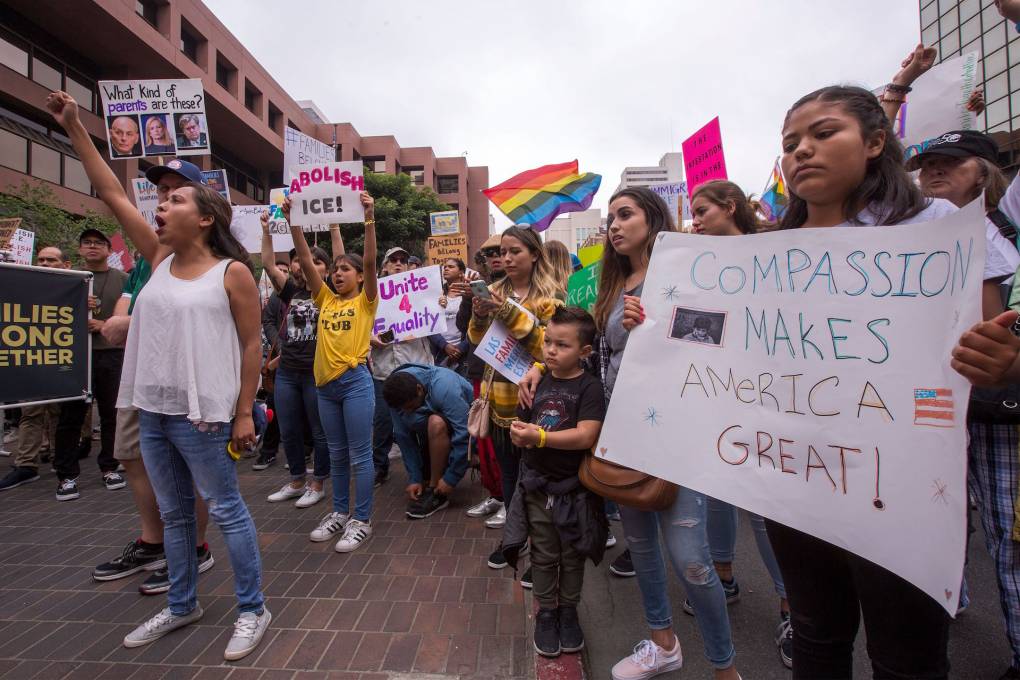
"caption": "Protesters rally near the federal building in San Diego on June 23, 2018, demanding the reunification of thousands of children who were separated from their immigrant parents by border officials under the Trump administration's controversial 'zero tolerance' policy.",
"credit": "David McNew/AFP via Getty Images",
"altTag": null,
"description": null,
"imgSizes": {
"thumbnail": {
"file": "https://cdn.kqed.org/wp-content/uploads/sites/10/2020/01/GettyImages-982247184-1-160x107.jpg",
"width": 160,
"height": 107,
"mimeType": "image/jpeg"
},
"medium": {
"file": "https://cdn.kqed.org/wp-content/uploads/sites/10/2020/01/GettyImages-982247184-1-800x533.jpg",
"width": 800,
"height": 533,
"mimeType": "image/jpeg"
},
"large": {
"file": "https://cdn.kqed.org/wp-content/uploads/sites/10/2020/01/GettyImages-982247184-1-1020x680.jpg",
"width": 1020,
"height": 680,
"mimeType": "image/jpeg"
},
"post-thumbnail": {
"file": "https://cdn.kqed.org/wp-content/uploads/sites/10/2020/01/GettyImages-982247184-1-672x372.jpg",
"width": 672,
"height": 372,
"mimeType": "image/jpeg"
},
"twentyfourteen-full-width": {
"file": "https://cdn.kqed.org/wp-content/uploads/sites/10/2020/01/GettyImages-982247184-1-1038x576.jpg",
"width": 1038,
"height": 576,
"mimeType": "image/jpeg"
},
"full-width": {
"file": "https://cdn.kqed.org/wp-content/uploads/sites/10/2020/01/GettyImages-982247184-1-1920x1280.jpg",
"width": 1920,
"height": 1280,
"mimeType": "image/jpeg"
},
"apple_news_ca_landscape_12_9": {
"file": "https://cdn.kqed.org/wp-content/uploads/sites/10/2020/01/GettyImages-982247184-1-1832x1280.jpg",
"width": 1832,
"height": 1280,
"mimeType": "image/jpeg"
},
"apple_news_ca_landscape_9_7": {
"file": "https://cdn.kqed.org/wp-content/uploads/sites/10/2020/01/GettyImages-982247184-1-1376x1032.jpg",
"width": 1376,
"height": 1032,
"mimeType": "image/jpeg"
},
"apple_news_ca_landscape_5_5": {
"file": "https://cdn.kqed.org/wp-content/uploads/sites/10/2020/01/GettyImages-982247184-1-1044x783.jpg",
"width": 1044,
"height": 783,
"mimeType": "image/jpeg"
},
"apple_news_ca_landscape_4_7": {
"file": "https://cdn.kqed.org/wp-content/uploads/sites/10/2020/01/GettyImages-982247184-1-632x474.jpg",
"width": 632,
"height": 474,
"mimeType": "image/jpeg"
},
"apple_news_ca_landscape_4_0": {
"file": "https://cdn.kqed.org/wp-content/uploads/sites/10/2020/01/GettyImages-982247184-1-536x402.jpg",
"width": 536,
"height": 402,
"mimeType": "image/jpeg"
},
"apple_news_ca_portrait_12_9": {
"file": "https://cdn.kqed.org/wp-content/uploads/sites/10/2020/01/GettyImages-982247184-1-1122x1280.jpg",
"width": 1122,
"height": 1280,
"mimeType": "image/jpeg"
},
"apple_news_ca_portrait_9_7": {
"file": "https://cdn.kqed.org/wp-content/uploads/sites/10/2020/01/GettyImages-982247184-1-840x1120.jpg",
"width": 840,
"height": 1120,
"mimeType": "image/jpeg"
},
"apple_news_ca_portrait_5_5": {
"file": "https://cdn.kqed.org/wp-content/uploads/sites/10/2020/01/GettyImages-982247184-1-687x916.jpg",
"width": 687,
"height": 916,
"mimeType": "image/jpeg"
},
"apple_news_ca_portrait_4_7": {
"file": "https://cdn.kqed.org/wp-content/uploads/sites/10/2020/01/GettyImages-982247184-1-414x552.jpg",
"width": 414,
"height": 552,
"mimeType": "image/jpeg"
},
"apple_news_ca_portrait_4_0": {
"file": "https://cdn.kqed.org/wp-content/uploads/sites/10/2020/01/GettyImages-982247184-1-354x472.jpg",
"width": 354,
"height": 472,
"mimeType": "image/jpeg"
},
"apple_news_ca_square_12_9": {
"file": "https://cdn.kqed.org/wp-content/uploads/sites/10/2020/01/GettyImages-982247184-1-1472x1280.jpg",
"width": 1472,
"height": 1280,
"mimeType": "image/jpeg"
},
"apple_news_ca_square_9_7": {
"file": "https://cdn.kqed.org/wp-content/uploads/sites/10/2020/01/GettyImages-982247184-1-1104x1104.jpg",
"width": 1104,
"height": 1104,
"mimeType": "image/jpeg"
},
"apple_news_ca_square_5_5": {
"file": "https://cdn.kqed.org/wp-content/uploads/sites/10/2020/01/GettyImages-982247184-1-912x912.jpg",
"width": 912,
"height": 912,
"mimeType": "image/jpeg"
},
"apple_news_ca_square_4_7": {
"file": "https://cdn.kqed.org/wp-content/uploads/sites/10/2020/01/GettyImages-982247184-1-550x550.jpg",
"width": 550,
"height": 550,
"mimeType": "image/jpeg"
},
"apple_news_ca_square_4_0": {
"file": "https://cdn.kqed.org/wp-content/uploads/sites/10/2020/01/GettyImages-982247184-1-470x470.jpg",
"width": 470,
"height": 470,
"mimeType": "image/jpeg"
},
"kqedFullSize": {
"file": "https://cdn.kqed.org/wp-content/uploads/sites/10/2020/01/GettyImages-982247184-1.jpg",
"width": 1920,
"height": 1280
}
},
"isLoading": false,
"fetchFailed": false
},
"news_11791166": {
"type": "attachments",
"id": "news_11791166",
"meta": {
"index": "attachments_1716263798",
"site": "news",
"id": "11791166",
"found": true
},
"parent": 11790984,
"imgSizes": {
"apple_news_ca_landscape_5_5": {
"file": "https://ww2.kqed.org/app/uploads/sites/10/2019/12/GettyImages-1176118885-1044x783.jpg",
"width": 1044,
"mimeType": "image/jpeg",
"height": 783
},
"apple_news_ca_square_4_0": {
"file": "https://ww2.kqed.org/app/uploads/sites/10/2019/12/GettyImages-1176118885-470x470.jpg",
"width": 470,
"mimeType": "image/jpeg",
"height": 470
},
"twentyfourteen-full-width": {
"file": "https://ww2.kqed.org/app/uploads/sites/10/2019/12/GettyImages-1176118885-1038x576.jpg",
"width": 1038,
"mimeType": "image/jpeg",
"height": 576
},
"thumbnail": {
"file": "https://ww2.kqed.org/app/uploads/sites/10/2019/12/GettyImages-1176118885-160x107.jpg",
"width": 160,
"mimeType": "image/jpeg",
"height": 107
},
"post-thumbnail": {
"file": "https://ww2.kqed.org/app/uploads/sites/10/2019/12/GettyImages-1176118885-672x372.jpg",
"width": 672,
"mimeType": "image/jpeg",
"height": 372
},
"kqedFullSize": {
"file": "https://ww2.kqed.org/app/uploads/sites/10/2019/12/GettyImages-1176118885-e1576275263318.jpg",
"width": 1920,
"height": 1280
},
"apple_news_ca_landscape_4_7": {
"file": "https://ww2.kqed.org/app/uploads/sites/10/2019/12/GettyImages-1176118885-632x474.jpg",
"width": 632,
"mimeType": "image/jpeg",
"height": 474
},
"large": {
"file": "https://ww2.kqed.org/app/uploads/sites/10/2019/12/GettyImages-1176118885-1020x680.jpg",
"width": 1020,
"mimeType": "image/jpeg",
"height": 680
},
"complete_open_graph": {
"file": "https://ww2.kqed.org/app/uploads/sites/10/2019/12/GettyImages-1176118885-1200x800.jpg",
"width": 1200,
"mimeType": "image/jpeg",
"height": 800
},
"apple_news_ca_landscape_4_0": {
"file": "https://ww2.kqed.org/app/uploads/sites/10/2019/12/GettyImages-1176118885-536x402.jpg",
"width": 536,
"mimeType": "image/jpeg",
"height": 402
},
"apple_news_ca_portrait_12_9": {
"file": "https://ww2.kqed.org/app/uploads/sites/10/2019/12/GettyImages-1176118885-1122x1496.jpg",
"width": 1122,
"mimeType": "image/jpeg",
"height": 1496
},
"medium": {
"file": "https://ww2.kqed.org/app/uploads/sites/10/2019/12/GettyImages-1176118885-800x533.jpg",
"width": 800,
"mimeType": "image/jpeg",
"height": 533
},
"apple_news_ca_portrait_4_0": {
"file": "https://ww2.kqed.org/app/uploads/sites/10/2019/12/GettyImages-1176118885-354x472.jpg",
"width": 354,
"mimeType": "image/jpeg",
"height": 472
},
"apple_news_ca_portrait_9_7": {
"file": "https://ww2.kqed.org/app/uploads/sites/10/2019/12/GettyImages-1176118885-840x1120.jpg",
"width": 840,
"mimeType": "image/jpeg",
"height": 1120
},
"apple_news_ca_landscape_12_9": {
"file": "https://ww2.kqed.org/app/uploads/sites/10/2019/12/GettyImages-1176118885-1832x1374.jpg",
"width": 1832,
"mimeType": "image/jpeg",
"height": 1374
},
"apple_news_ca_square_9_7": {
"file": "https://ww2.kqed.org/app/uploads/sites/10/2019/12/GettyImages-1176118885-1104x1104.jpg",
"width": 1104,
"mimeType": "image/jpeg",
"height": 1104
},
"apple_news_ca_portrait_4_7": {
"file": "https://ww2.kqed.org/app/uploads/sites/10/2019/12/GettyImages-1176118885-414x552.jpg",
"width": 414,
"mimeType": "image/jpeg",
"height": 552
},
"apple_news_ca_square_12_9": {
"file": "https://ww2.kqed.org/app/uploads/sites/10/2019/12/GettyImages-1176118885-1472x1472.jpg",
"width": 1472,
"mimeType": "image/jpeg",
"height": 1472
},
"apple_news_ca_portrait_5_5": {
"file": "https://ww2.kqed.org/app/uploads/sites/10/2019/12/GettyImages-1176118885-687x916.jpg",
"width": 687,
"mimeType": "image/jpeg",
"height": 916
},
"full-width": {
"file": "https://ww2.kqed.org/app/uploads/sites/10/2019/12/GettyImages-1176118885-1920x1280.jpg",
"width": 1920,
"mimeType": "image/jpeg",
"height": 1280
},
"apple_news_ca_square_4_7": {
"file": "https://ww2.kqed.org/app/uploads/sites/10/2019/12/GettyImages-1176118885-550x550.jpg",
"width": 550,
"mimeType": "image/jpeg",
"height": 550
},
"apple_news_ca_landscape_9_7": {
"file": "https://ww2.kqed.org/app/uploads/sites/10/2019/12/GettyImages-1176118885-1376x1032.jpg",
"width": 1376,
"mimeType": "image/jpeg",
"height": 1032
},
"apple_news_ca_square_5_5": {
"file": "https://ww2.kqed.org/app/uploads/sites/10/2019/12/GettyImages-1176118885-912x912.jpg",
"width": 912,
"mimeType": "image/jpeg",
"height": 912
}
},
"publishDate": 1576275223,
"modified": 1576287124,
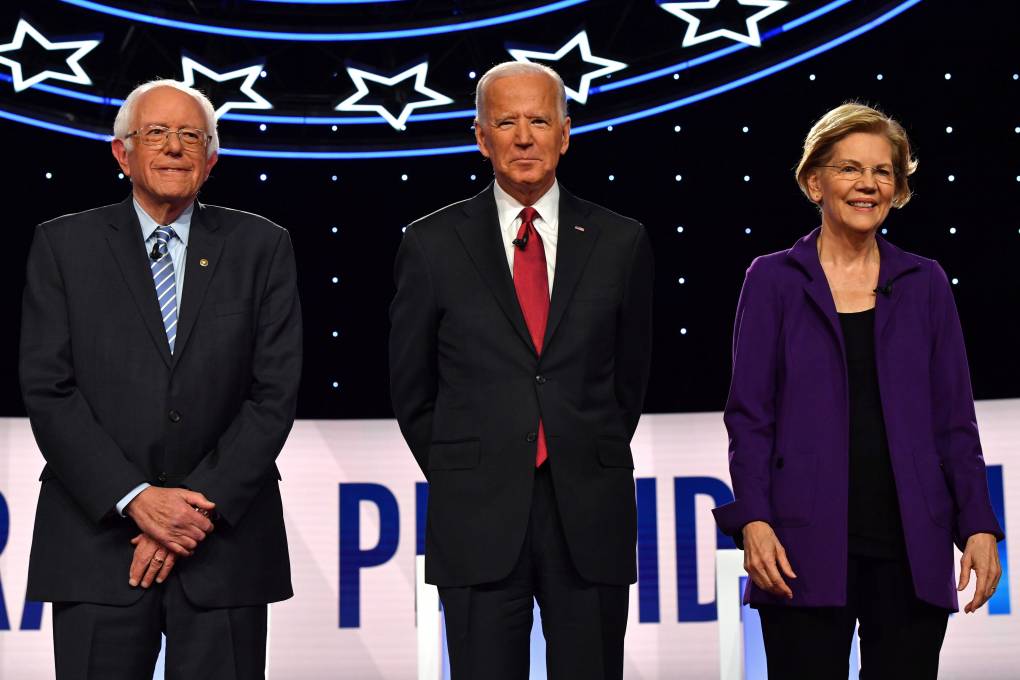
"caption": "Democratic presidential hopefuls Vermont Sen. Bernie Sanders (L), former Vice President Joe Biden (C) and Massachusetts Sen. Elizabeth Warren arrive onstage for the fourth Democratic presidential primary debate in Westerville, Ohio, on Oct. 15, 2019.",
"description": null,
"title": "US-VOTE-2020-DEMOCRATS-DEBATE",
"credit": "Nicholas Kamm/AFP/Getty Images",
"status": "inherit",
"isLoading": false,
"fetchFailed": false
},
"news_11781461": {
"type": "attachments",
"id": "news_11781461",
"meta": {
"index": "attachments_1716263798",
"site": "news",
"id": "11781461",
"found": true
},
"parent": 11781412,
"imgSizes": {
"apple_news_ca_square_4_0": {
"file": "https://ww2.kqed.org/app/uploads/sites/10/2019/10/GettyImages-1181340134-470x470.jpg",
"width": 470,
"mimeType": "image/jpeg",
"height": 470
},
"twentyfourteen-full-width": {
"file": "https://ww2.kqed.org/app/uploads/sites/10/2019/10/GettyImages-1181340134-1024x576.jpg",
"width": 1024,
"mimeType": "image/jpeg",
"height": 576
},
"thumbnail": {
"file": "https://ww2.kqed.org/app/uploads/sites/10/2019/10/GettyImages-1181340134-160x107.jpg",
"width": 160,
"mimeType": "image/jpeg",
"height": 107
},
"post-thumbnail": {
"file": "https://ww2.kqed.org/app/uploads/sites/10/2019/10/GettyImages-1181340134-672x372.jpg",
"width": 672,
"mimeType": "image/jpeg",
"height": 372
},
"kqedFullSize": {
"file": "https://ww2.kqed.org/app/uploads/sites/10/2019/10/GettyImages-1181340134.jpg",
"width": 1024,
"height": 683
},
"apple_news_ca_landscape_4_7": {
"file": "https://ww2.kqed.org/app/uploads/sites/10/2019/10/GettyImages-1181340134-632x474.jpg",
"width": 632,
"mimeType": "image/jpeg",
"height": 474
},
"large": {
"file": "https://ww2.kqed.org/app/uploads/sites/10/2019/10/GettyImages-1181340134-1020x680.jpg",
"width": 1020,
"mimeType": "image/jpeg",
"height": 680
},
"apple_news_ca_landscape_4_0": {
"file": "https://ww2.kqed.org/app/uploads/sites/10/2019/10/GettyImages-1181340134-536x402.jpg",
"width": 536,
"mimeType": "image/jpeg",
"height": 402
},
"medium": {
"file": "https://ww2.kqed.org/app/uploads/sites/10/2019/10/GettyImages-1181340134-800x534.jpg",
"width": 800,
"mimeType": "image/jpeg",
"height": 534
},
"apple_news_ca_portrait_4_0": {
"file": "https://ww2.kqed.org/app/uploads/sites/10/2019/10/GettyImages-1181340134-354x472.jpg",
"width": 354,
"mimeType": "image/jpeg",
"height": 472
},
"apple_news_ca_portrait_9_7": {
"file": "https://ww2.kqed.org/app/uploads/sites/10/2019/10/GettyImages-1181340134-840x683.jpg",
"width": 840,
"mimeType": "image/jpeg",
"height": 683
},
"apple_news_ca_portrait_4_7": {
"file": "https://ww2.kqed.org/app/uploads/sites/10/2019/10/GettyImages-1181340134-414x552.jpg",
"width": 414,
"mimeType": "image/jpeg",
"height": 552
},
"apple_news_ca_portrait_5_5": {
"file": "https://ww2.kqed.org/app/uploads/sites/10/2019/10/GettyImages-1181340134-687x683.jpg",
"width": 687,
"mimeType": "image/jpeg",
"height": 683
},
"apple_news_ca_square_4_7": {
"file": "https://ww2.kqed.org/app/uploads/sites/10/2019/10/GettyImages-1181340134-550x550.jpg",
"width": 550,
"mimeType": "image/jpeg",
"height": 550
},
"apple_news_ca_square_5_5": {
"file": "https://ww2.kqed.org/app/uploads/sites/10/2019/10/GettyImages-1181340134-912x683.jpg",
"width": 912,
"mimeType": "image/jpeg",
"height": 683
}
},
"publishDate": 1571682078,
"modified": 1571682308,
"caption": "Democratic presidential candidates (L-R) Hawaii Rep. Tulsi Gabbard, billionaire Tom Steyer, New Jersey Sen. Cory Booker, California Sen. Kamala Harris, Vermont Sen. Bernie Sanders, former Vice President Joe Biden, Massachusetts Sen. Elizabeth Warren, South Bend, Indiana Mayor Pete Buttigieg, former tech executive Andrew Yang, former Texas congressman Beto O'Rourke, Minnesota Sen. Amy Klobuchar and former housing secretary Julian Castro at the start of the fourth Democratic presidential debate at Otterbein University in Westerville, Ohio on October 15, 2019.",
"description": null,
"title": "Democratic Presidential Candidates Participate In Fourth Debate In Ohio",
"credit": "Chip Somodevilla/Getty Images",
"status": "inherit",
"isLoading": false,
"fetchFailed": false
},
"news_11777905": {
"type": "attachments",
"id": "news_11777905",
"meta": {
"index": "attachments_1716263798",
"site": "news",
"id": "11777905",
"found": true
},
"parent": 11777737,
"imgSizes": {
"apple_news_ca_square_4_0": {
"file": "https://ww2.kqed.org/app/uploads/sites/10/2019/10/GettyImages-1174333697-470x470.jpg",
"width": 470,
"mimeType": "image/jpeg",
"height": 470
},
"twentyfourteen-full-width": {
"file": "https://ww2.kqed.org/app/uploads/sites/10/2019/10/GettyImages-1174333697-1024x576.jpg",
"width": 1024,
"mimeType": "image/jpeg",
"height": 576
},
"thumbnail": {
"file": "https://ww2.kqed.org/app/uploads/sites/10/2019/10/GettyImages-1174333697-160x107.jpg",
"width": 160,
"mimeType": "image/jpeg",
"height": 107
},
"post-thumbnail": {
"file": "https://ww2.kqed.org/app/uploads/sites/10/2019/10/GettyImages-1174333697-672x372.jpg",
"width": 672,
"mimeType": "image/jpeg",
"height": 372
},
"kqedFullSize": {
"file": "https://ww2.kqed.org/app/uploads/sites/10/2019/10/GettyImages-1174333697.jpg",
"width": 1024,
"height": 683
},
"apple_news_ca_landscape_4_7": {
"file": "https://ww2.kqed.org/app/uploads/sites/10/2019/10/GettyImages-1174333697-632x474.jpg",
"width": 632,
"mimeType": "image/jpeg",
"height": 474
},
"large": {
"file": "https://ww2.kqed.org/app/uploads/sites/10/2019/10/GettyImages-1174333697-1020x680.jpg",
"width": 1020,
"mimeType": "image/jpeg",
"height": 680
},
"apple_news_ca_landscape_4_0": {
"file": "https://ww2.kqed.org/app/uploads/sites/10/2019/10/GettyImages-1174333697-536x402.jpg",
"width": 536,
"mimeType": "image/jpeg",
"height": 402
},
"medium": {
"file": "https://ww2.kqed.org/app/uploads/sites/10/2019/10/GettyImages-1174333697-800x534.jpg",
"width": 800,
"mimeType": "image/jpeg",
"height": 534
},
"apple_news_ca_portrait_4_0": {
"file": "https://ww2.kqed.org/app/uploads/sites/10/2019/10/GettyImages-1174333697-354x472.jpg",
"width": 354,
"mimeType": "image/jpeg",
"height": 472
},
"apple_news_ca_portrait_9_7": {
"file": "https://ww2.kqed.org/app/uploads/sites/10/2019/10/GettyImages-1174333697-840x683.jpg",
"width": 840,
"mimeType": "image/jpeg",
"height": 683
},
"apple_news_ca_portrait_4_7": {
"file": "https://ww2.kqed.org/app/uploads/sites/10/2019/10/GettyImages-1174333697-414x552.jpg",
"width": 414,
"mimeType": "image/jpeg",
"height": 552
},
"apple_news_ca_portrait_5_5": {
"file": "https://ww2.kqed.org/app/uploads/sites/10/2019/10/GettyImages-1174333697-687x683.jpg",
"width": 687,
"mimeType": "image/jpeg",
"height": 683
},
"apple_news_ca_square_4_7": {
"file": "https://ww2.kqed.org/app/uploads/sites/10/2019/10/GettyImages-1174333697-550x550.jpg",
"width": 550,
"mimeType": "image/jpeg",
"height": 550
},
"apple_news_ca_square_5_5": {
"file": "https://ww2.kqed.org/app/uploads/sites/10/2019/10/GettyImages-1174333697-912x683.jpg",
"width": 912,
"mimeType": "image/jpeg",
"height": 683
}
},
"publishDate": 1570063199,
"modified": 1570139682,
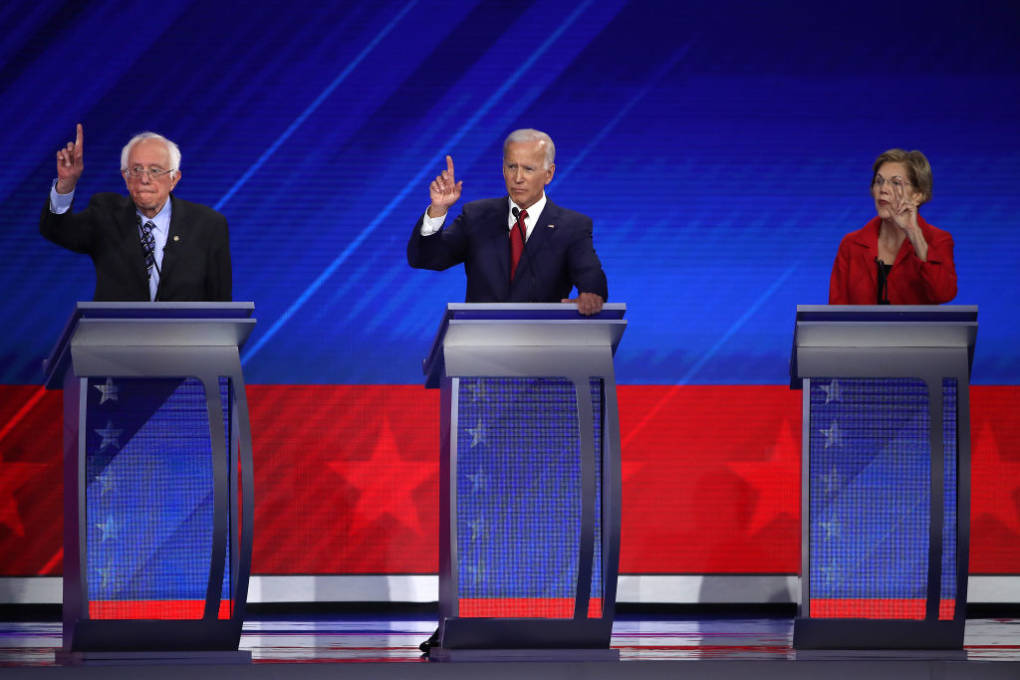
"caption": "Sen. Bernie Sanders of Vermont, former Vice President Joe Biden and Sen. Elizabeth Warren of Massachusetts during the third presidential debate in Houston on Sept. 12, 2019.",
"description": null,
"title": "Democratic Presidential Candidates Participate In Third Debate In Houston",
"credit": "Win McNamee/Getty Images",
"status": "inherit",
"isLoading": false,
"fetchFailed": false
},
"news_11775219": {
"type": "attachments",
"id": "news_11775219",
"meta": {
"index": "attachments_1716263798",
"site": "news",
"id": "11775219",
"found": true
},
"parent": 11775213,
"imgSizes": {
"apple_news_ca_square_4_0": {
"file": "https://ww2.kqed.org/app/uploads/sites/10/2019/09/GettyImages-1174321874-470x470.jpg",
"width": 470,
"mimeType": "image/jpeg",
"height": 470
},
"twentyfourteen-full-width": {
"file": "https://ww2.kqed.org/app/uploads/sites/10/2019/09/GettyImages-1174321874-1024x576.jpg",
"width": 1024,
"mimeType": "image/jpeg",
"height": 576
},
"thumbnail": {
"file": "https://ww2.kqed.org/app/uploads/sites/10/2019/09/GettyImages-1174321874-160x107.jpg",
"width": 160,
"mimeType": "image/jpeg",
"height": 107
},
"post-thumbnail": {
"file": "https://ww2.kqed.org/app/uploads/sites/10/2019/09/GettyImages-1174321874-672x372.jpg",
"width": 672,
"mimeType": "image/jpeg",
"height": 372
},
"kqedFullSize": {
"file": "https://ww2.kqed.org/app/uploads/sites/10/2019/09/GettyImages-1174321874.jpg",
"width": 1024,
"height": 683
},
"apple_news_ca_landscape_4_7": {
"file": "https://ww2.kqed.org/app/uploads/sites/10/2019/09/GettyImages-1174321874-632x474.jpg",
"width": 632,
"mimeType": "image/jpeg",
"height": 474
},
"large": {
"file": "https://ww2.kqed.org/app/uploads/sites/10/2019/09/GettyImages-1174321874-1020x680.jpg",
"width": 1020,
"mimeType": "image/jpeg",
"height": 680
},
"apple_news_ca_landscape_4_0": {
"file": "https://ww2.kqed.org/app/uploads/sites/10/2019/09/GettyImages-1174321874-536x402.jpg",
"width": 536,
"mimeType": "image/jpeg",
"height": 402
},
"medium": {
"file": "https://ww2.kqed.org/app/uploads/sites/10/2019/09/GettyImages-1174321874-800x534.jpg",
"width": 800,
"mimeType": "image/jpeg",
"height": 534
},
"apple_news_ca_portrait_4_0": {
"file": "https://ww2.kqed.org/app/uploads/sites/10/2019/09/GettyImages-1174321874-354x472.jpg",
"width": 354,
"mimeType": "image/jpeg",
"height": 472
},
"apple_news_ca_portrait_9_7": {
"file": "https://ww2.kqed.org/app/uploads/sites/10/2019/09/GettyImages-1174321874-840x683.jpg",
"width": 840,
"mimeType": "image/jpeg",
"height": 683
},
"apple_news_ca_portrait_4_7": {
"file": "https://ww2.kqed.org/app/uploads/sites/10/2019/09/GettyImages-1174321874-414x552.jpg",
"width": 414,
"mimeType": "image/jpeg",
"height": 552
},
"apple_news_ca_portrait_5_5": {
"file": "https://ww2.kqed.org/app/uploads/sites/10/2019/09/GettyImages-1174321874-687x683.jpg",
"width": 687,
"mimeType": "image/jpeg",
"height": 683
},
"apple_news_ca_square_4_7": {
"file": "https://ww2.kqed.org/app/uploads/sites/10/2019/09/GettyImages-1174321874-550x550.jpg",
"width": 550,
"mimeType": "image/jpeg",
"height": 550
},
"apple_news_ca_square_5_5": {
"file": "https://ww2.kqed.org/app/uploads/sites/10/2019/09/GettyImages-1174321874-912x683.jpg",
"width": 912,
"mimeType": "image/jpeg",
"height": 683
}
},
"publishDate": 1568873829,
"modified": 1568873987,
"caption": "The top 10 Democratic presidential candidates appear on stage at the start of the third Democratic Presidential Debate at Texas Southern University's Health and PE Center on September 12, 2019 in Houston, Texas.",
"description": null,
"title": "Democratic Presidential Candidates Participate In Third Debate In Houston",
"credit": "Justin Sullivan/Getty Images",
"status": "inherit",
"isLoading": false,
"fetchFailed": false
},
"news_11757806": {
"type": "attachments",
"id": "news_11757806",
"meta": {
"index": "attachments_1716263798",
"site": "news",
"id": "11757806",
"found": true
},
"parent": 11757800,
"imgSizes": {
"apple_news_ca_landscape_5_5": {
"file": "https://ww2.kqed.org/app/uploads/sites/10/2019/06/06272019_2nd-Democratic-Primary-Debate-2020-election-qut-1044x783.jpg",
"width": 1044,
"mimeType": "image/jpeg",
"height": 783
},
"apple_news_ca_square_4_0": {
"file": "https://ww2.kqed.org/app/uploads/sites/10/2019/06/06272019_2nd-Democratic-Primary-Debate-2020-election-qut-470x470.jpg",
"width": 470,
"mimeType": "image/jpeg",
"height": 470
},
"twentyfourteen-full-width": {
"file": "https://ww2.kqed.org/app/uploads/sites/10/2019/06/06272019_2nd-Democratic-Primary-Debate-2020-election-qut-1038x576.jpg",
"width": 1038,
"mimeType": "image/jpeg",
"height": 576
},
"thumbnail": {
"file": "https://ww2.kqed.org/app/uploads/sites/10/2019/06/06272019_2nd-Democratic-Primary-Debate-2020-election-qut-160x107.jpg",
"width": 160,
"mimeType": "image/jpeg",
"height": 107
},
"post-thumbnail": {
"file": "https://ww2.kqed.org/app/uploads/sites/10/2019/06/06272019_2nd-Democratic-Primary-Debate-2020-election-qut-672x372.jpg",
"width": 672,
"mimeType": "image/jpeg",
"height": 372
},
"kqedFullSize": {
"file": "https://ww2.kqed.org/app/uploads/sites/10/2019/06/06272019_2nd-Democratic-Primary-Debate-2020-election-qut.jpg",
"width": 1920,
"height": 1280
},
"apple_news_ca_landscape_4_7": {
"file": "https://ww2.kqed.org/app/uploads/sites/10/2019/06/06272019_2nd-Democratic-Primary-Debate-2020-election-qut-632x474.jpg",
"width": 632,
"mimeType": "image/jpeg",
"height": 474
},
"large": {
"file": "https://ww2.kqed.org/app/uploads/sites/10/2019/06/06272019_2nd-Democratic-Primary-Debate-2020-election-qut-1020x680.jpg",
"width": 1020,
"mimeType": "image/jpeg",
"height": 680
},
"complete_open_graph": {
"file": "https://ww2.kqed.org/app/uploads/sites/10/2019/06/06272019_2nd-Democratic-Primary-Debate-2020-election-qut-1200x800.jpg",
"width": 1200,
"mimeType": "image/jpeg",
"height": 800
},
"apple_news_ca_landscape_4_0": {
"file": "https://ww2.kqed.org/app/uploads/sites/10/2019/06/06272019_2nd-Democratic-Primary-Debate-2020-election-qut-536x402.jpg",
"width": 536,
"mimeType": "image/jpeg",
"height": 402
},
"apple_news_ca_portrait_12_9": {
"file": "https://ww2.kqed.org/app/uploads/sites/10/2019/06/06272019_2nd-Democratic-Primary-Debate-2020-election-qut-1122x1280.jpg",
"width": 1122,
"mimeType": "image/jpeg",
"height": 1280
},
"medium": {
"file": "https://ww2.kqed.org/app/uploads/sites/10/2019/06/06272019_2nd-Democratic-Primary-Debate-2020-election-qut-800x533.jpg",
"width": 800,
"mimeType": "image/jpeg",
"height": 533
},
"apple_news_ca_portrait_4_0": {
"file": "https://ww2.kqed.org/app/uploads/sites/10/2019/06/06272019_2nd-Democratic-Primary-Debate-2020-election-qut-354x472.jpg",
"width": 354,
"mimeType": "image/jpeg",
"height": 472
},
"apple_news_ca_portrait_9_7": {
"file": "https://ww2.kqed.org/app/uploads/sites/10/2019/06/06272019_2nd-Democratic-Primary-Debate-2020-election-qut-840x1120.jpg",
"width": 840,
"mimeType": "image/jpeg",
"height": 1120
},
"apple_news_ca_landscape_12_9": {
"file": "https://ww2.kqed.org/app/uploads/sites/10/2019/06/06272019_2nd-Democratic-Primary-Debate-2020-election-qut-1832x1280.jpg",
"width": 1832,
"mimeType": "image/jpeg",
"height": 1280
},
"apple_news_ca_square_9_7": {
"file": "https://ww2.kqed.org/app/uploads/sites/10/2019/06/06272019_2nd-Democratic-Primary-Debate-2020-election-qut-1104x1104.jpg",
"width": 1104,
"mimeType": "image/jpeg",
"height": 1104
},
"apple_news_ca_portrait_4_7": {
"file": "https://ww2.kqed.org/app/uploads/sites/10/2019/06/06272019_2nd-Democratic-Primary-Debate-2020-election-qut-414x552.jpg",
"width": 414,
"mimeType": "image/jpeg",
"height": 552
},
"apple_news_ca_square_12_9": {
"file": "https://ww2.kqed.org/app/uploads/sites/10/2019/06/06272019_2nd-Democratic-Primary-Debate-2020-election-qut-1472x1280.jpg",
"width": 1472,
"mimeType": "image/jpeg",
"height": 1280
},
"apple_news_ca_portrait_5_5": {
"file": "https://ww2.kqed.org/app/uploads/sites/10/2019/06/06272019_2nd-Democratic-Primary-Debate-2020-election-qut-687x916.jpg",
"width": 687,
"mimeType": "image/jpeg",
"height": 916
},
"full-width": {
"file": "https://ww2.kqed.org/app/uploads/sites/10/2019/06/06272019_2nd-Democratic-Primary-Debate-2020-election-qut-1920x1280.jpg",
"width": 1920,
"mimeType": "image/jpeg",
"height": 1280
},
"apple_news_ca_square_4_7": {
"file": "https://ww2.kqed.org/app/uploads/sites/10/2019/06/06272019_2nd-Democratic-Primary-Debate-2020-election-qut-550x550.jpg",
"width": 550,
"mimeType": "image/jpeg",
"height": 550
},
"apple_news_ca_landscape_9_7": {
"file": "https://ww2.kqed.org/app/uploads/sites/10/2019/06/06272019_2nd-Democratic-Primary-Debate-2020-election-qut-1376x1032.jpg",
"width": 1376,
"mimeType": "image/jpeg",
"height": 1032
},
"apple_news_ca_square_5_5": {
"file": "https://ww2.kqed.org/app/uploads/sites/10/2019/06/06272019_2nd-Democratic-Primary-Debate-2020-election-qut-912x912.jpg",
"width": 912,
"mimeType": "image/jpeg",
"height": 912
}
},
"publishDate": 1561684055,
"modified": 1563497306,
"caption": "Second night of the Democratic debate in Miami on June 27, 2019.",
"description": "Second night of the Democratic Primary debate in Miami on June 27, 2019.",
"title": "Democratic Presidential Candidates Participate In First Debate Of 2020 Election Over Two Nights",
"credit": "Drew Angerer/Getty Images",
"status": "inherit",
"isLoading": false,
"fetchFailed": false
}
},
"audioPlayerReducer": {
"postId": "stream_live",
"isPaused": true,
"isPlaying": false,
"pfsActive": false,
"pledgeModalIsOpen": true,
"playerDrawerIsOpen": false,
"liveAudioPlayStartedAt": 0,
"liveAudioPlayContext": ""
},
"authorsReducer": {
"byline_news_11970527": {
"type": "authors",
"id": "byline_news_11970527",
"meta": {
"override": true
},
"slug": "byline_news_11970527",
"name": "Rachel Treisman",
"isLoading": false
},
"byline_news_11781412": {
"type": "authors",
"id": "byline_news_11781412",
"meta": {
"override": true
},
"slug": "byline_news_11781412",
"name": "\u003ca href=\"https://calmatters.org/author/ben-christopher/\">Ben Christopher\u003c/a>\u003cbr>CalMatters",
"isLoading": false
},
"byline_news_11762290": {
"type": "authors",
"id": "byline_news_11762290",
"meta": {
"override": true
},
"slug": "byline_news_11762290",
"name": "\u003ca href=\"https://calmatters.org/author/ben-christopher/\" target=\"_blank\">Ben Christopher\u003c/a>",
"isLoading": false
},
"scottshafer": {
"type": "authors",
"id": "255",
"meta": {
"index": "authors_1716337520",
"id": "255",
"found": true
},
"name": "Scott Shafer",
"firstName": "Scott",
"lastName": "Shafer",
"slug": "scottshafer",
"email": "sshafer@kqed.org",
"display_author_email": false,
"staff_mastheads": [
"news"
],
"title": "KQED Contributor",
"bio": "Scott Shafer is a senior editor with the KQED Politics and Government desk. He is co-host of Political Breakdown, the award-winning radio show and podcast with a personal take on the world of politics. Scott came to KQED in 1998 to host the statewide\u003cem> California Report\u003c/em>. Prior to that he had extended stints in politics and government\u003cem>.\u003c/em> He uses that inside experience at KQED in his, reporting, hosting and analysis for the politics desk. Scott collaborated \u003cem>Political Breakdown a\u003c/em>nd on \u003cem>The Political Mind of Jerry Brown, \u003c/em>an eight-part series about the life and extraordinary political career of the former governor. For fun, he plays water polo with the San Francisco Tsunami.",
"avatar": "https://secure.gravatar.com/avatar/a62ebae45b79d7aed1a39a0e3bf68104?s=600&d=blank&r=g",
"twitter": "scottshafer",
"bluesky": null,
"facebook": null,
"instagram": null,
"linkedin": null,
"sites": [
{
"site": "news",
"roles": [
"editor"
]
},
{
"site": "stateofhealth",
"roles": [
"author"
]
},
{
"site": "science",
"roles": [
"author"
]
},
{
"site": "forum",
"roles": [
"subscriber"
]
},
{
"site": "liveblog",
"roles": [
"author"
]
}
],
"headData": {
"title": "Scott Shafer | KQED",
"description": "KQED Contributor",
"ogImgSrc": "https://secure.gravatar.com/avatar/a62ebae45b79d7aed1a39a0e3bf68104?s=600&d=blank&r=g",
"twImgSrc": "https://secure.gravatar.com/avatar/a62ebae45b79d7aed1a39a0e3bf68104?s=600&d=blank&r=g"
},
"isLoading": false,
"link": "/author/scottshafer"
},
"tgoldberg": {
"type": "authors",
"id": "258",
"meta": {
"index": "authors_1716337520",
"id": "258",
"found": true
},
"name": "Ted Goldberg",
"firstName": "Ted",
"lastName": "Goldberg",
"slug": "tgoldberg",
"email": "tgoldberg@kqed.org",
"display_author_email": true,
"staff_mastheads": [
"news"
],
"title": "KQED Managing Editor, News and Newscasts",
"bio": "Ted Goldberg is Managing Editor of News and Newscasts at KQED. His main reporting beat is the Bay Area's oil refining industry.\r\n\r\nPrior to joining KQED in 2014, Ted worked at CBS News and WCBS AM in New York and Bay City News and KCBS Radio in San Francisco. He graduated from Oberlin College in Ohio in 1998.",
"avatar": "https://secure.gravatar.com/avatar/30ce2e4fe89135e104f89be2394d16225b9d36c121b5b3cb7651ce642978b96f?s=600&d=blank&r=g",
"twitter": "TedrickG",
"bluesky": null,
"facebook": null,
"instagram": null,
"linkedin": null,
"sites": [
{
"site": "news",
"roles": [
"editor"
]
},
{
"site": "science",
"roles": [
"editor"
]
}
],
"headData": {
"title": "Ted Goldberg | KQED",
"description": "KQED Managing Editor, News and Newscasts",
"ogImgSrc": "https://secure.gravatar.com/avatar/30ce2e4fe89135e104f89be2394d16225b9d36c121b5b3cb7651ce642978b96f?s=600&d=blank&r=g",
"twImgSrc": "https://secure.gravatar.com/avatar/30ce2e4fe89135e104f89be2394d16225b9d36c121b5b3cb7651ce642978b96f?s=600&d=blank&r=g"
},
"isLoading": false,
"link": "/author/tgoldberg"
},
"tychehendricks": {
"type": "authors",
"id": "259",
"meta": {
"index": "authors_1716337520",
"id": "259",
"found": true
},
"name": "Tyche Hendricks",
"firstName": "Tyche",
"lastName": "Hendricks",
"slug": "tychehendricks",
"email": "thendricks@kqed.org",
"display_author_email": true,
"staff_mastheads": [
"news"
],
"title": "KQED Senior Editor, Immigration",
"bio": "\u003cspan style=\"font-weight: 400;\">Tyche Hendricks is KQED’s senior editor for immigration, leading coverage of the policy and politics that affect California’s immigrant communities. Her work for KQED’s radio and online audiences is also carried on NPR and other national outlets. She has been recognized with awards from the Radio and Television News Directors Association, the Society for Professional Journalists; the Education Writers Association; the Best of the West and the National Federation of Community Broadcasters. Before joining KQED in 2010, Tyche spent more than a dozen years as a newspaper reporter, notably at the \u003c/span>\u003ci>\u003cspan style=\"font-weight: 400;\">San Francisco Chronicle\u003c/span>\u003c/i>\u003cspan style=\"font-weight: 400;\">. At different times she has covered criminal justice, government and politics and urban planning. Tyche has taught in the MFA Creative Writing program at the University of San Francisco and at UC Berkeley’s Graduate School of Journalism, where she was co-director of a national immigration symposium for professional journalists. She is the author of \u003c/span>\u003ci>\u003cspan style=\"font-weight: 400;\">The Wind Doesn't Need a Passport: Stories from the U.S.-Mexico Borderlands\u003c/span>\u003c/i>\u003cspan style=\"font-weight: 400;\"> (University of California Press). \u003c/span>",
"avatar": "https://secure.gravatar.com/avatar/b8ee458e2731c2d43df86882ce17267e?s=600&d=blank&r=g",
"twitter": "tychehendricks",
"facebook": null,
"instagram": null,
"linkedin": null,
"sites": [
{
"site": "news",
"roles": [
"editor"
]
},
{
"site": "stateofhealth",
"roles": [
"editor"
]
}
],
"headData": {
"title": "Tyche Hendricks | KQED",
"description": "KQED Senior Editor, Immigration",
"ogImgSrc": "https://secure.gravatar.com/avatar/b8ee458e2731c2d43df86882ce17267e?s=600&d=blank&r=g",
"twImgSrc": "https://secure.gravatar.com/avatar/b8ee458e2731c2d43df86882ce17267e?s=600&d=blank&r=g"
},
"isLoading": false,
"link": "/author/tychehendricks"
},
"matthewgreen": {
"type": "authors",
"id": "1263",
"meta": {
"index": "authors_1716337520",
"id": "1263",
"found": true
},
"name": "Matthew Green",
"firstName": "Matthew",
"lastName": "Green",
"slug": "matthewgreen",
"email": "mgreen@kqed.org",
"display_author_email": false,
"staff_mastheads": [],
"title": "KQED Editor/Reporter",
"bio": "Matthew Green is a digital media producer for KQED News. He previously produced \u003ca href=\"http://www.kqed.org/lowdown\">The Lowdown\u003c/a>, KQED’s multimedia news education blog. Matthew's written for numerous Bay Area publications, including the Oakland Tribune and San Francisco Chronicle. He also taught journalism classes at Fremont High School in East Oakland.\r\n\r\nEmail: mgreen@kqed.org; Twitter: @MGreenKQED",
"avatar": "https://secure.gravatar.com/avatar/3bf498d1267ca02c8494f33d8cfc575e?s=600&d=blank&r=g",
"twitter": "MGreenKQED",
"facebook": null,
"instagram": null,
"linkedin": null,
"sites": [
{
"site": "news",
"roles": []
},
{
"site": "lowdown",
"roles": []
},
{
"site": "science",
"roles": []
},
{
"site": "education",
"roles": []
},
{
"site": "quest",
"roles": []
},
{
"site": "liveblog",
"roles": []
}
],
"headData": {
"title": "Matthew Green | KQED",
"description": "KQED Editor/Reporter",
"ogImgSrc": "https://secure.gravatar.com/avatar/3bf498d1267ca02c8494f33d8cfc575e?s=600&d=blank&r=g",
"twImgSrc": "https://secure.gravatar.com/avatar/3bf498d1267ca02c8494f33d8cfc575e?s=600&d=blank&r=g"
},
"isLoading": false,
"link": "/author/matthewgreen"
},
"mlagos": {
"type": "authors",
"id": "3239",
"meta": {
"index": "authors_1716337520",
"id": "3239",
"found": true
},
"name": "Marisa Lagos",
"firstName": "Marisa",
"lastName": "Lagos",
"slug": "mlagos",
"email": "mlagos@kqed.org",
"display_author_email": false,
"staff_mastheads": [
"news"
],
"title": "KQED Contributor",
"bio": "Marisa Lagos is a correspondent for KQED’s California Politics and Government Desk and co-hosts the award-winning show and podcast, Political Breakdown. At KQED, Lagos also conducts reporting, analysis and investigations into state, local and national politics for radio, TV, online and onstage. In 2022, she and co-host, Scott Shafer, moderated the only gubernatorial debate in California. In 2020, the \u003ci>Washington Post\u003c/i> named her one of the top political journalists in California; she was nominated for a Peabody and won several other awards for her work investigating the 2017 California wildfires. She has worked at the \u003ci>San Francisco Chronicle\u003c/i>, \u003ci>San Francisco Examiner\u003c/i> and \u003ci>Los Angeles Times\u003c/i>. A UC Santa Barbara graduate, she lives in San Francisco with her two sons and husband.",
"avatar": "https://secure.gravatar.com/avatar/a261a0d3696fc066871ef96b85b5e7d2?s=600&d=blank&r=g",
"twitter": "@mlagos",
"facebook": null,
"instagram": null,
"linkedin": null,
"sites": [
{
"site": "arts",
"roles": [
"author"
]
},
{
"site": "news",
"roles": [
"editor"
]
},
{
"site": "science",
"roles": [
"editor"
]
},
{
"site": "forum",
"roles": [
"author"
]
},
{
"site": "liveblog",
"roles": [
"author"
]
}
],
"headData": {
"title": "Marisa Lagos | KQED",
"description": "KQED Contributor",
"ogImgSrc": "https://secure.gravatar.com/avatar/a261a0d3696fc066871ef96b85b5e7d2?s=600&d=blank&r=g",
"twImgSrc": "https://secure.gravatar.com/avatar/a261a0d3696fc066871ef96b85b5e7d2?s=600&d=blank&r=g"
},
"isLoading": false,
"link": "/author/mlagos"
},
"abandlamudi": {
"type": "authors",
"id": "11672",
"meta": {
"index": "authors_1716337520",
"id": "11672",
"found": true
},
"name": "Adhiti Bandlamudi",
"firstName": "Adhiti",
"lastName": "Bandlamudi",
"slug": "abandlamudi",
"email": "abandlamudi@kqed.org",
"display_author_email": false,
"staff_mastheads": [
"news"
],
"title": "KQED Housing Reporter",
"bio": "Adhiti Bandlamudi reports for KQED's Housing desk. She focuses on how housing gets built across the Bay Area. Before joining KQED in 2020, she reported for WUNC in Durham, North Carolina, WABE in Atlanta, Georgia and Capital Public Radio in Sacramento. In 2017, she was awarded a Kroc Fellowship at NPR where she reported on everything from sprinkles to the Golden State Killer's arrest. When she's not reporting, she's baking new recipes in her kitchen or watching movies with friends and family. She's originally from Georgia and has strong opinions about Great British Bake Off.",
"avatar": "https://secure.gravatar.com/avatar/868129c8b257bb99a3500e2c86a65400?s=600&d=mm&r=g",
"twitter": "oddity_adhiti",
"facebook": null,
"instagram": null,
"linkedin": null,
"sites": [
{
"site": "arts",
"roles": [
"author"
]
},
{
"site": "news",
"roles": [
"editor"
]
},
{
"site": "liveblog",
"roles": [
"author"
]
}
],
"headData": {
"title": "Adhiti Bandlamudi | KQED",
"description": "KQED Housing Reporter",
"ogImgSrc": "https://secure.gravatar.com/avatar/868129c8b257bb99a3500e2c86a65400?s=600&d=mm&r=g",
"twImgSrc": "https://secure.gravatar.com/avatar/868129c8b257bb99a3500e2c86a65400?s=600&d=mm&r=g"
},
"isLoading": false,
"link": "/author/abandlamudi"
}
},
"pagesReducer": {
"news_tag_presidential-election": {
"type": "terms",
"id": "news_29111",
"meta": {
"index": "terms_1716263798",
"site": "news",
"id": "29111",
"score": 9.893822
},
"name": "Presidential Election",
"slug": "presidential-election",
"taxonomy": "tag",
"description": null,
"featImg": null,
"headData": {
"title": "Presidential Election Archives | KQED News",
"description": null,
"ogTitle": null,
"ogDescription": null,
"ogImgId": null,
"twTitle": null,
"twDescription": null,
"twImgId": null
},
"ttid": 29128,
"isLoading": false,
"title": "Presidential Election",
"pageMeta": {
"site": "news",
"WpPageTemplate": "page-topic-editorial",
"currentPage": 8
},
"blocks": [
{
"blockName": "kqed/post-list",
"attrs": {
"layout": "cardArticle2",
"query": "posts/news?tag=presidential-election",
"seeMore": false,
"paginated": true,
"page": 8
}
},
{
"blockName": "kqed/ad"
}
]
}
},
"pfsSessionReducer": {},
"postsReducer": {
"stream_live": {
"type": "live",
"id": "stream_live",
"audioUrl": "https://streams.kqed.org/kqedradio",
"title": "Live Stream",
"excerpt": "Live Stream information currently unavailable.",
"link": "/radio",
"featImg": "",
"label": {
"name": "KQED Live",
"link": "/"
}
},
"stream_kqedNewscast": {
"type": "posts",
"id": "stream_kqedNewscast",
"audioUrl": "https://www.kqed.org/.stream/anon/radio/RDnews/newscast.mp3?_=1",
"title": "KQED Newscast",
"featImg": "",
"label": {
"name": "88.5 FM",
"link": "/"
}
},
"news_11970527": {
"type": "posts",
"id": "news_11970527",
"meta": {
"index": "posts_1716263798",
"site": "news",
"id": "11970527",
"score": null,
"sort": [
1703106016000
]
},
"guestAuthors": [],
"slug": "colorados-supreme-court-bans-trump-from-state-ballot-what-happens-now",
"title": "Colorado's Supreme Court Barred Trump From State Ballot. What Happens Now?",
"publishDate": 1703106016,
"format": "standard",
"headTitle": "Colorado’s Supreme Court Barred Trump From State Ballot. What Happens Now? | KQED",
"labelTerm": {
"term": 253,
"site": "news"
},
"content": "\u003cp>Legal scholars and activists — mostly on the left — have argued for months that a \u003ca href=\"https://www.npr.org/2023/09/25/1200130870/14th-amendment-disqualify-trump-explained\">Civil War-era constitutional clause\u003c/a> should disqualify former President Donald Trump, the current Republican frontrunner, from holding office again.\u003c/p>\n\u003cp>They contend that Trump’s words and actions on and around the Jan. 6 U.S. Capitol attack violate \u003ca href=\"https://constitution.congress.gov/browse/amendment-14/section-3/\">Section 3 of the 14th Amendment\u003c/a>, which bars from office anyone who “engaged in insurrection or rebellion” against the United States. And liberal-leaning groups have brought that argument to \u003ca href=\"https://www.lawfaremedia.org/current-projects/the-trump-trials/section-3-litigation-tracker\">court in many states\u003c/a>. [pullquote size=\"medium\" align=\"right\" citation=\"Colorado Supreme Court\"]‘Because he is disqualified, it would be a wrongful act under the Election Code for the Secretary to list him as a candidate on the presidential primary ballot.’[/pullquote]Colorado became the \u003ca href=\"https://www.cpr.org/2023/12/19/colorado-supreme-court-disqualifies-trump-from-ballot/?utm_source=npr_newsletter&utm_medium=email&utm_content=20231220&utm_term=9158209&utm_campaign=news&utm_id=50220589&orgid=305&utm_att1=\">first to agree on Tuesday\u003c/a> when its Supreme Court ruled that Trump is disqualified from appearing on its state primary ballot.\u003c/p>\n\u003cp>“Because he is disqualified, it would be a wrongful act under the Election Code for the Secretary to list him as a candidate on the presidential primary ballot,” \u003ca href=\"https://www.npr.org/2023/12/20/1220583273/trump-colorado-supreme-court-ruling\">reads the 213-page opinion\u003c/a>.\u003c/p>\n\u003cp>The landmark 4-3 ruling — which overturns a \u003ca href=\"https://www.cpr.org/2023/11/17/judge-rules-trump-will-appear-on-colorados-2024-gop-primary-ballot/\">district court decision\u003c/a> from last month — is the first time a high court in any state has found that Section 3 applies to both Trump’s conduct and the office of the presidency itself.\u003c/p>\n\u003cp>The justices — all appointed by Democratic governors in the increasingly blue state — acknowledge that this amounts to “uncharted territory.”\u003c/p>\n\u003cp>And “to maintain the status quo,” they stayed their ruling until Jan. 4, the day before the secretary of state’s deadline to certify primary ballots (Colorado’s presidential primary will be held on March 5). That means that if the U.S. Supreme Court agrees to hear the case and is still in process by that date, Trump’s name should be included on the ballot after all.\u003c/p>\n\u003cp>[ad fullwidth]\u003c/p>\n\u003cp>Trump campaign spokesperson Steven Cheung called the decision “completely flawed” and pledged to “swiftly file an appeal to the United States Supreme Court and a concurrent request for a stay of this deeply undemocratic decision.” [pullquote size=\"medium\" align=\"right\" citation=\"Justin Levitt, constitutional law professor, Loyola Law School\"]‘All of this is extremely important for a couple months down the road where we’re going to get to have this fight again. But the immediate impact is very unlikely to be determinative in the primary.’[/pullquote]For his part, President Biden said Wednesday that Trump “certainly supported an insurrection, but added: “Now whether the 14th Amendment applies, I’ll let the court make that decision.”\u003c/p>\n\u003cp>So, what could happen next in Colorado and beyond?\u003c/p>\n\u003cp>Justin Levitt, a constitutional law professor at Loyola Law School, told NPR that as long as there’s a petition for U.S. Supreme Court review in place by Jan. 5, there’s a “99.9%” chance that Trump will remain on the Colorado primary ballot.\u003c/p>\n\u003cp>And if Trump — with his consistently steady lead in GOP polls — does win the primary, Levitt expects there will be a similar legal effort to keep him off the general election ballot for the same reason.\u003c/p>\n\u003cp>“All of this is extremely important for a couple months down the road where we’re going to get to have this fight again,” he adds. “But the immediate impact is very unlikely to be determinative in the primary.”\u003c/p>\n\u003ch2>Republicans threaten to withdraw from the Colorado primary\u003c/h2>\n\u003cp>Prominent Republicans — including Trump’s rivals for the presidential nomination — are lining up to slam the Colorado court’s decision and are already promising to take action against it.\u003c/p>\n\u003cp>Ronna McDaniel, chair of the Republican National Committee, \u003ca href=\"https://x.com/GOPChairwoman/status/1737261244187279567?s=20\">wrote online that\u003c/a> “our legal team looks forward to helping fight for a victory,” referring to Trump’s expected appeal. [aside label='More Stories on California Politics' tag='donald-trump']Just hours after the ruling Tuesday, Trump’s team sent an email with the subject line “REMOVED FROM THE BALLOT,” urging supporters to give to his campaign. This is \u003ca href=\"https://thehill.com/regulation/court-battles/4331390-trump-fundraises-colorado-14th-amendment-case/\">not the first such ask\u003c/a> related to the Colorado case from Trump, who has been known to \u003ca href=\"https://www.npr.org/2023/08/04/1191279975/raising-money-poll-numbers-donald-trump-teflon-don-indictments-criminal-charges\">fundraise off his legal woes\u003c/a> — and whose political persona is driven by a narrative of being persecuted by enemies.\u003c/p>\n\u003cp>The Colorado Republican Party similarly launched an \u003ca href=\"https://x.com/cologop/status/1737267579566080398?s=20\">online campaign\u003c/a> urging donors to “help us keep Trump on the ballot and fight this election interference.”\u003c/p>\n\u003cp>Colorado Republicans \u003ca href=\"https://x.com/cologop/status/1737292783835103476?s=20\">also threatened\u003c/a> to withdraw from the primary and convert to a party-run \u003ca href=\"https://www.usa.gov/primaries-caucuses\">caucus system\u003c/a> if the ruling stands.\u003c/p>\n\u003cp>“We’re not gonna take this lying down, and if need be, we’re going to withdraw from the primary and go to a strict caucus process that would allow our voters to choose Donald Trump if they want,” state Rep. Dave Williams, the \u003ca href=\"https://www.npr.org/2023/08/07/1192255293/state-gop-woes-colorado-michigan\">staunchly conservative\u003c/a> chair of the Colorado Republican Party, \u003ca href=\"https://x.com/abbydphillip/status/1737329736773140906?s=20\">told CNN\u003c/a> on Tuesday.\u003c/p>\n\u003cp>That may be easier said than done, however, since the RNC has already approved the state party’s nomination plan, \u003ca href=\"https://abcnews.go.com/Politics/ramaswamy-pledges-withdraw-colorado-gop-primary-solidarity-trump/story?id=105794659\">ABC News reports\u003c/a>. Williams told the outlet that Colorado Republicans would “seek a waiver and probably get it.”\u003c/p>\n\u003cp>Even some of Trump’s GOP challengers are siding with him in this case.\u003c/p>\n\u003cp>Vivek Ramaswamy pledged in a \u003ca href=\"https://x.com/VivekGRamaswamy/status/1737290316527370495?s=20\">statement and video\u003c/a> to withdraw from the Colorado GOP primary ballot “until Trump is also allowed to be on the ballot.”\u003c/p>\n\u003cp>New Jersey Gov. Chris Christie, who’s campaigned to stop Trump from returning to office, criticized the court’s ruling shortly after it came out. \u003ca href=\"https://x.com/GovChristie/status/1737271157940769005?s=20\">Speaking at an event\u003c/a> in New Hampshire, he said Trump shouldn’t be prevented from being president by any court but rather by the country’s voters.\u003c/p>\n\u003ch2>What Colorado’s decision could mean for the country\u003c/h2>\n\u003cp>Legal experts and election officials have long predicted the Trump 14th Amendment challenges would end up in front of the U.S. Supreme Court, to be decided for the country as a whole rather than on a state-by-state basis.\u003c/p>\n\u003cp>Courts have ruled against similar efforts in Arizona, Minnesota and \u003ca href=\"https://apnews.com/article/trump-insurrection-14th-amendment-michigan-appeal-c6b66ef9ed85734305ff2dd27023447d\">Michigan\u003c/a>, though other legal battles are still pending — or have yet to be introduced — in other states.\u003c/p>\n\u003cp>Levitt, of Loyola said Colorado’s decision won’t directly impact any of these other cases. [pullquote size=\"medium\" align=\"right\" citation=\"Justin Levitt, constitutional law professor, Loyola Law School\"]‘There are a lot of questions that, if we get to November and the American people decide they don’t want him as their chief executive, that the courts never have to decide.’[/pullquote]The “thoughtful” opinion gives other courts something to look at, to see if they agree or disagree, he noted. But he said the incentives remain basically the same for Trump’s team to slow the process down and for the other side to speed things up.\u003c/p>\n\u003cp>“It punts this a few months down the road but doesn’t actually stop the clock on any of the other proceedings,” he explained.\u003c/p>\n\u003cp>And while the Supreme Court has a \u003ca href=\"https://www.npr.org/2023/07/13/1185496055/supreme-court-conservative-majority-thomas-trump-bush\">conservative supermajority\u003c/a>, including three justices appointed by Trump himself, it’s unclear how it would rule on the Colorado appeal.\u003c/p>\n\u003cp>Kim Wehle, a professor at the University of Baltimore School of Law, \u003ca href=\"https://www.npr.org/2023/12/20/1220559030/constitutional-scholar-discusses-colorado-ruling-baaring-trump-from-primary-ball\">told \u003cem>Morning Edition\u003c/em>\u003c/a> that she believes the Supreme Court would take this case seriously because of the massive implications it holds not just for 2024 but for future elections.\u003c/p>\n\u003cp>“I think there should be an incentive along the way to say to would-be presidents, ‘Listen, don’t do what happened on Jan. 6, there’ll be consequences for it,'” she added. “But we’re in a politicized world, and we have, arguably, a politicized Supreme Court.”\u003c/p>\n\u003cp>Experts say it could choose to send the case back to the state level or avoid ruling on the merits in some other way (like focusing on the wording of the clause, as the lower court in Colorado did).\u003c/p>\n\u003cp>This is not the only consequential case regarding Trump at the Supreme Court. The federal special counsel has asked the justices to quickly decide whether the former president \u003ca href=\"https://www.npr.org/2023/12/11/1218558297/trump-immunity-supreme-court-election-case\">enjoyed broad immunity\u003c/a> from criminal charges as a result of his office.\u003c/p>\n\u003cp>When considering the 14th Amendment, Levitt says the tough question is not whether Trump is qualified to hold office but who gets to make that call. He believes the courts will want to leave it up to voters and says he’s a little skeptical that “the law is going to decide this issue before the people do.”\u003c/p>\n\u003cp>“There are a lot of questions that, if we get to November and the American people decide they don’t want him as their chief executive, that the courts never have to decide,” he adds.\u003c/p>\n\u003cp>\u003cem>NPR’s Vanessa Romo contributed reporting.\u003c/em>\u003c/p>\n\u003cp>[ad floatright]\u003c/p>\n",
"blocks": [],
"excerpt": "Trump's team vowed to appeal the decision. If it's in front of the U.S. Supreme Court by Jan. 5, Trump's name will stay on the ballot. Legal experts say the question is likely to keep coming up.",
"status": "publish",
"parent": 0,
"modified": 1728425404,
"stats": {
"hasAudio": false,
"hasVideo": false,
"hasChartOrMap": false,
"iframeSrcs": [],
"hasGoogleForm": false,
"hasGallery": false,
"hasHearkenModule": false,
"hasPolis": false,
"paragraphCount": 34,
"wordCount": 1538
},
"headData": {
"title": "Colorado's Supreme Court Barred Trump From State Ballot. What Happens Now? | KQED",
"description": "Trump's team vowed to appeal the decision. If it's in front of the U.S. Supreme Court by Jan. 5, Trump's name will stay on the ballot. Legal experts say the question is likely to keep coming up.",
"ogTitle": "",
"ogDescription": "",
"ogImgId": "",
"twTitle": "",
"twDescription": "",
"twImgId": "",
"schema": {
"@context": "https://schema.org",
"@type": "NewsArticle",
"headline": "Colorado's Supreme Court Barred Trump From State Ballot. What Happens Now?",
"datePublished": "2023-12-20T13:00:16-08:00",
"dateModified": "2024-10-08T15:10:04-07:00",
"image": "https://cdn.kqed.org/wp-content/uploads/2020/02/KQED-OG-Image@1x.png",
"isAccessibleForFree": "True",
"publisher": {
"@type": "NewsMediaOrganization",
"@id": "https://www.kqed.org/#organization",
"name": "KQED",
"logo": "https://cdn.kqed.org/wp-content/uploads/2020/02/KQED-OG-Image@1x.png",
"url": "https://www.kqed.org",
"sameAs": [
"https://www.facebook.com/KQED",
"https://twitter.com/KQED",
"https://www.instagram.com/kqed/",
"https://www.tiktok.com/@kqedofficial",
"https://www.linkedin.com/company/kqed",
"https://www.youtube.com/channel/UCeC0IOo7i1P_61zVUWbJ4nw"
]
}
}
},
"sticky": false,
"nprImageCredit": "John Minchillo",
"nprByline": "Rachel Treisman",
"nprImageAgency": "AP",
"nprStoryId": "1220593469",
"nprApiLink": "http://api.npr.org/query?id=1220593469&apiKey=MDAxOTAwOTE4MDEyMTkxMDAzNjczZDljZA004",
"nprHtmlLink": "https://www.npr.org/2023/12/20/1220593469/colorado-trump-14-amendment-disqualified-primary-ballot?ft=nprml&f=1220593469",
"nprRetrievedStory": "1",
"nprPubDate": "Wed, 20 Dec 2023 13:07:00 -0500",
"nprStoryDate": "Wed, 20 Dec 2023 11:13:02 -0500",
"nprLastModifiedDate": "Wed, 20 Dec 2023 13:07:26 -0500",
"excludeFromSiteSearch": "Include",
"showOnAuthorArchivePages": "No",
"articleAge": "0",
"path": "/news/11970527/colorados-supreme-court-bans-trump-from-state-ballot-what-happens-now",
"audioTrackLength": null,
"parsedContent": [
{
"type": "contentString",
"content": "\u003cdiv class=\"post-body\">\u003cp>\u003cp>Legal scholars and activists — mostly on the left — have argued for months that a \u003ca href=\"https://www.npr.org/2023/09/25/1200130870/14th-amendment-disqualify-trump-explained\">Civil War-era constitutional clause\u003c/a> should disqualify former President Donald Trump, the current Republican frontrunner, from holding office again.\u003c/p>\n\u003cp>They contend that Trump’s words and actions on and around the Jan. 6 U.S. Capitol attack violate \u003ca href=\"https://constitution.congress.gov/browse/amendment-14/section-3/\">Section 3 of the 14th Amendment\u003c/a>, which bars from office anyone who “engaged in insurrection or rebellion” against the United States. And liberal-leaning groups have brought that argument to \u003ca href=\"https://www.lawfaremedia.org/current-projects/the-trump-trials/section-3-litigation-tracker\">court in many states\u003c/a>. \u003c/p>\u003c/div>",
"attributes": {
"named": {},
"numeric": []
}
},
{
"type": "component",
"content": "‘Because he is disqualified, it would be a wrongful act under the Election Code for the Secretary to list him as a candidate on the presidential primary ballot.’",
"name": "pullquote",
"attributes": {
"named": {
"size": "medium",
"align": "right",
"citation": "Colorado Supreme Court",
"label": ""
},
"numeric": []
}
},
{
"type": "contentString",
"content": "\u003cdiv class=\"post-body\">\u003cp>Colorado became the \u003ca href=\"https://www.cpr.org/2023/12/19/colorado-supreme-court-disqualifies-trump-from-ballot/?utm_source=npr_newsletter&utm_medium=email&utm_content=20231220&utm_term=9158209&utm_campaign=news&utm_id=50220589&orgid=305&utm_att1=\">first to agree on Tuesday\u003c/a> when its Supreme Court ruled that Trump is disqualified from appearing on its state primary ballot.\u003c/p>\n\u003cp>“Because he is disqualified, it would be a wrongful act under the Election Code for the Secretary to list him as a candidate on the presidential primary ballot,” \u003ca href=\"https://www.npr.org/2023/12/20/1220583273/trump-colorado-supreme-court-ruling\">reads the 213-page opinion\u003c/a>.\u003c/p>\n\u003cp>The landmark 4-3 ruling — which overturns a \u003ca href=\"https://www.cpr.org/2023/11/17/judge-rules-trump-will-appear-on-colorados-2024-gop-primary-ballot/\">district court decision\u003c/a> from last month — is the first time a high court in any state has found that Section 3 applies to both Trump’s conduct and the office of the presidency itself.\u003c/p>\n\u003cp>The justices — all appointed by Democratic governors in the increasingly blue state — acknowledge that this amounts to “uncharted territory.”\u003c/p>\n\u003cp>And “to maintain the status quo,” they stayed their ruling until Jan. 4, the day before the secretary of state’s deadline to certify primary ballots (Colorado’s presidential primary will be held on March 5). That means that if the U.S. Supreme Court agrees to hear the case and is still in process by that date, Trump’s name should be included on the ballot after all.\u003c/p>\n\u003cp>\u003c/p>\u003c/div>",
"attributes": {
"named": {},
"numeric": []
}
},
{
"type": "component",
"content": "",
"name": "ad",
"attributes": {
"named": {
"label": "fullwidth"
},
"numeric": [
"fullwidth"
]
}
},
{
"type": "contentString",
"content": "\u003cdiv class=\"post-body\">\u003cp>\u003c/p>\n\u003cp>Trump campaign spokesperson Steven Cheung called the decision “completely flawed” and pledged to “swiftly file an appeal to the United States Supreme Court and a concurrent request for a stay of this deeply undemocratic decision.” \u003c/p>\u003c/div>",
"attributes": {
"named": {},
"numeric": []
}
},
{
"type": "component",
"content": "‘All of this is extremely important for a couple months down the road where we’re going to get to have this fight again. But the immediate impact is very unlikely to be determinative in the primary.’",
"name": "pullquote",
"attributes": {
"named": {
"size": "medium",
"align": "right",
"citation": "Justin Levitt, constitutional law professor, Loyola Law School",
"label": ""
},
"numeric": []
}
},
{
"type": "contentString",
"content": "\u003cdiv class=\"post-body\">\u003cp>For his part, President Biden said Wednesday that Trump “certainly supported an insurrection, but added: “Now whether the 14th Amendment applies, I’ll let the court make that decision.”\u003c/p>\n\u003cp>So, what could happen next in Colorado and beyond?\u003c/p>\n\u003cp>Justin Levitt, a constitutional law professor at Loyola Law School, told NPR that as long as there’s a petition for U.S. Supreme Court review in place by Jan. 5, there’s a “99.9%” chance that Trump will remain on the Colorado primary ballot.\u003c/p>\n\u003cp>And if Trump — with his consistently steady lead in GOP polls — does win the primary, Levitt expects there will be a similar legal effort to keep him off the general election ballot for the same reason.\u003c/p>\n\u003cp>“All of this is extremely important for a couple months down the road where we’re going to get to have this fight again,” he adds. “But the immediate impact is very unlikely to be determinative in the primary.”\u003c/p>\n\u003ch2>Republicans threaten to withdraw from the Colorado primary\u003c/h2>\n\u003cp>Prominent Republicans — including Trump’s rivals for the presidential nomination — are lining up to slam the Colorado court’s decision and are already promising to take action against it.\u003c/p>\n\u003cp>Ronna McDaniel, chair of the Republican National Committee, \u003ca href=\"https://x.com/GOPChairwoman/status/1737261244187279567?s=20\">wrote online that\u003c/a> “our legal team looks forward to helping fight for a victory,” referring to Trump’s expected appeal. \u003c/p>\u003c/div>",
"attributes": {
"named": {},
"numeric": []
}
},
{
"type": "component",
"content": "",
"name": "aside",
"attributes": {
"named": {
"label": "More Stories on California Politics ",
"tag": "donald-trump"
},
"numeric": []
}
},
{
"type": "contentString",
"content": "\u003cdiv class=\"post-body\">\u003cp>Just hours after the ruling Tuesday, Trump’s team sent an email with the subject line “REMOVED FROM THE BALLOT,” urging supporters to give to his campaign. This is \u003ca href=\"https://thehill.com/regulation/court-battles/4331390-trump-fundraises-colorado-14th-amendment-case/\">not the first such ask\u003c/a> related to the Colorado case from Trump, who has been known to \u003ca href=\"https://www.npr.org/2023/08/04/1191279975/raising-money-poll-numbers-donald-trump-teflon-don-indictments-criminal-charges\">fundraise off his legal woes\u003c/a> — and whose political persona is driven by a narrative of being persecuted by enemies.\u003c/p>\n\u003cp>The Colorado Republican Party similarly launched an \u003ca href=\"https://x.com/cologop/status/1737267579566080398?s=20\">online campaign\u003c/a> urging donors to “help us keep Trump on the ballot and fight this election interference.”\u003c/p>\n\u003cp>Colorado Republicans \u003ca href=\"https://x.com/cologop/status/1737292783835103476?s=20\">also threatened\u003c/a> to withdraw from the primary and convert to a party-run \u003ca href=\"https://www.usa.gov/primaries-caucuses\">caucus system\u003c/a> if the ruling stands.\u003c/p>\n\u003cp>“We’re not gonna take this lying down, and if need be, we’re going to withdraw from the primary and go to a strict caucus process that would allow our voters to choose Donald Trump if they want,” state Rep. Dave Williams, the \u003ca href=\"https://www.npr.org/2023/08/07/1192255293/state-gop-woes-colorado-michigan\">staunchly conservative\u003c/a> chair of the Colorado Republican Party, \u003ca href=\"https://x.com/abbydphillip/status/1737329736773140906?s=20\">told CNN\u003c/a> on Tuesday.\u003c/p>\n\u003cp>That may be easier said than done, however, since the RNC has already approved the state party’s nomination plan, \u003ca href=\"https://abcnews.go.com/Politics/ramaswamy-pledges-withdraw-colorado-gop-primary-solidarity-trump/story?id=105794659\">ABC News reports\u003c/a>. Williams told the outlet that Colorado Republicans would “seek a waiver and probably get it.”\u003c/p>\n\u003cp>Even some of Trump’s GOP challengers are siding with him in this case.\u003c/p>\n\u003cp>Vivek Ramaswamy pledged in a \u003ca href=\"https://x.com/VivekGRamaswamy/status/1737290316527370495?s=20\">statement and video\u003c/a> to withdraw from the Colorado GOP primary ballot “until Trump is also allowed to be on the ballot.”\u003c/p>\n\u003cp>New Jersey Gov. Chris Christie, who’s campaigned to stop Trump from returning to office, criticized the court’s ruling shortly after it came out. \u003ca href=\"https://x.com/GovChristie/status/1737271157940769005?s=20\">Speaking at an event\u003c/a> in New Hampshire, he said Trump shouldn’t be prevented from being president by any court but rather by the country’s voters.\u003c/p>\n\u003ch2>What Colorado’s decision could mean for the country\u003c/h2>\n\u003cp>Legal experts and election officials have long predicted the Trump 14th Amendment challenges would end up in front of the U.S. Supreme Court, to be decided for the country as a whole rather than on a state-by-state basis.\u003c/p>\n\u003cp>Courts have ruled against similar efforts in Arizona, Minnesota and \u003ca href=\"https://apnews.com/article/trump-insurrection-14th-amendment-michigan-appeal-c6b66ef9ed85734305ff2dd27023447d\">Michigan\u003c/a>, though other legal battles are still pending — or have yet to be introduced — in other states.\u003c/p>\n\u003cp>Levitt, of Loyola said Colorado’s decision won’t directly impact any of these other cases. \u003c/p>\u003c/div>",
"attributes": {
"named": {},
"numeric": []
}
},
{
"type": "component",
"content": "‘There are a lot of questions that, if we get to November and the American people decide they don’t want him as their chief executive, that the courts never have to decide.’",
"name": "pullquote",
"attributes": {
"named": {
"size": "medium",
"align": "right",
"citation": "Justin Levitt, constitutional law professor, Loyola Law School",
"label": ""
},
"numeric": []
}
},
{
"type": "contentString",
"content": "\u003cdiv class=\"post-body\">\u003cp>The “thoughtful” opinion gives other courts something to look at, to see if they agree or disagree, he noted. But he said the incentives remain basically the same for Trump’s team to slow the process down and for the other side to speed things up.\u003c/p>\n\u003cp>“It punts this a few months down the road but doesn’t actually stop the clock on any of the other proceedings,” he explained.\u003c/p>\n\u003cp>And while the Supreme Court has a \u003ca href=\"https://www.npr.org/2023/07/13/1185496055/supreme-court-conservative-majority-thomas-trump-bush\">conservative supermajority\u003c/a>, including three justices appointed by Trump himself, it’s unclear how it would rule on the Colorado appeal.\u003c/p>\n\u003cp>Kim Wehle, a professor at the University of Baltimore School of Law, \u003ca href=\"https://www.npr.org/2023/12/20/1220559030/constitutional-scholar-discusses-colorado-ruling-baaring-trump-from-primary-ball\">told \u003cem>Morning Edition\u003c/em>\u003c/a> that she believes the Supreme Court would take this case seriously because of the massive implications it holds not just for 2024 but for future elections.\u003c/p>\n\u003cp>“I think there should be an incentive along the way to say to would-be presidents, ‘Listen, don’t do what happened on Jan. 6, there’ll be consequences for it,'” she added. “But we’re in a politicized world, and we have, arguably, a politicized Supreme Court.”\u003c/p>\n\u003cp>Experts say it could choose to send the case back to the state level or avoid ruling on the merits in some other way (like focusing on the wording of the clause, as the lower court in Colorado did).\u003c/p>\n\u003cp>This is not the only consequential case regarding Trump at the Supreme Court. The federal special counsel has asked the justices to quickly decide whether the former president \u003ca href=\"https://www.npr.org/2023/12/11/1218558297/trump-immunity-supreme-court-election-case\">enjoyed broad immunity\u003c/a> from criminal charges as a result of his office.\u003c/p>\n\u003cp>When considering the 14th Amendment, Levitt says the tough question is not whether Trump is qualified to hold office but who gets to make that call. He believes the courts will want to leave it up to voters and says he’s a little skeptical that “the law is going to decide this issue before the people do.”\u003c/p>\n\u003cp>“There are a lot of questions that, if we get to November and the American people decide they don’t want him as their chief executive, that the courts never have to decide,” he adds.\u003c/p>\n\u003cp>\u003cem>NPR’s Vanessa Romo contributed reporting.\u003c/em>\u003c/p>\n\u003cp>\u003c/p>\u003c/div>",
"attributes": {
"named": {},
"numeric": []
}
},
{
"type": "component",
"content": "",
"name": "ad",
"attributes": {
"named": {
"label": "floatright"
},
"numeric": [
"floatright"
]
}
},
{
"type": "contentString",
"content": "\u003cdiv class=\"post-body\">\u003cp>\u003c/p>\n\u003c/div>\u003c/p>",
"attributes": {
"named": {},
"numeric": []
}
}
],
"link": "/news/11970527/colorados-supreme-court-bans-trump-from-state-ballot-what-happens-now",
"authors": [
"byline_news_11970527"
],
"categories": [
"news_8"
],
"tags": [
"news_18538",
"news_1323",
"news_27626",
"news_17968",
"news_29111",
"news_21447"
],
"affiliates": [
"news_253"
],
"featImg": "news_11970528",
"label": "news_253"
},
"news_11856920": {
"type": "posts",
"id": "news_11856920",
"meta": {
"index": "posts_1716263798",
"site": "news",
"id": "11856920",
"score": null,
"sort": [
1612274725000
]
},
"parent": 0,
"labelTerm": {
"site": "news"
},
"blocks": [],
"publishDate": 1612274725,
"format": "standard",
"disqusTitle": "Chevron Gave More Than $1 Million to Lawmakers Who Voted to Overturn the Presidential Election",
"title": "Chevron Gave More Than $1 Million to Lawmakers Who Voted to Overturn the Presidential Election",
"headTitle": "KQED News",
"content": "\u003cp>\u003cem>Updated Feb. 5, 2021\u003c/em>\u003c/p>\n\u003cp>Over the past 14 years, Chevron has donated more than a million dollars to Republican members of Congress who voted to overturn the results of the 2020 presidential election, according to an analysis of federal campaign finance data.\u003c/p>\n\u003cp>The KQED-commissioned analysis, by \u003ca href=\"https://maplight.org/\" target=\"_blank\" rel=\"noopener noreferrer\">MapLight\u003c/a>, looked into political contributions the San Ramon-based oil giant, its employees and its political action committee made between 2007 and 2020 to any of the 147 Republican U.S. senators and representatives who objected to the Electoral College count on Jan. 6 to certify Joe Biden's presidential election. On the same day, far-right, mainly white supporters of former President Trump, violently attacked and invaded the Capitol.\u003c/p>\n\u003cp>The Berkeley-based nonpartisan group, which tracks the influence of money in politics, found that Chevron, its workers and its PAC donated over $1.1 million to 97 of those GOP legislators during that time period.\u003c/p>\n\u003cp>\"Chevron's political donations belie a philosophy that there's nothing wrong with the status quo of the oil industry — and that petroleum is the future of American energy,\" said Paasha Mahdavi, an assistant professor of political science at UC Santa Barbara, who specializes in energy and environmental politics, and examined Maplight's data.\u003c/p>\n\u003cp>[pullquote size=\"medium\" align=\"right\" citation=\"Paasha Mahdavi, assistant professor of political science at U.C. Santa Barbara\"]'That these same congressional leaders tacitly supported an insurrection is seemingly irrelevant to Chevron.'[/pullquote]\"That these same congressional leaders tacitly supported an insurrection is seemingly irrelevant to Chevron,\" Mahdavi said.\u003c/p>\n\u003cp>Maplight's figures do not include contributions Chevron has made to industry groups like the American Petroleum Institute and Western States Petroleum Association, which lobby for the interests of the oil industry.\u003c/p>\n\u003cp>Its analysis found that some of the company's largest donation totals to members of Congress in the last 15 years went to some of Trump's strongest allies, including two of his closest California supporters.\u003c/p>\n\u003cp>Chevron gave $106,000 to House Minority Leader Kevin McCarthy, R-Bakersfield, who hails from Kern County, home to a network of Chevron oil drilling sites, and $58,000 to Rep. Devin Nunes, R-Visalia.\u003c/p>\n\u003cp>[ad fullwidth]\u003c/p>\n\u003cp>It's not surprising to see a large oil company donating to Republicans, many of whom have brushed off climate change and advocated for the petroleum industry, but Chevron is in a league of its own compared to other major oil producers, according to Mahdavi.\u003c/p>\n\u003cp>\"Chevron carries the most anti-climate rhetoric and public-facing platform when it comes to domestic environmental policies\" Mahdavi said. \"The company has routinely denied the core tenets of climate science and rejects the notion of a future without fossil fuels.\"\u003c/p>\n\u003cp>In an emailed statement to KQED following the publication of this story, Chevron representative Sean Comey claimed that characterization is inaccurate, saying, \"Chevron believes the future of energy is lower carbon. We are working to help achieve that goal by reducing our carbon intensity, increasing renewables and offsets, and investing in low-carbon technologies. We recognize the findings of the United Nation’s Intergovernmental Panel on Climate Change that the use of fossil fuels contributes to increases in global temperatures. We support the Paris Agreement and well-designed climate change and energy policy.\"\u003c/p>\n\u003cp>In recent weeks, executives for several large U.S. corporations have said they would either halt or review political donations to lawmakers who voted to overturn the election after the violent mob attacked the Capitol.\u003c/p>\n\u003cp>In an earlier statement, Comey said the company is looking into the issue:\u003c/p>\n\u003cp>\"We continue our practice of regularly reviewing our policies, procedures and expenditures for political activities, including political contributions,\" he said.\u003c/p>\n\u003cp>\"Recent events will be part of our review process. Chevron supports political candidates that take positions on a range of topics,\" Comey said. \"We are not always aligned with all their views, but it is important for us to be part of discussions on important issues, including respect for the rule of law and well-designed climate change and energy policy.\"\u003c/p>\n\u003cp>Mahdavi says that if Chevron does not change its political donations, it would send a clear message to members of Congress, that \"we [Chevron] don't care what you stand for as long as you support unabated oil and gas development with little concern to climate change.\"\u003c/p>\n\u003cp>Of course, the political tides in Washington are changing. Several days ago President Biden\u003ca href=\"https://www.npr.org/sections/president-biden-takes-office/2021/01/27/960941799/biden-to-pause-oil-and-gas-leasing-on-public-lands-and-waters\" target=\"_blank\" rel=\"noopener noreferrer\"> signed an executive order\u003c/a> to start halting new oil and gas leasing on federal lands and waters. That effort to slow the nation's contribution to climate change is bound to face opposition from Chevron.\u003c/p>\n\u003cp>The international energy corporation — one of the largest companies in the country with close to 50,000 employees — says it gave $15 million to political candidates and state ballot measure campaigns in the United States and Australia in 2019.\u003c/p>\n\u003cp>\"Our objective is to support political candidates, organizations and measures that aligned with Chevron's business interests,\" the company says on its \u003ca href=\"https://www.chevron.com/sustainability/governance/political-contributions#politicalcontributions\" target=\"_blank\" rel=\"noopener noreferrer\">website\u003c/a>. [aside tag=\"chevron, environment\" label=\"Related Coverage\"]Chevron says those interests include support for \"responsible development of oil and natural gas resources, reasonable regulatory regimes, economic development, free enterprise, market based solutions (and) good governance.\"\u003c/p>\n\u003cp>Aside from its hundreds of gas stations, Chevron is known in California for running two of of the state's largest refineries, in Richmond and El Segundo.\u003c/p>\n\u003cp>The Richmond facility has become notorious among environmentalists and some of its neighbors in recent years for having more flaring incidents than any other Bay Area refinery and then \u003ca href=\"https://www.kqed.org/news/11852923/slap-on-the-wrist-chevron-settles-multiple-refinery-violations-including-one-that-sent-odor-to-sf\" target=\"_blank\" rel=\"noopener noreferrer\">paying little in fines\u003c/a> for violating air quality regulations. \u003ca href=\"https://www.baaqmd.gov/plans-and-climate/emission-tracking-and-monitoring/flare-minimization-plans\" target=\"_blank\" rel=\"noopener noreferrer\">Flaring\u003c/a> is often used to relieve high pressure when refinery units malfunction.\u003c/p>\n\u003cp>The company has a network of oil drilling facilities in Central California. In recent years it's come under scrutiny from state regulators and increased criticism from environmentalists and lawmakers for a \u003ca href=\"https://www.kqed.org/news/11770259/environmentalists-blast-chevron-state-regulators-over-kern-county-oil-releases\" target=\"_blank\" rel=\"noopener noreferrer\">series of large oil spills\u003c/a> in Kern County.\u003c/p>\n\u003cp>Chevron has significant operations in the rest of the country as well, with crude oil and natural gas production in the Gulf of Mexico, Pennsylvania and Texas, and additional refineries in Utah, Mississippi and Texas.\u003c/p>\n\u003cp>The company also has operations in two dozen countries and says each year it produces enough oil to fuel 10 million cars and enough natural gas to light 12 million households.\u003c/p>\n\u003cp>On Friday, Chevron \u003ca href=\"https://www.chevron.com/investors/press-releases\" target=\"_blank\" rel=\"noopener noreferrer\">reported\u003c/a> a loss of $665 million in its fourth quarter, showing how the pandemic has hurt the oil industry's bottom line. The Wall Street Journal recently reported that the top executives at Chevron and Exxon Mobil had spoken last year about a \u003ca href=\"https://www.wsj.com/articles/exxon-chevron-ceos-discussed-merger-11612126203\" target=\"_blank\" rel=\"noopener noreferrer\">potential merger\u003c/a>.\u003c/p>\n\u003cp>\u003cem>This story has been updated to reflect a an additional statement from Chevron on its climate policies.\u003c/em> \u003c/p>\n\u003cp>[ad floatright]\u003c/p>\n",
"disqusIdentifier": "11856920 https://ww2.kqed.org/news/?p=11856920",
"disqusUrl": "https://ww2.kqed.org/news/2021/02/02/chevron-gave-more-than-a-million-dollars-to-lawmakers-who-voted-to-overturn-the-presidential-election/",
"stats": {
"hasVideo": false,
"hasChartOrMap": false,
"hasAudio": false,
"hasPolis": false,
"wordCount": 1116,
"hasGoogleForm": false,
"hasGallery": false,
"hasHearkenModule": false,
"iframeSrcs": [],
"paragraphCount": 29
},
"modified": 1612914971,
"excerpt": "The San Ramon-based oil giant says it's reviewing its political donation strategy in the wake of the Capitol insurrection. ",
"headData": {
"twImgId": "",
"twTitle": "",
"ogTitle": "",
"ogImgId": "",
"twDescription": "",
"description": "The San Ramon-based oil giant says it's reviewing its political donation strategy in the wake of the Capitol insurrection. ",
"title": "Chevron Gave More Than $1 Million to Lawmakers Who Voted to Overturn the Presidential Election | KQED",
"ogDescription": "",
"schema": {
"@context": "https://schema.org",
"@type": "NewsArticle",
"headline": "Chevron Gave More Than $1 Million to Lawmakers Who Voted to Overturn the Presidential Election",
"datePublished": "2021-02-02T06:05:25-08:00",
"dateModified": "2021-02-09T15:56:11-08:00",
"image": "https://cdn.kqed.org/wp-content/uploads/2020/02/KQED-OG-Image@1x.png",
"isAccessibleForFree": "True",
"publisher": {
"@type": "NewsMediaOrganization",
"@id": "https://www.kqed.org/#organization",
"name": "KQED",
"logo": "https://cdn.kqed.org/wp-content/uploads/2020/02/KQED-OG-Image@1x.png",
"url": "https://www.kqed.org",
"sameAs": [
"https://www.facebook.com/KQED",
"https://twitter.com/KQED",
"https://www.instagram.com/kqed/",
"https://www.tiktok.com/@kqedofficial",
"https://www.linkedin.com/company/kqed",
"https://www.youtube.com/channel/UCeC0IOo7i1P_61zVUWbJ4nw"
]
}
}
},
"guestAuthors": [],
"slug": "chevron-gave-more-than-a-million-dollars-to-lawmakers-who-voted-to-overturn-the-presidential-election",
"status": "publish",
"templateType": "standard",
"featuredImageType": "standard",
"path": "/news/11856920/chevron-gave-more-than-a-million-dollars-to-lawmakers-who-voted-to-overturn-the-presidential-election",
"audioTrackLength": null,
"parsedContent": [
{
"type": "contentString",
"content": "\u003cdiv class=\"post-body\">\u003cp>\u003cp>\u003cem>Updated Feb. 5, 2021\u003c/em>\u003c/p>\n\u003cp>Over the past 14 years, Chevron has donated more than a million dollars to Republican members of Congress who voted to overturn the results of the 2020 presidential election, according to an analysis of federal campaign finance data.\u003c/p>\n\u003cp>The KQED-commissioned analysis, by \u003ca href=\"https://maplight.org/\" target=\"_blank\" rel=\"noopener noreferrer\">MapLight\u003c/a>, looked into political contributions the San Ramon-based oil giant, its employees and its political action committee made between 2007 and 2020 to any of the 147 Republican U.S. senators and representatives who objected to the Electoral College count on Jan. 6 to certify Joe Biden's presidential election. On the same day, far-right, mainly white supporters of former President Trump, violently attacked and invaded the Capitol.\u003c/p>\n\u003cp>The Berkeley-based nonpartisan group, which tracks the influence of money in politics, found that Chevron, its workers and its PAC donated over $1.1 million to 97 of those GOP legislators during that time period.\u003c/p>\n\u003cp>\"Chevron's political donations belie a philosophy that there's nothing wrong with the status quo of the oil industry — and that petroleum is the future of American energy,\" said Paasha Mahdavi, an assistant professor of political science at UC Santa Barbara, who specializes in energy and environmental politics, and examined Maplight's data.\u003c/p>\n\u003cp>\u003c/p>\u003c/div>",
"attributes": {
"named": {},
"numeric": []
}
},
{
"type": "component",
"content": "'That these same congressional leaders tacitly supported an insurrection is seemingly irrelevant to Chevron.'",
"name": "pullquote",
"attributes": {
"named": {
"size": "medium",
"align": "right",
"citation": "Paasha Mahdavi, assistant professor of political science at U.C. Santa Barbara",
"label": ""
},
"numeric": []
}
},
{
"type": "contentString",
"content": "\u003cdiv class=\"post-body\">\u003cp>\"That these same congressional leaders tacitly supported an insurrection is seemingly irrelevant to Chevron,\" Mahdavi said.\u003c/p>\n\u003cp>Maplight's figures do not include contributions Chevron has made to industry groups like the American Petroleum Institute and Western States Petroleum Association, which lobby for the interests of the oil industry.\u003c/p>\n\u003cp>Its analysis found that some of the company's largest donation totals to members of Congress in the last 15 years went to some of Trump's strongest allies, including two of his closest California supporters.\u003c/p>\n\u003cp>Chevron gave $106,000 to House Minority Leader Kevin McCarthy, R-Bakersfield, who hails from Kern County, home to a network of Chevron oil drilling sites, and $58,000 to Rep. Devin Nunes, R-Visalia.\u003c/p>\n\u003cp>\u003c/p>\u003c/div>",
"attributes": {
"named": {},
"numeric": []
}
},
{
"type": "component",
"content": "",
"name": "ad",
"attributes": {
"named": {
"label": "fullwidth"
},
"numeric": [
"fullwidth"
]
}
},
{
"type": "contentString",
"content": "\u003cdiv class=\"post-body\">\u003cp>\u003c/p>\n\u003cp>It's not surprising to see a large oil company donating to Republicans, many of whom have brushed off climate change and advocated for the petroleum industry, but Chevron is in a league of its own compared to other major oil producers, according to Mahdavi.\u003c/p>\n\u003cp>\"Chevron carries the most anti-climate rhetoric and public-facing platform when it comes to domestic environmental policies\" Mahdavi said. \"The company has routinely denied the core tenets of climate science and rejects the notion of a future without fossil fuels.\"\u003c/p>\n\u003cp>In an emailed statement to KQED following the publication of this story, Chevron representative Sean Comey claimed that characterization is inaccurate, saying, \"Chevron believes the future of energy is lower carbon. We are working to help achieve that goal by reducing our carbon intensity, increasing renewables and offsets, and investing in low-carbon technologies. We recognize the findings of the United Nation’s Intergovernmental Panel on Climate Change that the use of fossil fuels contributes to increases in global temperatures. We support the Paris Agreement and well-designed climate change and energy policy.\"\u003c/p>\n\u003cp>In recent weeks, executives for several large U.S. corporations have said they would either halt or review political donations to lawmakers who voted to overturn the election after the violent mob attacked the Capitol.\u003c/p>\n\u003cp>In an earlier statement, Comey said the company is looking into the issue:\u003c/p>\n\u003cp>\"We continue our practice of regularly reviewing our policies, procedures and expenditures for political activities, including political contributions,\" he said.\u003c/p>\n\u003cp>\"Recent events will be part of our review process. Chevron supports political candidates that take positions on a range of topics,\" Comey said. \"We are not always aligned with all their views, but it is important for us to be part of discussions on important issues, including respect for the rule of law and well-designed climate change and energy policy.\"\u003c/p>\n\u003cp>Mahdavi says that if Chevron does not change its political donations, it would send a clear message to members of Congress, that \"we [Chevron] don't care what you stand for as long as you support unabated oil and gas development with little concern to climate change.\"\u003c/p>\n\u003cp>Of course, the political tides in Washington are changing. Several days ago President Biden\u003ca href=\"https://www.npr.org/sections/president-biden-takes-office/2021/01/27/960941799/biden-to-pause-oil-and-gas-leasing-on-public-lands-and-waters\" target=\"_blank\" rel=\"noopener noreferrer\"> signed an executive order\u003c/a> to start halting new oil and gas leasing on federal lands and waters. That effort to slow the nation's contribution to climate change is bound to face opposition from Chevron.\u003c/p>\n\u003cp>The international energy corporation — one of the largest companies in the country with close to 50,000 employees — says it gave $15 million to political candidates and state ballot measure campaigns in the United States and Australia in 2019.\u003c/p>\n\u003cp>\"Our objective is to support political candidates, organizations and measures that aligned with Chevron's business interests,\" the company says on its \u003ca href=\"https://www.chevron.com/sustainability/governance/political-contributions#politicalcontributions\" target=\"_blank\" rel=\"noopener noreferrer\">website\u003c/a>. \u003c/p>\u003c/div>",
"attributes": {
"named": {},
"numeric": []
}
},
{
"type": "component",
"content": "",
"name": "aside",
"attributes": {
"named": {
"tag": "chevron, environment",
"label": "Related Coverage "
},
"numeric": []
}
},
{
"type": "contentString",
"content": "\u003cdiv class=\"post-body\">\u003cp>Chevron says those interests include support for \"responsible development of oil and natural gas resources, reasonable regulatory regimes, economic development, free enterprise, market based solutions (and) good governance.\"\u003c/p>\n\u003cp>Aside from its hundreds of gas stations, Chevron is known in California for running two of of the state's largest refineries, in Richmond and El Segundo.\u003c/p>\n\u003cp>The Richmond facility has become notorious among environmentalists and some of its neighbors in recent years for having more flaring incidents than any other Bay Area refinery and then \u003ca href=\"https://www.kqed.org/news/11852923/slap-on-the-wrist-chevron-settles-multiple-refinery-violations-including-one-that-sent-odor-to-sf\" target=\"_blank\" rel=\"noopener noreferrer\">paying little in fines\u003c/a> for violating air quality regulations. \u003ca href=\"https://www.baaqmd.gov/plans-and-climate/emission-tracking-and-monitoring/flare-minimization-plans\" target=\"_blank\" rel=\"noopener noreferrer\">Flaring\u003c/a> is often used to relieve high pressure when refinery units malfunction.\u003c/p>\n\u003cp>The company has a network of oil drilling facilities in Central California. In recent years it's come under scrutiny from state regulators and increased criticism from environmentalists and lawmakers for a \u003ca href=\"https://www.kqed.org/news/11770259/environmentalists-blast-chevron-state-regulators-over-kern-county-oil-releases\" target=\"_blank\" rel=\"noopener noreferrer\">series of large oil spills\u003c/a> in Kern County.\u003c/p>\n\u003cp>Chevron has significant operations in the rest of the country as well, with crude oil and natural gas production in the Gulf of Mexico, Pennsylvania and Texas, and additional refineries in Utah, Mississippi and Texas.\u003c/p>\n\u003cp>The company also has operations in two dozen countries and says each year it produces enough oil to fuel 10 million cars and enough natural gas to light 12 million households.\u003c/p>\n\u003cp>On Friday, Chevron \u003ca href=\"https://www.chevron.com/investors/press-releases\" target=\"_blank\" rel=\"noopener noreferrer\">reported\u003c/a> a loss of $665 million in its fourth quarter, showing how the pandemic has hurt the oil industry's bottom line. The Wall Street Journal recently reported that the top executives at Chevron and Exxon Mobil had spoken last year about a \u003ca href=\"https://www.wsj.com/articles/exxon-chevron-ceos-discussed-merger-11612126203\" target=\"_blank\" rel=\"noopener noreferrer\">potential merger\u003c/a>.\u003c/p>\n\u003cp>\u003cem>This story has been updated to reflect a an additional statement from Chevron on its climate policies.\u003c/em> \u003c/p>\n\u003cp>\u003c/p>\u003c/div>",
"attributes": {
"named": {},
"numeric": []
}
},
{
"type": "component",
"content": "",
"name": "ad",
"attributes": {
"named": {
"label": "floatright"
},
"numeric": [
"floatright"
]
}
},
{
"type": "contentString",
"content": "\u003cdiv class=\"post-body\">\u003cp>\u003c/p>\n\u003c/div>\u003c/p>",
"attributes": {
"named": {},
"numeric": []
}
}
],
"link": "/news/11856920/chevron-gave-more-than-a-million-dollars-to-lawmakers-who-voted-to-overturn-the-presidential-election",
"authors": [
"258"
],
"categories": [
"news_1758",
"news_19906",
"news_28250",
"news_8",
"news_13",
"news_356",
"news_1397"
],
"tags": [
"news_19905",
"news_29011",
"news_424",
"news_17968",
"news_29111"
],
"featImg": "news_141513",
"label": "news"
},
"news_11854009": {
"type": "posts",
"id": "news_11854009",
"meta": {
"index": "posts_1716263798",
"site": "news",
"id": "11854009",
"score": null,
"sort": [
1609985109000
]
},
"guestAuthors": [],
"slug": "a-shameful-assault-bay-area-leaders-react-to-rioting-in-the-nations-capital",
"title": "‘A Shameful Assault’: Bay Area Leaders React to Rioting in the Nation's Capital",
"publishDate": 1609985109,
"format": "standard",
"headTitle": "‘A Shameful Assault’: Bay Area Leaders React to Rioting in the Nation’s Capital | KQED",
"labelTerm": {
"site": "news"
},
"content": "\u003cp>Calling it “an attempted coup” and an act of “domestic terrorism,” Bay Area elected officials were quick to vehemently denounce the actions of extremist supporters of President Trump, who \u003ca href=\"https://www.kqed.org/news/11853921/u-s-capitol-locked-down-as-far-right-protesters-enter-the-building\">violently broke into the U.S. Capitol on Wednesday\u003c/a> in an unprecedented effort to overturn the results of the presidential election.\u003c/p>\n\u003cp>In a statement released late Wednesday afternoon, House Speaker Nancy Pelosi condemned the insurrection as a “shameful assault” on American democracy that had been “anointed at the highest level of government.” After hours in lockdown before officials declared the Capitol secure, Congress \u003ca href=\"https://www.npr.org/sections/congress-electoral-college-tally-live-updates/2021/01/06/954164654/congress-reconvenes-after-violent-rioters-breach-u-s-capitol\">reconvened Wednesday night\u003c/a> to finish certifying the Electoral College results and validate Joe Biden’s election.\u003c/p>\n\u003cp>“The night may still be long,” Pelosi said, “but our purpose will be accomplished.”\u003c/p>\n\u003cp>[pullquote size=\"medium\" align=\"right\" citation=\"East Bay Rep. Mark DeSaulnier\"]‘[Trump] is the person who created this. He should resign immediately.’[/pullquote]\u003c/p>\n\u003cp>A growing number of Democratic members of Congress, including Bay Area Reps. Jackie Speier and Mike Thompson, urged Vice President Mike Pence to invoke the 25th Amendment and remove Trump from office, with just two weeks remaining in his term.\u003c/p>\n\u003cp>“This domestic terrorist group that was incited by the president of the United States cannot be tolerated,” Speier \u003ca href=\"https://www.radio.com/wben/news/calls-to-invoke-25th-amendment-growing\">told KCBS\u003c/a>. “I am one that believes the 25th Amendment should be exercised. We should take the power away from President Trump over the next 14 days.”\u003c/p>\n\u003cp>https://twitter.com/RepSpeier/status/1346969368584925184?s=20\u003c/p>\n\u003cp>Thompson called it a “disgusting insurrection, one that Trump was “directly responsible” for. Everyone involved, including the president, should be held accountable, he added.\u003c/p>\n\u003cp>“[It was] people just embarrassingly showing their allegiance to a president who has failed the country,” he said. “This is a terrible place we are right now.”\u003c/p>\n\u003cp>Silicon Valley Congresswoman Anna Eshoo called it “the saddest day of my life.”\u003c/p>\n\u003cp>She joined a growing chorus of officials who demanded that the perpetrators — including Trump himself — be held accountable.\u003c/p>\n\u003cp>“Every American should understand at once how precious democracy is and how fragile it is. There are traitors under the dome of the United State Capitol because they are accomplices to this,” she said, referring to the \u003ca href=\"https://www.npr.org/sections/congress-electoral-college-tally-live-updates/2021/01/06/953714213/here-are-the-republicans-challenging-congress-tally-of-election-results\">dozens of GOP members of Congress\u003c/a> who planned to challenge Electoral College vote results without evidence of the kind of widespread voter fraud Trump continues to baselessly claim took place.\u003c/p>\n\u003cp>[ad fullwidth]\u003c/p>\n\u003cp>East Bay Congressman Mark DeSaulnier described the unrest as “surreal and sad,” calling Trump “the number one mobster who could have prevented this and instead incited it.”\u003c/p>\n\u003cp>“What he did today was unconscionable and he’s done a lot of those things,” DeSaulnier said. “He can’t claim innocence in my view. He’s the person who created this. He should resign immediately.”\u003c/p>\n\u003cp>https://twitter.com/RepDeSaulnier/status/1346985341547204610?s=20\u003c/p>\n\u003cp>Other local officials suggested the possibility of complicity — or complete incompetence — on the part of the U.S. Capitol Police, who failed to prevent rioters from easily breaking into the building and threatening the safety of members of Congress.\u003c/p>\n\u003cp>“The only reason [that police force] exists is to keep members of Congress safe and to keep that building functional, said Democratic state Sen. Scott Wiener of San Francisco. “They don’t exist for any other reason. And what, they put just a few random cops out there to, like, say, ‘pretty please don’t storm the building with guns’ because they didn’t go through security and they literally have guns out and they’re all swarming? I mean, there has to be a huge reckoning on the Capitol Police on this.”\u003c/p>\n\u003cp>https://twitter.com/Scott_Wiener/status/1346900135129726979?s=20\u003cbr>\n[aside label=\"related coverage\" tag=\"congress\"]In Sacramento, Gov. Gavin Newsom canceled his COVID-19 news conference out of “an abundance of caution,” after hundreds of pro-Trump protesters gathered outside the state Capitol, although no major incidents or attempts to access the building were reported.\u003c/p>\n\u003cp>“Peaceful protest is an important mechanism of our democracy but what we are witnessing in our nation’s Capitol building is reprehensible and an outright assault to our democracy and Democratic institutions,” he said in a statement.\u003c/p>\n\u003cp>Meanwhile, mayors of major Bay Area cities on Wednesday did not hold back in expressing their outrage and disbelief at the chaos unfolding in the nation’s capital, as rioters forced their way into the Capitol chambers, vandalizing the building and forcing members of Congress, journalists and staff to evacuate.\u003c/p>\n\u003cp>“This is an attempted coup encouraged by the President of the United States,” San Francisco Mayor London Breed wrote in a tweet. “It’s a dark day for our democracy, and the culmination of all of his anti-democratic words and actions from his campaign through his presidency.”\u003c/p>\n\u003cp>https://twitter.com/LondonBreed/status/1346929863320510468\u003c/p>\n\u003cp>Breed also offered sharp words in response to the \u003ca href=\"https://www.cnn.com/videos/politics/2021/01/06/donald-trump-go-home-message-rioters-jake-tapper-vpx.cnn\">video message\u003c/a> Trump released later in the day, in which he told rioters to go home while simultaneously praising them and reiterating false claims about election fraud.\u003c/p>\n\u003cp>“That’s not a strong statement,” she said. “Get your ass out there and do what you’re supposed to do, which you took an oath to do in the first place.”\u003c/p>\n\u003cp>Oakland Mayor Libby Schaaf called it an act of “terrorism.”\u003c/p>\n\u003cp>“This is chaos and violence incited by Trump’s continuous assault on our democracy,” she tweeted. “Ultimately our country will withstand this moment, and then we must hold the perpetrators accountable.”\u003c/p>\n\u003cp>https://twitter.com/LibbySchaaf/status/1346922501880696835\u003c/p>\n\u003cp>And San Jose Mayor Sam Liccardo, \u003ca href=\"https://twitter.com/sliccardo/status/1346915241108508672\">in a tweet\u003c/a>, said President Trump should be tried for sedition “for this atrocious, sickening display in our Capitol Building.”\u003c/p>\n\u003cp>https://twitter.com/sliccardo/status/1346915241108508672?s=20\u003c/p>\n\u003cp>\u003cem>KQED’s Guy Marzorati and April Dembosky contributed to this post.\u003c/em>\u003c/p>\n\u003cp>\u003c/p>\n",
"blocks": [],
"excerpt": "Elected officials demanded President Trump be held accountable after extremist rioters violently breached the U.S. Capitol on Wednesday in an effort to overturn the presidential election.",
"status": "publish",
"parent": 0,
"modified": 1738109340,
"stats": {
"hasAudio": false,
"hasVideo": false,
"hasChartOrMap": false,
"iframeSrcs": [],
"hasGoogleForm": false,
"hasGallery": false,
"hasHearkenModule": false,
"hasPolis": false,
"paragraphCount": 26,
"wordCount": 1030
},
"headData": {
"title": "‘A Shameful Assault’: Bay Area Leaders React to Rioting in the Nation's Capital | KQED",
"description": "Elected officials demanded President Trump be held accountable after extremist rioters violently breached the U.S. Capitol on Wednesday in an effort to overturn the presidential election.",
"ogTitle": "",
"ogDescription": "",
"ogImgId": "",
"twTitle": "",
"twDescription": "",
"twImgId": "",
"schema": {
"@context": "https://schema.org",
"@type": "NewsArticle",
"headline": "‘A Shameful Assault’: Bay Area Leaders React to Rioting in the Nation's Capital",
"datePublished": "2021-01-06T18:05:09-08:00",
"dateModified": "2025-01-28T16:09:00-08:00",
"image": "https://cdn.kqed.org/wp-content/uploads/2020/02/KQED-OG-Image@1x.png",
"isAccessibleForFree": "True",
"publisher": {
"@type": "NewsMediaOrganization",
"@id": "https://www.kqed.org/#organization",
"name": "KQED",
"logo": "https://cdn.kqed.org/wp-content/uploads/2020/02/KQED-OG-Image@1x.png",
"url": "https://www.kqed.org",
"sameAs": [
"https://www.facebook.com/KQED",
"https://twitter.com/KQED",
"https://www.instagram.com/kqed/",
"https://www.tiktok.com/@kqedofficial",
"https://www.linkedin.com/company/kqed",
"https://www.youtube.com/channel/UCeC0IOo7i1P_61zVUWbJ4nw"
]
}
}
},
"sticky": false,
"path": "/news/11854009/a-shameful-assault-bay-area-leaders-react-to-rioting-in-the-nations-capital",
"audioTrackLength": null,
"parsedContent": [
{
"type": "contentString",
"content": "\u003cdiv class=\"post-body\">\u003cp>\u003cp>Calling it “an attempted coup” and an act of “domestic terrorism,” Bay Area elected officials were quick to vehemently denounce the actions of extremist supporters of President Trump, who \u003ca href=\"https://www.kqed.org/news/11853921/u-s-capitol-locked-down-as-far-right-protesters-enter-the-building\">violently broke into the U.S. Capitol on Wednesday\u003c/a> in an unprecedented effort to overturn the results of the presidential election.\u003c/p>\n\u003cp>In a statement released late Wednesday afternoon, House Speaker Nancy Pelosi condemned the insurrection as a “shameful assault” on American democracy that had been “anointed at the highest level of government.” After hours in lockdown before officials declared the Capitol secure, Congress \u003ca href=\"https://www.npr.org/sections/congress-electoral-college-tally-live-updates/2021/01/06/954164654/congress-reconvenes-after-violent-rioters-breach-u-s-capitol\">reconvened Wednesday night\u003c/a> to finish certifying the Electoral College results and validate Joe Biden’s election.\u003c/p>\n\u003cp>“The night may still be long,” Pelosi said, “but our purpose will be accomplished.”\u003c/p>\n\u003cp>\u003c/p>\u003c/div>",
"attributes": {
"named": {},
"numeric": []
}
},
{
"type": "component",
"content": "‘[Trump] is the person who created this. He should resign immediately.’",
"name": "pullquote",
"attributes": {
"named": {
"size": "medium",
"align": "right",
"citation": "East Bay Rep. Mark DeSaulnier",
"label": ""
},
"numeric": []
}
},
{
"type": "contentString",
"content": "\u003cdiv class=\"post-body\">\u003cp>\u003c/p>\n\u003cp>A growing number of Democratic members of Congress, including Bay Area Reps. Jackie Speier and Mike Thompson, urged Vice President Mike Pence to invoke the 25th Amendment and remove Trump from office, with just two weeks remaining in his term.\u003c/p>\n\u003cp>“This domestic terrorist group that was incited by the president of the United States cannot be tolerated,” Speier \u003ca href=\"https://www.radio.com/wben/news/calls-to-invoke-25th-amendment-growing\">told KCBS\u003c/a>. “I am one that believes the 25th Amendment should be exercised. We should take the power away from President Trump over the next 14 days.”\u003c/p>\u003c/p>\u003c/div>",
"attributes": {
"named": {},
"numeric": []
}
},
{
"type": "component",
"content": "",
"name": "singleTwitterStatus",
"attributes": {
"named": {
"id": "1346969368584925184"
},
"numeric": []
}
},
{
"type": "contentString",
"content": "\u003cdiv class=\"post-body\">\u003cp>\n\u003cp>Thompson called it a “disgusting insurrection, one that Trump was “directly responsible” for. Everyone involved, including the president, should be held accountable, he added.\u003c/p>\n\u003cp>“[It was] people just embarrassingly showing their allegiance to a president who has failed the country,” he said. “This is a terrible place we are right now.”\u003c/p>\n\u003cp>Silicon Valley Congresswoman Anna Eshoo called it “the saddest day of my life.”\u003c/p>\n\u003cp>She joined a growing chorus of officials who demanded that the perpetrators — including Trump himself — be held accountable.\u003c/p>\n\u003cp>“Every American should understand at once how precious democracy is and how fragile it is. There are traitors under the dome of the United State Capitol because they are accomplices to this,” she said, referring to the \u003ca href=\"https://www.npr.org/sections/congress-electoral-college-tally-live-updates/2021/01/06/953714213/here-are-the-republicans-challenging-congress-tally-of-election-results\">dozens of GOP members of Congress\u003c/a> who planned to challenge Electoral College vote results without evidence of the kind of widespread voter fraud Trump continues to baselessly claim took place.\u003c/p>\n\u003cp>\u003c/p>\u003c/div>",
"attributes": {
"named": {},
"numeric": []
}
},
{
"type": "component",
"content": "",
"name": "ad",
"attributes": {
"named": {
"label": "fullwidth"
},
"numeric": [
"fullwidth"
]
}
},
{
"type": "contentString",
"content": "\u003cdiv class=\"post-body\">\u003cp>\u003c/p>\n\u003cp>East Bay Congressman Mark DeSaulnier described the unrest as “surreal and sad,” calling Trump “the number one mobster who could have prevented this and instead incited it.”\u003c/p>\n\u003cp>“What he did today was unconscionable and he’s done a lot of those things,” DeSaulnier said. “He can’t claim innocence in my view. He’s the person who created this. He should resign immediately.”\u003c/p>\u003c/p>\u003c/div>",
"attributes": {
"named": {},
"numeric": []
}
},
{
"type": "component",
"content": "",
"name": "singleTwitterStatus",
"attributes": {
"named": {
"id": "1346985341547204610"
},
"numeric": []
}
},
{
"type": "contentString",
"content": "\u003cdiv class=\"post-body\">\u003cp>\n\u003cp>Other local officials suggested the possibility of complicity — or complete incompetence — on the part of the U.S. Capitol Police, who failed to prevent rioters from easily breaking into the building and threatening the safety of members of Congress.\u003c/p>\n\u003cp>“The only reason [that police force] exists is to keep members of Congress safe and to keep that building functional, said Democratic state Sen. Scott Wiener of San Francisco. “They don’t exist for any other reason. And what, they put just a few random cops out there to, like, say, ‘pretty please don’t storm the building with guns’ because they didn’t go through security and they literally have guns out and they’re all swarming? I mean, there has to be a huge reckoning on the Capitol Police on this.”\u003c/p>\u003c/p>\u003c/div>",
"attributes": {
"named": {},
"numeric": []
}
},
{
"type": "component",
"content": "",
"name": "singleTwitterStatus",
"attributes": {
"named": {
"id": "1346900135129726979"
},
"numeric": []
}
},
{
"type": "contentString",
"content": "\u003cdiv class=\"post-body\">\u003cp>\u003cbr>\n\u003c/p>\u003c/div>",
"attributes": {
"named": {},
"numeric": []
}
},
{
"type": "component",
"content": "",
"name": "aside",
"attributes": {
"named": {
"label": "related coverage ",
"tag": "congress"
},
"numeric": []
}
},
{
"type": "contentString",
"content": "\u003cdiv class=\"post-body\">\u003cp>In Sacramento, Gov. Gavin Newsom canceled his COVID-19 news conference out of “an abundance of caution,” after hundreds of pro-Trump protesters gathered outside the state Capitol, although no major incidents or attempts to access the building were reported.\u003c/p>\n\u003cp>“Peaceful protest is an important mechanism of our democracy but what we are witnessing in our nation’s Capitol building is reprehensible and an outright assault to our democracy and Democratic institutions,” he said in a statement.\u003c/p>\n\u003cp>Meanwhile, mayors of major Bay Area cities on Wednesday did not hold back in expressing their outrage and disbelief at the chaos unfolding in the nation’s capital, as rioters forced their way into the Capitol chambers, vandalizing the building and forcing members of Congress, journalists and staff to evacuate.\u003c/p>\n\u003cp>“This is an attempted coup encouraged by the President of the United States,” San Francisco Mayor London Breed wrote in a tweet. “It’s a dark day for our democracy, and the culmination of all of his anti-democratic words and actions from his campaign through his presidency.”\u003c/p>\u003c/p>\u003c/div>",
"attributes": {
"named": {},
"numeric": []
}
},
{
"type": "component",
"content": "",
"name": "singleTwitterStatus",
"attributes": {
"named": {
"id": "1346929863320510468"
},
"numeric": []
}
},
{
"type": "contentString",
"content": "\u003cdiv class=\"post-body\">\u003cp>\n\u003cp>Breed also offered sharp words in response to the \u003ca href=\"https://www.cnn.com/videos/politics/2021/01/06/donald-trump-go-home-message-rioters-jake-tapper-vpx.cnn\">video message\u003c/a> Trump released later in the day, in which he told rioters to go home while simultaneously praising them and reiterating false claims about election fraud.\u003c/p>\n\u003cp>“That’s not a strong statement,” she said. “Get your ass out there and do what you’re supposed to do, which you took an oath to do in the first place.”\u003c/p>\n\u003cp>Oakland Mayor Libby Schaaf called it an act of “terrorism.”\u003c/p>\n\u003cp>“This is chaos and violence incited by Trump’s continuous assault on our democracy,” she tweeted. “Ultimately our country will withstand this moment, and then we must hold the perpetrators accountable.”\u003c/p>\u003c/p>\u003c/div>",
"attributes": {
"named": {},
"numeric": []
}
},
{
"type": "component",
"content": "",
"name": "singleTwitterStatus",
"attributes": {
"named": {
"id": "1346922501880696835"
},
"numeric": []
}
},
{
"type": "contentString",
"content": "\u003cdiv class=\"post-body\">\u003cp>\n\u003cp>And San Jose Mayor Sam Liccardo, \u003ca href=\"https://twitter.com/sliccardo/status/1346915241108508672\">in a tweet\u003c/a>, said President Trump should be tried for sedition “for this atrocious, sickening display in our Capitol Building.”\u003c/p>\u003c/p>\u003c/div>",
"attributes": {
"named": {},
"numeric": []
}
},
{
"type": "component",
"content": "",
"name": "singleTwitterStatus",
"attributes": {
"named": {
"id": "1346915241108508672"
},
"numeric": []
}
},
{
"type": "contentString",
"content": "\u003cdiv class=\"post-body\">\u003cp>\n\u003cp>\u003cem>KQED’s Guy Marzorati and April Dembosky contributed to this post.\u003c/em>\u003c/p>\n\u003cp>\u003c/p>\n\u003c/div>\u003c/p>",
"attributes": {
"named": {},
"numeric": []
}
}
],
"link": "/news/11854009/a-shameful-assault-bay-area-leaders-react-to-rioting-in-the-nations-capital",
"authors": [
"1263"
],
"categories": [
"news_6188",
"news_8",
"news_13"
],
"tags": [
"news_1323",
"news_28756",
"news_27626",
"news_28987",
"news_17968",
"news_29111",
"news_28983"
],
"featImg": "news_11854055",
"label": "news"
},
"news_11836800": {
"type": "posts",
"id": "news_11836800",
"meta": {
"index": "posts_1716263798",
"site": "news",
"id": "11836800",
"score": null,
"sort": [
1599571202000
]
},
"guestAuthors": [],
"slug": "kamala-harris-identity-is-a-complicated-discussion-for-indian-americans",
"title": "Kamala Harris' Identity Is a Complicated Discussion for Indian Americans",
"publishDate": 1599571202,
"format": "standard",
"headTitle": "Kamala Harris’ Identity Is a Complicated Discussion for Indian Americans | KQED",
"labelTerm": {},
"content": "\u003cp>When presidential candidate Joe Biden announced California Sen. Kamala Harris as his vice presidential pick, there was an outpouring of support from many Indian Americans who pledged their votes and dollars to the campaign. But since the news broke, Indian Americans have been having complicated discussions about Harris’ identity.\u003c/p>\n\u003cp>Many Indian Americans tend to lean left and vote for Democratic candidates, says \u003ca href=\"https://aapidata.com/\" target=\"_blank\" rel=\"noopener noreferrer\">AAPI Data founder and director\u003c/a> Karthick Ramakrishnan. He says \u003ca href=\"https://aapidata.com/infographic-2018-joe-biden/\" target=\"_blank\" rel=\"noopener noreferrer\">almost 68% of Indian Americans favor Joe Biden\u003c/a>. Now that Harris, who was born in California to an Indian mother and Jamaican father, is on the Democratic ticket, he believes that support will only get stronger.\u003c/p>\n\u003cp>“We’re probably going to see a lot of movement among Indian American donors increasing their support for the Democratic ticket,” Ramakrishnan said.\u003c/p>\n\u003cp>His research shows that Santa Clara County has the highest population of Indian Americans in the United States. Because of that, he believes a lot of money will flow from the county to the Biden-Harris campaign.\u003c/p>\n\u003cp>But apart from their financial support, some Indian Americans have mixed feelings about Kamala Harris. Ramakrishnan says some members of the Indian American community were skeptical about how much she talked about her Indian heritage during the presidential campaign.\u003c/p>\n\u003cp>[ad fullwidth]\u003c/p>\n\u003cp>“She did not want to lead with her identity,” Ramakrishnan said. “Whenever she was asked about it, she would gladly answer and talk about her Indian heritage, but it’s not something that she wanted to lead with.” He believes that during her vice-presidential campaign she’ll be able to talk more freely about her background.\u003c/p>\n\u003cp>While on the presidential campaign trail, Harris did some campaigning targeting Indian Americans, including talking with \u003ca href=\"https://www.youtube.com/watch?v=2eiaJvIxpGg&ab_channel=PatriotAct\" target=\"_blank\" rel=\"noopener noreferrer\">Hasan Minhaj on the show “Patriot Act\u003c/a> about her Indian heritage and making dosas with Mindy Kaling in a campaign video that became popular after extensive shares on Facebook by Indian aunties and uncles.\u003c/p>\n\u003cp>https://twitter.com/KamalaHarris/status/1199115549705265152\u003c/p>\n\u003cp>Social media shares do not necessarily translate into votes for every Indian American. Pugal Anbu with the \u003ca href=\"https://www.bayareatamilmanram.org/\" target=\"_blank\" rel=\"noopener noreferrer\">SF Bay Area Tamil Manram\u003c/a>, a local group for Indian Americans from the Indian state of Tamil Nadu, believes that Harris’ Indian identity isn’t enough to sway right-leaning Indian Americans who plan to vote for President Trump in November.\u003c/p>\n\u003cp>“I personally see this as a battle between right wing versus left wing ideology,” Anbu said.\u003c/p>\n\u003cp>The Trump campaign has also been reaching out to Indian Americans. Trump visited India \u003ca href=\"https://www.cnn.com/2020/02/24/politics/donald-trump-india-narendra-modi-trade/index.html\" target=\"_blank\" rel=\"noopener noreferrer\">in February\u003c/a> and hosted a “\u003ca href=\"https://www.howdymodi.org/\">Howdy Modi event\u003c/a>” in 2019, in which Trump and Indian Prime Minister Narendra Modi met crowds in Houston. Anbu says Modi and Trump fall along the same political lines.\u003c/p>\n\u003cp>“Back in India, our prime minister, Narendra Modi, represents nationalism and right-wing policies,” Anbu said.\u003c/p>\n\u003cp>Anbu believes Indians who already lean to the right aren’t likely to change party lines solely because Harris is Indian, and Harmeet Dhillon, the national committeewoman of the \u003ca href=\"https://www.cagop.org/s/\" target=\"_blank\" rel=\"noopener noreferrer\">Republican National Committee for California\u003c/a>, agrees.\u003c/p>\n\u003cp>“My identity has nothing to do with my position on most issues: taxes, health care, education,” Dhillon said.\u003c/p>\n\u003cp>She also argues that, from a politician’s standpoint, there aren’t enough Indian Americans in the United States to sway an election in either direction.\u003c/p>\n\u003cp>“They can be helpful in financing, in certain messaging and grassroots organizing in those communities, but [the] 1% or 2% we’re talking about here are not enough to turn out the vote for your 51% that you need,” Dhillon said. “Pandering to them for political gain is not a winning proposition in the long term.” [aside tag=\"kamala-harris\" label=\"More Related Coverage\"]\u003c/p>\n\u003cp>Pugal Anbu agrees — Indian Americans aren’t going to vote in unison — noting there is Kamala Harris on one side and Nikki Haley, former ambassador to the United Nations and former Republican governor of South Carolina, on the other.\u003c/p>\n\u003cp>What excites him is that he’s slowly seeing his community represented on both sides of the political spectrum — that gives him hope that maybe someday he can see his teenage daughter up there, too.\u003c/p>\n\u003cp>“So far, she was interested in other activities like dance and music, now she seems to be listening to political news too,” Anbu said.\u003c/p>\n\u003cp>\u003c/p>\n\u003cp>He’s trying to encourage her to look up to Harris and other Indian American politicians who are making it big, and maybe run for office herself one day.\u003c/p>\n\n",
"blocks": [],
"excerpt": "Sen. Kamala Harris's Indian identity has been a source of discussion, even more so after the Joe Biden's presidential campaign announced her as the vice presidential nominee. But that discussion in the Indian American community is a complicated one.",
"status": "publish",
"parent": 0,
"modified": 1727474923,
"stats": {
"hasAudio": false,
"hasVideo": false,
"hasChartOrMap": false,
"iframeSrcs": [],
"hasGoogleForm": false,
"hasGallery": false,
"hasHearkenModule": false,
"hasPolis": false,
"paragraphCount": 21,
"wordCount": 767
},
"headData": {
"title": "Kamala Harris' Identity Is a Complicated Discussion for Indian Americans | KQED",
"description": "Sen. Kamala Harris's Indian identity has been a source of discussion, even more so after the Joe Biden's presidential campaign announced her as the vice presidential nominee. But that discussion in the Indian American community is a complicated one.",
"ogTitle": "",
"ogDescription": "",
"ogImgId": "",
"twTitle": "",
"twDescription": "",
"twImgId": "",
"schema": {
"@context": "https://schema.org",
"@type": "NewsArticle",
"headline": "Kamala Harris' Identity Is a Complicated Discussion for Indian Americans",
"datePublished": "2020-09-08T06:20:02-07:00",
"dateModified": "2024-09-27T15:08:43-07:00",
"image": "https://cdn.kqed.org/wp-content/uploads/2020/02/KQED-OG-Image@1x.png",
"isAccessibleForFree": "True",
"publisher": {
"@type": "NewsMediaOrganization",
"@id": "https://www.kqed.org/#organization",
"name": "KQED",
"logo": "https://cdn.kqed.org/wp-content/uploads/2020/02/KQED-OG-Image@1x.png",
"url": "https://www.kqed.org",
"sameAs": [
"https://www.facebook.com/KQED",
"https://twitter.com/KQED",
"https://www.instagram.com/kqed/",
"https://www.tiktok.com/@kqedofficial",
"https://www.linkedin.com/company/kqed",
"https://www.youtube.com/channel/UCeC0IOo7i1P_61zVUWbJ4nw"
]
}
}
},
"source": "News",
"sourceUrl": "http://kqed.org/",
"audioUrl": "https://traffic.omny.fm/d/clips/0af137ef-751e-4b19-a055-aaef00d2d578/ffca7e9f-6831-41c5-bcaf-aaef00f5a073/760d2f4d-1455-4cde-a41b-ac30012a9ac6/audio.mp3",
"sticky": false,
"excludeFromSiteSearch": "Include",
"articleAge": "0",
"path": "/news/11836800/kamala-harris-identity-is-a-complicated-discussion-for-indian-americans",
"audioTrackLength": null,
"parsedContent": [
{
"type": "contentString",
"content": "\u003cdiv class=\"post-body\">\u003cp>\u003cp>When presidential candidate Joe Biden announced California Sen. Kamala Harris as his vice presidential pick, there was an outpouring of support from many Indian Americans who pledged their votes and dollars to the campaign. But since the news broke, Indian Americans have been having complicated discussions about Harris’ identity.\u003c/p>\n\u003cp>Many Indian Americans tend to lean left and vote for Democratic candidates, says \u003ca href=\"https://aapidata.com/\" target=\"_blank\" rel=\"noopener noreferrer\">AAPI Data founder and director\u003c/a> Karthick Ramakrishnan. He says \u003ca href=\"https://aapidata.com/infographic-2018-joe-biden/\" target=\"_blank\" rel=\"noopener noreferrer\">almost 68% of Indian Americans favor Joe Biden\u003c/a>. Now that Harris, who was born in California to an Indian mother and Jamaican father, is on the Democratic ticket, he believes that support will only get stronger.\u003c/p>\n\u003cp>“We’re probably going to see a lot of movement among Indian American donors increasing their support for the Democratic ticket,” Ramakrishnan said.\u003c/p>\n\u003cp>His research shows that Santa Clara County has the highest population of Indian Americans in the United States. Because of that, he believes a lot of money will flow from the county to the Biden-Harris campaign.\u003c/p>\n\u003cp>But apart from their financial support, some Indian Americans have mixed feelings about Kamala Harris. Ramakrishnan says some members of the Indian American community were skeptical about how much she talked about her Indian heritage during the presidential campaign.\u003c/p>\n\u003cp>\u003c/p>\u003c/div>",
"attributes": {
"named": {},
"numeric": []
}
},
{
"type": "component",
"content": "",
"name": "ad",
"attributes": {
"named": {
"label": "fullwidth"
},
"numeric": [
"fullwidth"
]
}
},
{
"type": "contentString",
"content": "\u003cdiv class=\"post-body\">\u003cp>\u003c/p>\n\u003cp>“She did not want to lead with her identity,” Ramakrishnan said. “Whenever she was asked about it, she would gladly answer and talk about her Indian heritage, but it’s not something that she wanted to lead with.” He believes that during her vice-presidential campaign she’ll be able to talk more freely about her background.\u003c/p>\n\u003cp>While on the presidential campaign trail, Harris did some campaigning targeting Indian Americans, including talking with \u003ca href=\"https://www.youtube.com/watch?v=2eiaJvIxpGg&ab_channel=PatriotAct\" target=\"_blank\" rel=\"noopener noreferrer\">Hasan Minhaj on the show “Patriot Act\u003c/a> about her Indian heritage and making dosas with Mindy Kaling in a campaign video that became popular after extensive shares on Facebook by Indian aunties and uncles.\u003c/p>\u003c/p>\u003c/div>",
"attributes": {
"named": {},
"numeric": []
}
},
{
"type": "component",
"content": "",
"name": "singleTwitterStatus",
"attributes": {
"named": {
"id": "1199115549705265152"
},
"numeric": []
}
},
{
"type": "contentString",
"content": "\u003cdiv class=\"post-body\">\u003cp>\n\u003cp>Social media shares do not necessarily translate into votes for every Indian American. Pugal Anbu with the \u003ca href=\"https://www.bayareatamilmanram.org/\" target=\"_blank\" rel=\"noopener noreferrer\">SF Bay Area Tamil Manram\u003c/a>, a local group for Indian Americans from the Indian state of Tamil Nadu, believes that Harris’ Indian identity isn’t enough to sway right-leaning Indian Americans who plan to vote for President Trump in November.\u003c/p>\n\u003cp>“I personally see this as a battle between right wing versus left wing ideology,” Anbu said.\u003c/p>\n\u003cp>The Trump campaign has also been reaching out to Indian Americans. Trump visited India \u003ca href=\"https://www.cnn.com/2020/02/24/politics/donald-trump-india-narendra-modi-trade/index.html\" target=\"_blank\" rel=\"noopener noreferrer\">in February\u003c/a> and hosted a “\u003ca href=\"https://www.howdymodi.org/\">Howdy Modi event\u003c/a>” in 2019, in which Trump and Indian Prime Minister Narendra Modi met crowds in Houston. Anbu says Modi and Trump fall along the same political lines.\u003c/p>\n\u003cp>“Back in India, our prime minister, Narendra Modi, represents nationalism and right-wing policies,” Anbu said.\u003c/p>\n\u003cp>Anbu believes Indians who already lean to the right aren’t likely to change party lines solely because Harris is Indian, and Harmeet Dhillon, the national committeewoman of the \u003ca href=\"https://www.cagop.org/s/\" target=\"_blank\" rel=\"noopener noreferrer\">Republican National Committee for California\u003c/a>, agrees.\u003c/p>\n\u003cp>“My identity has nothing to do with my position on most issues: taxes, health care, education,” Dhillon said.\u003c/p>\n\u003cp>She also argues that, from a politician’s standpoint, there aren’t enough Indian Americans in the United States to sway an election in either direction.\u003c/p>\n\u003cp>“They can be helpful in financing, in certain messaging and grassroots organizing in those communities, but [the] 1% or 2% we’re talking about here are not enough to turn out the vote for your 51% that you need,” Dhillon said. “Pandering to them for political gain is not a winning proposition in the long term.” \u003c/p>\u003c/div>",
"attributes": {
"named": {},
"numeric": []
}
},
{
"type": "component",
"content": "",
"name": "aside",
"attributes": {
"named": {
"tag": "kamala-harris",
"label": "More Related Coverage "
},
"numeric": []
}
},
{
"type": "contentString",
"content": "\u003cdiv class=\"post-body\">\u003cp>\u003c/p>\n\u003cp>Pugal Anbu agrees — Indian Americans aren’t going to vote in unison — noting there is Kamala Harris on one side and Nikki Haley, former ambassador to the United Nations and former Republican governor of South Carolina, on the other.\u003c/p>\n\u003cp>What excites him is that he’s slowly seeing his community represented on both sides of the political spectrum — that gives him hope that maybe someday he can see his teenage daughter up there, too.\u003c/p>\n\u003cp>“So far, she was interested in other activities like dance and music, now she seems to be listening to political news too,” Anbu said.\u003c/p>\n\u003cp>\u003c/p>\n\u003cp>He’s trying to encourage her to look up to Harris and other Indian American politicians who are making it big, and maybe run for office herself one day.\u003c/p>\n\n\u003c/div>\u003c/p>",
"attributes": {
"named": {},
"numeric": []
}
}
],
"link": "/news/11836800/kamala-harris-identity-is-a-complicated-discussion-for-indian-americans",
"authors": [
"11672"
],
"categories": [
"news_8",
"news_13"
],
"tags": [
"news_28756",
"news_18436",
"news_22750",
"news_717",
"news_61",
"news_29111",
"news_18188"
],
"featImg": "news_11836859",
"label": "source_news_11836800"
},
"news_11804553": {
"type": "posts",
"id": "news_11804553",
"meta": {
"index": "posts_1716263798",
"site": "news",
"id": "11804553",
"score": null,
"sort": [
1583277141000
]
},
"guestAuthors": [],
"slug": "we-get-it-we-want-election-results-too-but-its-going-to-be-awhile",
"title": "We Get It – We Want Election Results, Too. But California's Will Take a While",
"publishDate": 1583277141,
"format": "standard",
"headTitle": "We Get It – We Want Election Results, Too. But California’s Will Take a While | KQED",
"labelTerm": {},
"content": "\u003cp>It’s finally here. The day we’ve all been waiting for — or at least the political junkies among us.\u003c/p>\n\u003cp>Super Tuesday is upon us.\u003c/p>\n\u003cp>The polls close at 8 p.m. in California, which for the first time in many a moon will play a major role in deciding which Democrat gets the nomination and goes on to challenge President Trump in November.\u003c/p>\n\u003cp>For many Democrats, it probably feels like this election has been going on for three years already. And although the end is in sight, it’s really, really unlikely that \u003ca href=\"https://www.npr.org/2020/03/01/809941998/on-super-tuesday-dont-expect-quick-election-results-from-the-west?utm_medium=social&utm_term=nprnews&utm_source=twitter.com&utm_campaign=npr\">any definitive winner\u003c/a> will emerge tonight — either here in California or in many of the other states voting today.\u003c/p>\n\u003cp>But that delay doesn’t mean the voting system is broken or that something has gone wrong (although there’s always that possibility); it actually means things are probably working as designed.\u003c/p>\n\u003cp>Here’s why:\u003c/p>\n\u003cp>\u003cstrong>1. A huge electorate + state laws aimed at getting as many people to vote as possible = weeks of counting.\u003c/strong>\u003c/p>\n\u003cp>Compared to most other states, California has really \u003ca href=\"https://ballotpedia.org/Voting_in_California\">progressive voting laws\u003c/a>. That means people have more time to vote at the polls (both early and late) and return their mail-in ballots. As of this election, California voters can also register and vote on Election Day!\u003cbr>\n[aside postID=\"news_11803519\" hero=\"https://ww2.kqed.org/app/uploads/sites/10/2020/02/GettyImages-583543004-1020x691.jpg\" label=\"Related Coverage\"]All of which is to say, \u003ca href=\"https://www.kqed.org/news/11799938/no-california-isnt-iowa-but-dont-expect-definitive-results-on-election-night-either\">the final count is gonna take awhile\u003c/a>. Between the millions of vote-by-mail ballots — which don’t have to arrive at county election offices until Friday — and the many \u003ca href=\"https://www.ncsl.org/research/elections-and-campaigns/provisional-ballots.aspx\">provisional ballots\u003c/a> that will be cast at polling places today, it could take a couple of weeks to verify and count every ballot. In fact, counties have until April 3 to certify their final results.\u003c/p>\n\u003cp>\u003cstrong>2. Delegate math ain’t easy.\u003c/strong>\u003c/p>\n\u003cp>Much like how the Electoral College, not the popular vote, actually decides the presidency (as we were all reminded of in 2016), it’s the Democratic Party delegates — not the voters — who ultimately determine which candidate receives the nomination. And how those\u003ca href=\"https://www.kqed.org/news/11803519/chasing-californias-massive-delegate-haul-your-guide-to-election-night-math\"> delegates are doled out\u003c/a> is pretty complicated business.\u003c/p>\n\u003cp>The short of it: California has 415 delegates up for grabs. Roughly 65% of them are split among the state’s 53 congressional districts. The rest are statewide delegates. A candidate needs to get at least 15% of the popular vote in a given congressional district to qualify for any of that district’s delegates (which are then awarded proportionally). Same deal for statewide delegates: Candidates don’t get squat unless they receive at least 15% of the statewide vote.\u003c/p>\n\u003cp>And all the votes first need to be tallied to figure out that math.\u003c/p>\n\u003cp>[ad fullwidth]\u003c/p>\n\u003cp>But that doesn’t mean tonight won’t be fun to watch. With 14 states and a territory (American Somoa) weighing in, there’ll be plenty of news to chew on. Here in California, we’ll at least have a pretty good idea by later tonight — based on ballots already counted — of who’s likely to come in first, second and third in the state.\u003c/p>\n\u003cp>But for the nitty-gritty details — it could take awhile.\u003c/p>\n\u003cp>\u003cem>Correction: A previous version of this story incorrectly stated that the American territory of Guam was voting on Super Tuesday. Rather, voting took place in American Samoa.\u003c/em>\u003c/p>\n\u003cp>\u003c!-- iframe plugin v.4.3 wordpress.org/plugins/iframe/ -->\u003cbr>\n\u003ciframe loading=\"lazy\" id=\"iframe_88c24a725ff699bc74a693fb0477ef08\" style=\"overflow: hidden; min-width: 100%; border: none;\" src=\"https://elections.ap.org/widgets/content/88c24a725ff699bc74a693fb0477ef08\" width=\"100%\" height=\"700px;\" frameborder=\"1\" allowfullscreen=\"allowfullscreen\" scrolling=\"yes\" class=\"iframe-class\">\u003c/iframe>\u003c/p>\n\u003cp>\u003c/p>\n",
"blocks": [],
"excerpt": "Sure, it's Super Tuesday. But that doesn't mean we'll know who the winner is by the end of the day.",
"status": "publish",
"parent": 0,
"modified": 1728430818,
"stats": {
"hasAudio": false,
"hasVideo": false,
"hasChartOrMap": true,
"iframeSrcs": [
"https://elections.ap.org/widgets/content/88c24a725ff699bc74a693fb0477ef08"
],
"hasGoogleForm": false,
"hasGallery": false,
"hasHearkenModule": false,
"hasPolis": false,
"paragraphCount": 18,
"wordCount": 585
},
"headData": {
"title": "We Get It – We Want Election Results, Too. But California's Will Take a While | KQED",
"description": "Sure, it's Super Tuesday. But that doesn't mean we'll know who the winner is by the end of the day.",
"ogTitle": "",
"ogDescription": "",
"ogImgId": "",
"twTitle": "",
"twDescription": "",
"twImgId": "",
"schema": {
"@context": "https://schema.org",
"@type": "NewsArticle",
"headline": "We Get It – We Want Election Results, Too. But California's Will Take a While",
"datePublished": "2020-03-03T15:12:21-08:00",
"dateModified": "2024-10-08T16:40:18-07:00",
"image": "https://cdn.kqed.org/wp-content/uploads/2020/02/KQED-OG-Image@1x.png",
"isAccessibleForFree": "True",
"publisher": {
"@type": "NewsMediaOrganization",
"@id": "https://www.kqed.org/#organization",
"name": "KQED",
"logo": "https://cdn.kqed.org/wp-content/uploads/2020/02/KQED-OG-Image@1x.png",
"url": "https://www.kqed.org",
"sameAs": [
"https://www.facebook.com/KQED",
"https://twitter.com/KQED",
"https://www.instagram.com/kqed/",
"https://www.tiktok.com/@kqedofficial",
"https://www.linkedin.com/company/kqed",
"https://www.youtube.com/channel/UCeC0IOo7i1P_61zVUWbJ4nw"
]
}
}
},
"source": "Election 2020",
"sourceUrl": "https://www.kqed.org/elections",
"sticky": false,
"templateType": "standard",
"featuredImageType": "standard",
"justInHeadline": "Don't expect a definitive presidential primary winner tonight",
"justInDateAndTime": 1583277000,
"path": "/news/11804553/we-get-it-we-want-election-results-too-but-its-going-to-be-awhile",
"audioTrackLength": null,
"parsedContent": [
{
"type": "contentString",
"content": "\u003cdiv class=\"post-body\">\u003cp>\u003cp>It’s finally here. The day we’ve all been waiting for — or at least the political junkies among us.\u003c/p>\n\u003cp>Super Tuesday is upon us.\u003c/p>\n\u003cp>The polls close at 8 p.m. in California, which for the first time in many a moon will play a major role in deciding which Democrat gets the nomination and goes on to challenge President Trump in November.\u003c/p>\n\u003cp>For many Democrats, it probably feels like this election has been going on for three years already. And although the end is in sight, it’s really, really unlikely that \u003ca href=\"https://www.npr.org/2020/03/01/809941998/on-super-tuesday-dont-expect-quick-election-results-from-the-west?utm_medium=social&utm_term=nprnews&utm_source=twitter.com&utm_campaign=npr\">any definitive winner\u003c/a> will emerge tonight — either here in California or in many of the other states voting today.\u003c/p>\n\u003cp>But that delay doesn’t mean the voting system is broken or that something has gone wrong (although there’s always that possibility); it actually means things are probably working as designed.\u003c/p>\n\u003cp>Here’s why:\u003c/p>\n\u003cp>\u003cstrong>1. A huge electorate + state laws aimed at getting as many people to vote as possible = weeks of counting.\u003c/strong>\u003c/p>\n\u003cp>Compared to most other states, California has really \u003ca href=\"https://ballotpedia.org/Voting_in_California\">progressive voting laws\u003c/a>. That means people have more time to vote at the polls (both early and late) and return their mail-in ballots. As of this election, California voters can also register and vote on Election Day!\u003cbr>\n\u003c/p>\u003c/div>",
"attributes": {
"named": {},
"numeric": []
}
},
{
"type": "component",
"content": "",
"name": "aside",
"attributes": {
"named": {
"postid": "news_11803519",
"hero": "https://ww2.kqed.org/app/uploads/sites/10/2020/02/GettyImages-583543004-1020x691.jpg",
"label": "Related Coverage "
},
"numeric": []
}
},
{
"type": "contentString",
"content": "\u003cdiv class=\"post-body\">\u003cp>All of which is to say, \u003ca href=\"https://www.kqed.org/news/11799938/no-california-isnt-iowa-but-dont-expect-definitive-results-on-election-night-either\">the final count is gonna take awhile\u003c/a>. Between the millions of vote-by-mail ballots — which don’t have to arrive at county election offices until Friday — and the many \u003ca href=\"https://www.ncsl.org/research/elections-and-campaigns/provisional-ballots.aspx\">provisional ballots\u003c/a> that will be cast at polling places today, it could take a couple of weeks to verify and count every ballot. In fact, counties have until April 3 to certify their final results.\u003c/p>\n\u003cp>\u003cstrong>2. Delegate math ain’t easy.\u003c/strong>\u003c/p>\n\u003cp>Much like how the Electoral College, not the popular vote, actually decides the presidency (as we were all reminded of in 2016), it’s the Democratic Party delegates — not the voters — who ultimately determine which candidate receives the nomination. And how those\u003ca href=\"https://www.kqed.org/news/11803519/chasing-californias-massive-delegate-haul-your-guide-to-election-night-math\"> delegates are doled out\u003c/a> is pretty complicated business.\u003c/p>\n\u003cp>The short of it: California has 415 delegates up for grabs. Roughly 65% of them are split among the state’s 53 congressional districts. The rest are statewide delegates. A candidate needs to get at least 15% of the popular vote in a given congressional district to qualify for any of that district’s delegates (which are then awarded proportionally). Same deal for statewide delegates: Candidates don’t get squat unless they receive at least 15% of the statewide vote.\u003c/p>\n\u003cp>And all the votes first need to be tallied to figure out that math.\u003c/p>\n\u003cp>\u003c/p>\u003c/div>",
"attributes": {
"named": {},
"numeric": []
}
},
{
"type": "component",
"content": "",
"name": "ad",
"attributes": {
"named": {
"label": "fullwidth"
},
"numeric": [
"fullwidth"
]
}
},
{
"type": "contentString",
"content": "\u003cdiv class=\"post-body\">\u003cp>\u003c/p>\n\u003cp>But that doesn’t mean tonight won’t be fun to watch. With 14 states and a territory (American Somoa) weighing in, there’ll be plenty of news to chew on. Here in California, we’ll at least have a pretty good idea by later tonight — based on ballots already counted — of who’s likely to come in first, second and third in the state.\u003c/p>\n\u003cp>But for the nitty-gritty details — it could take awhile.\u003c/p>\n\u003cp>\u003cem>Correction: A previous version of this story incorrectly stated that the American territory of Guam was voting on Super Tuesday. Rather, voting took place in American Samoa.\u003c/em>\u003c/p>\n\u003cp>\u003c!-- iframe plugin v.4.3 wordpress.org/plugins/iframe/ -->\u003cbr>\n\u003ciframe loading=\"lazy\" id=\"iframe_88c24a725ff699bc74a693fb0477ef08\" style=\"overflow: hidden; min-width: 100%; border: none;\" src=\"https://elections.ap.org/widgets/content/88c24a725ff699bc74a693fb0477ef08\" width=\"100%\" height=\"700px;\" frameborder=\"1\" allowfullscreen=\"allowfullscreen\" scrolling=\"yes\" class=\"iframe-class\">\u003c/iframe>\u003c/p>\n\u003cp>\u003c/p>\n\u003c/div>\u003c/p>",
"attributes": {
"named": {},
"numeric": []
}
}
],
"link": "/news/11804553/we-get-it-we-want-election-results-too-but-its-going-to-be-awhile",
"authors": [
"3239"
],
"categories": [
"news_8",
"news_13"
],
"tags": [
"news_28756",
"news_27419",
"news_23394",
"news_19542",
"news_17968",
"news_29111",
"news_27440"
],
"featImg": "news_11804779",
"label": "source_news_11804553"
},
"news_11804529": {
"type": "posts",
"id": "news_11804529",
"meta": {
"index": "posts_1716263798",
"site": "news",
"id": "11804529",
"score": null,
"sort": [
1583192757000
]
},
"guestAuthors": [],
"slug": "help-my-candidate-dropped-out-all-your-super-tuesday-voting-questions-answered",
"title": "Help! My Candidate Dropped Out: All Your Super Tuesday Voting Questions, Answered",
"publishDate": 1583192757,
"format": "standard",
"headTitle": "Help! My Candidate Dropped Out: All Your Super Tuesday Voting Questions, Answered | KQED",
"labelTerm": {},
"content": "\u003cp>With the landscape of Democratic primary candidates quickly changing (Tom Steyer, Pete Buttigieg and Amy Klobuchar have all dropped out in recent days), California voters have a lot of questions.\u003c/p>\n\u003cp>Election officials mailed out 15 million California ballots last month — and more than 3 million voters have already turned their ballots in. If you’re one of those voters — or if you haven’t yet gone to the polls, you may have some questions.\u003c/p>\n\u003cp>Here are some of the most frequently asked questions and our answers:\u003c/p>\n\u003cp>\u003cstrong>Can I vote again if I already submitted my ballot and the person I voted for has since dropped out?\u003c/strong>\u003c/p>\n\u003cp>[aside label=\"California Voter Resources\" link1=\"https://voterstatus.sos.ca.gov/,Check Registration Status/Find Your Polling Place\" link2=\"https://www.sos.ca.gov/elections/ballot-status/,Check Your Ballot Status\" link3=\"https://www.sos.ca.gov/elections/voter-registration/same-day-reg/,Same-Day Voter Registration\" hero=\"https://ww2.kqed.org/app/uploads/sites/10/2018/11/SFVoter.jpg\"]No. Once you’ve voted, you cannot vote again. Under \u003ca href=\"https://www.sos.ca.gov/elections/publications-and-resources/voting-law-compliance-handbook/\">state law\u003c/a>, it’s a crime to vote twice, and if you do, both ballots will be disqualified.\u003c/p>\n\u003cp>\u003cstrong>Can I change my vote if I filled out my ballot but haven’t turned it in yet?\u003c/strong>\u003c/p>\n\u003cp>Yes. To do so, you must go to a polling place, election center or county election office, tell an official there what happened, turn in your old ballot to be destroyed and request a new one.\u003c/p>\n\u003cp>\u003cstrong>Can I register to vote on Election Day?\u003c/strong>\u003c/p>\n\u003cp>It’s important to note, however, that your ballot will take a few days, or maybe even weeks, to be counted if you register on Election Day, because voting officials must verify your eligibility before they can count it.\u003c/p>\n\u003cp>\u003cstrong>If I’m not a registered Democrat, can I vote in Tuesday’s primary?\u003c/strong>\u003c/p>\n\u003cp>Yes — but at this late time, you must request a Democratic primary ballot at a polling location, county election office or vote center. If you were mailed a different ballot, bring it with you so you can exchange it for one with the Democratic presidential candidates.\u003c/p>\n\u003cp>\u003cstrong>What happens to the votes (and delegates) for the candidates who already dropped out?\u003cbr>\n\u003c/strong>\u003c/p>\n\u003cp>If you already voted for Steyer, Buttigieg, Klobuchar or Andrew Yang — all candidates on the ballot who have since dropped out — they will still get your vote in California’s final tally, and will also still receive any delegates they might end up qualifying for. However, with their campaigns suspended, none of that really matters.\u003c/p>\n\u003cp>\u003cstrong>Now that four candidates on the ballot have dropped out, does that change the delegate math?\u003c/strong>\u003c/p>\n\u003cp>Nope. All candidates still \u003ca href=\"https://www.kqed.org/news/11803519/chasing-californias-massive-delegate-haul-your-guide-to-election-night-math\">need to clear 15% of the vote\u003c/a> — in their districts and statewide — to qualify for any delegates. That threshold is simply based on the total voter turnout in any given congressional district or statewide, regardless of how many candidates are left standing.\u003c/p>\n\u003cp>\u003cstrong>If I haven’t mailed in my vote-by-mail ballot yet, what should I do?\u003c/strong>\u003c/p>\n\u003cp>You can drop it off at any voting center, polling location or county elections office. Or, you can mail it — as long as it’s postmarked by Tuesday, March 3 and arrives by Friday, it will still be counted.\u003c/p>\n\u003cp>\u003cstrong>How can I make sure my vote was counted?\u003c/strong>\u003c/p>\n\u003cp>Check with your county election office. \u003ca href=\"https://www.sos.ca.gov/elections/ballot-status/\">Here’s a handy list\u003c/a> to help with that.\u003c/p>\n\u003cp>[ad fullwidth]\u003c/p>\n\u003cp>\u003cstrong>What other states are voting on Super Tuesday?\u003c/strong>\u003c/p>\n\u003cp>A whole bunch of them: Alabama, Arkansas, Colorado, Maine, Massachusetts, Minnesota, North Carolina, Oklahoma, Tennessee, Texas, Utah, Vermont and Virginia are all voting, as well as American Samoa.\u003c/p>\n\u003cp>\u003cstrong>How many delegates are up for grabs, both in California and all Super Tuesday states combined?\u003c/strong>\u003c/p>\n\u003cp>Yes. Under a new state law you \u003ca href=\"https://www.sos.ca.gov/elections/voter-registration/same-day-reg/\">can register to vote\u003c/a> and cast a ballot on Election Day — but you must go to a county election office, polling place or vote center. Find a nearby polling place or vote center \u003ca href=\"https://www.sos.ca.gov/elections/polling-place/\">here\u003c/a>.\u003c/p>\n\u003cp>California will dole out 415 delegates. In the 14 states and one territory holding primary contests on Super Tuesday, there are a total of 1,344 delegates up for grabs — or about a third of all “pledged” delegates in the entire Democratic primary (3,979). To put that in context, \u003ca href=\"https://www.nytimes.com/interactive/2020/us/elections/delegate-count-primary-results.html\">only 155 delegates\u003c/a> have been awarded so far from the first four states.\u003c/p>\n\u003cp>\u003cstrong>How many delegates are needed to secure the nomination?\u003c/strong>\u003c/p>\n\u003cp>To secure the Democratic nomination, a candidate needs 1,991 delegates, or a majority of the total delegates awarded in the primaries and caucuses in all 50 states, the District of Columbia and U.S. territories. (Superdelegates won’t come into play unless no candidate gets that majority on the first ballot.)\u003c/p>\n\u003cp>\u003cstrong>When will we have California’s election results? When will we know exactly how many delegates each candidate is getting from California?\u003c/strong>\u003c/p>\n\u003cp>[aside label=\"related coverage\" tag=\"election2020\"]We should have a pretty good idea by late Tuesday/early Wednesday who the top vote-getters are in California — but it could take \u003ca href=\"https://www.kqed.org/news/11799938/no-california-isnt-iowa-but-dont-expect-definitive-results-on-election-night-either\">days or weeks\u003c/a> to sort out exactly how many delegates each candidate receives. That’s because all the votes must be counted before delegates can be apportioned. (Read more about the delegate math \u003ca href=\"https://www.kqed.org/news/11803519/chasing-californias-massive-delegate-haul-your-guide-to-election-night-math\">here\u003c/a>.)\u003c/p>\n\u003cp>April 3 is the deadline in California for counties to certify their results, and April 10 is when the statewide results will be certified. And, California\u003ca href=\"https://www.npr.org/2020/03/01/809941998/on-super-tuesday-dont-expect-quick-election-results-from-the-west?utm_medium=social&utm_term=nprnews&utm_source=twitter.com&utm_campaign=npr\"> isn’t the only Western state\u003c/a> that could take awhile to come out with final results.\u003c/p>\n\u003cp>\u003cstrong>What happens if no one has the minimum number of delegates going into the Democratic National Convention?\u003c/strong>\u003c/p>\n\u003cp>Then it becomes a contested convention. \u003ca href=\"https://www.politico.com/news/2020/03/01/contested-democratic-convention-rules-118377\">Things get really complicated\u003c/a> and superdelegates come into play. But let’s cross that bridge if and when we come to it.\u003c/p>\n\u003cp>\u003c/p>\n",
"blocks": [],
"excerpt": "Four Democratic presidential candidates on California's ballot have since dropped out of the race. What does that mean for your vote?",
"status": "publish",
"parent": 0,
"modified": 1728430828,
"stats": {
"hasAudio": false,
"hasVideo": false,
"hasChartOrMap": false,
"iframeSrcs": [],
"hasGoogleForm": false,
"hasGallery": false,
"hasHearkenModule": false,
"hasPolis": false,
"paragraphCount": 33,
"wordCount": 987
},
"headData": {
"title": "Help! My Candidate Dropped Out: All Your Super Tuesday Voting Questions, Answered | KQED",
"description": "Four Democratic presidential candidates on California's ballot have since dropped out of the race. What does that mean for your vote?",
"ogTitle": "",
"ogDescription": "",
"ogImgId": "",
"twTitle": "",
"twDescription": "",
"twImgId": "",
"schema": {
"@context": "https://schema.org",
"@type": "NewsArticle",
"headline": "Help! My Candidate Dropped Out: All Your Super Tuesday Voting Questions, Answered",
"datePublished": "2020-03-02T15:45:57-08:00",
"dateModified": "2024-10-08T16:40:28-07:00",
"image": "https://cdn.kqed.org/wp-content/uploads/2020/02/KQED-OG-Image@1x.png",
"isAccessibleForFree": "True",
"publisher": {
"@type": "NewsMediaOrganization",
"@id": "https://www.kqed.org/#organization",
"name": "KQED",
"logo": "https://cdn.kqed.org/wp-content/uploads/2020/02/KQED-OG-Image@1x.png",
"url": "https://www.kqed.org",
"sameAs": [
"https://www.facebook.com/KQED",
"https://twitter.com/KQED",
"https://www.instagram.com/kqed/",
"https://www.tiktok.com/@kqedofficial",
"https://www.linkedin.com/company/kqed",
"https://www.youtube.com/channel/UCeC0IOo7i1P_61zVUWbJ4nw"
]
}
}
},
"source": "Election 2020",
"sourceUrl": "https://www.kqed.org/elections",
"sticky": false,
"templateType": "standard",
"featuredImageType": "standard",
"justInHeadline": "Amy Klobuchar drops out of 2020 race",
"justInDateAndTime": 1583174400,
"path": "/news/11804529/help-my-candidate-dropped-out-all-your-super-tuesday-voting-questions-answered",
"audioTrackLength": null,
"parsedContent": [
{
"type": "contentString",
"content": "\u003cdiv class=\"post-body\">\u003cp>\u003cp>With the landscape of Democratic primary candidates quickly changing (Tom Steyer, Pete Buttigieg and Amy Klobuchar have all dropped out in recent days), California voters have a lot of questions.\u003c/p>\n\u003cp>Election officials mailed out 15 million California ballots last month — and more than 3 million voters have already turned their ballots in. If you’re one of those voters — or if you haven’t yet gone to the polls, you may have some questions.\u003c/p>\n\u003cp>Here are some of the most frequently asked questions and our answers:\u003c/p>\n\u003cp>\u003cstrong>Can I vote again if I already submitted my ballot and the person I voted for has since dropped out?\u003c/strong>\u003c/p>\n\u003cp>\u003c/p>\u003c/div>",
"attributes": {
"named": {},
"numeric": []
}
},
{
"type": "component",
"content": "",
"name": "aside",
"attributes": {
"named": {
"label": "California Voter Resources ",
"link1": "https://voterstatus.sos.ca.gov/,Check Registration Status/Find Your Polling Place",
"link2": "https://www.sos.ca.gov/elections/ballot-status/,Check Your Ballot Status",
"link3": "https://www.sos.ca.gov/elections/voter-registration/same-day-reg/,Same-Day Voter Registration",
"hero": "https://ww2.kqed.org/app/uploads/sites/10/2018/11/SFVoter.jpg"
},
"numeric": []
}
},
{
"type": "contentString",
"content": "\u003cdiv class=\"post-body\">\u003cp>No. Once you’ve voted, you cannot vote again. Under \u003ca href=\"https://www.sos.ca.gov/elections/publications-and-resources/voting-law-compliance-handbook/\">state law\u003c/a>, it’s a crime to vote twice, and if you do, both ballots will be disqualified.\u003c/p>\n\u003cp>\u003cstrong>Can I change my vote if I filled out my ballot but haven’t turned it in yet?\u003c/strong>\u003c/p>\n\u003cp>Yes. To do so, you must go to a polling place, election center or county election office, tell an official there what happened, turn in your old ballot to be destroyed and request a new one.\u003c/p>\n\u003cp>\u003cstrong>Can I register to vote on Election Day?\u003c/strong>\u003c/p>\n\u003cp>It’s important to note, however, that your ballot will take a few days, or maybe even weeks, to be counted if you register on Election Day, because voting officials must verify your eligibility before they can count it.\u003c/p>\n\u003cp>\u003cstrong>If I’m not a registered Democrat, can I vote in Tuesday’s primary?\u003c/strong>\u003c/p>\n\u003cp>Yes — but at this late time, you must request a Democratic primary ballot at a polling location, county election office or vote center. If you were mailed a different ballot, bring it with you so you can exchange it for one with the Democratic presidential candidates.\u003c/p>\n\u003cp>\u003cstrong>What happens to the votes (and delegates) for the candidates who already dropped out?\u003cbr>\n\u003c/strong>\u003c/p>\n\u003cp>If you already voted for Steyer, Buttigieg, Klobuchar or Andrew Yang — all candidates on the ballot who have since dropped out — they will still get your vote in California’s final tally, and will also still receive any delegates they might end up qualifying for. However, with their campaigns suspended, none of that really matters.\u003c/p>\n\u003cp>\u003cstrong>Now that four candidates on the ballot have dropped out, does that change the delegate math?\u003c/strong>\u003c/p>\n\u003cp>Nope. All candidates still \u003ca href=\"https://www.kqed.org/news/11803519/chasing-californias-massive-delegate-haul-your-guide-to-election-night-math\">need to clear 15% of the vote\u003c/a> — in their districts and statewide — to qualify for any delegates. That threshold is simply based on the total voter turnout in any given congressional district or statewide, regardless of how many candidates are left standing.\u003c/p>\n\u003cp>\u003cstrong>If I haven’t mailed in my vote-by-mail ballot yet, what should I do?\u003c/strong>\u003c/p>\n\u003cp>You can drop it off at any voting center, polling location or county elections office. Or, you can mail it — as long as it’s postmarked by Tuesday, March 3 and arrives by Friday, it will still be counted.\u003c/p>\n\u003cp>\u003cstrong>How can I make sure my vote was counted?\u003c/strong>\u003c/p>\n\u003cp>Check with your county election office. \u003ca href=\"https://www.sos.ca.gov/elections/ballot-status/\">Here’s a handy list\u003c/a> to help with that.\u003c/p>\n\u003cp>\u003c/p>\u003c/div>",
"attributes": {
"named": {},
"numeric": []
}
},
{
"type": "component",
"content": "",
"name": "ad",
"attributes": {
"named": {
"label": "fullwidth"
},
"numeric": [
"fullwidth"
]
}
},
{
"type": "contentString",
"content": "\u003cdiv class=\"post-body\">\u003cp>\u003c/p>\n\u003cp>\u003cstrong>What other states are voting on Super Tuesday?\u003c/strong>\u003c/p>\n\u003cp>A whole bunch of them: Alabama, Arkansas, Colorado, Maine, Massachusetts, Minnesota, North Carolina, Oklahoma, Tennessee, Texas, Utah, Vermont and Virginia are all voting, as well as American Samoa.\u003c/p>\n\u003cp>\u003cstrong>How many delegates are up for grabs, both in California and all Super Tuesday states combined?\u003c/strong>\u003c/p>\n\u003cp>Yes. Under a new state law you \u003ca href=\"https://www.sos.ca.gov/elections/voter-registration/same-day-reg/\">can register to vote\u003c/a> and cast a ballot on Election Day — but you must go to a county election office, polling place or vote center. Find a nearby polling place or vote center \u003ca href=\"https://www.sos.ca.gov/elections/polling-place/\">here\u003c/a>.\u003c/p>\n\u003cp>California will dole out 415 delegates. In the 14 states and one territory holding primary contests on Super Tuesday, there are a total of 1,344 delegates up for grabs — or about a third of all “pledged” delegates in the entire Democratic primary (3,979). To put that in context, \u003ca href=\"https://www.nytimes.com/interactive/2020/us/elections/delegate-count-primary-results.html\">only 155 delegates\u003c/a> have been awarded so far from the first four states.\u003c/p>\n\u003cp>\u003cstrong>How many delegates are needed to secure the nomination?\u003c/strong>\u003c/p>\n\u003cp>To secure the Democratic nomination, a candidate needs 1,991 delegates, or a majority of the total delegates awarded in the primaries and caucuses in all 50 states, the District of Columbia and U.S. territories. (Superdelegates won’t come into play unless no candidate gets that majority on the first ballot.)\u003c/p>\n\u003cp>\u003cstrong>When will we have California’s election results? When will we know exactly how many delegates each candidate is getting from California?\u003c/strong>\u003c/p>\n\u003cp>\u003c/p>\u003c/div>",
"attributes": {
"named": {},
"numeric": []
}
},
{
"type": "component",
"content": "",
"name": "aside",
"attributes": {
"named": {
"label": "related coverage ",
"tag": "election2020"
},
"numeric": []
}
},
{
"type": "contentString",
"content": "\u003cdiv class=\"post-body\">\u003cp>We should have a pretty good idea by late Tuesday/early Wednesday who the top vote-getters are in California — but it could take \u003ca href=\"https://www.kqed.org/news/11799938/no-california-isnt-iowa-but-dont-expect-definitive-results-on-election-night-either\">days or weeks\u003c/a> to sort out exactly how many delegates each candidate receives. That’s because all the votes must be counted before delegates can be apportioned. (Read more about the delegate math \u003ca href=\"https://www.kqed.org/news/11803519/chasing-californias-massive-delegate-haul-your-guide-to-election-night-math\">here\u003c/a>.)\u003c/p>\n\u003cp>April 3 is the deadline in California for counties to certify their results, and April 10 is when the statewide results will be certified. And, California\u003ca href=\"https://www.npr.org/2020/03/01/809941998/on-super-tuesday-dont-expect-quick-election-results-from-the-west?utm_medium=social&utm_term=nprnews&utm_source=twitter.com&utm_campaign=npr\"> isn’t the only Western state\u003c/a> that could take awhile to come out with final results.\u003c/p>\n\u003cp>\u003cstrong>What happens if no one has the minimum number of delegates going into the Democratic National Convention?\u003c/strong>\u003c/p>\n\u003cp>Then it becomes a contested convention. \u003ca href=\"https://www.politico.com/news/2020/03/01/contested-democratic-convention-rules-118377\">Things get really complicated\u003c/a> and superdelegates come into play. But let’s cross that bridge if and when we come to it.\u003c/p>\n\u003cp>\u003c/p>\n\u003c/div>\u003c/p>",
"attributes": {
"named": {},
"numeric": []
}
}
],
"link": "/news/11804529/help-my-candidate-dropped-out-all-your-super-tuesday-voting-questions-answered",
"authors": [
"3239"
],
"categories": [
"news_8",
"news_13"
],
"tags": [
"news_18538",
"news_6317",
"news_28756",
"news_27419",
"news_23394",
"news_17968",
"news_29111"
],
"featImg": "news_11804603",
"label": "source_news_11804529"
},
"news_11804131": {
"type": "posts",
"id": "news_11804131",
"meta": {
"index": "posts_1716263798",
"site": "news",
"id": "11804131",
"score": null,
"sort": [
1583183960000
]
},
"guestAuthors": [],
"slug": "where-the-democratic-presidential-candidates-stand-on-immigration",
"title": "Where the Democratic Presidential Candidates Stand on Immigration Policy",
"publishDate": 1583183960,
"format": "standard",
"headTitle": "Where the Democratic Presidential Candidates Stand on Immigration Policy | KQED",
"labelTerm": {},
"content": "\u003cp>Last summer, in the first Democratic presidential debate, former Housing and Urban Development Secretary Julian Castro and former Texas Rep. Beto O’Rourke got into a heated exchange over whether to decriminalize unauthorized border crossings (Castro in favor, O’Rourke opposed).\u003c/p>\n\u003cp>The debate flared in the context of the Trump administration’s “zero tolerance” policy, a widespread effort to crack down on illegal entry into the county by criminally prosecuting all migrants who didn’t present themselves at an official port of entry. The policy resulted in the separation of more than 5,500 migrant children from their parents.\u003c/p>\n\u003cp>Under decriminalization, favored by Castro, unauthorized migrants would still be deported, but they wouldn’t have to first serve time in jail.\u003c/p>\n\u003cp>That June debate was a rare moment when immigration took center stage in the Democratic primary. In most debates since then, it has been an afterthought — despite the fact that President Trump is likely to make tough-on-immigration policies a centerpiece of his reelection campaign.\u003c/p>\n\u003cp>[pullquote size='medium' align='right' citation=\"San Jose Rep. Zoe Lofgren\"]‘The immigration laws haven’t been seriously reformed for many decades and they’re not serving the country very well. So top-to-bottom reform is overdue and should be done.’[/pullquote]\u003c/p>\n\u003cp>Now, neither Castro nor O’Rourke remain in the running for the Democratic nomination. But as California voters prepare for the March 3 primary election, the issue of immigration could play an increasingly important role in helping to define the differences between the Democratic candidates.\u003c/p>\n\u003cp>Californians rank immigration as one of the top four issues facing the state — after homelessness, the economy and housing costs — and half the state’s residents say they fear someone they know could be deported, according to a September \u003ca href=\"https://www.ppic.org/wp-content/uploads/ppic-statewide-survey-californians-and-their-government-september-2019.pdf\">poll\u003c/a> by the Public Policy Institute of California. The poll found that Californians also overwhelmingly believe immigrants are a benefit to the state rather than a burden.\u003c/p>\n\u003cp>The fact that California has \u003ca href=\"https://www.migrationpolicy.org/programs/data-hub/charts/immigrant-population-state-1990-present?width=1000&height=850&iframe=true\">far more immigrants\u003c/a> than any other state makes it a place where immigrants are familiar and integral to the fabric of most communities, scholars say. Indeed, more than one in four Californians were born in another country, and half of all children in the state have an immigrant parent.\u003c/p>\n\u003cp>That makes immigration “a litmus issue” for voters here, according to USC sociology professor Manuel Pastor.\u003c/p>\n\u003cp>“If you’re perceived to be anti-immigrant, you’re not in the running,” Pastor said. “That’s one reason Trump polls so weakly in the state.”\u003c/p>\n\u003cp>[aside postID=\"news_11801732\" label=\"Related Coverage\"]With a series of executive actions over the past three years, Trump has restricted the ability of low-income immigrants to get green cards, made it almost impossible for migrants at the southern border to apply for asylum, dramatically increased immigration detention, slashed refugee admissions, moved to end protections for Dreamers and tried to fund a wall along parts of the 2,000-mile border with Mexico.\u003c/p>\n\u003cp>In addition, the president has frequently used language to denigrate immigrants, calling them “dangerous,” “criminals” and the source of an “invasion.”\u003c/p>\n\u003cp>All of the Democratic presidential candidates, by contrast, describe immigrants as contributors to the richness and vitality of the United States, and honor the central role of immigration in U.S. history and the country’s future.\u003c/p>\n\u003cp>San Jose Rep. Zoe Lofgren, a Democrat who chairs the House Subcommittee on Immigration, said she expected a Democratic president to set a new tone that treats immigrants with dignity and would provide leadership on a comprehensive overhaul of U.S. immigration laws.\u003c/p>\n\u003cp>“The immigration laws haven’t been seriously reformed for many decades and they’re not serving the country very well,” said Lofgren. “So top-to-bottom reform is overdue and should be done.”\u003c/p>\n\u003cp>But that could prove tough, even if Democrats win control of the U.S. Senate and retain the House, said UC Riverside political science professor Karthick Ramakrishnan. That’s because the Senate filibuster rule allows the minority party to block legislation unless there are 60 votes. Since Democrats are unlikely to win that many Senate seats, and Republicans are disinclined to support immigration reform, the next president would be limited to using executive authority, he said.\u003c/p>\n\u003cp>[aside postID=\"forum_2010101876034\" label=\"Related Coverage\"]“If a Democrat wins, you’ll see some attempts to restore DACA, roll back the rule on ‘public charge’ and the travel ban, and allow more refugees to come into the country,” said Ramakrishnan. “The past few years have shown there’s a lot the president can do to make life more difficult or less difficult for immigrants.”\u003c/p>\n\u003cp>The Democratic candidates agree on many aspects of immigration policy — and all would reverse many of Trump’s initiatives. But some consider the issue more of a priority than others.\u003c/p>\n\u003cp>And there are obvious differences between a progressive candidate like Vermont Sen. Bernie Sanders, whose immigration plan refers to the president as “a racist” and calls for abolishing the Department of Homeland Security, and a moderate like Michael Bloomberg, whose plan speaks about the need for national security and emphasizes that legalization for undocumented immigrants must be “earned” by paying taxes and passing background checks.\u003c/p>\n\u003cfigure id=\"attachment_11804611\" class=\"wp-caption alignnone\" style=\"max-width: 1920px\">\u003ca href=\"https://ww2.kqed.org/app/uploads/sites/10/2020/03/Dem_Final.png\">\u003cimg loading=\"lazy\" decoding=\"async\" class=\"size-full wp-image-11804611\" src=\"https://ww2.kqed.org/app/uploads/sites/10/2020/03/Dem_Final.png\" alt=\"\" width=\"1920\" height=\"1598\" srcset=\"https://cdn.kqed.org/wp-content/uploads/sites/10/2020/03/Dem_Final.png 1920w, https://cdn.kqed.org/wp-content/uploads/sites/10/2020/03/Dem_Final-160x133.png 160w, https://cdn.kqed.org/wp-content/uploads/sites/10/2020/03/Dem_Final-800x666.png 800w, https://cdn.kqed.org/wp-content/uploads/sites/10/2020/03/Dem_Final-1020x849.png 1020w\" sizes=\"(max-width: 1920px) 100vw, 1920px\">\u003c/a>\u003cfigcaption class=\"wp-caption-text\">Matthew Green/KQED\u003c/figcaption>\u003c/figure>\n\u003cp>All of the major Democratic presidential candidates (except Tulsi Gabbard, who has not presented a detailed immigration platform) would:\u003c/p>\n\u003cul>\n\u003cli>Reverse the Trump administration’s “travel ban” that bars visitors and immigrants from a number of African and Muslim-majority countries;\u003c/li>\n\u003cli>Stop diverting military funds to build a border wall;\u003c/li>\n\u003cli>Reinstate Deferred Action for Childhood Arrivals program established under President Obama, and create a path to citizenship for DACA recipients;\u003c/li>\n\u003cli>Provide a path to citizenship for the 11 million undocumented immigrants in the U.S.;\u003c/li>\n\u003cli>End family separation and promptly reunite migrant families;\u003c/li>\n\u003cli>Raise refugee admissions to at least pre-Trump levels;\u003c/li>\n\u003cli>Roll back Trump’s expansion of the “public charge” rule restricting low-income immigrants from obtaining permanent legal residence;\u003c/li>\n\u003cli>End policies, such as “Remain in Mexico,” that create obstacles for asylum-seekers at the southern border;\u003c/li>\n\u003cli>Restore asylum protections for victims of gender-based violence and gang violence;\u003c/li>\n\u003cli>Restore aid to Central American countries to improve stability and human rights;\u003c/li>\n\u003cli>Sharply scale back immigration detention and use alternatives such as case management;\u003c/li>\n\u003cli>End the use of for-profit prisons for immigration detention\u003c/li>\n\u003cli>Impose restrictions on U.S. Immigration and Customs Enforcement arrests at schools, courthouses, hospitals, places of worship and other “sensitive locations;”\u003c/li>\n\u003cli>Increase funding for immigration courts;\u003c/li>\n\u003cli>Create an “Office of New Americans” to integrate immigrants and encourage citizenship.\u003c/li>\n\u003c/ul>\n\u003cp>Here are some highlights of the Democratic candidates’ positions on immigration:\u003c/p>\n\u003cp>\u003cstrong>Joe Biden\u003c/strong>\u003c/p>\n\u003cul>\n\u003cli>Implement a four-year, $4 billion strategy, devised under the Obama administration, to address the root causes of migration from Central America by tackling corruption and impunity, and investing in public safety and the economy;\u003c/li>\n\u003cli>Surge humanitarian resources to the border to assist asylum-seekers;\u003c/li>\n\u003cli>Push to repeal anti-immigrant state laws;\u003c/li>\n\u003cli>Increase oversight of ICE and Customs and Border Protection;\u003c/li>\n\u003cli>Restore enforcement priorities focused on people who threaten public safety;\u003c/li>\n\u003cli>Preserve and expand family-based immigration;\u003c/li>\n\u003cli>Increase work visas for foreign students and target additional work visas to economically struggling areas;\u003c/li>\n\u003cli>Ensure labor standards enforcement to protect immigrants and other workers;\u003c/li>\n\u003cli>Preserve the “diversity visa” lottery for immigrants from underrepresented countries.\u003c/li>\n\u003c/ul>\n\u003cp>\u003cstrong>Michael Bloomberg\u003c/strong>\u003c/p>\n\u003cul>\n\u003cli>Stop pushing local police to enforce immigration laws;\u003c/li>\n\u003cli>Increase oversight of ICE and Customs and Border Protection;\u003c/li>\n\u003cli>Restore enforcement priorities focused on people who threaten public safety;\u003c/li>\n\u003cli>Modernize U.S. ports of entry and implement an “entry-exit” system to track who is entering and leaving the country;\u003c/li>\n\u003cli>Allow people displaced by climate change to qualify as refugees;\u003c/li>\n\u003cli>Increase work visas for foreign students and target additional work visas to economically struggling areas;\u003c/li>\n\u003cli>Eliminate “per country” caps and redistribute unused visas, to reduce backlogs;\u003c/li>\n\u003cli>Preserve family-based immigration and the “diversity visa” lottery for immigrants from underrepresented countries;\u003c/li>\n\u003cli>Ensure labor standards enforcement to protect immigrants and other workers;\u003c/li>\n\u003cli>Respect the Flores agreement, protecting children from prolonged, jail-like detention;\u003c/li>\n\u003cli>Guarantee legal counsel for minors in immigration proceedings;\u003c/li>\n\u003cli>Offer grants to communities experiencing a rapid increase in immigrants, to promote cohesion and unity.\u003c/li>\n\u003c/ul>\n\u003cp>\u003cstrong>Pete Buttigieg\u003c/strong>\u003c/p>\n\u003cp>\u003cem>Buttigieg has ended his candidacy for president.\u003c/em>\u003c/p>\n\u003cul>\n\u003cli>Decriminalize unauthorized border crossing;\u003c/li>\n\u003cli>Increase oversight of ICE and Customs and Border Protection;\u003c/li>\n\u003cli>Restore enforcement priorities focused on people who threaten public safety;\u003c/li>\n\u003cli>Increase work visas for foreign students, target additional work visas to economically struggling areas and make work visa system more responsive to labor-market demands;\u003c/li>\n\u003cli>Offer visas to immigrant doctors to work in under-served and rural communities;\u003c/li>\n\u003cli>Ensure labor standards enforcement to protect immigrants and other workers;\u003c/li>\n\u003cli>Allow all immigrants to access health insurance marketplaces;\u003c/li>\n\u003cli>Allow people displaced by climate change to qualify as refugees;\u003c/li>\n\u003cli>Extend Special Immigrant Visas to Iraqi and Afghan translators for the U.S. armed forces;\u003c/li>\n\u003cli>Make immigration courts into “Article I” courts, independent of the Justice Department.\u003c/li>\n\u003c/ul>\n\u003cp>\u003cstrong>Tulsi Gabbard\u003c/strong>\u003c/p>\n\u003cp>Gabbard has not put forward a detailed immigration platform. Like the other candidates she would:\u003c/p>\n\u003cul>\n\u003cli>Reinstate the Deferred Action for Childhood Arrivals program and create a path to citizenship for DACA recipients;\u003c/li>\n\u003cli>Provide a path to citizenship for the 11 million undocumented immigrants in the U.S.;\u003c/li>\n\u003cli>Restore aid to Central American countries to improve stability and human rights.\u003c/li>\n\u003c/ul>\n\u003cp>She would also:\u003c/p>\n\u003cul>\n\u003cli>Increase border funding and extend the border fence if experts recommend it;\u003c/li>\n\u003c/ul>\n\u003cp>\u003cstrong>Amy Klobuchar\u003c/strong>\u003c/p>\n\u003cp>\u003cem>Klobuchar has ended her candidacy for president.\u003c/em>\u003c/p>\n\u003cul>\n\u003cli>Expand legal immigration;\u003c/li>\n\u003cli>Respect the Flores agreement, protecting children from prolonged, jail-like detention;\u003c/li>\n\u003cli>Allow asylum-seekers from the Northern Triangle countries of Central America to seek asylum in their home countries;\u003c/li>\n\u003cli>Increase border security as part of comprehensive immigration reform legislation;\u003c/li>\n\u003cli>Offer visas to immigrant doctors to work in under-served and rural communities.\u003c/li>\n\u003c/ul>\n\u003cp>\u003cstrong>Bernie Sanders\u003c/strong>\u003c/p>\n\u003cul>\n\u003cli>Dismantle the Department of Homeland Security, including ICE and CBP, and redistribute its functions to other agencies;\u003c/li>\n\u003cli>Place a moratorium on deportations, pending an audit of past practices and policies;\u003c/li>\n\u003cli>Ensure labor standards enforcement to protect immigrants and other workers;\u003c/li>\n\u003cli>Preserve and expand family-based immigration;\u003c/li>\n\u003cli>Increase funding for U.S. Citizenship and Immigration Services to hire asylum officers and reduce visa and citizenship backlogs.\u003c/li>\n\u003cli>Decriminalize unauthorized border crossing;\u003c/li>\n\u003cli>Stop pushing local police to enforce immigration laws;\u003c/li>\n\u003cli>Respect the Flores agreement, protecting children from prolonged, jail-like detention;\u003c/li>\n\u003cli>Allow people displaced by climate change to qualify as refugees;\u003c/li>\n\u003cli>Make immigration courts into “Article I” courts, independent of the Justice Department.\u003c/li>\n\u003cli>Guarantee access to legal counsel in immigration proceedings;\u003c/li>\n\u003c/ul>\n\u003cp>[ad fullwidth]\u003cbr>\n\u003cstrong>Tom Steyer\u003c/strong>\u003c/p>\n\u003cp>\u003cem>Steyer has ended his candidacy for president.\u003c/em>\u003c/p>\n\u003cul>\n\u003cli>Decriminalize unauthorized border crossing;\u003c/li>\n\u003cli>Stop pushing local police to enforce immigration laws;\u003c/li>\n\u003cli>Increase oversight of ICE and Customs and Border Protection;\u003c/li>\n\u003cli>Respect the Flores agreement, protecting children from prolonged, jail-like detention;\u003c/li>\n\u003cli>Prioritize family-based immigration;\u003c/li>\n\u003cli>Increase temporary work visas, including for foreign students, and make the programs more flexible;\u003c/li>\n\u003cli>Ensure labor standards enforcement to protect immigrants and other workers;\u003c/li>\n\u003cli>Allow people displaced by climate change to qualify as refugees;\u003c/li>\n\u003cli>Make immigration courts into “Article I” courts, independent of the Justice Department;\u003c/li>\n\u003cli>Guarantee access to legal counsel in immigration proceedings;\u003c/li>\n\u003cli>Recognize the importance of the borderlands region, invest in its economy and bi-national communities;\u003c/li>\n\u003c/ul>\n\u003cp>\u003cstrong>Elizabeth Warren\u003c/strong>\u003c/p>\n\u003cul>\n\u003cli>Expand legal immigration, with a focus on family-based visas;\u003c/li>\n\u003cli>Decriminalize unauthorized border crossing;\u003c/li>\n\u003cli>Stop pushing local police to enforce immigration laws;\u003c/li>\n\u003cli>Increase oversight of ICE and Customs and Border Protection;\u003c/li>\n\u003cli>Create a task force to investigate allegations of serious abuse of immigrants in custody;\u003c/li>\n\u003cli>Restore enforcement priorities focused on people who threaten public safety;\u003c/li>\n\u003cli>Make immigration courts into “Article I” courts independent of the Justice Department;\u003c/li>\n\u003cli>Guarantee access to legal counsel in immigration proceedings;\u003c/li>\n\u003cli>Ensure labor standards enforcement to protect immigrants and other workers.\u003c/li>\n\u003c/ul>\n\u003cp>[ad floatright]\u003c/p>\n",
"blocks": [],
"excerpt": "On immigration, the Democratic candidates all differ dramatically from President Trump, but they also differ from each other in some important ways.",
"status": "publish",
"parent": 0,
"modified": 1727474946,
"stats": {
"hasAudio": false,
"hasVideo": false,
"hasChartOrMap": false,
"iframeSrcs": [],
"hasGoogleForm": false,
"hasGallery": false,
"hasHearkenModule": false,
"hasPolis": false,
"paragraphCount": 35,
"wordCount": 2025
},
"headData": {
"title": "Where the Democratic Presidential Candidates Stand on Immigration Policy | KQED",
"description": "On immigration, the Democratic candidates all differ dramatically from President Trump, but they also differ from each other in some important ways.",
"ogTitle": "",
"ogDescription": "",
"ogImgId": "",
"twTitle": "",
"twDescription": "",
"twImgId": "",
"schema": {
"@context": "https://schema.org",
"@type": "NewsArticle",
"headline": "Where the Democratic Presidential Candidates Stand on Immigration Policy",
"datePublished": "2020-03-02T13:19:20-08:00",
"dateModified": "2024-09-27T15:09:06-07:00",
"image": "https://cdn.kqed.org/wp-content/uploads/2020/02/KQED-OG-Image@1x.png",
"isAccessibleForFree": "True",
"publisher": {
"@type": "NewsMediaOrganization",
"@id": "https://www.kqed.org/#organization",
"name": "KQED",
"logo": "https://cdn.kqed.org/wp-content/uploads/2020/02/KQED-OG-Image@1x.png",
"url": "https://www.kqed.org",
"sameAs": [
"https://www.facebook.com/KQED",
"https://twitter.com/KQED",
"https://www.instagram.com/kqed/",
"https://www.tiktok.com/@kqedofficial",
"https://www.linkedin.com/company/kqed",
"https://www.youtube.com/channel/UCeC0IOo7i1P_61zVUWbJ4nw"
]
}
}
},
"source": "Election 2020",
"sourceUrl": "https://www.kqed.org/elections",
"sticky": false,
"path": "/news/11804131/where-the-democratic-presidential-candidates-stand-on-immigration",
"audioTrackLength": null,
"parsedContent": [
{
"type": "contentString",
"content": "\u003cdiv class=\"post-body\">\u003cp>\u003cp>Last summer, in the first Democratic presidential debate, former Housing and Urban Development Secretary Julian Castro and former Texas Rep. Beto O’Rourke got into a heated exchange over whether to decriminalize unauthorized border crossings (Castro in favor, O’Rourke opposed).\u003c/p>\n\u003cp>The debate flared in the context of the Trump administration’s “zero tolerance” policy, a widespread effort to crack down on illegal entry into the county by criminally prosecuting all migrants who didn’t present themselves at an official port of entry. The policy resulted in the separation of more than 5,500 migrant children from their parents.\u003c/p>\n\u003cp>Under decriminalization, favored by Castro, unauthorized migrants would still be deported, but they wouldn’t have to first serve time in jail.\u003c/p>\n\u003cp>That June debate was a rare moment when immigration took center stage in the Democratic primary. In most debates since then, it has been an afterthought — despite the fact that President Trump is likely to make tough-on-immigration policies a centerpiece of his reelection campaign.\u003c/p>\n\u003cp>\u003c/p>\u003c/div>",
"attributes": {
"named": {},
"numeric": []
}
},
{
"type": "component",
"content": "‘The immigration laws haven’t been seriously reformed for many decades and they’re not serving the country very well. So top-to-bottom reform is overdue and should be done.’",
"name": "pullquote",
"attributes": {
"named": {
"size": "medium",
"align": "right",
"citation": "San Jose Rep. Zoe Lofgren",
"label": ""
},
"numeric": []
}
},
{
"type": "contentString",
"content": "\u003cdiv class=\"post-body\">\u003cp>\u003c/p>\n\u003cp>Now, neither Castro nor O’Rourke remain in the running for the Democratic nomination. But as California voters prepare for the March 3 primary election, the issue of immigration could play an increasingly important role in helping to define the differences between the Democratic candidates.\u003c/p>\n\u003cp>Californians rank immigration as one of the top four issues facing the state — after homelessness, the economy and housing costs — and half the state’s residents say they fear someone they know could be deported, according to a September \u003ca href=\"https://www.ppic.org/wp-content/uploads/ppic-statewide-survey-californians-and-their-government-september-2019.pdf\">poll\u003c/a> by the Public Policy Institute of California. The poll found that Californians also overwhelmingly believe immigrants are a benefit to the state rather than a burden.\u003c/p>\n\u003cp>The fact that California has \u003ca href=\"https://www.migrationpolicy.org/programs/data-hub/charts/immigrant-population-state-1990-present?width=1000&height=850&iframe=true\">far more immigrants\u003c/a> than any other state makes it a place where immigrants are familiar and integral to the fabric of most communities, scholars say. Indeed, more than one in four Californians were born in another country, and half of all children in the state have an immigrant parent.\u003c/p>\n\u003cp>That makes immigration “a litmus issue” for voters here, according to USC sociology professor Manuel Pastor.\u003c/p>\n\u003cp>“If you’re perceived to be anti-immigrant, you’re not in the running,” Pastor said. “That’s one reason Trump polls so weakly in the state.”\u003c/p>\n\u003cp>\u003c/p>\u003c/div>",
"attributes": {
"named": {},
"numeric": []
}
},
{
"type": "component",
"content": "",
"name": "aside",
"attributes": {
"named": {
"postid": "news_11801732",
"label": "Related Coverage "
},
"numeric": []
}
},
{
"type": "contentString",
"content": "\u003cdiv class=\"post-body\">\u003cp>With a series of executive actions over the past three years, Trump has restricted the ability of low-income immigrants to get green cards, made it almost impossible for migrants at the southern border to apply for asylum, dramatically increased immigration detention, slashed refugee admissions, moved to end protections for Dreamers and tried to fund a wall along parts of the 2,000-mile border with Mexico.\u003c/p>\n\u003cp>In addition, the president has frequently used language to denigrate immigrants, calling them “dangerous,” “criminals” and the source of an “invasion.”\u003c/p>\n\u003cp>All of the Democratic presidential candidates, by contrast, describe immigrants as contributors to the richness and vitality of the United States, and honor the central role of immigration in U.S. history and the country’s future.\u003c/p>\n\u003cp>San Jose Rep. Zoe Lofgren, a Democrat who chairs the House Subcommittee on Immigration, said she expected a Democratic president to set a new tone that treats immigrants with dignity and would provide leadership on a comprehensive overhaul of U.S. immigration laws.\u003c/p>\n\u003cp>“The immigration laws haven’t been seriously reformed for many decades and they’re not serving the country very well,” said Lofgren. “So top-to-bottom reform is overdue and should be done.”\u003c/p>\n\u003cp>But that could prove tough, even if Democrats win control of the U.S. Senate and retain the House, said UC Riverside political science professor Karthick Ramakrishnan. That’s because the Senate filibuster rule allows the minority party to block legislation unless there are 60 votes. Since Democrats are unlikely to win that many Senate seats, and Republicans are disinclined to support immigration reform, the next president would be limited to using executive authority, he said.\u003c/p>\n\u003cp>\u003c/p>\u003c/div>",
"attributes": {
"named": {},
"numeric": []
}
},
{
"type": "component",
"content": "",
"name": "aside",
"attributes": {
"named": {
"postid": "forum_2010101876034",
"label": "Related Coverage "
},
"numeric": []
}
},
{
"type": "contentString",
"content": "\u003cdiv class=\"post-body\">\u003cp>“If a Democrat wins, you’ll see some attempts to restore DACA, roll back the rule on ‘public charge’ and the travel ban, and allow more refugees to come into the country,” said Ramakrishnan. “The past few years have shown there’s a lot the president can do to make life more difficult or less difficult for immigrants.”\u003c/p>\n\u003cp>The Democratic candidates agree on many aspects of immigration policy — and all would reverse many of Trump’s initiatives. But some consider the issue more of a priority than others.\u003c/p>\n\u003cp>And there are obvious differences between a progressive candidate like Vermont Sen. Bernie Sanders, whose immigration plan refers to the president as “a racist” and calls for abolishing the Department of Homeland Security, and a moderate like Michael Bloomberg, whose plan speaks about the need for national security and emphasizes that legalization for undocumented immigrants must be “earned” by paying taxes and passing background checks.\u003c/p>\n\u003cfigure id=\"attachment_11804611\" class=\"wp-caption alignnone\" style=\"max-width: 1920px\">\u003ca href=\"https://ww2.kqed.org/app/uploads/sites/10/2020/03/Dem_Final.png\">\u003cimg loading=\"lazy\" decoding=\"async\" class=\"size-full wp-image-11804611\" src=\"https://ww2.kqed.org/app/uploads/sites/10/2020/03/Dem_Final.png\" alt=\"\" width=\"1920\" height=\"1598\" srcset=\"https://cdn.kqed.org/wp-content/uploads/sites/10/2020/03/Dem_Final.png 1920w, https://cdn.kqed.org/wp-content/uploads/sites/10/2020/03/Dem_Final-160x133.png 160w, https://cdn.kqed.org/wp-content/uploads/sites/10/2020/03/Dem_Final-800x666.png 800w, https://cdn.kqed.org/wp-content/uploads/sites/10/2020/03/Dem_Final-1020x849.png 1020w\" sizes=\"(max-width: 1920px) 100vw, 1920px\">\u003c/a>\u003cfigcaption class=\"wp-caption-text\">Matthew Green/KQED\u003c/figcaption>\u003c/figure>\n\u003cp>All of the major Democratic presidential candidates (except Tulsi Gabbard, who has not presented a detailed immigration platform) would:\u003c/p>\n\u003cul>\n\u003cli>Reverse the Trump administration’s “travel ban” that bars visitors and immigrants from a number of African and Muslim-majority countries;\u003c/li>\n\u003cli>Stop diverting military funds to build a border wall;\u003c/li>\n\u003cli>Reinstate Deferred Action for Childhood Arrivals program established under President Obama, and create a path to citizenship for DACA recipients;\u003c/li>\n\u003cli>Provide a path to citizenship for the 11 million undocumented immigrants in the U.S.;\u003c/li>\n\u003cli>End family separation and promptly reunite migrant families;\u003c/li>\n\u003cli>Raise refugee admissions to at least pre-Trump levels;\u003c/li>\n\u003cli>Roll back Trump’s expansion of the “public charge” rule restricting low-income immigrants from obtaining permanent legal residence;\u003c/li>\n\u003cli>End policies, such as “Remain in Mexico,” that create obstacles for asylum-seekers at the southern border;\u003c/li>\n\u003cli>Restore asylum protections for victims of gender-based violence and gang violence;\u003c/li>\n\u003cli>Restore aid to Central American countries to improve stability and human rights;\u003c/li>\n\u003cli>Sharply scale back immigration detention and use alternatives such as case management;\u003c/li>\n\u003cli>End the use of for-profit prisons for immigration detention\u003c/li>\n\u003cli>Impose restrictions on U.S. Immigration and Customs Enforcement arrests at schools, courthouses, hospitals, places of worship and other “sensitive locations;”\u003c/li>\n\u003cli>Increase funding for immigration courts;\u003c/li>\n\u003cli>Create an “Office of New Americans” to integrate immigrants and encourage citizenship.\u003c/li>\n\u003c/ul>\n\u003cp>Here are some highlights of the Democratic candidates’ positions on immigration:\u003c/p>\n\u003cp>\u003cstrong>Joe Biden\u003c/strong>\u003c/p>\n\u003cul>\n\u003cli>Implement a four-year, $4 billion strategy, devised under the Obama administration, to address the root causes of migration from Central America by tackling corruption and impunity, and investing in public safety and the economy;\u003c/li>\n\u003cli>Surge humanitarian resources to the border to assist asylum-seekers;\u003c/li>\n\u003cli>Push to repeal anti-immigrant state laws;\u003c/li>\n\u003cli>Increase oversight of ICE and Customs and Border Protection;\u003c/li>\n\u003cli>Restore enforcement priorities focused on people who threaten public safety;\u003c/li>\n\u003cli>Preserve and expand family-based immigration;\u003c/li>\n\u003cli>Increase work visas for foreign students and target additional work visas to economically struggling areas;\u003c/li>\n\u003cli>Ensure labor standards enforcement to protect immigrants and other workers;\u003c/li>\n\u003cli>Preserve the “diversity visa” lottery for immigrants from underrepresented countries.\u003c/li>\n\u003c/ul>\n\u003cp>\u003cstrong>Michael Bloomberg\u003c/strong>\u003c/p>\n\u003cul>\n\u003cli>Stop pushing local police to enforce immigration laws;\u003c/li>\n\u003cli>Increase oversight of ICE and Customs and Border Protection;\u003c/li>\n\u003cli>Restore enforcement priorities focused on people who threaten public safety;\u003c/li>\n\u003cli>Modernize U.S. ports of entry and implement an “entry-exit” system to track who is entering and leaving the country;\u003c/li>\n\u003cli>Allow people displaced by climate change to qualify as refugees;\u003c/li>\n\u003cli>Increase work visas for foreign students and target additional work visas to economically struggling areas;\u003c/li>\n\u003cli>Eliminate “per country” caps and redistribute unused visas, to reduce backlogs;\u003c/li>\n\u003cli>Preserve family-based immigration and the “diversity visa” lottery for immigrants from underrepresented countries;\u003c/li>\n\u003cli>Ensure labor standards enforcement to protect immigrants and other workers;\u003c/li>\n\u003cli>Respect the Flores agreement, protecting children from prolonged, jail-like detention;\u003c/li>\n\u003cli>Guarantee legal counsel for minors in immigration proceedings;\u003c/li>\n\u003cli>Offer grants to communities experiencing a rapid increase in immigrants, to promote cohesion and unity.\u003c/li>\n\u003c/ul>\n\u003cp>\u003cstrong>Pete Buttigieg\u003c/strong>\u003c/p>\n\u003cp>\u003cem>Buttigieg has ended his candidacy for president.\u003c/em>\u003c/p>\n\u003cul>\n\u003cli>Decriminalize unauthorized border crossing;\u003c/li>\n\u003cli>Increase oversight of ICE and Customs and Border Protection;\u003c/li>\n\u003cli>Restore enforcement priorities focused on people who threaten public safety;\u003c/li>\n\u003cli>Increase work visas for foreign students, target additional work visas to economically struggling areas and make work visa system more responsive to labor-market demands;\u003c/li>\n\u003cli>Offer visas to immigrant doctors to work in under-served and rural communities;\u003c/li>\n\u003cli>Ensure labor standards enforcement to protect immigrants and other workers;\u003c/li>\n\u003cli>Allow all immigrants to access health insurance marketplaces;\u003c/li>\n\u003cli>Allow people displaced by climate change to qualify as refugees;\u003c/li>\n\u003cli>Extend Special Immigrant Visas to Iraqi and Afghan translators for the U.S. armed forces;\u003c/li>\n\u003cli>Make immigration courts into “Article I” courts, independent of the Justice Department.\u003c/li>\n\u003c/ul>\n\u003cp>\u003cstrong>Tulsi Gabbard\u003c/strong>\u003c/p>\n\u003cp>Gabbard has not put forward a detailed immigration platform. Like the other candidates she would:\u003c/p>\n\u003cul>\n\u003cli>Reinstate the Deferred Action for Childhood Arrivals program and create a path to citizenship for DACA recipients;\u003c/li>\n\u003cli>Provide a path to citizenship for the 11 million undocumented immigrants in the U.S.;\u003c/li>\n\u003cli>Restore aid to Central American countries to improve stability and human rights.\u003c/li>\n\u003c/ul>\n\u003cp>She would also:\u003c/p>\n\u003cul>\n\u003cli>Increase border funding and extend the border fence if experts recommend it;\u003c/li>\n\u003c/ul>\n\u003cp>\u003cstrong>Amy Klobuchar\u003c/strong>\u003c/p>\n\u003cp>\u003cem>Klobuchar has ended her candidacy for president.\u003c/em>\u003c/p>\n\u003cul>\n\u003cli>Expand legal immigration;\u003c/li>\n\u003cli>Respect the Flores agreement, protecting children from prolonged, jail-like detention;\u003c/li>\n\u003cli>Allow asylum-seekers from the Northern Triangle countries of Central America to seek asylum in their home countries;\u003c/li>\n\u003cli>Increase border security as part of comprehensive immigration reform legislation;\u003c/li>\n\u003cli>Offer visas to immigrant doctors to work in under-served and rural communities.\u003c/li>\n\u003c/ul>\n\u003cp>\u003cstrong>Bernie Sanders\u003c/strong>\u003c/p>\n\u003cul>\n\u003cli>Dismantle the Department of Homeland Security, including ICE and CBP, and redistribute its functions to other agencies;\u003c/li>\n\u003cli>Place a moratorium on deportations, pending an audit of past practices and policies;\u003c/li>\n\u003cli>Ensure labor standards enforcement to protect immigrants and other workers;\u003c/li>\n\u003cli>Preserve and expand family-based immigration;\u003c/li>\n\u003cli>Increase funding for U.S. Citizenship and Immigration Services to hire asylum officers and reduce visa and citizenship backlogs.\u003c/li>\n\u003cli>Decriminalize unauthorized border crossing;\u003c/li>\n\u003cli>Stop pushing local police to enforce immigration laws;\u003c/li>\n\u003cli>Respect the Flores agreement, protecting children from prolonged, jail-like detention;\u003c/li>\n\u003cli>Allow people displaced by climate change to qualify as refugees;\u003c/li>\n\u003cli>Make immigration courts into “Article I” courts, independent of the Justice Department.\u003c/li>\n\u003cli>Guarantee access to legal counsel in immigration proceedings;\u003c/li>\n\u003c/ul>\n\u003cp>\u003c/p>\u003c/div>",
"attributes": {
"named": {},
"numeric": []
}
},
{
"type": "component",
"content": "",
"name": "ad",
"attributes": {
"named": {
"label": "fullwidth"
},
"numeric": [
"fullwidth"
]
}
},
{
"type": "contentString",
"content": "\u003cdiv class=\"post-body\">\u003cp>\u003cbr>\n\u003cstrong>Tom Steyer\u003c/strong>\u003c/p>\n\u003cp>\u003cem>Steyer has ended his candidacy for president.\u003c/em>\u003c/p>\n\u003cul>\n\u003cli>Decriminalize unauthorized border crossing;\u003c/li>\n\u003cli>Stop pushing local police to enforce immigration laws;\u003c/li>\n\u003cli>Increase oversight of ICE and Customs and Border Protection;\u003c/li>\n\u003cli>Respect the Flores agreement, protecting children from prolonged, jail-like detention;\u003c/li>\n\u003cli>Prioritize family-based immigration;\u003c/li>\n\u003cli>Increase temporary work visas, including for foreign students, and make the programs more flexible;\u003c/li>\n\u003cli>Ensure labor standards enforcement to protect immigrants and other workers;\u003c/li>\n\u003cli>Allow people displaced by climate change to qualify as refugees;\u003c/li>\n\u003cli>Make immigration courts into “Article I” courts, independent of the Justice Department;\u003c/li>\n\u003cli>Guarantee access to legal counsel in immigration proceedings;\u003c/li>\n\u003cli>Recognize the importance of the borderlands region, invest in its economy and bi-national communities;\u003c/li>\n\u003c/ul>\n\u003cp>\u003cstrong>Elizabeth Warren\u003c/strong>\u003c/p>\n\u003cul>\n\u003cli>Expand legal immigration, with a focus on family-based visas;\u003c/li>\n\u003cli>Decriminalize unauthorized border crossing;\u003c/li>\n\u003cli>Stop pushing local police to enforce immigration laws;\u003c/li>\n\u003cli>Increase oversight of ICE and Customs and Border Protection;\u003c/li>\n\u003cli>Create a task force to investigate allegations of serious abuse of immigrants in custody;\u003c/li>\n\u003cli>Restore enforcement priorities focused on people who threaten public safety;\u003c/li>\n\u003cli>Make immigration courts into “Article I” courts independent of the Justice Department;\u003c/li>\n\u003cli>Guarantee access to legal counsel in immigration proceedings;\u003c/li>\n\u003cli>Ensure labor standards enforcement to protect immigrants and other workers.\u003c/li>\n\u003c/ul>\n\u003cp>\u003c/p>\u003c/div>",
"attributes": {
"named": {},
"numeric": []
}
},
{
"type": "component",
"content": "",
"name": "ad",
"attributes": {
"named": {
"label": "floatright"
},
"numeric": [
"floatright"
]
}
},
{
"type": "contentString",
"content": "\u003cdiv class=\"post-body\">\u003cp>\u003c/p>\n\u003c/div>\u003c/p>",
"attributes": {
"named": {},
"numeric": []
}
}
],
"link": "/news/11804131/where-the-democratic-presidential-candidates-stand-on-immigration",
"authors": [
"259"
],
"categories": [
"news_1169",
"news_6188",
"news_8",
"news_13"
],
"tags": [
"news_6317",
"news_28756",
"news_20202",
"news_24303",
"news_17968",
"news_29111"
],
"featImg": "news_11798877",
"label": "source_news_11804131"
},
"news_11790984": {
"type": "posts",
"id": "news_11790984",
"meta": {
"index": "posts_1716263798",
"site": "news",
"id": "11790984",
"score": null,
"sort": [
1576486838000
]
},
"guestAuthors": [],
"slug": "with-kamala-harris-out-poll-finds-presidential-race-wide-open-in-california",
"title": "Poll Finds Presidential Race Still Wide-Open in California",
"publishDate": 1576486838,
"format": "standard",
"headTitle": "Poll Finds Presidential Race Still Wide-Open in California | KQED",
"labelTerm": {
"term": 72,
"site": "news"
},
"content": "\u003cp>Days before the leading Democrats square off at a presidential debate in Los Angeles, a new \u003ca href=\"https://www.changeresearch.com/post/change-research-kqed-california-poll-december\" target=\"_blank\" rel=\"noopener noreferrer\">Change Research poll\u003c/a> conducted for KQED finds no candidate has locked down a solid lead among likely voters.\u003c/p>\n\u003cp>The online poll, taken December 6-10, finds Vermont Sen. Bernie Sanders as the top choice of 26% of Democrats, followed closely by Massachusetts Sen. Elizabeth Warren at 23%, former Vice President Joe Biden at 19% and South Bend, Indiana Mayor Pete Buttigieg at 12%. The survey has a margin of error of +/- 3.3% among Democratic primary voters.\u003c/p>\n\u003cp>\u003c!-- iframe plugin v.4.3 wordpress.org/plugins/iframe/ -->\u003cbr>\n\u003ciframe loading=\"lazy\" src=\"https://e.infogram.com/f0b1f926-1dc5-4f01-9b61-2966036bb0f3?src=embed\" title=\"Dec. - Cal Presidential Polling: Total\" width=\"800\" height=\"770\" scrolling=\"no\" frameborder=\"0\" style=\"border:none;\" allowfullscreen=\"allowfullscreen\" class=\"iframe-class\">\u003c/iframe>\u003c/p>\n\u003cp>Sanders’ strongest demographic groups are men (36%), voters under the age of 49 and Latinos (37%). Warren is performing best with women (26%), but her support is fairly evenly distributed among different age groups.\u003c/p>\n\u003cp>[aside label=\"related coverage\" tag=\"2020-presidential-election\"]Among Californian’s black voters, Biden retains his solid support with 47%, followed by Warren (13%) and New Jersey Sen. Cory Booker (12%).\u003c/p>\n\u003cp>The top choice of Asian voters is Biden with 32%, followed by tech entrepreneur Andrew Yang with 28%.\u003c/p>\n\u003cp>“Interesting to note that when it comes to nonwhite voters, we see that Julián Castro and Andrew Yang can count on widespread support from Latino/Asian voters respectively, but the same is not true for African American voters, who as in South Carolina, overwhelmingly support Biden,” said Change Research co-founder Pat Reilly.\u003c/p>\n\u003cp>Buttigieg, who has struggled to gain traction with nonwhite voters nationwide, is finding that same resistance to his candidacy in California: He is the top choice among only 7% of Asian Americans, 4% of Latinos and 3% of African Americans.\u003c/p>\n\u003cp>Just over 75% of Democrats say they’re satisfied with their choice of candidates, while 23% wish there were “better choices.”\u003c/p>\n\u003cp>\u003c!-- iframe plugin v.4.3 wordpress.org/plugins/iframe/ -->\u003cbr>\n\u003ciframe loading=\"lazy\" style=\"border: none;\" title=\"December: Cal Presidential Polling; Race\" src=\"https://e.infogram.com/bd46da78-2da9-408b-8273-7fa12a038376?src=embed\" width=\"800\" height=\"800\" frameborder=\"0\" scrolling=\"no\" allowfullscreen=\"allowfullscreen\" class=\"iframe-class\">\u003c/iframe>\u003c/p>\n\u003cp>Asked to select up to five candidates who most excited them, Warren was picked by 61% of Democratic primary voters, followed by Sanders (52%), Joe Biden (42%) and Pete Buttigieg (38%).\u003c/p>\n\u003cp>This is the first statewide Change Research survey since California Sen. Kamala Harris dropped out of the race earlier this month. In Change Research’s last California poll, in October, Harris had 8% support. The only remaining California candidate, billionaire Tom Steyer, has just 2% support from Democratic primary voters.\u003c/p>\n\u003cp>“Harris’ exit hasn’t caused that much of a shake-up,” said Reilly. “Those voters that hold a favorable view of Harris lean heavily towards Warren, but it’s not enough to propel Warren to surpass Sanders.”\u003c/p>\n\u003cp>\u003c!-- iframe plugin v.4.3 wordpress.org/plugins/iframe/ -->\u003cbr>\n\u003ciframe loading=\"lazy\" src=\"https://e.infogram.com/589c3e22-953f-4436-bca2-ab0f30b8abc2?src=embed\" title=\"Candidate Comparison\" width=\"800\" height=\"720\" scrolling=\"no\" frameborder=\"0\" style=\"border:none;\" allowfullscreen=\"allowfullscreen\" class=\"iframe-class\">\u003c/iframe>\u003c/p>\n\u003cp>Former New York City Mayor Michael Bloomberg, who entered the race just two weeks ago, is the first choice of 3% of Democratic primary voters in California, and the second choice of 8%. Bloomberg, who is peppering the state with TV ads, won endorsements this week from two mayors, Sam Liccardo of San Jose and Stockton’s Michael Tubbs.\u003c/p>\n\u003cp>The survey also found that Bloomberg has a relatively high unfavorable rating, of 37%, compared with 31% who view him positively. The only Democratic candidate with higher negatives is Hawaii Rep. Tulsi Gabbard, with 40% of voters saying they have unfavorable feelings about her.\u003c/p>\n\u003cp>A labor dispute involving workers at Loyola Marymount University in Los Angeles, the site of Thursday night’s debate, is threatening to derail the event. All seven Democrats invited to appear on the stage say they won’t cross a union picket line if the conflict isn’t resolved.\u003c/p>\n\u003cp>\u003cem>Graphics by KQED’s Matthew Green\u003c/em>\u003cbr>\n[ad fullwidth]\u003c/p>\n\u003cp>\u003c/p>\n",
"blocks": [],
"excerpt": "Less than two months before Californians start voting in the March primary, and in the wake of Sen. Kamala Harris' departure from the race, no candidate has more than 26% support among likely state voters.",
"status": "publish",
"parent": 0,
"modified": 1727474955,
"stats": {
"hasAudio": false,
"hasVideo": false,
"hasChartOrMap": true,
"iframeSrcs": [
"https://e.infogram.com/f0b1f926-1dc5-4f01-9b61-2966036bb0f3",
"https://e.infogram.com/bd46da78-2da9-408b-8273-7fa12a038376",
"https://e.infogram.com/589c3e22-953f-4436-bca2-ab0f30b8abc2"
],
"hasGoogleForm": false,
"hasGallery": false,
"hasHearkenModule": false,
"hasPolis": false,
"paragraphCount": 19,
"wordCount": 590
},
"headData": {
"title": "Poll Finds Presidential Race Still Wide-Open in California | KQED",
"description": "Less than two months before Californians start voting in the March primary, and in the wake of Sen. Kamala Harris' departure from the race, no candidate has more than 26% support among likely state voters.",
"ogTitle": "",
"ogDescription": "",
"ogImgId": "",
"twTitle": "",
"twDescription": "",
"twImgId": "",
"schema": {
"@context": "https://schema.org",
"@type": "NewsArticle",
"headline": "Poll Finds Presidential Race Still Wide-Open in California",
"datePublished": "2019-12-16T01:00:38-08:00",
"dateModified": "2024-09-27T15:09:15-07:00",
"image": "https://cdn.kqed.org/wp-content/uploads/2020/02/KQED-OG-Image@1x.png",
"isAccessibleForFree": "True",
"publisher": {
"@type": "NewsMediaOrganization",
"@id": "https://www.kqed.org/#organization",
"name": "KQED",
"logo": "https://cdn.kqed.org/wp-content/uploads/2020/02/KQED-OG-Image@1x.png",
"url": "https://www.kqed.org",
"sameAs": [
"https://www.facebook.com/KQED",
"https://twitter.com/KQED",
"https://www.instagram.com/kqed/",
"https://www.tiktok.com/@kqedofficial",
"https://www.linkedin.com/company/kqed",
"https://www.youtube.com/channel/UCeC0IOo7i1P_61zVUWbJ4nw"
]
}
}
},
"sticky": false,
"path": "/news/11790984/with-kamala-harris-out-poll-finds-presidential-race-wide-open-in-california",
"audioTrackLength": null,
"parsedContent": [
{
"type": "contentString",
"content": "\u003cdiv class=\"post-body\">\u003cp>\u003cp>Days before the leading Democrats square off at a presidential debate in Los Angeles, a new \u003ca href=\"https://www.changeresearch.com/post/change-research-kqed-california-poll-december\" target=\"_blank\" rel=\"noopener noreferrer\">Change Research poll\u003c/a> conducted for KQED finds no candidate has locked down a solid lead among likely voters.\u003c/p>\n\u003cp>The online poll, taken December 6-10, finds Vermont Sen. Bernie Sanders as the top choice of 26% of Democrats, followed closely by Massachusetts Sen. Elizabeth Warren at 23%, former Vice President Joe Biden at 19% and South Bend, Indiana Mayor Pete Buttigieg at 12%. The survey has a margin of error of +/- 3.3% among Democratic primary voters.\u003c/p>\n\u003cp>\u003c!-- iframe plugin v.4.3 wordpress.org/plugins/iframe/ -->\u003cbr>\n\u003ciframe loading=\"lazy\" src=\"https://e.infogram.com/f0b1f926-1dc5-4f01-9b61-2966036bb0f3?src=embed\" title=\"Dec. - Cal Presidential Polling: Total\" width=\"800\" height=\"770\" scrolling=\"no\" frameborder=\"0\" style=\"border:none;\" allowfullscreen=\"allowfullscreen\" class=\"iframe-class\">\u003c/iframe>\u003c/p>\n\u003cp>Sanders’ strongest demographic groups are men (36%), voters under the age of 49 and Latinos (37%). Warren is performing best with women (26%), but her support is fairly evenly distributed among different age groups.\u003c/p>\n\u003cp>\u003c/p>\u003c/div>",
"attributes": {
"named": {},
"numeric": []
}
},
{
"type": "component",
"content": "",
"name": "aside",
"attributes": {
"named": {
"label": "related coverage ",
"tag": "2020-presidential-election"
},
"numeric": []
}
},
{
"type": "contentString",
"content": "\u003cdiv class=\"post-body\">\u003cp>Among Californian’s black voters, Biden retains his solid support with 47%, followed by Warren (13%) and New Jersey Sen. Cory Booker (12%).\u003c/p>\n\u003cp>The top choice of Asian voters is Biden with 32%, followed by tech entrepreneur Andrew Yang with 28%.\u003c/p>\n\u003cp>“Interesting to note that when it comes to nonwhite voters, we see that Julián Castro and Andrew Yang can count on widespread support from Latino/Asian voters respectively, but the same is not true for African American voters, who as in South Carolina, overwhelmingly support Biden,” said Change Research co-founder Pat Reilly.\u003c/p>\n\u003cp>Buttigieg, who has struggled to gain traction with nonwhite voters nationwide, is finding that same resistance to his candidacy in California: He is the top choice among only 7% of Asian Americans, 4% of Latinos and 3% of African Americans.\u003c/p>\n\u003cp>Just over 75% of Democrats say they’re satisfied with their choice of candidates, while 23% wish there were “better choices.”\u003c/p>\n\u003cp>\u003c!-- iframe plugin v.4.3 wordpress.org/plugins/iframe/ -->\u003cbr>\n\u003ciframe loading=\"lazy\" style=\"border: none;\" title=\"December: Cal Presidential Polling; Race\" src=\"https://e.infogram.com/bd46da78-2da9-408b-8273-7fa12a038376?src=embed\" width=\"800\" height=\"800\" frameborder=\"0\" scrolling=\"no\" allowfullscreen=\"allowfullscreen\" class=\"iframe-class\">\u003c/iframe>\u003c/p>\n\u003cp>Asked to select up to five candidates who most excited them, Warren was picked by 61% of Democratic primary voters, followed by Sanders (52%), Joe Biden (42%) and Pete Buttigieg (38%).\u003c/p>\n\u003cp>This is the first statewide Change Research survey since California Sen. Kamala Harris dropped out of the race earlier this month. In Change Research’s last California poll, in October, Harris had 8% support. The only remaining California candidate, billionaire Tom Steyer, has just 2% support from Democratic primary voters.\u003c/p>\n\u003cp>“Harris’ exit hasn’t caused that much of a shake-up,” said Reilly. “Those voters that hold a favorable view of Harris lean heavily towards Warren, but it’s not enough to propel Warren to surpass Sanders.”\u003c/p>\n\u003cp>\u003c!-- iframe plugin v.4.3 wordpress.org/plugins/iframe/ -->\u003cbr>\n\u003ciframe loading=\"lazy\" src=\"https://e.infogram.com/589c3e22-953f-4436-bca2-ab0f30b8abc2?src=embed\" title=\"Candidate Comparison\" width=\"800\" height=\"720\" scrolling=\"no\" frameborder=\"0\" style=\"border:none;\" allowfullscreen=\"allowfullscreen\" class=\"iframe-class\">\u003c/iframe>\u003c/p>\n\u003cp>Former New York City Mayor Michael Bloomberg, who entered the race just two weeks ago, is the first choice of 3% of Democratic primary voters in California, and the second choice of 8%. Bloomberg, who is peppering the state with TV ads, won endorsements this week from two mayors, Sam Liccardo of San Jose and Stockton’s Michael Tubbs.\u003c/p>\n\u003cp>The survey also found that Bloomberg has a relatively high unfavorable rating, of 37%, compared with 31% who view him positively. The only Democratic candidate with higher negatives is Hawaii Rep. Tulsi Gabbard, with 40% of voters saying they have unfavorable feelings about her.\u003c/p>\n\u003cp>A labor dispute involving workers at Loyola Marymount University in Los Angeles, the site of Thursday night’s debate, is threatening to derail the event. All seven Democrats invited to appear on the stage say they won’t cross a union picket line if the conflict isn’t resolved.\u003c/p>\n\u003cp>\u003cem>Graphics by KQED’s Matthew Green\u003c/em>\u003cbr>\n\u003c/p>\u003c/div>",
"attributes": {
"named": {},
"numeric": []
}
},
{
"type": "component",
"content": "",
"name": "ad",
"attributes": {
"named": {
"label": "fullwidth"
},
"numeric": [
"fullwidth"
]
}
},
{
"type": "contentString",
"content": "\u003cdiv class=\"post-body\">\u003cp>\u003c/p>\n\u003cp>\u003c/p>\n\u003c/div>\u003c/p>",
"attributes": {
"named": {},
"numeric": []
}
}
],
"link": "/news/11790984/with-kamala-harris-out-poll-finds-presidential-race-wide-open-in-california",
"authors": [
"255"
],
"programs": [
"news_72"
],
"categories": [
"news_8",
"news_33520",
"news_13"
],
"tags": [
"news_27166",
"news_26255",
"news_28756",
"news_24853",
"news_29111",
"news_17041"
],
"featImg": "news_11791166",
"label": "news_72"
},
"news_11781412": {
"type": "posts",
"id": "news_11781412",
"meta": {
"index": "posts_1716263798",
"site": "news",
"id": "11781412",
"score": null,
"sort": [
1571683984000
]
},
"guestAuthors": [],
"slug": "which-presidential-candidates-californians-are-funding-in-7-visualizations",
"title": "Which Presidential Candidates Californians Are Funding — in 7 Visualizations",
"publishDate": 1571683984,
"format": "standard",
"headTitle": "Which Presidential Candidates Californians Are Funding — in 7 Visualizations | KQED",
"labelTerm": {},
"content": "\u003cp>Polls suggest Democratic Sen. Kamala Harris is no longer \u003ca href=\"https://calmatters.org/blogs/california-election-2020/2019/08/california-knows-about-kamala-harris-presidential-campaign/\" target=\"_blank\" rel=\"noopener noreferrer\">the front-runner\u003c/a> in her home state. But year-to-date, she remains the preferred candidate by that other major metric of campaign success: money.\u003c/p>\n\u003cp>Yet even in the race for cash, her share of itemized California contributions has plummeted from a high of 60% in January to a low of 8% in September.[aside label=\"related coverage\" tag=\"2020-presidential-election\"]\u003c/p>\n\u003cp>The candidate taking the largest portion of those California contributions in September was President Donald Trump, with 30%. But that doesn’t mean the “Resistance State” has suddenly gone all Trump — keep in mind, 70% of contributions went to the array of contenders with the shared goal of trying to oust him.\u003c/p>\n\u003cp>Another caveat: This data doesn’t capture small donors. Most people don’t give money to presidential campaigns, and even fewer give enough to show up on federal campaign finance databases. Contributions only have to be “itemized,” with the name and zip code of the donor made public, if they amount to at least $200 a year.\u003c/p>\n\u003cp>It’s worth noting that some presidential candidates report receiving more than half of their political money nationwide from small donors. A \u003ca href=\"https://projects.fivethirtyeight.com/2020-fundraising-q3/\">FiveThirtyEight analysis\u003c/a> indicates those candidates include business Andrew Yang, Texas Rep. Julian Castro, Williamson, Sanders and Warren.\u003c/p>\n\u003cp>The latest round of campaign finance totals just published by the Federal Election Commission show Harris raised $11.5 million in itemized contributions from California donors in the first nine months of 2019. That’s more than any other candidate.\u003c/p>\n\u003cp>\u003c!-- iframe plugin v.4.3 wordpress.org/plugins/iframe/ -->\u003cbr>\n\u003ciframe loading=\"lazy\" src=\"https://public.flourish.studio/visualisation/748894/embed?auto=1\" width=\"100%\" height=\"500\" scrolling=\"yes\" class=\"iframe-class\" frameborder=\"0\">\u003c/iframe>\u003c/p>\n\u003cp>Propelled by a telegenic late January campaign rally in Oakland and soaring national expectations, Harris took in over $2 million in both February and March of this year. Since then, former Vice President Joe Biden has entered the race and both Massachusetts Sen. Elizabeth Warren and South Bend, Indiana. Mayor Pete Buttigieg have frequently elbowed Harris out of the limelight. Her polling numbers have slumped accordingly.\u003c/p>\n\u003cp>Not uncoincidentally, Harris’ financial take came in below $1 million in both August and September, making up around 10% of total itemized contributions from California.\u003c/p>\n\u003cp>\u003c!-- iframe plugin v.4.3 wordpress.org/plugins/iframe/ -->\u003cbr>\n\u003ciframe loading=\"lazy\" src=\"https://public.flourish.studio/visualisation/787622/embed?auto=1\" width=\"850\" height=\"600\" scrolling=\"yes\" class=\"iframe-class\" frameborder=\"0\">\u003c/iframe>\u003c/p>\n\u003cp>That drop-off in financial support is particularly damaging to Harris’ campaign which, more than any other, save that of \u003ca href=\"https://calmatters.org/blogs/california-election-2020/2019/10/california-tom-steyer-democratic-five-things-to-know/\">Tom Steyer\u003c/a>, is dependent on California cash. Through 2019, just over half of Harris’ itemized donations came from the state.\u003c/p>\n\u003cp>Steyer, a billionaire former hedge fund manager whose campaign is largely self-funded, is the other prominent Californian in the race. A third Californian, author/spiritual guru Marianne Williamson, ranked just after Steyer and Harris among candidates who collected the biggest portion of their campaign cash from the Golden State.\u003c/p>\n\u003cp>\u003c!-- iframe plugin v.4.3 wordpress.org/plugins/iframe/ -->\u003cbr>\n\u003ciframe loading=\"lazy\" src=\"https://public.flourish.studio/visualisation/779580/embed?auto=1\" width=\"850\" height=\"600\" scrolling=\"yes\" class=\"iframe-class\" frameborder=\"0\">\u003c/iframe>\u003c/p>\n\u003cp>Keeping tabs on how every candidate is doing in California is yet another way to measure the health of their campaign in the nation’s most populous state. And that’s particularly important in 2020, when voters here will be among the first in the country to cast ballots because of the state’s new March 3 primary.\u003c/p>\n\u003cp>The itemized contribution numbers also offer some insight into the surprisingly varied political geography of the state. Despite its reputation as a deep blue anti-Trump bastion, breaking down itemized contributions at the zip code level tells a more complicated story.\u003c/p>\n\u003cp>In 785 zip codes, President Trump received more itemized contributions than any other candidate — Democrat or Republican.\u003c/p>\n\u003cp>In the map below, hold down the Control or Command key and scroll to zoom in and out. Use the magnifying glass to search for your own zip code.\u003c/p>\n\u003cp>\u003c!-- iframe plugin v.4.3 wordpress.org/plugins/iframe/ -->\u003cbr>\n\u003ciframe loading=\"lazy\" src=\"https://public.flourish.studio/visualisation/748727/embed?auto=1\" width=\"850\" height=\"800\" scrolling=\"yes\" class=\"iframe-class\" frameborder=\"0\">\u003c/iframe>\u003c/p>\n\u003cp>The top Trump-backing zip code: 92067. For non-wealthy southern Californians, that’s the tony enclave of Rancho Santa Fe, just north of San Diego. Residents there have given the president $131,414 this year so far.\u003c/p>\n\u003cp>The top zip code for Harris was in downtown Los Angeles. Buttigieg topped out in West Hollywood. And Biden’s top neighborhood was Tiburon in Marin County.\u003c/p>\n\u003cp>Color-coding each zip code by the Democratic candidate who received the most itemized contributions there makes the state look like a rainbow of political diversity.\u003c/p>\n\u003cp>\u003c!-- iframe plugin v.4.3 wordpress.org/plugins/iframe/ -->\u003cbr>\n\u003ciframe loading=\"lazy\" src=\"https://public.flourish.studio/visualisation/787408/embed?auto=1\" width=\"850\" height=\"800\" scrolling=\"yes\" class=\"iframe-class\" frameborder=\"0\">\u003c/iframe>\u003c/p>\n\u003cp>All that purple indicates Vermont Sen. Bernie Sanders was the top recipient of itemized contributions from more California zip codes than any other Democratic candidate. That’s 231, compared to 220 for Harris and 88 for Warren.\u003c/p>\n\u003cp>But the geographic diversity of Sanders’ approach can be misleading since many of the zip codes where he dominated gave relatively little.\u003c/p>\n\u003cp>The 3-D map below corrects for that. By showing the financial totals for the top funder in each zip code, this much becomes clear: Most of the political money here is coming from San Francisco and Los Angeles. Using the Command and Control keys, the map allows you to zoom, tilt, spin and explore the towers and valleys of California campaign cash. (And if your browser has trouble displaying the interactive version, you can \u003ca href=\"https://calmatters.org/wp-content/uploads/sites/2/2019/10/sharpened_map.jpg\" target=\"_blank\" rel=\"noopener noreferrer\">see a 2-D version here\u003c/a>.)\u003c/p>\n\u003cp>\u003c!-- iframe plugin v.4.3 wordpress.org/plugins/iframe/ -->\u003cbr>\n\u003ciframe loading=\"lazy\" src=\"https://public.flourish.studio/visualisation/779160/embed?auto=1\" width=\"850\" height=\"650\" scrolling=\"yes\" class=\"iframe-class\" frameborder=\"0\">\u003c/iframe>\u003c/p>\n\u003cp>Or to show this another way, while Trump and Sanders have “won” more zip codes than any other candidate, they haven’t struck gold in the wealthier sections of the state where candidates like Harris, Biden and Buttigieg have cleaned up.\u003c/p>\n\u003cp>\u003c!-- iframe plugin v.4.3 wordpress.org/plugins/iframe/ -->\u003cbr>\n\u003ciframe loading=\"lazy\" src=\"https://public.flourish.studio/visualisation/788416/embed?auto=1\" width=\"850\" height=\"1000\" scrolling=\"yes\" class=\"iframe-class\" frameborder=\"0\">\u003c/iframe>\u003c/p>\n\u003cp>Also, while Harris out-raised the president in 2019, Trump, who has been soliciting money for his reelection since inauguration day, garnered more than $3 million from Californians in 2017 and 2018.\u003c/p>\n\u003cp>\u003cem>\u003ca href=\"http://calmatters.org/\">CalMatters.org\u003c/a> is a nonprofit, nonpartisan media venture explaining California policies and politics.\u003c/em>\u003c/p>\n\u003cp>[ad fullwidth]\u003c/p>\n\u003cp>\u003c/p>\n",
"blocks": [],
"excerpt": "These interactive maps and charts reveal surprising clues to how Kamala Harris, Donald Trump and the rest of the 2020 presidential candidates are faring in the race for California's campaign cash.\r\n",
"status": "publish",
"parent": 0,
"modified": 1727474964,
"stats": {
"hasAudio": false,
"hasVideo": false,
"hasChartOrMap": true,
"iframeSrcs": [
"https://public.flourish.studio/visualisation/748894/embed",
"https://public.flourish.studio/visualisation/787622/embed",
"https://public.flourish.studio/visualisation/779580/embed",
"https://public.flourish.studio/visualisation/748727/embed",
"https://public.flourish.studio/visualisation/787408/embed",
"https://public.flourish.studio/visualisation/779160/embed",
"https://public.flourish.studio/visualisation/788416/embed"
],
"hasGoogleForm": false,
"hasGallery": false,
"hasHearkenModule": false,
"hasPolis": false,
"paragraphCount": 32,
"wordCount": 935
},
"headData": {
"title": "Which Presidential Candidates Californians Are Funding — in 7 Visualizations | KQED",
"description": "These interactive maps and charts reveal surprising clues to how Kamala Harris, Donald Trump and the rest of the 2020 presidential candidates are faring in the race for California's campaign cash.\r\n",
"ogTitle": "",
"ogDescription": "",
"ogImgId": "",
"twTitle": "",
"twDescription": "",
"twImgId": "",
"schema": {
"@context": "https://schema.org",
"@type": "NewsArticle",
"headline": "Which Presidential Candidates Californians Are Funding — in 7 Visualizations",
"datePublished": "2019-10-21T11:53:04-07:00",
"dateModified": "2024-09-27T15:09:24-07:00",
"image": "https://cdn.kqed.org/wp-content/uploads/2020/02/KQED-OG-Image@1x.png",
"isAccessibleForFree": "True",
"publisher": {
"@type": "NewsMediaOrganization",
"@id": "https://www.kqed.org/#organization",
"name": "KQED",
"logo": "https://cdn.kqed.org/wp-content/uploads/2020/02/KQED-OG-Image@1x.png",
"url": "https://www.kqed.org",
"sameAs": [
"https://www.facebook.com/KQED",
"https://twitter.com/KQED",
"https://www.instagram.com/kqed/",
"https://www.tiktok.com/@kqedofficial",
"https://www.linkedin.com/company/kqed",
"https://www.youtube.com/channel/UCeC0IOo7i1P_61zVUWbJ4nw"
]
}
}
},
"source": "CalMatters",
"sourceUrl": "https://calmatters.org/",
"sticky": false,
"nprByline": "\u003ca href=\"https://calmatters.org/author/ben-christopher/\">Ben Christopher\u003c/a>\u003cbr>CalMatters",
"templateType": "standard",
"featuredImageType": "standard",
"path": "/news/11781412/which-presidential-candidates-californians-are-funding-in-7-visualizations",
"audioTrackLength": null,
"parsedContent": [
{
"type": "contentString",
"content": "\u003cdiv class=\"post-body\">\u003cp>\u003cp>Polls suggest Democratic Sen. Kamala Harris is no longer \u003ca href=\"https://calmatters.org/blogs/california-election-2020/2019/08/california-knows-about-kamala-harris-presidential-campaign/\" target=\"_blank\" rel=\"noopener noreferrer\">the front-runner\u003c/a> in her home state. But year-to-date, she remains the preferred candidate by that other major metric of campaign success: money.\u003c/p>\n\u003cp>Yet even in the race for cash, her share of itemized California contributions has plummeted from a high of 60% in January to a low of 8% in September.\u003c/p>\u003c/div>",
"attributes": {
"named": {},
"numeric": []
}
},
{
"type": "component",
"content": "",
"name": "aside",
"attributes": {
"named": {
"label": "related coverage ",
"tag": "2020-presidential-election"
},
"numeric": []
}
},
{
"type": "contentString",
"content": "\u003cdiv class=\"post-body\">\u003cp>\u003c/p>\n\u003cp>The candidate taking the largest portion of those California contributions in September was President Donald Trump, with 30%. But that doesn’t mean the “Resistance State” has suddenly gone all Trump — keep in mind, 70% of contributions went to the array of contenders with the shared goal of trying to oust him.\u003c/p>\n\u003cp>Another caveat: This data doesn’t capture small donors. Most people don’t give money to presidential campaigns, and even fewer give enough to show up on federal campaign finance databases. Contributions only have to be “itemized,” with the name and zip code of the donor made public, if they amount to at least $200 a year.\u003c/p>\n\u003cp>It’s worth noting that some presidential candidates report receiving more than half of their political money nationwide from small donors. A \u003ca href=\"https://projects.fivethirtyeight.com/2020-fundraising-q3/\">FiveThirtyEight analysis\u003c/a> indicates those candidates include business Andrew Yang, Texas Rep. Julian Castro, Williamson, Sanders and Warren.\u003c/p>\n\u003cp>The latest round of campaign finance totals just published by the Federal Election Commission show Harris raised $11.5 million in itemized contributions from California donors in the first nine months of 2019. That’s more than any other candidate.\u003c/p>\n\u003cp>\u003c!-- iframe plugin v.4.3 wordpress.org/plugins/iframe/ -->\u003cbr>\n\u003ciframe loading=\"lazy\" src=\"https://public.flourish.studio/visualisation/748894/embed?auto=1\" width=\"100%\" height=\"500\" scrolling=\"yes\" class=\"iframe-class\" frameborder=\"0\">\u003c/iframe>\u003c/p>\n\u003cp>Propelled by a telegenic late January campaign rally in Oakland and soaring national expectations, Harris took in over $2 million in both February and March of this year. Since then, former Vice President Joe Biden has entered the race and both Massachusetts Sen. Elizabeth Warren and South Bend, Indiana. Mayor Pete Buttigieg have frequently elbowed Harris out of the limelight. Her polling numbers have slumped accordingly.\u003c/p>\n\u003cp>Not uncoincidentally, Harris’ financial take came in below $1 million in both August and September, making up around 10% of total itemized contributions from California.\u003c/p>\n\u003cp>\u003c!-- iframe plugin v.4.3 wordpress.org/plugins/iframe/ -->\u003cbr>\n\u003ciframe loading=\"lazy\" src=\"https://public.flourish.studio/visualisation/787622/embed?auto=1\" width=\"850\" height=\"600\" scrolling=\"yes\" class=\"iframe-class\" frameborder=\"0\">\u003c/iframe>\u003c/p>\n\u003cp>That drop-off in financial support is particularly damaging to Harris’ campaign which, more than any other, save that of \u003ca href=\"https://calmatters.org/blogs/california-election-2020/2019/10/california-tom-steyer-democratic-five-things-to-know/\">Tom Steyer\u003c/a>, is dependent on California cash. Through 2019, just over half of Harris’ itemized donations came from the state.\u003c/p>\n\u003cp>Steyer, a billionaire former hedge fund manager whose campaign is largely self-funded, is the other prominent Californian in the race. A third Californian, author/spiritual guru Marianne Williamson, ranked just after Steyer and Harris among candidates who collected the biggest portion of their campaign cash from the Golden State.\u003c/p>\n\u003cp>\u003c!-- iframe plugin v.4.3 wordpress.org/plugins/iframe/ -->\u003cbr>\n\u003ciframe loading=\"lazy\" src=\"https://public.flourish.studio/visualisation/779580/embed?auto=1\" width=\"850\" height=\"600\" scrolling=\"yes\" class=\"iframe-class\" frameborder=\"0\">\u003c/iframe>\u003c/p>\n\u003cp>Keeping tabs on how every candidate is doing in California is yet another way to measure the health of their campaign in the nation’s most populous state. And that’s particularly important in 2020, when voters here will be among the first in the country to cast ballots because of the state’s new March 3 primary.\u003c/p>\n\u003cp>The itemized contribution numbers also offer some insight into the surprisingly varied political geography of the state. Despite its reputation as a deep blue anti-Trump bastion, breaking down itemized contributions at the zip code level tells a more complicated story.\u003c/p>\n\u003cp>In 785 zip codes, President Trump received more itemized contributions than any other candidate — Democrat or Republican.\u003c/p>\n\u003cp>In the map below, hold down the Control or Command key and scroll to zoom in and out. Use the magnifying glass to search for your own zip code.\u003c/p>\n\u003cp>\u003c!-- iframe plugin v.4.3 wordpress.org/plugins/iframe/ -->\u003cbr>\n\u003ciframe loading=\"lazy\" src=\"https://public.flourish.studio/visualisation/748727/embed?auto=1\" width=\"850\" height=\"800\" scrolling=\"yes\" class=\"iframe-class\" frameborder=\"0\">\u003c/iframe>\u003c/p>\n\u003cp>The top Trump-backing zip code: 92067. For non-wealthy southern Californians, that’s the tony enclave of Rancho Santa Fe, just north of San Diego. Residents there have given the president $131,414 this year so far.\u003c/p>\n\u003cp>The top zip code for Harris was in downtown Los Angeles. Buttigieg topped out in West Hollywood. And Biden’s top neighborhood was Tiburon in Marin County.\u003c/p>\n\u003cp>Color-coding each zip code by the Democratic candidate who received the most itemized contributions there makes the state look like a rainbow of political diversity.\u003c/p>\n\u003cp>\u003c!-- iframe plugin v.4.3 wordpress.org/plugins/iframe/ -->\u003cbr>\n\u003ciframe loading=\"lazy\" src=\"https://public.flourish.studio/visualisation/787408/embed?auto=1\" width=\"850\" height=\"800\" scrolling=\"yes\" class=\"iframe-class\" frameborder=\"0\">\u003c/iframe>\u003c/p>\n\u003cp>All that purple indicates Vermont Sen. Bernie Sanders was the top recipient of itemized contributions from more California zip codes than any other Democratic candidate. That’s 231, compared to 220 for Harris and 88 for Warren.\u003c/p>\n\u003cp>But the geographic diversity of Sanders’ approach can be misleading since many of the zip codes where he dominated gave relatively little.\u003c/p>\n\u003cp>The 3-D map below corrects for that. By showing the financial totals for the top funder in each zip code, this much becomes clear: Most of the political money here is coming from San Francisco and Los Angeles. Using the Command and Control keys, the map allows you to zoom, tilt, spin and explore the towers and valleys of California campaign cash. (And if your browser has trouble displaying the interactive version, you can \u003ca href=\"https://calmatters.org/wp-content/uploads/sites/2/2019/10/sharpened_map.jpg\" target=\"_blank\" rel=\"noopener noreferrer\">see a 2-D version here\u003c/a>.)\u003c/p>\n\u003cp>\u003c!-- iframe plugin v.4.3 wordpress.org/plugins/iframe/ -->\u003cbr>\n\u003ciframe loading=\"lazy\" src=\"https://public.flourish.studio/visualisation/779160/embed?auto=1\" width=\"850\" height=\"650\" scrolling=\"yes\" class=\"iframe-class\" frameborder=\"0\">\u003c/iframe>\u003c/p>\n\u003cp>Or to show this another way, while Trump and Sanders have “won” more zip codes than any other candidate, they haven’t struck gold in the wealthier sections of the state where candidates like Harris, Biden and Buttigieg have cleaned up.\u003c/p>\n\u003cp>\u003c!-- iframe plugin v.4.3 wordpress.org/plugins/iframe/ -->\u003cbr>\n\u003ciframe loading=\"lazy\" src=\"https://public.flourish.studio/visualisation/788416/embed?auto=1\" width=\"850\" height=\"1000\" scrolling=\"yes\" class=\"iframe-class\" frameborder=\"0\">\u003c/iframe>\u003c/p>\n\u003cp>Also, while Harris out-raised the president in 2019, Trump, who has been soliciting money for his reelection since inauguration day, garnered more than $3 million from Californians in 2017 and 2018.\u003c/p>\n\u003cp>\u003cem>\u003ca href=\"http://calmatters.org/\">CalMatters.org\u003c/a> is a nonprofit, nonpartisan media venture explaining California policies and politics.\u003c/em>\u003c/p>\n\u003cp>\u003c/p>\u003c/div>",
"attributes": {
"named": {},
"numeric": []
}
},
{
"type": "component",
"content": "",
"name": "ad",
"attributes": {
"named": {
"label": "fullwidth"
},
"numeric": [
"fullwidth"
]
}
},
{
"type": "contentString",
"content": "\u003cdiv class=\"post-body\">\u003cp>\u003c/p>\n\u003cp>\u003c/p>\n\u003c/div>\u003c/p>",
"attributes": {
"named": {},
"numeric": []
}
}
],
"link": "/news/11781412/which-presidential-candidates-californians-are-funding-in-7-visualizations",
"authors": [
"byline_news_11781412"
],
"programs": [
"news_72"
],
"categories": [
"news_8",
"news_33520",
"news_13"
],
"tags": [
"news_26256",
"news_28756",
"news_19542",
"news_29111"
],
"featImg": "news_11781461",
"label": "source_news_11781412"
},
"news_11777737": {
"type": "posts",
"id": "news_11777737",
"meta": {
"index": "posts_1716263798",
"site": "news",
"id": "11777737",
"score": null,
"sort": [
1570075223000
]
},
"guestAuthors": [],
"slug": "new-california-poll-shows-strong-support-for-warren-sanders-and-biden-with-harris-trailing",
"title": "New California Poll Shows Strong Support for Warren, Sanders and Biden, With Harris Trailing",
"publishDate": 1570075223,
"format": "standard",
"headTitle": "New California Poll Shows Strong Support for Warren, Sanders and Biden, With Harris Trailing | KQED",
"labelTerm": {
"term": 72,
"site": "news"
},
"content": "\u003cp>A new public opinion poll shows Massachusetts Sen. Elizabeth Warren in the strongest position to win California’s Democratic primary, with former Vice President Joe Biden and Vermont Sen. Bernie Sanders right on her heels.\u003c/p>\n\u003cp>The\u003ca href=\"https://www.ppic.org/publication/ppic-statewide-survey-californians-and-their-government-september-2019/\" target=\"_blank\" rel=\"noopener noreferrer\"> Public Policy Institute of California\u003c/a> poll, released Wednesday, is more bad news for home-state Sen. Kamala Harris, whose support among likely Democratic voters in California slipped 11 points since July, when she led the crowded field.\u003c/p>\n\u003cp>[pullquote size='medium' align='right' citation=\"PPIC President Mark Baldassare\"]‘First of all, I think there are three front-runners and, secondly, I think that the election is up for grabs.’[/pullquote]\u003c/p>\n\u003cp>The survey, which was conducted Sept. 16-25, finds 23% of likely voters now backing Warren, 22% supporting Biden and 21% favoring Sanders. The poll puts Harris at 8% and South Bend, Indiana, Mayor Pete Buttigieg at 6%.\u003c/p>\n\u003cp>But PPIC President Mark Baldassare said the race is still too fluid to make any solid determinations.\u003c/p>\n\u003cp>“First of all, I think there are three front-runners and, secondly, I think that the election is up for grabs,” he said. He noted that while only 9% of respondents consider themselves undecided, more than half of the state’s likely Democratic voters said they remain open to supporting a different candidate.\u003c/p>\n\u003cp>“Many voters in our poll said they are closely following the election, that the debates are very important and that they are not firm in their support for the candidates,” Baldassare added.\u003c/p>\n\u003cp>The survey tracks closely with two other recent public opinion polls: A \u003ca href=\"https://www.kqed.org/news/11774909/kamala-harris-slips-in-a-new-california-poll-warren-sanders-biden-on-top\" target=\"_blank\" rel=\"noopener noreferrer\"> KQED/Change Research poll\u003c/a> released after the third presidential debate in September and the \u003ca href=\"https://www.latimes.com/politics/story/2019-09-24/2020-democrats-elizabeth-warren-leads-california-poll\" target=\"_blank\" rel=\"noopener noreferrer\">UC Berkeley Institute of Governmental Studies poll\u003c/a> released last week. All three polls have Warren ahead of her Democratic rivals, but only by single digits. And since California allocates its 495 delegates proportionally (as opposed to a winner-take-all system), the massive state could be useful to more than one candidate come the March 3 primary.\u003c/p>\n\u003cp>The poll also indicates that voters are paying close attention to debates: A solid 84% said that candidate performances on the debate stage influence their voting decisions.\u003c/p>\n\u003cp>The survey of 1,705 adults was taken by phone, with a margin of error of plus or minus 3.2%.\u003c/p>\n\u003cp>Much like Warren’s performance nationally, Baldassare said, this most recent state poll indicates that she has been most successful in growing her base of support in recent months, as compared to Sanders and Biden, who have “their base and many of those people have stuck with them, but they haven’t grown their support.”\u003c/p>\n\u003cp>But he also noted that Biden and Sanders have been the two candidates most seriously tested so far on the debate stage and in public interviews. Now, he said, “it will be Warren’s turn.”\u003c/p>\n\u003cp>The poll was conducted as revelations over President Trump’s July call with Ukranian President Volodymyr Zelensky continued to seep out, meaning that some respondents were unaware of all the week’s impeachment-related news.\u003c/p>\n\u003cp>But Baldassare said he didn’t notice any marked change among those surveyed later in the week. And more broadly, he added, the poll doesn’t show any meaningful shift in Californians’ opinions of Trump, which remain firmly tied to partisan leanings: 90% of Democrats said they disapproved of how the president is doing his job, while the same percentage of Republicans felt the opposite. Independents were slightly less lopsided, with nearly two-thirds disapproving of Trump’s performance and about one-third approving.\u003c/p>\n\u003cp>“A poll is a snapshot in time, and what a time,” Baldassare said. He noted, however, that opinions of the president among Californians haven’t noticeably changed since Trump was elected. “Everybody has made up their minds.”\u003c/p>\n\u003cp>The PPIC poll did, however, find one area where Californians’ minds have changed significantly. When asked about the most pressing issue the state currently faces, homelessness was cited most frequently, with 15% of respondents referring to it as the biggest problem. Among respondents from Los Angeles and the Bay Area, nearly 25% named it their number one concern.\u003c/p>\n\u003cp>[aside label=\"more 2020 election coverage\" tag=\"2020-presidential-election\"]“I have never seen that before,” said Baldassare. “Last year at this time about 6% were naming homelessness, so that is a remarkable statement about … how much it is on people’s minds.”\u003c/p>\n\u003cp>He noted that unlike most issues, both Democrats and Republicans agreed that homelessness is a major problem, a position tied to deeper anxieties about the economy and California’s future.\u003c/p>\n\u003cp>“It’s one of the things that is dragging down perceptions of where we are as a state and how our leaders of our state are doing in solving problems for us,” he said.\u003c/p>\n\u003cp>In addition to homelessness, respondents also cited the economy, housing costs and immigration as other top concerns.\u003c/p>\n\u003cp>Baldassare said there’s a line through those issues and others cited by respondents.\u003c/p>\n\u003cp>“Generally there’s the issue of fear in the poll — fear of health care costs, fear of mass shootings, fear of deportations,” he said. “There’s lots for people to worry about at a time when they feel there’s a lot of polarization, a lot of political gridlock, and there’s only so much their leaders can do.”\u003c/p>\n\u003cp>That might also explain the low marks Californians gave state leaders: Gov. Gavin Newsom’s approval rating was 44% in the poll, with 32% disapproving of his job performance so far. The Legislature received similarly tepid reviews, with 43% of respondents satisfied with its performance and 40% expressing disapproval.\u003c/p>\n\u003cp>[ad fullwidth]\u003c/p>\n\u003cp>\u003c/p>\n",
"blocks": [],
"excerpt": "The PPIC poll is more bad news for home-state Sen. Kamala Harris, whose support among likely Democratic voters in California slipped 11 points since July, when she was in the lead. ",
"status": "publish",
"parent": 0,
"modified": 1727474971,
"stats": {
"hasAudio": false,
"hasVideo": false,
"hasChartOrMap": false,
"iframeSrcs": [],
"hasGoogleForm": false,
"hasGallery": false,
"hasHearkenModule": false,
"hasPolis": false,
"paragraphCount": 25,
"wordCount": 976
},
"headData": {
"title": "New California Poll Shows Strong Support for Warren, Sanders and Biden, With Harris Trailing | KQED",
"description": "The PPIC poll is more bad news for home-state Sen. Kamala Harris, whose support among likely Democratic voters in California slipped 11 points since July, when she was in the lead. ",
"ogTitle": "",
"ogDescription": "",
"ogImgId": "",
"twTitle": "",
"twDescription": "",
"twImgId": "",
"schema": {
"@context": "https://schema.org",
"@type": "NewsArticle",
"headline": "New California Poll Shows Strong Support for Warren, Sanders and Biden, With Harris Trailing",
"datePublished": "2019-10-02T21:00:23-07:00",
"dateModified": "2024-09-27T15:09:31-07:00",
"image": "https://cdn.kqed.org/wp-content/uploads/2020/02/KQED-OG-Image@1x.png",
"isAccessibleForFree": "True",
"publisher": {
"@type": "NewsMediaOrganization",
"@id": "https://www.kqed.org/#organization",
"name": "KQED",
"logo": "https://cdn.kqed.org/wp-content/uploads/2020/02/KQED-OG-Image@1x.png",
"url": "https://www.kqed.org",
"sameAs": [
"https://www.facebook.com/KQED",
"https://twitter.com/KQED",
"https://www.instagram.com/kqed/",
"https://www.tiktok.com/@kqedofficial",
"https://www.linkedin.com/company/kqed",
"https://www.youtube.com/channel/UCeC0IOo7i1P_61zVUWbJ4nw"
]
}
}
},
"sticky": false,
"path": "/news/11777737/new-california-poll-shows-strong-support-for-warren-sanders-and-biden-with-harris-trailing",
"audioTrackLength": null,
"parsedContent": [
{
"type": "contentString",
"content": "\u003cdiv class=\"post-body\">\u003cp>\u003cp>A new public opinion poll shows Massachusetts Sen. Elizabeth Warren in the strongest position to win California’s Democratic primary, with former Vice President Joe Biden and Vermont Sen. Bernie Sanders right on her heels.\u003c/p>\n\u003cp>The\u003ca href=\"https://www.ppic.org/publication/ppic-statewide-survey-californians-and-their-government-september-2019/\" target=\"_blank\" rel=\"noopener noreferrer\"> Public Policy Institute of California\u003c/a> poll, released Wednesday, is more bad news for home-state Sen. Kamala Harris, whose support among likely Democratic voters in California slipped 11 points since July, when she led the crowded field.\u003c/p>\n\u003cp>\u003c/p>\u003c/div>",
"attributes": {
"named": {},
"numeric": []
}
},
{
"type": "component",
"content": "‘First of all, I think there are three front-runners and, secondly, I think that the election is up for grabs.’",
"name": "pullquote",
"attributes": {
"named": {
"size": "medium",
"align": "right",
"citation": "PPIC President Mark Baldassare",
"label": ""
},
"numeric": []
}
},
{
"type": "contentString",
"content": "\u003cdiv class=\"post-body\">\u003cp>\u003c/p>\n\u003cp>The survey, which was conducted Sept. 16-25, finds 23% of likely voters now backing Warren, 22% supporting Biden and 21% favoring Sanders. The poll puts Harris at 8% and South Bend, Indiana, Mayor Pete Buttigieg at 6%.\u003c/p>\n\u003cp>But PPIC President Mark Baldassare said the race is still too fluid to make any solid determinations.\u003c/p>\n\u003cp>“First of all, I think there are three front-runners and, secondly, I think that the election is up for grabs,” he said. He noted that while only 9% of respondents consider themselves undecided, more than half of the state’s likely Democratic voters said they remain open to supporting a different candidate.\u003c/p>\n\u003cp>“Many voters in our poll said they are closely following the election, that the debates are very important and that they are not firm in their support for the candidates,” Baldassare added.\u003c/p>\n\u003cp>The survey tracks closely with two other recent public opinion polls: A \u003ca href=\"https://www.kqed.org/news/11774909/kamala-harris-slips-in-a-new-california-poll-warren-sanders-biden-on-top\" target=\"_blank\" rel=\"noopener noreferrer\"> KQED/Change Research poll\u003c/a> released after the third presidential debate in September and the \u003ca href=\"https://www.latimes.com/politics/story/2019-09-24/2020-democrats-elizabeth-warren-leads-california-poll\" target=\"_blank\" rel=\"noopener noreferrer\">UC Berkeley Institute of Governmental Studies poll\u003c/a> released last week. All three polls have Warren ahead of her Democratic rivals, but only by single digits. And since California allocates its 495 delegates proportionally (as opposed to a winner-take-all system), the massive state could be useful to more than one candidate come the March 3 primary.\u003c/p>\n\u003cp>The poll also indicates that voters are paying close attention to debates: A solid 84% said that candidate performances on the debate stage influence their voting decisions.\u003c/p>\n\u003cp>The survey of 1,705 adults was taken by phone, with a margin of error of plus or minus 3.2%.\u003c/p>\n\u003cp>Much like Warren’s performance nationally, Baldassare said, this most recent state poll indicates that she has been most successful in growing her base of support in recent months, as compared to Sanders and Biden, who have “their base and many of those people have stuck with them, but they haven’t grown their support.”\u003c/p>\n\u003cp>But he also noted that Biden and Sanders have been the two candidates most seriously tested so far on the debate stage and in public interviews. Now, he said, “it will be Warren’s turn.”\u003c/p>\n\u003cp>The poll was conducted as revelations over President Trump’s July call with Ukranian President Volodymyr Zelensky continued to seep out, meaning that some respondents were unaware of all the week’s impeachment-related news.\u003c/p>\n\u003cp>But Baldassare said he didn’t notice any marked change among those surveyed later in the week. And more broadly, he added, the poll doesn’t show any meaningful shift in Californians’ opinions of Trump, which remain firmly tied to partisan leanings: 90% of Democrats said they disapproved of how the president is doing his job, while the same percentage of Republicans felt the opposite. Independents were slightly less lopsided, with nearly two-thirds disapproving of Trump’s performance and about one-third approving.\u003c/p>\n\u003cp>“A poll is a snapshot in time, and what a time,” Baldassare said. He noted, however, that opinions of the president among Californians haven’t noticeably changed since Trump was elected. “Everybody has made up their minds.”\u003c/p>\n\u003cp>The PPIC poll did, however, find one area where Californians’ minds have changed significantly. When asked about the most pressing issue the state currently faces, homelessness was cited most frequently, with 15% of respondents referring to it as the biggest problem. Among respondents from Los Angeles and the Bay Area, nearly 25% named it their number one concern.\u003c/p>\n\u003cp>\u003c/p>\u003c/div>",
"attributes": {
"named": {},
"numeric": []
}
},
{
"type": "component",
"content": "",
"name": "aside",
"attributes": {
"named": {
"label": "more 2020 election coverage ",
"tag": "2020-presidential-election"
},
"numeric": []
}
},
{
"type": "contentString",
"content": "\u003cdiv class=\"post-body\">\u003cp>“I have never seen that before,” said Baldassare. “Last year at this time about 6% were naming homelessness, so that is a remarkable statement about … how much it is on people’s minds.”\u003c/p>\n\u003cp>He noted that unlike most issues, both Democrats and Republicans agreed that homelessness is a major problem, a position tied to deeper anxieties about the economy and California’s future.\u003c/p>\n\u003cp>“It’s one of the things that is dragging down perceptions of where we are as a state and how our leaders of our state are doing in solving problems for us,” he said.\u003c/p>\n\u003cp>In addition to homelessness, respondents also cited the economy, housing costs and immigration as other top concerns.\u003c/p>\n\u003cp>Baldassare said there’s a line through those issues and others cited by respondents.\u003c/p>\n\u003cp>“Generally there’s the issue of fear in the poll — fear of health care costs, fear of mass shootings, fear of deportations,” he said. “There’s lots for people to worry about at a time when they feel there’s a lot of polarization, a lot of political gridlock, and there’s only so much their leaders can do.”\u003c/p>\n\u003cp>That might also explain the low marks Californians gave state leaders: Gov. Gavin Newsom’s approval rating was 44% in the poll, with 32% disapproving of his job performance so far. The Legislature received similarly tepid reviews, with 43% of respondents satisfied with its performance and 40% expressing disapproval.\u003c/p>\n\u003cp>\u003c/p>\u003c/div>",
"attributes": {
"named": {},
"numeric": []
}
},
{
"type": "component",
"content": "",
"name": "ad",
"attributes": {
"named": {
"label": "fullwidth"
},
"numeric": [
"fullwidth"
]
}
},
{
"type": "contentString",
"content": "\u003cdiv class=\"post-body\">\u003cp>\u003c/p>\n\u003cp>\u003c/p>\n\u003c/div>\u003c/p>",
"attributes": {
"named": {},
"numeric": []
}
}
],
"link": "/news/11777737/new-california-poll-shows-strong-support-for-warren-sanders-and-biden-with-harris-trailing",
"authors": [
"3239"
],
"programs": [
"news_72"
],
"categories": [
"news_8",
"news_33520",
"news_13"
],
"tags": [
"news_19442",
"news_6317",
"news_27370",
"news_24972",
"news_19542",
"news_717",
"news_61",
"news_24473",
"news_347",
"news_29111",
"news_17041"
],
"featImg": "news_11777905",
"label": "news_72"
},
"news_11775213": {
"type": "posts",
"id": "news_11775213",
"meta": {
"index": "posts_1716263798",
"site": "news",
"id": "11775213",
"score": null,
"sort": [
1568894437000
]
},
"guestAuthors": [],
"slug": "faq-kqeds-new-poll-on-democratic-presidential-candidates-in-california",
"title": "An FAQ on KQED's New Poll on Democratic Candidates",
"publishDate": 1568894437,
"format": "standard",
"headTitle": "An FAQ on KQED’s New Poll on Democratic Candidates | KQED",
"labelTerm": {
"term": 72,
"site": "news"
},
"content": "\u003cp>KQED’s Political Breakdown team is partnering with \u003ca href=\"https://www.changeresearch.com/\" target=\"_blank\" rel=\"noopener noreferrer\">Change Research\u003c/a> to gauge Californians’ support for Democratic presidential candidates ahead of the 2020 primary. Change Research will conduct polls monthly through the March primary, and KQED will be the first media outlet to \u003ca href=\"https://www.kqed.org/news/11774909/kamala-harris-slips-in-a-new-california-poll-warren-sanders-biden-on-top\" target=\"_blank\" rel=\"noopener noreferrer\">publish the results\u003c/a>.\u003c/p>\n\u003cp>KQED may also separately commission additional polling questions on state election issues.\u003c/p>\n\u003ch3>Why is KQED commissioning polls?\u003c/h3>\n\u003cp>With so much interest in the 2020 election, we see an opportunity to provide our audience with insights into the race, as well as other key issues coming before the electorate in California. We are also excited to have the opportunity to track changes in public opinion over time, as the campaigns progress and we develop a better idea of what else will be on the 2020 ballot.\u003c/p>\n\u003ch3>How is this poll different from other polls?\u003c/h3>\n\u003cp>Traditionally, polls have been conducted by phone — which is typically a resource-intensive, expensive and slow process. Change Research polling, however, is conducted exclusively online so it can be completed within a few days and released quickly — hopefully making the snapshot in time as accurate as possible.\u003c/p>\n\u003cp>\u003ca href=\"https://fivethirtyeight.com\" target=\"_blank\" rel=\"noopener noreferrer\">FiveThirtyEight\u003c/a>, the well-respected news site that relies on statistical analysis, gives Change Research a C+ rating based on seven of its publicly released polls, finding that it accurately predicted election results 57% of the time. But the polling firm has conducted over 800 polls and argues they have a stronger record of accuracy.\u003c/p>\n\u003ch3>Who else does Change Research work with?\u003c/h3>\n\u003cp>Media partners in other states include The Nevada Independent and The Post and Courier in South Carolina. The San Francisco Bay Area-based firm also has paid clients, including nonprofits, foundations, advocacy organizations, Democratic candidates and Crooked Media, which produces “Pod Save America” and other programs.\u003c/p>\n\u003ch3>How does the polling work?\u003c/h3>\n\u003cp>Change Research pays to put advertisements online — on both websites and social media platforms — asking people in certain geographic areas to respond to polling questions. Respondents are asked information such as their age, where they live and who they voted for in the last primary, in addition to specific questions about candidate preference. The firm uses algorithms developed by studying past voter trends to ensure it gets a large sample that reflects the demographics of a likely electorate — in this case, California voters.\u003c/p>\n\u003cp>[ad fullwidth]\u003c/p>\n\u003cp>After the responses are collected, Change Research again uses models based on tens of thousands of historical data points to weight (or adjust) the responses, so the poll more accurately reflects the likely electorate in California, or even a specific congressional district or city if we decide to poll in smaller contests.\u003c/p>\n\u003ch3>Why is KQED partnering with a group that works primarily with Democrats?\u003c/h3>\n\u003cp>While Change Research’s paid candidate clients are mostly Democrats, its polling is conducted in a nonpartisan fashion. KQED, which is not paying for the poll, is reviewing questions before surveys are conducted to make sure they live up to our nonpartisan, ethical standards. FiveThirtyEight actually rates Change Research’s statistical bias as slightly leaning Republican (meaning they have historically overrated the performance of GOP candidates); Change Research says that in 2018, it had a slight Democratic bias.\u003c/p>\n\u003ch3>Why should anyone pay attention to polling after how off pollsters were in the 2016 election?\u003c/h3>\n\u003cp>Many polls in 2016 were actually pretty accurate in predicting the popular vote — it’s just that presidential elections are based on the Electoral College. We hope that by focusing the poll on California’s electorate, we will get an accurate snapshot of how voters here feel — and that we can track changes in those opinions over time by conducting these surveys monthly. We are also excited about the unique opportunity to target smaller districts and gauge public opinion in races that might not traditionally be polled.\u003c/p>\n\u003ch3>How seriously should I take any poll?\u003c/h3>\n\u003cp>\u003c/p>\n\u003cp>Honestly, with a grain of salt. Experts say it’s best to look at an average of many polls; and keep in mind, presidential races move quickly. A poll, again, is just a snapshot in time, and given the nature of this race, results are sure to change month-to-month.\u003c/p>\n\n",
"blocks": [],
"excerpt": "KQED’s Political Breakdown team is partnering with Change Research to gauge Californians’ support for Democratic presidential candidates ahead of the 2020 primary.",
"status": "publish",
"parent": 0,
"modified": 1727474978,
"stats": {
"hasAudio": false,
"hasVideo": false,
"hasChartOrMap": false,
"iframeSrcs": [],
"hasGoogleForm": false,
"hasGallery": false,
"hasHearkenModule": false,
"hasPolis": false,
"paragraphCount": 13,
"wordCount": 701
},
"headData": {
"title": "An FAQ on KQED's New Poll on Democratic Candidates | KQED",
"description": "KQED’s Political Breakdown team is partnering with Change Research to gauge Californians’ support for Democratic presidential candidates ahead of the 2020 primary.",
"ogTitle": "",
"ogDescription": "",
"ogImgId": "",
"twTitle": "",
"twDescription": "",
"twImgId": "",
"schema": {
"@context": "https://schema.org",
"@type": "NewsArticle",
"headline": "An FAQ on KQED's New Poll on Democratic Candidates",
"datePublished": "2019-09-19T05:00:37-07:00",
"dateModified": "2024-09-27T15:09:38-07:00",
"image": "https://cdn.kqed.org/wp-content/uploads/2020/02/KQED-OG-Image@1x.png",
"isAccessibleForFree": "True",
"publisher": {
"@type": "NewsMediaOrganization",
"@id": "https://www.kqed.org/#organization",
"name": "KQED",
"logo": "https://cdn.kqed.org/wp-content/uploads/2020/02/KQED-OG-Image@1x.png",
"url": "https://www.kqed.org",
"sameAs": [
"https://www.facebook.com/KQED",
"https://twitter.com/KQED",
"https://www.instagram.com/kqed/",
"https://www.tiktok.com/@kqedofficial",
"https://www.linkedin.com/company/kqed",
"https://www.youtube.com/channel/UCeC0IOo7i1P_61zVUWbJ4nw"
]
}
}
},
"sticky": false,
"path": "/news/11775213/faq-kqeds-new-poll-on-democratic-presidential-candidates-in-california",
"audioTrackLength": null,
"parsedContent": [
{
"type": "contentString",
"content": "\u003cdiv class=\"post-body\">\u003cp>\u003cp>KQED’s Political Breakdown team is partnering with \u003ca href=\"https://www.changeresearch.com/\" target=\"_blank\" rel=\"noopener noreferrer\">Change Research\u003c/a> to gauge Californians’ support for Democratic presidential candidates ahead of the 2020 primary. Change Research will conduct polls monthly through the March primary, and KQED will be the first media outlet to \u003ca href=\"https://www.kqed.org/news/11774909/kamala-harris-slips-in-a-new-california-poll-warren-sanders-biden-on-top\" target=\"_blank\" rel=\"noopener noreferrer\">publish the results\u003c/a>.\u003c/p>\n\u003cp>KQED may also separately commission additional polling questions on state election issues.\u003c/p>\n\u003ch3>Why is KQED commissioning polls?\u003c/h3>\n\u003cp>With so much interest in the 2020 election, we see an opportunity to provide our audience with insights into the race, as well as other key issues coming before the electorate in California. We are also excited to have the opportunity to track changes in public opinion over time, as the campaigns progress and we develop a better idea of what else will be on the 2020 ballot.\u003c/p>\n\u003ch3>How is this poll different from other polls?\u003c/h3>\n\u003cp>Traditionally, polls have been conducted by phone — which is typically a resource-intensive, expensive and slow process. Change Research polling, however, is conducted exclusively online so it can be completed within a few days and released quickly — hopefully making the snapshot in time as accurate as possible.\u003c/p>\n\u003cp>\u003ca href=\"https://fivethirtyeight.com\" target=\"_blank\" rel=\"noopener noreferrer\">FiveThirtyEight\u003c/a>, the well-respected news site that relies on statistical analysis, gives Change Research a C+ rating based on seven of its publicly released polls, finding that it accurately predicted election results 57% of the time. But the polling firm has conducted over 800 polls and argues they have a stronger record of accuracy.\u003c/p>\n\u003ch3>Who else does Change Research work with?\u003c/h3>\n\u003cp>Media partners in other states include The Nevada Independent and The Post and Courier in South Carolina. The San Francisco Bay Area-based firm also has paid clients, including nonprofits, foundations, advocacy organizations, Democratic candidates and Crooked Media, which produces “Pod Save America” and other programs.\u003c/p>\n\u003ch3>How does the polling work?\u003c/h3>\n\u003cp>Change Research pays to put advertisements online — on both websites and social media platforms — asking people in certain geographic areas to respond to polling questions. Respondents are asked information such as their age, where they live and who they voted for in the last primary, in addition to specific questions about candidate preference. The firm uses algorithms developed by studying past voter trends to ensure it gets a large sample that reflects the demographics of a likely electorate — in this case, California voters.\u003c/p>\n\u003cp>\u003c/p>\u003c/div>",
"attributes": {
"named": {},
"numeric": []
}
},
{
"type": "component",
"content": "",
"name": "ad",
"attributes": {
"named": {
"label": "fullwidth"
},
"numeric": [
"fullwidth"
]
}
},
{
"type": "contentString",
"content": "\u003cdiv class=\"post-body\">\u003cp>\u003c/p>\n\u003cp>After the responses are collected, Change Research again uses models based on tens of thousands of historical data points to weight (or adjust) the responses, so the poll more accurately reflects the likely electorate in California, or even a specific congressional district or city if we decide to poll in smaller contests.\u003c/p>\n\u003ch3>Why is KQED partnering with a group that works primarily with Democrats?\u003c/h3>\n\u003cp>While Change Research’s paid candidate clients are mostly Democrats, its polling is conducted in a nonpartisan fashion. KQED, which is not paying for the poll, is reviewing questions before surveys are conducted to make sure they live up to our nonpartisan, ethical standards. FiveThirtyEight actually rates Change Research’s statistical bias as slightly leaning Republican (meaning they have historically overrated the performance of GOP candidates); Change Research says that in 2018, it had a slight Democratic bias.\u003c/p>\n\u003ch3>Why should anyone pay attention to polling after how off pollsters were in the 2016 election?\u003c/h3>\n\u003cp>Many polls in 2016 were actually pretty accurate in predicting the popular vote — it’s just that presidential elections are based on the Electoral College. We hope that by focusing the poll on California’s electorate, we will get an accurate snapshot of how voters here feel — and that we can track changes in those opinions over time by conducting these surveys monthly. We are also excited about the unique opportunity to target smaller districts and gauge public opinion in races that might not traditionally be polled.\u003c/p>\n\u003ch3>How seriously should I take any poll?\u003c/h3>\n\u003cp>\u003c/p>\n\u003cp>Honestly, with a grain of salt. Experts say it’s best to look at an average of many polls; and keep in mind, presidential races move quickly. A poll, again, is just a snapshot in time, and given the nature of this race, results are sure to change month-to-month.\u003c/p>\n\n\u003c/div>\u003c/p>",
"attributes": {
"named": {},
"numeric": []
}
}
],
"link": "/news/11775213/faq-kqeds-new-poll-on-democratic-presidential-candidates-in-california",
"authors": [
"3239"
],
"programs": [
"news_72"
],
"categories": [
"news_8",
"news_33520",
"news_13"
],
"tags": [
"news_27370",
"news_29111"
],
"featImg": "news_11775219",
"label": "news_72"
},
"news_11762290": {
"type": "posts",
"id": "news_11762290",
"meta": {
"index": "posts_1716263798",
"site": "news",
"id": "11762290",
"score": null,
"sort": [
1563491894000
]
},
"guestAuthors": [],
"slug": "which-dems-are-californians-putting-their-money-on-to-beat-trump",
"title": "Which Dem Candidates Are Californians Putting Their Money on to Beat Trump?",
"publishDate": 1563491894,
"format": "standard",
"headTitle": "Which Dem Candidates Are Californians Putting Their Money on to Beat Trump? | KQED",
"labelTerm": {},
"content": "\u003cp>While Sen. Kamala Harris has harvested more than $7.5 million in California this year in her bid for the presidency, the mayor of South Bend, Indiana, outraised her in her own state in this year’s second fundraising quarter.\u003c/p>\n\u003cp>Even so, she bested Mayor Pete Buttigieg in California dollars in the past month. A sharp dip in his statewide fundraising numbers in June could suggest that the multilingual millennial mayor may have reached the end of his honeymoon in California, despite the fact that his fundraising numbers nationwide remained robust.\u003c/p>\n\u003cp>[aside label=\"Related stories\" tag=\"2020-presidential-election\"]\u003c/p>\n\u003cp>Also worth noting: Vermont Sen. Bernie Sanders actually “won” more California ZIP codes than any other candidate — albeit with smaller donations.\u003c/p>\n\u003cp>That’s according to the latest batch of figures from the Federal Election Commission, which every three months publishes a list of itemized donations — political contributions from any California donors who have given at least $200 a year.\u003c/p>\n\u003cp>There still may be more than 16 months —yes, that’s 476 days — until Election Day in November 2020, but this year Californians have thrown more than $26 million at the two dozen candidates hoping to win the Democratic nomination and take on President Trump.\u003c/p>\n\u003cp>So, what else do the numbers tell us?\u003c/p>\n\u003cp>In short: The race for money largely mirrors the polls, showing that California’s donor class is gravitating toward the top five candidates. Harris, Buttigieg, Sanders, former Vice President Joe Biden and Massachusetts Sen. Elizabeth Warren have all jockeyed in both state and national surveys for the top spots. Combined, they have taken home more than 71% of California’s itemized donations in 2019.\u003c/p>\n\u003cdiv align=\"center\">\n\u003c!-- iframe plugin v.4.3 wordpress.org/plugins/iframe/ -->\u003cbr>\n\u003ciframe loading=\"lazy\" src=\"https://e.infogram.com/dd0c6752-1a53-4e46-ad9d-49f17e8b4a3c?src=embed\" title=\"Top Fundraisers in California\" width=\"550\" height=\"812\" scrolling=\"no\" frameborder=\"0\" style=\"border:none;\" allowfullscreen=\"allowfullscreen\" class=\"iframe-class\">\u003c/iframe>\n\u003c/div>\n\u003cp>Money may not count for everything in politics (just ask Jeb Bush, who spent $130 million in his unsuccessful Republican presidential bid in 2016).\u003c/p>\n\u003cp>But about a year out from the deadline for the Democrats to choose their presidential ticket, a boatload of cash is necessary to keep contenders in the game. It’s even essential to make it into the next debate. This week, the Democratic National Committee will announce who has made the cut for the next televised face-off on July 30. \u003ca href=\"https://www.vox.com/2019/7/15/20691651/democratic-debate-2019-cnn-detroit-candidates-rules\" target=\"_blank\" rel=\"noopener noreferrer\">One way to qualify\u003c/a>: garner donations from at least 65,000 people (with at least 200 from each state).\u003c/p>\n\u003cp>And now that California \u003ca href=\"https://calmatters.org/blogs/2019/05/californian-influence-presidential-primary-early-march-3-harris/\" target=\"_blank\" rel=\"noopener noreferrer\">comes early in the primary pecking order\u003c/a>, with its moved-up March 3 primary, initial financial success here could be an important indicator of who will make it through that Super Tuesday.\u003c/p>\n\u003cp>No surprise, the top fundraisers in California did particularly well in the biggest-giving (that is, the richest) ZIP codes in the state.\u003c/p>\n\u003cp>Harris and Buttigieg both saw big infusions from the tonier neighborhoods of Los Angeles and the Bay Area, with Harris, the former district attorney of San Francisco, doing particularly well in that city’s mansion-festooned Pacific Heights and Presidio Heights. Buttigieg, the first major gay candidate, had a strong showing in West Hollywood, a high-income area that also has a large LGBTQ community.\u003c/p>\n\u003cdiv align=\"center\">\n\u003c!-- iframe plugin v.4.3 wordpress.org/plugins/iframe/ -->\u003cbr>\n\u003ciframe loading=\"lazy\" src=\"https://e.infogram.com/0cc237ea-d6e0-4526-bcbc-035b88f8a771?src=embed\" title=\"Top California Zip Codes\" width=\"550\" height=\"977\" scrolling=\"no\" frameborder=\"0\" style=\"border:none;\" allowfullscreen=\"allowfullscreen\" class=\"iframe-class\">\u003c/iframe>\n\u003c/div>\n\u003cp>The top ten ZIP codes by total donations account for nearly 18% of all of California’s itemized donations so far this year.\u003c/p>\n\u003cp>Sanders, who \u003ca href=\"https://www.npr.org/2016/06/08/481244008/californias-geographic-sanders-clinton-divide-suggests-ethnic-rural-urban-split\" target=\"_blank\" rel=\"noopener noreferrer\">did well in many rural swaths\u003c/a> of the state in the 2016 primary, was the top fundraiser in more of California’s ZIP codes than any other candidate. By that measure, he led in 443 ZIP codes, beating out Harris’ count of 419 and Buttigieg’s 167.\u003c/p>\n\u003cp>The average Buttigieg donation was $418, and the average Harris donation was $371, while the average Sanders contribution was $66. In other words, Sanders may have been the most popular candidate in the most neighborhoods across California — just not among big donors or in the neighborhoods where big donors tend to live.\u003c/p>\n\u003cdiv align=\"center\">\n\u003c!-- iframe plugin v.4.3 wordpress.org/plugins/iframe/ -->\u003cbr>\n\u003ciframe loading=\"lazy\" src=\"https://e.infogram.com/0f0e7eea-04f5-4d7d-9eff-46aac9273d46?src=embed\" title=\"Dem presidential money by zipcode (July 2019)\" width=\"550\" height=\"1020\" scrolling=\"no\" frameborder=\"0\" style=\"border:none;\" allowfullscreen=\"allowfullscreen\" class=\"iframe-class\">\u003c/iframe>\n\u003c/div>\n\u003cp>As the top collector of itemized California cash in the past quarter, Buttigieg raised roughly $3 million here in April and May, taking a massive bite out of what had been a commanding financial lead for Harris. But as of June, that monthly haul has been cut in half. That may be thanks in part to some \u003ca href=\"https://www.nytimes.com/2019/06/23/us/politics/buttigieg-south-bend-shooting.html\" target=\"_blank\" rel=\"noopener noreferrer\">less than flattering coverage\u003c/a> of the mayor, who was criticized last month for his handling of a police shooting in his hometown, and to Harris’ standout performance in the first televised debate.\u003c/p>\n\u003cp>And while Beto O’Rourke, the former congressman from Texas who nearly defeated Sen. Ted Cruz in the 2018 Senate race, was clearly the flavor of the month in March, his popularity has been melting ever since.\u003c/p>\n\u003cdiv align=\"center\">\n\u003c!-- iframe plugin v.4.3 wordpress.org/plugins/iframe/ -->\u003cbr>\n\u003ciframe loading=\"lazy\" src=\"https://e.infogram.com/d3a6a603-73a9-4270-8810-ee901a514ed2?src=embed\" title=\"Monthly Dem Race\" width=\"550\" height=\"846\" scrolling=\"no\" frameborder=\"0\" style=\"border:none;\" allowfullscreen=\"allowfullscreen\" class=\"iframe-class\">\u003c/iframe>\n\u003c/div>\n\u003cp>Curious how the candidates are crafting their pitch for California voters? \u003ca href=\"https://calmatters.org/politics/2019/06/california-democratic-convention-2019-presidential-candidates/\" target=\"_blank\" rel=\"noopener noreferrer\">Read more here\u003c/a>.\u003c/p>\n\u003cp>\u003ca href=\"http://calmatters.org/\" target=\"_blank\" rel=\"noopener noreferrer\">\u003cem>CalMatters.org\u003c/em>\u003c/a>\u003cem> is a nonprofit, nonpartisan media venture explaining California policies and politics.\u003c/em>\u003c/p>\n\u003cp>[ad fullwidth]\u003c/p>\n\u003cp>\u003c/p>\n",
"blocks": [],
"excerpt": "By the numbers: Which Democratic presidential challenger has raised the most from Californians so far this year? This past quarter? Last month? We break it all down for you. \r\n",
"status": "publish",
"parent": 0,
"modified": 1727474985,
"stats": {
"hasAudio": false,
"hasVideo": false,
"hasChartOrMap": true,
"iframeSrcs": [
"https://e.infogram.com/dd0c6752-1a53-4e46-ad9d-49f17e8b4a3c",
"https://e.infogram.com/0cc237ea-d6e0-4526-bcbc-035b88f8a771",
"https://e.infogram.com/0f0e7eea-04f5-4d7d-9eff-46aac9273d46",
"https://e.infogram.com/d3a6a603-73a9-4270-8810-ee901a514ed2"
],
"hasGoogleForm": false,
"hasGallery": false,
"hasHearkenModule": false,
"hasPolis": false,
"paragraphCount": 22,
"wordCount": 812
},
"headData": {
"title": "Which Dem Candidates Are Californians Putting Their Money on to Beat Trump? | KQED",
"description": "By the numbers: Which Democratic presidential challenger has raised the most from Californians so far this year? This past quarter? Last month? We break it all down for you. \r\n",
"ogTitle": "",
"ogDescription": "",
"ogImgId": "",
"twTitle": "",
"twDescription": "",
"twImgId": "",
"schema": {
"@context": "https://schema.org",
"@type": "NewsArticle",
"headline": "Which Dem Candidates Are Californians Putting Their Money on to Beat Trump?",
"datePublished": "2019-07-18T16:18:14-07:00",
"dateModified": "2024-09-27T15:09:45-07:00",
"image": "https://cdn.kqed.org/wp-content/uploads/2020/02/KQED-OG-Image@1x.png",
"isAccessibleForFree": "True",
"publisher": {
"@type": "NewsMediaOrganization",
"@id": "https://www.kqed.org/#organization",
"name": "KQED",
"logo": "https://cdn.kqed.org/wp-content/uploads/2020/02/KQED-OG-Image@1x.png",
"url": "https://www.kqed.org",
"sameAs": [
"https://www.facebook.com/KQED",
"https://twitter.com/KQED",
"https://www.instagram.com/kqed/",
"https://www.tiktok.com/@kqedofficial",
"https://www.linkedin.com/company/kqed",
"https://www.youtube.com/channel/UCeC0IOo7i1P_61zVUWbJ4nw"
]
}
}
},
"source": "CALmatters",
"sourceUrl": "http://calmatters.org/",
"sticky": false,
"nprByline": "\u003ca href=\"https://calmatters.org/author/ben-christopher/\" target=\"_blank\">Ben Christopher\u003c/a>",
"path": "/news/11762290/which-dems-are-californians-putting-their-money-on-to-beat-trump",
"audioTrackLength": null,
"parsedContent": [
{
"type": "contentString",
"content": "\u003cdiv class=\"post-body\">\u003cp>\u003cp>While Sen. Kamala Harris has harvested more than $7.5 million in California this year in her bid for the presidency, the mayor of South Bend, Indiana, outraised her in her own state in this year’s second fundraising quarter.\u003c/p>\n\u003cp>Even so, she bested Mayor Pete Buttigieg in California dollars in the past month. A sharp dip in his statewide fundraising numbers in June could suggest that the multilingual millennial mayor may have reached the end of his honeymoon in California, despite the fact that his fundraising numbers nationwide remained robust.\u003c/p>\n\u003cp>\u003c/p>\u003c/div>",
"attributes": {
"named": {},
"numeric": []
}
},
{
"type": "component",
"content": "",
"name": "aside",
"attributes": {
"named": {
"label": "Related stories ",
"tag": "2020-presidential-election"
},
"numeric": []
}
},
{
"type": "contentString",
"content": "\u003cdiv class=\"post-body\">\u003cp>\u003c/p>\n\u003cp>Also worth noting: Vermont Sen. Bernie Sanders actually “won” more California ZIP codes than any other candidate — albeit with smaller donations.\u003c/p>\n\u003cp>That’s according to the latest batch of figures from the Federal Election Commission, which every three months publishes a list of itemized donations — political contributions from any California donors who have given at least $200 a year.\u003c/p>\n\u003cp>There still may be more than 16 months —yes, that’s 476 days — until Election Day in November 2020, but this year Californians have thrown more than $26 million at the two dozen candidates hoping to win the Democratic nomination and take on President Trump.\u003c/p>\n\u003cp>So, what else do the numbers tell us?\u003c/p>\n\u003cp>In short: The race for money largely mirrors the polls, showing that California’s donor class is gravitating toward the top five candidates. Harris, Buttigieg, Sanders, former Vice President Joe Biden and Massachusetts Sen. Elizabeth Warren have all jockeyed in both state and national surveys for the top spots. Combined, they have taken home more than 71% of California’s itemized donations in 2019.\u003c/p>\n\u003cdiv align=\"center\">\n\u003c!-- iframe plugin v.4.3 wordpress.org/plugins/iframe/ -->\u003cbr>\n\u003ciframe loading=\"lazy\" src=\"https://e.infogram.com/dd0c6752-1a53-4e46-ad9d-49f17e8b4a3c?src=embed\" title=\"Top Fundraisers in California\" width=\"550\" height=\"812\" scrolling=\"no\" frameborder=\"0\" style=\"border:none;\" allowfullscreen=\"allowfullscreen\" class=\"iframe-class\">\u003c/iframe>\n\u003c/div>\n\u003cp>Money may not count for everything in politics (just ask Jeb Bush, who spent $130 million in his unsuccessful Republican presidential bid in 2016).\u003c/p>\n\u003cp>But about a year out from the deadline for the Democrats to choose their presidential ticket, a boatload of cash is necessary to keep contenders in the game. It’s even essential to make it into the next debate. This week, the Democratic National Committee will announce who has made the cut for the next televised face-off on July 30. \u003ca href=\"https://www.vox.com/2019/7/15/20691651/democratic-debate-2019-cnn-detroit-candidates-rules\" target=\"_blank\" rel=\"noopener noreferrer\">One way to qualify\u003c/a>: garner donations from at least 65,000 people (with at least 200 from each state).\u003c/p>\n\u003cp>And now that California \u003ca href=\"https://calmatters.org/blogs/2019/05/californian-influence-presidential-primary-early-march-3-harris/\" target=\"_blank\" rel=\"noopener noreferrer\">comes early in the primary pecking order\u003c/a>, with its moved-up March 3 primary, initial financial success here could be an important indicator of who will make it through that Super Tuesday.\u003c/p>\n\u003cp>No surprise, the top fundraisers in California did particularly well in the biggest-giving (that is, the richest) ZIP codes in the state.\u003c/p>\n\u003cp>Harris and Buttigieg both saw big infusions from the tonier neighborhoods of Los Angeles and the Bay Area, with Harris, the former district attorney of San Francisco, doing particularly well in that city’s mansion-festooned Pacific Heights and Presidio Heights. Buttigieg, the first major gay candidate, had a strong showing in West Hollywood, a high-income area that also has a large LGBTQ community.\u003c/p>\n\u003cdiv align=\"center\">\n\u003c!-- iframe plugin v.4.3 wordpress.org/plugins/iframe/ -->\u003cbr>\n\u003ciframe loading=\"lazy\" src=\"https://e.infogram.com/0cc237ea-d6e0-4526-bcbc-035b88f8a771?src=embed\" title=\"Top California Zip Codes\" width=\"550\" height=\"977\" scrolling=\"no\" frameborder=\"0\" style=\"border:none;\" allowfullscreen=\"allowfullscreen\" class=\"iframe-class\">\u003c/iframe>\n\u003c/div>\n\u003cp>The top ten ZIP codes by total donations account for nearly 18% of all of California’s itemized donations so far this year.\u003c/p>\n\u003cp>Sanders, who \u003ca href=\"https://www.npr.org/2016/06/08/481244008/californias-geographic-sanders-clinton-divide-suggests-ethnic-rural-urban-split\" target=\"_blank\" rel=\"noopener noreferrer\">did well in many rural swaths\u003c/a> of the state in the 2016 primary, was the top fundraiser in more of California’s ZIP codes than any other candidate. By that measure, he led in 443 ZIP codes, beating out Harris’ count of 419 and Buttigieg’s 167.\u003c/p>\n\u003cp>The average Buttigieg donation was $418, and the average Harris donation was $371, while the average Sanders contribution was $66. In other words, Sanders may have been the most popular candidate in the most neighborhoods across California — just not among big donors or in the neighborhoods where big donors tend to live.\u003c/p>\n\u003cdiv align=\"center\">\n\u003c!-- iframe plugin v.4.3 wordpress.org/plugins/iframe/ -->\u003cbr>\n\u003ciframe loading=\"lazy\" src=\"https://e.infogram.com/0f0e7eea-04f5-4d7d-9eff-46aac9273d46?src=embed\" title=\"Dem presidential money by zipcode (July 2019)\" width=\"550\" height=\"1020\" scrolling=\"no\" frameborder=\"0\" style=\"border:none;\" allowfullscreen=\"allowfullscreen\" class=\"iframe-class\">\u003c/iframe>\n\u003c/div>\n\u003cp>As the top collector of itemized California cash in the past quarter, Buttigieg raised roughly $3 million here in April and May, taking a massive bite out of what had been a commanding financial lead for Harris. But as of June, that monthly haul has been cut in half. That may be thanks in part to some \u003ca href=\"https://www.nytimes.com/2019/06/23/us/politics/buttigieg-south-bend-shooting.html\" target=\"_blank\" rel=\"noopener noreferrer\">less than flattering coverage\u003c/a> of the mayor, who was criticized last month for his handling of a police shooting in his hometown, and to Harris’ standout performance in the first televised debate.\u003c/p>\n\u003cp>And while Beto O’Rourke, the former congressman from Texas who nearly defeated Sen. Ted Cruz in the 2018 Senate race, was clearly the flavor of the month in March, his popularity has been melting ever since.\u003c/p>\n\u003cdiv align=\"center\">\n\u003c!-- iframe plugin v.4.3 wordpress.org/plugins/iframe/ -->\u003cbr>\n\u003ciframe loading=\"lazy\" src=\"https://e.infogram.com/d3a6a603-73a9-4270-8810-ee901a514ed2?src=embed\" title=\"Monthly Dem Race\" width=\"550\" height=\"846\" scrolling=\"no\" frameborder=\"0\" style=\"border:none;\" allowfullscreen=\"allowfullscreen\" class=\"iframe-class\">\u003c/iframe>\n\u003c/div>\n\u003cp>Curious how the candidates are crafting their pitch for California voters? \u003ca href=\"https://calmatters.org/politics/2019/06/california-democratic-convention-2019-presidential-candidates/\" target=\"_blank\" rel=\"noopener noreferrer\">Read more here\u003c/a>.\u003c/p>\n\u003cp>\u003ca href=\"http://calmatters.org/\" target=\"_blank\" rel=\"noopener noreferrer\">\u003cem>CalMatters.org\u003c/em>\u003c/a>\u003cem> is a nonprofit, nonpartisan media venture explaining California policies and politics.\u003c/em>\u003c/p>\n\u003cp>\u003c/p>\u003c/div>",
"attributes": {
"named": {},
"numeric": []
}
},
{
"type": "component",
"content": "",
"name": "ad",
"attributes": {
"named": {
"label": "fullwidth"
},
"numeric": [
"fullwidth"
]
}
},
{
"type": "contentString",
"content": "\u003cdiv class=\"post-body\">\u003cp>\u003c/p>\n\u003cp>\u003c/p>\n\u003c/div>\u003c/p>",
"attributes": {
"named": {},
"numeric": []
}
}
],
"link": "/news/11762290/which-dems-are-californians-putting-their-money-on-to-beat-trump",
"authors": [
"byline_news_11762290"
],
"programs": [
"news_72"
],
"categories": [
"news_8",
"news_33520",
"news_13"
],
"tags": [
"news_26256",
"news_26255",
"news_27370",
"news_29111"
],
"affiliates": [
"news_18481"
],
"featImg": "news_11757806",
"label": "source_news_11762290"
}
},
"podcastsReducer": {
"isFetching": false,
"fetchFailed": false,
"hasFetched": false,
"podcasts": {}
},
"radioProgramsReducer": {
"isFetching": false,
"fetchFailed": false,
"hasFetched": false,
"radioPrograms": {}
},
"radioSearchSegmentsReducer": {},
"programsReducer": {
"all-things-considered": {
"id": "all-things-considered",
"title": "All Things Considered",
"info": "Every weekday, \u003cem>All Things Considered\u003c/em> hosts Robert Siegel, Audie Cornish, Ari Shapiro, and Kelly McEvers present the program's trademark mix of news, interviews, commentaries, reviews, and offbeat features. Michel Martin hosts on the weekends.",
"airtime": "MON-FRI 1pm-2pm, 4:30pm-6:30pm\u003cbr />SAT-SUN 5pm-6pm",
"imageSrc": "https://cdn.kqed.org/wp-content/uploads/2024/04/All-Things-Considered-Podcast-Tile-360x360-1.jpg",
"officialWebsiteLink": "https://www.npr.org/programs/all-things-considered/",
"meta": {
"site": "news",
"source": "npr"
},
"link": "/radio/program/all-things-considered"
},
"american-suburb-podcast": {
"id": "american-suburb-podcast",
"title": "American Suburb: The Podcast",
"tagline": "The flip side of gentrification, told through one town",
"info": "Gentrification is changing cities across America, forcing people from neighborhoods they have long called home. Call them the displaced. Now those priced out of the Bay Area are looking for a better life in an unlikely place. American Suburb follows this migration to one California town along the Delta, 45 miles from San Francisco. But is this once sleepy suburb ready for them?",
"imageSrc": "https://cdn.kqed.org/wp-content/uploads/2024/04/American-Suburb-Podcast-Tile-703x703-1.jpg",
"officialWebsiteLink": "/news/series/american-suburb-podcast",
"meta": {
"site": "news",
"source": "kqed",
"order": 19
},
"link": "/news/series/american-suburb-podcast/",
"subscribe": {
"npr": "https://rpb3r.app.goo.gl/RBrW",
"apple": "https://itunes.apple.com/WebObjects/MZStore.woa/wa/viewPodcast?mt=2&id=1287748328",
"tuneIn": "https://tunein.com/radio/American-Suburb-p1086805/",
"rss": "https://ww2.kqed.org/news/series/american-suburb-podcast/feed/podcast",
"google": "https://podcasts.google.com/feed/aHR0cHM6Ly9mZWVkcy5tZWdhcGhvbmUuZm0vS1FJTkMzMDExODgxNjA5"
}
},
"baycurious": {
"id": "baycurious",
"title": "Bay Curious",
"tagline": "Exploring the Bay Area, one question at a time",
"info": "KQED’s new podcast, Bay Curious, gets to the bottom of the mysteries — both profound and peculiar — that give the Bay Area its unique identity. And we’ll do it with your help! You ask the questions. You decide what Bay Curious investigates. And you join us on the journey to find the answers.",
"imageSrc": "https://cdn.kqed.org/wp-content/uploads/2024/04/Bay-Curious-Podcast-Tile-703x703-1.jpg",
"imageAlt": "KQED Bay Curious",
"officialWebsiteLink": "/news/series/baycurious",
"meta": {
"site": "news",
"source": "kqed",
"order": 3
},
"link": "/podcasts/baycurious",
"subscribe": {
"apple": "https://podcasts.apple.com/us/podcast/bay-curious/id1172473406",
"npr": "https://www.npr.org/podcasts/500557090/bay-curious",
"rss": "https://ww2.kqed.org/news/category/bay-curious-podcast/feed/podcast",
"amazon": "https://music.amazon.com/podcasts/9a90d476-aa04-455d-9a4c-0871ed6216d4/bay-curious",
"stitcher": "https://www.stitcher.com/podcast/kqed/bay-curious",
"spotify": "https://open.spotify.com/show/6O76IdmhixfijmhTZLIJ8k"
}
},
"bbc-world-service": {
"id": "bbc-world-service",
"title": "BBC World Service",
"info": "The day's top stories from BBC News compiled twice daily in the week, once at weekends.",
"airtime": "MON-FRI 9pm-10pm, TUE-FRI 1am-2am",
"imageSrc": "https://cdn.kqed.org/wp-content/uploads/2024/04/BBC-World-Service-Podcast-Tile-360x360-1.jpg",
"officialWebsiteLink": "https://www.bbc.co.uk/sounds/play/live:bbc_world_service",
"meta": {
"site": "news",
"source": "BBC World Service"
},
"link": "/radio/program/bbc-world-service",
"subscribe": {
"apple": "https://itunes.apple.com/us/podcast/global-news-podcast/id135067274?mt=2",
"tuneIn": "https://tunein.com/radio/BBC-World-Service-p455581/",
"rss": "https://podcasts.files.bbci.co.uk/p02nq0gn.rss"
}
},
"californiareport": {
"id": "californiareport",
"title": "The California Report",
"tagline": "California, day by day",
"info": "KQED’s statewide radio news program providing daily coverage of issues, trends and public policy decisions.",
"imageSrc": "https://cdn.kqed.org/wp-content/uploads/2024/04/The-California-Report-Podcast-Tile-703x703-1.jpg",
"imageAlt": "KQED The California Report",
"officialWebsiteLink": "/californiareport",
"meta": {
"site": "news",
"source": "kqed",
"order": 8
},
"link": "/californiareport",
"subscribe": {
"apple": "https://podcasts.apple.com/us/podcast/kqeds-the-california-report/id79681292",
"amazon": "https://music.amazon.com/podcasts/26099305-72af-4542-9dde-ac1807fe36d5/kqed-s-the-california-report",
"npr": "https://www.npr.org/podcasts/432285393/the-california-report",
"stitcher": "https://www.stitcher.com/podcast/kqedfm-kqeds-the-california-report-podcast-8838",
"rss": "https://ww2.kqed.org/news/tag/tcram/feed/podcast"
}
},
"californiareportmagazine": {
"id": "californiareportmagazine",
"title": "The California Report Magazine",
"tagline": "Your state, your stories",
"info": "Every week, The California Report Magazine takes you on a road trip for the ears: to visit the places and meet the people who make California unique. The in-depth storytelling podcast from the California Report.",
"airtime": "FRI 4:30pm-5pm, 6:30pm-7pm, 11pm-11:30pm",
"imageSrc": "https://cdn.kqed.org/wp-content/uploads/2024/04/The-California-Report-Magazine-Podcast-Tile-703x703-1.jpg",
"imageAlt": "KQED The California Report Magazine",
"officialWebsiteLink": "/californiareportmagazine",
"meta": {
"site": "news",
"source": "kqed",
"order": 10
},
"link": "/californiareportmagazine",
"subscribe": {
"apple": "https://podcasts.apple.com/us/podcast/the-california-report-magazine/id1314750545",
"google": "https://podcasts.google.com/feed/aHR0cHM6Ly9mZWVkcy5tZWdhcGhvbmUuZm0vS1FJTkM3NjkwNjk1OTAz",
"npr": "https://www.npr.org/podcasts/564733126/the-california-report-magazine",
"stitcher": "https://www.stitcher.com/podcast/kqed/the-california-report-magazine",
"rss": "https://ww2.kqed.org/news/tag/tcrmag/feed/podcast"
}
},
"city-arts": {
"id": "city-arts",
"title": "City Arts & Lectures",
"info": "A one-hour radio program to hear celebrated writers, artists and thinkers address contemporary ideas and values, often discussing the creative process. Please note: tapes or transcripts are not available",
"imageSrc": "https://ww2.kqed.org/radio/wp-content/uploads/sites/50/2018/05/cityartsandlecture-300x300.jpg",
"officialWebsiteLink": "https://www.cityarts.net/",
"airtime": "SUN 1pm-2pm, TUE 10pm, WED 1am",
"meta": {
"site": "news",
"source": "City Arts & Lectures"
},
"link": "https://www.cityarts.net",
"subscribe": {
"tuneIn": "https://tunein.com/radio/City-Arts-and-Lectures-p692/",
"rss": "https://www.cityarts.net/feed/"
}
},
"closealltabs": {
"id": "closealltabs",
"title": "Close All Tabs",
"tagline": "Your irreverent guide to the trends redefining our world",
"info": "Close All Tabs breaks down how digital culture shapes our world through thoughtful insights and irreverent humor.",
"imageSrc": "https://cdn.kqed.org/wp-content/uploads/2025/02/CAT_2_Tile-scaled.jpg",
"imageAlt": "KQED Close All Tabs",
"officialWebsiteLink": "/podcasts/closealltabs",
"meta": {
"site": "news",
"source": "kqed",
"order": 1
},
"link": "/podcasts/closealltabs",
"subscribe": {
"apple": "https://podcasts.apple.com/us/podcast/close-all-tabs/id214663465",
"rss": "https://feeds.megaphone.fm/KQINC6993880386",
"amazon": "https://music.amazon.com/podcasts/92d9d4ac-67a3-4eed-b10a-fb45d45b1ef2/close-all-tabs",
"spotify": "https://open.spotify.com/show/6LAJFHnGK1pYXYzv6SIol6?si=deb0cae19813417c"
}
},
"code-switch-life-kit": {
"id": "code-switch-life-kit",
"title": "Code Switch / Life Kit",
"info": "\u003cem>Code Switch\u003c/em>, which listeners will hear in the first part of the hour, has fearless and much-needed conversations about race. Hosted by journalists of color, the show tackles the subject of race head-on, exploring how it impacts every part of society — from politics and pop culture to history, sports and more.\u003cbr />\u003cbr />\u003cem>Life Kit\u003c/em>, which will be in the second part of the hour, guides you through spaces and feelings no one prepares you for — from finances to mental health, from workplace microaggressions to imposter syndrome, from relationships to parenting. The show features experts with real world experience and shares their knowledge. Because everyone needs a little help being human.\u003cbr />\u003cbr />\u003ca href=\"https://www.npr.org/podcasts/510312/codeswitch\">\u003cem>Code Switch\u003c/em> offical site and podcast\u003c/a>\u003cbr />\u003ca href=\"https://www.npr.org/lifekit\">\u003cem>Life Kit\u003c/em> offical site and podcast\u003c/a>\u003cbr />",
"airtime": "SUN 9pm-10pm",
"imageSrc": "https://cdn.kqed.org/wp-content/uploads/2024/04/Code-Switch-Life-Kit-Podcast-Tile-360x360-1.jpg",
"meta": {
"site": "radio",
"source": "npr"
},
"link": "/radio/program/code-switch-life-kit",
"subscribe": {
"apple": "https://podcasts.apple.com/podcast/1112190608?mt=2&at=11l79Y&ct=nprdirectory",
"google": "https://podcasts.google.com/feed/aHR0cHM6Ly93d3cubnByLm9yZy9yc3MvcG9kY2FzdC5waHA_aWQ9NTEwMzEy",
"spotify": "https://open.spotify.com/show/3bExJ9JQpkwNhoHvaIIuyV",
"rss": "https://feeds.npr.org/510312/podcast.xml"
}
},
"commonwealth-club": {
"id": "commonwealth-club",
"title": "Commonwealth Club of California Podcast",
"info": "The Commonwealth Club of California is the nation's oldest and largest public affairs forum. As a non-partisan forum, The Club brings to the public airwaves diverse viewpoints on important topics. The Club's weekly radio broadcast - the oldest in the U.S., dating back to 1924 - is carried across the nation on public radio stations and is now podcasting. Our website archive features audio of our recent programs, as well as selected speeches from our long and distinguished history. This podcast feed is usually updated twice a week and is always un-edited.",
"airtime": "THU 10pm, FRI 1am",
"imageSrc": "https://cdn.kqed.org/wp-content/uploads/2024/04/Commonwealth-Club-Podcast-Tile-360x360-1.jpg",
"officialWebsiteLink": "https://www.commonwealthclub.org/podcasts",
"meta": {
"site": "news",
"source": "Commonwealth Club of California"
},
"link": "/radio/program/commonwealth-club",
"subscribe": {
"apple": "https://itunes.apple.com/us/podcast/commonwealth-club-of-california-podcast/id976334034?mt=2",
"google": "https://podcasts.google.com/feed/aHR0cDovL3d3dy5jb21tb253ZWFsdGhjbHViLm9yZy9hdWRpby9wb2RjYXN0L3dlZWtseS54bWw",
"tuneIn": "https://tunein.com/radio/Commonwealth-Club-of-California-p1060/"
}
},
"forum": {
"id": "forum",
"title": "Forum",
"tagline": "The conversation starts here",
"info": "KQED’s live call-in program discussing local, state, national and international issues, as well as in-depth interviews.",
"airtime": "MON-FRI 9am-11am, 10pm-11pm",
"imageSrc": "https://cdn.kqed.org/wp-content/uploads/2024/04/Forum-Podcast-Tile-703x703-1.jpg",
"imageAlt": "KQED Forum with Mina Kim and Alexis Madrigal",
"officialWebsiteLink": "/forum",
"meta": {
"site": "news",
"source": "kqed",
"order": 9
},
"link": "/forum",
"subscribe": {
"apple": "https://podcasts.apple.com/us/podcast/kqeds-forum/id73329719",
"google": "https://podcasts.google.com/feed/aHR0cHM6Ly9mZWVkcy5tZWdhcGhvbmUuZm0vS1FJTkM5NTU3MzgxNjMz",
"npr": "https://www.npr.org/podcasts/432307980/forum",
"stitcher": "https://www.stitcher.com/podcast/kqedfm-kqeds-forum-podcast",
"rss": "https://feeds.megaphone.fm/KQINC9557381633"
}
},
"freakonomics-radio": {
"id": "freakonomics-radio",
"title": "Freakonomics Radio",
"info": "Freakonomics Radio is a one-hour award-winning podcast and public-radio project hosted by Stephen Dubner, with co-author Steve Levitt as a regular guest. It is produced in partnership with WNYC.",
"imageSrc": "https://ww2.kqed.org/news/wp-content/uploads/sites/10/2018/05/freakonomicsRadio.png",
"officialWebsiteLink": "http://freakonomics.com/",
"airtime": "SUN 1am-2am, SAT 3pm-4pm",
"meta": {
"site": "radio",
"source": "WNYC"
},
"link": "/radio/program/freakonomics-radio",
"subscribe": {
"npr": "https://rpb3r.app.goo.gl/4s8b",
"apple": "https://itunes.apple.com/us/podcast/freakonomics-radio/id354668519",
"tuneIn": "https://tunein.com/podcasts/WNYC-Podcasts/Freakonomics-Radio-p272293/",
"rss": "https://feeds.feedburner.com/freakonomicsradio"
}
},
"fresh-air": {
"id": "fresh-air",
"title": "Fresh Air",
"info": "Hosted by Terry Gross, \u003cem>Fresh Air from WHYY\u003c/em> is the Peabody Award-winning weekday magazine of contemporary arts and issues. One of public radio's most popular programs, Fresh Air features intimate conversations with today's biggest luminaries.",
"airtime": "MON-FRI 7pm-8pm",
"imageSrc": "https://cdn.kqed.org/wp-content/uploads/2024/04/Fresh-Air-Podcast-Tile-360x360-1.jpg",
"officialWebsiteLink": "https://www.npr.org/programs/fresh-air/",
"meta": {
"site": "radio",
"source": "npr"
},
"link": "/radio/program/fresh-air",
"subscribe": {
"npr": "https://rpb3r.app.goo.gl/4s8b",
"apple": "https://itunes.apple.com/WebObjects/MZStore.woa/wa/viewPodcast?s=143441&mt=2&id=214089682&at=11l79Y&ct=nprdirectory",
"tuneIn": "https://tunein.com/radio/Fresh-Air-p17/",
"rss": "https://feeds.npr.org/381444908/podcast.xml"
}
},
"here-and-now": {
"id": "here-and-now",
"title": "Here & Now",
"info": "A live production of NPR and WBUR Boston, in collaboration with stations across the country, Here & Now reflects the fluid world of news as it's happening in the middle of the day, with timely, in-depth news, interviews and conversation. Hosted by Robin Young, Jeremy Hobson and Tonya Mosley.",
"airtime": "MON-THU 11am-12pm",
"imageSrc": "https://cdn.kqed.org/wp-content/uploads/2024/04/Here-And-Now-Podcast-Tile-360x360-1.jpg",
"officialWebsiteLink": "http://www.wbur.org/hereandnow",
"meta": {
"site": "news",
"source": "npr"
},
"link": "/radio/program/here-and-now",
"subsdcribe": {
"apple": "https://itunes.apple.com/WebObjects/MZStore.woa/wa/viewPodcast?mt=2&id=426698661",
"tuneIn": "https://tunein.com/radio/Here--Now-p211/",
"rss": "https://feeds.npr.org/510051/podcast.xml"
}
},
"hidden-brain": {
"id": "hidden-brain",
"title": "Hidden Brain",
"info": "Shankar Vedantam uses science and storytelling to reveal the unconscious patterns that drive human behavior, shape our choices and direct our relationships.",
"imageSrc": "https://ww2.kqed.org/radio/wp-content/uploads/sites/50/2018/05/hiddenbrain.jpg",
"officialWebsiteLink": "https://www.npr.org/series/423302056/hidden-brain",
"airtime": "SUN 7pm-8pm",
"meta": {
"site": "news",
"source": "NPR"
},
"link": "/radio/program/hidden-brain",
"subscribe": {
"apple": "https://itunes.apple.com/us/podcast/hidden-brain/id1028908750?mt=2",
"tuneIn": "https://tunein.com/podcasts/Science-Podcasts/Hidden-Brain-p787503/",
"rss": "https://feeds.npr.org/510308/podcast.xml"
}
},
"how-i-built-this": {
"id": "how-i-built-this",
"title": "How I Built This with Guy Raz",
"info": "Guy Raz dives into the stories behind some of the world's best known companies. How I Built This weaves a narrative journey about innovators, entrepreneurs and idealists—and the movements they built.",
"imageSrc": "https://ww2.kqed.org/news/wp-content/uploads/sites/10/2018/05/howIBuiltThis.png",
"officialWebsiteLink": "https://www.npr.org/podcasts/510313/how-i-built-this",
"airtime": "SUN 7:30pm-8pm",
"meta": {
"site": "news",
"source": "npr"
},
"link": "/radio/program/how-i-built-this",
"subscribe": {
"npr": "https://rpb3r.app.goo.gl/3zxy",
"apple": "https://itunes.apple.com/us/podcast/how-i-built-this-with-guy-raz/id1150510297?mt=2",
"tuneIn": "https://tunein.com/podcasts/Arts--Culture-Podcasts/How-I-Built-This-p910896/",
"rss": "https://feeds.npr.org/510313/podcast.xml"
}
},
"hyphenacion": {
"id": "hyphenacion",
"title": "Hyphenación",
"tagline": "Where conversation and cultura meet",
"info": "What kind of no sabo word is Hyphenación? For us, it’s about living within a hyphenation. Like being a third-gen Mexican-American from the Texas border now living that Bay Area Chicano life. Like Xorje! Each week we bring together a couple of hyphenated Latinos to talk all about personal life choices: family, careers, relationships, belonging … everything is on the table. ",
"imageSrc": "https://cdn.kqed.org/wp-content/uploads/2025/03/Hyphenacion_FinalAssets_PodcastTile.png",
"imageAlt": "KQED Hyphenación",
"officialWebsiteLink": "/podcasts/hyphenacion",
"meta": {
"site": "news",
"source": "kqed",
"order": 15
},
"link": "/podcasts/hyphenacion",
"subscribe": {
"apple": "https://podcasts.apple.com/us/podcast/hyphenaci%C3%B3n/id1191591838",
"spotify": "https://open.spotify.com/show/2p3Fifq96nw9BPcmFdIq0o?si=39209f7b25774f38",
"youtube": "https://www.youtube.com/c/kqedarts",
"amazon": "https://music.amazon.com/podcasts/6c3dd23c-93fb-4aab-97ba-1725fa6315f1/hyphenaci%C3%B3n",
"rss": "https://feeds.megaphone.fm/KQINC2275451163"
}
},
"jerrybrown": {
"id": "jerrybrown",
"title": "The Political Mind of Jerry Brown",
"tagline": "Lessons from a lifetime in politics",
"info": "The Political Mind of Jerry Brown brings listeners the wisdom of the former Governor, Mayor, and presidential candidate. Scott Shafer interviewed Brown for more than 40 hours, covering the former governor's life and half-century in the political game – and Brown has some lessons he'd like to share. ",
"imageSrc": "https://cdn.kqed.org/wp-content/uploads/2024/04/The-Political-Mind-of-Jerry-Brown-Podcast-Tile-703x703-1.jpg",
"imageAlt": "KQED The Political Mind of Jerry Brown",
"officialWebsiteLink": "/podcasts/jerrybrown",
"meta": {
"site": "news",
"source": "kqed",
"order": 18
},
"link": "/podcasts/jerrybrown",
"subscribe": {
"npr": "https://www.npr.org/podcasts/790253322/the-political-mind-of-jerry-brown",
"apple": "https://itunes.apple.com/us/podcast/id1492194549",
"rss": "https://ww2.kqed.org/news/series/jerrybrown/feed/podcast/",
"tuneIn": "http://tun.in/pjGcK",
"stitcher": "https://www.stitcher.com/podcast/kqed/the-political-mind-of-jerry-brown",
"spotify": "https://open.spotify.com/show/54C1dmuyFyKMFttY6X2j6r?si=K8SgRCoISNK6ZbjpXrX5-w",
"amazon": "https://music.amazon.com/podcasts/44420f75-3b0e-4301-ab3b-16da6b09e543/the-political-mind-of-jerry-brown"
}
},
"latino-usa": {
"id": "latino-usa",
"title": "Latino USA",
"airtime": "MON 1am-2am, SUN 6pm-7pm",
"info": "Latino USA, the radio journal of news and culture, is the only national, English-language radio program produced from a Latino perspective.",
"imageSrc": "https://ww2.kqed.org/radio/wp-content/uploads/sites/50/2018/04/latinoUsa.jpg",
"officialWebsiteLink": "http://latinousa.org/",
"meta": {
"site": "news",
"source": "npr"
},
"link": "/radio/program/latino-usa",
"subscribe": {
"npr": "https://rpb3r.app.goo.gl/xtTd",
"apple": "https://itunes.apple.com/WebObjects/MZStore.woa/wa/viewPodcast?s=143441&mt=2&id=79681317&at=11l79Y&ct=nprdirectory",
"tuneIn": "https://tunein.com/radio/Latino-USA-p621/",
"rss": "https://feeds.npr.org/510016/podcast.xml"
}
},
"marketplace": {
"id": "marketplace",
"title": "Marketplace",
"info": "Our flagship program, helmed by Kai Ryssdal, examines what the day in money delivered, through stories, conversations, newsworthy numbers and more. Updated Monday through Friday at about 3:30 p.m. PT.",
"airtime": "MON-FRI 4pm-4:30pm, MON-WED 6:30pm-7pm",
"imageSrc": "https://cdn.kqed.org/wp-content/uploads/2024/04/Marketplace-Podcast-Tile-360x360-1.jpg",
"officialWebsiteLink": "https://www.marketplace.org/",
"meta": {
"site": "news",
"source": "American Public Media"
},
"link": "/radio/program/marketplace",
"subscribe": {
"apple": "https://itunes.apple.com/WebObjects/MZStore.woa/wa/viewPodcast?s=143441&mt=2&id=201853034&at=11l79Y&ct=nprdirectory",
"tuneIn": "https://tunein.com/radio/APM-Marketplace-p88/",
"rss": "https://feeds.publicradio.org/public_feeds/marketplace-pm/rss/rss"
}
},
"masters-of-scale": {
"id": "masters-of-scale",
"title": "Masters of Scale",
"info": "Masters of Scale is an original podcast in which LinkedIn co-founder and Greylock Partner Reid Hoffman sets out to describe and prove theories that explain how great entrepreneurs take their companies from zero to a gazillion in ingenious fashion.",
"airtime": "Every other Wednesday June 12 through October 16 at 8pm (repeats Thursdays at 2am)",
"imageSrc": "https://cdn.kqed.org/wp-content/uploads/2024/04/Masters-of-Scale-Podcast-Tile-360x360-1.jpg",
"officialWebsiteLink": "https://mastersofscale.com/",
"meta": {
"site": "radio",
"source": "WaitWhat"
},
"link": "/radio/program/masters-of-scale",
"subscribe": {
"apple": "http://mastersofscale.app.link/",
"rss": "https://rss.art19.com/masters-of-scale"
}
},
"mindshift": {
"id": "mindshift",
"title": "MindShift",
"tagline": "A podcast about the future of learning and how we raise our kids",
"info": "The MindShift podcast explores the innovations in education that are shaping how kids learn. Hosts Ki Sung and Katrina Schwartz introduce listeners to educators, researchers, parents and students who are developing effective ways to improve how kids learn. We cover topics like how fed-up administrators are developing surprising tactics to deal with classroom disruptions; how listening to podcasts are helping kids develop reading skills; the consequences of overparenting; and why interdisciplinary learning can engage students on all ends of the traditional achievement spectrum. This podcast is part of the MindShift education site, a division of KQED News. KQED is an NPR/PBS member station based in San Francisco. You can also visit the MindShift website for episodes and supplemental blog posts or tweet us \u003ca href=\"https://twitter.com/MindShiftKQED\">@MindShiftKQED\u003c/a> or visit us at \u003ca href=\"/mindshift\">MindShift.KQED.org\u003c/a>",
"imageSrc": "https://cdn.kqed.org/wp-content/uploads/2024/04/Mindshift-Podcast-Tile-703x703-1.jpg",
"imageAlt": "KQED MindShift: How We Will Learn",
"officialWebsiteLink": "/mindshift/",
"meta": {
"site": "news",
"source": "kqed",
"order": 12
},
"link": "/podcasts/mindshift",
"subscribe": {
"apple": "https://podcasts.apple.com/us/podcast/mindshift-podcast/id1078765985",
"google": "https://podcasts.google.com/feed/aHR0cHM6Ly9mZWVkcy5tZWdhcGhvbmUuZm0vS1FJTkM1NzY0NjAwNDI5",
"npr": "https://www.npr.org/podcasts/464615685/mind-shift-podcast",
"stitcher": "https://www.stitcher.com/podcast/kqed/stories-teachers-share",
"spotify": "https://open.spotify.com/show/0MxSpNYZKNprFLCl7eEtyx"
}
},
"morning-edition": {
"id": "morning-edition",
"title": "Morning Edition",
"info": "\u003cem>Morning Edition\u003c/em> takes listeners around the country and the world with multi-faceted stories and commentaries every weekday. Hosts Steve Inskeep, David Greene and Rachel Martin bring you the latest breaking news and features to prepare you for the day.",
"airtime": "MON-FRI 3am-9am",
"imageSrc": "https://cdn.kqed.org/wp-content/uploads/2024/04/Morning-Edition-Podcast-Tile-360x360-1.jpg",
"officialWebsiteLink": "https://www.npr.org/programs/morning-edition/",
"meta": {
"site": "news",
"source": "npr"
},
"link": "/radio/program/morning-edition"
},
"onourwatch": {
"id": "onourwatch",
"title": "On Our Watch",
"tagline": "Deeply-reported investigative journalism",
"info": "For decades, the process for how police police themselves has been inconsistent – if not opaque. In some states, like California, these proceedings were completely hidden. After a new police transparency law unsealed scores of internal affairs files, our reporters set out to examine these cases and the shadow world of police discipline. On Our Watch brings listeners into the rooms where officers are questioned and witnesses are interrogated to find out who this system is really protecting. Is it the officers, or the public they've sworn to serve?",
"imageSrc": "https://cdn.kqed.org/wp-content/uploads/2024/04/On-Our-Watch-Podcast-Tile-703x703-1.jpg",
"imageAlt": "On Our Watch from NPR and KQED",
"officialWebsiteLink": "/podcasts/onourwatch",
"meta": {
"site": "news",
"source": "kqed",
"order": 11
},
"link": "/podcasts/onourwatch",
"subscribe": {
"apple": "https://podcasts.apple.com/podcast/id1567098962",
"google": "https://podcasts.google.com/feed/aHR0cHM6Ly9mZWVkcy5ucHIub3JnLzUxMDM2MC9wb2RjYXN0LnhtbD9zYz1nb29nbGVwb2RjYXN0cw",
"npr": "https://rpb3r.app.goo.gl/onourwatch",
"spotify": "https://open.spotify.com/show/0OLWoyizopu6tY1XiuX70x",
"tuneIn": "https://tunein.com/radio/On-Our-Watch-p1436229/",
"stitcher": "https://www.stitcher.com/show/on-our-watch",
"rss": "https://feeds.npr.org/510360/podcast.xml"
}
},
"on-the-media": {
"id": "on-the-media",
"title": "On The Media",
"info": "Our weekly podcast explores how the media 'sausage' is made, casts an incisive eye on fluctuations in the marketplace of ideas, and examines threats to the freedom of information and expression in America and abroad. For one hour a week, the show tries to lift the veil from the process of \"making media,\" especially news media, because it's through that lens that we see the world and the world sees us",
"airtime": "SUN 2pm-3pm, MON 12am-1am",
"imageSrc": "https://ww2.kqed.org/radio/wp-content/uploads/sites/50/2018/04/onTheMedia.png",
"officialWebsiteLink": "https://www.wnycstudios.org/shows/otm",
"meta": {
"site": "news",
"source": "wnyc"
},
"link": "/radio/program/on-the-media",
"subscribe": {
"apple": "https://itunes.apple.com/us/podcast/on-the-media/id73330715?mt=2",
"tuneIn": "https://tunein.com/radio/On-the-Media-p69/",
"rss": "http://feeds.wnyc.org/onthemedia"
}
},
"pbs-newshour": {
"id": "pbs-newshour",
"title": "PBS NewsHour",
"info": "Analysis, background reports and updates from the PBS NewsHour putting today's news in context.",
"airtime": "MON-FRI 3pm-4pm",
"imageSrc": "https://cdn.kqed.org/wp-content/uploads/2024/04/PBS-News-Hour-Podcast-Tile-360x360-1.jpg",
"officialWebsiteLink": "https://www.pbs.org/newshour/",
"meta": {
"site": "news",
"source": "pbs"
},
"link": "/radio/program/pbs-newshour",
"subscribe": {
"apple": "https://itunes.apple.com/us/podcast/pbs-newshour-full-show/id394432287?mt=2",
"tuneIn": "https://tunein.com/radio/PBS-NewsHour---Full-Show-p425698/",
"rss": "https://www.pbs.org/newshour/feeds/rss/podcasts/show"
}
},
"perspectives": {
"id": "perspectives",
"title": "Perspectives",
"tagline": "KQED's series of daily listener commentaries since 1991",
"info": "KQED's series of daily listener commentaries since 1991.",
"imageSrc": "https://cdn.kqed.org/wp-content/uploads/2025/01/Perspectives_Tile_Final.jpg",
"imageAlt": "KQED Perspectives",
"officialWebsiteLink": "/perspectives/",
"meta": {
"site": "radio",
"source": "kqed",
"order": 14
},
"link": "/perspectives",
"subscribe": {
"apple": "https://podcasts.apple.com/us/podcast/id73801135",
"npr": "https://www.npr.org/podcasts/432309616/perspectives",
"rss": "https://ww2.kqed.org/perspectives/category/perspectives/feed/",
"google": "https://podcasts.google.com/feed/aHR0cHM6Ly93dzIua3FlZC5vcmcvcGVyc3BlY3RpdmVzL2NhdGVnb3J5L3BlcnNwZWN0aXZlcy9mZWVkLw"
}
},
"planet-money": {
"id": "planet-money",
"title": "Planet Money",
"info": "The economy explained. Imagine you could call up a friend and say, Meet me at the bar and tell me what's going on with the economy. Now imagine that's actually a fun evening.",
"airtime": "SUN 3pm-4pm",
"imageSrc": "https://ww2.kqed.org/radio/wp-content/uploads/sites/50/2018/04/planetmoney.jpg",
"officialWebsiteLink": "https://www.npr.org/sections/money/",
"meta": {
"site": "news",
"source": "npr"
},
"link": "/radio/program/planet-money",
"subscribe": {
"npr": "https://rpb3r.app.goo.gl/M4f5",
"apple": "https://itunes.apple.com/us/podcast/planet-money/id290783428?mt=2",
"tuneIn": "https://tunein.com/podcasts/Business--Economics-Podcasts/Planet-Money-p164680/",
"rss": "https://feeds.npr.org/510289/podcast.xml"
}
},
"politicalbreakdown": {
"id": "politicalbreakdown",
"title": "Political Breakdown",
"tagline": "Politics from a personal perspective",
"info": "Political Breakdown is a new series that explores the political intersection of California and the nation. Each week hosts Scott Shafer and Marisa Lagos are joined with a new special guest to unpack politics -- with personality — and offer an insider’s glimpse at how politics happens.",
"airtime": "THU 6:30pm-7pm",
"imageSrc": "https://cdn.kqed.org/wp-content/uploads/2024/04/Political-Breakdown-2024-Podcast-Tile-703x703-1.jpg",
"imageAlt": "KQED Political Breakdown",
"officialWebsiteLink": "/podcasts/politicalbreakdown",
"meta": {
"site": "radio",
"source": "kqed",
"order": 5
},
"link": "/podcasts/politicalbreakdown",
"subscribe": {
"apple": "https://podcasts.apple.com/us/podcast/political-breakdown/id1327641087",
"amazon": "https://music.amazon.com/podcasts/e0c2d153-ad36-4c8d-901d-f1da6a724824/political-breakdown",
"npr": "https://www.npr.org/podcasts/572155894/political-breakdown",
"stitcher": "https://www.stitcher.com/podcast/kqed/political-breakdown",
"spotify": "https://open.spotify.com/show/07RVyIjIdk2WDuVehvBMoN",
"rss": "https://ww2.kqed.org/news/tag/political-breakdown/feed/podcast"
}
},
"possible": {
"id": "possible",
"title": "Possible",
"info": "Possible is hosted by entrepreneur Reid Hoffman and writer Aria Finger. Together in Possible, Hoffman and Finger lead enlightening discussions about building a brighter collective future. The show features interviews with visionary guests like Trevor Noah, Sam Altman and Janette Sadik-Khan. Possible paints an optimistic portrait of the world we can create through science, policy, business, art and our shared humanity. It asks: What if everything goes right for once? How can we get there? Each episode also includes a short fiction story generated by advanced AI GPT-4, serving as a thought-provoking springboard to speculate how humanity could leverage technology for good.",
"airtime": "SUN 2pm",
"imageSrc": "https://cdn.kqed.org/wp-content/uploads/2024/04/Possible-Podcast-Tile-360x360-1.jpg",
"officialWebsiteLink": "https://www.possible.fm/",
"meta": {
"site": "news",
"source": "Possible"
},
"link": "/radio/program/possible",
"subscribe": {
"apple": "https://podcasts.apple.com/us/podcast/possible/id1677184070",
"spotify": "https://open.spotify.com/show/730YpdUSNlMyPQwNnyjp4k"
}
},
"pri-the-world": {
"id": "pri-the-world",
"title": "PRI's The World: Latest Edition",
"info": "Each weekday, host Marco Werman and his team of producers bring you the world's most interesting stories in an hour of radio that reminds us just how small our planet really is.",
"airtime": "MON-FRI 2pm-3pm",
"imageSrc": "https://cdn.kqed.org/wp-content/uploads/2024/04/The-World-Podcast-Tile-360x360-1.jpg",
"officialWebsiteLink": "https://www.pri.org/programs/the-world",
"meta": {
"site": "news",
"source": "PRI"
},
"link": "/radio/program/pri-the-world",
"subscribe": {
"apple": "https://itunes.apple.com/us/podcast/pris-the-world-latest-edition/id278196007?mt=2",
"tuneIn": "https://tunein.com/podcasts/News--Politics-Podcasts/PRIs-The-World-p24/",
"rss": "http://feeds.feedburner.com/pri/theworld"
}
},
"radiolab": {
"id": "radiolab",
"title": "Radiolab",
"info": "A two-time Peabody Award-winner, Radiolab is an investigation told through sounds and stories, and centered around one big idea. In the Radiolab world, information sounds like music and science and culture collide. Hosted by Jad Abumrad and Robert Krulwich, the show is designed for listeners who demand skepticism, but appreciate wonder. WNYC Studios is the producer of other leading podcasts including Freakonomics Radio, Death, Sex & Money, On the Media and many more.",
"airtime": "SUN 12am-1am, SAT 2pm-3pm",
"imageSrc": "https://ww2.kqed.org/radio/wp-content/uploads/sites/50/2018/04/radiolab1400.png",
"officialWebsiteLink": "https://www.wnycstudios.org/shows/radiolab/",
"meta": {
"site": "science",
"source": "WNYC"
},
"link": "/radio/program/radiolab",
"subscribe": {
"apple": "https://itunes.apple.com/us/podcast/radiolab/id152249110?mt=2",
"tuneIn": "https://tunein.com/radio/RadioLab-p68032/",
"rss": "https://feeds.wnyc.org/radiolab"
}
},
"reveal": {
"id": "reveal",
"title": "Reveal",
"info": "Created by The Center for Investigative Reporting and PRX, Reveal is public radios first one-hour weekly radio show and podcast dedicated to investigative reporting. Credible, fact based and without a partisan agenda, Reveal combines the power and artistry of driveway moment storytelling with data-rich reporting on critically important issues. The result is stories that inform and inspire, arming our listeners with information to right injustices, hold the powerful accountable and improve lives.Reveal is hosted by Al Letson and showcases the award-winning work of CIR and newsrooms large and small across the nation. In a radio and podcast market crowded with choices, Reveal focuses on important and often surprising stories that illuminate the world for our listeners.",
"airtime": "SAT 4pm-5pm",
"imageSrc": "https://ww2.kqed.org/radio/wp-content/uploads/sites/50/2018/04/reveal300px.png",
"officialWebsiteLink": "https://www.revealnews.org/episodes/",
"meta": {
"site": "news",
"source": "npr"
},
"link": "/radio/program/reveal",
"subscribe": {
"apple": "https://itunes.apple.com/us/podcast/reveal/id886009669",
"tuneIn": "https://tunein.com/radio/Reveal-p679597/",
"rss": "http://feeds.revealradio.org/revealpodcast"
}
},
"rightnowish": {
"id": "rightnowish",
"title": "Rightnowish",
"tagline": "Art is where you find it",
"info": "Rightnowish digs into life in the Bay Area right now… ish. Journalist Pendarvis Harshaw takes us to galleries painted on the sides of liquor stores in West Oakland. We'll dance in warehouses in the Bayview, make smoothies with kids in South Berkeley, and listen to classical music in a 1984 Cutlass Supreme in Richmond. Every week, Pen talks to movers and shakers about how the Bay Area shapes what they create, and how they shape the place we call home.",
"imageSrc": "https://cdn.kqed.org/wp-content/uploads/2024/04/Rightnowish-Podcast-Tile-500x500-1.jpg",
"imageAlt": "KQED Rightnowish with Pendarvis Harshaw",
"officialWebsiteLink": "/podcasts/rightnowish",
"meta": {
"site": "arts",
"source": "kqed",
"order": 16
},
"link": "/podcasts/rightnowish",
"subscribe": {
"npr": "https://www.npr.org/podcasts/721590300/rightnowish",
"rss": "https://ww2.kqed.org/arts/programs/rightnowish/feed/podcast",
"apple": "https://podcasts.apple.com/us/podcast/rightnowish/id1482187648",
"stitcher": "https://www.stitcher.com/podcast/kqed/rightnowish",
"google": "https://podcasts.google.com/feed/aHR0cHM6Ly9mZWVkcy5tZWdhcGhvbmUuZm0vS1FJTkMxMjU5MTY3NDc4",
"spotify": "https://open.spotify.com/show/7kEJuafTzTVan7B78ttz1I"
}
},
"science-friday": {
"id": "science-friday",
"title": "Science Friday",
"info": "Science Friday is a weekly science talk show, broadcast live over public radio stations nationwide. Each week, the show focuses on science topics that are in the news and tries to bring an educated, balanced discussion to bear on the scientific issues at hand. Panels of expert guests join host Ira Flatow, a veteran science journalist, to discuss science and to take questions from listeners during the call-in portion of the program.",
"airtime": "FRI 11am-1pm",
"imageSrc": "https://cdn.kqed.org/wp-content/uploads/2024/04/Science-Friday-Podcast-Tile-360x360-1.jpg",
"officialWebsiteLink": "https://www.wnycstudios.org/shows/science-friday",
"meta": {
"site": "news",
"source": "npr"
},
"link": "/radio/program/science-friday",
"subscribe": {
"apple": "https://itunes.apple.com/WebObjects/MZStore.woa/wa/viewPodcast?s=143441&mt=2&id=73329284&at=11l79Y&ct=nprdirectory",
"tuneIn": "https://tunein.com/radio/Science-Friday-p394/",
"rss": "http://feeds.wnyc.org/science-friday"
}
},
"snap-judgment": {
"id": "snap-judgment",
"title": "Snap Judgment",
"tagline": "Real stories with killer beats",
"info": "The Snap Judgment radio show and podcast mixes real stories with killer beats to produce cinematic, dramatic radio. Snap's musical brand of storytelling dares listeners to see the world through the eyes of another. This is storytelling... with a BEAT!! Snap first aired on public radio stations nationwide in July 2010. Today, Snap Judgment airs on over 450 public radio stations and is brought to the airwaves by KQED & PRX.",
"airtime": "SAT 1pm-2pm, 9pm-10pm",
"imageSrc": "https://cdn.kqed.org/wp-content/uploads/2024/05/Snap-Judgment-Podcast-Tile-703x703-1.jpg",
"imageAlt": "KQED Snap Judgment",
"officialWebsiteLink": "https://snapjudgment.org",
"meta": {
"site": "arts",
"source": "kqed",
"order": 4
},
"link": "https://snapjudgment.org",
"subscribe": {
"apple": "https://podcasts.apple.com/us/podcast/snap-judgment/id283657561",
"npr": "https://www.npr.org/podcasts/449018144/snap-judgment",
"stitcher": "https://www.pandora.com/podcast/snap-judgment/PC:241?source=stitcher-sunset",
"spotify": "https://open.spotify.com/show/3Cct7ZWmxHNAtLgBTqjC5v",
"rss": "https://snap.feed.snapjudgment.org/"
}
},
"soldout": {
"id": "soldout",
"title": "SOLD OUT: Rethinking Housing in America",
"tagline": "A new future for housing",
"info": "Sold Out: Rethinking Housing in America",
"imageSrc": "https://cdn.kqed.org/wp-content/uploads/2024/04/Sold-Out-Podcast-Tile-703x703-1.jpg",
"imageAlt": "KQED Sold Out: Rethinking Housing in America",
"officialWebsiteLink": "/podcasts/soldout",
"meta": {
"site": "news",
"source": "kqed",
"order": 13
},
"link": "/podcasts/soldout",
"subscribe": {
"npr": "https://www.npr.org/podcasts/911586047/s-o-l-d-o-u-t-a-new-future-for-housing",
"apple": "https://podcasts.apple.com/us/podcast/introducing-sold-out-rethinking-housing-in-america/id1531354937",
"rss": "https://feeds.megaphone.fm/soldout",
"spotify": "https://open.spotify.com/show/38dTBSk2ISFoPiyYNoKn1X",
"stitcher": "https://www.stitcher.com/podcast/kqed/sold-out-rethinking-housing-in-america",
"tunein": "https://tunein.com/radio/SOLD-OUT-Rethinking-Housing-in-America-p1365871/"
}
},
"spooked": {
"id": "spooked",
"title": "Spooked",
"tagline": "True-life supernatural stories",
"info": "",
"imageSrc": "https://cdn.kqed.org/wp-content/uploads/2024/10/Spooked-Podcast-Tile-703x703-1.jpg",
"imageAlt": "KQED Spooked",
"officialWebsiteLink": "https://spookedpodcast.org/",
"meta": {
"site": "news",
"source": "kqed",
"order": 7
},
"link": "https://spookedpodcast.org/",
"subscribe": {
"apple": "https://podcasts.apple.com/us/podcast/spooked/id1279361017",
"npr": "https://www.npr.org/podcasts/549547848/snap-judgment-presents-spooked",
"spotify": "https://open.spotify.com/show/76571Rfl3m7PLJQZKQIGCT",
"rss": "https://feeds.simplecast.com/TBotaapn"
}
},
"tech-nation": {
"id": "tech-nation",
"title": "Tech Nation Radio Podcast",
"info": "Tech Nation is a weekly public radio program, hosted by Dr. Moira Gunn. Founded in 1993, it has grown from a simple interview show to a multi-faceted production, featuring conversations with noted technology and science leaders, and a weekly science and technology-related commentary.",
"airtime": "FRI 10pm",
"imageSrc": "https://cdn.kqed.org/wp-content/uploads/2024/04/Tech-Nation-Radio-Podcast-Tile-360x360-1.jpg",
"officialWebsiteLink": "http://technation.podomatic.com/",
"meta": {
"site": "science",
"source": "Tech Nation Media"
},
"link": "/radio/program/tech-nation",
"subscribe": {
"rss": "https://technation.podomatic.com/rss2.xml"
}
},
"ted-radio-hour": {
"id": "ted-radio-hour",
"title": "TED Radio Hour",
"info": "The TED Radio Hour is a journey through fascinating ideas, astonishing inventions, fresh approaches to old problems, and new ways to think and create.",
"airtime": "SUN 3pm-4pm, SAT 10pm-11pm",
"imageSrc": "https://ww2.kqed.org/radio/wp-content/uploads/sites/50/2018/04/tedRadioHour.jpg",
"officialWebsiteLink": "https://www.npr.org/programs/ted-radio-hour/?showDate=2018-06-22",
"meta": {
"site": "news",
"source": "npr"
},
"link": "/radio/program/ted-radio-hour",
"subscribe": {
"npr": "https://rpb3r.app.goo.gl/8vsS",
"apple": "https://itunes.apple.com/WebObjects/MZStore.woa/wa/viewPodcast?s=143441&mt=2&id=523121474&at=11l79Y&ct=nprdirectory",
"tuneIn": "https://tunein.com/radio/TED-Radio-Hour-p418021/",
"rss": "https://feeds.npr.org/510298/podcast.xml"
}
},
"thebay": {
"id": "thebay",
"title": "The Bay",
"tagline": "Local news to keep you rooted",
"info": "Host Devin Katayama walks you through the biggest story of the day with reporters and newsmakers.",
"imageSrc": "https://cdn.kqed.org/wp-content/uploads/2024/04/The-Bay-Podcast-Tile-703x703-1.jpg",
"imageAlt": "KQED The Bay",
"officialWebsiteLink": "/podcasts/thebay",
"meta": {
"site": "radio",
"source": "kqed",
"order": 2
},
"link": "/podcasts/thebay",
"subscribe": {
"apple": "https://podcasts.apple.com/us/podcast/the-bay/id1350043452",
"amazon": "https://music.amazon.com/podcasts/d800ea4c-7a2c-42f2-b861-edaf78a5db0b/the-bay",
"npr": "https://www.npr.org/podcasts/586725995/the-bay",
"stitcher": "https://www.stitcher.com/podcast/kqed/the-bay",
"spotify": "https://open.spotify.com/show/4BIKBKIujizLHlIlBNaAqQ",
"rss": "https://feeds.megaphone.fm/KQINC8259786327"
}
},
"thelatest": {
"id": "thelatest",
"title": "The Latest",
"tagline": "Trusted local news in real time",
"info": "",
"imageSrc": "https://cdn.kqed.org/wp-content/uploads/2025/05/The-Latest-2025-Podcast-Tile-703x703-1.jpg",
"imageAlt": "KQED The Latest",
"officialWebsiteLink": "/thelatest",
"meta": {
"site": "news",
"source": "kqed",
"order": 6
},
"link": "/thelatest",
"subscribe": {
"apple": "https://podcasts.apple.com/us/podcast/the-latest-from-kqed/id1197721799",
"npr": "https://www.npr.org/podcasts/1257949365/the-latest-from-k-q-e-d",
"spotify": "https://open.spotify.com/show/5KIIXMgM9GTi5AepwOYvIZ?si=bd3053fec7244dba",
"rss": "https://feeds.megaphone.fm/KQINC9137121918"
}
},
"theleap": {
"id": "theleap",
"title": "The Leap",
"tagline": "What if you closed your eyes, and jumped?",
"info": "Stories about people making dramatic, risky changes, told by award-winning public radio reporter Judy Campbell.",
"imageSrc": "https://cdn.kqed.org/wp-content/uploads/2024/04/The-Leap-Podcast-Tile-703x703-1.jpg",
"imageAlt": "KQED The Leap",
"officialWebsiteLink": "/podcasts/theleap",
"meta": {
"site": "news",
"source": "kqed",
"order": 17
},
"link": "/podcasts/theleap",
"subscribe": {
"apple": "https://podcasts.apple.com/us/podcast/the-leap/id1046668171",
"npr": "https://www.npr.org/podcasts/447248267/the-leap",
"stitcher": "https://www.stitcher.com/podcast/kqed/the-leap",
"spotify": "https://open.spotify.com/show/3sSlVHHzU0ytLwuGs1SD1U",
"rss": "https://ww2.kqed.org/news/programs/the-leap/feed/podcast"
}
},
"the-moth-radio-hour": {
"id": "the-moth-radio-hour",
"title": "The Moth Radio Hour",
"info": "Since its launch in 1997, The Moth has presented thousands of true stories, told live and without notes, to standing-room-only crowds worldwide. Moth storytellers stand alone, under a spotlight, with only a microphone and a roomful of strangers. The storyteller and the audience embark on a high-wire act of shared experience which is both terrifying and exhilarating. Since 2008, The Moth podcast has featured many of our favorite stories told live on Moth stages around the country. For information on all of our programs and live events, visit themoth.org.",
"airtime": "SAT 8pm-9pm and SUN 11am-12pm",
"imageSrc": "https://ww2.kqed.org/radio/wp-content/uploads/sites/50/2018/04/theMoth.jpg",
"officialWebsiteLink": "https://themoth.org/",
"meta": {
"site": "arts",
"source": "prx"
},
"link": "/radio/program/the-moth-radio-hour",
"subscribe": {
"apple": "https://itunes.apple.com/us/podcast/the-moth-podcast/id275699983?mt=2",
"tuneIn": "https://tunein.com/radio/The-Moth-p273888/",
"rss": "http://feeds.themoth.org/themothpodcast"
}
},
"the-new-yorker-radio-hour": {
"id": "the-new-yorker-radio-hour",
"title": "The New Yorker Radio Hour",
"info": "The New Yorker Radio Hour is a weekly program presented by the magazine's editor, David Remnick, and produced by WNYC Studios and The New Yorker. Each episode features a diverse mix of interviews, profiles, storytelling, and an occasional burst of humor inspired by the magazine, and shaped by its writers, artists, and editors. This isn't a radio version of a magazine, but something all its own, reflecting the rich possibilities of audio storytelling and conversation. Theme music for the show was composed and performed by Merrill Garbus of tUnE-YArDs.",
"airtime": "SAT 10am-11am",
"imageSrc": "https://cdn.kqed.org/wp-content/uploads/2024/04/The-New-Yorker-Podcast-Tile-360x360-1.jpg",
"officialWebsiteLink": "https://www.wnycstudios.org/shows/tnyradiohour",
"meta": {
"site": "arts",
"source": "WNYC"
},
"link": "/radio/program/the-new-yorker-radio-hour",
"subscribe": {
"apple": "https://itunes.apple.com/us/podcast/id1050430296",
"tuneIn": "https://tunein.com/podcasts/WNYC-Podcasts/New-Yorker-Radio-Hour-p803804/",
"rss": "https://feeds.feedburner.com/newyorkerradiohour"
}
},
"the-sam-sanders-show": {
"id": "the-sam-sanders-show",
"title": "The Sam Sanders Show",
"info": "One of public radio's most dynamic voices, Sam Sanders helped launch The NPR Politics Podcast and hosted NPR's hit show It's Been A Minute. Now, the award-winning host returns with something brand new, The Sam Sanders Show. Every week, Sam Sanders and friends dig into the culture that shapes our lives: what's driving the biggest trends, how artists really think, and even the memes you can't stop scrolling past. Sam is beloved for his way of unpacking the world and bringing you up close to fresh currents and engaging conversations. The Sam Sanders Show is smart, funny and always a good time.",
"airtime": "FRI 12-1pm AND SAT 11am-12pm",
"imageSrc": "https://cdn.kqed.org/wp-content/uploads/2025/11/The-Sam-Sanders-Show-Podcast-Tile-400x400-1.jpg",
"officialWebsiteLink": "https://www.kcrw.com/shows/the-sam-sanders-show/latest",
"meta": {
"site": "arts",
"source": "KCRW"
},
"link": "https://www.kcrw.com/shows/the-sam-sanders-show/latest",
"subscribe": {
"rss": "https://feed.cdnstream1.com/zjb/feed/download/ac/28/59/ac28594c-e1d0-4231-8728-61865cdc80e8.xml"
}
},
"the-splendid-table": {
"id": "the-splendid-table",
"title": "The Splendid Table",
"info": "\u003cem>The Splendid Table\u003c/em> hosts our nation's conversations about cooking, sustainability and food culture.",
"imageSrc": "https://cdn.kqed.org/wp-content/uploads/2024/04/The-Splendid-Table-Podcast-Tile-360x360-1.jpg",
"officialWebsiteLink": "https://www.splendidtable.org/",
"airtime": "SUN 10-11 pm",
"meta": {
"site": "radio",
"source": "npr"
},
"link": "/radio/program/the-splendid-table"
},
"this-american-life": {
"id": "this-american-life",
"title": "This American Life",
"info": "This American Life is a weekly public radio show, heard by 2.2 million people on more than 500 stations. Another 2.5 million people download the weekly podcast. It is hosted by Ira Glass, produced in collaboration with Chicago Public Media, delivered to stations by PRX The Public Radio Exchange, and has won all of the major broadcasting awards.",
"airtime": "SAT 12pm-1pm, 7pm-8pm",
"imageSrc": "https://ww2.kqed.org/radio/wp-content/uploads/sites/50/2018/04/thisAmericanLife.png",
"officialWebsiteLink": "https://www.thisamericanlife.org/",
"meta": {
"site": "news",
"source": "wbez"
},
"link": "/radio/program/this-american-life",
"subscribe": {
"apple": "https://itunes.apple.com/WebObjects/MZStore.woa/wa/viewPodcast?s=143441&mt=2&id=201671138&at=11l79Y&ct=nprdirectory",
"rss": "https://www.thisamericanlife.org/podcast/rss.xml"
}
},
"tinydeskradio": {
"id": "tinydeskradio",
"title": "Tiny Desk Radio",
"info": "We're bringing the best of Tiny Desk to the airwaves, only on public radio.",
"airtime": "SUN 8pm and SAT 9pm",
"imageSrc": "https://cdn.kqed.org/wp-content/uploads/2025/04/300x300-For-Member-Station-Logo-Tiny-Desk-Radio-@2x.png",
"officialWebsiteLink": "https://www.npr.org/series/g-s1-52030/tiny-desk-radio",
"meta": {
"site": "news",
"source": "npr"
},
"link": "/radio/program/tinydeskradio",
"subscribe": {
"rss": "https://feeds.npr.org/g-s1-52030/rss.xml"
}
},
"wait-wait-dont-tell-me": {
"id": "wait-wait-dont-tell-me",
"title": "Wait Wait... Don't Tell Me!",
"info": "Peter Sagal and Bill Kurtis host the weekly NPR News quiz show alongside some of the best and brightest news and entertainment personalities.",
"airtime": "SUN 10am-11am, SAT 11am-12pm, SAT 6pm-7pm",
"imageSrc": "https://cdn.kqed.org/wp-content/uploads/2024/04/Wait-Wait-Podcast-Tile-300x300-1.jpg",
"officialWebsiteLink": "https://www.npr.org/programs/wait-wait-dont-tell-me/",
"meta": {
"site": "news",
"source": "npr"
},
"link": "/radio/program/wait-wait-dont-tell-me",
"subscribe": {
"npr": "https://rpb3r.app.goo.gl/Xogv",
"apple": "https://itunes.apple.com/WebObjects/MZStore.woa/wa/viewPodcast?s=143441&mt=2&id=121493804&at=11l79Y&ct=nprdirectory",
"tuneIn": "https://tunein.com/radio/Wait-Wait-Dont-Tell-Me-p46/",
"rss": "https://feeds.npr.org/344098539/podcast.xml"
}
},
"weekend-edition-saturday": {
"id": "weekend-edition-saturday",
"title": "Weekend Edition Saturday",
"info": "Weekend Edition Saturday wraps up the week's news and offers a mix of analysis and features on a wide range of topics, including arts, sports, entertainment, and human interest stories. The two-hour program is hosted by NPR's Peabody Award-winning Scott Simon.",
"airtime": "SAT 5am-10am",
"imageSrc": "https://cdn.kqed.org/wp-content/uploads/2024/04/Weekend-Edition-Podcast-Tile-360x360-1.jpg",
"officialWebsiteLink": "https://www.npr.org/programs/weekend-edition-saturday/",
"meta": {
"site": "news",
"source": "npr"
},
"link": "/radio/program/weekend-edition-saturday"
},
"weekend-edition-sunday": {
"id": "weekend-edition-sunday",
"title": "Weekend Edition Sunday",
"info": "Weekend Edition Sunday features interviews with newsmakers, artists, scientists, politicians, musicians, writers, theologians and historians. The program has covered news events from Nelson Mandela's 1990 release from a South African prison to the capture of Saddam Hussein.",
"airtime": "SUN 5am-10am",
"imageSrc": "https://cdn.kqed.org/wp-content/uploads/2024/04/Weekend-Edition-Podcast-Tile-360x360-1.jpg",
"officialWebsiteLink": "https://www.npr.org/programs/weekend-edition-sunday/",
"meta": {
"site": "news",
"source": "npr"
},
"link": "/radio/program/weekend-edition-sunday"
}
},
"racesReducer": {},
"racesGenElectionReducer": {},
"racesGenElection2026Reducer": {},
"racesGenElection2026PresidentialReducer": {},
"radioSchedulesReducer": {},
"listsReducer": {
"posts/news?tag=presidential-election": {
"isFetching": false,
"latestQuery": {
"from": 84,
"size": 12
},
"vitalsOnly": false,
"totalRequested": 12,
"isLoading": false,
"isLoadingMore": true,
"total": {
"value": 104,
"relation": "eq"
},
"items": [
"news_11970527",
"news_11856920",
"news_11854009",
"news_11836800",
"news_11804553",
"news_11804529",
"news_11804131",
"news_11790984",
"news_11781412",
"news_11777737",
"news_11775213",
"news_11762290"
],
"complete": true
}
},
"recallGuideReducer": {
"intros": {},
"policy": {},
"candidates": {}
},
"savedArticleReducer": {
"articles": [],
"status": {}
},
"newslettersReducer": {
"isFetching": false,
"fetchFailed": false,
"hasFetched": false,
"newsletters": {},
"isSubscribing": false,
"isUnsubscribing": false,
"subscribedNewsletters": {}
},
"termsReducer": {
"about": {
"name": "About",
"type": "terms",
"id": "about",
"slug": "about",
"link": "/about",
"taxonomy": "site"
},
"arts": {
"name": "Arts & Culture",
"grouping": [
"arts",
"pop",
"trulyca"
],
"description": "KQED Arts provides daily in-depth coverage of the Bay Area's music, art, film, performing arts, literature and arts news, as well as cultural commentary and criticism.",
"type": "terms",
"id": "arts",
"slug": "arts",
"link": "/arts",
"taxonomy": "site"
},
"artschool": {
"name": "Art School",
"parent": "arts",
"type": "terms",
"id": "artschool",
"slug": "artschool",
"link": "/artschool",
"taxonomy": "site"
},
"bayareabites": {
"name": "KQED food",
"grouping": [
"food",
"bayareabites",
"checkplease"
],
"parent": "food",
"type": "terms",
"id": "bayareabites",
"slug": "bayareabites",
"link": "/food",
"taxonomy": "site"
},
"bayareahiphop": {
"name": "Bay Area Hiphop",
"type": "terms",
"id": "bayareahiphop",
"slug": "bayareahiphop",
"link": "/bayareahiphop",
"taxonomy": "site"
},
"campaign21": {
"name": "Campaign 21",
"type": "terms",
"id": "campaign21",
"slug": "campaign21",
"link": "/campaign21",
"taxonomy": "site"
},
"careers": {
"name": "Careers",
"type": "terms",
"id": "careers",
"slug": "careers",
"link": "/careers",
"taxonomy": "site"
},
"checkplease": {
"name": "KQED food",
"grouping": [
"food",
"bayareabites",
"checkplease"
],
"parent": "food",
"type": "terms",
"id": "checkplease",
"slug": "checkplease",
"link": "/food",
"taxonomy": "site"
},
"education": {
"name": "Education",
"grouping": [
"education"
],
"type": "terms",
"id": "education",
"slug": "education",
"link": "/education",
"taxonomy": "site"
},
"elections": {
"name": "Elections",
"type": "terms",
"id": "elections",
"slug": "elections",
"link": "/elections",
"taxonomy": "site"
},
"events": {
"name": "Events",
"type": "terms",
"id": "events",
"slug": "events",
"link": "/events",
"taxonomy": "site"
},
"event": {
"name": "Event",
"alias": "events",
"type": "terms",
"id": "event",
"slug": "event",
"link": "/event",
"taxonomy": "site"
},
"filmschoolshorts": {
"name": "Film School Shorts",
"type": "terms",
"id": "filmschoolshorts",
"slug": "filmschoolshorts",
"link": "/filmschoolshorts",
"taxonomy": "site"
},
"food": {
"name": "KQED food",
"grouping": [
"food",
"bayareabites",
"checkplease"
],
"type": "terms",
"id": "food",
"slug": "food",
"link": "/food",
"taxonomy": "site"
},
"forum": {
"name": "Forum",
"relatedContentQuery": "posts/forum?",
"parent": "news",
"type": "terms",
"id": "forum",
"slug": "forum",
"link": "/forum",
"taxonomy": "site"
},
"futureofyou": {
"name": "Future of You",
"grouping": [
"science",
"futureofyou"
],
"parent": "science",
"type": "terms",
"id": "futureofyou",
"slug": "futureofyou",
"link": "/futureofyou",
"taxonomy": "site"
},
"jpepinheart": {
"name": "KQED food",
"relatedContentQuery": "posts/food,bayareabites,checkplease",
"parent": "food",
"type": "terms",
"id": "jpepinheart",
"slug": "jpepinheart",
"link": "/food",
"taxonomy": "site"
},
"liveblog": {
"name": "Live Blog",
"type": "terms",
"id": "liveblog",
"slug": "liveblog",
"link": "/liveblog",
"taxonomy": "site"
},
"livetv": {
"name": "Live TV",
"parent": "tv",
"type": "terms",
"id": "livetv",
"slug": "livetv",
"link": "/livetv",
"taxonomy": "site"
},
"lowdown": {
"name": "The Lowdown",
"relatedContentQuery": "posts/lowdown?",
"parent": "news",
"type": "terms",
"id": "lowdown",
"slug": "lowdown",
"link": "/lowdown",
"taxonomy": "site"
},
"mindshift": {
"name": "Mindshift",
"parent": "news",
"description": "MindShift explores the future of education by highlighting the innovative – and sometimes counterintuitive – ways educators and parents are helping all children succeed.",
"type": "terms",
"id": "mindshift",
"slug": "mindshift",
"link": "/mindshift",
"taxonomy": "site"
},
"news": {
"name": "News",
"grouping": [
"news",
"forum"
],
"type": "terms",
"id": "news",
"slug": "news",
"link": "/news",
"taxonomy": "site"
},
"newsletters": {
"name": "newsletters",
"type": "terms",
"id": "newsletters",
"slug": "newsletters",
"link": "/newsletters",
"taxonomy": "site"
},
"perspectives": {
"name": "Perspectives",
"parent": "radio",
"type": "terms",
"id": "perspectives",
"slug": "perspectives",
"link": "/perspectives",
"taxonomy": "site"
},
"podcasts": {
"name": "Podcasts",
"type": "terms",
"id": "podcasts",
"slug": "podcasts",
"link": "/podcasts",
"taxonomy": "site"
},
"pop": {
"name": "Pop",
"parent": "arts",
"type": "terms",
"id": "pop",
"slug": "pop",
"link": "/pop",
"taxonomy": "site"
},
"pressroom": {
"name": "Pressroom",
"type": "terms",
"id": "pressroom",
"slug": "pressroom",
"link": "/pressroom",
"taxonomy": "site"
},
"quest": {
"name": "Quest",
"parent": "science",
"type": "terms",
"id": "quest",
"slug": "quest",
"link": "/quest",
"taxonomy": "site"
},
"radio": {
"name": "Radio",
"grouping": [
"forum",
"perspectives"
],
"description": "Listen to KQED Public Radio – home of Forum and The California Report – on 88.5 FM in San Francisco, 89.3 FM in Sacramento, 88.3 FM in Santa Rosa and 88.1 FM in Martinez.",
"type": "terms",
"id": "radio",
"slug": "radio",
"link": "/radio",
"taxonomy": "site"
},
"root": {
"name": "KQED",
"image": "https://ww2.kqed.org/app/uploads/2020/02/KQED-OG-Image@1x.png",
"imageWidth": 1200,
"imageHeight": 630,
"headData": {
"title": "KQED | News, Radio, Podcasts, TV | Public Media for Northern California",
"description": "KQED provides public radio, television, and independent reporting on issues that matter to the Bay Area. We’re the NPR and PBS member station for Northern California."
},
"type": "terms",
"id": "root",
"slug": "root",
"link": "/root",
"taxonomy": "site"
},
"science": {
"name": "Science",
"grouping": [
"science",
"futureofyou"
],
"description": "KQED Science brings you award-winning science and environment coverage from the Bay Area and beyond.",
"type": "terms",
"id": "science",
"slug": "science",
"link": "/science",
"taxonomy": "site"
},
"stateofhealth": {
"name": "State of Health",
"parent": "science",
"type": "terms",
"id": "stateofhealth",
"slug": "stateofhealth",
"link": "/stateofhealth",
"taxonomy": "site"
},
"support": {
"name": "Support",
"type": "terms",
"id": "support",
"slug": "support",
"link": "/support",
"taxonomy": "site"
},
"thedolist": {
"name": "The Do List",
"parent": "arts",
"type": "terms",
"id": "thedolist",
"slug": "thedolist",
"link": "/thedolist",
"taxonomy": "site"
},
"trulyca": {
"name": "Truly CA",
"grouping": [
"arts",
"pop",
"trulyca"
],
"parent": "arts",
"type": "terms",
"id": "trulyca",
"slug": "trulyca",
"link": "/trulyca",
"taxonomy": "site"
},
"tv": {
"name": "TV",
"type": "terms",
"id": "tv",
"slug": "tv",
"link": "/tv",
"taxonomy": "site"
},
"voterguide": {
"name": "Voter Guide",
"parent": "elections",
"alias": "elections",
"type": "terms",
"id": "voterguide",
"slug": "voterguide",
"link": "/voterguide",
"taxonomy": "site"
},
"guiaelectoral": {
"name": "Guia Electoral",
"parent": "elections",
"alias": "elections",
"type": "terms",
"id": "guiaelectoral",
"slug": "guiaelectoral",
"link": "/guiaelectoral",
"taxonomy": "site"
},
"news_tag_presidential-election": {
"isLoading": true
},
"news_29111": {
"type": "terms",
"id": "news_29111",
"meta": {
"index": "terms_1716263798",
"site": "news",
"id": "29111",
"found": true
},
"relationships": {},
"name": "Presidential Election",
"slug": "presidential-election",
"taxonomy": "tag",
"description": null,
"featImg": null,
"headData": {
"title": "Presidential Election Archives | KQED News",
"description": null,
"ogTitle": null,
"ogDescription": null,
"ogImgId": null,
"twTitle": null,
"twDescription": null,
"twImgId": null
},
"ttid": 29128,
"isLoading": false,
"link": "/news/tag/presidential-election"
},
"source_news_11836800": {
"type": "terms",
"id": "source_news_11836800",
"meta": {
"override": true
},
"name": "News",
"link": "http://kqed.org/",
"isLoading": false
},
"source_news_11804553": {
"type": "terms",
"id": "source_news_11804553",
"meta": {
"override": true
},
"name": "Election 2020",
"link": "https://www.kqed.org/elections",
"isLoading": false
},
"source_news_11804529": {
"type": "terms",
"id": "source_news_11804529",
"meta": {
"override": true
},
"name": "Election 2020",
"link": "https://www.kqed.org/elections",
"isLoading": false
},
"source_news_11804131": {
"type": "terms",
"id": "source_news_11804131",
"meta": {
"override": true
},
"name": "Election 2020",
"link": "https://www.kqed.org/elections",
"isLoading": false
},
"source_news_11781412": {
"type": "terms",
"id": "source_news_11781412",
"meta": {
"override": true
},
"name": "CalMatters",
"link": "https://calmatters.org/",
"isLoading": false
},
"source_news_11762290": {
"type": "terms",
"id": "source_news_11762290",
"meta": {
"override": true
},
"name": "CALmatters",
"link": "http://calmatters.org/",
"isLoading": false
},
"news_8": {
"type": "terms",
"id": "news_8",
"meta": {
"index": "terms_1716263798",
"site": "news",
"id": "8",
"found": true
},
"relationships": {},
"featImg": null,
"name": "News",
"description": null,
"taxonomy": "category",
"headData": {
"twImgId": null,
"twTitle": null,
"ogTitle": null,
"ogImgId": null,
"twDescription": null,
"description": null,
"title": "News Archives | KQED News",
"ogDescription": null
},
"ttid": 8,
"slug": "news",
"isLoading": false,
"link": "/news/category/news"
},
"news_18538": {
"type": "terms",
"id": "news_18538",
"meta": {
"index": "terms_1716263798",
"site": "news",
"id": "18538",
"found": true
},
"relationships": {},
"featImg": null,
"name": "California",
"description": null,
"taxonomy": "tag",
"headData": {
"twImgId": null,
"twTitle": null,
"ogTitle": null,
"ogImgId": null,
"twDescription": null,
"description": null,
"title": "California Archives | KQED News",
"ogDescription": null
},
"ttid": 31,
"slug": "california",
"isLoading": false,
"link": "/news/tag/california"
},
"news_1323": {
"type": "terms",
"id": "news_1323",
"meta": {
"index": "terms_1716263798",
"site": "news",
"id": "1323",
"found": true
},
"relationships": {},
"featImg": null,
"name": "Donald Trump",
"description": null,
"taxonomy": "tag",
"headData": {
"twImgId": null,
"twTitle": null,
"ogTitle": null,
"ogImgId": null,
"twDescription": null,
"description": null,
"title": "Donald Trump Archives | KQED News",
"ogDescription": null
},
"ttid": 1335,
"slug": "donald-trump",
"isLoading": false,
"link": "/news/tag/donald-trump"
},
"news_27626": {
"type": "terms",
"id": "news_27626",
"meta": {
"index": "terms_1716263798",
"site": "news",
"id": "27626",
"found": true
},
"relationships": {},
"featImg": null,
"name": "featured-news",
"description": null,
"taxonomy": "tag",
"headData": {
"twImgId": null,
"twTitle": null,
"ogTitle": null,
"ogImgId": null,
"twDescription": null,
"description": null,
"title": "featured-news Archives | KQED News",
"ogDescription": null
},
"ttid": 27643,
"slug": "featured-news",
"isLoading": false,
"link": "/news/tag/featured-news"
},
"news_17968": {
"type": "terms",
"id": "news_17968",
"meta": {
"index": "terms_1716263798",
"site": "news",
"id": "17968",
"found": true
},
"relationships": {},
"name": "Politics",
"slug": "politics",
"taxonomy": "tag",
"description": null,
"featImg": null,
"headData": {
"title": "Politics | KQED News",
"description": null,
"ogTitle": null,
"ogDescription": null,
"ogImgId": null,
"twTitle": null,
"twDescription": null,
"twImgId": null
},
"ttid": 18002,
"isLoading": false,
"link": "/news/tag/politics"
},
"news_21447": {
"type": "terms",
"id": "news_21447",
"meta": {
"index": "terms_1716263798",
"site": "news",
"id": "21447",
"found": true
},
"relationships": {},
"featImg": null,
"name": "Republican Party",
"description": null,
"taxonomy": "tag",
"headData": {
"twImgId": null,
"twTitle": null,
"ogTitle": null,
"ogImgId": null,
"twDescription": null,
"description": null,
"title": "Republican Party Archives | KQED News",
"ogDescription": null
},
"ttid": 21464,
"slug": "republican-party",
"isLoading": false,
"link": "/news/tag/republican-party"
},
"news_253": {
"type": "terms",
"id": "news_253",
"meta": {
"index": "terms_1716263798",
"site": "news",
"id": "253",
"found": true
},
"relationships": {},
"featImg": null,
"name": "NPR",
"description": null,
"taxonomy": "affiliate",
"headData": {
"twImgId": null,
"twTitle": null,
"ogTitle": null,
"ogImgId": null,
"twDescription": null,
"description": "KQED is the NPR station for the Bay Area, providing award-winning news, programming, and community engagement.",
"title": "NPR Archives - Get the Latest News and Reports from California | KQED",
"ogDescription": null
},
"ttid": 7083,
"slug": "npr",
"isLoading": false,
"link": "/news/affiliate/npr"
},
"news_1758": {
"type": "terms",
"id": "news_1758",
"meta": {
"index": "terms_1716263798",
"site": "news",
"id": "1758",
"found": true
},
"relationships": {},
"featImg": null,
"name": "Economy",
"description": null,
"taxonomy": "category",
"headData": {
"twImgId": null,
"twTitle": null,
"ogTitle": null,
"ogImgId": null,
"twDescription": null,
"description": "Full coverage of the economy",
"title": "Economy Archives | KQED News",
"ogDescription": null
},
"ttid": 2648,
"slug": "economy",
"isLoading": false,
"link": "/news/category/economy"
},
"news_19906": {
"type": "terms",
"id": "news_19906",
"meta": {
"index": "terms_1716263798",
"site": "news",
"id": "19906",
"found": true
},
"relationships": {},
"featImg": null,
"name": "Environment",
"description": null,
"taxonomy": "category",
"headData": {
"twImgId": null,
"twTitle": null,
"ogTitle": null,
"ogImgId": null,
"twDescription": null,
"description": null,
"title": "Environment Archives | KQED News",
"ogDescription": null
},
"ttid": 19923,
"slug": "environment",
"isLoading": false,
"link": "/news/category/environment"
},
"news_28250": {
"type": "terms",
"id": "news_28250",
"meta": {
"index": "terms_1716263798",
"site": "news",
"id": "28250",
"found": true
},
"relationships": {},
"featImg": null,
"name": "Local",
"description": null,
"taxonomy": "category",
"headData": {
"twImgId": null,
"twTitle": null,
"ogTitle": null,
"ogImgId": null,
"twDescription": null,
"description": null,
"title": "Local Archives | KQED News",
"ogDescription": null
},
"ttid": 28267,
"slug": "local",
"isLoading": false,
"link": "/news/category/local"
},
"news_13": {
"type": "terms",
"id": "news_13",
"meta": {
"index": "terms_1716263798",
"site": "news",
"id": "13",
"found": true
},
"relationships": {},
"name": "Politics",
"slug": "politics",
"taxonomy": "category",
"description": null,
"featImg": null,
"headData": {
"title": "Politics | KQED News",
"description": null,
"ogTitle": null,
"ogDescription": null,
"ogImgId": null,
"twTitle": null,
"twDescription": null,
"twImgId": null
},
"ttid": 13,
"isLoading": false,
"link": "/news/category/politics"
},
"news_356": {
"type": "terms",
"id": "news_356",
"meta": {
"index": "terms_1716263798",
"site": "news",
"id": "356",
"found": true
},
"relationships": {},
"featImg": null,
"name": "Science",
"description": null,
"taxonomy": "category",
"headData": {
"twImgId": null,
"twTitle": null,
"ogTitle": null,
"ogImgId": null,
"twDescription": null,
"description": null,
"title": "Science Archives | KQED News",
"ogDescription": null
},
"ttid": 364,
"slug": "science",
"isLoading": false,
"link": "/news/category/science"
},
"news_1397": {
"type": "terms",
"id": "news_1397",
"meta": {
"index": "terms_1716263798",
"site": "news",
"id": "1397",
"found": true
},
"relationships": {},
"featImg": null,
"name": "Transportation",
"description": null,
"taxonomy": "category",
"headData": {
"twImgId": null,
"twTitle": null,
"ogTitle": null,
"ogImgId": null,
"twDescription": null,
"description": null,
"title": "Transportation Archives | KQED News",
"ogDescription": null
},
"ttid": 1409,
"slug": "transportation",
"isLoading": false,
"link": "/news/category/transportation"
},
"news_19905": {
"type": "terms",
"id": "news_19905",
"meta": {
"index": "terms_1716263798",
"site": "news",
"id": "19905",
"found": true
},
"relationships": {},
"featImg": null,
"name": "campaign finance",
"description": null,
"taxonomy": "tag",
"headData": {
"twImgId": null,
"twTitle": null,
"ogTitle": null,
"ogImgId": null,
"twDescription": null,
"description": null,
"title": "campaign finance Archives | KQED News",
"ogDescription": null
},
"ttid": 19922,
"slug": "campaign-finance",
"isLoading": false,
"link": "/news/tag/campaign-finance"
},
"news_29011": {
"type": "terms",
"id": "news_29011",
"meta": {
"index": "terms_1716263798",
"site": "news",
"id": "29011",
"found": true
},
"relationships": {},
"featImg": null,
"name": "capitol insurrection",
"description": null,
"taxonomy": "tag",
"headData": {
"twImgId": null,
"twTitle": null,
"ogTitle": null,
"ogImgId": null,
"twDescription": null,
"description": null,
"title": "capitol insurrection Archives | KQED News",
"ogDescription": null
},
"ttid": 29028,
"slug": "capitol-insurrection",
"isLoading": false,
"link": "/news/tag/capitol-insurrection"
},
"news_424": {
"type": "terms",
"id": "news_424",
"meta": {
"index": "terms_1716263798",
"site": "news",
"id": "424",
"found": true
},
"relationships": {},
"featImg": null,
"name": "Chevron",
"description": null,
"taxonomy": "tag",
"headData": {
"twImgId": null,
"twTitle": null,
"ogTitle": null,
"ogImgId": null,
"twDescription": null,
"description": null,
"title": "Chevron Archives | KQED News",
"ogDescription": null
},
"ttid": 433,
"slug": "chevron",
"isLoading": false,
"link": "/news/tag/chevron"
},
"news_6188": {
"type": "terms",
"id": "news_6188",
"meta": {
"index": "terms_1716263798",
"site": "news",
"id": "6188",
"found": true
},
"relationships": {},
"featImg": null,
"name": "Law and Justice",
"description": null,
"taxonomy": "category",
"headData": {
"twImgId": null,
"twTitle": null,
"ogTitle": null,
"ogImgId": null,
"twDescription": null,
"description": null,
"title": "Law and Justice Archives | KQED News",
"ogDescription": null
},
"ttid": 6212,
"slug": "law-and-justice",
"isLoading": false,
"link": "/news/category/law-and-justice"
},
"news_28756": {
"type": "terms",
"id": "news_28756",
"meta": {
"index": "terms_1716263798",
"site": "news",
"id": "28756",
"found": true
},
"relationships": {},
"name": "Election 2020",
"slug": "election-2020",
"taxonomy": "tag",
"description": null,
"featImg": null,
"headData": {
"title": "Election 2020 | KQED News",
"description": null,
"ogTitle": null,
"ogDescription": null,
"ogImgId": null,
"twTitle": null,
"twDescription": null,
"twImgId": null
},
"ttid": 28773,
"isLoading": false,
"link": "/news/tag/election-2020"
},
"news_28987": {
"type": "terms",
"id": "news_28987",
"meta": {
"index": "terms_1716263798",
"site": "news",
"id": "28987",
"found": true
},
"relationships": {},
"featImg": null,
"name": "insurrection",
"description": null,
"taxonomy": "tag",
"headData": {
"twImgId": null,
"twTitle": null,
"ogTitle": null,
"ogImgId": null,
"twDescription": null,
"description": null,
"title": "insurrection Archives | KQED News",
"ogDescription": null
},
"ttid": 29004,
"slug": "insurrection",
"isLoading": false,
"link": "/news/tag/insurrection"
},
"news_28983": {
"type": "terms",
"id": "news_28983",
"meta": {
"index": "terms_1716263798",
"site": "news",
"id": "28983",
"found": true
},
"relationships": {},
"featImg": null,
"name": "U.S. Capitol",
"description": null,
"taxonomy": "tag",
"headData": {
"twImgId": null,
"twTitle": null,
"ogTitle": null,
"ogImgId": null,
"twDescription": null,
"description": null,
"title": "U.S. Capitol Archives | KQED News",
"ogDescription": null
},
"ttid": 29000,
"slug": "u-s-capitol",
"isLoading": false,
"link": "/news/tag/u-s-capitol"
},
"news_18436": {
"type": "terms",
"id": "news_18436",
"meta": {
"index": "terms_1716263798",
"site": "news",
"id": "18436",
"found": true
},
"relationships": {},
"featImg": null,
"name": "India",
"description": null,
"taxonomy": "tag",
"headData": {
"twImgId": null,
"twTitle": null,
"ogTitle": null,
"ogImgId": null,
"twDescription": null,
"description": null,
"title": "India Archives | KQED News",
"ogDescription": null
},
"ttid": 18470,
"slug": "india",
"isLoading": false,
"link": "/news/tag/india"
},
"news_22750": {
"type": "terms",
"id": "news_22750",
"meta": {
"index": "terms_1716263798",
"site": "news",
"id": "22750",
"found": true
},
"relationships": {},
"featImg": null,
"name": "Indians",
"description": null,
"taxonomy": "tag",
"headData": {
"twImgId": null,
"twTitle": null,
"ogTitle": null,
"ogImgId": null,
"twDescription": null,
"description": null,
"title": "Indians Archives | KQED News",
"ogDescription": null
},
"ttid": 22767,
"slug": "indians",
"isLoading": false,
"link": "/news/tag/indians"
},
"news_717": {
"type": "terms",
"id": "news_717",
"meta": {
"index": "terms_1716263798",
"site": "news",
"id": "717",
"found": true
},
"relationships": {},
"featImg": null,
"name": "Joe Biden",
"description": null,
"taxonomy": "tag",
"headData": {
"twImgId": null,
"twTitle": null,
"ogTitle": null,
"ogImgId": null,
"twDescription": null,
"description": null,
"title": "Joe Biden Archives | KQED News",
"ogDescription": null
},
"ttid": 726,
"slug": "joe-biden",
"isLoading": false,
"link": "/news/tag/joe-biden"
},
"news_61": {
"type": "terms",
"id": "news_61",
"meta": {
"index": "terms_1716263798",
"site": "news",
"id": "61",
"found": true
},
"relationships": {},
"name": "Kamala Harris",
"slug": "kamala-harris",
"taxonomy": "tag",
"description": "Browse all our stories on Vice President Kamala Harris, including archive coverage of her accomplishments — and controversies — during her time in Bay Area and California politics before 2020.\r\n\r\nThe Oakland-born, Berkeley-raised Harris was San Francisco district attorney from 2004–10, California attorney general from 2011–17 and United States senator for California from 2017–21. In 2020, she became the first woman, the first Black woman and the first South Asian woman to be elected to vice president.",
"featImg": null,
"headData": {
"title": "Kamala Harris Archives | KQED News",
"description": "Browse all our stories on Vice President Kamala Harris, including archive coverage of her accomplishments — and controversies — during her time in Bay Area and California politics before 2020. The Oakland-born, Berkeley-raised Harris was San Francisco district attorney from 2004–10, California attorney general from 2011–17 and United States senator for California from 2017–21. In 2020, she became the first woman, the first Black woman and the first South Asian woman to be elected to vice president.",
"ogTitle": null,
"ogDescription": null,
"ogImgId": null,
"twTitle": null,
"twDescription": null,
"twImgId": null
},
"ttid": 62,
"isLoading": false,
"link": "/news/tag/kamala-harris"
},
"news_18188": {
"type": "terms",
"id": "news_18188",
"meta": {
"index": "terms_1716263798",
"site": "news",
"id": "18188",
"found": true
},
"relationships": {},
"featImg": null,
"name": "Santa Clara County",
"description": null,
"taxonomy": "tag",
"headData": {
"twImgId": null,
"twTitle": null,
"ogTitle": null,
"ogImgId": null,
"twDescription": null,
"description": null,
"title": "Santa Clara County Archives | KQED News",
"ogDescription": null
},
"ttid": 18222,
"slug": "santa-clara-county",
"isLoading": false,
"link": "/news/tag/santa-clara-county"
},
"news_27419": {
"type": "terms",
"id": "news_27419",
"meta": {
"index": "terms_1716263798",
"site": "news",
"id": "27419",
"found": true
},
"relationships": {},
"featImg": null,
"name": "election2020-featured",
"description": null,
"taxonomy": "tag",
"headData": {
"twImgId": null,
"twTitle": null,
"ogTitle": null,
"ogImgId": null,
"twDescription": null,
"description": null,
"title": "election2020-featured Archives | KQED News",
"ogDescription": null
},
"ttid": 27436,
"slug": "election2020-featured",
"isLoading": false,
"link": "/news/tag/election2020-featured"
},
"news_23394": {
"type": "terms",
"id": "news_23394",
"meta": {
"index": "terms_1716263798",
"site": "news",
"id": "23394",
"found": true
},
"relationships": {},
"featImg": null,
"name": "elections",
"description": null,
"taxonomy": "tag",
"headData": {
"twImgId": null,
"twTitle": null,
"ogTitle": null,
"ogImgId": null,
"twDescription": null,
"description": null,
"title": "elections Archives | KQED News",
"ogDescription": null
},
"ttid": 23411,
"slug": "elections",
"isLoading": false,
"link": "/news/tag/elections"
},
"news_19542": {
"type": "terms",
"id": "news_19542",
"meta": {
"index": "terms_1716263798",
"site": "news",
"id": "19542",
"found": true
},
"relationships": {},
"featImg": null,
"name": "featured",
"description": null,
"taxonomy": "tag",
"headData": {
"twImgId": null,
"twTitle": null,
"ogTitle": null,
"ogImgId": null,
"twDescription": null,
"description": null,
"title": "featured Archives | KQED News",
"ogDescription": null
},
"ttid": 19559,
"slug": "featured",
"isLoading": false,
"link": "/news/tag/featured"
},
"news_27440": {
"type": "terms",
"id": "news_27440",
"meta": {
"index": "terms_1716263798",
"site": "news",
"id": "27440",
"found": true
},
"relationships": {},
"featImg": null,
"name": "Super Tuesday",
"description": null,
"taxonomy": "tag",
"headData": {
"twImgId": null,
"twTitle": null,
"ogTitle": null,
"ogImgId": null,
"twDescription": null,
"description": null,
"title": "Super Tuesday Archives | KQED News",
"ogDescription": null
},
"ttid": 27457,
"slug": "super-tuesday",
"isLoading": false,
"link": "/news/tag/super-tuesday"
},
"news_6317": {
"type": "terms",
"id": "news_6317",
"meta": {
"index": "terms_1716263798",
"site": "news",
"id": "6317",
"found": true
},
"relationships": {},
"featImg": null,
"name": "California primary",
"description": null,
"taxonomy": "tag",
"headData": {
"twImgId": null,
"twTitle": null,
"ogTitle": null,
"ogImgId": null,
"twDescription": null,
"description": null,
"title": "California primary Archives | KQED News",
"ogDescription": null
},
"ttid": 6341,
"slug": "california-primary",
"isLoading": false,
"link": "/news/tag/california-primary"
},
"news_1169": {
"type": "terms",
"id": "news_1169",
"meta": {
"index": "terms_1716263798",
"site": "news",
"id": "1169",
"found": true
},
"relationships": {},
"featImg": null,
"name": "Immigration",
"description": null,
"taxonomy": "category",
"headData": {
"twImgId": null,
"twTitle": null,
"ogTitle": null,
"ogImgId": null,
"twDescription": null,
"description": null,
"title": "Immigration Archives | KQED News",
"ogDescription": null
},
"ttid": 1180,
"slug": "immigration",
"isLoading": false,
"link": "/news/category/immigration"
},
"news_20202": {
"type": "terms",
"id": "news_20202",
"meta": {
"index": "terms_1716263798",
"site": "news",
"id": "20202",
"found": true
},
"relationships": {},
"featImg": null,
"name": "immigration",
"description": null,
"taxonomy": "tag",
"headData": {
"twImgId": null,
"twTitle": null,
"ogTitle": null,
"ogImgId": null,
"twDescription": null,
"description": null,
"title": "immigration Archives | KQED News",
"ogDescription": null
},
"ttid": 20219,
"slug": "immigration",
"isLoading": false,
"link": "/news/tag/immigration"
},
"news_24303": {
"type": "terms",
"id": "news_24303",
"meta": {
"index": "terms_1716263798",
"site": "news",
"id": "24303",
"found": true
},
"relationships": {},
"featImg": null,
"name": "immigration policy",
"description": null,
"taxonomy": "tag",
"headData": {
"twImgId": null,
"twTitle": null,
"ogTitle": null,
"ogImgId": null,
"twDescription": null,
"description": null,
"title": "immigration policy Archives | KQED News",
"ogDescription": null
},
"ttid": 24320,
"slug": "immigration-policy",
"isLoading": false,
"link": "/news/tag/immigration-policy"
},
"news_72": {
"type": "terms",
"id": "news_72",
"meta": {
"index": "terms_1716263798",
"site": "news",
"id": "72",
"found": true
},
"relationships": {},
"featImg": "https://ww2.kqed.org/app/uploads/sites/10/2014/10/TCR-2-Logo-Web-Banners-03.png",
"name": "The California Report",
"description": null,
"taxonomy": "program",
"headData": {
"twImgId": null,
"twTitle": null,
"ogTitle": null,
"ogImgId": null,
"twDescription": null,
"description": null,
"title": "The California Report Archives | KQED News",
"ogDescription": null
},
"ttid": 6969,
"slug": "the-california-report",
"isLoading": false,
"link": "/news/program/the-california-report"
},
"news_33520": {
"type": "terms",
"id": "news_33520",
"meta": {
"index": "terms_1716263798",
"site": "news",
"id": "33520",
"found": true
},
"relationships": {},
"featImg": null,
"name": "Podcast",
"description": null,
"taxonomy": "category",
"headData": {
"twImgId": null,
"twTitle": null,
"ogTitle": null,
"ogImgId": null,
"twDescription": null,
"description": null,
"title": "Podcast Archives | KQED News",
"ogDescription": null
},
"ttid": 33537,
"slug": "podcast",
"isLoading": false,
"link": "/news/category/podcast"
},
"news_27166": {
"type": "terms",
"id": "news_27166",
"meta": {
"index": "terms_1716263798",
"site": "news",
"id": "27166",
"found": true
},
"relationships": {},
"featImg": null,
"name": "california voters",
"description": null,
"taxonomy": "tag",
"headData": {
"twImgId": null,
"twTitle": null,
"ogTitle": null,
"ogImgId": null,
"twDescription": null,
"description": null,
"title": "california voters Archives | KQED News",
"ogDescription": null
},
"ttid": 27183,
"slug": "california-voters",
"isLoading": false,
"link": "/news/tag/california-voters"
},
"news_26255": {
"type": "terms",
"id": "news_26255",
"meta": {
"index": "terms_1716263798",
"site": "news",
"id": "26255",
"found": true
},
"relationships": {},
"featImg": null,
"name": "democratic primary",
"description": null,
"taxonomy": "tag",
"headData": {
"twImgId": null,
"twTitle": null,
"ogTitle": null,
"ogImgId": null,
"twDescription": null,
"description": null,
"title": "democratic primary Archives | KQED News",
"ogDescription": null
},
"ttid": 26272,
"slug": "democratic-primary",
"isLoading": false,
"link": "/news/tag/democratic-primary"
},
"news_24853": {
"type": "terms",
"id": "news_24853",
"meta": {
"index": "terms_1716263798",
"site": "news",
"id": "24853",
"found": true
},
"relationships": {},
"featImg": null,
"name": "President 2020",
"description": null,
"taxonomy": "tag",
"headData": {
"twImgId": null,
"twTitle": null,
"ogTitle": null,
"ogImgId": null,
"twDescription": null,
"description": null,
"title": "President 2020 Archives | KQED News",
"ogDescription": null
},
"ttid": 24870,
"slug": "president-2020",
"isLoading": false,
"link": "/news/tag/president-2020"
},
"news_17041": {
"type": "terms",
"id": "news_17041",
"meta": {
"index": "terms_1716263798",
"site": "news",
"id": "17041",
"found": true
},
"relationships": {},
"featImg": null,
"name": "the-california-report-featured",
"description": null,
"taxonomy": "tag",
"headData": {
"twImgId": null,
"twTitle": null,
"ogTitle": null,
"ogImgId": null,
"twDescription": null,
"description": null,
"title": "the-california-report-featured Archives | KQED News",
"ogDescription": null
},
"ttid": 17067,
"slug": "the-california-report-featured",
"isLoading": false,
"link": "/news/tag/the-california-report-featured"
},
"news_26256": {
"type": "terms",
"id": "news_26256",
"meta": {
"index": "terms_1716263798",
"site": "news",
"id": "26256",
"found": true
},
"relationships": {},
"featImg": null,
"name": "campaign fundraising",
"description": null,
"taxonomy": "tag",
"headData": {
"twImgId": null,
"twTitle": null,
"ogTitle": null,
"ogImgId": null,
"twDescription": null,
"description": null,
"title": "campaign fundraising Archives | KQED News",
"ogDescription": null
},
"ttid": 26273,
"slug": "campaign-fundraising",
"isLoading": false,
"link": "/news/tag/campaign-fundraising"
},
"news_19442": {
"type": "terms",
"id": "news_19442",
"meta": {
"index": "terms_1716263798",
"site": "news",
"id": "19442",
"found": true
},
"relationships": {},
"featImg": null,
"name": "Bernie Sanders",
"description": null,
"taxonomy": "tag",
"headData": {
"twImgId": null,
"twTitle": null,
"ogTitle": null,
"ogImgId": null,
"twDescription": null,
"description": null,
"title": "Bernie Sanders Archives | KQED News",
"ogDescription": null
},
"ttid": 19459,
"slug": "bernie-sanders",
"isLoading": false,
"link": "/news/tag/bernie-sanders"
},
"news_27370": {
"type": "terms",
"id": "news_27370",
"meta": {
"index": "terms_1716263798",
"site": "news",
"id": "27370",
"found": true
},
"relationships": {},
"name": "Election2020",
"slug": "election2020",
"taxonomy": "tag",
"description": null,
"featImg": null,
"headData": {
"title": "Election2020 | KQED News",
"description": null,
"ogTitle": null,
"ogDescription": null,
"ogImgId": null,
"twTitle": null,
"twDescription": null,
"twImgId": null
},
"ttid": 27387,
"isLoading": false,
"link": "/news/tag/election2020"
},
"news_24972": {
"type": "terms",
"id": "news_24972",
"meta": {
"index": "terms_1716263798",
"site": "news",
"id": "24972",
"found": true
},
"relationships": {},
"featImg": null,
"name": "Elizabeth Warren",
"description": null,
"taxonomy": "tag",
"headData": {
"twImgId": null,
"twTitle": null,
"ogTitle": null,
"ogImgId": null,
"twDescription": null,
"description": null,
"title": "Elizabeth Warren Archives | KQED News",
"ogDescription": null
},
"ttid": 24989,
"slug": "elizabeth-warren",
"isLoading": false,
"link": "/news/tag/elizabeth-warren"
},
"news_24473": {
"type": "terms",
"id": "news_24473",
"meta": {
"index": "terms_1716263798",
"site": "news",
"id": "24473",
"found": true
},
"relationships": {},
"featImg": null,
"name": "polls",
"description": null,
"taxonomy": "tag",
"headData": {
"twImgId": null,
"twTitle": null,
"ogTitle": null,
"ogImgId": null,
"twDescription": null,
"description": null,
"title": "polls Archives | KQED News",
"ogDescription": null
},
"ttid": 24490,
"slug": "polls",
"isLoading": false,
"link": "/news/tag/polls"
},
"news_347": {
"type": "terms",
"id": "news_347",
"meta": {
"index": "terms_1716263798",
"site": "news",
"id": "347",
"found": true
},
"relationships": {},
"featImg": null,
"name": "PPIC",
"description": null,
"taxonomy": "tag",
"headData": {
"twImgId": null,
"twTitle": null,
"ogTitle": null,
"ogImgId": null,
"twDescription": null,
"description": null,
"title": "PPIC Archives | KQED News",
"ogDescription": null
},
"ttid": 355,
"slug": "ppic",
"isLoading": false,
"link": "/news/tag/ppic"
},
"news_18481": {
"type": "terms",
"id": "news_18481",
"meta": {
"index": "terms_1716263798",
"site": "news",
"id": "18481",
"found": true
},
"relationships": {},
"featImg": null,
"name": "CALmatters",
"description": null,
"taxonomy": "affiliate",
"headData": {
"twImgId": null,
"twTitle": null,
"ogTitle": null,
"ogImgId": null,
"twDescription": null,
"description": null,
"title": "CALmatters Archives | KQED Arts",
"ogDescription": null
},
"ttid": 18515,
"slug": "calmatters",
"isLoading": false,
"link": "/news/affiliate/calmatters"
}
},
"userPermissionsReducer": {
"wpLoggedIn": false
},
"eventsReducer": {},
"fssReducer": {},
"tvDailyScheduleReducer": {},
"tvWeeklyScheduleReducer": {},
"tvPrimetimeScheduleReducer": {},
"tvMonthlyScheduleReducer": {},
"userAccountReducer": {
"user": {
"email": null,
"emailStatus": "EMAIL_UNVALIDATED",
"loggedStatus": "LOGGED_OUT",
"loggingChecked": false,
"articles": [],
"firstName": null,
"lastName": null,
"phoneNumber": null,
"fetchingMembership": false,
"membershipError": false,
"memberships": [
{
"id": null,
"startDate": null,
"firstName": null,
"lastName": null,
"familyNumber": null,
"memberNumber": null,
"memberSince": null,
"expirationDate": null,
"pfsEligible": false,
"isSustaining": false,
"membershipLevel": "Prospect",
"membershipStatus": "Non Member",
"lastGiftDate": null,
"renewalDate": null,
"lastDonationAmount": null
}
]
},
"authModal": {
"isOpen": false,
"view": "LANDING_VIEW"
},
"error": null
},
"youthMediaReducer": {},
"checkPleaseReducer": {
"filterData": {
"region": {
"key": "Restaurant Region",
"filters": [
"Any Region"
]
},
"cuisine": {
"key": "Restaurant Cuisine",
"filters": [
"Any Cuisine"
]
}
},
"restaurantDataById": {},
"restaurantIdsSorted": [],
"error": null
},
"userAgentReducer": {
"userAgent": "Mozilla/5.0 AppleWebKit/537.36 (KHTML, like Gecko; compatible; ClaudeBot/1.0; +claudebot@anthropic.com)",
"isBot": true
},
"requestOutcomesReducer": {
"notFound": []
}
}