window.__IS_SSR__=true
window.__INITIAL_STATE__={
"attachmentsReducer": {
"audio_0": {
"type": "attachments",
"id": "audio_0",
"imgSizes": {
"kqedFullSize": {
"file": "https://ww2.kqed.org/news/wp-content/themes/KQED-unified/img/audio_bgs/background0.jpg"
}
}
},
"audio_1": {
"type": "attachments",
"id": "audio_1",
"imgSizes": {
"kqedFullSize": {
"file": "https://ww2.kqed.org/news/wp-content/themes/KQED-unified/img/audio_bgs/background1.jpg"
}
}
},
"audio_2": {
"type": "attachments",
"id": "audio_2",
"imgSizes": {
"kqedFullSize": {
"file": "https://ww2.kqed.org/news/wp-content/themes/KQED-unified/img/audio_bgs/background2.jpg"
}
}
},
"audio_3": {
"type": "attachments",
"id": "audio_3",
"imgSizes": {
"kqedFullSize": {
"file": "https://ww2.kqed.org/news/wp-content/themes/KQED-unified/img/audio_bgs/background3.jpg"
}
}
},
"audio_4": {
"type": "attachments",
"id": "audio_4",
"imgSizes": {
"kqedFullSize": {
"file": "https://ww2.kqed.org/news/wp-content/themes/KQED-unified/img/audio_bgs/background4.jpg"
}
}
},
"placeholder": {
"type": "attachments",
"id": "placeholder",
"imgSizes": {
"thumbnail": {
"file": "https://cdn.kqed.org/wp-content/uploads/2024/12/KQED-Default-Image-816638274-2000x1333-1-160x107.jpg",
"width": 160,
"height": 107,
"mimeType": "image/jpeg"
},
"medium": {
"file": "https://cdn.kqed.org/wp-content/uploads/2024/12/KQED-Default-Image-816638274-2000x1333-1-800x533.jpg",
"width": 800,
"height": 533,
"mimeType": "image/jpeg"
},
"medium_large": {
"file": "https://cdn.kqed.org/wp-content/uploads/2024/12/KQED-Default-Image-816638274-2000x1333-1-768x512.jpg",
"width": 768,
"height": 512,
"mimeType": "image/jpeg"
},
"large": {
"file": "https://cdn.kqed.org/wp-content/uploads/2024/12/KQED-Default-Image-816638274-2000x1333-1-1020x680.jpg",
"width": 1020,
"height": 680,
"mimeType": "image/jpeg"
},
"1536x1536": {
"file": "https://cdn.kqed.org/wp-content/uploads/2024/12/KQED-Default-Image-816638274-2000x1333-1-1536x1024.jpg",
"width": 1536,
"height": 1024,
"mimeType": "image/jpeg"
},
"fd-lrg": {
"file": "https://cdn.kqed.org/wp-content/uploads/2024/12/KQED-Default-Image-816638274-2000x1333-1-1536x1024.jpg",
"width": 1536,
"height": 1024,
"mimeType": "image/jpeg"
},
"fd-med": {
"file": "https://cdn.kqed.org/wp-content/uploads/2024/12/KQED-Default-Image-816638274-2000x1333-1-1020x680.jpg",
"width": 1020,
"height": 680,
"mimeType": "image/jpeg"
},
"fd-sm": {
"file": "https://cdn.kqed.org/wp-content/uploads/2024/12/KQED-Default-Image-816638274-2000x1333-1-800x533.jpg",
"width": 800,
"height": 533,
"mimeType": "image/jpeg"
},
"post-thumbnail": {
"file": "https://cdn.kqed.org/wp-content/uploads/2024/12/KQED-Default-Image-816638274-2000x1333-1-672x372.jpg",
"width": 672,
"height": 372,
"mimeType": "image/jpeg"
},
"twentyfourteen-full-width": {
"file": "https://cdn.kqed.org/wp-content/uploads/2024/12/KQED-Default-Image-816638274-2000x1333-1-1038x576.jpg",
"width": 1038,
"height": 576,
"mimeType": "image/jpeg"
},
"xxsmall": {
"file": "https://cdn.kqed.org/wp-content/uploads/2024/12/KQED-Default-Image-816638274-2000x1333-1-160x107.jpg",
"width": 160,
"height": 107,
"mimeType": "image/jpeg"
},
"xsmall": {
"file": "https://cdn.kqed.org/wp-content/uploads/2024/12/KQED-Default-Image-816638274-2000x1333-1-672x372.jpg",
"width": 672,
"height": 372,
"mimeType": "image/jpeg"
},
"small": {
"file": "https://cdn.kqed.org/wp-content/uploads/2024/12/KQED-Default-Image-816638274-2000x1333-1-672x372.jpg",
"width": 672,
"height": 372,
"mimeType": "image/jpeg"
},
"xlarge": {
"file": "https://cdn.kqed.org/wp-content/uploads/2024/12/KQED-Default-Image-816638274-2000x1333-1-1020x680.jpg",
"width": 1020,
"height": 680,
"mimeType": "image/jpeg"
},
"full-width": {
"file": "https://cdn.kqed.org/wp-content/uploads/2024/12/KQED-Default-Image-816638274-2000x1333-1-1920x1280.jpg",
"width": 1920,
"height": 1280,
"mimeType": "image/jpeg"
},
"guest-author-32": {
"file": "https://cdn.kqed.org/wp-content/uploads/2025/01/KQED-Default-Image-816638274-1333x1333-1-160x160.jpg",
"width": 32,
"height": 32,
"mimeType": "image/jpeg"
},
"guest-author-50": {
"file": "https://cdn.kqed.org/wp-content/uploads/2025/01/KQED-Default-Image-816638274-1333x1333-1-160x160.jpg",
"width": 50,
"height": 50,
"mimeType": "image/jpeg"
},
"guest-author-64": {
"file": "https://cdn.kqed.org/wp-content/uploads/2025/01/KQED-Default-Image-816638274-1333x1333-1-160x160.jpg",
"width": 64,
"height": 64,
"mimeType": "image/jpeg"
},
"guest-author-96": {
"file": "https://cdn.kqed.org/wp-content/uploads/2025/01/KQED-Default-Image-816638274-1333x1333-1-160x160.jpg",
"width": 96,
"height": 96,
"mimeType": "image/jpeg"
},
"guest-author-128": {
"file": "https://cdn.kqed.org/wp-content/uploads/2025/01/KQED-Default-Image-816638274-1333x1333-1-160x160.jpg",
"width": 128,
"height": 128,
"mimeType": "image/jpeg"
},
"detail": {
"file": "https://cdn.kqed.org/wp-content/uploads/2025/01/KQED-Default-Image-816638274-1333x1333-1-160x160.jpg",
"width": 160,
"height": 160,
"mimeType": "image/jpeg"
},
"kqedFullSize": {
"file": "https://cdn.kqed.org/wp-content/uploads/2024/12/KQED-Default-Image-816638274-2000x1333-1.jpg",
"width": 2000,
"height": 1333
}
}
},
"arts_10577920": {
"type": "attachments",
"id": "arts_10577920",
"meta": {
"index": "attachments_1716263798",
"site": "arts",
"id": "10577920",
"found": true
},
"parent": 10577919,
"imgSizes": {
"thumbnail": {
"file": "https://ww2.kqed.org/app/uploads/sites/2/2015/04/watch-the-cop-Still001_lead-size-400x225.jpg",
"width": 400,
"mimeType": "image/jpeg",
"height": 225
},
"fd-sm": {
"file": "https://ww2.kqed.org/app/uploads/sites/2/2015/04/watch-the-cop-Still001_lead-size-320x180.jpg",
"width": 320,
"mimeType": "image/jpeg",
"height": 180
},
"post-thumbnail": {
"file": "https://ww2.kqed.org/app/uploads/sites/2/2015/04/watch-the-cop-Still001_lead-size-672x372.jpg",
"width": 672,
"mimeType": "image/jpeg",
"height": 372
},
"kqedFullSize": {
"file": "https://ww2.kqed.org/app/uploads/sites/2/2015/04/watch-the-cop-Still001_lead-size.jpg",
"width": 800,
"height": 450
},
"fd-med": {
"file": "https://ww2.kqed.org/app/uploads/sites/2/2015/04/watch-the-cop-Still001_lead-size-768x432.jpg",
"width": 768,
"mimeType": "image/jpeg",
"height": 432
},
"guest-author-96": {
"file": "https://ww2.kqed.org/app/uploads/sites/2/2015/04/watch-the-cop-Still001_lead-size-96x96.jpg",
"width": 96,
"mimeType": "image/jpeg",
"height": 96
},
"medium": {
"file": "https://ww2.kqed.org/app/uploads/sites/2/2015/04/watch-the-cop-Still001_lead-size-800x450.jpg",
"width": 800,
"mimeType": "image/jpeg",
"height": 450
},
"guest-author-64": {
"file": "https://ww2.kqed.org/app/uploads/sites/2/2015/04/watch-the-cop-Still001_lead-size-64x64.jpg",
"width": 64,
"mimeType": "image/jpeg",
"height": 64
},
"detail": {
"file": "https://ww2.kqed.org/app/uploads/sites/2/2015/04/watch-the-cop-Still001_lead-size-75x75.jpg",
"width": 75,
"mimeType": "image/jpeg",
"height": 75
},
"guest-author-32": {
"file": "https://ww2.kqed.org/app/uploads/sites/2/2015/04/watch-the-cop-Still001_lead-size-32x32.jpg",
"width": 32,
"mimeType": "image/jpeg",
"height": 32
},
"guest-author-128": {
"file": "https://ww2.kqed.org/app/uploads/sites/2/2015/04/watch-the-cop-Still001_lead-size-128x128.jpg",
"width": 128,
"mimeType": "image/jpeg",
"height": 128
}
},
"publishDate": 1429581097,
"modified": 1429581097,
"caption": null,
"description": null,
"title": "watch-the-cop-Still001_lead-size",
"credit": null,
"status": "inherit",
"isLoading": false,
"fetchFailed": false
},
"news_10492896": {
"type": "attachments",
"id": "news_10492896",
"meta": {
"index": "attachments_1716263798",
"site": "news",
"id": "10492896",
"found": true
},
"parent": 10492895,
"imgSizes": {
"twentyfourteen-full-width": {
"file": "https://ww2.kqed.org/app/uploads/sites/10/2015/04/Artist-Favianna-Rodriguez-1038x576.jpg",
"width": 1038,
"mimeType": "image/jpeg",
"height": 576
},
"thumbnail": {
"file": "https://ww2.kqed.org/app/uploads/sites/10/2015/04/Artist-Favianna-Rodriguez-400x300.jpg",
"width": 400,
"mimeType": "image/jpeg",
"height": 300
},
"fd-sm": {
"file": "https://ww2.kqed.org/app/uploads/sites/10/2015/04/Artist-Favianna-Rodriguez-320x240.jpg",
"width": 320,
"mimeType": "image/jpeg",
"height": 240
},
"post-thumbnail": {
"file": "https://ww2.kqed.org/app/uploads/sites/10/2015/04/Artist-Favianna-Rodriguez-672x372.jpg",
"width": 672,
"mimeType": "image/jpeg",
"height": 372
},
"kqedFullSize": {
"file": "https://ww2.kqed.org/app/uploads/sites/10/2015/04/Artist-Favianna-Rodriguez.jpg",
"width": 3264,
"height": 2448
},
"large": {
"file": "https://ww2.kqed.org/app/uploads/sites/10/2015/04/Artist-Favianna-Rodriguez-1440x1080.jpg",
"width": 1440,
"mimeType": "image/jpeg",
"height": 1080
},
"guest-author-96": {
"file": "https://ww2.kqed.org/app/uploads/sites/10/2015/04/Artist-Favianna-Rodriguez-96x96.jpg",
"width": 96,
"mimeType": "image/jpeg",
"height": 96
},
"medium": {
"file": "https://ww2.kqed.org/app/uploads/sites/10/2015/04/Artist-Favianna-Rodriguez-800x600.jpg",
"width": 800,
"mimeType": "image/jpeg",
"height": 600
},
"guest-author-64": {
"file": "https://ww2.kqed.org/app/uploads/sites/10/2015/04/Artist-Favianna-Rodriguez-64x64.jpg",
"width": 64,
"mimeType": "image/jpeg",
"height": 64
},
"guest-author-32": {
"file": "https://ww2.kqed.org/app/uploads/sites/10/2015/04/Artist-Favianna-Rodriguez-32x32.jpg",
"width": 32,
"mimeType": "image/jpeg",
"height": 32
},
"fd-lrg": {
"file": "https://ww2.kqed.org/app/uploads/sites/10/2015/04/Artist-Favianna-Rodriguez-1180x885.jpg",
"width": 1180,
"mimeType": "image/jpeg",
"height": 885
},
"fd-med": {
"file": "https://ww2.kqed.org/app/uploads/sites/10/2015/04/Artist-Favianna-Rodriguez-768x576.jpg",
"width": 768,
"mimeType": "image/jpeg",
"height": 576
},
"detail": {
"file": "https://ww2.kqed.org/app/uploads/sites/10/2015/04/Artist-Favianna-Rodriguez-75x75.jpg",
"width": 75,
"mimeType": "image/jpeg",
"height": 75
},
"guest-author-128": {
"file": "https://ww2.kqed.org/app/uploads/sites/10/2015/04/Artist-Favianna-Rodriguez-128x128.jpg",
"width": 128,
"mimeType": "image/jpeg",
"height": 128
}
},
"publishDate": 1429233950,
"modified": 1429233999,
"caption": "Artist Favianna Rodriguez",
"description": null,
"title": "Artist Favianna Rodriguez",
"credit": "Cy Musiker",
"status": "inherit",
"isLoading": false,
"fetchFailed": false
},
"news_10485781": {
"type": "attachments",
"id": "news_10485781",
"meta": {
"index": "attachments_1716263798",
"site": "news",
"id": "10485781",
"found": true
},
"parent": 10485627,
"imgSizes": {
"twentyfourteen-full-width": {
"file": "https://ww2.kqed.org/app/uploads/sites/10/2015/04/Whent-1038x576.jpg",
"width": 1038,
"mimeType": "image/jpeg",
"height": 576
},
"thumbnail": {
"file": "https://ww2.kqed.org/app/uploads/sites/10/2015/04/Whent-400x225.jpg",
"width": 400,
"mimeType": "image/jpeg",
"height": 225
},
"fd-sm": {
"file": "https://ww2.kqed.org/app/uploads/sites/10/2015/04/Whent-320x180.jpg",
"width": 320,
"mimeType": "image/jpeg",
"height": 180
},
"post-thumbnail": {
"file": "https://ww2.kqed.org/app/uploads/sites/10/2015/04/Whent-672x372.jpg",
"width": 672,
"mimeType": "image/jpeg",
"height": 372
},
"kqedFullSize": {
"file": "https://ww2.kqed.org/app/uploads/sites/10/2015/04/Whent.jpg",
"width": 1920,
"height": 1080
},
"large": {
"file": "https://ww2.kqed.org/app/uploads/sites/10/2015/04/Whent-1440x810.jpg",
"width": 1440,
"mimeType": "image/jpeg",
"height": 810
},
"guest-author-96": {
"file": "https://ww2.kqed.org/app/uploads/sites/10/2015/04/Whent-96x96.jpg",
"width": 96,
"mimeType": "image/jpeg",
"height": 96
},
"medium": {
"file": "https://ww2.kqed.org/app/uploads/sites/10/2015/04/Whent-800x450.jpg",
"width": 800,
"mimeType": "image/jpeg",
"height": 450
},
"guest-author-64": {
"file": "https://ww2.kqed.org/app/uploads/sites/10/2015/04/Whent-64x64.jpg",
"width": 64,
"mimeType": "image/jpeg",
"height": 64
},
"guest-author-32": {
"file": "https://ww2.kqed.org/app/uploads/sites/10/2015/04/Whent-32x32.jpg",
"width": 32,
"mimeType": "image/jpeg",
"height": 32
},
"fd-lrg": {
"file": "https://ww2.kqed.org/app/uploads/sites/10/2015/04/Whent-1180x664.jpg",
"width": 1180,
"mimeType": "image/jpeg",
"height": 664
},
"fd-med": {
"file": "https://ww2.kqed.org/app/uploads/sites/10/2015/04/Whent-768x432.jpg",
"width": 768,
"mimeType": "image/jpeg",
"height": 432
},
"detail": {
"file": "https://ww2.kqed.org/app/uploads/sites/10/2015/04/Whent-75x75.jpg",
"width": 75,
"mimeType": "image/jpeg",
"height": 75
},
"guest-author-128": {
"file": "https://ww2.kqed.org/app/uploads/sites/10/2015/04/Whent-128x128.jpg",
"width": 128,
"mimeType": "image/jpeg",
"height": 128
}
},
"publishDate": 1428712503,
"modified": 1428712528,
"caption": "Oakland Police Chief Sean Whent.",
"description": "Oakland Police Chief Sean Whent.",
"title": "Whent",
"credit": "Alex Emslie/KQED",
"status": "inherit",
"isLoading": false,
"fetchFailed": false
},
"news_10480062": {
"type": "attachments",
"id": "news_10480062",
"meta": {
"index": "attachments_1716263798",
"site": "news",
"id": "10480062",
"found": true
},
"parent": 10479121,
"imgSizes": {
"twentyfourteen-full-width": {
"file": "https://ww2.kqed.org/app/uploads/sites/10/2015/04/RS14747_24th-street-1-qut-1038x576.jpg",
"width": 1038,
"mimeType": "image/jpeg",
"height": 576
},
"thumbnail": {
"file": "https://ww2.kqed.org/app/uploads/sites/10/2015/04/RS14747_24th-street-1-qut-400x300.jpg",
"width": 400,
"mimeType": "image/jpeg",
"height": 300
},
"fd-sm": {
"file": "https://ww2.kqed.org/app/uploads/sites/10/2015/04/RS14747_24th-street-1-qut-320x240.jpg",
"width": 320,
"mimeType": "image/jpeg",
"height": 240
},
"post-thumbnail": {
"file": "https://ww2.kqed.org/app/uploads/sites/10/2015/04/RS14747_24th-street-1-qut-672x372.jpg",
"width": 672,
"mimeType": "image/jpeg",
"height": 372
},
"kqedFullSize": {
"file": "https://ww2.kqed.org/app/uploads/sites/10/2015/04/RS14747_24th-street-1-qut.jpg",
"width": 1920,
"height": 1440
},
"large": {
"file": "https://ww2.kqed.org/app/uploads/sites/10/2015/04/RS14747_24th-street-1-qut-1440x1080.jpg",
"width": 1440,
"mimeType": "image/jpeg",
"height": 1080
},
"guest-author-96": {
"file": "https://ww2.kqed.org/app/uploads/sites/10/2015/04/RS14747_24th-street-1-qut-96x96.jpg",
"width": 96,
"mimeType": "image/jpeg",
"height": 96
},
"medium": {
"file": "https://ww2.kqed.org/app/uploads/sites/10/2015/04/RS14747_24th-street-1-qut-800x600.jpg",
"width": 800,
"mimeType": "image/jpeg",
"height": 600
},
"guest-author-64": {
"file": "https://ww2.kqed.org/app/uploads/sites/10/2015/04/RS14747_24th-street-1-qut-64x64.jpg",
"width": 64,
"mimeType": "image/jpeg",
"height": 64
},
"guest-author-32": {
"file": "https://ww2.kqed.org/app/uploads/sites/10/2015/04/RS14747_24th-street-1-qut-32x32.jpg",
"width": 32,
"mimeType": "image/jpeg",
"height": 32
},
"fd-lrg": {
"file": "https://ww2.kqed.org/app/uploads/sites/10/2015/04/RS14747_24th-street-1-qut-1180x885.jpg",
"width": 1180,
"mimeType": "image/jpeg",
"height": 885
},
"fd-med": {
"file": "https://ww2.kqed.org/app/uploads/sites/10/2015/04/RS14747_24th-street-1-qut-768x576.jpg",
"width": 768,
"mimeType": "image/jpeg",
"height": 576
},
"detail": {
"file": "https://ww2.kqed.org/app/uploads/sites/10/2015/04/RS14747_24th-street-1-qut-75x75.jpg",
"width": 75,
"mimeType": "image/jpeg",
"height": 75
},
"guest-author-128": {
"file": "https://ww2.kqed.org/app/uploads/sites/10/2015/04/RS14747_24th-street-1-qut-128x128.jpg",
"width": 128,
"mimeType": "image/jpeg",
"height": 128
}
},
"publishDate": 1428341440,
"modified": 1428360401,
"caption": "Inside the West Oakland building that was heavily damaged in the fire.",
"description": "Oakland building that was heavily damaged in the fire.",
"title": "RS14747_24th street - 1-qut",
"credit": "Courtesy of the Oakland Fire Department",
"status": "inherit",
"isLoading": false,
"fetchFailed": false
},
"news_10466305": {
"type": "attachments",
"id": "news_10466305",
"meta": {
"index": "attachments_1716263798",
"site": "news",
"id": "10466305",
"found": true
},
"parent": 10465995,
"imgSizes": {
"twentyfourteen-full-width": {
"file": "https://ww2.kqed.org/app/uploads/sites/10/2015/03/RS14631_IMG_0476.JPG-qut-1038x576.jpg",
"width": 1038,
"mimeType": "image/jpeg",
"height": 576
},
"thumbnail": {
"file": "https://ww2.kqed.org/app/uploads/sites/10/2015/03/RS14631_IMG_0476.JPG-qut-400x300.jpg",
"width": 400,
"mimeType": "image/jpeg",
"height": 300
},
"fd-sm": {
"file": "https://ww2.kqed.org/app/uploads/sites/10/2015/03/RS14631_IMG_0476.JPG-qut-320x240.jpg",
"width": 320,
"mimeType": "image/jpeg",
"height": 240
},
"post-thumbnail": {
"file": "https://ww2.kqed.org/app/uploads/sites/10/2015/03/RS14631_IMG_0476.JPG-qut-672x372.jpg",
"width": 672,
"mimeType": "image/jpeg",
"height": 372
},
"kqedFullSize": {
"file": "https://ww2.kqed.org/app/uploads/sites/10/2015/03/RS14631_IMG_0476.JPG-qut.jpg",
"width": 1920,
"height": 1440
},
"large": {
"file": "https://ww2.kqed.org/app/uploads/sites/10/2015/03/RS14631_IMG_0476.JPG-qut-1440x1080.jpg",
"width": 1440,
"mimeType": "image/jpeg",
"height": 1080
},
"guest-author-96": {
"file": "https://ww2.kqed.org/app/uploads/sites/10/2015/03/RS14631_IMG_0476.JPG-qut-96x96.jpg",
"width": 96,
"mimeType": "image/jpeg",
"height": 96
},
"medium": {
"file": "https://ww2.kqed.org/app/uploads/sites/10/2015/03/RS14631_IMG_0476.JPG-qut-800x600.jpg",
"width": 800,
"mimeType": "image/jpeg",
"height": 600
},
"guest-author-64": {
"file": "https://ww2.kqed.org/app/uploads/sites/10/2015/03/RS14631_IMG_0476.JPG-qut-64x64.jpg",
"width": 64,
"mimeType": "image/jpeg",
"height": 64
},
"guest-author-32": {
"file": "https://ww2.kqed.org/app/uploads/sites/10/2015/03/RS14631_IMG_0476.JPG-qut-32x32.jpg",
"width": 32,
"mimeType": "image/jpeg",
"height": 32
},
"fd-lrg": {
"file": "https://ww2.kqed.org/app/uploads/sites/10/2015/03/RS14631_IMG_0476.JPG-qut-1180x885.jpg",
"width": 1180,
"mimeType": "image/jpeg",
"height": 885
},
"fd-med": {
"file": "https://ww2.kqed.org/app/uploads/sites/10/2015/03/RS14631_IMG_0476.JPG-qut-768x576.jpg",
"width": 768,
"mimeType": "image/jpeg",
"height": 576
},
"detail": {
"file": "https://ww2.kqed.org/app/uploads/sites/10/2015/03/RS14631_IMG_0476.JPG-qut-75x75.jpg",
"width": 75,
"mimeType": "image/jpeg",
"height": 75
},
"guest-author-128": {
"file": "https://ww2.kqed.org/app/uploads/sites/10/2015/03/RS14631_IMG_0476.JPG-qut-128x128.jpg",
"width": 128,
"mimeType": "image/jpeg",
"height": 128
}
},
"publishDate": 1427343874,
"modified": 1427491527,
"caption": "Members of State of Black Oakland coordinating committee discuss how to create effective community listening circles. (Adizah Eghan/KQED)",
"description": null,
"title": "RS14631_IMG_0476.JPG-qut",
"credit": null,
"status": "inherit",
"isLoading": false,
"fetchFailed": false
},
"news_10452219": {
"type": "attachments",
"id": "news_10452219",
"meta": {
"index": "attachments_1716263798",
"site": "news",
"id": "10452219",
"found": true
},
"parent": 10444766,
"imgSizes": {
"twentyfourteen-full-width": {
"file": "https://ww2.kqed.org/app/uploads/sites/10/2015/03/RS14433_IMG_20150211_131711-qut-1038x576.jpg",
"width": 1038,
"mimeType": "image/jpeg",
"height": 576
},
"thumbnail": {
"file": "https://ww2.kqed.org/app/uploads/sites/10/2015/03/RS14433_IMG_20150211_131711-qut-400x300.jpg",
"width": 400,
"mimeType": "image/jpeg",
"height": 300
},
"fd-sm": {
"file": "https://ww2.kqed.org/app/uploads/sites/10/2015/03/RS14433_IMG_20150211_131711-qut-320x240.jpg",
"width": 320,
"mimeType": "image/jpeg",
"height": 240
},
"post-thumbnail": {
"file": "https://ww2.kqed.org/app/uploads/sites/10/2015/03/RS14433_IMG_20150211_131711-qut-672x372.jpg",
"width": 672,
"mimeType": "image/jpeg",
"height": 372
},
"kqedFullSize": {
"file": "https://ww2.kqed.org/app/uploads/sites/10/2015/03/RS14433_IMG_20150211_131711-qut.jpg",
"width": 1920,
"height": 1440
},
"large": {
"file": "https://ww2.kqed.org/app/uploads/sites/10/2015/03/RS14433_IMG_20150211_131711-qut-1440x1080.jpg",
"width": 1440,
"mimeType": "image/jpeg",
"height": 1080
},
"guest-author-96": {
"file": "https://ww2.kqed.org/app/uploads/sites/10/2015/03/RS14433_IMG_20150211_131711-qut-96x96.jpg",
"width": 96,
"mimeType": "image/jpeg",
"height": 96
},
"medium": {
"file": "https://ww2.kqed.org/app/uploads/sites/10/2015/03/RS14433_IMG_20150211_131711-qut-800x600.jpg",
"width": 800,
"mimeType": "image/jpeg",
"height": 600
},
"guest-author-64": {
"file": "https://ww2.kqed.org/app/uploads/sites/10/2015/03/RS14433_IMG_20150211_131711-qut-64x64.jpg",
"width": 64,
"mimeType": "image/jpeg",
"height": 64
},
"guest-author-32": {
"file": "https://ww2.kqed.org/app/uploads/sites/10/2015/03/RS14433_IMG_20150211_131711-qut-32x32.jpg",
"width": 32,
"mimeType": "image/jpeg",
"height": 32
},
"fd-lrg": {
"file": "https://ww2.kqed.org/app/uploads/sites/10/2015/03/RS14433_IMG_20150211_131711-qut-1180x885.jpg",
"width": 1180,
"mimeType": "image/jpeg",
"height": 885
},
"fd-med": {
"file": "https://ww2.kqed.org/app/uploads/sites/10/2015/03/RS14433_IMG_20150211_131711-qut-768x576.jpg",
"width": 768,
"mimeType": "image/jpeg",
"height": 576
},
"detail": {
"file": "https://ww2.kqed.org/app/uploads/sites/10/2015/03/RS14433_IMG_20150211_131711-qut-75x75.jpg",
"width": 75,
"mimeType": "image/jpeg",
"height": 75
},
"guest-author-128": {
"file": "https://ww2.kqed.org/app/uploads/sites/10/2015/03/RS14433_IMG_20150211_131711-qut-128x128.jpg",
"width": 128,
"mimeType": "image/jpeg",
"height": 128
}
},
"publishDate": 1426024889,
"modified": 1426282895,
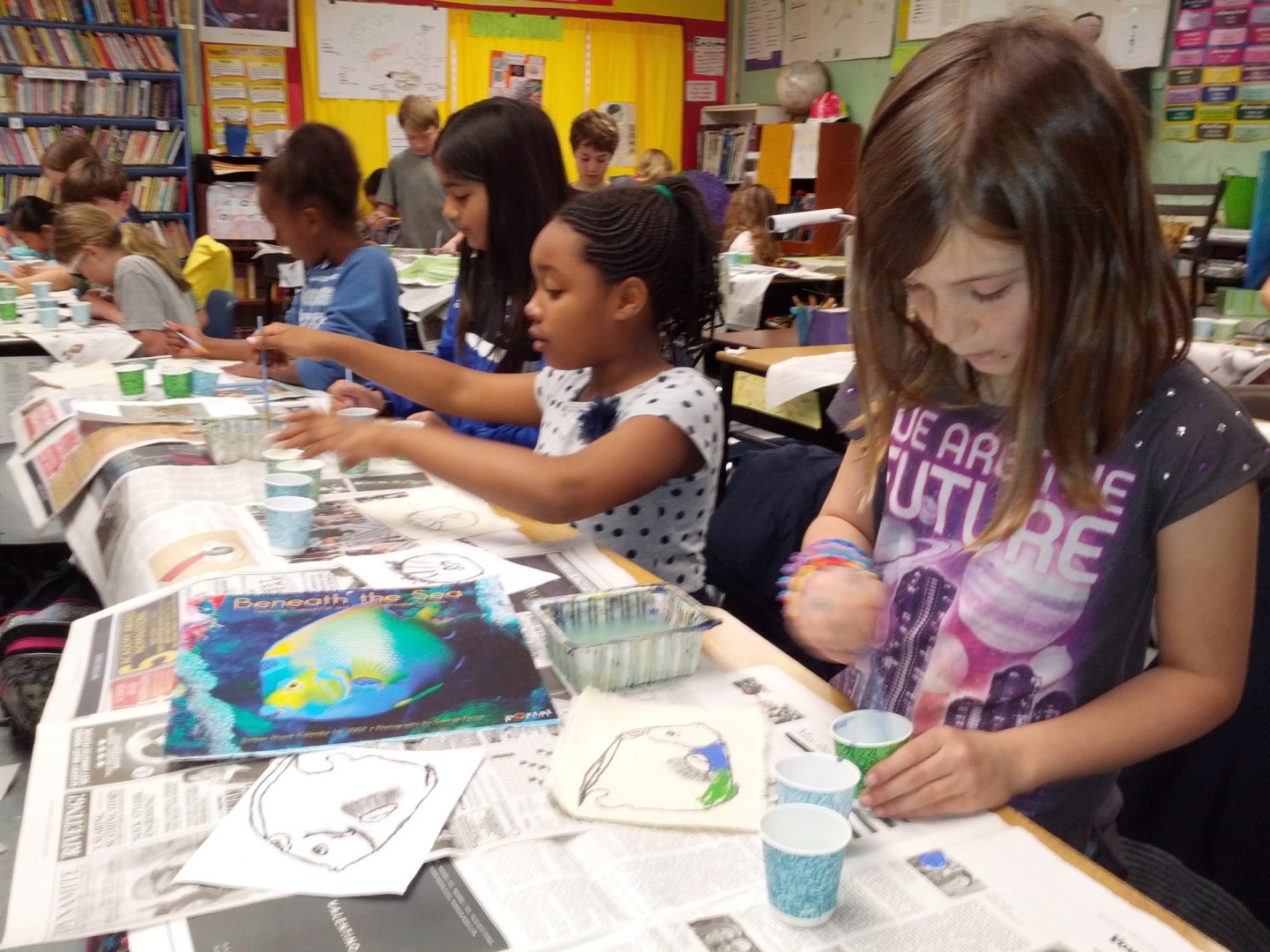
"caption": "Fourth-graders in Ana Thomas' class at Peralta Elementary paint marine animals on fabric for a quilt.",
"description": "Fourth-graders in Ana Thomas' class at Peralta Elementary paint marine animals on fabric for a quilt.",
"title": "RS14433_IMG_20150211_131711-qut",
"credit": "Zaidee Stavely/KQED",
"status": "inherit",
"isLoading": false,
"fetchFailed": false
},
"news_10368635": {
"type": "attachments",
"id": "news_10368635",
"meta": {
"index": "attachments_1716263798",
"site": "news",
"id": "10368635",
"found": true
},
"parent": 10368634,
"imgSizes": {
"twentyfourteen-full-width": {
"file": "https://ww2.kqed.org/app/uploads/sites/10/2014/12/RS13431_459912610-qut-1038x576.jpg",
"width": 1038,
"mimeType": "image/jpeg",
"height": 576
},
"thumbnail": {
"file": "https://ww2.kqed.org/app/uploads/sites/10/2014/12/RS13431_459912610-qut-400x266.jpg",
"width": 400,
"mimeType": "image/jpeg",
"height": 266
},
"post-thumbnail": {
"file": "https://ww2.kqed.org/app/uploads/sites/10/2014/12/RS13431_459912610-qut-672x372.jpg",
"width": 672,
"mimeType": "image/jpeg",
"height": 372
},
"kqedFullSize": {
"file": "https://ww2.kqed.org/app/uploads/sites/10/2014/12/RS13431_459912610-qut.jpg",
"width": 1440,
"height": 960
},
"guest-author-96": {
"file": "https://ww2.kqed.org/app/uploads/sites/10/2014/12/RS13431_459912610-qut-96x96.jpg",
"width": 96,
"mimeType": "image/jpeg",
"height": 96
},
"medium": {
"file": "https://ww2.kqed.org/app/uploads/sites/10/2014/12/RS13431_459912610-qut-800x533.jpg",
"width": 800,
"mimeType": "image/jpeg",
"height": 533
},
"guest-author-64": {
"file": "https://ww2.kqed.org/app/uploads/sites/10/2014/12/RS13431_459912610-qut-64x64.jpg",
"width": 64,
"mimeType": "image/jpeg",
"height": 64
},
"detail": {
"file": "https://ww2.kqed.org/app/uploads/sites/10/2014/12/RS13431_459912610-qut-75x75.jpg",
"width": 75,
"mimeType": "image/jpeg",
"height": 75
},
"guest-author-32": {
"file": "https://ww2.kqed.org/app/uploads/sites/10/2014/12/RS13431_459912610-qut-32x32.jpg",
"width": 32,
"mimeType": "image/jpeg",
"height": 32
},
"guest-author-128": {
"file": "https://ww2.kqed.org/app/uploads/sites/10/2014/12/RS13431_459912610-qut-128x128.jpg",
"width": 128,
"mimeType": "image/jpeg",
"height": 128
}
},
"publishDate": 1417810555,
"modified": 1425685016,
"caption": "Police officer and protester in downtown Oakland during early December demonstration against police violence. ",
"description": "OAKLAND, CA - DECEMBER 3: Protesters face off following a Staten Island, New York grand jury's decision not to indict a police officer in the chokehold death of Eric Garner on December 3, 2014 in Oakland, California. The grand jury declined to indict New York City Police Officer Daniel Pantaleo in Garner's death.",
"title": "Oakland-Police Protest",
"credit": "Elijah Nouvelage/Getty Images",
"status": "inherit",
"isLoading": false,
"fetchFailed": false
},
"news_10447287": {
"type": "attachments",
"id": "news_10447287",
"meta": {
"index": "attachments_1716263798",
"site": "news",
"id": "10447287",
"found": true
},
"parent": 10446962,
"imgSizes": {
"twentyfourteen-full-width": {
"file": "https://ww2.kqed.org/app/uploads/sites/10/2015/03/GettyImages_464660186-1038x576.jpg",
"width": 1038,
"mimeType": "image/jpeg",
"height": 576
},
"thumbnail": {
"file": "https://ww2.kqed.org/app/uploads/sites/10/2015/03/GettyImages_464660186-400x275.jpg",
"width": 400,
"mimeType": "image/jpeg",
"height": 275
},
"fd-sm": {
"file": "https://ww2.kqed.org/app/uploads/sites/10/2015/03/GettyImages_464660186-320x220.jpg",
"width": 320,
"mimeType": "image/jpeg",
"height": 220
},
"post-thumbnail": {
"file": "https://ww2.kqed.org/app/uploads/sites/10/2015/03/GettyImages_464660186-672x372.jpg",
"width": 672,
"mimeType": "image/jpeg",
"height": 372
},
"kqedFullSize": {
"file": "https://ww2.kqed.org/app/uploads/sites/10/2015/03/GettyImages_464660186.jpg",
"width": 3000,
"height": 2065
},
"large": {
"file": "https://ww2.kqed.org/app/uploads/sites/10/2015/03/GettyImages_464660186-1440x991.jpg",
"width": 1440,
"mimeType": "image/jpeg",
"height": 991
},
"guest-author-96": {
"file": "https://ww2.kqed.org/app/uploads/sites/10/2015/03/GettyImages_464660186-96x96.jpg",
"width": 96,
"mimeType": "image/jpeg",
"height": 96
},
"medium": {
"file": "https://ww2.kqed.org/app/uploads/sites/10/2015/03/GettyImages_464660186-800x551.jpg",
"width": 800,
"mimeType": "image/jpeg",
"height": 551
},
"guest-author-64": {
"file": "https://ww2.kqed.org/app/uploads/sites/10/2015/03/GettyImages_464660186-64x64.jpg",
"width": 64,
"mimeType": "image/jpeg",
"height": 64
},
"guest-author-32": {
"file": "https://ww2.kqed.org/app/uploads/sites/10/2015/03/GettyImages_464660186-32x32.jpg",
"width": 32,
"mimeType": "image/jpeg",
"height": 32
},
"fd-lrg": {
"file": "https://ww2.kqed.org/app/uploads/sites/10/2015/03/GettyImages_464660186-1180x812.jpg",
"width": 1180,
"mimeType": "image/jpeg",
"height": 812
},
"fd-med": {
"file": "https://ww2.kqed.org/app/uploads/sites/10/2015/03/GettyImages_464660186-768x529.jpg",
"width": 768,
"mimeType": "image/jpeg",
"height": 529
},
"detail": {
"file": "https://ww2.kqed.org/app/uploads/sites/10/2015/03/GettyImages_464660186-75x75.jpg",
"width": 75,
"mimeType": "image/jpeg",
"height": 75
},
"guest-author-128": {
"file": "https://ww2.kqed.org/app/uploads/sites/10/2015/03/GettyImages_464660186-128x128.jpg",
"width": 128,
"mimeType": "image/jpeg",
"height": 128
}
},
"publishDate": 1425334999,
"modified": 1425337544,
"caption": "A supporter of Oakland's minimum wage increase holds a sign during a celebration rally outside Oakland City Hall. ",
"description": "A supporter of Oakland's minimum wage increase holds a sign during a celebration rally outside Oakland City Hall. ",
"title": "Oakland Minimum Wage Increase To Take Affect Next Week",
"credit": "Justin Sullivan/Getty Images",
"status": "inherit",
"isLoading": false,
"fetchFailed": false
},
"news_10425420": {
"type": "attachments",
"id": "news_10425420",
"meta": {
"index": "attachments_1716263798",
"site": "news",
"id": "10425420",
"found": true
},
"parent": 10425380,
"imgSizes": {
"twentyfourteen-full-width": {
"file": "https://ww2.kqed.org/app/uploads/sites/10/2015/02/RS14168_IMG_2746-qut-1038x576.jpg",
"width": 1038,
"mimeType": "image/jpeg",
"height": 576
},
"thumbnail": {
"file": "https://ww2.kqed.org/app/uploads/sites/10/2015/02/RS14168_IMG_2746-qut-400x267.jpg",
"width": 400,
"mimeType": "image/jpeg",
"height": 267
},
"post-thumbnail": {
"file": "https://ww2.kqed.org/app/uploads/sites/10/2015/02/RS14168_IMG_2746-qut-672x372.jpg",
"width": 672,
"mimeType": "image/jpeg",
"height": 372
},
"kqedFullSize": {
"file": "https://ww2.kqed.org/app/uploads/sites/10/2015/02/RS14168_IMG_2746-qut.jpg",
"width": 1440,
"height": 960
},
"large": {
"file": "https://ww2.kqed.org/app/uploads/sites/10/2015/02/RS14168_IMG_2746-qut-1440x960.jpg",
"width": 1440,
"mimeType": "image/jpeg",
"height": 960
},
"guest-author-96": {
"file": "https://ww2.kqed.org/app/uploads/sites/10/2015/02/RS14168_IMG_2746-qut-96x96.jpg",
"width": 96,
"mimeType": "image/jpeg",
"height": 96
},
"medium": {
"file": "https://ww2.kqed.org/app/uploads/sites/10/2015/02/RS14168_IMG_2746-qut-800x533.jpg",
"width": 800,
"mimeType": "image/jpeg",
"height": 533
},
"guest-author-64": {
"file": "https://ww2.kqed.org/app/uploads/sites/10/2015/02/RS14168_IMG_2746-qut-64x64.jpg",
"width": 64,
"mimeType": "image/jpeg",
"height": 64
},
"detail": {
"file": "https://ww2.kqed.org/app/uploads/sites/10/2015/02/RS14168_IMG_2746-qut-75x75.jpg",
"width": 75,
"mimeType": "image/jpeg",
"height": 75
},
"guest-author-32": {
"file": "https://ww2.kqed.org/app/uploads/sites/10/2015/02/RS14168_IMG_2746-qut-32x32.jpg",
"width": 32,
"mimeType": "image/jpeg",
"height": 32
},
"guest-author-128": {
"file": "https://ww2.kqed.org/app/uploads/sites/10/2015/02/RS14168_IMG_2746-qut-128x128.jpg",
"width": 128,
"mimeType": "image/jpeg",
"height": 128
}
},
"publishDate": 1423184100,
"modified": 1423184139,
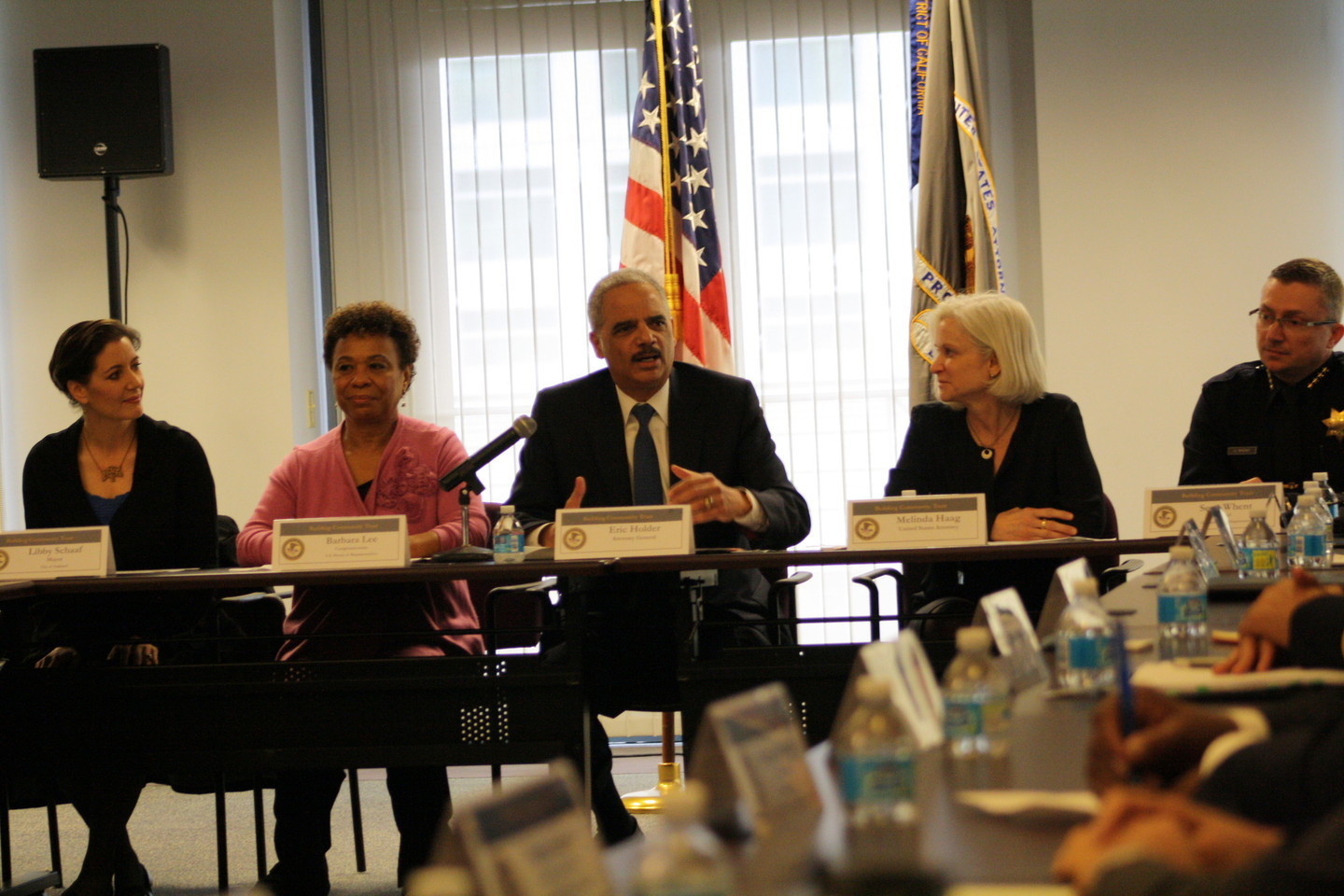
"caption": "Attorney General Eric Holder held a roundtable discussion in Oakland Feb. 5, 2015, on how to improve relations between police and the communities they serve. Oakland Mayor Libby Schaaf, East Bay Congresswoman Barbara Lee, U.S. Attorney Melinda Haag and Oakland Police Chief Sean Whent co-chaired the discussion that drew dozens of youth, faith, nonprofit and law enforcement leaders.",
"description": "Attorney General Eric Holder held a roundtable discussion in Oakland Feb. 5, 2015, on how to improve relations between police and the communities they serve. Oakland Mayor Libby Schaaf, East Bay Congresswoman Barbara Lee, U.S. Attorney Melinda Haag and Oakland Police Chief Sean Whent co-chaired the discussion that drew dozens of youth, faith, nonprofit and law enforcement leaders.",
"title": "RS14168_IMG_2746-qut",
"credit": "Alex Emslie/KQED",
"status": "inherit",
"isLoading": false,
"fetchFailed": false
},
"news_10412359": {
"type": "attachments",
"id": "news_10412359",
"meta": {
"index": "attachments_1716263798",
"site": "news",
"id": "10412359",
"found": true
},
"parent": 10412061,
"imgSizes": {
"twentyfourteen-full-width": {
"file": "https://ww2.kqed.org/app/uploads/sites/10/2015/01/bayfromspace-1023x576.jpg",
"width": 1023,
"mimeType": "image/jpeg",
"height": 576
},
"thumbnail": {
"file": "https://ww2.kqed.org/app/uploads/sites/10/2015/01/bayfromspace-400x266.jpg",
"width": 400,
"mimeType": "image/jpeg",
"height": 266
},
"post-thumbnail": {
"file": "https://ww2.kqed.org/app/uploads/sites/10/2015/01/bayfromspace-672x372.jpg",
"width": 672,
"mimeType": "image/jpeg",
"height": 372
},
"kqedFullSize": {
"file": "https://ww2.kqed.org/app/uploads/sites/10/2015/01/bayfromspace.jpg",
"width": 1023,
"height": 681
},
"guest-author-96": {
"file": "https://ww2.kqed.org/app/uploads/sites/10/2015/01/bayfromspace-96x96.jpg",
"width": 96,
"mimeType": "image/jpeg",
"height": 96
},
"medium": {
"file": "https://ww2.kqed.org/app/uploads/sites/10/2015/01/bayfromspace-800x532.jpg",
"width": 800,
"mimeType": "image/jpeg",
"height": 532
},
"guest-author-64": {
"file": "https://ww2.kqed.org/app/uploads/sites/10/2015/01/bayfromspace-64x64.jpg",
"width": 64,
"mimeType": "image/jpeg",
"height": 64
},
"detail": {
"file": "https://ww2.kqed.org/app/uploads/sites/10/2015/01/bayfromspace-75x75.jpg",
"width": 75,
"mimeType": "image/jpeg",
"height": 75
},
"guest-author-32": {
"file": "https://ww2.kqed.org/app/uploads/sites/10/2015/01/bayfromspace-32x32.jpg",
"width": 32,
"mimeType": "image/jpeg",
"height": 32
},
"guest-author-128": {
"file": "https://ww2.kqed.org/app/uploads/sites/10/2015/01/bayfromspace-128x128.jpg",
"width": 128,
"mimeType": "image/jpeg",
"height": 128
}
},
"publishDate": 1421859337,
"modified": 1423607759,
"caption": "An image of the San Francisco Bay Area taken this week by Samantha Cristoforetti, an Italian crew member aboard the International Space Station. ",
"description": "An image of the San Francisco Bay Area taken this week by Samantha Cristoforetti, an Italian crew member aboard the International Space Station. ",
"title": "San Francisco Bay",
"credit": "\u003ca href=\"https://twitter.com/AstroSamantha\" target=\"_blank\">Samantha Cristoforetti\u003c/a> via Twitter",
"status": "inherit",
"isLoading": false,
"fetchFailed": false
},
"news_10411639": {
"type": "attachments",
"id": "news_10411639",
"meta": {
"index": "attachments_1716263798",
"site": "news",
"id": "10411639",
"found": true
},
"parent": 0,
"imgSizes": {
"twentyfourteen-full-width": {
"file": "https://ww2.kqed.org/app/uploads/sites/10/2015/01/driverplaza-1038x576.jpg",
"width": 1038,
"mimeType": "image/jpeg",
"height": 576
},
"thumbnail": {
"file": "https://ww2.kqed.org/app/uploads/sites/10/2015/01/driverplaza-400x225.jpg",
"width": 400,
"mimeType": "image/jpeg",
"height": 225
},
"post-thumbnail": {
"file": "https://ww2.kqed.org/app/uploads/sites/10/2015/01/driverplaza-672x372.jpg",
"width": 672,
"mimeType": "image/jpeg",
"height": 372
},
"kqedFullSize": {
"file": "https://ww2.kqed.org/app/uploads/sites/10/2015/01/driverplaza.jpg",
"width": 1440,
"height": 811
},
"guest-author-96": {
"file": "https://ww2.kqed.org/app/uploads/sites/10/2015/01/driverplaza-96x96.jpg",
"width": 96,
"mimeType": "image/jpeg",
"height": 96
},
"medium": {
"file": "https://ww2.kqed.org/app/uploads/sites/10/2015/01/driverplaza-800x450.jpg",
"width": 800,
"mimeType": "image/jpeg",
"height": 450
},
"guest-author-64": {
"file": "https://ww2.kqed.org/app/uploads/sites/10/2015/01/driverplaza-64x64.jpg",
"width": 64,
"mimeType": "image/jpeg",
"height": 64
},
"detail": {
"file": "https://ww2.kqed.org/app/uploads/sites/10/2015/01/driverplaza-75x75.jpg",
"width": 75,
"mimeType": "image/jpeg",
"height": 75
},
"guest-author-32": {
"file": "https://ww2.kqed.org/app/uploads/sites/10/2015/01/driverplaza-32x32.jpg",
"width": 32,
"mimeType": "image/jpeg",
"height": 32
},
"guest-author-128": {
"file": "https://ww2.kqed.org/app/uploads/sites/10/2015/01/driverplaza-128x128.jpg",
"width": 128,
"mimeType": "image/jpeg",
"height": 128
}
},
"publishDate": 1421785641,
"modified": 1421786811,
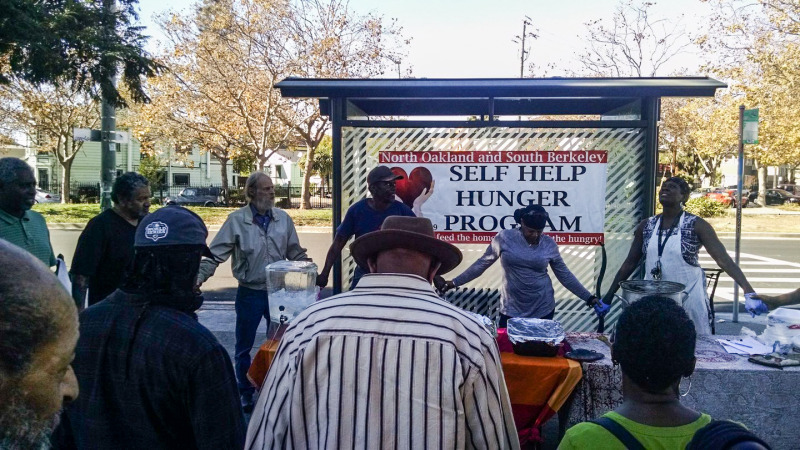
"caption": "Aunti Frances Moore, right, leads a prayer before a Tuesday meal at North Oakland's Driver Plaza.",
"description": "Aunti Frances Michelle Moore, right, leads a prayer before a Tuesday meal at North Oakland's Driver Plaza.",
"title": "driverplaza",
"credit": "Andrew Stelzer/KQED",
"status": "inherit",
"isLoading": false,
"fetchFailed": false
},
"arts_10304233": {
"type": "attachments",
"id": "arts_10304233",
"meta": {
"index": "attachments_1716263798",
"site": "arts",
"id": "10304233",
"found": true
},
"parent": 10304103,
"imgSizes": {
"twentyfourteen-full-width": {
"file": "https://ww2.kqed.org/app/uploads/sites/2/2015/01/Boomtown2white-1038x576.jpg",
"width": 1038,
"mimeType": "image/jpeg",
"height": 576
},
"thumbnail": {
"file": "https://ww2.kqed.org/app/uploads/sites/2/2015/01/Boomtown2white-400x225.jpg",
"width": 400,
"mimeType": "image/jpeg",
"height": 225
},
"post-thumbnail": {
"file": "https://ww2.kqed.org/app/uploads/sites/2/2015/01/Boomtown2white-672x372.jpg",
"width": 672,
"mimeType": "image/jpeg",
"height": 372
},
"kqedFullSize": {
"file": "https://ww2.kqed.org/app/uploads/sites/2/2015/01/Boomtown2white.jpg",
"width": 1400,
"height": 788
},
"large": {
"file": "https://ww2.kqed.org/app/uploads/sites/2/2015/01/Boomtown2white-1180x664.jpg",
"width": 1180,
"mimeType": "image/jpeg",
"height": 664
},
"guest-author-96": {
"file": "https://ww2.kqed.org/app/uploads/sites/2/2015/01/Boomtown2white-96x96.jpg",
"width": 96,
"mimeType": "image/jpeg",
"height": 96
},
"medium": {
"file": "https://ww2.kqed.org/app/uploads/sites/2/2015/01/Boomtown2white-800x450.jpg",
"width": 800,
"mimeType": "image/jpeg",
"height": 450
},
"guest-author-64": {
"file": "https://ww2.kqed.org/app/uploads/sites/2/2015/01/Boomtown2white-64x64.jpg",
"width": 64,
"mimeType": "image/jpeg",
"height": 64
},
"detail": {
"file": "https://ww2.kqed.org/app/uploads/sites/2/2015/01/Boomtown2white-75x75.jpg",
"width": 75,
"mimeType": "image/jpeg",
"height": 75
},
"guest-author-32": {
"file": "https://ww2.kqed.org/app/uploads/sites/2/2015/01/Boomtown2white-32x32.jpg",
"width": 32,
"mimeType": "image/jpeg",
"height": 32
},
"guest-author-128": {
"file": "https://ww2.kqed.org/app/uploads/sites/2/2015/01/Boomtown2white-128x128.jpg",
"width": 128,
"mimeType": "image/jpeg",
"height": 128
}
},
"publishDate": 1421307915,
"modified": 1421307927,
"caption": "Illustration by Carolyn Porras. \u003ca href=\"http://www.carolynporrasart.com\" target=\"_blank\">carolynporrasart.com\u003c/a>",
"description": null,
"title": "Boomtown2white",
"credit": null,
"status": "inherit",
"isLoading": false,
"fetchFailed": false
}
},
"audioPlayerReducer": {
"postId": "stream_live",
"isPaused": true,
"isPlaying": false,
"pfsActive": false,
"pledgeModalIsOpen": true,
"playerDrawerIsOpen": false,
"liveAudioPlayStartedAt": 0,
"liveAudioPlayContext": ""
},
"authorsReducer": {
"byline_news_10485627": {
"type": "authors",
"id": "byline_news_10485627",
"meta": {
"override": true
},
"slug": "byline_news_10485627",
"name": "Tara Siler ",
"isLoading": false
},
"byline_news_10446962": {
"type": "authors",
"id": "byline_news_10446962",
"meta": {
"override": true
},
"slug": "byline_news_10446962",
"name": "\u003cstrong>Tiffany Camhi\u003c/strong>",
"isLoading": false
},
"cmusiker": {
"type": "authors",
"id": "32",
"meta": {
"index": "authors_1716337520",
"id": "32",
"found": true
},
"name": "Cy Musiker",
"firstName": "Cy",
"lastName": "Musiker",
"slug": "cmusiker",
"email": "cmusiker@kqed.org",
"display_author_email": false,
"staff_mastheads": [],
"title": "KQED Contributor",
"bio": "Cy Musiker is a former co-host of The Do List and a former reporter covering the arts for KQED News and The California Report. He loves live performance, especially great theater, jazz, roots music, anything by Mahler. Cy has an MJ from UC Berkeley's School of Journalism, and got his BA from Hampshire College. His work has been recognized by the Society for Professional Journalists with their Sigma Delta Chi Award for Public Service in Journalism. When he can, Cy likes to swim in Tomales Bay, run with his dog in the East Bay Hills, and hike the Sierra.",
"avatar": "https://secure.gravatar.com/avatar/05eaba5c5696ce8f062e4ea2df428a43?s=600&d=blank&r=g",
"twitter": null,
"facebook": null,
"instagram": null,
"linkedin": null,
"sites": [
{
"site": "arts",
"roles": [
"Contributor",
"subscriber"
]
},
{
"site": "news",
"roles": [
"author"
]
},
{
"site": "bayareabites",
"roles": [
"contributor"
]
}
],
"headData": {
"title": "Cy Musiker | KQED",
"description": "KQED Contributor",
"ogImgSrc": "https://secure.gravatar.com/avatar/05eaba5c5696ce8f062e4ea2df428a43?s=600&d=blank&r=g",
"twImgSrc": "https://secure.gravatar.com/avatar/05eaba5c5696ce8f062e4ea2df428a43?s=600&d=blank&r=g"
},
"isLoading": false,
"link": "/author/cmusiker"
},
"shotchkiss": {
"type": "authors",
"id": "61",
"meta": {
"index": "authors_1716337520",
"id": "61",
"found": true
},
"name": "Sarah Hotchkiss",
"firstName": "Sarah",
"lastName": "Hotchkiss",
"slug": "shotchkiss",
"email": "shotchkiss@kqed.org",
"display_author_email": true,
"staff_mastheads": [
"arts"
],
"title": "Senior Editor",
"bio": "Sarah Hotchkiss is a San Francisco \u003ca href=\"http://www.sarahhotchkiss.com\">artist\u003c/a> and arts writer. In 2019, she received the Dorothea & Leo Rabkin Foundation grant for visual art journalism and in 2020 she received a Society of Professional Journalists, Northern California award for excellence in arts and culture reporting.",
"avatar": "https://secure.gravatar.com/avatar/bc662df144b3d27fd8b1b6f1c2a420d34e91e53154d411bb7ad353cc8b6cea8d?s=600&d=blank&r=g",
"twitter": null,
"bluesky": null,
"facebook": null,
"instagram": null,
"linkedin": null,
"sites": [
{
"site": "",
"roles": [
"editor"
]
},
{
"site": "arts",
"roles": [
"Contributor",
"administrator"
]
},
{
"site": "artschool",
"roles": [
"administrator"
]
},
{
"site": "news",
"roles": [
"editor"
]
},
{
"site": "pop",
"roles": [
"administrator"
]
},
{
"site": "bayareabites",
"roles": [
"editor"
]
},
{
"site": "spark",
"roles": [
"editor"
]
},
{
"site": "checkplease",
"roles": [
"editor"
]
}
],
"headData": {
"title": "Sarah Hotchkiss | KQED",
"description": "Senior Editor",
"ogImgSrc": "https://secure.gravatar.com/avatar/bc662df144b3d27fd8b1b6f1c2a420d34e91e53154d411bb7ad353cc8b6cea8d?s=600&d=blank&r=g",
"twImgSrc": "https://secure.gravatar.com/avatar/bc662df144b3d27fd8b1b6f1c2a420d34e91e53154d411bb7ad353cc8b6cea8d?s=600&d=blank&r=g"
},
"isLoading": false,
"link": "/author/shotchkiss"
},
"cstone": {
"type": "authors",
"id": "90",
"meta": {
"index": "authors_1716337520",
"id": "90",
"found": true
},
"name": "Cynthia Stone",
"firstName": "Cynthia",
"lastName": "Stone",
"slug": "cstone",
"email": "cynthiamstone@hotmail.com",
"display_author_email": false,
"staff_mastheads": [],
"title": null,
"bio": "Cynthia Stone is an Emmy Award winning writer and producer dedicated to telling the stories of people and programs making a difference. Her television and radio documentary and feature work has focused on a variety of issues including education, the environment, trafficking, transformative programs that help children at risk, science and the arts. In addition to here at KQED, her work has appeared on Discovery, PBS, CNBC, Public Radio International/BBC among others.",
"avatar": "https://secure.gravatar.com/avatar/c0481a3d0e38bbaf8851acf123a78f38?s=600&d=blank&r=g",
"twitter": null,
"facebook": null,
"instagram": null,
"linkedin": null,
"sites": [
{
"site": "arts",
"roles": [
"Contributor",
"contributor"
]
}
],
"headData": {
"title": "Cynthia Stone | KQED",
"description": null,
"ogImgSrc": "https://secure.gravatar.com/avatar/c0481a3d0e38bbaf8851acf123a78f38?s=600&d=blank&r=g",
"twImgSrc": "https://secure.gravatar.com/avatar/c0481a3d0e38bbaf8851acf123a78f38?s=600&d=blank&r=g"
},
"isLoading": false,
"link": "/author/cstone"
},
"jmatazzoni": {
"type": "authors",
"id": "95",
"meta": {
"index": "authors_1716337520",
"id": "95",
"found": true
},
"name": "Joe Matazzoni",
"firstName": "Joe",
"lastName": "Matazzoni",
"slug": "jmatazzoni",
"email": "jmatazzoni@KQED.org",
"display_author_email": false,
"staff_mastheads": [],
"title": null,
"bio": null,
"avatar": "https://secure.gravatar.com/avatar/612b57343775c9005e47f117262c3e94?s=600&d=blank&r=g",
"twitter": null,
"facebook": null,
"instagram": null,
"linkedin": null,
"sites": [
{
"site": "arts",
"roles": [
"subscriber"
]
}
],
"headData": {
"title": "Joe Matazzoni | KQED",
"description": null,
"ogImgSrc": "https://secure.gravatar.com/avatar/612b57343775c9005e47f117262c3e94?s=600&d=blank&r=g",
"twImgSrc": "https://secure.gravatar.com/avatar/612b57343775c9005e47f117262c3e94?s=600&d=blank&r=g"
},
"isLoading": false,
"link": "/author/jmatazzoni"
},
"aeghan": {
"type": "authors",
"id": "195",
"meta": {
"index": "authors_1716337520",
"id": "195",
"found": true
},
"name": "Adizah Eghan",
"firstName": "Adizah",
"lastName": "Eghan",
"slug": "aeghan",
"email": "adizah.e@gmail.com",
"display_author_email": false,
"staff_mastheads": [],
"title": "KQED Contributor",
"bio": "Adizah Eghan is a former reporter at KQED News and writer for KQED Arts. She caught the radio bug as an intern for PRI's The World and landed in KQED's newsroom after a stint teaching English in India. She covers culture, the arts, and global music in the Bay Area. This is where she tweets: \u003ca class=\"ProfileHeaderCard-screennameLink u-linkComplex js-nav\" style=\"color: #8899a6;\" href=\"https://twitter.com/Adizah_E\">@\u003cspan class=\"u-linkComplex-target\">Adizah_E\u003c/span>\u003c/a>",
"avatar": "https://secure.gravatar.com/avatar/d6e30ed9ca504243b4d8ee5d7ca32324?s=600&d=blank&r=g",
"twitter": "Adizah_E",
"facebook": null,
"instagram": null,
"linkedin": null,
"sites": [
{
"site": "arts",
"roles": [
"contributor"
]
},
{
"site": "news",
"roles": [
"subscriber"
]
},
{
"site": "stateofhealth",
"roles": [
"author"
]
}
],
"headData": {
"title": "Adizah Eghan | KQED",
"description": "KQED Contributor",
"ogImgSrc": "https://secure.gravatar.com/avatar/d6e30ed9ca504243b4d8ee5d7ca32324?s=600&d=blank&r=g",
"twImgSrc": "https://secure.gravatar.com/avatar/d6e30ed9ca504243b4d8ee5d7ca32324?s=600&d=blank&r=g"
},
"isLoading": false,
"link": "/author/aeghan"
},
"andrewstelzer": {
"type": "authors",
"id": "213",
"meta": {
"index": "authors_1716337520",
"id": "213",
"found": true
},
"name": "Andrew Stelzer",
"firstName": "Andrew",
"lastName": "Stelzer",
"slug": "andrewstelzer",
"email": "andrewstelzer@gmail.com",
"display_author_email": false,
"staff_mastheads": [],
"title": null,
"bio": "Andrew Stelzer has been reporting for KQED since 2010, and is a producer at \u003ca href=\"http://www.radioproject.org\" target=\"_blank\">Making Contact\u003c/a> in Oakland.. His work has been featured on programs including \u003ca href=\"http://www.npr.org/templates/story/story.php?storyId=5010\" target=\"_blank\">NPR’s Weekend Edition\u003c/a>, \u003ca href=\"http://www.theworld.org/\" target=\"_blank\">PRI’s The World\u003c/a>, \u003ca href=\"http://www.studio360.org/\" target=\"_blank\">Studio 360\u003c/a>, \u003ca href=\"http://marketplace.publicradio.org/\" target=\"_blank\">Marketplace\u003c/a>,\u003ca href=\"http://www.loe.org/\" target=\"_blank\">Living on Earth\u003c/a>, \u003ca href=\"http://www.onthemedia.org/\" target=\"_blank\">On the Media\u003c/a>, \u003ca href=\"http://www.latinousa.org/index.html\" target=\"_blank\">Latino USA,\u003c/a> \u003ca href=\"http://www.onlyagame.org/\" rel=\"tag\">Only a Game,\u003c/a> \u003ca href=\"http://www.tswi.org/\" target=\"_blank\">Radio Netherlands,\u003c/a> \u003ca href=\"http://worldradio.ch/index.shtml\" target=\"_blank\">World Radio Switzerland,\u003c/a> and \u003ca href=\"http://www.rfi.fr/langues/statiques/rfi_anglais.asp\" target=\"_blank\">Radio France International\u003c/a>. Andrew has written for publications including \u003ca href=\"http://www.inthesetimes.com/site/about/author/2369\" target=\"_blank\">In These Times\u003c/a>, \u003ca href=\"http://www.progressive.org/\" target=\"_blank\">The Progressive\u003c/a>, \u003ca href=\"http://ipsnews.net/\" target=\"_blank\">Interpress Service\u003c/a>, \u003ca href=\"http://www.tampabay.com/\" target=\"_blank\">The St. Petersburg Times\u003c/a>, and \u003ca href=\"http://www.eastbayexpress.com/ebx/Home\" target=\"_blank\">The East Bay Express\u003c/a>.\r\n\r\nAndrew’s work has received numerous awards from the Society of Professional Journalists, the National Lesbian and Gay Journalists Association, and the National Council on Crime and Delinquency.\r\n\r\nHe previously was a reporter at \u003ca href=\"http://www.wmnf.org/\" target=\"_blank\">WMNF\u003c/a> radio in Tampa, FL, and reporter and youth advocate st \u003ca href=\"http://www.kboo.org/\" target=\"_blank\">KBOO \u003c/a> in Portland, Oregon. Andrew has conducted radio production trainings around the world, from Algeria, to New Orleans, to the desert of Southern Jordan.",
"avatar": "https://secure.gravatar.com/avatar/14c7e75469395cb2468d45c9f6896ca9?s=600&d=blank&r=g",
"twitter": null,
"facebook": null,
"instagram": null,
"linkedin": null,
"sites": [
{
"site": "arts",
"roles": [
"contributor"
]
},
{
"site": "news",
"roles": [
"author"
]
},
{
"site": "stateofhealth",
"roles": [
"author"
]
}
],
"headData": {
"title": "Andrew Stelzer | KQED",
"description": null,
"ogImgSrc": "https://secure.gravatar.com/avatar/14c7e75469395cb2468d45c9f6896ca9?s=600&d=blank&r=g",
"twImgSrc": "https://secure.gravatar.com/avatar/14c7e75469395cb2468d45c9f6896ca9?s=600&d=blank&r=g"
},
"isLoading": false,
"link": "/author/andrewstelzer"
},
"danbrekke": {
"type": "authors",
"id": "222",
"meta": {
"index": "authors_1716337520",
"id": "222",
"found": true
},
"name": "Dan Brekke",
"firstName": "Dan",
"lastName": "Brekke",
"slug": "danbrekke",
"email": "dbrekke@kqed.org",
"display_author_email": true,
"staff_mastheads": [
"news",
"science"
],
"title": "KQED Editor and Reporter",
"bio": "Dan Brekke is a reporter and editor for KQED News, responsible for coverage of topics ranging from California water issues to the Bay Area's transportation challenges. In a newsroom career that began in Chicago in 1972, Dan has worked for \u003cem>The San Francisco Examiner,\u003c/em> Wired and TechTV and has been published in The New York Times, The New York Times Magazine, Business 2.0, Salon and elsewhere.\r\n\r\nSince joining KQED in 2007, Dan has reported, edited and produced both radio and online features and breaking news pieces. He has shared as both editor and reporter in four Society of Professional Journalists Norcal Excellence in Journalism awards and one Edward R. Murrow regional award. He was chosen for a spring 2017 residency at the Mesa Refuge to advance his research on California salmon.\r\n\r\nEmail Dan at: \u003ca href=\"mailto:dbrekke@kqed.org\">dbrekke@kqed.org\u003c/a>\r\n\r\n\u003cstrong>Twitter:\u003c/strong> \u003ca href=\"https://twitter.com/danbrekke\" rel=\"noopener noreferrer\">twitter.com/danbrekke\u003c/a>\r\n\u003cstrong>Facebook:\u003c/strong> \u003ca href=\"https://www.facebook.com/danbrekke\" rel=\"noopener noreferrer\">www.facebook.com/danbrekke\u003c/a>\r\n\u003cstrong>LinkedIn:\u003c/strong> \u003ca href=\"https://www.linkedin.com/in/danbrekke\" rel=\"noopener noreferrer\">www.linkedin.com/in/danbrekke\u003c/a>",
"avatar": "https://secure.gravatar.com/avatar/c8126230345efca3f7aa89b1a402be45?s=600&d=mm&r=g",
"twitter": "danbrekke",
"facebook": null,
"instagram": "https://www.instagram.com/dan.brekke/",
"linkedin": "https://www.linkedin.com/in/danbrekke/",
"sites": [
{
"site": "news",
"roles": [
"administrator",
"create_posts"
]
},
{
"site": "stateofhealth",
"roles": [
"editor"
]
},
{
"site": "science",
"roles": [
"editor"
]
},
{
"site": "quest",
"roles": [
"contributor"
]
},
{
"site": "food",
"roles": [
"contributor"
]
},
{
"site": "forum",
"roles": [
"contributor"
]
},
{
"site": "liveblog",
"roles": [
"editor"
]
}
],
"headData": {
"title": "Dan Brekke | KQED",
"description": "KQED Editor and Reporter",
"ogImgSrc": "https://secure.gravatar.com/avatar/c8126230345efca3f7aa89b1a402be45?s=600&d=mm&r=g",
"twImgSrc": "https://secure.gravatar.com/avatar/c8126230345efca3f7aa89b1a402be45?s=600&d=mm&r=g"
},
"isLoading": false,
"link": "/author/danbrekke"
},
"tgoldberg": {
"type": "authors",
"id": "258",
"meta": {
"index": "authors_1716337520",
"id": "258",
"found": true
},
"name": "Ted Goldberg",
"firstName": "Ted",
"lastName": "Goldberg",
"slug": "tgoldberg",
"email": "tgoldberg@kqed.org",
"display_author_email": true,
"staff_mastheads": [
"news"
],
"title": "KQED Managing Editor, News and Newscasts",
"bio": "Ted Goldberg is Managing Editor of News and Newscasts at KQED. His main reporting beat is the Bay Area's oil refining industry.\r\n\r\nPrior to joining KQED in 2014, Ted worked at CBS News and WCBS AM in New York and Bay City News and KCBS Radio in San Francisco. He graduated from Oberlin College in Ohio in 1998.",
"avatar": "https://secure.gravatar.com/avatar/30ce2e4fe89135e104f89be2394d16225b9d36c121b5b3cb7651ce642978b96f?s=600&d=blank&r=g",
"twitter": "TedrickG",
"bluesky": null,
"facebook": null,
"instagram": null,
"linkedin": null,
"sites": [
{
"site": "news",
"roles": [
"editor"
]
},
{
"site": "science",
"roles": [
"editor"
]
}
],
"headData": {
"title": "Ted Goldberg | KQED",
"description": "KQED Managing Editor, News and Newscasts",
"ogImgSrc": "https://secure.gravatar.com/avatar/30ce2e4fe89135e104f89be2394d16225b9d36c121b5b3cb7651ce642978b96f?s=600&d=blank&r=g",
"twImgSrc": "https://secure.gravatar.com/avatar/30ce2e4fe89135e104f89be2394d16225b9d36c121b5b3cb7651ce642978b96f?s=600&d=blank&r=g"
},
"isLoading": false,
"link": "/author/tgoldberg"
},
"aemslie": {
"type": "authors",
"id": "3206",
"meta": {
"index": "authors_1716337520",
"id": "3206",
"found": true
},
"name": "Alex Emslie",
"firstName": "Alex",
"lastName": "Emslie",
"slug": "aemslie",
"email": "aemslie@kqed.org",
"display_author_email": true,
"staff_mastheads": [
"news"
],
"title": "KQED Senior Editor",
"bio": "Alex Emslie is senior editor of talent and development at KQED, where he manages dozens of early career journalists and oversees news department internships.\r\n\r\nHe is a former carpenter and proud graduate of City College of San Francisco and San Francisco State University, where he studied journalism and criminal justice before joining KQED in 2013.\r\n\r\nAlex produced investigative journalism focused on \u003ca href=\"https://www.kqed.org/news/11667594/the-trials-of-marvin-mutch-video\">criminal justice\u003c/a> and policing for most of a decade. He has broken major stories about \u003ca href=\"https://www.kqed.org/news/135682/amid-a-series-of-vallejo-police-shootings-one-officers-name-stands-out\">police use of deadly force\u003c/a>, \u003ca href=\"https://www.kqed.org/news/10454955/racist-texts-prompt-sfpd-internal-investigation\">officer misconduct\u003c/a> and \u003ca href=\"https://www.kqed.org/news/11712239/terrorist-or-troll-judge-to-weigh-whether-oakland-man-really-intended-to-attack-bay-area\">other\u003c/a> \u003ca href=\"https://www.kqed.org/news/11221414/hayward-paid-159000-to-husband-of-retired-police-chief-documents-show\">high\u003c/a>-\u003ca href=\"https://www.kqed.org/news/10622762/the-forgotten-tracking-two-homicides-in-san-francisco-public-housing\">profile\u003c/a> \u003ca href=\"https://www.kqed.org/news/11624516/federal-agency-promoted-ranger-just-months-after-his-gun-was-stolen-and-used-in-steinle-killing\">cases\u003c/a>. He co-founded the \u003ca href=\"https://projects.scpr.org/california-reporting-project/\">California Reporting Project\u003c/a> in 2019 to obtain and report on previously confidential police internal investigations. The effort produced well over 100 original stories and changed the course of multiple criminal cases.\r\n\r\nHis work has been recognized with numerous journalism awards, including a national Edward R. Murrow award for several years of \u003ca href=\"https://www.kqed.org/news/11688481/sfpd-officers-in-mario-woods-case-recount-shooting-in-newly-filed-depositions\">reporting\u003c/a> on the San Francisco Police shooting of Mario Woods. His \u003ca href=\"https://www.kqed.org/news/147854/half-of-those-killed-by-san-francisco-police-are-mentally-ill\">reporting\u003c/a> on police killings of people in psychiatric crisis was cited in amicus briefs before the U.S. Supreme Court.\r\n\r\nAlex now enjoys mentoring the next generation of journalists at KQED.",
"avatar": "https://secure.gravatar.com/avatar/e691e65209f20e9da202bd730ead5663?s=600&d=blank&r=g",
"twitter": "SFNewsReporter",
"facebook": null,
"instagram": null,
"linkedin": null,
"sites": [
{
"site": "arts",
"roles": [
"editor"
]
},
{
"site": "news",
"roles": [
"editor"
]
},
{
"site": "mindshift",
"roles": [
"editor"
]
},
{
"site": "stateofhealth",
"roles": [
"editor"
]
},
{
"site": "science",
"roles": [
"administrator"
]
}
],
"headData": {
"title": "Alex Emslie | KQED",
"description": "KQED Senior Editor",
"ogImgSrc": "https://secure.gravatar.com/avatar/e691e65209f20e9da202bd730ead5663?s=600&d=blank&r=g",
"twImgSrc": "https://secure.gravatar.com/avatar/e691e65209f20e9da202bd730ead5663?s=600&d=blank&r=g"
},
"isLoading": false,
"link": "/author/aemslie"
},
"zstavely": {
"type": "authors",
"id": "3225",
"meta": {
"index": "authors_1716337520",
"id": "3225",
"found": true
},
"name": "Zaidee Stavely",
"firstName": "Zaidee",
"lastName": "Stavely",
"slug": "zstavely",
"email": "zstavely@gmail.com",
"display_author_email": false,
"staff_mastheads": [],
"title": "KQED Contributor",
"bio": "Zaidee Stavely is an award-winning reporter who writes about race, equity, immigration, and education.",
"avatar": "https://secure.gravatar.com/avatar/5154b3ee56a721c916ca429372ae629c?s=600&d=blank&r=g",
"twitter": null,
"facebook": null,
"instagram": null,
"linkedin": null,
"sites": [
{
"site": "news",
"roles": [
"subscriber"
]
},
{
"site": "mindshift",
"roles": [
"contributor"
]
}
],
"headData": {
"title": "Zaidee Stavely | KQED",
"description": "KQED Contributor",
"ogImgSrc": "https://secure.gravatar.com/avatar/5154b3ee56a721c916ca429372ae629c?s=600&d=blank&r=g",
"twImgSrc": "https://secure.gravatar.com/avatar/5154b3ee56a721c916ca429372ae629c?s=600&d=blank&r=g"
},
"isLoading": false,
"link": "/author/zstavely"
}
},
"pagesReducer": {
"news_tag_oakland": {
"type": "terms",
"id": "news_34054",
"meta": {
"index": "terms_1716263798",
"site": "news",
"id": "34054",
"score": 6.883923
},
"featImg": null,
"name": "oakland",
"description": null,
"taxonomy": "tag",
"headData": {
"twImgId": null,
"twTitle": null,
"ogTitle": null,
"ogImgId": null,
"twDescription": null,
"description": null,
"title": "oakland Archives | KQED News",
"ogDescription": null
},
"ttid": 34071,
"slug": "oakland",
"isLoading": false,
"title": "oakland",
"pageMeta": {
"site": "news",
"WpPageTemplate": "page-topic-editorial",
"currentPage": 64
},
"blocks": [
{
"blockName": "kqed/post-list",
"attrs": {
"layout": "cardArticle2",
"query": "posts/news?tag=oakland",
"seeMore": false,
"paginated": true,
"page": 64
}
},
{
"blockName": "kqed/ad"
}
]
}
},
"pfsSessionReducer": {},
"postsReducer": {
"stream_live": {
"type": "live",
"id": "stream_live",
"audioUrl": "https://streams.kqed.org/kqedradio",
"title": "Live Stream",
"excerpt": "Live Stream information currently unavailable.",
"link": "/radio",
"featImg": "",
"label": {
"name": "KQED Live",
"link": "/"
}
},
"stream_kqedNewscast": {
"type": "posts",
"id": "stream_kqedNewscast",
"audioUrl": "https://www.kqed.org/.stream/anon/radio/RDnews/newscast.mp3?_=1",
"title": "KQED Newscast",
"featImg": "",
"label": {
"name": "88.5 FM",
"link": "/"
}
},
"arts_10577919": {
"type": "posts",
"id": "arts_10577919",
"meta": {
"index": "posts_1716263798",
"site": "arts",
"id": "10577919",
"score": null,
"sort": [
1429711259000
]
},
"guestAuthors": [],
"slug": "reframed-artists-seeking-social-change-bring-the-public-into-the-picture",
"title": "Reframed: Artists Seeking Social Change Bring the Public into the Picture",
"publishDate": 1429711259,
"format": "video",
"headTitle": "Reframed: Artists Seeking Social Change Bring the Public into the Picture | KQED",
"labelTerm": {
"site": "arts"
},
"content": "\u003cp>There’s an art of conversation, to be sure, but can conversations themselves \u003cem>be\u003c/em> art? They can, when the artists involved are engaging in what’s known as social practice.\u003c/p>\n\u003cp>Social practice projects might look like just about anything — journalism, community organizing, even a shop. The goal is to create social change by staging actions that engage people and make them think – and talk. “For me,” says social-practice artist and professor Stephanie Syjuco, “the best social practice projects actually try to attract people to join a conversation.”\u003c/p>\n\u003cp>Two artists, Chris Treggiari and Chris Johnson, recently went into the streets of Oakland to record conversations and make art (see their projects in the \u003ca href=\"https://youtu.be/ocCsQpnjNrw\" target=\"_blank\" rel=\"noopener\">video on this page\u003c/a>). Treggiari and partner Peter Foucault, working with the Center for Investigative Reporting, built an interactive “news” van that they used to collect stories of people they met. “We really want to get a feel for what a community is going through,” Treggiari says, “what is changing and how is it changing and what’s [their] opinion on it.”\u003c/p>\n\u003cp>Chris Johnson’s project, “The Best Way to Find a Hero,” focuses on acts of everyday heroism – or, as Johnson puts it, “people who are surviving and thriving and raising families against adversity.” For the work, he made a map of Oakland that includes the parts of the city that are “defined as troubled neighborhoods by developers.” Johnson threw darts at the map and then went to those addresses, video camera in hand, to document the heroic stories of the people he encountered.\u003c/p>\n\u003cp>Today’s social practice projects have art historical roots in participatory works from earlier eras. In \u003cem>\u003ca href=\"http://www.jonrubin.net/museum-visitor-wallet-photos/\">Pictures Collected from Museum Visitors Wallets\u003c/a>\u003c/em>, Harrell Fletcher and Jon Rubin interviewed SFMOMA museum visitors about the photographs they happened to carry with them. Ten were enlarged and became part of the museum’s permanent collection. \u003cem>\u003ca href=\"http://www.learningtoloveyoumore.com/\">Learning to Love You More,\u003c/a>\u003c/em> by Harrell Fletcher and Miranda July, was an early, pre-social-media website where participants completed assignments — such as “Draw a scene from a movie that made you cry” — and viewed each other’s’ submissions. In her commission \u003cem>\u003ca href=\"http://www.sfmoma.org/exhib_events/events/series/1337\">Shadowshop,\u003c/a>\u003c/em> Stephanie Syjuco turned an SFMOMA gallery into a store in which local artists and museum visitors were invited to explore themes of capitalism, commodity and counterfeit.\u003c/p>\n\u003cp>[ad fullwidth]\u003c/p>\n\u003cp>Syjuco understands that this type of art can be difficult for people to comprehend at first. “If it’s in a museum or a gallery, people seem to understand, ‘Well, that’s where art belongs.’ But when it goes out into the world and is sometimes indistinguishable from other things that happen, I think that can be really beautiful.”\u003c/p>\n\u003cp>“The challenge,” says Johnson, “is how do you get people to care about social issues?” For these artists, finding the answer often starts with asking the right questions.\u003c/p>\n\u003cp>\u003c/p>\n\u003cp>\u003cem> Chris Treggiari and Chris Johnson’s projects can both be seen in the exhibit\u003c/em> \u003ca href=\"http://www.museumca.org/exhibit/who-is-oakland\">Who Is Oakland\u003c/a>, \u003cem>at the Oakland Museum of California,\u003c/em> \u003cem>April 11–July 12, 2015. Learn more about participatory and social practice works at \u003ca href=\"http://www.sfmoma.org/exhib_events/exhibitions/306\">SFMOMA.com\u003c/a>.\u003c/em>\u003c/p>\n\n",
"blocks": [],
"excerpt": "Social-practice art can look like just about anything: journalism, community organizing, even a shop. The goal is to engage the audience and help people think about social issues in new ways. ",
"status": "publish",
"parent": 0,
"modified": 1726700334,
"stats": {
"hasAudio": false,
"hasVideo": false,
"hasChartOrMap": false,
"iframeSrcs": [],
"hasGoogleForm": false,
"hasGallery": false,
"hasHearkenModule": false,
"hasPolis": false,
"paragraphCount": 9,
"wordCount": 566
},
"headData": {
"title": "Reframed: Artists Seeking Social Change Bring the Public into the Picture | KQED",
"description": "Social-practice art can look like just about anything: journalism, community organizing, even a shop. The goal is to engage the audience and help people think about social issues in new ways. ",
"ogTitle": "",
"ogDescription": "",
"ogImgId": "",
"twTitle": "",
"twDescription": "",
"twImgId": "",
"schema": {
"@context": "https://schema.org",
"@type": "Article",
"headline": "Reframed: Artists Seeking Social Change Bring the Public into the Picture",
"datePublished": "2015-04-22T07:00:59-07:00",
"dateModified": "2024-09-18T15:58:54-07:00",
"image": "https://cdn.kqed.org/wp-content/uploads/2020/02/KQED-OG-Image@1x.png"
}
},
"videoEmbed": "https://youtu.be/ocCsQpnjNrw",
"sticky": false,
"nprStoryId": "463483281",
"path": "/arts/10577919/reframed-artists-seeking-social-change-bring-the-public-into-the-picture",
"audioTrackLength": null,
"parsedContent": [
{
"type": "contentString",
"content": "\u003cdiv class=\"post-body\">\u003cp>\u003cp>There’s an art of conversation, to be sure, but can conversations themselves \u003cem>be\u003c/em> art? They can, when the artists involved are engaging in what’s known as social practice.\u003c/p>\n\u003cp>Social practice projects might look like just about anything — journalism, community organizing, even a shop. The goal is to create social change by staging actions that engage people and make them think – and talk. “For me,” says social-practice artist and professor Stephanie Syjuco, “the best social practice projects actually try to attract people to join a conversation.”\u003c/p>\n\u003cp>Two artists, Chris Treggiari and Chris Johnson, recently went into the streets of Oakland to record conversations and make art (see their projects in the \u003ca href=\"https://youtu.be/ocCsQpnjNrw\" target=\"_blank\" rel=\"noopener\">video on this page\u003c/a>). Treggiari and partner Peter Foucault, working with the Center for Investigative Reporting, built an interactive “news” van that they used to collect stories of people they met. “We really want to get a feel for what a community is going through,” Treggiari says, “what is changing and how is it changing and what’s [their] opinion on it.”\u003c/p>\n\u003cp>Chris Johnson’s project, “The Best Way to Find a Hero,” focuses on acts of everyday heroism – or, as Johnson puts it, “people who are surviving and thriving and raising families against adversity.” For the work, he made a map of Oakland that includes the parts of the city that are “defined as troubled neighborhoods by developers.” Johnson threw darts at the map and then went to those addresses, video camera in hand, to document the heroic stories of the people he encountered.\u003c/p>\n\u003cp>Today’s social practice projects have art historical roots in participatory works from earlier eras. In \u003cem>\u003ca href=\"http://www.jonrubin.net/museum-visitor-wallet-photos/\">Pictures Collected from Museum Visitors Wallets\u003c/a>\u003c/em>, Harrell Fletcher and Jon Rubin interviewed SFMOMA museum visitors about the photographs they happened to carry with them. Ten were enlarged and became part of the museum’s permanent collection. \u003cem>\u003ca href=\"http://www.learningtoloveyoumore.com/\">Learning to Love You More,\u003c/a>\u003c/em> by Harrell Fletcher and Miranda July, was an early, pre-social-media website where participants completed assignments — such as “Draw a scene from a movie that made you cry” — and viewed each other’s’ submissions. In her commission \u003cem>\u003ca href=\"http://www.sfmoma.org/exhib_events/events/series/1337\">Shadowshop,\u003c/a>\u003c/em> Stephanie Syjuco turned an SFMOMA gallery into a store in which local artists and museum visitors were invited to explore themes of capitalism, commodity and counterfeit.\u003c/p>\n\u003cp>\u003c/p>\u003c/div>",
"attributes": {
"named": {},
"numeric": []
}
},
{
"type": "component",
"content": "",
"name": "ad",
"attributes": {
"named": {
"label": "fullwidth"
},
"numeric": [
"fullwidth"
]
}
},
{
"type": "contentString",
"content": "\u003cdiv class=\"post-body\">\u003cp>\u003c/p>\n\u003cp>Syjuco understands that this type of art can be difficult for people to comprehend at first. “If it’s in a museum or a gallery, people seem to understand, ‘Well, that’s where art belongs.’ But when it goes out into the world and is sometimes indistinguishable from other things that happen, I think that can be really beautiful.”\u003c/p>\n\u003cp>“The challenge,” says Johnson, “is how do you get people to care about social issues?” For these artists, finding the answer often starts with asking the right questions.\u003c/p>\n\u003cp>\u003c/p>\n\u003cp>\u003cem> Chris Treggiari and Chris Johnson’s projects can both be seen in the exhibit\u003c/em> \u003ca href=\"http://www.museumca.org/exhibit/who-is-oakland\">Who Is Oakland\u003c/a>, \u003cem>at the Oakland Museum of California,\u003c/em> \u003cem>April 11–July 12, 2015. Learn more about participatory and social practice works at \u003ca href=\"http://www.sfmoma.org/exhib_events/exhibitions/306\">SFMOMA.com\u003c/a>.\u003c/em>\u003c/p>\n\n\u003c/div>\u003c/p>",
"attributes": {
"named": {},
"numeric": []
}
}
],
"link": "/arts/10577919/reframed-artists-seeking-social-change-bring-the-public-into-the-picture",
"authors": [
"90",
"95"
],
"categories": [
"arts_235",
"arts_70"
],
"tags": [
"arts_596"
],
"featImg": "arts_10577920",
"label": "arts"
},
"news_10492895": {
"type": "posts",
"id": "news_10492895",
"meta": {
"index": "posts_1716263798",
"site": "news",
"id": "10492895",
"score": null,
"sort": [
1429292956000
]
},
"parent": 0,
"labelTerm": {
"site": "news",
"term": 6944
},
"blocks": [],
"publishDate": 1429292956,
"format": "standard",
"disqusTitle": "A Museum Show That Uncovers the Many Identities of Oakland",
"title": "A Museum Show That Uncovers the Many Identities of Oakland",
"headTitle": "Boomtown | News Fix | KQED News",
"content": "\u003cp>Who is Oakland?\u003c/p>\n\u003cp>That’s the question the \u003ca href=\"http://museumca.org/exhibit/who-is-oakland\" target=\"_blank\">Oakland Museum of California\u003c/a> put to 10 artists, all residents of the city.\u003c/p>\n\u003cp>And their answers, including portraits of residents and neighborhoods from the hills to the flatlands are the basis for a new show called \"Who is Oakland?\" that opened last weekend.\u003c/p>\n\u003cp>\u003ca href=\"http://www.chrisjohnsonphotographer.com/\" target=\"_blank\">Christopher Johnson\u003c/a> is the show's co-curator and lead artist. He says the museum came to him last fall with the idea for the exhibit and a short timetable.\u003c/p>\n\u003cp>“I thought it was a little crazy, because we know that a show of this magnitude would usually take a year,\" Johnson says. \"But they said they wanted it to be an experiment in how responsive the museum could be to the issues that are really on the street in Oakland.”\u003c/p>\n\u003cp>[ad fullwidth]\u003c/p>\n\u003cp>So Johnson, a long time Oakland resident and professor of photography at the \u003ca href=\"https://www.cca.edu/\" target=\"_blank\">California College of the Arts,\u003c/a> turned to his colleagues and former students to fill the gallery.\u003c/p>\n\u003cp>“It’s not so hard,” he says, “if you’re basing the project on the lived experiences of real people.”\u003c/p>\n\u003cp>[soundcloud url=\"https://api.soundcloud.com/tracks/201288315\" params=\"color=ff5500&auto_play=false&hide_related=false&show_comments=true&show_user=true&show_reposts=false\" width=\"100%\" height=\"166\" iframe=\"true\" /]\u003c/p>\n\u003cp>For instance \u003ca href=\"http://adiamillett.com/\" target=\"_blank\">Adia Millet\u003c/a> scattered a murder of crows around the gallery as a metaphor for gentrification.\u003c/p>\n\u003cp>Crows thrive in a disrupted and changing environment -- a situation that’s tough, Johnson says, on the artists themselves.\u003c/p>\n\u003cp>“My students really struggle to find a way to like continue living here,\" Johnson says. \"On the other hand it’s such a vibrant place, there’s so much going on.”\u003c/p>\n\u003cp>Gentrification is also on the mind of artist \u003ca href=\"http://www.favianna.com/\" target=\"_blank\">Favianna Rodriguez\u003c/a>, whose work often focuses on social justice and immigration.\u003c/p>\n\u003cp>“There’s a lot of pain,” Rodriguez says. “There’s a lot of anger because of the rising housing costs, because of how people are being displaced.”\u003c/p>\n\u003cp>Still Rodriguez' \"Who is Oakland?\" piece focuses not on the city’s problems but on the survival of what’s here.\u003c/p>\n\u003cp>“For example, people think that the \u003ca href=\"http://en.wikipedia.org/wiki/San_Antonio,_Oakland,_California\" target=\"_blank\">San Antonio\u003c/a> is an Asian community,” she says. “Well there’s Cambodians, there’s Filipinos, there’s Chinese. There’s now Jamaicans. There's newcomers every single year, and that’s a beautiful complexity.”\u003c/p>\n\u003cp>Rodriguez shopped corner groceries in San Antonio and its neighbor, the mostly Latino Fruitvale district, to assemble her own tiny international grocery, featuring items like a can of Café Bustelo, Hup Seng cream crackers and bags of rice.\u003c/p>\n\u003cp>“And the chicken bouillon there,” she says, pointing to the packets, “you see it in three different languages. It was not uncommon to go into the supermarket and see the same exact item marketed to three different constituents.”\u003c/p>\n\u003cp>Rodriguez also visited a piñata maker to see how cultures blend.\u003c/p>\n\u003cp>“Here we have a Japanese icon,” said Rodriguez, “Hello Kitty, created in a piñata and sold in East Oakland. Culture does not recognize borders.”\u003c/p>\n\u003cp>Immigration is also a theme for \u003ca href=\"http://susanfelterart.com/\" target=\"_blank\">Susan Felter\u003c/a>.\u003c/p>\n\u003cp>She’s created three huge photo collages depicting Oakland’s natural environment, an aspect of the city she says \"that we often maybe don’t think about too much. But we actually share this environment with a lot of creatures.\"\u003c/p>\n\u003cp>Felter’s depiction of \u003ca href=\"http://www.lakemerritt.org/\" target=\"_blank\">Lake Merritt\u003c/a> is populated by California gulls, pelicans, mallards, a dragon kite and Canada geese. Another collage pairs raccoons and taco trucks in her neighborhood near \u003ca href=\"http://www.mills.edu/\" target=\"_blank\">Mills College\u003c/a>.\u003c/p>\n\u003cp>Much of the work in the show is a counternarrative to the stereotypes so many people have about Oakland as a dangerous and gritty city.\u003c/p>\n\u003cp>That's true for Christopher Johnson's piece, “The Best Way to Find a Hero.”\u003c/p>\n\u003cp>Johnson cut up a map of the city and taped together what he calls “all the bad neighborhoods. All the places that are in the so-called kill zone.”\u003c/p>\n\u003cp>And then he threw darts at the map, visited the homes his darts chose for him, and videotaped interviews with the “heroes” who lived there.\u003c/p>\n\u003cp>“I live in the Eastmont hills, above East Oakland,\" Johnson says. \"So my wife and I hear gunshots just about every day and sirens. But when you drive through, you see properties that are beautifully maintained and when you knock on the doors, you see people who are raising their families, and proud to have lived and survived.”\u003c/p>\n\u003cp>With the touch of a button on a kiosk, you can watch Johnson’s interview with Michael Nelson and his wife Chestine.\u003c/p>\n\u003cp>“This block here is cool,\" Michael Nelson says of his East Oakland neighborood. \"I cut the neighbors grass, we go out and pick up trash. We all know one another and look out for each other and stuff.”\u003c/p>\n\u003cp>“That’s what we got to get back to,” Chestine Nelson interrupts. Michael picks up without a pause, “And you got to go from this block to that block to that block. That’s how we get our neighborhoods back.”\u003c/p>\n\u003cp>Don’t visit \"Who is Oakland?\" if you’re expecting a definitive answer to that question. But here’s Favianna Rodriguez's take.\u003c/p>\n\u003cp>“Oakland is the past and the present,\" she says. \"It’s the collision of cultures. It’s what emerges when migrants come together to form a new reality, to form a new community.\"\u003c/p>\n\u003cp>\"Who is Oakland?\" continues through July 12.\u003c/p>\n\u003cp>\u003c/p>\n\u003cp>\u003cem>\u003ca href=\"http://www.kqed.org/radio/programs/forum/\" target=\"_blank\">KQED's Forum\u003c/a> will do a remote broadcast next Wednesday, April 22, from the Oakland Museum of California and feature some of the artists in the \"Who is Oakland?\" show.\u003c/em>\u003c/p>\n\n",
"disqusIdentifier": "10492895 http://ww2.kqed.org/news/?p=10492895",
"disqusUrl": "https://ww2.kqed.org/news/2015/04/17/a-museum-show-that-uncovers-the-many-identities-of-oakland/",
"stats": {
"hasVideo": false,
"hasChartOrMap": false,
"hasAudio": false,
"hasPolis": false,
"wordCount": 996,
"hasGoogleForm": false,
"hasGallery": false,
"hasHearkenModule": false,
"iframeSrcs": [],
"paragraphCount": 36
},
"modified": 1429298699,
"excerpt": "Oakland Museum of California show features an artistic exploration of communities that make up the city.",
"headData": {
"twImgId": "",
"twTitle": "",
"ogTitle": "",
"ogImgId": "",
"twDescription": "",
"description": "Oakland Museum of California show features an artistic exploration of communities that make up the city.",
"title": "A Museum Show That Uncovers the Many Identities of Oakland | KQED",
"ogDescription": "",
"schema": {
"@context": "https://schema.org",
"@type": "NewsArticle",
"headline": "A Museum Show That Uncovers the Many Identities of Oakland",
"datePublished": "2015-04-17T10:49:16-07:00",
"dateModified": "2015-04-17T12:24:59-07:00",
"image": "https://cdn.kqed.org/wp-content/uploads/2020/02/KQED-OG-Image@1x.png",
"isAccessibleForFree": "True",
"publisher": {
"@type": "NewsMediaOrganization",
"@id": "https://www.kqed.org/#organization",
"name": "KQED",
"logo": "https://cdn.kqed.org/wp-content/uploads/2020/02/KQED-OG-Image@1x.png",
"url": "https://www.kqed.org",
"sameAs": [
"https://www.facebook.com/KQED",
"https://twitter.com/KQED",
"https://www.instagram.com/kqed/",
"https://www.tiktok.com/@kqedofficial",
"https://www.linkedin.com/company/kqed",
"https://www.youtube.com/channel/UCeC0IOo7i1P_61zVUWbJ4nw"
]
}
}
},
"guestAuthors": [],
"slug": "a-museum-show-that-uncovers-the-many-identities-of-oakland",
"status": "publish",
"path": "/news/10492895/a-museum-show-that-uncovers-the-many-identities-of-oakland",
"audioTrackLength": null,
"parsedContent": [
{
"type": "contentString",
"content": "\u003cdiv class=\"post-body\">\u003cp>\u003cp>Who is Oakland?\u003c/p>\n\u003cp>That’s the question the \u003ca href=\"http://museumca.org/exhibit/who-is-oakland\" target=\"_blank\">Oakland Museum of California\u003c/a> put to 10 artists, all residents of the city.\u003c/p>\n\u003cp>And their answers, including portraits of residents and neighborhoods from the hills to the flatlands are the basis for a new show called \"Who is Oakland?\" that opened last weekend.\u003c/p>\n\u003cp>\u003ca href=\"http://www.chrisjohnsonphotographer.com/\" target=\"_blank\">Christopher Johnson\u003c/a> is the show's co-curator and lead artist. He says the museum came to him last fall with the idea for the exhibit and a short timetable.\u003c/p>\n\u003cp>“I thought it was a little crazy, because we know that a show of this magnitude would usually take a year,\" Johnson says. \"But they said they wanted it to be an experiment in how responsive the museum could be to the issues that are really on the street in Oakland.”\u003c/p>\n\u003cp>\u003c/p>\u003c/div>",
"attributes": {
"named": {},
"numeric": []
}
},
{
"type": "component",
"content": "",
"name": "ad",
"attributes": {
"named": {
"label": "fullwidth"
},
"numeric": [
"fullwidth"
]
}
},
{
"type": "contentString",
"content": "\u003cdiv class=\"post-body\">\u003cp>\u003c/p>\n\u003cp>So Johnson, a long time Oakland resident and professor of photography at the \u003ca href=\"https://www.cca.edu/\" target=\"_blank\">California College of the Arts,\u003c/a> turned to his colleagues and former students to fill the gallery.\u003c/p>\n\u003cp>“It’s not so hard,” he says, “if you’re basing the project on the lived experiences of real people.”\u003c/p>\n\u003cp>\u003c/p>\u003cp>\u003cdiv class='utils-parseShortcode-shortcodes-__shortcodes__shortcodeWrapper'>\n \u003ciframe width='100%' height='166'\n scrolling='no' frameborder='no'\n src='https://w.soundcloud.com/player/?url=https://api.soundcloud.com/tracks/201288315&visual=true&color=ff5500&auto_play=false&hide_related=false&show_comments=true&show_user=true&show_reposts=false'\n title='https://api.soundcloud.com/tracks/201288315'>\n \u003c/iframe>\n \u003c/div>\u003c/p>\u003cp>\u003c/p>\n\u003cp>For instance \u003ca href=\"http://adiamillett.com/\" target=\"_blank\">Adia Millet\u003c/a> scattered a murder of crows around the gallery as a metaphor for gentrification.\u003c/p>\n\u003cp>Crows thrive in a disrupted and changing environment -- a situation that’s tough, Johnson says, on the artists themselves.\u003c/p>\n\u003cp>“My students really struggle to find a way to like continue living here,\" Johnson says. \"On the other hand it’s such a vibrant place, there’s so much going on.”\u003c/p>\n\u003cp>Gentrification is also on the mind of artist \u003ca href=\"http://www.favianna.com/\" target=\"_blank\">Favianna Rodriguez\u003c/a>, whose work often focuses on social justice and immigration.\u003c/p>\n\u003cp>“There’s a lot of pain,” Rodriguez says. “There’s a lot of anger because of the rising housing costs, because of how people are being displaced.”\u003c/p>\n\u003cp>Still Rodriguez' \"Who is Oakland?\" piece focuses not on the city’s problems but on the survival of what’s here.\u003c/p>\n\u003cp>“For example, people think that the \u003ca href=\"http://en.wikipedia.org/wiki/San_Antonio,_Oakland,_California\" target=\"_blank\">San Antonio\u003c/a> is an Asian community,” she says. “Well there’s Cambodians, there’s Filipinos, there’s Chinese. There’s now Jamaicans. There's newcomers every single year, and that’s a beautiful complexity.”\u003c/p>\n\u003cp>Rodriguez shopped corner groceries in San Antonio and its neighbor, the mostly Latino Fruitvale district, to assemble her own tiny international grocery, featuring items like a can of Café Bustelo, Hup Seng cream crackers and bags of rice.\u003c/p>\n\u003cp>“And the chicken bouillon there,” she says, pointing to the packets, “you see it in three different languages. It was not uncommon to go into the supermarket and see the same exact item marketed to three different constituents.”\u003c/p>\n\u003cp>Rodriguez also visited a piñata maker to see how cultures blend.\u003c/p>\n\u003cp>“Here we have a Japanese icon,” said Rodriguez, “Hello Kitty, created in a piñata and sold in East Oakland. Culture does not recognize borders.”\u003c/p>\n\u003cp>Immigration is also a theme for \u003ca href=\"http://susanfelterart.com/\" target=\"_blank\">Susan Felter\u003c/a>.\u003c/p>\n\u003cp>She’s created three huge photo collages depicting Oakland’s natural environment, an aspect of the city she says \"that we often maybe don’t think about too much. But we actually share this environment with a lot of creatures.\"\u003c/p>\n\u003cp>Felter’s depiction of \u003ca href=\"http://www.lakemerritt.org/\" target=\"_blank\">Lake Merritt\u003c/a> is populated by California gulls, pelicans, mallards, a dragon kite and Canada geese. Another collage pairs raccoons and taco trucks in her neighborhood near \u003ca href=\"http://www.mills.edu/\" target=\"_blank\">Mills College\u003c/a>.\u003c/p>\n\u003cp>Much of the work in the show is a counternarrative to the stereotypes so many people have about Oakland as a dangerous and gritty city.\u003c/p>\n\u003cp>That's true for Christopher Johnson's piece, “The Best Way to Find a Hero.”\u003c/p>\n\u003cp>Johnson cut up a map of the city and taped together what he calls “all the bad neighborhoods. All the places that are in the so-called kill zone.”\u003c/p>\n\u003cp>And then he threw darts at the map, visited the homes his darts chose for him, and videotaped interviews with the “heroes” who lived there.\u003c/p>\n\u003cp>“I live in the Eastmont hills, above East Oakland,\" Johnson says. \"So my wife and I hear gunshots just about every day and sirens. But when you drive through, you see properties that are beautifully maintained and when you knock on the doors, you see people who are raising their families, and proud to have lived and survived.”\u003c/p>\n\u003cp>With the touch of a button on a kiosk, you can watch Johnson’s interview with Michael Nelson and his wife Chestine.\u003c/p>\n\u003cp>“This block here is cool,\" Michael Nelson says of his East Oakland neighborood. \"I cut the neighbors grass, we go out and pick up trash. We all know one another and look out for each other and stuff.”\u003c/p>\n\u003cp>“That’s what we got to get back to,” Chestine Nelson interrupts. Michael picks up without a pause, “And you got to go from this block to that block to that block. That’s how we get our neighborhoods back.”\u003c/p>\n\u003cp>Don’t visit \"Who is Oakland?\" if you’re expecting a definitive answer to that question. But here’s Favianna Rodriguez's take.\u003c/p>\n\u003cp>“Oakland is the past and the present,\" she says. \"It’s the collision of cultures. It’s what emerges when migrants come together to form a new reality, to form a new community.\"\u003c/p>\n\u003cp>\"Who is Oakland?\" continues through July 12.\u003c/p>\n\u003cp>\u003c/p>\n\u003cp>\u003cem>\u003ca href=\"http://www.kqed.org/radio/programs/forum/\" target=\"_blank\">KQED's Forum\u003c/a> will do a remote broadcast next Wednesday, April 22, from the Oakland Museum of California and feature some of the artists in the \"Who is Oakland?\" show.\u003c/em>\u003c/p>\n\n\u003c/div>\u003c/p>",
"attributes": {
"named": {},
"numeric": []
}
}
],
"link": "/news/10492895/a-museum-show-that-uncovers-the-many-identities-of-oakland",
"authors": [
"32"
],
"programs": [
"news_6944"
],
"series": [
"news_17411"
],
"categories": [
"news_223"
],
"tags": [
"news_18"
],
"featImg": "news_10492896",
"label": "news_6944"
},
"news_10485627": {
"type": "posts",
"id": "news_10485627",
"meta": {
"index": "posts_1716263798",
"site": "news",
"id": "10485627",
"score": null,
"sort": [
1428937221000
]
},
"parent": 0,
"labelTerm": {
"site": "news",
"term": 72
},
"blocks": [],
"publishDate": 1428937221,
"format": "standard",
"disqusTitle": "Oakland's Citizens Police Academy Aims to Strengthen Community Relations",
"title": "Oakland's Citizens Police Academy Aims to Strengthen Community Relations",
"headTitle": "The California Report | KQED News",
"content": "\u003cp>The Oakland \u003ca href=\"http://www2.oaklandnet.com/Government/o/OPD/\">Police Department\u003c/a> is trying to strengthen community relations, something that has taken on more urgency given the recent high-profile shootings of black men in various cities around the country. One thing it's been trying for years is the \u003ca href=\"http://safeoakland.com/safety-tips/protect-your-community/oakland-police-department-programs\">Citizens Police Academy\u003c/a>.\u003c/p>\n\u003cp>There's now a waiting list of people who want to learn the nuts and bolts of policing. The academy covers topics ranging from dispatch and patrol to policies around use of force. The Oakland Police Department hopes it will help build some badly needed bridges to the community.\u003c/p>\n\u003cp>About 40 people are gathered in a classroom at an Oakland police substation. Police Chief Sean Whent thanks attendees and starts laying out some of the department's policies and its shortcomings. He tells the class that for a long time police success in this city was measured by arrest rates, which he says has led to mass incarceration, destabilized neighborhoods and communities that are no safer.\u003c/p>\n\u003cp>Whent goes so far as to say that, in the past, the Oakland Police Department was an occupying force.\u003c/p>\n\u003cp>“The people in the neighborhood know who’s up to no good. And so when they see the police stopping the wrong people, they come to one of two conclusions: that the police are either incompetent or corrupt. Neither of those bolsters confidence in the police department,” he says.\u003c/p>\n\u003cp>[ad fullwidth]\u003c/p>\n\u003cp>[soundcloud url=\"https://api.soundcloud.com/tracks/200246493\" params=\"color=ff5500&auto_play=false&hide_related=false&show_comments=true&show_user=true&show_reposts=false\" width=\"100%\" height=\"166\" iframe=\"true\" /]\u003c/p>\n\u003cp>A woman raises her hand. Sandy Padnos has been trying to organize her neighborhood to work more closely with the police on crime. “I can’t even tell you how shocked I was that some of our neighbors -- neighbors of color -- had an entirely different experience with the police in Oakland, and wanted nothing to do with what we were so sincere about doing,” she says.\u003c/p>\n\u003cp>Whent tells Padnos that he understands. “We’re not going to change it overnight. There’s no way. This is a decades-long history. And we as a police department have to start out with owning our history.”\u003c/p>\n\u003cp>In the back of the class, Brian Bingham raises his hand. He's a 32-year-old African-American. Bingham is a member of the \u003ca href=\"http://www2.oaklandnet.com/Government/o/CityAdministration/d/CPRB/index.htm\">Citizens' Police Review Board \u003c/a>and works with young people in Juvenile Hall.\u003c/p>\n\u003cp>Addressing Whent, he says, “I’ve never heard you speak, and don’t know when I’ll hear you speak again, but that meant volumes for me. And it gave me some hope to hear that from the top coming down. Because acknowledging there is a problem is very huge in building that trust.”\u003c/p>\n\u003cp>This department has been under federal court supervision for 12 years now. Whent insists things are changing: There's more transparency, better training and only one officer-involved shooting in nearly 22 months. Whent says the past average was eight a year.\u003c/p>\n\u003cp>He is clearly trying to win this group over. But the Citizens Police Academy is really about understanding how police work gets done. So a week later, the class heads to East Oakland to meet the real first responders: dispatch.\u003c/p>\n\u003cp>Nikita Williams-Pierre is a 15-year veteran police dispatcher. She asks a caller, “What happened? Did you see any vehicle speeding off?”\u003c/p>\n\u003cp>As it turns out, this Monday evening is more like a Saturday night in terms of the number and types of crimes being committed on the streets of this city.\u003c/p>\n\u003cp>Pointing to a number of priority calls on her computer screen, Williams-Pierre says, “We just had a major incident here -- we just had yet another major incident as well ...” An earlier dispatch involves a gunbattle in West Oakland, which the class later learns \u003ca href=\"http://www.sfgate.com/bayarea/article/Mother-gunned-down-in-West-Oakland-while-6125836.php#photo-7636754\">killed a young mother\u003c/a>, who was trying to protect her children.\u003c/p>\n\u003cp>Police are so busy on this night that the officer who was supposed to talk to the class is instead at the West Oakland shooting. Lt. Steve Paich steps in to take his place -- but then he's suddenly called away, saying, “Now I have to go to Highland, it’s related. Shots fired at Highland.”\u003c/p>\n\u003cp>And on that note, this second class comes to an end. Tonight this group got a glimpse of a hard and often violent reality that police and many people in Oakland deal with every day. The goal here is that people in this academy will become ambassadors of sorts between police and their communities.\u003c/p>\n\u003cp>Brian Bingham could be a candidate, though as a member of the Citizens' Police Review Board, he will likely keep a critical eye on a department promising big changes:\u003c/p>\n\u003cp>“You know, we have this incongruence with the community and the police department that stems from, you know, a long history of police brutality, misconduct and militarization and things like that. And so I would love to be a part of bridging that gap.”\u003c/p>\n\u003cp>\u003c/p>\n\u003cp>Bingham and the rest of the academy are set to graduate next month.\u003c/p>\n\n",
"disqusIdentifier": "10485627 http://ww2.kqed.org/news/?p=10485627",
"disqusUrl": "https://ww2.kqed.org/news/2015/04/13/oaklands-citizens-police-academy-aims-to-strengthen-community-relations/",
"stats": {
"hasVideo": false,
"hasChartOrMap": false,
"hasAudio": false,
"hasPolis": false,
"wordCount": 870,
"hasGoogleForm": false,
"hasGallery": false,
"hasHearkenModule": false,
"iframeSrcs": [],
"paragraphCount": 22
},
"modified": 1428937745,
"excerpt": "There's now a waiting list of people who want to learn the nuts and bolts of policing. ",
"headData": {
"twImgId": "",
"twTitle": "",
"ogTitle": "",
"ogImgId": "",
"twDescription": "",
"description": "There's now a waiting list of people who want to learn the nuts and bolts of policing. ",
"title": "Oakland's Citizens Police Academy Aims to Strengthen Community Relations | KQED",
"ogDescription": "",
"schema": {
"@context": "https://schema.org",
"@type": "NewsArticle",
"headline": "Oakland's Citizens Police Academy Aims to Strengthen Community Relations",
"datePublished": "2015-04-13T08:00:21-07:00",
"dateModified": "2015-04-13T08:09:05-07:00",
"image": "https://cdn.kqed.org/wp-content/uploads/2020/02/KQED-OG-Image@1x.png",
"isAccessibleForFree": "True",
"publisher": {
"@type": "NewsMediaOrganization",
"@id": "https://www.kqed.org/#organization",
"name": "KQED",
"logo": "https://cdn.kqed.org/wp-content/uploads/2020/02/KQED-OG-Image@1x.png",
"url": "https://www.kqed.org",
"sameAs": [
"https://www.facebook.com/KQED",
"https://twitter.com/KQED",
"https://www.instagram.com/kqed/",
"https://www.tiktok.com/@kqedofficial",
"https://www.linkedin.com/company/kqed",
"https://www.youtube.com/channel/UCeC0IOo7i1P_61zVUWbJ4nw"
]
}
}
},
"guestAuthors": [],
"slug": "oaklands-citizens-police-academy-aims-to-strengthen-community-relations",
"status": "publish",
"nprByline": "Tara Siler ",
"path": "/news/10485627/oaklands-citizens-police-academy-aims-to-strengthen-community-relations",
"audioTrackLength": null,
"parsedContent": [
{
"type": "contentString",
"content": "\u003cdiv class=\"post-body\">\u003cp>\u003cp>The Oakland \u003ca href=\"http://www2.oaklandnet.com/Government/o/OPD/\">Police Department\u003c/a> is trying to strengthen community relations, something that has taken on more urgency given the recent high-profile shootings of black men in various cities around the country. One thing it's been trying for years is the \u003ca href=\"http://safeoakland.com/safety-tips/protect-your-community/oakland-police-department-programs\">Citizens Police Academy\u003c/a>.\u003c/p>\n\u003cp>There's now a waiting list of people who want to learn the nuts and bolts of policing. The academy covers topics ranging from dispatch and patrol to policies around use of force. The Oakland Police Department hopes it will help build some badly needed bridges to the community.\u003c/p>\n\u003cp>About 40 people are gathered in a classroom at an Oakland police substation. Police Chief Sean Whent thanks attendees and starts laying out some of the department's policies and its shortcomings. He tells the class that for a long time police success in this city was measured by arrest rates, which he says has led to mass incarceration, destabilized neighborhoods and communities that are no safer.\u003c/p>\n\u003cp>Whent goes so far as to say that, in the past, the Oakland Police Department was an occupying force.\u003c/p>\n\u003cp>“The people in the neighborhood know who’s up to no good. And so when they see the police stopping the wrong people, they come to one of two conclusions: that the police are either incompetent or corrupt. Neither of those bolsters confidence in the police department,” he says.\u003c/p>\n\u003cp>\u003c/p>\u003c/div>",
"attributes": {
"named": {},
"numeric": []
}
},
{
"type": "component",
"content": "",
"name": "ad",
"attributes": {
"named": {
"label": "fullwidth"
},
"numeric": [
"fullwidth"
]
}
},
{
"type": "contentString",
"content": "\u003cdiv class=\"post-body\">\u003cp>\u003c/p>\n\u003cp>\u003c/p>\u003cp>\u003cdiv class='utils-parseShortcode-shortcodes-__shortcodes__shortcodeWrapper'>\n \u003ciframe width='100%' height='166'\n scrolling='no' frameborder='no'\n src='https://w.soundcloud.com/player/?url=https://api.soundcloud.com/tracks/200246493&visual=true&color=ff5500&auto_play=false&hide_related=false&show_comments=true&show_user=true&show_reposts=false'\n title='https://api.soundcloud.com/tracks/200246493'>\n \u003c/iframe>\n \u003c/div>\u003c/p>\u003cp>\u003c/p>\n\u003cp>A woman raises her hand. Sandy Padnos has been trying to organize her neighborhood to work more closely with the police on crime. “I can’t even tell you how shocked I was that some of our neighbors -- neighbors of color -- had an entirely different experience with the police in Oakland, and wanted nothing to do with what we were so sincere about doing,” she says.\u003c/p>\n\u003cp>Whent tells Padnos that he understands. “We’re not going to change it overnight. There’s no way. This is a decades-long history. And we as a police department have to start out with owning our history.”\u003c/p>\n\u003cp>In the back of the class, Brian Bingham raises his hand. He's a 32-year-old African-American. Bingham is a member of the \u003ca href=\"http://www2.oaklandnet.com/Government/o/CityAdministration/d/CPRB/index.htm\">Citizens' Police Review Board \u003c/a>and works with young people in Juvenile Hall.\u003c/p>\n\u003cp>Addressing Whent, he says, “I’ve never heard you speak, and don’t know when I’ll hear you speak again, but that meant volumes for me. And it gave me some hope to hear that from the top coming down. Because acknowledging there is a problem is very huge in building that trust.”\u003c/p>\n\u003cp>This department has been under federal court supervision for 12 years now. Whent insists things are changing: There's more transparency, better training and only one officer-involved shooting in nearly 22 months. Whent says the past average was eight a year.\u003c/p>\n\u003cp>He is clearly trying to win this group over. But the Citizens Police Academy is really about understanding how police work gets done. So a week later, the class heads to East Oakland to meet the real first responders: dispatch.\u003c/p>\n\u003cp>Nikita Williams-Pierre is a 15-year veteran police dispatcher. She asks a caller, “What happened? Did you see any vehicle speeding off?”\u003c/p>\n\u003cp>As it turns out, this Monday evening is more like a Saturday night in terms of the number and types of crimes being committed on the streets of this city.\u003c/p>\n\u003cp>Pointing to a number of priority calls on her computer screen, Williams-Pierre says, “We just had a major incident here -- we just had yet another major incident as well ...” An earlier dispatch involves a gunbattle in West Oakland, which the class later learns \u003ca href=\"http://www.sfgate.com/bayarea/article/Mother-gunned-down-in-West-Oakland-while-6125836.php#photo-7636754\">killed a young mother\u003c/a>, who was trying to protect her children.\u003c/p>\n\u003cp>Police are so busy on this night that the officer who was supposed to talk to the class is instead at the West Oakland shooting. Lt. Steve Paich steps in to take his place -- but then he's suddenly called away, saying, “Now I have to go to Highland, it’s related. Shots fired at Highland.”\u003c/p>\n\u003cp>And on that note, this second class comes to an end. Tonight this group got a glimpse of a hard and often violent reality that police and many people in Oakland deal with every day. The goal here is that people in this academy will become ambassadors of sorts between police and their communities.\u003c/p>\n\u003cp>Brian Bingham could be a candidate, though as a member of the Citizens' Police Review Board, he will likely keep a critical eye on a department promising big changes:\u003c/p>\n\u003cp>“You know, we have this incongruence with the community and the police department that stems from, you know, a long history of police brutality, misconduct and militarization and things like that. And so I would love to be a part of bridging that gap.”\u003c/p>\n\u003cp>\u003c/p>\n\u003cp>Bingham and the rest of the academy are set to graduate next month.\u003c/p>\n\n\u003c/div>\u003c/p>",
"attributes": {
"named": {},
"numeric": []
}
}
],
"link": "/news/10485627/oaklands-citizens-police-academy-aims-to-strengthen-community-relations",
"authors": [
"byline_news_10485627"
],
"programs": [
"news_6944",
"news_72"
],
"categories": [
"news_6188"
],
"tags": [
"news_18",
"news_1526",
"news_116",
"news_17286",
"news_17041"
],
"featImg": "news_10485781",
"label": "news_72"
},
"news_10479121": {
"type": "posts",
"id": "news_10479121",
"meta": {
"index": "posts_1716263798",
"site": "news",
"id": "10479121",
"score": null,
"sort": [
1428411648000
]
},
"parent": 0,
"labelTerm": {
"site": "news",
"term": 6944
},
"blocks": [],
"publishDate": 1428411648,
"format": "standard",
"disqusTitle": "Weeks Later, Fatal Fire in West Oakland Still Hurts",
"title": "Weeks Later, Fatal Fire in West Oakland Still Hurts",
"headTitle": "News Fix | KQED News",
"content": "\u003cp>Oakland's deadliest fire in nearly three years continues to have an impact on the friends of the two artists who died in the blaze, dozens of displaced residents, and several businesses that have been forced to shut down for weeks.\u003c/p>\n\u003cp>Investigators believe the March 21 three-alarm blaze at 669 24th St. in West Oakland was probably caused accidentally, after one of the men found dead in the unit where the fire started fell asleep while smoking, said Oakland Deputy Fire Chief Darin White.\u003c/p>\n\u003cp>Fire officials want to know if one of the men was intoxicated. \"We do believe it's possible that alcohol or other drugs could have played a part in the individuals' inability to find themselves able to remove themselves from the situation,\" White said in an interview.\u003c/p>\n\u003cp>The fire department got word of the blaze at around 3 a.m. but did not see smoke or fire when they arrived minutes later. However, as crews searched the two-story brick building, a smoke alarm began to sound and smoke started coming out the top of the door leading to Apartment D on the second floor, White said.\u003c/p>\n\u003cp>Firefighters broke into the unit and \"encountered an apartment charged with black smoke all the way to the floor,\" White said. \"Heavy flame was coming from the back of the apartment.\"\u003c/p>\n\u003cp>[ad fullwidth]\u003c/p>\n\u003cp>The building is connected to an adjacent structure at 674 23rd St. that houses two publishing firms and a printing company. They share a common wall, and the fire spread rapidly to the building next door. The two structures started out as one space -- a National Guard armory built in 1930 -- but they were eventually divided into live/work units.\u003c/p>\n\u003cp>The firefighters' aggressive fire attack helped save the second building, White said. But the blaze killed 27-year-old Davis Letona and 36-year-old Daniel \"Moe\" Thomas, roommates in Apartment D. It destroyed a large part of 669 24th St. and gutted several units on the second floor of 674 23rd St.\u003c/p>\n\u003cp>The fire marks the first time since June 2012 that Oakland experienced at least two fatalities in a fire, according to Cynthia Perkins, the Oakland Fire Department's chief of staff.\u003c/p>\n\u003cp>The cause of the blaze -- smoking -- is fairly common, and federal officials say it's the leading cause of fatal residential fires. According to the \u003ca href=\"http://www.usfa.fema.gov/downloads/pdf/statistics/res_bldg_fire_estimates.pdf\" target=\"_blank\">U.S. Fire Administration's latest report\u003c/a>, 330 people throughout the country died in residential blazes caused by smoking in 2012.\u003c/p>\n\u003cp>In general, one out of every four people who dies in smoking-related fires is not the smoker who started the fire, according to a \u003ca href=\"http://www.nfpa.org/research/reports-and-statistics/fire-causes/smoking-materials\" target=\"_blank\">report \u003c/a>by the National Fire Protection Association, a nonprofit fire prevention advocacy organization.\u003c/p>\n\u003cp>Fire officials have not said which man in the unit where the blaze began was smoking before it started.\u003c/p>\n\u003cp>Letona, who perished in the fire, had moved into the apartment in the weeks before the blaze, according to Jonah Strauss, a tenant and recording engineer who lived and worked below the two men, as well as Alex Ramos, one of Letona's close friends.\u003c/p>\n\u003cp>Letona was a digital videographer. \"His main passion was cinema,\" said Ramos, who organized an \u003ca href=\"http://www.gofundme.com/pjk2p0\" target=\"_blank\">online fundraising campaign\u003c/a> to pay for a recent memorial. Some of his work can be seen on his website, \u003ca href=\"https://davisletona.wordpress.com/\" target=\"_blank\">davislatona.wordpress.com\u003c/a>.\u003c/p>\n\u003cp>Thomas, the second victim, had \u003ca href=\"http://wesplittheatom.com/\" target=\"_blank\">artwork \u003c/a>featured in a number of exhibitions and collections in Oakland and San Francisco over the last six years, including the \u003ca href=\"http://www.mgart.com/index.php\" target=\"_blank\">McLoughlin Gallery\u003c/a> in Union Square.\u003c/p>\n\u003cp>According to the Alameda County Coroner's Office, Letona's cause of death was asphyxia and smoke inhalation. The cause of death for Thomas is under investigation pending toxicology tests.\u003c/p>\n\u003cp>In all, the fire displaced 34 residents. They are having a tough time finding housing, said Chuck Smuckler, a spokesman for the Red Cross in Alameda County, which has been coordinating aid for the displaced residents with officials at Oakland Mayor Libby Schaaf's office and the Salvation Army.\u003c/p>\n\u003cp>\"In the Bay Area we have such a problem with affordable housing,\" Smuckler said in an interview. \"When people suddenly get displaced, finding replacement housing that is affordable and accessible ... that's the key issue.\"\u003c/p>\n\u003cp>The Red Cross provided the residents who were turned out by the blaze with three nights free at local motels, but it is difficult for them to find long-term transitional housing or permanent places to live, Smuckler said.\u003c/p>\n\u003cp>The fire has also worsened what were already poor relations between the owner of the building and about a dozen of its residents, said Strauss in an interview.\u003c/p>\n\u003cp>Strauss said the landlord has done nothing to help him and the other tenants and has effectively asked the residents to give up returning to the building.\u003c/p>\n\u003cp>The owner/landlord is Kim Marienthal, a realtor at a Coldwell Banker residential brokerage firm in Berkeley. Marienthal said that he feels very sorry for the plight of his tenants. \"But the process to rebuild after a disaster like this is slow and arduous,\" he said in an email.\u003c/p>\n\u003cp>He did not respond to complaints brought up by tenants. \"I am advised by legal counsel not to discuss these matters,\" Marienthal said.\u003c/p>\n\u003cp>Strauss also said there were no sprinklers in the building, something fire and building officials as well as the landlord have yet to corroborate. There were reports that some of the smoke detectors were not working at the time of the fire, but several fire officials have said they have no evidence to suggest that an alarm was not operating properly.\u003c/p>\n\u003cp>Strauss' independent music recording business has been hit hard by the fire, and he has begun an online fundraising campaign at \u003ca href=\"http://www.gofundme.com/shipwreckoakland\" target=\"_blank\">www.gofundme.com/shipwreckoakland\u003c/a>.\u003c/p>\n\u003cp>Smoke and water used to battle the blaze damaged a well-known radical book publishing firm, AK Press, and two other businesses, 1984 Printing and Omnidawn, all in the adjacent structure on 23rd Street.\u003c/p>\n\u003cp>Thousands of AK Press's books are waterlogged, said Charles Weigl, one of the publisher's members, in a phone interview from the collective's office, which has been red-tagged.\u003c/p>\n\u003cp>\"The road ahead is unclear except that I'm sure that we will persevere,\" Weigl said.\u003c/p>\n\u003cp>AK Press has insurance, but it's not certain how much the policy will cover damages from the fire. The publisher will probably not make back the money it needs to have the books it had in stock before the blaze, Weigl said.\u003c/p>\n\u003cp>The collective is one of the oldest continuously running anarchist presses in the country. \"A lot of people first come to understand about anarchism and anti-state, communist literature through AK Press,\" Weigl said.\u003c/p>\n\u003cp>For years the worker-owned publisher has sent funds and free books to young radical bookstores to help them get started. Some of the people AK Press has helped over the years have been sending money to the collective. In the weeks after the fire, it has raised around $50,000 through an online campaign at \u003ca href=\"http://www.gofundme.com/akpressfire\" target=\"_blank\">gofundme.com/akpressfire\u003c/a>.\u003c/p>\n\u003cp>\"Some of that karma is coming back to us,\" Weigl said. The money AK Press has received is going to replenish its books, but also to help the building's residents as well as 1984 Printing and Omnidawn.\u003c/p>\n\u003cp>Both Weigl at AK Press and Amy Watson, who runs 1984, expressed frustration that the city red-tagged their businesses, forcing them to shut down until building officials deem their space safe.\u003c/p>\n\u003cp>They also emphasized that their building had above the normal level of fire safety systems in place. In fact, it had 180 smoke detectors, Watson and Weigl said.\u003c/p>\n\u003cp>1984 resumed printing just days ago, according to the online fundraising campaign for the independent shop, \u003ca href=\"http://www.gofundme.com/1984printing\" target=\"_blank\">gofundme.com/1984printing\u003c/a>, which has raised some $11,000.\u003c/p>\n\u003cp>\"We're certainly not business as usual,\" Watson said of 1984. \"But, we're moving forward.\"\u003c/p>\n\u003cp>[ad floatright]\u003c/p>\n\u003cp>Omnidawn, a poetry publisher, experienced very minor water damage, according to its manager, Ken Keegan. The business lost only about two dozen water-damaged books.\u003c/p>\n\n",
"disqusIdentifier": "10479121 http://ww2.kqed.org/news/?p=10479121",
"disqusUrl": "https://ww2.kqed.org/news/2015/04/07/weeks-later-fatal-fire-in-west-oakland-still-hurts/",
"stats": {
"hasVideo": false,
"hasChartOrMap": false,
"hasAudio": false,
"hasPolis": false,
"wordCount": 1338,
"hasGoogleForm": false,
"hasGallery": false,
"hasHearkenModule": false,
"iframeSrcs": [],
"paragraphCount": 38
},
"modified": 1428429414,
"excerpt": "March 21 blaze killed two, displaced 34 residents and has affected several small businesses.",
"headData": {
"twImgId": "",
"twTitle": "",
"ogTitle": "",
"ogImgId": "",
"twDescription": "",
"description": "March 21 blaze killed two, displaced 34 residents and has affected several small businesses.",
"title": "Weeks Later, Fatal Fire in West Oakland Still Hurts | KQED",
"ogDescription": "",
"schema": {
"@context": "https://schema.org",
"@type": "NewsArticle",
"headline": "Weeks Later, Fatal Fire in West Oakland Still Hurts",
"datePublished": "2015-04-07T06:00:48-07:00",
"dateModified": "2015-04-07T10:56:54-07:00",
"image": "https://cdn.kqed.org/wp-content/uploads/2020/02/KQED-OG-Image@1x.png",
"isAccessibleForFree": "True",
"publisher": {
"@type": "NewsMediaOrganization",
"@id": "https://www.kqed.org/#organization",
"name": "KQED",
"logo": "https://cdn.kqed.org/wp-content/uploads/2020/02/KQED-OG-Image@1x.png",
"url": "https://www.kqed.org",
"sameAs": [
"https://www.facebook.com/KQED",
"https://twitter.com/KQED",
"https://www.instagram.com/kqed/",
"https://www.tiktok.com/@kqedofficial",
"https://www.linkedin.com/company/kqed",
"https://www.youtube.com/channel/UCeC0IOo7i1P_61zVUWbJ4nw"
]
}
}
},
"guestAuthors": [],
"slug": "weeks-later-fatal-fire-in-west-oakland-still-hurts",
"status": "publish",
"customPermalink": "2015/04/07/weeks-later-fatal-fire-in-west-oakland-still-hurts/",
"path": "/news/10479121/weeks-later-fatal-fire-in-west-oakland-still-hurts",
"audioTrackLength": null,
"parsedContent": [
{
"type": "contentString",
"content": "\u003cdiv class=\"post-body\">\u003cp>\u003cp>Oakland's deadliest fire in nearly three years continues to have an impact on the friends of the two artists who died in the blaze, dozens of displaced residents, and several businesses that have been forced to shut down for weeks.\u003c/p>\n\u003cp>Investigators believe the March 21 three-alarm blaze at 669 24th St. in West Oakland was probably caused accidentally, after one of the men found dead in the unit where the fire started fell asleep while smoking, said Oakland Deputy Fire Chief Darin White.\u003c/p>\n\u003cp>Fire officials want to know if one of the men was intoxicated. \"We do believe it's possible that alcohol or other drugs could have played a part in the individuals' inability to find themselves able to remove themselves from the situation,\" White said in an interview.\u003c/p>\n\u003cp>The fire department got word of the blaze at around 3 a.m. but did not see smoke or fire when they arrived minutes later. However, as crews searched the two-story brick building, a smoke alarm began to sound and smoke started coming out the top of the door leading to Apartment D on the second floor, White said.\u003c/p>\n\u003cp>Firefighters broke into the unit and \"encountered an apartment charged with black smoke all the way to the floor,\" White said. \"Heavy flame was coming from the back of the apartment.\"\u003c/p>\n\u003cp>\u003c/p>\u003c/div>",
"attributes": {
"named": {},
"numeric": []
}
},
{
"type": "component",
"content": "",
"name": "ad",
"attributes": {
"named": {
"label": "fullwidth"
},
"numeric": [
"fullwidth"
]
}
},
{
"type": "contentString",
"content": "\u003cdiv class=\"post-body\">\u003cp>\u003c/p>\n\u003cp>The building is connected to an adjacent structure at 674 23rd St. that houses two publishing firms and a printing company. They share a common wall, and the fire spread rapidly to the building next door. The two structures started out as one space -- a National Guard armory built in 1930 -- but they were eventually divided into live/work units.\u003c/p>\n\u003cp>The firefighters' aggressive fire attack helped save the second building, White said. But the blaze killed 27-year-old Davis Letona and 36-year-old Daniel \"Moe\" Thomas, roommates in Apartment D. It destroyed a large part of 669 24th St. and gutted several units on the second floor of 674 23rd St.\u003c/p>\n\u003cp>The fire marks the first time since June 2012 that Oakland experienced at least two fatalities in a fire, according to Cynthia Perkins, the Oakland Fire Department's chief of staff.\u003c/p>\n\u003cp>The cause of the blaze -- smoking -- is fairly common, and federal officials say it's the leading cause of fatal residential fires. According to the \u003ca href=\"http://www.usfa.fema.gov/downloads/pdf/statistics/res_bldg_fire_estimates.pdf\" target=\"_blank\">U.S. Fire Administration's latest report\u003c/a>, 330 people throughout the country died in residential blazes caused by smoking in 2012.\u003c/p>\n\u003cp>In general, one out of every four people who dies in smoking-related fires is not the smoker who started the fire, according to a \u003ca href=\"http://www.nfpa.org/research/reports-and-statistics/fire-causes/smoking-materials\" target=\"_blank\">report \u003c/a>by the National Fire Protection Association, a nonprofit fire prevention advocacy organization.\u003c/p>\n\u003cp>Fire officials have not said which man in the unit where the blaze began was smoking before it started.\u003c/p>\n\u003cp>Letona, who perished in the fire, had moved into the apartment in the weeks before the blaze, according to Jonah Strauss, a tenant and recording engineer who lived and worked below the two men, as well as Alex Ramos, one of Letona's close friends.\u003c/p>\n\u003cp>Letona was a digital videographer. \"His main passion was cinema,\" said Ramos, who organized an \u003ca href=\"http://www.gofundme.com/pjk2p0\" target=\"_blank\">online fundraising campaign\u003c/a> to pay for a recent memorial. Some of his work can be seen on his website, \u003ca href=\"https://davisletona.wordpress.com/\" target=\"_blank\">davislatona.wordpress.com\u003c/a>.\u003c/p>\n\u003cp>Thomas, the second victim, had \u003ca href=\"http://wesplittheatom.com/\" target=\"_blank\">artwork \u003c/a>featured in a number of exhibitions and collections in Oakland and San Francisco over the last six years, including the \u003ca href=\"http://www.mgart.com/index.php\" target=\"_blank\">McLoughlin Gallery\u003c/a> in Union Square.\u003c/p>\n\u003cp>According to the Alameda County Coroner's Office, Letona's cause of death was asphyxia and smoke inhalation. The cause of death for Thomas is under investigation pending toxicology tests.\u003c/p>\n\u003cp>In all, the fire displaced 34 residents. They are having a tough time finding housing, said Chuck Smuckler, a spokesman for the Red Cross in Alameda County, which has been coordinating aid for the displaced residents with officials at Oakland Mayor Libby Schaaf's office and the Salvation Army.\u003c/p>\n\u003cp>\"In the Bay Area we have such a problem with affordable housing,\" Smuckler said in an interview. \"When people suddenly get displaced, finding replacement housing that is affordable and accessible ... that's the key issue.\"\u003c/p>\n\u003cp>The Red Cross provided the residents who were turned out by the blaze with three nights free at local motels, but it is difficult for them to find long-term transitional housing or permanent places to live, Smuckler said.\u003c/p>\n\u003cp>The fire has also worsened what were already poor relations between the owner of the building and about a dozen of its residents, said Strauss in an interview.\u003c/p>\n\u003cp>Strauss said the landlord has done nothing to help him and the other tenants and has effectively asked the residents to give up returning to the building.\u003c/p>\n\u003cp>The owner/landlord is Kim Marienthal, a realtor at a Coldwell Banker residential brokerage firm in Berkeley. Marienthal said that he feels very sorry for the plight of his tenants. \"But the process to rebuild after a disaster like this is slow and arduous,\" he said in an email.\u003c/p>\n\u003cp>He did not respond to complaints brought up by tenants. \"I am advised by legal counsel not to discuss these matters,\" Marienthal said.\u003c/p>\n\u003cp>Strauss also said there were no sprinklers in the building, something fire and building officials as well as the landlord have yet to corroborate. There were reports that some of the smoke detectors were not working at the time of the fire, but several fire officials have said they have no evidence to suggest that an alarm was not operating properly.\u003c/p>\n\u003cp>Strauss' independent music recording business has been hit hard by the fire, and he has begun an online fundraising campaign at \u003ca href=\"http://www.gofundme.com/shipwreckoakland\" target=\"_blank\">www.gofundme.com/shipwreckoakland\u003c/a>.\u003c/p>\n\u003cp>Smoke and water used to battle the blaze damaged a well-known radical book publishing firm, AK Press, and two other businesses, 1984 Printing and Omnidawn, all in the adjacent structure on 23rd Street.\u003c/p>\n\u003cp>Thousands of AK Press's books are waterlogged, said Charles Weigl, one of the publisher's members, in a phone interview from the collective's office, which has been red-tagged.\u003c/p>\n\u003cp>\"The road ahead is unclear except that I'm sure that we will persevere,\" Weigl said.\u003c/p>\n\u003cp>AK Press has insurance, but it's not certain how much the policy will cover damages from the fire. The publisher will probably not make back the money it needs to have the books it had in stock before the blaze, Weigl said.\u003c/p>\n\u003cp>The collective is one of the oldest continuously running anarchist presses in the country. \"A lot of people first come to understand about anarchism and anti-state, communist literature through AK Press,\" Weigl said.\u003c/p>\n\u003cp>For years the worker-owned publisher has sent funds and free books to young radical bookstores to help them get started. Some of the people AK Press has helped over the years have been sending money to the collective. In the weeks after the fire, it has raised around $50,000 through an online campaign at \u003ca href=\"http://www.gofundme.com/akpressfire\" target=\"_blank\">gofundme.com/akpressfire\u003c/a>.\u003c/p>\n\u003cp>\"Some of that karma is coming back to us,\" Weigl said. The money AK Press has received is going to replenish its books, but also to help the building's residents as well as 1984 Printing and Omnidawn.\u003c/p>\n\u003cp>Both Weigl at AK Press and Amy Watson, who runs 1984, expressed frustration that the city red-tagged their businesses, forcing them to shut down until building officials deem their space safe.\u003c/p>\n\u003cp>They also emphasized that their building had above the normal level of fire safety systems in place. In fact, it had 180 smoke detectors, Watson and Weigl said.\u003c/p>\n\u003cp>1984 resumed printing just days ago, according to the online fundraising campaign for the independent shop, \u003ca href=\"http://www.gofundme.com/1984printing\" target=\"_blank\">gofundme.com/1984printing\u003c/a>, which has raised some $11,000.\u003c/p>\n\u003cp>\"We're certainly not business as usual,\" Watson said of 1984. \"But, we're moving forward.\"\u003c/p>\n\u003cp>\u003c/p>\u003c/div>",
"attributes": {
"named": {},
"numeric": []
}
},
{
"type": "component",
"content": "",
"name": "ad",
"attributes": {
"named": {
"label": "floatright"
},
"numeric": [
"floatright"
]
}
},
{
"type": "contentString",
"content": "\u003cdiv class=\"post-body\">\u003cp>\u003c/p>\n\u003cp>Omnidawn, a poetry publisher, experienced very minor water damage, according to its manager, Ken Keegan. The business lost only about two dozen water-damaged books.\u003c/p>\n\n\u003c/div>\u003c/p>",
"attributes": {
"named": {},
"numeric": []
}
}
],
"link": "/news/10479121/weeks-later-fatal-fire-in-west-oakland-still-hurts",
"authors": [
"258"
],
"programs": [
"news_6944"
],
"categories": [
"news_223",
"news_6266",
"news_6188",
"news_8"
],
"tags": [
"news_212",
"news_1775",
"news_18"
],
"featImg": "news_10480062",
"label": "news_6944"
},
"news_10465995": {
"type": "posts",
"id": "news_10465995",
"meta": {
"index": "posts_1716263798",
"site": "news",
"id": "10465995",
"score": null,
"sort": [
1427486013000
]
},
"parent": 0,
"labelTerm": {
"site": "news",
"term": 6944
},
"blocks": [],
"publishDate": 1427486013,
"format": "standard",
"disqusTitle": "Organizers Meet to Address the 'State of Black Oakland'",
"title": "Organizers Meet to Address the 'State of Black Oakland'",
"headTitle": "News Fix | KQED News",
"content": "\u003cp>On Saturday, a coalition of black organizations is hosting the State of Black Oakland 2015: A People's Assembly.\u003c/p>\n\u003cp>The event will give community members of the city's shrinking black community an opportunity to unite, share their experiences and create a political agenda focused on what organizers call \"nine areas of self-determination,\" including politics, economy, family, health, education, arts and culture, and self-defense.\u003c/p>\n\u003cp>One longtime resident who will attend the assembly is Akiba Bradford, who grew up in East Oakland and says she's worried about housing, underemployment and crime in her community.\u003c/p>\n\u003cp>\"I am very concerned about raising a black man in this city, raising a child in this city,\" Bradford says. \"... I've been a child who has had incarcerated parents. I have seen a lot of my extended family destroyed by the lack of having male figures.\"\u003c/p>\n\u003cp>Bradford hopes this is the first step in moving from the multiracial talks and marches of the Black Lives Matter movement to creating policy for black folks by black folks.\u003c/p>\n\u003cp>[ad fullwidth]\u003c/p>\n\u003cp>Saturday's assembly will take place at Geoffrey's Inner Circle, a historic black-owned club near City Hall. It's the first of three events planned throughout the city. Organizer \u003ca href=\"https://www.facebook.com/profile.php?id=100008302500206\">Tur-Ha Ak\u003c/a> says this one is about listening and having a discussion on concrete strategies.\u003c/p>\n\u003cp>\"There are going to be issues between us, differences of approaches, differences of class dynamics, a broad spectrum of things that we'll have to address. I think it's best that we do that first before we even ask anybody else to support our efforts,\" he says.\u003c/p>\n\u003cfigure id=\"attachment_10466309\" class=\"wp-caption alignleft\" style=\"max-width: 348px\">\u003ca href=\"http://ww2.kqed.org/news/wp-content/uploads/sites/10/2015/03/CF.jpg\">\u003cimg class=\"wp-image-10466309 size-full\" src=\"http://ww2.kqed.org/news/wp-content/uploads/sites/10/2015/03/CF.jpg\" alt=\"\" width=\"348\" height=\"359\" srcset=\"https://ww2.kqed.org/app/uploads/sites/10/2015/03/CF.jpg 348w, https://ww2.kqed.org/app/uploads/sites/10/2015/03/CF-320x330.jpg 320w, https://ww2.kqed.org/app/uploads/sites/10/2015/03/CF-32x32.jpg 32w\" sizes=\"(max-width: 348px) 100vw, 348px\">\u003c/a>\u003cfigcaption class=\"wp-caption-text\">State of Black Oakland organizer Carroll Fife has been living in Oakland since 1999.\u003c/figcaption>\u003c/figure>\n\u003cp>\"Sometimes people associate the desire for an all-black space with an anti-everyone else, but [it's] really a strong love for the empowerment of black folks,\" says Carroll Fife, another State of Black Oakland organizer.\u003c/p>\n\u003cp>And that, the organizers say, is building on a rich local history of self-determination, pioneered by the Black Panthers.\u003c/p>\n\u003cp>\u003c/p>\n\u003cp>The State of Black Oakland 2015: A People's Assembly is hosted by the Malcolm X Grassroots Movement, Black Organizing Project, Community Ready Corps, ONYX Organizing Committee, All-African People’s Revolutionary Party, Eastside Arts Alliance and the African American Studies Department and Merritt College.\u003c/p>\n\n",
"disqusIdentifier": "10465995 http://ww2.kqed.org/news/?p=10465995",
"disqusUrl": "https://ww2.kqed.org/news/2015/03/27/organizers-meet-to-address-the-state-of-black-oakland/",
"stats": {
"hasVideo": false,
"hasChartOrMap": false,
"hasAudio": false,
"hasPolis": false,
"wordCount": 387,
"hasGoogleForm": false,
"hasGallery": false,
"hasHearkenModule": false,
"iframeSrcs": [],
"paragraphCount": 12
},
"modified": 1427492784,
"excerpt": "Coalition of African-American groups to discuss a political agenda for Oakland's black community.",
"headData": {
"twImgId": "",
"twTitle": "",
"ogTitle": "",
"ogImgId": "",
"twDescription": "",
"description": "Coalition of African-American groups to discuss a political agenda for Oakland's black community.",
"title": "Organizers Meet to Address the 'State of Black Oakland' | KQED",
"ogDescription": "",
"schema": {
"@context": "https://schema.org",
"@type": "NewsArticle",
"headline": "Organizers Meet to Address the 'State of Black Oakland'",
"datePublished": "2015-03-27T12:53:33-07:00",
"dateModified": "2015-03-27T14:46:24-07:00",
"image": "https://cdn.kqed.org/wp-content/uploads/2020/02/KQED-OG-Image@1x.png",
"isAccessibleForFree": "True",
"publisher": {
"@type": "NewsMediaOrganization",
"@id": "https://www.kqed.org/#organization",
"name": "KQED",
"logo": "https://cdn.kqed.org/wp-content/uploads/2020/02/KQED-OG-Image@1x.png",
"url": "https://www.kqed.org",
"sameAs": [
"https://www.facebook.com/KQED",
"https://twitter.com/KQED",
"https://www.instagram.com/kqed/",
"https://www.tiktok.com/@kqedofficial",
"https://www.linkedin.com/company/kqed",
"https://www.youtube.com/channel/UCeC0IOo7i1P_61zVUWbJ4nw"
]
}
}
},
"guestAuthors": [],
"slug": "organizers-meet-to-address-the-state-of-black-oakland",
"status": "publish",
"path": "/news/10465995/organizers-meet-to-address-the-state-of-black-oakland",
"audioTrackLength": null,
"parsedContent": [
{
"type": "contentString",
"content": "\u003cdiv class=\"post-body\">\u003cp>\u003cp>On Saturday, a coalition of black organizations is hosting the State of Black Oakland 2015: A People's Assembly.\u003c/p>\n\u003cp>The event will give community members of the city's shrinking black community an opportunity to unite, share their experiences and create a political agenda focused on what organizers call \"nine areas of self-determination,\" including politics, economy, family, health, education, arts and culture, and self-defense.\u003c/p>\n\u003cp>One longtime resident who will attend the assembly is Akiba Bradford, who grew up in East Oakland and says she's worried about housing, underemployment and crime in her community.\u003c/p>\n\u003cp>\"I am very concerned about raising a black man in this city, raising a child in this city,\" Bradford says. \"... I've been a child who has had incarcerated parents. I have seen a lot of my extended family destroyed by the lack of having male figures.\"\u003c/p>\n\u003cp>Bradford hopes this is the first step in moving from the multiracial talks and marches of the Black Lives Matter movement to creating policy for black folks by black folks.\u003c/p>\n\u003cp>\u003c/p>\u003c/div>",
"attributes": {
"named": {},
"numeric": []
}
},
{
"type": "component",
"content": "",
"name": "ad",
"attributes": {
"named": {
"label": "fullwidth"
},
"numeric": [
"fullwidth"
]
}
},
{
"type": "contentString",
"content": "\u003cdiv class=\"post-body\">\u003cp>\u003c/p>\n\u003cp>Saturday's assembly will take place at Geoffrey's Inner Circle, a historic black-owned club near City Hall. It's the first of three events planned throughout the city. Organizer \u003ca href=\"https://www.facebook.com/profile.php?id=100008302500206\">Tur-Ha Ak\u003c/a> says this one is about listening and having a discussion on concrete strategies.\u003c/p>\n\u003cp>\"There are going to be issues between us, differences of approaches, differences of class dynamics, a broad spectrum of things that we'll have to address. I think it's best that we do that first before we even ask anybody else to support our efforts,\" he says.\u003c/p>\n\u003cfigure id=\"attachment_10466309\" class=\"wp-caption alignleft\" style=\"max-width: 348px\">\u003ca href=\"http://ww2.kqed.org/news/wp-content/uploads/sites/10/2015/03/CF.jpg\">\u003cimg class=\"wp-image-10466309 size-full\" src=\"http://ww2.kqed.org/news/wp-content/uploads/sites/10/2015/03/CF.jpg\" alt=\"\" width=\"348\" height=\"359\" srcset=\"https://ww2.kqed.org/app/uploads/sites/10/2015/03/CF.jpg 348w, https://ww2.kqed.org/app/uploads/sites/10/2015/03/CF-320x330.jpg 320w, https://ww2.kqed.org/app/uploads/sites/10/2015/03/CF-32x32.jpg 32w\" sizes=\"(max-width: 348px) 100vw, 348px\">\u003c/a>\u003cfigcaption class=\"wp-caption-text\">State of Black Oakland organizer Carroll Fife has been living in Oakland since 1999.\u003c/figcaption>\u003c/figure>\n\u003cp>\"Sometimes people associate the desire for an all-black space with an anti-everyone else, but [it's] really a strong love for the empowerment of black folks,\" says Carroll Fife, another State of Black Oakland organizer.\u003c/p>\n\u003cp>And that, the organizers say, is building on a rich local history of self-determination, pioneered by the Black Panthers.\u003c/p>\n\u003cp>\u003c/p>\n\u003cp>The State of Black Oakland 2015: A People's Assembly is hosted by the Malcolm X Grassroots Movement, Black Organizing Project, Community Ready Corps, ONYX Organizing Committee, All-African People’s Revolutionary Party, Eastside Arts Alliance and the African American Studies Department and Merritt College.\u003c/p>\n\n\u003c/div>\u003c/p>",
"attributes": {
"named": {},
"numeric": []
}
}
],
"link": "/news/10465995/organizers-meet-to-address-the-state-of-black-oakland",
"authors": [
"195"
],
"programs": [
"news_6944"
],
"categories": [
"news_13"
],
"tags": [
"news_19971",
"news_18"
],
"featImg": "news_10466305",
"label": "news_6944"
},
"news_10444766": {
"type": "posts",
"id": "news_10444766",
"meta": {
"index": "posts_1716263798",
"site": "news",
"id": "10444766",
"score": null,
"sort": [
1426431603000
]
},
"parent": 0,
"labelTerm": {
"site": "news",
"term": 72
},
"blocks": [],
"publishDate": 1426431603,
"format": "standard",
"disqusTitle": "How California Schools Are Using Art to Boost Achievement",
"title": "How California Schools Are Using Art to Boost Achievement",
"headTitle": "The California Report | KQED News",
"content": "\u003cp>In a first-grade classroom at \u003ca href=\"http://www.peraltaschool.org/\">Peralta Elementary School\u003c/a> in Oakland, children concentrate on detailed pencil drawings of scenes from the underground railroad. Safehouses and trap doors appear on paper. One boy is drawing dogs with pointy teeth.\u003c/p>\n\u003cp>Here at Peralta, art is never just about art. These first-graders are learning about history, but they're also practicing math, measuring with their fingers to figure out where to draw horizon lines. Teacher Pam Lucker is helping the students include perspective.\u003c/p>\n\u003cp>[soundcloud url=\"https://api.soundcloud.com/tracks/195758277\" params=\"color=ff5500&auto_play=false&hide_related=false&show_comments=true&show_user=true&show_reposts=false\" width=\"100%\" height=\"166\" iframe=\"true\" /]\u003c/p>\n\u003cp>\"If I look at this lady, for example, she takes up about three-quarters of the page. Your lady is a little bit bigger, especially her head. ... Do you see that?\" Lucker asks a little girl.\u003c/p>\n\u003cp>After years of arts taking second stage to math and reading, a state task force is now recommending arts be returned to California classrooms as a core subject.\u003c/p>\n\u003cp>[ad fullwidth]\u003c/p>\n\u003cp>Peralta is a model for how art can be woven into every lesson. Even when other schools were dropping the arts, teachers here have integrated art and music into their classes for at least 15 years. Lucker says it helps her as a teacher.\u003c/p>\n\u003cfigure id=\"attachment_10452229\" class=\"wp-caption alignright\" style=\"max-width: 800px\">\u003ca href=\"http://ww2.kqed.org/news/wp-content/uploads/sites/10/2015/03/RS14485_IMG_20150213_125407-qut.jpg\">\u003cimg class=\"size-medium wp-image-10452229\" src=\"http://ww2.kqed.org/news/wp-content/uploads/sites/10/2015/03/RS14485_IMG_20150213_125407-qut-800x600.jpg\" alt=\"Principal Sonia Aramburo tracks student test scores at Mary Chapa Academy in Greenfield, CA.\" width=\"800\" height=\"600\" srcset=\"https://ww2.kqed.org/app/uploads/sites/10/2015/03/RS14485_IMG_20150213_125407-qut-800x600.jpg 800w, https://ww2.kqed.org/app/uploads/sites/10/2015/03/RS14485_IMG_20150213_125407-qut-400x300.jpg 400w, https://ww2.kqed.org/app/uploads/sites/10/2015/03/RS14485_IMG_20150213_125407-qut-1440x1080.jpg 1440w, https://ww2.kqed.org/app/uploads/sites/10/2015/03/RS14485_IMG_20150213_125407-qut-1180x885.jpg 1180w, https://ww2.kqed.org/app/uploads/sites/10/2015/03/RS14485_IMG_20150213_125407-qut-768x576.jpg 768w, https://ww2.kqed.org/app/uploads/sites/10/2015/03/RS14485_IMG_20150213_125407-qut-320x240.jpg 320w, https://ww2.kqed.org/app/uploads/sites/10/2015/03/RS14485_IMG_20150213_125407-qut.jpg 1920w\" sizes=\"(max-width: 800px) 100vw, 800px\">\u003c/a>\u003cfigcaption class=\"wp-caption-text\">Principal Sonia Aramburo tracks student test scores at Mary Chapa Academy in Greenfield, CA. It’s too soon to say if art is changing outcomes, but there’s no question that students here are engaged. \u003ccite>(Zaidee Stavely/KQED)\u003c/cite>\u003c/figcaption>\u003c/figure>\n\u003cp>\"Art and writing are ways that I can take the lids off my kids’ heads and see what’s going on,\" said Lucker. \"It helps me understand what they’re understanding of what I’ve taught.\"\u003c/p>\n\u003cp>Teachers here believe there’s another benefit to art: It teaches kids how to think creatively, which they say is an essential skill for future jobs. Ana Thomas strives to teach multimedia to her fourth-graders. Right now, they're working on an interactive marine wall.\u003c/p>\n\u003cp>\"It'll have these layers to it, where you can flip up and see, maybe the life cycle, with a flipbook, or there'll be a little plastic bag installed, where you can press a button and maybe hear the sound of the California harbor seal,\" said Thomas.\u003c/p>\n\u003cp>Embedding sound was the idea of a student, who is really excited to learn as much as she can about the harbor seal. That's one of the goals of arts-integrated classrooms: to hook students to really delve deep into their schoolwork.\u003c/p>\n\u003cp>\u003cstrong>How One School Reintroduced Art into Education\u003c/strong>\u003c/p>\n\u003cp>So why don’t all schools in California have as much art as Peralta?\u003c/p>\n\u003cp>Well, part of it is money. Budget cuts have pushed art out of many schools in the state. Peralta's principal, Rosette Costello, says parents and teachers have had to cobble together grants and fundraise like crazy to keep their program going. But she thinks there's another reason art is not part of the curriculum at many schools.\u003c/p>\n\u003cp>\"There’s also cultures that say, 'Art no, drill and kill yes,' \" said Costello. \"You know, poor kids, art definitely no, drill and kill definitely yes! And they’ve got it totally backwards!\"\u003c/p>\n\u003cp>It's true that schools that serve low-income students are less likely to have arts in the curriculum. By some estimates, students at the schools with the highest poverty are 50 percent less likely to have access to art in school. That’s partly because some schools dropped the arts to focus on reading and math, in hopes of bringing up test scores.\u003c/p>\n\u003cp>One school that used to have no art is \u003ca href=\"http://mc-greenfield-ca.schoolloop.com/\">Mary Chapa Academy\u003c/a> in Greenfield, California. It’s a huge school in the middle of broccoli country, the Salinas Valley. The vast majority of students here are English learners, and many come from indigenous Triqui families from the state of Oaxaca in Mexico.\u003c/p>\n\u003cp>Sonia Aramburo is the principal of Mary Chapa. She says it was once the lowest-performing school in the state.\u003c/p>\n\u003cp>\"I’ll tell you, when I first came, I was shocked,\" said Aramburo. \"I believe that people believed that our kids could not learn.\"\u003c/p>\n\u003cfigure id=\"attachment_10454829\" class=\"wp-caption alignleft\" style=\"max-width: 800px\">\u003ca href=\"http://ww2.kqed.org/news/wp-content/uploads/sites/10/2015/03/RS14440_IMG_20150213_145454-qut1.jpg\">\u003cimg class=\"wp-image-10454829 size-medium\" src=\"http://ww2.kqed.org/news/wp-content/uploads/sites/10/2015/03/RS14440_IMG_20150213_145454-qut1-800x600.jpg\" alt=\"Children try out new drumsticks at Mary Chapa Academy.\" width=\"800\" height=\"600\" srcset=\"https://ww2.kqed.org/app/uploads/sites/10/2015/03/RS14440_IMG_20150213_145454-qut1-800x600.jpg 800w, https://ww2.kqed.org/app/uploads/sites/10/2015/03/RS14440_IMG_20150213_145454-qut1-400x300.jpg 400w, https://ww2.kqed.org/app/uploads/sites/10/2015/03/RS14440_IMG_20150213_145454-qut1-1440x1080.jpg 1440w, https://ww2.kqed.org/app/uploads/sites/10/2015/03/RS14440_IMG_20150213_145454-qut1-1180x885.jpg 1180w, https://ww2.kqed.org/app/uploads/sites/10/2015/03/RS14440_IMG_20150213_145454-qut1-768x576.jpg 768w, https://ww2.kqed.org/app/uploads/sites/10/2015/03/RS14440_IMG_20150213_145454-qut1-320x240.jpg 320w, https://ww2.kqed.org/app/uploads/sites/10/2015/03/RS14440_IMG_20150213_145454-qut1.jpg 1920w\" sizes=\"(max-width: 800px) 100vw, 800px\">\u003c/a>\u003cfigcaption class=\"wp-caption-text\">Children try out new drumsticks at Mary Chapa Academy. \u003ccite>(Zaidee Stavely/KQED)\u003c/cite>\u003c/figcaption>\u003c/figure>\n\u003cp>Mary Chapa was in program improvement under No Child Left Behind. Up until this school year, most teachers had never done art in their classroom at all, ever.\u003c/p>\n\u003cp>\"At first some of the teachers were like, 'I don’t even want to pick up a colored crayon, ’cause I don’t want to get in trouble.' Because for many years, we were not allowed to,\" said Veronica Hernandez, one of the teachers who's been here the longest.\u003c/p>\n\u003cp>This school year, Mary Chapa was selected to be one of 10 “\u003ca href=\"http://turnaroundarts.pcah.gov/\">turnaround arts\u003c/a>” schools in the state. It’s a national initiative, led by Michelle Obama, to improve academic achievement at low-performing schools by flooding them with art supplies and teaching artists. The initiative started in 2011 at eight schools and has now expanded to 35 schools across the country.\u003c/p>\n\u003cp>High-profile artists adopt each school. Red Hot Chili Peppers drummer Chad Smith adopted Mary Chapa Academy. He’s donated dozens of drums and guitars for music class.\u003c/p>\n\u003cp>Today, though, music teacher Christopher Lopez has the kids wailing away on the backs of chairs. Students are preparing a musical production of \"The Jungle Book\" this spring, and the drum club is going to do a pre-show.\u003c/p>\n\u003cp>\"We’re going to be using trashcans, we’re going to be using 5-gallon buckets, and we’re going to be using cement support molds, as drums,\" said Lopez. \"So, the idea that percussion is everything: These guys can make music anywhere.\"\u003c/p>\n\u003cp>All 900 kids in the school get music once a week with Lopez. You can find him at any time of day teaching the kids to tune their voices to match a note played on an instrument, or to sing scales.\u003c/p>\n\u003cp>\u003cstrong>Introducing Art to All Classes\u003c/strong>\u003c/p>\n\u003cp>Teachers are trying out other kinds of art in their classrooms, too. The turnaround arts program has been in place at Mary Chapa only for a few months, but all the teachers have had some training. If you peek in the classrooms, you can find fifth-graders doing freeze theater tableaus of the Revolutionary War, or second-graders painting oil spills for a unit on the environment.\u003c/p>\n\u003cp>Fourth-graders in Sarah Betz's class have made haiku poetry boxes and topographic maps with beans. She says integrating art has made a difference for her students, especially English learners.\u003c/p>\n\u003cfigure id=\"attachment_10452214\" class=\"wp-caption alignright\" style=\"max-width: 800px\">\u003ca href=\"http://ww2.kqed.org/news/wp-content/uploads/sites/10/2015/03/RS14431_IMG_20150211_110340-qut-1.jpg\">\u003cimg class=\"size-medium wp-image-10452214\" src=\"http://ww2.kqed.org/news/wp-content/uploads/sites/10/2015/03/RS14431_IMG_20150211_110340-qut-1-800x600.jpg\" alt=\"A first grader at Peralta Elementary works on a pencil drawing.\" width=\"800\" height=\"600\" srcset=\"https://ww2.kqed.org/app/uploads/sites/10/2015/03/RS14431_IMG_20150211_110340-qut-1-800x600.jpg 800w, https://ww2.kqed.org/app/uploads/sites/10/2015/03/RS14431_IMG_20150211_110340-qut-1-400x300.jpg 400w, https://ww2.kqed.org/app/uploads/sites/10/2015/03/RS14431_IMG_20150211_110340-qut-1-1440x1080.jpg 1440w, https://ww2.kqed.org/app/uploads/sites/10/2015/03/RS14431_IMG_20150211_110340-qut-1-1180x885.jpg 1180w, https://ww2.kqed.org/app/uploads/sites/10/2015/03/RS14431_IMG_20150211_110340-qut-1-768x576.jpg 768w, https://ww2.kqed.org/app/uploads/sites/10/2015/03/RS14431_IMG_20150211_110340-qut-1-320x240.jpg 320w, https://ww2.kqed.org/app/uploads/sites/10/2015/03/RS14431_IMG_20150211_110340-qut-1.jpg 1920w\" sizes=\"(max-width: 800px) 100vw, 800px\">\u003c/a>\u003cfigcaption class=\"wp-caption-text\">A first-grader at Peralta Elementary works on a pencil drawing. \u003ccite>(Zaidee Stavely/KQED)\u003c/cite>\u003c/figcaption>\u003c/figure>\n\u003cp>\"They’re able to tell me about what they’re learning, not just repeat what they’ve learned,\" said Betz. \"And they ask questions about what they’re learning. They don’t just kind of skim over it.\"\u003c/p>\n\u003cp>At the first turnaround arts schools in the country, math and reading scores went up, more than at comparable schools that were trying other turnaround programs not using the arts.\u003c/p>\n\u003cp>It’s too soon to say if art is changing outcomes at Mary Chapa Academy. But there’s no question that students here are engaged.\u003c/p>\n\u003cp>\"I love art because it makes the kids have a lot of fun and it makes us feel happy!\" said Omar Garcia Perez.\u003c/p>\n\u003cp>What was school like for Omar when there wasn't any art?\u003c/p>\n\u003cp>[ad floatright]\u003c/p>\n\u003cp>\"Boring! We had just to do math and math problems, and mathematics,\" he said.\u003c/p>\n\n",
"disqusIdentifier": "10444766 http://ww2.kqed.org/news/?p=10444766",
"disqusUrl": "https://ww2.kqed.org/news/2015/03/15/schools-turn-to-arts-to-improve-achievement/",
"stats": {
"hasVideo": false,
"hasChartOrMap": false,
"hasAudio": false,
"hasPolis": false,
"wordCount": 1344,
"hasGoogleForm": false,
"hasGallery": false,
"hasHearkenModule": false,
"iframeSrcs": [],
"paragraphCount": 36
},
"modified": 1426297822,
"excerpt": "A school that never had art before this year is now infusing music and visual arts into its curriculum.",
"headData": {
"twImgId": "",
"twTitle": "",
"ogTitle": "",
"ogImgId": "",
"twDescription": "",
"description": "A school that never had art before this year is now infusing music and visual arts into its curriculum.",
"title": "How California Schools Are Using Art to Boost Achievement | KQED",
"ogDescription": "",
"schema": {
"@context": "https://schema.org",
"@type": "NewsArticle",
"headline": "How California Schools Are Using Art to Boost Achievement",
"datePublished": "2015-03-15T08:00:03-07:00",
"dateModified": "2015-03-13T18:50:22-07:00",
"image": "https://cdn.kqed.org/wp-content/uploads/2020/02/KQED-OG-Image@1x.png",
"isAccessibleForFree": "True",
"publisher": {
"@type": "NewsMediaOrganization",
"@id": "https://www.kqed.org/#organization",
"name": "KQED",
"logo": "https://cdn.kqed.org/wp-content/uploads/2020/02/KQED-OG-Image@1x.png",
"url": "https://www.kqed.org",
"sameAs": [
"https://www.facebook.com/KQED",
"https://twitter.com/KQED",
"https://www.instagram.com/kqed/",
"https://www.tiktok.com/@kqedofficial",
"https://www.linkedin.com/company/kqed",
"https://www.youtube.com/channel/UCeC0IOo7i1P_61zVUWbJ4nw"
]
}
}
},
"guestAuthors": [],
"slug": "schools-turn-to-arts-to-improve-achievement",
"status": "publish",
"path": "/news/10444766/schools-turn-to-arts-to-improve-achievement",
"audioTrackLength": null,
"parsedContent": [
{
"type": "contentString",
"content": "\u003cdiv class=\"post-body\">\u003cp>\u003cp>In a first-grade classroom at \u003ca href=\"http://www.peraltaschool.org/\">Peralta Elementary School\u003c/a> in Oakland, children concentrate on detailed pencil drawings of scenes from the underground railroad. Safehouses and trap doors appear on paper. One boy is drawing dogs with pointy teeth.\u003c/p>\n\u003cp>Here at Peralta, art is never just about art. These first-graders are learning about history, but they're also practicing math, measuring with their fingers to figure out where to draw horizon lines. Teacher Pam Lucker is helping the students include perspective.\u003c/p>\n\u003cp>\u003c/p>\u003cp>\u003cdiv class='utils-parseShortcode-shortcodes-__shortcodes__shortcodeWrapper'>\n \u003ciframe width='100%' height='166'\n scrolling='no' frameborder='no'\n src='https://w.soundcloud.com/player/?url=https://api.soundcloud.com/tracks/195758277&visual=true&color=ff5500&auto_play=false&hide_related=false&show_comments=true&show_user=true&show_reposts=false'\n title='https://api.soundcloud.com/tracks/195758277'>\n \u003c/iframe>\n \u003c/div>\u003c/p>\u003cp>\u003c/p>\n\u003cp>\"If I look at this lady, for example, she takes up about three-quarters of the page. Your lady is a little bit bigger, especially her head. ... Do you see that?\" Lucker asks a little girl.\u003c/p>\n\u003cp>After years of arts taking second stage to math and reading, a state task force is now recommending arts be returned to California classrooms as a core subject.\u003c/p>\n\u003cp>\u003c/p>\u003c/div>",
"attributes": {
"named": {},
"numeric": []
}
},
{
"type": "component",
"content": "",
"name": "ad",
"attributes": {
"named": {
"label": "fullwidth"
},
"numeric": [
"fullwidth"
]
}
},
{
"type": "contentString",
"content": "\u003cdiv class=\"post-body\">\u003cp>\u003c/p>\n\u003cp>Peralta is a model for how art can be woven into every lesson. Even when other schools were dropping the arts, teachers here have integrated art and music into their classes for at least 15 years. Lucker says it helps her as a teacher.\u003c/p>\n\u003cfigure id=\"attachment_10452229\" class=\"wp-caption alignright\" style=\"max-width: 800px\">\u003ca href=\"http://ww2.kqed.org/news/wp-content/uploads/sites/10/2015/03/RS14485_IMG_20150213_125407-qut.jpg\">\u003cimg class=\"size-medium wp-image-10452229\" src=\"http://ww2.kqed.org/news/wp-content/uploads/sites/10/2015/03/RS14485_IMG_20150213_125407-qut-800x600.jpg\" alt=\"Principal Sonia Aramburo tracks student test scores at Mary Chapa Academy in Greenfield, CA.\" width=\"800\" height=\"600\" srcset=\"https://ww2.kqed.org/app/uploads/sites/10/2015/03/RS14485_IMG_20150213_125407-qut-800x600.jpg 800w, https://ww2.kqed.org/app/uploads/sites/10/2015/03/RS14485_IMG_20150213_125407-qut-400x300.jpg 400w, https://ww2.kqed.org/app/uploads/sites/10/2015/03/RS14485_IMG_20150213_125407-qut-1440x1080.jpg 1440w, https://ww2.kqed.org/app/uploads/sites/10/2015/03/RS14485_IMG_20150213_125407-qut-1180x885.jpg 1180w, https://ww2.kqed.org/app/uploads/sites/10/2015/03/RS14485_IMG_20150213_125407-qut-768x576.jpg 768w, https://ww2.kqed.org/app/uploads/sites/10/2015/03/RS14485_IMG_20150213_125407-qut-320x240.jpg 320w, https://ww2.kqed.org/app/uploads/sites/10/2015/03/RS14485_IMG_20150213_125407-qut.jpg 1920w\" sizes=\"(max-width: 800px) 100vw, 800px\">\u003c/a>\u003cfigcaption class=\"wp-caption-text\">Principal Sonia Aramburo tracks student test scores at Mary Chapa Academy in Greenfield, CA. It’s too soon to say if art is changing outcomes, but there’s no question that students here are engaged. \u003ccite>(Zaidee Stavely/KQED)\u003c/cite>\u003c/figcaption>\u003c/figure>\n\u003cp>\"Art and writing are ways that I can take the lids off my kids’ heads and see what’s going on,\" said Lucker. \"It helps me understand what they’re understanding of what I’ve taught.\"\u003c/p>\n\u003cp>Teachers here believe there’s another benefit to art: It teaches kids how to think creatively, which they say is an essential skill for future jobs. Ana Thomas strives to teach multimedia to her fourth-graders. Right now, they're working on an interactive marine wall.\u003c/p>\n\u003cp>\"It'll have these layers to it, where you can flip up and see, maybe the life cycle, with a flipbook, or there'll be a little plastic bag installed, where you can press a button and maybe hear the sound of the California harbor seal,\" said Thomas.\u003c/p>\n\u003cp>Embedding sound was the idea of a student, who is really excited to learn as much as she can about the harbor seal. That's one of the goals of arts-integrated classrooms: to hook students to really delve deep into their schoolwork.\u003c/p>\n\u003cp>\u003cstrong>How One School Reintroduced Art into Education\u003c/strong>\u003c/p>\n\u003cp>So why don’t all schools in California have as much art as Peralta?\u003c/p>\n\u003cp>Well, part of it is money. Budget cuts have pushed art out of many schools in the state. Peralta's principal, Rosette Costello, says parents and teachers have had to cobble together grants and fundraise like crazy to keep their program going. But she thinks there's another reason art is not part of the curriculum at many schools.\u003c/p>\n\u003cp>\"There’s also cultures that say, 'Art no, drill and kill yes,' \" said Costello. \"You know, poor kids, art definitely no, drill and kill definitely yes! And they’ve got it totally backwards!\"\u003c/p>\n\u003cp>It's true that schools that serve low-income students are less likely to have arts in the curriculum. By some estimates, students at the schools with the highest poverty are 50 percent less likely to have access to art in school. That’s partly because some schools dropped the arts to focus on reading and math, in hopes of bringing up test scores.\u003c/p>\n\u003cp>One school that used to have no art is \u003ca href=\"http://mc-greenfield-ca.schoolloop.com/\">Mary Chapa Academy\u003c/a> in Greenfield, California. It’s a huge school in the middle of broccoli country, the Salinas Valley. The vast majority of students here are English learners, and many come from indigenous Triqui families from the state of Oaxaca in Mexico.\u003c/p>\n\u003cp>Sonia Aramburo is the principal of Mary Chapa. She says it was once the lowest-performing school in the state.\u003c/p>\n\u003cp>\"I’ll tell you, when I first came, I was shocked,\" said Aramburo. \"I believe that people believed that our kids could not learn.\"\u003c/p>\n\u003cfigure id=\"attachment_10454829\" class=\"wp-caption alignleft\" style=\"max-width: 800px\">\u003ca href=\"http://ww2.kqed.org/news/wp-content/uploads/sites/10/2015/03/RS14440_IMG_20150213_145454-qut1.jpg\">\u003cimg class=\"wp-image-10454829 size-medium\" src=\"http://ww2.kqed.org/news/wp-content/uploads/sites/10/2015/03/RS14440_IMG_20150213_145454-qut1-800x600.jpg\" alt=\"Children try out new drumsticks at Mary Chapa Academy.\" width=\"800\" height=\"600\" srcset=\"https://ww2.kqed.org/app/uploads/sites/10/2015/03/RS14440_IMG_20150213_145454-qut1-800x600.jpg 800w, https://ww2.kqed.org/app/uploads/sites/10/2015/03/RS14440_IMG_20150213_145454-qut1-400x300.jpg 400w, https://ww2.kqed.org/app/uploads/sites/10/2015/03/RS14440_IMG_20150213_145454-qut1-1440x1080.jpg 1440w, https://ww2.kqed.org/app/uploads/sites/10/2015/03/RS14440_IMG_20150213_145454-qut1-1180x885.jpg 1180w, https://ww2.kqed.org/app/uploads/sites/10/2015/03/RS14440_IMG_20150213_145454-qut1-768x576.jpg 768w, https://ww2.kqed.org/app/uploads/sites/10/2015/03/RS14440_IMG_20150213_145454-qut1-320x240.jpg 320w, https://ww2.kqed.org/app/uploads/sites/10/2015/03/RS14440_IMG_20150213_145454-qut1.jpg 1920w\" sizes=\"(max-width: 800px) 100vw, 800px\">\u003c/a>\u003cfigcaption class=\"wp-caption-text\">Children try out new drumsticks at Mary Chapa Academy. \u003ccite>(Zaidee Stavely/KQED)\u003c/cite>\u003c/figcaption>\u003c/figure>\n\u003cp>Mary Chapa was in program improvement under No Child Left Behind. Up until this school year, most teachers had never done art in their classroom at all, ever.\u003c/p>\n\u003cp>\"At first some of the teachers were like, 'I don’t even want to pick up a colored crayon, ’cause I don’t want to get in trouble.' Because for many years, we were not allowed to,\" said Veronica Hernandez, one of the teachers who's been here the longest.\u003c/p>\n\u003cp>This school year, Mary Chapa was selected to be one of 10 “\u003ca href=\"http://turnaroundarts.pcah.gov/\">turnaround arts\u003c/a>” schools in the state. It’s a national initiative, led by Michelle Obama, to improve academic achievement at low-performing schools by flooding them with art supplies and teaching artists. The initiative started in 2011 at eight schools and has now expanded to 35 schools across the country.\u003c/p>\n\u003cp>High-profile artists adopt each school. Red Hot Chili Peppers drummer Chad Smith adopted Mary Chapa Academy. He’s donated dozens of drums and guitars for music class.\u003c/p>\n\u003cp>Today, though, music teacher Christopher Lopez has the kids wailing away on the backs of chairs. Students are preparing a musical production of \"The Jungle Book\" this spring, and the drum club is going to do a pre-show.\u003c/p>\n\u003cp>\"We’re going to be using trashcans, we’re going to be using 5-gallon buckets, and we’re going to be using cement support molds, as drums,\" said Lopez. \"So, the idea that percussion is everything: These guys can make music anywhere.\"\u003c/p>\n\u003cp>All 900 kids in the school get music once a week with Lopez. You can find him at any time of day teaching the kids to tune their voices to match a note played on an instrument, or to sing scales.\u003c/p>\n\u003cp>\u003cstrong>Introducing Art to All Classes\u003c/strong>\u003c/p>\n\u003cp>Teachers are trying out other kinds of art in their classrooms, too. The turnaround arts program has been in place at Mary Chapa only for a few months, but all the teachers have had some training. If you peek in the classrooms, you can find fifth-graders doing freeze theater tableaus of the Revolutionary War, or second-graders painting oil spills for a unit on the environment.\u003c/p>\n\u003cp>Fourth-graders in Sarah Betz's class have made haiku poetry boxes and topographic maps with beans. She says integrating art has made a difference for her students, especially English learners.\u003c/p>\n\u003cfigure id=\"attachment_10452214\" class=\"wp-caption alignright\" style=\"max-width: 800px\">\u003ca href=\"http://ww2.kqed.org/news/wp-content/uploads/sites/10/2015/03/RS14431_IMG_20150211_110340-qut-1.jpg\">\u003cimg class=\"size-medium wp-image-10452214\" src=\"http://ww2.kqed.org/news/wp-content/uploads/sites/10/2015/03/RS14431_IMG_20150211_110340-qut-1-800x600.jpg\" alt=\"A first grader at Peralta Elementary works on a pencil drawing.\" width=\"800\" height=\"600\" srcset=\"https://ww2.kqed.org/app/uploads/sites/10/2015/03/RS14431_IMG_20150211_110340-qut-1-800x600.jpg 800w, https://ww2.kqed.org/app/uploads/sites/10/2015/03/RS14431_IMG_20150211_110340-qut-1-400x300.jpg 400w, https://ww2.kqed.org/app/uploads/sites/10/2015/03/RS14431_IMG_20150211_110340-qut-1-1440x1080.jpg 1440w, https://ww2.kqed.org/app/uploads/sites/10/2015/03/RS14431_IMG_20150211_110340-qut-1-1180x885.jpg 1180w, https://ww2.kqed.org/app/uploads/sites/10/2015/03/RS14431_IMG_20150211_110340-qut-1-768x576.jpg 768w, https://ww2.kqed.org/app/uploads/sites/10/2015/03/RS14431_IMG_20150211_110340-qut-1-320x240.jpg 320w, https://ww2.kqed.org/app/uploads/sites/10/2015/03/RS14431_IMG_20150211_110340-qut-1.jpg 1920w\" sizes=\"(max-width: 800px) 100vw, 800px\">\u003c/a>\u003cfigcaption class=\"wp-caption-text\">A first-grader at Peralta Elementary works on a pencil drawing. \u003ccite>(Zaidee Stavely/KQED)\u003c/cite>\u003c/figcaption>\u003c/figure>\n\u003cp>\"They’re able to tell me about what they’re learning, not just repeat what they’ve learned,\" said Betz. \"And they ask questions about what they’re learning. They don’t just kind of skim over it.\"\u003c/p>\n\u003cp>At the first turnaround arts schools in the country, math and reading scores went up, more than at comparable schools that were trying other turnaround programs not using the arts.\u003c/p>\n\u003cp>It’s too soon to say if art is changing outcomes at Mary Chapa Academy. But there’s no question that students here are engaged.\u003c/p>\n\u003cp>\"I love art because it makes the kids have a lot of fun and it makes us feel happy!\" said Omar Garcia Perez.\u003c/p>\n\u003cp>What was school like for Omar when there wasn't any art?\u003c/p>\n\u003cp>\u003c/p>\u003c/div>",
"attributes": {
"named": {},
"numeric": []
}
},
{
"type": "component",
"content": "",
"name": "ad",
"attributes": {
"named": {
"label": "floatright"
},
"numeric": [
"floatright"
]
}
},
{
"type": "contentString",
"content": "\u003cdiv class=\"post-body\">\u003cp>\u003c/p>\n\u003cp>\"Boring! We had just to do math and math problems, and mathematics,\" he said.\u003c/p>\n\n\u003c/div>\u003c/p>",
"attributes": {
"named": {},
"numeric": []
}
}
],
"link": "/news/10444766/schools-turn-to-arts-to-improve-achievement",
"authors": [
"3225"
],
"programs": [
"news_6944",
"news_72"
],
"categories": [
"news_223",
"news_18540",
"news_8"
],
"tags": [
"news_17766",
"news_17762",
"news_18",
"news_2998",
"news_17286",
"news_17041"
],
"featImg": "news_10452219",
"label": "news_72"
},
"news_10449973": {
"type": "posts",
"id": "news_10449973",
"meta": {
"index": "posts_1716263798",
"site": "news",
"id": "10449973",
"score": null,
"sort": [
1425687464000
]
},
"parent": 0,
"labelTerm": {
"site": "news",
"term": 6944
},
"blocks": [],
"publishDate": 1425687464,
"format": "standard",
"disqusTitle": "Oakland Demonstrations by the Numbers: 2 Cops for Every 3 Protesters",
"title": "Oakland Demonstrations by the Numbers: 2 Cops for Every 3 Protesters",
"headTitle": "News Fix | KQED News",
"content": "\u003cp>The Oakland Police Department has produced a \"by the numbers\" summary of its activity during the November-December 2014 police brutality protests.\u003c/p>\n\u003cp>The document, to be presented to the Oakland City Council next week, says that the department responded to 24 protests, including one in Berkeley, in the final 38 days of the year. The demonstrations were touched off by a Missouri grand jury's decision not to indict a St. Louis-area police officer in the killing of 18-year-old Michael Brown.\u003c/p>\n\u003cp>The summary, \u003ca href=\"#opdprotests\">embedded below\u003c/a>, says a total of 9,860 protesters were involved in the events -- which doesn't mean 9,860 individuals, as it's likely that many participants took to the streets more than once during the last five weeks of 2014.\u003c/p>\n\u003cp>The report also gives details of the massive police presence during the demonstrations. It says the total number of officers involved in responding to the 23 protests in Oakland was about 6,500 -- 5,115 OPD personnel and 1,366 sworn officers from other departments who were responding to mutual aid requests. On average, that represents about two officers for every three demonstrators during the five weeks of protests.\u003c/p>\n\u003cp>Again, this doesn't mean the Oakland Police Department, which has a total strength of about 700 right now, put 5,000-plus individual officers on the street. That 5,115 number represents a lot of repeat appearances by Oakland officers assigned to protest duty. On average, each member of the department was involved in seven or so protests.\u003c/p>\n\u003cp>[ad fullwidth]\u003c/p>\n\u003cp>The police report documents a total of 116 arrests and 230 citations. Of those, the department has presented 162 cases to the Alameda County District Attorney's Office for prosecution. As of Feb. 5, the summary says, a total of 10 cases have been charged.\u003c/p>\n\u003cp>The report notes that, so far, the department has gotten eight complaints about officer conduct related to the protests. That number appears low, compared with the flood of abuse complaints arising from the Occupy Oakland protests in late 2011 and early 2012. The Police Department took disciplinary action against 44 officers, and the city settled four major cases, including one involving a January 2012 mass arrest and two others involving critical injuries suffered by military veterans at the scene of protests.\u003c/p>\n\u003cp>City Councilman Dan Kalb participated in one of the recent protests. He told KQED's Sara Hossaini on Friday that the department is learning from past mistakes -- for instance, doing a better job of distinguishing the small number of protest participants responsible for vandalism and violence from peaceful demonstrators.\u003c/p>\n\u003cp>\"We don't have tolerance for violent behavior,\" Kalb said. \"But we're not going to let ourselves be goaded into an unnecessary escalation of conflict.\"\u003c/p>\n\u003cp>\u003c/p>\n\u003cp>\u003ca id=\"opdprotests\">\u003c/a>\u003cbr>\n\u003c!-- iframe plugin v.4.3 wordpress.org/plugins/iframe/ -->\u003cbr>\n\u003ciframe class=\"scribd_iframe_embed\" src=\"https://www.scribd.com/embeds/257918269/content?start_page=1&view_mode=scroll&show_recommendations=true\" data-auto-height=\"false\" data-aspect-ratio=\"undefined\" scrolling=\"no\" id=\"doc_4403\" width=\"100%\" height=\"600\" frameborder=\"0\">\u003c/iframe>\u003c/p>\n\n",
"disqusIdentifier": "10449973 http://ww2.kqed.org/news/?p=10449973",
"disqusUrl": "https://ww2.kqed.org/news/2015/03/06/oakland-demonstrations-by-the-numbers-2-cops-for-every-3-protesters/",
"stats": {
"hasVideo": false,
"hasChartOrMap": false,
"hasAudio": false,
"hasPolis": false,
"wordCount": 461,
"hasGoogleForm": false,
"hasGallery": false,
"hasHearkenModule": false,
"iframeSrcs": [],
"paragraphCount": 12
},
"modified": 1425694309,
"excerpt": "Report: Of 346 people arrested or cited during November-December protests, 10 have been charged so far.",
"headData": {
"twImgId": "",
"twTitle": "",
"ogTitle": "",
"ogImgId": "",
"twDescription": "",
"description": "Report: Of 346 people arrested or cited during November-December protests, 10 have been charged so far.",
"title": "Oakland Demonstrations by the Numbers: 2 Cops for Every 3 Protesters | KQED",
"ogDescription": "",
"schema": {
"@context": "https://schema.org",
"@type": "NewsArticle",
"headline": "Oakland Demonstrations by the Numbers: 2 Cops for Every 3 Protesters",
"datePublished": "2015-03-06T16:17:44-08:00",
"dateModified": "2015-03-06T18:11:49-08:00",
"image": "https://cdn.kqed.org/wp-content/uploads/2020/02/KQED-OG-Image@1x.png",
"isAccessibleForFree": "True",
"publisher": {
"@type": "NewsMediaOrganization",
"@id": "https://www.kqed.org/#organization",
"name": "KQED",
"logo": "https://cdn.kqed.org/wp-content/uploads/2020/02/KQED-OG-Image@1x.png",
"url": "https://www.kqed.org",
"sameAs": [
"https://www.facebook.com/KQED",
"https://twitter.com/KQED",
"https://www.instagram.com/kqed/",
"https://www.tiktok.com/@kqedofficial",
"https://www.linkedin.com/company/kqed",
"https://www.youtube.com/channel/UCeC0IOo7i1P_61zVUWbJ4nw"
]
}
}
},
"guestAuthors": [],
"slug": "oakland-demonstrations-by-the-numbers-2-cops-for-every-3-protesters",
"status": "publish",
"path": "/news/10449973/oakland-demonstrations-by-the-numbers-2-cops-for-every-3-protesters",
"audioTrackLength": null,
"parsedContent": [
{
"type": "contentString",
"content": "\u003cdiv class=\"post-body\">\u003cp>\u003cp>The Oakland Police Department has produced a \"by the numbers\" summary of its activity during the November-December 2014 police brutality protests.\u003c/p>\n\u003cp>The document, to be presented to the Oakland City Council next week, says that the department responded to 24 protests, including one in Berkeley, in the final 38 days of the year. The demonstrations were touched off by a Missouri grand jury's decision not to indict a St. Louis-area police officer in the killing of 18-year-old Michael Brown.\u003c/p>\n\u003cp>The summary, \u003ca href=\"#opdprotests\">embedded below\u003c/a>, says a total of 9,860 protesters were involved in the events -- which doesn't mean 9,860 individuals, as it's likely that many participants took to the streets more than once during the last five weeks of 2014.\u003c/p>\n\u003cp>The report also gives details of the massive police presence during the demonstrations. It says the total number of officers involved in responding to the 23 protests in Oakland was about 6,500 -- 5,115 OPD personnel and 1,366 sworn officers from other departments who were responding to mutual aid requests. On average, that represents about two officers for every three demonstrators during the five weeks of protests.\u003c/p>\n\u003cp>Again, this doesn't mean the Oakland Police Department, which has a total strength of about 700 right now, put 5,000-plus individual officers on the street. That 5,115 number represents a lot of repeat appearances by Oakland officers assigned to protest duty. On average, each member of the department was involved in seven or so protests.\u003c/p>\n\u003cp>\u003c/p>\u003c/div>",
"attributes": {
"named": {},
"numeric": []
}
},
{
"type": "component",
"content": "",
"name": "ad",
"attributes": {
"named": {
"label": "fullwidth"
},
"numeric": [
"fullwidth"
]
}
},
{
"type": "contentString",
"content": "\u003cdiv class=\"post-body\">\u003cp>\u003c/p>\n\u003cp>The police report documents a total of 116 arrests and 230 citations. Of those, the department has presented 162 cases to the Alameda County District Attorney's Office for prosecution. As of Feb. 5, the summary says, a total of 10 cases have been charged.\u003c/p>\n\u003cp>The report notes that, so far, the department has gotten eight complaints about officer conduct related to the protests. That number appears low, compared with the flood of abuse complaints arising from the Occupy Oakland protests in late 2011 and early 2012. The Police Department took disciplinary action against 44 officers, and the city settled four major cases, including one involving a January 2012 mass arrest and two others involving critical injuries suffered by military veterans at the scene of protests.\u003c/p>\n\u003cp>City Councilman Dan Kalb participated in one of the recent protests. He told KQED's Sara Hossaini on Friday that the department is learning from past mistakes -- for instance, doing a better job of distinguishing the small number of protest participants responsible for vandalism and violence from peaceful demonstrators.\u003c/p>\n\u003cp>\"We don't have tolerance for violent behavior,\" Kalb said. \"But we're not going to let ourselves be goaded into an unnecessary escalation of conflict.\"\u003c/p>\n\u003cp>\u003c/p>\n\u003cp>\u003ca id=\"opdprotests\">\u003c/a>\u003cbr>\n\u003c!-- iframe plugin v.4.3 wordpress.org/plugins/iframe/ -->\u003cbr>\n\u003ciframe class=\"scribd_iframe_embed\" src=\"https://www.scribd.com/embeds/257918269/content?start_page=1&view_mode=scroll&show_recommendations=true\" data-auto-height=\"false\" data-aspect-ratio=\"undefined\" scrolling=\"no\" id=\"doc_4403\" width=\"100%\" height=\"600\" frameborder=\"0\">\u003c/iframe>\u003c/p>\n\n\u003c/div>\u003c/p>",
"attributes": {
"named": {},
"numeric": []
}
}
],
"link": "/news/10449973/oakland-demonstrations-by-the-numbers-2-cops-for-every-3-protesters",
"authors": [
"222"
],
"programs": [
"news_6944"
],
"categories": [
"news_6188"
],
"tags": [
"news_18",
"news_416"
],
"featImg": "news_10368635",
"label": "news_6944"
},
"news_10446962": {
"type": "posts",
"id": "news_10446962",
"meta": {
"index": "posts_1716263798",
"site": "news",
"id": "10446962",
"score": null,
"sort": [
1425311967000
]
},
"parent": 0,
"labelTerm": {
"site": "news",
"term": 6944
},
"blocks": [],
"publishDate": 1425311967,
"format": "standard",
"disqusTitle": "Oakland Minimum Wage Increases by 36 Percent Monday",
"title": "Oakland Minimum Wage Increases by 36 Percent Monday",
"headTitle": "News Fix | KQED News",
"content": "\u003cp>Oakland is the latest in a growing number of Bay Area cities seeing a jump in its minimum wage, with that base wage rising on Monday from the statewide minimum of $9 an hour to $12.25 -- a 36 percent increase.\u003c/p>\n\u003cp>On Friday, fast-food industry workers and minimum wage advocates gathered outside Oakland’s City Hall to celebrate the wage increase.\u003c/p>\n\u003cp>Oakland resident Christopher Higgenbotham, 23, has worked as a cashier at McDonald's for six years, where he was making $9.75 an hour.\u003c/p>\n\u003cp>“So many people are going to be affected by this, and so many people need it to live in this city,” says Higgenbotham. “We need to keep it as diverse as we can, and that's going to happen now through Measure FF.”\u003c/p>\n\u003cp>Higgenbotham says he plans to use the boost in his income to save up money for a home.\u003c/p>\n\u003cp>[ad fullwidth]\u003c/p>\n\u003cp>\u003ca href=\"http://www.oaklandcityattorney.org/PDFS/Guides%20and%20FAQs/Revised%20Measure%20FF%20FAQ%20Feb%202015.pdf\" target=\"_blank\">Measure FF\u003c/a>, which was sponsored by the labor and community activist coalition \u003ca href=\"http://www.liftupoakland.org/\" target=\"_blank\">Lift Up Oakland\u003c/a> and passed last November with 82 percent of the vote, will also provide five to nine paid sick days for workers. According to the group, close to 48,000 Oakland residents will receive an increase in wages, while 56,700 workers will get paid sick days.\u003c/p>\n\u003cp>Organizers at Lift Up Oakland say they hope Oakland can set an example for other Bay Area cities to raise wages.\u003c/p>\n\u003cp>“We believe that raising the minimum wage now is critical to maintaining our region,” says Kate O’Hara, director of \u003ca href=\"http://workingeastbay.org/\" target=\"_blank\">East Bay Alliance for a Sustainable Economy\u003c/a>. “Families will be able to stay in their homes, workers can live closer to their jobs and we can build stronger communities.”\u003c/p>\n\u003cp>\u003ca href=\"http://sfgsa.org/index.aspx?page=411\" target=\"_blank\">San Francisco's minimum wage\u003c/a> was also increased at the ballot box last November, with Proposition J raising the wage to $11.05 an hour as of last Jan. 1 and to $12.25 on May 1. The minimum pay rate in the city is slated to hit $15 in 2018.\u003c/p>\n\u003cp>\u003ca href=\"http://www.sanjoseca.gov/?nid=3491\" target=\"_blank\">San Jose voters kicked off\u003c/a> the trend toward increased minimum wages in the Bay Area by passing Measure D in 2012. That proposal, written and promoted by students at San Jose State, increased the city's minimum wage to $10 (it's currently $10.30).\u003c/p>\n\u003cp>Opponents of the wage increases have argued that higher payroll costs would force businesses to lay off staff, move or close altogether.\u003c/p>\n\u003cp>The city of Berkeley raised its minimum wage to $10 last October and is set to increase it to $12.53 by the end of this year. And the Emeryville City Council is looking into hiking its minimum wage to nearly $14 by year’s end.\u003c/p>\n\u003cp>\u003c/p>\n\u003cp>In Oakland, the minimum wage is now set to rise each Jan. 1 by an amount corresponding to the federal Consumer Price Index.\u003c/p>\n\n",
"disqusIdentifier": "10446962 http://ww2.kqed.org/news/?p=10446962",
"disqusUrl": "https://ww2.kqed.org/news/2015/03/02/oakland-minimum-wage-increases-by-36-percent-monday/",
"stats": {
"hasVideo": false,
"hasChartOrMap": false,
"hasAudio": false,
"hasPolis": false,
"wordCount": 478,
"hasGoogleForm": false,
"hasGallery": false,
"hasHearkenModule": false,
"iframeSrcs": [],
"paragraphCount": 15
},
"modified": 1425337548,
"excerpt": "Oakland measure also provides paid sick leave for tens of thousands of workers in East Bay city.",
"headData": {
"twImgId": "",
"twTitle": "",
"ogTitle": "",
"ogImgId": "",
"twDescription": "",
"description": "Oakland measure also provides paid sick leave for tens of thousands of workers in East Bay city.",
"title": "Oakland Minimum Wage Increases by 36 Percent Monday | KQED",
"ogDescription": "",
"schema": {
"@context": "https://schema.org",
"@type": "NewsArticle",
"headline": "Oakland Minimum Wage Increases by 36 Percent Monday",
"datePublished": "2015-03-02T07:59:27-08:00",
"dateModified": "2015-03-02T15:05:48-08:00",
"image": "https://cdn.kqed.org/wp-content/uploads/2020/02/KQED-OG-Image@1x.png",
"isAccessibleForFree": "True",
"publisher": {
"@type": "NewsMediaOrganization",
"@id": "https://www.kqed.org/#organization",
"name": "KQED",
"logo": "https://cdn.kqed.org/wp-content/uploads/2020/02/KQED-OG-Image@1x.png",
"url": "https://www.kqed.org",
"sameAs": [
"https://www.facebook.com/KQED",
"https://twitter.com/KQED",
"https://www.instagram.com/kqed/",
"https://www.tiktok.com/@kqedofficial",
"https://www.linkedin.com/company/kqed",
"https://www.youtube.com/channel/UCeC0IOo7i1P_61zVUWbJ4nw"
]
}
}
},
"guestAuthors": [],
"slug": "oakland-minimum-wage-increases-by-36-percent-monday",
"status": "publish",
"customPermalink": "2015/03/02/oakland-minimum-wage-measure-ff/",
"nprByline": "\u003cstrong>Tiffany Camhi\u003c/strong>",
"path": "/news/10446962/oakland-minimum-wage-increases-by-36-percent-monday",
"audioTrackLength": null,
"parsedContent": [
{
"type": "contentString",
"content": "\u003cdiv class=\"post-body\">\u003cp>\u003cp>Oakland is the latest in a growing number of Bay Area cities seeing a jump in its minimum wage, with that base wage rising on Monday from the statewide minimum of $9 an hour to $12.25 -- a 36 percent increase.\u003c/p>\n\u003cp>On Friday, fast-food industry workers and minimum wage advocates gathered outside Oakland’s City Hall to celebrate the wage increase.\u003c/p>\n\u003cp>Oakland resident Christopher Higgenbotham, 23, has worked as a cashier at McDonald's for six years, where he was making $9.75 an hour.\u003c/p>\n\u003cp>“So many people are going to be affected by this, and so many people need it to live in this city,” says Higgenbotham. “We need to keep it as diverse as we can, and that's going to happen now through Measure FF.”\u003c/p>\n\u003cp>Higgenbotham says he plans to use the boost in his income to save up money for a home.\u003c/p>\n\u003cp>\u003c/p>\u003c/div>",
"attributes": {
"named": {},
"numeric": []
}
},
{
"type": "component",
"content": "",
"name": "ad",
"attributes": {
"named": {
"label": "fullwidth"
},
"numeric": [
"fullwidth"
]
}
},
{
"type": "contentString",
"content": "\u003cdiv class=\"post-body\">\u003cp>\u003c/p>\n\u003cp>\u003ca href=\"http://www.oaklandcityattorney.org/PDFS/Guides%20and%20FAQs/Revised%20Measure%20FF%20FAQ%20Feb%202015.pdf\" target=\"_blank\">Measure FF\u003c/a>, which was sponsored by the labor and community activist coalition \u003ca href=\"http://www.liftupoakland.org/\" target=\"_blank\">Lift Up Oakland\u003c/a> and passed last November with 82 percent of the vote, will also provide five to nine paid sick days for workers. According to the group, close to 48,000 Oakland residents will receive an increase in wages, while 56,700 workers will get paid sick days.\u003c/p>\n\u003cp>Organizers at Lift Up Oakland say they hope Oakland can set an example for other Bay Area cities to raise wages.\u003c/p>\n\u003cp>“We believe that raising the minimum wage now is critical to maintaining our region,” says Kate O’Hara, director of \u003ca href=\"http://workingeastbay.org/\" target=\"_blank\">East Bay Alliance for a Sustainable Economy\u003c/a>. “Families will be able to stay in their homes, workers can live closer to their jobs and we can build stronger communities.”\u003c/p>\n\u003cp>\u003ca href=\"http://sfgsa.org/index.aspx?page=411\" target=\"_blank\">San Francisco's minimum wage\u003c/a> was also increased at the ballot box last November, with Proposition J raising the wage to $11.05 an hour as of last Jan. 1 and to $12.25 on May 1. The minimum pay rate in the city is slated to hit $15 in 2018.\u003c/p>\n\u003cp>\u003ca href=\"http://www.sanjoseca.gov/?nid=3491\" target=\"_blank\">San Jose voters kicked off\u003c/a> the trend toward increased minimum wages in the Bay Area by passing Measure D in 2012. That proposal, written and promoted by students at San Jose State, increased the city's minimum wage to $10 (it's currently $10.30).\u003c/p>\n\u003cp>Opponents of the wage increases have argued that higher payroll costs would force businesses to lay off staff, move or close altogether.\u003c/p>\n\u003cp>The city of Berkeley raised its minimum wage to $10 last October and is set to increase it to $12.53 by the end of this year. And the Emeryville City Council is looking into hiking its minimum wage to nearly $14 by year’s end.\u003c/p>\n\u003cp>\u003c/p>\n\u003cp>In Oakland, the minimum wage is now set to rise each Jan. 1 by an amount corresponding to the federal Consumer Price Index.\u003c/p>\n\n\u003c/div>\u003c/p>",
"attributes": {
"named": {},
"numeric": []
}
}
],
"link": "/news/10446962/oakland-minimum-wage-increases-by-36-percent-monday",
"authors": [
"byline_news_10446962"
],
"programs": [
"news_6944"
],
"categories": [
"news_1758"
],
"tags": [
"news_2141",
"news_18"
],
"featImg": "news_10447287",
"label": "news_6944"
},
"news_10425380": {
"type": "posts",
"id": "news_10425380",
"meta": {
"index": "posts_1716263798",
"site": "news",
"id": "10425380",
"score": null,
"sort": [
1423186662000
]
},
"parent": 0,
"labelTerm": {
"site": "news",
"term": 6944
},
"blocks": [],
"publishDate": 1423186662,
"format": "standard",
"disqusTitle": "Eric Holder Seeks Straight Talk on Policing in Bay Area Visit",
"title": "Eric Holder Seeks Straight Talk on Policing in Bay Area Visit",
"headTitle": "News Fix | KQED News",
"content": "\u003cp>U.S. Attorney General Eric Holder made the Bay Area the final stop on \u003ca href=\"http://www.whitehouse.gov/photos-and-video/video/2014/12/15/building-community-trust-tour-attorney-general-eric-holder\" target=\"_blank\">a tour seeking to build community trust\u003c/a> of law enforcement after 2014 saw sustained outrage across the country over police killings of unarmed black men.\u003c/p>\n\u003cp>Dozens of law enforcement leaders from the local to national level met Oakland political, faith and community leaders gathered inside the city's Federal Building Thursday morning.\u003c/p>\n\u003cp>Holder joined Oakland Mayor Libby Schaaf, Rep. Barbara Lee (D-Oakland), California Northern District U.S. Attorney Melinda Haag and Oakland Police Chief Sean Whent at the front of the room.\u003c/p>\n\u003cp>\"Out of what we have seen in Ferguson, New York, Cleveland, other places, there is an opportunity for us to to move forward,\" Holder said, \"to make better the relationship between law enforcement and the communities that we serve.\"\u003c/p>\n\u003cp>Holder referenced moves the Obama administration is making to address mistrust of police. He said Obama has ordered a review of \u003ca href=\"http://www.kqed.org/a/forum/R201408150900\" target=\"_blank\">military equipment for municipal police forces\u003c/a> and is pushing for investments in officer body-worn cameras. The department of justice had updated federal racial profiling regulations in hopes local police would follow the example, Holder said, and he referred to the President's \u003ca href=\"http://www.whitehouse.gov/blog/2014/12/18/president-creates-task-force-21st-century-policing\" target=\"_blank\">Task Force on 21st Century Policing\u003c/a>.\u003c/p>\n\u003cp>[ad fullwidth]\u003c/p>\n\u003cp>\"This is the first time since the Johnson administration that a president has said, 'I want an examination of local law enforcement,\" Holder said.\u003c/p>\n\u003cp>He promised a candid conversation to the crowd that included youth leaders of the Black Lives Matter movement, clergy and some longtime Oakland organizers.\u003c/p>\n\u003cp>Before that discussion began, reporters and photographers were asked to leave.\u003c/p>\n\u003cfigure id=\"attachment_10425422\" class=\"wp-caption alignleft\" style=\"max-width: 400px\">\u003ca href=\"http://ww2.kqed.org/news/wp-content/uploads/sites/10/2015/02/RS14165_IMG_2623-qut.jpg\">\u003cimg class=\"size-thumbnail wp-image-10425422\" src=\"http://ww2.kqed.org/news/wp-content/uploads/sites/10/2015/02/RS14165_IMG_2623-qut-400x267.jpg\" alt=\"Olis Simmons, founder and CEO of Youth UpRising, speaks to Oakland Police Chief Sean Whent Feb. 5, 2015, before a roundtable discussion convened by U.S. Attorney General Eric Holder.\" width=\"400\" height=\"267\" srcset=\"https://ww2.kqed.org/app/uploads/sites/10/2015/02/RS14165_IMG_2623-qut-400x267.jpg 400w, https://ww2.kqed.org/app/uploads/sites/10/2015/02/RS14165_IMG_2623-qut-800x533.jpg 800w, https://ww2.kqed.org/app/uploads/sites/10/2015/02/RS14165_IMG_2623-qut.jpg 1440w\" sizes=\"(max-width: 400px) 100vw, 400px\">\u003c/a>\u003cfigcaption class=\"wp-caption-text\">Olis Simmons, founder and CEO of Youth UpRising, speaks to Oakland Police Chief Sean Whent Feb. 5, 2015, before a roundtable discussion convened by U.S. Attorney General Eric Holder. \u003ccite>(Alex Emslie/KQED)\u003c/cite>\u003c/figcaption>\u003c/figure>\n\u003cp>Youth UpRising founder and CEO Olis Simmons said the meeting was \"all-in-all a good conversation\" that touched on what she said are some of the underlying issues behind a strained relationship between people of color and police: implicit bias, structural racism, privilege and a lack of economic opportunity.\u003c/p>\n\u003cp>\"I read it as a swan song, sort of a parting gift from the attorney general,\" Simmons said, \"to give us a challenge as a community. He can’t come in and save us.\"\u003c/p>\n\u003cp>She said many in the room made very specific suggestions about what should immediately change: There should be dependable national statistics on police misconduct and violence, she said. And a special prosecutor, someone other than district attorneys who work closely with local police departments, should make charging decisions in cases alleging crimes by police officers.\u003c/p>\n\u003cp>Laney College student and Youth UpRising member Eric Jones said concrete steps for change are more important than the 90-minute talk with the nation's top cop.\u003c/p>\n\u003cp>\"What steps are going to be taken?\" he asked outside the Federal Building. \"Eric Holder's resigning soon, so what more can he do after resigning?\"\u003c/p>\n\u003cp>Still, Jones said he understood Holder's message that trust is two-sided, increasing police accountability, and having the community's trust that could improve officer safety.\u003c/p>\n\u003cp>\"On both sides, that’s been a war that’s been going on for years,\" he said. \"That’s been a social norm in the community for so long -- to hate the police, or to not snitch. It’s been a social norm within the police to get the person that fits the description, whatever the description may be.\"\u003c/p>\n\u003cp>Simmons said Holder's visit was enough to bring criminal justice stakeholders together, but the work shouldn't stop there.\u003c/p>\n\u003cp>\"It's not what somebody from outside does,\" she said. \"The real question is: What are we prepared to do in our own city? Are we prepared to go beyond our comfort zone and build relationships with people that generally we'd have an adversarial approach to? So can the faith-based community and the police community and the youth-serving organizations and the mayor and the federal government all be in a different set of relationships that ultimately are in our collective interests?\"\u003c/p>\n\u003cp>\u003c/p>\n\u003cp>The attorney general continued his Bay Area visit with a trip to San Francisco Thursday afternoon, where he met with police officers and students at the Willie Mays Boys & Girls Club.\u003c/p>\n\n",
"disqusIdentifier": "10425380 http://ww2.kqed.org/news/?p=10425380",
"disqusUrl": "https://ww2.kqed.org/news/2015/02/05/eric-holder-seeks-straight-talk-on-policing-in-bay-area-visit/",
"stats": {
"hasVideo": false,
"hasChartOrMap": false,
"hasAudio": false,
"hasPolis": false,
"wordCount": 720,
"hasGoogleForm": false,
"hasGallery": false,
"hasHearkenModule": false,
"iframeSrcs": [],
"paragraphCount": 20
},
"modified": 1444447746,
"excerpt": "Holder met with community and law enforcement leaders in Oakland this morning attempting to build trust.",
"headData": {
"twImgId": "",
"twTitle": "",
"ogTitle": "",
"ogImgId": "",
"twDescription": "",
"description": "Holder met with community and law enforcement leaders in Oakland this morning attempting to build trust.",
"title": "Eric Holder Seeks Straight Talk on Policing in Bay Area Visit | KQED",
"ogDescription": "",
"schema": {
"@context": "https://schema.org",
"@type": "NewsArticle",
"headline": "Eric Holder Seeks Straight Talk on Policing in Bay Area Visit",
"datePublished": "2015-02-05T17:37:42-08:00",
"dateModified": "2015-10-09T20:29:06-07:00",
"image": "https://cdn.kqed.org/wp-content/uploads/2020/02/KQED-OG-Image@1x.png",
"isAccessibleForFree": "True",
"publisher": {
"@type": "NewsMediaOrganization",
"@id": "https://www.kqed.org/#organization",
"name": "KQED",
"logo": "https://cdn.kqed.org/wp-content/uploads/2020/02/KQED-OG-Image@1x.png",
"url": "https://www.kqed.org",
"sameAs": [
"https://www.facebook.com/KQED",
"https://twitter.com/KQED",
"https://www.instagram.com/kqed/",
"https://www.tiktok.com/@kqedofficial",
"https://www.linkedin.com/company/kqed",
"https://www.youtube.com/channel/UCeC0IOo7i1P_61zVUWbJ4nw"
]
}
}
},
"guestAuthors": [],
"slug": "eric-holder-seeks-straight-talk-on-policing-in-bay-area-visit",
"status": "publish",
"customPermalink": "2015/02/05/eric-holder-seeks-straight-talk-on-policing-in-bay-area-visit/",
"path": "/news/10425380/eric-holder-seeks-straight-talk-on-policing-in-bay-area-visit",
"audioTrackLength": null,
"parsedContent": [
{
"type": "contentString",
"content": "\u003cdiv class=\"post-body\">\u003cp>\u003cp>U.S. Attorney General Eric Holder made the Bay Area the final stop on \u003ca href=\"http://www.whitehouse.gov/photos-and-video/video/2014/12/15/building-community-trust-tour-attorney-general-eric-holder\" target=\"_blank\">a tour seeking to build community trust\u003c/a> of law enforcement after 2014 saw sustained outrage across the country over police killings of unarmed black men.\u003c/p>\n\u003cp>Dozens of law enforcement leaders from the local to national level met Oakland political, faith and community leaders gathered inside the city's Federal Building Thursday morning.\u003c/p>\n\u003cp>Holder joined Oakland Mayor Libby Schaaf, Rep. Barbara Lee (D-Oakland), California Northern District U.S. Attorney Melinda Haag and Oakland Police Chief Sean Whent at the front of the room.\u003c/p>\n\u003cp>\"Out of what we have seen in Ferguson, New York, Cleveland, other places, there is an opportunity for us to to move forward,\" Holder said, \"to make better the relationship between law enforcement and the communities that we serve.\"\u003c/p>\n\u003cp>Holder referenced moves the Obama administration is making to address mistrust of police. He said Obama has ordered a review of \u003ca href=\"http://www.kqed.org/a/forum/R201408150900\" target=\"_blank\">military equipment for municipal police forces\u003c/a> and is pushing for investments in officer body-worn cameras. The department of justice had updated federal racial profiling regulations in hopes local police would follow the example, Holder said, and he referred to the President's \u003ca href=\"http://www.whitehouse.gov/blog/2014/12/18/president-creates-task-force-21st-century-policing\" target=\"_blank\">Task Force on 21st Century Policing\u003c/a>.\u003c/p>\n\u003cp>\u003c/p>\u003c/div>",
"attributes": {
"named": {},
"numeric": []
}
},
{
"type": "component",
"content": "",
"name": "ad",
"attributes": {
"named": {
"label": "fullwidth"
},
"numeric": [
"fullwidth"
]
}
},
{
"type": "contentString",
"content": "\u003cdiv class=\"post-body\">\u003cp>\u003c/p>\n\u003cp>\"This is the first time since the Johnson administration that a president has said, 'I want an examination of local law enforcement,\" Holder said.\u003c/p>\n\u003cp>He promised a candid conversation to the crowd that included youth leaders of the Black Lives Matter movement, clergy and some longtime Oakland organizers.\u003c/p>\n\u003cp>Before that discussion began, reporters and photographers were asked to leave.\u003c/p>\n\u003cfigure id=\"attachment_10425422\" class=\"wp-caption alignleft\" style=\"max-width: 400px\">\u003ca href=\"http://ww2.kqed.org/news/wp-content/uploads/sites/10/2015/02/RS14165_IMG_2623-qut.jpg\">\u003cimg class=\"size-thumbnail wp-image-10425422\" src=\"http://ww2.kqed.org/news/wp-content/uploads/sites/10/2015/02/RS14165_IMG_2623-qut-400x267.jpg\" alt=\"Olis Simmons, founder and CEO of Youth UpRising, speaks to Oakland Police Chief Sean Whent Feb. 5, 2015, before a roundtable discussion convened by U.S. Attorney General Eric Holder.\" width=\"400\" height=\"267\" srcset=\"https://ww2.kqed.org/app/uploads/sites/10/2015/02/RS14165_IMG_2623-qut-400x267.jpg 400w, https://ww2.kqed.org/app/uploads/sites/10/2015/02/RS14165_IMG_2623-qut-800x533.jpg 800w, https://ww2.kqed.org/app/uploads/sites/10/2015/02/RS14165_IMG_2623-qut.jpg 1440w\" sizes=\"(max-width: 400px) 100vw, 400px\">\u003c/a>\u003cfigcaption class=\"wp-caption-text\">Olis Simmons, founder and CEO of Youth UpRising, speaks to Oakland Police Chief Sean Whent Feb. 5, 2015, before a roundtable discussion convened by U.S. Attorney General Eric Holder. \u003ccite>(Alex Emslie/KQED)\u003c/cite>\u003c/figcaption>\u003c/figure>\n\u003cp>Youth UpRising founder and CEO Olis Simmons said the meeting was \"all-in-all a good conversation\" that touched on what she said are some of the underlying issues behind a strained relationship between people of color and police: implicit bias, structural racism, privilege and a lack of economic opportunity.\u003c/p>\n\u003cp>\"I read it as a swan song, sort of a parting gift from the attorney general,\" Simmons said, \"to give us a challenge as a community. He can’t come in and save us.\"\u003c/p>\n\u003cp>She said many in the room made very specific suggestions about what should immediately change: There should be dependable national statistics on police misconduct and violence, she said. And a special prosecutor, someone other than district attorneys who work closely with local police departments, should make charging decisions in cases alleging crimes by police officers.\u003c/p>\n\u003cp>Laney College student and Youth UpRising member Eric Jones said concrete steps for change are more important than the 90-minute talk with the nation's top cop.\u003c/p>\n\u003cp>\"What steps are going to be taken?\" he asked outside the Federal Building. \"Eric Holder's resigning soon, so what more can he do after resigning?\"\u003c/p>\n\u003cp>Still, Jones said he understood Holder's message that trust is two-sided, increasing police accountability, and having the community's trust that could improve officer safety.\u003c/p>\n\u003cp>\"On both sides, that’s been a war that’s been going on for years,\" he said. \"That’s been a social norm in the community for so long -- to hate the police, or to not snitch. It’s been a social norm within the police to get the person that fits the description, whatever the description may be.\"\u003c/p>\n\u003cp>Simmons said Holder's visit was enough to bring criminal justice stakeholders together, but the work shouldn't stop there.\u003c/p>\n\u003cp>\"It's not what somebody from outside does,\" she said. \"The real question is: What are we prepared to do in our own city? Are we prepared to go beyond our comfort zone and build relationships with people that generally we'd have an adversarial approach to? So can the faith-based community and the police community and the youth-serving organizations and the mayor and the federal government all be in a different set of relationships that ultimately are in our collective interests?\"\u003c/p>\n\u003cp>\u003c/p>\n\u003cp>The attorney general continued his Bay Area visit with a trip to San Francisco Thursday afternoon, where he met with police officers and students at the Willie Mays Boys & Girls Club.\u003c/p>\n\n\u003c/div>\u003c/p>",
"attributes": {
"named": {},
"numeric": []
}
}
],
"link": "/news/10425380/eric-holder-seeks-straight-talk-on-policing-in-bay-area-visit",
"authors": [
"3206"
],
"programs": [
"news_6944"
],
"categories": [
"news_6188",
"news_13"
],
"tags": [
"news_100",
"news_18",
"news_6104"
],
"featImg": "news_10425420",
"label": "news_6944"
},
"news_10412061": {
"type": "posts",
"id": "news_10412061",
"meta": {
"index": "posts_1716263798",
"site": "news",
"id": "10412061",
"score": null,
"sort": [
1421861011000
]
},
"parent": 0,
"labelTerm": {
"site": "news",
"term": 6944
},
"blocks": [],
"publishDate": 1421861011,
"format": "image",
"disqusTitle": "9 Stories You Should Know About Today: Wednesday, Jan. 21",
"title": "9 Stories You Should Know About Today: Wednesday, Jan. 21",
"headTitle": "News Fix | KQED News",
"content": "\u003cul>\n\u003cli>\u003cstrong>Two Oakland moms grieve, seek answers in killings of their sons\u003c/strong> \u003cem>(San Francisco Chronicle)\u003c/em>:\u003cbr>\n\u003cblockquote>\u003cp>Dinyal New lost two sons to gun violence within a period of three weeks in East Oakland. A year after the double tragedy the wounds are still fresh, but the trail has gone cold. On Tuesday, New and Tameka Rothschild stood with Oakland police at a street corner near the San Leandro border, imploring the public for tips in a shooting that killed their 19-year-old sons, childhood friends Lamar Broussard and Derryck Harris, in January 2014. \u003ca href=\"http://www.sfgate.com/crime/article/Oakland-mom-grieves-and-wants-answers-for-two-6027919.php\" target=\"_blank\">Full story\u003c/a>\u003c/p>\u003c/blockquote>\n\u003c/li>\n\u003cli>\u003cstrong>Oakland police investigating Tuesday double homicide\u003c/strong> \u003cem>(Oakland Tribune)\u003c/em>:\u003cbr>\n\u003cblockquote>\u003cp>Two men were shot and killed in West Oakland on Tuesday evening, police said. Police went to 10th Street between Willow and Campbell streets at 5:25 p.m., Officer Reginald Brown said. \u003ca href=\"http://www.insidebayarea.com/breaking-news/ci_27360780/oakland-police-investigating-double-homicide\" target=\"_blank\">Full story\u003c/a>\u003c/p>\u003c/blockquote>\n\u003c/li>\n\u003cli>\u003cstrong>Encouraged by drought, weeds overrun Delta\u003c/strong> \u003cem>(Contra Costa Times)\u003c/em>:\u003cbr>\n\u003cblockquote>\u003cp>A thick carpet of green spreading across Delta harbors and channels has confined boats to their slips, delayed cargo deliveries, imperiled migrating birds, even stirred fears for the safety of those who use the waterways. At the root of the problem: Again, it's California's historic drought. \u003ca href=\"http://www.contracostatimes.com/breaking-news/ci_27358409/delta-water-weed-problems-called-worst-years\" target=\"_blank\">Full story\u003c/a> (Also see \u003ca href=\"http://www.weatherwest.com/archives/2853\" target=\"_blank\">an analysis of drought weather\u003c/a> from the California Weather Blog and KQED's checkup on \u003ca href=\"http://ww2.kqed.org/news/2014/12/15/its-raining-so-how-do-those-reservoirs-look\" target=\"_blank\">reservoir conditions\u003c/a>.)\u003c/p>\u003c/blockquote>\n\u003c/li>\n\u003cli>\u003cstrong>Villaraigosa a viable Senate candidate? And will Feinstein really retire in 2018?\u003c/strong> \u003cem>(Calbuzz)\u003c/em>:\u003cbr>\n\u003cblockquote>\u003cp>California Attorney General Kamala Harris is, for now, the leading candidate to succeed Barbara Boxer in the U.S. Senate. Environmentalist billionaire Tom Steyer, by dint of his money, is her strongest potential challenger. But one other Democrat – despite plenty of personal and political baggage – has the potential to upend the dynamics of the race. \u003ca href=\"http://www.calbuzz.com/2015/01/tony-v-in-2016-and-who-sez-difi-leaves-in-2018/\" target=\"_blank\">Full story\u003c/a>\u003c/p>\u003c/blockquote>\n\u003c/li>\n\u003cli>\u003cstrong>Analyzing the chances that a State of the Union proposal will become law\u003c/strong> \u003cem>(FiveThirtyEight)\u003c/em>:\u003cbr>\n\u003cblockquote>\u003cp>We heard a lot of proposals in President Obama’s State of the Union address Tuesday night. But will all the pageantry, policy analyses and political commentary lead to any actual legislation? Republicans control both the Senate and House of Representatives, after all. \u003ca href=\"http://fivethirtyeight.com/datalab/the-share-of-state-of-the-union-proposals-that-become-law/\" target=\"_blank\">Full story\u003c/a> (Also: \u003ca href=\"http://www.npr.org/blogs/itsallpolitics/2015/01/21/378706028/state-of-the-union-primer-what-president-obama-proposed\" target=\"_blank\">What President Obama proposed\u003c/a>, via NPR.)\u003c/p>\u003c/blockquote>\n\u003c/li>\n\u003cli>\u003cstrong>Berkeley police investigate dead boars near vegetarian eateries\u003c/strong> \u003cem>(San Francisco Chronicle)\u003c/em>:\u003cbr>\n\u003cblockquote>\u003cp>Two grisly sightings of the head and skin of a dead wild boar dumped near a pair of vegetarian restaurants in Berkeley are raising questions about how the remains came to be there and what, if any, message was intended. \u003ca href=\"http://www.sfgate.com/bayarea/article/Grisly-wild-boar-heads-found-near-Berkeley-6028038.php\" target=\"_blank\">Full story\u003c/a>\u003c/p>\u003c/blockquote>\n\u003c/li>\n\u003cli>\u003cstrong>Silk Road suspect's family shocked he created narcotics market site\u003c/strong> \u003cem>(Ars Technica)\u003c/em>:\u003cbr>\n\u003cblockquote>\u003cp>In an e-mail to supporters on Tuesday, the family of Silk Road suspect Ross Ulbricht wrote that until last week, they did not know that their son had admitted to creating the famed illicit underground drug website. “There were amazing developments in Ross’ trial this past week!” the family wrote. \u003ca target=\"_blank\">Full story\u003c/a>\u003c/p>\u003c/blockquote>\n\u003c/li>\n\u003cli>\u003cstrong>Netflix will stream 'The Interview' this weekend \u003c/strong> \u003cem>(Mashable)\u003c/em>:\u003cbr>\n\u003cblockquote>\u003cp>Netflix is the latest company to offer up The Interview on demand. The online video service announced Tuesday that it will offer The Interview, which it dubbed \"the controversial comedy,\" to its subscribers in the United States and Canada for no additional charge starting on Jan. 24. Google Play, Xbox and Apple TV previously offered the movie for purchase after the movie was pulled from many theaters following threats from hackers. \u003ca href=\"http://mashable.com/2015/01/20/netflix-q4-earnings-2015/\" target=\"_blank\">Full story\u003c/a>\u003c/p>\u003c/blockquote>\n\u003c/li>\n\u003cli>\u003cstrong>A treasure trove of pictures of San Francisco's west side history\u003c/strong> \u003cem>(RichmondSF)\u003c/em>:\u003cbr>\n\u003cblockquote>\u003cp>In early 2013, the volunteers at the Western Neighborhoods Project (WNP), a historical group dedicated to preserving the history of San Francisco’s western neighborhoods, were offered the chance to take stewardship of a massive photo collection containing thousands of images of San Francisco’s past. \u003ca href=\"http://richmondsfblog.com/2015/01/20/local-history-group-releases-1000-photos-from-richmond-districts-past/\" target=\"_blank\">Full story\u003c/a>\u003c/p>\u003c/blockquote>\n\u003c/li>\n\u003c/ul>\n\u003cp>[ad fullwidth]\u003c/p>\u003cp>\u003c/p>\n",
"disqusIdentifier": "10412061 http://ww2.kqed.org/news/?p=10412061",
"disqusUrl": "https://ww2.kqed.org/news/2015/01/21/9-stories-you-should-know-about-today-wednesday-jan-21/",
"stats": {
"hasVideo": false,
"hasChartOrMap": false,
"hasAudio": false,
"hasPolis": false,
"wordCount": 623,
"hasGoogleForm": false,
"hasGallery": false,
"hasHearkenModule": false,
"iframeSrcs": [],
"paragraphCount": 11
},
"modified": 1421877971,
"excerpt": "Two old, unsolved Oakland homicides, and two new ones. Drought chokes the Delta. Dead boars in Berkeley. ",
"headData": {
"twImgId": "",
"twTitle": "",
"ogTitle": "",
"ogImgId": "",
"twDescription": "",
"description": "Two old, unsolved Oakland homicides, and two new ones. Drought chokes the Delta. Dead boars in Berkeley. ",
"title": "9 Stories You Should Know About Today: Wednesday, Jan. 21 | KQED",
"ogDescription": "",
"schema": {
"@context": "https://schema.org",
"@type": "NewsArticle",
"headline": "9 Stories You Should Know About Today: Wednesday, Jan. 21",
"datePublished": "2015-01-21T09:23:31-08:00",
"dateModified": "2015-01-21T14:06:11-08:00",
"image": "https://cdn.kqed.org/wp-content/uploads/2020/02/KQED-OG-Image@1x.png",
"isAccessibleForFree": "True",
"publisher": {
"@type": "NewsMediaOrganization",
"@id": "https://www.kqed.org/#organization",
"name": "KQED",
"logo": "https://cdn.kqed.org/wp-content/uploads/2020/02/KQED-OG-Image@1x.png",
"url": "https://www.kqed.org",
"sameAs": [
"https://www.facebook.com/KQED",
"https://twitter.com/KQED",
"https://www.instagram.com/kqed/",
"https://www.tiktok.com/@kqedofficial",
"https://www.linkedin.com/company/kqed",
"https://www.youtube.com/channel/UCeC0IOo7i1P_61zVUWbJ4nw"
]
}
}
},
"guestAuthors": [],
"slug": "9-stories-you-should-know-about-today-wednesday-jan-21",
"status": "publish",
"path": "/news/10412061/9-stories-you-should-know-about-today-wednesday-jan-21",
"audioTrackLength": null,
"parsedContent": [
{
"type": "contentString",
"content": "\u003cdiv class=\"post-body\">\u003cp>\u003cul>\n\u003cli>\u003cstrong>Two Oakland moms grieve, seek answers in killings of their sons\u003c/strong> \u003cem>(San Francisco Chronicle)\u003c/em>:\u003cbr>\n\u003cblockquote>\u003cp>Dinyal New lost two sons to gun violence within a period of three weeks in East Oakland. A year after the double tragedy the wounds are still fresh, but the trail has gone cold. On Tuesday, New and Tameka Rothschild stood with Oakland police at a street corner near the San Leandro border, imploring the public for tips in a shooting that killed their 19-year-old sons, childhood friends Lamar Broussard and Derryck Harris, in January 2014. \u003ca href=\"http://www.sfgate.com/crime/article/Oakland-mom-grieves-and-wants-answers-for-two-6027919.php\" target=\"_blank\">Full story\u003c/a>\u003c/p>\u003c/blockquote>\n\u003c/li>\n\u003cli>\u003cstrong>Oakland police investigating Tuesday double homicide\u003c/strong> \u003cem>(Oakland Tribune)\u003c/em>:\u003cbr>\n\u003cblockquote>\u003cp>Two men were shot and killed in West Oakland on Tuesday evening, police said. Police went to 10th Street between Willow and Campbell streets at 5:25 p.m., Officer Reginald Brown said. \u003ca href=\"http://www.insidebayarea.com/breaking-news/ci_27360780/oakland-police-investigating-double-homicide\" target=\"_blank\">Full story\u003c/a>\u003c/p>\u003c/blockquote>\n\u003c/li>\n\u003cli>\u003cstrong>Encouraged by drought, weeds overrun Delta\u003c/strong> \u003cem>(Contra Costa Times)\u003c/em>:\u003cbr>\n\u003cblockquote>\u003cp>A thick carpet of green spreading across Delta harbors and channels has confined boats to their slips, delayed cargo deliveries, imperiled migrating birds, even stirred fears for the safety of those who use the waterways. At the root of the problem: Again, it's California's historic drought. \u003ca href=\"http://www.contracostatimes.com/breaking-news/ci_27358409/delta-water-weed-problems-called-worst-years\" target=\"_blank\">Full story\u003c/a> (Also see \u003ca href=\"http://www.weatherwest.com/archives/2853\" target=\"_blank\">an analysis of drought weather\u003c/a> from the California Weather Blog and KQED's checkup on \u003ca href=\"http://ww2.kqed.org/news/2014/12/15/its-raining-so-how-do-those-reservoirs-look\" target=\"_blank\">reservoir conditions\u003c/a>.)\u003c/p>\u003c/blockquote>\n\u003c/li>\n\u003cli>\u003cstrong>Villaraigosa a viable Senate candidate? And will Feinstein really retire in 2018?\u003c/strong> \u003cem>(Calbuzz)\u003c/em>:\u003cbr>\n\u003cblockquote>\u003cp>California Attorney General Kamala Harris is, for now, the leading candidate to succeed Barbara Boxer in the U.S. Senate. Environmentalist billionaire Tom Steyer, by dint of his money, is her strongest potential challenger. But one other Democrat – despite plenty of personal and political baggage – has the potential to upend the dynamics of the race. \u003ca href=\"http://www.calbuzz.com/2015/01/tony-v-in-2016-and-who-sez-difi-leaves-in-2018/\" target=\"_blank\">Full story\u003c/a>\u003c/p>\u003c/blockquote>\n\u003c/li>\n\u003cli>\u003cstrong>Analyzing the chances that a State of the Union proposal will become law\u003c/strong> \u003cem>(FiveThirtyEight)\u003c/em>:\u003cbr>\n\u003cblockquote>\u003cp>We heard a lot of proposals in President Obama’s State of the Union address Tuesday night. But will all the pageantry, policy analyses and political commentary lead to any actual legislation? Republicans control both the Senate and House of Representatives, after all. \u003ca href=\"http://fivethirtyeight.com/datalab/the-share-of-state-of-the-union-proposals-that-become-law/\" target=\"_blank\">Full story\u003c/a> (Also: \u003ca href=\"http://www.npr.org/blogs/itsallpolitics/2015/01/21/378706028/state-of-the-union-primer-what-president-obama-proposed\" target=\"_blank\">What President Obama proposed\u003c/a>, via NPR.)\u003c/p>\u003c/blockquote>\n\u003c/li>\n\u003cli>\u003cstrong>Berkeley police investigate dead boars near vegetarian eateries\u003c/strong> \u003cem>(San Francisco Chronicle)\u003c/em>:\u003cbr>\n\u003cblockquote>\u003cp>Two grisly sightings of the head and skin of a dead wild boar dumped near a pair of vegetarian restaurants in Berkeley are raising questions about how the remains came to be there and what, if any, message was intended. \u003ca href=\"http://www.sfgate.com/bayarea/article/Grisly-wild-boar-heads-found-near-Berkeley-6028038.php\" target=\"_blank\">Full story\u003c/a>\u003c/p>\u003c/blockquote>\n\u003c/li>\n\u003cli>\u003cstrong>Silk Road suspect's family shocked he created narcotics market site\u003c/strong> \u003cem>(Ars Technica)\u003c/em>:\u003cbr>\n\u003cblockquote>\u003cp>In an e-mail to supporters on Tuesday, the family of Silk Road suspect Ross Ulbricht wrote that until last week, they did not know that their son had admitted to creating the famed illicit underground drug website. “There were amazing developments in Ross’ trial this past week!” the family wrote. \u003ca target=\"_blank\">Full story\u003c/a>\u003c/p>\u003c/blockquote>\n\u003c/li>\n\u003cli>\u003cstrong>Netflix will stream 'The Interview' this weekend \u003c/strong> \u003cem>(Mashable)\u003c/em>:\u003cbr>\n\u003cblockquote>\u003cp>Netflix is the latest company to offer up The Interview on demand. The online video service announced Tuesday that it will offer The Interview, which it dubbed \"the controversial comedy,\" to its subscribers in the United States and Canada for no additional charge starting on Jan. 24. Google Play, Xbox and Apple TV previously offered the movie for purchase after the movie was pulled from many theaters following threats from hackers. \u003ca href=\"http://mashable.com/2015/01/20/netflix-q4-earnings-2015/\" target=\"_blank\">Full story\u003c/a>\u003c/p>\u003c/blockquote>\n\u003c/li>\n\u003cli>\u003cstrong>A treasure trove of pictures of San Francisco's west side history\u003c/strong> \u003cem>(RichmondSF)\u003c/em>:\u003cbr>\n\u003cblockquote>\u003cp>In early 2013, the volunteers at the Western Neighborhoods Project (WNP), a historical group dedicated to preserving the history of San Francisco’s western neighborhoods, were offered the chance to take stewardship of a massive photo collection containing thousands of images of San Francisco’s past. \u003ca href=\"http://richmondsfblog.com/2015/01/20/local-history-group-releases-1000-photos-from-richmond-districts-past/\" target=\"_blank\">Full story\u003c/a>\u003c/p>\u003c/blockquote>\n\u003c/li>\n\u003c/ul>\n\u003cp>\u003c/p>\u003c/div>",
"attributes": {
"named": {},
"numeric": []
}
},
{
"type": "component",
"content": "",
"name": "ad",
"attributes": {
"named": {
"label": "fullwidth"
},
"numeric": [
"fullwidth"
]
}
},
{
"type": "contentString",
"content": "\u003cdiv class=\"post-body\">\u003cp>\u003c/p>\u003cp>\u003c/p>\n\u003c/div>\u003c/p>",
"attributes": {
"named": {},
"numeric": []
}
}
],
"link": "/news/10412061/9-stories-you-should-know-about-today-wednesday-jan-21",
"authors": [
"222"
],
"programs": [
"news_6944"
],
"categories": [
"news_8"
],
"tags": [
"news_129",
"news_18"
],
"featImg": "news_10412359",
"label": "news_6944"
},
"news_10368955": {
"type": "posts",
"id": "news_10368955",
"meta": {
"index": "posts_1716263798",
"site": "news",
"id": "10368955",
"score": null,
"sort": [
1421786304000
]
},
"parent": 0,
"labelTerm": {
"site": "news",
"term": 6944
},
"blocks": [],
"publishDate": 1421786304,
"format": "standard",
"disqusTitle": "Battle Over a Sliver of Land in Changing Oakland Neighborhood",
"title": "Battle Over a Sliver of Land in Changing Oakland Neighborhood",
"headTitle": "Boomtown | News Fix | KQED News",
"content": "\u003cp>It's Tuesday afternoon, and a couple dozen people are standing in a circle holding hands on what looks like a traffic median in North Oakland, saying grace.\u003c/p>\n\u003cp>Frances Michelle Moore, locally known as \u003ca href=\"https://www.facebook.com/auntifrances\">Aunti Frances\u003c/a>, asks for silence so the group can say a blessing. She's serving up a free hot meal, as she's done every week for the past five years.\u003c/p>\n\u003cp>The crowd is mostly older black men. And most of them come here every Tuesday. They're also here at Driver Plaza -- \u003ca href=\"https://www.google.com/maps/@37.845785,-122.272705,3a,75y,327.42h,81.15t/data=!3m4!1e1!3m2!1sOYCZCQPlkN7JN0xt9ydQZQ!2e0\">a tiny wedge of a park\u003c/a> between Stanford Avenue and Adeline Street, at 61st Street -- throughout the week. That’s why Moore decided to serve meals here.\u003c/p>\n\u003cp>\u003c!-- iframe plugin v.4.3 wordpress.org/plugins/iframe/ -->\u003cbr>\n\u003ciframe width=\"100%\" height=\"166\" scrolling=\"no\" frameborder=\"no\" src=\"https://w.soundcloud.com/player/?url=https%3A//api.soundcloud.com/tracks/186982292&color=ff5500&auto_play=false&hide_related=false&show_comments=true&show_user=true&show_reposts=false\" class=\"iframe-class\">\u003c/iframe>\u003c/p>\n\u003cp>“This has always been a gathering point,\" she says. \"It is a mixture of people. Some people are homeless, some people are indoors, but we’re all low income. So hey, we got to eat and what better way to show community but by breaking bread?”\u003c/p>\n\u003cp>[ad fullwidth]\u003c/p>\n\u003cp>But when Moore isn’t around, the scene can be a little different. How different? That’s a matter of whom you ask.\u003c/p>\n\u003cp>“I pick up the garbage every day when I go out there. Today, there was four pint bottles. I picked up some broken glass and things like that,” says Fiona Wilmot, who moved to the neighborhood last year. Wilmot is part of a wave of new arrivals. Many came as the mortgage meltdown made homes more affordable in Oakland, especially compared with San Francisco's high prices.\u003c/p>\n\u003cp>“I often see people drinking with open containers,\" says Wilmot, who lives only a few houses away from the plaza. \"After about an hour and a half, two hours, things get very loud. ... It may calm down sometimes after dark, sometimes not.”\u003c/p>\n\u003cp>The city’s Department of Public Works has received almost two dozen complaints about the plaza in the past year and a half, and that doesn’t include complaints handled by other departments.\u003c/p>\n\u003cp>To address some of those issues, Moore and some supporters paid to have a portable toilet installed at the plaza. But they didn’t have a permit. In fact, the city doesn't grant permits for permanent portable toilets, according to Joe Devries, assistant to Oakland’s city administrator. So, the city has forced the toilet's removal on two occasions.\u003c/p>\n\u003cp>“Short of having not filled out a permit or going through any of the right procedures even for a temporary Porta-Potty ... we kinda need to see that before we could even entertain something long term,\" Devries said. \"And based on the neighbors' concerns, I don’t know that they would get it granted.\"\u003c/p>\n\u003cfigure id=\"attachment_10380979\" class=\"wp-caption alignright\" style=\"max-width: 400px\">\u003ca href=\"http://ww2.kqed.org/news/wp-content/uploads/sites/10/2014/12/RS13336_Francis-barks-bullhorn-qut.jpg\">\u003cimg class=\"size-thumbnail wp-image-10380979\" src=\"http://ww2.kqed.org/news/wp-content/uploads/sites/10/2014/12/RS13336_Francis-barks-bullhorn-qut-400x225.jpg\" alt=\"Aunti Frances Moore led a City Hall protest last fall demanding a portable toilet at Driver Plaza.\" width=\"400\" height=\"225\" srcset=\"https://ww2.kqed.org/app/uploads/sites/10/2014/12/RS13336_Francis-barks-bullhorn-qut-400x225.jpg 400w, https://ww2.kqed.org/app/uploads/sites/10/2014/12/RS13336_Francis-barks-bullhorn-qut-800x450.jpg 800w, https://ww2.kqed.org/app/uploads/sites/10/2014/12/RS13336_Francis-barks-bullhorn-qut.jpg 1440w\" sizes=\"(max-width: 400px) 100vw, 400px\">\u003c/a>\u003cfigcaption class=\"wp-caption-text\">Aunti Frances Moore led a City Hall protest last fall demanding a portable toilet at Driver Plaza. \u003ccite>(Andrew Stelzer/KQED)\u003c/cite>\u003c/figcaption>\u003c/figure>\n\u003cp>In October, Moore and others protested outside City Hall, chanting, \"We want the Porta-Potty back!\" and holding signs saying, \"Where can we pee?\" The group has met with city officials, but thus far there are no plans for a temporary or permanent toilet.\u003c/p>\n\u003cp>For plaza regulars like Dwight Hill, the toilet isn't really the issue. It’s about the continued existence of their longtime cultural space, in a neighborhood that dropped from 53 percent African-American in 2000 to 36 percent in 2010.\u003c/p>\n\u003cp>“This is a losing thing. We’re gonna lose,“ said Hill, while digging into some of Moore's roasted potatoes.\u003c/p>\n\u003cp>“Why would anyone want a Porta-Potty out in front of their apartment complex, or their condo? Why would anyone want someone who ain’t got a job, ain’t generating no money, ain’t contributing nothing to society, just hanging around?” he added.\u003c/p>\n\u003cp>A lot of people out here on Driver Plaza feel that the newer, often non-black, residents have a vision for the neighborhood that doesn’t include them.\u003c/p>\n\u003cp>Stuck somewhere in the middle is Nate Williams, director at \u003ca href=\"https://www.facebook.com/groups/genoastreet/?ref=br_tf\">Santa Fe CAN\u003c/a>, the local neighborhood association. He would like to see the space improved for the whole community, with trees, benches and tables. But when he looked into the permits and legal requirements, he put those plans on hold.\u003c/p>\n\u003cp>“It sometimes feels inevitable about gentrification, and there’s always gonna be tension between the newer and the older residents that are around,” Williams says.\u003c/p>\n\u003cp>\"Sometimes I think those issues are much bigger than we, as residents or volunteers, can handle,” he adds.\u003c/p>\n\u003cp>On a rainy afternoon, Kedar Akbar was one of at least a half-dozen men sitting on benches and rolling office chairs. He said that when he was in fifth grade, there were some barbecues and a play structure out here. Now he comes to learn from his elders.\u003c/p>\n\u003cp>“There’s a lot of wisdom that is also here that you can’t get in books or you can’t Google it. Because racism isn’t just social, it’s structural. So we don’t have these things intact for us, and this is one of the ways, unfortunately, that it’s preserved, is through the oratory things and them telling stories. A lot of these people are from Mississippi, they’ve gone through the '60s. This is a \u003ca href=\"http://creosotejournal.com/2011/07/black-panthers-guide-to-oakland/\" target=\"_blank\">Black Panther\u003c/a> neighborhood, Nation of Islam and all of these -- and \u003ca href=\"http://www.ibiblio.org/sncc/\" target=\"_blank\">SNCC\u003c/a> and things like that.”\u003c/p>\n\u003cp>Akbar said the city could at least install a water fountain to make it feel like a park. But even that would take a while to get permitted and built. Meanwhile, the porta-potty is gone and the neighborhood continues to change. A three-bedroom home is listed for sale up the street \u003ca href=\"https://www.redfin.com/zipcode/94608/real-estate\">for $700,000.\u003c/a>\u003c/p>\n\u003cp>\u003c/p>\n\u003cp>\u003cem>Curious about the boom/bust cycle that is reshaping the Bay Area? Check out our \u003ca href=\"http://www.kqed.org/boomtown\" target=\"_blank\">Boomtown series\u003c/a>.\u003c/em>\u003c/p>\n\n",
"disqusIdentifier": "10368955 http://ww2.kqed.org/news/?p=10368955",
"disqusUrl": "https://ww2.kqed.org/news/2015/01/20/battle-over-a-sliver-of-land-in-gentrifying-oakland-neighborhood/",
"stats": {
"hasVideo": false,
"hasChartOrMap": false,
"hasAudio": true,
"hasPolis": false,
"wordCount": 1004,
"hasGoogleForm": false,
"hasGallery": false,
"hasHearkenModule": false,
"iframeSrcs": [],
"paragraphCount": 25
},
"modified": 1421965432,
"excerpt": "Longtime neighborhood gathering spot is seen by newer residents as a trash-strewn lot that needs fixing.",
"headData": {
"twImgId": "",
"twTitle": "",
"ogTitle": "",
"ogImgId": "",
"twDescription": "",
"description": "Longtime neighborhood gathering spot is seen by newer residents as a trash-strewn lot that needs fixing.",
"title": "Battle Over a Sliver of Land in Changing Oakland Neighborhood | KQED",
"ogDescription": "",
"schema": {
"@context": "https://schema.org",
"@type": "NewsArticle",
"headline": "Battle Over a Sliver of Land in Changing Oakland Neighborhood",
"datePublished": "2015-01-20T12:38:24-08:00",
"dateModified": "2015-01-22T14:23:52-08:00",
"image": "https://cdn.kqed.org/wp-content/uploads/2020/02/KQED-OG-Image@1x.png",
"isAccessibleForFree": "True",
"publisher": {
"@type": "NewsMediaOrganization",
"@id": "https://www.kqed.org/#organization",
"name": "KQED",
"logo": "https://cdn.kqed.org/wp-content/uploads/2020/02/KQED-OG-Image@1x.png",
"url": "https://www.kqed.org",
"sameAs": [
"https://www.facebook.com/KQED",
"https://twitter.com/KQED",
"https://www.instagram.com/kqed/",
"https://www.tiktok.com/@kqedofficial",
"https://www.linkedin.com/company/kqed",
"https://www.youtube.com/channel/UCeC0IOo7i1P_61zVUWbJ4nw"
]
}
}
},
"guestAuthors": [],
"slug": "battle-over-a-sliver-of-land-in-gentrifying-oakland-neighborhood",
"status": "publish",
"path": "/news/10368955/battle-over-a-sliver-of-land-in-gentrifying-oakland-neighborhood",
"audioTrackLength": null,
"parsedContent": [
{
"type": "contentString",
"content": "\u003cdiv class=\"post-body\">\u003cp>\u003cp>It's Tuesday afternoon, and a couple dozen people are standing in a circle holding hands on what looks like a traffic median in North Oakland, saying grace.\u003c/p>\n\u003cp>Frances Michelle Moore, locally known as \u003ca href=\"https://www.facebook.com/auntifrances\">Aunti Frances\u003c/a>, asks for silence so the group can say a blessing. She's serving up a free hot meal, as she's done every week for the past five years.\u003c/p>\n\u003cp>The crowd is mostly older black men. And most of them come here every Tuesday. They're also here at Driver Plaza -- \u003ca href=\"https://www.google.com/maps/@37.845785,-122.272705,3a,75y,327.42h,81.15t/data=!3m4!1e1!3m2!1sOYCZCQPlkN7JN0xt9ydQZQ!2e0\">a tiny wedge of a park\u003c/a> between Stanford Avenue and Adeline Street, at 61st Street -- throughout the week. That’s why Moore decided to serve meals here.\u003c/p>\n\u003cp>\u003c!-- iframe plugin v.4.3 wordpress.org/plugins/iframe/ -->\u003cbr>\n\u003ciframe width=\"100%\" height=\"166\" scrolling=\"no\" frameborder=\"no\" src=\"https://w.soundcloud.com/player/?url=https%3A//api.soundcloud.com/tracks/186982292&color=ff5500&auto_play=false&hide_related=false&show_comments=true&show_user=true&show_reposts=false\" class=\"iframe-class\">\u003c/iframe>\u003c/p>\n\u003cp>“This has always been a gathering point,\" she says. \"It is a mixture of people. Some people are homeless, some people are indoors, but we’re all low income. So hey, we got to eat and what better way to show community but by breaking bread?”\u003c/p>\n\u003cp>\u003c/p>\u003c/div>",
"attributes": {
"named": {},
"numeric": []
}
},
{
"type": "component",
"content": "",
"name": "ad",
"attributes": {
"named": {
"label": "fullwidth"
},
"numeric": [
"fullwidth"
]
}
},
{
"type": "contentString",
"content": "\u003cdiv class=\"post-body\">\u003cp>\u003c/p>\n\u003cp>But when Moore isn’t around, the scene can be a little different. How different? That’s a matter of whom you ask.\u003c/p>\n\u003cp>“I pick up the garbage every day when I go out there. Today, there was four pint bottles. I picked up some broken glass and things like that,” says Fiona Wilmot, who moved to the neighborhood last year. Wilmot is part of a wave of new arrivals. Many came as the mortgage meltdown made homes more affordable in Oakland, especially compared with San Francisco's high prices.\u003c/p>\n\u003cp>“I often see people drinking with open containers,\" says Wilmot, who lives only a few houses away from the plaza. \"After about an hour and a half, two hours, things get very loud. ... It may calm down sometimes after dark, sometimes not.”\u003c/p>\n\u003cp>The city’s Department of Public Works has received almost two dozen complaints about the plaza in the past year and a half, and that doesn’t include complaints handled by other departments.\u003c/p>\n\u003cp>To address some of those issues, Moore and some supporters paid to have a portable toilet installed at the plaza. But they didn’t have a permit. In fact, the city doesn't grant permits for permanent portable toilets, according to Joe Devries, assistant to Oakland’s city administrator. So, the city has forced the toilet's removal on two occasions.\u003c/p>\n\u003cp>“Short of having not filled out a permit or going through any of the right procedures even for a temporary Porta-Potty ... we kinda need to see that before we could even entertain something long term,\" Devries said. \"And based on the neighbors' concerns, I don’t know that they would get it granted.\"\u003c/p>\n\u003cfigure id=\"attachment_10380979\" class=\"wp-caption alignright\" style=\"max-width: 400px\">\u003ca href=\"http://ww2.kqed.org/news/wp-content/uploads/sites/10/2014/12/RS13336_Francis-barks-bullhorn-qut.jpg\">\u003cimg class=\"size-thumbnail wp-image-10380979\" src=\"http://ww2.kqed.org/news/wp-content/uploads/sites/10/2014/12/RS13336_Francis-barks-bullhorn-qut-400x225.jpg\" alt=\"Aunti Frances Moore led a City Hall protest last fall demanding a portable toilet at Driver Plaza.\" width=\"400\" height=\"225\" srcset=\"https://ww2.kqed.org/app/uploads/sites/10/2014/12/RS13336_Francis-barks-bullhorn-qut-400x225.jpg 400w, https://ww2.kqed.org/app/uploads/sites/10/2014/12/RS13336_Francis-barks-bullhorn-qut-800x450.jpg 800w, https://ww2.kqed.org/app/uploads/sites/10/2014/12/RS13336_Francis-barks-bullhorn-qut.jpg 1440w\" sizes=\"(max-width: 400px) 100vw, 400px\">\u003c/a>\u003cfigcaption class=\"wp-caption-text\">Aunti Frances Moore led a City Hall protest last fall demanding a portable toilet at Driver Plaza. \u003ccite>(Andrew Stelzer/KQED)\u003c/cite>\u003c/figcaption>\u003c/figure>\n\u003cp>In October, Moore and others protested outside City Hall, chanting, \"We want the Porta-Potty back!\" and holding signs saying, \"Where can we pee?\" The group has met with city officials, but thus far there are no plans for a temporary or permanent toilet.\u003c/p>\n\u003cp>For plaza regulars like Dwight Hill, the toilet isn't really the issue. It’s about the continued existence of their longtime cultural space, in a neighborhood that dropped from 53 percent African-American in 2000 to 36 percent in 2010.\u003c/p>\n\u003cp>“This is a losing thing. We’re gonna lose,“ said Hill, while digging into some of Moore's roasted potatoes.\u003c/p>\n\u003cp>“Why would anyone want a Porta-Potty out in front of their apartment complex, or their condo? Why would anyone want someone who ain’t got a job, ain’t generating no money, ain’t contributing nothing to society, just hanging around?” he added.\u003c/p>\n\u003cp>A lot of people out here on Driver Plaza feel that the newer, often non-black, residents have a vision for the neighborhood that doesn’t include them.\u003c/p>\n\u003cp>Stuck somewhere in the middle is Nate Williams, director at \u003ca href=\"https://www.facebook.com/groups/genoastreet/?ref=br_tf\">Santa Fe CAN\u003c/a>, the local neighborhood association. He would like to see the space improved for the whole community, with trees, benches and tables. But when he looked into the permits and legal requirements, he put those plans on hold.\u003c/p>\n\u003cp>“It sometimes feels inevitable about gentrification, and there’s always gonna be tension between the newer and the older residents that are around,” Williams says.\u003c/p>\n\u003cp>\"Sometimes I think those issues are much bigger than we, as residents or volunteers, can handle,” he adds.\u003c/p>\n\u003cp>On a rainy afternoon, Kedar Akbar was one of at least a half-dozen men sitting on benches and rolling office chairs. He said that when he was in fifth grade, there were some barbecues and a play structure out here. Now he comes to learn from his elders.\u003c/p>\n\u003cp>“There’s a lot of wisdom that is also here that you can’t get in books or you can’t Google it. Because racism isn’t just social, it’s structural. So we don’t have these things intact for us, and this is one of the ways, unfortunately, that it’s preserved, is through the oratory things and them telling stories. A lot of these people are from Mississippi, they’ve gone through the '60s. This is a \u003ca href=\"http://creosotejournal.com/2011/07/black-panthers-guide-to-oakland/\" target=\"_blank\">Black Panther\u003c/a> neighborhood, Nation of Islam and all of these -- and \u003ca href=\"http://www.ibiblio.org/sncc/\" target=\"_blank\">SNCC\u003c/a> and things like that.”\u003c/p>\n\u003cp>Akbar said the city could at least install a water fountain to make it feel like a park. But even that would take a while to get permitted and built. Meanwhile, the porta-potty is gone and the neighborhood continues to change. A three-bedroom home is listed for sale up the street \u003ca href=\"https://www.redfin.com/zipcode/94608/real-estate\">for $700,000.\u003c/a>\u003c/p>\n\u003cp>\u003c/p>\n\u003cp>\u003cem>Curious about the boom/bust cycle that is reshaping the Bay Area? Check out our \u003ca href=\"http://www.kqed.org/boomtown\" target=\"_blank\">Boomtown series\u003c/a>.\u003c/em>\u003c/p>\n\n\u003c/div>\u003c/p>",
"attributes": {
"named": {},
"numeric": []
}
}
],
"link": "/news/10368955/battle-over-a-sliver-of-land-in-gentrifying-oakland-neighborhood",
"authors": [
"213"
],
"programs": [
"news_6944"
],
"series": [
"news_17411"
],
"categories": [
"news_1758",
"news_6266"
],
"tags": [
"news_3921",
"news_4613",
"news_18"
],
"featImg": "news_10411639",
"label": "news_6944"
},
"arts_10304103": {
"type": "posts",
"id": "arts_10304103",
"meta": {
"index": "posts_1716263798",
"site": "arts",
"id": "10304103",
"score": null,
"sort": [
1421762435000
]
},
"parent": 0,
"labelTerm": {
"site": "arts"
},
"blocks": [],
"publishDate": 1421762435,
"format": "standard",
"title": "BART Gallery Pt. 2: Take a Journey Beyond Downtown",
"headTitle": "BART Gallery Pt. 2: Take a Journey Beyond Downtown | KQED",
"content": "\u003cp>Continuing our two-part tour of Oakland art galleries organized by BART stops (\u003ca href=\"http://ww2.kqed.org/arts/2015/01/07/bart-gallery-pt-1-take-the-train-to-oaklands-art-boom/\" target=\"_blank\" rel=\"noopener\">see Part 1 here\u003c/a>), we journey in this installment a bit farther afield, to Temescal, Eastlake and Golden Gate. By no means definitive, this guide should nonetheless provide the curious with plenty to see, if not a few new spaces to investigate. Be sure to add your favorite Oakland galleries in the comments section below and enjoy the ride!\u003c/p>\n\u003ch2>MacArthur BART\u003c/h2>\n\u003cfigure id=\"attachment_10304109\" class=\"wp-caption alignright\" style=\"max-width: 640px\">\u003cimg loading=\"lazy\" decoding=\"async\" class=\"size-full wp-image-10304109\" src=\"http://ww2.kqed.org/arts/wp-content/uploads/sites/2/2015/01/Sofia_Cordova_Echoes_2014.jpg\" alt=\"Sofía Cordóva, <i>Echoes of a Tumbling Throne (Odas Al Fin De Los Tiempos)</i>, 2014; Courtesy Royal NoneSuch Gallery, Oakland\" width=\"640\" height=\"360\" srcset=\"https://cdn.kqed.org/wp-content/uploads/sites/2/2015/01/Sofia_Cordova_Echoes_2014.jpg 640w, https://cdn.kqed.org/wp-content/uploads/sites/2/2015/01/Sofia_Cordova_Echoes_2014-400x225.jpg 400w\" sizes=\"(max-width: 640px) 100vw, 640px\">\u003cfigcaption class=\"wp-caption-text\">Sofía Cordóva, \u003ci>Echoes of a Tumbling Throne (Odas Al Fin De Los Tiempos)\u003c/i>, 2014; Courtesy Royal NoneSuch Gallery, Oakland\u003c/figcaption>\u003c/figure>\n\u003ch3>Royal NoneSuch Gallery\u003c/h3>\n\u003ch5>4231 Telegraph Ave.\u003cbr>\n\u003ca href=\"http://www.royalnonesuchgallery.com/\" target=\"_blank\" rel=\"noopener\">royalnonesuchgallery.com\u003c/a>\u003c/h5>\n\u003cp>Royal NoneSuch Gallery (conveniently shortened to RNG) packs a whole lot of quality into its tiny, 270-square-foot space. Currently helmed by a five-person roster of artists, RNG is experiencing increased and well-deserved attention of late, with write-ups in a variety of local publications for their mixture of solo shows, conceptual pairings and immersive installations. Their experimental programming even extends to their version of a fundraising auction, in which artist-facilitated experiences replace objects. Opening Jan. 30 is \u003cem>Not Much To Look At\u003c/em>, an exhibition of “new ugly paintings” by 14 Bay Area artists.\u003c/p>\n\u003cfigure id=\"attachment_10318181\" class=\"wp-caption alignright\" style=\"max-width: 450px\">\u003cimg loading=\"lazy\" decoding=\"async\" src=\"http://ww2.kqed.org/arts/wp-content/uploads/sites/2/2015/01/AFterHours.SM_.jpg\" alt=\"Carrie Hott, Installation view from After Hours, 2014; Courtesy Interface Gallery, Oakland\" width=\"450\" height=\"450\" class=\"size-full wp-image-10318181\" srcset=\"https://cdn.kqed.org/wp-content/uploads/sites/2/2015/01/AFterHours.SM_.jpg 450w, https://cdn.kqed.org/wp-content/uploads/sites/2/2015/01/AFterHours.SM_-400x400.jpg 400w, https://cdn.kqed.org/wp-content/uploads/sites/2/2015/01/AFterHours.SM_-32x32.jpg 32w, https://cdn.kqed.org/wp-content/uploads/sites/2/2015/01/AFterHours.SM_-64x64.jpg 64w, https://cdn.kqed.org/wp-content/uploads/sites/2/2015/01/AFterHours.SM_-96x96.jpg 96w, https://cdn.kqed.org/wp-content/uploads/sites/2/2015/01/AFterHours.SM_-128x128.jpg 128w, https://cdn.kqed.org/wp-content/uploads/sites/2/2015/01/AFterHours.SM_-75x75.jpg 75w\" sizes=\"(max-width: 450px) 100vw, 450px\">\u003cfigcaption class=\"wp-caption-text\">Carrie Hott, Installation view from \u003cem>After Hours\u003c/em>, 2014; Courtesy Interface Gallery, Oakland\u003c/figcaption>\u003c/figure>\n\u003ch3>Interface Gallery\u003c/h3>\n\u003ch5>486 49th St.\u003cbr>\n\u003ca href=\"http://www.interfaceartgallery.com/\" target=\"_blank\" rel=\"noopener\">interfaceartgallery.com\u003c/a>\u003c/h5>\n\u003cp>In a converted horse stall at the end of Temescal Alley, just off Telegraph and 49th Street, Interface Gallery hosts intimate shows both experimental and object-based. In a unique installation challenge, the gallery’s largest wall is floor-to-ceiling brick, prompting a level of site-specific problem-solving in each exhibition. Gallery director Suzanne L’Heureux hosts an eclectic range of makers and thinkers—from Shipping + Receiving’s \u003cb>Feral City\u003c/b> to the current atmospheric installation by Carrie Hott, the imagined life of a lamp shop after hours.\u003c/p>\n\u003ch2>Ashby BART\u003c/h2>\n\u003cfigure id=\"attachment_10304238\" class=\"wp-caption alignright\" style=\"max-width: 640px\">\u003cimg loading=\"lazy\" decoding=\"async\" class=\"size-full wp-image-10304238\" src=\"http://ww2.kqed.org/arts/wp-content/uploads/sites/2/2015/01/999_lazybones_jpg_640x640_q95.jpg\" alt=\"Lisa Rybovich Crallé, Tablet 1 (Moonlight Bongo), 2014; Courtesy ØGAARD, Oakland\" width=\"640\" height=\"478\" srcset=\"https://cdn.kqed.org/wp-content/uploads/sites/2/2015/01/999_lazybones_jpg_640x640_q95.jpg 640w, https://cdn.kqed.org/wp-content/uploads/sites/2/2015/01/999_lazybones_jpg_640x640_q95-400x298.jpg 400w\" sizes=\"(max-width: 640px) 100vw, 640px\">\u003cfigcaption class=\"wp-caption-text\">Lisa Rybovich Crallé, Tablet 1 (Moonlight Bongo), 2014; Courtesy ØGAARD, Oakland\u003c/figcaption>\u003c/figure>\n\u003ch3>ØGAARD\u003c/h3>\n\u003ch5>5861 San Pablo Ave.\u003cbr>\n\u003ca href=\"http://www.ogaard.org/\" target=\"_blank\" rel=\"noopener\">ogaard.org\u003c/a>\u003c/h5>\n\u003cp>A textile-focused gallery, event space and studio run by Tessa Watson out of a pristine San Pablo storefront, ØGAARD challenges notions of what actually belongs in a “textile-focused gallery” (sometimes sculptures, sometimes ceramics). It’s also a hub of creative activity; along with exhibitions that tread that delicious line between craft and art, Watson organizes workshops covering everything from loom weaving to butter knife carving about once a month. Oakland artist Alice Wiese starts off the new year with a show of embroidery work opening Jan. 24.\u003c/p>\n\u003ch2>Lake Merritt BART\u003c/h2>\n\u003cfigure id=\"attachment_10304239\" class=\"wp-caption alignright\" style=\"max-width: 640px\">\u003cimg loading=\"lazy\" decoding=\"async\" class=\"size-full wp-image-10304239\" src=\"http://ww2.kqed.org/arts/wp-content/uploads/sites/2/2015/01/quality-auto-service-1-IMG_4162.jpg\" alt=\"Kathy Sloane, from <b>Gardens, Garages and Garbage Cans</b>, 2014; Courtesy Random Parts, Oakland\" width=\"640\" height=\"427\" srcset=\"https://cdn.kqed.org/wp-content/uploads/sites/2/2015/01/quality-auto-service-1-IMG_4162.jpg 640w, https://cdn.kqed.org/wp-content/uploads/sites/2/2015/01/quality-auto-service-1-IMG_4162-400x266.jpg 400w\" sizes=\"(max-width: 640px) 100vw, 640px\">\u003cfigcaption class=\"wp-caption-text\">Kathy Sloane, from \u003cb>Gardens, Garages and Garbage Cans\u003c/b>, 2014; Courtesy Random Parts, Oakland\u003c/figcaption>\u003c/figure>\n\u003ch3>Random Parts\u003c/h3>\n\u003ch5>1206 13th Ave.\u003cbr>\n\u003ca href=\"http://www.randomparts.org/\" target=\"_blank\" rel=\"noopener\">randomparts.org\u003c/a>\u003c/h5>\n\u003cp>While Random Parts stretches the BART-able conditions of this list a bit (prepare for a 20 minute walk from the Lake Merritt stop), it’s well worth the journey to this small artist-run space. One year into their programming, they’ve hosted an artist-in-residence from Spain, facilitated a neighborhood mural, exhibited photographs of ad hoc local planters and showed drawings by Bay Area conceptual artist Lowell Darling, to name a few. Their mission, to intermingle international, local, well-known, self-taught and underexposed artists, is true to their name. Except in this case, the “random” parts are always, unexpectedly, the parts you didn’t know you were looking for. Their 2015 season starts off February with paintings by Colleen Flaherty.\u003c/p>\n\u003cfigure id=\"attachment_10304236\" class=\"wp-caption alignright\" style=\"max-width: 640px\">\u003cimg loading=\"lazy\" decoding=\"async\" class=\"size-full wp-image-10304236\" src=\"http://ww2.kqed.org/arts/wp-content/uploads/sites/2/2015/01/Our-Ascent_Diptych.jpg\" alt=\"Kristine Eudey, <i>Our Ascent Yields to a Contour</i>, 2014; Courtesy the artist\" width=\"640\" height=\"299\" srcset=\"https://cdn.kqed.org/wp-content/uploads/sites/2/2015/01/Our-Ascent_Diptych.jpg 640w, https://cdn.kqed.org/wp-content/uploads/sites/2/2015/01/Our-Ascent_Diptych-400x186.jpg 400w\" sizes=\"(max-width: 640px) 100vw, 640px\">\u003cfigcaption class=\"wp-caption-text\">Kristine Eudey, \u003ci>Our Ascent Yields to a Contour\u003c/i>, 2014; Courtesy the artist\u003c/figcaption>\u003c/figure>\n\u003ch3>Backstock Gallery\u003c/h3>\n\u003ch5>3231 Grand Ave.\u003cbr>\n\u003ca href=\"http://www.oakcommon.com/pages/backstock-gallery\" target=\"_blank\" rel=\"noopener\">oakcommon.com/pages/backstock-gallery\u003c/a>\u003c/h5>\n\u003cp>Since we’ve already strayed from the BART map, the pleasant stroll to Backstock Gallery won’t bother you one bit. Whether you choose to orbit Lake Merritt clockwise or counterclockwise, you’ll wind up just across the street from the picturesque Grand Lake Theatre on a strip full of diversions. Backstock is tucked in the two back rooms of Oak Common, a retail store with a highly curated selection of clothing, accessories, fancy soaps and plant koozies. Operating since Sept. 2013, the gallery shows local and formerly local artists (Lauren Douglas, Anzfer Farms, Simon Pyle), dedicated to the “under-represented genres” of film, video, installation and experimental work. Next up: an exhibition of photographs by recent CCA MFA alum Kristine Eudey, opening Jan. 25.\u003c/p>\n\u003ch2>Anywhere!\u003c/h2>\n\u003cfigure id=\"attachment_10304107\" class=\"wp-caption alignright\" style=\"max-width: 640px\">\u003cimg loading=\"lazy\" decoding=\"async\" class=\"size-full wp-image-10304107\" src=\"http://ww2.kqed.org/arts/wp-content/uploads/sites/2/2015/01/DGW_Four-Generations-825x417.jpg\" alt=\"Doug Garth Williams, <i>Four Generations</i>, 2012; Courtesy Block Gallery\" width=\"640\" height=\"323\" srcset=\"https://cdn.kqed.org/wp-content/uploads/sites/2/2015/01/DGW_Four-Generations-825x417.jpg 640w, https://cdn.kqed.org/wp-content/uploads/sites/2/2015/01/DGW_Four-Generations-825x417-400x201.jpg 400w\" sizes=\"(max-width: 640px) 100vw, 640px\">\u003cfigcaption class=\"wp-caption-text\">Doug Garth Williams, \u003ci>Four Generations\u003c/i>, 2012; Courtesy Block Gallery\u003c/figcaption>\u003c/figure>\n\u003ch3>BLOCK GALLERY\u003c/h3>\n\u003cp>\u003c/p>\n\u003ch5>\u003ca href=\"http://www.block-gallery.com/\" target=\"_blank\" rel=\"noopener\">block-gallery.com\u003c/a>\u003c/h5>\n\u003cp>BLOCK GALLERY could be anywhere, but chances are it’s somewhere BART friendly. This site-specific exhibition program, run by Director Lacey Haslam, negotiates alternative spaces for exhibitions, forging partnerships with local businesses and filling more than just empty storefronts with art. Most recently, Haslam organized \u003cb>Resource\u003c/b>, with the work of seven artists in eight public window spaces along Old Oakland’s Ninth Street. Prior to that, you might have noticed the text pieces by Kari Marboe alongside the Latham Memorial Fountain. Currently on view: a solo show by painter Anna Valdez inside Inspired Life Chiropractic, and a two-person exhibition with Valdez and Sacramento-based Andrew L. Rogers at Domain Apartments.\u003c/p>\n\u003cp>[ad fullwidth]\u003c/p>\u003cp>\u003c/p>\n",
"stats": {
"hasVideo": false,
"hasChartOrMap": false,
"hasAudio": false,
"hasPolis": false,
"wordCount": 869,
"hasGoogleForm": false,
"hasGallery": false,
"hasHearkenModule": false,
"iframeSrcs": [],
"paragraphCount": 10
},
"modified": 1705047713,
"excerpt": "The second in our series touring the East Bay's art galleries, arranged by BART station.",
"headData": {
"twImgId": "",
"twTitle": "",
"ogTitle": "",
"ogImgId": "",
"twDescription": "",
"description": "The second in our series touring the East Bay's art galleries, arranged by BART station.",
"title": "BART Gallery Pt. 2: Take a Journey Beyond Downtown | KQED",
"ogDescription": "",
"schema": {
"@context": "https://schema.org",
"@type": "Article",
"headline": "BART Gallery Pt. 2: Take a Journey Beyond Downtown",
"datePublished": "2015-01-20T06:00:35-08:00",
"dateModified": "2024-01-12T00:21:53-08:00",
"image": "https://cdn.kqed.org/wp-content/uploads/2020/02/KQED-OG-Image@1x.png"
}
},
"guestAuthors": [],
"slug": "bart-gallery-pt-2-take-a-journey-beyond-downtown",
"status": "publish",
"sticky": false,
"path": "/arts/10304103/bart-gallery-pt-2-take-a-journey-beyond-downtown",
"audioTrackLength": null,
"parsedContent": [
{
"type": "contentString",
"content": "\u003cdiv class=\"post-body\">\u003cp>\u003cp>Continuing our two-part tour of Oakland art galleries organized by BART stops (\u003ca href=\"http://ww2.kqed.org/arts/2015/01/07/bart-gallery-pt-1-take-the-train-to-oaklands-art-boom/\" target=\"_blank\" rel=\"noopener\">see Part 1 here\u003c/a>), we journey in this installment a bit farther afield, to Temescal, Eastlake and Golden Gate. By no means definitive, this guide should nonetheless provide the curious with plenty to see, if not a few new spaces to investigate. Be sure to add your favorite Oakland galleries in the comments section below and enjoy the ride!\u003c/p>\n\u003ch2>MacArthur BART\u003c/h2>\n\u003cfigure id=\"attachment_10304109\" class=\"wp-caption alignright\" style=\"max-width: 640px\">\u003cimg loading=\"lazy\" decoding=\"async\" class=\"size-full wp-image-10304109\" src=\"http://ww2.kqed.org/arts/wp-content/uploads/sites/2/2015/01/Sofia_Cordova_Echoes_2014.jpg\" alt=\"Sofía Cordóva, <i>Echoes of a Tumbling Throne (Odas Al Fin De Los Tiempos)</i>, 2014; Courtesy Royal NoneSuch Gallery, Oakland\" width=\"640\" height=\"360\" srcset=\"https://cdn.kqed.org/wp-content/uploads/sites/2/2015/01/Sofia_Cordova_Echoes_2014.jpg 640w, https://cdn.kqed.org/wp-content/uploads/sites/2/2015/01/Sofia_Cordova_Echoes_2014-400x225.jpg 400w\" sizes=\"(max-width: 640px) 100vw, 640px\">\u003cfigcaption class=\"wp-caption-text\">Sofía Cordóva, \u003ci>Echoes of a Tumbling Throne (Odas Al Fin De Los Tiempos)\u003c/i>, 2014; Courtesy Royal NoneSuch Gallery, Oakland\u003c/figcaption>\u003c/figure>\n\u003ch3>Royal NoneSuch Gallery\u003c/h3>\n\u003ch5>4231 Telegraph Ave.\u003cbr>\n\u003ca href=\"http://www.royalnonesuchgallery.com/\" target=\"_blank\" rel=\"noopener\">royalnonesuchgallery.com\u003c/a>\u003c/h5>\n\u003cp>Royal NoneSuch Gallery (conveniently shortened to RNG) packs a whole lot of quality into its tiny, 270-square-foot space. Currently helmed by a five-person roster of artists, RNG is experiencing increased and well-deserved attention of late, with write-ups in a variety of local publications for their mixture of solo shows, conceptual pairings and immersive installations. Their experimental programming even extends to their version of a fundraising auction, in which artist-facilitated experiences replace objects. Opening Jan. 30 is \u003cem>Not Much To Look At\u003c/em>, an exhibition of “new ugly paintings” by 14 Bay Area artists.\u003c/p>\n\u003cfigure id=\"attachment_10318181\" class=\"wp-caption alignright\" style=\"max-width: 450px\">\u003cimg loading=\"lazy\" decoding=\"async\" src=\"http://ww2.kqed.org/arts/wp-content/uploads/sites/2/2015/01/AFterHours.SM_.jpg\" alt=\"Carrie Hott, Installation view from After Hours, 2014; Courtesy Interface Gallery, Oakland\" width=\"450\" height=\"450\" class=\"size-full wp-image-10318181\" srcset=\"https://cdn.kqed.org/wp-content/uploads/sites/2/2015/01/AFterHours.SM_.jpg 450w, https://cdn.kqed.org/wp-content/uploads/sites/2/2015/01/AFterHours.SM_-400x400.jpg 400w, https://cdn.kqed.org/wp-content/uploads/sites/2/2015/01/AFterHours.SM_-32x32.jpg 32w, https://cdn.kqed.org/wp-content/uploads/sites/2/2015/01/AFterHours.SM_-64x64.jpg 64w, https://cdn.kqed.org/wp-content/uploads/sites/2/2015/01/AFterHours.SM_-96x96.jpg 96w, https://cdn.kqed.org/wp-content/uploads/sites/2/2015/01/AFterHours.SM_-128x128.jpg 128w, https://cdn.kqed.org/wp-content/uploads/sites/2/2015/01/AFterHours.SM_-75x75.jpg 75w\" sizes=\"(max-width: 450px) 100vw, 450px\">\u003cfigcaption class=\"wp-caption-text\">Carrie Hott, Installation view from \u003cem>After Hours\u003c/em>, 2014; Courtesy Interface Gallery, Oakland\u003c/figcaption>\u003c/figure>\n\u003ch3>Interface Gallery\u003c/h3>\n\u003ch5>486 49th St.\u003cbr>\n\u003ca href=\"http://www.interfaceartgallery.com/\" target=\"_blank\" rel=\"noopener\">interfaceartgallery.com\u003c/a>\u003c/h5>\n\u003cp>In a converted horse stall at the end of Temescal Alley, just off Telegraph and 49th Street, Interface Gallery hosts intimate shows both experimental and object-based. In a unique installation challenge, the gallery’s largest wall is floor-to-ceiling brick, prompting a level of site-specific problem-solving in each exhibition. Gallery director Suzanne L’Heureux hosts an eclectic range of makers and thinkers—from Shipping + Receiving’s \u003cb>Feral City\u003c/b> to the current atmospheric installation by Carrie Hott, the imagined life of a lamp shop after hours.\u003c/p>\n\u003ch2>Ashby BART\u003c/h2>\n\u003cfigure id=\"attachment_10304238\" class=\"wp-caption alignright\" style=\"max-width: 640px\">\u003cimg loading=\"lazy\" decoding=\"async\" class=\"size-full wp-image-10304238\" src=\"http://ww2.kqed.org/arts/wp-content/uploads/sites/2/2015/01/999_lazybones_jpg_640x640_q95.jpg\" alt=\"Lisa Rybovich Crallé, Tablet 1 (Moonlight Bongo), 2014; Courtesy ØGAARD, Oakland\" width=\"640\" height=\"478\" srcset=\"https://cdn.kqed.org/wp-content/uploads/sites/2/2015/01/999_lazybones_jpg_640x640_q95.jpg 640w, https://cdn.kqed.org/wp-content/uploads/sites/2/2015/01/999_lazybones_jpg_640x640_q95-400x298.jpg 400w\" sizes=\"(max-width: 640px) 100vw, 640px\">\u003cfigcaption class=\"wp-caption-text\">Lisa Rybovich Crallé, Tablet 1 (Moonlight Bongo), 2014; Courtesy ØGAARD, Oakland\u003c/figcaption>\u003c/figure>\n\u003ch3>ØGAARD\u003c/h3>\n\u003ch5>5861 San Pablo Ave.\u003cbr>\n\u003ca href=\"http://www.ogaard.org/\" target=\"_blank\" rel=\"noopener\">ogaard.org\u003c/a>\u003c/h5>\n\u003cp>A textile-focused gallery, event space and studio run by Tessa Watson out of a pristine San Pablo storefront, ØGAARD challenges notions of what actually belongs in a “textile-focused gallery” (sometimes sculptures, sometimes ceramics). It’s also a hub of creative activity; along with exhibitions that tread that delicious line between craft and art, Watson organizes workshops covering everything from loom weaving to butter knife carving about once a month. Oakland artist Alice Wiese starts off the new year with a show of embroidery work opening Jan. 24.\u003c/p>\n\u003ch2>Lake Merritt BART\u003c/h2>\n\u003cfigure id=\"attachment_10304239\" class=\"wp-caption alignright\" style=\"max-width: 640px\">\u003cimg loading=\"lazy\" decoding=\"async\" class=\"size-full wp-image-10304239\" src=\"http://ww2.kqed.org/arts/wp-content/uploads/sites/2/2015/01/quality-auto-service-1-IMG_4162.jpg\" alt=\"Kathy Sloane, from <b>Gardens, Garages and Garbage Cans</b>, 2014; Courtesy Random Parts, Oakland\" width=\"640\" height=\"427\" srcset=\"https://cdn.kqed.org/wp-content/uploads/sites/2/2015/01/quality-auto-service-1-IMG_4162.jpg 640w, https://cdn.kqed.org/wp-content/uploads/sites/2/2015/01/quality-auto-service-1-IMG_4162-400x266.jpg 400w\" sizes=\"(max-width: 640px) 100vw, 640px\">\u003cfigcaption class=\"wp-caption-text\">Kathy Sloane, from \u003cb>Gardens, Garages and Garbage Cans\u003c/b>, 2014; Courtesy Random Parts, Oakland\u003c/figcaption>\u003c/figure>\n\u003ch3>Random Parts\u003c/h3>\n\u003ch5>1206 13th Ave.\u003cbr>\n\u003ca href=\"http://www.randomparts.org/\" target=\"_blank\" rel=\"noopener\">randomparts.org\u003c/a>\u003c/h5>\n\u003cp>While Random Parts stretches the BART-able conditions of this list a bit (prepare for a 20 minute walk from the Lake Merritt stop), it’s well worth the journey to this small artist-run space. One year into their programming, they’ve hosted an artist-in-residence from Spain, facilitated a neighborhood mural, exhibited photographs of ad hoc local planters and showed drawings by Bay Area conceptual artist Lowell Darling, to name a few. Their mission, to intermingle international, local, well-known, self-taught and underexposed artists, is true to their name. Except in this case, the “random” parts are always, unexpectedly, the parts you didn’t know you were looking for. Their 2015 season starts off February with paintings by Colleen Flaherty.\u003c/p>\n\u003cfigure id=\"attachment_10304236\" class=\"wp-caption alignright\" style=\"max-width: 640px\">\u003cimg loading=\"lazy\" decoding=\"async\" class=\"size-full wp-image-10304236\" src=\"http://ww2.kqed.org/arts/wp-content/uploads/sites/2/2015/01/Our-Ascent_Diptych.jpg\" alt=\"Kristine Eudey, <i>Our Ascent Yields to a Contour</i>, 2014; Courtesy the artist\" width=\"640\" height=\"299\" srcset=\"https://cdn.kqed.org/wp-content/uploads/sites/2/2015/01/Our-Ascent_Diptych.jpg 640w, https://cdn.kqed.org/wp-content/uploads/sites/2/2015/01/Our-Ascent_Diptych-400x186.jpg 400w\" sizes=\"(max-width: 640px) 100vw, 640px\">\u003cfigcaption class=\"wp-caption-text\">Kristine Eudey, \u003ci>Our Ascent Yields to a Contour\u003c/i>, 2014; Courtesy the artist\u003c/figcaption>\u003c/figure>\n\u003ch3>Backstock Gallery\u003c/h3>\n\u003ch5>3231 Grand Ave.\u003cbr>\n\u003ca href=\"http://www.oakcommon.com/pages/backstock-gallery\" target=\"_blank\" rel=\"noopener\">oakcommon.com/pages/backstock-gallery\u003c/a>\u003c/h5>\n\u003cp>Since we’ve already strayed from the BART map, the pleasant stroll to Backstock Gallery won’t bother you one bit. Whether you choose to orbit Lake Merritt clockwise or counterclockwise, you’ll wind up just across the street from the picturesque Grand Lake Theatre on a strip full of diversions. Backstock is tucked in the two back rooms of Oak Common, a retail store with a highly curated selection of clothing, accessories, fancy soaps and plant koozies. Operating since Sept. 2013, the gallery shows local and formerly local artists (Lauren Douglas, Anzfer Farms, Simon Pyle), dedicated to the “under-represented genres” of film, video, installation and experimental work. Next up: an exhibition of photographs by recent CCA MFA alum Kristine Eudey, opening Jan. 25.\u003c/p>\n\u003ch2>Anywhere!\u003c/h2>\n\u003cfigure id=\"attachment_10304107\" class=\"wp-caption alignright\" style=\"max-width: 640px\">\u003cimg loading=\"lazy\" decoding=\"async\" class=\"size-full wp-image-10304107\" src=\"http://ww2.kqed.org/arts/wp-content/uploads/sites/2/2015/01/DGW_Four-Generations-825x417.jpg\" alt=\"Doug Garth Williams, <i>Four Generations</i>, 2012; Courtesy Block Gallery\" width=\"640\" height=\"323\" srcset=\"https://cdn.kqed.org/wp-content/uploads/sites/2/2015/01/DGW_Four-Generations-825x417.jpg 640w, https://cdn.kqed.org/wp-content/uploads/sites/2/2015/01/DGW_Four-Generations-825x417-400x201.jpg 400w\" sizes=\"(max-width: 640px) 100vw, 640px\">\u003cfigcaption class=\"wp-caption-text\">Doug Garth Williams, \u003ci>Four Generations\u003c/i>, 2012; Courtesy Block Gallery\u003c/figcaption>\u003c/figure>\n\u003ch3>BLOCK GALLERY\u003c/h3>\n\u003cp>\u003c/p>\n\u003ch5>\u003ca href=\"http://www.block-gallery.com/\" target=\"_blank\" rel=\"noopener\">block-gallery.com\u003c/a>\u003c/h5>\n\u003cp>BLOCK GALLERY could be anywhere, but chances are it’s somewhere BART friendly. This site-specific exhibition program, run by Director Lacey Haslam, negotiates alternative spaces for exhibitions, forging partnerships with local businesses and filling more than just empty storefronts with art. Most recently, Haslam organized \u003cb>Resource\u003c/b>, with the work of seven artists in eight public window spaces along Old Oakland’s Ninth Street. Prior to that, you might have noticed the text pieces by Kari Marboe alongside the Latham Memorial Fountain. Currently on view: a solo show by painter Anna Valdez inside Inspired Life Chiropractic, and a two-person exhibition with Valdez and Sacramento-based Andrew L. Rogers at Domain Apartments.\u003c/p>\n\u003cp>\u003c/p>\u003c/div>",
"attributes": {
"named": {},
"numeric": []
}
},
{
"type": "component",
"content": "",
"name": "ad",
"attributes": {
"named": {
"label": "fullwidth"
},
"numeric": [
"fullwidth"
]
}
},
{
"type": "contentString",
"content": "\u003cdiv class=\"post-body\">\u003cp>\u003c/p>\u003cp>\u003c/p>\n\u003c/div>\u003c/p>",
"attributes": {
"named": {},
"numeric": []
}
}
],
"link": "/arts/10304103/bart-gallery-pt-2-take-a-journey-beyond-downtown",
"authors": [
"61"
],
"categories": [
"arts_235",
"arts_70"
],
"tags": [
"arts_596"
],
"featImg": "arts_10304233",
"label": "arts"
}
},
"podcastsReducer": {
"isFetching": false,
"fetchFailed": false,
"hasFetched": false,
"podcasts": {}
},
"radioProgramsReducer": {
"isFetching": false,
"fetchFailed": false,
"hasFetched": false,
"radioPrograms": {}
},
"programsReducer": {
"all-things-considered": {
"id": "all-things-considered",
"title": "All Things Considered",
"info": "Every weekday, \u003cem>All Things Considered\u003c/em> hosts Robert Siegel, Audie Cornish, Ari Shapiro, and Kelly McEvers present the program's trademark mix of news, interviews, commentaries, reviews, and offbeat features. Michel Martin hosts on the weekends.",
"airtime": "MON-FRI 1pm-2pm, 4:30pm-6:30pm\u003cbr />SAT-SUN 5pm-6pm",
"imageSrc": "https://cdn.kqed.org/wp-content/uploads/2024/04/All-Things-Considered-Podcast-Tile-360x360-1.jpg",
"officialWebsiteLink": "https://www.npr.org/programs/all-things-considered/",
"meta": {
"site": "news",
"source": "npr"
},
"link": "/radio/program/all-things-considered"
},
"american-suburb-podcast": {
"id": "american-suburb-podcast",
"title": "American Suburb: The Podcast",
"tagline": "The flip side of gentrification, told through one town",
"info": "Gentrification is changing cities across America, forcing people from neighborhoods they have long called home. Call them the displaced. Now those priced out of the Bay Area are looking for a better life in an unlikely place. American Suburb follows this migration to one California town along the Delta, 45 miles from San Francisco. But is this once sleepy suburb ready for them?",
"imageSrc": "https://cdn.kqed.org/wp-content/uploads/2024/04/American-Suburb-Podcast-Tile-703x703-1.jpg",
"officialWebsiteLink": "/news/series/american-suburb-podcast",
"meta": {
"site": "news",
"source": "kqed",
"order": 19
},
"link": "/news/series/american-suburb-podcast/",
"subscribe": {
"npr": "https://rpb3r.app.goo.gl/RBrW",
"apple": "https://itunes.apple.com/WebObjects/MZStore.woa/wa/viewPodcast?mt=2&id=1287748328",
"tuneIn": "https://tunein.com/radio/American-Suburb-p1086805/",
"rss": "https://ww2.kqed.org/news/series/american-suburb-podcast/feed/podcast",
"google": "https://podcasts.google.com/feed/aHR0cHM6Ly9mZWVkcy5tZWdhcGhvbmUuZm0vS1FJTkMzMDExODgxNjA5"
}
},
"baycurious": {
"id": "baycurious",
"title": "Bay Curious",
"tagline": "Exploring the Bay Area, one question at a time",
"info": "KQED’s new podcast, Bay Curious, gets to the bottom of the mysteries — both profound and peculiar — that give the Bay Area its unique identity. And we’ll do it with your help! You ask the questions. You decide what Bay Curious investigates. And you join us on the journey to find the answers.",
"imageSrc": "https://cdn.kqed.org/wp-content/uploads/2024/04/Bay-Curious-Podcast-Tile-703x703-1.jpg",
"imageAlt": "KQED Bay Curious",
"officialWebsiteLink": "/news/series/baycurious",
"meta": {
"site": "news",
"source": "kqed",
"order": 3
},
"link": "/podcasts/baycurious",
"subscribe": {
"apple": "https://podcasts.apple.com/us/podcast/bay-curious/id1172473406",
"npr": "https://www.npr.org/podcasts/500557090/bay-curious",
"rss": "https://ww2.kqed.org/news/category/bay-curious-podcast/feed/podcast",
"amazon": "https://music.amazon.com/podcasts/9a90d476-aa04-455d-9a4c-0871ed6216d4/bay-curious",
"stitcher": "https://www.stitcher.com/podcast/kqed/bay-curious",
"spotify": "https://open.spotify.com/show/6O76IdmhixfijmhTZLIJ8k"
}
},
"bbc-world-service": {
"id": "bbc-world-service",
"title": "BBC World Service",
"info": "The day's top stories from BBC News compiled twice daily in the week, once at weekends.",
"airtime": "MON-FRI 9pm-10pm, TUE-FRI 1am-2am",
"imageSrc": "https://cdn.kqed.org/wp-content/uploads/2024/04/BBC-World-Service-Podcast-Tile-360x360-1.jpg",
"officialWebsiteLink": "https://www.bbc.co.uk/sounds/play/live:bbc_world_service",
"meta": {
"site": "news",
"source": "BBC World Service"
},
"link": "/radio/program/bbc-world-service",
"subscribe": {
"apple": "https://itunes.apple.com/us/podcast/global-news-podcast/id135067274?mt=2",
"tuneIn": "https://tunein.com/radio/BBC-World-Service-p455581/",
"rss": "https://podcasts.files.bbci.co.uk/p02nq0gn.rss"
}
},
"californiareport": {
"id": "californiareport",
"title": "The California Report",
"tagline": "California, day by day",
"info": "KQED’s statewide radio news program providing daily coverage of issues, trends and public policy decisions.",
"imageSrc": "https://cdn.kqed.org/wp-content/uploads/2024/04/The-California-Report-Podcast-Tile-703x703-1.jpg",
"imageAlt": "KQED The California Report",
"officialWebsiteLink": "/californiareport",
"meta": {
"site": "news",
"source": "kqed",
"order": 8
},
"link": "/californiareport",
"subscribe": {
"apple": "https://podcasts.apple.com/us/podcast/kqeds-the-california-report/id79681292",
"amazon": "https://music.amazon.com/podcasts/26099305-72af-4542-9dde-ac1807fe36d5/kqed-s-the-california-report",
"npr": "https://www.npr.org/podcasts/432285393/the-california-report",
"stitcher": "https://www.stitcher.com/podcast/kqedfm-kqeds-the-california-report-podcast-8838",
"rss": "https://ww2.kqed.org/news/tag/tcram/feed/podcast"
}
},
"californiareportmagazine": {
"id": "californiareportmagazine",
"title": "The California Report Magazine",
"tagline": "Your state, your stories",
"info": "Every week, The California Report Magazine takes you on a road trip for the ears: to visit the places and meet the people who make California unique. The in-depth storytelling podcast from the California Report.",
"airtime": "FRI 4:30pm-5pm, 6:30pm-7pm, 11pm-11:30pm",
"imageSrc": "https://cdn.kqed.org/wp-content/uploads/2024/04/The-California-Report-Magazine-Podcast-Tile-703x703-1.jpg",
"imageAlt": "KQED The California Report Magazine",
"officialWebsiteLink": "/californiareportmagazine",
"meta": {
"site": "news",
"source": "kqed",
"order": 10
},
"link": "/californiareportmagazine",
"subscribe": {
"apple": "https://podcasts.apple.com/us/podcast/the-california-report-magazine/id1314750545",
"google": "https://podcasts.google.com/feed/aHR0cHM6Ly9mZWVkcy5tZWdhcGhvbmUuZm0vS1FJTkM3NjkwNjk1OTAz",
"npr": "https://www.npr.org/podcasts/564733126/the-california-report-magazine",
"stitcher": "https://www.stitcher.com/podcast/kqed/the-california-report-magazine",
"rss": "https://ww2.kqed.org/news/tag/tcrmag/feed/podcast"
}
},
"city-arts": {
"id": "city-arts",
"title": "City Arts & Lectures",
"info": "A one-hour radio program to hear celebrated writers, artists and thinkers address contemporary ideas and values, often discussing the creative process. Please note: tapes or transcripts are not available",
"imageSrc": "https://ww2.kqed.org/radio/wp-content/uploads/sites/50/2018/05/cityartsandlecture-300x300.jpg",
"officialWebsiteLink": "https://www.cityarts.net/",
"airtime": "SUN 1pm-2pm, TUE 10pm, WED 1am",
"meta": {
"site": "news",
"source": "City Arts & Lectures"
},
"link": "https://www.cityarts.net",
"subscribe": {
"tuneIn": "https://tunein.com/radio/City-Arts-and-Lectures-p692/",
"rss": "https://www.cityarts.net/feed/"
}
},
"closealltabs": {
"id": "closealltabs",
"title": "Close All Tabs",
"tagline": "Your irreverent guide to the trends redefining our world",
"info": "Close All Tabs breaks down how digital culture shapes our world through thoughtful insights and irreverent humor.",
"imageSrc": "https://cdn.kqed.org/wp-content/uploads/2025/02/CAT_2_Tile-scaled.jpg",
"imageAlt": "KQED Close All Tabs",
"officialWebsiteLink": "/podcasts/closealltabs",
"meta": {
"site": "news",
"source": "kqed",
"order": 1
},
"link": "/podcasts/closealltabs",
"subscribe": {
"apple": "https://podcasts.apple.com/us/podcast/close-all-tabs/id214663465",
"rss": "https://feeds.megaphone.fm/KQINC6993880386",
"amazon": "https://music.amazon.com/podcasts/92d9d4ac-67a3-4eed-b10a-fb45d45b1ef2/close-all-tabs",
"spotify": "https://open.spotify.com/show/6LAJFHnGK1pYXYzv6SIol6?si=deb0cae19813417c"
}
},
"code-switch-life-kit": {
"id": "code-switch-life-kit",
"title": "Code Switch / Life Kit",
"info": "\u003cem>Code Switch\u003c/em>, which listeners will hear in the first part of the hour, has fearless and much-needed conversations about race. Hosted by journalists of color, the show tackles the subject of race head-on, exploring how it impacts every part of society — from politics and pop culture to history, sports and more.\u003cbr />\u003cbr />\u003cem>Life Kit\u003c/em>, which will be in the second part of the hour, guides you through spaces and feelings no one prepares you for — from finances to mental health, from workplace microaggressions to imposter syndrome, from relationships to parenting. The show features experts with real world experience and shares their knowledge. Because everyone needs a little help being human.\u003cbr />\u003cbr />\u003ca href=\"https://www.npr.org/podcasts/510312/codeswitch\">\u003cem>Code Switch\u003c/em> offical site and podcast\u003c/a>\u003cbr />\u003ca href=\"https://www.npr.org/lifekit\">\u003cem>Life Kit\u003c/em> offical site and podcast\u003c/a>\u003cbr />",
"airtime": "SUN 9pm-10pm",
"imageSrc": "https://cdn.kqed.org/wp-content/uploads/2024/04/Code-Switch-Life-Kit-Podcast-Tile-360x360-1.jpg",
"meta": {
"site": "radio",
"source": "npr"
},
"link": "/radio/program/code-switch-life-kit",
"subscribe": {
"apple": "https://podcasts.apple.com/podcast/1112190608?mt=2&at=11l79Y&ct=nprdirectory",
"google": "https://podcasts.google.com/feed/aHR0cHM6Ly93d3cubnByLm9yZy9yc3MvcG9kY2FzdC5waHA_aWQ9NTEwMzEy",
"spotify": "https://open.spotify.com/show/3bExJ9JQpkwNhoHvaIIuyV",
"rss": "https://feeds.npr.org/510312/podcast.xml"
}
},
"commonwealth-club": {
"id": "commonwealth-club",
"title": "Commonwealth Club of California Podcast",
"info": "The Commonwealth Club of California is the nation's oldest and largest public affairs forum. As a non-partisan forum, The Club brings to the public airwaves diverse viewpoints on important topics. The Club's weekly radio broadcast - the oldest in the U.S., dating back to 1924 - is carried across the nation on public radio stations and is now podcasting. Our website archive features audio of our recent programs, as well as selected speeches from our long and distinguished history. This podcast feed is usually updated twice a week and is always un-edited.",
"airtime": "THU 10pm, FRI 1am",
"imageSrc": "https://cdn.kqed.org/wp-content/uploads/2024/04/Commonwealth-Club-Podcast-Tile-360x360-1.jpg",
"officialWebsiteLink": "https://www.commonwealthclub.org/podcasts",
"meta": {
"site": "news",
"source": "Commonwealth Club of California"
},
"link": "/radio/program/commonwealth-club",
"subscribe": {
"apple": "https://itunes.apple.com/us/podcast/commonwealth-club-of-california-podcast/id976334034?mt=2",
"google": "https://podcasts.google.com/feed/aHR0cDovL3d3dy5jb21tb253ZWFsdGhjbHViLm9yZy9hdWRpby9wb2RjYXN0L3dlZWtseS54bWw",
"tuneIn": "https://tunein.com/radio/Commonwealth-Club-of-California-p1060/"
}
},
"forum": {
"id": "forum",
"title": "Forum",
"tagline": "The conversation starts here",
"info": "KQED’s live call-in program discussing local, state, national and international issues, as well as in-depth interviews.",
"airtime": "MON-FRI 9am-11am, 10pm-11pm",
"imageSrc": "https://cdn.kqed.org/wp-content/uploads/2024/04/Forum-Podcast-Tile-703x703-1.jpg",
"imageAlt": "KQED Forum with Mina Kim and Alexis Madrigal",
"officialWebsiteLink": "/forum",
"meta": {
"site": "news",
"source": "kqed",
"order": 9
},
"link": "/forum",
"subscribe": {
"apple": "https://podcasts.apple.com/us/podcast/kqeds-forum/id73329719",
"google": "https://podcasts.google.com/feed/aHR0cHM6Ly9mZWVkcy5tZWdhcGhvbmUuZm0vS1FJTkM5NTU3MzgxNjMz",
"npr": "https://www.npr.org/podcasts/432307980/forum",
"stitcher": "https://www.stitcher.com/podcast/kqedfm-kqeds-forum-podcast",
"rss": "https://feeds.megaphone.fm/KQINC9557381633"
}
},
"freakonomics-radio": {
"id": "freakonomics-radio",
"title": "Freakonomics Radio",
"info": "Freakonomics Radio is a one-hour award-winning podcast and public-radio project hosted by Stephen Dubner, with co-author Steve Levitt as a regular guest. It is produced in partnership with WNYC.",
"imageSrc": "https://ww2.kqed.org/news/wp-content/uploads/sites/10/2018/05/freakonomicsRadio.png",
"officialWebsiteLink": "http://freakonomics.com/",
"airtime": "SUN 1am-2am, SAT 3pm-4pm",
"meta": {
"site": "radio",
"source": "WNYC"
},
"link": "/radio/program/freakonomics-radio",
"subscribe": {
"npr": "https://rpb3r.app.goo.gl/4s8b",
"apple": "https://itunes.apple.com/us/podcast/freakonomics-radio/id354668519",
"tuneIn": "https://tunein.com/podcasts/WNYC-Podcasts/Freakonomics-Radio-p272293/",
"rss": "https://feeds.feedburner.com/freakonomicsradio"
}
},
"fresh-air": {
"id": "fresh-air",
"title": "Fresh Air",
"info": "Hosted by Terry Gross, \u003cem>Fresh Air from WHYY\u003c/em> is the Peabody Award-winning weekday magazine of contemporary arts and issues. One of public radio's most popular programs, Fresh Air features intimate conversations with today's biggest luminaries.",
"airtime": "MON-FRI 7pm-8pm",
"imageSrc": "https://cdn.kqed.org/wp-content/uploads/2024/04/Fresh-Air-Podcast-Tile-360x360-1.jpg",
"officialWebsiteLink": "https://www.npr.org/programs/fresh-air/",
"meta": {
"site": "radio",
"source": "npr"
},
"link": "/radio/program/fresh-air",
"subscribe": {
"npr": "https://rpb3r.app.goo.gl/4s8b",
"apple": "https://itunes.apple.com/WebObjects/MZStore.woa/wa/viewPodcast?s=143441&mt=2&id=214089682&at=11l79Y&ct=nprdirectory",
"tuneIn": "https://tunein.com/radio/Fresh-Air-p17/",
"rss": "https://feeds.npr.org/381444908/podcast.xml"
}
},
"here-and-now": {
"id": "here-and-now",
"title": "Here & Now",
"info": "A live production of NPR and WBUR Boston, in collaboration with stations across the country, Here & Now reflects the fluid world of news as it's happening in the middle of the day, with timely, in-depth news, interviews and conversation. Hosted by Robin Young, Jeremy Hobson and Tonya Mosley.",
"airtime": "MON-THU 11am-12pm",
"imageSrc": "https://cdn.kqed.org/wp-content/uploads/2024/04/Here-And-Now-Podcast-Tile-360x360-1.jpg",
"officialWebsiteLink": "http://www.wbur.org/hereandnow",
"meta": {
"site": "news",
"source": "npr"
},
"link": "/radio/program/here-and-now",
"subsdcribe": {
"apple": "https://itunes.apple.com/WebObjects/MZStore.woa/wa/viewPodcast?mt=2&id=426698661",
"tuneIn": "https://tunein.com/radio/Here--Now-p211/",
"rss": "https://feeds.npr.org/510051/podcast.xml"
}
},
"hidden-brain": {
"id": "hidden-brain",
"title": "Hidden Brain",
"info": "Shankar Vedantam uses science and storytelling to reveal the unconscious patterns that drive human behavior, shape our choices and direct our relationships.",
"imageSrc": "https://ww2.kqed.org/radio/wp-content/uploads/sites/50/2018/05/hiddenbrain.jpg",
"officialWebsiteLink": "https://www.npr.org/series/423302056/hidden-brain",
"airtime": "SUN 7pm-8pm",
"meta": {
"site": "news",
"source": "NPR"
},
"link": "/radio/program/hidden-brain",
"subscribe": {
"apple": "https://itunes.apple.com/us/podcast/hidden-brain/id1028908750?mt=2",
"tuneIn": "https://tunein.com/podcasts/Science-Podcasts/Hidden-Brain-p787503/",
"rss": "https://feeds.npr.org/510308/podcast.xml"
}
},
"how-i-built-this": {
"id": "how-i-built-this",
"title": "How I Built This with Guy Raz",
"info": "Guy Raz dives into the stories behind some of the world's best known companies. How I Built This weaves a narrative journey about innovators, entrepreneurs and idealists—and the movements they built.",
"imageSrc": "https://ww2.kqed.org/news/wp-content/uploads/sites/10/2018/05/howIBuiltThis.png",
"officialWebsiteLink": "https://www.npr.org/podcasts/510313/how-i-built-this",
"airtime": "SUN 7:30pm-8pm",
"meta": {
"site": "news",
"source": "npr"
},
"link": "/radio/program/how-i-built-this",
"subscribe": {
"npr": "https://rpb3r.app.goo.gl/3zxy",
"apple": "https://itunes.apple.com/us/podcast/how-i-built-this-with-guy-raz/id1150510297?mt=2",
"tuneIn": "https://tunein.com/podcasts/Arts--Culture-Podcasts/How-I-Built-This-p910896/",
"rss": "https://feeds.npr.org/510313/podcast.xml"
}
},
"hyphenacion": {
"id": "hyphenacion",
"title": "Hyphenación",
"tagline": "Where conversation and cultura meet",
"info": "What kind of no sabo word is Hyphenación? For us, it’s about living within a hyphenation. Like being a third-gen Mexican-American from the Texas border now living that Bay Area Chicano life. Like Xorje! Each week we bring together a couple of hyphenated Latinos to talk all about personal life choices: family, careers, relationships, belonging … everything is on the table. ",
"imageSrc": "https://cdn.kqed.org/wp-content/uploads/2025/03/Hyphenacion_FinalAssets_PodcastTile.png",
"imageAlt": "KQED Hyphenación",
"officialWebsiteLink": "/podcasts/hyphenacion",
"meta": {
"site": "news",
"source": "kqed",
"order": 15
},
"link": "/podcasts/hyphenacion",
"subscribe": {
"apple": "https://podcasts.apple.com/us/podcast/hyphenaci%C3%B3n/id1191591838",
"spotify": "https://open.spotify.com/show/2p3Fifq96nw9BPcmFdIq0o?si=39209f7b25774f38",
"youtube": "https://www.youtube.com/c/kqedarts",
"amazon": "https://music.amazon.com/podcasts/6c3dd23c-93fb-4aab-97ba-1725fa6315f1/hyphenaci%C3%B3n",
"rss": "https://feeds.megaphone.fm/KQINC2275451163"
}
},
"jerrybrown": {
"id": "jerrybrown",
"title": "The Political Mind of Jerry Brown",
"tagline": "Lessons from a lifetime in politics",
"info": "The Political Mind of Jerry Brown brings listeners the wisdom of the former Governor, Mayor, and presidential candidate. Scott Shafer interviewed Brown for more than 40 hours, covering the former governor's life and half-century in the political game – and Brown has some lessons he'd like to share. ",
"imageSrc": "https://cdn.kqed.org/wp-content/uploads/2024/04/The-Political-Mind-of-Jerry-Brown-Podcast-Tile-703x703-1.jpg",
"imageAlt": "KQED The Political Mind of Jerry Brown",
"officialWebsiteLink": "/podcasts/jerrybrown",
"meta": {
"site": "news",
"source": "kqed",
"order": 18
},
"link": "/podcasts/jerrybrown",
"subscribe": {
"npr": "https://www.npr.org/podcasts/790253322/the-political-mind-of-jerry-brown",
"apple": "https://itunes.apple.com/us/podcast/id1492194549",
"rss": "https://ww2.kqed.org/news/series/jerrybrown/feed/podcast/",
"tuneIn": "http://tun.in/pjGcK",
"stitcher": "https://www.stitcher.com/podcast/kqed/the-political-mind-of-jerry-brown",
"spotify": "https://open.spotify.com/show/54C1dmuyFyKMFttY6X2j6r?si=K8SgRCoISNK6ZbjpXrX5-w",
"amazon": "https://music.amazon.com/podcasts/44420f75-3b0e-4301-ab3b-16da6b09e543/the-political-mind-of-jerry-brown"
}
},
"latino-usa": {
"id": "latino-usa",
"title": "Latino USA",
"airtime": "MON 1am-2am, SUN 6pm-7pm",
"info": "Latino USA, the radio journal of news and culture, is the only national, English-language radio program produced from a Latino perspective.",
"imageSrc": "https://ww2.kqed.org/radio/wp-content/uploads/sites/50/2018/04/latinoUsa.jpg",
"officialWebsiteLink": "http://latinousa.org/",
"meta": {
"site": "news",
"source": "npr"
},
"link": "/radio/program/latino-usa",
"subscribe": {
"npr": "https://rpb3r.app.goo.gl/xtTd",
"apple": "https://itunes.apple.com/WebObjects/MZStore.woa/wa/viewPodcast?s=143441&mt=2&id=79681317&at=11l79Y&ct=nprdirectory",
"tuneIn": "https://tunein.com/radio/Latino-USA-p621/",
"rss": "https://feeds.npr.org/510016/podcast.xml"
}
},
"marketplace": {
"id": "marketplace",
"title": "Marketplace",
"info": "Our flagship program, helmed by Kai Ryssdal, examines what the day in money delivered, through stories, conversations, newsworthy numbers and more. Updated Monday through Friday at about 3:30 p.m. PT.",
"airtime": "MON-FRI 4pm-4:30pm, MON-WED 6:30pm-7pm",
"imageSrc": "https://cdn.kqed.org/wp-content/uploads/2024/04/Marketplace-Podcast-Tile-360x360-1.jpg",
"officialWebsiteLink": "https://www.marketplace.org/",
"meta": {
"site": "news",
"source": "American Public Media"
},
"link": "/radio/program/marketplace",
"subscribe": {
"apple": "https://itunes.apple.com/WebObjects/MZStore.woa/wa/viewPodcast?s=143441&mt=2&id=201853034&at=11l79Y&ct=nprdirectory",
"tuneIn": "https://tunein.com/radio/APM-Marketplace-p88/",
"rss": "https://feeds.publicradio.org/public_feeds/marketplace-pm/rss/rss"
}
},
"masters-of-scale": {
"id": "masters-of-scale",
"title": "Masters of Scale",
"info": "Masters of Scale is an original podcast in which LinkedIn co-founder and Greylock Partner Reid Hoffman sets out to describe and prove theories that explain how great entrepreneurs take their companies from zero to a gazillion in ingenious fashion.",
"airtime": "Every other Wednesday June 12 through October 16 at 8pm (repeats Thursdays at 2am)",
"imageSrc": "https://cdn.kqed.org/wp-content/uploads/2024/04/Masters-of-Scale-Podcast-Tile-360x360-1.jpg",
"officialWebsiteLink": "https://mastersofscale.com/",
"meta": {
"site": "radio",
"source": "WaitWhat"
},
"link": "/radio/program/masters-of-scale",
"subscribe": {
"apple": "http://mastersofscale.app.link/",
"rss": "https://rss.art19.com/masters-of-scale"
}
},
"mindshift": {
"id": "mindshift",
"title": "MindShift",
"tagline": "A podcast about the future of learning and how we raise our kids",
"info": "The MindShift podcast explores the innovations in education that are shaping how kids learn. Hosts Ki Sung and Katrina Schwartz introduce listeners to educators, researchers, parents and students who are developing effective ways to improve how kids learn. We cover topics like how fed-up administrators are developing surprising tactics to deal with classroom disruptions; how listening to podcasts are helping kids develop reading skills; the consequences of overparenting; and why interdisciplinary learning can engage students on all ends of the traditional achievement spectrum. This podcast is part of the MindShift education site, a division of KQED News. KQED is an NPR/PBS member station based in San Francisco. You can also visit the MindShift website for episodes and supplemental blog posts or tweet us \u003ca href=\"https://twitter.com/MindShiftKQED\">@MindShiftKQED\u003c/a> or visit us at \u003ca href=\"/mindshift\">MindShift.KQED.org\u003c/a>",
"imageSrc": "https://cdn.kqed.org/wp-content/uploads/2024/04/Mindshift-Podcast-Tile-703x703-1.jpg",
"imageAlt": "KQED MindShift: How We Will Learn",
"officialWebsiteLink": "/mindshift/",
"meta": {
"site": "news",
"source": "kqed",
"order": 12
},
"link": "/podcasts/mindshift",
"subscribe": {
"apple": "https://podcasts.apple.com/us/podcast/mindshift-podcast/id1078765985",
"google": "https://podcasts.google.com/feed/aHR0cHM6Ly9mZWVkcy5tZWdhcGhvbmUuZm0vS1FJTkM1NzY0NjAwNDI5",
"npr": "https://www.npr.org/podcasts/464615685/mind-shift-podcast",
"stitcher": "https://www.stitcher.com/podcast/kqed/stories-teachers-share",
"spotify": "https://open.spotify.com/show/0MxSpNYZKNprFLCl7eEtyx"
}
},
"morning-edition": {
"id": "morning-edition",
"title": "Morning Edition",
"info": "\u003cem>Morning Edition\u003c/em> takes listeners around the country and the world with multi-faceted stories and commentaries every weekday. Hosts Steve Inskeep, David Greene and Rachel Martin bring you the latest breaking news and features to prepare you for the day.",
"airtime": "MON-FRI 3am-9am",
"imageSrc": "https://cdn.kqed.org/wp-content/uploads/2024/04/Morning-Edition-Podcast-Tile-360x360-1.jpg",
"officialWebsiteLink": "https://www.npr.org/programs/morning-edition/",
"meta": {
"site": "news",
"source": "npr"
},
"link": "/radio/program/morning-edition"
},
"onourwatch": {
"id": "onourwatch",
"title": "On Our Watch",
"tagline": "Deeply-reported investigative journalism",
"info": "For decades, the process for how police police themselves has been inconsistent – if not opaque. In some states, like California, these proceedings were completely hidden. After a new police transparency law unsealed scores of internal affairs files, our reporters set out to examine these cases and the shadow world of police discipline. On Our Watch brings listeners into the rooms where officers are questioned and witnesses are interrogated to find out who this system is really protecting. Is it the officers, or the public they've sworn to serve?",
"imageSrc": "https://cdn.kqed.org/wp-content/uploads/2024/04/On-Our-Watch-Podcast-Tile-703x703-1.jpg",
"imageAlt": "On Our Watch from NPR and KQED",
"officialWebsiteLink": "/podcasts/onourwatch",
"meta": {
"site": "news",
"source": "kqed",
"order": 11
},
"link": "/podcasts/onourwatch",
"subscribe": {
"apple": "https://podcasts.apple.com/podcast/id1567098962",
"google": "https://podcasts.google.com/feed/aHR0cHM6Ly9mZWVkcy5ucHIub3JnLzUxMDM2MC9wb2RjYXN0LnhtbD9zYz1nb29nbGVwb2RjYXN0cw",
"npr": "https://rpb3r.app.goo.gl/onourwatch",
"spotify": "https://open.spotify.com/show/0OLWoyizopu6tY1XiuX70x",
"tuneIn": "https://tunein.com/radio/On-Our-Watch-p1436229/",
"stitcher": "https://www.stitcher.com/show/on-our-watch",
"rss": "https://feeds.npr.org/510360/podcast.xml"
}
},
"on-the-media": {
"id": "on-the-media",
"title": "On The Media",
"info": "Our weekly podcast explores how the media 'sausage' is made, casts an incisive eye on fluctuations in the marketplace of ideas, and examines threats to the freedom of information and expression in America and abroad. For one hour a week, the show tries to lift the veil from the process of \"making media,\" especially news media, because it's through that lens that we see the world and the world sees us",
"airtime": "SUN 2pm-3pm, MON 12am-1am",
"imageSrc": "https://ww2.kqed.org/radio/wp-content/uploads/sites/50/2018/04/onTheMedia.png",
"officialWebsiteLink": "https://www.wnycstudios.org/shows/otm",
"meta": {
"site": "news",
"source": "wnyc"
},
"link": "/radio/program/on-the-media",
"subscribe": {
"apple": "https://itunes.apple.com/us/podcast/on-the-media/id73330715?mt=2",
"tuneIn": "https://tunein.com/radio/On-the-Media-p69/",
"rss": "http://feeds.wnyc.org/onthemedia"
}
},
"pbs-newshour": {
"id": "pbs-newshour",
"title": "PBS NewsHour",
"info": "Analysis, background reports and updates from the PBS NewsHour putting today's news in context.",
"airtime": "MON-FRI 3pm-4pm",
"imageSrc": "https://cdn.kqed.org/wp-content/uploads/2024/04/PBS-News-Hour-Podcast-Tile-360x360-1.jpg",
"officialWebsiteLink": "https://www.pbs.org/newshour/",
"meta": {
"site": "news",
"source": "pbs"
},
"link": "/radio/program/pbs-newshour",
"subscribe": {
"apple": "https://itunes.apple.com/us/podcast/pbs-newshour-full-show/id394432287?mt=2",
"tuneIn": "https://tunein.com/radio/PBS-NewsHour---Full-Show-p425698/",
"rss": "https://www.pbs.org/newshour/feeds/rss/podcasts/show"
}
},
"perspectives": {
"id": "perspectives",
"title": "Perspectives",
"tagline": "KQED's series of daily listener commentaries since 1991",
"info": "KQED's series of daily listener commentaries since 1991.",
"imageSrc": "https://cdn.kqed.org/wp-content/uploads/2025/01/Perspectives_Tile_Final.jpg",
"imageAlt": "KQED Perspectives",
"officialWebsiteLink": "/perspectives/",
"meta": {
"site": "radio",
"source": "kqed",
"order": 14
},
"link": "/perspectives",
"subscribe": {
"apple": "https://podcasts.apple.com/us/podcast/id73801135",
"npr": "https://www.npr.org/podcasts/432309616/perspectives",
"rss": "https://ww2.kqed.org/perspectives/category/perspectives/feed/",
"google": "https://podcasts.google.com/feed/aHR0cHM6Ly93dzIua3FlZC5vcmcvcGVyc3BlY3RpdmVzL2NhdGVnb3J5L3BlcnNwZWN0aXZlcy9mZWVkLw"
}
},
"planet-money": {
"id": "planet-money",
"title": "Planet Money",
"info": "The economy explained. Imagine you could call up a friend and say, Meet me at the bar and tell me what's going on with the economy. Now imagine that's actually a fun evening.",
"airtime": "SUN 3pm-4pm",
"imageSrc": "https://ww2.kqed.org/radio/wp-content/uploads/sites/50/2018/04/planetmoney.jpg",
"officialWebsiteLink": "https://www.npr.org/sections/money/",
"meta": {
"site": "news",
"source": "npr"
},
"link": "/radio/program/planet-money",
"subscribe": {
"npr": "https://rpb3r.app.goo.gl/M4f5",
"apple": "https://itunes.apple.com/us/podcast/planet-money/id290783428?mt=2",
"tuneIn": "https://tunein.com/podcasts/Business--Economics-Podcasts/Planet-Money-p164680/",
"rss": "https://feeds.npr.org/510289/podcast.xml"
}
},
"politicalbreakdown": {
"id": "politicalbreakdown",
"title": "Political Breakdown",
"tagline": "Politics from a personal perspective",
"info": "Political Breakdown is a new series that explores the political intersection of California and the nation. Each week hosts Scott Shafer and Marisa Lagos are joined with a new special guest to unpack politics -- with personality — and offer an insider’s glimpse at how politics happens.",
"airtime": "THU 6:30pm-7pm",
"imageSrc": "https://cdn.kqed.org/wp-content/uploads/2024/04/Political-Breakdown-2024-Podcast-Tile-703x703-1.jpg",
"imageAlt": "KQED Political Breakdown",
"officialWebsiteLink": "/podcasts/politicalbreakdown",
"meta": {
"site": "radio",
"source": "kqed",
"order": 5
},
"link": "/podcasts/politicalbreakdown",
"subscribe": {
"apple": "https://podcasts.apple.com/us/podcast/political-breakdown/id1327641087",
"amazon": "https://music.amazon.com/podcasts/e0c2d153-ad36-4c8d-901d-f1da6a724824/political-breakdown",
"npr": "https://www.npr.org/podcasts/572155894/political-breakdown",
"stitcher": "https://www.stitcher.com/podcast/kqed/political-breakdown",
"spotify": "https://open.spotify.com/show/07RVyIjIdk2WDuVehvBMoN",
"rss": "https://ww2.kqed.org/news/tag/political-breakdown/feed/podcast"
}
},
"possible": {
"id": "possible",
"title": "Possible",
"info": "Possible is hosted by entrepreneur Reid Hoffman and writer Aria Finger. Together in Possible, Hoffman and Finger lead enlightening discussions about building a brighter collective future. The show features interviews with visionary guests like Trevor Noah, Sam Altman and Janette Sadik-Khan. Possible paints an optimistic portrait of the world we can create through science, policy, business, art and our shared humanity. It asks: What if everything goes right for once? How can we get there? Each episode also includes a short fiction story generated by advanced AI GPT-4, serving as a thought-provoking springboard to speculate how humanity could leverage technology for good.",
"airtime": "SUN 2pm",
"imageSrc": "https://cdn.kqed.org/wp-content/uploads/2024/04/Possible-Podcast-Tile-360x360-1.jpg",
"officialWebsiteLink": "https://www.possible.fm/",
"meta": {
"site": "news",
"source": "Possible"
},
"link": "/radio/program/possible",
"subscribe": {
"apple": "https://podcasts.apple.com/us/podcast/possible/id1677184070",
"spotify": "https://open.spotify.com/show/730YpdUSNlMyPQwNnyjp4k"
}
},
"pri-the-world": {
"id": "pri-the-world",
"title": "PRI's The World: Latest Edition",
"info": "Each weekday, host Marco Werman and his team of producers bring you the world's most interesting stories in an hour of radio that reminds us just how small our planet really is.",
"airtime": "MON-FRI 2pm-3pm",
"imageSrc": "https://cdn.kqed.org/wp-content/uploads/2024/04/The-World-Podcast-Tile-360x360-1.jpg",
"officialWebsiteLink": "https://www.pri.org/programs/the-world",
"meta": {
"site": "news",
"source": "PRI"
},
"link": "/radio/program/pri-the-world",
"subscribe": {
"apple": "https://itunes.apple.com/us/podcast/pris-the-world-latest-edition/id278196007?mt=2",
"tuneIn": "https://tunein.com/podcasts/News--Politics-Podcasts/PRIs-The-World-p24/",
"rss": "http://feeds.feedburner.com/pri/theworld"
}
},
"radiolab": {
"id": "radiolab",
"title": "Radiolab",
"info": "A two-time Peabody Award-winner, Radiolab is an investigation told through sounds and stories, and centered around one big idea. In the Radiolab world, information sounds like music and science and culture collide. Hosted by Jad Abumrad and Robert Krulwich, the show is designed for listeners who demand skepticism, but appreciate wonder. WNYC Studios is the producer of other leading podcasts including Freakonomics Radio, Death, Sex & Money, On the Media and many more.",
"airtime": "SUN 12am-1am, SAT 2pm-3pm",
"imageSrc": "https://ww2.kqed.org/radio/wp-content/uploads/sites/50/2018/04/radiolab1400.png",
"officialWebsiteLink": "https://www.wnycstudios.org/shows/radiolab/",
"meta": {
"site": "science",
"source": "WNYC"
},
"link": "/radio/program/radiolab",
"subscribe": {
"apple": "https://itunes.apple.com/us/podcast/radiolab/id152249110?mt=2",
"tuneIn": "https://tunein.com/radio/RadioLab-p68032/",
"rss": "https://feeds.wnyc.org/radiolab"
}
},
"reveal": {
"id": "reveal",
"title": "Reveal",
"info": "Created by The Center for Investigative Reporting and PRX, Reveal is public radios first one-hour weekly radio show and podcast dedicated to investigative reporting. Credible, fact based and without a partisan agenda, Reveal combines the power and artistry of driveway moment storytelling with data-rich reporting on critically important issues. The result is stories that inform and inspire, arming our listeners with information to right injustices, hold the powerful accountable and improve lives.Reveal is hosted by Al Letson and showcases the award-winning work of CIR and newsrooms large and small across the nation. In a radio and podcast market crowded with choices, Reveal focuses on important and often surprising stories that illuminate the world for our listeners.",
"airtime": "SAT 4pm-5pm",
"imageSrc": "https://ww2.kqed.org/radio/wp-content/uploads/sites/50/2018/04/reveal300px.png",
"officialWebsiteLink": "https://www.revealnews.org/episodes/",
"meta": {
"site": "news",
"source": "npr"
},
"link": "/radio/program/reveal",
"subscribe": {
"apple": "https://itunes.apple.com/us/podcast/reveal/id886009669",
"tuneIn": "https://tunein.com/radio/Reveal-p679597/",
"rss": "http://feeds.revealradio.org/revealpodcast"
}
},
"rightnowish": {
"id": "rightnowish",
"title": "Rightnowish",
"tagline": "Art is where you find it",
"info": "Rightnowish digs into life in the Bay Area right now… ish. Journalist Pendarvis Harshaw takes us to galleries painted on the sides of liquor stores in West Oakland. We'll dance in warehouses in the Bayview, make smoothies with kids in South Berkeley, and listen to classical music in a 1984 Cutlass Supreme in Richmond. Every week, Pen talks to movers and shakers about how the Bay Area shapes what they create, and how they shape the place we call home.",
"imageSrc": "https://cdn.kqed.org/wp-content/uploads/2024/04/Rightnowish-Podcast-Tile-500x500-1.jpg",
"imageAlt": "KQED Rightnowish with Pendarvis Harshaw",
"officialWebsiteLink": "/podcasts/rightnowish",
"meta": {
"site": "arts",
"source": "kqed",
"order": 16
},
"link": "/podcasts/rightnowish",
"subscribe": {
"npr": "https://www.npr.org/podcasts/721590300/rightnowish",
"rss": "https://ww2.kqed.org/arts/programs/rightnowish/feed/podcast",
"apple": "https://podcasts.apple.com/us/podcast/rightnowish/id1482187648",
"stitcher": "https://www.stitcher.com/podcast/kqed/rightnowish",
"google": "https://podcasts.google.com/feed/aHR0cHM6Ly9mZWVkcy5tZWdhcGhvbmUuZm0vS1FJTkMxMjU5MTY3NDc4",
"spotify": "https://open.spotify.com/show/7kEJuafTzTVan7B78ttz1I"
}
},
"science-friday": {
"id": "science-friday",
"title": "Science Friday",
"info": "Science Friday is a weekly science talk show, broadcast live over public radio stations nationwide. Each week, the show focuses on science topics that are in the news and tries to bring an educated, balanced discussion to bear on the scientific issues at hand. Panels of expert guests join host Ira Flatow, a veteran science journalist, to discuss science and to take questions from listeners during the call-in portion of the program.",
"airtime": "FRI 11am-1pm",
"imageSrc": "https://cdn.kqed.org/wp-content/uploads/2024/04/Science-Friday-Podcast-Tile-360x360-1.jpg",
"officialWebsiteLink": "https://www.wnycstudios.org/shows/science-friday",
"meta": {
"site": "news",
"source": "npr"
},
"link": "/radio/program/science-friday",
"subscribe": {
"apple": "https://itunes.apple.com/WebObjects/MZStore.woa/wa/viewPodcast?s=143441&mt=2&id=73329284&at=11l79Y&ct=nprdirectory",
"tuneIn": "https://tunein.com/radio/Science-Friday-p394/",
"rss": "http://feeds.wnyc.org/science-friday"
}
},
"snap-judgment": {
"id": "snap-judgment",
"title": "Snap Judgment",
"tagline": "Real stories with killer beats",
"info": "The Snap Judgment radio show and podcast mixes real stories with killer beats to produce cinematic, dramatic radio. Snap's musical brand of storytelling dares listeners to see the world through the eyes of another. This is storytelling... with a BEAT!! Snap first aired on public radio stations nationwide in July 2010. Today, Snap Judgment airs on over 450 public radio stations and is brought to the airwaves by KQED & PRX.",
"airtime": "SAT 1pm-2pm, 9pm-10pm",
"imageSrc": "https://cdn.kqed.org/wp-content/uploads/2024/05/Snap-Judgment-Podcast-Tile-703x703-1.jpg",
"imageAlt": "KQED Snap Judgment",
"officialWebsiteLink": "https://snapjudgment.org",
"meta": {
"site": "arts",
"source": "kqed",
"order": 4
},
"link": "https://snapjudgment.org",
"subscribe": {
"apple": "https://podcasts.apple.com/us/podcast/snap-judgment/id283657561",
"npr": "https://www.npr.org/podcasts/449018144/snap-judgment",
"stitcher": "https://www.pandora.com/podcast/snap-judgment/PC:241?source=stitcher-sunset",
"spotify": "https://open.spotify.com/show/3Cct7ZWmxHNAtLgBTqjC5v",
"rss": "https://snap.feed.snapjudgment.org/"
}
},
"soldout": {
"id": "soldout",
"title": "SOLD OUT: Rethinking Housing in America",
"tagline": "A new future for housing",
"info": "Sold Out: Rethinking Housing in America",
"imageSrc": "https://cdn.kqed.org/wp-content/uploads/2024/04/Sold-Out-Podcast-Tile-703x703-1.jpg",
"imageAlt": "KQED Sold Out: Rethinking Housing in America",
"officialWebsiteLink": "/podcasts/soldout",
"meta": {
"site": "news",
"source": "kqed",
"order": 13
},
"link": "/podcasts/soldout",
"subscribe": {
"npr": "https://www.npr.org/podcasts/911586047/s-o-l-d-o-u-t-a-new-future-for-housing",
"apple": "https://podcasts.apple.com/us/podcast/introducing-sold-out-rethinking-housing-in-america/id1531354937",
"rss": "https://feeds.megaphone.fm/soldout",
"spotify": "https://open.spotify.com/show/38dTBSk2ISFoPiyYNoKn1X",
"stitcher": "https://www.stitcher.com/podcast/kqed/sold-out-rethinking-housing-in-america",
"tunein": "https://tunein.com/radio/SOLD-OUT-Rethinking-Housing-in-America-p1365871/"
}
},
"spooked": {
"id": "spooked",
"title": "Spooked",
"tagline": "True-life supernatural stories",
"info": "",
"imageSrc": "https://cdn.kqed.org/wp-content/uploads/2024/10/Spooked-Podcast-Tile-703x703-1.jpg",
"imageAlt": "KQED Spooked",
"officialWebsiteLink": "https://spookedpodcast.org/",
"meta": {
"site": "news",
"source": "kqed",
"order": 7
},
"link": "https://spookedpodcast.org/",
"subscribe": {
"apple": "https://podcasts.apple.com/us/podcast/spooked/id1279361017",
"npr": "https://www.npr.org/podcasts/549547848/snap-judgment-presents-spooked",
"spotify": "https://open.spotify.com/show/76571Rfl3m7PLJQZKQIGCT",
"rss": "https://feeds.simplecast.com/TBotaapn"
}
},
"tech-nation": {
"id": "tech-nation",
"title": "Tech Nation Radio Podcast",
"info": "Tech Nation is a weekly public radio program, hosted by Dr. Moira Gunn. Founded in 1993, it has grown from a simple interview show to a multi-faceted production, featuring conversations with noted technology and science leaders, and a weekly science and technology-related commentary.",
"airtime": "FRI 10pm",
"imageSrc": "https://cdn.kqed.org/wp-content/uploads/2024/04/Tech-Nation-Radio-Podcast-Tile-360x360-1.jpg",
"officialWebsiteLink": "http://technation.podomatic.com/",
"meta": {
"site": "science",
"source": "Tech Nation Media"
},
"link": "/radio/program/tech-nation",
"subscribe": {
"rss": "https://technation.podomatic.com/rss2.xml"
}
},
"ted-radio-hour": {
"id": "ted-radio-hour",
"title": "TED Radio Hour",
"info": "The TED Radio Hour is a journey through fascinating ideas, astonishing inventions, fresh approaches to old problems, and new ways to think and create.",
"airtime": "SUN 3pm-4pm, SAT 10pm-11pm",
"imageSrc": "https://ww2.kqed.org/radio/wp-content/uploads/sites/50/2018/04/tedRadioHour.jpg",
"officialWebsiteLink": "https://www.npr.org/programs/ted-radio-hour/?showDate=2018-06-22",
"meta": {
"site": "news",
"source": "npr"
},
"link": "/radio/program/ted-radio-hour",
"subscribe": {
"npr": "https://rpb3r.app.goo.gl/8vsS",
"apple": "https://itunes.apple.com/WebObjects/MZStore.woa/wa/viewPodcast?s=143441&mt=2&id=523121474&at=11l79Y&ct=nprdirectory",
"tuneIn": "https://tunein.com/radio/TED-Radio-Hour-p418021/",
"rss": "https://feeds.npr.org/510298/podcast.xml"
}
},
"thebay": {
"id": "thebay",
"title": "The Bay",
"tagline": "Local news to keep you rooted",
"info": "Host Devin Katayama walks you through the biggest story of the day with reporters and newsmakers.",
"imageSrc": "https://cdn.kqed.org/wp-content/uploads/2024/04/The-Bay-Podcast-Tile-703x703-1.jpg",
"imageAlt": "KQED The Bay",
"officialWebsiteLink": "/podcasts/thebay",
"meta": {
"site": "radio",
"source": "kqed",
"order": 2
},
"link": "/podcasts/thebay",
"subscribe": {
"apple": "https://podcasts.apple.com/us/podcast/the-bay/id1350043452",
"amazon": "https://music.amazon.com/podcasts/d800ea4c-7a2c-42f2-b861-edaf78a5db0b/the-bay",
"npr": "https://www.npr.org/podcasts/586725995/the-bay",
"stitcher": "https://www.stitcher.com/podcast/kqed/the-bay",
"spotify": "https://open.spotify.com/show/4BIKBKIujizLHlIlBNaAqQ",
"rss": "https://feeds.megaphone.fm/KQINC8259786327"
}
},
"thelatest": {
"id": "thelatest",
"title": "The Latest",
"tagline": "Trusted local news in real time",
"info": "",
"imageSrc": "https://cdn.kqed.org/wp-content/uploads/2025/05/The-Latest-2025-Podcast-Tile-703x703-1.jpg",
"imageAlt": "KQED The Latest",
"officialWebsiteLink": "/thelatest",
"meta": {
"site": "news",
"source": "kqed",
"order": 6
},
"link": "/thelatest",
"subscribe": {
"apple": "https://podcasts.apple.com/us/podcast/the-latest-from-kqed/id1197721799",
"npr": "https://www.npr.org/podcasts/1257949365/the-latest-from-k-q-e-d",
"spotify": "https://open.spotify.com/show/5KIIXMgM9GTi5AepwOYvIZ?si=bd3053fec7244dba",
"rss": "https://feeds.megaphone.fm/KQINC9137121918"
}
},
"theleap": {
"id": "theleap",
"title": "The Leap",
"tagline": "What if you closed your eyes, and jumped?",
"info": "Stories about people making dramatic, risky changes, told by award-winning public radio reporter Judy Campbell.",
"imageSrc": "https://cdn.kqed.org/wp-content/uploads/2024/04/The-Leap-Podcast-Tile-703x703-1.jpg",
"imageAlt": "KQED The Leap",
"officialWebsiteLink": "/podcasts/theleap",
"meta": {
"site": "news",
"source": "kqed",
"order": 17
},
"link": "/podcasts/theleap",
"subscribe": {
"apple": "https://podcasts.apple.com/us/podcast/the-leap/id1046668171",
"npr": "https://www.npr.org/podcasts/447248267/the-leap",
"stitcher": "https://www.stitcher.com/podcast/kqed/the-leap",
"spotify": "https://open.spotify.com/show/3sSlVHHzU0ytLwuGs1SD1U",
"rss": "https://ww2.kqed.org/news/programs/the-leap/feed/podcast"
}
},
"the-moth-radio-hour": {
"id": "the-moth-radio-hour",
"title": "The Moth Radio Hour",
"info": "Since its launch in 1997, The Moth has presented thousands of true stories, told live and without notes, to standing-room-only crowds worldwide. Moth storytellers stand alone, under a spotlight, with only a microphone and a roomful of strangers. The storyteller and the audience embark on a high-wire act of shared experience which is both terrifying and exhilarating. Since 2008, The Moth podcast has featured many of our favorite stories told live on Moth stages around the country. For information on all of our programs and live events, visit themoth.org.",
"airtime": "SAT 8pm-9pm and SUN 11am-12pm",
"imageSrc": "https://ww2.kqed.org/radio/wp-content/uploads/sites/50/2018/04/theMoth.jpg",
"officialWebsiteLink": "https://themoth.org/",
"meta": {
"site": "arts",
"source": "prx"
},
"link": "/radio/program/the-moth-radio-hour",
"subscribe": {
"apple": "https://itunes.apple.com/us/podcast/the-moth-podcast/id275699983?mt=2",
"tuneIn": "https://tunein.com/radio/The-Moth-p273888/",
"rss": "http://feeds.themoth.org/themothpodcast"
}
},
"the-new-yorker-radio-hour": {
"id": "the-new-yorker-radio-hour",
"title": "The New Yorker Radio Hour",
"info": "The New Yorker Radio Hour is a weekly program presented by the magazine's editor, David Remnick, and produced by WNYC Studios and The New Yorker. Each episode features a diverse mix of interviews, profiles, storytelling, and an occasional burst of humor inspired by the magazine, and shaped by its writers, artists, and editors. This isn't a radio version of a magazine, but something all its own, reflecting the rich possibilities of audio storytelling and conversation. Theme music for the show was composed and performed by Merrill Garbus of tUnE-YArDs.",
"airtime": "SAT 10am-11am",
"imageSrc": "https://cdn.kqed.org/wp-content/uploads/2024/04/The-New-Yorker-Podcast-Tile-360x360-1.jpg",
"officialWebsiteLink": "https://www.wnycstudios.org/shows/tnyradiohour",
"meta": {
"site": "arts",
"source": "WNYC"
},
"link": "/radio/program/the-new-yorker-radio-hour",
"subscribe": {
"apple": "https://itunes.apple.com/us/podcast/id1050430296",
"tuneIn": "https://tunein.com/podcasts/WNYC-Podcasts/New-Yorker-Radio-Hour-p803804/",
"rss": "https://feeds.feedburner.com/newyorkerradiohour"
}
},
"the-sam-sanders-show": {
"id": "the-sam-sanders-show",
"title": "The Sam Sanders Show",
"info": "One of public radio's most dynamic voices, Sam Sanders helped launch The NPR Politics Podcast and hosted NPR's hit show It's Been A Minute. Now, the award-winning host returns with something brand new, The Sam Sanders Show. Every week, Sam Sanders and friends dig into the culture that shapes our lives: what's driving the biggest trends, how artists really think, and even the memes you can't stop scrolling past. Sam is beloved for his way of unpacking the world and bringing you up close to fresh currents and engaging conversations. The Sam Sanders Show is smart, funny and always a good time.",
"airtime": "FRI 12-1pm AND SAT 11am-12pm",
"imageSrc": "https://cdn.kqed.org/wp-content/uploads/2025/11/The-Sam-Sanders-Show-Podcast-Tile-400x400-1.jpg",
"officialWebsiteLink": "https://www.kcrw.com/shows/the-sam-sanders-show/latest",
"meta": {
"site": "arts",
"source": "KCRW"
},
"link": "https://www.kcrw.com/shows/the-sam-sanders-show/latest",
"subscribe": {
"rss": "https://feed.cdnstream1.com/zjb/feed/download/ac/28/59/ac28594c-e1d0-4231-8728-61865cdc80e8.xml"
}
},
"the-splendid-table": {
"id": "the-splendid-table",
"title": "The Splendid Table",
"info": "\u003cem>The Splendid Table\u003c/em> hosts our nation's conversations about cooking, sustainability and food culture.",
"imageSrc": "https://cdn.kqed.org/wp-content/uploads/2024/04/The-Splendid-Table-Podcast-Tile-360x360-1.jpg",
"officialWebsiteLink": "https://www.splendidtable.org/",
"airtime": "SUN 10-11 pm",
"meta": {
"site": "radio",
"source": "npr"
},
"link": "/radio/program/the-splendid-table"
},
"this-american-life": {
"id": "this-american-life",
"title": "This American Life",
"info": "This American Life is a weekly public radio show, heard by 2.2 million people on more than 500 stations. Another 2.5 million people download the weekly podcast. It is hosted by Ira Glass, produced in collaboration with Chicago Public Media, delivered to stations by PRX The Public Radio Exchange, and has won all of the major broadcasting awards.",
"airtime": "SAT 12pm-1pm, 7pm-8pm",
"imageSrc": "https://ww2.kqed.org/radio/wp-content/uploads/sites/50/2018/04/thisAmericanLife.png",
"officialWebsiteLink": "https://www.thisamericanlife.org/",
"meta": {
"site": "news",
"source": "wbez"
},
"link": "/radio/program/this-american-life",
"subscribe": {
"apple": "https://itunes.apple.com/WebObjects/MZStore.woa/wa/viewPodcast?s=143441&mt=2&id=201671138&at=11l79Y&ct=nprdirectory",
"rss": "https://www.thisamericanlife.org/podcast/rss.xml"
}
},
"tinydeskradio": {
"id": "tinydeskradio",
"title": "Tiny Desk Radio",
"info": "We're bringing the best of Tiny Desk to the airwaves, only on public radio.",
"airtime": "SUN 8pm and SAT 9pm",
"imageSrc": "https://cdn.kqed.org/wp-content/uploads/2025/04/300x300-For-Member-Station-Logo-Tiny-Desk-Radio-@2x.png",
"officialWebsiteLink": "https://www.npr.org/series/g-s1-52030/tiny-desk-radio",
"meta": {
"site": "news",
"source": "npr"
},
"link": "/radio/program/tinydeskradio",
"subscribe": {
"rss": "https://feeds.npr.org/g-s1-52030/rss.xml"
}
},
"wait-wait-dont-tell-me": {
"id": "wait-wait-dont-tell-me",
"title": "Wait Wait... Don't Tell Me!",
"info": "Peter Sagal and Bill Kurtis host the weekly NPR News quiz show alongside some of the best and brightest news and entertainment personalities.",
"airtime": "SUN 10am-11am, SAT 11am-12pm, SAT 6pm-7pm",
"imageSrc": "https://cdn.kqed.org/wp-content/uploads/2024/04/Wait-Wait-Podcast-Tile-300x300-1.jpg",
"officialWebsiteLink": "https://www.npr.org/programs/wait-wait-dont-tell-me/",
"meta": {
"site": "news",
"source": "npr"
},
"link": "/radio/program/wait-wait-dont-tell-me",
"subscribe": {
"npr": "https://rpb3r.app.goo.gl/Xogv",
"apple": "https://itunes.apple.com/WebObjects/MZStore.woa/wa/viewPodcast?s=143441&mt=2&id=121493804&at=11l79Y&ct=nprdirectory",
"tuneIn": "https://tunein.com/radio/Wait-Wait-Dont-Tell-Me-p46/",
"rss": "https://feeds.npr.org/344098539/podcast.xml"
}
},
"weekend-edition-saturday": {
"id": "weekend-edition-saturday",
"title": "Weekend Edition Saturday",
"info": "Weekend Edition Saturday wraps up the week's news and offers a mix of analysis and features on a wide range of topics, including arts, sports, entertainment, and human interest stories. The two-hour program is hosted by NPR's Peabody Award-winning Scott Simon.",
"airtime": "SAT 5am-10am",
"imageSrc": "https://cdn.kqed.org/wp-content/uploads/2024/04/Weekend-Edition-Podcast-Tile-360x360-1.jpg",
"officialWebsiteLink": "https://www.npr.org/programs/weekend-edition-saturday/",
"meta": {
"site": "news",
"source": "npr"
},
"link": "/radio/program/weekend-edition-saturday"
},
"weekend-edition-sunday": {
"id": "weekend-edition-sunday",
"title": "Weekend Edition Sunday",
"info": "Weekend Edition Sunday features interviews with newsmakers, artists, scientists, politicians, musicians, writers, theologians and historians. The program has covered news events from Nelson Mandela's 1990 release from a South African prison to the capture of Saddam Hussein.",
"airtime": "SUN 5am-10am",
"imageSrc": "https://cdn.kqed.org/wp-content/uploads/2024/04/Weekend-Edition-Podcast-Tile-360x360-1.jpg",
"officialWebsiteLink": "https://www.npr.org/programs/weekend-edition-sunday/",
"meta": {
"site": "news",
"source": "npr"
},
"link": "/radio/program/weekend-edition-sunday"
}
},
"racesReducer": {},
"racesGenElectionReducer": {},
"racesGenElection2026Reducer": {},
"radioSchedulesReducer": {},
"listsReducer": {
"posts/news?tag=oakland": {
"isFetching": false,
"latestQuery": {
"from": 756,
"size": 12
},
"vitalsOnly": false,
"totalRequested": 12,
"isLoading": false,
"isLoadingMore": true,
"total": {
"value": 1206,
"relation": "eq"
},
"items": [
"arts_10577919",
"news_10492895",
"news_10485627",
"news_10479121",
"news_10465995",
"news_10444766",
"news_10449973",
"news_10446962",
"news_10425380",
"news_10412061",
"news_10368955",
"arts_10304103"
],
"complete": true
}
},
"recallGuideReducer": {
"intros": {},
"policy": {},
"candidates": {}
},
"savedArticleReducer": {
"articles": [],
"status": {}
},
"newslettersReducer": {
"isFetching": false,
"fetchFailed": false,
"hasFetched": false,
"newsletters": {},
"isSubscribing": false,
"isUnsubscribing": false,
"subscribedNewsletters": {}
},
"termsReducer": {
"about": {
"name": "About",
"type": "terms",
"id": "about",
"slug": "about",
"link": "/about",
"taxonomy": "site"
},
"arts": {
"name": "Arts & Culture",
"grouping": [
"arts",
"pop",
"trulyca"
],
"description": "KQED Arts provides daily in-depth coverage of the Bay Area's music, art, film, performing arts, literature and arts news, as well as cultural commentary and criticism.",
"type": "terms",
"id": "arts",
"slug": "arts",
"link": "/arts",
"taxonomy": "site"
},
"artschool": {
"name": "Art School",
"parent": "arts",
"type": "terms",
"id": "artschool",
"slug": "artschool",
"link": "/artschool",
"taxonomy": "site"
},
"bayareabites": {
"name": "KQED food",
"grouping": [
"food",
"bayareabites",
"checkplease"
],
"parent": "food",
"type": "terms",
"id": "bayareabites",
"slug": "bayareabites",
"link": "/food",
"taxonomy": "site"
},
"bayareahiphop": {
"name": "Bay Area Hiphop",
"type": "terms",
"id": "bayareahiphop",
"slug": "bayareahiphop",
"link": "/bayareahiphop",
"taxonomy": "site"
},
"campaign21": {
"name": "Campaign 21",
"type": "terms",
"id": "campaign21",
"slug": "campaign21",
"link": "/campaign21",
"taxonomy": "site"
},
"careers": {
"name": "Careers",
"type": "terms",
"id": "careers",
"slug": "careers",
"link": "/careers",
"taxonomy": "site"
},
"checkplease": {
"name": "KQED food",
"grouping": [
"food",
"bayareabites",
"checkplease"
],
"parent": "food",
"type": "terms",
"id": "checkplease",
"slug": "checkplease",
"link": "/food",
"taxonomy": "site"
},
"education": {
"name": "Education",
"grouping": [
"education"
],
"type": "terms",
"id": "education",
"slug": "education",
"link": "/education",
"taxonomy": "site"
},
"elections": {
"name": "Elections",
"type": "terms",
"id": "elections",
"slug": "elections",
"link": "/elections",
"taxonomy": "site"
},
"events": {
"name": "Events",
"type": "terms",
"id": "events",
"slug": "events",
"link": "/events",
"taxonomy": "site"
},
"event": {
"name": "Event",
"alias": "events",
"type": "terms",
"id": "event",
"slug": "event",
"link": "/event",
"taxonomy": "site"
},
"filmschoolshorts": {
"name": "Film School Shorts",
"type": "terms",
"id": "filmschoolshorts",
"slug": "filmschoolshorts",
"link": "/filmschoolshorts",
"taxonomy": "site"
},
"food": {
"name": "KQED food",
"grouping": [
"food",
"bayareabites",
"checkplease"
],
"type": "terms",
"id": "food",
"slug": "food",
"link": "/food",
"taxonomy": "site"
},
"forum": {
"name": "Forum",
"relatedContentQuery": "posts/forum?",
"parent": "news",
"type": "terms",
"id": "forum",
"slug": "forum",
"link": "/forum",
"taxonomy": "site"
},
"futureofyou": {
"name": "Future of You",
"grouping": [
"science",
"futureofyou"
],
"parent": "science",
"type": "terms",
"id": "futureofyou",
"slug": "futureofyou",
"link": "/futureofyou",
"taxonomy": "site"
},
"jpepinheart": {
"name": "KQED food",
"relatedContentQuery": "posts/food,bayareabites,checkplease",
"parent": "food",
"type": "terms",
"id": "jpepinheart",
"slug": "jpepinheart",
"link": "/food",
"taxonomy": "site"
},
"liveblog": {
"name": "Live Blog",
"type": "terms",
"id": "liveblog",
"slug": "liveblog",
"link": "/liveblog",
"taxonomy": "site"
},
"livetv": {
"name": "Live TV",
"parent": "tv",
"type": "terms",
"id": "livetv",
"slug": "livetv",
"link": "/livetv",
"taxonomy": "site"
},
"lowdown": {
"name": "The Lowdown",
"relatedContentQuery": "posts/lowdown?",
"parent": "news",
"type": "terms",
"id": "lowdown",
"slug": "lowdown",
"link": "/lowdown",
"taxonomy": "site"
},
"mindshift": {
"name": "Mindshift",
"parent": "news",
"description": "MindShift explores the future of education by highlighting the innovative – and sometimes counterintuitive – ways educators and parents are helping all children succeed.",
"type": "terms",
"id": "mindshift",
"slug": "mindshift",
"link": "/mindshift",
"taxonomy": "site"
},
"news": {
"name": "News",
"grouping": [
"news",
"forum"
],
"type": "terms",
"id": "news",
"slug": "news",
"link": "/news",
"taxonomy": "site"
},
"newsletters": {
"name": "newsletters",
"type": "terms",
"id": "newsletters",
"slug": "newsletters",
"link": "/newsletters",
"taxonomy": "site"
},
"perspectives": {
"name": "Perspectives",
"parent": "radio",
"type": "terms",
"id": "perspectives",
"slug": "perspectives",
"link": "/perspectives",
"taxonomy": "site"
},
"podcasts": {
"name": "Podcasts",
"type": "terms",
"id": "podcasts",
"slug": "podcasts",
"link": "/podcasts",
"taxonomy": "site"
},
"pop": {
"name": "Pop",
"parent": "arts",
"type": "terms",
"id": "pop",
"slug": "pop",
"link": "/pop",
"taxonomy": "site"
},
"pressroom": {
"name": "Pressroom",
"type": "terms",
"id": "pressroom",
"slug": "pressroom",
"link": "/pressroom",
"taxonomy": "site"
},
"quest": {
"name": "Quest",
"parent": "science",
"type": "terms",
"id": "quest",
"slug": "quest",
"link": "/quest",
"taxonomy": "site"
},
"radio": {
"name": "Radio",
"grouping": [
"forum",
"perspectives"
],
"description": "Listen to KQED Public Radio – home of Forum and The California Report – on 88.5 FM in San Francisco, 89.3 FM in Sacramento, 88.3 FM in Santa Rosa and 88.1 FM in Martinez.",
"type": "terms",
"id": "radio",
"slug": "radio",
"link": "/radio",
"taxonomy": "site"
},
"root": {
"name": "KQED",
"image": "https://ww2.kqed.org/app/uploads/2020/02/KQED-OG-Image@1x.png",
"imageWidth": 1200,
"imageHeight": 630,
"headData": {
"title": "KQED | News, Radio, Podcasts, TV | Public Media for Northern California",
"description": "KQED provides public radio, television, and independent reporting on issues that matter to the Bay Area. We’re the NPR and PBS member station for Northern California."
},
"type": "terms",
"id": "root",
"slug": "root",
"link": "/root",
"taxonomy": "site"
},
"science": {
"name": "Science",
"grouping": [
"science",
"futureofyou"
],
"description": "KQED Science brings you award-winning science and environment coverage from the Bay Area and beyond.",
"type": "terms",
"id": "science",
"slug": "science",
"link": "/science",
"taxonomy": "site"
},
"stateofhealth": {
"name": "State of Health",
"parent": "science",
"type": "terms",
"id": "stateofhealth",
"slug": "stateofhealth",
"link": "/stateofhealth",
"taxonomy": "site"
},
"support": {
"name": "Support",
"type": "terms",
"id": "support",
"slug": "support",
"link": "/support",
"taxonomy": "site"
},
"thedolist": {
"name": "The Do List",
"parent": "arts",
"type": "terms",
"id": "thedolist",
"slug": "thedolist",
"link": "/thedolist",
"taxonomy": "site"
},
"trulyca": {
"name": "Truly CA",
"grouping": [
"arts",
"pop",
"trulyca"
],
"parent": "arts",
"type": "terms",
"id": "trulyca",
"slug": "trulyca",
"link": "/trulyca",
"taxonomy": "site"
},
"tv": {
"name": "TV",
"type": "terms",
"id": "tv",
"slug": "tv",
"link": "/tv",
"taxonomy": "site"
},
"voterguide": {
"name": "Voter Guide",
"parent": "elections",
"alias": "elections",
"type": "terms",
"id": "voterguide",
"slug": "voterguide",
"link": "/voterguide",
"taxonomy": "site"
},
"guiaelectoral": {
"name": "Guia Electoral",
"parent": "elections",
"alias": "elections",
"type": "terms",
"id": "guiaelectoral",
"slug": "guiaelectoral",
"link": "/guiaelectoral",
"taxonomy": "site"
},
"news_tag_oakland": {
"isLoading": true
},
"news_34054": {
"type": "terms",
"id": "news_34054",
"meta": "[Circular]",
"relationships": {},
"featImg": null,
"name": "oakland",
"description": null,
"taxonomy": "tag",
"headData": {
"twImgId": null,
"twTitle": null,
"ogTitle": null,
"ogImgId": null,
"twDescription": null,
"description": null,
"title": "oakland Archives | KQED News",
"ogDescription": null
},
"ttid": 34071,
"slug": "oakland",
"isLoading": false,
"link": "/news/tag/oakland"
},
"arts_235": {
"type": "terms",
"id": "arts_235",
"meta": {
"index": "terms_1716263798",
"site": "arts",
"id": "235",
"found": true
},
"relationships": {},
"featImg": null,
"name": "News",
"description": null,
"taxonomy": "category",
"headData": {
"twImgId": null,
"twTitle": null,
"ogTitle": null,
"ogImgId": null,
"twDescription": null,
"description": null,
"title": "News Archives | KQED Arts",
"ogDescription": null
},
"ttid": 236,
"slug": "news",
"isLoading": false,
"link": "/arts/category/news"
},
"arts_70": {
"type": "terms",
"id": "arts_70",
"meta": {
"index": "terms_1716263798",
"site": "arts",
"id": "70",
"found": true
},
"relationships": {},
"featImg": null,
"name": "Visual Arts",
"description": null,
"taxonomy": "category",
"headData": {
"twImgId": null,
"twTitle": null,
"ogTitle": null,
"ogImgId": null,
"twDescription": null,
"description": null,
"title": "Visual Arts Archives | KQED Arts",
"ogDescription": null
},
"ttid": 71,
"slug": "visualarts",
"isLoading": false,
"link": "/arts/category/visualarts"
},
"arts_596": {
"type": "terms",
"id": "arts_596",
"meta": {
"index": "terms_1716263798",
"site": "arts",
"id": "596",
"found": true
},
"relationships": {},
"featImg": null,
"name": "ntv",
"description": null,
"taxonomy": "tag",
"headData": {
"twImgId": null,
"twTitle": null,
"ogTitle": null,
"ogImgId": null,
"twDescription": null,
"description": null,
"title": "ntv Archives | KQED Arts",
"ogDescription": null
},
"ttid": 602,
"slug": "ntv",
"isLoading": false,
"link": "/arts/tag/ntv"
},
"news_6944": {
"type": "terms",
"id": "news_6944",
"meta": {
"index": "terms_1716263798",
"site": "news",
"id": "6944",
"found": true
},
"relationships": {},
"featImg": "https://ww2.kqed.org/app/uploads/sites/10/2014/10/News-Fix-Logo-Web-Banners-04.png",
"name": "News Fix",
"description": null,
"taxonomy": "program",
"headData": {
"twImgId": null,
"twTitle": null,
"ogTitle": null,
"ogImgId": null,
"twDescription": null,
"description": "The News Fix is a daily news podcast from KQED that breaks down the latest headlines and provides in-depth analysis of the stories that matter to the Bay Area.",
"title": "News Fix - Daily Dose of Bay Area News | KQED",
"ogDescription": null
},
"ttid": 6968,
"slug": "news-fix",
"isLoading": false,
"link": "/news/program/news-fix"
},
"news_17411": {
"type": "terms",
"id": "news_17411",
"meta": {
"index": "terms_1716263798",
"site": "news",
"id": "17411",
"found": true
},
"relationships": {},
"featImg": "https://ww2.kqed.org/app/uploads/sites/10/2014/12/boomtown-logo-series.jpg",
"name": "Boomtown",
"description": "Boom-bust. Starting with the Gold Rush in 1849, the Bay Area has experienced dramatic up-and-down cycles that generate tremendous new wealth for some and trouble for others. Exhibit A is the current tech boom.\r\n\r\nKQED’s “Boomtown” series seeks to identify not only what is happening in real time in this boom but drawing out the causes and possible solutions to the conflicts and pressures between the old and the new.",
"taxonomy": "series",
"headData": {
"twImgId": null,
"twTitle": null,
"ogTitle": null,
"ogImgId": null,
"twDescription": null,
"description": "Boom-bust. Starting with the Gold Rush in 1849, the Bay Area has experienced dramatic up-and-down cycles that generate tremendous new wealth for some and trouble for others. Exhibit A is the current tech boom. KQED’s “Boomtown” series seeks to identify not only what is happening in real time in this boom but drawing out the causes and possible solutions to the conflicts and pressures between the old and the new.",
"title": "Boomtown Archives | KQED News",
"ogDescription": null
},
"ttid": 17444,
"slug": "boomtown",
"isLoading": false,
"link": "/news/series/boomtown"
},
"news_223": {
"type": "terms",
"id": "news_223",
"meta": {
"index": "terms_1716263798",
"site": "news",
"id": "223",
"found": true
},
"relationships": {},
"featImg": null,
"name": "Arts and Culture",
"description": null,
"taxonomy": "category",
"headData": {
"twImgId": null,
"twTitle": null,
"ogTitle": null,
"ogImgId": null,
"twDescription": null,
"description": null,
"title": "Arts and Culture Archives | KQED News",
"ogDescription": null
},
"ttid": 231,
"slug": "arts-and-culture",
"isLoading": false,
"link": "/news/category/arts-and-culture"
},
"news_72": {
"type": "terms",
"id": "news_72",
"meta": {
"index": "terms_1716263798",
"site": "news",
"id": "72",
"found": true
},
"relationships": {},
"featImg": "https://ww2.kqed.org/app/uploads/sites/10/2014/10/TCR-2-Logo-Web-Banners-03.png",
"name": "The California Report",
"description": null,
"taxonomy": "program",
"headData": {
"twImgId": null,
"twTitle": null,
"ogTitle": null,
"ogImgId": null,
"twDescription": null,
"description": null,
"title": "The California Report Archives | KQED News",
"ogDescription": null
},
"ttid": 6969,
"slug": "the-california-report",
"isLoading": false,
"link": "/news/program/the-california-report"
},
"news_6188": {
"type": "terms",
"id": "news_6188",
"meta": {
"index": "terms_1716263798",
"site": "news",
"id": "6188",
"found": true
},
"relationships": {},
"featImg": null,
"name": "Law and Justice",
"description": null,
"taxonomy": "category",
"headData": {
"twImgId": null,
"twTitle": null,
"ogTitle": null,
"ogImgId": null,
"twDescription": null,
"description": null,
"title": "Law and Justice Archives | KQED News",
"ogDescription": null
},
"ttid": 6212,
"slug": "law-and-justice",
"isLoading": false,
"link": "/news/category/law-and-justice"
},
"news_1526": {
"type": "terms",
"id": "news_1526",
"meta": {
"index": "terms_1716263798",
"site": "news",
"id": "1526",
"found": true
},
"relationships": {},
"featImg": null,
"name": "OPD",
"description": null,
"taxonomy": "tag",
"headData": {
"twImgId": null,
"twTitle": null,
"ogTitle": null,
"ogImgId": null,
"twDescription": null,
"description": null,
"title": "OPD Archives | KQED News",
"ogDescription": null
},
"ttid": 1538,
"slug": "opd",
"isLoading": false,
"link": "/news/tag/opd"
},
"news_116": {
"type": "terms",
"id": "news_116",
"meta": {
"index": "terms_1716263798",
"site": "news",
"id": "116",
"found": true
},
"relationships": {},
"featImg": null,
"name": "police",
"description": null,
"taxonomy": "tag",
"headData": {
"twImgId": null,
"twTitle": null,
"ogTitle": null,
"ogImgId": null,
"twDescription": null,
"description": null,
"title": "police Archives | KQED News",
"ogDescription": null
},
"ttid": 120,
"slug": "police",
"isLoading": false,
"link": "/news/tag/police"
},
"news_17286": {
"type": "terms",
"id": "news_17286",
"meta": {
"index": "terms_1716263798",
"site": "news",
"id": "17286",
"found": true
},
"relationships": {},
"featImg": null,
"name": "tcr",
"description": null,
"taxonomy": "tag",
"headData": {
"twImgId": null,
"twTitle": null,
"ogTitle": null,
"ogImgId": null,
"twDescription": null,
"description": null,
"title": "tcr Archives | KQED News",
"ogDescription": null
},
"ttid": 17318,
"slug": "tcr",
"isLoading": false,
"link": "/news/tag/tcr"
},
"news_17041": {
"type": "terms",
"id": "news_17041",
"meta": {
"index": "terms_1716263798",
"site": "news",
"id": "17041",
"found": true
},
"relationships": {},
"featImg": null,
"name": "the-california-report-featured",
"description": null,
"taxonomy": "tag",
"headData": {
"twImgId": null,
"twTitle": null,
"ogTitle": null,
"ogImgId": null,
"twDescription": null,
"description": null,
"title": "the-california-report-featured Archives | KQED News",
"ogDescription": null
},
"ttid": 17067,
"slug": "the-california-report-featured",
"isLoading": false,
"link": "/news/tag/the-california-report-featured"
},
"news_6266": {
"type": "terms",
"id": "news_6266",
"meta": {
"index": "terms_1716263798",
"site": "news",
"id": "6266",
"found": true
},
"relationships": {},
"featImg": null,
"name": "Housing",
"description": null,
"taxonomy": "category",
"headData": {
"twImgId": null,
"twTitle": null,
"ogTitle": null,
"ogImgId": null,
"twDescription": null,
"description": null,
"title": "Housing Archives | KQED News",
"ogDescription": null
},
"ttid": 6290,
"slug": "housing",
"isLoading": false,
"link": "/news/category/housing"
},
"news_8": {
"type": "terms",
"id": "news_8",
"meta": {
"index": "terms_1716263798",
"site": "news",
"id": "8",
"found": true
},
"relationships": {},
"featImg": null,
"name": "News",
"description": null,
"taxonomy": "category",
"headData": {
"twImgId": null,
"twTitle": null,
"ogTitle": null,
"ogImgId": null,
"twDescription": null,
"description": null,
"title": "News Archives | KQED News",
"ogDescription": null
},
"ttid": 8,
"slug": "news",
"isLoading": false,
"link": "/news/category/news"
},
"news_212": {
"type": "terms",
"id": "news_212",
"meta": {
"index": "terms_1716263798",
"site": "news",
"id": "212",
"found": true
},
"relationships": {},
"featImg": null,
"name": "Fire",
"description": null,
"taxonomy": "tag",
"headData": {
"twImgId": null,
"twTitle": null,
"ogTitle": null,
"ogImgId": null,
"twDescription": null,
"description": null,
"title": "Fire Archives | KQED News",
"ogDescription": null
},
"ttid": 220,
"slug": "fire",
"isLoading": false,
"link": "/news/tag/fire"
},
"news_1775": {
"type": "terms",
"id": "news_1775",
"meta": {
"index": "terms_1716263798",
"site": "news",
"id": "1775",
"found": true
},
"relationships": {},
"featImg": null,
"name": "housing",
"description": null,
"taxonomy": "tag",
"headData": {
"twImgId": null,
"twTitle": null,
"ogTitle": null,
"ogImgId": null,
"twDescription": null,
"description": null,
"title": "housing Archives | KQED News",
"ogDescription": null
},
"ttid": 1790,
"slug": "housing",
"isLoading": false,
"link": "/news/tag/housing"
},
"news_13": {
"type": "terms",
"id": "news_13",
"meta": {
"index": "terms_1716263798",
"site": "news",
"id": "13",
"found": true
},
"relationships": {},
"name": "Politics",
"slug": "politics",
"taxonomy": "category",
"description": null,
"featImg": null,
"headData": {
"title": "Politics | KQED News",
"description": null,
"ogTitle": null,
"ogDescription": null,
"ogImgId": null,
"twTitle": null,
"twDescription": null,
"twImgId": null
},
"ttid": 13,
"isLoading": false,
"link": "/news/category/politics"
},
"news_19971": {
"type": "terms",
"id": "news_19971",
"meta": {
"index": "terms_1716263798",
"site": "news",
"id": "19971",
"found": true
},
"relationships": {},
"featImg": null,
"name": "black lives matter",
"description": null,
"taxonomy": "tag",
"headData": {
"twImgId": null,
"twTitle": null,
"ogTitle": null,
"ogImgId": null,
"twDescription": null,
"description": null,
"title": "black lives matter Archives | KQED News",
"ogDescription": null
},
"ttid": 19988,
"slug": "black-lives-matter",
"isLoading": false,
"link": "/news/tag/black-lives-matter"
},
"news_18540": {
"type": "terms",
"id": "news_18540",
"meta": {
"index": "terms_1716263798",
"site": "news",
"id": "18540",
"found": true
},
"relationships": {},
"featImg": null,
"name": "Education",
"description": null,
"taxonomy": "category",
"headData": {
"twImgId": null,
"twTitle": null,
"ogTitle": null,
"ogImgId": null,
"twDescription": null,
"description": null,
"title": "Education Archives | KQED News",
"ogDescription": null
},
"ttid": 2595,
"slug": "education",
"isLoading": false,
"link": "/news/category/education"
},
"news_17766": {
"type": "terms",
"id": "news_17766",
"meta": {
"index": "terms_1716263798",
"site": "news",
"id": "17766",
"found": true
},
"relationships": {},
"featImg": null,
"name": "English learners",
"description": null,
"taxonomy": "tag",
"headData": {
"twImgId": null,
"twTitle": null,
"ogTitle": null,
"ogImgId": null,
"twDescription": null,
"description": null,
"title": "English learners Archives | KQED News",
"ogDescription": null
},
"ttid": 17800,
"slug": "english-learners",
"isLoading": false,
"link": "/news/tag/english-learners"
},
"news_17762": {
"type": "terms",
"id": "news_17762",
"meta": {
"index": "terms_1716263798",
"site": "news",
"id": "17762",
"found": true
},
"relationships": {},
"featImg": null,
"name": "kids",
"description": null,
"taxonomy": "tag",
"headData": {
"twImgId": null,
"twTitle": null,
"ogTitle": null,
"ogImgId": null,
"twDescription": null,
"description": null,
"title": "kids Archives | KQED News",
"ogDescription": null
},
"ttid": 17796,
"slug": "kids",
"isLoading": false,
"link": "/news/tag/kids"
},
"news_2998": {
"type": "terms",
"id": "news_2998",
"meta": {
"index": "terms_1716263798",
"site": "news",
"id": "2998",
"found": true
},
"relationships": {},
"featImg": null,
"name": "schools",
"description": null,
"taxonomy": "tag",
"headData": {
"twImgId": null,
"twTitle": null,
"ogTitle": null,
"ogImgId": null,
"twDescription": null,
"description": null,
"title": "schools Archives | KQED News",
"ogDescription": null
},
"ttid": 3016,
"slug": "schools",
"isLoading": false,
"link": "/news/tag/schools"
},
"news_416": {
"type": "terms",
"id": "news_416",
"meta": {
"index": "terms_1716263798",
"site": "news",
"id": "416",
"found": true
},
"relationships": {},
"featImg": null,
"name": "Oakland Police Department",
"description": null,
"taxonomy": "tag",
"headData": {
"twImgId": null,
"twTitle": null,
"ogTitle": null,
"ogImgId": null,
"twDescription": null,
"description": null,
"title": "Oakland Police Department Archives | KQED News",
"ogDescription": null
},
"ttid": 425,
"slug": "oakland-police-department",
"isLoading": false,
"link": "/news/tag/oakland-police-department"
},
"news_1758": {
"type": "terms",
"id": "news_1758",
"meta": {
"index": "terms_1716263798",
"site": "news",
"id": "1758",
"found": true
},
"relationships": {},
"featImg": null,
"name": "Economy",
"description": null,
"taxonomy": "category",
"headData": {
"twImgId": null,
"twTitle": null,
"ogTitle": null,
"ogImgId": null,
"twDescription": null,
"description": "Full coverage of the economy",
"title": "Economy Archives | KQED News",
"ogDescription": null
},
"ttid": 2648,
"slug": "economy",
"isLoading": false,
"link": "/news/category/economy"
},
"news_2141": {
"type": "terms",
"id": "news_2141",
"meta": {
"index": "terms_1716263798",
"site": "news",
"id": "2141",
"found": true
},
"relationships": {},
"featImg": null,
"name": "minimum wage",
"description": null,
"taxonomy": "tag",
"headData": {
"twImgId": null,
"twTitle": null,
"ogTitle": null,
"ogImgId": null,
"twDescription": null,
"description": null,
"title": "minimum wage Archives | KQED News",
"ogDescription": null
},
"ttid": 2156,
"slug": "minimum-wage",
"isLoading": false,
"link": "/news/tag/minimum-wage"
},
"news_100": {
"type": "terms",
"id": "news_100",
"meta": {
"index": "terms_1716263798",
"site": "news",
"id": "100",
"found": true
},
"relationships": {},
"name": "Eric Holder",
"slug": "eric-holder",
"taxonomy": "tag",
"description": null,
"featImg": null,
"headData": {
"title": "Eric Holder | KQED News",
"description": null,
"ogTitle": null,
"ogDescription": null,
"ogImgId": null,
"twTitle": null,
"twDescription": null,
"twImgId": null,
"metaRobotsNoIndex": "noindex"
},
"ttid": 104,
"isLoading": false,
"link": "/news/tag/eric-holder"
},
"news_6104": {
"type": "terms",
"id": "news_6104",
"meta": {
"index": "terms_1716263798",
"site": "news",
"id": "6104",
"found": true
},
"relationships": {},
"featImg": null,
"name": "officer involved shootings",
"description": null,
"taxonomy": "tag",
"headData": {
"twImgId": null,
"twTitle": null,
"ogTitle": null,
"ogImgId": null,
"twDescription": null,
"description": null,
"title": "officer involved shootings Archives | KQED News",
"ogDescription": null
},
"ttid": 6128,
"slug": "officer-involved-shootings",
"isLoading": false,
"link": "/news/tag/officer-involved-shootings"
},
"news_129": {
"type": "terms",
"id": "news_129",
"meta": {
"index": "terms_1716263798",
"site": "news",
"id": "129",
"found": true
},
"relationships": {},
"featImg": null,
"name": "Berkeley",
"description": null,
"taxonomy": "tag",
"headData": {
"twImgId": null,
"twTitle": null,
"ogTitle": null,
"ogImgId": null,
"twDescription": null,
"description": null,
"title": "Berkeley Archives | KQED News",
"ogDescription": null
},
"ttid": 133,
"slug": "berkeley",
"isLoading": false,
"link": "/news/tag/berkeley"
},
"news_3921": {
"type": "terms",
"id": "news_3921",
"meta": {
"index": "terms_1716263798",
"site": "news",
"id": "3921",
"found": true
},
"relationships": {},
"featImg": null,
"name": "affordable housing",
"description": null,
"taxonomy": "tag",
"headData": {
"twImgId": null,
"twTitle": null,
"ogTitle": null,
"ogImgId": null,
"twDescription": null,
"description": null,
"title": "affordable housing Archives | KQED News",
"ogDescription": null
},
"ttid": 3940,
"slug": "affordable-housing",
"isLoading": false,
"link": "/news/tag/affordable-housing"
},
"news_4613": {
"type": "terms",
"id": "news_4613",
"meta": {
"index": "terms_1716263798",
"site": "news",
"id": "4613",
"found": true
},
"relationships": {},
"featImg": null,
"name": "gentrification",
"description": null,
"taxonomy": "tag",
"headData": {
"twImgId": null,
"twTitle": null,
"ogTitle": null,
"ogImgId": null,
"twDescription": null,
"description": null,
"title": "gentrification Archives | KQED News",
"ogDescription": null
},
"ttid": 4632,
"slug": "gentrification",
"isLoading": false,
"link": "/news/tag/gentrification"
}
},
"userPermissionsReducer": {
"wpLoggedIn": false
},
"eventsReducer": {},
"fssReducer": {},
"tvDailyScheduleReducer": {},
"tvWeeklyScheduleReducer": {},
"tvPrimetimeScheduleReducer": {},
"tvMonthlyScheduleReducer": {},
"userAccountReducer": {
"user": {
"email": null,
"emailStatus": "EMAIL_UNVALIDATED",
"loggedStatus": "LOGGED_OUT",
"loggingChecked": false,
"articles": [],
"firstName": null,
"lastName": null,
"phoneNumber": null,
"fetchingMembership": false,
"membershipError": false,
"memberships": [
{
"id": null,
"startDate": null,
"firstName": null,
"lastName": null,
"familyNumber": null,
"memberNumber": null,
"memberSince": null,
"expirationDate": null,
"pfsEligible": false,
"isSustaining": false,
"membershipLevel": "Prospect",
"membershipStatus": "Non Member",
"lastGiftDate": null,
"renewalDate": null,
"lastDonationAmount": null
}
]
},
"authModal": {
"isOpen": false,
"view": "LANDING_VIEW"
},
"error": null
},
"youthMediaReducer": {},
"checkPleaseReducer": {
"filterData": {
"region": {
"key": "Restaurant Region",
"filters": [
"Any Region"
]
},
"cuisine": {
"key": "Restaurant Cuisine",
"filters": [
"Any Cuisine"
]
}
},
"restaurantDataById": {},
"restaurantIdsSorted": [],
"error": null
},
"userAgentReducer": {
"userAgent": "Mozilla/5.0 AppleWebKit/537.36 (KHTML, like Gecko; compatible; ClaudeBot/1.0; +claudebot@anthropic.com)",
"isBot": true
}
}