window.__IS_SSR__=true
window.__INITIAL_STATE__={
"attachmentsReducer": {
"audio_0": {
"type": "attachments",
"id": "audio_0",
"imgSizes": {
"kqedFullSize": {
"file": "https://ww2.kqed.org/news/wp-content/themes/KQED-unified/img/audio_bgs/background0.jpg"
}
}
},
"audio_1": {
"type": "attachments",
"id": "audio_1",
"imgSizes": {
"kqedFullSize": {
"file": "https://ww2.kqed.org/news/wp-content/themes/KQED-unified/img/audio_bgs/background1.jpg"
}
}
},
"audio_2": {
"type": "attachments",
"id": "audio_2",
"imgSizes": {
"kqedFullSize": {
"file": "https://ww2.kqed.org/news/wp-content/themes/KQED-unified/img/audio_bgs/background2.jpg"
}
}
},
"audio_3": {
"type": "attachments",
"id": "audio_3",
"imgSizes": {
"kqedFullSize": {
"file": "https://ww2.kqed.org/news/wp-content/themes/KQED-unified/img/audio_bgs/background3.jpg"
}
}
},
"audio_4": {
"type": "attachments",
"id": "audio_4",
"imgSizes": {
"kqedFullSize": {
"file": "https://ww2.kqed.org/news/wp-content/themes/KQED-unified/img/audio_bgs/background4.jpg"
}
}
},
"placeholder": {
"type": "attachments",
"id": "placeholder",
"imgSizes": {
"thumbnail": {
"file": "https://cdn.kqed.org/wp-content/uploads/2024/12/KQED-Default-Image-816638274-2000x1333-1-160x107.jpg",
"width": 160,
"height": 107,
"mimeType": "image/jpeg"
},
"medium": {
"file": "https://cdn.kqed.org/wp-content/uploads/2024/12/KQED-Default-Image-816638274-2000x1333-1-800x533.jpg",
"width": 800,
"height": 533,
"mimeType": "image/jpeg"
},
"medium_large": {
"file": "https://cdn.kqed.org/wp-content/uploads/2024/12/KQED-Default-Image-816638274-2000x1333-1-768x512.jpg",
"width": 768,
"height": 512,
"mimeType": "image/jpeg"
},
"large": {
"file": "https://cdn.kqed.org/wp-content/uploads/2024/12/KQED-Default-Image-816638274-2000x1333-1-1020x680.jpg",
"width": 1020,
"height": 680,
"mimeType": "image/jpeg"
},
"1536x1536": {
"file": "https://cdn.kqed.org/wp-content/uploads/2024/12/KQED-Default-Image-816638274-2000x1333-1-1536x1024.jpg",
"width": 1536,
"height": 1024,
"mimeType": "image/jpeg"
},
"fd-lrg": {
"file": "https://cdn.kqed.org/wp-content/uploads/2024/12/KQED-Default-Image-816638274-2000x1333-1-1536x1024.jpg",
"width": 1536,
"height": 1024,
"mimeType": "image/jpeg"
},
"fd-med": {
"file": "https://cdn.kqed.org/wp-content/uploads/2024/12/KQED-Default-Image-816638274-2000x1333-1-1020x680.jpg",
"width": 1020,
"height": 680,
"mimeType": "image/jpeg"
},
"fd-sm": {
"file": "https://cdn.kqed.org/wp-content/uploads/2024/12/KQED-Default-Image-816638274-2000x1333-1-800x533.jpg",
"width": 800,
"height": 533,
"mimeType": "image/jpeg"
},
"post-thumbnail": {
"file": "https://cdn.kqed.org/wp-content/uploads/2024/12/KQED-Default-Image-816638274-2000x1333-1-672x372.jpg",
"width": 672,
"height": 372,
"mimeType": "image/jpeg"
},
"twentyfourteen-full-width": {
"file": "https://cdn.kqed.org/wp-content/uploads/2024/12/KQED-Default-Image-816638274-2000x1333-1-1038x576.jpg",
"width": 1038,
"height": 576,
"mimeType": "image/jpeg"
},
"xxsmall": {
"file": "https://cdn.kqed.org/wp-content/uploads/2024/12/KQED-Default-Image-816638274-2000x1333-1-160x107.jpg",
"width": 160,
"height": 107,
"mimeType": "image/jpeg"
},
"xsmall": {
"file": "https://cdn.kqed.org/wp-content/uploads/2024/12/KQED-Default-Image-816638274-2000x1333-1-672x372.jpg",
"width": 672,
"height": 372,
"mimeType": "image/jpeg"
},
"small": {
"file": "https://cdn.kqed.org/wp-content/uploads/2024/12/KQED-Default-Image-816638274-2000x1333-1-672x372.jpg",
"width": 672,
"height": 372,
"mimeType": "image/jpeg"
},
"xlarge": {
"file": "https://cdn.kqed.org/wp-content/uploads/2024/12/KQED-Default-Image-816638274-2000x1333-1-1020x680.jpg",
"width": 1020,
"height": 680,
"mimeType": "image/jpeg"
},
"full-width": {
"file": "https://cdn.kqed.org/wp-content/uploads/2024/12/KQED-Default-Image-816638274-2000x1333-1-1920x1280.jpg",
"width": 1920,
"height": 1280,
"mimeType": "image/jpeg"
},
"guest-author-32": {
"file": "https://cdn.kqed.org/wp-content/uploads/2025/01/KQED-Default-Image-816638274-1333x1333-1-160x160.jpg",
"width": 32,
"height": 32,
"mimeType": "image/jpeg"
},
"guest-author-50": {
"file": "https://cdn.kqed.org/wp-content/uploads/2025/01/KQED-Default-Image-816638274-1333x1333-1-160x160.jpg",
"width": 50,
"height": 50,
"mimeType": "image/jpeg"
},
"guest-author-64": {
"file": "https://cdn.kqed.org/wp-content/uploads/2025/01/KQED-Default-Image-816638274-1333x1333-1-160x160.jpg",
"width": 64,
"height": 64,
"mimeType": "image/jpeg"
},
"guest-author-96": {
"file": "https://cdn.kqed.org/wp-content/uploads/2025/01/KQED-Default-Image-816638274-1333x1333-1-160x160.jpg",
"width": 96,
"height": 96,
"mimeType": "image/jpeg"
},
"guest-author-128": {
"file": "https://cdn.kqed.org/wp-content/uploads/2025/01/KQED-Default-Image-816638274-1333x1333-1-160x160.jpg",
"width": 128,
"height": 128,
"mimeType": "image/jpeg"
},
"detail": {
"file": "https://cdn.kqed.org/wp-content/uploads/2025/01/KQED-Default-Image-816638274-1333x1333-1-160x160.jpg",
"width": 160,
"height": 160,
"mimeType": "image/jpeg"
},
"kqedFullSize": {
"file": "https://cdn.kqed.org/wp-content/uploads/2024/12/KQED-Default-Image-816638274-2000x1333-1.jpg",
"width": 2000,
"height": 1333
}
}
},
"news_12075829": {
"type": "attachments",
"id": "news_12075829",
"meta": {
"index": "attachments_1716263798",
"site": "news",
"id": "12075829",
"found": true
},
"title": "260309-DUBLIN TEACHER STRIKE-MD-03-KQED",
"publishDate": 1773087508,
"status": "inherit",
"parent": 12076394,
"modified": 1773422845,
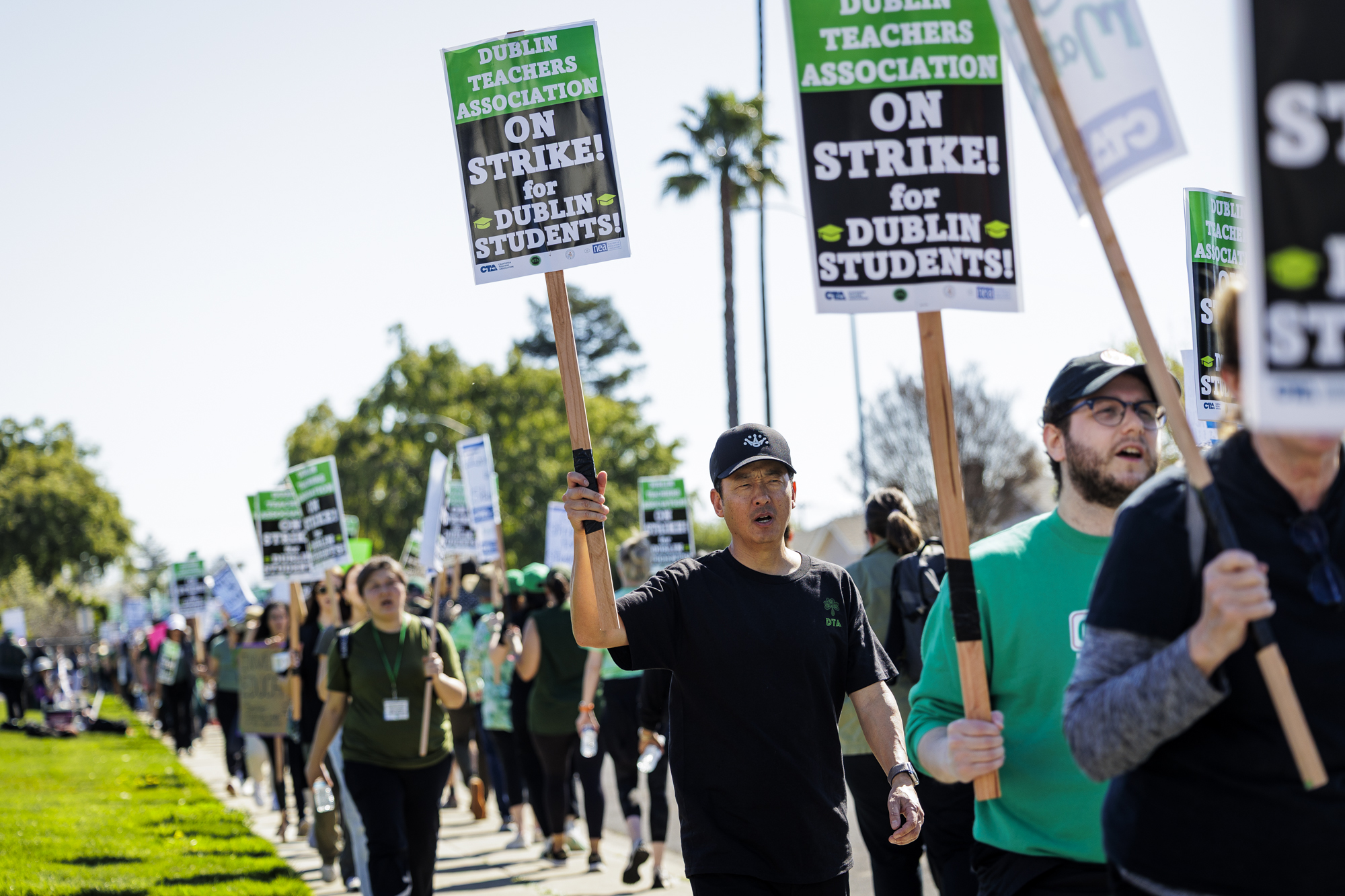
"caption": "Thomas Lee (center) and other teachers walk a picket line in front of the Dublin Unified School District offices in Dublin on March 9, 2026. The East Bay school district’s teachers union launched an open-ended strike after failing to reach a deal with Dublin Unified School District over the weekend. ",
"credit": "Martin do Nascimento/KQED",
"altTag": null,
"description": null,
"imgSizes": {
"thumbnail": {
"file": "https://cdn.kqed.org/wp-content/uploads/sites/10/2026/03/260309-DUBLIN-TEACHER-STRIKE-MD-03-KQED-160x107.jpg",
"width": 160,
"height": 107,
"mimeType": "image/jpeg"
},
"1536x1536": {
"file": "https://cdn.kqed.org/wp-content/uploads/sites/10/2026/03/260309-DUBLIN-TEACHER-STRIKE-MD-03-KQED-1536x1024.jpg",
"width": 1536,
"height": 1024,
"mimeType": "image/jpeg"
},
"post-thumbnail": {
"file": "https://cdn.kqed.org/wp-content/uploads/sites/10/2026/03/260309-DUBLIN-TEACHER-STRIKE-MD-03-KQED-672x372.jpg",
"width": 672,
"height": 372,
"mimeType": "image/jpeg"
},
"twentyfourteen-full-width": {
"file": "https://cdn.kqed.org/wp-content/uploads/sites/10/2026/03/260309-DUBLIN-TEACHER-STRIKE-MD-03-KQED-1038x576.jpg",
"width": 1038,
"height": 576,
"mimeType": "image/jpeg"
},
"npr-cds-wide": {
"file": "https://cdn.kqed.org/wp-content/uploads/sites/10/2026/03/260309-DUBLIN-TEACHER-STRIKE-MD-03-KQED-1200x675.jpg",
"width": 1200,
"height": 675,
"mimeType": "image/jpeg"
},
"kqedFullSize": {
"file": "https://cdn.kqed.org/wp-content/uploads/sites/10/2026/03/260309-DUBLIN-TEACHER-STRIKE-MD-03-KQED.jpg",
"width": 2000,
"height": 1333
}
},
"isLoading": false,
"fetchFailed": false
},
"news_11948331": {
"type": "attachments",
"id": "news_11948331",
"meta": {
"index": "attachments_1716263798",
"site": "news",
"id": "11948331",
"found": true
},
"title": "RS55916_058_KQED_OaklandTeacherStrike_04292022-qut",
"publishDate": 1683062568,
"status": "inherit",
"parent": 11948320,
"modified": 1772216225,
"caption": "Oakland teachers and students listen to speakers during a rally as part of a one-day walkout on April 29, 2022, to protest the Oakland Unified School District's planned closures. Teachers represented by the Oakland Education Association may go on strike once again on Thursday.",
"credit": "Beth LaBerge/KQED",
"altTag": "An older Black man stands outside at a rally, with a sign hanging from his neck that says: 'Fund Public Schools.'",
"description": null,
"imgSizes": {
"medium": {
"file": "https://cdn.kqed.org/wp-content/uploads/sites/10/2023/05/RS55916_058_KQED_OaklandTeacherStrike_04292022-qut-800x533.jpg",
"width": 800,
"height": 533,
"mimeType": "image/jpeg"
},
"large": {
"file": "https://cdn.kqed.org/wp-content/uploads/sites/10/2023/05/RS55916_058_KQED_OaklandTeacherStrike_04292022-qut-1020x680.jpg",
"width": 1020,
"height": 680,
"mimeType": "image/jpeg"
},
"thumbnail": {
"file": "https://cdn.kqed.org/wp-content/uploads/sites/10/2023/05/RS55916_058_KQED_OaklandTeacherStrike_04292022-qut-160x107.jpg",
"width": 160,
"height": 107,
"mimeType": "image/jpeg"
},
"1536x1536": {
"file": "https://cdn.kqed.org/wp-content/uploads/sites/10/2023/05/RS55916_058_KQED_OaklandTeacherStrike_04292022-qut-1536x1024.jpg",
"width": 1536,
"height": 1024,
"mimeType": "image/jpeg"
},
"post-thumbnail": {
"file": "https://cdn.kqed.org/wp-content/uploads/sites/10/2023/05/RS55916_058_KQED_OaklandTeacherStrike_04292022-qut-672x372.jpg",
"width": 672,
"height": 372,
"mimeType": "image/jpeg"
},
"twentyfourteen-full-width": {
"file": "https://cdn.kqed.org/wp-content/uploads/sites/10/2023/05/RS55916_058_KQED_OaklandTeacherStrike_04292022-qut-1038x576.jpg",
"width": 1038,
"height": 576,
"mimeType": "image/jpeg"
},
"kqedFullSize": {
"file": "https://cdn.kqed.org/wp-content/uploads/sites/10/2023/05/RS55916_058_KQED_OaklandTeacherStrike_04292022-qut.jpg",
"width": 1920,
"height": 1280
}
},
"isLoading": false,
"fetchFailed": false
},
"news_12074735": {
"type": "attachments",
"id": "news_12074735",
"meta": {
"index": "attachments_1716263798",
"site": "news",
"id": "12074735",
"found": true
},
"title": "260226-SFCOURTSTRIKE-05-BL-KQED",
"publishDate": 1772126633,
"status": "inherit",
"parent": 0,
"modified": 1772126759,
"caption": "San Francisco Superior Court clerks and supporters rally outside the Hall of Justice in San Francisco on Feb. 26, 2026, as members of SEIU Local 1021 strike amid stalled contract negotiations over pay, staffing and workload concerns.",
"credit": "Beth LaBerge/KQED",
"altTag": null,
"description": null,
"imgSizes": {
"thumbnail": {
"file": "https://cdn.kqed.org/wp-content/uploads/sites/10/2026/02/260226-SFCOURTSTRIKE-05-BL-KQED-160x107.jpg",
"width": 160,
"height": 107,
"mimeType": "image/jpeg"
},
"1536x1536": {
"file": "https://cdn.kqed.org/wp-content/uploads/sites/10/2026/02/260226-SFCOURTSTRIKE-05-BL-KQED-1536x1024.jpg",
"width": 1536,
"height": 1024,
"mimeType": "image/jpeg"
},
"post-thumbnail": {
"file": "https://cdn.kqed.org/wp-content/uploads/sites/10/2026/02/260226-SFCOURTSTRIKE-05-BL-KQED-672x372.jpg",
"width": 672,
"height": 372,
"mimeType": "image/jpeg"
},
"twentyfourteen-full-width": {
"file": "https://cdn.kqed.org/wp-content/uploads/sites/10/2026/02/260226-SFCOURTSTRIKE-05-BL-KQED-1038x576.jpg",
"width": 1038,
"height": 576,
"mimeType": "image/jpeg"
},
"npr-cds-wide": {
"file": "https://cdn.kqed.org/wp-content/uploads/sites/10/2026/02/260226-SFCOURTSTRIKE-05-BL-KQED-1200x675.jpg",
"width": 1200,
"height": 675,
"mimeType": "image/jpeg"
},
"kqedFullSize": {
"file": "https://cdn.kqed.org/wp-content/uploads/sites/10/2026/02/260226-SFCOURTSTRIKE-05-BL-KQED.jpg",
"width": 2000,
"height": 1333
}
},
"isLoading": false,
"fetchFailed": false
},
"news_12073904": {
"type": "attachments",
"id": "news_12073904",
"meta": {
"index": "attachments_1716263798",
"site": "news",
"id": "12073904",
"found": true
},
"title": "260219-STRIKINGKAISERWORKERS00420_TV-KQED",
"publishDate": 1771537913,
"status": "inherit",
"parent": 12073887,
"modified": 1771879049,
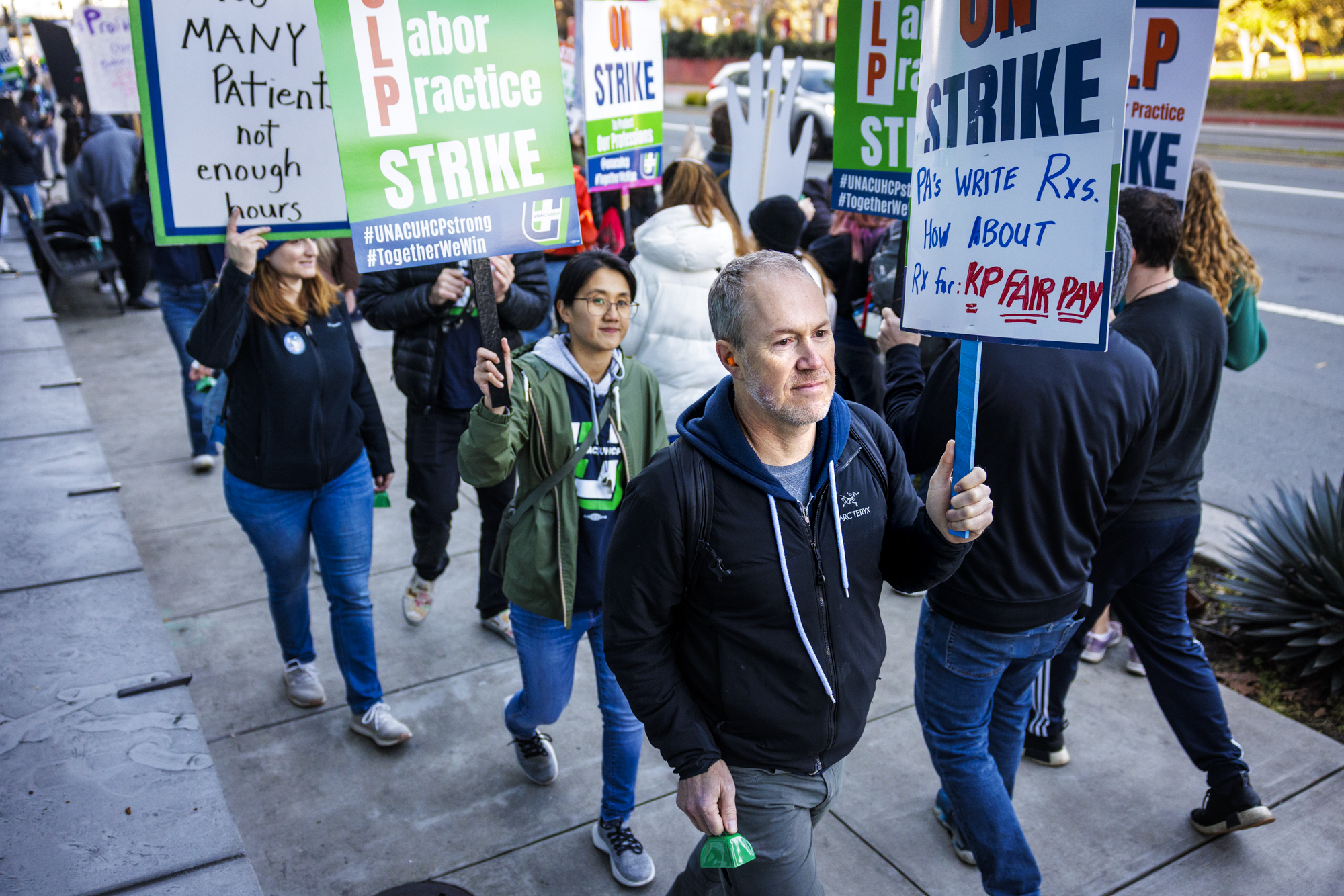
"caption": "Chris Pyper (left), a physician assistant from Kaiser San Leandro, marches while on strike outside Kaiser Permanente Oakland Medical Center in Oakland on Feb. 19, 2026.",
"credit": "Tâm Vũ/KQED",
"altTag": null,
"description": null,
"imgSizes": {
"thumbnail": {
"file": "https://cdn.kqed.org/wp-content/uploads/sites/10/2026/02/260219-STRIKINGKAISERWORKERS00420_TV-KQED-160x107.jpg",
"width": 160,
"height": 107,
"mimeType": "image/jpeg"
},
"1536x1536": {
"file": "https://cdn.kqed.org/wp-content/uploads/sites/10/2026/02/260219-STRIKINGKAISERWORKERS00420_TV-KQED-1536x1025.jpg",
"width": 1536,
"height": 1025,
"mimeType": "image/jpeg"
},
"post-thumbnail": {
"file": "https://cdn.kqed.org/wp-content/uploads/sites/10/2026/02/260219-STRIKINGKAISERWORKERS00420_TV-KQED-672x372.jpg",
"width": 672,
"height": 372,
"mimeType": "image/jpeg"
},
"twentyfourteen-full-width": {
"file": "https://cdn.kqed.org/wp-content/uploads/sites/10/2026/02/260219-STRIKINGKAISERWORKERS00420_TV-KQED-1038x576.jpg",
"width": 1038,
"height": 576,
"mimeType": "image/jpeg"
},
"npr-cds-wide": {
"file": "https://cdn.kqed.org/wp-content/uploads/sites/10/2026/02/260219-STRIKINGKAISERWORKERS00420_TV-KQED-1200x675.jpg",
"width": 1200,
"height": 675,
"mimeType": "image/jpeg"
},
"kqedFullSize": {
"file": "https://cdn.kqed.org/wp-content/uploads/sites/10/2026/02/260219-STRIKINGKAISERWORKERS00420_TV-KQED.jpg",
"width": 2000,
"height": 1334
}
},
"isLoading": false,
"fetchFailed": false
},
"news_12073906": {
"type": "attachments",
"id": "news_12073906",
"meta": {
"index": "attachments_1716263798",
"site": "news",
"id": "12073906",
"found": true
},
"title": "260219-STRIKINGKAISERWORKERS01224_TV-KQED",
"publishDate": 1771537935,
"status": "inherit",
"parent": 0,
"modified": 1771544711,
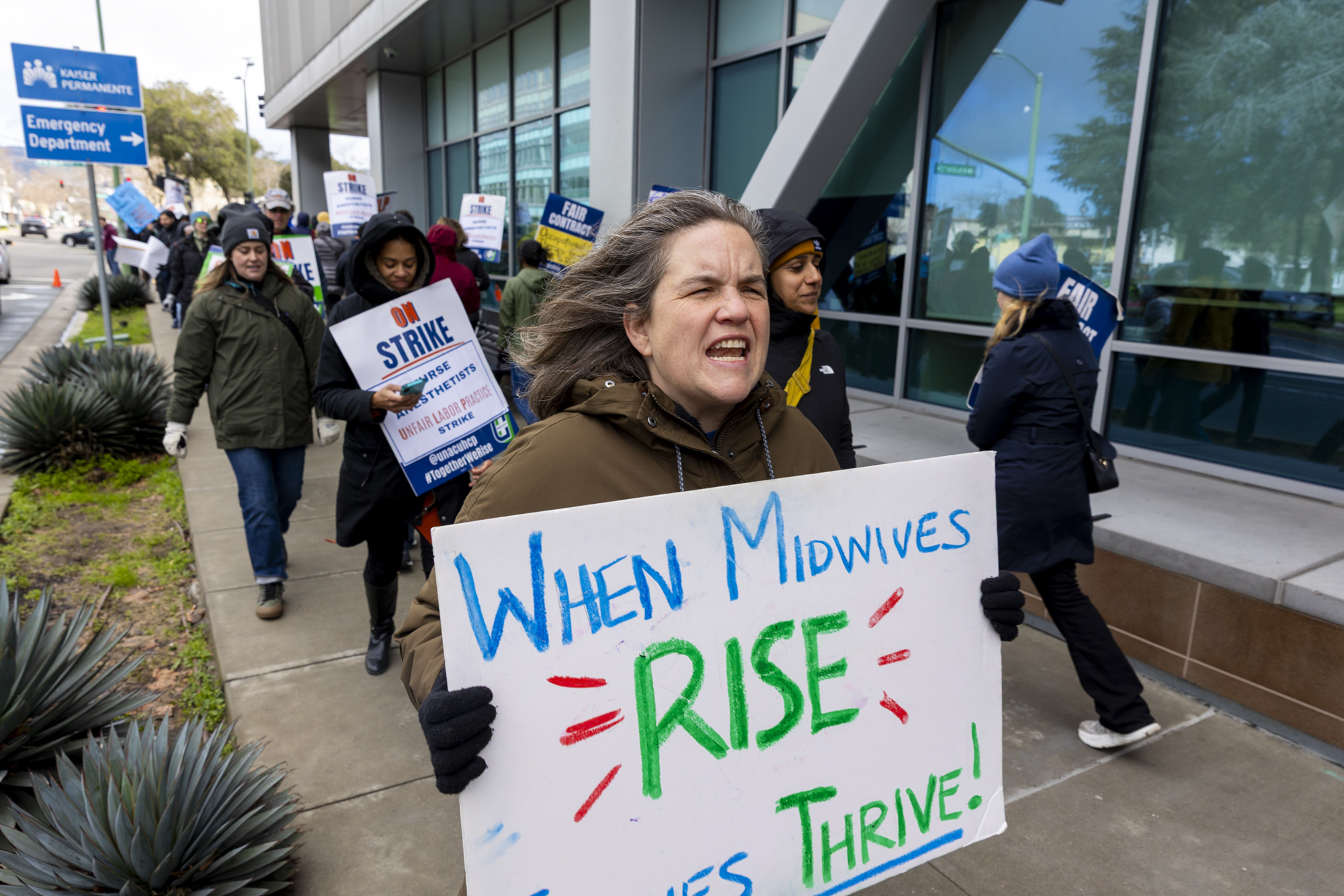
"caption": "Darcy Stanley, a nurse midwife from Kaiser Oakland, on strike at the picket line outside Kaiser Permanente Oakland Medical Center in Oakland on Feb. 19, 2026. Kaiser workers on the picket lines have gone without their paychecks for four weeks, and many are facing financial and other difficulties.",
"credit": "Tâm Vũ/KQED",
"altTag": null,
"description": null,
"imgSizes": {
"thumbnail": {
"file": "https://cdn.kqed.org/wp-content/uploads/sites/10/2026/02/260219-STRIKINGKAISERWORKERS01224_TV-KQED-160x107.jpg",
"width": 160,
"height": 107,
"mimeType": "image/jpeg"
},
"1536x1536": {
"file": "https://cdn.kqed.org/wp-content/uploads/sites/10/2026/02/260219-STRIKINGKAISERWORKERS01224_TV-KQED-1536x1025.jpg",
"width": 1536,
"height": 1025,
"mimeType": "image/jpeg"
},
"post-thumbnail": {
"file": "https://cdn.kqed.org/wp-content/uploads/sites/10/2026/02/260219-STRIKINGKAISERWORKERS01224_TV-KQED-672x372.jpg",
"width": 672,
"height": 372,
"mimeType": "image/jpeg"
},
"twentyfourteen-full-width": {
"file": "https://cdn.kqed.org/wp-content/uploads/sites/10/2026/02/260219-STRIKINGKAISERWORKERS01224_TV-KQED-1038x576.jpg",
"width": 1038,
"height": 576,
"mimeType": "image/jpeg"
},
"npr-cds-wide": {
"file": "https://cdn.kqed.org/wp-content/uploads/sites/10/2026/02/260219-STRIKINGKAISERWORKERS01224_TV-KQED-1200x675.jpg",
"width": 1200,
"height": 675,
"mimeType": "image/jpeg"
},
"kqedFullSize": {
"file": "https://cdn.kqed.org/wp-content/uploads/sites/10/2026/02/260219-STRIKINGKAISERWORKERS01224_TV-KQED.jpg",
"width": 2000,
"height": 1334
}
},
"isLoading": false,
"fetchFailed": false
},
"news_12073915": {
"type": "attachments",
"id": "news_12073915",
"meta": {
"index": "attachments_1716263798",
"site": "news",
"id": "12073915",
"found": true
},
"title": "038_KQED_KaiserStrikeOakland_08192022_qed (2)",
"publishDate": 1771539636,
"status": "inherit",
"parent": 12073839,
"modified": 1771539650,
"caption": "Kaiser mental health care workers and supporters march from Oakland Kaiser Medical Center to Kaiser's corporate headquarters on Friday, Aug. 19, 2022, the fifth day of an open-ended strike.",
"credit": "Beth LaBerge/KQED",
"altTag": null,
"description": null,
"imgSizes": {
"thumbnail": {
"file": "https://cdn.kqed.org/wp-content/uploads/sites/10/2026/02/038_KQED_KaiserStrikeOakland_08192022_qed-2-160x107.jpg",
"width": 160,
"height": 107,
"mimeType": "image/jpeg"
},
"1536x1536": {
"file": "https://cdn.kqed.org/wp-content/uploads/sites/10/2026/02/038_KQED_KaiserStrikeOakland_08192022_qed-2-1536x1024.jpg",
"width": 1536,
"height": 1024,
"mimeType": "image/jpeg"
},
"post-thumbnail": {
"file": "https://cdn.kqed.org/wp-content/uploads/sites/10/2026/02/038_KQED_KaiserStrikeOakland_08192022_qed-2-672x372.jpg",
"width": 672,
"height": 372,
"mimeType": "image/jpeg"
},
"twentyfourteen-full-width": {
"file": "https://cdn.kqed.org/wp-content/uploads/sites/10/2026/02/038_KQED_KaiserStrikeOakland_08192022_qed-2-1038x576.jpg",
"width": 1038,
"height": 576,
"mimeType": "image/jpeg"
},
"npr-cds-wide": {
"file": "https://cdn.kqed.org/wp-content/uploads/sites/10/2026/02/038_KQED_KaiserStrikeOakland_08192022_qed-2-1200x675.jpg",
"width": 1200,
"height": 675,
"mimeType": "image/jpeg"
},
"kqedFullSize": {
"file": "https://cdn.kqed.org/wp-content/uploads/sites/10/2026/02/038_KQED_KaiserStrikeOakland_08192022_qed-2.jpg",
"width": 2000,
"height": 1333
}
},
"isLoading": false,
"fetchFailed": false
},
"news_12071095": {
"type": "attachments",
"id": "news_12071095",
"meta": {
"index": "attachments_1716263798",
"site": "news",
"id": "12071095",
"found": true
},
"title": "260126-KAISER-STRIKE-BEGINS-MD-06-KQED-3_1",
"publishDate": 1769467001,
"status": "inherit",
"parent": 0,
"modified": 1769467030,
"caption": "Workers walk a picket line at Kaiser Oakland Medical Center in Oakland on Jan. 26, 2026.",
"credit": "Martin do Nascimento/KQED",
"altTag": null,
"description": null,
"imgSizes": {
"thumbnail": {
"file": "https://cdn.kqed.org/wp-content/uploads/sites/10/2026/01/260126-KAISER-STRIKE-BEGINS-MD-06-KQED-3_1-160x107.jpg",
"width": 160,
"height": 107,
"mimeType": "image/jpeg"
},
"1536x1536": {
"file": "https://cdn.kqed.org/wp-content/uploads/sites/10/2026/01/260126-KAISER-STRIKE-BEGINS-MD-06-KQED-3_1-1536x1025.jpg",
"width": 1536,
"height": 1025,
"mimeType": "image/jpeg"
},
"post-thumbnail": {
"file": "https://cdn.kqed.org/wp-content/uploads/sites/10/2026/01/260126-KAISER-STRIKE-BEGINS-MD-06-KQED-3_1-672x372.jpg",
"width": 672,
"height": 372,
"mimeType": "image/jpeg"
},
"twentyfourteen-full-width": {
"file": "https://cdn.kqed.org/wp-content/uploads/sites/10/2026/01/260126-KAISER-STRIKE-BEGINS-MD-06-KQED-3_1-1038x576.jpg",
"width": 1038,
"height": 576,
"mimeType": "image/jpeg"
},
"npr-cds-wide": {
"file": "https://cdn.kqed.org/wp-content/uploads/sites/10/2026/01/260126-KAISER-STRIKE-BEGINS-MD-06-KQED-3_1-1200x675.jpg",
"width": 1200,
"height": 675,
"mimeType": "image/jpeg"
},
"kqedFullSize": {
"file": "https://cdn.kqed.org/wp-content/uploads/sites/10/2026/01/260126-KAISER-STRIKE-BEGINS-MD-06-KQED-3_1.jpg",
"width": 2000,
"height": 1334
}
},
"isLoading": false,
"fetchFailed": false
},
"news_12073056": {
"type": "attachments",
"id": "news_12073056",
"meta": {
"index": "attachments_1716263798",
"site": "news",
"id": "12073056",
"found": true
},
"title": "260210-SFUSDSTRIKEDAY2-24-BL-KQED",
"publishDate": 1770758931,
"status": "inherit",
"parent": 12073717,
"modified": 1771453651,
"caption": "Frances Tang stands alongside teachers, faculty and supporters during a rally on the second day of an SFUSD teachers strike at Dolores Park in San Francisco on Feb. 10, 2026. A deal between the district and the teachers union remains elusive. So far, it appears, teachers have the leverage.",
"credit": "Beth LaBerge/KQED",
"altTag": null,
"description": null,
"imgSizes": {
"thumbnail": {
"file": "https://cdn.kqed.org/wp-content/uploads/sites/10/2026/02/260210-SFUSDSTRIKEDAY2-24-BL-KQED-160x107.jpg",
"width": 160,
"height": 107,
"mimeType": "image/jpeg"
},
"1536x1536": {
"file": "https://cdn.kqed.org/wp-content/uploads/sites/10/2026/02/260210-SFUSDSTRIKEDAY2-24-BL-KQED-1536x1024.jpg",
"width": 1536,
"height": 1024,
"mimeType": "image/jpeg"
},
"post-thumbnail": {
"file": "https://cdn.kqed.org/wp-content/uploads/sites/10/2026/02/260210-SFUSDSTRIKEDAY2-24-BL-KQED-672x372.jpg",
"width": 672,
"height": 372,
"mimeType": "image/jpeg"
},
"twentyfourteen-full-width": {
"file": "https://cdn.kqed.org/wp-content/uploads/sites/10/2026/02/260210-SFUSDSTRIKEDAY2-24-BL-KQED-1038x576.jpg",
"width": 1038,
"height": 576,
"mimeType": "image/jpeg"
},
"npr-cds-wide": {
"file": "https://cdn.kqed.org/wp-content/uploads/sites/10/2026/02/260210-SFUSDSTRIKEDAY2-24-BL-KQED-1200x675.jpg",
"width": 1200,
"height": 675,
"mimeType": "image/jpeg"
},
"kqedFullSize": {
"file": "https://cdn.kqed.org/wp-content/uploads/sites/10/2026/02/260210-SFUSDSTRIKEDAY2-24-BL-KQED.jpg",
"width": 2000,
"height": 1333
}
},
"isLoading": false,
"fetchFailed": false
},
"news_12072987": {
"type": "attachments",
"id": "news_12072987",
"meta": {
"index": "attachments_1716263798",
"site": "news",
"id": "12072987",
"found": true
},
"title": "020926_KAISERSTRIKE_8137B-KQED",
"publishDate": 1770747058,
"status": "inherit",
"parent": 0,
"modified": 1770747219,
"caption": "Carrie Esqueda plays with one of her grandkids at her home in Wildomar on Feb. 9, 2026.",
"credit": "Lauren Justice for KQED",
"altTag": null,
"description": null,
"imgSizes": {
"thumbnail": {
"file": "https://cdn.kqed.org/wp-content/uploads/sites/10/2026/02/020926_KAISERSTRIKE_8137B-KQED-160x107.jpg",
"width": 160,
"height": 107,
"mimeType": "image/jpeg"
},
"1536x1536": {
"file": "https://cdn.kqed.org/wp-content/uploads/sites/10/2026/02/020926_KAISERSTRIKE_8137B-KQED-1536x1024.jpg",
"width": 1536,
"height": 1024,
"mimeType": "image/jpeg"
},
"post-thumbnail": {
"file": "https://cdn.kqed.org/wp-content/uploads/sites/10/2026/02/020926_KAISERSTRIKE_8137B-KQED-672x372.jpg",
"width": 672,
"height": 372,
"mimeType": "image/jpeg"
},
"twentyfourteen-full-width": {
"file": "https://cdn.kqed.org/wp-content/uploads/sites/10/2026/02/020926_KAISERSTRIKE_8137B-KQED-1038x576.jpg",
"width": 1038,
"height": 576,
"mimeType": "image/jpeg"
},
"npr-cds-wide": {
"file": "https://cdn.kqed.org/wp-content/uploads/sites/10/2026/02/020926_KAISERSTRIKE_8137B-KQED-1200x675.jpg",
"width": 1200,
"height": 675,
"mimeType": "image/jpeg"
},
"kqedFullSize": {
"file": "https://cdn.kqed.org/wp-content/uploads/sites/10/2026/02/020926_KAISERSTRIKE_8137B-KQED.jpg",
"width": 2000,
"height": 1333
}
},
"isLoading": false,
"fetchFailed": false
},
"news_12072895": {
"type": "attachments",
"id": "news_12072895",
"meta": {
"index": "attachments_1716263798",
"site": "news",
"id": "12072895",
"found": true
},
"title": "260209-SFUSDSTRIKE-19-BL-KQED",
"publishDate": 1770673237,
"status": "inherit",
"parent": 12073183,
"modified": 1770858051,
"caption": "Students make a sign that says, ‘Help Teachers’ at Mission Science Workshop in the Excelsior neighborhood of San Francisco on Feb. 9, 2026, during an SFUSD teachers’ strike that closed all district schools.",
"credit": "Beth LaBerge/KQED",
"altTag": null,
"description": null,
"imgSizes": {
"thumbnail": {
"file": "https://cdn.kqed.org/wp-content/uploads/sites/10/2026/02/260209-SFUSDSTRIKE-19-BL-KQED-160x107.jpg",
"width": 160,
"height": 107,
"mimeType": "image/jpeg"
},
"1536x1536": {
"file": "https://cdn.kqed.org/wp-content/uploads/sites/10/2026/02/260209-SFUSDSTRIKE-19-BL-KQED-1536x1024.jpg",
"width": 1536,
"height": 1024,
"mimeType": "image/jpeg"
},
"post-thumbnail": {
"file": "https://cdn.kqed.org/wp-content/uploads/sites/10/2026/02/260209-SFUSDSTRIKE-19-BL-KQED-672x372.jpg",
"width": 672,
"height": 372,
"mimeType": "image/jpeg"
},
"twentyfourteen-full-width": {
"file": "https://cdn.kqed.org/wp-content/uploads/sites/10/2026/02/260209-SFUSDSTRIKE-19-BL-KQED-1038x576.jpg",
"width": 1038,
"height": 576,
"mimeType": "image/jpeg"
},
"npr-cds-wide": {
"file": "https://cdn.kqed.org/wp-content/uploads/sites/10/2026/02/260209-SFUSDSTRIKE-19-BL-KQED-1200x675.jpg",
"width": 1200,
"height": 675,
"mimeType": "image/jpeg"
},
"kqedFullSize": {
"file": "https://cdn.kqed.org/wp-content/uploads/sites/10/2026/02/260209-SFUSDSTRIKE-19-BL-KQED.jpg",
"width": 2000,
"height": 1333
}
},
"isLoading": false,
"fetchFailed": false
},
"news_12072851": {
"type": "attachments",
"id": "news_12072851",
"meta": {
"index": "attachments_1716263798",
"site": "news",
"id": "12072851",
"found": true
},
"title": "20260209_SFUSDSTRIKE_GC-17-KQED",
"publishDate": 1770660222,
"status": "inherit",
"parent": 0,
"modified": 1770667600,
"caption": "Mar Martinez, math teacher at Mission High, pickets during a teacher’s strike at Mission High School on Feb. 9, 2026. The strike is the first in nearly 50 years.",
"credit": "Gina Castro for KQED",
"altTag": null,
"description": null,
"imgSizes": {
"thumbnail": {
"file": "https://cdn.kqed.org/wp-content/uploads/sites/10/2026/02/20260209_SFUSDSTRIKE_GC-17-KQED-160x107.jpg",
"width": 160,
"height": 107,
"mimeType": "image/jpeg"
},
"1536x1536": {
"file": "https://cdn.kqed.org/wp-content/uploads/sites/10/2026/02/20260209_SFUSDSTRIKE_GC-17-KQED-1536x1024.jpg",
"width": 1536,
"height": 1024,
"mimeType": "image/jpeg"
},
"post-thumbnail": {
"file": "https://cdn.kqed.org/wp-content/uploads/sites/10/2026/02/20260209_SFUSDSTRIKE_GC-17-KQED-672x372.jpg",
"width": 672,
"height": 372,
"mimeType": "image/jpeg"
},
"twentyfourteen-full-width": {
"file": "https://cdn.kqed.org/wp-content/uploads/sites/10/2026/02/20260209_SFUSDSTRIKE_GC-17-KQED-1038x576.jpg",
"width": 1038,
"height": 576,
"mimeType": "image/jpeg"
},
"npr-cds-wide": {
"file": "https://cdn.kqed.org/wp-content/uploads/sites/10/2026/02/20260209_SFUSDSTRIKE_GC-17-KQED-1200x675.jpg",
"width": 1200,
"height": 675,
"mimeType": "image/jpeg"
},
"kqedFullSize": {
"file": "https://cdn.kqed.org/wp-content/uploads/sites/10/2026/02/20260209_SFUSDSTRIKE_GC-17-KQED.jpg",
"width": 2000,
"height": 1333
}
},
"isLoading": false,
"fetchFailed": false
},
"news_12072420": {
"type": "attachments",
"id": "news_12072420",
"meta": {
"index": "attachments_1716263798",
"site": "news",
"id": "12072420",
"found": true
},
"title": "250204-WeCantWait-06-BL_qed",
"publishDate": 1770317800,
"status": "inherit",
"parent": 12072392,
"modified": 1770319522,
"caption": "Perry Siniard, a fourth-grade teacher, speaks during a press conference at Buena Vista Horace Mann K-8 Community School in San Francisco’s Mission District on Feb. 4, 2025, to announce the launch of the \"We Can’t Wait\" campaign, a statewide effort advocating for improved class sizes, better wages and safer schools for educators and students.",
"credit": "Beth LaBerge/KQED",
"altTag": null,
"description": null,
"imgSizes": {
"thumbnail": {
"file": "https://cdn.kqed.org/wp-content/uploads/sites/10/2026/02/250204-WeCantWait-06-BL_qed-160x107.jpg",
"width": 160,
"height": 107,
"mimeType": "image/jpeg"
},
"1536x1536": {
"file": "https://cdn.kqed.org/wp-content/uploads/sites/10/2026/02/250204-WeCantWait-06-BL_qed-1536x1024.jpg",
"width": 1536,
"height": 1024,
"mimeType": "image/jpeg"
},
"post-thumbnail": {
"file": "https://cdn.kqed.org/wp-content/uploads/sites/10/2026/02/250204-WeCantWait-06-BL_qed-672x372.jpg",
"width": 672,
"height": 372,
"mimeType": "image/jpeg"
},
"twentyfourteen-full-width": {
"file": "https://cdn.kqed.org/wp-content/uploads/sites/10/2026/02/250204-WeCantWait-06-BL_qed-1038x576.jpg",
"width": 1038,
"height": 576,
"mimeType": "image/jpeg"
},
"npr-cds-wide": {
"file": "https://cdn.kqed.org/wp-content/uploads/sites/10/2026/02/250204-WeCantWait-06-BL_qed-1200x675.jpg",
"width": 1200,
"height": 675,
"mimeType": "image/jpeg"
},
"kqedFullSize": {
"file": "https://cdn.kqed.org/wp-content/uploads/sites/10/2026/02/250204-WeCantWait-06-BL_qed.jpg",
"width": 2000,
"height": 1333
}
},
"isLoading": false,
"fetchFailed": false
}
},
"audioPlayerReducer": {
"postId": "stream_live",
"isPaused": true,
"isPlaying": false,
"pfsActive": false,
"pledgeModalIsOpen": true,
"playerDrawerIsOpen": false,
"liveAudioPlayStartedAt": 0,
"liveAudioPlayContext": ""
},
"authorsReducer": {
"adembosky": {
"type": "authors",
"id": "3205",
"meta": {
"index": "authors_1716337520",
"id": "3205",
"found": true
},
"name": "April Dembosky",
"firstName": "April",
"lastName": "Dembosky",
"slug": "adembosky",
"email": "adembosky@kqed.org",
"display_author_email": false,
"staff_mastheads": [
"news",
"science"
],
"title": "KQED Health Correspondent",
"bio": "April Dembosky is the health correspondent for KQED News and a regular contributor to NPR. She specializes in covering altered states of mind, from postpartum depression to methamphetamine-induced psychosis to the insanity defense. Her investigative series on insurance companies sidestepping mental health laws won multiple awards, including first place in beat reporting from the national Association of Health Care Journalists. She is the recipient of numerous other prizes and fellowships, including a national Edward R. Murrow award for investigative reporting, a Society of Professional Journalists award for long-form storytelling, and a Carter Center Fellowship for Mental Health Journalism.\r\n\r\nDembosky reported and produced \u003cem>Soundtrack of Silence\u003c/em>, an audio documentary about music and memory that is currently being made into a feature film by Paramount Pictures.\r\n\r\nBefore joining KQED in 2013, Dembosky covered technology and Silicon Valley for \u003cem>The Financial Times of London,\u003c/em> and contributed business and arts stories to \u003cem>Marketplace \u003c/em>and \u003cem>The New York Times.\u003c/em> She got her undergraduate degree in philosophy from Smith College and her master's in journalism from the University of California, Berkeley. She is a classically trained violinist and proud alum of the first symphony orchestra at Burning Man.",
"avatar": "https://secure.gravatar.com/avatar/ef92999be4ceb9ea60701e7dc276f813?s=600&d=blank&r=g",
"twitter": "adembosky",
"facebook": null,
"instagram": null,
"linkedin": null,
"sites": [
{
"site": "arts",
"roles": [
"author"
]
},
{
"site": "news",
"roles": [
"editor"
]
},
{
"site": "futureofyou",
"roles": [
"author"
]
},
{
"site": "stateofhealth",
"roles": [
"editor"
]
},
{
"site": "science",
"roles": [
"editor"
]
},
{
"site": "forum",
"roles": [
"editor"
]
}
],
"headData": {
"title": "April Dembosky | KQED",
"description": "KQED Health Correspondent",
"ogImgSrc": "https://secure.gravatar.com/avatar/ef92999be4ceb9ea60701e7dc276f813?s=600&d=blank&r=g",
"twImgSrc": "https://secure.gravatar.com/avatar/ef92999be4ceb9ea60701e7dc276f813?s=600&d=blank&r=g"
},
"isLoading": false,
"link": "/author/adembosky"
},
"ecruzguevarra": {
"type": "authors",
"id": "8654",
"meta": {
"index": "authors_1716337520",
"id": "8654",
"found": true
},
"name": "Ericka Cruz Guevarra",
"firstName": "Ericka",
"lastName": "Cruz Guevarra",
"slug": "ecruzguevarra",
"email": "ecruzguevarra@kqed.org",
"display_author_email": true,
"staff_mastheads": [
"news"
],
"title": "Producer, The Bay Podcast",
"bio": "Ericka Cruz Guevarra is host of \u003ca href=\"https://www.kqed.org/podcasts/thebay\">\u003cem>The Bay\u003c/em>\u003c/a> podcast at KQED. Before host, she was the show’s producer. Her work in that capacity includes a three-part reported series on policing in Vallejo, which won a 2020 excellence in journalism award from the Society of Professional Journalists. Ericka has worked as a breaking news reporter at Oregon Public Broadcasting, helped produce the Code Switch podcast, and was KQED’s inaugural Raul Ramirez Diversity Fund intern. She’s also an alumna of NPR’s Next Generation Radio program. Send her an email if you have strong feelings about whether Fairfield and Suisun City are the Bay. Ericka is represented by SAG-AFTRA.",
"avatar": "https://secure.gravatar.com/avatar/accefc1de4bafc7e234b69bcb9b6f6536c130fd84709bc3069ef11a78787e1bb?s=600&d=blank&r=g",
"twitter": "NotoriousECG",
"bluesky": null,
"facebook": null,
"instagram": null,
"linkedin": null,
"sites": [
{
"site": "arts",
"roles": [
"subscriber"
]
},
{
"site": "news",
"roles": [
"editor",
"manage_categories"
]
},
{
"site": "futureofyou",
"roles": [
"subscriber"
]
},
{
"site": "stateofhealth",
"roles": [
"subscriber"
]
},
{
"site": "science",
"roles": [
"editor"
]
},
{
"site": "forum",
"roles": [
"subscriber"
]
}
],
"headData": {
"title": "Ericka Cruz Guevarra | KQED",
"description": "Producer, The Bay Podcast",
"ogImgSrc": "https://secure.gravatar.com/avatar/accefc1de4bafc7e234b69bcb9b6f6536c130fd84709bc3069ef11a78787e1bb?s=600&d=blank&r=g",
"twImgSrc": "https://secure.gravatar.com/avatar/accefc1de4bafc7e234b69bcb9b6f6536c130fd84709bc3069ef11a78787e1bb?s=600&d=blank&r=g"
},
"isLoading": false,
"link": "/author/ecruzguevarra"
},
"fjhabvala": {
"type": "authors",
"id": "8659",
"meta": {
"index": "authors_1716337520",
"id": "8659",
"found": true
},
"name": "Farida Jhabvala Romero",
"firstName": "Farida",
"lastName": "Jhabvala Romero",
"slug": "fjhabvala",
"email": "fjhabvala@kqed.org",
"display_author_email": true,
"staff_mastheads": [
"news"
],
"title": "KQED Contributor",
"bio": "Farida Jhabvala Romero is a Labor Correspondent for KQED. She previously covered immigration. Farida was \u003ca href=\"https://www.ccnma.org/2022-most-influential-latina-journalists\">named\u003c/a> one of the 10 Most Influential Latina Journalists in California in 2022 by the California Chicano News Media Association. Her work has won awards from the Society of Professional Journalists (Northern California), as well as a national and regional Edward M. Murrow Award for the collaborative reporting projects “Dangerous Air” and “Graying California.” Before joining KQED, Farida worked as a producer at Radio Bilingüe, a national public radio network. Farida earned her master’s degree in journalism from Stanford University.",
"avatar": "https://secure.gravatar.com/avatar/f9f022d4e2609741874222a1e9d41f48fea74011aa7c615eef91d9a50c944ebe?s=600&d=blank&r=g",
"twitter": "FaridaJhabvala",
"bluesky": null,
"facebook": null,
"instagram": null,
"linkedin": "https://www.linkedin.com/in/faridajhabvala/",
"sites": [
{
"site": "news",
"roles": [
"editor"
]
},
{
"site": "stateofhealth",
"roles": [
"author"
]
},
{
"site": "liveblog",
"roles": [
"author"
]
}
],
"headData": {
"title": "Farida Jhabvala Romero | KQED",
"description": "KQED Contributor",
"ogImgSrc": "https://secure.gravatar.com/avatar/f9f022d4e2609741874222a1e9d41f48fea74011aa7c615eef91d9a50c944ebe?s=600&d=blank&r=g",
"twImgSrc": "https://secure.gravatar.com/avatar/f9f022d4e2609741874222a1e9d41f48fea74011aa7c615eef91d9a50c944ebe?s=600&d=blank&r=g"
},
"isLoading": false,
"link": "/author/fjhabvala"
},
"amontecillo": {
"type": "authors",
"id": "11649",
"meta": {
"index": "authors_1716337520",
"id": "11649",
"found": true
},
"name": "Alan Montecillo",
"firstName": "Alan",
"lastName": "Montecillo",
"slug": "amontecillo",
"email": "amontecillo@kqed.org",
"display_author_email": false,
"staff_mastheads": [
"news"
],
"title": "KQED Contributor",
"bio": "Alan Montecillo is the senior editor of \u003cem>\u003ca href=\"http://kqed.org/thebay\">The Bay\u003c/a>, \u003c/em> KQED's local news podcast. Before moving to the Bay Area, he worked as a senior talk show producer for WILL in Champaign-Urbana, Illinois and at Oregon Public Broadcasting in Portland, Oregon. He has won journalism awards from the Society of Professional Journalists Northern California, the Public Media Journalists Association, The Signal Awards, and has also received a regional Edward R. Murrow award. Alan is a Filipino American from Hong Kong and a graduate of Reed College.",
"avatar": "https://secure.gravatar.com/avatar/268f53a2066899ea9efdd8a5900218b17c822d9862cbc9326cccec53ef41d349?s=600&d=blank&r=g",
"twitter": "alanmontecillo",
"bluesky": null,
"facebook": null,
"instagram": null,
"linkedin": null,
"sites": [
{
"site": "",
"roles": [
"editor"
]
},
{
"site": "news",
"roles": [
"editor",
"manage_categories"
]
}
],
"headData": {
"title": "Alan Montecillo | KQED",
"description": "KQED Contributor",
"ogImgSrc": "https://secure.gravatar.com/avatar/268f53a2066899ea9efdd8a5900218b17c822d9862cbc9326cccec53ef41d349?s=600&d=blank&r=g",
"twImgSrc": "https://secure.gravatar.com/avatar/268f53a2066899ea9efdd8a5900218b17c822d9862cbc9326cccec53ef41d349?s=600&d=blank&r=g"
},
"isLoading": false,
"link": "/author/amontecillo"
},
"daisynguyen": {
"type": "authors",
"id": "11829",
"meta": {
"index": "authors_1716337520",
"id": "11829",
"found": true
},
"name": "Daisy Nguyen",
"firstName": "Daisy",
"lastName": "Nguyen",
"slug": "daisynguyen",
"email": "daisynguyen@kqed.org",
"display_author_email": true,
"staff_mastheads": [
"news"
],
"title": "KQED Contributor",
"bio": "I have covered early childhood education and child care for KQED since 2022. I focus on policies aimed at increasing access to early care and education and how they shape individual lives. I've been a journalist for more than two decades, with most of that time devoted to covering breaking news throughout California for The Associated Press. I grew up in San Francisco and studied at UC Davis and Columbia University's Graduate School of Journalism. I live in Oakland with my husband and two kids.",
"avatar": "https://secure.gravatar.com/avatar/2da2127c27f7143b53ebd419800fd55f?s=600&d=blank&r=g",
"twitter": null,
"facebook": null,
"instagram": null,
"linkedin": "https://www.linkedin.com/in/daisynguyen/",
"sites": [
{
"site": "news",
"roles": [
"author"
]
},
{
"site": "liveblog",
"roles": [
"author"
]
}
],
"headData": {
"title": "Daisy Nguyen | KQED",
"description": "KQED Contributor",
"ogImgSrc": "https://secure.gravatar.com/avatar/2da2127c27f7143b53ebd419800fd55f?s=600&d=blank&r=g",
"twImgSrc": "https://secure.gravatar.com/avatar/2da2127c27f7143b53ebd419800fd55f?s=600&d=blank&r=g"
},
"isLoading": false,
"link": "/author/daisynguyen"
},
"kdebenedetti": {
"type": "authors",
"id": "11913",
"meta": {
"index": "authors_1716337520",
"id": "11913",
"found": true
},
"name": "Katie DeBenedetti",
"firstName": "Katie",
"lastName": "DeBenedetti",
"slug": "kdebenedetti",
"email": "kdebenedetti@kqed.org",
"display_author_email": false,
"staff_mastheads": [
"news",
"science"
],
"title": "KQED Contributor",
"bio": "Katie DeBenedetti is a digital reporter covering daily news for the Express Desk. Prior to joining KQED as a culture reporting intern in January 2024, she covered education and city government for the Napa Valley Register.",
"avatar": "https://secure.gravatar.com/avatar/6e31073cb8f7e4214ab03f42771d0f45?s=600&d=blank&r=g",
"twitter": null,
"facebook": null,
"instagram": null,
"linkedin": null,
"sites": [
{
"site": "news",
"roles": [
"author"
]
},
{
"site": "science",
"roles": [
"author"
]
},
{
"site": "liveblog",
"roles": [
"author"
]
}
],
"headData": {
"title": "Katie DeBenedetti | KQED",
"description": "KQED Contributor",
"ogImgSrc": "https://secure.gravatar.com/avatar/6e31073cb8f7e4214ab03f42771d0f45?s=600&d=blank&r=g",
"twImgSrc": "https://secure.gravatar.com/avatar/6e31073cb8f7e4214ab03f42771d0f45?s=600&d=blank&r=g"
},
"isLoading": false,
"link": "/author/kdebenedetti"
},
"gglueck": {
"type": "authors",
"id": "11946",
"meta": {
"index": "authors_1716337520",
"id": "11946",
"found": true
},
"name": "Gabriela Glueck",
"firstName": "Gabriela",
"lastName": "Glueck",
"slug": "gglueck",
"email": "gglueck@kqed.org",
"display_author_email": false,
"staff_mastheads": [
"news"
],
"title": "KQED Contributor",
"bio": null,
"avatar": "https://secure.gravatar.com/avatar/ec62b7e3f7727ce1070cc7046dde80271d1e63cf2178d6194f68bb8d1440f841?s=600&d=blank&r=g",
"twitter": null,
"bluesky": null,
"facebook": null,
"instagram": null,
"linkedin": null,
"sites": [
{
"site": "news",
"roles": [
"editor"
]
}
],
"headData": {
"title": "Gabriela Glueck | KQED",
"description": "KQED Contributor",
"ogImgSrc": "https://secure.gravatar.com/avatar/ec62b7e3f7727ce1070cc7046dde80271d1e63cf2178d6194f68bb8d1440f841?s=600&d=blank&r=g",
"twImgSrc": "https://secure.gravatar.com/avatar/ec62b7e3f7727ce1070cc7046dde80271d1e63cf2178d6194f68bb8d1440f841?s=600&d=blank&r=g"
},
"isLoading": false,
"link": "/author/gglueck"
}
},
"pagesReducer": {
"news_tag_labor-strikes": {
"type": "terms",
"id": "news_24590",
"meta": {
"index": "terms_1716263798",
"site": "news",
"id": "24590",
"score": 10.403227
},
"featImg": null,
"name": "labor strikes",
"description": null,
"taxonomy": "tag",
"headData": {
"twImgId": null,
"twTitle": null,
"ogTitle": null,
"ogImgId": null,
"twDescription": null,
"description": null,
"title": "labor strikes Archives | KQED News",
"ogDescription": null
},
"ttid": 24607,
"slug": "labor-strikes",
"isLoading": false,
"title": "labor strikes",
"pageMeta": {
"site": "news",
"WpPageTemplate": "page-topic-editorial",
"currentPage": 2
},
"blocks": [
{
"blockName": "kqed/post-list",
"attrs": {
"layout": "cardArticle2",
"query": "posts/news?tag=labor-strikes",
"seeMore": false,
"paginated": true,
"page": 2
}
},
{
"blockName": "kqed/ad"
}
]
}
},
"pfsSessionReducer": {},
"postsReducer": {
"stream_live": {
"type": "live",
"id": "stream_live",
"audioUrl": "https://streams.kqed.org/kqedradio",
"title": "Live Stream",
"excerpt": "Live Stream information currently unavailable.",
"link": "/radio",
"featImg": "",
"label": {
"name": "KQED Live",
"link": "/"
}
},
"stream_kqedNewscast": {
"type": "posts",
"id": "stream_kqedNewscast",
"audioUrl": "https://www.kqed.org/.stream/anon/radio/RDnews/newscast.mp3?_=1",
"title": "KQED Newscast",
"featImg": "",
"label": {
"name": "88.5 FM",
"link": "/"
}
},
"news_12075767": {
"type": "posts",
"id": "news_12075767",
"meta": {
"index": "posts_1716263798",
"site": "news",
"id": "12075767",
"score": null,
"sort": [
1773081834000
]
},
"guestAuthors": [],
"slug": "dublin-unified-teachers-walk-out-over-pay-raises-and-class-sizes",
"title": "Dublin Unified Teachers Walk Out Over Pay Raises and Class Sizes",
"publishDate": 1773081834,
"format": "standard",
"headTitle": "Dublin Unified Teachers Walk Out Over Pay Raises and Class Sizes | KQED",
"labelTerm": {
"site": "news"
},
"content": "\u003cp>After months of bargaining over wages, health care coverage and class sizes, \u003ca href=\"https://www.kqed.org/news/12075595/dublin-teachers-set-to-strike-as-district-negotiations-stall\">Dublin teachers took to picket lines\u003c/a> on Monday morning, joining a growing wave of California educators \u003ca href=\"https://www.kqed.org/news/12074650/2026-oakland-teachers-strike-ousd-when-oea-union-alameda-county\">going on strike in recent months\u003c/a>.\u003c/p>\n\u003cp>The East Bay school district’s teachers union launched the open-ended strike after it failed to reach a deal with Dublin Unified School District during last-minute bargaining over the weekend.\u003c/p>\n\u003cp>“Obviously, I’d rather be in the classroom,” said Greg Rodriguez, an advanced placement world history teacher at Dublin’s Emerald High School, from a picket line outside the district’s offices Monday. “But at the same point, we’re fighting for them, fighting for us. Until we can figure out the stuff outside the classroom, then the stuff inside the classroom is going to have to take a back seat for now, which is a shame.”\u003c/p>\n\u003cp>[ad fullwidth]\u003c/p>\n\u003cp>Schools remained open on Monday morning, but without teachers, many will have modified half-day schedules, and operations “will not look exactly like a typical school day,” according to the district.\u003c/p>\n\u003cp>Breakfast and lunch will be served at all sites, but only Dublin and Emerald High Schools will be open in the afternoons.\u003c/p>\n\u003cp>“Our focus remains on supporting students, families, and staff as we continue to work toward a resolution,” the district said in a \u003ca href=\"https://drive.google.com/file/d/1Tv2drDSReSLl6YZ96zVOLx2vd3EbdtHv/view\">statement on \u003c/a>Sunday.\u003c/p>\n\u003cfigure id=\"attachment_12075831\" class=\"wp-caption aligncenter\" style=\"max-width: 2000px\">\u003cimg loading=\"lazy\" decoding=\"async\" class=\"size-full wp-image-12075831\" src=\"https://cdn.kqed.org/wp-content/uploads/sites/10/2026/03/260309-DUBLIN-TEACHER-STRIKE-MD-02-KQED.jpg\" alt=\"\" width=\"2000\" height=\"1333\" srcset=\"https://cdn.kqed.org/wp-content/uploads/sites/10/2026/03/260309-DUBLIN-TEACHER-STRIKE-MD-02-KQED.jpg 2000w, https://cdn.kqed.org/wp-content/uploads/sites/10/2026/03/260309-DUBLIN-TEACHER-STRIKE-MD-02-KQED-160x107.jpg 160w, https://cdn.kqed.org/wp-content/uploads/sites/10/2026/03/260309-DUBLIN-TEACHER-STRIKE-MD-02-KQED-1536x1024.jpg 1536w\" sizes=\"auto, (max-width: 2000px) 100vw, 2000px\">\u003cfigcaption class=\"wp-caption-text\">Teachers walk a picket line in front of the Dublin Unified School District offices in Dublin on March 9, 2026. \u003ccite>(Martin do Nascimento/KQED)\u003c/cite>\u003c/figcaption>\u003c/figure>\n\u003cp>DTA’s more than 700 members are currently working under a contract that expired in June.\u003c/p>\n\u003cp>Like other school districts across the Bay Area, Dublin Unified has maintained that it doesn’t have the money to fund the union’s proposals, which it estimated over the weekend would cost $32 million.\u003c/p>\n\u003cp>The district said in a statement on its website that it has operated in budget deficits over the last three years, depleting its reserve fund, and requiring millions more in budget cuts this year to pay its bills.\u003c/p>\n\u003cp>In November, the union declared an impasse and entered mediation. In January, it moved into the final step of the process, known as fact-finding, when a panel with representatives for the district, union and a neutral chair hears arguments from both parties and issues a non-binding settlement recommendation.[aside postID=news_12075595 hero='https://cdn.kqed.org/wp-content/uploads/sites/10/2026/03/260306-DublinTeachersStrike-02-BL_qed.jpg']The district said it has offered teachers a contract in line with the proposal, including a 2% wage increase and a one-time payment equivalent to 1% of salaries this year, and the opportunity to reopen negotiations on raises ahead of the 2026-2027 academic year.\u003c/p>\n\u003cp>The panel also recommended that the district begin to cover the full price of employees’ health care premiums by 2028, and increase its contributions for those with spouses or dependents on their benefit plans.\u003c/p>\n\u003cp>In a message to families on Sunday, Assistant Superintendent for Educational Services Matt Campbell said the offer would cost the district about $11.6 million, and require it to make “difficult financial decisions” next year, plus $6.3 million in budget cuts in 2027.\u003c/p>\n\u003cp>“Negotiations are meant to produce compromise,” the district said in a statement, adding that DTA’s “overall request remains far beyond what the District’s budget can sustain.”\u003c/p>\n\u003cp>The union has rejected the settlement’s terms and said that the district “seemed uninterested in bargaining in good faith” during weekend negotiations.\u003c/p>\n\u003cp>While Dublin teachers are among the highest paid in the Bay Area, according to the report’s findings, Dobrzenski said educators haven’t gotten pay raises for the last two years, and wages are falling behind the state’s cost-of-living allowance increases. The union has asked for a 3.5% for the current school year, and a raise equal to the cost-of-living allowance next year.\u003c/p>\n\u003cfigure id=\"attachment_12075830\" class=\"wp-caption aligncenter\" style=\"max-width: 2000px\">\u003cimg loading=\"lazy\" decoding=\"async\" class=\"size-full wp-image-12075830\" src=\"https://cdn.kqed.org/wp-content/uploads/sites/10/2026/03/260309-DUBLIN-TEACHER-STRIKE-MD-01-KQED.jpg\" alt=\"\" width=\"2000\" height=\"1333\" srcset=\"https://cdn.kqed.org/wp-content/uploads/sites/10/2026/03/260309-DUBLIN-TEACHER-STRIKE-MD-01-KQED.jpg 2000w, https://cdn.kqed.org/wp-content/uploads/sites/10/2026/03/260309-DUBLIN-TEACHER-STRIKE-MD-01-KQED-160x107.jpg 160w, https://cdn.kqed.org/wp-content/uploads/sites/10/2026/03/260309-DUBLIN-TEACHER-STRIKE-MD-01-KQED-1536x1024.jpg 1536w\" sizes=\"auto, (max-width: 2000px) 100vw, 2000px\">\u003cfigcaption class=\"wp-caption-text\">Teachers walk a picket line in front of the Dublin Unified School District offices in Dublin on March 9, 2026. \u003ccite>(Martin do Nascimento/KQED)\u003c/cite>\u003c/figcaption>\u003c/figure>\n\u003cp>DUSD also contributes less to educators’ health care costs than many similar neighboring districts. In the San Francisco and West Contra Costa school districts, educators who recently went on strike have won paid coverage for their full families. Oakland’s school district also pays for educators’ and their families’ health plans.\u003c/p>\n\u003cp>DTA bargaining team member Catie Tombs, who teaches English at Dublin High School, said Monday the union was willing to settle on wages last week. The remaining sticking points, she said, are proposals from the union that would decrease class sizes, retain counselor positions in elementary schools and make changes to special education teachers’ caseloads.\u003c/p>\n\u003cp>DTA is asking for classrooms to be capped at 20 students across elementary schools, and to reduce high schools’ class sizes to match middle school levels.\u003c/p>\n\u003cp>Tombs said that her average class size is 36 students, and she has about 100 in advanced writing.\u003c/p>\n\u003cp>“At even 2 minutes [on] each, that’s 200 minutes of feedback on essays,” she told KQED. “That is an entire week of prep [periods], plus the next prep period.”\u003c/p>\n\u003cp>[aside postID=news_12074913 hero='https://cdn.kqed.org/wp-content/uploads/sites/10/2026/02/260210-SFUSDStrikeDay2-46-BL_qed.jpg']\u003c/p>\n\u003cp>Tombs said giving each student feedback and grading their work in a timely manner is impossible.\u003c/p>\n\u003cp>“I can’t get grades back fast enough,” she said.\u003c/p>\n\u003cp>High school teachers generally have about 165 students spread over five classes, and the union is asking to decrease their total to 150 students over five classes. So far, the district has proposed to create a committee to look at funding options to meet the union’s class size goals.\u003c/p>\n\u003cp>The union is also asking the district to retain counselor positions at elementary schools, which teachers said are at risk of being cut, and adjust the caseloads of special education counselors to factor in the extent of each student’s needs.\u003c/p>\n\u003cp>Tombs said on those issues, their response was to “stay at zero. They are refusing to budge.”\u003c/p>\n\u003cp>Campbell said in his message Sunday that the district was open to reallocating money to meet some of the union’s class size and compensation demands, but that a final deal can’t exceed the $11.6 million it estimates its current offer will cost.\u003c/p>\n\u003cp>It’s unclear how long the work stoppage could last. Dobrzenski said Monday that the union’s negotiating team was on call and ready to meet with the district, but neither side seems prepared to make a new offer.\u003c/p>\n\u003cp>Dublin’s strike came less than a month after \u003ca href=\"https://www.kqed.org/news/12073306/sfusd-teachers-strike-no-end-in-sight-health-care-battle\">teachers in San Francisco \u003c/a>reached an agreement with the district after a four-day strike, disrupting a week of school operations. In Oakland, \u003ca href=\"https://www.kqed.org/news/12074794/oakland-schools-teachers-union-reach-deal-avert-strike\">teachers and the district\u003c/a> recently averted a strike with a last-minute deal.\u003c/p>\n\u003cp>\u003cem>KQED’s \u003c/em>\u003ca href=\"https://www.kqed.org/author/lsarah\">\u003cem>Lakshmi Sarah\u003c/em>\u003c/a>\u003cem> and \u003c/em>\u003ca href=\"https://www.kqed.org/author/shossaini\">\u003cem>Sara Hossaini\u003c/em>\u003c/a>\u003cem> contributed to this report.\u003c/em>\u003c/p>\n\u003cp>[ad floatright]\u003c/p>\n",
"blocks": [],
"excerpt": "The East Bay school district’s teachers union launched an open-ended strike after failing to reach a deal with Dublin Unified School District over the weekend. ",
"status": "publish",
"parent": 0,
"modified": 1773092656,
"stats": {
"hasAudio": false,
"hasVideo": false,
"hasChartOrMap": false,
"iframeSrcs": [],
"hasGoogleForm": false,
"hasGallery": false,
"hasHearkenModule": false,
"hasPolis": false,
"paragraphCount": 32,
"wordCount": 1205
},
"headData": {
"title": "Dublin Unified Teachers Walk Out Over Pay Raises and Class Sizes | KQED",
"description": "The East Bay school district’s teachers union launched an open-ended strike after failing to reach a deal with Dublin Unified School District over the weekend. ",
"ogTitle": "",
"ogDescription": "",
"ogImgId": "",
"twTitle": "",
"twDescription": "",
"twImgId": "",
"schema": {
"@context": "https://schema.org",
"@type": "NewsArticle",
"headline": "Dublin Unified Teachers Walk Out Over Pay Raises and Class Sizes",
"datePublished": "2026-03-09T11:43:54-07:00",
"dateModified": "2026-03-09T14:44:16-07:00",
"image": "https://cdn.kqed.org/wp-content/uploads/2020/02/KQED-OG-Image@1x.png",
"isAccessibleForFree": "True",
"publisher": {
"@type": "NewsMediaOrganization",
"@id": "https://www.kqed.org/#organization",
"name": "KQED",
"logo": "https://cdn.kqed.org/wp-content/uploads/2020/02/KQED-OG-Image@1x.png",
"url": "https://www.kqed.org",
"sameAs": [
"https://www.facebook.com/KQED",
"https://twitter.com/KQED",
"https://www.instagram.com/kqed/",
"https://www.tiktok.com/@kqedofficial",
"https://www.linkedin.com/company/kqed",
"https://www.youtube.com/channel/UCeC0IOo7i1P_61zVUWbJ4nw"
]
}
}
},
"primaryCategory": {
"termId": 18540,
"slug": "education",
"name": "Education"
},
"sticky": false,
"nprStoryId": "kqed-12075767",
"templateType": "standard",
"featuredImageType": "standard",
"excludeFromSiteSearch": "Include",
"articleAge": "0",
"path": "/news/12075767/dublin-unified-teachers-walk-out-over-pay-raises-and-class-sizes",
"audioTrackLength": null,
"parsedContent": [
{
"type": "contentString",
"content": "\u003cdiv class=\"post-body\">\u003cp>\u003cp>After months of bargaining over wages, health care coverage and class sizes, \u003ca href=\"https://www.kqed.org/news/12075595/dublin-teachers-set-to-strike-as-district-negotiations-stall\">Dublin teachers took to picket lines\u003c/a> on Monday morning, joining a growing wave of California educators \u003ca href=\"https://www.kqed.org/news/12074650/2026-oakland-teachers-strike-ousd-when-oea-union-alameda-county\">going on strike in recent months\u003c/a>.\u003c/p>\n\u003cp>The East Bay school district’s teachers union launched the open-ended strike after it failed to reach a deal with Dublin Unified School District during last-minute bargaining over the weekend.\u003c/p>\n\u003cp>“Obviously, I’d rather be in the classroom,” said Greg Rodriguez, an advanced placement world history teacher at Dublin’s Emerald High School, from a picket line outside the district’s offices Monday. “But at the same point, we’re fighting for them, fighting for us. Until we can figure out the stuff outside the classroom, then the stuff inside the classroom is going to have to take a back seat for now, which is a shame.”\u003c/p>\n\u003cp>\u003c/p>\u003c/div>",
"attributes": {
"named": {},
"numeric": []
}
},
{
"type": "component",
"content": "",
"name": "ad",
"attributes": {
"named": {
"label": "fullwidth"
},
"numeric": [
"fullwidth"
]
}
},
{
"type": "contentString",
"content": "\u003cdiv class=\"post-body\">\u003cp>\u003c/p>\n\u003cp>Schools remained open on Monday morning, but without teachers, many will have modified half-day schedules, and operations “will not look exactly like a typical school day,” according to the district.\u003c/p>\n\u003cp>Breakfast and lunch will be served at all sites, but only Dublin and Emerald High Schools will be open in the afternoons.\u003c/p>\n\u003cp>“Our focus remains on supporting students, families, and staff as we continue to work toward a resolution,” the district said in a \u003ca href=\"https://drive.google.com/file/d/1Tv2drDSReSLl6YZ96zVOLx2vd3EbdtHv/view\">statement on \u003c/a>Sunday.\u003c/p>\n\u003cfigure id=\"attachment_12075831\" class=\"wp-caption aligncenter\" style=\"max-width: 2000px\">\u003cimg loading=\"lazy\" decoding=\"async\" class=\"size-full wp-image-12075831\" src=\"https://cdn.kqed.org/wp-content/uploads/sites/10/2026/03/260309-DUBLIN-TEACHER-STRIKE-MD-02-KQED.jpg\" alt=\"\" width=\"2000\" height=\"1333\" srcset=\"https://cdn.kqed.org/wp-content/uploads/sites/10/2026/03/260309-DUBLIN-TEACHER-STRIKE-MD-02-KQED.jpg 2000w, https://cdn.kqed.org/wp-content/uploads/sites/10/2026/03/260309-DUBLIN-TEACHER-STRIKE-MD-02-KQED-160x107.jpg 160w, https://cdn.kqed.org/wp-content/uploads/sites/10/2026/03/260309-DUBLIN-TEACHER-STRIKE-MD-02-KQED-1536x1024.jpg 1536w\" sizes=\"auto, (max-width: 2000px) 100vw, 2000px\">\u003cfigcaption class=\"wp-caption-text\">Teachers walk a picket line in front of the Dublin Unified School District offices in Dublin on March 9, 2026. \u003ccite>(Martin do Nascimento/KQED)\u003c/cite>\u003c/figcaption>\u003c/figure>\n\u003cp>DTA’s more than 700 members are currently working under a contract that expired in June.\u003c/p>\n\u003cp>Like other school districts across the Bay Area, Dublin Unified has maintained that it doesn’t have the money to fund the union’s proposals, which it estimated over the weekend would cost $32 million.\u003c/p>\n\u003cp>The district said in a statement on its website that it has operated in budget deficits over the last three years, depleting its reserve fund, and requiring millions more in budget cuts this year to pay its bills.\u003c/p>\n\u003cp>In November, the union declared an impasse and entered mediation. In January, it moved into the final step of the process, known as fact-finding, when a panel with representatives for the district, union and a neutral chair hears arguments from both parties and issues a non-binding settlement recommendation.\u003c/p>\u003c/div>",
"attributes": {
"named": {},
"numeric": []
}
},
{
"type": "component",
"content": "",
"name": "aside",
"attributes": {
"named": {
"postid": "news_12075595",
"hero": "https://cdn.kqed.org/wp-content/uploads/sites/10/2026/03/260306-DublinTeachersStrike-02-BL_qed.jpg",
"label": ""
},
"numeric": []
}
},
{
"type": "contentString",
"content": "\u003cdiv class=\"post-body\">\u003cp>The district said it has offered teachers a contract in line with the proposal, including a 2% wage increase and a one-time payment equivalent to 1% of salaries this year, and the opportunity to reopen negotiations on raises ahead of the 2026-2027 academic year.\u003c/p>\n\u003cp>The panel also recommended that the district begin to cover the full price of employees’ health care premiums by 2028, and increase its contributions for those with spouses or dependents on their benefit plans.\u003c/p>\n\u003cp>In a message to families on Sunday, Assistant Superintendent for Educational Services Matt Campbell said the offer would cost the district about $11.6 million, and require it to make “difficult financial decisions” next year, plus $6.3 million in budget cuts in 2027.\u003c/p>\n\u003cp>“Negotiations are meant to produce compromise,” the district said in a statement, adding that DTA’s “overall request remains far beyond what the District’s budget can sustain.”\u003c/p>\n\u003cp>The union has rejected the settlement’s terms and said that the district “seemed uninterested in bargaining in good faith” during weekend negotiations.\u003c/p>\n\u003cp>While Dublin teachers are among the highest paid in the Bay Area, according to the report’s findings, Dobrzenski said educators haven’t gotten pay raises for the last two years, and wages are falling behind the state’s cost-of-living allowance increases. The union has asked for a 3.5% for the current school year, and a raise equal to the cost-of-living allowance next year.\u003c/p>\n\u003cfigure id=\"attachment_12075830\" class=\"wp-caption aligncenter\" style=\"max-width: 2000px\">\u003cimg loading=\"lazy\" decoding=\"async\" class=\"size-full wp-image-12075830\" src=\"https://cdn.kqed.org/wp-content/uploads/sites/10/2026/03/260309-DUBLIN-TEACHER-STRIKE-MD-01-KQED.jpg\" alt=\"\" width=\"2000\" height=\"1333\" srcset=\"https://cdn.kqed.org/wp-content/uploads/sites/10/2026/03/260309-DUBLIN-TEACHER-STRIKE-MD-01-KQED.jpg 2000w, https://cdn.kqed.org/wp-content/uploads/sites/10/2026/03/260309-DUBLIN-TEACHER-STRIKE-MD-01-KQED-160x107.jpg 160w, https://cdn.kqed.org/wp-content/uploads/sites/10/2026/03/260309-DUBLIN-TEACHER-STRIKE-MD-01-KQED-1536x1024.jpg 1536w\" sizes=\"auto, (max-width: 2000px) 100vw, 2000px\">\u003cfigcaption class=\"wp-caption-text\">Teachers walk a picket line in front of the Dublin Unified School District offices in Dublin on March 9, 2026. \u003ccite>(Martin do Nascimento/KQED)\u003c/cite>\u003c/figcaption>\u003c/figure>\n\u003cp>DUSD also contributes less to educators’ health care costs than many similar neighboring districts. In the San Francisco and West Contra Costa school districts, educators who recently went on strike have won paid coverage for their full families. Oakland’s school district also pays for educators’ and their families’ health plans.\u003c/p>\n\u003cp>DTA bargaining team member Catie Tombs, who teaches English at Dublin High School, said Monday the union was willing to settle on wages last week. The remaining sticking points, she said, are proposals from the union that would decrease class sizes, retain counselor positions in elementary schools and make changes to special education teachers’ caseloads.\u003c/p>\n\u003cp>DTA is asking for classrooms to be capped at 20 students across elementary schools, and to reduce high schools’ class sizes to match middle school levels.\u003c/p>\n\u003cp>Tombs said that her average class size is 36 students, and she has about 100 in advanced writing.\u003c/p>\n\u003cp>“At even 2 minutes [on] each, that’s 200 minutes of feedback on essays,” she told KQED. “That is an entire week of prep [periods], plus the next prep period.”\u003c/p>\n\u003cp>\u003c/p>\u003c/div>",
"attributes": {
"named": {},
"numeric": []
}
},
{
"type": "component",
"content": "",
"name": "aside",
"attributes": {
"named": {
"postid": "news_12074913",
"hero": "https://cdn.kqed.org/wp-content/uploads/sites/10/2026/02/260210-SFUSDStrikeDay2-46-BL_qed.jpg",
"label": ""
},
"numeric": []
}
},
{
"type": "contentString",
"content": "\u003cdiv class=\"post-body\">\u003cp>\u003c/p>\n\u003cp>Tombs said giving each student feedback and grading their work in a timely manner is impossible.\u003c/p>\n\u003cp>“I can’t get grades back fast enough,” she said.\u003c/p>\n\u003cp>High school teachers generally have about 165 students spread over five classes, and the union is asking to decrease their total to 150 students over five classes. So far, the district has proposed to create a committee to look at funding options to meet the union’s class size goals.\u003c/p>\n\u003cp>The union is also asking the district to retain counselor positions at elementary schools, which teachers said are at risk of being cut, and adjust the caseloads of special education counselors to factor in the extent of each student’s needs.\u003c/p>\n\u003cp>Tombs said on those issues, their response was to “stay at zero. They are refusing to budge.”\u003c/p>\n\u003cp>Campbell said in his message Sunday that the district was open to reallocating money to meet some of the union’s class size and compensation demands, but that a final deal can’t exceed the $11.6 million it estimates its current offer will cost.\u003c/p>\n\u003cp>It’s unclear how long the work stoppage could last. Dobrzenski said Monday that the union’s negotiating team was on call and ready to meet with the district, but neither side seems prepared to make a new offer.\u003c/p>\n\u003cp>Dublin’s strike came less than a month after \u003ca href=\"https://www.kqed.org/news/12073306/sfusd-teachers-strike-no-end-in-sight-health-care-battle\">teachers in San Francisco \u003c/a>reached an agreement with the district after a four-day strike, disrupting a week of school operations. In Oakland, \u003ca href=\"https://www.kqed.org/news/12074794/oakland-schools-teachers-union-reach-deal-avert-strike\">teachers and the district\u003c/a> recently averted a strike with a last-minute deal.\u003c/p>\n\u003cp>\u003cem>KQED’s \u003c/em>\u003ca href=\"https://www.kqed.org/author/lsarah\">\u003cem>Lakshmi Sarah\u003c/em>\u003c/a>\u003cem> and \u003c/em>\u003ca href=\"https://www.kqed.org/author/shossaini\">\u003cem>Sara Hossaini\u003c/em>\u003c/a>\u003cem> contributed to this report.\u003c/em>\u003c/p>\n\u003cp>\u003c/p>\u003c/div>",
"attributes": {
"named": {},
"numeric": []
}
},
{
"type": "component",
"content": "",
"name": "ad",
"attributes": {
"named": {
"label": "floatright"
},
"numeric": [
"floatright"
]
}
},
{
"type": "contentString",
"content": "\u003cdiv class=\"post-body\">\u003cp>\u003c/p>\n\u003c/div>\u003c/p>",
"attributes": {
"named": {},
"numeric": []
}
}
],
"link": "/news/12075767/dublin-unified-teachers-walk-out-over-pay-raises-and-class-sizes",
"authors": [
"11913"
],
"categories": [
"news_18540",
"news_34551",
"news_8"
],
"tags": [
"news_3543",
"news_18352",
"news_20013",
"news_24590",
"news_24807",
"news_31988"
],
"featImg": "news_12075829",
"label": "news"
},
"news_12074794": {
"type": "posts",
"id": "news_12074794",
"meta": {
"index": "posts_1716263798",
"site": "news",
"id": "12074794",
"score": null,
"sort": [
1772206234000
]
},
"guestAuthors": [],
"slug": "oakland-schools-teachers-union-reach-deal-avert-strike",
"title": "Oakland Schools, Teachers Union Reach Deal, Avert Strike",
"publishDate": 1772206234,
"format": "standard",
"headTitle": "Oakland Schools, Teachers Union Reach Deal, Avert Strike | KQED",
"labelTerm": {
"site": "news"
},
"content": "\u003cp>Oakland’s public school district and teachers union reached an early morning deal Friday, \u003ca href=\"https://www.kqed.org/news/12074272/oakland-teachers-approve-a-strike-as-report-calls-districts-pay-not-competitive\">averting a strike\u003c/a>.\u003c/p>\n\u003cp>The new two-year deal includes significant raises for teachers that the union says will attract educators and address high turnover rates in \u003ca href=\"https://www.kqed.org/news/tag/oakland-unified-school-district\">Oakland schools\u003c/a>.\u003c/p>\n\u003cp>“By forcing OUSD to invest in creating stability in our classrooms and schools we are making a historic investment in the future of Oakland” said union President, Kampala Taiz-Rancifer. “This contract reflects a newfound commitment by the [Oakland Unified School District] Superintendent and School Board to prioritize resources toward classrooms.”\u003c/p>\n\u003cp>[ad fullwidth]\u003c/p>\n\u003cp>The deal, reached after an 18 hour bargaining session extended into the early morning Friday, marks the first time in three contract cycles that the parties have agreed to a contract without a strike.\u003c/p>\n\u003cp>It comes after nearly a year of contract negotiations and months in mediation without a new contract. Last week, the Oakland Education Association, which represents about 3,000 teachers, nurses, social workers and other credentialed staff, voted overwhelmingly to authorize a strike, following neighboring districts like \u003ca href=\"https://www.kqed.org/news/12073306/sfusd-teachers-strike-no-end-in-sight-health-care-battle\">San Francisco\u003c/a> and \u003ca href=\"https://www.kqed.org/news/12066588/west-contra-costa-teachers-agree-to-end-strike-and-return-to-class-after-a-week\">West Contra Costa\u003c/a>, where teachers took to the picket lines in February and December before securing new contracts.\u003c/p>\n\u003cfigure id=\"attachment_12056738\" class=\"wp-caption aligncenter\" style=\"max-width: 2000px\">\u003cimg loading=\"lazy\" decoding=\"async\" class=\"size-full wp-image-12056738\" src=\"https://cdn.kqed.org/wp-content/uploads/sites/10/2025/09/007_KQED_OUSDSolidaritySchool_05112023_qed.jpg\" alt=\"\" width=\"2000\" height=\"1333\" srcset=\"https://cdn.kqed.org/wp-content/uploads/sites/10/2025/09/007_KQED_OUSDSolidaritySchool_05112023_qed.jpg 2000w, https://cdn.kqed.org/wp-content/uploads/sites/10/2025/09/007_KQED_OUSDSolidaritySchool_05112023_qed-160x107.jpg 160w, https://cdn.kqed.org/wp-content/uploads/sites/10/2025/09/007_KQED_OUSDSolidaritySchool_05112023_qed-1536x1024.jpg 1536w\" sizes=\"auto, (max-width: 2000px) 100vw, 2000px\">\u003cfigcaption class=\"wp-caption-text\">Oakland Unified students and parents make signs to support teachers at a ‘solidarity school’ in Diamond Park, Oakland, on May 11, 2023. \u003ccite>(Beth LaBerge/KQED)\u003c/cite>\u003c/figcaption>\u003c/figure>\n\u003cp>“By averting a strike and reaching this agreement, OUSD and the Oakland Education Association have forged a new path forward — one built on cooperation and a shared commitment to our children,” Mayor Barbara Lee said in a statement.\u003c/p>\n\u003cp>“While there is still work ahead, I am proud of what was achieved today. Our students deserve teachers who are supported, valued, and have everything they need to teach — and this agreement moves us closer to that promise,” she continued.[aside postID=news_12074650 hero='https://cdn.kqed.org/wp-content/uploads/sites/10/2025/04/DSC7276_qed-1020x680.jpg']The union was demanding higher wages, saying its educators are among the lowest paid in the Bay Area, leading to high turnover rates and understaffing in schools.\u003c/p>\n\u003cp>But the school district has maintained it is unable to meet those demands as it grapples with a more than \u003ca href=\"https://www.kqed.org/news/12064579/oaklands-school-district-must-cut-100-million-its-proposed-plan-doesnt-get-close\">$100 million budget deficit\u003c/a>.\u003c/p>\n\u003cp>Initially, the union proposed 14% raises over two years, while the district offered no pay bump. As the threat of a strike escalated, the district raised its offer to an 8% salary increase by 2027 earlier this month.\u003c/p>\n\u003cp>The new contract includes 11% to 13% raises for teachers by 2027, with additional salary enhancements for special education and early education teachers, as well as social workers.\u003c/p>\n\u003cp>It also includes changes to improve working conditions for special education employees and nurses, and smaller student-to-counselor ratios for counselors, among other things.\u003c/p>\n\u003cp>Wages have also been the major sticking point in recent OUSD contract disputes, as teachers say their pay fails to keep up with neighboring districts. In 2023, OEA held a weeklong strike that ended after teachers won a 15.5% raise over two and a half years.\u003c/p>\n\u003cfigure id=\"attachment_12041367\" class=\"wp-caption aligncenter\" style=\"max-width: 2000px\">\u003cimg loading=\"lazy\" decoding=\"async\" class=\"size-full wp-image-12041367\" src=\"https://cdn.kqed.org/wp-content/uploads/sites/10/2025/05/20250423_OUSDSupe_GC-18_qed.jpg\" alt=\"\" width=\"2000\" height=\"1316\" srcset=\"https://cdn.kqed.org/wp-content/uploads/sites/10/2025/05/20250423_OUSDSupe_GC-18_qed.jpg 2000w, https://cdn.kqed.org/wp-content/uploads/sites/10/2025/05/20250423_OUSDSupe_GC-18_qed-800x526.jpg 800w, https://cdn.kqed.org/wp-content/uploads/sites/10/2025/05/20250423_OUSDSupe_GC-18_qed-1020x671.jpg 1020w, https://cdn.kqed.org/wp-content/uploads/sites/10/2025/05/20250423_OUSDSupe_GC-18_qed-160x105.jpg 160w, https://cdn.kqed.org/wp-content/uploads/sites/10/2025/05/20250423_OUSDSupe_GC-18_qed-1536x1011.jpg 1536w, https://cdn.kqed.org/wp-content/uploads/sites/10/2025/05/20250423_OUSDSupe_GC-18_qed-1920x1263.jpg 1920w\" sizes=\"auto, (max-width: 2000px) 100vw, 2000px\">\u003cfigcaption class=\"wp-caption-text\">Oakland Unified School District board president, Jennifer Brouhard, speaks during a meeting at Metwest High School in Oakland on April 23, 2025. \u003ccite>(Gina Castro/KQED)\u003c/cite>\u003c/figcaption>\u003c/figure>\n\u003cp>According to the union’s analysis, OUSD teachers are the lowest paid among 10 Bay Area districts, and OEA president Kampala Taiz-Rancifer told KQED that about 60% of district teachers can’t afford to live in Oakland. That analysis was affirmed by a neutral mediator earlier this month.\u003c/p>\n\u003cp>“Retaining teachers has been a major goal of the board for a number of years,” school board President Jennifer Brouhard told KQED.[aside postID=news_12071551 hero='https://cdn.kqed.org/wp-content/uploads/sites/10/2025/04/250428-OUSD-OFFICE-FILE-MD-01-KQED-1020x680.jpg']“The board has given that direction to do that, and we’re beginning to see that work happen. I think from the district standpoint, they also realized that we have to retain our educators. It’s very expensive, both in terms of student outcome and in terms of cost, to have the turnover that we have had.”\u003c/p>\n\u003cp>Implementing the new deal will also be expensive. OUSD has estimated that 11% raises will cost more than $55 million alone.\u003c/p>\n\u003cp>Brouhard said it will be up to district leaders to do so in a way that doesn’t harm students or jeopardize the district’s fiscal status. Last summer, it just regained local control after 20 years in state receivership. Without factoring in the price of the new deal, OUSD is eyeing $102 million in cuts by June.\u003c/p>\n\u003cp>Interim Superintendent Denise Saddler told the school board this week that without those reductions, “we won’t be able to pay all the people on our payroll in the fall. We don’t have the money in the budget for next year.”\u003c/p>\n\u003cp>On Wednesday, OUSD approved cutting nearly 400 staff positions, including 180 filled by OEA members, through early retirement buyouts, elimination of vacant positions, and layoffs. Altogether, that is estimated to save about $11 million annually.\u003c/p>\n\u003cfigure id=\"attachment_12056737\" class=\"wp-caption aligncenter\" style=\"max-width: 2000px\">\u003cimg loading=\"lazy\" decoding=\"async\" class=\"size-full wp-image-12056737\" src=\"https://cdn.kqed.org/wp-content/uploads/sites/10/2025/09/20250423_OUSDSupe_GC-2_qed-1.jpg\" alt=\"\" width=\"2000\" height=\"1333\" srcset=\"https://cdn.kqed.org/wp-content/uploads/sites/10/2025/09/20250423_OUSDSupe_GC-2_qed-1.jpg 2000w, https://cdn.kqed.org/wp-content/uploads/sites/10/2025/09/20250423_OUSDSupe_GC-2_qed-1-160x107.jpg 160w, https://cdn.kqed.org/wp-content/uploads/sites/10/2025/09/20250423_OUSDSupe_GC-2_qed-1-1536x1024.jpg 1536w\" sizes=\"auto, (max-width: 2000px) 100vw, 2000px\">\u003cfigcaption class=\"wp-caption-text\">Oakland Unified School District parents, students and community leaders, rally in support of improved schools, ahead of an OUSD board meeting at Metwest High School in Oakland on April 23, 2025. \u003ccite>(Gina Castro/KQED)\u003c/cite>\u003c/figcaption>\u003c/figure>\n\u003cp>Saddler said that the district’s finance team has identified about $65 million in cuts so far in total.\u003c/p>\n\u003cp>It’s not yet clear if all of those proposals, which include increasing enrollment to recoup some funds and major changes to special education services, are feasible, though. And the union is also expected to fight this week’s preliminarily layoff notices.\u003c/p>\n\u003cdiv class=\"mceTemp\">\u003c/div>\n\u003cp>“We know our collective power brought us here, and we know our collective power will continue to move OUSD to ensure all our schools are fully staffed by rescinding preliminary layoffs as well,” Taiz-Rancifer said in a statement.\u003c/p>\n\u003cp>The deal still needs to be ratified by OEA’s membership, and approved by the school board, before it is finalized.\u003c/p>\n\u003cp>\u003c/p>\n",
"blocks": [],
"excerpt": "Oakland Unified School District and the Oakland Education Association reached a late-night contract agreement that averts a teacher strike and includes 11% to 13% raises over two years amid a $100 million budget deficit.",
"status": "publish",
"parent": 0,
"modified": 1772231367,
"stats": {
"hasAudio": false,
"hasVideo": false,
"hasChartOrMap": false,
"iframeSrcs": [],
"hasGoogleForm": false,
"hasGallery": false,
"hasHearkenModule": false,
"hasPolis": false,
"paragraphCount": 24,
"wordCount": 1028
},
"headData": {
"title": "Oakland Schools, Teachers Union Reach Deal, Avert Strike | KQED",
"description": "Oakland Unified School District and the Oakland Education Association reached a late-night contract agreement that averts a teacher strike and includes 11% to 13% raises over two years amid a $100 million budget deficit.",
"ogTitle": "",
"ogDescription": "",
"ogImgId": "",
"twTitle": "",
"twDescription": "",
"twImgId": "",
"schema": {
"@context": "https://schema.org",
"@type": "NewsArticle",
"headline": "Oakland Schools, Teachers Union Reach Deal, Avert Strike",
"datePublished": "2026-02-27T07:30:34-08:00",
"dateModified": "2026-02-27T14:29:27-08:00",
"image": "https://cdn.kqed.org/wp-content/uploads/2020/02/KQED-OG-Image@1x.png",
"isAccessibleForFree": "True",
"publisher": {
"@type": "NewsMediaOrganization",
"@id": "https://www.kqed.org/#organization",
"name": "KQED",
"logo": "https://cdn.kqed.org/wp-content/uploads/2020/02/KQED-OG-Image@1x.png",
"url": "https://www.kqed.org",
"sameAs": [
"https://www.facebook.com/KQED",
"https://twitter.com/KQED",
"https://www.instagram.com/kqed/",
"https://www.tiktok.com/@kqedofficial",
"https://www.linkedin.com/company/kqed",
"https://www.youtube.com/channel/UCeC0IOo7i1P_61zVUWbJ4nw"
]
}
}
},
"primaryCategory": {
"termId": 18540,
"slug": "education",
"name": "Education"
},
"sticky": false,
"nprStoryId": "kqed-12074794",
"templateType": "standard",
"featuredImageType": "standard",
"excludeFromSiteSearch": "Include",
"articleAge": "0",
"path": "/news/12074794/oakland-schools-teachers-union-reach-deal-avert-strike",
"audioTrackLength": null,
"parsedContent": [
{
"type": "contentString",
"content": "\u003cdiv class=\"post-body\">\u003cp>\u003cp>Oakland’s public school district and teachers union reached an early morning deal Friday, \u003ca href=\"https://www.kqed.org/news/12074272/oakland-teachers-approve-a-strike-as-report-calls-districts-pay-not-competitive\">averting a strike\u003c/a>.\u003c/p>\n\u003cp>The new two-year deal includes significant raises for teachers that the union says will attract educators and address high turnover rates in \u003ca href=\"https://www.kqed.org/news/tag/oakland-unified-school-district\">Oakland schools\u003c/a>.\u003c/p>\n\u003cp>“By forcing OUSD to invest in creating stability in our classrooms and schools we are making a historic investment in the future of Oakland” said union President, Kampala Taiz-Rancifer. “This contract reflects a newfound commitment by the [Oakland Unified School District] Superintendent and School Board to prioritize resources toward classrooms.”\u003c/p>\n\u003cp>\u003c/p>\u003c/div>",
"attributes": {
"named": {},
"numeric": []
}
},
{
"type": "component",
"content": "",
"name": "ad",
"attributes": {
"named": {
"label": "fullwidth"
},
"numeric": [
"fullwidth"
]
}
},
{
"type": "contentString",
"content": "\u003cdiv class=\"post-body\">\u003cp>\u003c/p>\n\u003cp>The deal, reached after an 18 hour bargaining session extended into the early morning Friday, marks the first time in three contract cycles that the parties have agreed to a contract without a strike.\u003c/p>\n\u003cp>It comes after nearly a year of contract negotiations and months in mediation without a new contract. Last week, the Oakland Education Association, which represents about 3,000 teachers, nurses, social workers and other credentialed staff, voted overwhelmingly to authorize a strike, following neighboring districts like \u003ca href=\"https://www.kqed.org/news/12073306/sfusd-teachers-strike-no-end-in-sight-health-care-battle\">San Francisco\u003c/a> and \u003ca href=\"https://www.kqed.org/news/12066588/west-contra-costa-teachers-agree-to-end-strike-and-return-to-class-after-a-week\">West Contra Costa\u003c/a>, where teachers took to the picket lines in February and December before securing new contracts.\u003c/p>\n\u003cfigure id=\"attachment_12056738\" class=\"wp-caption aligncenter\" style=\"max-width: 2000px\">\u003cimg loading=\"lazy\" decoding=\"async\" class=\"size-full wp-image-12056738\" src=\"https://cdn.kqed.org/wp-content/uploads/sites/10/2025/09/007_KQED_OUSDSolidaritySchool_05112023_qed.jpg\" alt=\"\" width=\"2000\" height=\"1333\" srcset=\"https://cdn.kqed.org/wp-content/uploads/sites/10/2025/09/007_KQED_OUSDSolidaritySchool_05112023_qed.jpg 2000w, https://cdn.kqed.org/wp-content/uploads/sites/10/2025/09/007_KQED_OUSDSolidaritySchool_05112023_qed-160x107.jpg 160w, https://cdn.kqed.org/wp-content/uploads/sites/10/2025/09/007_KQED_OUSDSolidaritySchool_05112023_qed-1536x1024.jpg 1536w\" sizes=\"auto, (max-width: 2000px) 100vw, 2000px\">\u003cfigcaption class=\"wp-caption-text\">Oakland Unified students and parents make signs to support teachers at a ‘solidarity school’ in Diamond Park, Oakland, on May 11, 2023. \u003ccite>(Beth LaBerge/KQED)\u003c/cite>\u003c/figcaption>\u003c/figure>\n\u003cp>“By averting a strike and reaching this agreement, OUSD and the Oakland Education Association have forged a new path forward — one built on cooperation and a shared commitment to our children,” Mayor Barbara Lee said in a statement.\u003c/p>\n\u003cp>“While there is still work ahead, I am proud of what was achieved today. Our students deserve teachers who are supported, valued, and have everything they need to teach — and this agreement moves us closer to that promise,” she continued.\u003c/p>\u003c/div>",
"attributes": {
"named": {},
"numeric": []
}
},
{
"type": "component",
"content": "",
"name": "aside",
"attributes": {
"named": {
"postid": "news_12074650",
"hero": "https://cdn.kqed.org/wp-content/uploads/sites/10/2025/04/DSC7276_qed-1020x680.jpg",
"label": ""
},
"numeric": []
}
},
{
"type": "contentString",
"content": "\u003cdiv class=\"post-body\">\u003cp>The union was demanding higher wages, saying its educators are among the lowest paid in the Bay Area, leading to high turnover rates and understaffing in schools.\u003c/p>\n\u003cp>But the school district has maintained it is unable to meet those demands as it grapples with a more than \u003ca href=\"https://www.kqed.org/news/12064579/oaklands-school-district-must-cut-100-million-its-proposed-plan-doesnt-get-close\">$100 million budget deficit\u003c/a>.\u003c/p>\n\u003cp>Initially, the union proposed 14% raises over two years, while the district offered no pay bump. As the threat of a strike escalated, the district raised its offer to an 8% salary increase by 2027 earlier this month.\u003c/p>\n\u003cp>The new contract includes 11% to 13% raises for teachers by 2027, with additional salary enhancements for special education and early education teachers, as well as social workers.\u003c/p>\n\u003cp>It also includes changes to improve working conditions for special education employees and nurses, and smaller student-to-counselor ratios for counselors, among other things.\u003c/p>\n\u003cp>Wages have also been the major sticking point in recent OUSD contract disputes, as teachers say their pay fails to keep up with neighboring districts. In 2023, OEA held a weeklong strike that ended after teachers won a 15.5% raise over two and a half years.\u003c/p>\n\u003cfigure id=\"attachment_12041367\" class=\"wp-caption aligncenter\" style=\"max-width: 2000px\">\u003cimg loading=\"lazy\" decoding=\"async\" class=\"size-full wp-image-12041367\" src=\"https://cdn.kqed.org/wp-content/uploads/sites/10/2025/05/20250423_OUSDSupe_GC-18_qed.jpg\" alt=\"\" width=\"2000\" height=\"1316\" srcset=\"https://cdn.kqed.org/wp-content/uploads/sites/10/2025/05/20250423_OUSDSupe_GC-18_qed.jpg 2000w, https://cdn.kqed.org/wp-content/uploads/sites/10/2025/05/20250423_OUSDSupe_GC-18_qed-800x526.jpg 800w, https://cdn.kqed.org/wp-content/uploads/sites/10/2025/05/20250423_OUSDSupe_GC-18_qed-1020x671.jpg 1020w, https://cdn.kqed.org/wp-content/uploads/sites/10/2025/05/20250423_OUSDSupe_GC-18_qed-160x105.jpg 160w, https://cdn.kqed.org/wp-content/uploads/sites/10/2025/05/20250423_OUSDSupe_GC-18_qed-1536x1011.jpg 1536w, https://cdn.kqed.org/wp-content/uploads/sites/10/2025/05/20250423_OUSDSupe_GC-18_qed-1920x1263.jpg 1920w\" sizes=\"auto, (max-width: 2000px) 100vw, 2000px\">\u003cfigcaption class=\"wp-caption-text\">Oakland Unified School District board president, Jennifer Brouhard, speaks during a meeting at Metwest High School in Oakland on April 23, 2025. \u003ccite>(Gina Castro/KQED)\u003c/cite>\u003c/figcaption>\u003c/figure>\n\u003cp>According to the union’s analysis, OUSD teachers are the lowest paid among 10 Bay Area districts, and OEA president Kampala Taiz-Rancifer told KQED that about 60% of district teachers can’t afford to live in Oakland. That analysis was affirmed by a neutral mediator earlier this month.\u003c/p>\n\u003cp>“Retaining teachers has been a major goal of the board for a number of years,” school board President Jennifer Brouhard told KQED.\u003c/p>\u003c/div>",
"attributes": {
"named": {},
"numeric": []
}
},
{
"type": "component",
"content": "",
"name": "aside",
"attributes": {
"named": {
"postid": "news_12071551",
"hero": "https://cdn.kqed.org/wp-content/uploads/sites/10/2025/04/250428-OUSD-OFFICE-FILE-MD-01-KQED-1020x680.jpg",
"label": ""
},
"numeric": []
}
},
{
"type": "contentString",
"content": "\u003cdiv class=\"post-body\">\u003cp>“The board has given that direction to do that, and we’re beginning to see that work happen. I think from the district standpoint, they also realized that we have to retain our educators. It’s very expensive, both in terms of student outcome and in terms of cost, to have the turnover that we have had.”\u003c/p>\n\u003cp>Implementing the new deal will also be expensive. OUSD has estimated that 11% raises will cost more than $55 million alone.\u003c/p>\n\u003cp>Brouhard said it will be up to district leaders to do so in a way that doesn’t harm students or jeopardize the district’s fiscal status. Last summer, it just regained local control after 20 years in state receivership. Without factoring in the price of the new deal, OUSD is eyeing $102 million in cuts by June.\u003c/p>\n\u003cp>Interim Superintendent Denise Saddler told the school board this week that without those reductions, “we won’t be able to pay all the people on our payroll in the fall. We don’t have the money in the budget for next year.”\u003c/p>\n\u003cp>On Wednesday, OUSD approved cutting nearly 400 staff positions, including 180 filled by OEA members, through early retirement buyouts, elimination of vacant positions, and layoffs. Altogether, that is estimated to save about $11 million annually.\u003c/p>\n\u003cfigure id=\"attachment_12056737\" class=\"wp-caption aligncenter\" style=\"max-width: 2000px\">\u003cimg loading=\"lazy\" decoding=\"async\" class=\"size-full wp-image-12056737\" src=\"https://cdn.kqed.org/wp-content/uploads/sites/10/2025/09/20250423_OUSDSupe_GC-2_qed-1.jpg\" alt=\"\" width=\"2000\" height=\"1333\" srcset=\"https://cdn.kqed.org/wp-content/uploads/sites/10/2025/09/20250423_OUSDSupe_GC-2_qed-1.jpg 2000w, https://cdn.kqed.org/wp-content/uploads/sites/10/2025/09/20250423_OUSDSupe_GC-2_qed-1-160x107.jpg 160w, https://cdn.kqed.org/wp-content/uploads/sites/10/2025/09/20250423_OUSDSupe_GC-2_qed-1-1536x1024.jpg 1536w\" sizes=\"auto, (max-width: 2000px) 100vw, 2000px\">\u003cfigcaption class=\"wp-caption-text\">Oakland Unified School District parents, students and community leaders, rally in support of improved schools, ahead of an OUSD board meeting at Metwest High School in Oakland on April 23, 2025. \u003ccite>(Gina Castro/KQED)\u003c/cite>\u003c/figcaption>\u003c/figure>\n\u003cp>Saddler said that the district’s finance team has identified about $65 million in cuts so far in total.\u003c/p>\n\u003cp>It’s not yet clear if all of those proposals, which include increasing enrollment to recoup some funds and major changes to special education services, are feasible, though. And the union is also expected to fight this week’s preliminarily layoff notices.\u003c/p>\n\u003cdiv class=\"mceTemp\">\u003c/div>\n\u003cp>“We know our collective power brought us here, and we know our collective power will continue to move OUSD to ensure all our schools are fully staffed by rescinding preliminary layoffs as well,” Taiz-Rancifer said in a statement.\u003c/p>\n\u003cp>The deal still needs to be ratified by OEA’s membership, and approved by the school board, before it is finalized.\u003c/p>\n\u003cp>\u003c/p>\n\u003c/div>\u003c/p>",
"attributes": {
"named": {},
"numeric": []
}
}
],
"link": "/news/12074794/oakland-schools-teachers-union-reach-deal-avert-strike",
"authors": [
"11913"
],
"categories": [
"news_18540",
"news_34551",
"news_28250",
"news_8"
],
"tags": [
"news_18352",
"news_20013",
"news_19904",
"news_24590",
"news_34054",
"news_2432",
"news_1826",
"news_3366",
"news_24807"
],
"featImg": "news_11948331",
"label": "news"
},
"news_12074690": {
"type": "posts",
"id": "news_12074690",
"meta": {
"index": "posts_1716263798",
"site": "news",
"id": "12074690",
"score": null,
"sort": [
1772130940000
]
},
"guestAuthors": [],
"slug": "san-francisco-court-clerks-launch-strike-over-staffing-and-criminal-case-backlogs",
"title": "San Francisco Court Clerks Launch Strike Over Staffing and Criminal Case Backlogs",
"publishDate": 1772130940,
"format": "standard",
"headTitle": "San Francisco Court Clerks Launch Strike Over Staffing and Criminal Case Backlogs | KQED",
"labelTerm": {
"site": "news"
},
"content": "\u003cp>\u003ca href=\"https://www.kqed.org/news/tag/san-francisco-superior-court\">San Francisco’s Superior Court\u003c/a> operations were majorly disrupted on Thursday as 200 clerical workers launched an open-ended strike.\u003c/p>\n\u003cp>The court clerks, represented by Service Employees International Union Local 1021, announced Monday that they would walk off the job this week following months of bargaining over a new three-year contract.\u003c/p>\n\u003cp>The union said the court has refused to bargain in good faith over staffing and training issues that have contributed to case delays and a significant backlog at the court, and could lead to mistakes they worry would harm the public.\u003c/p>\n\u003cp>[ad fullwidth]\u003c/p>\n\u003cp>“We’re spread so thin that nobody’s really been given the opportunity to be adequately trained for some of the assignments that we’re sent off to,” said Rob Borders, a criminal court clerk and member of the union bargaining team. He said the union has been raising its concerns in bargaining since last year, and hasn’t been able to reach a “sustainable resolution.”\u003c/p>\n\u003cp>“The situation hasn’t gotten any better, and our concerns are the same, and they’re growing,” he said.\u003c/p>\n\u003cp>On Thursday morning, clerks formed picket lines at 850 Bryant Street, on the steps of the city’s Hall of Justice.\u003c/p>\n\u003cfigure id=\"attachment_12074733\" class=\"wp-caption aligncenter\" style=\"max-width: 2000px\">\u003cimg loading=\"lazy\" decoding=\"async\" class=\"size-full wp-image-12074733\" src=\"https://cdn.kqed.org/wp-content/uploads/sites/10/2026/02/260226-SFCOURTSTRIKE-01-BL-KQED.jpg\" alt=\"\" width=\"2000\" height=\"1333\" srcset=\"https://cdn.kqed.org/wp-content/uploads/sites/10/2026/02/260226-SFCOURTSTRIKE-01-BL-KQED.jpg 2000w, https://cdn.kqed.org/wp-content/uploads/sites/10/2026/02/260226-SFCOURTSTRIKE-01-BL-KQED-160x107.jpg 160w, https://cdn.kqed.org/wp-content/uploads/sites/10/2026/02/260226-SFCOURTSTRIKE-01-BL-KQED-1536x1024.jpg 1536w\" sizes=\"auto, (max-width: 2000px) 100vw, 2000px\">\u003cfigcaption class=\"wp-caption-text\">San Francisco Superior Court clerks and supporters rally outside the Hall of Justice in San Francisco on Feb. 26, 2026, as members of SEIU Local 1021 strike amid stalled contract negotiations over pay, staffing and workload concerns. \u003ccite>(Beth LaBerge/KQED)\u003c/cite>\u003c/figcaption>\u003c/figure>\n\u003cp>The workers held a \u003ca href=\"https://www.kqed.org/news/12010910/san-francisco-courthouse-clerks-strike-shutting-down-high-profile-cases\">one-day strike in 2024\u003c/a> over similar issues and threatened a three-day walkout in October, as contract negotiations stalled. That month, the union and court reached a tentative deal to avert the work stoppage, but members rejected it.\u003c/p>\n\u003cp>Benjamin Thompson, a criminal division clerk at the Hall of Justice and vice president of the union, said court management has refused to bargain over training and staffing.\u003c/p>\n\u003cp>“They have decided that not only is staffing not an issue, but formal training to make sure that we do our jobs correctly is not an issue,” he told KQED on Wednesday. “It’s not something they want to address, which I’m flabbergasted by.”\u003c/p>\n\u003cp>“These are people’s lives,” he continued.[aside postID=news_12074265 hero='https://cdn.kqed.org/wp-content/uploads/sites/10/2026/02/260219-STRIKINGKAISERWORKERS00420_TV-KQED.jpg']Borders said that staffing shortages have existed for years in the criminal division and are being exacerbated as the San Francisco district attorney’s office files more cases.\u003c/p>\n\u003cp>The union said a number of cases have been dropped after missing constitutionally mandated deadlines. Separately, the court has had to release some defendants pending trial after the San Francisco public defender’s office, since May, has been \u003ca href=\"https://www.kqed.org/news/12061089/jenkins-san-francisco-superior-court-is-complicit-in-dereliction-of-duty\">rejecting some felony cases,\u003c/a> claiming it is also dealing with chronic understaffing and excessive workloads.\u003c/p>\n\u003cp>\u003ca href=\"https://sfdistrictattorney.org/policy/data-dashboards/#cases-prosecuted\">City data\u003c/a> shows that District Attorney Brooke Jenkins filed 8,400 cases in 2025, compared to about 5,600 in 2021, during former District Attorney Chesa Boudin’s last full year on the job.\u003c/p>\n\u003cp>Borders said overburdened clerks have been put in positions that have led to paperwork errors, with consequences like keeping someone in custody longer than they need to be, or a person’s sentence being incorrectly reflected.\u003c/p>\n\u003cp>“Nothing catastrophic has happened yet,” he said, but “we would hate to be in a position where one of our members has their names on a minute order that was responsible for releasing somebody that wasn’t supposed to be released, and then something horrible happens.”\u003c/p>\n\u003cp>On Monday, the union said it had presented management with “commonsense proposals” that address the staffing and training concerns, but had been unable to reach any agreement to avert the strike.\u003c/p>\n\u003cfigure id=\"attachment_12074734\" class=\"wp-caption aligncenter\" style=\"max-width: 2000px\">\u003cimg loading=\"lazy\" decoding=\"async\" class=\"size-full wp-image-12074734\" src=\"https://cdn.kqed.org/wp-content/uploads/sites/10/2026/02/260226-SFCOURTSTRIKE-04-BL-KQED.jpg\" alt=\"\" width=\"2000\" height=\"1333\" srcset=\"https://cdn.kqed.org/wp-content/uploads/sites/10/2026/02/260226-SFCOURTSTRIKE-04-BL-KQED.jpg 2000w, https://cdn.kqed.org/wp-content/uploads/sites/10/2026/02/260226-SFCOURTSTRIKE-04-BL-KQED-160x107.jpg 160w, https://cdn.kqed.org/wp-content/uploads/sites/10/2026/02/260226-SFCOURTSTRIKE-04-BL-KQED-1536x1024.jpg 1536w\" sizes=\"auto, (max-width: 2000px) 100vw, 2000px\">\u003cfigcaption class=\"wp-caption-text\">San Francisco Superior Court clerks and supporters rally outside the Hall of Justice in San Francisco on Feb. 26, 2026, as members of SEIU Local 1021 strike amid stalled contract negotiations over pay, staffing and workload concerns. \u003ccite>(Beth LaBerge/KQED)\u003c/cite>\u003c/figcaption>\u003c/figure>\n\u003cp>According to Court Executive Officer Brandon Riley, the Hall of Justice will remain open for mandated essential and emergency services during the strike, with \u003ca href=\"https://sf.courts.ca.gov/divisions/jury-services\">limited \u003c/a>hours for its jury services staff.\u003c/p>\n\u003cp>“Mandated services will proceed with the help of management employees who will triage and prioritize emergency matters for people who need help today,” he said in a statement.\u003c/p>\n\u003cp>Court resources will be shifted to prioritize cases with statutory deadlines, including criminal cases, custody arraignments, unlawful detainers and civil harassment and domestic violence matters.\u003c/p>\n\u003cp>Matters without pressing statutory deadlines will be recessed, the court said, and clerks’ offices could be closed. Some departments at the Hall of Justice, Civic Center Courthouse and Juvenile Justice Center will remain open.\u003c/p>\n\u003cp>It’s unclear how long the strike could last.\u003c/p>\n\u003cp>\u003c/p>\n",
"blocks": [],
"excerpt": "The union said staffing has been spread thin for years, but that the high volume of cases filed by District Attorney Brooke Jenkins’ office has exacerbated the problem.",
"status": "publish",
"parent": 0,
"modified": 1772140240,
"stats": {
"hasAudio": false,
"hasVideo": false,
"hasChartOrMap": false,
"iframeSrcs": [],
"hasGoogleForm": false,
"hasGallery": false,
"hasHearkenModule": false,
"hasPolis": false,
"paragraphCount": 22,
"wordCount": 816
},
"headData": {
"title": "San Francisco Court Clerks Launch Strike Over Staffing and Criminal Case Backlogs | KQED",
"description": "The union said staffing has been spread thin for years, but that the high volume of cases filed by District Attorney Brooke Jenkins’ office has exacerbated the problem.",
"ogTitle": "",
"ogDescription": "",
"ogImgId": "",
"twTitle": "",
"twDescription": "",
"twImgId": "",
"schema": {
"@context": "https://schema.org",
"@type": "NewsArticle",
"headline": "San Francisco Court Clerks Launch Strike Over Staffing and Criminal Case Backlogs",
"datePublished": "2026-02-26T10:35:40-08:00",
"dateModified": "2026-02-26T13:10:40-08:00",
"image": "https://cdn.kqed.org/wp-content/uploads/2020/02/KQED-OG-Image@1x.png",
"isAccessibleForFree": "True",
"publisher": {
"@type": "NewsMediaOrganization",
"@id": "https://www.kqed.org/#organization",
"name": "KQED",
"logo": "https://cdn.kqed.org/wp-content/uploads/2020/02/KQED-OG-Image@1x.png",
"url": "https://www.kqed.org",
"sameAs": [
"https://www.facebook.com/KQED",
"https://twitter.com/KQED",
"https://www.instagram.com/kqed/",
"https://www.tiktok.com/@kqedofficial",
"https://www.linkedin.com/company/kqed",
"https://www.youtube.com/channel/UCeC0IOo7i1P_61zVUWbJ4nw"
]
}
}
},
"primaryCategory": {
"termId": 34551,
"slug": "labor",
"name": "Labor"
},
"sticky": false,
"nprStoryId": "kqed-12074690",
"templateType": "standard",
"featuredImageType": "standard",
"excludeFromSiteSearch": "Include",
"articleAge": "0",
"path": "/news/12074690/san-francisco-court-clerks-launch-strike-over-staffing-and-criminal-case-backlogs",
"audioTrackLength": null,
"parsedContent": [
{
"type": "contentString",
"content": "\u003cdiv class=\"post-body\">\u003cp>\u003cp>\u003ca href=\"https://www.kqed.org/news/tag/san-francisco-superior-court\">San Francisco’s Superior Court\u003c/a> operations were majorly disrupted on Thursday as 200 clerical workers launched an open-ended strike.\u003c/p>\n\u003cp>The court clerks, represented by Service Employees International Union Local 1021, announced Monday that they would walk off the job this week following months of bargaining over a new three-year contract.\u003c/p>\n\u003cp>The union said the court has refused to bargain in good faith over staffing and training issues that have contributed to case delays and a significant backlog at the court, and could lead to mistakes they worry would harm the public.\u003c/p>\n\u003cp>\u003c/p>\u003c/div>",
"attributes": {
"named": {},
"numeric": []
}
},
{
"type": "component",
"content": "",
"name": "ad",
"attributes": {
"named": {
"label": "fullwidth"
},
"numeric": [
"fullwidth"
]
}
},
{
"type": "contentString",
"content": "\u003cdiv class=\"post-body\">\u003cp>\u003c/p>\n\u003cp>“We’re spread so thin that nobody’s really been given the opportunity to be adequately trained for some of the assignments that we’re sent off to,” said Rob Borders, a criminal court clerk and member of the union bargaining team. He said the union has been raising its concerns in bargaining since last year, and hasn’t been able to reach a “sustainable resolution.”\u003c/p>\n\u003cp>“The situation hasn’t gotten any better, and our concerns are the same, and they’re growing,” he said.\u003c/p>\n\u003cp>On Thursday morning, clerks formed picket lines at 850 Bryant Street, on the steps of the city’s Hall of Justice.\u003c/p>\n\u003cfigure id=\"attachment_12074733\" class=\"wp-caption aligncenter\" style=\"max-width: 2000px\">\u003cimg loading=\"lazy\" decoding=\"async\" class=\"size-full wp-image-12074733\" src=\"https://cdn.kqed.org/wp-content/uploads/sites/10/2026/02/260226-SFCOURTSTRIKE-01-BL-KQED.jpg\" alt=\"\" width=\"2000\" height=\"1333\" srcset=\"https://cdn.kqed.org/wp-content/uploads/sites/10/2026/02/260226-SFCOURTSTRIKE-01-BL-KQED.jpg 2000w, https://cdn.kqed.org/wp-content/uploads/sites/10/2026/02/260226-SFCOURTSTRIKE-01-BL-KQED-160x107.jpg 160w, https://cdn.kqed.org/wp-content/uploads/sites/10/2026/02/260226-SFCOURTSTRIKE-01-BL-KQED-1536x1024.jpg 1536w\" sizes=\"auto, (max-width: 2000px) 100vw, 2000px\">\u003cfigcaption class=\"wp-caption-text\">San Francisco Superior Court clerks and supporters rally outside the Hall of Justice in San Francisco on Feb. 26, 2026, as members of SEIU Local 1021 strike amid stalled contract negotiations over pay, staffing and workload concerns. \u003ccite>(Beth LaBerge/KQED)\u003c/cite>\u003c/figcaption>\u003c/figure>\n\u003cp>The workers held a \u003ca href=\"https://www.kqed.org/news/12010910/san-francisco-courthouse-clerks-strike-shutting-down-high-profile-cases\">one-day strike in 2024\u003c/a> over similar issues and threatened a three-day walkout in October, as contract negotiations stalled. That month, the union and court reached a tentative deal to avert the work stoppage, but members rejected it.\u003c/p>\n\u003cp>Benjamin Thompson, a criminal division clerk at the Hall of Justice and vice president of the union, said court management has refused to bargain over training and staffing.\u003c/p>\n\u003cp>“They have decided that not only is staffing not an issue, but formal training to make sure that we do our jobs correctly is not an issue,” he told KQED on Wednesday. “It’s not something they want to address, which I’m flabbergasted by.”\u003c/p>\n\u003cp>“These are people’s lives,” he continued.\u003c/p>\u003c/div>",
"attributes": {
"named": {},
"numeric": []
}
},
{
"type": "component",
"content": "",
"name": "aside",
"attributes": {
"named": {
"postid": "news_12074265",
"hero": "https://cdn.kqed.org/wp-content/uploads/sites/10/2026/02/260219-STRIKINGKAISERWORKERS00420_TV-KQED.jpg",
"label": ""
},
"numeric": []
}
},
{
"type": "contentString",
"content": "\u003cdiv class=\"post-body\">\u003cp>Borders said that staffing shortages have existed for years in the criminal division and are being exacerbated as the San Francisco district attorney’s office files more cases.\u003c/p>\n\u003cp>The union said a number of cases have been dropped after missing constitutionally mandated deadlines. Separately, the court has had to release some defendants pending trial after the San Francisco public defender’s office, since May, has been \u003ca href=\"https://www.kqed.org/news/12061089/jenkins-san-francisco-superior-court-is-complicit-in-dereliction-of-duty\">rejecting some felony cases,\u003c/a> claiming it is also dealing with chronic understaffing and excessive workloads.\u003c/p>\n\u003cp>\u003ca href=\"https://sfdistrictattorney.org/policy/data-dashboards/#cases-prosecuted\">City data\u003c/a> shows that District Attorney Brooke Jenkins filed 8,400 cases in 2025, compared to about 5,600 in 2021, during former District Attorney Chesa Boudin’s last full year on the job.\u003c/p>\n\u003cp>Borders said overburdened clerks have been put in positions that have led to paperwork errors, with consequences like keeping someone in custody longer than they need to be, or a person’s sentence being incorrectly reflected.\u003c/p>\n\u003cp>“Nothing catastrophic has happened yet,” he said, but “we would hate to be in a position where one of our members has their names on a minute order that was responsible for releasing somebody that wasn’t supposed to be released, and then something horrible happens.”\u003c/p>\n\u003cp>On Monday, the union said it had presented management with “commonsense proposals” that address the staffing and training concerns, but had been unable to reach any agreement to avert the strike.\u003c/p>\n\u003cfigure id=\"attachment_12074734\" class=\"wp-caption aligncenter\" style=\"max-width: 2000px\">\u003cimg loading=\"lazy\" decoding=\"async\" class=\"size-full wp-image-12074734\" src=\"https://cdn.kqed.org/wp-content/uploads/sites/10/2026/02/260226-SFCOURTSTRIKE-04-BL-KQED.jpg\" alt=\"\" width=\"2000\" height=\"1333\" srcset=\"https://cdn.kqed.org/wp-content/uploads/sites/10/2026/02/260226-SFCOURTSTRIKE-04-BL-KQED.jpg 2000w, https://cdn.kqed.org/wp-content/uploads/sites/10/2026/02/260226-SFCOURTSTRIKE-04-BL-KQED-160x107.jpg 160w, https://cdn.kqed.org/wp-content/uploads/sites/10/2026/02/260226-SFCOURTSTRIKE-04-BL-KQED-1536x1024.jpg 1536w\" sizes=\"auto, (max-width: 2000px) 100vw, 2000px\">\u003cfigcaption class=\"wp-caption-text\">San Francisco Superior Court clerks and supporters rally outside the Hall of Justice in San Francisco on Feb. 26, 2026, as members of SEIU Local 1021 strike amid stalled contract negotiations over pay, staffing and workload concerns. \u003ccite>(Beth LaBerge/KQED)\u003c/cite>\u003c/figcaption>\u003c/figure>\n\u003cp>According to Court Executive Officer Brandon Riley, the Hall of Justice will remain open for mandated essential and emergency services during the strike, with \u003ca href=\"https://sf.courts.ca.gov/divisions/jury-services\">limited \u003c/a>hours for its jury services staff.\u003c/p>\n\u003cp>“Mandated services will proceed with the help of management employees who will triage and prioritize emergency matters for people who need help today,” he said in a statement.\u003c/p>\n\u003cp>Court resources will be shifted to prioritize cases with statutory deadlines, including criminal cases, custody arraignments, unlawful detainers and civil harassment and domestic violence matters.\u003c/p>\n\u003cp>Matters without pressing statutory deadlines will be recessed, the court said, and clerks’ offices could be closed. Some departments at the Hall of Justice, Civic Center Courthouse and Juvenile Justice Center will remain open.\u003c/p>\n\u003cp>It’s unclear how long the strike could last.\u003c/p>\n\u003cp>\u003c/p>\n\u003c/div>\u003c/p>",
"attributes": {
"named": {},
"numeric": []
}
}
],
"link": "/news/12074690/san-francisco-court-clerks-launch-strike-over-staffing-and-criminal-case-backlogs",
"authors": [
"11913"
],
"categories": [
"news_34551",
"news_6188",
"news_28250",
"news_8"
],
"tags": [
"news_35208",
"news_17825",
"news_27626",
"news_19904",
"news_24590",
"news_19954",
"news_38",
"news_30759"
],
"featImg": "news_12074735",
"label": "news"
},
"news_12074265": {
"type": "posts",
"id": "news_12074265",
"meta": {
"index": "posts_1716263798",
"site": "news",
"id": "12074265",
"score": null,
"sort": [
1771956175000
]
},
"guestAuthors": [],
"slug": "widespread-kaiser-strike-to-end-after-4-weeks-with-no-deal-yet",
"title": "Widespread Kaiser Strike Ends After 4 Weeks With No Full Deal Yet",
"publishDate": 1771956175,
"format": "standard",
"headTitle": "Widespread Kaiser Strike Ends After 4 Weeks With No Full Deal Yet | KQED",
"labelTerm": {
"site": "news"
},
"content": "\u003cp>A four-week strike by thousands of \u003ca href=\"https://www.kqed.org/news/tag/kaiser-permanente\">Kaiser Permanente\u003c/a> health care workers in California and Hawaii ended Tuesday morning, even though no full contract deal has been reached.\u003c/p>\n\u003cp>The walkout \u003ca href=\"https://www.kqed.org/news/12071014/kaiser-strike-sees-thousands-walk-out-in-california-this-time-with-no-end-in-sight\">initially involved\u003c/a> up to 31,000 nurses, physician assistants, physical therapists, optometrists and others. Following significant movement at the bargaining table over the weekend, according to the union, no picket lines were held Monday as return-to-work agreements were finalized.\u003c/p>\n\u003cp>“We decided to end this because we were making meaningful progress at the tables. And returning to work allows us to closely deal with the issues, the few that are still outstanding, while getting back to taking care of our patients,” said Elizabeth Hawkins, secretary of the United Nurses Associations of California/Union of Health Care Professionals.\u003c/p>\n\u003cp>[ad fullwidth]\u003c/p>\n\u003cp>Nurses and other health care workers who walked picket lines several days a week are now expected to return to clinics and hospitals as early as Tuesday.\u003c/p>\n\u003cp>In a statement, Kaiser, which hired contingency staffers during the strike, said it was working to schedule returning employees over the coming days.\u003c/p>\n\u003cp>The Oakland-based health care organization said union leadership recently accepted an across-the-board 21.5% wage increase over four years that Kaiser had offered since October 2025. The union sought a 25% raise.\u003c/p>\n\u003cfigure id=\"attachment_12073903\" class=\"wp-caption aligncenter\" style=\"max-width: 2000px\">\u003cimg loading=\"lazy\" decoding=\"async\" class=\"size-full wp-image-12073903\" src=\"https://cdn.kqed.org/wp-content/uploads/sites/10/2026/02/260219-STRIKINGKAISERWORKERS00368_TV-KQED.jpg\" alt=\"\" width=\"2000\" height=\"1334\" srcset=\"https://cdn.kqed.org/wp-content/uploads/sites/10/2026/02/260219-STRIKINGKAISERWORKERS00368_TV-KQED.jpg 2000w, https://cdn.kqed.org/wp-content/uploads/sites/10/2026/02/260219-STRIKINGKAISERWORKERS00368_TV-KQED-160x107.jpg 160w, https://cdn.kqed.org/wp-content/uploads/sites/10/2026/02/260219-STRIKINGKAISERWORKERS00368_TV-KQED-1536x1025.jpg 1536w\" sizes=\"auto, (max-width: 2000px) 100vw, 2000px\">\u003cfigcaption class=\"wp-caption-text\">Workers on strike at the picket line outside Kaiser Permanente Oakland Medical Center in Oakland on Feb. 19, 2026. Kaiser workers on the picket lines have gone without their paychecks for four weeks, and many are facing financial and other difficulties. \u003ccite>(Tâm Vũ/KQED)\u003c/cite>\u003c/figcaption>\u003c/figure>\n\u003cp>“We have remained committed to reaching agreements that recognize the vital contributions of our employees while ensuring excellent, affordable care for our members,” Kaiser’s statement said. “Importantly, the increase is higher than any other health care provider in the country and keeps our employees at above market pay and among the best paid caregivers in the country.”\u003c/p>\n\u003cp>As the strike dragged on, the nation’s largest private nonprofit health care organization drew a hard line, maintaining that anything higher than a 21.5% raise would be unsustainable and lead it to increase premiums for its more than 9 million customers in California. The union said it acquiesced on wages because Kaiser agreed to additional improvements in safe staffing, recruitment and retention.\u003c/p>\n\u003cp>Both parties have been focused on completing contracts for each of dozens of local units forming UNAC/UHCP, Hawkins said. Kaiser walked away from bargaining on a long-standing national contract in December, a move the union calls unlawful and said partly led to the strike.\u003c/p>\n\u003cp>Pressure had been mounting on both parties to end the walkout, which began Jan. 26 and was dubbed the largest open-ended strike by nurses and other health care workers in the U.S. Top priorities in negotiations for Kaiser employees have been staffing levels and compensation, common concerns for health care workers nationwide.[aside postID=news_12073887 hero='https://cdn.kqed.org/wp-content/uploads/sites/10/2026/02/260219-STRIKINGKAISERWORKERS01224_TV-KQED.jpg']The company reassigned non-picketing staffers, rescheduled non-urgent surgeries and modified other appointments at affected locations. But some patients were frustrated by \u003ca href=\"https://www.kqed.org/news/12072837/kaiser-strike-delays-surgeries-disrupts-care-as-more-workers-walk-off-jobs\">delays\u003c/a> in their operations, especially in Southern California, where most striking union members are located.\u003c/p>\n\u003cp>At the picket lines, several workers told KQED they were \u003ca href=\"https://www.kqed.org/news/12073887/californias-striking-kaiser-workers-without-pay-for-weeks-feel-the-financial-pressure\">financially and emotionally stressed\u003c/a> by forgoing their paychecks for weeks, as the union did not offer assistance via a strike fund.\u003c/p>\n\u003cp>Last week, Kaiser said about 40% of nurses and pharmacists across striking locations had returned to their jobs, though union officials countered that those figures were inflated.\u003c/p>\n\u003cp>“While they will keep negotiating, they are losing leverage by going back to work, which suggests that they didn’t feel they had the capacity to sustain the strike any longer,” said Rebecca Givan, an associate professor of labor studies and employment relations at Rutgers University who specializes in the health care industry. “This is a tough outcome for these workers.”\u003c/p>\n\u003cp>Givan contrasted the outcome in California and Hawaii with a weeks-long strike by about 15,000 nurses in New York City, which led to significant employer concessions, including maintenance of health care benefits and improvements to pay and staffing, before workers agreed to return to their jobs.\u003c/p>\n\u003cp>Michelle Baird, a nurse midwife at Kaiser Oakland, said she would have preferred to end the strike with a contract deal in hand, but she’s cautiously optimistic about what’s left of the bargaining progress.\u003c/p>\n\u003cfigure id=\"attachment_12073902\" class=\"wp-caption aligncenter\" style=\"max-width: 2000px\">\u003cimg loading=\"lazy\" decoding=\"async\" class=\"size-full wp-image-12073902\" src=\"https://cdn.kqed.org/wp-content/uploads/sites/10/2026/02/260219-STRIKINGKAISERWORKERS00295_TV-KQED.jpg\" alt=\"\" width=\"2000\" height=\"1334\" srcset=\"https://cdn.kqed.org/wp-content/uploads/sites/10/2026/02/260219-STRIKINGKAISERWORKERS00295_TV-KQED.jpg 2000w, https://cdn.kqed.org/wp-content/uploads/sites/10/2026/02/260219-STRIKINGKAISERWORKERS00295_TV-KQED-160x107.jpg 160w, https://cdn.kqed.org/wp-content/uploads/sites/10/2026/02/260219-STRIKINGKAISERWORKERS00295_TV-KQED-1536x1025.jpg 1536w\" sizes=\"auto, (max-width: 2000px) 100vw, 2000px\">\u003cfigcaption class=\"wp-caption-text\">Michelle Baird, a nurse midwife from Kaiser Oakland, poses for a portrait while on strike at the picket line outside Kaiser Permanente Oakland Medical Center in Oakland on Feb. 19, 2026. \u003ccite>(Tâm Vũ/KQED)\u003c/cite>\u003c/figcaption>\u003c/figure>\n\u003cp>“Kaiser really saw how united we were and how strong we were, and even though we don’t have a contract in place now, I believe that my employer is negotiating in good faith and has been at the bargaining table,” said Baird, 53. ”I’m definitely feeling more like there’s a good chance of getting the things that we need in a contract, even if we don’t get everything we want.”\u003c/p>\n\u003cp>Baird said she was looking forward to seeing patients and regaining her income. She’s nervous about the strain that the long strike could have on her relationships with co-workers who pitched in more hours to continue caring for patients. Still, she feels the strike will likely lead to improvements for patients.\u003c/p>\n\u003cp>“Even with the disruptions in patient care, if we have a solid contract, we’ll have much more staff continuity. We’ll have people who are dedicated to being there, it will decrease the risks of turnover. And I think in the long run, it’s better for patients,” she said.\u003c/p>\n\u003cfigure id=\"attachment_12073905\" class=\"wp-caption aligncenter\" style=\"max-width: 2000px\">\u003cimg loading=\"lazy\" decoding=\"async\" class=\"size-full wp-image-12073905\" src=\"https://cdn.kqed.org/wp-content/uploads/sites/10/2026/02/260219-STRIKINGKAISERWORKERS01145_TV-KQED.jpg\" alt=\"\" width=\"2000\" height=\"1334\" srcset=\"https://cdn.kqed.org/wp-content/uploads/sites/10/2026/02/260219-STRIKINGKAISERWORKERS01145_TV-KQED.jpg 2000w, https://cdn.kqed.org/wp-content/uploads/sites/10/2026/02/260219-STRIKINGKAISERWORKERS01145_TV-KQED-160x107.jpg 160w, https://cdn.kqed.org/wp-content/uploads/sites/10/2026/02/260219-STRIKINGKAISERWORKERS01145_TV-KQED-1536x1025.jpg 1536w\" sizes=\"auto, (max-width: 2000px) 100vw, 2000px\">\u003cfigcaption class=\"wp-caption-text\">Workers on strike at the picket line outside Kaiser Permanente Oakland Medical Center in Oakland on Feb. 19, 2026. \u003ccite>(Tâm Vũ/KQED)\u003c/cite>\u003c/figcaption>\u003c/figure>\n\u003cp>Hawkins, the UNAC/UHCP secretary, said the union had not held a walkout at Kaiser for about 45 years prior to last year, when two much shorter strikes were held.\u003c/p>\n\u003cp>Labor experts said the company had a shining reputation as an employer with positive labor relations, but the recent walkout suggested a turning point for Kaiser, which has expanded to eight states and the District of Columbia.\u003c/p>\n\u003cp>Kaiser, which has dismissed employee claims of chronic understaffing and long delays for patients, said its health care workers are already paid on average more than those at other companies.\u003c/p>\n\u003cp>Health care workers in California often earn more money than in other states, which labor experts say is due to the state’s high cost of living and unionization in the industry. Registered nurses, for example, make an annual \u003ca href=\"https://www.bls.gov/oes/2019/may/oes291141.htm\">mean of $113,200\u003c/a> in California, significantly higher than the national mean of $77,500, according to the U.S. Bureau of Labor Statistics.\u003c/p>\n\u003cp>[ad floatright]\u003c/p>\n",
"blocks": [],
"excerpt": "The large, open-ended strike had led to frustrations by some patients over delayed care as well as difficulties for workers who went weeks without a paycheck.",
"status": "publish",
"parent": 0,
"modified": 1771958809,
"stats": {
"hasAudio": false,
"hasVideo": false,
"hasChartOrMap": false,
"iframeSrcs": [],
"hasGoogleForm": false,
"hasGallery": false,
"hasHearkenModule": false,
"hasPolis": false,
"paragraphCount": 24,
"wordCount": 1176
},
"headData": {
"title": "Widespread Kaiser Strike Ends After 4 Weeks With No Full Deal Yet | KQED",
"description": "The large, open-ended strike had led to frustrations by some patients over delayed care as well as difficulties for workers who went weeks without a paycheck.",
"ogTitle": "",
"ogDescription": "",
"ogImgId": "",
"twTitle": "",
"twDescription": "",
"twImgId": "",
"schema": {
"@context": "https://schema.org",
"@type": "NewsArticle",
"headline": "Widespread Kaiser Strike Ends After 4 Weeks With No Full Deal Yet",
"datePublished": "2026-02-24T10:02:55-08:00",
"dateModified": "2026-02-24T10:46:49-08:00",
"image": "https://cdn.kqed.org/wp-content/uploads/2020/02/KQED-OG-Image@1x.png",
"isAccessibleForFree": "True",
"publisher": {
"@type": "NewsMediaOrganization",
"@id": "https://www.kqed.org/#organization",
"name": "KQED",
"logo": "https://cdn.kqed.org/wp-content/uploads/2020/02/KQED-OG-Image@1x.png",
"url": "https://www.kqed.org",
"sameAs": [
"https://www.facebook.com/KQED",
"https://twitter.com/KQED",
"https://www.instagram.com/kqed/",
"https://www.tiktok.com/@kqedofficial",
"https://www.linkedin.com/company/kqed",
"https://www.youtube.com/channel/UCeC0IOo7i1P_61zVUWbJ4nw"
]
}
}
},
"primaryCategory": {
"termId": 34551,
"slug": "labor",
"name": "Labor"
},
"sticky": false,
"nprStoryId": "kqed-12074265",
"templateType": "standard",
"featuredImageType": "standard",
"excludeFromSiteSearch": "Include",
"articleAge": "0",
"path": "/news/12074265/widespread-kaiser-strike-to-end-after-4-weeks-with-no-deal-yet",
"audioTrackLength": null,
"parsedContent": [
{
"type": "contentString",
"content": "\u003cdiv class=\"post-body\">\u003cp>\u003cp>A four-week strike by thousands of \u003ca href=\"https://www.kqed.org/news/tag/kaiser-permanente\">Kaiser Permanente\u003c/a> health care workers in California and Hawaii ended Tuesday morning, even though no full contract deal has been reached.\u003c/p>\n\u003cp>The walkout \u003ca href=\"https://www.kqed.org/news/12071014/kaiser-strike-sees-thousands-walk-out-in-california-this-time-with-no-end-in-sight\">initially involved\u003c/a> up to 31,000 nurses, physician assistants, physical therapists, optometrists and others. Following significant movement at the bargaining table over the weekend, according to the union, no picket lines were held Monday as return-to-work agreements were finalized.\u003c/p>\n\u003cp>“We decided to end this because we were making meaningful progress at the tables. And returning to work allows us to closely deal with the issues, the few that are still outstanding, while getting back to taking care of our patients,” said Elizabeth Hawkins, secretary of the United Nurses Associations of California/Union of Health Care Professionals.\u003c/p>\n\u003cp>\u003c/p>\u003c/div>",
"attributes": {
"named": {},
"numeric": []
}
},
{
"type": "component",
"content": "",
"name": "ad",
"attributes": {
"named": {
"label": "fullwidth"
},
"numeric": [
"fullwidth"
]
}
},
{
"type": "contentString",
"content": "\u003cdiv class=\"post-body\">\u003cp>\u003c/p>\n\u003cp>Nurses and other health care workers who walked picket lines several days a week are now expected to return to clinics and hospitals as early as Tuesday.\u003c/p>\n\u003cp>In a statement, Kaiser, which hired contingency staffers during the strike, said it was working to schedule returning employees over the coming days.\u003c/p>\n\u003cp>The Oakland-based health care organization said union leadership recently accepted an across-the-board 21.5% wage increase over four years that Kaiser had offered since October 2025. The union sought a 25% raise.\u003c/p>\n\u003cfigure id=\"attachment_12073903\" class=\"wp-caption aligncenter\" style=\"max-width: 2000px\">\u003cimg loading=\"lazy\" decoding=\"async\" class=\"size-full wp-image-12073903\" src=\"https://cdn.kqed.org/wp-content/uploads/sites/10/2026/02/260219-STRIKINGKAISERWORKERS00368_TV-KQED.jpg\" alt=\"\" width=\"2000\" height=\"1334\" srcset=\"https://cdn.kqed.org/wp-content/uploads/sites/10/2026/02/260219-STRIKINGKAISERWORKERS00368_TV-KQED.jpg 2000w, https://cdn.kqed.org/wp-content/uploads/sites/10/2026/02/260219-STRIKINGKAISERWORKERS00368_TV-KQED-160x107.jpg 160w, https://cdn.kqed.org/wp-content/uploads/sites/10/2026/02/260219-STRIKINGKAISERWORKERS00368_TV-KQED-1536x1025.jpg 1536w\" sizes=\"auto, (max-width: 2000px) 100vw, 2000px\">\u003cfigcaption class=\"wp-caption-text\">Workers on strike at the picket line outside Kaiser Permanente Oakland Medical Center in Oakland on Feb. 19, 2026. Kaiser workers on the picket lines have gone without their paychecks for four weeks, and many are facing financial and other difficulties. \u003ccite>(Tâm Vũ/KQED)\u003c/cite>\u003c/figcaption>\u003c/figure>\n\u003cp>“We have remained committed to reaching agreements that recognize the vital contributions of our employees while ensuring excellent, affordable care for our members,” Kaiser’s statement said. “Importantly, the increase is higher than any other health care provider in the country and keeps our employees at above market pay and among the best paid caregivers in the country.”\u003c/p>\n\u003cp>As the strike dragged on, the nation’s largest private nonprofit health care organization drew a hard line, maintaining that anything higher than a 21.5% raise would be unsustainable and lead it to increase premiums for its more than 9 million customers in California. The union said it acquiesced on wages because Kaiser agreed to additional improvements in safe staffing, recruitment and retention.\u003c/p>\n\u003cp>Both parties have been focused on completing contracts for each of dozens of local units forming UNAC/UHCP, Hawkins said. Kaiser walked away from bargaining on a long-standing national contract in December, a move the union calls unlawful and said partly led to the strike.\u003c/p>\n\u003cp>Pressure had been mounting on both parties to end the walkout, which began Jan. 26 and was dubbed the largest open-ended strike by nurses and other health care workers in the U.S. Top priorities in negotiations for Kaiser employees have been staffing levels and compensation, common concerns for health care workers nationwide.\u003c/p>\u003c/div>",
"attributes": {
"named": {},
"numeric": []
}
},
{
"type": "component",
"content": "",
"name": "aside",
"attributes": {
"named": {
"postid": "news_12073887",
"hero": "https://cdn.kqed.org/wp-content/uploads/sites/10/2026/02/260219-STRIKINGKAISERWORKERS01224_TV-KQED.jpg",
"label": ""
},
"numeric": []
}
},
{
"type": "contentString",
"content": "\u003cdiv class=\"post-body\">\u003cp>The company reassigned non-picketing staffers, rescheduled non-urgent surgeries and modified other appointments at affected locations. But some patients were frustrated by \u003ca href=\"https://www.kqed.org/news/12072837/kaiser-strike-delays-surgeries-disrupts-care-as-more-workers-walk-off-jobs\">delays\u003c/a> in their operations, especially in Southern California, where most striking union members are located.\u003c/p>\n\u003cp>At the picket lines, several workers told KQED they were \u003ca href=\"https://www.kqed.org/news/12073887/californias-striking-kaiser-workers-without-pay-for-weeks-feel-the-financial-pressure\">financially and emotionally stressed\u003c/a> by forgoing their paychecks for weeks, as the union did not offer assistance via a strike fund.\u003c/p>\n\u003cp>Last week, Kaiser said about 40% of nurses and pharmacists across striking locations had returned to their jobs, though union officials countered that those figures were inflated.\u003c/p>\n\u003cp>“While they will keep negotiating, they are losing leverage by going back to work, which suggests that they didn’t feel they had the capacity to sustain the strike any longer,” said Rebecca Givan, an associate professor of labor studies and employment relations at Rutgers University who specializes in the health care industry. “This is a tough outcome for these workers.”\u003c/p>\n\u003cp>Givan contrasted the outcome in California and Hawaii with a weeks-long strike by about 15,000 nurses in New York City, which led to significant employer concessions, including maintenance of health care benefits and improvements to pay and staffing, before workers agreed to return to their jobs.\u003c/p>\n\u003cp>Michelle Baird, a nurse midwife at Kaiser Oakland, said she would have preferred to end the strike with a contract deal in hand, but she’s cautiously optimistic about what’s left of the bargaining progress.\u003c/p>\n\u003cfigure id=\"attachment_12073902\" class=\"wp-caption aligncenter\" style=\"max-width: 2000px\">\u003cimg loading=\"lazy\" decoding=\"async\" class=\"size-full wp-image-12073902\" src=\"https://cdn.kqed.org/wp-content/uploads/sites/10/2026/02/260219-STRIKINGKAISERWORKERS00295_TV-KQED.jpg\" alt=\"\" width=\"2000\" height=\"1334\" srcset=\"https://cdn.kqed.org/wp-content/uploads/sites/10/2026/02/260219-STRIKINGKAISERWORKERS00295_TV-KQED.jpg 2000w, https://cdn.kqed.org/wp-content/uploads/sites/10/2026/02/260219-STRIKINGKAISERWORKERS00295_TV-KQED-160x107.jpg 160w, https://cdn.kqed.org/wp-content/uploads/sites/10/2026/02/260219-STRIKINGKAISERWORKERS00295_TV-KQED-1536x1025.jpg 1536w\" sizes=\"auto, (max-width: 2000px) 100vw, 2000px\">\u003cfigcaption class=\"wp-caption-text\">Michelle Baird, a nurse midwife from Kaiser Oakland, poses for a portrait while on strike at the picket line outside Kaiser Permanente Oakland Medical Center in Oakland on Feb. 19, 2026. \u003ccite>(Tâm Vũ/KQED)\u003c/cite>\u003c/figcaption>\u003c/figure>\n\u003cp>“Kaiser really saw how united we were and how strong we were, and even though we don’t have a contract in place now, I believe that my employer is negotiating in good faith and has been at the bargaining table,” said Baird, 53. ”I’m definitely feeling more like there’s a good chance of getting the things that we need in a contract, even if we don’t get everything we want.”\u003c/p>\n\u003cp>Baird said she was looking forward to seeing patients and regaining her income. She’s nervous about the strain that the long strike could have on her relationships with co-workers who pitched in more hours to continue caring for patients. Still, she feels the strike will likely lead to improvements for patients.\u003c/p>\n\u003cp>“Even with the disruptions in patient care, if we have a solid contract, we’ll have much more staff continuity. We’ll have people who are dedicated to being there, it will decrease the risks of turnover. And I think in the long run, it’s better for patients,” she said.\u003c/p>\n\u003cfigure id=\"attachment_12073905\" class=\"wp-caption aligncenter\" style=\"max-width: 2000px\">\u003cimg loading=\"lazy\" decoding=\"async\" class=\"size-full wp-image-12073905\" src=\"https://cdn.kqed.org/wp-content/uploads/sites/10/2026/02/260219-STRIKINGKAISERWORKERS01145_TV-KQED.jpg\" alt=\"\" width=\"2000\" height=\"1334\" srcset=\"https://cdn.kqed.org/wp-content/uploads/sites/10/2026/02/260219-STRIKINGKAISERWORKERS01145_TV-KQED.jpg 2000w, https://cdn.kqed.org/wp-content/uploads/sites/10/2026/02/260219-STRIKINGKAISERWORKERS01145_TV-KQED-160x107.jpg 160w, https://cdn.kqed.org/wp-content/uploads/sites/10/2026/02/260219-STRIKINGKAISERWORKERS01145_TV-KQED-1536x1025.jpg 1536w\" sizes=\"auto, (max-width: 2000px) 100vw, 2000px\">\u003cfigcaption class=\"wp-caption-text\">Workers on strike at the picket line outside Kaiser Permanente Oakland Medical Center in Oakland on Feb. 19, 2026. \u003ccite>(Tâm Vũ/KQED)\u003c/cite>\u003c/figcaption>\u003c/figure>\n\u003cp>Hawkins, the UNAC/UHCP secretary, said the union had not held a walkout at Kaiser for about 45 years prior to last year, when two much shorter strikes were held.\u003c/p>\n\u003cp>Labor experts said the company had a shining reputation as an employer with positive labor relations, but the recent walkout suggested a turning point for Kaiser, which has expanded to eight states and the District of Columbia.\u003c/p>\n\u003cp>Kaiser, which has dismissed employee claims of chronic understaffing and long delays for patients, said its health care workers are already paid on average more than those at other companies.\u003c/p>\n\u003cp>Health care workers in California often earn more money than in other states, which labor experts say is due to the state’s high cost of living and unionization in the industry. Registered nurses, for example, make an annual \u003ca href=\"https://www.bls.gov/oes/2019/may/oes291141.htm\">mean of $113,200\u003c/a> in California, significantly higher than the national mean of $77,500, according to the U.S. Bureau of Labor Statistics.\u003c/p>\n\u003cp>\u003c/p>\u003c/div>",
"attributes": {
"named": {},
"numeric": []
}
},
{
"type": "component",
"content": "",
"name": "ad",
"attributes": {
"named": {
"label": "floatright"
},
"numeric": [
"floatright"
]
}
},
{
"type": "contentString",
"content": "\u003cdiv class=\"post-body\">\u003cp>\u003c/p>\n\u003c/div>\u003c/p>",
"attributes": {
"named": {},
"numeric": []
}
}
],
"link": "/news/12074265/widespread-kaiser-strike-to-end-after-4-weeks-with-no-deal-yet",
"authors": [
"8659"
],
"categories": [
"news_457",
"news_34551",
"news_8"
],
"tags": [
"news_1386",
"news_18543",
"news_35118",
"news_24939",
"news_421",
"news_33310",
"news_19904",
"news_24590"
],
"featImg": "news_12073904",
"label": "news"
},
"news_12073887": {
"type": "posts",
"id": "news_12073887",
"meta": {
"index": "posts_1716263798",
"site": "news",
"id": "12073887",
"score": null,
"sort": [
1771611359000
]
},
"guestAuthors": [],
"slug": "californias-striking-kaiser-workers-without-pay-for-weeks-feel-the-financial-pressure",
"title": "California’s Striking Kaiser Workers, Without Pay for Weeks, Feel the Financial Pressure",
"publishDate": 1771611359,
"format": "standard",
"headTitle": "California’s Striking Kaiser Workers, Without Pay for Weeks, Feel the Financial Pressure | KQED",
"labelTerm": {
"site": "news"
},
"content": "\u003cp>For the last month, Chris Pyper and his partner, a fellow \u003ca href=\"https://www.kqed.org/news/tag/kaiser-permanente\">Kaiser Permanente\u003c/a> physician assistant, have gone without paychecks while walking picket lines outside the nonprofit health care giant’s facilities in Oakland, Santa Clara and south Sacramento.\u003c/p>\n\u003cp>The couple is surviving on savings, but they’re not sure how much longer they can forgo both of their incomes and still pay the mortgage for the Oakland home they recently bought.\u003c/p>\n\u003cp>“There’s a lot of pressure,” said Pyper, 39, as rain drenched him and dozens of picketers outside Kaiser’s Oakland Medical Center this week. “It’s a sacrifice. Hoping that this is going to produce a good contract. And I’m willing to stay out as long as we need to get a fair contract.”\u003c/p>\n\u003cp>[ad fullwidth]\u003c/p>\n\u003cp>As an estimated tens of thousands of Kaiser health care employees stretch \u003ca href=\"https://www.kqed.org/news/12071014/kaiser-strike-sees-thousands-walk-out-in-california-this-time-with-no-end-in-sight\">their open-ended strike\u003c/a> in California and Hawaii into a fourth week, several told KQED they worry about how they’ll afford rent, student loan payments, child care expenses and other bills if the union and employer fail to reach a deal soon.\u003c/p>\n\u003cp>Their union, which led two much shorter walkouts at Kaiser last fall, is not offering financial assistance for the nurses, physician assistants, physical therapists, pharmacists and others relinquishing wages to strike. Some said they are dipping into retirement accounts, increasing credit card debt or considering part-time jobs elsewhere to make ends meet.\u003c/p>\n\u003cp>Yet, even with dwindling or depleted savings accounts, the strikers said they remain determined to hold the line for their livelihoods and job improvements they hope will benefit patients.\u003c/p>\n\u003cfigure id=\"attachment_12073902\" class=\"wp-caption aligncenter\" style=\"max-width: 2000px\">\u003cimg loading=\"lazy\" decoding=\"async\" class=\"size-full wp-image-12073902\" src=\"https://cdn.kqed.org/wp-content/uploads/sites/10/2026/02/260219-STRIKINGKAISERWORKERS00295_TV-KQED.jpg\" alt=\"\" width=\"2000\" height=\"1334\" srcset=\"https://cdn.kqed.org/wp-content/uploads/sites/10/2026/02/260219-STRIKINGKAISERWORKERS00295_TV-KQED.jpg 2000w, https://cdn.kqed.org/wp-content/uploads/sites/10/2026/02/260219-STRIKINGKAISERWORKERS00295_TV-KQED-160x107.jpg 160w, https://cdn.kqed.org/wp-content/uploads/sites/10/2026/02/260219-STRIKINGKAISERWORKERS00295_TV-KQED-1536x1025.jpg 1536w\" sizes=\"auto, (max-width: 2000px) 100vw, 2000px\">\u003cfigcaption class=\"wp-caption-text\">Michelle Baird, a nurse midwife from Kaiser Oakland, poses for a portrait while on strike at the picket line outside Kaiser Permanente Oakland Medical Center in Oakland on Feb. 19, 2026. \u003ccite>(Tâm Vũ/KQED)\u003c/cite>\u003c/figcaption>\u003c/figure>\n\u003cp>“I am constantly in this state of low-grade panic,” said Michelle Baird, a nurse midwife who has delivered babies and cared for mothers since 2015 at Kaiser facilities in Oakland, Berkeley and Pinole. “I really am good at not sounding or looking panicked because the work I do needs calmness, but I don’t feel calm at all.”\u003c/p>\n\u003cp>A self-described pessimist, the 53-year-old steeled herself early for the possibility that Kaiser could take months to make significant concessions in bargaining. In preparation, Baird worked as many shifts as she could before she and up to 31,000 health care professionals walked off their jobs on Jan. 26.\u003c/p>\n\u003cp>Now, Baird said her household in Berkeley has already canceled subscriptions, stopped online shopping and quit eating out at restaurants. She hopes she won’t have to borrow against her daughter’s college fund and is looking for a job that she could add to her schedule, even after the walkout ends.\u003c/p>\n\u003cp>“Really, it’s just tightening the belt, pinching pennies and worrying a lot,” said Baird, who added that her top priorities have been ensuring fair pay and keeping affordable health care benefits when she eventually retires.\u003c/p>\n\u003ch2>‘They’ve forgotten the health care workers’\u003c/h2>\n\u003cp>The employees want Kaiser, the nation’s largest private nonprofit health care organization, to invest more revenues in its workforce and allow more worker input on staffing and scheduling, which they said would decrease wait times for patients and improve care. The company has largely dismissed claims of chronic understaffing or deteriorating services, and it said anything more than its offer for a 21.5% wage increase over four years would be unsustainable and force it to increase premiums for customers.\u003c/p>\n\u003cp>Kaiser, which has expanded operations to eight states and the District of Columbia, made a net income of \u003ca href=\"https://about.kaiserpermanente.org/news/press-release-archive/kaiser-permanente-risant-health-report-2025-financial-results\">$9.3 billion\u003c/a> last year, driven largely by investment gains, and nearly $13 billion in 2024, while holding reserves estimated at $66 billion or more. The Oakland-based company contends its reserves should pay for pensions, building maintenance and other long-term financial commitments, as well as serve as a rainy day fund.\u003c/p>\n\u003cfigure id=\"attachment_12073904\" class=\"wp-caption aligncenter\" style=\"max-width: 2000px\">\u003cimg loading=\"lazy\" decoding=\"async\" class=\"size-full wp-image-12073904\" src=\"https://cdn.kqed.org/wp-content/uploads/sites/10/2026/02/260219-STRIKINGKAISERWORKERS00420_TV-KQED.jpg\" alt=\"\" width=\"2000\" height=\"1334\" srcset=\"https://cdn.kqed.org/wp-content/uploads/sites/10/2026/02/260219-STRIKINGKAISERWORKERS00420_TV-KQED.jpg 2000w, https://cdn.kqed.org/wp-content/uploads/sites/10/2026/02/260219-STRIKINGKAISERWORKERS00420_TV-KQED-160x107.jpg 160w, https://cdn.kqed.org/wp-content/uploads/sites/10/2026/02/260219-STRIKINGKAISERWORKERS00420_TV-KQED-1536x1025.jpg 1536w\" sizes=\"auto, (max-width: 2000px) 100vw, 2000px\">\u003cfigcaption class=\"wp-caption-text\">Chris Pyper (left), a physician assistant from Kaiser San Leandro, marches while on strike outside Kaiser Permanente Oakland Medical Center in Oakland on Feb. 19, 2026. \u003ccite>(Tâm Vũ/KQED)\u003c/cite>\u003c/figcaption>\u003c/figure>\n\u003cp>But employees on the picket line doubt that argument. Pyper, who works in the orthopedic surgery department in San Leandro, said Kaiser has pushed hard to cut the retirement, health care and other benefits of newer union members like himself, leaving him no choice but to strike.\u003c/p>\n\u003cp>“Kaiser is sitting on a lot of money they’ve made over the past few years,” said Pyper, who is paying monthly for student loans. “They’re expanding in the other states, and it just kind of feels like they’ve forgotten the health care workers who are doing a lot of the patient care.”\u003c/p>\n\u003cp>In a statement, Kaiser said its employees “deserve a fair contract that reflects their value.” The company, which stopped bargaining on a long-standing national contract including big-ticket issues such as across-the-board wage increases, said it’s making progress with the smaller, local units forming the United Nurses Association of California/Union of Healthcare Professionals.[aside postID=news_12073839 hero='https://cdn.kqed.org/wp-content/uploads/sites/10/2026/02/038_KQED_KaiserStrikeOakland_08192022_qed-2.jpg']“Once we reach agreement at each of these respective local tables on the open issues from the national table, we will be ready to close each agreement and get the contracts signed,” Kaiser’s statement said.\u003c/p>\n\u003cp>Kaiser has asked a federal court to declare it is not obligated to negotiate a national deal with UNAC/UHCP. The company argues that the union broke contractual commitments to work collaboratively, including by \u003ca href=\"https://www.unacuhcp.org/news/profits-over-patients-new-report-details-kaisers-financial-practices-and-patient-harm/\">issuing a report\u003c/a> last month alleging that Kaiser prioritizes profits over patient care and invests in private prison companies that run immigration detention centers. Kaiser also said the union withheld information it needed to reduce disruptions to patient care during the current strike.\u003c/p>\n\u003cp>UNAC/UHCP has called Kaiser’s move to walk away from months of national bargaining unlawful, and it opposes the company’s proposal to shift all of its bargaining to dozens of local units. Executive secretary Elizabeth Hawkins said the union is considering its options to resolve issues related to staffing levels, workflow and patient access that have left some Kaiser patients waiting months to get specialty medical care.\u003c/p>\n\u003cp>“We’ve been looking at multiple avenues to settle this strike,” said Hawkins, a former registered nurse at Kaiser for 31 years. “It’s a very fluid, dynamic process that we’re going through. And right now, I’m not prepared to speculate on how this is going to unfold.”\u003c/p>\n\u003cp>This month, Kaiser \u003ca href=\"https://www.kqed.org/news/12073484/kaiser-workers-say-patients-deserve-better-mental-health-care-after-31m-settlement\">agreed to pay\u003c/a> $31 million to resolve \u003ca href=\"https://www.dol.gov/newsroom/releases/ebsa/ebsa20260210\">federal investigations\u003c/a> over long wait times and other problems for millions of California patients seeking mental health and substance use care. The deal comes two years after the company settled with the state for $200 million over similar issues. Kaiser therapists in Northern California with a separate union are about to finish voting on whether to authorize a \u003ca href=\"https://www.kqed.org/news/12073839/kaiser-therapists-take-key-step-toward-1-day-strike\">one-day strike\u003c/a>.\u003c/p>\n\u003ch2>Problems mount as strike persists\u003c/h2>\n\u003cp>Meanwhile, pressure is growing on Kaiser and UNAC/UHCP to compromise as the current walkout drags on.\u003c/p>\n\u003cp>Kaiser said more employees are crossing picket lines and returning to work, including more than 40% of nurses and pharmacists across striking locations. Hawkins called those figures inflated, adding that most members plan to keep withholding their labor as long as necessary.\u003c/p>\n\u003cp>Kaiser, which is likely spending millions of dollars on contingency workers to help cover staffing shortages left by striking workers, faces criticism from \u003ca href=\"https://www.kqed.org/news/12072837/kaiser-strike-delays-surgeries-disrupts-care-as-more-workers-walk-off-jobs\">patients reporting delayed\u003c/a> surgeries and treatments due to the labor conflict. Physicians and other employees continuing to work inside hospitals and clinics have also been left picking up the slack for weeks.\u003c/p>\n\u003cfigure id=\"attachment_12073905\" class=\"wp-caption aligncenter\" style=\"max-width: 2000px\">\u003cimg loading=\"lazy\" decoding=\"async\" class=\"size-full wp-image-12073905\" src=\"https://cdn.kqed.org/wp-content/uploads/sites/10/2026/02/260219-STRIKINGKAISERWORKERS01145_TV-KQED.jpg\" alt=\"\" width=\"2000\" height=\"1334\" srcset=\"https://cdn.kqed.org/wp-content/uploads/sites/10/2026/02/260219-STRIKINGKAISERWORKERS01145_TV-KQED.jpg 2000w, https://cdn.kqed.org/wp-content/uploads/sites/10/2026/02/260219-STRIKINGKAISERWORKERS01145_TV-KQED-160x107.jpg 160w, https://cdn.kqed.org/wp-content/uploads/sites/10/2026/02/260219-STRIKINGKAISERWORKERS01145_TV-KQED-1536x1025.jpg 1536w\" sizes=\"auto, (max-width: 2000px) 100vw, 2000px\">\u003cfigcaption class=\"wp-caption-text\">Workers on strike at the picket line outside Kaiser Permanente Oakland Medical Center in Oakland on Feb. 19, 2026. \u003ccite>(Tâm Vũ/KQED)\u003c/cite>\u003c/figcaption>\u003c/figure>\n\u003cp>Maggie Burtch, a nurse midwife in Antioch and Walnut Creek, said that in addition to the financial stress her family faces to pay for their mortgage and child care, she’s concerned the long walkout will strain her relationships with obstetrics physicians and other co-workers who are not on strike and continue to attend to patients.\u003c/p>\n\u003cp>“This has been really tough on our OB team, who also have kids at home, and I hear they’re working double the hours that they normally work to cover us, and that doesn’t feel great,” said Burtch, 41, the mother of two young children. “So I’m really worried about what that’s going to feel like when we reenter. What are the vibes going to be? I’m worried it’s going to feel different.”\u003c/p>\n\u003cp>Still, Burtch believes walking off her job was the right choice. She’s been frustrated by the pace of negotiations and disappointed by what she described as Kaiser’s hard-line stance during the strike and negotiations with midwives, who unionized to maintain their benefits.[aside postID=news_12072837 hero='https://cdn.kqed.org/wp-content/uploads/sites/10/2026/02/020926_KAISERSTRIKE_8137B-KQED.jpg']\u003cstrong>“\u003c/strong>It’s really made me rethink whether or not this is the place that I want to continue to work, even though I love what I do,” said Burtch, who lives in Oakland. “But it’s hard to work a job where you just feel so undervalued.”\u003c/p>\n\u003cp>Being away from patients also pains Brianca Hutchins, a pediatric occupational therapist who helps rehabilitate children with disabilities and special needs.\u003c/p>\n\u003cp>The 32-year-old, who often refers to her patients as “kiddos,” said wait times for patients at Kaiser are a top concern. She has been stretched thin trying to see up to 11 patients with complex medical histories per shift, and communicate with their families and providers to follow up on their care.\u003c/p>\n\u003cp>“We are drowning time-wise,” said Hutchins of her team at Kaiser San José. “We really want support with workload and staffing.”\u003c/p>\n\u003cp>After all this time on picket lines, she appreciates getting to know other workers from different departments on strike, sharing camaraderie and mutual support. But her stress is ramping up, she said.\u003c/p>\n\u003cp>“I’m not sleeping. My anxiety is through the roof,” Hutchins said. “Now that we’re in week four, the guilt for leaving my patients is in full swing. And then money-wise, I finally looked at my bank account and cried.”\u003c/p>\n\u003cp>[ad floatright]\u003c/p>\n",
"blocks": [],
"excerpt": "As the large strike by Kaiser Permanente health care workers stretches on, several said they are diving into savings, taking on debt and looking for side jobs.",
"status": "publish",
"parent": 0,
"modified": 1771618212,
"stats": {
"hasAudio": false,
"hasVideo": false,
"hasChartOrMap": false,
"iframeSrcs": [],
"hasGoogleForm": false,
"hasGallery": false,
"hasHearkenModule": false,
"hasPolis": false,
"paragraphCount": 32,
"wordCount": 1816
},
"headData": {
"title": "California’s Striking Kaiser Workers, Without Pay for Weeks, Feel the Financial Pressure | KQED",
"description": "As the large strike by Kaiser Permanente health care workers stretches on, several said they are diving into savings, taking on debt and looking for side jobs.",
"ogTitle": "",
"ogDescription": "",
"ogImgId": "",
"twTitle": "",
"twDescription": "",
"twImgId": "",
"schema": {
"@context": "https://schema.org",
"@type": "NewsArticle",
"headline": "California’s Striking Kaiser Workers, Without Pay for Weeks, Feel the Financial Pressure",
"datePublished": "2026-02-20T10:15:59-08:00",
"dateModified": "2026-02-20T12:10:12-08:00",
"image": "https://cdn.kqed.org/wp-content/uploads/2020/02/KQED-OG-Image@1x.png",
"isAccessibleForFree": "True",
"publisher": {
"@type": "NewsMediaOrganization",
"@id": "https://www.kqed.org/#organization",
"name": "KQED",
"logo": "https://cdn.kqed.org/wp-content/uploads/2020/02/KQED-OG-Image@1x.png",
"url": "https://www.kqed.org",
"sameAs": [
"https://www.facebook.com/KQED",
"https://twitter.com/KQED",
"https://www.instagram.com/kqed/",
"https://www.tiktok.com/@kqedofficial",
"https://www.linkedin.com/company/kqed",
"https://www.youtube.com/channel/UCeC0IOo7i1P_61zVUWbJ4nw"
]
}
}
},
"primaryCategory": {
"termId": 34551,
"slug": "labor",
"name": "Labor"
},
"audioUrl": "https://traffic.omny.fm/d/clips/0af137ef-751e-4b19-a055-aaef00d2d578/ffca7e9f-6831-4[…]f-aaef00f5a073/a6149736-f99f-429f-9e3e-b3f700ff5c52/audio.mp3",
"sticky": false,
"nprStoryId": "kqed-12073887",
"templateType": "standard",
"featuredImageType": "standard",
"excludeFromSiteSearch": "Include",
"articleAge": "0",
"path": "/news/12073887/californias-striking-kaiser-workers-without-pay-for-weeks-feel-the-financial-pressure",
"audioTrackLength": null,
"parsedContent": [
{
"type": "contentString",
"content": "\u003cdiv class=\"post-body\">\u003cp>\u003cp>For the last month, Chris Pyper and his partner, a fellow \u003ca href=\"https://www.kqed.org/news/tag/kaiser-permanente\">Kaiser Permanente\u003c/a> physician assistant, have gone without paychecks while walking picket lines outside the nonprofit health care giant’s facilities in Oakland, Santa Clara and south Sacramento.\u003c/p>\n\u003cp>The couple is surviving on savings, but they’re not sure how much longer they can forgo both of their incomes and still pay the mortgage for the Oakland home they recently bought.\u003c/p>\n\u003cp>“There’s a lot of pressure,” said Pyper, 39, as rain drenched him and dozens of picketers outside Kaiser’s Oakland Medical Center this week. “It’s a sacrifice. Hoping that this is going to produce a good contract. And I’m willing to stay out as long as we need to get a fair contract.”\u003c/p>\n\u003cp>\u003c/p>\u003c/div>",
"attributes": {
"named": {},
"numeric": []
}
},
{
"type": "component",
"content": "",
"name": "ad",
"attributes": {
"named": {
"label": "fullwidth"
},
"numeric": [
"fullwidth"
]
}
},
{
"type": "contentString",
"content": "\u003cdiv class=\"post-body\">\u003cp>\u003c/p>\n\u003cp>As an estimated tens of thousands of Kaiser health care employees stretch \u003ca href=\"https://www.kqed.org/news/12071014/kaiser-strike-sees-thousands-walk-out-in-california-this-time-with-no-end-in-sight\">their open-ended strike\u003c/a> in California and Hawaii into a fourth week, several told KQED they worry about how they’ll afford rent, student loan payments, child care expenses and other bills if the union and employer fail to reach a deal soon.\u003c/p>\n\u003cp>Their union, which led two much shorter walkouts at Kaiser last fall, is not offering financial assistance for the nurses, physician assistants, physical therapists, pharmacists and others relinquishing wages to strike. Some said they are dipping into retirement accounts, increasing credit card debt or considering part-time jobs elsewhere to make ends meet.\u003c/p>\n\u003cp>Yet, even with dwindling or depleted savings accounts, the strikers said they remain determined to hold the line for their livelihoods and job improvements they hope will benefit patients.\u003c/p>\n\u003cfigure id=\"attachment_12073902\" class=\"wp-caption aligncenter\" style=\"max-width: 2000px\">\u003cimg loading=\"lazy\" decoding=\"async\" class=\"size-full wp-image-12073902\" src=\"https://cdn.kqed.org/wp-content/uploads/sites/10/2026/02/260219-STRIKINGKAISERWORKERS00295_TV-KQED.jpg\" alt=\"\" width=\"2000\" height=\"1334\" srcset=\"https://cdn.kqed.org/wp-content/uploads/sites/10/2026/02/260219-STRIKINGKAISERWORKERS00295_TV-KQED.jpg 2000w, https://cdn.kqed.org/wp-content/uploads/sites/10/2026/02/260219-STRIKINGKAISERWORKERS00295_TV-KQED-160x107.jpg 160w, https://cdn.kqed.org/wp-content/uploads/sites/10/2026/02/260219-STRIKINGKAISERWORKERS00295_TV-KQED-1536x1025.jpg 1536w\" sizes=\"auto, (max-width: 2000px) 100vw, 2000px\">\u003cfigcaption class=\"wp-caption-text\">Michelle Baird, a nurse midwife from Kaiser Oakland, poses for a portrait while on strike at the picket line outside Kaiser Permanente Oakland Medical Center in Oakland on Feb. 19, 2026. \u003ccite>(Tâm Vũ/KQED)\u003c/cite>\u003c/figcaption>\u003c/figure>\n\u003cp>“I am constantly in this state of low-grade panic,” said Michelle Baird, a nurse midwife who has delivered babies and cared for mothers since 2015 at Kaiser facilities in Oakland, Berkeley and Pinole. “I really am good at not sounding or looking panicked because the work I do needs calmness, but I don’t feel calm at all.”\u003c/p>\n\u003cp>A self-described pessimist, the 53-year-old steeled herself early for the possibility that Kaiser could take months to make significant concessions in bargaining. In preparation, Baird worked as many shifts as she could before she and up to 31,000 health care professionals walked off their jobs on Jan. 26.\u003c/p>\n\u003cp>Now, Baird said her household in Berkeley has already canceled subscriptions, stopped online shopping and quit eating out at restaurants. She hopes she won’t have to borrow against her daughter’s college fund and is looking for a job that she could add to her schedule, even after the walkout ends.\u003c/p>\n\u003cp>“Really, it’s just tightening the belt, pinching pennies and worrying a lot,” said Baird, who added that her top priorities have been ensuring fair pay and keeping affordable health care benefits when she eventually retires.\u003c/p>\n\u003ch2>‘They’ve forgotten the health care workers’\u003c/h2>\n\u003cp>The employees want Kaiser, the nation’s largest private nonprofit health care organization, to invest more revenues in its workforce and allow more worker input on staffing and scheduling, which they said would decrease wait times for patients and improve care. The company has largely dismissed claims of chronic understaffing or deteriorating services, and it said anything more than its offer for a 21.5% wage increase over four years would be unsustainable and force it to increase premiums for customers.\u003c/p>\n\u003cp>Kaiser, which has expanded operations to eight states and the District of Columbia, made a net income of \u003ca href=\"https://about.kaiserpermanente.org/news/press-release-archive/kaiser-permanente-risant-health-report-2025-financial-results\">$9.3 billion\u003c/a> last year, driven largely by investment gains, and nearly $13 billion in 2024, while holding reserves estimated at $66 billion or more. The Oakland-based company contends its reserves should pay for pensions, building maintenance and other long-term financial commitments, as well as serve as a rainy day fund.\u003c/p>\n\u003cfigure id=\"attachment_12073904\" class=\"wp-caption aligncenter\" style=\"max-width: 2000px\">\u003cimg loading=\"lazy\" decoding=\"async\" class=\"size-full wp-image-12073904\" src=\"https://cdn.kqed.org/wp-content/uploads/sites/10/2026/02/260219-STRIKINGKAISERWORKERS00420_TV-KQED.jpg\" alt=\"\" width=\"2000\" height=\"1334\" srcset=\"https://cdn.kqed.org/wp-content/uploads/sites/10/2026/02/260219-STRIKINGKAISERWORKERS00420_TV-KQED.jpg 2000w, https://cdn.kqed.org/wp-content/uploads/sites/10/2026/02/260219-STRIKINGKAISERWORKERS00420_TV-KQED-160x107.jpg 160w, https://cdn.kqed.org/wp-content/uploads/sites/10/2026/02/260219-STRIKINGKAISERWORKERS00420_TV-KQED-1536x1025.jpg 1536w\" sizes=\"auto, (max-width: 2000px) 100vw, 2000px\">\u003cfigcaption class=\"wp-caption-text\">Chris Pyper (left), a physician assistant from Kaiser San Leandro, marches while on strike outside Kaiser Permanente Oakland Medical Center in Oakland on Feb. 19, 2026. \u003ccite>(Tâm Vũ/KQED)\u003c/cite>\u003c/figcaption>\u003c/figure>\n\u003cp>But employees on the picket line doubt that argument. Pyper, who works in the orthopedic surgery department in San Leandro, said Kaiser has pushed hard to cut the retirement, health care and other benefits of newer union members like himself, leaving him no choice but to strike.\u003c/p>\n\u003cp>“Kaiser is sitting on a lot of money they’ve made over the past few years,” said Pyper, who is paying monthly for student loans. “They’re expanding in the other states, and it just kind of feels like they’ve forgotten the health care workers who are doing a lot of the patient care.”\u003c/p>\n\u003cp>In a statement, Kaiser said its employees “deserve a fair contract that reflects their value.” The company, which stopped bargaining on a long-standing national contract including big-ticket issues such as across-the-board wage increases, said it’s making progress with the smaller, local units forming the United Nurses Association of California/Union of Healthcare Professionals.\u003c/p>\u003c/div>",
"attributes": {
"named": {},
"numeric": []
}
},
{
"type": "component",
"content": "",
"name": "aside",
"attributes": {
"named": {
"postid": "news_12073839",
"hero": "https://cdn.kqed.org/wp-content/uploads/sites/10/2026/02/038_KQED_KaiserStrikeOakland_08192022_qed-2.jpg",
"label": ""
},
"numeric": []
}
},
{
"type": "contentString",
"content": "\u003cdiv class=\"post-body\">\u003cp>“Once we reach agreement at each of these respective local tables on the open issues from the national table, we will be ready to close each agreement and get the contracts signed,” Kaiser’s statement said.\u003c/p>\n\u003cp>Kaiser has asked a federal court to declare it is not obligated to negotiate a national deal with UNAC/UHCP. The company argues that the union broke contractual commitments to work collaboratively, including by \u003ca href=\"https://www.unacuhcp.org/news/profits-over-patients-new-report-details-kaisers-financial-practices-and-patient-harm/\">issuing a report\u003c/a> last month alleging that Kaiser prioritizes profits over patient care and invests in private prison companies that run immigration detention centers. Kaiser also said the union withheld information it needed to reduce disruptions to patient care during the current strike.\u003c/p>\n\u003cp>UNAC/UHCP has called Kaiser’s move to walk away from months of national bargaining unlawful, and it opposes the company’s proposal to shift all of its bargaining to dozens of local units. Executive secretary Elizabeth Hawkins said the union is considering its options to resolve issues related to staffing levels, workflow and patient access that have left some Kaiser patients waiting months to get specialty medical care.\u003c/p>\n\u003cp>“We’ve been looking at multiple avenues to settle this strike,” said Hawkins, a former registered nurse at Kaiser for 31 years. “It’s a very fluid, dynamic process that we’re going through. And right now, I’m not prepared to speculate on how this is going to unfold.”\u003c/p>\n\u003cp>This month, Kaiser \u003ca href=\"https://www.kqed.org/news/12073484/kaiser-workers-say-patients-deserve-better-mental-health-care-after-31m-settlement\">agreed to pay\u003c/a> $31 million to resolve \u003ca href=\"https://www.dol.gov/newsroom/releases/ebsa/ebsa20260210\">federal investigations\u003c/a> over long wait times and other problems for millions of California patients seeking mental health and substance use care. The deal comes two years after the company settled with the state for $200 million over similar issues. Kaiser therapists in Northern California with a separate union are about to finish voting on whether to authorize a \u003ca href=\"https://www.kqed.org/news/12073839/kaiser-therapists-take-key-step-toward-1-day-strike\">one-day strike\u003c/a>.\u003c/p>\n\u003ch2>Problems mount as strike persists\u003c/h2>\n\u003cp>Meanwhile, pressure is growing on Kaiser and UNAC/UHCP to compromise as the current walkout drags on.\u003c/p>\n\u003cp>Kaiser said more employees are crossing picket lines and returning to work, including more than 40% of nurses and pharmacists across striking locations. Hawkins called those figures inflated, adding that most members plan to keep withholding their labor as long as necessary.\u003c/p>\n\u003cp>Kaiser, which is likely spending millions of dollars on contingency workers to help cover staffing shortages left by striking workers, faces criticism from \u003ca href=\"https://www.kqed.org/news/12072837/kaiser-strike-delays-surgeries-disrupts-care-as-more-workers-walk-off-jobs\">patients reporting delayed\u003c/a> surgeries and treatments due to the labor conflict. Physicians and other employees continuing to work inside hospitals and clinics have also been left picking up the slack for weeks.\u003c/p>\n\u003cfigure id=\"attachment_12073905\" class=\"wp-caption aligncenter\" style=\"max-width: 2000px\">\u003cimg loading=\"lazy\" decoding=\"async\" class=\"size-full wp-image-12073905\" src=\"https://cdn.kqed.org/wp-content/uploads/sites/10/2026/02/260219-STRIKINGKAISERWORKERS01145_TV-KQED.jpg\" alt=\"\" width=\"2000\" height=\"1334\" srcset=\"https://cdn.kqed.org/wp-content/uploads/sites/10/2026/02/260219-STRIKINGKAISERWORKERS01145_TV-KQED.jpg 2000w, https://cdn.kqed.org/wp-content/uploads/sites/10/2026/02/260219-STRIKINGKAISERWORKERS01145_TV-KQED-160x107.jpg 160w, https://cdn.kqed.org/wp-content/uploads/sites/10/2026/02/260219-STRIKINGKAISERWORKERS01145_TV-KQED-1536x1025.jpg 1536w\" sizes=\"auto, (max-width: 2000px) 100vw, 2000px\">\u003cfigcaption class=\"wp-caption-text\">Workers on strike at the picket line outside Kaiser Permanente Oakland Medical Center in Oakland on Feb. 19, 2026. \u003ccite>(Tâm Vũ/KQED)\u003c/cite>\u003c/figcaption>\u003c/figure>\n\u003cp>Maggie Burtch, a nurse midwife in Antioch and Walnut Creek, said that in addition to the financial stress her family faces to pay for their mortgage and child care, she’s concerned the long walkout will strain her relationships with obstetrics physicians and other co-workers who are not on strike and continue to attend to patients.\u003c/p>\n\u003cp>“This has been really tough on our OB team, who also have kids at home, and I hear they’re working double the hours that they normally work to cover us, and that doesn’t feel great,” said Burtch, 41, the mother of two young children. “So I’m really worried about what that’s going to feel like when we reenter. What are the vibes going to be? I’m worried it’s going to feel different.”\u003c/p>\n\u003cp>Still, Burtch believes walking off her job was the right choice. She’s been frustrated by the pace of negotiations and disappointed by what she described as Kaiser’s hard-line stance during the strike and negotiations with midwives, who unionized to maintain their benefits.\u003c/p>\u003c/div>",
"attributes": {
"named": {},
"numeric": []
}
},
{
"type": "component",
"content": "",
"name": "aside",
"attributes": {
"named": {
"postid": "news_12072837",
"hero": "https://cdn.kqed.org/wp-content/uploads/sites/10/2026/02/020926_KAISERSTRIKE_8137B-KQED.jpg",
"label": ""
},
"numeric": []
}
},
{
"type": "contentString",
"content": "\u003cdiv class=\"post-body\">\u003cp>\u003cstrong>“\u003c/strong>It’s really made me rethink whether or not this is the place that I want to continue to work, even though I love what I do,” said Burtch, who lives in Oakland. “But it’s hard to work a job where you just feel so undervalued.”\u003c/p>\n\u003cp>Being away from patients also pains Brianca Hutchins, a pediatric occupational therapist who helps rehabilitate children with disabilities and special needs.\u003c/p>\n\u003cp>The 32-year-old, who often refers to her patients as “kiddos,” said wait times for patients at Kaiser are a top concern. She has been stretched thin trying to see up to 11 patients with complex medical histories per shift, and communicate with their families and providers to follow up on their care.\u003c/p>\n\u003cp>“We are drowning time-wise,” said Hutchins of her team at Kaiser San José. “We really want support with workload and staffing.”\u003c/p>\n\u003cp>After all this time on picket lines, she appreciates getting to know other workers from different departments on strike, sharing camaraderie and mutual support. But her stress is ramping up, she said.\u003c/p>\n\u003cp>“I’m not sleeping. My anxiety is through the roof,” Hutchins said. “Now that we’re in week four, the guilt for leaving my patients is in full swing. And then money-wise, I finally looked at my bank account and cried.”\u003c/p>\n\u003cp>\u003c/p>\u003c/div>",
"attributes": {
"named": {},
"numeric": []
}
},
{
"type": "component",
"content": "",
"name": "ad",
"attributes": {
"named": {
"label": "floatright"
},
"numeric": [
"floatright"
]
}
},
{
"type": "contentString",
"content": "\u003cdiv class=\"post-body\">\u003cp>\u003c/p>\n\u003c/div>\u003c/p>",
"attributes": {
"named": {},
"numeric": []
}
}
],
"link": "/news/12073887/californias-striking-kaiser-workers-without-pay-for-weeks-feel-the-financial-pressure",
"authors": [
"8659"
],
"categories": [
"news_457",
"news_34551",
"news_28250",
"news_8"
],
"tags": [
"news_1386",
"news_27626",
"news_18543",
"news_24939",
"news_421",
"news_33310",
"news_19904",
"news_24590"
],
"featImg": "news_12073906",
"label": "news"
},
"news_12073839": {
"type": "posts",
"id": "news_12073839",
"meta": {
"index": "posts_1716263798",
"site": "news",
"id": "12073839",
"score": null,
"sort": [
1771596027000
]
},
"guestAuthors": [],
"slug": "kaiser-therapists-take-key-step-toward-1-day-strike",
"title": "Kaiser Therapists Take Key Step Toward 1-Day Strike",
"publishDate": 1771596027,
"format": "standard",
"headTitle": "Kaiser Therapists Take Key Step Toward 1-Day Strike | KQED",
"labelTerm": {
"site": "news"
},
"content": "\u003cp>Mental health clinicians at Kaiser locations throughout Northern California are voting through Saturday to decide whether to hold a one-day strike this spring over \u003ca href=\"https://www.kqed.org/science/1999553/will-ai-replace-your-therapist-kaiser-wont-say-no\">proposed changes\u003c/a> to care protocols they say will diminish their working conditions or harm patients.\u003c/p>\n\u003cp>About 2,400 therapists and social workers, represented by the\u003ca href=\"https://home.nuhw.org/\"> National Union of Health Care Workers\u003c/a>, have been negotiating their next contract since June, with talks reaching an impasse in recent months.\u003c/p>\n\u003cp>“We all find ourselves confronting a Kaiser that no longer seeks input from its caregivers,” said Shay Loftus, a psychologist at Kaiser in Fairfield. “Kaiser management wants us to be cogs in their machine, but that’s not how health care, especially mental health care, works best for patients.”\u003c/p>\n\u003cp>[ad fullwidth]\u003c/p>\n\u003cp>The small but mighty union has a track record of forcing improvements to working conditions and patient care through its advocacy. This has included backing laws that\u003ca href=\"https://www.kqed.org/news/11891049/california-bill-would-reduce-wait-times-for-mental-health-appointments\"> mandate shorter wait times\u003c/a> for individual therapy at Kaiser and going on strike for 10 weeks in 2022 to secure more time in their schedules for administrative work, like calling patients or reviewing charts.\u003c/p>\n\u003cp>They say Kaiser is now trying to claw back both of those wins in the current contract, in addition to setting the stage for laying off therapists or \u003ca href=\"https://www.kqed.org/news/12073484/kaiser-workers-say-patients-deserve-better-mental-health-care-after-31m-settlement\">replacing them with artificial intelligence\u003c/a>.\u003c/p>\n\u003cfigure id=\"attachment_12073919\" class=\"wp-caption aligncenter\" style=\"max-width: 2000px\">\u003cimg loading=\"lazy\" decoding=\"async\" class=\"wp-image-12073919 size-full\" src=\"https://cdn.kqed.org/wp-content/uploads/sites/10/2026/02/032_KQED_KaiserStrikeOakland_08192022_qed.jpg\" alt=\"\" width=\"2000\" height=\"1333\" srcset=\"https://cdn.kqed.org/wp-content/uploads/sites/10/2026/02/032_KQED_KaiserStrikeOakland_08192022_qed.jpg 2000w, https://cdn.kqed.org/wp-content/uploads/sites/10/2026/02/032_KQED_KaiserStrikeOakland_08192022_qed-160x107.jpg 160w, https://cdn.kqed.org/wp-content/uploads/sites/10/2026/02/032_KQED_KaiserStrikeOakland_08192022_qed-1536x1024.jpg 1536w\" sizes=\"auto, (max-width: 2000px) 100vw, 2000px\">\u003cfigcaption class=\"wp-caption-text\">Kaiser mental health care workers and supporters march from Oakland Kaiser Medical Center to Kaiser’s corporate headquarters on Friday, Aug. 19, 2022. \u003ccite>(Beth LaBerge/KQED)\u003c/cite>\u003c/figcaption>\u003c/figure>\n\u003cp>But the union’s top complaint centers on a new system Kaiser rolled out for triaging mental health patients in 2024 that replaces intake clinicians with unlicensed phone operators or an e-visit, where an algorithm determines the level of care based on questions the patient answers in an app or online.\u003c/p>\n\u003cp>Therapists say patients are funneled into non-urgent therapy when they should have been directed to intensive services or the hospital.\u003c/p>\n\u003cp>“Telephone service reps book people in completely inappropriate slots,” said Molly Parsons, an individual and couples therapist at Kaiser’s Pleasanton clinic. “It delays care and potentially harms patients who need immediate interventions.”[aside postID=science_1999553 hero='https://cdn.kqed.org/wp-content/uploads/sites/35/2025/11/251126-AI-KAISER-KQED_1.jpg']The two sides are not yet aligned on wage increases, which are typically negotiated last, but the union said this strike is about seeking agreement on the non-economic issues first. A spokesperson said the union is still engaged in sporadic bargaining sessions with Kaiser and is set to meet with the company for another session next week.\u003c/p>\n\u003cp>In a statement, Kaiser said that AI tools are designed to “support — not replace — human judgment and care,” and that technology is evaluated for performance, safety, clinical usability, accuracy, equitability and satisfaction.\u003c/p>\n\u003cp>“We believe AI has the potential to help clinicians and employees spend more time focused on patient care, improve the patient experience, and enhance fairness and quality in health outcomes,” spokesperson Lena Howland said via email. “Human assessment and clinical expertise always guide care delivery.”\u003c/p>\n\u003cp>The union will finalize voting to authorize the strike over the weekend and said as of Thursday, about 70% of the membership had cast votes.\u003c/p>\n\u003cp>If it garners member support, the union plans to schedule the work stoppage for later in March. They must give 10 days’ advance notice.\u003c/p>\n\u003cfigure id=\"attachment_12073923\" class=\"wp-caption aligncenter\" style=\"max-width: 2000px\">\u003cimg loading=\"lazy\" decoding=\"async\" class=\"wp-image-12073923 size-full\" src=\"https://cdn.kqed.org/wp-content/uploads/sites/10/2026/02/033_KQED_KaiserStrikeOakland_08192022_qed.jpg\" alt=\"\" width=\"2000\" height=\"1333\" srcset=\"https://cdn.kqed.org/wp-content/uploads/sites/10/2026/02/033_KQED_KaiserStrikeOakland_08192022_qed.jpg 2000w, https://cdn.kqed.org/wp-content/uploads/sites/10/2026/02/033_KQED_KaiserStrikeOakland_08192022_qed-160x107.jpg 160w, https://cdn.kqed.org/wp-content/uploads/sites/10/2026/02/033_KQED_KaiserStrikeOakland_08192022_qed-1536x1024.jpg 1536w\" sizes=\"auto, (max-width: 2000px) 100vw, 2000px\">\u003cfigcaption class=\"wp-caption-text\">Kaiser mental health care workers and supporters march from Oakland Kaiser Medical Center to Kaiser’s corporate headquarters on Friday, Aug. 19, 2022. \u003ccite>(Beth LaBerge/KQED)\u003c/cite>\u003c/figcaption>\u003c/figure>\n\u003cp>After striking for 10 weeks without pay over their last contract, then seeing their \u003ca href=\"https://www.healthcaredive.com/news/kaiser-permanente-mental-health-workers-contract-southern-california/747638/\">sister union\u003c/a> in Southern California call an open-ended strike that lasted more than six months, appetite for anything more than a one-day walkout was low this time around.\u003c/p>\n\u003cp>“It doesn’t seem like members are that jazzed about an ongoing, open-ended strike,” Parsons said. “There’s a fear, not only for how that would impact us as clinicians, but a fear of how it would impact our clients and patient care. And so, a one-day strike, we’re hoping to get more people involved.”\u003c/p>\n\u003cp>That will have less negative impact on patients, she added, “but it will show Kaiser that we’re serious about this.”\u003c/p>\n\u003cp>\u003cem>KQED’s \u003c/em>\u003ca href=\"https://www.kqed.org/author/kdebenedetti\">\u003cem>Katie DeBenedetti\u003c/em>\u003c/a>\u003cem> contributed to this report.\u003c/em>\u003c/p>\n\u003cp>\u003c/p>\n",
"blocks": [],
"excerpt": "Mental health staff throughout Northern California are deciding whether to hold a daylong walkout to protest proposed changes.",
"status": "publish",
"parent": 0,
"modified": 1771543760,
"stats": {
"hasAudio": false,
"hasVideo": false,
"hasChartOrMap": false,
"iframeSrcs": [],
"hasGoogleForm": false,
"hasGallery": false,
"hasHearkenModule": false,
"hasPolis": false,
"paragraphCount": 18,
"wordCount": 743
},
"headData": {
"title": "Kaiser Therapists Take Key Step Toward 1-Day Strike | KQED",
"description": "Mental health staff throughout Northern California are deciding whether to hold a daylong walkout to protest proposed changes.",
"ogTitle": "",
"ogDescription": "",
"ogImgId": "",
"twTitle": "",
"twDescription": "",
"twImgId": "",
"schema": {
"@context": "https://schema.org",
"@type": "NewsArticle",
"headline": "Kaiser Therapists Take Key Step Toward 1-Day Strike",
"datePublished": "2026-02-20T06:00:27-08:00",
"dateModified": "2026-02-19T15:29:20-08:00",
"image": "https://cdn.kqed.org/wp-content/uploads/2020/02/KQED-OG-Image@1x.png",
"isAccessibleForFree": "True",
"publisher": {
"@type": "NewsMediaOrganization",
"@id": "https://www.kqed.org/#organization",
"name": "KQED",
"logo": "https://cdn.kqed.org/wp-content/uploads/2020/02/KQED-OG-Image@1x.png",
"url": "https://www.kqed.org",
"sameAs": [
"https://www.facebook.com/KQED",
"https://twitter.com/KQED",
"https://www.instagram.com/kqed/",
"https://www.tiktok.com/@kqedofficial",
"https://www.linkedin.com/company/kqed",
"https://www.youtube.com/channel/UCeC0IOo7i1P_61zVUWbJ4nw"
]
}
}
},
"primaryCategory": {
"termId": 34551,
"slug": "labor",
"name": "Labor"
},
"sticky": false,
"templateType": "standard",
"featuredImageType": "standard",
"excludeFromSiteSearch": "Include",
"articleAge": "0",
"path": "/news/12073839/kaiser-therapists-take-key-step-toward-1-day-strike",
"audioTrackLength": null,
"parsedContent": [
{
"type": "contentString",
"content": "\u003cdiv class=\"post-body\">\u003cp>\u003cp>Mental health clinicians at Kaiser locations throughout Northern California are voting through Saturday to decide whether to hold a one-day strike this spring over \u003ca href=\"https://www.kqed.org/science/1999553/will-ai-replace-your-therapist-kaiser-wont-say-no\">proposed changes\u003c/a> to care protocols they say will diminish their working conditions or harm patients.\u003c/p>\n\u003cp>About 2,400 therapists and social workers, represented by the\u003ca href=\"https://home.nuhw.org/\"> National Union of Health Care Workers\u003c/a>, have been negotiating their next contract since June, with talks reaching an impasse in recent months.\u003c/p>\n\u003cp>“We all find ourselves confronting a Kaiser that no longer seeks input from its caregivers,” said Shay Loftus, a psychologist at Kaiser in Fairfield. “Kaiser management wants us to be cogs in their machine, but that’s not how health care, especially mental health care, works best for patients.”\u003c/p>\n\u003cp>\u003c/p>\u003c/div>",
"attributes": {
"named": {},
"numeric": []
}
},
{
"type": "component",
"content": "",
"name": "ad",
"attributes": {
"named": {
"label": "fullwidth"
},
"numeric": [
"fullwidth"
]
}
},
{
"type": "contentString",
"content": "\u003cdiv class=\"post-body\">\u003cp>\u003c/p>\n\u003cp>The small but mighty union has a track record of forcing improvements to working conditions and patient care through its advocacy. This has included backing laws that\u003ca href=\"https://www.kqed.org/news/11891049/california-bill-would-reduce-wait-times-for-mental-health-appointments\"> mandate shorter wait times\u003c/a> for individual therapy at Kaiser and going on strike for 10 weeks in 2022 to secure more time in their schedules for administrative work, like calling patients or reviewing charts.\u003c/p>\n\u003cp>They say Kaiser is now trying to claw back both of those wins in the current contract, in addition to setting the stage for laying off therapists or \u003ca href=\"https://www.kqed.org/news/12073484/kaiser-workers-say-patients-deserve-better-mental-health-care-after-31m-settlement\">replacing them with artificial intelligence\u003c/a>.\u003c/p>\n\u003cfigure id=\"attachment_12073919\" class=\"wp-caption aligncenter\" style=\"max-width: 2000px\">\u003cimg loading=\"lazy\" decoding=\"async\" class=\"wp-image-12073919 size-full\" src=\"https://cdn.kqed.org/wp-content/uploads/sites/10/2026/02/032_KQED_KaiserStrikeOakland_08192022_qed.jpg\" alt=\"\" width=\"2000\" height=\"1333\" srcset=\"https://cdn.kqed.org/wp-content/uploads/sites/10/2026/02/032_KQED_KaiserStrikeOakland_08192022_qed.jpg 2000w, https://cdn.kqed.org/wp-content/uploads/sites/10/2026/02/032_KQED_KaiserStrikeOakland_08192022_qed-160x107.jpg 160w, https://cdn.kqed.org/wp-content/uploads/sites/10/2026/02/032_KQED_KaiserStrikeOakland_08192022_qed-1536x1024.jpg 1536w\" sizes=\"auto, (max-width: 2000px) 100vw, 2000px\">\u003cfigcaption class=\"wp-caption-text\">Kaiser mental health care workers and supporters march from Oakland Kaiser Medical Center to Kaiser’s corporate headquarters on Friday, Aug. 19, 2022. \u003ccite>(Beth LaBerge/KQED)\u003c/cite>\u003c/figcaption>\u003c/figure>\n\u003cp>But the union’s top complaint centers on a new system Kaiser rolled out for triaging mental health patients in 2024 that replaces intake clinicians with unlicensed phone operators or an e-visit, where an algorithm determines the level of care based on questions the patient answers in an app or online.\u003c/p>\n\u003cp>Therapists say patients are funneled into non-urgent therapy when they should have been directed to intensive services or the hospital.\u003c/p>\n\u003cp>“Telephone service reps book people in completely inappropriate slots,” said Molly Parsons, an individual and couples therapist at Kaiser’s Pleasanton clinic. “It delays care and potentially harms patients who need immediate interventions.”\u003c/p>\u003c/div>",
"attributes": {
"named": {},
"numeric": []
}
},
{
"type": "component",
"content": "",
"name": "aside",
"attributes": {
"named": {
"postid": "science_1999553",
"hero": "https://cdn.kqed.org/wp-content/uploads/sites/35/2025/11/251126-AI-KAISER-KQED_1.jpg",
"label": ""
},
"numeric": []
}
},
{
"type": "contentString",
"content": "\u003cdiv class=\"post-body\">\u003cp>The two sides are not yet aligned on wage increases, which are typically negotiated last, but the union said this strike is about seeking agreement on the non-economic issues first. A spokesperson said the union is still engaged in sporadic bargaining sessions with Kaiser and is set to meet with the company for another session next week.\u003c/p>\n\u003cp>In a statement, Kaiser said that AI tools are designed to “support — not replace — human judgment and care,” and that technology is evaluated for performance, safety, clinical usability, accuracy, equitability and satisfaction.\u003c/p>\n\u003cp>“We believe AI has the potential to help clinicians and employees spend more time focused on patient care, improve the patient experience, and enhance fairness and quality in health outcomes,” spokesperson Lena Howland said via email. “Human assessment and clinical expertise always guide care delivery.”\u003c/p>\n\u003cp>The union will finalize voting to authorize the strike over the weekend and said as of Thursday, about 70% of the membership had cast votes.\u003c/p>\n\u003cp>If it garners member support, the union plans to schedule the work stoppage for later in March. They must give 10 days’ advance notice.\u003c/p>\n\u003cfigure id=\"attachment_12073923\" class=\"wp-caption aligncenter\" style=\"max-width: 2000px\">\u003cimg loading=\"lazy\" decoding=\"async\" class=\"wp-image-12073923 size-full\" src=\"https://cdn.kqed.org/wp-content/uploads/sites/10/2026/02/033_KQED_KaiserStrikeOakland_08192022_qed.jpg\" alt=\"\" width=\"2000\" height=\"1333\" srcset=\"https://cdn.kqed.org/wp-content/uploads/sites/10/2026/02/033_KQED_KaiserStrikeOakland_08192022_qed.jpg 2000w, https://cdn.kqed.org/wp-content/uploads/sites/10/2026/02/033_KQED_KaiserStrikeOakland_08192022_qed-160x107.jpg 160w, https://cdn.kqed.org/wp-content/uploads/sites/10/2026/02/033_KQED_KaiserStrikeOakland_08192022_qed-1536x1024.jpg 1536w\" sizes=\"auto, (max-width: 2000px) 100vw, 2000px\">\u003cfigcaption class=\"wp-caption-text\">Kaiser mental health care workers and supporters march from Oakland Kaiser Medical Center to Kaiser’s corporate headquarters on Friday, Aug. 19, 2022. \u003ccite>(Beth LaBerge/KQED)\u003c/cite>\u003c/figcaption>\u003c/figure>\n\u003cp>After striking for 10 weeks without pay over their last contract, then seeing their \u003ca href=\"https://www.healthcaredive.com/news/kaiser-permanente-mental-health-workers-contract-southern-california/747638/\">sister union\u003c/a> in Southern California call an open-ended strike that lasted more than six months, appetite for anything more than a one-day walkout was low this time around.\u003c/p>\n\u003cp>“It doesn’t seem like members are that jazzed about an ongoing, open-ended strike,” Parsons said. “There’s a fear, not only for how that would impact us as clinicians, but a fear of how it would impact our clients and patient care. And so, a one-day strike, we’re hoping to get more people involved.”\u003c/p>\n\u003cp>That will have less negative impact on patients, she added, “but it will show Kaiser that we’re serious about this.”\u003c/p>\n\u003cp>\u003cem>KQED’s \u003c/em>\u003ca href=\"https://www.kqed.org/author/kdebenedetti\">\u003cem>Katie DeBenedetti\u003c/em>\u003c/a>\u003cem> contributed to this report.\u003c/em>\u003c/p>\n\u003cp>\u003c/p>\n\u003c/div>\u003c/p>",
"attributes": {
"named": {},
"numeric": []
}
}
],
"link": "/news/12073839/kaiser-therapists-take-key-step-toward-1-day-strike",
"authors": [
"3205"
],
"categories": [
"news_457",
"news_34551",
"news_28250",
"news_8"
],
"tags": [
"news_1386",
"news_18538",
"news_27626",
"news_18543",
"news_24939",
"news_421",
"news_33310",
"news_19904",
"news_24590"
],
"featImg": "news_12073915",
"label": "news"
},
"news_12073611": {
"type": "posts",
"id": "news_12073611",
"meta": {
"index": "posts_1716263798",
"site": "news",
"id": "12073611",
"score": null,
"sort": [
1771412439000
]
},
"guestAuthors": [],
"slug": "kaiser-strike-enters-its-fourth-week",
"title": "Kaiser Strike Enters Its Fourth Week",
"publishDate": 1771412439,
"format": "audio",
"headTitle": "Kaiser Strike Enters Its Fourth Week | KQED",
"labelTerm": {},
"content": "\u003cp>Nearly 31,000 health care workers with the United Nurses Associations of California/Union of Health Care Professionals have been on strike for the last four weeks. Nurses, physicians assistants, pharmacists and other workers at Kaiser Permanente say that their wages have not kept up with inflation and that their workloads have negatively impacted patient care. As the strike drags on and negotiations continue to stall, more patients face canceled surgeries and appointments without an end in sight.\u003c/p>\n\u003cp>\u003c!-- iframe plugin v.4.3 wordpress.org/plugins/iframe/ -->\u003cbr>\n\u003ciframe loading=\"lazy\" frameborder=\"0\" height=\"200\" scrolling=\"no\" src=\"https://playlist.megaphone.fm?e=KQINC4078420376\" width=\"100%\" class=\"iframe-class\">\u003c/iframe>\u003c/p>\n\u003cp>\u003ci>Some members of the KQED podcast team are represented by The Screen Actors Guild, American Federation of Television and Radio Artists, San Francisco-Northern California Local.\u003c/i>\u003c/p>\n\u003cp>\u003ci>This is a computer-generated transcript. While our team has reviewed it, there may be errors.\u003c/i>\u003c/p>\n\u003cp>\u003cb>Ericka Cruz Guevarra: \u003c/b>\u003cem>[00:00:33] \u003c/em>I’m Ericka Cruz Guevarra and welcome to The Bay, local news to keep you rooted. Outside of Kaiser Oakland on Monday, Kaiser Permanente nurses, physicians assistants, and other workers stood out in the rain to hold the picket line.\u003c/p>\n\u003cp>[ad fullwidth]\u003c/p>\n\u003cp>\u003cb>Picket Line: \u003c/b>\u003cem>[00:00:53] \u003c/em>Thank you. Be safe in the rain. Let’s get this contract done!\u003cem> \u003c/em>\u003c/p>\n\u003cp>\u003cb>Ericka Cruz Guevarra: \u003c/b>\u003cem>[00:01:03] \u003c/em>It’s been four weeks since tens of thousands of Kaiser workers who make up the backbone of patient care for the company began striking over staffing and pay, including Chris Pyper, a physicians assistant at the Kaiser in San Leandro.\u003c/p>\n\u003cp>\u003cb>Chris Pyper: \u003c/b>\u003cem>[00:01:22] \u003c/em>It just kind of feels like they’ve forgotten the healthcare workers who are doing a lot of the patient care. I’m basically using up savings that I’ve had, hoping that this is going to produce a good contract and I’m willing to stay out as long as we need.\u003c/p>\n\u003cp>\u003cb>Ericka Cruz Guevarra: \u003c/b>\u003cem>[00:01:40] \u003c/em>Workers also have larger concerns over the direction of the company. Kaiser is the largest non-profit health insurer in the country. And employees say that as Kaiser has grown, their work has gotten harder and harder. Today, we talk with KQED labor correspondent, Farida Javala Romero, about the Kaiser strike and what it means for patients.\u003c/p>\n\u003cp>\u003cb>Farida Jhabvala Romero: \u003c/b>\u003cem>[00:02:21] \u003c/em>This is a large strike, even for a very large company like Kaiser.\u003c/p>\n\u003cp>\u003cb>Ericka Cruz Guevarra: \u003c/b>\u003cem>[00:02:29] \u003c/em>Farida Javala-Romero is a labor correspondent for KQED.\u003c/p>\n\u003cp>\u003cb>Farida Jhabvala Romero: \u003c/b>\u003cem>[00:02:33] \u003c/em>So this particular strike involves up to 31,000 employees in California. Most of them are based in Southern California, but there are some happening in Northern California as well. It’s made up of nurses, including nurse anesthetists, physicians assistants, physical therapists, midwives. And then in Southern California, there’s also pharmacists and other very key healthcare workers. They’re key people for operations and surgeries. So we’ve heard of some surgeries being delayed. And so I wanted to speak with Kaiser patients who are facing some of these disruptions in care because of the strike.\u003c/p>\n\u003cp>\u003cb>Kayla Howell: \u003c/b>\u003cem>[00:03:25] \u003c/em>Honestly, when the scheduler first called me and told me about it, I sobbed.\u003c/p>\n\u003cp>\u003cb>Farida Jhabvala Romero: \u003c/b>\u003cem>[00:03:31] \u003c/em>So I spoke with folks like Kayla Howell in San Jose. She was going to have surgery to repair her torn ACL.\u003c/p>\n\u003cp>\u003cb>Kayla Howell: \u003c/b>\u003cem>[00:03:39] \u003c/em>Having that taken away you realize like oh my god i use my leg for everything going to the bathroom taking a shower is extremely difficult and painful\u003c/p>\n\u003cp>\u003cb>Farida Jhabvala Romero: \u003c/b>\u003cem>[00:03:48] \u003c/em>And so she was one of the folks who got a call saying, this thing is gonna be delayed until March.\u003c/p>\n\u003cp>\u003cb>Kayla Howell: \u003c/b>\u003cem>[00:03:55] \u003c/em>I’ve never had surgery before. It’s kind of a big thing. And so in my head, I was like, OK, this is what I’m going to do. I’m ready for it. You know, I’m preparing myself. It’s going to happen on this day. And then to have that, like, snatched away from me just like five days before it’s supposed to happen. I was, like Oh, that’s like a big paradigm shift, you know.\u003c/p>\n\u003cp>\u003cb>Farida Jhabvala Romero: \u003c/b>\u003cem>[00:04:13] \u003c/em>Her mom was gonna travel from abroad to care for her. Her mom couldn’t change her ticket to come to the U.S. To help her and her lodging. It just seemed like there were so many ripple effects just for one patient.\u003c/p>\n\u003cp>\u003cb>Kayla Howell: \u003c/b>\u003cem>[00:04:27] \u003c/em>When Kaiser said they’re canceling non-essential surgeries, like before I would think like, oh, non-essential, like plastic surgery, stuff that like people don’t really like need, you know, but like I need my mobility and I need to my legs.\u003c/p>\n\u003cp>\u003cb>Farida Jhabvala Romero: \u003c/b>\u003cem>[00:04:41] \u003c/em>Some of the people that wrote to us, you know, to tell us about their stories, they had hip replacement surgeries, you know where everything hurts, like it hurts to get in and out of their car. They told me that they’ve been waiting for these surgeries for months already to get on the schedule. So this, you now, additional delay hit really hard.\u003c/p>\n\u003cp>\u003cb>Ericka Cruz Guevarra: \u003c/b>\u003cem>[00:05:02] \u003c/em>I mean, that’s a huge inconvenience for people I can’t imagine. And we are already on week four which feels that feels pretty long to me is that long I guess in comparison to these other strikes that you’ve been talking about?\u003c/p>\n\u003cp>\u003cb>Farida Jhabvala Romero: \u003c/b>\u003cem>[00:05:18] \u003c/em>Yeah, I think so. Since September, this is the third time they’ve gone on strike. But the previous strikes were limited duration, so they lasted one day or five days. And they said ahead of time how long it was going to last, which helps the employer prepare and also for people to know what’s going to happen. With this situation we have now, the stakes are higher because this could go on for a lot longer. It seems like many of these issues, at least from the employee’s perspective, are not getting resolved. And a lot of them have to do with staffing levels.\u003c/p>\n\u003cp>\u003cb>Sanne Jacobsen: \u003c/b>\u003cem>[00:06:06] \u003c/em>I’ve been here for 14 years, I really am honestly at this point feeling like I work for an investment bank that poses as a healthcare organization.\u003c/p>\n\u003cp>\u003cb>Farida Jabvala Romero: \u003c/b>\u003cem>[00:06:17] \u003c/em>Sanne Jacobson, I met her outside of the Oakland Medical Center. It was the first day of this strike on January 26. And she’s part of the bargaining committee. So they’re looking for more input into their scheduling, the number of patients that they see.\u003c/p>\n\u003cp>\u003cb>Sanne Jacobsen: \u003c/b>\u003cem>[00:06:36] \u003c/em>You get providers that are double and triple booked and they can’t adequately provide care for the patients. And they suffer moral injury when they go to work and they can’t practice like they are supposed to be practicing.\u003c/p>\n\u003cp>\u003cb>Farida Jhabvala Romero: \u003c/b>\u003cem>[00:06:50] \u003c/em>What she, and this is echoing what a lot of other folks have told me at Picket Lines, is that increasing pressure to see more and more patients, they feel like they need to rush more to see more patients. They’re seeing their patients have to wait longer to be able to return to come see them for follow-up visits. And then from Kaiser’s perspective, they have been, for months, dismissing any claims that their patient care quality is sliding. And that there aren’t enough staffers to see patients. They say they meet all of the staffing levels that are required. And so, at least from workers’ perspective, the company is focusing on wages and wage increases, but not so much talking about the staffing problems that workers see.\u003c/p>\n\u003cp>\u003cb>\u003c/b>\u003cem>[00:07:38] \u003c/em>So would you say that’s like, the main sticking point for workers in this particular strike? This feeling that they’re just a little overwhelmed with low staffing compared to the number of patients they have to take care of, and that wages maybe actually isn’t the number one issue for them?\u003cem> \u003c/em>\u003c/p>\n\u003cp>\u003cb>Farida Jhabvala Romero: \u003c/b>\u003cem>[00:07:58] \u003c/em>I think it’s all connected. We can say that compensation and staffing levels are the two top issues. And those are nationwide top concerns for nurses and other healthcare workers. And when we’re talking about wages in this particular strike, the union wants a 25% increase over four years and Kaiser has drawn the line at 21.5%.\u003c/p>\n\u003cp>\u003cb>Ericka Cruz Guevarra: \u003c/b>\u003cem>[00:08:31] \u003c/em>Well, I wanna zoom out a little bit from this strike because I feel like I’ve seen a lot of strikes from Kaiser workers lately. Why is that?\u003c/p>\n\u003cp>\u003cb>Farida Jhabvala Romero: \u003c/b>\u003cem>[00:08:39] \u003c/em>We have seen several strikes in the last few years as these contracts expire and Kaiser is in negotiations for a new contract with different unions. This is a company where many of their employees, I think it’s more than 130,000, are unionized. And I think that goes back to this central conflict that we’re seeing for a company like Kaiser, which is. Employees feel like the company is moving away from its mission as a nonprofit, and that instead the company has expanded to new states, building new facilities, buying hospitals, and investing the revenues they’re getting from their health insurance business into growing. Meanwhile, the employees feel like they’ve been sort of left behind.\u003c/p>\n\u003cp>\u003cb>John Logan: \u003c/b>\u003cem>[00:09:36] \u003c/em>What’s happening at Kaiser in some ways reflects what’s happening in terms of the structure of the healthcare industry at the national level.\u003c/p>\n\u003cp>\u003cb>Farida Jhabvala Romero: \u003c/b>\u003cem>[00:09:45] \u003c/em>John Logan chairs the Labor Studies Department at San Francisco State University. He’s a really interesting person to talk to about the strike because he’s kept an eye on Kaiser for a long time.\u003c/p>\n\u003cp>\u003cb>John Logan: \u003c/b>\u003cem>[00:10:01] \u003c/em>You know, the one thing about the Kaiser partnership that’s existed now for over 25 years, nurses, technicians, others had a great deal more say over working conditions, scheduling, and those types of things. And that’s what a lot of the workers say has been eroded in recent years.\u003c/p>\n\u003cp>\u003cb>Farida Jhabvala Romero: \u003c/b>\u003cem>[00:10:22] \u003c/em>The mission of Kaiser is to reinvest all of its revenues into patient care and their facilities. But employees, many of them who’ve worked at Kaiser for more than 10 years, they see the company as changing, they describe it as more corporate, more top-down, and I think that’s some of the conflict that we’re seeing now. It’s making billions of dollars in net income. It has really large reserves. That Kaiser says it needs to deal with long-term commitments, like pensions and building maintenance, and have enough money in case there’s another emergency, like a pandemic. And employees say, hey, this company has a lot of money. How come they’re not investing in their workforce and improving patient care?\u003c/p>\n\u003cp>\u003cb>Ericka Cruz Guevarra: \u003c/b>\u003cem>[00:11:14] \u003c/em>It sounds like employees are feeling like they have to shoulder a lot of this growth that is happening in Kaiser without necessarily getting the support to do that. What is Kaiser saying in response?\u003c/p>\n\u003cp>\u003cb>Farida Jhabvala Romero: \u003c/b>\u003cem>[00:11:28] \u003c/em>What they’ve said in their public statements is that Kaiser is a great health care provider, that they have a really good model benefiting patients, and that they’re trying their best to meet the demand of Kaiser customers or members, which is what they call them. They have not really addressed these employee big concerns about staffing, about scheduling problems. We have not been able to get an interview with like a Kaiser executive or a representative to really dig into you know how they’re thinking about their reality and this you know labor conflict they have now. And then what we talked about earlier that the policies of the federal government are giving health care executives a really uncertain financial picture for the next couple of years. At companies like Kaiser, which is a health insurer and health provider. I mean, this means they could see a lot less money from people not being able to buy insurance or losing their health insurance, at the same time that they could higher costs from uninsured folks coming to hospitals for care.\u003c/p>\n\u003cp>\u003cb>Ericka Cruz Guevarra: \u003c/b>\u003cem>[00:12:42] \u003c/em>Well, I want to come back to Kayla who has the torn ACL. I mean, we’re four weeks into the strike now. I imagine she’s watching this all very, very closely. Do you have any sense of what public support is like from people like Kayla who are directly affected?\u003c/p>\n\u003cp>\u003cb>Farida Jhabvala Romero: \u003c/b>\u003cem>[00:13:03] \u003c/em>Kayla and other patients I spoke with, they all feel like they need the strike to be resolved as soon as possible so that they can get the care that they need.\u003c/p>\n\u003cp>\u003cb>Kayla Howell: \u003c/b>\u003cem>[00:13:15] \u003c/em>We live in one of the richest countries in the world. I pay my health insurance and I pay my premiums and where is that money going to? I just wish they would figure out a way to resolve it.\u003c/p>\n\u003cp>\u003cb>Farida Jhabvala Romero: \u003c/b>\u003cem>[00:13:27] \u003c/em>I think many of these folks sympathize with the employees and they want Kaiser to treat this as a very urgent matter and, you know, come to some deal. I think from both sides, but definitely when you go talk to people at the picket line, they really feel for the patients.\u003c/p>\n\u003cp>\u003cb>Ericka Cruz Guevarra: \u003c/b>\u003cem>[00:13:47] \u003c/em>What is it going to take for this to end and when could it end?\u003c/p>\n\u003cp>\u003cb>Farida Jhabvala Romero: \u003c/b>\u003cem>[00:13:52] \u003c/em>So, there’s a national contract for all of these workers. And then there are locals in each of the regions where workers are represented. And Kaiser, at this point, is refusing to meet with national union negotiators. And there is some bargaining at the local level. What the union folks have told me is that the strike is not going to be resolved without a national contract, or that would be the easiest way for Kaiser to resolve it. The conflict has gone to such a bad place on both sides that you have the employer saying, we’re not going to deal with these national union negotiators anymore. And so we’re just going to try to resolve everything at the local level. And meanwhile, the union is saying, ‘That’s illegal. No, you have to talk to us.’\u003cem> \u003c/em>\u003c/p>\n\u003cp>\u003cb>Ericka Cruz Guevarra: \u003c/b>\u003cem>[00:14:45] \u003c/em>Do you see any parallels between this Kaiser strike and the teacher strike that just ended in San Francisco last week?\u003c/p>\n\u003cp>\u003cb>Farida Jhabvala Romero: \u003c/b>\u003cem>[00:14:53] \u003c/em>Yeah, I mean, so much right now with these big conflicts we’re seeing are about affordability. For example, the Kaiser employees on strike say that during the pandemic, they agreed to much smaller wage increases because Kaiser had some big financial and other challenges, as many health systems did. And so now they feel like it’s a time to catch up and to really try to keep up with inflation and the high prices of everything. And then in San Francisco, with the teachers… It was a similar big issue, which is people feel like they can’t afford to live, you know, where do they work in San Francisco? And so the big topic over all of this is affordability.\u003c/p>\n\u003cp>\u003cb>Ericka Cruz Guevarra: \u003c/b>\u003cem>[00:15:47] \u003c/em>And the teachers were talking about not being able to afford their health care\u003cem> \u003c/em>\u003c/p>\n\u003cp>\u003cb>Farida Jhabvala Romero: \u003c/b>\u003cem>[00:15:50] \u003c/em>Health insurance right.\u003cem> \u003c/em>\u003c/p>\n\u003cp>\u003cb>Ericka Cruz Guevarra: \u003c/b>\u003cem>[00:15:55] \u003c/em>Farida, thank you so much for breaking this down. I appreciate it.\u003c/p>\n\u003cp>[ad floatright]\u003c/p>\n\u003cp>\u003cb>Farida Jhabvala Romero: \u003c/b>\u003cem>[00:15:57] \u003c/em>Thank you, Ericka.\u003c/p>\n\n",
"blocks": [],
"excerpt": "As the strike drags on and negotiations continue to stall, more patients face canceled surgeries and appointments without an end in sight. ",
"status": "publish",
"parent": 0,
"modified": 1771521363,
"stats": {
"hasAudio": true,
"hasVideo": false,
"hasChartOrMap": false,
"iframeSrcs": [],
"hasGoogleForm": false,
"hasGallery": false,
"hasHearkenModule": false,
"hasPolis": false,
"paragraphCount": 50,
"wordCount": 2731
},
"headData": {
"title": "Kaiser Strike Enters Its Fourth Week | KQED",
"description": "As the strike drags on and negotiations continue to stall, more patients face canceled surgeries and appointments without an end in sight. ",
"ogTitle": "",
"ogDescription": "",
"ogImgId": "",
"twTitle": "",
"twDescription": "",
"twImgId": "",
"schema": {
"@context": "https://schema.org",
"@type": "NewsArticle",
"headline": "Kaiser Strike Enters Its Fourth Week",
"datePublished": "2026-02-18T03:00:39-08:00",
"dateModified": "2026-02-19T09:16:03-08:00",
"image": "https://cdn.kqed.org/wp-content/uploads/2020/02/KQED-OG-Image@1x.png",
"isAccessibleForFree": "True",
"publisher": {
"@type": "NewsMediaOrganization",
"@id": "https://www.kqed.org/#organization",
"name": "KQED",
"logo": "https://cdn.kqed.org/wp-content/uploads/2020/02/KQED-OG-Image@1x.png",
"url": "https://www.kqed.org",
"sameAs": [
"https://www.facebook.com/KQED",
"https://twitter.com/KQED",
"https://www.instagram.com/kqed/",
"https://www.tiktok.com/@kqedofficial",
"https://www.linkedin.com/company/kqed",
"https://www.youtube.com/channel/UCeC0IOo7i1P_61zVUWbJ4nw"
]
}
}
},
"primaryCategory": {
"termId": 34551,
"slug": "labor",
"name": "Labor"
},
"source": "The Bay",
"sourceUrl": "https://www.kqed.org/podcasts/thebay",
"audioUrl": "https://www.podtrac.com/pts/redirect.mp3/traffic.megaphone.fm/KQINC4078420376.mp3",
"sticky": false,
"nprStoryId": "kqed-12073611",
"templateType": "standard",
"featuredImageType": "standard",
"excludeFromSiteSearch": "Include",
"articleAge": "0",
"path": "/news/12073611/kaiser-strike-enters-its-fourth-week",
"audioTrackLength": null,
"parsedContent": [
{
"type": "contentString",
"content": "\u003cdiv class=\"post-body\">\u003cp>\u003cp>Nearly 31,000 health care workers with the United Nurses Associations of California/Union of Health Care Professionals have been on strike for the last four weeks. Nurses, physicians assistants, pharmacists and other workers at Kaiser Permanente say that their wages have not kept up with inflation and that their workloads have negatively impacted patient care. As the strike drags on and negotiations continue to stall, more patients face canceled surgeries and appointments without an end in sight.\u003c/p>\n\u003cp>\u003c!-- iframe plugin v.4.3 wordpress.org/plugins/iframe/ -->\u003cbr>\n\u003ciframe loading=\"lazy\" frameborder=\"0\" height=\"200\" scrolling=\"no\" src=\"https://playlist.megaphone.fm?e=KQINC4078420376\" width=\"100%\" class=\"iframe-class\">\u003c/iframe>\u003c/p>\n\u003cp>\u003ci>Some members of the KQED podcast team are represented by The Screen Actors Guild, American Federation of Television and Radio Artists, San Francisco-Northern California Local.\u003c/i>\u003c/p>\n\u003cp>\u003ci>This is a computer-generated transcript. While our team has reviewed it, there may be errors.\u003c/i>\u003c/p>\n\u003cp>\u003cb>Ericka Cruz Guevarra: \u003c/b>\u003cem>[00:00:33] \u003c/em>I’m Ericka Cruz Guevarra and welcome to The Bay, local news to keep you rooted. Outside of Kaiser Oakland on Monday, Kaiser Permanente nurses, physicians assistants, and other workers stood out in the rain to hold the picket line.\u003c/p>\n\u003cp>\u003c/p>\u003c/div>",
"attributes": {
"named": {},
"numeric": []
}
},
{
"type": "component",
"content": "",
"name": "ad",
"attributes": {
"named": {
"label": "fullwidth"
},
"numeric": [
"fullwidth"
]
}
},
{
"type": "contentString",
"content": "\u003cdiv class=\"post-body\">\u003cp>\u003c/p>\n\u003cp>\u003cb>Picket Line: \u003c/b>\u003cem>[00:00:53] \u003c/em>Thank you. Be safe in the rain. Let’s get this contract done!\u003cem> \u003c/em>\u003c/p>\n\u003cp>\u003cb>Ericka Cruz Guevarra: \u003c/b>\u003cem>[00:01:03] \u003c/em>It’s been four weeks since tens of thousands of Kaiser workers who make up the backbone of patient care for the company began striking over staffing and pay, including Chris Pyper, a physicians assistant at the Kaiser in San Leandro.\u003c/p>\n\u003cp>\u003cb>Chris Pyper: \u003c/b>\u003cem>[00:01:22] \u003c/em>It just kind of feels like they’ve forgotten the healthcare workers who are doing a lot of the patient care. I’m basically using up savings that I’ve had, hoping that this is going to produce a good contract and I’m willing to stay out as long as we need.\u003c/p>\n\u003cp>\u003cb>Ericka Cruz Guevarra: \u003c/b>\u003cem>[00:01:40] \u003c/em>Workers also have larger concerns over the direction of the company. Kaiser is the largest non-profit health insurer in the country. And employees say that as Kaiser has grown, their work has gotten harder and harder. Today, we talk with KQED labor correspondent, Farida Javala Romero, about the Kaiser strike and what it means for patients.\u003c/p>\n\u003cp>\u003cb>Farida Jhabvala Romero: \u003c/b>\u003cem>[00:02:21] \u003c/em>This is a large strike, even for a very large company like Kaiser.\u003c/p>\n\u003cp>\u003cb>Ericka Cruz Guevarra: \u003c/b>\u003cem>[00:02:29] \u003c/em>Farida Javala-Romero is a labor correspondent for KQED.\u003c/p>\n\u003cp>\u003cb>Farida Jhabvala Romero: \u003c/b>\u003cem>[00:02:33] \u003c/em>So this particular strike involves up to 31,000 employees in California. Most of them are based in Southern California, but there are some happening in Northern California as well. It’s made up of nurses, including nurse anesthetists, physicians assistants, physical therapists, midwives. And then in Southern California, there’s also pharmacists and other very key healthcare workers. They’re key people for operations and surgeries. So we’ve heard of some surgeries being delayed. And so I wanted to speak with Kaiser patients who are facing some of these disruptions in care because of the strike.\u003c/p>\n\u003cp>\u003cb>Kayla Howell: \u003c/b>\u003cem>[00:03:25] \u003c/em>Honestly, when the scheduler first called me and told me about it, I sobbed.\u003c/p>\n\u003cp>\u003cb>Farida Jhabvala Romero: \u003c/b>\u003cem>[00:03:31] \u003c/em>So I spoke with folks like Kayla Howell in San Jose. She was going to have surgery to repair her torn ACL.\u003c/p>\n\u003cp>\u003cb>Kayla Howell: \u003c/b>\u003cem>[00:03:39] \u003c/em>Having that taken away you realize like oh my god i use my leg for everything going to the bathroom taking a shower is extremely difficult and painful\u003c/p>\n\u003cp>\u003cb>Farida Jhabvala Romero: \u003c/b>\u003cem>[00:03:48] \u003c/em>And so she was one of the folks who got a call saying, this thing is gonna be delayed until March.\u003c/p>\n\u003cp>\u003cb>Kayla Howell: \u003c/b>\u003cem>[00:03:55] \u003c/em>I’ve never had surgery before. It’s kind of a big thing. And so in my head, I was like, OK, this is what I’m going to do. I’m ready for it. You know, I’m preparing myself. It’s going to happen on this day. And then to have that, like, snatched away from me just like five days before it’s supposed to happen. I was, like Oh, that’s like a big paradigm shift, you know.\u003c/p>\n\u003cp>\u003cb>Farida Jhabvala Romero: \u003c/b>\u003cem>[00:04:13] \u003c/em>Her mom was gonna travel from abroad to care for her. Her mom couldn’t change her ticket to come to the U.S. To help her and her lodging. It just seemed like there were so many ripple effects just for one patient.\u003c/p>\n\u003cp>\u003cb>Kayla Howell: \u003c/b>\u003cem>[00:04:27] \u003c/em>When Kaiser said they’re canceling non-essential surgeries, like before I would think like, oh, non-essential, like plastic surgery, stuff that like people don’t really like need, you know, but like I need my mobility and I need to my legs.\u003c/p>\n\u003cp>\u003cb>Farida Jhabvala Romero: \u003c/b>\u003cem>[00:04:41] \u003c/em>Some of the people that wrote to us, you know, to tell us about their stories, they had hip replacement surgeries, you know where everything hurts, like it hurts to get in and out of their car. They told me that they’ve been waiting for these surgeries for months already to get on the schedule. So this, you now, additional delay hit really hard.\u003c/p>\n\u003cp>\u003cb>Ericka Cruz Guevarra: \u003c/b>\u003cem>[00:05:02] \u003c/em>I mean, that’s a huge inconvenience for people I can’t imagine. And we are already on week four which feels that feels pretty long to me is that long I guess in comparison to these other strikes that you’ve been talking about?\u003c/p>\n\u003cp>\u003cb>Farida Jhabvala Romero: \u003c/b>\u003cem>[00:05:18] \u003c/em>Yeah, I think so. Since September, this is the third time they’ve gone on strike. But the previous strikes were limited duration, so they lasted one day or five days. And they said ahead of time how long it was going to last, which helps the employer prepare and also for people to know what’s going to happen. With this situation we have now, the stakes are higher because this could go on for a lot longer. It seems like many of these issues, at least from the employee’s perspective, are not getting resolved. And a lot of them have to do with staffing levels.\u003c/p>\n\u003cp>\u003cb>Sanne Jacobsen: \u003c/b>\u003cem>[00:06:06] \u003c/em>I’ve been here for 14 years, I really am honestly at this point feeling like I work for an investment bank that poses as a healthcare organization.\u003c/p>\n\u003cp>\u003cb>Farida Jabvala Romero: \u003c/b>\u003cem>[00:06:17] \u003c/em>Sanne Jacobson, I met her outside of the Oakland Medical Center. It was the first day of this strike on January 26. And she’s part of the bargaining committee. So they’re looking for more input into their scheduling, the number of patients that they see.\u003c/p>\n\u003cp>\u003cb>Sanne Jacobsen: \u003c/b>\u003cem>[00:06:36] \u003c/em>You get providers that are double and triple booked and they can’t adequately provide care for the patients. And they suffer moral injury when they go to work and they can’t practice like they are supposed to be practicing.\u003c/p>\n\u003cp>\u003cb>Farida Jhabvala Romero: \u003c/b>\u003cem>[00:06:50] \u003c/em>What she, and this is echoing what a lot of other folks have told me at Picket Lines, is that increasing pressure to see more and more patients, they feel like they need to rush more to see more patients. They’re seeing their patients have to wait longer to be able to return to come see them for follow-up visits. And then from Kaiser’s perspective, they have been, for months, dismissing any claims that their patient care quality is sliding. And that there aren’t enough staffers to see patients. They say they meet all of the staffing levels that are required. And so, at least from workers’ perspective, the company is focusing on wages and wage increases, but not so much talking about the staffing problems that workers see.\u003c/p>\n\u003cp>\u003cb>\u003c/b>\u003cem>[00:07:38] \u003c/em>So would you say that’s like, the main sticking point for workers in this particular strike? This feeling that they’re just a little overwhelmed with low staffing compared to the number of patients they have to take care of, and that wages maybe actually isn’t the number one issue for them?\u003cem> \u003c/em>\u003c/p>\n\u003cp>\u003cb>Farida Jhabvala Romero: \u003c/b>\u003cem>[00:07:58] \u003c/em>I think it’s all connected. We can say that compensation and staffing levels are the two top issues. And those are nationwide top concerns for nurses and other healthcare workers. And when we’re talking about wages in this particular strike, the union wants a 25% increase over four years and Kaiser has drawn the line at 21.5%.\u003c/p>\n\u003cp>\u003cb>Ericka Cruz Guevarra: \u003c/b>\u003cem>[00:08:31] \u003c/em>Well, I wanna zoom out a little bit from this strike because I feel like I’ve seen a lot of strikes from Kaiser workers lately. Why is that?\u003c/p>\n\u003cp>\u003cb>Farida Jhabvala Romero: \u003c/b>\u003cem>[00:08:39] \u003c/em>We have seen several strikes in the last few years as these contracts expire and Kaiser is in negotiations for a new contract with different unions. This is a company where many of their employees, I think it’s more than 130,000, are unionized. And I think that goes back to this central conflict that we’re seeing for a company like Kaiser, which is. Employees feel like the company is moving away from its mission as a nonprofit, and that instead the company has expanded to new states, building new facilities, buying hospitals, and investing the revenues they’re getting from their health insurance business into growing. Meanwhile, the employees feel like they’ve been sort of left behind.\u003c/p>\n\u003cp>\u003cb>John Logan: \u003c/b>\u003cem>[00:09:36] \u003c/em>What’s happening at Kaiser in some ways reflects what’s happening in terms of the structure of the healthcare industry at the national level.\u003c/p>\n\u003cp>\u003cb>Farida Jhabvala Romero: \u003c/b>\u003cem>[00:09:45] \u003c/em>John Logan chairs the Labor Studies Department at San Francisco State University. He’s a really interesting person to talk to about the strike because he’s kept an eye on Kaiser for a long time.\u003c/p>\n\u003cp>\u003cb>John Logan: \u003c/b>\u003cem>[00:10:01] \u003c/em>You know, the one thing about the Kaiser partnership that’s existed now for over 25 years, nurses, technicians, others had a great deal more say over working conditions, scheduling, and those types of things. And that’s what a lot of the workers say has been eroded in recent years.\u003c/p>\n\u003cp>\u003cb>Farida Jhabvala Romero: \u003c/b>\u003cem>[00:10:22] \u003c/em>The mission of Kaiser is to reinvest all of its revenues into patient care and their facilities. But employees, many of them who’ve worked at Kaiser for more than 10 years, they see the company as changing, they describe it as more corporate, more top-down, and I think that’s some of the conflict that we’re seeing now. It’s making billions of dollars in net income. It has really large reserves. That Kaiser says it needs to deal with long-term commitments, like pensions and building maintenance, and have enough money in case there’s another emergency, like a pandemic. And employees say, hey, this company has a lot of money. How come they’re not investing in their workforce and improving patient care?\u003c/p>\n\u003cp>\u003cb>Ericka Cruz Guevarra: \u003c/b>\u003cem>[00:11:14] \u003c/em>It sounds like employees are feeling like they have to shoulder a lot of this growth that is happening in Kaiser without necessarily getting the support to do that. What is Kaiser saying in response?\u003c/p>\n\u003cp>\u003cb>Farida Jhabvala Romero: \u003c/b>\u003cem>[00:11:28] \u003c/em>What they’ve said in their public statements is that Kaiser is a great health care provider, that they have a really good model benefiting patients, and that they’re trying their best to meet the demand of Kaiser customers or members, which is what they call them. They have not really addressed these employee big concerns about staffing, about scheduling problems. We have not been able to get an interview with like a Kaiser executive or a representative to really dig into you know how they’re thinking about their reality and this you know labor conflict they have now. And then what we talked about earlier that the policies of the federal government are giving health care executives a really uncertain financial picture for the next couple of years. At companies like Kaiser, which is a health insurer and health provider. I mean, this means they could see a lot less money from people not being able to buy insurance or losing their health insurance, at the same time that they could higher costs from uninsured folks coming to hospitals for care.\u003c/p>\n\u003cp>\u003cb>Ericka Cruz Guevarra: \u003c/b>\u003cem>[00:12:42] \u003c/em>Well, I want to come back to Kayla who has the torn ACL. I mean, we’re four weeks into the strike now. I imagine she’s watching this all very, very closely. Do you have any sense of what public support is like from people like Kayla who are directly affected?\u003c/p>\n\u003cp>\u003cb>Farida Jhabvala Romero: \u003c/b>\u003cem>[00:13:03] \u003c/em>Kayla and other patients I spoke with, they all feel like they need the strike to be resolved as soon as possible so that they can get the care that they need.\u003c/p>\n\u003cp>\u003cb>Kayla Howell: \u003c/b>\u003cem>[00:13:15] \u003c/em>We live in one of the richest countries in the world. I pay my health insurance and I pay my premiums and where is that money going to? I just wish they would figure out a way to resolve it.\u003c/p>\n\u003cp>\u003cb>Farida Jhabvala Romero: \u003c/b>\u003cem>[00:13:27] \u003c/em>I think many of these folks sympathize with the employees and they want Kaiser to treat this as a very urgent matter and, you know, come to some deal. I think from both sides, but definitely when you go talk to people at the picket line, they really feel for the patients.\u003c/p>\n\u003cp>\u003cb>Ericka Cruz Guevarra: \u003c/b>\u003cem>[00:13:47] \u003c/em>What is it going to take for this to end and when could it end?\u003c/p>\n\u003cp>\u003cb>Farida Jhabvala Romero: \u003c/b>\u003cem>[00:13:52] \u003c/em>So, there’s a national contract for all of these workers. And then there are locals in each of the regions where workers are represented. And Kaiser, at this point, is refusing to meet with national union negotiators. And there is some bargaining at the local level. What the union folks have told me is that the strike is not going to be resolved without a national contract, or that would be the easiest way for Kaiser to resolve it. The conflict has gone to such a bad place on both sides that you have the employer saying, we’re not going to deal with these national union negotiators anymore. And so we’re just going to try to resolve everything at the local level. And meanwhile, the union is saying, ‘That’s illegal. No, you have to talk to us.’\u003cem> \u003c/em>\u003c/p>\n\u003cp>\u003cb>Ericka Cruz Guevarra: \u003c/b>\u003cem>[00:14:45] \u003c/em>Do you see any parallels between this Kaiser strike and the teacher strike that just ended in San Francisco last week?\u003c/p>\n\u003cp>\u003cb>Farida Jhabvala Romero: \u003c/b>\u003cem>[00:14:53] \u003c/em>Yeah, I mean, so much right now with these big conflicts we’re seeing are about affordability. For example, the Kaiser employees on strike say that during the pandemic, they agreed to much smaller wage increases because Kaiser had some big financial and other challenges, as many health systems did. And so now they feel like it’s a time to catch up and to really try to keep up with inflation and the high prices of everything. And then in San Francisco, with the teachers… It was a similar big issue, which is people feel like they can’t afford to live, you know, where do they work in San Francisco? And so the big topic over all of this is affordability.\u003c/p>\n\u003cp>\u003cb>Ericka Cruz Guevarra: \u003c/b>\u003cem>[00:15:47] \u003c/em>And the teachers were talking about not being able to afford their health care\u003cem> \u003c/em>\u003c/p>\n\u003cp>\u003cb>Farida Jhabvala Romero: \u003c/b>\u003cem>[00:15:50] \u003c/em>Health insurance right.\u003cem> \u003c/em>\u003c/p>\n\u003cp>\u003cb>Ericka Cruz Guevarra: \u003c/b>\u003cem>[00:15:55] \u003c/em>Farida, thank you so much for breaking this down. I appreciate it.\u003c/p>\n\u003cp>\u003c/p>\u003c/div>",
"attributes": {
"named": {},
"numeric": []
}
},
{
"type": "component",
"content": "",
"name": "ad",
"attributes": {
"named": {
"label": "floatright"
},
"numeric": [
"floatright"
]
}
},
{
"type": "contentString",
"content": "\u003cdiv class=\"post-body\">\u003cp>\u003c/p>\n\u003cp>\u003cb>Farida Jhabvala Romero: \u003c/b>\u003cem>[00:15:57] \u003c/em>Thank you, Ericka.\u003c/p>\n\n\u003c/div>\u003c/p>",
"attributes": {
"named": {},
"numeric": []
}
}
],
"link": "/news/12073611/kaiser-strike-enters-its-fourth-week",
"authors": [
"8654",
"8659",
"11946",
"11649"
],
"categories": [
"news_34551",
"news_8"
],
"tags": [
"news_35118",
"news_33812",
"news_421",
"news_19904",
"news_24590",
"news_22598"
],
"featImg": "news_12071095",
"label": "source_news_12073611"
},
"news_12072981": {
"type": "posts",
"id": "news_12072981",
"meta": {
"index": "posts_1716263798",
"site": "news",
"id": "12072981",
"score": null,
"sort": [
1770835167000
]
},
"guestAuthors": [],
"slug": "the-sfusd-teachers-strike-goes-on-heres-what-itll-take-to-end-it",
"title": "The SFUSD Teachers Strike Goes On. Here’s What It’ll Take to End It",
"publishDate": 1770835167,
"format": "standard",
"headTitle": "The SFUSD Teachers Strike Goes On. Here’s What It’ll Take to End It | KQED",
"labelTerm": {
"site": "news"
},
"content": "\u003cp>San Francisco’s public schools are \u003ca href=\"https://www.kqed.org/news/12072729/san-francisco-teachers-walk-out-in-first-strike-in-nearly-50-years\">closed for the third day in a row\u003c/a> Wednesday, as a path to end the city’s \u003ca href=\"https://www.kqed.org/news/12072392/san-francisco-teachers-will-call-for-a-strike-next-week\">teachers’ strike\u003c/a> remains elusive.\u003c/p>\n\u003cp>The union says it won’t back down without contract proposals that meet its core demands on wages and health care, while the district argues it cannot spend beyond a tight budget. So far, the union seems to be enjoying a groundswell of support from district families and city residents.\u003c/p>\n\u003cp>Meanwhile, elected officials are increasingly pleading with both sides to come to an agreement and reopen schools. Members of the Board of Education joined negotiations at the War Memorial Veterans Building in downtown San Francisco throughout the day Tuesday, and Mayor Daniel Lurie arrived around 5 p.m. to meet with Superintendent Maria Su and United Educators of San Francisco President Cassondra Curiel.\u003c/p>\n\u003cp>[ad fullwidth]\u003c/p>\n\u003cp>“They can get a deal done and they need to get the deal done,” he said leaving around 7 p.m. “The last two days have been very productive and I want them to get to a deal so our kids, our students can get back into the classroom where they can continue to learn and thrive. That is, I think, all of our goals.”\u003c/p>\n\u003cp>Earlier in the day, union leaders said that while the district is stepping up its offers at the bargaining table, it’s not enough. So far in negotiations on Tuesday morning, the district moved its offer on health care from covering 75% of premiums to 80%.\u003c/p>\n\u003cfigure id=\"attachment_12073058\" class=\"wp-caption aligncenter\" style=\"max-width: 2000px\">\u003ca href=\"https://cdn.kqed.org/wp-content/uploads/sites/10/2026/02/260210-SFUSDSTRIKEDAY2-33-BL-KQED.jpg\">\u003cimg loading=\"lazy\" decoding=\"async\" class=\"size-full wp-image-12073058\" src=\"https://cdn.kqed.org/wp-content/uploads/sites/10/2026/02/260210-SFUSDSTRIKEDAY2-33-BL-KQED.jpg\" alt=\"\" width=\"2000\" height=\"1333\" srcset=\"https://cdn.kqed.org/wp-content/uploads/sites/10/2026/02/260210-SFUSDSTRIKEDAY2-33-BL-KQED.jpg 2000w, https://cdn.kqed.org/wp-content/uploads/sites/10/2026/02/260210-SFUSDSTRIKEDAY2-33-BL-KQED-160x107.jpg 160w, https://cdn.kqed.org/wp-content/uploads/sites/10/2026/02/260210-SFUSDSTRIKEDAY2-33-BL-KQED-1536x1024.jpg 1536w\" sizes=\"auto, (max-width: 2000px) 100vw, 2000px\">\u003c/a>\u003cfigcaption class=\"wp-caption-text\">Teachers, faculty, and supporters gather for a rally during the second day of an SFUSD teachers’ strike at Dolores Park in San Francisco on Feb. 10, 2026. \u003ccite>(Beth LaBerge/KQED)\u003c/cite>\u003c/figcaption>\u003c/figure>\n\u003cp>“Not enough. We walk the line until it’s 100%,” Nathalie Hrizi, United Educators of San Francisco’s vice president of substitutes, said to loud cheers from the crowd of thousands gathered at a rainy rally at Dolores Park. “We walk the line until special education has a workload model. We walk the line until paraeducators and certificated staff get the raise we deserve to stay in our city.”\u003c/p>\n\u003cp>She said that the district was “still not ready” to meet the union’s outstanding demands.\u003c/p>\n\u003cp>Tuesday’s negotiations came after bargaining teams met late into the night Monday for what Balboa High School math teacher Ryan Alias called the most productive bargaining session since October.[aside postID=news_12072735 hero='https://cdn.kqed.org/wp-content/uploads/sites/10/2026/02/260209-SFUSDSTRIKE-19-BL-KQED.jpg']“We’ve seen movement today that we haven’t seen in 11 months of bargaining,” he told KQED Monday, after the hourslong session wrapped up around 9 p.m.\u003c/p>\n\u003cp>For once, district officials echoed the union’s assessment of bargaining.\u003c/p>\n\u003cp>“We made a lot of progress last night working with our partners, and we started early this morning to continue to hammer out some of these last remaining issues,” Superintendent Maria Su told reporters Tuesday. “I continue to believe that we can come together in good faith and reach an agreement that is fair, responsible and sustainable.”\u003c/p>\n\u003cp>The parties have been negotiating a new contract since last March, and educators have been working under an expired deal since July.\u003c/p>\n\u003cp>For months, negotiations yielded little movement from either side. UESF had proposed 9% raises for classroom teachers and 14% raises for paraeducators; fully funded health care for educators’ families; changes to the district’s special education staffing model; and a few no-cost proposals related to immigration and housing protections for families.\u003c/p>\n\u003cp>The \u003ca href=\"https://www.kqed.org/news/tag/sfusd\">San Francisco Unified School District\u003c/a> has maintained that those demands aren’t feasible given its budget crisis — with a $100 million deficit projected for next year. Until this past weekend, the district had only offered a 2% raise for each of the next three years, with concessions from educators, including giving up a sabbatical program and additional preparation periods for those who teach Advanced Placement courses.\u003c/p>\n\u003cfigure id=\"attachment_12073057\" class=\"wp-caption aligncenter\" style=\"max-width: 2000px\">\u003cimg loading=\"lazy\" decoding=\"async\" class=\"size-full wp-image-12073057\" src=\"https://cdn.kqed.org/wp-content/uploads/sites/10/2026/02/260210-SFUSDSTRIKEDAY2-27-BL-KQED.jpg\" alt=\"\" width=\"2000\" height=\"1333\" srcset=\"https://cdn.kqed.org/wp-content/uploads/sites/10/2026/02/260210-SFUSDSTRIKEDAY2-27-BL-KQED.jpg 2000w, https://cdn.kqed.org/wp-content/uploads/sites/10/2026/02/260210-SFUSDSTRIKEDAY2-27-BL-KQED-160x107.jpg 160w, https://cdn.kqed.org/wp-content/uploads/sites/10/2026/02/260210-SFUSDSTRIKEDAY2-27-BL-KQED-1536x1024.jpg 1536w\" sizes=\"auto, (max-width: 2000px) 100vw, 2000px\">\u003cfigcaption class=\"wp-caption-text\">Teachers, faculty, and supporters gather for a rally during the second day of an SFUSD teachers’ strike at Dolores Park in San Francisco on Feb. 10, 2026. \u003ccite>(Beth LaBerge/KQED)\u003c/cite>\u003c/figcaption>\u003c/figure>\n\u003cp>But as the strike loomed over the weekend, the school district accepted some of the union’s no-cost proposals, and on day one of the work stoppage, it offered its most significant raise for some staff: a 10% raise over two years for paraeducators and school security guards, and an additional hour of work per day for paraeducators.\u003c/p>\n\u003cp>“It was significantly higher than the district said was possible,” Alias said.\u003c/p>\n\u003cp>According to San Francisco State University labor historian John Logan, that movement — and the thousands of people who turned out to picket lines and a rally outside City Hall — sends a message: So far, the city has teachers’ backs, and they have the leverage.\u003c/p>\n\u003cp>“That was really unusually large, and the atmosphere was sort of unusually steadfast and resolved and determined,” Logan said. “For the time being, [educators] have very significant support in the community and amongst parents. So I think the pressure [is] on the school district to come up with an offer — not just an improved offer — but an offer that is acceptable to the teachers union.”\u003c/p>\n\u003cfigure id=\"attachment_12073055\" class=\"wp-caption aligncenter\" style=\"max-width: 2000px\">\u003ca href=\"https://cdn.kqed.org/wp-content/uploads/sites/10/2026/02/260210-SFUSDSTRIKEDAY2-23-BL-KQED.jpg\">\u003cimg loading=\"lazy\" decoding=\"async\" class=\"size-full wp-image-12073055\" src=\"https://cdn.kqed.org/wp-content/uploads/sites/10/2026/02/260210-SFUSDSTRIKEDAY2-23-BL-KQED.jpg\" alt=\"\" width=\"2000\" height=\"1333\" srcset=\"https://cdn.kqed.org/wp-content/uploads/sites/10/2026/02/260210-SFUSDSTRIKEDAY2-23-BL-KQED.jpg 2000w, https://cdn.kqed.org/wp-content/uploads/sites/10/2026/02/260210-SFUSDSTRIKEDAY2-23-BL-KQED-160x107.jpg 160w, https://cdn.kqed.org/wp-content/uploads/sites/10/2026/02/260210-SFUSDSTRIKEDAY2-23-BL-KQED-1536x1024.jpg 1536w\" sizes=\"auto, (max-width: 2000px) 100vw, 2000px\">\u003c/a>\u003cfigcaption class=\"wp-caption-text\">Aztec dancers perform during a rally of teachers, faculty, and supporters on the second day of an SFUSD teachers’ strike at Dolores Park in San Francisco on Feb. 10, 2026. \u003ccite>(Beth LaBerge/KQED)\u003c/cite>\u003c/figcaption>\u003c/figure>\n\u003cp>Alias said the union’s bargaining team has been invigorated by the community support, and while the district’s proposal on some wage hikes was a win, it will take more for the union to accept a deal.\u003c/p>\n\u003cp>To end the strike, he said, “We need higher wages. We need fully funded family health care. And we need the district to take the stability crisis in our special education staffing seriously.”\u003c/p>\n\u003cp>Alias said the union wouldn’t decide whether to accept the proposed raise for classified staff until it sees the district’s wage proposals for other educators, as well as those addressing special education workloads and health benefits.[aside postID=news_12072028 hero='https://cdn.kqed.org/wp-content/uploads/sites/10/2026/02/20260209_SFUSDSTRIKE_GC-9-KQED.jpg']“It’s really difficult to see how this will be settled unless the school district comes up with a significantly better offer,” said Logan, the SFSU labor historian. “Something that teachers think, ‘Yes, this isn’t everything we want, but this is enough, and we’ve achieved enough of our goals and … we have sufficiently achieved our aims at this point.”\u003c/p>\n\u003cp>“I do think that will happen, but absent that, I don’t think there’s any settlement in the near future,” Logan said.\u003c/p>\n\u003cp>Despite recent progress, Alias said UESF leaders are frustrated that the district still hasn’t made an offer to fully cover health care, which costs a family of four up to $1,550 a month after rates increased this year.\u003c/p>\n\u003cp>The union made that demand months ago, but he said on Monday night, UESF was told that SFUSD would meet with the city’s Health Service System on Tuesday to get cost estimates for the proposal.\u003c/p>\n\u003cp>“They hadn’t done their homework,” Alias told KQED.\u003c/p>\n\u003cp>As an alternative to SFUSD’s offer to cover a percentage of premiums, it’s also proposed an annual benefit allowance of $24,000 for educators to spend on health care costs.\u003c/p>\n\u003cfigure id=\"attachment_12073121\" class=\"wp-caption aligncenter\" style=\"max-width: 2000px\">\u003cimg loading=\"lazy\" decoding=\"async\" class=\"size-full wp-image-12073121\" src=\"https://cdn.kqed.org/wp-content/uploads/sites/10/2026/02/260210-SFUSDStrikeDay2-54-BL_qed.jpg\" alt=\"\" width=\"2000\" height=\"1333\" srcset=\"https://cdn.kqed.org/wp-content/uploads/sites/10/2026/02/260210-SFUSDStrikeDay2-54-BL_qed.jpg 2000w, https://cdn.kqed.org/wp-content/uploads/sites/10/2026/02/260210-SFUSDStrikeDay2-54-BL_qed-160x107.jpg 160w, https://cdn.kqed.org/wp-content/uploads/sites/10/2026/02/260210-SFUSDStrikeDay2-54-BL_qed-1536x1024.jpg 1536w\" sizes=\"auto, (max-width: 2000px) 100vw, 2000px\">\u003cfigcaption class=\"wp-caption-text\">Teachers, faculty, and supporters march from Dolores Park to City Hall during the second day of an SFUSD teachers’ strike in San Francisco on Feb. 10, 2026. \u003ccite>(Beth LaBerge/KQED)\u003c/cite>\u003c/figcaption>\u003c/figure>\n\u003cp>As the sides continue to negotiate, city departments have stepped in to offer some extended programming for about 1,000 of the district’s most vulnerable students, and served more than 3,000 meals at temporary distribution centers on Monday. Parents are also piecing together \u003ca href=\"https://www.kqed.org/news/12072735/san-francisco-parents-scramble-for-child-care-amid-teachers-strike\">alternative child care\u003c/a>, keeping kids busy with educational activities and trying to get through math and grammar worksheets in instructional packets sent out by the district.\u003c/p>\n\u003cp>Those challenges could grow as the strike goes on, and while community support for the union appears strong at the moment, Ohio State University political science professor Vladimir Kogan warned that during the COVID-19 pandemic, San Francisco was a sort of “cautionary tale” of when that support wanes.\u003c/p>\n\u003cp>The city “had a recall just a few years ago, in part because much of the community really turned on the school board in some of the things that they were doing at the behest of the teachers union,” he said.\u003c/p>\n\u003cp>In 2022, three \u003ca href=\"https://www.kqed.org/news/11904879/sf-school-board-recall-results-alison-collins-gabriela-lopez-and-faauuga-moliga-headed-for-recall\">school board members were recalled\u003c/a>, in part over their reluctance to reopen campuses during the 2020-2021 school year, while pushing forward a racial justice effort to rename certain district schools and end merit-based enrollment at Lowell High School.\u003c/p>\n\u003cfigure id=\"attachment_12073010\" class=\"wp-caption aligncenter\" style=\"max-width: 2000px\">\u003cimg loading=\"lazy\" decoding=\"async\" class=\"size-full wp-image-12073010\" src=\"https://cdn.kqed.org/wp-content/uploads/sites/10/2026/02/260210-SFUSDSTRIKEDAY2-05-BL-KQED.jpg\" alt=\"\" width=\"2000\" height=\"1333\" srcset=\"https://cdn.kqed.org/wp-content/uploads/sites/10/2026/02/260210-SFUSDSTRIKEDAY2-05-BL-KQED.jpg 2000w, https://cdn.kqed.org/wp-content/uploads/sites/10/2026/02/260210-SFUSDSTRIKEDAY2-05-BL-KQED-160x107.jpg 160w, https://cdn.kqed.org/wp-content/uploads/sites/10/2026/02/260210-SFUSDSTRIKEDAY2-05-BL-KQED-1536x1024.jpg 1536w\" sizes=\"auto, (max-width: 2000px) 100vw, 2000px\">\u003cfigcaption class=\"wp-caption-text\">Teachers, faculty, and supporters march during the second day of an SFUSD teachers’ strike near Abraham Lincoln High School in San Francisco’s Sunset District on Feb. 10, 2026. \u003ccite>(Beth LaBerge/KQED)\u003c/cite>\u003c/figcaption>\u003c/figure>\n\u003cp>\u003cspan style=\"background-color: transparent;\">“The memory of the recall is probably still pretty fresh and it shows you just how quickly opinion can turn,” Kogan said. “Particularly, when the public comes to believe that the interest of the teachers are not the same as the interest of the students.”\u003c/span>\u003c/p>\n\u003cp>Su said Tuesday morning that the district recognizes the urgency to reach a full agreement and end the strike.\u003c/p>\n\u003cp>“We understand the strain and the difficulties that school closure is placing on parents, on students and on the community,” she said.\u003c/p>\n\u003cp>Because the state reimburses school districts based on daily attendance, every day that campuses are closed also costs the district $7 million to $10 million, according to Su.\u003c/p>\n\u003cp>\u003cem>KQED’s \u003c/em>\u003ca href=\"https://www.kqed.org/author/aaliahmad\">\u003cem>Ayah Ali-Ahmad\u003c/em>\u003c/a>\u003cem> contributed to this report.\u003c/em>\u003c/p>\n\u003cp>[ad floatright]\u003c/p>\n",
"blocks": [],
"excerpt": "While San Francisco’s public schools stay closed, a deal between the district and the teachers union remains elusive. So far, it appears, teachers have the leverage.",
"status": "publish",
"parent": 0,
"modified": 1770835210,
"stats": {
"hasAudio": false,
"hasVideo": false,
"hasChartOrMap": false,
"iframeSrcs": [],
"hasGoogleForm": false,
"hasGallery": false,
"hasHearkenModule": false,
"hasPolis": false,
"paragraphCount": 36,
"wordCount": 1708
},
"headData": {
"title": "The SFUSD Teachers Strike Goes On. Here’s What It’ll Take to End It | KQED",
"description": "While San Francisco’s public schools stay closed, a deal between the district and the teachers union remains elusive. So far, it appears, teachers have the leverage.",
"ogTitle": "",
"ogDescription": "",
"ogImgId": "",
"twTitle": "",
"twDescription": "",
"twImgId": "",
"schema": {
"@context": "https://schema.org",
"@type": "NewsArticle",
"headline": "The SFUSD Teachers Strike Goes On. Here’s What It’ll Take to End It",
"datePublished": "2026-02-11T10:39:27-08:00",
"dateModified": "2026-02-11T10:40:10-08:00",
"image": "https://cdn.kqed.org/wp-content/uploads/2020/02/KQED-OG-Image@1x.png",
"isAccessibleForFree": "True",
"publisher": {
"@type": "NewsMediaOrganization",
"@id": "https://www.kqed.org/#organization",
"name": "KQED",
"logo": "https://cdn.kqed.org/wp-content/uploads/2020/02/KQED-OG-Image@1x.png",
"url": "https://www.kqed.org",
"sameAs": [
"https://www.facebook.com/KQED",
"https://twitter.com/KQED",
"https://www.instagram.com/kqed/",
"https://www.tiktok.com/@kqedofficial",
"https://www.linkedin.com/company/kqed",
"https://www.youtube.com/channel/UCeC0IOo7i1P_61zVUWbJ4nw"
]
}
}
},
"primaryCategory": {
"termId": 18540,
"slug": "education",
"name": "Education"
},
"sticky": false,
"nprStoryId": "kqed-12072981",
"templateType": "standard",
"featuredImageType": "standard",
"excludeFromSiteSearch": "Include",
"articleAge": "0",
"path": "/news/12072981/the-sfusd-teachers-strike-goes-on-heres-what-itll-take-to-end-it",
"audioTrackLength": null,
"parsedContent": [
{
"type": "contentString",
"content": "\u003cdiv class=\"post-body\">\u003cp>\u003cp>San Francisco’s public schools are \u003ca href=\"https://www.kqed.org/news/12072729/san-francisco-teachers-walk-out-in-first-strike-in-nearly-50-years\">closed for the third day in a row\u003c/a> Wednesday, as a path to end the city’s \u003ca href=\"https://www.kqed.org/news/12072392/san-francisco-teachers-will-call-for-a-strike-next-week\">teachers’ strike\u003c/a> remains elusive.\u003c/p>\n\u003cp>The union says it won’t back down without contract proposals that meet its core demands on wages and health care, while the district argues it cannot spend beyond a tight budget. So far, the union seems to be enjoying a groundswell of support from district families and city residents.\u003c/p>\n\u003cp>Meanwhile, elected officials are increasingly pleading with both sides to come to an agreement and reopen schools. Members of the Board of Education joined negotiations at the War Memorial Veterans Building in downtown San Francisco throughout the day Tuesday, and Mayor Daniel Lurie arrived around 5 p.m. to meet with Superintendent Maria Su and United Educators of San Francisco President Cassondra Curiel.\u003c/p>\n\u003cp>\u003c/p>\u003c/div>",
"attributes": {
"named": {},
"numeric": []
}
},
{
"type": "component",
"content": "",
"name": "ad",
"attributes": {
"named": {
"label": "fullwidth"
},
"numeric": [
"fullwidth"
]
}
},
{
"type": "contentString",
"content": "\u003cdiv class=\"post-body\">\u003cp>\u003c/p>\n\u003cp>“They can get a deal done and they need to get the deal done,” he said leaving around 7 p.m. “The last two days have been very productive and I want them to get to a deal so our kids, our students can get back into the classroom where they can continue to learn and thrive. That is, I think, all of our goals.”\u003c/p>\n\u003cp>Earlier in the day, union leaders said that while the district is stepping up its offers at the bargaining table, it’s not enough. So far in negotiations on Tuesday morning, the district moved its offer on health care from covering 75% of premiums to 80%.\u003c/p>\n\u003cfigure id=\"attachment_12073058\" class=\"wp-caption aligncenter\" style=\"max-width: 2000px\">\u003ca href=\"https://cdn.kqed.org/wp-content/uploads/sites/10/2026/02/260210-SFUSDSTRIKEDAY2-33-BL-KQED.jpg\">\u003cimg loading=\"lazy\" decoding=\"async\" class=\"size-full wp-image-12073058\" src=\"https://cdn.kqed.org/wp-content/uploads/sites/10/2026/02/260210-SFUSDSTRIKEDAY2-33-BL-KQED.jpg\" alt=\"\" width=\"2000\" height=\"1333\" srcset=\"https://cdn.kqed.org/wp-content/uploads/sites/10/2026/02/260210-SFUSDSTRIKEDAY2-33-BL-KQED.jpg 2000w, https://cdn.kqed.org/wp-content/uploads/sites/10/2026/02/260210-SFUSDSTRIKEDAY2-33-BL-KQED-160x107.jpg 160w, https://cdn.kqed.org/wp-content/uploads/sites/10/2026/02/260210-SFUSDSTRIKEDAY2-33-BL-KQED-1536x1024.jpg 1536w\" sizes=\"auto, (max-width: 2000px) 100vw, 2000px\">\u003c/a>\u003cfigcaption class=\"wp-caption-text\">Teachers, faculty, and supporters gather for a rally during the second day of an SFUSD teachers’ strike at Dolores Park in San Francisco on Feb. 10, 2026. \u003ccite>(Beth LaBerge/KQED)\u003c/cite>\u003c/figcaption>\u003c/figure>\n\u003cp>“Not enough. We walk the line until it’s 100%,” Nathalie Hrizi, United Educators of San Francisco’s vice president of substitutes, said to loud cheers from the crowd of thousands gathered at a rainy rally at Dolores Park. “We walk the line until special education has a workload model. We walk the line until paraeducators and certificated staff get the raise we deserve to stay in our city.”\u003c/p>\n\u003cp>She said that the district was “still not ready” to meet the union’s outstanding demands.\u003c/p>\n\u003cp>Tuesday’s negotiations came after bargaining teams met late into the night Monday for what Balboa High School math teacher Ryan Alias called the most productive bargaining session since October.\u003c/p>\u003c/div>",
"attributes": {
"named": {},
"numeric": []
}
},
{
"type": "component",
"content": "",
"name": "aside",
"attributes": {
"named": {
"postid": "news_12072735",
"hero": "https://cdn.kqed.org/wp-content/uploads/sites/10/2026/02/260209-SFUSDSTRIKE-19-BL-KQED.jpg",
"label": ""
},
"numeric": []
}
},
{
"type": "contentString",
"content": "\u003cdiv class=\"post-body\">\u003cp>“We’ve seen movement today that we haven’t seen in 11 months of bargaining,” he told KQED Monday, after the hourslong session wrapped up around 9 p.m.\u003c/p>\n\u003cp>For once, district officials echoed the union’s assessment of bargaining.\u003c/p>\n\u003cp>“We made a lot of progress last night working with our partners, and we started early this morning to continue to hammer out some of these last remaining issues,” Superintendent Maria Su told reporters Tuesday. “I continue to believe that we can come together in good faith and reach an agreement that is fair, responsible and sustainable.”\u003c/p>\n\u003cp>The parties have been negotiating a new contract since last March, and educators have been working under an expired deal since July.\u003c/p>\n\u003cp>For months, negotiations yielded little movement from either side. UESF had proposed 9% raises for classroom teachers and 14% raises for paraeducators; fully funded health care for educators’ families; changes to the district’s special education staffing model; and a few no-cost proposals related to immigration and housing protections for families.\u003c/p>\n\u003cp>The \u003ca href=\"https://www.kqed.org/news/tag/sfusd\">San Francisco Unified School District\u003c/a> has maintained that those demands aren’t feasible given its budget crisis — with a $100 million deficit projected for next year. Until this past weekend, the district had only offered a 2% raise for each of the next three years, with concessions from educators, including giving up a sabbatical program and additional preparation periods for those who teach Advanced Placement courses.\u003c/p>\n\u003cfigure id=\"attachment_12073057\" class=\"wp-caption aligncenter\" style=\"max-width: 2000px\">\u003cimg loading=\"lazy\" decoding=\"async\" class=\"size-full wp-image-12073057\" src=\"https://cdn.kqed.org/wp-content/uploads/sites/10/2026/02/260210-SFUSDSTRIKEDAY2-27-BL-KQED.jpg\" alt=\"\" width=\"2000\" height=\"1333\" srcset=\"https://cdn.kqed.org/wp-content/uploads/sites/10/2026/02/260210-SFUSDSTRIKEDAY2-27-BL-KQED.jpg 2000w, https://cdn.kqed.org/wp-content/uploads/sites/10/2026/02/260210-SFUSDSTRIKEDAY2-27-BL-KQED-160x107.jpg 160w, https://cdn.kqed.org/wp-content/uploads/sites/10/2026/02/260210-SFUSDSTRIKEDAY2-27-BL-KQED-1536x1024.jpg 1536w\" sizes=\"auto, (max-width: 2000px) 100vw, 2000px\">\u003cfigcaption class=\"wp-caption-text\">Teachers, faculty, and supporters gather for a rally during the second day of an SFUSD teachers’ strike at Dolores Park in San Francisco on Feb. 10, 2026. \u003ccite>(Beth LaBerge/KQED)\u003c/cite>\u003c/figcaption>\u003c/figure>\n\u003cp>But as the strike loomed over the weekend, the school district accepted some of the union’s no-cost proposals, and on day one of the work stoppage, it offered its most significant raise for some staff: a 10% raise over two years for paraeducators and school security guards, and an additional hour of work per day for paraeducators.\u003c/p>\n\u003cp>“It was significantly higher than the district said was possible,” Alias said.\u003c/p>\n\u003cp>According to San Francisco State University labor historian John Logan, that movement — and the thousands of people who turned out to picket lines and a rally outside City Hall — sends a message: So far, the city has teachers’ backs, and they have the leverage.\u003c/p>\n\u003cp>“That was really unusually large, and the atmosphere was sort of unusually steadfast and resolved and determined,” Logan said. “For the time being, [educators] have very significant support in the community and amongst parents. So I think the pressure [is] on the school district to come up with an offer — not just an improved offer — but an offer that is acceptable to the teachers union.”\u003c/p>\n\u003cfigure id=\"attachment_12073055\" class=\"wp-caption aligncenter\" style=\"max-width: 2000px\">\u003ca href=\"https://cdn.kqed.org/wp-content/uploads/sites/10/2026/02/260210-SFUSDSTRIKEDAY2-23-BL-KQED.jpg\">\u003cimg loading=\"lazy\" decoding=\"async\" class=\"size-full wp-image-12073055\" src=\"https://cdn.kqed.org/wp-content/uploads/sites/10/2026/02/260210-SFUSDSTRIKEDAY2-23-BL-KQED.jpg\" alt=\"\" width=\"2000\" height=\"1333\" srcset=\"https://cdn.kqed.org/wp-content/uploads/sites/10/2026/02/260210-SFUSDSTRIKEDAY2-23-BL-KQED.jpg 2000w, https://cdn.kqed.org/wp-content/uploads/sites/10/2026/02/260210-SFUSDSTRIKEDAY2-23-BL-KQED-160x107.jpg 160w, https://cdn.kqed.org/wp-content/uploads/sites/10/2026/02/260210-SFUSDSTRIKEDAY2-23-BL-KQED-1536x1024.jpg 1536w\" sizes=\"auto, (max-width: 2000px) 100vw, 2000px\">\u003c/a>\u003cfigcaption class=\"wp-caption-text\">Aztec dancers perform during a rally of teachers, faculty, and supporters on the second day of an SFUSD teachers’ strike at Dolores Park in San Francisco on Feb. 10, 2026. \u003ccite>(Beth LaBerge/KQED)\u003c/cite>\u003c/figcaption>\u003c/figure>\n\u003cp>Alias said the union’s bargaining team has been invigorated by the community support, and while the district’s proposal on some wage hikes was a win, it will take more for the union to accept a deal.\u003c/p>\n\u003cp>To end the strike, he said, “We need higher wages. We need fully funded family health care. And we need the district to take the stability crisis in our special education staffing seriously.”\u003c/p>\n\u003cp>Alias said the union wouldn’t decide whether to accept the proposed raise for classified staff until it sees the district’s wage proposals for other educators, as well as those addressing special education workloads and health benefits.\u003c/p>\u003c/div>",
"attributes": {
"named": {},
"numeric": []
}
},
{
"type": "component",
"content": "",
"name": "aside",
"attributes": {
"named": {
"postid": "news_12072028",
"hero": "https://cdn.kqed.org/wp-content/uploads/sites/10/2026/02/20260209_SFUSDSTRIKE_GC-9-KQED.jpg",
"label": ""
},
"numeric": []
}
},
{
"type": "contentString",
"content": "\u003cdiv class=\"post-body\">\u003cp>“It’s really difficult to see how this will be settled unless the school district comes up with a significantly better offer,” said Logan, the SFSU labor historian. “Something that teachers think, ‘Yes, this isn’t everything we want, but this is enough, and we’ve achieved enough of our goals and … we have sufficiently achieved our aims at this point.”\u003c/p>\n\u003cp>“I do think that will happen, but absent that, I don’t think there’s any settlement in the near future,” Logan said.\u003c/p>\n\u003cp>Despite recent progress, Alias said UESF leaders are frustrated that the district still hasn’t made an offer to fully cover health care, which costs a family of four up to $1,550 a month after rates increased this year.\u003c/p>\n\u003cp>The union made that demand months ago, but he said on Monday night, UESF was told that SFUSD would meet with the city’s Health Service System on Tuesday to get cost estimates for the proposal.\u003c/p>\n\u003cp>“They hadn’t done their homework,” Alias told KQED.\u003c/p>\n\u003cp>As an alternative to SFUSD’s offer to cover a percentage of premiums, it’s also proposed an annual benefit allowance of $24,000 for educators to spend on health care costs.\u003c/p>\n\u003cfigure id=\"attachment_12073121\" class=\"wp-caption aligncenter\" style=\"max-width: 2000px\">\u003cimg loading=\"lazy\" decoding=\"async\" class=\"size-full wp-image-12073121\" src=\"https://cdn.kqed.org/wp-content/uploads/sites/10/2026/02/260210-SFUSDStrikeDay2-54-BL_qed.jpg\" alt=\"\" width=\"2000\" height=\"1333\" srcset=\"https://cdn.kqed.org/wp-content/uploads/sites/10/2026/02/260210-SFUSDStrikeDay2-54-BL_qed.jpg 2000w, https://cdn.kqed.org/wp-content/uploads/sites/10/2026/02/260210-SFUSDStrikeDay2-54-BL_qed-160x107.jpg 160w, https://cdn.kqed.org/wp-content/uploads/sites/10/2026/02/260210-SFUSDStrikeDay2-54-BL_qed-1536x1024.jpg 1536w\" sizes=\"auto, (max-width: 2000px) 100vw, 2000px\">\u003cfigcaption class=\"wp-caption-text\">Teachers, faculty, and supporters march from Dolores Park to City Hall during the second day of an SFUSD teachers’ strike in San Francisco on Feb. 10, 2026. \u003ccite>(Beth LaBerge/KQED)\u003c/cite>\u003c/figcaption>\u003c/figure>\n\u003cp>As the sides continue to negotiate, city departments have stepped in to offer some extended programming for about 1,000 of the district’s most vulnerable students, and served more than 3,000 meals at temporary distribution centers on Monday. Parents are also piecing together \u003ca href=\"https://www.kqed.org/news/12072735/san-francisco-parents-scramble-for-child-care-amid-teachers-strike\">alternative child care\u003c/a>, keeping kids busy with educational activities and trying to get through math and grammar worksheets in instructional packets sent out by the district.\u003c/p>\n\u003cp>Those challenges could grow as the strike goes on, and while community support for the union appears strong at the moment, Ohio State University political science professor Vladimir Kogan warned that during the COVID-19 pandemic, San Francisco was a sort of “cautionary tale” of when that support wanes.\u003c/p>\n\u003cp>The city “had a recall just a few years ago, in part because much of the community really turned on the school board in some of the things that they were doing at the behest of the teachers union,” he said.\u003c/p>\n\u003cp>In 2022, three \u003ca href=\"https://www.kqed.org/news/11904879/sf-school-board-recall-results-alison-collins-gabriela-lopez-and-faauuga-moliga-headed-for-recall\">school board members were recalled\u003c/a>, in part over their reluctance to reopen campuses during the 2020-2021 school year, while pushing forward a racial justice effort to rename certain district schools and end merit-based enrollment at Lowell High School.\u003c/p>\n\u003cfigure id=\"attachment_12073010\" class=\"wp-caption aligncenter\" style=\"max-width: 2000px\">\u003cimg loading=\"lazy\" decoding=\"async\" class=\"size-full wp-image-12073010\" src=\"https://cdn.kqed.org/wp-content/uploads/sites/10/2026/02/260210-SFUSDSTRIKEDAY2-05-BL-KQED.jpg\" alt=\"\" width=\"2000\" height=\"1333\" srcset=\"https://cdn.kqed.org/wp-content/uploads/sites/10/2026/02/260210-SFUSDSTRIKEDAY2-05-BL-KQED.jpg 2000w, https://cdn.kqed.org/wp-content/uploads/sites/10/2026/02/260210-SFUSDSTRIKEDAY2-05-BL-KQED-160x107.jpg 160w, https://cdn.kqed.org/wp-content/uploads/sites/10/2026/02/260210-SFUSDSTRIKEDAY2-05-BL-KQED-1536x1024.jpg 1536w\" sizes=\"auto, (max-width: 2000px) 100vw, 2000px\">\u003cfigcaption class=\"wp-caption-text\">Teachers, faculty, and supporters march during the second day of an SFUSD teachers’ strike near Abraham Lincoln High School in San Francisco’s Sunset District on Feb. 10, 2026. \u003ccite>(Beth LaBerge/KQED)\u003c/cite>\u003c/figcaption>\u003c/figure>\n\u003cp>\u003cspan style=\"background-color: transparent;\">“The memory of the recall is probably still pretty fresh and it shows you just how quickly opinion can turn,” Kogan said. “Particularly, when the public comes to believe that the interest of the teachers are not the same as the interest of the students.”\u003c/span>\u003c/p>\n\u003cp>Su said Tuesday morning that the district recognizes the urgency to reach a full agreement and end the strike.\u003c/p>\n\u003cp>“We understand the strain and the difficulties that school closure is placing on parents, on students and on the community,” she said.\u003c/p>\n\u003cp>Because the state reimburses school districts based on daily attendance, every day that campuses are closed also costs the district $7 million to $10 million, according to Su.\u003c/p>\n\u003cp>\u003cem>KQED’s \u003c/em>\u003ca href=\"https://www.kqed.org/author/aaliahmad\">\u003cem>Ayah Ali-Ahmad\u003c/em>\u003c/a>\u003cem> contributed to this report.\u003c/em>\u003c/p>\n\u003cp>\u003c/p>\u003c/div>",
"attributes": {
"named": {},
"numeric": []
}
},
{
"type": "component",
"content": "",
"name": "ad",
"attributes": {
"named": {
"label": "floatright"
},
"numeric": [
"floatright"
]
}
},
{
"type": "contentString",
"content": "\u003cdiv class=\"post-body\">\u003cp>\u003c/p>\n\u003c/div>\u003c/p>",
"attributes": {
"named": {},
"numeric": []
}
}
],
"link": "/news/12072981/the-sfusd-teachers-strike-goes-on-heres-what-itll-take-to-end-it",
"authors": [
"11913"
],
"categories": [
"news_18540",
"news_34551",
"news_28250",
"news_8"
],
"tags": [
"news_20013",
"news_24590",
"news_38",
"news_3946",
"news_1290",
"news_24807",
"news_30789"
],
"featImg": "news_12073056",
"label": "news"
},
"news_12072837": {
"type": "posts",
"id": "news_12072837",
"meta": {
"index": "posts_1716263798",
"site": "news",
"id": "12072837",
"score": null,
"sort": [
1770767573000
]
},
"guestAuthors": [],
"slug": "kaiser-strike-delays-surgeries-disrupts-care-as-more-workers-walk-off-jobs",
"title": "Kaiser Strike Delays Surgeries, Disrupts Care as More Workers Walk Off Jobs",
"publishDate": 1770767573,
"format": "standard",
"headTitle": "Kaiser Strike Delays Surgeries, Disrupts Care as More Workers Walk Off Jobs | KQED",
"labelTerm": {
"site": "news"
},
"content": "\u003cp>Carrie Esqueda’s injured knee has hurt since last summer, sometimes agonizingly so. It hurts when she tries to walk in her hilly Riverside County neighborhood and show homes to real estate clients. The 57-year-old misses the regular one-hour strolls with friends that kept her healthy and fit.\u003c/p>\n\u003cp>After months waiting for a high-demand surgery at Kaiser Permanente to repair her torn meniscus, Esqueda said the procedure was scheduled for Jan. 29. But the night before, the nonprofit health care organization called with bad news: Her operation was canceled due to \u003ca href=\"https://www.kqed.org/news/12071014/kaiser-strike-sees-thousands-walk-out-in-california-this-time-with-no-end-in-sight\">an employee strike\u003c/a>.\u003c/p>\n\u003cp>“I was absolutely devastated. I literally wanted to cry,” Esqueda said. “I am in constant pain. I cannot really walk without a knee brace because it always feels like it’s going to buckle. So I’ve been in a bad situation. And now, who knows how long it’ll take.”\u003c/p>\n\u003cp>[ad fullwidth]\u003c/p>\n\u003cp>Esqueda is one of a growing number of patients reporting delays in care as a labor conflict intensifies at Kaiser, rippling across California and Hawaii, with no contract deal in sight. Meanwhile, the ranks of up to 31,000 nurses, physician assistants, physical therapists and other health care workers striking for a third week over staffing levels and compensation swelled on Monday, as thousands more employees walked off pharmacy and laboratory jobs.\u003c/p>\n\u003cp>The Oakland-based health care giant, which has kept most of its facilities open, declined requests for more information on how many procedures it has postponed since the strike began on Jan. 26.\u003c/p>\n\u003cp>The company has relocated staffers to affected hospitals and medical offices, and hired temporary workers, a mounting expense that could add up to millions of dollars per week. Some pharmacies will close.\u003c/p>\n\u003cfigure id=\"attachment_12072988\" class=\"wp-caption aligncenter\" style=\"max-width: 2000px\">\u003cimg loading=\"lazy\" decoding=\"async\" class=\"size-full wp-image-12072988\" src=\"https://cdn.kqed.org/wp-content/uploads/sites/10/2026/02/020926_KAISERSTRIKE_8239B-KQED.jpg\" alt=\"\" width=\"2000\" height=\"1333\" srcset=\"https://cdn.kqed.org/wp-content/uploads/sites/10/2026/02/020926_KAISERSTRIKE_8239B-KQED.jpg 2000w, https://cdn.kqed.org/wp-content/uploads/sites/10/2026/02/020926_KAISERSTRIKE_8239B-KQED-160x107.jpg 160w, https://cdn.kqed.org/wp-content/uploads/sites/10/2026/02/020926_KAISERSTRIKE_8239B-KQED-1536x1024.jpg 1536w\" sizes=\"auto, (max-width: 2000px) 100vw, 2000px\">\u003cfigcaption class=\"wp-caption-text\">Carrie Esqueda wears a knee brace at home in Wildomar on Feb. 9, 2026. \u003ccite>(Lauren Justice for KQED)\u003c/cite>\u003c/figcaption>\u003c/figure>\n\u003cp>“Kaiser Permanente remains committed to its nurses, employees, and patients and focused on reaching a fair agreement that recognizes employees’ value while protecting access to affordable, quality care for the members and patients who rely on us every day,” a company statement said.\u003c/p>\n\u003cp>While Kaiser said its doctors, nurses and contingency personnel are working to meet members’ needs, the nurse anesthetists and other highly specialized professionals who are on the picket lines can be hard to replace. Disruptions are especially affecting patients in Southern California, where most of the workers on strike are based.\u003c/p>\n\u003cp>Dozens of cancer patients have said on social media that their chemotherapy treatments were canceled or moved with little warning to non-Kaiser facilities that required further travel, while others described deserted hospital halls and long pharmacy wait lines. Several patients told KQED that their postponed hip replacement and other surgeries due to the staffing shortages left them depressed and struggling.\u003c/p>\n\u003cp>“I feel angry and hopeless because my surgery has been delayed by five weeks, and that’s five more weeks of my life waiting to get back to normal,” said Kayla Howell, whose Jan. 27 operation to repair a torn ACL was rescheduled to March. “Having that taken away, you realize, ‘Oh my God, I use my leg for everything, even taking a shower is extremely difficult and painful.’”[aside postID=news_12070141 hero='https://cdn.kqed.org/wp-content/uploads/sites/10/2026/01/Emmas-room-2.jpg']The 27-year-old kindergarten teacher assistant in San José had enlisted her mother to travel from Ireland to help with post-surgery recovery, including the weeks Howell must spend on crutches. But the setback upended those plans, as rebooking her mother’s flight and lodging would cost hundreds more dollars.\u003c/p>\n\u003cp>“It’s just so frustrating because we just want care, and we deserve care. I pay my health insurance, and I pay my premiums, and where is that money going?” she said, adding that she wants Kaiser executives to work urgently to resolve the strike. “Help people get care, because that’s what their company is supposed to be for. But instead, people are suffering.”\u003c/p>\n\u003cp>Meanwhile, labor negotiations are at a standstill, with both parties accusing each other of halting progress. Kaiser is refusing to meet with national union negotiators, saying it is shifting unresolved contract issues to local bargaining tables. The union, which has called that move illegal, filed a federal unfair labor practices complaint against Kaiser.\u003c/p>\n\u003cp>Union-represented employees want a 25% raise over a four-year contract, with no cuts to pensions and other benefits, as well as more input on scheduling and staffing ratios. The company, which has dismissed claims of chronic understaffing or declining patient care, has stuck for months to its offer to increase wages by 21.5%.\u003c/p>\n\u003cp>“I’ve put all of these years into this company, and to see that it has come to this, it’s very overwhelming and it’s heartbreaking,” said Christina Thomas, a 40-year-old pharmacy technician with the United Food and Commercial Workers who walked off the job this week.\u003c/p>\n\u003cp>The mother of two said wages have not kept up with inflation, while she and co-workers struggle to fill thousands of prescriptions daily at a Lancaster pharmacy.\u003c/p>\n\u003cfigure id=\"attachment_11963409\" class=\"wp-caption aligncenter\" style=\"max-width: 2000px\">\u003cimg loading=\"lazy\" decoding=\"async\" class=\"size-full wp-image-11963409\" src=\"https://cdn.kqed.org/wp-content/uploads/sites/10/2023/10/231004-KAISER-STRIKE-MD-10-KQED.jpg\" alt='A large modern building with the words \"Kaiser Permanente\" across the top.' width=\"2000\" height=\"1333\" srcset=\"https://cdn.kqed.org/wp-content/uploads/sites/10/2023/10/231004-KAISER-STRIKE-MD-10-KQED.jpg 2000w, https://cdn.kqed.org/wp-content/uploads/sites/10/2023/10/231004-KAISER-STRIKE-MD-10-KQED-800x533.jpg 800w, https://cdn.kqed.org/wp-content/uploads/sites/10/2023/10/231004-KAISER-STRIKE-MD-10-KQED-1020x680.jpg 1020w, https://cdn.kqed.org/wp-content/uploads/sites/10/2023/10/231004-KAISER-STRIKE-MD-10-KQED-160x107.jpg 160w, https://cdn.kqed.org/wp-content/uploads/sites/10/2023/10/231004-KAISER-STRIKE-MD-10-KQED-1536x1024.jpg 1536w, https://cdn.kqed.org/wp-content/uploads/sites/10/2023/10/231004-KAISER-STRIKE-MD-10-KQED-1920x1280.jpg 1920w\" sizes=\"auto, (max-width: 2000px) 100vw, 2000px\">\u003cfigcaption class=\"wp-caption-text\">The Kaiser Permanente Oakland Medical Center in Oakland on Oct. 4, 2023. \u003ccite>(Martin do Nascimento/KQED)\u003c/cite>\u003c/figcaption>\u003c/figure>\n\u003cp>“At the end of the day, we are striking for our patients, and so that Kaiser can wake up and come back to the table,” she said.\u003c/p>\n\u003cp>As a nonprofit health plan and care provider, Kaiser reinvests its revenue into facilities and services for patients. The organization, founded in 1945, has grown to serve more than 12 million people in eight states and the District of Columbia, emphasizing preventive care.\u003c/p>\n\u003cp>Company executives argue that greater wage raises are unsustainable and would increase members’ premiums at a time when massive budget cuts to Medicaid and other federal policies could make insurance unaffordable for millions of Americans. Under the Trump administration, Kaiser and other health care systems face an uncertain financial forecast with potential revenue losses and increased costs.\u003c/p>\n\u003cp>As the work stoppage drags on in California, where most Kaiser customers are located, the company risks increasing reputational damage among not only its patients but also its workforce, resulting in longer-term costs, according to health care business experts.\u003c/p>\n\u003cfigure id=\"attachment_12073048\" class=\"wp-caption alignleft\" style=\"max-width: 1333px\">\u003cimg loading=\"lazy\" decoding=\"async\" class=\"wp-image-12073048 size-full\" src=\"https://cdn.kqed.org/wp-content/uploads/sites/10/2026/02/020926_KAISERSTRIKE_8223B-KQED.jpg\" alt=\"\" width=\"1333\" height=\"2000\" srcset=\"https://cdn.kqed.org/wp-content/uploads/sites/10/2026/02/020926_KAISERSTRIKE_8223B-KQED.jpg 1333w, https://cdn.kqed.org/wp-content/uploads/sites/10/2026/02/020926_KAISERSTRIKE_8223B-KQED-160x240.jpg 160w, https://cdn.kqed.org/wp-content/uploads/sites/10/2026/02/020926_KAISERSTRIKE_8223B-KQED-1024x1536.jpg 1024w\" sizes=\"auto, (max-width: 1333px) 100vw, 1333px\">\u003cfigcaption class=\"wp-caption-text\">Carrie Esqueda at home in Wildomar, California, on Monday, Feb. 9, 2026. \u003ccite>(Lauren Justice for KQED)\u003c/cite>\u003c/figcaption>\u003c/figure>\n\u003cp>“The bigger economic risk isn’t what the strike costs this week, but it’s what happens if workforce distrust becomes structural at Kaiser, because you will get higher turnover, you’re going to have higher recruitment costs,” said Michael Skolnik, academic director of the Dominican University of California’s health care executive MBA program.\u003c/p>\n\u003cp>Patients like Alice Gallagher sympathize with the strikers but fear further disruptions. Last week, the San Diego County clarinetist said she was temporarily unable to order her medication for epilepsy via the Kaiser app. She tried calling her local pharmacy and then a regional number, she said, but nobody would help her.\u003c/p>\n\u003cp>Gallagher, 46, started to panic.\u003c/p>\n\u003cp>“If I don’t have my medication, I end up in the hospital… because my seizures are so bad once they get out of control,” she said, adding that, as she can’t drive, it would take her hours to travel on paratransit to visit her pharmacy.\u003c/p>\n\u003cp>Gallagher was later able to order her prescriptions online. But the experience left her wondering about other vulnerable patients in need of timely care.\u003c/p>\n\u003cp>“I had my moment of panic,” she said. “But for someone who’s just been diagnosed with something and feels overwhelmed, or someone who has cancer and then they are at the mercy of this stalemate in the negotiations, that’s who’s really suffering. That’s what’s really tough here.”\u003c/p>\n\u003cp>Esqueda, the real estate agent with a torn meniscus, said that she’s watching the news daily, hoping that Kaiser ends the strike so that she can get the surgery she needs to heal.\u003c/p>\n\u003cp>“I’m just praying that they get to some resolution,” Esqueda said. “I hope they listen and take into consideration that there are people’s lives that are being turned upside down.”\u003c/p>\n\u003cp>[ad floatright]\u003c/p>\n",
"blocks": [],
"excerpt": "A growing number of patients are experiencing delays in care as a labor conflict intensifies at Kaiser, rippling across California and Hawaii, with no contract deal in sight. ",
"status": "publish",
"parent": 0,
"modified": 1770769086,
"stats": {
"hasAudio": false,
"hasVideo": false,
"hasChartOrMap": false,
"iframeSrcs": [],
"hasGoogleForm": false,
"hasGallery": false,
"hasHearkenModule": false,
"hasPolis": false,
"paragraphCount": 29,
"wordCount": 1416
},
"headData": {
"title": "Kaiser Strike Delays Surgeries, Disrupts Care as More Workers Walk Off Jobs | KQED",
"description": "A growing number of patients are experiencing delays in care as a labor conflict intensifies at Kaiser, rippling across California and Hawaii, with no contract deal in sight. ",
"ogTitle": "",
"ogDescription": "",
"ogImgId": "",
"twTitle": "",
"twDescription": "",
"twImgId": "",
"schema": {
"@context": "https://schema.org",
"@type": "NewsArticle",
"headline": "Kaiser Strike Delays Surgeries, Disrupts Care as More Workers Walk Off Jobs",
"datePublished": "2026-02-10T15:52:53-08:00",
"dateModified": "2026-02-10T16:18:06-08:00",
"image": "https://cdn.kqed.org/wp-content/uploads/2020/02/KQED-OG-Image@1x.png",
"isAccessibleForFree": "True",
"publisher": {
"@type": "NewsMediaOrganization",
"@id": "https://www.kqed.org/#organization",
"name": "KQED",
"logo": "https://cdn.kqed.org/wp-content/uploads/2020/02/KQED-OG-Image@1x.png",
"url": "https://www.kqed.org",
"sameAs": [
"https://www.facebook.com/KQED",
"https://twitter.com/KQED",
"https://www.instagram.com/kqed/",
"https://www.tiktok.com/@kqedofficial",
"https://www.linkedin.com/company/kqed",
"https://www.youtube.com/channel/UCeC0IOo7i1P_61zVUWbJ4nw"
]
}
}
},
"primaryCategory": {
"termId": 34551,
"slug": "labor",
"name": "Labor"
},
"sticky": false,
"nprStoryId": "kqed-12072837",
"templateType": "standard",
"featuredImageType": "standard",
"excludeFromSiteSearch": "Include",
"articleAge": "0",
"path": "/news/12072837/kaiser-strike-delays-surgeries-disrupts-care-as-more-workers-walk-off-jobs",
"audioTrackLength": null,
"parsedContent": [
{
"type": "contentString",
"content": "\u003cdiv class=\"post-body\">\u003cp>\u003cp>Carrie Esqueda’s injured knee has hurt since last summer, sometimes agonizingly so. It hurts when she tries to walk in her hilly Riverside County neighborhood and show homes to real estate clients. The 57-year-old misses the regular one-hour strolls with friends that kept her healthy and fit.\u003c/p>\n\u003cp>After months waiting for a high-demand surgery at Kaiser Permanente to repair her torn meniscus, Esqueda said the procedure was scheduled for Jan. 29. But the night before, the nonprofit health care organization called with bad news: Her operation was canceled due to \u003ca href=\"https://www.kqed.org/news/12071014/kaiser-strike-sees-thousands-walk-out-in-california-this-time-with-no-end-in-sight\">an employee strike\u003c/a>.\u003c/p>\n\u003cp>“I was absolutely devastated. I literally wanted to cry,” Esqueda said. “I am in constant pain. I cannot really walk without a knee brace because it always feels like it’s going to buckle. So I’ve been in a bad situation. And now, who knows how long it’ll take.”\u003c/p>\n\u003cp>\u003c/p>\u003c/div>",
"attributes": {
"named": {},
"numeric": []
}
},
{
"type": "component",
"content": "",
"name": "ad",
"attributes": {
"named": {
"label": "fullwidth"
},
"numeric": [
"fullwidth"
]
}
},
{
"type": "contentString",
"content": "\u003cdiv class=\"post-body\">\u003cp>\u003c/p>\n\u003cp>Esqueda is one of a growing number of patients reporting delays in care as a labor conflict intensifies at Kaiser, rippling across California and Hawaii, with no contract deal in sight. Meanwhile, the ranks of up to 31,000 nurses, physician assistants, physical therapists and other health care workers striking for a third week over staffing levels and compensation swelled on Monday, as thousands more employees walked off pharmacy and laboratory jobs.\u003c/p>\n\u003cp>The Oakland-based health care giant, which has kept most of its facilities open, declined requests for more information on how many procedures it has postponed since the strike began on Jan. 26.\u003c/p>\n\u003cp>The company has relocated staffers to affected hospitals and medical offices, and hired temporary workers, a mounting expense that could add up to millions of dollars per week. Some pharmacies will close.\u003c/p>\n\u003cfigure id=\"attachment_12072988\" class=\"wp-caption aligncenter\" style=\"max-width: 2000px\">\u003cimg loading=\"lazy\" decoding=\"async\" class=\"size-full wp-image-12072988\" src=\"https://cdn.kqed.org/wp-content/uploads/sites/10/2026/02/020926_KAISERSTRIKE_8239B-KQED.jpg\" alt=\"\" width=\"2000\" height=\"1333\" srcset=\"https://cdn.kqed.org/wp-content/uploads/sites/10/2026/02/020926_KAISERSTRIKE_8239B-KQED.jpg 2000w, https://cdn.kqed.org/wp-content/uploads/sites/10/2026/02/020926_KAISERSTRIKE_8239B-KQED-160x107.jpg 160w, https://cdn.kqed.org/wp-content/uploads/sites/10/2026/02/020926_KAISERSTRIKE_8239B-KQED-1536x1024.jpg 1536w\" sizes=\"auto, (max-width: 2000px) 100vw, 2000px\">\u003cfigcaption class=\"wp-caption-text\">Carrie Esqueda wears a knee brace at home in Wildomar on Feb. 9, 2026. \u003ccite>(Lauren Justice for KQED)\u003c/cite>\u003c/figcaption>\u003c/figure>\n\u003cp>“Kaiser Permanente remains committed to its nurses, employees, and patients and focused on reaching a fair agreement that recognizes employees’ value while protecting access to affordable, quality care for the members and patients who rely on us every day,” a company statement said.\u003c/p>\n\u003cp>While Kaiser said its doctors, nurses and contingency personnel are working to meet members’ needs, the nurse anesthetists and other highly specialized professionals who are on the picket lines can be hard to replace. Disruptions are especially affecting patients in Southern California, where most of the workers on strike are based.\u003c/p>\n\u003cp>Dozens of cancer patients have said on social media that their chemotherapy treatments were canceled or moved with little warning to non-Kaiser facilities that required further travel, while others described deserted hospital halls and long pharmacy wait lines. Several patients told KQED that their postponed hip replacement and other surgeries due to the staffing shortages left them depressed and struggling.\u003c/p>\n\u003cp>“I feel angry and hopeless because my surgery has been delayed by five weeks, and that’s five more weeks of my life waiting to get back to normal,” said Kayla Howell, whose Jan. 27 operation to repair a torn ACL was rescheduled to March. “Having that taken away, you realize, ‘Oh my God, I use my leg for everything, even taking a shower is extremely difficult and painful.’”\u003c/p>\u003c/div>",
"attributes": {
"named": {},
"numeric": []
}
},
{
"type": "component",
"content": "",
"name": "aside",
"attributes": {
"named": {
"postid": "news_12070141",
"hero": "https://cdn.kqed.org/wp-content/uploads/sites/10/2026/01/Emmas-room-2.jpg",
"label": ""
},
"numeric": []
}
},
{
"type": "contentString",
"content": "\u003cdiv class=\"post-body\">\u003cp>The 27-year-old kindergarten teacher assistant in San José had enlisted her mother to travel from Ireland to help with post-surgery recovery, including the weeks Howell must spend on crutches. But the setback upended those plans, as rebooking her mother’s flight and lodging would cost hundreds more dollars.\u003c/p>\n\u003cp>“It’s just so frustrating because we just want care, and we deserve care. I pay my health insurance, and I pay my premiums, and where is that money going?” she said, adding that she wants Kaiser executives to work urgently to resolve the strike. “Help people get care, because that’s what their company is supposed to be for. But instead, people are suffering.”\u003c/p>\n\u003cp>Meanwhile, labor negotiations are at a standstill, with both parties accusing each other of halting progress. Kaiser is refusing to meet with national union negotiators, saying it is shifting unresolved contract issues to local bargaining tables. The union, which has called that move illegal, filed a federal unfair labor practices complaint against Kaiser.\u003c/p>\n\u003cp>Union-represented employees want a 25% raise over a four-year contract, with no cuts to pensions and other benefits, as well as more input on scheduling and staffing ratios. The company, which has dismissed claims of chronic understaffing or declining patient care, has stuck for months to its offer to increase wages by 21.5%.\u003c/p>\n\u003cp>“I’ve put all of these years into this company, and to see that it has come to this, it’s very overwhelming and it’s heartbreaking,” said Christina Thomas, a 40-year-old pharmacy technician with the United Food and Commercial Workers who walked off the job this week.\u003c/p>\n\u003cp>The mother of two said wages have not kept up with inflation, while she and co-workers struggle to fill thousands of prescriptions daily at a Lancaster pharmacy.\u003c/p>\n\u003cfigure id=\"attachment_11963409\" class=\"wp-caption aligncenter\" style=\"max-width: 2000px\">\u003cimg loading=\"lazy\" decoding=\"async\" class=\"size-full wp-image-11963409\" src=\"https://cdn.kqed.org/wp-content/uploads/sites/10/2023/10/231004-KAISER-STRIKE-MD-10-KQED.jpg\" alt='A large modern building with the words \"Kaiser Permanente\" across the top.' width=\"2000\" height=\"1333\" srcset=\"https://cdn.kqed.org/wp-content/uploads/sites/10/2023/10/231004-KAISER-STRIKE-MD-10-KQED.jpg 2000w, https://cdn.kqed.org/wp-content/uploads/sites/10/2023/10/231004-KAISER-STRIKE-MD-10-KQED-800x533.jpg 800w, https://cdn.kqed.org/wp-content/uploads/sites/10/2023/10/231004-KAISER-STRIKE-MD-10-KQED-1020x680.jpg 1020w, https://cdn.kqed.org/wp-content/uploads/sites/10/2023/10/231004-KAISER-STRIKE-MD-10-KQED-160x107.jpg 160w, https://cdn.kqed.org/wp-content/uploads/sites/10/2023/10/231004-KAISER-STRIKE-MD-10-KQED-1536x1024.jpg 1536w, https://cdn.kqed.org/wp-content/uploads/sites/10/2023/10/231004-KAISER-STRIKE-MD-10-KQED-1920x1280.jpg 1920w\" sizes=\"auto, (max-width: 2000px) 100vw, 2000px\">\u003cfigcaption class=\"wp-caption-text\">The Kaiser Permanente Oakland Medical Center in Oakland on Oct. 4, 2023. \u003ccite>(Martin do Nascimento/KQED)\u003c/cite>\u003c/figcaption>\u003c/figure>\n\u003cp>“At the end of the day, we are striking for our patients, and so that Kaiser can wake up and come back to the table,” she said.\u003c/p>\n\u003cp>As a nonprofit health plan and care provider, Kaiser reinvests its revenue into facilities and services for patients. The organization, founded in 1945, has grown to serve more than 12 million people in eight states and the District of Columbia, emphasizing preventive care.\u003c/p>\n\u003cp>Company executives argue that greater wage raises are unsustainable and would increase members’ premiums at a time when massive budget cuts to Medicaid and other federal policies could make insurance unaffordable for millions of Americans. Under the Trump administration, Kaiser and other health care systems face an uncertain financial forecast with potential revenue losses and increased costs.\u003c/p>\n\u003cp>As the work stoppage drags on in California, where most Kaiser customers are located, the company risks increasing reputational damage among not only its patients but also its workforce, resulting in longer-term costs, according to health care business experts.\u003c/p>\n\u003cfigure id=\"attachment_12073048\" class=\"wp-caption alignleft\" style=\"max-width: 1333px\">\u003cimg loading=\"lazy\" decoding=\"async\" class=\"wp-image-12073048 size-full\" src=\"https://cdn.kqed.org/wp-content/uploads/sites/10/2026/02/020926_KAISERSTRIKE_8223B-KQED.jpg\" alt=\"\" width=\"1333\" height=\"2000\" srcset=\"https://cdn.kqed.org/wp-content/uploads/sites/10/2026/02/020926_KAISERSTRIKE_8223B-KQED.jpg 1333w, https://cdn.kqed.org/wp-content/uploads/sites/10/2026/02/020926_KAISERSTRIKE_8223B-KQED-160x240.jpg 160w, https://cdn.kqed.org/wp-content/uploads/sites/10/2026/02/020926_KAISERSTRIKE_8223B-KQED-1024x1536.jpg 1024w\" sizes=\"auto, (max-width: 1333px) 100vw, 1333px\">\u003cfigcaption class=\"wp-caption-text\">Carrie Esqueda at home in Wildomar, California, on Monday, Feb. 9, 2026. \u003ccite>(Lauren Justice for KQED)\u003c/cite>\u003c/figcaption>\u003c/figure>\n\u003cp>“The bigger economic risk isn’t what the strike costs this week, but it’s what happens if workforce distrust becomes structural at Kaiser, because you will get higher turnover, you’re going to have higher recruitment costs,” said Michael Skolnik, academic director of the Dominican University of California’s health care executive MBA program.\u003c/p>\n\u003cp>Patients like Alice Gallagher sympathize with the strikers but fear further disruptions. Last week, the San Diego County clarinetist said she was temporarily unable to order her medication for epilepsy via the Kaiser app. She tried calling her local pharmacy and then a regional number, she said, but nobody would help her.\u003c/p>\n\u003cp>Gallagher, 46, started to panic.\u003c/p>\n\u003cp>“If I don’t have my medication, I end up in the hospital… because my seizures are so bad once they get out of control,” she said, adding that, as she can’t drive, it would take her hours to travel on paratransit to visit her pharmacy.\u003c/p>\n\u003cp>Gallagher was later able to order her prescriptions online. But the experience left her wondering about other vulnerable patients in need of timely care.\u003c/p>\n\u003cp>“I had my moment of panic,” she said. “But for someone who’s just been diagnosed with something and feels overwhelmed, or someone who has cancer and then they are at the mercy of this stalemate in the negotiations, that’s who’s really suffering. That’s what’s really tough here.”\u003c/p>\n\u003cp>Esqueda, the real estate agent with a torn meniscus, said that she’s watching the news daily, hoping that Kaiser ends the strike so that she can get the surgery she needs to heal.\u003c/p>\n\u003cp>“I’m just praying that they get to some resolution,” Esqueda said. “I hope they listen and take into consideration that there are people’s lives that are being turned upside down.”\u003c/p>\n\u003cp>\u003c/p>\u003c/div>",
"attributes": {
"named": {},
"numeric": []
}
},
{
"type": "component",
"content": "",
"name": "ad",
"attributes": {
"named": {
"label": "floatright"
},
"numeric": [
"floatright"
]
}
},
{
"type": "contentString",
"content": "\u003cdiv class=\"post-body\">\u003cp>\u003c/p>\n\u003c/div>\u003c/p>",
"attributes": {
"named": {},
"numeric": []
}
}
],
"link": "/news/12072837/kaiser-strike-delays-surgeries-disrupts-care-as-more-workers-walk-off-jobs",
"authors": [
"8659"
],
"categories": [
"news_31795",
"news_457",
"news_34551",
"news_8"
],
"tags": [
"news_1386",
"news_18543",
"news_35118",
"news_24939",
"news_421",
"news_33310",
"news_19904",
"news_24590"
],
"featImg": "news_12072987",
"label": "news"
},
"news_12072735": {
"type": "posts",
"id": "news_12072735",
"meta": {
"index": "posts_1716263798",
"site": "news",
"id": "12072735",
"score": null,
"sort": [
1770685186000
]
},
"guestAuthors": [],
"slug": "san-francisco-parents-scramble-for-child-care-amid-teachers-strike",
"title": "San Francisco Parents Scramble for Child Care Amid Teachers’ Strike",
"publishDate": 1770685186,
"format": "standard",
"headTitle": "San Francisco Parents Scramble for Child Care Amid Teachers’ Strike | KQED",
"labelTerm": {
"site": "news"
},
"content": "\u003cp>With some 50,000 \u003ca href=\"https://www.kqed.org/news/tag/san-francisco-unified-school-district\">San Francisco Unified School District\u003c/a> students out of class on the first day of a teacher’s strike on Monday, parents around the city scrambled to adjust.\u003c/p>\n\u003cp>The school system’s 111 public \u003ca href=\"https://www.kqed.org/news/12072729/san-francisco-teachers-walk-out-in-first-strike-in-nearly-50-years\">campuses were shuttered\u003c/a> after the San Francisco Unified School District and United Educators of San Francisco failed to come to an agreement over the weekend.\u003c/p>\n\u003cp>In the Excelsior neighborhood, the nonprofit Mission Science Workshop decided to open its doors to give refuge to families who had nowhere else to go.\u003c/p>\n\u003cp>[ad fullwidth]\u003c/p>\n\u003cp>A class was originally scheduled to visit the maker’s space, but when the strike canceled their field trip, the nonprofit offered kids the chance to drop in, tinker with tools, make art or pet a snake.\u003c/p>\n\u003cp>“Just like during the pandemic, as a small organization, we’re able to really quickly pivot and change our programs on the fly,” said Bart Evans, an assistant director and instructor at the workshop. He brought along his youngest son, a second grader at Sunnyside Elementary School.\u003c/p>\n\u003cfigure id=\"attachment_12072892\" class=\"wp-caption aligncenter\" style=\"max-width: 2000px\">\u003cimg loading=\"lazy\" decoding=\"async\" class=\"size-full wp-image-12072892\" src=\"https://cdn.kqed.org/wp-content/uploads/sites/10/2026/02/260209-SFUSDSTRIKE-13-BL-KQED.jpg\" alt=\"\" width=\"2000\" height=\"1333\" srcset=\"https://cdn.kqed.org/wp-content/uploads/sites/10/2026/02/260209-SFUSDSTRIKE-13-BL-KQED.jpg 2000w, https://cdn.kqed.org/wp-content/uploads/sites/10/2026/02/260209-SFUSDSTRIKE-13-BL-KQED-160x107.jpg 160w, https://cdn.kqed.org/wp-content/uploads/sites/10/2026/02/260209-SFUSDSTRIKE-13-BL-KQED-1536x1024.jpg 1536w\" sizes=\"auto, (max-width: 2000px) 100vw, 2000px\">\u003cfigcaption class=\"wp-caption-text\">Bart Evans, programs manager and science instructor, talks with students and parents at Mission Science Workshop in the Excelsior neighborhood of San Francisco on Feb. 9, 2026, during an SFUSD teachers’ strike that closed all district schools. \u003ccite>(Beth LaBerge/KQED)\u003c/cite>\u003c/figcaption>\u003c/figure>\n\u003cp>Parents who flocked to the workshop were splitting child care duties with their neighbors or friends, or were shuffling their work hours, to adapt to the school closures.\u003c/p>\n\u003cp>“We wouldn’t know what else to do, so this is great,” said David Andrade, who brought his son, a third grader at Alvarado Elementary School, to the workshop.\u003c/p>\n\u003cp>Andrade works as a paraeducator, assisting a student who is deaf and blind at the school district. He’s not a member of the teacher’s union, and said that while he supports their fight for “better things down the road,” he’s worried about the student in his care.[aside postID=news_12072028 hero='https://cdn.kqed.org/wp-content/uploads/sites/10/2026/02/20260209_SFUSDSTRIKE_GC-9-KQED.jpg']“I’m just wondering how he’s doing today, and how his dad is doing. He’s got a single father. And so I was really curious how they’re handling it,” he said.\u003c/p>\n\u003cp>Emily de Ayora took the morning off to bring her three kids, along with her neighbor’s children and a fellow PTA board member’s child, to the workshop. She belongs to her neighborhood mom’s group on WhatsApp, and said many members have already offered to trade child care responsibilities.\u003c/p>\n\u003cp>“It’s pretty amazing how quickly parents can organize when we need to,” she said.\u003c/p>\n\u003cp>De Ayora, who’s also a member of the San Francisco Parent Coalition, said she supports the teachers’ cause, but hopes they can get what they need through negotiations and the strike could end soon.\u003c/p>\n\u003cp>“My kids are fine. I’m lucky,” she said. “But there are many, many other children in this district that rely on school for food. There are many parents who are emergency workers, and they rely on schools as a safe place for their children to go every day. There are many, many students in this district who are [in] special education, and taking them out of their daily routine is extremely challenging for them.”\u003c/p>\n\u003cp>The strike brought other parents back to the pandemic, when they were juggling with work and remote learning at the same time.\u003c/p>\n\u003cfigure id=\"attachment_12072891\" class=\"wp-caption aligncenter\" style=\"max-width: 2000px\">\u003cimg loading=\"lazy\" decoding=\"async\" class=\"size-full wp-image-12072891\" src=\"https://cdn.kqed.org/wp-content/uploads/sites/10/2026/02/260209-SFUSDSTRIKE-07-BL-KQED.jpg\" alt=\"\" width=\"2000\" height=\"1333\" srcset=\"https://cdn.kqed.org/wp-content/uploads/sites/10/2026/02/260209-SFUSDSTRIKE-07-BL-KQED.jpg 2000w, https://cdn.kqed.org/wp-content/uploads/sites/10/2026/02/260209-SFUSDSTRIKE-07-BL-KQED-160x107.jpg 160w, https://cdn.kqed.org/wp-content/uploads/sites/10/2026/02/260209-SFUSDSTRIKE-07-BL-KQED-1536x1024.jpg 1536w\" sizes=\"auto, (max-width: 2000px) 100vw, 2000px\">\u003cfigcaption class=\"wp-caption-text\">Emily de Ayora (center), communications specialist for the SF Parents Coalition, chaperones a group of students at Mission Science Workshop in the Excelsior neighborhood of San Francisco on Feb. 9, 2026, during an SFUSD teachers’ strike that closed all district schools. \u003ccite>(Beth LaBerge/KQED)\u003c/cite>\u003c/figcaption>\u003c/figure>\n\u003cp>Abigail Alvarenga tried to get her two kids, who are in second and third grade at Monroe Elementary School, to work on their math and grammar worksheets before giving up and taking them to the science workshop.\u003c/p>\n\u003cp>Alvarenga and her husband are both firefighters, and they alternate their shifts to take care of the children. The couple can handle an indefinite strike, she said, but other families and older students aren’t so lucky.\u003c/p>\n\u003cp>“Our kids are young, but I imagine for kids that are trying to do all of their high school stuff and trying to get their grades up for getting into colleges, the more days they’re off, the further and further behind they will get,” she said.\u003c/p>\n\u003cp>The longer the strike goes on, she said, she’ll have to reach for the workbooks and keep her children up to speed on their writing, reading and arithmetic.\u003c/p>\n\u003cp>\u003c/p>\n",
"blocks": [],
"excerpt": "In San Francisco’s Excelsior neighborhood, the nonprofit Mission Science Workshop opened its doors to provide activities for families.",
"status": "publish",
"parent": 0,
"modified": 1770747214,
"stats": {
"hasAudio": false,
"hasVideo": false,
"hasChartOrMap": false,
"iframeSrcs": [],
"hasGoogleForm": false,
"hasGallery": false,
"hasHearkenModule": false,
"hasPolis": false,
"paragraphCount": 19,
"wordCount": 805
},
"headData": {
"title": "San Francisco Parents Scramble for Child Care Amid Teachers’ Strike | KQED",
"description": "In San Francisco’s Excelsior neighborhood, the nonprofit Mission Science Workshop opened its doors to provide activities for families.",
"ogTitle": "",
"ogDescription": "",
"ogImgId": "",
"twTitle": "",
"twDescription": "",
"twImgId": "",
"schema": {
"@context": "https://schema.org",
"@type": "NewsArticle",
"headline": "San Francisco Parents Scramble for Child Care Amid Teachers’ Strike",
"datePublished": "2026-02-09T16:59:46-08:00",
"dateModified": "2026-02-10T10:13:34-08:00",
"image": "https://cdn.kqed.org/wp-content/uploads/2020/02/KQED-OG-Image@1x.png",
"isAccessibleForFree": "True",
"publisher": {
"@type": "NewsMediaOrganization",
"@id": "https://www.kqed.org/#organization",
"name": "KQED",
"logo": "https://cdn.kqed.org/wp-content/uploads/2020/02/KQED-OG-Image@1x.png",
"url": "https://www.kqed.org",
"sameAs": [
"https://www.facebook.com/KQED",
"https://twitter.com/KQED",
"https://www.instagram.com/kqed/",
"https://www.tiktok.com/@kqedofficial",
"https://www.linkedin.com/company/kqed",
"https://www.youtube.com/channel/UCeC0IOo7i1P_61zVUWbJ4nw"
]
}
}
},
"primaryCategory": {
"termId": 18540,
"slug": "education",
"name": "Education"
},
"audioUrl": "https://traffic.omny.fm/d/clips/0af137ef-751e-4b19-a055-aaef00d2d578/ffca7e9f-6831-41c5-bcaf-aaef00f5a073/5f2f30a5-889f-4dbf-9468-b3ed0123132e/audio.mp3",
"sticky": false,
"nprStoryId": "kqed-12072735",
"templateType": "standard",
"featuredImageType": "standard",
"excludeFromSiteSearch": "Include",
"articleAge": "0",
"path": "/news/12072735/san-francisco-parents-scramble-for-child-care-amid-teachers-strike",
"audioTrackLength": null,
"parsedContent": [
{
"type": "contentString",
"content": "\u003cdiv class=\"post-body\">\u003cp>\u003cp>With some 50,000 \u003ca href=\"https://www.kqed.org/news/tag/san-francisco-unified-school-district\">San Francisco Unified School District\u003c/a> students out of class on the first day of a teacher’s strike on Monday, parents around the city scrambled to adjust.\u003c/p>\n\u003cp>The school system’s 111 public \u003ca href=\"https://www.kqed.org/news/12072729/san-francisco-teachers-walk-out-in-first-strike-in-nearly-50-years\">campuses were shuttered\u003c/a> after the San Francisco Unified School District and United Educators of San Francisco failed to come to an agreement over the weekend.\u003c/p>\n\u003cp>In the Excelsior neighborhood, the nonprofit Mission Science Workshop decided to open its doors to give refuge to families who had nowhere else to go.\u003c/p>\n\u003cp>\u003c/p>\u003c/div>",
"attributes": {
"named": {},
"numeric": []
}
},
{
"type": "component",
"content": "",
"name": "ad",
"attributes": {
"named": {
"label": "fullwidth"
},
"numeric": [
"fullwidth"
]
}
},
{
"type": "contentString",
"content": "\u003cdiv class=\"post-body\">\u003cp>\u003c/p>\n\u003cp>A class was originally scheduled to visit the maker’s space, but when the strike canceled their field trip, the nonprofit offered kids the chance to drop in, tinker with tools, make art or pet a snake.\u003c/p>\n\u003cp>“Just like during the pandemic, as a small organization, we’re able to really quickly pivot and change our programs on the fly,” said Bart Evans, an assistant director and instructor at the workshop. He brought along his youngest son, a second grader at Sunnyside Elementary School.\u003c/p>\n\u003cfigure id=\"attachment_12072892\" class=\"wp-caption aligncenter\" style=\"max-width: 2000px\">\u003cimg loading=\"lazy\" decoding=\"async\" class=\"size-full wp-image-12072892\" src=\"https://cdn.kqed.org/wp-content/uploads/sites/10/2026/02/260209-SFUSDSTRIKE-13-BL-KQED.jpg\" alt=\"\" width=\"2000\" height=\"1333\" srcset=\"https://cdn.kqed.org/wp-content/uploads/sites/10/2026/02/260209-SFUSDSTRIKE-13-BL-KQED.jpg 2000w, https://cdn.kqed.org/wp-content/uploads/sites/10/2026/02/260209-SFUSDSTRIKE-13-BL-KQED-160x107.jpg 160w, https://cdn.kqed.org/wp-content/uploads/sites/10/2026/02/260209-SFUSDSTRIKE-13-BL-KQED-1536x1024.jpg 1536w\" sizes=\"auto, (max-width: 2000px) 100vw, 2000px\">\u003cfigcaption class=\"wp-caption-text\">Bart Evans, programs manager and science instructor, talks with students and parents at Mission Science Workshop in the Excelsior neighborhood of San Francisco on Feb. 9, 2026, during an SFUSD teachers’ strike that closed all district schools. \u003ccite>(Beth LaBerge/KQED)\u003c/cite>\u003c/figcaption>\u003c/figure>\n\u003cp>Parents who flocked to the workshop were splitting child care duties with their neighbors or friends, or were shuffling their work hours, to adapt to the school closures.\u003c/p>\n\u003cp>“We wouldn’t know what else to do, so this is great,” said David Andrade, who brought his son, a third grader at Alvarado Elementary School, to the workshop.\u003c/p>\n\u003cp>Andrade works as a paraeducator, assisting a student who is deaf and blind at the school district. He’s not a member of the teacher’s union, and said that while he supports their fight for “better things down the road,” he’s worried about the student in his care.\u003c/p>\u003c/div>",
"attributes": {
"named": {},
"numeric": []
}
},
{
"type": "component",
"content": "",
"name": "aside",
"attributes": {
"named": {
"postid": "news_12072028",
"hero": "https://cdn.kqed.org/wp-content/uploads/sites/10/2026/02/20260209_SFUSDSTRIKE_GC-9-KQED.jpg",
"label": ""
},
"numeric": []
}
},
{
"type": "contentString",
"content": "\u003cdiv class=\"post-body\">\u003cp>“I’m just wondering how he’s doing today, and how his dad is doing. He’s got a single father. And so I was really curious how they’re handling it,” he said.\u003c/p>\n\u003cp>Emily de Ayora took the morning off to bring her three kids, along with her neighbor’s children and a fellow PTA board member’s child, to the workshop. She belongs to her neighborhood mom’s group on WhatsApp, and said many members have already offered to trade child care responsibilities.\u003c/p>\n\u003cp>“It’s pretty amazing how quickly parents can organize when we need to,” she said.\u003c/p>\n\u003cp>De Ayora, who’s also a member of the San Francisco Parent Coalition, said she supports the teachers’ cause, but hopes they can get what they need through negotiations and the strike could end soon.\u003c/p>\n\u003cp>“My kids are fine. I’m lucky,” she said. “But there are many, many other children in this district that rely on school for food. There are many parents who are emergency workers, and they rely on schools as a safe place for their children to go every day. There are many, many students in this district who are [in] special education, and taking them out of their daily routine is extremely challenging for them.”\u003c/p>\n\u003cp>The strike brought other parents back to the pandemic, when they were juggling with work and remote learning at the same time.\u003c/p>\n\u003cfigure id=\"attachment_12072891\" class=\"wp-caption aligncenter\" style=\"max-width: 2000px\">\u003cimg loading=\"lazy\" decoding=\"async\" class=\"size-full wp-image-12072891\" src=\"https://cdn.kqed.org/wp-content/uploads/sites/10/2026/02/260209-SFUSDSTRIKE-07-BL-KQED.jpg\" alt=\"\" width=\"2000\" height=\"1333\" srcset=\"https://cdn.kqed.org/wp-content/uploads/sites/10/2026/02/260209-SFUSDSTRIKE-07-BL-KQED.jpg 2000w, https://cdn.kqed.org/wp-content/uploads/sites/10/2026/02/260209-SFUSDSTRIKE-07-BL-KQED-160x107.jpg 160w, https://cdn.kqed.org/wp-content/uploads/sites/10/2026/02/260209-SFUSDSTRIKE-07-BL-KQED-1536x1024.jpg 1536w\" sizes=\"auto, (max-width: 2000px) 100vw, 2000px\">\u003cfigcaption class=\"wp-caption-text\">Emily de Ayora (center), communications specialist for the SF Parents Coalition, chaperones a group of students at Mission Science Workshop in the Excelsior neighborhood of San Francisco on Feb. 9, 2026, during an SFUSD teachers’ strike that closed all district schools. \u003ccite>(Beth LaBerge/KQED)\u003c/cite>\u003c/figcaption>\u003c/figure>\n\u003cp>Abigail Alvarenga tried to get her two kids, who are in second and third grade at Monroe Elementary School, to work on their math and grammar worksheets before giving up and taking them to the science workshop.\u003c/p>\n\u003cp>Alvarenga and her husband are both firefighters, and they alternate their shifts to take care of the children. The couple can handle an indefinite strike, she said, but other families and older students aren’t so lucky.\u003c/p>\n\u003cp>“Our kids are young, but I imagine for kids that are trying to do all of their high school stuff and trying to get their grades up for getting into colleges, the more days they’re off, the further and further behind they will get,” she said.\u003c/p>\n\u003cp>The longer the strike goes on, she said, she’ll have to reach for the workbooks and keep her children up to speed on their writing, reading and arithmetic.\u003c/p>\n\u003cp>\u003c/p>\n\u003c/div>\u003c/p>",
"attributes": {
"named": {},
"numeric": []
}
}
],
"link": "/news/12072735/san-francisco-parents-scramble-for-child-care-amid-teachers-strike",
"authors": [
"11829"
],
"categories": [
"news_18540",
"news_34551",
"news_8"
],
"tags": [
"news_32102",
"news_20013",
"news_27626",
"news_24590",
"news_38",
"news_3946",
"news_1290",
"news_24807",
"news_30789"
],
"featImg": "news_12072895",
"label": "news"
},
"news_12072729": {
"type": "posts",
"id": "news_12072729",
"meta": {
"index": "posts_1716263798",
"site": "news",
"id": "12072729",
"score": null,
"sort": [
1770661300000
]
},
"guestAuthors": [],
"slug": "san-francisco-teachers-walk-out-in-first-strike-in-nearly-50-years",
"title": "SF Teachers Walk Out in First Strike in Nearly 50 Years. Schools Will Remain Closed",
"publishDate": 1770661300,
"format": "standard",
"headTitle": "SF Teachers Walk Out in First Strike in Nearly 50 Years. Schools Will Remain Closed | KQED",
"labelTerm": {
"site": "news"
},
"content": "\u003cp>San Francisco’s educators headed to the picket lines early Monday, kicking off the city’s \u003ca href=\"https://www.kqed.org/news/12072392/san-francisco-teachers-will-call-for-a-strike-next-week\">first school strike\u003c/a> in almost 50 years.\u003c/p>\n\u003cp>The city’s 111 public school \u003ca href=\"https://www.kqed.org/news/12072599/sf-schools-will-close-if-teachers-strike-heres-how-city-hall-plans-to-step-in\">campuses are shuttered\u003c/a> after the \u003ca href=\"https://www.kqed.org/news/tag/sfusd\">San Francisco Unified School District\u003c/a> and United Educators of San Francisco failed to come to a contract deal over the weekend, and the union declined Mayor Daniel Lurie’s call to delay the strike while negotiations continue.\u003c/p>\n\u003cp>“What this contract represents is stability for San Francisco Unified for years to come,” UESF President Cassondra Curiel said outside Mission High School on Monday morning, where students and families joined hundreds of teachers, counselors and social workers outside the darkened building.\u003c/p>\n\u003cp>[ad fullwidth]\u003c/p>\n\u003cp>She said the only way to call off the strike would be for the union and district to come to a full contract agreement: “You can expect to see strong picket lines until that agreement is achieved,” Curiel added.\u003c/p>\n\u003cp>Without a deal, SFUSD’s schools are closed indefinitely. Just before 2 p.m., the district confirmed to families that campuses would remain closed Tuesday.\u003c/p>\n\u003cp>In addition to the thousands of striking educators, hundreds of custodial and food service workers, principals and administrators also walked off the job in sympathy strikes, making it unsafe for the district to open schools, officials said.\u003c/p>\n\u003cfigure id=\"attachment_12072848\" class=\"wp-caption aligncenter\" style=\"max-width: 2000px\">\u003cimg loading=\"lazy\" decoding=\"async\" class=\"size-full wp-image-12072848\" src=\"https://cdn.kqed.org/wp-content/uploads/sites/10/2026/02/20260209_SFUSDSTRIKE_GC-9-KQED.jpg\" alt=\"\" width=\"2000\" height=\"1333\" srcset=\"https://cdn.kqed.org/wp-content/uploads/sites/10/2026/02/20260209_SFUSDSTRIKE_GC-9-KQED.jpg 2000w, https://cdn.kqed.org/wp-content/uploads/sites/10/2026/02/20260209_SFUSDSTRIKE_GC-9-KQED-160x107.jpg 160w, https://cdn.kqed.org/wp-content/uploads/sites/10/2026/02/20260209_SFUSDSTRIKE_GC-9-KQED-1536x1024.jpg 1536w\" sizes=\"auto, (max-width: 2000px) 100vw, 2000px\">\u003cfigcaption class=\"wp-caption-text\">Cassondra Curiel, president of the United Educators of San Francisco, center, speaks during a press conference at Mission High School on Feb. 9, 2026. Teachers went on strike for the first time in nearly 50 years. \u003ccite>(Gina Castro for KQED)\u003c/cite>\u003c/figcaption>\u003c/figure>\n\u003cp>Superintendent Maria Su told reporters Monday morning that the district’s team was prepared to receive a proposal from UESF when negotiations resumed at noon Monday, after an hourslong bargaining session broke down late Saturday night.\u003c/p>\n\u003cp>“We are ready to sit that down at the bargaining table, work through the remaining issues, and quite frankly, stay here all night as long as it takes to get to a full agreement,” she said, adding that the district hopes to reach an agreement today. “Every day this strike continues has real consequences.”\u003c/p>\n\u003cp>Many families rely on school for access to food and child care throughout the day, along with instruction, mental health support and social connection, Su said.[aside postID=news_12072028 hero='https://cdn.kqed.org/wp-content/uploads/sites/10/2026/02/20260209_SFUSDSTRIKE_GC-6-KQED-1536x1024.jpg']During the disruption, the city has set up \u003ca href=\"https://www.kqed.org/news/12072028/2026-san-francisco-teachers-strike-sfusd-when-sf-union-childcare-after-school-programs-meals\">meal distribution sites\u003c/a>, and the district said some of its community partners and Recreation and Park Department after-school programs have been extended to all-day child care for their most at-risk students. Libraries and recreation centers are opening their doors to students older than 8, and the district is also offering independent study packets for children at home.\u003c/p>\n\u003cp>UESF declared the strike last week after months of state-led mediation ended with the union and district still far apart on many key demands, including fully funded family health care benefits and wage increases. The parties have been negotiating a new contract for almost a year, and educators are currently working under a deal that expired in June.\u003c/p>\n\u003cp>In addition to health coverage, the union has asked for raises of 9% and 14% for teachers and paraeducators over two years and changes to special education staffing. The district had said those demands are impossible given its financial crisis, and it repeatedly offered a 6% raise over three years and some increases to health care coverage.\u003c/p>\n\u003cp>Since the union declared it would strike, SFUSD made some movement on key demands, offering a 6% raise over two years and a $24,000 annual benefit allowance to cover health care costs during an hourslong bargaining session on Saturday.\u003c/p>\n\u003cp>At that session, the district and union reached a tentative agreement regarding the district’s sanctuary schools policy. UESF cited the agreement as an “important win” but rejected the district’s wage and benefits offers.\u003c/p>\n\u003cfigure id=\"attachment_12072850\" class=\"wp-caption aligncenter\" style=\"max-width: 2000px\">\u003cimg loading=\"lazy\" decoding=\"async\" class=\"size-full wp-image-12072850\" src=\"https://cdn.kqed.org/wp-content/uploads/sites/10/2026/02/20260209_SFUSDSTRIKE_GC-13-KQED.jpg\" alt=\"\" width=\"2000\" height=\"1333\" srcset=\"https://cdn.kqed.org/wp-content/uploads/sites/10/2026/02/20260209_SFUSDSTRIKE_GC-13-KQED.jpg 2000w, https://cdn.kqed.org/wp-content/uploads/sites/10/2026/02/20260209_SFUSDSTRIKE_GC-13-KQED-160x107.jpg 160w, https://cdn.kqed.org/wp-content/uploads/sites/10/2026/02/20260209_SFUSDSTRIKE_GC-13-KQED-1536x1024.jpg 1536w\" sizes=\"auto, (max-width: 2000px) 100vw, 2000px\">\u003cfigcaption class=\"wp-caption-text\">Tadd Scott, English teacher at Mission High, bangs a drum during a teacher’s strike at Mission High School on Feb. 9, 2026. \u003ccite>(Gina Castro for KQED)\u003c/cite>\u003c/figcaption>\u003c/figure>\n\u003cp>“The district is clearly not taking our demands seriously,” the union said in a statement. “They are still telling us that any salary increases will come at the cost of previous contract wins. They are still not addressing the widespread crisis in our special education classrooms. And they are still not offering us a contract with fully funded family healthcare.”\u003c/p>\n\u003cp>Gabriel Farfan, a paraeducator at Mission High School, stood on the picket lines early Monday. He said he was fighting for better wages, after being forced to move out of the city last year as the cost of living outpaced his pay. Now, he said, he has a 45-minute commute from the East Bay to get to school.\u003c/p>\n\u003cblockquote>\u003cp>\u003cstrong>\u003cem>California is an expensive place to live. Are you feeling the pinch? \u003ca href=\"#Shareyourstory\">Share your story\u003c/a> with KQED by leaving us a voicemail at \u003ca href=\"tel:4155532115\">415-553-2115\u003c/a> or \u003ca href=\"https://docs.google.com/forms/d/e/1FAIpQLSe5v6Atf-zIWjJr8ZXgyOmDSRVu2kSdv4_RdPTIWLdBmnVoXg/viewform?usp=header\">clicking here\u003c/a>.\u003c/em>\u003c/strong>\u003c/p>\u003c/blockquote>\n\u003cp>“We are the lowest paid throughout school, and we are the backbone for our students,” he told KQED, adding that most paraeducators only work six hours a day.\u003c/p>\n\u003cp>“I think everybody here has their hopes up for the negotiations to go through,” he said. “I have a lot of students I’ve been helping from ninth all the way to 12th grade. I know a lot of the students in here; they know me. I get emails saying, ‘I will miss you,’ and I miss them, too, of course. For most of them, we are their second home. We’re their second families.”\u003c/p>\n\u003cp>Across the city at Harvey Milk Civil Rights Academy, Charlie Macias and her mom, Nicole, had joined an early morning picket.\u003c/p>\n\u003cfigure id=\"attachment_12043121\" class=\"wp-caption aligncenter\" style=\"max-width: 2000px\">\u003cimg loading=\"lazy\" decoding=\"async\" class=\"size-full wp-image-12043121\" src=\"https://cdn.kqed.org/wp-content/uploads/sites/10/2025/06/241009-SFUSDClosuresMarch-37-BL_qed.jpg\" alt=\"\" width=\"2000\" height=\"1333\" srcset=\"https://cdn.kqed.org/wp-content/uploads/sites/10/2025/06/241009-SFUSDClosuresMarch-37-BL_qed.jpg 2000w, https://cdn.kqed.org/wp-content/uploads/sites/10/2025/06/241009-SFUSDClosuresMarch-37-BL_qed-160x107.jpg 160w, https://cdn.kqed.org/wp-content/uploads/sites/10/2025/06/241009-SFUSDClosuresMarch-37-BL_qed-1536x1024.jpg 1536w\" sizes=\"auto, (max-width: 2000px) 100vw, 2000px\">\u003cfigcaption class=\"wp-caption-text\">A student holds a sign alongside teachers and fellow students of Harvey Milk Civil Rights Academy during a rally at Harvey Milk Plaza in the Castro neighborhood of San Francisco on Oct. 9, 2024, to protest against the potential closure of the school. \u003ccite>(Beth LaBerge/KQED)\u003c/cite>\u003c/figcaption>\u003c/figure>\n\u003cp>“I’m missing my classroom a lot,” the first-grader said. She hopes classes will be back in session by Friday, when the school has planned a pajama day.\u003c/p>\n\u003cp>“We figured if school’s going to be closed, we might as well join our teachers and fight for them and what they deserve,” Nicole, who said she was home from work Monday because of the strike, told KQED.\u003c/p>\n\u003cp>On Sunday, Lurie pleaded with the union to delay its walkout by three days so that schools can remain open as negotiations continue.\u003c/p>\n\u003cp>“It is critical that they continue the conversation so our kids can stay in school,” Lurie wrote in a statement, which was echoed by Speaker Emerita Nancy Pelosi on social media.\u003c/p>\n\u003cp>“Our teachers are custodians of our children five days of the week, and they deserve our support, our students need continuity and our families deserve certainty,” Pelosi wrote.\u003c/p>\n\u003cfigure id=\"attachment_12072846\" class=\"wp-caption aligncenter\" style=\"max-width: 2000px\">\u003cimg loading=\"lazy\" decoding=\"async\" class=\"size-full wp-image-12072846\" src=\"https://cdn.kqed.org/wp-content/uploads/sites/10/2026/02/20260209_SFUSDSTRIKE_GC-1-KQED.jpg\" alt=\"\" width=\"2000\" height=\"1333\" srcset=\"https://cdn.kqed.org/wp-content/uploads/sites/10/2026/02/20260209_SFUSDSTRIKE_GC-1-KQED.jpg 2000w, https://cdn.kqed.org/wp-content/uploads/sites/10/2026/02/20260209_SFUSDSTRIKE_GC-1-KQED-160x107.jpg 160w, https://cdn.kqed.org/wp-content/uploads/sites/10/2026/02/20260209_SFUSDSTRIKE_GC-1-KQED-1536x1024.jpg 1536w\" sizes=\"auto, (max-width: 2000px) 100vw, 2000px\">\u003cfigcaption class=\"wp-caption-text\">SFUSD educators picket for the first time in nearly 50 years at Mission High School on Feb. 9, 2026. \u003ccite>(Gina Castro for KQED)\u003c/cite>\u003c/figcaption>\u003c/figure>\n\u003cp>But San Francisco State University labor historian John Logan said in an email that the union “really can’t delay the strike unless it genuinely believes that a deal is imminent, which is clearly not the case here.”\u003c/p>\n\u003cp>“It’s honestly kind of mind-boggling that they’ve let it get to this point,” he wrote. “The problems facing the district in terms of teacher retention, morale and staffing levels have been building for years. The district knew that there was enormous dissatisfaction among the teachers, and if they had any doubt about just how bad it was, they saw the result of two overwhelming strike votes.”\u003c/p>\n\u003cp>Monday morning at the Tenderloin Recreation Center, Lurie spoke publicly about the strike for the first time, saying he said he was frustrated that after Saturday’s bargaining session, where union and district officials said they made significant progress, negotiations seemed to stall Sunday.\u003c/p>\n\u003cp>“Yesterday, there was a lack of dialogue,” Lurie told reporters.\u003c/p>\n\u003cp>“I think so incredibly highly of our educators and our teachers. I want them well-paid. I want them to be able to afford health care,” he continued. “And I want our kids in school. So I’m going to work tirelessly 24-7 to facilitate an agreement that educators can agree to and that the school district can agree to.”\u003c/p>\n\u003cp>\u003cem>KQED’s \u003c/em>\u003ca href=\"https://www.kqed.org/author/aaliahmad\">\u003cem>Ayah Ali-Ahmad\u003c/em>\u003c/a>\u003cem> and \u003c/em>\u003ca href=\"https://www.kqed.org/author/sjohnson\">\u003cem>Sydney Johnson\u003c/em>\u003c/a>\u003cem> contributed to this report.\u003c/em>\u003c/p>\n\u003ch2>\u003ca id=\"Shareyourstory\">\u003c/a>California is expensive. Share your story of how you get by\u003c/h2>\n\u003cp>https://docs.google.com/forms/d/e/1FAIpQLSe5v6Atf-zIWjJr8ZXgyOmDSRVu2kSdv4_RdPTIWLdBmnVoXg/viewform?usp=header\u003c/p>\n\u003cp>[ad floatright]\u003c/p>\n",
"blocks": [],
"excerpt": "The city’s 111 public school campuses are closed Monday and will stay closed Tuesday after the San Francisco Unified School District and the teachers union failed to come to a contract deal.",
"status": "publish",
"parent": 0,
"modified": 1770675027,
"stats": {
"hasAudio": false,
"hasVideo": false,
"hasChartOrMap": false,
"iframeSrcs": [],
"hasGoogleForm": true,
"hasGallery": false,
"hasHearkenModule": false,
"hasPolis": false,
"paragraphCount": 32,
"wordCount": 1489
},
"headData": {
"title": "SF Teachers Walk Out in First Strike in Nearly 50 Years. Schools Will Remain Closed | KQED",
"description": "The city’s 111 public school campuses are closed Monday and will stay closed Tuesday after the San Francisco Unified School District and the teachers union failed to come to a contract deal.",
"ogTitle": "",
"ogDescription": "",
"ogImgId": "",
"twTitle": "",
"twDescription": "",
"twImgId": "",
"schema": {
"@context": "https://schema.org",
"@type": "NewsArticle",
"headline": "SF Teachers Walk Out in First Strike in Nearly 50 Years. Schools Will Remain Closed",
"datePublished": "2026-02-09T10:21:40-08:00",
"dateModified": "2026-02-09T14:10:27-08:00",
"image": "https://cdn.kqed.org/wp-content/uploads/2020/02/KQED-OG-Image@1x.png",
"isAccessibleForFree": "True",
"publisher": {
"@type": "NewsMediaOrganization",
"@id": "https://www.kqed.org/#organization",
"name": "KQED",
"logo": "https://cdn.kqed.org/wp-content/uploads/2020/02/KQED-OG-Image@1x.png",
"url": "https://www.kqed.org",
"sameAs": [
"https://www.facebook.com/KQED",
"https://twitter.com/KQED",
"https://www.instagram.com/kqed/",
"https://www.tiktok.com/@kqedofficial",
"https://www.linkedin.com/company/kqed",
"https://www.youtube.com/channel/UCeC0IOo7i1P_61zVUWbJ4nw"
]
}
}
},
"primaryCategory": {
"termId": 18540,
"slug": "education",
"name": "Education"
},
"sticky": false,
"nprStoryId": "kqed-12072729",
"templateType": "standard",
"featuredImageType": "standard",
"excludeFromSiteSearch": "Include",
"articleAge": "0",
"path": "/news/12072729/san-francisco-teachers-walk-out-in-first-strike-in-nearly-50-years",
"audioTrackLength": null,
"parsedContent": [
{
"type": "contentString",
"content": "\u003cdiv class=\"post-body\">\u003cp>\u003cp>San Francisco’s educators headed to the picket lines early Monday, kicking off the city’s \u003ca href=\"https://www.kqed.org/news/12072392/san-francisco-teachers-will-call-for-a-strike-next-week\">first school strike\u003c/a> in almost 50 years.\u003c/p>\n\u003cp>The city’s 111 public school \u003ca href=\"https://www.kqed.org/news/12072599/sf-schools-will-close-if-teachers-strike-heres-how-city-hall-plans-to-step-in\">campuses are shuttered\u003c/a> after the \u003ca href=\"https://www.kqed.org/news/tag/sfusd\">San Francisco Unified School District\u003c/a> and United Educators of San Francisco failed to come to a contract deal over the weekend, and the union declined Mayor Daniel Lurie’s call to delay the strike while negotiations continue.\u003c/p>\n\u003cp>“What this contract represents is stability for San Francisco Unified for years to come,” UESF President Cassondra Curiel said outside Mission High School on Monday morning, where students and families joined hundreds of teachers, counselors and social workers outside the darkened building.\u003c/p>\n\u003cp>\u003c/p>\u003c/div>",
"attributes": {
"named": {},
"numeric": []
}
},
{
"type": "component",
"content": "",
"name": "ad",
"attributes": {
"named": {
"label": "fullwidth"
},
"numeric": [
"fullwidth"
]
}
},
{
"type": "contentString",
"content": "\u003cdiv class=\"post-body\">\u003cp>\u003c/p>\n\u003cp>She said the only way to call off the strike would be for the union and district to come to a full contract agreement: “You can expect to see strong picket lines until that agreement is achieved,” Curiel added.\u003c/p>\n\u003cp>Without a deal, SFUSD’s schools are closed indefinitely. Just before 2 p.m., the district confirmed to families that campuses would remain closed Tuesday.\u003c/p>\n\u003cp>In addition to the thousands of striking educators, hundreds of custodial and food service workers, principals and administrators also walked off the job in sympathy strikes, making it unsafe for the district to open schools, officials said.\u003c/p>\n\u003cfigure id=\"attachment_12072848\" class=\"wp-caption aligncenter\" style=\"max-width: 2000px\">\u003cimg loading=\"lazy\" decoding=\"async\" class=\"size-full wp-image-12072848\" src=\"https://cdn.kqed.org/wp-content/uploads/sites/10/2026/02/20260209_SFUSDSTRIKE_GC-9-KQED.jpg\" alt=\"\" width=\"2000\" height=\"1333\" srcset=\"https://cdn.kqed.org/wp-content/uploads/sites/10/2026/02/20260209_SFUSDSTRIKE_GC-9-KQED.jpg 2000w, https://cdn.kqed.org/wp-content/uploads/sites/10/2026/02/20260209_SFUSDSTRIKE_GC-9-KQED-160x107.jpg 160w, https://cdn.kqed.org/wp-content/uploads/sites/10/2026/02/20260209_SFUSDSTRIKE_GC-9-KQED-1536x1024.jpg 1536w\" sizes=\"auto, (max-width: 2000px) 100vw, 2000px\">\u003cfigcaption class=\"wp-caption-text\">Cassondra Curiel, president of the United Educators of San Francisco, center, speaks during a press conference at Mission High School on Feb. 9, 2026. Teachers went on strike for the first time in nearly 50 years. \u003ccite>(Gina Castro for KQED)\u003c/cite>\u003c/figcaption>\u003c/figure>\n\u003cp>Superintendent Maria Su told reporters Monday morning that the district’s team was prepared to receive a proposal from UESF when negotiations resumed at noon Monday, after an hourslong bargaining session broke down late Saturday night.\u003c/p>\n\u003cp>“We are ready to sit that down at the bargaining table, work through the remaining issues, and quite frankly, stay here all night as long as it takes to get to a full agreement,” she said, adding that the district hopes to reach an agreement today. “Every day this strike continues has real consequences.”\u003c/p>\n\u003cp>Many families rely on school for access to food and child care throughout the day, along with instruction, mental health support and social connection, Su said.\u003c/p>\u003c/div>",
"attributes": {
"named": {},
"numeric": []
}
},
{
"type": "component",
"content": "",
"name": "aside",
"attributes": {
"named": {
"postid": "news_12072028",
"hero": "https://cdn.kqed.org/wp-content/uploads/sites/10/2026/02/20260209_SFUSDSTRIKE_GC-6-KQED-1536x1024.jpg",
"label": ""
},
"numeric": []
}
},
{
"type": "contentString",
"content": "\u003cdiv class=\"post-body\">\u003cp>During the disruption, the city has set up \u003ca href=\"https://www.kqed.org/news/12072028/2026-san-francisco-teachers-strike-sfusd-when-sf-union-childcare-after-school-programs-meals\">meal distribution sites\u003c/a>, and the district said some of its community partners and Recreation and Park Department after-school programs have been extended to all-day child care for their most at-risk students. Libraries and recreation centers are opening their doors to students older than 8, and the district is also offering independent study packets for children at home.\u003c/p>\n\u003cp>UESF declared the strike last week after months of state-led mediation ended with the union and district still far apart on many key demands, including fully funded family health care benefits and wage increases. The parties have been negotiating a new contract for almost a year, and educators are currently working under a deal that expired in June.\u003c/p>\n\u003cp>In addition to health coverage, the union has asked for raises of 9% and 14% for teachers and paraeducators over two years and changes to special education staffing. The district had said those demands are impossible given its financial crisis, and it repeatedly offered a 6% raise over three years and some increases to health care coverage.\u003c/p>\n\u003cp>Since the union declared it would strike, SFUSD made some movement on key demands, offering a 6% raise over two years and a $24,000 annual benefit allowance to cover health care costs during an hourslong bargaining session on Saturday.\u003c/p>\n\u003cp>At that session, the district and union reached a tentative agreement regarding the district’s sanctuary schools policy. UESF cited the agreement as an “important win” but rejected the district’s wage and benefits offers.\u003c/p>\n\u003cfigure id=\"attachment_12072850\" class=\"wp-caption aligncenter\" style=\"max-width: 2000px\">\u003cimg loading=\"lazy\" decoding=\"async\" class=\"size-full wp-image-12072850\" src=\"https://cdn.kqed.org/wp-content/uploads/sites/10/2026/02/20260209_SFUSDSTRIKE_GC-13-KQED.jpg\" alt=\"\" width=\"2000\" height=\"1333\" srcset=\"https://cdn.kqed.org/wp-content/uploads/sites/10/2026/02/20260209_SFUSDSTRIKE_GC-13-KQED.jpg 2000w, https://cdn.kqed.org/wp-content/uploads/sites/10/2026/02/20260209_SFUSDSTRIKE_GC-13-KQED-160x107.jpg 160w, https://cdn.kqed.org/wp-content/uploads/sites/10/2026/02/20260209_SFUSDSTRIKE_GC-13-KQED-1536x1024.jpg 1536w\" sizes=\"auto, (max-width: 2000px) 100vw, 2000px\">\u003cfigcaption class=\"wp-caption-text\">Tadd Scott, English teacher at Mission High, bangs a drum during a teacher’s strike at Mission High School on Feb. 9, 2026. \u003ccite>(Gina Castro for KQED)\u003c/cite>\u003c/figcaption>\u003c/figure>\n\u003cp>“The district is clearly not taking our demands seriously,” the union said in a statement. “They are still telling us that any salary increases will come at the cost of previous contract wins. They are still not addressing the widespread crisis in our special education classrooms. And they are still not offering us a contract with fully funded family healthcare.”\u003c/p>\n\u003cp>Gabriel Farfan, a paraeducator at Mission High School, stood on the picket lines early Monday. He said he was fighting for better wages, after being forced to move out of the city last year as the cost of living outpaced his pay. Now, he said, he has a 45-minute commute from the East Bay to get to school.\u003c/p>\n\u003cblockquote>\u003cp>\u003cstrong>\u003cem>California is an expensive place to live. Are you feeling the pinch? \u003ca href=\"#Shareyourstory\">Share your story\u003c/a> with KQED by leaving us a voicemail at \u003ca href=\"tel:4155532115\">415-553-2115\u003c/a> or \u003ca href=\"https://docs.google.com/forms/d/e/1FAIpQLSe5v6Atf-zIWjJr8ZXgyOmDSRVu2kSdv4_RdPTIWLdBmnVoXg/viewform?usp=header\">clicking here\u003c/a>.\u003c/em>\u003c/strong>\u003c/p>\u003c/blockquote>\n\u003cp>“We are the lowest paid throughout school, and we are the backbone for our students,” he told KQED, adding that most paraeducators only work six hours a day.\u003c/p>\n\u003cp>“I think everybody here has their hopes up for the negotiations to go through,” he said. “I have a lot of students I’ve been helping from ninth all the way to 12th grade. I know a lot of the students in here; they know me. I get emails saying, ‘I will miss you,’ and I miss them, too, of course. For most of them, we are their second home. We’re their second families.”\u003c/p>\n\u003cp>Across the city at Harvey Milk Civil Rights Academy, Charlie Macias and her mom, Nicole, had joined an early morning picket.\u003c/p>\n\u003cfigure id=\"attachment_12043121\" class=\"wp-caption aligncenter\" style=\"max-width: 2000px\">\u003cimg loading=\"lazy\" decoding=\"async\" class=\"size-full wp-image-12043121\" src=\"https://cdn.kqed.org/wp-content/uploads/sites/10/2025/06/241009-SFUSDClosuresMarch-37-BL_qed.jpg\" alt=\"\" width=\"2000\" height=\"1333\" srcset=\"https://cdn.kqed.org/wp-content/uploads/sites/10/2025/06/241009-SFUSDClosuresMarch-37-BL_qed.jpg 2000w, https://cdn.kqed.org/wp-content/uploads/sites/10/2025/06/241009-SFUSDClosuresMarch-37-BL_qed-160x107.jpg 160w, https://cdn.kqed.org/wp-content/uploads/sites/10/2025/06/241009-SFUSDClosuresMarch-37-BL_qed-1536x1024.jpg 1536w\" sizes=\"auto, (max-width: 2000px) 100vw, 2000px\">\u003cfigcaption class=\"wp-caption-text\">A student holds a sign alongside teachers and fellow students of Harvey Milk Civil Rights Academy during a rally at Harvey Milk Plaza in the Castro neighborhood of San Francisco on Oct. 9, 2024, to protest against the potential closure of the school. \u003ccite>(Beth LaBerge/KQED)\u003c/cite>\u003c/figcaption>\u003c/figure>\n\u003cp>“I’m missing my classroom a lot,” the first-grader said. She hopes classes will be back in session by Friday, when the school has planned a pajama day.\u003c/p>\n\u003cp>“We figured if school’s going to be closed, we might as well join our teachers and fight for them and what they deserve,” Nicole, who said she was home from work Monday because of the strike, told KQED.\u003c/p>\n\u003cp>On Sunday, Lurie pleaded with the union to delay its walkout by three days so that schools can remain open as negotiations continue.\u003c/p>\n\u003cp>“It is critical that they continue the conversation so our kids can stay in school,” Lurie wrote in a statement, which was echoed by Speaker Emerita Nancy Pelosi on social media.\u003c/p>\n\u003cp>“Our teachers are custodians of our children five days of the week, and they deserve our support, our students need continuity and our families deserve certainty,” Pelosi wrote.\u003c/p>\n\u003cfigure id=\"attachment_12072846\" class=\"wp-caption aligncenter\" style=\"max-width: 2000px\">\u003cimg loading=\"lazy\" decoding=\"async\" class=\"size-full wp-image-12072846\" src=\"https://cdn.kqed.org/wp-content/uploads/sites/10/2026/02/20260209_SFUSDSTRIKE_GC-1-KQED.jpg\" alt=\"\" width=\"2000\" height=\"1333\" srcset=\"https://cdn.kqed.org/wp-content/uploads/sites/10/2026/02/20260209_SFUSDSTRIKE_GC-1-KQED.jpg 2000w, https://cdn.kqed.org/wp-content/uploads/sites/10/2026/02/20260209_SFUSDSTRIKE_GC-1-KQED-160x107.jpg 160w, https://cdn.kqed.org/wp-content/uploads/sites/10/2026/02/20260209_SFUSDSTRIKE_GC-1-KQED-1536x1024.jpg 1536w\" sizes=\"auto, (max-width: 2000px) 100vw, 2000px\">\u003cfigcaption class=\"wp-caption-text\">SFUSD educators picket for the first time in nearly 50 years at Mission High School on Feb. 9, 2026. \u003ccite>(Gina Castro for KQED)\u003c/cite>\u003c/figcaption>\u003c/figure>\n\u003cp>But San Francisco State University labor historian John Logan said in an email that the union “really can’t delay the strike unless it genuinely believes that a deal is imminent, which is clearly not the case here.”\u003c/p>\n\u003cp>“It’s honestly kind of mind-boggling that they’ve let it get to this point,” he wrote. “The problems facing the district in terms of teacher retention, morale and staffing levels have been building for years. The district knew that there was enormous dissatisfaction among the teachers, and if they had any doubt about just how bad it was, they saw the result of two overwhelming strike votes.”\u003c/p>\n\u003cp>Monday morning at the Tenderloin Recreation Center, Lurie spoke publicly about the strike for the first time, saying he said he was frustrated that after Saturday’s bargaining session, where union and district officials said they made significant progress, negotiations seemed to stall Sunday.\u003c/p>\n\u003cp>“Yesterday, there was a lack of dialogue,” Lurie told reporters.\u003c/p>\n\u003cp>“I think so incredibly highly of our educators and our teachers. I want them well-paid. I want them to be able to afford health care,” he continued. “And I want our kids in school. So I’m going to work tirelessly 24-7 to facilitate an agreement that educators can agree to and that the school district can agree to.”\u003c/p>\n\u003cp>\u003cem>KQED’s \u003c/em>\u003ca href=\"https://www.kqed.org/author/aaliahmad\">\u003cem>Ayah Ali-Ahmad\u003c/em>\u003c/a>\u003cem> and \u003c/em>\u003ca href=\"https://www.kqed.org/author/sjohnson\">\u003cem>Sydney Johnson\u003c/em>\u003c/a>\u003cem> contributed to this report.\u003c/em>\u003c/p>\n\u003ch2>\u003ca id=\"Shareyourstory\">\u003c/a>California is expensive. Share your story of how you get by\u003c/h2>\u003c/p>\u003cp>\u003cdiv class='utils-parseShortcode-shortcodes-__shortcodes__shortcodeWrapper'>\n \u003ciframe\n src='https://docs.google.com/forms/d/e/1FAIpQLSe5v6Atf-zIWjJr8ZXgyOmDSRVu2kSdv4_RdPTIWLdBmnVoXg/viewform?usp=header?embedded=true'\n title='https://docs.google.com/forms/d/e/1FAIpQLSe5v6Atf-zIWjJr8ZXgyOmDSRVu2kSdv4_RdPTIWLdBmnVoXg/viewform?usp=header'\n width='760' height='500'\n frameborder='0'\n marginheight='0' marginwidth='0'>\u003c/iframe>\u003c/div>\u003c/p>\u003cp>\u003cp>\u003c/p>\u003c/div>",
"attributes": {
"named": {},
"numeric": []
}
},
{
"type": "component",
"content": "",
"name": "ad",
"attributes": {
"named": {
"label": "floatright"
},
"numeric": [
"floatright"
]
}
},
{
"type": "contentString",
"content": "\u003cdiv class=\"post-body\">\u003cp>\u003c/p>\n\u003c/div>\u003c/p>",
"attributes": {
"named": {},
"numeric": []
}
}
],
"link": "/news/12072729/san-francisco-teachers-walk-out-in-first-strike-in-nearly-50-years",
"authors": [
"11913"
],
"categories": [
"news_18540",
"news_34551",
"news_28250",
"news_8"
],
"tags": [
"news_20013",
"news_27626",
"news_24590",
"news_38",
"news_3946",
"news_1290",
"news_24807",
"news_30789"
],
"featImg": "news_12072851",
"label": "news"
},
"news_12072392": {
"type": "posts",
"id": "news_12072392",
"meta": {
"index": "posts_1716263798",
"site": "news",
"id": "12072392",
"score": null,
"sort": [
1770334957000
]
},
"guestAuthors": [],
"slug": "san-francisco-teachers-will-call-for-a-strike-next-week",
"title": "San Francisco Teachers Will Strike Next Week",
"publishDate": 1770334957,
"format": "standard",
"headTitle": "San Francisco Teachers Will Strike Next Week | KQED",
"labelTerm": {
"site": "news"
},
"content": "\u003cp>\u003ca href=\"https://www.kqed.org/news/tag/san-francisco\">San Francisco\u003c/a> teachers will go on strike Monday for the \u003ca href=\"https://www.kqed.org/news/12071181/san-francisco-teachers-union-moves-closer-to-a-historic-strike-first-in-more-than-50-years\">first time in half a century\u003c/a>.\u003c/p>\n\u003cp>The United Educators of San Francisco gave formal notice to members and the \u003ca href=\"https://www.kqed.org/news/tag/sfusd\">San Francisco Unified School District\u003c/a> on Thursday that they will be on the picket lines next week as 11 months of contract negotiations come to a close without a deal.\u003c/p>\n\u003cp>“We did not come to this decision lightly,” UESF President Cassondra Curiel said at a press conference on Thursday morning. “We want to be in our classrooms and our school sites with all of our students.”\u003c/p>\n\u003cp>The union, which represents 6,000 teachers, paraeducators and other school staff, has been negotiating a new two-year contract with the district since last March. Educators are currently working under a deal that expired in June.\u003c/p>\n\u003cp>[ad fullwidth]\u003c/p>\n\u003cp>The parties are set to resume bargaining Thursday evening for the first time since declaring an impasse and entering mediation in October, and could still avert a work stoppage through a last-minute agreement.\u003c/p>\n\u003cp>“It is up to the district to come [to the bargaining table] with a serious proposal to solve the stability crisis,” Curiel said. “If not, it will be up to the thousands of educators of UESF to do what few of us have done before and take the next step onto the picket lines on Monday morning.”\u003c/p>\n\u003cfigure id=\"attachment_12025666\" class=\"wp-caption aligncenter\" style=\"max-width: 2000px\">\u003cimg loading=\"lazy\" decoding=\"async\" class=\"size-full wp-image-12025666\" src=\"https://cdn.kqed.org/wp-content/uploads/sites/10/2025/02/250204-WeCantWait-13-BL.jpg\" alt=\"\" width=\"2000\" height=\"1333\" srcset=\"https://cdn.kqed.org/wp-content/uploads/sites/10/2025/02/250204-WeCantWait-13-BL.jpg 2000w, https://cdn.kqed.org/wp-content/uploads/sites/10/2025/02/250204-WeCantWait-13-BL-800x533.jpg 800w, https://cdn.kqed.org/wp-content/uploads/sites/10/2025/02/250204-WeCantWait-13-BL-1020x680.jpg 1020w, https://cdn.kqed.org/wp-content/uploads/sites/10/2025/02/250204-WeCantWait-13-BL-160x107.jpg 160w, https://cdn.kqed.org/wp-content/uploads/sites/10/2025/02/250204-WeCantWait-13-BL-1536x1024.jpg 1536w, https://cdn.kqed.org/wp-content/uploads/sites/10/2025/02/250204-WeCantWait-13-BL-1920x1280.jpg 1920w\" sizes=\"auto, (max-width: 2000px) 100vw, 2000px\">\u003cfigcaption class=\"wp-caption-text\">Cassondra Curiel, president of United Educators of San Francisco, speaks during a press conference at Buena Vista Horace Mann K-8 Community School in San Francisco’s Mission District on Feb. 4, 2025. \u003ccite>(Beth LaBerge/KQED)\u003c/cite>\u003c/figcaption>\u003c/figure>\n\u003cp>The strike, which would be the city’s first since 1979, comes as teachers’ unions across the state gear up for their own shutdowns: the Los Angeles Unified School District authorized a strike \u003ca href=\"https://edsource.org/updates/los-angeles-san-francisco-teachers-unions-vote-to-authorize-a-strike\">last weekend\u003c/a> and San Diego will hold a one-day work stoppage later this month. Oakland’s union has \u003ca href=\"https://oaklandside.org/2025/12/18/oakland-unified-teachers-union-contract-negotiations-oea/\">indicated\u003c/a> it is not far behind.\u003c/p>\n\u003cp>Last year, \u003ca href=\"https://www.kqed.org/news/12025440/schools-face-cuts-california-teachers-unions-band-together-demands'\">more than 30 California unions\u003c/a> launched a coordinated bargaining focused on stabilizing schools through smaller class sizes, special education changes and better wages and benefit coverage meant to attract and retain educators.\u003c/p>\n\u003cp>UESF has requested full benefit coverage for educators and their dependents and wage increases ranging from 9% to 14% for teachers and paraeducators, respectively.\u003c/p>\n\u003cp>“The district can’t not afford to invest in stabilizing staffing,” said Teanna Tillery, UESF’s vice president of paraeducators. “With almost 400 educator vacancies and health care increasing by 20%, the writing’s on the wall. SFUSD needs to invest in all of its educators or risk losing most of us.”[aside postID=news_12072028 hero='https://cdn.kqed.org/wp-content/uploads/sites/10/2024/08/20240827_SFUSDPROTEST_GC-6-KQED-1020x634.jpg']The district has maintained that it’s hamstringed by a financial crisis and remains under state oversight. It said meeting the union’s wage and benefit demands is unfeasible and would be rejected by fiscal advisors.\u003c/p>\n\u003cp>Before the impasse, the district had proposed a 2% raise for each of the next three years, \u003ca href=\"https://www.kqed.org/news/12066097/sfusd-teachers-overwhelmingly-vote-to-authorize-the-first-strike-in-49-years\">with concessions\u003c/a> from educators. Superintendent Maria Su has repeatedly said that the district has also offered a “creative” way to fund health care, but hasn’t shared details.\u003c/p>\n\u003cp>In a statement to families after the strike was called, Su said that she wants to avert a strike, and that the district plans to present a proposal that “meets many of our educators’ requests.”\u003c/p>\n\u003cp>It’s not clear what that offer contains. Earlier this week, a neutral panel released a “fact-finding report” — the final step of mediation — that included recommended compromises on the union’s top demands. That suggested 6% raises over two years and fully funded family health care for three years using temporary parcel tax money.\u003c/p>\n\u003cp>The district has not said whether it would agree to the report’s recommendations, but Curiel said they “do not go far enough.” Paraeducators need more significant raises, and health care funding should be permanent, the union said in a written dissent following the fact-finding report.\u003c/p>\n\u003cp>If a strike goes forward on Monday, campus operations will be significantly impacted, and Su said schools could be forced to close. To operate, schools need an administrator and custodial services, along with staff to supervise and provide instruction for students, and food service workers to distribute meals.\u003c/p>\n\u003cp>“The reality is, if I determine that I cannot open school safely because we do not have the staff to open school safely, then we cannot,” Su said Tuesday.\u003c/p>\n\u003cfigure id=\"attachment_12046127\" class=\"wp-caption aligncenter\" style=\"max-width: 2000px\">\u003cimg loading=\"lazy\" decoding=\"async\" class=\"size-full wp-image-12046127\" src=\"https://cdn.kqed.org/wp-content/uploads/sites/10/2025/06/250421-SFUSDCentralCuts-09-BL_qed.jpg\" alt=\"\" width=\"2000\" height=\"1333\" srcset=\"https://cdn.kqed.org/wp-content/uploads/sites/10/2025/06/250421-SFUSDCentralCuts-09-BL_qed.jpg 2000w, https://cdn.kqed.org/wp-content/uploads/sites/10/2025/06/250421-SFUSDCentralCuts-09-BL_qed-160x107.jpg 160w, https://cdn.kqed.org/wp-content/uploads/sites/10/2025/06/250421-SFUSDCentralCuts-09-BL_qed-1536x1024.jpg 1536w\" sizes=\"auto, (max-width: 2000px) 100vw, 2000px\">\u003cfigcaption class=\"wp-caption-text\">San Francisco Unified School District Superintendent Dr. Maria Su speaks during a press conference at the school district offices in San Francisco on April 21, 2025. \u003ccite>(Beth LaBerge/KQED)\u003c/cite>\u003c/figcaption>\u003c/figure>\n\u003cp>SEIU 1021, which represents custodians, clerks and lunchroom helpers, has announced its members will hold a sympathy strike and won’t cross the picket lines. The United Administrators of San Francisco is voting through midday Friday to determine if it will do the same.\u003c/p>\n\u003cp>Closed campuses could leave families of SFUSD’s 50,000 students scrambling to find alternative child care come Monday.\u003c/p>\n\u003cp>“It’s a really hard moment for families,” said Meredith Dodson, who heads the nonprofit San Francisco Parents Coalition. For parents who “are working jobs where they don’t have flexibility, they’re trying to figure out alternative plans for where their kids will be on Monday.”\u003c/p>\n\u003cp>She said about a quarter of the 700 families that the organization surveyed this week said they would have to miss work if their kids’ schools close. Just 4% said private childcare would be an option.\u003c/p>\n\u003cblockquote>\u003cp>\u003cstrong>\u003cem>California is an expensive place to live. Are you feeling the pinch? \u003ca href=\"#Shareyourstory\">Share your story\u003c/a> with KQED by leaving us a voicemail at \u003ca href=\"tel:4155532115\">415-553-2115\u003c/a> or \u003ca href=\"https://docs.google.com/forms/d/e/1FAIpQLSe5v6Atf-zIWjJr8ZXgyOmDSRVu2kSdv4_RdPTIWLdBmnVoXg/viewform?usp=header\">clicking here\u003c/a>.\u003c/em>\u003c/strong>\u003c/p>\u003c/blockquote>\n\u003cp>“It’s most worrying for those who are living paycheck to paycheck,” Dodson said. “We’re also hearing a lot of concerns, especially from families with children in the special ed system. Especially the ones with one-on-one paraeducator support. It’s really hard to get those needs met without our schools open.”\u003c/p>\n\u003cp>Su said that she’s working with after-school care providers to extend services for a small number of the district’s most vulnerable students, and would prioritize extremely low-income and unhoused students, as well as those receiving special education services.\u003c/p>\n\u003cp>But she estimated that might only cover a couple of hundred and up to 1,000 kids, a fraction of the number of SFUSD students who might be in a vulnerable position during a strike.\u003c/p>\n\u003cp>“About a third of the students experience housing insecurity or food insecurity,” said Nelson Barry, the president of Urban Angels SF, which serves unhoused and at-risk youth. “They come from families that are living at or near the poverty level, so when there’s a strike, it’s going to affect these children in great numbers, not just a few.”\u003c/p>\n\u003cfigure id=\"attachment_12070970\" class=\"wp-caption aligncenter\" style=\"max-width: 2000px\">\u003cimg loading=\"lazy\" decoding=\"async\" class=\"wp-image-12070970 size-full\" src=\"https://cdn.kqed.org/wp-content/uploads/sites/10/2026/01/260123-SIGNATUREKICKOFF00606_TV-KQED.jpg\" alt=\"\" width=\"2000\" height=\"1333\" srcset=\"https://cdn.kqed.org/wp-content/uploads/sites/10/2026/01/260123-SIGNATUREKICKOFF00606_TV-KQED.jpg 2000w, https://cdn.kqed.org/wp-content/uploads/sites/10/2026/01/260123-SIGNATUREKICKOFF00606_TV-KQED-160x107.jpg 160w, https://cdn.kqed.org/wp-content/uploads/sites/10/2026/01/260123-SIGNATUREKICKOFF00606_TV-KQED-1536x1024.jpg 1536w\" sizes=\"auto, (max-width: 2000px) 100vw, 2000px\">\u003cfigcaption class=\"wp-caption-text\">Mayor Daniel Lurie speaks at a press conference at Embarcadero Plaza in San Francisco on Jan. 23, 2026. \u003ccite>(Tâm Vũ/KQED)\u003c/cite>\u003c/figcaption>\u003c/figure>\n\u003cp>Mayor Daniel Lurie said Wednesday that he has been in contact with the union and district and urged both sides to return to the bargaining table and avoid a work stoppage. He’s also said he’s in contact with city partners to prepare to support families if schools close.\u003c/p>\n\u003cp>“It is crucial that our schools remain open,” Mayor Daniel Lurie said on \u003ca href=\"https://www.instagram.com/danielluriesf/?hl=en\">social media\u003c/a>. “Our working parents can’t afford to stay home if schools are closed. Our special needs students can’t afford to lose access to vital services that help them succeed. Schools are the foundation that makes daily life possible and helps every family in San Francisco thrive.”\u003c/p>\n\u003cp>The last time San Francisco saw an educator strike was September 1979, when teachers took to picket lines for more than six weeks, delaying the start of the school year.\u003c/p>\n\u003cp>That strike, which was sparked by mass teacher layoffs in the wake of Proposition 13, shuttered some schools for more than two weeks and threw the city into chaos. Then-Mayor Dianne Feinstein was integral in striking a deal between the parties, which resulted in a 15.5% pay raise and a promise to rehire hundreds of teachers.\u003c/p>\n\u003cp>San Francisco State University labor historian John Logan said Thursday that he still believes the parties could come to an agreement before Monday, “even if it defers a real solution on some issues [especially health care] for the future.”\u003c/p>\n\u003cp>“Of course, if there’s little or no possibility of an agreement, it might only take one meeting to determine that,” he wrote via email.\u003c/p>\n\u003cp>Curiel said the union is willing to hear a proposal from the district, but the clock is ticking.\u003c/p>\n\u003cp>“It’s 11:59 p.m,” she said, and “the homework is due at midnight.”\u003c/p>\n\u003ch2>\u003ca id=\"Shareyourstory\">\u003c/a>California is expensive. Share your story of how you get by\u003c/h2>\n\u003cp>https://docs.google.com/forms/d/e/1FAIpQLSe5v6Atf-zIWjJr8ZXgyOmDSRVu2kSdv4_RdPTIWLdBmnVoXg/viewform?usp=header\u003c/p>\n\u003cp>[ad floatright]\u003c/p>\n",
"blocks": [],
"excerpt": "The strike, which would be the city’s first in nearly 50 years, comes as teachers' unions across California gear up for their own shutdowns.",
"status": "publish",
"parent": 0,
"modified": 1770339091,
"stats": {
"hasAudio": false,
"hasVideo": false,
"hasChartOrMap": false,
"iframeSrcs": [],
"hasGoogleForm": true,
"hasGallery": false,
"hasHearkenModule": false,
"hasPolis": false,
"paragraphCount": 35,
"wordCount": 1567
},
"headData": {
"title": "San Francisco Teachers Will Strike Next Week | KQED",
"description": "The strike, which would be the city’s first in nearly 50 years, comes as teachers' unions across California gear up for their own shutdowns.",
"ogTitle": "",
"ogDescription": "",
"ogImgId": "",
"twTitle": "",
"twDescription": "",
"twImgId": "",
"schema": {
"@context": "https://schema.org",
"@type": "NewsArticle",
"headline": "San Francisco Teachers Will Strike Next Week",
"datePublished": "2026-02-05T15:42:37-08:00",
"dateModified": "2026-02-05T16:51:31-08:00",
"image": "https://cdn.kqed.org/wp-content/uploads/2020/02/KQED-OG-Image@1x.png",
"isAccessibleForFree": "True",
"publisher": {
"@type": "NewsMediaOrganization",
"@id": "https://www.kqed.org/#organization",
"name": "KQED",
"logo": "https://cdn.kqed.org/wp-content/uploads/2020/02/KQED-OG-Image@1x.png",
"url": "https://www.kqed.org",
"sameAs": [
"https://www.facebook.com/KQED",
"https://twitter.com/KQED",
"https://www.instagram.com/kqed/",
"https://www.tiktok.com/@kqedofficial",
"https://www.linkedin.com/company/kqed",
"https://www.youtube.com/channel/UCeC0IOo7i1P_61zVUWbJ4nw"
]
}
}
},
"primaryCategory": {
"termId": 18540,
"slug": "education",
"name": "Education"
},
"sticky": false,
"nprStoryId": "kqed-12072392",
"templateType": "standard",
"featuredImageType": "standard",
"excludeFromSiteSearch": "Include",
"articleAge": "0",
"path": "/news/12072392/san-francisco-teachers-will-call-for-a-strike-next-week",
"audioTrackLength": null,
"parsedContent": [
{
"type": "contentString",
"content": "\u003cdiv class=\"post-body\">\u003cp>\u003cp>\u003ca href=\"https://www.kqed.org/news/tag/san-francisco\">San Francisco\u003c/a> teachers will go on strike Monday for the \u003ca href=\"https://www.kqed.org/news/12071181/san-francisco-teachers-union-moves-closer-to-a-historic-strike-first-in-more-than-50-years\">first time in half a century\u003c/a>.\u003c/p>\n\u003cp>The United Educators of San Francisco gave formal notice to members and the \u003ca href=\"https://www.kqed.org/news/tag/sfusd\">San Francisco Unified School District\u003c/a> on Thursday that they will be on the picket lines next week as 11 months of contract negotiations come to a close without a deal.\u003c/p>\n\u003cp>“We did not come to this decision lightly,” UESF President Cassondra Curiel said at a press conference on Thursday morning. “We want to be in our classrooms and our school sites with all of our students.”\u003c/p>\n\u003cp>The union, which represents 6,000 teachers, paraeducators and other school staff, has been negotiating a new two-year contract with the district since last March. Educators are currently working under a deal that expired in June.\u003c/p>\n\u003cp>\u003c/p>\u003c/div>",
"attributes": {
"named": {},
"numeric": []
}
},
{
"type": "component",
"content": "",
"name": "ad",
"attributes": {
"named": {
"label": "fullwidth"
},
"numeric": [
"fullwidth"
]
}
},
{
"type": "contentString",
"content": "\u003cdiv class=\"post-body\">\u003cp>\u003c/p>\n\u003cp>The parties are set to resume bargaining Thursday evening for the first time since declaring an impasse and entering mediation in October, and could still avert a work stoppage through a last-minute agreement.\u003c/p>\n\u003cp>“It is up to the district to come [to the bargaining table] with a serious proposal to solve the stability crisis,” Curiel said. “If not, it will be up to the thousands of educators of UESF to do what few of us have done before and take the next step onto the picket lines on Monday morning.”\u003c/p>\n\u003cfigure id=\"attachment_12025666\" class=\"wp-caption aligncenter\" style=\"max-width: 2000px\">\u003cimg loading=\"lazy\" decoding=\"async\" class=\"size-full wp-image-12025666\" src=\"https://cdn.kqed.org/wp-content/uploads/sites/10/2025/02/250204-WeCantWait-13-BL.jpg\" alt=\"\" width=\"2000\" height=\"1333\" srcset=\"https://cdn.kqed.org/wp-content/uploads/sites/10/2025/02/250204-WeCantWait-13-BL.jpg 2000w, https://cdn.kqed.org/wp-content/uploads/sites/10/2025/02/250204-WeCantWait-13-BL-800x533.jpg 800w, https://cdn.kqed.org/wp-content/uploads/sites/10/2025/02/250204-WeCantWait-13-BL-1020x680.jpg 1020w, https://cdn.kqed.org/wp-content/uploads/sites/10/2025/02/250204-WeCantWait-13-BL-160x107.jpg 160w, https://cdn.kqed.org/wp-content/uploads/sites/10/2025/02/250204-WeCantWait-13-BL-1536x1024.jpg 1536w, https://cdn.kqed.org/wp-content/uploads/sites/10/2025/02/250204-WeCantWait-13-BL-1920x1280.jpg 1920w\" sizes=\"auto, (max-width: 2000px) 100vw, 2000px\">\u003cfigcaption class=\"wp-caption-text\">Cassondra Curiel, president of United Educators of San Francisco, speaks during a press conference at Buena Vista Horace Mann K-8 Community School in San Francisco’s Mission District on Feb. 4, 2025. \u003ccite>(Beth LaBerge/KQED)\u003c/cite>\u003c/figcaption>\u003c/figure>\n\u003cp>The strike, which would be the city’s first since 1979, comes as teachers’ unions across the state gear up for their own shutdowns: the Los Angeles Unified School District authorized a strike \u003ca href=\"https://edsource.org/updates/los-angeles-san-francisco-teachers-unions-vote-to-authorize-a-strike\">last weekend\u003c/a> and San Diego will hold a one-day work stoppage later this month. Oakland’s union has \u003ca href=\"https://oaklandside.org/2025/12/18/oakland-unified-teachers-union-contract-negotiations-oea/\">indicated\u003c/a> it is not far behind.\u003c/p>\n\u003cp>Last year, \u003ca href=\"https://www.kqed.org/news/12025440/schools-face-cuts-california-teachers-unions-band-together-demands'\">more than 30 California unions\u003c/a> launched a coordinated bargaining focused on stabilizing schools through smaller class sizes, special education changes and better wages and benefit coverage meant to attract and retain educators.\u003c/p>\n\u003cp>UESF has requested full benefit coverage for educators and their dependents and wage increases ranging from 9% to 14% for teachers and paraeducators, respectively.\u003c/p>\n\u003cp>“The district can’t not afford to invest in stabilizing staffing,” said Teanna Tillery, UESF’s vice president of paraeducators. “With almost 400 educator vacancies and health care increasing by 20%, the writing’s on the wall. SFUSD needs to invest in all of its educators or risk losing most of us.”\u003c/p>\u003c/div>",
"attributes": {
"named": {},
"numeric": []
}
},
{
"type": "component",
"content": "",
"name": "aside",
"attributes": {
"named": {
"postid": "news_12072028",
"hero": "https://cdn.kqed.org/wp-content/uploads/sites/10/2024/08/20240827_SFUSDPROTEST_GC-6-KQED-1020x634.jpg",
"label": ""
},
"numeric": []
}
},
{
"type": "contentString",
"content": "\u003cdiv class=\"post-body\">\u003cp>The district has maintained that it’s hamstringed by a financial crisis and remains under state oversight. It said meeting the union’s wage and benefit demands is unfeasible and would be rejected by fiscal advisors.\u003c/p>\n\u003cp>Before the impasse, the district had proposed a 2% raise for each of the next three years, \u003ca href=\"https://www.kqed.org/news/12066097/sfusd-teachers-overwhelmingly-vote-to-authorize-the-first-strike-in-49-years\">with concessions\u003c/a> from educators. Superintendent Maria Su has repeatedly said that the district has also offered a “creative” way to fund health care, but hasn’t shared details.\u003c/p>\n\u003cp>In a statement to families after the strike was called, Su said that she wants to avert a strike, and that the district plans to present a proposal that “meets many of our educators’ requests.”\u003c/p>\n\u003cp>It’s not clear what that offer contains. Earlier this week, a neutral panel released a “fact-finding report” — the final step of mediation — that included recommended compromises on the union’s top demands. That suggested 6% raises over two years and fully funded family health care for three years using temporary parcel tax money.\u003c/p>\n\u003cp>The district has not said whether it would agree to the report’s recommendations, but Curiel said they “do not go far enough.” Paraeducators need more significant raises, and health care funding should be permanent, the union said in a written dissent following the fact-finding report.\u003c/p>\n\u003cp>If a strike goes forward on Monday, campus operations will be significantly impacted, and Su said schools could be forced to close. To operate, schools need an administrator and custodial services, along with staff to supervise and provide instruction for students, and food service workers to distribute meals.\u003c/p>\n\u003cp>“The reality is, if I determine that I cannot open school safely because we do not have the staff to open school safely, then we cannot,” Su said Tuesday.\u003c/p>\n\u003cfigure id=\"attachment_12046127\" class=\"wp-caption aligncenter\" style=\"max-width: 2000px\">\u003cimg loading=\"lazy\" decoding=\"async\" class=\"size-full wp-image-12046127\" src=\"https://cdn.kqed.org/wp-content/uploads/sites/10/2025/06/250421-SFUSDCentralCuts-09-BL_qed.jpg\" alt=\"\" width=\"2000\" height=\"1333\" srcset=\"https://cdn.kqed.org/wp-content/uploads/sites/10/2025/06/250421-SFUSDCentralCuts-09-BL_qed.jpg 2000w, https://cdn.kqed.org/wp-content/uploads/sites/10/2025/06/250421-SFUSDCentralCuts-09-BL_qed-160x107.jpg 160w, https://cdn.kqed.org/wp-content/uploads/sites/10/2025/06/250421-SFUSDCentralCuts-09-BL_qed-1536x1024.jpg 1536w\" sizes=\"auto, (max-width: 2000px) 100vw, 2000px\">\u003cfigcaption class=\"wp-caption-text\">San Francisco Unified School District Superintendent Dr. Maria Su speaks during a press conference at the school district offices in San Francisco on April 21, 2025. \u003ccite>(Beth LaBerge/KQED)\u003c/cite>\u003c/figcaption>\u003c/figure>\n\u003cp>SEIU 1021, which represents custodians, clerks and lunchroom helpers, has announced its members will hold a sympathy strike and won’t cross the picket lines. The United Administrators of San Francisco is voting through midday Friday to determine if it will do the same.\u003c/p>\n\u003cp>Closed campuses could leave families of SFUSD’s 50,000 students scrambling to find alternative child care come Monday.\u003c/p>\n\u003cp>“It’s a really hard moment for families,” said Meredith Dodson, who heads the nonprofit San Francisco Parents Coalition. For parents who “are working jobs where they don’t have flexibility, they’re trying to figure out alternative plans for where their kids will be on Monday.”\u003c/p>\n\u003cp>She said about a quarter of the 700 families that the organization surveyed this week said they would have to miss work if their kids’ schools close. Just 4% said private childcare would be an option.\u003c/p>\n\u003cblockquote>\u003cp>\u003cstrong>\u003cem>California is an expensive place to live. Are you feeling the pinch? \u003ca href=\"#Shareyourstory\">Share your story\u003c/a> with KQED by leaving us a voicemail at \u003ca href=\"tel:4155532115\">415-553-2115\u003c/a> or \u003ca href=\"https://docs.google.com/forms/d/e/1FAIpQLSe5v6Atf-zIWjJr8ZXgyOmDSRVu2kSdv4_RdPTIWLdBmnVoXg/viewform?usp=header\">clicking here\u003c/a>.\u003c/em>\u003c/strong>\u003c/p>\u003c/blockquote>\n\u003cp>“It’s most worrying for those who are living paycheck to paycheck,” Dodson said. “We’re also hearing a lot of concerns, especially from families with children in the special ed system. Especially the ones with one-on-one paraeducator support. It’s really hard to get those needs met without our schools open.”\u003c/p>\n\u003cp>Su said that she’s working with after-school care providers to extend services for a small number of the district’s most vulnerable students, and would prioritize extremely low-income and unhoused students, as well as those receiving special education services.\u003c/p>\n\u003cp>But she estimated that might only cover a couple of hundred and up to 1,000 kids, a fraction of the number of SFUSD students who might be in a vulnerable position during a strike.\u003c/p>\n\u003cp>“About a third of the students experience housing insecurity or food insecurity,” said Nelson Barry, the president of Urban Angels SF, which serves unhoused and at-risk youth. “They come from families that are living at or near the poverty level, so when there’s a strike, it’s going to affect these children in great numbers, not just a few.”\u003c/p>\n\u003cfigure id=\"attachment_12070970\" class=\"wp-caption aligncenter\" style=\"max-width: 2000px\">\u003cimg loading=\"lazy\" decoding=\"async\" class=\"wp-image-12070970 size-full\" src=\"https://cdn.kqed.org/wp-content/uploads/sites/10/2026/01/260123-SIGNATUREKICKOFF00606_TV-KQED.jpg\" alt=\"\" width=\"2000\" height=\"1333\" srcset=\"https://cdn.kqed.org/wp-content/uploads/sites/10/2026/01/260123-SIGNATUREKICKOFF00606_TV-KQED.jpg 2000w, https://cdn.kqed.org/wp-content/uploads/sites/10/2026/01/260123-SIGNATUREKICKOFF00606_TV-KQED-160x107.jpg 160w, https://cdn.kqed.org/wp-content/uploads/sites/10/2026/01/260123-SIGNATUREKICKOFF00606_TV-KQED-1536x1024.jpg 1536w\" sizes=\"auto, (max-width: 2000px) 100vw, 2000px\">\u003cfigcaption class=\"wp-caption-text\">Mayor Daniel Lurie speaks at a press conference at Embarcadero Plaza in San Francisco on Jan. 23, 2026. \u003ccite>(Tâm Vũ/KQED)\u003c/cite>\u003c/figcaption>\u003c/figure>\n\u003cp>Mayor Daniel Lurie said Wednesday that he has been in contact with the union and district and urged both sides to return to the bargaining table and avoid a work stoppage. He’s also said he’s in contact with city partners to prepare to support families if schools close.\u003c/p>\n\u003cp>“It is crucial that our schools remain open,” Mayor Daniel Lurie said on \u003ca href=\"https://www.instagram.com/danielluriesf/?hl=en\">social media\u003c/a>. “Our working parents can’t afford to stay home if schools are closed. Our special needs students can’t afford to lose access to vital services that help them succeed. Schools are the foundation that makes daily life possible and helps every family in San Francisco thrive.”\u003c/p>\n\u003cp>The last time San Francisco saw an educator strike was September 1979, when teachers took to picket lines for more than six weeks, delaying the start of the school year.\u003c/p>\n\u003cp>That strike, which was sparked by mass teacher layoffs in the wake of Proposition 13, shuttered some schools for more than two weeks and threw the city into chaos. Then-Mayor Dianne Feinstein was integral in striking a deal between the parties, which resulted in a 15.5% pay raise and a promise to rehire hundreds of teachers.\u003c/p>\n\u003cp>San Francisco State University labor historian John Logan said Thursday that he still believes the parties could come to an agreement before Monday, “even if it defers a real solution on some issues [especially health care] for the future.”\u003c/p>\n\u003cp>“Of course, if there’s little or no possibility of an agreement, it might only take one meeting to determine that,” he wrote via email.\u003c/p>\n\u003cp>Curiel said the union is willing to hear a proposal from the district, but the clock is ticking.\u003c/p>\n\u003cp>“It’s 11:59 p.m,” she said, and “the homework is due at midnight.”\u003c/p>\n\u003ch2>\u003ca id=\"Shareyourstory\">\u003c/a>California is expensive. Share your story of how you get by\u003c/h2>\u003c/p>\u003cp>\u003cdiv class='utils-parseShortcode-shortcodes-__shortcodes__shortcodeWrapper'>\n \u003ciframe\n src='https://docs.google.com/forms/d/e/1FAIpQLSe5v6Atf-zIWjJr8ZXgyOmDSRVu2kSdv4_RdPTIWLdBmnVoXg/viewform?usp=header?embedded=true'\n title='https://docs.google.com/forms/d/e/1FAIpQLSe5v6Atf-zIWjJr8ZXgyOmDSRVu2kSdv4_RdPTIWLdBmnVoXg/viewform?usp=header'\n width='760' height='500'\n frameborder='0'\n marginheight='0' marginwidth='0'>\u003c/iframe>\u003c/div>\u003c/p>\u003cp>\u003cp>\u003c/p>\u003c/div>",
"attributes": {
"named": {},
"numeric": []
}
},
{
"type": "component",
"content": "",
"name": "ad",
"attributes": {
"named": {
"label": "floatright"
},
"numeric": [
"floatright"
]
}
},
{
"type": "contentString",
"content": "\u003cdiv class=\"post-body\">\u003cp>\u003c/p>\n\u003c/div>\u003c/p>",
"attributes": {
"named": {},
"numeric": []
}
}
],
"link": "/news/12072392/san-francisco-teachers-will-call-for-a-strike-next-week",
"authors": [
"11913"
],
"categories": [
"news_18540",
"news_34551",
"news_28250",
"news_8"
],
"tags": [
"news_20013",
"news_24590",
"news_38",
"news_3946",
"news_1290",
"news_24807",
"news_30789"
],
"featImg": "news_12072420",
"label": "news"
}
},
"podcastsReducer": {
"isFetching": false,
"fetchFailed": false,
"hasFetched": false,
"podcasts": {}
},
"radioProgramsReducer": {
"isFetching": false,
"fetchFailed": false,
"hasFetched": false,
"radioPrograms": {}
},
"radioSearchSegmentsReducer": {},
"programsReducer": {
"all-things-considered": {
"id": "all-things-considered",
"title": "All Things Considered",
"info": "Every weekday, \u003cem>All Things Considered\u003c/em> hosts Robert Siegel, Audie Cornish, Ari Shapiro, and Kelly McEvers present the program's trademark mix of news, interviews, commentaries, reviews, and offbeat features. Michel Martin hosts on the weekends.",
"airtime": "MON-FRI 1pm-2pm, 4:30pm-6:30pm\u003cbr />SAT-SUN 5pm-6pm",
"imageSrc": "https://cdn.kqed.org/wp-content/uploads/2024/04/All-Things-Considered-Podcast-Tile-360x360-1.jpg",
"officialWebsiteLink": "https://www.npr.org/programs/all-things-considered/",
"meta": {
"site": "news",
"source": "npr"
},
"link": "/radio/program/all-things-considered"
},
"american-suburb-podcast": {
"id": "american-suburb-podcast",
"title": "American Suburb: The Podcast",
"tagline": "The flip side of gentrification, told through one town",
"info": "Gentrification is changing cities across America, forcing people from neighborhoods they have long called home. Call them the displaced. Now those priced out of the Bay Area are looking for a better life in an unlikely place. American Suburb follows this migration to one California town along the Delta, 45 miles from San Francisco. But is this once sleepy suburb ready for them?",
"imageSrc": "https://cdn.kqed.org/wp-content/uploads/2024/04/American-Suburb-Podcast-Tile-703x703-1.jpg",
"officialWebsiteLink": "/news/series/american-suburb-podcast",
"meta": {
"site": "news",
"source": "kqed",
"order": 19
},
"link": "/news/series/american-suburb-podcast/",
"subscribe": {
"npr": "https://rpb3r.app.goo.gl/RBrW",
"apple": "https://itunes.apple.com/WebObjects/MZStore.woa/wa/viewPodcast?mt=2&id=1287748328",
"tuneIn": "https://tunein.com/radio/American-Suburb-p1086805/",
"rss": "https://ww2.kqed.org/news/series/american-suburb-podcast/feed/podcast",
"google": "https://podcasts.google.com/feed/aHR0cHM6Ly9mZWVkcy5tZWdhcGhvbmUuZm0vS1FJTkMzMDExODgxNjA5"
}
},
"baycurious": {
"id": "baycurious",
"title": "Bay Curious",
"tagline": "Exploring the Bay Area, one question at a time",
"info": "KQED’s new podcast, Bay Curious, gets to the bottom of the mysteries — both profound and peculiar — that give the Bay Area its unique identity. And we’ll do it with your help! You ask the questions. You decide what Bay Curious investigates. And you join us on the journey to find the answers.",
"imageSrc": "https://cdn.kqed.org/wp-content/uploads/2024/04/Bay-Curious-Podcast-Tile-703x703-1.jpg",
"imageAlt": "KQED Bay Curious",
"officialWebsiteLink": "/news/series/baycurious",
"meta": {
"site": "news",
"source": "kqed",
"order": 3
},
"link": "/podcasts/baycurious",
"subscribe": {
"apple": "https://podcasts.apple.com/us/podcast/bay-curious/id1172473406",
"npr": "https://www.npr.org/podcasts/500557090/bay-curious",
"rss": "https://ww2.kqed.org/news/category/bay-curious-podcast/feed/podcast",
"amazon": "https://music.amazon.com/podcasts/9a90d476-aa04-455d-9a4c-0871ed6216d4/bay-curious",
"stitcher": "https://www.stitcher.com/podcast/kqed/bay-curious",
"spotify": "https://open.spotify.com/show/6O76IdmhixfijmhTZLIJ8k"
}
},
"bbc-world-service": {
"id": "bbc-world-service",
"title": "BBC World Service",
"info": "The day's top stories from BBC News compiled twice daily in the week, once at weekends.",
"airtime": "MON-FRI 9pm-10pm, TUE-FRI 1am-2am",
"imageSrc": "https://cdn.kqed.org/wp-content/uploads/2024/04/BBC-World-Service-Podcast-Tile-360x360-1.jpg",
"officialWebsiteLink": "https://www.bbc.co.uk/sounds/play/live:bbc_world_service",
"meta": {
"site": "news",
"source": "BBC World Service"
},
"link": "/radio/program/bbc-world-service",
"subscribe": {
"apple": "https://itunes.apple.com/us/podcast/global-news-podcast/id135067274?mt=2",
"tuneIn": "https://tunein.com/radio/BBC-World-Service-p455581/",
"rss": "https://podcasts.files.bbci.co.uk/p02nq0gn.rss"
}
},
"californiareport": {
"id": "californiareport",
"title": "The California Report",
"tagline": "California, day by day",
"info": "KQED’s statewide radio news program providing daily coverage of issues, trends and public policy decisions.",
"imageSrc": "https://cdn.kqed.org/wp-content/uploads/2024/04/The-California-Report-Podcast-Tile-703x703-1.jpg",
"imageAlt": "KQED The California Report",
"officialWebsiteLink": "/californiareport",
"meta": {
"site": "news",
"source": "kqed",
"order": 8
},
"link": "/californiareport",
"subscribe": {
"apple": "https://podcasts.apple.com/us/podcast/kqeds-the-california-report/id79681292",
"amazon": "https://music.amazon.com/podcasts/26099305-72af-4542-9dde-ac1807fe36d5/kqed-s-the-california-report",
"npr": "https://www.npr.org/podcasts/432285393/the-california-report",
"stitcher": "https://www.stitcher.com/podcast/kqedfm-kqeds-the-california-report-podcast-8838",
"rss": "https://ww2.kqed.org/news/tag/tcram/feed/podcast"
}
},
"californiareportmagazine": {
"id": "californiareportmagazine",
"title": "The California Report Magazine",
"tagline": "Your state, your stories",
"info": "Every week, The California Report Magazine takes you on a road trip for the ears: to visit the places and meet the people who make California unique. The in-depth storytelling podcast from the California Report.",
"airtime": "FRI 4:30pm-5pm, 6:30pm-7pm, 11pm-11:30pm",
"imageSrc": "https://cdn.kqed.org/wp-content/uploads/2024/04/The-California-Report-Magazine-Podcast-Tile-703x703-1.jpg",
"imageAlt": "KQED The California Report Magazine",
"officialWebsiteLink": "/californiareportmagazine",
"meta": {
"site": "news",
"source": "kqed",
"order": 10
},
"link": "/californiareportmagazine",
"subscribe": {
"apple": "https://podcasts.apple.com/us/podcast/the-california-report-magazine/id1314750545",
"google": "https://podcasts.google.com/feed/aHR0cHM6Ly9mZWVkcy5tZWdhcGhvbmUuZm0vS1FJTkM3NjkwNjk1OTAz",
"npr": "https://www.npr.org/podcasts/564733126/the-california-report-magazine",
"stitcher": "https://www.stitcher.com/podcast/kqed/the-california-report-magazine",
"rss": "https://ww2.kqed.org/news/tag/tcrmag/feed/podcast"
}
},
"city-arts": {
"id": "city-arts",
"title": "City Arts & Lectures",
"info": "A one-hour radio program to hear celebrated writers, artists and thinkers address contemporary ideas and values, often discussing the creative process. Please note: tapes or transcripts are not available",
"imageSrc": "https://ww2.kqed.org/radio/wp-content/uploads/sites/50/2018/05/cityartsandlecture-300x300.jpg",
"officialWebsiteLink": "https://www.cityarts.net/",
"airtime": "SUN 1pm-2pm, TUE 10pm, WED 1am",
"meta": {
"site": "news",
"source": "City Arts & Lectures"
},
"link": "https://www.cityarts.net",
"subscribe": {
"tuneIn": "https://tunein.com/radio/City-Arts-and-Lectures-p692/",
"rss": "https://www.cityarts.net/feed/"
}
},
"closealltabs": {
"id": "closealltabs",
"title": "Close All Tabs",
"tagline": "Your irreverent guide to the trends redefining our world",
"info": "Close All Tabs breaks down how digital culture shapes our world through thoughtful insights and irreverent humor.",
"imageSrc": "https://cdn.kqed.org/wp-content/uploads/2025/02/CAT_2_Tile-scaled.jpg",
"imageAlt": "KQED Close All Tabs",
"officialWebsiteLink": "/podcasts/closealltabs",
"meta": {
"site": "news",
"source": "kqed",
"order": 1
},
"link": "/podcasts/closealltabs",
"subscribe": {
"apple": "https://podcasts.apple.com/us/podcast/close-all-tabs/id214663465",
"rss": "https://feeds.megaphone.fm/KQINC6993880386",
"amazon": "https://music.amazon.com/podcasts/92d9d4ac-67a3-4eed-b10a-fb45d45b1ef2/close-all-tabs",
"spotify": "https://open.spotify.com/show/6LAJFHnGK1pYXYzv6SIol6?si=deb0cae19813417c"
}
},
"code-switch-life-kit": {
"id": "code-switch-life-kit",
"title": "Code Switch / Life Kit",
"info": "\u003cem>Code Switch\u003c/em>, which listeners will hear in the first part of the hour, has fearless and much-needed conversations about race. Hosted by journalists of color, the show tackles the subject of race head-on, exploring how it impacts every part of society — from politics and pop culture to history, sports and more.\u003cbr />\u003cbr />\u003cem>Life Kit\u003c/em>, which will be in the second part of the hour, guides you through spaces and feelings no one prepares you for — from finances to mental health, from workplace microaggressions to imposter syndrome, from relationships to parenting. The show features experts with real world experience and shares their knowledge. Because everyone needs a little help being human.\u003cbr />\u003cbr />\u003ca href=\"https://www.npr.org/podcasts/510312/codeswitch\">\u003cem>Code Switch\u003c/em> offical site and podcast\u003c/a>\u003cbr />\u003ca href=\"https://www.npr.org/lifekit\">\u003cem>Life Kit\u003c/em> offical site and podcast\u003c/a>\u003cbr />",
"airtime": "SUN 9pm-10pm",
"imageSrc": "https://cdn.kqed.org/wp-content/uploads/2024/04/Code-Switch-Life-Kit-Podcast-Tile-360x360-1.jpg",
"meta": {
"site": "radio",
"source": "npr"
},
"link": "/radio/program/code-switch-life-kit",
"subscribe": {
"apple": "https://podcasts.apple.com/podcast/1112190608?mt=2&at=11l79Y&ct=nprdirectory",
"google": "https://podcasts.google.com/feed/aHR0cHM6Ly93d3cubnByLm9yZy9yc3MvcG9kY2FzdC5waHA_aWQ9NTEwMzEy",
"spotify": "https://open.spotify.com/show/3bExJ9JQpkwNhoHvaIIuyV",
"rss": "https://feeds.npr.org/510312/podcast.xml"
}
},
"commonwealth-club": {
"id": "commonwealth-club",
"title": "Commonwealth Club of California Podcast",
"info": "The Commonwealth Club of California is the nation's oldest and largest public affairs forum. As a non-partisan forum, The Club brings to the public airwaves diverse viewpoints on important topics. The Club's weekly radio broadcast - the oldest in the U.S., dating back to 1924 - is carried across the nation on public radio stations and is now podcasting. Our website archive features audio of our recent programs, as well as selected speeches from our long and distinguished history. This podcast feed is usually updated twice a week and is always un-edited.",
"airtime": "THU 10pm, FRI 1am",
"imageSrc": "https://cdn.kqed.org/wp-content/uploads/2024/04/Commonwealth-Club-Podcast-Tile-360x360-1.jpg",
"officialWebsiteLink": "https://www.commonwealthclub.org/podcasts",
"meta": {
"site": "news",
"source": "Commonwealth Club of California"
},
"link": "/radio/program/commonwealth-club",
"subscribe": {
"apple": "https://itunes.apple.com/us/podcast/commonwealth-club-of-california-podcast/id976334034?mt=2",
"google": "https://podcasts.google.com/feed/aHR0cDovL3d3dy5jb21tb253ZWFsdGhjbHViLm9yZy9hdWRpby9wb2RjYXN0L3dlZWtseS54bWw",
"tuneIn": "https://tunein.com/radio/Commonwealth-Club-of-California-p1060/"
}
},
"forum": {
"id": "forum",
"title": "Forum",
"tagline": "The conversation starts here",
"info": "KQED’s live call-in program discussing local, state, national and international issues, as well as in-depth interviews.",
"airtime": "MON-FRI 9am-11am, 10pm-11pm",
"imageSrc": "https://cdn.kqed.org/wp-content/uploads/2024/04/Forum-Podcast-Tile-703x703-1.jpg",
"imageAlt": "KQED Forum with Mina Kim and Alexis Madrigal",
"officialWebsiteLink": "/forum",
"meta": {
"site": "news",
"source": "kqed",
"order": 9
},
"link": "/forum",
"subscribe": {
"apple": "https://podcasts.apple.com/us/podcast/kqeds-forum/id73329719",
"google": "https://podcasts.google.com/feed/aHR0cHM6Ly9mZWVkcy5tZWdhcGhvbmUuZm0vS1FJTkM5NTU3MzgxNjMz",
"npr": "https://www.npr.org/podcasts/432307980/forum",
"stitcher": "https://www.stitcher.com/podcast/kqedfm-kqeds-forum-podcast",
"rss": "https://feeds.megaphone.fm/KQINC9557381633"
}
},
"freakonomics-radio": {
"id": "freakonomics-radio",
"title": "Freakonomics Radio",
"info": "Freakonomics Radio is a one-hour award-winning podcast and public-radio project hosted by Stephen Dubner, with co-author Steve Levitt as a regular guest. It is produced in partnership with WNYC.",
"imageSrc": "https://ww2.kqed.org/news/wp-content/uploads/sites/10/2018/05/freakonomicsRadio.png",
"officialWebsiteLink": "http://freakonomics.com/",
"airtime": "SUN 1am-2am, SAT 3pm-4pm",
"meta": {
"site": "radio",
"source": "WNYC"
},
"link": "/radio/program/freakonomics-radio",
"subscribe": {
"npr": "https://rpb3r.app.goo.gl/4s8b",
"apple": "https://itunes.apple.com/us/podcast/freakonomics-radio/id354668519",
"tuneIn": "https://tunein.com/podcasts/WNYC-Podcasts/Freakonomics-Radio-p272293/",
"rss": "https://feeds.feedburner.com/freakonomicsradio"
}
},
"fresh-air": {
"id": "fresh-air",
"title": "Fresh Air",
"info": "Hosted by Terry Gross, \u003cem>Fresh Air from WHYY\u003c/em> is the Peabody Award-winning weekday magazine of contemporary arts and issues. One of public radio's most popular programs, Fresh Air features intimate conversations with today's biggest luminaries.",
"airtime": "MON-FRI 7pm-8pm",
"imageSrc": "https://cdn.kqed.org/wp-content/uploads/2024/04/Fresh-Air-Podcast-Tile-360x360-1.jpg",
"officialWebsiteLink": "https://www.npr.org/programs/fresh-air/",
"meta": {
"site": "radio",
"source": "npr"
},
"link": "/radio/program/fresh-air",
"subscribe": {
"npr": "https://rpb3r.app.goo.gl/4s8b",
"apple": "https://itunes.apple.com/WebObjects/MZStore.woa/wa/viewPodcast?s=143441&mt=2&id=214089682&at=11l79Y&ct=nprdirectory",
"tuneIn": "https://tunein.com/radio/Fresh-Air-p17/",
"rss": "https://feeds.npr.org/381444908/podcast.xml"
}
},
"here-and-now": {
"id": "here-and-now",
"title": "Here & Now",
"info": "A live production of NPR and WBUR Boston, in collaboration with stations across the country, Here & Now reflects the fluid world of news as it's happening in the middle of the day, with timely, in-depth news, interviews and conversation. Hosted by Robin Young, Jeremy Hobson and Tonya Mosley.",
"airtime": "MON-THU 11am-12pm",
"imageSrc": "https://cdn.kqed.org/wp-content/uploads/2024/04/Here-And-Now-Podcast-Tile-360x360-1.jpg",
"officialWebsiteLink": "http://www.wbur.org/hereandnow",
"meta": {
"site": "news",
"source": "npr"
},
"link": "/radio/program/here-and-now",
"subsdcribe": {
"apple": "https://itunes.apple.com/WebObjects/MZStore.woa/wa/viewPodcast?mt=2&id=426698661",
"tuneIn": "https://tunein.com/radio/Here--Now-p211/",
"rss": "https://feeds.npr.org/510051/podcast.xml"
}
},
"hidden-brain": {
"id": "hidden-brain",
"title": "Hidden Brain",
"info": "Shankar Vedantam uses science and storytelling to reveal the unconscious patterns that drive human behavior, shape our choices and direct our relationships.",
"imageSrc": "https://ww2.kqed.org/radio/wp-content/uploads/sites/50/2018/05/hiddenbrain.jpg",
"officialWebsiteLink": "https://www.npr.org/series/423302056/hidden-brain",
"airtime": "SUN 7pm-8pm",
"meta": {
"site": "news",
"source": "NPR"
},
"link": "/radio/program/hidden-brain",
"subscribe": {
"apple": "https://itunes.apple.com/us/podcast/hidden-brain/id1028908750?mt=2",
"tuneIn": "https://tunein.com/podcasts/Science-Podcasts/Hidden-Brain-p787503/",
"rss": "https://feeds.npr.org/510308/podcast.xml"
}
},
"how-i-built-this": {
"id": "how-i-built-this",
"title": "How I Built This with Guy Raz",
"info": "Guy Raz dives into the stories behind some of the world's best known companies. How I Built This weaves a narrative journey about innovators, entrepreneurs and idealists—and the movements they built.",
"imageSrc": "https://ww2.kqed.org/news/wp-content/uploads/sites/10/2018/05/howIBuiltThis.png",
"officialWebsiteLink": "https://www.npr.org/podcasts/510313/how-i-built-this",
"airtime": "SUN 7:30pm-8pm",
"meta": {
"site": "news",
"source": "npr"
},
"link": "/radio/program/how-i-built-this",
"subscribe": {
"npr": "https://rpb3r.app.goo.gl/3zxy",
"apple": "https://itunes.apple.com/us/podcast/how-i-built-this-with-guy-raz/id1150510297?mt=2",
"tuneIn": "https://tunein.com/podcasts/Arts--Culture-Podcasts/How-I-Built-This-p910896/",
"rss": "https://feeds.npr.org/510313/podcast.xml"
}
},
"hyphenacion": {
"id": "hyphenacion",
"title": "Hyphenación",
"tagline": "Where conversation and cultura meet",
"info": "What kind of no sabo word is Hyphenación? For us, it’s about living within a hyphenation. Like being a third-gen Mexican-American from the Texas border now living that Bay Area Chicano life. Like Xorje! Each week we bring together a couple of hyphenated Latinos to talk all about personal life choices: family, careers, relationships, belonging … everything is on the table. ",
"imageSrc": "https://cdn.kqed.org/wp-content/uploads/2025/03/Hyphenacion_FinalAssets_PodcastTile.png",
"imageAlt": "KQED Hyphenación",
"officialWebsiteLink": "/podcasts/hyphenacion",
"meta": {
"site": "news",
"source": "kqed",
"order": 15
},
"link": "/podcasts/hyphenacion",
"subscribe": {
"apple": "https://podcasts.apple.com/us/podcast/hyphenaci%C3%B3n/id1191591838",
"spotify": "https://open.spotify.com/show/2p3Fifq96nw9BPcmFdIq0o?si=39209f7b25774f38",
"youtube": "https://www.youtube.com/c/kqedarts",
"amazon": "https://music.amazon.com/podcasts/6c3dd23c-93fb-4aab-97ba-1725fa6315f1/hyphenaci%C3%B3n",
"rss": "https://feeds.megaphone.fm/KQINC2275451163"
}
},
"jerrybrown": {
"id": "jerrybrown",
"title": "The Political Mind of Jerry Brown",
"tagline": "Lessons from a lifetime in politics",
"info": "The Political Mind of Jerry Brown brings listeners the wisdom of the former Governor, Mayor, and presidential candidate. Scott Shafer interviewed Brown for more than 40 hours, covering the former governor's life and half-century in the political game – and Brown has some lessons he'd like to share. ",
"imageSrc": "https://cdn.kqed.org/wp-content/uploads/2024/04/The-Political-Mind-of-Jerry-Brown-Podcast-Tile-703x703-1.jpg",
"imageAlt": "KQED The Political Mind of Jerry Brown",
"officialWebsiteLink": "/podcasts/jerrybrown",
"meta": {
"site": "news",
"source": "kqed",
"order": 18
},
"link": "/podcasts/jerrybrown",
"subscribe": {
"npr": "https://www.npr.org/podcasts/790253322/the-political-mind-of-jerry-brown",
"apple": "https://itunes.apple.com/us/podcast/id1492194549",
"rss": "https://ww2.kqed.org/news/series/jerrybrown/feed/podcast/",
"tuneIn": "http://tun.in/pjGcK",
"stitcher": "https://www.stitcher.com/podcast/kqed/the-political-mind-of-jerry-brown",
"spotify": "https://open.spotify.com/show/54C1dmuyFyKMFttY6X2j6r?si=K8SgRCoISNK6ZbjpXrX5-w",
"amazon": "https://music.amazon.com/podcasts/44420f75-3b0e-4301-ab3b-16da6b09e543/the-political-mind-of-jerry-brown"
}
},
"latino-usa": {
"id": "latino-usa",
"title": "Latino USA",
"airtime": "MON 1am-2am, SUN 6pm-7pm",
"info": "Latino USA, the radio journal of news and culture, is the only national, English-language radio program produced from a Latino perspective.",
"imageSrc": "https://ww2.kqed.org/radio/wp-content/uploads/sites/50/2018/04/latinoUsa.jpg",
"officialWebsiteLink": "http://latinousa.org/",
"meta": {
"site": "news",
"source": "npr"
},
"link": "/radio/program/latino-usa",
"subscribe": {
"npr": "https://rpb3r.app.goo.gl/xtTd",
"apple": "https://itunes.apple.com/WebObjects/MZStore.woa/wa/viewPodcast?s=143441&mt=2&id=79681317&at=11l79Y&ct=nprdirectory",
"tuneIn": "https://tunein.com/radio/Latino-USA-p621/",
"rss": "https://feeds.npr.org/510016/podcast.xml"
}
},
"marketplace": {
"id": "marketplace",
"title": "Marketplace",
"info": "Our flagship program, helmed by Kai Ryssdal, examines what the day in money delivered, through stories, conversations, newsworthy numbers and more. Updated Monday through Friday at about 3:30 p.m. PT.",
"airtime": "MON-FRI 4pm-4:30pm, MON-WED 6:30pm-7pm",
"imageSrc": "https://cdn.kqed.org/wp-content/uploads/2024/04/Marketplace-Podcast-Tile-360x360-1.jpg",
"officialWebsiteLink": "https://www.marketplace.org/",
"meta": {
"site": "news",
"source": "American Public Media"
},
"link": "/radio/program/marketplace",
"subscribe": {
"apple": "https://itunes.apple.com/WebObjects/MZStore.woa/wa/viewPodcast?s=143441&mt=2&id=201853034&at=11l79Y&ct=nprdirectory",
"tuneIn": "https://tunein.com/radio/APM-Marketplace-p88/",
"rss": "https://feeds.publicradio.org/public_feeds/marketplace-pm/rss/rss"
}
},
"masters-of-scale": {
"id": "masters-of-scale",
"title": "Masters of Scale",
"info": "Masters of Scale is an original podcast in which LinkedIn co-founder and Greylock Partner Reid Hoffman sets out to describe and prove theories that explain how great entrepreneurs take their companies from zero to a gazillion in ingenious fashion.",
"airtime": "Every other Wednesday June 12 through October 16 at 8pm (repeats Thursdays at 2am)",
"imageSrc": "https://cdn.kqed.org/wp-content/uploads/2024/04/Masters-of-Scale-Podcast-Tile-360x360-1.jpg",
"officialWebsiteLink": "https://mastersofscale.com/",
"meta": {
"site": "radio",
"source": "WaitWhat"
},
"link": "/radio/program/masters-of-scale",
"subscribe": {
"apple": "http://mastersofscale.app.link/",
"rss": "https://rss.art19.com/masters-of-scale"
}
},
"mindshift": {
"id": "mindshift",
"title": "MindShift",
"tagline": "A podcast about the future of learning and how we raise our kids",
"info": "The MindShift podcast explores the innovations in education that are shaping how kids learn. Hosts Ki Sung and Katrina Schwartz introduce listeners to educators, researchers, parents and students who are developing effective ways to improve how kids learn. We cover topics like how fed-up administrators are developing surprising tactics to deal with classroom disruptions; how listening to podcasts are helping kids develop reading skills; the consequences of overparenting; and why interdisciplinary learning can engage students on all ends of the traditional achievement spectrum. This podcast is part of the MindShift education site, a division of KQED News. KQED is an NPR/PBS member station based in San Francisco. You can also visit the MindShift website for episodes and supplemental blog posts or tweet us \u003ca href=\"https://twitter.com/MindShiftKQED\">@MindShiftKQED\u003c/a> or visit us at \u003ca href=\"/mindshift\">MindShift.KQED.org\u003c/a>",
"imageSrc": "https://cdn.kqed.org/wp-content/uploads/2024/04/Mindshift-Podcast-Tile-703x703-1.jpg",
"imageAlt": "KQED MindShift: How We Will Learn",
"officialWebsiteLink": "/mindshift/",
"meta": {
"site": "news",
"source": "kqed",
"order": 12
},
"link": "/podcasts/mindshift",
"subscribe": {
"apple": "https://podcasts.apple.com/us/podcast/mindshift-podcast/id1078765985",
"google": "https://podcasts.google.com/feed/aHR0cHM6Ly9mZWVkcy5tZWdhcGhvbmUuZm0vS1FJTkM1NzY0NjAwNDI5",
"npr": "https://www.npr.org/podcasts/464615685/mind-shift-podcast",
"stitcher": "https://www.stitcher.com/podcast/kqed/stories-teachers-share",
"spotify": "https://open.spotify.com/show/0MxSpNYZKNprFLCl7eEtyx"
}
},
"morning-edition": {
"id": "morning-edition",
"title": "Morning Edition",
"info": "\u003cem>Morning Edition\u003c/em> takes listeners around the country and the world with multi-faceted stories and commentaries every weekday. Hosts Steve Inskeep, David Greene and Rachel Martin bring you the latest breaking news and features to prepare you for the day.",
"airtime": "MON-FRI 3am-9am",
"imageSrc": "https://cdn.kqed.org/wp-content/uploads/2024/04/Morning-Edition-Podcast-Tile-360x360-1.jpg",
"officialWebsiteLink": "https://www.npr.org/programs/morning-edition/",
"meta": {
"site": "news",
"source": "npr"
},
"link": "/radio/program/morning-edition"
},
"onourwatch": {
"id": "onourwatch",
"title": "On Our Watch",
"tagline": "Deeply-reported investigative journalism",
"info": "For decades, the process for how police police themselves has been inconsistent – if not opaque. In some states, like California, these proceedings were completely hidden. After a new police transparency law unsealed scores of internal affairs files, our reporters set out to examine these cases and the shadow world of police discipline. On Our Watch brings listeners into the rooms where officers are questioned and witnesses are interrogated to find out who this system is really protecting. Is it the officers, or the public they've sworn to serve?",
"imageSrc": "https://cdn.kqed.org/wp-content/uploads/2024/04/On-Our-Watch-Podcast-Tile-703x703-1.jpg",
"imageAlt": "On Our Watch from NPR and KQED",
"officialWebsiteLink": "/podcasts/onourwatch",
"meta": {
"site": "news",
"source": "kqed",
"order": 11
},
"link": "/podcasts/onourwatch",
"subscribe": {
"apple": "https://podcasts.apple.com/podcast/id1567098962",
"google": "https://podcasts.google.com/feed/aHR0cHM6Ly9mZWVkcy5ucHIub3JnLzUxMDM2MC9wb2RjYXN0LnhtbD9zYz1nb29nbGVwb2RjYXN0cw",
"npr": "https://rpb3r.app.goo.gl/onourwatch",
"spotify": "https://open.spotify.com/show/0OLWoyizopu6tY1XiuX70x",
"tuneIn": "https://tunein.com/radio/On-Our-Watch-p1436229/",
"stitcher": "https://www.stitcher.com/show/on-our-watch",
"rss": "https://feeds.npr.org/510360/podcast.xml"
}
},
"on-the-media": {
"id": "on-the-media",
"title": "On The Media",
"info": "Our weekly podcast explores how the media 'sausage' is made, casts an incisive eye on fluctuations in the marketplace of ideas, and examines threats to the freedom of information and expression in America and abroad. For one hour a week, the show tries to lift the veil from the process of \"making media,\" especially news media, because it's through that lens that we see the world and the world sees us",
"airtime": "SUN 2pm-3pm, MON 12am-1am",
"imageSrc": "https://ww2.kqed.org/radio/wp-content/uploads/sites/50/2018/04/onTheMedia.png",
"officialWebsiteLink": "https://www.wnycstudios.org/shows/otm",
"meta": {
"site": "news",
"source": "wnyc"
},
"link": "/radio/program/on-the-media",
"subscribe": {
"apple": "https://itunes.apple.com/us/podcast/on-the-media/id73330715?mt=2",
"tuneIn": "https://tunein.com/radio/On-the-Media-p69/",
"rss": "http://feeds.wnyc.org/onthemedia"
}
},
"pbs-newshour": {
"id": "pbs-newshour",
"title": "PBS NewsHour",
"info": "Analysis, background reports and updates from the PBS NewsHour putting today's news in context.",
"airtime": "MON-FRI 3pm-4pm",
"imageSrc": "https://cdn.kqed.org/wp-content/uploads/2024/04/PBS-News-Hour-Podcast-Tile-360x360-1.jpg",
"officialWebsiteLink": "https://www.pbs.org/newshour/",
"meta": {
"site": "news",
"source": "pbs"
},
"link": "/radio/program/pbs-newshour",
"subscribe": {
"apple": "https://itunes.apple.com/us/podcast/pbs-newshour-full-show/id394432287?mt=2",
"tuneIn": "https://tunein.com/radio/PBS-NewsHour---Full-Show-p425698/",
"rss": "https://www.pbs.org/newshour/feeds/rss/podcasts/show"
}
},
"perspectives": {
"id": "perspectives",
"title": "Perspectives",
"tagline": "KQED's series of daily listener commentaries since 1991",
"info": "KQED's series of daily listener commentaries since 1991.",
"imageSrc": "https://cdn.kqed.org/wp-content/uploads/2025/01/Perspectives_Tile_Final.jpg",
"imageAlt": "KQED Perspectives",
"officialWebsiteLink": "/perspectives/",
"meta": {
"site": "radio",
"source": "kqed",
"order": 14
},
"link": "/perspectives",
"subscribe": {
"apple": "https://podcasts.apple.com/us/podcast/id73801135",
"npr": "https://www.npr.org/podcasts/432309616/perspectives",
"rss": "https://ww2.kqed.org/perspectives/category/perspectives/feed/",
"google": "https://podcasts.google.com/feed/aHR0cHM6Ly93dzIua3FlZC5vcmcvcGVyc3BlY3RpdmVzL2NhdGVnb3J5L3BlcnNwZWN0aXZlcy9mZWVkLw"
}
},
"planet-money": {
"id": "planet-money",
"title": "Planet Money",
"info": "The economy explained. Imagine you could call up a friend and say, Meet me at the bar and tell me what's going on with the economy. Now imagine that's actually a fun evening.",
"airtime": "SUN 3pm-4pm",
"imageSrc": "https://ww2.kqed.org/radio/wp-content/uploads/sites/50/2018/04/planetmoney.jpg",
"officialWebsiteLink": "https://www.npr.org/sections/money/",
"meta": {
"site": "news",
"source": "npr"
},
"link": "/radio/program/planet-money",
"subscribe": {
"npr": "https://rpb3r.app.goo.gl/M4f5",
"apple": "https://itunes.apple.com/us/podcast/planet-money/id290783428?mt=2",
"tuneIn": "https://tunein.com/podcasts/Business--Economics-Podcasts/Planet-Money-p164680/",
"rss": "https://feeds.npr.org/510289/podcast.xml"
}
},
"politicalbreakdown": {
"id": "politicalbreakdown",
"title": "Political Breakdown",
"tagline": "Politics from a personal perspective",
"info": "Political Breakdown is a new series that explores the political intersection of California and the nation. Each week hosts Scott Shafer and Marisa Lagos are joined with a new special guest to unpack politics -- with personality — and offer an insider’s glimpse at how politics happens.",
"airtime": "THU 6:30pm-7pm",
"imageSrc": "https://cdn.kqed.org/wp-content/uploads/2024/04/Political-Breakdown-2024-Podcast-Tile-703x703-1.jpg",
"imageAlt": "KQED Political Breakdown",
"officialWebsiteLink": "/podcasts/politicalbreakdown",
"meta": {
"site": "radio",
"source": "kqed",
"order": 5
},
"link": "/podcasts/politicalbreakdown",
"subscribe": {
"apple": "https://podcasts.apple.com/us/podcast/political-breakdown/id1327641087",
"amazon": "https://music.amazon.com/podcasts/e0c2d153-ad36-4c8d-901d-f1da6a724824/political-breakdown",
"npr": "https://www.npr.org/podcasts/572155894/political-breakdown",
"stitcher": "https://www.stitcher.com/podcast/kqed/political-breakdown",
"spotify": "https://open.spotify.com/show/07RVyIjIdk2WDuVehvBMoN",
"rss": "https://ww2.kqed.org/news/tag/political-breakdown/feed/podcast"
}
},
"possible": {
"id": "possible",
"title": "Possible",
"info": "Possible is hosted by entrepreneur Reid Hoffman and writer Aria Finger. Together in Possible, Hoffman and Finger lead enlightening discussions about building a brighter collective future. The show features interviews with visionary guests like Trevor Noah, Sam Altman and Janette Sadik-Khan. Possible paints an optimistic portrait of the world we can create through science, policy, business, art and our shared humanity. It asks: What if everything goes right for once? How can we get there? Each episode also includes a short fiction story generated by advanced AI GPT-4, serving as a thought-provoking springboard to speculate how humanity could leverage technology for good.",
"airtime": "SUN 2pm",
"imageSrc": "https://cdn.kqed.org/wp-content/uploads/2024/04/Possible-Podcast-Tile-360x360-1.jpg",
"officialWebsiteLink": "https://www.possible.fm/",
"meta": {
"site": "news",
"source": "Possible"
},
"link": "/radio/program/possible",
"subscribe": {
"apple": "https://podcasts.apple.com/us/podcast/possible/id1677184070",
"spotify": "https://open.spotify.com/show/730YpdUSNlMyPQwNnyjp4k"
}
},
"pri-the-world": {
"id": "pri-the-world",
"title": "PRI's The World: Latest Edition",
"info": "Each weekday, host Marco Werman and his team of producers bring you the world's most interesting stories in an hour of radio that reminds us just how small our planet really is.",
"airtime": "MON-FRI 2pm-3pm",
"imageSrc": "https://cdn.kqed.org/wp-content/uploads/2024/04/The-World-Podcast-Tile-360x360-1.jpg",
"officialWebsiteLink": "https://www.pri.org/programs/the-world",
"meta": {
"site": "news",
"source": "PRI"
},
"link": "/radio/program/pri-the-world",
"subscribe": {
"apple": "https://itunes.apple.com/us/podcast/pris-the-world-latest-edition/id278196007?mt=2",
"tuneIn": "https://tunein.com/podcasts/News--Politics-Podcasts/PRIs-The-World-p24/",
"rss": "http://feeds.feedburner.com/pri/theworld"
}
},
"radiolab": {
"id": "radiolab",
"title": "Radiolab",
"info": "A two-time Peabody Award-winner, Radiolab is an investigation told through sounds and stories, and centered around one big idea. In the Radiolab world, information sounds like music and science and culture collide. Hosted by Jad Abumrad and Robert Krulwich, the show is designed for listeners who demand skepticism, but appreciate wonder. WNYC Studios is the producer of other leading podcasts including Freakonomics Radio, Death, Sex & Money, On the Media and many more.",
"airtime": "SUN 12am-1am, SAT 2pm-3pm",
"imageSrc": "https://ww2.kqed.org/radio/wp-content/uploads/sites/50/2018/04/radiolab1400.png",
"officialWebsiteLink": "https://www.wnycstudios.org/shows/radiolab/",
"meta": {
"site": "science",
"source": "WNYC"
},
"link": "/radio/program/radiolab",
"subscribe": {
"apple": "https://itunes.apple.com/us/podcast/radiolab/id152249110?mt=2",
"tuneIn": "https://tunein.com/radio/RadioLab-p68032/",
"rss": "https://feeds.wnyc.org/radiolab"
}
},
"reveal": {
"id": "reveal",
"title": "Reveal",
"info": "Created by The Center for Investigative Reporting and PRX, Reveal is public radios first one-hour weekly radio show and podcast dedicated to investigative reporting. Credible, fact based and without a partisan agenda, Reveal combines the power and artistry of driveway moment storytelling with data-rich reporting on critically important issues. The result is stories that inform and inspire, arming our listeners with information to right injustices, hold the powerful accountable and improve lives.Reveal is hosted by Al Letson and showcases the award-winning work of CIR and newsrooms large and small across the nation. In a radio and podcast market crowded with choices, Reveal focuses on important and often surprising stories that illuminate the world for our listeners.",
"airtime": "SAT 4pm-5pm",
"imageSrc": "https://ww2.kqed.org/radio/wp-content/uploads/sites/50/2018/04/reveal300px.png",
"officialWebsiteLink": "https://www.revealnews.org/episodes/",
"meta": {
"site": "news",
"source": "npr"
},
"link": "/radio/program/reveal",
"subscribe": {
"apple": "https://itunes.apple.com/us/podcast/reveal/id886009669",
"tuneIn": "https://tunein.com/radio/Reveal-p679597/",
"rss": "http://feeds.revealradio.org/revealpodcast"
}
},
"rightnowish": {
"id": "rightnowish",
"title": "Rightnowish",
"tagline": "Art is where you find it",
"info": "Rightnowish digs into life in the Bay Area right now… ish. Journalist Pendarvis Harshaw takes us to galleries painted on the sides of liquor stores in West Oakland. We'll dance in warehouses in the Bayview, make smoothies with kids in South Berkeley, and listen to classical music in a 1984 Cutlass Supreme in Richmond. Every week, Pen talks to movers and shakers about how the Bay Area shapes what they create, and how they shape the place we call home.",
"imageSrc": "https://cdn.kqed.org/wp-content/uploads/2024/04/Rightnowish-Podcast-Tile-500x500-1.jpg",
"imageAlt": "KQED Rightnowish with Pendarvis Harshaw",
"officialWebsiteLink": "/podcasts/rightnowish",
"meta": {
"site": "arts",
"source": "kqed",
"order": 16
},
"link": "/podcasts/rightnowish",
"subscribe": {
"npr": "https://www.npr.org/podcasts/721590300/rightnowish",
"rss": "https://ww2.kqed.org/arts/programs/rightnowish/feed/podcast",
"apple": "https://podcasts.apple.com/us/podcast/rightnowish/id1482187648",
"stitcher": "https://www.stitcher.com/podcast/kqed/rightnowish",
"google": "https://podcasts.google.com/feed/aHR0cHM6Ly9mZWVkcy5tZWdhcGhvbmUuZm0vS1FJTkMxMjU5MTY3NDc4",
"spotify": "https://open.spotify.com/show/7kEJuafTzTVan7B78ttz1I"
}
},
"science-friday": {
"id": "science-friday",
"title": "Science Friday",
"info": "Science Friday is a weekly science talk show, broadcast live over public radio stations nationwide. Each week, the show focuses on science topics that are in the news and tries to bring an educated, balanced discussion to bear on the scientific issues at hand. Panels of expert guests join host Ira Flatow, a veteran science journalist, to discuss science and to take questions from listeners during the call-in portion of the program.",
"airtime": "FRI 11am-1pm",
"imageSrc": "https://cdn.kqed.org/wp-content/uploads/2024/04/Science-Friday-Podcast-Tile-360x360-1.jpg",
"officialWebsiteLink": "https://www.wnycstudios.org/shows/science-friday",
"meta": {
"site": "news",
"source": "npr"
},
"link": "/radio/program/science-friday",
"subscribe": {
"apple": "https://itunes.apple.com/WebObjects/MZStore.woa/wa/viewPodcast?s=143441&mt=2&id=73329284&at=11l79Y&ct=nprdirectory",
"tuneIn": "https://tunein.com/radio/Science-Friday-p394/",
"rss": "http://feeds.wnyc.org/science-friday"
}
},
"snap-judgment": {
"id": "snap-judgment",
"title": "Snap Judgment",
"tagline": "Real stories with killer beats",
"info": "The Snap Judgment radio show and podcast mixes real stories with killer beats to produce cinematic, dramatic radio. Snap's musical brand of storytelling dares listeners to see the world through the eyes of another. This is storytelling... with a BEAT!! Snap first aired on public radio stations nationwide in July 2010. Today, Snap Judgment airs on over 450 public radio stations and is brought to the airwaves by KQED & PRX.",
"airtime": "SAT 1pm-2pm, 9pm-10pm",
"imageSrc": "https://cdn.kqed.org/wp-content/uploads/2024/05/Snap-Judgment-Podcast-Tile-703x703-1.jpg",
"imageAlt": "KQED Snap Judgment",
"officialWebsiteLink": "https://snapjudgment.org",
"meta": {
"site": "arts",
"source": "kqed",
"order": 4
},
"link": "https://snapjudgment.org",
"subscribe": {
"apple": "https://podcasts.apple.com/us/podcast/snap-judgment/id283657561",
"npr": "https://www.npr.org/podcasts/449018144/snap-judgment",
"stitcher": "https://www.pandora.com/podcast/snap-judgment/PC:241?source=stitcher-sunset",
"spotify": "https://open.spotify.com/show/3Cct7ZWmxHNAtLgBTqjC5v",
"rss": "https://snap.feed.snapjudgment.org/"
}
},
"soldout": {
"id": "soldout",
"title": "SOLD OUT: Rethinking Housing in America",
"tagline": "A new future for housing",
"info": "Sold Out: Rethinking Housing in America",
"imageSrc": "https://cdn.kqed.org/wp-content/uploads/2024/04/Sold-Out-Podcast-Tile-703x703-1.jpg",
"imageAlt": "KQED Sold Out: Rethinking Housing in America",
"officialWebsiteLink": "/podcasts/soldout",
"meta": {
"site": "news",
"source": "kqed",
"order": 13
},
"link": "/podcasts/soldout",
"subscribe": {
"npr": "https://www.npr.org/podcasts/911586047/s-o-l-d-o-u-t-a-new-future-for-housing",
"apple": "https://podcasts.apple.com/us/podcast/introducing-sold-out-rethinking-housing-in-america/id1531354937",
"rss": "https://feeds.megaphone.fm/soldout",
"spotify": "https://open.spotify.com/show/38dTBSk2ISFoPiyYNoKn1X",
"stitcher": "https://www.stitcher.com/podcast/kqed/sold-out-rethinking-housing-in-america",
"tunein": "https://tunein.com/radio/SOLD-OUT-Rethinking-Housing-in-America-p1365871/"
}
},
"spooked": {
"id": "spooked",
"title": "Spooked",
"tagline": "True-life supernatural stories",
"info": "",
"imageSrc": "https://cdn.kqed.org/wp-content/uploads/2024/10/Spooked-Podcast-Tile-703x703-1.jpg",
"imageAlt": "KQED Spooked",
"officialWebsiteLink": "https://spookedpodcast.org/",
"meta": {
"site": "news",
"source": "kqed",
"order": 7
},
"link": "https://spookedpodcast.org/",
"subscribe": {
"apple": "https://podcasts.apple.com/us/podcast/spooked/id1279361017",
"npr": "https://www.npr.org/podcasts/549547848/snap-judgment-presents-spooked",
"spotify": "https://open.spotify.com/show/76571Rfl3m7PLJQZKQIGCT",
"rss": "https://feeds.simplecast.com/TBotaapn"
}
},
"tech-nation": {
"id": "tech-nation",
"title": "Tech Nation Radio Podcast",
"info": "Tech Nation is a weekly public radio program, hosted by Dr. Moira Gunn. Founded in 1993, it has grown from a simple interview show to a multi-faceted production, featuring conversations with noted technology and science leaders, and a weekly science and technology-related commentary.",
"airtime": "FRI 10pm",
"imageSrc": "https://cdn.kqed.org/wp-content/uploads/2024/04/Tech-Nation-Radio-Podcast-Tile-360x360-1.jpg",
"officialWebsiteLink": "http://technation.podomatic.com/",
"meta": {
"site": "science",
"source": "Tech Nation Media"
},
"link": "/radio/program/tech-nation",
"subscribe": {
"rss": "https://technation.podomatic.com/rss2.xml"
}
},
"ted-radio-hour": {
"id": "ted-radio-hour",
"title": "TED Radio Hour",
"info": "The TED Radio Hour is a journey through fascinating ideas, astonishing inventions, fresh approaches to old problems, and new ways to think and create.",
"airtime": "SUN 3pm-4pm, SAT 10pm-11pm",
"imageSrc": "https://ww2.kqed.org/radio/wp-content/uploads/sites/50/2018/04/tedRadioHour.jpg",
"officialWebsiteLink": "https://www.npr.org/programs/ted-radio-hour/?showDate=2018-06-22",
"meta": {
"site": "news",
"source": "npr"
},
"link": "/radio/program/ted-radio-hour",
"subscribe": {
"npr": "https://rpb3r.app.goo.gl/8vsS",
"apple": "https://itunes.apple.com/WebObjects/MZStore.woa/wa/viewPodcast?s=143441&mt=2&id=523121474&at=11l79Y&ct=nprdirectory",
"tuneIn": "https://tunein.com/radio/TED-Radio-Hour-p418021/",
"rss": "https://feeds.npr.org/510298/podcast.xml"
}
},
"thebay": {
"id": "thebay",
"title": "The Bay",
"tagline": "Local news to keep you rooted",
"info": "Host Devin Katayama walks you through the biggest story of the day with reporters and newsmakers.",
"imageSrc": "https://cdn.kqed.org/wp-content/uploads/2024/04/The-Bay-Podcast-Tile-703x703-1.jpg",
"imageAlt": "KQED The Bay",
"officialWebsiteLink": "/podcasts/thebay",
"meta": {
"site": "radio",
"source": "kqed",
"order": 2
},
"link": "/podcasts/thebay",
"subscribe": {
"apple": "https://podcasts.apple.com/us/podcast/the-bay/id1350043452",
"amazon": "https://music.amazon.com/podcasts/d800ea4c-7a2c-42f2-b861-edaf78a5db0b/the-bay",
"npr": "https://www.npr.org/podcasts/586725995/the-bay",
"stitcher": "https://www.stitcher.com/podcast/kqed/the-bay",
"spotify": "https://open.spotify.com/show/4BIKBKIujizLHlIlBNaAqQ",
"rss": "https://feeds.megaphone.fm/KQINC8259786327"
}
},
"thelatest": {
"id": "thelatest",
"title": "The Latest",
"tagline": "Trusted local news in real time",
"info": "",
"imageSrc": "https://cdn.kqed.org/wp-content/uploads/2025/05/The-Latest-2025-Podcast-Tile-703x703-1.jpg",
"imageAlt": "KQED The Latest",
"officialWebsiteLink": "/thelatest",
"meta": {
"site": "news",
"source": "kqed",
"order": 6
},
"link": "/thelatest",
"subscribe": {
"apple": "https://podcasts.apple.com/us/podcast/the-latest-from-kqed/id1197721799",
"npr": "https://www.npr.org/podcasts/1257949365/the-latest-from-k-q-e-d",
"spotify": "https://open.spotify.com/show/5KIIXMgM9GTi5AepwOYvIZ?si=bd3053fec7244dba",
"rss": "https://feeds.megaphone.fm/KQINC9137121918"
}
},
"theleap": {
"id": "theleap",
"title": "The Leap",
"tagline": "What if you closed your eyes, and jumped?",
"info": "Stories about people making dramatic, risky changes, told by award-winning public radio reporter Judy Campbell.",
"imageSrc": "https://cdn.kqed.org/wp-content/uploads/2024/04/The-Leap-Podcast-Tile-703x703-1.jpg",
"imageAlt": "KQED The Leap",
"officialWebsiteLink": "/podcasts/theleap",
"meta": {
"site": "news",
"source": "kqed",
"order": 17
},
"link": "/podcasts/theleap",
"subscribe": {
"apple": "https://podcasts.apple.com/us/podcast/the-leap/id1046668171",
"npr": "https://www.npr.org/podcasts/447248267/the-leap",
"stitcher": "https://www.stitcher.com/podcast/kqed/the-leap",
"spotify": "https://open.spotify.com/show/3sSlVHHzU0ytLwuGs1SD1U",
"rss": "https://ww2.kqed.org/news/programs/the-leap/feed/podcast"
}
},
"the-moth-radio-hour": {
"id": "the-moth-radio-hour",
"title": "The Moth Radio Hour",
"info": "Since its launch in 1997, The Moth has presented thousands of true stories, told live and without notes, to standing-room-only crowds worldwide. Moth storytellers stand alone, under a spotlight, with only a microphone and a roomful of strangers. The storyteller and the audience embark on a high-wire act of shared experience which is both terrifying and exhilarating. Since 2008, The Moth podcast has featured many of our favorite stories told live on Moth stages around the country. For information on all of our programs and live events, visit themoth.org.",
"airtime": "SAT 8pm-9pm and SUN 11am-12pm",
"imageSrc": "https://ww2.kqed.org/radio/wp-content/uploads/sites/50/2018/04/theMoth.jpg",
"officialWebsiteLink": "https://themoth.org/",
"meta": {
"site": "arts",
"source": "prx"
},
"link": "/radio/program/the-moth-radio-hour",
"subscribe": {
"apple": "https://itunes.apple.com/us/podcast/the-moth-podcast/id275699983?mt=2",
"tuneIn": "https://tunein.com/radio/The-Moth-p273888/",
"rss": "http://feeds.themoth.org/themothpodcast"
}
},
"the-new-yorker-radio-hour": {
"id": "the-new-yorker-radio-hour",
"title": "The New Yorker Radio Hour",
"info": "The New Yorker Radio Hour is a weekly program presented by the magazine's editor, David Remnick, and produced by WNYC Studios and The New Yorker. Each episode features a diverse mix of interviews, profiles, storytelling, and an occasional burst of humor inspired by the magazine, and shaped by its writers, artists, and editors. This isn't a radio version of a magazine, but something all its own, reflecting the rich possibilities of audio storytelling and conversation. Theme music for the show was composed and performed by Merrill Garbus of tUnE-YArDs.",
"airtime": "SAT 10am-11am",
"imageSrc": "https://cdn.kqed.org/wp-content/uploads/2024/04/The-New-Yorker-Podcast-Tile-360x360-1.jpg",
"officialWebsiteLink": "https://www.wnycstudios.org/shows/tnyradiohour",
"meta": {
"site": "arts",
"source": "WNYC"
},
"link": "/radio/program/the-new-yorker-radio-hour",
"subscribe": {
"apple": "https://itunes.apple.com/us/podcast/id1050430296",
"tuneIn": "https://tunein.com/podcasts/WNYC-Podcasts/New-Yorker-Radio-Hour-p803804/",
"rss": "https://feeds.feedburner.com/newyorkerradiohour"
}
},
"the-sam-sanders-show": {
"id": "the-sam-sanders-show",
"title": "The Sam Sanders Show",
"info": "One of public radio's most dynamic voices, Sam Sanders helped launch The NPR Politics Podcast and hosted NPR's hit show It's Been A Minute. Now, the award-winning host returns with something brand new, The Sam Sanders Show. Every week, Sam Sanders and friends dig into the culture that shapes our lives: what's driving the biggest trends, how artists really think, and even the memes you can't stop scrolling past. Sam is beloved for his way of unpacking the world and bringing you up close to fresh currents and engaging conversations. The Sam Sanders Show is smart, funny and always a good time.",
"airtime": "FRI 12-1pm AND SAT 11am-12pm",
"imageSrc": "https://cdn.kqed.org/wp-content/uploads/2025/11/The-Sam-Sanders-Show-Podcast-Tile-400x400-1.jpg",
"officialWebsiteLink": "https://www.kcrw.com/shows/the-sam-sanders-show/latest",
"meta": {
"site": "arts",
"source": "KCRW"
},
"link": "https://www.kcrw.com/shows/the-sam-sanders-show/latest",
"subscribe": {
"rss": "https://feed.cdnstream1.com/zjb/feed/download/ac/28/59/ac28594c-e1d0-4231-8728-61865cdc80e8.xml"
}
},
"the-splendid-table": {
"id": "the-splendid-table",
"title": "The Splendid Table",
"info": "\u003cem>The Splendid Table\u003c/em> hosts our nation's conversations about cooking, sustainability and food culture.",
"imageSrc": "https://cdn.kqed.org/wp-content/uploads/2024/04/The-Splendid-Table-Podcast-Tile-360x360-1.jpg",
"officialWebsiteLink": "https://www.splendidtable.org/",
"airtime": "SUN 10-11 pm",
"meta": {
"site": "radio",
"source": "npr"
},
"link": "/radio/program/the-splendid-table"
},
"this-american-life": {
"id": "this-american-life",
"title": "This American Life",
"info": "This American Life is a weekly public radio show, heard by 2.2 million people on more than 500 stations. Another 2.5 million people download the weekly podcast. It is hosted by Ira Glass, produced in collaboration with Chicago Public Media, delivered to stations by PRX The Public Radio Exchange, and has won all of the major broadcasting awards.",
"airtime": "SAT 12pm-1pm, 7pm-8pm",
"imageSrc": "https://ww2.kqed.org/radio/wp-content/uploads/sites/50/2018/04/thisAmericanLife.png",
"officialWebsiteLink": "https://www.thisamericanlife.org/",
"meta": {
"site": "news",
"source": "wbez"
},
"link": "/radio/program/this-american-life",
"subscribe": {
"apple": "https://itunes.apple.com/WebObjects/MZStore.woa/wa/viewPodcast?s=143441&mt=2&id=201671138&at=11l79Y&ct=nprdirectory",
"rss": "https://www.thisamericanlife.org/podcast/rss.xml"
}
},
"tinydeskradio": {
"id": "tinydeskradio",
"title": "Tiny Desk Radio",
"info": "We're bringing the best of Tiny Desk to the airwaves, only on public radio.",
"airtime": "SUN 8pm and SAT 9pm",
"imageSrc": "https://cdn.kqed.org/wp-content/uploads/2025/04/300x300-For-Member-Station-Logo-Tiny-Desk-Radio-@2x.png",
"officialWebsiteLink": "https://www.npr.org/series/g-s1-52030/tiny-desk-radio",
"meta": {
"site": "news",
"source": "npr"
},
"link": "/radio/program/tinydeskradio",
"subscribe": {
"rss": "https://feeds.npr.org/g-s1-52030/rss.xml"
}
},
"wait-wait-dont-tell-me": {
"id": "wait-wait-dont-tell-me",
"title": "Wait Wait... Don't Tell Me!",
"info": "Peter Sagal and Bill Kurtis host the weekly NPR News quiz show alongside some of the best and brightest news and entertainment personalities.",
"airtime": "SUN 10am-11am, SAT 11am-12pm, SAT 6pm-7pm",
"imageSrc": "https://cdn.kqed.org/wp-content/uploads/2024/04/Wait-Wait-Podcast-Tile-300x300-1.jpg",
"officialWebsiteLink": "https://www.npr.org/programs/wait-wait-dont-tell-me/",
"meta": {
"site": "news",
"source": "npr"
},
"link": "/radio/program/wait-wait-dont-tell-me",
"subscribe": {
"npr": "https://rpb3r.app.goo.gl/Xogv",
"apple": "https://itunes.apple.com/WebObjects/MZStore.woa/wa/viewPodcast?s=143441&mt=2&id=121493804&at=11l79Y&ct=nprdirectory",
"tuneIn": "https://tunein.com/radio/Wait-Wait-Dont-Tell-Me-p46/",
"rss": "https://feeds.npr.org/344098539/podcast.xml"
}
},
"weekend-edition-saturday": {
"id": "weekend-edition-saturday",
"title": "Weekend Edition Saturday",
"info": "Weekend Edition Saturday wraps up the week's news and offers a mix of analysis and features on a wide range of topics, including arts, sports, entertainment, and human interest stories. The two-hour program is hosted by NPR's Peabody Award-winning Scott Simon.",
"airtime": "SAT 5am-10am",
"imageSrc": "https://cdn.kqed.org/wp-content/uploads/2024/04/Weekend-Edition-Podcast-Tile-360x360-1.jpg",
"officialWebsiteLink": "https://www.npr.org/programs/weekend-edition-saturday/",
"meta": {
"site": "news",
"source": "npr"
},
"link": "/radio/program/weekend-edition-saturday"
},
"weekend-edition-sunday": {
"id": "weekend-edition-sunday",
"title": "Weekend Edition Sunday",
"info": "Weekend Edition Sunday features interviews with newsmakers, artists, scientists, politicians, musicians, writers, theologians and historians. The program has covered news events from Nelson Mandela's 1990 release from a South African prison to the capture of Saddam Hussein.",
"airtime": "SUN 5am-10am",
"imageSrc": "https://cdn.kqed.org/wp-content/uploads/2024/04/Weekend-Edition-Podcast-Tile-360x360-1.jpg",
"officialWebsiteLink": "https://www.npr.org/programs/weekend-edition-sunday/",
"meta": {
"site": "news",
"source": "npr"
},
"link": "/radio/program/weekend-edition-sunday"
}
},
"racesReducer": {},
"racesGenElectionReducer": {},
"racesGenElection2026Reducer": {},
"radioSchedulesReducer": {},
"listsReducer": {
"posts/news?tag=labor-strikes": {
"isFetching": false,
"latestQuery": {
"from": 12,
"size": 12
},
"vitalsOnly": false,
"totalRequested": 12,
"isLoading": false,
"isLoadingMore": true,
"total": {
"value": 96,
"relation": "eq"
},
"items": [
"news_12075767",
"news_12074794",
"news_12074690",
"news_12074265",
"news_12073887",
"news_12073839",
"news_12073611",
"news_12072981",
"news_12072837",
"news_12072735",
"news_12072729",
"news_12072392"
],
"complete": true
}
},
"recallGuideReducer": {
"intros": {},
"policy": {},
"candidates": {}
},
"savedArticleReducer": {
"articles": [],
"status": {}
},
"newslettersReducer": {
"isFetching": false,
"fetchFailed": false,
"hasFetched": false,
"newsletters": {},
"isSubscribing": false,
"isUnsubscribing": false,
"subscribedNewsletters": {}
},
"termsReducer": {
"about": {
"name": "About",
"type": "terms",
"id": "about",
"slug": "about",
"link": "/about",
"taxonomy": "site"
},
"arts": {
"name": "Arts & Culture",
"grouping": [
"arts",
"pop",
"trulyca"
],
"description": "KQED Arts provides daily in-depth coverage of the Bay Area's music, art, film, performing arts, literature and arts news, as well as cultural commentary and criticism.",
"type": "terms",
"id": "arts",
"slug": "arts",
"link": "/arts",
"taxonomy": "site"
},
"artschool": {
"name": "Art School",
"parent": "arts",
"type": "terms",
"id": "artschool",
"slug": "artschool",
"link": "/artschool",
"taxonomy": "site"
},
"bayareabites": {
"name": "KQED food",
"grouping": [
"food",
"bayareabites",
"checkplease"
],
"parent": "food",
"type": "terms",
"id": "bayareabites",
"slug": "bayareabites",
"link": "/food",
"taxonomy": "site"
},
"bayareahiphop": {
"name": "Bay Area Hiphop",
"type": "terms",
"id": "bayareahiphop",
"slug": "bayareahiphop",
"link": "/bayareahiphop",
"taxonomy": "site"
},
"campaign21": {
"name": "Campaign 21",
"type": "terms",
"id": "campaign21",
"slug": "campaign21",
"link": "/campaign21",
"taxonomy": "site"
},
"careers": {
"name": "Careers",
"type": "terms",
"id": "careers",
"slug": "careers",
"link": "/careers",
"taxonomy": "site"
},
"checkplease": {
"name": "KQED food",
"grouping": [
"food",
"bayareabites",
"checkplease"
],
"parent": "food",
"type": "terms",
"id": "checkplease",
"slug": "checkplease",
"link": "/food",
"taxonomy": "site"
},
"education": {
"name": "Education",
"grouping": [
"education"
],
"type": "terms",
"id": "education",
"slug": "education",
"link": "/education",
"taxonomy": "site"
},
"elections": {
"name": "Elections",
"type": "terms",
"id": "elections",
"slug": "elections",
"link": "/elections",
"taxonomy": "site"
},
"events": {
"name": "Events",
"type": "terms",
"id": "events",
"slug": "events",
"link": "/events",
"taxonomy": "site"
},
"event": {
"name": "Event",
"alias": "events",
"type": "terms",
"id": "event",
"slug": "event",
"link": "/event",
"taxonomy": "site"
},
"filmschoolshorts": {
"name": "Film School Shorts",
"type": "terms",
"id": "filmschoolshorts",
"slug": "filmschoolshorts",
"link": "/filmschoolshorts",
"taxonomy": "site"
},
"food": {
"name": "KQED food",
"grouping": [
"food",
"bayareabites",
"checkplease"
],
"type": "terms",
"id": "food",
"slug": "food",
"link": "/food",
"taxonomy": "site"
},
"forum": {
"name": "Forum",
"relatedContentQuery": "posts/forum?",
"parent": "news",
"type": "terms",
"id": "forum",
"slug": "forum",
"link": "/forum",
"taxonomy": "site"
},
"futureofyou": {
"name": "Future of You",
"grouping": [
"science",
"futureofyou"
],
"parent": "science",
"type": "terms",
"id": "futureofyou",
"slug": "futureofyou",
"link": "/futureofyou",
"taxonomy": "site"
},
"jpepinheart": {
"name": "KQED food",
"relatedContentQuery": "posts/food,bayareabites,checkplease",
"parent": "food",
"type": "terms",
"id": "jpepinheart",
"slug": "jpepinheart",
"link": "/food",
"taxonomy": "site"
},
"liveblog": {
"name": "Live Blog",
"type": "terms",
"id": "liveblog",
"slug": "liveblog",
"link": "/liveblog",
"taxonomy": "site"
},
"livetv": {
"name": "Live TV",
"parent": "tv",
"type": "terms",
"id": "livetv",
"slug": "livetv",
"link": "/livetv",
"taxonomy": "site"
},
"lowdown": {
"name": "The Lowdown",
"relatedContentQuery": "posts/lowdown?",
"parent": "news",
"type": "terms",
"id": "lowdown",
"slug": "lowdown",
"link": "/lowdown",
"taxonomy": "site"
},
"mindshift": {
"name": "Mindshift",
"parent": "news",
"description": "MindShift explores the future of education by highlighting the innovative – and sometimes counterintuitive – ways educators and parents are helping all children succeed.",
"type": "terms",
"id": "mindshift",
"slug": "mindshift",
"link": "/mindshift",
"taxonomy": "site"
},
"news": {
"name": "News",
"grouping": [
"news",
"forum"
],
"type": "terms",
"id": "news",
"slug": "news",
"link": "/news",
"taxonomy": "site"
},
"newsletters": {
"name": "newsletters",
"type": "terms",
"id": "newsletters",
"slug": "newsletters",
"link": "/newsletters",
"taxonomy": "site"
},
"perspectives": {
"name": "Perspectives",
"parent": "radio",
"type": "terms",
"id": "perspectives",
"slug": "perspectives",
"link": "/perspectives",
"taxonomy": "site"
},
"podcasts": {
"name": "Podcasts",
"type": "terms",
"id": "podcasts",
"slug": "podcasts",
"link": "/podcasts",
"taxonomy": "site"
},
"pop": {
"name": "Pop",
"parent": "arts",
"type": "terms",
"id": "pop",
"slug": "pop",
"link": "/pop",
"taxonomy": "site"
},
"pressroom": {
"name": "Pressroom",
"type": "terms",
"id": "pressroom",
"slug": "pressroom",
"link": "/pressroom",
"taxonomy": "site"
},
"quest": {
"name": "Quest",
"parent": "science",
"type": "terms",
"id": "quest",
"slug": "quest",
"link": "/quest",
"taxonomy": "site"
},
"radio": {
"name": "Radio",
"grouping": [
"forum",
"perspectives"
],
"description": "Listen to KQED Public Radio – home of Forum and The California Report – on 88.5 FM in San Francisco, 89.3 FM in Sacramento, 88.3 FM in Santa Rosa and 88.1 FM in Martinez.",
"type": "terms",
"id": "radio",
"slug": "radio",
"link": "/radio",
"taxonomy": "site"
},
"root": {
"name": "KQED",
"image": "https://ww2.kqed.org/app/uploads/2020/02/KQED-OG-Image@1x.png",
"imageWidth": 1200,
"imageHeight": 630,
"headData": {
"title": "KQED | News, Radio, Podcasts, TV | Public Media for Northern California",
"description": "KQED provides public radio, television, and independent reporting on issues that matter to the Bay Area. We’re the NPR and PBS member station for Northern California."
},
"type": "terms",
"id": "root",
"slug": "root",
"link": "/root",
"taxonomy": "site"
},
"science": {
"name": "Science",
"grouping": [
"science",
"futureofyou"
],
"description": "KQED Science brings you award-winning science and environment coverage from the Bay Area and beyond.",
"type": "terms",
"id": "science",
"slug": "science",
"link": "/science",
"taxonomy": "site"
},
"stateofhealth": {
"name": "State of Health",
"parent": "science",
"type": "terms",
"id": "stateofhealth",
"slug": "stateofhealth",
"link": "/stateofhealth",
"taxonomy": "site"
},
"support": {
"name": "Support",
"type": "terms",
"id": "support",
"slug": "support",
"link": "/support",
"taxonomy": "site"
},
"thedolist": {
"name": "The Do List",
"parent": "arts",
"type": "terms",
"id": "thedolist",
"slug": "thedolist",
"link": "/thedolist",
"taxonomy": "site"
},
"trulyca": {
"name": "Truly CA",
"grouping": [
"arts",
"pop",
"trulyca"
],
"parent": "arts",
"type": "terms",
"id": "trulyca",
"slug": "trulyca",
"link": "/trulyca",
"taxonomy": "site"
},
"tv": {
"name": "TV",
"type": "terms",
"id": "tv",
"slug": "tv",
"link": "/tv",
"taxonomy": "site"
},
"voterguide": {
"name": "Voter Guide",
"parent": "elections",
"alias": "elections",
"type": "terms",
"id": "voterguide",
"slug": "voterguide",
"link": "/voterguide",
"taxonomy": "site"
},
"guiaelectoral": {
"name": "Guia Electoral",
"parent": "elections",
"alias": "elections",
"type": "terms",
"id": "guiaelectoral",
"slug": "guiaelectoral",
"link": "/guiaelectoral",
"taxonomy": "site"
},
"news_tag_labor-strikes": {
"isLoading": true
},
"news_24590": {
"type": "terms",
"id": "news_24590",
"meta": {
"index": "terms_1716263798",
"site": "news",
"id": "24590",
"found": true
},
"relationships": {},
"featImg": null,
"name": "labor strikes",
"description": null,
"taxonomy": "tag",
"headData": {
"twImgId": null,
"twTitle": null,
"ogTitle": null,
"ogImgId": null,
"twDescription": null,
"description": null,
"title": "labor strikes Archives | KQED News",
"ogDescription": null
},
"ttid": 24607,
"slug": "labor-strikes",
"isLoading": false,
"link": "/news/tag/labor-strikes"
},
"source_news_12073611": {
"type": "terms",
"id": "source_news_12073611",
"meta": {
"override": true
},
"name": "The Bay",
"link": "https://www.kqed.org/podcasts/thebay",
"isLoading": false
},
"news_18540": {
"type": "terms",
"id": "news_18540",
"meta": {
"index": "terms_1716263798",
"site": "news",
"id": "18540",
"found": true
},
"relationships": {},
"featImg": null,
"name": "Education",
"description": null,
"taxonomy": "category",
"headData": {
"twImgId": null,
"twTitle": null,
"ogTitle": null,
"ogImgId": null,
"twDescription": null,
"description": null,
"title": "Education Archives | KQED News",
"ogDescription": null
},
"ttid": 2595,
"slug": "education",
"isLoading": false,
"link": "/news/category/education"
},
"news_34551": {
"type": "terms",
"id": "news_34551",
"meta": {
"index": "terms_1716263798",
"site": "news",
"id": "34551",
"found": true
},
"relationships": {},
"name": "Labor",
"slug": "labor",
"taxonomy": "category",
"description": "We examine worker safety, workplace regulation, employment trends and union organizing.",
"featImg": null,
"headData": {
"title": "Labor | KQED News",
"description": "We examine worker safety, workplace regulation, employment trends and union organizing.",
"ogTitle": null,
"ogDescription": null,
"ogImgId": null,
"twTitle": null,
"twDescription": null,
"twImgId": null
},
"ttid": 34568,
"isLoading": false,
"link": "/news/category/labor"
},
"news_8": {
"type": "terms",
"id": "news_8",
"meta": {
"index": "terms_1716263798",
"site": "news",
"id": "8",
"found": true
},
"relationships": {},
"featImg": null,
"name": "News",
"description": null,
"taxonomy": "category",
"headData": {
"twImgId": null,
"twTitle": null,
"ogTitle": null,
"ogImgId": null,
"twDescription": null,
"description": null,
"title": "News Archives | KQED News",
"ogDescription": null
},
"ttid": 8,
"slug": "news",
"isLoading": false,
"link": "/news/category/news"
},
"news_3543": {
"type": "terms",
"id": "news_3543",
"meta": {
"index": "terms_1716263798",
"site": "news",
"id": "3543",
"found": true
},
"relationships": {},
"featImg": null,
"name": "Dublin",
"description": null,
"taxonomy": "tag",
"headData": {
"twImgId": null,
"twTitle": null,
"ogTitle": null,
"ogImgId": null,
"twDescription": null,
"description": null,
"title": "Dublin Archives | KQED News",
"ogDescription": null
},
"ttid": 3561,
"slug": "dublin",
"isLoading": false,
"link": "/news/tag/dublin"
},
"news_18352": {
"type": "terms",
"id": "news_18352",
"meta": {
"index": "terms_1716263798",
"site": "news",
"id": "18352",
"found": true
},
"relationships": {},
"featImg": null,
"name": "East Bay",
"description": null,
"taxonomy": "tag",
"headData": {
"twImgId": null,
"twTitle": null,
"ogTitle": null,
"ogImgId": null,
"twDescription": null,
"description": null,
"title": "East Bay Archives | KQED News",
"ogDescription": null
},
"ttid": 18386,
"slug": "east-bay",
"isLoading": false,
"link": "/news/tag/east-bay"
},
"news_20013": {
"type": "terms",
"id": "news_20013",
"meta": {
"index": "terms_1716263798",
"site": "news",
"id": "20013",
"found": true
},
"relationships": {},
"featImg": null,
"name": "education",
"description": null,
"taxonomy": "tag",
"headData": {
"twImgId": null,
"twTitle": null,
"ogTitle": null,
"ogImgId": null,
"twDescription": null,
"description": null,
"title": "education Archives | KQED News",
"ogDescription": null
},
"ttid": 20030,
"slug": "education",
"isLoading": false,
"link": "/news/tag/education"
},
"news_24807": {
"type": "terms",
"id": "news_24807",
"meta": {
"index": "terms_1716263798",
"site": "news",
"id": "24807",
"found": true
},
"relationships": {},
"featImg": null,
"name": "teachers strike",
"description": null,
"taxonomy": "tag",
"headData": {
"twImgId": null,
"twTitle": null,
"ogTitle": null,
"ogImgId": null,
"twDescription": null,
"description": null,
"title": "teachers strike Archives | KQED News",
"ogDescription": null
},
"ttid": 24824,
"slug": "teachers-strike",
"isLoading": false,
"link": "/news/tag/teachers-strike"
},
"news_31988": {
"type": "terms",
"id": "news_31988",
"meta": {
"index": "terms_1716263798",
"site": "news",
"id": "31988",
"found": true
},
"relationships": {},
"featImg": null,
"name": "teachers union",
"description": null,
"taxonomy": "tag",
"headData": {
"twImgId": null,
"twTitle": null,
"ogTitle": null,
"ogImgId": null,
"twDescription": null,
"description": null,
"title": "teachers union Archives | KQED News",
"ogDescription": null
},
"ttid": 32005,
"slug": "teachers-union",
"isLoading": false,
"link": "/news/tag/teachers-union"
},
"news_33741": {
"type": "terms",
"id": "news_33741",
"meta": {
"index": "terms_1716263798",
"site": "news",
"id": "33741",
"found": true
},
"relationships": {},
"featImg": null,
"name": "East Bay",
"description": null,
"taxonomy": "interest",
"headData": {
"twImgId": null,
"twTitle": null,
"ogTitle": null,
"ogImgId": null,
"twDescription": null,
"description": null,
"title": "East Bay Archives | KQED News",
"ogDescription": null
},
"ttid": 33758,
"slug": "east-bay",
"isLoading": false,
"link": "/news/interest/east-bay"
},
"news_33746": {
"type": "terms",
"id": "news_33746",
"meta": {
"index": "terms_1716263798",
"site": "news",
"id": "33746",
"found": true
},
"relationships": {},
"featImg": null,
"name": "Education",
"description": null,
"taxonomy": "interest",
"headData": {
"twImgId": null,
"twTitle": null,
"ogTitle": null,
"ogImgId": null,
"twDescription": null,
"description": null,
"title": "Education Archives | KQED News",
"ogDescription": null
},
"ttid": 33763,
"slug": "education",
"isLoading": false,
"link": "/news/interest/education"
},
"news_33733": {
"type": "terms",
"id": "news_33733",
"meta": {
"index": "terms_1716263798",
"site": "news",
"id": "33733",
"found": true
},
"relationships": {},
"featImg": null,
"name": "News",
"description": null,
"taxonomy": "interest",
"headData": {
"twImgId": null,
"twTitle": null,
"ogTitle": null,
"ogImgId": null,
"twDescription": null,
"description": null,
"title": "News Archives | KQED News",
"ogDescription": null
},
"ttid": 33750,
"slug": "news",
"isLoading": false,
"link": "/news/interest/news"
},
"news_28250": {
"type": "terms",
"id": "news_28250",
"meta": {
"index": "terms_1716263798",
"site": "news",
"id": "28250",
"found": true
},
"relationships": {},
"featImg": null,
"name": "Local",
"description": null,
"taxonomy": "category",
"headData": {
"twImgId": null,
"twTitle": null,
"ogTitle": null,
"ogImgId": null,
"twDescription": null,
"description": null,
"title": "Local Archives | KQED News",
"ogDescription": null
},
"ttid": 28267,
"slug": "local",
"isLoading": false,
"link": "/news/category/local"
},
"news_19904": {
"type": "terms",
"id": "news_19904",
"meta": {
"index": "terms_1716263798",
"site": "news",
"id": "19904",
"found": true
},
"relationships": {},
"name": "Labor",
"slug": "labor",
"taxonomy": "tag",
"description": null,
"featImg": null,
"headData": {
"title": "Labor | KQED News",
"description": null,
"ogTitle": null,
"ogDescription": null,
"ogImgId": null,
"twTitle": null,
"twDescription": null,
"twImgId": null
},
"ttid": 19921,
"isLoading": false,
"link": "/news/tag/labor"
},
"news_34054": {
"type": "terms",
"id": "news_34054",
"meta": {
"index": "terms_1716263798",
"site": "news",
"id": "34054",
"found": true
},
"relationships": {},
"featImg": null,
"name": "oakland",
"description": null,
"taxonomy": "tag",
"headData": {
"twImgId": null,
"twTitle": null,
"ogTitle": null,
"ogImgId": null,
"twDescription": null,
"description": null,
"title": "oakland Archives | KQED News",
"ogDescription": null
},
"ttid": 34071,
"slug": "oakland",
"isLoading": false,
"link": "/news/tag/oakland"
},
"news_2432": {
"type": "terms",
"id": "news_2432",
"meta": {
"index": "terms_1716263798",
"site": "news",
"id": "2432",
"found": true
},
"relationships": {},
"featImg": null,
"name": "Oakland Education Association",
"description": null,
"taxonomy": "tag",
"headData": {
"twImgId": null,
"twTitle": null,
"ogTitle": null,
"ogImgId": null,
"twDescription": null,
"description": null,
"title": "Oakland Education Association Archives | KQED News",
"ogDescription": null
},
"ttid": 2447,
"slug": "oakland-education-association",
"isLoading": false,
"link": "/news/tag/oakland-education-association"
},
"news_1826": {
"type": "terms",
"id": "news_1826",
"meta": {
"index": "terms_1716263798",
"site": "news",
"id": "1826",
"found": true
},
"relationships": {},
"featImg": null,
"name": "Oakland Unified School District",
"description": null,
"taxonomy": "tag",
"headData": {
"twImgId": null,
"twTitle": null,
"ogTitle": null,
"ogImgId": null,
"twDescription": null,
"description": null,
"title": "Oakland Unified School District Archives | KQED News",
"ogDescription": null
},
"ttid": 1841,
"slug": "oakland-unified-school-district",
"isLoading": false,
"link": "/news/tag/oakland-unified-school-district"
},
"news_3366": {
"type": "terms",
"id": "news_3366",
"meta": {
"index": "terms_1716263798",
"site": "news",
"id": "3366",
"found": true
},
"relationships": {},
"featImg": null,
"name": "OUSD",
"description": null,
"taxonomy": "tag",
"headData": {
"twImgId": null,
"twTitle": null,
"ogTitle": null,
"ogImgId": null,
"twDescription": null,
"description": null,
"title": "OUSD Archives | KQED News",
"ogDescription": null
},
"ttid": 3384,
"slug": "ousd",
"isLoading": false,
"link": "/news/tag/ousd"
},
"news_33730": {
"type": "terms",
"id": "news_33730",
"meta": {
"index": "terms_1716263798",
"site": "news",
"id": "33730",
"found": true
},
"relationships": {},
"featImg": null,
"name": "Oakland",
"description": null,
"taxonomy": "interest",
"headData": {
"twImgId": null,
"twTitle": null,
"ogTitle": null,
"ogImgId": null,
"twDescription": null,
"description": null,
"title": "Oakland Archives | KQED News",
"ogDescription": null
},
"ttid": 33747,
"slug": "oakland",
"isLoading": false,
"link": "/news/interest/oakland"
},
"news_6188": {
"type": "terms",
"id": "news_6188",
"meta": {
"index": "terms_1716263798",
"site": "news",
"id": "6188",
"found": true
},
"relationships": {},
"featImg": null,
"name": "Law and Justice",
"description": null,
"taxonomy": "category",
"headData": {
"twImgId": null,
"twTitle": null,
"ogTitle": null,
"ogImgId": null,
"twDescription": null,
"description": null,
"title": "Law and Justice Archives | KQED News",
"ogDescription": null
},
"ttid": 6212,
"slug": "law-and-justice",
"isLoading": false,
"link": "/news/category/law-and-justice"
},
"news_35208": {
"type": "terms",
"id": "news_35208",
"meta": {
"index": "terms_1716263798",
"site": "news",
"id": "35208",
"found": true
},
"relationships": {},
"name": "clerk",
"slug": "clerk",
"taxonomy": "tag",
"description": null,
"featImg": null,
"headData": {
"title": "clerk | KQED News",
"description": null,
"ogTitle": null,
"ogDescription": null,
"ogImgId": null,
"twTitle": null,
"twDescription": null,
"twImgId": null
},
"ttid": 35225,
"isLoading": false,
"link": "/news/tag/clerk"
},
"news_17825": {
"type": "terms",
"id": "news_17825",
"meta": {
"index": "terms_1716263798",
"site": "news",
"id": "17825",
"found": true
},
"relationships": {},
"featImg": null,
"name": "courts",
"description": null,
"taxonomy": "tag",
"headData": {
"twImgId": null,
"twTitle": null,
"ogTitle": null,
"ogImgId": null,
"twDescription": null,
"description": null,
"title": "courts Archives | KQED News",
"ogDescription": null
},
"ttid": 17859,
"slug": "courts",
"isLoading": false,
"link": "/news/tag/courts"
},
"news_27626": {
"type": "terms",
"id": "news_27626",
"meta": {
"index": "terms_1716263798",
"site": "news",
"id": "27626",
"found": true
},
"relationships": {},
"featImg": null,
"name": "featured-news",
"description": null,
"taxonomy": "tag",
"headData": {
"twImgId": null,
"twTitle": null,
"ogTitle": null,
"ogImgId": null,
"twDescription": null,
"description": null,
"title": "featured-news Archives | KQED News",
"ogDescription": null
},
"ttid": 27643,
"slug": "featured-news",
"isLoading": false,
"link": "/news/tag/featured-news"
},
"news_19954": {
"type": "terms",
"id": "news_19954",
"meta": {
"index": "terms_1716263798",
"site": "news",
"id": "19954",
"found": true
},
"relationships": {},
"featImg": null,
"name": "Law and Justice",
"description": null,
"taxonomy": "tag",
"headData": {
"twImgId": null,
"twTitle": null,
"ogTitle": null,
"ogImgId": null,
"twDescription": null,
"description": null,
"title": "Law and Justice Archives | KQED News",
"ogDescription": null
},
"ttid": 19971,
"slug": "law-and-justice",
"isLoading": false,
"link": "/news/tag/law-and-justice"
},
"news_38": {
"type": "terms",
"id": "news_38",
"meta": {
"index": "terms_1716263798",
"site": "news",
"id": "38",
"found": true
},
"relationships": {},
"featImg": null,
"name": "San Francisco",
"description": null,
"taxonomy": "tag",
"headData": {
"twImgId": null,
"twTitle": null,
"ogTitle": null,
"ogImgId": null,
"twDescription": null,
"description": null,
"title": "San Francisco Archives | KQED News",
"ogDescription": null
},
"ttid": 58,
"slug": "san-francisco",
"isLoading": false,
"link": "/news/tag/san-francisco"
},
"news_30759": {
"type": "terms",
"id": "news_30759",
"meta": {
"index": "terms_1716263798",
"site": "news",
"id": "30759",
"found": true
},
"relationships": {},
"name": "San Francisco Superior Court",
"slug": "san-francisco-superior-court",
"taxonomy": "tag",
"description": null,
"featImg": null,
"headData": {
"title": "San Francisco Superior Court | KQED News",
"description": null,
"ogTitle": null,
"ogDescription": null,
"ogImgId": null,
"twTitle": null,
"twDescription": null,
"twImgId": null,
"metaRobotsNoIndex": "noindex"
},
"ttid": 30776,
"isLoading": false,
"link": "/news/tag/san-francisco-superior-court"
},
"news_33729": {
"type": "terms",
"id": "news_33729",
"meta": {
"index": "terms_1716263798",
"site": "news",
"id": "33729",
"found": true
},
"relationships": {},
"featImg": null,
"name": "San Francisco",
"description": null,
"taxonomy": "interest",
"headData": {
"twImgId": null,
"twTitle": null,
"ogTitle": null,
"ogImgId": null,
"twDescription": null,
"description": null,
"title": "San Francisco Archives | KQED News",
"ogDescription": null
},
"ttid": 33746,
"slug": "san-francisco",
"isLoading": false,
"link": "/news/interest/san-francisco"
},
"news_457": {
"type": "terms",
"id": "news_457",
"meta": {
"index": "terms_1716263798",
"site": "news",
"id": "457",
"found": true
},
"relationships": {},
"featImg": null,
"name": "Health",
"description": null,
"taxonomy": "category",
"headData": {
"twImgId": null,
"twTitle": null,
"ogTitle": null,
"ogImgId": null,
"twDescription": null,
"description": null,
"title": "Health Archives | KQED News",
"ogDescription": null
},
"ttid": 16998,
"slug": "health",
"isLoading": false,
"link": "/news/category/health"
},
"news_1386": {
"type": "terms",
"id": "news_1386",
"meta": {
"index": "terms_1716263798",
"site": "news",
"id": "1386",
"found": true
},
"relationships": {},
"featImg": null,
"name": "Bay Area",
"description": null,
"taxonomy": "tag",
"headData": {
"twImgId": null,
"twTitle": null,
"ogTitle": null,
"ogImgId": null,
"twDescription": null,
"description": null,
"title": "Bay Area Archives | KQED News",
"ogDescription": null
},
"ttid": 1398,
"slug": "bay-area",
"isLoading": false,
"link": "/news/tag/bay-area"
},
"news_18543": {
"type": "terms",
"id": "news_18543",
"meta": {
"index": "terms_1716263798",
"site": "news",
"id": "18543",
"found": true
},
"relationships": {},
"featImg": null,
"name": "Health",
"description": null,
"taxonomy": "tag",
"headData": {
"twImgId": null,
"twTitle": null,
"ogTitle": null,
"ogImgId": null,
"twDescription": null,
"description": null,
"title": "Health Archives | KQED News",
"ogDescription": null
},
"ttid": 466,
"slug": "health",
"isLoading": false,
"link": "/news/tag/health"
},
"news_35118": {
"type": "terms",
"id": "news_35118",
"meta": {
"index": "terms_1716263798",
"site": "news",
"id": "35118",
"found": true
},
"relationships": {},
"name": "health care",
"slug": "health-care",
"taxonomy": "tag",
"description": null,
"featImg": null,
"headData": {
"title": "health care | KQED News",
"description": null,
"ogTitle": null,
"ogDescription": null,
"ogImgId": null,
"twTitle": null,
"twDescription": null,
"twImgId": null
},
"ttid": 35135,
"isLoading": false,
"link": "/news/tag/health-care"
},
"news_24939": {
"type": "terms",
"id": "news_24939",
"meta": {
"index": "terms_1716263798",
"site": "news",
"id": "24939",
"found": true
},
"relationships": {},
"featImg": null,
"name": "health care workers",
"description": null,
"taxonomy": "tag",
"headData": {
"twImgId": null,
"twTitle": null,
"ogTitle": null,
"ogImgId": null,
"twDescription": null,
"description": null,
"title": "health care workers Archives | KQED News",
"ogDescription": null
},
"ttid": 24956,
"slug": "health-care-workers",
"isLoading": false,
"link": "/news/tag/health-care-workers"
},
"news_421": {
"type": "terms",
"id": "news_421",
"meta": {
"index": "terms_1716263798",
"site": "news",
"id": "421",
"found": true
},
"relationships": {},
"featImg": null,
"name": "Kaiser Permanente",
"description": null,
"taxonomy": "tag",
"headData": {
"twImgId": null,
"twTitle": null,
"ogTitle": null,
"ogImgId": null,
"twDescription": null,
"description": null,
"title": "Kaiser Permanente Archives | KQED News",
"ogDescription": null
},
"ttid": 430,
"slug": "kaiser-permanente",
"isLoading": false,
"link": "/news/tag/kaiser-permanente"
},
"news_33310": {
"type": "terms",
"id": "news_33310",
"meta": {
"index": "terms_1716263798",
"site": "news",
"id": "33310",
"found": true
},
"relationships": {},
"name": "kaiser workers",
"slug": "kaiser-workers",
"taxonomy": "tag",
"description": null,
"featImg": null,
"headData": {
"title": "kaiser workers | KQED News",
"description": null,
"ogTitle": null,
"ogDescription": null,
"ogImgId": null,
"twTitle": null,
"twDescription": null,
"twImgId": null,
"metaRobotsNoIndex": "noindex"
},
"ttid": 33327,
"isLoading": false,
"link": "/news/tag/kaiser-workers"
},
"news_33738": {
"type": "terms",
"id": "news_33738",
"meta": {
"index": "terms_1716263798",
"site": "news",
"id": "33738",
"found": true
},
"relationships": {},
"featImg": null,
"name": "California",
"description": null,
"taxonomy": "interest",
"headData": {
"twImgId": null,
"twTitle": null,
"ogTitle": null,
"ogImgId": null,
"twDescription": null,
"description": null,
"title": "California Archives | KQED News",
"ogDescription": null
},
"ttid": 33755,
"slug": "california",
"isLoading": false,
"link": "/news/interest/california"
},
"news_33747": {
"type": "terms",
"id": "news_33747",
"meta": {
"index": "terms_1716263798",
"site": "news",
"id": "33747",
"found": true
},
"relationships": {},
"featImg": null,
"name": "Health",
"description": null,
"taxonomy": "interest",
"headData": {
"twImgId": null,
"twTitle": null,
"ogTitle": null,
"ogImgId": null,
"twDescription": null,
"description": null,
"title": "Health Archives | KQED News",
"ogDescription": null
},
"ttid": 33764,
"slug": "health",
"isLoading": false,
"link": "/news/interest/health"
},
"news_18538": {
"type": "terms",
"id": "news_18538",
"meta": {
"index": "terms_1716263798",
"site": "news",
"id": "18538",
"found": true
},
"relationships": {},
"featImg": null,
"name": "California",
"description": null,
"taxonomy": "tag",
"headData": {
"twImgId": null,
"twTitle": null,
"ogTitle": null,
"ogImgId": null,
"twDescription": null,
"description": null,
"title": "California Archives | KQED News",
"ogDescription": null
},
"ttid": 31,
"slug": "california",
"isLoading": false,
"link": "/news/tag/california"
},
"news_33812": {
"type": "terms",
"id": "news_33812",
"meta": {
"index": "terms_1716263798",
"site": "news",
"id": "33812",
"found": true
},
"relationships": {},
"featImg": null,
"name": "Interests",
"description": null,
"taxonomy": "tag",
"headData": {
"twImgId": null,
"twTitle": null,
"ogTitle": null,
"ogImgId": null,
"twDescription": null,
"description": null,
"title": "Interests Archives | KQED News",
"ogDescription": null
},
"ttid": 33829,
"slug": "interests",
"isLoading": false,
"link": "/news/tag/interests"
},
"news_22598": {
"type": "terms",
"id": "news_22598",
"meta": {
"index": "terms_1716263798",
"site": "news",
"id": "22598",
"found": true
},
"relationships": {},
"featImg": null,
"name": "The Bay",
"description": "\u003cimg class=\"alignnone size-medium wp-image-11638190\" src=\"https://ww2.kqed.org/news/wp-content/uploads/sites/10/2018/02/TheBay_1200x6301.png\" alt=\"\" />\r\n\u003cbr/>\r\n\r\nEvery good story starts local. So that’s where we start. \u003ci>The Bay\u003c/i> is storytelling for daily news. KQED host Devin Katayama talks with reporters to help us make sense of what’s happening in the Bay Area. One story. One conversation. One idea.\r\n\r\n\u003cstrong>Subscribe to The Bay:\u003c/strong>\r\n\r\n\u003ca href=\"https://itunes.apple.com/us/podcast/the-bay/id1350043452?mt=2\">\u003cimg src=\"https://ww2.kqed.org/news/wp-content/uploads/sites/10/2018/01/Listen_on_Apple_Podcasts_sRGB_US-e1515635079510.png\" />\u003c/a>",
"taxonomy": "tag",
"headData": {
"twImgId": null,
"twTitle": null,
"ogTitle": null,
"ogImgId": null,
"twDescription": null,
"description": "Every good story starts local. So that’s where we start. The Bay is storytelling for daily news. KQED host Devin Katayama talks with reporters to help us make sense of what’s happening in the Bay Area. One story. One conversation. One idea. Subscribe to The Bay:",
"title": "The Bay Archives | KQED News",
"ogDescription": null
},
"ttid": 22615,
"slug": "the-bay",
"isLoading": false,
"link": "/news/tag/the-bay"
},
"news_3946": {
"type": "terms",
"id": "news_3946",
"meta": {
"index": "terms_1716263798",
"site": "news",
"id": "3946",
"found": true
},
"relationships": {},
"featImg": null,
"name": "San Francisco Unified School District",
"description": null,
"taxonomy": "tag",
"headData": {
"twImgId": null,
"twTitle": null,
"ogTitle": null,
"ogImgId": null,
"twDescription": null,
"description": null,
"title": "San Francisco Unified School District Archives | KQED News",
"ogDescription": null
},
"ttid": 3965,
"slug": "san-francisco-unified-school-district",
"isLoading": false,
"link": "/news/tag/san-francisco-unified-school-district"
},
"news_1290": {
"type": "terms",
"id": "news_1290",
"meta": {
"index": "terms_1716263798",
"site": "news",
"id": "1290",
"found": true
},
"relationships": {},
"featImg": null,
"name": "SFUSD",
"description": null,
"taxonomy": "tag",
"headData": {
"twImgId": null,
"twTitle": null,
"ogTitle": null,
"ogImgId": null,
"twDescription": null,
"description": null,
"title": "SFUSD Archives | KQED News",
"ogDescription": null
},
"ttid": 1302,
"slug": "sfusd",
"isLoading": false,
"link": "/news/tag/sfusd"
},
"news_30789": {
"type": "terms",
"id": "news_30789",
"meta": {
"index": "terms_1716263798",
"site": "news",
"id": "30789",
"found": true
},
"relationships": {},
"featImg": null,
"name": "United Educators of San Francisco",
"description": null,
"taxonomy": "tag",
"headData": {
"twImgId": null,
"twTitle": null,
"ogTitle": null,
"ogImgId": null,
"twDescription": null,
"description": null,
"title": "United Educators of San Francisco Archives | KQED News",
"ogDescription": null
},
"ttid": 30806,
"slug": "united-educators-of-san-francisco",
"isLoading": false,
"link": "/news/tag/united-educators-of-san-francisco"
},
"news_31795": {
"type": "terms",
"id": "news_31795",
"meta": {
"index": "terms_1716263798",
"site": "news",
"id": "31795",
"found": true
},
"relationships": {},
"featImg": null,
"name": "California",
"description": null,
"taxonomy": "category",
"headData": {
"twImgId": null,
"twTitle": null,
"ogTitle": null,
"ogImgId": null,
"twDescription": null,
"description": null,
"title": "California Archives | KQED News",
"ogDescription": null
},
"ttid": 31812,
"slug": "california",
"isLoading": false,
"link": "/news/category/california"
},
"news_32102": {
"type": "terms",
"id": "news_32102",
"meta": {
"index": "terms_1716263798",
"site": "news",
"id": "32102",
"found": true
},
"relationships": {},
"featImg": null,
"name": "early childhood education and care",
"description": null,
"taxonomy": "tag",
"headData": {
"twImgId": null,
"twTitle": null,
"ogTitle": null,
"ogImgId": null,
"twDescription": null,
"description": null,
"title": "early childhood education and care Archives | KQED News",
"ogDescription": null
},
"ttid": 32119,
"slug": "early-childhood-education-and-care",
"isLoading": false,
"link": "/news/tag/early-childhood-education-and-care"
}
},
"userPermissionsReducer": {
"wpLoggedIn": false
},
"eventsReducer": {},
"fssReducer": {},
"tvDailyScheduleReducer": {},
"tvWeeklyScheduleReducer": {},
"tvPrimetimeScheduleReducer": {},
"tvMonthlyScheduleReducer": {},
"userAccountReducer": {
"user": {
"email": null,
"emailStatus": "EMAIL_UNVALIDATED",
"loggedStatus": "LOGGED_OUT",
"loggingChecked": false,
"articles": [],
"firstName": null,
"lastName": null,
"phoneNumber": null,
"fetchingMembership": false,
"membershipError": false,
"memberships": [
{
"id": null,
"startDate": null,
"firstName": null,
"lastName": null,
"familyNumber": null,
"memberNumber": null,
"memberSince": null,
"expirationDate": null,
"pfsEligible": false,
"isSustaining": false,
"membershipLevel": "Prospect",
"membershipStatus": "Non Member",
"lastGiftDate": null,
"renewalDate": null,
"lastDonationAmount": null
}
]
},
"authModal": {
"isOpen": false,
"view": "LANDING_VIEW"
},
"error": null
},
"youthMediaReducer": {},
"checkPleaseReducer": {
"filterData": {
"region": {
"key": "Restaurant Region",
"filters": [
"Any Region"
]
},
"cuisine": {
"key": "Restaurant Cuisine",
"filters": [
"Any Cuisine"
]
}
},
"restaurantDataById": {},
"restaurantIdsSorted": [],
"error": null
},
"userAgentReducer": {
"userAgent": "Mozilla/5.0 AppleWebKit/537.36 (KHTML, like Gecko; compatible; ClaudeBot/1.0; +claudebot@anthropic.com)",
"isBot": true
},
"requestOutcomesReducer": {
"notFound": []
}
}