window.__IS_SSR__=true
window.__INITIAL_STATE__={
"attachmentsReducer": {
"audio_0": {
"type": "attachments",
"id": "audio_0",
"imgSizes": {
"kqedFullSize": {
"file": "https://ww2.kqed.org/news/wp-content/themes/KQED-unified/img/audio_bgs/background0.jpg"
}
}
},
"audio_1": {
"type": "attachments",
"id": "audio_1",
"imgSizes": {
"kqedFullSize": {
"file": "https://ww2.kqed.org/news/wp-content/themes/KQED-unified/img/audio_bgs/background1.jpg"
}
}
},
"audio_2": {
"type": "attachments",
"id": "audio_2",
"imgSizes": {
"kqedFullSize": {
"file": "https://ww2.kqed.org/news/wp-content/themes/KQED-unified/img/audio_bgs/background2.jpg"
}
}
},
"audio_3": {
"type": "attachments",
"id": "audio_3",
"imgSizes": {
"kqedFullSize": {
"file": "https://ww2.kqed.org/news/wp-content/themes/KQED-unified/img/audio_bgs/background3.jpg"
}
}
},
"audio_4": {
"type": "attachments",
"id": "audio_4",
"imgSizes": {
"kqedFullSize": {
"file": "https://ww2.kqed.org/news/wp-content/themes/KQED-unified/img/audio_bgs/background4.jpg"
}
}
},
"placeholder": {
"type": "attachments",
"id": "placeholder",
"imgSizes": {
"thumbnail": {
"file": "https://cdn.kqed.org/wp-content/uploads/2024/12/KQED-Default-Image-816638274-2000x1333-1-160x107.jpg",
"width": 160,
"height": 107,
"mimeType": "image/jpeg"
},
"medium": {
"file": "https://cdn.kqed.org/wp-content/uploads/2024/12/KQED-Default-Image-816638274-2000x1333-1-800x533.jpg",
"width": 800,
"height": 533,
"mimeType": "image/jpeg"
},
"medium_large": {
"file": "https://cdn.kqed.org/wp-content/uploads/2024/12/KQED-Default-Image-816638274-2000x1333-1-768x512.jpg",
"width": 768,
"height": 512,
"mimeType": "image/jpeg"
},
"large": {
"file": "https://cdn.kqed.org/wp-content/uploads/2024/12/KQED-Default-Image-816638274-2000x1333-1-1020x680.jpg",
"width": 1020,
"height": 680,
"mimeType": "image/jpeg"
},
"1536x1536": {
"file": "https://cdn.kqed.org/wp-content/uploads/2024/12/KQED-Default-Image-816638274-2000x1333-1-1536x1024.jpg",
"width": 1536,
"height": 1024,
"mimeType": "image/jpeg"
},
"fd-lrg": {
"file": "https://cdn.kqed.org/wp-content/uploads/2024/12/KQED-Default-Image-816638274-2000x1333-1-1536x1024.jpg",
"width": 1536,
"height": 1024,
"mimeType": "image/jpeg"
},
"fd-med": {
"file": "https://cdn.kqed.org/wp-content/uploads/2024/12/KQED-Default-Image-816638274-2000x1333-1-1020x680.jpg",
"width": 1020,
"height": 680,
"mimeType": "image/jpeg"
},
"fd-sm": {
"file": "https://cdn.kqed.org/wp-content/uploads/2024/12/KQED-Default-Image-816638274-2000x1333-1-800x533.jpg",
"width": 800,
"height": 533,
"mimeType": "image/jpeg"
},
"post-thumbnail": {
"file": "https://cdn.kqed.org/wp-content/uploads/2024/12/KQED-Default-Image-816638274-2000x1333-1-672x372.jpg",
"width": 672,
"height": 372,
"mimeType": "image/jpeg"
},
"twentyfourteen-full-width": {
"file": "https://cdn.kqed.org/wp-content/uploads/2024/12/KQED-Default-Image-816638274-2000x1333-1-1038x576.jpg",
"width": 1038,
"height": 576,
"mimeType": "image/jpeg"
},
"xxsmall": {
"file": "https://cdn.kqed.org/wp-content/uploads/2024/12/KQED-Default-Image-816638274-2000x1333-1-160x107.jpg",
"width": 160,
"height": 107,
"mimeType": "image/jpeg"
},
"xsmall": {
"file": "https://cdn.kqed.org/wp-content/uploads/2024/12/KQED-Default-Image-816638274-2000x1333-1-672x372.jpg",
"width": 672,
"height": 372,
"mimeType": "image/jpeg"
},
"small": {
"file": "https://cdn.kqed.org/wp-content/uploads/2024/12/KQED-Default-Image-816638274-2000x1333-1-672x372.jpg",
"width": 672,
"height": 372,
"mimeType": "image/jpeg"
},
"xlarge": {
"file": "https://cdn.kqed.org/wp-content/uploads/2024/12/KQED-Default-Image-816638274-2000x1333-1-1020x680.jpg",
"width": 1020,
"height": 680,
"mimeType": "image/jpeg"
},
"full-width": {
"file": "https://cdn.kqed.org/wp-content/uploads/2024/12/KQED-Default-Image-816638274-2000x1333-1-1920x1280.jpg",
"width": 1920,
"height": 1280,
"mimeType": "image/jpeg"
},
"guest-author-32": {
"file": "https://cdn.kqed.org/wp-content/uploads/2025/01/KQED-Default-Image-816638274-1333x1333-1-160x160.jpg",
"width": 32,
"height": 32,
"mimeType": "image/jpeg"
},
"guest-author-50": {
"file": "https://cdn.kqed.org/wp-content/uploads/2025/01/KQED-Default-Image-816638274-1333x1333-1-160x160.jpg",
"width": 50,
"height": 50,
"mimeType": "image/jpeg"
},
"guest-author-64": {
"file": "https://cdn.kqed.org/wp-content/uploads/2025/01/KQED-Default-Image-816638274-1333x1333-1-160x160.jpg",
"width": 64,
"height": 64,
"mimeType": "image/jpeg"
},
"guest-author-96": {
"file": "https://cdn.kqed.org/wp-content/uploads/2025/01/KQED-Default-Image-816638274-1333x1333-1-160x160.jpg",
"width": 96,
"height": 96,
"mimeType": "image/jpeg"
},
"guest-author-128": {
"file": "https://cdn.kqed.org/wp-content/uploads/2025/01/KQED-Default-Image-816638274-1333x1333-1-160x160.jpg",
"width": 128,
"height": 128,
"mimeType": "image/jpeg"
},
"detail": {
"file": "https://cdn.kqed.org/wp-content/uploads/2025/01/KQED-Default-Image-816638274-1333x1333-1-160x160.jpg",
"width": 160,
"height": 160,
"mimeType": "image/jpeg"
},
"kqedFullSize": {
"file": "https://cdn.kqed.org/wp-content/uploads/2024/12/KQED-Default-Image-816638274-2000x1333-1.jpg",
"width": 2000,
"height": 1333
}
}
},
"news_11953315": {
"type": "attachments",
"id": "news_11953315",
"meta": {
"index": "attachments_1716263798",
"site": "news",
"id": "11953315",
"found": true
},
"title": "RS66366_20230617_Juneteenth_KQED-35-KQED",
"publishDate": 1687062947,
"status": "inherit",
"parent": 0,
"modified": 1718742416,
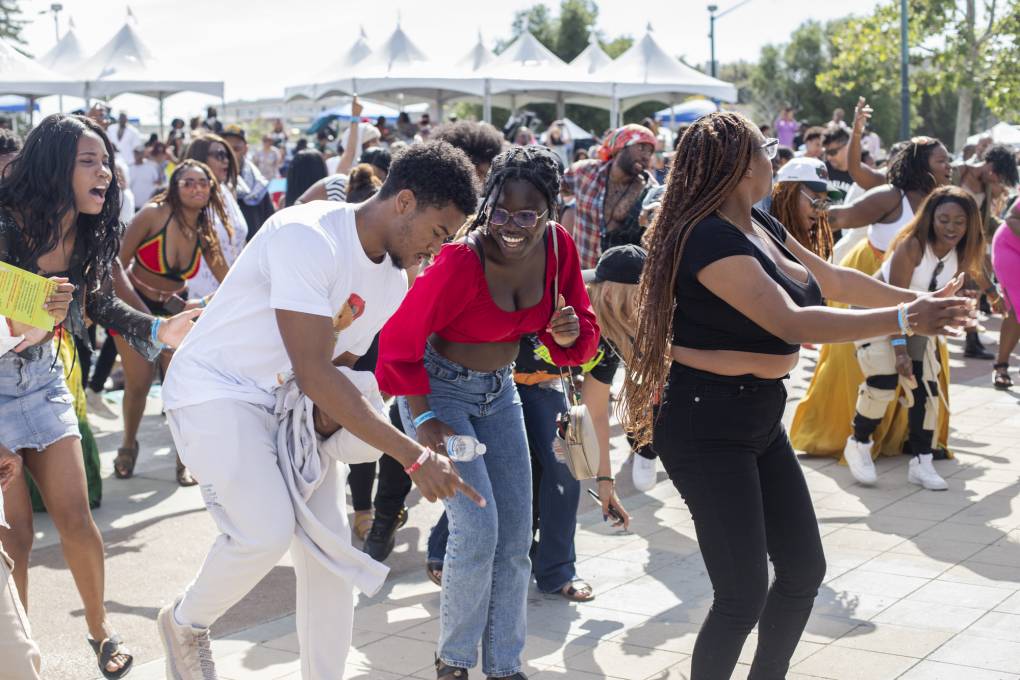
"caption": "People dance at Lake Merritt as part of the 14th annual Fam Bam Afrocentric Juneteenth festival in Oakland on June 17, 2023.",
"credit": "Amaya Edwards/KQED",
"altTag": "A group of people dance together on a sunny day.",
"description": null,
"imgSizes": {
"medium": {
"file": "https://cdn.kqed.org/wp-content/uploads/sites/10/2023/06/RS66366_20230617_Juneteenth_KQED-35-KQED-800x533.jpg",
"width": 800,
"height": 533,
"mimeType": "image/jpeg"
},
"large": {
"file": "https://cdn.kqed.org/wp-content/uploads/sites/10/2023/06/RS66366_20230617_Juneteenth_KQED-35-KQED-1020x680.jpg",
"width": 1020,
"height": 680,
"mimeType": "image/jpeg"
},
"thumbnail": {
"file": "https://cdn.kqed.org/wp-content/uploads/sites/10/2023/06/RS66366_20230617_Juneteenth_KQED-35-KQED-160x107.jpg",
"width": 160,
"height": 107,
"mimeType": "image/jpeg"
},
"1536x1536": {
"file": "https://cdn.kqed.org/wp-content/uploads/sites/10/2023/06/RS66366_20230617_Juneteenth_KQED-35-KQED-1536x1024.jpg",
"width": 1536,
"height": 1024,
"mimeType": "image/jpeg"
},
"post-thumbnail": {
"file": "https://cdn.kqed.org/wp-content/uploads/sites/10/2023/06/RS66366_20230617_Juneteenth_KQED-35-KQED-672x372.jpg",
"width": 672,
"height": 372,
"mimeType": "image/jpeg"
},
"twentyfourteen-full-width": {
"file": "https://cdn.kqed.org/wp-content/uploads/sites/10/2023/06/RS66366_20230617_Juneteenth_KQED-35-KQED-1038x576.jpg",
"width": 1038,
"height": 576,
"mimeType": "image/jpeg"
},
"full-width": {
"file": "https://cdn.kqed.org/wp-content/uploads/sites/10/2023/06/RS66366_20230617_Juneteenth_KQED-35-KQED-1920x1280.jpg",
"width": 1920,
"height": 1280,
"mimeType": "image/jpeg"
},
"kqedFullSize": {
"file": "https://cdn.kqed.org/wp-content/uploads/sites/10/2023/06/RS66366_20230617_Juneteenth_KQED-35-KQED.jpg",
"width": 2000,
"height": 1333
}
},
"isLoading": false,
"fetchFailed": false
},
"news_11953284": {
"type": "attachments",
"id": "news_11953284",
"meta": {
"index": "attachments_1716263798",
"site": "news",
"id": "11953284",
"found": true
},
"parent": 11953279,
"imgSizes": {
"twentyfourteen-full-width": {
"file": "https://ww2.kqed.org/app/uploads/sites/10/2023/06/Natera_-SouthBerkeley-Black-History-Tour--1038x576.jpg",
"width": 1038,
"mimeType": "image/jpeg",
"height": 576
},
"thumbnail": {
"file": "https://ww2.kqed.org/app/uploads/sites/10/2023/06/Natera_-SouthBerkeley-Black-History-Tour--160x107.jpg",
"width": 160,
"mimeType": "image/jpeg",
"height": 107
},
"post-thumbnail": {
"file": "https://ww2.kqed.org/app/uploads/sites/10/2023/06/Natera_-SouthBerkeley-Black-History-Tour--672x372.jpg",
"width": 672,
"mimeType": "image/jpeg",
"height": 372
},
"kqedFullSize": {
"file": "https://ww2.kqed.org/app/uploads/sites/10/2023/06/Natera_-SouthBerkeley-Black-History-Tour--scaled.jpg",
"width": 2560,
"height": 1709
},
"2048x2048": {
"file": "https://ww2.kqed.org/app/uploads/sites/10/2023/06/Natera_-SouthBerkeley-Black-History-Tour--2048x1367.jpg",
"width": 2048,
"mimeType": "image/jpeg",
"height": 1367
},
"large": {
"file": "https://ww2.kqed.org/app/uploads/sites/10/2023/06/Natera_-SouthBerkeley-Black-History-Tour--1020x681.jpg",
"width": 1020,
"mimeType": "image/jpeg",
"height": 681
},
"1536x1536": {
"file": "https://ww2.kqed.org/app/uploads/sites/10/2023/06/Natera_-SouthBerkeley-Black-History-Tour--1536x1025.jpg",
"width": 1536,
"mimeType": "image/jpeg",
"height": 1025
},
"full-width": {
"file": "https://ww2.kqed.org/app/uploads/sites/10/2023/06/Natera_-SouthBerkeley-Black-History-Tour--1920x1282.jpg",
"width": 1920,
"mimeType": "image/jpeg",
"height": 1282
},
"medium": {
"file": "https://ww2.kqed.org/app/uploads/sites/10/2023/06/Natera_-SouthBerkeley-Black-History-Tour--800x534.jpg",
"width": 800,
"mimeType": "image/jpeg",
"height": 534
}
},
"publishDate": 1686961193,
"modified": 1686961226,
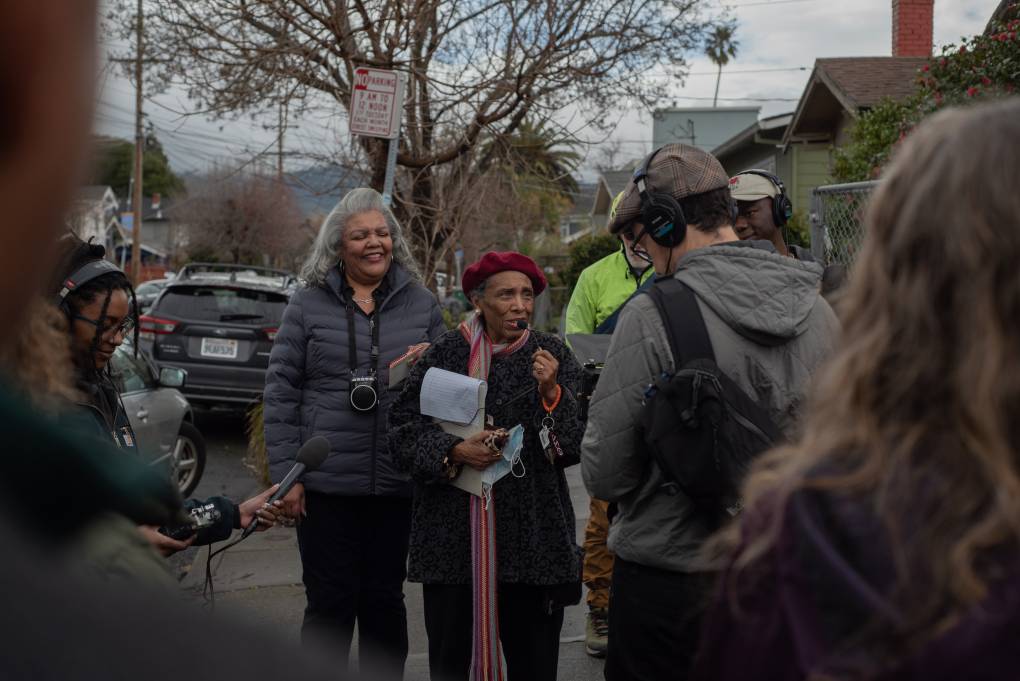
"caption": "The first Black woman elected as Berkeley's vice mayor, Carole Davis Kennerly, made opening remarks during the walking tour. Tina Jones Williams, author and folklorist, leads a Black History walking tour through South Berkeley Neighborhood, the heart of the African-American community in the city, on Saturday, February 11th. ",
"description": null,
"title": null,
"credit": "Credit: Ximena Natera, Berkeleyside/CatchLight",
"status": "inherit",
"altTag": null,
"isLoading": false,
"fetchFailed": false
},
"news_11942341": {
"type": "attachments",
"id": "news_11942341",
"meta": {
"index": "attachments_1716263798",
"site": "news",
"id": "11942341",
"found": true
},
"parent": 11942302,
"imgSizes": {
"twentyfourteen-full-width": {
"file": "https://ww2.kqed.org/app/uploads/sites/10/2024/03/IMG_4305-1038x576.jpg",
"width": 1038,
"mimeType": "image/jpeg",
"height": 576
},
"thumbnail": {
"file": "https://ww2.kqed.org/app/uploads/sites/10/2024/03/IMG_4305-160x114.jpg",
"width": 160,
"mimeType": "image/jpeg",
"height": 114
},
"post-thumbnail": {
"file": "https://ww2.kqed.org/app/uploads/sites/10/2024/03/IMG_4305-672x372.jpg",
"width": 672,
"mimeType": "image/jpeg",
"height": 372
},
"kqedFullSize": {
"file": "https://ww2.kqed.org/app/uploads/sites/10/2024/03/IMG_4305.jpg",
"width": 1920,
"height": 1371
},
"large": {
"file": "https://ww2.kqed.org/app/uploads/sites/10/2024/03/IMG_4305-1020x728.jpg",
"width": 1020,
"mimeType": "image/jpeg",
"height": 728
},
"1536x1536": {
"file": "https://ww2.kqed.org/app/uploads/sites/10/2024/03/IMG_4305-1536x1097.jpg",
"width": 1536,
"mimeType": "image/jpeg",
"height": 1097
},
"medium": {
"file": "https://ww2.kqed.org/app/uploads/sites/10/2024/03/IMG_4305-800x571.jpg",
"width": 800,
"mimeType": "image/jpeg",
"height": 571
}
},
"publishDate": 1677793821,
"modified": 1686932212,
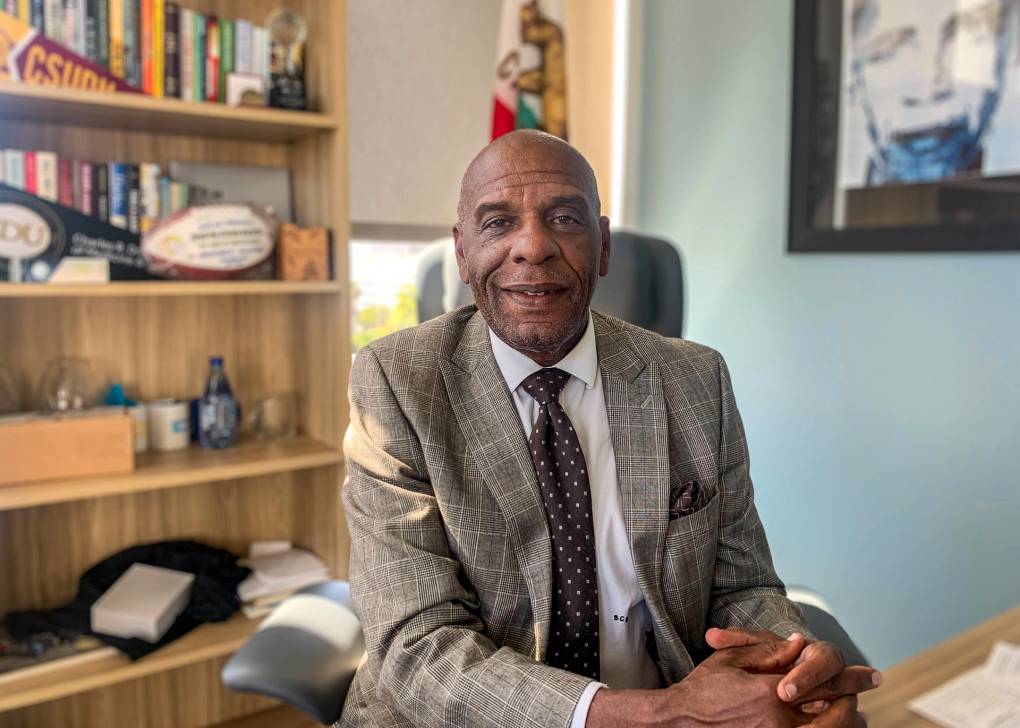
"caption": "California state Sen. Steven Bradford (D-Gardena), a member of California's reparations task force, in his office in Sacramento on Aug. 10, 2022.",
"description": null,
"title": "IMG_4305",
"credit": "Guy Marzorati/KQED",
"status": "inherit",
"altTag": "A Black man wearing a jacket and tie, sitting at a desk.",
"isLoading": false,
"fetchFailed": false
},
"news_11952793": {
"type": "attachments",
"id": "news_11952793",
"meta": {
"index": "attachments_1716263798",
"site": "news",
"id": "11952793",
"found": true
},
"title": "California Reparations Task Force meets to hear public input on reparations at the California Science Center in Los Angeles on Sept. 22, 2022.",
"publishDate": 1686590644,
"status": "inherit",
"parent": 12046328,
"modified": 1751065072,
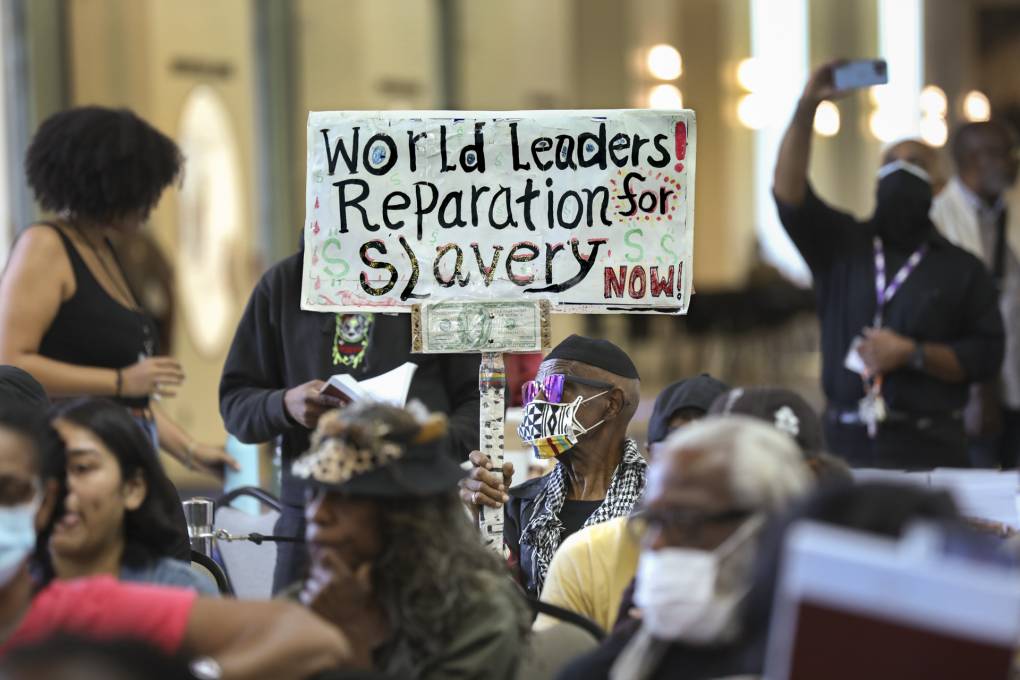
"caption": "Long-time Los Angeles resident Walter Foster, 80, holds up a sign as the Reparations Task Force listens to public input at the California Science Center in Los Angeles on Sept. 22, 2022.",
"credit": "Carolyn Cole/Los Angeles Times via Getty Images",
"altTag": "A man wearing a face mask holds a sign that reads \"World Leaders! Reparations for Slavery Now!\" in a crowd of people.",
"description": null,
"imgSizes": {
"medium": {
"file": "https://cdn.kqed.org/wp-content/uploads/sites/10/2023/06/230612-Reparations-Getty-1243475910-KQED-800x533.jpg",
"width": 800,
"height": 533,
"mimeType": "image/jpeg"
},
"large": {
"file": "https://cdn.kqed.org/wp-content/uploads/sites/10/2023/06/230612-Reparations-Getty-1243475910-KQED-1020x680.jpg",
"width": 1020,
"height": 680,
"mimeType": "image/jpeg"
},
"thumbnail": {
"file": "https://cdn.kqed.org/wp-content/uploads/sites/10/2023/06/230612-Reparations-Getty-1243475910-KQED-160x107.jpg",
"width": 160,
"height": 107,
"mimeType": "image/jpeg"
},
"1536x1536": {
"file": "https://cdn.kqed.org/wp-content/uploads/sites/10/2023/06/230612-Reparations-Getty-1243475910-KQED-1536x1024.jpg",
"width": 1536,
"height": 1024,
"mimeType": "image/jpeg"
},
"post-thumbnail": {
"file": "https://cdn.kqed.org/wp-content/uploads/sites/10/2023/06/230612-Reparations-Getty-1243475910-KQED-672x372.jpg",
"width": 672,
"height": 372,
"mimeType": "image/jpeg"
},
"twentyfourteen-full-width": {
"file": "https://cdn.kqed.org/wp-content/uploads/sites/10/2023/06/230612-Reparations-Getty-1243475910-KQED-1038x576.jpg",
"width": 1038,
"height": 576,
"mimeType": "image/jpeg"
},
"kqedFullSize": {
"file": "https://cdn.kqed.org/wp-content/uploads/sites/10/2023/06/230612-Reparations-Getty-1243475910-KQED.jpg",
"width": 1920,
"height": 1280
}
},
"isLoading": false,
"fetchFailed": false
},
"news_11936510": {
"type": "attachments",
"id": "news_11936510",
"meta": {
"index": "attachments_1716263798",
"site": "news",
"id": "11936510",
"found": true
},
"parent": 11936507,
"imgSizes": {
"twentyfourteen-full-width": {
"file": "https://ww2.kqed.org/app/uploads/sites/10/2022/12/GettyImages-1360489934-1024x576.jpg",
"width": 1024,
"mimeType": "image/jpeg",
"height": 576
},
"thumbnail": {
"file": "https://ww2.kqed.org/app/uploads/sites/10/2022/12/GettyImages-1360489934-160x109.jpg",
"width": 160,
"mimeType": "image/jpeg",
"height": 109
},
"post-thumbnail": {
"file": "https://ww2.kqed.org/app/uploads/sites/10/2022/12/GettyImages-1360489934-672x372.jpg",
"width": 672,
"mimeType": "image/jpeg",
"height": 372
},
"kqedFullSize": {
"file": "https://ww2.kqed.org/app/uploads/sites/10/2022/12/GettyImages-1360489934.jpg",
"width": 1024,
"height": 697
},
"large": {
"file": "https://ww2.kqed.org/app/uploads/sites/10/2022/12/GettyImages-1360489934-1020x694.jpg",
"width": 1020,
"mimeType": "image/jpeg",
"height": 694
},
"medium": {
"file": "https://ww2.kqed.org/app/uploads/sites/10/2022/12/GettyImages-1360489934-800x545.jpg",
"width": 800,
"mimeType": "image/jpeg",
"height": 545
}
},
"publishDate": 1672428513,
"modified": 1673036687,
"caption": "Gov. Gavin Newsom speaks during a press conference in Oakland, on Dec. 22, 2021.",
"description": null,
"title": "Gov. Gavin Newsom Covid-19 Testing",
"credit": "Jane Tyska/Digital First Media/East Bay Times via Getty Images",
"status": "inherit",
"altTag": "A white man in a suit and tie explains something toward the camera.",
"isLoading": false,
"fetchFailed": false
},
"news_11917382": {
"type": "attachments",
"id": "news_11917382",
"meta": {
"index": "attachments_1716263798",
"site": "news",
"id": "11917382",
"found": true
},
"parent": 11917366,
"imgSizes": {
"twentyfourteen-full-width": {
"file": "https://ww2.kqed.org/app/uploads/sites/10/2022/06/Malcolm-Pearce-attends-attends-Berkeley-Juneteenth-Festival-on-Sunday-June-19-2022.--1038x576.jpg",
"width": 1038,
"mimeType": "image/jpeg",
"height": 576
},
"thumbnail": {
"file": "https://ww2.kqed.org/app/uploads/sites/10/2022/06/Malcolm-Pearce-attends-attends-Berkeley-Juneteenth-Festival-on-Sunday-June-19-2022.--160x107.jpg",
"width": 160,
"mimeType": "image/jpeg",
"height": 107
},
"post-thumbnail": {
"file": "https://ww2.kqed.org/app/uploads/sites/10/2022/06/Malcolm-Pearce-attends-attends-Berkeley-Juneteenth-Festival-on-Sunday-June-19-2022.--672x372.jpg",
"width": 672,
"mimeType": "image/jpeg",
"height": 372
},
"kqedFullSize": {
"file": "https://ww2.kqed.org/app/uploads/sites/10/2022/06/Malcolm-Pearce-attends-attends-Berkeley-Juneteenth-Festival-on-Sunday-June-19-2022.-.jpg",
"width": 1920,
"height": 1280
},
"large": {
"file": "https://ww2.kqed.org/app/uploads/sites/10/2022/06/Malcolm-Pearce-attends-attends-Berkeley-Juneteenth-Festival-on-Sunday-June-19-2022.--1020x680.jpg",
"width": 1020,
"mimeType": "image/jpeg",
"height": 680
},
"1536x1536": {
"file": "https://ww2.kqed.org/app/uploads/sites/10/2022/06/Malcolm-Pearce-attends-attends-Berkeley-Juneteenth-Festival-on-Sunday-June-19-2022.--1536x1024.jpg",
"width": 1536,
"mimeType": "image/jpeg",
"height": 1024
},
"medium": {
"file": "https://ww2.kqed.org/app/uploads/sites/10/2022/06/Malcolm-Pearce-attends-attends-Berkeley-Juneteenth-Festival-on-Sunday-June-19-2022.--800x533.jpg",
"width": 800,
"mimeType": "image/jpeg",
"height": 533
}
},
"publishDate": 1655686396,
"modified": 1655692871,
"caption": "Malcolm Perce attends attends Berkeley Juneteenth Festival on Sunday, June 19, 2022.",
"description": "Malcolm Perce attends attends Berkeley Juneteenth Festival on Sunday, June 19, 2022.",
"title": "Malcolm Pearce attends attends Berkeley Juneteenth Festival on Sunday, June 19, 2022.",
"credit": "Estefany Gonzalez",
"status": "inherit",
"altTag": null,
"isLoading": false,
"fetchFailed": false
},
"news_11899818": {
"type": "attachments",
"id": "news_11899818",
"meta": {
"index": "attachments_1716263798",
"site": "news",
"id": "11899818",
"found": true
},
"parent": 11899667,
"imgSizes": {
"twentyfourteen-full-width": {
"file": "https://ww2.kqed.org/app/uploads/sites/10/2021/12/016_Oakland_JuneteenthBBPMiniMuseum_06192021-1038x576.jpg",
"width": 1038,
"mimeType": "image/jpeg",
"height": 576
},
"thumbnail": {
"file": "https://ww2.kqed.org/app/uploads/sites/10/2021/12/016_Oakland_JuneteenthBBPMiniMuseum_06192021-160x107.jpg",
"width": 160,
"mimeType": "image/jpeg",
"height": 107
},
"post-thumbnail": {
"file": "https://ww2.kqed.org/app/uploads/sites/10/2021/12/016_Oakland_JuneteenthBBPMiniMuseum_06192021-672x372.jpg",
"width": 672,
"mimeType": "image/jpeg",
"height": 372
},
"kqedFullSize": {
"file": "https://ww2.kqed.org/app/uploads/sites/10/2021/12/016_Oakland_JuneteenthBBPMiniMuseum_06192021.jpg",
"width": 1920,
"height": 1280
},
"large": {
"file": "https://ww2.kqed.org/app/uploads/sites/10/2021/12/016_Oakland_JuneteenthBBPMiniMuseum_06192021-1020x680.jpg",
"width": 1020,
"mimeType": "image/jpeg",
"height": 680
},
"1536x1536": {
"file": "https://ww2.kqed.org/app/uploads/sites/10/2021/12/016_Oakland_JuneteenthBBPMiniMuseum_06192021-1536x1024.jpg",
"width": 1536,
"mimeType": "image/jpeg",
"height": 1024
},
"medium": {
"file": "https://ww2.kqed.org/app/uploads/sites/10/2021/12/016_Oakland_JuneteenthBBPMiniMuseum_06192021-800x533.jpg",
"width": 800,
"mimeType": "image/jpeg",
"height": 533
}
},
"publishDate": 1639959657,
"modified": 1640052639,
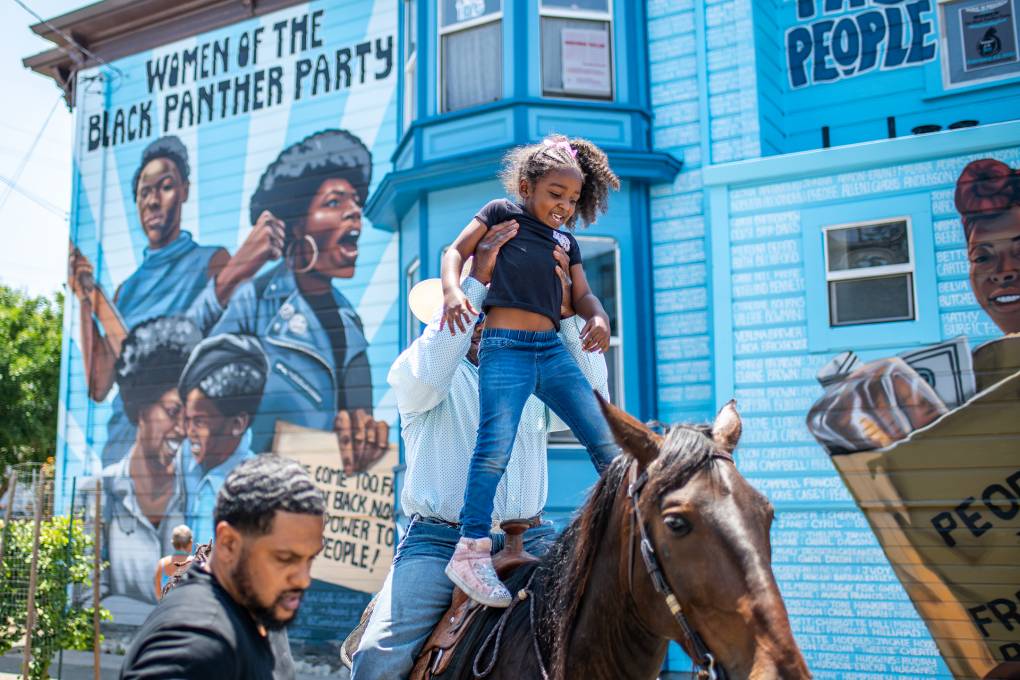
"caption": "Donnell McAlister gives kids a chance to sit on top of his horse JJ, named after Jesse James, during a Juneteenth block party to celebrate the opening of Black Panther Party Mini Museum in West Oakland on June 19, 2021.",
"description": "Donnell McAlister gives kids a chance to sit on top of his horse JJ, named after Jesse James, during a Juneteenth block party to celebrate the opening of Black Panther Party Mini Museum in West Oakland on June 19, 2021.",
"title": "Oakland_Juneteenth_BlackPantherPartyMiniMuseum_06192021",
"credit": "Beth LaBerge/KQED",
"status": "inherit",
"altTag": "A child smiles as she is lifted onto a horse by a man in a cowboy hat in front of a blue mural that says, \"Women of the Black Panther Party.\"",
"isLoading": false,
"fetchFailed": false
},
"news_11878701": {
"type": "attachments",
"id": "news_11878701",
"meta": {
"index": "attachments_1716263798",
"site": "news",
"id": "11878701",
"found": true
},
"parent": 11878694,
"imgSizes": {
"twentyfourteen-full-width": {
"file": "https://ww2.kqed.org/app/uploads/sites/10/2021/06/Image-from-iOS-1-1038x576.jpg",
"width": 1038,
"mimeType": "image/jpeg",
"height": 576
},
"thumbnail": {
"file": "https://ww2.kqed.org/app/uploads/sites/10/2021/06/Image-from-iOS-1-160x107.jpg",
"width": 160,
"mimeType": "image/jpeg",
"height": 107
},
"post-thumbnail": {
"file": "https://ww2.kqed.org/app/uploads/sites/10/2021/06/Image-from-iOS-1-672x372.jpg",
"width": 672,
"mimeType": "image/jpeg",
"height": 372
},
"kqedFullSize": {
"file": "https://ww2.kqed.org/app/uploads/sites/10/2021/06/Image-from-iOS-1.jpg",
"width": 1620,
"height": 1080
},
"large": {
"file": "https://ww2.kqed.org/app/uploads/sites/10/2021/06/Image-from-iOS-1-1020x680.jpg",
"width": 1020,
"mimeType": "image/jpeg",
"height": 680
},
"1536x1536": {
"file": "https://ww2.kqed.org/app/uploads/sites/10/2021/06/Image-from-iOS-1-1536x1024.jpg",
"width": 1536,
"mimeType": "image/jpeg",
"height": 1024
},
"medium": {
"file": "https://ww2.kqed.org/app/uploads/sites/10/2021/06/Image-from-iOS-1-800x533.jpg",
"width": 800,
"mimeType": "image/jpeg",
"height": 533
}
},
"publishDate": 1624143398,
"modified": 1624143418,
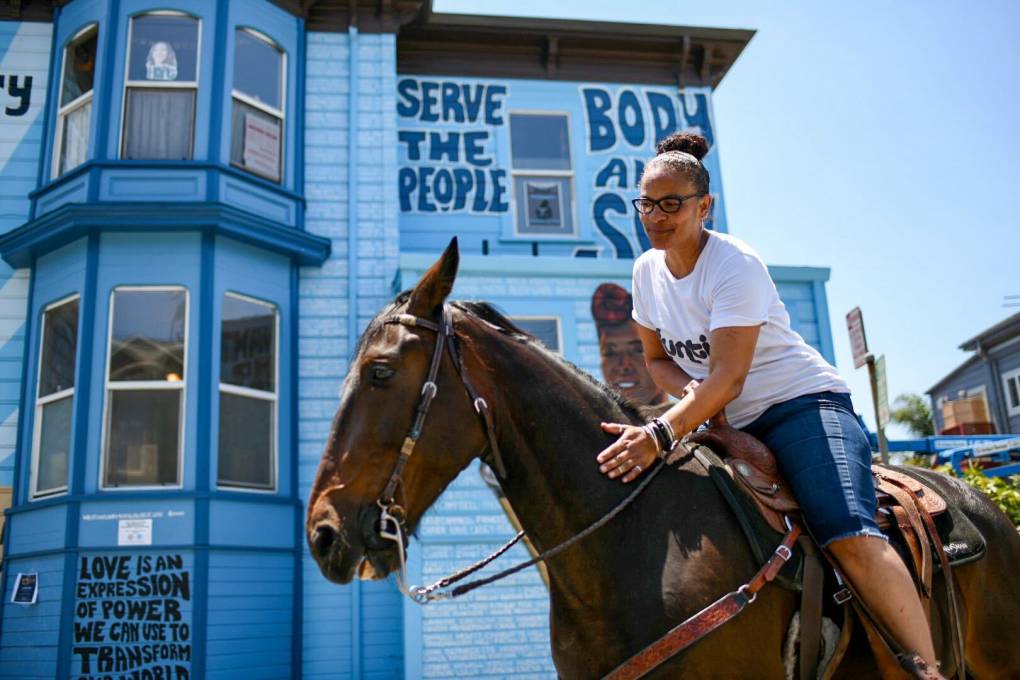
"caption": "Jilchristina Vest rides JJ, the horse of Oakland Black Cowboy Donnell McAlister, during a Juneteenth block party to celebrate the opening of the Black Panther Mini Museum in Oakland on June 19, 2021.",
"description": null,
"title": "Image from iOS",
"credit": "Beth LaBerge/KQED",
"status": "inherit",
"altTag": null,
"isLoading": false,
"fetchFailed": false
},
"news_11878580": {
"type": "attachments",
"id": "news_11878580",
"meta": {
"index": "attachments_1716263798",
"site": "news",
"id": "11878580",
"found": true
},
"parent": 0,
"imgSizes": {
"twentyfourteen-full-width": {
"file": "https://ww2.kqed.org/app/uploads/sites/10/2021/06/RS49965_005_SanFrancisco_JuneteenthKickoffRally_06172021-qut-1038x576.jpg",
"width": 1038,
"mimeType": "image/jpeg",
"height": 576
},
"thumbnail": {
"file": "https://ww2.kqed.org/app/uploads/sites/10/2021/06/RS49965_005_SanFrancisco_JuneteenthKickoffRally_06172021-qut-160x107.jpg",
"width": 160,
"mimeType": "image/jpeg",
"height": 107
},
"post-thumbnail": {
"file": "https://ww2.kqed.org/app/uploads/sites/10/2021/06/RS49965_005_SanFrancisco_JuneteenthKickoffRally_06172021-qut-672x372.jpg",
"width": 672,
"mimeType": "image/jpeg",
"height": 372
},
"kqedFullSize": {
"file": "https://ww2.kqed.org/app/uploads/sites/10/2021/06/RS49965_005_SanFrancisco_JuneteenthKickoffRally_06172021-qut.jpg",
"width": 1920,
"height": 1280
},
"large": {
"file": "https://ww2.kqed.org/app/uploads/sites/10/2021/06/RS49965_005_SanFrancisco_JuneteenthKickoffRally_06172021-qut-1020x680.jpg",
"width": 1020,
"mimeType": "image/jpeg",
"height": 680
},
"1536x1536": {
"file": "https://ww2.kqed.org/app/uploads/sites/10/2021/06/RS49965_005_SanFrancisco_JuneteenthKickoffRally_06172021-qut-1536x1024.jpg",
"width": 1536,
"mimeType": "image/jpeg",
"height": 1024
},
"medium": {
"file": "https://ww2.kqed.org/app/uploads/sites/10/2021/06/RS49965_005_SanFrancisco_JuneteenthKickoffRally_06172021-qut-800x533.jpg",
"width": 800,
"mimeType": "image/jpeg",
"height": 533
}
},
"publishDate": 1623985143,
"modified": 1624047799,
"caption": "People raise their fists and hold signs that say 'I Am Black And I Matter' during a Juneteenth kickoff rally on the steps of San Francisco City Hall on June 17, 2021.",
"description": "People raise their fists and hold signs that say, \"Am Black And I Matter\" during a Juneteenth kickoff rally on the steps of San Francisco City Hall on June 17, 2021.",
"title": "RS49965_005_SanFrancisco_JuneteenthKickoffRally_06172021-qut",
"credit": "Beth LaBerge/KQED ",
"status": "inherit",
"altTag": "People standing in front of San Francisco City Hall hold up signs that read \"Am Black and I Matter\"",
"isLoading": false,
"fetchFailed": false
},
"news_11878472": {
"type": "attachments",
"id": "news_11878472",
"meta": {
"index": "attachments_1716263798",
"site": "news",
"id": "11878472",
"found": true
},
"parent": 11878430,
"imgSizes": {
"twentyfourteen-full-width": {
"file": "https://ww2.kqed.org/app/uploads/sites/10/2021/06/GettyImages-Biden-1020x576.jpg",
"width": 1020,
"mimeType": "image/jpeg",
"height": 576
},
"thumbnail": {
"file": "https://ww2.kqed.org/app/uploads/sites/10/2021/06/GettyImages-Biden-160x107.jpg",
"width": 160,
"mimeType": "image/jpeg",
"height": 107
},
"post-thumbnail": {
"file": "https://ww2.kqed.org/app/uploads/sites/10/2021/06/GettyImages-Biden-672x372.jpg",
"width": 672,
"mimeType": "image/jpeg",
"height": 372
},
"kqedFullSize": {
"file": "https://ww2.kqed.org/app/uploads/sites/10/2021/06/GettyImages-Biden.jpg",
"width": 1020,
"height": 680
},
"medium": {
"file": "https://ww2.kqed.org/app/uploads/sites/10/2021/06/GettyImages-Biden-800x533.jpg",
"width": 800,
"mimeType": "image/jpeg",
"height": 533
}
},
"publishDate": 1623964000,
"modified": 1623969629,
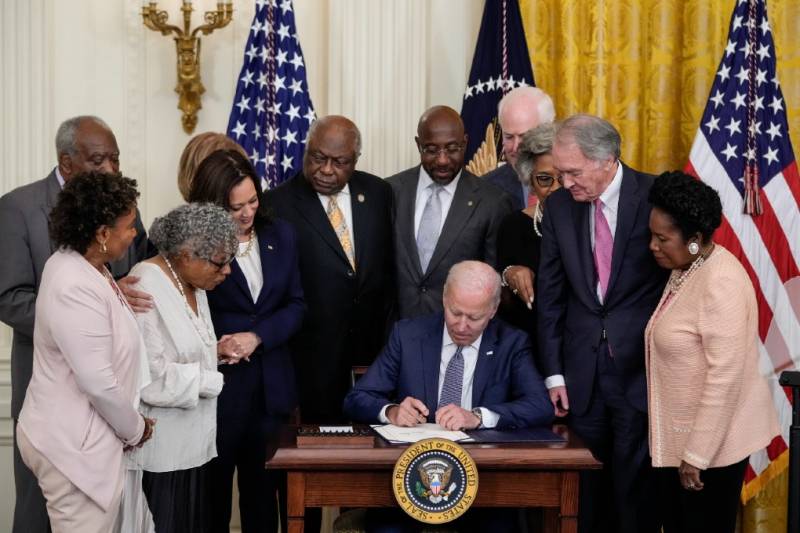
"caption": "President Biden signs the Juneteenth National Independence Day Act into law in the East Room of the White House on June 17, 2021. Juneteenth National Independence Day will become the 12th legal federal holiday — the first new one since Martin Luther King Jr. Day was signed into law in 1983.",
"description": "President Biden signs the Juneteenth National Independence Day Act into law in the East Room of the White House on June 17, 2021. Juneteenth National Independence Day will become the 12th legal federal holiday — the first new one since Martin Luther King Jr. Day was signed into law in 1983.",
"title": "GettyImages-Biden",
"credit": "Drew Angerer/Getty Images",
"status": "inherit",
"altTag": "President Biden signs a document while a number of people look on.",
"isLoading": false,
"fetchFailed": false
},
"news_11878294": {
"type": "attachments",
"id": "news_11878294",
"meta": {
"index": "attachments_1716263798",
"site": "news",
"id": "11878294",
"found": true
},
"parent": 11878293,
"imgSizes": {
"twentyfourteen-full-width": {
"file": "https://ww2.kqed.org/app/uploads/sites/10/2021/06/ap_20172034000134_custom-041dc85ee3549bb96ab040acc467dc3bfe9b75ec-1038x576.jpg",
"width": 1038,
"mimeType": "image/jpeg",
"height": 576
},
"thumbnail": {
"file": "https://ww2.kqed.org/app/uploads/sites/10/2021/06/ap_20172034000134_custom-041dc85ee3549bb96ab040acc467dc3bfe9b75ec-160x99.jpg",
"width": 160,
"mimeType": "image/jpeg",
"height": 99
},
"post-thumbnail": {
"file": "https://ww2.kqed.org/app/uploads/sites/10/2021/06/ap_20172034000134_custom-041dc85ee3549bb96ab040acc467dc3bfe9b75ec-672x372.jpg",
"width": 672,
"mimeType": "image/jpeg",
"height": 372
},
"kqedFullSize": {
"file": "https://ww2.kqed.org/app/uploads/sites/10/2021/06/ap_20172034000134_custom-041dc85ee3549bb96ab040acc467dc3bfe9b75ec-scaled-e1623887814802.jpg",
"width": 1920,
"height": 1192
},
"2048x2048": {
"file": "https://ww2.kqed.org/app/uploads/sites/10/2021/06/ap_20172034000134_custom-041dc85ee3549bb96ab040acc467dc3bfe9b75ec-2048x1271.jpg",
"width": 2048,
"mimeType": "image/jpeg",
"height": 1271
},
"large": {
"file": "https://ww2.kqed.org/app/uploads/sites/10/2021/06/ap_20172034000134_custom-041dc85ee3549bb96ab040acc467dc3bfe9b75ec-1020x633.jpg",
"width": 1020,
"mimeType": "image/jpeg",
"height": 633
},
"1536x1536": {
"file": "https://ww2.kqed.org/app/uploads/sites/10/2021/06/ap_20172034000134_custom-041dc85ee3549bb96ab040acc467dc3bfe9b75ec-1536x954.jpg",
"width": 1536,
"mimeType": "image/jpeg",
"height": 954
},
"full-width": {
"file": "https://ww2.kqed.org/app/uploads/sites/10/2021/06/ap_20172034000134_custom-041dc85ee3549bb96ab040acc467dc3bfe9b75ec-1920x1192.jpg",
"width": 1920,
"mimeType": "image/jpeg",
"height": 1192
},
"medium": {
"file": "https://ww2.kqed.org/app/uploads/sites/10/2021/06/ap_20172034000134_custom-041dc85ee3549bb96ab040acc467dc3bfe9b75ec-800x497.jpg",
"width": 800,
"mimeType": "image/jpeg",
"height": 497
}
},
"publishDate": 1623887195,
"modified": 1623889526,
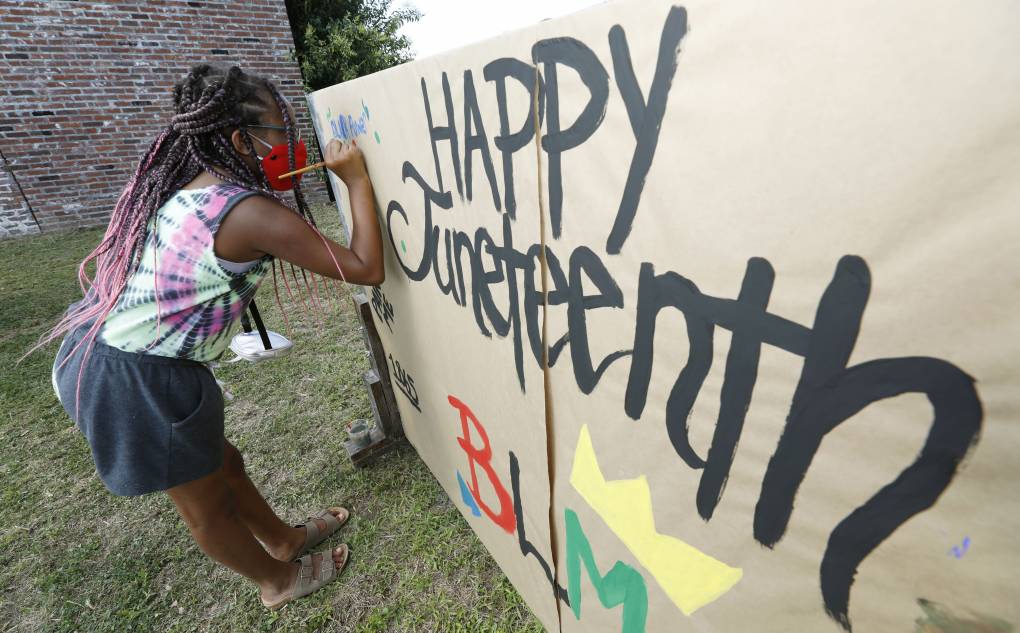
"caption": "A girl paints on a poster celebrating Juneteenth in downtown Jackson, Mississippi, on June 19, 2020. Congress has voted to make the day a federal holiday.",
"description": "A girl paints on a poster celebrating Juneteenth in downtown Jackson, Miss., on June 19, 2020. Congress has voted to make the day a federal holiday.\n",
"title": "A girl paints on a poster celebrating Juneteenth in downtown Jackson, Miss., on June 19, 2020. Congress has voted to make the day a federal holiday.",
"credit": "Rogelio V. Solis/AP",
"status": "inherit",
"altTag": null,
"isLoading": false,
"fetchFailed": false
}
},
"audioPlayerReducer": {
"postId": "stream_live",
"isPaused": true,
"isPlaying": false,
"pfsActive": false,
"pledgeModalIsOpen": true,
"playerDrawerIsOpen": false,
"liveAudioPlayStartedAt": 0,
"liveAudioPlayContext": ""
},
"authorsReducer": {
"byline_news_11990885": {
"type": "authors",
"id": "byline_news_11990885",
"meta": {
"override": true
},
"slug": "byline_news_11990885",
"name": "Terry Tang, Associated Press",
"isLoading": false
},
"byline_news_11936507": {
"type": "authors",
"id": "byline_news_11936507",
"meta": {
"override": true
},
"slug": "byline_news_11936507",
"name": "Adam Beam\u003cbr>The Associated Press",
"isLoading": false
},
"byline_news_11878430": {
"type": "authors",
"id": "byline_news_11878430",
"meta": {
"override": true
},
"slug": "byline_news_11878430",
"name": "\u003ca href=\"https://www.npr.org/people/831107342/alana-wise\">Alana Wise\u003c/a>",
"isLoading": false
},
"byline_news_11878293": {
"type": "authors",
"id": "byline_news_11878293",
"meta": {
"override": true
},
"slug": "byline_news_11878293",
"name": "Alana Wise",
"isLoading": false
},
"kqed": {
"type": "authors",
"id": "236",
"meta": {
"index": "authors_1716337520",
"id": "236",
"found": true
},
"name": "KQED News Staff",
"firstName": "KQED News Staff",
"lastName": null,
"slug": "kqed",
"email": "faq@kqed.org",
"display_author_email": false,
"staff_mastheads": [],
"title": null,
"bio": null,
"avatar": "https://secure.gravatar.com/avatar/ef0e801a68c4c54afa9180db14084167?s=600&d=blank&r=g",
"twitter": null,
"facebook": null,
"instagram": null,
"linkedin": null,
"sites": [
{
"site": "arts",
"roles": [
"contributor"
]
},
{
"site": "news",
"roles": [
"editor"
]
},
{
"site": "futureofyou",
"roles": [
"author"
]
}
],
"headData": {
"title": "KQED News Staff | KQED",
"description": null,
"ogImgSrc": "https://secure.gravatar.com/avatar/ef0e801a68c4c54afa9180db14084167?s=600&d=blank&r=g",
"twImgSrc": "https://secure.gravatar.com/avatar/ef0e801a68c4c54afa9180db14084167?s=600&d=blank&r=g"
},
"isLoading": false,
"link": "/author/kqed"
},
"ecruzguevarra": {
"type": "authors",
"id": "8654",
"meta": {
"index": "authors_1716337520",
"id": "8654",
"found": true
},
"name": "Ericka Cruz Guevarra",
"firstName": "Ericka",
"lastName": "Cruz Guevarra",
"slug": "ecruzguevarra",
"email": "ecruzguevarra@kqed.org",
"display_author_email": true,
"staff_mastheads": [
"news"
],
"title": "Producer, The Bay Podcast",
"bio": "Ericka Cruz Guevarra is host of \u003ca href=\"https://www.kqed.org/podcasts/thebay\">\u003cem>The Bay\u003c/em>\u003c/a> podcast at KQED. Before host, she was the show’s producer. Her work in that capacity includes a three-part reported series on policing in Vallejo, which won a 2020 excellence in journalism award from the Society of Professional Journalists. Ericka has worked as a breaking news reporter at Oregon Public Broadcasting, helped produce the Code Switch podcast, and was KQED’s inaugural Raul Ramirez Diversity Fund intern. She’s also an alumna of NPR’s Next Generation Radio program. Send her an email if you have strong feelings about whether Fairfield and Suisun City are the Bay. Ericka is represented by SAG-AFTRA.",
"avatar": "https://secure.gravatar.com/avatar/accefc1de4bafc7e234b69bcb9b6f6536c130fd84709bc3069ef11a78787e1bb?s=600&d=blank&r=g",
"twitter": "NotoriousECG",
"bluesky": null,
"facebook": null,
"instagram": null,
"linkedin": null,
"sites": [
{
"site": "arts",
"roles": [
"subscriber"
]
},
{
"site": "news",
"roles": [
"editor",
"manage_categories"
]
},
{
"site": "futureofyou",
"roles": [
"subscriber"
]
},
{
"site": "stateofhealth",
"roles": [
"subscriber"
]
},
{
"site": "science",
"roles": [
"editor"
]
},
{
"site": "forum",
"roles": [
"subscriber"
]
}
],
"headData": {
"title": "Ericka Cruz Guevarra | KQED",
"description": "Producer, The Bay Podcast",
"ogImgSrc": "https://secure.gravatar.com/avatar/accefc1de4bafc7e234b69bcb9b6f6536c130fd84709bc3069ef11a78787e1bb?s=600&d=blank&r=g",
"twImgSrc": "https://secure.gravatar.com/avatar/accefc1de4bafc7e234b69bcb9b6f6536c130fd84709bc3069ef11a78787e1bb?s=600&d=blank&r=g"
},
"isLoading": false,
"link": "/author/ecruzguevarra"
},
"mfederis": {
"type": "authors",
"id": "11509",
"meta": {
"index": "authors_1716337520",
"id": "11509",
"found": true
},
"name": "Marnette Federis",
"firstName": "Marnette",
"lastName": "Federis",
"slug": "mfederis",
"email": "mfederis@kqed.org",
"display_author_email": false,
"staff_mastheads": [],
"title": "KQED Contributor",
"bio": null,
"avatar": "https://secure.gravatar.com/avatar/6553b16260501cef36787444651fa5ed?s=600&d=blank&r=g",
"twitter": null,
"facebook": null,
"instagram": null,
"linkedin": null,
"sites": [
{
"site": "news",
"roles": [
"editor"
]
},
{
"site": "mindshift",
"roles": [
"editor"
]
},
{
"site": "science",
"roles": [
"editor"
]
},
{
"site": "podcasts",
"roles": [
"editor"
]
}
],
"headData": {
"title": "Marnette Federis | KQED",
"description": "KQED Contributor",
"ogImgSrc": "https://secure.gravatar.com/avatar/6553b16260501cef36787444651fa5ed?s=600&d=blank&r=g",
"twImgSrc": "https://secure.gravatar.com/avatar/6553b16260501cef36787444651fa5ed?s=600&d=blank&r=g"
},
"isLoading": false,
"link": "/author/mfederis"
},
"katewolffe": {
"type": "authors",
"id": "11523",
"meta": {
"index": "authors_1716337520",
"id": "11523",
"found": true
},
"name": "Kate Wolffe",
"firstName": "Kate",
"lastName": "Wolffe",
"slug": "katewolffe",
"email": "kwolffe@kqed.org",
"display_author_email": true,
"staff_mastheads": [
"news"
],
"title": "KQED Reporter + Weekend Host",
"bio": "Kate Wolffe reports on local Bay Area happenings for KQED, and hosts the news on weekend afternoons. She joined KQED in 2018 as an intern on the Forum team, before moving to cover topics ranging from politics to criminal justice to homelessness. A Bay Area native and UC Berkeley graduate, Kate loves to discover new corners of the region.",
"avatar": "https://secure.gravatar.com/avatar/22455f14db824a03ee252f73052fe939?s=600&d=blank&r=g",
"twitter": "katewolffe",
"facebook": null,
"instagram": null,
"linkedin": null,
"sites": [
{
"site": "arts",
"roles": [
"editor"
]
},
{
"site": "news",
"roles": [
"author",
"edit_others_posts"
]
},
{
"site": "forum",
"roles": [
"editor"
]
}
],
"headData": {
"title": "Kate Wolffe | KQED",
"description": "KQED Reporter + Weekend Host",
"ogImgSrc": "https://secure.gravatar.com/avatar/22455f14db824a03ee252f73052fe939?s=600&d=blank&r=g",
"twImgSrc": "https://secure.gravatar.com/avatar/22455f14db824a03ee252f73052fe939?s=600&d=blank&r=g"
},
"isLoading": false,
"link": "/author/katewolffe"
},
"lsarah": {
"type": "authors",
"id": "11626",
"meta": {
"index": "authors_1716337520",
"id": "11626",
"found": true
},
"name": "Lakshmi Sarah",
"firstName": "Lakshmi",
"lastName": "Sarah",
"slug": "lsarah",
"email": "lsarah@kqed.org",
"display_author_email": false,
"staff_mastheads": [],
"title": "Digital Producer",
"bio": "Lakshmi Sarah is an educator, author and journalist with a focus on innovative storytelling. She has worked with newspapers, radio and magazines from Ahmedabad, India to Los Angeles, California. She has written and produced for Die Zeit, Global Voices, AJ+, KQED, Fusion Media Group and the New York Times.",
"avatar": "https://secure.gravatar.com/avatar/652dcaecd8b28826fc17a8b2d6bb4e93?s=600&d=blank&r=g",
"twitter": "lakitalki",
"facebook": null,
"instagram": "https://www.instagram.com/laki.talki/",
"linkedin": "https://www.linkedin.com/in/lakisarah/",
"sites": [
{
"site": "arts",
"roles": []
},
{
"site": "news",
"roles": []
},
{
"site": "bayareabites",
"roles": []
},
{
"site": "science",
"roles": []
}
],
"headData": {
"title": "Lakshmi Sarah | KQED",
"description": "Digital Producer",
"ogImgSrc": "https://secure.gravatar.com/avatar/652dcaecd8b28826fc17a8b2d6bb4e93?s=600&d=blank&r=g",
"twImgSrc": "https://secure.gravatar.com/avatar/652dcaecd8b28826fc17a8b2d6bb4e93?s=600&d=blank&r=g"
},
"isLoading": false,
"link": "/author/lsarah"
},
"blaberge": {
"type": "authors",
"id": "11667",
"meta": {
"index": "authors_1716337520",
"id": "11667",
"found": true
},
"name": "Beth LaBerge",
"firstName": "Beth",
"lastName": "LaBerge",
"slug": "blaberge",
"email": "blaberge@KQED.org",
"display_author_email": true,
"staff_mastheads": [
"news"
],
"title": "Photographer, News",
"bio": "Beth LaBerge is a visual journalist for \u003ca href=\"https://www.kqed.org/news\">KQED News\u003c/a>.",
"avatar": "https://secure.gravatar.com/avatar/ce49ecd7a1306685637b45a1f6f5dedfc4ae9481966eb596fea5160466dd6319?s=600&d=blank&r=g",
"twitter": null,
"bluesky": null,
"facebook": null,
"instagram": "https://www.instagram.com/bethlaberge/",
"linkedin": null,
"sites": [
{
"site": "arts",
"roles": [
"editor",
"manage_categories"
]
},
{
"site": "news",
"roles": [
"editor",
"edit_plugins",
"manage_categories"
]
},
{
"site": "science",
"roles": [
"editor",
"contributor",
"author",
"manage_categories"
]
},
{
"site": "perspectives",
"roles": [
"editor"
]
},
{
"site": "liveblog",
"roles": [
"editor"
]
}
],
"headData": {
"title": "Beth LaBerge | KQED",
"description": "Photographer, News",
"ogImgSrc": "https://secure.gravatar.com/avatar/ce49ecd7a1306685637b45a1f6f5dedfc4ae9481966eb596fea5160466dd6319?s=600&d=blank&r=g",
"twImgSrc": "https://secure.gravatar.com/avatar/ce49ecd7a1306685637b45a1f6f5dedfc4ae9481966eb596fea5160466dd6319?s=600&d=blank&r=g"
},
"isLoading": false,
"link": "/author/blaberge"
},
"jrodriguez": {
"type": "authors",
"id": "11690",
"meta": {
"index": "authors_1716337520",
"id": "11690",
"found": true
},
"name": "Joe Fitzgerald Rodriguez",
"firstName": "Joe",
"lastName": "Fitzgerald Rodriguez",
"slug": "jrodriguez",
"email": "jrodriguez@kqed.org",
"display_author_email": true,
"staff_mastheads": [
"news"
],
"title": "Reporter and Producer",
"bio": "Joe Fitzgerald Rodriguez is a reporter and digital producer for KQED covering politics. Joe most recently wrote for the \u003cem>San Francisco Examiner\u003c/em> as a political columnist covering The City. He was raised in San Francisco and has spent his reporting career in his beloved, foggy, city by the bay. Joe was 12-years-old when he conducted his first interview in journalism, grilling former San Francisco Mayor Willie Brown for the Marina Middle School newspaper, \u003cem>The Penguin Press, \u003c/em>and he continues to report on the San Francisco Bay Area to this day.",
"avatar": "https://secure.gravatar.com/avatar/2247beb0564c1e9c62228d5649d2edac?s=600&d=blank&r=g",
"twitter": "FitztheReporter",
"facebook": null,
"instagram": "https://www.instagram.com/fitzthereporter/",
"linkedin": null,
"sites": [
{
"site": "",
"roles": [
"editor"
]
},
{
"site": "arts",
"roles": [
"editor"
]
},
{
"site": "news",
"roles": [
"editor"
]
},
{
"site": "science",
"roles": [
"editor"
]
},
{
"site": "elections",
"roles": [
"editor"
]
},
{
"site": "liveblog",
"roles": [
"editor"
]
}
],
"headData": {
"title": "Joe Fitzgerald Rodriguez | KQED",
"description": "Reporter and Producer",
"ogImgSrc": "https://secure.gravatar.com/avatar/2247beb0564c1e9c62228d5649d2edac?s=600&d=blank&r=g",
"twImgSrc": "https://secure.gravatar.com/avatar/2247beb0564c1e9c62228d5649d2edac?s=600&d=blank&r=g"
},
"isLoading": false,
"link": "/author/jrodriguez"
},
"agonzalez": {
"type": "authors",
"id": "11724",
"meta": {
"index": "authors_1716337520",
"id": "11724",
"found": true
},
"name": "Alexander Gonzalez",
"firstName": "Alexander",
"lastName": "Gonzalez",
"slug": "agonzalez",
"email": "AlexanderGonzalez@KQED.org",
"display_author_email": false,
"staff_mastheads": [
"news"
],
"title": "KQED Contributor",
"bio": null,
"avatar": "https://secure.gravatar.com/avatar/9e291ed34e154df4c662edf858b641d70b4859939bfe40be478408f9dfd057d2?s=600&d=blank&r=g",
"twitter": null,
"bluesky": null,
"facebook": null,
"instagram": null,
"linkedin": null,
"sites": [
{
"site": "arts",
"roles": [
"editor"
]
},
{
"site": "news",
"roles": [
"editor"
]
},
{
"site": "science",
"roles": [
"editor"
]
}
],
"headData": {
"title": "Alexander Gonzalez | KQED",
"description": "KQED Contributor",
"ogImgSrc": "https://secure.gravatar.com/avatar/9e291ed34e154df4c662edf858b641d70b4859939bfe40be478408f9dfd057d2?s=600&d=blank&r=g",
"twImgSrc": "https://secure.gravatar.com/avatar/9e291ed34e154df4c662edf858b641d70b4859939bfe40be478408f9dfd057d2?s=600&d=blank&r=g"
},
"isLoading": false,
"link": "/author/agonzalez"
},
"afinney": {
"type": "authors",
"id": "11772",
"meta": {
"index": "authors_1716337520",
"id": "11772",
"found": true
},
"name": "Annelise Finney",
"firstName": "Annelise",
"lastName": "Finney",
"slug": "afinney",
"email": "afinney@kqed.org",
"display_author_email": true,
"staff_mastheads": [
"news"
],
"title": "Reporter",
"bio": "Annelise reports on reparations in California and East Bay politics. She co-produced the Sunday Music Drop, a limited-term radio series featuring Bay Area musicians that aired between Sept 2022 and Oct 2024. She joined KQED in 2021 as a general assignment reporter and is an alumna of KALW's Audio Academy. She was born and raised in the East Bay. She is currently away from KQED completing a year-long reporting project in Berlin, Germany as a Alexander Von Humboldt German Chancellor Fellow.",
"avatar": "https://secure.gravatar.com/avatar/5fded66cae47704cdfc5021cde0f3aa4?s=600&d=blank&r=g",
"twitter": null,
"facebook": null,
"instagram": null,
"linkedin": null,
"sites": [
{
"site": "news",
"roles": [
"editor"
]
},
{
"site": "liveblog",
"roles": [
"author"
]
}
],
"headData": {
"title": "Annelise Finney | KQED",
"description": "Reporter",
"ogImgSrc": "https://secure.gravatar.com/avatar/5fded66cae47704cdfc5021cde0f3aa4?s=600&d=blank&r=g",
"twImgSrc": "https://secure.gravatar.com/avatar/5fded66cae47704cdfc5021cde0f3aa4?s=600&d=blank&r=g"
},
"isLoading": false,
"link": "/author/afinney"
},
"mesquinca": {
"type": "authors",
"id": "11802",
"meta": {
"index": "authors_1716337520",
"id": "11802",
"found": true
},
"name": "Maria Esquinca",
"firstName": "Maria",
"lastName": "Esquinca",
"slug": "mesquinca",
"email": "mesquinca@kqed.org",
"display_author_email": false,
"staff_mastheads": [],
"title": "Producer, The Bay",
"bio": "María Esquinca is a producer of The Bay. Before that, she was a New York Women’s Foundation IGNITE Fellow at Latino USA. She worked at Radio Bilingue where she covered the San Joaquin Valley. Maria has interned at WLRN, News 21, The New York Times Student Journalism Institute and at Crain’s Detroit Business as a Dow Jones News Fund Business Reporting Intern. She is an MFA graduate from the University of Miami. In 2017, she graduated from the Walter Cronkite School of Journalism and Mass Communication with a Master of Mass Communication. A fronteriza, she was born in Ciudad Juárez, Chihuahua, Mexico and grew up in El Paso, Texas.",
"avatar": "https://secure.gravatar.com/avatar/77cedba18aae91da775038ba06dcd8d0?s=600&d=blank&r=g",
"twitter": "@m_esquinca",
"facebook": null,
"instagram": null,
"linkedin": null,
"sites": [
{
"site": "news",
"roles": []
}
],
"headData": {
"title": "Maria Esquinca | KQED",
"description": "Producer, The Bay",
"ogImgSrc": "https://secure.gravatar.com/avatar/77cedba18aae91da775038ba06dcd8d0?s=600&d=blank&r=g",
"twImgSrc": "https://secure.gravatar.com/avatar/77cedba18aae91da775038ba06dcd8d0?s=600&d=blank&r=g"
},
"isLoading": false,
"link": "/author/mesquinca"
}
},
"pagesReducer": {
"news_tag_juneteenth": {
"type": "terms",
"id": "news_23528",
"meta": {
"index": "terms_1716263798",
"site": "news",
"id": "23528",
"score": 9.55587
},
"featImg": null,
"name": "Juneteenth",
"description": null,
"taxonomy": "tag",
"headData": {
"twImgId": null,
"twTitle": null,
"ogTitle": null,
"ogImgId": null,
"twDescription": null,
"description": null,
"title": "Juneteenth Archives | KQED News",
"ogDescription": null
},
"ttid": 23545,
"slug": "juneteenth",
"isLoading": false,
"title": "Juneteenth",
"pageMeta": {
"site": "news",
"WpPageTemplate": "page-topic-editorial",
"currentPage": 2
},
"blocks": [
{
"blockName": "kqed/post-list",
"attrs": {
"layout": "cardArticle2",
"query": "posts/news?tag=juneteenth",
"seeMore": false,
"paginated": true,
"page": 2
}
},
{
"blockName": "kqed/ad"
}
]
}
},
"pfsSessionReducer": {},
"postsReducer": {
"stream_live": {
"type": "live",
"id": "stream_live",
"audioUrl": "https://streams.kqed.org/kqedradio",
"title": "Live Stream",
"excerpt": "Live Stream information currently unavailable.",
"link": "/radio",
"featImg": "",
"label": {
"name": "KQED Live",
"link": "/"
}
},
"stream_kqedNewscast": {
"type": "posts",
"id": "stream_kqedNewscast",
"audioUrl": "https://www.kqed.org/.stream/anon/radio/RDnews/newscast.mp3?_=1",
"title": "KQED Newscast",
"featImg": "",
"label": {
"name": "88.5 FM",
"link": "/"
}
},
"news_11990885": {
"type": "posts",
"id": "news_11990885",
"meta": {
"index": "posts_1716263798",
"site": "news",
"id": "11990885",
"score": null,
"sort": [
1718794855000
]
},
"guestAuthors": [],
"slug": "the-beginners-guide-to-celebrating-juneteenth",
"title": "History and Remembrance: How to Celebrate Juneteenth",
"publishDate": 1718794855,
"format": "standard",
"headTitle": "History and Remembrance: How to Celebrate Juneteenth | KQED",
"labelTerm": {
"site": "news"
},
"content": "\u003cp>For more than one-and-a-half centuries, \u003ca href=\"https://apnews.com/article/what-is-juneteenth-f77ddd12436ad02d8124e7d48abe9db4\">the Juneteenth holiday\u003c/a> has been sacred to many Black communities.\u003c/p>\n\u003cp>It marks the day in 1865 when enslaved people in Galveston, Texas, \u003ca href=\"https://apnews.com/article/what-is-juneteenth-f77ddd12436ad02d8124e7d48abe9db4\">found out they had been freed\u003c/a> — after the end of the Civil War and two years after President Abraham Lincoln’s Emancipation Proclamation.\u003c/p>\n\u003cp>Since it was designated a federal holiday in 2021, Juneteenth has become more universally recognized beyond Black America. Many people get the day off work or school, and there are a plethora of street festivals, fairs, concerts and other events.\u003c/p>\n\u003cp>People who never gave the June 19 holiday more than a passing thought may ask themselves, is there a “right” way \u003ca href=\"https://apnews.com/article/juneteenth-holiday-beginner-celebration-guide-460084b8008206febf23bd8d083170fa\">to celebrate Juneteenth\u003c/a>?\u003c/p>\n\u003cp>For beginners and those brushing up on history, here are some answers:\u003c/p>\n\u003ch2>Is Juneteenth a solemn day of remembrance or more of a party?\u003c/h2>\n\u003cp>It just depends on what you want. Juneteenth festivities are rooted in cookouts and barbecues. In the beginnings of the holiday celebrated as Black Americans’ true Independence Day, the outdoors allowed for large, raucous reunions among formerly enslaved families, many of whom had been separated. The gatherings were especially revolutionary because they were free of restrictive measures, known as “Black Codes,” enforced in Confederate states, controlling whether liberated slaves could vote, buy property, gather for worship and other aspects of daily life.\u003c/p>\n\u003cp>[ad fullwidth]\u003c/p>\n\u003cp>Last week, the \u003ca href=\"https://apnews.com/article/biden-juneteenth-concert-patti-labelle-gladys-knight-2ec59a6f5476507aada5b7480c6e28a5\">White House kicked things off early with a concert\u003c/a> on the South Lawn for Juneteenth and Black Music Month. Singers Gladys Knight and Patti LaBelle were among a lineup of well-known artists from gospel, rap, jazz and other genres. The atmosphere was primarily festive, with Vice President Kamala Harris, the first Black vice president, dancing on stage with gospel singer Kirk Franklin.\u003c/p>\n\u003cp>“Today, as we celebrate Juneteenth, together we are reminded of the promise of America,” Harris said in opening remarks. “A promise of freedom, liberty and opportunity, not for some but for all. In many ways, the story of Juneteenth and of our nation is a story of our ongoing fight to realize that promise.”\u003c/p>\n\u003cp>Others may choose to treat Juneteenth as a day of rest and remembrance. That can mean doing community service, attending an education panel or taking time off.\u003c/p>\n\u003cfigure id=\"attachment_11953313\" class=\"wp-caption aligncenter\" style=\"max-width: 2000px\">\u003cimg loading=\"lazy\" decoding=\"async\" class=\"size-full wp-image-11953313\" src=\"https://cdn.kqed.org/wp-content/uploads/sites/10/2023/06/RS66364_20230617_Juneteenth_KQED_0028-KQED.jpg\" alt=\"Women dance alongside a drum circle during the 14th annual Fam Bam Afrocentric Juneteenth festival in Oakland on June 17, 2023.\" width=\"2000\" height=\"1333\" srcset=\"https://cdn.kqed.org/wp-content/uploads/sites/10/2023/06/RS66364_20230617_Juneteenth_KQED_0028-KQED.jpg 2000w, https://cdn.kqed.org/wp-content/uploads/sites/10/2023/06/RS66364_20230617_Juneteenth_KQED_0028-KQED-800x533.jpg 800w, https://cdn.kqed.org/wp-content/uploads/sites/10/2023/06/RS66364_20230617_Juneteenth_KQED_0028-KQED-1020x680.jpg 1020w, https://cdn.kqed.org/wp-content/uploads/sites/10/2023/06/RS66364_20230617_Juneteenth_KQED_0028-KQED-160x107.jpg 160w, https://cdn.kqed.org/wp-content/uploads/sites/10/2023/06/RS66364_20230617_Juneteenth_KQED_0028-KQED-1536x1024.jpg 1536w, https://cdn.kqed.org/wp-content/uploads/sites/10/2023/06/RS66364_20230617_Juneteenth_KQED_0028-KQED-1920x1280.jpg 1920w\" sizes=\"(max-width: 2000px) 100vw, 2000px\">\u003cfigcaption class=\"wp-caption-text\">Women dance alongside a drum circle during the 14th annual Fam Bam Afrocentric Juneteenth festival in Oakland on June 17, 2023. \u003ccite>(Amaya Edwards/KQED)\u003c/cite>\u003c/figcaption>\u003c/figure>\n\u003cp>The important thing is to make people feel they have options for observing the occasion, said Dr. David Anderson, a Black pastor and CEO of Gracism Global, a consulting firm helping leaders navigate conversations bridging divides across race and culture.\u003c/p>\n\u003cp>“Just like the Martin Luther King holiday, we say it’s a day of service and a lot of people will do things. There are a lot of other people who are just ‘I appreciate Dr. King, I’ll watch what’s on the television, and I’m gonna rest,’” Anderson said. “I don’t want to make people feel guilty about that. What I want to do is give everyday people a choice.”\u003c/p>\n\u003ch2>What if you’ve never celebrated Juneteenth?\u003c/h2>\n\u003cp>Anderson never did anything on Juneteenth in his youth. He didn’t learn about it until his 30s.\u003c/p>\n\u003cp>“I think many folks haven’t known about it — who are even my color as an African American male. Even if you heard about it and knew about it, you didn’t celebrate it,” Anderson said. “It was like just a part of history. It wasn’t a celebration of history.”\u003c/p>\n\u003cp>For many African Americans, the farther away from Texas they grew up, the more likely they were not to have big Juneteenth celebrations regularly. In the South, the day can vary depending on when word of emancipation reached each state.\u003c/p>\n\u003ch2>What kind of public Juneteenth events are going on around the country?\u003c/h2>\n\u003cp>Search online, and you will find a smorgasbord of gatherings in major cities and suburbs, all varying in scope and tone. Some are more carnivalesque festivals with food trucks, arts and crafts and parades. Within those festivals, you’ll likely find access to professionals in health care, finance and community resources. There also are concerts and fashion shows to highlight Black excellence and creativity. For those who want to look back, plenty of organizations and universities host panels to remind people of Juneteenth’s history.\u003c/p>\n\u003cp>For the first time since Juneteenth was federally recognized, the National Park Service is making entry into all sites free on the holiday. Several parks will be hosting Juneteenth commemorations this week.\u003c/p>\n\u003cfigure id=\"attachment_11953318\" class=\"wp-caption aligncenter\" style=\"max-width: 2000px\">\u003cimg loading=\"lazy\" decoding=\"async\" class=\"size-full wp-image-11953318\" src=\"https://cdn.kqed.org/wp-content/uploads/sites/10/2023/06/RS66373_20230617_Juneteenth_KQED_0022-KQED.jpg\" alt=\"People sit by Lake Merritt during the 14th annual Fam Bam Afrocentric Juneteenth festival in Oakland on June 17, 2023.\" width=\"2000\" height=\"1333\" srcset=\"https://cdn.kqed.org/wp-content/uploads/sites/10/2023/06/RS66373_20230617_Juneteenth_KQED_0022-KQED.jpg 2000w, https://cdn.kqed.org/wp-content/uploads/sites/10/2023/06/RS66373_20230617_Juneteenth_KQED_0022-KQED-800x533.jpg 800w, https://cdn.kqed.org/wp-content/uploads/sites/10/2023/06/RS66373_20230617_Juneteenth_KQED_0022-KQED-1020x680.jpg 1020w, https://cdn.kqed.org/wp-content/uploads/sites/10/2023/06/RS66373_20230617_Juneteenth_KQED_0022-KQED-160x107.jpg 160w, https://cdn.kqed.org/wp-content/uploads/sites/10/2023/06/RS66373_20230617_Juneteenth_KQED_0022-KQED-1536x1024.jpg 1536w, https://cdn.kqed.org/wp-content/uploads/sites/10/2023/06/RS66373_20230617_Juneteenth_KQED_0022-KQED-1920x1280.jpg 1920w\" sizes=\"(max-width: 2000px) 100vw, 2000px\">\u003cfigcaption class=\"wp-caption-text\">People sit by Lake Merritt during the 14th annual Fam Bam Afrocentric Juneteenth festival in Oakland on June 17, 2023. \u003ccite>(Amaya Edwards/KQED)\u003c/cite>\u003c/figcaption>\u003c/figure>\n\u003ch2>Are there special foods served on Juneteenth?\u003c/h2>\n\u003cp>Aside from barbecue, the color red has been a through line for Juneteenth food for generations. Red symbolizes the bloodshed and sacrifice of enslaved ancestors. A Juneteenth menu might incorporate items like barbecued ribs or other red meat, watermelon and red velvet cake. Drinks like fruit punch and red Kool-Aid may also appear on the table.\u003c/p>\n\u003ch2>Does how you celebrate Juneteenth matter if you aren’t Black?\u003c/h2>\n\u003cp>Dr. Karida Brown, a sociology professor at Emory University whose research focuses on race, said there’s no reason to feel awkward about wanting to recognize Juneteenth just because you have no personal ties or you’re not Black. In fact, embrace it.\u003c/p>\n\u003cp>“I would reframe that and challenge my non-Black folks who want to lean into Juneteenth and celebrate,” Brown said. “It absolutely is your history. It absolutely is a part of your experience. … Isn’t this all of our history? The good, the bad, the ugly, the story of emancipation and freedom for your Black brothers and sisters under the Constitution of the law.”[aside label=\"Related Stories\" tag=\"juneteenth\"]If you want to bring some authenticity to your recognition of Juneteenth, educate yourself. Attending a street festival or patronizing a Black-owned business is a good start but it also would be good to “make your mind better,” Anderson said.\u003c/p>\n\u003cp>“That goes longer than a celebration,” Anderson said. “I think Black people need to do it too because it’s new for us as well, in America. But for non-Black people, if they could read on this topic and read on Black history beyond Martin Luther King and Rosa Parks, that would show me that you’re really serious about growing in this area.”\u003c/p>\n\u003cp>If you’re struggling with how to “ethically” mark the day, Brown also suggested expanding your knowledge of why the holiday matters so much. That can be through reading, attending an event or going to an African American history museum if there’s one nearby.\u003c/p>\n\u003cp>“Have that full human experience of seeing yourself in and through the eyes of others, even if that’s not your own lived experience,” she said. “That is a radical human act that is awesome and should be encouraged and celebrated.”\u003c/p>\n\u003ch2>What are other names used to refer to Juneteenth?\u003c/h2>\n\u003cp>Over the decades, Juneteenth has also been called Freedom Day, Emancipation Day, Black Fourth of July and second Independence Day among others.\u003c/p>\n\u003cp>“Because 1776, Fourth of July, where we’re celebrating freedom and liberty and all of that, that did not include my descendants,” Brown said. “Black people in America were still enslaved. So that that holiday always comes with a bittersweet tinge to it.”\u003c/p>\n\u003ch2>Is there a proper Juneteenth greeting?\u003c/h2>\n\u003cp>It’s typical to wish people a “Happy Juneteenth” or “Happy Teenth,” according to Alan Freeman, a comedian organizing a Juneteenth comedy festival in Galveston, Texas, for the second straight year.\u003c/p>\n\u003cp>“You know how at Christmas people will say ‘Merry Christmas’ to each other and not even know each other?” Freeman said. “You can get a ‘Merry Christmas’ from everybody. This is the same way.”\u003c/p>\n\u003cp>[ad floatright]\u003c/p>\n\u003cp>\u003cem>Tang, who reported from Phoenix, is a member of The Associated Press’ Race and Ethnicity team. \u003c/em>\u003c/p>\n\n",
"blocks": [],
"excerpt": "For more than one-and-a-half centuries, the Juneteenth holiday has been sacred to many Black communities. Since it was designated a federal holiday in 2021, Juneteenth has become more universally recognized beyond Black America. There’s a push today for people to see beyond the revelry and learn about Juneteenth’s history.",
"status": "publish",
"parent": 0,
"modified": 1718814405,
"stats": {
"hasAudio": false,
"hasVideo": false,
"hasChartOrMap": false,
"iframeSrcs": [],
"hasGoogleForm": false,
"hasGallery": false,
"hasHearkenModule": false,
"hasPolis": false,
"paragraphCount": 29,
"wordCount": 1403
},
"headData": {
"title": "History and Remembrance: How to Celebrate Juneteenth | KQED",
"description": "For more than one-and-a-half centuries, the Juneteenth holiday has been sacred to many Black communities. Since it was designated a federal holiday in 2021, Juneteenth has become more universally recognized beyond Black America. There’s a push today for people to see beyond the revelry and learn about Juneteenth’s history.",
"ogTitle": "",
"ogDescription": "",
"ogImgId": "",
"twTitle": "",
"twDescription": "",
"twImgId": "",
"schema": {
"@context": "https://schema.org",
"@type": "NewsArticle",
"headline": "History and Remembrance: How to Celebrate Juneteenth",
"datePublished": "2024-06-19T04:00:55-07:00",
"dateModified": "2024-06-19T09:26:45-07:00",
"image": "https://cdn.kqed.org/wp-content/uploads/2020/02/KQED-OG-Image@1x.png",
"isAccessibleForFree": "True",
"publisher": {
"@type": "NewsMediaOrganization",
"@id": "https://www.kqed.org/#organization",
"name": "KQED",
"logo": "https://cdn.kqed.org/wp-content/uploads/2020/02/KQED-OG-Image@1x.png",
"url": "https://www.kqed.org",
"sameAs": [
"https://www.facebook.com/KQED",
"https://twitter.com/KQED",
"https://www.instagram.com/kqed/",
"https://www.tiktok.com/@kqedofficial",
"https://www.linkedin.com/company/kqed",
"https://www.youtube.com/channel/UCeC0IOo7i1P_61zVUWbJ4nw"
]
}
}
},
"sticky": false,
"nprByline": "Terry Tang, Associated Press",
"nprStoryId": "kqed-11990885",
"excludeFromSiteSearch": "Include",
"showOnAuthorArchivePages": "No",
"articleAge": "0",
"path": "/news/11990885/the-beginners-guide-to-celebrating-juneteenth",
"audioTrackLength": null,
"parsedContent": [
{
"type": "contentString",
"content": "\u003cdiv class=\"post-body\">\u003cp>\u003cp>For more than one-and-a-half centuries, \u003ca href=\"https://apnews.com/article/what-is-juneteenth-f77ddd12436ad02d8124e7d48abe9db4\">the Juneteenth holiday\u003c/a> has been sacred to many Black communities.\u003c/p>\n\u003cp>It marks the day in 1865 when enslaved people in Galveston, Texas, \u003ca href=\"https://apnews.com/article/what-is-juneteenth-f77ddd12436ad02d8124e7d48abe9db4\">found out they had been freed\u003c/a> — after the end of the Civil War and two years after President Abraham Lincoln’s Emancipation Proclamation.\u003c/p>\n\u003cp>Since it was designated a federal holiday in 2021, Juneteenth has become more universally recognized beyond Black America. Many people get the day off work or school, and there are a plethora of street festivals, fairs, concerts and other events.\u003c/p>\n\u003cp>People who never gave the June 19 holiday more than a passing thought may ask themselves, is there a “right” way \u003ca href=\"https://apnews.com/article/juneteenth-holiday-beginner-celebration-guide-460084b8008206febf23bd8d083170fa\">to celebrate Juneteenth\u003c/a>?\u003c/p>\n\u003cp>For beginners and those brushing up on history, here are some answers:\u003c/p>\n\u003ch2>Is Juneteenth a solemn day of remembrance or more of a party?\u003c/h2>\n\u003cp>It just depends on what you want. Juneteenth festivities are rooted in cookouts and barbecues. In the beginnings of the holiday celebrated as Black Americans’ true Independence Day, the outdoors allowed for large, raucous reunions among formerly enslaved families, many of whom had been separated. The gatherings were especially revolutionary because they were free of restrictive measures, known as “Black Codes,” enforced in Confederate states, controlling whether liberated slaves could vote, buy property, gather for worship and other aspects of daily life.\u003c/p>\n\u003cp>\u003c/p>\u003c/div>",
"attributes": {
"named": {},
"numeric": []
}
},
{
"type": "component",
"content": "",
"name": "ad",
"attributes": {
"named": {
"label": "fullwidth"
},
"numeric": [
"fullwidth"
]
}
},
{
"type": "contentString",
"content": "\u003cdiv class=\"post-body\">\u003cp>\u003c/p>\n\u003cp>Last week, the \u003ca href=\"https://apnews.com/article/biden-juneteenth-concert-patti-labelle-gladys-knight-2ec59a6f5476507aada5b7480c6e28a5\">White House kicked things off early with a concert\u003c/a> on the South Lawn for Juneteenth and Black Music Month. Singers Gladys Knight and Patti LaBelle were among a lineup of well-known artists from gospel, rap, jazz and other genres. The atmosphere was primarily festive, with Vice President Kamala Harris, the first Black vice president, dancing on stage with gospel singer Kirk Franklin.\u003c/p>\n\u003cp>“Today, as we celebrate Juneteenth, together we are reminded of the promise of America,” Harris said in opening remarks. “A promise of freedom, liberty and opportunity, not for some but for all. In many ways, the story of Juneteenth and of our nation is a story of our ongoing fight to realize that promise.”\u003c/p>\n\u003cp>Others may choose to treat Juneteenth as a day of rest and remembrance. That can mean doing community service, attending an education panel or taking time off.\u003c/p>\n\u003cfigure id=\"attachment_11953313\" class=\"wp-caption aligncenter\" style=\"max-width: 2000px\">\u003cimg loading=\"lazy\" decoding=\"async\" class=\"size-full wp-image-11953313\" src=\"https://cdn.kqed.org/wp-content/uploads/sites/10/2023/06/RS66364_20230617_Juneteenth_KQED_0028-KQED.jpg\" alt=\"Women dance alongside a drum circle during the 14th annual Fam Bam Afrocentric Juneteenth festival in Oakland on June 17, 2023.\" width=\"2000\" height=\"1333\" srcset=\"https://cdn.kqed.org/wp-content/uploads/sites/10/2023/06/RS66364_20230617_Juneteenth_KQED_0028-KQED.jpg 2000w, https://cdn.kqed.org/wp-content/uploads/sites/10/2023/06/RS66364_20230617_Juneteenth_KQED_0028-KQED-800x533.jpg 800w, https://cdn.kqed.org/wp-content/uploads/sites/10/2023/06/RS66364_20230617_Juneteenth_KQED_0028-KQED-1020x680.jpg 1020w, https://cdn.kqed.org/wp-content/uploads/sites/10/2023/06/RS66364_20230617_Juneteenth_KQED_0028-KQED-160x107.jpg 160w, https://cdn.kqed.org/wp-content/uploads/sites/10/2023/06/RS66364_20230617_Juneteenth_KQED_0028-KQED-1536x1024.jpg 1536w, https://cdn.kqed.org/wp-content/uploads/sites/10/2023/06/RS66364_20230617_Juneteenth_KQED_0028-KQED-1920x1280.jpg 1920w\" sizes=\"(max-width: 2000px) 100vw, 2000px\">\u003cfigcaption class=\"wp-caption-text\">Women dance alongside a drum circle during the 14th annual Fam Bam Afrocentric Juneteenth festival in Oakland on June 17, 2023. \u003ccite>(Amaya Edwards/KQED)\u003c/cite>\u003c/figcaption>\u003c/figure>\n\u003cp>The important thing is to make people feel they have options for observing the occasion, said Dr. David Anderson, a Black pastor and CEO of Gracism Global, a consulting firm helping leaders navigate conversations bridging divides across race and culture.\u003c/p>\n\u003cp>“Just like the Martin Luther King holiday, we say it’s a day of service and a lot of people will do things. There are a lot of other people who are just ‘I appreciate Dr. King, I’ll watch what’s on the television, and I’m gonna rest,’” Anderson said. “I don’t want to make people feel guilty about that. What I want to do is give everyday people a choice.”\u003c/p>\n\u003ch2>What if you’ve never celebrated Juneteenth?\u003c/h2>\n\u003cp>Anderson never did anything on Juneteenth in his youth. He didn’t learn about it until his 30s.\u003c/p>\n\u003cp>“I think many folks haven’t known about it — who are even my color as an African American male. Even if you heard about it and knew about it, you didn’t celebrate it,” Anderson said. “It was like just a part of history. It wasn’t a celebration of history.”\u003c/p>\n\u003cp>For many African Americans, the farther away from Texas they grew up, the more likely they were not to have big Juneteenth celebrations regularly. In the South, the day can vary depending on when word of emancipation reached each state.\u003c/p>\n\u003ch2>What kind of public Juneteenth events are going on around the country?\u003c/h2>\n\u003cp>Search online, and you will find a smorgasbord of gatherings in major cities and suburbs, all varying in scope and tone. Some are more carnivalesque festivals with food trucks, arts and crafts and parades. Within those festivals, you’ll likely find access to professionals in health care, finance and community resources. There also are concerts and fashion shows to highlight Black excellence and creativity. For those who want to look back, plenty of organizations and universities host panels to remind people of Juneteenth’s history.\u003c/p>\n\u003cp>For the first time since Juneteenth was federally recognized, the National Park Service is making entry into all sites free on the holiday. Several parks will be hosting Juneteenth commemorations this week.\u003c/p>\n\u003cfigure id=\"attachment_11953318\" class=\"wp-caption aligncenter\" style=\"max-width: 2000px\">\u003cimg loading=\"lazy\" decoding=\"async\" class=\"size-full wp-image-11953318\" src=\"https://cdn.kqed.org/wp-content/uploads/sites/10/2023/06/RS66373_20230617_Juneteenth_KQED_0022-KQED.jpg\" alt=\"People sit by Lake Merritt during the 14th annual Fam Bam Afrocentric Juneteenth festival in Oakland on June 17, 2023.\" width=\"2000\" height=\"1333\" srcset=\"https://cdn.kqed.org/wp-content/uploads/sites/10/2023/06/RS66373_20230617_Juneteenth_KQED_0022-KQED.jpg 2000w, https://cdn.kqed.org/wp-content/uploads/sites/10/2023/06/RS66373_20230617_Juneteenth_KQED_0022-KQED-800x533.jpg 800w, https://cdn.kqed.org/wp-content/uploads/sites/10/2023/06/RS66373_20230617_Juneteenth_KQED_0022-KQED-1020x680.jpg 1020w, https://cdn.kqed.org/wp-content/uploads/sites/10/2023/06/RS66373_20230617_Juneteenth_KQED_0022-KQED-160x107.jpg 160w, https://cdn.kqed.org/wp-content/uploads/sites/10/2023/06/RS66373_20230617_Juneteenth_KQED_0022-KQED-1536x1024.jpg 1536w, https://cdn.kqed.org/wp-content/uploads/sites/10/2023/06/RS66373_20230617_Juneteenth_KQED_0022-KQED-1920x1280.jpg 1920w\" sizes=\"(max-width: 2000px) 100vw, 2000px\">\u003cfigcaption class=\"wp-caption-text\">People sit by Lake Merritt during the 14th annual Fam Bam Afrocentric Juneteenth festival in Oakland on June 17, 2023. \u003ccite>(Amaya Edwards/KQED)\u003c/cite>\u003c/figcaption>\u003c/figure>\n\u003ch2>Are there special foods served on Juneteenth?\u003c/h2>\n\u003cp>Aside from barbecue, the color red has been a through line for Juneteenth food for generations. Red symbolizes the bloodshed and sacrifice of enslaved ancestors. A Juneteenth menu might incorporate items like barbecued ribs or other red meat, watermelon and red velvet cake. Drinks like fruit punch and red Kool-Aid may also appear on the table.\u003c/p>\n\u003ch2>Does how you celebrate Juneteenth matter if you aren’t Black?\u003c/h2>\n\u003cp>Dr. Karida Brown, a sociology professor at Emory University whose research focuses on race, said there’s no reason to feel awkward about wanting to recognize Juneteenth just because you have no personal ties or you’re not Black. In fact, embrace it.\u003c/p>\n\u003cp>“I would reframe that and challenge my non-Black folks who want to lean into Juneteenth and celebrate,” Brown said. “It absolutely is your history. It absolutely is a part of your experience. … Isn’t this all of our history? The good, the bad, the ugly, the story of emancipation and freedom for your Black brothers and sisters under the Constitution of the law.”\u003c/p>\u003c/div>",
"attributes": {
"named": {},
"numeric": []
}
},
{
"type": "component",
"content": "",
"name": "aside",
"attributes": {
"named": {
"label": "Related Stories ",
"tag": "juneteenth"
},
"numeric": []
}
},
{
"type": "contentString",
"content": "\u003cdiv class=\"post-body\">\u003cp>If you want to bring some authenticity to your recognition of Juneteenth, educate yourself. Attending a street festival or patronizing a Black-owned business is a good start but it also would be good to “make your mind better,” Anderson said.\u003c/p>\n\u003cp>“That goes longer than a celebration,” Anderson said. “I think Black people need to do it too because it’s new for us as well, in America. But for non-Black people, if they could read on this topic and read on Black history beyond Martin Luther King and Rosa Parks, that would show me that you’re really serious about growing in this area.”\u003c/p>\n\u003cp>If you’re struggling with how to “ethically” mark the day, Brown also suggested expanding your knowledge of why the holiday matters so much. That can be through reading, attending an event or going to an African American history museum if there’s one nearby.\u003c/p>\n\u003cp>“Have that full human experience of seeing yourself in and through the eyes of others, even if that’s not your own lived experience,” she said. “That is a radical human act that is awesome and should be encouraged and celebrated.”\u003c/p>\n\u003ch2>What are other names used to refer to Juneteenth?\u003c/h2>\n\u003cp>Over the decades, Juneteenth has also been called Freedom Day, Emancipation Day, Black Fourth of July and second Independence Day among others.\u003c/p>\n\u003cp>“Because 1776, Fourth of July, where we’re celebrating freedom and liberty and all of that, that did not include my descendants,” Brown said. “Black people in America were still enslaved. So that that holiday always comes with a bittersweet tinge to it.”\u003c/p>\n\u003ch2>Is there a proper Juneteenth greeting?\u003c/h2>\n\u003cp>It’s typical to wish people a “Happy Juneteenth” or “Happy Teenth,” according to Alan Freeman, a comedian organizing a Juneteenth comedy festival in Galveston, Texas, for the second straight year.\u003c/p>\n\u003cp>“You know how at Christmas people will say ‘Merry Christmas’ to each other and not even know each other?” Freeman said. “You can get a ‘Merry Christmas’ from everybody. This is the same way.”\u003c/p>\n\u003cp>\u003c/p>\u003c/div>",
"attributes": {
"named": {},
"numeric": []
}
},
{
"type": "component",
"content": "",
"name": "ad",
"attributes": {
"named": {
"label": "floatright"
},
"numeric": [
"floatright"
]
}
},
{
"type": "contentString",
"content": "\u003cdiv class=\"post-body\">\u003cp>\u003c/p>\n\u003cp>\u003cem>Tang, who reported from Phoenix, is a member of The Associated Press’ Race and Ethnicity team. \u003c/em>\u003c/p>\n\n\u003c/div>\u003c/p>",
"attributes": {
"named": {},
"numeric": []
}
}
],
"link": "/news/11990885/the-beginners-guide-to-celebrating-juneteenth",
"authors": [
"byline_news_11990885"
],
"categories": [
"news_8"
],
"tags": [
"news_27626",
"news_23528"
],
"featImg": "news_11953315",
"label": "news"
},
"news_11953279": {
"type": "posts",
"id": "news_11953279",
"meta": {
"index": "posts_1716263798",
"site": "news",
"id": "11953279",
"score": null,
"sort": [
1687168831000
]
},
"parent": 0,
"labelTerm": {},
"blocks": [],
"publishDate": 1687168831,
"format": "audio",
"title": "The Residents Keeping South Berkeley’s Black History Alive",
"headTitle": "The Residents Keeping South Berkeley’s Black History Alive | KQED",
"content": "\u003cp>\u003cspan style=\"font-weight: 400\">If you’ve ever driven down Sacramento Street in South Berkeley, you’ve probably seen the statue of William Byron Rumford Sr. prominently displayed on the median off Ashby Ave. Rumford was a \u003c/span>\u003cspan style=\"font-weight: 400\">civil rights advocate who became the Bay Area’s first African American elected to the California Legislature in 1948. He also owned the pharmacy across the street from the site of the statue. Both are stops on \u003c/span>\u003cspan style=\"font-weight: 400\">the South Berkeley Legacy Project’s Black History walking tour. \u003c/span>\u003c/p>\n\u003cp>\u003cspan style=\"font-weight: 400\">The tour is led by local historian and lifelong South Berkeley resident, Tina Jones Williams. The tour highlights cultural pillars in Berkeley’s Black community amid displacement and rapid change.\u003c/span>\u003c/p>\n\u003cp>\u003ca href=\"https://bit.ly/3Xp40wa\">\u003cem>Episode transcript\u003c/em>\u003c/a>\u003c/p>\n\u003cp>\u003cspan style=\"font-weight: 400\">\u003cstrong>Guests:\u003c/strong> \u003ca href=\"https://twitter.com/CoreyARose\" target=\"_blank\" rel=\"noopener\">Corey Antonio Rose,\u003c/a> producer Its Been a Minute and\u003ca href=\"https://twitter.com/SuggsBria\" target=\"_blank\" rel=\"noopener\"> Bria Suggs\u003c/a>, a journalist at UC Berkeley’s Graduate School of Journalism.\u003c/span>\u003c/p>\n\u003cp id=\"embed-code\" class=\"inconsolata\">\n\u003c!-- iframe plugin v.4.3 wordpress.org/plugins/iframe/ -->\u003cbr>\n\u003ciframe loading=\"lazy\" frameborder=\"0\" height=\"200\" scrolling=\"no\" src=\"https://playlist.megaphone.fm/?e=KQINC6077670552&light=true\" width=\"100%\" class=\"iframe-class\">\u003c/iframe>\n\u003c/p>\n\u003cp>[ad fullwidth]\u003c/p>\n\u003cp>\u003cspan style=\"font-weight: 400\">Links: \u003c/span>\u003c/p>\n\u003cul>\n\u003cli style=\"font-weight: 400\">\u003ca href=\"https://www.berkeleyside.org/2023/02/23/black-history-walk-through-south-berkeley\">\u003cspan style=\"font-weight: 400\">Walk Through History in the Heart of Berkeley’s Black Community\u003c/span>\u003c/a>\u003c/li>\n\u003cli style=\"font-weight: 400\">\u003ca href=\"https://www.facebook.com/southberkeleylegacy\">\u003cspan style=\"font-weight: 400\">South Berkeley Legacy Project Facebook Page\u003c/span>\u003c/a>\u003c/li>\n\u003c/ul>\n\u003cp>\u003c/p>\n\u003cp> \u003c/p>\n\n",
"stats": {
"hasVideo": false,
"hasChartOrMap": false,
"hasAudio": true,
"hasPolis": false,
"wordCount": 165,
"hasGoogleForm": false,
"hasGallery": false,
"hasHearkenModule": false,
"iframeSrcs": [],
"paragraphCount": 7
},
"modified": 1700689277,
"excerpt": "South Berkeley was once a thriving Black community brimming with Black-owned businesses. One organization is trying to keep that history alive by taking people through a tour in South Berkeley. ",
"headData": {
"twImgId": "",
"twTitle": "",
"ogTitle": "",
"ogImgId": "",
"twDescription": "",
"description": "South Berkeley was once a thriving Black community brimming with Black-owned businesses. One organization is trying to keep that history alive by taking people through a tour in South Berkeley. ",
"title": "The Residents Keeping South Berkeley’s Black History Alive | KQED",
"ogDescription": "",
"schema": {
"@context": "https://schema.org",
"@type": "NewsArticle",
"headline": "The Residents Keeping South Berkeley’s Black History Alive",
"datePublished": "2023-06-19T03:00:31-07:00",
"dateModified": "2023-11-22T13:41:17-08:00",
"image": "https://cdn.kqed.org/wp-content/uploads/2020/02/KQED-OG-Image@1x.png",
"isAccessibleForFree": "True",
"publisher": {
"@type": "NewsMediaOrganization",
"@id": "https://www.kqed.org/#organization",
"name": "KQED",
"logo": "https://cdn.kqed.org/wp-content/uploads/2020/02/KQED-OG-Image@1x.png",
"url": "https://www.kqed.org",
"sameAs": [
"https://www.facebook.com/KQED",
"https://twitter.com/KQED",
"https://www.instagram.com/kqed/",
"https://www.tiktok.com/@kqedofficial",
"https://www.linkedin.com/company/kqed",
"https://www.youtube.com/channel/UCeC0IOo7i1P_61zVUWbJ4nw"
]
}
}
},
"guestAuthors": [],
"slug": "the-residents-keeping-south-berkeleys-black-history-alive",
"status": "publish",
"sourceUrl": "https://www.kqed.org/podcasts/thebay",
"audioUrl": "https://www.podtrac.com/pts/redirect.mp3/chrt.fm/track/G6C7C3/traffic.megaphone.fm/KQINC6077670552.mp3?updated=1687111288",
"excludeFromSiteSearch": "Include",
"source": "The Bay",
"articleAge": "0",
"path": "/news/11953279/the-residents-keeping-south-berkeleys-black-history-alive",
"audioTrackLength": null,
"parsedContent": [
{
"type": "contentString",
"content": "\u003cdiv class=\"post-body\">\u003cp>\u003cp>\u003cspan style=\"font-weight: 400\">If you’ve ever driven down Sacramento Street in South Berkeley, you’ve probably seen the statue of William Byron Rumford Sr. prominently displayed on the median off Ashby Ave. Rumford was a \u003c/span>\u003cspan style=\"font-weight: 400\">civil rights advocate who became the Bay Area’s first African American elected to the California Legislature in 1948. He also owned the pharmacy across the street from the site of the statue. Both are stops on \u003c/span>\u003cspan style=\"font-weight: 400\">the South Berkeley Legacy Project’s Black History walking tour. \u003c/span>\u003c/p>\n\u003cp>\u003cspan style=\"font-weight: 400\">The tour is led by local historian and lifelong South Berkeley resident, Tina Jones Williams. The tour highlights cultural pillars in Berkeley’s Black community amid displacement and rapid change.\u003c/span>\u003c/p>\n\u003cp>\u003ca href=\"https://bit.ly/3Xp40wa\">\u003cem>Episode transcript\u003c/em>\u003c/a>\u003c/p>\n\u003cp>\u003cspan style=\"font-weight: 400\">\u003cstrong>Guests:\u003c/strong> \u003ca href=\"https://twitter.com/CoreyARose\" target=\"_blank\" rel=\"noopener\">Corey Antonio Rose,\u003c/a> producer Its Been a Minute and\u003ca href=\"https://twitter.com/SuggsBria\" target=\"_blank\" rel=\"noopener\"> Bria Suggs\u003c/a>, a journalist at UC Berkeley’s Graduate School of Journalism.\u003c/span>\u003c/p>\n\u003cp id=\"embed-code\" class=\"inconsolata\">\n\u003c!-- iframe plugin v.4.3 wordpress.org/plugins/iframe/ -->\u003cbr>\n\u003ciframe loading=\"lazy\" frameborder=\"0\" height=\"200\" scrolling=\"no\" src=\"https://playlist.megaphone.fm/?e=KQINC6077670552&light=true\" width=\"100%\" class=\"iframe-class\">\u003c/iframe>\n\u003c/p>\n\u003cp>\u003c/p>\u003c/div>",
"attributes": {
"named": {},
"numeric": []
}
},
{
"type": "component",
"content": "",
"name": "ad",
"attributes": {
"named": {
"label": "fullwidth"
},
"numeric": [
"fullwidth"
]
}
},
{
"type": "contentString",
"content": "\u003cdiv class=\"post-body\">\u003cp>\u003c/p>\n\u003cp>\u003cspan style=\"font-weight: 400\">Links: \u003c/span>\u003c/p>\n\u003cul>\n\u003cli style=\"font-weight: 400\">\u003ca href=\"https://www.berkeleyside.org/2023/02/23/black-history-walk-through-south-berkeley\">\u003cspan style=\"font-weight: 400\">Walk Through History in the Heart of Berkeley’s Black Community\u003c/span>\u003c/a>\u003c/li>\n\u003cli style=\"font-weight: 400\">\u003ca href=\"https://www.facebook.com/southberkeleylegacy\">\u003cspan style=\"font-weight: 400\">South Berkeley Legacy Project Facebook Page\u003c/span>\u003c/a>\u003c/li>\n\u003c/ul>\n\u003cp>\u003c/p>\n\u003cp> \u003c/p>\n\n\u003c/div>\u003c/p>",
"attributes": {
"named": {},
"numeric": []
}
}
],
"link": "/news/11953279/the-residents-keeping-south-berkeleys-black-history-alive",
"authors": [
"8654",
"11802",
"11844",
"11724"
],
"programs": [
"news_28779"
],
"categories": [
"news_8",
"news_33520"
],
"tags": [
"news_129",
"news_4613",
"news_23528",
"news_32832",
"news_22598"
],
"featImg": "news_11953284",
"label": "source_news_11953279"
},
"news_11953298": {
"type": "posts",
"id": "news_11953298",
"meta": {
"index": "posts_1716263798",
"site": "news",
"id": "11953298",
"score": null,
"sort": [
1687114185000
]
},
"guestAuthors": [],
"slug": "juneteenth-across-the-bay-a-celebration-of-heritage-and-reflections-on-injustice-past-and-present",
"title": "Juneteenth Across the Bay: A Celebration of Heritage and Reflections on Injustice Past and Present",
"publishDate": 1687114185,
"format": "standard",
"headTitle": "Juneteenth Across the Bay: A Celebration of Heritage and Reflections on Injustice Past and Present | KQED",
"labelTerm": {
"site": "news"
},
"content": "\u003cp>On June 19, 1865, two months after Confederate General Robert E. Lee surrendered to end the Civil War, a Union general trotted into Galveston, Texas, to notify still-enslaved Black people that they were free. [aside label=\"Reparations in California\" link1=\"https://www.kqed.org/reparations,Explore why California launched the first-in-the-nation task force to study reparations for Black people\" hero=\"https://ww2.kqed.org/app/uploads/2022/02/RiCLandingPageGraphic-1020x574.png\"]\u003c/p>\n\u003cp>That was the beginning of Juneteenth — Black Independence Day, if you will. Juneteenth has been celebrated by Black people, many of whom are ancestors of enslaved Africans and Americans, for more than 150 years. And in 2021, President Biden made Juneteenth — June 19 — a federal holiday in the wake of nationwide protests over police killings of Black Americans. Federal observance of a day commemorating the emancipation of enslaved people should be a reminder that the United States continues to avert a true reckoning over the treatment of Black people. And instead of intentional policies to repair the harm caused by slavery and the systemic racism and discrimination that continues to emanate from more than two centuries of forced labor, most Americans get an extra day off of work.\u003c/p>\n\u003cp>But let’s not rain on a day when Black joy shines.\u003c/p>\n\u003cfigure id=\"attachment_11953313\" class=\"wp-caption alignnone\" style=\"max-width: 800px\">\u003cimg loading=\"lazy\" decoding=\"async\" class=\"wp-image-11953313 size-medium\" src=\"https://ww2.kqed.org/app/uploads/sites/10/2023/06/RS66364_20230617_Juneteenth_KQED_0028-KQED-800x533.jpg\" alt=\"Two Black women, one in Bantu knots and another in a bright yellow head wrap, both in long, flowing, colorful clothing, dance alongside a drum circle on an outdoor stage.\" width=\"800\" height=\"533\" srcset=\"https://cdn.kqed.org/wp-content/uploads/sites/10/2023/06/RS66364_20230617_Juneteenth_KQED_0028-KQED-800x533.jpg 800w, https://cdn.kqed.org/wp-content/uploads/sites/10/2023/06/RS66364_20230617_Juneteenth_KQED_0028-KQED-1020x680.jpg 1020w, https://cdn.kqed.org/wp-content/uploads/sites/10/2023/06/RS66364_20230617_Juneteenth_KQED_0028-KQED-160x107.jpg 160w, https://cdn.kqed.org/wp-content/uploads/sites/10/2023/06/RS66364_20230617_Juneteenth_KQED_0028-KQED-1536x1024.jpg 1536w, https://cdn.kqed.org/wp-content/uploads/sites/10/2023/06/RS66364_20230617_Juneteenth_KQED_0028-KQED-1920x1280.jpg 1920w, https://cdn.kqed.org/wp-content/uploads/sites/10/2023/06/RS66364_20230617_Juneteenth_KQED_0028-KQED.jpg 2000w\" sizes=\"(max-width: 800px) 100vw, 800px\">\u003cfigcaption class=\"wp-caption-text\">Women dance alongside a drum circle during the Juneteenth celebration in Oakland on Saturday. \u003ccite>(Amaya Edwards/KQED)\u003c/cite>\u003c/figcaption>\u003c/figure>\n\u003cp>Juneteenth in Oakland, which held its 14th annual Juneteenth festival Saturday, is a family affair. Known as \u003ca href=\"https://www.eventbrite.com/e/fam-bam-oaklands-14th-annual-juneteenth-festival-registration-596989340187\">Fam Bam\u003c/a>, the party honoring Black culture and held at Lake Merritt Amphitheater, was actually the kickoff of a weekend-long celebration.\u003c/p>\n\u003cp>As people celebrate freedoms granted in the past, some are thinking about California’s ongoing reparations efforts.\u003c/p>\n\u003cfigure id=\"attachment_11953318\" class=\"wp-caption alignnone\" style=\"max-width: 800px\">\u003cimg loading=\"lazy\" decoding=\"async\" class=\"wp-image-11953318 size-medium\" src=\"https://ww2.kqed.org/app/uploads/sites/10/2023/06/RS66373_20230617_Juneteenth_KQED_0022-KQED-800x533.jpg\" alt=\"Rows of people, mostly Black, sit outside on a green and brown lawn, with pitched white tents in rows behind them.\" width=\"800\" height=\"533\" srcset=\"https://cdn.kqed.org/wp-content/uploads/sites/10/2023/06/RS66373_20230617_Juneteenth_KQED_0022-KQED-800x533.jpg 800w, https://cdn.kqed.org/wp-content/uploads/sites/10/2023/06/RS66373_20230617_Juneteenth_KQED_0022-KQED-1020x680.jpg 1020w, https://cdn.kqed.org/wp-content/uploads/sites/10/2023/06/RS66373_20230617_Juneteenth_KQED_0022-KQED-160x107.jpg 160w, https://cdn.kqed.org/wp-content/uploads/sites/10/2023/06/RS66373_20230617_Juneteenth_KQED_0022-KQED-1536x1024.jpg 1536w, https://cdn.kqed.org/wp-content/uploads/sites/10/2023/06/RS66373_20230617_Juneteenth_KQED_0022-KQED-1920x1280.jpg 1920w, https://cdn.kqed.org/wp-content/uploads/sites/10/2023/06/RS66373_20230617_Juneteenth_KQED_0022-KQED.jpg 2000w\" sizes=\"(max-width: 800px) 100vw, 800px\">\u003cfigcaption class=\"wp-caption-text\">People sit facing Lake Merritt during Saturday’s Juneteenth festival. \u003ccite>(Amaya Edwards/KQED)\u003c/cite>\u003c/figcaption>\u003c/figure>\n\u003cp>For Oakland resident Michael Spender, reparations mean “more channels to economic wealth, more channels to health care, more channels to security, the things that we need to have a better life … There’s a lot of money that is passed down, but it never seems to get where it’s supposed to go.”\u003c/p>\n\u003cfigure id=\"attachment_11953321\" class=\"wp-caption alignnone\" style=\"max-width: 800px\">\u003cimg loading=\"lazy\" decoding=\"async\" class=\"wp-image-11953321 size-medium\" src=\"https://ww2.kqed.org/app/uploads/sites/10/2023/06/RS66377_20230617_Juneteenth_KQED_0019-KQED-800x533.jpg\" alt=\"Amid white and red vendor tents, two Black men in checkered shirts, jeans, and baseball caps sit atop horses on the asphalt, both stopped to talk to people below them dressed casually and carrying drinks.\" width=\"800\" height=\"533\" srcset=\"https://cdn.kqed.org/wp-content/uploads/sites/10/2023/06/RS66377_20230617_Juneteenth_KQED_0019-KQED-800x533.jpg 800w, https://cdn.kqed.org/wp-content/uploads/sites/10/2023/06/RS66377_20230617_Juneteenth_KQED_0019-KQED-1020x680.jpg 1020w, https://cdn.kqed.org/wp-content/uploads/sites/10/2023/06/RS66377_20230617_Juneteenth_KQED_0019-KQED-160x107.jpg 160w, https://cdn.kqed.org/wp-content/uploads/sites/10/2023/06/RS66377_20230617_Juneteenth_KQED_0019-KQED-1536x1024.jpg 1536w, https://cdn.kqed.org/wp-content/uploads/sites/10/2023/06/RS66377_20230617_Juneteenth_KQED_0019-KQED-1920x1280.jpg 1920w, https://cdn.kqed.org/wp-content/uploads/sites/10/2023/06/RS66377_20230617_Juneteenth_KQED_0019-KQED.jpg 2000w\" sizes=\"(max-width: 800px) 100vw, 800px\">\u003cfigcaption class=\"wp-caption-text\">People look on as Black cowboys ride past festivalgoers. \u003ccite>(Amaya Edwards/KQED)\u003c/cite>\u003c/figcaption>\u003c/figure>\n\u003cp>The California Reparations Task Force will submit final recommendations to the Legislature at the end of this month.\u003c/p>\n\u003cp>Proposals will include how Black residents should be compensated for enduring oppression, and will suggest measures to repair decades of discriminatory policies in housing, education, health care, criminal justice and other areas.\u003c/p>\n\u003cfigure id=\"attachment_11953317\" class=\"wp-caption alignnone\" style=\"max-width: 800px\">\u003cimg loading=\"lazy\" decoding=\"async\" class=\"wp-image-11953317 size-medium\" src=\"https://ww2.kqed.org/app/uploads/sites/10/2023/06/RS66368_20230617_Juneteenth_KQED-33-KQED-800x533.jpg\" alt=\"A Black man with a wide grin and salt and pepper in his beard and mustache smiles into the sun beneath a woven cowboy hat.\" width=\"800\" height=\"533\" srcset=\"https://cdn.kqed.org/wp-content/uploads/sites/10/2023/06/RS66368_20230617_Juneteenth_KQED-33-KQED-800x533.jpg 800w, https://cdn.kqed.org/wp-content/uploads/sites/10/2023/06/RS66368_20230617_Juneteenth_KQED-33-KQED-1020x680.jpg 1020w, https://cdn.kqed.org/wp-content/uploads/sites/10/2023/06/RS66368_20230617_Juneteenth_KQED-33-KQED-160x107.jpg 160w, https://cdn.kqed.org/wp-content/uploads/sites/10/2023/06/RS66368_20230617_Juneteenth_KQED-33-KQED-1536x1024.jpg 1536w, https://cdn.kqed.org/wp-content/uploads/sites/10/2023/06/RS66368_20230617_Juneteenth_KQED-33-KQED-1920x1280.jpg 1920w, https://cdn.kqed.org/wp-content/uploads/sites/10/2023/06/RS66368_20230617_Juneteenth_KQED-33-KQED.jpg 2000w\" sizes=\"(max-width: 800px) 100vw, 800px\">\u003cfigcaption class=\"wp-caption-text\">Rapper Larussel poses for a portrait during Juneteenth in Oakland. \u003ccite>(Amaya Edwards/KQED)\u003c/cite>\u003c/figcaption>\u003c/figure>\n\u003cp>“It’s more than just monetary,” said Fam Bam attendee Tonda Jackson from Oakland. “[It’s] education, housing, jobs.”\u003c/p>\n\u003cp>People gathered in cities across the Bay Area, including at Grace Bible Fellowship of Antioch for a Juneteenth celebration hosted by \u003ca href=\"https://www.gracearmsofantioch.org/\">Grace Arms of Antioch\u003c/a>, where there were bouncy houses, music and poetry performances, and wellness stations offering first aid and prayers.\u003c/p>\n\u003cp>Writer, poet and Antioch resident Ari Why said Juneteenth was open to everybody who’s ever been impoverished and “brought down by the system.”\u003c/p>\n\u003cfigure id=\"attachment_11953312\" class=\"wp-caption alignnone\" style=\"max-width: 800px\">\u003cimg loading=\"lazy\" decoding=\"async\" class=\"wp-image-11953312 size-medium\" src=\"https://ww2.kqed.org/app/uploads/sites/10/2023/06/RS66362_20230617_Juneteenth_KQED_0027-KQED-800x533.jpg\" alt=\"A wooden bookshelf with three rows of children's books, covers facing out, and a chalk sign at the top saying, "Oakland Public Library."\" width=\"800\" height=\"533\" srcset=\"https://cdn.kqed.org/wp-content/uploads/sites/10/2023/06/RS66362_20230617_Juneteenth_KQED_0027-KQED-800x533.jpg 800w, https://cdn.kqed.org/wp-content/uploads/sites/10/2023/06/RS66362_20230617_Juneteenth_KQED_0027-KQED-1020x680.jpg 1020w, https://cdn.kqed.org/wp-content/uploads/sites/10/2023/06/RS66362_20230617_Juneteenth_KQED_0027-KQED-160x107.jpg 160w, https://cdn.kqed.org/wp-content/uploads/sites/10/2023/06/RS66362_20230617_Juneteenth_KQED_0027-KQED-1536x1024.jpg 1536w, https://cdn.kqed.org/wp-content/uploads/sites/10/2023/06/RS66362_20230617_Juneteenth_KQED_0027-KQED-1920x1280.jpg 1920w, https://cdn.kqed.org/wp-content/uploads/sites/10/2023/06/RS66362_20230617_Juneteenth_KQED_0027-KQED.jpg 2000w\" sizes=\"(max-width: 800px) 100vw, 800px\">\u003cfigcaption class=\"wp-caption-text\">The Oakland Public Library booth at Saturday’s Juneteenth festival. \u003ccite>(Amaya Edwards/KQED)\u003c/cite>\u003c/figcaption>\u003c/figure>\n\u003cp>“\u003cb>\u003c/b>If you look into the history, African Americans are the only ones that haven’t received reparations for what they went through,” said Why, who also shared a poem on stage. “Every other nationality actually \u003cem>was\u003c/em> paid off. Even white Americans were paid off … Slave owners that lost slaves got reparations.”\u003c/p>\n\u003cfigure id=\"attachment_11953320\" class=\"wp-caption alignnone\" style=\"max-width: 800px\">\u003cimg loading=\"lazy\" decoding=\"async\" class=\"wp-image-11953320 size-medium\" src=\"https://ww2.kqed.org/app/uploads/sites/10/2023/06/RS66376_20230617_Juneteenth_KQED_0009-KQED-800x533.jpg\" alt='A young Black man with trim hair and goatee and tattoo sleeves, wearing a black T-shirt that says \"Retired Slave / In Honor & Memory and My Ancestors,\" raises his right fist and smiles slightly as he looks at the camera.' width=\"800\" height=\"533\" srcset=\"https://cdn.kqed.org/wp-content/uploads/sites/10/2023/06/RS66376_20230617_Juneteenth_KQED_0009-KQED-800x533.jpg 800w, https://cdn.kqed.org/wp-content/uploads/sites/10/2023/06/RS66376_20230617_Juneteenth_KQED_0009-KQED-1020x680.jpg 1020w, https://cdn.kqed.org/wp-content/uploads/sites/10/2023/06/RS66376_20230617_Juneteenth_KQED_0009-KQED-160x107.jpg 160w, https://cdn.kqed.org/wp-content/uploads/sites/10/2023/06/RS66376_20230617_Juneteenth_KQED_0009-KQED-1536x1024.jpg 1536w, https://cdn.kqed.org/wp-content/uploads/sites/10/2023/06/RS66376_20230617_Juneteenth_KQED_0009-KQED-1920x1280.jpg 1920w, https://cdn.kqed.org/wp-content/uploads/sites/10/2023/06/RS66376_20230617_Juneteenth_KQED_0009-KQED.jpg 2000w\" sizes=\"(max-width: 800px) 100vw, 800px\">\u003cfigcaption class=\"wp-caption-text\">John Cannon, outreach coordinator with Legal Services for Prisoners With Children, poses for a portrait. \u003ccite>(Amaya Edwards/KQED)\u003c/cite>\u003c/figcaption>\u003c/figure>\n\u003cp>“Our country seems to be in denial about slavery. They don’t want to talk about things,” said Carrie Frazier, executive director for \u003ca href=\"https://www.villagekeeper.com/\">Village Keepers\u003c/a>, a nonprofit that supports Black families affected by poverty and systemic racism in East and Central Contra Costa County. “So for us to be able to know that our history is valid, it happened, and there was legislation to make it be freedom is important for us to know, because if we wait for the schools to teach it, we may never hear anything.”\u003c/p>\n\u003cfigure id=\"attachment_11953319\" class=\"wp-caption alignnone\" style=\"max-width: 800px\">\u003cimg loading=\"lazy\" decoding=\"async\" class=\"wp-image-11953319 size-medium\" src=\"https://ww2.kqed.org/app/uploads/sites/10/2023/06/RS66375_20230617_Juneteenth_KQED_0002-KQED-800x533.jpg\" alt=\"Three Black children tumble and smile in an open jumpy house that is bright yellow, with neighborhood scenes on it, as a Black woman with long black hair and sunglasses rests her right arm on the side and watches them.\" width=\"800\" height=\"533\" srcset=\"https://cdn.kqed.org/wp-content/uploads/sites/10/2023/06/RS66375_20230617_Juneteenth_KQED_0002-KQED-800x533.jpg 800w, https://cdn.kqed.org/wp-content/uploads/sites/10/2023/06/RS66375_20230617_Juneteenth_KQED_0002-KQED-1020x680.jpg 1020w, https://cdn.kqed.org/wp-content/uploads/sites/10/2023/06/RS66375_20230617_Juneteenth_KQED_0002-KQED-160x107.jpg 160w, https://cdn.kqed.org/wp-content/uploads/sites/10/2023/06/RS66375_20230617_Juneteenth_KQED_0002-KQED-1536x1024.jpg 1536w, https://cdn.kqed.org/wp-content/uploads/sites/10/2023/06/RS66375_20230617_Juneteenth_KQED_0002-KQED-1920x1280.jpg 1920w, https://cdn.kqed.org/wp-content/uploads/sites/10/2023/06/RS66375_20230617_Juneteenth_KQED_0002-KQED.jpg 2000w\" sizes=\"(max-width: 800px) 100vw, 800px\">\u003cfigcaption class=\"wp-caption-text\">Lameir Moncrese, 6, Paris Moncrese, 5, and Legend Moncrese, 3, play. \u003ccite>(Amaya Edwards/KQED)\u003c/cite>\u003c/figcaption>\u003c/figure>\n\u003cfigure id=\"attachment_11953325\" class=\"wp-caption alignnone\" style=\"max-width: 800px\">\u003cimg loading=\"lazy\" decoding=\"async\" class=\"wp-image-11953325 size-medium\" src=\"https://ww2.kqed.org/app/uploads/sites/10/2023/06/RS66384_20230617_Juneteenth_KQED_0030-KQED-800x533.jpg\" alt=\"A young Black girl turns her face, smiling, to the camera, red dots decorating the right side of her face, as a Black woman in an orange and green dress and sunglasses paints the left side of her face. They sit knee to knee on folding chairs.\" width=\"800\" height=\"533\" srcset=\"https://cdn.kqed.org/wp-content/uploads/sites/10/2023/06/RS66384_20230617_Juneteenth_KQED_0030-KQED-800x533.jpg 800w, https://cdn.kqed.org/wp-content/uploads/sites/10/2023/06/RS66384_20230617_Juneteenth_KQED_0030-KQED-1020x680.jpg 1020w, https://cdn.kqed.org/wp-content/uploads/sites/10/2023/06/RS66384_20230617_Juneteenth_KQED_0030-KQED-160x107.jpg 160w, https://cdn.kqed.org/wp-content/uploads/sites/10/2023/06/RS66384_20230617_Juneteenth_KQED_0030-KQED-1536x1024.jpg 1536w, https://cdn.kqed.org/wp-content/uploads/sites/10/2023/06/RS66384_20230617_Juneteenth_KQED_0030-KQED-1920x1280.jpg 1920w, https://cdn.kqed.org/wp-content/uploads/sites/10/2023/06/RS66384_20230617_Juneteenth_KQED_0030-KQED.jpg 2000w\" sizes=\"(max-width: 800px) 100vw, 800px\">\u003cfigcaption class=\"wp-caption-text\">Keena Romano (right) paints Leairah Lockett, 10. \u003ccite>(Amaya Edwards/KQED)\u003c/cite>\u003c/figcaption>\u003c/figure>\n\u003cfigure id=\"attachment_11953324\" class=\"wp-caption alignnone\" style=\"max-width: 800px\">\u003cimg loading=\"lazy\" decoding=\"async\" class=\"wp-image-11953324 size-medium\" src=\"https://ww2.kqed.org/app/uploads/sites/10/2023/06/RS66382_20230617_Juneteenth_KQED_0029-KQED-800x533.jpg\" alt=\"A young Black girl, maybe 9, with yellow painted dots on her face sits smiling beside an older Black woman, wearing a colorful embroidered tunic with her head wrapped beneath matching white cotton with yellow dots painted across her forehead and nose, standing beside a Black man in sunglasses, a wide-brimmed hat, and a Tupac Shakur T-shirt, also smiling and holding two bubble hands in his left hand.\" width=\"800\" height=\"533\" srcset=\"https://cdn.kqed.org/wp-content/uploads/sites/10/2023/06/RS66382_20230617_Juneteenth_KQED_0029-KQED-800x533.jpg 800w, https://cdn.kqed.org/wp-content/uploads/sites/10/2023/06/RS66382_20230617_Juneteenth_KQED_0029-KQED-1020x680.jpg 1020w, https://cdn.kqed.org/wp-content/uploads/sites/10/2023/06/RS66382_20230617_Juneteenth_KQED_0029-KQED-160x107.jpg 160w, https://cdn.kqed.org/wp-content/uploads/sites/10/2023/06/RS66382_20230617_Juneteenth_KQED_0029-KQED-1536x1024.jpg 1536w, https://cdn.kqed.org/wp-content/uploads/sites/10/2023/06/RS66382_20230617_Juneteenth_KQED_0029-KQED-1920x1280.jpg 1920w, https://cdn.kqed.org/wp-content/uploads/sites/10/2023/06/RS66382_20230617_Juneteenth_KQED_0029-KQED.jpg 2000w\" sizes=\"(max-width: 800px) 100vw, 800px\">\u003cfigcaption class=\"wp-caption-text\">From left, Saniyah Johnson, Bush Mama Africa and Rick Johnson pose for a portrait. \u003ccite>(Amaya Edwards/KQED)\u003c/cite>\u003c/figcaption>\u003c/figure>\n\u003cfigure id=\"attachment_11953322\" class=\"wp-caption alignnone\" style=\"max-width: 800px\">\u003cimg loading=\"lazy\" decoding=\"async\" class=\"wp-image-11953322 size-medium\" src=\"https://ww2.kqed.org/app/uploads/sites/10/2023/06/RS66378_20230617_Juneteenth_KQED_0007-KQED-800x533.jpg\" alt=\"A young Black women with elaborate makeup -- pink and orange eye shadow, lined lips, '80s-style gold bamboo hoops, and a nose ring -- with long reflective blue-gray nails, holding a red parasol and wearing a black beanie with brooches on it, looks beyond the camera.\" width=\"800\" height=\"533\" srcset=\"https://cdn.kqed.org/wp-content/uploads/sites/10/2023/06/RS66378_20230617_Juneteenth_KQED_0007-KQED-800x533.jpg 800w, https://cdn.kqed.org/wp-content/uploads/sites/10/2023/06/RS66378_20230617_Juneteenth_KQED_0007-KQED-1020x680.jpg 1020w, https://cdn.kqed.org/wp-content/uploads/sites/10/2023/06/RS66378_20230617_Juneteenth_KQED_0007-KQED-160x107.jpg 160w, https://cdn.kqed.org/wp-content/uploads/sites/10/2023/06/RS66378_20230617_Juneteenth_KQED_0007-KQED-1536x1024.jpg 1536w, https://cdn.kqed.org/wp-content/uploads/sites/10/2023/06/RS66378_20230617_Juneteenth_KQED_0007-KQED-1920x1280.jpg 1920w, https://cdn.kqed.org/wp-content/uploads/sites/10/2023/06/RS66378_20230617_Juneteenth_KQED_0007-KQED.jpg 2000w\" sizes=\"(max-width: 800px) 100vw, 800px\">\u003cfigcaption class=\"wp-caption-text\">Keiyana Kemp poses for a portrait. \u003ccite>(Amaya Edwards/KQED)\u003c/cite>\u003c/figcaption>\u003c/figure>\n\u003cfigure id=\"attachment_11953323\" class=\"wp-caption alignnone\" style=\"max-width: 800px\">\u003cimg loading=\"lazy\" decoding=\"async\" class=\"wp-image-11953323 size-medium\" src=\"https://ww2.kqed.org/app/uploads/sites/10/2023/06/RS66379_20230617_Juneteenth_KQED_0006-KQED-800x533.jpg\" alt=\"A close-up of a Black woman holding up her '80s-style bamboo earring, with the word "Oakland" across it. Her hand has long, dark gray-painted nails.\" width=\"800\" height=\"533\" srcset=\"https://cdn.kqed.org/wp-content/uploads/sites/10/2023/06/RS66379_20230617_Juneteenth_KQED_0006-KQED-800x533.jpg 800w, https://cdn.kqed.org/wp-content/uploads/sites/10/2023/06/RS66379_20230617_Juneteenth_KQED_0006-KQED-1020x680.jpg 1020w, https://cdn.kqed.org/wp-content/uploads/sites/10/2023/06/RS66379_20230617_Juneteenth_KQED_0006-KQED-160x107.jpg 160w, https://cdn.kqed.org/wp-content/uploads/sites/10/2023/06/RS66379_20230617_Juneteenth_KQED_0006-KQED-1536x1024.jpg 1536w, https://cdn.kqed.org/wp-content/uploads/sites/10/2023/06/RS66379_20230617_Juneteenth_KQED_0006-KQED-1920x1280.jpg 1920w, https://cdn.kqed.org/wp-content/uploads/sites/10/2023/06/RS66379_20230617_Juneteenth_KQED_0006-KQED.jpg 2000w\" sizes=\"(max-width: 800px) 100vw, 800px\">\u003cfigcaption class=\"wp-caption-text\">Keiyana Kemp shows her earrings. \u003ccite>(Amaya Edwards/KQED)\u003c/cite>\u003c/figcaption>\u003c/figure>\n\u003cfigure id=\"attachment_11953326\" class=\"wp-caption alignnone\" style=\"max-width: 800px\">\u003cimg loading=\"lazy\" decoding=\"async\" class=\"wp-image-11953326 size-medium\" src=\"https://ww2.kqed.org/app/uploads/sites/10/2023/06/RS66386_20230617_Juneteenth_KQED_0011-KQED-800x533.jpg\" alt=\"Two Black woman pose, smiling at the camera. The woman on the left looks over her right shoulder, showing the graphic on the back of her T-shirt and holding her friend's shoulder with her right arm. Both have long braids; the woman on the right has red, green, and yellow braids, and wears a red crop top, also a graphic T with an image of a Black woman.\" width=\"800\" height=\"533\" srcset=\"https://cdn.kqed.org/wp-content/uploads/sites/10/2023/06/RS66386_20230617_Juneteenth_KQED_0011-KQED-800x533.jpg 800w, https://cdn.kqed.org/wp-content/uploads/sites/10/2023/06/RS66386_20230617_Juneteenth_KQED_0011-KQED-1020x680.jpg 1020w, https://cdn.kqed.org/wp-content/uploads/sites/10/2023/06/RS66386_20230617_Juneteenth_KQED_0011-KQED-160x107.jpg 160w, https://cdn.kqed.org/wp-content/uploads/sites/10/2023/06/RS66386_20230617_Juneteenth_KQED_0011-KQED-1536x1024.jpg 1536w, https://cdn.kqed.org/wp-content/uploads/sites/10/2023/06/RS66386_20230617_Juneteenth_KQED_0011-KQED-1920x1280.jpg 1920w, https://cdn.kqed.org/wp-content/uploads/sites/10/2023/06/RS66386_20230617_Juneteenth_KQED_0011-KQED.jpg 2000w\" sizes=\"(max-width: 800px) 100vw, 800px\">\u003cfigcaption class=\"wp-caption-text\">Fanna Jackson-Hill (left) and Sarah Morgan pose for a portrait . \u003ccite>(Amaya Edwards/KQED)\u003c/cite>\u003c/figcaption>\u003c/figure>\n\u003cp>\u003cem>KQED’s Otis R. Taylor Jr., María Fernanda Bernal, Billy Cruz, Amaya Edwards, Lakshmi Sarah and Attila Pelit contributed to this story.\u003c/em>\u003c/p>\n\u003cp>[ad fullwidth]\u003c/p>\n\u003cp>\u003c/p>\n",
"blocks": [],
"excerpt": "In 2021, President Biden made Juneteenth — June 19 — a federal holiday in the wake of nationwide protests over police killings of Black Americans. Here's how some people are celebrating in the Bay Area.",
"status": "publish",
"parent": 0,
"modified": 1718391014,
"stats": {
"hasAudio": false,
"hasVideo": false,
"hasChartOrMap": false,
"iframeSrcs": [],
"hasGoogleForm": false,
"hasGallery": false,
"hasHearkenModule": false,
"hasPolis": false,
"paragraphCount": 16,
"wordCount": 817
},
"headData": {
"title": "Juneteenth Across the Bay: A Celebration of Heritage and Reflections on Injustice Past and Present | KQED",
"description": "In 2021, President Biden made Juneteenth — June 19 — a federal holiday in the wake of nationwide protests over police killings of Black Americans. Here's how some people are celebrating in the Bay Area.",
"ogTitle": "",
"ogDescription": "",
"ogImgId": "",
"twTitle": "",
"twDescription": "",
"twImgId": "",
"schema": {
"@context": "https://schema.org",
"@type": "NewsArticle",
"headline": "Juneteenth Across the Bay: A Celebration of Heritage and Reflections on Injustice Past and Present",
"datePublished": "2023-06-18T11:49:45-07:00",
"dateModified": "2024-06-14T11:50:14-07:00",
"image": "https://cdn.kqed.org/wp-content/uploads/2020/02/KQED-OG-Image@1x.png",
"isAccessibleForFree": "True",
"publisher": {
"@type": "NewsMediaOrganization",
"@id": "https://www.kqed.org/#organization",
"name": "KQED",
"logo": "https://cdn.kqed.org/wp-content/uploads/2020/02/KQED-OG-Image@1x.png",
"url": "https://www.kqed.org",
"sameAs": [
"https://www.facebook.com/KQED",
"https://twitter.com/KQED",
"https://www.instagram.com/kqed/",
"https://www.tiktok.com/@kqedofficial",
"https://www.linkedin.com/company/kqed",
"https://www.youtube.com/channel/UCeC0IOo7i1P_61zVUWbJ4nw"
]
}
}
},
"sticky": false,
"excludeFromSiteSearch": "Include",
"articleAge": "0",
"path": "/news/11953298/juneteenth-across-the-bay-a-celebration-of-heritage-and-reflections-on-injustice-past-and-present",
"audioTrackLength": null,
"parsedContent": [
{
"type": "contentString",
"content": "\u003cdiv class=\"post-body\">\u003cp>\u003cp>On June 19, 1865, two months after Confederate General Robert E. Lee surrendered to end the Civil War, a Union general trotted into Galveston, Texas, to notify still-enslaved Black people that they were free. \u003c/p>\u003c/div>",
"attributes": {
"named": {},
"numeric": []
}
},
{
"type": "component",
"content": "",
"name": "aside",
"attributes": {
"named": {
"label": "Reparations in California ",
"link1": "https://www.kqed.org/reparations,Explore why California launched the first-in-the-nation task force to study reparations for Black people",
"hero": "https://ww2.kqed.org/app/uploads/2022/02/RiCLandingPageGraphic-1020x574.png"
},
"numeric": []
}
},
{
"type": "contentString",
"content": "\u003cdiv class=\"post-body\">\u003cp>\u003c/p>\n\u003cp>That was the beginning of Juneteenth — Black Independence Day, if you will. Juneteenth has been celebrated by Black people, many of whom are ancestors of enslaved Africans and Americans, for more than 150 years. And in 2021, President Biden made Juneteenth — June 19 — a federal holiday in the wake of nationwide protests over police killings of Black Americans. Federal observance of a day commemorating the emancipation of enslaved people should be a reminder that the United States continues to avert a true reckoning over the treatment of Black people. And instead of intentional policies to repair the harm caused by slavery and the systemic racism and discrimination that continues to emanate from more than two centuries of forced labor, most Americans get an extra day off of work.\u003c/p>\n\u003cp>But let’s not rain on a day when Black joy shines.\u003c/p>\n\u003cfigure id=\"attachment_11953313\" class=\"wp-caption alignnone\" style=\"max-width: 800px\">\u003cimg loading=\"lazy\" decoding=\"async\" class=\"wp-image-11953313 size-medium\" src=\"https://ww2.kqed.org/app/uploads/sites/10/2023/06/RS66364_20230617_Juneteenth_KQED_0028-KQED-800x533.jpg\" alt=\"Two Black women, one in Bantu knots and another in a bright yellow head wrap, both in long, flowing, colorful clothing, dance alongside a drum circle on an outdoor stage.\" width=\"800\" height=\"533\" srcset=\"https://cdn.kqed.org/wp-content/uploads/sites/10/2023/06/RS66364_20230617_Juneteenth_KQED_0028-KQED-800x533.jpg 800w, https://cdn.kqed.org/wp-content/uploads/sites/10/2023/06/RS66364_20230617_Juneteenth_KQED_0028-KQED-1020x680.jpg 1020w, https://cdn.kqed.org/wp-content/uploads/sites/10/2023/06/RS66364_20230617_Juneteenth_KQED_0028-KQED-160x107.jpg 160w, https://cdn.kqed.org/wp-content/uploads/sites/10/2023/06/RS66364_20230617_Juneteenth_KQED_0028-KQED-1536x1024.jpg 1536w, https://cdn.kqed.org/wp-content/uploads/sites/10/2023/06/RS66364_20230617_Juneteenth_KQED_0028-KQED-1920x1280.jpg 1920w, https://cdn.kqed.org/wp-content/uploads/sites/10/2023/06/RS66364_20230617_Juneteenth_KQED_0028-KQED.jpg 2000w\" sizes=\"(max-width: 800px) 100vw, 800px\">\u003cfigcaption class=\"wp-caption-text\">Women dance alongside a drum circle during the Juneteenth celebration in Oakland on Saturday. \u003ccite>(Amaya Edwards/KQED)\u003c/cite>\u003c/figcaption>\u003c/figure>\n\u003cp>Juneteenth in Oakland, which held its 14th annual Juneteenth festival Saturday, is a family affair. Known as \u003ca href=\"https://www.eventbrite.com/e/fam-bam-oaklands-14th-annual-juneteenth-festival-registration-596989340187\">Fam Bam\u003c/a>, the party honoring Black culture and held at Lake Merritt Amphitheater, was actually the kickoff of a weekend-long celebration.\u003c/p>\n\u003cp>As people celebrate freedoms granted in the past, some are thinking about California’s ongoing reparations efforts.\u003c/p>\n\u003cfigure id=\"attachment_11953318\" class=\"wp-caption alignnone\" style=\"max-width: 800px\">\u003cimg loading=\"lazy\" decoding=\"async\" class=\"wp-image-11953318 size-medium\" src=\"https://ww2.kqed.org/app/uploads/sites/10/2023/06/RS66373_20230617_Juneteenth_KQED_0022-KQED-800x533.jpg\" alt=\"Rows of people, mostly Black, sit outside on a green and brown lawn, with pitched white tents in rows behind them.\" width=\"800\" height=\"533\" srcset=\"https://cdn.kqed.org/wp-content/uploads/sites/10/2023/06/RS66373_20230617_Juneteenth_KQED_0022-KQED-800x533.jpg 800w, https://cdn.kqed.org/wp-content/uploads/sites/10/2023/06/RS66373_20230617_Juneteenth_KQED_0022-KQED-1020x680.jpg 1020w, https://cdn.kqed.org/wp-content/uploads/sites/10/2023/06/RS66373_20230617_Juneteenth_KQED_0022-KQED-160x107.jpg 160w, https://cdn.kqed.org/wp-content/uploads/sites/10/2023/06/RS66373_20230617_Juneteenth_KQED_0022-KQED-1536x1024.jpg 1536w, https://cdn.kqed.org/wp-content/uploads/sites/10/2023/06/RS66373_20230617_Juneteenth_KQED_0022-KQED-1920x1280.jpg 1920w, https://cdn.kqed.org/wp-content/uploads/sites/10/2023/06/RS66373_20230617_Juneteenth_KQED_0022-KQED.jpg 2000w\" sizes=\"(max-width: 800px) 100vw, 800px\">\u003cfigcaption class=\"wp-caption-text\">People sit facing Lake Merritt during Saturday’s Juneteenth festival. \u003ccite>(Amaya Edwards/KQED)\u003c/cite>\u003c/figcaption>\u003c/figure>\n\u003cp>For Oakland resident Michael Spender, reparations mean “more channels to economic wealth, more channels to health care, more channels to security, the things that we need to have a better life … There’s a lot of money that is passed down, but it never seems to get where it’s supposed to go.”\u003c/p>\n\u003cfigure id=\"attachment_11953321\" class=\"wp-caption alignnone\" style=\"max-width: 800px\">\u003cimg loading=\"lazy\" decoding=\"async\" class=\"wp-image-11953321 size-medium\" src=\"https://ww2.kqed.org/app/uploads/sites/10/2023/06/RS66377_20230617_Juneteenth_KQED_0019-KQED-800x533.jpg\" alt=\"Amid white and red vendor tents, two Black men in checkered shirts, jeans, and baseball caps sit atop horses on the asphalt, both stopped to talk to people below them dressed casually and carrying drinks.\" width=\"800\" height=\"533\" srcset=\"https://cdn.kqed.org/wp-content/uploads/sites/10/2023/06/RS66377_20230617_Juneteenth_KQED_0019-KQED-800x533.jpg 800w, https://cdn.kqed.org/wp-content/uploads/sites/10/2023/06/RS66377_20230617_Juneteenth_KQED_0019-KQED-1020x680.jpg 1020w, https://cdn.kqed.org/wp-content/uploads/sites/10/2023/06/RS66377_20230617_Juneteenth_KQED_0019-KQED-160x107.jpg 160w, https://cdn.kqed.org/wp-content/uploads/sites/10/2023/06/RS66377_20230617_Juneteenth_KQED_0019-KQED-1536x1024.jpg 1536w, https://cdn.kqed.org/wp-content/uploads/sites/10/2023/06/RS66377_20230617_Juneteenth_KQED_0019-KQED-1920x1280.jpg 1920w, https://cdn.kqed.org/wp-content/uploads/sites/10/2023/06/RS66377_20230617_Juneteenth_KQED_0019-KQED.jpg 2000w\" sizes=\"(max-width: 800px) 100vw, 800px\">\u003cfigcaption class=\"wp-caption-text\">People look on as Black cowboys ride past festivalgoers. \u003ccite>(Amaya Edwards/KQED)\u003c/cite>\u003c/figcaption>\u003c/figure>\n\u003cp>The California Reparations Task Force will submit final recommendations to the Legislature at the end of this month.\u003c/p>\n\u003cp>Proposals will include how Black residents should be compensated for enduring oppression, and will suggest measures to repair decades of discriminatory policies in housing, education, health care, criminal justice and other areas.\u003c/p>\n\u003cfigure id=\"attachment_11953317\" class=\"wp-caption alignnone\" style=\"max-width: 800px\">\u003cimg loading=\"lazy\" decoding=\"async\" class=\"wp-image-11953317 size-medium\" src=\"https://ww2.kqed.org/app/uploads/sites/10/2023/06/RS66368_20230617_Juneteenth_KQED-33-KQED-800x533.jpg\" alt=\"A Black man with a wide grin and salt and pepper in his beard and mustache smiles into the sun beneath a woven cowboy hat.\" width=\"800\" height=\"533\" srcset=\"https://cdn.kqed.org/wp-content/uploads/sites/10/2023/06/RS66368_20230617_Juneteenth_KQED-33-KQED-800x533.jpg 800w, https://cdn.kqed.org/wp-content/uploads/sites/10/2023/06/RS66368_20230617_Juneteenth_KQED-33-KQED-1020x680.jpg 1020w, https://cdn.kqed.org/wp-content/uploads/sites/10/2023/06/RS66368_20230617_Juneteenth_KQED-33-KQED-160x107.jpg 160w, https://cdn.kqed.org/wp-content/uploads/sites/10/2023/06/RS66368_20230617_Juneteenth_KQED-33-KQED-1536x1024.jpg 1536w, https://cdn.kqed.org/wp-content/uploads/sites/10/2023/06/RS66368_20230617_Juneteenth_KQED-33-KQED-1920x1280.jpg 1920w, https://cdn.kqed.org/wp-content/uploads/sites/10/2023/06/RS66368_20230617_Juneteenth_KQED-33-KQED.jpg 2000w\" sizes=\"(max-width: 800px) 100vw, 800px\">\u003cfigcaption class=\"wp-caption-text\">Rapper Larussel poses for a portrait during Juneteenth in Oakland. \u003ccite>(Amaya Edwards/KQED)\u003c/cite>\u003c/figcaption>\u003c/figure>\n\u003cp>“It’s more than just monetary,” said Fam Bam attendee Tonda Jackson from Oakland. “[It’s] education, housing, jobs.”\u003c/p>\n\u003cp>People gathered in cities across the Bay Area, including at Grace Bible Fellowship of Antioch for a Juneteenth celebration hosted by \u003ca href=\"https://www.gracearmsofantioch.org/\">Grace Arms of Antioch\u003c/a>, where there were bouncy houses, music and poetry performances, and wellness stations offering first aid and prayers.\u003c/p>\n\u003cp>Writer, poet and Antioch resident Ari Why said Juneteenth was open to everybody who’s ever been impoverished and “brought down by the system.”\u003c/p>\n\u003cfigure id=\"attachment_11953312\" class=\"wp-caption alignnone\" style=\"max-width: 800px\">\u003cimg loading=\"lazy\" decoding=\"async\" class=\"wp-image-11953312 size-medium\" src=\"https://ww2.kqed.org/app/uploads/sites/10/2023/06/RS66362_20230617_Juneteenth_KQED_0027-KQED-800x533.jpg\" alt=\"A wooden bookshelf with three rows of children's books, covers facing out, and a chalk sign at the top saying, "Oakland Public Library."\" width=\"800\" height=\"533\" srcset=\"https://cdn.kqed.org/wp-content/uploads/sites/10/2023/06/RS66362_20230617_Juneteenth_KQED_0027-KQED-800x533.jpg 800w, https://cdn.kqed.org/wp-content/uploads/sites/10/2023/06/RS66362_20230617_Juneteenth_KQED_0027-KQED-1020x680.jpg 1020w, https://cdn.kqed.org/wp-content/uploads/sites/10/2023/06/RS66362_20230617_Juneteenth_KQED_0027-KQED-160x107.jpg 160w, https://cdn.kqed.org/wp-content/uploads/sites/10/2023/06/RS66362_20230617_Juneteenth_KQED_0027-KQED-1536x1024.jpg 1536w, https://cdn.kqed.org/wp-content/uploads/sites/10/2023/06/RS66362_20230617_Juneteenth_KQED_0027-KQED-1920x1280.jpg 1920w, https://cdn.kqed.org/wp-content/uploads/sites/10/2023/06/RS66362_20230617_Juneteenth_KQED_0027-KQED.jpg 2000w\" sizes=\"(max-width: 800px) 100vw, 800px\">\u003cfigcaption class=\"wp-caption-text\">The Oakland Public Library booth at Saturday’s Juneteenth festival. \u003ccite>(Amaya Edwards/KQED)\u003c/cite>\u003c/figcaption>\u003c/figure>\n\u003cp>“\u003cb>\u003c/b>If you look into the history, African Americans are the only ones that haven’t received reparations for what they went through,” said Why, who also shared a poem on stage. “Every other nationality actually \u003cem>was\u003c/em> paid off. Even white Americans were paid off … Slave owners that lost slaves got reparations.”\u003c/p>\n\u003cfigure id=\"attachment_11953320\" class=\"wp-caption alignnone\" style=\"max-width: 800px\">\u003cimg loading=\"lazy\" decoding=\"async\" class=\"wp-image-11953320 size-medium\" src=\"https://ww2.kqed.org/app/uploads/sites/10/2023/06/RS66376_20230617_Juneteenth_KQED_0009-KQED-800x533.jpg\" alt='A young Black man with trim hair and goatee and tattoo sleeves, wearing a black T-shirt that says \"Retired Slave / In Honor & Memory and My Ancestors,\" raises his right fist and smiles slightly as he looks at the camera.' width=\"800\" height=\"533\" srcset=\"https://cdn.kqed.org/wp-content/uploads/sites/10/2023/06/RS66376_20230617_Juneteenth_KQED_0009-KQED-800x533.jpg 800w, https://cdn.kqed.org/wp-content/uploads/sites/10/2023/06/RS66376_20230617_Juneteenth_KQED_0009-KQED-1020x680.jpg 1020w, https://cdn.kqed.org/wp-content/uploads/sites/10/2023/06/RS66376_20230617_Juneteenth_KQED_0009-KQED-160x107.jpg 160w, https://cdn.kqed.org/wp-content/uploads/sites/10/2023/06/RS66376_20230617_Juneteenth_KQED_0009-KQED-1536x1024.jpg 1536w, https://cdn.kqed.org/wp-content/uploads/sites/10/2023/06/RS66376_20230617_Juneteenth_KQED_0009-KQED-1920x1280.jpg 1920w, https://cdn.kqed.org/wp-content/uploads/sites/10/2023/06/RS66376_20230617_Juneteenth_KQED_0009-KQED.jpg 2000w\" sizes=\"(max-width: 800px) 100vw, 800px\">\u003cfigcaption class=\"wp-caption-text\">John Cannon, outreach coordinator with Legal Services for Prisoners With Children, poses for a portrait. \u003ccite>(Amaya Edwards/KQED)\u003c/cite>\u003c/figcaption>\u003c/figure>\n\u003cp>“Our country seems to be in denial about slavery. They don’t want to talk about things,” said Carrie Frazier, executive director for \u003ca href=\"https://www.villagekeeper.com/\">Village Keepers\u003c/a>, a nonprofit that supports Black families affected by poverty and systemic racism in East and Central Contra Costa County. “So for us to be able to know that our history is valid, it happened, and there was legislation to make it be freedom is important for us to know, because if we wait for the schools to teach it, we may never hear anything.”\u003c/p>\n\u003cfigure id=\"attachment_11953319\" class=\"wp-caption alignnone\" style=\"max-width: 800px\">\u003cimg loading=\"lazy\" decoding=\"async\" class=\"wp-image-11953319 size-medium\" src=\"https://ww2.kqed.org/app/uploads/sites/10/2023/06/RS66375_20230617_Juneteenth_KQED_0002-KQED-800x533.jpg\" alt=\"Three Black children tumble and smile in an open jumpy house that is bright yellow, with neighborhood scenes on it, as a Black woman with long black hair and sunglasses rests her right arm on the side and watches them.\" width=\"800\" height=\"533\" srcset=\"https://cdn.kqed.org/wp-content/uploads/sites/10/2023/06/RS66375_20230617_Juneteenth_KQED_0002-KQED-800x533.jpg 800w, https://cdn.kqed.org/wp-content/uploads/sites/10/2023/06/RS66375_20230617_Juneteenth_KQED_0002-KQED-1020x680.jpg 1020w, https://cdn.kqed.org/wp-content/uploads/sites/10/2023/06/RS66375_20230617_Juneteenth_KQED_0002-KQED-160x107.jpg 160w, https://cdn.kqed.org/wp-content/uploads/sites/10/2023/06/RS66375_20230617_Juneteenth_KQED_0002-KQED-1536x1024.jpg 1536w, https://cdn.kqed.org/wp-content/uploads/sites/10/2023/06/RS66375_20230617_Juneteenth_KQED_0002-KQED-1920x1280.jpg 1920w, https://cdn.kqed.org/wp-content/uploads/sites/10/2023/06/RS66375_20230617_Juneteenth_KQED_0002-KQED.jpg 2000w\" sizes=\"(max-width: 800px) 100vw, 800px\">\u003cfigcaption class=\"wp-caption-text\">Lameir Moncrese, 6, Paris Moncrese, 5, and Legend Moncrese, 3, play. \u003ccite>(Amaya Edwards/KQED)\u003c/cite>\u003c/figcaption>\u003c/figure>\n\u003cfigure id=\"attachment_11953325\" class=\"wp-caption alignnone\" style=\"max-width: 800px\">\u003cimg loading=\"lazy\" decoding=\"async\" class=\"wp-image-11953325 size-medium\" src=\"https://ww2.kqed.org/app/uploads/sites/10/2023/06/RS66384_20230617_Juneteenth_KQED_0030-KQED-800x533.jpg\" alt=\"A young Black girl turns her face, smiling, to the camera, red dots decorating the right side of her face, as a Black woman in an orange and green dress and sunglasses paints the left side of her face. They sit knee to knee on folding chairs.\" width=\"800\" height=\"533\" srcset=\"https://cdn.kqed.org/wp-content/uploads/sites/10/2023/06/RS66384_20230617_Juneteenth_KQED_0030-KQED-800x533.jpg 800w, https://cdn.kqed.org/wp-content/uploads/sites/10/2023/06/RS66384_20230617_Juneteenth_KQED_0030-KQED-1020x680.jpg 1020w, https://cdn.kqed.org/wp-content/uploads/sites/10/2023/06/RS66384_20230617_Juneteenth_KQED_0030-KQED-160x107.jpg 160w, https://cdn.kqed.org/wp-content/uploads/sites/10/2023/06/RS66384_20230617_Juneteenth_KQED_0030-KQED-1536x1024.jpg 1536w, https://cdn.kqed.org/wp-content/uploads/sites/10/2023/06/RS66384_20230617_Juneteenth_KQED_0030-KQED-1920x1280.jpg 1920w, https://cdn.kqed.org/wp-content/uploads/sites/10/2023/06/RS66384_20230617_Juneteenth_KQED_0030-KQED.jpg 2000w\" sizes=\"(max-width: 800px) 100vw, 800px\">\u003cfigcaption class=\"wp-caption-text\">Keena Romano (right) paints Leairah Lockett, 10. \u003ccite>(Amaya Edwards/KQED)\u003c/cite>\u003c/figcaption>\u003c/figure>\n\u003cfigure id=\"attachment_11953324\" class=\"wp-caption alignnone\" style=\"max-width: 800px\">\u003cimg loading=\"lazy\" decoding=\"async\" class=\"wp-image-11953324 size-medium\" src=\"https://ww2.kqed.org/app/uploads/sites/10/2023/06/RS66382_20230617_Juneteenth_KQED_0029-KQED-800x533.jpg\" alt=\"A young Black girl, maybe 9, with yellow painted dots on her face sits smiling beside an older Black woman, wearing a colorful embroidered tunic with her head wrapped beneath matching white cotton with yellow dots painted across her forehead and nose, standing beside a Black man in sunglasses, a wide-brimmed hat, and a Tupac Shakur T-shirt, also smiling and holding two bubble hands in his left hand.\" width=\"800\" height=\"533\" srcset=\"https://cdn.kqed.org/wp-content/uploads/sites/10/2023/06/RS66382_20230617_Juneteenth_KQED_0029-KQED-800x533.jpg 800w, https://cdn.kqed.org/wp-content/uploads/sites/10/2023/06/RS66382_20230617_Juneteenth_KQED_0029-KQED-1020x680.jpg 1020w, https://cdn.kqed.org/wp-content/uploads/sites/10/2023/06/RS66382_20230617_Juneteenth_KQED_0029-KQED-160x107.jpg 160w, https://cdn.kqed.org/wp-content/uploads/sites/10/2023/06/RS66382_20230617_Juneteenth_KQED_0029-KQED-1536x1024.jpg 1536w, https://cdn.kqed.org/wp-content/uploads/sites/10/2023/06/RS66382_20230617_Juneteenth_KQED_0029-KQED-1920x1280.jpg 1920w, https://cdn.kqed.org/wp-content/uploads/sites/10/2023/06/RS66382_20230617_Juneteenth_KQED_0029-KQED.jpg 2000w\" sizes=\"(max-width: 800px) 100vw, 800px\">\u003cfigcaption class=\"wp-caption-text\">From left, Saniyah Johnson, Bush Mama Africa and Rick Johnson pose for a portrait. \u003ccite>(Amaya Edwards/KQED)\u003c/cite>\u003c/figcaption>\u003c/figure>\n\u003cfigure id=\"attachment_11953322\" class=\"wp-caption alignnone\" style=\"max-width: 800px\">\u003cimg loading=\"lazy\" decoding=\"async\" class=\"wp-image-11953322 size-medium\" src=\"https://ww2.kqed.org/app/uploads/sites/10/2023/06/RS66378_20230617_Juneteenth_KQED_0007-KQED-800x533.jpg\" alt=\"A young Black women with elaborate makeup -- pink and orange eye shadow, lined lips, '80s-style gold bamboo hoops, and a nose ring -- with long reflective blue-gray nails, holding a red parasol and wearing a black beanie with brooches on it, looks beyond the camera.\" width=\"800\" height=\"533\" srcset=\"https://cdn.kqed.org/wp-content/uploads/sites/10/2023/06/RS66378_20230617_Juneteenth_KQED_0007-KQED-800x533.jpg 800w, https://cdn.kqed.org/wp-content/uploads/sites/10/2023/06/RS66378_20230617_Juneteenth_KQED_0007-KQED-1020x680.jpg 1020w, https://cdn.kqed.org/wp-content/uploads/sites/10/2023/06/RS66378_20230617_Juneteenth_KQED_0007-KQED-160x107.jpg 160w, https://cdn.kqed.org/wp-content/uploads/sites/10/2023/06/RS66378_20230617_Juneteenth_KQED_0007-KQED-1536x1024.jpg 1536w, https://cdn.kqed.org/wp-content/uploads/sites/10/2023/06/RS66378_20230617_Juneteenth_KQED_0007-KQED-1920x1280.jpg 1920w, https://cdn.kqed.org/wp-content/uploads/sites/10/2023/06/RS66378_20230617_Juneteenth_KQED_0007-KQED.jpg 2000w\" sizes=\"(max-width: 800px) 100vw, 800px\">\u003cfigcaption class=\"wp-caption-text\">Keiyana Kemp poses for a portrait. \u003ccite>(Amaya Edwards/KQED)\u003c/cite>\u003c/figcaption>\u003c/figure>\n\u003cfigure id=\"attachment_11953323\" class=\"wp-caption alignnone\" style=\"max-width: 800px\">\u003cimg loading=\"lazy\" decoding=\"async\" class=\"wp-image-11953323 size-medium\" src=\"https://ww2.kqed.org/app/uploads/sites/10/2023/06/RS66379_20230617_Juneteenth_KQED_0006-KQED-800x533.jpg\" alt=\"A close-up of a Black woman holding up her '80s-style bamboo earring, with the word "Oakland" across it. Her hand has long, dark gray-painted nails.\" width=\"800\" height=\"533\" srcset=\"https://cdn.kqed.org/wp-content/uploads/sites/10/2023/06/RS66379_20230617_Juneteenth_KQED_0006-KQED-800x533.jpg 800w, https://cdn.kqed.org/wp-content/uploads/sites/10/2023/06/RS66379_20230617_Juneteenth_KQED_0006-KQED-1020x680.jpg 1020w, https://cdn.kqed.org/wp-content/uploads/sites/10/2023/06/RS66379_20230617_Juneteenth_KQED_0006-KQED-160x107.jpg 160w, https://cdn.kqed.org/wp-content/uploads/sites/10/2023/06/RS66379_20230617_Juneteenth_KQED_0006-KQED-1536x1024.jpg 1536w, https://cdn.kqed.org/wp-content/uploads/sites/10/2023/06/RS66379_20230617_Juneteenth_KQED_0006-KQED-1920x1280.jpg 1920w, https://cdn.kqed.org/wp-content/uploads/sites/10/2023/06/RS66379_20230617_Juneteenth_KQED_0006-KQED.jpg 2000w\" sizes=\"(max-width: 800px) 100vw, 800px\">\u003cfigcaption class=\"wp-caption-text\">Keiyana Kemp shows her earrings. \u003ccite>(Amaya Edwards/KQED)\u003c/cite>\u003c/figcaption>\u003c/figure>\n\u003cfigure id=\"attachment_11953326\" class=\"wp-caption alignnone\" style=\"max-width: 800px\">\u003cimg loading=\"lazy\" decoding=\"async\" class=\"wp-image-11953326 size-medium\" src=\"https://ww2.kqed.org/app/uploads/sites/10/2023/06/RS66386_20230617_Juneteenth_KQED_0011-KQED-800x533.jpg\" alt=\"Two Black woman pose, smiling at the camera. The woman on the left looks over her right shoulder, showing the graphic on the back of her T-shirt and holding her friend's shoulder with her right arm. Both have long braids; the woman on the right has red, green, and yellow braids, and wears a red crop top, also a graphic T with an image of a Black woman.\" width=\"800\" height=\"533\" srcset=\"https://cdn.kqed.org/wp-content/uploads/sites/10/2023/06/RS66386_20230617_Juneteenth_KQED_0011-KQED-800x533.jpg 800w, https://cdn.kqed.org/wp-content/uploads/sites/10/2023/06/RS66386_20230617_Juneteenth_KQED_0011-KQED-1020x680.jpg 1020w, https://cdn.kqed.org/wp-content/uploads/sites/10/2023/06/RS66386_20230617_Juneteenth_KQED_0011-KQED-160x107.jpg 160w, https://cdn.kqed.org/wp-content/uploads/sites/10/2023/06/RS66386_20230617_Juneteenth_KQED_0011-KQED-1536x1024.jpg 1536w, https://cdn.kqed.org/wp-content/uploads/sites/10/2023/06/RS66386_20230617_Juneteenth_KQED_0011-KQED-1920x1280.jpg 1920w, https://cdn.kqed.org/wp-content/uploads/sites/10/2023/06/RS66386_20230617_Juneteenth_KQED_0011-KQED.jpg 2000w\" sizes=\"(max-width: 800px) 100vw, 800px\">\u003cfigcaption class=\"wp-caption-text\">Fanna Jackson-Hill (left) and Sarah Morgan pose for a portrait . \u003ccite>(Amaya Edwards/KQED)\u003c/cite>\u003c/figcaption>\u003c/figure>\n\u003cp>\u003cem>KQED’s Otis R. Taylor Jr., María Fernanda Bernal, Billy Cruz, Amaya Edwards, Lakshmi Sarah and Attila Pelit contributed to this story.\u003c/em>\u003c/p>\n\u003cp>\u003c/p>\u003c/div>",
"attributes": {
"named": {},
"numeric": []
}
},
{
"type": "component",
"content": "",
"name": "ad",
"attributes": {
"named": {
"label": "fullwidth"
},
"numeric": [
"fullwidth"
]
}
},
{
"type": "contentString",
"content": "\u003cdiv class=\"post-body\">\u003cp>\u003c/p>\n\u003cp>\u003c/p>\n\u003c/div>\u003c/p>",
"attributes": {
"named": {},
"numeric": []
}
}
],
"link": "/news/11953298/juneteenth-across-the-bay-a-celebration-of-heritage-and-reflections-on-injustice-past-and-present",
"authors": [
"236"
],
"categories": [
"news_223",
"news_8"
],
"tags": [
"news_30656",
"news_6385",
"news_32487",
"news_23528",
"news_2672",
"news_2923",
"news_22493"
],
"featImg": "news_11953315",
"label": "news"
},
"news_11953089": {
"type": "posts",
"id": "news_11953089",
"meta": {
"index": "posts_1716263798",
"site": "news",
"id": "11953089",
"score": null,
"sort": [
1687006838000
]
},
"guestAuthors": [],
"slug": "we-still-are-lacking-true-allies-california-senator-steven-bradford-on-the-challenges-reparations-face-in-legislature",
"title": "'We Still Are Lacking True Allies': California Sen. Steven Bradford on the Challenges Reparations Face in the Legislature",
"publishDate": 1687006838,
"format": "standard",
"headTitle": "‘We Still Are Lacking True Allies’: California Sen. Steven Bradford on the Challenges Reparations Face in the Legislature | KQED",
"labelTerm": {
"term": 34369,
"site": "news"
},
"content": "\u003cp>\u003cem>The statewide task force studying reparations for Black Californians will submit its final report to the Legislature on June 29. This conversation was produced as part of KQED’s Juneteenth reparations radio special on June 17. For more on reparations in California, visit \u003c/em>\u003ca href=\"https://www.kqed.org/reparations\">\u003cem>kqed.org/reparations\u003c/em>\u003c/a>\u003cem>.\u003c/em>\u003c/p>\n\u003cp>As one of nine people appointed to design the nation’s first statewide reparations plan for Black people, state Sen. Steven Bradford’s work is visionary. But he’ll be the first to tell you he is a realist. The task force studying reparations for Black residents with enslaved ancestors will submit its final report to the Legislature at the end of this month. Early drafts detail a comprehensive plan to compensate Black residents for discriminatory state policies and to prevent discrimination moving forward.[aside label=\"Reparations in California\" link1=\"https://www.kqed.org/reparations,Explore why California launched the first-in-the-nation task force to study reparations for Black people\" hero=\"https://ww2.kqed.org/app/uploads/2022/02/RiCLandingPageGraphic-1020x574.png\"]The Los Angeles Democrat and 14-year veteran of the Legislature says the plan is overdue, but emphasizes that it doesn’t mean the changes the report proposes — a formal apology, dozens of policies, direct payments to descendants and a new state agency to manage those payments — will become a reality overnight. To make it happen, he wants to see more lawmakers take the initiative to educate themselves about the state’s history. He urges lawmakers who say they support racial justice to walk the walk for reparations.\u003c/p>\n\u003cp>As part of our Juneteenth reparations radio takeover, I sat down with Bradford to talk about what awaits the reparations proposal when it reaches the Capitol.\u003c/p>\n\u003cp>\u003cem>This interview has been edited for brevity and clarity.\u003c/em>\u003c/p>\n\u003cp>\u003cstrong>Annelise Finney: The state decided to study reparations back in 2020 in the aftermath of the murder of George Floyd and at a moment when there was a lot of energy behind calls for racial justice. It’s now three years later. How would you characterize the appetite for reparations in the Legislature today? \u003c/strong>\u003c/p>\n\u003cp>\u003cstrong>Sen. Steven Bradford: \u003c/strong>I would say it’s the same that it was a couple of years ago. I don’t think there was ever a strong appetite for reparations here in California or anywhere else in this nation. But the climate was right to move it forward. I’m a realist and I believe that we still have major hurdles. We still are lacking true allies on this issue. I mean, it’s easy to take a knee, as we did three years ago, almost 80 members at the west steps of the Capitol in solidarity for George Floyd and police reform. But that same year, we couldn’t get a police decertification bill out of the Legislature. So it’s one thing to have optics and [another to have] a real movement. Only time will tell how far we can move with this package of bills.\u003c/p>\n\u003cp>\u003cstrong>You mentioned the need for allies in this fight. What would allyship in the Legislature look like?\u003c/strong>\u003c/p>\n\u003cp>Folks standing up and embracing and having a clear understanding that reparations is not charity, it’s not a handout, it’s not a gift. It’s something that is owed and due to those descendants of slavery here in this country. We had over 250 years of free labor. What built this nation was agriculture and the cotton industry. That’s what made America the wealthy country that it is today, and that was done on the backs of African descendants. People need to understand that. But it’s a lot of folks here in California that still have their head in the sand as to the reality of what slavery meant to this country.\u003c/p>\n\u003cp>\u003cstrong>Can legislators like yourself pick and choose parts of the report, or do they have to adopt the entire thing? \u003c/strong>\u003c/p>\n\u003cp>It’s probably going to be a selection of things. I think it’s going to be far too detailed for us to do everything in this report. I’m just being realistic here. There’s a lot of detail. And my first challenge is hoping that the Legislature will read the report — first the interim report and then the final report that gives a clear validation and road map as to why these recommendations are being made and why they should be implemented into law.\u003c/p>\n\u003cp>[ad fullwidth]\u003c/p>\n\u003cp>\u003cstrong>How do you get more legislators to read the report? \u003c/strong>\u003c/p>\n\u003cp>If I could answer that, I’d be a rich man. I would hope they want to educate themselves and understand how we got here as a state and how we got here as a nation and the impact that slavery has had and continues to have on this county.\u003c/p>\n\u003cp>\u003cstrong>What’s the legislative timeline here? How long might this all take and what’s the earliest we might see legislation from the report put into practice? \u003c/strong>\u003c/p>\n\u003cp>The earliest you’re going to probably see legislation is December of this year.\u003c/p>\n\u003cp>\u003cstrong>What do you expect to be part of what’s introduced this December? \u003c/strong>\u003c/p>\n\u003cp>I can’t speak to that. It’s going to be a working group of the Legislative Black Caucus. We will dissect and determine what we can move forward in a comprehensive manner. So I can’t speak to that until we see the final report and we all come together and collaborate and decide how we move forward.\u003c/p>\n\u003cp>\u003cstrong>The two legislators that helped develop the state’s reparations plan — you and Assemblymember Reginald Jones-Sawyer — both term out of the Legislature next year. Do you think your departure will impact the push for reparations in California? \u003c/strong>\u003c/p>\n\u003cp>I hope not, because if we’re succeeded by more African Americans, it will be at least 12 members of the Legislature who are part of the Black Caucus who have the same commitment and passion for bringing reparations forward.\u003c/p>\n\u003cp>\u003cstrong>And is the Legislative Black Caucus united in its support of the reparations report? \u003c/strong>\u003c/p>\n\u003cp>Without a doubt. Many that were there when [Secretary of State] Dr. [Shirley] Weber passed the legislation [to create the reparations task force] are still here. So, yes, we’re in full support of moving a package of bills based on what that final report recommends.\u003c/p>\n\u003cp>\u003cstrong>Got it. And when you and Assemblymember Jones-Sawyer leave the Legislature, is there anybody in particular you expect to take up the mantle in leading this push?\u003c/strong>\u003c/p>\n\u003cp>I would hope all the members who are left behind would take up the mantle. It’s not up to one or two individuals to fight for reparations. I would hope our non-African American allies will pick up the mantle, too, and be vocal and courageous in fighting to make sure that we have a substantive reparations package here in California.\u003c/p>\n\u003cp>\u003cstrong>A lot of work has gone into the process of creating this reparations plan. How are you feeling right now about the possibility of enacting these ideas into law? \u003c/strong>\u003c/p>\n\u003cp>I’m hopeful that, at the end of the day, if California is the progressive leading state that we claim to be, then we should want to take the mantle, lead and show the rest of the nation what reparations looks like.\u003c/p>\n\u003cp>[ad floatright]\u003c/p>\n",
"blocks": [],
"excerpt": "California reparations task force member state Sen. Steven Bradford talks to KQED about the challenges of getting reparations legislation passed, and about why it's important for all Californians.",
"status": "publish",
"parent": 0,
"modified": 1725920291,
"stats": {
"hasAudio": false,
"hasVideo": false,
"hasChartOrMap": false,
"iframeSrcs": [],
"hasGoogleForm": false,
"hasGallery": false,
"hasHearkenModule": false,
"hasPolis": false,
"paragraphCount": 26,
"wordCount": 1258
},
"headData": {
"title": "'We Still Are Lacking True Allies': California Sen. Steven Bradford on the Challenges Reparations Face in the Legislature | KQED",
"description": "California reparations task force member state Sen. Steven Bradford talks to KQED about the challenges of getting reparations legislation passed, and about why it's important for all Californians.",
"ogTitle": "",
"ogDescription": "",
"ogImgId": "",
"twTitle": "",
"twDescription": "",
"twImgId": "",
"schema": {
"@context": "https://schema.org",
"@type": "NewsArticle",
"headline": "'We Still Are Lacking True Allies': California Sen. Steven Bradford on the Challenges Reparations Face in the Legislature",
"datePublished": "2023-06-17T06:00:38-07:00",
"dateModified": "2024-09-09T15:18:11-07:00",
"image": "https://cdn.kqed.org/wp-content/uploads/2020/02/KQED-OG-Image@1x.png",
"isAccessibleForFree": "True",
"publisher": {
"@type": "NewsMediaOrganization",
"@id": "https://www.kqed.org/#organization",
"name": "KQED",
"logo": "https://cdn.kqed.org/wp-content/uploads/2020/02/KQED-OG-Image@1x.png",
"url": "https://www.kqed.org",
"sameAs": [
"https://www.facebook.com/KQED",
"https://twitter.com/KQED",
"https://www.instagram.com/kqed/",
"https://www.tiktok.com/@kqedofficial",
"https://www.linkedin.com/company/kqed",
"https://www.youtube.com/channel/UCeC0IOo7i1P_61zVUWbJ4nw"
]
}
}
},
"audioUrl": "https://ww2.kqed.org/app/uploads/sites/10/2023/06/DIGITAL-Bradford-2Way_Reparations-Takeover.mp3",
"sticky": false,
"excludeFromSiteSearch": "Include",
"articleAge": "0",
"path": "/news/11953089/we-still-are-lacking-true-allies-california-senator-steven-bradford-on-the-challenges-reparations-face-in-legislature",
"audioTrackLength": null,
"parsedContent": [
{
"type": "contentString",
"content": "\u003cdiv class=\"post-body\">\u003cp>\u003cp>\u003cem>The statewide task force studying reparations for Black Californians will submit its final report to the Legislature on June 29. This conversation was produced as part of KQED’s Juneteenth reparations radio special on June 17. For more on reparations in California, visit \u003c/em>\u003ca href=\"https://www.kqed.org/reparations\">\u003cem>kqed.org/reparations\u003c/em>\u003c/a>\u003cem>.\u003c/em>\u003c/p>\n\u003cp>As one of nine people appointed to design the nation’s first statewide reparations plan for Black people, state Sen. Steven Bradford’s work is visionary. But he’ll be the first to tell you he is a realist. The task force studying reparations for Black residents with enslaved ancestors will submit its final report to the Legislature at the end of this month. Early drafts detail a comprehensive plan to compensate Black residents for discriminatory state policies and to prevent discrimination moving forward.\u003c/p>\u003c/div>",
"attributes": {
"named": {},
"numeric": []
}
},
{
"type": "component",
"content": "",
"name": "aside",
"attributes": {
"named": {
"label": "Reparations in California ",
"link1": "https://www.kqed.org/reparations,Explore why California launched the first-in-the-nation task force to study reparations for Black people",
"hero": "https://ww2.kqed.org/app/uploads/2022/02/RiCLandingPageGraphic-1020x574.png"
},
"numeric": []
}
},
{
"type": "contentString",
"content": "\u003cdiv class=\"post-body\">\u003cp>The Los Angeles Democrat and 14-year veteran of the Legislature says the plan is overdue, but emphasizes that it doesn’t mean the changes the report proposes — a formal apology, dozens of policies, direct payments to descendants and a new state agency to manage those payments — will become a reality overnight. To make it happen, he wants to see more lawmakers take the initiative to educate themselves about the state’s history. He urges lawmakers who say they support racial justice to walk the walk for reparations.\u003c/p>\n\u003cp>As part of our Juneteenth reparations radio takeover, I sat down with Bradford to talk about what awaits the reparations proposal when it reaches the Capitol.\u003c/p>\n\u003cp>\u003cem>This interview has been edited for brevity and clarity.\u003c/em>\u003c/p>\n\u003cp>\u003cstrong>Annelise Finney: The state decided to study reparations back in 2020 in the aftermath of the murder of George Floyd and at a moment when there was a lot of energy behind calls for racial justice. It’s now three years later. How would you characterize the appetite for reparations in the Legislature today? \u003c/strong>\u003c/p>\n\u003cp>\u003cstrong>Sen. Steven Bradford: \u003c/strong>I would say it’s the same that it was a couple of years ago. I don’t think there was ever a strong appetite for reparations here in California or anywhere else in this nation. But the climate was right to move it forward. I’m a realist and I believe that we still have major hurdles. We still are lacking true allies on this issue. I mean, it’s easy to take a knee, as we did three years ago, almost 80 members at the west steps of the Capitol in solidarity for George Floyd and police reform. But that same year, we couldn’t get a police decertification bill out of the Legislature. So it’s one thing to have optics and [another to have] a real movement. Only time will tell how far we can move with this package of bills.\u003c/p>\n\u003cp>\u003cstrong>You mentioned the need for allies in this fight. What would allyship in the Legislature look like?\u003c/strong>\u003c/p>\n\u003cp>Folks standing up and embracing and having a clear understanding that reparations is not charity, it’s not a handout, it’s not a gift. It’s something that is owed and due to those descendants of slavery here in this country. We had over 250 years of free labor. What built this nation was agriculture and the cotton industry. That’s what made America the wealthy country that it is today, and that was done on the backs of African descendants. People need to understand that. But it’s a lot of folks here in California that still have their head in the sand as to the reality of what slavery meant to this country.\u003c/p>\n\u003cp>\u003cstrong>Can legislators like yourself pick and choose parts of the report, or do they have to adopt the entire thing? \u003c/strong>\u003c/p>\n\u003cp>It’s probably going to be a selection of things. I think it’s going to be far too detailed for us to do everything in this report. I’m just being realistic here. There’s a lot of detail. And my first challenge is hoping that the Legislature will read the report — first the interim report and then the final report that gives a clear validation and road map as to why these recommendations are being made and why they should be implemented into law.\u003c/p>\n\u003cp>\u003c/p>\u003c/div>",
"attributes": {
"named": {},
"numeric": []
}
},
{
"type": "component",
"content": "",
"name": "ad",
"attributes": {
"named": {
"label": "fullwidth"
},
"numeric": [
"fullwidth"
]
}
},
{
"type": "contentString",
"content": "\u003cdiv class=\"post-body\">\u003cp>\u003c/p>\n\u003cp>\u003cstrong>How do you get more legislators to read the report? \u003c/strong>\u003c/p>\n\u003cp>If I could answer that, I’d be a rich man. I would hope they want to educate themselves and understand how we got here as a state and how we got here as a nation and the impact that slavery has had and continues to have on this county.\u003c/p>\n\u003cp>\u003cstrong>What’s the legislative timeline here? How long might this all take and what’s the earliest we might see legislation from the report put into practice? \u003c/strong>\u003c/p>\n\u003cp>The earliest you’re going to probably see legislation is December of this year.\u003c/p>\n\u003cp>\u003cstrong>What do you expect to be part of what’s introduced this December? \u003c/strong>\u003c/p>\n\u003cp>I can’t speak to that. It’s going to be a working group of the Legislative Black Caucus. We will dissect and determine what we can move forward in a comprehensive manner. So I can’t speak to that until we see the final report and we all come together and collaborate and decide how we move forward.\u003c/p>\n\u003cp>\u003cstrong>The two legislators that helped develop the state’s reparations plan — you and Assemblymember Reginald Jones-Sawyer — both term out of the Legislature next year. Do you think your departure will impact the push for reparations in California? \u003c/strong>\u003c/p>\n\u003cp>I hope not, because if we’re succeeded by more African Americans, it will be at least 12 members of the Legislature who are part of the Black Caucus who have the same commitment and passion for bringing reparations forward.\u003c/p>\n\u003cp>\u003cstrong>And is the Legislative Black Caucus united in its support of the reparations report? \u003c/strong>\u003c/p>\n\u003cp>Without a doubt. Many that were there when [Secretary of State] Dr. [Shirley] Weber passed the legislation [to create the reparations task force] are still here. So, yes, we’re in full support of moving a package of bills based on what that final report recommends.\u003c/p>\n\u003cp>\u003cstrong>Got it. And when you and Assemblymember Jones-Sawyer leave the Legislature, is there anybody in particular you expect to take up the mantle in leading this push?\u003c/strong>\u003c/p>\n\u003cp>I would hope all the members who are left behind would take up the mantle. It’s not up to one or two individuals to fight for reparations. I would hope our non-African American allies will pick up the mantle, too, and be vocal and courageous in fighting to make sure that we have a substantive reparations package here in California.\u003c/p>\n\u003cp>\u003cstrong>A lot of work has gone into the process of creating this reparations plan. How are you feeling right now about the possibility of enacting these ideas into law? \u003c/strong>\u003c/p>\n\u003cp>I’m hopeful that, at the end of the day, if California is the progressive leading state that we claim to be, then we should want to take the mantle, lead and show the rest of the nation what reparations looks like.\u003c/p>\n\u003cp>\u003c/p>\u003c/div>",
"attributes": {
"named": {},
"numeric": []
}
},
{
"type": "component",
"content": "",
"name": "ad",
"attributes": {
"named": {
"label": "floatright"
},
"numeric": [
"floatright"
]
}
},
{
"type": "contentString",
"content": "\u003cdiv class=\"post-body\">\u003cp>\u003c/p>\n\u003c/div>\u003c/p>",
"attributes": {
"named": {},
"numeric": []
}
}
],
"link": "/news/11953089/we-still-are-lacking-true-allies-california-senator-steven-bradford-on-the-challenges-reparations-face-in-legislature",
"authors": [
"11772"
],
"series": [
"news_34369"
],
"categories": [
"news_31795",
"news_6188",
"news_8",
"news_13"
],
"tags": [
"news_6385",
"news_32487",
"news_30345",
"news_30652",
"news_23528",
"news_2923"
],
"featImg": "news_11942341",
"label": "news_34369"
},
"news_11953107": {
"type": "posts",
"id": "news_11953107",
"meta": {
"index": "posts_1716263798",
"site": "news",
"id": "11953107",
"score": null,
"sort": [
1687006818000
]
},
"guestAuthors": [],
"slug": "a-matter-of-political-responsibility-political-scientist-weighs-in-on-the-role-of-reparations-in-democracies",
"title": "'A Matter of Political Responsibility': Political Scientist Weighs In on the Role of Reparations in Democracies",
"publishDate": 1687006818,
"format": "standard",
"headTitle": "‘A Matter of Political Responsibility’: Political Scientist Weighs In on the Role of Reparations in Democracies | KQED",
"labelTerm": {
"term": 34369,
"site": "news"
},
"content": "\u003cp>\u003cem>The statewide task force studying reparations for Black Californians will submit its final report to the Legislature on June 29. This conversation was produced as part of KQED’s Juneteenth reparations radio special that aired on June 17. For more on reparations in California, visit \u003c/em>\u003ca href=\"https://www.kqed.org/reparations\">\u003cem>kqed.org/reparations\u003c/em>\u003c/a>\u003cem>.\u003c/em>\u003c/p>\n\u003cp>Sacramento State professor Mark Brown cut a striking figure at the California Reparations Task Force meetings. The professor of political science is a tall, thin white man who could often be seen sitting quietly in the audience, taking notes for the classes he teaches on reparations and critical whiteness in Germany and the United States.[aside label=\"Reparations in California\" link1=\"https://www.kqed.org/reparations,Explore why California launched the first-in-the-nation task force to study reparations for Black people\" hero=\"https://ww2.kqed.org/app/uploads/2022/02/RiCLandingPageGraphic-1020x574.png\"]At the task force meetings over the last two years, non-Black audience members have been rare, but Brown argues that non-Black Californians should be paying attention. According to the 2020 census, Black residents make up less than 6% of the state’s population. If the task force’s expansive proposals are to become law after they arrive in the Legislature, they will require broad-based support from California residents across racial groups.\u003c/p>\n\u003cp>Brown says providing reparations to communities can restore some legitimacy to democratic governments in places where inequity has caused disillusionment and distrust. In doing so, he suggests, reparations can strengthen democracies, offering a potential benefit to all Californians.\u003c/p>\n\u003cp>As part of our Juneteenth reparations radio takeover, I spoke with Brown about the role of reparations in democracies.\u003c/p>\n\u003cp>\u003cem>This conversation has been edited for brevity and clarity.\u003c/em>\u003c/p>\n\u003cp>\u003cstrong>Annelise Finney: In \u003c/strong>\u003ca href=\"https://www.sacbee.com/opinion/op-ed/article275034421.html\">\u003cstrong>a recent op-ed in \u003cem>The Sacramento Bee\u003c/em>\u003c/strong>\u003c/a>\u003cstrong>, you wrote that paying reparations to the descendants of American slavery is a question of political responsibility. Can you explain what you mean by that?\u003c/strong>\u003c/p>\n\u003cp>\u003cstrong>Mark Brown:\u003c/strong> It’s a way of saying that reparations is not about individual guilt. You can only be guilty for things you have done yourself, and nobody alive today is personally guilty of enslaving anyone [as part of American chattel slavery]. So talking about reparations as a matter of political responsibility is a way of saying that it’s a shared, collective responsibility. And it’s a way of talking about taking responsibility for the wrongs committed by the government that represents us.\u003c/p>\n\u003cp>I think it’s useful to see reparations as part of democratic citizenship, similar to paying taxes or voting and so on. We get various benefits from being citizens — we have roads, bridges, the sewage system, schools, parks and so on — and so we need to also accept the shared burdens that come with those benefits. It would be unfair to only take the benefits and refuse the burdens.\u003c/p>\n\u003cp>\u003cstrong>How do you understand the role of paying reparations to harmed groups in democracies generally?\u003c/strong>\u003c/p>\n\u003cp>In a democracy, it’s important for governments to take account of public opinion, and that’s one of the biggest challenges for reparations at the moment. A survey last fall found that \u003ca href=\"https://www.pewresearch.org/short-reads/2022/11/28/black-and-white-americans-are-far-apart-in-their-views-of-reparations-for-slavery/\">public support for reparations is about 30% nationwide\u003c/a>, which is actually more than double what it was two decades ago. But it’s still far from a majority. A \u003ca href=\"https://www.ppic.org/blog/californians-racial-attitudes-and-the-reparations-task-force/\">more recent poll in California\u003c/a> finds that it’s somewhat higher, perhaps even a lot higher. But in any case, it’s important for, on the one hand, politicians to engage with the public and take seriously public concerns about reparations and public skepticism.\u003c/p>\n\u003cp>But also democracy does not mean that governments do exactly what the people want. It’s very common for political representatives to attempt to persuade their constituents and make attempts to change public opinion on issues that matter. A really good example of this is the history of reparations in Germany, when Germany paid reparations for the Holocaust to the state of Israel and to individual Jewish survivors. The majority of the public was actually opposed and it took a long time and a lot of work by political leaders and activists to change public opinion. Thirty years later, Germany was widely seen as a real model for developing a culture of memory and for really integrating efforts to remember the Holocaust and teach about it into German culture and German national identity.\u003c/p>\n\u003cp>[ad fullwidth]\u003c/p>\n\u003cp>\u003cstrong>The recommendations that the state task force has made don’t specify how they would be paid for, but presumably it includes some amount of taxpayer dollars, including the taxes paid by Black residents of California. How does that fit into your understanding of political responsibility and the state’s role here? \u003c/strong>\u003c/p>\n\u003cp>Yes, my understanding is that it’s not quite clear yet exactly how reparations will be funded. I do think funding that through taxpayer dollars is the most democratic, and that does mean that potentially recipients would also pay into the fund that pays for reparations. But that should really be seen as a form of inclusion and of citizenship. And we have a progressive tax system, and those who are more wealthy pay more taxes. And so I think that could be a way to increase public support for reparations, to make clear it’s not about white people being asked to give something to Black people. It’s about all of us, as democratic citizens, trying to take account of the wrongs committed by our government.\u003c/p>\n\u003cp>\u003cstrong>If the state does create reparations programs, how do you think that might impact political divisions in California and across the country? \u003c/strong>\u003c/p>\n\u003cp>People often say that reparations are going to be divisive. It certainly is a controversial topic and there are huge differences among different groups in public opinion. But our country is already strongly divided on a whole range of issues, and public opinion on questions of racial disparity and racial justice is one of the most significant areas of division. And I think there’s actually a good case to be made that reparations can help to reduce division and to provide a certain kind of reconciliation. That’s often been the role of reparations and in other countries as part of a peace process. Congresswoman Sheila Jackson Lee (D-Texas) was recently quoted as saying, “Reparations are ultimately about respect, reconciliation and healing.” And I think there’s at least the potential that it could play that role in helping to overcome some of our political divisions.\u003c/p>\n\u003cp>[ad floatright]\u003c/p>\n",
"blocks": [],
"excerpt": "Sacramento State professor Mark Brown talks to KQED about how reparations can strengthen democracies, offering a potential benefit to all Californians.",
"status": "publish",
"parent": 0,
"modified": 1725920301,
"stats": {
"hasAudio": false,
"hasVideo": false,
"hasChartOrMap": false,
"iframeSrcs": [],
"hasGoogleForm": false,
"hasGallery": false,
"hasHearkenModule": false,
"hasPolis": false,
"paragraphCount": 17,
"wordCount": 1107
},
"headData": {
"title": "'A Matter of Political Responsibility': Political Scientist Weighs In on the Role of Reparations in Democracies | KQED",
"description": "Sacramento State professor Mark Brown talks to KQED about how reparations can strengthen democracies, offering a potential benefit to all Californians.",
"ogTitle": "",
"ogDescription": "",
"ogImgId": "",
"twTitle": "",
"twDescription": "",
"twImgId": "",
"schema": {
"@context": "https://schema.org",
"@type": "NewsArticle",
"headline": "'A Matter of Political Responsibility': Political Scientist Weighs In on the Role of Reparations in Democracies",
"datePublished": "2023-06-17T06:00:18-07:00",
"dateModified": "2024-09-09T15:18:21-07:00",
"image": "https://cdn.kqed.org/wp-content/uploads/2020/02/KQED-OG-Image@1x.png",
"isAccessibleForFree": "True",
"publisher": {
"@type": "NewsMediaOrganization",
"@id": "https://www.kqed.org/#organization",
"name": "KQED",
"logo": "https://cdn.kqed.org/wp-content/uploads/2020/02/KQED-OG-Image@1x.png",
"url": "https://www.kqed.org",
"sameAs": [
"https://www.facebook.com/KQED",
"https://twitter.com/KQED",
"https://www.instagram.com/kqed/",
"https://www.tiktok.com/@kqedofficial",
"https://www.linkedin.com/company/kqed",
"https://www.youtube.com/channel/UCeC0IOo7i1P_61zVUWbJ4nw"
]
}
}
},
"audioUrl": "https://ww2.kqed.org/app/uploads/sites/10/2023/06/DIGITAL-Mark-Brown-2Way_Reparations-Takover.mp3",
"sticky": false,
"excludeFromSiteSearch": "Include",
"articleAge": "0",
"path": "/news/11953107/a-matter-of-political-responsibility-political-scientist-weighs-in-on-the-role-of-reparations-in-democracies",
"audioTrackLength": null,
"parsedContent": [
{
"type": "contentString",
"content": "\u003cdiv class=\"post-body\">\u003cp>\u003cp>\u003cem>The statewide task force studying reparations for Black Californians will submit its final report to the Legislature on June 29. This conversation was produced as part of KQED’s Juneteenth reparations radio special that aired on June 17. For more on reparations in California, visit \u003c/em>\u003ca href=\"https://www.kqed.org/reparations\">\u003cem>kqed.org/reparations\u003c/em>\u003c/a>\u003cem>.\u003c/em>\u003c/p>\n\u003cp>Sacramento State professor Mark Brown cut a striking figure at the California Reparations Task Force meetings. The professor of political science is a tall, thin white man who could often be seen sitting quietly in the audience, taking notes for the classes he teaches on reparations and critical whiteness in Germany and the United States.\u003c/p>\u003c/div>",
"attributes": {
"named": {},
"numeric": []
}
},
{
"type": "component",
"content": "",
"name": "aside",
"attributes": {
"named": {
"label": "Reparations in California ",
"link1": "https://www.kqed.org/reparations,Explore why California launched the first-in-the-nation task force to study reparations for Black people",
"hero": "https://ww2.kqed.org/app/uploads/2022/02/RiCLandingPageGraphic-1020x574.png"
},
"numeric": []
}
},
{
"type": "contentString",
"content": "\u003cdiv class=\"post-body\">\u003cp>At the task force meetings over the last two years, non-Black audience members have been rare, but Brown argues that non-Black Californians should be paying attention. According to the 2020 census, Black residents make up less than 6% of the state’s population. If the task force’s expansive proposals are to become law after they arrive in the Legislature, they will require broad-based support from California residents across racial groups.\u003c/p>\n\u003cp>Brown says providing reparations to communities can restore some legitimacy to democratic governments in places where inequity has caused disillusionment and distrust. In doing so, he suggests, reparations can strengthen democracies, offering a potential benefit to all Californians.\u003c/p>\n\u003cp>As part of our Juneteenth reparations radio takeover, I spoke with Brown about the role of reparations in democracies.\u003c/p>\n\u003cp>\u003cem>This conversation has been edited for brevity and clarity.\u003c/em>\u003c/p>\n\u003cp>\u003cstrong>Annelise Finney: In \u003c/strong>\u003ca href=\"https://www.sacbee.com/opinion/op-ed/article275034421.html\">\u003cstrong>a recent op-ed in \u003cem>The Sacramento Bee\u003c/em>\u003c/strong>\u003c/a>\u003cstrong>, you wrote that paying reparations to the descendants of American slavery is a question of political responsibility. Can you explain what you mean by that?\u003c/strong>\u003c/p>\n\u003cp>\u003cstrong>Mark Brown:\u003c/strong> It’s a way of saying that reparations is not about individual guilt. You can only be guilty for things you have done yourself, and nobody alive today is personally guilty of enslaving anyone [as part of American chattel slavery]. So talking about reparations as a matter of political responsibility is a way of saying that it’s a shared, collective responsibility. And it’s a way of talking about taking responsibility for the wrongs committed by the government that represents us.\u003c/p>\n\u003cp>I think it’s useful to see reparations as part of democratic citizenship, similar to paying taxes or voting and so on. We get various benefits from being citizens — we have roads, bridges, the sewage system, schools, parks and so on — and so we need to also accept the shared burdens that come with those benefits. It would be unfair to only take the benefits and refuse the burdens.\u003c/p>\n\u003cp>\u003cstrong>How do you understand the role of paying reparations to harmed groups in democracies generally?\u003c/strong>\u003c/p>\n\u003cp>In a democracy, it’s important for governments to take account of public opinion, and that’s one of the biggest challenges for reparations at the moment. A survey last fall found that \u003ca href=\"https://www.pewresearch.org/short-reads/2022/11/28/black-and-white-americans-are-far-apart-in-their-views-of-reparations-for-slavery/\">public support for reparations is about 30% nationwide\u003c/a>, which is actually more than double what it was two decades ago. But it’s still far from a majority. A \u003ca href=\"https://www.ppic.org/blog/californians-racial-attitudes-and-the-reparations-task-force/\">more recent poll in California\u003c/a> finds that it’s somewhat higher, perhaps even a lot higher. But in any case, it’s important for, on the one hand, politicians to engage with the public and take seriously public concerns about reparations and public skepticism.\u003c/p>\n\u003cp>But also democracy does not mean that governments do exactly what the people want. It’s very common for political representatives to attempt to persuade their constituents and make attempts to change public opinion on issues that matter. A really good example of this is the history of reparations in Germany, when Germany paid reparations for the Holocaust to the state of Israel and to individual Jewish survivors. The majority of the public was actually opposed and it took a long time and a lot of work by political leaders and activists to change public opinion. Thirty years later, Germany was widely seen as a real model for developing a culture of memory and for really integrating efforts to remember the Holocaust and teach about it into German culture and German national identity.\u003c/p>\n\u003cp>\u003c/p>\u003c/div>",
"attributes": {
"named": {},
"numeric": []
}
},
{
"type": "component",
"content": "",
"name": "ad",
"attributes": {
"named": {
"label": "fullwidth"
},
"numeric": [
"fullwidth"
]
}
},
{
"type": "contentString",
"content": "\u003cdiv class=\"post-body\">\u003cp>\u003c/p>\n\u003cp>\u003cstrong>The recommendations that the state task force has made don’t specify how they would be paid for, but presumably it includes some amount of taxpayer dollars, including the taxes paid by Black residents of California. How does that fit into your understanding of political responsibility and the state’s role here? \u003c/strong>\u003c/p>\n\u003cp>Yes, my understanding is that it’s not quite clear yet exactly how reparations will be funded. I do think funding that through taxpayer dollars is the most democratic, and that does mean that potentially recipients would also pay into the fund that pays for reparations. But that should really be seen as a form of inclusion and of citizenship. And we have a progressive tax system, and those who are more wealthy pay more taxes. And so I think that could be a way to increase public support for reparations, to make clear it’s not about white people being asked to give something to Black people. It’s about all of us, as democratic citizens, trying to take account of the wrongs committed by our government.\u003c/p>\n\u003cp>\u003cstrong>If the state does create reparations programs, how do you think that might impact political divisions in California and across the country? \u003c/strong>\u003c/p>\n\u003cp>People often say that reparations are going to be divisive. It certainly is a controversial topic and there are huge differences among different groups in public opinion. But our country is already strongly divided on a whole range of issues, and public opinion on questions of racial disparity and racial justice is one of the most significant areas of division. And I think there’s actually a good case to be made that reparations can help to reduce division and to provide a certain kind of reconciliation. That’s often been the role of reparations and in other countries as part of a peace process. Congresswoman Sheila Jackson Lee (D-Texas) was recently quoted as saying, “Reparations are ultimately about respect, reconciliation and healing.” And I think there’s at least the potential that it could play that role in helping to overcome some of our political divisions.\u003c/p>\n\u003cp>\u003c/p>\u003c/div>",
"attributes": {
"named": {},
"numeric": []
}
},
{
"type": "component",
"content": "",
"name": "ad",
"attributes": {
"named": {
"label": "floatright"
},
"numeric": [
"floatright"
]
}
},
{
"type": "contentString",
"content": "\u003cdiv class=\"post-body\">\u003cp>\u003c/p>\n\u003c/div>\u003c/p>",
"attributes": {
"named": {},
"numeric": []
}
}
],
"link": "/news/11953107/a-matter-of-political-responsibility-political-scientist-weighs-in-on-the-role-of-reparations-in-democracies",
"authors": [
"11772"
],
"series": [
"news_34369"
],
"categories": [
"news_31795",
"news_6188",
"news_8",
"news_13"
],
"tags": [
"news_6385",
"news_32487",
"news_18538",
"news_30345",
"news_30652",
"news_23528",
"news_2923"
],
"featImg": "news_11952793",
"label": "news_34369"
},
"news_11936507": {
"type": "posts",
"id": "news_11936507",
"meta": {
"index": "posts_1716263798",
"site": "news",
"id": "11936507",
"score": null,
"sort": [
1672581606000
]
},
"guestAuthors": [],
"slug": "hundreds-of-new-laws-set-to-go-into-effect-in-california-in-the-new-year",
"title": "Hundreds of New Laws Set to Go Into Effect in California in the New Year",
"publishDate": 1672581606,
"format": "standard",
"headTitle": "Hundreds of New Laws Set to Go Into Effect in California in the New Year | KQED",
"labelTerm": {
"site": "news"
},
"content": "\u003cp>Cheaper abortions, raises for some workers and grace for jaywalkers and loiterers are some of the hundreds of new laws that take effect in California next year.\u003c/p>\n\u003cp>Gov. Gavin Newsom signed 997 new laws in 2022 and many of them take effect on January 1 while some go into effect later in the year.\u003c/p>\n\u003cp>Here’s a look at some of them.\u003c/p>\n\u003ch2>Cheaper abortions\u003c/h2>\n\u003cp>Private insurance companies \u003ca href=\"https://leginfo.legislature.ca.gov/faces/billNavClient.xhtml?bill_id=202120220SB245\">can’t charge\u003c/a> people co-pays or deductibles for abortions anymore. That \u003ca href=\"https://apnews.com/article/abortion-us-supreme-court-business-health-california-d4b58d86434c9c790b8bbfcb7240f2af\">will save\u003c/a> an average of $543 for a medication abortion and $887 for a procedural abortion, according to an analysis by the California Health Benefits Review Program. Lawmakers also did the \u003ca href=\"https://apnews.com/article/abortion-health-california-gavin-newsom-84b7bf414b16f55454ce3e81544f5a10\">same thing for vasectomies\u003c/a>, but \u003ca href=\"https://leginfo.legislature.ca.gov/faces/billNavClient.xhtml?bill_id=202120220SB523\">that law\u003c/a> won’t take effect until 2024.\u003c/p>\n\u003ch2>Higher pay\u003c/h2>\n\u003cp>California’s minimum wage will jump to \u003ca href=\"https://apnews.com/article/california-gavin-newsom-minimum-wage-inflation-686b6c1ddc9240f76e8e61613717edd8\">$15.50 per hour\u003c/a>. That will mean raises for about 3 million workers who earn minimum wage. The increase was triggered by inflation, as required by \u003ca href=\"https://leginfo.legislature.ca.gov/faces/billNavClient.xhtml?bill_id=201520160SB3\">a law\u003c/a> passed in 2016.\u003c/p>\n\u003ch2>Grace for pedestrians\u003c/h2>\n\u003cp>Jaywalking and loitering will be enforced differently in 2023. Police officers \u003ca href=\"https://leginfo.legislature.ca.gov/faces/billNavClient.xhtml?bill_id=202120220AB2147\">won’t be able to ticket\u003c/a> people for crossing the street outside of an intersection — unless they are in immediate danger of getting hit by a car. Likewise, police won’t be able to ticket people for \u003ca href=\"https://leginfo.legislature.ca.gov/faces/billTextClient.xhtml?bill_id=202120220SB357\">loitering for the purpose of prostitution\u003c/a>.\u003c/p>\n\u003ch2>Haven for transgender kids\u003c/h2>\n\u003cp>A \u003ca href=\"https://leginfo.legislature.ca.gov/faces/billNavClient.xhtml?bill_id=202120220SB107\">new law\u003c/a> will try to stop other states from punishing children who come to California for transgender surgeries and other \u003ca href=\"https://apnews.com/article/california-gender-identity-sacramento-gavin-newsom-1bef273ba60e61a17960eaf8107f37f6\">gender-affirming care\u003c/a>. The law will block out-of-state subpoenas and stop health providers from sharing information with out-of-state entities related to gender-affirming care, defined as “medically necessary health care that respects the gender identity of the patient, as experienced and defined by the patient.” That includes hormone therapy to suppress secondary sex characteristics.\u003c/p>\n\u003ch2>Cyber flashing lawsuits\u003c/h2>\n\u003cp>Beginning in January, you can \u003ca href=\"https://leginfo.legislature.ca.gov/faces/billTextClient.xhtml?bill_id=202120220SB53\">sue someone\u003c/a> for sending you “obscene material” against your will. Known as “cyber flashing,” this includes nude photos or videos or other material depicting sex acts. A court could award economic and noneconomic damages, plus penalties of between $1,500 and $30,000.\u003c/p>\n\u003ch2>More housing\u003c/h2>\n\u003cp>Shuttered stores could soon become affordable housing. \u003ca href=\"https://apnews.com/article/business-california-gavin-newsom-government-and-politics-420473872ae2c94a4a357789a397caaf\">Two new laws\u003c/a> will open up much of the state’s commercial land for residential development while mostly preventing local governments from blocking the projects. \u003ca href=\"https://leginfo.legislature.ca.gov/faces/billNavClient.xhtml?bill_id=202120220AB2011\">One law\u003c/a> will let developers build housing on some commercial land as long as a certain percentage of the housing is affordable. \u003ca href=\"https://leginfo.legislature.ca.gov/faces/billNavClient.xhtml?bill_id=202120220SB6\">Another law\u003c/a> will let developers build market-rate housing on some commercial land, but the projects will still have to go through an environmental review process.\u003c/p>\n\u003ch2>Early release for critically ill incarcerated people\u003c/h2>\n\u003cp>California \u003ca href=\"https://apnews.com/article/prisons-california-treatment-of-prisoners-695248f5abb7cbf0b02ccdde15b18c7a\">will release\u003c/a> more ill and dying incarcerated people in 2023. A \u003ca href=\"https://leginfo.legislature.ca.gov/faces/billTextClient.xhtml?bill_id=202120220AB960\">new law\u003c/a> eases the current standard for compassionate release, which critics said was too restrictive. Of the 304 incarcerated people who sought compassionate release between January 2015 and April 2021, just 53 were released by the courts, according to the nonprofit advocacy group Families Against Mandatory Minimums.\u003c/p>\n\u003ch2>Disruptive meetings\u003c/h2>\n\u003cp>Public meetings have always been a place for people to voice their frustrations with government. But the pandemic restrictions have only made those meetings more intense. In 2023, a \u003ca href=\"https://leginfo.legislature.ca.gov/faces/billNavClient.xhtml?bill_id=202120220SB1100\">new law\u003c/a> sets rules for when local officials can remove people from public meetings for \u003ca href=\"https://apnews.com/article/education-california-united-states-sacramento-gavin-newsom-88ea4f3c2164dc0f345799dbc0d2edae\">being too disruptive\u003c/a>. The law says the presiding officer can remove someone only after warning them first.\u003c/p>\n\u003ch2>Protected rap lyrics\u003c/h2>\n\u003cp>In criminal trials, prosecutors often use the defendants’ words against them. That includes things like rap lyrics, which prosecutors sometimes use to attack someone’s character or connect the crime to gang violence. A \u003ca href=\"https://leginfo.legislature.ca.gov/faces/billNavClient.xhtml?bill_id=202120220AB2799\">new law\u003c/a> aims to restrict the use of “creative content” in courts, requiring a judge to first hold a hearing about whether the content is admissible.\u003c/p>\n\u003ch2>No more ‘pink tax’\u003c/h2>\n\u003cp>Women often pay a lot more for shampoo and deodorant than men do. That’s because retailers often charge more for products that are marketed toward women, a practice known as the “pink tax.” A \u003ca href=\"https://leginfo.legislature.ca.gov/faces/billNavClient.xhtml?bill_id=202120220AB1287\">new law\u003c/a> says that retailers must charge the same prices for products that are “substantially similar” regardless of their marketing.\u003c/p>\n\u003ch2>New state holidays\u003c/h2>\n\u003cp>California will have three new state holidays in 2023: \u003ca href=\"https://leginfo.legislature.ca.gov/faces/billTextClient.xhtml?bill_id=202120220AB1655&search_keywords=juneteenth\">Juneteenth\u003c/a>, the \u003ca href=\"https://leginfo.legislature.ca.gov/faces/billTextClient.xhtml?bill_id=202120220AB2596&search_keywords=lunar%23%23%23new%23%23%23year\">Lunar New Year\u003c/a> and \u003ca href=\"https://leginfo.legislature.ca.gov/faces/billTextClient.xhtml?bill_id=202120220AB1801&search_keywords=Armenian%23%23%23Genocide%23%23%23Remembrance\">Armenian Genocide Remembrance Day\u003c/a>. Juneteenth will be June 19th and celebrates the abolishment of slavery in the United States. Lunar New Year is celebrated in Asian countries and coincides with the first new moon between the end of January and the first 15 days of the first month of the lunar calendar. Armenian Genocide Remembrance Day would be April 24 and would recognize the killing of millions of Armenians in the Ottoman Empire during World War I.\u003c/p>\n\u003ch2>More time to grieve\u003c/h2>\n\u003cp>Most workers will be guaranteed at least five days off when a loved one dies. \u003ca href=\"https://leginfo.legislature.ca.gov/faces/billTextClient.xhtml?bill_id=202120220AB1949\">The law\u003c/a> applies to government agencies and private companies with at least five employees. “Family member” means spouse, child, parent, sibling, grandparent, grandchild, domestic partner or parent-in-law.\u003c/p>\n\u003ch2>Salary disclosure\u003c/h2>\n\u003cp>Considering applying for a job but frustrated because you don’t know what the salary might be? A \u003ca href=\"https://leginfo.legislature.ca.gov/faces/billTextClient.xhtml?bill_id=202120220SB1162\">new law\u003c/a> in California aims to fix that. Starting in January, companies with at least 15 employees must include the pay scale in all job postings.\u003c/p>\n\u003ch2>Oil drilling\u003c/h2>\n\u003cp>A law to ban new oil drilling within 3,200 feet of homes, schools and other community sites is set to take effect January 1, but it may soon be put on hold by \u003ca href=\"https://apnews.com/article/politics-business-california-gavin-newsom-climate-and-environment-27ebf1d22b0bab5b6e11756e1b3c3df6\">a referendum\u003c/a>. A campaign organized by oil and gas groups have organized the ballot drive, hoping that voters will overturn the law in 2024. Signatures are currently being verified.\u003c/p>\n\u003cp>[ad fullwidth]\u003c/p>\n\u003cp>\u003c/p>\n",
"blocks": [],
"excerpt": "Hundreds of new laws will go into effect in California in the new year, including new laws concerning minimum wage, jaywalking, abortions, affordable housing and new public holidays. ",
"status": "publish",
"parent": 0,
"modified": 1738777719,
"stats": {
"hasAudio": false,
"hasVideo": false,
"hasChartOrMap": false,
"iframeSrcs": [],
"hasGoogleForm": false,
"hasGallery": false,
"hasHearkenModule": false,
"hasPolis": false,
"paragraphCount": 19,
"wordCount": 1010
},
"headData": {
"title": "Hundreds of New Laws Set to Go Into Effect in California in the New Year | KQED",
"description": "Hundreds of new laws will go into effect in California in the new year, including new laws concerning minimum wage, jaywalking, abortions, affordable housing and new public holidays. ",
"ogTitle": "",
"ogDescription": "",
"ogImgId": "",
"twTitle": "",
"twDescription": "",
"twImgId": "",
"schema": {
"@context": "https://schema.org",
"@type": "NewsArticle",
"headline": "Hundreds of New Laws Set to Go Into Effect in California in the New Year",
"datePublished": "2023-01-01T06:00:06-08:00",
"dateModified": "2025-02-05T09:48:39-08:00",
"image": "https://cdn.kqed.org/wp-content/uploads/2020/02/KQED-OG-Image@1x.png",
"isAccessibleForFree": "True",
"publisher": {
"@type": "NewsMediaOrganization",
"@id": "https://www.kqed.org/#organization",
"name": "KQED",
"logo": "https://cdn.kqed.org/wp-content/uploads/2020/02/KQED-OG-Image@1x.png",
"url": "https://www.kqed.org",
"sameAs": [
"https://www.facebook.com/KQED",
"https://twitter.com/KQED",
"https://www.instagram.com/kqed/",
"https://www.tiktok.com/@kqedofficial",
"https://www.linkedin.com/company/kqed",
"https://www.youtube.com/channel/UCeC0IOo7i1P_61zVUWbJ4nw"
]
}
}
},
"sticky": false,
"nprByline": "Adam Beam\u003cbr>The Associated Press",
"excludeFromSiteSearch": "Include",
"showOnAuthorArchivePages": "No",
"articleAge": "0",
"path": "/news/11936507/hundreds-of-new-laws-set-to-go-into-effect-in-california-in-the-new-year",
"audioTrackLength": null,
"parsedContent": [
{
"type": "contentString",
"content": "\u003cdiv class=\"post-body\">\u003cp>\u003cp>Cheaper abortions, raises for some workers and grace for jaywalkers and loiterers are some of the hundreds of new laws that take effect in California next year.\u003c/p>\n\u003cp>Gov. Gavin Newsom signed 997 new laws in 2022 and many of them take effect on January 1 while some go into effect later in the year.\u003c/p>\n\u003cp>Here’s a look at some of them.\u003c/p>\n\u003ch2>Cheaper abortions\u003c/h2>\n\u003cp>Private insurance companies \u003ca href=\"https://leginfo.legislature.ca.gov/faces/billNavClient.xhtml?bill_id=202120220SB245\">can’t charge\u003c/a> people co-pays or deductibles for abortions anymore. That \u003ca href=\"https://apnews.com/article/abortion-us-supreme-court-business-health-california-d4b58d86434c9c790b8bbfcb7240f2af\">will save\u003c/a> an average of $543 for a medication abortion and $887 for a procedural abortion, according to an analysis by the California Health Benefits Review Program. Lawmakers also did the \u003ca href=\"https://apnews.com/article/abortion-health-california-gavin-newsom-84b7bf414b16f55454ce3e81544f5a10\">same thing for vasectomies\u003c/a>, but \u003ca href=\"https://leginfo.legislature.ca.gov/faces/billNavClient.xhtml?bill_id=202120220SB523\">that law\u003c/a> won’t take effect until 2024.\u003c/p>\n\u003ch2>Higher pay\u003c/h2>\n\u003cp>California’s minimum wage will jump to \u003ca href=\"https://apnews.com/article/california-gavin-newsom-minimum-wage-inflation-686b6c1ddc9240f76e8e61613717edd8\">$15.50 per hour\u003c/a>. That will mean raises for about 3 million workers who earn minimum wage. The increase was triggered by inflation, as required by \u003ca href=\"https://leginfo.legislature.ca.gov/faces/billNavClient.xhtml?bill_id=201520160SB3\">a law\u003c/a> passed in 2016.\u003c/p>\n\u003ch2>Grace for pedestrians\u003c/h2>\n\u003cp>Jaywalking and loitering will be enforced differently in 2023. Police officers \u003ca href=\"https://leginfo.legislature.ca.gov/faces/billNavClient.xhtml?bill_id=202120220AB2147\">won’t be able to ticket\u003c/a> people for crossing the street outside of an intersection — unless they are in immediate danger of getting hit by a car. Likewise, police won’t be able to ticket people for \u003ca href=\"https://leginfo.legislature.ca.gov/faces/billTextClient.xhtml?bill_id=202120220SB357\">loitering for the purpose of prostitution\u003c/a>.\u003c/p>\n\u003ch2>Haven for transgender kids\u003c/h2>\n\u003cp>A \u003ca href=\"https://leginfo.legislature.ca.gov/faces/billNavClient.xhtml?bill_id=202120220SB107\">new law\u003c/a> will try to stop other states from punishing children who come to California for transgender surgeries and other \u003ca href=\"https://apnews.com/article/california-gender-identity-sacramento-gavin-newsom-1bef273ba60e61a17960eaf8107f37f6\">gender-affirming care\u003c/a>. The law will block out-of-state subpoenas and stop health providers from sharing information with out-of-state entities related to gender-affirming care, defined as “medically necessary health care that respects the gender identity of the patient, as experienced and defined by the patient.” That includes hormone therapy to suppress secondary sex characteristics.\u003c/p>\n\u003ch2>Cyber flashing lawsuits\u003c/h2>\n\u003cp>Beginning in January, you can \u003ca href=\"https://leginfo.legislature.ca.gov/faces/billTextClient.xhtml?bill_id=202120220SB53\">sue someone\u003c/a> for sending you “obscene material” against your will. Known as “cyber flashing,” this includes nude photos or videos or other material depicting sex acts. A court could award economic and noneconomic damages, plus penalties of between $1,500 and $30,000.\u003c/p>\n\u003ch2>More housing\u003c/h2>\n\u003cp>Shuttered stores could soon become affordable housing. \u003ca href=\"https://apnews.com/article/business-california-gavin-newsom-government-and-politics-420473872ae2c94a4a357789a397caaf\">Two new laws\u003c/a> will open up much of the state’s commercial land for residential development while mostly preventing local governments from blocking the projects. \u003ca href=\"https://leginfo.legislature.ca.gov/faces/billNavClient.xhtml?bill_id=202120220AB2011\">One law\u003c/a> will let developers build housing on some commercial land as long as a certain percentage of the housing is affordable. \u003ca href=\"https://leginfo.legislature.ca.gov/faces/billNavClient.xhtml?bill_id=202120220SB6\">Another law\u003c/a> will let developers build market-rate housing on some commercial land, but the projects will still have to go through an environmental review process.\u003c/p>\n\u003ch2>Early release for critically ill incarcerated people\u003c/h2>\n\u003cp>California \u003ca href=\"https://apnews.com/article/prisons-california-treatment-of-prisoners-695248f5abb7cbf0b02ccdde15b18c7a\">will release\u003c/a> more ill and dying incarcerated people in 2023. A \u003ca href=\"https://leginfo.legislature.ca.gov/faces/billTextClient.xhtml?bill_id=202120220AB960\">new law\u003c/a> eases the current standard for compassionate release, which critics said was too restrictive. Of the 304 incarcerated people who sought compassionate release between January 2015 and April 2021, just 53 were released by the courts, according to the nonprofit advocacy group Families Against Mandatory Minimums.\u003c/p>\n\u003ch2>Disruptive meetings\u003c/h2>\n\u003cp>Public meetings have always been a place for people to voice their frustrations with government. But the pandemic restrictions have only made those meetings more intense. In 2023, a \u003ca href=\"https://leginfo.legislature.ca.gov/faces/billNavClient.xhtml?bill_id=202120220SB1100\">new law\u003c/a> sets rules for when local officials can remove people from public meetings for \u003ca href=\"https://apnews.com/article/education-california-united-states-sacramento-gavin-newsom-88ea4f3c2164dc0f345799dbc0d2edae\">being too disruptive\u003c/a>. The law says the presiding officer can remove someone only after warning them first.\u003c/p>\n\u003ch2>Protected rap lyrics\u003c/h2>\n\u003cp>In criminal trials, prosecutors often use the defendants’ words against them. That includes things like rap lyrics, which prosecutors sometimes use to attack someone’s character or connect the crime to gang violence. A \u003ca href=\"https://leginfo.legislature.ca.gov/faces/billNavClient.xhtml?bill_id=202120220AB2799\">new law\u003c/a> aims to restrict the use of “creative content” in courts, requiring a judge to first hold a hearing about whether the content is admissible.\u003c/p>\n\u003ch2>No more ‘pink tax’\u003c/h2>\n\u003cp>Women often pay a lot more for shampoo and deodorant than men do. That’s because retailers often charge more for products that are marketed toward women, a practice known as the “pink tax.” A \u003ca href=\"https://leginfo.legislature.ca.gov/faces/billNavClient.xhtml?bill_id=202120220AB1287\">new law\u003c/a> says that retailers must charge the same prices for products that are “substantially similar” regardless of their marketing.\u003c/p>\n\u003ch2>New state holidays\u003c/h2>\n\u003cp>California will have three new state holidays in 2023: \u003ca href=\"https://leginfo.legislature.ca.gov/faces/billTextClient.xhtml?bill_id=202120220AB1655&search_keywords=juneteenth\">Juneteenth\u003c/a>, the \u003ca href=\"https://leginfo.legislature.ca.gov/faces/billTextClient.xhtml?bill_id=202120220AB2596&search_keywords=lunar%23%23%23new%23%23%23year\">Lunar New Year\u003c/a> and \u003ca href=\"https://leginfo.legislature.ca.gov/faces/billTextClient.xhtml?bill_id=202120220AB1801&search_keywords=Armenian%23%23%23Genocide%23%23%23Remembrance\">Armenian Genocide Remembrance Day\u003c/a>. Juneteenth will be June 19th and celebrates the abolishment of slavery in the United States. Lunar New Year is celebrated in Asian countries and coincides with the first new moon between the end of January and the first 15 days of the first month of the lunar calendar. Armenian Genocide Remembrance Day would be April 24 and would recognize the killing of millions of Armenians in the Ottoman Empire during World War I.\u003c/p>\n\u003ch2>More time to grieve\u003c/h2>\n\u003cp>Most workers will be guaranteed at least five days off when a loved one dies. \u003ca href=\"https://leginfo.legislature.ca.gov/faces/billTextClient.xhtml?bill_id=202120220AB1949\">The law\u003c/a> applies to government agencies and private companies with at least five employees. “Family member” means spouse, child, parent, sibling, grandparent, grandchild, domestic partner or parent-in-law.\u003c/p>\n\u003ch2>Salary disclosure\u003c/h2>\n\u003cp>Considering applying for a job but frustrated because you don’t know what the salary might be? A \u003ca href=\"https://leginfo.legislature.ca.gov/faces/billTextClient.xhtml?bill_id=202120220SB1162\">new law\u003c/a> in California aims to fix that. Starting in January, companies with at least 15 employees must include the pay scale in all job postings.\u003c/p>\n\u003ch2>Oil drilling\u003c/h2>\n\u003cp>A law to ban new oil drilling within 3,200 feet of homes, schools and other community sites is set to take effect January 1, but it may soon be put on hold by \u003ca href=\"https://apnews.com/article/politics-business-california-gavin-newsom-climate-and-environment-27ebf1d22b0bab5b6e11756e1b3c3df6\">a referendum\u003c/a>. A campaign organized by oil and gas groups have organized the ballot drive, hoping that voters will overturn the law in 2024. Signatures are currently being verified.\u003c/p>\n\u003cp>\u003c/p>\u003c/div>",
"attributes": {
"named": {},
"numeric": []
}
},
{
"type": "component",
"content": "",
"name": "ad",
"attributes": {
"named": {
"label": "fullwidth"
},
"numeric": [
"fullwidth"
]
}
},
{
"type": "contentString",
"content": "\u003cdiv class=\"post-body\">\u003cp>\u003c/p>\n\u003cp>\u003c/p>\n\u003c/div>\u003c/p>",
"attributes": {
"named": {},
"numeric": []
}
}
],
"link": "/news/11936507/hundreds-of-new-laws-set-to-go-into-effect-in-california-in-the-new-year",
"authors": [
"byline_news_11936507"
],
"categories": [
"news_6188",
"news_8"
],
"tags": [
"news_17909",
"news_30275",
"news_22307",
"news_16",
"news_20138",
"news_23528",
"news_24932",
"news_2141",
"news_3674",
"news_2486"
],
"featImg": "news_11936510",
"label": "news"
},
"news_11917366": {
"type": "posts",
"id": "news_11917366",
"meta": {
"index": "posts_1716263798",
"site": "news",
"id": "11917366",
"score": null,
"sort": [
1655697773000
]
},
"parent": 0,
"labelTerm": {
"site": "news"
},
"blocks": [],
"publishDate": 1655697773,
"format": "standard",
"disqusTitle": "'It's About Freedom, for Everybody': Voices From Berkeley's Juneteenth Celebration",
"title": "'It's About Freedom, for Everybody': Voices From Berkeley's Juneteenth Celebration",
"headTitle": "KQED News",
"content": "\u003cp>Malcolm Perce is just 18 years old, but they have a clear message for older generations to hear on Juneteenth: The Black experience is more diverse than they often acknowledge.\u003c/p>\n\u003cp>\"Juneteenth is not only a celebration of Black people, but it's a celebration of all the intersectional parts of Black history and Black people, including Blasian communities, queer Black communities, Black Latinx communities. So I think that it's important to recognize everyone that's in the community,\" they said.\u003c/p>\n\u003cp>Perce, who is genderqueer, knows that personally and was one of several Black voices who told KQED what the celebration means to them at the 35th annual Berkeley Juneteenth Festival, Sunday. The holiday \u003ca href=\"https://www.kqed.org/news/11755577/the-women-who-fought-to-keep-juneteenth-in-san-francisco\">honors\u003c/a> the annual commemoration of the end of slavery in the United States.\u003c/p>\n\u003cp>While other cities across the Bay Area may have celebrated Juneteenth for longer — San Francisco for more than 70 years, and San Jose for more than 40 — Berkeley's organizers say their event's claim to fame is that it is the longest continuously running Juneteenth celebration in the Bay Area.\u003c/p>\n\u003cp>This year's Juneteenth also comes on the heels of a report by the state's nine-member Reparations Task Force recommending housing grants, state-backed mortgages, higher pay and free health care for Black Californians. It will release a comprehensive reparations plan next summer, \u003ca href=\"https://www.kqed.org/news/11916026/no-the-reparations-task-force-report-isnt-a-watershed-moment-action-will-be\">as KQED Managing Editor Otis Taylor highlighted this month\u003c/a>.\u003c/p>\n\u003cp>[ad fullwidth]\u003c/p>\n\u003cp>Berkeley also is grappling with its own promises of justice, as it weighs giving priority to housing those with family ties in historically disinvested Berkeley neighborhoods, \u003ca href=\"https://www.opentownhall.com/portals/257/Issue_9777/survey_responses\">or those historically displaced by government action, like the Black community during BART's construction.\u003c/a>\u003c/p>\n\u003cp>That's especially key as roughly 2,400 housing units may soon rise up over Ashby BART station, blocks way from the celebration, after Berkeley officials \u003ca href=\"https://www.berkeleyside.org/2022/06/03/council-approves-7-story-housing-ashby-north-berkeley-bart\">approved needed zoning changes just this month\u003c/a>.\u003c/p>\n\u003cp>The question of how to keep a sharply declining Black population in the East Bay wasn't confined to the halls of government — they were top of mind for Perce at Juneteenth on Sunday, too.\u003c/p>\n\u003cp>It's important in the Bay Area to remember houseless people who need to be compensated when considering reparations, Perce said, and it's also important to make the Bay Area more affordable so they and their peers can afford to stay in the place they call home.\u003c/p>\n\u003cp>\"I'm very worried. I'm trying to find little crevices in the Bay and just outside of the Bay where housing is affordable for young adults,\" they said.\u003c/p>\n\u003cp>Here's what others at Berkeley's Juneteenth had to say.\u003c/p>\n\u003ch3>Edythe Boone\u003c/h3>\n\u003cfigure id=\"attachment_11917377\" class=\"wp-caption alignnone\" style=\"max-width: 1920px\">\u003cimg class=\"size-full wp-image-11917377\" src=\"https://ww2.kqed.org/app/uploads/sites/10/2022/06/Edythe-Boone-right-attends-Berkeley-Juneteenth-Festival-on-Sunday-June-19-2022.-Boone-created-the-art-for-35th-annual-Berkeley-Juneteenth-festival.-.jpg\" alt=\"\" width=\"1920\" height=\"1280\" srcset=\"https://ww2.kqed.org/app/uploads/sites/10/2022/06/Edythe-Boone-right-attends-Berkeley-Juneteenth-Festival-on-Sunday-June-19-2022.-Boone-created-the-art-for-35th-annual-Berkeley-Juneteenth-festival.-.jpg 1920w, https://ww2.kqed.org/app/uploads/sites/10/2022/06/Edythe-Boone-right-attends-Berkeley-Juneteenth-Festival-on-Sunday-June-19-2022.-Boone-created-the-art-for-35th-annual-Berkeley-Juneteenth-festival.--800x533.jpg 800w, https://ww2.kqed.org/app/uploads/sites/10/2022/06/Edythe-Boone-right-attends-Berkeley-Juneteenth-Festival-on-Sunday-June-19-2022.-Boone-created-the-art-for-35th-annual-Berkeley-Juneteenth-festival.--1020x680.jpg 1020w, https://ww2.kqed.org/app/uploads/sites/10/2022/06/Edythe-Boone-right-attends-Berkeley-Juneteenth-Festival-on-Sunday-June-19-2022.-Boone-created-the-art-for-35th-annual-Berkeley-Juneteenth-festival.--160x107.jpg 160w, https://ww2.kqed.org/app/uploads/sites/10/2022/06/Edythe-Boone-right-attends-Berkeley-Juneteenth-Festival-on-Sunday-June-19-2022.-Boone-created-the-art-for-35th-annual-Berkeley-Juneteenth-festival.--1536x1024.jpg 1536w\" sizes=\"(max-width: 1920px) 100vw, 1920px\">\u003cfigcaption class=\"wp-caption-text\">Edythe Boone (center) attends Berkeley Juneteenth Festival on Sunday, June 19, 2022. Boone created the art for 35th annual Berkeley Juneteenth festival. \u003ccite>(Estefany Gonzalez)\u003c/cite>\u003c/figcaption>\u003c/figure>\n\u003cp>Art is Edythe Boone's passion, and at Juneteenth, she celebrated both her passion and her community. Sunday was the 84-year-old's first time at Berkeley's Juneteenth festival, but her impact has long been felt throughout California.\u003c/p>\n\u003cp>Boone is a storied artist and community activist, with mural work featured in San Francisco's Mission District, and elsewhere,\u003ca href=\"https://www.kqed.org/forum/2010101857076/muralist-and-activist-edythe-boon-brings-new-color-to-bay-area-communities\"> work highlighted in the documentary \"A New Color.\"\u003c/a> She is also the aunt of Eric Garner, who was choked and killed by New York Police Department officers.\u003c/p>\n\u003cp>His legacy, and many before him, inform her work, she said.\u003c/p>\n\u003cp>\"My ancestors were slaves,\" she said. \"That's why I'm here, and I'm hoping that this world will change into a world that we can appreciate.\"\u003c/p>\n\u003ch3>Gerald Baptiste Jr.\u003c/h3>\n\u003cfigure id=\"attachment_11917378\" class=\"wp-caption alignnone\" style=\"max-width: 1920px\">\u003cimg class=\"size-full wp-image-11917378\" src=\"https://ww2.kqed.org/app/uploads/sites/10/2022/06/Gerald-Baptiste-Jr.-attends-Berkeley-Juneteenth-Festival-on-Sunday-June-19-2022.-.jpg\" alt=\"\" width=\"1920\" height=\"1280\" srcset=\"https://ww2.kqed.org/app/uploads/sites/10/2022/06/Gerald-Baptiste-Jr.-attends-Berkeley-Juneteenth-Festival-on-Sunday-June-19-2022.-.jpg 1920w, https://ww2.kqed.org/app/uploads/sites/10/2022/06/Gerald-Baptiste-Jr.-attends-Berkeley-Juneteenth-Festival-on-Sunday-June-19-2022.--800x533.jpg 800w, https://ww2.kqed.org/app/uploads/sites/10/2022/06/Gerald-Baptiste-Jr.-attends-Berkeley-Juneteenth-Festival-on-Sunday-June-19-2022.--1020x680.jpg 1020w, https://ww2.kqed.org/app/uploads/sites/10/2022/06/Gerald-Baptiste-Jr.-attends-Berkeley-Juneteenth-Festival-on-Sunday-June-19-2022.--160x107.jpg 160w, https://ww2.kqed.org/app/uploads/sites/10/2022/06/Gerald-Baptiste-Jr.-attends-Berkeley-Juneteenth-Festival-on-Sunday-June-19-2022.--1536x1024.jpg 1536w\" sizes=\"(max-width: 1920px) 100vw, 1920px\">\u003cfigcaption class=\"wp-caption-text\">Gerald Baptiste Jr. attends Berkeley Juneteenth Festival on Sunday, June 19, 2022. \u003ccite>(Estefany Gonzalez)\u003c/cite>\u003c/figcaption>\u003c/figure>\n\u003cp>Gerald Baptiste Jr. has been at the festival since the beginning, and his family has deep roots in the community. His father, also Gerald Baptiste, worked with the Center for Independent Living, an organization that supports people living with disabilities and helped lead the push for the landmark Americans with Disabilities Act.\u003c/p>\n\u003cp>\u003ca href=\"https://www.kqed.org/news/125620/first-big-berkeley-celebration-of-black-history-month-on-saturday\">Baptiste\u003c/a> says his father was fundamental in getting the land for the Ed Roberts Campus, a hub for organizations providing services to people with disabilities in the local community right across the street from the Juneteenth Festival.\u003c/p>\n\u003cp>Baptiste Jr. helped found the Juneteenth festival 35 years ago. “I was born in Texas and they’ve been doing that for over a hundred years,” he said. But when he first came out to Berkeley in the 1980s, Juneteenth celebrations weren’t as common. “To be a part of something that was being basically established on the West Coast was special.”\u003c/p>\n\u003cp>That doesn’t mean it was easy. Baptiste Jr. remembers there was a lot of back-and-forth with the City about where the event would be. “The city of Berkeley and the politics that existed at that time, did not want us to have a large public gathering outside.” He says it was a struggle to get it off the ground, but eventually, it became the tradition it is today.\u003c/p>\n\u003cp>Baptiste said the festival didn’t happen last year, or the year before, because of COVID-19. He says, being back now on Adeline Street with his kids and grandkids “is just wonderful.”\u003c/p>\n\u003ch3>Kele Nitoto\u003c/h3>\n\u003cfigure id=\"attachment_11917380\" class=\"wp-caption alignnone\" style=\"max-width: 1920px\">\u003cimg class=\"size-full wp-image-11917380\" src=\"https://ww2.kqed.org/app/uploads/sites/10/2022/06/Keep-Nitoto-46-plays-the-hand-drum-at-Berkeley-Juneteenth-Festival-on-Sunday-June-19-2022.-0A-.jpg\" alt=\"\" width=\"1920\" height=\"1280\" srcset=\"https://ww2.kqed.org/app/uploads/sites/10/2022/06/Keep-Nitoto-46-plays-the-hand-drum-at-Berkeley-Juneteenth-Festival-on-Sunday-June-19-2022.-0A-.jpg 1920w, https://ww2.kqed.org/app/uploads/sites/10/2022/06/Keep-Nitoto-46-plays-the-hand-drum-at-Berkeley-Juneteenth-Festival-on-Sunday-June-19-2022.-0A--800x533.jpg 800w, https://ww2.kqed.org/app/uploads/sites/10/2022/06/Keep-Nitoto-46-plays-the-hand-drum-at-Berkeley-Juneteenth-Festival-on-Sunday-June-19-2022.-0A--1020x680.jpg 1020w, https://ww2.kqed.org/app/uploads/sites/10/2022/06/Keep-Nitoto-46-plays-the-hand-drum-at-Berkeley-Juneteenth-Festival-on-Sunday-June-19-2022.-0A--160x107.jpg 160w, https://ww2.kqed.org/app/uploads/sites/10/2022/06/Keep-Nitoto-46-plays-the-hand-drum-at-Berkeley-Juneteenth-Festival-on-Sunday-June-19-2022.-0A--1536x1024.jpg 1536w\" sizes=\"(max-width: 1920px) 100vw, 1920px\">\u003cfigcaption class=\"wp-caption-text\">Kele Nitoto, 46, plays the hand drum at the Berkeley Juneteenth Festival on Sunday, June 19, 2022. \u003ccite>(Estefany Gonzalez)\u003c/cite>\u003c/figcaption>\u003c/figure>\n\u003cp>Oakland native Kele Nitoto helped usher in Juneteenth with his djembe, \u003ca href=\"http://www.drumafrica.co.uk/articles/the-djembe/\">a West African drum\u003c/a>, by honoring the community's ancestors with his beat at the morning's African libation ceremony.\u003c/p>\n\u003cp>\"It's almost like a prayer before a meal,\" he said. \"We honor the ancestors because the 'most high,' God, is too far away. He's too noble, right? So your connection is those people who have passed on, those people that you respect and love, that you look up to from history.\"\u003c/p>\n\u003cp>When asked which of his own ancestors he honored in his heart during that ceremony, Nitoto said he looks up to his paternal grandfather, Charles Hoskins, an activist in Mississippi and a worker who took in neighborhood children to keep them safe.\u003c/p>\n\u003cp>On Juneteenth, he feels it's important to remember freedom in the context of history.\u003c/p>\n\u003cp>\"We have been out of slavery for much shorter a time than we were enslaved,\" Nitoto said. \"And slavery did not only affect those who were enslaved – that traumatized everyone in the country, especially those perpetrating the evil.\" That trauma lives on, and so, he said, \"this country is in need of healing this trauma.\"\u003c/p>\n\u003ch3>Janelle J. and Michelle Horn\u003c/h3>\n\u003cfigure id=\"attachment_11917379\" class=\"wp-caption alignnone\" style=\"max-width: 1920px\">\u003cimg class=\"size-full wp-image-11917379\" src=\"https://ww2.kqed.org/app/uploads/sites/10/2022/06/Janelle-J.-left-Michelle-Horn-and-friend-attend-Berkeley-Juneteenth-Festival-on-Sunday-June-19-2022.-0A-.jpg\" alt=\"\" width=\"1920\" height=\"1280\" srcset=\"https://ww2.kqed.org/app/uploads/sites/10/2022/06/Janelle-J.-left-Michelle-Horn-and-friend-attend-Berkeley-Juneteenth-Festival-on-Sunday-June-19-2022.-0A-.jpg 1920w, https://ww2.kqed.org/app/uploads/sites/10/2022/06/Janelle-J.-left-Michelle-Horn-and-friend-attend-Berkeley-Juneteenth-Festival-on-Sunday-June-19-2022.-0A--800x533.jpg 800w, https://ww2.kqed.org/app/uploads/sites/10/2022/06/Janelle-J.-left-Michelle-Horn-and-friend-attend-Berkeley-Juneteenth-Festival-on-Sunday-June-19-2022.-0A--1020x680.jpg 1020w, https://ww2.kqed.org/app/uploads/sites/10/2022/06/Janelle-J.-left-Michelle-Horn-and-friend-attend-Berkeley-Juneteenth-Festival-on-Sunday-June-19-2022.-0A--160x107.jpg 160w, https://ww2.kqed.org/app/uploads/sites/10/2022/06/Janelle-J.-left-Michelle-Horn-and-friend-attend-Berkeley-Juneteenth-Festival-on-Sunday-June-19-2022.-0A--1536x1024.jpg 1536w\" sizes=\"(max-width: 1920px) 100vw, 1920px\">\u003cfigcaption class=\"wp-caption-text\">Janelle J. (left), Michelle Horn and friend attend Berkeley Juneteenth Festival on Sunday, June 19, 2022. \u003ccite>(Estefany Gonzalez)\u003c/cite>\u003c/figcaption>\u003c/figure>\n\u003cp>For Berkeley residents Janelle J. and Michelle Horn, Juneteenth is about coming together to celebrate with people from other cultures, together. But it's also about ensuring the emancipation of enslaved people in Texas and elsewhere are not forgotten.\u003c/p>\n\u003cp>\"We all free now. It's about freedom, for everybody,\" Horn said. Janelle said, \"It's just beautiful to see people out here peacefully.\"\u003c/p>\n\u003cp>Janelle said she's glad Berkeley is looking at reparations for residents, but a recently announced housing preference for Black citizens is \"setting the bar low.\"\u003c/p>\n\u003cp>And a new development announced for the parking lot near Ashby BART station also alarms her due to fear of further gentrification.\u003c/p>\n\u003ch3>Thomas Leonard\u003c/h3>\n\u003cfigure id=\"attachment_11917406\" class=\"wp-caption alignnone\" style=\"max-width: 1920px\">\u003cimg class=\"size-full wp-image-11917406\" src=\"https://ww2.kqed.org/app/uploads/sites/10/2022/06/Thomas-Leonard-and-his-horse-Paco-attend-Berkeley-Juneteenth-Festival-on-Sunday-June-19-2022.-002.jpg\" alt=\"\" width=\"1920\" height=\"1280\" srcset=\"https://ww2.kqed.org/app/uploads/sites/10/2022/06/Thomas-Leonard-and-his-horse-Paco-attend-Berkeley-Juneteenth-Festival-on-Sunday-June-19-2022.-002.jpg 1920w, https://ww2.kqed.org/app/uploads/sites/10/2022/06/Thomas-Leonard-and-his-horse-Paco-attend-Berkeley-Juneteenth-Festival-on-Sunday-June-19-2022.-002-800x533.jpg 800w, https://ww2.kqed.org/app/uploads/sites/10/2022/06/Thomas-Leonard-and-his-horse-Paco-attend-Berkeley-Juneteenth-Festival-on-Sunday-June-19-2022.-002-1020x680.jpg 1020w, https://ww2.kqed.org/app/uploads/sites/10/2022/06/Thomas-Leonard-and-his-horse-Paco-attend-Berkeley-Juneteenth-Festival-on-Sunday-June-19-2022.-002-160x107.jpg 160w, https://ww2.kqed.org/app/uploads/sites/10/2022/06/Thomas-Leonard-and-his-horse-Paco-attend-Berkeley-Juneteenth-Festival-on-Sunday-June-19-2022.-002-1536x1024.jpg 1536w\" sizes=\"(max-width: 1920px) 100vw, 1920px\">\u003cfigcaption class=\"wp-caption-text\">Thomas Leonard and his horse Paco attend the Berkeley Juneteenth Festival on Sunday, June 19, 2022. Leonard, 69, said his clothing is an homage to his heritage. “This is how my people wore it in the beginning …and I decided to represent,“ Leonard said. \u003ccite>(Estefany Gonzalez)\u003c/cite>\u003c/figcaption>\u003c/figure>\n\u003cp>Thomas Leonard certainly knows how to make an entrance.\u003c/p>\n\u003cp>He rode into Berkeley's Juneteenth celebration atop Paco, his steed, shirtless in the sun, wearing little else other than a headdress, a waistcloth and a broad grin.\u003c/p>\n\u003cp>For Leonard, Juneteenth is a time to celebrate.\u003c/p>\n\u003cp>\"My people were told that they were free,\" he said. \"It's a reminder. I think it's nice to see my people, and all people, get together and celebrate.\"\u003c/p>\n\u003ch3>Yvonne Cagle\u003c/h3>\n\u003cfigure id=\"attachment_11917372\" class=\"wp-caption alignnone\" style=\"max-width: 1920px\">\u003cimg class=\"size-full wp-image-11917372\" src=\"https://ww2.kqed.org/app/uploads/sites/10/2022/06/Astronaut-Yvonne-Cagle-attends-Berkeley-Juneteenth-Festival-on-Sunday-June-19-2022.-0A-.jpg\" alt=\"\" width=\"1920\" height=\"1280\" srcset=\"https://ww2.kqed.org/app/uploads/sites/10/2022/06/Astronaut-Yvonne-Cagle-attends-Berkeley-Juneteenth-Festival-on-Sunday-June-19-2022.-0A-.jpg 1920w, https://ww2.kqed.org/app/uploads/sites/10/2022/06/Astronaut-Yvonne-Cagle-attends-Berkeley-Juneteenth-Festival-on-Sunday-June-19-2022.-0A--800x533.jpg 800w, https://ww2.kqed.org/app/uploads/sites/10/2022/06/Astronaut-Yvonne-Cagle-attends-Berkeley-Juneteenth-Festival-on-Sunday-June-19-2022.-0A--1020x680.jpg 1020w, https://ww2.kqed.org/app/uploads/sites/10/2022/06/Astronaut-Yvonne-Cagle-attends-Berkeley-Juneteenth-Festival-on-Sunday-June-19-2022.-0A--160x107.jpg 160w, https://ww2.kqed.org/app/uploads/sites/10/2022/06/Astronaut-Yvonne-Cagle-attends-Berkeley-Juneteenth-Festival-on-Sunday-June-19-2022.-0A--1536x1024.jpg 1536w\" sizes=\"(max-width: 1920px) 100vw, 1920px\">\u003cfigcaption class=\"wp-caption-text\">Astronaut Yvonne Cagle attends the Berkeley Juneteenth Festival on Sunday, June 19, 2022. \u003ccite>(Estefany Gonzalez )\u003c/cite>\u003c/figcaption>\u003c/figure>\n\u003cp>Raised in Novato, Dr. Yvonne Cagle, 64, eventually made her way to space.\u003c/p>\n\u003cp>\u003ca href=\"https://www.su.org/experts/yvonne-cagle\">While the NASA astronaut\u003c/a> explored the inky dark beyond Earth's atmosphere three times, on Sunday she found herself down on terra firma at Berkeley's Juneteenth celebration.\u003c/p>\n\u003cp>It's key for everyone, no matter their station, no matter their achievements, to remember those that came before, she said.\u003c/p>\n\u003cp>\"None of us arrived at our destination alone. We stand on the shoulders of our giants, our ancestors. The best way to look to and secure the future is by learning about and being inspired, and innovating, on the achievements and accomplishments of the past,\" she said. \"That's why I'm here on Juneteenth.\"\u003c/p>\n\u003cp>Well, she did have one more reason: the kids. She stood at a booth in the sun to teach the younger generations some of the science she took with her to space.\u003c/p>\n\u003cp>\"Crack of dawn, I was here setting up tables and helping out. I wasn't gonna miss it,\" she said.\u003c/p>\n\u003ch3>Orlando Williams\u003c/h3>\n\u003cfigure id=\"attachment_11917390\" class=\"wp-caption alignnone\" style=\"max-width: 1920px\">\u003cimg class=\"size-full wp-image-11917390\" src=\"https://ww2.kqed.org/app/uploads/sites/10/2022/06/Orlando-Williams-55-attends-Berkeley-Juneteenth-Festival-on-Sunday-June-19-2022.-.jpg\" alt=\"\" width=\"1920\" height=\"1280\" srcset=\"https://ww2.kqed.org/app/uploads/sites/10/2022/06/Orlando-Williams-55-attends-Berkeley-Juneteenth-Festival-on-Sunday-June-19-2022.-.jpg 1920w, https://ww2.kqed.org/app/uploads/sites/10/2022/06/Orlando-Williams-55-attends-Berkeley-Juneteenth-Festival-on-Sunday-June-19-2022.--800x533.jpg 800w, https://ww2.kqed.org/app/uploads/sites/10/2022/06/Orlando-Williams-55-attends-Berkeley-Juneteenth-Festival-on-Sunday-June-19-2022.--1020x680.jpg 1020w, https://ww2.kqed.org/app/uploads/sites/10/2022/06/Orlando-Williams-55-attends-Berkeley-Juneteenth-Festival-on-Sunday-June-19-2022.--160x107.jpg 160w, https://ww2.kqed.org/app/uploads/sites/10/2022/06/Orlando-Williams-55-attends-Berkeley-Juneteenth-Festival-on-Sunday-June-19-2022.--1536x1024.jpg 1536w\" sizes=\"(max-width: 1920px) 100vw, 1920px\">\u003cfigcaption class=\"wp-caption-text\">Orlando Williams, 55, attends Berkeley Juneteenth Festival on Sunday, June 19, 2022. \u003ccite>(Estefany Gonzalez)\u003c/cite>\u003c/figcaption>\u003c/figure>\n\u003cp>Orlando Williams grew up a few blocks from the festival.\u003c/p>\n\u003cp>“Growing up as a kid, we came to it,” he said, noting that now many of people who he used to come with have moved away or been displaced from the neighborhood.\u003c/p>\n\u003cp>But the festival gives people a reason to get together again. “This is more now like a reunion of everybody coming back,” he said “We haven’t had a chance to gather for a while. And so to come back to this means a lot.”\u003c/p>\n\u003cp>Williams said he’d like to see the city do more to support South Berkeley’s Black community, and the housing preference policy the City is considering sounds promising. But he has doubts. “The developers are really the ones that have the power,” he said.\u003c/p>\n\u003cp>Most important, he said, is maintaining Black community space. “A home, a business, anywhere people can gather and feel comfortable,” he said. “We’re running out of them.”\u003c/p>\n\u003cp>If developments are coming to the neighborhood, Williams said he’d like to see community spaces in the plans that recognize the legacy of the Black community in this neighborhood.\u003c/p>\n\u003ch3>Denzel Herrera-Davis and Lawrence Quincy Milton Jr.\u003c/h3>\n\u003cfigure id=\"attachment_11917404\" class=\"wp-caption alignnone\" style=\"max-width: 1920px\">\u003cimg class=\"size-full wp-image-11917404\" src=\"https://ww2.kqed.org/app/uploads/sites/10/2022/06/Denzel-Herrera-leftand-Lawrence-Quincy-Milton-Jr-attend-Berkeley-Juneteenth-Festival-on-Sunday-June-19-2022..jpg\" alt=\"\" width=\"1920\" height=\"1280\" srcset=\"https://ww2.kqed.org/app/uploads/sites/10/2022/06/Denzel-Herrera-leftand-Lawrence-Quincy-Milton-Jr-attend-Berkeley-Juneteenth-Festival-on-Sunday-June-19-2022..jpg 1920w, https://ww2.kqed.org/app/uploads/sites/10/2022/06/Denzel-Herrera-leftand-Lawrence-Quincy-Milton-Jr-attend-Berkeley-Juneteenth-Festival-on-Sunday-June-19-2022.-800x533.jpg 800w, https://ww2.kqed.org/app/uploads/sites/10/2022/06/Denzel-Herrera-leftand-Lawrence-Quincy-Milton-Jr-attend-Berkeley-Juneteenth-Festival-on-Sunday-June-19-2022.-1020x680.jpg 1020w, https://ww2.kqed.org/app/uploads/sites/10/2022/06/Denzel-Herrera-leftand-Lawrence-Quincy-Milton-Jr-attend-Berkeley-Juneteenth-Festival-on-Sunday-June-19-2022.-160x107.jpg 160w, https://ww2.kqed.org/app/uploads/sites/10/2022/06/Denzel-Herrera-leftand-Lawrence-Quincy-Milton-Jr-attend-Berkeley-Juneteenth-Festival-on-Sunday-June-19-2022.-1536x1024.jpg 1536w\" sizes=\"(max-width: 1920px) 100vw, 1920px\">\u003cfigcaption class=\"wp-caption-text\">Denzel Herrera-Davis (left) and Lawrence Quincy Milton, Jr attend Berkeley Juneteenth Festival on Sunday, June 19, 2022. \u003ccite>(Estefany Gonzalez)\u003c/cite>\u003c/figcaption>\u003c/figure>\n\u003cp>At Sunday's Juneteenth, Denzel Herrera-Davis and Lawrence Quincy Milton Jr. were on a mission to reach out to their community. Herrera-Davis founded \u003ca href=\"https://www.cr8thespace.com/\">Create the Space\u003c/a>, what he calls a wellness concierge, centering Black male health by offering clinicians, coaches and peer specialists to help Black men navigate life.\u003c/p>\n\u003cp>As local government debates reparations for Black Californians, a topic on the minds of some on Juneteenth, Herrera-Davis said he feels concessions are \"really, really trivial in the grand scheme of things.\"\u003c/p>\n\u003cp>\"Yes, we deserve what we deserve, but I'm always going to be of the position that it starts internally,\" he said. Instead, Herrera-Davis said his group aims at helping people become self-sufficient.\u003c/p>\n\u003cp>\"When we can provide support and structure and safety and all of the basic needs that Black men need to support themselves, they can do better for themselves. They can be better for one another. They can be better for their community, their families, and the household. And then that's how you really start stabilizing a community.\"\u003c/p>\n\u003cp>Quincy Milton Jr. said Create the Space \"saved my life\" through that sense of community. \"I think that's a really, really, really major thing that a lot of Black men are missing.\"\u003c/p>\n\u003ch3>Delores Nochi Cooper\u003c/h3>\n\u003cfigure id=\"attachment_11917401\" class=\"wp-caption alignnone\" style=\"max-width: 1920px\">\u003cimg class=\"size-full wp-image-11917401\" src=\"https://ww2.kqed.org/app/uploads/sites/10/2022/06/Delores-Nochi-Cooper-attends-Berkeley-Juneteenth-Festival-on-Sunday-June-19-2022.-.jpg\" alt=\"\" width=\"1920\" height=\"1280\" srcset=\"https://ww2.kqed.org/app/uploads/sites/10/2022/06/Delores-Nochi-Cooper-attends-Berkeley-Juneteenth-Festival-on-Sunday-June-19-2022.-.jpg 1920w, https://ww2.kqed.org/app/uploads/sites/10/2022/06/Delores-Nochi-Cooper-attends-Berkeley-Juneteenth-Festival-on-Sunday-June-19-2022.--800x533.jpg 800w, https://ww2.kqed.org/app/uploads/sites/10/2022/06/Delores-Nochi-Cooper-attends-Berkeley-Juneteenth-Festival-on-Sunday-June-19-2022.--1020x680.jpg 1020w, https://ww2.kqed.org/app/uploads/sites/10/2022/06/Delores-Nochi-Cooper-attends-Berkeley-Juneteenth-Festival-on-Sunday-June-19-2022.--160x107.jpg 160w, https://ww2.kqed.org/app/uploads/sites/10/2022/06/Delores-Nochi-Cooper-attends-Berkeley-Juneteenth-Festival-on-Sunday-June-19-2022.--1536x1024.jpg 1536w\" sizes=\"(max-width: 1920px) 100vw, 1920px\">\u003cfigcaption class=\"wp-caption-text\">Delores Nochi Cooper attends Berkeley Juneteenth Festival on Sunday, June 19, 2022. Nochi Cooper has helped organize the festival since 1986. “We just want people to enjoy the atmosphere...and celebrate the black experience,“ Nochi Cooper said. \u003ccite>(Estefany Gonzalez )\u003c/cite>\u003c/figcaption>\u003c/figure>\n\u003cp>For the past 35 years, \u003ca href=\"https://www.kqed.org/news/11824731/berkeley-juneteenth-2020\">Delores Nochi Cooper has shepherded the Berkeley Juneteenth Festival\u003c/a>. When it first started, she said, it was as simple as a chicken dinner at Nick's restaurant.\u003c/p>\n\u003cp>\"The next year we'd saved up enough money to have the first annual,\" she said.\u003c/p>\n\u003cp>The secret to their success is simple, she said: \"We just want people to enjoy the atmosphere, celebrate the black experience, of course, but just the idea that we're inviting the community to come in and partake of our culture.\"\u003c/p>\n\u003cp>If one thing has changed over the years, Nochi Cooper said, it's the population of Berkeley, which has \u003ca href=\"https://www.kqed.org/news/11897977/berkeley-housing-analyst-says-hell-highlight-black-resident-decline-at-state-reparations-task-force-meeting\">seen its Black community drop precipitously\u003c/a>.\u003c/p>\n\u003cp>[ad floatright]\u003c/p>\n\u003cp>Still, she said, \"we're still here. And we're still celebrating Juneteenth.\"\u003c/p>\n\n",
"disqusIdentifier": "11917366 https://ww2.kqed.org/news/?p=11917366",
"disqusUrl": "https://ww2.kqed.org/news/2022/06/19/its-about-freedom-for-everybody-voices-from-berkeleys-juneteenth-celebration/",
"stats": {
"hasVideo": false,
"hasChartOrMap": false,
"hasAudio": false,
"hasPolis": false,
"wordCount": 2170,
"hasGoogleForm": false,
"hasGallery": false,
"hasHearkenModule": false,
"iframeSrcs": [],
"paragraphCount": 57
},
"modified": 1655698990,
"excerpt": "Black Bay Area residents spoke to KQED about Juneteenth, reparations, Black justice, and the love of their community.",
"headData": {
"twImgId": "",
"twTitle": "",
"ogTitle": "",
"ogImgId": "",
"twDescription": "",
"description": "Black Bay Area residents spoke to KQED about Juneteenth, reparations, Black justice, and the love of their community.",
"title": "'It's About Freedom, for Everybody': Voices From Berkeley's Juneteenth Celebration | KQED",
"ogDescription": "",
"schema": {
"@context": "https://schema.org",
"@type": "NewsArticle",
"headline": "'It's About Freedom, for Everybody': Voices From Berkeley's Juneteenth Celebration",
"datePublished": "2022-06-19T21:02:53-07:00",
"dateModified": "2022-06-19T21:23:10-07:00",
"image": "https://cdn.kqed.org/wp-content/uploads/2020/02/KQED-OG-Image@1x.png",
"isAccessibleForFree": "True",
"publisher": {
"@type": "NewsMediaOrganization",
"@id": "https://www.kqed.org/#organization",
"name": "KQED",
"logo": "https://cdn.kqed.org/wp-content/uploads/2020/02/KQED-OG-Image@1x.png",
"url": "https://www.kqed.org",
"sameAs": [
"https://www.facebook.com/KQED",
"https://twitter.com/KQED",
"https://www.instagram.com/kqed/",
"https://www.tiktok.com/@kqedofficial",
"https://www.linkedin.com/company/kqed",
"https://www.youtube.com/channel/UCeC0IOo7i1P_61zVUWbJ4nw"
]
}
}
},
"guestAuthors": [],
"slug": "its-about-freedom-for-everybody-voices-from-berkeleys-juneteenth-celebration",
"status": "publish",
"excludeFromSiteSearch": "Include",
"path": "/news/11917366/its-about-freedom-for-everybody-voices-from-berkeleys-juneteenth-celebration",
"audioTrackLength": null,
"parsedContent": [
{
"type": "contentString",
"content": "\u003cdiv class=\"post-body\">\u003cp>\u003cp>Malcolm Perce is just 18 years old, but they have a clear message for older generations to hear on Juneteenth: The Black experience is more diverse than they often acknowledge.\u003c/p>\n\u003cp>\"Juneteenth is not only a celebration of Black people, but it's a celebration of all the intersectional parts of Black history and Black people, including Blasian communities, queer Black communities, Black Latinx communities. So I think that it's important to recognize everyone that's in the community,\" they said.\u003c/p>\n\u003cp>Perce, who is genderqueer, knows that personally and was one of several Black voices who told KQED what the celebration means to them at the 35th annual Berkeley Juneteenth Festival, Sunday. The holiday \u003ca href=\"https://www.kqed.org/news/11755577/the-women-who-fought-to-keep-juneteenth-in-san-francisco\">honors\u003c/a> the annual commemoration of the end of slavery in the United States.\u003c/p>\n\u003cp>While other cities across the Bay Area may have celebrated Juneteenth for longer — San Francisco for more than 70 years, and San Jose for more than 40 — Berkeley's organizers say their event's claim to fame is that it is the longest continuously running Juneteenth celebration in the Bay Area.\u003c/p>\n\u003cp>This year's Juneteenth also comes on the heels of a report by the state's nine-member Reparations Task Force recommending housing grants, state-backed mortgages, higher pay and free health care for Black Californians. It will release a comprehensive reparations plan next summer, \u003ca href=\"https://www.kqed.org/news/11916026/no-the-reparations-task-force-report-isnt-a-watershed-moment-action-will-be\">as KQED Managing Editor Otis Taylor highlighted this month\u003c/a>.\u003c/p>\n\u003cp>\u003c/p>\u003c/div>",
"attributes": {
"named": {},
"numeric": []
}
},
{
"type": "component",
"content": "",
"name": "ad",
"attributes": {
"named": {
"label": "fullwidth"
},
"numeric": [
"fullwidth"
]
}
},
{
"type": "contentString",
"content": "\u003cdiv class=\"post-body\">\u003cp>\u003c/p>\n\u003cp>Berkeley also is grappling with its own promises of justice, as it weighs giving priority to housing those with family ties in historically disinvested Berkeley neighborhoods, \u003ca href=\"https://www.opentownhall.com/portals/257/Issue_9777/survey_responses\">or those historically displaced by government action, like the Black community during BART's construction.\u003c/a>\u003c/p>\n\u003cp>That's especially key as roughly 2,400 housing units may soon rise up over Ashby BART station, blocks way from the celebration, after Berkeley officials \u003ca href=\"https://www.berkeleyside.org/2022/06/03/council-approves-7-story-housing-ashby-north-berkeley-bart\">approved needed zoning changes just this month\u003c/a>.\u003c/p>\n\u003cp>The question of how to keep a sharply declining Black population in the East Bay wasn't confined to the halls of government — they were top of mind for Perce at Juneteenth on Sunday, too.\u003c/p>\n\u003cp>It's important in the Bay Area to remember houseless people who need to be compensated when considering reparations, Perce said, and it's also important to make the Bay Area more affordable so they and their peers can afford to stay in the place they call home.\u003c/p>\n\u003cp>\"I'm very worried. I'm trying to find little crevices in the Bay and just outside of the Bay where housing is affordable for young adults,\" they said.\u003c/p>\n\u003cp>Here's what others at Berkeley's Juneteenth had to say.\u003c/p>\n\u003ch3>Edythe Boone\u003c/h3>\n\u003cfigure id=\"attachment_11917377\" class=\"wp-caption alignnone\" style=\"max-width: 1920px\">\u003cimg class=\"size-full wp-image-11917377\" src=\"https://ww2.kqed.org/app/uploads/sites/10/2022/06/Edythe-Boone-right-attends-Berkeley-Juneteenth-Festival-on-Sunday-June-19-2022.-Boone-created-the-art-for-35th-annual-Berkeley-Juneteenth-festival.-.jpg\" alt=\"\" width=\"1920\" height=\"1280\" srcset=\"https://ww2.kqed.org/app/uploads/sites/10/2022/06/Edythe-Boone-right-attends-Berkeley-Juneteenth-Festival-on-Sunday-June-19-2022.-Boone-created-the-art-for-35th-annual-Berkeley-Juneteenth-festival.-.jpg 1920w, https://ww2.kqed.org/app/uploads/sites/10/2022/06/Edythe-Boone-right-attends-Berkeley-Juneteenth-Festival-on-Sunday-June-19-2022.-Boone-created-the-art-for-35th-annual-Berkeley-Juneteenth-festival.--800x533.jpg 800w, https://ww2.kqed.org/app/uploads/sites/10/2022/06/Edythe-Boone-right-attends-Berkeley-Juneteenth-Festival-on-Sunday-June-19-2022.-Boone-created-the-art-for-35th-annual-Berkeley-Juneteenth-festival.--1020x680.jpg 1020w, https://ww2.kqed.org/app/uploads/sites/10/2022/06/Edythe-Boone-right-attends-Berkeley-Juneteenth-Festival-on-Sunday-June-19-2022.-Boone-created-the-art-for-35th-annual-Berkeley-Juneteenth-festival.--160x107.jpg 160w, https://ww2.kqed.org/app/uploads/sites/10/2022/06/Edythe-Boone-right-attends-Berkeley-Juneteenth-Festival-on-Sunday-June-19-2022.-Boone-created-the-art-for-35th-annual-Berkeley-Juneteenth-festival.--1536x1024.jpg 1536w\" sizes=\"(max-width: 1920px) 100vw, 1920px\">\u003cfigcaption class=\"wp-caption-text\">Edythe Boone (center) attends Berkeley Juneteenth Festival on Sunday, June 19, 2022. Boone created the art for 35th annual Berkeley Juneteenth festival. \u003ccite>(Estefany Gonzalez)\u003c/cite>\u003c/figcaption>\u003c/figure>\n\u003cp>Art is Edythe Boone's passion, and at Juneteenth, she celebrated both her passion and her community. Sunday was the 84-year-old's first time at Berkeley's Juneteenth festival, but her impact has long been felt throughout California.\u003c/p>\n\u003cp>Boone is a storied artist and community activist, with mural work featured in San Francisco's Mission District, and elsewhere,\u003ca href=\"https://www.kqed.org/forum/2010101857076/muralist-and-activist-edythe-boon-brings-new-color-to-bay-area-communities\"> work highlighted in the documentary \"A New Color.\"\u003c/a> She is also the aunt of Eric Garner, who was choked and killed by New York Police Department officers.\u003c/p>\n\u003cp>His legacy, and many before him, inform her work, she said.\u003c/p>\n\u003cp>\"My ancestors were slaves,\" she said. \"That's why I'm here, and I'm hoping that this world will change into a world that we can appreciate.\"\u003c/p>\n\u003ch3>Gerald Baptiste Jr.\u003c/h3>\n\u003cfigure id=\"attachment_11917378\" class=\"wp-caption alignnone\" style=\"max-width: 1920px\">\u003cimg class=\"size-full wp-image-11917378\" src=\"https://ww2.kqed.org/app/uploads/sites/10/2022/06/Gerald-Baptiste-Jr.-attends-Berkeley-Juneteenth-Festival-on-Sunday-June-19-2022.-.jpg\" alt=\"\" width=\"1920\" height=\"1280\" srcset=\"https://ww2.kqed.org/app/uploads/sites/10/2022/06/Gerald-Baptiste-Jr.-attends-Berkeley-Juneteenth-Festival-on-Sunday-June-19-2022.-.jpg 1920w, https://ww2.kqed.org/app/uploads/sites/10/2022/06/Gerald-Baptiste-Jr.-attends-Berkeley-Juneteenth-Festival-on-Sunday-June-19-2022.--800x533.jpg 800w, https://ww2.kqed.org/app/uploads/sites/10/2022/06/Gerald-Baptiste-Jr.-attends-Berkeley-Juneteenth-Festival-on-Sunday-June-19-2022.--1020x680.jpg 1020w, https://ww2.kqed.org/app/uploads/sites/10/2022/06/Gerald-Baptiste-Jr.-attends-Berkeley-Juneteenth-Festival-on-Sunday-June-19-2022.--160x107.jpg 160w, https://ww2.kqed.org/app/uploads/sites/10/2022/06/Gerald-Baptiste-Jr.-attends-Berkeley-Juneteenth-Festival-on-Sunday-June-19-2022.--1536x1024.jpg 1536w\" sizes=\"(max-width: 1920px) 100vw, 1920px\">\u003cfigcaption class=\"wp-caption-text\">Gerald Baptiste Jr. attends Berkeley Juneteenth Festival on Sunday, June 19, 2022. \u003ccite>(Estefany Gonzalez)\u003c/cite>\u003c/figcaption>\u003c/figure>\n\u003cp>Gerald Baptiste Jr. has been at the festival since the beginning, and his family has deep roots in the community. His father, also Gerald Baptiste, worked with the Center for Independent Living, an organization that supports people living with disabilities and helped lead the push for the landmark Americans with Disabilities Act.\u003c/p>\n\u003cp>\u003ca href=\"https://www.kqed.org/news/125620/first-big-berkeley-celebration-of-black-history-month-on-saturday\">Baptiste\u003c/a> says his father was fundamental in getting the land for the Ed Roberts Campus, a hub for organizations providing services to people with disabilities in the local community right across the street from the Juneteenth Festival.\u003c/p>\n\u003cp>Baptiste Jr. helped found the Juneteenth festival 35 years ago. “I was born in Texas and they’ve been doing that for over a hundred years,” he said. But when he first came out to Berkeley in the 1980s, Juneteenth celebrations weren’t as common. “To be a part of something that was being basically established on the West Coast was special.”\u003c/p>\n\u003cp>That doesn’t mean it was easy. Baptiste Jr. remembers there was a lot of back-and-forth with the City about where the event would be. “The city of Berkeley and the politics that existed at that time, did not want us to have a large public gathering outside.” He says it was a struggle to get it off the ground, but eventually, it became the tradition it is today.\u003c/p>\n\u003cp>Baptiste said the festival didn’t happen last year, or the year before, because of COVID-19. He says, being back now on Adeline Street with his kids and grandkids “is just wonderful.”\u003c/p>\n\u003ch3>Kele Nitoto\u003c/h3>\n\u003cfigure id=\"attachment_11917380\" class=\"wp-caption alignnone\" style=\"max-width: 1920px\">\u003cimg class=\"size-full wp-image-11917380\" src=\"https://ww2.kqed.org/app/uploads/sites/10/2022/06/Keep-Nitoto-46-plays-the-hand-drum-at-Berkeley-Juneteenth-Festival-on-Sunday-June-19-2022.-0A-.jpg\" alt=\"\" width=\"1920\" height=\"1280\" srcset=\"https://ww2.kqed.org/app/uploads/sites/10/2022/06/Keep-Nitoto-46-plays-the-hand-drum-at-Berkeley-Juneteenth-Festival-on-Sunday-June-19-2022.-0A-.jpg 1920w, https://ww2.kqed.org/app/uploads/sites/10/2022/06/Keep-Nitoto-46-plays-the-hand-drum-at-Berkeley-Juneteenth-Festival-on-Sunday-June-19-2022.-0A--800x533.jpg 800w, https://ww2.kqed.org/app/uploads/sites/10/2022/06/Keep-Nitoto-46-plays-the-hand-drum-at-Berkeley-Juneteenth-Festival-on-Sunday-June-19-2022.-0A--1020x680.jpg 1020w, https://ww2.kqed.org/app/uploads/sites/10/2022/06/Keep-Nitoto-46-plays-the-hand-drum-at-Berkeley-Juneteenth-Festival-on-Sunday-June-19-2022.-0A--160x107.jpg 160w, https://ww2.kqed.org/app/uploads/sites/10/2022/06/Keep-Nitoto-46-plays-the-hand-drum-at-Berkeley-Juneteenth-Festival-on-Sunday-June-19-2022.-0A--1536x1024.jpg 1536w\" sizes=\"(max-width: 1920px) 100vw, 1920px\">\u003cfigcaption class=\"wp-caption-text\">Kele Nitoto, 46, plays the hand drum at the Berkeley Juneteenth Festival on Sunday, June 19, 2022. \u003ccite>(Estefany Gonzalez)\u003c/cite>\u003c/figcaption>\u003c/figure>\n\u003cp>Oakland native Kele Nitoto helped usher in Juneteenth with his djembe, \u003ca href=\"http://www.drumafrica.co.uk/articles/the-djembe/\">a West African drum\u003c/a>, by honoring the community's ancestors with his beat at the morning's African libation ceremony.\u003c/p>\n\u003cp>\"It's almost like a prayer before a meal,\" he said. \"We honor the ancestors because the 'most high,' God, is too far away. He's too noble, right? So your connection is those people who have passed on, those people that you respect and love, that you look up to from history.\"\u003c/p>\n\u003cp>When asked which of his own ancestors he honored in his heart during that ceremony, Nitoto said he looks up to his paternal grandfather, Charles Hoskins, an activist in Mississippi and a worker who took in neighborhood children to keep them safe.\u003c/p>\n\u003cp>On Juneteenth, he feels it's important to remember freedom in the context of history.\u003c/p>\n\u003cp>\"We have been out of slavery for much shorter a time than we were enslaved,\" Nitoto said. \"And slavery did not only affect those who were enslaved – that traumatized everyone in the country, especially those perpetrating the evil.\" That trauma lives on, and so, he said, \"this country is in need of healing this trauma.\"\u003c/p>\n\u003ch3>Janelle J. and Michelle Horn\u003c/h3>\n\u003cfigure id=\"attachment_11917379\" class=\"wp-caption alignnone\" style=\"max-width: 1920px\">\u003cimg class=\"size-full wp-image-11917379\" src=\"https://ww2.kqed.org/app/uploads/sites/10/2022/06/Janelle-J.-left-Michelle-Horn-and-friend-attend-Berkeley-Juneteenth-Festival-on-Sunday-June-19-2022.-0A-.jpg\" alt=\"\" width=\"1920\" height=\"1280\" srcset=\"https://ww2.kqed.org/app/uploads/sites/10/2022/06/Janelle-J.-left-Michelle-Horn-and-friend-attend-Berkeley-Juneteenth-Festival-on-Sunday-June-19-2022.-0A-.jpg 1920w, https://ww2.kqed.org/app/uploads/sites/10/2022/06/Janelle-J.-left-Michelle-Horn-and-friend-attend-Berkeley-Juneteenth-Festival-on-Sunday-June-19-2022.-0A--800x533.jpg 800w, https://ww2.kqed.org/app/uploads/sites/10/2022/06/Janelle-J.-left-Michelle-Horn-and-friend-attend-Berkeley-Juneteenth-Festival-on-Sunday-June-19-2022.-0A--1020x680.jpg 1020w, https://ww2.kqed.org/app/uploads/sites/10/2022/06/Janelle-J.-left-Michelle-Horn-and-friend-attend-Berkeley-Juneteenth-Festival-on-Sunday-June-19-2022.-0A--160x107.jpg 160w, https://ww2.kqed.org/app/uploads/sites/10/2022/06/Janelle-J.-left-Michelle-Horn-and-friend-attend-Berkeley-Juneteenth-Festival-on-Sunday-June-19-2022.-0A--1536x1024.jpg 1536w\" sizes=\"(max-width: 1920px) 100vw, 1920px\">\u003cfigcaption class=\"wp-caption-text\">Janelle J. (left), Michelle Horn and friend attend Berkeley Juneteenth Festival on Sunday, June 19, 2022. \u003ccite>(Estefany Gonzalez)\u003c/cite>\u003c/figcaption>\u003c/figure>\n\u003cp>For Berkeley residents Janelle J. and Michelle Horn, Juneteenth is about coming together to celebrate with people from other cultures, together. But it's also about ensuring the emancipation of enslaved people in Texas and elsewhere are not forgotten.\u003c/p>\n\u003cp>\"We all free now. It's about freedom, for everybody,\" Horn said. Janelle said, \"It's just beautiful to see people out here peacefully.\"\u003c/p>\n\u003cp>Janelle said she's glad Berkeley is looking at reparations for residents, but a recently announced housing preference for Black citizens is \"setting the bar low.\"\u003c/p>\n\u003cp>And a new development announced for the parking lot near Ashby BART station also alarms her due to fear of further gentrification.\u003c/p>\n\u003ch3>Thomas Leonard\u003c/h3>\n\u003cfigure id=\"attachment_11917406\" class=\"wp-caption alignnone\" style=\"max-width: 1920px\">\u003cimg class=\"size-full wp-image-11917406\" src=\"https://ww2.kqed.org/app/uploads/sites/10/2022/06/Thomas-Leonard-and-his-horse-Paco-attend-Berkeley-Juneteenth-Festival-on-Sunday-June-19-2022.-002.jpg\" alt=\"\" width=\"1920\" height=\"1280\" srcset=\"https://ww2.kqed.org/app/uploads/sites/10/2022/06/Thomas-Leonard-and-his-horse-Paco-attend-Berkeley-Juneteenth-Festival-on-Sunday-June-19-2022.-002.jpg 1920w, https://ww2.kqed.org/app/uploads/sites/10/2022/06/Thomas-Leonard-and-his-horse-Paco-attend-Berkeley-Juneteenth-Festival-on-Sunday-June-19-2022.-002-800x533.jpg 800w, https://ww2.kqed.org/app/uploads/sites/10/2022/06/Thomas-Leonard-and-his-horse-Paco-attend-Berkeley-Juneteenth-Festival-on-Sunday-June-19-2022.-002-1020x680.jpg 1020w, https://ww2.kqed.org/app/uploads/sites/10/2022/06/Thomas-Leonard-and-his-horse-Paco-attend-Berkeley-Juneteenth-Festival-on-Sunday-June-19-2022.-002-160x107.jpg 160w, https://ww2.kqed.org/app/uploads/sites/10/2022/06/Thomas-Leonard-and-his-horse-Paco-attend-Berkeley-Juneteenth-Festival-on-Sunday-June-19-2022.-002-1536x1024.jpg 1536w\" sizes=\"(max-width: 1920px) 100vw, 1920px\">\u003cfigcaption class=\"wp-caption-text\">Thomas Leonard and his horse Paco attend the Berkeley Juneteenth Festival on Sunday, June 19, 2022. Leonard, 69, said his clothing is an homage to his heritage. “This is how my people wore it in the beginning …and I decided to represent,“ Leonard said. \u003ccite>(Estefany Gonzalez)\u003c/cite>\u003c/figcaption>\u003c/figure>\n\u003cp>Thomas Leonard certainly knows how to make an entrance.\u003c/p>\n\u003cp>He rode into Berkeley's Juneteenth celebration atop Paco, his steed, shirtless in the sun, wearing little else other than a headdress, a waistcloth and a broad grin.\u003c/p>\n\u003cp>For Leonard, Juneteenth is a time to celebrate.\u003c/p>\n\u003cp>\"My people were told that they were free,\" he said. \"It's a reminder. I think it's nice to see my people, and all people, get together and celebrate.\"\u003c/p>\n\u003ch3>Yvonne Cagle\u003c/h3>\n\u003cfigure id=\"attachment_11917372\" class=\"wp-caption alignnone\" style=\"max-width: 1920px\">\u003cimg class=\"size-full wp-image-11917372\" src=\"https://ww2.kqed.org/app/uploads/sites/10/2022/06/Astronaut-Yvonne-Cagle-attends-Berkeley-Juneteenth-Festival-on-Sunday-June-19-2022.-0A-.jpg\" alt=\"\" width=\"1920\" height=\"1280\" srcset=\"https://ww2.kqed.org/app/uploads/sites/10/2022/06/Astronaut-Yvonne-Cagle-attends-Berkeley-Juneteenth-Festival-on-Sunday-June-19-2022.-0A-.jpg 1920w, https://ww2.kqed.org/app/uploads/sites/10/2022/06/Astronaut-Yvonne-Cagle-attends-Berkeley-Juneteenth-Festival-on-Sunday-June-19-2022.-0A--800x533.jpg 800w, https://ww2.kqed.org/app/uploads/sites/10/2022/06/Astronaut-Yvonne-Cagle-attends-Berkeley-Juneteenth-Festival-on-Sunday-June-19-2022.-0A--1020x680.jpg 1020w, https://ww2.kqed.org/app/uploads/sites/10/2022/06/Astronaut-Yvonne-Cagle-attends-Berkeley-Juneteenth-Festival-on-Sunday-June-19-2022.-0A--160x107.jpg 160w, https://ww2.kqed.org/app/uploads/sites/10/2022/06/Astronaut-Yvonne-Cagle-attends-Berkeley-Juneteenth-Festival-on-Sunday-June-19-2022.-0A--1536x1024.jpg 1536w\" sizes=\"(max-width: 1920px) 100vw, 1920px\">\u003cfigcaption class=\"wp-caption-text\">Astronaut Yvonne Cagle attends the Berkeley Juneteenth Festival on Sunday, June 19, 2022. \u003ccite>(Estefany Gonzalez )\u003c/cite>\u003c/figcaption>\u003c/figure>\n\u003cp>Raised in Novato, Dr. Yvonne Cagle, 64, eventually made her way to space.\u003c/p>\n\u003cp>\u003ca href=\"https://www.su.org/experts/yvonne-cagle\">While the NASA astronaut\u003c/a> explored the inky dark beyond Earth's atmosphere three times, on Sunday she found herself down on terra firma at Berkeley's Juneteenth celebration.\u003c/p>\n\u003cp>It's key for everyone, no matter their station, no matter their achievements, to remember those that came before, she said.\u003c/p>\n\u003cp>\"None of us arrived at our destination alone. We stand on the shoulders of our giants, our ancestors. The best way to look to and secure the future is by learning about and being inspired, and innovating, on the achievements and accomplishments of the past,\" she said. \"That's why I'm here on Juneteenth.\"\u003c/p>\n\u003cp>Well, she did have one more reason: the kids. She stood at a booth in the sun to teach the younger generations some of the science she took with her to space.\u003c/p>\n\u003cp>\"Crack of dawn, I was here setting up tables and helping out. I wasn't gonna miss it,\" she said.\u003c/p>\n\u003ch3>Orlando Williams\u003c/h3>\n\u003cfigure id=\"attachment_11917390\" class=\"wp-caption alignnone\" style=\"max-width: 1920px\">\u003cimg class=\"size-full wp-image-11917390\" src=\"https://ww2.kqed.org/app/uploads/sites/10/2022/06/Orlando-Williams-55-attends-Berkeley-Juneteenth-Festival-on-Sunday-June-19-2022.-.jpg\" alt=\"\" width=\"1920\" height=\"1280\" srcset=\"https://ww2.kqed.org/app/uploads/sites/10/2022/06/Orlando-Williams-55-attends-Berkeley-Juneteenth-Festival-on-Sunday-June-19-2022.-.jpg 1920w, https://ww2.kqed.org/app/uploads/sites/10/2022/06/Orlando-Williams-55-attends-Berkeley-Juneteenth-Festival-on-Sunday-June-19-2022.--800x533.jpg 800w, https://ww2.kqed.org/app/uploads/sites/10/2022/06/Orlando-Williams-55-attends-Berkeley-Juneteenth-Festival-on-Sunday-June-19-2022.--1020x680.jpg 1020w, https://ww2.kqed.org/app/uploads/sites/10/2022/06/Orlando-Williams-55-attends-Berkeley-Juneteenth-Festival-on-Sunday-June-19-2022.--160x107.jpg 160w, https://ww2.kqed.org/app/uploads/sites/10/2022/06/Orlando-Williams-55-attends-Berkeley-Juneteenth-Festival-on-Sunday-June-19-2022.--1536x1024.jpg 1536w\" sizes=\"(max-width: 1920px) 100vw, 1920px\">\u003cfigcaption class=\"wp-caption-text\">Orlando Williams, 55, attends Berkeley Juneteenth Festival on Sunday, June 19, 2022. \u003ccite>(Estefany Gonzalez)\u003c/cite>\u003c/figcaption>\u003c/figure>\n\u003cp>Orlando Williams grew up a few blocks from the festival.\u003c/p>\n\u003cp>“Growing up as a kid, we came to it,” he said, noting that now many of people who he used to come with have moved away or been displaced from the neighborhood.\u003c/p>\n\u003cp>But the festival gives people a reason to get together again. “This is more now like a reunion of everybody coming back,” he said “We haven’t had a chance to gather for a while. And so to come back to this means a lot.”\u003c/p>\n\u003cp>Williams said he’d like to see the city do more to support South Berkeley’s Black community, and the housing preference policy the City is considering sounds promising. But he has doubts. “The developers are really the ones that have the power,” he said.\u003c/p>\n\u003cp>Most important, he said, is maintaining Black community space. “A home, a business, anywhere people can gather and feel comfortable,” he said. “We’re running out of them.”\u003c/p>\n\u003cp>If developments are coming to the neighborhood, Williams said he’d like to see community spaces in the plans that recognize the legacy of the Black community in this neighborhood.\u003c/p>\n\u003ch3>Denzel Herrera-Davis and Lawrence Quincy Milton Jr.\u003c/h3>\n\u003cfigure id=\"attachment_11917404\" class=\"wp-caption alignnone\" style=\"max-width: 1920px\">\u003cimg class=\"size-full wp-image-11917404\" src=\"https://ww2.kqed.org/app/uploads/sites/10/2022/06/Denzel-Herrera-leftand-Lawrence-Quincy-Milton-Jr-attend-Berkeley-Juneteenth-Festival-on-Sunday-June-19-2022..jpg\" alt=\"\" width=\"1920\" height=\"1280\" srcset=\"https://ww2.kqed.org/app/uploads/sites/10/2022/06/Denzel-Herrera-leftand-Lawrence-Quincy-Milton-Jr-attend-Berkeley-Juneteenth-Festival-on-Sunday-June-19-2022..jpg 1920w, https://ww2.kqed.org/app/uploads/sites/10/2022/06/Denzel-Herrera-leftand-Lawrence-Quincy-Milton-Jr-attend-Berkeley-Juneteenth-Festival-on-Sunday-June-19-2022.-800x533.jpg 800w, https://ww2.kqed.org/app/uploads/sites/10/2022/06/Denzel-Herrera-leftand-Lawrence-Quincy-Milton-Jr-attend-Berkeley-Juneteenth-Festival-on-Sunday-June-19-2022.-1020x680.jpg 1020w, https://ww2.kqed.org/app/uploads/sites/10/2022/06/Denzel-Herrera-leftand-Lawrence-Quincy-Milton-Jr-attend-Berkeley-Juneteenth-Festival-on-Sunday-June-19-2022.-160x107.jpg 160w, https://ww2.kqed.org/app/uploads/sites/10/2022/06/Denzel-Herrera-leftand-Lawrence-Quincy-Milton-Jr-attend-Berkeley-Juneteenth-Festival-on-Sunday-June-19-2022.-1536x1024.jpg 1536w\" sizes=\"(max-width: 1920px) 100vw, 1920px\">\u003cfigcaption class=\"wp-caption-text\">Denzel Herrera-Davis (left) and Lawrence Quincy Milton, Jr attend Berkeley Juneteenth Festival on Sunday, June 19, 2022. \u003ccite>(Estefany Gonzalez)\u003c/cite>\u003c/figcaption>\u003c/figure>\n\u003cp>At Sunday's Juneteenth, Denzel Herrera-Davis and Lawrence Quincy Milton Jr. were on a mission to reach out to their community. Herrera-Davis founded \u003ca href=\"https://www.cr8thespace.com/\">Create the Space\u003c/a>, what he calls a wellness concierge, centering Black male health by offering clinicians, coaches and peer specialists to help Black men navigate life.\u003c/p>\n\u003cp>As local government debates reparations for Black Californians, a topic on the minds of some on Juneteenth, Herrera-Davis said he feels concessions are \"really, really trivial in the grand scheme of things.\"\u003c/p>\n\u003cp>\"Yes, we deserve what we deserve, but I'm always going to be of the position that it starts internally,\" he said. Instead, Herrera-Davis said his group aims at helping people become self-sufficient.\u003c/p>\n\u003cp>\"When we can provide support and structure and safety and all of the basic needs that Black men need to support themselves, they can do better for themselves. They can be better for one another. They can be better for their community, their families, and the household. And then that's how you really start stabilizing a community.\"\u003c/p>\n\u003cp>Quincy Milton Jr. said Create the Space \"saved my life\" through that sense of community. \"I think that's a really, really, really major thing that a lot of Black men are missing.\"\u003c/p>\n\u003ch3>Delores Nochi Cooper\u003c/h3>\n\u003cfigure id=\"attachment_11917401\" class=\"wp-caption alignnone\" style=\"max-width: 1920px\">\u003cimg class=\"size-full wp-image-11917401\" src=\"https://ww2.kqed.org/app/uploads/sites/10/2022/06/Delores-Nochi-Cooper-attends-Berkeley-Juneteenth-Festival-on-Sunday-June-19-2022.-.jpg\" alt=\"\" width=\"1920\" height=\"1280\" srcset=\"https://ww2.kqed.org/app/uploads/sites/10/2022/06/Delores-Nochi-Cooper-attends-Berkeley-Juneteenth-Festival-on-Sunday-June-19-2022.-.jpg 1920w, https://ww2.kqed.org/app/uploads/sites/10/2022/06/Delores-Nochi-Cooper-attends-Berkeley-Juneteenth-Festival-on-Sunday-June-19-2022.--800x533.jpg 800w, https://ww2.kqed.org/app/uploads/sites/10/2022/06/Delores-Nochi-Cooper-attends-Berkeley-Juneteenth-Festival-on-Sunday-June-19-2022.--1020x680.jpg 1020w, https://ww2.kqed.org/app/uploads/sites/10/2022/06/Delores-Nochi-Cooper-attends-Berkeley-Juneteenth-Festival-on-Sunday-June-19-2022.--160x107.jpg 160w, https://ww2.kqed.org/app/uploads/sites/10/2022/06/Delores-Nochi-Cooper-attends-Berkeley-Juneteenth-Festival-on-Sunday-June-19-2022.--1536x1024.jpg 1536w\" sizes=\"(max-width: 1920px) 100vw, 1920px\">\u003cfigcaption class=\"wp-caption-text\">Delores Nochi Cooper attends Berkeley Juneteenth Festival on Sunday, June 19, 2022. Nochi Cooper has helped organize the festival since 1986. “We just want people to enjoy the atmosphere...and celebrate the black experience,“ Nochi Cooper said. \u003ccite>(Estefany Gonzalez )\u003c/cite>\u003c/figcaption>\u003c/figure>\n\u003cp>For the past 35 years, \u003ca href=\"https://www.kqed.org/news/11824731/berkeley-juneteenth-2020\">Delores Nochi Cooper has shepherded the Berkeley Juneteenth Festival\u003c/a>. When it first started, she said, it was as simple as a chicken dinner at Nick's restaurant.\u003c/p>\n\u003cp>\"The next year we'd saved up enough money to have the first annual,\" she said.\u003c/p>\n\u003cp>The secret to their success is simple, she said: \"We just want people to enjoy the atmosphere, celebrate the black experience, of course, but just the idea that we're inviting the community to come in and partake of our culture.\"\u003c/p>\n\u003cp>If one thing has changed over the years, Nochi Cooper said, it's the population of Berkeley, which has \u003ca href=\"https://www.kqed.org/news/11897977/berkeley-housing-analyst-says-hell-highlight-black-resident-decline-at-state-reparations-task-force-meeting\">seen its Black community drop precipitously\u003c/a>.\u003c/p>\n\u003cp>\u003c/p>\u003c/div>",
"attributes": {
"named": {},
"numeric": []
}
},
{
"type": "component",
"content": "",
"name": "ad",
"attributes": {
"named": {
"label": "floatright"
},
"numeric": [
"floatright"
]
}
},
{
"type": "contentString",
"content": "\u003cdiv class=\"post-body\">\u003cp>\u003c/p>\n\u003cp>Still, she said, \"we're still here. And we're still celebrating Juneteenth.\"\u003c/p>\n\n\u003c/div>\u003c/p>",
"attributes": {
"named": {},
"numeric": []
}
}
],
"link": "/news/11917366/its-about-freedom-for-everybody-voices-from-berkeleys-juneteenth-celebration",
"authors": [
"11690",
"11772"
],
"categories": [
"news_8"
],
"tags": [
"news_129",
"news_27626",
"news_23528",
"news_2923"
],
"featImg": "news_11917382",
"label": "news"
},
"news_11899667": {
"type": "posts",
"id": "news_11899667",
"meta": {
"index": "posts_1716263798",
"site": "news",
"id": "11899667",
"score": null,
"sort": [
1640095255000
]
},
"guestAuthors": [],
"slug": "a-look-at-the-bay-areas-perseverance-in-2021-through-photos",
"title": "A Look at the Bay Area's Perseverance in 2021 Through Photos",
"publishDate": 1640095255,
"format": "aside",
"headTitle": "A Look at the Bay Area’s Perseverance in 2021 Through Photos | KQED",
"labelTerm": {
"site": "news"
},
"content": "\u003cp>If any of us hoped that 2021 would somehow be less eventful than the year that came before it, we didn’t get our wish.\u003c/p>\n\u003cp>As the pandemic continued into its second full year, our Bay Area communities also grappled with a rise in hate crime against the Asian American and Pacific Islander community, rose up against sexual harassment and assault in schools, and tried to mobilize to aid refugees from Afghanistan — all of which KQED photographer Beth LaBerge endeavored to capture in still images.\u003c/p>\n\u003cp>Telling these stories requires words both written and spoken, yes, but sometimes photos have a unique ability to let people tell their own stories, to show you their own plights, and bring the audience face-to-face with an issue.\u003c/p>\n\u003cp>Here, LaBerge has chosen the images she captured in 2021 that help do exactly that — that paint a portrait of a complex, challenging year, but also one with frequent moments of joy and community togetherness.\u003c/p>\n\u003cfigure id=\"attachment_11899779\" class=\"wp-caption alignnone\" style=\"max-width: 800px\">\u003cimg loading=\"lazy\" decoding=\"async\" class=\"wp-image-11899779 size-medium\" src=\"https://ww2.kqed.org/app/uploads/sites/10/2021/12/010_SanFrancisco_LowellHS_Shavonne_01292021-800x533.jpg\" alt='A woman stands in the foreground in a purple sweatshirt with the words \"Class of 21\" with trees and sky in the background.' width=\"800\" height=\"533\" srcset=\"https://cdn.kqed.org/wp-content/uploads/sites/10/2021/12/010_SanFrancisco_LowellHS_Shavonne_01292021-800x533.jpg 800w, https://cdn.kqed.org/wp-content/uploads/sites/10/2021/12/010_SanFrancisco_LowellHS_Shavonne_01292021-1020x680.jpg 1020w, https://cdn.kqed.org/wp-content/uploads/sites/10/2021/12/010_SanFrancisco_LowellHS_Shavonne_01292021-160x107.jpg 160w, https://cdn.kqed.org/wp-content/uploads/sites/10/2021/12/010_SanFrancisco_LowellHS_Shavonne_01292021-1536x1024.jpg 1536w, https://cdn.kqed.org/wp-content/uploads/sites/10/2021/12/010_SanFrancisco_LowellHS_Shavonne_01292021.jpg 1920w\" sizes=\"(max-width: 800px) 100vw, 800px\">\u003cfigcaption class=\"wp-caption-text\">Shavonne Hines-Foster, a Lowell High School senior and student delegate for the district, stands outside of her school in San Francisco on Jan. 29, 2021. \u003ccite>(Beth LaBerge/KQED)\u003c/cite>\u003c/figcaption>\u003c/figure>\n\u003cp>This year, a new reckoning in the #MeToo movement emerged from within San Francisco’s prestigious Lowell High School. The effort empowered current and former students to call for systemic change while curating and promoting allegations on social media.\u003c/p>\n\u003cp>[ad fullwidth]\u003c/p>\n\u003cp>Shavonne Hines-Foster, a former Lowell student, pictured here, said that movement helped the floodgates open for current San Francisco students to speak out on Twitter and Instagram. “That served as a catalyst for everything else,” she said. “Students came forward about their experiences with racism, sexual assault, harassment and mental health at Lowell.”\u003c/p>\n\u003cp>Read the full story: \u003ca href=\"https://www.kqed.org/news/11859164/lowell-students-say-metoo-sexual-abuse-allegations-spark-reckoning-at-sf-high-school\" target=\"_blank\" rel=\"noopener noreferrer\">Lowell Students Say #MeToo. Sexual Abuse Allegations Spark Reckoning at SF High\u003c/a>\u003ca href=\"https://www.kqed.org/news/11859164/lowell-students-say-metoo-sexual-abuse-allegations-spark-reckoning-at-sf-high-school\"> School\u003c/a>\u003c/p>\n\u003cfigure id=\"attachment_11899781\" class=\"wp-caption alignnone\" style=\"max-width: 800px\">\u003cimg loading=\"lazy\" decoding=\"async\" class=\"wp-image-11899781 size-medium\" src=\"https://ww2.kqed.org/app/uploads/sites/10/2021/12/030_SanFrancisco_StopAAPIHateRally_0320201-800x533.jpg\" alt=\"A girl with a mask in the bottom left of the frame flies a kite with the background of buildings in San Francisco \" width=\"800\" height=\"533\" srcset=\"https://cdn.kqed.org/wp-content/uploads/sites/10/2021/12/030_SanFrancisco_StopAAPIHateRally_0320201-800x533.jpg 800w, https://cdn.kqed.org/wp-content/uploads/sites/10/2021/12/030_SanFrancisco_StopAAPIHateRally_0320201-1020x680.jpg 1020w, https://cdn.kqed.org/wp-content/uploads/sites/10/2021/12/030_SanFrancisco_StopAAPIHateRally_0320201-160x107.jpg 160w, https://cdn.kqed.org/wp-content/uploads/sites/10/2021/12/030_SanFrancisco_StopAAPIHateRally_0320201-1536x1024.jpg 1536w, https://cdn.kqed.org/wp-content/uploads/sites/10/2021/12/030_SanFrancisco_StopAAPIHateRally_0320201.jpg 1920w\" sizes=\"(max-width: 800px) 100vw, 800px\">\u003cfigcaption class=\"wp-caption-text\">Cliff Lee and Joao Lee Ramirez, 12, fly a kite on Portsmouth Square Bridge in San Francisco on March 20, 2021, during a vigil and rally in support of the AAPI community on March 20, 2021. \u003ccite>(Beth LaBerge/KQED)\u003c/cite>\u003c/figcaption>\u003c/figure>\n\u003cp>Hundreds gathered in San Francisco’s Portsmouth Square in March to mourn the lives of eight people shot and killed in Atlanta, including six Asian women. Those at the rally also called for an end to anti-AAPI violence, which had risen throughout the pandemic. Organizers supplied markers for signs and kite-making kits for the community to express their grief and create joy.\u003c/p>\n\u003cp>“All of us, including women and low-wage workers, deserve to be safe,” said Shaw San Liu, executive director of the Chinese Progressive Association.\u003c/p>\n\u003cp>Read the full story: \u003ca href=\"https://www.kqed.org/news/11865791/bay-area-vigils-remember-atlanta-shooting-victims-challenge-white-supremacy\" target=\"_blank\" rel=\"noopener noreferrer\">\u003cspan style=\"font-weight: 400\">Bay Area Vigils Remember Atlanta Shooting Victims, Challenge White Supremacy\u003c/span>\u003c/a>\u003c/p>\n\u003cfigure id=\"attachment_11899675\" class=\"wp-caption alignnone\" style=\"max-width: 1920px\">\u003cimg loading=\"lazy\" decoding=\"async\" class=\"wp-image-11899675 size-full\" src=\"https://ww2.kqed.org/app/uploads/sites/10/2021/12/RS48652_043_Oakland_AustinFamily_04142021-qut.jpg\" alt=\"An image from above. A child sits in a red chair at a blue table with a book open at a computer. The reflection can be seen in a mirror in the bottom of the frame.\" width=\"1920\" height=\"1280\" srcset=\"https://cdn.kqed.org/wp-content/uploads/sites/10/2021/12/RS48652_043_Oakland_AustinFamily_04142021-qut.jpg 1920w, https://cdn.kqed.org/wp-content/uploads/sites/10/2021/12/RS48652_043_Oakland_AustinFamily_04142021-qut-800x533.jpg 800w, https://cdn.kqed.org/wp-content/uploads/sites/10/2021/12/RS48652_043_Oakland_AustinFamily_04142021-qut-1020x680.jpg 1020w, https://cdn.kqed.org/wp-content/uploads/sites/10/2021/12/RS48652_043_Oakland_AustinFamily_04142021-qut-160x107.jpg 160w, https://cdn.kqed.org/wp-content/uploads/sites/10/2021/12/RS48652_043_Oakland_AustinFamily_04142021-qut-1536x1024.jpg 1536w\" sizes=\"(max-width: 1920px) 100vw, 1920px\">\u003cfigcaption class=\"wp-caption-text\">Onyx attends school at home with his parents in Oakland on April 14, 2021. \u003ccite>(Beth LaBerge/KQED)\u003c/cite>\u003c/figcaption>\u003c/figure>\n\u003cp>As districts across California have grappled with difficult conversations around reopening, Ryan Austin, an artist-educator, said she’s been troubled by a certain aspect of the \u003ca href=\"https://www.kqed.org/news/11858457/as-battle-over-reopening-san-francisco-schools-turns-ugly-equity-emerges-as-fault-line\" target=\"_blank\" rel=\"noopener noreferrer\">school reopening conversation\u003c/a>: Organizations and advocates — both for and against reopening the Bay Area’s schools — have both cited the needs and experiences of Black and brown parents to support their viewpoints\u003c/p>\n\u003cp>Their community, however, is not a monolith, Austin said.\u003c/p>\n\u003cp>In this photo, Austin, helps her son Onyx with school through Zoom at their home in Oakland on April 14, 2021. According to Austin, Onyx has thrived during distance learning because the family can actively engage in his learning. However, Austin is quick to point out that this is only possible due to the fact that both she and her husband, Michael, work from home.\u003c/p>\n\u003cp>Read the full story: \u003cstrong>\u003ca href=\"https://www.kqed.org/news/11869776/were-not-a-monolith-some-black-and-brown-parents-in-oakland-feel-conflicted-as-in-person-learning-returns\">‘\u003c/a>\u003c/strong>\u003ca href=\"https://www.kqed.org/news/11869776/were-not-a-monolith-some-black-and-brown-parents-in-oakland-feel-conflicted-as-in-person-learning-returns\" target=\"_blank\" rel=\"noopener noreferrer\">We’re Not a Monolith’: Some Black and Brown Parents in Oakland Feel Conflicted as In-Person Learning Returns\u003c/a>\u003c/p>\n\u003cfigure id=\"attachment_11870699\" class=\"wp-caption alignnone\" style=\"max-width: 1920px\">\u003cimg loading=\"lazy\" decoding=\"async\" class=\"wp-image-11870699 size-full\" src=\"https://ww2.kqed.org/app/uploads/sites/10/2021/04/RS48713_026_Alameda_MarioGonzalezVigil_04212021-qut.jpg\" alt='A woman wearing a black sweatshirt and a mask places a candle at an altar above the words \"Justice 4 Mario G.\"' width=\"1920\" height=\"1278\" srcset=\"https://cdn.kqed.org/wp-content/uploads/sites/10/2021/04/RS48713_026_Alameda_MarioGonzalezVigil_04212021-qut.jpg 1920w, https://cdn.kqed.org/wp-content/uploads/sites/10/2021/04/RS48713_026_Alameda_MarioGonzalezVigil_04212021-qut-800x533.jpg 800w, https://cdn.kqed.org/wp-content/uploads/sites/10/2021/04/RS48713_026_Alameda_MarioGonzalezVigil_04212021-qut-1020x679.jpg 1020w, https://cdn.kqed.org/wp-content/uploads/sites/10/2021/04/RS48713_026_Alameda_MarioGonzalezVigil_04212021-qut-160x107.jpg 160w, https://cdn.kqed.org/wp-content/uploads/sites/10/2021/04/RS48713_026_Alameda_MarioGonzalezVigil_04212021-qut-1536x1022.jpg 1536w\" sizes=\"(max-width: 1920px) 100vw, 1920px\">\u003cfigcaption class=\"wp-caption-text\">A woman places a candle at a memorial for Mario Gonzalez during a vigil on April 21, 2021. Gonzalez died in Alameda police custody Monday. \u003ccite>(Beth LaBerge/KQED)\u003c/cite>\u003c/figcaption>\u003c/figure>\n\u003cp>26-year-old Oakland Mario Gonzalez died in Alameda police custody this year after what the Alameda Police Department termed a “scuffle” with officers in a small park near the city’s Park Street corridor.\u003c/p>\n\u003cp>At a vigil in April in Alameda, community members and activists demanded answers in Gonzalez’s death.\u003c/p>\n\u003cp>Read the full story: \u003ca href=\"https://www.kqed.org/news/11870691/we-need-justice-mourners-demand-alameda-police-provide-answers-in-death-of-mario-gonzalez\" target=\"_blank\" rel=\"noopener noreferrer\">‘We Need Justice’: Mourners Demand Alameda Police Provide Answers in Death of Mario Gonzalez\u003c/a>\u003c/p>\n\u003cfigure id=\"attachment_11875061\" class=\"wp-caption alignnone\" style=\"max-width: 1920px\">\u003cimg loading=\"lazy\" decoding=\"async\" class=\"wp-image-11875061 size-full\" src=\"https://ww2.kqed.org/app/uploads/sites/10/2021/05/RS49144_007_UpperLake_BloodyIslandSunriseCeremony_05152021-qut.jpg\" alt=\"The silhouette of a person against the blue-sky of sunrise.\" width=\"1920\" height=\"1280\" srcset=\"https://cdn.kqed.org/wp-content/uploads/sites/10/2021/05/RS49144_007_UpperLake_BloodyIslandSunriseCeremony_05152021-qut.jpg 1920w, https://cdn.kqed.org/wp-content/uploads/sites/10/2021/05/RS49144_007_UpperLake_BloodyIslandSunriseCeremony_05152021-qut-800x533.jpg 800w, https://cdn.kqed.org/wp-content/uploads/sites/10/2021/05/RS49144_007_UpperLake_BloodyIslandSunriseCeremony_05152021-qut-1020x680.jpg 1020w, https://cdn.kqed.org/wp-content/uploads/sites/10/2021/05/RS49144_007_UpperLake_BloodyIslandSunriseCeremony_05152021-qut-160x107.jpg 160w, https://cdn.kqed.org/wp-content/uploads/sites/10/2021/05/RS49144_007_UpperLake_BloodyIslandSunriseCeremony_05152021-qut-1536x1024.jpg 1536w\" sizes=\"(max-width: 1920px) 100vw, 1920px\">\u003cfigcaption class=\"wp-caption-text\">Robert Bell, a Vietnam veteran and a Cahto tribe member, stands in a circle during the Bloody Island Sunrise Ceremony near Upper Lake, California, on May 15, 2021. \u003ccite>(Beth LaBerge/KQED)\u003c/cite>\u003c/figcaption>\u003c/figure>\n\u003cp>Over 170 years ago, the small island of Bonopoti in Lake County was still a haven for the people who had lived there for centuries: the Pomo. On May 15, 1850, a U.S Army regiment arrived on the island and killed every Pomo man, woman and child they could find.\u003c/p>\n\u003cp>From then on, Bonopoti became known as Bloody Island. And for two decades, the island has hosted a Sunrise Ceremony of Forgiveness every May: A space where people from different Indigenous tribes gather to honor those ancestors claimed in the massacre, and to look to the future.\u003c/p>\n\u003cp>Read the full story: \u003ca href=\"https://www.kqed.org/news/11874585/we-always-have-our-ancestors-within-us-scenes-from-bloody-islands-sunrise-ceremony\" target=\"_blank\" rel=\"noopener noreferrer\">‘We Always Have Our Ancestors Within Us’: Scenes From Bloody Island’s Sunrise Ceremony\u003c/a>\u003c/p>\n\u003cfigure id=\"attachment_11899818\" class=\"wp-caption alignnone\" style=\"max-width: 800px\">\u003cimg loading=\"lazy\" decoding=\"async\" class=\"wp-image-11899818 size-medium\" src=\"https://ww2.kqed.org/app/uploads/sites/10/2021/12/016_Oakland_JuneteenthBBPMiniMuseum_06192021-800x533.jpg\" alt=\"A young girl is hoisted onto a horse in front of a Black Panther Party mural honoring the women of the Black Panther Party\" width=\"800\" height=\"533\" srcset=\"https://cdn.kqed.org/wp-content/uploads/sites/10/2021/12/016_Oakland_JuneteenthBBPMiniMuseum_06192021-800x533.jpg 800w, https://cdn.kqed.org/wp-content/uploads/sites/10/2021/12/016_Oakland_JuneteenthBBPMiniMuseum_06192021-1020x680.jpg 1020w, https://cdn.kqed.org/wp-content/uploads/sites/10/2021/12/016_Oakland_JuneteenthBBPMiniMuseum_06192021-160x107.jpg 160w, https://cdn.kqed.org/wp-content/uploads/sites/10/2021/12/016_Oakland_JuneteenthBBPMiniMuseum_06192021-1536x1024.jpg 1536w, https://cdn.kqed.org/wp-content/uploads/sites/10/2021/12/016_Oakland_JuneteenthBBPMiniMuseum_06192021.jpg 1920w\" sizes=\"(max-width: 800px) 100vw, 800px\">\u003cfigcaption class=\"wp-caption-text\">Donnell McAlister gives kids a chance to sit on top of his horse JJ, named after Jesse James, during a Juneteenth block party to celebrate the opening of the Black Panther Party Mini Museum in West Oakland on June 19, 2021. \u003ccite>(Beth LaBerge/KQED)\u003c/cite>\u003c/figcaption>\u003c/figure>\n\u003cp>In celebration of Juneteenth this year, The West Oakland Mural Project opened a small museum to highlight Black Panther Party history.\u003c/p>\n\u003cp>At the block party held to celebrate, Donnell McAlister gave kids a chance to sit on top of his horse, JJ, named after Jesse James.\u003c/p>\n\u003cp>Read the full story: \u003ca href=\"https://www.kqed.org/news/11878694/this-is-american-history-oakland-mini-museum-on-the-black-panther-party-opens-juneteenth\" target=\"_blank\" rel=\"noopener noreferrer\">‘This Is American History’: Oakland Mini Museum on the Black Panther Party Opens on Juneteenth\u003c/a>\u003c/p>\n\u003cfigure id=\"attachment_11899762\" class=\"wp-caption alignnone\" style=\"max-width: 800px\">\u003cimg loading=\"lazy\" decoding=\"async\" class=\"wp-image-11899762 size-medium\" src=\"https://ww2.kqed.org/app/uploads/sites/10/2021/12/017_SanFrancisco_PeoplesMarch_06272021-800x533.jpg\" alt=\"A colorful scene with a large banner in the foreground and many people in the background waving rainbow flags and signs.\" width=\"800\" height=\"533\" srcset=\"https://cdn.kqed.org/wp-content/uploads/sites/10/2021/12/017_SanFrancisco_PeoplesMarch_06272021-800x533.jpg 800w, https://cdn.kqed.org/wp-content/uploads/sites/10/2021/12/017_SanFrancisco_PeoplesMarch_06272021-1020x680.jpg 1020w, https://cdn.kqed.org/wp-content/uploads/sites/10/2021/12/017_SanFrancisco_PeoplesMarch_06272021-160x107.jpg 160w, https://cdn.kqed.org/wp-content/uploads/sites/10/2021/12/017_SanFrancisco_PeoplesMarch_06272021-1536x1024.jpg 1536w, https://cdn.kqed.org/wp-content/uploads/sites/10/2021/12/017_SanFrancisco_PeoplesMarch_06272021.jpg 1920w\" sizes=\"(max-width: 800px) 100vw, 800px\">\u003cfigcaption class=\"wp-caption-text\">Hundreds march head down Polk Street towards City Hall during the People’s March and Rally in San Francisco on June 27, 2021, during Pride weekend in the Bay Area. \u003ccite>(Beth LaBerge/KQED)\u003c/cite>\u003c/figcaption>\u003c/figure>\n\u003cp>The absence of an official San Francisco Pride Parade made room for things to get a lot weirder, more political, and more D.I.Y. this year.\u003c/p>\n\u003cp>Instead of corporate-sponsored floats with rainbow advertisements, a People’s March organized by artists and activists took over the streets on Sunday, June 27, connecting the celebration back to its radical roots.\u003c/p>\n\u003cp>Read the full story: \u003ca href=\"https://www.kqed.org/arts/13899473/photos-lgbtq-pride-lights-up-the-bay-area-in-all-its-rainbow-glory\" target=\"_blank\" rel=\"noopener noreferrer\">\u003cspan style=\"font-weight: 400\">PHOTOS: LGBTQ+ Pride Lights Up the Bay Area In All Its Rainbow Glory\u003c/span>\u003c/a>\u003c/p>\n\u003cfigure id=\"attachment_11899764\" class=\"wp-caption alignnone\" style=\"max-width: 800px\">\u003cimg loading=\"lazy\" decoding=\"async\" class=\"size-medium wp-image-11899764\" src=\"https://ww2.kqed.org/app/uploads/sites/10/2021/12/022_Oakland_ChefSmellys_08072021-800x533.jpg\" alt=\"\" width=\"800\" height=\"533\" srcset=\"https://cdn.kqed.org/wp-content/uploads/sites/10/2021/12/022_Oakland_ChefSmellys_08072021-800x533.jpg 800w, https://cdn.kqed.org/wp-content/uploads/sites/10/2021/12/022_Oakland_ChefSmellys_08072021-1020x680.jpg 1020w, https://cdn.kqed.org/wp-content/uploads/sites/10/2021/12/022_Oakland_ChefSmellys_08072021-160x107.jpg 160w, https://cdn.kqed.org/wp-content/uploads/sites/10/2021/12/022_Oakland_ChefSmellys_08072021-1536x1024.jpg 1536w, https://cdn.kqed.org/wp-content/uploads/sites/10/2021/12/022_Oakland_ChefSmellys_08072021.jpg 1920w\" sizes=\"(max-width: 800px) 100vw, 800px\">\u003cfigcaption class=\"wp-caption-text\">Edward Wooley, known as Chef Smelly, prepares garlic noodles at Smelly’s Creole and Soul Food pop-up on Broadway in Oakland on August 7, 2021. Garlic noodles are one of the most popular dishes at the pop-up. \u003ccite>(Beth LaBerge/KQED)\u003c/cite>\u003c/figcaption>\u003c/figure>\n\u003cp>Steam rises off of a fresh batch of chef Edward Wooley’s garlic noodles at his Oakland restaurant, Smelly’s Creole and Soul Food. Here in the Bay Area, Asian Americans love garlic noodles. Black and Latino folks love garlic noodles. Indeed, once you start looking for garlic noodles, it seems, you find them everywhere.\u003c/p>\n\u003cp>“My business is soul fusion,” Wooley says. “I take my Black seasonings and style, and mix it with the Asian cuisine. It’s a blend of everything.”\u003c/p>\n\u003cp>Read the full story: \u003ca href=\"https://www.kqed.org/arts/13900855/garlic-noodles-sf-bay-area-iconic-foods-thanh-long-smellys\" target=\"_blank\" rel=\"noopener noreferrer\">How Garlic Noodles Became one of the Bay Area’s Most Iconic Foods\u003c/a>\u003c/p>\n\u003cfigure id=\"attachment_11899820\" class=\"wp-caption alignnone\" style=\"max-width: 800px\">\u003cimg loading=\"lazy\" decoding=\"async\" class=\"wp-image-11899820 size-medium\" src=\"https://ww2.kqed.org/app/uploads/sites/10/2021/12/046_Porterville_Farm_08102021-800x533.jpg\" alt=\"A man in a cowboy hat stands next to a tractor with the background of a field behind him. \" width=\"800\" height=\"533\" srcset=\"https://cdn.kqed.org/wp-content/uploads/sites/10/2021/12/046_Porterville_Farm_08102021-800x533.jpg 800w, https://cdn.kqed.org/wp-content/uploads/sites/10/2021/12/046_Porterville_Farm_08102021-1020x680.jpg 1020w, https://cdn.kqed.org/wp-content/uploads/sites/10/2021/12/046_Porterville_Farm_08102021-160x107.jpg 160w, https://cdn.kqed.org/wp-content/uploads/sites/10/2021/12/046_Porterville_Farm_08102021-1536x1024.jpg 1536w, https://cdn.kqed.org/wp-content/uploads/sites/10/2021/12/046_Porterville_Farm_08102021.jpg 1920w\" sizes=\"(max-width: 800px) 100vw, 800px\">\u003cfigcaption class=\"wp-caption-text\">Chris Borba and his son Joseph repair a broken irrigation line on their family-owned farm in Porterville, California, on August 10, 2021. Record droughts in California’s Central Valley, the country’s most lucrative agricultural area, have made life difficult for growers in the region. \u003ccite>(Beth LaBerge/KQED)\u003c/cite>\u003c/figcaption>\u003c/figure>\n\u003cp>Record droughts in California’s Central Valley, the country’s most lucrative agricultural area, have made life difficult for growers in the region. The lack of rain, over-pumping of aquifers, and the rising temperatures from climate change, which dry out the soil, have contributed to many farmers removing crops that they’ve grown for decades.\u003c/p>\n\u003cp>As seen above, Chris Borba and his family have farmed in the Central Valley for several generations, but he worries that their farm might not survive if there is another year as dry as 2021.\u003c/p>\n\u003cp>Read the full story: \u003ca href=\"https://www.kqed.org/science/1976510/central-valley-farmers-weigh-in-on-californias-historic-drought\" target=\"_blank\" rel=\"noopener noreferrer\">Central Valley Farmers Weigh in on California’s Historic Drought\u003c/a>\u003c/p>\n\u003cfigure id=\"attachment_11899766\" class=\"wp-caption alignnone\" style=\"max-width: 800px\">\u003cimg loading=\"lazy\" decoding=\"async\" class=\"size-medium wp-image-11899766\" src=\"https://ww2.kqed.org/app/uploads/sites/10/2021/12/024_Fresno_FosterFarmsCOVID_08112021-800x533.jpg\" alt=\"\" width=\"800\" height=\"533\" srcset=\"https://cdn.kqed.org/wp-content/uploads/sites/10/2021/12/024_Fresno_FosterFarmsCOVID_08112021-800x533.jpg 800w, https://cdn.kqed.org/wp-content/uploads/sites/10/2021/12/024_Fresno_FosterFarmsCOVID_08112021-1020x680.jpg 1020w, https://cdn.kqed.org/wp-content/uploads/sites/10/2021/12/024_Fresno_FosterFarmsCOVID_08112021-160x107.jpg 160w, https://cdn.kqed.org/wp-content/uploads/sites/10/2021/12/024_Fresno_FosterFarmsCOVID_08112021-1536x1024.jpg 1536w, https://cdn.kqed.org/wp-content/uploads/sites/10/2021/12/024_Fresno_FosterFarmsCOVID_08112021.jpg 1920w\" sizes=\"(max-width: 800px) 100vw, 800px\">\u003cfigcaption class=\"wp-caption-text\">Jatinderpal Singh sits at his home in Fresno on August 11, 2021. Singh is a former employee of the Foster Farms’ Cherry facility. \u003ccite>(Beth LaBerge/KQED)\u003c/cite>\u003c/figcaption>\u003c/figure>\n\u003cp>Jatinderpal Singh, 71, a former line worker at Foster Farms’ Cherry plant, equated the loss of his cousin, Baljinder Dhillon, 65, a mechanic at the plant, to losing an arm. Dhillon tested positive for COVID-19 in December of 2020 during an outbreak at Foster Farms.\u003c/p>\n\u003cp>“My legs still shake,” Singh said in an interview on Aug. 11, speaking in Punjabi through an interpreter. “I still feel it, even today. Sometimes I feel weakness in my legs when I think about him.”\u003c/p>\n\u003cp>Read the full story: \u003ca href=\"https://www.kqed.org/news/11892838/there-is-anger-he-should-be-alive-an-investigation-into-deadly-covid-19-outbreaks-at-foster-farms\" target=\"_blank\" rel=\"noopener noreferrer\">\u003cstrong>‘\u003c/strong>There Is Anger. He Should Be Alive.’ An Investigation Into Deadly COVID-19 Outbreaks at Foster Farms\u003c/a>\u003c/p>\n\u003cfigure id=\"attachment_11899767\" class=\"wp-caption alignnone\" style=\"max-width: 800px\">\u003cimg loading=\"lazy\" decoding=\"async\" class=\"size-medium wp-image-11899767\" src=\"https://ww2.kqed.org/app/uploads/sites/10/2021/12/026_SanJose_Immigration_08232021-800x533.jpg\" alt=\"\" width=\"800\" height=\"533\" srcset=\"https://cdn.kqed.org/wp-content/uploads/sites/10/2021/12/026_SanJose_Immigration_08232021-800x533.jpg 800w, https://cdn.kqed.org/wp-content/uploads/sites/10/2021/12/026_SanJose_Immigration_08232021-1020x680.jpg 1020w, https://cdn.kqed.org/wp-content/uploads/sites/10/2021/12/026_SanJose_Immigration_08232021-160x107.jpg 160w, https://cdn.kqed.org/wp-content/uploads/sites/10/2021/12/026_SanJose_Immigration_08232021-1536x1024.jpg 1536w, https://cdn.kqed.org/wp-content/uploads/sites/10/2021/12/026_SanJose_Immigration_08232021.jpg 1920w\" sizes=\"(max-width: 800px) 100vw, 800px\">\u003cfigcaption class=\"wp-caption-text\">Herrera and Gonzalez hold hands in their yard on Aug. 23, 2021. Along with their three children, the couple fled Mexico and are seeking asylum in the U.S. But their case has dragged on for six years in immigration court. \u003ccite>(Beth LaBerge)\u003c/cite>\u003c/figcaption>\u003c/figure>\n\u003cp>In 2015 a man named Herrera fled to the U.S. with his family after he says he became the target of political violence in his hometown in central Mexico. When they reached the San Francisco Bay Area, he applied for asylum. But security still feels elusive: His case in immigration court has dragged on for six years, and it involves grueling cross-examinations that he says rekindle the terror he experienced.\u003c/p>\n\u003cp>“I didn’t want to remember the kidnapping or anything else because it’s really ugly,” said Herrera, now 50 and a construction worker in San José. “But I have to keep opening up the trunk and pulling out those memories.”\u003c/p>\n\u003cp>Read the full story: \u003ca href=\"https://www.kqed.org/news/11886227/like-living-through-it-all-over-again-new-biden-plan-could-ease-impact-on-asylum-seekers-asked-to-recount-their-trauma\" target=\"_blank\" rel=\"noopener noreferrer\">\u003cstrong>‘\u003c/strong>Like Living Through It All Over Again’: New Biden Plan Could Ease Impact on Asylum Seekers Asked to Recount Their Trauma\u003c/a>\u003c/p>\n\u003cfigure id=\"attachment_11899768\" class=\"wp-caption alignnone\" style=\"max-width: 800px\">\u003cimg loading=\"lazy\" decoding=\"async\" class=\"wp-image-11899768 size-medium\" src=\"https://ww2.kqed.org/app/uploads/sites/10/2021/12/038_CaldorFire_08312021-800x533.jpg\" alt=\"Redwood trees, smoke and a firefighter pointing his hose at a blazing fire.\" width=\"800\" height=\"533\" srcset=\"https://cdn.kqed.org/wp-content/uploads/sites/10/2021/12/038_CaldorFire_08312021-800x533.jpg 800w, https://cdn.kqed.org/wp-content/uploads/sites/10/2021/12/038_CaldorFire_08312021-1020x680.jpg 1020w, https://cdn.kqed.org/wp-content/uploads/sites/10/2021/12/038_CaldorFire_08312021-160x107.jpg 160w, https://cdn.kqed.org/wp-content/uploads/sites/10/2021/12/038_CaldorFire_08312021-1536x1024.jpg 1536w, https://cdn.kqed.org/wp-content/uploads/sites/10/2021/12/038_CaldorFire_08312021.jpg 1920w\" sizes=\"(max-width: 800px) 100vw, 800px\">\u003cfigcaption class=\"wp-caption-text\">A Storey County Fire District crew battles the Caldor Fire off of Highway 50 near South Lake Tahoe on Aug. 31, 2021. \u003ccite>(Beth LaBerge/KQED)\u003c/cite>\u003c/figcaption>\u003c/figure>\n\u003cp>The state is in a dangerous place. Scorching summers coupled with tinderbox dry forests render fire containment ineffective — especially when it’s hot, windy, or a combination of the two.\u003c/p>\n\u003cp>When the Caldor Fire burned into the Tahoe Basin, it looked like this city, a center of gravity for culture in this part of the Sierra, could (and many thought, \u003cem>would\u003c/em>) burn.\u003c/p>\n\u003cp>But it did not, thanks to the 3,500 firefighters, a timely shift in the winds and years of fire preparations by a myriad of players.\u003c/p>\n\u003cp>\u003cspan style=\"font-weight: 400\">Read the full story: \u003ca href=\"https://www.kqed.org/science/1977037/wildfire-torched-the-sierra-all-summer-evading-containment-heres-how-tahoe-protected-itself\" target=\"_blank\" rel=\"noopener noreferrer\">Wildfire Torched the Sierra All Summer, Evading Containment. Here’s How Tahoe Protected Itself\u003c/a>\u003c/span>\u003c/p>\n\u003cfigure id=\"attachment_11899830\" class=\"wp-caption alignnone\" style=\"max-width: 800px\">\u003cimg loading=\"lazy\" decoding=\"async\" class=\"wp-image-11899830 size-medium\" src=\"https://ww2.kqed.org/app/uploads/sites/10/2021/12/024_SanLeandro_GabarFamily_09082021-800x533.jpg\" alt=\"A woman sits at a computer in the background of a home, while a man plays with two kids in the foreground.\" width=\"800\" height=\"533\" srcset=\"https://cdn.kqed.org/wp-content/uploads/sites/10/2021/12/024_SanLeandro_GabarFamily_09082021-800x533.jpg 800w, https://cdn.kqed.org/wp-content/uploads/sites/10/2021/12/024_SanLeandro_GabarFamily_09082021-1020x680.jpg 1020w, https://cdn.kqed.org/wp-content/uploads/sites/10/2021/12/024_SanLeandro_GabarFamily_09082021-160x107.jpg 160w, https://cdn.kqed.org/wp-content/uploads/sites/10/2021/12/024_SanLeandro_GabarFamily_09082021-1536x1024.jpg 1536w, https://cdn.kqed.org/wp-content/uploads/sites/10/2021/12/024_SanLeandro_GabarFamily_09082021.jpg 1920w\" sizes=\"(max-width: 800px) 100vw, 800px\">\u003cfigcaption class=\"wp-caption-text\">While Nazia Gabar teaches English classes to women from Afghanistan who have resettled in the United States, her husband Hassam plays with their two children at their home in San Leandro on Sept. 8, 2021. \u003ccite>(Beth LaBerge/KQED)\u003c/cite>\u003c/figcaption>\u003c/figure>\n\u003cp>Nazia Gabar arrived from Afghanistan and landed in the Bay Area in 2017 with her husband and baby. “At first it’s very difficult to adapt to a new culture, a new environment, new people,” she said. “At that time when we came, we were very stressful about everything because there was no home and no jobs. We didn’t have any money, and the rent was very high.”\u003c/p>\n\u003cp>They had friends who had come earlier who helped them transition, and now they both do the same to help newly arrived Afghan refugees.\u003c/p>\n\u003cp>Read the full story: \u003ca href=\"https://www.kqed.org/news/11890467/i-know-exactly-what-you-feel-bay-area-afghans-work-overtime-to-welcome-new-refugees\" target=\"_blank\" rel=\"noopener noreferrer\">‘I Know Exactly What You Feel’: Bay Area Afghans Work Overtime to Welcome New Refugees\u003c/a>\u003c/p>\n\u003cfigure id=\"attachment_11899769\" class=\"wp-caption alignnone\" style=\"max-width: 800px\">\u003cimg loading=\"lazy\" decoding=\"async\" class=\"wp-image-11899769 size-medium\" src=\"https://ww2.kqed.org/app/uploads/sites/10/2021/12/031_SanJose_MardoniaGaleana_10072021-800x533.jpg\" alt=\"An older woman with glasses and a slight stands in the sunlight.\" width=\"800\" height=\"533\" srcset=\"https://cdn.kqed.org/wp-content/uploads/sites/10/2021/12/031_SanJose_MardoniaGaleana_10072021-800x533.jpg 800w, https://cdn.kqed.org/wp-content/uploads/sites/10/2021/12/031_SanJose_MardoniaGaleana_10072021-1020x680.jpg 1020w, https://cdn.kqed.org/wp-content/uploads/sites/10/2021/12/031_SanJose_MardoniaGaleana_10072021-160x107.jpg 160w, https://cdn.kqed.org/wp-content/uploads/sites/10/2021/12/031_SanJose_MardoniaGaleana_10072021-1536x1024.jpg 1536w, https://cdn.kqed.org/wp-content/uploads/sites/10/2021/12/031_SanJose_MardoniaGaleana_10072021.jpg 1920w\" sizes=\"(max-width: 800px) 100vw, 800px\">\u003cfigcaption class=\"wp-caption-text\">Mardonia Galeana poses for a portrait at her home in San Jose on Oct. 7, 2021. During the 1990s, she ran an informal restaurant out of her apartment. \u003ccite>(Beth LaBerge/KQED)\u003c/cite>\u003c/figcaption>\u003c/figure>\n\u003cp>In The Bay Area’s Great Immigrant Food City, a \u003ca href=\"https://www.kqed.org/sanjosefood\" target=\"_blank\" rel=\"noopener noreferrer\">series of stories\u003c/a> exploring San Jose’s wonderfully diverse immigrant food scene, we meet Mardonia Galeana, also known as Abuela, through the eyes of her grandson, Yosimar Reyes. In the early 1990s, Abuela started an informal business selling home-cooked meals and offered them at a reduced price to the immigrant community in their neighborhood. Her clientele grew, and for several nights a week, men crowded into their apartment, sharing laughs and hardships.\u003c/p>\n\u003cp>“For those men, the camaraderie of sitting around Abuela’s table helped make being in this country feel less lonely.”\u003c/p>\n\u003cp>Read the full story: \u003ca href=\"https://www.kqed.org/arts/13904861/abuela-mexican-kitchen-undocumented-workers-san-jose\" target=\"_blank\" rel=\"noopener noreferrer\">My Abuela’s East San Jose Kitchen Fed Dozens of Undocumented Workers Every Week\u003c/a>\u003c/p>\n\u003cfigure id=\"attachment_11899770\" class=\"wp-caption alignnone\" style=\"max-width: 800px\">\u003cimg loading=\"lazy\" decoding=\"async\" class=\"wp-image-11899770 size-medium\" src=\"https://ww2.kqed.org/app/uploads/sites/10/2021/12/033_SanFrancisco_DiadelosMuertos_11022021-800x533.jpg\" alt=\"Five people stand in different brightly colored dresses and face paint against a backdrop of a mural in the Mission.\" width=\"800\" height=\"533\" srcset=\"https://cdn.kqed.org/wp-content/uploads/sites/10/2021/12/033_SanFrancisco_DiadelosMuertos_11022021-800x533.jpg 800w, https://cdn.kqed.org/wp-content/uploads/sites/10/2021/12/033_SanFrancisco_DiadelosMuertos_11022021-1020x680.jpg 1020w, https://cdn.kqed.org/wp-content/uploads/sites/10/2021/12/033_SanFrancisco_DiadelosMuertos_11022021-160x107.jpg 160w, https://cdn.kqed.org/wp-content/uploads/sites/10/2021/12/033_SanFrancisco_DiadelosMuertos_11022021-1536x1024.jpg 1536w, https://cdn.kqed.org/wp-content/uploads/sites/10/2021/12/033_SanFrancisco_DiadelosMuertos_11022021.jpg 1920w\" sizes=\"(max-width: 800px) 100vw, 800px\">\u003cfigcaption class=\"wp-caption-text\">The group Eveyln’s Whisper perform a tribute to Evelyn Hernandez during a community healing vigil and living ofrenda celebration on 24th and Capp streets in San Francisco on Nov. 2, 2021, part of the neighborhood’s Día de Los Muertos festivities. The event honored the memory of womxn, QTPOC, and children lost to violence. \u003ccite>(Beth LaBerge/KQED)\u003c/cite>\u003c/figcaption>\u003c/figure>\n\u003cp>Hundreds of residents filled the streets of the Mission District in San Francisco on the evening of November 2 to honor and celebrate the dead on Día de los Muertos.\u003c/p>\n\u003cp>The sidewalks of 24th Street, from Mission Street to Potrero Avenue, were packed with families, some holding candles, others wearing delicately crafted dresses, face paint, and hair arrangements made out of cempasúchil, or marigolds.\u003c/p>\n\u003cp>\u003cspan style=\"font-weight: 400\">Read the full story: \u003ca href=\"https://www.kqed.org/news/11894929/to-also-celebrate-the-living-dia-de-los-muertos-returns-to-the-mission\" target=\"_blank\" rel=\"noopener noreferrer\">‘To Also Celebrate the Living’: Día de los Muertos Returns to the Mission\u003c/a>\u003c/span>\u003c/p>\n\u003cfigure id=\"attachment_11899771\" class=\"wp-caption alignnone\" style=\"max-width: 800px\">\u003cimg loading=\"lazy\" decoding=\"async\" class=\"wp-image-11899771 size-medium\" src=\"https://ww2.kqed.org/app/uploads/sites/10/2021/12/008_SanFrancisco_UnitedinHealthKidsCOVIDVaccination_11092021-800x533.jpg\" alt=\"A kid sits in a chair receiving a bandaid from a nurse while a woman holds his hand.\" width=\"800\" height=\"533\" srcset=\"https://cdn.kqed.org/wp-content/uploads/sites/10/2021/12/008_SanFrancisco_UnitedinHealthKidsCOVIDVaccination_11092021-800x533.jpg 800w, https://cdn.kqed.org/wp-content/uploads/sites/10/2021/12/008_SanFrancisco_UnitedinHealthKidsCOVIDVaccination_11092021-1020x680.jpg 1020w, https://cdn.kqed.org/wp-content/uploads/sites/10/2021/12/008_SanFrancisco_UnitedinHealthKidsCOVIDVaccination_11092021-160x107.jpg 160w, https://cdn.kqed.org/wp-content/uploads/sites/10/2021/12/008_SanFrancisco_UnitedinHealthKidsCOVIDVaccination_11092021-1536x1024.jpg 1536w, https://cdn.kqed.org/wp-content/uploads/sites/10/2021/12/008_SanFrancisco_UnitedinHealthKidsCOVIDVaccination_11092021.jpg 1920w\" sizes=\"(max-width: 800px) 100vw, 800px\">\u003cfigcaption class=\"wp-caption-text\">Registered Nurse Elia Moreno administers a COVID-19 vaccine to Fergus, 10, while his mother, Kyre Osburn, holds his hand at the United in Health vaccine site in San Francisco’s Mission District on Nov. 9, 2021. \u003ccite>(Beth LaBerge/KQED)\u003c/cite>\u003c/figcaption>\u003c/figure>\n\u003cp>On November 2, kids aged 5-11 became eligible for the COVID-19 vaccine in California. Families filled the United in Health vaccine site in San Francisco’s Mission District, including Fergus, who wore a tuxedo shirt to celebrate the long-awaited day.\u003c/p>\n\u003cp>\u003cspan style=\"font-weight: 400\">Read the full story: \u003ca href=\"https://www.kqed.org/news/11894546/pfizer-covid-vaccine-kids-5-11-near-me\" target=\"_blank\" rel=\"noopener noreferrer\">Where Can I Get a Pfizer COVID Vaccine for Kids Age 5-11 Near Me?\u003c/a>\u003c/span>\u003c/p>\n\u003cfigure id=\"attachment_11899772\" class=\"wp-caption alignnone\" style=\"max-width: 800px\">\u003cimg loading=\"lazy\" decoding=\"async\" class=\"wp-image-11899772 size-medium\" src=\"https://ww2.kqed.org/app/uploads/sites/10/2021/12/078_Alcatraz_InteriorSecretaryDebHaaland_11202021-800x533.jpg\" alt=\"A young woman stands with arms outstretched in a beautifully outfit lit by the window.\" width=\"800\" height=\"533\" srcset=\"https://cdn.kqed.org/wp-content/uploads/sites/10/2021/12/078_Alcatraz_InteriorSecretaryDebHaaland_11202021-800x533.jpg 800w, https://cdn.kqed.org/wp-content/uploads/sites/10/2021/12/078_Alcatraz_InteriorSecretaryDebHaaland_11202021-1020x680.jpg 1020w, https://cdn.kqed.org/wp-content/uploads/sites/10/2021/12/078_Alcatraz_InteriorSecretaryDebHaaland_11202021-160x107.jpg 160w, https://cdn.kqed.org/wp-content/uploads/sites/10/2021/12/078_Alcatraz_InteriorSecretaryDebHaaland_11202021-1536x1024.jpg 1536w, https://cdn.kqed.org/wp-content/uploads/sites/10/2021/12/078_Alcatraz_InteriorSecretaryDebHaaland_11202021.jpg 1920w\" sizes=\"(max-width: 800px) 100vw, 800px\">\u003cfigcaption class=\"wp-caption-text\">Genesis Rosales dances with family at the 52nd Anniversary of the Alcatraz Occupation on Alcatraz Island on Nov. 20, 2021, during a visit to Alcatraz by Interior Secretary Deb Haaland. \u003ccite>(Beth LaBerge/KQED)\u003c/cite>\u003c/figcaption>\u003c/figure>\n\u003cp>2021 marked 52 years since Native American activists occupied Alcatraz Island to bring attention to past and ongoing injustices against Native peoples — and it’s a day that brought promises for more inclusion from the Biden administration.\u003c/p>\n\u003cp>The anniversary also was marked by a visit and speech from U.S. Secretary of the Interior Deb Haaland, \u003ca href=\"https://www.npr.org/2021/03/15/977558590/deb-haaland-confirmed-as-first-native-american-interior-secretary\" target=\"_blank\" rel=\"noopener noreferrer\">the nation’s first Native American cabinet secretary\u003c/a>. “The occupation of Alcatraz Island by Indigenous people in 1969 was more than a call for action. It was a cry for a sense of community and the life ways that were stolen from us,” she said. “We’re in a new era, an era in which we can embrace our identities as Indigenous people and be proud of how much we have accomplished.”\u003c/p>\n\u003cp>[ad floatright]\u003c/p>\n\u003cp>\u003cspan style=\"font-weight: 400\">Read the full story: \u003ca href=\"https://www.kqed.org/news/11897041/were-in-a-new-era-on-52nd-anniversary-of-alcatraz-occupation-biden-administration-commits-to-native-american-inclusion\" target=\"_blank\" rel=\"noopener noreferrer\">‘We’re in a New Era’: On 52nd Anniversary of Alcatraz Occupation, Biden Administration Commits to Native American Inclusion\u003c/a>\u003c/span>\u003c/p>\n\n",
"blocks": [],
"excerpt": "From wildfires to refugee crises to a jubilant Juneteenth, photos from Northern California's turbulent and uplifting 2021 chosen by KQED photographer Beth LaBerge.",
"status": "publish",
"parent": 0,
"modified": 1721158253,
"stats": {
"hasAudio": false,
"hasVideo": false,
"hasChartOrMap": false,
"iframeSrcs": [],
"hasGoogleForm": false,
"hasGallery": false,
"hasHearkenModule": false,
"hasPolis": false,
"paragraphCount": 58,
"wordCount": 2651
},
"headData": {
"title": "A Look at the Bay Area's Perseverance in 2021 Through Photos | KQED",
"description": "From wildfires to refugee crises to a jubilant Juneteenth, photos from Northern California's turbulent and uplifting 2021 chosen by KQED photographer Beth LaBerge.",
"ogTitle": "",
"ogDescription": "",
"ogImgId": "",
"twTitle": "",
"twDescription": "",
"twImgId": "",
"schema": {
"@context": "https://schema.org",
"@type": "NewsArticle",
"headline": "A Look at the Bay Area's Perseverance in 2021 Through Photos",
"datePublished": "2021-12-21T06:00:55-08:00",
"dateModified": "2024-07-16T12:30:53-07:00",
"image": "https://cdn.kqed.org/wp-content/uploads/2020/02/KQED-OG-Image@1x.png",
"isAccessibleForFree": "True",
"publisher": {
"@type": "NewsMediaOrganization",
"@id": "https://www.kqed.org/#organization",
"name": "KQED",
"logo": "https://cdn.kqed.org/wp-content/uploads/2020/02/KQED-OG-Image@1x.png",
"url": "https://www.kqed.org",
"sameAs": [
"https://www.facebook.com/KQED",
"https://twitter.com/KQED",
"https://www.instagram.com/kqed/",
"https://www.tiktok.com/@kqedofficial",
"https://www.linkedin.com/company/kqed",
"https://www.youtube.com/channel/UCeC0IOo7i1P_61zVUWbJ4nw"
]
}
}
},
"sticky": false,
"nprStoryId": "kqed-11899667",
"excludeFromSiteSearch": "Include",
"articleAge": "0",
"path": "/news/11899667/a-look-at-the-bay-areas-perseverance-in-2021-through-photos",
"audioTrackLength": null,
"parsedContent": [
{
"type": "contentString",
"content": "\u003cdiv class=\"post-body\">\u003cp>\u003cp>If any of us hoped that 2021 would somehow be less eventful than the year that came before it, we didn’t get our wish.\u003c/p>\n\u003cp>As the pandemic continued into its second full year, our Bay Area communities also grappled with a rise in hate crime against the Asian American and Pacific Islander community, rose up against sexual harassment and assault in schools, and tried to mobilize to aid refugees from Afghanistan — all of which KQED photographer Beth LaBerge endeavored to capture in still images.\u003c/p>\n\u003cp>Telling these stories requires words both written and spoken, yes, but sometimes photos have a unique ability to let people tell their own stories, to show you their own plights, and bring the audience face-to-face with an issue.\u003c/p>\n\u003cp>Here, LaBerge has chosen the images she captured in 2021 that help do exactly that — that paint a portrait of a complex, challenging year, but also one with frequent moments of joy and community togetherness.\u003c/p>\n\u003cfigure id=\"attachment_11899779\" class=\"wp-caption alignnone\" style=\"max-width: 800px\">\u003cimg loading=\"lazy\" decoding=\"async\" class=\"wp-image-11899779 size-medium\" src=\"https://ww2.kqed.org/app/uploads/sites/10/2021/12/010_SanFrancisco_LowellHS_Shavonne_01292021-800x533.jpg\" alt='A woman stands in the foreground in a purple sweatshirt with the words \"Class of 21\" with trees and sky in the background.' width=\"800\" height=\"533\" srcset=\"https://cdn.kqed.org/wp-content/uploads/sites/10/2021/12/010_SanFrancisco_LowellHS_Shavonne_01292021-800x533.jpg 800w, https://cdn.kqed.org/wp-content/uploads/sites/10/2021/12/010_SanFrancisco_LowellHS_Shavonne_01292021-1020x680.jpg 1020w, https://cdn.kqed.org/wp-content/uploads/sites/10/2021/12/010_SanFrancisco_LowellHS_Shavonne_01292021-160x107.jpg 160w, https://cdn.kqed.org/wp-content/uploads/sites/10/2021/12/010_SanFrancisco_LowellHS_Shavonne_01292021-1536x1024.jpg 1536w, https://cdn.kqed.org/wp-content/uploads/sites/10/2021/12/010_SanFrancisco_LowellHS_Shavonne_01292021.jpg 1920w\" sizes=\"(max-width: 800px) 100vw, 800px\">\u003cfigcaption class=\"wp-caption-text\">Shavonne Hines-Foster, a Lowell High School senior and student delegate for the district, stands outside of her school in San Francisco on Jan. 29, 2021. \u003ccite>(Beth LaBerge/KQED)\u003c/cite>\u003c/figcaption>\u003c/figure>\n\u003cp>This year, a new reckoning in the #MeToo movement emerged from within San Francisco’s prestigious Lowell High School. The effort empowered current and former students to call for systemic change while curating and promoting allegations on social media.\u003c/p>\n\u003cp>\u003c/p>\u003c/div>",
"attributes": {
"named": {},
"numeric": []
}
},
{
"type": "component",
"content": "",
"name": "ad",
"attributes": {
"named": {
"label": "fullwidth"
},
"numeric": [
"fullwidth"
]
}
},
{
"type": "contentString",
"content": "\u003cdiv class=\"post-body\">\u003cp>\u003c/p>\n\u003cp>Shavonne Hines-Foster, a former Lowell student, pictured here, said that movement helped the floodgates open for current San Francisco students to speak out on Twitter and Instagram. “That served as a catalyst for everything else,” she said. “Students came forward about their experiences with racism, sexual assault, harassment and mental health at Lowell.”\u003c/p>\n\u003cp>Read the full story: \u003ca href=\"https://www.kqed.org/news/11859164/lowell-students-say-metoo-sexual-abuse-allegations-spark-reckoning-at-sf-high-school\" target=\"_blank\" rel=\"noopener noreferrer\">Lowell Students Say #MeToo. Sexual Abuse Allegations Spark Reckoning at SF High\u003c/a>\u003ca href=\"https://www.kqed.org/news/11859164/lowell-students-say-metoo-sexual-abuse-allegations-spark-reckoning-at-sf-high-school\"> School\u003c/a>\u003c/p>\n\u003cfigure id=\"attachment_11899781\" class=\"wp-caption alignnone\" style=\"max-width: 800px\">\u003cimg loading=\"lazy\" decoding=\"async\" class=\"wp-image-11899781 size-medium\" src=\"https://ww2.kqed.org/app/uploads/sites/10/2021/12/030_SanFrancisco_StopAAPIHateRally_0320201-800x533.jpg\" alt=\"A girl with a mask in the bottom left of the frame flies a kite with the background of buildings in San Francisco \" width=\"800\" height=\"533\" srcset=\"https://cdn.kqed.org/wp-content/uploads/sites/10/2021/12/030_SanFrancisco_StopAAPIHateRally_0320201-800x533.jpg 800w, https://cdn.kqed.org/wp-content/uploads/sites/10/2021/12/030_SanFrancisco_StopAAPIHateRally_0320201-1020x680.jpg 1020w, https://cdn.kqed.org/wp-content/uploads/sites/10/2021/12/030_SanFrancisco_StopAAPIHateRally_0320201-160x107.jpg 160w, https://cdn.kqed.org/wp-content/uploads/sites/10/2021/12/030_SanFrancisco_StopAAPIHateRally_0320201-1536x1024.jpg 1536w, https://cdn.kqed.org/wp-content/uploads/sites/10/2021/12/030_SanFrancisco_StopAAPIHateRally_0320201.jpg 1920w\" sizes=\"(max-width: 800px) 100vw, 800px\">\u003cfigcaption class=\"wp-caption-text\">Cliff Lee and Joao Lee Ramirez, 12, fly a kite on Portsmouth Square Bridge in San Francisco on March 20, 2021, during a vigil and rally in support of the AAPI community on March 20, 2021. \u003ccite>(Beth LaBerge/KQED)\u003c/cite>\u003c/figcaption>\u003c/figure>\n\u003cp>Hundreds gathered in San Francisco’s Portsmouth Square in March to mourn the lives of eight people shot and killed in Atlanta, including six Asian women. Those at the rally also called for an end to anti-AAPI violence, which had risen throughout the pandemic. Organizers supplied markers for signs and kite-making kits for the community to express their grief and create joy.\u003c/p>\n\u003cp>“All of us, including women and low-wage workers, deserve to be safe,” said Shaw San Liu, executive director of the Chinese Progressive Association.\u003c/p>\n\u003cp>Read the full story: \u003ca href=\"https://www.kqed.org/news/11865791/bay-area-vigils-remember-atlanta-shooting-victims-challenge-white-supremacy\" target=\"_blank\" rel=\"noopener noreferrer\">\u003cspan style=\"font-weight: 400\">Bay Area Vigils Remember Atlanta Shooting Victims, Challenge White Supremacy\u003c/span>\u003c/a>\u003c/p>\n\u003cfigure id=\"attachment_11899675\" class=\"wp-caption alignnone\" style=\"max-width: 1920px\">\u003cimg loading=\"lazy\" decoding=\"async\" class=\"wp-image-11899675 size-full\" src=\"https://ww2.kqed.org/app/uploads/sites/10/2021/12/RS48652_043_Oakland_AustinFamily_04142021-qut.jpg\" alt=\"An image from above. A child sits in a red chair at a blue table with a book open at a computer. The reflection can be seen in a mirror in the bottom of the frame.\" width=\"1920\" height=\"1280\" srcset=\"https://cdn.kqed.org/wp-content/uploads/sites/10/2021/12/RS48652_043_Oakland_AustinFamily_04142021-qut.jpg 1920w, https://cdn.kqed.org/wp-content/uploads/sites/10/2021/12/RS48652_043_Oakland_AustinFamily_04142021-qut-800x533.jpg 800w, https://cdn.kqed.org/wp-content/uploads/sites/10/2021/12/RS48652_043_Oakland_AustinFamily_04142021-qut-1020x680.jpg 1020w, https://cdn.kqed.org/wp-content/uploads/sites/10/2021/12/RS48652_043_Oakland_AustinFamily_04142021-qut-160x107.jpg 160w, https://cdn.kqed.org/wp-content/uploads/sites/10/2021/12/RS48652_043_Oakland_AustinFamily_04142021-qut-1536x1024.jpg 1536w\" sizes=\"(max-width: 1920px) 100vw, 1920px\">\u003cfigcaption class=\"wp-caption-text\">Onyx attends school at home with his parents in Oakland on April 14, 2021. \u003ccite>(Beth LaBerge/KQED)\u003c/cite>\u003c/figcaption>\u003c/figure>\n\u003cp>As districts across California have grappled with difficult conversations around reopening, Ryan Austin, an artist-educator, said she’s been troubled by a certain aspect of the \u003ca href=\"https://www.kqed.org/news/11858457/as-battle-over-reopening-san-francisco-schools-turns-ugly-equity-emerges-as-fault-line\" target=\"_blank\" rel=\"noopener noreferrer\">school reopening conversation\u003c/a>: Organizations and advocates — both for and against reopening the Bay Area’s schools — have both cited the needs and experiences of Black and brown parents to support their viewpoints\u003c/p>\n\u003cp>Their community, however, is not a monolith, Austin said.\u003c/p>\n\u003cp>In this photo, Austin, helps her son Onyx with school through Zoom at their home in Oakland on April 14, 2021. According to Austin, Onyx has thrived during distance learning because the family can actively engage in his learning. However, Austin is quick to point out that this is only possible due to the fact that both she and her husband, Michael, work from home.\u003c/p>\n\u003cp>Read the full story: \u003cstrong>\u003ca href=\"https://www.kqed.org/news/11869776/were-not-a-monolith-some-black-and-brown-parents-in-oakland-feel-conflicted-as-in-person-learning-returns\">‘\u003c/a>\u003c/strong>\u003ca href=\"https://www.kqed.org/news/11869776/were-not-a-monolith-some-black-and-brown-parents-in-oakland-feel-conflicted-as-in-person-learning-returns\" target=\"_blank\" rel=\"noopener noreferrer\">We’re Not a Monolith’: Some Black and Brown Parents in Oakland Feel Conflicted as In-Person Learning Returns\u003c/a>\u003c/p>\n\u003cfigure id=\"attachment_11870699\" class=\"wp-caption alignnone\" style=\"max-width: 1920px\">\u003cimg loading=\"lazy\" decoding=\"async\" class=\"wp-image-11870699 size-full\" src=\"https://ww2.kqed.org/app/uploads/sites/10/2021/04/RS48713_026_Alameda_MarioGonzalezVigil_04212021-qut.jpg\" alt='A woman wearing a black sweatshirt and a mask places a candle at an altar above the words \"Justice 4 Mario G.\"' width=\"1920\" height=\"1278\" srcset=\"https://cdn.kqed.org/wp-content/uploads/sites/10/2021/04/RS48713_026_Alameda_MarioGonzalezVigil_04212021-qut.jpg 1920w, https://cdn.kqed.org/wp-content/uploads/sites/10/2021/04/RS48713_026_Alameda_MarioGonzalezVigil_04212021-qut-800x533.jpg 800w, https://cdn.kqed.org/wp-content/uploads/sites/10/2021/04/RS48713_026_Alameda_MarioGonzalezVigil_04212021-qut-1020x679.jpg 1020w, https://cdn.kqed.org/wp-content/uploads/sites/10/2021/04/RS48713_026_Alameda_MarioGonzalezVigil_04212021-qut-160x107.jpg 160w, https://cdn.kqed.org/wp-content/uploads/sites/10/2021/04/RS48713_026_Alameda_MarioGonzalezVigil_04212021-qut-1536x1022.jpg 1536w\" sizes=\"(max-width: 1920px) 100vw, 1920px\">\u003cfigcaption class=\"wp-caption-text\">A woman places a candle at a memorial for Mario Gonzalez during a vigil on April 21, 2021. Gonzalez died in Alameda police custody Monday. \u003ccite>(Beth LaBerge/KQED)\u003c/cite>\u003c/figcaption>\u003c/figure>\n\u003cp>26-year-old Oakland Mario Gonzalez died in Alameda police custody this year after what the Alameda Police Department termed a “scuffle” with officers in a small park near the city’s Park Street corridor.\u003c/p>\n\u003cp>At a vigil in April in Alameda, community members and activists demanded answers in Gonzalez’s death.\u003c/p>\n\u003cp>Read the full story: \u003ca href=\"https://www.kqed.org/news/11870691/we-need-justice-mourners-demand-alameda-police-provide-answers-in-death-of-mario-gonzalez\" target=\"_blank\" rel=\"noopener noreferrer\">‘We Need Justice’: Mourners Demand Alameda Police Provide Answers in Death of Mario Gonzalez\u003c/a>\u003c/p>\n\u003cfigure id=\"attachment_11875061\" class=\"wp-caption alignnone\" style=\"max-width: 1920px\">\u003cimg loading=\"lazy\" decoding=\"async\" class=\"wp-image-11875061 size-full\" src=\"https://ww2.kqed.org/app/uploads/sites/10/2021/05/RS49144_007_UpperLake_BloodyIslandSunriseCeremony_05152021-qut.jpg\" alt=\"The silhouette of a person against the blue-sky of sunrise.\" width=\"1920\" height=\"1280\" srcset=\"https://cdn.kqed.org/wp-content/uploads/sites/10/2021/05/RS49144_007_UpperLake_BloodyIslandSunriseCeremony_05152021-qut.jpg 1920w, https://cdn.kqed.org/wp-content/uploads/sites/10/2021/05/RS49144_007_UpperLake_BloodyIslandSunriseCeremony_05152021-qut-800x533.jpg 800w, https://cdn.kqed.org/wp-content/uploads/sites/10/2021/05/RS49144_007_UpperLake_BloodyIslandSunriseCeremony_05152021-qut-1020x680.jpg 1020w, https://cdn.kqed.org/wp-content/uploads/sites/10/2021/05/RS49144_007_UpperLake_BloodyIslandSunriseCeremony_05152021-qut-160x107.jpg 160w, https://cdn.kqed.org/wp-content/uploads/sites/10/2021/05/RS49144_007_UpperLake_BloodyIslandSunriseCeremony_05152021-qut-1536x1024.jpg 1536w\" sizes=\"(max-width: 1920px) 100vw, 1920px\">\u003cfigcaption class=\"wp-caption-text\">Robert Bell, a Vietnam veteran and a Cahto tribe member, stands in a circle during the Bloody Island Sunrise Ceremony near Upper Lake, California, on May 15, 2021. \u003ccite>(Beth LaBerge/KQED)\u003c/cite>\u003c/figcaption>\u003c/figure>\n\u003cp>Over 170 years ago, the small island of Bonopoti in Lake County was still a haven for the people who had lived there for centuries: the Pomo. On May 15, 1850, a U.S Army regiment arrived on the island and killed every Pomo man, woman and child they could find.\u003c/p>\n\u003cp>From then on, Bonopoti became known as Bloody Island. And for two decades, the island has hosted a Sunrise Ceremony of Forgiveness every May: A space where people from different Indigenous tribes gather to honor those ancestors claimed in the massacre, and to look to the future.\u003c/p>\n\u003cp>Read the full story: \u003ca href=\"https://www.kqed.org/news/11874585/we-always-have-our-ancestors-within-us-scenes-from-bloody-islands-sunrise-ceremony\" target=\"_blank\" rel=\"noopener noreferrer\">‘We Always Have Our Ancestors Within Us’: Scenes From Bloody Island’s Sunrise Ceremony\u003c/a>\u003c/p>\n\u003cfigure id=\"attachment_11899818\" class=\"wp-caption alignnone\" style=\"max-width: 800px\">\u003cimg loading=\"lazy\" decoding=\"async\" class=\"wp-image-11899818 size-medium\" src=\"https://ww2.kqed.org/app/uploads/sites/10/2021/12/016_Oakland_JuneteenthBBPMiniMuseum_06192021-800x533.jpg\" alt=\"A young girl is hoisted onto a horse in front of a Black Panther Party mural honoring the women of the Black Panther Party\" width=\"800\" height=\"533\" srcset=\"https://cdn.kqed.org/wp-content/uploads/sites/10/2021/12/016_Oakland_JuneteenthBBPMiniMuseum_06192021-800x533.jpg 800w, https://cdn.kqed.org/wp-content/uploads/sites/10/2021/12/016_Oakland_JuneteenthBBPMiniMuseum_06192021-1020x680.jpg 1020w, https://cdn.kqed.org/wp-content/uploads/sites/10/2021/12/016_Oakland_JuneteenthBBPMiniMuseum_06192021-160x107.jpg 160w, https://cdn.kqed.org/wp-content/uploads/sites/10/2021/12/016_Oakland_JuneteenthBBPMiniMuseum_06192021-1536x1024.jpg 1536w, https://cdn.kqed.org/wp-content/uploads/sites/10/2021/12/016_Oakland_JuneteenthBBPMiniMuseum_06192021.jpg 1920w\" sizes=\"(max-width: 800px) 100vw, 800px\">\u003cfigcaption class=\"wp-caption-text\">Donnell McAlister gives kids a chance to sit on top of his horse JJ, named after Jesse James, during a Juneteenth block party to celebrate the opening of the Black Panther Party Mini Museum in West Oakland on June 19, 2021. \u003ccite>(Beth LaBerge/KQED)\u003c/cite>\u003c/figcaption>\u003c/figure>\n\u003cp>In celebration of Juneteenth this year, The West Oakland Mural Project opened a small museum to highlight Black Panther Party history.\u003c/p>\n\u003cp>At the block party held to celebrate, Donnell McAlister gave kids a chance to sit on top of his horse, JJ, named after Jesse James.\u003c/p>\n\u003cp>Read the full story: \u003ca href=\"https://www.kqed.org/news/11878694/this-is-american-history-oakland-mini-museum-on-the-black-panther-party-opens-juneteenth\" target=\"_blank\" rel=\"noopener noreferrer\">‘This Is American History’: Oakland Mini Museum on the Black Panther Party Opens on Juneteenth\u003c/a>\u003c/p>\n\u003cfigure id=\"attachment_11899762\" class=\"wp-caption alignnone\" style=\"max-width: 800px\">\u003cimg loading=\"lazy\" decoding=\"async\" class=\"wp-image-11899762 size-medium\" src=\"https://ww2.kqed.org/app/uploads/sites/10/2021/12/017_SanFrancisco_PeoplesMarch_06272021-800x533.jpg\" alt=\"A colorful scene with a large banner in the foreground and many people in the background waving rainbow flags and signs.\" width=\"800\" height=\"533\" srcset=\"https://cdn.kqed.org/wp-content/uploads/sites/10/2021/12/017_SanFrancisco_PeoplesMarch_06272021-800x533.jpg 800w, https://cdn.kqed.org/wp-content/uploads/sites/10/2021/12/017_SanFrancisco_PeoplesMarch_06272021-1020x680.jpg 1020w, https://cdn.kqed.org/wp-content/uploads/sites/10/2021/12/017_SanFrancisco_PeoplesMarch_06272021-160x107.jpg 160w, https://cdn.kqed.org/wp-content/uploads/sites/10/2021/12/017_SanFrancisco_PeoplesMarch_06272021-1536x1024.jpg 1536w, https://cdn.kqed.org/wp-content/uploads/sites/10/2021/12/017_SanFrancisco_PeoplesMarch_06272021.jpg 1920w\" sizes=\"(max-width: 800px) 100vw, 800px\">\u003cfigcaption class=\"wp-caption-text\">Hundreds march head down Polk Street towards City Hall during the People’s March and Rally in San Francisco on June 27, 2021, during Pride weekend in the Bay Area. \u003ccite>(Beth LaBerge/KQED)\u003c/cite>\u003c/figcaption>\u003c/figure>\n\u003cp>The absence of an official San Francisco Pride Parade made room for things to get a lot weirder, more political, and more D.I.Y. this year.\u003c/p>\n\u003cp>Instead of corporate-sponsored floats with rainbow advertisements, a People’s March organized by artists and activists took over the streets on Sunday, June 27, connecting the celebration back to its radical roots.\u003c/p>\n\u003cp>Read the full story: \u003ca href=\"https://www.kqed.org/arts/13899473/photos-lgbtq-pride-lights-up-the-bay-area-in-all-its-rainbow-glory\" target=\"_blank\" rel=\"noopener noreferrer\">\u003cspan style=\"font-weight: 400\">PHOTOS: LGBTQ+ Pride Lights Up the Bay Area In All Its Rainbow Glory\u003c/span>\u003c/a>\u003c/p>\n\u003cfigure id=\"attachment_11899764\" class=\"wp-caption alignnone\" style=\"max-width: 800px\">\u003cimg loading=\"lazy\" decoding=\"async\" class=\"size-medium wp-image-11899764\" src=\"https://ww2.kqed.org/app/uploads/sites/10/2021/12/022_Oakland_ChefSmellys_08072021-800x533.jpg\" alt=\"\" width=\"800\" height=\"533\" srcset=\"https://cdn.kqed.org/wp-content/uploads/sites/10/2021/12/022_Oakland_ChefSmellys_08072021-800x533.jpg 800w, https://cdn.kqed.org/wp-content/uploads/sites/10/2021/12/022_Oakland_ChefSmellys_08072021-1020x680.jpg 1020w, https://cdn.kqed.org/wp-content/uploads/sites/10/2021/12/022_Oakland_ChefSmellys_08072021-160x107.jpg 160w, https://cdn.kqed.org/wp-content/uploads/sites/10/2021/12/022_Oakland_ChefSmellys_08072021-1536x1024.jpg 1536w, https://cdn.kqed.org/wp-content/uploads/sites/10/2021/12/022_Oakland_ChefSmellys_08072021.jpg 1920w\" sizes=\"(max-width: 800px) 100vw, 800px\">\u003cfigcaption class=\"wp-caption-text\">Edward Wooley, known as Chef Smelly, prepares garlic noodles at Smelly’s Creole and Soul Food pop-up on Broadway in Oakland on August 7, 2021. Garlic noodles are one of the most popular dishes at the pop-up. \u003ccite>(Beth LaBerge/KQED)\u003c/cite>\u003c/figcaption>\u003c/figure>\n\u003cp>Steam rises off of a fresh batch of chef Edward Wooley’s garlic noodles at his Oakland restaurant, Smelly’s Creole and Soul Food. Here in the Bay Area, Asian Americans love garlic noodles. Black and Latino folks love garlic noodles. Indeed, once you start looking for garlic noodles, it seems, you find them everywhere.\u003c/p>\n\u003cp>“My business is soul fusion,” Wooley says. “I take my Black seasonings and style, and mix it with the Asian cuisine. It’s a blend of everything.”\u003c/p>\n\u003cp>Read the full story: \u003ca href=\"https://www.kqed.org/arts/13900855/garlic-noodles-sf-bay-area-iconic-foods-thanh-long-smellys\" target=\"_blank\" rel=\"noopener noreferrer\">How Garlic Noodles Became one of the Bay Area’s Most Iconic Foods\u003c/a>\u003c/p>\n\u003cfigure id=\"attachment_11899820\" class=\"wp-caption alignnone\" style=\"max-width: 800px\">\u003cimg loading=\"lazy\" decoding=\"async\" class=\"wp-image-11899820 size-medium\" src=\"https://ww2.kqed.org/app/uploads/sites/10/2021/12/046_Porterville_Farm_08102021-800x533.jpg\" alt=\"A man in a cowboy hat stands next to a tractor with the background of a field behind him. \" width=\"800\" height=\"533\" srcset=\"https://cdn.kqed.org/wp-content/uploads/sites/10/2021/12/046_Porterville_Farm_08102021-800x533.jpg 800w, https://cdn.kqed.org/wp-content/uploads/sites/10/2021/12/046_Porterville_Farm_08102021-1020x680.jpg 1020w, https://cdn.kqed.org/wp-content/uploads/sites/10/2021/12/046_Porterville_Farm_08102021-160x107.jpg 160w, https://cdn.kqed.org/wp-content/uploads/sites/10/2021/12/046_Porterville_Farm_08102021-1536x1024.jpg 1536w, https://cdn.kqed.org/wp-content/uploads/sites/10/2021/12/046_Porterville_Farm_08102021.jpg 1920w\" sizes=\"(max-width: 800px) 100vw, 800px\">\u003cfigcaption class=\"wp-caption-text\">Chris Borba and his son Joseph repair a broken irrigation line on their family-owned farm in Porterville, California, on August 10, 2021. Record droughts in California’s Central Valley, the country’s most lucrative agricultural area, have made life difficult for growers in the region. \u003ccite>(Beth LaBerge/KQED)\u003c/cite>\u003c/figcaption>\u003c/figure>\n\u003cp>Record droughts in California’s Central Valley, the country’s most lucrative agricultural area, have made life difficult for growers in the region. The lack of rain, over-pumping of aquifers, and the rising temperatures from climate change, which dry out the soil, have contributed to many farmers removing crops that they’ve grown for decades.\u003c/p>\n\u003cp>As seen above, Chris Borba and his family have farmed in the Central Valley for several generations, but he worries that their farm might not survive if there is another year as dry as 2021.\u003c/p>\n\u003cp>Read the full story: \u003ca href=\"https://www.kqed.org/science/1976510/central-valley-farmers-weigh-in-on-californias-historic-drought\" target=\"_blank\" rel=\"noopener noreferrer\">Central Valley Farmers Weigh in on California’s Historic Drought\u003c/a>\u003c/p>\n\u003cfigure id=\"attachment_11899766\" class=\"wp-caption alignnone\" style=\"max-width: 800px\">\u003cimg loading=\"lazy\" decoding=\"async\" class=\"size-medium wp-image-11899766\" src=\"https://ww2.kqed.org/app/uploads/sites/10/2021/12/024_Fresno_FosterFarmsCOVID_08112021-800x533.jpg\" alt=\"\" width=\"800\" height=\"533\" srcset=\"https://cdn.kqed.org/wp-content/uploads/sites/10/2021/12/024_Fresno_FosterFarmsCOVID_08112021-800x533.jpg 800w, https://cdn.kqed.org/wp-content/uploads/sites/10/2021/12/024_Fresno_FosterFarmsCOVID_08112021-1020x680.jpg 1020w, https://cdn.kqed.org/wp-content/uploads/sites/10/2021/12/024_Fresno_FosterFarmsCOVID_08112021-160x107.jpg 160w, https://cdn.kqed.org/wp-content/uploads/sites/10/2021/12/024_Fresno_FosterFarmsCOVID_08112021-1536x1024.jpg 1536w, https://cdn.kqed.org/wp-content/uploads/sites/10/2021/12/024_Fresno_FosterFarmsCOVID_08112021.jpg 1920w\" sizes=\"(max-width: 800px) 100vw, 800px\">\u003cfigcaption class=\"wp-caption-text\">Jatinderpal Singh sits at his home in Fresno on August 11, 2021. Singh is a former employee of the Foster Farms’ Cherry facility. \u003ccite>(Beth LaBerge/KQED)\u003c/cite>\u003c/figcaption>\u003c/figure>\n\u003cp>Jatinderpal Singh, 71, a former line worker at Foster Farms’ Cherry plant, equated the loss of his cousin, Baljinder Dhillon, 65, a mechanic at the plant, to losing an arm. Dhillon tested positive for COVID-19 in December of 2020 during an outbreak at Foster Farms.\u003c/p>\n\u003cp>“My legs still shake,” Singh said in an interview on Aug. 11, speaking in Punjabi through an interpreter. “I still feel it, even today. Sometimes I feel weakness in my legs when I think about him.”\u003c/p>\n\u003cp>Read the full story: \u003ca href=\"https://www.kqed.org/news/11892838/there-is-anger-he-should-be-alive-an-investigation-into-deadly-covid-19-outbreaks-at-foster-farms\" target=\"_blank\" rel=\"noopener noreferrer\">\u003cstrong>‘\u003c/strong>There Is Anger. He Should Be Alive.’ An Investigation Into Deadly COVID-19 Outbreaks at Foster Farms\u003c/a>\u003c/p>\n\u003cfigure id=\"attachment_11899767\" class=\"wp-caption alignnone\" style=\"max-width: 800px\">\u003cimg loading=\"lazy\" decoding=\"async\" class=\"size-medium wp-image-11899767\" src=\"https://ww2.kqed.org/app/uploads/sites/10/2021/12/026_SanJose_Immigration_08232021-800x533.jpg\" alt=\"\" width=\"800\" height=\"533\" srcset=\"https://cdn.kqed.org/wp-content/uploads/sites/10/2021/12/026_SanJose_Immigration_08232021-800x533.jpg 800w, https://cdn.kqed.org/wp-content/uploads/sites/10/2021/12/026_SanJose_Immigration_08232021-1020x680.jpg 1020w, https://cdn.kqed.org/wp-content/uploads/sites/10/2021/12/026_SanJose_Immigration_08232021-160x107.jpg 160w, https://cdn.kqed.org/wp-content/uploads/sites/10/2021/12/026_SanJose_Immigration_08232021-1536x1024.jpg 1536w, https://cdn.kqed.org/wp-content/uploads/sites/10/2021/12/026_SanJose_Immigration_08232021.jpg 1920w\" sizes=\"(max-width: 800px) 100vw, 800px\">\u003cfigcaption class=\"wp-caption-text\">Herrera and Gonzalez hold hands in their yard on Aug. 23, 2021. Along with their three children, the couple fled Mexico and are seeking asylum in the U.S. But their case has dragged on for six years in immigration court. \u003ccite>(Beth LaBerge)\u003c/cite>\u003c/figcaption>\u003c/figure>\n\u003cp>In 2015 a man named Herrera fled to the U.S. with his family after he says he became the target of political violence in his hometown in central Mexico. When they reached the San Francisco Bay Area, he applied for asylum. But security still feels elusive: His case in immigration court has dragged on for six years, and it involves grueling cross-examinations that he says rekindle the terror he experienced.\u003c/p>\n\u003cp>“I didn’t want to remember the kidnapping or anything else because it’s really ugly,” said Herrera, now 50 and a construction worker in San José. “But I have to keep opening up the trunk and pulling out those memories.”\u003c/p>\n\u003cp>Read the full story: \u003ca href=\"https://www.kqed.org/news/11886227/like-living-through-it-all-over-again-new-biden-plan-could-ease-impact-on-asylum-seekers-asked-to-recount-their-trauma\" target=\"_blank\" rel=\"noopener noreferrer\">\u003cstrong>‘\u003c/strong>Like Living Through It All Over Again’: New Biden Plan Could Ease Impact on Asylum Seekers Asked to Recount Their Trauma\u003c/a>\u003c/p>\n\u003cfigure id=\"attachment_11899768\" class=\"wp-caption alignnone\" style=\"max-width: 800px\">\u003cimg loading=\"lazy\" decoding=\"async\" class=\"wp-image-11899768 size-medium\" src=\"https://ww2.kqed.org/app/uploads/sites/10/2021/12/038_CaldorFire_08312021-800x533.jpg\" alt=\"Redwood trees, smoke and a firefighter pointing his hose at a blazing fire.\" width=\"800\" height=\"533\" srcset=\"https://cdn.kqed.org/wp-content/uploads/sites/10/2021/12/038_CaldorFire_08312021-800x533.jpg 800w, https://cdn.kqed.org/wp-content/uploads/sites/10/2021/12/038_CaldorFire_08312021-1020x680.jpg 1020w, https://cdn.kqed.org/wp-content/uploads/sites/10/2021/12/038_CaldorFire_08312021-160x107.jpg 160w, https://cdn.kqed.org/wp-content/uploads/sites/10/2021/12/038_CaldorFire_08312021-1536x1024.jpg 1536w, https://cdn.kqed.org/wp-content/uploads/sites/10/2021/12/038_CaldorFire_08312021.jpg 1920w\" sizes=\"(max-width: 800px) 100vw, 800px\">\u003cfigcaption class=\"wp-caption-text\">A Storey County Fire District crew battles the Caldor Fire off of Highway 50 near South Lake Tahoe on Aug. 31, 2021. \u003ccite>(Beth LaBerge/KQED)\u003c/cite>\u003c/figcaption>\u003c/figure>\n\u003cp>The state is in a dangerous place. Scorching summers coupled with tinderbox dry forests render fire containment ineffective — especially when it’s hot, windy, or a combination of the two.\u003c/p>\n\u003cp>When the Caldor Fire burned into the Tahoe Basin, it looked like this city, a center of gravity for culture in this part of the Sierra, could (and many thought, \u003cem>would\u003c/em>) burn.\u003c/p>\n\u003cp>But it did not, thanks to the 3,500 firefighters, a timely shift in the winds and years of fire preparations by a myriad of players.\u003c/p>\n\u003cp>\u003cspan style=\"font-weight: 400\">Read the full story: \u003ca href=\"https://www.kqed.org/science/1977037/wildfire-torched-the-sierra-all-summer-evading-containment-heres-how-tahoe-protected-itself\" target=\"_blank\" rel=\"noopener noreferrer\">Wildfire Torched the Sierra All Summer, Evading Containment. Here’s How Tahoe Protected Itself\u003c/a>\u003c/span>\u003c/p>\n\u003cfigure id=\"attachment_11899830\" class=\"wp-caption alignnone\" style=\"max-width: 800px\">\u003cimg loading=\"lazy\" decoding=\"async\" class=\"wp-image-11899830 size-medium\" src=\"https://ww2.kqed.org/app/uploads/sites/10/2021/12/024_SanLeandro_GabarFamily_09082021-800x533.jpg\" alt=\"A woman sits at a computer in the background of a home, while a man plays with two kids in the foreground.\" width=\"800\" height=\"533\" srcset=\"https://cdn.kqed.org/wp-content/uploads/sites/10/2021/12/024_SanLeandro_GabarFamily_09082021-800x533.jpg 800w, https://cdn.kqed.org/wp-content/uploads/sites/10/2021/12/024_SanLeandro_GabarFamily_09082021-1020x680.jpg 1020w, https://cdn.kqed.org/wp-content/uploads/sites/10/2021/12/024_SanLeandro_GabarFamily_09082021-160x107.jpg 160w, https://cdn.kqed.org/wp-content/uploads/sites/10/2021/12/024_SanLeandro_GabarFamily_09082021-1536x1024.jpg 1536w, https://cdn.kqed.org/wp-content/uploads/sites/10/2021/12/024_SanLeandro_GabarFamily_09082021.jpg 1920w\" sizes=\"(max-width: 800px) 100vw, 800px\">\u003cfigcaption class=\"wp-caption-text\">While Nazia Gabar teaches English classes to women from Afghanistan who have resettled in the United States, her husband Hassam plays with their two children at their home in San Leandro on Sept. 8, 2021. \u003ccite>(Beth LaBerge/KQED)\u003c/cite>\u003c/figcaption>\u003c/figure>\n\u003cp>Nazia Gabar arrived from Afghanistan and landed in the Bay Area in 2017 with her husband and baby. “At first it’s very difficult to adapt to a new culture, a new environment, new people,” she said. “At that time when we came, we were very stressful about everything because there was no home and no jobs. We didn’t have any money, and the rent was very high.”\u003c/p>\n\u003cp>They had friends who had come earlier who helped them transition, and now they both do the same to help newly arrived Afghan refugees.\u003c/p>\n\u003cp>Read the full story: \u003ca href=\"https://www.kqed.org/news/11890467/i-know-exactly-what-you-feel-bay-area-afghans-work-overtime-to-welcome-new-refugees\" target=\"_blank\" rel=\"noopener noreferrer\">‘I Know Exactly What You Feel’: Bay Area Afghans Work Overtime to Welcome New Refugees\u003c/a>\u003c/p>\n\u003cfigure id=\"attachment_11899769\" class=\"wp-caption alignnone\" style=\"max-width: 800px\">\u003cimg loading=\"lazy\" decoding=\"async\" class=\"wp-image-11899769 size-medium\" src=\"https://ww2.kqed.org/app/uploads/sites/10/2021/12/031_SanJose_MardoniaGaleana_10072021-800x533.jpg\" alt=\"An older woman with glasses and a slight stands in the sunlight.\" width=\"800\" height=\"533\" srcset=\"https://cdn.kqed.org/wp-content/uploads/sites/10/2021/12/031_SanJose_MardoniaGaleana_10072021-800x533.jpg 800w, https://cdn.kqed.org/wp-content/uploads/sites/10/2021/12/031_SanJose_MardoniaGaleana_10072021-1020x680.jpg 1020w, https://cdn.kqed.org/wp-content/uploads/sites/10/2021/12/031_SanJose_MardoniaGaleana_10072021-160x107.jpg 160w, https://cdn.kqed.org/wp-content/uploads/sites/10/2021/12/031_SanJose_MardoniaGaleana_10072021-1536x1024.jpg 1536w, https://cdn.kqed.org/wp-content/uploads/sites/10/2021/12/031_SanJose_MardoniaGaleana_10072021.jpg 1920w\" sizes=\"(max-width: 800px) 100vw, 800px\">\u003cfigcaption class=\"wp-caption-text\">Mardonia Galeana poses for a portrait at her home in San Jose on Oct. 7, 2021. During the 1990s, she ran an informal restaurant out of her apartment. \u003ccite>(Beth LaBerge/KQED)\u003c/cite>\u003c/figcaption>\u003c/figure>\n\u003cp>In The Bay Area’s Great Immigrant Food City, a \u003ca href=\"https://www.kqed.org/sanjosefood\" target=\"_blank\" rel=\"noopener noreferrer\">series of stories\u003c/a> exploring San Jose’s wonderfully diverse immigrant food scene, we meet Mardonia Galeana, also known as Abuela, through the eyes of her grandson, Yosimar Reyes. In the early 1990s, Abuela started an informal business selling home-cooked meals and offered them at a reduced price to the immigrant community in their neighborhood. Her clientele grew, and for several nights a week, men crowded into their apartment, sharing laughs and hardships.\u003c/p>\n\u003cp>“For those men, the camaraderie of sitting around Abuela’s table helped make being in this country feel less lonely.”\u003c/p>\n\u003cp>Read the full story: \u003ca href=\"https://www.kqed.org/arts/13904861/abuela-mexican-kitchen-undocumented-workers-san-jose\" target=\"_blank\" rel=\"noopener noreferrer\">My Abuela’s East San Jose Kitchen Fed Dozens of Undocumented Workers Every Week\u003c/a>\u003c/p>\n\u003cfigure id=\"attachment_11899770\" class=\"wp-caption alignnone\" style=\"max-width: 800px\">\u003cimg loading=\"lazy\" decoding=\"async\" class=\"wp-image-11899770 size-medium\" src=\"https://ww2.kqed.org/app/uploads/sites/10/2021/12/033_SanFrancisco_DiadelosMuertos_11022021-800x533.jpg\" alt=\"Five people stand in different brightly colored dresses and face paint against a backdrop of a mural in the Mission.\" width=\"800\" height=\"533\" srcset=\"https://cdn.kqed.org/wp-content/uploads/sites/10/2021/12/033_SanFrancisco_DiadelosMuertos_11022021-800x533.jpg 800w, https://cdn.kqed.org/wp-content/uploads/sites/10/2021/12/033_SanFrancisco_DiadelosMuertos_11022021-1020x680.jpg 1020w, https://cdn.kqed.org/wp-content/uploads/sites/10/2021/12/033_SanFrancisco_DiadelosMuertos_11022021-160x107.jpg 160w, https://cdn.kqed.org/wp-content/uploads/sites/10/2021/12/033_SanFrancisco_DiadelosMuertos_11022021-1536x1024.jpg 1536w, https://cdn.kqed.org/wp-content/uploads/sites/10/2021/12/033_SanFrancisco_DiadelosMuertos_11022021.jpg 1920w\" sizes=\"(max-width: 800px) 100vw, 800px\">\u003cfigcaption class=\"wp-caption-text\">The group Eveyln’s Whisper perform a tribute to Evelyn Hernandez during a community healing vigil and living ofrenda celebration on 24th and Capp streets in San Francisco on Nov. 2, 2021, part of the neighborhood’s Día de Los Muertos festivities. The event honored the memory of womxn, QTPOC, and children lost to violence. \u003ccite>(Beth LaBerge/KQED)\u003c/cite>\u003c/figcaption>\u003c/figure>\n\u003cp>Hundreds of residents filled the streets of the Mission District in San Francisco on the evening of November 2 to honor and celebrate the dead on Día de los Muertos.\u003c/p>\n\u003cp>The sidewalks of 24th Street, from Mission Street to Potrero Avenue, were packed with families, some holding candles, others wearing delicately crafted dresses, face paint, and hair arrangements made out of cempasúchil, or marigolds.\u003c/p>\n\u003cp>\u003cspan style=\"font-weight: 400\">Read the full story: \u003ca href=\"https://www.kqed.org/news/11894929/to-also-celebrate-the-living-dia-de-los-muertos-returns-to-the-mission\" target=\"_blank\" rel=\"noopener noreferrer\">‘To Also Celebrate the Living’: Día de los Muertos Returns to the Mission\u003c/a>\u003c/span>\u003c/p>\n\u003cfigure id=\"attachment_11899771\" class=\"wp-caption alignnone\" style=\"max-width: 800px\">\u003cimg loading=\"lazy\" decoding=\"async\" class=\"wp-image-11899771 size-medium\" src=\"https://ww2.kqed.org/app/uploads/sites/10/2021/12/008_SanFrancisco_UnitedinHealthKidsCOVIDVaccination_11092021-800x533.jpg\" alt=\"A kid sits in a chair receiving a bandaid from a nurse while a woman holds his hand.\" width=\"800\" height=\"533\" srcset=\"https://cdn.kqed.org/wp-content/uploads/sites/10/2021/12/008_SanFrancisco_UnitedinHealthKidsCOVIDVaccination_11092021-800x533.jpg 800w, https://cdn.kqed.org/wp-content/uploads/sites/10/2021/12/008_SanFrancisco_UnitedinHealthKidsCOVIDVaccination_11092021-1020x680.jpg 1020w, https://cdn.kqed.org/wp-content/uploads/sites/10/2021/12/008_SanFrancisco_UnitedinHealthKidsCOVIDVaccination_11092021-160x107.jpg 160w, https://cdn.kqed.org/wp-content/uploads/sites/10/2021/12/008_SanFrancisco_UnitedinHealthKidsCOVIDVaccination_11092021-1536x1024.jpg 1536w, https://cdn.kqed.org/wp-content/uploads/sites/10/2021/12/008_SanFrancisco_UnitedinHealthKidsCOVIDVaccination_11092021.jpg 1920w\" sizes=\"(max-width: 800px) 100vw, 800px\">\u003cfigcaption class=\"wp-caption-text\">Registered Nurse Elia Moreno administers a COVID-19 vaccine to Fergus, 10, while his mother, Kyre Osburn, holds his hand at the United in Health vaccine site in San Francisco’s Mission District on Nov. 9, 2021. \u003ccite>(Beth LaBerge/KQED)\u003c/cite>\u003c/figcaption>\u003c/figure>\n\u003cp>On November 2, kids aged 5-11 became eligible for the COVID-19 vaccine in California. Families filled the United in Health vaccine site in San Francisco’s Mission District, including Fergus, who wore a tuxedo shirt to celebrate the long-awaited day.\u003c/p>\n\u003cp>\u003cspan style=\"font-weight: 400\">Read the full story: \u003ca href=\"https://www.kqed.org/news/11894546/pfizer-covid-vaccine-kids-5-11-near-me\" target=\"_blank\" rel=\"noopener noreferrer\">Where Can I Get a Pfizer COVID Vaccine for Kids Age 5-11 Near Me?\u003c/a>\u003c/span>\u003c/p>\n\u003cfigure id=\"attachment_11899772\" class=\"wp-caption alignnone\" style=\"max-width: 800px\">\u003cimg loading=\"lazy\" decoding=\"async\" class=\"wp-image-11899772 size-medium\" src=\"https://ww2.kqed.org/app/uploads/sites/10/2021/12/078_Alcatraz_InteriorSecretaryDebHaaland_11202021-800x533.jpg\" alt=\"A young woman stands with arms outstretched in a beautifully outfit lit by the window.\" width=\"800\" height=\"533\" srcset=\"https://cdn.kqed.org/wp-content/uploads/sites/10/2021/12/078_Alcatraz_InteriorSecretaryDebHaaland_11202021-800x533.jpg 800w, https://cdn.kqed.org/wp-content/uploads/sites/10/2021/12/078_Alcatraz_InteriorSecretaryDebHaaland_11202021-1020x680.jpg 1020w, https://cdn.kqed.org/wp-content/uploads/sites/10/2021/12/078_Alcatraz_InteriorSecretaryDebHaaland_11202021-160x107.jpg 160w, https://cdn.kqed.org/wp-content/uploads/sites/10/2021/12/078_Alcatraz_InteriorSecretaryDebHaaland_11202021-1536x1024.jpg 1536w, https://cdn.kqed.org/wp-content/uploads/sites/10/2021/12/078_Alcatraz_InteriorSecretaryDebHaaland_11202021.jpg 1920w\" sizes=\"(max-width: 800px) 100vw, 800px\">\u003cfigcaption class=\"wp-caption-text\">Genesis Rosales dances with family at the 52nd Anniversary of the Alcatraz Occupation on Alcatraz Island on Nov. 20, 2021, during a visit to Alcatraz by Interior Secretary Deb Haaland. \u003ccite>(Beth LaBerge/KQED)\u003c/cite>\u003c/figcaption>\u003c/figure>\n\u003cp>2021 marked 52 years since Native American activists occupied Alcatraz Island to bring attention to past and ongoing injustices against Native peoples — and it’s a day that brought promises for more inclusion from the Biden administration.\u003c/p>\n\u003cp>The anniversary also was marked by a visit and speech from U.S. Secretary of the Interior Deb Haaland, \u003ca href=\"https://www.npr.org/2021/03/15/977558590/deb-haaland-confirmed-as-first-native-american-interior-secretary\" target=\"_blank\" rel=\"noopener noreferrer\">the nation’s first Native American cabinet secretary\u003c/a>. “The occupation of Alcatraz Island by Indigenous people in 1969 was more than a call for action. It was a cry for a sense of community and the life ways that were stolen from us,” she said. “We’re in a new era, an era in which we can embrace our identities as Indigenous people and be proud of how much we have accomplished.”\u003c/p>\n\u003cp>\u003c/p>\u003c/div>",
"attributes": {
"named": {},
"numeric": []
}
},
{
"type": "component",
"content": "",
"name": "ad",
"attributes": {
"named": {
"label": "floatright"
},
"numeric": [
"floatright"
]
}
},
{
"type": "contentString",
"content": "\u003cdiv class=\"post-body\">\u003cp>\u003c/p>\n\u003cp>\u003cspan style=\"font-weight: 400\">Read the full story: \u003ca href=\"https://www.kqed.org/news/11897041/were-in-a-new-era-on-52nd-anniversary-of-alcatraz-occupation-biden-administration-commits-to-native-american-inclusion\" target=\"_blank\" rel=\"noopener noreferrer\">‘We’re in a New Era’: On 52nd Anniversary of Alcatraz Occupation, Biden Administration Commits to Native American Inclusion\u003c/a>\u003c/span>\u003c/p>\n\n\u003c/div>\u003c/p>",
"attributes": {
"named": {},
"numeric": []
}
}
],
"link": "/news/11899667/a-look-at-the-bay-areas-perseverance-in-2021-through-photos",
"authors": [
"236"
],
"categories": [
"news_28250",
"news_8"
],
"tags": [
"news_29711",
"news_29803",
"news_165",
"news_393",
"news_27626",
"news_28400",
"news_23528",
"news_18411",
"news_20004",
"news_29127",
"news_29381",
"news_1262",
"news_2672",
"news_116",
"news_19006",
"news_29159"
],
"featImg": "news_11899818",
"label": "news"
},
"news_11878694": {
"type": "posts",
"id": "news_11878694",
"meta": {
"index": "posts_1716263798",
"site": "news",
"id": "11878694",
"score": null,
"sort": [
1624144187000
]
},
"guestAuthors": [],
"slug": "this-is-american-history-oakland-mini-museum-on-the-black-panther-party-opens-juneteenth",
"title": "'This Is American History': Oakland Mini Museum on the Black Panther Party Opens on Juneteenth",
"publishDate": 1624144187,
"format": "audio",
"headTitle": "‘This Is American History’: Oakland Mini Museum on the Black Panther Party Opens on Juneteenth | KQED",
"labelTerm": {
"site": "news"
},
"content": "\u003cp>In celebration of Juneteenth this year, \u003ca href=\"https://westoaklandmuralproject.org/\" target=\"_blank\" rel=\"noopener noreferrer\">The West Oakland Mural Project\u003c/a> opened a small museum to highlight Black Panther Party history.\u003c/p>\n\u003cp>“It’s going to stay here for as long as I am able to sustain it,” said Jilchristina Vest, the visionary and owner of the house and museum, on what she’s calling a “mini museum.”\u003c/p>\n\u003cp>KQED’s Kate Wolffe spoke with Vest about what she hopes to share with the community, the significance of the location and what it means to open this weekend.\u003c/p>\n\u003cfigure id=\"attachment_11878702\" class=\"wp-caption alignnone\" style=\"max-width: 800px\">\u003cimg loading=\"lazy\" decoding=\"async\" class=\"size-medium wp-image-11878702\" src=\"https://ww2.kqed.org/app/uploads/sites/10/2021/06/Image-from-iOS-2-800x533.jpg\" alt=\"\" width=\"800\" height=\"533\" srcset=\"https://cdn.kqed.org/wp-content/uploads/sites/10/2021/06/Image-from-iOS-2-800x533.jpg 800w, https://cdn.kqed.org/wp-content/uploads/sites/10/2021/06/Image-from-iOS-2-1020x680.jpg 1020w, https://cdn.kqed.org/wp-content/uploads/sites/10/2021/06/Image-from-iOS-2-160x107.jpg 160w, https://cdn.kqed.org/wp-content/uploads/sites/10/2021/06/Image-from-iOS-2-1536x1024.jpg 1536w, https://cdn.kqed.org/wp-content/uploads/sites/10/2021/06/Image-from-iOS-2.jpg 1620w\" sizes=\"(max-width: 800px) 100vw, 800px\">\u003cfigcaption class=\"wp-caption-text\">Abené (left) and Julian Rucker look at displays in the Black Panther Mini Museum in Oakland on June 19, 2021. \u003ccite>(Beth LaBerge/KQED)\u003c/cite>\u003c/figcaption>\u003c/figure>\n\u003cp>\u003cem>The following interview has been edited for length and clarity.\u003c/em>\u003c/p>\n\u003ch3>\u003cstrong>What can people find inside the mini museum?\u003c/strong>\u003c/h3>\n\u003cp>\u003cstrong>Jilchristina Vest:\u003c/strong> The mini museum is a combination of several 8-foot banners that have a lot of beautiful photographs and a lot of really amazing information on them. There’s a lot of news articles — and information to take away, things you’ve never seen. A lot of it has been educational material that \u003ca href=\"https://www.kqed.org/news/11858928/west-oakland-mural-honors-women-of-black-panther-party\" target=\"_blank\" rel=\"noopener noreferrer\">Ericka Huggins\u003c/a> has used in classrooms, as well as museum exhibits and pop ups.\u003cbr>\n[pullquote size=\"medium\" align=\"right\" citation=\"Jilchristina Vest\"]‘Oakland should be nothing but unabashedly proud that they are the birthplace of, in my opinion, the most dynamic group of humanitarians that ever gathered in one place at any point in history.’[/pullquote]\u003c/p>\n\u003cp>The items in the museum belong to Lisbet Tellefsen, who has curated other exhibits. These items have never been displayed all at the same time.\u003c/p>\n\u003cp>You really get to dive deep and learn about the Panthers taking elders to the grocery store, and making sure that people had their sugar checked and their blood pressure checked. It’s very in-depth and it’s very concentrated on 60 survival programs — giving people what they need.\u003c/p>\n\u003cp>What I have experienced so far, of people leaving the museum, is people walk away lighter and happier, joyful, taller and feeling proud and grateful to have this information in their brain. [ad fullwidth]\u003c/p>\n\u003ch3>\u003cstrong>Can you describe the history of this street and the legacy of the Black Panther Party here?\u003c/strong>\u003c/h3>\n\u003cp>I bought my house in 2000 and I purchased a house here in West Oakland because of the Black Panther legacy, and how it’s attached to West Oakland. About five years after I moved in, I realized that the house is across the street from where Huey P. Newton was killed in 1989. I did not know that when I bought the house.\u003c/p>\n\u003cp>It just became even more profound because of the Black Panther Party. Most recently, on Feb. 17, on Huey P. Newton’s birthday, they renamed Ninth Street Dr. Huey P. Newton Way. Coming up in October, they’re going to be installing a bust from the Huey P. Newton Foundation.\u003c/p>\n\u003cp>Now the mural is sitting on Huey P. Newton Way, which wasn’t the case when the mural was born last summer — everything really seems to be falling in place beautifully.\u003c/p>\n\u003cp>What I think is so important is there’s a large group of people that know a fuller story of who the Black Panther Party was. A majority of Americans have been fed misinformation and a very biased and negative story of who the Black Panther Party was. It’s very, very important to me to teach and educate people who they really were and this museum and the mural makes it very obvious.\u003c/p>\n\u003ch3>Can you talk a bit about preserving the legacy of the Black Panther Party?\u003c/h3>\n\u003cp>I think that there’s a movement right now, specifically in Oakland, and I hope that I am a part of that spark. I definitely want to be a part of the movement to ask Oakland to stand up and start behaving as if they are proud of this legacy. [aside postID=news_11873838,news_11858928]\u003c/p>\n\u003cp>Oakland should be nothing but unabashedly proud that they are the birthplace of, in my opinion, the most dynamic group of humanitarians that ever gathered in one place at any point in history. Oakland gave birth to that.\u003c/p>\n\u003cp>There’s a lot of Black Panthers still in the Bay Area that want to participate in that. Nobody’s trying to hide any part of the history — we’re trying to complete the story. This movement, this mural, this museum, my mission is to try to complete the story, give all the information.\u003c/p>\n\u003cp>This, along with all kinds of history that has been labeled Black history or ethnic history, and therefore [some say] we don’t have to teach it. This is American history. American citizens were helped by the Black Panther Party.\u003c/p>\n\u003cp>\u003c/p>\n",
"blocks": [],
"excerpt": "In celebration of Juneteenth this year, The West Oakland Mural Project opened a mini museum to highlight Black Panther Party history.",
"status": "publish",
"parent": 0,
"modified": 1721129811,
"stats": {
"hasAudio": false,
"hasVideo": false,
"hasChartOrMap": false,
"iframeSrcs": [],
"hasGoogleForm": false,
"hasGallery": false,
"hasHearkenModule": false,
"hasPolis": false,
"paragraphCount": 17,
"wordCount": 812
},
"headData": {
"title": "'This Is American History': Oakland Mini Museum on the Black Panther Party Opens on Juneteenth | KQED",
"description": "In celebration of Juneteenth this year, The West Oakland Mural Project opened a mini museum to highlight Black Panther Party history.",
"ogTitle": "",
"ogDescription": "",
"ogImgId": "",
"twTitle": "",
"twDescription": "",
"twImgId": "",
"schema": {
"@context": "https://schema.org",
"@type": "NewsArticle",
"headline": "'This Is American History': Oakland Mini Museum on the Black Panther Party Opens on Juneteenth",
"datePublished": "2021-06-19T16:09:47-07:00",
"dateModified": "2024-07-16T04:36:51-07:00",
"image": "https://cdn.kqed.org/wp-content/uploads/2020/02/KQED-OG-Image@1x.png",
"isAccessibleForFree": "True",
"publisher": {
"@type": "NewsMediaOrganization",
"@id": "https://www.kqed.org/#organization",
"name": "KQED",
"logo": "https://cdn.kqed.org/wp-content/uploads/2020/02/KQED-OG-Image@1x.png",
"url": "https://www.kqed.org",
"sameAs": [
"https://www.facebook.com/KQED",
"https://twitter.com/KQED",
"https://www.instagram.com/kqed/",
"https://www.tiktok.com/@kqedofficial",
"https://www.linkedin.com/company/kqed",
"https://www.youtube.com/channel/UCeC0IOo7i1P_61zVUWbJ4nw"
]
}
}
},
"audioUrl": "https://www.kqed.org/.stream/anon/radio/RDnews/2021/06/WolffeBlackPantherMuseum20210619.mp3",
"sticky": false,
"path": "/news/11878694/this-is-american-history-oakland-mini-museum-on-the-black-panther-party-opens-juneteenth",
"audioDuration": 236000,
"audioTrackLength": null,
"parsedContent": [
{
"type": "contentString",
"content": "\u003cdiv class=\"post-body\">\u003cp>\u003cp>In celebration of Juneteenth this year, \u003ca href=\"https://westoaklandmuralproject.org/\" target=\"_blank\" rel=\"noopener noreferrer\">The West Oakland Mural Project\u003c/a> opened a small museum to highlight Black Panther Party history.\u003c/p>\n\u003cp>“It’s going to stay here for as long as I am able to sustain it,” said Jilchristina Vest, the visionary and owner of the house and museum, on what she’s calling a “mini museum.”\u003c/p>\n\u003cp>KQED’s Kate Wolffe spoke with Vest about what she hopes to share with the community, the significance of the location and what it means to open this weekend.\u003c/p>\n\u003cfigure id=\"attachment_11878702\" class=\"wp-caption alignnone\" style=\"max-width: 800px\">\u003cimg loading=\"lazy\" decoding=\"async\" class=\"size-medium wp-image-11878702\" src=\"https://ww2.kqed.org/app/uploads/sites/10/2021/06/Image-from-iOS-2-800x533.jpg\" alt=\"\" width=\"800\" height=\"533\" srcset=\"https://cdn.kqed.org/wp-content/uploads/sites/10/2021/06/Image-from-iOS-2-800x533.jpg 800w, https://cdn.kqed.org/wp-content/uploads/sites/10/2021/06/Image-from-iOS-2-1020x680.jpg 1020w, https://cdn.kqed.org/wp-content/uploads/sites/10/2021/06/Image-from-iOS-2-160x107.jpg 160w, https://cdn.kqed.org/wp-content/uploads/sites/10/2021/06/Image-from-iOS-2-1536x1024.jpg 1536w, https://cdn.kqed.org/wp-content/uploads/sites/10/2021/06/Image-from-iOS-2.jpg 1620w\" sizes=\"(max-width: 800px) 100vw, 800px\">\u003cfigcaption class=\"wp-caption-text\">Abené (left) and Julian Rucker look at displays in the Black Panther Mini Museum in Oakland on June 19, 2021. \u003ccite>(Beth LaBerge/KQED)\u003c/cite>\u003c/figcaption>\u003c/figure>\n\u003cp>\u003cem>The following interview has been edited for length and clarity.\u003c/em>\u003c/p>\n\u003ch3>\u003cstrong>What can people find inside the mini museum?\u003c/strong>\u003c/h3>\n\u003cp>\u003cstrong>Jilchristina Vest:\u003c/strong> The mini museum is a combination of several 8-foot banners that have a lot of beautiful photographs and a lot of really amazing information on them. There’s a lot of news articles — and information to take away, things you’ve never seen. A lot of it has been educational material that \u003ca href=\"https://www.kqed.org/news/11858928/west-oakland-mural-honors-women-of-black-panther-party\" target=\"_blank\" rel=\"noopener noreferrer\">Ericka Huggins\u003c/a> has used in classrooms, as well as museum exhibits and pop ups.\u003cbr>\n\u003c/p>\u003c/div>",
"attributes": {
"named": {},
"numeric": []
}
},
{
"type": "component",
"content": "‘Oakland should be nothing but unabashedly proud that they are the birthplace of, in my opinion, the most dynamic group of humanitarians that ever gathered in one place at any point in history.’",
"name": "pullquote",
"attributes": {
"named": {
"size": "medium",
"align": "right",
"citation": "Jilchristina Vest",
"label": ""
},
"numeric": []
}
},
{
"type": "contentString",
"content": "\u003cdiv class=\"post-body\">\u003cp>\u003c/p>\n\u003cp>The items in the museum belong to Lisbet Tellefsen, who has curated other exhibits. These items have never been displayed all at the same time.\u003c/p>\n\u003cp>You really get to dive deep and learn about the Panthers taking elders to the grocery store, and making sure that people had their sugar checked and their blood pressure checked. It’s very in-depth and it’s very concentrated on 60 survival programs — giving people what they need.\u003c/p>\n\u003cp>What I have experienced so far, of people leaving the museum, is people walk away lighter and happier, joyful, taller and feeling proud and grateful to have this information in their brain. \u003c/p>\u003c/div>",
"attributes": {
"named": {},
"numeric": []
}
},
{
"type": "component",
"content": "",
"name": "ad",
"attributes": {
"named": {
"label": "fullwidth"
},
"numeric": [
"fullwidth"
]
}
},
{
"type": "contentString",
"content": "\u003cdiv class=\"post-body\">\u003cp>\u003c/p>\n\u003ch3>\u003cstrong>Can you describe the history of this street and the legacy of the Black Panther Party here?\u003c/strong>\u003c/h3>\n\u003cp>I bought my house in 2000 and I purchased a house here in West Oakland because of the Black Panther legacy, and how it’s attached to West Oakland. About five years after I moved in, I realized that the house is across the street from where Huey P. Newton was killed in 1989. I did not know that when I bought the house.\u003c/p>\n\u003cp>It just became even more profound because of the Black Panther Party. Most recently, on Feb. 17, on Huey P. Newton’s birthday, they renamed Ninth Street Dr. Huey P. Newton Way. Coming up in October, they’re going to be installing a bust from the Huey P. Newton Foundation.\u003c/p>\n\u003cp>Now the mural is sitting on Huey P. Newton Way, which wasn’t the case when the mural was born last summer — everything really seems to be falling in place beautifully.\u003c/p>\n\u003cp>What I think is so important is there’s a large group of people that know a fuller story of who the Black Panther Party was. A majority of Americans have been fed misinformation and a very biased and negative story of who the Black Panther Party was. It’s very, very important to me to teach and educate people who they really were and this museum and the mural makes it very obvious.\u003c/p>\n\u003ch3>Can you talk a bit about preserving the legacy of the Black Panther Party?\u003c/h3>\n\u003cp>I think that there’s a movement right now, specifically in Oakland, and I hope that I am a part of that spark. I definitely want to be a part of the movement to ask Oakland to stand up and start behaving as if they are proud of this legacy. \u003c/p>\u003c/div>",
"attributes": {
"named": {},
"numeric": []
}
},
{
"type": "component",
"content": "",
"name": "aside",
"attributes": {
"named": {
"postid": "news_11873838,news_11858928",
"label": ""
},
"numeric": []
}
},
{
"type": "contentString",
"content": "\u003cdiv class=\"post-body\">\u003cp>\u003c/p>\n\u003cp>Oakland should be nothing but unabashedly proud that they are the birthplace of, in my opinion, the most dynamic group of humanitarians that ever gathered in one place at any point in history. Oakland gave birth to that.\u003c/p>\n\u003cp>There’s a lot of Black Panthers still in the Bay Area that want to participate in that. Nobody’s trying to hide any part of the history — we’re trying to complete the story. This movement, this mural, this museum, my mission is to try to complete the story, give all the information.\u003c/p>\n\u003cp>This, along with all kinds of history that has been labeled Black history or ethnic history, and therefore [some say] we don’t have to teach it. This is American history. American citizens were helped by the Black Panther Party.\u003c/p>\n\u003cp>\u003c/p>\n\u003c/div>\u003c/p>",
"attributes": {
"named": {},
"numeric": []
}
}
],
"link": "/news/11878694/this-is-american-history-oakland-mini-museum-on-the-black-panther-party-opens-juneteenth",
"authors": [
"11523",
"11626"
],
"categories": [
"news_223",
"news_28250",
"news_8"
],
"tags": [
"news_29600",
"news_22590",
"news_20013",
"news_160",
"news_23528",
"news_28289"
],
"featImg": "news_11878701",
"label": "news"
},
"news_11878550": {
"type": "posts",
"id": "news_11878550",
"meta": {
"index": "posts_1716263798",
"site": "news",
"id": "11878550",
"score": null,
"sort": [
1624045392000
]
},
"guestAuthors": [],
"slug": "this-fight-is-365-days-a-year-for-juneteenth-black-san-franciscans-rally-for-racial-justice",
"title": "'This Fight Is 365 Days a Year:' For Juneteenth, Black San Franciscans Rally for Racial Justice",
"publishDate": 1624045392,
"format": "standard",
"headTitle": "‘This Fight Is 365 Days a Year:’ For Juneteenth, Black San Franciscans Rally for Racial Justice | KQED",
"labelTerm": {
"site": "news"
},
"content": "\u003cp>Events honoring Juneteenth are under way in the Bay Area. The holiday commemorates June 19, 1865, when some of the last enslaved people in Texas learned that they were free — more than two years after slavery officially ended in the United States.\u003c/p>\n\u003cp>An art installation will be unveiled on Friday at Golden Gate Park’s Music Concourse. The installation, called “Monumental Reckoning,” was created by Bay Area artist Dana King.\u003c/p>\n\u003cp>[pullquote size=\"medium\" align=\"right\" citation=\"Shamann Walton, San Francisco supervisor\"]‘This fight is 365 days a year, not just on Juneteenth holiday.’[/pullquote]The piece is composed of 350 sculptures that represent the first African people to be abducted and enslaved in the U.S. Each ancestor will be standing in judgement around the pedestal where a statue of slave owner Francis Scott Key stood until \u003ca href=\"https://www.kqed.org/news/11826151/how-do-we-heal-toppling-the-myth-of-junipero-serra\" target=\"_blank\" rel=\"noopener noreferrer\">protesters removed it in 2020\u003c/a>. King’s installation will be on public display for two years.\u003c/p>\n\u003cp>On Thursday, more than 100 people gathered in front of San Francisco City Hall and braved the summer heat to listen to speakers and demand racial justice and equity for Black San Franciscans.\u003c/p>\n\u003cp>[aside postID=arts_13896901 hero='https://ww2.kqed.org/app/uploads/sites/2/2021/05/MonumentalReckoning_MockUp_DanaKing_COVER-1020x575.jpg']“Here in San Francisco, we are experiencing trauma, pain, suffering in all parts of our lives … education, mass incarceration, homelessness, housing and mental health,” said Phelicia Jones, founder of the community organization Wealth and Disparities in the Black Community. The group, which organized Thursday’s Juneteenth kickoff rally, called for more resources toward the city’s Black community and for officials to work on eliminating health and education disparities and reducing mass incarceration, among other things.\u003c/p>\n\u003cp>The Bay Area has a long history of marking Juneteenth. At the rally, Mayor London Breed reminisced about growing up in the city and attending events.\u003c/p>\n\u003cp>“The pony rides, the carnival, the Black cowboys. We put on our best clothes,” Breed said. “But you know what? There was a history … It felt good despite the challenges that our community continues to face. It felt good to be Black in San Francisco.”\u003c/p>\n\u003cp>[aside tag=\"juneteenth\" label=\"More on juneteenth\"]This year’s Juneteenth is especially significant with the \u003ca href=\"https://www.kqed.org/news/11878430/biden-signs-bill-making-juneteenth-a-federal-holiday\" target=\"_blank\" rel=\"noopener noreferrer\">federal government officially recognizing the day as a holiday\u003c/a>. It also comes roughly a year after the killing of George Floyd galvanized the country around the issue of racial justice. And Black communities throughout the country are still reeling from the toll of the coronavirus pandemic.\u003c/p>\n\u003cp>Speakers at the rally reminded attendees that Juneteenth is also an opportunity to reflect and to keep fighting for equality.\u003c/p>\n\u003cp>Supervisor Shamann Walton spoke about the city’s efforts to provide more resources for Black residents, including \u003ca href=\"https://www.kqed.org/news/11872266/san-francisco-approves-task-force-to-study-reparations-for-black-residents\" target=\"_blank\" rel=\"noopener noreferrer\">setting up a reparations task force\u003c/a> and \u003ca href=\"https://www.kqed.org/news/11862094/sf-mayor-breed-unveils-plan-for-reinvesting-120-million-from-police-into-black-communities\" target=\"_blank\" rel=\"noopener noreferrer\">reinvesting $120 million\u003c/a> from the police budget toward workforce development, heath, cultural and housing programs.\u003c/p>\n\u003cp>“This fight is 365 days a year, not just on Juneteenth holiday,” said Walton.\u003c/p>\n\u003cp>“Let Juneteenth be a day for us to remember that we still are in the fight, in the struggle,” said Sheryl Evans Davis, executive director of the city’s Human Rights Commission.\u003c/p>\n\u003cp>Click \u003ca href=\"https://www.kqed.org/arts/13898986/juneteenth-events-your-bay-area-guide-to-celebrating-the-holiday\">here for more Bay Area events marking Juneteeth\u003c/a>.\u003c/p>\n\u003cfigure id=\"attachment_11878578\" class=\"wp-caption aligncenter\" style=\"max-width: 1920px\">\u003cimg loading=\"lazy\" decoding=\"async\" class=\"size-full wp-image-11878578\" src=\"https://ww2.kqed.org/app/uploads/sites/10/2021/06/RS49983_023_SanFrancisco_JuneteenthKickoffRally_06172021-qut.jpg\" alt=\"San Francisco's Mayor London Breed speaks in front of City Hall.\" width=\"1920\" height=\"1278\" srcset=\"https://cdn.kqed.org/wp-content/uploads/sites/10/2021/06/RS49983_023_SanFrancisco_JuneteenthKickoffRally_06172021-qut.jpg 1920w, https://cdn.kqed.org/wp-content/uploads/sites/10/2021/06/RS49983_023_SanFrancisco_JuneteenthKickoffRally_06172021-qut-800x533.jpg 800w, https://cdn.kqed.org/wp-content/uploads/sites/10/2021/06/RS49983_023_SanFrancisco_JuneteenthKickoffRally_06172021-qut-1020x679.jpg 1020w, https://cdn.kqed.org/wp-content/uploads/sites/10/2021/06/RS49983_023_SanFrancisco_JuneteenthKickoffRally_06172021-qut-160x107.jpg 160w, https://cdn.kqed.org/wp-content/uploads/sites/10/2021/06/RS49983_023_SanFrancisco_JuneteenthKickoffRally_06172021-qut-1536x1022.jpg 1536w\" sizes=\"(max-width: 1920px) 100vw, 1920px\">\u003cfigcaption class=\"wp-caption-text\">San Francisco Mayor London Breed speaks during a Juneteenth kickoff rally on the steps of San Francisco City Hall on June 17, 2021. She announced that she had signed a proclamation recognizing Juneteenth, the newest federal holiday, as a holiday in San Francisco. \u003ccite>(Beth LaBerge/KQED )\u003c/cite>\u003c/figcaption>\u003c/figure>\n\u003cfigure id=\"attachment_11878581\" class=\"wp-caption aligncenter\" style=\"max-width: 1920px\">\u003cimg loading=\"lazy\" decoding=\"async\" class=\"size-full wp-image-11878581\" src=\"https://ww2.kqed.org/app/uploads/sites/10/2021/06/RS49961_001_SanFrancisco_JuneteenthKickoffRally_06172021-qut.jpg\" alt=\"People standing in front of San Francisco City Hall holding up signs and raising their fists.\" width=\"1920\" height=\"1280\" srcset=\"https://cdn.kqed.org/wp-content/uploads/sites/10/2021/06/RS49961_001_SanFrancisco_JuneteenthKickoffRally_06172021-qut.jpg 1920w, https://cdn.kqed.org/wp-content/uploads/sites/10/2021/06/RS49961_001_SanFrancisco_JuneteenthKickoffRally_06172021-qut-800x533.jpg 800w, https://cdn.kqed.org/wp-content/uploads/sites/10/2021/06/RS49961_001_SanFrancisco_JuneteenthKickoffRally_06172021-qut-1020x680.jpg 1020w, https://cdn.kqed.org/wp-content/uploads/sites/10/2021/06/RS49961_001_SanFrancisco_JuneteenthKickoffRally_06172021-qut-160x107.jpg 160w, https://cdn.kqed.org/wp-content/uploads/sites/10/2021/06/RS49961_001_SanFrancisco_JuneteenthKickoffRally_06172021-qut-1536x1024.jpg 1536w\" sizes=\"(max-width: 1920px) 100vw, 1920px\">\u003cfigcaption class=\"wp-caption-text\">People raise their fists and hold signs that say “Am Black And I Matter” during a Juneteenth kickoff rally on the steps of San Francisco City Hall on June 17, 2021. \u003ccite>(Beth LaBerge/KQED )\u003c/cite>\u003c/figcaption>\u003c/figure>\n\u003cfigure id=\"attachment_11878577\" class=\"wp-caption aligncenter\" style=\"max-width: 1920px\">\u003cimg loading=\"lazy\" decoding=\"async\" class=\"size-full wp-image-11878577\" src=\"https://ww2.kqed.org/app/uploads/sites/10/2021/06/RS49992_032_SanFrancisco_JuneteenthKickoffRally_06172021-qut.jpg\" alt=\"A woman is speaking at the podium. Another woman and a man are standing behind her. The woman is carrying a child.\" width=\"1920\" height=\"1278\" srcset=\"https://cdn.kqed.org/wp-content/uploads/sites/10/2021/06/RS49992_032_SanFrancisco_JuneteenthKickoffRally_06172021-qut.jpg 1920w, https://cdn.kqed.org/wp-content/uploads/sites/10/2021/06/RS49992_032_SanFrancisco_JuneteenthKickoffRally_06172021-qut-800x533.jpg 800w, https://cdn.kqed.org/wp-content/uploads/sites/10/2021/06/RS49992_032_SanFrancisco_JuneteenthKickoffRally_06172021-qut-1020x679.jpg 1020w, https://cdn.kqed.org/wp-content/uploads/sites/10/2021/06/RS49992_032_SanFrancisco_JuneteenthKickoffRally_06172021-qut-160x107.jpg 160w, https://cdn.kqed.org/wp-content/uploads/sites/10/2021/06/RS49992_032_SanFrancisco_JuneteenthKickoffRally_06172021-qut-1536x1022.jpg 1536w\" sizes=\"(max-width: 1920px) 100vw, 1920px\">\u003cfigcaption class=\"wp-caption-text\">Phelicia Jones, founder of Wealth and Disparities in the Black Community, speaks during a Juneteenth kickoff rally on the steps of San Francisco City Hall on June 17, 2021. \u003ccite>(Beth LaBerge/KQED )\u003c/cite>\u003c/figcaption>\u003c/figure>\n\u003cfigure id=\"attachment_11878576\" class=\"wp-caption aligncenter\" style=\"max-width: 1920px\">\u003cimg loading=\"lazy\" decoding=\"async\" class=\"size-full wp-image-11878576\" src=\"https://ww2.kqed.org/app/uploads/sites/10/2021/06/RS49993_033_SanFrancisco_JuneteenthKickoffRally_06172021-qut.jpg\" alt=\"A woman raises her right fist in the air.\" width=\"1920\" height=\"1280\" srcset=\"https://cdn.kqed.org/wp-content/uploads/sites/10/2021/06/RS49993_033_SanFrancisco_JuneteenthKickoffRally_06172021-qut.jpg 1920w, https://cdn.kqed.org/wp-content/uploads/sites/10/2021/06/RS49993_033_SanFrancisco_JuneteenthKickoffRally_06172021-qut-800x533.jpg 800w, https://cdn.kqed.org/wp-content/uploads/sites/10/2021/06/RS49993_033_SanFrancisco_JuneteenthKickoffRally_06172021-qut-1020x680.jpg 1020w, https://cdn.kqed.org/wp-content/uploads/sites/10/2021/06/RS49993_033_SanFrancisco_JuneteenthKickoffRally_06172021-qut-160x107.jpg 160w, https://cdn.kqed.org/wp-content/uploads/sites/10/2021/06/RS49993_033_SanFrancisco_JuneteenthKickoffRally_06172021-qut-1536x1024.jpg 1536w\" sizes=\"(max-width: 1920px) 100vw, 1920px\">\u003cfigcaption class=\"wp-caption-text\">People raise their fists while listening to speakers during a Juneteenth kickoff rally on the steps of San Francisco City Hall on June 17, 2021. \u003ccite>(Beth LaBerge/KQED)\u003c/cite>\u003c/figcaption>\u003c/figure>\n\u003cp>[ad fullwidth]\u003c/p>\n\u003cfigure id=\"attachment_11878574\" class=\"wp-caption aligncenter\" style=\"max-width: 1920px\">\u003cimg loading=\"lazy\" decoding=\"async\" class=\"size-full wp-image-11878574\" src=\"https://ww2.kqed.org/app/uploads/sites/10/2021/06/RS50003_044_SanFrancisco_JuneteenthKickoffRally_06172021-qut.jpg\" alt=\"A man touches a microphone on a podium and talks to the crowd. He is smiling.\" width=\"1920\" height=\"1278\" srcset=\"https://cdn.kqed.org/wp-content/uploads/sites/10/2021/06/RS50003_044_SanFrancisco_JuneteenthKickoffRally_06172021-qut.jpg 1920w, https://cdn.kqed.org/wp-content/uploads/sites/10/2021/06/RS50003_044_SanFrancisco_JuneteenthKickoffRally_06172021-qut-800x533.jpg 800w, https://cdn.kqed.org/wp-content/uploads/sites/10/2021/06/RS50003_044_SanFrancisco_JuneteenthKickoffRally_06172021-qut-1020x679.jpg 1020w, https://cdn.kqed.org/wp-content/uploads/sites/10/2021/06/RS50003_044_SanFrancisco_JuneteenthKickoffRally_06172021-qut-160x107.jpg 160w, https://cdn.kqed.org/wp-content/uploads/sites/10/2021/06/RS50003_044_SanFrancisco_JuneteenthKickoffRally_06172021-qut-1536x1022.jpg 1536w\" sizes=\"(max-width: 1920px) 100vw, 1920px\">\u003cfigcaption class=\"wp-caption-text\">San Francisco Supervisor Shamann Walton speaks during a Juneteenth kickoff rally on the steps of San Francisco City Hall on June 17, 2021. \u003ccite>(Beth LaBerge/KQED)\u003c/cite>\u003c/figcaption>\u003c/figure>\n\u003cfigure id=\"attachment_11878573\" class=\"wp-caption aligncenter\" style=\"max-width: 1920px\">\u003cimg loading=\"lazy\" decoding=\"async\" class=\"size-full wp-image-11878573\" src=\"https://ww2.kqed.org/app/uploads/sites/10/2021/06/RS50009_050_SanFrancisco_JuneteenthKickoffRally_06172021-qut.jpg\" alt=\"A photo of a man wearing a green, red and black shirt looking toward San Francisco City Hall\" width=\"1920\" height=\"1280\" srcset=\"https://cdn.kqed.org/wp-content/uploads/sites/10/2021/06/RS50009_050_SanFrancisco_JuneteenthKickoffRally_06172021-qut.jpg 1920w, https://cdn.kqed.org/wp-content/uploads/sites/10/2021/06/RS50009_050_SanFrancisco_JuneteenthKickoffRally_06172021-qut-800x533.jpg 800w, https://cdn.kqed.org/wp-content/uploads/sites/10/2021/06/RS50009_050_SanFrancisco_JuneteenthKickoffRally_06172021-qut-1020x680.jpg 1020w, https://cdn.kqed.org/wp-content/uploads/sites/10/2021/06/RS50009_050_SanFrancisco_JuneteenthKickoffRally_06172021-qut-160x107.jpg 160w, https://cdn.kqed.org/wp-content/uploads/sites/10/2021/06/RS50009_050_SanFrancisco_JuneteenthKickoffRally_06172021-qut-1536x1024.jpg 1536w\" sizes=\"(max-width: 1920px) 100vw, 1920px\">\u003cfigcaption class=\"wp-caption-text\">A crowd of over 100 people gather in front of City Hall in San Francisco during a Juneteenth kickoff rally on June 17, 2021 hosted by the organization Wealth and Disparities in the Black Community. \u003ccite>(Beth LaBerge/KQED)\u003c/cite>\u003c/figcaption>\u003c/figure>\n\u003cfigure id=\"attachment_11878572\" class=\"wp-caption aligncenter\" style=\"max-width: 1920px\">\u003cimg loading=\"lazy\" decoding=\"async\" class=\"size-full wp-image-11878572\" src=\"https://ww2.kqed.org/app/uploads/sites/10/2021/06/RS50013_054_SanFrancisco_JuneteenthKickoffRally_06172021-qut.jpg\" alt=\"A woman holds up a red and blue snow cone\" width=\"1920\" height=\"1280\" srcset=\"https://cdn.kqed.org/wp-content/uploads/sites/10/2021/06/RS50013_054_SanFrancisco_JuneteenthKickoffRally_06172021-qut.jpg 1920w, https://cdn.kqed.org/wp-content/uploads/sites/10/2021/06/RS50013_054_SanFrancisco_JuneteenthKickoffRally_06172021-qut-800x533.jpg 800w, https://cdn.kqed.org/wp-content/uploads/sites/10/2021/06/RS50013_054_SanFrancisco_JuneteenthKickoffRally_06172021-qut-1020x680.jpg 1020w, https://cdn.kqed.org/wp-content/uploads/sites/10/2021/06/RS50013_054_SanFrancisco_JuneteenthKickoffRally_06172021-qut-160x107.jpg 160w, https://cdn.kqed.org/wp-content/uploads/sites/10/2021/06/RS50013_054_SanFrancisco_JuneteenthKickoffRally_06172021-qut-1536x1024.jpg 1536w\" sizes=\"(max-width: 1920px) 100vw, 1920px\">\u003cfigcaption class=\"wp-caption-text\">A woman holds a snow cone during a Juneteenth kickoff rally outside of San Francisco City Hall on June 17, 2021. The organization hosting the event, Wealth and Disparities in the Black Community, provided free snow cones and cotton candy to the attendees. \u003ccite>(Beth LaBerge/KQED)\u003c/cite>\u003c/figcaption>\u003c/figure>\n\u003cp>\u003cem>KQED’s Gabriella Frenes contributed to this report.\u003c/em>\u003c/p>\n\u003cp>\u003c/p>\n",
"blocks": [],
"excerpt": "On Thursday, more than 100 people gathered in front of San Francisco City Hall to demand racial justice and equity for Black residents, including eliminating health and education disparities and reducing mass incarceration.",
"status": "publish",
"parent": 0,
"modified": 1722986874,
"stats": {
"hasAudio": false,
"hasVideo": false,
"hasChartOrMap": false,
"iframeSrcs": [],
"hasGoogleForm": false,
"hasGallery": false,
"hasHearkenModule": false,
"hasPolis": false,
"paragraphCount": 16,
"wordCount": 813
},
"headData": {
"title": "'This Fight Is 365 Days a Year:' For Juneteenth, Black San Franciscans Rally for Racial Justice | KQED",
"description": "On Thursday, more than 100 people gathered in front of San Francisco City Hall to demand racial justice and equity for Black residents, including eliminating health and education disparities and reducing mass incarceration.",
"ogTitle": "",
"ogDescription": "",
"ogImgId": "",
"twTitle": "",
"twDescription": "",
"twImgId": "",
"schema": {
"@context": "https://schema.org",
"@type": "NewsArticle",
"headline": "'This Fight Is 365 Days a Year:' For Juneteenth, Black San Franciscans Rally for Racial Justice",
"datePublished": "2021-06-18T12:43:12-07:00",
"dateModified": "2024-08-06T16:27:54-07:00",
"image": "https://cdn.kqed.org/wp-content/uploads/2020/02/KQED-OG-Image@1x.png",
"isAccessibleForFree": "True",
"publisher": {
"@type": "NewsMediaOrganization",
"@id": "https://www.kqed.org/#organization",
"name": "KQED",
"logo": "https://cdn.kqed.org/wp-content/uploads/2020/02/KQED-OG-Image@1x.png",
"url": "https://www.kqed.org",
"sameAs": [
"https://www.facebook.com/KQED",
"https://twitter.com/KQED",
"https://www.instagram.com/kqed/",
"https://www.tiktok.com/@kqedofficial",
"https://www.linkedin.com/company/kqed",
"https://www.youtube.com/channel/UCeC0IOo7i1P_61zVUWbJ4nw"
]
}
}
},
"sticky": false,
"path": "/news/11878550/this-fight-is-365-days-a-year-for-juneteenth-black-san-franciscans-rally-for-racial-justice",
"audioTrackLength": null,
"parsedContent": [
{
"type": "contentString",
"content": "\u003cdiv class=\"post-body\">\u003cp>\u003cp>Events honoring Juneteenth are under way in the Bay Area. The holiday commemorates June 19, 1865, when some of the last enslaved people in Texas learned that they were free — more than two years after slavery officially ended in the United States.\u003c/p>\n\u003cp>An art installation will be unveiled on Friday at Golden Gate Park’s Music Concourse. The installation, called “Monumental Reckoning,” was created by Bay Area artist Dana King.\u003c/p>\n\u003cp>\u003c/p>\u003c/div>",
"attributes": {
"named": {},
"numeric": []
}
},
{
"type": "component",
"content": "‘This fight is 365 days a year, not just on Juneteenth holiday.’",
"name": "pullquote",
"attributes": {
"named": {
"size": "medium",
"align": "right",
"citation": "Shamann Walton, San Francisco supervisor",
"label": ""
},
"numeric": []
}
},
{
"type": "contentString",
"content": "\u003cdiv class=\"post-body\">\u003cp>The piece is composed of 350 sculptures that represent the first African people to be abducted and enslaved in the U.S. Each ancestor will be standing in judgement around the pedestal where a statue of slave owner Francis Scott Key stood until \u003ca href=\"https://www.kqed.org/news/11826151/how-do-we-heal-toppling-the-myth-of-junipero-serra\" target=\"_blank\" rel=\"noopener noreferrer\">protesters removed it in 2020\u003c/a>. King’s installation will be on public display for two years.\u003c/p>\n\u003cp>On Thursday, more than 100 people gathered in front of San Francisco City Hall and braved the summer heat to listen to speakers and demand racial justice and equity for Black San Franciscans.\u003c/p>\n\u003cp>\u003c/p>\u003c/div>",
"attributes": {
"named": {},
"numeric": []
}
},
{
"type": "component",
"content": "",
"name": "aside",
"attributes": {
"named": {
"postid": "arts_13896901",
"hero": "https://ww2.kqed.org/app/uploads/sites/2/2021/05/MonumentalReckoning_MockUp_DanaKing_COVER-1020x575.jpg",
"label": ""
},
"numeric": []
}
},
{
"type": "contentString",
"content": "\u003cdiv class=\"post-body\">\u003cp>“Here in San Francisco, we are experiencing trauma, pain, suffering in all parts of our lives … education, mass incarceration, homelessness, housing and mental health,” said Phelicia Jones, founder of the community organization Wealth and Disparities in the Black Community. The group, which organized Thursday’s Juneteenth kickoff rally, called for more resources toward the city’s Black community and for officials to work on eliminating health and education disparities and reducing mass incarceration, among other things.\u003c/p>\n\u003cp>The Bay Area has a long history of marking Juneteenth. At the rally, Mayor London Breed reminisced about growing up in the city and attending events.\u003c/p>\n\u003cp>“The pony rides, the carnival, the Black cowboys. We put on our best clothes,” Breed said. “But you know what? There was a history … It felt good despite the challenges that our community continues to face. It felt good to be Black in San Francisco.”\u003c/p>\n\u003cp>\u003c/p>\u003c/div>",
"attributes": {
"named": {},
"numeric": []
}
},
{
"type": "component",
"content": "",
"name": "aside",
"attributes": {
"named": {
"tag": "juneteenth",
"label": "More on juneteenth "
},
"numeric": []
}
},
{
"type": "contentString",
"content": "\u003cdiv class=\"post-body\">\u003cp>This year’s Juneteenth is especially significant with the \u003ca href=\"https://www.kqed.org/news/11878430/biden-signs-bill-making-juneteenth-a-federal-holiday\" target=\"_blank\" rel=\"noopener noreferrer\">federal government officially recognizing the day as a holiday\u003c/a>. It also comes roughly a year after the killing of George Floyd galvanized the country around the issue of racial justice. And Black communities throughout the country are still reeling from the toll of the coronavirus pandemic.\u003c/p>\n\u003cp>Speakers at the rally reminded attendees that Juneteenth is also an opportunity to reflect and to keep fighting for equality.\u003c/p>\n\u003cp>Supervisor Shamann Walton spoke about the city’s efforts to provide more resources for Black residents, including \u003ca href=\"https://www.kqed.org/news/11872266/san-francisco-approves-task-force-to-study-reparations-for-black-residents\" target=\"_blank\" rel=\"noopener noreferrer\">setting up a reparations task force\u003c/a> and \u003ca href=\"https://www.kqed.org/news/11862094/sf-mayor-breed-unveils-plan-for-reinvesting-120-million-from-police-into-black-communities\" target=\"_blank\" rel=\"noopener noreferrer\">reinvesting $120 million\u003c/a> from the police budget toward workforce development, heath, cultural and housing programs.\u003c/p>\n\u003cp>“This fight is 365 days a year, not just on Juneteenth holiday,” said Walton.\u003c/p>\n\u003cp>“Let Juneteenth be a day for us to remember that we still are in the fight, in the struggle,” said Sheryl Evans Davis, executive director of the city’s Human Rights Commission.\u003c/p>\n\u003cp>Click \u003ca href=\"https://www.kqed.org/arts/13898986/juneteenth-events-your-bay-area-guide-to-celebrating-the-holiday\">here for more Bay Area events marking Juneteeth\u003c/a>.\u003c/p>\n\u003cfigure id=\"attachment_11878578\" class=\"wp-caption aligncenter\" style=\"max-width: 1920px\">\u003cimg loading=\"lazy\" decoding=\"async\" class=\"size-full wp-image-11878578\" src=\"https://ww2.kqed.org/app/uploads/sites/10/2021/06/RS49983_023_SanFrancisco_JuneteenthKickoffRally_06172021-qut.jpg\" alt=\"San Francisco's Mayor London Breed speaks in front of City Hall.\" width=\"1920\" height=\"1278\" srcset=\"https://cdn.kqed.org/wp-content/uploads/sites/10/2021/06/RS49983_023_SanFrancisco_JuneteenthKickoffRally_06172021-qut.jpg 1920w, https://cdn.kqed.org/wp-content/uploads/sites/10/2021/06/RS49983_023_SanFrancisco_JuneteenthKickoffRally_06172021-qut-800x533.jpg 800w, https://cdn.kqed.org/wp-content/uploads/sites/10/2021/06/RS49983_023_SanFrancisco_JuneteenthKickoffRally_06172021-qut-1020x679.jpg 1020w, https://cdn.kqed.org/wp-content/uploads/sites/10/2021/06/RS49983_023_SanFrancisco_JuneteenthKickoffRally_06172021-qut-160x107.jpg 160w, https://cdn.kqed.org/wp-content/uploads/sites/10/2021/06/RS49983_023_SanFrancisco_JuneteenthKickoffRally_06172021-qut-1536x1022.jpg 1536w\" sizes=\"(max-width: 1920px) 100vw, 1920px\">\u003cfigcaption class=\"wp-caption-text\">San Francisco Mayor London Breed speaks during a Juneteenth kickoff rally on the steps of San Francisco City Hall on June 17, 2021. She announced that she had signed a proclamation recognizing Juneteenth, the newest federal holiday, as a holiday in San Francisco. \u003ccite>(Beth LaBerge/KQED )\u003c/cite>\u003c/figcaption>\u003c/figure>\n\u003cfigure id=\"attachment_11878581\" class=\"wp-caption aligncenter\" style=\"max-width: 1920px\">\u003cimg loading=\"lazy\" decoding=\"async\" class=\"size-full wp-image-11878581\" src=\"https://ww2.kqed.org/app/uploads/sites/10/2021/06/RS49961_001_SanFrancisco_JuneteenthKickoffRally_06172021-qut.jpg\" alt=\"People standing in front of San Francisco City Hall holding up signs and raising their fists.\" width=\"1920\" height=\"1280\" srcset=\"https://cdn.kqed.org/wp-content/uploads/sites/10/2021/06/RS49961_001_SanFrancisco_JuneteenthKickoffRally_06172021-qut.jpg 1920w, https://cdn.kqed.org/wp-content/uploads/sites/10/2021/06/RS49961_001_SanFrancisco_JuneteenthKickoffRally_06172021-qut-800x533.jpg 800w, https://cdn.kqed.org/wp-content/uploads/sites/10/2021/06/RS49961_001_SanFrancisco_JuneteenthKickoffRally_06172021-qut-1020x680.jpg 1020w, https://cdn.kqed.org/wp-content/uploads/sites/10/2021/06/RS49961_001_SanFrancisco_JuneteenthKickoffRally_06172021-qut-160x107.jpg 160w, https://cdn.kqed.org/wp-content/uploads/sites/10/2021/06/RS49961_001_SanFrancisco_JuneteenthKickoffRally_06172021-qut-1536x1024.jpg 1536w\" sizes=\"(max-width: 1920px) 100vw, 1920px\">\u003cfigcaption class=\"wp-caption-text\">People raise their fists and hold signs that say “Am Black And I Matter” during a Juneteenth kickoff rally on the steps of San Francisco City Hall on June 17, 2021. \u003ccite>(Beth LaBerge/KQED )\u003c/cite>\u003c/figcaption>\u003c/figure>\n\u003cfigure id=\"attachment_11878577\" class=\"wp-caption aligncenter\" style=\"max-width: 1920px\">\u003cimg loading=\"lazy\" decoding=\"async\" class=\"size-full wp-image-11878577\" src=\"https://ww2.kqed.org/app/uploads/sites/10/2021/06/RS49992_032_SanFrancisco_JuneteenthKickoffRally_06172021-qut.jpg\" alt=\"A woman is speaking at the podium. Another woman and a man are standing behind her. The woman is carrying a child.\" width=\"1920\" height=\"1278\" srcset=\"https://cdn.kqed.org/wp-content/uploads/sites/10/2021/06/RS49992_032_SanFrancisco_JuneteenthKickoffRally_06172021-qut.jpg 1920w, https://cdn.kqed.org/wp-content/uploads/sites/10/2021/06/RS49992_032_SanFrancisco_JuneteenthKickoffRally_06172021-qut-800x533.jpg 800w, https://cdn.kqed.org/wp-content/uploads/sites/10/2021/06/RS49992_032_SanFrancisco_JuneteenthKickoffRally_06172021-qut-1020x679.jpg 1020w, https://cdn.kqed.org/wp-content/uploads/sites/10/2021/06/RS49992_032_SanFrancisco_JuneteenthKickoffRally_06172021-qut-160x107.jpg 160w, https://cdn.kqed.org/wp-content/uploads/sites/10/2021/06/RS49992_032_SanFrancisco_JuneteenthKickoffRally_06172021-qut-1536x1022.jpg 1536w\" sizes=\"(max-width: 1920px) 100vw, 1920px\">\u003cfigcaption class=\"wp-caption-text\">Phelicia Jones, founder of Wealth and Disparities in the Black Community, speaks during a Juneteenth kickoff rally on the steps of San Francisco City Hall on June 17, 2021. \u003ccite>(Beth LaBerge/KQED )\u003c/cite>\u003c/figcaption>\u003c/figure>\n\u003cfigure id=\"attachment_11878576\" class=\"wp-caption aligncenter\" style=\"max-width: 1920px\">\u003cimg loading=\"lazy\" decoding=\"async\" class=\"size-full wp-image-11878576\" src=\"https://ww2.kqed.org/app/uploads/sites/10/2021/06/RS49993_033_SanFrancisco_JuneteenthKickoffRally_06172021-qut.jpg\" alt=\"A woman raises her right fist in the air.\" width=\"1920\" height=\"1280\" srcset=\"https://cdn.kqed.org/wp-content/uploads/sites/10/2021/06/RS49993_033_SanFrancisco_JuneteenthKickoffRally_06172021-qut.jpg 1920w, https://cdn.kqed.org/wp-content/uploads/sites/10/2021/06/RS49993_033_SanFrancisco_JuneteenthKickoffRally_06172021-qut-800x533.jpg 800w, https://cdn.kqed.org/wp-content/uploads/sites/10/2021/06/RS49993_033_SanFrancisco_JuneteenthKickoffRally_06172021-qut-1020x680.jpg 1020w, https://cdn.kqed.org/wp-content/uploads/sites/10/2021/06/RS49993_033_SanFrancisco_JuneteenthKickoffRally_06172021-qut-160x107.jpg 160w, https://cdn.kqed.org/wp-content/uploads/sites/10/2021/06/RS49993_033_SanFrancisco_JuneteenthKickoffRally_06172021-qut-1536x1024.jpg 1536w\" sizes=\"(max-width: 1920px) 100vw, 1920px\">\u003cfigcaption class=\"wp-caption-text\">People raise their fists while listening to speakers during a Juneteenth kickoff rally on the steps of San Francisco City Hall on June 17, 2021. \u003ccite>(Beth LaBerge/KQED)\u003c/cite>\u003c/figcaption>\u003c/figure>\n\u003cp>\u003c/p>\u003c/div>",
"attributes": {
"named": {},
"numeric": []
}
},
{
"type": "component",
"content": "",
"name": "ad",
"attributes": {
"named": {
"label": "fullwidth"
},
"numeric": [
"fullwidth"
]
}
},
{
"type": "contentString",
"content": "\u003cdiv class=\"post-body\">\u003cp>\u003c/p>\n\u003cfigure id=\"attachment_11878574\" class=\"wp-caption aligncenter\" style=\"max-width: 1920px\">\u003cimg loading=\"lazy\" decoding=\"async\" class=\"size-full wp-image-11878574\" src=\"https://ww2.kqed.org/app/uploads/sites/10/2021/06/RS50003_044_SanFrancisco_JuneteenthKickoffRally_06172021-qut.jpg\" alt=\"A man touches a microphone on a podium and talks to the crowd. He is smiling.\" width=\"1920\" height=\"1278\" srcset=\"https://cdn.kqed.org/wp-content/uploads/sites/10/2021/06/RS50003_044_SanFrancisco_JuneteenthKickoffRally_06172021-qut.jpg 1920w, https://cdn.kqed.org/wp-content/uploads/sites/10/2021/06/RS50003_044_SanFrancisco_JuneteenthKickoffRally_06172021-qut-800x533.jpg 800w, https://cdn.kqed.org/wp-content/uploads/sites/10/2021/06/RS50003_044_SanFrancisco_JuneteenthKickoffRally_06172021-qut-1020x679.jpg 1020w, https://cdn.kqed.org/wp-content/uploads/sites/10/2021/06/RS50003_044_SanFrancisco_JuneteenthKickoffRally_06172021-qut-160x107.jpg 160w, https://cdn.kqed.org/wp-content/uploads/sites/10/2021/06/RS50003_044_SanFrancisco_JuneteenthKickoffRally_06172021-qut-1536x1022.jpg 1536w\" sizes=\"(max-width: 1920px) 100vw, 1920px\">\u003cfigcaption class=\"wp-caption-text\">San Francisco Supervisor Shamann Walton speaks during a Juneteenth kickoff rally on the steps of San Francisco City Hall on June 17, 2021. \u003ccite>(Beth LaBerge/KQED)\u003c/cite>\u003c/figcaption>\u003c/figure>\n\u003cfigure id=\"attachment_11878573\" class=\"wp-caption aligncenter\" style=\"max-width: 1920px\">\u003cimg loading=\"lazy\" decoding=\"async\" class=\"size-full wp-image-11878573\" src=\"https://ww2.kqed.org/app/uploads/sites/10/2021/06/RS50009_050_SanFrancisco_JuneteenthKickoffRally_06172021-qut.jpg\" alt=\"A photo of a man wearing a green, red and black shirt looking toward San Francisco City Hall\" width=\"1920\" height=\"1280\" srcset=\"https://cdn.kqed.org/wp-content/uploads/sites/10/2021/06/RS50009_050_SanFrancisco_JuneteenthKickoffRally_06172021-qut.jpg 1920w, https://cdn.kqed.org/wp-content/uploads/sites/10/2021/06/RS50009_050_SanFrancisco_JuneteenthKickoffRally_06172021-qut-800x533.jpg 800w, https://cdn.kqed.org/wp-content/uploads/sites/10/2021/06/RS50009_050_SanFrancisco_JuneteenthKickoffRally_06172021-qut-1020x680.jpg 1020w, https://cdn.kqed.org/wp-content/uploads/sites/10/2021/06/RS50009_050_SanFrancisco_JuneteenthKickoffRally_06172021-qut-160x107.jpg 160w, https://cdn.kqed.org/wp-content/uploads/sites/10/2021/06/RS50009_050_SanFrancisco_JuneteenthKickoffRally_06172021-qut-1536x1024.jpg 1536w\" sizes=\"(max-width: 1920px) 100vw, 1920px\">\u003cfigcaption class=\"wp-caption-text\">A crowd of over 100 people gather in front of City Hall in San Francisco during a Juneteenth kickoff rally on June 17, 2021 hosted by the organization Wealth and Disparities in the Black Community. \u003ccite>(Beth LaBerge/KQED)\u003c/cite>\u003c/figcaption>\u003c/figure>\n\u003cfigure id=\"attachment_11878572\" class=\"wp-caption aligncenter\" style=\"max-width: 1920px\">\u003cimg loading=\"lazy\" decoding=\"async\" class=\"size-full wp-image-11878572\" src=\"https://ww2.kqed.org/app/uploads/sites/10/2021/06/RS50013_054_SanFrancisco_JuneteenthKickoffRally_06172021-qut.jpg\" alt=\"A woman holds up a red and blue snow cone\" width=\"1920\" height=\"1280\" srcset=\"https://cdn.kqed.org/wp-content/uploads/sites/10/2021/06/RS50013_054_SanFrancisco_JuneteenthKickoffRally_06172021-qut.jpg 1920w, https://cdn.kqed.org/wp-content/uploads/sites/10/2021/06/RS50013_054_SanFrancisco_JuneteenthKickoffRally_06172021-qut-800x533.jpg 800w, https://cdn.kqed.org/wp-content/uploads/sites/10/2021/06/RS50013_054_SanFrancisco_JuneteenthKickoffRally_06172021-qut-1020x680.jpg 1020w, https://cdn.kqed.org/wp-content/uploads/sites/10/2021/06/RS50013_054_SanFrancisco_JuneteenthKickoffRally_06172021-qut-160x107.jpg 160w, https://cdn.kqed.org/wp-content/uploads/sites/10/2021/06/RS50013_054_SanFrancisco_JuneteenthKickoffRally_06172021-qut-1536x1024.jpg 1536w\" sizes=\"(max-width: 1920px) 100vw, 1920px\">\u003cfigcaption class=\"wp-caption-text\">A woman holds a snow cone during a Juneteenth kickoff rally outside of San Francisco City Hall on June 17, 2021. The organization hosting the event, Wealth and Disparities in the Black Community, provided free snow cones and cotton candy to the attendees. \u003ccite>(Beth LaBerge/KQED)\u003c/cite>\u003c/figcaption>\u003c/figure>\n\u003cp>\u003cem>KQED’s Gabriella Frenes contributed to this report.\u003c/em>\u003c/p>\n\u003cp>\u003c/p>\n\u003c/div>\u003c/p>",
"attributes": {
"named": {},
"numeric": []
}
}
],
"link": "/news/11878550/this-fight-is-365-days-a-year-for-juneteenth-black-san-franciscans-rally-for-racial-justice",
"authors": [
"11509",
"11667"
],
"categories": [
"news_8"
],
"tags": [
"news_23528",
"news_6931",
"news_38"
],
"featImg": "news_11878580",
"label": "news"
},
"news_11878430": {
"type": "posts",
"id": "news_11878430",
"meta": {
"index": "posts_1716263798",
"site": "news",
"id": "11878430",
"score": null,
"sort": [
1623960219000
]
},
"parent": 0,
"labelTerm": {},
"blocks": [],
"publishDate": 1623960219,
"format": "standard",
"disqusTitle": "Juneteenth Is Now a Federal Holiday",
"title": "Juneteenth Is Now a Federal Holiday",
"headTitle": "KQED News",
"content": "\u003cp>\u003cem>Updated June 17, 2021 at 1:47 PM\u003c/em>\u003c/p>\n\u003cp>President Biden on Thursday signed a bill to recognize Juneteenth as a federal holiday.\u003c/p>\n\u003cp>Federal employees will observe the holiday for the first time on Friday.\u003c/p>\n\u003cp>\"Throughout history, Juneteenth has been known by many names: Jubilee Day, Freedom Day, Liberation Day, Emancipation Day, and today, a national holiday,\" said Vice President Harris, who is the first woman, Asian American and the first Black person to serve as vice president.\u003c/p>\n\u003cp>\"We are gathered here in a house built by enslaved people. We are footsteps away from where President Abraham Lincoln signed the Emancipation Proclamation,\" she said. \"We have come far, and we have far to go. But today is a day of celebration. It is not only a day of pride. It's also a day for us to reaffirm and rededicate ourselves to action.\"\u003c/p>\n\u003cp>[ad fullwidth]\u003c/p>\n\u003cp>Guests at the signing ceremony at the White House included members of the Congressional Black Caucus and 94-year-old Opal Lee, a decades-long activist who fought to see Juneteenth recognized nationally.\u003c/p>\n\u003cp>Biden's signature comes after the measure cruised through both chambers of Congress earlier this week, facing no opposing votes in the Senate and only minor Republican dissent in the House of Representatives.\u003c/p>\n\u003cp>Watch the signing event below:\u003c/p>\n\u003cp>https://youtu.be/7WYYTEPfUwc\u003c/p>\n\u003ch3>The Importance of June 19\u003c/h3>\n\u003cp>Juneteenth is celebrated annually on the 19th of June to mark the \u003ca href=\"https://www.npr.org/2021/06/17/1007315228/juneteenth-what-is-origin-observation\">date some of the last enslaved people in the Confederacy became free\u003c/a>.\u003c/p>\n\u003cp>While Lincoln had signed the Emancipation Proclamation in 1862 to free enslaved people in Confederate states, it was not until 2 1/2 years later that many Black people still held in bondage in Texas were told that the order had freed them.\u003c/p>\n\u003cp>Texas' isolation from the rest of the country and remote landscape kept Union soldiers from enforcing the message as quickly there as they had been able to elsewhere.\u003c/p>\n\u003cp>It was not until months later with the passage of the 13th Amendment that slavery was abolished on the federal level, not just in states that had aligned themselves with the Confederacy.\u003c/p>\n\u003ch3>Biden's Racial Justice Efforts\u003c/h3>\n\u003cp>The federal recognition of Juneteenth is one of several Biden administration attempts to reconcile America's dark and troubled past with racial minorities, specifically African Americans.\u003c/p>\n\u003cp>[aside label=\"More coverage\" tag=\"juneteenth\"]\u003c/p>\n\u003cp>\"Juneteenth marks both the long, hard night of slavery and subjugation, and the promise of a greater morning to come,\" Biden said.\u003c/p>\n\u003cp>He described slavery as a moral stain on the country and said enslavement of Black Americans was the nation's \"original sin.\"\u003c/p>\n\u003cp>As a candidate, Biden acknowledged the systemic racism that has since the country's founding plagued the institutions foundational to personal success, including the housing market, criminal justice and environmental concerns.\u003c/p>\n\u003cp>When he took office in January, Biden inherited a nation on the brink, with protests and counterprotests against social issues like police use of force threatening to erode the public trust and set back some of the progress the nation has made in its conversations on race over the past decades.\u003c/p>\n\u003cp>While Biden has faced searing criticisms from the left wing of his party for not doing enough to meaningfully address the concerns of Black Americans, Republicans — following four years of a standard-bearer who stirred \u003ca href=\"https://www.npr.org/2021/05/14/997010619/biden-dissolves-controversial-trump-orders-on-race-and-culture\">racial animus\u003c/a> and \u003ca href=\"https://www.npr.org/2020/09/17/914127266/trump-announces-patriotic-education-commission-a-largely-political-move\">civil discord\u003c/a> — have accused Biden of bending to special interest groups at the expense of uniting a deeply divided nation.\u003c/p>\n\u003cp>\"This day doesn't just celebrate the past. It calls for action today. I wish all Americans a happy Juneteenth,\" Biden said.\u003c/p>\n\u003cp>\u003c/p>\n\u003cp>\u003cem>Copyright 2021 NPR. To see more, visit https://www.npr.org.\u003cimg src=\"https://www.google-analytics.com/__utm.gif?utmac=UA-5828686-4&utmdt=Biden+And+Harris+Are+Speaking+At+The+Bill-Signing+Making+Juneteenth+A+Federal+Holiday&utme=8(APIKey)9(MDAxOTAwOTE4MDEyMTkxMDAzNjczZDljZA004)\">\u003c/em>\u003c/p>\n\n",
"disqusIdentifier": "11878430 https://ww2.kqed.org/news/?p=11878430",
"disqusUrl": "https://ww2.kqed.org/news/2021/06/17/biden-signs-bill-making-juneteenth-a-federal-holiday/",
"stats": {
"hasVideo": false,
"hasChartOrMap": false,
"hasAudio": false,
"hasPolis": false,
"wordCount": 607,
"hasGoogleForm": false,
"hasGallery": false,
"hasHearkenModule": false,
"iframeSrcs": [],
"paragraphCount": 23
},
"modified": 1623969635,
"excerpt": "June 19 is a commemoration of the end of slavery in the United States. It marks the day enslaved people in Texas were finally freed — more than two years after the Emancipation Proclamation.",
"headData": {
"twImgId": "",
"twTitle": "",
"ogTitle": "",
"ogImgId": "",
"twDescription": "",
"description": "June 19 is a commemoration of the end of slavery in the United States. It marks the day enslaved people in Texas were finally freed — more than two years after the Emancipation Proclamation.",
"title": "Juneteenth Is Now a Federal Holiday | KQED",
"ogDescription": "",
"schema": {
"@context": "https://schema.org",
"@type": "NewsArticle",
"headline": "Juneteenth Is Now a Federal Holiday",
"datePublished": "2021-06-17T13:03:39-07:00",
"dateModified": "2021-06-17T15:40:35-07:00",
"image": "https://cdn.kqed.org/wp-content/uploads/2020/02/KQED-OG-Image@1x.png",
"isAccessibleForFree": "True",
"publisher": {
"@type": "NewsMediaOrganization",
"@id": "https://www.kqed.org/#organization",
"name": "KQED",
"logo": "https://cdn.kqed.org/wp-content/uploads/2020/02/KQED-OG-Image@1x.png",
"url": "https://www.kqed.org",
"sameAs": [
"https://www.facebook.com/KQED",
"https://twitter.com/KQED",
"https://www.instagram.com/kqed/",
"https://www.tiktok.com/@kqedofficial",
"https://www.linkedin.com/company/kqed",
"https://www.youtube.com/channel/UCeC0IOo7i1P_61zVUWbJ4nw"
]
}
}
},
"guestAuthors": [],
"slug": "biden-signs-bill-making-juneteenth-a-federal-holiday",
"status": "publish",
"sourceUrl": "https://www.npr.org/2021/06/17/1007602290/biden-and-harris-will-speak-at-the-bill-signing-making-juneteenth-a-federal-holi",
"nprApiLink": "http://api.npr.org/query?id=1007602290&apiKey=MDAxOTAwOTE4MDEyMTkxMDAzNjczZDljZA004",
"nprByline": "\u003ca href=\"https://www.npr.org/people/831107342/alana-wise\">Alana Wise\u003c/a>",
"nprStoryDate": "Thu, 17 Jun 2021 15:12:00 -0400",
"nprLastModifiedDate": "Thu, 17 Jun 2021 15:47:22 -0400",
"nprHtmlLink": "https://www.npr.org/2021/06/17/1007602290/biden-and-harris-will-speak-at-the-bill-signing-making-juneteenth-a-federal-holi?ft=nprml&f=1007602290",
"nprImageAgency": "Abraham Lincoln Presidential Library and Museum via AP",
"source": "NPR",
"nprStoryId": "1007602290",
"nprRetrievedStory": "1",
"nprPubDate": "Thu, 17 Jun 2021 15:47:00 -0400",
"path": "/news/11878430/biden-signs-bill-making-juneteenth-a-federal-holiday",
"audioTrackLength": null,
"parsedContent": [
{
"type": "contentString",
"content": "\u003cdiv class=\"post-body\">\u003cp>\u003cp>\u003cem>Updated June 17, 2021 at 1:47 PM\u003c/em>\u003c/p>\n\u003cp>President Biden on Thursday signed a bill to recognize Juneteenth as a federal holiday.\u003c/p>\n\u003cp>Federal employees will observe the holiday for the first time on Friday.\u003c/p>\n\u003cp>\"Throughout history, Juneteenth has been known by many names: Jubilee Day, Freedom Day, Liberation Day, Emancipation Day, and today, a national holiday,\" said Vice President Harris, who is the first woman, Asian American and the first Black person to serve as vice president.\u003c/p>\n\u003cp>\"We are gathered here in a house built by enslaved people. We are footsteps away from where President Abraham Lincoln signed the Emancipation Proclamation,\" she said. \"We have come far, and we have far to go. But today is a day of celebration. It is not only a day of pride. It's also a day for us to reaffirm and rededicate ourselves to action.\"\u003c/p>\n\u003cp>\u003c/p>\u003c/div>",
"attributes": {
"named": {},
"numeric": []
}
},
{
"type": "component",
"content": "",
"name": "ad",
"attributes": {
"named": {
"label": "fullwidth"
},
"numeric": [
"fullwidth"
]
}
},
{
"type": "contentString",
"content": "\u003cdiv class=\"post-body\">\u003cp>\u003c/p>\n\u003cp>Guests at the signing ceremony at the White House included members of the Congressional Black Caucus and 94-year-old Opal Lee, a decades-long activist who fought to see Juneteenth recognized nationally.\u003c/p>\n\u003cp>Biden's signature comes after the measure cruised through both chambers of Congress earlier this week, facing no opposing votes in the Senate and only minor Republican dissent in the House of Representatives.\u003c/p>\n\u003cp>Watch the signing event below:\u003c/p>\u003c/p>\u003cp>\u003cspan class='utils-parseShortcode-shortcodes-__youtubeShortcode__embedYoutube'>\n \u003cspan class='utils-parseShortcode-shortcodes-__youtubeShortcode__embedYoutubeInside'>\n \u003ciframe\n loading='lazy'\n class='utils-parseShortcode-shortcodes-__youtubeShortcode__youtubePlayer'\n type='text/html'\n src='//www.youtube.com/embed/7WYYTEPfUwc'\n title='//www.youtube.com/embed/7WYYTEPfUwc'\n allowfullscreen='true'\n style='border:0;'>\u003c/iframe>\n \u003c/span>\n \u003c/span>\u003c/p>\u003cp>\u003ch3>The Importance of June 19\u003c/h3>\n\u003cp>Juneteenth is celebrated annually on the 19th of June to mark the \u003ca href=\"https://www.npr.org/2021/06/17/1007315228/juneteenth-what-is-origin-observation\">date some of the last enslaved people in the Confederacy became free\u003c/a>.\u003c/p>\n\u003cp>While Lincoln had signed the Emancipation Proclamation in 1862 to free enslaved people in Confederate states, it was not until 2 1/2 years later that many Black people still held in bondage in Texas were told that the order had freed them.\u003c/p>\n\u003cp>Texas' isolation from the rest of the country and remote landscape kept Union soldiers from enforcing the message as quickly there as they had been able to elsewhere.\u003c/p>\n\u003cp>It was not until months later with the passage of the 13th Amendment that slavery was abolished on the federal level, not just in states that had aligned themselves with the Confederacy.\u003c/p>\n\u003ch3>Biden's Racial Justice Efforts\u003c/h3>\n\u003cp>The federal recognition of Juneteenth is one of several Biden administration attempts to reconcile America's dark and troubled past with racial minorities, specifically African Americans.\u003c/p>\n\u003cp>\u003c/p>\u003c/div>",
"attributes": {
"named": {},
"numeric": []
}
},
{
"type": "component",
"content": "",
"name": "aside",
"attributes": {
"named": {
"label": "More coverage ",
"tag": "juneteenth"
},
"numeric": []
}
},
{
"type": "contentString",
"content": "\u003cdiv class=\"post-body\">\u003cp>\u003c/p>\n\u003cp>\"Juneteenth marks both the long, hard night of slavery and subjugation, and the promise of a greater morning to come,\" Biden said.\u003c/p>\n\u003cp>He described slavery as a moral stain on the country and said enslavement of Black Americans was the nation's \"original sin.\"\u003c/p>\n\u003cp>As a candidate, Biden acknowledged the systemic racism that has since the country's founding plagued the institutions foundational to personal success, including the housing market, criminal justice and environmental concerns.\u003c/p>\n\u003cp>When he took office in January, Biden inherited a nation on the brink, with protests and counterprotests against social issues like police use of force threatening to erode the public trust and set back some of the progress the nation has made in its conversations on race over the past decades.\u003c/p>\n\u003cp>While Biden has faced searing criticisms from the left wing of his party for not doing enough to meaningfully address the concerns of Black Americans, Republicans — following four years of a standard-bearer who stirred \u003ca href=\"https://www.npr.org/2021/05/14/997010619/biden-dissolves-controversial-trump-orders-on-race-and-culture\">racial animus\u003c/a> and \u003ca href=\"https://www.npr.org/2020/09/17/914127266/trump-announces-patriotic-education-commission-a-largely-political-move\">civil discord\u003c/a> — have accused Biden of bending to special interest groups at the expense of uniting a deeply divided nation.\u003c/p>\n\u003cp>\"This day doesn't just celebrate the past. It calls for action today. I wish all Americans a happy Juneteenth,\" Biden said.\u003c/p>\n\u003cp>\u003c/p>\n\u003cp>\u003cem>Copyright 2021 NPR. To see more, visit https://www.npr.org.\u003cimg src=\"https://www.google-analytics.com/__utm.gif?utmac=UA-5828686-4&utmdt=Biden+And+Harris+Are+Speaking+At+The+Bill-Signing+Making+Juneteenth+A+Federal+Holiday&utme=8(APIKey)9(MDAxOTAwOTE4MDEyMTkxMDAzNjczZDljZA004)\">\u003c/em>\u003c/p>\n\n\u003c/div>\u003c/p>",
"attributes": {
"named": {},
"numeric": []
}
}
],
"link": "/news/11878430/biden-signs-bill-making-juneteenth-a-federal-holiday",
"authors": [
"byline_news_11878430"
],
"categories": [
"news_8"
],
"tags": [
"news_21126",
"news_717",
"news_23528",
"news_61",
"news_20219",
"news_28211"
],
"featImg": "news_11878472",
"label": "source_news_11878430"
},
"news_11878293": {
"type": "posts",
"id": "news_11878293",
"meta": {
"index": "posts_1716263798",
"site": "news",
"id": "11878293",
"score": null,
"sort": [
1623887762000
]
},
"parent": 0,
"labelTerm": {},
"blocks": [],
"publishDate": 1623887762,
"format": "standard",
"disqusTitle": "Bill to Make Juneteenth a Federal Holiday Passed by Congress, Sent to Biden's Desk",
"title": "Bill to Make Juneteenth a Federal Holiday Passed by Congress, Sent to Biden's Desk",
"headTitle": "KQED News",
"content": "\u003cp>The Democratic-led House of Representatives on Wednesday easily approved legislation to commemorate Juneteenth – the national remembrance of the end of chattel slavery in the United States – as a federal holiday. \u003c/p>\n\u003cp>The 415-14 House vote follows Tuesday's \u003ca href=\"https://www.npr.org/2021/06/15/1006934154/senate-unanimously-approves-a-bill-to-make-juneteenth-a-public-holiday\">unanimous approval\u003c/a> in the Senate to federally recognize the holiday. \u003c/p>\n\u003cp>All 14 \"no\" votes in the House came from Republicans. \u003c/p>\n\u003cp>The \u003ca href=\"https://www.congress.gov/bill/117th-congress/senate-bill/475\">bill\u003c/a> now heads to President Biden's desk.\u003c/p>\n\u003cp>June 19 marks the 1865 date that people who were enslaved in Texas were freed under \u003ca href=\"https://www.archives.gov/exhibits/featured-documents/emancipation-proclamation\">the Emancipation Proclamation\u003c/a>. \u003c/p>\n\u003cp>[ad fullwidth]\u003c/p>\n\u003cp>President Abraham Lincoln had actually signed the measure outlawing slavery in Confederate states more than two and a half years earlier, but it was not until 1865 that those remaining in bondage in Texas attained their freedom. \u003c/p>\n\u003cp>Speaking ahead of the vote, several House Republicans voiced clear support for the holiday but raised issues with the legislative process, as the bill bypassed committees and was brought directly to the floor.\u003c/p>\n\u003cp>Juneteenth celebrations have grown in popularity in recent years, as the national conversation has shifted to more critically examine the role of enslaved Black people in building the country's physical and economic infrastructure, as well as how racism against Black people and other minorities has been foundational to American society.\u003c/p>\n\u003cp>That cultural shift has attracted more than a few critics. \u003c/p>\n\u003cp>Many social conservatives have \u003ca href=\"https://www.npr.org/2021/06/02/1001055828/the-brewing-political-battle-over-critical-race-theory\">dismissed recent attempts to reframe the story\u003c/a> of America's creation as divisive and evident of what they say is progressives' preoccupation with race. \u003c/p>\n\u003cp>In recent weeks, Republican legislatures in more than a dozen states have either adopted or advanced bills taking aim at efforts to update educational curricula to better fit modern understandings of race and racism. \u003c/p>\n\u003cdiv class=\"fullattribution\">Copyright 2021 NPR. To see more, visit \u003ca href=\"https://www.npr.org\">NPR.org\u003c/a>.\u003cimg src=\"https://www.google-analytics.com/__utm.gif?utmac=UA-5828686-4&utmdt=House+Passes+A+Bill+To+Commemorate+Juneteenth+As+A+Federal+Holiday&utme=8(APIKey)9(MDAxOTAwOTE4MDEyMTkxMDAzNjczZDljZA004)\">\u003c/div>\n\u003cp>\u003c/p>\n",
"disqusIdentifier": "11878293 https://ww2.kqed.org/news/?p=11878293",
"disqusUrl": "https://ww2.kqed.org/news/2021/06/16/bill-to-make-juneteenth-a-federal-holiday-passed-by-congress-sent-to-bidens-desk/",
"stats": {
"hasVideo": false,
"hasChartOrMap": false,
"hasAudio": false,
"hasPolis": false,
"wordCount": 293,
"hasGoogleForm": false,
"hasGallery": false,
"hasHearkenModule": false,
"iframeSrcs": [],
"paragraphCount": 13
},
"modified": 1623889547,
"excerpt": "The 'yes' vote in the House comes a day after the Senate unanimously moved to recognize June 19 as a commemoration of the end of slavery in the United States.",
"headData": {
"twImgId": "",
"twTitle": "",
"ogTitle": "",
"ogImgId": "",
"twDescription": "",
"description": "The 'yes' vote in the House comes a day after the Senate unanimously moved to recognize June 19 as a commemoration of the end of slavery in the United States.",
"title": "Bill to Make Juneteenth a Federal Holiday Passed by Congress, Sent to Biden's Desk | KQED",
"ogDescription": "",
"schema": {
"@context": "https://schema.org",
"@type": "NewsArticle",
"headline": "Bill to Make Juneteenth a Federal Holiday Passed by Congress, Sent to Biden's Desk",
"datePublished": "2021-06-16T16:56:02-07:00",
"dateModified": "2021-06-16T17:25:47-07:00",
"image": "https://cdn.kqed.org/wp-content/uploads/2020/02/KQED-OG-Image@1x.png",
"isAccessibleForFree": "True",
"publisher": {
"@type": "NewsMediaOrganization",
"@id": "https://www.kqed.org/#organization",
"name": "KQED",
"logo": "https://cdn.kqed.org/wp-content/uploads/2020/02/KQED-OG-Image@1x.png",
"url": "https://www.kqed.org",
"sameAs": [
"https://www.facebook.com/KQED",
"https://twitter.com/KQED",
"https://www.instagram.com/kqed/",
"https://www.tiktok.com/@kqedofficial",
"https://www.linkedin.com/company/kqed",
"https://www.youtube.com/channel/UCeC0IOo7i1P_61zVUWbJ4nw"
]
}
}
},
"guestAuthors": [],
"slug": "bill-to-make-juneteenth-a-federal-holiday-passed-by-congress-sent-to-bidens-desk",
"status": "publish",
"sourceUrl": "https://www.npr.org/",
"nprApiLink": "http://api.npr.org/query?id=1007340587&apiKey=MDAxOTAwOTE4MDEyMTkxMDAzNjczZDljZA004",
"nprByline": "Alana Wise",
"nprStoryDate": "Wed, 16 Jun 2021 19:31:07 -0400",
"nprLastModifiedDate": "Wed, 16 Jun 2021 19:31:07 -0400",
"nprHtmlLink": "https://www.npr.org/2021/06/16/1007340587/house-passes-a-bill-to-commemorate-juneteenth-as-a-federal-holiday?ft=nprml&f=1007340587",
"nprImageAgency": "AP",
"nprImageCredit": "Rogelio V. Solis",
"source": "NPR",
"nprStoryId": "1007340587",
"nprRetrievedStory": "1",
"nprPubDate": "Wed, 16 Jun 2021 19:31:00 -0400",
"path": "/news/11878293/bill-to-make-juneteenth-a-federal-holiday-passed-by-congress-sent-to-bidens-desk",
"audioTrackLength": null,
"parsedContent": [
{
"type": "contentString",
"content": "\u003cdiv class=\"post-body\">\u003cp>\u003cp>The Democratic-led House of Representatives on Wednesday easily approved legislation to commemorate Juneteenth – the national remembrance of the end of chattel slavery in the United States – as a federal holiday. \u003c/p>\n\u003cp>The 415-14 House vote follows Tuesday's \u003ca href=\"https://www.npr.org/2021/06/15/1006934154/senate-unanimously-approves-a-bill-to-make-juneteenth-a-public-holiday\">unanimous approval\u003c/a> in the Senate to federally recognize the holiday. \u003c/p>\n\u003cp>All 14 \"no\" votes in the House came from Republicans. \u003c/p>\n\u003cp>The \u003ca href=\"https://www.congress.gov/bill/117th-congress/senate-bill/475\">bill\u003c/a> now heads to President Biden's desk.\u003c/p>\n\u003cp>June 19 marks the 1865 date that people who were enslaved in Texas were freed under \u003ca href=\"https://www.archives.gov/exhibits/featured-documents/emancipation-proclamation\">the Emancipation Proclamation\u003c/a>. \u003c/p>\n\u003cp>\u003c/p>\u003c/div>",
"attributes": {
"named": {},
"numeric": []
}
},
{
"type": "component",
"content": "",
"name": "ad",
"attributes": {
"named": {
"label": "fullwidth"
},
"numeric": [
"fullwidth"
]
}
},
{
"type": "contentString",
"content": "\u003cdiv class=\"post-body\">\u003cp>\u003c/p>\n\u003cp>President Abraham Lincoln had actually signed the measure outlawing slavery in Confederate states more than two and a half years earlier, but it was not until 1865 that those remaining in bondage in Texas attained their freedom. \u003c/p>\n\u003cp>Speaking ahead of the vote, several House Republicans voiced clear support for the holiday but raised issues with the legislative process, as the bill bypassed committees and was brought directly to the floor.\u003c/p>\n\u003cp>Juneteenth celebrations have grown in popularity in recent years, as the national conversation has shifted to more critically examine the role of enslaved Black people in building the country's physical and economic infrastructure, as well as how racism against Black people and other minorities has been foundational to American society.\u003c/p>\n\u003cp>That cultural shift has attracted more than a few critics. \u003c/p>\n\u003cp>Many social conservatives have \u003ca href=\"https://www.npr.org/2021/06/02/1001055828/the-brewing-political-battle-over-critical-race-theory\">dismissed recent attempts to reframe the story\u003c/a> of America's creation as divisive and evident of what they say is progressives' preoccupation with race. \u003c/p>\n\u003cp>In recent weeks, Republican legislatures in more than a dozen states have either adopted or advanced bills taking aim at efforts to update educational curricula to better fit modern understandings of race and racism. \u003c/p>\n\u003cdiv class=\"fullattribution\">Copyright 2021 NPR. To see more, visit \u003ca href=\"https://www.npr.org\">NPR.org\u003c/a>.\u003cimg src=\"https://www.google-analytics.com/__utm.gif?utmac=UA-5828686-4&utmdt=House+Passes+A+Bill+To+Commemorate+Juneteenth+As+A+Federal+Holiday&utme=8(APIKey)9(MDAxOTAwOTE4MDEyMTkxMDAzNjczZDljZA004)\">\u003c/div>\n\u003cp>\u003c/p>\n\u003c/div>\u003c/p>",
"attributes": {
"named": {},
"numeric": []
}
}
],
"link": "/news/11878293/bill-to-make-juneteenth-a-federal-holiday-passed-by-congress-sent-to-bidens-desk",
"authors": [
"byline_news_11878293"
],
"categories": [
"news_8",
"news_13"
],
"tags": [
"news_23528",
"news_17968",
"news_20219",
"news_19216",
"news_22493",
"news_387"
],
"featImg": "news_11878294",
"label": "source_news_11878293"
}
},
"podcastsReducer": {
"isFetching": false,
"fetchFailed": false,
"hasFetched": false,
"podcasts": {}
},
"radioProgramsReducer": {
"isFetching": false,
"fetchFailed": false,
"hasFetched": false,
"radioPrograms": {}
},
"radioSearchSegmentsReducer": {},
"programsReducer": {
"all-things-considered": {
"id": "all-things-considered",
"title": "All Things Considered",
"info": "Every weekday, \u003cem>All Things Considered\u003c/em> hosts Robert Siegel, Audie Cornish, Ari Shapiro, and Kelly McEvers present the program's trademark mix of news, interviews, commentaries, reviews, and offbeat features. Michel Martin hosts on the weekends.",
"airtime": "MON-FRI 1pm-2pm, 4:30pm-6:30pm\u003cbr />SAT-SUN 5pm-6pm",
"imageSrc": "https://cdn.kqed.org/wp-content/uploads/2024/04/All-Things-Considered-Podcast-Tile-360x360-1.jpg",
"officialWebsiteLink": "https://www.npr.org/programs/all-things-considered/",
"meta": {
"site": "news",
"source": "npr"
},
"link": "/radio/program/all-things-considered"
},
"american-suburb-podcast": {
"id": "american-suburb-podcast",
"title": "American Suburb: The Podcast",
"tagline": "The flip side of gentrification, told through one town",
"info": "Gentrification is changing cities across America, forcing people from neighborhoods they have long called home. Call them the displaced. Now those priced out of the Bay Area are looking for a better life in an unlikely place. American Suburb follows this migration to one California town along the Delta, 45 miles from San Francisco. But is this once sleepy suburb ready for them?",
"imageSrc": "https://cdn.kqed.org/wp-content/uploads/2024/04/American-Suburb-Podcast-Tile-703x703-1.jpg",
"officialWebsiteLink": "/news/series/american-suburb-podcast",
"meta": {
"site": "news",
"source": "kqed",
"order": 19
},
"link": "/news/series/american-suburb-podcast/",
"subscribe": {
"npr": "https://rpb3r.app.goo.gl/RBrW",
"apple": "https://itunes.apple.com/WebObjects/MZStore.woa/wa/viewPodcast?mt=2&id=1287748328",
"tuneIn": "https://tunein.com/radio/American-Suburb-p1086805/",
"rss": "https://ww2.kqed.org/news/series/american-suburb-podcast/feed/podcast",
"google": "https://podcasts.google.com/feed/aHR0cHM6Ly9mZWVkcy5tZWdhcGhvbmUuZm0vS1FJTkMzMDExODgxNjA5"
}
},
"baycurious": {
"id": "baycurious",
"title": "Bay Curious",
"tagline": "Exploring the Bay Area, one question at a time",
"info": "KQED’s new podcast, Bay Curious, gets to the bottom of the mysteries — both profound and peculiar — that give the Bay Area its unique identity. And we’ll do it with your help! You ask the questions. You decide what Bay Curious investigates. And you join us on the journey to find the answers.",
"imageSrc": "https://cdn.kqed.org/wp-content/uploads/2024/04/Bay-Curious-Podcast-Tile-703x703-1.jpg",
"imageAlt": "KQED Bay Curious",
"officialWebsiteLink": "/news/series/baycurious",
"meta": {
"site": "news",
"source": "kqed",
"order": 3
},
"link": "/podcasts/baycurious",
"subscribe": {
"apple": "https://podcasts.apple.com/us/podcast/bay-curious/id1172473406",
"npr": "https://www.npr.org/podcasts/500557090/bay-curious",
"rss": "https://ww2.kqed.org/news/category/bay-curious-podcast/feed/podcast",
"amazon": "https://music.amazon.com/podcasts/9a90d476-aa04-455d-9a4c-0871ed6216d4/bay-curious",
"stitcher": "https://www.stitcher.com/podcast/kqed/bay-curious",
"spotify": "https://open.spotify.com/show/6O76IdmhixfijmhTZLIJ8k"
}
},
"bbc-world-service": {
"id": "bbc-world-service",
"title": "BBC World Service",
"info": "The day's top stories from BBC News compiled twice daily in the week, once at weekends.",
"airtime": "MON-FRI 9pm-10pm, TUE-FRI 1am-2am",
"imageSrc": "https://cdn.kqed.org/wp-content/uploads/2024/04/BBC-World-Service-Podcast-Tile-360x360-1.jpg",
"officialWebsiteLink": "https://www.bbc.co.uk/sounds/play/live:bbc_world_service",
"meta": {
"site": "news",
"source": "BBC World Service"
},
"link": "/radio/program/bbc-world-service",
"subscribe": {
"apple": "https://itunes.apple.com/us/podcast/global-news-podcast/id135067274?mt=2",
"tuneIn": "https://tunein.com/radio/BBC-World-Service-p455581/",
"rss": "https://podcasts.files.bbci.co.uk/p02nq0gn.rss"
}
},
"californiareport": {
"id": "californiareport",
"title": "The California Report",
"tagline": "California, day by day",
"info": "KQED’s statewide radio news program providing daily coverage of issues, trends and public policy decisions.",
"imageSrc": "https://cdn.kqed.org/wp-content/uploads/2024/04/The-California-Report-Podcast-Tile-703x703-1.jpg",
"imageAlt": "KQED The California Report",
"officialWebsiteLink": "/californiareport",
"meta": {
"site": "news",
"source": "kqed",
"order": 8
},
"link": "/californiareport",
"subscribe": {
"apple": "https://podcasts.apple.com/us/podcast/kqeds-the-california-report/id79681292",
"amazon": "https://music.amazon.com/podcasts/26099305-72af-4542-9dde-ac1807fe36d5/kqed-s-the-california-report",
"npr": "https://www.npr.org/podcasts/432285393/the-california-report",
"stitcher": "https://www.stitcher.com/podcast/kqedfm-kqeds-the-california-report-podcast-8838",
"rss": "https://ww2.kqed.org/news/tag/tcram/feed/podcast"
}
},
"californiareportmagazine": {
"id": "californiareportmagazine",
"title": "The California Report Magazine",
"tagline": "Your state, your stories",
"info": "Every week, The California Report Magazine takes you on a road trip for the ears: to visit the places and meet the people who make California unique. The in-depth storytelling podcast from the California Report.",
"airtime": "FRI 4:30pm-5pm, 6:30pm-7pm, 11pm-11:30pm",
"imageSrc": "https://cdn.kqed.org/wp-content/uploads/2024/04/The-California-Report-Magazine-Podcast-Tile-703x703-1.jpg",
"imageAlt": "KQED The California Report Magazine",
"officialWebsiteLink": "/californiareportmagazine",
"meta": {
"site": "news",
"source": "kqed",
"order": 10
},
"link": "/californiareportmagazine",
"subscribe": {
"apple": "https://podcasts.apple.com/us/podcast/the-california-report-magazine/id1314750545",
"google": "https://podcasts.google.com/feed/aHR0cHM6Ly9mZWVkcy5tZWdhcGhvbmUuZm0vS1FJTkM3NjkwNjk1OTAz",
"npr": "https://www.npr.org/podcasts/564733126/the-california-report-magazine",
"stitcher": "https://www.stitcher.com/podcast/kqed/the-california-report-magazine",
"rss": "https://ww2.kqed.org/news/tag/tcrmag/feed/podcast"
}
},
"city-arts": {
"id": "city-arts",
"title": "City Arts & Lectures",
"info": "A one-hour radio program to hear celebrated writers, artists and thinkers address contemporary ideas and values, often discussing the creative process. Please note: tapes or transcripts are not available",
"imageSrc": "https://ww2.kqed.org/radio/wp-content/uploads/sites/50/2018/05/cityartsandlecture-300x300.jpg",
"officialWebsiteLink": "https://www.cityarts.net/",
"airtime": "SUN 1pm-2pm, TUE 10pm, WED 1am",
"meta": {
"site": "news",
"source": "City Arts & Lectures"
},
"link": "https://www.cityarts.net",
"subscribe": {
"tuneIn": "https://tunein.com/radio/City-Arts-and-Lectures-p692/",
"rss": "https://www.cityarts.net/feed/"
}
},
"closealltabs": {
"id": "closealltabs",
"title": "Close All Tabs",
"tagline": "Your irreverent guide to the trends redefining our world",
"info": "Close All Tabs breaks down how digital culture shapes our world through thoughtful insights and irreverent humor.",
"imageSrc": "https://cdn.kqed.org/wp-content/uploads/2025/02/CAT_2_Tile-scaled.jpg",
"imageAlt": "KQED Close All Tabs",
"officialWebsiteLink": "/podcasts/closealltabs",
"meta": {
"site": "news",
"source": "kqed",
"order": 1
},
"link": "/podcasts/closealltabs",
"subscribe": {
"apple": "https://podcasts.apple.com/us/podcast/close-all-tabs/id214663465",
"rss": "https://feeds.megaphone.fm/KQINC6993880386",
"amazon": "https://music.amazon.com/podcasts/92d9d4ac-67a3-4eed-b10a-fb45d45b1ef2/close-all-tabs",
"spotify": "https://open.spotify.com/show/6LAJFHnGK1pYXYzv6SIol6?si=deb0cae19813417c"
}
},
"code-switch-life-kit": {
"id": "code-switch-life-kit",
"title": "Code Switch / Life Kit",
"info": "\u003cem>Code Switch\u003c/em>, which listeners will hear in the first part of the hour, has fearless and much-needed conversations about race. Hosted by journalists of color, the show tackles the subject of race head-on, exploring how it impacts every part of society — from politics and pop culture to history, sports and more.\u003cbr />\u003cbr />\u003cem>Life Kit\u003c/em>, which will be in the second part of the hour, guides you through spaces and feelings no one prepares you for — from finances to mental health, from workplace microaggressions to imposter syndrome, from relationships to parenting. The show features experts with real world experience and shares their knowledge. Because everyone needs a little help being human.\u003cbr />\u003cbr />\u003ca href=\"https://www.npr.org/podcasts/510312/codeswitch\">\u003cem>Code Switch\u003c/em> offical site and podcast\u003c/a>\u003cbr />\u003ca href=\"https://www.npr.org/lifekit\">\u003cem>Life Kit\u003c/em> offical site and podcast\u003c/a>\u003cbr />",
"airtime": "SUN 9pm-10pm",
"imageSrc": "https://cdn.kqed.org/wp-content/uploads/2024/04/Code-Switch-Life-Kit-Podcast-Tile-360x360-1.jpg",
"meta": {
"site": "radio",
"source": "npr"
},
"link": "/radio/program/code-switch-life-kit",
"subscribe": {
"apple": "https://podcasts.apple.com/podcast/1112190608?mt=2&at=11l79Y&ct=nprdirectory",
"google": "https://podcasts.google.com/feed/aHR0cHM6Ly93d3cubnByLm9yZy9yc3MvcG9kY2FzdC5waHA_aWQ9NTEwMzEy",
"spotify": "https://open.spotify.com/show/3bExJ9JQpkwNhoHvaIIuyV",
"rss": "https://feeds.npr.org/510312/podcast.xml"
}
},
"commonwealth-club": {
"id": "commonwealth-club",
"title": "Commonwealth Club of California Podcast",
"info": "The Commonwealth Club of California is the nation's oldest and largest public affairs forum. As a non-partisan forum, The Club brings to the public airwaves diverse viewpoints on important topics. The Club's weekly radio broadcast - the oldest in the U.S., dating back to 1924 - is carried across the nation on public radio stations and is now podcasting. Our website archive features audio of our recent programs, as well as selected speeches from our long and distinguished history. This podcast feed is usually updated twice a week and is always un-edited.",
"airtime": "THU 10pm, FRI 1am",
"imageSrc": "https://cdn.kqed.org/wp-content/uploads/2024/04/Commonwealth-Club-Podcast-Tile-360x360-1.jpg",
"officialWebsiteLink": "https://www.commonwealthclub.org/podcasts",
"meta": {
"site": "news",
"source": "Commonwealth Club of California"
},
"link": "/radio/program/commonwealth-club",
"subscribe": {
"apple": "https://itunes.apple.com/us/podcast/commonwealth-club-of-california-podcast/id976334034?mt=2",
"google": "https://podcasts.google.com/feed/aHR0cDovL3d3dy5jb21tb253ZWFsdGhjbHViLm9yZy9hdWRpby9wb2RjYXN0L3dlZWtseS54bWw",
"tuneIn": "https://tunein.com/radio/Commonwealth-Club-of-California-p1060/"
}
},
"forum": {
"id": "forum",
"title": "Forum",
"tagline": "The conversation starts here",
"info": "KQED’s live call-in program discussing local, state, national and international issues, as well as in-depth interviews.",
"airtime": "MON-FRI 9am-11am, 10pm-11pm",
"imageSrc": "https://cdn.kqed.org/wp-content/uploads/2024/04/Forum-Podcast-Tile-703x703-1.jpg",
"imageAlt": "KQED Forum with Mina Kim and Alexis Madrigal",
"officialWebsiteLink": "/forum",
"meta": {
"site": "news",
"source": "kqed",
"order": 9
},
"link": "/forum",
"subscribe": {
"apple": "https://podcasts.apple.com/us/podcast/kqeds-forum/id73329719",
"google": "https://podcasts.google.com/feed/aHR0cHM6Ly9mZWVkcy5tZWdhcGhvbmUuZm0vS1FJTkM5NTU3MzgxNjMz",
"npr": "https://www.npr.org/podcasts/432307980/forum",
"stitcher": "https://www.stitcher.com/podcast/kqedfm-kqeds-forum-podcast",
"rss": "https://feeds.megaphone.fm/KQINC9557381633"
}
},
"freakonomics-radio": {
"id": "freakonomics-radio",
"title": "Freakonomics Radio",
"info": "Freakonomics Radio is a one-hour award-winning podcast and public-radio project hosted by Stephen Dubner, with co-author Steve Levitt as a regular guest. It is produced in partnership with WNYC.",
"imageSrc": "https://ww2.kqed.org/news/wp-content/uploads/sites/10/2018/05/freakonomicsRadio.png",
"officialWebsiteLink": "http://freakonomics.com/",
"airtime": "SUN 1am-2am, SAT 3pm-4pm",
"meta": {
"site": "radio",
"source": "WNYC"
},
"link": "/radio/program/freakonomics-radio",
"subscribe": {
"npr": "https://rpb3r.app.goo.gl/4s8b",
"apple": "https://itunes.apple.com/us/podcast/freakonomics-radio/id354668519",
"tuneIn": "https://tunein.com/podcasts/WNYC-Podcasts/Freakonomics-Radio-p272293/",
"rss": "https://feeds.feedburner.com/freakonomicsradio"
}
},
"fresh-air": {
"id": "fresh-air",
"title": "Fresh Air",
"info": "Hosted by Terry Gross, \u003cem>Fresh Air from WHYY\u003c/em> is the Peabody Award-winning weekday magazine of contemporary arts and issues. One of public radio's most popular programs, Fresh Air features intimate conversations with today's biggest luminaries.",
"airtime": "MON-FRI 7pm-8pm",
"imageSrc": "https://cdn.kqed.org/wp-content/uploads/2024/04/Fresh-Air-Podcast-Tile-360x360-1.jpg",
"officialWebsiteLink": "https://www.npr.org/programs/fresh-air/",
"meta": {
"site": "radio",
"source": "npr"
},
"link": "/radio/program/fresh-air",
"subscribe": {
"npr": "https://rpb3r.app.goo.gl/4s8b",
"apple": "https://itunes.apple.com/WebObjects/MZStore.woa/wa/viewPodcast?s=143441&mt=2&id=214089682&at=11l79Y&ct=nprdirectory",
"tuneIn": "https://tunein.com/radio/Fresh-Air-p17/",
"rss": "https://feeds.npr.org/381444908/podcast.xml"
}
},
"here-and-now": {
"id": "here-and-now",
"title": "Here & Now",
"info": "A live production of NPR and WBUR Boston, in collaboration with stations across the country, Here & Now reflects the fluid world of news as it's happening in the middle of the day, with timely, in-depth news, interviews and conversation. Hosted by Robin Young, Jeremy Hobson and Tonya Mosley.",
"airtime": "MON-THU 11am-12pm",
"imageSrc": "https://cdn.kqed.org/wp-content/uploads/2024/04/Here-And-Now-Podcast-Tile-360x360-1.jpg",
"officialWebsiteLink": "http://www.wbur.org/hereandnow",
"meta": {
"site": "news",
"source": "npr"
},
"link": "/radio/program/here-and-now",
"subsdcribe": {
"apple": "https://itunes.apple.com/WebObjects/MZStore.woa/wa/viewPodcast?mt=2&id=426698661",
"tuneIn": "https://tunein.com/radio/Here--Now-p211/",
"rss": "https://feeds.npr.org/510051/podcast.xml"
}
},
"hidden-brain": {
"id": "hidden-brain",
"title": "Hidden Brain",
"info": "Shankar Vedantam uses science and storytelling to reveal the unconscious patterns that drive human behavior, shape our choices and direct our relationships.",
"imageSrc": "https://ww2.kqed.org/radio/wp-content/uploads/sites/50/2018/05/hiddenbrain.jpg",
"officialWebsiteLink": "https://www.npr.org/series/423302056/hidden-brain",
"airtime": "SUN 7pm-8pm",
"meta": {
"site": "news",
"source": "NPR"
},
"link": "/radio/program/hidden-brain",
"subscribe": {
"apple": "https://itunes.apple.com/us/podcast/hidden-brain/id1028908750?mt=2",
"tuneIn": "https://tunein.com/podcasts/Science-Podcasts/Hidden-Brain-p787503/",
"rss": "https://feeds.npr.org/510308/podcast.xml"
}
},
"how-i-built-this": {
"id": "how-i-built-this",
"title": "How I Built This with Guy Raz",
"info": "Guy Raz dives into the stories behind some of the world's best known companies. How I Built This weaves a narrative journey about innovators, entrepreneurs and idealists—and the movements they built.",
"imageSrc": "https://ww2.kqed.org/news/wp-content/uploads/sites/10/2018/05/howIBuiltThis.png",
"officialWebsiteLink": "https://www.npr.org/podcasts/510313/how-i-built-this",
"airtime": "SUN 7:30pm-8pm",
"meta": {
"site": "news",
"source": "npr"
},
"link": "/radio/program/how-i-built-this",
"subscribe": {
"npr": "https://rpb3r.app.goo.gl/3zxy",
"apple": "https://itunes.apple.com/us/podcast/how-i-built-this-with-guy-raz/id1150510297?mt=2",
"tuneIn": "https://tunein.com/podcasts/Arts--Culture-Podcasts/How-I-Built-This-p910896/",
"rss": "https://feeds.npr.org/510313/podcast.xml"
}
},
"hyphenacion": {
"id": "hyphenacion",
"title": "Hyphenación",
"tagline": "Where conversation and cultura meet",
"info": "What kind of no sabo word is Hyphenación? For us, it’s about living within a hyphenation. Like being a third-gen Mexican-American from the Texas border now living that Bay Area Chicano life. Like Xorje! Each week we bring together a couple of hyphenated Latinos to talk all about personal life choices: family, careers, relationships, belonging … everything is on the table. ",
"imageSrc": "https://cdn.kqed.org/wp-content/uploads/2025/03/Hyphenacion_FinalAssets_PodcastTile.png",
"imageAlt": "KQED Hyphenación",
"officialWebsiteLink": "/podcasts/hyphenacion",
"meta": {
"site": "news",
"source": "kqed",
"order": 15
},
"link": "/podcasts/hyphenacion",
"subscribe": {
"apple": "https://podcasts.apple.com/us/podcast/hyphenaci%C3%B3n/id1191591838",
"spotify": "https://open.spotify.com/show/2p3Fifq96nw9BPcmFdIq0o?si=39209f7b25774f38",
"youtube": "https://www.youtube.com/c/kqedarts",
"amazon": "https://music.amazon.com/podcasts/6c3dd23c-93fb-4aab-97ba-1725fa6315f1/hyphenaci%C3%B3n",
"rss": "https://feeds.megaphone.fm/KQINC2275451163"
}
},
"jerrybrown": {
"id": "jerrybrown",
"title": "The Political Mind of Jerry Brown",
"tagline": "Lessons from a lifetime in politics",
"info": "The Political Mind of Jerry Brown brings listeners the wisdom of the former Governor, Mayor, and presidential candidate. Scott Shafer interviewed Brown for more than 40 hours, covering the former governor's life and half-century in the political game – and Brown has some lessons he'd like to share. ",
"imageSrc": "https://cdn.kqed.org/wp-content/uploads/2024/04/The-Political-Mind-of-Jerry-Brown-Podcast-Tile-703x703-1.jpg",
"imageAlt": "KQED The Political Mind of Jerry Brown",
"officialWebsiteLink": "/podcasts/jerrybrown",
"meta": {
"site": "news",
"source": "kqed",
"order": 18
},
"link": "/podcasts/jerrybrown",
"subscribe": {
"npr": "https://www.npr.org/podcasts/790253322/the-political-mind-of-jerry-brown",
"apple": "https://itunes.apple.com/us/podcast/id1492194549",
"rss": "https://ww2.kqed.org/news/series/jerrybrown/feed/podcast/",
"tuneIn": "http://tun.in/pjGcK",
"stitcher": "https://www.stitcher.com/podcast/kqed/the-political-mind-of-jerry-brown",
"spotify": "https://open.spotify.com/show/54C1dmuyFyKMFttY6X2j6r?si=K8SgRCoISNK6ZbjpXrX5-w",
"amazon": "https://music.amazon.com/podcasts/44420f75-3b0e-4301-ab3b-16da6b09e543/the-political-mind-of-jerry-brown"
}
},
"latino-usa": {
"id": "latino-usa",
"title": "Latino USA",
"airtime": "MON 1am-2am, SUN 6pm-7pm",
"info": "Latino USA, the radio journal of news and culture, is the only national, English-language radio program produced from a Latino perspective.",
"imageSrc": "https://ww2.kqed.org/radio/wp-content/uploads/sites/50/2018/04/latinoUsa.jpg",
"officialWebsiteLink": "http://latinousa.org/",
"meta": {
"site": "news",
"source": "npr"
},
"link": "/radio/program/latino-usa",
"subscribe": {
"npr": "https://rpb3r.app.goo.gl/xtTd",
"apple": "https://itunes.apple.com/WebObjects/MZStore.woa/wa/viewPodcast?s=143441&mt=2&id=79681317&at=11l79Y&ct=nprdirectory",
"tuneIn": "https://tunein.com/radio/Latino-USA-p621/",
"rss": "https://feeds.npr.org/510016/podcast.xml"
}
},
"marketplace": {
"id": "marketplace",
"title": "Marketplace",
"info": "Our flagship program, helmed by Kai Ryssdal, examines what the day in money delivered, through stories, conversations, newsworthy numbers and more. Updated Monday through Friday at about 3:30 p.m. PT.",
"airtime": "MON-FRI 4pm-4:30pm, MON-WED 6:30pm-7pm",
"imageSrc": "https://cdn.kqed.org/wp-content/uploads/2024/04/Marketplace-Podcast-Tile-360x360-1.jpg",
"officialWebsiteLink": "https://www.marketplace.org/",
"meta": {
"site": "news",
"source": "American Public Media"
},
"link": "/radio/program/marketplace",
"subscribe": {
"apple": "https://itunes.apple.com/WebObjects/MZStore.woa/wa/viewPodcast?s=143441&mt=2&id=201853034&at=11l79Y&ct=nprdirectory",
"tuneIn": "https://tunein.com/radio/APM-Marketplace-p88/",
"rss": "https://feeds.publicradio.org/public_feeds/marketplace-pm/rss/rss"
}
},
"masters-of-scale": {
"id": "masters-of-scale",
"title": "Masters of Scale",
"info": "Masters of Scale is an original podcast in which LinkedIn co-founder and Greylock Partner Reid Hoffman sets out to describe and prove theories that explain how great entrepreneurs take their companies from zero to a gazillion in ingenious fashion.",
"airtime": "Every other Wednesday June 12 through October 16 at 8pm (repeats Thursdays at 2am)",
"imageSrc": "https://cdn.kqed.org/wp-content/uploads/2024/04/Masters-of-Scale-Podcast-Tile-360x360-1.jpg",
"officialWebsiteLink": "https://mastersofscale.com/",
"meta": {
"site": "radio",
"source": "WaitWhat"
},
"link": "/radio/program/masters-of-scale",
"subscribe": {
"apple": "http://mastersofscale.app.link/",
"rss": "https://rss.art19.com/masters-of-scale"
}
},
"mindshift": {
"id": "mindshift",
"title": "MindShift",
"tagline": "A podcast about the future of learning and how we raise our kids",
"info": "The MindShift podcast explores the innovations in education that are shaping how kids learn. Hosts Ki Sung and Katrina Schwartz introduce listeners to educators, researchers, parents and students who are developing effective ways to improve how kids learn. We cover topics like how fed-up administrators are developing surprising tactics to deal with classroom disruptions; how listening to podcasts are helping kids develop reading skills; the consequences of overparenting; and why interdisciplinary learning can engage students on all ends of the traditional achievement spectrum. This podcast is part of the MindShift education site, a division of KQED News. KQED is an NPR/PBS member station based in San Francisco. You can also visit the MindShift website for episodes and supplemental blog posts or tweet us \u003ca href=\"https://twitter.com/MindShiftKQED\">@MindShiftKQED\u003c/a> or visit us at \u003ca href=\"/mindshift\">MindShift.KQED.org\u003c/a>",
"imageSrc": "https://cdn.kqed.org/wp-content/uploads/2024/04/Mindshift-Podcast-Tile-703x703-1.jpg",
"imageAlt": "KQED MindShift: How We Will Learn",
"officialWebsiteLink": "/mindshift/",
"meta": {
"site": "news",
"source": "kqed",
"order": 12
},
"link": "/podcasts/mindshift",
"subscribe": {
"apple": "https://podcasts.apple.com/us/podcast/mindshift-podcast/id1078765985",
"google": "https://podcasts.google.com/feed/aHR0cHM6Ly9mZWVkcy5tZWdhcGhvbmUuZm0vS1FJTkM1NzY0NjAwNDI5",
"npr": "https://www.npr.org/podcasts/464615685/mind-shift-podcast",
"stitcher": "https://www.stitcher.com/podcast/kqed/stories-teachers-share",
"spotify": "https://open.spotify.com/show/0MxSpNYZKNprFLCl7eEtyx"
}
},
"morning-edition": {
"id": "morning-edition",
"title": "Morning Edition",
"info": "\u003cem>Morning Edition\u003c/em> takes listeners around the country and the world with multi-faceted stories and commentaries every weekday. Hosts Steve Inskeep, David Greene and Rachel Martin bring you the latest breaking news and features to prepare you for the day.",
"airtime": "MON-FRI 3am-9am",
"imageSrc": "https://cdn.kqed.org/wp-content/uploads/2024/04/Morning-Edition-Podcast-Tile-360x360-1.jpg",
"officialWebsiteLink": "https://www.npr.org/programs/morning-edition/",
"meta": {
"site": "news",
"source": "npr"
},
"link": "/radio/program/morning-edition"
},
"onourwatch": {
"id": "onourwatch",
"title": "On Our Watch",
"tagline": "Deeply-reported investigative journalism",
"info": "For decades, the process for how police police themselves has been inconsistent – if not opaque. In some states, like California, these proceedings were completely hidden. After a new police transparency law unsealed scores of internal affairs files, our reporters set out to examine these cases and the shadow world of police discipline. On Our Watch brings listeners into the rooms where officers are questioned and witnesses are interrogated to find out who this system is really protecting. Is it the officers, or the public they've sworn to serve?",
"imageSrc": "https://cdn.kqed.org/wp-content/uploads/2024/04/On-Our-Watch-Podcast-Tile-703x703-1.jpg",
"imageAlt": "On Our Watch from NPR and KQED",
"officialWebsiteLink": "/podcasts/onourwatch",
"meta": {
"site": "news",
"source": "kqed",
"order": 11
},
"link": "/podcasts/onourwatch",
"subscribe": {
"apple": "https://podcasts.apple.com/podcast/id1567098962",
"google": "https://podcasts.google.com/feed/aHR0cHM6Ly9mZWVkcy5ucHIub3JnLzUxMDM2MC9wb2RjYXN0LnhtbD9zYz1nb29nbGVwb2RjYXN0cw",
"npr": "https://rpb3r.app.goo.gl/onourwatch",
"spotify": "https://open.spotify.com/show/0OLWoyizopu6tY1XiuX70x",
"tuneIn": "https://tunein.com/radio/On-Our-Watch-p1436229/",
"stitcher": "https://www.stitcher.com/show/on-our-watch",
"rss": "https://feeds.npr.org/510360/podcast.xml"
}
},
"on-the-media": {
"id": "on-the-media",
"title": "On The Media",
"info": "Our weekly podcast explores how the media 'sausage' is made, casts an incisive eye on fluctuations in the marketplace of ideas, and examines threats to the freedom of information and expression in America and abroad. For one hour a week, the show tries to lift the veil from the process of \"making media,\" especially news media, because it's through that lens that we see the world and the world sees us",
"airtime": "SUN 2pm-3pm, MON 12am-1am",
"imageSrc": "https://ww2.kqed.org/radio/wp-content/uploads/sites/50/2018/04/onTheMedia.png",
"officialWebsiteLink": "https://www.wnycstudios.org/shows/otm",
"meta": {
"site": "news",
"source": "wnyc"
},
"link": "/radio/program/on-the-media",
"subscribe": {
"apple": "https://itunes.apple.com/us/podcast/on-the-media/id73330715?mt=2",
"tuneIn": "https://tunein.com/radio/On-the-Media-p69/",
"rss": "http://feeds.wnyc.org/onthemedia"
}
},
"pbs-newshour": {
"id": "pbs-newshour",
"title": "PBS NewsHour",
"info": "Analysis, background reports and updates from the PBS NewsHour putting today's news in context.",
"airtime": "MON-FRI 3pm-4pm",
"imageSrc": "https://cdn.kqed.org/wp-content/uploads/2024/04/PBS-News-Hour-Podcast-Tile-360x360-1.jpg",
"officialWebsiteLink": "https://www.pbs.org/newshour/",
"meta": {
"site": "news",
"source": "pbs"
},
"link": "/radio/program/pbs-newshour",
"subscribe": {
"apple": "https://itunes.apple.com/us/podcast/pbs-newshour-full-show/id394432287?mt=2",
"tuneIn": "https://tunein.com/radio/PBS-NewsHour---Full-Show-p425698/",
"rss": "https://www.pbs.org/newshour/feeds/rss/podcasts/show"
}
},
"perspectives": {
"id": "perspectives",
"title": "Perspectives",
"tagline": "KQED's series of daily listener commentaries since 1991",
"info": "KQED's series of daily listener commentaries since 1991.",
"imageSrc": "https://cdn.kqed.org/wp-content/uploads/2025/01/Perspectives_Tile_Final.jpg",
"imageAlt": "KQED Perspectives",
"officialWebsiteLink": "/perspectives/",
"meta": {
"site": "radio",
"source": "kqed",
"order": 14
},
"link": "/perspectives",
"subscribe": {
"apple": "https://podcasts.apple.com/us/podcast/id73801135",
"npr": "https://www.npr.org/podcasts/432309616/perspectives",
"rss": "https://ww2.kqed.org/perspectives/category/perspectives/feed/",
"google": "https://podcasts.google.com/feed/aHR0cHM6Ly93dzIua3FlZC5vcmcvcGVyc3BlY3RpdmVzL2NhdGVnb3J5L3BlcnNwZWN0aXZlcy9mZWVkLw"
}
},
"planet-money": {
"id": "planet-money",
"title": "Planet Money",
"info": "The economy explained. Imagine you could call up a friend and say, Meet me at the bar and tell me what's going on with the economy. Now imagine that's actually a fun evening.",
"airtime": "SUN 3pm-4pm",
"imageSrc": "https://ww2.kqed.org/radio/wp-content/uploads/sites/50/2018/04/planetmoney.jpg",
"officialWebsiteLink": "https://www.npr.org/sections/money/",
"meta": {
"site": "news",
"source": "npr"
},
"link": "/radio/program/planet-money",
"subscribe": {
"npr": "https://rpb3r.app.goo.gl/M4f5",
"apple": "https://itunes.apple.com/us/podcast/planet-money/id290783428?mt=2",
"tuneIn": "https://tunein.com/podcasts/Business--Economics-Podcasts/Planet-Money-p164680/",
"rss": "https://feeds.npr.org/510289/podcast.xml"
}
},
"politicalbreakdown": {
"id": "politicalbreakdown",
"title": "Political Breakdown",
"tagline": "Politics from a personal perspective",
"info": "Political Breakdown is a new series that explores the political intersection of California and the nation. Each week hosts Scott Shafer and Marisa Lagos are joined with a new special guest to unpack politics -- with personality — and offer an insider’s glimpse at how politics happens.",
"airtime": "THU 6:30pm-7pm",
"imageSrc": "https://cdn.kqed.org/wp-content/uploads/2024/04/Political-Breakdown-2024-Podcast-Tile-703x703-1.jpg",
"imageAlt": "KQED Political Breakdown",
"officialWebsiteLink": "/podcasts/politicalbreakdown",
"meta": {
"site": "radio",
"source": "kqed",
"order": 5
},
"link": "/podcasts/politicalbreakdown",
"subscribe": {
"apple": "https://podcasts.apple.com/us/podcast/political-breakdown/id1327641087",
"amazon": "https://music.amazon.com/podcasts/e0c2d153-ad36-4c8d-901d-f1da6a724824/political-breakdown",
"npr": "https://www.npr.org/podcasts/572155894/political-breakdown",
"stitcher": "https://www.stitcher.com/podcast/kqed/political-breakdown",
"spotify": "https://open.spotify.com/show/07RVyIjIdk2WDuVehvBMoN",
"rss": "https://ww2.kqed.org/news/tag/political-breakdown/feed/podcast"
}
},
"possible": {
"id": "possible",
"title": "Possible",
"info": "Possible is hosted by entrepreneur Reid Hoffman and writer Aria Finger. Together in Possible, Hoffman and Finger lead enlightening discussions about building a brighter collective future. The show features interviews with visionary guests like Trevor Noah, Sam Altman and Janette Sadik-Khan. Possible paints an optimistic portrait of the world we can create through science, policy, business, art and our shared humanity. It asks: What if everything goes right for once? How can we get there? Each episode also includes a short fiction story generated by advanced AI GPT-4, serving as a thought-provoking springboard to speculate how humanity could leverage technology for good.",
"airtime": "SUN 2pm",
"imageSrc": "https://cdn.kqed.org/wp-content/uploads/2024/04/Possible-Podcast-Tile-360x360-1.jpg",
"officialWebsiteLink": "https://www.possible.fm/",
"meta": {
"site": "news",
"source": "Possible"
},
"link": "/radio/program/possible",
"subscribe": {
"apple": "https://podcasts.apple.com/us/podcast/possible/id1677184070",
"spotify": "https://open.spotify.com/show/730YpdUSNlMyPQwNnyjp4k"
}
},
"pri-the-world": {
"id": "pri-the-world",
"title": "PRI's The World: Latest Edition",
"info": "Each weekday, host Marco Werman and his team of producers bring you the world's most interesting stories in an hour of radio that reminds us just how small our planet really is.",
"airtime": "MON-FRI 2pm-3pm",
"imageSrc": "https://cdn.kqed.org/wp-content/uploads/2024/04/The-World-Podcast-Tile-360x360-1.jpg",
"officialWebsiteLink": "https://www.pri.org/programs/the-world",
"meta": {
"site": "news",
"source": "PRI"
},
"link": "/radio/program/pri-the-world",
"subscribe": {
"apple": "https://itunes.apple.com/us/podcast/pris-the-world-latest-edition/id278196007?mt=2",
"tuneIn": "https://tunein.com/podcasts/News--Politics-Podcasts/PRIs-The-World-p24/",
"rss": "http://feeds.feedburner.com/pri/theworld"
}
},
"radiolab": {
"id": "radiolab",
"title": "Radiolab",
"info": "A two-time Peabody Award-winner, Radiolab is an investigation told through sounds and stories, and centered around one big idea. In the Radiolab world, information sounds like music and science and culture collide. Hosted by Jad Abumrad and Robert Krulwich, the show is designed for listeners who demand skepticism, but appreciate wonder. WNYC Studios is the producer of other leading podcasts including Freakonomics Radio, Death, Sex & Money, On the Media and many more.",
"airtime": "SUN 12am-1am, SAT 2pm-3pm",
"imageSrc": "https://ww2.kqed.org/radio/wp-content/uploads/sites/50/2018/04/radiolab1400.png",
"officialWebsiteLink": "https://www.wnycstudios.org/shows/radiolab/",
"meta": {
"site": "science",
"source": "WNYC"
},
"link": "/radio/program/radiolab",
"subscribe": {
"apple": "https://itunes.apple.com/us/podcast/radiolab/id152249110?mt=2",
"tuneIn": "https://tunein.com/radio/RadioLab-p68032/",
"rss": "https://feeds.wnyc.org/radiolab"
}
},
"reveal": {
"id": "reveal",
"title": "Reveal",
"info": "Created by The Center for Investigative Reporting and PRX, Reveal is public radios first one-hour weekly radio show and podcast dedicated to investigative reporting. Credible, fact based and without a partisan agenda, Reveal combines the power and artistry of driveway moment storytelling with data-rich reporting on critically important issues. The result is stories that inform and inspire, arming our listeners with information to right injustices, hold the powerful accountable and improve lives.Reveal is hosted by Al Letson and showcases the award-winning work of CIR and newsrooms large and small across the nation. In a radio and podcast market crowded with choices, Reveal focuses on important and often surprising stories that illuminate the world for our listeners.",
"airtime": "SAT 4pm-5pm",
"imageSrc": "https://ww2.kqed.org/radio/wp-content/uploads/sites/50/2018/04/reveal300px.png",
"officialWebsiteLink": "https://www.revealnews.org/episodes/",
"meta": {
"site": "news",
"source": "npr"
},
"link": "/radio/program/reveal",
"subscribe": {
"apple": "https://itunes.apple.com/us/podcast/reveal/id886009669",
"tuneIn": "https://tunein.com/radio/Reveal-p679597/",
"rss": "http://feeds.revealradio.org/revealpodcast"
}
},
"rightnowish": {
"id": "rightnowish",
"title": "Rightnowish",
"tagline": "Art is where you find it",
"info": "Rightnowish digs into life in the Bay Area right now… ish. Journalist Pendarvis Harshaw takes us to galleries painted on the sides of liquor stores in West Oakland. We'll dance in warehouses in the Bayview, make smoothies with kids in South Berkeley, and listen to classical music in a 1984 Cutlass Supreme in Richmond. Every week, Pen talks to movers and shakers about how the Bay Area shapes what they create, and how they shape the place we call home.",
"imageSrc": "https://cdn.kqed.org/wp-content/uploads/2024/04/Rightnowish-Podcast-Tile-500x500-1.jpg",
"imageAlt": "KQED Rightnowish with Pendarvis Harshaw",
"officialWebsiteLink": "/podcasts/rightnowish",
"meta": {
"site": "arts",
"source": "kqed",
"order": 16
},
"link": "/podcasts/rightnowish",
"subscribe": {
"npr": "https://www.npr.org/podcasts/721590300/rightnowish",
"rss": "https://ww2.kqed.org/arts/programs/rightnowish/feed/podcast",
"apple": "https://podcasts.apple.com/us/podcast/rightnowish/id1482187648",
"stitcher": "https://www.stitcher.com/podcast/kqed/rightnowish",
"google": "https://podcasts.google.com/feed/aHR0cHM6Ly9mZWVkcy5tZWdhcGhvbmUuZm0vS1FJTkMxMjU5MTY3NDc4",
"spotify": "https://open.spotify.com/show/7kEJuafTzTVan7B78ttz1I"
}
},
"science-friday": {
"id": "science-friday",
"title": "Science Friday",
"info": "Science Friday is a weekly science talk show, broadcast live over public radio stations nationwide. Each week, the show focuses on science topics that are in the news and tries to bring an educated, balanced discussion to bear on the scientific issues at hand. Panels of expert guests join host Ira Flatow, a veteran science journalist, to discuss science and to take questions from listeners during the call-in portion of the program.",
"airtime": "FRI 11am-1pm",
"imageSrc": "https://cdn.kqed.org/wp-content/uploads/2024/04/Science-Friday-Podcast-Tile-360x360-1.jpg",
"officialWebsiteLink": "https://www.wnycstudios.org/shows/science-friday",
"meta": {
"site": "news",
"source": "npr"
},
"link": "/radio/program/science-friday",
"subscribe": {
"apple": "https://itunes.apple.com/WebObjects/MZStore.woa/wa/viewPodcast?s=143441&mt=2&id=73329284&at=11l79Y&ct=nprdirectory",
"tuneIn": "https://tunein.com/radio/Science-Friday-p394/",
"rss": "http://feeds.wnyc.org/science-friday"
}
},
"snap-judgment": {
"id": "snap-judgment",
"title": "Snap Judgment",
"tagline": "Real stories with killer beats",
"info": "The Snap Judgment radio show and podcast mixes real stories with killer beats to produce cinematic, dramatic radio. Snap's musical brand of storytelling dares listeners to see the world through the eyes of another. This is storytelling... with a BEAT!! Snap first aired on public radio stations nationwide in July 2010. Today, Snap Judgment airs on over 450 public radio stations and is brought to the airwaves by KQED & PRX.",
"airtime": "SAT 1pm-2pm, 9pm-10pm",
"imageSrc": "https://cdn.kqed.org/wp-content/uploads/2024/05/Snap-Judgment-Podcast-Tile-703x703-1.jpg",
"imageAlt": "KQED Snap Judgment",
"officialWebsiteLink": "https://snapjudgment.org",
"meta": {
"site": "arts",
"source": "kqed",
"order": 4
},
"link": "https://snapjudgment.org",
"subscribe": {
"apple": "https://podcasts.apple.com/us/podcast/snap-judgment/id283657561",
"npr": "https://www.npr.org/podcasts/449018144/snap-judgment",
"stitcher": "https://www.pandora.com/podcast/snap-judgment/PC:241?source=stitcher-sunset",
"spotify": "https://open.spotify.com/show/3Cct7ZWmxHNAtLgBTqjC5v",
"rss": "https://snap.feed.snapjudgment.org/"
}
},
"soldout": {
"id": "soldout",
"title": "SOLD OUT: Rethinking Housing in America",
"tagline": "A new future for housing",
"info": "Sold Out: Rethinking Housing in America",
"imageSrc": "https://cdn.kqed.org/wp-content/uploads/2024/04/Sold-Out-Podcast-Tile-703x703-1.jpg",
"imageAlt": "KQED Sold Out: Rethinking Housing in America",
"officialWebsiteLink": "/podcasts/soldout",
"meta": {
"site": "news",
"source": "kqed",
"order": 13
},
"link": "/podcasts/soldout",
"subscribe": {
"npr": "https://www.npr.org/podcasts/911586047/s-o-l-d-o-u-t-a-new-future-for-housing",
"apple": "https://podcasts.apple.com/us/podcast/introducing-sold-out-rethinking-housing-in-america/id1531354937",
"rss": "https://feeds.megaphone.fm/soldout",
"spotify": "https://open.spotify.com/show/38dTBSk2ISFoPiyYNoKn1X",
"stitcher": "https://www.stitcher.com/podcast/kqed/sold-out-rethinking-housing-in-america",
"tunein": "https://tunein.com/radio/SOLD-OUT-Rethinking-Housing-in-America-p1365871/"
}
},
"spooked": {
"id": "spooked",
"title": "Spooked",
"tagline": "True-life supernatural stories",
"info": "",
"imageSrc": "https://cdn.kqed.org/wp-content/uploads/2024/10/Spooked-Podcast-Tile-703x703-1.jpg",
"imageAlt": "KQED Spooked",
"officialWebsiteLink": "https://spookedpodcast.org/",
"meta": {
"site": "news",
"source": "kqed",
"order": 7
},
"link": "https://spookedpodcast.org/",
"subscribe": {
"apple": "https://podcasts.apple.com/us/podcast/spooked/id1279361017",
"npr": "https://www.npr.org/podcasts/549547848/snap-judgment-presents-spooked",
"spotify": "https://open.spotify.com/show/76571Rfl3m7PLJQZKQIGCT",
"rss": "https://feeds.simplecast.com/TBotaapn"
}
},
"tech-nation": {
"id": "tech-nation",
"title": "Tech Nation Radio Podcast",
"info": "Tech Nation is a weekly public radio program, hosted by Dr. Moira Gunn. Founded in 1993, it has grown from a simple interview show to a multi-faceted production, featuring conversations with noted technology and science leaders, and a weekly science and technology-related commentary.",
"airtime": "FRI 10pm",
"imageSrc": "https://cdn.kqed.org/wp-content/uploads/2024/04/Tech-Nation-Radio-Podcast-Tile-360x360-1.jpg",
"officialWebsiteLink": "http://technation.podomatic.com/",
"meta": {
"site": "science",
"source": "Tech Nation Media"
},
"link": "/radio/program/tech-nation",
"subscribe": {
"rss": "https://technation.podomatic.com/rss2.xml"
}
},
"ted-radio-hour": {
"id": "ted-radio-hour",
"title": "TED Radio Hour",
"info": "The TED Radio Hour is a journey through fascinating ideas, astonishing inventions, fresh approaches to old problems, and new ways to think and create.",
"airtime": "SUN 3pm-4pm, SAT 10pm-11pm",
"imageSrc": "https://ww2.kqed.org/radio/wp-content/uploads/sites/50/2018/04/tedRadioHour.jpg",
"officialWebsiteLink": "https://www.npr.org/programs/ted-radio-hour/?showDate=2018-06-22",
"meta": {
"site": "news",
"source": "npr"
},
"link": "/radio/program/ted-radio-hour",
"subscribe": {
"npr": "https://rpb3r.app.goo.gl/8vsS",
"apple": "https://itunes.apple.com/WebObjects/MZStore.woa/wa/viewPodcast?s=143441&mt=2&id=523121474&at=11l79Y&ct=nprdirectory",
"tuneIn": "https://tunein.com/radio/TED-Radio-Hour-p418021/",
"rss": "https://feeds.npr.org/510298/podcast.xml"
}
},
"thebay": {
"id": "thebay",
"title": "The Bay",
"tagline": "Local news to keep you rooted",
"info": "Host Devin Katayama walks you through the biggest story of the day with reporters and newsmakers.",
"imageSrc": "https://cdn.kqed.org/wp-content/uploads/2024/04/The-Bay-Podcast-Tile-703x703-1.jpg",
"imageAlt": "KQED The Bay",
"officialWebsiteLink": "/podcasts/thebay",
"meta": {
"site": "radio",
"source": "kqed",
"order": 2
},
"link": "/podcasts/thebay",
"subscribe": {
"apple": "https://podcasts.apple.com/us/podcast/the-bay/id1350043452",
"amazon": "https://music.amazon.com/podcasts/d800ea4c-7a2c-42f2-b861-edaf78a5db0b/the-bay",
"npr": "https://www.npr.org/podcasts/586725995/the-bay",
"stitcher": "https://www.stitcher.com/podcast/kqed/the-bay",
"spotify": "https://open.spotify.com/show/4BIKBKIujizLHlIlBNaAqQ",
"rss": "https://feeds.megaphone.fm/KQINC8259786327"
}
},
"thelatest": {
"id": "thelatest",
"title": "The Latest",
"tagline": "Trusted local news in real time",
"info": "",
"imageSrc": "https://cdn.kqed.org/wp-content/uploads/2025/05/The-Latest-2025-Podcast-Tile-703x703-1.jpg",
"imageAlt": "KQED The Latest",
"officialWebsiteLink": "/thelatest",
"meta": {
"site": "news",
"source": "kqed",
"order": 6
},
"link": "/thelatest",
"subscribe": {
"apple": "https://podcasts.apple.com/us/podcast/the-latest-from-kqed/id1197721799",
"npr": "https://www.npr.org/podcasts/1257949365/the-latest-from-k-q-e-d",
"spotify": "https://open.spotify.com/show/5KIIXMgM9GTi5AepwOYvIZ?si=bd3053fec7244dba",
"rss": "https://feeds.megaphone.fm/KQINC9137121918"
}
},
"theleap": {
"id": "theleap",
"title": "The Leap",
"tagline": "What if you closed your eyes, and jumped?",
"info": "Stories about people making dramatic, risky changes, told by award-winning public radio reporter Judy Campbell.",
"imageSrc": "https://cdn.kqed.org/wp-content/uploads/2024/04/The-Leap-Podcast-Tile-703x703-1.jpg",
"imageAlt": "KQED The Leap",
"officialWebsiteLink": "/podcasts/theleap",
"meta": {
"site": "news",
"source": "kqed",
"order": 17
},
"link": "/podcasts/theleap",
"subscribe": {
"apple": "https://podcasts.apple.com/us/podcast/the-leap/id1046668171",
"npr": "https://www.npr.org/podcasts/447248267/the-leap",
"stitcher": "https://www.stitcher.com/podcast/kqed/the-leap",
"spotify": "https://open.spotify.com/show/3sSlVHHzU0ytLwuGs1SD1U",
"rss": "https://ww2.kqed.org/news/programs/the-leap/feed/podcast"
}
},
"the-moth-radio-hour": {
"id": "the-moth-radio-hour",
"title": "The Moth Radio Hour",
"info": "Since its launch in 1997, The Moth has presented thousands of true stories, told live and without notes, to standing-room-only crowds worldwide. Moth storytellers stand alone, under a spotlight, with only a microphone and a roomful of strangers. The storyteller and the audience embark on a high-wire act of shared experience which is both terrifying and exhilarating. Since 2008, The Moth podcast has featured many of our favorite stories told live on Moth stages around the country. For information on all of our programs and live events, visit themoth.org.",
"airtime": "SAT 8pm-9pm and SUN 11am-12pm",
"imageSrc": "https://ww2.kqed.org/radio/wp-content/uploads/sites/50/2018/04/theMoth.jpg",
"officialWebsiteLink": "https://themoth.org/",
"meta": {
"site": "arts",
"source": "prx"
},
"link": "/radio/program/the-moth-radio-hour",
"subscribe": {
"apple": "https://itunes.apple.com/us/podcast/the-moth-podcast/id275699983?mt=2",
"tuneIn": "https://tunein.com/radio/The-Moth-p273888/",
"rss": "http://feeds.themoth.org/themothpodcast"
}
},
"the-new-yorker-radio-hour": {
"id": "the-new-yorker-radio-hour",
"title": "The New Yorker Radio Hour",
"info": "The New Yorker Radio Hour is a weekly program presented by the magazine's editor, David Remnick, and produced by WNYC Studios and The New Yorker. Each episode features a diverse mix of interviews, profiles, storytelling, and an occasional burst of humor inspired by the magazine, and shaped by its writers, artists, and editors. This isn't a radio version of a magazine, but something all its own, reflecting the rich possibilities of audio storytelling and conversation. Theme music for the show was composed and performed by Merrill Garbus of tUnE-YArDs.",
"airtime": "SAT 10am-11am",
"imageSrc": "https://cdn.kqed.org/wp-content/uploads/2024/04/The-New-Yorker-Podcast-Tile-360x360-1.jpg",
"officialWebsiteLink": "https://www.wnycstudios.org/shows/tnyradiohour",
"meta": {
"site": "arts",
"source": "WNYC"
},
"link": "/radio/program/the-new-yorker-radio-hour",
"subscribe": {
"apple": "https://itunes.apple.com/us/podcast/id1050430296",
"tuneIn": "https://tunein.com/podcasts/WNYC-Podcasts/New-Yorker-Radio-Hour-p803804/",
"rss": "https://feeds.feedburner.com/newyorkerradiohour"
}
},
"the-sam-sanders-show": {
"id": "the-sam-sanders-show",
"title": "The Sam Sanders Show",
"info": "One of public radio's most dynamic voices, Sam Sanders helped launch The NPR Politics Podcast and hosted NPR's hit show It's Been A Minute. Now, the award-winning host returns with something brand new, The Sam Sanders Show. Every week, Sam Sanders and friends dig into the culture that shapes our lives: what's driving the biggest trends, how artists really think, and even the memes you can't stop scrolling past. Sam is beloved for his way of unpacking the world and bringing you up close to fresh currents and engaging conversations. The Sam Sanders Show is smart, funny and always a good time.",
"airtime": "FRI 12-1pm AND SAT 11am-12pm",
"imageSrc": "https://cdn.kqed.org/wp-content/uploads/2025/11/The-Sam-Sanders-Show-Podcast-Tile-400x400-1.jpg",
"officialWebsiteLink": "https://www.kcrw.com/shows/the-sam-sanders-show/latest",
"meta": {
"site": "arts",
"source": "KCRW"
},
"link": "https://www.kcrw.com/shows/the-sam-sanders-show/latest",
"subscribe": {
"rss": "https://feed.cdnstream1.com/zjb/feed/download/ac/28/59/ac28594c-e1d0-4231-8728-61865cdc80e8.xml"
}
},
"the-splendid-table": {
"id": "the-splendid-table",
"title": "The Splendid Table",
"info": "\u003cem>The Splendid Table\u003c/em> hosts our nation's conversations about cooking, sustainability and food culture.",
"imageSrc": "https://cdn.kqed.org/wp-content/uploads/2024/04/The-Splendid-Table-Podcast-Tile-360x360-1.jpg",
"officialWebsiteLink": "https://www.splendidtable.org/",
"airtime": "SUN 10-11 pm",
"meta": {
"site": "radio",
"source": "npr"
},
"link": "/radio/program/the-splendid-table"
},
"this-american-life": {
"id": "this-american-life",
"title": "This American Life",
"info": "This American Life is a weekly public radio show, heard by 2.2 million people on more than 500 stations. Another 2.5 million people download the weekly podcast. It is hosted by Ira Glass, produced in collaboration with Chicago Public Media, delivered to stations by PRX The Public Radio Exchange, and has won all of the major broadcasting awards.",
"airtime": "SAT 12pm-1pm, 7pm-8pm",
"imageSrc": "https://ww2.kqed.org/radio/wp-content/uploads/sites/50/2018/04/thisAmericanLife.png",
"officialWebsiteLink": "https://www.thisamericanlife.org/",
"meta": {
"site": "news",
"source": "wbez"
},
"link": "/radio/program/this-american-life",
"subscribe": {
"apple": "https://itunes.apple.com/WebObjects/MZStore.woa/wa/viewPodcast?s=143441&mt=2&id=201671138&at=11l79Y&ct=nprdirectory",
"rss": "https://www.thisamericanlife.org/podcast/rss.xml"
}
},
"tinydeskradio": {
"id": "tinydeskradio",
"title": "Tiny Desk Radio",
"info": "We're bringing the best of Tiny Desk to the airwaves, only on public radio.",
"airtime": "SUN 8pm and SAT 9pm",
"imageSrc": "https://cdn.kqed.org/wp-content/uploads/2025/04/300x300-For-Member-Station-Logo-Tiny-Desk-Radio-@2x.png",
"officialWebsiteLink": "https://www.npr.org/series/g-s1-52030/tiny-desk-radio",
"meta": {
"site": "news",
"source": "npr"
},
"link": "/radio/program/tinydeskradio",
"subscribe": {
"rss": "https://feeds.npr.org/g-s1-52030/rss.xml"
}
},
"wait-wait-dont-tell-me": {
"id": "wait-wait-dont-tell-me",
"title": "Wait Wait... Don't Tell Me!",
"info": "Peter Sagal and Bill Kurtis host the weekly NPR News quiz show alongside some of the best and brightest news and entertainment personalities.",
"airtime": "SUN 10am-11am, SAT 11am-12pm, SAT 6pm-7pm",
"imageSrc": "https://cdn.kqed.org/wp-content/uploads/2024/04/Wait-Wait-Podcast-Tile-300x300-1.jpg",
"officialWebsiteLink": "https://www.npr.org/programs/wait-wait-dont-tell-me/",
"meta": {
"site": "news",
"source": "npr"
},
"link": "/radio/program/wait-wait-dont-tell-me",
"subscribe": {
"npr": "https://rpb3r.app.goo.gl/Xogv",
"apple": "https://itunes.apple.com/WebObjects/MZStore.woa/wa/viewPodcast?s=143441&mt=2&id=121493804&at=11l79Y&ct=nprdirectory",
"tuneIn": "https://tunein.com/radio/Wait-Wait-Dont-Tell-Me-p46/",
"rss": "https://feeds.npr.org/344098539/podcast.xml"
}
},
"weekend-edition-saturday": {
"id": "weekend-edition-saturday",
"title": "Weekend Edition Saturday",
"info": "Weekend Edition Saturday wraps up the week's news and offers a mix of analysis and features on a wide range of topics, including arts, sports, entertainment, and human interest stories. The two-hour program is hosted by NPR's Peabody Award-winning Scott Simon.",
"airtime": "SAT 5am-10am",
"imageSrc": "https://cdn.kqed.org/wp-content/uploads/2024/04/Weekend-Edition-Podcast-Tile-360x360-1.jpg",
"officialWebsiteLink": "https://www.npr.org/programs/weekend-edition-saturday/",
"meta": {
"site": "news",
"source": "npr"
},
"link": "/radio/program/weekend-edition-saturday"
},
"weekend-edition-sunday": {
"id": "weekend-edition-sunday",
"title": "Weekend Edition Sunday",
"info": "Weekend Edition Sunday features interviews with newsmakers, artists, scientists, politicians, musicians, writers, theologians and historians. The program has covered news events from Nelson Mandela's 1990 release from a South African prison to the capture of Saddam Hussein.",
"airtime": "SUN 5am-10am",
"imageSrc": "https://cdn.kqed.org/wp-content/uploads/2024/04/Weekend-Edition-Podcast-Tile-360x360-1.jpg",
"officialWebsiteLink": "https://www.npr.org/programs/weekend-edition-sunday/",
"meta": {
"site": "news",
"source": "npr"
},
"link": "/radio/program/weekend-edition-sunday"
}
},
"racesReducer": {},
"racesGenElectionReducer": {},
"racesGenElection2026Reducer": {},
"radioSchedulesReducer": {},
"listsReducer": {
"posts/news?tag=juneteenth": {
"isFetching": false,
"latestQuery": {
"from": 12,
"size": 12
},
"vitalsOnly": false,
"totalRequested": 12,
"isLoading": false,
"isLoadingMore": true,
"total": {
"value": 32,
"relation": "eq"
},
"items": [
"news_11990885",
"news_11953279",
"news_11953298",
"news_11953089",
"news_11953107",
"news_11936507",
"news_11917366",
"news_11899667",
"news_11878694",
"news_11878550",
"news_11878430",
"news_11878293"
],
"complete": true
}
},
"recallGuideReducer": {
"intros": {},
"policy": {},
"candidates": {}
},
"savedArticleReducer": {
"articles": [],
"status": {}
},
"newslettersReducer": {
"isFetching": false,
"fetchFailed": false,
"hasFetched": false,
"newsletters": {},
"isSubscribing": false,
"isUnsubscribing": false,
"subscribedNewsletters": {}
},
"termsReducer": {
"about": {
"name": "About",
"type": "terms",
"id": "about",
"slug": "about",
"link": "/about",
"taxonomy": "site"
},
"arts": {
"name": "Arts & Culture",
"grouping": [
"arts",
"pop",
"trulyca"
],
"description": "KQED Arts provides daily in-depth coverage of the Bay Area's music, art, film, performing arts, literature and arts news, as well as cultural commentary and criticism.",
"type": "terms",
"id": "arts",
"slug": "arts",
"link": "/arts",
"taxonomy": "site"
},
"artschool": {
"name": "Art School",
"parent": "arts",
"type": "terms",
"id": "artschool",
"slug": "artschool",
"link": "/artschool",
"taxonomy": "site"
},
"bayareabites": {
"name": "KQED food",
"grouping": [
"food",
"bayareabites",
"checkplease"
],
"parent": "food",
"type": "terms",
"id": "bayareabites",
"slug": "bayareabites",
"link": "/food",
"taxonomy": "site"
},
"bayareahiphop": {
"name": "Bay Area Hiphop",
"type": "terms",
"id": "bayareahiphop",
"slug": "bayareahiphop",
"link": "/bayareahiphop",
"taxonomy": "site"
},
"campaign21": {
"name": "Campaign 21",
"type": "terms",
"id": "campaign21",
"slug": "campaign21",
"link": "/campaign21",
"taxonomy": "site"
},
"careers": {
"name": "Careers",
"type": "terms",
"id": "careers",
"slug": "careers",
"link": "/careers",
"taxonomy": "site"
},
"checkplease": {
"name": "KQED food",
"grouping": [
"food",
"bayareabites",
"checkplease"
],
"parent": "food",
"type": "terms",
"id": "checkplease",
"slug": "checkplease",
"link": "/food",
"taxonomy": "site"
},
"education": {
"name": "Education",
"grouping": [
"education"
],
"type": "terms",
"id": "education",
"slug": "education",
"link": "/education",
"taxonomy": "site"
},
"elections": {
"name": "Elections",
"type": "terms",
"id": "elections",
"slug": "elections",
"link": "/elections",
"taxonomy": "site"
},
"events": {
"name": "Events",
"type": "terms",
"id": "events",
"slug": "events",
"link": "/events",
"taxonomy": "site"
},
"event": {
"name": "Event",
"alias": "events",
"type": "terms",
"id": "event",
"slug": "event",
"link": "/event",
"taxonomy": "site"
},
"filmschoolshorts": {
"name": "Film School Shorts",
"type": "terms",
"id": "filmschoolshorts",
"slug": "filmschoolshorts",
"link": "/filmschoolshorts",
"taxonomy": "site"
},
"food": {
"name": "KQED food",
"grouping": [
"food",
"bayareabites",
"checkplease"
],
"type": "terms",
"id": "food",
"slug": "food",
"link": "/food",
"taxonomy": "site"
},
"forum": {
"name": "Forum",
"relatedContentQuery": "posts/forum?",
"parent": "news",
"type": "terms",
"id": "forum",
"slug": "forum",
"link": "/forum",
"taxonomy": "site"
},
"futureofyou": {
"name": "Future of You",
"grouping": [
"science",
"futureofyou"
],
"parent": "science",
"type": "terms",
"id": "futureofyou",
"slug": "futureofyou",
"link": "/futureofyou",
"taxonomy": "site"
},
"jpepinheart": {
"name": "KQED food",
"relatedContentQuery": "posts/food,bayareabites,checkplease",
"parent": "food",
"type": "terms",
"id": "jpepinheart",
"slug": "jpepinheart",
"link": "/food",
"taxonomy": "site"
},
"liveblog": {
"name": "Live Blog",
"type": "terms",
"id": "liveblog",
"slug": "liveblog",
"link": "/liveblog",
"taxonomy": "site"
},
"livetv": {
"name": "Live TV",
"parent": "tv",
"type": "terms",
"id": "livetv",
"slug": "livetv",
"link": "/livetv",
"taxonomy": "site"
},
"lowdown": {
"name": "The Lowdown",
"relatedContentQuery": "posts/lowdown?",
"parent": "news",
"type": "terms",
"id": "lowdown",
"slug": "lowdown",
"link": "/lowdown",
"taxonomy": "site"
},
"mindshift": {
"name": "Mindshift",
"parent": "news",
"description": "MindShift explores the future of education by highlighting the innovative – and sometimes counterintuitive – ways educators and parents are helping all children succeed.",
"type": "terms",
"id": "mindshift",
"slug": "mindshift",
"link": "/mindshift",
"taxonomy": "site"
},
"news": {
"name": "News",
"grouping": [
"news",
"forum"
],
"type": "terms",
"id": "news",
"slug": "news",
"link": "/news",
"taxonomy": "site"
},
"newsletters": {
"name": "newsletters",
"type": "terms",
"id": "newsletters",
"slug": "newsletters",
"link": "/newsletters",
"taxonomy": "site"
},
"perspectives": {
"name": "Perspectives",
"parent": "radio",
"type": "terms",
"id": "perspectives",
"slug": "perspectives",
"link": "/perspectives",
"taxonomy": "site"
},
"podcasts": {
"name": "Podcasts",
"type": "terms",
"id": "podcasts",
"slug": "podcasts",
"link": "/podcasts",
"taxonomy": "site"
},
"pop": {
"name": "Pop",
"parent": "arts",
"type": "terms",
"id": "pop",
"slug": "pop",
"link": "/pop",
"taxonomy": "site"
},
"pressroom": {
"name": "Pressroom",
"type": "terms",
"id": "pressroom",
"slug": "pressroom",
"link": "/pressroom",
"taxonomy": "site"
},
"quest": {
"name": "Quest",
"parent": "science",
"type": "terms",
"id": "quest",
"slug": "quest",
"link": "/quest",
"taxonomy": "site"
},
"radio": {
"name": "Radio",
"grouping": [
"forum",
"perspectives"
],
"description": "Listen to KQED Public Radio – home of Forum and The California Report – on 88.5 FM in San Francisco, 89.3 FM in Sacramento, 88.3 FM in Santa Rosa and 88.1 FM in Martinez.",
"type": "terms",
"id": "radio",
"slug": "radio",
"link": "/radio",
"taxonomy": "site"
},
"root": {
"name": "KQED",
"image": "https://ww2.kqed.org/app/uploads/2020/02/KQED-OG-Image@1x.png",
"imageWidth": 1200,
"imageHeight": 630,
"headData": {
"title": "KQED | News, Radio, Podcasts, TV | Public Media for Northern California",
"description": "KQED provides public radio, television, and independent reporting on issues that matter to the Bay Area. We’re the NPR and PBS member station for Northern California."
},
"type": "terms",
"id": "root",
"slug": "root",
"link": "/root",
"taxonomy": "site"
},
"science": {
"name": "Science",
"grouping": [
"science",
"futureofyou"
],
"description": "KQED Science brings you award-winning science and environment coverage from the Bay Area and beyond.",
"type": "terms",
"id": "science",
"slug": "science",
"link": "/science",
"taxonomy": "site"
},
"stateofhealth": {
"name": "State of Health",
"parent": "science",
"type": "terms",
"id": "stateofhealth",
"slug": "stateofhealth",
"link": "/stateofhealth",
"taxonomy": "site"
},
"support": {
"name": "Support",
"type": "terms",
"id": "support",
"slug": "support",
"link": "/support",
"taxonomy": "site"
},
"thedolist": {
"name": "The Do List",
"parent": "arts",
"type": "terms",
"id": "thedolist",
"slug": "thedolist",
"link": "/thedolist",
"taxonomy": "site"
},
"trulyca": {
"name": "Truly CA",
"grouping": [
"arts",
"pop",
"trulyca"
],
"parent": "arts",
"type": "terms",
"id": "trulyca",
"slug": "trulyca",
"link": "/trulyca",
"taxonomy": "site"
},
"tv": {
"name": "TV",
"type": "terms",
"id": "tv",
"slug": "tv",
"link": "/tv",
"taxonomy": "site"
},
"voterguide": {
"name": "Voter Guide",
"parent": "elections",
"alias": "elections",
"type": "terms",
"id": "voterguide",
"slug": "voterguide",
"link": "/voterguide",
"taxonomy": "site"
},
"guiaelectoral": {
"name": "Guia Electoral",
"parent": "elections",
"alias": "elections",
"type": "terms",
"id": "guiaelectoral",
"slug": "guiaelectoral",
"link": "/guiaelectoral",
"taxonomy": "site"
},
"news_tag_juneteenth": {
"isLoading": true
},
"news_23528": {
"type": "terms",
"id": "news_23528",
"meta": {
"index": "terms_1716263798",
"site": "news",
"id": "23528",
"found": true
},
"relationships": {},
"featImg": null,
"name": "Juneteenth",
"description": null,
"taxonomy": "tag",
"headData": {
"twImgId": null,
"twTitle": null,
"ogTitle": null,
"ogImgId": null,
"twDescription": null,
"description": null,
"title": "Juneteenth Archives | KQED News",
"ogDescription": null
},
"ttid": 23545,
"slug": "juneteenth",
"isLoading": false,
"link": "/news/tag/juneteenth"
},
"source_news_11953279": {
"type": "terms",
"id": "source_news_11953279",
"meta": {
"override": true
},
"name": "The Bay",
"link": "https://www.kqed.org/podcasts/thebay",
"isLoading": false
},
"source_news_11878430": {
"type": "terms",
"id": "source_news_11878430",
"meta": {
"override": true
},
"name": "NPR",
"link": "https://www.npr.org/2021/06/17/1007602290/biden-and-harris-will-speak-at-the-bill-signing-making-juneteenth-a-federal-holi",
"isLoading": false
},
"source_news_11878293": {
"type": "terms",
"id": "source_news_11878293",
"meta": {
"override": true
},
"name": "NPR",
"link": "https://www.npr.org/",
"isLoading": false
},
"news_8": {
"type": "terms",
"id": "news_8",
"meta": {
"index": "terms_1716263798",
"site": "news",
"id": "8",
"found": true
},
"relationships": {},
"featImg": null,
"name": "News",
"description": null,
"taxonomy": "category",
"headData": {
"twImgId": null,
"twTitle": null,
"ogTitle": null,
"ogImgId": null,
"twDescription": null,
"description": null,
"title": "News Archives | KQED News",
"ogDescription": null
},
"ttid": 8,
"slug": "news",
"isLoading": false,
"link": "/news/category/news"
},
"news_27626": {
"type": "terms",
"id": "news_27626",
"meta": {
"index": "terms_1716263798",
"site": "news",
"id": "27626",
"found": true
},
"relationships": {},
"featImg": null,
"name": "featured-news",
"description": null,
"taxonomy": "tag",
"headData": {
"twImgId": null,
"twTitle": null,
"ogTitle": null,
"ogImgId": null,
"twDescription": null,
"description": null,
"title": "featured-news Archives | KQED News",
"ogDescription": null
},
"ttid": 27643,
"slug": "featured-news",
"isLoading": false,
"link": "/news/tag/featured-news"
},
"news_28779": {
"type": "terms",
"id": "news_28779",
"meta": {
"index": "terms_1716263798",
"site": "news",
"id": "28779",
"found": true
},
"relationships": {},
"featImg": null,
"name": "The Bay",
"description": null,
"taxonomy": "program",
"headData": {
"twImgId": null,
"twTitle": null,
"ogTitle": null,
"ogImgId": null,
"twDescription": null,
"description": "The Bay is a daily news and culture program from KQED that covers the latest headlines, trends, and stories that matter to the Bay Area.",
"title": "The Bay Area Archives | KQED",
"ogDescription": null
},
"ttid": 28796,
"slug": "the-bay",
"isLoading": false,
"link": "/news/program/the-bay"
},
"news_33520": {
"type": "terms",
"id": "news_33520",
"meta": {
"index": "terms_1716263798",
"site": "news",
"id": "33520",
"found": true
},
"relationships": {},
"featImg": null,
"name": "Podcast",
"description": null,
"taxonomy": "category",
"headData": {
"twImgId": null,
"twTitle": null,
"ogTitle": null,
"ogImgId": null,
"twDescription": null,
"description": null,
"title": "Podcast Archives | KQED News",
"ogDescription": null
},
"ttid": 33537,
"slug": "podcast",
"isLoading": false,
"link": "/news/category/podcast"
},
"news_129": {
"type": "terms",
"id": "news_129",
"meta": {
"index": "terms_1716263798",
"site": "news",
"id": "129",
"found": true
},
"relationships": {},
"featImg": null,
"name": "Berkeley",
"description": null,
"taxonomy": "tag",
"headData": {
"twImgId": null,
"twTitle": null,
"ogTitle": null,
"ogImgId": null,
"twDescription": null,
"description": null,
"title": "Berkeley Archives | KQED News",
"ogDescription": null
},
"ttid": 133,
"slug": "berkeley",
"isLoading": false,
"link": "/news/tag/berkeley"
},
"news_4613": {
"type": "terms",
"id": "news_4613",
"meta": {
"index": "terms_1716263798",
"site": "news",
"id": "4613",
"found": true
},
"relationships": {},
"featImg": null,
"name": "gentrification",
"description": null,
"taxonomy": "tag",
"headData": {
"twImgId": null,
"twTitle": null,
"ogTitle": null,
"ogImgId": null,
"twDescription": null,
"description": null,
"title": "gentrification Archives | KQED News",
"ogDescription": null
},
"ttid": 4632,
"slug": "gentrification",
"isLoading": false,
"link": "/news/tag/gentrification"
},
"news_22598": {
"type": "terms",
"id": "news_22598",
"meta": {
"index": "terms_1716263798",
"site": "news",
"id": "22598",
"found": true
},
"relationships": {},
"featImg": null,
"name": "The Bay",
"description": "\u003cimg class=\"alignnone size-medium wp-image-11638190\" src=\"https://ww2.kqed.org/news/wp-content/uploads/sites/10/2018/02/TheBay_1200x6301.png\" alt=\"\" />\r\n\u003cbr/>\r\n\r\nEvery good story starts local. So that’s where we start. \u003ci>The Bay\u003c/i> is storytelling for daily news. KQED host Devin Katayama talks with reporters to help us make sense of what’s happening in the Bay Area. One story. One conversation. One idea.\r\n\r\n\u003cstrong>Subscribe to The Bay:\u003c/strong>\r\n\r\n\u003ca href=\"https://itunes.apple.com/us/podcast/the-bay/id1350043452?mt=2\">\u003cimg src=\"https://ww2.kqed.org/news/wp-content/uploads/sites/10/2018/01/Listen_on_Apple_Podcasts_sRGB_US-e1515635079510.png\" />\u003c/a>",
"taxonomy": "tag",
"headData": {
"twImgId": null,
"twTitle": null,
"ogTitle": null,
"ogImgId": null,
"twDescription": null,
"description": "Every good story starts local. So that’s where we start. The Bay is storytelling for daily news. KQED host Devin Katayama talks with reporters to help us make sense of what’s happening in the Bay Area. One story. One conversation. One idea. Subscribe to The Bay:",
"title": "The Bay Archives | KQED News",
"ogDescription": null
},
"ttid": 22615,
"slug": "the-bay",
"isLoading": false,
"link": "/news/tag/the-bay"
},
"news_223": {
"type": "terms",
"id": "news_223",
"meta": {
"index": "terms_1716263798",
"site": "news",
"id": "223",
"found": true
},
"relationships": {},
"featImg": null,
"name": "Arts and Culture",
"description": null,
"taxonomy": "category",
"headData": {
"twImgId": null,
"twTitle": null,
"ogTitle": null,
"ogImgId": null,
"twDescription": null,
"description": null,
"title": "Arts and Culture Archives | KQED News",
"ogDescription": null
},
"ttid": 231,
"slug": "arts-and-culture",
"isLoading": false,
"link": "/news/category/arts-and-culture"
},
"news_30656": {
"type": "terms",
"id": "news_30656",
"meta": {
"index": "terms_1716263798",
"site": "news",
"id": "30656",
"found": true
},
"relationships": {},
"featImg": null,
"name": "African American reparations",
"description": null,
"taxonomy": "tag",
"headData": {
"twImgId": null,
"twTitle": null,
"ogTitle": null,
"ogImgId": null,
"twDescription": null,
"description": null,
"title": "African American reparations Archives | KQED News",
"ogDescription": null
},
"ttid": 30673,
"slug": "african-american-reparations",
"isLoading": false,
"link": "/news/tag/african-american-reparations"
},
"news_6385": {
"type": "terms",
"id": "news_6385",
"meta": {
"index": "terms_1716263798",
"site": "news",
"id": "6385",
"found": true
},
"relationships": {},
"featImg": null,
"name": "African Americans",
"description": null,
"taxonomy": "tag",
"headData": {
"twImgId": null,
"twTitle": null,
"ogTitle": null,
"ogImgId": null,
"twDescription": null,
"description": null,
"title": "African Americans Archives | KQED News",
"ogDescription": null
},
"ttid": 6409,
"slug": "african-americans",
"isLoading": false,
"link": "/news/tag/african-americans"
},
"news_32487": {
"type": "terms",
"id": "news_32487",
"meta": {
"index": "terms_1716263798",
"site": "news",
"id": "32487",
"found": true
},
"relationships": {},
"featImg": null,
"name": "Black reparations",
"description": null,
"taxonomy": "tag",
"headData": {
"twImgId": null,
"twTitle": null,
"ogTitle": null,
"ogImgId": null,
"twDescription": null,
"description": null,
"title": "Black reparations Archives | KQED News",
"ogDescription": null
},
"ttid": 32504,
"slug": "black-reparations",
"isLoading": false,
"link": "/news/tag/black-reparations"
},
"news_2672": {
"type": "terms",
"id": "news_2672",
"meta": {
"index": "terms_1716263798",
"site": "news",
"id": "2672",
"found": true
},
"relationships": {},
"featImg": null,
"name": "Photography",
"description": "Witness the Bay Area through captivating images and compelling narratives. Explore the latest visually-driven storytelling by KQED and immerse yourself in the heart of our community.",
"taxonomy": "tag",
"headData": {
"twImgId": null,
"twTitle": null,
"ogTitle": null,
"ogImgId": null,
"twDescription": null,
"description": "Witness the Bay Area through captivating images and compelling narratives. Explore the latest visually-driven storytelling by KQED and immerse yourself in the heart of our community.",
"title": "Photography Archives | KQED News",
"ogDescription": null
},
"ttid": 2689,
"slug": "photography",
"isLoading": false,
"link": "/news/tag/photography"
},
"news_2923": {
"type": "terms",
"id": "news_2923",
"meta": {
"index": "terms_1716263798",
"site": "news",
"id": "2923",
"found": true
},
"relationships": {},
"featImg": null,
"name": "reparations",
"description": null,
"taxonomy": "tag",
"headData": {
"twImgId": null,
"twTitle": null,
"ogTitle": null,
"ogImgId": null,
"twDescription": null,
"description": null,
"title": "reparations Archives | KQED News",
"ogDescription": null
},
"ttid": 2941,
"slug": "reparations",
"isLoading": false,
"link": "/news/tag/reparations"
},
"news_22493": {
"type": "terms",
"id": "news_22493",
"meta": {
"index": "terms_1716263798",
"site": "news",
"id": "22493",
"found": true
},
"relationships": {},
"featImg": null,
"name": "Slavery",
"description": null,
"taxonomy": "tag",
"headData": {
"twImgId": null,
"twTitle": null,
"ogTitle": null,
"ogImgId": null,
"twDescription": null,
"description": null,
"title": "Slavery Archives | KQED News",
"ogDescription": null
},
"ttid": 22510,
"slug": "slavery",
"isLoading": false,
"link": "/news/tag/slavery"
},
"news_34369": {
"type": "terms",
"id": "news_34369",
"meta": {
"index": "terms_1716263798",
"site": "news",
"id": "34369",
"found": true
},
"relationships": {},
"name": "Reparations",
"slug": "reparations",
"taxonomy": "series",
"description": null,
"featImg": null,
"headData": {
"title": "Reparations Archives | KQED News",
"description": null,
"ogTitle": null,
"ogDescription": null,
"ogImgId": null,
"twTitle": null,
"twDescription": null,
"twImgId": null
},
"ttid": 34386,
"isLoading": false,
"link": "/news/series/reparations"
},
"news_31795": {
"type": "terms",
"id": "news_31795",
"meta": {
"index": "terms_1716263798",
"site": "news",
"id": "31795",
"found": true
},
"relationships": {},
"featImg": null,
"name": "California",
"description": null,
"taxonomy": "category",
"headData": {
"twImgId": null,
"twTitle": null,
"ogTitle": null,
"ogImgId": null,
"twDescription": null,
"description": null,
"title": "California Archives | KQED News",
"ogDescription": null
},
"ttid": 31812,
"slug": "california",
"isLoading": false,
"link": "/news/category/california"
},
"news_6188": {
"type": "terms",
"id": "news_6188",
"meta": {
"index": "terms_1716263798",
"site": "news",
"id": "6188",
"found": true
},
"relationships": {},
"featImg": null,
"name": "Law and Justice",
"description": null,
"taxonomy": "category",
"headData": {
"twImgId": null,
"twTitle": null,
"ogTitle": null,
"ogImgId": null,
"twDescription": null,
"description": null,
"title": "Law and Justice Archives | KQED News",
"ogDescription": null
},
"ttid": 6212,
"slug": "law-and-justice",
"isLoading": false,
"link": "/news/category/law-and-justice"
},
"news_13": {
"type": "terms",
"id": "news_13",
"meta": {
"index": "terms_1716263798",
"site": "news",
"id": "13",
"found": true
},
"relationships": {},
"name": "Politics",
"slug": "politics",
"taxonomy": "category",
"description": null,
"featImg": null,
"headData": {
"title": "Politics | KQED News",
"description": null,
"ogTitle": null,
"ogDescription": null,
"ogImgId": null,
"twTitle": null,
"twDescription": null,
"twImgId": null
},
"ttid": 13,
"isLoading": false,
"link": "/news/category/politics"
},
"news_30345": {
"type": "terms",
"id": "news_30345",
"meta": {
"index": "terms_1716263798",
"site": "news",
"id": "30345",
"found": true
},
"relationships": {},
"featImg": null,
"name": "California reparations task force",
"description": null,
"taxonomy": "tag",
"headData": {
"twImgId": null,
"twTitle": null,
"ogTitle": null,
"ogImgId": null,
"twDescription": null,
"description": null,
"title": "California reparations task force Archives | KQED News",
"ogDescription": null
},
"ttid": 30362,
"slug": "california-reparations-task-force",
"isLoading": false,
"link": "/news/tag/california-reparations-task-force"
},
"news_30652": {
"type": "terms",
"id": "news_30652",
"meta": {
"index": "terms_1716263798",
"site": "news",
"id": "30652",
"found": true
},
"relationships": {},
"featImg": null,
"name": "california-reparations",
"description": null,
"taxonomy": "tag",
"headData": {
"twImgId": null,
"twTitle": null,
"ogTitle": null,
"ogImgId": null,
"twDescription": null,
"description": null,
"title": "california-reparations Archives | KQED News",
"ogDescription": null
},
"ttid": 30669,
"slug": "california-reparations",
"isLoading": false,
"link": "/news/tag/california-reparations"
},
"news_18538": {
"type": "terms",
"id": "news_18538",
"meta": {
"index": "terms_1716263798",
"site": "news",
"id": "18538",
"found": true
},
"relationships": {},
"featImg": null,
"name": "California",
"description": null,
"taxonomy": "tag",
"headData": {
"twImgId": null,
"twTitle": null,
"ogTitle": null,
"ogImgId": null,
"twDescription": null,
"description": null,
"title": "California Archives | KQED News",
"ogDescription": null
},
"ttid": 31,
"slug": "california",
"isLoading": false,
"link": "/news/tag/california"
},
"news_17909": {
"type": "terms",
"id": "news_17909",
"meta": {
"index": "terms_1716263798",
"site": "news",
"id": "17909",
"found": true
},
"relationships": {},
"featImg": null,
"name": "Armenian genocide",
"description": null,
"taxonomy": "tag",
"headData": {
"twImgId": null,
"twTitle": null,
"ogTitle": null,
"ogImgId": null,
"twDescription": null,
"description": null,
"title": "Armenian genocide Archives | KQED News",
"ogDescription": null
},
"ttid": 17943,
"slug": "armenian-genocide",
"isLoading": false,
"link": "/news/tag/armenian-genocide"
},
"news_30275": {
"type": "terms",
"id": "news_30275",
"meta": {
"index": "terms_1716263798",
"site": "news",
"id": "30275",
"found": true
},
"relationships": {},
"featImg": null,
"name": "California abortion laws",
"description": null,
"taxonomy": "tag",
"headData": {
"twImgId": null,
"twTitle": null,
"ogTitle": null,
"ogImgId": null,
"twDescription": null,
"description": null,
"title": "California abortion laws Archives | KQED News",
"ogDescription": null
},
"ttid": 30292,
"slug": "california-abortion-laws",
"isLoading": false,
"link": "/news/tag/california-abortion-laws"
},
"news_22307": {
"type": "terms",
"id": "news_22307",
"meta": {
"index": "terms_1716263798",
"site": "news",
"id": "22307",
"found": true
},
"relationships": {},
"featImg": null,
"name": "california laws",
"description": null,
"taxonomy": "tag",
"headData": {
"twImgId": null,
"twTitle": null,
"ogTitle": null,
"ogImgId": null,
"twDescription": null,
"description": null,
"title": "california laws Archives | KQED News",
"ogDescription": null
},
"ttid": 22324,
"slug": "california-laws",
"isLoading": false,
"link": "/news/tag/california-laws"
},
"news_16": {
"type": "terms",
"id": "news_16",
"meta": {
"index": "terms_1716263798",
"site": "news",
"id": "16",
"found": true
},
"relationships": {},
"featImg": null,
"name": "Gavin Newsom",
"description": null,
"taxonomy": "tag",
"headData": {
"twImgId": null,
"twTitle": null,
"ogTitle": null,
"ogImgId": null,
"twDescription": null,
"description": null,
"title": "Gavin Newsom Archives | KQED News",
"ogDescription": null
},
"ttid": 16,
"slug": "gavin-newsom",
"isLoading": false,
"link": "/news/tag/gavin-newsom"
},
"news_20138": {
"type": "terms",
"id": "news_20138",
"meta": {
"index": "terms_1716263798",
"site": "news",
"id": "20138",
"found": true
},
"relationships": {},
"featImg": null,
"name": "holidays",
"description": null,
"taxonomy": "tag",
"headData": {
"twImgId": null,
"twTitle": null,
"ogTitle": null,
"ogImgId": null,
"twDescription": null,
"description": null,
"title": "holidays Archives | KQED News",
"ogDescription": null
},
"ttid": 20155,
"slug": "holidays",
"isLoading": false,
"link": "/news/tag/holidays"
},
"news_24932": {
"type": "terms",
"id": "news_24932",
"meta": {
"index": "terms_1716263798",
"site": "news",
"id": "24932",
"found": true
},
"relationships": {},
"featImg": null,
"name": "Lunar new year",
"description": null,
"taxonomy": "tag",
"headData": {
"twImgId": null,
"twTitle": null,
"ogTitle": null,
"ogImgId": null,
"twDescription": null,
"description": null,
"title": "Lunar new year Archives | KQED News",
"ogDescription": null
},
"ttid": 24949,
"slug": "lunar-new-year",
"isLoading": false,
"link": "/news/tag/lunar-new-year"
},
"news_2141": {
"type": "terms",
"id": "news_2141",
"meta": {
"index": "terms_1716263798",
"site": "news",
"id": "2141",
"found": true
},
"relationships": {},
"featImg": null,
"name": "minimum wage",
"description": null,
"taxonomy": "tag",
"headData": {
"twImgId": null,
"twTitle": null,
"ogTitle": null,
"ogImgId": null,
"twDescription": null,
"description": null,
"title": "minimum wage Archives | KQED News",
"ogDescription": null
},
"ttid": 2156,
"slug": "minimum-wage",
"isLoading": false,
"link": "/news/tag/minimum-wage"
},
"news_3674": {
"type": "terms",
"id": "news_3674",
"meta": {
"index": "terms_1716263798",
"site": "news",
"id": "3674",
"found": true
},
"relationships": {},
"featImg": null,
"name": "Rob Bonta",
"description": null,
"taxonomy": "tag",
"headData": {
"twImgId": null,
"twTitle": null,
"ogTitle": null,
"ogImgId": null,
"twDescription": null,
"description": null,
"title": "Rob Bonta Archives | KQED News",
"ogDescription": null
},
"ttid": 3692,
"slug": "rob-bonta",
"isLoading": false,
"link": "/news/tag/rob-bonta"
},
"news_2486": {
"type": "terms",
"id": "news_2486",
"meta": {
"index": "terms_1716263798",
"site": "news",
"id": "2486",
"found": true
},
"relationships": {},
"featImg": null,
"name": "transgender",
"description": null,
"taxonomy": "tag",
"headData": {
"twImgId": null,
"twTitle": null,
"ogTitle": null,
"ogImgId": null,
"twDescription": null,
"description": null,
"title": "transgender Archives | KQED News",
"ogDescription": null
},
"ttid": 2501,
"slug": "transgender",
"isLoading": false,
"link": "/news/tag/transgender"
},
"news_28250": {
"type": "terms",
"id": "news_28250",
"meta": {
"index": "terms_1716263798",
"site": "news",
"id": "28250",
"found": true
},
"relationships": {},
"featImg": null,
"name": "Local",
"description": null,
"taxonomy": "category",
"headData": {
"twImgId": null,
"twTitle": null,
"ogTitle": null,
"ogImgId": null,
"twDescription": null,
"description": null,
"title": "Local Archives | KQED News",
"ogDescription": null
},
"ttid": 28267,
"slug": "local",
"isLoading": false,
"link": "/news/category/local"
},
"news_29711": {
"type": "terms",
"id": "news_29711",
"meta": {
"index": "terms_1716263798",
"site": "news",
"id": "29711",
"found": true
},
"relationships": {},
"name": "aapi violence",
"slug": "aapi-violence",
"taxonomy": "tag",
"description": null,
"featImg": null,
"headData": {
"title": "aapi violence | KQED News",
"description": null,
"ogTitle": null,
"ogDescription": null,
"ogImgId": null,
"twTitle": null,
"twDescription": null,
"twImgId": null,
"metaRobotsNoIndex": "noindex"
},
"ttid": 29728,
"isLoading": false,
"link": "/news/tag/aapi-violence"
},
"news_29803": {
"type": "terms",
"id": "news_29803",
"meta": {
"index": "terms_1716263798",
"site": "news",
"id": "29803",
"found": true
},
"relationships": {},
"featImg": null,
"name": "Afghan refugees",
"description": null,
"taxonomy": "tag",
"headData": {
"twImgId": null,
"twTitle": null,
"ogTitle": null,
"ogImgId": null,
"twDescription": null,
"description": null,
"title": "Afghan refugees Archives | KQED News",
"ogDescription": null
},
"ttid": 29820,
"slug": "afghan-refugees",
"isLoading": false,
"link": "/news/tag/afghan-refugees"
},
"news_165": {
"type": "terms",
"id": "news_165",
"meta": {
"index": "terms_1716263798",
"site": "news",
"id": "165",
"found": true
},
"relationships": {},
"name": "Alcatraz",
"slug": "alcatraz",
"taxonomy": "tag",
"description": null,
"featImg": null,
"headData": {
"title": "Alcatraz | KQED News",
"description": null,
"ogTitle": null,
"ogDescription": null,
"ogImgId": null,
"twTitle": null,
"twDescription": null,
"twImgId": null,
"metaRobotsNoIndex": "noindex"
},
"ttid": 172,
"isLoading": false,
"link": "/news/tag/alcatraz"
},
"news_393": {
"type": "terms",
"id": "news_393",
"meta": {
"index": "terms_1716263798",
"site": "news",
"id": "393",
"found": true
},
"relationships": {},
"featImg": null,
"name": "Chinatown",
"description": null,
"taxonomy": "tag",
"headData": {
"twImgId": null,
"twTitle": null,
"ogTitle": null,
"ogImgId": null,
"twDescription": null,
"description": null,
"title": "Chinatown Archives | KQED News",
"ogDescription": null
},
"ttid": 401,
"slug": "chinatown",
"isLoading": false,
"link": "/news/tag/chinatown"
},
"news_28400": {
"type": "terms",
"id": "news_28400",
"meta": {
"index": "terms_1716263798",
"site": "news",
"id": "28400",
"found": true
},
"relationships": {},
"featImg": null,
"name": "Foster Farms",
"description": null,
"taxonomy": "tag",
"headData": {
"twImgId": null,
"twTitle": null,
"ogTitle": null,
"ogImgId": null,
"twDescription": null,
"description": null,
"title": "Foster Farms Archives | KQED News",
"ogDescription": null
},
"ttid": 28417,
"slug": "foster-farms",
"isLoading": false,
"link": "/news/tag/foster-farms"
},
"news_18411": {
"type": "terms",
"id": "news_18411",
"meta": {
"index": "terms_1716263798",
"site": "news",
"id": "18411",
"found": true
},
"relationships": {},
"featImg": null,
"name": "Lake County",
"description": null,
"taxonomy": "tag",
"headData": {
"twImgId": null,
"twTitle": null,
"ogTitle": null,
"ogImgId": null,
"twDescription": null,
"description": null,
"title": "Lake County Archives | KQED News",
"ogDescription": null
},
"ttid": 18445,
"slug": "lake-county",
"isLoading": false,
"link": "/news/tag/lake-county"
},
"news_20004": {
"type": "terms",
"id": "news_20004",
"meta": {
"index": "terms_1716263798",
"site": "news",
"id": "20004",
"found": true
},
"relationships": {},
"featImg": null,
"name": "LGBTQ",
"description": null,
"taxonomy": "tag",
"headData": {
"twImgId": null,
"twTitle": null,
"ogTitle": null,
"ogImgId": null,
"twDescription": null,
"description": null,
"title": "LGBTQ Archives | KQED News",
"ogDescription": null
},
"ttid": 20021,
"slug": "lgbtq",
"isLoading": false,
"link": "/news/tag/lgbtq"
},
"news_29127": {
"type": "terms",
"id": "news_29127",
"meta": {
"index": "terms_1716263798",
"site": "news",
"id": "29127",
"found": true
},
"relationships": {},
"featImg": null,
"name": "lowell high school",
"description": null,
"taxonomy": "tag",
"headData": {
"twImgId": null,
"twTitle": null,
"ogTitle": null,
"ogImgId": null,
"twDescription": null,
"description": null,
"title": "lowell high school Archives | KQED News",
"ogDescription": null
},
"ttid": 29144,
"slug": "lowell-high-school",
"isLoading": false,
"link": "/news/tag/lowell-high-school"
},
"news_29381": {
"type": "terms",
"id": "news_29381",
"meta": {
"index": "terms_1716263798",
"site": "news",
"id": "29381",
"found": true
},
"relationships": {},
"featImg": null,
"name": "Mario Gonzalez",
"description": null,
"taxonomy": "tag",
"headData": {
"twImgId": null,
"twTitle": null,
"ogTitle": null,
"ogImgId": null,
"twDescription": null,
"description": null,
"title": "Mario Gonzalez Archives | KQED News",
"ogDescription": null
},
"ttid": 29398,
"slug": "mario-gonzalez",
"isLoading": false,
"link": "/news/tag/mario-gonzalez"
},
"news_1262": {
"type": "terms",
"id": "news_1262",
"meta": {
"index": "terms_1716263798",
"site": "news",
"id": "1262",
"found": true
},
"relationships": {},
"featImg": null,
"name": "native americans",
"description": null,
"taxonomy": "tag",
"headData": {
"twImgId": null,
"twTitle": null,
"ogTitle": null,
"ogImgId": null,
"twDescription": null,
"description": null,
"title": "native americans Archives | KQED News",
"ogDescription": null
},
"ttid": 1274,
"slug": "native-americans",
"isLoading": false,
"link": "/news/tag/native-americans"
},
"news_116": {
"type": "terms",
"id": "news_116",
"meta": {
"index": "terms_1716263798",
"site": "news",
"id": "116",
"found": true
},
"relationships": {},
"featImg": null,
"name": "police",
"description": null,
"taxonomy": "tag",
"headData": {
"twImgId": null,
"twTitle": null,
"ogTitle": null,
"ogImgId": null,
"twDescription": null,
"description": null,
"title": "police Archives | KQED News",
"ogDescription": null
},
"ttid": 120,
"slug": "police",
"isLoading": false,
"link": "/news/tag/police"
},
"news_19006": {
"type": "terms",
"id": "news_19006",
"meta": {
"index": "terms_1716263798",
"site": "news",
"id": "19006",
"found": true
},
"relationships": {},
"featImg": null,
"name": "refugees",
"description": null,
"taxonomy": "tag",
"headData": {
"twImgId": null,
"twTitle": null,
"ogTitle": null,
"ogImgId": null,
"twDescription": null,
"description": null,
"title": "refugees Archives | KQED News",
"ogDescription": null
},
"ttid": 19023,
"slug": "refugees",
"isLoading": false,
"link": "/news/tag/refugees"
},
"news_29159": {
"type": "terms",
"id": "news_29159",
"meta": {
"index": "terms_1716263798",
"site": "news",
"id": "29159",
"found": true
},
"relationships": {},
"featImg": null,
"name": "stop aapi hate",
"description": null,
"taxonomy": "tag",
"headData": {
"twImgId": null,
"twTitle": null,
"ogTitle": null,
"ogImgId": null,
"twDescription": null,
"description": null,
"title": "stop aapi hate Archives | KQED News",
"ogDescription": null
},
"ttid": 29176,
"slug": "stop-aapi-hate",
"isLoading": false,
"link": "/news/tag/stop-aapi-hate"
},
"news_29600": {
"type": "terms",
"id": "news_29600",
"meta": {
"index": "terms_1716263798",
"site": "news",
"id": "29600",
"found": true
},
"relationships": {},
"featImg": null,
"name": "black history",
"description": null,
"taxonomy": "tag",
"headData": {
"twImgId": null,
"twTitle": null,
"ogTitle": null,
"ogImgId": null,
"twDescription": null,
"description": null,
"title": "black history Archives | KQED News",
"ogDescription": null
},
"ttid": 29617,
"slug": "black-history",
"isLoading": false,
"link": "/news/tag/black-history"
},
"news_22590": {
"type": "terms",
"id": "news_22590",
"meta": {
"index": "terms_1716263798",
"site": "news",
"id": "22590",
"found": true
},
"relationships": {},
"featImg": null,
"name": "Black Panther Party",
"description": null,
"taxonomy": "tag",
"headData": {
"twImgId": null,
"twTitle": null,
"ogTitle": null,
"ogImgId": null,
"twDescription": null,
"description": null,
"title": "Black Panther Party Archives | KQED News",
"ogDescription": null
},
"ttid": 22607,
"slug": "black-panther-party",
"isLoading": false,
"link": "/news/tag/black-panther-party"
},
"news_20013": {
"type": "terms",
"id": "news_20013",
"meta": {
"index": "terms_1716263798",
"site": "news",
"id": "20013",
"found": true
},
"relationships": {},
"featImg": null,
"name": "education",
"description": null,
"taxonomy": "tag",
"headData": {
"twImgId": null,
"twTitle": null,
"ogTitle": null,
"ogImgId": null,
"twDescription": null,
"description": null,
"title": "education Archives | KQED News",
"ogDescription": null
},
"ttid": 20030,
"slug": "education",
"isLoading": false,
"link": "/news/tag/education"
},
"news_160": {
"type": "terms",
"id": "news_160",
"meta": {
"index": "terms_1716263798",
"site": "news",
"id": "160",
"found": true
},
"relationships": {},
"featImg": null,
"name": "history",
"description": null,
"taxonomy": "tag",
"headData": {
"twImgId": null,
"twTitle": null,
"ogTitle": null,
"ogImgId": null,
"twDescription": null,
"description": null,
"title": "history Archives | KQED News",
"ogDescription": null
},
"ttid": 167,
"slug": "history",
"isLoading": false,
"link": "/news/tag/history"
},
"news_28289": {
"type": "terms",
"id": "news_28289",
"meta": {
"index": "terms_1716263798",
"site": "news",
"id": "28289",
"found": true
},
"relationships": {},
"featImg": null,
"name": "racial reckoning",
"description": null,
"taxonomy": "tag",
"headData": {
"twImgId": null,
"twTitle": null,
"ogTitle": null,
"ogImgId": null,
"twDescription": null,
"description": null,
"title": "racial reckoning Archives | KQED News",
"ogDescription": null
},
"ttid": 28306,
"slug": "racial-reckoning",
"isLoading": false,
"link": "/news/tag/racial-reckoning"
},
"news_6931": {
"type": "terms",
"id": "news_6931",
"meta": {
"index": "terms_1716263798",
"site": "news",
"id": "6931",
"found": true
},
"relationships": {},
"featImg": null,
"name": "London Breed",
"description": null,
"taxonomy": "tag",
"headData": {
"twImgId": null,
"twTitle": null,
"ogTitle": null,
"ogImgId": null,
"twDescription": null,
"description": null,
"title": "London Breed Archives | KQED News",
"ogDescription": null
},
"ttid": 6955,
"slug": "london-breed",
"isLoading": false,
"link": "/news/tag/london-breed"
},
"news_38": {
"type": "terms",
"id": "news_38",
"meta": {
"index": "terms_1716263798",
"site": "news",
"id": "38",
"found": true
},
"relationships": {},
"featImg": null,
"name": "San Francisco",
"description": null,
"taxonomy": "tag",
"headData": {
"twImgId": null,
"twTitle": null,
"ogTitle": null,
"ogImgId": null,
"twDescription": null,
"description": null,
"title": "San Francisco Archives | KQED News",
"ogDescription": null
},
"ttid": 58,
"slug": "san-francisco",
"isLoading": false,
"link": "/news/tag/san-francisco"
},
"news_21126": {
"type": "terms",
"id": "news_21126",
"meta": {
"index": "terms_1716263798",
"site": "news",
"id": "21126",
"found": true
},
"relationships": {},
"featImg": null,
"name": "African American",
"description": null,
"taxonomy": "tag",
"headData": {
"twImgId": null,
"twTitle": null,
"ogTitle": null,
"ogImgId": null,
"twDescription": null,
"description": null,
"title": "African American Archives | KQED News",
"ogDescription": null
},
"ttid": 21143,
"slug": "african-american",
"isLoading": false,
"link": "/news/tag/african-american"
},
"news_717": {
"type": "terms",
"id": "news_717",
"meta": {
"index": "terms_1716263798",
"site": "news",
"id": "717",
"found": true
},
"relationships": {},
"featImg": null,
"name": "Joe Biden",
"description": null,
"taxonomy": "tag",
"headData": {
"twImgId": null,
"twTitle": null,
"ogTitle": null,
"ogImgId": null,
"twDescription": null,
"description": null,
"title": "Joe Biden Archives | KQED News",
"ogDescription": null
},
"ttid": 726,
"slug": "joe-biden",
"isLoading": false,
"link": "/news/tag/joe-biden"
},
"news_61": {
"type": "terms",
"id": "news_61",
"meta": {
"index": "terms_1716263798",
"site": "news",
"id": "61",
"found": true
},
"relationships": {},
"name": "Kamala Harris",
"slug": "kamala-harris",
"taxonomy": "tag",
"description": "Browse all our stories on Vice President Kamala Harris, including archive coverage of her accomplishments — and controversies — during her time in Bay Area and California politics before 2020.\r\n\r\nThe Oakland-born, Berkeley-raised Harris was San Francisco district attorney from 2004–10, California attorney general from 2011–17 and United States senator for California from 2017–21. In 2020, she became the first woman, the first Black woman and the first South Asian woman to be elected to vice president.",
"featImg": null,
"headData": {
"title": "Kamala Harris Archives | KQED News",
"description": "Browse all our stories on Vice President Kamala Harris, including archive coverage of her accomplishments — and controversies — during her time in Bay Area and California politics before 2020. The Oakland-born, Berkeley-raised Harris was San Francisco district attorney from 2004–10, California attorney general from 2011–17 and United States senator for California from 2017–21. In 2020, she became the first woman, the first Black woman and the first South Asian woman to be elected to vice president.",
"ogTitle": null,
"ogDescription": null,
"ogImgId": null,
"twTitle": null,
"twDescription": null,
"twImgId": null
},
"ttid": 62,
"isLoading": false,
"link": "/news/tag/kamala-harris"
},
"news_20219": {
"type": "terms",
"id": "news_20219",
"meta": {
"index": "terms_1716263798",
"site": "news",
"id": "20219",
"found": true
},
"relationships": {},
"featImg": null,
"name": "race",
"description": null,
"taxonomy": "tag",
"headData": {
"twImgId": null,
"twTitle": null,
"ogTitle": null,
"ogImgId": null,
"twDescription": null,
"description": null,
"title": "race Archives | KQED News",
"ogDescription": null
},
"ttid": 20236,
"slug": "race",
"isLoading": false,
"link": "/news/tag/race"
},
"news_28211": {
"type": "terms",
"id": "news_28211",
"meta": {
"index": "terms_1716263798",
"site": "news",
"id": "28211",
"found": true
},
"relationships": {},
"featImg": null,
"name": "racial justice",
"description": null,
"taxonomy": "tag",
"headData": {
"twImgId": null,
"twTitle": null,
"ogTitle": null,
"ogImgId": null,
"twDescription": null,
"description": null,
"title": "racial justice Archives | KQED News",
"ogDescription": null
},
"ttid": 28228,
"slug": "racial-justice",
"isLoading": false,
"link": "/news/tag/racial-justice"
},
"news_17968": {
"type": "terms",
"id": "news_17968",
"meta": {
"index": "terms_1716263798",
"site": "news",
"id": "17968",
"found": true
},
"relationships": {},
"name": "Politics",
"slug": "politics",
"taxonomy": "tag",
"description": null,
"featImg": null,
"headData": {
"title": "Politics | KQED News",
"description": null,
"ogTitle": null,
"ogDescription": null,
"ogImgId": null,
"twTitle": null,
"twDescription": null,
"twImgId": null
},
"ttid": 18002,
"isLoading": false,
"link": "/news/tag/politics"
},
"news_19216": {
"type": "terms",
"id": "news_19216",
"meta": {
"index": "terms_1716263798",
"site": "news",
"id": "19216",
"found": true
},
"relationships": {},
"featImg": null,
"name": "racism",
"description": null,
"taxonomy": "tag",
"headData": {
"twImgId": null,
"twTitle": null,
"ogTitle": null,
"ogImgId": null,
"twDescription": null,
"description": null,
"title": "racism Archives | KQED News",
"ogDescription": null
},
"ttid": 19233,
"slug": "racism",
"isLoading": false,
"link": "/news/tag/racism"
},
"news_387": {
"type": "terms",
"id": "news_387",
"meta": {
"index": "terms_1716263798",
"site": "news",
"id": "387",
"found": true
},
"relationships": {},
"featImg": null,
"name": "U.S. House of Representatives",
"description": null,
"taxonomy": "tag",
"headData": {
"twImgId": null,
"twTitle": null,
"ogTitle": null,
"ogImgId": null,
"twDescription": null,
"description": null,
"title": "U.S. House of Representatives Archives | KQED News",
"ogDescription": null
},
"ttid": 395,
"slug": "u-s-house-of-representatives",
"isLoading": false,
"link": "/news/tag/u-s-house-of-representatives"
}
},
"userPermissionsReducer": {
"wpLoggedIn": false
},
"eventsReducer": {},
"fssReducer": {},
"tvDailyScheduleReducer": {},
"tvWeeklyScheduleReducer": {},
"tvPrimetimeScheduleReducer": {},
"tvMonthlyScheduleReducer": {},
"userAccountReducer": {
"user": {
"email": null,
"emailStatus": "EMAIL_UNVALIDATED",
"loggedStatus": "LOGGED_OUT",
"loggingChecked": false,
"articles": [],
"firstName": null,
"lastName": null,
"phoneNumber": null,
"fetchingMembership": false,
"membershipError": false,
"memberships": [
{
"id": null,
"startDate": null,
"firstName": null,
"lastName": null,
"familyNumber": null,
"memberNumber": null,
"memberSince": null,
"expirationDate": null,
"pfsEligible": false,
"isSustaining": false,
"membershipLevel": "Prospect",
"membershipStatus": "Non Member",
"lastGiftDate": null,
"renewalDate": null,
"lastDonationAmount": null
}
]
},
"authModal": {
"isOpen": false,
"view": "LANDING_VIEW"
},
"error": null
},
"youthMediaReducer": {},
"checkPleaseReducer": {
"filterData": {
"region": {
"key": "Restaurant Region",
"filters": [
"Any Region"
]
},
"cuisine": {
"key": "Restaurant Cuisine",
"filters": [
"Any Cuisine"
]
}
},
"restaurantDataById": {},
"restaurantIdsSorted": [],
"error": null
},
"userAgentReducer": {
"userAgent": "Mozilla/5.0 AppleWebKit/537.36 (KHTML, like Gecko; compatible; ClaudeBot/1.0; +claudebot@anthropic.com)",
"isBot": true
},
"requestOutcomesReducer": {
"notFound": []
}
}