window.__IS_SSR__=true
window.__INITIAL_STATE__={
"attachmentsReducer": {
"audio_0": {
"type": "attachments",
"id": "audio_0",
"imgSizes": {
"kqedFullSize": {
"file": "https://ww2.kqed.org/news/wp-content/themes/KQED-unified/img/audio_bgs/background0.jpg"
}
}
},
"audio_1": {
"type": "attachments",
"id": "audio_1",
"imgSizes": {
"kqedFullSize": {
"file": "https://ww2.kqed.org/news/wp-content/themes/KQED-unified/img/audio_bgs/background1.jpg"
}
}
},
"audio_2": {
"type": "attachments",
"id": "audio_2",
"imgSizes": {
"kqedFullSize": {
"file": "https://ww2.kqed.org/news/wp-content/themes/KQED-unified/img/audio_bgs/background2.jpg"
}
}
},
"audio_3": {
"type": "attachments",
"id": "audio_3",
"imgSizes": {
"kqedFullSize": {
"file": "https://ww2.kqed.org/news/wp-content/themes/KQED-unified/img/audio_bgs/background3.jpg"
}
}
},
"audio_4": {
"type": "attachments",
"id": "audio_4",
"imgSizes": {
"kqedFullSize": {
"file": "https://ww2.kqed.org/news/wp-content/themes/KQED-unified/img/audio_bgs/background4.jpg"
}
}
},
"placeholder": {
"type": "attachments",
"id": "placeholder",
"imgSizes": {
"thumbnail": {
"file": "https://cdn.kqed.org/wp-content/uploads/2024/12/KQED-Default-Image-816638274-2000x1333-1-160x107.jpg",
"width": 160,
"height": 107,
"mimeType": "image/jpeg"
},
"medium": {
"file": "https://cdn.kqed.org/wp-content/uploads/2024/12/KQED-Default-Image-816638274-2000x1333-1-800x533.jpg",
"width": 800,
"height": 533,
"mimeType": "image/jpeg"
},
"medium_large": {
"file": "https://cdn.kqed.org/wp-content/uploads/2024/12/KQED-Default-Image-816638274-2000x1333-1-768x512.jpg",
"width": 768,
"height": 512,
"mimeType": "image/jpeg"
},
"large": {
"file": "https://cdn.kqed.org/wp-content/uploads/2024/12/KQED-Default-Image-816638274-2000x1333-1-1020x680.jpg",
"width": 1020,
"height": 680,
"mimeType": "image/jpeg"
},
"1536x1536": {
"file": "https://cdn.kqed.org/wp-content/uploads/2024/12/KQED-Default-Image-816638274-2000x1333-1-1536x1024.jpg",
"width": 1536,
"height": 1024,
"mimeType": "image/jpeg"
},
"fd-lrg": {
"file": "https://cdn.kqed.org/wp-content/uploads/2024/12/KQED-Default-Image-816638274-2000x1333-1-1536x1024.jpg",
"width": 1536,
"height": 1024,
"mimeType": "image/jpeg"
},
"fd-med": {
"file": "https://cdn.kqed.org/wp-content/uploads/2024/12/KQED-Default-Image-816638274-2000x1333-1-1020x680.jpg",
"width": 1020,
"height": 680,
"mimeType": "image/jpeg"
},
"fd-sm": {
"file": "https://cdn.kqed.org/wp-content/uploads/2024/12/KQED-Default-Image-816638274-2000x1333-1-800x533.jpg",
"width": 800,
"height": 533,
"mimeType": "image/jpeg"
},
"post-thumbnail": {
"file": "https://cdn.kqed.org/wp-content/uploads/2024/12/KQED-Default-Image-816638274-2000x1333-1-672x372.jpg",
"width": 672,
"height": 372,
"mimeType": "image/jpeg"
},
"twentyfourteen-full-width": {
"file": "https://cdn.kqed.org/wp-content/uploads/2024/12/KQED-Default-Image-816638274-2000x1333-1-1038x576.jpg",
"width": 1038,
"height": 576,
"mimeType": "image/jpeg"
},
"xxsmall": {
"file": "https://cdn.kqed.org/wp-content/uploads/2024/12/KQED-Default-Image-816638274-2000x1333-1-160x107.jpg",
"width": 160,
"height": 107,
"mimeType": "image/jpeg"
},
"xsmall": {
"file": "https://cdn.kqed.org/wp-content/uploads/2024/12/KQED-Default-Image-816638274-2000x1333-1-672x372.jpg",
"width": 672,
"height": 372,
"mimeType": "image/jpeg"
},
"small": {
"file": "https://cdn.kqed.org/wp-content/uploads/2024/12/KQED-Default-Image-816638274-2000x1333-1-672x372.jpg",
"width": 672,
"height": 372,
"mimeType": "image/jpeg"
},
"xlarge": {
"file": "https://cdn.kqed.org/wp-content/uploads/2024/12/KQED-Default-Image-816638274-2000x1333-1-1020x680.jpg",
"width": 1020,
"height": 680,
"mimeType": "image/jpeg"
},
"full-width": {
"file": "https://cdn.kqed.org/wp-content/uploads/2024/12/KQED-Default-Image-816638274-2000x1333-1-1920x1280.jpg",
"width": 1920,
"height": 1280,
"mimeType": "image/jpeg"
},
"guest-author-32": {
"file": "https://cdn.kqed.org/wp-content/uploads/2025/01/KQED-Default-Image-816638274-1333x1333-1-160x160.jpg",
"width": 32,
"height": 32,
"mimeType": "image/jpeg"
},
"guest-author-50": {
"file": "https://cdn.kqed.org/wp-content/uploads/2025/01/KQED-Default-Image-816638274-1333x1333-1-160x160.jpg",
"width": 50,
"height": 50,
"mimeType": "image/jpeg"
},
"guest-author-64": {
"file": "https://cdn.kqed.org/wp-content/uploads/2025/01/KQED-Default-Image-816638274-1333x1333-1-160x160.jpg",
"width": 64,
"height": 64,
"mimeType": "image/jpeg"
},
"guest-author-96": {
"file": "https://cdn.kqed.org/wp-content/uploads/2025/01/KQED-Default-Image-816638274-1333x1333-1-160x160.jpg",
"width": 96,
"height": 96,
"mimeType": "image/jpeg"
},
"guest-author-128": {
"file": "https://cdn.kqed.org/wp-content/uploads/2025/01/KQED-Default-Image-816638274-1333x1333-1-160x160.jpg",
"width": 128,
"height": 128,
"mimeType": "image/jpeg"
},
"detail": {
"file": "https://cdn.kqed.org/wp-content/uploads/2025/01/KQED-Default-Image-816638274-1333x1333-1-160x160.jpg",
"width": 160,
"height": 160,
"mimeType": "image/jpeg"
},
"kqedFullSize": {
"file": "https://cdn.kqed.org/wp-content/uploads/2024/12/KQED-Default-Image-816638274-2000x1333-1.jpg",
"width": 2000,
"height": 1333
}
}
},
"news_11941180": {
"type": "attachments",
"id": "news_11941180",
"meta": {
"index": "attachments_1716263798",
"site": "news",
"id": "11941180",
"found": true
},
"parent": 11941173,
"imgSizes": {
"twentyfourteen-full-width": {
"file": "https://ww2.kqed.org/app/uploads/sites/10/2023/02/GettyImages-1342583014-1-1024x576.jpg",
"width": 1024,
"mimeType": "image/jpeg",
"height": 576
},
"thumbnail": {
"file": "https://ww2.kqed.org/app/uploads/sites/10/2023/02/GettyImages-1342583014-1-160x107.jpg",
"width": 160,
"mimeType": "image/jpeg",
"height": 107
},
"post-thumbnail": {
"file": "https://ww2.kqed.org/app/uploads/sites/10/2023/02/GettyImages-1342583014-1-672x372.jpg",
"width": 672,
"mimeType": "image/jpeg",
"height": 372
},
"kqedFullSize": {
"file": "https://ww2.kqed.org/app/uploads/sites/10/2023/02/GettyImages-1342583014-1.jpg",
"width": 1024,
"height": 683
},
"large": {
"file": "https://ww2.kqed.org/app/uploads/sites/10/2023/02/GettyImages-1342583014-1-1020x680.jpg",
"width": 1020,
"mimeType": "image/jpeg",
"height": 680
},
"medium": {
"file": "https://ww2.kqed.org/app/uploads/sites/10/2023/02/GettyImages-1342583014-1-800x534.jpg",
"width": 800,
"mimeType": "image/jpeg",
"height": 534
}
},
"publishDate": 1676512496,
"modified": 1676522386,
"caption": "Immigrant advocates protesting deportations of Haitian immigrants demonstrate outside the San Francisco offices of US Immigration and Customs Enforcement on Sept. 23, 2021.",
"description": null,
"title": "SFChronicleHAITI",
"credit": "Santiago Mejia/The San Francisco Chronicle via Getty Images",
"status": "inherit",
"altTag": "Protesters on the street hold up signs in support of immigrants and refugees.",
"isLoading": false,
"fetchFailed": false
},
"news_11939314": {
"type": "attachments",
"id": "news_11939314",
"meta": {
"index": "attachments_1716263798",
"site": "news",
"id": "11939314",
"found": true
},
"parent": 11938736,
"imgSizes": {
"twentyfourteen-full-width": {
"file": "https://ww2.kqed.org/app/uploads/sites/10/2023/01/RS57626_007_KQED_AnoopPrasad_08052022-qut-1038x576.jpg",
"width": 1038,
"mimeType": "image/jpeg",
"height": 576
},
"thumbnail": {
"file": "https://ww2.kqed.org/app/uploads/sites/10/2023/01/RS57626_007_KQED_AnoopPrasad_08052022-qut-160x107.jpg",
"width": 160,
"mimeType": "image/jpeg",
"height": 107
},
"post-thumbnail": {
"file": "https://ww2.kqed.org/app/uploads/sites/10/2023/01/RS57626_007_KQED_AnoopPrasad_08052022-qut-672x372.jpg",
"width": 672,
"mimeType": "image/jpeg",
"height": 372
},
"kqedFullSize": {
"file": "https://ww2.kqed.org/app/uploads/sites/10/2023/01/RS57626_007_KQED_AnoopPrasad_08052022-qut.jpg",
"width": 1920,
"height": 1280
},
"large": {
"file": "https://ww2.kqed.org/app/uploads/sites/10/2023/01/RS57626_007_KQED_AnoopPrasad_08052022-qut-1020x680.jpg",
"width": 1020,
"mimeType": "image/jpeg",
"height": 680
},
"1536x1536": {
"file": "https://ww2.kqed.org/app/uploads/sites/10/2023/01/RS57626_007_KQED_AnoopPrasad_08052022-qut-1536x1024.jpg",
"width": 1536,
"mimeType": "image/jpeg",
"height": 1024
},
"medium": {
"file": "https://ww2.kqed.org/app/uploads/sites/10/2023/01/RS57626_007_KQED_AnoopPrasad_08052022-qut-800x533.jpg",
"width": 800,
"mimeType": "image/jpeg",
"height": 533
}
},
"publishDate": 1674760618,
"modified": 1674845074,
"caption": "Sandra Castañeda talks with lawyer Anoop Prasad through a video call, in the Asian Law Caucus offices in San Francisco on Aug. 5, 2022.",
"description": null,
"title": "RS57626_007_KQED_AnoopPrasad_08052022-qut",
"credit": "Beth LaBerge/KQED",
"status": "inherit",
"altTag": "The image of a Latina woman on a phone being held by someone else.",
"isLoading": false,
"fetchFailed": false
},
"news_11934900": {
"type": "attachments",
"id": "news_11934900",
"meta": {
"index": "attachments_1716263798",
"site": "news",
"id": "11934900",
"found": true
},
"parent": 11934879,
"imgSizes": {
"twentyfourteen-full-width": {
"file": "https://ww2.kqed.org/app/uploads/sites/10/2022/12/RS26121_yubajail-qut-1038x576.jpg",
"width": 1038,
"mimeType": "image/jpeg",
"height": 576
},
"thumbnail": {
"file": "https://ww2.kqed.org/app/uploads/sites/10/2022/12/RS26121_yubajail-qut-160x120.jpg",
"width": 160,
"mimeType": "image/jpeg",
"height": 120
},
"post-thumbnail": {
"file": "https://ww2.kqed.org/app/uploads/sites/10/2022/12/RS26121_yubajail-qut-672x372.jpg",
"width": 672,
"mimeType": "image/jpeg",
"height": 372
},
"kqedFullSize": {
"file": "https://ww2.kqed.org/app/uploads/sites/10/2022/12/RS26121_yubajail-qut.jpg",
"width": 1920,
"height": 1441
},
"large": {
"file": "https://ww2.kqed.org/app/uploads/sites/10/2022/12/RS26121_yubajail-qut-1020x766.jpg",
"width": 1020,
"mimeType": "image/jpeg",
"height": 766
},
"1536x1536": {
"file": "https://ww2.kqed.org/app/uploads/sites/10/2022/12/RS26121_yubajail-qut-1536x1153.jpg",
"width": 1536,
"mimeType": "image/jpeg",
"height": 1153
},
"medium": {
"file": "https://ww2.kqed.org/app/uploads/sites/10/2022/12/RS26121_yubajail-qut-800x600.jpg",
"width": 800,
"mimeType": "image/jpeg",
"height": 600
}
},
"publishDate": 1670633272,
"modified": 1670635462,
"caption": "The entrance to the Yuba County Jail in Marysville, July 28, 2017.",
"description": null,
"title": "RS26121_yubajail-qut",
"credit": "Lisa Pickoff-White/KQED",
"status": "inherit",
"altTag": "The outside of Yuba County Jail, the main entrance, a glass door in a drab old beige colored building with some bushes by the door.",
"isLoading": false,
"fetchFailed": false
},
"news_11932680": {
"type": "attachments",
"id": "news_11932680",
"meta": {
"index": "attachments_1716263798",
"site": "news",
"id": "11932680",
"found": true
},
"parent": 11932678,
"imgSizes": {
"twentyfourteen-full-width": {
"file": "https://ww2.kqed.org/app/uploads/sites/10/2022/11/GettyImages-1244858044-1038x576.jpg",
"width": 1038,
"mimeType": "image/jpeg",
"height": 576
},
"thumbnail": {
"file": "https://ww2.kqed.org/app/uploads/sites/10/2022/11/GettyImages-1244858044-160x107.jpg",
"width": 160,
"mimeType": "image/jpeg",
"height": 107
},
"post-thumbnail": {
"file": "https://ww2.kqed.org/app/uploads/sites/10/2022/11/GettyImages-1244858044-672x372.jpg",
"width": 672,
"mimeType": "image/jpeg",
"height": 372
},
"kqedFullSize": {
"file": "https://ww2.kqed.org/app/uploads/sites/10/2022/11/GettyImages-1244858044-scaled.jpg",
"width": 2560,
"height": 1707
},
"2048x2048": {
"file": "https://ww2.kqed.org/app/uploads/sites/10/2022/11/GettyImages-1244858044-2048x1365.jpg",
"width": 2048,
"mimeType": "image/jpeg",
"height": 1365
},
"large": {
"file": "https://ww2.kqed.org/app/uploads/sites/10/2022/11/GettyImages-1244858044-1020x680.jpg",
"width": 1020,
"mimeType": "image/jpeg",
"height": 680
},
"1536x1536": {
"file": "https://ww2.kqed.org/app/uploads/sites/10/2022/11/GettyImages-1244858044-1536x1024.jpg",
"width": 1536,
"mimeType": "image/jpeg",
"height": 1024
},
"full-width": {
"file": "https://ww2.kqed.org/app/uploads/sites/10/2022/11/GettyImages-1244858044-1920x1280.jpg",
"width": 1920,
"mimeType": "image/jpeg",
"height": 1280
},
"medium": {
"file": "https://ww2.kqed.org/app/uploads/sites/10/2022/11/GettyImages-1244858044-800x533.jpg",
"width": 800,
"mimeType": "image/jpeg",
"height": 533
}
},
"publishDate": 1668781845,
"modified": 1668781946,
"caption": "Protestors hold a march outside of the U.S. Capitol Building calling for a pathway to citizenship on November 17th, 2022 in Washington, DC. ",
"description": null,
"title": "DACA Protest in in Washington",
"credit": "Nathan Posner/Anadolu Agency via Getty Images",
"status": "inherit",
"altTag": "Marchers stand in the foreground, one holds a sign that reads \"Stop ignorance not immigrants.\" The Capitol building is in the background.",
"isLoading": false,
"fetchFailed": false
},
"news_11925813": {
"type": "attachments",
"id": "news_11925813",
"meta": {
"index": "attachments_1716263798",
"site": "news",
"id": "11925813",
"found": true
},
"title": "RS56703_20220529-16-44-13--qut",
"publishDate": 1663272506,
"status": "inherit",
"parent": 11925791,
"modified": 1783031966,
"caption": "Protesters gathered outside the Golden State Annex immigrant detention center in McFarland, on May 29, 2022. The event was part of a statewide effort to call attention to conditions for immigrant detainees.",
"credit": "Courtesy of Joyce Xi and the Dignity Not Detention Coalition",
"altTag": "A large sign outside that says \"GEO Golden State.\"",
"description": null,
"imgSizes": {
"medium": {
"file": "https://cdn.kqed.org/wp-content/uploads/sites/10/2022/09/RS56703_20220529-16-44-13-qut-800x533.jpg",
"width": 800,
"height": 533,
"mimeType": "image/jpeg"
},
"large": {
"file": "https://cdn.kqed.org/wp-content/uploads/sites/10/2022/09/RS56703_20220529-16-44-13-qut-1020x680.jpg",
"width": 1020,
"height": 680,
"mimeType": "image/jpeg"
},
"thumbnail": {
"file": "https://cdn.kqed.org/wp-content/uploads/sites/10/2022/09/RS56703_20220529-16-44-13-qut-160x107.jpg",
"width": 160,
"height": 107,
"mimeType": "image/jpeg"
},
"1536x1536": {
"file": "https://cdn.kqed.org/wp-content/uploads/sites/10/2022/09/RS56703_20220529-16-44-13-qut-1536x1024.jpg",
"width": 1536,
"height": 1024,
"mimeType": "image/jpeg"
},
"post-thumbnail": {
"file": "https://cdn.kqed.org/wp-content/uploads/sites/10/2022/09/RS56703_20220529-16-44-13-qut-672x372.jpg",
"width": 672,
"height": 372,
"mimeType": "image/jpeg"
},
"twentyfourteen-full-width": {
"file": "https://cdn.kqed.org/wp-content/uploads/sites/10/2022/09/RS56703_20220529-16-44-13-qut-1038x576.jpg",
"width": 1038,
"height": 576,
"mimeType": "image/jpeg"
},
"kqedFullSize": {
"file": "https://cdn.kqed.org/wp-content/uploads/sites/10/2022/09/RS56703_20220529-16-44-13-qut.jpg",
"width": 1920,
"height": 1280
}
},
"isLoading": false,
"fetchFailed": false
},
"news_11924503": {
"type": "attachments",
"id": "news_11924503",
"meta": {
"index": "attachments_1716263798",
"site": "news",
"id": "11924503",
"found": true
},
"parent": 11924388,
"imgSizes": {
"twentyfourteen-full-width": {
"file": "https://ww2.kqed.org/app/uploads/sites/10/2022/09/6.21.22-Vision-Act-Rally_Joyce-Xi-46-1-1038x576.jpg",
"width": 1038,
"mimeType": "image/jpeg",
"height": 576
},
"thumbnail": {
"file": "https://ww2.kqed.org/app/uploads/sites/10/2022/09/6.21.22-Vision-Act-Rally_Joyce-Xi-46-1-160x101.jpg",
"width": 160,
"mimeType": "image/jpeg",
"height": 101
},
"post-thumbnail": {
"file": "https://ww2.kqed.org/app/uploads/sites/10/2022/09/6.21.22-Vision-Act-Rally_Joyce-Xi-46-1-672x372.jpg",
"width": 672,
"mimeType": "image/jpeg",
"height": 372
},
"kqedFullSize": {
"file": "https://ww2.kqed.org/app/uploads/sites/10/2022/09/6.21.22-Vision-Act-Rally_Joyce-Xi-46-1-scaled.jpg",
"width": 2560,
"height": 1616
},
"2048x2048": {
"file": "https://ww2.kqed.org/app/uploads/sites/10/2022/09/6.21.22-Vision-Act-Rally_Joyce-Xi-46-1-2048x1292.jpg",
"width": 2048,
"mimeType": "image/jpeg",
"height": 1292
},
"large": {
"file": "https://ww2.kqed.org/app/uploads/sites/10/2022/09/6.21.22-Vision-Act-Rally_Joyce-Xi-46-1-1020x644.jpg",
"width": 1020,
"mimeType": "image/jpeg",
"height": 644
},
"1536x1536": {
"file": "https://ww2.kqed.org/app/uploads/sites/10/2022/09/6.21.22-Vision-Act-Rally_Joyce-Xi-46-1-1536x969.jpg",
"width": 1536,
"mimeType": "image/jpeg",
"height": 969
},
"full-width": {
"file": "https://ww2.kqed.org/app/uploads/sites/10/2022/09/6.21.22-Vision-Act-Rally_Joyce-Xi-46-1-1920x1212.jpg",
"width": 1920,
"mimeType": "image/jpeg",
"height": 1212
},
"medium": {
"file": "https://ww2.kqed.org/app/uploads/sites/10/2022/09/6.21.22-Vision-Act-Rally_Joyce-Xi-46-1-800x505.jpg",
"width": 800,
"mimeType": "image/jpeg",
"height": 505
}
},
"publishDate": 1662132849,
"modified": 1662132990,
"caption": "Immigration activists rally in Sacramento on June 21, 2022, urging lawmakers to pass the VISION Act, which would have stopped prison-to-ICE transfers in California.",
"description": null,
"title": "6.21.22 Vision Act Rally_Joyce Xi-46",
"credit": "Joyce Xi, courtesy of the Asian Law Caucus",
"status": "inherit",
"altTag": "A groups of people march down the street. One woman holds a sign that says: 'Gov. Newsom Pass the #VISION ACT.'",
"isLoading": false,
"fetchFailed": false
},
"news_11923545": {
"type": "attachments",
"id": "news_11923545",
"meta": {
"index": "attachments_1716263798",
"site": "news",
"id": "11923545",
"found": true
},
"parent": 0,
"imgSizes": {
"twentyfourteen-full-width": {
"file": "https://ww2.kqed.org/app/uploads/sites/10/2022/08/6.21.22-Vision-Act-Rally_Joyce-Xi-7-scaled-e1661451509669-1038x576.jpg",
"width": 1038,
"mimeType": "image/jpeg",
"height": 576
},
"thumbnail": {
"file": "https://ww2.kqed.org/app/uploads/sites/10/2022/08/6.21.22-Vision-Act-Rally_Joyce-Xi-7-scaled-e1661451509669-160x102.jpg",
"width": 160,
"mimeType": "image/jpeg",
"height": 102
},
"post-thumbnail": {
"file": "https://ww2.kqed.org/app/uploads/sites/10/2022/08/6.21.22-Vision-Act-Rally_Joyce-Xi-7-scaled-e1661451509669-672x372.jpg",
"width": 672,
"mimeType": "image/jpeg",
"height": 372
},
"kqedFullSize": {
"file": "https://ww2.kqed.org/app/uploads/sites/10/2022/08/6.21.22-Vision-Act-Rally_Joyce-Xi-7-scaled-e1661451509669.jpg",
"width": 2540,
"height": 1612
},
"2048x2048": {
"file": "https://ww2.kqed.org/app/uploads/sites/10/2022/08/6.21.22-Vision-Act-Rally_Joyce-Xi-7-scaled-e1661451509669-2048x1300.jpg",
"width": 2048,
"mimeType": "image/jpeg",
"height": 1300
},
"large": {
"file": "https://ww2.kqed.org/app/uploads/sites/10/2022/08/6.21.22-Vision-Act-Rally_Joyce-Xi-7-scaled-e1661451509669-1020x647.jpg",
"width": 1020,
"mimeType": "image/jpeg",
"height": 647
},
"1536x1536": {
"file": "https://ww2.kqed.org/app/uploads/sites/10/2022/08/6.21.22-Vision-Act-Rally_Joyce-Xi-7-scaled-e1661451509669-1536x975.jpg",
"width": 1536,
"mimeType": "image/jpeg",
"height": 975
},
"full-width": {
"file": "https://ww2.kqed.org/app/uploads/sites/10/2022/08/6.21.22-Vision-Act-Rally_Joyce-Xi-7-scaled-e1661451509669-1920x1219.jpg",
"width": 1920,
"mimeType": "image/jpeg",
"height": 1219
},
"medium": {
"file": "https://ww2.kqed.org/app/uploads/sites/10/2022/08/6.21.22-Vision-Act-Rally_Joyce-Xi-7-scaled-e1661451509669-800x508.jpg",
"width": 800,
"mimeType": "image/jpeg",
"height": 508
}
},
"publishDate": 1661447263,
"modified": 1661452518,
"caption": "Immigrant advocates rally for the passage of the VISION Act, in Sacramento on June 21, 2022. The bill would end the transfer of immigrants to U.S. Immigration and Customs Enforcement when they are released from California prisons.\n\n",
"description": null,
"title": "6.21.22 Vision Act Rally_Joyce Xi-7",
"credit": "Photo by Joyce Xi, courtesy of the Asian Law Caucus",
"status": "inherit",
"altTag": "Demonstrators stand in a group, holding signs and photos. One sign says: 'Gov. Newsom Pass The #VisionAct Keep Families Together'",
"isLoading": false,
"fetchFailed": false
},
"news_11919750": {
"type": "attachments",
"id": "news_11919750",
"meta": {
"index": "attachments_1716263798",
"site": "news",
"id": "11919750",
"found": true
},
"parent": 11919749,
"imgSizes": {
"twentyfourteen-full-width": {
"file": "https://ww2.kqed.org/app/uploads/sites/10/2022/07/RS42010_GettyImages-450371257-qut-1038x576.jpg",
"width": 1038,
"mimeType": "image/jpeg",
"height": 576
},
"thumbnail": {
"file": "https://ww2.kqed.org/app/uploads/sites/10/2022/07/RS42010_GettyImages-450371257-qut-160x107.jpg",
"width": 160,
"mimeType": "image/jpeg",
"height": 107
},
"post-thumbnail": {
"file": "https://ww2.kqed.org/app/uploads/sites/10/2022/07/RS42010_GettyImages-450371257-qut-672x372.jpg",
"width": 672,
"mimeType": "image/jpeg",
"height": 372
},
"kqedFullSize": {
"file": "https://ww2.kqed.org/app/uploads/sites/10/2022/07/RS42010_GettyImages-450371257-qut.jpg",
"width": 1920,
"height": 1280
},
"large": {
"file": "https://ww2.kqed.org/app/uploads/sites/10/2022/07/RS42010_GettyImages-450371257-qut-1020x680.jpg",
"width": 1020,
"mimeType": "image/jpeg",
"height": 680
},
"1536x1536": {
"file": "https://ww2.kqed.org/app/uploads/sites/10/2022/07/RS42010_GettyImages-450371257-qut-1536x1024.jpg",
"width": 1536,
"mimeType": "image/jpeg",
"height": 1024
},
"medium": {
"file": "https://ww2.kqed.org/app/uploads/sites/10/2022/07/RS42010_GettyImages-450371257-qut-800x533.jpg",
"width": 800,
"mimeType": "image/jpeg",
"height": 533
}
},
"publishDate": 1657985315,
"modified": 1658173597,
"caption": "Guards prepare to escort an immigrant detainee from his 'segregation cell' back into the general population at the Adelanto detention facility on November 15, 2013, in Adelanto. The facility is managed by the private GEO Group. ",
"description": null,
"title": "ICE Holds Immigrants At Adelanto Detention Facility",
"credit": "John Moore/Getty Images",
"status": "inherit",
"altTag": "A wide shot of two men wearing blue standing in front of a green door at a detention facility.",
"isLoading": false,
"fetchFailed": false
},
"news_11919168": {
"type": "attachments",
"id": "news_11919168",
"meta": {
"index": "attachments_1716263798",
"site": "news",
"id": "11919168",
"found": true
},
"parent": 11919161,
"imgSizes": {
"twentyfourteen-full-width": {
"file": "https://ww2.kqed.org/app/uploads/sites/10/2022/07/IMG_0397-1020x680-1-1020x576.jpeg",
"width": 1020,
"mimeType": "image/jpeg",
"height": 576
},
"thumbnail": {
"file": "https://ww2.kqed.org/app/uploads/sites/10/2022/07/IMG_0397-1020x680-1-160x107.jpeg",
"width": 160,
"mimeType": "image/jpeg",
"height": 107
},
"post-thumbnail": {
"file": "https://ww2.kqed.org/app/uploads/sites/10/2022/07/IMG_0397-1020x680-1-672x372.jpeg",
"width": 672,
"mimeType": "image/jpeg",
"height": 372
},
"kqedFullSize": {
"file": "https://ww2.kqed.org/app/uploads/sites/10/2022/07/IMG_0397-1020x680-1.jpeg",
"width": 1020,
"height": 680
},
"medium": {
"file": "https://ww2.kqed.org/app/uploads/sites/10/2022/07/IMG_0397-1020x680-1-800x533.jpeg",
"width": 800,
"mimeType": "image/jpeg",
"height": 533
}
},
"publishDate": 1657323732,
"modified": 1657328465,
"caption": "Protesters hold signs outside the Mesa Verde ICE Processing Center in Bakersfield on June 4, 2020. Detainees Mohamed Mousa and Pedro Figueroa said they were moved to solitary confinement after signing a declaration on June 28, 2022, that they were joining a peaceful work stoppage by ICE detainees who are paid $1 a day to clean dorms and bathrooms.",
"description": null,
"title": "IMG_0397-1020x680",
"credit": "Tania Bernal/California Immigrant Youth Justice Alliance",
"status": "inherit",
"altTag": null,
"isLoading": false,
"fetchFailed": false
},
"news_11917627": {
"type": "attachments",
"id": "news_11917627",
"meta": {
"index": "attachments_1716263798",
"site": "news",
"id": "11917627",
"found": true
},
"parent": 11917597,
"imgSizes": {
"twentyfourteen-full-width": {
"file": "https://ww2.kqed.org/app/uploads/sites/10/2022/06/GoldenStateAnnex-1038x576.jpg",
"width": 1038,
"mimeType": "image/jpeg",
"height": 576
},
"thumbnail": {
"file": "https://ww2.kqed.org/app/uploads/sites/10/2022/06/GoldenStateAnnex-160x110.jpg",
"width": 160,
"mimeType": "image/jpeg",
"height": 110
},
"post-thumbnail": {
"file": "https://ww2.kqed.org/app/uploads/sites/10/2022/06/GoldenStateAnnex-672x372.jpg",
"width": 672,
"mimeType": "image/jpeg",
"height": 372
},
"kqedFullSize": {
"file": "https://ww2.kqed.org/app/uploads/sites/10/2022/06/GoldenStateAnnex.jpg",
"width": 1778,
"height": 1217
},
"large": {
"file": "https://ww2.kqed.org/app/uploads/sites/10/2022/06/GoldenStateAnnex-1020x698.jpg",
"width": 1020,
"mimeType": "image/jpeg",
"height": 698
},
"1536x1536": {
"file": "https://ww2.kqed.org/app/uploads/sites/10/2022/06/GoldenStateAnnex-1536x1051.jpg",
"width": 1536,
"mimeType": "image/jpeg",
"height": 1051
},
"medium": {
"file": "https://ww2.kqed.org/app/uploads/sites/10/2022/06/GoldenStateAnnex-800x548.jpg",
"width": 800,
"mimeType": "image/jpeg",
"height": 548
}
},
"publishDate": 1655939837,
"modified": 1655940831,
"caption": "Protesters gathered outside the Golden State Annex immigrant detention center in McFarland, Calif. on May 29, 2022. The event was part of a statewide effort to call attention to conditions for immigrant detainees.",
"description": null,
"title": "Golden State Annex",
"credit": "Courtesy of Joyce Xi and the Dignity Not Detention coalition",
"status": "inherit",
"altTag": "Signage for The Golden State Annex immigrant detention center in the forefront. Protesters are in the background.",
"isLoading": false,
"fetchFailed": false
},
"news_11909464": {
"type": "attachments",
"id": "news_11909464",
"meta": {
"index": "attachments_1716263798",
"site": "news",
"id": "11909464",
"found": true
},
"parent": 11909454,
"imgSizes": {
"twentyfourteen-full-width": {
"file": "https://ww2.kqed.org/app/uploads/sites/10/2022/03/Vithea-Yung-w-family-1038x576.png",
"width": 1038,
"mimeType": "image/png",
"height": 576
},
"thumbnail": {
"file": "https://ww2.kqed.org/app/uploads/sites/10/2022/03/Vithea-Yung-w-family-160x90.png",
"width": 160,
"mimeType": "image/png",
"height": 90
},
"post-thumbnail": {
"file": "https://ww2.kqed.org/app/uploads/sites/10/2022/03/Vithea-Yung-w-family-672x372.png",
"width": 672,
"mimeType": "image/png",
"height": 372
},
"kqedFullSize": {
"file": "https://ww2.kqed.org/app/uploads/sites/10/2022/03/Vithea-Yung-w-family.png",
"width": 2196,
"height": 1235
},
"2048x2048": {
"file": "https://ww2.kqed.org/app/uploads/sites/10/2022/03/Vithea-Yung-w-family-2048x1152.png",
"width": 2048,
"mimeType": "image/png",
"height": 1152
},
"large": {
"file": "https://ww2.kqed.org/app/uploads/sites/10/2022/03/Vithea-Yung-w-family-1020x574.png",
"width": 1020,
"mimeType": "image/png",
"height": 574
},
"1536x1536": {
"file": "https://ww2.kqed.org/app/uploads/sites/10/2022/03/Vithea-Yung-w-family-1536x864.png",
"width": 1536,
"mimeType": "image/png",
"height": 864
},
"full-width": {
"file": "https://ww2.kqed.org/app/uploads/sites/10/2022/03/Vithea-Yung-w-family-1920x1080.png",
"width": 1920,
"mimeType": "image/png",
"height": 1080
},
"medium": {
"file": "https://ww2.kqed.org/app/uploads/sites/10/2022/03/Vithea-Yung-w-family-800x450.png",
"width": 800,
"mimeType": "image/png",
"height": 450
}
},
"publishDate": 1648304919,
"modified": 1648493655,
"caption": "Vithea Yung, in blue, is visited by siblings on Jan. 18, 2017, at the California Health Care Facility in Stockton, shortly after the prison softball accident that paralyzed him. His siblings are, from left, Molleca Snun, Vaesnar Snun, Vincent Snun and Terry Honoré.",
"description": null,
"title": "Vithea Yung w family",
"credit": "Courtesy of Vithea Yung",
"status": "inherit",
"altTag": "Four siblings stand around a fifth sibling in blue holding hands",
"isLoading": false,
"fetchFailed": false
},
"news_11900543": {
"type": "attachments",
"id": "news_11900543",
"meta": {
"index": "attachments_1716263798",
"site": "news",
"id": "11900543",
"found": true
},
"parent": 11900535,
"imgSizes": {
"twentyfourteen-full-width": {
"file": "https://ww2.kqed.org/app/uploads/sites/10/2021/12/RosaDiaz3-1038x576.jpg",
"width": 1038,
"mimeType": "image/jpeg",
"height": 576
},
"thumbnail": {
"file": "https://ww2.kqed.org/app/uploads/sites/10/2021/12/RosaDiaz3-160x114.jpg",
"width": 160,
"mimeType": "image/jpeg",
"height": 114
},
"post-thumbnail": {
"file": "https://ww2.kqed.org/app/uploads/sites/10/2021/12/RosaDiaz3-672x372.jpg",
"width": 672,
"mimeType": "image/jpeg",
"height": 372
},
"kqedFullSize": {
"file": "https://ww2.kqed.org/app/uploads/sites/10/2021/12/RosaDiaz3.jpg",
"width": 1200,
"height": 857
},
"large": {
"file": "https://ww2.kqed.org/app/uploads/sites/10/2021/12/RosaDiaz3-1020x728.jpg",
"width": 1020,
"mimeType": "image/jpeg",
"height": 728
},
"medium": {
"file": "https://ww2.kqed.org/app/uploads/sites/10/2021/12/RosaDiaz3-800x571.jpg",
"width": 800,
"mimeType": "image/jpeg",
"height": 571
}
},
"publishDate": 1640896703,
"modified": 1640896778,
"caption": "Sitting in her home in Colusa County on Dec. 29, 2021, Rosa Díaz holds the papers she was given by immigration officials when she fled Honduras and asked for asylum at the U.S. border. Díaz was ordered deported 'in absentia' when she missed a hearing in immigration court due to a clerical error in her address.",
"description": null,
"title": "RosaDiaz3",
"credit": "Courtesy of Rosa Díaz",
"status": "inherit",
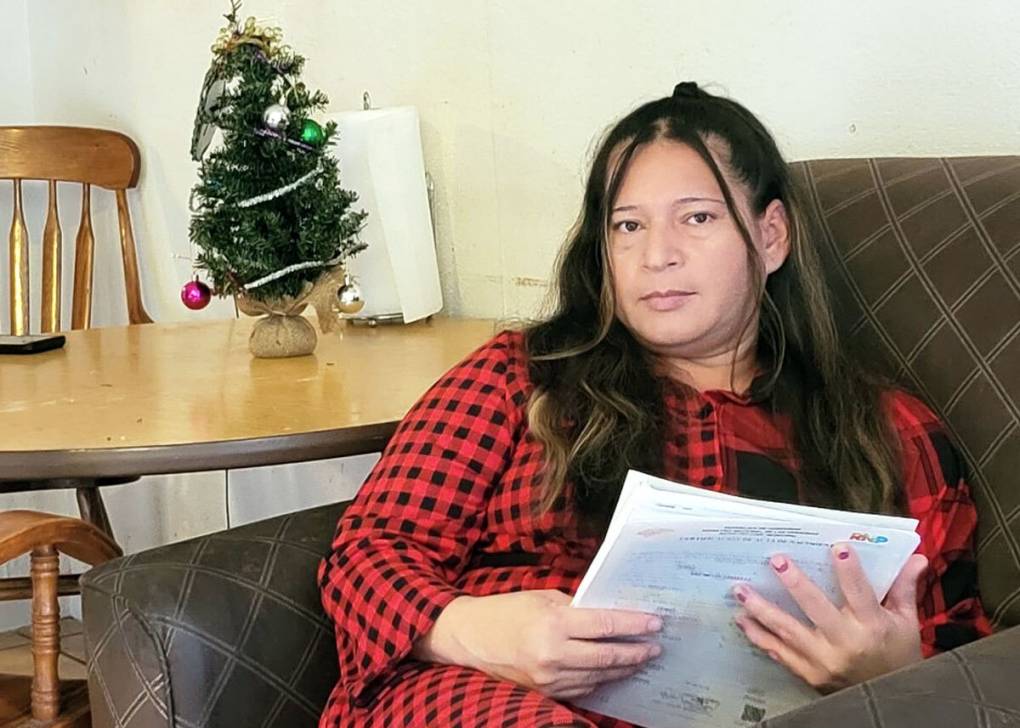
"altTag": "A woman sits in a red plaid dress holding papers with a Christmas tree in the background.",
"isLoading": false,
"fetchFailed": false
}
},
"audioPlayerReducer": {
"postId": "stream_live",
"isPaused": true,
"isPlaying": false,
"pfsActive": false,
"pledgeModalIsOpen": true,
"playerDrawerIsOpen": false,
"liveAudioPlayStartedAt": 0,
"liveAudioPlayContext": ""
},
"authorsReducer": {
"byline_news_11924388": {
"type": "authors",
"id": "byline_news_11924388",
"meta": {
"override": true
},
"slug": "byline_news_11924388",
"name": "Don Thompson\u003cbr>The Associated Press",
"isLoading": false
},
"kqed": {
"type": "authors",
"id": "236",
"meta": {
"index": "authors_1716337520",
"id": "236",
"found": true
},
"name": "KQED News Staff",
"firstName": "KQED News Staff",
"lastName": null,
"slug": "kqed",
"email": "faq@kqed.org",
"display_author_email": false,
"staff_mastheads": [],
"title": null,
"bio": null,
"avatar": "https://secure.gravatar.com/avatar/ef0e801a68c4c54afa9180db14084167?s=600&d=blank&r=g",
"twitter": null,
"facebook": null,
"instagram": null,
"linkedin": null,
"sites": [
{
"site": "arts",
"roles": [
"contributor"
]
},
{
"site": "news",
"roles": [
"editor"
]
},
{
"site": "futureofyou",
"roles": [
"author"
]
}
],
"headData": {
"title": "KQED News Staff | KQED",
"description": null,
"ogImgSrc": "https://secure.gravatar.com/avatar/ef0e801a68c4c54afa9180db14084167?s=600&d=blank&r=g",
"twImgSrc": "https://secure.gravatar.com/avatar/ef0e801a68c4c54afa9180db14084167?s=600&d=blank&r=g"
},
"isLoading": false,
"link": "/author/kqed"
},
"tychehendricks": {
"type": "authors",
"id": "259",
"meta": {
"index": "authors_1716337520",
"id": "259",
"found": true
},
"name": "Tyche Hendricks",
"firstName": "Tyche",
"lastName": "Hendricks",
"slug": "tychehendricks",
"email": "thendricks@kqed.org",
"display_author_email": true,
"staff_mastheads": [
"news"
],
"title": "KQED Senior Editor, Immigration",
"bio": "\u003cspan style=\"font-weight: 400;\">Tyche Hendricks is KQED’s senior editor for immigration, leading coverage of the policy and politics that affect California’s immigrant communities. Her work for KQED’s radio and online audiences is also carried on NPR and other national outlets. She has been recognized with awards from the Radio and Television News Directors Association, the Society for Professional Journalists; the Education Writers Association; the Best of the West and the National Federation of Community Broadcasters. Before joining KQED in 2010, Tyche spent more than a dozen years as a newspaper reporter, notably at the \u003c/span>\u003ci>\u003cspan style=\"font-weight: 400;\">San Francisco Chronicle\u003c/span>\u003c/i>\u003cspan style=\"font-weight: 400;\">. At different times she has covered criminal justice, government and politics and urban planning. Tyche has taught in the MFA Creative Writing program at the University of San Francisco and at UC Berkeley’s Graduate School of Journalism, where she was co-director of a national immigration symposium for professional journalists. She is the author of \u003c/span>\u003ci>\u003cspan style=\"font-weight: 400;\">The Wind Doesn't Need a Passport: Stories from the U.S.-Mexico Borderlands\u003c/span>\u003c/i>\u003cspan style=\"font-weight: 400;\"> (University of California Press). \u003c/span>",
"avatar": "https://secure.gravatar.com/avatar/b8ee458e2731c2d43df86882ce17267e?s=600&d=blank&r=g",
"twitter": "tychehendricks",
"facebook": null,
"instagram": null,
"linkedin": null,
"sites": [
{
"site": "news",
"roles": [
"editor"
]
},
{
"site": "stateofhealth",
"roles": [
"editor"
]
}
],
"headData": {
"title": "Tyche Hendricks | KQED",
"description": "KQED Senior Editor, Immigration",
"ogImgSrc": "https://secure.gravatar.com/avatar/b8ee458e2731c2d43df86882ce17267e?s=600&d=blank&r=g",
"twImgSrc": "https://secure.gravatar.com/avatar/b8ee458e2731c2d43df86882ce17267e?s=600&d=blank&r=g"
},
"isLoading": false,
"link": "/author/tychehendricks"
},
"fjhabvala": {
"type": "authors",
"id": "8659",
"meta": {
"index": "authors_1716337520",
"id": "8659",
"found": true
},
"name": "Farida Jhabvala Romero",
"firstName": "Farida",
"lastName": "Jhabvala Romero",
"slug": "fjhabvala",
"email": "fjhabvala@kqed.org",
"display_author_email": true,
"staff_mastheads": [
"news"
],
"title": "KQED Contributor",
"bio": "Farida Jhabvala Romero is a Labor Correspondent for KQED. She previously covered immigration. Farida was \u003ca href=\"https://www.ccnma.org/2022-most-influential-latina-journalists\">named\u003c/a> one of the 10 Most Influential Latina Journalists in California in 2022 by the California Chicano News Media Association. Her work has won awards from the Society of Professional Journalists (Northern California), as well as a national and regional Edward M. Murrow Award for the collaborative reporting projects “Dangerous Air” and “Graying California.” Before joining KQED, Farida worked as a producer at Radio Bilingüe, a national public radio network. Farida earned her master’s degree in journalism from Stanford University.",
"avatar": "https://secure.gravatar.com/avatar/f9f022d4e2609741874222a1e9d41f48fea74011aa7c615eef91d9a50c944ebe?s=600&d=blank&r=g",
"twitter": "FaridaJhabvala",
"bluesky": null,
"facebook": null,
"instagram": null,
"linkedin": "https://www.linkedin.com/in/faridajhabvala/",
"sites": [
{
"site": "news",
"roles": [
"editor"
]
},
{
"site": "stateofhealth",
"roles": [
"author"
]
},
{
"site": "liveblog",
"roles": [
"author"
]
}
],
"headData": {
"title": "Farida Jhabvala Romero | KQED",
"description": "KQED Contributor",
"ogImgSrc": "https://secure.gravatar.com/avatar/f9f022d4e2609741874222a1e9d41f48fea74011aa7c615eef91d9a50c944ebe?s=600&d=blank&r=g",
"twImgSrc": "https://secure.gravatar.com/avatar/f9f022d4e2609741874222a1e9d41f48fea74011aa7c615eef91d9a50c944ebe?s=600&d=blank&r=g"
},
"isLoading": false,
"link": "/author/fjhabvala"
},
"sjohnson": {
"type": "authors",
"id": "11840",
"meta": {
"index": "authors_1716337520",
"id": "11840",
"found": true
},
"name": "Sydney Johnson",
"firstName": "Sydney",
"lastName": "Johnson",
"slug": "sjohnson",
"email": "sjohnson@kqed.org",
"display_author_email": false,
"staff_mastheads": [
"news"
],
"title": "KQED Reporter",
"bio": "Sydney Johnson is a general assignment reporter at KQED. She previously reported on public health and city government at the San Francisco Examiner, and before that, she covered statewide education policy for EdSource. Her reporting has won multiple local, state and national awards. Sydney is a graduate of the University of California, Berkeley and lives in San Francisco.",
"avatar": "https://secure.gravatar.com/avatar/97855f2719b72ad6190b7c535fe642c8?s=600&d=blank&r=g",
"twitter": "sydneyfjohnson",
"facebook": null,
"instagram": null,
"linkedin": null,
"sites": [
{
"site": "news",
"roles": [
"editor"
]
}
],
"headData": {
"title": "Sydney Johnson | KQED",
"description": "KQED Reporter",
"ogImgSrc": "https://secure.gravatar.com/avatar/97855f2719b72ad6190b7c535fe642c8?s=600&d=blank&r=g",
"twImgSrc": "https://secure.gravatar.com/avatar/97855f2719b72ad6190b7c535fe642c8?s=600&d=blank&r=g"
},
"isLoading": false,
"link": "/author/sjohnson"
}
},
"pagesReducer": {
"news_tag_ice": {
"type": "terms",
"id": "news_21027",
"meta": {
"index": "terms_1716263798",
"site": "news",
"id": "21027",
"score": 8.937623
},
"featImg": null,
"name": "ICE",
"description": null,
"taxonomy": "tag",
"headData": {
"twImgId": null,
"twTitle": null,
"ogTitle": null,
"ogImgId": null,
"twDescription": null,
"description": null,
"title": "ICE Archives | KQED News",
"ogDescription": null
},
"ttid": 21044,
"slug": "ice",
"isLoading": false,
"title": "ICE",
"pageMeta": {
"site": "news",
"WpPageTemplate": "page-topic-editorial",
"currentPage": 7
},
"blocks": [
{
"blockName": "kqed/post-list",
"attrs": {
"layout": "cardArticle2",
"query": "posts/news?tag=ice",
"seeMore": false,
"paginated": true,
"page": 7
}
},
{
"blockName": "kqed/ad"
}
]
}
},
"pfsSessionReducer": {},
"postsReducer": {
"stream_live": {
"type": "live",
"id": "stream_live",
"audioUrl": "https://streams.kqed.org/kqedradio",
"title": "Live Stream",
"excerpt": "Live Stream information currently unavailable.",
"link": "/radio",
"featImg": "",
"label": {
"name": "KQED Live",
"link": "/"
}
},
"stream_kqedNewscast": {
"type": "posts",
"id": "stream_kqedNewscast",
"audioUrl": "https://www.kqed.org/.stream/anon/radio/RDnews/newscast.mp3?_=1",
"title": "KQED Newscast",
"featImg": "",
"label": {
"name": "88.5 FM",
"link": "/"
}
},
"news_11941173": {
"type": "posts",
"id": "news_11941173",
"meta": {
"index": "posts_1716263798",
"site": "news",
"id": "11941173",
"score": null,
"sort": [
1676556047000
]
},
"guestAuthors": [],
"slug": "sf-supervisors-split-on-details-of-citys-sanctuary-policy-shielding-immigrants-from-deportation",
"title": "SF Supervisors Split on Details of City's Sanctuary Policy Shielding Immigrants From Deportation",
"publishDate": 1676556047,
"format": "standard",
"headTitle": "SF Supervisors Split on Details of City’s Sanctuary Policy Shielding Immigrants From Deportation | KQED",
"labelTerm": {
"site": "news"
},
"content": "\u003cp>San Francisco Supervisor Hillary Ronen on Tuesday put forward a resolution rejecting a request from the District Attorney’s Office seeking an exception to the city’s strict sanctuary policy, which broadly prohibits city leaders and police from cooperating with federal immigration enforcement officials.\u003c/p>\n\u003cp>At issue is an effort by DA Brooke Jenkins to prosecute two suspects wanted for serious crimes in separate cases — one for murder, the other for sexually molesting young children — who fled the country but have since been located in Mexico.\u003c/p>\n\u003cp>Under Jenkins’ proposal, once the defendants are returned to San Francisco, city officials would commit to notifying Immigration and Customs Enforcement if either man were to be released from custody.\u003c/p>\n\u003cp>But Ronen said doing so would set a “dangerous precedent.”\u003c/p>\n\u003cp>“The feds don’t need us to make an exception to our sanctuary process. They spend billions of dollars a year on immigration enforcement, they can easily track these public cases,” she told KQED. “This is just playing politics with immigrants.”\u003c/p>\n\u003cp>It’s unlikely either suspect would be released from San Francisco jail unless charges were dropped or a defendant was acquitted. Judges issued an arrest warrant for the murder suspect in 2009 and for the sexual abuse suspect in 2021. Bail was set at $5 million dollars in each case.\u003c/p>\n\u003cp>In a separate move on Tuesday, Supervisor Matt Dorsey proposed a measure to make it easier to deport accused fentanyl dealers who are noncitizens.[aside label=\"related coverage\" tag=\"immigration-and-customs-enforcement\"]“I’m asking my colleagues to update our ‘Due Process for All’ ordinance to add fentanyl dealing felonies alongside violent felonies,” Dorsey told KQED. “The whole idea of sanctuary was to create a safe environment so that local governments could serve immigrant communities, including undocumented immigrant communities, and have their trust. To do otherwise would be to empower organized crime and elements that might exploit people who are in vulnerable situations.”\u003c/p>\n\u003cp>Under San Francisco’s current policy, local law enforcement can honor an ICE request to hold someone if that person is facing a violent felony charge and was previously convicted of a violent felony — including murder, rape and arson — in the previous seven years, or of a serious felony — including robbery and carjacking — in the previous five years.\u003c/p>\n\u003cp>Dorsey’s proposal would add people charged with dealing fentanyl to the list of exceptions for sanctuary protections. It would only apply to a person found guilty of selling fentanyl who had been previously convicted of fentanyl dealing or a violent felony in the prior seven years, or a serious felony in the prior five years.\u003c/p>\n\u003cp>Dorsey said he had not yet examined how deporting suspected dealers has affected the fentanyl crisis in other major cities with looser sanctuary laws. There is also little public data showing what portion of drug dealers in San Francisco are noncitizens.\u003c/p>\n\u003cp>Dorsey also did not say whether he would support Ronen’s separate resolution rejecting the DA’s request to notify ICE about the two suspects from Mexico.\u003c/p>\n\u003cp>For her part, Ronen said she opposes Dorsey’s proposal. And she and other immigration advocates say city officials do not need to compromise the city’s sanctuary law, which has been on the books since 1989, for federal immigration officials to arrest either of the suspects if and when they are released from San Francisco jail.\u003c/p>\n\u003cp>A similar challenge occurred in 2019, when the Department of Homeland Security demanded that San Francisco make an exception to its sanctuary policy to extradite a Tunisian national who had fled to Canada.\u003c/p>\n\u003cp>City officials ultimately decided they would not cooperate, saying it was unnecessary for DHS to do its work and could ultimately weaken the city’s sanctuary law. Nonetheless, \u003ca href=\"https://www.sfchronicle.com/bayarea/article/Assault-suspect-extradited-to-San-Francisco-13572023.php\">DHS successfully arranged for the suspect to be returned to San Francisco, where he was eventually prosecuted\u003c/a> for rape and sexual battery.\u003c/p>\n\u003cp>Much as they did in 2019, immigrant advocates are supporting Ronen’s call to stand up to federal immigration authorities in the current case.\u003c/p>\n\u003cp>“I’m urging the Board of Supervisors to remember that lesson from not very long ago that we don’t need to succumb to their distortions,” said Angela Chan, attorney with the San Francisco Public Defender’s Office, \u003ca href=\"https://sfpublicdefender.org/news/2022/02/san-francisco-public-defender-announces-the-hiring-of-angela-chan-long-time-immigrant-advocate-for-the-asian-law-caucus/\">who played a role in drafting California’s sanctuary law\u003c/a> and updating San Francisco’s policy. “It’s a threat, it’s empty, and we learned this only four years ago.”\u003c/p>\n\u003cp>“San Francisco should not fall for these tactics,” Chan added. “This is one of many things they do to try to attack our sanctuary ordinance.”\u003c/p>\n\u003cp>Weakening sanctuary protections would affect not only undocumented immigrants, but also documented immigrants with criminal histories. Any noncitizen is eligible for deportation if convicted of a wide range of crimes.\u003c/p>\n\u003cp>Jenkins says that while she supports San Francisco’s sanctuary city law, she is seeking an exemption in these particular cases to get the suspects extradited as soon as possible for what she described as “unspeakable crimes.”\u003c/p>\n\u003cp>“We cannot let two wanted fugitives hiding out internationally get away with murder and sexually abusing young children,” Jenkins said in a statement. “These men must be brought to the United States to face justice and be held accountable for their heinous crimes. We cannot let our well-intentioned policy be exploited in this way and must act now.”\u003c/p>\n\u003cp>Dorsey also expressed his support for the city’s sanctuary policy, but said fentanyl is so lethal that he thinks it should be treated differently from other drugs.\u003c/p>\n\u003cp>“I don’t think there is a precedent in drug policy for what we’re seeing with fentanyl. And what’s terrifying is that there are other synthetic opioids on the horizon that are cheaper and more profitable for dealers and drug cartels,” Dorsey said. “We’re in uncharted waters here.”\u003c/p>\n\u003cp>[ad fullwidth]\u003c/p>\n\u003cp>\u003c/p>\n",
"blocks": [],
"excerpt": "This week, Supervisor Matt Dorsey proposed making it easier to deport immigrants who deal fentanyl, while Supervisor Hillary Ronen urged the city to steer clear of cooperating with ICE officials.",
"status": "publish",
"parent": 0,
"modified": 1738715723,
"stats": {
"hasAudio": false,
"hasVideo": false,
"hasChartOrMap": false,
"iframeSrcs": [],
"hasGoogleForm": false,
"hasGallery": false,
"hasHearkenModule": false,
"hasPolis": false,
"paragraphCount": 24,
"wordCount": 1030
},
"headData": {
"title": "SF Supervisors Split on Details of City's Sanctuary Policy Shielding Immigrants From Deportation | KQED",
"description": "This week, Supervisor Matt Dorsey proposed making it easier to deport immigrants who deal fentanyl, while Supervisor Hillary Ronen urged the city to steer clear of cooperating with ICE officials.",
"ogTitle": "",
"ogDescription": "",
"ogImgId": "",
"twTitle": "",
"twDescription": "",
"twImgId": "",
"schema": {
"@context": "https://schema.org",
"@type": "NewsArticle",
"headline": "SF Supervisors Split on Details of City's Sanctuary Policy Shielding Immigrants From Deportation",
"datePublished": "2023-02-16T06:00:47-08:00",
"dateModified": "2025-02-04T16:35:23-08:00",
"image": "https://cdn.kqed.org/wp-content/uploads/2020/02/KQED-OG-Image@1x.png",
"isAccessibleForFree": "True",
"publisher": {
"@type": "NewsMediaOrganization",
"@id": "https://www.kqed.org/#organization",
"name": "KQED",
"logo": "https://cdn.kqed.org/wp-content/uploads/2020/02/KQED-OG-Image@1x.png",
"url": "https://www.kqed.org",
"sameAs": [
"https://www.facebook.com/KQED",
"https://twitter.com/KQED",
"https://www.instagram.com/kqed/",
"https://www.tiktok.com/@kqedofficial",
"https://www.linkedin.com/company/kqed",
"https://www.youtube.com/channel/UCeC0IOo7i1P_61zVUWbJ4nw"
]
}
}
},
"sticky": false,
"excludeFromSiteSearch": "Include",
"articleAge": "0",
"path": "/news/11941173/sf-supervisors-split-on-details-of-citys-sanctuary-policy-shielding-immigrants-from-deportation",
"audioTrackLength": null,
"parsedContent": [
{
"type": "contentString",
"content": "\u003cdiv class=\"post-body\">\u003cp>\u003cp>San Francisco Supervisor Hillary Ronen on Tuesday put forward a resolution rejecting a request from the District Attorney’s Office seeking an exception to the city’s strict sanctuary policy, which broadly prohibits city leaders and police from cooperating with federal immigration enforcement officials.\u003c/p>\n\u003cp>At issue is an effort by DA Brooke Jenkins to prosecute two suspects wanted for serious crimes in separate cases — one for murder, the other for sexually molesting young children — who fled the country but have since been located in Mexico.\u003c/p>\n\u003cp>Under Jenkins’ proposal, once the defendants are returned to San Francisco, city officials would commit to notifying Immigration and Customs Enforcement if either man were to be released from custody.\u003c/p>\n\u003cp>But Ronen said doing so would set a “dangerous precedent.”\u003c/p>\n\u003cp>“The feds don’t need us to make an exception to our sanctuary process. They spend billions of dollars a year on immigration enforcement, they can easily track these public cases,” she told KQED. “This is just playing politics with immigrants.”\u003c/p>\n\u003cp>It’s unlikely either suspect would be released from San Francisco jail unless charges were dropped or a defendant was acquitted. Judges issued an arrest warrant for the murder suspect in 2009 and for the sexual abuse suspect in 2021. Bail was set at $5 million dollars in each case.\u003c/p>\n\u003cp>In a separate move on Tuesday, Supervisor Matt Dorsey proposed a measure to make it easier to deport accused fentanyl dealers who are noncitizens.\u003c/p>\u003c/div>",
"attributes": {
"named": {},
"numeric": []
}
},
{
"type": "component",
"content": "",
"name": "aside",
"attributes": {
"named": {
"label": "related coverage ",
"tag": "immigration-and-customs-enforcement"
},
"numeric": []
}
},
{
"type": "contentString",
"content": "\u003cdiv class=\"post-body\">\u003cp>“I’m asking my colleagues to update our ‘Due Process for All’ ordinance to add fentanyl dealing felonies alongside violent felonies,” Dorsey told KQED. “The whole idea of sanctuary was to create a safe environment so that local governments could serve immigrant communities, including undocumented immigrant communities, and have their trust. To do otherwise would be to empower organized crime and elements that might exploit people who are in vulnerable situations.”\u003c/p>\n\u003cp>Under San Francisco’s current policy, local law enforcement can honor an ICE request to hold someone if that person is facing a violent felony charge and was previously convicted of a violent felony — including murder, rape and arson — in the previous seven years, or of a serious felony — including robbery and carjacking — in the previous five years.\u003c/p>\n\u003cp>Dorsey’s proposal would add people charged with dealing fentanyl to the list of exceptions for sanctuary protections. It would only apply to a person found guilty of selling fentanyl who had been previously convicted of fentanyl dealing or a violent felony in the prior seven years, or a serious felony in the prior five years.\u003c/p>\n\u003cp>Dorsey said he had not yet examined how deporting suspected dealers has affected the fentanyl crisis in other major cities with looser sanctuary laws. There is also little public data showing what portion of drug dealers in San Francisco are noncitizens.\u003c/p>\n\u003cp>Dorsey also did not say whether he would support Ronen’s separate resolution rejecting the DA’s request to notify ICE about the two suspects from Mexico.\u003c/p>\n\u003cp>For her part, Ronen said she opposes Dorsey’s proposal. And she and other immigration advocates say city officials do not need to compromise the city’s sanctuary law, which has been on the books since 1989, for federal immigration officials to arrest either of the suspects if and when they are released from San Francisco jail.\u003c/p>\n\u003cp>A similar challenge occurred in 2019, when the Department of Homeland Security demanded that San Francisco make an exception to its sanctuary policy to extradite a Tunisian national who had fled to Canada.\u003c/p>\n\u003cp>City officials ultimately decided they would not cooperate, saying it was unnecessary for DHS to do its work and could ultimately weaken the city’s sanctuary law. Nonetheless, \u003ca href=\"https://www.sfchronicle.com/bayarea/article/Assault-suspect-extradited-to-San-Francisco-13572023.php\">DHS successfully arranged for the suspect to be returned to San Francisco, where he was eventually prosecuted\u003c/a> for rape and sexual battery.\u003c/p>\n\u003cp>Much as they did in 2019, immigrant advocates are supporting Ronen’s call to stand up to federal immigration authorities in the current case.\u003c/p>\n\u003cp>“I’m urging the Board of Supervisors to remember that lesson from not very long ago that we don’t need to succumb to their distortions,” said Angela Chan, attorney with the San Francisco Public Defender’s Office, \u003ca href=\"https://sfpublicdefender.org/news/2022/02/san-francisco-public-defender-announces-the-hiring-of-angela-chan-long-time-immigrant-advocate-for-the-asian-law-caucus/\">who played a role in drafting California’s sanctuary law\u003c/a> and updating San Francisco’s policy. “It’s a threat, it’s empty, and we learned this only four years ago.”\u003c/p>\n\u003cp>“San Francisco should not fall for these tactics,” Chan added. “This is one of many things they do to try to attack our sanctuary ordinance.”\u003c/p>\n\u003cp>Weakening sanctuary protections would affect not only undocumented immigrants, but also documented immigrants with criminal histories. Any noncitizen is eligible for deportation if convicted of a wide range of crimes.\u003c/p>\n\u003cp>Jenkins says that while she supports San Francisco’s sanctuary city law, she is seeking an exemption in these particular cases to get the suspects extradited as soon as possible for what she described as “unspeakable crimes.”\u003c/p>\n\u003cp>“We cannot let two wanted fugitives hiding out internationally get away with murder and sexually abusing young children,” Jenkins said in a statement. “These men must be brought to the United States to face justice and be held accountable for their heinous crimes. We cannot let our well-intentioned policy be exploited in this way and must act now.”\u003c/p>\n\u003cp>Dorsey also expressed his support for the city’s sanctuary policy, but said fentanyl is so lethal that he thinks it should be treated differently from other drugs.\u003c/p>\n\u003cp>“I don’t think there is a precedent in drug policy for what we’re seeing with fentanyl. And what’s terrifying is that there are other synthetic opioids on the horizon that are cheaper and more profitable for dealers and drug cartels,” Dorsey said. “We’re in uncharted waters here.”\u003c/p>\n\u003cp>\u003c/p>\u003c/div>",
"attributes": {
"named": {},
"numeric": []
}
},
{
"type": "component",
"content": "",
"name": "ad",
"attributes": {
"named": {
"label": "fullwidth"
},
"numeric": [
"fullwidth"
]
}
},
{
"type": "contentString",
"content": "\u003cdiv class=\"post-body\">\u003cp>\u003c/p>\n\u003cp>\u003c/p>\n\u003c/div>\u003c/p>",
"attributes": {
"named": {},
"numeric": []
}
}
],
"link": "/news/11941173/sf-supervisors-split-on-details-of-citys-sanctuary-policy-shielding-immigrants-from-deportation",
"authors": [
"11840",
"259"
],
"categories": [
"news_1169",
"news_8"
],
"tags": [
"news_18123",
"news_27626",
"news_21027",
"news_20202",
"news_20445",
"news_244"
],
"featImg": "news_11941180",
"label": "news"
},
"news_11938736": {
"type": "posts",
"id": "news_11938736",
"meta": {
"index": "posts_1716263798",
"site": "news",
"id": "11938736",
"score": null,
"sort": [
1674849009000
]
},
"guestAuthors": [],
"slug": "the-state-overturned-her-murder-conviction-but-ice-still-wants-to-deport-her-this-california-woman-is-caught-in-a-legal-tug-of-war",
"title": "California Overturned Her Murder Conviction. ICE Still Wants to Deport Her",
"publishDate": 1674849009,
"format": "standard",
"headTitle": "California Overturned Her Murder Conviction. ICE Still Wants to Deport Her | KQED",
"labelTerm": {
"term": 26731,
"site": "news"
},
"content": "\u003cp>On the morning of July 27, 2021, Sandra Castañeda woke with a mixture of elation and dread. She was about to be released from prison after 19 years. What she wanted more than anything was to walk out of the California Institution for Women in Chino and head home for a reunion with her family in Los Angeles. She had imagined this day for so long.\u003c/p>\n\u003cp>“As a lifer, you want to get out of prison so bad,” she said. “But when it’s there, you freak out,” wondering what freedom will be like, she said.\u003c/p>\n\u003cp>Castañeda, then 39, had spent nearly half of her life behind bars. She’d been sentenced to 40 years to life for murder, even though she didn’t actually kill anyone.[aside label=\"Related Stories\" postID=\"news_11924388,news_11923465,news_11909454\"]While Castañeda was in prison, California had enacted a series of criminal justice reforms, including one that allowed her to be resentenced. A Superior Court judge in Los Angeles had vacated Castañeda’s murder conviction and ordered her release.\u003c/p>\n\u003cp>But Castañeda didn’t walk free. Instead, she was loaded into a white van operated by U.S. Immigration and Customs Enforcement (ICE).\u003c/p>\n\u003cp>Castañeda’s story highlights how noncitizens, even longtime legal residents with green cards like Castañeda, are routinely funneled from state prison into the federal deportation system — even after the convictions that would make them deportable have been overturned. In a clash with state policy, legal records show, ICE and the federal immigration courts are disregarding state reforms that are letting people out of prison and dismissing old convictions.\u003c/p>\n\u003cp>[ad fullwidth]\u003c/p>\n\u003cp>With the help of others familiar with her case, Castañeda, a woman with a cascade of dark curls and an infectious laugh, explained how that July day unfolded and what it meant — for her, and potentially for thousands of other noncitizens who have had their convictions dismissed.\u003c/p>\n\u003ch2>From prison to ICE custody\u003c/h2>\n\u003cp>At 8 a.m., Colby Lenz, an advocate with the California Coalition for Women Prisoners, pulled into the parking lot of the prison in Chino, to await Castañeda’s release and give her a ride home.\u003c/p>\n\u003cp>But at 9 a.m. she watched as the guard in the tower opened the prison gate and the white ICE van rolled in. She saw guards walk Castañeda out and load her into the van. Lenz says Castañeda’s friends inside the facility were watching, too.\u003c/p>\n\u003cp>“Some of Sandra’s close friends had come as close as they could to this area and were calling out to her,” she said. “They were basically telling her that they loved her, and were certainly distressed at what they were seeing.”\u003c/p>\n\u003cp>The van drove Castañeda to the ICE field office in San Bernardino. Lenz followed in her car. By 10 a.m. Castañeda was in a holding cell and Lenz was making urgent calls to Anoop Prasad, an immigration lawyer with the Asian Law Caucus in San Francisco, who agreed to take on Castañeda’s immigration case pro bono.\u003c/p>\n\u003cfigure id=\"attachment_11939152\" class=\"wp-caption alignright\" style=\"max-width: 800px\">\u003cimg loading=\"lazy\" decoding=\"async\" class=\"size-medium wp-image-11939152\" src=\"https://ww2.kqed.org/app/uploads/sites/10/2023/01/RS57631_010_KQED_AnoopPrasad_08052022-qut-800x533.jpg\" alt='A south Asian man in a green sweater and jeans stands outside an office with \"Advancing Justice\" written on the window.' width=\"800\" height=\"533\" srcset=\"https://cdn.kqed.org/wp-content/uploads/sites/10/2023/01/RS57631_010_KQED_AnoopPrasad_08052022-qut-800x533.jpg 800w, https://cdn.kqed.org/wp-content/uploads/sites/10/2023/01/RS57631_010_KQED_AnoopPrasad_08052022-qut-1020x680.jpg 1020w, https://cdn.kqed.org/wp-content/uploads/sites/10/2023/01/RS57631_010_KQED_AnoopPrasad_08052022-qut-160x107.jpg 160w, https://cdn.kqed.org/wp-content/uploads/sites/10/2023/01/RS57631_010_KQED_AnoopPrasad_08052022-qut-1536x1024.jpg 1536w, https://cdn.kqed.org/wp-content/uploads/sites/10/2023/01/RS57631_010_KQED_AnoopPrasad_08052022-qut.jpg 1920w\" sizes=\"auto, (max-width: 800px) 100vw, 800px\">\u003cfigcaption class=\"wp-caption-text\">Anoop Prasad poses for a portrait outside the Asian Law Caucus offices in San Francisco on Aug. 5, 2022. \u003ccite>(Beth LaBerge/KQED)\u003c/cite>\u003c/figcaption>\u003c/figure>\n\u003cp>“Anoop and I were tag teaming, calling the ICE office,” said Lenz. “We both talked to some of the officers there, trying to convince them that this was not a legal detention.”\u003c/p>\n\u003cp>Prasad said he even convinced the LA County District Attorney’s Office, which had originally prosecuted Castañeda, to call ICE and explain that her murder conviction had been vacated. But ICE seemed determined to keep her in custody.\u003c/p>\n\u003ch2>Gang friendships and a shooting\u003c/h2>\n\u003cp>Castañeda’s original conviction was connected to a murder that took place in 2002, when a teenage girl was shot and killed — and Castañeda was there. But the events of that night are rooted in the early chapters of her story.\u003c/p>\n\u003cp>Long before Castañeda was born, her family straddled the border with Mexico. Her grandmother was born in the U.S. Her mother and father were from the Mexican border city of Mexicali. When Castañeda was a little girl, the family spent time in both countries. Eventually her parents settled in LA, leaving her and her older sister with relatives in Mexicali. By the time Castañeda was 9, her parents had separated and her mother had started a new family. But an aunt and uncle in LA brought Castañeda and her sister to the U.S. on green cards, raising them along with their own children.\u003c/p>\n\u003cfigure id=\"attachment_11939173\" class=\"wp-caption alignright\" style=\"max-width: 800px\">\u003cimg loading=\"lazy\" decoding=\"async\" class=\"size-medium wp-image-11939173\" src=\"https://ww2.kqed.org/app/uploads/sites/10/2023/01/69561163682__F0ED2441-191A-41FD-8226-B2197C68B292-scaled-e1674682242360-800x888.jpeg\" alt=\"The image of a young Latina girl of kindergarten age wearing a white dress.\" width=\"800\" height=\"888\" srcset=\"https://cdn.kqed.org/wp-content/uploads/sites/10/2023/01/69561163682__F0ED2441-191A-41FD-8226-B2197C68B292-scaled-e1674682242360-800x888.jpeg 800w, https://cdn.kqed.org/wp-content/uploads/sites/10/2023/01/69561163682__F0ED2441-191A-41FD-8226-B2197C68B292-scaled-e1674682242360-1020x1132.jpeg 1020w, https://cdn.kqed.org/wp-content/uploads/sites/10/2023/01/69561163682__F0ED2441-191A-41FD-8226-B2197C68B292-scaled-e1674682242360-160x178.jpeg 160w, https://cdn.kqed.org/wp-content/uploads/sites/10/2023/01/69561163682__F0ED2441-191A-41FD-8226-B2197C68B292-scaled-e1674682242360-1384x1536.jpeg 1384w, https://cdn.kqed.org/wp-content/uploads/sites/10/2023/01/69561163682__F0ED2441-191A-41FD-8226-B2197C68B292-scaled-e1674682242360-1845x2048.jpeg 1845w, https://cdn.kqed.org/wp-content/uploads/sites/10/2023/01/69561163682__F0ED2441-191A-41FD-8226-B2197C68B292-scaled-e1674682242360.jpeg 1920w\" sizes=\"auto, (max-width: 800px) 100vw, 800px\">\u003cfigcaption class=\"wp-caption-text\">Sandra Castañeda at her kindergarten graduation. \u003ccite>(Courtesy of Sandra Castañeda)\u003c/cite>\u003c/figcaption>\u003c/figure>\n\u003cp>That aunt, Virginia Reyes, remembers Castañeda as a quiet kid who didn’t cause trouble.\u003c/p>\n\u003cp>“Sandrita was totally calm,” said Reyes in Spanish. “She was not a difficult girl.”\u003c/p>\n\u003cp>Reyes and her husband ran a clothing factory in South Central LA, assembling garments for the fashion industry. They called it Sandra’s Fashions. They employed more than 20 workers, Reyes said.\u003c/p>\n\u003cp>Reyes and her husband put in really long hours, building the business to support the family. That left Castañeda to fend for herself a lot as a kid.\u003c/p>\n\u003cp>“They’d leave early, they’d come home real late,” she said. “They’d work seven days a week. So it was always work, work, work, work.”\u003c/p>\n\u003cp>Being involved with the family business taught her a strong work ethic, Castañeda said. But the uncertain bonds of her childhood also left her yearning for a sense of belonging.\u003c/p>\n\u003cp>In junior high school, Castañeda made friends with some tough kids who were part of a gang. Her aunt tried to protect her by putting her in a Catholic school. But it didn’t help.\u003c/p>\n\u003cfigure id=\"attachment_11939177\" class=\"wp-caption alignright\" style=\"max-width: 800px\">\u003cimg loading=\"lazy\" decoding=\"async\" class=\"size-medium wp-image-11939177\" src=\"https://ww2.kqed.org/app/uploads/sites/10/2023/01/69561927910__A5ADB0C5-532F-4949-9993-C02E67BB5D03-800x1067.jpeg\" alt=\"A Latina girl sips a soft drink with white dress on and long brown hair.\" width=\"800\" height=\"1067\" srcset=\"https://cdn.kqed.org/wp-content/uploads/sites/10/2023/01/69561927910__A5ADB0C5-532F-4949-9993-C02E67BB5D03-800x1067.jpeg 800w, https://cdn.kqed.org/wp-content/uploads/sites/10/2023/01/69561927910__A5ADB0C5-532F-4949-9993-C02E67BB5D03-1020x1360.jpeg 1020w, https://cdn.kqed.org/wp-content/uploads/sites/10/2023/01/69561927910__A5ADB0C5-532F-4949-9993-C02E67BB5D03-160x213.jpeg 160w, https://cdn.kqed.org/wp-content/uploads/sites/10/2023/01/69561927910__A5ADB0C5-532F-4949-9993-C02E67BB5D03-1152x1536.jpeg 1152w, https://cdn.kqed.org/wp-content/uploads/sites/10/2023/01/69561927910__A5ADB0C5-532F-4949-9993-C02E67BB5D03-1536x2048.jpeg 1536w, https://cdn.kqed.org/wp-content/uploads/sites/10/2023/01/69561927910__A5ADB0C5-532F-4949-9993-C02E67BB5D03-scaled.jpeg 1920w\" sizes=\"auto, (max-width: 800px) 100vw, 800px\">\u003cfigcaption class=\"wp-caption-text\">Sandra Castañeda, age 12, sips a soft drink. \u003ccite>(Courtesy of Sandra Castañeda)\u003c/cite>\u003c/figcaption>\u003c/figure>\n\u003cp>Castañeda never got in trouble with the law. But that changed on the night of May 10, 2002, when she was 20. Castañeda later testified that she was driving some friends to Taco Bell in her van around midnight, when a guy in the van told her to slow down. Then suddenly, he started firing out the window.\u003c/p>\n\u003cp>Castañeda is cautious when talking about the crime, because, even two decades later, she’s worried about gang retaliation. So KQED has agreed not to use the names of the victims or the names or gang monikers of those involved in the shooting. And Castañeda asked that Prasad, her immigration lawyer, be the one to describe what happened.\u003c/p>\n\u003cp>“One of the people in the van thought they saw someone in the neighborhood who was from a rival gang,” Prasad told me. “He asked her to slow down, and she — didn’t really know what was going on — slowed down. The person pulled out a gun and started shooting from the car.”\u003c/p>\n\u003cp>The bullets hit two teenagers who were sitting on the front steps of an apartment building in South Central. An 18-year-old was shot in the leg — and he recovered. But the 15-year-old girl beside him was killed. In a panic, Castañeda drove on.\u003c/p>\n\u003cp>“She stopped a couple of blocks later,” Prasad recounted. “Police were already there on the scene. And she was the only one who was arrested. Everyone else ran away.”\u003c/p>\n\u003cp>Castañeda was taken to jail. A California law at the time — known as the felony murder rule — said that if a person dies while a felony is being committed, anyone involved could be found guilty of murder, whether or not they intended or committed the killing. Under the law, prosecutors charged Castañeda with murder because she was driving the van, even though she herself didn’t kill anyone.\u003c/p>\n\u003cp>“It was a tough-on-crime era,” said Prasad. “Across the state, anyone who was remotely connected or even present at the scene would [often] get hit with a murder charge … So I think the DA just aggressively prosecuted and used this overly broad theory to charge her with murder.”\u003c/p>\n\u003cfigure id=\"attachment_11939247\" class=\"wp-caption alignright\" style=\"max-width: 720px\">\u003cimg loading=\"lazy\" decoding=\"async\" class=\"size-full wp-image-11939247\" src=\"https://ww2.kqed.org/app/uploads/sites/10/2023/01/DFA515F8-B9A7-4799-BA3E-AEFDFEDFD2D3signal-2022-04-22-221307_001.jpeg\" alt=\"A Latina family spanning three generations smile at the camera.\" width=\"720\" height=\"514\" srcset=\"https://cdn.kqed.org/wp-content/uploads/sites/10/2023/01/DFA515F8-B9A7-4799-BA3E-AEFDFEDFD2D3signal-2022-04-22-221307_001.jpeg 720w, https://cdn.kqed.org/wp-content/uploads/sites/10/2023/01/DFA515F8-B9A7-4799-BA3E-AEFDFEDFD2D3signal-2022-04-22-221307_001-160x114.jpeg 160w\" sizes=\"auto, (max-width: 720px) 100vw, 720px\">\u003cfigcaption class=\"wp-caption-text\">Castañeda with her mother, her sister and her sister’s children on a prison visit in 2016. \u003ccite>(Courtesy of Sandra Castañeda)\u003c/cite>\u003c/figcaption>\u003c/figure>\n\u003cp>Castañeda went on trial. But her aunt didn’t think the police detectives were doing enough to find the actual killer.\u003c/p>\n\u003cp>“I tried to be a detective myself,” recalled Reyes. “I went places I never imagined going, trying to track down the person who had done this. I even went to parties, dressing up to look younger. I put up fliers around town with his photo on them.”\u003c/p>\n\u003cp>Reyes had no luck — until one day, after the trial was over, she says she saw the man at a car wash. She was afraid he would recognize her, but she pulled over and got on the phone.\u003c/p>\n\u003cp>“I called the police and I called the lawyer. And they just replied, ‘Oh, the case is closed.’” she said. “I couldn’t believe it. I felt so powerless.”\u003c/p>\n\u003cp>The LA Police Department now says the case is still open. But no one else has ever been arrested or prosecuted for the shooting, according to officials at the LA County District Attorney’s Office.\u003c/p>\n\u003cp>Castañeda was convicted of second-degree murder and attempted murder. The sentence came with enhancements because a gun was used in the killing, and there was gang involvement: 40 years to life behind bars.\u003c/p>\n\u003cp>Reyes says when she heard the verdict, she was in shock. Castañeda had no criminal history and insisted she hadn’t planned to hurt anyone. Reyes expected her niece to face punishment, but not more than a couple of years.\u003c/p>\n\u003cp>“How was it possible that this person was still walking free and Sandra was going to be locked up for so many years?” Reyes wondered.\u003c/p>\n\u003ch2>Coming of age behind bars\u003c/h2>\n\u003cp>At first when Castañeda went to prison, back in 2003, she was angry. But over time she developed a new perspective on the crime.\u003c/p>\n\u003cp>“It was not a planned situation — it just kind of happened. But I still feel that I did have a part because I was the driver,” she said. “So today I know that back then I had choices. But as a young person, I didn’t know that I did … Today I do understand and I take full responsibility for my part.”\u003c/p>\n\u003cp>In prison, Castañeda sought out peer support groups. She took college courses. She worked in the carpentry, paint and auto shops, learning new skills and finding satisfaction in physical work. She also became a leader in the hospice program, caring for women who were dying in prison.\u003c/p>\n\u003cp>“I got to know who I was as a person, so I’m not bitter at all,” she said. “Prison made me the woman that I am today.”\u003c/p>\n\u003cp>Castañeda — once a shy child — learned she’s resilient and a go-getter. She learned not to be afraid to speak up for what she believes and to advocate for others.\u003c/p>\n\u003ch2>‘[T]here’s always that little hope … ‘\u003c/h2>\n\u003cp>Then, in 2018, something happened that Castañeda never expected.\u003c/p>\n\u003cp>The California Legislature \u003ca href=\"https://www.kqed.org/news/11685094/not-the-killer-but-charged-with-murder-lawmakers-weigh-changing-felony-murder-law\">dramatically restricted\u003c/a> the \u003ca href=\"https://leginfo.legislature.ca.gov/faces/billTextClient.xhtml?bill_id=201720180SB1437\">felony murder rule\u003c/a>, the law that led to her conviction. Lawmakers cited the injustice of a law that disproportionately affected women and people of color. State courts had even questioned whether the old law was constitutional. The reform was part of a \u003ca href=\"https://www.kqed.org/news/11714104/jerry-brown-will-leave-lasting-impact-on-criminal-justice-in-california\">broader movement in California\u003c/a> and elsewhere to reduce mass incarceration and over-punishment.\u003c/p>\n\u003cp>For Castañeda, it meant she could ask a judge to vacate her murder conviction and give her a new sentence. A Stanford University law clinic connected her with a pro bono lawyer who helped her petition for resentencing. The head of the state prison system even wrote a letter of support.[pullquote align=\"right\" size=\"medium\" citation=\"Virginia Reyes, aunt of Sandra Castañeda\"]‘How was it possible that this person was still walking free and Sandra was going to be locked up for so many years?’[/pullquote]Castañeda tried to manage her expectations. As a lifer, she knew she might die in prison.\u003c/p>\n\u003cp>“But I mean, there’s always that little hope in there, you know? I think as human beings, we want to believe that something good is going to come out,” she said.\u003c/p>\n\u003cp>Trying all her options, Castañeda also applied for clemency from Gov. Gavin Newsom. And in Nov. 2020, recognizing her rehabilitation, \u003ca href=\"https://drive.google.com/drive/u/0/folders/1xG8ED1L6wFFaizn1W5KwboN16e2bniOh\">Newsom commuted her sentence\u003c/a>, making her immediately eligible for parole.\u003c/p>\n\u003cp>Then, something even bigger happened. In July of 2021, a California judge approved her petition for resentencing and dismissed her murder conviction entirely, giving her a much lesser charge, accessory after the fact. Finally, Castañeda was ordered released. She couldn’t stop crying.\u003c/p>\n\u003cp>“I was worse than the Llorona,” she said. “I just couldn’t believe it.”\u003c/p>\n\u003ch2>A green card is a privilege\u003c/h2>\n\u003cp>California’s criminal justice system was saying Castañeda could go home and start to build a life as a free woman. But the federal system had a different goal. Under U.S. immigration law, having a green card is a privilege that can be taken away. So if an immigrant who’s not a citizen, even a lawful permanent resident like Castañeda, commits certain crimes, they can lose their legal status and be deported.\u003c/p>\n\u003cfigure id=\"attachment_11939179\" class=\"wp-caption alignright\" style=\"max-width: 800px\">\u003cimg loading=\"lazy\" decoding=\"async\" class=\"size-medium wp-image-11939179\" src=\"https://ww2.kqed.org/app/uploads/sites/10/2023/01/RS57621_003_KQED_AnoopPrasad_08052022-qut-800x533.jpg\" alt=\"A south Asian man seen from behind talking to a woman through his computer, the woman's face is visible on the screen.\" width=\"800\" height=\"533\" srcset=\"https://cdn.kqed.org/wp-content/uploads/sites/10/2023/01/RS57621_003_KQED_AnoopPrasad_08052022-qut-800x533.jpg 800w, https://cdn.kqed.org/wp-content/uploads/sites/10/2023/01/RS57621_003_KQED_AnoopPrasad_08052022-qut-1020x680.jpg 1020w, https://cdn.kqed.org/wp-content/uploads/sites/10/2023/01/RS57621_003_KQED_AnoopPrasad_08052022-qut-160x107.jpg 160w, https://cdn.kqed.org/wp-content/uploads/sites/10/2023/01/RS57621_003_KQED_AnoopPrasad_08052022-qut-1536x1024.jpg 1536w, https://cdn.kqed.org/wp-content/uploads/sites/10/2023/01/RS57621_003_KQED_AnoopPrasad_08052022-qut.jpg 1920w\" sizes=\"auto, (max-width: 800px) 100vw, 800px\">\u003cfigcaption class=\"wp-caption-text\">Lawyer Anoop Prasad speaks with Sandra Castañeda through a video call, in the Asian Law Caucus offices in San Francisco on Aug. 5, 2022. \u003ccite>(Beth LaBerge/KQED)\u003c/cite>\u003c/figcaption>\u003c/figure>\n\u003cp>The list of deportable crimes — known as \u003ca href=\"https://www.americanimmigrationcouncil.org/research/aggravated-felonies-overview\">aggravated felonies\u003c/a> — has grown longer over the years. Notably, in the 1990s President Bill Clinton signed two laws that \u003ca href=\"https://www.theatlantic.com/ideas/archive/2019/11/time-bill-clinton-apologize-immigrants/601579/\">vastly expanded the number\u003c/a>.\u003c/p>\n\u003cp>Today, advocates note, people can lose their green cards for a laundry list of reasons, like shoplifting, drug charges and failure to appear in court. Yet some of these have actually been decriminalized by states like California.\u003c/p>\n\u003cp>“California over the last decade or so has recognized that the lock-’em-up mentality … led to a ballooning of our prison and jail population, but didn’t actually result in safer communities,” said Rose Cahn, attorney with the Immigrant Legal Resource Center in San Francisco.\u003c/p>\n\u003cp>She says the way federal immigration law is enforced should recognize state criminal justice reforms.\u003c/p>\n\u003cp>“A conviction that’s been dismissed at the state level — where you have DAs of all political stripes saying, ‘Hey, this doesn’t need to be on someone’s record’ — should not be on someone’s record, plain and simple,” said Cahn.\u003c/p>\n\u003cp>But that’s not happening. ICE lawyers are still pushing to deport people like Castañeda, based on convictions that have been reduced or even dismissed. And they’re backed up by rulings in the federal immigration courts that say immigrants are still deportable if their conviction and sentence was reduced, unless the change was “based on a procedural or substantive defect in the underlying criminal proceeding.”[pullquote align=\"right\" size=\"medium\" citation=\"Sandra Castañeda\"]‘These people are still messing with my life, even though I already paid for my crime.’[/pullquote]The number of people caught in this situation isn’t tracked by any agency, but some immigration experts estimate it affects thousands nationally.\u003c/p>\n\u003cp>An ICE spokesperson, who declined to be named, said the agency’s officers make decisions about who to pursue “in a responsible manner, informed by their experience as law enforcement professionals and in a way that best protects against the greatest threats to the homeland.” And she noted that ICE prosecutors can and do exercise discretion in deciding whether to prosecute individual cases.\u003c/p>\n\u003cp>In California, a sanctuary law prevents police and sheriffs from cooperating in immigration enforcement in most cases. But there’s a broad loophole for prisons. So the California Department of Corrections and Rehabilitation, the state prison system, notifies ICE when they take in anyone who’s foreign born, then accommodates ICE requests to interview and take custody of immigrants at the time of their release, documents show. More than 1,600 people were turned over from California prisons to ICE in 2020, according to CDCR data obtained by the ACLU.\u003c/p>\n\u003cp>“Their policy is that they will report anyone who’s not born in the U.S. and they will actively work to turn over anyone that ICE says they want to come and arrest … even if the person has been exonerated,” said Prasad. “It’s really just an absurd policy.”\u003c/p>\n\u003cp>State prison officials say it’s not their job to decide whether someone’s deportable. They say they simply comply when ICE issues a \u003ca href=\"https://www.ice.gov/features/detainers\">detainer\u003c/a>, a request to hold an incarcerated person for transfer.[pullquote align=\"right\" size=\"medium\" citation=\"Anoop Prasad, immigration lawyer, Asian Law Caucus\"]‘ICE can just say we’re not going to choose to go after and deport these people. We don’t need Congress to even step in here and fix it. It’s just one of those things that the Biden administration can just fix tomorrow.’[/pullquote]“CDCR responds to detainers from all law enforcement agencies including local, state, and federal,” said CDCR spokesperson Vicky Waters.\u003c/p>\n\u003cp>As a result, immigrants who’ve served their prison sentences — and even those like Castañeda, who’ve been exonerated of crimes — get caught between the state, which aims to let them rejoin society, and the federal government, which wants to lock them up and deport them.\u003c/p>\n\u003ch2>Detained and shipped to Georgia\u003c/h2>\n\u003cp>For Castañeda, all this meant that on the day she was released from prison after serving 19 years — for a murder she herself didn’t commit — a new legal battle was just beginning.\u003c/p>\n\u003cp>As she sat in a holding cell at the ICE field office in San Bernardino that July morning in 2021, agents were trying to figure out where to send her.\u003c/p>\n\u003cp>“I was on the phone with the deportation officer, and he’s saying, ‘I don’t know if we’re going to find a bed. And if we don’t, I will release her on an ankle monitor,’” said Prasad.\u003c/p>\n\u003cp>Around 3 p.m. an officer did come and attach an electronic GPS monitor to her ankle, Castañeda said, to release her from detention but keep her under surveillance. She began to think she might be able to go home after all. But the hours ticked by.\u003c/p>\n\u003cp>“And then he came back and said, ‘Give me your leg. I’m going to cut that off of you.’ And I was like, ‘Why?’ And he said, ‘Because I found you a spot,’” Castañeda recounted.\u003c/p>\n\u003cp>Castañeda’s hopes of freedom were dashed. She would be shipped 3,000 miles away from her family, to a facility in Georgia.\u003c/p>\n\u003cp>At 9 p.m., Castañeda was transferred to an ICE office in LA. She said she spent much of the night sitting on a hard bench.\u003c/p>\n\u003cp>At 3 a.m., agents drove her to the airport and handed her off to two plainclothes officers who took her on an early morning flight to Atlanta. She still hadn’t been able to talk to her lawyer, Prasad.\u003c/p>\n\u003cp>“I got a call from her the next day that she was in Georgia,” he said. “I knew it was probably Stewart. And immediately my heart sank a little.”\u003c/p>\n\u003cp>Stewart Detention Center in Lumpkin, Georgia, is operated for ICE by a private prison company called CoreCivic. Detainees and their families have sued repeatedly over \u003ca href=\"https://www.business-humanrights.org/en/latest-news/immigration-detainees-cite-deplorable-conditions-inside-stewart-facility-in-lawsuit/\">filthy, overcrowded conditions\u003c/a>; in-custody \u003ca href=\"https://www.ajc.com/news/breaking-news/family-detainee-who-hanged-himself-georgia-lockup-suing-ice/QYZReZLtc2uQ930XO9ZfxJ/\">death\u003c/a>; \u003ca href=\"https://www.ajc.com/news/georgia-news/ice-detainees-say-they-were-forced-into-labor-in-ga-file-lawsuit/ECLTIVQNMVE6LKOFKXQBWCCVUA/\">forced labor\u003c/a> and \u003ca href=\"https://theintercept.com/2022/07/13/ice-stewart-detention-sexual-misconduct/\">sexual assaults\u003c/a> by medical staff.\u003c/p>\n\u003cp>“They put me on a plane and sent me to the worst one that they could send me to,” said Castañeda. “It was scary.”\u003c/p>\n\u003cp>Immigration detention is not punishment for a crime. It’s civil detention of people awaiting deportation hearings. But Castañeda found conditions at Stewart a lot worse than a California prison. She was stuck in one room with 23 other people. She didn’t have a job or classes or a routine.\u003c/p>\n\u003cp>“There’s a lot of mold in there. Sometimes it’ll be hot. Sometimes it’ll be freezing,” she said. “It’s a bad place to do time.”\u003c/p>\n\u003cp>An ICE spokesperson assured KQED the facility has passed inspections and meets ICE detention standards, adding, “ICE is committed to ensuring that all those in the agency’s custody reside in safe, secure and humane environments.”\u003c/p>\n\u003cp>In an emailed statement to KQED, CoreCivic spokesman Ryan Gustin said, “the safety, health and well-being of the individuals entrusted to our care is our top priority.” He added that the company does not “cut corners on care, staff or training” to meet federal standards. \u003c/p>\n\u003ch2>‘The system … is designed to wear people down’\u003c/h2>\n\u003cp>While Castañeda was adjusting at Stewart, Prasad went into overdrive. He filed briefs in immigration court to try to get her released. But ICE lawyers fought him at every turn.\u003c/p>\n\u003cp>“Rather than acknowledging that a state court had vacated the conviction, ICE aggressively pursued deportation,” he said.[pullquote align=\"right\" size=\"medium\" citation=\"Anoop Prasad, immigration lawyer, Asian Law Caucus\"]‘The biggest source of deportations in the state right now is our prison system. And these are folks who have been deemed that they should be coming home to their communities.’[/pullquote]And Prasad had a new worry. When Castañeda’s murder conviction was vacated, the judge had given her a lesser charge, accessory after the fact. In most of the country, that’s considered an aggravated felony. However, the 9th U.S. Circuit Court of Appeals has ruled it is not. As long as Castañeda was in California, where the 9th Circuit holds sway, her crime wasn’t grounds for deportation. But she had been sent off to Georgia.\u003c/p>\n\u003cp>And Prasad was afraid that, as the weeks turned into months, Castañeda would get so discouraged, so weary of living behind bars, that she’d give up and let ICE deport her. That’s what happens to a lot of immigrants in detention, he said.\u003c/p>\n\u003cp>“The system at every step is designed to wear people down,” he said.\u003c/p>\n\u003cp>But Castañeda was not giving up. In fact, she had found a new sense of purpose. During her years in California prisons, she learned advocacy skills. And in Georgia, she wasn’t afraid to speak up.\u003c/p>\n\u003cp>She says she challenged guards when they spoke disrespectfully to the detained women. She filed grievances over violations of the Prison Rape Elimination Act. She questioned the COVID protocols, pushed for testing and social-distancing measures when women got sick. And, being bilingual, Castañeda stepped in to advocate for the women who spoke only Spanish.\u003c/p>\n\u003cp>“One of the counselors told me to stop helping those people, that they needed to do things for themself. And I told her, ‘Well, they don’t speak English and … I’m only asking for toilet paper, shampoo,’” she said.\u003c/p>\n\u003cp>Lenz stayed in touch with Castañeda through video calls. She said Castañeda showed her surgical masks that other detained women had doctored up to read: #freesandra.\u003c/p>\n\u003cp>“She was kind of embarrassed that they were doing this,” Lenz said. “But it showed that she was part of building more of a collective culture there, a culture of standing up for each other.”\u003c/p>\n\u003cp>Castañeda had spent nearly a year in ICE detention when, finally, she got some welcome news. The California judge who had resentenced Castañeda had reviewed Prasad’s request to revisit her ruling and, “based on legal error,” reduced Castañeda’s sentence even further — to disturbing the peace, a misdemeanor that’s not considered a deportable crime anywhere in the country.\u003c/p>\n\u003cp>Then, at her hearing in July 2022, an immigration judge in Georgia ruled Castañeda was not deportable.\u003c/p>\n\u003cp>She was thrilled to think she could go free. But she had been on this roller coaster before.\u003c/p>\n\u003cp>“I was excited and I started feeling like, ‘Oh, my God, do I get happy?’” Castañeda said. “It was just, like, the mixed emotions again.”\u003c/p>\n\u003cp>Sure enough, ICE’s lawyers said they planned to appeal — and they wanted to keep Castañeda locked up while they did. Weeks went by before she could get a hearing where Prasad asked the judge to release her on bond.\u003c/p>\n\u003cp>“When the judge made the decision that he was going to give it to me, I just started crying,” she recalled.\u003c/p>\n\u003ch2>Finally free after 20 years\u003c/h2>\n\u003cp>Last August, the day that Castañeda had been awaiting for half her life finally arrived. She flew home to LA, where her family surrounded her with hugs at the airport.\u003c/p>\n\u003cp>“I didn’t know if it was reality or dream,” she said. “Even my cousin, he kept looking at me like, ‘It feels like I’m dreaming, Sandra.’”\u003c/p>\n\u003cfigure id=\"attachment_11939248\" class=\"wp-caption alignright\" style=\"max-width: 800px\">\u003cimg loading=\"lazy\" decoding=\"async\" class=\"size-medium wp-image-11939248\" src=\"https://ww2.kqed.org/app/uploads/sites/10/2023/01/69561156344__AF9A357A-03AB-499D-A66A-46599D37B04E-800x1067.jpeg\" alt=\"Four women hug at the airport.\" width=\"800\" height=\"1067\">\u003cfigcaption class=\"wp-caption-text\">Sandra Castañeda is greeted by her family at LA International Airport on Aug. 4, 2022, after being released from ICE detention. \u003ccite>(Courtesy of Sandra Castañeda)\u003c/cite>\u003c/figcaption>\u003c/figure>\n\u003cp>Castañeda was 40 and finally free after 20 years behind bars, and she had a lot of catching up to do.\u003c/p>\n\u003cp>The California Coalition for Women Prisoners set Castañeda up in a shared apartment in LA. She was eager to show off the bathroom, “with a door you can close,” and the bedroom that’s all her own.\u003c/p>\n\u003cp>Her aunt Virginia Reyes was thrilled to have Sandra home and plied her with homemade enchiladas. But after a few days, Castañeda had a craving for Chicken McNuggets.\u003c/p>\n\u003cp>At McDonald’s, Sandra used her new cellphone to take photos of her meal to send to her friends in state prison.\u003c/p>\n\u003cp>“They always want to know, ‘What do you eat? What are you doing?’” she said. “Everybody’s so happy for me.”\u003c/p>\n\u003cp>But Castañeda also had her mind on all the tasks she needed to tackle: getting a Social Security card, signing up for Medi-Cal and applying for a driver’s license, for starters.\u003c/p>\n\u003cp>There was something ironic in it. Driving is what got Castañeda into trouble all those years ago. But today regaining her license is one concrete step in reclaiming her life, even while other things remain out of her control, like ICE’s effort to deport her.\u003c/p>\n\u003cp>“These people are still messing with my life, even though I already paid for my crime,” she said. “I try not to think about it because it’s just bad energy, you know? So I’m just focused on what I need to do right now.”\u003c/p>\n\u003cp>She’s in a reentry program and imagining jobs where she can use her own life experience to counsel other immigrants caught between state criminal reforms and federal deportation policies.\u003c/p>\n\u003cp>Castañeda hopes eventually to apply for citizenship. “I was 20 years old when I got arrested, so … I didn’t know that it’s so important to be able to get that citizenship if you’re able to,” she said. “Today I know better.”\u003c/p>\n\u003ch2>Pushing the Biden administration to honor state reforms\u003c/h2>\n\u003cp>But gaining citizenship depends on remaining a legal U.S. resident. ICE lawyers are still trying to take her green card and get her deported. And they could succeed.\u003c/p>\n\u003cfigure id=\"attachment_11939185\" class=\"wp-caption alignright\" style=\"max-width: 800px\">\u003cimg loading=\"lazy\" decoding=\"async\" class=\"size-medium wp-image-11939185\" src=\"https://ww2.kqed.org/app/uploads/sites/10/2023/01/RS57962_IMG_7103-qut-800x571.jpg\" alt=\"A Latina woman with long curly dark hair and sunglasses on her head looks at the camera.\" width=\"800\" height=\"571\" srcset=\"https://cdn.kqed.org/wp-content/uploads/sites/10/2023/01/RS57962_IMG_7103-qut-800x571.jpg 800w, https://cdn.kqed.org/wp-content/uploads/sites/10/2023/01/RS57962_IMG_7103-qut-1020x728.jpg 1020w, https://cdn.kqed.org/wp-content/uploads/sites/10/2023/01/RS57962_IMG_7103-qut-160x114.jpg 160w, https://cdn.kqed.org/wp-content/uploads/sites/10/2023/01/RS57962_IMG_7103-qut-1536x1097.jpg 1536w, https://cdn.kqed.org/wp-content/uploads/sites/10/2023/01/RS57962_IMG_7103-qut.jpg 1920w\" sizes=\"auto, (max-width: 800px) 100vw, 800px\">\u003cfigcaption class=\"wp-caption-text\">Sandra Castañeda stands outside her home in Hawthorne, on Aug. 9, 2022. \u003ccite>(Tyche Hendricks/KQED)\u003c/cite>\u003c/figcaption>\u003c/figure>\n\u003cp>The Board of Immigration Appeals, the appellate level of the federal immigration courts, has ruled that, \u003ca href=\"https://www.justice.gov/sites/default/files/eoir/legacy/2014/07/25/3493.pdf\">most of the time (PDF)\u003c/a>, \u003ca href=\"https://www.justice.gov/sites/default/files/eoir/legacy/2014/07/25/3377.pdf\">it doesn’t matter (PDF)\u003c/a> whether a state court vacated someone’s criminal conviction. And under President Donald Trump, then-Attorney General William Barr went further, ruling that \u003ca href=\"https://www.justice.gov/eoir/page/file/1213201/download\">immigration courts can also ignore when a state reduces a person’s sentence\u003c/a>. The legal decisions say the fact that someone like Castañeda was convicted of a crime in the first place — even if the conviction was overturned — is enough reason to deport them, unless (as Prasad argued in Castañeda’s case) there was a flaw in the original conviction.\u003c/p>\n\u003cp>But legal experts, including the American Bar Association, say that \u003ca href=\"https://www.americanbar.org/content/dam/aba/administrative/immigration/achieving_americas_immigration_promise.pdf\">Attorney General Merrick Garland — who oversees the immigration court system — has the authority to overrule those decisions\u003c/a> and honor state criminal justice reforms. They argue Congress didn’t intend for immigrants to be deported for minor offenses, and they’ve called on Garland to return to that standard.\u003c/p>\n\u003cp>“We’ve met with top leadership within the Department of Justice,” said Cahn of the Immigrant Legal Resource Center. “We have carried out this advocacy in both informal and formal ways through these meetings with administration officials, as well as in the courtrooms themselves, where we’re making arguments in front of immigration judges.”\u003c/p>\n\u003cp>The Department of Justice did not respond to KQED’s repeated requests for comment.\u003c/p>\n\u003cfigure id=\"attachment_11939162\" class=\"wp-caption alignright\" style=\"max-width: 800px\">\u003cimg loading=\"lazy\" decoding=\"async\" class=\"size-medium wp-image-11939162\" src=\"https://ww2.kqed.org/app/uploads/sites/10/2023/01/RS57961_IMG_7170-qut-800x571.jpg\" alt=\"Two Latina women sit on a couch in a living room and chat.\" width=\"800\" height=\"571\" srcset=\"https://cdn.kqed.org/wp-content/uploads/sites/10/2023/01/RS57961_IMG_7170-qut-800x571.jpg 800w, https://cdn.kqed.org/wp-content/uploads/sites/10/2023/01/RS57961_IMG_7170-qut-1020x728.jpg 1020w, https://cdn.kqed.org/wp-content/uploads/sites/10/2023/01/RS57961_IMG_7170-qut-160x114.jpg 160w, https://cdn.kqed.org/wp-content/uploads/sites/10/2023/01/RS57961_IMG_7170-qut-1536x1097.jpg 1536w, https://cdn.kqed.org/wp-content/uploads/sites/10/2023/01/RS57961_IMG_7170-qut.jpg 1920w\" sizes=\"auto, (max-width: 800px) 100vw, 800px\">\u003cfigcaption class=\"wp-caption-text\">Sandra Castañeda (right) chats with her aunt, Virginia Reyes, in the living room of her new apartment in Hawthorne, on Aug. 9, 2022. \u003ccite>(Tyche Hendricks/KQED)\u003c/cite>\u003c/figcaption>\u003c/figure>\n\u003cp>In addition, immigrant advocates are calling on the Biden administration to move away from the harsh approach to immigration enforcement pursued by ICE in the Trump era.\u003c/p>\n\u003cp>“ICE can just say we’re not going to choose to go after and deport these people,” said Prasad. “We don’t need Congress to even step in here and fix it. It’s just one of those things that the Biden administration can just fix tomorrow.”\u003c/p>\n\u003cp>Advocates are also trying to close the loophole here in California and force the state prison system to stop transferring people to ICE in the first place. A bill to do that, called the \u003ca href=\"https://www.kqed.org/news/11924388/effort-to-block-prison-to-ice-transfers-in-california-fails-in-final-hours-of-legislative-session\">Vision Act\u003c/a>, failed in the Legislature last year. But Prasad says Newsom has the power to order the California Department of Corrections and Rehabilitation to make the change.\u003c/p>\n\u003cp>“The biggest source of deportations in the state right now is our prison system. And these are folks who have been deemed that they should be coming home to their communities,” he said. “California needs to make a choice about if it’s going to stand by these reforms, or if it’s going to continue to turn people who have been ordered released over to ICE.”\u003c/p>\n\u003cp>[ad floatright]\u003c/p>\n\u003cp>\u003cem>This story has been updated to include a statement from CoreCivic.\u003c/em>\u003c/p>\n\n",
"blocks": [],
"excerpt": "After serving 19 years in prison for a murder she didn't commit, then another year in immigration detention after prison officials transferred her to ICE, Sandra Castañeda saw her conviction vacated, and an immigration judge ruled there are no grounds to deport her — but ICE is appealing.",
"status": "publish",
"parent": 0,
"modified": 1738715729,
"stats": {
"hasAudio": false,
"hasVideo": false,
"hasChartOrMap": false,
"iframeSrcs": [],
"hasGoogleForm": false,
"hasGallery": false,
"hasHearkenModule": false,
"hasPolis": false,
"paragraphCount": 114,
"wordCount": 5432
},
"headData": {
"title": "California Overturned Her Murder Conviction. ICE Still Wants to Deport Her | KQED",
"description": "After serving 19 years in prison for a murder she didn't commit, then another year in immigration detention after prison officials transferred her to ICE, Sandra Castañeda saw her conviction vacated, and an immigration judge ruled there are no grounds to deport her — but ICE is appealing.",
"ogTitle": "",
"ogDescription": "",
"ogImgId": "",
"twTitle": "",
"twDescription": "",
"twImgId": "",
"schema": {
"@context": "https://schema.org",
"@type": "NewsArticle",
"headline": "California Overturned Her Murder Conviction. ICE Still Wants to Deport Her",
"datePublished": "2023-01-27T11:50:09-08:00",
"dateModified": "2025-02-04T16:35:29-08:00",
"image": "https://cdn.kqed.org/wp-content/uploads/2020/02/KQED-OG-Image@1x.png",
"isAccessibleForFree": "True",
"publisher": {
"@type": "NewsMediaOrganization",
"@id": "https://www.kqed.org/#organization",
"name": "KQED",
"logo": "https://cdn.kqed.org/wp-content/uploads/2020/02/KQED-OG-Image@1x.png",
"url": "https://www.kqed.org",
"sameAs": [
"https://www.facebook.com/KQED",
"https://twitter.com/KQED",
"https://www.instagram.com/kqed/",
"https://www.tiktok.com/@kqedofficial",
"https://www.linkedin.com/company/kqed",
"https://www.youtube.com/channel/UCeC0IOo7i1P_61zVUWbJ4nw"
]
}
}
},
"audioUrl": "https://www.podtrac.com/pts/redirect.mp3/traffic.megaphone.fm/KQINC6342854612.mp3?updated=1674771558",
"sticky": false,
"excludeFromSiteSearch": "Include",
"articleAge": "0",
"path": "/news/11938736/the-state-overturned-her-murder-conviction-but-ice-still-wants-to-deport-her-this-california-woman-is-caught-in-a-legal-tug-of-war",
"audioTrackLength": null,
"parsedContent": [
{
"type": "contentString",
"content": "\u003cdiv class=\"post-body\">\u003cp>\u003cp>On the morning of July 27, 2021, Sandra Castañeda woke with a mixture of elation and dread. She was about to be released from prison after 19 years. What she wanted more than anything was to walk out of the California Institution for Women in Chino and head home for a reunion with her family in Los Angeles. She had imagined this day for so long.\u003c/p>\n\u003cp>“As a lifer, you want to get out of prison so bad,” she said. “But when it’s there, you freak out,” wondering what freedom will be like, she said.\u003c/p>\n\u003cp>Castañeda, then 39, had spent nearly half of her life behind bars. She’d been sentenced to 40 years to life for murder, even though she didn’t actually kill anyone.\u003c/p>\u003c/div>",
"attributes": {
"named": {},
"numeric": []
}
},
{
"type": "component",
"content": "",
"name": "aside",
"attributes": {
"named": {
"label": "Related Stories ",
"postid": "news_11924388,news_11923465,news_11909454"
},
"numeric": []
}
},
{
"type": "contentString",
"content": "\u003cdiv class=\"post-body\">\u003cp>While Castañeda was in prison, California had enacted a series of criminal justice reforms, including one that allowed her to be resentenced. A Superior Court judge in Los Angeles had vacated Castañeda’s murder conviction and ordered her release.\u003c/p>\n\u003cp>But Castañeda didn’t walk free. Instead, she was loaded into a white van operated by U.S. Immigration and Customs Enforcement (ICE).\u003c/p>\n\u003cp>Castañeda’s story highlights how noncitizens, even longtime legal residents with green cards like Castañeda, are routinely funneled from state prison into the federal deportation system — even after the convictions that would make them deportable have been overturned. In a clash with state policy, legal records show, ICE and the federal immigration courts are disregarding state reforms that are letting people out of prison and dismissing old convictions.\u003c/p>\n\u003cp>\u003c/p>\u003c/div>",
"attributes": {
"named": {},
"numeric": []
}
},
{
"type": "component",
"content": "",
"name": "ad",
"attributes": {
"named": {
"label": "fullwidth"
},
"numeric": [
"fullwidth"
]
}
},
{
"type": "contentString",
"content": "\u003cdiv class=\"post-body\">\u003cp>\u003c/p>\n\u003cp>With the help of others familiar with her case, Castañeda, a woman with a cascade of dark curls and an infectious laugh, explained how that July day unfolded and what it meant — for her, and potentially for thousands of other noncitizens who have had their convictions dismissed.\u003c/p>\n\u003ch2>From prison to ICE custody\u003c/h2>\n\u003cp>At 8 a.m., Colby Lenz, an advocate with the California Coalition for Women Prisoners, pulled into the parking lot of the prison in Chino, to await Castañeda’s release and give her a ride home.\u003c/p>\n\u003cp>But at 9 a.m. she watched as the guard in the tower opened the prison gate and the white ICE van rolled in. She saw guards walk Castañeda out and load her into the van. Lenz says Castañeda’s friends inside the facility were watching, too.\u003c/p>\n\u003cp>“Some of Sandra’s close friends had come as close as they could to this area and were calling out to her,” she said. “They were basically telling her that they loved her, and were certainly distressed at what they were seeing.”\u003c/p>\n\u003cp>The van drove Castañeda to the ICE field office in San Bernardino. Lenz followed in her car. By 10 a.m. Castañeda was in a holding cell and Lenz was making urgent calls to Anoop Prasad, an immigration lawyer with the Asian Law Caucus in San Francisco, who agreed to take on Castañeda’s immigration case pro bono.\u003c/p>\n\u003cfigure id=\"attachment_11939152\" class=\"wp-caption alignright\" style=\"max-width: 800px\">\u003cimg loading=\"lazy\" decoding=\"async\" class=\"size-medium wp-image-11939152\" src=\"https://ww2.kqed.org/app/uploads/sites/10/2023/01/RS57631_010_KQED_AnoopPrasad_08052022-qut-800x533.jpg\" alt='A south Asian man in a green sweater and jeans stands outside an office with \"Advancing Justice\" written on the window.' width=\"800\" height=\"533\" srcset=\"https://cdn.kqed.org/wp-content/uploads/sites/10/2023/01/RS57631_010_KQED_AnoopPrasad_08052022-qut-800x533.jpg 800w, https://cdn.kqed.org/wp-content/uploads/sites/10/2023/01/RS57631_010_KQED_AnoopPrasad_08052022-qut-1020x680.jpg 1020w, https://cdn.kqed.org/wp-content/uploads/sites/10/2023/01/RS57631_010_KQED_AnoopPrasad_08052022-qut-160x107.jpg 160w, https://cdn.kqed.org/wp-content/uploads/sites/10/2023/01/RS57631_010_KQED_AnoopPrasad_08052022-qut-1536x1024.jpg 1536w, https://cdn.kqed.org/wp-content/uploads/sites/10/2023/01/RS57631_010_KQED_AnoopPrasad_08052022-qut.jpg 1920w\" sizes=\"auto, (max-width: 800px) 100vw, 800px\">\u003cfigcaption class=\"wp-caption-text\">Anoop Prasad poses for a portrait outside the Asian Law Caucus offices in San Francisco on Aug. 5, 2022. \u003ccite>(Beth LaBerge/KQED)\u003c/cite>\u003c/figcaption>\u003c/figure>\n\u003cp>“Anoop and I were tag teaming, calling the ICE office,” said Lenz. “We both talked to some of the officers there, trying to convince them that this was not a legal detention.”\u003c/p>\n\u003cp>Prasad said he even convinced the LA County District Attorney’s Office, which had originally prosecuted Castañeda, to call ICE and explain that her murder conviction had been vacated. But ICE seemed determined to keep her in custody.\u003c/p>\n\u003ch2>Gang friendships and a shooting\u003c/h2>\n\u003cp>Castañeda’s original conviction was connected to a murder that took place in 2002, when a teenage girl was shot and killed — and Castañeda was there. But the events of that night are rooted in the early chapters of her story.\u003c/p>\n\u003cp>Long before Castañeda was born, her family straddled the border with Mexico. Her grandmother was born in the U.S. Her mother and father were from the Mexican border city of Mexicali. When Castañeda was a little girl, the family spent time in both countries. Eventually her parents settled in LA, leaving her and her older sister with relatives in Mexicali. By the time Castañeda was 9, her parents had separated and her mother had started a new family. But an aunt and uncle in LA brought Castañeda and her sister to the U.S. on green cards, raising them along with their own children.\u003c/p>\n\u003cfigure id=\"attachment_11939173\" class=\"wp-caption alignright\" style=\"max-width: 800px\">\u003cimg loading=\"lazy\" decoding=\"async\" class=\"size-medium wp-image-11939173\" src=\"https://ww2.kqed.org/app/uploads/sites/10/2023/01/69561163682__F0ED2441-191A-41FD-8226-B2197C68B292-scaled-e1674682242360-800x888.jpeg\" alt=\"The image of a young Latina girl of kindergarten age wearing a white dress.\" width=\"800\" height=\"888\" srcset=\"https://cdn.kqed.org/wp-content/uploads/sites/10/2023/01/69561163682__F0ED2441-191A-41FD-8226-B2197C68B292-scaled-e1674682242360-800x888.jpeg 800w, https://cdn.kqed.org/wp-content/uploads/sites/10/2023/01/69561163682__F0ED2441-191A-41FD-8226-B2197C68B292-scaled-e1674682242360-1020x1132.jpeg 1020w, https://cdn.kqed.org/wp-content/uploads/sites/10/2023/01/69561163682__F0ED2441-191A-41FD-8226-B2197C68B292-scaled-e1674682242360-160x178.jpeg 160w, https://cdn.kqed.org/wp-content/uploads/sites/10/2023/01/69561163682__F0ED2441-191A-41FD-8226-B2197C68B292-scaled-e1674682242360-1384x1536.jpeg 1384w, https://cdn.kqed.org/wp-content/uploads/sites/10/2023/01/69561163682__F0ED2441-191A-41FD-8226-B2197C68B292-scaled-e1674682242360-1845x2048.jpeg 1845w, https://cdn.kqed.org/wp-content/uploads/sites/10/2023/01/69561163682__F0ED2441-191A-41FD-8226-B2197C68B292-scaled-e1674682242360.jpeg 1920w\" sizes=\"auto, (max-width: 800px) 100vw, 800px\">\u003cfigcaption class=\"wp-caption-text\">Sandra Castañeda at her kindergarten graduation. \u003ccite>(Courtesy of Sandra Castañeda)\u003c/cite>\u003c/figcaption>\u003c/figure>\n\u003cp>That aunt, Virginia Reyes, remembers Castañeda as a quiet kid who didn’t cause trouble.\u003c/p>\n\u003cp>“Sandrita was totally calm,” said Reyes in Spanish. “She was not a difficult girl.”\u003c/p>\n\u003cp>Reyes and her husband ran a clothing factory in South Central LA, assembling garments for the fashion industry. They called it Sandra’s Fashions. They employed more than 20 workers, Reyes said.\u003c/p>\n\u003cp>Reyes and her husband put in really long hours, building the business to support the family. That left Castañeda to fend for herself a lot as a kid.\u003c/p>\n\u003cp>“They’d leave early, they’d come home real late,” she said. “They’d work seven days a week. So it was always work, work, work, work.”\u003c/p>\n\u003cp>Being involved with the family business taught her a strong work ethic, Castañeda said. But the uncertain bonds of her childhood also left her yearning for a sense of belonging.\u003c/p>\n\u003cp>In junior high school, Castañeda made friends with some tough kids who were part of a gang. Her aunt tried to protect her by putting her in a Catholic school. But it didn’t help.\u003c/p>\n\u003cfigure id=\"attachment_11939177\" class=\"wp-caption alignright\" style=\"max-width: 800px\">\u003cimg loading=\"lazy\" decoding=\"async\" class=\"size-medium wp-image-11939177\" src=\"https://ww2.kqed.org/app/uploads/sites/10/2023/01/69561927910__A5ADB0C5-532F-4949-9993-C02E67BB5D03-800x1067.jpeg\" alt=\"A Latina girl sips a soft drink with white dress on and long brown hair.\" width=\"800\" height=\"1067\" srcset=\"https://cdn.kqed.org/wp-content/uploads/sites/10/2023/01/69561927910__A5ADB0C5-532F-4949-9993-C02E67BB5D03-800x1067.jpeg 800w, https://cdn.kqed.org/wp-content/uploads/sites/10/2023/01/69561927910__A5ADB0C5-532F-4949-9993-C02E67BB5D03-1020x1360.jpeg 1020w, https://cdn.kqed.org/wp-content/uploads/sites/10/2023/01/69561927910__A5ADB0C5-532F-4949-9993-C02E67BB5D03-160x213.jpeg 160w, https://cdn.kqed.org/wp-content/uploads/sites/10/2023/01/69561927910__A5ADB0C5-532F-4949-9993-C02E67BB5D03-1152x1536.jpeg 1152w, https://cdn.kqed.org/wp-content/uploads/sites/10/2023/01/69561927910__A5ADB0C5-532F-4949-9993-C02E67BB5D03-1536x2048.jpeg 1536w, https://cdn.kqed.org/wp-content/uploads/sites/10/2023/01/69561927910__A5ADB0C5-532F-4949-9993-C02E67BB5D03-scaled.jpeg 1920w\" sizes=\"auto, (max-width: 800px) 100vw, 800px\">\u003cfigcaption class=\"wp-caption-text\">Sandra Castañeda, age 12, sips a soft drink. \u003ccite>(Courtesy of Sandra Castañeda)\u003c/cite>\u003c/figcaption>\u003c/figure>\n\u003cp>Castañeda never got in trouble with the law. But that changed on the night of May 10, 2002, when she was 20. Castañeda later testified that she was driving some friends to Taco Bell in her van around midnight, when a guy in the van told her to slow down. Then suddenly, he started firing out the window.\u003c/p>\n\u003cp>Castañeda is cautious when talking about the crime, because, even two decades later, she’s worried about gang retaliation. So KQED has agreed not to use the names of the victims or the names or gang monikers of those involved in the shooting. And Castañeda asked that Prasad, her immigration lawyer, be the one to describe what happened.\u003c/p>\n\u003cp>“One of the people in the van thought they saw someone in the neighborhood who was from a rival gang,” Prasad told me. “He asked her to slow down, and she — didn’t really know what was going on — slowed down. The person pulled out a gun and started shooting from the car.”\u003c/p>\n\u003cp>The bullets hit two teenagers who were sitting on the front steps of an apartment building in South Central. An 18-year-old was shot in the leg — and he recovered. But the 15-year-old girl beside him was killed. In a panic, Castañeda drove on.\u003c/p>\n\u003cp>“She stopped a couple of blocks later,” Prasad recounted. “Police were already there on the scene. And she was the only one who was arrested. Everyone else ran away.”\u003c/p>\n\u003cp>Castañeda was taken to jail. A California law at the time — known as the felony murder rule — said that if a person dies while a felony is being committed, anyone involved could be found guilty of murder, whether or not they intended or committed the killing. Under the law, prosecutors charged Castañeda with murder because she was driving the van, even though she herself didn’t kill anyone.\u003c/p>\n\u003cp>“It was a tough-on-crime era,” said Prasad. “Across the state, anyone who was remotely connected or even present at the scene would [often] get hit with a murder charge … So I think the DA just aggressively prosecuted and used this overly broad theory to charge her with murder.”\u003c/p>\n\u003cfigure id=\"attachment_11939247\" class=\"wp-caption alignright\" style=\"max-width: 720px\">\u003cimg loading=\"lazy\" decoding=\"async\" class=\"size-full wp-image-11939247\" src=\"https://ww2.kqed.org/app/uploads/sites/10/2023/01/DFA515F8-B9A7-4799-BA3E-AEFDFEDFD2D3signal-2022-04-22-221307_001.jpeg\" alt=\"A Latina family spanning three generations smile at the camera.\" width=\"720\" height=\"514\" srcset=\"https://cdn.kqed.org/wp-content/uploads/sites/10/2023/01/DFA515F8-B9A7-4799-BA3E-AEFDFEDFD2D3signal-2022-04-22-221307_001.jpeg 720w, https://cdn.kqed.org/wp-content/uploads/sites/10/2023/01/DFA515F8-B9A7-4799-BA3E-AEFDFEDFD2D3signal-2022-04-22-221307_001-160x114.jpeg 160w\" sizes=\"auto, (max-width: 720px) 100vw, 720px\">\u003cfigcaption class=\"wp-caption-text\">Castañeda with her mother, her sister and her sister’s children on a prison visit in 2016. \u003ccite>(Courtesy of Sandra Castañeda)\u003c/cite>\u003c/figcaption>\u003c/figure>\n\u003cp>Castañeda went on trial. But her aunt didn’t think the police detectives were doing enough to find the actual killer.\u003c/p>\n\u003cp>“I tried to be a detective myself,” recalled Reyes. “I went places I never imagined going, trying to track down the person who had done this. I even went to parties, dressing up to look younger. I put up fliers around town with his photo on them.”\u003c/p>\n\u003cp>Reyes had no luck — until one day, after the trial was over, she says she saw the man at a car wash. She was afraid he would recognize her, but she pulled over and got on the phone.\u003c/p>\n\u003cp>“I called the police and I called the lawyer. And they just replied, ‘Oh, the case is closed.’” she said. “I couldn’t believe it. I felt so powerless.”\u003c/p>\n\u003cp>The LA Police Department now says the case is still open. But no one else has ever been arrested or prosecuted for the shooting, according to officials at the LA County District Attorney’s Office.\u003c/p>\n\u003cp>Castañeda was convicted of second-degree murder and attempted murder. The sentence came with enhancements because a gun was used in the killing, and there was gang involvement: 40 years to life behind bars.\u003c/p>\n\u003cp>Reyes says when she heard the verdict, she was in shock. Castañeda had no criminal history and insisted she hadn’t planned to hurt anyone. Reyes expected her niece to face punishment, but not more than a couple of years.\u003c/p>\n\u003cp>“How was it possible that this person was still walking free and Sandra was going to be locked up for so many years?” Reyes wondered.\u003c/p>\n\u003ch2>Coming of age behind bars\u003c/h2>\n\u003cp>At first when Castañeda went to prison, back in 2003, she was angry. But over time she developed a new perspective on the crime.\u003c/p>\n\u003cp>“It was not a planned situation — it just kind of happened. But I still feel that I did have a part because I was the driver,” she said. “So today I know that back then I had choices. But as a young person, I didn’t know that I did … Today I do understand and I take full responsibility for my part.”\u003c/p>\n\u003cp>In prison, Castañeda sought out peer support groups. She took college courses. She worked in the carpentry, paint and auto shops, learning new skills and finding satisfaction in physical work. She also became a leader in the hospice program, caring for women who were dying in prison.\u003c/p>\n\u003cp>“I got to know who I was as a person, so I’m not bitter at all,” she said. “Prison made me the woman that I am today.”\u003c/p>\n\u003cp>Castañeda — once a shy child — learned she’s resilient and a go-getter. She learned not to be afraid to speak up for what she believes and to advocate for others.\u003c/p>\n\u003ch2>‘[T]here’s always that little hope … ‘\u003c/h2>\n\u003cp>Then, in 2018, something happened that Castañeda never expected.\u003c/p>\n\u003cp>The California Legislature \u003ca href=\"https://www.kqed.org/news/11685094/not-the-killer-but-charged-with-murder-lawmakers-weigh-changing-felony-murder-law\">dramatically restricted\u003c/a> the \u003ca href=\"https://leginfo.legislature.ca.gov/faces/billTextClient.xhtml?bill_id=201720180SB1437\">felony murder rule\u003c/a>, the law that led to her conviction. Lawmakers cited the injustice of a law that disproportionately affected women and people of color. State courts had even questioned whether the old law was constitutional. The reform was part of a \u003ca href=\"https://www.kqed.org/news/11714104/jerry-brown-will-leave-lasting-impact-on-criminal-justice-in-california\">broader movement in California\u003c/a> and elsewhere to reduce mass incarceration and over-punishment.\u003c/p>\n\u003cp>For Castañeda, it meant she could ask a judge to vacate her murder conviction and give her a new sentence. A Stanford University law clinic connected her with a pro bono lawyer who helped her petition for resentencing. The head of the state prison system even wrote a letter of support.\u003c/p>\u003c/div>",
"attributes": {
"named": {},
"numeric": []
}
},
{
"type": "component",
"content": "‘How was it possible that this person was still walking free and Sandra was going to be locked up for so many years?’",
"name": "pullquote",
"attributes": {
"named": {
"align": "right",
"size": "medium",
"citation": "Virginia Reyes, aunt of Sandra Castañeda",
"label": ""
},
"numeric": []
}
},
{
"type": "contentString",
"content": "\u003cdiv class=\"post-body\">\u003cp>Castañeda tried to manage her expectations. As a lifer, she knew she might die in prison.\u003c/p>\n\u003cp>“But I mean, there’s always that little hope in there, you know? I think as human beings, we want to believe that something good is going to come out,” she said.\u003c/p>\n\u003cp>Trying all her options, Castañeda also applied for clemency from Gov. Gavin Newsom. And in Nov. 2020, recognizing her rehabilitation, \u003ca href=\"https://drive.google.com/drive/u/0/folders/1xG8ED1L6wFFaizn1W5KwboN16e2bniOh\">Newsom commuted her sentence\u003c/a>, making her immediately eligible for parole.\u003c/p>\n\u003cp>Then, something even bigger happened. In July of 2021, a California judge approved her petition for resentencing and dismissed her murder conviction entirely, giving her a much lesser charge, accessory after the fact. Finally, Castañeda was ordered released. She couldn’t stop crying.\u003c/p>\n\u003cp>“I was worse than the Llorona,” she said. “I just couldn’t believe it.”\u003c/p>\n\u003ch2>A green card is a privilege\u003c/h2>\n\u003cp>California’s criminal justice system was saying Castañeda could go home and start to build a life as a free woman. But the federal system had a different goal. Under U.S. immigration law, having a green card is a privilege that can be taken away. So if an immigrant who’s not a citizen, even a lawful permanent resident like Castañeda, commits certain crimes, they can lose their legal status and be deported.\u003c/p>\n\u003cfigure id=\"attachment_11939179\" class=\"wp-caption alignright\" style=\"max-width: 800px\">\u003cimg loading=\"lazy\" decoding=\"async\" class=\"size-medium wp-image-11939179\" src=\"https://ww2.kqed.org/app/uploads/sites/10/2023/01/RS57621_003_KQED_AnoopPrasad_08052022-qut-800x533.jpg\" alt=\"A south Asian man seen from behind talking to a woman through his computer, the woman's face is visible on the screen.\" width=\"800\" height=\"533\" srcset=\"https://cdn.kqed.org/wp-content/uploads/sites/10/2023/01/RS57621_003_KQED_AnoopPrasad_08052022-qut-800x533.jpg 800w, https://cdn.kqed.org/wp-content/uploads/sites/10/2023/01/RS57621_003_KQED_AnoopPrasad_08052022-qut-1020x680.jpg 1020w, https://cdn.kqed.org/wp-content/uploads/sites/10/2023/01/RS57621_003_KQED_AnoopPrasad_08052022-qut-160x107.jpg 160w, https://cdn.kqed.org/wp-content/uploads/sites/10/2023/01/RS57621_003_KQED_AnoopPrasad_08052022-qut-1536x1024.jpg 1536w, https://cdn.kqed.org/wp-content/uploads/sites/10/2023/01/RS57621_003_KQED_AnoopPrasad_08052022-qut.jpg 1920w\" sizes=\"auto, (max-width: 800px) 100vw, 800px\">\u003cfigcaption class=\"wp-caption-text\">Lawyer Anoop Prasad speaks with Sandra Castañeda through a video call, in the Asian Law Caucus offices in San Francisco on Aug. 5, 2022. \u003ccite>(Beth LaBerge/KQED)\u003c/cite>\u003c/figcaption>\u003c/figure>\n\u003cp>The list of deportable crimes — known as \u003ca href=\"https://www.americanimmigrationcouncil.org/research/aggravated-felonies-overview\">aggravated felonies\u003c/a> — has grown longer over the years. Notably, in the 1990s President Bill Clinton signed two laws that \u003ca href=\"https://www.theatlantic.com/ideas/archive/2019/11/time-bill-clinton-apologize-immigrants/601579/\">vastly expanded the number\u003c/a>.\u003c/p>\n\u003cp>Today, advocates note, people can lose their green cards for a laundry list of reasons, like shoplifting, drug charges and failure to appear in court. Yet some of these have actually been decriminalized by states like California.\u003c/p>\n\u003cp>“California over the last decade or so has recognized that the lock-’em-up mentality … led to a ballooning of our prison and jail population, but didn’t actually result in safer communities,” said Rose Cahn, attorney with the Immigrant Legal Resource Center in San Francisco.\u003c/p>\n\u003cp>She says the way federal immigration law is enforced should recognize state criminal justice reforms.\u003c/p>\n\u003cp>“A conviction that’s been dismissed at the state level — where you have DAs of all political stripes saying, ‘Hey, this doesn’t need to be on someone’s record’ — should not be on someone’s record, plain and simple,” said Cahn.\u003c/p>\n\u003cp>But that’s not happening. ICE lawyers are still pushing to deport people like Castañeda, based on convictions that have been reduced or even dismissed. And they’re backed up by rulings in the federal immigration courts that say immigrants are still deportable if their conviction and sentence was reduced, unless the change was “based on a procedural or substantive defect in the underlying criminal proceeding.”\u003c/p>\u003c/div>",
"attributes": {
"named": {},
"numeric": []
}
},
{
"type": "component",
"content": "‘These people are still messing with my life, even though I already paid for my crime.’",
"name": "pullquote",
"attributes": {
"named": {
"align": "right",
"size": "medium",
"citation": "Sandra Castañeda",
"label": ""
},
"numeric": []
}
},
{
"type": "contentString",
"content": "\u003cdiv class=\"post-body\">\u003cp>The number of people caught in this situation isn’t tracked by any agency, but some immigration experts estimate it affects thousands nationally.\u003c/p>\n\u003cp>An ICE spokesperson, who declined to be named, said the agency’s officers make decisions about who to pursue “in a responsible manner, informed by their experience as law enforcement professionals and in a way that best protects against the greatest threats to the homeland.” And she noted that ICE prosecutors can and do exercise discretion in deciding whether to prosecute individual cases.\u003c/p>\n\u003cp>In California, a sanctuary law prevents police and sheriffs from cooperating in immigration enforcement in most cases. But there’s a broad loophole for prisons. So the California Department of Corrections and Rehabilitation, the state prison system, notifies ICE when they take in anyone who’s foreign born, then accommodates ICE requests to interview and take custody of immigrants at the time of their release, documents show. More than 1,600 people were turned over from California prisons to ICE in 2020, according to CDCR data obtained by the ACLU.\u003c/p>\n\u003cp>“Their policy is that they will report anyone who’s not born in the U.S. and they will actively work to turn over anyone that ICE says they want to come and arrest … even if the person has been exonerated,” said Prasad. “It’s really just an absurd policy.”\u003c/p>\n\u003cp>State prison officials say it’s not their job to decide whether someone’s deportable. They say they simply comply when ICE issues a \u003ca href=\"https://www.ice.gov/features/detainers\">detainer\u003c/a>, a request to hold an incarcerated person for transfer.\u003c/p>\u003c/div>",
"attributes": {
"named": {},
"numeric": []
}
},
{
"type": "component",
"content": "‘ICE can just say we’re not going to choose to go after and deport these people. We don’t need Congress to even step in here and fix it. It’s just one of those things that the Biden administration can just fix tomorrow.’",
"name": "pullquote",
"attributes": {
"named": {
"align": "right",
"size": "medium",
"citation": "Anoop Prasad, immigration lawyer, Asian Law Caucus",
"label": ""
},
"numeric": []
}
},
{
"type": "contentString",
"content": "\u003cdiv class=\"post-body\">\u003cp>“CDCR responds to detainers from all law enforcement agencies including local, state, and federal,” said CDCR spokesperson Vicky Waters.\u003c/p>\n\u003cp>As a result, immigrants who’ve served their prison sentences — and even those like Castañeda, who’ve been exonerated of crimes — get caught between the state, which aims to let them rejoin society, and the federal government, which wants to lock them up and deport them.\u003c/p>\n\u003ch2>Detained and shipped to Georgia\u003c/h2>\n\u003cp>For Castañeda, all this meant that on the day she was released from prison after serving 19 years — for a murder she herself didn’t commit — a new legal battle was just beginning.\u003c/p>\n\u003cp>As she sat in a holding cell at the ICE field office in San Bernardino that July morning in 2021, agents were trying to figure out where to send her.\u003c/p>\n\u003cp>“I was on the phone with the deportation officer, and he’s saying, ‘I don’t know if we’re going to find a bed. And if we don’t, I will release her on an ankle monitor,’” said Prasad.\u003c/p>\n\u003cp>Around 3 p.m. an officer did come and attach an electronic GPS monitor to her ankle, Castañeda said, to release her from detention but keep her under surveillance. She began to think she might be able to go home after all. But the hours ticked by.\u003c/p>\n\u003cp>“And then he came back and said, ‘Give me your leg. I’m going to cut that off of you.’ And I was like, ‘Why?’ And he said, ‘Because I found you a spot,’” Castañeda recounted.\u003c/p>\n\u003cp>Castañeda’s hopes of freedom were dashed. She would be shipped 3,000 miles away from her family, to a facility in Georgia.\u003c/p>\n\u003cp>At 9 p.m., Castañeda was transferred to an ICE office in LA. She said she spent much of the night sitting on a hard bench.\u003c/p>\n\u003cp>At 3 a.m., agents drove her to the airport and handed her off to two plainclothes officers who took her on an early morning flight to Atlanta. She still hadn’t been able to talk to her lawyer, Prasad.\u003c/p>\n\u003cp>“I got a call from her the next day that she was in Georgia,” he said. “I knew it was probably Stewart. And immediately my heart sank a little.”\u003c/p>\n\u003cp>Stewart Detention Center in Lumpkin, Georgia, is operated for ICE by a private prison company called CoreCivic. Detainees and their families have sued repeatedly over \u003ca href=\"https://www.business-humanrights.org/en/latest-news/immigration-detainees-cite-deplorable-conditions-inside-stewart-facility-in-lawsuit/\">filthy, overcrowded conditions\u003c/a>; in-custody \u003ca href=\"https://www.ajc.com/news/breaking-news/family-detainee-who-hanged-himself-georgia-lockup-suing-ice/QYZReZLtc2uQ930XO9ZfxJ/\">death\u003c/a>; \u003ca href=\"https://www.ajc.com/news/georgia-news/ice-detainees-say-they-were-forced-into-labor-in-ga-file-lawsuit/ECLTIVQNMVE6LKOFKXQBWCCVUA/\">forced labor\u003c/a> and \u003ca href=\"https://theintercept.com/2022/07/13/ice-stewart-detention-sexual-misconduct/\">sexual assaults\u003c/a> by medical staff.\u003c/p>\n\u003cp>“They put me on a plane and sent me to the worst one that they could send me to,” said Castañeda. “It was scary.”\u003c/p>\n\u003cp>Immigration detention is not punishment for a crime. It’s civil detention of people awaiting deportation hearings. But Castañeda found conditions at Stewart a lot worse than a California prison. She was stuck in one room with 23 other people. She didn’t have a job or classes or a routine.\u003c/p>\n\u003cp>“There’s a lot of mold in there. Sometimes it’ll be hot. Sometimes it’ll be freezing,” she said. “It’s a bad place to do time.”\u003c/p>\n\u003cp>An ICE spokesperson assured KQED the facility has passed inspections and meets ICE detention standards, adding, “ICE is committed to ensuring that all those in the agency’s custody reside in safe, secure and humane environments.”\u003c/p>\n\u003cp>In an emailed statement to KQED, CoreCivic spokesman Ryan Gustin said, “the safety, health and well-being of the individuals entrusted to our care is our top priority.” He added that the company does not “cut corners on care, staff or training” to meet federal standards. \u003c/p>\n\u003ch2>‘The system … is designed to wear people down’\u003c/h2>\n\u003cp>While Castañeda was adjusting at Stewart, Prasad went into overdrive. He filed briefs in immigration court to try to get her released. But ICE lawyers fought him at every turn.\u003c/p>\n\u003cp>“Rather than acknowledging that a state court had vacated the conviction, ICE aggressively pursued deportation,” he said.\u003c/p>\u003c/div>",
"attributes": {
"named": {},
"numeric": []
}
},
{
"type": "component",
"content": "‘The biggest source of deportations in the state right now is our prison system. And these are folks who have been deemed that they should be coming home to their communities.’",
"name": "pullquote",
"attributes": {
"named": {
"align": "right",
"size": "medium",
"citation": "Anoop Prasad, immigration lawyer, Asian Law Caucus",
"label": ""
},
"numeric": []
}
},
{
"type": "contentString",
"content": "\u003cdiv class=\"post-body\">\u003cp>And Prasad had a new worry. When Castañeda’s murder conviction was vacated, the judge had given her a lesser charge, accessory after the fact. In most of the country, that’s considered an aggravated felony. However, the 9th U.S. Circuit Court of Appeals has ruled it is not. As long as Castañeda was in California, where the 9th Circuit holds sway, her crime wasn’t grounds for deportation. But she had been sent off to Georgia.\u003c/p>\n\u003cp>And Prasad was afraid that, as the weeks turned into months, Castañeda would get so discouraged, so weary of living behind bars, that she’d give up and let ICE deport her. That’s what happens to a lot of immigrants in detention, he said.\u003c/p>\n\u003cp>“The system at every step is designed to wear people down,” he said.\u003c/p>\n\u003cp>But Castañeda was not giving up. In fact, she had found a new sense of purpose. During her years in California prisons, she learned advocacy skills. And in Georgia, she wasn’t afraid to speak up.\u003c/p>\n\u003cp>She says she challenged guards when they spoke disrespectfully to the detained women. She filed grievances over violations of the Prison Rape Elimination Act. She questioned the COVID protocols, pushed for testing and social-distancing measures when women got sick. And, being bilingual, Castañeda stepped in to advocate for the women who spoke only Spanish.\u003c/p>\n\u003cp>“One of the counselors told me to stop helping those people, that they needed to do things for themself. And I told her, ‘Well, they don’t speak English and … I’m only asking for toilet paper, shampoo,’” she said.\u003c/p>\n\u003cp>Lenz stayed in touch with Castañeda through video calls. She said Castañeda showed her surgical masks that other detained women had doctored up to read: #freesandra.\u003c/p>\n\u003cp>“She was kind of embarrassed that they were doing this,” Lenz said. “But it showed that she was part of building more of a collective culture there, a culture of standing up for each other.”\u003c/p>\n\u003cp>Castañeda had spent nearly a year in ICE detention when, finally, she got some welcome news. The California judge who had resentenced Castañeda had reviewed Prasad’s request to revisit her ruling and, “based on legal error,” reduced Castañeda’s sentence even further — to disturbing the peace, a misdemeanor that’s not considered a deportable crime anywhere in the country.\u003c/p>\n\u003cp>Then, at her hearing in July 2022, an immigration judge in Georgia ruled Castañeda was not deportable.\u003c/p>\n\u003cp>She was thrilled to think she could go free. But she had been on this roller coaster before.\u003c/p>\n\u003cp>“I was excited and I started feeling like, ‘Oh, my God, do I get happy?’” Castañeda said. “It was just, like, the mixed emotions again.”\u003c/p>\n\u003cp>Sure enough, ICE’s lawyers said they planned to appeal — and they wanted to keep Castañeda locked up while they did. Weeks went by before she could get a hearing where Prasad asked the judge to release her on bond.\u003c/p>\n\u003cp>“When the judge made the decision that he was going to give it to me, I just started crying,” she recalled.\u003c/p>\n\u003ch2>Finally free after 20 years\u003c/h2>\n\u003cp>Last August, the day that Castañeda had been awaiting for half her life finally arrived. She flew home to LA, where her family surrounded her with hugs at the airport.\u003c/p>\n\u003cp>“I didn’t know if it was reality or dream,” she said. “Even my cousin, he kept looking at me like, ‘It feels like I’m dreaming, Sandra.’”\u003c/p>\n\u003cfigure id=\"attachment_11939248\" class=\"wp-caption alignright\" style=\"max-width: 800px\">\u003cimg loading=\"lazy\" decoding=\"async\" class=\"size-medium wp-image-11939248\" src=\"https://ww2.kqed.org/app/uploads/sites/10/2023/01/69561156344__AF9A357A-03AB-499D-A66A-46599D37B04E-800x1067.jpeg\" alt=\"Four women hug at the airport.\" width=\"800\" height=\"1067\">\u003cfigcaption class=\"wp-caption-text\">Sandra Castañeda is greeted by her family at LA International Airport on Aug. 4, 2022, after being released from ICE detention. \u003ccite>(Courtesy of Sandra Castañeda)\u003c/cite>\u003c/figcaption>\u003c/figure>\n\u003cp>Castañeda was 40 and finally free after 20 years behind bars, and she had a lot of catching up to do.\u003c/p>\n\u003cp>The California Coalition for Women Prisoners set Castañeda up in a shared apartment in LA. She was eager to show off the bathroom, “with a door you can close,” and the bedroom that’s all her own.\u003c/p>\n\u003cp>Her aunt Virginia Reyes was thrilled to have Sandra home and plied her with homemade enchiladas. But after a few days, Castañeda had a craving for Chicken McNuggets.\u003c/p>\n\u003cp>At McDonald’s, Sandra used her new cellphone to take photos of her meal to send to her friends in state prison.\u003c/p>\n\u003cp>“They always want to know, ‘What do you eat? What are you doing?’” she said. “Everybody’s so happy for me.”\u003c/p>\n\u003cp>But Castañeda also had her mind on all the tasks she needed to tackle: getting a Social Security card, signing up for Medi-Cal and applying for a driver’s license, for starters.\u003c/p>\n\u003cp>There was something ironic in it. Driving is what got Castañeda into trouble all those years ago. But today regaining her license is one concrete step in reclaiming her life, even while other things remain out of her control, like ICE’s effort to deport her.\u003c/p>\n\u003cp>“These people are still messing with my life, even though I already paid for my crime,” she said. “I try not to think about it because it’s just bad energy, you know? So I’m just focused on what I need to do right now.”\u003c/p>\n\u003cp>She’s in a reentry program and imagining jobs where she can use her own life experience to counsel other immigrants caught between state criminal reforms and federal deportation policies.\u003c/p>\n\u003cp>Castañeda hopes eventually to apply for citizenship. “I was 20 years old when I got arrested, so … I didn’t know that it’s so important to be able to get that citizenship if you’re able to,” she said. “Today I know better.”\u003c/p>\n\u003ch2>Pushing the Biden administration to honor state reforms\u003c/h2>\n\u003cp>But gaining citizenship depends on remaining a legal U.S. resident. ICE lawyers are still trying to take her green card and get her deported. And they could succeed.\u003c/p>\n\u003cfigure id=\"attachment_11939185\" class=\"wp-caption alignright\" style=\"max-width: 800px\">\u003cimg loading=\"lazy\" decoding=\"async\" class=\"size-medium wp-image-11939185\" src=\"https://ww2.kqed.org/app/uploads/sites/10/2023/01/RS57962_IMG_7103-qut-800x571.jpg\" alt=\"A Latina woman with long curly dark hair and sunglasses on her head looks at the camera.\" width=\"800\" height=\"571\" srcset=\"https://cdn.kqed.org/wp-content/uploads/sites/10/2023/01/RS57962_IMG_7103-qut-800x571.jpg 800w, https://cdn.kqed.org/wp-content/uploads/sites/10/2023/01/RS57962_IMG_7103-qut-1020x728.jpg 1020w, https://cdn.kqed.org/wp-content/uploads/sites/10/2023/01/RS57962_IMG_7103-qut-160x114.jpg 160w, https://cdn.kqed.org/wp-content/uploads/sites/10/2023/01/RS57962_IMG_7103-qut-1536x1097.jpg 1536w, https://cdn.kqed.org/wp-content/uploads/sites/10/2023/01/RS57962_IMG_7103-qut.jpg 1920w\" sizes=\"auto, (max-width: 800px) 100vw, 800px\">\u003cfigcaption class=\"wp-caption-text\">Sandra Castañeda stands outside her home in Hawthorne, on Aug. 9, 2022. \u003ccite>(Tyche Hendricks/KQED)\u003c/cite>\u003c/figcaption>\u003c/figure>\n\u003cp>The Board of Immigration Appeals, the appellate level of the federal immigration courts, has ruled that, \u003ca href=\"https://www.justice.gov/sites/default/files/eoir/legacy/2014/07/25/3493.pdf\">most of the time (PDF)\u003c/a>, \u003ca href=\"https://www.justice.gov/sites/default/files/eoir/legacy/2014/07/25/3377.pdf\">it doesn’t matter (PDF)\u003c/a> whether a state court vacated someone’s criminal conviction. And under President Donald Trump, then-Attorney General William Barr went further, ruling that \u003ca href=\"https://www.justice.gov/eoir/page/file/1213201/download\">immigration courts can also ignore when a state reduces a person’s sentence\u003c/a>. The legal decisions say the fact that someone like Castañeda was convicted of a crime in the first place — even if the conviction was overturned — is enough reason to deport them, unless (as Prasad argued in Castañeda’s case) there was a flaw in the original conviction.\u003c/p>\n\u003cp>But legal experts, including the American Bar Association, say that \u003ca href=\"https://www.americanbar.org/content/dam/aba/administrative/immigration/achieving_americas_immigration_promise.pdf\">Attorney General Merrick Garland — who oversees the immigration court system — has the authority to overrule those decisions\u003c/a> and honor state criminal justice reforms. They argue Congress didn’t intend for immigrants to be deported for minor offenses, and they’ve called on Garland to return to that standard.\u003c/p>\n\u003cp>“We’ve met with top leadership within the Department of Justice,” said Cahn of the Immigrant Legal Resource Center. “We have carried out this advocacy in both informal and formal ways through these meetings with administration officials, as well as in the courtrooms themselves, where we’re making arguments in front of immigration judges.”\u003c/p>\n\u003cp>The Department of Justice did not respond to KQED’s repeated requests for comment.\u003c/p>\n\u003cfigure id=\"attachment_11939162\" class=\"wp-caption alignright\" style=\"max-width: 800px\">\u003cimg loading=\"lazy\" decoding=\"async\" class=\"size-medium wp-image-11939162\" src=\"https://ww2.kqed.org/app/uploads/sites/10/2023/01/RS57961_IMG_7170-qut-800x571.jpg\" alt=\"Two Latina women sit on a couch in a living room and chat.\" width=\"800\" height=\"571\" srcset=\"https://cdn.kqed.org/wp-content/uploads/sites/10/2023/01/RS57961_IMG_7170-qut-800x571.jpg 800w, https://cdn.kqed.org/wp-content/uploads/sites/10/2023/01/RS57961_IMG_7170-qut-1020x728.jpg 1020w, https://cdn.kqed.org/wp-content/uploads/sites/10/2023/01/RS57961_IMG_7170-qut-160x114.jpg 160w, https://cdn.kqed.org/wp-content/uploads/sites/10/2023/01/RS57961_IMG_7170-qut-1536x1097.jpg 1536w, https://cdn.kqed.org/wp-content/uploads/sites/10/2023/01/RS57961_IMG_7170-qut.jpg 1920w\" sizes=\"auto, (max-width: 800px) 100vw, 800px\">\u003cfigcaption class=\"wp-caption-text\">Sandra Castañeda (right) chats with her aunt, Virginia Reyes, in the living room of her new apartment in Hawthorne, on Aug. 9, 2022. \u003ccite>(Tyche Hendricks/KQED)\u003c/cite>\u003c/figcaption>\u003c/figure>\n\u003cp>In addition, immigrant advocates are calling on the Biden administration to move away from the harsh approach to immigration enforcement pursued by ICE in the Trump era.\u003c/p>\n\u003cp>“ICE can just say we’re not going to choose to go after and deport these people,” said Prasad. “We don’t need Congress to even step in here and fix it. It’s just one of those things that the Biden administration can just fix tomorrow.”\u003c/p>\n\u003cp>Advocates are also trying to close the loophole here in California and force the state prison system to stop transferring people to ICE in the first place. A bill to do that, called the \u003ca href=\"https://www.kqed.org/news/11924388/effort-to-block-prison-to-ice-transfers-in-california-fails-in-final-hours-of-legislative-session\">Vision Act\u003c/a>, failed in the Legislature last year. But Prasad says Newsom has the power to order the California Department of Corrections and Rehabilitation to make the change.\u003c/p>\n\u003cp>“The biggest source of deportations in the state right now is our prison system. And these are folks who have been deemed that they should be coming home to their communities,” he said. “California needs to make a choice about if it’s going to stand by these reforms, or if it’s going to continue to turn people who have been ordered released over to ICE.”\u003c/p>\n\u003cp>\u003c/p>\u003c/div>",
"attributes": {
"named": {},
"numeric": []
}
},
{
"type": "component",
"content": "",
"name": "ad",
"attributes": {
"named": {
"label": "floatright"
},
"numeric": [
"floatright"
]
}
},
{
"type": "contentString",
"content": "\u003cdiv class=\"post-body\">\u003cp>\u003c/p>\n\u003cp>\u003cem>This story has been updated to include a statement from CoreCivic.\u003c/em>\u003c/p>\n\n\u003c/div>\u003c/p>",
"attributes": {
"named": {},
"numeric": []
}
}
],
"link": "/news/11938736/the-state-overturned-her-murder-conviction-but-ice-still-wants-to-deport-her-this-california-woman-is-caught-in-a-legal-tug-of-war",
"authors": [
"259"
],
"programs": [
"news_26731"
],
"categories": [
"news_1169",
"news_6188",
"news_8"
],
"tags": [
"news_1628",
"news_1629",
"news_18123",
"news_27626",
"news_21027",
"news_20202"
],
"featImg": "news_11939314",
"label": "news_26731"
},
"news_11934879": {
"type": "posts",
"id": "news_11934879",
"meta": {
"index": "posts_1716263798",
"site": "news",
"id": "11934879",
"score": null,
"sort": [
1670635697000
]
},
"parent": 0,
"labelTerm": {
"site": "news"
},
"blocks": [],
"publishDate": 1670635697,
"format": "standard",
"title": "'Waste of Federal Funds': ICE Ends Contract With Northern California Jail After Years of Outrage Over Conditions",
"headTitle": "KQED News",
"content": "\u003cp>Federal immigration officials are terminating their detention contract with a Northern California county jail, the last public facility in the state to hold immigrants fighting deportation, KQED has learned. The news comes after years of public outcry over substandard and dangerous conditions in the facility.\u003c/p>\n\u003cp>A spokesperson for U.S. Immigration and Customs Enforcement said Friday the agency has provided the Yuba County Jail in Marysville 60 days' notice and will terminate the $8.7 million-a-year contract on Feb. 8.[pullquote align=\"right\" size=\"medium\" citation=\"US Rep. Zoe Lofgren (D-San José)\"]'ICE has made the proper decision to terminate its contract with the Yuba County Jail. The facility consistently failed to meet ICE's own detention standards and was a waste of federal funds.'[/pullquote]“It’s in the agency’s best interest to terminate agreements with an operationally unnecessary facility and utilize taxpayer resources more efficiently by housing noncitizens at other locations,” the spokesperson said in a statement.\u003c/p>\n\u003cp>ICE is currently holding just four people at the jail, though it is paying for a nightly minimum of 150 beds. For two months in 2021, no ICE detainees were housed there.\u003c/p>\n\u003cp>U.S. Rep. Zoe Lofgren (D-San José) applauded the news, saying, “ICE has made the proper decision to terminate its contract with the Yuba County Jail. The facility consistently \u003ca href=\"https://www.ice.gov/doclib/foia/odo-compliance-inspections/yubaCoJailMarysvilleCA_Apr5-9_2021.pdf\">failed to meet ICE’s own detention standards (PDF)\u003c/a> and was a waste of federal funds.”\u003c/p>\n\u003cp>Lofgren was one of 24 California Democratic members of Congress who \u003ca href=\"https://lofgren.house.gov/media/press-releases/lofgren-correa-ca-dems-urge-dhs-close-three-ice-detention-centers\">sent a letter to ICE last year\u003c/a> calling on the agency to stop using Yuba and two privately run detention facilities in the state.\u003c/p>\n\u003cfigure id=\"attachment_11934903\" class=\"wp-caption alignright\" style=\"max-width: 1920px\">\u003cimg class=\"size-full wp-image-11934903\" src=\"https://ww2.kqed.org/app/uploads/sites/10/2022/12/RS52945_IMG_4596-qut.jpg\" alt='Protesters on street hold a banner that reads \"Not One More Detention, Not One More Deportation\"' width=\"1920\" height=\"1440\" srcset=\"https://ww2.kqed.org/app/uploads/sites/10/2022/12/RS52945_IMG_4596-qut.jpg 1920w, https://ww2.kqed.org/app/uploads/sites/10/2022/12/RS52945_IMG_4596-qut-800x600.jpg 800w, https://ww2.kqed.org/app/uploads/sites/10/2022/12/RS52945_IMG_4596-qut-1020x765.jpg 1020w, https://ww2.kqed.org/app/uploads/sites/10/2022/12/RS52945_IMG_4596-qut-160x120.jpg 160w, https://ww2.kqed.org/app/uploads/sites/10/2022/12/RS52945_IMG_4596-qut-1536x1152.jpg 1536w\" sizes=\"(max-width: 1920px) 100vw, 1920px\">\u003cfigcaption class=\"wp-caption-text\">More than a dozen people gather by ICE offices in San Francisco on Dec. 15, 2021. They called on the agency to terminate its detention contract with Yuba County Jail. \u003ccite>(Farida Jhabvala Romero/KQED)\u003c/cite>\u003c/figcaption>\u003c/figure>\n\u003cp>The letter read, in part: “Those detained at Yuba have experienced a lack of medical care, broken hygiene facilities, unsanitary conditions including mold and insects, spoiled food, and excessive use of solitary confinement, leading to repeat protests and hunger strikes, when formal complaints were mishandled. In July 2020, guards retaliated against two men peacefully protesting poor conditions related to COVID-19 by ripping up their mattresses and denying them access to phone calls, mail, and soap.”\u003c/p>\n\u003cp>The Yuba County Jail has been under the supervision of a federal judge since 1979, in a \u003ca href=\"https://rbgg.com/wp-content/uploads/Yuba-CountyAmended-Consent-Decree-FINAL-08-10-18.pdf\">consent decree (PDF)\u003c/a> requiring the facility to correct deficiencies in medical and mental health care and access to exercise and recreation.\u003c/p>\n\u003cp>Immigrant rights advocates, who have \u003ca href=\"https://www.kqed.org/news/11899490/protestors-demand-ice-stop-using-yuba-jail-to-detain-undocumented-migrants\">pushed for years to close the facility\u003c/a> and other immigration detention centers, celebrated the news.\u003c/p>\n\u003cp>“I'm overwhelmed with joy and a lot of emotion,” said Edwin Carmona-Cruz of the California Collaborative for Immigrant Justice. “This is really years in the making.”[aside label=\"Related Stories\" postID=\"news_11835611,news_11597341,news_11917597\"]Carmona-Cruz, whose group is part of the \u003ca href=\"https://www.ccijustice.org/yuba-liberation-coalition\">Yuba Liberation Coalition\u003c/a>, credited the courage of detained immigrants who waged hunger strikes and spoke out about medical neglect and other dangers.\u003c/p>\n\u003cp>“This also reminds me of all of the people that we fought to get out,” he said. “This victory is really for them, because they came out publicly about the conditions inside, risking retaliation.”\u003c/p>\n\u003cp>Yuba County, meanwhile, will lose a multimillion-dollar revenue stream from the ICE contract, which dates back to 1994. It has ensured ICE a “guaranteed minimum” of 150 beds at all times, at the rate of $158.13 a day per bed, regardless of whether or not they are occupied, according to an April 28, 2020, \u003ca href=\"https://www.aclunc.org/sites/default/files/Received_2022.02.02_2012_2020_IGSA_Contract_Amendments.pdf\">contract modification (PDF)\u003c/a> between ICE and the county.\u003c/p>\n\u003cp>The \u003ca href=\"https://www.kqed.org/news/11597341/these-immigrants-and-their-county-jailer-need-each-other-to-survive-will-they-make-it\">revenue has helped the rural county\u003c/a>, north of Sacramento, weather economic downturns over the years. But at one point during the COVID-19 pandemic, all ICE detainees were released, partly due to a federal court order aimed at \u003ca href=\"https://www.kqed.org/news/11835611/ice-detainees-at-yuba-jail-press-for-covid-19-protections\">preventing an outbreak\u003c/a> of the virus inside.\u003c/p>\n\u003cp>“Before COVID restrictions, our jail averaged close to 175 detainees,” said Yuba County Sheriff Wendell Anderson in a statement Friday. “That number has gradually decreased and it’s understandable that it no longer fiscally makes sense for ICE to continue the contract.”\u003c/p>\n\u003cp>Under President Joe Biden, the Department of Homeland Security has discontinued use of several other ICE detention facilities, including ones in Massachusetts, Georgia, Alabama and Florida. Most recently, ICE announced it is terminating its contract with the Berks County immigrant detention center in Pennsylvania, effective at the end of January.\u003c/p>\n\u003cp>ICE has adopted wider use of so-called “\u003ca href=\"https://www.ice.gov/detain/detention-management\">alternatives to detention\u003c/a>,” including GPS ankle monitors, under the Biden administration, but roughly 30,000 people are currently in ICE custody.\u003c/p>\n\u003cfigure id=\"attachment_11934902\" class=\"wp-caption alignright\" style=\"max-width: 640px\">\u003cimg class=\"size-full wp-image-11934902\" src=\"https://ww2.kqed.org/app/uploads/sites/10/2022/12/RS26106_G-H-I-Hallways-rec_d-11-10-15-qut.jpg\" alt=\"A barred cell in Yuba jail.\" width=\"640\" height=\"427\" srcset=\"https://ww2.kqed.org/app/uploads/sites/10/2022/12/RS26106_G-H-I-Hallways-rec_d-11-10-15-qut.jpg 640w, https://ww2.kqed.org/app/uploads/sites/10/2022/12/RS26106_G-H-I-Hallways-rec_d-11-10-15-qut-160x107.jpg 160w\" sizes=\"(max-width: 640px) 100vw, 640px\">\u003cfigcaption class=\"wp-caption-text\">The hallway leading to sections of the jail, including the H-tank, where several inmates have tried to commit suicide by hanging themselves from bars. \u003ccite>(Courtesy of Rosen Bien Galvan and Grunfeld LLP)\u003c/cite>\u003c/figcaption>\u003c/figure>\n\u003cp>In California all the remaining ICE detention facilities are operated by large private prison companies. They include the Otay Mesa Detention Center in San Diego and the Adelanto facility in San Bernardino County, which Lofgren and other members of Congress \u003ca href=\"https://lofgren.house.gov/media/press-releases/lofgren-correa-ca-dems-urge-dhs-close-three-ice-detention-centers\">flagged in a letter to DHS last year\u003c/a> for “dire conditions.” And they include the Mesa Verde and Golden State Annex facilities, which were the subject of \u003ca href=\"https://lofgren.house.gov/media/press-releases/lofgren-padilla-correa-ca-dems-call-dhs-investigation-ca-detention-centers\">another letter\u003c/a> from Democratic members to DHS Secretary Alejandro Mayorkas in September, raising alarm about “abusive and retaliatory” treatment of detainees. That letter cited \u003ca href=\"https://www.kqed.org/news/11917597/immigrant-detainees-strike-over-working-conditions-california-regulators-investigate\">KQED’s reporting\u003c/a> on a labor strike by detained immigrants.\u003c/p>\n\u003cp>In its statement on the contract termination with Yuba County, ICE said it “works to ensure an appropriate detention footprint and will continue to evaluate the operation of each of its facilities to ensure its resources are effectively utilized.”\u003c/p>\n\u003cp>Advocates, meanwhile, insist ICE should not be locking up any immigrants going through deportation proceedings. ICE detention is not a punishment for a crime, it’s a form of civil detention, though it commonly feels punitive for those incarcerated.\u003c/p>\n\u003cp>“People who are fighting immigration cases don't need to be detained. There is absolutely no reason,” said Carmona-Cruz. “People fight their cases in the community with their families every single day without having to be in detention.”\u003c/p>\n\u003cp>[ad fullwidth]\u003c/p>\n\u003cp>\u003c/p>\n",
"stats": {
"hasVideo": false,
"hasChartOrMap": false,
"hasAudio": false,
"hasPolis": false,
"wordCount": 1068,
"hasGoogleForm": false,
"hasGallery": false,
"hasHearkenModule": false,
"iframeSrcs": [],
"paragraphCount": 21
},
"modified": 1670637339,
"excerpt": "Federal immigration officials are terminating their detention contract with a Northern California county jail, the last public facility in the state to hold immigrants fighting deportation, KQED has learned.",
"headData": {
"twImgId": "",
"twTitle": "",
"ogTitle": "",
"ogImgId": "",
"twDescription": "",
"description": "Federal immigration officials are terminating their detention contract with a Northern California county jail, the last public facility in the state to hold immigrants fighting deportation, KQED has learned.",
"title": "'Waste of Federal Funds': ICE Ends Contract With Northern California Jail After Years of Outrage Over Conditions | KQED",
"ogDescription": "",
"schema": {
"@context": "https://schema.org",
"@type": "NewsArticle",
"headline": "'Waste of Federal Funds': ICE Ends Contract With Northern California Jail After Years of Outrage Over Conditions",
"datePublished": "2022-12-09T17:28:17-08:00",
"dateModified": "2022-12-09T17:55:39-08:00",
"image": "https://cdn.kqed.org/wp-content/uploads/2020/02/KQED-OG-Image@1x.png",
"isAccessibleForFree": "True",
"publisher": {
"@type": "NewsMediaOrganization",
"@id": "https://www.kqed.org/#organization",
"name": "KQED",
"logo": "https://cdn.kqed.org/wp-content/uploads/2020/02/KQED-OG-Image@1x.png",
"url": "https://www.kqed.org",
"sameAs": [
"https://www.facebook.com/KQED",
"https://twitter.com/KQED",
"https://www.instagram.com/kqed/",
"https://www.tiktok.com/@kqedofficial",
"https://www.linkedin.com/company/kqed",
"https://www.youtube.com/channel/UCeC0IOo7i1P_61zVUWbJ4nw"
]
}
}
},
"guestAuthors": [],
"slug": "waste-of-federal-funds-ice-ends-contract-with-norcal-jail-after-years-of-outrage-over-conditions",
"status": "publish",
"audioUrl": "https://traffic.omny.fm/d/clips/0af137ef-751e-4b19-a055-aaef00d2d578/ffca7e9f-6831-4[…]f-aaef00f5a073/24e93ecd-1859-4b2b-84c0-af66010b03a9/audio.mp3",
"excludeFromSiteSearch": "Include",
"path": "/news/11934879/waste-of-federal-funds-ice-ends-contract-with-norcal-jail-after-years-of-outrage-over-conditions",
"audioTrackLength": null,
"parsedContent": [
{
"type": "contentString",
"content": "\u003cdiv class=\"post-body\">\u003cp>\u003cp>Federal immigration officials are terminating their detention contract with a Northern California county jail, the last public facility in the state to hold immigrants fighting deportation, KQED has learned. The news comes after years of public outcry over substandard and dangerous conditions in the facility.\u003c/p>\n\u003cp>A spokesperson for U.S. Immigration and Customs Enforcement said Friday the agency has provided the Yuba County Jail in Marysville 60 days' notice and will terminate the $8.7 million-a-year contract on Feb. 8.\u003c/p>\u003c/div>",
"attributes": {
"named": {},
"numeric": []
}
},
{
"type": "component",
"content": "'ICE has made the proper decision to terminate its contract with the Yuba County Jail. The facility consistently failed to meet ICE's own detention standards and was a waste of federal funds.'",
"name": "pullquote",
"attributes": {
"named": {
"align": "right",
"size": "medium",
"citation": "US Rep. Zoe Lofgren (D-San José)",
"label": ""
},
"numeric": []
}
},
{
"type": "contentString",
"content": "\u003cdiv class=\"post-body\">\u003cp>“It’s in the agency’s best interest to terminate agreements with an operationally unnecessary facility and utilize taxpayer resources more efficiently by housing noncitizens at other locations,” the spokesperson said in a statement.\u003c/p>\n\u003cp>ICE is currently holding just four people at the jail, though it is paying for a nightly minimum of 150 beds. For two months in 2021, no ICE detainees were housed there.\u003c/p>\n\u003cp>U.S. Rep. Zoe Lofgren (D-San José) applauded the news, saying, “ICE has made the proper decision to terminate its contract with the Yuba County Jail. The facility consistently \u003ca href=\"https://www.ice.gov/doclib/foia/odo-compliance-inspections/yubaCoJailMarysvilleCA_Apr5-9_2021.pdf\">failed to meet ICE’s own detention standards (PDF)\u003c/a> and was a waste of federal funds.”\u003c/p>\n\u003cp>Lofgren was one of 24 California Democratic members of Congress who \u003ca href=\"https://lofgren.house.gov/media/press-releases/lofgren-correa-ca-dems-urge-dhs-close-three-ice-detention-centers\">sent a letter to ICE last year\u003c/a> calling on the agency to stop using Yuba and two privately run detention facilities in the state.\u003c/p>\n\u003cfigure id=\"attachment_11934903\" class=\"wp-caption alignright\" style=\"max-width: 1920px\">\u003cimg class=\"size-full wp-image-11934903\" src=\"https://ww2.kqed.org/app/uploads/sites/10/2022/12/RS52945_IMG_4596-qut.jpg\" alt='Protesters on street hold a banner that reads \"Not One More Detention, Not One More Deportation\"' width=\"1920\" height=\"1440\" srcset=\"https://ww2.kqed.org/app/uploads/sites/10/2022/12/RS52945_IMG_4596-qut.jpg 1920w, https://ww2.kqed.org/app/uploads/sites/10/2022/12/RS52945_IMG_4596-qut-800x600.jpg 800w, https://ww2.kqed.org/app/uploads/sites/10/2022/12/RS52945_IMG_4596-qut-1020x765.jpg 1020w, https://ww2.kqed.org/app/uploads/sites/10/2022/12/RS52945_IMG_4596-qut-160x120.jpg 160w, https://ww2.kqed.org/app/uploads/sites/10/2022/12/RS52945_IMG_4596-qut-1536x1152.jpg 1536w\" sizes=\"(max-width: 1920px) 100vw, 1920px\">\u003cfigcaption class=\"wp-caption-text\">More than a dozen people gather by ICE offices in San Francisco on Dec. 15, 2021. They called on the agency to terminate its detention contract with Yuba County Jail. \u003ccite>(Farida Jhabvala Romero/KQED)\u003c/cite>\u003c/figcaption>\u003c/figure>\n\u003cp>The letter read, in part: “Those detained at Yuba have experienced a lack of medical care, broken hygiene facilities, unsanitary conditions including mold and insects, spoiled food, and excessive use of solitary confinement, leading to repeat protests and hunger strikes, when formal complaints were mishandled. In July 2020, guards retaliated against two men peacefully protesting poor conditions related to COVID-19 by ripping up their mattresses and denying them access to phone calls, mail, and soap.”\u003c/p>\n\u003cp>The Yuba County Jail has been under the supervision of a federal judge since 1979, in a \u003ca href=\"https://rbgg.com/wp-content/uploads/Yuba-CountyAmended-Consent-Decree-FINAL-08-10-18.pdf\">consent decree (PDF)\u003c/a> requiring the facility to correct deficiencies in medical and mental health care and access to exercise and recreation.\u003c/p>\n\u003cp>Immigrant rights advocates, who have \u003ca href=\"https://www.kqed.org/news/11899490/protestors-demand-ice-stop-using-yuba-jail-to-detain-undocumented-migrants\">pushed for years to close the facility\u003c/a> and other immigration detention centers, celebrated the news.\u003c/p>\n\u003cp>“I'm overwhelmed with joy and a lot of emotion,” said Edwin Carmona-Cruz of the California Collaborative for Immigrant Justice. “This is really years in the making.”\u003c/p>\u003c/div>",
"attributes": {
"named": {},
"numeric": []
}
},
{
"type": "component",
"content": "",
"name": "aside",
"attributes": {
"named": {
"label": "Related Stories ",
"postid": "news_11835611,news_11597341,news_11917597"
},
"numeric": []
}
},
{
"type": "contentString",
"content": "\u003cdiv class=\"post-body\">\u003cp>Carmona-Cruz, whose group is part of the \u003ca href=\"https://www.ccijustice.org/yuba-liberation-coalition\">Yuba Liberation Coalition\u003c/a>, credited the courage of detained immigrants who waged hunger strikes and spoke out about medical neglect and other dangers.\u003c/p>\n\u003cp>“This also reminds me of all of the people that we fought to get out,” he said. “This victory is really for them, because they came out publicly about the conditions inside, risking retaliation.”\u003c/p>\n\u003cp>Yuba County, meanwhile, will lose a multimillion-dollar revenue stream from the ICE contract, which dates back to 1994. It has ensured ICE a “guaranteed minimum” of 150 beds at all times, at the rate of $158.13 a day per bed, regardless of whether or not they are occupied, according to an April 28, 2020, \u003ca href=\"https://www.aclunc.org/sites/default/files/Received_2022.02.02_2012_2020_IGSA_Contract_Amendments.pdf\">contract modification (PDF)\u003c/a> between ICE and the county.\u003c/p>\n\u003cp>The \u003ca href=\"https://www.kqed.org/news/11597341/these-immigrants-and-their-county-jailer-need-each-other-to-survive-will-they-make-it\">revenue has helped the rural county\u003c/a>, north of Sacramento, weather economic downturns over the years. But at one point during the COVID-19 pandemic, all ICE detainees were released, partly due to a federal court order aimed at \u003ca href=\"https://www.kqed.org/news/11835611/ice-detainees-at-yuba-jail-press-for-covid-19-protections\">preventing an outbreak\u003c/a> of the virus inside.\u003c/p>\n\u003cp>“Before COVID restrictions, our jail averaged close to 175 detainees,” said Yuba County Sheriff Wendell Anderson in a statement Friday. “That number has gradually decreased and it’s understandable that it no longer fiscally makes sense for ICE to continue the contract.”\u003c/p>\n\u003cp>Under President Joe Biden, the Department of Homeland Security has discontinued use of several other ICE detention facilities, including ones in Massachusetts, Georgia, Alabama and Florida. Most recently, ICE announced it is terminating its contract with the Berks County immigrant detention center in Pennsylvania, effective at the end of January.\u003c/p>\n\u003cp>ICE has adopted wider use of so-called “\u003ca href=\"https://www.ice.gov/detain/detention-management\">alternatives to detention\u003c/a>,” including GPS ankle monitors, under the Biden administration, but roughly 30,000 people are currently in ICE custody.\u003c/p>\n\u003cfigure id=\"attachment_11934902\" class=\"wp-caption alignright\" style=\"max-width: 640px\">\u003cimg class=\"size-full wp-image-11934902\" src=\"https://ww2.kqed.org/app/uploads/sites/10/2022/12/RS26106_G-H-I-Hallways-rec_d-11-10-15-qut.jpg\" alt=\"A barred cell in Yuba jail.\" width=\"640\" height=\"427\" srcset=\"https://ww2.kqed.org/app/uploads/sites/10/2022/12/RS26106_G-H-I-Hallways-rec_d-11-10-15-qut.jpg 640w, https://ww2.kqed.org/app/uploads/sites/10/2022/12/RS26106_G-H-I-Hallways-rec_d-11-10-15-qut-160x107.jpg 160w\" sizes=\"(max-width: 640px) 100vw, 640px\">\u003cfigcaption class=\"wp-caption-text\">The hallway leading to sections of the jail, including the H-tank, where several inmates have tried to commit suicide by hanging themselves from bars. \u003ccite>(Courtesy of Rosen Bien Galvan and Grunfeld LLP)\u003c/cite>\u003c/figcaption>\u003c/figure>\n\u003cp>In California all the remaining ICE detention facilities are operated by large private prison companies. They include the Otay Mesa Detention Center in San Diego and the Adelanto facility in San Bernardino County, which Lofgren and other members of Congress \u003ca href=\"https://lofgren.house.gov/media/press-releases/lofgren-correa-ca-dems-urge-dhs-close-three-ice-detention-centers\">flagged in a letter to DHS last year\u003c/a> for “dire conditions.” And they include the Mesa Verde and Golden State Annex facilities, which were the subject of \u003ca href=\"https://lofgren.house.gov/media/press-releases/lofgren-padilla-correa-ca-dems-call-dhs-investigation-ca-detention-centers\">another letter\u003c/a> from Democratic members to DHS Secretary Alejandro Mayorkas in September, raising alarm about “abusive and retaliatory” treatment of detainees. That letter cited \u003ca href=\"https://www.kqed.org/news/11917597/immigrant-detainees-strike-over-working-conditions-california-regulators-investigate\">KQED’s reporting\u003c/a> on a labor strike by detained immigrants.\u003c/p>\n\u003cp>In its statement on the contract termination with Yuba County, ICE said it “works to ensure an appropriate detention footprint and will continue to evaluate the operation of each of its facilities to ensure its resources are effectively utilized.”\u003c/p>\n\u003cp>Advocates, meanwhile, insist ICE should not be locking up any immigrants going through deportation proceedings. ICE detention is not a punishment for a crime, it’s a form of civil detention, though it commonly feels punitive for those incarcerated.\u003c/p>\n\u003cp>“People who are fighting immigration cases don't need to be detained. There is absolutely no reason,” said Carmona-Cruz. “People fight their cases in the community with their families every single day without having to be in detention.”\u003c/p>\n\u003cp>\u003c/p>\u003c/div>",
"attributes": {
"named": {},
"numeric": []
}
},
{
"type": "component",
"content": "",
"name": "ad",
"attributes": {
"named": {
"label": "fullwidth"
},
"numeric": [
"fullwidth"
]
}
},
{
"type": "contentString",
"content": "\u003cdiv class=\"post-body\">\u003cp>\u003c/p>\n\u003cp>\u003c/p>\n\u003c/div>\u003c/p>",
"attributes": {
"named": {},
"numeric": []
}
}
],
"link": "/news/11934879/waste-of-federal-funds-ice-ends-contract-with-norcal-jail-after-years-of-outrage-over-conditions",
"authors": [
"259"
],
"categories": [
"news_1169",
"news_6188",
"news_8",
"news_13"
],
"tags": [
"news_21027",
"news_20202",
"news_25025"
],
"featImg": "news_11934900",
"label": "news"
},
"news_11932678": {
"type": "posts",
"id": "news_11932678",
"meta": {
"index": "posts_1716263798",
"site": "news",
"id": "11932678",
"score": null,
"sort": [
1668785034000
]
},
"parent": 0,
"labelTerm": {},
"blocks": [],
"publishDate": 1668785034,
"format": "audio",
"title": "Farmworkers Rally In Washington D.C. Calling for Path to Citizenship",
"headTitle": "Farmworkers Rally In Washington D.C. Calling for Path to Citizenship | KQED",
"content": "\u003ch2>Bill Could Give Legal Status to Undocumented Agricultural Workers\u003c/h2>\n\u003cp>\u003cspan style=\"font-weight: 400\">Hundreds of California farmworkers and growers are rallying in Washington this week. They’re supporting a bipartisan bill that would create a pathway to citizenship for the nation’s undocumented farmworkers.\u003c/span>\u003cbr>\n\u003cem>Reporter: Joshua Yeager, KVPR\u003c/em>\u003c/p>\n\u003ch2>A UC Researcher Shares Why He’s Striking\u003c/h2>\n\u003cp>The University of California academic workers’ strike continues today and could stretch into the Thanksgiving holiday and beyond. Hear from one striking researcher who’s been on the picket line all week.\u003cbr>\n\u003cem>Reporter: Laura Fitzgerald\u003c/em>\u003c/p>\n\u003ch2>Striking Immigrant Detainees Accuse Jailers of Abuse, Retaliation\u003c/h2>\n\u003cp>In a preview of our sister show, The California Report Magazine this week \u003cspan style=\"font-weight: 400\">checks in on immigrant detainees who say they were retaliated against for waging a labor strike at the two facilities where they’re held. One man says he faced 40 days in solitary confinement for supporting the strike. \u003c/span>\u003cbr>\n\u003cem>Reporter: Farida Jhabvala Romero, KQED\u003c/em>\u003c/p>\n\u003cp>[ad fullwidth]\u003c/p>\u003cp>\u003c/p>\n",
"stats": {
"hasVideo": false,
"hasChartOrMap": false,
"hasAudio": false,
"hasPolis": false,
"wordCount": 161,
"hasGoogleForm": false,
"hasGallery": false,
"hasHearkenModule": false,
"iframeSrcs": [],
"paragraphCount": 5
},
"modified": 1701974456,
"excerpt": null,
"headData": {
"twImgId": "",
"twTitle": "",
"ogTitle": "",
"ogImgId": "",
"twDescription": "",
"description": "Bill Could Give Legal Status to Undocumented Agricultural Workers Hundreds of California farmworkers and growers are rallying in Washington this week. They’re supporting a bipartisan bill that would create a pathway to citizenship for the nation’s undocumented farmworkers. Reporter: Joshua Yeager, KVPR A UC Researcher Shares Why He’s Striking The University of California academic workers’ strike continues today and could stretch into the Thanksgiving holiday and beyond. Hear from one striking researcher who’s been on the picket line all week. Reporter: Laura Fitzgerald Striking Immigrant Detainees Accuse Jailers of Abuse, Retaliation In a preview of our sister show, The California",
"title": "Farmworkers Rally In Washington D.C. Calling for Path to Citizenship | KQED",
"ogDescription": "",
"schema": {
"@context": "https://schema.org",
"@type": "NewsArticle",
"headline": "Farmworkers Rally In Washington D.C. Calling for Path to Citizenship",
"datePublished": "2022-11-18T07:23:54-08:00",
"dateModified": "2023-12-07T10:40:56-08:00",
"image": "https://cdn.kqed.org/wp-content/uploads/2020/02/KQED-OG-Image@1x.png",
"isAccessibleForFree": "True",
"publisher": {
"@type": "NewsMediaOrganization",
"@id": "https://www.kqed.org/#organization",
"name": "KQED",
"logo": "https://cdn.kqed.org/wp-content/uploads/2020/02/KQED-OG-Image@1x.png",
"url": "https://www.kqed.org",
"sameAs": [
"https://www.facebook.com/KQED",
"https://twitter.com/KQED",
"https://www.instagram.com/kqed/",
"https://www.tiktok.com/@kqedofficial",
"https://www.linkedin.com/company/kqed",
"https://www.youtube.com/channel/UCeC0IOo7i1P_61zVUWbJ4nw"
]
}
}
},
"guestAuthors": [],
"slug": "farmworkers-rally-in-washington-d-c-calling-for-path-to-citizenship",
"status": "publish",
"sourceUrl": "https://www.kqed.org/news/tag/tcrarchive/",
"audioUrl": "https://www.podtrac.com/pts/redirect.mp3/traffic.megaphone.fm/KQINC9316945291.mp3?updated=1668785270",
"excludeFromSiteSearch": "Include",
"sticky": false,
"source": "Morning Report",
"path": "/news/11932678/farmworkers-rally-in-washington-d-c-calling-for-path-to-citizenship",
"audioTrackLength": null,
"parsedContent": [
{
"type": "contentString",
"content": "\u003cdiv class=\"post-body\">\u003cp>\u003ch2>Bill Could Give Legal Status to Undocumented Agricultural Workers\u003c/h2>\n\u003cp>\u003cspan style=\"font-weight: 400\">Hundreds of California farmworkers and growers are rallying in Washington this week. They’re supporting a bipartisan bill that would create a pathway to citizenship for the nation’s undocumented farmworkers.\u003c/span>\u003cbr>\n\u003cem>Reporter: Joshua Yeager, KVPR\u003c/em>\u003c/p>\n\u003ch2>A UC Researcher Shares Why He’s Striking\u003c/h2>\n\u003cp>The University of California academic workers’ strike continues today and could stretch into the Thanksgiving holiday and beyond. Hear from one striking researcher who’s been on the picket line all week.\u003cbr>\n\u003cem>Reporter: Laura Fitzgerald\u003c/em>\u003c/p>\n\u003ch2>Striking Immigrant Detainees Accuse Jailers of Abuse, Retaliation\u003c/h2>\n\u003cp>In a preview of our sister show, The California Report Magazine this week \u003cspan style=\"font-weight: 400\">checks in on immigrant detainees who say they were retaliated against for waging a labor strike at the two facilities where they’re held. One man says he faced 40 days in solitary confinement for supporting the strike. \u003c/span>\u003cbr>\n\u003cem>Reporter: Farida Jhabvala Romero, KQED\u003c/em>\u003c/p>\n\u003cp>\u003c/p>\u003c/div>",
"attributes": {
"named": {},
"numeric": []
}
},
{
"type": "component",
"content": "",
"name": "ad",
"attributes": {
"named": {
"label": "fullwidth"
},
"numeric": [
"fullwidth"
]
}
},
{
"type": "contentString",
"content": "\u003cdiv class=\"post-body\">\u003cp>\u003c/p>\u003cp>\u003c/p>\n\u003c/div>\u003c/p>",
"attributes": {
"named": {},
"numeric": []
}
}
],
"link": "/news/11932678/farmworkers-rally-in-washington-d-c-calling-for-path-to-citizenship",
"authors": [
"236"
],
"programs": [
"news_72"
],
"categories": [
"news_21291"
],
"tags": [
"news_18538",
"news_21027",
"news_20202",
"news_21998",
"news_21268",
"news_206"
],
"featImg": "news_11932680",
"label": "source_news_11932678"
},
"news_11925791": {
"type": "posts",
"id": "news_11925791",
"meta": {
"index": "posts_1716263798",
"site": "news",
"id": "11925791",
"score": null,
"sort": [
1663280520000
]
},
"guestAuthors": [],
"slug": "california-lawmakers-call-for-investigation-into-detainee-complaints-of-solitary-confinement",
"title": "California Lawmakers Call for Investigation Into Detainee Complaints of Solitary Confinement",
"publishDate": 1663280520,
"format": "standard",
"headTitle": "California Lawmakers Call for Investigation Into Detainee Complaints of Solitary Confinement | KQED",
"labelTerm": {
"site": "news"
},
"content": "\u003cp>\u003cspan style=\"font-weight: 400\">More than a dozen California members of Congress called this week on the Biden administration to investigate a civil liberties complaint by immigrant detainees who allege they have been punished — including with solitary confinement — for participating in a peaceful labor strike at two for-profit facilities around Bakersfield. \u003c/span>\u003c/p>\n\u003cp>\u003cspan style=\"font-weight: 400\">In their \u003c/span>\u003cspan style=\"font-weight: 400\">letter\u003c/span>\u003cspan style=\"font-weight: 400\"> to the heads of the U.S. Department of Homeland Security, as well as Immigration and Customs Enforcement, \u003ca href=\"https://lofgren.house.gov/sites/lofgren.house.gov/files/9.14.22%20-%20ICE%20CA%20Facility%20Follow%20up%20Letter%20Final.pdf\">the lawmakers said it’s critical for these agencies to conduct a review\u003c/a> of reported “disturbing conditions and abusive and retaliatory behavior towards detainees.” \u003c/span>\u003c/p>\n\u003cp>\u003cspan style=\"font-weight: 400\">“We want a complete investigation,” Zoe Lofgren (D-San José), who chairs the House Subcommittee on Immigration and Citizenship, told KQED. “If they determine that these allegations are correct, we believe that the contract for these facilities should be terminated.”\u003c/span>[pullquote size=\"medium\" align=\"right\" citation=\"Pedro Figueroa, detainee, Mesa Verde ICE Processing Center\"]‘We’re the ones that have to experience the mistreatment or even retaliation when we do speak up.’[/pullquote]\u003c/p>\n\u003cp>\u003cspan style=\"font-weight: 400\">Nine men detained at the Mesa Verde ICE Processing Center and Golden State Annex, which are operated by the prison company The GEO Group, \u003ca href=\"https://www.ccijustice.org/laf-09-12-2022-mv-gsa\">filed a complaint\u003c/a> Tuesday with the Department of Homeland Security’s Office for Civil Rights and Civil Liberties. \u003c/span>\u003c/p>\n\u003cp>\u003cspan style=\"font-weight: 400\">Six of them said ICE and GEO staff placed them in solitary confinement because they supported a months-long labor strike seeking California’s minimum wage, instead of the $1 a day detainees are paid to clean dorms and bathrooms at the facilities. \u003c/span>\u003c/p>\n\u003cp>\u003cspan style=\"font-weight: 400\">The men also allege officials engaged in retaliation by taking away access to commissary items, and declined to investigate other grievances by detainees. The complaint was submitted by the California Collaborative for Immigrant Justice, the ACLU of Northern California and other immigrant rights organizations.\u003c/span>[aside postID=\"news_11923753,news_11919161,news_11923465\" label=\"Related Posts\"]This week, detainees at a third privately run facility in Calexico complained to DHS’s civil rights office that \u003ca href=\"https://www.ccijustice.org/laf-09-13\">they were locked up in solitary confinement for voicing concerns about poor conditions\u003c/a>, which the operating company, Management and Training Corporation, denies. That detention center, Imperial Regional Detention Facility\u003cb data-stringify-type=\"bold\">,\u003c/b> was flagged in 2020 by \u003ca href=\"https://www.oig.dhs.gov/sites/default/files/assets/2020-12/OIG-21-12-Dec20.pdf\">agency inspectors who found two detainees had been kept in isolation for more than 300 days\u003c/a>.\u003c/p>\n\u003cp>\u003cspan style=\"font-weight: 400\">This comes as Gov. Gavin Newsom is considering AB 2632, a bill approved by state lawmakers that would significantly restrict the use of solitary confinement for all incarcerated people, including immigrant detainees. If signed by Newsom, the bill would align California with United Nations rules that say prolonged solitary confinement lasting longer than 15 days can amount to torture and should be banned in most cases. \u003c/span>\u003c/p>\n\u003cp>\u003cspan style=\"font-weight: 400\">One complainant held at Mesa Verde, Mohamed Mousa, \u003c/span>\u003cspan style=\"font-weight: 400\">told KQED\u003c/span>\u003cspan style=\"font-weight: 400\">\u003ca href=\"https://www.kqed.org/news/11923753/ice-overusing-solitary-confinement-in-california-lawmakers-worry\"> he was forced to remain in solitary confinement for more than 40 days\u003c/a> beginning in late June, shortly after he joined the work stoppage.\u003c/span>\u003c/p>\n\u003cp>\u003cspan style=\"font-weight: 400\">Another striker at the facility, Pedro Figueroa, said he was isolated for more than a week.\u003c/span>\u003c/p>\n\u003cp>\u003cspan style=\"font-weight: 400\">“We’re the ones that have to experience the mistreatment or even retaliation when we do speak up,” said Figueroa, 33, who also signed on to \u003ca href=\"https://www.kqed.org/news/11919749/ice-detainees-making-1-a-day-sue-over-alleged-wage-theft\">a recent lawsuit accusing GEO of systemic wage theft and forced labor\u003c/a>, which the company denies.\u003c/span>\u003c/p>\n\u003cp>\u003cspan style=\"font-weight: 400\">“If we allow it, then they just get away with it,” Figueroa added. “But we are humans. We shouldn’t allow those things, so we have to speak up.”\u003c/span>\u003c/p>\n\u003cp>\u003cspan style=\"font-weight: 400\">Both men were moved to segregation under charges of “inciting or engaging in a demonstration,” as well as “conduct that disrupts/interferes with the security or operation of the facility,” according to GEO documents reviewed by KQED.\u003c/span>\u003c/p>\n\u003cp>\u003cspan style=\"font-weight: 400\">ICE arrested Figueroa in 2021 and Mousa in 2019 upon their release from state prisons. Figueroa pled guilty to voluntary manslaughter in 2015, while Mousa’s convictions include felony assault in 2017 and possession of a firearm in 2019. Both men are fighting deportation. \u003c/span>\u003c/p>\n\u003cp>\u003cspan style=\"font-weight: 400\">According to ICE, placing a detainee in segregation is a serious step that should be used only when necessary and after careful consideration of alternatives. \u003c/span>\u003c/p>\n\u003cp>\u003cspan style=\"font-weight: 400\">But between 2013 and 2019, the agency recorded more than 13,700 segregation placements nationwide that lasted longer than 14 consecutive days or involved vulnerable detainees, such as those who are pregnant or mentally ill. That figure could be higher, as ICE fails to track the full use of segregation at its more than 200 detention centers across the country, according to a report by DHS’s Office of Inspector General. \u003c/span>\u003c/p>\n\u003cp>\u003ca href=\"https://www.kqed.org/news/11923753/ice-overusing-solitary-confinement-in-california-lawmakers-worry\">\u003cspan style=\"font-weight: 400\">ICE has committed to implementing the watchdog agency’s recommendations\u003c/span>\u003c/a> to improve its supervision of solitary confinement by October 31.\u003c/p>\n\u003cp>\u003cspan style=\"font-weight: 400\">The federal complaint by detainees at Mesa Verde and Golden State requests oversight agencies, including the recently created Office of the Immigration Detention Ombudsman, to recommend disciplinary measures for staffers who undertook or approved the alleged retaliation. Complainants also urged their release from detention, and for ICE to \u003ca href=\"https://www.ice.gov/doclib/detention-standards/2011/2-2.pdf\">stop considering participation in a demonstration as a high offense\u003c/a>.\u003c/span>\u003c/p>\n\u003cp>\u003cspan style=\"font-weight: 400\">A GEO spokesperson vehemently denied the allegations of retaliation, and said the company is committed to ensuring “a safe and humane environment” in all of their facilities, including a total of four detention centers in California.\u003c/span>\u003c/p>\n\u003cp>\u003cspan style=\"font-weight: 400\">“GEO has a zero-tolerance policy with respect to staff misconduct. Any alleged misconduct by GEO staff is promptly investigated and addressed,” the spokesperson said in a statement, adding that the company is required to follow ICE’s strict standards, including for the use of segregation. \u003c/span>\u003c/p>\n\u003cp>\u003cspan style=\"font-weight: 400\">“These baseless \u003c/span>\u003cspan style=\"font-weight: 400\">allegations are being instigated \u003c/span>\u003cspan style=\"font-weight: 400\">by politically motivated individuals and groups who use the media to promote their anti-detention agenda,” they said. “Their efforts are part of a long-standing radical campaign to attack ICE contractors, abolish ICE\u003c/span>\u003cspan style=\"font-weight: 400\">, and end \u003c/span>\u003cspan style=\"font-weight: 400\">federal immigration detention by pro\u003c/span>\u003cspan style=\"font-weight: 400\">xy.”\u003c/span>\u003c/p>\n\u003cp>\u003cspan style=\"font-weight: 400\">The GEO spokesperson has repeatedly denied that a labor strike is taking place at the facilities, arguing that the work program is voluntary and in compliance with ICE’s guidelines that detainees be compensated “at least” $1 per workday. \u003ca href=\"https://scholarlycommons.law.case.edu/cgi/viewcontent.cgi?article=4726&context=caselrev\">Congress can change the rate, but hasn’t done so since 1978.\u003c/a>\u003c/span>\u003c/p>\n\u003cp>\u003cspan style=\"font-weight: 400\">An ICE spokesperson did not comment directly on the complaint or the letter by lawmakers, but said the agency takes allegations of misconduct very seriously. \u003c/span>\u003c/p>\n\u003cp>\u003cspan style=\"font-weight: 400\">“\u003c/span>\u003cspan style=\"font-weight: 400\">When a complaint is received, it is investigated thoroughly to determine veracity and ensure comprehensive standards, which ICE is required to follow, are strictly maintained, and enforced,” the spokesperson wrote in a statement. “ICE fully respects the rights of all people to voice their opinion without interference, including through peaceful assembly and protest.”\u003c/span>\u003c/p>\n\u003cp>\u003cspan style=\"font-weight: 400\">DHS did not immediately return a request for comment. \u003c/span>\u003c/p>\n\u003cp>[ad fullwidth]\u003c/p>\n\u003cp>[ad floatright]\u003c/p>\n",
"blocks": [],
"excerpt": "Several California members of Congress called on the Biden administration to investigate a civil liberties complaint by immigrant detainees who allege they've been punished for participating in a peaceful labor strike at two for-profit facilities around Bakersfield.",
"status": "publish",
"parent": 0,
"modified": 1721158752,
"stats": {
"hasAudio": false,
"hasVideo": false,
"hasChartOrMap": false,
"iframeSrcs": [],
"hasGoogleForm": false,
"hasGallery": false,
"hasHearkenModule": false,
"hasPolis": false,
"paragraphCount": 26,
"wordCount": 1147
},
"headData": {
"title": "California Lawmakers Call for Investigation Into Detainee Complaints of Solitary Confinement | KQED",
"description": "Several California members of Congress called on the Biden administration to investigate a civil liberties complaint by immigrant detainees who allege they've been punished for participating in a peaceful labor strike at two for-profit facilities around Bakersfield.",
"ogTitle": "",
"ogDescription": "",
"ogImgId": "",
"twTitle": "",
"twDescription": "",
"twImgId": "",
"schema": {
"@context": "https://schema.org",
"@type": "NewsArticle",
"headline": "California Lawmakers Call for Investigation Into Detainee Complaints of Solitary Confinement",
"datePublished": "2022-09-15T15:22:00-07:00",
"dateModified": "2024-07-16T12:39:12-07:00",
"image": "https://cdn.kqed.org/wp-content/uploads/2020/02/KQED-OG-Image@1x.png",
"isAccessibleForFree": "True",
"publisher": {
"@type": "NewsMediaOrganization",
"@id": "https://www.kqed.org/#organization",
"name": "KQED",
"logo": "https://cdn.kqed.org/wp-content/uploads/2020/02/KQED-OG-Image@1x.png",
"url": "https://www.kqed.org",
"sameAs": [
"https://www.facebook.com/KQED",
"https://twitter.com/KQED",
"https://www.instagram.com/kqed/",
"https://www.tiktok.com/@kqedofficial",
"https://www.linkedin.com/company/kqed",
"https://www.youtube.com/channel/UCeC0IOo7i1P_61zVUWbJ4nw"
]
}
}
},
"audioUrl": "https://traffic.omny.fm/d/clips/0af137ef-751e-4b19-a055-aaef00d2d578/ffca7e9f-6831-4[…]f-aaef00f5a073/9f8610a0-78f7-4a7e-98ef-af10010f0686/audio.mp3",
"sticky": false,
"excludeFromSiteSearch": "Include",
"path": "/news/11925791/california-lawmakers-call-for-investigation-into-detainee-complaints-of-solitary-confinement",
"audioTrackLength": null,
"parsedContent": [
{
"type": "contentString",
"content": "\u003cdiv class=\"post-body\">\u003cp>\u003cp>\u003cspan style=\"font-weight: 400\">More than a dozen California members of Congress called this week on the Biden administration to investigate a civil liberties complaint by immigrant detainees who allege they have been punished — including with solitary confinement — for participating in a peaceful labor strike at two for-profit facilities around Bakersfield. \u003c/span>\u003c/p>\n\u003cp>\u003cspan style=\"font-weight: 400\">In their \u003c/span>\u003cspan style=\"font-weight: 400\">letter\u003c/span>\u003cspan style=\"font-weight: 400\"> to the heads of the U.S. Department of Homeland Security, as well as Immigration and Customs Enforcement, \u003ca href=\"https://lofgren.house.gov/sites/lofgren.house.gov/files/9.14.22%20-%20ICE%20CA%20Facility%20Follow%20up%20Letter%20Final.pdf\">the lawmakers said it’s critical for these agencies to conduct a review\u003c/a> of reported “disturbing conditions and abusive and retaliatory behavior towards detainees.” \u003c/span>\u003c/p>\n\u003cp>\u003cspan style=\"font-weight: 400\">“We want a complete investigation,” Zoe Lofgren (D-San José), who chairs the House Subcommittee on Immigration and Citizenship, told KQED. “If they determine that these allegations are correct, we believe that the contract for these facilities should be terminated.”\u003c/span>\u003c/p>\u003c/div>",
"attributes": {
"named": {},
"numeric": []
}
},
{
"type": "component",
"content": "‘We’re the ones that have to experience the mistreatment or even retaliation when we do speak up.’",
"name": "pullquote",
"attributes": {
"named": {
"size": "medium",
"align": "right",
"citation": "Pedro Figueroa, detainee, Mesa Verde ICE Processing Center",
"label": ""
},
"numeric": []
}
},
{
"type": "contentString",
"content": "\u003cdiv class=\"post-body\">\u003cp>\u003c/p>\n\u003cp>\u003cspan style=\"font-weight: 400\">Nine men detained at the Mesa Verde ICE Processing Center and Golden State Annex, which are operated by the prison company The GEO Group, \u003ca href=\"https://www.ccijustice.org/laf-09-12-2022-mv-gsa\">filed a complaint\u003c/a> Tuesday with the Department of Homeland Security’s Office for Civil Rights and Civil Liberties. \u003c/span>\u003c/p>\n\u003cp>\u003cspan style=\"font-weight: 400\">Six of them said ICE and GEO staff placed them in solitary confinement because they supported a months-long labor strike seeking California’s minimum wage, instead of the $1 a day detainees are paid to clean dorms and bathrooms at the facilities. \u003c/span>\u003c/p>\n\u003cp>\u003cspan style=\"font-weight: 400\">The men also allege officials engaged in retaliation by taking away access to commissary items, and declined to investigate other grievances by detainees. The complaint was submitted by the California Collaborative for Immigrant Justice, the ACLU of Northern California and other immigrant rights organizations.\u003c/span>\u003c/p>\u003c/div>",
"attributes": {
"named": {},
"numeric": []
}
},
{
"type": "component",
"content": "",
"name": "aside",
"attributes": {
"named": {
"postid": "news_11923753,news_11919161,news_11923465",
"label": "Related Posts "
},
"numeric": []
}
},
{
"type": "contentString",
"content": "\u003cdiv class=\"post-body\">\u003cp>This week, detainees at a third privately run facility in Calexico complained to DHS’s civil rights office that \u003ca href=\"https://www.ccijustice.org/laf-09-13\">they were locked up in solitary confinement for voicing concerns about poor conditions\u003c/a>, which the operating company, Management and Training Corporation, denies. That detention center, Imperial Regional Detention Facility\u003cb data-stringify-type=\"bold\">,\u003c/b> was flagged in 2020 by \u003ca href=\"https://www.oig.dhs.gov/sites/default/files/assets/2020-12/OIG-21-12-Dec20.pdf\">agency inspectors who found two detainees had been kept in isolation for more than 300 days\u003c/a>.\u003c/p>\n\u003cp>\u003cspan style=\"font-weight: 400\">This comes as Gov. Gavin Newsom is considering AB 2632, a bill approved by state lawmakers that would significantly restrict the use of solitary confinement for all incarcerated people, including immigrant detainees. If signed by Newsom, the bill would align California with United Nations rules that say prolonged solitary confinement lasting longer than 15 days can amount to torture and should be banned in most cases. \u003c/span>\u003c/p>\n\u003cp>\u003cspan style=\"font-weight: 400\">One complainant held at Mesa Verde, Mohamed Mousa, \u003c/span>\u003cspan style=\"font-weight: 400\">told KQED\u003c/span>\u003cspan style=\"font-weight: 400\">\u003ca href=\"https://www.kqed.org/news/11923753/ice-overusing-solitary-confinement-in-california-lawmakers-worry\"> he was forced to remain in solitary confinement for more than 40 days\u003c/a> beginning in late June, shortly after he joined the work stoppage.\u003c/span>\u003c/p>\n\u003cp>\u003cspan style=\"font-weight: 400\">Another striker at the facility, Pedro Figueroa, said he was isolated for more than a week.\u003c/span>\u003c/p>\n\u003cp>\u003cspan style=\"font-weight: 400\">“We’re the ones that have to experience the mistreatment or even retaliation when we do speak up,” said Figueroa, 33, who also signed on to \u003ca href=\"https://www.kqed.org/news/11919749/ice-detainees-making-1-a-day-sue-over-alleged-wage-theft\">a recent lawsuit accusing GEO of systemic wage theft and forced labor\u003c/a>, which the company denies.\u003c/span>\u003c/p>\n\u003cp>\u003cspan style=\"font-weight: 400\">“If we allow it, then they just get away with it,” Figueroa added. “But we are humans. We shouldn’t allow those things, so we have to speak up.”\u003c/span>\u003c/p>\n\u003cp>\u003cspan style=\"font-weight: 400\">Both men were moved to segregation under charges of “inciting or engaging in a demonstration,” as well as “conduct that disrupts/interferes with the security or operation of the facility,” according to GEO documents reviewed by KQED.\u003c/span>\u003c/p>\n\u003cp>\u003cspan style=\"font-weight: 400\">ICE arrested Figueroa in 2021 and Mousa in 2019 upon their release from state prisons. Figueroa pled guilty to voluntary manslaughter in 2015, while Mousa’s convictions include felony assault in 2017 and possession of a firearm in 2019. Both men are fighting deportation. \u003c/span>\u003c/p>\n\u003cp>\u003cspan style=\"font-weight: 400\">According to ICE, placing a detainee in segregation is a serious step that should be used only when necessary and after careful consideration of alternatives. \u003c/span>\u003c/p>\n\u003cp>\u003cspan style=\"font-weight: 400\">But between 2013 and 2019, the agency recorded more than 13,700 segregation placements nationwide that lasted longer than 14 consecutive days or involved vulnerable detainees, such as those who are pregnant or mentally ill. That figure could be higher, as ICE fails to track the full use of segregation at its more than 200 detention centers across the country, according to a report by DHS’s Office of Inspector General. \u003c/span>\u003c/p>\n\u003cp>\u003ca href=\"https://www.kqed.org/news/11923753/ice-overusing-solitary-confinement-in-california-lawmakers-worry\">\u003cspan style=\"font-weight: 400\">ICE has committed to implementing the watchdog agency’s recommendations\u003c/span>\u003c/a> to improve its supervision of solitary confinement by October 31.\u003c/p>\n\u003cp>\u003cspan style=\"font-weight: 400\">The federal complaint by detainees at Mesa Verde and Golden State requests oversight agencies, including the recently created Office of the Immigration Detention Ombudsman, to recommend disciplinary measures for staffers who undertook or approved the alleged retaliation. Complainants also urged their release from detention, and for ICE to \u003ca href=\"https://www.ice.gov/doclib/detention-standards/2011/2-2.pdf\">stop considering participation in a demonstration as a high offense\u003c/a>.\u003c/span>\u003c/p>\n\u003cp>\u003cspan style=\"font-weight: 400\">A GEO spokesperson vehemently denied the allegations of retaliation, and said the company is committed to ensuring “a safe and humane environment” in all of their facilities, including a total of four detention centers in California.\u003c/span>\u003c/p>\n\u003cp>\u003cspan style=\"font-weight: 400\">“GEO has a zero-tolerance policy with respect to staff misconduct. Any alleged misconduct by GEO staff is promptly investigated and addressed,” the spokesperson said in a statement, adding that the company is required to follow ICE’s strict standards, including for the use of segregation. \u003c/span>\u003c/p>\n\u003cp>\u003cspan style=\"font-weight: 400\">“These baseless \u003c/span>\u003cspan style=\"font-weight: 400\">allegations are being instigated \u003c/span>\u003cspan style=\"font-weight: 400\">by politically motivated individuals and groups who use the media to promote their anti-detention agenda,” they said. “Their efforts are part of a long-standing radical campaign to attack ICE contractors, abolish ICE\u003c/span>\u003cspan style=\"font-weight: 400\">, and end \u003c/span>\u003cspan style=\"font-weight: 400\">federal immigration detention by pro\u003c/span>\u003cspan style=\"font-weight: 400\">xy.”\u003c/span>\u003c/p>\n\u003cp>\u003cspan style=\"font-weight: 400\">The GEO spokesperson has repeatedly denied that a labor strike is taking place at the facilities, arguing that the work program is voluntary and in compliance with ICE’s guidelines that detainees be compensated “at least” $1 per workday. \u003ca href=\"https://scholarlycommons.law.case.edu/cgi/viewcontent.cgi?article=4726&context=caselrev\">Congress can change the rate, but hasn’t done so since 1978.\u003c/a>\u003c/span>\u003c/p>\n\u003cp>\u003cspan style=\"font-weight: 400\">An ICE spokesperson did not comment directly on the complaint or the letter by lawmakers, but said the agency takes allegations of misconduct very seriously. \u003c/span>\u003c/p>\n\u003cp>\u003cspan style=\"font-weight: 400\">“\u003c/span>\u003cspan style=\"font-weight: 400\">When a complaint is received, it is investigated thoroughly to determine veracity and ensure comprehensive standards, which ICE is required to follow, are strictly maintained, and enforced,” the spokesperson wrote in a statement. “ICE fully respects the rights of all people to voice their opinion without interference, including through peaceful assembly and protest.”\u003c/span>\u003c/p>\n\u003cp>\u003cspan style=\"font-weight: 400\">DHS did not immediately return a request for comment. \u003c/span>\u003c/p>\n\u003cp>\u003c/p>\u003c/div>",
"attributes": {
"named": {},
"numeric": []
}
},
{
"type": "component",
"content": "",
"name": "ad",
"attributes": {
"named": {
"label": "fullwidth"
},
"numeric": [
"fullwidth"
]
}
},
{
"type": "contentString",
"content": "\u003cdiv class=\"post-body\">\u003cp>\u003c/p>\n\u003cp>\u003c/p>\u003c/div>",
"attributes": {
"named": {},
"numeric": []
}
},
{
"type": "component",
"content": "",
"name": "ad",
"attributes": {
"named": {
"label": "floatright"
},
"numeric": [
"floatright"
]
}
},
{
"type": "contentString",
"content": "\u003cdiv class=\"post-body\">\u003cp>\u003c/p>\n\u003c/div>\u003c/p>",
"attributes": {
"named": {},
"numeric": []
}
}
],
"link": "/news/11925791/california-lawmakers-call-for-investigation-into-detainee-complaints-of-solitary-confinement",
"authors": [
"8659"
],
"categories": [
"news_8"
],
"tags": [
"news_350",
"news_27626",
"news_21027",
"news_20202"
],
"featImg": "news_11925813",
"label": "news"
},
"news_11924388": {
"type": "posts",
"id": "news_11924388",
"meta": {
"index": "posts_1716263798",
"site": "news",
"id": "11924388",
"score": null,
"sort": [
1662069904000
]
},
"guestAuthors": [],
"slug": "effort-to-block-prison-to-ice-transfers-in-california-fails-in-final-hours-of-legislative-session",
"title": "Effort to Block Prison-to-ICE Transfers in California Fails in Final Hours of Legislative Session",
"publishDate": 1662069904,
"format": "standard",
"headTitle": "Effort to Block Prison-to-ICE Transfers in California Fails in Final Hours of Legislative Session | KQED",
"labelTerm": {
"site": "news"
},
"content": "\u003cp>California lawmakers rejected a bill that would have blocked state prisons and jails from transferring noncitizens to federal immigration custody after the completion of their sentences.\u003c/p>\n\u003cp>The so-called \u003ca class=\"Link\" href=\"https://leginfo.legislature.ca.gov/faces/billTextClient.xhtml?bill_id=202120220AB937\" target=\"_blank\" rel=\"noopener noreferrer\">VISION Act\u003c/a>, which overwhelmingly passed the state Assembly last year, fell three votes short of the 21 needed for approval in the Senate late Wednesday, as lawmakers rushed to wrap up the legislative session.\u003c/p>\n\u003cp>Gov. Gavin Newsom vetoed similar legislation in 2019, saying then that it could “negatively impact prison operations.” The measure also faced stiff opposition from Republican lawmakers and law enforcement organizations, citing public safety concerns.\u003c/p>\n\u003cp>The Peace Officers Research Association of California said the bill would put “local law enforcement in a no-win situation, having to choose between state and federal laws.”\u003c/p>\n\u003cp>State law prohibits local police and sheriffs from cooperating with U.S. Immigration and Customs Enforcement for some crimes, but those rules don’t apply to the prison system.\u003c/p>\n\u003cp>[ad fullwidth]\u003c/p>\n\u003cp>The state transferred more than 1,400 incarcerated people to immigration authorities in 2020, according to the \u003ca href=\"https://www.asianprisonersupport.com/\">Asian Prisoner Support Committee\u003c/a>, an advocacy group.\u003c/p>\n\u003cp>State corrections officials estimated that the bill, had it become law, could have cost the state an additional $22 million a year to supervise more than 2,500 parolees who otherwise would have been deported.\u003c/p>\n\u003cp>Illinois, Oregon and Washington, D.C., have already ended such transfers, as have at least eight California counties.\u003c/p>\n\u003cp>State Sen. Susan Eggman, of Stockton, was among the few Democrats who also opposed the bill.\u003c/p>\n\u003cp>“Our immigration system is broken. It needs to be fixed. I can’t do that at my level,” Eggman said, noting her background as a trained social worker and someone who firmly believes in redemption. “But on this bill, I cannot support it … because at the end of the day, the job I do have is to ensure my community is safe and to do everything I can to ensure the safety of my constituents.”\u003c/p>\n\u003cp>The transfer issue \u003ca href=\"https://www.kqed.org/news/11923465/immigrant-advocates-make-final-push-to-pass-bill-ending-prison-to-ice-transfers-in-california\">had drawn increased attention\u003c/a> in recent years after a number of noncitizen \u003ca href=\"https://apnews.com/article/bills-california-immigration-united-states-prisons-a9e4543eb6c5dbb662f09cfc4fe618f3\">incarcerated firefighters\u003c/a>, who risked their lives battling California blazes, were subsequently turned over to ICE when their sentences ended.\u003c/p>\n\u003cp>[aside label=\"related coverage\" tag=\"vision-act\"]“Whether you are an American citizen or … a refugee, if you have served your time, you have a right to be treated equally in the state of California,” Assemblymember Wendy Carrillo, D-Los Angeles, argued in support of her bill, AB 937, in advance of the Senate’s consideration. She said the state’s current policy “has created a dual justice system” that allows for deportations.\u003c/p>\n\u003cp>Supporters in the Senate said it’s unfair that people who have served their time are subjected to more punishment because they are not citizens, a process they argue effectively inflicts “double punishment.” Many are U.S. residents who fled Southeast Asia as children with their families after the Vietnam War and landed in impoverished and violent neighborhoods, they said.\u003c/p>\n\u003cp>Activists rallied unsuccessfully last month to \u003ca href=\"https://www.sfchronicle.com/eastbay/article/He-barely-remembers-Cambodia-He-may-be-deported-17378205.php\">stop immigration officials from deporting Phoeun You\u003c/a>, a man who had been granted parole earlier this year after spending a quarter century behind bars at San Quentin State Prison for a 1995 homicide. You, 48, was sent to Cambodia, a country he hadn’t set foot in since he was 4 years old, when his family fled the Khmer Rouge genocide in the 1970s.\u003c/p>\n\u003cp>“Yes, they made mistakes as young people and they were incarcerated and punished, but have transformed decades later,” said state Sen. Richard Pan, D-Sacramento. “It’s time to end this violence against the AAPI community.”\u003c/p>\n\u003cp>State Sen. Scott Wiener, D-San Francisco, said the California Department of Corrections and Rehabilitation is being “incredibly arrogant” and basically “flipping us the bird” when lawmakers and voters have the power to set sentences for crimes.\u003c/p>\n\u003cp>“They paid their debt to the state of California, they did their time,” Wiener said.\u003c/p>\n\u003cp>More than 300 faith leaders signed a letter supporting the bill, which also had the backing of United Farm Workers co-founder Dolores Huerta.\u003c/p>\n\u003cp>“What is happening right now is totally inhumane,” Huerta said during an online news conference before the Senate’s consideration. “This is double jeopardy.”\u003c/p>\n\u003cp>The bill’s supporters held it out as another litmus test for Newsom, a Democrat frequently mentioned as a possible presidential contender.\u003c/p>\n\u003cp>Salvador Sarmiento, legislative director for the National Day Laborer Organizing Network, said the measure “is a test whether Gavin Newsom is the type of leadership the country needs right now.”\u003c/p>\n\u003cp>\u003c/p>\n\u003cp>\u003cem>KQED’s Matthew Green and Tyche Hendricks contributed reporting to this story.\u003c/em>\u003c/p>\n\n",
"blocks": [],
"excerpt": "The so-called VISION Act, which overwhelmingly passed the state Assembly last year, fell three votes short of the 21 needed for approval in the Senate.",
"status": "publish",
"parent": 0,
"modified": 1721158592,
"stats": {
"hasAudio": false,
"hasVideo": false,
"hasChartOrMap": false,
"iframeSrcs": [],
"hasGoogleForm": false,
"hasGallery": false,
"hasHearkenModule": false,
"hasPolis": false,
"paragraphCount": 24,
"wordCount": 805
},
"headData": {
"title": "Effort to Block Prison-to-ICE Transfers in California Fails in Final Hours of Legislative Session | KQED",
"description": "The so-called VISION Act, which overwhelmingly passed the state Assembly last year, fell three votes short of the 21 needed for approval in the Senate.",
"ogTitle": "",
"ogDescription": "",
"ogImgId": "",
"twTitle": "",
"twDescription": "",
"twImgId": "",
"schema": {
"@context": "https://schema.org",
"@type": "NewsArticle",
"headline": "Effort to Block Prison-to-ICE Transfers in California Fails in Final Hours of Legislative Session",
"datePublished": "2022-09-01T15:05:04-07:00",
"dateModified": "2024-07-16T12:36:32-07:00",
"image": "https://cdn.kqed.org/wp-content/uploads/2020/02/KQED-OG-Image@1x.png",
"isAccessibleForFree": "True",
"publisher": {
"@type": "NewsMediaOrganization",
"@id": "https://www.kqed.org/#organization",
"name": "KQED",
"logo": "https://cdn.kqed.org/wp-content/uploads/2020/02/KQED-OG-Image@1x.png",
"url": "https://www.kqed.org",
"sameAs": [
"https://www.facebook.com/KQED",
"https://twitter.com/KQED",
"https://www.instagram.com/kqed/",
"https://www.tiktok.com/@kqedofficial",
"https://www.linkedin.com/company/kqed",
"https://www.youtube.com/channel/UCeC0IOo7i1P_61zVUWbJ4nw"
]
}
}
},
"audioUrl": "https://traffic.omny.fm/d/clips/0af137ef-751e-4b19-a055-aaef00d2d578/ffca7e9f-6831-4[…]f-aaef00f5a073/fc4c520d-b748-4265-8128-af04010a5f2d/audio.mp3",
"sticky": false,
"nprByline": "Don Thompson\u003cbr>The Associated Press",
"excludeFromSiteSearch": "Include",
"showOnAuthorArchivePages": "No",
"path": "/news/11924388/effort-to-block-prison-to-ice-transfers-in-california-fails-in-final-hours-of-legislative-session",
"audioTrackLength": null,
"parsedContent": [
{
"type": "contentString",
"content": "\u003cdiv class=\"post-body\">\u003cp>\u003cp>California lawmakers rejected a bill that would have blocked state prisons and jails from transferring noncitizens to federal immigration custody after the completion of their sentences.\u003c/p>\n\u003cp>The so-called \u003ca class=\"Link\" href=\"https://leginfo.legislature.ca.gov/faces/billTextClient.xhtml?bill_id=202120220AB937\" target=\"_blank\" rel=\"noopener noreferrer\">VISION Act\u003c/a>, which overwhelmingly passed the state Assembly last year, fell three votes short of the 21 needed for approval in the Senate late Wednesday, as lawmakers rushed to wrap up the legislative session.\u003c/p>\n\u003cp>Gov. Gavin Newsom vetoed similar legislation in 2019, saying then that it could “negatively impact prison operations.” The measure also faced stiff opposition from Republican lawmakers and law enforcement organizations, citing public safety concerns.\u003c/p>\n\u003cp>The Peace Officers Research Association of California said the bill would put “local law enforcement in a no-win situation, having to choose between state and federal laws.”\u003c/p>\n\u003cp>State law prohibits local police and sheriffs from cooperating with U.S. Immigration and Customs Enforcement for some crimes, but those rules don’t apply to the prison system.\u003c/p>\n\u003cp>\u003c/p>\u003c/div>",
"attributes": {
"named": {},
"numeric": []
}
},
{
"type": "component",
"content": "",
"name": "ad",
"attributes": {
"named": {
"label": "fullwidth"
},
"numeric": [
"fullwidth"
]
}
},
{
"type": "contentString",
"content": "\u003cdiv class=\"post-body\">\u003cp>\u003c/p>\n\u003cp>The state transferred more than 1,400 incarcerated people to immigration authorities in 2020, according to the \u003ca href=\"https://www.asianprisonersupport.com/\">Asian Prisoner Support Committee\u003c/a>, an advocacy group.\u003c/p>\n\u003cp>State corrections officials estimated that the bill, had it become law, could have cost the state an additional $22 million a year to supervise more than 2,500 parolees who otherwise would have been deported.\u003c/p>\n\u003cp>Illinois, Oregon and Washington, D.C., have already ended such transfers, as have at least eight California counties.\u003c/p>\n\u003cp>State Sen. Susan Eggman, of Stockton, was among the few Democrats who also opposed the bill.\u003c/p>\n\u003cp>“Our immigration system is broken. It needs to be fixed. I can’t do that at my level,” Eggman said, noting her background as a trained social worker and someone who firmly believes in redemption. “But on this bill, I cannot support it … because at the end of the day, the job I do have is to ensure my community is safe and to do everything I can to ensure the safety of my constituents.”\u003c/p>\n\u003cp>The transfer issue \u003ca href=\"https://www.kqed.org/news/11923465/immigrant-advocates-make-final-push-to-pass-bill-ending-prison-to-ice-transfers-in-california\">had drawn increased attention\u003c/a> in recent years after a number of noncitizen \u003ca href=\"https://apnews.com/article/bills-california-immigration-united-states-prisons-a9e4543eb6c5dbb662f09cfc4fe618f3\">incarcerated firefighters\u003c/a>, who risked their lives battling California blazes, were subsequently turned over to ICE when their sentences ended.\u003c/p>\n\u003cp>\u003c/p>\u003c/div>",
"attributes": {
"named": {},
"numeric": []
}
},
{
"type": "component",
"content": "",
"name": "aside",
"attributes": {
"named": {
"label": "related coverage ",
"tag": "vision-act"
},
"numeric": []
}
},
{
"type": "contentString",
"content": "\u003cdiv class=\"post-body\">\u003cp>“Whether you are an American citizen or … a refugee, if you have served your time, you have a right to be treated equally in the state of California,” Assemblymember Wendy Carrillo, D-Los Angeles, argued in support of her bill, AB 937, in advance of the Senate’s consideration. She said the state’s current policy “has created a dual justice system” that allows for deportations.\u003c/p>\n\u003cp>Supporters in the Senate said it’s unfair that people who have served their time are subjected to more punishment because they are not citizens, a process they argue effectively inflicts “double punishment.” Many are U.S. residents who fled Southeast Asia as children with their families after the Vietnam War and landed in impoverished and violent neighborhoods, they said.\u003c/p>\n\u003cp>Activists rallied unsuccessfully last month to \u003ca href=\"https://www.sfchronicle.com/eastbay/article/He-barely-remembers-Cambodia-He-may-be-deported-17378205.php\">stop immigration officials from deporting Phoeun You\u003c/a>, a man who had been granted parole earlier this year after spending a quarter century behind bars at San Quentin State Prison for a 1995 homicide. You, 48, was sent to Cambodia, a country he hadn’t set foot in since he was 4 years old, when his family fled the Khmer Rouge genocide in the 1970s.\u003c/p>\n\u003cp>“Yes, they made mistakes as young people and they were incarcerated and punished, but have transformed decades later,” said state Sen. Richard Pan, D-Sacramento. “It’s time to end this violence against the AAPI community.”\u003c/p>\n\u003cp>State Sen. Scott Wiener, D-San Francisco, said the California Department of Corrections and Rehabilitation is being “incredibly arrogant” and basically “flipping us the bird” when lawmakers and voters have the power to set sentences for crimes.\u003c/p>\n\u003cp>“They paid their debt to the state of California, they did their time,” Wiener said.\u003c/p>\n\u003cp>More than 300 faith leaders signed a letter supporting the bill, which also had the backing of United Farm Workers co-founder Dolores Huerta.\u003c/p>\n\u003cp>“What is happening right now is totally inhumane,” Huerta said during an online news conference before the Senate’s consideration. “This is double jeopardy.”\u003c/p>\n\u003cp>The bill’s supporters held it out as another litmus test for Newsom, a Democrat frequently mentioned as a possible presidential contender.\u003c/p>\n\u003cp>Salvador Sarmiento, legislative director for the National Day Laborer Organizing Network, said the measure “is a test whether Gavin Newsom is the type of leadership the country needs right now.”\u003c/p>\n\u003cp>\u003c/p>\n\u003cp>\u003cem>KQED’s Matthew Green and Tyche Hendricks contributed reporting to this story.\u003c/em>\u003c/p>\n\n\u003c/div>\u003c/p>",
"attributes": {
"named": {},
"numeric": []
}
}
],
"link": "/news/11924388/effort-to-block-prison-to-ice-transfers-in-california-fails-in-final-hours-of-legislative-session",
"authors": [
"byline_news_11924388"
],
"categories": [
"news_1169",
"news_6188",
"news_8"
],
"tags": [
"news_616",
"news_1629",
"news_21027",
"news_20202",
"news_20584"
],
"featImg": "news_11924503",
"label": "news"
},
"news_11923465": {
"type": "posts",
"id": "news_11923465",
"meta": {
"index": "posts_1716263798",
"site": "news",
"id": "11923465",
"score": null,
"sort": [
1661443245000
]
},
"guestAuthors": [],
"slug": "immigrant-advocates-make-final-push-to-pass-bill-ending-prison-to-ice-transfers-in-california",
"title": "Immigrant Advocates Make Final Push to Pass Bill Ending Prison-to-ICE Transfers in California",
"publishDate": 1661443245,
"format": "standard",
"headTitle": "Immigrant Advocates Make Final Push to Pass Bill Ending Prison-to-ICE Transfers in California | KQED",
"labelTerm": {
"site": "news"
},
"content": "\u003cp>California immigrant advocates are making a final push to persuade state lawmakers to pass a bill that would end the practice of transferring noncitizens to immigration custody when they’re released from jail or prison — legislation that would go further than California’s existing so-called “sanctuary state” law.\u003c/p>\n\u003cp>The bill, known as the VISION Act, overwhelmingly passed the state Assembly last year but fell short of the 21 votes needed for Senate passage, so it carried over as a “two-year bill.” Now it’s awaiting a floor vote in the state Senate before the legislative session concludes at the end of August.\u003c/p>\n\u003cp>The bill’s backers are looking for support from three more senators, and they’ve been \u003ca href=\"https://vietrise.org/wp-content/uploads/sites/38/2022/08/2022.08.16_OC-Elected-Officials-Support-the-VISION-Act.pdf\">sending letters\u003c/a> and \u003ca href=\"https://sanfernandosun.com/2022/08/10/valley-organizations-urge-hertzberg-to-support-the-vision-act/\">holding rallies\u003c/a> in the districts of several Democrats still on the fence. If the session ends without a vote, the bill will die.\u003c/p>\n\u003cp>Late Tuesday, the authors made amendments to \u003ca href=\"https://leginfo.legislature.ca.gov/faces/billTextClient.xhtml?bill_id=202120220AB937\">AB 937\u003c/a> that they hope will address concerns from Democratic senators who pulled back their support last year over opposition from law enforcement groups. One change would allow the state parole board to notify ICE if an immigrant who was released on parole is later convicted of a serious new offense.\u003c/p>\n\u003cp>At a recent press conference, Assemblymember Wendy Carrillo, the bill’s author, emphasized that it would still require incarcerated immigrants to serve their sentences. But under the VISION Act, state and local officials would no longer hand them over to U.S. Immigration and Customs Enforcement upon release, unless served with a warrant issued by a judge. State and local officials would also stop tracking the birthplace of offenders in their criminal records systems.\u003c/p>\n\u003cp>[ad fullwidth]\u003c/p>\n\u003cp>“If individuals have served their time, have paid their debt to society, regardless of where you are born you have a right to restart your life,” she said. “That is the societal contract that we have. And California should not be in the business of collaborating with ICE.”\u003c/p>\n\u003cp>On average, \u003ca href=\"https://leginfo.legislature.ca.gov/faces/billAnalysisClient.xhtml?bill_id=202120220AB937\">nearly 1,600 people come out of state prison each year with an immigration hold\u003c/a> that leads to their transfer to ICE to be deported, according to an estimate by state Senate staff.[pullquote align=\"right\" size=\"medium\" citation=\"California Assemblymember Wendy Carrillo\"]‘If individuals have served their time, have paid their debt to society, regardless of where you are born, you have a right to restart your life. That is the societal contract that we have.’[/pullquote]The VISION Act would close a loophole in an earlier law, the 2018 California Values Act, \u003ca href=\"https://leginfo.legislature.ca.gov/faces/billNavClient.xhtml?bill_id=201720180SB54\">SB 54\u003c/a>, sometimes known as the “sanctuary state” law, which limited police and sheriff’s departments from collaborating with U.S. Immigration and Customs Enforcement, with exceptions for a wide range of crimes, from violent felonies to certain misdemeanors. The Values Act didn’t prohibit transfers to ICE by prisons, but the VISION Act would.\u003c/p>\n\u003cp>Police and sheriff’s groups oppose the bill. They point to federal law, which says immigrants, even those who are legal with green cards, can be deported if they’ve committed a so-called “aggravated felony,” from a long list of crimes that includes some misdemeanors. And they say it’s safer for ICE to take custody of a person inside a locked facility than to arrest them at their home or a public location.\u003c/p>\n\u003cp>“This proposed legislation puts local law enforcement in a no-win situation, having to choose between state and federal laws,” the Police Officers Research Association of California said in a statement last year.\u003c/p>\n\u003cp>And in a joint statement, \u003ca href=\"https://ct3.blob.core.windows.net/21blobs/58984f34-e091-4208-93db-4e804b666038\">law enforcement groups noted that the VISION Act would prevent them\u003c/a> from notifying immigration authorities of the release of people who had served sentences for crimes such as rape, murder and torture.\u003c/p>\n\u003cp>“We are also not arguing that immigrants somehow pose any more threat than citizens or asking to involve immigration authorities in low-level offenses. However, there should be a point, in the most egregious cases, where we do not provide protections for dangerous persons from enforcement,” the statement said.\u003c/p>\n\u003cp>But advocates for the bill say it’s not California’s responsibility to do the work of immigration enforcement, and ICE can still bring deportation proceedings against someone whether or not they’re incarcerated. They point to other states — including Oregon and Illinois — which have passed laws to end most prison-to-ICE transfers.\u003c/p>\n\u003cp>“In California, we’re always proud to say that we’re the first when it comes to social justice,” said veteran civil rights and labor organizer Dolores Huerta. “Well, now we’re not the first, because other states have already taken care of this issue. … It’s time for us to act.”[pullquote align=\"right\" size=\"medium\" citation=\"Sandra Castañeda, Los Angeles resident\"]‘I thought I would never say this, but prison is better than this place.’[/pullquote]Huerta called the transfers “double jeopardy” because people often wind up spending additional months or years in ICE detention, where it’s more difficult to mount a defense against deportation.\u003c/p>\n\u003cp>Los Angeles resident Sandra Castañeda lived through that. When her conviction for a murder she didn’t commit was vacated last summer, she thought she’d be going home after 19 years in prison. Instead, she was handed to ICE and held for a year in a private detention center in rural Georgia. She said she saw many women there give up their cases in desperation and accept deportation, because they couldn’t bear the conditions.\u003c/p>\n\u003cp>“I thought I would never say this, but prison is better than this place,” Castañeda said last month in a phone call from the Stewart Detention Center in Lumpkin, Ga. “In prison you have a routine. You have a job, there’s classes, there’s things to do. … Here, you’re stuck in a dorm with 23 people, all day, every day.”\u003c/p>\n\u003cp>Castañeda was released this month with the help of a pro bono lawyer, Anoop Prasad of the Asian Law Caucus in San Francisco. An immigration judge ruled that she’s not deportable because she no longer has an aggravated felony on her record.\u003c/p>\n\u003cp>Castañeda’s conviction was wiped away by a California judge after the Legislature eliminated the state’s “felony murder” rule, which had allowed her to be charged with murder because she was driving a car out of which a fatal shot was fired, even though she had no indication that her passenger would shoot. But Prasad noted that Castañeda also earned a commutation from Gov. Gavin Newsom because of her exemplary behavior in prison.\u003c/p>\n\u003cp>“For the governor on the one hand to be like, ‘I’m granting clemency. You’re a model for other incarcerated people.’ And then in the next breath to say, ‘Oh, call up ICE and have this person deported,’” makes no sense, Prasad said. “California needs to end this hypocrisy of working with an agency that’s so cruel.”\u003c/p>\n\u003cp>A UC San Diego poll last summer found \u003ca href=\"https://usipc.ucsd.edu/publications/usipc-vision-act-final-20210803.pdf\">two-thirds of California voters supported the VISION Act\u003c/a>.\u003c/p>\n\u003cp>The bill could go to a vote in the state Senate next week. Newsom has not given any indication of whether he will sign the bill if it reaches his desk.\u003c/p>\n\u003cp>[ad floatright]\u003c/p>\n\u003cp>\u003cem>Aug. 26 Correction: A previous version of this story mischaracterized SB 54, the California Values Act, saying it allowed police and sheriffs to collaborate with ICE only in cases of immigrants convicted of serious or violent crimes. In fact, the law allows them to do so when a person has been convicted (or in some cases charged) with a long list of crimes, including some misdemeanors.\u003c/em>\u003c/p>\n\n",
"blocks": [],
"excerpt": "Backers of the VISION Act, moving through the state Senate this month, say noncitizens released from prison should not be handed over for deportation.",
"status": "publish",
"parent": 0,
"modified": 1721158596,
"stats": {
"hasAudio": false,
"hasVideo": false,
"hasChartOrMap": false,
"iframeSrcs": [],
"hasGoogleForm": false,
"hasGallery": false,
"hasHearkenModule": false,
"hasPolis": false,
"paragraphCount": 23,
"wordCount": 1353
},
"headData": {
"title": "Immigrant Advocates Make Final Push to Pass Bill Ending Prison-to-ICE Transfers in California | KQED",
"description": "Backers of the VISION Act, moving through the state Senate this month, say noncitizens released from prison should not be handed over for deportation.",
"ogTitle": "",
"ogDescription": "",
"ogImgId": "",
"twTitle": "",
"twDescription": "",
"twImgId": "",
"schema": {
"@context": "https://schema.org",
"@type": "NewsArticle",
"headline": "Immigrant Advocates Make Final Push to Pass Bill Ending Prison-to-ICE Transfers in California",
"datePublished": "2022-08-25T09:00:45-07:00",
"dateModified": "2024-07-16T12:36:36-07:00",
"image": "https://cdn.kqed.org/wp-content/uploads/2020/02/KQED-OG-Image@1x.png",
"isAccessibleForFree": "True",
"publisher": {
"@type": "NewsMediaOrganization",
"@id": "https://www.kqed.org/#organization",
"name": "KQED",
"logo": "https://cdn.kqed.org/wp-content/uploads/2020/02/KQED-OG-Image@1x.png",
"url": "https://www.kqed.org",
"sameAs": [
"https://www.facebook.com/KQED",
"https://twitter.com/KQED",
"https://www.instagram.com/kqed/",
"https://www.tiktok.com/@kqedofficial",
"https://www.linkedin.com/company/kqed",
"https://www.youtube.com/channel/UCeC0IOo7i1P_61zVUWbJ4nw"
]
}
}
},
"audioUrl": "https://traffic.omny.fm/d/clips/0af137ef-751e-4b19-a055-aaef00d2d578/ffca7e9f-6831-4[…]f-aaef00f5a073/ef0bfdc7-39e8-4fc2-84ec-aefb0125f855/audio.mp3",
"sticky": false,
"excludeFromSiteSearch": "Include",
"path": "/news/11923465/immigrant-advocates-make-final-push-to-pass-bill-ending-prison-to-ice-transfers-in-california",
"audioTrackLength": null,
"parsedContent": [
{
"type": "contentString",
"content": "\u003cdiv class=\"post-body\">\u003cp>\u003cp>California immigrant advocates are making a final push to persuade state lawmakers to pass a bill that would end the practice of transferring noncitizens to immigration custody when they’re released from jail or prison — legislation that would go further than California’s existing so-called “sanctuary state” law.\u003c/p>\n\u003cp>The bill, known as the VISION Act, overwhelmingly passed the state Assembly last year but fell short of the 21 votes needed for Senate passage, so it carried over as a “two-year bill.” Now it’s awaiting a floor vote in the state Senate before the legislative session concludes at the end of August.\u003c/p>\n\u003cp>The bill’s backers are looking for support from three more senators, and they’ve been \u003ca href=\"https://vietrise.org/wp-content/uploads/sites/38/2022/08/2022.08.16_OC-Elected-Officials-Support-the-VISION-Act.pdf\">sending letters\u003c/a> and \u003ca href=\"https://sanfernandosun.com/2022/08/10/valley-organizations-urge-hertzberg-to-support-the-vision-act/\">holding rallies\u003c/a> in the districts of several Democrats still on the fence. If the session ends without a vote, the bill will die.\u003c/p>\n\u003cp>Late Tuesday, the authors made amendments to \u003ca href=\"https://leginfo.legislature.ca.gov/faces/billTextClient.xhtml?bill_id=202120220AB937\">AB 937\u003c/a> that they hope will address concerns from Democratic senators who pulled back their support last year over opposition from law enforcement groups. One change would allow the state parole board to notify ICE if an immigrant who was released on parole is later convicted of a serious new offense.\u003c/p>\n\u003cp>At a recent press conference, Assemblymember Wendy Carrillo, the bill’s author, emphasized that it would still require incarcerated immigrants to serve their sentences. But under the VISION Act, state and local officials would no longer hand them over to U.S. Immigration and Customs Enforcement upon release, unless served with a warrant issued by a judge. State and local officials would also stop tracking the birthplace of offenders in their criminal records systems.\u003c/p>\n\u003cp>\u003c/p>\u003c/div>",
"attributes": {
"named": {},
"numeric": []
}
},
{
"type": "component",
"content": "",
"name": "ad",
"attributes": {
"named": {
"label": "fullwidth"
},
"numeric": [
"fullwidth"
]
}
},
{
"type": "contentString",
"content": "\u003cdiv class=\"post-body\">\u003cp>\u003c/p>\n\u003cp>“If individuals have served their time, have paid their debt to society, regardless of where you are born you have a right to restart your life,” she said. “That is the societal contract that we have. And California should not be in the business of collaborating with ICE.”\u003c/p>\n\u003cp>On average, \u003ca href=\"https://leginfo.legislature.ca.gov/faces/billAnalysisClient.xhtml?bill_id=202120220AB937\">nearly 1,600 people come out of state prison each year with an immigration hold\u003c/a> that leads to their transfer to ICE to be deported, according to an estimate by state Senate staff.\u003c/p>\u003c/div>",
"attributes": {
"named": {},
"numeric": []
}
},
{
"type": "component",
"content": "‘If individuals have served their time, have paid their debt to society, regardless of where you are born, you have a right to restart your life. That is the societal contract that we have.’",
"name": "pullquote",
"attributes": {
"named": {
"align": "right",
"size": "medium",
"citation": "California Assemblymember Wendy Carrillo",
"label": ""
},
"numeric": []
}
},
{
"type": "contentString",
"content": "\u003cdiv class=\"post-body\">\u003cp>The VISION Act would close a loophole in an earlier law, the 2018 California Values Act, \u003ca href=\"https://leginfo.legislature.ca.gov/faces/billNavClient.xhtml?bill_id=201720180SB54\">SB 54\u003c/a>, sometimes known as the “sanctuary state” law, which limited police and sheriff’s departments from collaborating with U.S. Immigration and Customs Enforcement, with exceptions for a wide range of crimes, from violent felonies to certain misdemeanors. The Values Act didn’t prohibit transfers to ICE by prisons, but the VISION Act would.\u003c/p>\n\u003cp>Police and sheriff’s groups oppose the bill. They point to federal law, which says immigrants, even those who are legal with green cards, can be deported if they’ve committed a so-called “aggravated felony,” from a long list of crimes that includes some misdemeanors. And they say it’s safer for ICE to take custody of a person inside a locked facility than to arrest them at their home or a public location.\u003c/p>\n\u003cp>“This proposed legislation puts local law enforcement in a no-win situation, having to choose between state and federal laws,” the Police Officers Research Association of California said in a statement last year.\u003c/p>\n\u003cp>And in a joint statement, \u003ca href=\"https://ct3.blob.core.windows.net/21blobs/58984f34-e091-4208-93db-4e804b666038\">law enforcement groups noted that the VISION Act would prevent them\u003c/a> from notifying immigration authorities of the release of people who had served sentences for crimes such as rape, murder and torture.\u003c/p>\n\u003cp>“We are also not arguing that immigrants somehow pose any more threat than citizens or asking to involve immigration authorities in low-level offenses. However, there should be a point, in the most egregious cases, where we do not provide protections for dangerous persons from enforcement,” the statement said.\u003c/p>\n\u003cp>But advocates for the bill say it’s not California’s responsibility to do the work of immigration enforcement, and ICE can still bring deportation proceedings against someone whether or not they’re incarcerated. They point to other states — including Oregon and Illinois — which have passed laws to end most prison-to-ICE transfers.\u003c/p>\n\u003cp>“In California, we’re always proud to say that we’re the first when it comes to social justice,” said veteran civil rights and labor organizer Dolores Huerta. “Well, now we’re not the first, because other states have already taken care of this issue. … It’s time for us to act.”\u003c/p>\u003c/div>",
"attributes": {
"named": {},
"numeric": []
}
},
{
"type": "component",
"content": "‘I thought I would never say this, but prison is better than this place.’",
"name": "pullquote",
"attributes": {
"named": {
"align": "right",
"size": "medium",
"citation": "Sandra Castañeda, Los Angeles resident",
"label": ""
},
"numeric": []
}
},
{
"type": "contentString",
"content": "\u003cdiv class=\"post-body\">\u003cp>Huerta called the transfers “double jeopardy” because people often wind up spending additional months or years in ICE detention, where it’s more difficult to mount a defense against deportation.\u003c/p>\n\u003cp>Los Angeles resident Sandra Castañeda lived through that. When her conviction for a murder she didn’t commit was vacated last summer, she thought she’d be going home after 19 years in prison. Instead, she was handed to ICE and held for a year in a private detention center in rural Georgia. She said she saw many women there give up their cases in desperation and accept deportation, because they couldn’t bear the conditions.\u003c/p>\n\u003cp>“I thought I would never say this, but prison is better than this place,” Castañeda said last month in a phone call from the Stewart Detention Center in Lumpkin, Ga. “In prison you have a routine. You have a job, there’s classes, there’s things to do. … Here, you’re stuck in a dorm with 23 people, all day, every day.”\u003c/p>\n\u003cp>Castañeda was released this month with the help of a pro bono lawyer, Anoop Prasad of the Asian Law Caucus in San Francisco. An immigration judge ruled that she’s not deportable because she no longer has an aggravated felony on her record.\u003c/p>\n\u003cp>Castañeda’s conviction was wiped away by a California judge after the Legislature eliminated the state’s “felony murder” rule, which had allowed her to be charged with murder because she was driving a car out of which a fatal shot was fired, even though she had no indication that her passenger would shoot. But Prasad noted that Castañeda also earned a commutation from Gov. Gavin Newsom because of her exemplary behavior in prison.\u003c/p>\n\u003cp>“For the governor on the one hand to be like, ‘I’m granting clemency. You’re a model for other incarcerated people.’ And then in the next breath to say, ‘Oh, call up ICE and have this person deported,’” makes no sense, Prasad said. “California needs to end this hypocrisy of working with an agency that’s so cruel.”\u003c/p>\n\u003cp>A UC San Diego poll last summer found \u003ca href=\"https://usipc.ucsd.edu/publications/usipc-vision-act-final-20210803.pdf\">two-thirds of California voters supported the VISION Act\u003c/a>.\u003c/p>\n\u003cp>The bill could go to a vote in the state Senate next week. Newsom has not given any indication of whether he will sign the bill if it reaches his desk.\u003c/p>\n\u003cp>\u003c/p>\u003c/div>",
"attributes": {
"named": {},
"numeric": []
}
},
{
"type": "component",
"content": "",
"name": "ad",
"attributes": {
"named": {
"label": "floatright"
},
"numeric": [
"floatright"
]
}
},
{
"type": "contentString",
"content": "\u003cdiv class=\"post-body\">\u003cp>\u003c/p>\n\u003cp>\u003cem>Aug. 26 Correction: A previous version of this story mischaracterized SB 54, the California Values Act, saying it allowed police and sheriffs to collaborate with ICE only in cases of immigrants convicted of serious or violent crimes. In fact, the law allows them to do so when a person has been convicted (or in some cases charged) with a long list of crimes, including some misdemeanors.\u003c/em>\u003c/p>\n\n\u003c/div>\u003c/p>",
"attributes": {
"named": {},
"numeric": []
}
}
],
"link": "/news/11923465/immigrant-advocates-make-final-push-to-pass-bill-ending-prison-to-ice-transfers-in-california",
"authors": [
"259"
],
"categories": [
"news_1169",
"news_8",
"news_13"
],
"tags": [
"news_3149",
"news_18123",
"news_886",
"news_23883",
"news_21027",
"news_20202",
"news_25409",
"news_20750",
"news_3883",
"news_20529"
],
"featImg": "news_11923545",
"label": "news"
},
"news_11919749": {
"type": "posts",
"id": "news_11919749",
"meta": {
"index": "posts_1716263798",
"site": "news",
"id": "11919749",
"score": null,
"sort": [
1657992790000
]
},
"guestAuthors": [],
"slug": "ice-detainees-making-1-a-day-sue-over-alleged-wage-theft",
"title": "ICE Detainees Making $1 a Day Sue Over Alleged Wage Theft",
"publishDate": 1657992790,
"format": "standard",
"headTitle": "ICE Detainees Making $1 a Day Sue Over Alleged Wage Theft | KQED",
"labelTerm": {
"site": "news"
},
"content": "\u003cp>A multibillion-dollar private prison company has allegedly maximized profits by coercing immigrant detainees locked up at two of its facilities in California to work for $1 a day, according to a class-action lawsuit filed July 13 in federal court in Fresno.\u003c/p>\n\u003cp>The \u003ca href=\"https://drive.google.com/file/d/1qODBJRe2MOSHmTL0MIru7NG2lyKfcJ_R/view\" target=\"_blank\" rel=\"noopener noreferrer\">legal challenge\u003c/a> accuses The GEO Group, a long-time contractor for U.S. Immigration and Customs Enforcement, with “systematic and unlawful wage theft, unjust enrichment and forced labor” at the Mesa Verde ICE Processing Facility in Bakersfield and the nearby Golden State Annex in McFarland.\u003c/p>\n\u003cp>The plaintiffs — nine ICE detainees who brought the lawsuit on behalf of other immigrants also jailed at the facilities — seek to recover unpaid wages, and for GEO to compensate its detained workforce with at least California’s minimum wage of $15 per hour.\u003c/p>\n\u003cp>GEO pays the paltry daily rate of $1 to detainees who volunteer to clean dormitories and dining halls, do laundry, assist detainees with disabilities and do other tasks to maintain the facilities, according to the lawsuit.\u003c/p>\n\u003cp>“We are civilians, we are being employed like this and I believe the right thing to do is give us what California has decided as its minimum wage to employees,” said Pedro Figueroa, 33, who until recently swept floors and scrubbed bathrooms at Mesa Verde for 40 hours per week. “We are fed up with all the injustices here.”\u003c/p>\n\u003cp>[ad fullwidth]\u003c/p>\n\u003cp>Some detainees say they participate in the cleaning program to be able to afford phone calls with loved ones or commissary items, like dental floss and tortillas, which are not provided by the facility. The lawsuit argues that the program is not truly voluntary because GEO staffers may threaten or punish detainees with disciplinary action or loss of recreation, commissary, library and telephone access if they protest the inadequate pay, according to Gay Grunfeld, one of the attorneys representing the plaintiffs. [pullquote size=\"medium\" align=\"right\" citation=\"Gay Grunfeld, attorney\"]‘It’s shocking. These workers are forced to do an eight-hour shift for $1 a day.’[/pullquote]\u003c/p>\n\u003cp>“They are being forced to work under threat of sanctions,” said Grunfeld of the San Francisco law firm Rosen Bien Galvan & Grunfeld. “It’s shocking. These workers are forced to do an eight-hour shift for $1 a day. So that’s a blatant violation of California minimum wage laws and other labor protections.”\u003c/p>\n\u003cp>The complaint comes after Figueroa and other detainees joined a months-long labor strike by immigrants held at the two GEO-run detention centers to protest wages, unfair treatment and other issues, according to immigrant advocates.\u003c/p>\n\u003cp>Figueroa, the father of four children who are U.S. citizens, \u003ca href=\"https://www.kqed.org/news/11919161/ice-detainees-protested-1-a-day-wage-now-theyre-in-solitary-confinement\">was held in a small, windowless cell for about a week\u003c/a> at Mesa Verde, which he said was retaliation for backing the work stoppage.[aside postID=news_11919161]Mohamed Mousa, a detainee who announced his support for the strike on June 28, remains in solitary confinement at the facility after more than two weeks, according to his attorney, Kelsey Morales, with the Alameda County Public Defender’s Office.\u003c/p>\n\u003cp>Additional court cases in California and other states allege GEO and other for-profit operators of immigration detention centers have engaged in forced labor and minimum wage violations. Last year, a federal judge in Washington state ordered GEO to pay $23 million for failing to compensate detained workers with minimum wage at a facility in Tacoma. The Florida-based company reportedly shut down its worker program and is seeking to reverse the ruling before the Ninth U.S. Circuit Court of Appeals, which is now considering the case.\u003c/p>\n\u003cp>A spokesperson for GEO has repeatedly denied the existence of a labor strike at either facility. He rejected the allegations by detainees as “completely without merit,” and said that ICE guidelines for the detention centers require detainees to keep their personal living areas clean. [aside tag=\"immigration\" label=\"More Related Stories\"]“The allegations brought in this lawsuit are similar to those brought in previous cases involving the federal government’s Voluntary Work Program, which GEO is contractually required to implement and administer on behalf of ICE,” the spokesperson said, adding that the company will vigorously defend itself against the accusations in court.\u003c/p>\n\u003cp>ICE declined to comment on the lawsuit.\u003c/p>\n\u003cp>Christina Cano, a spokesperson with the Department of Industrial Relations, which oversees investigations of potential wage theft, said detained immigrant workers in California are considered “employees” and are entitled to pursue civil remedy for unpaid wages, based on a ruling by a federal judge in 2018.\u003c/p>\n\u003cp>\u003c/p>\n\u003cp>GEO, a multinational company that operates four out of seven immigration detention centers in California, made more than $3 billion per year in revenues in 2018, 2019 and 2020, according to the lawsuit. Contracts with ICE accounted for about 28% of its revenues in 2019 and 2020.\u003c/p>\n\n",
"blocks": [],
"excerpt": "The legal challenge accuses The GEO Group, a long-time contractor for US Immigration and Customs Enforcement, with 'systematic and unlawful wage theft, unjust enrichment and forced labor.' ",
"status": "publish",
"parent": 0,
"modified": 1721157166,
"stats": {
"hasAudio": false,
"hasVideo": false,
"hasChartOrMap": false,
"iframeSrcs": [],
"hasGoogleForm": false,
"hasGallery": false,
"hasHearkenModule": false,
"hasPolis": false,
"paragraphCount": 16,
"wordCount": 822
},
"headData": {
"title": "ICE Detainees Making $1 a Day Sue Over Alleged Wage Theft | KQED",
"description": "The legal challenge accuses The GEO Group, a long-time contractor for US Immigration and Customs Enforcement, with 'systematic and unlawful wage theft, unjust enrichment and forced labor.' ",
"ogTitle": "",
"ogDescription": "",
"ogImgId": "",
"twTitle": "",
"twDescription": "",
"twImgId": "",
"schema": {
"@context": "https://schema.org",
"@type": "NewsArticle",
"headline": "ICE Detainees Making $1 a Day Sue Over Alleged Wage Theft",
"datePublished": "2022-07-16T10:33:10-07:00",
"dateModified": "2024-07-16T12:12:46-07:00",
"image": "https://cdn.kqed.org/wp-content/uploads/2020/02/KQED-OG-Image@1x.png",
"isAccessibleForFree": "True",
"publisher": {
"@type": "NewsMediaOrganization",
"@id": "https://www.kqed.org/#organization",
"name": "KQED",
"logo": "https://cdn.kqed.org/wp-content/uploads/2020/02/KQED-OG-Image@1x.png",
"url": "https://www.kqed.org",
"sameAs": [
"https://www.facebook.com/KQED",
"https://twitter.com/KQED",
"https://www.instagram.com/kqed/",
"https://www.tiktok.com/@kqedofficial",
"https://www.linkedin.com/company/kqed",
"https://www.youtube.com/channel/UCeC0IOo7i1P_61zVUWbJ4nw"
]
}
}
},
"audioUrl": "https://traffic.omny.fm/d/clips/0af137ef-751e-4b19-a055-aaef00d2d578/ffca7e9f-6831-41c5-bcaf-aaef00f5a073/e9f59ab2-3041-4637-97cc-aed7012db475/audio.mp3",
"sticky": false,
"excludeFromSiteSearch": "Include",
"path": "/news/11919749/ice-detainees-making-1-a-day-sue-over-alleged-wage-theft",
"audioTrackLength": null,
"parsedContent": [
{
"type": "contentString",
"content": "\u003cdiv class=\"post-body\">\u003cp>\u003cp>A multibillion-dollar private prison company has allegedly maximized profits by coercing immigrant detainees locked up at two of its facilities in California to work for $1 a day, according to a class-action lawsuit filed July 13 in federal court in Fresno.\u003c/p>\n\u003cp>The \u003ca href=\"https://drive.google.com/file/d/1qODBJRe2MOSHmTL0MIru7NG2lyKfcJ_R/view\" target=\"_blank\" rel=\"noopener noreferrer\">legal challenge\u003c/a> accuses The GEO Group, a long-time contractor for U.S. Immigration and Customs Enforcement, with “systematic and unlawful wage theft, unjust enrichment and forced labor” at the Mesa Verde ICE Processing Facility in Bakersfield and the nearby Golden State Annex in McFarland.\u003c/p>\n\u003cp>The plaintiffs — nine ICE detainees who brought the lawsuit on behalf of other immigrants also jailed at the facilities — seek to recover unpaid wages, and for GEO to compensate its detained workforce with at least California’s minimum wage of $15 per hour.\u003c/p>\n\u003cp>GEO pays the paltry daily rate of $1 to detainees who volunteer to clean dormitories and dining halls, do laundry, assist detainees with disabilities and do other tasks to maintain the facilities, according to the lawsuit.\u003c/p>\n\u003cp>“We are civilians, we are being employed like this and I believe the right thing to do is give us what California has decided as its minimum wage to employees,” said Pedro Figueroa, 33, who until recently swept floors and scrubbed bathrooms at Mesa Verde for 40 hours per week. “We are fed up with all the injustices here.”\u003c/p>\n\u003cp>\u003c/p>\u003c/div>",
"attributes": {
"named": {},
"numeric": []
}
},
{
"type": "component",
"content": "",
"name": "ad",
"attributes": {
"named": {
"label": "fullwidth"
},
"numeric": [
"fullwidth"
]
}
},
{
"type": "contentString",
"content": "\u003cdiv class=\"post-body\">\u003cp>\u003c/p>\n\u003cp>Some detainees say they participate in the cleaning program to be able to afford phone calls with loved ones or commissary items, like dental floss and tortillas, which are not provided by the facility. The lawsuit argues that the program is not truly voluntary because GEO staffers may threaten or punish detainees with disciplinary action or loss of recreation, commissary, library and telephone access if they protest the inadequate pay, according to Gay Grunfeld, one of the attorneys representing the plaintiffs. \u003c/p>\u003c/div>",
"attributes": {
"named": {},
"numeric": []
}
},
{
"type": "component",
"content": "‘It’s shocking. These workers are forced to do an eight-hour shift for $1 a day.’",
"name": "pullquote",
"attributes": {
"named": {
"size": "medium",
"align": "right",
"citation": "Gay Grunfeld, attorney",
"label": ""
},
"numeric": []
}
},
{
"type": "contentString",
"content": "\u003cdiv class=\"post-body\">\u003cp>\u003c/p>\n\u003cp>“They are being forced to work under threat of sanctions,” said Grunfeld of the San Francisco law firm Rosen Bien Galvan & Grunfeld. “It’s shocking. These workers are forced to do an eight-hour shift for $1 a day. So that’s a blatant violation of California minimum wage laws and other labor protections.”\u003c/p>\n\u003cp>The complaint comes after Figueroa and other detainees joined a months-long labor strike by immigrants held at the two GEO-run detention centers to protest wages, unfair treatment and other issues, according to immigrant advocates.\u003c/p>\n\u003cp>Figueroa, the father of four children who are U.S. citizens, \u003ca href=\"https://www.kqed.org/news/11919161/ice-detainees-protested-1-a-day-wage-now-theyre-in-solitary-confinement\">was held in a small, windowless cell for about a week\u003c/a> at Mesa Verde, which he said was retaliation for backing the work stoppage.\u003c/p>\u003c/div>",
"attributes": {
"named": {},
"numeric": []
}
},
{
"type": "component",
"content": "",
"name": "aside",
"attributes": {
"named": {
"postid": "news_11919161",
"label": ""
},
"numeric": []
}
},
{
"type": "contentString",
"content": "\u003cdiv class=\"post-body\">\u003cp>Mohamed Mousa, a detainee who announced his support for the strike on June 28, remains in solitary confinement at the facility after more than two weeks, according to his attorney, Kelsey Morales, with the Alameda County Public Defender’s Office.\u003c/p>\n\u003cp>Additional court cases in California and other states allege GEO and other for-profit operators of immigration detention centers have engaged in forced labor and minimum wage violations. Last year, a federal judge in Washington state ordered GEO to pay $23 million for failing to compensate detained workers with minimum wage at a facility in Tacoma. The Florida-based company reportedly shut down its worker program and is seeking to reverse the ruling before the Ninth U.S. Circuit Court of Appeals, which is now considering the case.\u003c/p>\n\u003cp>A spokesperson for GEO has repeatedly denied the existence of a labor strike at either facility. He rejected the allegations by detainees as “completely without merit,” and said that ICE guidelines for the detention centers require detainees to keep their personal living areas clean. \u003c/p>\u003c/div>",
"attributes": {
"named": {},
"numeric": []
}
},
{
"type": "component",
"content": "",
"name": "aside",
"attributes": {
"named": {
"tag": "immigration",
"label": "More Related Stories "
},
"numeric": []
}
},
{
"type": "contentString",
"content": "\u003cdiv class=\"post-body\">\u003cp>“The allegations brought in this lawsuit are similar to those brought in previous cases involving the federal government’s Voluntary Work Program, which GEO is contractually required to implement and administer on behalf of ICE,” the spokesperson said, adding that the company will vigorously defend itself against the accusations in court.\u003c/p>\n\u003cp>ICE declined to comment on the lawsuit.\u003c/p>\n\u003cp>Christina Cano, a spokesperson with the Department of Industrial Relations, which oversees investigations of potential wage theft, said detained immigrant workers in California are considered “employees” and are entitled to pursue civil remedy for unpaid wages, based on a ruling by a federal judge in 2018.\u003c/p>\n\u003cp>\u003c/p>\n\u003cp>GEO, a multinational company that operates four out of seven immigration detention centers in California, made more than $3 billion per year in revenues in 2018, 2019 and 2020, according to the lawsuit. Contracts with ICE accounted for about 28% of its revenues in 2019 and 2020.\u003c/p>\n\n\u003c/div>\u003c/p>",
"attributes": {
"named": {},
"numeric": []
}
}
],
"link": "/news/11919749/ice-detainees-making-1-a-day-sue-over-alleged-wage-theft",
"authors": [
"8659"
],
"categories": [
"news_1169",
"news_8"
],
"tags": [
"news_21027",
"news_20202",
"news_19904",
"news_17968"
],
"featImg": "news_11919750",
"label": "news"
},
"news_11919161": {
"type": "posts",
"id": "news_11919161",
"meta": {
"index": "posts_1716263798",
"site": "news",
"id": "11919161",
"score": null,
"sort": [
1657325661000
]
},
"guestAuthors": [],
"slug": "ice-detainees-protested-1-a-day-wage-now-theyre-in-solitary-confinement",
"title": "ICE Detainees Protested $1-a-Day Wage. Now They're in Solitary Confinement",
"publishDate": 1657325661,
"format": "standard",
"headTitle": "ICE Detainees Protested $1-a-Day Wage. Now They’re in Solitary Confinement | KQED",
"labelTerm": {
"term": 72,
"site": "news"
},
"content": "\u003cp>\u003cstrong>Update, 5 p.m. July 11: \u003c/strong>Mesa Verde ICE Processing Center staff moved Pedro Figueroa out of solitary confinement on July 8, shortly after KQED published this story, according to his attorney. Mohamed Mousa remains in what’s officially known as “administrative segregation,” his attorney said. Both men were found guilty of “inciting or engaging in a demonstration,” charges allegedly related to a monthslong labor strike by immigration detainees seeking higher wages.\u003c/p>\n\u003cp>A spokesman with The GEO Group, which operates the immigration detention center, declined to confirm the status of the men, and referred questions to ICE. The agency did not immediately respond to a request for comment.\u003c/p>\n\u003cp>\u003cstrong>Original story, July 8:\u003c/strong>\u003cbr>\nTwo immigrant detainees have been held in solitary confinement for over a week for backing a labor strike seeking better wages and conditions at the privately run facility where they are held in Bakersfield, the men told KQED.\u003c/p>\n\u003cp>The alleged retaliation fuels fear and intimidation, according to interviews with the men, their attorneys and advocates.\u003c/p>\n\u003cp>Mohamed Mousa and Pedro Figueroa said they were moved to a restricted housing unit after signing a declaration on June 28 that they and 15 others were joining a months-long peaceful work stoppage by U.S. Immigration and Customs Enforcement detainees who are paid $1 a day to clean dormitories and bathrooms.\u003c/p>\n\u003cp>[pullquote size=\"medium\" align=\"right\" citation=\"Pedro Figueroa, ICE detainee\"]‘I chose not to work and voice my opinion respectfully, and that’s within my right … What did I do wrong?’[/pullquote]Employees with The GEO Group, a large private prison company that operates the Mesa Verde ICE Processing Center in Bakersfield, transferred the men separately to “administrative segregation” on June 29 and June 30, according to GEO forms viewed by KQED.\u003c/p>\n\u003cp>“This is what they’re doing to retaliate against people who speak up. This is what they’re doing to intimidate us, which I am intimidated,” Figueroa, 33, said by phone as he sat in what he described as a small, windowless cell detainees refer to as “the hole.”\u003c/p>\n\u003cp>“I chose not to work and voice my opinion respectfully, and that’s within my right,” added Figueroa, a former incarcerated firefighter who battled the massive August Complex fire in 2020. “I’m trying to understand, what did I do wrong?”\u003c/p>\n\u003cp>[ad fullwidth]\u003c/p>\n\u003cp>Documents show GEO staffers charged Figueroa and Mousa with “inciting or engaging in a demonstration” and “conduct that disrupts/interferes with the security or operation of the facility.” Both are \u003ca href=\"https://www.ice.gov/doclib/detention-standards/2011/pbnds2011r2016.pdf\">labeled as high offenses under ICE guidelines\u003c/a> for the detention center.\u003c/p>\n\u003cp>Figueroa and Mousa said they are kept in their cells — about 6 by 12 feet, with a sink, toilet and a cot — for 22 hours a day or longer.\u003c/p>\n\u003cp>“It gives you anxiety, raises your stress level. It raises your depression level,” said Mousa, a 41-year-old immigrant from Egypt and former film student in Los Angeles. “It’s a terrible place to be. It’s like they dig a grave and throw you in.”\u003c/p>\n\u003cp>Upon request, Mousa and Figueroa have access to a phone and an electronic tablet, which guards push through a slit in the room’s metal door. Calls and entertainment, such as music or books, may cost anywhere between $0.03 and $0.11 per minute, the detainees said.\u003c/p>\n\u003cp>A spokesperson for GEO, \u003ca href=\"https://www.businesswire.com/news/home/20220502005931/en/The-GEO-Group-Reports-First-Quarter-2022-Results\">which reported total revenues of $551 million in the first quarter of 2022\u003c/a>, rebuffed allegations that the detainees are being punished for protesting their working and living conditions.\u003c/p>\n\u003cp>The strikers, including more than a dozen so-called “housing porters,” are calling for California’s $15 per hour minimum wage, fair treatment by Mesa Verde’s administration and more nutritious meals, among other demands. Some detainees at the facility have refused to work since April 28, but their demands have been largely ignored by GEO and ICE, said Esperanza Cuautle, a community organizer with Pangea Legal Services.\u003c/p>\n\u003cfigure id=\"attachment_11919181\" class=\"wp-caption alignright\" style=\"max-width: 648px\">\u003cimg loading=\"lazy\" decoding=\"async\" class=\"size-full wp-image-11919181\" src=\"https://ww2.kqed.org/app/uploads/sites/10/2022/07/RS57176_Pedro_Firecamp.jpeg\" alt=\"a smiling bald man holds a chainsaw wearing work clothing\" width=\"648\" height=\"1017\" srcset=\"https://cdn.kqed.org/wp-content/uploads/sites/10/2022/07/RS57176_Pedro_Firecamp.jpeg 648w, https://cdn.kqed.org/wp-content/uploads/sites/10/2022/07/RS57176_Pedro_Firecamp-160x251.jpeg 160w\" sizes=\"(max-width: 648px) 100vw, 648px\">\u003cfigcaption class=\"wp-caption-text\">Pedro Figueroa poses at the Antelope Fire camp in Siskiyou County in 2021. When he was incarcerated, before his ICE detention, Figueroa won a spot in the California Department of Corrections and Rehabilitation’s fire camp program, and helped battle wildfires. \u003ccite>(Courtesy of the Figueroa family)\u003c/cite>\u003c/figcaption>\u003c/figure>\n\u003cp>The GEO spokesperson repeatedly denied a labor strike is taking place at Mesa Verde and \u003ca href=\"https://www.kqed.org/news/11917597/immigrant-detainees-strike-over-working-conditions-california-regulators-investigate\">Golden State Annex, a nearby detention center also operated by the multinational company\u003c/a>, arguing that the detained workers are part of a voluntary program. But he declined to answer what demonstration or disruption the detainees were charged with engaging in.\u003c/p>\n\u003cp>“We continue to strongly reject these baseless allegations,” said the spokesperson for the Florida-based company. “Our facilities, including the Mesa Verde ICE Processing Center, provide high-quality services in accordance with all federal contract requirements.\u003c/p>\n\u003cp>“The Mesa Verde ICE Processing Center is maintained in accordance with all applicable federal sanitation standards, with or without the contributions of Voluntary Work Program participants.”\u003c/p>\n\u003cp>Mesa Verde currently detains 51 men, according to \u003ca href=\"https://www.ice.gov/detain/detention-management\">ICE’s most recent detention statistics\u003c/a>. Figueroa and Mousa were arrested by the agency after being released from state prisons for felony convictions, according to court records and their attorneys.\u003c/p>\n\u003cp>Figueroa, however, felt no choice but to take a plea deal and continues to maintain his innocence, according to his lawyer, Katie Kavanagh, with the California Collaborative for Immigrant Justice.\u003c/p>\n\u003cp>Mousa entered the U.S. lawfully in 2006, and has since been granted protections against deportation by two separate immigration judges, but ICE has appealed, said Kelsey Morales, an immigration attorney with the Alameda County Public Defender’s Office.\u003c/p>\n\u003cp>Figueroa, the father of four children born in the U.S., was brought to the country as a baby. He grew up in Orange County, according to Kavanagh.\u003c/p>\n\u003cp>Detainees often opt to work for $1 a day to help their families afford what they describe as costly phone calls and commissary items such as dental floss and tortillas — and to ensure clean living areas, which they say no other janitorial service maintains at Mesa Verde.\u003c/p>\n\u003cp>[pullquote size=\"medium\" align=\"right\" citation=\"Eunice Cho, attorney, ACLU\"]‘These private prison companies are profiting by millions of dollars every year by using these volunteer work programs.’[/pullquote]In California, immigrant detainees paid $1 a day in privately run facilities are entitled to pursue civil remedy for unpaid wages, and are considered “employees” based on a ruling by a federal judge in 2018, said Christina Cano, a spokesperson with the Department of Industrial Relations, which oversees the enforcement of minimum wage laws.\u003c/p>\n\u003cp>Nationwide, for-profit operators of immigration detention centers commonly use the voluntary work program to do cleaning, maintenance, laundry and other tasks that keep facilities running, saving money on labor costs, according to Eunice Cho, an attorney with the ACLU National Prison Project in Washington, D.C.\u003c/p>\n\u003cp>“These private prison companies are profiting by millions of dollars every year by using these volunteer work programs,” Cho said. “Private prison companies have often used punishment to ask for more people to perform labor, doing things like threatening and putting people into solitary confinement, denying food.”\u003c/p>\n\u003cp>Courts in California, Washington and other states are currently deciding whether these labor practices constitute illegal forced labor or minimum wage law violations, and whether companies like GEO are accountable, according to Cho.\u003c/p>\n\u003cp>[aside postID=news_11917597 hero='https://ww2.kqed.org/app/uploads/sites/10/2022/06/GoldenStateAnnex-1020x698.jpg']Moreover, immigrants who are detained by the federal government while they fight deportation — a civil, not criminal proceeding — have the right to freedom of speech, she added.\u003c/p>\n\u003cp>“It’s long settled that the First Amendment prohibits the use of solitary confinement as punishment for speaking up against conditions of confinement in prisons and detention centers,” Cho said.\u003c/p>\n\u003cp>It’s unclear whether ICE agrees. ICE did not return requests for comment on the rule, the labor strike or retaliation allegations.\u003c/p>\n\u003cp>But the reports of potentially exploitative work and retaliation at Mesa Verde are “alarming,” said a spokesperson for U.S. Senator Alex Padilla, D-Calif.\u003c/p>\n\u003cp>“Our office is working to gather additional information and ensure there is proper oversight,” she said in a statement.\u003c/p>\n\u003cp>Likewise, South Bay Congressmember Zoe Lofgren, D-San José, who chairs the Subcommittee on Immigration and Citizenship, said she has “long been concerned” about immigration authorities’ use of for-profit prisons and conditions for detainees.\u003c/p>\n\u003cp>“These new allegations are troubling, yet sadly unsurprising,” said Lofgren, who \u003ca href=\"https://lofgren.house.gov/media/press-releases/lofgren-correa-ca-dems-urge-dhs-close-three-ice-detention-centers\">led 22 Democratic colleagues in urging the Biden administration to close three detention centers in California\u003c/a>, including one operated by GEO. “I take these allegations seriously and expect a complete and thorough investigation.”\u003c/p>\n\u003cp>[ad floatright]\u003c/p>\n",
"blocks": [],
"excerpt": "Two immigrant detainees have been held in solitary confinement for over a week for backing a labor strike seeking better wages and conditions at the privately run facility where they're held in Bakersfield, the men told KQED.",
"status": "publish",
"parent": 0,
"modified": 1721133697,
"stats": {
"hasAudio": false,
"hasVideo": false,
"hasChartOrMap": false,
"iframeSrcs": [],
"hasGoogleForm": false,
"hasGallery": false,
"hasHearkenModule": false,
"hasPolis": false,
"paragraphCount": 35,
"wordCount": 1498
},
"headData": {
"title": "ICE Detainees Protested $1-a-Day Wage. Now They're in Solitary Confinement | KQED",
"description": "Two immigrant detainees have been held in solitary confinement for over a week for backing a labor strike seeking better wages and conditions at the privately run facility where they're held in Bakersfield, the men told KQED.",
"ogTitle": "",
"ogDescription": "",
"ogImgId": "",
"twTitle": "",
"twDescription": "",
"twImgId": "",
"schema": {
"@context": "https://schema.org",
"@type": "NewsArticle",
"headline": "ICE Detainees Protested $1-a-Day Wage. Now They're in Solitary Confinement",
"datePublished": "2022-07-08T17:14:21-07:00",
"dateModified": "2024-07-16T05:41:37-07:00",
"image": "https://cdn.kqed.org/wp-content/uploads/2020/02/KQED-OG-Image@1x.png",
"isAccessibleForFree": "True",
"publisher": {
"@type": "NewsMediaOrganization",
"@id": "https://www.kqed.org/#organization",
"name": "KQED",
"logo": "https://cdn.kqed.org/wp-content/uploads/2020/02/KQED-OG-Image@1x.png",
"url": "https://www.kqed.org",
"sameAs": [
"https://www.facebook.com/KQED",
"https://twitter.com/KQED",
"https://www.instagram.com/kqed/",
"https://www.tiktok.com/@kqedofficial",
"https://www.linkedin.com/company/kqed",
"https://www.youtube.com/channel/UCeC0IOo7i1P_61zVUWbJ4nw"
]
}
}
},
"audioUrl": "https://traffic.omny.fm/d/clips/0af137ef-751e-4b19-a055-aaef00d2d578/ffca7e9f-6831-41c5-bcaf-aaef00f5a073/e8314c12-ff36-44c7-962b-aecb010de8ab/audio.mp3",
"sticky": false,
"excludeFromSiteSearch": "Include",
"path": "/news/11919161/ice-detainees-protested-1-a-day-wage-now-theyre-in-solitary-confinement",
"audioTrackLength": null,
"parsedContent": [
{
"type": "contentString",
"content": "\u003cdiv class=\"post-body\">\u003cp>\u003cp>\u003cstrong>Update, 5 p.m. July 11: \u003c/strong>Mesa Verde ICE Processing Center staff moved Pedro Figueroa out of solitary confinement on July 8, shortly after KQED published this story, according to his attorney. Mohamed Mousa remains in what’s officially known as “administrative segregation,” his attorney said. Both men were found guilty of “inciting or engaging in a demonstration,” charges allegedly related to a monthslong labor strike by immigration detainees seeking higher wages.\u003c/p>\n\u003cp>A spokesman with The GEO Group, which operates the immigration detention center, declined to confirm the status of the men, and referred questions to ICE. The agency did not immediately respond to a request for comment.\u003c/p>\n\u003cp>\u003cstrong>Original story, July 8:\u003c/strong>\u003cbr>\nTwo immigrant detainees have been held in solitary confinement for over a week for backing a labor strike seeking better wages and conditions at the privately run facility where they are held in Bakersfield, the men told KQED.\u003c/p>\n\u003cp>The alleged retaliation fuels fear and intimidation, according to interviews with the men, their attorneys and advocates.\u003c/p>\n\u003cp>Mohamed Mousa and Pedro Figueroa said they were moved to a restricted housing unit after signing a declaration on June 28 that they and 15 others were joining a months-long peaceful work stoppage by U.S. Immigration and Customs Enforcement detainees who are paid $1 a day to clean dormitories and bathrooms.\u003c/p>\n\u003cp>\u003c/p>\u003c/div>",
"attributes": {
"named": {},
"numeric": []
}
},
{
"type": "component",
"content": "‘I chose not to work and voice my opinion respectfully, and that’s within my right … What did I do wrong?’",
"name": "pullquote",
"attributes": {
"named": {
"size": "medium",
"align": "right",
"citation": "Pedro Figueroa, ICE detainee",
"label": ""
},
"numeric": []
}
},
{
"type": "contentString",
"content": "\u003cdiv class=\"post-body\">\u003cp>Employees with The GEO Group, a large private prison company that operates the Mesa Verde ICE Processing Center in Bakersfield, transferred the men separately to “administrative segregation” on June 29 and June 30, according to GEO forms viewed by KQED.\u003c/p>\n\u003cp>“This is what they’re doing to retaliate against people who speak up. This is what they’re doing to intimidate us, which I am intimidated,” Figueroa, 33, said by phone as he sat in what he described as a small, windowless cell detainees refer to as “the hole.”\u003c/p>\n\u003cp>“I chose not to work and voice my opinion respectfully, and that’s within my right,” added Figueroa, a former incarcerated firefighter who battled the massive August Complex fire in 2020. “I’m trying to understand, what did I do wrong?”\u003c/p>\n\u003cp>\u003c/p>\u003c/div>",
"attributes": {
"named": {},
"numeric": []
}
},
{
"type": "component",
"content": "",
"name": "ad",
"attributes": {
"named": {
"label": "fullwidth"
},
"numeric": [
"fullwidth"
]
}
},
{
"type": "contentString",
"content": "\u003cdiv class=\"post-body\">\u003cp>\u003c/p>\n\u003cp>Documents show GEO staffers charged Figueroa and Mousa with “inciting or engaging in a demonstration” and “conduct that disrupts/interferes with the security or operation of the facility.” Both are \u003ca href=\"https://www.ice.gov/doclib/detention-standards/2011/pbnds2011r2016.pdf\">labeled as high offenses under ICE guidelines\u003c/a> for the detention center.\u003c/p>\n\u003cp>Figueroa and Mousa said they are kept in their cells — about 6 by 12 feet, with a sink, toilet and a cot — for 22 hours a day or longer.\u003c/p>\n\u003cp>“It gives you anxiety, raises your stress level. It raises your depression level,” said Mousa, a 41-year-old immigrant from Egypt and former film student in Los Angeles. “It’s a terrible place to be. It’s like they dig a grave and throw you in.”\u003c/p>\n\u003cp>Upon request, Mousa and Figueroa have access to a phone and an electronic tablet, which guards push through a slit in the room’s metal door. Calls and entertainment, such as music or books, may cost anywhere between $0.03 and $0.11 per minute, the detainees said.\u003c/p>\n\u003cp>A spokesperson for GEO, \u003ca href=\"https://www.businesswire.com/news/home/20220502005931/en/The-GEO-Group-Reports-First-Quarter-2022-Results\">which reported total revenues of $551 million in the first quarter of 2022\u003c/a>, rebuffed allegations that the detainees are being punished for protesting their working and living conditions.\u003c/p>\n\u003cp>The strikers, including more than a dozen so-called “housing porters,” are calling for California’s $15 per hour minimum wage, fair treatment by Mesa Verde’s administration and more nutritious meals, among other demands. Some detainees at the facility have refused to work since April 28, but their demands have been largely ignored by GEO and ICE, said Esperanza Cuautle, a community organizer with Pangea Legal Services.\u003c/p>\n\u003cfigure id=\"attachment_11919181\" class=\"wp-caption alignright\" style=\"max-width: 648px\">\u003cimg loading=\"lazy\" decoding=\"async\" class=\"size-full wp-image-11919181\" src=\"https://ww2.kqed.org/app/uploads/sites/10/2022/07/RS57176_Pedro_Firecamp.jpeg\" alt=\"a smiling bald man holds a chainsaw wearing work clothing\" width=\"648\" height=\"1017\" srcset=\"https://cdn.kqed.org/wp-content/uploads/sites/10/2022/07/RS57176_Pedro_Firecamp.jpeg 648w, https://cdn.kqed.org/wp-content/uploads/sites/10/2022/07/RS57176_Pedro_Firecamp-160x251.jpeg 160w\" sizes=\"(max-width: 648px) 100vw, 648px\">\u003cfigcaption class=\"wp-caption-text\">Pedro Figueroa poses at the Antelope Fire camp in Siskiyou County in 2021. When he was incarcerated, before his ICE detention, Figueroa won a spot in the California Department of Corrections and Rehabilitation’s fire camp program, and helped battle wildfires. \u003ccite>(Courtesy of the Figueroa family)\u003c/cite>\u003c/figcaption>\u003c/figure>\n\u003cp>The GEO spokesperson repeatedly denied a labor strike is taking place at Mesa Verde and \u003ca href=\"https://www.kqed.org/news/11917597/immigrant-detainees-strike-over-working-conditions-california-regulators-investigate\">Golden State Annex, a nearby detention center also operated by the multinational company\u003c/a>, arguing that the detained workers are part of a voluntary program. But he declined to answer what demonstration or disruption the detainees were charged with engaging in.\u003c/p>\n\u003cp>“We continue to strongly reject these baseless allegations,” said the spokesperson for the Florida-based company. “Our facilities, including the Mesa Verde ICE Processing Center, provide high-quality services in accordance with all federal contract requirements.\u003c/p>\n\u003cp>“The Mesa Verde ICE Processing Center is maintained in accordance with all applicable federal sanitation standards, with or without the contributions of Voluntary Work Program participants.”\u003c/p>\n\u003cp>Mesa Verde currently detains 51 men, according to \u003ca href=\"https://www.ice.gov/detain/detention-management\">ICE’s most recent detention statistics\u003c/a>. Figueroa and Mousa were arrested by the agency after being released from state prisons for felony convictions, according to court records and their attorneys.\u003c/p>\n\u003cp>Figueroa, however, felt no choice but to take a plea deal and continues to maintain his innocence, according to his lawyer, Katie Kavanagh, with the California Collaborative for Immigrant Justice.\u003c/p>\n\u003cp>Mousa entered the U.S. lawfully in 2006, and has since been granted protections against deportation by two separate immigration judges, but ICE has appealed, said Kelsey Morales, an immigration attorney with the Alameda County Public Defender’s Office.\u003c/p>\n\u003cp>Figueroa, the father of four children born in the U.S., was brought to the country as a baby. He grew up in Orange County, according to Kavanagh.\u003c/p>\n\u003cp>Detainees often opt to work for $1 a day to help their families afford what they describe as costly phone calls and commissary items such as dental floss and tortillas — and to ensure clean living areas, which they say no other janitorial service maintains at Mesa Verde.\u003c/p>\n\u003cp>\u003c/p>\u003c/div>",
"attributes": {
"named": {},
"numeric": []
}
},
{
"type": "component",
"content": "‘These private prison companies are profiting by millions of dollars every year by using these volunteer work programs.’",
"name": "pullquote",
"attributes": {
"named": {
"size": "medium",
"align": "right",
"citation": "Eunice Cho, attorney, ACLU",
"label": ""
},
"numeric": []
}
},
{
"type": "contentString",
"content": "\u003cdiv class=\"post-body\">\u003cp>In California, immigrant detainees paid $1 a day in privately run facilities are entitled to pursue civil remedy for unpaid wages, and are considered “employees” based on a ruling by a federal judge in 2018, said Christina Cano, a spokesperson with the Department of Industrial Relations, which oversees the enforcement of minimum wage laws.\u003c/p>\n\u003cp>Nationwide, for-profit operators of immigration detention centers commonly use the voluntary work program to do cleaning, maintenance, laundry and other tasks that keep facilities running, saving money on labor costs, according to Eunice Cho, an attorney with the ACLU National Prison Project in Washington, D.C.\u003c/p>\n\u003cp>“These private prison companies are profiting by millions of dollars every year by using these volunteer work programs,” Cho said. “Private prison companies have often used punishment to ask for more people to perform labor, doing things like threatening and putting people into solitary confinement, denying food.”\u003c/p>\n\u003cp>Courts in California, Washington and other states are currently deciding whether these labor practices constitute illegal forced labor or minimum wage law violations, and whether companies like GEO are accountable, according to Cho.\u003c/p>\n\u003cp>\u003c/p>\u003c/div>",
"attributes": {
"named": {},
"numeric": []
}
},
{
"type": "component",
"content": "",
"name": "aside",
"attributes": {
"named": {
"postid": "news_11917597",
"hero": "https://ww2.kqed.org/app/uploads/sites/10/2022/06/GoldenStateAnnex-1020x698.jpg",
"label": ""
},
"numeric": []
}
},
{
"type": "contentString",
"content": "\u003cdiv class=\"post-body\">\u003cp>Moreover, immigrants who are detained by the federal government while they fight deportation — a civil, not criminal proceeding — have the right to freedom of speech, she added.\u003c/p>\n\u003cp>“It’s long settled that the First Amendment prohibits the use of solitary confinement as punishment for speaking up against conditions of confinement in prisons and detention centers,” Cho said.\u003c/p>\n\u003cp>It’s unclear whether ICE agrees. ICE did not return requests for comment on the rule, the labor strike or retaliation allegations.\u003c/p>\n\u003cp>But the reports of potentially exploitative work and retaliation at Mesa Verde are “alarming,” said a spokesperson for U.S. Senator Alex Padilla, D-Calif.\u003c/p>\n\u003cp>“Our office is working to gather additional information and ensure there is proper oversight,” she said in a statement.\u003c/p>\n\u003cp>Likewise, South Bay Congressmember Zoe Lofgren, D-San José, who chairs the Subcommittee on Immigration and Citizenship, said she has “long been concerned” about immigration authorities’ use of for-profit prisons and conditions for detainees.\u003c/p>\n\u003cp>“These new allegations are troubling, yet sadly unsurprising,” said Lofgren, who \u003ca href=\"https://lofgren.house.gov/media/press-releases/lofgren-correa-ca-dems-urge-dhs-close-three-ice-detention-centers\">led 22 Democratic colleagues in urging the Biden administration to close three detention centers in California\u003c/a>, including one operated by GEO. “I take these allegations seriously and expect a complete and thorough investigation.”\u003c/p>\n\u003cp>\u003c/p>\u003c/div>",
"attributes": {
"named": {},
"numeric": []
}
},
{
"type": "component",
"content": "",
"name": "ad",
"attributes": {
"named": {
"label": "floatright"
},
"numeric": [
"floatright"
]
}
},
{
"type": "contentString",
"content": "\u003cdiv class=\"post-body\">\u003cp>\u003c/p>\n\u003c/div>\u003c/p>",
"attributes": {
"named": {},
"numeric": []
}
}
],
"link": "/news/11919161/ice-detainees-protested-1-a-day-wage-now-theyre-in-solitary-confinement",
"authors": [
"8659"
],
"programs": [
"news_72"
],
"categories": [
"news_1169",
"news_6188",
"news_8",
"news_13"
],
"tags": [
"news_18538",
"news_24253",
"news_24238",
"news_21027",
"news_6884",
"news_20202",
"news_19904",
"news_3113"
],
"featImg": "news_11919168",
"label": "news_72"
},
"news_11917597": {
"type": "posts",
"id": "news_11917597",
"meta": {
"index": "posts_1716263798",
"site": "news",
"id": "11917597",
"score": null,
"sort": [
1655944579000
]
},
"guestAuthors": [],
"slug": "immigrant-detainees-strike-over-working-conditions-california-regulators-investigate",
"title": "Immigrant Detainees Strike Over Working Conditions, California Regulators Investigate",
"publishDate": 1655944579,
"format": "standard",
"headTitle": "Immigrant Detainees Strike Over Working Conditions, California Regulators Investigate | KQED",
"labelTerm": {
"site": "news"
},
"content": "\u003cp>Dozens of immigrants who clean dormitories and bathrooms for just $1 a day while locked up at federal detention centers in California are waging a labor strike.\u003c/p>\n\u003cp>The detainees, who are being held at two privately run facilities in the Bakersfield area as they fight deportation, have been protesting compensation well below the state’s $15/hour minimum wage for weeks. These workers, known as “housing porters,” are also demanding the private operator of these facilities address alleged hazardous conditions, inedible food and other issues.\u003c/p>\n\u003cp>[pullquote size='medium' align='right' citation=\"Statement from Golden State Annex strikers\"]‘We are being exploited for our labor and are being paid $1 per day to clean the dormitories. Meanwhile, private prison corporations like The GEO Group receive tens of millions each year to accommodate us detained in ICE custody.’[/pullquote]\u003c/p>\n\u003cp>Both of the U.S. Immigration and Customs Enforcement facilities facing a work stoppage — Golden State Annex in McFarland since June 6 and the Mesa Verde ICE Processing Center in Bakersfield for 55 days, according to immigrant advocates — are operated by \u003ca href=\"https://www.geogroup.com/\">The GEO Group\u003c/a>, one of the largest for-profit prison companies in the U.S.\u003c/p>\n\u003cp>“We are being exploited for our labor and are being paid $1 per day to clean the dormitories,” strikers at Golden State Annex said in a statement released last week. “Meanwhile, private prison corporations like The GEO Group receive tens of millions each year to accommodate us detained in ICE custody.”\u003c/p>\n\u003cp>Many detainees participate in the volunteer working program to afford what they say are high-cost phone calls and commissary items such as dental floss and tortillas.\u003c/p>\n\u003cp>GEO, which runs four out of seven active immigration detention centers in California, \u003ca href=\"https://www.businesswire.com/news/home/20220502005931/en/The-GEO-Group-Reports-First-Quarter-2022-Results\">reported\u003c/a> total revenues of $551 million in the first quarter of 2022. The Florida-based company also operates secure facilities in the United Kingdom, Australia and South Africa.\u003c/p>\n\u003cp>[ad fullwidth]\u003c/p>\n\u003ch3>State regulators launch investigation\u003c/h3>\n\u003cp>The labor strikes come as California’s Division of Occupational Safety and Health, also known as Cal/OSHA, is investigating conditions for workers detained at Golden State Annex, in response to a complaint alleging serious violations at the facility.\u003c/p>\n\u003cp>The complaint to Cal/OSHA, which was filed by the California Collaborative for Immigrant Justice last month on behalf of seven detainees, charges that they work and live in a toxic environment that includes black mold patches up to 10 inches wide in the showers, and black fibrous dust particles that HVAC vents spew into the dormitories.\u003c/p>\n\u003cp>The company has also allegedly failed to provide these workers with proper protective equipment, cleaning materials and training on how to handle mold-infested areas, according to the complaint.\u003c/p>\n\u003cp>“The environment here is very, very unsanitary,” said Garcia, one of the housing porters who complained to state regulators. “The mold in the showers… is very dangerous, we shouldn’t be cleaning there. We’ve raised the issue countless times with the administration with no result, no solution.”\u003c/p>\n\u003cp>[pullquote size='medium' align='left' citation=\"Housing Porter Garcia\"]‘The environment here is very, very unsanitary. The mold in the showers… is very dangerous, we shouldn’t be cleaning there. We’ve raised the issue countless times with the administration with no result, no solution.’[/pullquote]\u003c/p>\n\u003cp>KQED is not using the full names of complainants, who have requested anonymity from Cal/OSHA during its investigation because they fear retaliation during detention.\u003c/p>\n\u003cp>The agency, which declined to comment on its inspection, has six months to issue citations if any violations are found.\u003c/p>\n\u003cp>A California bill enacted last year, \u003ca href=\"https://leginfo.legislature.ca.gov/faces/billTextClient.xhtml?bill_id=202120220AB263\">AB 263\u003c/a>, clarifies that private operators of immigrant detention centers must follow all state occupational health and safety regulations and public health orders.\u003c/p>\n\u003cp>Vladimir, who was included in the complaint, said he developed a persistent cough and shortness of breath while working at Golden State Annex. He said X-ray images revealed a dark spot in one of his lungs, but it remains undiagnosed. He fears it is connected to exposure to mold.\u003c/p>\n\u003cp>Breathing mold spores can lead to asthma, respiratory infections, cough and difficulty breathing, according to the \u003ca href=\"https://www.cdph.ca.gov/Programs/CCDPHP/DEODC/EHLB/AQS/Pages/Mold.aspx#HealthEffects\">California Department of Public Health\u003c/a>.\u003c/p>\n\u003cp>“I am afraid because my lung has been impacted. I have problems breathing,” the father of five said in Spanish. “The dust and mold are bad for our health and unfortunately, we are in a place where it feels that they don’t care about our health.”\u003c/p>\n\u003ch3>The GEO Group responds\u003c/h3>\n\u003cp>A spokesperson for GEO said the company strongly rejects the allegations while also denying a strike is taking place.\u003c/p>\n\u003cp>“Our ICE Processing Centers, including the Golden State Annex, are maintained in accordance with all applicable federal sanitation standards, with or without the contributions of Voluntary Work Program participants,” the spokesman said in a statement. “Choosing not to participate in a voluntary program cannot constitute a labor strike.”\u003c/p>\n\u003cp>[pullquote size='medium' align='right' citation=\"Legal Director Lisa Knox, California Collaborative for Immigrant Justice\"]‘We want California to use its authority to protect the health and safety of these workers. And that means going in to inspect the facility. And we want them to take appropriate action, be that fines, be that requiring GEO to address some of these issues.”’[/pullquote]\u003c/p>\n\u003cp>The company also rejected the allegation that Golden State Annex has not adequately implemented COVID-19 protections required for employers in California. State \u003ca href=\"https://www.dir.ca.gov/title8/3205.html\">rules\u003c/a> include notifying employees within one business day if they were exposed to an infected person, and training workers on the employer’s policies to protect them from virus hazards.\u003c/p>\n\u003cp>Attorney Lisa Knox, who helped detainees submit the Cal/OSHA complaint, said GEO’s health and safety record shows the company can’t be trusted to fix current problems at detention centers on its own.\u003c/p>\n\u003cp>“We want California to use its authority to protect the health and safety of these workers. And that means going in to inspect the facility,” said Knox, legal director at the California Collaborative for Immigrant Justice. “And we want them to take appropriate action, be that fines, be that requiring GEO to address some of these issues.”\u003c/p>\n\u003cp>Knox and other advocates have requested that California’s attorney general investigate additional potential labor issues at the detention center, such as minimum wage violations.\u003c/p>\n\u003cp>A spokesperson for California Attorney General Rob Bonta’s Office said the office is reviewing that request, but declined to comment further.\u003c/p>\n\u003cp>“To protect its integrity, we’re unable to comment on a potential or ongoing investigation,” the spokesperson wrote in an email.\u003c/p>\n\u003cp>A federal judge in Riverside ruled earlier this year that detainees working at another GEO-run facility in Southern California are considered employees under state law, Knox said.\u003c/p>\n\u003ch3>Is it wage theft? Dispute playing out in other states\u003c/h3>\n\u003cp>Last fall, a federal judge in Washington state ordered GEO to pay \u003ca href=\"https://www.seattletimes.com/business/private-prison-company-ordered-to-pay-23-2m-in-tacoma-detainee-minimum-wage-cases/#:~:text=The%20first%20trial%20ended%20in,and%20awarding%20the%20back%20pay\">$23.2 million\u003c/a> for failing to pay minimum wage to immigrant detainees who volunteered to cook and clean for $1 a day while held at a facility in Tacoma. The lawsuit was brought by Washington state’s attorney general and other plaintiffs.\u003c/p>\n\u003cp>GEO responded to the ruling by \u003ca href=\"https://www.knkx.org/law/2021-11-05/geo-group-halts-work-program-at-tacoma-jail-instead-of-upping-detainee-pay\">reportedly\u003c/a> closing its worker program at the Tacoma detention center. The company is seeking to reverse the judge’s order before the 9th U.S. Circuit Court of Appeals, arguing that states lack the authority to dictate how much to pay detainees because the work program they volunteer for is established by the federal government and is paid for by federal dollars.\u003c/p>\n\u003cp>[aside label=\"More Stories\" tag=\"immigrant-detention\"]\u003c/p>\n\u003cp>Last month, Bonta joined more than a dozen other attorney generals to support the state of Washington in the ongoing lawsuit against GEO.\u003c/p>\n\u003cp>“Washington’s Minimum Wage Act advances the important public interest states have in protecting their workers and the broader community from the economic burdens that result from unscrupulous and exploitative employment practices,” according to the \u003ca href=\"https://oag.ca.gov/news/press-releases/attorney-general-bonta-leads-multistate-coalition-defense-state-minimum-wage\">brief\u003c/a> filed with the Ninth Circuit Court of Appeals last month.\u003c/p>\n\u003cp>Cal/OSHA has inspected at least one other immigration detention center in the state for worksite violations. After a guard at the Otay Mesa Detention Center in San Diego died of COVID-19 last year, the agency \u003ca href=\"https://www.osha.gov/pls/imis/establishment.inspection_detail?id=1530188.015\">fined\u003c/a> the facility’s operator, CoreCivic Inc., more than $23,000 for, in part, failing to meet reporting requirements about the death, according to agency records. CoreCivic contested the fines, and the case remains open.\u003c/p>\n\u003cp>Immigrant advocates say Cal/OSHA’s inspection of Golden State Annex is the first in California to be prompted by a complaint on behalf of detained workers.\u003c/p>\n\u003cp>[ad floatright]\u003c/p>\n",
"blocks": [],
"excerpt": "The detainees, known as 'housing porters,' clean dormitories and bathrooms for $1 a day. They are demanding that the company operating the detention facilities address alleged hazardous conditions, inedible food and other issues.",
"status": "publish",
"parent": 0,
"modified": 1721158757,
"stats": {
"hasAudio": false,
"hasVideo": false,
"hasChartOrMap": false,
"iframeSrcs": [],
"hasGoogleForm": false,
"hasGallery": false,
"hasHearkenModule": false,
"hasPolis": false,
"paragraphCount": 37,
"wordCount": 1468
},
"headData": {
"title": "Immigrant Detainees Strike Over Working Conditions, California Regulators Investigate | KQED",
"description": "The detainees, known as 'housing porters,' clean dormitories and bathrooms for $1 a day. They are demanding that the company operating the detention facilities address alleged hazardous conditions, inedible food and other issues.",
"ogTitle": "",
"ogDescription": "",
"ogImgId": "",
"twTitle": "",
"twDescription": "",
"twImgId": "",
"schema": {
"@context": "https://schema.org",
"@type": "NewsArticle",
"headline": "Immigrant Detainees Strike Over Working Conditions, California Regulators Investigate",
"datePublished": "2022-06-22T17:36:19-07:00",
"dateModified": "2024-07-16T12:39:17-07:00",
"image": "https://cdn.kqed.org/wp-content/uploads/2020/02/KQED-OG-Image@1x.png",
"isAccessibleForFree": "True",
"publisher": {
"@type": "NewsMediaOrganization",
"@id": "https://www.kqed.org/#organization",
"name": "KQED",
"logo": "https://cdn.kqed.org/wp-content/uploads/2020/02/KQED-OG-Image@1x.png",
"url": "https://www.kqed.org",
"sameAs": [
"https://www.facebook.com/KQED",
"https://twitter.com/KQED",
"https://www.instagram.com/kqed/",
"https://www.tiktok.com/@kqedofficial",
"https://www.linkedin.com/company/kqed",
"https://www.youtube.com/channel/UCeC0IOo7i1P_61zVUWbJ4nw"
]
}
}
},
"audioUrl": "https://traffic.omny.fm/d/clips/0af137ef-751e-4b19-a055-aaef00d2d578/ffca7e9f-6831-4[…]f-aaef00f5a073/1dde7aae-33a6-423f-bbff-aeb700fc13da/audio.mp3",
"sticky": false,
"excludeFromSiteSearch": "Include",
"path": "/news/11917597/immigrant-detainees-strike-over-working-conditions-california-regulators-investigate",
"audioTrackLength": null,
"parsedContent": [
{
"type": "contentString",
"content": "\u003cdiv class=\"post-body\">\u003cp>\u003cp>Dozens of immigrants who clean dormitories and bathrooms for just $1 a day while locked up at federal detention centers in California are waging a labor strike.\u003c/p>\n\u003cp>The detainees, who are being held at two privately run facilities in the Bakersfield area as they fight deportation, have been protesting compensation well below the state’s $15/hour minimum wage for weeks. These workers, known as “housing porters,” are also demanding the private operator of these facilities address alleged hazardous conditions, inedible food and other issues.\u003c/p>\n\u003cp>\u003c/p>\u003c/div>",
"attributes": {
"named": {},
"numeric": []
}
},
{
"type": "component",
"content": "‘We are being exploited for our labor and are being paid $1 per day to clean the dormitories. Meanwhile, private prison corporations like The GEO Group receive tens of millions each year to accommodate us detained in ICE custody.’",
"name": "pullquote",
"attributes": {
"named": {
"size": "medium",
"align": "right",
"citation": "Statement from Golden State Annex strikers",
"label": ""
},
"numeric": []
}
},
{
"type": "contentString",
"content": "\u003cdiv class=\"post-body\">\u003cp>\u003c/p>\n\u003cp>Both of the U.S. Immigration and Customs Enforcement facilities facing a work stoppage — Golden State Annex in McFarland since June 6 and the Mesa Verde ICE Processing Center in Bakersfield for 55 days, according to immigrant advocates — are operated by \u003ca href=\"https://www.geogroup.com/\">The GEO Group\u003c/a>, one of the largest for-profit prison companies in the U.S.\u003c/p>\n\u003cp>“We are being exploited for our labor and are being paid $1 per day to clean the dormitories,” strikers at Golden State Annex said in a statement released last week. “Meanwhile, private prison corporations like The GEO Group receive tens of millions each year to accommodate us detained in ICE custody.”\u003c/p>\n\u003cp>Many detainees participate in the volunteer working program to afford what they say are high-cost phone calls and commissary items such as dental floss and tortillas.\u003c/p>\n\u003cp>GEO, which runs four out of seven active immigration detention centers in California, \u003ca href=\"https://www.businesswire.com/news/home/20220502005931/en/The-GEO-Group-Reports-First-Quarter-2022-Results\">reported\u003c/a> total revenues of $551 million in the first quarter of 2022. The Florida-based company also operates secure facilities in the United Kingdom, Australia and South Africa.\u003c/p>\n\u003cp>\u003c/p>\u003c/div>",
"attributes": {
"named": {},
"numeric": []
}
},
{
"type": "component",
"content": "",
"name": "ad",
"attributes": {
"named": {
"label": "fullwidth"
},
"numeric": [
"fullwidth"
]
}
},
{
"type": "contentString",
"content": "\u003cdiv class=\"post-body\">\u003cp>\u003c/p>\n\u003ch3>State regulators launch investigation\u003c/h3>\n\u003cp>The labor strikes come as California’s Division of Occupational Safety and Health, also known as Cal/OSHA, is investigating conditions for workers detained at Golden State Annex, in response to a complaint alleging serious violations at the facility.\u003c/p>\n\u003cp>The complaint to Cal/OSHA, which was filed by the California Collaborative for Immigrant Justice last month on behalf of seven detainees, charges that they work and live in a toxic environment that includes black mold patches up to 10 inches wide in the showers, and black fibrous dust particles that HVAC vents spew into the dormitories.\u003c/p>\n\u003cp>The company has also allegedly failed to provide these workers with proper protective equipment, cleaning materials and training on how to handle mold-infested areas, according to the complaint.\u003c/p>\n\u003cp>“The environment here is very, very unsanitary,” said Garcia, one of the housing porters who complained to state regulators. “The mold in the showers… is very dangerous, we shouldn’t be cleaning there. We’ve raised the issue countless times with the administration with no result, no solution.”\u003c/p>\n\u003cp>\u003c/p>\u003c/div>",
"attributes": {
"named": {},
"numeric": []
}
},
{
"type": "component",
"content": "‘The environment here is very, very unsanitary. The mold in the showers… is very dangerous, we shouldn’t be cleaning there. We’ve raised the issue countless times with the administration with no result, no solution.’",
"name": "pullquote",
"attributes": {
"named": {
"size": "medium",
"align": "left",
"citation": "Housing Porter Garcia",
"label": ""
},
"numeric": []
}
},
{
"type": "contentString",
"content": "\u003cdiv class=\"post-body\">\u003cp>\u003c/p>\n\u003cp>KQED is not using the full names of complainants, who have requested anonymity from Cal/OSHA during its investigation because they fear retaliation during detention.\u003c/p>\n\u003cp>The agency, which declined to comment on its inspection, has six months to issue citations if any violations are found.\u003c/p>\n\u003cp>A California bill enacted last year, \u003ca href=\"https://leginfo.legislature.ca.gov/faces/billTextClient.xhtml?bill_id=202120220AB263\">AB 263\u003c/a>, clarifies that private operators of immigrant detention centers must follow all state occupational health and safety regulations and public health orders.\u003c/p>\n\u003cp>Vladimir, who was included in the complaint, said he developed a persistent cough and shortness of breath while working at Golden State Annex. He said X-ray images revealed a dark spot in one of his lungs, but it remains undiagnosed. He fears it is connected to exposure to mold.\u003c/p>\n\u003cp>Breathing mold spores can lead to asthma, respiratory infections, cough and difficulty breathing, according to the \u003ca href=\"https://www.cdph.ca.gov/Programs/CCDPHP/DEODC/EHLB/AQS/Pages/Mold.aspx#HealthEffects\">California Department of Public Health\u003c/a>.\u003c/p>\n\u003cp>“I am afraid because my lung has been impacted. I have problems breathing,” the father of five said in Spanish. “The dust and mold are bad for our health and unfortunately, we are in a place where it feels that they don’t care about our health.”\u003c/p>\n\u003ch3>The GEO Group responds\u003c/h3>\n\u003cp>A spokesperson for GEO said the company strongly rejects the allegations while also denying a strike is taking place.\u003c/p>\n\u003cp>“Our ICE Processing Centers, including the Golden State Annex, are maintained in accordance with all applicable federal sanitation standards, with or without the contributions of Voluntary Work Program participants,” the spokesman said in a statement. “Choosing not to participate in a voluntary program cannot constitute a labor strike.”\u003c/p>\n\u003cp>\u003c/p>\u003c/div>",
"attributes": {
"named": {},
"numeric": []
}
},
{
"type": "component",
"content": "‘We want California to use its authority to protect the health and safety of these workers. And that means going in to inspect the facility. And we want them to take appropriate action, be that fines, be that requiring GEO to address some of these issues.”’",
"name": "pullquote",
"attributes": {
"named": {
"size": "medium",
"align": "right",
"citation": "Legal Director Lisa Knox, California Collaborative for Immigrant Justice",
"label": ""
},
"numeric": []
}
},
{
"type": "contentString",
"content": "\u003cdiv class=\"post-body\">\u003cp>\u003c/p>\n\u003cp>The company also rejected the allegation that Golden State Annex has not adequately implemented COVID-19 protections required for employers in California. State \u003ca href=\"https://www.dir.ca.gov/title8/3205.html\">rules\u003c/a> include notifying employees within one business day if they were exposed to an infected person, and training workers on the employer’s policies to protect them from virus hazards.\u003c/p>\n\u003cp>Attorney Lisa Knox, who helped detainees submit the Cal/OSHA complaint, said GEO’s health and safety record shows the company can’t be trusted to fix current problems at detention centers on its own.\u003c/p>\n\u003cp>“We want California to use its authority to protect the health and safety of these workers. And that means going in to inspect the facility,” said Knox, legal director at the California Collaborative for Immigrant Justice. “And we want them to take appropriate action, be that fines, be that requiring GEO to address some of these issues.”\u003c/p>\n\u003cp>Knox and other advocates have requested that California’s attorney general investigate additional potential labor issues at the detention center, such as minimum wage violations.\u003c/p>\n\u003cp>A spokesperson for California Attorney General Rob Bonta’s Office said the office is reviewing that request, but declined to comment further.\u003c/p>\n\u003cp>“To protect its integrity, we’re unable to comment on a potential or ongoing investigation,” the spokesperson wrote in an email.\u003c/p>\n\u003cp>A federal judge in Riverside ruled earlier this year that detainees working at another GEO-run facility in Southern California are considered employees under state law, Knox said.\u003c/p>\n\u003ch3>Is it wage theft? Dispute playing out in other states\u003c/h3>\n\u003cp>Last fall, a federal judge in Washington state ordered GEO to pay \u003ca href=\"https://www.seattletimes.com/business/private-prison-company-ordered-to-pay-23-2m-in-tacoma-detainee-minimum-wage-cases/#:~:text=The%20first%20trial%20ended%20in,and%20awarding%20the%20back%20pay\">$23.2 million\u003c/a> for failing to pay minimum wage to immigrant detainees who volunteered to cook and clean for $1 a day while held at a facility in Tacoma. The lawsuit was brought by Washington state’s attorney general and other plaintiffs.\u003c/p>\n\u003cp>GEO responded to the ruling by \u003ca href=\"https://www.knkx.org/law/2021-11-05/geo-group-halts-work-program-at-tacoma-jail-instead-of-upping-detainee-pay\">reportedly\u003c/a> closing its worker program at the Tacoma detention center. The company is seeking to reverse the judge’s order before the 9th U.S. Circuit Court of Appeals, arguing that states lack the authority to dictate how much to pay detainees because the work program they volunteer for is established by the federal government and is paid for by federal dollars.\u003c/p>\n\u003cp>\u003c/p>\u003c/div>",
"attributes": {
"named": {},
"numeric": []
}
},
{
"type": "component",
"content": "",
"name": "aside",
"attributes": {
"named": {
"label": "More Stories ",
"tag": "immigrant-detention"
},
"numeric": []
}
},
{
"type": "contentString",
"content": "\u003cdiv class=\"post-body\">\u003cp>\u003c/p>\n\u003cp>Last month, Bonta joined more than a dozen other attorney generals to support the state of Washington in the ongoing lawsuit against GEO.\u003c/p>\n\u003cp>“Washington’s Minimum Wage Act advances the important public interest states have in protecting their workers and the broader community from the economic burdens that result from unscrupulous and exploitative employment practices,” according to the \u003ca href=\"https://oag.ca.gov/news/press-releases/attorney-general-bonta-leads-multistate-coalition-defense-state-minimum-wage\">brief\u003c/a> filed with the Ninth Circuit Court of Appeals last month.\u003c/p>\n\u003cp>Cal/OSHA has inspected at least one other immigration detention center in the state for worksite violations. After a guard at the Otay Mesa Detention Center in San Diego died of COVID-19 last year, the agency \u003ca href=\"https://www.osha.gov/pls/imis/establishment.inspection_detail?id=1530188.015\">fined\u003c/a> the facility’s operator, CoreCivic Inc., more than $23,000 for, in part, failing to meet reporting requirements about the death, according to agency records. CoreCivic contested the fines, and the case remains open.\u003c/p>\n\u003cp>Immigrant advocates say Cal/OSHA’s inspection of Golden State Annex is the first in California to be prompted by a complaint on behalf of detained workers.\u003c/p>\n\u003cp>\u003c/p>\u003c/div>",
"attributes": {
"named": {},
"numeric": []
}
},
{
"type": "component",
"content": "",
"name": "ad",
"attributes": {
"named": {
"label": "floatright"
},
"numeric": [
"floatright"
]
}
},
{
"type": "contentString",
"content": "\u003cdiv class=\"post-body\">\u003cp>\u003c/p>\n\u003c/div>\u003c/p>",
"attributes": {
"named": {},
"numeric": []
}
}
],
"link": "/news/11917597/immigrant-detainees-strike-over-working-conditions-california-regulators-investigate",
"authors": [
"8659"
],
"categories": [
"news_1169",
"news_8"
],
"tags": [
"news_6145",
"news_27626",
"news_24238",
"news_21027",
"news_6884",
"news_23687",
"news_22215",
"news_20202"
],
"featImg": "news_11917627",
"label": "news"
},
"news_11909454": {
"type": "posts",
"id": "news_11909454",
"meta": {
"index": "posts_1716263798",
"site": "news",
"id": "11909454",
"score": null,
"sort": [
1648309177000
]
},
"guestAuthors": [],
"slug": "ice-grants-reprieve-to-incarcerated-man-in-california-prison-who-feared-deportation-to-cambodia",
"title": "ICE Grants Reprieve to Incarcerated Man in California Prison Who Feared Deportation to Cambodia",
"publishDate": 1648309177,
"format": "standard",
"headTitle": "ICE Grants Reprieve to Incarcerated Man in California Prison Who Feared Deportation to Cambodia | KQED",
"labelTerm": {
"site": "news"
},
"content": "\u003cp>When Vithea Yung was a teenager in Long Beach in the 1990s, he joined a gang. As a Cambodian refugee whose family was shattered by the genocidal Khmer Rouge regime, it gave him a sense of security. But at 16, pursued by members of a rival gang, he fired a gun and killed someone.\u003c/p>\n\u003cp>Yung was tried as an adult, convicted of murder and sent to prison with a sentence of 35 years to life. Now 25 years on, the California \u003ca href=\"https://www.cdcr.ca.gov/bph/parole-suitability-hearings-overview/what-to-expect-after-a-parole-suitability-hearing/\">parole board has approved Yung’s release\u003c/a>, based on the work he’s done to rehabilitate himself and help fellow incarcerated people.\u003c/p>\n\u003cp>Until late Friday, it seemed as if Yung faced the possibility of being released from prison only to be locked up again, this time by U.S. Immigration and Customs Enforcement. Yung feared he’d be deported to Cambodia, a country his family fled when he was 3 years old. [pullquote size=\"medium\" align=\"right\" citation=\"Anoop Prasad, lawyer, Asian Law Caucus\"]‘As long as California is relying on ICE to act with decency and compassion, we have a problem, because ICE has a proven track record across administrations of acting with cruelty. We need a systemic solution.’[/pullquote]\u003c/p>\n\u003cp>And for Yung, the stakes were high. In 2017, he suffered a spinal cord injury during a prison softball game and since then has been paralyzed from the neck down, requiring round-the-clock care and assistance with the basic functions of daily living. He lives in a skilled nursing facility in the Los Angeles area that’s under contract with the state prison system.\u003c/p>\n\u003cp>But on Friday afternoon, an ICE spokesperson said that an immigration detainer, requesting California prison officials turn Yung over to ICE, had been dropped months earlier, on November 18.\u003c/p>\n\u003cp>[ad fullwidth]\u003c/p>\n\u003cp>The spokesperson, who would not agree to be identified because he was not authorized to speak about the case, said ICE makes custody determinations on a case-by-case basis, “considering the merits and factors of each case while adhering to current agency priorities, guidelines and legal mandates.”\u003c/p>\n\u003cp>The news came as a surprise to Yung’s supporters, who had held a rally in Los Angeles Friday morning calling on California officials not to cooperate with ICE.\u003c/p>\n\u003cp>“We’re relieved it was dropped and he’s not going to be transferred to ICE and he’ll receive the care he needs after leaving prison,” said Anoop Prasad, Yung’s lawyer with the Asian Law Caucus in San Francisco. “But it’s such a nerve-racking process. It shouldn’t require community outrage and rallies to get ICE to step in and do the basic, humane thing.”\u003c/p>\n\u003cp>Prasad said the California Department of Corrections and Rehabilitation has a policy of notifying incarcerated people if an immigration detainer is dropped, but that didn’t happen here. Even in recent weeks, Yung’s CDCR counselor had told him the hold was still on file, Prasad said.\u003c/p>\n\u003cp>Through his sister, Yung said he won’t feel confident that ICE isn’t going to detain him until he sees it in writing.\u003c/p>\n\u003ch2>Immigrants funneled from prison to ICE detention\u003c/h2>\n\u003cp>The state prison system hands over hundreds of inmates to ICE each year. Between Jan. 1, 2020, and Nov. 30, 2021, the CDCR made 2,600 transfers to ICE, according to data obtained from the agency by the Asian Law Caucus.\u003c/p>\n\u003cp>And advocates say Yung’s case highlights an injustice: If he had been born in the U.S. or had become a naturalized U.S. citizen, then when he completed his sentence that would have settled his debt to society and he would go free. But as a lawful permanent resident, or “green card” holder, his felony record meant he could be deported.\u003c/p>\n\u003cp>Yung’s sister Terry Honoré said she was terrified at the thought that her quadriplegic brother could be sent to Cambodia to fend for himself.\u003c/p>\n\u003cp>“I just don’t know how that would work,” she said. “It was really scary.”\u003c/p>\n\u003cp>Advocates also feared that Yung’s health could deteriorate in immigration detention, since ICE has been sued over inadequate care for people with disabilities.\u003c/p>\n\u003cp>“The level of medical neglect at baseline in ICE facilities is horrific,” said Prasad.\u003c/p>\n\u003cp>He added that given how seriously injured Yung is, there’s no plausible argument he could pose a danger to society.\u003c/p>\n\u003cp>The Asian Prisoner Support Committee and other advocacy groups are pushing for passage of the \u003ca href=\"http://www.iceoutofca.org/ca-values-act-sb54-408546.html\">Vision Act\u003c/a>, a bill in the state Senate that would block jail and prison officials from honoring ICE detainers for most inmates, like Yung, when they’re released.\u003c/p>\n\u003cp>Scores of people turned out for the \u003ca href=\"https://twitter.com/sg_chambita/status/1507435056456880128\">Los Angeles rally Friday\u003c/a> to push for that bill, AB 937, and support Yung.\u003c/p>\n\u003cp>Gov. Gavin Newsom has until April 12 to review Yung’s parole. Unless he moves to block it, Yung will be released from prison and paroled to the care of his family. But advocates want Newsom to go further and \u003ca href=\"https://www.kqed.org/news/11827617/state-lawmakers-urge-newsom-to-stop-transferring-people-in-prison-to-ice-in-pandemic\">stop transfers from California prisons to ICE\u003c/a>.\u003c/p>\n\u003cp>In a statement, CDCR press secretary Dana Simas said the prison system notifies ICE of anyone they’re holding who might be a foreign national. ICE then determines their immigration status and decides whether to put an immigration “hold” or detainer on the person. [aside postID=news_11827388]“CDCR responds to detainers from all law enforcement agencies,” she said.\u003c/p>\n\u003cp>Simas did not respond to requests for comment about Yung’s case.\u003c/p>\n\u003cp>In 2020, another Cambodian refugee, Chanthon Bun, was released from San Quentin despite being told that ICE had a detainer for him. But neither ICE nor CDCR explained why \u003ca href=\"https://www.kqed.org/news/11827388/cambodian-refugee-leaves-san-quentin-with-covid-19-but-avoids-ice-detention\">he was not transferred to immigration detention\u003c/a>.\u003c/p>\n\u003ch2>\u003cstrong>Should rehabilitation affect deportation decisions?\u003c/strong>\u003c/h2>\n\u003cp>Yung is proud of the work he did to become a better person in the two decades before his accident. He enrolled in prison support groups and restorative justice programs, pursued his high school diploma, became a teacher’s aide and joined sports teams.\u003c/p>\n\u003cp>“I tried to rehabilitate myself,” he said in a Zoom interview with KQED. “I took classes. I did everything that it took before I went to my parole board hearing. It shocked them a little bit because I did everything before they even asked me to do it.”\u003c/p>\n\u003cp>Yung’s efforts might have played a role in ICE’s decision to revoke the detainer, though the circumstances of that decision remain unclear.\u003c/p>\n\u003cp>Last September, Homeland Security Secretary Alejandro Mayorkas issued \u003ca href=\"https://www.ice.gov/doclib/news/guidelines-civilimmigrationlaw.pdf\">guidelines allowing ICE to use discretion\u003c/a> about whom to prioritize for detention and deportation. Mayorkas said ICE should focus on people who pose a “current threat” to national security, border security or public safety.\u003c/p>\n\u003cp>But on Tuesday, a \u003ca href=\"https://thehill.com/policy/national-security/599216-judge-blocks-dhs-memo-narrowing-ice-deportation-focus\">federal judge in Ohio partially blocked that guidance\u003c/a>. U.S. District Court Judge Michael Newman, a Trump appointee, ruled the agency can’t ignore people whose criminal convictions subject them to mandatory detention.\u003c/p>\n\u003ch2>\u003cstrong>Permanent residency isn’t ‘real permanence’\u003c/strong>\u003c/h2>\n\u003cp>Before Yung’s family fled Cambodia’s killing fields, two older siblings died of starvation and both of his parents were locked up by the Khmer Rouge. When his mother got out, she and the children made their way to a refugee camp and eventually to California.[pullquote size=\"medium\" align=\"right\" citation=\"Terry Honoré, Vithea Yung's sister\"]‘We came here with the understanding that we escaped the war and we are American.’[/pullquote]Honoré said her parents didn’t understand that even though they became permanent residents, real permanence depended on becoming naturalized U.S. citizens.\u003c/p>\n\u003cp>“No one ever explained that to us,” she said. “We came here with the understanding that we escaped the war and we are American. Our card says that we are legal residents, you know, permanent residents.”\u003c/p>\n\u003cp>Now she’s become a supporter of the Vision Act, hoping others don’t have to go through her brother’s experience.\u003c/p>\n\u003cp>Prasad said thousands of people — fully 10% of the state prison population — also are subject to ICE detainers, and few will get the attention Yung’s case has received.\u003c/p>\n\u003cp>[ad floatright]\u003c/p>\n\u003cp>“As long as California is relying on ICE to act with decency and compassion, we have a problem, because ICE has a proven track record across administrations of acting with cruelty,” he said. “We need a systemic solution.”\u003c/p>\n\n",
"blocks": [],
"excerpt": "Paralyzed in a prison softball accident, Vithea Yung feared he'd be turned over to immigration authorities, rather than released by California prison officials. But ICE now says it has dropped its request to detain him.",
"status": "publish",
"parent": 0,
"modified": 1738715737,
"stats": {
"hasAudio": false,
"hasVideo": false,
"hasChartOrMap": false,
"iframeSrcs": [],
"hasGoogleForm": false,
"hasGallery": false,
"hasHearkenModule": false,
"hasPolis": false,
"paragraphCount": 35,
"wordCount": 1452
},
"headData": {
"title": "ICE Grants Reprieve to Incarcerated Man in California Prison Who Feared Deportation to Cambodia | KQED",
"description": "Paralyzed in a prison softball accident, Vithea Yung feared he'd be turned over to immigration authorities, rather than released by California prison officials. But ICE now says it has dropped its request to detain him.",
"ogTitle": "",
"ogDescription": "",
"ogImgId": "",
"twTitle": "",
"twDescription": "",
"twImgId": "",
"schema": {
"@context": "https://schema.org",
"@type": "NewsArticle",
"headline": "ICE Grants Reprieve to Incarcerated Man in California Prison Who Feared Deportation to Cambodia",
"datePublished": "2022-03-26T08:39:37-07:00",
"dateModified": "2025-02-04T16:35:37-08:00",
"image": "https://cdn.kqed.org/wp-content/uploads/2020/02/KQED-OG-Image@1x.png",
"isAccessibleForFree": "True",
"publisher": {
"@type": "NewsMediaOrganization",
"@id": "https://www.kqed.org/#organization",
"name": "KQED",
"logo": "https://cdn.kqed.org/wp-content/uploads/2020/02/KQED-OG-Image@1x.png",
"url": "https://www.kqed.org",
"sameAs": [
"https://www.facebook.com/KQED",
"https://twitter.com/KQED",
"https://www.instagram.com/kqed/",
"https://www.tiktok.com/@kqedofficial",
"https://www.linkedin.com/company/kqed",
"https://www.youtube.com/channel/UCeC0IOo7i1P_61zVUWbJ4nw"
]
}
}
},
"audioUrl": "https://traffic.omny.fm/d/clips/0af137ef-751e-4b19-a055-aaef00d2d578/ffca7e9f-6831-41c5-bcaf-aaef00f5a073/7936e15e-901a-4b8b-8440-ae670120aa5b/audio.mp3",
"sticky": false,
"excludeFromSiteSearch": "Include",
"path": "/news/11909454/ice-grants-reprieve-to-incarcerated-man-in-california-prison-who-feared-deportation-to-cambodia",
"audioTrackLength": null,
"parsedContent": [
{
"type": "contentString",
"content": "\u003cdiv class=\"post-body\">\u003cp>\u003cp>When Vithea Yung was a teenager in Long Beach in the 1990s, he joined a gang. As a Cambodian refugee whose family was shattered by the genocidal Khmer Rouge regime, it gave him a sense of security. But at 16, pursued by members of a rival gang, he fired a gun and killed someone.\u003c/p>\n\u003cp>Yung was tried as an adult, convicted of murder and sent to prison with a sentence of 35 years to life. Now 25 years on, the California \u003ca href=\"https://www.cdcr.ca.gov/bph/parole-suitability-hearings-overview/what-to-expect-after-a-parole-suitability-hearing/\">parole board has approved Yung’s release\u003c/a>, based on the work he’s done to rehabilitate himself and help fellow incarcerated people.\u003c/p>\n\u003cp>Until late Friday, it seemed as if Yung faced the possibility of being released from prison only to be locked up again, this time by U.S. Immigration and Customs Enforcement. Yung feared he’d be deported to Cambodia, a country his family fled when he was 3 years old. \u003c/p>\u003c/div>",
"attributes": {
"named": {},
"numeric": []
}
},
{
"type": "component",
"content": "‘As long as California is relying on ICE to act with decency and compassion, we have a problem, because ICE has a proven track record across administrations of acting with cruelty. We need a systemic solution.’",
"name": "pullquote",
"attributes": {
"named": {
"size": "medium",
"align": "right",
"citation": "Anoop Prasad, lawyer, Asian Law Caucus",
"label": ""
},
"numeric": []
}
},
{
"type": "contentString",
"content": "\u003cdiv class=\"post-body\">\u003cp>\u003c/p>\n\u003cp>And for Yung, the stakes were high. In 2017, he suffered a spinal cord injury during a prison softball game and since then has been paralyzed from the neck down, requiring round-the-clock care and assistance with the basic functions of daily living. He lives in a skilled nursing facility in the Los Angeles area that’s under contract with the state prison system.\u003c/p>\n\u003cp>But on Friday afternoon, an ICE spokesperson said that an immigration detainer, requesting California prison officials turn Yung over to ICE, had been dropped months earlier, on November 18.\u003c/p>\n\u003cp>\u003c/p>\u003c/div>",
"attributes": {
"named": {},
"numeric": []
}
},
{
"type": "component",
"content": "",
"name": "ad",
"attributes": {
"named": {
"label": "fullwidth"
},
"numeric": [
"fullwidth"
]
}
},
{
"type": "contentString",
"content": "\u003cdiv class=\"post-body\">\u003cp>\u003c/p>\n\u003cp>The spokesperson, who would not agree to be identified because he was not authorized to speak about the case, said ICE makes custody determinations on a case-by-case basis, “considering the merits and factors of each case while adhering to current agency priorities, guidelines and legal mandates.”\u003c/p>\n\u003cp>The news came as a surprise to Yung’s supporters, who had held a rally in Los Angeles Friday morning calling on California officials not to cooperate with ICE.\u003c/p>\n\u003cp>“We’re relieved it was dropped and he’s not going to be transferred to ICE and he’ll receive the care he needs after leaving prison,” said Anoop Prasad, Yung’s lawyer with the Asian Law Caucus in San Francisco. “But it’s such a nerve-racking process. It shouldn’t require community outrage and rallies to get ICE to step in and do the basic, humane thing.”\u003c/p>\n\u003cp>Prasad said the California Department of Corrections and Rehabilitation has a policy of notifying incarcerated people if an immigration detainer is dropped, but that didn’t happen here. Even in recent weeks, Yung’s CDCR counselor had told him the hold was still on file, Prasad said.\u003c/p>\n\u003cp>Through his sister, Yung said he won’t feel confident that ICE isn’t going to detain him until he sees it in writing.\u003c/p>\n\u003ch2>Immigrants funneled from prison to ICE detention\u003c/h2>\n\u003cp>The state prison system hands over hundreds of inmates to ICE each year. Between Jan. 1, 2020, and Nov. 30, 2021, the CDCR made 2,600 transfers to ICE, according to data obtained from the agency by the Asian Law Caucus.\u003c/p>\n\u003cp>And advocates say Yung’s case highlights an injustice: If he had been born in the U.S. or had become a naturalized U.S. citizen, then when he completed his sentence that would have settled his debt to society and he would go free. But as a lawful permanent resident, or “green card” holder, his felony record meant he could be deported.\u003c/p>\n\u003cp>Yung’s sister Terry Honoré said she was terrified at the thought that her quadriplegic brother could be sent to Cambodia to fend for himself.\u003c/p>\n\u003cp>“I just don’t know how that would work,” she said. “It was really scary.”\u003c/p>\n\u003cp>Advocates also feared that Yung’s health could deteriorate in immigration detention, since ICE has been sued over inadequate care for people with disabilities.\u003c/p>\n\u003cp>“The level of medical neglect at baseline in ICE facilities is horrific,” said Prasad.\u003c/p>\n\u003cp>He added that given how seriously injured Yung is, there’s no plausible argument he could pose a danger to society.\u003c/p>\n\u003cp>The Asian Prisoner Support Committee and other advocacy groups are pushing for passage of the \u003ca href=\"http://www.iceoutofca.org/ca-values-act-sb54-408546.html\">Vision Act\u003c/a>, a bill in the state Senate that would block jail and prison officials from honoring ICE detainers for most inmates, like Yung, when they’re released.\u003c/p>\n\u003cp>Scores of people turned out for the \u003ca href=\"https://twitter.com/sg_chambita/status/1507435056456880128\">Los Angeles rally Friday\u003c/a> to push for that bill, AB 937, and support Yung.\u003c/p>\n\u003cp>Gov. Gavin Newsom has until April 12 to review Yung’s parole. Unless he moves to block it, Yung will be released from prison and paroled to the care of his family. But advocates want Newsom to go further and \u003ca href=\"https://www.kqed.org/news/11827617/state-lawmakers-urge-newsom-to-stop-transferring-people-in-prison-to-ice-in-pandemic\">stop transfers from California prisons to ICE\u003c/a>.\u003c/p>\n\u003cp>In a statement, CDCR press secretary Dana Simas said the prison system notifies ICE of anyone they’re holding who might be a foreign national. ICE then determines their immigration status and decides whether to put an immigration “hold” or detainer on the person. \u003c/p>\u003c/div>",
"attributes": {
"named": {},
"numeric": []
}
},
{
"type": "component",
"content": "",
"name": "aside",
"attributes": {
"named": {
"postid": "news_11827388",
"label": ""
},
"numeric": []
}
},
{
"type": "contentString",
"content": "\u003cdiv class=\"post-body\">\u003cp>“CDCR responds to detainers from all law enforcement agencies,” she said.\u003c/p>\n\u003cp>Simas did not respond to requests for comment about Yung’s case.\u003c/p>\n\u003cp>In 2020, another Cambodian refugee, Chanthon Bun, was released from San Quentin despite being told that ICE had a detainer for him. But neither ICE nor CDCR explained why \u003ca href=\"https://www.kqed.org/news/11827388/cambodian-refugee-leaves-san-quentin-with-covid-19-but-avoids-ice-detention\">he was not transferred to immigration detention\u003c/a>.\u003c/p>\n\u003ch2>\u003cstrong>Should rehabilitation affect deportation decisions?\u003c/strong>\u003c/h2>\n\u003cp>Yung is proud of the work he did to become a better person in the two decades before his accident. He enrolled in prison support groups and restorative justice programs, pursued his high school diploma, became a teacher’s aide and joined sports teams.\u003c/p>\n\u003cp>“I tried to rehabilitate myself,” he said in a Zoom interview with KQED. “I took classes. I did everything that it took before I went to my parole board hearing. It shocked them a little bit because I did everything before they even asked me to do it.”\u003c/p>\n\u003cp>Yung’s efforts might have played a role in ICE’s decision to revoke the detainer, though the circumstances of that decision remain unclear.\u003c/p>\n\u003cp>Last September, Homeland Security Secretary Alejandro Mayorkas issued \u003ca href=\"https://www.ice.gov/doclib/news/guidelines-civilimmigrationlaw.pdf\">guidelines allowing ICE to use discretion\u003c/a> about whom to prioritize for detention and deportation. Mayorkas said ICE should focus on people who pose a “current threat” to national security, border security or public safety.\u003c/p>\n\u003cp>But on Tuesday, a \u003ca href=\"https://thehill.com/policy/national-security/599216-judge-blocks-dhs-memo-narrowing-ice-deportation-focus\">federal judge in Ohio partially blocked that guidance\u003c/a>. U.S. District Court Judge Michael Newman, a Trump appointee, ruled the agency can’t ignore people whose criminal convictions subject them to mandatory detention.\u003c/p>\n\u003ch2>\u003cstrong>Permanent residency isn’t ‘real permanence’\u003c/strong>\u003c/h2>\n\u003cp>Before Yung’s family fled Cambodia’s killing fields, two older siblings died of starvation and both of his parents were locked up by the Khmer Rouge. When his mother got out, she and the children made their way to a refugee camp and eventually to California.\u003c/p>\u003c/div>",
"attributes": {
"named": {},
"numeric": []
}
},
{
"type": "component",
"content": "‘We came here with the understanding that we escaped the war and we are American.’",
"name": "pullquote",
"attributes": {
"named": {
"size": "medium",
"align": "right",
"citation": "Terry Honoré, Vithea Yung's sister",
"label": ""
},
"numeric": []
}
},
{
"type": "contentString",
"content": "\u003cdiv class=\"post-body\">\u003cp>Honoré said her parents didn’t understand that even though they became permanent residents, real permanence depended on becoming naturalized U.S. citizens.\u003c/p>\n\u003cp>“No one ever explained that to us,” she said. “We came here with the understanding that we escaped the war and we are American. Our card says that we are legal residents, you know, permanent residents.”\u003c/p>\n\u003cp>Now she’s become a supporter of the Vision Act, hoping others don’t have to go through her brother’s experience.\u003c/p>\n\u003cp>Prasad said thousands of people — fully 10% of the state prison population — also are subject to ICE detainers, and few will get the attention Yung’s case has received.\u003c/p>\n\u003cp>\u003c/p>\u003c/div>",
"attributes": {
"named": {},
"numeric": []
}
},
{
"type": "component",
"content": "",
"name": "ad",
"attributes": {
"named": {
"label": "floatright"
},
"numeric": [
"floatright"
]
}
},
{
"type": "contentString",
"content": "\u003cdiv class=\"post-body\">\u003cp>\u003c/p>\n\u003cp>“As long as California is relying on ICE to act with decency and compassion, we have a problem, because ICE has a proven track record across administrations of acting with cruelty,” he said. “We need a systemic solution.”\u003c/p>\n\n\u003c/div>\u003c/p>",
"attributes": {
"named": {},
"numeric": []
}
}
],
"link": "/news/11909454/ice-grants-reprieve-to-incarcerated-man-in-california-prison-who-feared-deportation-to-cambodia",
"authors": [
"259"
],
"categories": [
"news_1169",
"news_6188",
"news_8"
],
"tags": [
"news_30864",
"news_1629",
"news_22883",
"news_18123",
"news_16",
"news_21027",
"news_20202",
"news_20463"
],
"featImg": "news_11909464",
"label": "news"
},
"news_11900535": {
"type": "posts",
"id": "news_11900535",
"meta": {
"index": "posts_1716263798",
"site": "news",
"id": "11900535",
"score": null,
"sort": [
1641304831000
]
},
"parent": 0,
"labelTerm": {
"site": "news"
},
"blocks": [],
"publishDate": 1641304831,
"format": "audio",
"disqusTitle": "A Simple Paperwork Error Can Get Asylum Seekers Deported. Rosa Díaz Got Lucky on a Lunch Break",
"title": "A Simple Paperwork Error Can Get Asylum Seekers Deported. Rosa Díaz Got Lucky on a Lunch Break",
"headTitle": "KQED News",
"content": "\u003cp>Rosa Díaz vividly remembers the summer day in 2019 when she showed up for an appointment at the Sacramento office of U.S. Immigration and Customs Enforcement.\u003c/p>\n\u003cp>“The surprise I got on July 12 was that I was going to be deported,” she said, speaking in Spanish.\u003c/p>\n\u003cp>An ICE officer told her that a judge had ordered her removed from the country after she missed an immigration court hearing in Los Angeles the previous November. Díaz was stunned.\u003c/p>\n\u003cp>She had left Honduras with her three children in 2018 after police failed to protect her from an abusive partner who beat her close to death while she was pregnant with her youngest child. Over two weeks, they walked, got rides and took buses to the U.S. border, hoping to find protection. They were sent to an ICE family detention center in Texas for three weeks.\u003c/p>\n\u003cp>Before she was released from detention, Díaz, 40, gave ICE agents the phone number for her adult son, who lived in Maxwell, a town in rural Colusa County in the Sacramento Valley. Her son provided officials with his address, where his mom and siblings would be living. But the address ICE sent to the immigration court got botched: ICE listed the city as Los Angeles.\u003c/p>\n\u003cp>“I never received a notice of that hearing. If I had, I would have been there,” Díaz said. “My intention was to do things the right way.” [pullquote size=\"medium\" align=\"right\" citation=\"Rosa Díaz, asylum seeker from Honduras\"]'I never received a notice of that hearing. If I had, I would have been there.'[/pullquote]\u003c/p>\n\u003cp>When she was released from detention with a temporary status called “parole,” she was given a year before she had to check in with ICE. Díaz said she thought she had already been granted asylum.\u003c/p>\n\u003cp>“When a person first gets here, they don't know how things work, and nobody explained it to me,” she said.\u003c/p>\n\u003cp>The asylum process can be baffling, and, as Díaz learned, navigating it without a lawyer can be disastrous. Unlike in criminal cases, people in federal immigration court have no right to a court-appointed lawyer if they can’t find their own.\u003c/p>\n\u003cp>Like Díaz, thousands of newly arrived \u003ca href=\"https://trac.syr.edu/phptools/immigration/asylum/\">asylum seekers never get their day in court\u003c/a>. They can be tripped up by paperwork, and a clerical error can be enough to get them deported.\u003c/p>\n\u003cp>Last year a third of all immigrants in asylum cases did not have representation, according to data analyzed by the \u003ca href=\"https://trac.syr.edu/aboutTRACgeneral.html\" target=\"_blank\" rel=\"noopener noreferrer\">Transactional Records Access Clearinghouse\u003c/a>, or TRAC, a research center at Syracuse University. And over the past two decades, just 10% of asylum seekers without legal representation won their cases, while those with lawyers were nearly four times as likely to win protection, according to \u003ca href=\"https://trac.syr.edu/phptools/immigration/asyfile/\" target=\"_blank\" rel=\"noopener noreferrer\">TRAC’s data\u003c/a>.\u003c/p>\n\u003ch3>The luckiest lunch break\u003c/h3>\n\u003cp>After passing an initial asylum screening, Díaz and her kids were released from family detention on June 20, 2018, and told to check in with ICE before her one-year parole document expired. So on June 13, 2019, Díaz voluntarily went to the ICE office in Sacramento. She was instructed to return on June 20 with all her documents, which she did. That day, ICE officials put her in a GPS ankle monitor. On July 12, they summoned her again, and that’s when she learned she had been ordered deported “in absentia” by a Los Angeles immigration judge on Nov. 27, 2018.\u003c/p>\n\u003cp>ICE officials told Díaz they planned to deport her that same day. But first, the office was closing for lunch.\u003c/p>\n\u003cp>“I went outside, sat down and burst into tears,” Díaz said. “I cried because I had gotten all the way here with my three children and I couldn’t imagine taking them back to Honduras.”\u003c/p>\n\u003cp>A pair of immigrant rights advocates with \u003ca href=\"https://www.norcalresist.org/\" target=\"_blank\" rel=\"noopener noreferrer\">NorCal Resist\u003c/a> who were leafleting outside the ICE building stopped to check on Díaz, said Katie Fleming, director of the \u003ca href=\"https://www.crlaf.org/removal-defense-representation\" target=\"_blank\" rel=\"noopener noreferrer\">removal defense program\u003c/a> at the California Rural Legal Assistance Foundation in Sacramento. The advocates drove her to Fleming’s office and made an urgent plea for legal help.\u003c/p>\n\u003cp>“We were able to talk to her and then advocate with ICE to give her a few more days to be able to try to reopen that removal proceeding because she did not know about it,” Fleming said.\u003c/p>\n\u003cp>The swift response by the activists and lawyers was an incredible stroke of luck for Díaz. Attorneys succeeded in reopening her case. And in March, with Fleming representing her, she won asylum for herself and her children.\u003c/p>\n\u003cp>But what Díaz experienced is common for asylum seekers without a lawyer. Fleming said Díaz’s case shows how even people with legitimate claims to asylum can be ordered deported without getting a chance to make their case to a judge.\u003c/p>\n\u003cp>“She didn’t understand, as most people don’t, what the next process entailed in terms of applying for asylum,” she continued. “She didn’t realize that going to an ICE office is different from going to court.”\u003c/p>\n\u003cp>[pullquote size='large' align='right']Judge Phan turned to a towering stack of blue folders for those not present. Then she signed deportation orders for 23 people who failed to appear.[/pullquote]\u003c/p>\n\u003cp>Immigrant rights advocates have long argued for universal access to counsel for people in removal proceedings. In a \u003ca href=\"https://www.americanbar.org/content/dam/aba/administrative/immigration/achieving_americas_immigration_promise.pdf\" target=\"_blank\" rel=\"noopener noreferrer\">January 2021 report\u003c/a>, the American Bar Association made a series of recommendations for how the incoming administration of President Joe Biden could make the immigration system more fair and efficient by providing government funding for lawyers, among other things.\u003c/p>\n\u003cp>The stakes for people who are deported can include persecution, torture and death, the report noted.\u003c/p>\n\u003cp>“Unrepresented individuals in removal proceedings are inherently disadvantaged in an adversarial system in which the government is always represented by an experienced attorney,” the report warned.\u003c/p>\n\u003cp>The \u003ca href=\"https://www.whitehouse.gov/briefing-room/statements-releases/2021/07/27/fact-sheet-the-biden-administration-blueprint-for-a-fair-orderly-and-humane-immigration-system/\" target=\"_blank\" rel=\"noopener noreferrer\">Biden administration has asked Congress\u003c/a> to budget $15 million to provide representation to families and children, and $23 million for legal orientation programs, but Congress has yet to act.\u003c/p>\n\u003ch3>Deported in absentia\u003c/h3>\n\u003cp>When a person fails to appear for a hearing in immigration court, they can be ordered removed from the country in absentia. That’s what happened to Díaz, and it’s been happening with alarming regularity at San Francisco’s immigration court, according to Milli Atkinson, who runs the \u003ca href=\"https://www.sfbar.org/jdc/immigrant-legal-defense/\" target=\"_blank\" rel=\"noopener noreferrer\">Immigrant Legal Defense Program\u003c/a> at the Bar Association of San Francisco.\u003c/p>\n\u003cp>Atkinson said judges handed out scores of deportation orders in absentia from August to November under a new system ostensibly aimed at correcting bad addresses when mail was returned as undeliverable.\u003c/p>\n\u003cp>“What the court started doing in August is purposely taking cases that they knew people were unlikely to get their mail and rescheduling their hearing and sending a new notice out to an address that the court knows is incorrect,” Atkinson said. “Some of the judges were just reading off their names and their case numbers and ordering them removed in bunches, without looking at the individual file, making sure the information was all correct and really making no attempt to contact the individuals.”\u003c/p>\n\u003cp>It’s a self-defeating system, Atkinson said, because most immigrants never get the new notice, so they miss their new court date.\u003c/p>\n\u003cp>She acknowledged that it’s the responsibility of individuals to notify the court within five days every time they move. But many people in removal proceedings are checking in regularly with ICE under a supervision program, she said.\u003c/p>\n\u003cp>“A lot of times ICE and the government attorneys have information about where these people are and what their current addresses are, and they have no legal obligation to share those with the court,” she said.[aside postID=news_11886227]At one “returned notice” hearing in San Francisco in late October, Judge Susan Phan had 31 cases on her afternoon docket, but only six of the people were present.\u003c/p>\n\u003cp>One woman in the courtroom was Nichol Valencia, a fluent English speaker originally from the Philippines who’s married to a U.S. Coast Guard officer. She said she learned that her December hearing date had been rescheduled for October when she checked the court’s website, concerned that COVID-19 might interfere with court business.\u003c/p>\n\u003cp>“We called you in today because we were concerned you were not getting hearing notices,” Phan told Valencia. “Even though you submitted your new address to the ICE officer, you have to separately submit it to the court.”\u003c/p>\n\u003cp>“I did submit a blue form to the court,” responded Valencia, who again provided her new address.\u003c/p>\n\u003cp>After scheduling a new hearing for Valencia in February, Judge Phan turned to a towering stack of blue folders for those not present. She rescheduled two cases, telling the ICE prosecutor he needed to provide more evidence. Then Phan signed deportation orders for 23 people who failed to appear.\u003c/p>\n\u003cp>Atkinson said she thinks the new system was an effort to cope with the court’s massive backlog, which recently surpassed 1.5 million cases. [aside postID=news_11883227]\u003c/p>\n\u003cp>“This was a way to help some cases get back on track that might have otherwise lost contact with the court, but the actual result is they’re deporting people in very high numbers,” she said.\u003c/p>\n\u003cp>In November, Atkinson sent a letter on behalf of a group of Bay Area legal advocates to the presiding judge for the San Francisco court expressing “grave concerns” about the returned notice dockets, arguing they violate the constitutional due process rights of people who are ordered deported in absentia.\u003c/p>\n\u003cp>In addition, the letter said, the COVID-19 pandemic has caused housing instability for many immigrants and restricted their access to legal services, two reasons the court should be more understanding.\u003c/p>\n\u003cp>In December, an official for the court system replied, calling the approach a “longstanding practice” for immigration courts throughout the country.\u003c/p>\n\u003cp>Courts “routinely create dockets for cases with returned hearing notices for efficiency and docket management,” wrote Alexis Fooshé, the communications and legislative affairs division chief of the Executive Office for Immigration Review. “Like every case before the court, immigration judges make decisions based on the specific and unique factors of each case in accordance with applicable law.”[aside tag=\"immigration, migration\" label=\"Related Coverage\"]Atkinson said if people in immigration proceedings had the right to court-appointed counsel, attorneys would help with the simple but essential task of keeping contact information current.\u003c/p>\n\u003cp>“And all of your mail would go to the lawyer’s office, so that would be a huge problem solved right there,” she said.\u003c/p>\n\u003cp>Díaz did not have a lawyer to sort out the mess caused when ICE erroneously entered her brother’s address. She’s grateful that the two advocates stopped to help when they saw her weeping outside the Sacramento ICE office.\u003c/p>\n\u003cp>“If they hadn’t been there, I wouldn’t be here,” she said. “I’d be back in my country and God knows what would have happened to me there.”\u003c/p>\n\u003cp>[ad fullwidth]\u003c/p>\n\u003cp>[ad floatright]\u003c/p>\n",
"disqusIdentifier": "11900535 https://ww2.kqed.org/news/?p=11900535",
"disqusUrl": "https://ww2.kqed.org/news/2022/01/04/a-simple-paperwork-error-can-get-asylum-seekers-deported-rosa-diaz-got-lucky-on-a-lunch-break/",
"stats": {
"hasVideo": false,
"hasChartOrMap": false,
"hasAudio": false,
"hasPolis": false,
"wordCount": 1932,
"hasGoogleForm": false,
"hasGallery": false,
"hasHearkenModule": false,
"iframeSrcs": [],
"paragraphCount": 45
},
"modified": 1662486872,
"excerpt": "Navigating immigration court can be bewildering — but without a lawyer, it can be disastrous, and some newly arrived asylum seekers never even get their day in court. One woman, Rosa Díaz, got lucky.",
"headData": {
"twImgId": "",
"twTitle": "",
"ogTitle": "",
"ogImgId": "",
"twDescription": "",
"description": "Navigating immigration court can be bewildering — but without a lawyer, it can be disastrous, and some newly arrived asylum seekers never even get their day in court. One woman, Rosa Díaz, got lucky.",
"title": "A Simple Paperwork Error Can Get Asylum Seekers Deported. Rosa Díaz Got Lucky on a Lunch Break | KQED",
"ogDescription": "",
"schema": {
"@context": "https://schema.org",
"@type": "NewsArticle",
"headline": "A Simple Paperwork Error Can Get Asylum Seekers Deported. Rosa Díaz Got Lucky on a Lunch Break",
"datePublished": "2022-01-04T06:00:31-08:00",
"dateModified": "2022-09-06T10:54:32-07:00",
"image": "https://cdn.kqed.org/wp-content/uploads/2020/02/KQED-OG-Image@1x.png",
"isAccessibleForFree": "True",
"publisher": {
"@type": "NewsMediaOrganization",
"@id": "https://www.kqed.org/#organization",
"name": "KQED",
"logo": "https://cdn.kqed.org/wp-content/uploads/2020/02/KQED-OG-Image@1x.png",
"url": "https://www.kqed.org",
"sameAs": [
"https://www.facebook.com/KQED",
"https://twitter.com/KQED",
"https://www.instagram.com/kqed/",
"https://www.tiktok.com/@kqedofficial",
"https://www.linkedin.com/company/kqed",
"https://www.youtube.com/channel/UCeC0IOo7i1P_61zVUWbJ4nw"
]
}
}
},
"guestAuthors": [],
"slug": "a-simple-paperwork-error-can-get-asylum-seekers-deported-rosa-diaz-got-lucky-on-a-lunch-break",
"status": "publish",
"audioUrl": "https://traffic.omny.fm/d/clips/0af137ef-751e-4b19-a055-aaef00d2d578/ffca7e9f-6831-4[…]f-aaef00f5a073/ca3e7708-155d-436a-8ba7-ae0501329ede/audio.mp3",
"excludeFromSiteSearch": "Include",
"path": "/news/11900535/a-simple-paperwork-error-can-get-asylum-seekers-deported-rosa-diaz-got-lucky-on-a-lunch-break",
"audioTrackLength": null,
"parsedContent": [
{
"type": "contentString",
"content": "\u003cdiv class=\"post-body\">\u003cp>\u003cp>Rosa Díaz vividly remembers the summer day in 2019 when she showed up for an appointment at the Sacramento office of U.S. Immigration and Customs Enforcement.\u003c/p>\n\u003cp>“The surprise I got on July 12 was that I was going to be deported,” she said, speaking in Spanish.\u003c/p>\n\u003cp>An ICE officer told her that a judge had ordered her removed from the country after she missed an immigration court hearing in Los Angeles the previous November. Díaz was stunned.\u003c/p>\n\u003cp>She had left Honduras with her three children in 2018 after police failed to protect her from an abusive partner who beat her close to death while she was pregnant with her youngest child. Over two weeks, they walked, got rides and took buses to the U.S. border, hoping to find protection. They were sent to an ICE family detention center in Texas for three weeks.\u003c/p>\n\u003cp>Before she was released from detention, Díaz, 40, gave ICE agents the phone number for her adult son, who lived in Maxwell, a town in rural Colusa County in the Sacramento Valley. Her son provided officials with his address, where his mom and siblings would be living. But the address ICE sent to the immigration court got botched: ICE listed the city as Los Angeles.\u003c/p>\n\u003cp>“I never received a notice of that hearing. If I had, I would have been there,” Díaz said. “My intention was to do things the right way.” \u003c/p>\u003c/div>",
"attributes": {
"named": {},
"numeric": []
}
},
{
"type": "component",
"content": "'I never received a notice of that hearing. If I had, I would have been there.'",
"name": "pullquote",
"attributes": {
"named": {
"size": "medium",
"align": "right",
"citation": "Rosa Díaz, asylum seeker from Honduras",
"label": ""
},
"numeric": []
}
},
{
"type": "contentString",
"content": "\u003cdiv class=\"post-body\">\u003cp>\u003c/p>\n\u003cp>When she was released from detention with a temporary status called “parole,” she was given a year before she had to check in with ICE. Díaz said she thought she had already been granted asylum.\u003c/p>\n\u003cp>“When a person first gets here, they don't know how things work, and nobody explained it to me,” she said.\u003c/p>\n\u003cp>The asylum process can be baffling, and, as Díaz learned, navigating it without a lawyer can be disastrous. Unlike in criminal cases, people in federal immigration court have no right to a court-appointed lawyer if they can’t find their own.\u003c/p>\n\u003cp>Like Díaz, thousands of newly arrived \u003ca href=\"https://trac.syr.edu/phptools/immigration/asylum/\">asylum seekers never get their day in court\u003c/a>. They can be tripped up by paperwork, and a clerical error can be enough to get them deported.\u003c/p>\n\u003cp>Last year a third of all immigrants in asylum cases did not have representation, according to data analyzed by the \u003ca href=\"https://trac.syr.edu/aboutTRACgeneral.html\" target=\"_blank\" rel=\"noopener noreferrer\">Transactional Records Access Clearinghouse\u003c/a>, or TRAC, a research center at Syracuse University. And over the past two decades, just 10% of asylum seekers without legal representation won their cases, while those with lawyers were nearly four times as likely to win protection, according to \u003ca href=\"https://trac.syr.edu/phptools/immigration/asyfile/\" target=\"_blank\" rel=\"noopener noreferrer\">TRAC’s data\u003c/a>.\u003c/p>\n\u003ch3>The luckiest lunch break\u003c/h3>\n\u003cp>After passing an initial asylum screening, Díaz and her kids were released from family detention on June 20, 2018, and told to check in with ICE before her one-year parole document expired. So on June 13, 2019, Díaz voluntarily went to the ICE office in Sacramento. She was instructed to return on June 20 with all her documents, which she did. That day, ICE officials put her in a GPS ankle monitor. On July 12, they summoned her again, and that’s when she learned she had been ordered deported “in absentia” by a Los Angeles immigration judge on Nov. 27, 2018.\u003c/p>\n\u003cp>ICE officials told Díaz they planned to deport her that same day. But first, the office was closing for lunch.\u003c/p>\n\u003cp>“I went outside, sat down and burst into tears,” Díaz said. “I cried because I had gotten all the way here with my three children and I couldn’t imagine taking them back to Honduras.”\u003c/p>\n\u003cp>A pair of immigrant rights advocates with \u003ca href=\"https://www.norcalresist.org/\" target=\"_blank\" rel=\"noopener noreferrer\">NorCal Resist\u003c/a> who were leafleting outside the ICE building stopped to check on Díaz, said Katie Fleming, director of the \u003ca href=\"https://www.crlaf.org/removal-defense-representation\" target=\"_blank\" rel=\"noopener noreferrer\">removal defense program\u003c/a> at the California Rural Legal Assistance Foundation in Sacramento. The advocates drove her to Fleming’s office and made an urgent plea for legal help.\u003c/p>\n\u003cp>“We were able to talk to her and then advocate with ICE to give her a few more days to be able to try to reopen that removal proceeding because she did not know about it,” Fleming said.\u003c/p>\n\u003cp>The swift response by the activists and lawyers was an incredible stroke of luck for Díaz. Attorneys succeeded in reopening her case. And in March, with Fleming representing her, she won asylum for herself and her children.\u003c/p>\n\u003cp>But what Díaz experienced is common for asylum seekers without a lawyer. Fleming said Díaz’s case shows how even people with legitimate claims to asylum can be ordered deported without getting a chance to make their case to a judge.\u003c/p>\n\u003cp>“She didn’t understand, as most people don’t, what the next process entailed in terms of applying for asylum,” she continued. “She didn’t realize that going to an ICE office is different from going to court.”\u003c/p>\n\u003cp>\u003c/p>\u003c/div>",
"attributes": {
"named": {},
"numeric": []
}
},
{
"type": "component",
"content": "Judge Phan turned to a towering stack of blue folders for those not present. Then she signed deportation orders for 23 people who failed to appear.",
"name": "pullquote",
"attributes": {
"named": {
"size": "large",
"align": "right",
"label": ""
},
"numeric": []
}
},
{
"type": "contentString",
"content": "\u003cdiv class=\"post-body\">\u003cp>\u003c/p>\n\u003cp>Immigrant rights advocates have long argued for universal access to counsel for people in removal proceedings. In a \u003ca href=\"https://www.americanbar.org/content/dam/aba/administrative/immigration/achieving_americas_immigration_promise.pdf\" target=\"_blank\" rel=\"noopener noreferrer\">January 2021 report\u003c/a>, the American Bar Association made a series of recommendations for how the incoming administration of President Joe Biden could make the immigration system more fair and efficient by providing government funding for lawyers, among other things.\u003c/p>\n\u003cp>The stakes for people who are deported can include persecution, torture and death, the report noted.\u003c/p>\n\u003cp>“Unrepresented individuals in removal proceedings are inherently disadvantaged in an adversarial system in which the government is always represented by an experienced attorney,” the report warned.\u003c/p>\n\u003cp>The \u003ca href=\"https://www.whitehouse.gov/briefing-room/statements-releases/2021/07/27/fact-sheet-the-biden-administration-blueprint-for-a-fair-orderly-and-humane-immigration-system/\" target=\"_blank\" rel=\"noopener noreferrer\">Biden administration has asked Congress\u003c/a> to budget $15 million to provide representation to families and children, and $23 million for legal orientation programs, but Congress has yet to act.\u003c/p>\n\u003ch3>Deported in absentia\u003c/h3>\n\u003cp>When a person fails to appear for a hearing in immigration court, they can be ordered removed from the country in absentia. That’s what happened to Díaz, and it’s been happening with alarming regularity at San Francisco’s immigration court, according to Milli Atkinson, who runs the \u003ca href=\"https://www.sfbar.org/jdc/immigrant-legal-defense/\" target=\"_blank\" rel=\"noopener noreferrer\">Immigrant Legal Defense Program\u003c/a> at the Bar Association of San Francisco.\u003c/p>\n\u003cp>Atkinson said judges handed out scores of deportation orders in absentia from August to November under a new system ostensibly aimed at correcting bad addresses when mail was returned as undeliverable.\u003c/p>\n\u003cp>“What the court started doing in August is purposely taking cases that they knew people were unlikely to get their mail and rescheduling their hearing and sending a new notice out to an address that the court knows is incorrect,” Atkinson said. “Some of the judges were just reading off their names and their case numbers and ordering them removed in bunches, without looking at the individual file, making sure the information was all correct and really making no attempt to contact the individuals.”\u003c/p>\n\u003cp>It’s a self-defeating system, Atkinson said, because most immigrants never get the new notice, so they miss their new court date.\u003c/p>\n\u003cp>She acknowledged that it’s the responsibility of individuals to notify the court within five days every time they move. But many people in removal proceedings are checking in regularly with ICE under a supervision program, she said.\u003c/p>\n\u003cp>“A lot of times ICE and the government attorneys have information about where these people are and what their current addresses are, and they have no legal obligation to share those with the court,” she said.\u003c/p>\u003c/div>",
"attributes": {
"named": {},
"numeric": []
}
},
{
"type": "component",
"content": "",
"name": "aside",
"attributes": {
"named": {
"postid": "news_11886227",
"label": ""
},
"numeric": []
}
},
{
"type": "contentString",
"content": "\u003cdiv class=\"post-body\">\u003cp>At one “returned notice” hearing in San Francisco in late October, Judge Susan Phan had 31 cases on her afternoon docket, but only six of the people were present.\u003c/p>\n\u003cp>One woman in the courtroom was Nichol Valencia, a fluent English speaker originally from the Philippines who’s married to a U.S. Coast Guard officer. She said she learned that her December hearing date had been rescheduled for October when she checked the court’s website, concerned that COVID-19 might interfere with court business.\u003c/p>\n\u003cp>“We called you in today because we were concerned you were not getting hearing notices,” Phan told Valencia. “Even though you submitted your new address to the ICE officer, you have to separately submit it to the court.”\u003c/p>\n\u003cp>“I did submit a blue form to the court,” responded Valencia, who again provided her new address.\u003c/p>\n\u003cp>After scheduling a new hearing for Valencia in February, Judge Phan turned to a towering stack of blue folders for those not present. She rescheduled two cases, telling the ICE prosecutor he needed to provide more evidence. Then Phan signed deportation orders for 23 people who failed to appear.\u003c/p>\n\u003cp>Atkinson said she thinks the new system was an effort to cope with the court’s massive backlog, which recently surpassed 1.5 million cases. \u003c/p>\u003c/div>",
"attributes": {
"named": {},
"numeric": []
}
},
{
"type": "component",
"content": "",
"name": "aside",
"attributes": {
"named": {
"postid": "news_11883227",
"label": ""
},
"numeric": []
}
},
{
"type": "contentString",
"content": "\u003cdiv class=\"post-body\">\u003cp>\u003c/p>\n\u003cp>“This was a way to help some cases get back on track that might have otherwise lost contact with the court, but the actual result is they’re deporting people in very high numbers,” she said.\u003c/p>\n\u003cp>In November, Atkinson sent a letter on behalf of a group of Bay Area legal advocates to the presiding judge for the San Francisco court expressing “grave concerns” about the returned notice dockets, arguing they violate the constitutional due process rights of people who are ordered deported in absentia.\u003c/p>\n\u003cp>In addition, the letter said, the COVID-19 pandemic has caused housing instability for many immigrants and restricted their access to legal services, two reasons the court should be more understanding.\u003c/p>\n\u003cp>In December, an official for the court system replied, calling the approach a “longstanding practice” for immigration courts throughout the country.\u003c/p>\n\u003cp>Courts “routinely create dockets for cases with returned hearing notices for efficiency and docket management,” wrote Alexis Fooshé, the communications and legislative affairs division chief of the Executive Office for Immigration Review. “Like every case before the court, immigration judges make decisions based on the specific and unique factors of each case in accordance with applicable law.”\u003c/p>\u003c/div>",
"attributes": {
"named": {},
"numeric": []
}
},
{
"type": "component",
"content": "",
"name": "aside",
"attributes": {
"named": {
"tag": "immigration, migration",
"label": "Related Coverage "
},
"numeric": []
}
},
{
"type": "contentString",
"content": "\u003cdiv class=\"post-body\">\u003cp>Atkinson said if people in immigration proceedings had the right to court-appointed counsel, attorneys would help with the simple but essential task of keeping contact information current.\u003c/p>\n\u003cp>“And all of your mail would go to the lawyer’s office, so that would be a huge problem solved right there,” she said.\u003c/p>\n\u003cp>Díaz did not have a lawyer to sort out the mess caused when ICE erroneously entered her brother’s address. She’s grateful that the two advocates stopped to help when they saw her weeping outside the Sacramento ICE office.\u003c/p>\n\u003cp>“If they hadn’t been there, I wouldn’t be here,” she said. “I’d be back in my country and God knows what would have happened to me there.”\u003c/p>\n\u003cp>\u003c/p>\u003c/div>",
"attributes": {
"named": {},
"numeric": []
}
},
{
"type": "component",
"content": "",
"name": "ad",
"attributes": {
"named": {
"label": "fullwidth"
},
"numeric": [
"fullwidth"
]
}
},
{
"type": "contentString",
"content": "\u003cdiv class=\"post-body\">\u003cp>\u003c/p>\n\u003cp>\u003c/p>\u003c/div>",
"attributes": {
"named": {},
"numeric": []
}
},
{
"type": "component",
"content": "",
"name": "ad",
"attributes": {
"named": {
"label": "floatright"
},
"numeric": [
"floatright"
]
}
},
{
"type": "contentString",
"content": "\u003cdiv class=\"post-body\">\u003cp>\u003c/p>\n\u003c/div>\u003c/p>",
"attributes": {
"named": {},
"numeric": []
}
}
],
"link": "/news/11900535/a-simple-paperwork-error-can-get-asylum-seekers-deported-rosa-diaz-got-lucky-on-a-lunch-break",
"authors": [
"259"
],
"categories": [
"news_1169",
"news_6188",
"news_28250",
"news_8"
],
"tags": [
"news_23087",
"news_19542",
"news_29720",
"news_27626",
"news_21027",
"news_20202",
"news_25409",
"news_25296",
"news_38"
],
"featImg": "news_11900543",
"label": "news"
}
},
"podcastsReducer": {
"isFetching": false,
"fetchFailed": false,
"hasFetched": false,
"podcasts": {}
},
"radioProgramsReducer": {
"isFetching": false,
"fetchFailed": false,
"hasFetched": false,
"radioPrograms": {}
},
"radioSearchSegmentsReducer": {},
"programsReducer": {
"all-things-considered": {
"id": "all-things-considered",
"title": "All Things Considered",
"info": "Every weekday, \u003cem>All Things Considered\u003c/em> hosts Robert Siegel, Audie Cornish, Ari Shapiro, and Kelly McEvers present the program's trademark mix of news, interviews, commentaries, reviews, and offbeat features. Michel Martin hosts on the weekends.",
"airtime": "MON-FRI 1pm-2pm, 4:30pm-6:30pm\u003cbr />SAT-SUN 5pm-6pm",
"imageSrc": "https://cdn.kqed.org/wp-content/uploads/2024/04/All-Things-Considered-Podcast-Tile-360x360-1.jpg",
"officialWebsiteLink": "https://www.npr.org/programs/all-things-considered/",
"meta": {
"site": "news",
"source": "npr"
},
"link": "/radio/program/all-things-considered"
},
"american-suburb-podcast": {
"id": "american-suburb-podcast",
"title": "American Suburb: The Podcast",
"tagline": "The flip side of gentrification, told through one town",
"info": "Gentrification is changing cities across America, forcing people from neighborhoods they have long called home. Call them the displaced. Now those priced out of the Bay Area are looking for a better life in an unlikely place. American Suburb follows this migration to one California town along the Delta, 45 miles from San Francisco. But is this once sleepy suburb ready for them?",
"imageSrc": "https://cdn.kqed.org/wp-content/uploads/2024/04/American-Suburb-Podcast-Tile-703x703-1.jpg",
"officialWebsiteLink": "/news/series/american-suburb-podcast",
"meta": {
"site": "news",
"source": "kqed",
"order": 19
},
"link": "/news/series/american-suburb-podcast/",
"subscribe": {
"npr": "https://rpb3r.app.goo.gl/RBrW",
"apple": "https://itunes.apple.com/WebObjects/MZStore.woa/wa/viewPodcast?mt=2&id=1287748328",
"tuneIn": "https://tunein.com/radio/American-Suburb-p1086805/",
"rss": "https://ww2.kqed.org/news/series/american-suburb-podcast/feed/podcast",
"google": "https://podcasts.google.com/feed/aHR0cHM6Ly9mZWVkcy5tZWdhcGhvbmUuZm0vS1FJTkMzMDExODgxNjA5"
}
},
"baycurious": {
"id": "baycurious",
"title": "Bay Curious",
"tagline": "Exploring the Bay Area, one question at a time",
"info": "KQED’s new podcast, Bay Curious, gets to the bottom of the mysteries — both profound and peculiar — that give the Bay Area its unique identity. And we’ll do it with your help! You ask the questions. You decide what Bay Curious investigates. And you join us on the journey to find the answers.",
"imageSrc": "https://cdn.kqed.org/wp-content/uploads/2024/04/Bay-Curious-Podcast-Tile-703x703-1.jpg",
"imageAlt": "KQED Bay Curious",
"officialWebsiteLink": "/news/series/baycurious",
"meta": {
"site": "news",
"source": "kqed",
"order": 3
},
"link": "/podcasts/baycurious",
"subscribe": {
"apple": "https://podcasts.apple.com/us/podcast/bay-curious/id1172473406",
"npr": "https://www.npr.org/podcasts/500557090/bay-curious",
"rss": "https://ww2.kqed.org/news/category/bay-curious-podcast/feed/podcast",
"amazon": "https://music.amazon.com/podcasts/9a90d476-aa04-455d-9a4c-0871ed6216d4/bay-curious",
"stitcher": "https://www.stitcher.com/podcast/kqed/bay-curious",
"spotify": "https://open.spotify.com/show/6O76IdmhixfijmhTZLIJ8k"
}
},
"bbc-world-service": {
"id": "bbc-world-service",
"title": "BBC World Service",
"info": "The day's top stories from BBC News compiled twice daily in the week, once at weekends.",
"airtime": "MON-FRI 9pm-10pm, TUE-FRI 1am-2am",
"imageSrc": "https://cdn.kqed.org/wp-content/uploads/2024/04/BBC-World-Service-Podcast-Tile-360x360-1.jpg",
"officialWebsiteLink": "https://www.bbc.co.uk/sounds/play/live:bbc_world_service",
"meta": {
"site": "news",
"source": "BBC World Service"
},
"link": "/radio/program/bbc-world-service",
"subscribe": {
"apple": "https://itunes.apple.com/us/podcast/global-news-podcast/id135067274?mt=2",
"tuneIn": "https://tunein.com/radio/BBC-World-Service-p455581/",
"rss": "https://podcasts.files.bbci.co.uk/p02nq0gn.rss"
}
},
"californiareport": {
"id": "californiareport",
"title": "The California Report",
"tagline": "California, day by day",
"info": "KQED’s statewide radio news program providing daily coverage of issues, trends and public policy decisions.",
"imageSrc": "https://cdn.kqed.org/wp-content/uploads/2024/04/The-California-Report-Podcast-Tile-703x703-1.jpg",
"imageAlt": "KQED The California Report",
"officialWebsiteLink": "/californiareport",
"meta": {
"site": "news",
"source": "kqed",
"order": 8
},
"link": "/californiareport",
"subscribe": {
"apple": "https://podcasts.apple.com/us/podcast/kqeds-the-california-report/id79681292",
"amazon": "https://music.amazon.com/podcasts/26099305-72af-4542-9dde-ac1807fe36d5/kqed-s-the-california-report",
"npr": "https://www.npr.org/podcasts/432285393/the-california-report",
"stitcher": "https://www.stitcher.com/podcast/kqedfm-kqeds-the-california-report-podcast-8838",
"rss": "https://ww2.kqed.org/news/tag/tcram/feed/podcast"
}
},
"californiareportmagazine": {
"id": "californiareportmagazine",
"title": "The California Report Magazine",
"tagline": "Your state, your stories",
"info": "Every week, The California Report Magazine takes you on a road trip for the ears: to visit the places and meet the people who make California unique. The in-depth storytelling podcast from the California Report.",
"airtime": "FRI 4:30pm-5pm, 6:30pm-7pm, 11pm-11:30pm",
"imageSrc": "https://cdn.kqed.org/wp-content/uploads/2024/04/The-California-Report-Magazine-Podcast-Tile-703x703-1.jpg",
"imageAlt": "KQED The California Report Magazine",
"officialWebsiteLink": "/californiareportmagazine",
"meta": {
"site": "news",
"source": "kqed",
"order": 10
},
"link": "/californiareportmagazine",
"subscribe": {
"apple": "https://podcasts.apple.com/us/podcast/the-california-report-magazine/id1314750545",
"google": "https://podcasts.google.com/feed/aHR0cHM6Ly9mZWVkcy5tZWdhcGhvbmUuZm0vS1FJTkM3NjkwNjk1OTAz",
"npr": "https://www.npr.org/podcasts/564733126/the-california-report-magazine",
"stitcher": "https://www.stitcher.com/podcast/kqed/the-california-report-magazine",
"rss": "https://ww2.kqed.org/news/tag/tcrmag/feed/podcast"
}
},
"city-arts": {
"id": "city-arts",
"title": "City Arts & Lectures",
"info": "A one-hour radio program to hear celebrated writers, artists and thinkers address contemporary ideas and values, often discussing the creative process. Please note: tapes or transcripts are not available",
"imageSrc": "https://ww2.kqed.org/radio/wp-content/uploads/sites/50/2018/05/cityartsandlecture-300x300.jpg",
"officialWebsiteLink": "https://www.cityarts.net/",
"airtime": "SUN 1pm-2pm, TUE 10pm, WED 1am",
"meta": {
"site": "news",
"source": "City Arts & Lectures"
},
"link": "https://www.cityarts.net",
"subscribe": {
"tuneIn": "https://tunein.com/radio/City-Arts-and-Lectures-p692/",
"rss": "https://www.cityarts.net/feed/"
}
},
"closealltabs": {
"id": "closealltabs",
"title": "Close All Tabs",
"tagline": "Your irreverent guide to the trends redefining our world",
"info": "Close All Tabs breaks down how digital culture shapes our world through thoughtful insights and irreverent humor.",
"imageSrc": "https://cdn.kqed.org/wp-content/uploads/2025/02/CAT_2_Tile-scaled.jpg",
"imageAlt": "KQED Close All Tabs",
"officialWebsiteLink": "/podcasts/closealltabs",
"meta": {
"site": "news",
"source": "kqed",
"order": 1
},
"link": "/podcasts/closealltabs",
"subscribe": {
"apple": "https://podcasts.apple.com/us/podcast/close-all-tabs/id214663465",
"rss": "https://feeds.megaphone.fm/KQINC6993880386",
"amazon": "https://music.amazon.com/podcasts/92d9d4ac-67a3-4eed-b10a-fb45d45b1ef2/close-all-tabs",
"spotify": "https://open.spotify.com/show/6LAJFHnGK1pYXYzv6SIol6?si=deb0cae19813417c"
}
},
"code-switch-life-kit": {
"id": "code-switch-life-kit",
"title": "Code Switch / Life Kit",
"info": "\u003cem>Code Switch\u003c/em>, which listeners will hear in the first part of the hour, has fearless and much-needed conversations about race. Hosted by journalists of color, the show tackles the subject of race head-on, exploring how it impacts every part of society — from politics and pop culture to history, sports and more.\u003cbr />\u003cbr />\u003cem>Life Kit\u003c/em>, which will be in the second part of the hour, guides you through spaces and feelings no one prepares you for — from finances to mental health, from workplace microaggressions to imposter syndrome, from relationships to parenting. The show features experts with real world experience and shares their knowledge. Because everyone needs a little help being human.\u003cbr />\u003cbr />\u003ca href=\"https://www.npr.org/podcasts/510312/codeswitch\">\u003cem>Code Switch\u003c/em> offical site and podcast\u003c/a>\u003cbr />\u003ca href=\"https://www.npr.org/lifekit\">\u003cem>Life Kit\u003c/em> offical site and podcast\u003c/a>\u003cbr />",
"airtime": "SUN 9pm-10pm",
"imageSrc": "https://cdn.kqed.org/wp-content/uploads/2024/04/Code-Switch-Life-Kit-Podcast-Tile-360x360-1.jpg",
"meta": {
"site": "radio",
"source": "npr"
},
"link": "/radio/program/code-switch-life-kit",
"subscribe": {
"apple": "https://podcasts.apple.com/podcast/1112190608?mt=2&at=11l79Y&ct=nprdirectory",
"google": "https://podcasts.google.com/feed/aHR0cHM6Ly93d3cubnByLm9yZy9yc3MvcG9kY2FzdC5waHA_aWQ9NTEwMzEy",
"spotify": "https://open.spotify.com/show/3bExJ9JQpkwNhoHvaIIuyV",
"rss": "https://feeds.npr.org/510312/podcast.xml"
}
},
"commonwealth-club": {
"id": "commonwealth-club",
"title": "Commonwealth Club of California Podcast",
"info": "The Commonwealth Club of California is the nation's oldest and largest public affairs forum. As a non-partisan forum, The Club brings to the public airwaves diverse viewpoints on important topics. The Club's weekly radio broadcast - the oldest in the U.S., dating back to 1924 - is carried across the nation on public radio stations and is now podcasting. Our website archive features audio of our recent programs, as well as selected speeches from our long and distinguished history. This podcast feed is usually updated twice a week and is always un-edited.",
"airtime": "THU 10pm, FRI 1am",
"imageSrc": "https://cdn.kqed.org/wp-content/uploads/2024/04/Commonwealth-Club-Podcast-Tile-360x360-1.jpg",
"officialWebsiteLink": "https://www.commonwealthclub.org/podcasts",
"meta": {
"site": "news",
"source": "Commonwealth Club of California"
},
"link": "/radio/program/commonwealth-club",
"subscribe": {
"apple": "https://itunes.apple.com/us/podcast/commonwealth-club-of-california-podcast/id976334034?mt=2",
"google": "https://podcasts.google.com/feed/aHR0cDovL3d3dy5jb21tb253ZWFsdGhjbHViLm9yZy9hdWRpby9wb2RjYXN0L3dlZWtseS54bWw",
"tuneIn": "https://tunein.com/radio/Commonwealth-Club-of-California-p1060/"
}
},
"forum": {
"id": "forum",
"title": "Forum",
"tagline": "The conversation starts here",
"info": "KQED’s live call-in program discussing local, state, national and international issues, as well as in-depth interviews.",
"airtime": "MON-FRI 9am-11am, 10pm-11pm",
"imageSrc": "https://cdn.kqed.org/wp-content/uploads/2024/04/Forum-Podcast-Tile-703x703-1.jpg",
"imageAlt": "KQED Forum with Mina Kim and Alexis Madrigal",
"officialWebsiteLink": "/forum",
"meta": {
"site": "news",
"source": "kqed",
"order": 9
},
"link": "/forum",
"subscribe": {
"apple": "https://podcasts.apple.com/us/podcast/kqeds-forum/id73329719",
"google": "https://podcasts.google.com/feed/aHR0cHM6Ly9mZWVkcy5tZWdhcGhvbmUuZm0vS1FJTkM5NTU3MzgxNjMz",
"npr": "https://www.npr.org/podcasts/432307980/forum",
"stitcher": "https://www.stitcher.com/podcast/kqedfm-kqeds-forum-podcast",
"rss": "https://feeds.megaphone.fm/KQINC9557381633"
}
},
"freakonomics-radio": {
"id": "freakonomics-radio",
"title": "Freakonomics Radio",
"info": "Freakonomics Radio is a one-hour award-winning podcast and public-radio project hosted by Stephen Dubner, with co-author Steve Levitt as a regular guest. It is produced in partnership with WNYC.",
"imageSrc": "https://ww2.kqed.org/news/wp-content/uploads/sites/10/2018/05/freakonomicsRadio.png",
"officialWebsiteLink": "http://freakonomics.com/",
"airtime": "SUN 1am-2am, SAT 3pm-4pm",
"meta": {
"site": "radio",
"source": "WNYC"
},
"link": "/radio/program/freakonomics-radio",
"subscribe": {
"npr": "https://rpb3r.app.goo.gl/4s8b",
"apple": "https://itunes.apple.com/us/podcast/freakonomics-radio/id354668519",
"tuneIn": "https://tunein.com/podcasts/WNYC-Podcasts/Freakonomics-Radio-p272293/",
"rss": "https://feeds.feedburner.com/freakonomicsradio"
}
},
"fresh-air": {
"id": "fresh-air",
"title": "Fresh Air",
"info": "Hosted by Terry Gross, \u003cem>Fresh Air from WHYY\u003c/em> is the Peabody Award-winning weekday magazine of contemporary arts and issues. One of public radio's most popular programs, Fresh Air features intimate conversations with today's biggest luminaries.",
"airtime": "MON-FRI 7pm-8pm",
"imageSrc": "https://cdn.kqed.org/wp-content/uploads/2024/04/Fresh-Air-Podcast-Tile-360x360-1.jpg",
"officialWebsiteLink": "https://www.npr.org/programs/fresh-air/",
"meta": {
"site": "radio",
"source": "npr"
},
"link": "/radio/program/fresh-air",
"subscribe": {
"npr": "https://rpb3r.app.goo.gl/4s8b",
"apple": "https://itunes.apple.com/WebObjects/MZStore.woa/wa/viewPodcast?s=143441&mt=2&id=214089682&at=11l79Y&ct=nprdirectory",
"tuneIn": "https://tunein.com/radio/Fresh-Air-p17/",
"rss": "https://feeds.npr.org/381444908/podcast.xml"
}
},
"here-and-now": {
"id": "here-and-now",
"title": "Here & Now",
"info": "A live production of NPR and WBUR Boston, in collaboration with stations across the country, Here & Now reflects the fluid world of news as it's happening in the middle of the day, with timely, in-depth news, interviews and conversation. Hosted by Robin Young, Jeremy Hobson and Tonya Mosley.",
"airtime": "MON-THU 11am-12pm",
"imageSrc": "https://cdn.kqed.org/wp-content/uploads/2024/04/Here-And-Now-Podcast-Tile-360x360-1.jpg",
"officialWebsiteLink": "http://www.wbur.org/hereandnow",
"meta": {
"site": "news",
"source": "npr"
},
"link": "/radio/program/here-and-now",
"subsdcribe": {
"apple": "https://itunes.apple.com/WebObjects/MZStore.woa/wa/viewPodcast?mt=2&id=426698661",
"tuneIn": "https://tunein.com/radio/Here--Now-p211/",
"rss": "https://feeds.npr.org/510051/podcast.xml"
}
},
"hidden-brain": {
"id": "hidden-brain",
"title": "Hidden Brain",
"info": "Shankar Vedantam uses science and storytelling to reveal the unconscious patterns that drive human behavior, shape our choices and direct our relationships.",
"imageSrc": "https://ww2.kqed.org/radio/wp-content/uploads/sites/50/2018/05/hiddenbrain.jpg",
"officialWebsiteLink": "https://www.npr.org/series/423302056/hidden-brain",
"airtime": "SUN 7pm-8pm",
"meta": {
"site": "news",
"source": "NPR"
},
"link": "/radio/program/hidden-brain",
"subscribe": {
"apple": "https://itunes.apple.com/us/podcast/hidden-brain/id1028908750?mt=2",
"tuneIn": "https://tunein.com/podcasts/Science-Podcasts/Hidden-Brain-p787503/",
"rss": "https://feeds.npr.org/510308/podcast.xml"
}
},
"how-i-built-this": {
"id": "how-i-built-this",
"title": "How I Built This with Guy Raz",
"info": "Guy Raz dives into the stories behind some of the world's best known companies. How I Built This weaves a narrative journey about innovators, entrepreneurs and idealists—and the movements they built.",
"imageSrc": "https://ww2.kqed.org/news/wp-content/uploads/sites/10/2018/05/howIBuiltThis.png",
"officialWebsiteLink": "https://www.npr.org/podcasts/510313/how-i-built-this",
"airtime": "SUN 7:30pm-8pm",
"meta": {
"site": "news",
"source": "npr"
},
"link": "/radio/program/how-i-built-this",
"subscribe": {
"npr": "https://rpb3r.app.goo.gl/3zxy",
"apple": "https://itunes.apple.com/us/podcast/how-i-built-this-with-guy-raz/id1150510297?mt=2",
"tuneIn": "https://tunein.com/podcasts/Arts--Culture-Podcasts/How-I-Built-This-p910896/",
"rss": "https://feeds.npr.org/510313/podcast.xml"
}
},
"hyphenacion": {
"id": "hyphenacion",
"title": "Hyphenación",
"tagline": "Where conversation and cultura meet",
"info": "What kind of no sabo word is Hyphenación? For us, it’s about living within a hyphenation. Like being a third-gen Mexican-American from the Texas border now living that Bay Area Chicano life. Like Xorje! Each week we bring together a couple of hyphenated Latinos to talk all about personal life choices: family, careers, relationships, belonging … everything is on the table. ",
"imageSrc": "https://cdn.kqed.org/wp-content/uploads/2025/03/Hyphenacion_FinalAssets_PodcastTile.png",
"imageAlt": "KQED Hyphenación",
"officialWebsiteLink": "/podcasts/hyphenacion",
"meta": {
"site": "news",
"source": "kqed",
"order": 15
},
"link": "/podcasts/hyphenacion",
"subscribe": {
"apple": "https://podcasts.apple.com/us/podcast/hyphenaci%C3%B3n/id1191591838",
"spotify": "https://open.spotify.com/show/2p3Fifq96nw9BPcmFdIq0o?si=39209f7b25774f38",
"youtube": "https://www.youtube.com/c/kqedarts",
"amazon": "https://music.amazon.com/podcasts/6c3dd23c-93fb-4aab-97ba-1725fa6315f1/hyphenaci%C3%B3n",
"rss": "https://feeds.megaphone.fm/KQINC2275451163"
}
},
"jerrybrown": {
"id": "jerrybrown",
"title": "The Political Mind of Jerry Brown",
"tagline": "Lessons from a lifetime in politics",
"info": "The Political Mind of Jerry Brown brings listeners the wisdom of the former Governor, Mayor, and presidential candidate. Scott Shafer interviewed Brown for more than 40 hours, covering the former governor's life and half-century in the political game – and Brown has some lessons he'd like to share. ",
"imageSrc": "https://cdn.kqed.org/wp-content/uploads/2024/04/The-Political-Mind-of-Jerry-Brown-Podcast-Tile-703x703-1.jpg",
"imageAlt": "KQED The Political Mind of Jerry Brown",
"officialWebsiteLink": "/podcasts/jerrybrown",
"meta": {
"site": "news",
"source": "kqed",
"order": 18
},
"link": "/podcasts/jerrybrown",
"subscribe": {
"npr": "https://www.npr.org/podcasts/790253322/the-political-mind-of-jerry-brown",
"apple": "https://itunes.apple.com/us/podcast/id1492194549",
"rss": "https://ww2.kqed.org/news/series/jerrybrown/feed/podcast/",
"tuneIn": "http://tun.in/pjGcK",
"stitcher": "https://www.stitcher.com/podcast/kqed/the-political-mind-of-jerry-brown",
"spotify": "https://open.spotify.com/show/54C1dmuyFyKMFttY6X2j6r?si=K8SgRCoISNK6ZbjpXrX5-w",
"amazon": "https://music.amazon.com/podcasts/44420f75-3b0e-4301-ab3b-16da6b09e543/the-political-mind-of-jerry-brown"
}
},
"latino-usa": {
"id": "latino-usa",
"title": "Latino USA",
"airtime": "MON 1am-2am, SUN 6pm-7pm",
"info": "Latino USA, the radio journal of news and culture, is the only national, English-language radio program produced from a Latino perspective.",
"imageSrc": "https://ww2.kqed.org/radio/wp-content/uploads/sites/50/2018/04/latinoUsa.jpg",
"officialWebsiteLink": "http://latinousa.org/",
"meta": {
"site": "news",
"source": "npr"
},
"link": "/radio/program/latino-usa",
"subscribe": {
"npr": "https://rpb3r.app.goo.gl/xtTd",
"apple": "https://itunes.apple.com/WebObjects/MZStore.woa/wa/viewPodcast?s=143441&mt=2&id=79681317&at=11l79Y&ct=nprdirectory",
"tuneIn": "https://tunein.com/radio/Latino-USA-p621/",
"rss": "https://feeds.npr.org/510016/podcast.xml"
}
},
"marketplace": {
"id": "marketplace",
"title": "Marketplace",
"info": "Our flagship program, helmed by Kai Ryssdal, examines what the day in money delivered, through stories, conversations, newsworthy numbers and more. Updated Monday through Friday at about 3:30 p.m. PT.",
"airtime": "MON-FRI 4pm-4:30pm, MON-WED 6:30pm-7pm",
"imageSrc": "https://cdn.kqed.org/wp-content/uploads/2024/04/Marketplace-Podcast-Tile-360x360-1.jpg",
"officialWebsiteLink": "https://www.marketplace.org/",
"meta": {
"site": "news",
"source": "American Public Media"
},
"link": "/radio/program/marketplace",
"subscribe": {
"apple": "https://itunes.apple.com/WebObjects/MZStore.woa/wa/viewPodcast?s=143441&mt=2&id=201853034&at=11l79Y&ct=nprdirectory",
"tuneIn": "https://tunein.com/radio/APM-Marketplace-p88/",
"rss": "https://feeds.publicradio.org/public_feeds/marketplace-pm/rss/rss"
}
},
"masters-of-scale": {
"id": "masters-of-scale",
"title": "Masters of Scale",
"info": "Masters of Scale is an original podcast in which LinkedIn co-founder and Greylock Partner Reid Hoffman sets out to describe and prove theories that explain how great entrepreneurs take their companies from zero to a gazillion in ingenious fashion.",
"airtime": "Every other Wednesday June 12 through October 16 at 8pm (repeats Thursdays at 2am)",
"imageSrc": "https://cdn.kqed.org/wp-content/uploads/2024/04/Masters-of-Scale-Podcast-Tile-360x360-1.jpg",
"officialWebsiteLink": "https://mastersofscale.com/",
"meta": {
"site": "radio",
"source": "WaitWhat"
},
"link": "/radio/program/masters-of-scale",
"subscribe": {
"apple": "http://mastersofscale.app.link/",
"rss": "https://rss.art19.com/masters-of-scale"
}
},
"mindshift": {
"id": "mindshift",
"title": "MindShift",
"tagline": "A podcast about the future of learning and how we raise our kids",
"info": "The MindShift podcast explores the innovations in education that are shaping how kids learn. Hosts Ki Sung and Katrina Schwartz introduce listeners to educators, researchers, parents and students who are developing effective ways to improve how kids learn. We cover topics like how fed-up administrators are developing surprising tactics to deal with classroom disruptions; how listening to podcasts are helping kids develop reading skills; the consequences of overparenting; and why interdisciplinary learning can engage students on all ends of the traditional achievement spectrum. This podcast is part of the MindShift education site, a division of KQED News. KQED is an NPR/PBS member station based in San Francisco. You can also visit the MindShift website for episodes and supplemental blog posts or tweet us \u003ca href=\"https://twitter.com/MindShiftKQED\">@MindShiftKQED\u003c/a> or visit us at \u003ca href=\"/mindshift\">MindShift.KQED.org\u003c/a>",
"imageSrc": "https://cdn.kqed.org/wp-content/uploads/2024/04/Mindshift-Podcast-Tile-703x703-1.jpg",
"imageAlt": "KQED MindShift: How We Will Learn",
"officialWebsiteLink": "/mindshift/",
"meta": {
"site": "news",
"source": "kqed",
"order": 12
},
"link": "/podcasts/mindshift",
"subscribe": {
"apple": "https://podcasts.apple.com/us/podcast/mindshift-podcast/id1078765985",
"google": "https://podcasts.google.com/feed/aHR0cHM6Ly9mZWVkcy5tZWdhcGhvbmUuZm0vS1FJTkM1NzY0NjAwNDI5",
"npr": "https://www.npr.org/podcasts/464615685/mind-shift-podcast",
"stitcher": "https://www.stitcher.com/podcast/kqed/stories-teachers-share",
"spotify": "https://open.spotify.com/show/0MxSpNYZKNprFLCl7eEtyx"
}
},
"morning-edition": {
"id": "morning-edition",
"title": "Morning Edition",
"info": "\u003cem>Morning Edition\u003c/em> takes listeners around the country and the world with multi-faceted stories and commentaries every weekday. Hosts Steve Inskeep, David Greene and Rachel Martin bring you the latest breaking news and features to prepare you for the day.",
"airtime": "MON-FRI 3am-9am",
"imageSrc": "https://cdn.kqed.org/wp-content/uploads/2024/04/Morning-Edition-Podcast-Tile-360x360-1.jpg",
"officialWebsiteLink": "https://www.npr.org/programs/morning-edition/",
"meta": {
"site": "news",
"source": "npr"
},
"link": "/radio/program/morning-edition"
},
"onourwatch": {
"id": "onourwatch",
"title": "On Our Watch",
"tagline": "Deeply-reported investigative journalism",
"info": "For decades, the process for how police police themselves has been inconsistent – if not opaque. In some states, like California, these proceedings were completely hidden. After a new police transparency law unsealed scores of internal affairs files, our reporters set out to examine these cases and the shadow world of police discipline. On Our Watch brings listeners into the rooms where officers are questioned and witnesses are interrogated to find out who this system is really protecting. Is it the officers, or the public they've sworn to serve?",
"imageSrc": "https://cdn.kqed.org/wp-content/uploads/2024/04/On-Our-Watch-Podcast-Tile-703x703-1.jpg",
"imageAlt": "On Our Watch from NPR and KQED",
"officialWebsiteLink": "/podcasts/onourwatch",
"meta": {
"site": "news",
"source": "kqed",
"order": 11
},
"link": "/podcasts/onourwatch",
"subscribe": {
"apple": "https://podcasts.apple.com/podcast/id1567098962",
"google": "https://podcasts.google.com/feed/aHR0cHM6Ly9mZWVkcy5ucHIub3JnLzUxMDM2MC9wb2RjYXN0LnhtbD9zYz1nb29nbGVwb2RjYXN0cw",
"npr": "https://rpb3r.app.goo.gl/onourwatch",
"spotify": "https://open.spotify.com/show/0OLWoyizopu6tY1XiuX70x",
"tuneIn": "https://tunein.com/radio/On-Our-Watch-p1436229/",
"stitcher": "https://www.stitcher.com/show/on-our-watch",
"rss": "https://feeds.npr.org/510360/podcast.xml"
}
},
"on-the-media": {
"id": "on-the-media",
"title": "On The Media",
"info": "Our weekly podcast explores how the media 'sausage' is made, casts an incisive eye on fluctuations in the marketplace of ideas, and examines threats to the freedom of information and expression in America and abroad. For one hour a week, the show tries to lift the veil from the process of \"making media,\" especially news media, because it's through that lens that we see the world and the world sees us",
"airtime": "SUN 2pm-3pm, MON 12am-1am",
"imageSrc": "https://ww2.kqed.org/radio/wp-content/uploads/sites/50/2018/04/onTheMedia.png",
"officialWebsiteLink": "https://www.wnycstudios.org/shows/otm",
"meta": {
"site": "news",
"source": "wnyc"
},
"link": "/radio/program/on-the-media",
"subscribe": {
"apple": "https://itunes.apple.com/us/podcast/on-the-media/id73330715?mt=2",
"tuneIn": "https://tunein.com/radio/On-the-Media-p69/",
"rss": "http://feeds.wnyc.org/onthemedia"
}
},
"pbs-newshour": {
"id": "pbs-newshour",
"title": "PBS NewsHour",
"info": "Analysis, background reports and updates from the PBS NewsHour putting today's news in context.",
"airtime": "MON-FRI 3pm-4pm",
"imageSrc": "https://cdn.kqed.org/wp-content/uploads/2024/04/PBS-News-Hour-Podcast-Tile-360x360-1.jpg",
"officialWebsiteLink": "https://www.pbs.org/newshour/",
"meta": {
"site": "news",
"source": "pbs"
},
"link": "/radio/program/pbs-newshour",
"subscribe": {
"apple": "https://itunes.apple.com/us/podcast/pbs-newshour-full-show/id394432287?mt=2",
"tuneIn": "https://tunein.com/radio/PBS-NewsHour---Full-Show-p425698/",
"rss": "https://www.pbs.org/newshour/feeds/rss/podcasts/show"
}
},
"perspectives": {
"id": "perspectives",
"title": "Perspectives",
"tagline": "KQED's series of daily listener commentaries since 1991",
"info": "KQED's series of daily listener commentaries since 1991.",
"imageSrc": "https://cdn.kqed.org/wp-content/uploads/2025/01/Perspectives_Tile_Final.jpg",
"imageAlt": "KQED Perspectives",
"officialWebsiteLink": "/perspectives/",
"meta": {
"site": "radio",
"source": "kqed",
"order": 14
},
"link": "/perspectives",
"subscribe": {
"apple": "https://podcasts.apple.com/us/podcast/id73801135",
"npr": "https://www.npr.org/podcasts/432309616/perspectives",
"rss": "https://ww2.kqed.org/perspectives/category/perspectives/feed/",
"google": "https://podcasts.google.com/feed/aHR0cHM6Ly93dzIua3FlZC5vcmcvcGVyc3BlY3RpdmVzL2NhdGVnb3J5L3BlcnNwZWN0aXZlcy9mZWVkLw"
}
},
"planet-money": {
"id": "planet-money",
"title": "Planet Money",
"info": "The economy explained. Imagine you could call up a friend and say, Meet me at the bar and tell me what's going on with the economy. Now imagine that's actually a fun evening.",
"airtime": "SUN 3pm-4pm",
"imageSrc": "https://ww2.kqed.org/radio/wp-content/uploads/sites/50/2018/04/planetmoney.jpg",
"officialWebsiteLink": "https://www.npr.org/sections/money/",
"meta": {
"site": "news",
"source": "npr"
},
"link": "/radio/program/planet-money",
"subscribe": {
"npr": "https://rpb3r.app.goo.gl/M4f5",
"apple": "https://itunes.apple.com/us/podcast/planet-money/id290783428?mt=2",
"tuneIn": "https://tunein.com/podcasts/Business--Economics-Podcasts/Planet-Money-p164680/",
"rss": "https://feeds.npr.org/510289/podcast.xml"
}
},
"politicalbreakdown": {
"id": "politicalbreakdown",
"title": "Political Breakdown",
"tagline": "Politics from a personal perspective",
"info": "Political Breakdown is a new series that explores the political intersection of California and the nation. Each week hosts Scott Shafer and Marisa Lagos are joined with a new special guest to unpack politics -- with personality — and offer an insider’s glimpse at how politics happens.",
"airtime": "THU 6:30pm-7pm",
"imageSrc": "https://cdn.kqed.org/wp-content/uploads/2024/04/Political-Breakdown-2024-Podcast-Tile-703x703-1.jpg",
"imageAlt": "KQED Political Breakdown",
"officialWebsiteLink": "/podcasts/politicalbreakdown",
"meta": {
"site": "radio",
"source": "kqed",
"order": 5
},
"link": "/podcasts/politicalbreakdown",
"subscribe": {
"apple": "https://podcasts.apple.com/us/podcast/political-breakdown/id1327641087",
"amazon": "https://music.amazon.com/podcasts/e0c2d153-ad36-4c8d-901d-f1da6a724824/political-breakdown",
"npr": "https://www.npr.org/podcasts/572155894/political-breakdown",
"stitcher": "https://www.stitcher.com/podcast/kqed/political-breakdown",
"spotify": "https://open.spotify.com/show/07RVyIjIdk2WDuVehvBMoN",
"rss": "https://ww2.kqed.org/news/tag/political-breakdown/feed/podcast"
}
},
"possible": {
"id": "possible",
"title": "Possible",
"info": "Possible is hosted by entrepreneur Reid Hoffman and writer Aria Finger. Together in Possible, Hoffman and Finger lead enlightening discussions about building a brighter collective future. The show features interviews with visionary guests like Trevor Noah, Sam Altman and Janette Sadik-Khan. Possible paints an optimistic portrait of the world we can create through science, policy, business, art and our shared humanity. It asks: What if everything goes right for once? How can we get there? Each episode also includes a short fiction story generated by advanced AI GPT-4, serving as a thought-provoking springboard to speculate how humanity could leverage technology for good.",
"airtime": "SUN 2pm",
"imageSrc": "https://cdn.kqed.org/wp-content/uploads/2024/04/Possible-Podcast-Tile-360x360-1.jpg",
"officialWebsiteLink": "https://www.possible.fm/",
"meta": {
"site": "news",
"source": "Possible"
},
"link": "/radio/program/possible",
"subscribe": {
"apple": "https://podcasts.apple.com/us/podcast/possible/id1677184070",
"spotify": "https://open.spotify.com/show/730YpdUSNlMyPQwNnyjp4k"
}
},
"pri-the-world": {
"id": "pri-the-world",
"title": "PRI's The World: Latest Edition",
"info": "Each weekday, host Marco Werman and his team of producers bring you the world's most interesting stories in an hour of radio that reminds us just how small our planet really is.",
"airtime": "MON-FRI 2pm-3pm",
"imageSrc": "https://cdn.kqed.org/wp-content/uploads/2024/04/The-World-Podcast-Tile-360x360-1.jpg",
"officialWebsiteLink": "https://www.pri.org/programs/the-world",
"meta": {
"site": "news",
"source": "PRI"
},
"link": "/radio/program/pri-the-world",
"subscribe": {
"apple": "https://itunes.apple.com/us/podcast/pris-the-world-latest-edition/id278196007?mt=2",
"tuneIn": "https://tunein.com/podcasts/News--Politics-Podcasts/PRIs-The-World-p24/",
"rss": "http://feeds.feedburner.com/pri/theworld"
}
},
"radiolab": {
"id": "radiolab",
"title": "Radiolab",
"info": "A two-time Peabody Award-winner, Radiolab is an investigation told through sounds and stories, and centered around one big idea. In the Radiolab world, information sounds like music and science and culture collide. Hosted by Jad Abumrad and Robert Krulwich, the show is designed for listeners who demand skepticism, but appreciate wonder. WNYC Studios is the producer of other leading podcasts including Freakonomics Radio, Death, Sex & Money, On the Media and many more.",
"airtime": "SUN 12am-1am, SAT 2pm-3pm",
"imageSrc": "https://ww2.kqed.org/radio/wp-content/uploads/sites/50/2018/04/radiolab1400.png",
"officialWebsiteLink": "https://www.wnycstudios.org/shows/radiolab/",
"meta": {
"site": "science",
"source": "WNYC"
},
"link": "/radio/program/radiolab",
"subscribe": {
"apple": "https://itunes.apple.com/us/podcast/radiolab/id152249110?mt=2",
"tuneIn": "https://tunein.com/radio/RadioLab-p68032/",
"rss": "https://feeds.wnyc.org/radiolab"
}
},
"reveal": {
"id": "reveal",
"title": "Reveal",
"info": "Created by The Center for Investigative Reporting and PRX, Reveal is public radios first one-hour weekly radio show and podcast dedicated to investigative reporting. Credible, fact based and without a partisan agenda, Reveal combines the power and artistry of driveway moment storytelling with data-rich reporting on critically important issues. The result is stories that inform and inspire, arming our listeners with information to right injustices, hold the powerful accountable and improve lives.Reveal is hosted by Al Letson and showcases the award-winning work of CIR and newsrooms large and small across the nation. In a radio and podcast market crowded with choices, Reveal focuses on important and often surprising stories that illuminate the world for our listeners.",
"airtime": "SAT 4pm-5pm",
"imageSrc": "https://ww2.kqed.org/radio/wp-content/uploads/sites/50/2018/04/reveal300px.png",
"officialWebsiteLink": "https://www.revealnews.org/episodes/",
"meta": {
"site": "news",
"source": "npr"
},
"link": "/radio/program/reveal",
"subscribe": {
"apple": "https://itunes.apple.com/us/podcast/reveal/id886009669",
"tuneIn": "https://tunein.com/radio/Reveal-p679597/",
"rss": "http://feeds.revealradio.org/revealpodcast"
}
},
"rightnowish": {
"id": "rightnowish",
"title": "Rightnowish",
"tagline": "Art is where you find it",
"info": "Rightnowish digs into life in the Bay Area right now… ish. Journalist Pendarvis Harshaw takes us to galleries painted on the sides of liquor stores in West Oakland. We'll dance in warehouses in the Bayview, make smoothies with kids in South Berkeley, and listen to classical music in a 1984 Cutlass Supreme in Richmond. Every week, Pen talks to movers and shakers about how the Bay Area shapes what they create, and how they shape the place we call home.",
"imageSrc": "https://cdn.kqed.org/wp-content/uploads/2024/04/Rightnowish-Podcast-Tile-500x500-1.jpg",
"imageAlt": "KQED Rightnowish with Pendarvis Harshaw",
"officialWebsiteLink": "/podcasts/rightnowish",
"meta": {
"site": "arts",
"source": "kqed",
"order": 16
},
"link": "/podcasts/rightnowish",
"subscribe": {
"npr": "https://www.npr.org/podcasts/721590300/rightnowish",
"rss": "https://ww2.kqed.org/arts/programs/rightnowish/feed/podcast",
"apple": "https://podcasts.apple.com/us/podcast/rightnowish/id1482187648",
"stitcher": "https://www.stitcher.com/podcast/kqed/rightnowish",
"google": "https://podcasts.google.com/feed/aHR0cHM6Ly9mZWVkcy5tZWdhcGhvbmUuZm0vS1FJTkMxMjU5MTY3NDc4",
"spotify": "https://open.spotify.com/show/7kEJuafTzTVan7B78ttz1I"
}
},
"science-friday": {
"id": "science-friday",
"title": "Science Friday",
"info": "Science Friday is a weekly science talk show, broadcast live over public radio stations nationwide. Each week, the show focuses on science topics that are in the news and tries to bring an educated, balanced discussion to bear on the scientific issues at hand. Panels of expert guests join host Ira Flatow, a veteran science journalist, to discuss science and to take questions from listeners during the call-in portion of the program.",
"airtime": "FRI 11am-1pm",
"imageSrc": "https://cdn.kqed.org/wp-content/uploads/2024/04/Science-Friday-Podcast-Tile-360x360-1.jpg",
"officialWebsiteLink": "https://www.wnycstudios.org/shows/science-friday",
"meta": {
"site": "news",
"source": "npr"
},
"link": "/radio/program/science-friday",
"subscribe": {
"apple": "https://itunes.apple.com/WebObjects/MZStore.woa/wa/viewPodcast?s=143441&mt=2&id=73329284&at=11l79Y&ct=nprdirectory",
"tuneIn": "https://tunein.com/radio/Science-Friday-p394/",
"rss": "http://feeds.wnyc.org/science-friday"
}
},
"snap-judgment": {
"id": "snap-judgment",
"title": "Snap Judgment",
"tagline": "Real stories with killer beats",
"info": "The Snap Judgment radio show and podcast mixes real stories with killer beats to produce cinematic, dramatic radio. Snap's musical brand of storytelling dares listeners to see the world through the eyes of another. This is storytelling... with a BEAT!! Snap first aired on public radio stations nationwide in July 2010. Today, Snap Judgment airs on over 450 public radio stations and is brought to the airwaves by KQED & PRX.",
"airtime": "SAT 1pm-2pm, 9pm-10pm",
"imageSrc": "https://cdn.kqed.org/wp-content/uploads/2024/05/Snap-Judgment-Podcast-Tile-703x703-1.jpg",
"imageAlt": "KQED Snap Judgment",
"officialWebsiteLink": "https://snapjudgment.org",
"meta": {
"site": "arts",
"source": "kqed",
"order": 4
},
"link": "https://snapjudgment.org",
"subscribe": {
"apple": "https://podcasts.apple.com/us/podcast/snap-judgment/id283657561",
"npr": "https://www.npr.org/podcasts/449018144/snap-judgment",
"stitcher": "https://www.pandora.com/podcast/snap-judgment/PC:241?source=stitcher-sunset",
"spotify": "https://open.spotify.com/show/3Cct7ZWmxHNAtLgBTqjC5v",
"rss": "https://snap.feed.snapjudgment.org/"
}
},
"soldout": {
"id": "soldout",
"title": "SOLD OUT: Rethinking Housing in America",
"tagline": "A new future for housing",
"info": "Sold Out: Rethinking Housing in America",
"imageSrc": "https://cdn.kqed.org/wp-content/uploads/2024/04/Sold-Out-Podcast-Tile-703x703-1.jpg",
"imageAlt": "KQED Sold Out: Rethinking Housing in America",
"officialWebsiteLink": "/podcasts/soldout",
"meta": {
"site": "news",
"source": "kqed",
"order": 13
},
"link": "/podcasts/soldout",
"subscribe": {
"npr": "https://www.npr.org/podcasts/911586047/s-o-l-d-o-u-t-a-new-future-for-housing",
"apple": "https://podcasts.apple.com/us/podcast/introducing-sold-out-rethinking-housing-in-america/id1531354937",
"rss": "https://feeds.megaphone.fm/soldout",
"spotify": "https://open.spotify.com/show/38dTBSk2ISFoPiyYNoKn1X",
"stitcher": "https://www.stitcher.com/podcast/kqed/sold-out-rethinking-housing-in-america",
"tunein": "https://tunein.com/radio/SOLD-OUT-Rethinking-Housing-in-America-p1365871/"
}
},
"spooked": {
"id": "spooked",
"title": "Spooked",
"tagline": "True-life supernatural stories",
"info": "",
"imageSrc": "https://cdn.kqed.org/wp-content/uploads/2024/10/Spooked-Podcast-Tile-703x703-1.jpg",
"imageAlt": "KQED Spooked",
"officialWebsiteLink": "https://spookedpodcast.org/",
"meta": {
"site": "news",
"source": "kqed",
"order": 7
},
"link": "https://spookedpodcast.org/",
"subscribe": {
"apple": "https://podcasts.apple.com/us/podcast/spooked/id1279361017",
"npr": "https://www.npr.org/podcasts/549547848/snap-judgment-presents-spooked",
"spotify": "https://open.spotify.com/show/76571Rfl3m7PLJQZKQIGCT",
"rss": "https://feeds.simplecast.com/TBotaapn"
}
},
"tech-nation": {
"id": "tech-nation",
"title": "Tech Nation Radio Podcast",
"info": "Tech Nation is a weekly public radio program, hosted by Dr. Moira Gunn. Founded in 1993, it has grown from a simple interview show to a multi-faceted production, featuring conversations with noted technology and science leaders, and a weekly science and technology-related commentary.",
"airtime": "FRI 10pm",
"imageSrc": "https://cdn.kqed.org/wp-content/uploads/2024/04/Tech-Nation-Radio-Podcast-Tile-360x360-1.jpg",
"officialWebsiteLink": "http://technation.podomatic.com/",
"meta": {
"site": "science",
"source": "Tech Nation Media"
},
"link": "/radio/program/tech-nation",
"subscribe": {
"rss": "https://technation.podomatic.com/rss2.xml"
}
},
"ted-radio-hour": {
"id": "ted-radio-hour",
"title": "TED Radio Hour",
"info": "The TED Radio Hour is a journey through fascinating ideas, astonishing inventions, fresh approaches to old problems, and new ways to think and create.",
"airtime": "SUN 3pm-4pm, SAT 10pm-11pm",
"imageSrc": "https://ww2.kqed.org/radio/wp-content/uploads/sites/50/2018/04/tedRadioHour.jpg",
"officialWebsiteLink": "https://www.npr.org/programs/ted-radio-hour/?showDate=2018-06-22",
"meta": {
"site": "news",
"source": "npr"
},
"link": "/radio/program/ted-radio-hour",
"subscribe": {
"npr": "https://rpb3r.app.goo.gl/8vsS",
"apple": "https://itunes.apple.com/WebObjects/MZStore.woa/wa/viewPodcast?s=143441&mt=2&id=523121474&at=11l79Y&ct=nprdirectory",
"tuneIn": "https://tunein.com/radio/TED-Radio-Hour-p418021/",
"rss": "https://feeds.npr.org/510298/podcast.xml"
}
},
"thebay": {
"id": "thebay",
"title": "The Bay",
"tagline": "Local news to keep you rooted",
"info": "Host Devin Katayama walks you through the biggest story of the day with reporters and newsmakers.",
"imageSrc": "https://cdn.kqed.org/wp-content/uploads/2024/04/The-Bay-Podcast-Tile-703x703-1.jpg",
"imageAlt": "KQED The Bay",
"officialWebsiteLink": "/podcasts/thebay",
"meta": {
"site": "radio",
"source": "kqed",
"order": 2
},
"link": "/podcasts/thebay",
"subscribe": {
"apple": "https://podcasts.apple.com/us/podcast/the-bay/id1350043452",
"amazon": "https://music.amazon.com/podcasts/d800ea4c-7a2c-42f2-b861-edaf78a5db0b/the-bay",
"npr": "https://www.npr.org/podcasts/586725995/the-bay",
"stitcher": "https://www.stitcher.com/podcast/kqed/the-bay",
"spotify": "https://open.spotify.com/show/4BIKBKIujizLHlIlBNaAqQ",
"rss": "https://feeds.megaphone.fm/KQINC8259786327"
}
},
"thelatest": {
"id": "thelatest",
"title": "The Latest",
"tagline": "Trusted local news in real time",
"info": "",
"imageSrc": "https://cdn.kqed.org/wp-content/uploads/2025/05/The-Latest-2025-Podcast-Tile-703x703-1.jpg",
"imageAlt": "KQED The Latest",
"officialWebsiteLink": "/thelatest",
"meta": {
"site": "news",
"source": "kqed",
"order": 6
},
"link": "/thelatest",
"subscribe": {
"apple": "https://podcasts.apple.com/us/podcast/the-latest-from-kqed/id1197721799",
"npr": "https://www.npr.org/podcasts/1257949365/the-latest-from-k-q-e-d",
"spotify": "https://open.spotify.com/show/5KIIXMgM9GTi5AepwOYvIZ?si=bd3053fec7244dba",
"rss": "https://feeds.megaphone.fm/KQINC9137121918"
}
},
"theleap": {
"id": "theleap",
"title": "The Leap",
"tagline": "What if you closed your eyes, and jumped?",
"info": "Stories about people making dramatic, risky changes, told by award-winning public radio reporter Judy Campbell.",
"imageSrc": "https://cdn.kqed.org/wp-content/uploads/2024/04/The-Leap-Podcast-Tile-703x703-1.jpg",
"imageAlt": "KQED The Leap",
"officialWebsiteLink": "/podcasts/theleap",
"meta": {
"site": "news",
"source": "kqed",
"order": 17
},
"link": "/podcasts/theleap",
"subscribe": {
"apple": "https://podcasts.apple.com/us/podcast/the-leap/id1046668171",
"npr": "https://www.npr.org/podcasts/447248267/the-leap",
"stitcher": "https://www.stitcher.com/podcast/kqed/the-leap",
"spotify": "https://open.spotify.com/show/3sSlVHHzU0ytLwuGs1SD1U",
"rss": "https://ww2.kqed.org/news/programs/the-leap/feed/podcast"
}
},
"the-moth-radio-hour": {
"id": "the-moth-radio-hour",
"title": "The Moth Radio Hour",
"info": "Since its launch in 1997, The Moth has presented thousands of true stories, told live and without notes, to standing-room-only crowds worldwide. Moth storytellers stand alone, under a spotlight, with only a microphone and a roomful of strangers. The storyteller and the audience embark on a high-wire act of shared experience which is both terrifying and exhilarating. Since 2008, The Moth podcast has featured many of our favorite stories told live on Moth stages around the country. For information on all of our programs and live events, visit themoth.org.",
"airtime": "SAT 8pm-9pm and SUN 11am-12pm",
"imageSrc": "https://ww2.kqed.org/radio/wp-content/uploads/sites/50/2018/04/theMoth.jpg",
"officialWebsiteLink": "https://themoth.org/",
"meta": {
"site": "arts",
"source": "prx"
},
"link": "/radio/program/the-moth-radio-hour",
"subscribe": {
"apple": "https://itunes.apple.com/us/podcast/the-moth-podcast/id275699983?mt=2",
"tuneIn": "https://tunein.com/radio/The-Moth-p273888/",
"rss": "http://feeds.themoth.org/themothpodcast"
}
},
"the-new-yorker-radio-hour": {
"id": "the-new-yorker-radio-hour",
"title": "The New Yorker Radio Hour",
"info": "The New Yorker Radio Hour is a weekly program presented by the magazine's editor, David Remnick, and produced by WNYC Studios and The New Yorker. Each episode features a diverse mix of interviews, profiles, storytelling, and an occasional burst of humor inspired by the magazine, and shaped by its writers, artists, and editors. This isn't a radio version of a magazine, but something all its own, reflecting the rich possibilities of audio storytelling and conversation. Theme music for the show was composed and performed by Merrill Garbus of tUnE-YArDs.",
"airtime": "SAT 10am-11am",
"imageSrc": "https://cdn.kqed.org/wp-content/uploads/2024/04/The-New-Yorker-Podcast-Tile-360x360-1.jpg",
"officialWebsiteLink": "https://www.wnycstudios.org/shows/tnyradiohour",
"meta": {
"site": "arts",
"source": "WNYC"
},
"link": "/radio/program/the-new-yorker-radio-hour",
"subscribe": {
"apple": "https://itunes.apple.com/us/podcast/id1050430296",
"tuneIn": "https://tunein.com/podcasts/WNYC-Podcasts/New-Yorker-Radio-Hour-p803804/",
"rss": "https://feeds.feedburner.com/newyorkerradiohour"
}
},
"the-sam-sanders-show": {
"id": "the-sam-sanders-show",
"title": "The Sam Sanders Show",
"info": "One of public radio's most dynamic voices, Sam Sanders helped launch The NPR Politics Podcast and hosted NPR's hit show It's Been A Minute. Now, the award-winning host returns with something brand new, The Sam Sanders Show. Every week, Sam Sanders and friends dig into the culture that shapes our lives: what's driving the biggest trends, how artists really think, and even the memes you can't stop scrolling past. Sam is beloved for his way of unpacking the world and bringing you up close to fresh currents and engaging conversations. The Sam Sanders Show is smart, funny and always a good time.",
"airtime": "FRI 12-1pm AND SAT 11am-12pm",
"imageSrc": "https://cdn.kqed.org/wp-content/uploads/2025/11/The-Sam-Sanders-Show-Podcast-Tile-400x400-1.jpg",
"officialWebsiteLink": "https://www.kcrw.com/shows/the-sam-sanders-show/latest",
"meta": {
"site": "arts",
"source": "KCRW"
},
"link": "https://www.kcrw.com/shows/the-sam-sanders-show/latest",
"subscribe": {
"rss": "https://feed.cdnstream1.com/zjb/feed/download/ac/28/59/ac28594c-e1d0-4231-8728-61865cdc80e8.xml"
}
},
"the-splendid-table": {
"id": "the-splendid-table",
"title": "The Splendid Table",
"info": "\u003cem>The Splendid Table\u003c/em> hosts our nation's conversations about cooking, sustainability and food culture.",
"imageSrc": "https://cdn.kqed.org/wp-content/uploads/2024/04/The-Splendid-Table-Podcast-Tile-360x360-1.jpg",
"officialWebsiteLink": "https://www.splendidtable.org/",
"airtime": "SUN 10-11 pm",
"meta": {
"site": "radio",
"source": "npr"
},
"link": "/radio/program/the-splendid-table"
},
"this-american-life": {
"id": "this-american-life",
"title": "This American Life",
"info": "This American Life is a weekly public radio show, heard by 2.2 million people on more than 500 stations. Another 2.5 million people download the weekly podcast. It is hosted by Ira Glass, produced in collaboration with Chicago Public Media, delivered to stations by PRX The Public Radio Exchange, and has won all of the major broadcasting awards.",
"airtime": "SAT 12pm-1pm, 7pm-8pm",
"imageSrc": "https://ww2.kqed.org/radio/wp-content/uploads/sites/50/2018/04/thisAmericanLife.png",
"officialWebsiteLink": "https://www.thisamericanlife.org/",
"meta": {
"site": "news",
"source": "wbez"
},
"link": "/radio/program/this-american-life",
"subscribe": {
"apple": "https://itunes.apple.com/WebObjects/MZStore.woa/wa/viewPodcast?s=143441&mt=2&id=201671138&at=11l79Y&ct=nprdirectory",
"rss": "https://www.thisamericanlife.org/podcast/rss.xml"
}
},
"tinydeskradio": {
"id": "tinydeskradio",
"title": "Tiny Desk Radio",
"info": "We're bringing the best of Tiny Desk to the airwaves, only on public radio.",
"airtime": "SUN 8pm and SAT 9pm",
"imageSrc": "https://cdn.kqed.org/wp-content/uploads/2025/04/300x300-For-Member-Station-Logo-Tiny-Desk-Radio-@2x.png",
"officialWebsiteLink": "https://www.npr.org/series/g-s1-52030/tiny-desk-radio",
"meta": {
"site": "news",
"source": "npr"
},
"link": "/radio/program/tinydeskradio",
"subscribe": {
"rss": "https://feeds.npr.org/g-s1-52030/rss.xml"
}
},
"wait-wait-dont-tell-me": {
"id": "wait-wait-dont-tell-me",
"title": "Wait Wait... Don't Tell Me!",
"info": "Peter Sagal and Bill Kurtis host the weekly NPR News quiz show alongside some of the best and brightest news and entertainment personalities.",
"airtime": "SUN 10am-11am, SAT 11am-12pm, SAT 6pm-7pm",
"imageSrc": "https://cdn.kqed.org/wp-content/uploads/2024/04/Wait-Wait-Podcast-Tile-300x300-1.jpg",
"officialWebsiteLink": "https://www.npr.org/programs/wait-wait-dont-tell-me/",
"meta": {
"site": "news",
"source": "npr"
},
"link": "/radio/program/wait-wait-dont-tell-me",
"subscribe": {
"npr": "https://rpb3r.app.goo.gl/Xogv",
"apple": "https://itunes.apple.com/WebObjects/MZStore.woa/wa/viewPodcast?s=143441&mt=2&id=121493804&at=11l79Y&ct=nprdirectory",
"tuneIn": "https://tunein.com/radio/Wait-Wait-Dont-Tell-Me-p46/",
"rss": "https://feeds.npr.org/344098539/podcast.xml"
}
},
"weekend-edition-saturday": {
"id": "weekend-edition-saturday",
"title": "Weekend Edition Saturday",
"info": "Weekend Edition Saturday wraps up the week's news and offers a mix of analysis and features on a wide range of topics, including arts, sports, entertainment, and human interest stories. The two-hour program is hosted by NPR's Peabody Award-winning Scott Simon.",
"airtime": "SAT 5am-10am",
"imageSrc": "https://cdn.kqed.org/wp-content/uploads/2024/04/Weekend-Edition-Podcast-Tile-360x360-1.jpg",
"officialWebsiteLink": "https://www.npr.org/programs/weekend-edition-saturday/",
"meta": {
"site": "news",
"source": "npr"
},
"link": "/radio/program/weekend-edition-saturday"
},
"weekend-edition-sunday": {
"id": "weekend-edition-sunday",
"title": "Weekend Edition Sunday",
"info": "Weekend Edition Sunday features interviews with newsmakers, artists, scientists, politicians, musicians, writers, theologians and historians. The program has covered news events from Nelson Mandela's 1990 release from a South African prison to the capture of Saddam Hussein.",
"airtime": "SUN 5am-10am",
"imageSrc": "https://cdn.kqed.org/wp-content/uploads/2024/04/Weekend-Edition-Podcast-Tile-360x360-1.jpg",
"officialWebsiteLink": "https://www.npr.org/programs/weekend-edition-sunday/",
"meta": {
"site": "news",
"source": "npr"
},
"link": "/radio/program/weekend-edition-sunday"
}
},
"racesReducer": {},
"racesGenElectionReducer": {},
"racesGenElection2026Reducer": {},
"radioSchedulesReducer": {},
"listsReducer": {
"posts/news?tag=ice": {
"isFetching": false,
"latestQuery": {
"from": 72,
"size": 12
},
"vitalsOnly": false,
"totalRequested": 12,
"isLoading": false,
"isLoadingMore": true,
"total": {
"value": 232,
"relation": "eq"
},
"items": [
"news_11941173",
"news_11938736",
"news_11934879",
"news_11932678",
"news_11925791",
"news_11924388",
"news_11923465",
"news_11919749",
"news_11919161",
"news_11917597",
"news_11909454",
"news_11900535"
],
"complete": true
}
},
"recallGuideReducer": {
"intros": {},
"policy": {},
"candidates": {}
},
"savedArticleReducer": {
"articles": [],
"status": {}
},
"newslettersReducer": {
"isFetching": false,
"fetchFailed": false,
"hasFetched": false,
"newsletters": {},
"isSubscribing": false,
"isUnsubscribing": false,
"subscribedNewsletters": {}
},
"termsReducer": {
"about": {
"name": "About",
"type": "terms",
"id": "about",
"slug": "about",
"link": "/about",
"taxonomy": "site"
},
"arts": {
"name": "Arts & Culture",
"grouping": [
"arts",
"pop",
"trulyca"
],
"description": "KQED Arts provides daily in-depth coverage of the Bay Area's music, art, film, performing arts, literature and arts news, as well as cultural commentary and criticism.",
"type": "terms",
"id": "arts",
"slug": "arts",
"link": "/arts",
"taxonomy": "site"
},
"artschool": {
"name": "Art School",
"parent": "arts",
"type": "terms",
"id": "artschool",
"slug": "artschool",
"link": "/artschool",
"taxonomy": "site"
},
"bayareabites": {
"name": "KQED food",
"grouping": [
"food",
"bayareabites",
"checkplease"
],
"parent": "food",
"type": "terms",
"id": "bayareabites",
"slug": "bayareabites",
"link": "/food",
"taxonomy": "site"
},
"bayareahiphop": {
"name": "Bay Area Hiphop",
"type": "terms",
"id": "bayareahiphop",
"slug": "bayareahiphop",
"link": "/bayareahiphop",
"taxonomy": "site"
},
"campaign21": {
"name": "Campaign 21",
"type": "terms",
"id": "campaign21",
"slug": "campaign21",
"link": "/campaign21",
"taxonomy": "site"
},
"careers": {
"name": "Careers",
"type": "terms",
"id": "careers",
"slug": "careers",
"link": "/careers",
"taxonomy": "site"
},
"checkplease": {
"name": "KQED food",
"grouping": [
"food",
"bayareabites",
"checkplease"
],
"parent": "food",
"type": "terms",
"id": "checkplease",
"slug": "checkplease",
"link": "/food",
"taxonomy": "site"
},
"education": {
"name": "Education",
"grouping": [
"education"
],
"type": "terms",
"id": "education",
"slug": "education",
"link": "/education",
"taxonomy": "site"
},
"elections": {
"name": "Elections",
"type": "terms",
"id": "elections",
"slug": "elections",
"link": "/elections",
"taxonomy": "site"
},
"events": {
"name": "Events",
"type": "terms",
"id": "events",
"slug": "events",
"link": "/events",
"taxonomy": "site"
},
"event": {
"name": "Event",
"alias": "events",
"type": "terms",
"id": "event",
"slug": "event",
"link": "/event",
"taxonomy": "site"
},
"filmschoolshorts": {
"name": "Film School Shorts",
"type": "terms",
"id": "filmschoolshorts",
"slug": "filmschoolshorts",
"link": "/filmschoolshorts",
"taxonomy": "site"
},
"food": {
"name": "KQED food",
"grouping": [
"food",
"bayareabites",
"checkplease"
],
"type": "terms",
"id": "food",
"slug": "food",
"link": "/food",
"taxonomy": "site"
},
"forum": {
"name": "Forum",
"relatedContentQuery": "posts/forum?",
"parent": "news",
"type": "terms",
"id": "forum",
"slug": "forum",
"link": "/forum",
"taxonomy": "site"
},
"futureofyou": {
"name": "Future of You",
"grouping": [
"science",
"futureofyou"
],
"parent": "science",
"type": "terms",
"id": "futureofyou",
"slug": "futureofyou",
"link": "/futureofyou",
"taxonomy": "site"
},
"jpepinheart": {
"name": "KQED food",
"relatedContentQuery": "posts/food,bayareabites,checkplease",
"parent": "food",
"type": "terms",
"id": "jpepinheart",
"slug": "jpepinheart",
"link": "/food",
"taxonomy": "site"
},
"liveblog": {
"name": "Live Blog",
"type": "terms",
"id": "liveblog",
"slug": "liveblog",
"link": "/liveblog",
"taxonomy": "site"
},
"livetv": {
"name": "Live TV",
"parent": "tv",
"type": "terms",
"id": "livetv",
"slug": "livetv",
"link": "/livetv",
"taxonomy": "site"
},
"lowdown": {
"name": "The Lowdown",
"relatedContentQuery": "posts/lowdown?",
"parent": "news",
"type": "terms",
"id": "lowdown",
"slug": "lowdown",
"link": "/lowdown",
"taxonomy": "site"
},
"mindshift": {
"name": "Mindshift",
"parent": "news",
"description": "MindShift explores the future of education by highlighting the innovative – and sometimes counterintuitive – ways educators and parents are helping all children succeed.",
"type": "terms",
"id": "mindshift",
"slug": "mindshift",
"link": "/mindshift",
"taxonomy": "site"
},
"news": {
"name": "News",
"grouping": [
"news",
"forum"
],
"type": "terms",
"id": "news",
"slug": "news",
"link": "/news",
"taxonomy": "site"
},
"newsletters": {
"name": "newsletters",
"type": "terms",
"id": "newsletters",
"slug": "newsletters",
"link": "/newsletters",
"taxonomy": "site"
},
"perspectives": {
"name": "Perspectives",
"parent": "radio",
"type": "terms",
"id": "perspectives",
"slug": "perspectives",
"link": "/perspectives",
"taxonomy": "site"
},
"podcasts": {
"name": "Podcasts",
"type": "terms",
"id": "podcasts",
"slug": "podcasts",
"link": "/podcasts",
"taxonomy": "site"
},
"pop": {
"name": "Pop",
"parent": "arts",
"type": "terms",
"id": "pop",
"slug": "pop",
"link": "/pop",
"taxonomy": "site"
},
"pressroom": {
"name": "Pressroom",
"type": "terms",
"id": "pressroom",
"slug": "pressroom",
"link": "/pressroom",
"taxonomy": "site"
},
"quest": {
"name": "Quest",
"parent": "science",
"type": "terms",
"id": "quest",
"slug": "quest",
"link": "/quest",
"taxonomy": "site"
},
"radio": {
"name": "Radio",
"grouping": [
"forum",
"perspectives"
],
"description": "Listen to KQED Public Radio – home of Forum and The California Report – on 88.5 FM in San Francisco, 89.3 FM in Sacramento, 88.3 FM in Santa Rosa and 88.1 FM in Martinez.",
"type": "terms",
"id": "radio",
"slug": "radio",
"link": "/radio",
"taxonomy": "site"
},
"root": {
"name": "KQED",
"image": "https://ww2.kqed.org/app/uploads/2020/02/KQED-OG-Image@1x.png",
"imageWidth": 1200,
"imageHeight": 630,
"headData": {
"title": "KQED | News, Radio, Podcasts, TV | Public Media for Northern California",
"description": "KQED provides public radio, television, and independent reporting on issues that matter to the Bay Area. We’re the NPR and PBS member station for Northern California."
},
"type": "terms",
"id": "root",
"slug": "root",
"link": "/root",
"taxonomy": "site"
},
"science": {
"name": "Science",
"grouping": [
"science",
"futureofyou"
],
"description": "KQED Science brings you award-winning science and environment coverage from the Bay Area and beyond.",
"type": "terms",
"id": "science",
"slug": "science",
"link": "/science",
"taxonomy": "site"
},
"stateofhealth": {
"name": "State of Health",
"parent": "science",
"type": "terms",
"id": "stateofhealth",
"slug": "stateofhealth",
"link": "/stateofhealth",
"taxonomy": "site"
},
"support": {
"name": "Support",
"type": "terms",
"id": "support",
"slug": "support",
"link": "/support",
"taxonomy": "site"
},
"thedolist": {
"name": "The Do List",
"parent": "arts",
"type": "terms",
"id": "thedolist",
"slug": "thedolist",
"link": "/thedolist",
"taxonomy": "site"
},
"trulyca": {
"name": "Truly CA",
"grouping": [
"arts",
"pop",
"trulyca"
],
"parent": "arts",
"type": "terms",
"id": "trulyca",
"slug": "trulyca",
"link": "/trulyca",
"taxonomy": "site"
},
"tv": {
"name": "TV",
"type": "terms",
"id": "tv",
"slug": "tv",
"link": "/tv",
"taxonomy": "site"
},
"voterguide": {
"name": "Voter Guide",
"parent": "elections",
"alias": "elections",
"type": "terms",
"id": "voterguide",
"slug": "voterguide",
"link": "/voterguide",
"taxonomy": "site"
},
"guiaelectoral": {
"name": "Guia Electoral",
"parent": "elections",
"alias": "elections",
"type": "terms",
"id": "guiaelectoral",
"slug": "guiaelectoral",
"link": "/guiaelectoral",
"taxonomy": "site"
},
"news_tag_ice": {
"isLoading": true
},
"news_21027": {
"type": "terms",
"id": "news_21027",
"meta": {
"index": "terms_1716263798",
"site": "news",
"id": "21027",
"found": true
},
"relationships": {},
"featImg": null,
"name": "ICE",
"description": null,
"taxonomy": "tag",
"headData": {
"twImgId": null,
"twTitle": null,
"ogTitle": null,
"ogImgId": null,
"twDescription": null,
"description": null,
"title": "ICE Archives | KQED News",
"ogDescription": null
},
"ttid": 21044,
"slug": "ice",
"isLoading": false,
"link": "/news/tag/ice"
},
"source_news_11932678": {
"type": "terms",
"id": "source_news_11932678",
"meta": {
"override": true
},
"name": "Morning Report",
"link": "https://www.kqed.org/news/tag/tcrarchive/",
"isLoading": false
},
"news_1169": {
"type": "terms",
"id": "news_1169",
"meta": {
"index": "terms_1716263798",
"site": "news",
"id": "1169",
"found": true
},
"relationships": {},
"featImg": null,
"name": "Immigration",
"description": null,
"taxonomy": "category",
"headData": {
"twImgId": null,
"twTitle": null,
"ogTitle": null,
"ogImgId": null,
"twDescription": null,
"description": null,
"title": "Immigration Archives | KQED News",
"ogDescription": null
},
"ttid": 1180,
"slug": "immigration",
"isLoading": false,
"link": "/news/category/immigration"
},
"news_8": {
"type": "terms",
"id": "news_8",
"meta": {
"index": "terms_1716263798",
"site": "news",
"id": "8",
"found": true
},
"relationships": {},
"featImg": null,
"name": "News",
"description": null,
"taxonomy": "category",
"headData": {
"twImgId": null,
"twTitle": null,
"ogTitle": null,
"ogImgId": null,
"twDescription": null,
"description": null,
"title": "News Archives | KQED News",
"ogDescription": null
},
"ttid": 8,
"slug": "news",
"isLoading": false,
"link": "/news/category/news"
},
"news_18123": {
"type": "terms",
"id": "news_18123",
"meta": {
"index": "terms_1716263798",
"site": "news",
"id": "18123",
"found": true
},
"relationships": {},
"featImg": null,
"name": "deportation",
"description": null,
"taxonomy": "tag",
"headData": {
"twImgId": null,
"twTitle": null,
"ogTitle": null,
"ogImgId": null,
"twDescription": null,
"description": null,
"title": "deportation Archives | KQED News",
"ogDescription": null
},
"ttid": 18157,
"slug": "deportation",
"isLoading": false,
"link": "/news/tag/deportation"
},
"news_27626": {
"type": "terms",
"id": "news_27626",
"meta": {
"index": "terms_1716263798",
"site": "news",
"id": "27626",
"found": true
},
"relationships": {},
"featImg": null,
"name": "featured-news",
"description": null,
"taxonomy": "tag",
"headData": {
"twImgId": null,
"twTitle": null,
"ogTitle": null,
"ogImgId": null,
"twDescription": null,
"description": null,
"title": "featured-news Archives | KQED News",
"ogDescription": null
},
"ttid": 27643,
"slug": "featured-news",
"isLoading": false,
"link": "/news/tag/featured-news"
},
"news_20202": {
"type": "terms",
"id": "news_20202",
"meta": {
"index": "terms_1716263798",
"site": "news",
"id": "20202",
"found": true
},
"relationships": {},
"featImg": null,
"name": "immigration",
"description": null,
"taxonomy": "tag",
"headData": {
"twImgId": null,
"twTitle": null,
"ogTitle": null,
"ogImgId": null,
"twDescription": null,
"description": null,
"title": "immigration Archives | KQED News",
"ogDescription": null
},
"ttid": 20219,
"slug": "immigration",
"isLoading": false,
"link": "/news/tag/immigration"
},
"news_20445": {
"type": "terms",
"id": "news_20445",
"meta": {
"index": "terms_1716263798",
"site": "news",
"id": "20445",
"found": true
},
"relationships": {},
"featImg": null,
"name": "Sanctuary Cities",
"description": null,
"taxonomy": "tag",
"headData": {
"twImgId": null,
"twTitle": null,
"ogTitle": null,
"ogImgId": null,
"twDescription": null,
"description": null,
"title": "Sanctuary Cities Archives | KQED News",
"ogDescription": null
},
"ttid": 20462,
"slug": "sanctuary-cities",
"isLoading": false,
"link": "/news/tag/sanctuary-cities"
},
"news_244": {
"type": "terms",
"id": "news_244",
"meta": {
"index": "terms_1716263798",
"site": "news",
"id": "244",
"found": true
},
"relationships": {},
"featImg": null,
"name": "undocumented immigrants",
"description": null,
"taxonomy": "tag",
"headData": {
"twImgId": null,
"twTitle": null,
"ogTitle": null,
"ogImgId": null,
"twDescription": null,
"description": null,
"title": "undocumented immigrants Archives | KQED News",
"ogDescription": null
},
"ttid": 252,
"slug": "undocumented-immigrants",
"isLoading": false,
"link": "/news/tag/undocumented-immigrants"
},
"news_26731": {
"type": "terms",
"id": "news_26731",
"meta": {
"index": "terms_1716263798",
"site": "news",
"id": "26731",
"found": true
},
"relationships": {},
"featImg": null,
"name": "The California Report Magazine",
"description": null,
"taxonomy": "program",
"headData": {
"twImgId": null,
"twTitle": null,
"ogTitle": null,
"ogImgId": null,
"twDescription": null,
"description": null,
"title": "The California Report Magazine Archives | KQED News",
"ogDescription": null
},
"ttid": 26748,
"slug": "the-california-report-magazine",
"isLoading": false,
"link": "/news/program/the-california-report-magazine"
},
"news_6188": {
"type": "terms",
"id": "news_6188",
"meta": {
"index": "terms_1716263798",
"site": "news",
"id": "6188",
"found": true
},
"relationships": {},
"featImg": null,
"name": "Law and Justice",
"description": null,
"taxonomy": "category",
"headData": {
"twImgId": null,
"twTitle": null,
"ogTitle": null,
"ogImgId": null,
"twDescription": null,
"description": null,
"title": "Law and Justice Archives | KQED News",
"ogDescription": null
},
"ttid": 6212,
"slug": "law-and-justice",
"isLoading": false,
"link": "/news/category/law-and-justice"
},
"news_1628": {
"type": "terms",
"id": "news_1628",
"meta": {
"index": "terms_1716263798",
"site": "news",
"id": "1628",
"found": true
},
"relationships": {},
"featImg": null,
"name": "California Department of Corrections and Rehabilitation",
"description": null,
"taxonomy": "tag",
"headData": {
"twImgId": null,
"twTitle": null,
"ogTitle": null,
"ogImgId": null,
"twDescription": null,
"description": null,
"title": "California Department of Corrections and Rehabilitation Archives | KQED News",
"ogDescription": null
},
"ttid": 1640,
"slug": "california-department-of-corrections-and-rehabilitation",
"isLoading": false,
"link": "/news/tag/california-department-of-corrections-and-rehabilitation"
},
"news_1629": {
"type": "terms",
"id": "news_1629",
"meta": {
"index": "terms_1716263798",
"site": "news",
"id": "1629",
"found": true
},
"relationships": {},
"featImg": null,
"name": "CDCR",
"description": null,
"taxonomy": "tag",
"headData": {
"twImgId": null,
"twTitle": null,
"ogTitle": null,
"ogImgId": null,
"twDescription": null,
"description": null,
"title": "CDCR Archives | KQED News",
"ogDescription": null
},
"ttid": 1641,
"slug": "cdcr",
"isLoading": false,
"link": "/news/tag/cdcr"
},
"news_13": {
"type": "terms",
"id": "news_13",
"meta": {
"index": "terms_1716263798",
"site": "news",
"id": "13",
"found": true
},
"relationships": {},
"name": "Politics",
"slug": "politics",
"taxonomy": "category",
"description": null,
"featImg": null,
"headData": {
"title": "Politics | KQED News",
"description": null,
"ogTitle": null,
"ogDescription": null,
"ogImgId": null,
"twTitle": null,
"twDescription": null,
"twImgId": null
},
"ttid": 13,
"isLoading": false,
"link": "/news/category/politics"
},
"news_25025": {
"type": "terms",
"id": "news_25025",
"meta": {
"index": "terms_1716263798",
"site": "news",
"id": "25025",
"found": true
},
"relationships": {},
"featImg": null,
"name": "Yuba County Jail",
"description": null,
"taxonomy": "tag",
"headData": {
"twImgId": null,
"twTitle": null,
"ogTitle": null,
"ogImgId": null,
"twDescription": null,
"description": null,
"title": "Yuba County Jail Archives | KQED News",
"ogDescription": null
},
"ttid": 25042,
"slug": "yuba-county-jail",
"isLoading": false,
"link": "/news/tag/yuba-county-jail"
},
"news_72": {
"type": "terms",
"id": "news_72",
"meta": {
"index": "terms_1716263798",
"site": "news",
"id": "72",
"found": true
},
"relationships": {},
"featImg": "https://ww2.kqed.org/app/uploads/sites/10/2014/10/TCR-2-Logo-Web-Banners-03.png",
"name": "The California Report",
"description": null,
"taxonomy": "program",
"headData": {
"twImgId": null,
"twTitle": null,
"ogTitle": null,
"ogImgId": null,
"twDescription": null,
"description": null,
"title": "The California Report Archives | KQED News",
"ogDescription": null
},
"ttid": 6969,
"slug": "the-california-report",
"isLoading": false,
"link": "/news/program/the-california-report"
},
"news_21291": {
"type": "terms",
"id": "news_21291",
"meta": {
"index": "terms_1716263798",
"site": "news",
"id": "21291",
"found": true
},
"relationships": {},
"featImg": null,
"name": "Uncategorized",
"description": null,
"taxonomy": "category",
"headData": {
"twImgId": null,
"twTitle": null,
"ogTitle": null,
"ogImgId": null,
"twDescription": null,
"description": null,
"title": "Uncategorized Archives | KQED News",
"ogDescription": null
},
"ttid": 21308,
"slug": "uncategorized",
"isLoading": false,
"link": "/news/category/uncategorized"
},
"news_18538": {
"type": "terms",
"id": "news_18538",
"meta": {
"index": "terms_1716263798",
"site": "news",
"id": "18538",
"found": true
},
"relationships": {},
"featImg": null,
"name": "California",
"description": null,
"taxonomy": "tag",
"headData": {
"twImgId": null,
"twTitle": null,
"ogTitle": null,
"ogImgId": null,
"twDescription": null,
"description": null,
"title": "California Archives | KQED News",
"ogDescription": null
},
"ttid": 31,
"slug": "california",
"isLoading": false,
"link": "/news/tag/california"
},
"news_21998": {
"type": "terms",
"id": "news_21998",
"meta": {
"index": "terms_1716263798",
"site": "news",
"id": "21998",
"found": true
},
"relationships": {},
"featImg": null,
"name": "TCRAM",
"description": null,
"taxonomy": "tag",
"headData": {
"twImgId": null,
"twTitle": null,
"ogTitle": null,
"ogImgId": null,
"twDescription": null,
"description": null,
"title": "TCRAM Archives | KQED News",
"ogDescription": null
},
"ttid": 22015,
"slug": "tcram",
"isLoading": false,
"link": "/news/tag/tcram"
},
"news_21268": {
"type": "terms",
"id": "news_21268",
"meta": {
"index": "terms_1716263798",
"site": "news",
"id": "21268",
"found": true
},
"relationships": {},
"featImg": null,
"name": "tcrarchive",
"description": null,
"taxonomy": "tag",
"headData": {
"twImgId": null,
"twTitle": null,
"ogTitle": null,
"ogImgId": null,
"twDescription": null,
"description": null,
"title": "tcrarchive Archives | KQED News",
"ogDescription": null
},
"ttid": 21285,
"slug": "tcrarchive",
"isLoading": false,
"link": "/news/tag/tcrarchive"
},
"news_206": {
"type": "terms",
"id": "news_206",
"meta": {
"index": "terms_1716263798",
"site": "news",
"id": "206",
"found": true
},
"relationships": {},
"featImg": null,
"name": "University of California",
"description": null,
"taxonomy": "tag",
"headData": {
"twImgId": null,
"twTitle": null,
"ogTitle": null,
"ogImgId": null,
"twDescription": null,
"description": null,
"title": "University of California Archives | KQED News",
"ogDescription": null
},
"ttid": 214,
"slug": "university-of-california",
"isLoading": false,
"link": "/news/tag/university-of-california"
},
"news_350": {
"type": "terms",
"id": "news_350",
"meta": {
"index": "terms_1716263798",
"site": "news",
"id": "350",
"found": true
},
"relationships": {},
"featImg": null,
"name": "ACLU",
"description": null,
"taxonomy": "tag",
"headData": {
"twImgId": null,
"twTitle": null,
"ogTitle": null,
"ogImgId": null,
"twDescription": null,
"description": null,
"title": "ACLU Archives | KQED News",
"ogDescription": null
},
"ttid": 358,
"slug": "aclu",
"isLoading": false,
"link": "/news/tag/aclu"
},
"news_616": {
"type": "terms",
"id": "news_616",
"meta": {
"index": "terms_1716263798",
"site": "news",
"id": "616",
"found": true
},
"relationships": {},
"featImg": null,
"name": "California prisons",
"description": null,
"taxonomy": "tag",
"headData": {
"twImgId": null,
"twTitle": null,
"ogTitle": null,
"ogImgId": null,
"twDescription": null,
"description": null,
"title": "California prisons Archives | KQED News",
"ogDescription": null
},
"ttid": 625,
"slug": "california-prisons",
"isLoading": false,
"link": "/news/tag/california-prisons"
},
"news_20584": {
"type": "terms",
"id": "news_20584",
"meta": {
"index": "terms_1716263798",
"site": "news",
"id": "20584",
"found": true
},
"relationships": {},
"featImg": null,
"name": "immigration detention",
"description": null,
"taxonomy": "tag",
"headData": {
"twImgId": null,
"twTitle": null,
"ogTitle": null,
"ogImgId": null,
"twDescription": null,
"description": null,
"title": "immigration detention Archives | KQED News",
"ogDescription": null
},
"ttid": 20601,
"slug": "immigration-detention",
"isLoading": false,
"link": "/news/tag/immigration-detention"
},
"news_3149": {
"type": "terms",
"id": "news_3149",
"meta": {
"index": "terms_1716263798",
"site": "news",
"id": "3149",
"found": true
},
"relationships": {},
"featImg": null,
"name": "California State Prison",
"description": null,
"taxonomy": "tag",
"headData": {
"twImgId": null,
"twTitle": null,
"ogTitle": null,
"ogImgId": null,
"twDescription": null,
"description": null,
"title": "California State Prison Archives | KQED News",
"ogDescription": null
},
"ttid": 3167,
"slug": "california-state-prison",
"isLoading": false,
"link": "/news/tag/california-state-prison"
},
"news_886": {
"type": "terms",
"id": "news_886",
"meta": {
"index": "terms_1716263798",
"site": "news",
"id": "886",
"found": true
},
"relationships": {},
"name": "Dolores Huerta",
"slug": "dolores-huerta",
"taxonomy": "tag",
"description": null,
"featImg": null,
"headData": {
"title": "Dolores Huerta | KQED News",
"description": null,
"ogTitle": null,
"ogDescription": null,
"ogImgId": null,
"twTitle": null,
"twDescription": null,
"twImgId": null,
"metaRobotsNoIndex": "noindex"
},
"ttid": 896,
"isLoading": false,
"link": "/news/tag/dolores-huerta"
},
"news_23883": {
"type": "terms",
"id": "news_23883",
"meta": {
"index": "terms_1716263798",
"site": "news",
"id": "23883",
"found": true
},
"relationships": {},
"featImg": null,
"name": "felony murder",
"description": null,
"taxonomy": "tag",
"headData": {
"twImgId": null,
"twTitle": null,
"ogTitle": null,
"ogImgId": null,
"twDescription": null,
"description": null,
"title": "felony murder Archives | KQED News",
"ogDescription": null
},
"ttid": 23900,
"slug": "felony-murder",
"isLoading": false,
"link": "/news/tag/felony-murder"
},
"news_25409": {
"type": "terms",
"id": "news_25409",
"meta": {
"index": "terms_1716263798",
"site": "news",
"id": "25409",
"found": true
},
"relationships": {},
"featImg": null,
"name": "Latinx",
"description": null,
"taxonomy": "tag",
"headData": {
"twImgId": null,
"twTitle": null,
"ogTitle": null,
"ogImgId": null,
"twDescription": null,
"description": null,
"title": "Latinx Archives | KQED News",
"ogDescription": null
},
"ttid": 25426,
"slug": "latinx",
"isLoading": false,
"link": "/news/tag/latinx"
},
"news_20750": {
"type": "terms",
"id": "news_20750",
"meta": {
"index": "terms_1716263798",
"site": "news",
"id": "20750",
"found": true
},
"relationships": {},
"featImg": null,
"name": "SB 54",
"description": null,
"taxonomy": "tag",
"headData": {
"twImgId": null,
"twTitle": null,
"ogTitle": null,
"ogImgId": null,
"twDescription": null,
"description": null,
"title": "SB 54 Archives | KQED News",
"ogDescription": null
},
"ttid": 20767,
"slug": "sb-54",
"isLoading": false,
"link": "/news/tag/sb-54"
},
"news_3883": {
"type": "terms",
"id": "news_3883",
"meta": {
"index": "terms_1716263798",
"site": "news",
"id": "3883",
"found": true
},
"relationships": {},
"featImg": null,
"name": "State Senate",
"description": null,
"taxonomy": "tag",
"headData": {
"twImgId": null,
"twTitle": null,
"ogTitle": null,
"ogImgId": null,
"twDescription": null,
"description": null,
"title": "State Senate Archives | KQED News",
"ogDescription": null
},
"ttid": 3902,
"slug": "state-senate",
"isLoading": false,
"link": "/news/tag/state-senate"
},
"news_20529": {
"type": "terms",
"id": "news_20529",
"meta": {
"index": "terms_1716263798",
"site": "news",
"id": "20529",
"found": true
},
"relationships": {},
"featImg": null,
"name": "U.S. Immigration and Customs Enforcement",
"description": null,
"taxonomy": "tag",
"headData": {
"twImgId": null,
"twTitle": null,
"ogTitle": null,
"ogImgId": null,
"twDescription": null,
"description": null,
"title": "U.S. Immigration and Customs Enforcement Archives | KQED News",
"ogDescription": null
},
"ttid": 20546,
"slug": "u-s-immigration-and-customs-enforcement",
"isLoading": false,
"link": "/news/tag/u-s-immigration-and-customs-enforcement"
},
"news_19904": {
"type": "terms",
"id": "news_19904",
"meta": {
"index": "terms_1716263798",
"site": "news",
"id": "19904",
"found": true
},
"relationships": {},
"name": "Labor",
"slug": "labor",
"taxonomy": "tag",
"description": null,
"featImg": null,
"headData": {
"title": "Labor | KQED News",
"description": null,
"ogTitle": null,
"ogDescription": null,
"ogImgId": null,
"twTitle": null,
"twDescription": null,
"twImgId": null
},
"ttid": 19921,
"isLoading": false,
"link": "/news/tag/labor"
},
"news_17968": {
"type": "terms",
"id": "news_17968",
"meta": {
"index": "terms_1716263798",
"site": "news",
"id": "17968",
"found": true
},
"relationships": {},
"name": "Politics",
"slug": "politics",
"taxonomy": "tag",
"description": null,
"featImg": null,
"headData": {
"title": "Politics | KQED News",
"description": null,
"ogTitle": null,
"ogDescription": null,
"ogImgId": null,
"twTitle": null,
"twDescription": null,
"twImgId": null
},
"ttid": 18002,
"isLoading": false,
"link": "/news/tag/politics"
},
"news_24253": {
"type": "terms",
"id": "news_24253",
"meta": {
"index": "terms_1716263798",
"site": "news",
"id": "24253",
"found": true
},
"relationships": {},
"featImg": null,
"name": "detention",
"description": null,
"taxonomy": "tag",
"headData": {
"twImgId": null,
"twTitle": null,
"ogTitle": null,
"ogImgId": null,
"twDescription": null,
"description": null,
"title": "detention Archives | KQED News",
"ogDescription": null
},
"ttid": 24270,
"slug": "detention",
"isLoading": false,
"link": "/news/tag/detention"
},
"news_24238": {
"type": "terms",
"id": "news_24238",
"meta": {
"index": "terms_1716263798",
"site": "news",
"id": "24238",
"found": true
},
"relationships": {},
"featImg": null,
"name": "GEO Group",
"description": null,
"taxonomy": "tag",
"headData": {
"twImgId": null,
"twTitle": null,
"ogTitle": null,
"ogImgId": null,
"twDescription": null,
"description": null,
"title": "GEO Group Archives | KQED News",
"ogDescription": null
},
"ttid": 24255,
"slug": "geo-group",
"isLoading": false,
"link": "/news/tag/geo-group"
},
"news_6884": {
"type": "terms",
"id": "news_6884",
"meta": {
"index": "terms_1716263798",
"site": "news",
"id": "6884",
"found": true
},
"relationships": {},
"featImg": null,
"name": "ICE detention",
"description": null,
"taxonomy": "tag",
"headData": {
"twImgId": null,
"twTitle": null,
"ogTitle": null,
"ogImgId": null,
"twDescription": null,
"description": null,
"title": "ICE detention Archives | KQED News",
"ogDescription": null
},
"ttid": 6908,
"slug": "ice-detention",
"isLoading": false,
"link": "/news/tag/ice-detention"
},
"news_3113": {
"type": "terms",
"id": "news_3113",
"meta": {
"index": "terms_1716263798",
"site": "news",
"id": "3113",
"found": true
},
"relationships": {},
"featImg": null,
"name": "solitary confinement",
"description": null,
"taxonomy": "tag",
"headData": {
"twImgId": null,
"twTitle": null,
"ogTitle": null,
"ogImgId": null,
"twDescription": null,
"description": null,
"title": "solitary confinement Archives | KQED News",
"ogDescription": null
},
"ttid": 3131,
"slug": "solitary-confinement",
"isLoading": false,
"link": "/news/tag/solitary-confinement"
},
"news_6145": {
"type": "terms",
"id": "news_6145",
"meta": {
"index": "terms_1716263798",
"site": "news",
"id": "6145",
"found": true
},
"relationships": {},
"featImg": null,
"name": "Cal-OSHA",
"description": null,
"taxonomy": "tag",
"headData": {
"twImgId": null,
"twTitle": null,
"ogTitle": null,
"ogImgId": null,
"twDescription": null,
"description": null,
"title": "Cal-OSHA Archives | KQED News",
"ogDescription": null
},
"ttid": 6169,
"slug": "cal-osha",
"isLoading": false,
"link": "/news/tag/cal-osha"
},
"news_23687": {
"type": "terms",
"id": "news_23687",
"meta": {
"index": "terms_1716263798",
"site": "news",
"id": "23687",
"found": true
},
"relationships": {},
"featImg": null,
"name": "immigrant detention",
"description": null,
"taxonomy": "tag",
"headData": {
"twImgId": null,
"twTitle": null,
"ogTitle": null,
"ogImgId": null,
"twDescription": null,
"description": null,
"title": "immigrant detention Archives | KQED News",
"ogDescription": null
},
"ttid": 23704,
"slug": "immigrant-detention",
"isLoading": false,
"link": "/news/tag/immigrant-detention"
},
"news_22215": {
"type": "terms",
"id": "news_22215",
"meta": {
"index": "terms_1716263798",
"site": "news",
"id": "22215",
"found": true
},
"relationships": {},
"featImg": null,
"name": "immigrant detention centers",
"description": null,
"taxonomy": "tag",
"headData": {
"twImgId": null,
"twTitle": null,
"ogTitle": null,
"ogImgId": null,
"twDescription": null,
"description": null,
"title": "immigrant detention centers Archives | KQED News",
"ogDescription": null
},
"ttid": 22232,
"slug": "immigrant-detention-centers",
"isLoading": false,
"link": "/news/tag/immigrant-detention-centers"
},
"news_30864": {
"type": "terms",
"id": "news_30864",
"meta": {
"index": "terms_1716263798",
"site": "news",
"id": "30864",
"found": true
},
"relationships": {},
"name": "Cambodia",
"slug": "cambodia",
"taxonomy": "tag",
"description": null,
"featImg": null,
"headData": {
"title": "Cambodia | KQED News",
"description": null,
"ogTitle": null,
"ogDescription": null,
"ogImgId": null,
"twTitle": null,
"twDescription": null,
"twImgId": null,
"metaRobotsNoIndex": "noindex"
},
"ttid": 30881,
"isLoading": false,
"link": "/news/tag/cambodia"
},
"news_22883": {
"type": "terms",
"id": "news_22883",
"meta": {
"index": "terms_1716263798",
"site": "news",
"id": "22883",
"found": true
},
"relationships": {},
"featImg": null,
"name": "citizenship",
"description": null,
"taxonomy": "tag",
"headData": {
"twImgId": null,
"twTitle": null,
"ogTitle": null,
"ogImgId": null,
"twDescription": null,
"description": null,
"title": "citizenship Archives | KQED News",
"ogDescription": null
},
"ttid": 22900,
"slug": "citizenship",
"isLoading": false,
"link": "/news/tag/citizenship"
},
"news_16": {
"type": "terms",
"id": "news_16",
"meta": {
"index": "terms_1716263798",
"site": "news",
"id": "16",
"found": true
},
"relationships": {},
"featImg": null,
"name": "Gavin Newsom",
"description": null,
"taxonomy": "tag",
"headData": {
"twImgId": null,
"twTitle": null,
"ogTitle": null,
"ogImgId": null,
"twDescription": null,
"description": null,
"title": "Gavin Newsom Archives | KQED News",
"ogDescription": null
},
"ttid": 16,
"slug": "gavin-newsom",
"isLoading": false,
"link": "/news/tag/gavin-newsom"
},
"news_20463": {
"type": "terms",
"id": "news_20463",
"meta": {
"index": "terms_1716263798",
"site": "news",
"id": "20463",
"found": true
},
"relationships": {},
"featImg": null,
"name": "refugee",
"description": null,
"taxonomy": "tag",
"headData": {
"twImgId": null,
"twTitle": null,
"ogTitle": null,
"ogImgId": null,
"twDescription": null,
"description": null,
"title": "refugee Archives | KQED News",
"ogDescription": null
},
"ttid": 20480,
"slug": "refugee",
"isLoading": false,
"link": "/news/tag/refugee"
},
"news_28250": {
"type": "terms",
"id": "news_28250",
"meta": {
"index": "terms_1716263798",
"site": "news",
"id": "28250",
"found": true
},
"relationships": {},
"featImg": null,
"name": "Local",
"description": null,
"taxonomy": "category",
"headData": {
"twImgId": null,
"twTitle": null,
"ogTitle": null,
"ogImgId": null,
"twDescription": null,
"description": null,
"title": "Local Archives | KQED News",
"ogDescription": null
},
"ttid": 28267,
"slug": "local",
"isLoading": false,
"link": "/news/category/local"
},
"news_23087": {
"type": "terms",
"id": "news_23087",
"meta": {
"index": "terms_1716263798",
"site": "news",
"id": "23087",
"found": true
},
"relationships": {},
"featImg": null,
"name": "Asylum",
"description": null,
"taxonomy": "tag",
"headData": {
"twImgId": null,
"twTitle": null,
"ogTitle": null,
"ogImgId": null,
"twDescription": null,
"description": null,
"title": "Asylum Archives | KQED News",
"ogDescription": null
},
"ttid": 23104,
"slug": "asylum",
"isLoading": false,
"link": "/news/tag/asylum"
},
"news_19542": {
"type": "terms",
"id": "news_19542",
"meta": {
"index": "terms_1716263798",
"site": "news",
"id": "19542",
"found": true
},
"relationships": {},
"featImg": null,
"name": "featured",
"description": null,
"taxonomy": "tag",
"headData": {
"twImgId": null,
"twTitle": null,
"ogTitle": null,
"ogImgId": null,
"twDescription": null,
"description": null,
"title": "featured Archives | KQED News",
"ogDescription": null
},
"ttid": 19559,
"slug": "featured",
"isLoading": false,
"link": "/news/tag/featured"
},
"news_25296": {
"type": "terms",
"id": "news_25296",
"meta": {
"index": "terms_1716263798",
"site": "news",
"id": "25296",
"found": true
},
"relationships": {},
"featImg": null,
"name": "migration",
"description": null,
"taxonomy": "tag",
"headData": {
"twImgId": null,
"twTitle": null,
"ogTitle": null,
"ogImgId": null,
"twDescription": null,
"description": null,
"title": "migration Archives | KQED News",
"ogDescription": null
},
"ttid": 25313,
"slug": "migration",
"isLoading": false,
"link": "/news/tag/migration"
},
"news_38": {
"type": "terms",
"id": "news_38",
"meta": {
"index": "terms_1716263798",
"site": "news",
"id": "38",
"found": true
},
"relationships": {},
"featImg": null,
"name": "San Francisco",
"description": null,
"taxonomy": "tag",
"headData": {
"twImgId": null,
"twTitle": null,
"ogTitle": null,
"ogImgId": null,
"twDescription": null,
"description": null,
"title": "San Francisco Archives | KQED News",
"ogDescription": null
},
"ttid": 58,
"slug": "san-francisco",
"isLoading": false,
"link": "/news/tag/san-francisco"
}
},
"userPermissionsReducer": {
"wpLoggedIn": false
},
"eventsReducer": {},
"fssReducer": {},
"tvDailyScheduleReducer": {},
"tvWeeklyScheduleReducer": {},
"tvPrimetimeScheduleReducer": {},
"tvMonthlyScheduleReducer": {},
"userAccountReducer": {
"user": {
"email": null,
"emailStatus": "EMAIL_UNVALIDATED",
"loggedStatus": "LOGGED_OUT",
"loggingChecked": false,
"articles": [],
"firstName": null,
"lastName": null,
"phoneNumber": null,
"fetchingMembership": false,
"membershipError": false,
"memberships": [
{
"id": null,
"startDate": null,
"firstName": null,
"lastName": null,
"familyNumber": null,
"memberNumber": null,
"memberSince": null,
"expirationDate": null,
"pfsEligible": false,
"isSustaining": false,
"membershipLevel": "Prospect",
"membershipStatus": "Non Member",
"lastGiftDate": null,
"renewalDate": null,
"lastDonationAmount": null
}
]
},
"authModal": {
"isOpen": false,
"view": "LANDING_VIEW"
},
"error": null
},
"youthMediaReducer": {},
"checkPleaseReducer": {
"filterData": {
"region": {
"key": "Restaurant Region",
"filters": [
"Any Region"
]
},
"cuisine": {
"key": "Restaurant Cuisine",
"filters": [
"Any Cuisine"
]
}
},
"restaurantDataById": {},
"restaurantIdsSorted": [],
"error": null
},
"userAgentReducer": {
"userAgent": "Mozilla/5.0 AppleWebKit/537.36 (KHTML, like Gecko; compatible; ClaudeBot/1.0; +claudebot@anthropic.com)",
"isBot": true
},
"requestOutcomesReducer": {
"notFound": []
}
}