window.__IS_SSR__=true
window.__INITIAL_STATE__={
"attachmentsReducer": {
"audio_0": {
"type": "attachments",
"id": "audio_0",
"imgSizes": {
"kqedFullSize": {
"file": "https://ww2.kqed.org/news/wp-content/themes/KQED-unified/img/audio_bgs/background0.jpg"
}
}
},
"audio_1": {
"type": "attachments",
"id": "audio_1",
"imgSizes": {
"kqedFullSize": {
"file": "https://ww2.kqed.org/news/wp-content/themes/KQED-unified/img/audio_bgs/background1.jpg"
}
}
},
"audio_2": {
"type": "attachments",
"id": "audio_2",
"imgSizes": {
"kqedFullSize": {
"file": "https://ww2.kqed.org/news/wp-content/themes/KQED-unified/img/audio_bgs/background2.jpg"
}
}
},
"audio_3": {
"type": "attachments",
"id": "audio_3",
"imgSizes": {
"kqedFullSize": {
"file": "https://ww2.kqed.org/news/wp-content/themes/KQED-unified/img/audio_bgs/background3.jpg"
}
}
},
"audio_4": {
"type": "attachments",
"id": "audio_4",
"imgSizes": {
"kqedFullSize": {
"file": "https://ww2.kqed.org/news/wp-content/themes/KQED-unified/img/audio_bgs/background4.jpg"
}
}
},
"placeholder": {
"type": "attachments",
"id": "placeholder",
"imgSizes": {
"thumbnail": {
"file": "https://cdn.kqed.org/wp-content/uploads/2024/12/KQED-Default-Image-816638274-2000x1333-1-160x107.jpg",
"width": 160,
"height": 107,
"mimeType": "image/jpeg"
},
"medium": {
"file": "https://cdn.kqed.org/wp-content/uploads/2024/12/KQED-Default-Image-816638274-2000x1333-1-800x533.jpg",
"width": 800,
"height": 533,
"mimeType": "image/jpeg"
},
"medium_large": {
"file": "https://cdn.kqed.org/wp-content/uploads/2024/12/KQED-Default-Image-816638274-2000x1333-1-768x512.jpg",
"width": 768,
"height": 512,
"mimeType": "image/jpeg"
},
"large": {
"file": "https://cdn.kqed.org/wp-content/uploads/2024/12/KQED-Default-Image-816638274-2000x1333-1-1020x680.jpg",
"width": 1020,
"height": 680,
"mimeType": "image/jpeg"
},
"1536x1536": {
"file": "https://cdn.kqed.org/wp-content/uploads/2024/12/KQED-Default-Image-816638274-2000x1333-1-1536x1024.jpg",
"width": 1536,
"height": 1024,
"mimeType": "image/jpeg"
},
"fd-lrg": {
"file": "https://cdn.kqed.org/wp-content/uploads/2024/12/KQED-Default-Image-816638274-2000x1333-1-1536x1024.jpg",
"width": 1536,
"height": 1024,
"mimeType": "image/jpeg"
},
"fd-med": {
"file": "https://cdn.kqed.org/wp-content/uploads/2024/12/KQED-Default-Image-816638274-2000x1333-1-1020x680.jpg",
"width": 1020,
"height": 680,
"mimeType": "image/jpeg"
},
"fd-sm": {
"file": "https://cdn.kqed.org/wp-content/uploads/2024/12/KQED-Default-Image-816638274-2000x1333-1-800x533.jpg",
"width": 800,
"height": 533,
"mimeType": "image/jpeg"
},
"post-thumbnail": {
"file": "https://cdn.kqed.org/wp-content/uploads/2024/12/KQED-Default-Image-816638274-2000x1333-1-672x372.jpg",
"width": 672,
"height": 372,
"mimeType": "image/jpeg"
},
"twentyfourteen-full-width": {
"file": "https://cdn.kqed.org/wp-content/uploads/2024/12/KQED-Default-Image-816638274-2000x1333-1-1038x576.jpg",
"width": 1038,
"height": 576,
"mimeType": "image/jpeg"
},
"xxsmall": {
"file": "https://cdn.kqed.org/wp-content/uploads/2024/12/KQED-Default-Image-816638274-2000x1333-1-160x107.jpg",
"width": 160,
"height": 107,
"mimeType": "image/jpeg"
},
"xsmall": {
"file": "https://cdn.kqed.org/wp-content/uploads/2024/12/KQED-Default-Image-816638274-2000x1333-1-672x372.jpg",
"width": 672,
"height": 372,
"mimeType": "image/jpeg"
},
"small": {
"file": "https://cdn.kqed.org/wp-content/uploads/2024/12/KQED-Default-Image-816638274-2000x1333-1-672x372.jpg",
"width": 672,
"height": 372,
"mimeType": "image/jpeg"
},
"xlarge": {
"file": "https://cdn.kqed.org/wp-content/uploads/2024/12/KQED-Default-Image-816638274-2000x1333-1-1020x680.jpg",
"width": 1020,
"height": 680,
"mimeType": "image/jpeg"
},
"full-width": {
"file": "https://cdn.kqed.org/wp-content/uploads/2024/12/KQED-Default-Image-816638274-2000x1333-1-1920x1280.jpg",
"width": 1920,
"height": 1280,
"mimeType": "image/jpeg"
},
"guest-author-32": {
"file": "https://cdn.kqed.org/wp-content/uploads/2025/01/KQED-Default-Image-816638274-1333x1333-1-160x160.jpg",
"width": 32,
"height": 32,
"mimeType": "image/jpeg"
},
"guest-author-50": {
"file": "https://cdn.kqed.org/wp-content/uploads/2025/01/KQED-Default-Image-816638274-1333x1333-1-160x160.jpg",
"width": 50,
"height": 50,
"mimeType": "image/jpeg"
},
"guest-author-64": {
"file": "https://cdn.kqed.org/wp-content/uploads/2025/01/KQED-Default-Image-816638274-1333x1333-1-160x160.jpg",
"width": 64,
"height": 64,
"mimeType": "image/jpeg"
},
"guest-author-96": {
"file": "https://cdn.kqed.org/wp-content/uploads/2025/01/KQED-Default-Image-816638274-1333x1333-1-160x160.jpg",
"width": 96,
"height": 96,
"mimeType": "image/jpeg"
},
"guest-author-128": {
"file": "https://cdn.kqed.org/wp-content/uploads/2025/01/KQED-Default-Image-816638274-1333x1333-1-160x160.jpg",
"width": 128,
"height": 128,
"mimeType": "image/jpeg"
},
"detail": {
"file": "https://cdn.kqed.org/wp-content/uploads/2025/01/KQED-Default-Image-816638274-1333x1333-1-160x160.jpg",
"width": 160,
"height": 160,
"mimeType": "image/jpeg"
},
"kqedFullSize": {
"file": "https://cdn.kqed.org/wp-content/uploads/2024/12/KQED-Default-Image-816638274-2000x1333-1.jpg",
"width": 2000,
"height": 1333
}
}
},
"news_11840998": {
"type": "attachments",
"id": "news_11840998",
"meta": {
"index": "attachments_1716263798",
"site": "news",
"id": "11840998",
"found": true
},
"parent": 11840997,
"imgSizes": {
"apple_news_ca_landscape_5_5": {
"file": "https://ww2.kqed.org/app/uploads/sites/10/2020/10/GettyImages-1228891469-WEB-1044x783.jpg",
"width": 1044,
"mimeType": "image/jpeg",
"height": 783
},
"apple_news_ca_square_4_0": {
"file": "https://ww2.kqed.org/app/uploads/sites/10/2020/10/GettyImages-1228891469-WEB-470x470.jpg",
"width": 470,
"mimeType": "image/jpeg",
"height": 470
},
"twentyfourteen-full-width": {
"file": "https://ww2.kqed.org/app/uploads/sites/10/2020/10/GettyImages-1228891469-WEB-1038x576.jpg",
"width": 1038,
"mimeType": "image/jpeg",
"height": 576
},
"thumbnail": {
"file": "https://ww2.kqed.org/app/uploads/sites/10/2020/10/GettyImages-1228891469-WEB-160x107.jpg",
"width": 160,
"mimeType": "image/jpeg",
"height": 107
},
"post-thumbnail": {
"file": "https://ww2.kqed.org/app/uploads/sites/10/2020/10/GettyImages-1228891469-WEB-672x372.jpg",
"width": 672,
"mimeType": "image/jpeg",
"height": 372
},
"kqedFullSize": {
"file": "https://ww2.kqed.org/app/uploads/sites/10/2020/10/GettyImages-1228891469-WEB.jpg",
"width": 1900,
"height": 1267
},
"apple_news_ca_landscape_4_7": {
"file": "https://ww2.kqed.org/app/uploads/sites/10/2020/10/GettyImages-1228891469-WEB-632x474.jpg",
"width": 632,
"mimeType": "image/jpeg",
"height": 474
},
"large": {
"file": "https://ww2.kqed.org/app/uploads/sites/10/2020/10/GettyImages-1228891469-WEB-1020x680.jpg",
"width": 1020,
"mimeType": "image/jpeg",
"height": 680
},
"apple_news_ca_landscape_4_0": {
"file": "https://ww2.kqed.org/app/uploads/sites/10/2020/10/GettyImages-1228891469-WEB-536x402.jpg",
"width": 536,
"mimeType": "image/jpeg",
"height": 402
},
"apple_news_ca_portrait_12_9": {
"file": "https://ww2.kqed.org/app/uploads/sites/10/2020/10/GettyImages-1228891469-WEB-1122x1267.jpg",
"width": 1122,
"mimeType": "image/jpeg",
"height": 1267
},
"medium": {
"file": "https://ww2.kqed.org/app/uploads/sites/10/2020/10/GettyImages-1228891469-WEB-800x533.jpg",
"width": 800,
"mimeType": "image/jpeg",
"height": 533
},
"apple_news_ca_portrait_4_0": {
"file": "https://ww2.kqed.org/app/uploads/sites/10/2020/10/GettyImages-1228891469-WEB-354x472.jpg",
"width": 354,
"mimeType": "image/jpeg",
"height": 472
},
"apple_news_ca_portrait_9_7": {
"file": "https://ww2.kqed.org/app/uploads/sites/10/2020/10/GettyImages-1228891469-WEB-840x1120.jpg",
"width": 840,
"mimeType": "image/jpeg",
"height": 1120
},
"apple_news_ca_landscape_12_9": {
"file": "https://ww2.kqed.org/app/uploads/sites/10/2020/10/GettyImages-1228891469-WEB-1832x1267.jpg",
"width": 1832,
"mimeType": "image/jpeg",
"height": 1267
},
"apple_news_ca_square_9_7": {
"file": "https://ww2.kqed.org/app/uploads/sites/10/2020/10/GettyImages-1228891469-WEB-1104x1104.jpg",
"width": 1104,
"mimeType": "image/jpeg",
"height": 1104
},
"1536x1536": {
"file": "https://ww2.kqed.org/app/uploads/sites/10/2020/10/GettyImages-1228891469-WEB-1536x1024.jpg",
"width": 1536,
"mimeType": "image/jpeg",
"height": 1024
},
"apple_news_ca_portrait_4_7": {
"file": "https://ww2.kqed.org/app/uploads/sites/10/2020/10/GettyImages-1228891469-WEB-414x552.jpg",
"width": 414,
"mimeType": "image/jpeg",
"height": 552
},
"apple_news_ca_square_12_9": {
"file": "https://ww2.kqed.org/app/uploads/sites/10/2020/10/GettyImages-1228891469-WEB-1472x1267.jpg",
"width": 1472,
"mimeType": "image/jpeg",
"height": 1267
},
"apple_news_ca_portrait_5_5": {
"file": "https://ww2.kqed.org/app/uploads/sites/10/2020/10/GettyImages-1228891469-WEB-687x916.jpg",
"width": 687,
"mimeType": "image/jpeg",
"height": 916
},
"apple_news_ca_square_4_7": {
"file": "https://ww2.kqed.org/app/uploads/sites/10/2020/10/GettyImages-1228891469-WEB-550x550.jpg",
"width": 550,
"mimeType": "image/jpeg",
"height": 550
},
"apple_news_ca_landscape_9_7": {
"file": "https://ww2.kqed.org/app/uploads/sites/10/2020/10/GettyImages-1228891469-WEB-1376x1032.jpg",
"width": 1376,
"mimeType": "image/jpeg",
"height": 1032
},
"apple_news_ca_square_5_5": {
"file": "https://ww2.kqed.org/app/uploads/sites/10/2020/10/GettyImages-1228891469-WEB-912x912.jpg",
"width": 912,
"mimeType": "image/jpeg",
"height": 912
}
},
"publishDate": 1601840555,
"modified": 1601840623,
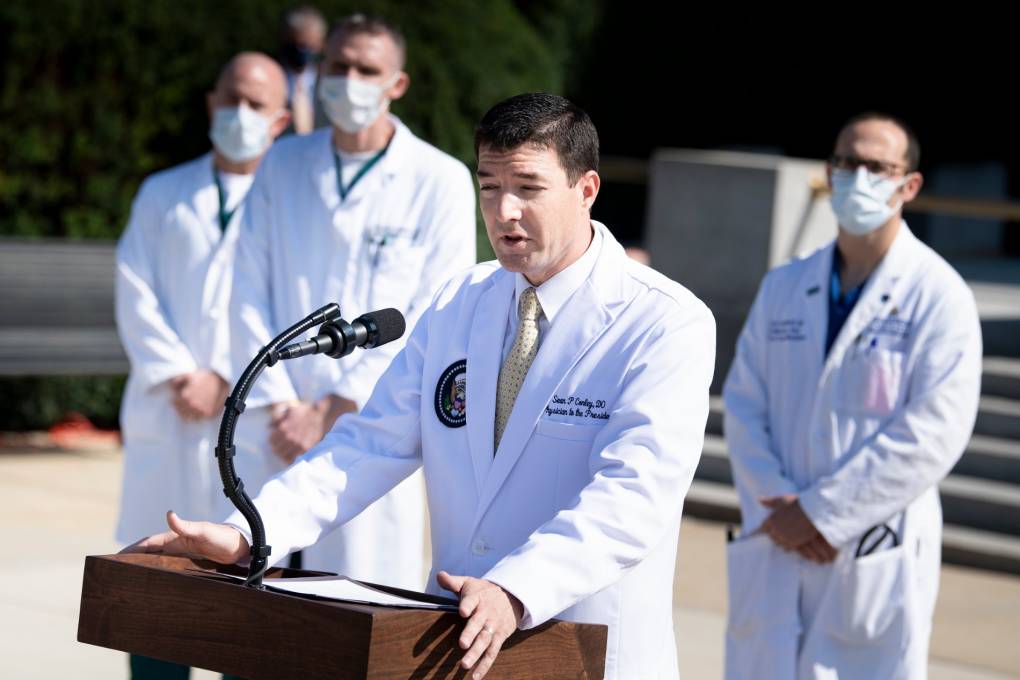
"caption": "Sean Conley, Physician to US President Donald Trump, gives an update on the President's health as he is treated for a COVID-19 infection at Walter Reed Medical Center October 4, 2020, in Bethesda, Maryland. - US President Donald Trump has \"continued to improve\" as he is treated for Covid-19, his doctors said October 4, 2020, revealing he could be discharged as early as October 5, 2020. His medical team said his oxygen levels had dropped twice briefly in recent days and he is being treated with steroids, but they gave an upbeat assessment of the 74-year-old president's health and outlook. ",
"description": "Sean Conley, Physician to US President Donald Trump, gives an update on the President's health as he is treated for a COVID-19 infection at Walter Reed Medical Center October 4, 2020, in Bethesda, Maryland. - US President Donald Trump has \"continued to improve\" as he is treated for Covid-19, his doctors said October 4, 2020, revealing he could be discharged as early as October 5, 2020. His medical team said his oxygen levels had dropped twice briefly in recent days and he is being treated with steroids, but they gave an upbeat assessment of the 74-year-old president's health and outlook. ",
"title": "GettyImages-1228891469 (WEB)",
"credit": "Photo by Brendan Smialowski / AFP via Getty Images",
"status": "inherit",
"isLoading": false,
"fetchFailed": false
},
"news_11840978": {
"type": "attachments",
"id": "news_11840978",
"meta": {
"index": "attachments_1716263798",
"site": "news",
"id": "11840978",
"found": true
},
"parent": 11840975,
"imgSizes": {
"apple_news_ca_landscape_5_5": {
"file": "https://ww2.kqed.org/app/uploads/sites/10/2020/10/1920_GettyImages-1222297799-1044x783.jpg",
"width": 1044,
"mimeType": "image/jpeg",
"height": 783
},
"apple_news_ca_square_4_0": {
"file": "https://ww2.kqed.org/app/uploads/sites/10/2020/10/1920_GettyImages-1222297799-470x470.jpg",
"width": 470,
"mimeType": "image/jpeg",
"height": 470
},
"twentyfourteen-full-width": {
"file": "https://ww2.kqed.org/app/uploads/sites/10/2020/10/1920_GettyImages-1222297799-1038x576.jpg",
"width": 1038,
"mimeType": "image/jpeg",
"height": 576
},
"thumbnail": {
"file": "https://ww2.kqed.org/app/uploads/sites/10/2020/10/1920_GettyImages-1222297799-160x90.jpg",
"width": 160,
"mimeType": "image/jpeg",
"height": 90
},
"post-thumbnail": {
"file": "https://ww2.kqed.org/app/uploads/sites/10/2020/10/1920_GettyImages-1222297799-672x372.jpg",
"width": 672,
"mimeType": "image/jpeg",
"height": 372
},
"kqedFullSize": {
"file": "https://ww2.kqed.org/app/uploads/sites/10/2020/10/1920_GettyImages-1222297799-scaled.jpg",
"width": 2560,
"height": 1440
},
"2048x2048": {
"file": "https://ww2.kqed.org/app/uploads/sites/10/2020/10/1920_GettyImages-1222297799-2048x1152.jpg",
"width": 2048,
"mimeType": "image/jpeg",
"height": 1152
},
"apple_news_ca_landscape_4_7": {
"file": "https://ww2.kqed.org/app/uploads/sites/10/2020/10/1920_GettyImages-1222297799-632x474.jpg",
"width": 632,
"mimeType": "image/jpeg",
"height": 474
},
"large": {
"file": "https://ww2.kqed.org/app/uploads/sites/10/2020/10/1920_GettyImages-1222297799-1020x574.jpg",
"width": 1020,
"mimeType": "image/jpeg",
"height": 574
},
"apple_news_ca_landscape_4_0": {
"file": "https://ww2.kqed.org/app/uploads/sites/10/2020/10/1920_GettyImages-1222297799-536x402.jpg",
"width": 536,
"mimeType": "image/jpeg",
"height": 402
},
"apple_news_ca_portrait_12_9": {
"file": "https://ww2.kqed.org/app/uploads/sites/10/2020/10/1920_GettyImages-1222297799-1122x1496.jpg",
"width": 1122,
"mimeType": "image/jpeg",
"height": 1496
},
"medium": {
"file": "https://ww2.kqed.org/app/uploads/sites/10/2020/10/1920_GettyImages-1222297799-800x450.jpg",
"width": 800,
"mimeType": "image/jpeg",
"height": 450
},
"apple_news_ca_portrait_4_0": {
"file": "https://ww2.kqed.org/app/uploads/sites/10/2020/10/1920_GettyImages-1222297799-354x472.jpg",
"width": 354,
"mimeType": "image/jpeg",
"height": 472
},
"apple_news_ca_portrait_9_7": {
"file": "https://ww2.kqed.org/app/uploads/sites/10/2020/10/1920_GettyImages-1222297799-840x1120.jpg",
"width": 840,
"mimeType": "image/jpeg",
"height": 1120
},
"apple_news_ca_landscape_12_9": {
"file": "https://ww2.kqed.org/app/uploads/sites/10/2020/10/1920_GettyImages-1222297799-1832x1374.jpg",
"width": 1832,
"mimeType": "image/jpeg",
"height": 1374
},
"apple_news_ca_square_9_7": {
"file": "https://ww2.kqed.org/app/uploads/sites/10/2020/10/1920_GettyImages-1222297799-1104x1104.jpg",
"width": 1104,
"mimeType": "image/jpeg",
"height": 1104
},
"1536x1536": {
"file": "https://ww2.kqed.org/app/uploads/sites/10/2020/10/1920_GettyImages-1222297799-1536x864.jpg",
"width": 1536,
"mimeType": "image/jpeg",
"height": 864
},
"apple_news_ca_portrait_4_7": {
"file": "https://ww2.kqed.org/app/uploads/sites/10/2020/10/1920_GettyImages-1222297799-414x552.jpg",
"width": 414,
"mimeType": "image/jpeg",
"height": 552
},
"apple_news_ca_square_12_9": {
"file": "https://ww2.kqed.org/app/uploads/sites/10/2020/10/1920_GettyImages-1222297799-1472x1472.jpg",
"width": 1472,
"mimeType": "image/jpeg",
"height": 1472
},
"apple_news_ca_portrait_5_5": {
"file": "https://ww2.kqed.org/app/uploads/sites/10/2020/10/1920_GettyImages-1222297799-687x916.jpg",
"width": 687,
"mimeType": "image/jpeg",
"height": 916
},
"full-width": {
"file": "https://ww2.kqed.org/app/uploads/sites/10/2020/10/1920_GettyImages-1222297799-1920x1080.jpg",
"width": 1920,
"mimeType": "image/jpeg",
"height": 1080
},
"apple_news_ca_square_4_7": {
"file": "https://ww2.kqed.org/app/uploads/sites/10/2020/10/1920_GettyImages-1222297799-550x550.jpg",
"width": 550,
"mimeType": "image/jpeg",
"height": 550
},
"apple_news_ca_landscape_9_7": {
"file": "https://ww2.kqed.org/app/uploads/sites/10/2020/10/1920_GettyImages-1222297799-1376x1032.jpg",
"width": 1376,
"mimeType": "image/jpeg",
"height": 1032
},
"apple_news_ca_square_5_5": {
"file": "https://ww2.kqed.org/app/uploads/sites/10/2020/10/1920_GettyImages-1222297799-912x912.jpg",
"width": 912,
"mimeType": "image/jpeg",
"height": 912
}
},
"publishDate": 1601821930,
"modified": 1609706092,
"caption": "President Donald Trump while announcing that the Food and Drug Administration issued an emergency approval for the antiviral drug remdesivir in the Oval Office at the White House May 01, 2020 in Washington, DC. A federal government trial found that patients with COVID-19 receiving Gilead Sciences' remdesivir recovered more quickly but the drug did not significantly reduce fatality rates. ",
"description": "President Donald Trump while announcing that the Food and Drug Administration issued an emergency approval for the antiviral drug remdesivir in the Oval Office at the White House May 01, 2020 in Washington, DC. A federal government trial found that patients with COVID-19 receiving Gilead Sciences' remdesivir recovered more quickly but the drug did not significantly reduce fatality rates. ",
"title": "President Trump Meets With Executives From The Pharmaceutical Industry In The Oval Office",
"credit": "Erin Schaff-Pool/Getty Images",
"status": "inherit",
"altTag": null,
"isLoading": false,
"fetchFailed": false
},
"news_11840973": {
"type": "attachments",
"id": "news_11840973",
"meta": {
"index": "attachments_1716263798",
"site": "news",
"id": "11840973",
"found": true
},
"parent": 11840969,
"imgSizes": {
"apple_news_ca_landscape_5_5": {
"file": "https://ww2.kqed.org/app/uploads/sites/10/2020/10/GettyImages-1228868950-WEB-1044x783.jpg",
"width": 1044,
"mimeType": "image/jpeg",
"height": 783
},
"apple_news_ca_square_4_0": {
"file": "https://ww2.kqed.org/app/uploads/sites/10/2020/10/GettyImages-1228868950-WEB-470x470.jpg",
"width": 470,
"mimeType": "image/jpeg",
"height": 470
},
"twentyfourteen-full-width": {
"file": "https://ww2.kqed.org/app/uploads/sites/10/2020/10/GettyImages-1228868950-WEB-1038x576.jpg",
"width": 1038,
"mimeType": "image/jpeg",
"height": 576
},
"thumbnail": {
"file": "https://ww2.kqed.org/app/uploads/sites/10/2020/10/GettyImages-1228868950-WEB-160x107.jpg",
"width": 160,
"mimeType": "image/jpeg",
"height": 107
},
"post-thumbnail": {
"file": "https://ww2.kqed.org/app/uploads/sites/10/2020/10/GettyImages-1228868950-WEB-672x372.jpg",
"width": 672,
"mimeType": "image/jpeg",
"height": 372
},
"kqedFullSize": {
"file": "https://ww2.kqed.org/app/uploads/sites/10/2020/10/GettyImages-1228868950-WEB.jpg",
"width": 1900,
"height": 1267
},
"apple_news_ca_landscape_4_7": {
"file": "https://ww2.kqed.org/app/uploads/sites/10/2020/10/GettyImages-1228868950-WEB-632x474.jpg",
"width": 632,
"mimeType": "image/jpeg",
"height": 474
},
"large": {
"file": "https://ww2.kqed.org/app/uploads/sites/10/2020/10/GettyImages-1228868950-WEB-1020x680.jpg",
"width": 1020,
"mimeType": "image/jpeg",
"height": 680
},
"apple_news_ca_landscape_4_0": {
"file": "https://ww2.kqed.org/app/uploads/sites/10/2020/10/GettyImages-1228868950-WEB-536x402.jpg",
"width": 536,
"mimeType": "image/jpeg",
"height": 402
},
"apple_news_ca_portrait_12_9": {
"file": "https://ww2.kqed.org/app/uploads/sites/10/2020/10/GettyImages-1228868950-WEB-1122x1267.jpg",
"width": 1122,
"mimeType": "image/jpeg",
"height": 1267
},
"medium": {
"file": "https://ww2.kqed.org/app/uploads/sites/10/2020/10/GettyImages-1228868950-WEB-800x533.jpg",
"width": 800,
"mimeType": "image/jpeg",
"height": 533
},
"apple_news_ca_portrait_4_0": {
"file": "https://ww2.kqed.org/app/uploads/sites/10/2020/10/GettyImages-1228868950-WEB-354x472.jpg",
"width": 354,
"mimeType": "image/jpeg",
"height": 472
},
"apple_news_ca_portrait_9_7": {
"file": "https://ww2.kqed.org/app/uploads/sites/10/2020/10/GettyImages-1228868950-WEB-840x1120.jpg",
"width": 840,
"mimeType": "image/jpeg",
"height": 1120
},
"apple_news_ca_landscape_12_9": {
"file": "https://ww2.kqed.org/app/uploads/sites/10/2020/10/GettyImages-1228868950-WEB-1832x1267.jpg",
"width": 1832,
"mimeType": "image/jpeg",
"height": 1267
},
"apple_news_ca_square_9_7": {
"file": "https://ww2.kqed.org/app/uploads/sites/10/2020/10/GettyImages-1228868950-WEB-1104x1104.jpg",
"width": 1104,
"mimeType": "image/jpeg",
"height": 1104
},
"1536x1536": {
"file": "https://ww2.kqed.org/app/uploads/sites/10/2020/10/GettyImages-1228868950-WEB-1536x1024.jpg",
"width": 1536,
"mimeType": "image/jpeg",
"height": 1024
},
"apple_news_ca_portrait_4_7": {
"file": "https://ww2.kqed.org/app/uploads/sites/10/2020/10/GettyImages-1228868950-WEB-414x552.jpg",
"width": 414,
"mimeType": "image/jpeg",
"height": 552
},
"apple_news_ca_square_12_9": {
"file": "https://ww2.kqed.org/app/uploads/sites/10/2020/10/GettyImages-1228868950-WEB-1472x1267.jpg",
"width": 1472,
"mimeType": "image/jpeg",
"height": 1267
},
"apple_news_ca_portrait_5_5": {
"file": "https://ww2.kqed.org/app/uploads/sites/10/2020/10/GettyImages-1228868950-WEB-687x916.jpg",
"width": 687,
"mimeType": "image/jpeg",
"height": 916
},
"apple_news_ca_square_4_7": {
"file": "https://ww2.kqed.org/app/uploads/sites/10/2020/10/GettyImages-1228868950-WEB-550x550.jpg",
"width": 550,
"mimeType": "image/jpeg",
"height": 550
},
"apple_news_ca_landscape_9_7": {
"file": "https://ww2.kqed.org/app/uploads/sites/10/2020/10/GettyImages-1228868950-WEB-1376x1032.jpg",
"width": 1376,
"mimeType": "image/jpeg",
"height": 1032
},
"apple_news_ca_square_5_5": {
"file": "https://ww2.kqed.org/app/uploads/sites/10/2020/10/GettyImages-1228868950-WEB-912x912.jpg",
"width": 912,
"mimeType": "image/jpeg",
"height": 912
}
},
"publishDate": 1601773849,
"modified": 1601773914,
"caption": "White House physician Sean Conley (R), with medical staff, gives an update on the condition of US President Donald Trump, on October 3, 2020, at Walter Reed Medical Center in Bethesda, Maryland. - Trump is \"doing very well\" and is up and moving about as he undergoes treatment for Covid-19 with his symptoms improving, Conley said. ",
"description": "White House physician Sean Conley (R), with medical staff, gives an update on the condition of US President Donald Trump, on October 3, 2020, at Walter Reed Medical Center in Bethesda, Maryland. - Trump is \"doing very well\" and is up and moving about as he undergoes treatment for Covid-19 with his symptoms improving, Conley said. ",
"title": "GettyImages-1228868950 (WEB)",
"credit": "Brendan Smialowski / AFP via Getty Images",
"status": "inherit",
"isLoading": false,
"fetchFailed": false
},
"news_11840933": {
"type": "attachments",
"id": "news_11840933",
"meta": {
"index": "attachments_1716263798",
"site": "news",
"id": "11840933",
"found": true
},
"parent": 11840779,
"imgSizes": {
"apple_news_ca_landscape_5_5": {
"file": "https://ww2.kqed.org/app/uploads/sites/10/2020/10/MARQUEE-801-1044x720.jpg",
"width": 1044,
"mimeType": "image/jpeg",
"height": 720
},
"apple_news_ca_square_4_0": {
"file": "https://ww2.kqed.org/app/uploads/sites/10/2020/10/MARQUEE-801-470x470.jpg",
"width": 470,
"mimeType": "image/jpeg",
"height": 470
},
"twentyfourteen-full-width": {
"file": "https://ww2.kqed.org/app/uploads/sites/10/2020/10/MARQUEE-801-1038x576.jpg",
"width": 1038,
"mimeType": "image/jpeg",
"height": 576
},
"thumbnail": {
"file": "https://ww2.kqed.org/app/uploads/sites/10/2020/10/MARQUEE-801-160x90.jpg",
"width": 160,
"mimeType": "image/jpeg",
"height": 90
},
"post-thumbnail": {
"file": "https://ww2.kqed.org/app/uploads/sites/10/2020/10/MARQUEE-801-672x372.jpg",
"width": 672,
"mimeType": "image/jpeg",
"height": 372
},
"kqedFullSize": {
"file": "https://ww2.kqed.org/app/uploads/sites/10/2020/10/MARQUEE-801.jpg",
"width": 1280,
"height": 720
},
"apple_news_ca_landscape_4_7": {
"file": "https://ww2.kqed.org/app/uploads/sites/10/2020/10/MARQUEE-801-632x474.jpg",
"width": 632,
"mimeType": "image/jpeg",
"height": 474
},
"large": {
"file": "https://ww2.kqed.org/app/uploads/sites/10/2020/10/MARQUEE-801-1020x574.jpg",
"width": 1020,
"mimeType": "image/jpeg",
"height": 574
},
"apple_news_ca_landscape_4_0": {
"file": "https://ww2.kqed.org/app/uploads/sites/10/2020/10/MARQUEE-801-536x402.jpg",
"width": 536,
"mimeType": "image/jpeg",
"height": 402
},
"apple_news_ca_portrait_12_9": {
"file": "https://ww2.kqed.org/app/uploads/sites/10/2020/10/MARQUEE-801-1122x720.jpg",
"width": 1122,
"mimeType": "image/jpeg",
"height": 720
},
"medium": {
"file": "https://ww2.kqed.org/app/uploads/sites/10/2020/10/MARQUEE-801-800x450.jpg",
"width": 800,
"mimeType": "image/jpeg",
"height": 450
},
"apple_news_ca_portrait_4_0": {
"file": "https://ww2.kqed.org/app/uploads/sites/10/2020/10/MARQUEE-801-354x472.jpg",
"width": 354,
"mimeType": "image/jpeg",
"height": 472
},
"apple_news_ca_portrait_9_7": {
"file": "https://ww2.kqed.org/app/uploads/sites/10/2020/10/MARQUEE-801-840x720.jpg",
"width": 840,
"mimeType": "image/jpeg",
"height": 720
},
"apple_news_ca_square_9_7": {
"file": "https://ww2.kqed.org/app/uploads/sites/10/2020/10/MARQUEE-801-1104x720.jpg",
"width": 1104,
"mimeType": "image/jpeg",
"height": 720
},
"apple_news_ca_portrait_4_7": {
"file": "https://ww2.kqed.org/app/uploads/sites/10/2020/10/MARQUEE-801-414x552.jpg",
"width": 414,
"mimeType": "image/jpeg",
"height": 552
},
"apple_news_ca_portrait_5_5": {
"file": "https://ww2.kqed.org/app/uploads/sites/10/2020/10/MARQUEE-801-687x720.jpg",
"width": 687,
"mimeType": "image/jpeg",
"height": 720
},
"apple_news_ca_square_4_7": {
"file": "https://ww2.kqed.org/app/uploads/sites/10/2020/10/MARQUEE-801-550x550.jpg",
"width": 550,
"mimeType": "image/jpeg",
"height": 550
},
"apple_news_ca_square_5_5": {
"file": "https://ww2.kqed.org/app/uploads/sites/10/2020/10/MARQUEE-801-912x720.jpg",
"width": 912,
"mimeType": "image/jpeg",
"height": 720
}
},
"publishDate": 1601686832,
"modified": 1601686832,
"caption": null,
"description": null,
"title": "MARQUEE 801",
"credit": null,
"status": "inherit",
"isLoading": false,
"fetchFailed": false
},
"news_11840803": {
"type": "attachments",
"id": "news_11840803",
"meta": {
"index": "attachments_1716263798",
"site": "news",
"id": "11840803",
"found": true
},
"parent": 11840795,
"imgSizes": {
"apple_news_ca_landscape_5_5": {
"file": "https://ww2.kqed.org/app/uploads/sites/10/2020/10/sight_100220_final-1044x783.png",
"width": 1044,
"mimeType": "image/png",
"height": 783
},
"apple_news_ca_square_4_0": {
"file": "https://ww2.kqed.org/app/uploads/sites/10/2020/10/sight_100220_final-470x470.png",
"width": 470,
"mimeType": "image/png",
"height": 470
},
"twentyfourteen-full-width": {
"file": "https://ww2.kqed.org/app/uploads/sites/10/2020/10/sight_100220_final-1038x576.png",
"width": 1038,
"mimeType": "image/png",
"height": 576
},
"thumbnail": {
"file": "https://ww2.kqed.org/app/uploads/sites/10/2020/10/sight_100220_final-160x107.png",
"width": 160,
"mimeType": "image/png",
"height": 107
},
"post-thumbnail": {
"file": "https://ww2.kqed.org/app/uploads/sites/10/2020/10/sight_100220_final-672x372.png",
"width": 672,
"mimeType": "image/png",
"height": 372
},
"kqedFullSize": {
"file": "https://ww2.kqed.org/app/uploads/sites/10/2020/10/sight_100220_final.png",
"width": 1920,
"height": 1289
},
"apple_news_ca_landscape_4_7": {
"file": "https://ww2.kqed.org/app/uploads/sites/10/2020/10/sight_100220_final-632x474.png",
"width": 632,
"mimeType": "image/png",
"height": 474
},
"large": {
"file": "https://ww2.kqed.org/app/uploads/sites/10/2020/10/sight_100220_final-1020x685.png",
"width": 1020,
"mimeType": "image/png",
"height": 685
},
"apple_news_ca_landscape_4_0": {
"file": "https://ww2.kqed.org/app/uploads/sites/10/2020/10/sight_100220_final-536x402.png",
"width": 536,
"mimeType": "image/png",
"height": 402
},
"apple_news_ca_portrait_12_9": {
"file": "https://ww2.kqed.org/app/uploads/sites/10/2020/10/sight_100220_final-1122x1289.png",
"width": 1122,
"mimeType": "image/png",
"height": 1289
},
"medium": {
"file": "https://ww2.kqed.org/app/uploads/sites/10/2020/10/sight_100220_final-800x537.png",
"width": 800,
"mimeType": "image/png",
"height": 537
},
"apple_news_ca_portrait_4_0": {
"file": "https://ww2.kqed.org/app/uploads/sites/10/2020/10/sight_100220_final-354x472.png",
"width": 354,
"mimeType": "image/png",
"height": 472
},
"apple_news_ca_portrait_9_7": {
"file": "https://ww2.kqed.org/app/uploads/sites/10/2020/10/sight_100220_final-840x1120.png",
"width": 840,
"mimeType": "image/png",
"height": 1120
},
"apple_news_ca_landscape_12_9": {
"file": "https://ww2.kqed.org/app/uploads/sites/10/2020/10/sight_100220_final-1832x1289.png",
"width": 1832,
"mimeType": "image/png",
"height": 1289
},
"apple_news_ca_square_9_7": {
"file": "https://ww2.kqed.org/app/uploads/sites/10/2020/10/sight_100220_final-1104x1104.png",
"width": 1104,
"mimeType": "image/png",
"height": 1104
},
"1536x1536": {
"file": "https://ww2.kqed.org/app/uploads/sites/10/2020/10/sight_100220_final-1536x1031.png",
"width": 1536,
"mimeType": "image/png",
"height": 1031
},
"apple_news_ca_portrait_4_7": {
"file": "https://ww2.kqed.org/app/uploads/sites/10/2020/10/sight_100220_final-414x552.png",
"width": 414,
"mimeType": "image/png",
"height": 552
},
"apple_news_ca_square_12_9": {
"file": "https://ww2.kqed.org/app/uploads/sites/10/2020/10/sight_100220_final-1472x1289.png",
"width": 1472,
"mimeType": "image/png",
"height": 1289
},
"apple_news_ca_portrait_5_5": {
"file": "https://ww2.kqed.org/app/uploads/sites/10/2020/10/sight_100220_final-687x916.png",
"width": 687,
"mimeType": "image/png",
"height": 916
},
"apple_news_ca_square_4_7": {
"file": "https://ww2.kqed.org/app/uploads/sites/10/2020/10/sight_100220_final-550x550.png",
"width": 550,
"mimeType": "image/png",
"height": 550
},
"apple_news_ca_landscape_9_7": {
"file": "https://ww2.kqed.org/app/uploads/sites/10/2020/10/sight_100220_final-1376x1032.png",
"width": 1376,
"mimeType": "image/png",
"height": 1032
},
"apple_news_ca_square_5_5": {
"file": "https://ww2.kqed.org/app/uploads/sites/10/2020/10/sight_100220_final-912x912.png",
"width": 912,
"mimeType": "image/png",
"height": 912
}
},
"publishDate": 1601664777,
"modified": 1601664813,
"caption": null,
"description": null,
"title": "sight_100220_final",
"credit": null,
"status": "inherit",
"isLoading": false,
"fetchFailed": false
},
"news_11840744": {
"type": "attachments",
"id": "news_11840744",
"meta": {
"index": "attachments_1716263798",
"site": "news",
"id": "11840744",
"found": true
},
"parent": 11840743,
"imgSizes": {
"apple_news_ca_landscape_5_5": {
"file": "https://ww2.kqed.org/app/uploads/sites/10/2020/10/trump-coronavirus-positive-what-next_wide-7d02b10e9a5ad69bb01b990d5499f9baf60b08fe-1044x783.jpg",
"width": 1044,
"mimeType": "image/jpeg",
"height": 783
},
"apple_news_ca_square_4_0": {
"file": "https://ww2.kqed.org/app/uploads/sites/10/2020/10/trump-coronavirus-positive-what-next_wide-7d02b10e9a5ad69bb01b990d5499f9baf60b08fe-470x470.jpg",
"width": 470,
"mimeType": "image/jpeg",
"height": 470
},
"twentyfourteen-full-width": {
"file": "https://ww2.kqed.org/app/uploads/sites/10/2020/10/trump-coronavirus-positive-what-next_wide-7d02b10e9a5ad69bb01b990d5499f9baf60b08fe-1038x576.jpg",
"width": 1038,
"mimeType": "image/jpeg",
"height": 576
},
"thumbnail": {
"file": "https://ww2.kqed.org/app/uploads/sites/10/2020/10/trump-coronavirus-positive-what-next_wide-7d02b10e9a5ad69bb01b990d5499f9baf60b08fe-160x90.jpg",
"width": 160,
"mimeType": "image/jpeg",
"height": 90
},
"post-thumbnail": {
"file": "https://ww2.kqed.org/app/uploads/sites/10/2020/10/trump-coronavirus-positive-what-next_wide-7d02b10e9a5ad69bb01b990d5499f9baf60b08fe-672x372.jpg",
"width": 672,
"mimeType": "image/jpeg",
"height": 372
},
"kqedFullSize": {
"file": "https://ww2.kqed.org/app/uploads/sites/10/2020/10/trump-coronavirus-positive-what-next_wide-7d02b10e9a5ad69bb01b990d5499f9baf60b08fe.jpg",
"width": 2090,
"height": 1175
},
"2048x2048": {
"file": "https://ww2.kqed.org/app/uploads/sites/10/2020/10/trump-coronavirus-positive-what-next_wide-7d02b10e9a5ad69bb01b990d5499f9baf60b08fe-2048x1151.jpg",
"width": 2048,
"mimeType": "image/jpeg",
"height": 1151
},
"apple_news_ca_landscape_4_7": {
"file": "https://ww2.kqed.org/app/uploads/sites/10/2020/10/trump-coronavirus-positive-what-next_wide-7d02b10e9a5ad69bb01b990d5499f9baf60b08fe-632x474.jpg",
"width": 632,
"mimeType": "image/jpeg",
"height": 474
},
"large": {
"file": "https://ww2.kqed.org/app/uploads/sites/10/2020/10/trump-coronavirus-positive-what-next_wide-7d02b10e9a5ad69bb01b990d5499f9baf60b08fe-1020x573.jpg",
"width": 1020,
"mimeType": "image/jpeg",
"height": 573
},
"apple_news_ca_landscape_4_0": {
"file": "https://ww2.kqed.org/app/uploads/sites/10/2020/10/trump-coronavirus-positive-what-next_wide-7d02b10e9a5ad69bb01b990d5499f9baf60b08fe-536x402.jpg",
"width": 536,
"mimeType": "image/jpeg",
"height": 402
},
"apple_news_ca_portrait_12_9": {
"file": "https://ww2.kqed.org/app/uploads/sites/10/2020/10/trump-coronavirus-positive-what-next_wide-7d02b10e9a5ad69bb01b990d5499f9baf60b08fe-1122x1175.jpg",
"width": 1122,
"mimeType": "image/jpeg",
"height": 1175
},
"medium": {
"file": "https://ww2.kqed.org/app/uploads/sites/10/2020/10/trump-coronavirus-positive-what-next_wide-7d02b10e9a5ad69bb01b990d5499f9baf60b08fe-800x450.jpg",
"width": 800,
"mimeType": "image/jpeg",
"height": 450
},
"apple_news_ca_portrait_4_0": {
"file": "https://ww2.kqed.org/app/uploads/sites/10/2020/10/trump-coronavirus-positive-what-next_wide-7d02b10e9a5ad69bb01b990d5499f9baf60b08fe-354x472.jpg",
"width": 354,
"mimeType": "image/jpeg",
"height": 472
},
"apple_news_ca_portrait_9_7": {
"file": "https://ww2.kqed.org/app/uploads/sites/10/2020/10/trump-coronavirus-positive-what-next_wide-7d02b10e9a5ad69bb01b990d5499f9baf60b08fe-840x1120.jpg",
"width": 840,
"mimeType": "image/jpeg",
"height": 1120
},
"apple_news_ca_landscape_12_9": {
"file": "https://ww2.kqed.org/app/uploads/sites/10/2020/10/trump-coronavirus-positive-what-next_wide-7d02b10e9a5ad69bb01b990d5499f9baf60b08fe-1832x1175.jpg",
"width": 1832,
"mimeType": "image/jpeg",
"height": 1175
},
"apple_news_ca_square_9_7": {
"file": "https://ww2.kqed.org/app/uploads/sites/10/2020/10/trump-coronavirus-positive-what-next_wide-7d02b10e9a5ad69bb01b990d5499f9baf60b08fe-1104x1104.jpg",
"width": 1104,
"mimeType": "image/jpeg",
"height": 1104
},
"1536x1536": {
"file": "https://ww2.kqed.org/app/uploads/sites/10/2020/10/trump-coronavirus-positive-what-next_wide-7d02b10e9a5ad69bb01b990d5499f9baf60b08fe-1536x864.jpg",
"width": 1536,
"mimeType": "image/jpeg",
"height": 864
},
"apple_news_ca_portrait_4_7": {
"file": "https://ww2.kqed.org/app/uploads/sites/10/2020/10/trump-coronavirus-positive-what-next_wide-7d02b10e9a5ad69bb01b990d5499f9baf60b08fe-414x552.jpg",
"width": 414,
"mimeType": "image/jpeg",
"height": 552
},
"apple_news_ca_square_12_9": {
"file": "https://ww2.kqed.org/app/uploads/sites/10/2020/10/trump-coronavirus-positive-what-next_wide-7d02b10e9a5ad69bb01b990d5499f9baf60b08fe-1472x1175.jpg",
"width": 1472,
"mimeType": "image/jpeg",
"height": 1175
},
"apple_news_ca_portrait_5_5": {
"file": "https://ww2.kqed.org/app/uploads/sites/10/2020/10/trump-coronavirus-positive-what-next_wide-7d02b10e9a5ad69bb01b990d5499f9baf60b08fe-687x916.jpg",
"width": 687,
"mimeType": "image/jpeg",
"height": 916
},
"full-width": {
"file": "https://ww2.kqed.org/app/uploads/sites/10/2020/10/trump-coronavirus-positive-what-next_wide-7d02b10e9a5ad69bb01b990d5499f9baf60b08fe-1920x1079.jpg",
"width": 1920,
"mimeType": "image/jpeg",
"height": 1079
},
"apple_news_ca_square_4_7": {
"file": "https://ww2.kqed.org/app/uploads/sites/10/2020/10/trump-coronavirus-positive-what-next_wide-7d02b10e9a5ad69bb01b990d5499f9baf60b08fe-550x550.jpg",
"width": 550,
"mimeType": "image/jpeg",
"height": 550
},
"apple_news_ca_landscape_9_7": {
"file": "https://ww2.kqed.org/app/uploads/sites/10/2020/10/trump-coronavirus-positive-what-next_wide-7d02b10e9a5ad69bb01b990d5499f9baf60b08fe-1376x1032.jpg",
"width": 1376,
"mimeType": "image/jpeg",
"height": 1032
},
"apple_news_ca_square_5_5": {
"file": "https://ww2.kqed.org/app/uploads/sites/10/2020/10/trump-coronavirus-positive-what-next_wide-7d02b10e9a5ad69bb01b990d5499f9baf60b08fe-912x912.jpg",
"width": 912,
"mimeType": "image/jpeg",
"height": 912
}
},
"publishDate": 1601658074,
"modified": 1601658640,
"caption": "A contentious scenario could play out if President Trump disagrees with assessments of his ability to perform in office, says John Fortier, former executive director of the Continuity of Government Commission. Trump is seen here preparing to leave the White House earlier this week for a fundraising event and campaign rally in Minnesota.",
"description": "WASHINGTON, DC - SEPTEMBER 30: U.S. President Donald Trump exits the Oval Office and walks toward Marine One on the South Lawn of the White House on September 30, 2020 in Washington, DC. President Trump is traveling to Minnesota for a fundraising event and a campaign rally. (Photo by Drew Angerer/Getty Images)",
"title": "A contentious scenario could play out if President Trump disagrees with assessments of his ability to perform in office, says John Fortier, former executive director of the Continuity of Government Commission. Trump is seen here preparing to leave the White House earlier this week for a fundraising event and campaign rally in Minnesota.",
"credit": "Drew Angerer/Getty Images",
"status": "inherit",
"isLoading": false,
"fetchFailed": false
},
"news_11840460": {
"type": "attachments",
"id": "news_11840460",
"meta": {
"index": "attachments_1716263798",
"site": "news",
"id": "11840460",
"found": true
},
"parent": 11840453,
"imgSizes": {
"apple_news_ca_landscape_5_5": {
"file": "https://ww2.kqed.org/app/uploads/sites/10/2020/09/runningmates_093020_final-1044x783.png",
"width": 1044,
"mimeType": "image/png",
"height": 783
},
"apple_news_ca_square_4_0": {
"file": "https://ww2.kqed.org/app/uploads/sites/10/2020/09/runningmates_093020_final-470x470.png",
"width": 470,
"mimeType": "image/png",
"height": 470
},
"twentyfourteen-full-width": {
"file": "https://ww2.kqed.org/app/uploads/sites/10/2020/09/runningmates_093020_final-1038x576.png",
"width": 1038,
"mimeType": "image/png",
"height": 576
},
"thumbnail": {
"file": "https://ww2.kqed.org/app/uploads/sites/10/2020/09/runningmates_093020_final-160x113.png",
"width": 160,
"mimeType": "image/png",
"height": 113
},
"post-thumbnail": {
"file": "https://ww2.kqed.org/app/uploads/sites/10/2020/09/runningmates_093020_final-672x372.png",
"width": 672,
"mimeType": "image/png",
"height": 372
},
"kqedFullSize": {
"file": "https://ww2.kqed.org/app/uploads/sites/10/2020/09/runningmates_093020_final.png",
"width": 1920,
"height": 1355
},
"apple_news_ca_landscape_4_7": {
"file": "https://ww2.kqed.org/app/uploads/sites/10/2020/09/runningmates_093020_final-632x474.png",
"width": 632,
"mimeType": "image/png",
"height": 474
},
"large": {
"file": "https://ww2.kqed.org/app/uploads/sites/10/2020/09/runningmates_093020_final-1020x720.png",
"width": 1020,
"mimeType": "image/png",
"height": 720
},
"apple_news_ca_landscape_4_0": {
"file": "https://ww2.kqed.org/app/uploads/sites/10/2020/09/runningmates_093020_final-536x402.png",
"width": 536,
"mimeType": "image/png",
"height": 402
},
"apple_news_ca_portrait_12_9": {
"file": "https://ww2.kqed.org/app/uploads/sites/10/2020/09/runningmates_093020_final-1122x1355.png",
"width": 1122,
"mimeType": "image/png",
"height": 1355
},
"medium": {
"file": "https://ww2.kqed.org/app/uploads/sites/10/2020/09/runningmates_093020_final-800x565.png",
"width": 800,
"mimeType": "image/png",
"height": 565
},
"apple_news_ca_portrait_4_0": {
"file": "https://ww2.kqed.org/app/uploads/sites/10/2020/09/runningmates_093020_final-354x472.png",
"width": 354,
"mimeType": "image/png",
"height": 472
},
"apple_news_ca_portrait_9_7": {
"file": "https://ww2.kqed.org/app/uploads/sites/10/2020/09/runningmates_093020_final-840x1120.png",
"width": 840,
"mimeType": "image/png",
"height": 1120
},
"apple_news_ca_landscape_12_9": {
"file": "https://ww2.kqed.org/app/uploads/sites/10/2020/09/runningmates_093020_final-1832x1355.png",
"width": 1832,
"mimeType": "image/png",
"height": 1355
},
"apple_news_ca_square_9_7": {
"file": "https://ww2.kqed.org/app/uploads/sites/10/2020/09/runningmates_093020_final-1104x1104.png",
"width": 1104,
"mimeType": "image/png",
"height": 1104
},
"1536x1536": {
"file": "https://ww2.kqed.org/app/uploads/sites/10/2020/09/runningmates_093020_final-1536x1084.png",
"width": 1536,
"mimeType": "image/png",
"height": 1084
},
"apple_news_ca_portrait_4_7": {
"file": "https://ww2.kqed.org/app/uploads/sites/10/2020/09/runningmates_093020_final-414x552.png",
"width": 414,
"mimeType": "image/png",
"height": 552
},
"apple_news_ca_square_12_9": {
"file": "https://ww2.kqed.org/app/uploads/sites/10/2020/09/runningmates_093020_final-1472x1355.png",
"width": 1472,
"mimeType": "image/png",
"height": 1355
},
"apple_news_ca_portrait_5_5": {
"file": "https://ww2.kqed.org/app/uploads/sites/10/2020/09/runningmates_093020_final-687x916.png",
"width": 687,
"mimeType": "image/png",
"height": 916
},
"apple_news_ca_square_4_7": {
"file": "https://ww2.kqed.org/app/uploads/sites/10/2020/09/runningmates_093020_final-550x550.png",
"width": 550,
"mimeType": "image/png",
"height": 550
},
"apple_news_ca_landscape_9_7": {
"file": "https://ww2.kqed.org/app/uploads/sites/10/2020/09/runningmates_093020_final-1376x1032.png",
"width": 1376,
"mimeType": "image/png",
"height": 1032
},
"apple_news_ca_square_5_5": {
"file": "https://ww2.kqed.org/app/uploads/sites/10/2020/09/runningmates_093020_final-912x912.png",
"width": 912,
"mimeType": "image/png",
"height": 912
}
},
"publishDate": 1601509028,
"modified": 1601509058,
"caption": null,
"description": null,
"title": "runningmates_093020_final",
"credit": null,
"status": "inherit",
"isLoading": false,
"fetchFailed": false
},
"news_11840345": {
"type": "attachments",
"id": "news_11840345",
"meta": {
"index": "attachments_1716263798",
"site": "news",
"id": "11840345",
"found": true
},
"parent": 11840318,
"imgSizes": {
"apple_news_ca_square_4_0": {
"file": "https://ww2.kqed.org/app/uploads/sites/10/2020/09/GettyImages-1228795594-1-470x470.jpg",
"width": 470,
"mimeType": "image/jpeg",
"height": 470
},
"twentyfourteen-full-width": {
"file": "https://ww2.kqed.org/app/uploads/sites/10/2020/09/GettyImages-1228795594-1-1024x576.jpg",
"width": 1024,
"mimeType": "image/jpeg",
"height": 576
},
"thumbnail": {
"file": "https://ww2.kqed.org/app/uploads/sites/10/2020/09/GettyImages-1228795594-1-160x107.jpg",
"width": 160,
"mimeType": "image/jpeg",
"height": 107
},
"post-thumbnail": {
"file": "https://ww2.kqed.org/app/uploads/sites/10/2020/09/GettyImages-1228795594-1-672x372.jpg",
"width": 672,
"mimeType": "image/jpeg",
"height": 372
},
"kqedFullSize": {
"file": "https://ww2.kqed.org/app/uploads/sites/10/2020/09/GettyImages-1228795594-1.jpg",
"width": 1024,
"height": 683
},
"apple_news_ca_landscape_4_7": {
"file": "https://ww2.kqed.org/app/uploads/sites/10/2020/09/GettyImages-1228795594-1-632x474.jpg",
"width": 632,
"mimeType": "image/jpeg",
"height": 474
},
"large": {
"file": "https://ww2.kqed.org/app/uploads/sites/10/2020/09/GettyImages-1228795594-1-1020x680.jpg",
"width": 1020,
"mimeType": "image/jpeg",
"height": 680
},
"apple_news_ca_landscape_4_0": {
"file": "https://ww2.kqed.org/app/uploads/sites/10/2020/09/GettyImages-1228795594-1-536x402.jpg",
"width": 536,
"mimeType": "image/jpeg",
"height": 402
},
"medium": {
"file": "https://ww2.kqed.org/app/uploads/sites/10/2020/09/GettyImages-1228795594-1-800x534.jpg",
"width": 800,
"mimeType": "image/jpeg",
"height": 534
},
"apple_news_ca_portrait_4_0": {
"file": "https://ww2.kqed.org/app/uploads/sites/10/2020/09/GettyImages-1228795594-1-354x472.jpg",
"width": 354,
"mimeType": "image/jpeg",
"height": 472
},
"apple_news_ca_portrait_9_7": {
"file": "https://ww2.kqed.org/app/uploads/sites/10/2020/09/GettyImages-1228795594-1-840x683.jpg",
"width": 840,
"mimeType": "image/jpeg",
"height": 683
},
"apple_news_ca_portrait_4_7": {
"file": "https://ww2.kqed.org/app/uploads/sites/10/2020/09/GettyImages-1228795594-1-414x552.jpg",
"width": 414,
"mimeType": "image/jpeg",
"height": 552
},
"apple_news_ca_portrait_5_5": {
"file": "https://ww2.kqed.org/app/uploads/sites/10/2020/09/GettyImages-1228795594-1-687x683.jpg",
"width": 687,
"mimeType": "image/jpeg",
"height": 683
},
"apple_news_ca_square_4_7": {
"file": "https://ww2.kqed.org/app/uploads/sites/10/2020/09/GettyImages-1228795594-1-550x550.jpg",
"width": 550,
"mimeType": "image/jpeg",
"height": 550
},
"apple_news_ca_square_5_5": {
"file": "https://ww2.kqed.org/app/uploads/sites/10/2020/09/GettyImages-1228795594-1-912x683.jpg",
"width": 912,
"mimeType": "image/jpeg",
"height": 683
}
},
"publishDate": 1601486962,
"modified": 1601487304,
"caption": "President Trump speaks during the first presidential debate against former Vice President and Democratic presidential nominee Joe Biden at the Health Education Campus of Case Western Reserve University in Cleveland on September 29, 2020.",
"description": null,
"title": "Donald Trump And Joe Biden Participate In First Presidential Debate",
"credit": "Morry Gash-Pool/Getty Images",
"status": "inherit",
"isLoading": false,
"fetchFailed": false
},
"news_11839906": {
"type": "attachments",
"id": "news_11839906",
"meta": {
"index": "attachments_1716263798",
"site": "news",
"id": "11839906",
"found": true
},
"parent": 11839905,
"imgSizes": {
"apple_news_ca_landscape_5_5": {
"file": "https://ww2.kqed.org/app/uploads/sites/10/2020/09/GettyImages-1276846524WEB-1044x783.jpg",
"width": 1044,
"mimeType": "image/jpeg",
"height": 783
},
"apple_news_ca_square_4_0": {
"file": "https://ww2.kqed.org/app/uploads/sites/10/2020/09/GettyImages-1276846524WEB-470x470.jpg",
"width": 470,
"mimeType": "image/jpeg",
"height": 470
},
"twentyfourteen-full-width": {
"file": "https://ww2.kqed.org/app/uploads/sites/10/2020/09/GettyImages-1276846524WEB-1038x576.jpg",
"width": 1038,
"mimeType": "image/jpeg",
"height": 576
},
"thumbnail": {
"file": "https://ww2.kqed.org/app/uploads/sites/10/2020/09/GettyImages-1276846524WEB-160x119.jpg",
"width": 160,
"mimeType": "image/jpeg",
"height": 119
},
"post-thumbnail": {
"file": "https://ww2.kqed.org/app/uploads/sites/10/2020/09/GettyImages-1276846524WEB-672x372.jpg",
"width": 672,
"mimeType": "image/jpeg",
"height": 372
},
"kqedFullSize": {
"file": "https://ww2.kqed.org/app/uploads/sites/10/2020/09/GettyImages-1276846524WEB.jpg",
"width": 1500,
"height": 1114
},
"apple_news_ca_landscape_4_7": {
"file": "https://ww2.kqed.org/app/uploads/sites/10/2020/09/GettyImages-1276846524WEB-632x474.jpg",
"width": 632,
"mimeType": "image/jpeg",
"height": 474
},
"large": {
"file": "https://ww2.kqed.org/app/uploads/sites/10/2020/09/GettyImages-1276846524WEB-1020x758.jpg",
"width": 1020,
"mimeType": "image/jpeg",
"height": 758
},
"apple_news_ca_landscape_4_0": {
"file": "https://ww2.kqed.org/app/uploads/sites/10/2020/09/GettyImages-1276846524WEB-536x402.jpg",
"width": 536,
"mimeType": "image/jpeg",
"height": 402
},
"apple_news_ca_portrait_12_9": {
"file": "https://ww2.kqed.org/app/uploads/sites/10/2020/09/GettyImages-1276846524WEB-1122x1114.jpg",
"width": 1122,
"mimeType": "image/jpeg",
"height": 1114
},
"medium": {
"file": "https://ww2.kqed.org/app/uploads/sites/10/2020/09/GettyImages-1276846524WEB-800x594.jpg",
"width": 800,
"mimeType": "image/jpeg",
"height": 594
},
"apple_news_ca_portrait_4_0": {
"file": "https://ww2.kqed.org/app/uploads/sites/10/2020/09/GettyImages-1276846524WEB-354x472.jpg",
"width": 354,
"mimeType": "image/jpeg",
"height": 472
},
"apple_news_ca_portrait_9_7": {
"file": "https://ww2.kqed.org/app/uploads/sites/10/2020/09/GettyImages-1276846524WEB-840x1114.jpg",
"width": 840,
"mimeType": "image/jpeg",
"height": 1114
},
"apple_news_ca_square_9_7": {
"file": "https://ww2.kqed.org/app/uploads/sites/10/2020/09/GettyImages-1276846524WEB-1104x1104.jpg",
"width": 1104,
"mimeType": "image/jpeg",
"height": 1104
},
"apple_news_ca_portrait_4_7": {
"file": "https://ww2.kqed.org/app/uploads/sites/10/2020/09/GettyImages-1276846524WEB-414x552.jpg",
"width": 414,
"mimeType": "image/jpeg",
"height": 552
},
"apple_news_ca_square_12_9": {
"file": "https://ww2.kqed.org/app/uploads/sites/10/2020/09/GettyImages-1276846524WEB-1472x1114.jpg",
"width": 1472,
"mimeType": "image/jpeg",
"height": 1114
},
"apple_news_ca_portrait_5_5": {
"file": "https://ww2.kqed.org/app/uploads/sites/10/2020/09/GettyImages-1276846524WEB-687x916.jpg",
"width": 687,
"mimeType": "image/jpeg",
"height": 916
},
"apple_news_ca_square_4_7": {
"file": "https://ww2.kqed.org/app/uploads/sites/10/2020/09/GettyImages-1276846524WEB-550x550.jpg",
"width": 550,
"mimeType": "image/jpeg",
"height": 550
},
"apple_news_ca_landscape_9_7": {
"file": "https://ww2.kqed.org/app/uploads/sites/10/2020/09/GettyImages-1276846524WEB-1376x1032.jpg",
"width": 1376,
"mimeType": "image/jpeg",
"height": 1032
},
"apple_news_ca_square_5_5": {
"file": "https://ww2.kqed.org/app/uploads/sites/10/2020/09/GettyImages-1276846524WEB-912x912.jpg",
"width": 912,
"mimeType": "image/jpeg",
"height": 912
}
},
"publishDate": 1601160773,
"modified": 1601160798,
"caption": "U.S. President Donald Trump (L) introduces 7th U.S. Circuit Court Judge Amy Coney Barrett as his nominee to the Supreme Court in the Rose Garden at the White House September 26, 2020 in Washington, DC. With 38 days until the election, Trump tapped Barrett to be his third Supreme Court nominee in just four years and to replace the late Associate Justice Ruth Bader Ginsburg, who will be buried at Arlington National Cemetery on Tuesday. ",
"description": "U.S. President Donald Trump (L) introduces 7th U.S. Circuit Court Judge Amy Coney Barrett as his nominee to the Supreme Court in the Rose Garden at the White House September 26, 2020 in Washington, DC. With 38 days until the election, Trump tapped Barrett to be his third Supreme Court nominee in just four years and to replace the late Associate Justice Ruth Bader Ginsburg, who will be buried at Arlington National Cemetery on Tuesday. ",
"title": "GettyImages-1276846524(WEB)",
"credit": "Chip Somodevilla/Getty Images",
"status": "inherit",
"isLoading": false,
"fetchFailed": false
},
"news_11839830": {
"type": "attachments",
"id": "news_11839830",
"meta": {
"index": "attachments_1716263798",
"site": "news",
"id": "11839830",
"found": true
},
"parent": 11839763,
"imgSizes": {
"apple_news_ca_landscape_5_5": {
"file": "https://ww2.kqed.org/app/uploads/sites/10/2020/09/MARQUEE745-1044x783.jpg",
"width": 1044,
"mimeType": "image/jpeg",
"height": 783
},
"apple_news_ca_square_4_0": {
"file": "https://ww2.kqed.org/app/uploads/sites/10/2020/09/MARQUEE745-470x470.jpg",
"width": 470,
"mimeType": "image/jpeg",
"height": 470
},
"twentyfourteen-full-width": {
"file": "https://ww2.kqed.org/app/uploads/sites/10/2020/09/MARQUEE745-1038x576.jpg",
"width": 1038,
"mimeType": "image/jpeg",
"height": 576
},
"thumbnail": {
"file": "https://ww2.kqed.org/app/uploads/sites/10/2020/09/MARQUEE745-160x114.jpg",
"width": 160,
"mimeType": "image/jpeg",
"height": 114
},
"post-thumbnail": {
"file": "https://ww2.kqed.org/app/uploads/sites/10/2020/09/MARQUEE745-672x372.jpg",
"width": 672,
"mimeType": "image/jpeg",
"height": 372
},
"kqedFullSize": {
"file": "https://ww2.kqed.org/app/uploads/sites/10/2020/09/MARQUEE745.jpg",
"width": 1521,
"height": 1079
},
"apple_news_ca_landscape_4_7": {
"file": "https://ww2.kqed.org/app/uploads/sites/10/2020/09/MARQUEE745-632x474.jpg",
"width": 632,
"mimeType": "image/jpeg",
"height": 474
},
"large": {
"file": "https://ww2.kqed.org/app/uploads/sites/10/2020/09/MARQUEE745-1020x724.jpg",
"width": 1020,
"mimeType": "image/jpeg",
"height": 724
},
"apple_news_ca_landscape_4_0": {
"file": "https://ww2.kqed.org/app/uploads/sites/10/2020/09/MARQUEE745-536x402.jpg",
"width": 536,
"mimeType": "image/jpeg",
"height": 402
},
"apple_news_ca_portrait_12_9": {
"file": "https://ww2.kqed.org/app/uploads/sites/10/2020/09/MARQUEE745-1122x1079.jpg",
"width": 1122,
"mimeType": "image/jpeg",
"height": 1079
},
"medium": {
"file": "https://ww2.kqed.org/app/uploads/sites/10/2020/09/MARQUEE745-800x568.jpg",
"width": 800,
"mimeType": "image/jpeg",
"height": 568
},
"apple_news_ca_portrait_4_0": {
"file": "https://ww2.kqed.org/app/uploads/sites/10/2020/09/MARQUEE745-354x472.jpg",
"width": 354,
"mimeType": "image/jpeg",
"height": 472
},
"apple_news_ca_portrait_9_7": {
"file": "https://ww2.kqed.org/app/uploads/sites/10/2020/09/MARQUEE745-840x1079.jpg",
"width": 840,
"mimeType": "image/jpeg",
"height": 1079
},
"apple_news_ca_square_9_7": {
"file": "https://ww2.kqed.org/app/uploads/sites/10/2020/09/MARQUEE745-1104x1079.jpg",
"width": 1104,
"mimeType": "image/jpeg",
"height": 1079
},
"apple_news_ca_portrait_4_7": {
"file": "https://ww2.kqed.org/app/uploads/sites/10/2020/09/MARQUEE745-414x552.jpg",
"width": 414,
"mimeType": "image/jpeg",
"height": 552
},
"apple_news_ca_square_12_9": {
"file": "https://ww2.kqed.org/app/uploads/sites/10/2020/09/MARQUEE745-1472x1079.jpg",
"width": 1472,
"mimeType": "image/jpeg",
"height": 1079
},
"apple_news_ca_portrait_5_5": {
"file": "https://ww2.kqed.org/app/uploads/sites/10/2020/09/MARQUEE745-687x916.jpg",
"width": 687,
"mimeType": "image/jpeg",
"height": 916
},
"apple_news_ca_square_4_7": {
"file": "https://ww2.kqed.org/app/uploads/sites/10/2020/09/MARQUEE745-550x550.jpg",
"width": 550,
"mimeType": "image/jpeg",
"height": 550
},
"apple_news_ca_landscape_9_7": {
"file": "https://ww2.kqed.org/app/uploads/sites/10/2020/09/MARQUEE745-1376x1032.jpg",
"width": 1376,
"mimeType": "image/jpeg",
"height": 1032
},
"apple_news_ca_square_5_5": {
"file": "https://ww2.kqed.org/app/uploads/sites/10/2020/09/MARQUEE745-912x912.jpg",
"width": 912,
"mimeType": "image/jpeg",
"height": 912
}
},
"publishDate": 1601079482,
"modified": 1601079482,
"caption": null,
"description": null,
"title": "MARQUEE745",
"credit": null,
"status": "inherit",
"isLoading": false,
"fetchFailed": false
},
"news_11839648": {
"type": "attachments",
"id": "news_11839648",
"meta": {
"index": "attachments_1716263798",
"site": "news",
"id": "11839648",
"found": true
},
"parent": 11839647,
"imgSizes": {
"apple_news_ca_landscape_5_5": {
"file": "https://ww2.kqed.org/app/uploads/sites/10/2020/09/ap_20247667446176_wide-d78302f354a953b403921a2106c0fc49e7d657e9-1044x783.jpg",
"width": 1044,
"mimeType": "image/jpeg",
"height": 783
},
"apple_news_ca_square_4_0": {
"file": "https://ww2.kqed.org/app/uploads/sites/10/2020/09/ap_20247667446176_wide-d78302f354a953b403921a2106c0fc49e7d657e9-470x470.jpg",
"width": 470,
"mimeType": "image/jpeg",
"height": 470
},
"twentyfourteen-full-width": {
"file": "https://ww2.kqed.org/app/uploads/sites/10/2020/09/ap_20247667446176_wide-d78302f354a953b403921a2106c0fc49e7d657e9-1038x576.jpg",
"width": 1038,
"mimeType": "image/jpeg",
"height": 576
},
"thumbnail": {
"file": "https://ww2.kqed.org/app/uploads/sites/10/2020/09/ap_20247667446176_wide-d78302f354a953b403921a2106c0fc49e7d657e9-160x90.jpg",
"width": 160,
"mimeType": "image/jpeg",
"height": 90
},
"post-thumbnail": {
"file": "https://ww2.kqed.org/app/uploads/sites/10/2020/09/ap_20247667446176_wide-d78302f354a953b403921a2106c0fc49e7d657e9-672x372.jpg",
"width": 672,
"mimeType": "image/jpeg",
"height": 372
},
"kqedFullSize": {
"file": "https://ww2.kqed.org/app/uploads/sites/10/2020/09/ap_20247667446176_wide-d78302f354a953b403921a2106c0fc49e7d657e9-scaled.jpg",
"width": 2560,
"height": 1440
},
"2048x2048": {
"file": "https://ww2.kqed.org/app/uploads/sites/10/2020/09/ap_20247667446176_wide-d78302f354a953b403921a2106c0fc49e7d657e9-2048x1152.jpg",
"width": 2048,
"mimeType": "image/jpeg",
"height": 1152
},
"apple_news_ca_landscape_4_7": {
"file": "https://ww2.kqed.org/app/uploads/sites/10/2020/09/ap_20247667446176_wide-d78302f354a953b403921a2106c0fc49e7d657e9-632x474.jpg",
"width": 632,
"mimeType": "image/jpeg",
"height": 474
},
"large": {
"file": "https://ww2.kqed.org/app/uploads/sites/10/2020/09/ap_20247667446176_wide-d78302f354a953b403921a2106c0fc49e7d657e9-1020x574.jpg",
"width": 1020,
"mimeType": "image/jpeg",
"height": 574
},
"apple_news_ca_landscape_4_0": {
"file": "https://ww2.kqed.org/app/uploads/sites/10/2020/09/ap_20247667446176_wide-d78302f354a953b403921a2106c0fc49e7d657e9-536x402.jpg",
"width": 536,
"mimeType": "image/jpeg",
"height": 402
},
"apple_news_ca_portrait_12_9": {
"file": "https://ww2.kqed.org/app/uploads/sites/10/2020/09/ap_20247667446176_wide-d78302f354a953b403921a2106c0fc49e7d657e9-1122x1496.jpg",
"width": 1122,
"mimeType": "image/jpeg",
"height": 1496
},
"medium": {
"file": "https://ww2.kqed.org/app/uploads/sites/10/2020/09/ap_20247667446176_wide-d78302f354a953b403921a2106c0fc49e7d657e9-800x450.jpg",
"width": 800,
"mimeType": "image/jpeg",
"height": 450
},
"apple_news_ca_portrait_4_0": {
"file": "https://ww2.kqed.org/app/uploads/sites/10/2020/09/ap_20247667446176_wide-d78302f354a953b403921a2106c0fc49e7d657e9-354x472.jpg",
"width": 354,
"mimeType": "image/jpeg",
"height": 472
},
"apple_news_ca_portrait_9_7": {
"file": "https://ww2.kqed.org/app/uploads/sites/10/2020/09/ap_20247667446176_wide-d78302f354a953b403921a2106c0fc49e7d657e9-840x1120.jpg",
"width": 840,
"mimeType": "image/jpeg",
"height": 1120
},
"apple_news_ca_landscape_12_9": {
"file": "https://ww2.kqed.org/app/uploads/sites/10/2020/09/ap_20247667446176_wide-d78302f354a953b403921a2106c0fc49e7d657e9-1832x1374.jpg",
"width": 1832,
"mimeType": "image/jpeg",
"height": 1374
},
"apple_news_ca_square_9_7": {
"file": "https://ww2.kqed.org/app/uploads/sites/10/2020/09/ap_20247667446176_wide-d78302f354a953b403921a2106c0fc49e7d657e9-1104x1104.jpg",
"width": 1104,
"mimeType": "image/jpeg",
"height": 1104
},
"1536x1536": {
"file": "https://ww2.kqed.org/app/uploads/sites/10/2020/09/ap_20247667446176_wide-d78302f354a953b403921a2106c0fc49e7d657e9-1536x864.jpg",
"width": 1536,
"mimeType": "image/jpeg",
"height": 864
},
"apple_news_ca_portrait_4_7": {
"file": "https://ww2.kqed.org/app/uploads/sites/10/2020/09/ap_20247667446176_wide-d78302f354a953b403921a2106c0fc49e7d657e9-414x552.jpg",
"width": 414,
"mimeType": "image/jpeg",
"height": 552
},
"apple_news_ca_square_12_9": {
"file": "https://ww2.kqed.org/app/uploads/sites/10/2020/09/ap_20247667446176_wide-d78302f354a953b403921a2106c0fc49e7d657e9-1472x1472.jpg",
"width": 1472,
"mimeType": "image/jpeg",
"height": 1472
},
"apple_news_ca_portrait_5_5": {
"file": "https://ww2.kqed.org/app/uploads/sites/10/2020/09/ap_20247667446176_wide-d78302f354a953b403921a2106c0fc49e7d657e9-687x916.jpg",
"width": 687,
"mimeType": "image/jpeg",
"height": 916
},
"full-width": {
"file": "https://ww2.kqed.org/app/uploads/sites/10/2020/09/ap_20247667446176_wide-d78302f354a953b403921a2106c0fc49e7d657e9-1920x1080.jpg",
"width": 1920,
"mimeType": "image/jpeg",
"height": 1080
},
"apple_news_ca_square_4_7": {
"file": "https://ww2.kqed.org/app/uploads/sites/10/2020/09/ap_20247667446176_wide-d78302f354a953b403921a2106c0fc49e7d657e9-550x550.jpg",
"width": 550,
"mimeType": "image/jpeg",
"height": 550
},
"apple_news_ca_landscape_9_7": {
"file": "https://ww2.kqed.org/app/uploads/sites/10/2020/09/ap_20247667446176_wide-d78302f354a953b403921a2106c0fc49e7d657e9-1376x1032.jpg",
"width": 1376,
"mimeType": "image/jpeg",
"height": 1032
},
"apple_news_ca_square_5_5": {
"file": "https://ww2.kqed.org/app/uploads/sites/10/2020/09/ap_20247667446176_wide-d78302f354a953b403921a2106c0fc49e7d657e9-912x912.jpg",
"width": 912,
"mimeType": "image/jpeg",
"height": 912
}
},
"publishDate": 1601052000,
"modified": 1601052069,
"caption": "A sign promoting Native American participation in the U.S. census is displayed as Selena Rides Horse enters information into her phone on behalf of a member of the Crow Indian Tribe in Lodge Grass, Mont. on Wednesday, Aug. 26, 2020. There are more than 300 Native American reservations across the country, and almost all lag the rest of the country in participation in the census.",
"description": null,
"title": "A sign promoting participation in the 2020 census is displayed as Selena Rides Horse enters information into a phone for a member of the Crow Indian Tribe in Lodge Grass, Mont., in August.",
"credit": "Matthew Brown/AP",
"status": "inherit",
"isLoading": false,
"fetchFailed": false
},
"news_11839628": {
"type": "attachments",
"id": "news_11839628",
"meta": {
"index": "attachments_1716263798",
"site": "news",
"id": "11839628",
"found": true
},
"parent": 11839535,
"imgSizes": {
"apple_news_ca_landscape_5_5": {
"file": "https://ww2.kqed.org/app/uploads/sites/10/2020/09/1920GettyImages-1267511667-1044x783.jpg",
"width": 1044,
"mimeType": "image/jpeg",
"height": 783
},
"apple_news_ca_square_4_0": {
"file": "https://ww2.kqed.org/app/uploads/sites/10/2020/09/1920GettyImages-1267511667-470x470.jpg",
"width": 470,
"mimeType": "image/jpeg",
"height": 470
},
"twentyfourteen-full-width": {
"file": "https://ww2.kqed.org/app/uploads/sites/10/2020/09/1920GettyImages-1267511667-1038x576.jpg",
"width": 1038,
"mimeType": "image/jpeg",
"height": 576
},
"thumbnail": {
"file": "https://ww2.kqed.org/app/uploads/sites/10/2020/09/1920GettyImages-1267511667-160x90.jpg",
"width": 160,
"mimeType": "image/jpeg",
"height": 90
},
"post-thumbnail": {
"file": "https://ww2.kqed.org/app/uploads/sites/10/2020/09/1920GettyImages-1267511667-672x372.jpg",
"width": 672,
"mimeType": "image/jpeg",
"height": 372
},
"kqedFullSize": {
"file": "https://ww2.kqed.org/app/uploads/sites/10/2020/09/1920GettyImages-1267511667-scaled.jpg",
"width": 2560,
"height": 1440
},
"2048x2048": {
"file": "https://ww2.kqed.org/app/uploads/sites/10/2020/09/1920GettyImages-1267511667-2048x1152.jpg",
"width": 2048,
"mimeType": "image/jpeg",
"height": 1152
},
"apple_news_ca_landscape_4_7": {
"file": "https://ww2.kqed.org/app/uploads/sites/10/2020/09/1920GettyImages-1267511667-632x474.jpg",
"width": 632,
"mimeType": "image/jpeg",
"height": 474
},
"large": {
"file": "https://ww2.kqed.org/app/uploads/sites/10/2020/09/1920GettyImages-1267511667-1020x574.jpg",
"width": 1020,
"mimeType": "image/jpeg",
"height": 574
},
"apple_news_ca_landscape_4_0": {
"file": "https://ww2.kqed.org/app/uploads/sites/10/2020/09/1920GettyImages-1267511667-536x402.jpg",
"width": 536,
"mimeType": "image/jpeg",
"height": 402
},
"apple_news_ca_portrait_12_9": {
"file": "https://ww2.kqed.org/app/uploads/sites/10/2020/09/1920GettyImages-1267511667-1122x1496.jpg",
"width": 1122,
"mimeType": "image/jpeg",
"height": 1496
},
"medium": {
"file": "https://ww2.kqed.org/app/uploads/sites/10/2020/09/1920GettyImages-1267511667-800x450.jpg",
"width": 800,
"mimeType": "image/jpeg",
"height": 450
},
"apple_news_ca_portrait_4_0": {
"file": "https://ww2.kqed.org/app/uploads/sites/10/2020/09/1920GettyImages-1267511667-354x472.jpg",
"width": 354,
"mimeType": "image/jpeg",
"height": 472
},
"apple_news_ca_portrait_9_7": {
"file": "https://ww2.kqed.org/app/uploads/sites/10/2020/09/1920GettyImages-1267511667-840x1120.jpg",
"width": 840,
"mimeType": "image/jpeg",
"height": 1120
},
"apple_news_ca_landscape_12_9": {
"file": "https://ww2.kqed.org/app/uploads/sites/10/2020/09/1920GettyImages-1267511667-1832x1374.jpg",
"width": 1832,
"mimeType": "image/jpeg",
"height": 1374
},
"apple_news_ca_square_9_7": {
"file": "https://ww2.kqed.org/app/uploads/sites/10/2020/09/1920GettyImages-1267511667-1104x1104.jpg",
"width": 1104,
"mimeType": "image/jpeg",
"height": 1104
},
"1536x1536": {
"file": "https://ww2.kqed.org/app/uploads/sites/10/2020/09/1920GettyImages-1267511667-1536x864.jpg",
"width": 1536,
"mimeType": "image/jpeg",
"height": 864
},
"apple_news_ca_portrait_4_7": {
"file": "https://ww2.kqed.org/app/uploads/sites/10/2020/09/1920GettyImages-1267511667-414x552.jpg",
"width": 414,
"mimeType": "image/jpeg",
"height": 552
},
"apple_news_ca_square_12_9": {
"file": "https://ww2.kqed.org/app/uploads/sites/10/2020/09/1920GettyImages-1267511667-1472x1472.jpg",
"width": 1472,
"mimeType": "image/jpeg",
"height": 1472
},
"apple_news_ca_portrait_5_5": {
"file": "https://ww2.kqed.org/app/uploads/sites/10/2020/09/1920GettyImages-1267511667-687x916.jpg",
"width": 687,
"mimeType": "image/jpeg",
"height": 916
},
"full-width": {
"file": "https://ww2.kqed.org/app/uploads/sites/10/2020/09/1920GettyImages-1267511667-1920x1080.jpg",
"width": 1920,
"mimeType": "image/jpeg",
"height": 1080
},
"apple_news_ca_square_4_7": {
"file": "https://ww2.kqed.org/app/uploads/sites/10/2020/09/1920GettyImages-1267511667-550x550.jpg",
"width": 550,
"mimeType": "image/jpeg",
"height": 550
},
"apple_news_ca_landscape_9_7": {
"file": "https://ww2.kqed.org/app/uploads/sites/10/2020/09/1920GettyImages-1267511667-1376x1032.jpg",
"width": 1376,
"mimeType": "image/jpeg",
"height": 1032
},
"apple_news_ca_square_5_5": {
"file": "https://ww2.kqed.org/app/uploads/sites/10/2020/09/1920GettyImages-1267511667-912x912.jpg",
"width": 912,
"mimeType": "image/jpeg",
"height": 912
}
},
"publishDate": 1601002540,
"modified": 1601002723,
"caption": "Democratic presidential nominee Joe Biden and Democratic Vice Presidential nominee Kamala Harris confer on stage outside the Chase Center after Biden delivered his acceptance speech on August 20, 2020 in Wilmington, Delaware. ",
"description": null,
"title": "Joe Biden Accepts Party's Nomination For President In Delaware During Virtual DNC",
"credit": "Win McNamee/Getty Images",
"status": "inherit",
"isLoading": false,
"fetchFailed": false
}
},
"audioPlayerReducer": {
"postId": "stream_live",
"isPaused": true,
"isPlaying": false,
"pfsActive": false,
"pledgeModalIsOpen": true,
"playerDrawerIsOpen": false,
"liveAudioPlayStartedAt": 0,
"liveAudioPlayContext": ""
},
"authorsReducer": {
"byline_news_11840997": {
"type": "authors",
"id": "byline_news_11840997",
"meta": {
"override": true
},
"slug": "byline_news_11840997",
"name": "Barbara Sprunt",
"isLoading": false
},
"byline_news_11840975": {
"type": "authors",
"id": "byline_news_11840975",
"meta": {
"override": true
},
"slug": "byline_news_11840975",
"name": "Matthew S. Schwartz",
"isLoading": false
},
"byline_news_11840969": {
"type": "authors",
"id": "byline_news_11840969",
"meta": {
"override": true
},
"slug": "byline_news_11840969",
"name": "Sam Gringlas and Dana Farrington",
"isLoading": false
},
"byline_news_11840743": {
"type": "authors",
"id": "byline_news_11840743",
"meta": {
"override": true
},
"slug": "byline_news_11840743",
"name": "Bill Chappell",
"isLoading": false
},
"byline_news_11839905": {
"type": "authors",
"id": "byline_news_11839905",
"meta": {
"override": true
},
"slug": "byline_news_11839905",
"name": "Sam Gringlas",
"isLoading": false
},
"byline_news_11839647": {
"type": "authors",
"id": "byline_news_11839647",
"meta": {
"override": true
},
"slug": "byline_news_11839647",
"name": "Hansi Lo Wang",
"isLoading": false
},
"kqed": {
"type": "authors",
"id": "236",
"meta": {
"index": "authors_1716337520",
"id": "236",
"found": true
},
"name": "KQED News Staff",
"firstName": "KQED News Staff",
"lastName": null,
"slug": "kqed",
"email": "faq@kqed.org",
"display_author_email": false,
"staff_mastheads": [],
"title": null,
"bio": null,
"avatar": "https://secure.gravatar.com/avatar/ef0e801a68c4c54afa9180db14084167?s=600&d=blank&r=g",
"twitter": null,
"facebook": null,
"instagram": null,
"linkedin": null,
"sites": [
{
"site": "arts",
"roles": [
"contributor"
]
},
{
"site": "news",
"roles": [
"editor"
]
},
{
"site": "futureofyou",
"roles": [
"author"
]
}
],
"headData": {
"title": "KQED News Staff | KQED",
"description": null,
"ogImgSrc": "https://secure.gravatar.com/avatar/ef0e801a68c4c54afa9180db14084167?s=600&d=blank&r=g",
"twImgSrc": "https://secure.gravatar.com/avatar/ef0e801a68c4c54afa9180db14084167?s=600&d=blank&r=g"
},
"isLoading": false,
"link": "/author/kqed"
},
"scottshafer": {
"type": "authors",
"id": "255",
"meta": {
"index": "authors_1716337520",
"id": "255",
"found": true
},
"name": "Scott Shafer",
"firstName": "Scott",
"lastName": "Shafer",
"slug": "scottshafer",
"email": "sshafer@kqed.org",
"display_author_email": false,
"staff_mastheads": [
"news"
],
"title": "KQED Contributor",
"bio": "Scott Shafer is the senior politics correspondent with the KQED Politics and Government desk. He is co-host of \u003cem>Political Breakdown\u003c/em>, the award-winning radio show and podcast with a personal take on the world of politics. Scott came to KQED in 1998 to host the statewide \u003cem>California Report\u003c/em>. Prior to that he had extended stints in politics and government. He uses that inside experience at KQED in his, reporting, hosting and analysis for the politics desk. Scott recently completed a 5-part podcast titled \u003cem>The Speaker\u003c/em>, examining Rep. Nancy Pelosi's life and legacy. Previously he collaborated on \u003cem>Political Breakdown\u003c/em> and on \u003cem>The Political Mind of Jerry Brown\u003c/em>, an eight-part series about the life and extraordinary political career of the former governor. For fun, he plays water polo and swims with the San Francisco Tsunami.",
"avatar": "https://secure.gravatar.com/avatar/a269f2db8e99b39bacd3dfb517e1aea56c8d9706cde1d375abfd9fba57eede2c?s=600&d=blank&r=g",
"twitter": "scottshafer",
"bluesky": null,
"facebook": null,
"instagram": null,
"linkedin": null,
"sites": [
{
"site": "news",
"roles": [
"editor"
]
},
{
"site": "stateofhealth",
"roles": [
"author"
]
},
{
"site": "science",
"roles": [
"author"
]
},
{
"site": "forum",
"roles": [
"subscriber"
]
},
{
"site": "liveblog",
"roles": [
"author"
]
}
],
"headData": {
"title": "Scott Shafer | KQED",
"description": "KQED Contributor",
"ogImgSrc": "https://secure.gravatar.com/avatar/a269f2db8e99b39bacd3dfb517e1aea56c8d9706cde1d375abfd9fba57eede2c?s=600&d=blank&r=g",
"twImgSrc": "https://secure.gravatar.com/avatar/a269f2db8e99b39bacd3dfb517e1aea56c8d9706cde1d375abfd9fba57eede2c?s=600&d=blank&r=g"
},
"isLoading": false,
"link": "/author/scottshafer"
},
"markfiore": {
"type": "authors",
"id": "3236",
"meta": {
"index": "authors_1716337520",
"id": "3236",
"found": true
},
"name": "Mark Fiore",
"firstName": "Mark",
"lastName": "Fiore",
"slug": "markfiore",
"email": "mark@markfiore.com",
"display_author_email": false,
"staff_mastheads": [
"news"
],
"title": "KQED News Cartoonist",
"bio": "\u003ca href=\"http://www.MarkFiore.com\">MarkFiore.com\u003c/a> | \u003ca href=\"https://twitter.com/markfiore\">Follow on Twitter\u003c/a> | \u003ca href=\"https://www.facebook.com/pages/Mark-Fiore-Animated-Political-Cartoons/94451707396?ref=bookmarks\">Facebook\u003c/a> | \u003ca href=\"mailto:mark@markfiore.com\">email\u003c/a>\r\n\r\nPulitzer Prize-winner, Mark Fiore, who the Wall Street Journal has called “the undisputed guru of the form,” creates animated political cartoons in San Francisco, where his work has been featured regularly on the San Francisco Chronicle’s web site, SFGate.com. His work has appeared on Newsweek.com, Slate.com, CBSNews.com, MotherJones.com, DailyKos.com and NPR’s web site. Fiore’s political animation has appeared on CNN, Frontline, Bill Moyers Journal, Salon.com and cable and broadcast outlets across the globe.\r\n\r\nBeginning his professional life by drawing traditional political cartoons for newspapers, Fiore’s work appeared in publications ranging from the Washington Post to the Los Angeles Times. In the late 1990s, he began to experiment with animating political cartoons and, after a short stint at the San Jose Mercury News as their staff cartoonist, Fiore devoted all his energies to animation.\r\nGrowing up in California, Fiore also spent a good portion of his life in the backwoods of Idaho. It was this combination that shaped him politically. Mark majored in political science at Colorado College, where, in a perfect send-off for a cartoonist, he received his diploma in 1991 as commencement speaker Dick Cheney smiled approvingly.\r\nMark Fiore was awarded the Pulitzer Prize for political cartooning in 2010, a Robert F. Kennedy Journalism Award in 2004 and has twice received an Online Journalism Award for commentary from the Online News Association (2002, 2008). Fiore has received two awards for his work in new media from the National Cartoonists Society (2001, 2002), and in 2006 received The James Madison Freedom of Information Award from The Society of Professional Journalists.",
"avatar": "https://secure.gravatar.com/avatar/fc4e2a612b15b67bad0c6f0e1db4ca9b?s=600&d=blank&r=g",
"twitter": "MarkFiore",
"facebook": null,
"instagram": "https://www.instagram.com/markfiore/?hl=en",
"linkedin": null,
"sites": [
{
"site": "arts",
"roles": [
"contributor"
]
},
{
"site": "news",
"roles": [
"editor"
]
},
{
"site": "futureofyou",
"roles": [
"editor"
]
},
{
"site": "science",
"roles": [
"editor"
]
}
],
"headData": {
"title": "Mark Fiore | KQED",
"description": "KQED News Cartoonist",
"ogImgSrc": "https://secure.gravatar.com/avatar/fc4e2a612b15b67bad0c6f0e1db4ca9b?s=600&d=blank&r=g",
"twImgSrc": "https://secure.gravatar.com/avatar/fc4e2a612b15b67bad0c6f0e1db4ca9b?s=600&d=blank&r=g"
},
"isLoading": false,
"link": "/author/markfiore"
}
},
"pagesReducer": {
"news_tag_donald-trump": {
"type": "terms",
"id": "news_1323",
"meta": {
"index": "terms_1716263798",
"site": "news",
"id": "1323",
"score": 8.561914
},
"featImg": null,
"name": "Donald Trump",
"description": null,
"taxonomy": "tag",
"headData": {
"twImgId": null,
"twTitle": null,
"ogTitle": null,
"ogImgId": null,
"twDescription": null,
"description": null,
"title": "Donald Trump Archives | KQED News",
"ogDescription": null
},
"ttid": 1335,
"slug": "donald-trump",
"isLoading": false,
"title": "Donald Trump",
"pageMeta": {
"site": "news",
"WpPageTemplate": "page-topic-editorial",
"currentPage": 85
},
"blocks": [
{
"blockName": "kqed/post-list",
"attrs": {
"layout": "cardArticle2",
"query": "posts/news?tag=donald-trump",
"seeMore": false,
"paginated": true,
"page": 85
}
},
{
"blockName": "kqed/ad"
}
]
}
},
"pfsSessionReducer": {},
"postsReducer": {
"stream_live": {
"type": "live",
"id": "stream_live",
"audioUrl": "https://hls.kqed.org/hls/kqed_app/playlist.m3u8",
"title": "Live Stream",
"excerpt": "Live Stream information currently unavailable.",
"link": "/radio",
"featImg": "",
"label": {
"name": "KQED Live",
"link": "/"
}
},
"stream_kqedNewscast": {
"type": "posts",
"id": "stream_kqedNewscast",
"audioUrl": "https://www.kqed.org/.stream/anon/radio/RDnews/newscast.mp3?_=1",
"title": "KQED Newscast",
"featImg": "",
"label": {
"name": "88.5 FM",
"link": "/"
}
},
"news_11840997": {
"type": "posts",
"id": "news_11840997",
"meta": {
"index": "posts_1716263798",
"site": "news",
"id": "11840997",
"score": null,
"sort": [
1601841665000
]
},
"guestAuthors": [],
"slug": "doctors-trump-being-treated-with-steroid-but-could-be-discharged-as-early-as-monday",
"title": "Doctors: Trump Being Treated With Steroid But Could Be Discharged As Early As Monday",
"publishDate": 1601841665,
"format": "standard",
"headTitle": "Doctors: Trump Being Treated With Steroid But Could Be Discharged As Early As Monday | KQED",
"labelTerm": {},
"content": "\u003cp>President Trump has experienced two drops in his oxygen levels over the course of his COVID-19 diagnosis and is now also being treated with a steroid, but could be discharged from Walter Reed National Military Medical Center as early as Monday, his physicians told reporters during a briefing Sunday.\u003c/p>\n\u003cp>Trump was admitted to Walter Reed on Friday evening after announcing early on Friday morning that he and the first lady had tested positive for the coronavirus.\u003c/p>\n\u003cp>“Since we spoke last [on Saturday], the president has continued to improve,” the president’s physician, Sean Conley, said. “As with any illness, there are frequent ups and downs, particularly when a patient is being so closely watched 24 hours a day.”\u003c/p>\n\u003cp>Conley said that Trump had a high fever and saw his oxygen levels fall while at the White House on Friday morning ahead of being moved to Walter Reed. He did not detail Trump’s high temperature.\u003c/p>\n\u003cp>“Given these two developments, I was concerned for possible progression of the illness,” Conley said. “I recommended [to] the president we try some supplemental oxygen, see how he’d respond. He was fairly adamant that he didn’t need it. He was not short of breath; he was tired, had the fever, and that was about it. After about a minute on only 2 liters, his saturation levels were back over 95%. He stayed on that for about an hour.”\u003c/p>\n\u003cp>[ad fullwidth]\u003c/p>\n\u003cp>https://twitter.com/Bob_Wachter/status/1312792230860451841\u003c/p>\n\u003cp>In the Bay Area, University of California San Francisco Department of Medicine Chair Bob Wachter tweeted his impressions of Trump’s doctor’s statements, in an effort to unravel what has been described as a confusing back-and-forth between Trump’s doctors and other statements given to reporters by the White House.\u003c/p>\n\u003cp>“It seems like Trump is stable, but remains at high risk, given transient hypoxemia, some findings on chest imaging.,” Wachter said. “The happy talk and evasions are clearly at Trump’s direction, putting the docs in a terrible position. No way he’s ready for discharge tomorrow.”\u003c/p>\n\u003cp>Trump experienced a second episode of falling oxygen levels Saturday, dropping to 93%, Conley said. He said he didn’t know whether Trump received supplemental oxygen at that point. “I’d have to check with the nursing staff,” he said.\u003c/p>\n\u003cp>When asked whether any signs of pneumonia are apparent on the president’s X-rays and scans, Conley said, “There’s some expected findings but nothing of any major clinical concern.”\u003c/p>\n\u003cp>Trump also received his first dose of the steroid dexamethasone on Saturday, with Conley saying the potential benefits of the treatment outweigh the risks.\u003c/p>\n\u003cp>Trump’s care plan includes a five-day treatment course of remdesivir, which Dr. Brian Garibaldi said Trump “tolerated well.”\u003c/p>\n\u003cp>“If he continues to look and feel as well as he does today, our hope is that we can plan for a discharge as early as tomorrow to the White House, where he can continue his treatment course,” Garibaldi said.\u003c/p>\n\u003cp>A similar news conference Saturday led to many questions.\u003c/p>\n\u003cp>The timeline Conley presented to reporters of Trump’s diagnosis was quickly walked back by the White House.\u003c/p>\n\u003cp>And though Conley said that Trump’s symptoms were improving and that he was “extremely happy” with the progress being made, almost immediately after the briefing, a White House official — later identified by The Associated Press as White House Chief of Staff Mark Meadows — contradicted Conley, telling reporters: “The president’s vitals over the last 24 hours were very concerning, and the next 48 hours will be critical in terms of his care. We’re still not on a clear path to a full recovery.”\u003c/p>\n\u003cp>https://twitter.com/Yamiche/status/1312743738939244544?s=19\u003c/p>\n\u003cp>On Sunday, Conley said the chief of staff’s statement was “misconstrued.”\u003c/p>\n\u003cp>“What he meant was that 24 hours ago, when he and I were checking on the president, that there was that momentary episode of the high fever and that temporary drop in the saturation, which prompted us to act expediently to move him up here,” Conley said.\u003c/p>\n\u003cp>When asked why he was reluctant during Saturday’s briefing to disclose that Trump had been administered oxygen, Conley said he was trying to “reflect the upbeat attitude” of the medical team and the president.[pullquote size=\"large\" align=\"right\" citation=\"Bob Wachter, chair of the UCSF Department of Medicine\"]“No way he’s ready for discharge tomorrow.”[/pullquote]\u003c/p>\n\u003cp>“I didn’t want to give any information that might steer the course of illness in another direction,” he said. “And in doing so, you know, it came off that we’re trying to hide something, which wasn’t necessarily true. The matter is, is that [Trump’s] doing really well.”\u003c/p>\n\u003cp>White House communications director Alyssa Farah expanded on Conley’s comments, telling Fox News on Sunday that he was projecting confidence in order to help his patient.\u003c/p>\n\u003cp>“It’s a very, it’s a common medical practice, that you want to convey confidence and you want to raise the spirits of the person you’re treating,” Farah said. “I know this president, I don’t know that he needs his spirits raised. But I think it’s actually a very common medical practice to do that.”\u003c/p>\n\u003cp>The president himself tweeted a video Saturday evening in which he said: “I came here, wasn’t feeling so well. I feel much better now.”\u003c/p>\n\u003cp>But echoing Meadows, Trump added: “You don’t know, over the next period of a few days — I guess that’s the real test, so we’ll be seeing what happens over those … next couple of days.”\u003c/p>\n\u003cp>\u003c/p>\n\u003cp>\u003cem>KQED staff contributed to this report. \u003c/em>\u003c/p>\n\n",
"blocks": [],
"excerpt": "President Trump has experienced two drops in his oxygen levels over the course of his COVID-19 diagnosis but could be discharged from Walter Reed National Military Medical Center as early as Monday, while medical experts nationally try to unravel conflicting messages on Trump's health from the White House. ",
"status": "publish",
"parent": 0,
"modified": 1727475608,
"stats": {
"hasAudio": false,
"hasVideo": false,
"hasChartOrMap": false,
"iframeSrcs": [],
"hasGoogleForm": false,
"hasGallery": false,
"hasHearkenModule": false,
"hasPolis": false,
"paragraphCount": 26,
"wordCount": 1026
},
"headData": {
"title": "Doctors: Trump Being Treated With Steroid But Could Be Discharged As Early As Monday | KQED",
"description": "President Trump has experienced two drops in his oxygen levels over the course of his COVID-19 diagnosis but could be discharged from Walter Reed National Military Medical Center as early as Monday, while medical experts nationally try to unravel conflicting messages on Trump's health from the White House. ",
"ogTitle": "",
"ogDescription": "",
"ogImgId": "",
"twTitle": "",
"twDescription": "",
"twImgId": "",
"schema": {
"@context": "https://schema.org",
"@type": "NewsArticle",
"headline": "Doctors: Trump Being Treated With Steroid But Could Be Discharged As Early As Monday",
"datePublished": "2020-10-04T13:01:05-07:00",
"dateModified": "2024-09-27T15:20:08-07:00",
"image": "https://cdn.kqed.org/wp-content/uploads/2020/02/KQED-OG-Image@1x.png",
"isAccessibleForFree": "True",
"publisher": {
"@type": "NewsMediaOrganization",
"@id": "https://www.kqed.org/#organization",
"name": "KQED",
"logo": "https://cdn.kqed.org/wp-content/uploads/2020/02/KQED-OG-Image@1x.png",
"url": "https://www.kqed.org",
"sameAs": [
"https://www.facebook.com/KQED",
"https://twitter.com/KQED",
"https://www.instagram.com/kqed/",
"https://www.tiktok.com/@kqedofficial",
"https://www.linkedin.com/company/kqed",
"https://www.youtube.com/channel/UCeC0IOo7i1P_61zVUWbJ4nw"
]
}
}
},
"source": "NPR",
"sticky": false,
"nprByline": "Barbara Sprunt",
"path": "/news/11840997/doctors-trump-being-treated-with-steroid-but-could-be-discharged-as-early-as-monday",
"audioTrackLength": null,
"parsedContent": [
{
"type": "contentString",
"content": "\u003cdiv class=\"post-body\">\u003cp>\u003cp>President Trump has experienced two drops in his oxygen levels over the course of his COVID-19 diagnosis and is now also being treated with a steroid, but could be discharged from Walter Reed National Military Medical Center as early as Monday, his physicians told reporters during a briefing Sunday.\u003c/p>\n\u003cp>Trump was admitted to Walter Reed on Friday evening after announcing early on Friday morning that he and the first lady had tested positive for the coronavirus.\u003c/p>\n\u003cp>“Since we spoke last [on Saturday], the president has continued to improve,” the president’s physician, Sean Conley, said. “As with any illness, there are frequent ups and downs, particularly when a patient is being so closely watched 24 hours a day.”\u003c/p>\n\u003cp>Conley said that Trump had a high fever and saw his oxygen levels fall while at the White House on Friday morning ahead of being moved to Walter Reed. He did not detail Trump’s high temperature.\u003c/p>\n\u003cp>“Given these two developments, I was concerned for possible progression of the illness,” Conley said. “I recommended [to] the president we try some supplemental oxygen, see how he’d respond. He was fairly adamant that he didn’t need it. He was not short of breath; he was tired, had the fever, and that was about it. After about a minute on only 2 liters, his saturation levels were back over 95%. He stayed on that for about an hour.”\u003c/p>\n\u003cp>\u003c/p>\u003c/div>",
"attributes": {
"named": {},
"numeric": []
}
},
{
"type": "component",
"content": "",
"name": "ad",
"attributes": {
"named": {
"label": "fullwidth"
},
"numeric": [
"fullwidth"
]
}
},
{
"type": "contentString",
"content": "\u003cdiv class=\"post-body\">\u003cp>\u003c/p>\u003c/p>\u003c/div>",
"attributes": {
"named": {},
"numeric": []
}
},
{
"type": "component",
"content": "",
"name": "singleTwitterStatus",
"attributes": {
"named": {
"id": "1312792230860451841"
},
"numeric": []
}
},
{
"type": "contentString",
"content": "\u003cdiv class=\"post-body\">\u003cp>\n\u003cp>In the Bay Area, University of California San Francisco Department of Medicine Chair Bob Wachter tweeted his impressions of Trump’s doctor’s statements, in an effort to unravel what has been described as a confusing back-and-forth between Trump’s doctors and other statements given to reporters by the White House.\u003c/p>\n\u003cp>“It seems like Trump is stable, but remains at high risk, given transient hypoxemia, some findings on chest imaging.,” Wachter said. “The happy talk and evasions are clearly at Trump’s direction, putting the docs in a terrible position. No way he’s ready for discharge tomorrow.”\u003c/p>\n\u003cp>Trump experienced a second episode of falling oxygen levels Saturday, dropping to 93%, Conley said. He said he didn’t know whether Trump received supplemental oxygen at that point. “I’d have to check with the nursing staff,” he said.\u003c/p>\n\u003cp>When asked whether any signs of pneumonia are apparent on the president’s X-rays and scans, Conley said, “There’s some expected findings but nothing of any major clinical concern.”\u003c/p>\n\u003cp>Trump also received his first dose of the steroid dexamethasone on Saturday, with Conley saying the potential benefits of the treatment outweigh the risks.\u003c/p>\n\u003cp>Trump’s care plan includes a five-day treatment course of remdesivir, which Dr. Brian Garibaldi said Trump “tolerated well.”\u003c/p>\n\u003cp>“If he continues to look and feel as well as he does today, our hope is that we can plan for a discharge as early as tomorrow to the White House, where he can continue his treatment course,” Garibaldi said.\u003c/p>\n\u003cp>A similar news conference Saturday led to many questions.\u003c/p>\n\u003cp>The timeline Conley presented to reporters of Trump’s diagnosis was quickly walked back by the White House.\u003c/p>\n\u003cp>And though Conley said that Trump’s symptoms were improving and that he was “extremely happy” with the progress being made, almost immediately after the briefing, a White House official — later identified by The Associated Press as White House Chief of Staff Mark Meadows — contradicted Conley, telling reporters: “The president’s vitals over the last 24 hours were very concerning, and the next 48 hours will be critical in terms of his care. We’re still not on a clear path to a full recovery.”\u003c/p>\u003c/p>\u003c/div>",
"attributes": {
"named": {},
"numeric": []
}
},
{
"type": "component",
"content": "",
"name": "singleTwitterStatus",
"attributes": {
"named": {
"id": "1312743738939244544"
},
"numeric": []
}
},
{
"type": "contentString",
"content": "\u003cdiv class=\"post-body\">\u003cp>\n\u003cp>On Sunday, Conley said the chief of staff’s statement was “misconstrued.”\u003c/p>\n\u003cp>“What he meant was that 24 hours ago, when he and I were checking on the president, that there was that momentary episode of the high fever and that temporary drop in the saturation, which prompted us to act expediently to move him up here,” Conley said.\u003c/p>\n\u003cp>When asked why he was reluctant during Saturday’s briefing to disclose that Trump had been administered oxygen, Conley said he was trying to “reflect the upbeat attitude” of the medical team and the president.\u003c/p>\u003c/div>",
"attributes": {
"named": {},
"numeric": []
}
},
{
"type": "component",
"content": "“No way he’s ready for discharge tomorrow.”",
"name": "pullquote",
"attributes": {
"named": {
"size": "large",
"align": "right",
"citation": "Bob Wachter, chair of the UCSF Department of Medicine",
"label": ""
},
"numeric": []
}
},
{
"type": "contentString",
"content": "\u003cdiv class=\"post-body\">\u003cp>\u003c/p>\n\u003cp>“I didn’t want to give any information that might steer the course of illness in another direction,” he said. “And in doing so, you know, it came off that we’re trying to hide something, which wasn’t necessarily true. The matter is, is that [Trump’s] doing really well.”\u003c/p>\n\u003cp>White House communications director Alyssa Farah expanded on Conley’s comments, telling Fox News on Sunday that he was projecting confidence in order to help his patient.\u003c/p>\n\u003cp>“It’s a very, it’s a common medical practice, that you want to convey confidence and you want to raise the spirits of the person you’re treating,” Farah said. “I know this president, I don’t know that he needs his spirits raised. But I think it’s actually a very common medical practice to do that.”\u003c/p>\n\u003cp>The president himself tweeted a video Saturday evening in which he said: “I came here, wasn’t feeling so well. I feel much better now.”\u003c/p>\n\u003cp>But echoing Meadows, Trump added: “You don’t know, over the next period of a few days — I guess that’s the real test, so we’ll be seeing what happens over those … next couple of days.”\u003c/p>\n\u003cp>\u003c/p>\n\u003cp>\u003cem>KQED staff contributed to this report. \u003c/em>\u003c/p>\n\n\u003c/div>\u003c/p>",
"attributes": {
"named": {},
"numeric": []
}
}
],
"link": "/news/11840997/doctors-trump-being-treated-with-steroid-but-could-be-discharged-as-early-as-monday",
"authors": [
"byline_news_11840997"
],
"categories": [
"news_8"
],
"tags": [
"news_28629",
"news_27350",
"news_27504",
"news_1323",
"news_27660",
"news_922",
"news_20449"
],
"featImg": "news_11840998",
"label": "source_news_11840997"
},
"news_11840975": {
"type": "posts",
"id": "news_11840975",
"meta": {
"index": "posts_1716263798",
"site": "news",
"id": "11840975",
"score": null,
"sort": [
1601822432000
]
},
"guestAuthors": [],
"slug": "trump-is-taking-remdesivir-heres-how-it-works-to-control-the-coronavirus",
"title": "Trump Is Taking Remdesivir. Here's How it Works to Control the Coronavirus",
"publishDate": 1601822432,
"format": "standard",
"headTitle": "Trump Is Taking Remdesivir. Here’s How it Works to Control the Coronavirus | KQED",
"labelTerm": {},
"content": "\u003cp>President Trump, hospitalized at Walter Reed National Military Medical Center in Maryland, is being treated \u003ca href=\"https://www.npr.org/sections/latest-updates-trump-covid-19-results/2020/10/02/919697784/trump-makes-unannounced-visit-to-walter-reed-following-coronavirus-diagnosis\" target=\"_blank\" rel=\"noopener noreferrer\">with remdesivir\u003c/a>, an antiviral drug made by Gilead Sciences. While the drug hasn’t been approved by the Food and Drug Administration, it was \u003ca href=\"https://www.npr.org/sections/coronavirus-live-updates/2020/05/01/849244322/fda-gives-emergency-authorization-for-hospitalized-patients-to-use-remdesivir\" target=\"_blank\" rel=\"noopener noreferrer\">authorized for emergency use in May\u003c/a> for treating hospitalized patients with the coronavirus.\u003c/p>\n\u003cp>Trump received his first IV infusion of remdesivir on Friday night, and doctors say he’ll undergo a five-day treatment course of the drug.\u003c/p>\n\u003cp>How does remdesivir work? By making it harder for the virus to replicate. Typically, when SARS-CoV-2 invades a cell, it releases a strand of RNA containing its \u003ca href=\"https://www.genome.gov/about-genomics/fact-sheets/A-Brief-Guide-to-Genomics\" target=\"_blank\" rel=\"noopener noreferrer\">genome\u003c/a> — essentially, a genetic blueprint for replicating itself.\u003c/p>\n\u003cp>In order for the virus to make copies, its RNA needs to latch onto a cell’s ribosome. That’s a tiny cellular machine that lives in human cells and creates proteins. A single cell can contain millions of ribosomes, which, when things are working normally, help create the normal cells of the human body. But the coronavirus hijacks the ribosome, directing it to make copies of itself — and then copies of those copies.\u003c/p>\n\u003cp>Each compromised cell can create thousands of \u003ca href=\"https://www.latimes.com/projects/how-coronavirus-invade-cells-replicates/\" target=\"_blank\" rel=\"noopener noreferrer\">copies\u003c/a> of the virus, which then infect nearby cells, where replication begins again.\u003c/p>\n\u003cp>[ad fullwidth]\u003c/p>\n\u003cp>As anyone who has used a Xerox machine knows, when you make copies of a copy, the new copies can get harder to read. A similar phenomenon takes place within the cell, and so normally, new copies of a virus can contain mutations.\u003c/p>\n\u003cp>One reason coronaviruses are so good at proliferating throughout the body is because they carry a special “\u003ca href=\"https://pubmed.ncbi.nlm.nih.gov/21593585/\" target=\"_blank\" rel=\"noopener noreferrer\">proofreading\u003c/a>” protein that catches the errors, helping the virus replicate itself correctly.\u003c/p>\n\u003cp>That’s where remdesivir comes in. It helps control the coronavirus by disrupting its proofreading process. To the coronavirus, remdesivir looks like a natural part of the human cell. But when remdesivir gets stitched into the new replicated virus, it gums up the works.\u003c/p>\n\u003cp>“Now the virus is making a lot of rotten genomes that poison the viral replication process,” geneticist Judith Frydman \u003ca href=\"https://scopeblog.stanford.edu/2020/06/29/how-remdesivir-works-and-why-its-not-the-ultimate-coronavirus-killer/\" target=\"_blank\" rel=\"noopener noreferrer\">explained\u003c/a> this summer to Stanford Medicine.\u003c/p>\n\u003cp>Remdesivir isn’t a perfect copy-blocking machine, but it \u003ca href=\"https://www.niaid.nih.gov/news-events/nih-clinical-trial-shows-remdesivir-accelerates-recovery-advanced-covid-19\" target=\"_blank\" rel=\"noopener noreferrer\">works well enough\u003c/a> to slow the release of the virus and help give the body’s immune system a better chance at fighting the invaders. For those who need hospitalization, a 5- to 10-day course of remdesivir has been shown to improve results and \u003ca href=\"https://www.washingtonpost.com/business/2020/04/29/gilead-says-positive-results-coronavirus-drug-remdesivir-will-be-released-by-nih/\">reduce\u003c/a> hospital stays by a few days.\u003c/p>\n\u003cp>A study published in the\u003cem> New England Journal of Medicine\u003c/em> \u003ca href=\"https://www.nih.gov/news-events/news-releases/peer-reviewed-data-shows-remdesivir-covid-19-improves-time-recovery\" target=\"_blank\" rel=\"noopener noreferrer\">found\u003c/a> that patients receiving remdesivir recovered in 11 days, compared with 15 days for those who received a placebo. However, that study found the medication to be most effective for hospitalized patients with severe disease requiring supplemental oxygen.\u003c/p>\n\u003cp>The president’s doctors \u003ca href=\"https://www.npr.org/2020/10/03/919894816/transcript-presidents-trumps-doctors-provide-saturday-update-on-his-health\" target=\"_blank\" rel=\"noopener noreferrer\">said\u003c/a> Saturday that he was not on supplemental oxygen “right now,” but declined to say whether he had been previously. [aside tag=\"trump\" label=\"More Related Stories\"]\u003c/p>\n\u003cp>Along with remdesivir, Trump is also taking an experimental “\u003ca href=\"https://investor.regeneron.com/news-releases/news-release-details/regenerons-regn-cov2-antibody-cocktail-reduced-viral-levels-and\" target=\"_blank\" rel=\"noopener noreferrer\">antibody cocktail\u003c/a>” by the drugmaker Regeneron. In an ongoing trial, the drug — known as REGN-COV2 — has been shown to reduce viral load in the body, as well as the duration of symptoms. Patients given a placebo generally took 13 days to see their symptoms reduced, while those given the cocktail saw results in about half the time. That trial has not examined the interplay between the cocktail and remdesivir.\u003c/p>\n\u003cp>Doctors \u003ca href=\"https://www.npr.org/sections/latest-updates-trump-covid-19-results/2020/10/03/919869461/watch-live-white-house-doctor-briefs-on-president-trumps-condition\" target=\"_blank\" rel=\"noopener noreferrer\">said\u003c/a> that the president is doing well, with no difficulty breathing. “I feel like I could walk out of here today,” Trump told the staff, according to Dr. Sean Dooley, the president’s physician. However, a source familiar with the president’s health later told White House reporters that “the president’s vitals over the last 24 hours were very concerning.”\u003c/p>\n\u003cp>\u003c/p>\n\u003cp>“The next 48 hours will be critical in terms of his care,” the source said. “We’re still not on a clear path to a full recovery.”\u003c/p>\n\u003cdiv class=\"fullattribution\">Copyright 2020 NPR. To see more, visit https://www.npr.org.\u003cimg decoding=\"async\" src=\"https://www.google-analytics.com/__utm.gif?utmac=UA-5828686-4&utmdt=Trump+Is+Taking+Remdesivir.+Here%27s+How+It+Works+To+Control+The+Coronavirus&utme=8(APIKey)9(MDAxOTAwOTE4MDEyMTkxMDAzNjczZDljZA004)\">\u003c/div>\n\n",
"blocks": [],
"excerpt": "President Trump on a planned 5-day course of remdesivir. The medication, approved for treating COVID-19, works by making it harder for the coronavirus to replicate within the body.",
"status": "publish",
"parent": 0,
"modified": 1738178910,
"stats": {
"hasAudio": false,
"hasVideo": false,
"hasChartOrMap": false,
"iframeSrcs": [],
"hasGoogleForm": false,
"hasGallery": false,
"hasHearkenModule": false,
"hasPolis": false,
"paragraphCount": 17,
"wordCount": 703
},
"headData": {
"title": "Trump Is Taking Remdesivir. Here's How it Works to Control the Coronavirus | KQED",
"description": "President Trump on a planned 5-day course of remdesivir. The medication, approved for treating COVID-19, works by making it harder for the coronavirus to replicate within the body.",
"ogTitle": "",
"ogDescription": "",
"ogImgId": "",
"twTitle": "",
"twDescription": "",
"twImgId": "",
"schema": {
"@context": "https://schema.org",
"@type": "NewsArticle",
"headline": "Trump Is Taking Remdesivir. Here's How it Works to Control the Coronavirus",
"datePublished": "2020-10-04T07:40:32-07:00",
"dateModified": "2025-01-29T11:28:30-08:00",
"image": "https://cdn.kqed.org/wp-content/uploads/2020/02/KQED-OG-Image@1x.png",
"isAccessibleForFree": "True",
"publisher": {
"@type": "NewsMediaOrganization",
"@id": "https://www.kqed.org/#organization",
"name": "KQED",
"logo": "https://cdn.kqed.org/wp-content/uploads/2020/02/KQED-OG-Image@1x.png",
"url": "https://www.kqed.org",
"sameAs": [
"https://www.facebook.com/KQED",
"https://twitter.com/KQED",
"https://www.instagram.com/kqed/",
"https://www.tiktok.com/@kqedofficial",
"https://www.linkedin.com/company/kqed",
"https://www.youtube.com/channel/UCeC0IOo7i1P_61zVUWbJ4nw"
]
}
}
},
"source": "NPR",
"sticky": false,
"nprImageCredit": "Susan Walsh",
"nprByline": "Matthew S. Schwartz",
"nprImageAgency": "AP",
"nprStoryId": "919883050",
"nprApiLink": "http://api.npr.org/query?id=919883050&apiKey=MDAxOTAwOTE4MDEyMTkxMDAzNjczZDljZA004",
"nprHtmlLink": "https://www.npr.org/sections/latest-updates-trump-covid-19-results/2020/10/03/919883050/trump-is-taking-remdesivir-heres-how-it-works-to-control-the-coronavirus?ft=nprml&f=919883050",
"nprRetrievedStory": "1",
"nprPubDate": "Sat, 03 Oct 2020 22:14:00 -0400",
"nprStoryDate": "Sat, 03 Oct 2020 15:22:29 -0400",
"nprLastModifiedDate": "Sat, 03 Oct 2020 22:14:21 -0400",
"path": "/news/11840975/trump-is-taking-remdesivir-heres-how-it-works-to-control-the-coronavirus",
"audioTrackLength": null,
"parsedContent": [
{
"type": "contentString",
"content": "\u003cdiv class=\"post-body\">\u003cp>\u003cp>President Trump, hospitalized at Walter Reed National Military Medical Center in Maryland, is being treated \u003ca href=\"https://www.npr.org/sections/latest-updates-trump-covid-19-results/2020/10/02/919697784/trump-makes-unannounced-visit-to-walter-reed-following-coronavirus-diagnosis\" target=\"_blank\" rel=\"noopener noreferrer\">with remdesivir\u003c/a>, an antiviral drug made by Gilead Sciences. While the drug hasn’t been approved by the Food and Drug Administration, it was \u003ca href=\"https://www.npr.org/sections/coronavirus-live-updates/2020/05/01/849244322/fda-gives-emergency-authorization-for-hospitalized-patients-to-use-remdesivir\" target=\"_blank\" rel=\"noopener noreferrer\">authorized for emergency use in May\u003c/a> for treating hospitalized patients with the coronavirus.\u003c/p>\n\u003cp>Trump received his first IV infusion of remdesivir on Friday night, and doctors say he’ll undergo a five-day treatment course of the drug.\u003c/p>\n\u003cp>How does remdesivir work? By making it harder for the virus to replicate. Typically, when SARS-CoV-2 invades a cell, it releases a strand of RNA containing its \u003ca href=\"https://www.genome.gov/about-genomics/fact-sheets/A-Brief-Guide-to-Genomics\" target=\"_blank\" rel=\"noopener noreferrer\">genome\u003c/a> — essentially, a genetic blueprint for replicating itself.\u003c/p>\n\u003cp>In order for the virus to make copies, its RNA needs to latch onto a cell’s ribosome. That’s a tiny cellular machine that lives in human cells and creates proteins. A single cell can contain millions of ribosomes, which, when things are working normally, help create the normal cells of the human body. But the coronavirus hijacks the ribosome, directing it to make copies of itself — and then copies of those copies.\u003c/p>\n\u003cp>Each compromised cell can create thousands of \u003ca href=\"https://www.latimes.com/projects/how-coronavirus-invade-cells-replicates/\" target=\"_blank\" rel=\"noopener noreferrer\">copies\u003c/a> of the virus, which then infect nearby cells, where replication begins again.\u003c/p>\n\u003cp>\u003c/p>\u003c/div>",
"attributes": {
"named": {},
"numeric": []
}
},
{
"type": "component",
"content": "",
"name": "ad",
"attributes": {
"named": {
"label": "fullwidth"
},
"numeric": [
"fullwidth"
]
}
},
{
"type": "contentString",
"content": "\u003cdiv class=\"post-body\">\u003cp>\u003c/p>\n\u003cp>As anyone who has used a Xerox machine knows, when you make copies of a copy, the new copies can get harder to read. A similar phenomenon takes place within the cell, and so normally, new copies of a virus can contain mutations.\u003c/p>\n\u003cp>One reason coronaviruses are so good at proliferating throughout the body is because they carry a special “\u003ca href=\"https://pubmed.ncbi.nlm.nih.gov/21593585/\" target=\"_blank\" rel=\"noopener noreferrer\">proofreading\u003c/a>” protein that catches the errors, helping the virus replicate itself correctly.\u003c/p>\n\u003cp>That’s where remdesivir comes in. It helps control the coronavirus by disrupting its proofreading process. To the coronavirus, remdesivir looks like a natural part of the human cell. But when remdesivir gets stitched into the new replicated virus, it gums up the works.\u003c/p>\n\u003cp>“Now the virus is making a lot of rotten genomes that poison the viral replication process,” geneticist Judith Frydman \u003ca href=\"https://scopeblog.stanford.edu/2020/06/29/how-remdesivir-works-and-why-its-not-the-ultimate-coronavirus-killer/\" target=\"_blank\" rel=\"noopener noreferrer\">explained\u003c/a> this summer to Stanford Medicine.\u003c/p>\n\u003cp>Remdesivir isn’t a perfect copy-blocking machine, but it \u003ca href=\"https://www.niaid.nih.gov/news-events/nih-clinical-trial-shows-remdesivir-accelerates-recovery-advanced-covid-19\" target=\"_blank\" rel=\"noopener noreferrer\">works well enough\u003c/a> to slow the release of the virus and help give the body’s immune system a better chance at fighting the invaders. For those who need hospitalization, a 5- to 10-day course of remdesivir has been shown to improve results and \u003ca href=\"https://www.washingtonpost.com/business/2020/04/29/gilead-says-positive-results-coronavirus-drug-remdesivir-will-be-released-by-nih/\">reduce\u003c/a> hospital stays by a few days.\u003c/p>\n\u003cp>A study published in the\u003cem> New England Journal of Medicine\u003c/em> \u003ca href=\"https://www.nih.gov/news-events/news-releases/peer-reviewed-data-shows-remdesivir-covid-19-improves-time-recovery\" target=\"_blank\" rel=\"noopener noreferrer\">found\u003c/a> that patients receiving remdesivir recovered in 11 days, compared with 15 days for those who received a placebo. However, that study found the medication to be most effective for hospitalized patients with severe disease requiring supplemental oxygen.\u003c/p>\n\u003cp>The president’s doctors \u003ca href=\"https://www.npr.org/2020/10/03/919894816/transcript-presidents-trumps-doctors-provide-saturday-update-on-his-health\" target=\"_blank\" rel=\"noopener noreferrer\">said\u003c/a> Saturday that he was not on supplemental oxygen “right now,” but declined to say whether he had been previously. \u003c/p>\u003c/div>",
"attributes": {
"named": {},
"numeric": []
}
},
{
"type": "component",
"content": "",
"name": "aside",
"attributes": {
"named": {
"tag": "trump",
"label": "More Related Stories "
},
"numeric": []
}
},
{
"type": "contentString",
"content": "\u003cdiv class=\"post-body\">\u003cp>\u003c/p>\n\u003cp>Along with remdesivir, Trump is also taking an experimental “\u003ca href=\"https://investor.regeneron.com/news-releases/news-release-details/regenerons-regn-cov2-antibody-cocktail-reduced-viral-levels-and\" target=\"_blank\" rel=\"noopener noreferrer\">antibody cocktail\u003c/a>” by the drugmaker Regeneron. In an ongoing trial, the drug — known as REGN-COV2 — has been shown to reduce viral load in the body, as well as the duration of symptoms. Patients given a placebo generally took 13 days to see their symptoms reduced, while those given the cocktail saw results in about half the time. That trial has not examined the interplay between the cocktail and remdesivir.\u003c/p>\n\u003cp>Doctors \u003ca href=\"https://www.npr.org/sections/latest-updates-trump-covid-19-results/2020/10/03/919869461/watch-live-white-house-doctor-briefs-on-president-trumps-condition\" target=\"_blank\" rel=\"noopener noreferrer\">said\u003c/a> that the president is doing well, with no difficulty breathing. “I feel like I could walk out of here today,” Trump told the staff, according to Dr. Sean Dooley, the president’s physician. However, a source familiar with the president’s health later told White House reporters that “the president’s vitals over the last 24 hours were very concerning.”\u003c/p>\n\u003cp>\u003c/p>\n\u003cp>“The next 48 hours will be critical in terms of his care,” the source said. “We’re still not on a clear path to a full recovery.”\u003c/p>\n\u003cdiv class=\"fullattribution\">Copyright 2020 NPR. To see more, visit https://www.npr.org.\u003cimg decoding=\"async\" src=\"https://www.google-analytics.com/__utm.gif?utmac=UA-5828686-4&utmdt=Trump+Is+Taking+Remdesivir.+Here%27s+How+It+Works+To+Control+The+Coronavirus&utme=8(APIKey)9(MDAxOTAwOTE4MDEyMTkxMDAzNjczZDljZA004)\">\u003c/div>\n\n\u003c/div>\u003c/p>",
"attributes": {
"named": {},
"numeric": []
}
}
],
"link": "/news/11840975/trump-is-taking-remdesivir-heres-how-it-works-to-control-the-coronavirus",
"authors": [
"byline_news_11840975"
],
"categories": [
"news_8",
"news_356"
],
"tags": [
"news_27350",
"news_27504",
"news_1323"
],
"featImg": "news_11840978",
"label": "source_news_11840975"
},
"news_11840969": {
"type": "posts",
"id": "news_11840969",
"meta": {
"index": "posts_1716263798",
"site": "news",
"id": "11840969",
"score": null,
"sort": [
1601773964000
]
},
"guestAuthors": [],
"slug": "white-house-official-calls-next-48-hours-critical-for-trumps-care",
"title": "White House Official Calls Next 48 Hours 'Critical' For Trump's Care",
"publishDate": 1601773964,
"format": "standard",
"headTitle": "White House Official Calls Next 48 Hours ‘Critical’ For Trump’s Care | KQED",
"labelTerm": {},
"content": "\u003cp>Conflicting reports emerged Saturday about President Trump’s health and the timeline of when he was first tested positive for the coronavirus.\u003c/p>\n\u003cp>Trump is “doing very well,” his physician told reporters on Saturday morning, but a source familiar with the president’s health later told White House pool reporters, that “the president’s vitals over the last 24 hours were very concerning.” The Associated Press identified that information as coming from White House Chief of Staff Mark Meadows.\u003c/p>\n\u003cp>“The next 48 hours will be critical in terms of his care,” the official said. “We’re still not on a clear path to a full recovery.”\u003c/p>\n\u003cp>The timeline of Trump’s diagnosis laid out by doctors in a Saturday news conference was quickly walked back by the White House, raising questions about when the president actually first began experiencing symptoms and receiving treatment for the coronavirus.\u003c/p>\n\u003cp>Later Saturday, President Trump tweeted \u003ca href=\"https://twitter.com/realdonaldtrump/status/1312525833505058816?s=21\">a video update\u003c/a> from Walter Reed National Military Medical Center.\u003c/p>\n\u003cp>[ad fullwidth]\u003c/p>\n\u003cp>“I came here, wasn’t feeling so well. I feel much better now,” he said. “We’re working hard to get me all the way back. I have to be back because we still have to make America great again. We’ve done an awfully good job of that, but we still have steps to go and we have to finish that job. And I’ll be back — I think I’ll be back soon.”\u003c/p>\n\u003cp>https://twitter.com/realDonaldTrump/status/1312525833505058816?ref_src=twsrc%5Etfw%7Ctwcamp%5Etweetembed%7Ctwterm%5E1312525833505058816%7Ctwgr%5Eshare_3&ref_url=https%3A%2F%2Fwww.npr.org%2Fsections%2Flatest-updates-trump-covid-19-results%2F2020%2F10%2F03%2F919983065%2Ftrump-gives-video-update-on-his-health-next-couple-days-are-the-real-test\u003c/p>\n\u003cp>He added, as a White House official identified as chief of staff Mark Meadows alluded to earlier in the day, that the next 48 hours remain critical.\u003c/p>\n\u003cp>“You don’t know, over the next period of a few days, I guess that’s the real test, so we’ll be seeing what happens over those next couple — next couple of days,” Trump said.\u003c/p>\n\u003cp>Speaking outside the Walter Reed National Military Medical Center, where Trump was taken Friday evening, White House physician Dr. Sean Conley made reference to “72 hours into the diagnosis.” That would be midday Wednesday, before Trump traveled to Minnesota for a fundraiser and an outdoor rally.\u003c/p>\n\u003cp>Trump revealed his positive coronavirus test publicly in a tweet at about 1 a.m. Friday.\u003c/p>\n\u003cp>Another physician at the news conference, Dr. Brian Garibaldi, said the president began an experimental antibody therapy “about 48 hours ago,” which would be Thursday midday, around the time Trump flew to New Jersey for a fundraiser and before he shared his test results.\u003c/p>\n\u003cp>A little over an hour after the press conference concluded, a senior White House official said that Conley meant to say it’s Day 3, not 72 hours, since Trump’s diagnosis and that the antibody therapy was administered Thursday night, not 48 hours ago.\u003c/p>\n\u003cp>https://twitter.com/NPR/status/1312548269982183426\u003c/p>\n\u003cp>“The President was first diagnosed with COVID-19 on the evening of Thursday, October 1st and had received Regeneron’s antibody cocktail on Friday, October 2nd,” Conley then clarified in a memo.\u003c/p>\n\u003cp>Doctors briefing the press also painted a much rosier picture of the president’s health than the report from a White House official that the last 24 hours were “concerning.”\u003c/p>\n\u003cp>Conley said that the president’s mild cough and fatigue are improving, that he has not had trouble breathing, and that he has not had a fever for 24 hours.\u003c/p>\n\u003cp>The president said that he chose to go to Walter Reed rather than be isolated in his room at the White House, without meeting with other people or using the Oval Office. “I was given that alternative,” he said.\u003c/p>\n\u003cp>He added, “We have to confront problems.”\u003c/p>\n\u003cp>Trump said that first lady Melania Trump is “doing very well.” He made a reference to her age — “as you’ve probably read, she’s slightly younger than me, just a little tiny bit” — and how younger people have generally fared better with the coronavirus than older people. Melania Trump is 50; the president is 74.\u003c/p>\n\u003cp>“I think we’re gonna have a very good result. Again, over the next few days, we’re gonna probably know for sure,” Trump said.\u003c/p>\n\u003cp>Trump is not currently on supplemental oxygen, though Conley would not confirm whether he had needed it earlier.\u003c/p>\n\u003cp>Conley said that days seven to 10 into the illness are critical and that the president’s condition at that time will give the medical team a better sense of the course of the illness. He will continue a five-day course of remdesivir treatment.\u003c/p>\n\u003cp>On Friday, the White House said Trump would stay at Walter Reed for a few days, and it posted a video on Twitter of the president in the White House Diplomatic Room, thanking supporters for their well wishes.\u003c/p>\n\u003cp>Asked why the decision was made to transfer Trump to Walter Reed, Conley said, “Because he’s the president of the United States.”\u003c/p>\n\u003cp>Friday night, Conley released a letter saying Trump is “doing very well” and has started remdesivir therapy. “He has completed his first dose and is resting comfortably,” Conley wrote.\u003c/p>\n\u003cp>https://twitter.com/NPR/status/1312500018880811008\u003c/p>\n\u003cp>Before the president left the White House, he received a dose of Regeneron’s polyclonal antibody cocktail, an experimental drug that has shown signs of success in improving symptoms and reducing virus levels in the body. The drug is currently under evaluation but has not received approval from the Food and Drug Administration.\u003c/p>\n\u003cp>The White House reported that Trump was suffering from mild symptoms, including congestion and fatigue.\u003c/p>\n\u003cp>Since the beginning of the pandemic, the president has downplayed the importance of wearing masks and the ongoing threat of the pandemic. During a campaign rally in Ohio last month, Trump told the crowd that the coronavirus affects “virtually nobody.”\u003c/p>\n\u003cp>\u003c/p>\n\u003cp>Several top Republicans, the first lady, campaign officials and White House aides have now tested positive for the coronavirus, upending the presidential campaign just a month from Election Day.\u003c/p>\n\n",
"blocks": [],
"excerpt": "Conflicting reports emerged Saturday about President Trump's health and the timeline of when he was first tested positive for the coronavirus. Some health officials said he is doing well, while another official said the president is \"not on a clear path\" to recovery. ",
"status": "publish",
"parent": 0,
"modified": 1727475614,
"stats": {
"hasAudio": false,
"hasVideo": false,
"hasChartOrMap": false,
"iframeSrcs": [],
"hasGoogleForm": false,
"hasGallery": false,
"hasHearkenModule": false,
"hasPolis": false,
"paragraphCount": 30,
"wordCount": 1089
},
"headData": {
"title": "White House Official Calls Next 48 Hours 'Critical' For Trump's Care | KQED",
"description": "Conflicting reports emerged Saturday about President Trump's health and the timeline of when he was first tested positive for the coronavirus. Some health officials said he is doing well, while another official said the president is "not on a clear path" to recovery. ",
"ogTitle": "",
"ogDescription": "",
"ogImgId": "",
"twTitle": "",
"twDescription": "",
"twImgId": "",
"schema": {
"@context": "https://schema.org",
"@type": "NewsArticle",
"headline": "White House Official Calls Next 48 Hours 'Critical' For Trump's Care",
"datePublished": "2020-10-03T18:12:44-07:00",
"dateModified": "2024-09-27T15:20:14-07:00",
"image": "https://cdn.kqed.org/wp-content/uploads/2020/02/KQED-OG-Image@1x.png",
"isAccessibleForFree": "True",
"publisher": {
"@type": "NewsMediaOrganization",
"@id": "https://www.kqed.org/#organization",
"name": "KQED",
"logo": "https://cdn.kqed.org/wp-content/uploads/2020/02/KQED-OG-Image@1x.png",
"url": "https://www.kqed.org",
"sameAs": [
"https://www.facebook.com/KQED",
"https://twitter.com/KQED",
"https://www.instagram.com/kqed/",
"https://www.tiktok.com/@kqedofficial",
"https://www.linkedin.com/company/kqed",
"https://www.youtube.com/channel/UCeC0IOo7i1P_61zVUWbJ4nw"
]
}
}
},
"source": "NPR",
"sticky": false,
"nprByline": "Sam Gringlas and Dana Farrington",
"path": "/news/11840969/white-house-official-calls-next-48-hours-critical-for-trumps-care",
"audioTrackLength": null,
"parsedContent": [
{
"type": "contentString",
"content": "\u003cdiv class=\"post-body\">\u003cp>\u003cp>Conflicting reports emerged Saturday about President Trump’s health and the timeline of when he was first tested positive for the coronavirus.\u003c/p>\n\u003cp>Trump is “doing very well,” his physician told reporters on Saturday morning, but a source familiar with the president’s health later told White House pool reporters, that “the president’s vitals over the last 24 hours were very concerning.” The Associated Press identified that information as coming from White House Chief of Staff Mark Meadows.\u003c/p>\n\u003cp>“The next 48 hours will be critical in terms of his care,” the official said. “We’re still not on a clear path to a full recovery.”\u003c/p>\n\u003cp>The timeline of Trump’s diagnosis laid out by doctors in a Saturday news conference was quickly walked back by the White House, raising questions about when the president actually first began experiencing symptoms and receiving treatment for the coronavirus.\u003c/p>\n\u003cp>Later Saturday, President Trump tweeted \u003ca href=\"https://twitter.com/realdonaldtrump/status/1312525833505058816?s=21\">a video update\u003c/a> from Walter Reed National Military Medical Center.\u003c/p>\n\u003cp>\u003c/p>\u003c/div>",
"attributes": {
"named": {},
"numeric": []
}
},
{
"type": "component",
"content": "",
"name": "ad",
"attributes": {
"named": {
"label": "fullwidth"
},
"numeric": [
"fullwidth"
]
}
},
{
"type": "contentString",
"content": "\u003cdiv class=\"post-body\">\u003cp>\u003c/p>\n\u003cp>“I came here, wasn’t feeling so well. I feel much better now,” he said. “We’re working hard to get me all the way back. I have to be back because we still have to make America great again. We’ve done an awfully good job of that, but we still have steps to go and we have to finish that job. And I’ll be back — I think I’ll be back soon.”\u003c/p>\u003c/p>\u003c/div>",
"attributes": {
"named": {},
"numeric": []
}
},
{
"type": "component",
"content": "",
"name": "singleTwitterStatus",
"attributes": {
"named": {
"id": "1312525833505058816"
},
"numeric": []
}
},
{
"type": "contentString",
"content": "\u003cdiv class=\"post-body\">\u003cp>\n\u003cp>He added, as a White House official identified as chief of staff Mark Meadows alluded to earlier in the day, that the next 48 hours remain critical.\u003c/p>\n\u003cp>“You don’t know, over the next period of a few days, I guess that’s the real test, so we’ll be seeing what happens over those next couple — next couple of days,” Trump said.\u003c/p>\n\u003cp>Speaking outside the Walter Reed National Military Medical Center, where Trump was taken Friday evening, White House physician Dr. Sean Conley made reference to “72 hours into the diagnosis.” That would be midday Wednesday, before Trump traveled to Minnesota for a fundraiser and an outdoor rally.\u003c/p>\n\u003cp>Trump revealed his positive coronavirus test publicly in a tweet at about 1 a.m. Friday.\u003c/p>\n\u003cp>Another physician at the news conference, Dr. Brian Garibaldi, said the president began an experimental antibody therapy “about 48 hours ago,” which would be Thursday midday, around the time Trump flew to New Jersey for a fundraiser and before he shared his test results.\u003c/p>\n\u003cp>A little over an hour after the press conference concluded, a senior White House official said that Conley meant to say it’s Day 3, not 72 hours, since Trump’s diagnosis and that the antibody therapy was administered Thursday night, not 48 hours ago.\u003c/p>\u003c/p>\u003c/div>",
"attributes": {
"named": {},
"numeric": []
}
},
{
"type": "component",
"content": "",
"name": "singleTwitterStatus",
"attributes": {
"named": {
"id": "1312548269982183426"
},
"numeric": []
}
},
{
"type": "contentString",
"content": "\u003cdiv class=\"post-body\">\u003cp>\n\u003cp>“The President was first diagnosed with COVID-19 on the evening of Thursday, October 1st and had received Regeneron’s antibody cocktail on Friday, October 2nd,” Conley then clarified in a memo.\u003c/p>\n\u003cp>Doctors briefing the press also painted a much rosier picture of the president’s health than the report from a White House official that the last 24 hours were “concerning.”\u003c/p>\n\u003cp>Conley said that the president’s mild cough and fatigue are improving, that he has not had trouble breathing, and that he has not had a fever for 24 hours.\u003c/p>\n\u003cp>The president said that he chose to go to Walter Reed rather than be isolated in his room at the White House, without meeting with other people or using the Oval Office. “I was given that alternative,” he said.\u003c/p>\n\u003cp>He added, “We have to confront problems.”\u003c/p>\n\u003cp>Trump said that first lady Melania Trump is “doing very well.” He made a reference to her age — “as you’ve probably read, she’s slightly younger than me, just a little tiny bit” — and how younger people have generally fared better with the coronavirus than older people. Melania Trump is 50; the president is 74.\u003c/p>\n\u003cp>“I think we’re gonna have a very good result. Again, over the next few days, we’re gonna probably know for sure,” Trump said.\u003c/p>\n\u003cp>Trump is not currently on supplemental oxygen, though Conley would not confirm whether he had needed it earlier.\u003c/p>\n\u003cp>Conley said that days seven to 10 into the illness are critical and that the president’s condition at that time will give the medical team a better sense of the course of the illness. He will continue a five-day course of remdesivir treatment.\u003c/p>\n\u003cp>On Friday, the White House said Trump would stay at Walter Reed for a few days, and it posted a video on Twitter of the president in the White House Diplomatic Room, thanking supporters for their well wishes.\u003c/p>\n\u003cp>Asked why the decision was made to transfer Trump to Walter Reed, Conley said, “Because he’s the president of the United States.”\u003c/p>\n\u003cp>Friday night, Conley released a letter saying Trump is “doing very well” and has started remdesivir therapy. “He has completed his first dose and is resting comfortably,” Conley wrote.\u003c/p>\u003c/p>\u003c/div>",
"attributes": {
"named": {},
"numeric": []
}
},
{
"type": "component",
"content": "",
"name": "singleTwitterStatus",
"attributes": {
"named": {
"id": "1312500018880811008"
},
"numeric": []
}
},
{
"type": "contentString",
"content": "\u003cdiv class=\"post-body\">\u003cp>\n\u003cp>Before the president left the White House, he received a dose of Regeneron’s polyclonal antibody cocktail, an experimental drug that has shown signs of success in improving symptoms and reducing virus levels in the body. The drug is currently under evaluation but has not received approval from the Food and Drug Administration.\u003c/p>\n\u003cp>The White House reported that Trump was suffering from mild symptoms, including congestion and fatigue.\u003c/p>\n\u003cp>Since the beginning of the pandemic, the president has downplayed the importance of wearing masks and the ongoing threat of the pandemic. During a campaign rally in Ohio last month, Trump told the crowd that the coronavirus affects “virtually nobody.”\u003c/p>\n\u003cp>\u003c/p>\n\u003cp>Several top Republicans, the first lady, campaign officials and White House aides have now tested positive for the coronavirus, upending the presidential campaign just a month from Election Day.\u003c/p>\n\n\u003c/div>\u003c/p>",
"attributes": {
"named": {},
"numeric": []
}
}
],
"link": "/news/11840969/white-house-official-calls-next-48-hours-critical-for-trumps-care",
"authors": [
"byline_news_11840969"
],
"categories": [
"news_8"
],
"tags": [
"news_27350",
"news_27504",
"news_1323",
"news_27660"
],
"featImg": "news_11840973",
"label": "source_news_11840969"
},
"news_11840779": {
"type": "posts",
"id": "news_11840779",
"meta": {
"index": "posts_1716263798",
"site": "news",
"id": "11840779",
"score": null,
"sort": [
1601686916000
]
},
"guestAuthors": [],
"slug": "election-2020-and-seniors-and-wildfire-risk",
"title": "Election 2020 and Seniors and Wildfire Risk",
"publishDate": 1601686916,
"format": "video",
"headTitle": "Election 2020 and Seniors and Wildfire Risk | KQED",
"labelTerm": {
"term": 7052,
"site": "news"
},
"content": "\u003cp>\u003cb>Election 2020: Trump Positive Test Result, CA Ballot Measure\u003cbr>\n\u003c/b>\u003cb>\u003c/b>\u003cspan style=\"font-weight: 400\">On Thursday, the White House announced that President Trump and First Lady Melania Trump had tested positive for the coronavirus, sending a jolt to an already fraught, highly divisive presidential campaign just weeks before Election Day. Meanwhile, in California, most counties will start mailing ballots to more than 20 million registered voters in the state starting next week. California is one of nine states that will send ballots to all registered voters by mail, a decision prompted by the ongoing pandemic. President Trump has lodged repeated attacks on voting by mail and sought to sow doubts about the integrity of the November election. At the first presidential debate on Tuesday, he once again falsely claimed that voting by mail is rife with fraud and refused to say he would accept the results of the election. President Trump also repeatedly interrupted, personally attacked and talked over his Democratic presidential rival, Joe Biden, who called him “a clown” and told him to “shut up, man.” The Commission on Presidential Debates said that it will make changes to the format to “ensure a more orderly discussion” prior to the next showdown between the two rivals. \u003c/span>\u003c/p>\n\u003cp>\u003cspan style=\"font-weight: 400\"> \u003c/span>\u003cb>Guests:\u003c/b>\u003c/p>\n\u003cul>\n\u003cli style=\"font-weight: 400\">\u003cspan style=\"font-weight: 400\">Scott Shafer, KQED senior editor of politics and government\u003c/span>\u003c/li>\n\u003cli style=\"font-weight: 400\">\u003cspan style=\"font-weight: 400\">Guy Marzorati, KQED politics and government reporter\u003c/span>\u003c/li>\n\u003c/ul>\n\u003cp>\u003cb>“Older and Overlooked” KQED Series Reveals Fire Danger to Seniors\u003cbr>\n\u003c/b>\u003cspan style=\"font-weight: 400\">As firefighters continue to battle wildfires that have burned millions of acres in California, an investigation by KQED and CalMatters has found roughly two million people aged 65 and older live in areas at high risk for wildfires. The investigation also revealed that wildfires are a significant hazard for more than a third of nursing homes and other long-term care facilities in California. State law requires the facilities to have emergency plans, conduct training and fire drills. But enforcement by state regulators is scarce and emergency plans are a big question mark, leaving vulnerable seniors potentially exposed to deadly wildfires.\u003c/span>\u003c/p>\n\u003cp>\u003cb>Guests:\u003c/b>\u003c/p>\n\u003cul>\n\u003cli style=\"font-weight: 400\">\u003cspan style=\"font-weight: 400\">Molly Peterson, reporter, KQED Science\u003c/span>\u003c/li>\n\u003cli style=\"font-weight: 400\">\u003cspan style=\"font-weight: 400\">Lisa Pickoff-White, KQED senior producer and data journalist \u003c/span>\u003c/li>\n\u003c/ul>\n\u003cp>\u003cb>“Something Beautiful: Hardly Strictly Bluegrass”\u003cbr>\n\u003c/b>\u003cspan style=\"font-weight: 400\">For the past nineteen years, Hardly Strictly Bluegrass has put on a free music festival the first weekend of October in San Francisco’s Golden Gate Park. The annual three day festival celebrates roots music traditions across the country and has historically drawn more than 750-thousand attendees. Due to the ongoing global pandemic, Hardly Strictly Bluegrass will celebrate its 20th anniversary online this year. The all-virtual festival this year will kick off Saturday, featuring performances by Emmylou Harris, The McCrary Sisters and Shakey Graves, as well as information on how to donate to artists affected by COVID-19.\u003c/span>\u003c/p>\n\u003cp>[ad fullwidth]\u003c/p>\u003cp>\u003c/p>\n",
"blocks": [],
"excerpt": null,
"status": "publish",
"parent": 0,
"modified": 1722892208,
"stats": {
"hasAudio": false,
"hasVideo": false,
"hasChartOrMap": false,
"iframeSrcs": [],
"hasGoogleForm": false,
"hasGallery": false,
"hasHearkenModule": false,
"hasPolis": false,
"paragraphCount": 6,
"wordCount": 465
},
"headData": {
"title": "Election 2020 and Seniors and Wildfire Risk | KQED",
"description": "Election 2020: Trump Positive Test Result, CA Ballot Measure On Thursday, the White House announced that President Trump and First Lady Melania Trump had tested positive for the coronavirus, sending a jolt to an already fraught, highly divisive presidential campaign just weeks before Election Day. Meanwhile, in California, most counties will start mailing ballots to more than 20 million registered voters in the state starting next week. California is one of nine states that will send ballots to all registered voters by mail, a decision prompted by the ongoing pandemic. President Trump has lodged repeated attacks on voting by mail",
"ogTitle": "",
"ogDescription": "",
"ogImgId": "",
"twTitle": "",
"twDescription": "",
"twImgId": "",
"schema": {
"@context": "https://schema.org",
"@type": "NewsArticle",
"headline": "Election 2020 and Seniors and Wildfire Risk",
"datePublished": "2020-10-02T18:01:56-07:00",
"dateModified": "2024-08-05T14:10:08-07:00",
"image": "https://cdn.kqed.org/wp-content/uploads/2020/02/KQED-OG-Image@1x.png",
"isAccessibleForFree": "True",
"publisher": {
"@type": "NewsMediaOrganization",
"@id": "https://www.kqed.org/#organization",
"name": "KQED",
"logo": "https://cdn.kqed.org/wp-content/uploads/2020/02/KQED-OG-Image@1x.png",
"url": "https://www.kqed.org",
"sameAs": [
"https://www.facebook.com/KQED",
"https://twitter.com/KQED",
"https://www.instagram.com/kqed/",
"https://www.tiktok.com/@kqedofficial",
"https://www.linkedin.com/company/kqed",
"https://www.youtube.com/channel/UCeC0IOo7i1P_61zVUWbJ4nw"
]
}
}
},
"videoEmbed": "https://youtu.be/2Iecwn34u3Y ",
"sticky": false,
"path": "/news/11840779/election-2020-and-seniors-and-wildfire-risk",
"audioTrackLength": null,
"parsedContent": [
{
"type": "contentString",
"content": "\u003cdiv class=\"post-body\">\u003cp>\u003cp>\u003cb>Election 2020: Trump Positive Test Result, CA Ballot Measure\u003cbr>\n\u003c/b>\u003cb>\u003c/b>\u003cspan style=\"font-weight: 400\">On Thursday, the White House announced that President Trump and First Lady Melania Trump had tested positive for the coronavirus, sending a jolt to an already fraught, highly divisive presidential campaign just weeks before Election Day. Meanwhile, in California, most counties will start mailing ballots to more than 20 million registered voters in the state starting next week. California is one of nine states that will send ballots to all registered voters by mail, a decision prompted by the ongoing pandemic. President Trump has lodged repeated attacks on voting by mail and sought to sow doubts about the integrity of the November election. At the first presidential debate on Tuesday, he once again falsely claimed that voting by mail is rife with fraud and refused to say he would accept the results of the election. President Trump also repeatedly interrupted, personally attacked and talked over his Democratic presidential rival, Joe Biden, who called him “a clown” and told him to “shut up, man.” The Commission on Presidential Debates said that it will make changes to the format to “ensure a more orderly discussion” prior to the next showdown between the two rivals. \u003c/span>\u003c/p>\n\u003cp>\u003cspan style=\"font-weight: 400\"> \u003c/span>\u003cb>Guests:\u003c/b>\u003c/p>\n\u003cul>\n\u003cli style=\"font-weight: 400\">\u003cspan style=\"font-weight: 400\">Scott Shafer, KQED senior editor of politics and government\u003c/span>\u003c/li>\n\u003cli style=\"font-weight: 400\">\u003cspan style=\"font-weight: 400\">Guy Marzorati, KQED politics and government reporter\u003c/span>\u003c/li>\n\u003c/ul>\n\u003cp>\u003cb>“Older and Overlooked” KQED Series Reveals Fire Danger to Seniors\u003cbr>\n\u003c/b>\u003cspan style=\"font-weight: 400\">As firefighters continue to battle wildfires that have burned millions of acres in California, an investigation by KQED and CalMatters has found roughly two million people aged 65 and older live in areas at high risk for wildfires. The investigation also revealed that wildfires are a significant hazard for more than a third of nursing homes and other long-term care facilities in California. State law requires the facilities to have emergency plans, conduct training and fire drills. But enforcement by state regulators is scarce and emergency plans are a big question mark, leaving vulnerable seniors potentially exposed to deadly wildfires.\u003c/span>\u003c/p>\n\u003cp>\u003cb>Guests:\u003c/b>\u003c/p>\n\u003cul>\n\u003cli style=\"font-weight: 400\">\u003cspan style=\"font-weight: 400\">Molly Peterson, reporter, KQED Science\u003c/span>\u003c/li>\n\u003cli style=\"font-weight: 400\">\u003cspan style=\"font-weight: 400\">Lisa Pickoff-White, KQED senior producer and data journalist \u003c/span>\u003c/li>\n\u003c/ul>\n\u003cp>\u003cb>“Something Beautiful: Hardly Strictly Bluegrass”\u003cbr>\n\u003c/b>\u003cspan style=\"font-weight: 400\">For the past nineteen years, Hardly Strictly Bluegrass has put on a free music festival the first weekend of October in San Francisco’s Golden Gate Park. The annual three day festival celebrates roots music traditions across the country and has historically drawn more than 750-thousand attendees. Due to the ongoing global pandemic, Hardly Strictly Bluegrass will celebrate its 20th anniversary online this year. The all-virtual festival this year will kick off Saturday, featuring performances by Emmylou Harris, The McCrary Sisters and Shakey Graves, as well as information on how to donate to artists affected by COVID-19.\u003c/span>\u003c/p>\n\u003cp>\u003c/p>\u003c/div>",
"attributes": {
"named": {},
"numeric": []
}
},
{
"type": "component",
"content": "",
"name": "ad",
"attributes": {
"named": {
"label": "fullwidth"
},
"numeric": [
"fullwidth"
]
}
},
{
"type": "contentString",
"content": "\u003cdiv class=\"post-body\">\u003cp>\u003c/p>\u003cp>\u003c/p>\n\u003c/div>\u003c/p>",
"attributes": {
"named": {},
"numeric": []
}
}
],
"link": "/news/11840779/election-2020-and-seniors-and-wildfire-risk",
"authors": [
"236"
],
"programs": [
"news_7052"
],
"categories": [
"news_223",
"news_1758",
"news_19906",
"news_457",
"news_6188",
"news_8",
"news_13"
],
"tags": [
"news_27504",
"news_1323",
"news_28756",
"news_23289",
"news_2553",
"news_717",
"news_20297",
"news_19177",
"news_22461",
"news_163",
"news_2081",
"news_4463"
],
"featImg": "news_11840933",
"label": "news_7052"
},
"news_11840795": {
"type": "posts",
"id": "news_11840795",
"meta": {
"index": "posts_1716263798",
"site": "news",
"id": "11840795",
"score": null,
"sort": [
1601666285000
]
},
"guestAuthors": [],
"slug": "a-positive-president",
"title": "A Positive President",
"publishDate": 1601666285,
"format": "standard",
"headTitle": "A Positive President | KQED",
"labelTerm": {
"term": 18515,
"site": "news"
},
"content": "\u003cp>President Trump, who for months mocked face masks and as recently as Thursday said, “the end of the pandemic is in sight,” announced he \u003ca href=\"http://bit.ly/trumppositivecovid\">tested positive\u003c/a> for COVID-19.\u003c/p>\n\u003cp>Over the last six months, Trump has \u003ca href=\"https://www.npr.org/sections/latest-updates-trump-covid-19-results/2020/10/02/919432383/how-trump-has-downplayed-the-coronavirus-pandemic\">downplayed the virus\u003c/a>, criticized government scientists and touted miracle cures espoused by a doctor who warns of the dangers of “\u003ca href=\"https://www.thedailybeast.com/stella-immanuel-trumps-new-covid-doctor-believes-in-alien-dna-demon-sperm-and-hydroxychloroquine\">demon sperm\u003c/a>.”\u003c/p>\n\u003cp>I wish the president a speedy recovery so he can be trounced in the election and go on to live a full, \u003ca href=\"https://www.sfchronicle.com/politics/article/Trump-after-surviving-impeachment-could-face-15039866.php\">prosecutable\u003c/a> life.\u003c/p>\n\u003cp>[ad fullwidth]\u003c/p>\n\u003cp>\u003c/p>\n",
"blocks": [],
"excerpt": "President Trump, who for months mocked face masks and as recently as Thursday said, 'the end of the pandemic is in sight,' announced he tested positive for COVID-19.",
"status": "publish",
"parent": 0,
"modified": 1722892212,
"stats": {
"hasAudio": false,
"hasVideo": false,
"hasChartOrMap": false,
"iframeSrcs": [],
"hasGoogleForm": false,
"hasGallery": false,
"hasHearkenModule": false,
"hasPolis": false,
"paragraphCount": 5,
"wordCount": 88
},
"headData": {
"title": "A Positive President | KQED",
"description": "President Trump, who for months mocked face masks and as recently as Thursday said, 'the end of the pandemic is in sight,' announced he tested positive for COVID-19.",
"ogTitle": "",
"ogDescription": "",
"ogImgId": "",
"twTitle": "",
"twDescription": "",
"twImgId": "",
"schema": {
"@context": "https://schema.org",
"@type": "NewsArticle",
"headline": "A Positive President",
"datePublished": "2020-10-02T12:18:05-07:00",
"dateModified": "2024-08-05T14:10:12-07:00",
"image": "https://cdn.kqed.org/wp-content/uploads/2020/02/KQED-OG-Image@1x.png",
"isAccessibleForFree": "True",
"publisher": {
"@type": "NewsMediaOrganization",
"@id": "https://www.kqed.org/#organization",
"name": "KQED",
"logo": "https://cdn.kqed.org/wp-content/uploads/2020/02/KQED-OG-Image@1x.png",
"url": "https://www.kqed.org",
"sameAs": [
"https://www.facebook.com/KQED",
"https://twitter.com/KQED",
"https://www.instagram.com/kqed/",
"https://www.tiktok.com/@kqedofficial",
"https://www.linkedin.com/company/kqed",
"https://www.youtube.com/channel/UCeC0IOo7i1P_61zVUWbJ4nw"
]
}
}
},
"sticky": false,
"path": "/news/11840795/a-positive-president",
"audioTrackLength": null,
"parsedContent": [
{
"type": "contentString",
"content": "\u003cdiv class=\"post-body\">\u003cp>\u003cp>President Trump, who for months mocked face masks and as recently as Thursday said, “the end of the pandemic is in sight,” announced he \u003ca href=\"http://bit.ly/trumppositivecovid\">tested positive\u003c/a> for COVID-19.\u003c/p>\n\u003cp>Over the last six months, Trump has \u003ca href=\"https://www.npr.org/sections/latest-updates-trump-covid-19-results/2020/10/02/919432383/how-trump-has-downplayed-the-coronavirus-pandemic\">downplayed the virus\u003c/a>, criticized government scientists and touted miracle cures espoused by a doctor who warns of the dangers of “\u003ca href=\"https://www.thedailybeast.com/stella-immanuel-trumps-new-covid-doctor-believes-in-alien-dna-demon-sperm-and-hydroxychloroquine\">demon sperm\u003c/a>.”\u003c/p>\n\u003cp>I wish the president a speedy recovery so he can be trounced in the election and go on to live a full, \u003ca href=\"https://www.sfchronicle.com/politics/article/Trump-after-surviving-impeachment-could-face-15039866.php\">prosecutable\u003c/a> life.\u003c/p>\n\u003cp>\u003c/p>\u003c/div>",
"attributes": {
"named": {},
"numeric": []
}
},
{
"type": "component",
"content": "",
"name": "ad",
"attributes": {
"named": {
"label": "fullwidth"
},
"numeric": [
"fullwidth"
]
}
},
{
"type": "contentString",
"content": "\u003cdiv class=\"post-body\">\u003cp>\u003c/p>\n\u003cp>\u003c/p>\n\u003c/div>\u003c/p>",
"attributes": {
"named": {},
"numeric": []
}
}
],
"link": "/news/11840795/a-positive-president",
"authors": [
"3236"
],
"series": [
"news_18515"
],
"categories": [
"news_457",
"news_6188",
"news_13"
],
"tags": [
"news_27350",
"news_27504",
"news_1323",
"news_28756",
"news_20949"
],
"featImg": "news_11840803",
"label": "news_18515"
},
"news_11840743": {
"type": "posts",
"id": "news_11840743",
"meta": {
"index": "posts_1716263798",
"site": "news",
"id": "11840743",
"score": null,
"sort": [
1601660258000
]
},
"guestAuthors": [],
"slug": "contentious-scenarios-arise-for-ballot-and-presidency-if-trumps-health-declines",
"title": "'Contentious' Scenarios Arise for Ballot and Presidency If Trump's Health Declines",
"publishDate": 1601660258,
"format": "standard",
"headTitle": "‘Contentious’ Scenarios Arise for Ballot and Presidency If Trump’s Health Declines | KQED",
"labelTerm": {},
"content": "\u003cp>President Trump’s \u003ca href=\"https://www.npr.org/sections/latest-updates-trump-covid-19-results/2020/10/02/919385151/president-trump-and-first-lady-test-positive-for-covid-19\">positive coronavirus test\u003c/a> has set off contingency possibilities that center on some key questions: What if COVID-19 renders the president incapable of executing the duties of his office? How would that affect the government — and the election that is now just one month away?\u003c/p>\n\u003cp>“There are some significant concerns if things were to worsen,” says John Fortier, the former executive director of the \u003ca href=\"https://www.aei.org/profile/continuity-of-government-commission/\">Continuity of Government Commission\u003c/a>, a group set up in the wake of the 9/11 attacks on the U.S.\u003c/p>\n\u003cp>Some scenarios are clear, such as the president possibly \u003ca href=\"https://www.npr.org/sections/latest-updates-trump-covid-19-results/2020/10/02/919400859/what-happens-if-the-president-is-incapacitated-the-25th-amendment-charts-a-cours\">invoking the 25th Amendment\u003c/a> to briefly transfer power to Vice President Pence, as many presidents have done with their second-in-command before an elective surgery. But others are very murky.\u003c/p>\n\u003cp>“What would be a little harder is if the president got sick enough that he wasn’t able to make the determination,” Fortier tells NPR.\u003c/p>\n\u003cp>Things would get much more complicated, he adds, if Trump were to disagree with an assessment deeming him unable to perform. The challenges would only multiply if Trump’s health also required his removal from the November ballot.\u003c/p>\n\u003cp>As of Friday, these questions remained hypothetical. White House chief of staff Mark Meadows told reporters Friday that the president has “mild symptoms.” First lady Melania Trump then tweeted that she too has “mild symptoms.”\u003c/p>\n\u003cp>[ad fullwidth]\u003c/p>\n\u003cp>Many people never develop symptoms after being infected by the coronavirus. But the seriousness of the disease is raising questions about what might happen if the 74-year-old president, whose age and weight put him at increased risk, falls seriously ill. What would happen, for instance, if he spends time in intensive care as U.K. Prime Minister Boris Johnson — who is roughly 20 years younger than Trump — did earlier this year during his bout with COVID-19.\u003c/p>\n\u003cp>The U.S. system has several layers of escalation for such circumstances, Fortier says.\u003c/p>\n\u003cp>If a president is too ill to make a determination about their health, he says, “There’s still a provision in the Constitution where you can have the vice president, a majority of the Cabinet, say it’s time for the vice president to take over.”\u003c/p>\n\u003cp>The most contentious situation, Fortier says, would emerge if the president thinks otherwise.\u003c/p>\n\u003cp>“Congress might have to decide whether to keep the president on, or to keep the vice president,” he says. “So it could go further down the line, but, you know, that would be the more extreme version.”\u003c/p>\n\u003cp>With the November election date looming, it would be “very difficult” to replace Trump on the ballot if he has to withdraw, says Fortier, who currently leads the government studies program at the Bipartisan Policy Center.\u003c/p>\n\u003cp>The situation is more complicated than when vice presidential candidate Tom Eagleton was replaced as George McGovern’s running mate in 1972 due to mental health issues, Fortier says. For one thing, that switch came during the summer. At this point, the 2020 ballots are already out.\u003c/p>\n\u003cp>“Could the president’s name be removed from the ballot? I think it would be very difficult,” Fortier says.\u003c/p>\n\u003cp>Other potential issues are tied to the Electoral College.\u003c/p>\n\u003cp>“In our election of president, we’re really not voting for president, but we’re voting for these electors in the Electoral College,” Fortier says. “They are still there on the ballot, even if you don’t see them in your state’s ballot. They are behind those names.”\u003c/p>\n\u003cp>[aside label='Election Coverage' tag='election-2020']\u003c/p>\n\u003cp>In addition to the Nov. 3 vote, the U.S. system has two more important dates this year: Dec. 8 is the deadline for resolving election disputes and completing any state recounts and court contests, and Dec. 14 is the day \u003ca href=\"https://www.ncsl.org/research/elections-and-campaigns/the-electoral-college.aspx\">electors will meet \u003c/a>in each state to vote and sign their ballots.\u003c/p>\n\u003cp>“Basically, there is a possibility that even if Donald Trump’s name is still on the ballot and he were to have withdrawn, that those electors could still end up voting for the Republican ticket, whatever that is, in December.”\u003c/p>\n\u003cp>Fortier also describes a scenario in which Trump formally withdraws from the race but still wins the November vote — potentially leaving the electors to select a president who wasn’t a candidate for that office on the ballot.\u003c/p>\n\u003cp>“Basically those electors, many of them at least, have the freedom to choose another person,” Fortier says. “We assume that would be coordinated by the party. And of course, there would be great questions about the legitimacy for the American public. But constitutionally, it’s possible.”\u003c/p>\n\u003cp>There is another possible outcome under that remote scenario. If Republicans can’t agree on who should replace Trump as the winning candidate, the decision on who takes over the presidency would then go to the House of Representatives, which would vote to select a new leader from among the top finishers in the election. That extraordinary scenario would give one vote to each state delegation, rather than to each member. \u003c/p>\n\u003cdiv class=\"fullattribution\">Copyright 2020 NPR. To see more, visit \u003ca href=\"https://www.npr.org\">NPR.org\u003c/a>.\u003cimg decoding=\"async\" src=\"https://www.google-analytics.com/__utm.gif?utmac=UA-5828686-4&utmdt=%27Contentious%27+Scenarios+Arise+For+Ballot+And+Presidency+If+Trump%27s+Health+Declines&utme=8(APIKey)9(MDAxOTAwOTE4MDEyMTkxMDAzNjczZDljZA004)\">\u003c/div>\n\u003cp>\u003c/p>\n",
"blocks": [],
"excerpt": "It would be 'very difficult' to pull President Trump's name from the November ballot, says John Fortier, who led the Continuity of Government Commission. But that's just one hypothetical.",
"status": "publish",
"parent": 0,
"modified": 1728430675,
"stats": {
"hasAudio": false,
"hasVideo": false,
"hasChartOrMap": false,
"iframeSrcs": [],
"hasGoogleForm": false,
"hasGallery": false,
"hasHearkenModule": false,
"hasPolis": false,
"paragraphCount": 24,
"wordCount": 887
},
"headData": {
"title": "'Contentious' Scenarios Arise for Ballot and Presidency If Trump's Health Declines | KQED",
"description": "It would be 'very difficult' to pull President Trump's name from the November ballot, says John Fortier, who led the Continuity of Government Commission. But that's just one hypothetical.",
"ogTitle": "",
"ogDescription": "",
"ogImgId": "",
"twTitle": "",
"twDescription": "",
"twImgId": "",
"schema": {
"@context": "https://schema.org",
"@type": "NewsArticle",
"headline": "'Contentious' Scenarios Arise for Ballot and Presidency If Trump's Health Declines",
"datePublished": "2020-10-02T10:37:38-07:00",
"dateModified": "2024-10-08T16:37:55-07:00",
"image": "https://cdn.kqed.org/wp-content/uploads/2020/02/KQED-OG-Image@1x.png",
"isAccessibleForFree": "True",
"publisher": {
"@type": "NewsMediaOrganization",
"@id": "https://www.kqed.org/#organization",
"name": "KQED",
"logo": "https://cdn.kqed.org/wp-content/uploads/2020/02/KQED-OG-Image@1x.png",
"url": "https://www.kqed.org",
"sameAs": [
"https://www.facebook.com/KQED",
"https://twitter.com/KQED",
"https://www.instagram.com/kqed/",
"https://www.tiktok.com/@kqedofficial",
"https://www.linkedin.com/company/kqed",
"https://www.youtube.com/channel/UCeC0IOo7i1P_61zVUWbJ4nw"
]
}
}
},
"source": "NPR",
"sourceUrl": "https://www.npr.org/",
"sticky": false,
"nprImageCredit": "Drew Angerer",
"nprByline": "Bill Chappell",
"nprImageAgency": "Getty Images",
"nprStoryId": "919468817",
"nprApiLink": "http://api.npr.org/query?id=919468817&apiKey=MDAxOTAwOTE4MDEyMTkxMDAzNjczZDljZA004",
"nprHtmlLink": "https://www.npr.org/sections/latest-updates-trump-covid-19-results/2020/10/02/919468817/-contentious-scenarios-for-ballot-and-government-if-trump-s-health-declines?ft=nprml&f=919468817",
"nprRetrievedStory": "1",
"nprPubDate": "Fri, 02 Oct 2020 12:52:00 -0400",
"nprStoryDate": "Fri, 02 Oct 2020 11:17:54 -0400",
"nprLastModifiedDate": "Fri, 02 Oct 2020 12:52:07 -0400",
"nprAudio": "https://ondemand.npr.org/anon.npr-mp3/npr/me/2020/10/20201002_me_white_house_planning.mp3?orgId=1&topicId=139482413&aggIds=812054919&d=397&story=919468817&ft=nprml&f=919468817",
"nprAudioM3u": "http://api.npr.org/m3u/1919469202-d9e82a.m3u?orgId=1&topicId=139482413&aggIds=812054919&d=397&story=919468817&ft=nprml&f=919468817",
"path": "/news/11840743/contentious-scenarios-arise-for-ballot-and-presidency-if-trumps-health-declines",
"audioUrl": "https://ondemand.npr.org/anon.npr-mp3/npr/me/2020/10/20201002_me_white_house_planning.mp3?orgId=1&topicId=139482413&aggIds=812054919&d=397&story=919468817&ft=nprml&f=919468817",
"audioTrackLength": null,
"parsedContent": [
{
"type": "contentString",
"content": "\u003cdiv class=\"post-body\">\u003cp>\u003cp>President Trump’s \u003ca href=\"https://www.npr.org/sections/latest-updates-trump-covid-19-results/2020/10/02/919385151/president-trump-and-first-lady-test-positive-for-covid-19\">positive coronavirus test\u003c/a> has set off contingency possibilities that center on some key questions: What if COVID-19 renders the president incapable of executing the duties of his office? How would that affect the government — and the election that is now just one month away?\u003c/p>\n\u003cp>“There are some significant concerns if things were to worsen,” says John Fortier, the former executive director of the \u003ca href=\"https://www.aei.org/profile/continuity-of-government-commission/\">Continuity of Government Commission\u003c/a>, a group set up in the wake of the 9/11 attacks on the U.S.\u003c/p>\n\u003cp>Some scenarios are clear, such as the president possibly \u003ca href=\"https://www.npr.org/sections/latest-updates-trump-covid-19-results/2020/10/02/919400859/what-happens-if-the-president-is-incapacitated-the-25th-amendment-charts-a-cours\">invoking the 25th Amendment\u003c/a> to briefly transfer power to Vice President Pence, as many presidents have done with their second-in-command before an elective surgery. But others are very murky.\u003c/p>\n\u003cp>“What would be a little harder is if the president got sick enough that he wasn’t able to make the determination,” Fortier tells NPR.\u003c/p>\n\u003cp>Things would get much more complicated, he adds, if Trump were to disagree with an assessment deeming him unable to perform. The challenges would only multiply if Trump’s health also required his removal from the November ballot.\u003c/p>\n\u003cp>As of Friday, these questions remained hypothetical. White House chief of staff Mark Meadows told reporters Friday that the president has “mild symptoms.” First lady Melania Trump then tweeted that she too has “mild symptoms.”\u003c/p>\n\u003cp>\u003c/p>\u003c/div>",
"attributes": {
"named": {},
"numeric": []
}
},
{
"type": "component",
"content": "",
"name": "ad",
"attributes": {
"named": {
"label": "fullwidth"
},
"numeric": [
"fullwidth"
]
}
},
{
"type": "contentString",
"content": "\u003cdiv class=\"post-body\">\u003cp>\u003c/p>\n\u003cp>Many people never develop symptoms after being infected by the coronavirus. But the seriousness of the disease is raising questions about what might happen if the 74-year-old president, whose age and weight put him at increased risk, falls seriously ill. What would happen, for instance, if he spends time in intensive care as U.K. Prime Minister Boris Johnson — who is roughly 20 years younger than Trump — did earlier this year during his bout with COVID-19.\u003c/p>\n\u003cp>The U.S. system has several layers of escalation for such circumstances, Fortier says.\u003c/p>\n\u003cp>If a president is too ill to make a determination about their health, he says, “There’s still a provision in the Constitution where you can have the vice president, a majority of the Cabinet, say it’s time for the vice president to take over.”\u003c/p>\n\u003cp>The most contentious situation, Fortier says, would emerge if the president thinks otherwise.\u003c/p>\n\u003cp>“Congress might have to decide whether to keep the president on, or to keep the vice president,” he says. “So it could go further down the line, but, you know, that would be the more extreme version.”\u003c/p>\n\u003cp>With the November election date looming, it would be “very difficult” to replace Trump on the ballot if he has to withdraw, says Fortier, who currently leads the government studies program at the Bipartisan Policy Center.\u003c/p>\n\u003cp>The situation is more complicated than when vice presidential candidate Tom Eagleton was replaced as George McGovern’s running mate in 1972 due to mental health issues, Fortier says. For one thing, that switch came during the summer. At this point, the 2020 ballots are already out.\u003c/p>\n\u003cp>“Could the president’s name be removed from the ballot? I think it would be very difficult,” Fortier says.\u003c/p>\n\u003cp>Other potential issues are tied to the Electoral College.\u003c/p>\n\u003cp>“In our election of president, we’re really not voting for president, but we’re voting for these electors in the Electoral College,” Fortier says. “They are still there on the ballot, even if you don’t see them in your state’s ballot. They are behind those names.”\u003c/p>\n\u003cp>\u003c/p>\u003c/div>",
"attributes": {
"named": {},
"numeric": []
}
},
{
"type": "component",
"content": "",
"name": "aside",
"attributes": {
"named": {
"label": "Election Coverage ",
"tag": "election-2020"
},
"numeric": []
}
},
{
"type": "contentString",
"content": "\u003cdiv class=\"post-body\">\u003cp>\u003c/p>\n\u003cp>In addition to the Nov. 3 vote, the U.S. system has two more important dates this year: Dec. 8 is the deadline for resolving election disputes and completing any state recounts and court contests, and Dec. 14 is the day \u003ca href=\"https://www.ncsl.org/research/elections-and-campaigns/the-electoral-college.aspx\">electors will meet \u003c/a>in each state to vote and sign their ballots.\u003c/p>\n\u003cp>“Basically, there is a possibility that even if Donald Trump’s name is still on the ballot and he were to have withdrawn, that those electors could still end up voting for the Republican ticket, whatever that is, in December.”\u003c/p>\n\u003cp>Fortier also describes a scenario in which Trump formally withdraws from the race but still wins the November vote — potentially leaving the electors to select a president who wasn’t a candidate for that office on the ballot.\u003c/p>\n\u003cp>“Basically those electors, many of them at least, have the freedom to choose another person,” Fortier says. “We assume that would be coordinated by the party. And of course, there would be great questions about the legitimacy for the American public. But constitutionally, it’s possible.”\u003c/p>\n\u003cp>There is another possible outcome under that remote scenario. If Republicans can’t agree on who should replace Trump as the winning candidate, the decision on who takes over the presidency would then go to the House of Representatives, which would vote to select a new leader from among the top finishers in the election. That extraordinary scenario would give one vote to each state delegation, rather than to each member. \u003c/p>\n\u003cdiv class=\"fullattribution\">Copyright 2020 NPR. To see more, visit \u003ca href=\"https://www.npr.org\">NPR.org\u003c/a>.\u003cimg decoding=\"async\" src=\"https://www.google-analytics.com/__utm.gif?utmac=UA-5828686-4&utmdt=%27Contentious%27+Scenarios+Arise+For+Ballot+And+Presidency+If+Trump%27s+Health+Declines&utme=8(APIKey)9(MDAxOTAwOTE4MDEyMTkxMDAzNjczZDljZA004)\">\u003c/div>\n\u003cp>\u003c/p>\n\u003c/div>\u003c/p>",
"attributes": {
"named": {},
"numeric": []
}
}
],
"link": "/news/11840743/contentious-scenarios-arise-for-ballot-and-presidency-if-trumps-health-declines",
"authors": [
"byline_news_11840743"
],
"categories": [
"news_457",
"news_8",
"news_13"
],
"tags": [
"news_27350",
"news_27504",
"news_1323",
"news_28756"
],
"featImg": "news_11840744",
"label": "source_news_11840743"
},
"news_11840453": {
"type": "posts",
"id": "news_11840453",
"meta": {
"index": "posts_1716263798",
"site": "news",
"id": "11840453",
"score": null,
"sort": [
1601510010000
]
},
"guestAuthors": [],
"slug": "running-mates",
"title": "Running Mates",
"publishDate": 1601510010,
"format": "standard",
"headTitle": "Running Mates | KQED",
"labelTerm": {
"term": 18515,
"site": "news"
},
"content": "\u003cp>President Trump was \u003ca href=\"http://bit.ly/fioretrumpproudboys\">clear in his support for the Proud Boys\u003c/a> white supremacist militia group during the first presidential debate on Tuesday night.\u003c/p>\n\u003cp>The Southern Poverty Law Center has designated the Proud Boys a hate group that spouts white supremacy.\u003c/p>\n\u003cp>https://twitter.com/splcenter/status/1311136885159460867\u003c/p>\n\u003cp>The militia group has \u003ca href=\"https://sanfrancisco.cbslocal.com/2017/04/15/proudboys-berkeley-violence-trump/\">made its presence known in the Bay Area before\u003c/a>, and unfortunately, after Trump’s comments elevating them to the national stage, they may play a role in the November election.\u003c/p>\n\u003cp>[ad fullwidth]\u003c/p>\n\u003cp>\u003c/p>\n",
"blocks": [],
"excerpt": "President Trump was clear in his support for the Proud Boys white supremacist militia group during the first presidential debate on Tuesday night.",
"status": "publish",
"parent": 0,
"modified": 1722892218,
"stats": {
"hasAudio": false,
"hasVideo": false,
"hasChartOrMap": false,
"iframeSrcs": [],
"hasGoogleForm": false,
"hasGallery": false,
"hasHearkenModule": false,
"hasPolis": false,
"paragraphCount": 5,
"wordCount": 83
},
"headData": {
"title": "Running Mates | KQED",
"description": "President Trump was clear in his support for the Proud Boys white supremacist militia group during the first presidential debate on Tuesday night.",
"ogTitle": "",
"ogDescription": "",
"ogImgId": "",
"twTitle": "",
"twDescription": "",
"twImgId": "",
"schema": {
"@context": "https://schema.org",
"@type": "NewsArticle",
"headline": "Running Mates",
"datePublished": "2020-09-30T16:53:30-07:00",
"dateModified": "2024-08-05T14:10:18-07:00",
"image": "https://cdn.kqed.org/wp-content/uploads/2020/02/KQED-OG-Image@1x.png",
"isAccessibleForFree": "True",
"publisher": {
"@type": "NewsMediaOrganization",
"@id": "https://www.kqed.org/#organization",
"name": "KQED",
"logo": "https://cdn.kqed.org/wp-content/uploads/2020/02/KQED-OG-Image@1x.png",
"url": "https://www.kqed.org",
"sameAs": [
"https://www.facebook.com/KQED",
"https://twitter.com/KQED",
"https://www.instagram.com/kqed/",
"https://www.tiktok.com/@kqedofficial",
"https://www.linkedin.com/company/kqed",
"https://www.youtube.com/channel/UCeC0IOo7i1P_61zVUWbJ4nw"
]
}
}
},
"sticky": false,
"path": "/news/11840453/running-mates",
"audioTrackLength": null,
"parsedContent": [
{
"type": "contentString",
"content": "\u003cdiv class=\"post-body\">\u003cp>\u003cp>President Trump was \u003ca href=\"http://bit.ly/fioretrumpproudboys\">clear in his support for the Proud Boys\u003c/a> white supremacist militia group during the first presidential debate on Tuesday night.\u003c/p>\n\u003cp>The Southern Poverty Law Center has designated the Proud Boys a hate group that spouts white supremacy.\u003c/p>\u003c/p>\u003c/div>",
"attributes": {
"named": {},
"numeric": []
}
},
{
"type": "component",
"content": "",
"name": "singleTwitterStatus",
"attributes": {
"named": {
"id": "1311136885159460867"
},
"numeric": []
}
},
{
"type": "contentString",
"content": "\u003cdiv class=\"post-body\">\u003cp>\n\u003cp>The militia group has \u003ca href=\"https://sanfrancisco.cbslocal.com/2017/04/15/proudboys-berkeley-violence-trump/\">made its presence known in the Bay Area before\u003c/a>, and unfortunately, after Trump’s comments elevating them to the national stage, they may play a role in the November election.\u003c/p>\n\u003cp>\u003c/p>\u003c/div>",
"attributes": {
"named": {},
"numeric": []
}
},
{
"type": "component",
"content": "",
"name": "ad",
"attributes": {
"named": {
"label": "fullwidth"
},
"numeric": [
"fullwidth"
]
}
},
{
"type": "contentString",
"content": "\u003cdiv class=\"post-body\">\u003cp>\u003c/p>\n\u003cp>\u003c/p>\n\u003c/div>\u003c/p>",
"attributes": {
"named": {},
"numeric": []
}
}
],
"link": "/news/11840453/running-mates",
"authors": [
"3236"
],
"series": [
"news_18515"
],
"categories": [
"news_6188",
"news_13"
],
"tags": [
"news_23095",
"news_1323",
"news_28756",
"news_29026",
"news_717",
"news_20949",
"news_28616",
"news_19216",
"news_21025"
],
"featImg": "news_11840460",
"label": "news_18515"
},
"news_11840318": {
"type": "posts",
"id": "news_11840318",
"meta": {
"index": "posts_1716263798",
"site": "news",
"id": "11840318",
"score": null,
"sort": [
1601474635000
]
},
"guestAuthors": [],
"slug": "trump-contradicts-scientific-experts-and-his-own-policies-on-climate-change",
"title": "Trump Contradicts Climate Change Experts in First Debate With Biden",
"publishDate": 1601474635,
"format": "standard",
"headTitle": "Trump Contradicts Climate Change Experts in First Debate With Biden | KQED",
"labelTerm": {
"site": "news"
},
"content": "\u003cp>About an hour and 12 minutes into Tuesday night’s chaotic, disturbing and ultimately unsatisfying presidential debate, moderator Chris Wallace departed from his list of previously announced debate topics to acknowledge the environmental crisis facing California and other Western states.\u003c/p>\n\u003cp>“I’d like to talk about climate change,” Wallace said.\u003c/p>\n\u003cp>“So would I,” said former Vice President Joe Biden, who was no doubt grateful to move on after Trump interrupted his comments about his son, Beau, who died of brain cancer, to ruthlessly attack his other son, Hunter.\u003c/p>\n\u003cp>“The forest fires in the West are raging now. They have displaced hundreds of thousands of people,” Wallace said.\u003c/p>\n\u003cp>The Fox News anchor then referred to Trump’s recent visit to Sacramento.\u003c/p>\n\u003cp>[ad fullwidth]\u003c/p>\n\u003cp>“When state officials there blamed the fires on climate change, Mr. President, you said, ‘I don’t think the science knows.’ What do you believe about the science of climate change, and what will you do in the next four years to confront it?”\u003c/p>\n\u003cp>Trump initially deflected the question.\u003c/p>\n\u003cp>“I want crystal clean water and air. I want beautiful clean air. We have now the lowest carbon. If you look at our numbers right now, we are doing phenomenally,” Trump said, without citing any evidence.\u003c/p>\n\u003cp>Wallace pressed for an actual answer.\u003c/p>\n\u003cp>“What do you believe about the science of climate change, sir, and what will you do in the next four years to confront it?” he asked.\u003c/p>\n\u003cp>[pullquote align=\"right\" size=\"medium\" citation=\"President Trump\"]‘Every year I get the call: ‘California is burning! California is burning!’ If that was cleaned … if you had forest management, good forest management, you wouldn’t be getting those calls.’[/pullquote]\u003c/p>\n\u003cp>I believe that we have to do everything we can to have immaculate air, immaculate water and do whatever else we can. You know, we’re planting a billion trees,” Trump said.\u003c/p>\n\u003cp>When asked if he believes human-produced greenhouse gases contribute to the warming of planet, Trump gave a brief nod before pivoting to his favorite culprit, forest management.\u003c/p>\n\u003cp>“I think a lot of things do, but I think to an extent, yes. But I also think we have to do better management of our forests every year,” Trump said.\u003c/p>\n\u003cp>“Every year I get the call. ‘California is burning! California is burning!’ ” he said. “If that was cleaned … if you had forest management, good forest management, you wouldn’t be getting those calls.”\u003c/p>\n\u003cp>But as Gov. Gavin Newsom noted \u003ca href=\"https://calmatters.org/politics/2020/09/newsom-trump-california-meeting/\">when he met with Trump\u003c/a> earlier this month, 57% of the forests in California are under federal, not state, control — a point that surprisingly, no one brought up during the debate.\u003c/p>\n\u003cp>“In addition to everything else, the forest floors are loaded up with trees, dead trees that are years old and they’re like tinder and leaves and everything else. You drop a cigarette there, the whole forest burns down,” Trump said.\u003c/p>\n\u003cp>Newsom contradicted that notion in a \u003ca href=\"https://twitter.com/PolitiFact/status/1311128938744340480\" target=\"_blank\" rel=\"noopener noreferrer\">tweet\u003c/a> posted moments after Trump’s comments during the debate.\u003c/p>\n\u003cp>https://twitter.com/GavinNewsom/status/1311135283157454848\u003c/p>\n\u003cp>Trump also bragged about his pledge to remove the U.S. from the historic 2015 Paris climate agreement — signed by nearly every nation in the world — defying the overwhelming consensus of environmental scientists and climate change experts who consider the accord an important step to lowering global carbon emissions.\u003c/p>\n\u003cp>“If you look at the Paris accord, it was a disaster from our standpoint,” Trump said. “And people are actually very happy about what’s going on because our businesses are doing well.”\u003c/p>\n\u003cp>Wallace also reminded the president that he had rolled back Obama-era environmental regulations and initiatives aimed at reducing carbon emissions.\u003c/p>\n\u003cp>Trump also made a point during the debate of dismissing Newsom’s recent executive order requiring that all vehicles sold in California be emission free by 2035.\u003c/p>\n\u003cp>[aside label=\"related coverage\" tag=\"2020-election\"]“I’m okay with electric cars, too. I think I’m all for electric cars. I’ve given big incentives for electric cars. But what they’ve done in California is just crazy,” he said.\u003c/p>\n\u003cp>For his part, Biden promised to rejoin the Paris agreement if elected and stressed the need to move away from fossil fuels.\u003c/p>\n\u003cp>“Nobody is going to build another coal-fired plant in America. No one’s going to build another oil-fired plant in America. They’re going to move to renewable energy,” Biden said.\u003c/p>\n\u003cp>“We’re going to make sure that we are able to take the federal fleet and turn it into a fleet that’s run on, they’re electric vehicles, making sure we can do that,” he added. “We’re going to put 500,000 charging stations on all of the highways that we’re going to be building in the future.”\u003c/p>\n\u003cp>Biden also pledged to improve energy efficiency in buildings and new homes.\u003c/p>\n\u003cp>Although Biden’s response on climate issues was not his most coherent moment of the night — he stumbled over his position on the so-called Green New Deal, among other things — his statements underscored the stark differences between the two men on environmental policy.\u003c/p>\n\u003cp>“We are going to be in a position where we can create hard, hard, good jobs by making sure the environment is clean and we all are in better shape,” Biden said. “We spend billions of dollars now, billions of dollars on floods, hurricanes, rising seas. We’re in real trouble.\u003c/p>\n\u003cp>“Look what’s happened just in the Midwest with these storms that come through and wipe out entire sections and counties in Iowa. They didn’t happen before. They’re because of global warming. That’s why we have to get back into the Paris accord.”\u003c/p>\n\u003cp>\u003c/p>\n\u003cp>And with that, moderator Chris Wallace moved on to the important final topic of “election integrity,” ushering in another round of misinformation from the president regarding the security of mail-in ballots.\u003c/p>\n\n",
"blocks": [],
"excerpt": "It took more than an hour, but the issue of climate change and wildfires — one that's top of mind for many Californians — finally came up during the first, chaotic presidential debate between President Trump and former Vice President Joe Biden.",
"status": "publish",
"parent": 0,
"modified": 1726001101,
"stats": {
"hasAudio": false,
"hasVideo": false,
"hasChartOrMap": false,
"iframeSrcs": [],
"hasGoogleForm": false,
"hasGallery": false,
"hasHearkenModule": false,
"hasPolis": false,
"paragraphCount": 33,
"wordCount": 1059
},
"headData": {
"title": "Trump Contradicts Climate Change Experts in First Debate With Biden | KQED",
"description": "It took more than an hour, but the issue of climate change and wildfires — one that's top of mind for many Californians — finally came up during the first, chaotic presidential debate between President Trump and former Vice President Joe Biden.",
"ogTitle": "",
"ogDescription": "",
"ogImgId": "",
"twTitle": "",
"twDescription": "",
"twImgId": "",
"schema": {
"@context": "https://schema.org",
"@type": "NewsArticle",
"headline": "Trump Contradicts Climate Change Experts in First Debate With Biden",
"datePublished": "2020-09-30T07:03:55-07:00",
"dateModified": "2024-09-10T13:45:01-07:00",
"image": "https://cdn.kqed.org/wp-content/uploads/2020/02/KQED-OG-Image@1x.png",
"isAccessibleForFree": "True",
"publisher": {
"@type": "NewsMediaOrganization",
"@id": "https://www.kqed.org/#organization",
"name": "KQED",
"logo": "https://cdn.kqed.org/wp-content/uploads/2020/02/KQED-OG-Image@1x.png",
"url": "https://www.kqed.org",
"sameAs": [
"https://www.facebook.com/KQED",
"https://twitter.com/KQED",
"https://www.instagram.com/kqed/",
"https://www.tiktok.com/@kqedofficial",
"https://www.linkedin.com/company/kqed",
"https://www.youtube.com/channel/UCeC0IOo7i1P_61zVUWbJ4nw"
]
}
}
},
"sticky": false,
"subhead": "Trump says human behavior contributes \"to an extent\" to climate change.",
"path": "/news/11840318/trump-contradicts-scientific-experts-and-his-own-policies-on-climate-change",
"audioTrackLength": null,
"parsedContent": [
{
"type": "contentString",
"content": "\u003cdiv class=\"post-body\">\u003cp>\u003cp>About an hour and 12 minutes into Tuesday night’s chaotic, disturbing and ultimately unsatisfying presidential debate, moderator Chris Wallace departed from his list of previously announced debate topics to acknowledge the environmental crisis facing California and other Western states.\u003c/p>\n\u003cp>“I’d like to talk about climate change,” Wallace said.\u003c/p>\n\u003cp>“So would I,” said former Vice President Joe Biden, who was no doubt grateful to move on after Trump interrupted his comments about his son, Beau, who died of brain cancer, to ruthlessly attack his other son, Hunter.\u003c/p>\n\u003cp>“The forest fires in the West are raging now. They have displaced hundreds of thousands of people,” Wallace said.\u003c/p>\n\u003cp>The Fox News anchor then referred to Trump’s recent visit to Sacramento.\u003c/p>\n\u003cp>\u003c/p>\u003c/div>",
"attributes": {
"named": {},
"numeric": []
}
},
{
"type": "component",
"content": "",
"name": "ad",
"attributes": {
"named": {
"label": "fullwidth"
},
"numeric": [
"fullwidth"
]
}
},
{
"type": "contentString",
"content": "\u003cdiv class=\"post-body\">\u003cp>\u003c/p>\n\u003cp>“When state officials there blamed the fires on climate change, Mr. President, you said, ‘I don’t think the science knows.’ What do you believe about the science of climate change, and what will you do in the next four years to confront it?”\u003c/p>\n\u003cp>Trump initially deflected the question.\u003c/p>\n\u003cp>“I want crystal clean water and air. I want beautiful clean air. We have now the lowest carbon. If you look at our numbers right now, we are doing phenomenally,” Trump said, without citing any evidence.\u003c/p>\n\u003cp>Wallace pressed for an actual answer.\u003c/p>\n\u003cp>“What do you believe about the science of climate change, sir, and what will you do in the next four years to confront it?” he asked.\u003c/p>\n\u003cp>\u003c/p>\u003c/div>",
"attributes": {
"named": {},
"numeric": []
}
},
{
"type": "component",
"content": "‘Every year I get the call: ‘California is burning! California is burning!’ If that was cleaned … if you had forest management, good forest management, you wouldn’t be getting those calls.’",
"name": "pullquote",
"attributes": {
"named": {
"align": "right",
"size": "medium",
"citation": "President Trump",
"label": ""
},
"numeric": []
}
},
{
"type": "contentString",
"content": "\u003cdiv class=\"post-body\">\u003cp>\u003c/p>\n\u003cp>I believe that we have to do everything we can to have immaculate air, immaculate water and do whatever else we can. You know, we’re planting a billion trees,” Trump said.\u003c/p>\n\u003cp>When asked if he believes human-produced greenhouse gases contribute to the warming of planet, Trump gave a brief nod before pivoting to his favorite culprit, forest management.\u003c/p>\n\u003cp>“I think a lot of things do, but I think to an extent, yes. But I also think we have to do better management of our forests every year,” Trump said.\u003c/p>\n\u003cp>“Every year I get the call. ‘California is burning! California is burning!’ ” he said. “If that was cleaned … if you had forest management, good forest management, you wouldn’t be getting those calls.”\u003c/p>\n\u003cp>But as Gov. Gavin Newsom noted \u003ca href=\"https://calmatters.org/politics/2020/09/newsom-trump-california-meeting/\">when he met with Trump\u003c/a> earlier this month, 57% of the forests in California are under federal, not state, control — a point that surprisingly, no one brought up during the debate.\u003c/p>\n\u003cp>“In addition to everything else, the forest floors are loaded up with trees, dead trees that are years old and they’re like tinder and leaves and everything else. You drop a cigarette there, the whole forest burns down,” Trump said.\u003c/p>\n\u003cp>Newsom contradicted that notion in a \u003ca href=\"https://twitter.com/PolitiFact/status/1311128938744340480\" target=\"_blank\" rel=\"noopener noreferrer\">tweet\u003c/a> posted moments after Trump’s comments during the debate.\u003c/p>\u003c/p>\u003c/div>",
"attributes": {
"named": {},
"numeric": []
}
},
{
"type": "component",
"content": "",
"name": "singleTwitterStatus",
"attributes": {
"named": {
"id": "1311135283157454848"
},
"numeric": []
}
},
{
"type": "contentString",
"content": "\u003cdiv class=\"post-body\">\u003cp>\n\u003cp>Trump also bragged about his pledge to remove the U.S. from the historic 2015 Paris climate agreement — signed by nearly every nation in the world — defying the overwhelming consensus of environmental scientists and climate change experts who consider the accord an important step to lowering global carbon emissions.\u003c/p>\n\u003cp>“If you look at the Paris accord, it was a disaster from our standpoint,” Trump said. “And people are actually very happy about what’s going on because our businesses are doing well.”\u003c/p>\n\u003cp>Wallace also reminded the president that he had rolled back Obama-era environmental regulations and initiatives aimed at reducing carbon emissions.\u003c/p>\n\u003cp>Trump also made a point during the debate of dismissing Newsom’s recent executive order requiring that all vehicles sold in California be emission free by 2035.\u003c/p>\n\u003cp>\u003c/p>\u003c/div>",
"attributes": {
"named": {},
"numeric": []
}
},
{
"type": "component",
"content": "",
"name": "aside",
"attributes": {
"named": {
"label": "related coverage ",
"tag": "2020-election"
},
"numeric": []
}
},
{
"type": "contentString",
"content": "\u003cdiv class=\"post-body\">\u003cp>“I’m okay with electric cars, too. I think I’m all for electric cars. I’ve given big incentives for electric cars. But what they’ve done in California is just crazy,” he said.\u003c/p>\n\u003cp>For his part, Biden promised to rejoin the Paris agreement if elected and stressed the need to move away from fossil fuels.\u003c/p>\n\u003cp>“Nobody is going to build another coal-fired plant in America. No one’s going to build another oil-fired plant in America. They’re going to move to renewable energy,” Biden said.\u003c/p>\n\u003cp>“We’re going to make sure that we are able to take the federal fleet and turn it into a fleet that’s run on, they’re electric vehicles, making sure we can do that,” he added. “We’re going to put 500,000 charging stations on all of the highways that we’re going to be building in the future.”\u003c/p>\n\u003cp>Biden also pledged to improve energy efficiency in buildings and new homes.\u003c/p>\n\u003cp>Although Biden’s response on climate issues was not his most coherent moment of the night — he stumbled over his position on the so-called Green New Deal, among other things — his statements underscored the stark differences between the two men on environmental policy.\u003c/p>\n\u003cp>“We are going to be in a position where we can create hard, hard, good jobs by making sure the environment is clean and we all are in better shape,” Biden said. “We spend billions of dollars now, billions of dollars on floods, hurricanes, rising seas. We’re in real trouble.\u003c/p>\n\u003cp>“Look what’s happened just in the Midwest with these storms that come through and wipe out entire sections and counties in Iowa. They didn’t happen before. They’re because of global warming. That’s why we have to get back into the Paris accord.”\u003c/p>\n\u003cp>\u003c/p>\n\u003cp>And with that, moderator Chris Wallace moved on to the important final topic of “election integrity,” ushering in another round of misinformation from the president regarding the security of mail-in ballots.\u003c/p>\n\n\u003c/div>\u003c/p>",
"attributes": {
"named": {},
"numeric": []
}
}
],
"link": "/news/11840318/trump-contradicts-scientific-experts-and-his-own-policies-on-climate-change",
"authors": [
"255"
],
"categories": [
"news_34165",
"news_19906",
"news_8",
"news_13"
],
"tags": [
"news_255",
"news_23095",
"news_1323",
"news_28756",
"news_27626",
"news_717",
"news_17968",
"news_4463"
],
"featImg": "news_11840345",
"label": "news"
},
"news_11839905": {
"type": "posts",
"id": "news_11839905",
"meta": {
"index": "posts_1716263798",
"site": "news",
"id": "11839905",
"score": null,
"sort": [
1601160993000
]
},
"guestAuthors": [],
"slug": "trump-announces-amy-coney-barrett-as-his-supreme-court-nominee",
"title": "Trump Announces Amy Coney Barrett As His Supreme Court Nominee",
"publishDate": 1601160993,
"format": "standard",
"headTitle": "Trump Announces Amy Coney Barrett As His Supreme Court Nominee | KQED",
"labelTerm": {},
"content": "\u003cp>President Trump says he will nominate Judge Amy Coney Barrett to succeed the late Justice Ruth Bader Ginsburg on the U.S. Supreme Court, spurring what’s likely to be a bitter confirmation fight just weeks before the presidential election.\u003c/p>\n\u003cp>If confirmed by the Senate, the 48-year-old judge will solidify the court’s conservative majority, shaping the trajectory of health care law, abortion rights and many corners of American life for generations to come.\u003c/p>\n\u003cp>From a White House Rose Garden draped with flags, Trump called nominating a Supreme Court justice one of the most important duties of his office and praised Barrett as a “one of our nation’s most brilliant legal minds.”\u003c/p>\n\u003cp>Cheers rippled through the crowd of about 200 people when Trump finally said Barrett’s name.\u003c/p>\n\u003cp>“This should be a straightforward and prompt confirmation,” Trump said. “Should be very easy. Good luck. It’s going to be very quick. I’m sure it will be extremely non-controversial. We said that the last time, didn’t we?”\u003c/p>\n\u003cp>[ad fullwidth]\u003c/p>\n\u003cp>https://twitter.com/SpeakerPelosi/status/1309979552358248448\u003c/p>\n\u003cp>Barrett began her speech acknowledging the shoes she is being asked to fill, calling Ginsburg a “woman of enormous talent and consequence” who not only cracked, but “smashed” glass ceilings and won the admiration of women around the world.\u003c/p>\n\u003cp>The judge said she has been inspired by Ginsburg’s close relationship with Antonin Scalia, the late conservative justice for whom Barrett once clerked.\u003c/p>\n\u003cp>“His judicial philosophy is mine, too,” Barrett said as Scalia’s wife and son looked on from the audience. “A judge must apply the law as written. Judges are not policymakers and they must be resolute in setting aside any policy views they might hold.”\u003c/p>\n\u003cp>In introducing his nominee, Trump linked the weight of a Supreme Court appointment with a message he touts on the campaign trail, calling “law and order” the foundation of the U.S. justice system.\u003c/p>\n\u003cp>“The stakes for our country are incredibly high,” Trump said. “Rulings that the Supreme Court will issue in the coming years will decide the survival of our Second Amendment, our religious liberty, our public safety and so much more. To maintain security, liberty and prosperity, we must maintain our priceless heritage of a nation of laws and there is no one better to do that than Amy Coney Barrett.”\u003c/p>\n\u003cp>Barrett also introduced her husband and seven children, who were seated in the audience, joking that it makes sense that Trump is nominating her to join a bench of nine justices.\u003c/p>\n\u003cp>“As it happens, I’m used to being in a group of nine: my family,” Barrett said, telling the audience that in addition to federal judge, she wears other hats: carpool driver, birthday party planner, and recently, teacher, as her children attend school remotely due to the pandemic.\u003c/p>\n\u003cp>https://twitter.com/KamalaHarris/status/1309967708126052352\u003c/p>\n\u003cp>Barrett also seemed to acknowledge the charged political moment she’s stepping into, saying she has “no illusions that the road ahead for me will be easy.”\u003c/p>\n\u003cp>“The president has nominated me to serve on the United States Supreme Court, and that institution belongs to all of us. If confirmed, I would not assume that role for the sake of those in my own circle and certainly not for my own sake. I would assume this role to serve you. I would discharge the judicial oath, which requires me to administer justice without respect to persons, do equal right to the poor and rich, and faithfully and impartially discharge my duties under the United States Constitution.”\u003c/p>\n\u003cp>Trump appointed Barrett to the 7th U.S. Circuit Court of Appeals in Chicago just three years ago. Before that, she taught law at the University of Notre Dame for 15 years and clerked for Justice Antonin Scalia, widely seen by conservatives as a legal legend.\u003c/p>\n\u003cp>Barrett is admired by conservatives for her positions on abortion rights and the Affordable Care Act. A devout Catholic, she is also a favorite of religious conservatives. At 48, Barrett would be the youngest justice on the Supreme Court if confirmed, allowing her to potentially shape American law and society for generations.\u003c/p>\n\u003cp>Within hours of Ginsburg’s death last Friday, Senate Majority Leader Mitch McConnell, R-Ky., pledged to bring Trump’s nominee for a vote on the Senate floor. The president has made clear he wants his nominee approved by Election Day, predicting that the results of the presidential election may end up in front of the Supreme Court.\u003c/p>\n\u003cp>Democrats, including Democratic presidential nominee Joe Biden, say whoever wins in November should pick the next justice, citing McConnell’s successful effort in 2016 to block President Barack Obama’s nominee for the Supreme Court, Merrick Garland, about eight months before the election. Now, Trump is setting up a Supreme Court fight just over a month before the 2020 election.\u003c/p>\n\u003cp>While Republican Sens. Susan Collins of Maine and Lisa Murkowski of Alaska have said they do not support a vote on a nominee before the election, other Republican senators considered to be potential swing votes, including Sen. Mitt Romney of Utah, announced they would support moving forward with a Supreme Court confirmation.\u003c/p>\n\u003cp>https://twitter.com/GavinNewsom/status/1309969668480708608\u003c/p>\n\u003cp>Ginsburg Vigil Draws Tears, Protests Against McConnell\u003cbr>\nThat support likely gives Trump the votes he will need to get his nominee on the bench. Still, Capitol Hill is bracing for a high-stakes political battle in the weeks and even days leading up to the election, spilling onto the campaign trail both in the presidential contest and for several tight Senate races.\u003c/p>\n\u003cp>A Senate Republican aide told NPR on Saturday that confirmation hearings are set to begin on Oct. 12 and last four days.\u003c/p>\n\u003cp>The Democrats have already been framing the nomination as a battle to preserve health care — with a major challenge to the Affordable Care Act on the court’s schedule this fall — while Republicans see abortion as a salient issue to bolster support for Trump’s filling the seat as soon as possible.\u003c/p>\n\u003cp>Trump began promoting his forthcoming nomination the day after the court announced Ginsburg had died. During a rally in North Carolina last Saturday night, Trump promised to pick a woman for the seat, a nod to Ginsburg’s lifelong efforts to promote the equality of women under the law.\u003c/p>\n\u003cp>This week, thousands of mourners lined up outside the Supreme Court where Ginsburg’s casket lay in repose at the top of the court’s marble steps. On Friday, Ginsburg lay in state inside the U.S. Capitol’s Statuary Hall, the first woman and the first Jewish American to receive such an honor.\u003c/p>\n\u003cp>[ad floatright]\u003c/p>\n\u003cp>Ginsburg will be buried at Arlington Cemetery on Tuesday, following the Jewish holiday Yom Kippur.\u003c/p>\n\n",
"blocks": [],
"excerpt": "President Trump says he will nominate Judge Amy Coney Barrett to succeed the late Justice Ruth Bader Ginsburg on the U.S. Supreme Court, spurring what's likely to be a bitter confirmation fight just weeks before the presidential election.",
"status": "publish",
"parent": 0,
"modified": 1727475622,
"stats": {
"hasAudio": false,
"hasVideo": false,
"hasChartOrMap": false,
"iframeSrcs": [],
"hasGoogleForm": false,
"hasGallery": false,
"hasHearkenModule": false,
"hasPolis": false,
"paragraphCount": 27,
"wordCount": 1171
},
"headData": {
"title": "Trump Announces Amy Coney Barrett As His Supreme Court Nominee | KQED",
"description": "President Trump says he will nominate Judge Amy Coney Barrett to succeed the late Justice Ruth Bader Ginsburg on the U.S. Supreme Court, spurring what's likely to be a bitter confirmation fight just weeks before the presidential election.",
"ogTitle": "",
"ogDescription": "",
"ogImgId": "",
"twTitle": "",
"twDescription": "",
"twImgId": "",
"schema": {
"@context": "https://schema.org",
"@type": "NewsArticle",
"headline": "Trump Announces Amy Coney Barrett As His Supreme Court Nominee",
"datePublished": "2020-09-26T15:56:33-07:00",
"dateModified": "2024-09-27T15:20:22-07:00",
"image": "https://cdn.kqed.org/wp-content/uploads/2020/02/KQED-OG-Image@1x.png",
"isAccessibleForFree": "True",
"publisher": {
"@type": "NewsMediaOrganization",
"@id": "https://www.kqed.org/#organization",
"name": "KQED",
"logo": "https://cdn.kqed.org/wp-content/uploads/2020/02/KQED-OG-Image@1x.png",
"url": "https://www.kqed.org",
"sameAs": [
"https://www.facebook.com/KQED",
"https://twitter.com/KQED",
"https://www.instagram.com/kqed/",
"https://www.tiktok.com/@kqedofficial",
"https://www.linkedin.com/company/kqed",
"https://www.youtube.com/channel/UCeC0IOo7i1P_61zVUWbJ4nw"
]
}
}
},
"source": "NPR",
"sticky": false,
"nprByline": "Sam Gringlas",
"path": "/news/11839905/trump-announces-amy-coney-barrett-as-his-supreme-court-nominee",
"audioTrackLength": null,
"parsedContent": [
{
"type": "contentString",
"content": "\u003cdiv class=\"post-body\">\u003cp>\u003cp>President Trump says he will nominate Judge Amy Coney Barrett to succeed the late Justice Ruth Bader Ginsburg on the U.S. Supreme Court, spurring what’s likely to be a bitter confirmation fight just weeks before the presidential election.\u003c/p>\n\u003cp>If confirmed by the Senate, the 48-year-old judge will solidify the court’s conservative majority, shaping the trajectory of health care law, abortion rights and many corners of American life for generations to come.\u003c/p>\n\u003cp>From a White House Rose Garden draped with flags, Trump called nominating a Supreme Court justice one of the most important duties of his office and praised Barrett as a “one of our nation’s most brilliant legal minds.”\u003c/p>\n\u003cp>Cheers rippled through the crowd of about 200 people when Trump finally said Barrett’s name.\u003c/p>\n\u003cp>“This should be a straightforward and prompt confirmation,” Trump said. “Should be very easy. Good luck. It’s going to be very quick. I’m sure it will be extremely non-controversial. We said that the last time, didn’t we?”\u003c/p>\n\u003cp>\u003c/p>\u003c/div>",
"attributes": {
"named": {},
"numeric": []
}
},
{
"type": "component",
"content": "",
"name": "ad",
"attributes": {
"named": {
"label": "fullwidth"
},
"numeric": [
"fullwidth"
]
}
},
{
"type": "contentString",
"content": "\u003cdiv class=\"post-body\">\u003cp>\u003c/p>\u003c/p>\u003c/div>",
"attributes": {
"named": {},
"numeric": []
}
},
{
"type": "component",
"content": "",
"name": "singleTwitterStatus",
"attributes": {
"named": {
"id": "1309979552358248448"
},
"numeric": []
}
},
{
"type": "contentString",
"content": "\u003cdiv class=\"post-body\">\u003cp>\n\u003cp>Barrett began her speech acknowledging the shoes she is being asked to fill, calling Ginsburg a “woman of enormous talent and consequence” who not only cracked, but “smashed” glass ceilings and won the admiration of women around the world.\u003c/p>\n\u003cp>The judge said she has been inspired by Ginsburg’s close relationship with Antonin Scalia, the late conservative justice for whom Barrett once clerked.\u003c/p>\n\u003cp>“His judicial philosophy is mine, too,” Barrett said as Scalia’s wife and son looked on from the audience. “A judge must apply the law as written. Judges are not policymakers and they must be resolute in setting aside any policy views they might hold.”\u003c/p>\n\u003cp>In introducing his nominee, Trump linked the weight of a Supreme Court appointment with a message he touts on the campaign trail, calling “law and order” the foundation of the U.S. justice system.\u003c/p>\n\u003cp>“The stakes for our country are incredibly high,” Trump said. “Rulings that the Supreme Court will issue in the coming years will decide the survival of our Second Amendment, our religious liberty, our public safety and so much more. To maintain security, liberty and prosperity, we must maintain our priceless heritage of a nation of laws and there is no one better to do that than Amy Coney Barrett.”\u003c/p>\n\u003cp>Barrett also introduced her husband and seven children, who were seated in the audience, joking that it makes sense that Trump is nominating her to join a bench of nine justices.\u003c/p>\n\u003cp>“As it happens, I’m used to being in a group of nine: my family,” Barrett said, telling the audience that in addition to federal judge, she wears other hats: carpool driver, birthday party planner, and recently, teacher, as her children attend school remotely due to the pandemic.\u003c/p>\u003c/p>\u003c/div>",
"attributes": {
"named": {},
"numeric": []
}
},
{
"type": "component",
"content": "",
"name": "singleTwitterStatus",
"attributes": {
"named": {
"id": "1309967708126052352"
},
"numeric": []
}
},
{
"type": "contentString",
"content": "\u003cdiv class=\"post-body\">\u003cp>\n\u003cp>Barrett also seemed to acknowledge the charged political moment she’s stepping into, saying she has “no illusions that the road ahead for me will be easy.”\u003c/p>\n\u003cp>“The president has nominated me to serve on the United States Supreme Court, and that institution belongs to all of us. If confirmed, I would not assume that role for the sake of those in my own circle and certainly not for my own sake. I would assume this role to serve you. I would discharge the judicial oath, which requires me to administer justice without respect to persons, do equal right to the poor and rich, and faithfully and impartially discharge my duties under the United States Constitution.”\u003c/p>\n\u003cp>Trump appointed Barrett to the 7th U.S. Circuit Court of Appeals in Chicago just three years ago. Before that, she taught law at the University of Notre Dame for 15 years and clerked for Justice Antonin Scalia, widely seen by conservatives as a legal legend.\u003c/p>\n\u003cp>Barrett is admired by conservatives for her positions on abortion rights and the Affordable Care Act. A devout Catholic, she is also a favorite of religious conservatives. At 48, Barrett would be the youngest justice on the Supreme Court if confirmed, allowing her to potentially shape American law and society for generations.\u003c/p>\n\u003cp>Within hours of Ginsburg’s death last Friday, Senate Majority Leader Mitch McConnell, R-Ky., pledged to bring Trump’s nominee for a vote on the Senate floor. The president has made clear he wants his nominee approved by Election Day, predicting that the results of the presidential election may end up in front of the Supreme Court.\u003c/p>\n\u003cp>Democrats, including Democratic presidential nominee Joe Biden, say whoever wins in November should pick the next justice, citing McConnell’s successful effort in 2016 to block President Barack Obama’s nominee for the Supreme Court, Merrick Garland, about eight months before the election. Now, Trump is setting up a Supreme Court fight just over a month before the 2020 election.\u003c/p>\n\u003cp>While Republican Sens. Susan Collins of Maine and Lisa Murkowski of Alaska have said they do not support a vote on a nominee before the election, other Republican senators considered to be potential swing votes, including Sen. Mitt Romney of Utah, announced they would support moving forward with a Supreme Court confirmation.\u003c/p>\u003c/p>\u003c/div>",
"attributes": {
"named": {},
"numeric": []
}
},
{
"type": "component",
"content": "",
"name": "singleTwitterStatus",
"attributes": {
"named": {
"id": "1309969668480708608"
},
"numeric": []
}
},
{
"type": "contentString",
"content": "\u003cdiv class=\"post-body\">\u003cp>\n\u003cp>Ginsburg Vigil Draws Tears, Protests Against McConnell\u003cbr>\nThat support likely gives Trump the votes he will need to get his nominee on the bench. Still, Capitol Hill is bracing for a high-stakes political battle in the weeks and even days leading up to the election, spilling onto the campaign trail both in the presidential contest and for several tight Senate races.\u003c/p>\n\u003cp>A Senate Republican aide told NPR on Saturday that confirmation hearings are set to begin on Oct. 12 and last four days.\u003c/p>\n\u003cp>The Democrats have already been framing the nomination as a battle to preserve health care — with a major challenge to the Affordable Care Act on the court’s schedule this fall — while Republicans see abortion as a salient issue to bolster support for Trump’s filling the seat as soon as possible.\u003c/p>\n\u003cp>Trump began promoting his forthcoming nomination the day after the court announced Ginsburg had died. During a rally in North Carolina last Saturday night, Trump promised to pick a woman for the seat, a nod to Ginsburg’s lifelong efforts to promote the equality of women under the law.\u003c/p>\n\u003cp>This week, thousands of mourners lined up outside the Supreme Court where Ginsburg’s casket lay in repose at the top of the court’s marble steps. On Friday, Ginsburg lay in state inside the U.S. Capitol’s Statuary Hall, the first woman and the first Jewish American to receive such an honor.\u003c/p>\n\u003cp>\u003c/p>\u003c/div>",
"attributes": {
"named": {},
"numeric": []
}
},
{
"type": "component",
"content": "",
"name": "ad",
"attributes": {
"named": {
"label": "floatright"
},
"numeric": [
"floatright"
]
}
},
{
"type": "contentString",
"content": "\u003cdiv class=\"post-body\">\u003cp>\u003c/p>\n\u003cp>Ginsburg will be buried at Arlington Cemetery on Tuesday, following the Jewish holiday Yom Kippur.\u003c/p>\n\n\u003c/div>\u003c/p>",
"attributes": {
"named": {},
"numeric": []
}
}
],
"link": "/news/11839905/trump-announces-amy-coney-barrett-as-his-supreme-court-nominee",
"authors": [
"byline_news_11839905"
],
"categories": [
"news_8"
],
"tags": [
"news_1323",
"news_27626",
"news_22467",
"news_201",
"news_1172"
],
"featImg": "news_11839906",
"label": "source_news_11839905"
},
"news_11839763": {
"type": "posts",
"id": "news_11839763",
"meta": {
"index": "posts_1716263798",
"site": "news",
"id": "11839763",
"score": null,
"sort": [
1601079566000
]
},
"guestAuthors": [],
"slug": "supreme-court-fight-and-schools-check-in",
"title": "Supreme Court Fight and Schools Check-in",
"publishDate": 1601079566,
"format": "video",
"headTitle": "Supreme Court Fight and Schools Check-in | KQED",
"labelTerm": {
"term": 7052,
"site": "news"
},
"content": "\u003cp>\u003cb>Nation Mourns Justice Ginsburg as Successor Fight Heats up\u003cbr>\n\u003c/b>\u003cspan style=\"font-weight: 400\">On Wednesday, U.S.\u003c/span> \u003cspan style=\"font-weight: 400\">Supreme Court Chief Justice John Roberts eulogized his colleague, Justice Ruth Bader Ginsburg, who died from pancreatic cancer last week. Chief Justice Roberts said that the nearly 500 opinions and dissents she wrote in her 27 years on the bench will “steer the court for decades.” Encountering gender discrimination herself in academia and in the workforce, Justice Ginsburg was an ardent champion of women’s rights. As an attorney, she argued six gender discrimination cases before the Supreme Court in the 1970s, winning five of them. Meanwhile, a political fight is heating up on Capitol Hill over her successor. President Trump and top Republicans are aiming to nominate and confirm a new justice in the coming weeks, despite objections from Democrats. Late on Friday, media outlets began reporting that President Trump will nominate U.S. Appeals Court judge Amy Coney Barrett to fill the Supreme Court vacancy. \u003c/span>\u003c/p>\n\u003cp>\u003cspan style=\"font-weight: 400\"> \u003c/span>\u003cb>Guests:\u003c/b>\u003c/p>\n\u003cul>\n\u003cli style=\"font-weight: 400\">\u003cspan style=\"font-weight: 400\">Tomiko Brown-Nagin, Dean, Radcliffe Institute for Advanced Study and professor, Harvard Law School\u003c/span>\u003c/li>\n\u003cli style=\"font-weight: 400\">\u003cspan style=\"font-weight: 400\">Lanhee Chen, fellow, Hoover Institution \u003c/span>\u003c/li>\n\u003c/ul>\n\u003cp>\u003cb>Education: A Month in, Lessons Learned and Reopening Challenges\u003cbr>\n\u003c/b>\u003cspan style=\"font-weight: 400\">For millions of public school students in California, the fall semester kicked off roughly a month ago virtually to keep kids and teachers safe during the pandemic. Online lesson plans and digital assignments are the new normal. But now, more schools can apply to reopen for in-person instruction. Under a statewide, color-coded monitoring system, schools can apply to reopen if they’re in a county in the red tier which indicates substantial transmission — as opposed to “widespread transmission” — of COVID-19, for at least two weeks. Most Bay Area counties are in the red-tier, including San Francisco which launched an online dashboard to track which schools have applied to and received permission to reopen. Meanwhile, a school district in Marin county has already been holding in-person classes for nearly two weeks, with students wearing masks, staggering arrival and departure times and social distancing on campus. \u003c/span>\u003c/p>\n\u003cp>\u003cb>Guests:\u003c/b>\u003c/p>\n\u003cul>\n\u003cli style=\"font-weight: 400\">\u003cspan style=\"font-weight: 400\">Julia McEvoy, KQED senior editor of education and equity \u003c/span>\u003c/li>\n\u003cli style=\"font-weight: 400\">\u003cspan style=\"font-weight: 400\">Itoco Garcia, Ed.D., superintendent, Sausalito Marin City School District \u003c/span>\u003c/li>\n\u003c/ul>\n\u003cp>\u003cb>“Something Beautiful: fnnch”\u003cbr>\n\u003c/b>\u003cspan style=\"font-weight: 400\">This week, we end the show by sharing the work of fnnch, a San Francisco muralist and street artist. You may have spotted his recent, pandemic-inspired artwork featuring honey bears wearing surgical masks looking out from windows or painted on the sides of shuttered businesses. \u003c/span>\u003cspan style=\"font-weight: 400\">Although he first started painting them years ago, he sees them as a way to put a smile on people’s faces during the pandemic. This spring, fnnch raised nearly $130,000 for Bay Area charities through online sales of his artwork, a reminder of the power of art to unite and uplift, especially during a time of shared struggle. \u003c/span>\u003c/p>\n\u003cp>[ad fullwidth]\u003c/p>\u003cp>\u003c/p>\n",
"blocks": [],
"excerpt": null,
"status": "publish",
"parent": 0,
"modified": 1738109349,
"stats": {
"hasAudio": false,
"hasVideo": false,
"hasChartOrMap": false,
"iframeSrcs": [],
"hasGoogleForm": false,
"hasGallery": false,
"hasHearkenModule": false,
"hasPolis": false,
"paragraphCount": 6,
"wordCount": 488
},
"headData": {
"title": "Supreme Court Fight and Schools Check-in | KQED",
"description": "Nation Mourns Justice Ginsburg as Successor Fight Heats up On Wednesday, U.S. Supreme Court Chief Justice John Roberts eulogized his colleague, Justice Ruth Bader Ginsburg, who died from pancreatic cancer last week. Chief Justice Roberts said that the nearly 500 opinions and dissents she wrote in her 27 years on the bench will “steer the court for decades.” Encountering gender discrimination herself in academia and in the workforce, Justice Ginsburg was an ardent champion of women’s rights. As an attorney, she argued six gender discrimination cases before the Supreme Court in the 1970s, winning five of them. Meanwhile, a political",
"ogTitle": "",
"ogDescription": "",
"ogImgId": "",
"twTitle": "",
"twDescription": "",
"twImgId": "",
"schema": {
"@context": "https://schema.org",
"@type": "NewsArticle",
"headline": "Supreme Court Fight and Schools Check-in",
"datePublished": "2020-09-25T17:19:26-07:00",
"dateModified": "2025-01-28T16:09:09-08:00",
"image": "https://cdn.kqed.org/wp-content/uploads/2020/02/KQED-OG-Image@1x.png",
"isAccessibleForFree": "True",
"publisher": {
"@type": "NewsMediaOrganization",
"@id": "https://www.kqed.org/#organization",
"name": "KQED",
"logo": "https://cdn.kqed.org/wp-content/uploads/2020/02/KQED-OG-Image@1x.png",
"url": "https://www.kqed.org",
"sameAs": [
"https://www.facebook.com/KQED",
"https://twitter.com/KQED",
"https://www.instagram.com/kqed/",
"https://www.tiktok.com/@kqedofficial",
"https://www.linkedin.com/company/kqed",
"https://www.youtube.com/channel/UCeC0IOo7i1P_61zVUWbJ4nw"
]
}
}
},
"videoEmbed": "https://youtu.be/VtUa90LkdvM ",
"sticky": false,
"path": "/news/11839763/supreme-court-fight-and-schools-check-in",
"audioTrackLength": null,
"parsedContent": [
{
"type": "contentString",
"content": "\u003cdiv class=\"post-body\">\u003cp>\u003cp>\u003cb>Nation Mourns Justice Ginsburg as Successor Fight Heats up\u003cbr>\n\u003c/b>\u003cspan style=\"font-weight: 400\">On Wednesday, U.S.\u003c/span> \u003cspan style=\"font-weight: 400\">Supreme Court Chief Justice John Roberts eulogized his colleague, Justice Ruth Bader Ginsburg, who died from pancreatic cancer last week. Chief Justice Roberts said that the nearly 500 opinions and dissents she wrote in her 27 years on the bench will “steer the court for decades.” Encountering gender discrimination herself in academia and in the workforce, Justice Ginsburg was an ardent champion of women’s rights. As an attorney, she argued six gender discrimination cases before the Supreme Court in the 1970s, winning five of them. Meanwhile, a political fight is heating up on Capitol Hill over her successor. President Trump and top Republicans are aiming to nominate and confirm a new justice in the coming weeks, despite objections from Democrats. Late on Friday, media outlets began reporting that President Trump will nominate U.S. Appeals Court judge Amy Coney Barrett to fill the Supreme Court vacancy. \u003c/span>\u003c/p>\n\u003cp>\u003cspan style=\"font-weight: 400\"> \u003c/span>\u003cb>Guests:\u003c/b>\u003c/p>\n\u003cul>\n\u003cli style=\"font-weight: 400\">\u003cspan style=\"font-weight: 400\">Tomiko Brown-Nagin, Dean, Radcliffe Institute for Advanced Study and professor, Harvard Law School\u003c/span>\u003c/li>\n\u003cli style=\"font-weight: 400\">\u003cspan style=\"font-weight: 400\">Lanhee Chen, fellow, Hoover Institution \u003c/span>\u003c/li>\n\u003c/ul>\n\u003cp>\u003cb>Education: A Month in, Lessons Learned and Reopening Challenges\u003cbr>\n\u003c/b>\u003cspan style=\"font-weight: 400\">For millions of public school students in California, the fall semester kicked off roughly a month ago virtually to keep kids and teachers safe during the pandemic. Online lesson plans and digital assignments are the new normal. But now, more schools can apply to reopen for in-person instruction. Under a statewide, color-coded monitoring system, schools can apply to reopen if they’re in a county in the red tier which indicates substantial transmission — as opposed to “widespread transmission” — of COVID-19, for at least two weeks. Most Bay Area counties are in the red-tier, including San Francisco which launched an online dashboard to track which schools have applied to and received permission to reopen. Meanwhile, a school district in Marin county has already been holding in-person classes for nearly two weeks, with students wearing masks, staggering arrival and departure times and social distancing on campus. \u003c/span>\u003c/p>\n\u003cp>\u003cb>Guests:\u003c/b>\u003c/p>\n\u003cul>\n\u003cli style=\"font-weight: 400\">\u003cspan style=\"font-weight: 400\">Julia McEvoy, KQED senior editor of education and equity \u003c/span>\u003c/li>\n\u003cli style=\"font-weight: 400\">\u003cspan style=\"font-weight: 400\">Itoco Garcia, Ed.D., superintendent, Sausalito Marin City School District \u003c/span>\u003c/li>\n\u003c/ul>\n\u003cp>\u003cb>“Something Beautiful: fnnch”\u003cbr>\n\u003c/b>\u003cspan style=\"font-weight: 400\">This week, we end the show by sharing the work of fnnch, a San Francisco muralist and street artist. You may have spotted his recent, pandemic-inspired artwork featuring honey bears wearing surgical masks looking out from windows or painted on the sides of shuttered businesses. \u003c/span>\u003cspan style=\"font-weight: 400\">Although he first started painting them years ago, he sees them as a way to put a smile on people’s faces during the pandemic. This spring, fnnch raised nearly $130,000 for Bay Area charities through online sales of his artwork, a reminder of the power of art to unite and uplift, especially during a time of shared struggle. \u003c/span>\u003c/p>\n\u003cp>\u003c/p>\u003c/div>",
"attributes": {
"named": {},
"numeric": []
}
},
{
"type": "component",
"content": "",
"name": "ad",
"attributes": {
"named": {
"label": "fullwidth"
},
"numeric": [
"fullwidth"
]
}
},
{
"type": "contentString",
"content": "\u003cdiv class=\"post-body\">\u003cp>\u003c/p>\u003cp>\u003c/p>\n\u003c/div>\u003c/p>",
"attributes": {
"named": {},
"numeric": []
}
}
],
"link": "/news/11839763/supreme-court-fight-and-schools-check-in",
"authors": [
"236"
],
"programs": [
"news_7052"
],
"categories": [
"news_223",
"news_18540",
"news_8",
"news_13"
],
"tags": [
"news_27504",
"news_1323",
"news_20013",
"news_24539",
"news_20297",
"news_19177",
"news_21899",
"news_22467",
"news_28267",
"news_201"
],
"featImg": "news_11839830",
"label": "news_7052"
},
"news_11839647": {
"type": "posts",
"id": "news_11839647",
"meta": {
"index": "posts_1716263798",
"site": "news",
"id": "11839647",
"score": null,
"sort": [
1601052201000
]
},
"guestAuthors": [],
"slug": "court-orders-census-counting-to-continue-through-oct-31-appeal-expected",
"title": "Court Orders Census Counting To Continue Through Oct. 31; Appeal Expected",
"publishDate": 1601052201,
"format": "standard",
"headTitle": "Court Orders Census Counting To Continue Through Oct. 31; Appeal Expected | KQED",
"labelTerm": {},
"content": "\u003cp>\u003cstrong>Updated Friday at 2:41 a.m. ET\u003c/strong>\u003c/p>\n\u003cp>A federal court has ordered the Trump administration to abandon last-minute changes to the 2020 census schedule and extend the time for counting for an additional month.\u003c/p>\n\u003cp>\u003ca href=\"https://www.documentcloud.org/documents/7217559-National-Urban-League-Sept-24-2020-Order.html\">The preliminary injunction\u003c/a> issued Thursday by U.S. District Judge Lucy Koh in the Northern District of California requires the Census Bureau to keep trying to tally the country’s residents through Oct. 31.\u003c/p>\n\u003cp>The ruling is the latest development in a federal lawsuit over the administration’s decision to shorten the timeline for the national head count. The Justice Department, which did not immediately respond to a request for comment, is \u003ca href=\"https://twitter.com/hansilowang/status/1308440689894715392?s=20\">expected to appeal\u003c/a> the order, further complicating what could be the final days of counting for this year’s census.\u003c/p>\n\u003cp>Koh found that the administration’s truncated census schedule is likely to produce inaccurate numbers about historically undercounted groups, including people of color and immigrants. That, in turn, would harm the constitutional purpose of the count — to redistribute the seats in the House of Representatives among the states based on their latest populations.\u003c/p>\n\u003cp>[ad fullwidth]\u003c/p>\n\u003cp>The judge also found that the challengers in the lawsuit — a coalition of groups led by the National Urban League — are ultimately likely to succeed in the lawsuit by arguing that the administration’s decision was arbitrary and capricious.\u003c/p>\n\u003cp>In response to disruptions caused by the coronavirus pandemic, the administration had previously called for more time for the once-a-decade census and asked Congress to pass four-month extensions to the legal deadlines for reporting results.\u003c/p>\n\u003cp>But in July, the administration \u003ca href=\"https://www.npr.org/2020/07/30/896656747/when-does-census-counting-end-bureau-sends-alarming-mixed-signals\">changed its position\u003c/a> with no public explanation. The Census Bureau’s director, Steven Dillingham, \u003ca href=\"https://www.npr.org/2020/08/03/898548910/census-cut-short-a-month-rushes-to-finish-all-counting-efforts-by-sept-30\">later confirmed\u003c/a> that Commerce Secretary Wilbur Ross, who oversees the bureau, had directed it to speed up all counting efforts to end by Sept. 30 — a month earlier than the bureau had planned — in order to deliver the first set of results to President Trump, as federal law requires, by the end of this year.\u003c/p>\n\u003cp>Congress has yet to pass any laws to extend the census reporting deadlines, although a bipartisan group of senators recently \u003ca href=\"https://www.npr.org/2020/09/15/913163016/bipartisan-senate-push-to-extend-census-begins-weeks-before-count-is-set-to-end\">introduced a bill with extensions\u003c/a>.\u003c/p>\n\u003cp>[aside label=\"related coverage\" tag=\"2020-census\"]Justice Department attorneys have attempted to present speeding up the count as a way for the Census Bureau to meet the Dec. 31 legal deadline for reporting results in light of Congress not giving the bureau more time.\u003c/p>\n\u003cp>Koh noted, however, that explanation “runs counter to the facts.”\u003c/p>\n\u003cp>“Those facts show not only that the Bureau could not meet the statutory deadline, but also that the Bureau had received pressure from the Commerce Department to cease seeking an extension of the deadline,” the judge wrote in the order, which cites multiple internal emails and other documents the administration was required to release for the lawsuit.\u003c/p>\n\u003cp>Top career officials at the bureau \u003ca href=\"https://www.youtube.com/watch?v=F6IyJMtDDgY&feature=youtu.be&t=4688\">warned as early as May\u003c/a> that because of COVID-19, the bureau could no longer meet the Dec. 31 reporting deadline for the latest state population counts.\u003c/p>\n\u003cp>According to \u003ca href=\"https://www.npr.org/2020/09/02/908852878/leak-reveals-warnings-inside-census-that-shortened-schedule-risks-serious-errors\">the bureau’s own internal analysis\u003c/a>, truncating the time for the census increases the risk of serious errors in the results, which are also used to guide the distribution of \u003ca href=\"https://gwipp.gwu.edu/counting-dollars-2020-role-decennial-census-geographic-distribution-federal-funds\">an estimated $1.5 trillion a year\u003c/a> in federal money to local communities for Medicare, Medicaid and other public services.\u003c/p>\n\u003cp>\u003ca href=\"https://www.npr.org/2020/09/20/914692254/census-could-look-manipulated-if-cut-short-by-trump-officials-bureau-warned\">Recently released internal documents\u003c/a> show that officials tried to warn the administration in July that shortening the schedule would lead to “fatal data quality flaws that are unacceptable for a Constitutionally-mandated national activity” and risked the perception of “politically-manipulated results.”\u003c/p>\n\u003cp>“As the Court recognized, the Census Bureau has itself repeatedly recognized that a full, fair, and accurate count takes time, especially when faced with a historic pandemic,” said Melissa Arbus Sherry, a partner at the law firm Latham & Watkins who helped represent the challengers.\u003c/p>\n\u003cp>While the case continues playing out in court, plaintiffs are hoping the extra time for counting will improve the accuracy of the count.\u003c/p>\n\u003cp>“The coronavirus pandemic has set all of us back and created many challenges to get people counted, especially for rural areas such as the Navajo Nation,” Navajo Nation President Jonathan Nez said in a statement. “Today’s ruling should be respected to allow the census count to continue without disruption.”\u003c/p>\n\u003cp>“For the Black community, this decision means we have extra time to claim the governmental resources and representation that we’ve been denied,” said Nana Gyamfi, executive director of the Black Alliance for Just Immigration, another plaintiff in the lawsuit.\u003c/p>\n\u003cp>In Maryland, the bureau is facing a similar legal challenge over the shortened timeline. The federal court there is expected to issue a ruling soon on a separate request to extend the census schedule.\u003c/p>\n\u003cp>Before ending a virtual hearing on Tuesday, Koh noted that the administration \u003ca href=\"https://twitter.com/hansilowang/status/1308440689894715392?s=20\">had already signaled\u003c/a> it was preparing to appeal even before the judge issued her latest ruling. When DOJ attorney Aleks Sverdlov attempted to push back in the hearing’s last minutes, the judge had heard enough.\u003c/p>\n\u003cp>\u003c/p>\n\u003cp>“Go ahead and appeal me,” Koh said.\u003c/p>\n\u003cdiv class=\"fullattribution\">Copyright 2020 NPR. To see more, visit https://www.npr.org.\u003cimg decoding=\"async\" src=\"https://www.google-analytics.com/__utm.gif?utmac=UA-5828686-4&utmdt=Court+Orders+Census+Counting+To+Continue+Through+Oct.+31%3B+Appeal+Expected&utme=8(APIKey)9(MDAxOTAwOTE4MDEyMTkxMDAzNjczZDljZA004)\">\u003c/div>\n\n",
"blocks": [],
"excerpt": "After the Trump administration made last-minute changes that shortened the 2020 census schedule, a federal judge in California has ordered it to extend counting for another month. ",
"status": "publish",
"parent": 0,
"modified": 1738180012,
"stats": {
"hasAudio": false,
"hasVideo": false,
"hasChartOrMap": false,
"iframeSrcs": [],
"hasGoogleForm": false,
"hasGallery": false,
"hasHearkenModule": false,
"hasPolis": false,
"paragraphCount": 24,
"wordCount": 889
},
"headData": {
"title": "Court Orders Census Counting To Continue Through Oct. 31; Appeal Expected | KQED",
"description": "After the Trump administration made last-minute changes that shortened the 2020 census schedule, a federal judge in California has ordered it to extend counting for another month. ",
"ogTitle": "",
"ogDescription": "",
"ogImgId": "",
"twTitle": "",
"twDescription": "",
"twImgId": "",
"schema": {
"@context": "https://schema.org",
"@type": "NewsArticle",
"headline": "Court Orders Census Counting To Continue Through Oct. 31; Appeal Expected",
"datePublished": "2020-09-25T09:43:21-07:00",
"dateModified": "2025-01-29T11:46:52-08:00",
"image": "https://cdn.kqed.org/wp-content/uploads/2020/02/KQED-OG-Image@1x.png",
"isAccessibleForFree": "True",
"publisher": {
"@type": "NewsMediaOrganization",
"@id": "https://www.kqed.org/#organization",
"name": "KQED",
"logo": "https://cdn.kqed.org/wp-content/uploads/2020/02/KQED-OG-Image@1x.png",
"url": "https://www.kqed.org",
"sameAs": [
"https://www.facebook.com/KQED",
"https://twitter.com/KQED",
"https://www.instagram.com/kqed/",
"https://www.tiktok.com/@kqedofficial",
"https://www.linkedin.com/company/kqed",
"https://www.youtube.com/channel/UCeC0IOo7i1P_61zVUWbJ4nw"
]
}
}
},
"source": "NPR",
"sourceUrl": "https://www.npr.org/",
"sticky": false,
"nprImageCredit": "Matthew Brown",
"nprByline": "Hansi Lo Wang",
"nprImageAgency": "AP",
"nprStoryId": "912071784",
"nprApiLink": "http://api.npr.org/query?id=912071784&apiKey=MDAxOTAwOTE4MDEyMTkxMDAzNjczZDljZA004",
"nprHtmlLink": "https://www.npr.org/2020/09/24/912071784/court-orders-census-counting-to-continue-through-oct-31-appeal-expected?ft=nprml&f=912071784",
"nprRetrievedStory": "1",
"nprPubDate": "Fri, 25 Sep 2020 11:55:00 -0400",
"nprStoryDate": "Thu, 24 Sep 2020 23:58:00 -0400",
"nprLastModifiedDate": "Fri, 25 Sep 2020 11:04:38 -0400",
"nprAudio": "https://ondemand.npr.org/anon.npr-mp3/npr/me/2020/09/20200925_me_court_orders_census_counting_to_continue_through_oct_31_appeal_expected.mp3?orgId=1&topicId=1003&d=232&p=3&story=912071784&ft=nprml&f=912071784",
"nprAudioM3u": "http://api.npr.org/m3u/1916807348-265783.m3u?orgId=1&topicId=1003&d=232&p=3&story=912071784&ft=nprml&f=912071784",
"path": "/news/11839647/court-orders-census-counting-to-continue-through-oct-31-appeal-expected",
"audioUrl": "https://ondemand.npr.org/anon.npr-mp3/npr/me/2020/09/20200925_me_court_orders_census_counting_to_continue_through_oct_31_appeal_expected.mp3?orgId=1&topicId=1003&d=232&p=3&story=912071784&ft=nprml&f=912071784",
"audioTrackLength": null,
"parsedContent": [
{
"type": "contentString",
"content": "\u003cdiv class=\"post-body\">\u003cp>\u003cp>\u003cstrong>Updated Friday at 2:41 a.m. ET\u003c/strong>\u003c/p>\n\u003cp>A federal court has ordered the Trump administration to abandon last-minute changes to the 2020 census schedule and extend the time for counting for an additional month.\u003c/p>\n\u003cp>\u003ca href=\"https://www.documentcloud.org/documents/7217559-National-Urban-League-Sept-24-2020-Order.html\">The preliminary injunction\u003c/a> issued Thursday by U.S. District Judge Lucy Koh in the Northern District of California requires the Census Bureau to keep trying to tally the country’s residents through Oct. 31.\u003c/p>\n\u003cp>The ruling is the latest development in a federal lawsuit over the administration’s decision to shorten the timeline for the national head count. The Justice Department, which did not immediately respond to a request for comment, is \u003ca href=\"https://twitter.com/hansilowang/status/1308440689894715392?s=20\">expected to appeal\u003c/a> the order, further complicating what could be the final days of counting for this year’s census.\u003c/p>\n\u003cp>Koh found that the administration’s truncated census schedule is likely to produce inaccurate numbers about historically undercounted groups, including people of color and immigrants. That, in turn, would harm the constitutional purpose of the count — to redistribute the seats in the House of Representatives among the states based on their latest populations.\u003c/p>\n\u003cp>\u003c/p>\u003c/div>",
"attributes": {
"named": {},
"numeric": []
}
},
{
"type": "component",
"content": "",
"name": "ad",
"attributes": {
"named": {
"label": "fullwidth"
},
"numeric": [
"fullwidth"
]
}
},
{
"type": "contentString",
"content": "\u003cdiv class=\"post-body\">\u003cp>\u003c/p>\n\u003cp>The judge also found that the challengers in the lawsuit — a coalition of groups led by the National Urban League — are ultimately likely to succeed in the lawsuit by arguing that the administration’s decision was arbitrary and capricious.\u003c/p>\n\u003cp>In response to disruptions caused by the coronavirus pandemic, the administration had previously called for more time for the once-a-decade census and asked Congress to pass four-month extensions to the legal deadlines for reporting results.\u003c/p>\n\u003cp>But in July, the administration \u003ca href=\"https://www.npr.org/2020/07/30/896656747/when-does-census-counting-end-bureau-sends-alarming-mixed-signals\">changed its position\u003c/a> with no public explanation. The Census Bureau’s director, Steven Dillingham, \u003ca href=\"https://www.npr.org/2020/08/03/898548910/census-cut-short-a-month-rushes-to-finish-all-counting-efforts-by-sept-30\">later confirmed\u003c/a> that Commerce Secretary Wilbur Ross, who oversees the bureau, had directed it to speed up all counting efforts to end by Sept. 30 — a month earlier than the bureau had planned — in order to deliver the first set of results to President Trump, as federal law requires, by the end of this year.\u003c/p>\n\u003cp>Congress has yet to pass any laws to extend the census reporting deadlines, although a bipartisan group of senators recently \u003ca href=\"https://www.npr.org/2020/09/15/913163016/bipartisan-senate-push-to-extend-census-begins-weeks-before-count-is-set-to-end\">introduced a bill with extensions\u003c/a>.\u003c/p>\n\u003cp>\u003c/p>\u003c/div>",
"attributes": {
"named": {},
"numeric": []
}
},
{
"type": "component",
"content": "",
"name": "aside",
"attributes": {
"named": {
"label": "related coverage ",
"tag": "2020-census"
},
"numeric": []
}
},
{
"type": "contentString",
"content": "\u003cdiv class=\"post-body\">\u003cp>Justice Department attorneys have attempted to present speeding up the count as a way for the Census Bureau to meet the Dec. 31 legal deadline for reporting results in light of Congress not giving the bureau more time.\u003c/p>\n\u003cp>Koh noted, however, that explanation “runs counter to the facts.”\u003c/p>\n\u003cp>“Those facts show not only that the Bureau could not meet the statutory deadline, but also that the Bureau had received pressure from the Commerce Department to cease seeking an extension of the deadline,” the judge wrote in the order, which cites multiple internal emails and other documents the administration was required to release for the lawsuit.\u003c/p>\n\u003cp>Top career officials at the bureau \u003ca href=\"https://www.youtube.com/watch?v=F6IyJMtDDgY&feature=youtu.be&t=4688\">warned as early as May\u003c/a> that because of COVID-19, the bureau could no longer meet the Dec. 31 reporting deadline for the latest state population counts.\u003c/p>\n\u003cp>According to \u003ca href=\"https://www.npr.org/2020/09/02/908852878/leak-reveals-warnings-inside-census-that-shortened-schedule-risks-serious-errors\">the bureau’s own internal analysis\u003c/a>, truncating the time for the census increases the risk of serious errors in the results, which are also used to guide the distribution of \u003ca href=\"https://gwipp.gwu.edu/counting-dollars-2020-role-decennial-census-geographic-distribution-federal-funds\">an estimated $1.5 trillion a year\u003c/a> in federal money to local communities for Medicare, Medicaid and other public services.\u003c/p>\n\u003cp>\u003ca href=\"https://www.npr.org/2020/09/20/914692254/census-could-look-manipulated-if-cut-short-by-trump-officials-bureau-warned\">Recently released internal documents\u003c/a> show that officials tried to warn the administration in July that shortening the schedule would lead to “fatal data quality flaws that are unacceptable for a Constitutionally-mandated national activity” and risked the perception of “politically-manipulated results.”\u003c/p>\n\u003cp>“As the Court recognized, the Census Bureau has itself repeatedly recognized that a full, fair, and accurate count takes time, especially when faced with a historic pandemic,” said Melissa Arbus Sherry, a partner at the law firm Latham & Watkins who helped represent the challengers.\u003c/p>\n\u003cp>While the case continues playing out in court, plaintiffs are hoping the extra time for counting will improve the accuracy of the count.\u003c/p>\n\u003cp>“The coronavirus pandemic has set all of us back and created many challenges to get people counted, especially for rural areas such as the Navajo Nation,” Navajo Nation President Jonathan Nez said in a statement. “Today’s ruling should be respected to allow the census count to continue without disruption.”\u003c/p>\n\u003cp>“For the Black community, this decision means we have extra time to claim the governmental resources and representation that we’ve been denied,” said Nana Gyamfi, executive director of the Black Alliance for Just Immigration, another plaintiff in the lawsuit.\u003c/p>\n\u003cp>In Maryland, the bureau is facing a similar legal challenge over the shortened timeline. The federal court there is expected to issue a ruling soon on a separate request to extend the census schedule.\u003c/p>\n\u003cp>Before ending a virtual hearing on Tuesday, Koh noted that the administration \u003ca href=\"https://twitter.com/hansilowang/status/1308440689894715392?s=20\">had already signaled\u003c/a> it was preparing to appeal even before the judge issued her latest ruling. When DOJ attorney Aleks Sverdlov attempted to push back in the hearing’s last minutes, the judge had heard enough.\u003c/p>\n\u003cp>\u003c/p>\n\u003cp>“Go ahead and appeal me,” Koh said.\u003c/p>\n\u003cdiv class=\"fullattribution\">Copyright 2020 NPR. To see more, visit https://www.npr.org.\u003cimg decoding=\"async\" src=\"https://www.google-analytics.com/__utm.gif?utmac=UA-5828686-4&utmdt=Court+Orders+Census+Counting+To+Continue+Through+Oct.+31%3B+Appeal+Expected&utme=8(APIKey)9(MDAxOTAwOTE4MDEyMTkxMDAzNjczZDljZA004)\">\u003c/div>\n\n\u003c/div>\u003c/p>",
"attributes": {
"named": {},
"numeric": []
}
}
],
"link": "/news/11839647/court-orders-census-counting-to-continue-through-oct-31-appeal-expected",
"authors": [
"byline_news_11839647"
],
"categories": [
"news_8",
"news_13"
],
"tags": [
"news_26244",
"news_25535",
"news_1323"
],
"featImg": "news_11839648",
"label": "source_news_11839647"
},
"news_11839535": {
"type": "posts",
"id": "news_11839535",
"meta": {
"index": "posts_1716263798",
"site": "news",
"id": "11839535",
"score": null,
"sort": [
1601035258000
]
},
"guestAuthors": [],
"slug": "poll-biden-leads-trump-by-39-points-in-california-ahead-in-every-region",
"title": "Poll: Biden Leads Trump by 39 Points in California; Ahead in Every Region",
"publishDate": 1601035258,
"format": "standard",
"headTitle": "Poll: Biden Leads Trump by 39 Points in California; Ahead in Every Region | KQED",
"labelTerm": {
"site": "news"
},
"content": "\u003cp>As President Donald Trump and former Vice President Joe Biden prepare to square off in their first debate next week, a new poll from the UC Berkeley Institute of Governmental Studies shows Biden leading Trump in California by 39 points, 67% to 28% with just 5% of voters saying they’re undecided.\u003c/p>\n\u003cp>That’s even more than the 62% to 32% margin Hillary Clinton beat Trump in California by four years ago.\u003c/p>\n\u003cp>Biden’s lead hasn’t changed much since July, before the presidential conventions and Biden’s selection of Sen. Kamala Harris to be his running mate. He currently leads the president in every region of the state, including the more conservative Central Valley where he’s ahead with likely voters by 55% to 40% and in the Inland Empire he’s winning by 59% to 37%.\u003c/p>\n\u003cfigure id=\"attachment_11839704\" class=\"wp-caption aligncenter\" style=\"max-width: 800px\">\u003ca href=\"https://ww2.kqed.org/app/uploads/sites/10/2020/09/Prefbyage_final.png\">\u003cimg loading=\"lazy\" decoding=\"async\" class=\"wp-image-11839704 size-medium\" src=\"https://ww2.kqed.org/app/uploads/sites/10/2020/09/Prefbyage_final-800x578.png\" alt=\"\" width=\"800\" height=\"578\" srcset=\"https://cdn.kqed.org/wp-content/uploads/sites/10/2020/09/Prefbyage_final-800x578.png 800w, https://cdn.kqed.org/wp-content/uploads/sites/10/2020/09/Prefbyage_final-1020x737.png 1020w, https://cdn.kqed.org/wp-content/uploads/sites/10/2020/09/Prefbyage_final-160x116.png 160w, https://cdn.kqed.org/wp-content/uploads/sites/10/2020/09/Prefbyage_final-1536x1110.png 1536w, https://cdn.kqed.org/wp-content/uploads/sites/10/2020/09/Prefbyage_final.png 1636w\" sizes=\"auto, (max-width: 800px) 100vw, 800px\">\u003c/a>\u003cfigcaption class=\"wp-caption-text\">Source: UC Berkeley Institute of Governmental Studies, September poll \u003ccite>(Matthew Green/KQED)\u003c/cite>\u003c/figcaption>\u003c/figure>\n\u003cp>While Democrats and Republicans overwhelmingly support their party’s nominee, nonpartisan or independent voters also prefer Biden over Trump by a wide margin, 76% to 18%.\u003c/p>\n\u003cp>Biden is preferred by all racial groups, including white, non-Hispanic voters who support him over Trump by two to one. Latino voters, with whom Biden has struggled in some parts of the nation, choose Biden over the president by 73% to 21% with 6% saying they’re undecided.\u003c/p>\n\u003cp>No matter who they’re supporting, likely voters say Trump is the main motivation for their preference: 63% of Trump supporters say they’re voting for the president because they like him, while just 15% of Biden’s supporters give that as their main reason. Just over half of the former vice president’s backers say their primary reason for preferring Biden is that they don’t like Trump.\u003c/p>\n\u003cfigure id=\"attachment_11839705\" class=\"wp-caption aligncenter\" style=\"max-width: 800px\">\u003ca href=\"https://ww2.kqed.org/app/uploads/sites/10/2020/09/PrefbyRace_final.png\">\u003cimg loading=\"lazy\" decoding=\"async\" class=\"wp-image-11839705 size-medium\" src=\"https://ww2.kqed.org/app/uploads/sites/10/2020/09/PrefbyRace_final-800x475.png\" alt=\"\" width=\"800\" height=\"475\" srcset=\"https://cdn.kqed.org/wp-content/uploads/sites/10/2020/09/PrefbyRace_final-800x475.png 800w, https://cdn.kqed.org/wp-content/uploads/sites/10/2020/09/PrefbyRace_final-1020x606.png 1020w, https://cdn.kqed.org/wp-content/uploads/sites/10/2020/09/PrefbyRace_final-160x95.png 160w, https://cdn.kqed.org/wp-content/uploads/sites/10/2020/09/PrefbyRace_final-1536x912.png 1536w, https://cdn.kqed.org/wp-content/uploads/sites/10/2020/09/PrefbyRace_final.png 1635w\" sizes=\"auto, (max-width: 800px) 100vw, 800px\">\u003c/a>\u003cfigcaption class=\"wp-caption-text\">Source: UC Berkeley Institute of Governmental Studies, September poll \u003ccite>(Matthew Green/KQED)\u003c/cite>\u003c/figcaption>\u003c/figure>\n\u003cp>Likely voters who support the Democratic nominee say the most important issue to them is that Biden will “bring the country together,” while large segments of his supporters also cite the economy, the coronavirus, climate change and Supreme Court nominations (the survey was taken before Justice Ruth Bader Ginsburg died) as reasons for choosing Biden.\u003c/p>\n\u003cp>The top issue for Trump voters by far was the economy, with 67% saying it was important to them followed by 28% who named “policing and criminal justice.”\u003cbr>\n[ad fullwidth]\u003c/p>\n\u003cp>In a sign of how emotionally charged the election is, 67% of Biden supporters say they’d feel angry — rather than just disappointed — if Trump were to win, while 38% of Trump supporters said they’d feel similarly if Biden were to win\u003c/p>\n\u003cfigure id=\"attachment_11839703\" class=\"wp-caption alignright\" style=\"max-width: 800px\">\u003ca href=\"https://ww2.kqed.org/app/uploads/sites/10/2020/09/Pref.byRegion_Final-1.png\">\u003cimg loading=\"lazy\" decoding=\"async\" class=\"size-medium wp-image-11839703\" src=\"https://ww2.kqed.org/app/uploads/sites/10/2020/09/Pref.byRegion_Final-1-800x888.png\" alt=\"\" width=\"800\" height=\"888\" srcset=\"https://cdn.kqed.org/wp-content/uploads/sites/10/2020/09/Pref.byRegion_Final-1-800x888.png 800w, https://cdn.kqed.org/wp-content/uploads/sites/10/2020/09/Pref.byRegion_Final-1-1020x1133.png 1020w, https://cdn.kqed.org/wp-content/uploads/sites/10/2020/09/Pref.byRegion_Final-1-160x178.png 160w, https://cdn.kqed.org/wp-content/uploads/sites/10/2020/09/Pref.byRegion_Final-1-1383x1536.png 1383w, https://cdn.kqed.org/wp-content/uploads/sites/10/2020/09/Pref.byRegion_Final-1.png 1640w\" sizes=\"auto, (max-width: 800px) 100vw, 800px\">\u003c/a>\u003cfigcaption class=\"wp-caption-text\">Source: UC Berkeley Institute of Governmental Studies, September poll \u003ccite>(Matthew Green/KQED)\u003c/cite>\u003c/figcaption>\u003c/figure>\n\u003cp>“The findings indicate the emotional toll that the November election is having on Californians,” said Cristina Mora, co-director of the Institute of Governmental Studies (IGS).\u003c/p>\n\u003cp>“That Biden supporters would be angry if he lost, but more relieved than excited if he won indicates that Democrats are thinking about the election as more than simply about their preferred candidate,” she said. “Biden supporters may well be thinking that the future of their democratic institutions is now on the line in this election.”\u003c/p>\n\u003cp>With Kamala Harris on the ballot as Vice President, this is the first time a California Democrat is on a presidential ticket, and 63% percent of Democrats say they’re “excited” by the pick, while another 31% say they’re “satisfied, but not excited.” Just 6% say they’re dissatisfied with Biden’s choice.\u003c/p>\n\u003cp>Overall, 57% of all likely voters say having a Californian as Vice President would be a positive thing for the state, while 24% say it would be very or somewhat negative.\u003c/p>\n\u003cp>The survey was completed between September 9 to 15, 2020 among 7,198 California registered voters, 5,942 of whom were considered likely to vote in the November presidential election.\u003c/p>\n\u003cp>\u003c/p>\n",
"blocks": [],
"excerpt": "Biden leads Trump in every part of California and among every subgroup except Evangelicals.",
"status": "publish",
"parent": 0,
"modified": 1738178913,
"stats": {
"hasAudio": false,
"hasVideo": false,
"hasChartOrMap": false,
"iframeSrcs": [],
"hasGoogleForm": false,
"hasGallery": false,
"hasHearkenModule": false,
"hasPolis": false,
"paragraphCount": 15,
"wordCount": 679
},
"headData": {
"title": "Poll: Biden Leads Trump by 39 Points in California; Ahead in Every Region | KQED",
"description": "Biden leads Trump in every part of California and among every subgroup except Evangelicals.",
"ogTitle": "",
"ogDescription": "",
"ogImgId": "",
"twTitle": "",
"twDescription": "",
"twImgId": "",
"schema": {
"@context": "https://schema.org",
"@type": "NewsArticle",
"headline": "Poll: Biden Leads Trump by 39 Points in California; Ahead in Every Region",
"datePublished": "2020-09-25T05:00:58-07:00",
"dateModified": "2025-01-29T11:28:33-08:00",
"image": "https://cdn.kqed.org/wp-content/uploads/2020/02/KQED-OG-Image@1x.png",
"isAccessibleForFree": "True",
"publisher": {
"@type": "NewsMediaOrganization",
"@id": "https://www.kqed.org/#organization",
"name": "KQED",
"logo": "https://cdn.kqed.org/wp-content/uploads/2020/02/KQED-OG-Image@1x.png",
"url": "https://www.kqed.org",
"sameAs": [
"https://www.facebook.com/KQED",
"https://twitter.com/KQED",
"https://www.instagram.com/kqed/",
"https://www.tiktok.com/@kqedofficial",
"https://www.linkedin.com/company/kqed",
"https://www.youtube.com/channel/UCeC0IOo7i1P_61zVUWbJ4nw"
]
}
}
},
"sticky": false,
"path": "/news/11839535/poll-biden-leads-trump-by-39-points-in-california-ahead-in-every-region",
"audioTrackLength": null,
"parsedContent": [
{
"type": "contentString",
"content": "\u003cdiv class=\"post-body\">\u003cp>\u003cp>As President Donald Trump and former Vice President Joe Biden prepare to square off in their first debate next week, a new poll from the UC Berkeley Institute of Governmental Studies shows Biden leading Trump in California by 39 points, 67% to 28% with just 5% of voters saying they’re undecided.\u003c/p>\n\u003cp>That’s even more than the 62% to 32% margin Hillary Clinton beat Trump in California by four years ago.\u003c/p>\n\u003cp>Biden’s lead hasn’t changed much since July, before the presidential conventions and Biden’s selection of Sen. Kamala Harris to be his running mate. He currently leads the president in every region of the state, including the more conservative Central Valley where he’s ahead with likely voters by 55% to 40% and in the Inland Empire he’s winning by 59% to 37%.\u003c/p>\n\u003cfigure id=\"attachment_11839704\" class=\"wp-caption aligncenter\" style=\"max-width: 800px\">\u003ca href=\"https://ww2.kqed.org/app/uploads/sites/10/2020/09/Prefbyage_final.png\">\u003cimg loading=\"lazy\" decoding=\"async\" class=\"wp-image-11839704 size-medium\" src=\"https://ww2.kqed.org/app/uploads/sites/10/2020/09/Prefbyage_final-800x578.png\" alt=\"\" width=\"800\" height=\"578\" srcset=\"https://cdn.kqed.org/wp-content/uploads/sites/10/2020/09/Prefbyage_final-800x578.png 800w, https://cdn.kqed.org/wp-content/uploads/sites/10/2020/09/Prefbyage_final-1020x737.png 1020w, https://cdn.kqed.org/wp-content/uploads/sites/10/2020/09/Prefbyage_final-160x116.png 160w, https://cdn.kqed.org/wp-content/uploads/sites/10/2020/09/Prefbyage_final-1536x1110.png 1536w, https://cdn.kqed.org/wp-content/uploads/sites/10/2020/09/Prefbyage_final.png 1636w\" sizes=\"auto, (max-width: 800px) 100vw, 800px\">\u003c/a>\u003cfigcaption class=\"wp-caption-text\">Source: UC Berkeley Institute of Governmental Studies, September poll \u003ccite>(Matthew Green/KQED)\u003c/cite>\u003c/figcaption>\u003c/figure>\n\u003cp>While Democrats and Republicans overwhelmingly support their party’s nominee, nonpartisan or independent voters also prefer Biden over Trump by a wide margin, 76% to 18%.\u003c/p>\n\u003cp>Biden is preferred by all racial groups, including white, non-Hispanic voters who support him over Trump by two to one. Latino voters, with whom Biden has struggled in some parts of the nation, choose Biden over the president by 73% to 21% with 6% saying they’re undecided.\u003c/p>\n\u003cp>No matter who they’re supporting, likely voters say Trump is the main motivation for their preference: 63% of Trump supporters say they’re voting for the president because they like him, while just 15% of Biden’s supporters give that as their main reason. Just over half of the former vice president’s backers say their primary reason for preferring Biden is that they don’t like Trump.\u003c/p>\n\u003cfigure id=\"attachment_11839705\" class=\"wp-caption aligncenter\" style=\"max-width: 800px\">\u003ca href=\"https://ww2.kqed.org/app/uploads/sites/10/2020/09/PrefbyRace_final.png\">\u003cimg loading=\"lazy\" decoding=\"async\" class=\"wp-image-11839705 size-medium\" src=\"https://ww2.kqed.org/app/uploads/sites/10/2020/09/PrefbyRace_final-800x475.png\" alt=\"\" width=\"800\" height=\"475\" srcset=\"https://cdn.kqed.org/wp-content/uploads/sites/10/2020/09/PrefbyRace_final-800x475.png 800w, https://cdn.kqed.org/wp-content/uploads/sites/10/2020/09/PrefbyRace_final-1020x606.png 1020w, https://cdn.kqed.org/wp-content/uploads/sites/10/2020/09/PrefbyRace_final-160x95.png 160w, https://cdn.kqed.org/wp-content/uploads/sites/10/2020/09/PrefbyRace_final-1536x912.png 1536w, https://cdn.kqed.org/wp-content/uploads/sites/10/2020/09/PrefbyRace_final.png 1635w\" sizes=\"auto, (max-width: 800px) 100vw, 800px\">\u003c/a>\u003cfigcaption class=\"wp-caption-text\">Source: UC Berkeley Institute of Governmental Studies, September poll \u003ccite>(Matthew Green/KQED)\u003c/cite>\u003c/figcaption>\u003c/figure>\n\u003cp>Likely voters who support the Democratic nominee say the most important issue to them is that Biden will “bring the country together,” while large segments of his supporters also cite the economy, the coronavirus, climate change and Supreme Court nominations (the survey was taken before Justice Ruth Bader Ginsburg died) as reasons for choosing Biden.\u003c/p>\n\u003cp>The top issue for Trump voters by far was the economy, with 67% saying it was important to them followed by 28% who named “policing and criminal justice.”\u003cbr>\n\u003c/p>\u003c/div>",
"attributes": {
"named": {},
"numeric": []
}
},
{
"type": "component",
"content": "",
"name": "ad",
"attributes": {
"named": {
"label": "fullwidth"
},
"numeric": [
"fullwidth"
]
}
},
{
"type": "contentString",
"content": "\u003cdiv class=\"post-body\">\u003cp>\u003c/p>\n\u003cp>In a sign of how emotionally charged the election is, 67% of Biden supporters say they’d feel angry — rather than just disappointed — if Trump were to win, while 38% of Trump supporters said they’d feel similarly if Biden were to win\u003c/p>\n\u003cfigure id=\"attachment_11839703\" class=\"wp-caption alignright\" style=\"max-width: 800px\">\u003ca href=\"https://ww2.kqed.org/app/uploads/sites/10/2020/09/Pref.byRegion_Final-1.png\">\u003cimg loading=\"lazy\" decoding=\"async\" class=\"size-medium wp-image-11839703\" src=\"https://ww2.kqed.org/app/uploads/sites/10/2020/09/Pref.byRegion_Final-1-800x888.png\" alt=\"\" width=\"800\" height=\"888\" srcset=\"https://cdn.kqed.org/wp-content/uploads/sites/10/2020/09/Pref.byRegion_Final-1-800x888.png 800w, https://cdn.kqed.org/wp-content/uploads/sites/10/2020/09/Pref.byRegion_Final-1-1020x1133.png 1020w, https://cdn.kqed.org/wp-content/uploads/sites/10/2020/09/Pref.byRegion_Final-1-160x178.png 160w, https://cdn.kqed.org/wp-content/uploads/sites/10/2020/09/Pref.byRegion_Final-1-1383x1536.png 1383w, https://cdn.kqed.org/wp-content/uploads/sites/10/2020/09/Pref.byRegion_Final-1.png 1640w\" sizes=\"auto, (max-width: 800px) 100vw, 800px\">\u003c/a>\u003cfigcaption class=\"wp-caption-text\">Source: UC Berkeley Institute of Governmental Studies, September poll \u003ccite>(Matthew Green/KQED)\u003c/cite>\u003c/figcaption>\u003c/figure>\n\u003cp>“The findings indicate the emotional toll that the November election is having on Californians,” said Cristina Mora, co-director of the Institute of Governmental Studies (IGS).\u003c/p>\n\u003cp>“That Biden supporters would be angry if he lost, but more relieved than excited if he won indicates that Democrats are thinking about the election as more than simply about their preferred candidate,” she said. “Biden supporters may well be thinking that the future of their democratic institutions is now on the line in this election.”\u003c/p>\n\u003cp>With Kamala Harris on the ballot as Vice President, this is the first time a California Democrat is on a presidential ticket, and 63% percent of Democrats say they’re “excited” by the pick, while another 31% say they’re “satisfied, but not excited.” Just 6% say they’re dissatisfied with Biden’s choice.\u003c/p>\n\u003cp>Overall, 57% of all likely voters say having a Californian as Vice President would be a positive thing for the state, while 24% say it would be very or somewhat negative.\u003c/p>\n\u003cp>The survey was completed between September 9 to 15, 2020 among 7,198 California registered voters, 5,942 of whom were considered likely to vote in the November presidential election.\u003c/p>\n\u003cp>\u003c/p>\n\u003c/div>\u003c/p>",
"attributes": {
"named": {},
"numeric": []
}
}
],
"link": "/news/11839535/poll-biden-leads-trump-by-39-points-in-california-ahead-in-every-region",
"authors": [
"255"
],
"categories": [
"news_8",
"news_13"
],
"tags": [
"news_1323",
"news_28756",
"news_717",
"news_17968"
],
"featImg": "news_11839628",
"label": "news"
}
},
"podcastsReducer": {
"isFetching": false,
"fetchFailed": false,
"hasFetched": false,
"podcasts": {}
},
"radioProgramsReducer": {
"isFetching": false,
"fetchFailed": false,
"hasFetched": false,
"radioPrograms": {}
},
"radioSearchSegmentsReducer": {},
"programsReducer": {
"all-things-considered": {
"id": "all-things-considered",
"title": "All Things Considered",
"info": "Every weekday, \u003cem>All Things Considered\u003c/em> hosts Robert Siegel, Audie Cornish, Ari Shapiro, and Kelly McEvers present the program's trademark mix of news, interviews, commentaries, reviews, and offbeat features. Michel Martin hosts on the weekends.",
"airtime": "MON-FRI 1pm-2pm, 4:30pm-6:30pm\u003cbr />SAT-SUN 5pm-6pm",
"imageSrc": "https://cdn.kqed.org/wp-content/uploads/2024/04/All-Things-Considered-Podcast-Tile-360x360-1.jpg",
"officialWebsiteLink": "https://www.npr.org/programs/all-things-considered/",
"meta": {
"site": "news",
"source": "npr"
},
"link": "/radio/program/all-things-considered"
},
"american-suburb-podcast": {
"id": "american-suburb-podcast",
"title": "American Suburb: The Podcast",
"tagline": "The flip side of gentrification, told through one town",
"info": "Gentrification is changing cities across America, forcing people from neighborhoods they have long called home. Call them the displaced. Now those priced out of the Bay Area are looking for a better life in an unlikely place. American Suburb follows this migration to one California town along the Delta, 45 miles from San Francisco. But is this once sleepy suburb ready for them?",
"imageSrc": "https://cdn.kqed.org/wp-content/uploads/2024/04/American-Suburb-Podcast-Tile-703x703-1.jpg",
"officialWebsiteLink": "/news/series/american-suburb-podcast",
"meta": {
"site": "news",
"source": "kqed",
"order": 19
},
"link": "/news/series/american-suburb-podcast/",
"subscribe": {
"npr": "https://rpb3r.app.goo.gl/RBrW",
"apple": "https://itunes.apple.com/WebObjects/MZStore.woa/wa/viewPodcast?mt=2&id=1287748328",
"tuneIn": "https://tunein.com/radio/American-Suburb-p1086805/",
"rss": "https://ww2.kqed.org/news/series/american-suburb-podcast/feed/podcast",
"google": "https://podcasts.google.com/feed/aHR0cHM6Ly9mZWVkcy5tZWdhcGhvbmUuZm0vS1FJTkMzMDExODgxNjA5"
}
},
"baycurious": {
"id": "baycurious",
"title": "Bay Curious",
"tagline": "Exploring the Bay Area, one question at a time",
"info": "KQED’s new podcast, Bay Curious, gets to the bottom of the mysteries — both profound and peculiar — that give the Bay Area its unique identity. And we’ll do it with your help! You ask the questions. You decide what Bay Curious investigates. And you join us on the journey to find the answers.",
"imageSrc": "https://cdn.kqed.org/wp-content/uploads/2024/04/Bay-Curious-Podcast-Tile-703x703-1.jpg",
"imageAlt": "KQED Bay Curious",
"officialWebsiteLink": "/news/series/baycurious",
"meta": {
"site": "news",
"source": "kqed",
"order": 3
},
"link": "/podcasts/baycurious",
"subscribe": {
"apple": "https://podcasts.apple.com/us/podcast/bay-curious/id1172473406",
"npr": "https://www.npr.org/podcasts/500557090/bay-curious",
"rss": "https://ww2.kqed.org/news/category/bay-curious-podcast/feed/podcast",
"amazon": "https://music.amazon.com/podcasts/9a90d476-aa04-455d-9a4c-0871ed6216d4/bay-curious",
"stitcher": "https://www.stitcher.com/podcast/kqed/bay-curious",
"spotify": "https://open.spotify.com/show/6O76IdmhixfijmhTZLIJ8k"
}
},
"bbc-world-service": {
"id": "bbc-world-service",
"title": "BBC World Service",
"info": "The day's top stories from BBC News compiled twice daily in the week, once at weekends.",
"airtime": "MON-FRI 9pm-10pm, TUE-FRI 1am-2am",
"imageSrc": "https://cdn.kqed.org/wp-content/uploads/2024/04/BBC-World-Service-Podcast-Tile-360x360-1.jpg",
"officialWebsiteLink": "https://www.bbc.co.uk/sounds/play/live:bbc_world_service",
"meta": {
"site": "news",
"source": "BBC World Service"
},
"link": "/radio/program/bbc-world-service",
"subscribe": {
"apple": "https://itunes.apple.com/us/podcast/global-news-podcast/id135067274?mt=2",
"tuneIn": "https://tunein.com/radio/BBC-World-Service-p455581/",
"rss": "https://podcasts.files.bbci.co.uk/p02nq0gn.rss"
}
},
"californiareport": {
"id": "californiareport",
"title": "The California Report",
"tagline": "California, day by day",
"info": "KQED’s statewide radio news program providing daily coverage of issues, trends and public policy decisions.",
"imageSrc": "https://cdn.kqed.org/wp-content/uploads/2024/04/The-California-Report-Podcast-Tile-703x703-1.jpg",
"imageAlt": "KQED The California Report",
"officialWebsiteLink": "/californiareport",
"meta": {
"site": "news",
"source": "kqed",
"order": 8
},
"link": "/californiareport",
"subscribe": {
"apple": "https://podcasts.apple.com/us/podcast/kqeds-the-california-report/id79681292",
"amazon": "https://music.amazon.com/podcasts/26099305-72af-4542-9dde-ac1807fe36d5/kqed-s-the-california-report",
"npr": "https://www.npr.org/podcasts/432285393/the-california-report",
"stitcher": "https://www.stitcher.com/podcast/kqedfm-kqeds-the-california-report-podcast-8838",
"rss": "https://ww2.kqed.org/news/tag/tcram/feed/podcast"
}
},
"californiareportmagazine": {
"id": "californiareportmagazine",
"title": "The California Report Magazine",
"tagline": "Your state, your stories",
"info": "Every week, The California Report Magazine takes you on a road trip for the ears: to visit the places and meet the people who make California unique. The in-depth storytelling podcast from the California Report.",
"airtime": "FRI 4:30pm-5pm, 6:30pm-7pm, 11pm-11:30pm",
"imageSrc": "https://cdn.kqed.org/wp-content/uploads/2024/04/The-California-Report-Magazine-Podcast-Tile-703x703-1.jpg",
"imageAlt": "KQED The California Report Magazine",
"officialWebsiteLink": "/californiareportmagazine",
"meta": {
"site": "news",
"source": "kqed",
"order": 10
},
"link": "/californiareportmagazine",
"subscribe": {
"apple": "https://podcasts.apple.com/us/podcast/the-california-report-magazine/id1314750545",
"google": "https://podcasts.google.com/feed/aHR0cHM6Ly9mZWVkcy5tZWdhcGhvbmUuZm0vS1FJTkM3NjkwNjk1OTAz",
"npr": "https://www.npr.org/podcasts/564733126/the-california-report-magazine",
"stitcher": "https://www.stitcher.com/podcast/kqed/the-california-report-magazine",
"rss": "https://ww2.kqed.org/news/tag/tcrmag/feed/podcast"
}
},
"city-arts": {
"id": "city-arts",
"title": "City Arts & Lectures",
"info": "A one-hour radio program to hear celebrated writers, artists and thinkers address contemporary ideas and values, often discussing the creative process. Please note: tapes or transcripts are not available",
"imageSrc": "https://ww2.kqed.org/radio/wp-content/uploads/sites/50/2018/05/cityartsandlecture-300x300.jpg",
"officialWebsiteLink": "https://www.cityarts.net/",
"airtime": "SUN 1pm-2pm, TUE 10pm, WED 1am",
"meta": {
"site": "news",
"source": "City Arts & Lectures"
},
"link": "https://www.cityarts.net",
"subscribe": {
"tuneIn": "https://tunein.com/radio/City-Arts-and-Lectures-p692/",
"rss": "https://www.cityarts.net/feed/"
}
},
"closealltabs": {
"id": "closealltabs",
"title": "Close All Tabs",
"tagline": "Your irreverent guide to the trends redefining our world",
"info": "Close All Tabs breaks down how digital culture shapes our world through thoughtful insights and irreverent humor.",
"imageSrc": "https://cdn.kqed.org/wp-content/uploads/2025/02/CAT_2_Tile-scaled.jpg",
"imageAlt": "KQED Close All Tabs",
"officialWebsiteLink": "/podcasts/closealltabs",
"meta": {
"site": "news",
"source": "kqed",
"order": 1
},
"link": "/podcasts/closealltabs",
"subscribe": {
"apple": "https://podcasts.apple.com/us/podcast/close-all-tabs/id214663465",
"rss": "https://feeds.megaphone.fm/KQINC6993880386",
"amazon": "https://music.amazon.com/podcasts/92d9d4ac-67a3-4eed-b10a-fb45d45b1ef2/close-all-tabs",
"spotify": "https://open.spotify.com/show/6LAJFHnGK1pYXYzv6SIol6?si=deb0cae19813417c"
}
},
"code-switch-life-kit": {
"id": "code-switch-life-kit",
"title": "Code Switch / Life Kit",
"info": "\u003cem>Code Switch\u003c/em>, which listeners will hear in the first part of the hour, has fearless and much-needed conversations about race. Hosted by journalists of color, the show tackles the subject of race head-on, exploring how it impacts every part of society — from politics and pop culture to history, sports and more.\u003cbr />\u003cbr />\u003cem>Life Kit\u003c/em>, which will be in the second part of the hour, guides you through spaces and feelings no one prepares you for — from finances to mental health, from workplace microaggressions to imposter syndrome, from relationships to parenting. The show features experts with real world experience and shares their knowledge. Because everyone needs a little help being human.\u003cbr />\u003cbr />\u003ca href=\"https://www.npr.org/podcasts/510312/codeswitch\">\u003cem>Code Switch\u003c/em> offical site and podcast\u003c/a>\u003cbr />\u003ca href=\"https://www.npr.org/lifekit\">\u003cem>Life Kit\u003c/em> offical site and podcast\u003c/a>\u003cbr />",
"airtime": "SUN 9pm-10pm",
"imageSrc": "https://cdn.kqed.org/wp-content/uploads/2024/04/Code-Switch-Life-Kit-Podcast-Tile-360x360-1.jpg",
"meta": {
"site": "radio",
"source": "npr"
},
"link": "/radio/program/code-switch-life-kit",
"subscribe": {
"apple": "https://podcasts.apple.com/podcast/1112190608?mt=2&at=11l79Y&ct=nprdirectory",
"google": "https://podcasts.google.com/feed/aHR0cHM6Ly93d3cubnByLm9yZy9yc3MvcG9kY2FzdC5waHA_aWQ9NTEwMzEy",
"spotify": "https://open.spotify.com/show/3bExJ9JQpkwNhoHvaIIuyV",
"rss": "https://feeds.npr.org/510312/podcast.xml"
}
},
"commonwealth-club": {
"id": "commonwealth-club",
"title": "Commonwealth Club of California Podcast",
"info": "The Commonwealth Club of California is the nation's oldest and largest public affairs forum. As a non-partisan forum, The Club brings to the public airwaves diverse viewpoints on important topics. The Club's weekly radio broadcast - the oldest in the U.S., dating back to 1924 - is carried across the nation on public radio stations and is now podcasting. Our website archive features audio of our recent programs, as well as selected speeches from our long and distinguished history. This podcast feed is usually updated twice a week and is always un-edited.",
"airtime": "THU 10pm, FRI 1am",
"imageSrc": "https://cdn.kqed.org/wp-content/uploads/2024/04/Commonwealth-Club-Podcast-Tile-360x360-1.jpg",
"officialWebsiteLink": "https://www.commonwealthclub.org/podcasts",
"meta": {
"site": "news",
"source": "Commonwealth Club of California"
},
"link": "/radio/program/commonwealth-club",
"subscribe": {
"apple": "https://itunes.apple.com/us/podcast/commonwealth-club-of-california-podcast/id976334034?mt=2",
"google": "https://podcasts.google.com/feed/aHR0cDovL3d3dy5jb21tb253ZWFsdGhjbHViLm9yZy9hdWRpby9wb2RjYXN0L3dlZWtseS54bWw",
"tuneIn": "https://tunein.com/radio/Commonwealth-Club-of-California-p1060/"
}
},
"forum": {
"id": "forum",
"title": "Forum",
"tagline": "The conversation starts here",
"info": "KQED’s live call-in program discussing local, state, national and international issues, as well as in-depth interviews.",
"airtime": "MON-FRI 9am-11am, 10pm-11pm",
"imageSrc": "https://cdn.kqed.org/wp-content/uploads/2024/04/Forum-Podcast-Tile-703x703-1.jpg",
"imageAlt": "KQED Forum with Mina Kim and Alexis Madrigal",
"officialWebsiteLink": "/forum",
"meta": {
"site": "news",
"source": "kqed",
"order": 9
},
"link": "/forum",
"subscribe": {
"apple": "https://podcasts.apple.com/us/podcast/kqeds-forum/id73329719",
"google": "https://podcasts.google.com/feed/aHR0cHM6Ly9mZWVkcy5tZWdhcGhvbmUuZm0vS1FJTkM5NTU3MzgxNjMz",
"npr": "https://www.npr.org/podcasts/432307980/forum",
"stitcher": "https://www.stitcher.com/podcast/kqedfm-kqeds-forum-podcast",
"rss": "https://feeds.megaphone.fm/KQINC9557381633"
}
},
"freakonomics-radio": {
"id": "freakonomics-radio",
"title": "Freakonomics Radio",
"info": "Freakonomics Radio is a one-hour award-winning podcast and public-radio project hosted by Stephen Dubner, with co-author Steve Levitt as a regular guest. It is produced in partnership with WNYC.",
"imageSrc": "https://ww2.kqed.org/news/wp-content/uploads/sites/10/2018/05/freakonomicsRadio.png",
"officialWebsiteLink": "http://freakonomics.com/",
"airtime": "SUN 1am-2am, SAT 3pm-4pm",
"meta": {
"site": "radio",
"source": "WNYC"
},
"link": "/radio/program/freakonomics-radio",
"subscribe": {
"npr": "https://rpb3r.app.goo.gl/4s8b",
"apple": "https://itunes.apple.com/us/podcast/freakonomics-radio/id354668519",
"tuneIn": "https://tunein.com/podcasts/WNYC-Podcasts/Freakonomics-Radio-p272293/",
"rss": "https://feeds.feedburner.com/freakonomicsradio"
}
},
"fresh-air": {
"id": "fresh-air",
"title": "Fresh Air",
"info": "Hosted by Terry Gross, \u003cem>Fresh Air from WHYY\u003c/em> is the Peabody Award-winning weekday magazine of contemporary arts and issues. One of public radio's most popular programs, Fresh Air features intimate conversations with today's biggest luminaries.",
"airtime": "MON-FRI 7pm-8pm",
"imageSrc": "https://cdn.kqed.org/wp-content/uploads/2024/04/Fresh-Air-Podcast-Tile-360x360-1.jpg",
"officialWebsiteLink": "https://www.npr.org/programs/fresh-air/",
"meta": {
"site": "radio",
"source": "npr"
},
"link": "/radio/program/fresh-air",
"subscribe": {
"npr": "https://rpb3r.app.goo.gl/4s8b",
"apple": "https://itunes.apple.com/WebObjects/MZStore.woa/wa/viewPodcast?s=143441&mt=2&id=214089682&at=11l79Y&ct=nprdirectory",
"tuneIn": "https://tunein.com/radio/Fresh-Air-p17/",
"rss": "https://feeds.npr.org/381444908/podcast.xml"
}
},
"here-and-now": {
"id": "here-and-now",
"title": "Here & Now",
"info": "A live production of NPR and WBUR Boston, in collaboration with stations across the country, Here & Now reflects the fluid world of news as it's happening in the middle of the day, with timely, in-depth news, interviews and conversation. Hosted by Robin Young, Jeremy Hobson and Tonya Mosley.",
"airtime": "MON-THU 11am-12pm",
"imageSrc": "https://cdn.kqed.org/wp-content/uploads/2024/04/Here-And-Now-Podcast-Tile-360x360-1.jpg",
"officialWebsiteLink": "http://www.wbur.org/hereandnow",
"meta": {
"site": "news",
"source": "npr"
},
"link": "/radio/program/here-and-now",
"subsdcribe": {
"apple": "https://itunes.apple.com/WebObjects/MZStore.woa/wa/viewPodcast?mt=2&id=426698661",
"tuneIn": "https://tunein.com/radio/Here--Now-p211/",
"rss": "https://feeds.npr.org/510051/podcast.xml"
}
},
"hidden-brain": {
"id": "hidden-brain",
"title": "Hidden Brain",
"info": "Shankar Vedantam uses science and storytelling to reveal the unconscious patterns that drive human behavior, shape our choices and direct our relationships.",
"imageSrc": "https://ww2.kqed.org/radio/wp-content/uploads/sites/50/2018/05/hiddenbrain.jpg",
"officialWebsiteLink": "https://www.npr.org/series/423302056/hidden-brain",
"airtime": "SUN 7pm-8pm",
"meta": {
"site": "news",
"source": "NPR"
},
"link": "/radio/program/hidden-brain",
"subscribe": {
"apple": "https://itunes.apple.com/us/podcast/hidden-brain/id1028908750?mt=2",
"tuneIn": "https://tunein.com/podcasts/Science-Podcasts/Hidden-Brain-p787503/",
"rss": "https://feeds.npr.org/510308/podcast.xml"
}
},
"how-i-built-this": {
"id": "how-i-built-this",
"title": "How I Built This with Guy Raz",
"info": "Guy Raz dives into the stories behind some of the world's best known companies. How I Built This weaves a narrative journey about innovators, entrepreneurs and idealists—and the movements they built.",
"imageSrc": "https://ww2.kqed.org/news/wp-content/uploads/sites/10/2018/05/howIBuiltThis.png",
"officialWebsiteLink": "https://www.npr.org/podcasts/510313/how-i-built-this",
"airtime": "SUN 7:30pm-8pm",
"meta": {
"site": "news",
"source": "npr"
},
"link": "/radio/program/how-i-built-this",
"subscribe": {
"npr": "https://rpb3r.app.goo.gl/3zxy",
"apple": "https://itunes.apple.com/us/podcast/how-i-built-this-with-guy-raz/id1150510297?mt=2",
"tuneIn": "https://tunein.com/podcasts/Arts--Culture-Podcasts/How-I-Built-This-p910896/",
"rss": "https://feeds.npr.org/510313/podcast.xml"
}
},
"hyphenacion": {
"id": "hyphenacion",
"title": "Hyphenación",
"tagline": "Where conversation and cultura meet",
"info": "What kind of no sabo word is Hyphenación? For us, it’s about living within a hyphenation. Like being a third-gen Mexican-American from the Texas border now living that Bay Area Chicano life. Like Xorje! Each week we bring together a couple of hyphenated Latinos to talk all about personal life choices: family, careers, relationships, belonging … everything is on the table. ",
"imageSrc": "https://cdn.kqed.org/wp-content/uploads/2025/03/Hyphenacion_FinalAssets_PodcastTile.png",
"imageAlt": "KQED Hyphenación",
"officialWebsiteLink": "/podcasts/hyphenacion",
"meta": {
"site": "news",
"source": "kqed",
"order": 15
},
"link": "/podcasts/hyphenacion",
"subscribe": {
"apple": "https://podcasts.apple.com/us/podcast/hyphenaci%C3%B3n/id1191591838",
"spotify": "https://open.spotify.com/show/2p3Fifq96nw9BPcmFdIq0o?si=39209f7b25774f38",
"youtube": "https://www.youtube.com/c/kqedarts",
"amazon": "https://music.amazon.com/podcasts/6c3dd23c-93fb-4aab-97ba-1725fa6315f1/hyphenaci%C3%B3n",
"rss": "https://feeds.megaphone.fm/KQINC2275451163"
}
},
"jerrybrown": {
"id": "jerrybrown",
"title": "The Political Mind of Jerry Brown",
"tagline": "Lessons from a lifetime in politics",
"info": "The Political Mind of Jerry Brown brings listeners the wisdom of the former Governor, Mayor, and presidential candidate. Scott Shafer interviewed Brown for more than 40 hours, covering the former governor's life and half-century in the political game – and Brown has some lessons he'd like to share. ",
"imageSrc": "https://cdn.kqed.org/wp-content/uploads/2024/04/The-Political-Mind-of-Jerry-Brown-Podcast-Tile-703x703-1.jpg",
"imageAlt": "KQED The Political Mind of Jerry Brown",
"officialWebsiteLink": "/podcasts/jerrybrown",
"meta": {
"site": "news",
"source": "kqed",
"order": 18
},
"link": "/podcasts/jerrybrown",
"subscribe": {
"npr": "https://www.npr.org/podcasts/790253322/the-political-mind-of-jerry-brown",
"apple": "https://itunes.apple.com/us/podcast/id1492194549",
"rss": "https://ww2.kqed.org/news/series/jerrybrown/feed/podcast/",
"tuneIn": "http://tun.in/pjGcK",
"stitcher": "https://www.stitcher.com/podcast/kqed/the-political-mind-of-jerry-brown",
"spotify": "https://open.spotify.com/show/54C1dmuyFyKMFttY6X2j6r?si=K8SgRCoISNK6ZbjpXrX5-w",
"amazon": "https://music.amazon.com/podcasts/44420f75-3b0e-4301-ab3b-16da6b09e543/the-political-mind-of-jerry-brown"
}
},
"latino-usa": {
"id": "latino-usa",
"title": "Latino USA",
"airtime": "MON 1am-2am, SUN 6pm-7pm",
"info": "Latino USA, the radio journal of news and culture, is the only national, English-language radio program produced from a Latino perspective.",
"imageSrc": "https://ww2.kqed.org/radio/wp-content/uploads/sites/50/2018/04/latinoUsa.jpg",
"officialWebsiteLink": "http://latinousa.org/",
"meta": {
"site": "news",
"source": "npr"
},
"link": "/radio/program/latino-usa",
"subscribe": {
"npr": "https://rpb3r.app.goo.gl/xtTd",
"apple": "https://itunes.apple.com/WebObjects/MZStore.woa/wa/viewPodcast?s=143441&mt=2&id=79681317&at=11l79Y&ct=nprdirectory",
"tuneIn": "https://tunein.com/radio/Latino-USA-p621/",
"rss": "https://feeds.npr.org/510016/podcast.xml"
}
},
"marketplace": {
"id": "marketplace",
"title": "Marketplace",
"info": "Our flagship program, helmed by Kai Ryssdal, examines what the day in money delivered, through stories, conversations, newsworthy numbers and more. Updated Monday through Friday at about 3:30 p.m. PT.",
"airtime": "MON-FRI 4pm-4:30pm, MON-WED 6:30pm-7pm",
"imageSrc": "https://cdn.kqed.org/wp-content/uploads/2024/04/Marketplace-Podcast-Tile-360x360-1.jpg",
"officialWebsiteLink": "https://www.marketplace.org/",
"meta": {
"site": "news",
"source": "American Public Media"
},
"link": "/radio/program/marketplace",
"subscribe": {
"apple": "https://itunes.apple.com/WebObjects/MZStore.woa/wa/viewPodcast?s=143441&mt=2&id=201853034&at=11l79Y&ct=nprdirectory",
"tuneIn": "https://tunein.com/radio/APM-Marketplace-p88/",
"rss": "https://feeds.publicradio.org/public_feeds/marketplace-pm/rss/rss"
}
},
"masters-of-scale": {
"id": "masters-of-scale",
"title": "Masters of Scale",
"info": "Masters of Scale is an original podcast in which LinkedIn co-founder and Greylock Partner Reid Hoffman sets out to describe and prove theories that explain how great entrepreneurs take their companies from zero to a gazillion in ingenious fashion.",
"airtime": "Every other Wednesday June 12 through October 16 at 8pm (repeats Thursdays at 2am)",
"imageSrc": "https://cdn.kqed.org/wp-content/uploads/2024/04/Masters-of-Scale-Podcast-Tile-360x360-1.jpg",
"officialWebsiteLink": "https://mastersofscale.com/",
"meta": {
"site": "radio",
"source": "WaitWhat"
},
"link": "/radio/program/masters-of-scale",
"subscribe": {
"apple": "http://mastersofscale.app.link/",
"rss": "https://rss.art19.com/masters-of-scale"
}
},
"mindshift": {
"id": "mindshift",
"title": "MindShift",
"tagline": "A podcast about the future of learning and how we raise our kids",
"info": "The MindShift podcast explores the innovations in education that are shaping how kids learn. Hosts Ki Sung and Katrina Schwartz introduce listeners to educators, researchers, parents and students who are developing effective ways to improve how kids learn. We cover topics like how fed-up administrators are developing surprising tactics to deal with classroom disruptions; how listening to podcasts are helping kids develop reading skills; the consequences of overparenting; and why interdisciplinary learning can engage students on all ends of the traditional achievement spectrum. This podcast is part of the MindShift education site, a division of KQED News. KQED is an NPR/PBS member station based in San Francisco. You can also visit the MindShift website for episodes and supplemental blog posts or tweet us \u003ca href=\"https://twitter.com/MindShiftKQED\">@MindShiftKQED\u003c/a> or visit us at \u003ca href=\"/mindshift\">MindShift.KQED.org\u003c/a>",
"imageSrc": "https://cdn.kqed.org/wp-content/uploads/2024/04/Mindshift-Podcast-Tile-703x703-1.jpg",
"imageAlt": "KQED MindShift: How We Will Learn",
"officialWebsiteLink": "/mindshift/",
"meta": {
"site": "news",
"source": "kqed",
"order": 12
},
"link": "/podcasts/mindshift",
"subscribe": {
"apple": "https://podcasts.apple.com/us/podcast/mindshift-podcast/id1078765985",
"google": "https://podcasts.google.com/feed/aHR0cHM6Ly9mZWVkcy5tZWdhcGhvbmUuZm0vS1FJTkM1NzY0NjAwNDI5",
"npr": "https://www.npr.org/podcasts/464615685/mind-shift-podcast",
"stitcher": "https://www.stitcher.com/podcast/kqed/stories-teachers-share",
"spotify": "https://open.spotify.com/show/0MxSpNYZKNprFLCl7eEtyx"
}
},
"morning-edition": {
"id": "morning-edition",
"title": "Morning Edition",
"info": "\u003cem>Morning Edition\u003c/em> takes listeners around the country and the world with multi-faceted stories and commentaries every weekday. Hosts Steve Inskeep, David Greene and Rachel Martin bring you the latest breaking news and features to prepare you for the day.",
"airtime": "MON-FRI 3am-9am",
"imageSrc": "https://cdn.kqed.org/wp-content/uploads/2024/04/Morning-Edition-Podcast-Tile-360x360-1.jpg",
"officialWebsiteLink": "https://www.npr.org/programs/morning-edition/",
"meta": {
"site": "news",
"source": "npr"
},
"link": "/radio/program/morning-edition"
},
"onourwatch": {
"id": "onourwatch",
"title": "On Our Watch",
"tagline": "Deeply-reported investigative journalism",
"info": "For decades, the process for how police police themselves has been inconsistent – if not opaque. In some states, like California, these proceedings were completely hidden. After a new police transparency law unsealed scores of internal affairs files, our reporters set out to examine these cases and the shadow world of police discipline. On Our Watch brings listeners into the rooms where officers are questioned and witnesses are interrogated to find out who this system is really protecting. Is it the officers, or the public they've sworn to serve?",
"imageSrc": "https://cdn.kqed.org/wp-content/uploads/2024/04/On-Our-Watch-Podcast-Tile-703x703-1.jpg",
"imageAlt": "On Our Watch from NPR and KQED",
"officialWebsiteLink": "/podcasts/onourwatch",
"meta": {
"site": "news",
"source": "kqed",
"order": 11
},
"link": "/podcasts/onourwatch",
"subscribe": {
"apple": "https://podcasts.apple.com/podcast/id1567098962",
"google": "https://podcasts.google.com/feed/aHR0cHM6Ly9mZWVkcy5ucHIub3JnLzUxMDM2MC9wb2RjYXN0LnhtbD9zYz1nb29nbGVwb2RjYXN0cw",
"npr": "https://rpb3r.app.goo.gl/onourwatch",
"spotify": "https://open.spotify.com/show/0OLWoyizopu6tY1XiuX70x",
"tuneIn": "https://tunein.com/radio/On-Our-Watch-p1436229/",
"stitcher": "https://www.stitcher.com/show/on-our-watch",
"rss": "https://feeds.npr.org/510360/podcast.xml"
}
},
"on-the-media": {
"id": "on-the-media",
"title": "On The Media",
"info": "Our weekly podcast explores how the media 'sausage' is made, casts an incisive eye on fluctuations in the marketplace of ideas, and examines threats to the freedom of information and expression in America and abroad. For one hour a week, the show tries to lift the veil from the process of \"making media,\" especially news media, because it's through that lens that we see the world and the world sees us",
"airtime": "SUN 2pm-3pm, MON 12am-1am",
"imageSrc": "https://ww2.kqed.org/radio/wp-content/uploads/sites/50/2018/04/onTheMedia.png",
"officialWebsiteLink": "https://www.wnycstudios.org/shows/otm",
"meta": {
"site": "news",
"source": "wnyc"
},
"link": "/radio/program/on-the-media",
"subscribe": {
"apple": "https://itunes.apple.com/us/podcast/on-the-media/id73330715?mt=2",
"tuneIn": "https://tunein.com/radio/On-the-Media-p69/",
"rss": "http://feeds.wnyc.org/onthemedia"
}
},
"pbs-newshour": {
"id": "pbs-newshour",
"title": "PBS NewsHour",
"info": "Analysis, background reports and updates from the PBS NewsHour putting today's news in context.",
"airtime": "MON-FRI 3pm-4pm",
"imageSrc": "https://cdn.kqed.org/wp-content/uploads/2024/04/PBS-News-Hour-Podcast-Tile-360x360-1.jpg",
"officialWebsiteLink": "https://www.pbs.org/newshour/",
"meta": {
"site": "news",
"source": "pbs"
},
"link": "/radio/program/pbs-newshour",
"subscribe": {
"apple": "https://itunes.apple.com/us/podcast/pbs-newshour-full-show/id394432287?mt=2",
"tuneIn": "https://tunein.com/radio/PBS-NewsHour---Full-Show-p425698/",
"rss": "https://www.pbs.org/newshour/feeds/rss/podcasts/show"
}
},
"perspectives": {
"id": "perspectives",
"title": "Perspectives",
"tagline": "KQED's series of daily listener commentaries since 1991",
"info": "KQED's series of daily listener commentaries since 1991.",
"imageSrc": "https://cdn.kqed.org/wp-content/uploads/2025/01/Perspectives_Tile_Final.jpg",
"imageAlt": "KQED Perspectives",
"officialWebsiteLink": "/perspectives/",
"meta": {
"site": "radio",
"source": "kqed",
"order": 14
},
"link": "/perspectives",
"subscribe": {
"apple": "https://podcasts.apple.com/us/podcast/id73801135",
"npr": "https://www.npr.org/podcasts/432309616/perspectives",
"rss": "https://ww2.kqed.org/perspectives/category/perspectives/feed/",
"google": "https://podcasts.google.com/feed/aHR0cHM6Ly93dzIua3FlZC5vcmcvcGVyc3BlY3RpdmVzL2NhdGVnb3J5L3BlcnNwZWN0aXZlcy9mZWVkLw"
}
},
"planet-money": {
"id": "planet-money",
"title": "Planet Money",
"info": "The economy explained. Imagine you could call up a friend and say, Meet me at the bar and tell me what's going on with the economy. Now imagine that's actually a fun evening.",
"airtime": "SUN 3pm-4pm",
"imageSrc": "https://ww2.kqed.org/radio/wp-content/uploads/sites/50/2018/04/planetmoney.jpg",
"officialWebsiteLink": "https://www.npr.org/sections/money/",
"meta": {
"site": "news",
"source": "npr"
},
"link": "/radio/program/planet-money",
"subscribe": {
"npr": "https://rpb3r.app.goo.gl/M4f5",
"apple": "https://itunes.apple.com/us/podcast/planet-money/id290783428?mt=2",
"tuneIn": "https://tunein.com/podcasts/Business--Economics-Podcasts/Planet-Money-p164680/",
"rss": "https://feeds.npr.org/510289/podcast.xml"
}
},
"politicalbreakdown": {
"id": "politicalbreakdown",
"title": "Political Breakdown",
"tagline": "Politics from a personal perspective",
"info": "Political Breakdown is a new series that explores the political intersection of California and the nation. Each week hosts Scott Shafer and Marisa Lagos are joined with a new special guest to unpack politics -- with personality — and offer an insider’s glimpse at how politics happens.",
"airtime": "THU 6:30pm-7pm",
"imageSrc": "https://cdn.kqed.org/wp-content/uploads/2024/04/Political-Breakdown-2024-Podcast-Tile-703x703-1.jpg",
"imageAlt": "KQED Political Breakdown",
"officialWebsiteLink": "/podcasts/politicalbreakdown",
"meta": {
"site": "radio",
"source": "kqed",
"order": 5
},
"link": "/podcasts/politicalbreakdown",
"subscribe": {
"apple": "https://podcasts.apple.com/us/podcast/political-breakdown/id1327641087",
"amazon": "https://music.amazon.com/podcasts/e0c2d153-ad36-4c8d-901d-f1da6a724824/political-breakdown",
"npr": "https://www.npr.org/podcasts/572155894/political-breakdown",
"stitcher": "https://www.stitcher.com/podcast/kqed/political-breakdown",
"spotify": "https://open.spotify.com/show/07RVyIjIdk2WDuVehvBMoN",
"rss": "https://ww2.kqed.org/news/tag/political-breakdown/feed/podcast"
}
},
"possible": {
"id": "possible",
"title": "Possible",
"info": "Possible is hosted by entrepreneur Reid Hoffman and writer Aria Finger. Together in Possible, Hoffman and Finger lead enlightening discussions about building a brighter collective future. The show features interviews with visionary guests like Trevor Noah, Sam Altman and Janette Sadik-Khan. Possible paints an optimistic portrait of the world we can create through science, policy, business, art and our shared humanity. It asks: What if everything goes right for once? How can we get there? Each episode also includes a short fiction story generated by advanced AI GPT-4, serving as a thought-provoking springboard to speculate how humanity could leverage technology for good.",
"airtime": "SUN 2pm",
"imageSrc": "https://cdn.kqed.org/wp-content/uploads/2024/04/Possible-Podcast-Tile-360x360-1.jpg",
"officialWebsiteLink": "https://www.possible.fm/",
"meta": {
"site": "news",
"source": "Possible"
},
"link": "/radio/program/possible",
"subscribe": {
"apple": "https://podcasts.apple.com/us/podcast/possible/id1677184070",
"spotify": "https://open.spotify.com/show/730YpdUSNlMyPQwNnyjp4k"
}
},
"pri-the-world": {
"id": "pri-the-world",
"title": "PRI's The World: Latest Edition",
"info": "Each weekday, host Marco Werman and his team of producers bring you the world's most interesting stories in an hour of radio that reminds us just how small our planet really is.",
"airtime": "MON-FRI 2pm-3pm",
"imageSrc": "https://cdn.kqed.org/wp-content/uploads/2024/04/The-World-Podcast-Tile-360x360-1.jpg",
"officialWebsiteLink": "https://www.pri.org/programs/the-world",
"meta": {
"site": "news",
"source": "PRI"
},
"link": "/radio/program/pri-the-world",
"subscribe": {
"apple": "https://itunes.apple.com/us/podcast/pris-the-world-latest-edition/id278196007?mt=2",
"tuneIn": "https://tunein.com/podcasts/News--Politics-Podcasts/PRIs-The-World-p24/",
"rss": "http://feeds.feedburner.com/pri/theworld"
}
},
"radiolab": {
"id": "radiolab",
"title": "Radiolab",
"info": "A two-time Peabody Award-winner, Radiolab is an investigation told through sounds and stories, and centered around one big idea. In the Radiolab world, information sounds like music and science and culture collide. Hosted by Jad Abumrad and Robert Krulwich, the show is designed for listeners who demand skepticism, but appreciate wonder. WNYC Studios is the producer of other leading podcasts including Freakonomics Radio, Death, Sex & Money, On the Media and many more.",
"airtime": "SUN 12am-1am, SAT 2pm-3pm",
"imageSrc": "https://ww2.kqed.org/radio/wp-content/uploads/sites/50/2018/04/radiolab1400.png",
"officialWebsiteLink": "https://www.wnycstudios.org/shows/radiolab/",
"meta": {
"site": "science",
"source": "WNYC"
},
"link": "/radio/program/radiolab",
"subscribe": {
"apple": "https://itunes.apple.com/us/podcast/radiolab/id152249110?mt=2",
"tuneIn": "https://tunein.com/radio/RadioLab-p68032/",
"rss": "https://feeds.wnyc.org/radiolab"
}
},
"reveal": {
"id": "reveal",
"title": "Reveal",
"info": "Created by The Center for Investigative Reporting and PRX, Reveal is public radios first one-hour weekly radio show and podcast dedicated to investigative reporting. Credible, fact based and without a partisan agenda, Reveal combines the power and artistry of driveway moment storytelling with data-rich reporting on critically important issues. The result is stories that inform and inspire, arming our listeners with information to right injustices, hold the powerful accountable and improve lives.Reveal is hosted by Al Letson and showcases the award-winning work of CIR and newsrooms large and small across the nation. In a radio and podcast market crowded with choices, Reveal focuses on important and often surprising stories that illuminate the world for our listeners.",
"airtime": "SAT 4pm-5pm",
"imageSrc": "https://ww2.kqed.org/radio/wp-content/uploads/sites/50/2018/04/reveal300px.png",
"officialWebsiteLink": "https://www.revealnews.org/episodes/",
"meta": {
"site": "news",
"source": "npr"
},
"link": "/radio/program/reveal",
"subscribe": {
"apple": "https://itunes.apple.com/us/podcast/reveal/id886009669",
"tuneIn": "https://tunein.com/radio/Reveal-p679597/",
"rss": "http://feeds.revealradio.org/revealpodcast"
}
},
"rightnowish": {
"id": "rightnowish",
"title": "Rightnowish",
"tagline": "Art is where you find it",
"info": "Rightnowish digs into life in the Bay Area right now… ish. Journalist Pendarvis Harshaw takes us to galleries painted on the sides of liquor stores in West Oakland. We'll dance in warehouses in the Bayview, make smoothies with kids in South Berkeley, and listen to classical music in a 1984 Cutlass Supreme in Richmond. Every week, Pen talks to movers and shakers about how the Bay Area shapes what they create, and how they shape the place we call home.",
"imageSrc": "https://cdn.kqed.org/wp-content/uploads/2024/04/Rightnowish-Podcast-Tile-500x500-1.jpg",
"imageAlt": "KQED Rightnowish with Pendarvis Harshaw",
"officialWebsiteLink": "/podcasts/rightnowish",
"meta": {
"site": "arts",
"source": "kqed",
"order": 16
},
"link": "/podcasts/rightnowish",
"subscribe": {
"npr": "https://www.npr.org/podcasts/721590300/rightnowish",
"rss": "https://ww2.kqed.org/arts/programs/rightnowish/feed/podcast",
"apple": "https://podcasts.apple.com/us/podcast/rightnowish/id1482187648",
"stitcher": "https://www.stitcher.com/podcast/kqed/rightnowish",
"google": "https://podcasts.google.com/feed/aHR0cHM6Ly9mZWVkcy5tZWdhcGhvbmUuZm0vS1FJTkMxMjU5MTY3NDc4",
"spotify": "https://open.spotify.com/show/7kEJuafTzTVan7B78ttz1I"
}
},
"science-friday": {
"id": "science-friday",
"title": "Science Friday",
"info": "Science Friday is a weekly science talk show, broadcast live over public radio stations nationwide. Each week, the show focuses on science topics that are in the news and tries to bring an educated, balanced discussion to bear on the scientific issues at hand. Panels of expert guests join host Ira Flatow, a veteran science journalist, to discuss science and to take questions from listeners during the call-in portion of the program.",
"airtime": "FRI 11am-1pm",
"imageSrc": "https://cdn.kqed.org/wp-content/uploads/2024/04/Science-Friday-Podcast-Tile-360x360-1.jpg",
"officialWebsiteLink": "https://www.wnycstudios.org/shows/science-friday",
"meta": {
"site": "news",
"source": "npr"
},
"link": "/radio/program/science-friday",
"subscribe": {
"apple": "https://itunes.apple.com/WebObjects/MZStore.woa/wa/viewPodcast?s=143441&mt=2&id=73329284&at=11l79Y&ct=nprdirectory",
"tuneIn": "https://tunein.com/radio/Science-Friday-p394/",
"rss": "http://feeds.wnyc.org/science-friday"
}
},
"snap-judgment": {
"id": "snap-judgment",
"title": "Snap Judgment",
"tagline": "Real stories with killer beats",
"info": "The Snap Judgment radio show and podcast mixes real stories with killer beats to produce cinematic, dramatic radio. Snap's musical brand of storytelling dares listeners to see the world through the eyes of another. This is storytelling... with a BEAT!! Snap first aired on public radio stations nationwide in July 2010. Today, Snap Judgment airs on over 450 public radio stations and is brought to the airwaves by KQED & PRX.",
"airtime": "SAT 1pm-2pm, 9pm-10pm",
"imageSrc": "https://cdn.kqed.org/wp-content/uploads/2024/05/Snap-Judgment-Podcast-Tile-703x703-1.jpg",
"imageAlt": "KQED Snap Judgment",
"officialWebsiteLink": "https://snapjudgment.org",
"meta": {
"site": "arts",
"source": "kqed",
"order": 4
},
"link": "https://snapjudgment.org",
"subscribe": {
"apple": "https://podcasts.apple.com/us/podcast/snap-judgment/id283657561",
"npr": "https://www.npr.org/podcasts/449018144/snap-judgment",
"stitcher": "https://www.pandora.com/podcast/snap-judgment/PC:241?source=stitcher-sunset",
"spotify": "https://open.spotify.com/show/3Cct7ZWmxHNAtLgBTqjC5v",
"rss": "https://snap.feed.snapjudgment.org/"
}
},
"soldout": {
"id": "soldout",
"title": "SOLD OUT: Rethinking Housing in America",
"tagline": "A new future for housing",
"info": "Sold Out: Rethinking Housing in America",
"imageSrc": "https://cdn.kqed.org/wp-content/uploads/2024/04/Sold-Out-Podcast-Tile-703x703-1.jpg",
"imageAlt": "KQED Sold Out: Rethinking Housing in America",
"officialWebsiteLink": "/podcasts/soldout",
"meta": {
"site": "news",
"source": "kqed",
"order": 13
},
"link": "/podcasts/soldout",
"subscribe": {
"npr": "https://www.npr.org/podcasts/911586047/s-o-l-d-o-u-t-a-new-future-for-housing",
"apple": "https://podcasts.apple.com/us/podcast/introducing-sold-out-rethinking-housing-in-america/id1531354937",
"rss": "https://feeds.megaphone.fm/soldout",
"spotify": "https://open.spotify.com/show/38dTBSk2ISFoPiyYNoKn1X",
"stitcher": "https://www.stitcher.com/podcast/kqed/sold-out-rethinking-housing-in-america",
"tunein": "https://tunein.com/radio/SOLD-OUT-Rethinking-Housing-in-America-p1365871/"
}
},
"spooked": {
"id": "spooked",
"title": "Spooked",
"tagline": "True-life supernatural stories",
"info": "",
"imageSrc": "https://cdn.kqed.org/wp-content/uploads/2024/10/Spooked-Podcast-Tile-703x703-1.jpg",
"imageAlt": "KQED Spooked",
"officialWebsiteLink": "https://spookedpodcast.org/",
"meta": {
"site": "news",
"source": "kqed",
"order": 7
},
"link": "https://spookedpodcast.org/",
"subscribe": {
"apple": "https://podcasts.apple.com/us/podcast/spooked/id1279361017",
"npr": "https://www.npr.org/podcasts/549547848/snap-judgment-presents-spooked",
"spotify": "https://open.spotify.com/show/76571Rfl3m7PLJQZKQIGCT",
"rss": "https://feeds.simplecast.com/TBotaapn"
}
},
"tech-nation": {
"id": "tech-nation",
"title": "Tech Nation Radio Podcast",
"info": "Tech Nation is a weekly public radio program, hosted by Dr. Moira Gunn. Founded in 1993, it has grown from a simple interview show to a multi-faceted production, featuring conversations with noted technology and science leaders, and a weekly science and technology-related commentary.",
"airtime": "FRI 10pm",
"imageSrc": "https://cdn.kqed.org/wp-content/uploads/2024/04/Tech-Nation-Radio-Podcast-Tile-360x360-1.jpg",
"officialWebsiteLink": "http://technation.podomatic.com/",
"meta": {
"site": "science",
"source": "Tech Nation Media"
},
"link": "/radio/program/tech-nation",
"subscribe": {
"rss": "https://technation.podomatic.com/rss2.xml"
}
},
"ted-radio-hour": {
"id": "ted-radio-hour",
"title": "TED Radio Hour",
"info": "The TED Radio Hour is a journey through fascinating ideas, astonishing inventions, fresh approaches to old problems, and new ways to think and create.",
"airtime": "SUN 3pm-4pm, SAT 10pm-11pm",
"imageSrc": "https://ww2.kqed.org/radio/wp-content/uploads/sites/50/2018/04/tedRadioHour.jpg",
"officialWebsiteLink": "https://www.npr.org/programs/ted-radio-hour/?showDate=2018-06-22",
"meta": {
"site": "news",
"source": "npr"
},
"link": "/radio/program/ted-radio-hour",
"subscribe": {
"npr": "https://rpb3r.app.goo.gl/8vsS",
"apple": "https://itunes.apple.com/WebObjects/MZStore.woa/wa/viewPodcast?s=143441&mt=2&id=523121474&at=11l79Y&ct=nprdirectory",
"tuneIn": "https://tunein.com/radio/TED-Radio-Hour-p418021/",
"rss": "https://feeds.npr.org/510298/podcast.xml"
}
},
"thebay": {
"id": "thebay",
"title": "The Bay",
"tagline": "Local news to keep you rooted",
"info": "Host Devin Katayama walks you through the biggest story of the day with reporters and newsmakers.",
"imageSrc": "https://cdn.kqed.org/wp-content/uploads/2024/04/The-Bay-Podcast-Tile-703x703-1.jpg",
"imageAlt": "KQED The Bay",
"officialWebsiteLink": "/podcasts/thebay",
"meta": {
"site": "radio",
"source": "kqed",
"order": 2
},
"link": "/podcasts/thebay",
"subscribe": {
"apple": "https://podcasts.apple.com/us/podcast/the-bay/id1350043452",
"amazon": "https://music.amazon.com/podcasts/d800ea4c-7a2c-42f2-b861-edaf78a5db0b/the-bay",
"npr": "https://www.npr.org/podcasts/586725995/the-bay",
"stitcher": "https://www.stitcher.com/podcast/kqed/the-bay",
"spotify": "https://open.spotify.com/show/4BIKBKIujizLHlIlBNaAqQ",
"rss": "https://feeds.megaphone.fm/KQINC8259786327"
}
},
"thelatest": {
"id": "thelatest",
"title": "The Latest",
"tagline": "Trusted local news in real time",
"info": "",
"imageSrc": "https://cdn.kqed.org/wp-content/uploads/2025/05/The-Latest-2025-Podcast-Tile-703x703-1.jpg",
"imageAlt": "KQED The Latest",
"officialWebsiteLink": "/thelatest",
"meta": {
"site": "news",
"source": "kqed",
"order": 6
},
"link": "/thelatest",
"subscribe": {
"apple": "https://podcasts.apple.com/us/podcast/the-latest-from-kqed/id1197721799",
"npr": "https://www.npr.org/podcasts/1257949365/the-latest-from-k-q-e-d",
"spotify": "https://open.spotify.com/show/5KIIXMgM9GTi5AepwOYvIZ?si=bd3053fec7244dba",
"rss": "https://feeds.megaphone.fm/KQINC9137121918"
}
},
"theleap": {
"id": "theleap",
"title": "The Leap",
"tagline": "What if you closed your eyes, and jumped?",
"info": "Stories about people making dramatic, risky changes, told by award-winning public radio reporter Judy Campbell.",
"imageSrc": "https://cdn.kqed.org/wp-content/uploads/2024/04/The-Leap-Podcast-Tile-703x703-1.jpg",
"imageAlt": "KQED The Leap",
"officialWebsiteLink": "/podcasts/theleap",
"meta": {
"site": "news",
"source": "kqed",
"order": 17
},
"link": "/podcasts/theleap",
"subscribe": {
"apple": "https://podcasts.apple.com/us/podcast/the-leap/id1046668171",
"npr": "https://www.npr.org/podcasts/447248267/the-leap",
"stitcher": "https://www.stitcher.com/podcast/kqed/the-leap",
"spotify": "https://open.spotify.com/show/3sSlVHHzU0ytLwuGs1SD1U",
"rss": "https://ww2.kqed.org/news/programs/the-leap/feed/podcast"
}
},
"the-moth-radio-hour": {
"id": "the-moth-radio-hour",
"title": "The Moth Radio Hour",
"info": "Since its launch in 1997, The Moth has presented thousands of true stories, told live and without notes, to standing-room-only crowds worldwide. Moth storytellers stand alone, under a spotlight, with only a microphone and a roomful of strangers. The storyteller and the audience embark on a high-wire act of shared experience which is both terrifying and exhilarating. Since 2008, The Moth podcast has featured many of our favorite stories told live on Moth stages around the country. For information on all of our programs and live events, visit themoth.org.",
"airtime": "SAT 8pm-9pm and SUN 11am-12pm",
"imageSrc": "https://ww2.kqed.org/radio/wp-content/uploads/sites/50/2018/04/theMoth.jpg",
"officialWebsiteLink": "https://themoth.org/",
"meta": {
"site": "arts",
"source": "prx"
},
"link": "/radio/program/the-moth-radio-hour",
"subscribe": {
"apple": "https://itunes.apple.com/us/podcast/the-moth-podcast/id275699983?mt=2",
"tuneIn": "https://tunein.com/radio/The-Moth-p273888/",
"rss": "http://feeds.themoth.org/themothpodcast"
}
},
"the-new-yorker-radio-hour": {
"id": "the-new-yorker-radio-hour",
"title": "The New Yorker Radio Hour",
"info": "The New Yorker Radio Hour is a weekly program presented by the magazine's editor, David Remnick, and produced by WNYC Studios and The New Yorker. Each episode features a diverse mix of interviews, profiles, storytelling, and an occasional burst of humor inspired by the magazine, and shaped by its writers, artists, and editors. This isn't a radio version of a magazine, but something all its own, reflecting the rich possibilities of audio storytelling and conversation. Theme music for the show was composed and performed by Merrill Garbus of tUnE-YArDs.",
"airtime": "SAT 10am-11am",
"imageSrc": "https://cdn.kqed.org/wp-content/uploads/2024/04/The-New-Yorker-Podcast-Tile-360x360-1.jpg",
"officialWebsiteLink": "https://www.wnycstudios.org/shows/tnyradiohour",
"meta": {
"site": "arts",
"source": "WNYC"
},
"link": "/radio/program/the-new-yorker-radio-hour",
"subscribe": {
"apple": "https://itunes.apple.com/us/podcast/id1050430296",
"tuneIn": "https://tunein.com/podcasts/WNYC-Podcasts/New-Yorker-Radio-Hour-p803804/",
"rss": "https://feeds.feedburner.com/newyorkerradiohour"
}
},
"the-sam-sanders-show": {
"id": "the-sam-sanders-show",
"title": "The Sam Sanders Show",
"info": "One of public radio's most dynamic voices, Sam Sanders helped launch The NPR Politics Podcast and hosted NPR's hit show It's Been A Minute. Now, the award-winning host returns with something brand new, The Sam Sanders Show. Every week, Sam Sanders and friends dig into the culture that shapes our lives: what's driving the biggest trends, how artists really think, and even the memes you can't stop scrolling past. Sam is beloved for his way of unpacking the world and bringing you up close to fresh currents and engaging conversations. The Sam Sanders Show is smart, funny and always a good time.",
"airtime": "FRI 12-1pm AND SAT 11am-12pm",
"imageSrc": "https://cdn.kqed.org/wp-content/uploads/2025/11/The-Sam-Sanders-Show-Podcast-Tile-400x400-1.jpg",
"officialWebsiteLink": "https://www.kcrw.com/shows/the-sam-sanders-show/latest",
"meta": {
"site": "arts",
"source": "KCRW"
},
"link": "https://www.kcrw.com/shows/the-sam-sanders-show/latest",
"subscribe": {
"rss": "https://feed.cdnstream1.com/zjb/feed/download/ac/28/59/ac28594c-e1d0-4231-8728-61865cdc80e8.xml"
}
},
"the-splendid-table": {
"id": "the-splendid-table",
"title": "The Splendid Table",
"info": "\u003cem>The Splendid Table\u003c/em> hosts our nation's conversations about cooking, sustainability and food culture.",
"imageSrc": "https://cdn.kqed.org/wp-content/uploads/2024/04/The-Splendid-Table-Podcast-Tile-360x360-1.jpg",
"officialWebsiteLink": "https://www.splendidtable.org/",
"airtime": "SUN 10-11 pm",
"meta": {
"site": "radio",
"source": "npr"
},
"link": "/radio/program/the-splendid-table"
},
"this-american-life": {
"id": "this-american-life",
"title": "This American Life",
"info": "This American Life is a weekly public radio show, heard by 2.2 million people on more than 500 stations. Another 2.5 million people download the weekly podcast. It is hosted by Ira Glass, produced in collaboration with Chicago Public Media, delivered to stations by PRX The Public Radio Exchange, and has won all of the major broadcasting awards.",
"airtime": "SAT 12pm-1pm, 7pm-8pm",
"imageSrc": "https://ww2.kqed.org/radio/wp-content/uploads/sites/50/2018/04/thisAmericanLife.png",
"officialWebsiteLink": "https://www.thisamericanlife.org/",
"meta": {
"site": "news",
"source": "wbez"
},
"link": "/radio/program/this-american-life",
"subscribe": {
"apple": "https://itunes.apple.com/WebObjects/MZStore.woa/wa/viewPodcast?s=143441&mt=2&id=201671138&at=11l79Y&ct=nprdirectory",
"rss": "https://www.thisamericanlife.org/podcast/rss.xml"
}
},
"tinydeskradio": {
"id": "tinydeskradio",
"title": "Tiny Desk Radio",
"info": "We're bringing the best of Tiny Desk to the airwaves, only on public radio.",
"airtime": "SUN 8pm and SAT 9pm",
"imageSrc": "https://cdn.kqed.org/wp-content/uploads/2025/04/300x300-For-Member-Station-Logo-Tiny-Desk-Radio-@2x.png",
"officialWebsiteLink": "https://www.npr.org/series/g-s1-52030/tiny-desk-radio",
"meta": {
"site": "news",
"source": "npr"
},
"link": "/radio/program/tinydeskradio",
"subscribe": {
"rss": "https://feeds.npr.org/g-s1-52030/rss.xml"
}
},
"wait-wait-dont-tell-me": {
"id": "wait-wait-dont-tell-me",
"title": "Wait Wait... Don't Tell Me!",
"info": "Peter Sagal and Bill Kurtis host the weekly NPR News quiz show alongside some of the best and brightest news and entertainment personalities.",
"airtime": "SUN 10am-11am, SAT 11am-12pm, SAT 6pm-7pm",
"imageSrc": "https://cdn.kqed.org/wp-content/uploads/2024/04/Wait-Wait-Podcast-Tile-300x300-1.jpg",
"officialWebsiteLink": "https://www.npr.org/programs/wait-wait-dont-tell-me/",
"meta": {
"site": "news",
"source": "npr"
},
"link": "/radio/program/wait-wait-dont-tell-me",
"subscribe": {
"npr": "https://rpb3r.app.goo.gl/Xogv",
"apple": "https://itunes.apple.com/WebObjects/MZStore.woa/wa/viewPodcast?s=143441&mt=2&id=121493804&at=11l79Y&ct=nprdirectory",
"tuneIn": "https://tunein.com/radio/Wait-Wait-Dont-Tell-Me-p46/",
"rss": "https://feeds.npr.org/344098539/podcast.xml"
}
},
"weekend-edition-saturday": {
"id": "weekend-edition-saturday",
"title": "Weekend Edition Saturday",
"info": "Weekend Edition Saturday wraps up the week's news and offers a mix of analysis and features on a wide range of topics, including arts, sports, entertainment, and human interest stories. The two-hour program is hosted by NPR's Peabody Award-winning Scott Simon.",
"airtime": "SAT 5am-10am",
"imageSrc": "https://cdn.kqed.org/wp-content/uploads/2024/04/Weekend-Edition-Podcast-Tile-360x360-1.jpg",
"officialWebsiteLink": "https://www.npr.org/programs/weekend-edition-saturday/",
"meta": {
"site": "news",
"source": "npr"
},
"link": "/radio/program/weekend-edition-saturday"
},
"weekend-edition-sunday": {
"id": "weekend-edition-sunday",
"title": "Weekend Edition Sunday",
"info": "Weekend Edition Sunday features interviews with newsmakers, artists, scientists, politicians, musicians, writers, theologians and historians. The program has covered news events from Nelson Mandela's 1990 release from a South African prison to the capture of Saddam Hussein.",
"airtime": "SUN 5am-10am",
"imageSrc": "https://cdn.kqed.org/wp-content/uploads/2024/04/Weekend-Edition-Podcast-Tile-360x360-1.jpg",
"officialWebsiteLink": "https://www.npr.org/programs/weekend-edition-sunday/",
"meta": {
"site": "news",
"source": "npr"
},
"link": "/radio/program/weekend-edition-sunday"
}
},
"racesReducer": {},
"racesGenElectionReducer": {},
"racesGenElection2026Reducer": {},
"racesGeneralEl2026Reducer": {},
"radioSchedulesReducer": {},
"listsReducer": {
"posts/news?tag=donald-trump": {
"isFetching": false,
"latestQuery": {
"from": 1008,
"size": 12
},
"vitalsOnly": false,
"totalRequested": 12,
"isLoading": false,
"isLoadingMore": true,
"total": {
"value": 2327,
"relation": "eq"
},
"items": [
"news_11840997",
"news_11840975",
"news_11840969",
"news_11840779",
"news_11840795",
"news_11840743",
"news_11840453",
"news_11840318",
"news_11839905",
"news_11839763",
"news_11839647",
"news_11839535"
],
"complete": true
}
},
"recallGuideReducer": {
"intros": {},
"policy": {},
"candidates": {}
},
"savedArticleReducer": {
"articles": [],
"status": {}
},
"newslettersReducer": {
"isFetching": false,
"fetchFailed": false,
"hasFetched": false,
"newsletters": {},
"isSubscribing": false,
"isUnsubscribing": false,
"subscribedNewsletters": {}
},
"termsReducer": {
"about": {
"name": "About",
"type": "terms",
"id": "about",
"slug": "about",
"link": "/about",
"taxonomy": "site"
},
"arts": {
"name": "Arts & Culture",
"grouping": [
"arts",
"pop",
"trulyca"
],
"description": "KQED Arts provides daily in-depth coverage of the Bay Area's music, art, film, performing arts, literature and arts news, as well as cultural commentary and criticism.",
"type": "terms",
"id": "arts",
"slug": "arts",
"link": "/arts",
"taxonomy": "site"
},
"artschool": {
"name": "Art School",
"parent": "arts",
"type": "terms",
"id": "artschool",
"slug": "artschool",
"link": "/artschool",
"taxonomy": "site"
},
"bayareabites": {
"name": "KQED food",
"grouping": [
"food",
"bayareabites",
"checkplease"
],
"parent": "food",
"type": "terms",
"id": "bayareabites",
"slug": "bayareabites",
"link": "/food",
"taxonomy": "site"
},
"bayareahiphop": {
"name": "Bay Area Hiphop",
"type": "terms",
"id": "bayareahiphop",
"slug": "bayareahiphop",
"link": "/bayareahiphop",
"taxonomy": "site"
},
"campaign21": {
"name": "Campaign 21",
"type": "terms",
"id": "campaign21",
"slug": "campaign21",
"link": "/campaign21",
"taxonomy": "site"
},
"careers": {
"name": "Careers",
"type": "terms",
"id": "careers",
"slug": "careers",
"link": "/careers",
"taxonomy": "site"
},
"checkplease": {
"name": "KQED food",
"grouping": [
"food",
"bayareabites",
"checkplease"
],
"parent": "food",
"type": "terms",
"id": "checkplease",
"slug": "checkplease",
"link": "/food",
"taxonomy": "site"
},
"education": {
"name": "Education",
"grouping": [
"education"
],
"type": "terms",
"id": "education",
"slug": "education",
"link": "/education",
"taxonomy": "site"
},
"elections": {
"name": "Elections",
"type": "terms",
"id": "elections",
"slug": "elections",
"link": "/elections",
"taxonomy": "site"
},
"events": {
"name": "Events",
"type": "terms",
"id": "events",
"slug": "events",
"link": "/events",
"taxonomy": "site"
},
"event": {
"name": "Event",
"alias": "events",
"type": "terms",
"id": "event",
"slug": "event",
"link": "/event",
"taxonomy": "site"
},
"filmschoolshorts": {
"name": "Film School Shorts",
"type": "terms",
"id": "filmschoolshorts",
"slug": "filmschoolshorts",
"link": "/filmschoolshorts",
"taxonomy": "site"
},
"food": {
"name": "KQED food",
"grouping": [
"food",
"bayareabites",
"checkplease"
],
"type": "terms",
"id": "food",
"slug": "food",
"link": "/food",
"taxonomy": "site"
},
"forum": {
"name": "Forum",
"relatedContentQuery": "posts/forum?",
"parent": "news",
"type": "terms",
"id": "forum",
"slug": "forum",
"link": "/forum",
"taxonomy": "site"
},
"futureofyou": {
"name": "Future of You",
"grouping": [
"science",
"futureofyou"
],
"parent": "science",
"type": "terms",
"id": "futureofyou",
"slug": "futureofyou",
"link": "/futureofyou",
"taxonomy": "site"
},
"jpepinheart": {
"name": "KQED food",
"relatedContentQuery": "posts/food,bayareabites,checkplease",
"parent": "food",
"type": "terms",
"id": "jpepinheart",
"slug": "jpepinheart",
"link": "/food",
"taxonomy": "site"
},
"liveblog": {
"name": "Live Blog",
"type": "terms",
"id": "liveblog",
"slug": "liveblog",
"link": "/liveblog",
"taxonomy": "site"
},
"livetv": {
"name": "Live TV",
"parent": "tv",
"type": "terms",
"id": "livetv",
"slug": "livetv",
"link": "/livetv",
"taxonomy": "site"
},
"lowdown": {
"name": "The Lowdown",
"relatedContentQuery": "posts/lowdown?",
"parent": "news",
"type": "terms",
"id": "lowdown",
"slug": "lowdown",
"link": "/lowdown",
"taxonomy": "site"
},
"mindshift": {
"name": "Mindshift",
"parent": "news",
"description": "MindShift explores the future of education by highlighting the innovative – and sometimes counterintuitive – ways educators and parents are helping all children succeed.",
"type": "terms",
"id": "mindshift",
"slug": "mindshift",
"link": "/mindshift",
"taxonomy": "site"
},
"news": {
"name": "News",
"grouping": [
"news",
"forum"
],
"type": "terms",
"id": "news",
"slug": "news",
"link": "/news",
"taxonomy": "site"
},
"newsletters": {
"name": "newsletters",
"type": "terms",
"id": "newsletters",
"slug": "newsletters",
"link": "/newsletters",
"taxonomy": "site"
},
"perspectives": {
"name": "Perspectives",
"parent": "radio",
"type": "terms",
"id": "perspectives",
"slug": "perspectives",
"link": "/perspectives",
"taxonomy": "site"
},
"podcasts": {
"name": "Podcasts",
"type": "terms",
"id": "podcasts",
"slug": "podcasts",
"link": "/podcasts",
"taxonomy": "site"
},
"pop": {
"name": "Pop",
"parent": "arts",
"type": "terms",
"id": "pop",
"slug": "pop",
"link": "/pop",
"taxonomy": "site"
},
"pressroom": {
"name": "Pressroom",
"type": "terms",
"id": "pressroom",
"slug": "pressroom",
"link": "/pressroom",
"taxonomy": "site"
},
"quest": {
"name": "Quest",
"parent": "science",
"type": "terms",
"id": "quest",
"slug": "quest",
"link": "/quest",
"taxonomy": "site"
},
"radio": {
"name": "Radio",
"grouping": [
"forum",
"perspectives"
],
"description": "Listen to KQED Public Radio – home of Forum and The California Report – on 88.5 FM in San Francisco, 89.3 FM in Sacramento, 88.3 FM in Santa Rosa and 88.1 FM in Martinez.",
"type": "terms",
"id": "radio",
"slug": "radio",
"link": "/radio",
"taxonomy": "site"
},
"root": {
"name": "KQED",
"image": "https://ww2.kqed.org/app/uploads/2020/02/KQED-OG-Image@1x.png",
"imageWidth": 1200,
"imageHeight": 630,
"headData": {
"title": "KQED | News, Radio, Podcasts, TV | Public Media for Northern California",
"description": "KQED provides public radio, television, and independent reporting on issues that matter to the Bay Area. We’re the NPR and PBS member station for Northern California."
},
"type": "terms",
"id": "root",
"slug": "root",
"link": "/root",
"taxonomy": "site"
},
"science": {
"name": "Science",
"grouping": [
"science",
"futureofyou"
],
"description": "KQED Science brings you award-winning science and environment coverage from the Bay Area and beyond.",
"type": "terms",
"id": "science",
"slug": "science",
"link": "/science",
"taxonomy": "site"
},
"stateofhealth": {
"name": "State of Health",
"parent": "science",
"type": "terms",
"id": "stateofhealth",
"slug": "stateofhealth",
"link": "/stateofhealth",
"taxonomy": "site"
},
"support": {
"name": "Support",
"type": "terms",
"id": "support",
"slug": "support",
"link": "/support",
"taxonomy": "site"
},
"thedolist": {
"name": "The Do List",
"parent": "arts",
"type": "terms",
"id": "thedolist",
"slug": "thedolist",
"link": "/thedolist",
"taxonomy": "site"
},
"trulyca": {
"name": "Truly CA",
"grouping": [
"arts",
"pop",
"trulyca"
],
"parent": "arts",
"type": "terms",
"id": "trulyca",
"slug": "trulyca",
"link": "/trulyca",
"taxonomy": "site"
},
"tv": {
"name": "TV",
"type": "terms",
"id": "tv",
"slug": "tv",
"link": "/tv",
"taxonomy": "site"
},
"voterguide": {
"name": "Voter Guide",
"parent": "elections",
"alias": "elections",
"type": "terms",
"id": "voterguide",
"slug": "voterguide",
"link": "/voterguide",
"taxonomy": "site"
},
"guiaelectoral": {
"name": "Guia Electoral",
"parent": "elections",
"alias": "elections",
"type": "terms",
"id": "guiaelectoral",
"slug": "guiaelectoral",
"link": "/guiaelectoral",
"taxonomy": "site"
},
"news_tag_donald-trump": {
"isLoading": true
},
"news_1323": {
"type": "terms",
"id": "news_1323",
"meta": {
"index": "terms_1716263798",
"site": "news",
"id": "1323",
"found": true
},
"relationships": {},
"featImg": null,
"name": "Donald Trump",
"description": null,
"taxonomy": "tag",
"headData": {
"twImgId": null,
"twTitle": null,
"ogTitle": null,
"ogImgId": null,
"twDescription": null,
"description": null,
"title": "Donald Trump Archives | KQED News",
"ogDescription": null
},
"ttid": 1335,
"slug": "donald-trump",
"isLoading": false,
"link": "/news/tag/donald-trump"
},
"source_news_11840997": {
"type": "terms",
"id": "source_news_11840997",
"meta": {
"override": true
},
"name": "NPR",
"isLoading": false
},
"source_news_11840975": {
"type": "terms",
"id": "source_news_11840975",
"meta": {
"override": true
},
"name": "NPR",
"isLoading": false
},
"source_news_11840969": {
"type": "terms",
"id": "source_news_11840969",
"meta": {
"override": true
},
"name": "NPR",
"isLoading": false
},
"source_news_11840743": {
"type": "terms",
"id": "source_news_11840743",
"meta": {
"override": true
},
"name": "NPR",
"link": "https://www.npr.org/",
"isLoading": false
},
"source_news_11839905": {
"type": "terms",
"id": "source_news_11839905",
"meta": {
"override": true
},
"name": "NPR",
"isLoading": false
},
"source_news_11839647": {
"type": "terms",
"id": "source_news_11839647",
"meta": {
"override": true
},
"name": "NPR",
"link": "https://www.npr.org/",
"isLoading": false
},
"news_8": {
"type": "terms",
"id": "news_8",
"meta": {
"index": "terms_1716263798",
"site": "news",
"id": "8",
"found": true
},
"relationships": {},
"featImg": null,
"name": "News",
"description": null,
"taxonomy": "category",
"headData": {
"twImgId": null,
"twTitle": null,
"ogTitle": null,
"ogImgId": null,
"twDescription": null,
"description": null,
"title": "News Archives | KQED News",
"ogDescription": null
},
"ttid": 8,
"slug": "news",
"isLoading": false,
"link": "/news/category/news"
},
"news_28629": {
"type": "terms",
"id": "news_28629",
"meta": {
"index": "terms_1716263798",
"site": "news",
"id": "28629",
"found": true
},
"relationships": {},
"name": "Bob Wachter",
"slug": "bob-wachter",
"taxonomy": "tag",
"description": null,
"featImg": null,
"headData": {
"title": "Bob Wachter | KQED News",
"description": null,
"ogTitle": null,
"ogDescription": null,
"ogImgId": null,
"twTitle": null,
"twDescription": null,
"twImgId": null,
"metaRobotsNoIndex": "noindex"
},
"ttid": 28646,
"isLoading": false,
"link": "/news/tag/bob-wachter"
},
"news_27350": {
"type": "terms",
"id": "news_27350",
"meta": {
"index": "terms_1716263798",
"site": "news",
"id": "27350",
"found": true
},
"relationships": {},
"featImg": null,
"name": "coronavirus",
"description": null,
"taxonomy": "tag",
"headData": {
"twImgId": null,
"twTitle": null,
"ogTitle": null,
"ogImgId": null,
"twDescription": null,
"description": null,
"title": "coronavirus Archives | KQED News",
"ogDescription": null
},
"ttid": 27367,
"slug": "coronavirus",
"isLoading": false,
"link": "/news/tag/coronavirus"
},
"news_27504": {
"type": "terms",
"id": "news_27504",
"meta": {
"index": "terms_1716263798",
"site": "news",
"id": "27504",
"found": true
},
"relationships": {},
"featImg": null,
"name": "covid-19",
"description": null,
"taxonomy": "tag",
"headData": {
"twImgId": null,
"twTitle": null,
"ogTitle": null,
"ogImgId": null,
"twDescription": null,
"description": null,
"title": "covid-19 Archives | KQED News",
"ogDescription": null
},
"ttid": 27521,
"slug": "covid-19",
"isLoading": false,
"link": "/news/tag/covid-19"
},
"news_27660": {
"type": "terms",
"id": "news_27660",
"meta": {
"index": "terms_1716263798",
"site": "news",
"id": "27660",
"found": true
},
"relationships": {},
"featImg": null,
"name": "pandemic",
"description": null,
"taxonomy": "tag",
"headData": {
"twImgId": null,
"twTitle": null,
"ogTitle": null,
"ogImgId": null,
"twDescription": null,
"description": null,
"title": "pandemic Archives | KQED News",
"ogDescription": null
},
"ttid": 27677,
"slug": "pandemic",
"isLoading": false,
"link": "/news/tag/pandemic"
},
"news_922": {
"type": "terms",
"id": "news_922",
"meta": {
"index": "terms_1716263798",
"site": "news",
"id": "922",
"found": true
},
"relationships": {},
"featImg": null,
"name": "ucsf",
"description": null,
"taxonomy": "tag",
"headData": {
"twImgId": null,
"twTitle": null,
"ogTitle": null,
"ogImgId": null,
"twDescription": null,
"description": null,
"title": "ucsf Archives | KQED News",
"ogDescription": null
},
"ttid": 932,
"slug": "ucsf",
"isLoading": false,
"link": "/news/tag/ucsf"
},
"news_20449": {
"type": "terms",
"id": "news_20449",
"meta": {
"index": "terms_1716263798",
"site": "news",
"id": "20449",
"found": true
},
"relationships": {},
"featImg": null,
"name": "White House",
"description": null,
"taxonomy": "tag",
"headData": {
"twImgId": null,
"twTitle": null,
"ogTitle": null,
"ogImgId": null,
"twDescription": null,
"description": null,
"title": "White House Archives | KQED News",
"ogDescription": null
},
"ttid": 20466,
"slug": "white-house",
"isLoading": false,
"link": "/news/tag/white-house"
},
"news_356": {
"type": "terms",
"id": "news_356",
"meta": {
"index": "terms_1716263798",
"site": "news",
"id": "356",
"found": true
},
"relationships": {},
"featImg": null,
"name": "Science",
"description": null,
"taxonomy": "category",
"headData": {
"twImgId": null,
"twTitle": null,
"ogTitle": null,
"ogImgId": null,
"twDescription": null,
"description": null,
"title": "Science Archives | KQED News",
"ogDescription": null
},
"ttid": 364,
"slug": "science",
"isLoading": false,
"link": "/news/category/science"
},
"news_7052": {
"type": "terms",
"id": "news_7052",
"meta": {
"index": "terms_1716263798",
"site": "news",
"id": "7052",
"found": true
},
"relationships": {
"ogImgId": {
"data": {
"type": "attachments",
"id": "news_117396"
}
}
},
"featImg": "https://ww2.kqed.org/app/uploads/sites/10/2014/10/KQED-Newsroom-Logo-Web-Banners-051.png",
"name": "KQED Newsroom",
"description": null,
"taxonomy": "program",
"headData": {
"twImgId": null,
"twTitle": null,
"ogTitle": "KQED Newsroom",
"ogImgId": "news_117396",
"twDescription": null,
"description": "KQED Newsroom airs every Friday on KQED-9",
"title": "KQED Newsroom | KQED Arts",
"ogDescription": "KQED Newsroom is our weekly show highlighting the issues that matter most to the people of Northern California."
},
"ttid": 7078,
"slug": "kqed-newsroom",
"isLoading": false,
"link": "/news/program/kqed-newsroom"
},
"news_223": {
"type": "terms",
"id": "news_223",
"meta": {
"index": "terms_1716263798",
"site": "news",
"id": "223",
"found": true
},
"relationships": {},
"featImg": null,
"name": "Arts and Culture",
"description": null,
"taxonomy": "category",
"headData": {
"twImgId": null,
"twTitle": null,
"ogTitle": null,
"ogImgId": null,
"twDescription": null,
"description": null,
"title": "Arts and Culture Archives | KQED News",
"ogDescription": null
},
"ttid": 231,
"slug": "arts-and-culture",
"isLoading": false,
"link": "/news/category/arts-and-culture"
},
"news_1758": {
"type": "terms",
"id": "news_1758",
"meta": {
"index": "terms_1716263798",
"site": "news",
"id": "1758",
"found": true
},
"relationships": {},
"featImg": null,
"name": "Economy",
"description": null,
"taxonomy": "category",
"headData": {
"twImgId": null,
"twTitle": null,
"ogTitle": null,
"ogImgId": null,
"twDescription": null,
"description": "Full coverage of the economy",
"title": "Economy Archives | KQED News",
"ogDescription": null
},
"ttid": 2648,
"slug": "economy",
"isLoading": false,
"link": "/news/category/economy"
},
"news_19906": {
"type": "terms",
"id": "news_19906",
"meta": {
"index": "terms_1716263798",
"site": "news",
"id": "19906",
"found": true
},
"relationships": {},
"featImg": null,
"name": "Environment",
"description": null,
"taxonomy": "category",
"headData": {
"twImgId": null,
"twTitle": null,
"ogTitle": null,
"ogImgId": null,
"twDescription": null,
"description": null,
"title": "Environment Archives | KQED News",
"ogDescription": null
},
"ttid": 19923,
"slug": "environment",
"isLoading": false,
"link": "/news/category/environment"
},
"news_457": {
"type": "terms",
"id": "news_457",
"meta": {
"index": "terms_1716263798",
"site": "news",
"id": "457",
"found": true
},
"relationships": {},
"featImg": null,
"name": "Health",
"description": null,
"taxonomy": "category",
"headData": {
"twImgId": null,
"twTitle": null,
"ogTitle": null,
"ogImgId": null,
"twDescription": null,
"description": null,
"title": "Health Archives | KQED News",
"ogDescription": null
},
"ttid": 16998,
"slug": "health",
"isLoading": false,
"link": "/news/category/health"
},
"news_6188": {
"type": "terms",
"id": "news_6188",
"meta": {
"index": "terms_1716263798",
"site": "news",
"id": "6188",
"found": true
},
"relationships": {},
"featImg": null,
"name": "Law and Justice",
"description": null,
"taxonomy": "category",
"headData": {
"twImgId": null,
"twTitle": null,
"ogTitle": null,
"ogImgId": null,
"twDescription": null,
"description": null,
"title": "Law and Justice Archives | KQED News",
"ogDescription": null
},
"ttid": 6212,
"slug": "law-and-justice",
"isLoading": false,
"link": "/news/category/law-and-justice"
},
"news_13": {
"type": "terms",
"id": "news_13",
"meta": {
"index": "terms_1716263798",
"site": "news",
"id": "13",
"found": true
},
"relationships": {},
"name": "Politics",
"slug": "politics",
"taxonomy": "category",
"description": null,
"featImg": null,
"headData": {
"title": "Politics | KQED News",
"description": null,
"ogTitle": null,
"ogDescription": null,
"ogImgId": null,
"twTitle": null,
"twDescription": null,
"twImgId": null
},
"ttid": 13,
"isLoading": false,
"link": "/news/category/politics"
},
"news_28756": {
"type": "terms",
"id": "news_28756",
"meta": {
"index": "terms_1716263798",
"site": "news",
"id": "28756",
"found": true
},
"relationships": {},
"name": "Election 2020",
"slug": "election-2020",
"taxonomy": "tag",
"description": null,
"featImg": null,
"headData": {
"title": "Election 2020 | KQED News",
"description": null,
"ogTitle": null,
"ogDescription": null,
"ogImgId": null,
"twTitle": null,
"twDescription": null,
"twImgId": null
},
"ttid": 28773,
"isLoading": false,
"link": "/news/tag/election-2020"
},
"news_23289": {
"type": "terms",
"id": "news_23289",
"meta": {
"index": "terms_1716263798",
"site": "news",
"id": "23289",
"found": true
},
"relationships": {},
"featImg": null,
"name": "Guy Marzorati",
"description": null,
"taxonomy": "tag",
"headData": {
"twImgId": null,
"twTitle": null,
"ogTitle": null,
"ogImgId": null,
"twDescription": null,
"description": null,
"title": "Guy Marzorati Archives | KQED News",
"ogDescription": null
},
"ttid": 23306,
"slug": "guy-marzorati",
"isLoading": false,
"link": "/news/tag/guy-marzorati"
},
"news_2553": {
"type": "terms",
"id": "news_2553",
"meta": {
"index": "terms_1716263798",
"site": "news",
"id": "2553",
"found": true
},
"relationships": {},
"featImg": null,
"name": "Hardly Strictly Bluegrass",
"description": null,
"taxonomy": "tag",
"headData": {
"twImgId": null,
"twTitle": null,
"ogTitle": null,
"ogImgId": null,
"twDescription": null,
"description": null,
"title": "Hardly Strictly Bluegrass Archives | KQED News",
"ogDescription": null
},
"ttid": 2568,
"slug": "hardly-strictly-bluegrass",
"isLoading": false,
"link": "/news/tag/hardly-strictly-bluegrass"
},
"news_717": {
"type": "terms",
"id": "news_717",
"meta": {
"index": "terms_1716263798",
"site": "news",
"id": "717",
"found": true
},
"relationships": {},
"featImg": null,
"name": "Joe Biden",
"description": null,
"taxonomy": "tag",
"headData": {
"twImgId": null,
"twTitle": null,
"ogTitle": null,
"ogImgId": null,
"twDescription": null,
"description": null,
"title": "Joe Biden Archives | KQED News",
"ogDescription": null
},
"ttid": 726,
"slug": "joe-biden",
"isLoading": false,
"link": "/news/tag/joe-biden"
},
"news_20297": {
"type": "terms",
"id": "news_20297",
"meta": {
"index": "terms_1716263798",
"site": "news",
"id": "20297",
"found": true
},
"relationships": {},
"featImg": "https://ww2.kqed.org/app/uploads/sites/10/2014/10/KQED-Newsroom-Logo-Web-Banners-051.png",
"name": "KQED Newsroom Full Episodes",
"description": null,
"taxonomy": "tag",
"headData": {
"twImgId": null,
"twTitle": null,
"ogTitle": null,
"ogImgId": null,
"twDescription": null,
"description": null,
"title": "KQED Newsroom Full Episodes Archives | KQED News",
"ogDescription": null
},
"ttid": 20314,
"slug": "kqed-newsroom-episode",
"isLoading": false,
"link": "/news/tag/kqed-newsroom-episode"
},
"news_19177": {
"type": "terms",
"id": "news_19177",
"meta": {
"index": "terms_1716263798",
"site": "news",
"id": "19177",
"found": true
},
"relationships": {},
"featImg": null,
"name": "kqed-newsroom-featured",
"description": null,
"taxonomy": "tag",
"headData": {
"twImgId": null,
"twTitle": null,
"ogTitle": null,
"ogImgId": null,
"twDescription": null,
"description": null,
"title": "kqed-newsroom-featured Archives | KQED News",
"ogDescription": null
},
"ttid": 19194,
"slug": "kqed-newsroom-featured",
"isLoading": false,
"link": "/news/tag/kqed-newsroom-featured"
},
"news_22461": {
"type": "terms",
"id": "news_22461",
"meta": {
"index": "terms_1716263798",
"site": "news",
"id": "22461",
"found": true
},
"relationships": {},
"featImg": null,
"name": "lisa pickoff-white",
"description": null,
"taxonomy": "tag",
"headData": {
"twImgId": null,
"twTitle": null,
"ogTitle": null,
"ogImgId": null,
"twDescription": null,
"description": null,
"title": "lisa pickoff-white Archives | KQED News",
"ogDescription": null
},
"ttid": 22478,
"slug": "lisa-pickoff-white",
"isLoading": false,
"link": "/news/tag/lisa-pickoff-white"
},
"news_163": {
"type": "terms",
"id": "news_163",
"meta": {
"index": "terms_1716263798",
"site": "news",
"id": "163",
"found": true
},
"relationships": {},
"featImg": null,
"name": "Scott Shafer",
"description": null,
"taxonomy": "tag",
"headData": {
"twImgId": null,
"twTitle": null,
"ogTitle": null,
"ogImgId": null,
"twDescription": null,
"description": null,
"title": "Scott Shafer Archives | KQED News",
"ogDescription": null
},
"ttid": 170,
"slug": "scott-shafer",
"isLoading": false,
"link": "/news/tag/scott-shafer"
},
"news_2081": {
"type": "terms",
"id": "news_2081",
"meta": {
"index": "terms_1716263798",
"site": "news",
"id": "2081",
"found": true
},
"relationships": {},
"featImg": null,
"name": "Seniors",
"description": null,
"taxonomy": "tag",
"headData": {
"twImgId": null,
"twTitle": null,
"ogTitle": null,
"ogImgId": null,
"twDescription": null,
"description": null,
"title": "Seniors Archives | KQED News",
"ogDescription": null
},
"ttid": 2096,
"slug": "seniors",
"isLoading": false,
"link": "/news/tag/seniors"
},
"news_4463": {
"type": "terms",
"id": "news_4463",
"meta": {
"index": "terms_1716263798",
"site": "news",
"id": "4463",
"found": true
},
"relationships": {},
"featImg": null,
"name": "wildfires",
"description": null,
"taxonomy": "tag",
"headData": {
"twImgId": null,
"twTitle": null,
"ogTitle": null,
"ogImgId": null,
"twDescription": null,
"description": null,
"title": "wildfires Archives | KQED News",
"ogDescription": null
},
"ttid": 4482,
"slug": "wildfires",
"isLoading": false,
"link": "/news/tag/wildfires"
},
"news_18515": {
"type": "terms",
"id": "news_18515",
"meta": {
"index": "terms_1716263798",
"site": "news",
"id": "18515",
"found": true
},
"relationships": {},
"featImg": "https://ww2.kqed.org/app/uploads/sites/10/2015/09/DrawnBayHeader.jpg",
"name": "Mark Fiore: Drawn to the Bay",
"description": "\"Mark Fiore: Drawn to the Bay\" is a look at the Bay Area through the eyes of a longtime local cartoonist. Sometimes current, sometimes quirky, always interesting and engaging, you can find Drawn to the Bay here and on KQED’s Facebook, Twitter and Instagram feeds Monday through Friday. Mark Fiore is a Pulitzer Prize-winning political animator and cartoonist who hatched in California before the Intertubes were even invented.\r\n",
"taxonomy": "series",
"headData": {
"twImgId": null,
"twTitle": null,
"ogTitle": null,
"ogImgId": null,
"twDescription": null,
"description": "\"Mark Fiore: Drawn to the Bay\" is a look at the Bay Area through the eyes of a longtime local cartoonist. Sometimes current, sometimes quirky, always interesting and engaging, you can find Drawn to the Bay here and on KQED’s Facebook, Twitter and Instagram feeds Monday through Friday. Mark Fiore is a Pulitzer Prize-winning political animator and cartoonist who hatched in California before the Intertubes were even invented.",
"title": "Mark Fiore: Drawn to the Bay Archives | KQED News",
"ogDescription": null
},
"ttid": 18549,
"slug": "mark-fiore-drawn-to-the-bay",
"isLoading": false,
"link": "/news/series/mark-fiore-drawn-to-the-bay"
},
"news_20949": {
"type": "terms",
"id": "news_20949",
"meta": {
"index": "terms_1716263798",
"site": "news",
"id": "20949",
"found": true
},
"relationships": {},
"featImg": null,
"name": "mark-fiore-drawn-to-the-bay-featured",
"description": null,
"taxonomy": "tag",
"headData": {
"twImgId": null,
"twTitle": null,
"ogTitle": null,
"ogImgId": null,
"twDescription": null,
"description": null,
"title": "mark-fiore-drawn-to-the-bay-featured Archives | KQED News",
"ogDescription": null
},
"ttid": 20966,
"slug": "mark-fiore-drawn-to-the-bay-featured",
"isLoading": false,
"link": "/news/tag/mark-fiore-drawn-to-the-bay-featured"
},
"news_23095": {
"type": "terms",
"id": "news_23095",
"meta": {
"index": "terms_1716263798",
"site": "news",
"id": "23095",
"found": true
},
"relationships": {},
"featImg": null,
"name": "debate",
"description": null,
"taxonomy": "tag",
"headData": {
"twImgId": null,
"twTitle": null,
"ogTitle": null,
"ogImgId": null,
"twDescription": null,
"description": null,
"title": "debate Archives | KQED News",
"ogDescription": null
},
"ttid": 23112,
"slug": "debate",
"isLoading": false,
"link": "/news/tag/debate"
},
"news_29026": {
"type": "terms",
"id": "news_29026",
"meta": {
"index": "terms_1716263798",
"site": "news",
"id": "29026",
"found": true
},
"relationships": {},
"featImg": null,
"name": "extremism",
"description": null,
"taxonomy": "tag",
"headData": {
"twImgId": null,
"twTitle": null,
"ogTitle": null,
"ogImgId": null,
"twDescription": null,
"description": null,
"title": "extremism Archives | KQED News",
"ogDescription": null
},
"ttid": 29043,
"slug": "extremism",
"isLoading": false,
"link": "/news/tag/extremism"
},
"news_28616": {
"type": "terms",
"id": "news_28616",
"meta": {
"index": "terms_1716263798",
"site": "news",
"id": "28616",
"found": true
},
"relationships": {},
"featImg": null,
"name": "Proud Boys",
"description": null,
"taxonomy": "tag",
"headData": {
"twImgId": null,
"twTitle": null,
"ogTitle": null,
"ogImgId": null,
"twDescription": null,
"description": null,
"title": "Proud Boys Archives | KQED News",
"ogDescription": null
},
"ttid": 28633,
"slug": "proud-boys",
"isLoading": false,
"link": "/news/tag/proud-boys"
},
"news_19216": {
"type": "terms",
"id": "news_19216",
"meta": {
"index": "terms_1716263798",
"site": "news",
"id": "19216",
"found": true
},
"relationships": {},
"featImg": null,
"name": "racism",
"description": null,
"taxonomy": "tag",
"headData": {
"twImgId": null,
"twTitle": null,
"ogTitle": null,
"ogImgId": null,
"twDescription": null,
"description": null,
"title": "racism Archives | KQED News",
"ogDescription": null
},
"ttid": 19233,
"slug": "racism",
"isLoading": false,
"link": "/news/tag/racism"
},
"news_21025": {
"type": "terms",
"id": "news_21025",
"meta": {
"index": "terms_1716263798",
"site": "news",
"id": "21025",
"found": true
},
"relationships": {},
"featImg": null,
"name": "white supremacy",
"description": null,
"taxonomy": "tag",
"headData": {
"twImgId": null,
"twTitle": null,
"ogTitle": null,
"ogImgId": null,
"twDescription": null,
"description": null,
"title": "white supremacy Archives | KQED News",
"ogDescription": null
},
"ttid": 21042,
"slug": "white-supremacy",
"isLoading": false,
"link": "/news/tag/white-supremacy"
},
"news_34165": {
"type": "terms",
"id": "news_34165",
"meta": {
"index": "terms_1716263798",
"site": "news",
"id": "34165",
"found": true
},
"relationships": {},
"name": "Climate",
"slug": "climate",
"taxonomy": "category",
"description": null,
"featImg": null,
"headData": {
"title": "Climate Archives | KQED News",
"description": null,
"ogTitle": null,
"ogDescription": null,
"ogImgId": null,
"twTitle": null,
"twDescription": null,
"twImgId": null
},
"ttid": 34182,
"isLoading": false,
"link": "/news/category/climate"
},
"news_255": {
"type": "terms",
"id": "news_255",
"meta": {
"index": "terms_1716263798",
"site": "news",
"id": "255",
"found": true
},
"relationships": {},
"featImg": null,
"name": "climate change",
"description": null,
"taxonomy": "tag",
"headData": {
"twImgId": null,
"twTitle": null,
"ogTitle": null,
"ogImgId": null,
"twDescription": null,
"description": null,
"title": "climate change Archives | KQED News",
"ogDescription": null
},
"ttid": 263,
"slug": "climate-change",
"isLoading": false,
"link": "/news/tag/climate-change"
},
"news_27626": {
"type": "terms",
"id": "news_27626",
"meta": {
"index": "terms_1716263798",
"site": "news",
"id": "27626",
"found": true
},
"relationships": {},
"featImg": null,
"name": "featured-news",
"description": null,
"taxonomy": "tag",
"headData": {
"twImgId": null,
"twTitle": null,
"ogTitle": null,
"ogImgId": null,
"twDescription": null,
"description": null,
"title": "featured-news Archives | KQED News",
"ogDescription": null
},
"ttid": 27643,
"slug": "featured-news",
"isLoading": false,
"link": "/news/tag/featured-news"
},
"news_17968": {
"type": "terms",
"id": "news_17968",
"meta": {
"index": "terms_1716263798",
"site": "news",
"id": "17968",
"found": true
},
"relationships": {},
"name": "Politics",
"slug": "politics",
"taxonomy": "tag",
"description": null,
"featImg": null,
"headData": {
"title": "Politics | KQED News",
"description": null,
"ogTitle": null,
"ogDescription": null,
"ogImgId": null,
"twTitle": null,
"twDescription": null,
"twImgId": null
},
"ttid": 18002,
"isLoading": false,
"link": "/news/tag/politics"
},
"news_22467": {
"type": "terms",
"id": "news_22467",
"meta": {
"index": "terms_1716263798",
"site": "news",
"id": "22467",
"found": true
},
"relationships": {},
"featImg": null,
"name": "Ruth Bader Ginsburg",
"description": null,
"taxonomy": "tag",
"headData": {
"twImgId": null,
"twTitle": null,
"ogTitle": null,
"ogImgId": null,
"twDescription": null,
"description": null,
"title": "Ruth Bader Ginsburg Archives | KQED News",
"ogDescription": null
},
"ttid": 22484,
"slug": "ruth-bader-ginsburg",
"isLoading": false,
"link": "/news/tag/ruth-bader-ginsburg"
},
"news_201": {
"type": "terms",
"id": "news_201",
"meta": {
"index": "terms_1716263798",
"site": "news",
"id": "201",
"found": true
},
"relationships": {},
"featImg": null,
"name": "SCOTUS",
"description": null,
"taxonomy": "tag",
"headData": {
"twImgId": null,
"twTitle": null,
"ogTitle": null,
"ogImgId": null,
"twDescription": null,
"description": null,
"title": "SCOTUS Archives | KQED News",
"ogDescription": null
},
"ttid": 209,
"slug": "scotus",
"isLoading": false,
"link": "/news/tag/scotus"
},
"news_1172": {
"type": "terms",
"id": "news_1172",
"meta": {
"index": "terms_1716263798",
"site": "news",
"id": "1172",
"found": true
},
"relationships": {},
"featImg": null,
"name": "U.S. Supreme Court",
"description": null,
"taxonomy": "tag",
"headData": {
"twImgId": null,
"twTitle": null,
"ogTitle": null,
"ogImgId": null,
"twDescription": null,
"description": null,
"title": "U.S. Supreme Court Archives | KQED News",
"ogDescription": null
},
"ttid": 1183,
"slug": "u-s-supreme-court",
"isLoading": false,
"link": "/news/tag/u-s-supreme-court"
},
"news_18540": {
"type": "terms",
"id": "news_18540",
"meta": {
"index": "terms_1716263798",
"site": "news",
"id": "18540",
"found": true
},
"relationships": {},
"featImg": null,
"name": "Education",
"description": null,
"taxonomy": "category",
"headData": {
"twImgId": null,
"twTitle": null,
"ogTitle": null,
"ogImgId": null,
"twDescription": null,
"description": null,
"title": "Education Archives | KQED News",
"ogDescription": null
},
"ttid": 2595,
"slug": "education",
"isLoading": false,
"link": "/news/category/education"
},
"news_20013": {
"type": "terms",
"id": "news_20013",
"meta": {
"index": "terms_1716263798",
"site": "news",
"id": "20013",
"found": true
},
"relationships": {},
"featImg": null,
"name": "education",
"description": null,
"taxonomy": "tag",
"headData": {
"twImgId": null,
"twTitle": null,
"ogTitle": null,
"ogImgId": null,
"twDescription": null,
"description": null,
"title": "education Archives | KQED News",
"ogDescription": null
},
"ttid": 20030,
"slug": "education",
"isLoading": false,
"link": "/news/tag/education"
},
"news_24539": {
"type": "terms",
"id": "news_24539",
"meta": {
"index": "terms_1716263798",
"site": "news",
"id": "24539",
"found": true
},
"relationships": {},
"featImg": null,
"name": "Julia McEvoy",
"description": null,
"taxonomy": "tag",
"headData": {
"twImgId": null,
"twTitle": null,
"ogTitle": null,
"ogImgId": null,
"twDescription": null,
"description": null,
"title": "Julia McEvoy Archives | KQED News",
"ogDescription": null
},
"ttid": 24556,
"slug": "julia-mcevoy",
"isLoading": false,
"link": "/news/tag/julia-mcevoy"
},
"news_21899": {
"type": "terms",
"id": "news_21899",
"meta": {
"index": "terms_1716263798",
"site": "news",
"id": "21899",
"found": true
},
"relationships": {},
"featImg": null,
"name": "Lanhee Chen",
"description": null,
"taxonomy": "tag",
"headData": {
"twImgId": null,
"twTitle": null,
"ogTitle": null,
"ogImgId": null,
"twDescription": null,
"description": null,
"title": "Lanhee Chen Archives | KQED News",
"ogDescription": null
},
"ttid": 21916,
"slug": "lanhee-chen",
"isLoading": false,
"link": "/news/tag/lanhee-chen"
},
"news_28267": {
"type": "terms",
"id": "news_28267",
"meta": {
"index": "terms_1716263798",
"site": "news",
"id": "28267",
"found": true
},
"relationships": {},
"featImg": null,
"name": "school reopening",
"description": null,
"taxonomy": "tag",
"headData": {
"twImgId": null,
"twTitle": null,
"ogTitle": null,
"ogImgId": null,
"twDescription": null,
"description": null,
"title": "school reopening Archives | KQED News",
"ogDescription": null
},
"ttid": 28284,
"slug": "school-reopening",
"isLoading": false,
"link": "/news/tag/school-reopening"
},
"news_26244": {
"type": "terms",
"id": "news_26244",
"meta": {
"index": "terms_1716263798",
"site": "news",
"id": "26244",
"found": true
},
"relationships": {},
"name": "2020 census",
"slug": "2020-census",
"taxonomy": "tag",
"description": null,
"featImg": null,
"headData": {
"title": "2020 census | KQED News",
"description": null,
"ogTitle": null,
"ogDescription": null,
"ogImgId": null,
"twTitle": null,
"twDescription": null,
"twImgId": null,
"metaRobotsNoIndex": "noindex"
},
"ttid": 26261,
"isLoading": false,
"link": "/news/tag/2020-census"
},
"news_25535": {
"type": "terms",
"id": "news_25535",
"meta": {
"index": "terms_1716263798",
"site": "news",
"id": "25535",
"found": true
},
"relationships": {},
"featImg": null,
"name": "Census 2020",
"description": null,
"taxonomy": "tag",
"headData": {
"twImgId": null,
"twTitle": null,
"ogTitle": null,
"ogImgId": null,
"twDescription": null,
"description": null,
"title": "Census 2020 Archives | KQED News",
"ogDescription": null
},
"ttid": 25552,
"slug": "census-2020",
"isLoading": false,
"link": "/news/tag/census-2020"
}
},
"userPermissionsReducer": {
"wpLoggedIn": false
},
"eventsReducer": {},
"fssReducer": {},
"tvDailyScheduleReducer": {},
"tvWeeklyScheduleReducer": {},
"tvPrimetimeScheduleReducer": {},
"tvMonthlyScheduleReducer": {},
"userAccountReducer": {
"user": {
"email": null,
"emailStatus": "EMAIL_UNVALIDATED",
"loggedStatus": "LOGGED_OUT",
"loggingChecked": false,
"articles": [],
"firstName": null,
"lastName": null,
"phoneNumber": null,
"fetchingMembership": false,
"membershipError": false,
"memberships": [
{
"id": null,
"startDate": null,
"firstName": null,
"lastName": null,
"familyNumber": null,
"memberNumber": null,
"memberSince": null,
"expirationDate": null,
"pfsEligible": false,
"isSustaining": false,
"membershipLevel": "Prospect",
"membershipStatus": "Non Member",
"lastGiftDate": null,
"renewalDate": null,
"lastDonationAmount": null
}
]
},
"authModal": {
"isOpen": false,
"view": "LANDING_VIEW"
},
"error": null
},
"youthMediaReducer": {},
"checkPleaseReducer": {
"filterData": {
"region": {
"key": "Restaurant Region",
"filters": [
"Any Region"
]
},
"cuisine": {
"key": "Restaurant Cuisine",
"filters": [
"Any Cuisine"
]
}
},
"restaurantDataById": {},
"restaurantIdsSorted": [],
"error": null
},
"userAgentReducer": {
"userAgent": "Mozilla/5.0 AppleWebKit/537.36 (KHTML, like Gecko; compatible; ClaudeBot/1.0; +claudebot@anthropic.com)",
"isBot": true
},
"requestOutcomesReducer": {
"notFound": []
},
"navPromosReducer": {
"isFetching": false,
"fetchFailed": false,
"hasFetched": true,
"promos": {
"news": {},
"podcasts-radio": {},
"video-tv": {},
"events": {},
"support": {
"name": "Shop exclusive Bay Area offers",
"link": "https://shop.kqed.org/",
"imageURL": "https://cdn.kqed.org/wp-content/uploads/2026/11/Nav-Support-KQED-Marketplace@2x-e29b8111.png",
"description": "100% of net proceeds go to support KQED’s mission."
}
}
}
}