window.__IS_SSR__=true
window.__INITIAL_STATE__={
"attachmentsReducer": {
"audio_0": {
"type": "attachments",
"id": "audio_0",
"imgSizes": {
"kqedFullSize": {
"file": "https://ww2.kqed.org/news/wp-content/themes/KQED-unified/img/audio_bgs/background0.jpg"
}
}
},
"audio_1": {
"type": "attachments",
"id": "audio_1",
"imgSizes": {
"kqedFullSize": {
"file": "https://ww2.kqed.org/news/wp-content/themes/KQED-unified/img/audio_bgs/background1.jpg"
}
}
},
"audio_2": {
"type": "attachments",
"id": "audio_2",
"imgSizes": {
"kqedFullSize": {
"file": "https://ww2.kqed.org/news/wp-content/themes/KQED-unified/img/audio_bgs/background2.jpg"
}
}
},
"audio_3": {
"type": "attachments",
"id": "audio_3",
"imgSizes": {
"kqedFullSize": {
"file": "https://ww2.kqed.org/news/wp-content/themes/KQED-unified/img/audio_bgs/background3.jpg"
}
}
},
"audio_4": {
"type": "attachments",
"id": "audio_4",
"imgSizes": {
"kqedFullSize": {
"file": "https://ww2.kqed.org/news/wp-content/themes/KQED-unified/img/audio_bgs/background4.jpg"
}
}
},
"placeholder": {
"type": "attachments",
"id": "placeholder",
"imgSizes": {
"thumbnail": {
"file": "https://cdn.kqed.org/wp-content/uploads/2024/12/KQED-Default-Image-816638274-2000x1333-1-160x107.jpg",
"width": 160,
"height": 107,
"mimeType": "image/jpeg"
},
"medium": {
"file": "https://cdn.kqed.org/wp-content/uploads/2024/12/KQED-Default-Image-816638274-2000x1333-1-800x533.jpg",
"width": 800,
"height": 533,
"mimeType": "image/jpeg"
},
"medium_large": {
"file": "https://cdn.kqed.org/wp-content/uploads/2024/12/KQED-Default-Image-816638274-2000x1333-1-768x512.jpg",
"width": 768,
"height": 512,
"mimeType": "image/jpeg"
},
"large": {
"file": "https://cdn.kqed.org/wp-content/uploads/2024/12/KQED-Default-Image-816638274-2000x1333-1-1020x680.jpg",
"width": 1020,
"height": 680,
"mimeType": "image/jpeg"
},
"1536x1536": {
"file": "https://cdn.kqed.org/wp-content/uploads/2024/12/KQED-Default-Image-816638274-2000x1333-1-1536x1024.jpg",
"width": 1536,
"height": 1024,
"mimeType": "image/jpeg"
},
"fd-lrg": {
"file": "https://cdn.kqed.org/wp-content/uploads/2024/12/KQED-Default-Image-816638274-2000x1333-1-1536x1024.jpg",
"width": 1536,
"height": 1024,
"mimeType": "image/jpeg"
},
"fd-med": {
"file": "https://cdn.kqed.org/wp-content/uploads/2024/12/KQED-Default-Image-816638274-2000x1333-1-1020x680.jpg",
"width": 1020,
"height": 680,
"mimeType": "image/jpeg"
},
"fd-sm": {
"file": "https://cdn.kqed.org/wp-content/uploads/2024/12/KQED-Default-Image-816638274-2000x1333-1-800x533.jpg",
"width": 800,
"height": 533,
"mimeType": "image/jpeg"
},
"post-thumbnail": {
"file": "https://cdn.kqed.org/wp-content/uploads/2024/12/KQED-Default-Image-816638274-2000x1333-1-672x372.jpg",
"width": 672,
"height": 372,
"mimeType": "image/jpeg"
},
"twentyfourteen-full-width": {
"file": "https://cdn.kqed.org/wp-content/uploads/2024/12/KQED-Default-Image-816638274-2000x1333-1-1038x576.jpg",
"width": 1038,
"height": 576,
"mimeType": "image/jpeg"
},
"xxsmall": {
"file": "https://cdn.kqed.org/wp-content/uploads/2024/12/KQED-Default-Image-816638274-2000x1333-1-160x107.jpg",
"width": 160,
"height": 107,
"mimeType": "image/jpeg"
},
"xsmall": {
"file": "https://cdn.kqed.org/wp-content/uploads/2024/12/KQED-Default-Image-816638274-2000x1333-1-672x372.jpg",
"width": 672,
"height": 372,
"mimeType": "image/jpeg"
},
"small": {
"file": "https://cdn.kqed.org/wp-content/uploads/2024/12/KQED-Default-Image-816638274-2000x1333-1-672x372.jpg",
"width": 672,
"height": 372,
"mimeType": "image/jpeg"
},
"xlarge": {
"file": "https://cdn.kqed.org/wp-content/uploads/2024/12/KQED-Default-Image-816638274-2000x1333-1-1020x680.jpg",
"width": 1020,
"height": 680,
"mimeType": "image/jpeg"
},
"full-width": {
"file": "https://cdn.kqed.org/wp-content/uploads/2024/12/KQED-Default-Image-816638274-2000x1333-1-1920x1280.jpg",
"width": 1920,
"height": 1280,
"mimeType": "image/jpeg"
},
"guest-author-32": {
"file": "https://cdn.kqed.org/wp-content/uploads/2025/01/KQED-Default-Image-816638274-1333x1333-1-160x160.jpg",
"width": 32,
"height": 32,
"mimeType": "image/jpeg"
},
"guest-author-50": {
"file": "https://cdn.kqed.org/wp-content/uploads/2025/01/KQED-Default-Image-816638274-1333x1333-1-160x160.jpg",
"width": 50,
"height": 50,
"mimeType": "image/jpeg"
},
"guest-author-64": {
"file": "https://cdn.kqed.org/wp-content/uploads/2025/01/KQED-Default-Image-816638274-1333x1333-1-160x160.jpg",
"width": 64,
"height": 64,
"mimeType": "image/jpeg"
},
"guest-author-96": {
"file": "https://cdn.kqed.org/wp-content/uploads/2025/01/KQED-Default-Image-816638274-1333x1333-1-160x160.jpg",
"width": 96,
"height": 96,
"mimeType": "image/jpeg"
},
"guest-author-128": {
"file": "https://cdn.kqed.org/wp-content/uploads/2025/01/KQED-Default-Image-816638274-1333x1333-1-160x160.jpg",
"width": 128,
"height": 128,
"mimeType": "image/jpeg"
},
"detail": {
"file": "https://cdn.kqed.org/wp-content/uploads/2025/01/KQED-Default-Image-816638274-1333x1333-1-160x160.jpg",
"width": 160,
"height": 160,
"mimeType": "image/jpeg"
},
"kqedFullSize": {
"file": "https://cdn.kqed.org/wp-content/uploads/2024/12/KQED-Default-Image-816638274-2000x1333-1.jpg",
"width": 2000,
"height": 1333
}
}
},
"news_11816874": {
"type": "attachments",
"id": "news_11816874",
"meta": {
"index": "attachments_1716263798",
"site": "news",
"id": "11816874",
"found": true
},
"parent": 11816687,
"imgSizes": {
"apple_news_ca_landscape_5_5": {
"file": "https://ww2.kqed.org/app/uploads/sites/10/2020/05/RS42390_035_KQED_BethLaBerge_BloomEnergy_Newsom_03282020-qut-1044x783.jpg",
"width": 1044,
"mimeType": "image/jpeg",
"height": 783
},
"apple_news_ca_square_4_0": {
"file": "https://ww2.kqed.org/app/uploads/sites/10/2020/05/RS42390_035_KQED_BethLaBerge_BloomEnergy_Newsom_03282020-qut-470x470.jpg",
"width": 470,
"mimeType": "image/jpeg",
"height": 470
},
"twentyfourteen-full-width": {
"file": "https://ww2.kqed.org/app/uploads/sites/10/2020/05/RS42390_035_KQED_BethLaBerge_BloomEnergy_Newsom_03282020-qut-1038x576.jpg",
"width": 1038,
"mimeType": "image/jpeg",
"height": 576
},
"thumbnail": {
"file": "https://ww2.kqed.org/app/uploads/sites/10/2020/05/RS42390_035_KQED_BethLaBerge_BloomEnergy_Newsom_03282020-qut-160x107.jpg",
"width": 160,
"mimeType": "image/jpeg",
"height": 107
},
"post-thumbnail": {
"file": "https://ww2.kqed.org/app/uploads/sites/10/2020/05/RS42390_035_KQED_BethLaBerge_BloomEnergy_Newsom_03282020-qut-672x372.jpg",
"width": 672,
"mimeType": "image/jpeg",
"height": 372
},
"kqedFullSize": {
"file": "https://ww2.kqed.org/app/uploads/sites/10/2020/05/RS42390_035_KQED_BethLaBerge_BloomEnergy_Newsom_03282020-qut.jpg",
"width": 1920,
"height": 1280
},
"apple_news_ca_landscape_4_7": {
"file": "https://ww2.kqed.org/app/uploads/sites/10/2020/05/RS42390_035_KQED_BethLaBerge_BloomEnergy_Newsom_03282020-qut-632x474.jpg",
"width": 632,
"mimeType": "image/jpeg",
"height": 474
},
"large": {
"file": "https://ww2.kqed.org/app/uploads/sites/10/2020/05/RS42390_035_KQED_BethLaBerge_BloomEnergy_Newsom_03282020-qut-1020x680.jpg",
"width": 1020,
"mimeType": "image/jpeg",
"height": 680
},
"apple_news_ca_landscape_4_0": {
"file": "https://ww2.kqed.org/app/uploads/sites/10/2020/05/RS42390_035_KQED_BethLaBerge_BloomEnergy_Newsom_03282020-qut-536x402.jpg",
"width": 536,
"mimeType": "image/jpeg",
"height": 402
},
"apple_news_ca_portrait_12_9": {
"file": "https://ww2.kqed.org/app/uploads/sites/10/2020/05/RS42390_035_KQED_BethLaBerge_BloomEnergy_Newsom_03282020-qut-1122x1280.jpg",
"width": 1122,
"mimeType": "image/jpeg",
"height": 1280
},
"medium": {
"file": "https://ww2.kqed.org/app/uploads/sites/10/2020/05/RS42390_035_KQED_BethLaBerge_BloomEnergy_Newsom_03282020-qut-800x533.jpg",
"width": 800,
"mimeType": "image/jpeg",
"height": 533
},
"apple_news_ca_portrait_4_0": {
"file": "https://ww2.kqed.org/app/uploads/sites/10/2020/05/RS42390_035_KQED_BethLaBerge_BloomEnergy_Newsom_03282020-qut-354x472.jpg",
"width": 354,
"mimeType": "image/jpeg",
"height": 472
},
"apple_news_ca_portrait_9_7": {
"file": "https://ww2.kqed.org/app/uploads/sites/10/2020/05/RS42390_035_KQED_BethLaBerge_BloomEnergy_Newsom_03282020-qut-840x1120.jpg",
"width": 840,
"mimeType": "image/jpeg",
"height": 1120
},
"apple_news_ca_landscape_12_9": {
"file": "https://ww2.kqed.org/app/uploads/sites/10/2020/05/RS42390_035_KQED_BethLaBerge_BloomEnergy_Newsom_03282020-qut-1832x1280.jpg",
"width": 1832,
"mimeType": "image/jpeg",
"height": 1280
},
"apple_news_ca_square_9_7": {
"file": "https://ww2.kqed.org/app/uploads/sites/10/2020/05/RS42390_035_KQED_BethLaBerge_BloomEnergy_Newsom_03282020-qut-1104x1104.jpg",
"width": 1104,
"mimeType": "image/jpeg",
"height": 1104
},
"apple_news_ca_portrait_4_7": {
"file": "https://ww2.kqed.org/app/uploads/sites/10/2020/05/RS42390_035_KQED_BethLaBerge_BloomEnergy_Newsom_03282020-qut-414x552.jpg",
"width": 414,
"mimeType": "image/jpeg",
"height": 552
},
"apple_news_ca_square_12_9": {
"file": "https://ww2.kqed.org/app/uploads/sites/10/2020/05/RS42390_035_KQED_BethLaBerge_BloomEnergy_Newsom_03282020-qut-1472x1280.jpg",
"width": 1472,
"mimeType": "image/jpeg",
"height": 1280
},
"apple_news_ca_portrait_5_5": {
"file": "https://ww2.kqed.org/app/uploads/sites/10/2020/05/RS42390_035_KQED_BethLaBerge_BloomEnergy_Newsom_03282020-qut-687x916.jpg",
"width": 687,
"mimeType": "image/jpeg",
"height": 916
},
"full-width": {
"file": "https://ww2.kqed.org/app/uploads/sites/10/2020/05/RS42390_035_KQED_BethLaBerge_BloomEnergy_Newsom_03282020-qut-1920x1280.jpg",
"width": 1920,
"mimeType": "image/jpeg",
"height": 1280
},
"apple_news_ca_square_4_7": {
"file": "https://ww2.kqed.org/app/uploads/sites/10/2020/05/RS42390_035_KQED_BethLaBerge_BloomEnergy_Newsom_03282020-qut-550x550.jpg",
"width": 550,
"mimeType": "image/jpeg",
"height": 550
},
"apple_news_ca_landscape_9_7": {
"file": "https://ww2.kqed.org/app/uploads/sites/10/2020/05/RS42390_035_KQED_BethLaBerge_BloomEnergy_Newsom_03282020-qut-1376x1032.jpg",
"width": 1376,
"mimeType": "image/jpeg",
"height": 1032
},
"apple_news_ca_square_5_5": {
"file": "https://ww2.kqed.org/app/uploads/sites/10/2020/05/RS42390_035_KQED_BethLaBerge_BloomEnergy_Newsom_03282020-qut-912x912.jpg",
"width": 912,
"mimeType": "image/jpeg",
"height": 912
}
},
"publishDate": 1588878799,
"modified": 1588963281,
"caption": "Gov. Gavin Newsom writes down a request at the Bloom Energy Sunnyvale campus on March 28, 2020. Bloom Energy is a fuel cell generator company that has switched over to refurbishing ventilators as an increasing number of patients experience respiratory issues as a result of COVID-19.",
"description": null,
"title": "RS42390_035_KQED_BethLaBerge_BloomEnergy_Newsom_03282020-qut",
"credit": "Beth LaBerge/KQED",
"status": "inherit",
"isLoading": false,
"fetchFailed": false
},
"news_11817019": {
"type": "attachments",
"id": "news_11817019",
"meta": {
"index": "attachments_1716263798",
"site": "news",
"id": "11817019",
"found": true
},
"parent": 11816098,
"imgSizes": {
"apple_news_ca_landscape_5_5": {
"file": "https://ww2.kqed.org/app/uploads/sites/10/2020/05/RS43114_iStock-1202687914-qut-1044x783.jpg",
"width": 1044,
"mimeType": "image/jpeg",
"height": 783
},
"apple_news_ca_square_4_0": {
"file": "https://ww2.kqed.org/app/uploads/sites/10/2020/05/RS43114_iStock-1202687914-qut-470x470.jpg",
"width": 470,
"mimeType": "image/jpeg",
"height": 470
},
"twentyfourteen-full-width": {
"file": "https://ww2.kqed.org/app/uploads/sites/10/2020/05/RS43114_iStock-1202687914-qut-1038x576.jpg",
"width": 1038,
"mimeType": "image/jpeg",
"height": 576
},
"thumbnail": {
"file": "https://ww2.kqed.org/app/uploads/sites/10/2020/05/RS43114_iStock-1202687914-qut-160x120.jpg",
"width": 160,
"mimeType": "image/jpeg",
"height": 120
},
"post-thumbnail": {
"file": "https://ww2.kqed.org/app/uploads/sites/10/2020/05/RS43114_iStock-1202687914-qut-672x372.jpg",
"width": 672,
"mimeType": "image/jpeg",
"height": 372
},
"kqedFullSize": {
"file": "https://ww2.kqed.org/app/uploads/sites/10/2020/05/RS43114_iStock-1202687914-qut.jpg",
"width": 1920,
"height": 1440
},
"apple_news_ca_landscape_4_7": {
"file": "https://ww2.kqed.org/app/uploads/sites/10/2020/05/RS43114_iStock-1202687914-qut-632x474.jpg",
"width": 632,
"mimeType": "image/jpeg",
"height": 474
},
"large": {
"file": "https://ww2.kqed.org/app/uploads/sites/10/2020/05/RS43114_iStock-1202687914-qut-1020x765.jpg",
"width": 1020,
"mimeType": "image/jpeg",
"height": 765
},
"apple_news_ca_landscape_4_0": {
"file": "https://ww2.kqed.org/app/uploads/sites/10/2020/05/RS43114_iStock-1202687914-qut-536x402.jpg",
"width": 536,
"mimeType": "image/jpeg",
"height": 402
},
"apple_news_ca_portrait_12_9": {
"file": "https://ww2.kqed.org/app/uploads/sites/10/2020/05/RS43114_iStock-1202687914-qut-1122x1440.jpg",
"width": 1122,
"mimeType": "image/jpeg",
"height": 1440
},
"medium": {
"file": "https://ww2.kqed.org/app/uploads/sites/10/2020/05/RS43114_iStock-1202687914-qut-800x600.jpg",
"width": 800,
"mimeType": "image/jpeg",
"height": 600
},
"apple_news_ca_portrait_4_0": {
"file": "https://ww2.kqed.org/app/uploads/sites/10/2020/05/RS43114_iStock-1202687914-qut-354x472.jpg",
"width": 354,
"mimeType": "image/jpeg",
"height": 472
},
"apple_news_ca_portrait_9_7": {
"file": "https://ww2.kqed.org/app/uploads/sites/10/2020/05/RS43114_iStock-1202687914-qut-840x1120.jpg",
"width": 840,
"mimeType": "image/jpeg",
"height": 1120
},
"apple_news_ca_landscape_12_9": {
"file": "https://ww2.kqed.org/app/uploads/sites/10/2020/05/RS43114_iStock-1202687914-qut-1832x1374.jpg",
"width": 1832,
"mimeType": "image/jpeg",
"height": 1374
},
"apple_news_ca_square_9_7": {
"file": "https://ww2.kqed.org/app/uploads/sites/10/2020/05/RS43114_iStock-1202687914-qut-1104x1104.jpg",
"width": 1104,
"mimeType": "image/jpeg",
"height": 1104
},
"apple_news_ca_portrait_4_7": {
"file": "https://ww2.kqed.org/app/uploads/sites/10/2020/05/RS43114_iStock-1202687914-qut-414x552.jpg",
"width": 414,
"mimeType": "image/jpeg",
"height": 552
},
"apple_news_ca_square_12_9": {
"file": "https://ww2.kqed.org/app/uploads/sites/10/2020/05/RS43114_iStock-1202687914-qut-1472x1440.jpg",
"width": 1472,
"mimeType": "image/jpeg",
"height": 1440
},
"apple_news_ca_portrait_5_5": {
"file": "https://ww2.kqed.org/app/uploads/sites/10/2020/05/RS43114_iStock-1202687914-qut-687x916.jpg",
"width": 687,
"mimeType": "image/jpeg",
"height": 916
},
"full-width": {
"file": "https://ww2.kqed.org/app/uploads/sites/10/2020/05/RS43114_iStock-1202687914-qut-1920x1440.jpg",
"width": 1920,
"mimeType": "image/jpeg",
"height": 1440
},
"apple_news_ca_square_4_7": {
"file": "https://ww2.kqed.org/app/uploads/sites/10/2020/05/RS43114_iStock-1202687914-qut-550x550.jpg",
"width": 550,
"mimeType": "image/jpeg",
"height": 550
},
"apple_news_ca_landscape_9_7": {
"file": "https://ww2.kqed.org/app/uploads/sites/10/2020/05/RS43114_iStock-1202687914-qut-1376x1032.jpg",
"width": 1376,
"mimeType": "image/jpeg",
"height": 1032
},
"apple_news_ca_square_5_5": {
"file": "https://ww2.kqed.org/app/uploads/sites/10/2020/05/RS43114_iStock-1202687914-qut-912x912.jpg",
"width": 912,
"mimeType": "image/jpeg",
"height": 912
}
},
"publishDate": 1588898370,
"modified": 1588898483,
"caption": "Amazon, Facebook, Microsoft, Apple and Alphabet are hiring tens of thousands of people — despite, or perhaps, because of the COVID-19 pandemic.",
"description": "Amazon, Facebook, Microsoft, Apple and Alphabet are hiring tens of thousands of people — despite, or perhaps, because of the COVID-19 pandemic.",
"title": "Man with laptop and a small terrier dog on his lap on a bed",
"credit": "Sonja Rachbauer/iStock",
"status": "inherit",
"isLoading": false,
"fetchFailed": false
},
"news_11816992": {
"type": "attachments",
"id": "news_11816992",
"meta": {
"index": "attachments_1716263798",
"site": "news",
"id": "11816992",
"found": true
},
"parent": 11816986,
"imgSizes": {
"apple_news_ca_landscape_5_5": {
"file": "https://ww2.kqed.org/app/uploads/sites/10/2020/05/difference_050720_final-1044x783.png",
"width": 1044,
"mimeType": "image/png",
"height": 783
},
"apple_news_ca_square_4_0": {
"file": "https://ww2.kqed.org/app/uploads/sites/10/2020/05/difference_050720_final-470x470.png",
"width": 470,
"mimeType": "image/png",
"height": 470
},
"twentyfourteen-full-width": {
"file": "https://ww2.kqed.org/app/uploads/sites/10/2020/05/difference_050720_final-1038x576.png",
"width": 1038,
"mimeType": "image/png",
"height": 576
},
"thumbnail": {
"file": "https://ww2.kqed.org/app/uploads/sites/10/2020/05/difference_050720_final-160x116.png",
"width": 160,
"mimeType": "image/png",
"height": 116
},
"post-thumbnail": {
"file": "https://ww2.kqed.org/app/uploads/sites/10/2020/05/difference_050720_final-672x372.png",
"width": 672,
"mimeType": "image/png",
"height": 372
},
"kqedFullSize": {
"file": "https://ww2.kqed.org/app/uploads/sites/10/2020/05/difference_050720_final.png",
"width": 1920,
"height": 1388
},
"apple_news_ca_landscape_4_7": {
"file": "https://ww2.kqed.org/app/uploads/sites/10/2020/05/difference_050720_final-632x474.png",
"width": 632,
"mimeType": "image/png",
"height": 474
},
"large": {
"file": "https://ww2.kqed.org/app/uploads/sites/10/2020/05/difference_050720_final-1020x737.png",
"width": 1020,
"mimeType": "image/png",
"height": 737
},
"apple_news_ca_landscape_4_0": {
"file": "https://ww2.kqed.org/app/uploads/sites/10/2020/05/difference_050720_final-536x402.png",
"width": 536,
"mimeType": "image/png",
"height": 402
},
"apple_news_ca_portrait_12_9": {
"file": "https://ww2.kqed.org/app/uploads/sites/10/2020/05/difference_050720_final-1122x1388.png",
"width": 1122,
"mimeType": "image/png",
"height": 1388
},
"medium": {
"file": "https://ww2.kqed.org/app/uploads/sites/10/2020/05/difference_050720_final-800x578.png",
"width": 800,
"mimeType": "image/png",
"height": 578
},
"apple_news_ca_portrait_4_0": {
"file": "https://ww2.kqed.org/app/uploads/sites/10/2020/05/difference_050720_final-354x472.png",
"width": 354,
"mimeType": "image/png",
"height": 472
},
"apple_news_ca_portrait_9_7": {
"file": "https://ww2.kqed.org/app/uploads/sites/10/2020/05/difference_050720_final-840x1120.png",
"width": 840,
"mimeType": "image/png",
"height": 1120
},
"apple_news_ca_landscape_12_9": {
"file": "https://ww2.kqed.org/app/uploads/sites/10/2020/05/difference_050720_final-1832x1374.png",
"width": 1832,
"mimeType": "image/png",
"height": 1374
},
"apple_news_ca_square_9_7": {
"file": "https://ww2.kqed.org/app/uploads/sites/10/2020/05/difference_050720_final-1104x1104.png",
"width": 1104,
"mimeType": "image/png",
"height": 1104
},
"apple_news_ca_portrait_4_7": {
"file": "https://ww2.kqed.org/app/uploads/sites/10/2020/05/difference_050720_final-414x552.png",
"width": 414,
"mimeType": "image/png",
"height": 552
},
"apple_news_ca_square_12_9": {
"file": "https://ww2.kqed.org/app/uploads/sites/10/2020/05/difference_050720_final-1472x1388.png",
"width": 1472,
"mimeType": "image/png",
"height": 1388
},
"apple_news_ca_portrait_5_5": {
"file": "https://ww2.kqed.org/app/uploads/sites/10/2020/05/difference_050720_final-687x916.png",
"width": 687,
"mimeType": "image/png",
"height": 916
},
"full-width": {
"file": "https://ww2.kqed.org/app/uploads/sites/10/2020/05/difference_050720_final-1920x1388.png",
"width": 1920,
"mimeType": "image/png",
"height": 1388
},
"apple_news_ca_square_4_7": {
"file": "https://ww2.kqed.org/app/uploads/sites/10/2020/05/difference_050720_final-550x550.png",
"width": 550,
"mimeType": "image/png",
"height": 550
},
"apple_news_ca_landscape_9_7": {
"file": "https://ww2.kqed.org/app/uploads/sites/10/2020/05/difference_050720_final-1376x1032.png",
"width": 1376,
"mimeType": "image/png",
"height": 1032
},
"apple_news_ca_square_5_5": {
"file": "https://ww2.kqed.org/app/uploads/sites/10/2020/05/difference_050720_final-912x912.png",
"width": 912,
"mimeType": "image/png",
"height": 912
}
},
"publishDate": 1588895277,
"modified": 1588895322,
"caption": null,
"description": null,
"title": "difference_050720_final",
"credit": null,
"status": "inherit",
"isLoading": false,
"fetchFailed": false
},
"news_11816935": {
"type": "attachments",
"id": "news_11816935",
"meta": {
"index": "attachments_1716263798",
"site": "news",
"id": "11816935",
"found": true
},
"parent": 11816872,
"imgSizes": {
"apple_news_ca_landscape_5_5": {
"file": "https://ww2.kqed.org/app/uploads/sites/10/2020/05/RS43111_GettyImages-1211760986-qut-1044x783.jpg",
"width": 1044,
"mimeType": "image/jpeg",
"height": 783
},
"apple_news_ca_square_4_0": {
"file": "https://ww2.kqed.org/app/uploads/sites/10/2020/05/RS43111_GettyImages-1211760986-qut-470x470.jpg",
"width": 470,
"mimeType": "image/jpeg",
"height": 470
},
"twentyfourteen-full-width": {
"file": "https://ww2.kqed.org/app/uploads/sites/10/2020/05/RS43111_GettyImages-1211760986-qut-1038x576.jpg",
"width": 1038,
"mimeType": "image/jpeg",
"height": 576
},
"thumbnail": {
"file": "https://ww2.kqed.org/app/uploads/sites/10/2020/05/RS43111_GettyImages-1211760986-qut-160x91.jpg",
"width": 160,
"mimeType": "image/jpeg",
"height": 91
},
"post-thumbnail": {
"file": "https://ww2.kqed.org/app/uploads/sites/10/2020/05/RS43111_GettyImages-1211760986-qut-672x372.jpg",
"width": 672,
"mimeType": "image/jpeg",
"height": 372
},
"kqedFullSize": {
"file": "https://ww2.kqed.org/app/uploads/sites/10/2020/05/RS43111_GettyImages-1211760986-qut.jpg",
"width": 1920,
"height": 1095
},
"apple_news_ca_landscape_4_7": {
"file": "https://ww2.kqed.org/app/uploads/sites/10/2020/05/RS43111_GettyImages-1211760986-qut-632x474.jpg",
"width": 632,
"mimeType": "image/jpeg",
"height": 474
},
"large": {
"file": "https://ww2.kqed.org/app/uploads/sites/10/2020/05/RS43111_GettyImages-1211760986-qut-1020x582.jpg",
"width": 1020,
"mimeType": "image/jpeg",
"height": 582
},
"apple_news_ca_landscape_4_0": {
"file": "https://ww2.kqed.org/app/uploads/sites/10/2020/05/RS43111_GettyImages-1211760986-qut-536x402.jpg",
"width": 536,
"mimeType": "image/jpeg",
"height": 402
},
"apple_news_ca_portrait_12_9": {
"file": "https://ww2.kqed.org/app/uploads/sites/10/2020/05/RS43111_GettyImages-1211760986-qut-1122x1095.jpg",
"width": 1122,
"mimeType": "image/jpeg",
"height": 1095
},
"medium": {
"file": "https://ww2.kqed.org/app/uploads/sites/10/2020/05/RS43111_GettyImages-1211760986-qut-800x456.jpg",
"width": 800,
"mimeType": "image/jpeg",
"height": 456
},
"apple_news_ca_portrait_4_0": {
"file": "https://ww2.kqed.org/app/uploads/sites/10/2020/05/RS43111_GettyImages-1211760986-qut-354x472.jpg",
"width": 354,
"mimeType": "image/jpeg",
"height": 472
},
"apple_news_ca_portrait_9_7": {
"file": "https://ww2.kqed.org/app/uploads/sites/10/2020/05/RS43111_GettyImages-1211760986-qut-840x1095.jpg",
"width": 840,
"mimeType": "image/jpeg",
"height": 1095
},
"apple_news_ca_landscape_12_9": {
"file": "https://ww2.kqed.org/app/uploads/sites/10/2020/05/RS43111_GettyImages-1211760986-qut-1832x1095.jpg",
"width": 1832,
"mimeType": "image/jpeg",
"height": 1095
},
"apple_news_ca_square_9_7": {
"file": "https://ww2.kqed.org/app/uploads/sites/10/2020/05/RS43111_GettyImages-1211760986-qut-1104x1095.jpg",
"width": 1104,
"mimeType": "image/jpeg",
"height": 1095
},
"apple_news_ca_portrait_4_7": {
"file": "https://ww2.kqed.org/app/uploads/sites/10/2020/05/RS43111_GettyImages-1211760986-qut-414x552.jpg",
"width": 414,
"mimeType": "image/jpeg",
"height": 552
},
"apple_news_ca_square_12_9": {
"file": "https://ww2.kqed.org/app/uploads/sites/10/2020/05/RS43111_GettyImages-1211760986-qut-1472x1095.jpg",
"width": 1472,
"mimeType": "image/jpeg",
"height": 1095
},
"apple_news_ca_portrait_5_5": {
"file": "https://ww2.kqed.org/app/uploads/sites/10/2020/05/RS43111_GettyImages-1211760986-qut-687x916.jpg",
"width": 687,
"mimeType": "image/jpeg",
"height": 916
},
"full-width": {
"file": "https://ww2.kqed.org/app/uploads/sites/10/2020/05/RS43111_GettyImages-1211760986-qut-1920x1095.jpg",
"width": 1920,
"mimeType": "image/jpeg",
"height": 1095
},
"apple_news_ca_square_4_7": {
"file": "https://ww2.kqed.org/app/uploads/sites/10/2020/05/RS43111_GettyImages-1211760986-qut-550x550.jpg",
"width": 550,
"mimeType": "image/jpeg",
"height": 550
},
"apple_news_ca_landscape_9_7": {
"file": "https://ww2.kqed.org/app/uploads/sites/10/2020/05/RS43111_GettyImages-1211760986-qut-1376x1032.jpg",
"width": 1376,
"mimeType": "image/jpeg",
"height": 1032
},
"apple_news_ca_square_5_5": {
"file": "https://ww2.kqed.org/app/uploads/sites/10/2020/05/RS43111_GettyImages-1211760986-qut-912x912.jpg",
"width": 912,
"mimeType": "image/jpeg",
"height": 912
}
},
"publishDate": 1588886375,
"modified": 1588887595,
"caption": "Closed shopfronts in what would be a normally busy fashion district in Los Angeles on May 4, 2020.",
"description": "Closed shopfronts in what would be a normally busy fashion district in Los Angeles on May 4, 2020.",
"title": "US-HEALTH-VIRUS",
"credit": "Frederic J. Brown/AFP via Getty Images",
"status": "inherit",
"isLoading": false,
"fetchFailed": false
},
"news_11816770": {
"type": "attachments",
"id": "news_11816770",
"meta": {
"index": "attachments_1716263798",
"site": "news",
"id": "11816770",
"found": true
},
"parent": 11816768,
"imgSizes": {
"apple_news_ca_landscape_5_5": {
"file": "https://ww2.kqed.org/app/uploads/sites/10/2020/05/AP_Newsom_pool_050520_11-1044x783.jpg",
"width": 1044,
"mimeType": "image/jpeg",
"height": 783
},
"apple_news_ca_square_4_0": {
"file": "https://ww2.kqed.org/app/uploads/sites/10/2020/05/AP_Newsom_pool_050520_11-470x470.jpg",
"width": 470,
"mimeType": "image/jpeg",
"height": 470
},
"twentyfourteen-full-width": {
"file": "https://ww2.kqed.org/app/uploads/sites/10/2020/05/AP_Newsom_pool_050520_11-1038x576.jpg",
"width": 1038,
"mimeType": "image/jpeg",
"height": 576
},
"thumbnail": {
"file": "https://ww2.kqed.org/app/uploads/sites/10/2020/05/AP_Newsom_pool_050520_11-160x107.jpg",
"width": 160,
"mimeType": "image/jpeg",
"height": 107
},
"post-thumbnail": {
"file": "https://ww2.kqed.org/app/uploads/sites/10/2020/05/AP_Newsom_pool_050520_11-672x372.jpg",
"width": 672,
"mimeType": "image/jpeg",
"height": 372
},
"kqedFullSize": {
"file": "https://ww2.kqed.org/app/uploads/sites/10/2020/05/AP_Newsom_pool_050520_11.jpg",
"width": 1536,
"height": 1023
},
"apple_news_ca_landscape_4_7": {
"file": "https://ww2.kqed.org/app/uploads/sites/10/2020/05/AP_Newsom_pool_050520_11-632x474.jpg",
"width": 632,
"mimeType": "image/jpeg",
"height": 474
},
"large": {
"file": "https://ww2.kqed.org/app/uploads/sites/10/2020/05/AP_Newsom_pool_050520_11-1020x679.jpg",
"width": 1020,
"mimeType": "image/jpeg",
"height": 679
},
"apple_news_ca_landscape_4_0": {
"file": "https://ww2.kqed.org/app/uploads/sites/10/2020/05/AP_Newsom_pool_050520_11-536x402.jpg",
"width": 536,
"mimeType": "image/jpeg",
"height": 402
},
"apple_news_ca_portrait_12_9": {
"file": "https://ww2.kqed.org/app/uploads/sites/10/2020/05/AP_Newsom_pool_050520_11-1122x1023.jpg",
"width": 1122,
"mimeType": "image/jpeg",
"height": 1023
},
"medium": {
"file": "https://ww2.kqed.org/app/uploads/sites/10/2020/05/AP_Newsom_pool_050520_11-800x533.jpg",
"width": 800,
"mimeType": "image/jpeg",
"height": 533
},
"apple_news_ca_portrait_4_0": {
"file": "https://ww2.kqed.org/app/uploads/sites/10/2020/05/AP_Newsom_pool_050520_11-354x472.jpg",
"width": 354,
"mimeType": "image/jpeg",
"height": 472
},
"apple_news_ca_portrait_9_7": {
"file": "https://ww2.kqed.org/app/uploads/sites/10/2020/05/AP_Newsom_pool_050520_11-840x1023.jpg",
"width": 840,
"mimeType": "image/jpeg",
"height": 1023
},
"apple_news_ca_square_9_7": {
"file": "https://ww2.kqed.org/app/uploads/sites/10/2020/05/AP_Newsom_pool_050520_11-1104x1023.jpg",
"width": 1104,
"mimeType": "image/jpeg",
"height": 1023
},
"apple_news_ca_portrait_4_7": {
"file": "https://ww2.kqed.org/app/uploads/sites/10/2020/05/AP_Newsom_pool_050520_11-414x552.jpg",
"width": 414,
"mimeType": "image/jpeg",
"height": 552
},
"apple_news_ca_square_12_9": {
"file": "https://ww2.kqed.org/app/uploads/sites/10/2020/05/AP_Newsom_pool_050520_11-1472x1023.jpg",
"width": 1472,
"mimeType": "image/jpeg",
"height": 1023
},
"apple_news_ca_portrait_5_5": {
"file": "https://ww2.kqed.org/app/uploads/sites/10/2020/05/AP_Newsom_pool_050520_11-687x916.jpg",
"width": 687,
"mimeType": "image/jpeg",
"height": 916
},
"apple_news_ca_square_4_7": {
"file": "https://ww2.kqed.org/app/uploads/sites/10/2020/05/AP_Newsom_pool_050520_11-550x550.jpg",
"width": 550,
"mimeType": "image/jpeg",
"height": 550
},
"apple_news_ca_landscape_9_7": {
"file": "https://ww2.kqed.org/app/uploads/sites/10/2020/05/AP_Newsom_pool_050520_11-1376x1023.jpg",
"width": 1376,
"mimeType": "image/jpeg",
"height": 1023
},
"apple_news_ca_square_5_5": {
"file": "https://ww2.kqed.org/app/uploads/sites/10/2020/05/AP_Newsom_pool_050520_11-912x912.jpg",
"width": 912,
"mimeType": "image/jpeg",
"height": 912
}
},
"publishDate": 1588830966,
"modified": 1588877890,
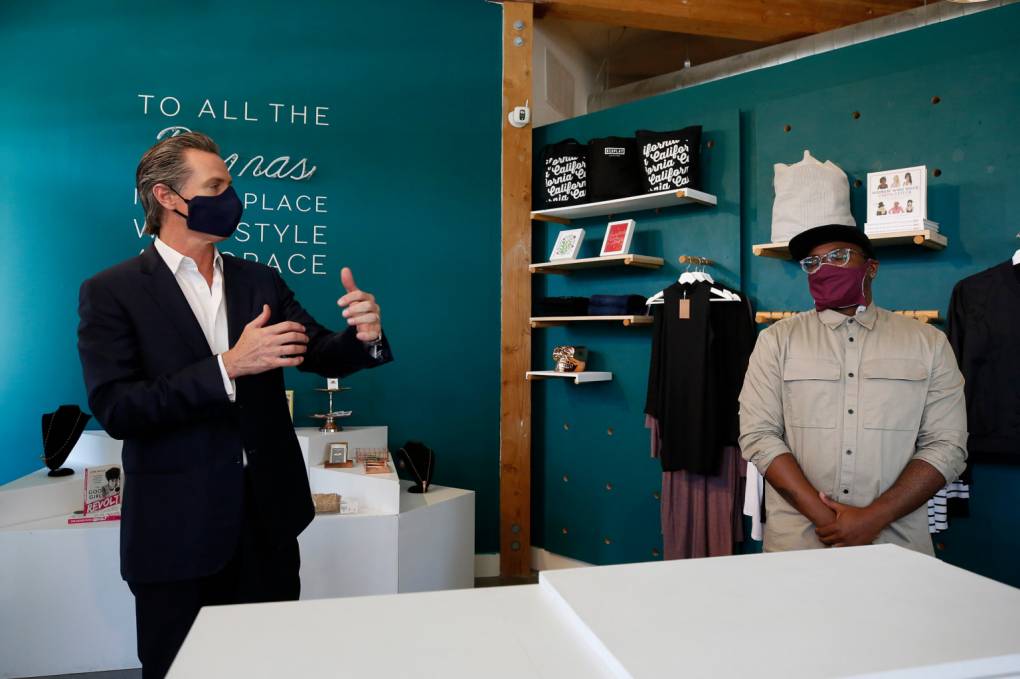
"caption": "Gov. Gavin Newsom, left, talks with Roshaun Davis, owner of Display California, about the locally made items he sells at his store in Sacramento. ",
"description": "Gov. Gavin Newsom, left, talks with Roshaun Davis, owner of Display California, about the locally made items he sells at his store in Sacramento. ",
"title": "Virus Outbreak California",
"credit": "Rich Pedroncelli, Pool/AP Photo",
"status": "inherit",
"isLoading": false,
"fetchFailed": false
},
"news_11816863": {
"type": "attachments",
"id": "news_11816863",
"meta": {
"index": "attachments_1716263798",
"site": "news",
"id": "11816863",
"found": true
},
"parent": 11816775,
"imgSizes": {
"apple_news_ca_square_4_0": {
"file": "https://ww2.kqed.org/app/uploads/sites/10/2020/05/747b1340-gettyimages-56531571-e1548006348391-1020x680-470x470.jpg",
"width": 470,
"mimeType": "image/jpeg",
"height": 470
},
"twentyfourteen-full-width": {
"file": "https://ww2.kqed.org/app/uploads/sites/10/2020/05/747b1340-gettyimages-56531571-e1548006348391-1020x680-1020x576.jpg",
"width": 1020,
"mimeType": "image/jpeg",
"height": 576
},
"thumbnail": {
"file": "https://ww2.kqed.org/app/uploads/sites/10/2020/05/747b1340-gettyimages-56531571-e1548006348391-1020x680-160x107.jpg",
"width": 160,
"mimeType": "image/jpeg",
"height": 107
},
"post-thumbnail": {
"file": "https://ww2.kqed.org/app/uploads/sites/10/2020/05/747b1340-gettyimages-56531571-e1548006348391-1020x680-672x372.jpg",
"width": 672,
"mimeType": "image/jpeg",
"height": 372
},
"kqedFullSize": {
"file": "https://ww2.kqed.org/app/uploads/sites/10/2020/05/747b1340-gettyimages-56531571-e1548006348391-1020x680.jpg",
"width": 1020,
"height": 680
},
"apple_news_ca_landscape_4_7": {
"file": "https://ww2.kqed.org/app/uploads/sites/10/2020/05/747b1340-gettyimages-56531571-e1548006348391-1020x680-632x474.jpg",
"width": 632,
"mimeType": "image/jpeg",
"height": 474
},
"large": {
"file": "https://ww2.kqed.org/app/uploads/sites/10/2020/05/747b1340-gettyimages-56531571-e1548006348391-1020x680-1020x680.jpg",
"width": 1020,
"mimeType": "image/jpeg",
"height": 680
},
"apple_news_ca_landscape_4_0": {
"file": "https://ww2.kqed.org/app/uploads/sites/10/2020/05/747b1340-gettyimages-56531571-e1548006348391-1020x680-536x402.jpg",
"width": 536,
"mimeType": "image/jpeg",
"height": 402
},
"medium": {
"file": "https://ww2.kqed.org/app/uploads/sites/10/2020/05/747b1340-gettyimages-56531571-e1548006348391-1020x680-800x533.jpg",
"width": 800,
"mimeType": "image/jpeg",
"height": 533
},
"apple_news_ca_portrait_4_0": {
"file": "https://ww2.kqed.org/app/uploads/sites/10/2020/05/747b1340-gettyimages-56531571-e1548006348391-1020x680-354x472.jpg",
"width": 354,
"mimeType": "image/jpeg",
"height": 472
},
"apple_news_ca_portrait_9_7": {
"file": "https://ww2.kqed.org/app/uploads/sites/10/2020/05/747b1340-gettyimages-56531571-e1548006348391-1020x680-840x680.jpg",
"width": 840,
"mimeType": "image/jpeg",
"height": 680
},
"apple_news_ca_portrait_4_7": {
"file": "https://ww2.kqed.org/app/uploads/sites/10/2020/05/747b1340-gettyimages-56531571-e1548006348391-1020x680-414x552.jpg",
"width": 414,
"mimeType": "image/jpeg",
"height": 552
},
"apple_news_ca_portrait_5_5": {
"file": "https://ww2.kqed.org/app/uploads/sites/10/2020/05/747b1340-gettyimages-56531571-e1548006348391-1020x680-687x680.jpg",
"width": 687,
"mimeType": "image/jpeg",
"height": 680
},
"apple_news_ca_square_4_7": {
"file": "https://ww2.kqed.org/app/uploads/sites/10/2020/05/747b1340-gettyimages-56531571-e1548006348391-1020x680-550x550.jpg",
"width": 550,
"mimeType": "image/jpeg",
"height": 550
},
"apple_news_ca_square_5_5": {
"file": "https://ww2.kqed.org/app/uploads/sites/10/2020/05/747b1340-gettyimages-56531571-e1548006348391-1020x680-912x680.jpg",
"width": 912,
"mimeType": "image/jpeg",
"height": 680
}
},
"publishDate": 1588876948,
"modified": 1588877000,
"caption": "The state Department of Finance released a grim fiscal forecast Thursday morning.",
"description": null,
"title": "Gov. Schwarzenegger Delivers State Of The State Address",
"credit": "David Paul Morris/Getty Images",
"status": "inherit",
"isLoading": false,
"fetchFailed": false
},
"news_11816762": {
"type": "attachments",
"id": "news_11816762",
"meta": {
"index": "attachments_1716263798",
"site": "news",
"id": "11816762",
"found": true
},
"parent": 11816571,
"imgSizes": {
"apple_news_ca_landscape_5_5": {
"file": "https://ww2.kqed.org/app/uploads/sites/10/2020/05/Student-voices-composite-1044x783.jpg",
"width": 1044,
"mimeType": "image/jpeg",
"height": 783
},
"apple_news_ca_square_4_0": {
"file": "https://ww2.kqed.org/app/uploads/sites/10/2020/05/Student-voices-composite-470x470.jpg",
"width": 470,
"mimeType": "image/jpeg",
"height": 470
},
"twentyfourteen-full-width": {
"file": "https://ww2.kqed.org/app/uploads/sites/10/2020/05/Student-voices-composite-1038x576.jpg",
"width": 1038,
"mimeType": "image/jpeg",
"height": 576
},
"thumbnail": {
"file": "https://ww2.kqed.org/app/uploads/sites/10/2020/05/Student-voices-composite-160x90.jpg",
"width": 160,
"mimeType": "image/jpeg",
"height": 90
},
"post-thumbnail": {
"file": "https://ww2.kqed.org/app/uploads/sites/10/2020/05/Student-voices-composite-672x372.jpg",
"width": 672,
"mimeType": "image/jpeg",
"height": 372
},
"kqedFullSize": {
"file": "https://ww2.kqed.org/app/uploads/sites/10/2020/05/Student-voices-composite.jpg",
"width": 1920,
"height": 1080
},
"apple_news_ca_landscape_4_7": {
"file": "https://ww2.kqed.org/app/uploads/sites/10/2020/05/Student-voices-composite-632x474.jpg",
"width": 632,
"mimeType": "image/jpeg",
"height": 474
},
"large": {
"file": "https://ww2.kqed.org/app/uploads/sites/10/2020/05/Student-voices-composite-1020x574.jpg",
"width": 1020,
"mimeType": "image/jpeg",
"height": 574
},
"apple_news_ca_landscape_4_0": {
"file": "https://ww2.kqed.org/app/uploads/sites/10/2020/05/Student-voices-composite-536x402.jpg",
"width": 536,
"mimeType": "image/jpeg",
"height": 402
},
"apple_news_ca_portrait_12_9": {
"file": "https://ww2.kqed.org/app/uploads/sites/10/2020/05/Student-voices-composite-1122x1080.jpg",
"width": 1122,
"mimeType": "image/jpeg",
"height": 1080
},
"medium": {
"file": "https://ww2.kqed.org/app/uploads/sites/10/2020/05/Student-voices-composite-800x450.jpg",
"width": 800,
"mimeType": "image/jpeg",
"height": 450
},
"apple_news_ca_portrait_4_0": {
"file": "https://ww2.kqed.org/app/uploads/sites/10/2020/05/Student-voices-composite-354x472.jpg",
"width": 354,
"mimeType": "image/jpeg",
"height": 472
},
"apple_news_ca_portrait_9_7": {
"file": "https://ww2.kqed.org/app/uploads/sites/10/2020/05/Student-voices-composite-840x1080.jpg",
"width": 840,
"mimeType": "image/jpeg",
"height": 1080
},
"apple_news_ca_landscape_12_9": {
"file": "https://ww2.kqed.org/app/uploads/sites/10/2020/05/Student-voices-composite-1832x1080.jpg",
"width": 1832,
"mimeType": "image/jpeg",
"height": 1080
},
"apple_news_ca_square_9_7": {
"file": "https://ww2.kqed.org/app/uploads/sites/10/2020/05/Student-voices-composite-1104x1080.jpg",
"width": 1104,
"mimeType": "image/jpeg",
"height": 1080
},
"apple_news_ca_portrait_4_7": {
"file": "https://ww2.kqed.org/app/uploads/sites/10/2020/05/Student-voices-composite-414x552.jpg",
"width": 414,
"mimeType": "image/jpeg",
"height": 552
},
"apple_news_ca_square_12_9": {
"file": "https://ww2.kqed.org/app/uploads/sites/10/2020/05/Student-voices-composite-1472x1080.jpg",
"width": 1472,
"mimeType": "image/jpeg",
"height": 1080
},
"apple_news_ca_portrait_5_5": {
"file": "https://ww2.kqed.org/app/uploads/sites/10/2020/05/Student-voices-composite-687x916.jpg",
"width": 687,
"mimeType": "image/jpeg",
"height": 916
},
"full-width": {
"file": "https://ww2.kqed.org/app/uploads/sites/10/2020/05/Student-voices-composite-1920x1080.jpg",
"width": 1920,
"mimeType": "image/jpeg",
"height": 1080
},
"apple_news_ca_square_4_7": {
"file": "https://ww2.kqed.org/app/uploads/sites/10/2020/05/Student-voices-composite-550x550.jpg",
"width": 550,
"mimeType": "image/jpeg",
"height": 550
},
"apple_news_ca_landscape_9_7": {
"file": "https://ww2.kqed.org/app/uploads/sites/10/2020/05/Student-voices-composite-1376x1032.jpg",
"width": 1376,
"mimeType": "image/jpeg",
"height": 1032
},
"apple_news_ca_square_5_5": {
"file": "https://ww2.kqed.org/app/uploads/sites/10/2020/05/Student-voices-composite-912x912.jpg",
"width": 912,
"mimeType": "image/jpeg",
"height": 912
}
},
"publishDate": 1588828942,
"modified": 1588829134,
"caption": "Left to right: Taila Lee, Qadir Scott, Genevieve Schweitzer, Julisa Gomez Reyes.",
"description": "Left to right: Taila Lee, Qadir Scott, Genevieve Schweitzer, Julisa Gomez Reyes.",
"title": "Student-voices-composite",
"credit": "Beth LaBerge/KQED ",
"status": "inherit",
"isLoading": false,
"fetchFailed": false
},
"news_11816743": {
"type": "attachments",
"id": "news_11816743",
"meta": {
"index": "attachments_1716263798",
"site": "news",
"id": "11816743",
"found": true
},
"parent": 11816707,
"imgSizes": {
"apple_news_ca_square_4_0": {
"file": "https://ww2.kqed.org/app/uploads/sites/10/2020/05/GettyImages-1222258790-1-470x470.jpg",
"width": 470,
"mimeType": "image/jpeg",
"height": 470
},
"twentyfourteen-full-width": {
"file": "https://ww2.kqed.org/app/uploads/sites/10/2020/05/GettyImages-1222258790-1-1024x576.jpg",
"width": 1024,
"mimeType": "image/jpeg",
"height": 576
},
"thumbnail": {
"file": "https://ww2.kqed.org/app/uploads/sites/10/2020/05/GettyImages-1222258790-1-160x107.jpg",
"width": 160,
"mimeType": "image/jpeg",
"height": 107
},
"post-thumbnail": {
"file": "https://ww2.kqed.org/app/uploads/sites/10/2020/05/GettyImages-1222258790-1-672x372.jpg",
"width": 672,
"mimeType": "image/jpeg",
"height": 372
},
"kqedFullSize": {
"file": "https://ww2.kqed.org/app/uploads/sites/10/2020/05/GettyImages-1222258790-1.jpg",
"width": 1024,
"height": 683
},
"apple_news_ca_landscape_4_7": {
"file": "https://ww2.kqed.org/app/uploads/sites/10/2020/05/GettyImages-1222258790-1-632x474.jpg",
"width": 632,
"mimeType": "image/jpeg",
"height": 474
},
"large": {
"file": "https://ww2.kqed.org/app/uploads/sites/10/2020/05/GettyImages-1222258790-1-1020x680.jpg",
"width": 1020,
"mimeType": "image/jpeg",
"height": 680
},
"apple_news_ca_landscape_4_0": {
"file": "https://ww2.kqed.org/app/uploads/sites/10/2020/05/GettyImages-1222258790-1-536x402.jpg",
"width": 536,
"mimeType": "image/jpeg",
"height": 402
},
"medium": {
"file": "https://ww2.kqed.org/app/uploads/sites/10/2020/05/GettyImages-1222258790-1-800x534.jpg",
"width": 800,
"mimeType": "image/jpeg",
"height": 534
},
"apple_news_ca_portrait_4_0": {
"file": "https://ww2.kqed.org/app/uploads/sites/10/2020/05/GettyImages-1222258790-1-354x472.jpg",
"width": 354,
"mimeType": "image/jpeg",
"height": 472
},
"apple_news_ca_portrait_9_7": {
"file": "https://ww2.kqed.org/app/uploads/sites/10/2020/05/GettyImages-1222258790-1-840x683.jpg",
"width": 840,
"mimeType": "image/jpeg",
"height": 683
},
"apple_news_ca_portrait_4_7": {
"file": "https://ww2.kqed.org/app/uploads/sites/10/2020/05/GettyImages-1222258790-1-414x552.jpg",
"width": 414,
"mimeType": "image/jpeg",
"height": 552
},
"apple_news_ca_portrait_5_5": {
"file": "https://ww2.kqed.org/app/uploads/sites/10/2020/05/GettyImages-1222258790-1-687x683.jpg",
"width": 687,
"mimeType": "image/jpeg",
"height": 683
},
"apple_news_ca_square_4_7": {
"file": "https://ww2.kqed.org/app/uploads/sites/10/2020/05/GettyImages-1222258790-1-550x550.jpg",
"width": 550,
"mimeType": "image/jpeg",
"height": 550
},
"apple_news_ca_square_5_5": {
"file": "https://ww2.kqed.org/app/uploads/sites/10/2020/05/GettyImages-1222258790-1-912x683.jpg",
"width": 912,
"mimeType": "image/jpeg",
"height": 683
}
},
"publishDate": 1588821293,
"modified": 1588821683,
"caption": "Across the country, advocates and protesters have demanded ICE to release people from detention facilities to ensure that immigrants and detention center personnel receive prompt testing and treatment for coronavirus. ",
"description": null,
"title": "GettyImages-1222258790-1",
"credit": "Joe Raedle/Getty Images",
"status": "inherit",
"isLoading": false,
"fetchFailed": false
},
"news_11816695": {
"type": "attachments",
"id": "news_11816695",
"meta": {
"index": "attachments_1716263798",
"site": "news",
"id": "11816695",
"found": true
},
"parent": 11816648,
"imgSizes": {
"apple_news_ca_landscape_5_5": {
"file": "https://ww2.kqed.org/app/uploads/sites/10/2020/05/BayView-Tents-1044x783.jpg",
"width": 1044,
"mimeType": "image/jpeg",
"height": 783
},
"apple_news_ca_square_4_0": {
"file": "https://ww2.kqed.org/app/uploads/sites/10/2020/05/BayView-Tents-470x470.jpg",
"width": 470,
"mimeType": "image/jpeg",
"height": 470
},
"twentyfourteen-full-width": {
"file": "https://ww2.kqed.org/app/uploads/sites/10/2020/05/BayView-Tents-1038x576.jpg",
"width": 1038,
"mimeType": "image/jpeg",
"height": 576
},
"thumbnail": {
"file": "https://ww2.kqed.org/app/uploads/sites/10/2020/05/BayView-Tents-160x98.jpg",
"width": 160,
"mimeType": "image/jpeg",
"height": 98
},
"post-thumbnail": {
"file": "https://ww2.kqed.org/app/uploads/sites/10/2020/05/BayView-Tents-672x372.jpg",
"width": 672,
"mimeType": "image/jpeg",
"height": 372
},
"kqedFullSize": {
"file": "https://ww2.kqed.org/app/uploads/sites/10/2020/05/BayView-Tents.jpg",
"width": 1920,
"height": 1170
},
"apple_news_ca_landscape_4_7": {
"file": "https://ww2.kqed.org/app/uploads/sites/10/2020/05/BayView-Tents-632x474.jpg",
"width": 632,
"mimeType": "image/jpeg",
"height": 474
},
"large": {
"file": "https://ww2.kqed.org/app/uploads/sites/10/2020/05/BayView-Tents-1020x622.jpg",
"width": 1020,
"mimeType": "image/jpeg",
"height": 622
},
"apple_news_ca_landscape_4_0": {
"file": "https://ww2.kqed.org/app/uploads/sites/10/2020/05/BayView-Tents-536x402.jpg",
"width": 536,
"mimeType": "image/jpeg",
"height": 402
},
"apple_news_ca_portrait_12_9": {
"file": "https://ww2.kqed.org/app/uploads/sites/10/2020/05/BayView-Tents-1122x1170.jpg",
"width": 1122,
"mimeType": "image/jpeg",
"height": 1170
},
"medium": {
"file": "https://ww2.kqed.org/app/uploads/sites/10/2020/05/BayView-Tents-800x488.jpg",
"width": 800,
"mimeType": "image/jpeg",
"height": 488
},
"apple_news_ca_portrait_4_0": {
"file": "https://ww2.kqed.org/app/uploads/sites/10/2020/05/BayView-Tents-354x472.jpg",
"width": 354,
"mimeType": "image/jpeg",
"height": 472
},
"apple_news_ca_portrait_9_7": {
"file": "https://ww2.kqed.org/app/uploads/sites/10/2020/05/BayView-Tents-840x1120.jpg",
"width": 840,
"mimeType": "image/jpeg",
"height": 1120
},
"apple_news_ca_landscape_12_9": {
"file": "https://ww2.kqed.org/app/uploads/sites/10/2020/05/BayView-Tents-1832x1170.jpg",
"width": 1832,
"mimeType": "image/jpeg",
"height": 1170
},
"apple_news_ca_square_9_7": {
"file": "https://ww2.kqed.org/app/uploads/sites/10/2020/05/BayView-Tents-1104x1104.jpg",
"width": 1104,
"mimeType": "image/jpeg",
"height": 1104
},
"apple_news_ca_portrait_4_7": {
"file": "https://ww2.kqed.org/app/uploads/sites/10/2020/05/BayView-Tents-414x552.jpg",
"width": 414,
"mimeType": "image/jpeg",
"height": 552
},
"apple_news_ca_square_12_9": {
"file": "https://ww2.kqed.org/app/uploads/sites/10/2020/05/BayView-Tents-1472x1170.jpg",
"width": 1472,
"mimeType": "image/jpeg",
"height": 1170
},
"apple_news_ca_portrait_5_5": {
"file": "https://ww2.kqed.org/app/uploads/sites/10/2020/05/BayView-Tents-687x916.jpg",
"width": 687,
"mimeType": "image/jpeg",
"height": 916
},
"full-width": {
"file": "https://ww2.kqed.org/app/uploads/sites/10/2020/05/BayView-Tents-1920x1170.jpg",
"width": 1920,
"mimeType": "image/jpeg",
"height": 1170
},
"apple_news_ca_square_4_7": {
"file": "https://ww2.kqed.org/app/uploads/sites/10/2020/05/BayView-Tents-550x550.jpg",
"width": 550,
"mimeType": "image/jpeg",
"height": 550
},
"apple_news_ca_landscape_9_7": {
"file": "https://ww2.kqed.org/app/uploads/sites/10/2020/05/BayView-Tents-1376x1032.jpg",
"width": 1376,
"mimeType": "image/jpeg",
"height": 1032
},
"apple_news_ca_square_5_5": {
"file": "https://ww2.kqed.org/app/uploads/sites/10/2020/05/BayView-Tents-912x912.jpg",
"width": 912,
"mimeType": "image/jpeg",
"height": 912
}
},
"publishDate": 1588812569,
"modified": 1588812609,
"caption": "Tents are spaced for social distancing at Bay View Park K.C. Jones Playground on May 5, 2020.",
"description": "Tents are spaced for social distancing at Bay View Park K.C. Jones Playground on May 5, 2020.",
"title": "BayView-Tents",
"credit": "Beth LaBerge/KQED",
"status": "inherit",
"isLoading": false,
"fetchFailed": false
},
"news_11816654": {
"type": "attachments",
"id": "news_11816654",
"meta": {
"index": "attachments_1716263798",
"site": "news",
"id": "11816654",
"found": true
},
"parent": 11816591,
"imgSizes": {
"apple_news_ca_landscape_5_5": {
"file": "https://ww2.kqed.org/app/uploads/sites/10/2020/05/RS42897_007_KQED_SanFrancisco_Mission_04232020-qut-1044x783.jpg",
"width": 1044,
"mimeType": "image/jpeg",
"height": 783
},
"apple_news_ca_square_4_0": {
"file": "https://ww2.kqed.org/app/uploads/sites/10/2020/05/RS42897_007_KQED_SanFrancisco_Mission_04232020-qut-470x470.jpg",
"width": 470,
"mimeType": "image/jpeg",
"height": 470
},
"twentyfourteen-full-width": {
"file": "https://ww2.kqed.org/app/uploads/sites/10/2020/05/RS42897_007_KQED_SanFrancisco_Mission_04232020-qut-1038x576.jpg",
"width": 1038,
"mimeType": "image/jpeg",
"height": 576
},
"thumbnail": {
"file": "https://ww2.kqed.org/app/uploads/sites/10/2020/05/RS42897_007_KQED_SanFrancisco_Mission_04232020-qut-160x107.jpg",
"width": 160,
"mimeType": "image/jpeg",
"height": 107
},
"post-thumbnail": {
"file": "https://ww2.kqed.org/app/uploads/sites/10/2020/05/RS42897_007_KQED_SanFrancisco_Mission_04232020-qut-672x372.jpg",
"width": 672,
"mimeType": "image/jpeg",
"height": 372
},
"kqedFullSize": {
"file": "https://ww2.kqed.org/app/uploads/sites/10/2020/05/RS42897_007_KQED_SanFrancisco_Mission_04232020-qut.jpg",
"width": 1920,
"height": 1280
},
"apple_news_ca_landscape_4_7": {
"file": "https://ww2.kqed.org/app/uploads/sites/10/2020/05/RS42897_007_KQED_SanFrancisco_Mission_04232020-qut-632x474.jpg",
"width": 632,
"mimeType": "image/jpeg",
"height": 474
},
"large": {
"file": "https://ww2.kqed.org/app/uploads/sites/10/2020/05/RS42897_007_KQED_SanFrancisco_Mission_04232020-qut-1020x680.jpg",
"width": 1020,
"mimeType": "image/jpeg",
"height": 680
},
"apple_news_ca_landscape_4_0": {
"file": "https://ww2.kqed.org/app/uploads/sites/10/2020/05/RS42897_007_KQED_SanFrancisco_Mission_04232020-qut-536x402.jpg",
"width": 536,
"mimeType": "image/jpeg",
"height": 402
},
"apple_news_ca_portrait_12_9": {
"file": "https://ww2.kqed.org/app/uploads/sites/10/2020/05/RS42897_007_KQED_SanFrancisco_Mission_04232020-qut-1122x1280.jpg",
"width": 1122,
"mimeType": "image/jpeg",
"height": 1280
},
"medium": {
"file": "https://ww2.kqed.org/app/uploads/sites/10/2020/05/RS42897_007_KQED_SanFrancisco_Mission_04232020-qut-800x533.jpg",
"width": 800,
"mimeType": "image/jpeg",
"height": 533
},
"apple_news_ca_portrait_4_0": {
"file": "https://ww2.kqed.org/app/uploads/sites/10/2020/05/RS42897_007_KQED_SanFrancisco_Mission_04232020-qut-354x472.jpg",
"width": 354,
"mimeType": "image/jpeg",
"height": 472
},
"apple_news_ca_portrait_9_7": {
"file": "https://ww2.kqed.org/app/uploads/sites/10/2020/05/RS42897_007_KQED_SanFrancisco_Mission_04232020-qut-840x1120.jpg",
"width": 840,
"mimeType": "image/jpeg",
"height": 1120
},
"apple_news_ca_landscape_12_9": {
"file": "https://ww2.kqed.org/app/uploads/sites/10/2020/05/RS42897_007_KQED_SanFrancisco_Mission_04232020-qut-1832x1280.jpg",
"width": 1832,
"mimeType": "image/jpeg",
"height": 1280
},
"apple_news_ca_square_9_7": {
"file": "https://ww2.kqed.org/app/uploads/sites/10/2020/05/RS42897_007_KQED_SanFrancisco_Mission_04232020-qut-1104x1104.jpg",
"width": 1104,
"mimeType": "image/jpeg",
"height": 1104
},
"apple_news_ca_portrait_4_7": {
"file": "https://ww2.kqed.org/app/uploads/sites/10/2020/05/RS42897_007_KQED_SanFrancisco_Mission_04232020-qut-414x552.jpg",
"width": 414,
"mimeType": "image/jpeg",
"height": 552
},
"apple_news_ca_square_12_9": {
"file": "https://ww2.kqed.org/app/uploads/sites/10/2020/05/RS42897_007_KQED_SanFrancisco_Mission_04232020-qut-1472x1280.jpg",
"width": 1472,
"mimeType": "image/jpeg",
"height": 1280
},
"apple_news_ca_portrait_5_5": {
"file": "https://ww2.kqed.org/app/uploads/sites/10/2020/05/RS42897_007_KQED_SanFrancisco_Mission_04232020-qut-687x916.jpg",
"width": 687,
"mimeType": "image/jpeg",
"height": 916
},
"full-width": {
"file": "https://ww2.kqed.org/app/uploads/sites/10/2020/05/RS42897_007_KQED_SanFrancisco_Mission_04232020-qut-1920x1280.jpg",
"width": 1920,
"mimeType": "image/jpeg",
"height": 1280
},
"apple_news_ca_square_4_7": {
"file": "https://ww2.kqed.org/app/uploads/sites/10/2020/05/RS42897_007_KQED_SanFrancisco_Mission_04232020-qut-550x550.jpg",
"width": 550,
"mimeType": "image/jpeg",
"height": 550
},
"apple_news_ca_landscape_9_7": {
"file": "https://ww2.kqed.org/app/uploads/sites/10/2020/05/RS42897_007_KQED_SanFrancisco_Mission_04232020-qut-1376x1032.jpg",
"width": 1376,
"mimeType": "image/jpeg",
"height": 1032
},
"apple_news_ca_square_5_5": {
"file": "https://ww2.kqed.org/app/uploads/sites/10/2020/05/RS42897_007_KQED_SanFrancisco_Mission_04232020-qut-912x912.jpg",
"width": 912,
"mimeType": "image/jpeg",
"height": 912
}
},
"publishDate": 1588808139,
"modified": 1588811264,
"caption": "A new poll by the UC Berkeley Institute of Governmental Studies found that the COVID-19 pandemic is having a greater impact on the safety and economic well-being of people of color in California.",
"description": "A new poll by UC Berkeley Institute of Governmental Studies found that the COVID-19 pandemic is having a greater impact on the safety and economic well-being of people of color in California.",
"title": "Pedestrians walk in San Francisco's Mission District on April 23, 2020.",
"credit": "Beth LaBerge/KQED",
"status": "inherit",
"isLoading": false,
"fetchFailed": false
},
"news_11816072": {
"type": "attachments",
"id": "news_11816072",
"meta": {
"index": "attachments_1716263798",
"site": "news",
"id": "11816072",
"found": true
},
"parent": 11815458,
"imgSizes": {
"apple_news_ca_landscape_5_5": {
"file": "https://ww2.kqed.org/app/uploads/sites/10/2021/04/RS42986_GettyImages-1210888268-qut-1044x783.jpg",
"width": 1044,
"mimeType": "image/jpeg",
"height": 783
},
"apple_news_ca_square_4_0": {
"file": "https://ww2.kqed.org/app/uploads/sites/10/2021/04/RS42986_GettyImages-1210888268-qut-470x470.jpg",
"width": 470,
"mimeType": "image/jpeg",
"height": 470
},
"twentyfourteen-full-width": {
"file": "https://ww2.kqed.org/app/uploads/sites/10/2021/04/RS42986_GettyImages-1210888268-qut-1038x576.jpg",
"width": 1038,
"mimeType": "image/jpeg",
"height": 576
},
"thumbnail": {
"file": "https://ww2.kqed.org/app/uploads/sites/10/2021/04/RS42986_GettyImages-1210888268-qut-160x107.jpg",
"width": 160,
"mimeType": "image/jpeg",
"height": 107
},
"post-thumbnail": {
"file": "https://ww2.kqed.org/app/uploads/sites/10/2021/04/RS42986_GettyImages-1210888268-qut-672x372.jpg",
"width": 672,
"mimeType": "image/jpeg",
"height": 372
},
"kqedFullSize": {
"file": "https://ww2.kqed.org/app/uploads/sites/10/2021/04/RS42986_GettyImages-1210888268-qut.jpg",
"width": 1920,
"height": 1280
},
"apple_news_ca_landscape_4_7": {
"file": "https://ww2.kqed.org/app/uploads/sites/10/2021/04/RS42986_GettyImages-1210888268-qut-632x474.jpg",
"width": 632,
"mimeType": "image/jpeg",
"height": 474
},
"large": {
"file": "https://ww2.kqed.org/app/uploads/sites/10/2021/04/RS42986_GettyImages-1210888268-qut-1020x680.jpg",
"width": 1020,
"mimeType": "image/jpeg",
"height": 680
},
"apple_news_ca_landscape_4_0": {
"file": "https://ww2.kqed.org/app/uploads/sites/10/2021/04/RS42986_GettyImages-1210888268-qut-536x402.jpg",
"width": 536,
"mimeType": "image/jpeg",
"height": 402
},
"apple_news_ca_portrait_12_9": {
"file": "https://ww2.kqed.org/app/uploads/sites/10/2021/04/RS42986_GettyImages-1210888268-qut-1122x1280.jpg",
"width": 1122,
"mimeType": "image/jpeg",
"height": 1280
},
"medium": {
"file": "https://ww2.kqed.org/app/uploads/sites/10/2021/04/RS42986_GettyImages-1210888268-qut-800x533.jpg",
"width": 800,
"mimeType": "image/jpeg",
"height": 533
},
"apple_news_ca_portrait_4_0": {
"file": "https://ww2.kqed.org/app/uploads/sites/10/2021/04/RS42986_GettyImages-1210888268-qut-354x472.jpg",
"width": 354,
"mimeType": "image/jpeg",
"height": 472
},
"apple_news_ca_portrait_9_7": {
"file": "https://ww2.kqed.org/app/uploads/sites/10/2021/04/RS42986_GettyImages-1210888268-qut-840x1120.jpg",
"width": 840,
"mimeType": "image/jpeg",
"height": 1120
},
"apple_news_ca_landscape_12_9": {
"file": "https://ww2.kqed.org/app/uploads/sites/10/2021/04/RS42986_GettyImages-1210888268-qut-1832x1280.jpg",
"width": 1832,
"mimeType": "image/jpeg",
"height": 1280
},
"apple_news_ca_square_9_7": {
"file": "https://ww2.kqed.org/app/uploads/sites/10/2021/04/RS42986_GettyImages-1210888268-qut-1104x1104.jpg",
"width": 1104,
"mimeType": "image/jpeg",
"height": 1104
},
"apple_news_ca_portrait_4_7": {
"file": "https://ww2.kqed.org/app/uploads/sites/10/2021/04/RS42986_GettyImages-1210888268-qut-414x552.jpg",
"width": 414,
"mimeType": "image/jpeg",
"height": 552
},
"apple_news_ca_square_12_9": {
"file": "https://ww2.kqed.org/app/uploads/sites/10/2021/04/RS42986_GettyImages-1210888268-qut-1472x1280.jpg",
"width": 1472,
"mimeType": "image/jpeg",
"height": 1280
},
"apple_news_ca_portrait_5_5": {
"file": "https://ww2.kqed.org/app/uploads/sites/10/2021/04/RS42986_GettyImages-1210888268-qut-687x916.jpg",
"width": 687,
"mimeType": "image/jpeg",
"height": 916
},
"full-width": {
"file": "https://ww2.kqed.org/app/uploads/sites/10/2021/04/RS42986_GettyImages-1210888268-qut-1920x1280.jpg",
"width": 1920,
"mimeType": "image/jpeg",
"height": 1280
},
"apple_news_ca_square_4_7": {
"file": "https://ww2.kqed.org/app/uploads/sites/10/2021/04/RS42986_GettyImages-1210888268-qut-550x550.jpg",
"width": 550,
"mimeType": "image/jpeg",
"height": 550
},
"apple_news_ca_landscape_9_7": {
"file": "https://ww2.kqed.org/app/uploads/sites/10/2021/04/RS42986_GettyImages-1210888268-qut-1376x1032.jpg",
"width": 1376,
"mimeType": "image/jpeg",
"height": 1032
},
"apple_news_ca_square_5_5": {
"file": "https://ww2.kqed.org/app/uploads/sites/10/2021/04/RS42986_GettyImages-1210888268-qut-912x912.jpg",
"width": 912,
"mimeType": "image/jpeg",
"height": 912
}
},
"publishDate": 1588617308,
"modified": 1588741554,
"caption": "Jails and prisons are particularly vulnerable to coronavirus outbreaks. We've rounded up a list of ways to help people who are currently incarcerated.",
"description": null,
"title": "San Diego County Jail Inmates Disinfect Cells To Prevent COVID-19 Spread",
"credit": "Sandy Huffaker/Getty Images",
"status": "inherit",
"isLoading": false,
"fetchFailed": false
},
"news_11816460": {
"type": "attachments",
"id": "news_11816460",
"meta": {
"index": "attachments_1716263798",
"site": "news",
"id": "11816460",
"found": true
},
"parent": 11815627,
"imgSizes": {
"apple_news_ca_landscape_5_5": {
"file": "https://ww2.kqed.org/app/uploads/sites/10/2020/05/iStock-1173266366-1044x783.jpg",
"width": 1044,
"mimeType": "image/jpeg",
"height": 783
},
"apple_news_ca_square_4_0": {
"file": "https://ww2.kqed.org/app/uploads/sites/10/2020/05/iStock-1173266366-470x470.jpg",
"width": 470,
"mimeType": "image/jpeg",
"height": 470
},
"twentyfourteen-full-width": {
"file": "https://ww2.kqed.org/app/uploads/sites/10/2020/05/iStock-1173266366-1038x576.jpg",
"width": 1038,
"mimeType": "image/jpeg",
"height": 576
},
"thumbnail": {
"file": "https://ww2.kqed.org/app/uploads/sites/10/2020/05/iStock-1173266366-160x107.jpg",
"width": 160,
"mimeType": "image/jpeg",
"height": 107
},
"post-thumbnail": {
"file": "https://ww2.kqed.org/app/uploads/sites/10/2020/05/iStock-1173266366-672x372.jpg",
"width": 672,
"mimeType": "image/jpeg",
"height": 372
},
"kqedFullSize": {
"file": "https://ww2.kqed.org/app/uploads/sites/10/2020/05/iStock-1173266366-e1588738971811.jpg",
"width": 1920,
"height": 1280
},
"apple_news_ca_landscape_4_7": {
"file": "https://ww2.kqed.org/app/uploads/sites/10/2020/05/iStock-1173266366-632x474.jpg",
"width": 632,
"mimeType": "image/jpeg",
"height": 474
},
"large": {
"file": "https://ww2.kqed.org/app/uploads/sites/10/2020/05/iStock-1173266366-1020x680.jpg",
"width": 1020,
"mimeType": "image/jpeg",
"height": 680
},
"apple_news_ca_landscape_4_0": {
"file": "https://ww2.kqed.org/app/uploads/sites/10/2020/05/iStock-1173266366-536x402.jpg",
"width": 536,
"mimeType": "image/jpeg",
"height": 402
},
"apple_news_ca_portrait_12_9": {
"file": "https://ww2.kqed.org/app/uploads/sites/10/2020/05/iStock-1173266366-1122x1414.jpg",
"width": 1122,
"mimeType": "image/jpeg",
"height": 1414
},
"medium": {
"file": "https://ww2.kqed.org/app/uploads/sites/10/2020/05/iStock-1173266366-800x533.jpg",
"width": 800,
"mimeType": "image/jpeg",
"height": 533
},
"apple_news_ca_portrait_4_0": {
"file": "https://ww2.kqed.org/app/uploads/sites/10/2020/05/iStock-1173266366-354x472.jpg",
"width": 354,
"mimeType": "image/jpeg",
"height": 472
},
"apple_news_ca_portrait_9_7": {
"file": "https://ww2.kqed.org/app/uploads/sites/10/2020/05/iStock-1173266366-840x1120.jpg",
"width": 840,
"mimeType": "image/jpeg",
"height": 1120
},
"apple_news_ca_landscape_12_9": {
"file": "https://ww2.kqed.org/app/uploads/sites/10/2020/05/iStock-1173266366-1832x1374.jpg",
"width": 1832,
"mimeType": "image/jpeg",
"height": 1374
},
"apple_news_ca_square_9_7": {
"file": "https://ww2.kqed.org/app/uploads/sites/10/2020/05/iStock-1173266366-1104x1104.jpg",
"width": 1104,
"mimeType": "image/jpeg",
"height": 1104
},
"apple_news_ca_portrait_4_7": {
"file": "https://ww2.kqed.org/app/uploads/sites/10/2020/05/iStock-1173266366-414x552.jpg",
"width": 414,
"mimeType": "image/jpeg",
"height": 552
},
"apple_news_ca_square_12_9": {
"file": "https://ww2.kqed.org/app/uploads/sites/10/2020/05/iStock-1173266366-1472x1414.jpg",
"width": 1472,
"mimeType": "image/jpeg",
"height": 1414
},
"apple_news_ca_portrait_5_5": {
"file": "https://ww2.kqed.org/app/uploads/sites/10/2020/05/iStock-1173266366-687x916.jpg",
"width": 687,
"mimeType": "image/jpeg",
"height": 916
},
"full-width": {
"file": "https://ww2.kqed.org/app/uploads/sites/10/2020/05/iStock-1173266366-1920x1280.jpg",
"width": 1920,
"mimeType": "image/jpeg",
"height": 1280
},
"apple_news_ca_square_4_7": {
"file": "https://ww2.kqed.org/app/uploads/sites/10/2020/05/iStock-1173266366-550x550.jpg",
"width": 550,
"mimeType": "image/jpeg",
"height": 550
},
"apple_news_ca_landscape_9_7": {
"file": "https://ww2.kqed.org/app/uploads/sites/10/2020/05/iStock-1173266366-1376x1032.jpg",
"width": 1376,
"mimeType": "image/jpeg",
"height": 1032
},
"apple_news_ca_square_5_5": {
"file": "https://ww2.kqed.org/app/uploads/sites/10/2020/05/iStock-1173266366-912x912.jpg",
"width": 912,
"mimeType": "image/jpeg",
"height": 912
}
},
"publishDate": 1588738912,
"modified": 1588739132,
"caption": "Calls to child abuse hotlines, which are often made made by school officials, plummeted in April.",
"description": null,
"title": "Back to school",
"credit": "Anna Stills/iStock",
"status": "inherit",
"isLoading": false,
"fetchFailed": false
}
},
"audioPlayerReducer": {
"postId": "stream_live",
"isPaused": true,
"isPlaying": false,
"pfsActive": false,
"pledgeModalIsOpen": true,
"playerDrawerIsOpen": false,
"liveAudioPlayStartedAt": 0,
"liveAudioPlayContext": ""
},
"authorsReducer": {
"byline_news_11816768": {
"type": "authors",
"id": "byline_news_11816768",
"meta": {
"override": true
},
"slug": "byline_news_11816768",
"name": "\u003ca href=\"https://calmatters.org/author/nigelduara/\">Nigel Duara\u003c/a>",
"isLoading": false
},
"gmarzorati": {
"type": "authors",
"id": "227",
"meta": {
"index": "authors_1716337520",
"id": "227",
"found": true
},
"name": "Guy Marzorati",
"firstName": "Guy",
"lastName": "Marzorati",
"slug": "gmarzorati",
"email": "gmarzorati@KQED.org",
"display_author_email": true,
"staff_mastheads": [
"news"
],
"title": "Correspondent",
"bio": "Guy Marzorati is a correspondent on KQED's California Politics and Government Desk, based in San Jose. A graduate of Santa Clara University, Guy joined KQED in 2013. He reports on state and local politics and produces KQED's digital voter guide.",
"avatar": "https://secure.gravatar.com/avatar/e7038b8dbfd55b104369b76b1cd0b9de?s=600&d=blank&r=g",
"twitter": "guymarzorati",
"facebook": null,
"instagram": null,
"linkedin": null,
"sites": [
{
"site": "",
"roles": [
"editor"
]
},
{
"site": "news",
"roles": [
"editor"
]
},
{
"site": "science",
"roles": [
"editor"
]
},
{
"site": "forum",
"roles": [
"editor"
]
},
{
"site": "elections",
"roles": [
"editor"
]
},
{
"site": "liveblog",
"roles": [
"editor"
]
}
],
"headData": {
"title": "Guy Marzorati | KQED",
"description": "Correspondent",
"ogImgSrc": "https://secure.gravatar.com/avatar/e7038b8dbfd55b104369b76b1cd0b9de?s=600&d=blank&r=g",
"twImgSrc": "https://secure.gravatar.com/avatar/e7038b8dbfd55b104369b76b1cd0b9de?s=600&d=blank&r=g"
},
"isLoading": false,
"link": "/author/gmarzorati"
},
"katrinaschwartz": {
"type": "authors",
"id": "234",
"meta": {
"index": "authors_1716337520",
"id": "234",
"found": true
},
"name": "Katrina Schwartz",
"firstName": "Katrina",
"lastName": "Schwartz",
"slug": "katrinaschwartz",
"email": "kschwartz@kqed.org",
"display_author_email": false,
"staff_mastheads": [
"news"
],
"title": "Producer",
"bio": "Katrina Schwartz is a journalist based in San Francisco. She's worked at KPCC public radio in LA and has reported on air and online for KQED since 2010. She covered how teaching and learning is changing for MindShift between 2012 and 2020. She is the co-host of the MindShift podcast and now produces KQED's Bay Curious podcast.",
"avatar": "https://secure.gravatar.com/avatar/edb4ee79070447a018538c9aae6eeecf28786515b8a0c30e43b6b7dce5aa44c8?s=600&d=blank&r=g",
"twitter": "kschwart",
"bluesky": null,
"facebook": null,
"instagram": null,
"linkedin": null,
"sites": [
{
"site": "",
"roles": [
"editor"
]
},
{
"site": "news",
"roles": [
"editor"
]
},
{
"site": "mindshift",
"roles": [
"administrator"
]
},
{
"site": "stateofhealth",
"roles": [
"author"
]
},
{
"site": "science",
"roles": [
"editor"
]
}
],
"headData": {
"title": "Katrina Schwartz | KQED",
"description": "Producer",
"ogImgSrc": "https://secure.gravatar.com/avatar/edb4ee79070447a018538c9aae6eeecf28786515b8a0c30e43b6b7dce5aa44c8?s=600&d=blank&r=g",
"twImgSrc": "https://secure.gravatar.com/avatar/edb4ee79070447a018538c9aae6eeecf28786515b8a0c30e43b6b7dce5aa44c8?s=600&d=blank&r=g"
},
"isLoading": false,
"link": "/author/katrinaschwartz"
},
"rachael-myrow": {
"type": "authors",
"id": "251",
"meta": {
"index": "authors_1716337520",
"id": "251",
"found": true
},
"name": "Rachael Myrow",
"firstName": "Rachael",
"lastName": "Myrow",
"slug": "rachael-myrow",
"email": "rmyrow@kqed.org",
"display_author_email": true,
"staff_mastheads": [
"news"
],
"title": "Senior Editor of KQED's Silicon Valley News Desk",
"bio": "• I write and edit stories about how Silicon Valley power and policies shape everyday life in California. I’m also passionate about making Bay Area history and culture more accessible to a broad public. • I’ve been a journalist for most of my life, starting in high school with The Franklin Press in Los Angeles, where I grew up. While earning my first degree in English at UC Berkeley, I got my start in public radio at KALX-FM. After completing a second degree in journalism at Cal, I landed my first professional job at Marketplace, then moved on to KPCC (now LAist), and then KQED, where I hosted The California Report for more than seven years. • My reporting has appeared on NPR, The World, WBUR’s \u003ci>Here & Now\u003c/i>, and the BBC. I also guest host for KQED’s \u003ci>Forum\u003c/i>, as well as the Commonwealth Club in San Francisco. • I speak periodically on media, democracy and technology issues, and do voiceover work for documentaries and educational video projects. • Outside of the studio, you'll find me hiking Bay Area trails and whipping up Insta-ready meals in my kitchen. • I do not accept gifts, money, or favors from anyone connected to my reporting, I don't pay people for information, and I do not support or donate to political causes. • I strive to treat the people I report on with fairness, honesty, and respect. I also recognize there are often multiple sides to a story and work to verify information through multiple sources and documentation. If I get something wrong, I correct it.",
"avatar": "https://secure.gravatar.com/avatar/3ed8a3c5f26025e4a805ba634cda8cd764906b97438a6d9ce216b044e340da4e?s=600&d=blank&r=g",
"twitter": "rachaelmyrow",
"bluesky": null,
"facebook": null,
"instagram": null,
"linkedin": "https://www.linkedin.com/in/rachaelmyrow/",
"sites": [
{
"site": "arts",
"roles": [
"administrator"
]
},
{
"site": "news",
"roles": [
"edit_others_posts",
"editor"
]
},
{
"site": "futureofyou",
"roles": [
"editor"
]
},
{
"site": "bayareabites",
"roles": [
"editor"
]
},
{
"site": "stateofhealth",
"roles": [
"editor"
]
},
{
"site": "science",
"roles": [
"editor"
]
},
{
"site": "food",
"roles": [
"editor"
]
},
{
"site": "forum",
"roles": [
"editor"
]
},
{
"site": "liveblog",
"roles": [
"author"
]
}
],
"headData": {
"title": "Rachael Myrow | KQED",
"description": "Senior Editor of KQED's Silicon Valley News Desk",
"ogImgSrc": "https://secure.gravatar.com/avatar/3ed8a3c5f26025e4a805ba634cda8cd764906b97438a6d9ce216b044e340da4e?s=600&d=blank&r=g",
"twImgSrc": "https://secure.gravatar.com/avatar/3ed8a3c5f26025e4a805ba634cda8cd764906b97438a6d9ce216b044e340da4e?s=600&d=blank&r=g"
},
"isLoading": false,
"link": "/author/rachael-myrow"
},
"scottshafer": {
"type": "authors",
"id": "255",
"meta": {
"index": "authors_1716337520",
"id": "255",
"found": true
},
"name": "Scott Shafer",
"firstName": "Scott",
"lastName": "Shafer",
"slug": "scottshafer",
"email": "sshafer@kqed.org",
"display_author_email": false,
"staff_mastheads": [
"news"
],
"title": "KQED Contributor",
"bio": "Scott Shafer is a senior editor with the KQED Politics and Government desk. He is co-host of Political Breakdown, the award-winning radio show and podcast with a personal take on the world of politics. Scott came to KQED in 1998 to host the statewide\u003cem> California Report\u003c/em>. Prior to that he had extended stints in politics and government\u003cem>.\u003c/em> He uses that inside experience at KQED in his, reporting, hosting and analysis for the politics desk. Scott collaborated \u003cem>Political Breakdown a\u003c/em>nd on \u003cem>The Political Mind of Jerry Brown, \u003c/em>an eight-part series about the life and extraordinary political career of the former governor. For fun, he plays water polo with the San Francisco Tsunami.",
"avatar": "https://secure.gravatar.com/avatar/a62ebae45b79d7aed1a39a0e3bf68104?s=600&d=blank&r=g",
"twitter": "scottshafer",
"bluesky": null,
"facebook": null,
"instagram": null,
"linkedin": null,
"sites": [
{
"site": "news",
"roles": [
"editor"
]
},
{
"site": "stateofhealth",
"roles": [
"author"
]
},
{
"site": "science",
"roles": [
"author"
]
},
{
"site": "forum",
"roles": [
"subscriber"
]
},
{
"site": "liveblog",
"roles": [
"author"
]
}
],
"headData": {
"title": "Scott Shafer | KQED",
"description": "KQED Contributor",
"ogImgSrc": "https://secure.gravatar.com/avatar/a62ebae45b79d7aed1a39a0e3bf68104?s=600&d=blank&r=g",
"twImgSrc": "https://secure.gravatar.com/avatar/a62ebae45b79d7aed1a39a0e3bf68104?s=600&d=blank&r=g"
},
"isLoading": false,
"link": "/author/scottshafer"
},
"tychehendricks": {
"type": "authors",
"id": "259",
"meta": {
"index": "authors_1716337520",
"id": "259",
"found": true
},
"name": "Tyche Hendricks",
"firstName": "Tyche",
"lastName": "Hendricks",
"slug": "tychehendricks",
"email": "thendricks@kqed.org",
"display_author_email": true,
"staff_mastheads": [
"news"
],
"title": "KQED Senior Editor, Immigration",
"bio": "\u003cspan style=\"font-weight: 400;\">Tyche Hendricks is KQED’s senior editor for immigration, leading coverage of the policy and politics that affect California’s immigrant communities. Her work for KQED’s radio and online audiences is also carried on NPR and other national outlets. She has been recognized with awards from the Radio and Television News Directors Association, the Society for Professional Journalists; the Education Writers Association; the Best of the West and the National Federation of Community Broadcasters. Before joining KQED in 2010, Tyche spent more than a dozen years as a newspaper reporter, notably at the \u003c/span>\u003ci>\u003cspan style=\"font-weight: 400;\">San Francisco Chronicle\u003c/span>\u003c/i>\u003cspan style=\"font-weight: 400;\">. At different times she has covered criminal justice, government and politics and urban planning. Tyche has taught in the MFA Creative Writing program at the University of San Francisco and at UC Berkeley’s Graduate School of Journalism, where she was co-director of a national immigration symposium for professional journalists. She is the author of \u003c/span>\u003ci>\u003cspan style=\"font-weight: 400;\">The Wind Doesn't Need a Passport: Stories from the U.S.-Mexico Borderlands\u003c/span>\u003c/i>\u003cspan style=\"font-weight: 400;\"> (University of California Press). \u003c/span>",
"avatar": "https://secure.gravatar.com/avatar/b8ee458e2731c2d43df86882ce17267e?s=600&d=blank&r=g",
"twitter": "tychehendricks",
"facebook": null,
"instagram": null,
"linkedin": null,
"sites": [
{
"site": "news",
"roles": [
"editor"
]
},
{
"site": "stateofhealth",
"roles": [
"editor"
]
}
],
"headData": {
"title": "Tyche Hendricks | KQED",
"description": "KQED Senior Editor, Immigration",
"ogImgSrc": "https://secure.gravatar.com/avatar/b8ee458e2731c2d43df86882ce17267e?s=600&d=blank&r=g",
"twImgSrc": "https://secure.gravatar.com/avatar/b8ee458e2731c2d43df86882ce17267e?s=600&d=blank&r=g"
},
"isLoading": false,
"link": "/author/tychehendricks"
},
"markfiore": {
"type": "authors",
"id": "3236",
"meta": {
"index": "authors_1716337520",
"id": "3236",
"found": true
},
"name": "Mark Fiore",
"firstName": "Mark",
"lastName": "Fiore",
"slug": "markfiore",
"email": "mark@markfiore.com",
"display_author_email": false,
"staff_mastheads": [
"news"
],
"title": "KQED News Cartoonist",
"bio": "\u003ca href=\"http://www.MarkFiore.com\">MarkFiore.com\u003c/a> | \u003ca href=\"https://twitter.com/markfiore\">Follow on Twitter\u003c/a> | \u003ca href=\"https://www.facebook.com/pages/Mark-Fiore-Animated-Political-Cartoons/94451707396?ref=bookmarks\">Facebook\u003c/a> | \u003ca href=\"mailto:mark@markfiore.com\">email\u003c/a>\r\n\r\nPulitzer Prize-winner, Mark Fiore, who the Wall Street Journal has called “the undisputed guru of the form,” creates animated political cartoons in San Francisco, where his work has been featured regularly on the San Francisco Chronicle’s web site, SFGate.com. His work has appeared on Newsweek.com, Slate.com, CBSNews.com, MotherJones.com, DailyKos.com and NPR’s web site. Fiore’s political animation has appeared on CNN, Frontline, Bill Moyers Journal, Salon.com and cable and broadcast outlets across the globe.\r\n\r\nBeginning his professional life by drawing traditional political cartoons for newspapers, Fiore’s work appeared in publications ranging from the Washington Post to the Los Angeles Times. In the late 1990s, he began to experiment with animating political cartoons and, after a short stint at the San Jose Mercury News as their staff cartoonist, Fiore devoted all his energies to animation.\r\nGrowing up in California, Fiore also spent a good portion of his life in the backwoods of Idaho. It was this combination that shaped him politically. Mark majored in political science at Colorado College, where, in a perfect send-off for a cartoonist, he received his diploma in 1991 as commencement speaker Dick Cheney smiled approvingly.\r\nMark Fiore was awarded the Pulitzer Prize for political cartooning in 2010, a Robert F. Kennedy Journalism Award in 2004 and has twice received an Online Journalism Award for commentary from the Online News Association (2002, 2008). Fiore has received two awards for his work in new media from the National Cartoonists Society (2001, 2002), and in 2006 received The James Madison Freedom of Information Award from The Society of Professional Journalists.",
"avatar": "https://secure.gravatar.com/avatar/fc4e2a612b15b67bad0c6f0e1db4ca9b?s=600&d=blank&r=g",
"twitter": "MarkFiore",
"facebook": null,
"instagram": "https://www.instagram.com/markfiore/?hl=en",
"linkedin": null,
"sites": [
{
"site": "arts",
"roles": [
"contributor"
]
},
{
"site": "news",
"roles": [
"editor"
]
},
{
"site": "futureofyou",
"roles": [
"editor"
]
},
{
"site": "science",
"roles": [
"editor"
]
}
],
"headData": {
"title": "Mark Fiore | KQED",
"description": "KQED News Cartoonist",
"ogImgSrc": "https://secure.gravatar.com/avatar/fc4e2a612b15b67bad0c6f0e1db4ca9b?s=600&d=blank&r=g",
"twImgSrc": "https://secure.gravatar.com/avatar/fc4e2a612b15b67bad0c6f0e1db4ca9b?s=600&d=blank&r=g"
},
"isLoading": false,
"link": "/author/markfiore"
},
"agarces": {
"type": "authors",
"id": "11367",
"meta": {
"index": "authors_1716337520",
"id": "11367",
"found": true
},
"name": "Audrey Garces",
"firstName": "Audrey",
"lastName": "Garces",
"slug": "agarces",
"email": "agarces@kqed.org",
"display_author_email": false,
"staff_mastheads": [
"news"
],
"title": "Digital Producer",
"bio": "Audrey is a former digital producer at KQED News. Previously, she was a KQED Raul Ramirez Diversity Fund intern where she developed stories that focused on highlighting diverse voices in journalism. Prior to her work at KQED, she worked as a news intern at the San Francisco Examiner. Audrey graduated from San Francisco State University with a B.A. in journalism and a minor in political science.",
"avatar": "https://secure.gravatar.com/avatar/5211bc2e6a809b9956da169e35ce63d5?s=600&d=blank&r=g",
"twitter": "audgar",
"facebook": null,
"instagram": null,
"linkedin": null,
"sites": [
{
"site": "arts",
"roles": []
},
{
"site": "news",
"roles": [
"subscriber"
]
},
{
"site": "science",
"roles": [
"editor"
]
},
{
"site": "forum",
"roles": [
"editor"
]
},
{
"site": "perspectives",
"roles": [
"administrator"
]
}
],
"headData": {
"title": "Audrey Garces | KQED",
"description": "Digital Producer",
"ogImgSrc": "https://secure.gravatar.com/avatar/5211bc2e6a809b9956da169e35ce63d5?s=600&d=blank&r=g",
"twImgSrc": "https://secure.gravatar.com/avatar/5211bc2e6a809b9956da169e35ce63d5?s=600&d=blank&r=g"
},
"isLoading": false,
"link": "/author/agarces"
},
"mwiley": {
"type": "authors",
"id": "11526",
"meta": {
"index": "authors_1716337520",
"id": "11526",
"found": true
},
"name": "Michelle Wiley",
"firstName": "Michelle",
"lastName": "Wiley",
"slug": "mwiley",
"email": "mwiley@KQED.org",
"display_author_email": true,
"staff_mastheads": [],
"title": null,
"bio": "Michelle Wiley was the senior editor of weekends.",
"avatar": "https://secure.gravatar.com/avatar/3b897d82a09e8587e8e73fa69fbcc635?s=600&d=blank&r=g",
"twitter": "michelleewiley",
"facebook": null,
"instagram": null,
"linkedin": null,
"sites": [
{
"site": "",
"roles": [
"editor"
]
},
{
"site": "arts",
"roles": [
"editor"
]
},
{
"site": "news",
"roles": [
"subscriber"
]
},
{
"site": "lowdown",
"roles": [
"editor"
]
},
{
"site": "science",
"roles": [
"editor"
]
},
{
"site": "podcasts",
"roles": [
"editor"
]
}
],
"headData": {
"title": "Michelle Wiley | KQED",
"description": null,
"ogImgSrc": "https://secure.gravatar.com/avatar/3b897d82a09e8587e8e73fa69fbcc635?s=600&d=blank&r=g",
"twImgSrc": "https://secure.gravatar.com/avatar/3b897d82a09e8587e8e73fa69fbcc635?s=600&d=blank&r=g"
},
"isLoading": false,
"link": "/author/mwiley"
},
"mgonzalessiler": {
"type": "authors",
"id": "11657",
"meta": {
"index": "authors_1716337520",
"id": "11657",
"found": true
},
"name": "Marco Siler-Gonzales",
"firstName": "Marco",
"lastName": "Siler-Gonzales",
"slug": "mgonzalessiler",
"email": "mgonzalessiler@kqed.org",
"display_author_email": false,
"staff_mastheads": [],
"title": "KQED Contributor",
"bio": null,
"avatar": "https://secure.gravatar.com/avatar/e960972bbaa44ee0e051b1f68c97753c?s=600&d=blank&r=g",
"twitter": null,
"facebook": null,
"instagram": null,
"linkedin": null,
"sites": [
{
"site": "news",
"roles": [
"author"
]
}
],
"headData": {
"title": "Marco Siler-Gonzales | KQED",
"description": "KQED Contributor",
"ogImgSrc": "https://secure.gravatar.com/avatar/e960972bbaa44ee0e051b1f68c97753c?s=600&d=blank&r=g",
"twImgSrc": "https://secure.gravatar.com/avatar/e960972bbaa44ee0e051b1f68c97753c?s=600&d=blank&r=g"
},
"isLoading": false,
"link": "/author/mgonzalessiler"
},
"jrodriguez": {
"type": "authors",
"id": "11690",
"meta": {
"index": "authors_1716337520",
"id": "11690",
"found": true
},
"name": "Joe Fitzgerald Rodriguez",
"firstName": "Joe",
"lastName": "Fitzgerald Rodriguez",
"slug": "jrodriguez",
"email": "jrodriguez@kqed.org",
"display_author_email": true,
"staff_mastheads": [
"news"
],
"title": "Reporter and Producer",
"bio": "Joe Fitzgerald Rodriguez is a reporter and digital producer for KQED covering politics. Joe most recently wrote for the \u003cem>San Francisco Examiner\u003c/em> as a political columnist covering The City. He was raised in San Francisco and has spent his reporting career in his beloved, foggy, city by the bay. Joe was 12-years-old when he conducted his first interview in journalism, grilling former San Francisco Mayor Willie Brown for the Marina Middle School newspaper, \u003cem>The Penguin Press, \u003c/em>and he continues to report on the San Francisco Bay Area to this day.",
"avatar": "https://secure.gravatar.com/avatar/2247beb0564c1e9c62228d5649d2edac?s=600&d=blank&r=g",
"twitter": "FitztheReporter",
"facebook": null,
"instagram": "https://www.instagram.com/fitzthereporter/",
"linkedin": null,
"sites": [
{
"site": "",
"roles": [
"editor"
]
},
{
"site": "arts",
"roles": [
"editor"
]
},
{
"site": "news",
"roles": [
"editor"
]
},
{
"site": "science",
"roles": [
"editor"
]
},
{
"site": "elections",
"roles": [
"editor"
]
},
{
"site": "liveblog",
"roles": [
"editor"
]
}
],
"headData": {
"title": "Joe Fitzgerald Rodriguez | KQED",
"description": "Reporter and Producer",
"ogImgSrc": "https://secure.gravatar.com/avatar/2247beb0564c1e9c62228d5649d2edac?s=600&d=blank&r=g",
"twImgSrc": "https://secure.gravatar.com/avatar/2247beb0564c1e9c62228d5649d2edac?s=600&d=blank&r=g"
},
"isLoading": false,
"link": "/author/jrodriguez"
}
},
"pagesReducer": {
"news_tag_covid-19": {
"type": "terms",
"id": "news_27504",
"meta": {
"index": "terms_1716263798",
"site": "news",
"id": "27504",
"score": 8.558313
},
"featImg": null,
"name": "covid-19",
"description": null,
"taxonomy": "tag",
"headData": {
"twImgId": null,
"twTitle": null,
"ogTitle": null,
"ogImgId": null,
"twDescription": null,
"description": null,
"title": "covid-19 Archives | KQED News",
"ogDescription": null
},
"ttid": 27521,
"slug": "covid-19",
"isLoading": false,
"title": "covid-19",
"pageMeta": {
"site": "news",
"WpPageTemplate": "page-topic-editorial",
"currentPage": 66
},
"blocks": [
{
"blockName": "kqed/post-list",
"attrs": {
"layout": "cardArticle2",
"query": "posts/news?tag=covid-19",
"seeMore": false,
"paginated": true,
"page": 66
}
},
{
"blockName": "kqed/ad"
}
]
}
},
"pfsSessionReducer": {},
"postsReducer": {
"stream_live": {
"type": "live",
"id": "stream_live",
"audioUrl": "https://streams.kqed.org/kqedradio",
"title": "Live Stream",
"excerpt": "Live Stream information currently unavailable.",
"link": "/radio",
"featImg": "",
"label": {
"name": "KQED Live",
"link": "/"
}
},
"stream_kqedNewscast": {
"type": "posts",
"id": "stream_kqedNewscast",
"audioUrl": "https://www.kqed.org/.stream/anon/radio/RDnews/newscast.mp3?_=1",
"title": "KQED Newscast",
"featImg": "",
"label": {
"name": "88.5 FM",
"link": "/"
}
},
"news_11816687": {
"type": "posts",
"id": "news_11816687",
"meta": {
"index": "posts_1716263798",
"site": "news",
"id": "11816687",
"score": null,
"sort": [
1588907581000
]
},
"parent": 0,
"labelTerm": {},
"blocks": [],
"publishDate": 1588907581,
"format": "standard",
"disqusTitle": "Does California Need a Defense Production Act for Medical Supplies?",
"title": "Does California Need a Defense Production Act for Medical Supplies?",
"headTitle": "KQED News",
"content": "\u003cp>Gov. Gavin Newsom called the scramble for supplies \"the wild, wild, west\"— a months-long free-for-all by state and local governments to purchase protective equipment, ventilators and testing supplies needed on the front lines of the fight against COVID-19.\u003c/p>\n\u003cp>A lack of coordination by the federal government left states like California on their own to negotiate contracts for goods desperately needed to protect health care workers and safeguard the reopening of businesses as the world attempts to respond to a global pandemic.\u003c/p>\n\u003cp>Into that void stepped some suppliers who \u003ca href=\"https://www.latimes.com/california/story/2020-04-23/coronavirus-california-masks-ppe-prices\" target=\"_blank\" rel=\"noopener noreferrer\">charged sky-high prices\u003c/a> for masks. \u003ca href=\"https://www.kqed.org/science/1963700/california-wired-456-9-million-to-a-fledgling-company-to-pay-for-masks-within-hours-the-deal-was-dead\" target=\"_blank\" rel=\"noopener noreferrer\">Other deals fell through\u003c/a> entirely.\u003c/p>\n\u003cp>\"We all took off on a plane that we were building as we were flying,\" Newsom said on May 6.\u003c/p>\n\u003cp>But another path may have been possible: the enactment of a state-level Defense Production Act, allowing California to marshal its enormous economy to mandate the production, and control the costs, of much-needed supplies.\u003c/p>\n\u003cp>[ad fullwidth]\u003c/p>\n\u003cp>The move would have been a challenge, but not impossible. The concept of a state-level act raises logistical and legal challenges that may have posed problems in the middle of an emergency.\u003c/p>\n\u003cp>The federal Defense Production Act, enacted in 1950 during the Korean War, gives the U.S. president wide powers to mobilize industry in order to prevent supply shortages. [aside tag=\"coronavirus, politics\" label=\"More Related Stories\"]\u003c/p>\n\u003cp>Under the act, the president can require businesses to prioritize government contracts above other orders, redistribute supplies to where they are most needed and even direct companies to produce vitally needed goods.\u003c/p>\n\u003cp>President Trump has been widely criticized for not using the law's \u003ca href=\"https://www.npr.org/2020/03/25/821285204/trump-sends-mixed-messages-about-invoking-defense-production-act\" target=\"_blank\" rel=\"noopener noreferrer\">full authority\u003c/a> in addressing a nationwide shortage of tests and protective equipment. As the coronavirus pandemic worsened and health care workers and epidemiologists pleaded for more masks and testing supplies, Trump told state officials they were responsible for procuring the goods they need.\u003c/p>\n\u003cp>In California, this led to a rush by the Newsom administration to secure contracts with manufacturers across the globe, while encouraging companies based in the Golden State to pitch in.\u003c/p>\n\u003cp>In early April, the administration \u003ca href=\"https://www.gov.ca.gov/2020/04/04/governor-newsom-launches-one-stop-website-for-donations-sales-of-essential-medical-supplies-in-fight-against-covid-19/\" target=\"_blank\" rel=\"noopener noreferrer\">launched a website\u003c/a> to request donations and solicit offers for medical supplies.\u003c/p>\n\u003cp>A handful of companies voluntarily converted their production to meet the state's needs, such as \u003ca href=\"https://www.kqed.org/news/11809502/photos-gov-newsom-and-san-jose-mayor-sam-liccardo-tour-ventilator-refurbishing-site\" target=\"_blank\" rel=\"noopener noreferrer\">Bloom Energy\u003c/a>, a San Jose-based fuel cell generator company that switched to refurbishing ventilators.\u003c/p>\n\u003cp>But the state largely focused on striking deals with existing suppliers of personal protective equipment, including many outside California. State legislators have pushed the governor for more transparency into some of the larger deals, like the $1 billion purchase of protective masks from a Chinese car company\u003ca href=\"https://www.latimes.com/california/story/2020-05-06/california-coronavirus-mask-price-byd-coronavirus\"> disclosed on May 6\u003c/a>.\u003c/p>\n\u003cp>Other deals for equipment fell apart entirely, including a half-billion dollar payment for medical supplies to a company now under federal investigation, \u003ca href=\"https://calmatters.org/health/coronavirus/2020/05/california-mask-deal-blue-flame-collapsed-republican-vendor-maryland-porter-gula-thomas/\">first reported by CalMatters.\u003c/a>\u003c/p>\n\u003cp>\"There were some larger contracts that didn’t cost the taxpayers a penny but were cautionary tales,\" Newsom said when pressed about the deal this week.\u003c/p>\n\u003cp>Facing this cutthroat marketplace, some governors have longed for the certainty that could come from a state-level Defense Production Act: the potential to strong-arm suppliers within state lines and avoid an international bidding war.\u003c/p>\n\u003cp>\"If I had a Defense Production Act in the state, I would use it,\" New York Gov. Andrew Cuomo said last month. \"I don't have that tool, the federal government does.\"\u003c/p>\n\u003cp>The U.S. Constitution gives the federal government the power to regulate the national economy under the Commerce Clause. States have historically been prevented from taking actions that interfere with interstate business by a legal doctrine known as the Dormant Commerce Clause.\u003c/p>\n\u003cp>However, the idea of a state-level Defense Production Act could pass legal muster. \"California or other states could do something very much like the Defense Production Act,\" said Stanford Law School professor Bernadette Meyler.\u003c/p>\n\u003cp>\"The principal aspects [of the DPA] that have been relevant on the federal level are price controls and trying to make sure that people aren't exploiting the emergency by raising the price of particular needed goods or essential items,\" Meyler said. \"The states could also do the same thing.\"\u003c/p>\n\u003cp>Instead of competing in a marketplace against other states and nations all desperate for the same supplies, California would be able to ask suppliers within its borders to place the state at the front of the line for orders, or even require manufacturers to shift their production lines to create swabs, medical glass and masks.\u003c/p>\n\u003cp>But any attempt by the state Legislature to create these new economic powers would likely face legal challenges from the Trump administration.\u003c/p>\n\u003cp>Attorney General William Barr has warned states that his office is already \u003ca href=\"https://apnews.com/c76e764141179075244ecfd5f1bb5e19\" target=\"_blank\" rel=\"noopener noreferrer\">on the lookout\u003c/a> for any encroachment on the federal government's oversight of the economy.\u003c/p>\n\u003cp>\"We do have a national economy which is the responsibility of the federal government. So it is possible that governors will take measures that impair interstate commerce,\" Barr said on the \u003ca href=\"https://www.hughhewitt.com/attorney-general-william-barr-on-the-crisis/\" target=\"_blank\" rel=\"noopener noreferrer\">\u003cem>Hugh Hewitt Show\u003c/em>\u003c/a> last month. \"And just where that line is drawn, you know, remains to be seen.”\u003c/p>\n\u003cp>But the Dormant Commerce Clause has not been understood to automatically override a state's interest in protecting public safety, said John Yoo, a law professor at UC Berkeley.\u003c/p>\n\u003cp>\"Just because a state does something that may impact interstate commerce does not mean it's automatically unconstitutional,\" said Yoo, who worked in the Department of Justice during the George W. Bush administration. \"Generally, what the courts have done is to say the state can't pass a law which on its face discriminates against out-of-staters,\" such as only allowing California residents to participate in a certain industry.\u003c/p>\n\u003cp>[pullquote size=\"medium\" align=\"right\" citation=\"State Sen. Bill Dodd, D-Napa\"] \"I just don't think that the loss of manufacturing that we've had in the state of California really lends itself to the type of manufacturing that we're looking for here.\"[/pullquote]\u003c/p>\n\u003cp>\"There's no reason why the state couldn't enact a law that allows it to purchase emergency products and to require that manufacturers prioritized state emergency needs first,\" Yoo added.\u003c/p>\n\u003cp>California would still have to pay companies a fair price to produce goods for the state. Costs could be contained by the state's existing laws against price gouging, already activated by the governor's emergency declaration — prevent manufacturers from raising prices on medical supplies by more than 10% of their pre-disaster cost.\u003c/p>\n\u003cp>As Meyler, the Stanford law professor said, \"If the states were able to provide just compensation, they could and should go ahead and mandate production of essential items.\"\u003c/p>\n\u003cp>Still, the idea of a California Defense Production Act seems to have made little headway at the state Capitol, though not for legal reasons.\u003c/p>\n\u003cp>California's much-touted status as the world’s fifth-largest economy belies the reality that the state's manufacturing base has declined dramatically from the mid-20th century, when California factories churned out battleships, ammunition and canned food to power the military during World War II.\u003c/p>\n\u003cp>\"I just don't think that the loss of manufacturing that we've had in the state of California really lends itself to the type of manufacturing that we're looking for here,\" said state Sen. Bill Dodd, D-Napa.\u003c/p>\n\u003cp>Dodd, who chairs the Senate Governmental Organization Committee, overseeing disaster response, said California companies such as 3-D printing manufacturers have come forward, willing to help contribute to the state's effort to produce more protective equipment.\u003c/p>\n\u003cp>\"The reality is, while it's very generous and every mask helps, it's really not able to be done at a scale that really makes a difference,\" Dodd said.\u003c/p>\n\u003cp>For his part, Newsom acknowledged that avenue was considered, but ultimately passed over, in the early weeks of the outbreak — as the state rushed to establish supply chains for protective gear and ventilators. [aside postID=\"news_11809423, news_11808531\" label=\"More Related Coverage\"]\u003c/p>\n\u003cp>As coronavirus hospitalizations climbed in March and early April, state leaders felt they couldn't wait for a reshaping of the state's economy to provide the kind of large-scale production of equipment that was already being produced elsewhere.\u003c/p>\n\u003cp>\"We considered it, but we felt there were a lot of things already happening, and the necessity to move quickly required us to use more of these traditional supply chains,\" Newsom said.\u003c/p>\n\u003cp>\"These very large-scale procurements of masks ... are in the tens of millions, hundreds of millions when we’re done with all of this,\" he added. \"We felt that was a better way of going to meet the immediate needs because of the time delay of getting these other companies up and moving.\"\u003c/p>\n\u003cp>Dodd said California's struggle to purchase emergency supplies has exposed the state and country's reliance on international markets — and could lead state leaders to reconsider the question in the future.\u003c/p>\n\u003cp>\"When you're in a global pandemic, everybody needs the same thing you have and when you don't manufacture it at home, there are problems,\" Dodd said.\u003c/p>\n\u003cp>[ad floatright]\u003c/p>\n\u003cp>\"That said, the demand for these items are not 365 days a year for 50 years straight, so it's a little more difficult,\" he added. \"But we need to be thinking about how we do this in the future.\"\u003c/p>\n\n",
"disqusIdentifier": "11816687 https://ww2.kqed.org/news/?p=11816687",
"disqusUrl": "https://ww2.kqed.org/news/2020/05/07/does-california-need-a-defense-production-act-for-medical-supplies/",
"stats": {
"hasVideo": false,
"hasChartOrMap": false,
"hasAudio": false,
"hasPolis": false,
"wordCount": 1558,
"hasGoogleForm": false,
"hasGallery": false,
"hasHearkenModule": false,
"iframeSrcs": [],
"paragraphCount": 44
},
"modified": 1588997940,
"excerpt": "Greater state control in the economy could help procure supplies and control cost, but would require a transformation of the state's economy. ",
"headData": {
"twImgId": "",
"twTitle": "",
"ogTitle": "",
"ogImgId": "",
"twDescription": "",
"description": "Greater state control in the economy could help procure supplies and control cost, but would require a transformation of the state's economy. ",
"title": "Does California Need a Defense Production Act for Medical Supplies? | KQED",
"ogDescription": "",
"schema": {
"@context": "https://schema.org",
"@type": "NewsArticle",
"headline": "Does California Need a Defense Production Act for Medical Supplies?",
"datePublished": "2020-05-07T20:13:01-07:00",
"dateModified": "2020-05-08T21:19:00-07:00",
"image": "https://cdn.kqed.org/wp-content/uploads/2020/02/KQED-OG-Image@1x.png",
"isAccessibleForFree": "True",
"publisher": {
"@type": "NewsMediaOrganization",
"@id": "https://www.kqed.org/#organization",
"name": "KQED",
"logo": "https://cdn.kqed.org/wp-content/uploads/2020/02/KQED-OG-Image@1x.png",
"url": "https://www.kqed.org",
"sameAs": [
"https://www.facebook.com/KQED",
"https://twitter.com/KQED",
"https://www.instagram.com/kqed/",
"https://www.tiktok.com/@kqedofficial",
"https://www.linkedin.com/company/kqed",
"https://www.youtube.com/channel/UCeC0IOo7i1P_61zVUWbJ4nw"
]
}
}
},
"guestAuthors": [],
"slug": "does-california-need-a-defense-production-act-for-medical-supplies",
"status": "publish",
"sourceUrl": "https://www.kqed.org/coronavirus",
"source": "Coronavirus",
"path": "/news/11816687/does-california-need-a-defense-production-act-for-medical-supplies",
"audioTrackLength": null,
"parsedContent": [
{
"type": "contentString",
"content": "\u003cdiv class=\"post-body\">\u003cp>\u003cp>Gov. Gavin Newsom called the scramble for supplies \"the wild, wild, west\"— a months-long free-for-all by state and local governments to purchase protective equipment, ventilators and testing supplies needed on the front lines of the fight against COVID-19.\u003c/p>\n\u003cp>A lack of coordination by the federal government left states like California on their own to negotiate contracts for goods desperately needed to protect health care workers and safeguard the reopening of businesses as the world attempts to respond to a global pandemic.\u003c/p>\n\u003cp>Into that void stepped some suppliers who \u003ca href=\"https://www.latimes.com/california/story/2020-04-23/coronavirus-california-masks-ppe-prices\" target=\"_blank\" rel=\"noopener noreferrer\">charged sky-high prices\u003c/a> for masks. \u003ca href=\"https://www.kqed.org/science/1963700/california-wired-456-9-million-to-a-fledgling-company-to-pay-for-masks-within-hours-the-deal-was-dead\" target=\"_blank\" rel=\"noopener noreferrer\">Other deals fell through\u003c/a> entirely.\u003c/p>\n\u003cp>\"We all took off on a plane that we were building as we were flying,\" Newsom said on May 6.\u003c/p>\n\u003cp>But another path may have been possible: the enactment of a state-level Defense Production Act, allowing California to marshal its enormous economy to mandate the production, and control the costs, of much-needed supplies.\u003c/p>\n\u003cp>\u003c/p>\u003c/div>",
"attributes": {
"named": {},
"numeric": []
}
},
{
"type": "component",
"content": "",
"name": "ad",
"attributes": {
"named": {
"label": "fullwidth"
},
"numeric": [
"fullwidth"
]
}
},
{
"type": "contentString",
"content": "\u003cdiv class=\"post-body\">\u003cp>\u003c/p>\n\u003cp>The move would have been a challenge, but not impossible. The concept of a state-level act raises logistical and legal challenges that may have posed problems in the middle of an emergency.\u003c/p>\n\u003cp>The federal Defense Production Act, enacted in 1950 during the Korean War, gives the U.S. president wide powers to mobilize industry in order to prevent supply shortages. \u003c/p>\u003c/div>",
"attributes": {
"named": {},
"numeric": []
}
},
{
"type": "component",
"content": "",
"name": "aside",
"attributes": {
"named": {
"tag": "coronavirus, politics",
"label": "More Related Stories "
},
"numeric": []
}
},
{
"type": "contentString",
"content": "\u003cdiv class=\"post-body\">\u003cp>\u003c/p>\n\u003cp>Under the act, the president can require businesses to prioritize government contracts above other orders, redistribute supplies to where they are most needed and even direct companies to produce vitally needed goods.\u003c/p>\n\u003cp>President Trump has been widely criticized for not using the law's \u003ca href=\"https://www.npr.org/2020/03/25/821285204/trump-sends-mixed-messages-about-invoking-defense-production-act\" target=\"_blank\" rel=\"noopener noreferrer\">full authority\u003c/a> in addressing a nationwide shortage of tests and protective equipment. As the coronavirus pandemic worsened and health care workers and epidemiologists pleaded for more masks and testing supplies, Trump told state officials they were responsible for procuring the goods they need.\u003c/p>\n\u003cp>In California, this led to a rush by the Newsom administration to secure contracts with manufacturers across the globe, while encouraging companies based in the Golden State to pitch in.\u003c/p>\n\u003cp>In early April, the administration \u003ca href=\"https://www.gov.ca.gov/2020/04/04/governor-newsom-launches-one-stop-website-for-donations-sales-of-essential-medical-supplies-in-fight-against-covid-19/\" target=\"_blank\" rel=\"noopener noreferrer\">launched a website\u003c/a> to request donations and solicit offers for medical supplies.\u003c/p>\n\u003cp>A handful of companies voluntarily converted their production to meet the state's needs, such as \u003ca href=\"https://www.kqed.org/news/11809502/photos-gov-newsom-and-san-jose-mayor-sam-liccardo-tour-ventilator-refurbishing-site\" target=\"_blank\" rel=\"noopener noreferrer\">Bloom Energy\u003c/a>, a San Jose-based fuel cell generator company that switched to refurbishing ventilators.\u003c/p>\n\u003cp>But the state largely focused on striking deals with existing suppliers of personal protective equipment, including many outside California. State legislators have pushed the governor for more transparency into some of the larger deals, like the $1 billion purchase of protective masks from a Chinese car company\u003ca href=\"https://www.latimes.com/california/story/2020-05-06/california-coronavirus-mask-price-byd-coronavirus\"> disclosed on May 6\u003c/a>.\u003c/p>\n\u003cp>Other deals for equipment fell apart entirely, including a half-billion dollar payment for medical supplies to a company now under federal investigation, \u003ca href=\"https://calmatters.org/health/coronavirus/2020/05/california-mask-deal-blue-flame-collapsed-republican-vendor-maryland-porter-gula-thomas/\">first reported by CalMatters.\u003c/a>\u003c/p>\n\u003cp>\"There were some larger contracts that didn’t cost the taxpayers a penny but were cautionary tales,\" Newsom said when pressed about the deal this week.\u003c/p>\n\u003cp>Facing this cutthroat marketplace, some governors have longed for the certainty that could come from a state-level Defense Production Act: the potential to strong-arm suppliers within state lines and avoid an international bidding war.\u003c/p>\n\u003cp>\"If I had a Defense Production Act in the state, I would use it,\" New York Gov. Andrew Cuomo said last month. \"I don't have that tool, the federal government does.\"\u003c/p>\n\u003cp>The U.S. Constitution gives the federal government the power to regulate the national economy under the Commerce Clause. States have historically been prevented from taking actions that interfere with interstate business by a legal doctrine known as the Dormant Commerce Clause.\u003c/p>\n\u003cp>However, the idea of a state-level Defense Production Act could pass legal muster. \"California or other states could do something very much like the Defense Production Act,\" said Stanford Law School professor Bernadette Meyler.\u003c/p>\n\u003cp>\"The principal aspects [of the DPA] that have been relevant on the federal level are price controls and trying to make sure that people aren't exploiting the emergency by raising the price of particular needed goods or essential items,\" Meyler said. \"The states could also do the same thing.\"\u003c/p>\n\u003cp>Instead of competing in a marketplace against other states and nations all desperate for the same supplies, California would be able to ask suppliers within its borders to place the state at the front of the line for orders, or even require manufacturers to shift their production lines to create swabs, medical glass and masks.\u003c/p>\n\u003cp>But any attempt by the state Legislature to create these new economic powers would likely face legal challenges from the Trump administration.\u003c/p>\n\u003cp>Attorney General William Barr has warned states that his office is already \u003ca href=\"https://apnews.com/c76e764141179075244ecfd5f1bb5e19\" target=\"_blank\" rel=\"noopener noreferrer\">on the lookout\u003c/a> for any encroachment on the federal government's oversight of the economy.\u003c/p>\n\u003cp>\"We do have a national economy which is the responsibility of the federal government. So it is possible that governors will take measures that impair interstate commerce,\" Barr said on the \u003ca href=\"https://www.hughhewitt.com/attorney-general-william-barr-on-the-crisis/\" target=\"_blank\" rel=\"noopener noreferrer\">\u003cem>Hugh Hewitt Show\u003c/em>\u003c/a> last month. \"And just where that line is drawn, you know, remains to be seen.”\u003c/p>\n\u003cp>But the Dormant Commerce Clause has not been understood to automatically override a state's interest in protecting public safety, said John Yoo, a law professor at UC Berkeley.\u003c/p>\n\u003cp>\"Just because a state does something that may impact interstate commerce does not mean it's automatically unconstitutional,\" said Yoo, who worked in the Department of Justice during the George W. Bush administration. \"Generally, what the courts have done is to say the state can't pass a law which on its face discriminates against out-of-staters,\" such as only allowing California residents to participate in a certain industry.\u003c/p>\n\u003cp>\u003c/p>\u003c/div>",
"attributes": {
"named": {},
"numeric": []
}
},
{
"type": "component",
"content": " \"I just don't think that the loss of manufacturing that we've had in the state of California really lends itself to the type of manufacturing that we're looking for here.\"",
"name": "pullquote",
"attributes": {
"named": {
"size": "medium",
"align": "right",
"citation": "State Sen. Bill Dodd, D-Napa",
"label": ""
},
"numeric": []
}
},
{
"type": "contentString",
"content": "\u003cdiv class=\"post-body\">\u003cp>\u003c/p>\n\u003cp>\"There's no reason why the state couldn't enact a law that allows it to purchase emergency products and to require that manufacturers prioritized state emergency needs first,\" Yoo added.\u003c/p>\n\u003cp>California would still have to pay companies a fair price to produce goods for the state. Costs could be contained by the state's existing laws against price gouging, already activated by the governor's emergency declaration — prevent manufacturers from raising prices on medical supplies by more than 10% of their pre-disaster cost.\u003c/p>\n\u003cp>As Meyler, the Stanford law professor said, \"If the states were able to provide just compensation, they could and should go ahead and mandate production of essential items.\"\u003c/p>\n\u003cp>Still, the idea of a California Defense Production Act seems to have made little headway at the state Capitol, though not for legal reasons.\u003c/p>\n\u003cp>California's much-touted status as the world’s fifth-largest economy belies the reality that the state's manufacturing base has declined dramatically from the mid-20th century, when California factories churned out battleships, ammunition and canned food to power the military during World War II.\u003c/p>\n\u003cp>\"I just don't think that the loss of manufacturing that we've had in the state of California really lends itself to the type of manufacturing that we're looking for here,\" said state Sen. Bill Dodd, D-Napa.\u003c/p>\n\u003cp>Dodd, who chairs the Senate Governmental Organization Committee, overseeing disaster response, said California companies such as 3-D printing manufacturers have come forward, willing to help contribute to the state's effort to produce more protective equipment.\u003c/p>\n\u003cp>\"The reality is, while it's very generous and every mask helps, it's really not able to be done at a scale that really makes a difference,\" Dodd said.\u003c/p>\n\u003cp>For his part, Newsom acknowledged that avenue was considered, but ultimately passed over, in the early weeks of the outbreak — as the state rushed to establish supply chains for protective gear and ventilators. \u003c/p>\u003c/div>",
"attributes": {
"named": {},
"numeric": []
}
},
{
"type": "component",
"content": "",
"name": "aside",
"attributes": {
"named": {
"postid": "news_11809423, news_11808531",
"label": "More Related Coverage "
},
"numeric": []
}
},
{
"type": "contentString",
"content": "\u003cdiv class=\"post-body\">\u003cp>\u003c/p>\n\u003cp>As coronavirus hospitalizations climbed in March and early April, state leaders felt they couldn't wait for a reshaping of the state's economy to provide the kind of large-scale production of equipment that was already being produced elsewhere.\u003c/p>\n\u003cp>\"We considered it, but we felt there were a lot of things already happening, and the necessity to move quickly required us to use more of these traditional supply chains,\" Newsom said.\u003c/p>\n\u003cp>\"These very large-scale procurements of masks ... are in the tens of millions, hundreds of millions when we’re done with all of this,\" he added. \"We felt that was a better way of going to meet the immediate needs because of the time delay of getting these other companies up and moving.\"\u003c/p>\n\u003cp>Dodd said California's struggle to purchase emergency supplies has exposed the state and country's reliance on international markets — and could lead state leaders to reconsider the question in the future.\u003c/p>\n\u003cp>\"When you're in a global pandemic, everybody needs the same thing you have and when you don't manufacture it at home, there are problems,\" Dodd said.\u003c/p>\n\u003cp>\u003c/p>\u003c/div>",
"attributes": {
"named": {},
"numeric": []
}
},
{
"type": "component",
"content": "",
"name": "ad",
"attributes": {
"named": {
"label": "floatright"
},
"numeric": [
"floatright"
]
}
},
{
"type": "contentString",
"content": "\u003cdiv class=\"post-body\">\u003cp>\u003c/p>\n\u003cp>\"That said, the demand for these items are not 365 days a year for 50 years straight, so it's a little more difficult,\" he added. \"But we need to be thinking about how we do this in the future.\"\u003c/p>\n\n\u003c/div>\u003c/p>",
"attributes": {
"named": {},
"numeric": []
}
}
],
"link": "/news/11816687/does-california-need-a-defense-production-act-for-medical-supplies",
"authors": [
"227"
],
"categories": [
"news_8",
"news_13"
],
"tags": [
"news_27350",
"news_27504",
"news_16",
"news_17968",
"news_27684"
],
"featImg": "news_11816874",
"label": "source_news_11816687"
},
"news_11816098": {
"type": "posts",
"id": "news_11816098",
"meta": {
"index": "posts_1716263798",
"site": "news",
"id": "11816098",
"score": null,
"sort": [
1588898536000
]
},
"guestAuthors": [],
"slug": "silicon-valley-on-a-hiring-spree-during-coronavirus-pandemic-but-for-how-long",
"title": "Silicon Valley on a Hiring Spree During Coronavirus Pandemic, but for How Long?",
"publishDate": 1588898536,
"format": "audio",
"headTitle": "Silicon Valley on a Hiring Spree During Coronavirus Pandemic, but for How Long? | KQED",
"labelTerm": {},
"content": "\u003cp>The \u003ca href=\"https://www.cnbc.com/2020/05/07/us-weekly-jobless-claims.html\" target=\"_blank\" rel=\"noopener noreferrer\">latest unemployment data\u003c/a> show the national job market — and California’s, for that matter — in the toilet.\u003c/p>\n\u003cp>But in Silicon Valley, the job market isn’t quite so grim — not just despite the coronavirus pandemic, but perhaps because of it. Even as the rest of the economy tanks, these are reasonably good days to be hunting for a mid-level white collar job in web development or tech support. Think about it: We’re all online more than ever. We’re shopping on Amazon, watching live concerts on Facebook, storing ever more photos on Apple’s iCloud, and \u003ca href=\"https://trends.google.com/trends/story/US_cu_4Rjdh3ABAABMHM_en\" target=\"_blank\" rel=\"noopener noreferrer\">searching\u003c/a> for baking recipes on Google.\u003c/p>\n\u003cp>Collectively, \u003ca href=\"https://www.facebook.com/careers/jobs/?results_per_page=5&offices%5B0%5D=Fremont%2C%20CA&offices%5B1%5D=Los%20Angeles%2C%20CA&offices%5B2%5D=Menlo%20Park%2C%20CA&offices%5B3%5D=Mountain%20View%2C%20CA&offices%5B4%5D=Northridge%2C%20CA&offices%5B5%5D=San%20Francisco%2C%20CA&offices%5B6%5D=Santa%20Clara%2C%20CA&offices%5B7%5D=Sausalito%2C%20CA&offices%5B8%5D=Sunnyvale%2C%20CA\" target=\"_blank\" rel=\"noopener noreferrer\">Facebook\u003c/a>, \u003ca href=\"https://careers.microsoft.com/professionals/us/en/l-bayarea\" target=\"_blank\" rel=\"noopener noreferrer\">Microsoft\u003c/a>, \u003ca href=\"https://jobs.apple.com/en-us/search?location=united-states-USA+california-state953\" target=\"_blank\" rel=\"noopener noreferrer\">Apple\u003c/a>, \u003ca href=\"https://www.amazon.jobs/en/search?base_query=&loc_query=California&type=area&latitude=38.57944&longitude=-121.49085®ion=California&country=USA\" target=\"_blank\" rel=\"noopener noreferrer\">Amazon\u003c/a>, and \u003ca href=\"https://careers.google.com/jobs/results/?company=Google&company=Google%20Fiber&company=YouTube&employment_type=FULL_TIME&hl=en_US&jlo=en_US&location=California,%20USA&q=&sort_by=relevance&src=Online%2FHouse%20Ads%2FBKWS\" target=\"_blank\" rel=\"noopener noreferrer\">Alphabet\u003c/a> make up nearly \u003ca href=\"https://markets.businessinsider.com/news/stocks/nasdaq-composite-erases-2020-losses-strong-tech-earnings-stock-market-2020-4-1029178443\">40% of the market value\u003c/a> of the Nasdaq. Sure enough, all five tech titans are hiring by the hundreds, if not the thousands, in California alone. Facebook COO Sheryl Sandberg recently told CNBC that the Menlo Park-based social media giant plans to hire \u003ca href=\"https://www.cnbc.com/2020/04/02/sandberg-facebook-to-add-10000-new-workers-by-end-of-2020.html\" target=\"_blank\" rel=\"noopener noreferrer\">10,000 people\u003c/a> this year in product and engineering.\u003c/p>\n\u003ch3>Size Matters Now\u003c/h3>\n\u003cp>Experts say this particular economic downturn is favoring giants with the cash reserves to wait out a temporary revenue drop or who can pivot to expand in markets with more potential for profit.\u003c/p>\n\u003cfigure id=\"attachment_11816241\" class=\"wp-caption aligncenter\" style=\"max-width: 1056px\">\u003cimg loading=\"lazy\" decoding=\"async\" class=\"size-full wp-image-11816241\" src=\"https://ww2.kqed.org/app/uploads/sites/10/2020/05/Screen-Shot-2020-05-01-at-3.32.41-PM.png\" alt=\"Facebook CEO Mark Zuckerberg and his wife, Priscilla Chan, interviewed Stanford vaccine expert Dr. Bonnie Maldonado on Facebook Live on May 1, 2020. The event was not a riveting plug for the video streaming service but more than 35,000 people did try to watch.\" width=\"1056\" height=\"1030\" srcset=\"https://cdn.kqed.org/wp-content/uploads/sites/10/2020/05/Screen-Shot-2020-05-01-at-3.32.41-PM.png 1056w, https://cdn.kqed.org/wp-content/uploads/sites/10/2020/05/Screen-Shot-2020-05-01-at-3.32.41-PM-160x156.png 160w, https://cdn.kqed.org/wp-content/uploads/sites/10/2020/05/Screen-Shot-2020-05-01-at-3.32.41-PM-800x780.png 800w, https://cdn.kqed.org/wp-content/uploads/sites/10/2020/05/Screen-Shot-2020-05-01-at-3.32.41-PM-1020x995.png 1020w\" sizes=\"(max-width: 1056px) 100vw, 1056px\">\u003cfigcaption class=\"wp-caption-text\">Facebook CEO Mark Zuckerberg and his wife, Priscilla Chan, interviewed Stanford vaccine expert Dr. Bonnie Maldonado on Facebook Live on May 1, 2020. The event was not a riveting plug for the video streaming service, but more than 35,000 people did try to watch. \u003ccite>(Rachael Myrow/KQED)\u003c/cite>\u003c/figcaption>\u003c/figure>\n\u003cp>Take, for example, the online video market, which is exploding right now thanks to the pandemic. Facebook’s offerings in the market include Livestream, Messenger, and most recently, Messenger Rooms, which allows up to 50 people to chat at once.\u003c/p>\n\u003cp>[ad fullwidth]\u003c/p>\n\u003cp>Microsoft declined to comment for this story, but on LinkedIn, which the Seattle software giant owns, Microsoft listed nearly \u003ca href=\"https://www.linkedin.com/jobs/search/?keywords=Microsoft\" target=\"_blank\" rel=\"noopener noreferrer\">300,000 jobs\u003c/a> worldwide at the time of this article’s publication.\u003cbr>\n\u003ca href=\"https://www.amazon.jobs/en/\" target=\"_blank\" rel=\"noopener noreferrer\">Amazon\u003c/a> has hired 175,000 people in its fulfillment and delivery network just since March, but the media focus on its retail and warehouse operations often obscures the fact that the Seattle-based company also employs armies of software developers, technical project managers and the like. Amazon is looking for more than 3,000 people in California alone currently.\u003c/p>\n\u003cp>Beyond the biggest names in Silicon Valley, medium-sized tech employers are also looking to hire.\u003c/p>\n\u003cp>“While we have not increased our hiring in response to the COVID-19 pandemic, now more than ever, we remain committed to attracting top talent across key areas of our business,” wrote a spokeswoman for Genentech, the South San Francisco drugmaker owned by Roche. “So far this year, we have filled more than 1,600 positions and currently have over \u003ca href=\"https://www.gene.com/careers\" target=\"_blank\" rel=\"noopener noreferrer\">1,200 roles open\u003c/a> across many areas of our business, including research and development, manufacturing, sales and marketing and IT.”\u003c/p>\n\u003cp>According to a spokesman for \u003ca href=\"https://blogs.vmware.com/careers/2020/04/message-from-vmware-vp-of-talent-acquisition-on-hiring-and-supporting-our-community.html\" target=\"_blank\" rel=\"noopener noreferrer\">VMware\u003c/a>, the Palo Alto-based software company has more than 300 openings in California and more than 1,400 globally. VMware’s vice president of talent acquisition \u003ca href=\"https://blogs.vmware.com/careers/2020/04/message-from-vmware-vp-of-talent-acquisition-on-hiring-and-supporting-our-community.html\" target=\"_blank\" rel=\"noopener noreferrer\">wrote recently\u003c/a>, “Our hiring efforts are focused on supporting VMware’s five strategic priorities: App Modernization, Multi-Cloud, Virtual Cloud Network, Digital Workspace and Intrinsic Security.”\u003c/p>\n\u003cp>Santa Clara-based \u003ca href=\"https://jobs.intel.com/ListJobs/All\" target=\"_blank\" rel=\"noopener noreferrer\">Intel\u003c/a> has posted more than 700 jobs on its website, more than 70 of which are based here in California.\u003c/p>\n\u003ch2>It’s Not All Full-time or Stable Work\u003c/h2>\n\u003cp>For years, Silicon Valley’s biggest employers have hedged their hiring bets by splitting payroll between full-time employees and \u003ca href=\"https://www.kqed.org/news/11741371/two-tiered-caste-system-the-world-of-white-collar-contracting-in-silicon-valley\" target=\"_blank\" rel=\"noopener noreferrer\">contractors\u003c/a>.\u003c/p>\n\u003cfigure id=\"attachment_11816242\" class=\"wp-caption aligncenter\" style=\"max-width: 2029px\">\u003cimg loading=\"lazy\" decoding=\"async\" class=\"size-full wp-image-11816242\" src=\"https://ww2.kqed.org/app/uploads/sites/10/2020/05/Screen-Shot-2020-04-27-at-1.37.02-PM.jpeg\" alt=\"Shirley Deng of Hayward is in the market for a marketing job in Silicon Valley. She's getting call backs, but says she'd have an easier time of it if she was looking for a position on the techier side of tech.\" width=\"2029\" height=\"1108\" srcset=\"https://cdn.kqed.org/wp-content/uploads/sites/10/2020/05/Screen-Shot-2020-04-27-at-1.37.02-PM.jpeg 2029w, https://cdn.kqed.org/wp-content/uploads/sites/10/2020/05/Screen-Shot-2020-04-27-at-1.37.02-PM-160x87.jpeg 160w, https://cdn.kqed.org/wp-content/uploads/sites/10/2020/05/Screen-Shot-2020-04-27-at-1.37.02-PM-800x437.jpeg 800w, https://cdn.kqed.org/wp-content/uploads/sites/10/2020/05/Screen-Shot-2020-04-27-at-1.37.02-PM-1020x557.jpeg 1020w, https://cdn.kqed.org/wp-content/uploads/sites/10/2020/05/Screen-Shot-2020-04-27-at-1.37.02-PM-1920x1048.jpeg 1920w\" sizes=\"(max-width: 2029px) 100vw, 2029px\">\u003cfigcaption class=\"wp-caption-text\">Shirley Deng of Hayward is in the market for a marketing job in Silicon Valley. She’s getting call backs, but says she’d have an easier time of it if she was looking for a position on the techier side of tech. \u003ccite>(Rachael Myrow/KQED)\u003c/cite>\u003c/figcaption>\u003c/figure>\n\u003cp>Here are the top five hiring categories in the Bay Area over the past eight weeks on Santa Clara-based \u003ca href=\"https://www.upwork.com\" target=\"_blank\" rel=\"noopener noreferrer\">Upwork\u003c/a>, an employment platform for white collar gig work which posts more than 8,000 freelance jobs a day worldwide:\u003c/p>\n\u003cul>\n\u003cli>Web Development\u003c/li>\n\u003cli>Video Production\u003c/li>\n\u003cli>Graphics and Design\u003c/li>\n\u003cli>Web and Mobile Design\u003c/li>\n\u003cli>Technical Support\u003c/li>\n\u003c/ul>\n\u003cp>“We’re seeing a lot of activity around web development, around video production. Technical support is a big one. So there’s a lot of activity where, you know, people are young trying to deploy, install and maintain technical systems for their business,” said Hayden Brown, Upwork’s president and CEO.\u003c/p>\n\u003cp>Brown adds that, in 2020, it doesn’t make sense to draw an arbitrary line between Silicon Valley and the rest of the economy when it comes to tech.\u003c/p>\n\u003cp>“Increasingly, almost every company is becoming something of a digital business,” Brown said.\u003c/p>\n\u003cp>All of that said, your employment security depends in large part on the stability of the company you work for, as the pandemic appears to be most lethal to companies that were struggling before the onset of COVID-19.\u003c/p>\n\u003cp>Shirley Deng was laid off in April, when the Palo Alto-based, no-fee payday lender startup \u003ca href=\"https://www.earnin.com\" target=\"_blank\" rel=\"noopener noreferrer\">Earnin\u003c/a> gutted its marketing department.\u003c/p>\n\u003cp>“Stable is like a relative term,” Deng said ruefully.\u003c/p>\n\u003cp>Now, Deng would prefer to work for a bigger company. She owns a house in Hayward with her fiance, and he’s still working, but paying the mortgage could become a concern in about six months.\u003c/p>\n\u003cp>“A lot of good companies that I might want to work for or envision myself with are holding off on hiring now. Like tech companies have hiring freezes unless it’s a very technical role, where it’s like engineering or developer,” Deng said.\u003c/p>\n\u003cp>The numbers back up Deng’s assessment of the market. You can see who’s hiring and who’s letting people go at \u003ca href=\"http://layoffs.fyi/tracker\" target=\"_blank\" rel=\"noopener noreferrer\">Layoffs.fyi\u003c/a>, a tracker set up by \u003ca class=\"crunchbase-link\" href=\"https://crunchbase.com/person/roger-lee\" target=\"_blank\" rel=\"noopener noreferrer\" data-type=\"person\" data-entity=\"roger-lee\">Roger Lee, \u003c/a> the co-founder of \u003ca href=\"https://humaninterest.com/homepage/?utm_source=GOOGLEPS&utm_medium=SEM&utm_campaign=Brand%20-%20Human%20Interest%20Desktop&utm_content=417770811266&utm_term=human%20interest_p&utm_gclidid=EAIaIQobChMI7_T5ruSY6QIVB8NkCh1PHw7REAAYASAAEgL6NPD_BwE&gclid=EAIaIQobChMI7_T5ruSY6QIVB8NkCh1PHw7REAAYASAAEgL6NPD_BwE\">\u003cspan class=\"s1\">Human Interest\u003c/span>\u003c/a>, a company that helps other companies set up retirement accounts.\u003c/p>\n\u003cfigure id=\"attachment_11816236\" class=\"wp-caption aligncenter\" style=\"max-width: 2138px\">\u003cimg loading=\"lazy\" decoding=\"async\" class=\"size-full wp-image-11816236\" src=\"https://ww2.kqed.org/app/uploads/sites/10/2020/05/Screen-Shot-2020-05-05-at-8.23.08-AM.png\" alt=\"In the market for a job in Silicon Valley? You might have better luck at a large company, compared to a start up, as this May 5, 2020 screen shot from Layoffs.fyi indicates.\" width=\"2138\" height=\"1136\" srcset=\"https://cdn.kqed.org/wp-content/uploads/sites/10/2020/05/Screen-Shot-2020-05-05-at-8.23.08-AM.png 2138w, https://cdn.kqed.org/wp-content/uploads/sites/10/2020/05/Screen-Shot-2020-05-05-at-8.23.08-AM-160x85.png 160w, https://cdn.kqed.org/wp-content/uploads/sites/10/2020/05/Screen-Shot-2020-05-05-at-8.23.08-AM-800x425.png 800w, https://cdn.kqed.org/wp-content/uploads/sites/10/2020/05/Screen-Shot-2020-05-05-at-8.23.08-AM-1020x542.png 1020w, https://cdn.kqed.org/wp-content/uploads/sites/10/2020/05/Screen-Shot-2020-05-05-at-8.23.08-AM-1920x1020.png 1920w\" sizes=\"(max-width: 2138px) 100vw, 2138px\">\u003cfigcaption class=\"wp-caption-text\">In the market for a job in Silicon Valley? You might have better luck at a large company, compared to a startup, as this May 5, 2020 screen shot from Layoffs.fyi indicates. \u003ccite>(Rachael Myrow/KQED)\u003c/cite>\u003c/figcaption>\u003c/figure>\n\u003cp>Deng is confident about her prospects even as she’s sober about the need for the economy to take a hit to protect those most vulnerable to the coronavirus pandemic.\u003c/p>\n\u003cp>“I have a grandma who’s 97 this year and I would be heartbroken if she was exposed and had any complications due to [COVID-19]. My fiance also has a vulnerable immune system. So I understand why we’re staying home. But on the flip side, you know, as I’m job hunting, good companies that might have had positions that I wanted to apply to that are on hold,” Deng said.\u003c/p>\n\u003ch2>This Port in a Storm Might Not Last\u003c/h2>\n\u003cp>Skeptics worry that what we’re witnessing in Silicon Valley is a temporary uptick before bad times settle in.\u003c/p>\n\u003cp>“It certainly seems like an odd time to try purposely to hire new people. Why? Why not just wait?” asked Rachel Massaro, who directs research at the Silicon Valley Institute for Regional Studies at \u003ca href=\"https://jointventure.org/news-and-media/news-releases/1949-silicon-valley-unemployment-increased-to-3-1-in-earliest-response-to-covid-19\" target=\"_blank\" rel=\"noopener noreferrer\">Joint Venture Silicon Valley\u003c/a>.\u003c/p>\n\u003cp>According to the institute, Silicon Valley’s preliminary March unemployment rate of 3.1% represented a sharp increase over February’s rate, but it’s still significantly lower than in the summer of 2009, when unemployment peaked at 10.5%.\u003c/p>\n\u003cp>“It’s possible a lot of these data points, a lot of the indicators that we’re looking at, will have a lag time,” Massaro said. “In a few months, we’ll get a better understanding of the influence of the crisis.”\u003c/p>\n\u003cp>Right now, those Silicon Valley companies on the downswing — \u003ca href=\"https://www.kqed.org/coronavirusliveupdates/news/11816330/airbnb-laying-off-25-of-its-workforce-due-to-travel-decline\" target=\"_blank\" rel=\"noopener noreferrer\">Airbnb\u003c/a>, Eventbrite, Lyft and the like — are taking a hit because what they do is directly impacted by the pandemic. But as the economy as a whole sinks into recession, the current winners in Silicon Valley may not be able to sail above the fray for long.\u003c/p>\n\u003cp>[ad floatright]\u003c/p>\n\u003cp>“Tech is not a monolith,” said \u003ca href=\"https://www.ccsce.com/Steve_Levy.php\" target=\"_blank\" rel=\"noopener noreferrer\">Stephen Levy\u003c/a>, director and senior economist of the Center for Continuing Study of the California Economy in Palo Alto. “The group of people who are hiring is fairly narrow, and in some cases, short term.\u003c/p>\n\n",
"blocks": [],
"excerpt": "Amazon, Facebook, Microsoft, Apple and Alphabet are hiring tens of thousands of people — despite, or perhaps, because of the COVID-19 pandemic.",
"status": "publish",
"parent": 0,
"modified": 1729028541,
"stats": {
"hasAudio": false,
"hasVideo": false,
"hasChartOrMap": false,
"iframeSrcs": [],
"hasGoogleForm": false,
"hasGallery": false,
"hasHearkenModule": false,
"hasPolis": false,
"paragraphCount": 31,
"wordCount": 1436
},
"headData": {
"title": "Silicon Valley on a Hiring Spree During Coronavirus Pandemic, but for How Long? | KQED",
"description": "Amazon, Facebook, Microsoft, Apple and Alphabet are hiring tens of thousands of people — despite, or perhaps, because of the COVID-19 pandemic.",
"ogTitle": "",
"ogDescription": "",
"ogImgId": "",
"twTitle": "",
"twDescription": "",
"twImgId": "",
"schema": {
"@context": "https://schema.org",
"@type": "NewsArticle",
"headline": "Silicon Valley on a Hiring Spree During Coronavirus Pandemic, but for How Long?",
"datePublished": "2020-05-07T17:42:16-07:00",
"dateModified": "2024-10-15T14:42:21-07:00",
"image": "https://cdn.kqed.org/wp-content/uploads/2020/02/KQED-OG-Image@1x.png",
"isAccessibleForFree": "True",
"publisher": {
"@type": "NewsMediaOrganization",
"@id": "https://www.kqed.org/#organization",
"name": "KQED",
"logo": "https://cdn.kqed.org/wp-content/uploads/2020/02/KQED-OG-Image@1x.png",
"url": "https://www.kqed.org",
"sameAs": [
"https://www.facebook.com/KQED",
"https://twitter.com/KQED",
"https://www.instagram.com/kqed/",
"https://www.tiktok.com/@kqedofficial",
"https://www.linkedin.com/company/kqed",
"https://www.youtube.com/channel/UCeC0IOo7i1P_61zVUWbJ4nw"
]
}
}
},
"source": "coronavirus",
"sourceUrl": "https://www.kqed.org/coronavirus",
"audioUrl": "https://traffic.omny.fm/d/clips/0af137ef-751e-4b19-a055-aaef00d2d578/ffca7e9f-6831-41c5-bcaf-aaef00f5a073/be403111-19d9-4adc-a16e-abb401010034/audio.mp3",
"sticky": false,
"path": "/news/11816098/silicon-valley-on-a-hiring-spree-during-coronavirus-pandemic-but-for-how-long",
"audioTrackLength": null,
"parsedContent": [
{
"type": "contentString",
"content": "\u003cdiv class=\"post-body\">\u003cp>\u003cp>The \u003ca href=\"https://www.cnbc.com/2020/05/07/us-weekly-jobless-claims.html\" target=\"_blank\" rel=\"noopener noreferrer\">latest unemployment data\u003c/a> show the national job market — and California’s, for that matter — in the toilet.\u003c/p>\n\u003cp>But in Silicon Valley, the job market isn’t quite so grim — not just despite the coronavirus pandemic, but perhaps because of it. Even as the rest of the economy tanks, these are reasonably good days to be hunting for a mid-level white collar job in web development or tech support. Think about it: We’re all online more than ever. We’re shopping on Amazon, watching live concerts on Facebook, storing ever more photos on Apple’s iCloud, and \u003ca href=\"https://trends.google.com/trends/story/US_cu_4Rjdh3ABAABMHM_en\" target=\"_blank\" rel=\"noopener noreferrer\">searching\u003c/a> for baking recipes on Google.\u003c/p>\n\u003cp>Collectively, \u003ca href=\"https://www.facebook.com/careers/jobs/?results_per_page=5&offices%5B0%5D=Fremont%2C%20CA&offices%5B1%5D=Los%20Angeles%2C%20CA&offices%5B2%5D=Menlo%20Park%2C%20CA&offices%5B3%5D=Mountain%20View%2C%20CA&offices%5B4%5D=Northridge%2C%20CA&offices%5B5%5D=San%20Francisco%2C%20CA&offices%5B6%5D=Santa%20Clara%2C%20CA&offices%5B7%5D=Sausalito%2C%20CA&offices%5B8%5D=Sunnyvale%2C%20CA\" target=\"_blank\" rel=\"noopener noreferrer\">Facebook\u003c/a>, \u003ca href=\"https://careers.microsoft.com/professionals/us/en/l-bayarea\" target=\"_blank\" rel=\"noopener noreferrer\">Microsoft\u003c/a>, \u003ca href=\"https://jobs.apple.com/en-us/search?location=united-states-USA+california-state953\" target=\"_blank\" rel=\"noopener noreferrer\">Apple\u003c/a>, \u003ca href=\"https://www.amazon.jobs/en/search?base_query=&loc_query=California&type=area&latitude=38.57944&longitude=-121.49085®ion=California&country=USA\" target=\"_blank\" rel=\"noopener noreferrer\">Amazon\u003c/a>, and \u003ca href=\"https://careers.google.com/jobs/results/?company=Google&company=Google%20Fiber&company=YouTube&employment_type=FULL_TIME&hl=en_US&jlo=en_US&location=California,%20USA&q=&sort_by=relevance&src=Online%2FHouse%20Ads%2FBKWS\" target=\"_blank\" rel=\"noopener noreferrer\">Alphabet\u003c/a> make up nearly \u003ca href=\"https://markets.businessinsider.com/news/stocks/nasdaq-composite-erases-2020-losses-strong-tech-earnings-stock-market-2020-4-1029178443\">40% of the market value\u003c/a> of the Nasdaq. Sure enough, all five tech titans are hiring by the hundreds, if not the thousands, in California alone. Facebook COO Sheryl Sandberg recently told CNBC that the Menlo Park-based social media giant plans to hire \u003ca href=\"https://www.cnbc.com/2020/04/02/sandberg-facebook-to-add-10000-new-workers-by-end-of-2020.html\" target=\"_blank\" rel=\"noopener noreferrer\">10,000 people\u003c/a> this year in product and engineering.\u003c/p>\n\u003ch3>Size Matters Now\u003c/h3>\n\u003cp>Experts say this particular economic downturn is favoring giants with the cash reserves to wait out a temporary revenue drop or who can pivot to expand in markets with more potential for profit.\u003c/p>\n\u003cfigure id=\"attachment_11816241\" class=\"wp-caption aligncenter\" style=\"max-width: 1056px\">\u003cimg loading=\"lazy\" decoding=\"async\" class=\"size-full wp-image-11816241\" src=\"https://ww2.kqed.org/app/uploads/sites/10/2020/05/Screen-Shot-2020-05-01-at-3.32.41-PM.png\" alt=\"Facebook CEO Mark Zuckerberg and his wife, Priscilla Chan, interviewed Stanford vaccine expert Dr. Bonnie Maldonado on Facebook Live on May 1, 2020. The event was not a riveting plug for the video streaming service but more than 35,000 people did try to watch.\" width=\"1056\" height=\"1030\" srcset=\"https://cdn.kqed.org/wp-content/uploads/sites/10/2020/05/Screen-Shot-2020-05-01-at-3.32.41-PM.png 1056w, https://cdn.kqed.org/wp-content/uploads/sites/10/2020/05/Screen-Shot-2020-05-01-at-3.32.41-PM-160x156.png 160w, https://cdn.kqed.org/wp-content/uploads/sites/10/2020/05/Screen-Shot-2020-05-01-at-3.32.41-PM-800x780.png 800w, https://cdn.kqed.org/wp-content/uploads/sites/10/2020/05/Screen-Shot-2020-05-01-at-3.32.41-PM-1020x995.png 1020w\" sizes=\"(max-width: 1056px) 100vw, 1056px\">\u003cfigcaption class=\"wp-caption-text\">Facebook CEO Mark Zuckerberg and his wife, Priscilla Chan, interviewed Stanford vaccine expert Dr. Bonnie Maldonado on Facebook Live on May 1, 2020. The event was not a riveting plug for the video streaming service, but more than 35,000 people did try to watch. \u003ccite>(Rachael Myrow/KQED)\u003c/cite>\u003c/figcaption>\u003c/figure>\n\u003cp>Take, for example, the online video market, which is exploding right now thanks to the pandemic. Facebook’s offerings in the market include Livestream, Messenger, and most recently, Messenger Rooms, which allows up to 50 people to chat at once.\u003c/p>\n\u003cp>\u003c/p>\u003c/div>",
"attributes": {
"named": {},
"numeric": []
}
},
{
"type": "component",
"content": "",
"name": "ad",
"attributes": {
"named": {
"label": "fullwidth"
},
"numeric": [
"fullwidth"
]
}
},
{
"type": "contentString",
"content": "\u003cdiv class=\"post-body\">\u003cp>\u003c/p>\n\u003cp>Microsoft declined to comment for this story, but on LinkedIn, which the Seattle software giant owns, Microsoft listed nearly \u003ca href=\"https://www.linkedin.com/jobs/search/?keywords=Microsoft\" target=\"_blank\" rel=\"noopener noreferrer\">300,000 jobs\u003c/a> worldwide at the time of this article’s publication.\u003cbr>\n\u003ca href=\"https://www.amazon.jobs/en/\" target=\"_blank\" rel=\"noopener noreferrer\">Amazon\u003c/a> has hired 175,000 people in its fulfillment and delivery network just since March, but the media focus on its retail and warehouse operations often obscures the fact that the Seattle-based company also employs armies of software developers, technical project managers and the like. Amazon is looking for more than 3,000 people in California alone currently.\u003c/p>\n\u003cp>Beyond the biggest names in Silicon Valley, medium-sized tech employers are also looking to hire.\u003c/p>\n\u003cp>“While we have not increased our hiring in response to the COVID-19 pandemic, now more than ever, we remain committed to attracting top talent across key areas of our business,” wrote a spokeswoman for Genentech, the South San Francisco drugmaker owned by Roche. “So far this year, we have filled more than 1,600 positions and currently have over \u003ca href=\"https://www.gene.com/careers\" target=\"_blank\" rel=\"noopener noreferrer\">1,200 roles open\u003c/a> across many areas of our business, including research and development, manufacturing, sales and marketing and IT.”\u003c/p>\n\u003cp>According to a spokesman for \u003ca href=\"https://blogs.vmware.com/careers/2020/04/message-from-vmware-vp-of-talent-acquisition-on-hiring-and-supporting-our-community.html\" target=\"_blank\" rel=\"noopener noreferrer\">VMware\u003c/a>, the Palo Alto-based software company has more than 300 openings in California and more than 1,400 globally. VMware’s vice president of talent acquisition \u003ca href=\"https://blogs.vmware.com/careers/2020/04/message-from-vmware-vp-of-talent-acquisition-on-hiring-and-supporting-our-community.html\" target=\"_blank\" rel=\"noopener noreferrer\">wrote recently\u003c/a>, “Our hiring efforts are focused on supporting VMware’s five strategic priorities: App Modernization, Multi-Cloud, Virtual Cloud Network, Digital Workspace and Intrinsic Security.”\u003c/p>\n\u003cp>Santa Clara-based \u003ca href=\"https://jobs.intel.com/ListJobs/All\" target=\"_blank\" rel=\"noopener noreferrer\">Intel\u003c/a> has posted more than 700 jobs on its website, more than 70 of which are based here in California.\u003c/p>\n\u003ch2>It’s Not All Full-time or Stable Work\u003c/h2>\n\u003cp>For years, Silicon Valley’s biggest employers have hedged their hiring bets by splitting payroll between full-time employees and \u003ca href=\"https://www.kqed.org/news/11741371/two-tiered-caste-system-the-world-of-white-collar-contracting-in-silicon-valley\" target=\"_blank\" rel=\"noopener noreferrer\">contractors\u003c/a>.\u003c/p>\n\u003cfigure id=\"attachment_11816242\" class=\"wp-caption aligncenter\" style=\"max-width: 2029px\">\u003cimg loading=\"lazy\" decoding=\"async\" class=\"size-full wp-image-11816242\" src=\"https://ww2.kqed.org/app/uploads/sites/10/2020/05/Screen-Shot-2020-04-27-at-1.37.02-PM.jpeg\" alt=\"Shirley Deng of Hayward is in the market for a marketing job in Silicon Valley. She's getting call backs, but says she'd have an easier time of it if she was looking for a position on the techier side of tech.\" width=\"2029\" height=\"1108\" srcset=\"https://cdn.kqed.org/wp-content/uploads/sites/10/2020/05/Screen-Shot-2020-04-27-at-1.37.02-PM.jpeg 2029w, https://cdn.kqed.org/wp-content/uploads/sites/10/2020/05/Screen-Shot-2020-04-27-at-1.37.02-PM-160x87.jpeg 160w, https://cdn.kqed.org/wp-content/uploads/sites/10/2020/05/Screen-Shot-2020-04-27-at-1.37.02-PM-800x437.jpeg 800w, https://cdn.kqed.org/wp-content/uploads/sites/10/2020/05/Screen-Shot-2020-04-27-at-1.37.02-PM-1020x557.jpeg 1020w, https://cdn.kqed.org/wp-content/uploads/sites/10/2020/05/Screen-Shot-2020-04-27-at-1.37.02-PM-1920x1048.jpeg 1920w\" sizes=\"(max-width: 2029px) 100vw, 2029px\">\u003cfigcaption class=\"wp-caption-text\">Shirley Deng of Hayward is in the market for a marketing job in Silicon Valley. She’s getting call backs, but says she’d have an easier time of it if she was looking for a position on the techier side of tech. \u003ccite>(Rachael Myrow/KQED)\u003c/cite>\u003c/figcaption>\u003c/figure>\n\u003cp>Here are the top five hiring categories in the Bay Area over the past eight weeks on Santa Clara-based \u003ca href=\"https://www.upwork.com\" target=\"_blank\" rel=\"noopener noreferrer\">Upwork\u003c/a>, an employment platform for white collar gig work which posts more than 8,000 freelance jobs a day worldwide:\u003c/p>\n\u003cul>\n\u003cli>Web Development\u003c/li>\n\u003cli>Video Production\u003c/li>\n\u003cli>Graphics and Design\u003c/li>\n\u003cli>Web and Mobile Design\u003c/li>\n\u003cli>Technical Support\u003c/li>\n\u003c/ul>\n\u003cp>“We’re seeing a lot of activity around web development, around video production. Technical support is a big one. So there’s a lot of activity where, you know, people are young trying to deploy, install and maintain technical systems for their business,” said Hayden Brown, Upwork’s president and CEO.\u003c/p>\n\u003cp>Brown adds that, in 2020, it doesn’t make sense to draw an arbitrary line between Silicon Valley and the rest of the economy when it comes to tech.\u003c/p>\n\u003cp>“Increasingly, almost every company is becoming something of a digital business,” Brown said.\u003c/p>\n\u003cp>All of that said, your employment security depends in large part on the stability of the company you work for, as the pandemic appears to be most lethal to companies that were struggling before the onset of COVID-19.\u003c/p>\n\u003cp>Shirley Deng was laid off in April, when the Palo Alto-based, no-fee payday lender startup \u003ca href=\"https://www.earnin.com\" target=\"_blank\" rel=\"noopener noreferrer\">Earnin\u003c/a> gutted its marketing department.\u003c/p>\n\u003cp>“Stable is like a relative term,” Deng said ruefully.\u003c/p>\n\u003cp>Now, Deng would prefer to work for a bigger company. She owns a house in Hayward with her fiance, and he’s still working, but paying the mortgage could become a concern in about six months.\u003c/p>\n\u003cp>“A lot of good companies that I might want to work for or envision myself with are holding off on hiring now. Like tech companies have hiring freezes unless it’s a very technical role, where it’s like engineering or developer,” Deng said.\u003c/p>\n\u003cp>The numbers back up Deng’s assessment of the market. You can see who’s hiring and who’s letting people go at \u003ca href=\"http://layoffs.fyi/tracker\" target=\"_blank\" rel=\"noopener noreferrer\">Layoffs.fyi\u003c/a>, a tracker set up by \u003ca class=\"crunchbase-link\" href=\"https://crunchbase.com/person/roger-lee\" target=\"_blank\" rel=\"noopener noreferrer\" data-type=\"person\" data-entity=\"roger-lee\">Roger Lee, \u003c/a> the co-founder of \u003ca href=\"https://humaninterest.com/homepage/?utm_source=GOOGLEPS&utm_medium=SEM&utm_campaign=Brand%20-%20Human%20Interest%20Desktop&utm_content=417770811266&utm_term=human%20interest_p&utm_gclidid=EAIaIQobChMI7_T5ruSY6QIVB8NkCh1PHw7REAAYASAAEgL6NPD_BwE&gclid=EAIaIQobChMI7_T5ruSY6QIVB8NkCh1PHw7REAAYASAAEgL6NPD_BwE\">\u003cspan class=\"s1\">Human Interest\u003c/span>\u003c/a>, a company that helps other companies set up retirement accounts.\u003c/p>\n\u003cfigure id=\"attachment_11816236\" class=\"wp-caption aligncenter\" style=\"max-width: 2138px\">\u003cimg loading=\"lazy\" decoding=\"async\" class=\"size-full wp-image-11816236\" src=\"https://ww2.kqed.org/app/uploads/sites/10/2020/05/Screen-Shot-2020-05-05-at-8.23.08-AM.png\" alt=\"In the market for a job in Silicon Valley? You might have better luck at a large company, compared to a start up, as this May 5, 2020 screen shot from Layoffs.fyi indicates.\" width=\"2138\" height=\"1136\" srcset=\"https://cdn.kqed.org/wp-content/uploads/sites/10/2020/05/Screen-Shot-2020-05-05-at-8.23.08-AM.png 2138w, https://cdn.kqed.org/wp-content/uploads/sites/10/2020/05/Screen-Shot-2020-05-05-at-8.23.08-AM-160x85.png 160w, https://cdn.kqed.org/wp-content/uploads/sites/10/2020/05/Screen-Shot-2020-05-05-at-8.23.08-AM-800x425.png 800w, https://cdn.kqed.org/wp-content/uploads/sites/10/2020/05/Screen-Shot-2020-05-05-at-8.23.08-AM-1020x542.png 1020w, https://cdn.kqed.org/wp-content/uploads/sites/10/2020/05/Screen-Shot-2020-05-05-at-8.23.08-AM-1920x1020.png 1920w\" sizes=\"(max-width: 2138px) 100vw, 2138px\">\u003cfigcaption class=\"wp-caption-text\">In the market for a job in Silicon Valley? You might have better luck at a large company, compared to a startup, as this May 5, 2020 screen shot from Layoffs.fyi indicates. \u003ccite>(Rachael Myrow/KQED)\u003c/cite>\u003c/figcaption>\u003c/figure>\n\u003cp>Deng is confident about her prospects even as she’s sober about the need for the economy to take a hit to protect those most vulnerable to the coronavirus pandemic.\u003c/p>\n\u003cp>“I have a grandma who’s 97 this year and I would be heartbroken if she was exposed and had any complications due to [COVID-19]. My fiance also has a vulnerable immune system. So I understand why we’re staying home. But on the flip side, you know, as I’m job hunting, good companies that might have had positions that I wanted to apply to that are on hold,” Deng said.\u003c/p>\n\u003ch2>This Port in a Storm Might Not Last\u003c/h2>\n\u003cp>Skeptics worry that what we’re witnessing in Silicon Valley is a temporary uptick before bad times settle in.\u003c/p>\n\u003cp>“It certainly seems like an odd time to try purposely to hire new people. Why? Why not just wait?” asked Rachel Massaro, who directs research at the Silicon Valley Institute for Regional Studies at \u003ca href=\"https://jointventure.org/news-and-media/news-releases/1949-silicon-valley-unemployment-increased-to-3-1-in-earliest-response-to-covid-19\" target=\"_blank\" rel=\"noopener noreferrer\">Joint Venture Silicon Valley\u003c/a>.\u003c/p>\n\u003cp>According to the institute, Silicon Valley’s preliminary March unemployment rate of 3.1% represented a sharp increase over February’s rate, but it’s still significantly lower than in the summer of 2009, when unemployment peaked at 10.5%.\u003c/p>\n\u003cp>“It’s possible a lot of these data points, a lot of the indicators that we’re looking at, will have a lag time,” Massaro said. “In a few months, we’ll get a better understanding of the influence of the crisis.”\u003c/p>\n\u003cp>Right now, those Silicon Valley companies on the downswing — \u003ca href=\"https://www.kqed.org/coronavirusliveupdates/news/11816330/airbnb-laying-off-25-of-its-workforce-due-to-travel-decline\" target=\"_blank\" rel=\"noopener noreferrer\">Airbnb\u003c/a>, Eventbrite, Lyft and the like — are taking a hit because what they do is directly impacted by the pandemic. But as the economy as a whole sinks into recession, the current winners in Silicon Valley may not be able to sail above the fray for long.\u003c/p>\n\u003cp>\u003c/p>\u003c/div>",
"attributes": {
"named": {},
"numeric": []
}
},
{
"type": "component",
"content": "",
"name": "ad",
"attributes": {
"named": {
"label": "floatright"
},
"numeric": [
"floatright"
]
}
},
{
"type": "contentString",
"content": "\u003cdiv class=\"post-body\">\u003cp>\u003c/p>\n\u003cp>“Tech is not a monolith,” said \u003ca href=\"https://www.ccsce.com/Steve_Levy.php\" target=\"_blank\" rel=\"noopener noreferrer\">Stephen Levy\u003c/a>, director and senior economist of the Center for Continuing Study of the California Economy in Palo Alto. “The group of people who are hiring is fairly narrow, and in some cases, short term.\u003c/p>\n\n\u003c/div>\u003c/p>",
"attributes": {
"named": {},
"numeric": []
}
}
],
"link": "/news/11816098/silicon-valley-on-a-hiring-spree-during-coronavirus-pandemic-but-for-how-long",
"authors": [
"251"
],
"categories": [
"news_1758",
"news_8",
"news_248"
],
"tags": [
"news_1735",
"news_24027",
"news_1611",
"news_19182",
"news_27350",
"news_27504",
"news_21749",
"news_249",
"news_17994",
"news_93",
"news_4524",
"news_3952",
"news_2011",
"news_1631",
"news_631"
],
"featImg": "news_11817019",
"label": "source_news_11816098"
},
"news_11816986": {
"type": "posts",
"id": "news_11816986",
"meta": {
"index": "posts_1716263798",
"site": "news",
"id": "11816986",
"score": null,
"sort": [
1588896055000
]
},
"guestAuthors": [],
"slug": "shelter-in-the-age-of-covid-19",
"title": "Shelter in the Age of COVID-19",
"publishDate": 1588896055,
"format": "standard",
"headTitle": "Shelter in the Age of COVID-19 | KQED",
"labelTerm": {
"term": 18515,
"site": "news"
},
"content": "\u003cp>After years of police and public works employees destroying homeless tent encampments in San Francisco, \u003ca href=\"https://bit.ly/fioresafesleepingsites\">city officials will sanction open-air “Safe Sleeping Sites\u003c/a>.”\u003c/p>\n\u003cp>Ubiquitous tents have long been a symbol of the homeless problem in San Francisco and regular sweeps have been conducted throughout the city to remove them.\u003c/p>\n\u003cp>In the current climate of social distancing, however, the plan is to provide people living on the streets a safe place to shelter, complete with restrooms and showers.\u003c/p>\n\u003cp>Too bad it took a deadly pandemic for this to happen.\u003c/p>\n\u003cp>[ad fullwidth]\u003c/p>\n\u003cp>\u003c/p>\n",
"blocks": [],
"excerpt": "After years of police and public works employees destroying homeless tent encampments in San Francisco, city officials will sanction open-air 'Safe Sleeping Sites.'",
"status": "publish",
"parent": 0,
"modified": 1740520261,
"stats": {
"hasAudio": false,
"hasVideo": false,
"hasChartOrMap": false,
"iframeSrcs": [],
"hasGoogleForm": false,
"hasGallery": false,
"hasHearkenModule": false,
"hasPolis": false,
"paragraphCount": 6,
"wordCount": 93
},
"headData": {
"title": "Shelter in the Age of COVID-19 | KQED",
"description": "After years of police and public works employees destroying homeless tent encampments in San Francisco, city officials will sanction open-air 'Safe Sleeping Sites.'",
"ogTitle": "",
"ogDescription": "",
"ogImgId": "",
"twTitle": "",
"twDescription": "",
"twImgId": "",
"schema": {
"@context": "https://schema.org",
"@type": "NewsArticle",
"headline": "Shelter in the Age of COVID-19",
"datePublished": "2020-05-07T17:00:55-07:00",
"dateModified": "2025-02-25T13:51:01-08:00",
"image": "https://cdn.kqed.org/wp-content/uploads/2020/02/KQED-OG-Image@1x.png",
"isAccessibleForFree": "True",
"publisher": {
"@type": "NewsMediaOrganization",
"@id": "https://www.kqed.org/#organization",
"name": "KQED",
"logo": "https://cdn.kqed.org/wp-content/uploads/2020/02/KQED-OG-Image@1x.png",
"url": "https://www.kqed.org",
"sameAs": [
"https://www.facebook.com/KQED",
"https://twitter.com/KQED",
"https://www.instagram.com/kqed/",
"https://www.tiktok.com/@kqedofficial",
"https://www.linkedin.com/company/kqed",
"https://www.youtube.com/channel/UCeC0IOo7i1P_61zVUWbJ4nw"
]
}
}
},
"sticky": false,
"path": "/news/11816986/shelter-in-the-age-of-covid-19",
"audioTrackLength": null,
"parsedContent": [
{
"type": "contentString",
"content": "\u003cdiv class=\"post-body\">\u003cp>\u003cp>After years of police and public works employees destroying homeless tent encampments in San Francisco, \u003ca href=\"https://bit.ly/fioresafesleepingsites\">city officials will sanction open-air “Safe Sleeping Sites\u003c/a>.”\u003c/p>\n\u003cp>Ubiquitous tents have long been a symbol of the homeless problem in San Francisco and regular sweeps have been conducted throughout the city to remove them.\u003c/p>\n\u003cp>In the current climate of social distancing, however, the plan is to provide people living on the streets a safe place to shelter, complete with restrooms and showers.\u003c/p>\n\u003cp>Too bad it took a deadly pandemic for this to happen.\u003c/p>\n\u003cp>\u003c/p>\u003c/div>",
"attributes": {
"named": {},
"numeric": []
}
},
{
"type": "component",
"content": "",
"name": "ad",
"attributes": {
"named": {
"label": "fullwidth"
},
"numeric": [
"fullwidth"
]
}
},
{
"type": "contentString",
"content": "\u003cdiv class=\"post-body\">\u003cp>\u003c/p>\n\u003cp>\u003c/p>\n\u003c/div>\u003c/p>",
"attributes": {
"named": {},
"numeric": []
}
}
],
"link": "/news/11816986/shelter-in-the-age-of-covid-19",
"authors": [
"3236"
],
"series": [
"news_18515"
],
"categories": [
"news_457",
"news_6266",
"news_13"
],
"tags": [
"news_27350",
"news_27504",
"news_4020",
"news_6931",
"news_20949",
"news_38"
],
"featImg": "news_11816992",
"label": "news_18515"
},
"news_11816872": {
"type": "posts",
"id": "news_11816872",
"meta": {
"index": "posts_1716263798",
"site": "news",
"id": "11816872",
"score": null,
"sort": [
1588892846000
]
},
"guestAuthors": [],
"slug": "while-some-california-covid-19-restrictions-ease-most-bay-area-officials-hold-back",
"title": "While Some California COVID-19 Restrictions Ease, Most Bay Area Officials Hold Back",
"publishDate": 1588892846,
"format": "standard",
"headTitle": "While Some California COVID-19 Restrictions Ease, Most Bay Area Officials Hold Back | KQED",
"labelTerm": {},
"content": "\u003cp>Provide outdoor break rooms, carry sanitation materials and enforce physical distancing: These are a few of the guidelines \u003ca href=\"https://www.kqed.org/coronavirusliveupdates/news/11816912/california-lays-out-additional-guidelines-for-counties-as-some-retailers-prepare-to-reopen\">laid out by the state on Thursday\u003c/a> as some California businesses prepare to reopen as part of the plan to ease stay-at-home restrictions.\u003c/p>\n\u003cp>But some Bay Area health officials say those changes will not extend to the revised \u003ca href=\"https://www.kqed.org/news/11814970/bay-area-shelter-in-place-orders-extended-through-may-31\">shelter-in-place orders\u003c/a> issued earlier this month, and said that they plan to study the new guidelines “carefully.”\u003c/p>\n\u003cp>“It is important that our local communities understand that the regional Health Orders that took effect May 4 are still in effect,” local health officials said in a press release issued shortly after Gov. Gavin Newsom’s daily press conference on Thursday.\u003c/p>\n\u003cp>These orders apply to Alameda, Contra Costa, Marin, San Francisco, San Mateo and Santa Clara counties, as well as the city of Berkeley.\u003c/p>\n\u003cp>Newsom first announced on Monday that the state would begin \u003ca href=\"https://www.kqed.org/news/11816082/most-retail-businesses-in-california-can-reopen-with-restrictions-by-friday-newsom-announces\">slowly easing into the second stage\u003c/a> of the recovery plan, which includes opening lower-risk non-essential businesses like retail stores and manufacturing so long as certain restrictions remain in place. Other businesses included in the full “stage two” reopening, like offices that cannot telecommute, will continue to remain closed for the time being.\u003c/p>\n\u003cp>[ad fullwidth]\u003c/p>\n\u003cp>Local health officials further clarified that the Bay Area orders “do not currently permit curbside pickup from non-essential, non-outdoor businesses, and that is not allowed to begin on Friday, May 8.”\u003c/p>\n\u003cp>Newsom said on Monday that counties with stricter guidelines – such as those in effect across most of the Bay Area – will be allowed to continue enforcing their regulations. In their Thursday press release, Bay Area health officials emphasized that if a county order differs from a state order, “the more restrictive order takes precedence.”\u003c/p>\n\u003ch3>Statewide Restrictions Ease\u003c/h3>\n\u003cp>Dr. Mark Ghaly, secretary of the state’s Health and Human Services agency, explained that California is within the “range or zone of stability” for COVID-19-related deaths and hospitalizations, giving state officials confidence to move into this second stage.\u003c/p>\n\u003cp>“[Stage Two] does not mean a return to normal,” Ghaly cautioned. “We still know the virus is alive in California.”\u003c/p>\n\u003cp>Ghaly provided a few basic guidelines for what these newly reopened sectors should be doing when they restart on May 8:\u003c/p>\n\u003cul>\n\u003cli>\u003cstrong>Retailers\u003c/strong>: Increase pick up and delivery, encourage physical distancing during pick up, install hands-free devices\u003c/li>\n\u003cli>\u003cstrong>Manufacturers\u003c/strong>: Close indoor break rooms, provide outdoor break areas with physically distanced seating\u003c/li>\n\u003cli>\u003cstrong>Warehouses\u003c/strong>: Carry sanitation materials and personal protective equipment (PPE) for each stop during deliveries\u003c/li>\n\u003c/ul>\n\u003cp>Ghaly said this gradual move into stage two means that soon office buildings, restaurants, outdoor museums and shopping malls will be able to open with additional guidelines.\u003c/p>\n\u003cp>The state also provided a glimpse of industry-wide guidelines, which include requiring all industries to provide risk assessments and to provide training for employees on how to limit the spread of COVID-19 and implement protection plans.\u003c/p>\n\u003cfigure id=\"attachment_11816891\" class=\"wp-caption aligncenter\" style=\"max-width: 1920px\">\u003cimg loading=\"lazy\" decoding=\"async\" class=\"size-full wp-image-11816891\" src=\"https://ww2.kqed.org/app/uploads/sites/10/2020/05/Screen-Shot-2020-05-07-at-12.31.57-PM-e1588881586805.png\" alt=\"\" width=\"1920\" height=\"1088\">\u003cfigcaption class=\"wp-caption-text\">The state provided industry-wide guidelines to help businesses get ready for easing COVID-19 restrictions across the state. \u003ccite>(Courtesy of the Office of the Governor of California)\u003c/cite>\u003c/figcaption>\u003c/figure>\n\u003ch3>Regional Variances\u003c/h3>\n\u003cp>Newsom also noted that some localities would be able to move more quickly into the full roll out of stage two, but will have to meet certain criteria and follow additional guidelines.\u003c/p>\n\u003cp>“We’ll try to provide some flexibility but, again, it’s a health-first frame,” Newsom said. “And if [counties] can’t meet it on the basis of data and facts, on trend lines, on hospitalizations, on ICU data, on death data and positive data, then we’re not able to accommodate that. And we’ll be compelled to enforce it in a thoughtful and judicious way.”\u003c/p>\n\u003cp>Ghaly said the following regional variance criteria was developed with local public heath officials:\u003c/p>\n\u003cul>\n\u003cli>\u003cstrong>Epidemiological stability\u003c/strong>: Counties must be able to prove they’ve had no more than one case of COVID-19 per 10,000 people, and no COVID-19 deaths, in the past 14 days\u003c/li>\n\u003cli>\u003cstrong>Testing Capacity:\u003c/strong> Counties must have 1.5 tests available per 1,000 residents\u003c/li>\n\u003cli>\u003cstrong>Protection of Stage One Essential Workers\u003c/strong>: Localities must be able to support sick or exposed workers, and disinfectant supplies and PPE must be available\u003c/li>\n\u003cli>\u003cstrong>Containment Capacity\u003c/strong>: At least 15 contact tracers per 100,000 people and the ability to house at least 15% of county homeless population\u003c/li>\n\u003cli>\u003cstrong>Hospital Capacity\u003c/strong>: Regional areas must be able to accommodate a 35% surge in COVID-19 cases\u003c/li>\n\u003cli>\u003cstrong>Vulnerable Populations\u003c/strong>: Skilled nursing facilities must have PPE to last more than 14 days and the ability to order more when it runs out\u003c/li>\n\u003cli>\u003cstrong>Adjusting Modifications\u003c/strong>: Localities must have metrics that serve as “triggers” to either slow the pace or return to stricter restrictions\u003c/li>\n\u003c/ul>\n\u003cp>\u003c/p>\n\u003cp>The governor again encouraged caution as the state moves toward opening up, saying, “We are making progress, we are flattening the curve … but we’re not out of the woods yet.”\u003c/p>\n\n",
"blocks": [],
"excerpt": "California officials said the state can start easing into the second stage of its recovery plan, which includes opening lower-risk businesses. But more restrictive orders remain in effect for most of the Bay Area.",
"status": "publish",
"parent": 0,
"modified": 1726006967,
"stats": {
"hasAudio": false,
"hasVideo": false,
"hasChartOrMap": false,
"iframeSrcs": [],
"hasGoogleForm": false,
"hasGallery": false,
"hasHearkenModule": false,
"hasPolis": false,
"paragraphCount": 18,
"wordCount": 853
},
"headData": {
"title": "While Some California COVID-19 Restrictions Ease, Most Bay Area Officials Hold Back | KQED",
"description": "California officials said the state can start easing into the second stage of its recovery plan, which includes opening lower-risk businesses. But more restrictive orders remain in effect for most of the Bay Area.",
"ogTitle": "",
"ogDescription": "",
"ogImgId": "",
"twTitle": "",
"twDescription": "",
"twImgId": "",
"schema": {
"@context": "https://schema.org",
"@type": "NewsArticle",
"headline": "While Some California COVID-19 Restrictions Ease, Most Bay Area Officials Hold Back",
"datePublished": "2020-05-07T16:07:26-07:00",
"dateModified": "2024-09-10T15:22:47-07:00",
"image": "https://cdn.kqed.org/wp-content/uploads/2020/02/KQED-OG-Image@1x.png",
"isAccessibleForFree": "True",
"publisher": {
"@type": "NewsMediaOrganization",
"@id": "https://www.kqed.org/#organization",
"name": "KQED",
"logo": "https://cdn.kqed.org/wp-content/uploads/2020/02/KQED-OG-Image@1x.png",
"url": "https://www.kqed.org",
"sameAs": [
"https://www.facebook.com/KQED",
"https://twitter.com/KQED",
"https://www.instagram.com/kqed/",
"https://www.tiktok.com/@kqedofficial",
"https://www.linkedin.com/company/kqed",
"https://www.youtube.com/channel/UCeC0IOo7i1P_61zVUWbJ4nw"
]
}
}
},
"source": "coronavirus",
"sourceUrl": "https://www.kqed.org/coronavirus",
"sticky": false,
"path": "/news/11816872/while-some-california-covid-19-restrictions-ease-most-bay-area-officials-hold-back",
"audioTrackLength": null,
"parsedContent": [
{
"type": "contentString",
"content": "\u003cdiv class=\"post-body\">\u003cp>\u003cp>Provide outdoor break rooms, carry sanitation materials and enforce physical distancing: These are a few of the guidelines \u003ca href=\"https://www.kqed.org/coronavirusliveupdates/news/11816912/california-lays-out-additional-guidelines-for-counties-as-some-retailers-prepare-to-reopen\">laid out by the state on Thursday\u003c/a> as some California businesses prepare to reopen as part of the plan to ease stay-at-home restrictions.\u003c/p>\n\u003cp>But some Bay Area health officials say those changes will not extend to the revised \u003ca href=\"https://www.kqed.org/news/11814970/bay-area-shelter-in-place-orders-extended-through-may-31\">shelter-in-place orders\u003c/a> issued earlier this month, and said that they plan to study the new guidelines “carefully.”\u003c/p>\n\u003cp>“It is important that our local communities understand that the regional Health Orders that took effect May 4 are still in effect,” local health officials said in a press release issued shortly after Gov. Gavin Newsom’s daily press conference on Thursday.\u003c/p>\n\u003cp>These orders apply to Alameda, Contra Costa, Marin, San Francisco, San Mateo and Santa Clara counties, as well as the city of Berkeley.\u003c/p>\n\u003cp>Newsom first announced on Monday that the state would begin \u003ca href=\"https://www.kqed.org/news/11816082/most-retail-businesses-in-california-can-reopen-with-restrictions-by-friday-newsom-announces\">slowly easing into the second stage\u003c/a> of the recovery plan, which includes opening lower-risk non-essential businesses like retail stores and manufacturing so long as certain restrictions remain in place. Other businesses included in the full “stage two” reopening, like offices that cannot telecommute, will continue to remain closed for the time being.\u003c/p>\n\u003cp>\u003c/p>\u003c/div>",
"attributes": {
"named": {},
"numeric": []
}
},
{
"type": "component",
"content": "",
"name": "ad",
"attributes": {
"named": {
"label": "fullwidth"
},
"numeric": [
"fullwidth"
]
}
},
{
"type": "contentString",
"content": "\u003cdiv class=\"post-body\">\u003cp>\u003c/p>\n\u003cp>Local health officials further clarified that the Bay Area orders “do not currently permit curbside pickup from non-essential, non-outdoor businesses, and that is not allowed to begin on Friday, May 8.”\u003c/p>\n\u003cp>Newsom said on Monday that counties with stricter guidelines – such as those in effect across most of the Bay Area – will be allowed to continue enforcing their regulations. In their Thursday press release, Bay Area health officials emphasized that if a county order differs from a state order, “the more restrictive order takes precedence.”\u003c/p>\n\u003ch3>Statewide Restrictions Ease\u003c/h3>\n\u003cp>Dr. Mark Ghaly, secretary of the state’s Health and Human Services agency, explained that California is within the “range or zone of stability” for COVID-19-related deaths and hospitalizations, giving state officials confidence to move into this second stage.\u003c/p>\n\u003cp>“[Stage Two] does not mean a return to normal,” Ghaly cautioned. “We still know the virus is alive in California.”\u003c/p>\n\u003cp>Ghaly provided a few basic guidelines for what these newly reopened sectors should be doing when they restart on May 8:\u003c/p>\n\u003cul>\n\u003cli>\u003cstrong>Retailers\u003c/strong>: Increase pick up and delivery, encourage physical distancing during pick up, install hands-free devices\u003c/li>\n\u003cli>\u003cstrong>Manufacturers\u003c/strong>: Close indoor break rooms, provide outdoor break areas with physically distanced seating\u003c/li>\n\u003cli>\u003cstrong>Warehouses\u003c/strong>: Carry sanitation materials and personal protective equipment (PPE) for each stop during deliveries\u003c/li>\n\u003c/ul>\n\u003cp>Ghaly said this gradual move into stage two means that soon office buildings, restaurants, outdoor museums and shopping malls will be able to open with additional guidelines.\u003c/p>\n\u003cp>The state also provided a glimpse of industry-wide guidelines, which include requiring all industries to provide risk assessments and to provide training for employees on how to limit the spread of COVID-19 and implement protection plans.\u003c/p>\n\u003cfigure id=\"attachment_11816891\" class=\"wp-caption aligncenter\" style=\"max-width: 1920px\">\u003cimg loading=\"lazy\" decoding=\"async\" class=\"size-full wp-image-11816891\" src=\"https://ww2.kqed.org/app/uploads/sites/10/2020/05/Screen-Shot-2020-05-07-at-12.31.57-PM-e1588881586805.png\" alt=\"\" width=\"1920\" height=\"1088\">\u003cfigcaption class=\"wp-caption-text\">The state provided industry-wide guidelines to help businesses get ready for easing COVID-19 restrictions across the state. \u003ccite>(Courtesy of the Office of the Governor of California)\u003c/cite>\u003c/figcaption>\u003c/figure>\n\u003ch3>Regional Variances\u003c/h3>\n\u003cp>Newsom also noted that some localities would be able to move more quickly into the full roll out of stage two, but will have to meet certain criteria and follow additional guidelines.\u003c/p>\n\u003cp>“We’ll try to provide some flexibility but, again, it’s a health-first frame,” Newsom said. “And if [counties] can’t meet it on the basis of data and facts, on trend lines, on hospitalizations, on ICU data, on death data and positive data, then we’re not able to accommodate that. And we’ll be compelled to enforce it in a thoughtful and judicious way.”\u003c/p>\n\u003cp>Ghaly said the following regional variance criteria was developed with local public heath officials:\u003c/p>\n\u003cul>\n\u003cli>\u003cstrong>Epidemiological stability\u003c/strong>: Counties must be able to prove they’ve had no more than one case of COVID-19 per 10,000 people, and no COVID-19 deaths, in the past 14 days\u003c/li>\n\u003cli>\u003cstrong>Testing Capacity:\u003c/strong> Counties must have 1.5 tests available per 1,000 residents\u003c/li>\n\u003cli>\u003cstrong>Protection of Stage One Essential Workers\u003c/strong>: Localities must be able to support sick or exposed workers, and disinfectant supplies and PPE must be available\u003c/li>\n\u003cli>\u003cstrong>Containment Capacity\u003c/strong>: At least 15 contact tracers per 100,000 people and the ability to house at least 15% of county homeless population\u003c/li>\n\u003cli>\u003cstrong>Hospital Capacity\u003c/strong>: Regional areas must be able to accommodate a 35% surge in COVID-19 cases\u003c/li>\n\u003cli>\u003cstrong>Vulnerable Populations\u003c/strong>: Skilled nursing facilities must have PPE to last more than 14 days and the ability to order more when it runs out\u003c/li>\n\u003cli>\u003cstrong>Adjusting Modifications\u003c/strong>: Localities must have metrics that serve as “triggers” to either slow the pace or return to stricter restrictions\u003c/li>\n\u003c/ul>\n\u003cp>\u003c/p>\n\u003cp>The governor again encouraged caution as the state moves toward opening up, saying, “We are making progress, we are flattening the curve … but we’re not out of the woods yet.”\u003c/p>\n\n\u003c/div>\u003c/p>",
"attributes": {
"named": {},
"numeric": []
}
}
],
"link": "/news/11816872/while-some-california-covid-19-restrictions-ease-most-bay-area-officials-hold-back",
"authors": [
"11526"
],
"categories": [
"news_1758",
"news_457",
"news_8",
"news_13"
],
"tags": [
"news_17611",
"news_27350",
"news_27504",
"news_16",
"news_18543"
],
"featImg": "news_11816935",
"label": "source_news_11816872"
},
"news_11816768": {
"type": "posts",
"id": "news_11816768",
"meta": {
"index": "posts_1716263798",
"site": "news",
"id": "11816768",
"score": null,
"sort": [
1588877106000
]
},
"parent": 0,
"labelTerm": {},
"blocks": [],
"publishDate": 1588877106,
"format": "standard",
"disqusTitle": "Are California Businesses Getting a Fair Share of Coronavirus Loans?",
"title": "Are California Businesses Getting a Fair Share of Coronavirus Loans?",
"headTitle": "CALmatters | KQED News",
"content": "\u003cp>California businesses have received $66.6 billion in federal Paycheck Protection Program loans so far, about 13% of the nation’s total, according to federal loan data.\u003c/p>\n\u003cp>Gov. Gavin Newsom said the state’s businesses didn’t receive a proportional share of the federal money in the first round, but that it is now “punching above its weight” in the second round, so it’s starting to balance out.\u003c/p>\n\u003cp>The federal loan program is administered by the Small Business Administration to help cover payroll and expenses during the coronavirus pandemic.\u003c/p>\n\u003cp>Businesses and nonprofits with up to 500 employees are eligible for loans up to 2.5 times their monthly payroll, with a maximum of $10 million, to spend on wages, rent and utilities for eight weeks. If the business can show it spent the money on allowable expenditures, the loan will be forgiven. (\u003ca href=\"https://calmatters.org/blogs/inside-calmatters/2020/05/why-we-applied-for-a-loan/\">CalMatters\u003c/a> applied for and received a $535,000 PPP loan.)\u003c/p>\n\u003cp>California businesses received $33.4 billion in the first round of PPP funding, Newsom said, or less than 10% of the total disbursement. In the second round, which is only 60% complete, state businesses have already drawn $33.2 billion. That’s about 11% of PPP loans nationwide, and 13% of the money distributed.\u003c/p>\n\u003cp>[ad fullwidth]\u003c/p>\n\u003cp>The state so far has received more loans than any other state in the second round, and the 320,000 California businesses that got them made up 19% of all second-round recipients. The next-closest state, New York, received 164,000 loans for a total of $17 billion.\u003c/p>\n\u003cp>“The first round of dollars, Californians did not fare as well as we should have in terms of the percentage of the loans we were able to draw down and the amount of dollars we were able to draw down,” Newsom said during a visit to a Sacramento gift shop. “We are doing much better in this second round.” \u003c/p>\n\u003cp>Criticism of the program has centered on how unevenly it’s being distributed among the states. According to \u003ca href=\"https://www.nber.org/papers/w27095.pdf\">a study published this month\u003c/a> by economic researchers at MIT and the University of Chicago, the Small Business Administration loans weren’t appropriately targeted to the states that needed it most. \u003c/p>\n\u003cp>“We find little evidence that funds were targeted towards geographic regions more severely affected by the pandemic,” the authors wrote. “If anything, preliminary evidence indicates that the opposite is true and funds were targeted towards areas less severely affected by the virus.\u003c/p>\n\u003cp>“We find that PPP allocations across congressional districts are very weakly correlated to the impact of the epidemic crisis on labor markets and aggregate firm outcomes.”[pullquote size=\"medium\" align=\"right\" citation=\"Gov. Gavin Newsom\"]'The first round of dollars, Californians did not fare as well as we should have ... We are doing much better in this second round.'[/pullquote]\u003c/p>\n\u003cp>California by far has the nation’s largest economy, worth about 14.5% of the GDP in 2018, and 4.1 million Californians have applied for unemployment during the pandemic, according to numbers Newsom released Tuesday.\u003c/p>\n\u003cp>In the PPP’s first round of funding, \u003ca href=\"https://content.sba.gov/sites/default/files/2020-05/PPP%20Deck%20copy.pdf\">less-populous states did exceptionally well\u003c/a> compared to their unemployment numbers, while more-populous states languished. In mid-April, California had 2.8 million unemployment claims, or about 14% of all unemployment claims nationally, and received about 9.7% of PPP loans. South Dakota, by contrast, had about 0.1% of the nation’s unemployment claims in the same period, yet secured 0.4% of all PPP loans. \u003c/p>\n\u003cp>The program began distributing money in April and ran out in two weeks. \u003c/p>\n\u003cp>In its \u003ca href=\"https://content.sba.gov/sites/default/files/2020-05/PPP%20Deck%20copy.pdf\">first round of funding\u003c/a>, the PPP distributed $342 billion to more than 1.6 million businesses, making the average loan about $206,000. During the ongoing, \u003ca href=\"https://www.sba.gov/document/report--paycheck-protection-program-ppp-report\">second round of funding\u003c/a>, $175.7 billion has been loaned to more than 2.2 million businesses, and the average loan dropped to $79,000. \u003c/p>\n\u003cp>Tuesday afternoon, at a roundtable that Newsom held via video chat with manufacturers and small business owners, Susana Almack of Chatsworth-based clothing and fabric manufacturer Almack Liners said she had received PPP funding on Tuesday, after being denied in the first round. \u003c/p>\n\u003cp>“What do you think changed?” Newsom asked. “What did they say was the secret sauce?”\u003c/p>\n\u003cp>Almack said she thinks the program reacted to criticism that the PPP had been lending money to companies that could survive without it. \u003c/p>\n\u003cp>“I think what happened is they realized they helped – I don’t want to say the wrong companies – but maybe companies that didn’t need it,” Almack said. “I think that the SBA and the banks got the message that we need to help small companies and to work with that.”\u003c/p>\n\u003cp>[aside label='Coronavirus Coverage' tag='coronavirus']Earlier Tuesday, Newsom cautioned businesses to only apply for PPP loans if they truly need one. \u003c/p>\n\u003cp>“Critical for small businesses to be able to draw those dollars down, critical that people that don’t need it, don’t take advantage of that program,” Newsom said. “And critical for companies that are very large and have huge cash capacity not to compete with businesses like this, that must be the top priority of a program like that.” \u003c/p>\n\u003cp>Total COVID-19 cases in the state reached 56,212 Tuesday, a 2.3% increase, and 2,317 people have died. \u003c/p>\n\u003cp>Newsom on Monday announced that portions of the state’s economy will \u003ca href=\"https://calmatters.org/health/coronavirus/2020/05/newsom-reopen-california-shops-begins-shutdown-lifted/\">reopen\u003c/a> on Friday. Clothing outlets, bookstores, florists and other merchants across the state will be allowed to offer curbside pickup as long as they obey physical distancing guidelines. California companies that make clothing, furniture, toys and other goods those retailers sell can also resume operations, with appropriate worker protections. \u003c/p>\n\u003cp>“We have to maintain the core construct of our stay-at-home orders,” Newsom said Tuesday, “make sure we are appropriately doing the social distancing and physical distancing.”\u003c/p>\n\u003cp>He had harsh words for officials in Yuba and Sutter counties, who on Monday \u003ca href=\"https://www.suttercounty.org/assets/pdf/2020-05-04_COVID-19_Limit_Activities_Order.pdf\">announced plans to reopen\u003c/a> restaurants, gyms, retailers, playgrounds and libraries, among other places where people congregate. \u003c/p>\n\u003cp>“They’re making a big mistake,” Newsom said. “They’re putting their public at risk. They’re putting our progress at risk.”\u003c/p>\n\u003cp>\u003c/p>\n\u003cp>\u003cem>Editor's note: KQED is among the local businesses and media organizations that have received a PPP loan. This helps us continue to provide essential information and service to our audiences during the COVID-19 pandemic.\u003c/em>\u003c/p>\n\n",
"disqusIdentifier": "11816768 https://ww2.kqed.org/news/?p=11816768",
"disqusUrl": "https://ww2.kqed.org/news/2020/05/07/are-california-businesses-getting-a-fair-share-of-coronavirus-loans/",
"stats": {
"hasVideo": false,
"hasChartOrMap": false,
"hasAudio": false,
"hasPolis": false,
"wordCount": 1107,
"hasGoogleForm": false,
"hasGallery": false,
"hasHearkenModule": false,
"iframeSrcs": [],
"paragraphCount": 28
},
"modified": 1588890405,
"excerpt": "The state's share in the second round of the federal Paycheck Protection Program has increased dramatically. So far, California businesses have received 13% of the national total.",
"headData": {
"twImgId": "",
"twTitle": "",
"ogTitle": "",
"ogImgId": "",
"twDescription": "",
"description": "California's share in the second round of the Paycheck Protection Program has increased dramatically, with businesses getting 13% of the national total.",
"title": "Are California Businesses Getting a Fair Share of Coronavirus Loans? | KQED",
"ogDescription": "",
"schema": {
"@context": "https://schema.org",
"@type": "NewsArticle",
"headline": "Are California Businesses Getting a Fair Share of Coronavirus Loans?",
"datePublished": "2020-05-07T11:45:06-07:00",
"dateModified": "2020-05-07T15:26:45-07:00",
"image": "https://cdn.kqed.org/wp-content/uploads/2020/02/KQED-OG-Image@1x.png",
"isAccessibleForFree": "True",
"publisher": {
"@type": "NewsMediaOrganization",
"@id": "https://www.kqed.org/#organization",
"name": "KQED",
"logo": "https://cdn.kqed.org/wp-content/uploads/2020/02/KQED-OG-Image@1x.png",
"url": "https://www.kqed.org",
"sameAs": [
"https://www.facebook.com/KQED",
"https://twitter.com/KQED",
"https://www.instagram.com/kqed/",
"https://www.tiktok.com/@kqedofficial",
"https://www.linkedin.com/company/kqed",
"https://www.youtube.com/channel/UCeC0IOo7i1P_61zVUWbJ4nw"
]
}
}
},
"guestAuthors": [],
"slug": "are-california-businesses-getting-a-fair-share-of-coronavirus-loans",
"status": "publish",
"sourceUrl": "https://calmatters.org/",
"nprByline": "\u003ca href=\"https://calmatters.org/author/nigelduara/\">Nigel Duara\u003c/a>",
"source": "CalMatters",
"path": "/news/11816768/are-california-businesses-getting-a-fair-share-of-coronavirus-loans",
"audioTrackLength": null,
"parsedContent": [
{
"type": "contentString",
"content": "\u003cdiv class=\"post-body\">\u003cp>\u003cp>California businesses have received $66.6 billion in federal Paycheck Protection Program loans so far, about 13% of the nation’s total, according to federal loan data.\u003c/p>\n\u003cp>Gov. Gavin Newsom said the state’s businesses didn’t receive a proportional share of the federal money in the first round, but that it is now “punching above its weight” in the second round, so it’s starting to balance out.\u003c/p>\n\u003cp>The federal loan program is administered by the Small Business Administration to help cover payroll and expenses during the coronavirus pandemic.\u003c/p>\n\u003cp>Businesses and nonprofits with up to 500 employees are eligible for loans up to 2.5 times their monthly payroll, with a maximum of $10 million, to spend on wages, rent and utilities for eight weeks. If the business can show it spent the money on allowable expenditures, the loan will be forgiven. (\u003ca href=\"https://calmatters.org/blogs/inside-calmatters/2020/05/why-we-applied-for-a-loan/\">CalMatters\u003c/a> applied for and received a $535,000 PPP loan.)\u003c/p>\n\u003cp>California businesses received $33.4 billion in the first round of PPP funding, Newsom said, or less than 10% of the total disbursement. In the second round, which is only 60% complete, state businesses have already drawn $33.2 billion. That’s about 11% of PPP loans nationwide, and 13% of the money distributed.\u003c/p>\n\u003cp>\u003c/p>\u003c/div>",
"attributes": {
"named": {},
"numeric": []
}
},
{
"type": "component",
"content": "",
"name": "ad",
"attributes": {
"named": {
"label": "fullwidth"
},
"numeric": [
"fullwidth"
]
}
},
{
"type": "contentString",
"content": "\u003cdiv class=\"post-body\">\u003cp>\u003c/p>\n\u003cp>The state so far has received more loans than any other state in the second round, and the 320,000 California businesses that got them made up 19% of all second-round recipients. The next-closest state, New York, received 164,000 loans for a total of $17 billion.\u003c/p>\n\u003cp>“The first round of dollars, Californians did not fare as well as we should have in terms of the percentage of the loans we were able to draw down and the amount of dollars we were able to draw down,” Newsom said during a visit to a Sacramento gift shop. “We are doing much better in this second round.” \u003c/p>\n\u003cp>Criticism of the program has centered on how unevenly it’s being distributed among the states. According to \u003ca href=\"https://www.nber.org/papers/w27095.pdf\">a study published this month\u003c/a> by economic researchers at MIT and the University of Chicago, the Small Business Administration loans weren’t appropriately targeted to the states that needed it most. \u003c/p>\n\u003cp>“We find little evidence that funds were targeted towards geographic regions more severely affected by the pandemic,” the authors wrote. “If anything, preliminary evidence indicates that the opposite is true and funds were targeted towards areas less severely affected by the virus.\u003c/p>\n\u003cp>“We find that PPP allocations across congressional districts are very weakly correlated to the impact of the epidemic crisis on labor markets and aggregate firm outcomes.”\u003c/p>\u003c/div>",
"attributes": {
"named": {},
"numeric": []
}
},
{
"type": "component",
"content": "'The first round of dollars, Californians did not fare as well as we should have ... We are doing much better in this second round.'",
"name": "pullquote",
"attributes": {
"named": {
"size": "medium",
"align": "right",
"citation": "Gov. Gavin Newsom",
"label": ""
},
"numeric": []
}
},
{
"type": "contentString",
"content": "\u003cdiv class=\"post-body\">\u003cp>\u003c/p>\n\u003cp>California by far has the nation’s largest economy, worth about 14.5% of the GDP in 2018, and 4.1 million Californians have applied for unemployment during the pandemic, according to numbers Newsom released Tuesday.\u003c/p>\n\u003cp>In the PPP’s first round of funding, \u003ca href=\"https://content.sba.gov/sites/default/files/2020-05/PPP%20Deck%20copy.pdf\">less-populous states did exceptionally well\u003c/a> compared to their unemployment numbers, while more-populous states languished. In mid-April, California had 2.8 million unemployment claims, or about 14% of all unemployment claims nationally, and received about 9.7% of PPP loans. South Dakota, by contrast, had about 0.1% of the nation’s unemployment claims in the same period, yet secured 0.4% of all PPP loans. \u003c/p>\n\u003cp>The program began distributing money in April and ran out in two weeks. \u003c/p>\n\u003cp>In its \u003ca href=\"https://content.sba.gov/sites/default/files/2020-05/PPP%20Deck%20copy.pdf\">first round of funding\u003c/a>, the PPP distributed $342 billion to more than 1.6 million businesses, making the average loan about $206,000. During the ongoing, \u003ca href=\"https://www.sba.gov/document/report--paycheck-protection-program-ppp-report\">second round of funding\u003c/a>, $175.7 billion has been loaned to more than 2.2 million businesses, and the average loan dropped to $79,000. \u003c/p>\n\u003cp>Tuesday afternoon, at a roundtable that Newsom held via video chat with manufacturers and small business owners, Susana Almack of Chatsworth-based clothing and fabric manufacturer Almack Liners said she had received PPP funding on Tuesday, after being denied in the first round. \u003c/p>\n\u003cp>“What do you think changed?” Newsom asked. “What did they say was the secret sauce?”\u003c/p>\n\u003cp>Almack said she thinks the program reacted to criticism that the PPP had been lending money to companies that could survive without it. \u003c/p>\n\u003cp>“I think what happened is they realized they helped – I don’t want to say the wrong companies – but maybe companies that didn’t need it,” Almack said. “I think that the SBA and the banks got the message that we need to help small companies and to work with that.”\u003c/p>\n\u003cp>\u003c/p>\u003c/div>",
"attributes": {
"named": {},
"numeric": []
}
},
{
"type": "component",
"content": "",
"name": "aside",
"attributes": {
"named": {
"label": "Coronavirus Coverage ",
"tag": "coronavirus"
},
"numeric": []
}
},
{
"type": "contentString",
"content": "\u003cdiv class=\"post-body\">\u003cp>Earlier Tuesday, Newsom cautioned businesses to only apply for PPP loans if they truly need one. \u003c/p>\n\u003cp>“Critical for small businesses to be able to draw those dollars down, critical that people that don’t need it, don’t take advantage of that program,” Newsom said. “And critical for companies that are very large and have huge cash capacity not to compete with businesses like this, that must be the top priority of a program like that.” \u003c/p>\n\u003cp>Total COVID-19 cases in the state reached 56,212 Tuesday, a 2.3% increase, and 2,317 people have died. \u003c/p>\n\u003cp>Newsom on Monday announced that portions of the state’s economy will \u003ca href=\"https://calmatters.org/health/coronavirus/2020/05/newsom-reopen-california-shops-begins-shutdown-lifted/\">reopen\u003c/a> on Friday. Clothing outlets, bookstores, florists and other merchants across the state will be allowed to offer curbside pickup as long as they obey physical distancing guidelines. California companies that make clothing, furniture, toys and other goods those retailers sell can also resume operations, with appropriate worker protections. \u003c/p>\n\u003cp>“We have to maintain the core construct of our stay-at-home orders,” Newsom said Tuesday, “make sure we are appropriately doing the social distancing and physical distancing.”\u003c/p>\n\u003cp>He had harsh words for officials in Yuba and Sutter counties, who on Monday \u003ca href=\"https://www.suttercounty.org/assets/pdf/2020-05-04_COVID-19_Limit_Activities_Order.pdf\">announced plans to reopen\u003c/a> restaurants, gyms, retailers, playgrounds and libraries, among other places where people congregate. \u003c/p>\n\u003cp>“They’re making a big mistake,” Newsom said. “They’re putting their public at risk. They’re putting our progress at risk.”\u003c/p>\n\u003cp>\u003c/p>\n\u003cp>\u003cem>Editor's note: KQED is among the local businesses and media organizations that have received a PPP loan. This helps us continue to provide essential information and service to our audiences during the COVID-19 pandemic.\u003c/em>\u003c/p>\n\n\u003c/div>\u003c/p>",
"attributes": {
"named": {},
"numeric": []
}
}
],
"link": "/news/11816768/are-california-businesses-getting-a-fair-share-of-coronavirus-loans",
"authors": [
"byline_news_11816768"
],
"categories": [
"news_1758",
"news_8",
"news_13"
],
"tags": [
"news_17611",
"news_27350",
"news_27504",
"news_16",
"news_3424",
"news_20920"
],
"affiliates": [
"news_18481"
],
"featImg": "news_11816770",
"label": "source_news_11816768"
},
"news_11816775": {
"type": "posts",
"id": "news_11816775",
"meta": {
"index": "posts_1716263798",
"site": "news",
"id": "11816775",
"score": null,
"sort": [
1588863614000
]
},
"guestAuthors": [],
"slug": "state-facing-54-3-billion-deficit-due-to-covid-19",
"title": "California Faces $54.3 Billion Deficit Due to COVID-19",
"publishDate": 1588863614,
"format": "standard",
"headTitle": "California Faces $54.3 Billion Deficit Due to COVID-19 | KQED",
"labelTerm": {},
"content": "\u003cp>The contours of the COVID-19 pandemic’s impact on California’s state budget are coming into sharper focus: An updated projection estimates state general fund revenues will plunge by more than $41 billion from what was expected in January.\u003c/p>\n\u003cp>The state Department of Finance released the updated fiscal forecast Thursday morning.\u003c/p>\n\u003cp>But the projected budget deficit is even deeper after accounting for recent pandemic-related expenditures.\u003c/p>\n\u003cp>The $41.2 billion shortfall, combined with $7.1 billion in additional caseloads for health and safety programs and unanticipated expenditures of $6 billion mostly related to the COVID-19 response, signal an overall budget deficit of $54.3 billion.\u003c/p>\n\u003cp>“We are dealing with the economic and revenue fallout of an unprecedented shutdown of the state’s economy that’s been caused by this pandemic,” Department of Finance spokesman H.D. Palmer told KQED. He cited the dramatic drop in state revenues resulting from lost personal income taxes associated with business closures and record unemployment.\u003c/p>\n\u003cp>[ad fullwidth]\u003c/p>\n\u003cp>“All of those things are rippling through the economy. They’re going to be rippling through our state revenues,” Palmer said. “And they’re creating a substantial budget gap that we have to close between now and mid-June of more than $54 billion.”\u003c/p>\n\u003cp>State finance officials project roughly a quarter of that shortfall will occur in the current fiscal year, with the rest falling on Gov. Gavin Newsom and the Legislature to deal with in upcoming negotiations over next year’s budget, which starts July 1.\u003c/p>\n\u003cp>But California won’t know the full extent of its revenue shortfall until August, after the July 15 deadline for paying income taxes, which account for two-thirds of the state’s general fund revenues.\u003c/p>\n\u003cp>Still, officials anticipate personal income tax revenue will fall by 25.5% below January projections, with sales and use taxes down 27%, and corporate tax revenue down 22.7%.\u003c/p>\n\u003cp>That means required funding for education will be down $18.3 billion, a massive hit at a time when schools are struggling to deal with distance learning during the pandemic.\u003c/p>\n\u003cp>The “good news” — if you can call it that — is that California had a once-anticipated surplus of $5.6 billion in the 2020/21 budget, the result of nearly a decade of strong economic growth.\u003c/p>\n\u003cp>That, combined with the state’s “rainy day fund” will soften the blow somewhat. The fund, created by voters in 2014, and prudently managed by former Gov. Jerry Brown, is now estimated to hold roughly $16 billion, which can be tapped within limits once the governor declares a fiscal emergency.\u003c/p>\n\u003cp>Still, those reserves will be cold comfort to those hardest hit by the downturn, who are disproportionately low- and middle-income Californians.\u003c/p>\n\u003cp>[aside label=\"related coverage\" tag=\"coronavirus\"]In his news briefing Wednesday, Newsom hinted at the magnitude of the problem, calling the numbers “jaw dropping.”\u003c/p>\n\u003cp>The timing of the fiscal forecast is likely to prompt inquiries; it comes just hours after Newsom’s administration\u003ca href=\"https://www.latimes.com/california/story/2020-05-06/california-coronavirus-mask-price-byd-coronavirus\"> finally released details of a $1 billion contract\u003c/a> to buy safety masks from a Chinese electric car maker, \u003ca href=\"https://calmatters.org/health/coronavirus/2020/05/california-mask-deal-blue-flame-collapsed-republican-vendor-maryland-porter-gula-thomas/\">raising serious questions\u003c/a> about the state’s COVID-19 expenditures.\u003c/p>\n\u003cp>Previously, Newsom said any details of his so-called “May Revise” of the state budget wouldn’t be released until next Thursday. Instead, the deficit forecast was released at 9:45 p.m. Wednesday night, just a few hours after releasing details of the contract.\u003c/p>\n\u003cp>The imploding budget situation means Newsom will have to manage simultaneous crises, testing his ability to govern at a time when his popularity at home and national political stock had been rising as he and other governors filled a void left by the Trump administration.\u003c/p>\n\u003cp>And the bad news, in the way of rising unemployment and plunging revenues, is hardly over. Since shelter-in-place orders were issued in mid-March, shuttering much of the state’s economy, more than 4.2 million Californians have applied for unemployment benefits. Finance Department officials estimate unemployment levels will reach 18% statewide, up from just 3.9% earlier this year. By contrast, unemployment in California reached 12.2% at the height of the Great Recession.\u003c/p>\n\u003cp>In light of such daunting numbers, Palmer said, California is waiting with bated breath for major federal financial assistance in the next round of relief legislation to continue providing core essential public services.\u003c/p>\n\u003cp>\u003c/p>\n\u003cp>“That said, there are clearly going to have to be difficult proposals and difficult decisions that are going to go on the table,” Palmer said.\u003c/p>\n\n",
"blocks": [],
"excerpt": "The deficit is expected to fall hardest on low- and middle-income Californians.",
"status": "publish",
"parent": 0,
"modified": 1728425603,
"stats": {
"hasAudio": false,
"hasVideo": false,
"hasChartOrMap": false,
"iframeSrcs": [],
"hasGoogleForm": false,
"hasGallery": false,
"hasHearkenModule": false,
"hasPolis": false,
"paragraphCount": 22,
"wordCount": 783
},
"headData": {
"title": "California Faces $54.3 Billion Deficit Due to COVID-19 | KQED",
"description": "The deficit is expected to fall hardest on low- and middle-income Californians.",
"ogTitle": "",
"ogDescription": "",
"ogImgId": "",
"twTitle": "",
"twDescription": "",
"twImgId": "",
"schema": {
"@context": "https://schema.org",
"@type": "NewsArticle",
"headline": "California Faces $54.3 Billion Deficit Due to COVID-19",
"datePublished": "2020-05-07T08:00:14-07:00",
"dateModified": "2024-10-08T15:13:23-07:00",
"image": "https://cdn.kqed.org/wp-content/uploads/2020/02/KQED-OG-Image@1x.png",
"isAccessibleForFree": "True",
"publisher": {
"@type": "NewsMediaOrganization",
"@id": "https://www.kqed.org/#organization",
"name": "KQED",
"logo": "https://cdn.kqed.org/wp-content/uploads/2020/02/KQED-OG-Image@1x.png",
"url": "https://www.kqed.org",
"sameAs": [
"https://www.facebook.com/KQED",
"https://twitter.com/KQED",
"https://www.instagram.com/kqed/",
"https://www.tiktok.com/@kqedofficial",
"https://www.linkedin.com/company/kqed",
"https://www.youtube.com/channel/UCeC0IOo7i1P_61zVUWbJ4nw"
]
}
}
},
"source": "Coronavirus",
"sourceUrl": "https://www.kqed.org/coronavirus",
"audioUrl": "https://traffic.omny.fm/d/clips/0af137ef-751e-4b19-a055-aaef00d2d578/ffca7e9f-6831-41c5-bcaf-aaef00f5a073/006c603f-1688-438a-8665-abb4010ba9ce/audio.mp3",
"sticky": false,
"path": "/news/11816775/state-facing-54-3-billion-deficit-due-to-covid-19",
"audioTrackLength": null,
"parsedContent": [
{
"type": "contentString",
"content": "\u003cdiv class=\"post-body\">\u003cp>\u003cp>The contours of the COVID-19 pandemic’s impact on California’s state budget are coming into sharper focus: An updated projection estimates state general fund revenues will plunge by more than $41 billion from what was expected in January.\u003c/p>\n\u003cp>The state Department of Finance released the updated fiscal forecast Thursday morning.\u003c/p>\n\u003cp>But the projected budget deficit is even deeper after accounting for recent pandemic-related expenditures.\u003c/p>\n\u003cp>The $41.2 billion shortfall, combined with $7.1 billion in additional caseloads for health and safety programs and unanticipated expenditures of $6 billion mostly related to the COVID-19 response, signal an overall budget deficit of $54.3 billion.\u003c/p>\n\u003cp>“We are dealing with the economic and revenue fallout of an unprecedented shutdown of the state’s economy that’s been caused by this pandemic,” Department of Finance spokesman H.D. Palmer told KQED. He cited the dramatic drop in state revenues resulting from lost personal income taxes associated with business closures and record unemployment.\u003c/p>\n\u003cp>\u003c/p>\u003c/div>",
"attributes": {
"named": {},
"numeric": []
}
},
{
"type": "component",
"content": "",
"name": "ad",
"attributes": {
"named": {
"label": "fullwidth"
},
"numeric": [
"fullwidth"
]
}
},
{
"type": "contentString",
"content": "\u003cdiv class=\"post-body\">\u003cp>\u003c/p>\n\u003cp>“All of those things are rippling through the economy. They’re going to be rippling through our state revenues,” Palmer said. “And they’re creating a substantial budget gap that we have to close between now and mid-June of more than $54 billion.”\u003c/p>\n\u003cp>State finance officials project roughly a quarter of that shortfall will occur in the current fiscal year, with the rest falling on Gov. Gavin Newsom and the Legislature to deal with in upcoming negotiations over next year’s budget, which starts July 1.\u003c/p>\n\u003cp>But California won’t know the full extent of its revenue shortfall until August, after the July 15 deadline for paying income taxes, which account for two-thirds of the state’s general fund revenues.\u003c/p>\n\u003cp>Still, officials anticipate personal income tax revenue will fall by 25.5% below January projections, with sales and use taxes down 27%, and corporate tax revenue down 22.7%.\u003c/p>\n\u003cp>That means required funding for education will be down $18.3 billion, a massive hit at a time when schools are struggling to deal with distance learning during the pandemic.\u003c/p>\n\u003cp>The “good news” — if you can call it that — is that California had a once-anticipated surplus of $5.6 billion in the 2020/21 budget, the result of nearly a decade of strong economic growth.\u003c/p>\n\u003cp>That, combined with the state’s “rainy day fund” will soften the blow somewhat. The fund, created by voters in 2014, and prudently managed by former Gov. Jerry Brown, is now estimated to hold roughly $16 billion, which can be tapped within limits once the governor declares a fiscal emergency.\u003c/p>\n\u003cp>Still, those reserves will be cold comfort to those hardest hit by the downturn, who are disproportionately low- and middle-income Californians.\u003c/p>\n\u003cp>\u003c/p>\u003c/div>",
"attributes": {
"named": {},
"numeric": []
}
},
{
"type": "component",
"content": "",
"name": "aside",
"attributes": {
"named": {
"label": "related coverage ",
"tag": "coronavirus"
},
"numeric": []
}
},
{
"type": "contentString",
"content": "\u003cdiv class=\"post-body\">\u003cp>In his news briefing Wednesday, Newsom hinted at the magnitude of the problem, calling the numbers “jaw dropping.”\u003c/p>\n\u003cp>The timing of the fiscal forecast is likely to prompt inquiries; it comes just hours after Newsom’s administration\u003ca href=\"https://www.latimes.com/california/story/2020-05-06/california-coronavirus-mask-price-byd-coronavirus\"> finally released details of a $1 billion contract\u003c/a> to buy safety masks from a Chinese electric car maker, \u003ca href=\"https://calmatters.org/health/coronavirus/2020/05/california-mask-deal-blue-flame-collapsed-republican-vendor-maryland-porter-gula-thomas/\">raising serious questions\u003c/a> about the state’s COVID-19 expenditures.\u003c/p>\n\u003cp>Previously, Newsom said any details of his so-called “May Revise” of the state budget wouldn’t be released until next Thursday. Instead, the deficit forecast was released at 9:45 p.m. Wednesday night, just a few hours after releasing details of the contract.\u003c/p>\n\u003cp>The imploding budget situation means Newsom will have to manage simultaneous crises, testing his ability to govern at a time when his popularity at home and national political stock had been rising as he and other governors filled a void left by the Trump administration.\u003c/p>\n\u003cp>And the bad news, in the way of rising unemployment and plunging revenues, is hardly over. Since shelter-in-place orders were issued in mid-March, shuttering much of the state’s economy, more than 4.2 million Californians have applied for unemployment benefits. Finance Department officials estimate unemployment levels will reach 18% statewide, up from just 3.9% earlier this year. By contrast, unemployment in California reached 12.2% at the height of the Great Recession.\u003c/p>\n\u003cp>In light of such daunting numbers, Palmer said, California is waiting with bated breath for major federal financial assistance in the next round of relief legislation to continue providing core essential public services.\u003c/p>\n\u003cp>\u003c/p>\n\u003cp>“That said, there are clearly going to have to be difficult proposals and difficult decisions that are going to go on the table,” Palmer said.\u003c/p>\n\n\u003c/div>\u003c/p>",
"attributes": {
"named": {},
"numeric": []
}
}
],
"link": "/news/11816775/state-facing-54-3-billion-deficit-due-to-covid-19",
"authors": [
"255"
],
"programs": [
"news_72"
],
"categories": [
"news_1758",
"news_8",
"news_33520",
"news_13"
],
"tags": [
"news_3651",
"news_22178",
"news_27350",
"news_27504",
"news_16",
"news_17968"
],
"featImg": "news_11816863",
"label": "source_news_11816775"
},
"news_11816571": {
"type": "posts",
"id": "news_11816571",
"meta": {
"index": "posts_1716263798",
"site": "news",
"id": "11816571",
"score": null,
"sort": [
1588845650000
]
},
"parent": 0,
"labelTerm": {},
"blocks": [],
"publishDate": 1588845650,
"format": "standard",
"title": "Prom? Canceled. Graduation? Canceled. High Schoolers Share Their Worlds With Us",
"headTitle": "Prom? Canceled. Graduation? Canceled. High Schoolers Share Their Worlds With Us | KQED",
"content": "\u003cp>Spring has an expectant air to it. The weather is getting warmer, the flowers are in bloom, everything is still green. I savor this time as an adult, but as a student, spring meant so much more. It meant the end of the school year was approaching, and for seniors, it meant the start of a whole new phase of life.\u003c/p>\n\u003cp>The coronavirus has made it a weird spring for everyone, but \u003ca href=\"https://www.kqed.org/youthtakeover\" target=\"_blank\" rel=\"noopener noreferrer\">young people may be feeling it more strongly\u003c/a>. Bay Area schools won’t be holding in-person classes for the rest of the school year, which means lots of seniors are finishing out their high school careers online. They aren’t going to prom, signing yearbooks, sharing the news of college acceptances with friends and teachers in person, or even walking across the graduation stage in front of their family and friends.\u003c/p>\n\u003cp>[baycuriouspodcastinfo]\u003c/p>\n\u003cp>I asked four students at schools around the Bay Area to record regular audio updates about how they’ve been feeling and what they’ve been doing over the past eight weeks. This week’s Bay Curious episode is dedicated to their voices.\u003c/p>\n\u003ch1>Taila Lee\u003c/h1>\n\u003cfigure id=\"attachment_11816763\" class=\"wp-caption aligncenter\" style=\"max-width: 1920px\">\u003cimg decoding=\"async\" loading=\"lazy\" class=\"size-full wp-image-11816763\" src=\"https://ww2.kqed.org/app/uploads/sites/10/2020/05/RS43075_010_KQED_BayCurious_TailaLee_05042020-qut.jpg\" alt=\"High school senior Taila Lee holds her prom dress at her home in San Carlos on April 4, 2020.\" width=\"1920\" height=\"1278\" srcset=\"https://ww2.kqed.org/app/uploads/sites/10/2020/05/RS43075_010_KQED_BayCurious_TailaLee_05042020-qut.jpg 1920w, https://ww2.kqed.org/app/uploads/sites/10/2020/05/RS43075_010_KQED_BayCurious_TailaLee_05042020-qut-160x107.jpg 160w, https://ww2.kqed.org/app/uploads/sites/10/2020/05/RS43075_010_KQED_BayCurious_TailaLee_05042020-qut-800x533.jpg 800w, https://ww2.kqed.org/app/uploads/sites/10/2020/05/RS43075_010_KQED_BayCurious_TailaLee_05042020-qut-1020x679.jpg 1020w\" sizes=\"(max-width: 1920px) 100vw, 1920px\">\u003cfigcaption class=\"wp-caption-text\">High school senior Taila Lee holds her prom dress at her home in San Carlos on April 4, 2020. \u003ccite>(Beth LaBerge/KQED)\u003c/cite>\u003c/figcaption>\u003c/figure>\n\u003cp>“I’m Taila Lee. I’m a senior at Woodside High School. I’m still taking a lot of time to adjust to online learning. This is only day 3 and I already feel a little bit behind. I think I’m really missing the structure of the school day. I’m also really missing face-to-face instruction and that social interaction with teachers and classmates.”\u003c/p>\n\u003cp>“It’s Tuesday, March 31 and just about two hours ago I found out I’m not going back to school. We’re continuing online learning for the rest of the year, until June. And that means March 13 was the last day of my senior year. And I’m really sad. I’m not going to be able to go prom. I’m not going to sign yearbooks with my friends. I’m not going to hug people goodbye at graduation, take photos. My first semester of college might even be online, which is really crazy to think about.”\u003c/p>\n\u003ch1>Qadir Scott\u003c/h1>\n\u003cfigure id=\"attachment_11816764\" class=\"wp-caption aligncenter\" style=\"max-width: 1920px\">\u003cimg decoding=\"async\" loading=\"lazy\" class=\"size-full wp-image-11816764\" src=\"https://ww2.kqed.org/app/uploads/sites/10/2020/05/RS43093_010_KQED_BayCurious_QadirScott_05062020-qut.jpg\" alt=\"Qadir Scott, a senior at Oakland Tech, in Alameda on April 6, 2020.\" width=\"1920\" height=\"1280\" srcset=\"https://ww2.kqed.org/app/uploads/sites/10/2020/05/RS43093_010_KQED_BayCurious_QadirScott_05062020-qut.jpg 1920w, https://ww2.kqed.org/app/uploads/sites/10/2020/05/RS43093_010_KQED_BayCurious_QadirScott_05062020-qut-160x107.jpg 160w, https://ww2.kqed.org/app/uploads/sites/10/2020/05/RS43093_010_KQED_BayCurious_QadirScott_05062020-qut-800x533.jpg 800w, https://ww2.kqed.org/app/uploads/sites/10/2020/05/RS43093_010_KQED_BayCurious_QadirScott_05062020-qut-1020x680.jpg 1020w\" sizes=\"(max-width: 1920px) 100vw, 1920px\">\u003cfigcaption class=\"wp-caption-text\">Qadir Scott, a senior at Oakland Tech, in Alameda on April 6, 2020. \u003ccite>(Beth LaBerge/KQED)\u003c/cite>\u003c/figcaption>\u003c/figure>\n\u003cp>“This is Qadir Scott. I’m a senior at Oakland Tech. A big thing with me, I listen to this band called \u003ca href=\"https://badbrains.com/\">Bad Brains\u003c/a>. Something they talk about is keeping that PMA. That’s positive mind and attitude. PMA. Control everything that you can control, you know. Everything else will kind of play out, but if you keep that positive attitude and mindset, you can achieve anything. That’s how I see it. That’s exactly how I’m thinking about it right now. Make the best out of it. The way I see it is like, class of 2020, the corona class, COVID-19. We’re part of a bigger moment in history.”\u003c/p>\n\u003cp>“I’m going to Morehouse [College] in the fall. I’m excited about that. But we’re going to do online school, I’m pretty sure, for the first month or two. I don’t really know how to feel about that. It kinda sucks because you kinda want to just jump right into your college experience. But it might make it easier, who knows. I’m kinda just playing it by ear, again trying to keep a positive mind attitude.”\u003c/p>\n\u003cp>[ad fullwidth]\u003c/p>\n\u003ch1>Genevieve Schweitzer\u003c/h1>\n\u003cfigure id=\"attachment_11816765\" class=\"wp-caption aligncenter\" style=\"max-width: 1920px\">\u003cimg decoding=\"async\" loading=\"lazy\" class=\"size-full wp-image-11816765\" src=\"https://ww2.kqed.org/app/uploads/sites/10/2020/05/RS43080_005_KQED_BayCurious_GenevieveSchweitzer_05062020-qut.jpg\" alt=\"Genevieve Schweitzer, a junior in high school, plays the flute in her backyard on April 6, 2020.\" width=\"1920\" height=\"1280\" srcset=\"https://ww2.kqed.org/app/uploads/sites/10/2020/05/RS43080_005_KQED_BayCurious_GenevieveSchweitzer_05062020-qut.jpg 1920w, https://ww2.kqed.org/app/uploads/sites/10/2020/05/RS43080_005_KQED_BayCurious_GenevieveSchweitzer_05062020-qut-160x107.jpg 160w, https://ww2.kqed.org/app/uploads/sites/10/2020/05/RS43080_005_KQED_BayCurious_GenevieveSchweitzer_05062020-qut-800x533.jpg 800w, https://ww2.kqed.org/app/uploads/sites/10/2020/05/RS43080_005_KQED_BayCurious_GenevieveSchweitzer_05062020-qut-1020x680.jpg 1020w\" sizes=\"(max-width: 1920px) 100vw, 1920px\">\u003cfigcaption class=\"wp-caption-text\">Genevieve Schweitzer, a junior in high school, plays the flute in her backyard on April 6, 2020. \u003ccite>(Beth LaBerge/KQED)\u003c/cite>\u003c/figcaption>\u003c/figure>\n\u003cp>“My name is Genevieve Schweitzer. I’m a junior at El Cerrito High School and I’m doing fine. I just miss my friends and doing normal things. It’s day 8. I’m sitting on my bed, basically in the position I’ve been in all day. I’m just thinking about all the things that have been canceled. Like concerts and trips to Disneyland with my band that we were planning, and prom. I already have my prom dress and it’s just hanging in my closet looking sad. But there’s definitely worse things going on right now so I don’t feel like I can complain too much.”\u003c/p>\n\u003cp>“I just got back from the school. They opened it for one afternoon so we could come get our stuff from our lockers and check out textbooks and things like that. There was a security guard sitting out front with hand sanitizer and wipes and you had to tell them where you were going and why. I didn’t expect it to feel so sad to see the school so empty and to be back. I already had my last day as a junior in high school. And when I come back, I’m going to be a senior.”\u003c/p>\n\u003ch1>Julisa Gomez Reyes\u003c/h1>\n\u003cfigure id=\"attachment_11816766\" class=\"wp-caption aligncenter\" style=\"max-width: 1920px\">\u003cimg decoding=\"async\" loading=\"lazy\" class=\"size-full wp-image-11816766\" src=\"https://ww2.kqed.org/app/uploads/sites/10/2020/05/RS43096_003_KQED_BayCurious_Julisa_05062020-qut.jpg\" alt=\"Julisa Gomez Reyes, a high school junior, at her home in San Jose on April 6.\" width=\"1920\" height=\"1280\" srcset=\"https://ww2.kqed.org/app/uploads/sites/10/2020/05/RS43096_003_KQED_BayCurious_Julisa_05062020-qut.jpg 1920w, https://ww2.kqed.org/app/uploads/sites/10/2020/05/RS43096_003_KQED_BayCurious_Julisa_05062020-qut-160x107.jpg 160w, https://ww2.kqed.org/app/uploads/sites/10/2020/05/RS43096_003_KQED_BayCurious_Julisa_05062020-qut-800x533.jpg 800w, https://ww2.kqed.org/app/uploads/sites/10/2020/05/RS43096_003_KQED_BayCurious_Julisa_05062020-qut-1020x680.jpg 1020w\" sizes=\"(max-width: 1920px) 100vw, 1920px\">\u003cfigcaption class=\"wp-caption-text\">Julisa Gomez Reyes, a high school junior, at her home in San Jose on April 6, 2020. \u003ccite>(Beth LaBerge/KQED)\u003c/cite>\u003c/figcaption>\u003c/figure>\n\u003cp>“My name is Julisa Reyes Gomez. I’m a junior at Independence High School in San Jose. I miss school. I miss my friends. I miss my teachers. I miss the classroom. And this is something that I never thought I would be saying.”\u003c/p>\n\u003cp>“My sleep schedule is really bad right now. The nights are where I’m awake and during the day I’m asleep. And I’m trying to fix that, especially with my family, we’re all doing it. My mom’s out of a job and we just don’t want to do anything because, I don’t know, we can’t go out and we’re usually a quiet family so it’s very difficult to get anything done.”\u003c/p>\n\u003cp>\u003cem>Read and listen to more student perspectives as part of \u003ca href=\"https://www.kqed.org/youthtakeover\">KQED’s Youth Takeover 2020\u003c/a>.\u003c/em>\u003c/p>\n\u003cp>\u003c/p>\n",
"stats": {
"hasVideo": false,
"hasChartOrMap": false,
"hasAudio": false,
"hasPolis": false,
"wordCount": 1057,
"hasGoogleForm": false,
"hasGallery": false,
"hasHearkenModule": false,
"iframeSrcs": [],
"paragraphCount": 15
},
"modified": 1700590702,
"excerpt": "Four Bay Area high schoolers take us inside their daily lives under stay-at-home orders.",
"headData": {
"twImgId": "",
"twTitle": "",
"ogTitle": "",
"ogImgId": "",
"twDescription": "",
"description": "Four Bay Area high schoolers take us inside their daily lives under stay-at-home orders.",
"title": "Prom? Canceled. Graduation? Canceled. High Schoolers Share Their Worlds With Us | KQED",
"ogDescription": "",
"schema": {
"@context": "https://schema.org",
"@type": "NewsArticle",
"headline": "Prom? Canceled. Graduation? Canceled. High Schoolers Share Their Worlds With Us",
"datePublished": "2020-05-07T03:00:50-07:00",
"dateModified": "2023-11-21T10:18:22-08:00",
"image": "https://cdn.kqed.org/wp-content/uploads/2020/02/KQED-OG-Image@1x.png",
"isAccessibleForFree": "True",
"publisher": {
"@type": "NewsMediaOrganization",
"@id": "https://www.kqed.org/#organization",
"name": "KQED",
"logo": "https://cdn.kqed.org/wp-content/uploads/2020/02/KQED-OG-Image@1x.png",
"url": "https://www.kqed.org",
"sameAs": [
"https://www.facebook.com/KQED",
"https://twitter.com/KQED",
"https://www.instagram.com/kqed/",
"https://www.tiktok.com/@kqedofficial",
"https://www.linkedin.com/company/kqed",
"https://www.youtube.com/channel/UCeC0IOo7i1P_61zVUWbJ4nw"
]
}
}
},
"guestAuthors": [],
"slug": "prom-canceled-graduation-canceled-high-schoolers-share-their-worlds-with-us",
"status": "publish",
"sourceUrl": "https://www.kqed.org/podcasts/baycurious",
"audioUrl": "https://traffic.megaphone.fm/KQINC5561380125.mp3",
"source": "Bay Curious",
"path": "/news/11816571/prom-canceled-graduation-canceled-high-schoolers-share-their-worlds-with-us",
"audioTrackLength": null,
"parsedContent": [
{
"type": "contentString",
"content": "\u003cdiv class=\"post-body\">\u003cp>\u003cp>Spring has an expectant air to it. The weather is getting warmer, the flowers are in bloom, everything is still green. I savor this time as an adult, but as a student, spring meant so much more. It meant the end of the school year was approaching, and for seniors, it meant the start of a whole new phase of life.\u003c/p>\n\u003cp>The coronavirus has made it a weird spring for everyone, but \u003ca href=\"https://www.kqed.org/youthtakeover\" target=\"_blank\" rel=\"noopener noreferrer\">young people may be feeling it more strongly\u003c/a>. Bay Area schools won’t be holding in-person classes for the rest of the school year, which means lots of seniors are finishing out their high school careers online. They aren’t going to prom, signing yearbooks, sharing the news of college acceptances with friends and teachers in person, or even walking across the graduation stage in front of their family and friends.\u003c/p>\n\u003cp>\u003c/p>\u003cp>\u003caside class=\"alignleft utils-parseShortcode-shortcodes-__bayCuriousPodcastShortcode__bayCurious\">\u003cimg src=https://cdn.kqed.org/wp-content/uploads/2023/02/bayCuriousLogo.png alt=\"Bay Curious Podcast\" loading=\"lazy\" />\n \u003ca href=\"/news/series/baycurious\">Bay Curious\u003c/a> is a podcast that answers your questions about the Bay Area.\n Subscribe on \u003ca href=\"https://itunes.apple.com/us/podcast/bay-curious/id1172473406\" target=\"_blank\" rel=\"noopener noreferrer\">Apple Podcasts\u003c/a>,\n \u003ca href=\"http://www.npr.org/podcasts/500557090/bay-curious\" target=\"_blank\" rel=\"noopener noreferrer\">NPR One\u003c/a> or your favorite podcast platform.\u003c/aside>\u003c/p>\u003cp>\u003c/p>\n\u003cp>I asked four students at schools around the Bay Area to record regular audio updates about how they’ve been feeling and what they’ve been doing over the past eight weeks. This week’s Bay Curious episode is dedicated to their voices.\u003c/p>\n\u003ch1>Taila Lee\u003c/h1>\n\u003cfigure id=\"attachment_11816763\" class=\"wp-caption aligncenter\" style=\"max-width: 1920px\">\u003cimg decoding=\"async\" loading=\"lazy\" class=\"size-full wp-image-11816763\" src=\"https://ww2.kqed.org/app/uploads/sites/10/2020/05/RS43075_010_KQED_BayCurious_TailaLee_05042020-qut.jpg\" alt=\"High school senior Taila Lee holds her prom dress at her home in San Carlos on April 4, 2020.\" width=\"1920\" height=\"1278\" srcset=\"https://ww2.kqed.org/app/uploads/sites/10/2020/05/RS43075_010_KQED_BayCurious_TailaLee_05042020-qut.jpg 1920w, https://ww2.kqed.org/app/uploads/sites/10/2020/05/RS43075_010_KQED_BayCurious_TailaLee_05042020-qut-160x107.jpg 160w, https://ww2.kqed.org/app/uploads/sites/10/2020/05/RS43075_010_KQED_BayCurious_TailaLee_05042020-qut-800x533.jpg 800w, https://ww2.kqed.org/app/uploads/sites/10/2020/05/RS43075_010_KQED_BayCurious_TailaLee_05042020-qut-1020x679.jpg 1020w\" sizes=\"(max-width: 1920px) 100vw, 1920px\">\u003cfigcaption class=\"wp-caption-text\">High school senior Taila Lee holds her prom dress at her home in San Carlos on April 4, 2020. \u003ccite>(Beth LaBerge/KQED)\u003c/cite>\u003c/figcaption>\u003c/figure>\n\u003cp>“I’m Taila Lee. I’m a senior at Woodside High School. I’m still taking a lot of time to adjust to online learning. This is only day 3 and I already feel a little bit behind. I think I’m really missing the structure of the school day. I’m also really missing face-to-face instruction and that social interaction with teachers and classmates.”\u003c/p>\n\u003cp>“It’s Tuesday, March 31 and just about two hours ago I found out I’m not going back to school. We’re continuing online learning for the rest of the year, until June. And that means March 13 was the last day of my senior year. And I’m really sad. I’m not going to be able to go prom. I’m not going to sign yearbooks with my friends. I’m not going to hug people goodbye at graduation, take photos. My first semester of college might even be online, which is really crazy to think about.”\u003c/p>\n\u003ch1>Qadir Scott\u003c/h1>\n\u003cfigure id=\"attachment_11816764\" class=\"wp-caption aligncenter\" style=\"max-width: 1920px\">\u003cimg decoding=\"async\" loading=\"lazy\" class=\"size-full wp-image-11816764\" src=\"https://ww2.kqed.org/app/uploads/sites/10/2020/05/RS43093_010_KQED_BayCurious_QadirScott_05062020-qut.jpg\" alt=\"Qadir Scott, a senior at Oakland Tech, in Alameda on April 6, 2020.\" width=\"1920\" height=\"1280\" srcset=\"https://ww2.kqed.org/app/uploads/sites/10/2020/05/RS43093_010_KQED_BayCurious_QadirScott_05062020-qut.jpg 1920w, https://ww2.kqed.org/app/uploads/sites/10/2020/05/RS43093_010_KQED_BayCurious_QadirScott_05062020-qut-160x107.jpg 160w, https://ww2.kqed.org/app/uploads/sites/10/2020/05/RS43093_010_KQED_BayCurious_QadirScott_05062020-qut-800x533.jpg 800w, https://ww2.kqed.org/app/uploads/sites/10/2020/05/RS43093_010_KQED_BayCurious_QadirScott_05062020-qut-1020x680.jpg 1020w\" sizes=\"(max-width: 1920px) 100vw, 1920px\">\u003cfigcaption class=\"wp-caption-text\">Qadir Scott, a senior at Oakland Tech, in Alameda on April 6, 2020. \u003ccite>(Beth LaBerge/KQED)\u003c/cite>\u003c/figcaption>\u003c/figure>\n\u003cp>“This is Qadir Scott. I’m a senior at Oakland Tech. A big thing with me, I listen to this band called \u003ca href=\"https://badbrains.com/\">Bad Brains\u003c/a>. Something they talk about is keeping that PMA. That’s positive mind and attitude. PMA. Control everything that you can control, you know. Everything else will kind of play out, but if you keep that positive attitude and mindset, you can achieve anything. That’s how I see it. That’s exactly how I’m thinking about it right now. Make the best out of it. The way I see it is like, class of 2020, the corona class, COVID-19. We’re part of a bigger moment in history.”\u003c/p>\n\u003cp>“I’m going to Morehouse [College] in the fall. I’m excited about that. But we’re going to do online school, I’m pretty sure, for the first month or two. I don’t really know how to feel about that. It kinda sucks because you kinda want to just jump right into your college experience. But it might make it easier, who knows. I’m kinda just playing it by ear, again trying to keep a positive mind attitude.”\u003c/p>\n\u003cp>\u003c/p>\u003c/div>",
"attributes": {
"named": {},
"numeric": []
}
},
{
"type": "component",
"content": "",
"name": "ad",
"attributes": {
"named": {
"label": "fullwidth"
},
"numeric": [
"fullwidth"
]
}
},
{
"type": "contentString",
"content": "\u003cdiv class=\"post-body\">\u003cp>\u003c/p>\n\u003ch1>Genevieve Schweitzer\u003c/h1>\n\u003cfigure id=\"attachment_11816765\" class=\"wp-caption aligncenter\" style=\"max-width: 1920px\">\u003cimg decoding=\"async\" loading=\"lazy\" class=\"size-full wp-image-11816765\" src=\"https://ww2.kqed.org/app/uploads/sites/10/2020/05/RS43080_005_KQED_BayCurious_GenevieveSchweitzer_05062020-qut.jpg\" alt=\"Genevieve Schweitzer, a junior in high school, plays the flute in her backyard on April 6, 2020.\" width=\"1920\" height=\"1280\" srcset=\"https://ww2.kqed.org/app/uploads/sites/10/2020/05/RS43080_005_KQED_BayCurious_GenevieveSchweitzer_05062020-qut.jpg 1920w, https://ww2.kqed.org/app/uploads/sites/10/2020/05/RS43080_005_KQED_BayCurious_GenevieveSchweitzer_05062020-qut-160x107.jpg 160w, https://ww2.kqed.org/app/uploads/sites/10/2020/05/RS43080_005_KQED_BayCurious_GenevieveSchweitzer_05062020-qut-800x533.jpg 800w, https://ww2.kqed.org/app/uploads/sites/10/2020/05/RS43080_005_KQED_BayCurious_GenevieveSchweitzer_05062020-qut-1020x680.jpg 1020w\" sizes=\"(max-width: 1920px) 100vw, 1920px\">\u003cfigcaption class=\"wp-caption-text\">Genevieve Schweitzer, a junior in high school, plays the flute in her backyard on April 6, 2020. \u003ccite>(Beth LaBerge/KQED)\u003c/cite>\u003c/figcaption>\u003c/figure>\n\u003cp>“My name is Genevieve Schweitzer. I’m a junior at El Cerrito High School and I’m doing fine. I just miss my friends and doing normal things. It’s day 8. I’m sitting on my bed, basically in the position I’ve been in all day. I’m just thinking about all the things that have been canceled. Like concerts and trips to Disneyland with my band that we were planning, and prom. I already have my prom dress and it’s just hanging in my closet looking sad. But there’s definitely worse things going on right now so I don’t feel like I can complain too much.”\u003c/p>\n\u003cp>“I just got back from the school. They opened it for one afternoon so we could come get our stuff from our lockers and check out textbooks and things like that. There was a security guard sitting out front with hand sanitizer and wipes and you had to tell them where you were going and why. I didn’t expect it to feel so sad to see the school so empty and to be back. I already had my last day as a junior in high school. And when I come back, I’m going to be a senior.”\u003c/p>\n\u003ch1>Julisa Gomez Reyes\u003c/h1>\n\u003cfigure id=\"attachment_11816766\" class=\"wp-caption aligncenter\" style=\"max-width: 1920px\">\u003cimg decoding=\"async\" loading=\"lazy\" class=\"size-full wp-image-11816766\" src=\"https://ww2.kqed.org/app/uploads/sites/10/2020/05/RS43096_003_KQED_BayCurious_Julisa_05062020-qut.jpg\" alt=\"Julisa Gomez Reyes, a high school junior, at her home in San Jose on April 6.\" width=\"1920\" height=\"1280\" srcset=\"https://ww2.kqed.org/app/uploads/sites/10/2020/05/RS43096_003_KQED_BayCurious_Julisa_05062020-qut.jpg 1920w, https://ww2.kqed.org/app/uploads/sites/10/2020/05/RS43096_003_KQED_BayCurious_Julisa_05062020-qut-160x107.jpg 160w, https://ww2.kqed.org/app/uploads/sites/10/2020/05/RS43096_003_KQED_BayCurious_Julisa_05062020-qut-800x533.jpg 800w, https://ww2.kqed.org/app/uploads/sites/10/2020/05/RS43096_003_KQED_BayCurious_Julisa_05062020-qut-1020x680.jpg 1020w\" sizes=\"(max-width: 1920px) 100vw, 1920px\">\u003cfigcaption class=\"wp-caption-text\">Julisa Gomez Reyes, a high school junior, at her home in San Jose on April 6, 2020. \u003ccite>(Beth LaBerge/KQED)\u003c/cite>\u003c/figcaption>\u003c/figure>\n\u003cp>“My name is Julisa Reyes Gomez. I’m a junior at Independence High School in San Jose. I miss school. I miss my friends. I miss my teachers. I miss the classroom. And this is something that I never thought I would be saying.”\u003c/p>\n\u003cp>“My sleep schedule is really bad right now. The nights are where I’m awake and during the day I’m asleep. And I’m trying to fix that, especially with my family, we’re all doing it. My mom’s out of a job and we just don’t want to do anything because, I don’t know, we can’t go out and we’re usually a quiet family so it’s very difficult to get anything done.”\u003c/p>\n\u003cp>\u003cem>Read and listen to more student perspectives as part of \u003ca href=\"https://www.kqed.org/youthtakeover\">KQED’s Youth Takeover 2020\u003c/a>.\u003c/em>\u003c/p>\n\u003cp>\u003c/p>\n\u003c/div>\u003c/p>",
"attributes": {
"named": {},
"numeric": []
}
}
],
"link": "/news/11816571/prom-canceled-graduation-canceled-high-schoolers-share-their-worlds-with-us",
"authors": [
"234"
],
"programs": [
"news_33523"
],
"series": [
"news_17986"
],
"categories": [
"news_8",
"news_33520"
],
"tags": [
"news_18426",
"news_27350",
"news_27504",
"news_4922",
"news_2081",
"news_23013"
],
"featImg": "news_11816762",
"label": "source_news_11816571"
},
"news_11816707": {
"type": "posts",
"id": "news_11816707",
"meta": {
"index": "posts_1716263798",
"site": "news",
"id": "11816707",
"score": null,
"sort": [
1588826240000
]
},
"guestAuthors": [],
"slug": "man-dies-of-covid-19-in-san-diego-ice-detention-center-lawyers-say",
"title": "First COVID-19 Death at an ICE Detention Center Hits in San Diego",
"publishDate": 1588826240,
"format": "standard",
"headTitle": "First COVID-19 Death at an ICE Detention Center Hits in San Diego | KQED",
"labelTerm": {
"site": "news"
},
"content": "\u003cp>\u003cem>Update: Thursday, May 7, 2020 at 5:15 pm\u003c/em>\u003c/p>\n\u003cp>Officials with U.S. Immigration and Customs Enforcement said Thursday that Carlos Escobar-Mejia died Wednesday at 2:15 a.m. at the Paradise Valley Hospital in National City, Calif. He was admitted to the hospital April 24 and tested positive for COVID-19 the same day, officials said.\u003c/p>\n\u003cp>They confirmed that his death was the first known coronavirus fatality of a person in ICE detention.\u003c/p>\n\u003cp>Escobar-Mejia, 57, had been in ICE custody since Jan. 10, the agency said in a statement, adding that a medical screening showed he suffered from hypertension and that he told officials he was diabetic. An immigration judge had denied his release on bond April 15, deeming him a flight risk, ICE said.\u003c/p>\n\u003cp>Escobar-Mejia, originally from El Salvador, first came to the United States in 1980, officials said.\u003c/p>\n\u003cp>[ad fullwidth]\u003c/p>\n\u003cp>In the statement, ICE reported that 181 immigrants held in detention at the Otay Mesa Detention Center have been diagnosed with COVID-19 since April 1, with 140 of them currently in ICE custody. As of Thursday, 753 detainees nationwide have been confirmed to have the virus, out of 1528 tested.\u003c/p>\n\u003cp>The Otay Mesa facility stopped accepting new detainees on April 2, according to the ICE statement, and the total number of people held there has been reduced — from 996 on Feb. 29, to 629 as of May 5.\u003c/p>\n\u003cp>\u003cem>Original story:\u003c/em>\u003c/p>\n\u003cp>A 57-year-old man held at an immigration detention facility in San Diego has died of COVID-19, immigrant advocates reported Wednesday. It is the first known coronavirus death among the roughly 30,000 people detained by U.S. Immigration and Customs Enforcement.\u003c/p>\n\u003cp>ICE officials would not confirm the death, saying the agency’s policy is to announce detainee deaths within 48 hours.\u003c/p>\n\u003cp>The man, identified as Carlos Ernesto Escobar Mejia \u003ca href=\"https://www.sandiegouniontribune.com/news/immigration/story/2020-05-06/first-ice-detainee-dies-from-covid-19-after-being-hospitalized-from-otay-mesa-detention-center\">by The San Diego Union-Tribune\u003c/a>, was originally from El Salvador and had been held at the Otay Mesa Detention Center for about four months. He had spent his last days in a hospital, where he died, according to Dulce Garcia, executive director of the advocacy group Border Angels.\u003c/p>\n\u003cp>“ICE set up a death trap and it was just a matter of time,” said Garcia, an attorney who represents immigrants detained at Otay Mesa. “We’ve known for weeks that they don’t have enough testing for everyone in there, and when you do test positive they put you into these cohorts with 100 other people. They should be releasing everyone.”\u003c/p>\n\u003cp>Another San Diego immigration lawyer said a distraught client of his at Otay Mesa called him to say that guards had come to her pod Wednesday morning and told detainees that a man housed in another pod had died of COVID-19.\u003c/p>\n\u003cp>“I can feel in her voice how scared she is,” attorney Ian Seruelo said of his client, a Mexican asylum-seeker who is trying to get released from custody. “There is this atmosphere inside where everyone is scared of what’s going to happen. They’re living on the edge. They don’t know if they could be the next one to be infected.”\u003c/p>\n\u003cp>The death comes one week after a federal judge in San Diego \u003ca href=\"https://www.aclusandiego.org/wp-content/uploads/2020/04/2020-04-30-38-ORD-Granting-TRO.pdf\">ordered\u003c/a> ICE to immediately consider dozens of medically vulnerable people, including those 60 or older, for release from detention at Otay Mesa. As of Monday, just two individuals had been released.[pullquote size=\"medium\" align=\"right\" citation=\"Ian Seruelo, immigration attorney\"]‘There is this atmosphere inside where everyone is scared of what’s going to happen. They’re living on the edge. They don’t know if they could be the next one to be infected.’[/pullquote]\u003c/p>\n\u003cp>In his emergency order, U.S. District Judge Dana Sabraw called the conditions at the Otay Mesa facility unconstitutional, because they put detainees “at substantial risk of serious illness or death.”\u003c/p>\n\u003cp>The order followed a \u003ca href=\"https://www.aclusandiego.org/wp-content/uploads/2020/04/2020-04-21-Class-Complaint-FINAL.pdf\">lawsuit\u003c/a> filed by the ACLU of San Diego, calling for ICE and private prison operator CoreCivic to dramatically reduce the number of detainees at Otay Mesa. ACLU staff attorney Monika Langarica said Escobar Mejia should have been released as medically vulnerable.\u003c/p>\n\u003cp>“Today one of those people has died because ICE refused to release him when he still had a chance to survive this deadly virus,” said Langarica in a statement Wednesday. “We continue to call on ICE and CoreCivic to act urgently and with humanity. This tragic news is even more evidence that failing to act will result in cruel and needless death.”\u003c/p>\n\u003cp>The case is one of numerous suits filed in federal courts around the country in recent weeks, urgently requesting ICE to protect detained immigrants by releasing them from custody and implementing stronger social distancing and hygiene measures for those who remain locked up.\u003c/p>\n\u003cp>Officials with ICE and CoreCivic did not respond to repeated requests for comment.\u003c/p>\n\u003cp>Attorney Seruelo said his client should also be released, based on her heightened risk for complications of COVID-19. He said she had been treated for diabetes for years in Mexico but lacked documentation of her condition. He also said she had been tested for diabetes two weeks ago by ICE medical staff but was still waiting for the test results to be released to her.\u003c/p>\n\u003cp>[aside postID=news_11812701,news_11813475,news_11809081 label='Related Coverage']There are currently 132 ICE detainees and 10 ICE staff at Otay Mesa who have tested positive for COVID-19, according to the agency. That’s more than triple the number of cases two weeks ago, and by far the largest outbreak at an ICE detention center. In addition, CoreCivic has reported at least nine of its employees with confirmed cases. And 54 federal prisoners held for the U.S. Marshals Service at the facility have also been diagnosed with the virus.\u003c/p>\n\u003cp>Nationally, \u003ca href=\"https://www.ice.gov/coronavirus\">ICE reports\u003c/a> that it has tested 1,460 detained people for COVID-19 and 705 of those tests — almost half — have come back positive.\u003c/p>\n\u003cp>Sen. Kamala Harris, who last month joined with a dozen other Democratic senators \u003ca href=\"https://www.harris.senate.gov/imo/media/doc/Harris%20Follow%20Up%20Letter%20re%20covid%20prep%20in%20DHS%20Facilities.pdf\">calling on ICE\u003c/a> to release vulnerable and low-risk detainees, decried Escobar Mejia’s death.\u003c/p>\n\u003cp>[ad floatright]\u003c/p>\n\u003cp>“Tragically, this death was likely preventable,” Harris told KQED. “For months, I have called on the Department of Homeland Security and the Bureau of Prisons to act quickly to prevent the spread of COVID-19 at facilities like Otay Mesa Detention Center. It is imperative that officials take every step available to prevent more illness and loss.”\u003c/p>\n\n",
"blocks": [],
"excerpt": "The man fell sick at the Otay Mesa Detention Center, which has the nation's largest coronavirus outbreak in ICE detention — with more than 150 cases among immigrants and staff.",
"status": "publish",
"parent": 0,
"modified": 1738715816,
"stats": {
"hasAudio": false,
"hasVideo": false,
"hasChartOrMap": false,
"iframeSrcs": [],
"hasGoogleForm": false,
"hasGallery": false,
"hasHearkenModule": false,
"hasPolis": false,
"paragraphCount": 27,
"wordCount": 1113
},
"headData": {
"title": "First COVID-19 Death at an ICE Detention Center Hits in San Diego | KQED",
"description": "The man fell sick at the Otay Mesa Detention Center, which has the nation's largest coronavirus outbreak in ICE detention — with more than 150 cases among immigrants and staff.",
"ogTitle": "",
"ogDescription": "",
"ogImgId": "",
"twTitle": "",
"twDescription": "",
"twImgId": "",
"schema": {
"@context": "https://schema.org",
"@type": "NewsArticle",
"headline": "First COVID-19 Death at an ICE Detention Center Hits in San Diego",
"datePublished": "2020-05-06T21:37:20-07:00",
"dateModified": "2025-02-04T16:36:56-08:00",
"image": "https://cdn.kqed.org/wp-content/uploads/2020/02/KQED-OG-Image@1x.png",
"isAccessibleForFree": "True",
"publisher": {
"@type": "NewsMediaOrganization",
"@id": "https://www.kqed.org/#organization",
"name": "KQED",
"logo": "https://cdn.kqed.org/wp-content/uploads/2020/02/KQED-OG-Image@1x.png",
"url": "https://www.kqed.org",
"sameAs": [
"https://www.facebook.com/KQED",
"https://twitter.com/KQED",
"https://www.instagram.com/kqed/",
"https://www.tiktok.com/@kqedofficial",
"https://www.linkedin.com/company/kqed",
"https://www.youtube.com/channel/UCeC0IOo7i1P_61zVUWbJ4nw"
]
}
}
},
"sticky": false,
"path": "/news/11816707/man-dies-of-covid-19-in-san-diego-ice-detention-center-lawyers-say",
"audioTrackLength": null,
"parsedContent": [
{
"type": "contentString",
"content": "\u003cdiv class=\"post-body\">\u003cp>\u003cp>\u003cem>Update: Thursday, May 7, 2020 at 5:15 pm\u003c/em>\u003c/p>\n\u003cp>Officials with U.S. Immigration and Customs Enforcement said Thursday that Carlos Escobar-Mejia died Wednesday at 2:15 a.m. at the Paradise Valley Hospital in National City, Calif. He was admitted to the hospital April 24 and tested positive for COVID-19 the same day, officials said.\u003c/p>\n\u003cp>They confirmed that his death was the first known coronavirus fatality of a person in ICE detention.\u003c/p>\n\u003cp>Escobar-Mejia, 57, had been in ICE custody since Jan. 10, the agency said in a statement, adding that a medical screening showed he suffered from hypertension and that he told officials he was diabetic. An immigration judge had denied his release on bond April 15, deeming him a flight risk, ICE said.\u003c/p>\n\u003cp>Escobar-Mejia, originally from El Salvador, first came to the United States in 1980, officials said.\u003c/p>\n\u003cp>\u003c/p>\u003c/div>",
"attributes": {
"named": {},
"numeric": []
}
},
{
"type": "component",
"content": "",
"name": "ad",
"attributes": {
"named": {
"label": "fullwidth"
},
"numeric": [
"fullwidth"
]
}
},
{
"type": "contentString",
"content": "\u003cdiv class=\"post-body\">\u003cp>\u003c/p>\n\u003cp>In the statement, ICE reported that 181 immigrants held in detention at the Otay Mesa Detention Center have been diagnosed with COVID-19 since April 1, with 140 of them currently in ICE custody. As of Thursday, 753 detainees nationwide have been confirmed to have the virus, out of 1528 tested.\u003c/p>\n\u003cp>The Otay Mesa facility stopped accepting new detainees on April 2, according to the ICE statement, and the total number of people held there has been reduced — from 996 on Feb. 29, to 629 as of May 5.\u003c/p>\n\u003cp>\u003cem>Original story:\u003c/em>\u003c/p>\n\u003cp>A 57-year-old man held at an immigration detention facility in San Diego has died of COVID-19, immigrant advocates reported Wednesday. It is the first known coronavirus death among the roughly 30,000 people detained by U.S. Immigration and Customs Enforcement.\u003c/p>\n\u003cp>ICE officials would not confirm the death, saying the agency’s policy is to announce detainee deaths within 48 hours.\u003c/p>\n\u003cp>The man, identified as Carlos Ernesto Escobar Mejia \u003ca href=\"https://www.sandiegouniontribune.com/news/immigration/story/2020-05-06/first-ice-detainee-dies-from-covid-19-after-being-hospitalized-from-otay-mesa-detention-center\">by The San Diego Union-Tribune\u003c/a>, was originally from El Salvador and had been held at the Otay Mesa Detention Center for about four months. He had spent his last days in a hospital, where he died, according to Dulce Garcia, executive director of the advocacy group Border Angels.\u003c/p>\n\u003cp>“ICE set up a death trap and it was just a matter of time,” said Garcia, an attorney who represents immigrants detained at Otay Mesa. “We’ve known for weeks that they don’t have enough testing for everyone in there, and when you do test positive they put you into these cohorts with 100 other people. They should be releasing everyone.”\u003c/p>\n\u003cp>Another San Diego immigration lawyer said a distraught client of his at Otay Mesa called him to say that guards had come to her pod Wednesday morning and told detainees that a man housed in another pod had died of COVID-19.\u003c/p>\n\u003cp>“I can feel in her voice how scared she is,” attorney Ian Seruelo said of his client, a Mexican asylum-seeker who is trying to get released from custody. “There is this atmosphere inside where everyone is scared of what’s going to happen. They’re living on the edge. They don’t know if they could be the next one to be infected.”\u003c/p>\n\u003cp>The death comes one week after a federal judge in San Diego \u003ca href=\"https://www.aclusandiego.org/wp-content/uploads/2020/04/2020-04-30-38-ORD-Granting-TRO.pdf\">ordered\u003c/a> ICE to immediately consider dozens of medically vulnerable people, including those 60 or older, for release from detention at Otay Mesa. As of Monday, just two individuals had been released.\u003c/p>\u003c/div>",
"attributes": {
"named": {},
"numeric": []
}
},
{
"type": "component",
"content": "‘There is this atmosphere inside where everyone is scared of what’s going to happen. They’re living on the edge. They don’t know if they could be the next one to be infected.’",
"name": "pullquote",
"attributes": {
"named": {
"size": "medium",
"align": "right",
"citation": "Ian Seruelo, immigration attorney",
"label": ""
},
"numeric": []
}
},
{
"type": "contentString",
"content": "\u003cdiv class=\"post-body\">\u003cp>\u003c/p>\n\u003cp>In his emergency order, U.S. District Judge Dana Sabraw called the conditions at the Otay Mesa facility unconstitutional, because they put detainees “at substantial risk of serious illness or death.”\u003c/p>\n\u003cp>The order followed a \u003ca href=\"https://www.aclusandiego.org/wp-content/uploads/2020/04/2020-04-21-Class-Complaint-FINAL.pdf\">lawsuit\u003c/a> filed by the ACLU of San Diego, calling for ICE and private prison operator CoreCivic to dramatically reduce the number of detainees at Otay Mesa. ACLU staff attorney Monika Langarica said Escobar Mejia should have been released as medically vulnerable.\u003c/p>\n\u003cp>“Today one of those people has died because ICE refused to release him when he still had a chance to survive this deadly virus,” said Langarica in a statement Wednesday. “We continue to call on ICE and CoreCivic to act urgently and with humanity. This tragic news is even more evidence that failing to act will result in cruel and needless death.”\u003c/p>\n\u003cp>The case is one of numerous suits filed in federal courts around the country in recent weeks, urgently requesting ICE to protect detained immigrants by releasing them from custody and implementing stronger social distancing and hygiene measures for those who remain locked up.\u003c/p>\n\u003cp>Officials with ICE and CoreCivic did not respond to repeated requests for comment.\u003c/p>\n\u003cp>Attorney Seruelo said his client should also be released, based on her heightened risk for complications of COVID-19. He said she had been treated for diabetes for years in Mexico but lacked documentation of her condition. He also said she had been tested for diabetes two weeks ago by ICE medical staff but was still waiting for the test results to be released to her.\u003c/p>\n\u003cp>\u003c/p>\u003c/div>",
"attributes": {
"named": {},
"numeric": []
}
},
{
"type": "component",
"content": "",
"name": "aside",
"attributes": {
"named": {
"postid": "news_11812701,news_11813475,news_11809081",
"label": "Related Coverage "
},
"numeric": []
}
},
{
"type": "contentString",
"content": "\u003cdiv class=\"post-body\">\u003cp>There are currently 132 ICE detainees and 10 ICE staff at Otay Mesa who have tested positive for COVID-19, according to the agency. That’s more than triple the number of cases two weeks ago, and by far the largest outbreak at an ICE detention center. In addition, CoreCivic has reported at least nine of its employees with confirmed cases. And 54 federal prisoners held for the U.S. Marshals Service at the facility have also been diagnosed with the virus.\u003c/p>\n\u003cp>Nationally, \u003ca href=\"https://www.ice.gov/coronavirus\">ICE reports\u003c/a> that it has tested 1,460 detained people for COVID-19 and 705 of those tests — almost half — have come back positive.\u003c/p>\n\u003cp>Sen. Kamala Harris, who last month joined with a dozen other Democratic senators \u003ca href=\"https://www.harris.senate.gov/imo/media/doc/Harris%20Follow%20Up%20Letter%20re%20covid%20prep%20in%20DHS%20Facilities.pdf\">calling on ICE\u003c/a> to release vulnerable and low-risk detainees, decried Escobar Mejia’s death.\u003c/p>\n\u003cp>\u003c/p>\u003c/div>",
"attributes": {
"named": {},
"numeric": []
}
},
{
"type": "component",
"content": "",
"name": "ad",
"attributes": {
"named": {
"label": "floatright"
},
"numeric": [
"floatright"
]
}
},
{
"type": "contentString",
"content": "\u003cdiv class=\"post-body\">\u003cp>\u003c/p>\n\u003cp>“Tragically, this death was likely preventable,” Harris told KQED. “For months, I have called on the Department of Homeland Security and the Bureau of Prisons to act quickly to prevent the spread of COVID-19 at facilities like Otay Mesa Detention Center. It is imperative that officials take every step available to prevent more illness and loss.”\u003c/p>\n\n\u003c/div>\u003c/p>",
"attributes": {
"named": {},
"numeric": []
}
}
],
"link": "/news/11816707/man-dies-of-covid-19-in-san-diego-ice-detention-center-lawyers-say",
"authors": [
"259"
],
"categories": [
"news_457",
"news_1169",
"news_8"
],
"tags": [
"news_350",
"news_27350",
"news_27504",
"news_23725",
"news_21027",
"news_6884",
"news_20202",
"news_23797"
],
"featImg": "news_11816743",
"label": "news"
},
"news_11816648": {
"type": "posts",
"id": "news_11816648",
"meta": {
"index": "posts_1716263798",
"site": "news",
"id": "11816648",
"score": null,
"sort": [
1588817392000
]
},
"guestAuthors": [],
"slug": "sf-used-to-trash-homeless-tents-now-the-city-will-sanction-these-safe-sleeping-sites",
"title": "SF Used to Trash Homeless Tents – Now the City Will Sanction These 'Safe Sleeping Sites'",
"publishDate": 1588817392,
"format": "image",
"headTitle": "SF Used to Trash Homeless Tents – Now the City Will Sanction These ‘Safe Sleeping Sites’ | KQED",
"labelTerm": {},
"content": "\u003cp>San Francisco is set to enact a homelessness solution it once thought unthinkable: city-sanctioned open-air encampments.\u003c/p>\n\u003cp>For years, San Francisco police have ordered tents removed from city streets, even at times \u003ca href=\"https://www.sfexaminer.com/news/shotwell-tents-destroyed-as-friends-mourn-homeless-man-shot-by-sfpd/\">slashing them with knives themselves\u003c/a>. Public Works employees have tossed the ever-ubiquitous nylon homes of desperate people into dump trucks on a weekly basis.\u003c/p>\n\u003cp>This week, however, San Francisco will launch the first of five planned “Safe Sleeping Sites,” KQED News has confirmed, with the hope that unhoused people will be kept socially distant amid the COVID-19 pandemic in a controlled location, replete with services like showers and food.\u003c/p>\n\u003cp>Tents, once an ultimate bogeyman of San Francisco’s government, will be revered as lifesaving.\u003c/p>\n\u003cp>The first location was announced Wednesday by Mayor London Breed: an encampment of roughly 90 tents piled nearly on top of each other near the Asian Art Museum – on City Hall’s front doorstep – will be officially sanctioned and allowed to expand onto Fulton Street, between the museum and the Main Library.\u003c/p>\n\u003cp>Safe, healthy, social distance will finally come to Civic Center’s homeless.\u003c/p>\n\u003cfigure id=\"attachment_11816697\" class=\"wp-caption aligncenter\" style=\"max-width: 1920px\">\u003cimg loading=\"lazy\" decoding=\"async\" class=\"size-full wp-image-11816697\" src=\"https://ww2.kqed.org/app/uploads/sites/10/2020/05/RS43039_009_KQED_SanFrancisco_TentEncampments_05052020-qut.jpg\" alt=\"Tents line a gravel sidewalk off Fulton Street near City Hall on May 5, 2020. On Wednesday, city staffers started drawing out socially distant spaces with chalk on the street for the tents to stay.\" width=\"1920\" height=\"1280\" srcset=\"https://cdn.kqed.org/wp-content/uploads/sites/10/2020/05/RS43039_009_KQED_SanFrancisco_TentEncampments_05052020-qut.jpg 1920w, https://cdn.kqed.org/wp-content/uploads/sites/10/2020/05/RS43039_009_KQED_SanFrancisco_TentEncampments_05052020-qut-160x107.jpg 160w, https://cdn.kqed.org/wp-content/uploads/sites/10/2020/05/RS43039_009_KQED_SanFrancisco_TentEncampments_05052020-qut-800x533.jpg 800w, https://cdn.kqed.org/wp-content/uploads/sites/10/2020/05/RS43039_009_KQED_SanFrancisco_TentEncampments_05052020-qut-1020x680.jpg 1020w\" sizes=\"auto, (max-width: 1920px) 100vw, 1920px\">\u003cfigcaption class=\"wp-caption-text\">Tents line a gravel sidewalk off Fulton Street near City Hall on May 5, 2020. On Wednesday, city staffers started drawing out socially distant spaces with chalk on the street for the tents to stay. \u003ccite>(Beth LaBerge/KQED)\u003c/cite>\u003c/figcaption>\u003c/figure>\n\u003cp>The second city-sanctioned safe sleeping site is already under operation by a local nonprofit, Mother Brown’s Dining Room in the Bayview, at a park known locally as MLK Park, on Third Street and Armstrong Avenue.\u003c/p>\n\u003cp>For now it’s a rogue operation, but later this week the official OK from San Francisco City Hall will see services, showers and other resources blow in like a breeze under the sails of that existing effort, Gwendolyn Westbrook, Mother Brown’s executive director told KQED News.\u003c/p>\n\u003cp>Those wrap-around services are planned for all of the city-sanctioned sleeping sites.\u003c/p>\n\u003cp>“I went into the park and set up the tents,” said Westbrook, who had help from Bayview advocates Gloria Berry and Michelle Pierce. “The city left us alone, and now, as a matter of fact, they’re going to help us a lot.”\u003c/p>\n\u003cp>Three other sites are now under various phases of negotiation to potentially become San Francisco’s next wave of safe sleeping sites, public documents and City Hall insiders confirmed:\u003c/p>\n\u003cul>\n\u003cli>The former Temporary Transbay Terminal at Howard and Main streets\u003c/li>\n\u003cli>Everett Middle School on Church Street\u003c/li>\n\u003cli>A former McDonald’s restaurant on Haight and Stanyan streets near an entrance to Golden Gate Park\u003c/li>\n\u003c/ul>\n\u003cp>\u003c!-- iframe plugin v.4.3 wordpress.org/plugins/iframe/ -->\u003cbr>\n\u003ciframe loading=\"lazy\" src=\"https://www.google.com/maps/d/embed?mid=1jjbKOIgxK7WIUAoDuTcW4FXVMbQgXMUM\" width=\"800\" height=\"640\" scrolling=\"yes\" class=\"iframe-class\" frameborder=\"0\">\u003c/iframe>\u003c/p>\n\u003ch3>Bayview Neighbors United\u003c/h3>\n\u003cp>Mother Brown’s shelter, nestled on Jennings Street and Van Dyke Avenue in the Bayview, sees nearly 70 people sleeping in it nightly. Westbrook, the shelter’s proprietor, said homelessness has grown in the Bayview so precipitously that people sometimes sleep in Mother Brown’s dining room and hallways.\u003c/p>\n\u003cp>But the COVID-19 pandemic has required many San Francisco establishments to close, or maintain strict social distancing, and Mother Brown’s shelter was no different.\u003c/p>\n\u003cp>[pullquote size=\"medium\" align=\"right\" citation=\"Gwendolyn Westbrook, director of Mother Brown's Dining Room in the Bayview\"]‘No one wants to die from this coronavirus. But if I had waited on the city, people out here might’ve been dead.’[/pullquote]\u003c/p>\n\u003cp>So Westbrook and other women from the Bayview took matters into their own hands. They walked over to what locals call MLK Park – which on city documentation is called Bay View Park – and measured out the distance between plots themselves.\u003c/p>\n\u003cp>A renegade camping site was born, from the community, serving the community, with roughly 60 souls sleeping there in tents for weeks.\u003c/p>\n\u003cp>“When I came in early, they were all piled up in the [shelter’s] doorway … that wasn’t working for us,” Westbrook told KQED News.\u003c/p>\n\u003cp>So she set up the open-air encampment without city approval.\u003c/p>\n\u003cp>“No one wants to die from this coronavirus,” Westbrook said. “But if I had waited on the city, people out here might’ve been dead.”\u003c/p>\n\u003cp>Eddie Tillman, 65, slipped his N95 respirator mask over and under his 49ers hat while sitting inside his blue tent on Tuesday. Tillman told KQED News that he is only a few years out of prison, where he was for “decades” after stealing cars in his troubled youth.\u003c/p>\n\u003cfigure id=\"attachment_11816699\" class=\"wp-caption aligncenter\" style=\"max-width: 1920px\">\u003cimg loading=\"lazy\" decoding=\"async\" class=\"size-full wp-image-11816699\" src=\"https://ww2.kqed.org/app/uploads/sites/10/2020/05/RS43032_002_KQED_SanFrancisco_TentEncampments_05052020-qut.jpg\" alt=\"Eddie Tillman stands outside his tent at Bay View Park K.C. Jones Playground - also known as MLK Park - on May 5, 2020.\" width=\"1920\" height=\"1280\" srcset=\"https://cdn.kqed.org/wp-content/uploads/sites/10/2020/05/RS43032_002_KQED_SanFrancisco_TentEncampments_05052020-qut.jpg 1920w, https://cdn.kqed.org/wp-content/uploads/sites/10/2020/05/RS43032_002_KQED_SanFrancisco_TentEncampments_05052020-qut-160x107.jpg 160w, https://cdn.kqed.org/wp-content/uploads/sites/10/2020/05/RS43032_002_KQED_SanFrancisco_TentEncampments_05052020-qut-800x533.jpg 800w, https://cdn.kqed.org/wp-content/uploads/sites/10/2020/05/RS43032_002_KQED_SanFrancisco_TentEncampments_05052020-qut-1020x680.jpg 1020w\" sizes=\"auto, (max-width: 1920px) 100vw, 1920px\">\u003cfigcaption class=\"wp-caption-text\">Eddie Tillman stands outside his tent at Bay View Park K.C. Jones Playground – also known as MLK Park – on May 5, 2020. \u003ccite>(Beth LaBerge/KQED)\u003c/cite>\u003c/figcaption>\u003c/figure>\n\u003cp>Tillman was raised in the Bayview – it is his home – but his extended family is largely dead or gone. He also said he doesn’t want to “burden” his adult children with his own life choices. So Tillman has been living on the streets, slowly withering away, he said. Then he found the MLK Park encampment. It not only saved him from COVID-19, he said, but from his darkest thoughts.\u003c/p>\n\u003cp>“I don’t say I was going to kill myself. But I didn’t want to live,” he said.\u003c/p>\n\u003cp>Now he says he feels upbeat once again and is better prepared to find a job. Work is also a concern for Tasha Swift, 33, who is sleeping in a tent with her boyfriend on the other side of MLK Park.\u003c/p>\n\u003cp>Swift is an Oakland native who was living with her sister in San Francisco’s Sunnydale neighborhood so the pair could support each other financially. The two parted ways amid some acrimony, and Swift found herself living in her car while still working daily shifts at Split Bread, a San Francisco restaurant.\u003c/p>\n\u003cfigure id=\"attachment_11816710\" class=\"wp-caption aligncenter\" style=\"max-width: 1920px\">\u003cimg loading=\"lazy\" decoding=\"async\" class=\"size-full wp-image-11816710\" src=\"https://ww2.kqed.org/app/uploads/sites/10/2020/05/RS43038_004_KQED_SanFrancisco_TentEncampments_05052020-qut.jpg\" alt=\"Tasha Swift sits inside her tent at the Bay View Park K.C. Jones Playground on May 5, 2020.\" width=\"1920\" height=\"1280\" srcset=\"https://cdn.kqed.org/wp-content/uploads/sites/10/2020/05/RS43038_004_KQED_SanFrancisco_TentEncampments_05052020-qut.jpg 1920w, https://cdn.kqed.org/wp-content/uploads/sites/10/2020/05/RS43038_004_KQED_SanFrancisco_TentEncampments_05052020-qut-160x107.jpg 160w, https://cdn.kqed.org/wp-content/uploads/sites/10/2020/05/RS43038_004_KQED_SanFrancisco_TentEncampments_05052020-qut-800x533.jpg 800w, https://cdn.kqed.org/wp-content/uploads/sites/10/2020/05/RS43038_004_KQED_SanFrancisco_TentEncampments_05052020-qut-1020x680.jpg 1020w\" sizes=\"auto, (max-width: 1920px) 100vw, 1920px\">\u003cfigcaption class=\"wp-caption-text\">Tasha Swift sits inside her tent at the Bay View Park K.C. Jones Playground on May 5, 2020. \u003ccite>(Beth LaBerge/KQED)\u003c/cite>\u003c/figcaption>\u003c/figure>\n\u003cp>In early March, Swift was only one tantalizing paycheck away from saving enough money with her boyfriend to go apartment hunting. The cramped confines of her car would be a dreary distant memory, her locked-up knees could heal. They saved every penny, cut every expense.\u003c/p>\n\u003cp>“You know all the things ‘normal’ people do to make themselves happy? I couldn’t do them. I didn’t even get one soda. No eating out. I cut everything,” she said.\u003c/p>\n\u003cp>Then COVID-19 hit. The Bay Area-wide shelter-in-place order was instituted March 17, and Split Bread furloughed its workers, at least, Swift still hopes, temporarily. She and her boyfriend reached into their savings to weather the financial storm, their housing dream dashed.\u003c/p>\n\u003cp>Living in her car was “really scary, I don’t like it. You never know when someone will come up to your window and rob you.” But at MLK Park she’s safer. Now she feels ready to get back to work.\u003c/p>\n\u003cp>“This isn’t a whole home, but it feels like it,” Swift said.\u003c/p>\n\u003cp>Soon, more San Francisco neighborhoods could become homes for other folks who’ve been sheltering in cars, doorways and tents.\u003c/p>\n\u003ch3>Citywide Sites in the Works\u003c/h3>\n\u003cp>Three sites across San Francisco are in the works to become safe sleeping sites like MLK Park. While not locked down as moving forward – various entities are still negotiating these safe sleep sites – KQED News has confirmed they are under consideration.\u003c/p>\n\u003cp>Perhaps the furthest along in planning stages is the former site of the Temporary Transbay Terminal. An \u003ca href=\"https://www.documentcloud.org/documents/6883382-Safe-Sleeping-Site-License-Agmt-Temp-Terminal-4.html\">agreement\u003c/a> between the Transbay Joint Powers Authority, which holds the lease to that parcel, and the City and County of San Francisco outlines the city’s right to operate it as a safe sleeping site. The document is dated April 14.\u003c/p>\n\u003cp>[ad fullwidth]\u003c/p>\n\u003cp>While a neighborhood group represented by lobbyist Chris Gruwell has not formally announced opposition, sources close to the matter say it spells a threat to the Temporary Transbay Terminal safe sleep site.\u003c/p>\n\u003cp>“Sitting on an open space in the Temporary Transbay Center is basically the same thing as being in a shelter,” said Gloria Li, a neighbor in South of Market who sits on the citizen advisory committee of the TJPA, and wrote to the agency to voice her concerns. “They’re sharing common space. It will be a train wreck for everybody.”\u003c/p>\n\u003cp>San Francisco Supervisor Matt Haney, who represents the South of Market neighborhood where the former Temporary Transbay Terminal resides, does not support the site.\u003c/p>\n\u003cp>“I think we should bring people into hotel rooms,” Haney said. “That’s safer, more cost-effective and better for public health.”\u003c/p>\n\u003cp>Everett Middle School is another site in the works. After a non-binding resolution authored by Supervisor Rafael Mandelman called for safe sleeping sites, Mandelman called for Everett Middle School’s parking lot to be open to homeless folks sleeping there.\u003c/p>\n\u003cp>“These makeshift encampments lack adequate social distancing as well as access to hygiene and sanitation, creating a public health hazard for encampment occupants and neighbors,” Mandelman said in a statement.\u003c/p>\n\u003cp>https://twitter.com/RafaelMandelman/status/1254884450330001408?s=20\u003c/p>\n\u003cp>Mark Sanchez, president of the San Francisco Board of Education, agrees. He crafted a resolution for the school board allowing the San Francisco Unified School District to enter into an agreement with the city to allow school property to be used for safe sleeping sites.\u003c/p>\n\u003cp>While he emphasized that Everett was not yet a done deal, he did say the district is looking at only “one site” – Everett.\u003c/p>\n\u003cp>“It does look like it will be a good site because of the growing number of people on the streets in that area,” he said, adding that ultimately it will need more outreach to neighbors and a vote by the Board of Education to enact.\u003c/p>\n\u003cp>The last site in the works is probably the least far along: a former McDonald’s site in the Haight neighborhood, near Golden Gate Park, on Haight and Stanyan streets. Supervisor Dean Preston has publicly touted the site, but did not respond to KQED News to speak about the effort.\u003c/p>\n\u003ch3>‘Camp Breed’ Echoes Loma Prieta Past\u003c/h3>\n\u003cp>At City Hall’s front door, just past its grand lawn, lies a homeless encampment of roughly 90 tents sitting nearly on top of one another, bunched together in a nearly textbook example of how not to socially distance safely amid a pandemic.\u003c/p>\n\u003cp>That worries Kelley Cutler, a human rights organizer with the Coalition on Homelessness. San Francisco police have parked at the encampment, and barricades have gone up, keeping people sleeping in tents penned into a tight area next to the Asian Art Museum.\u003c/p>\n\u003cp>“They’re still being contained in these small areas so they can’t socially distance,” Cutler said.\u003c/p>\n\u003cfigure id=\"attachment_11816673\" class=\"wp-caption aligncenter\" style=\"max-width: 1920px\">\u003cimg loading=\"lazy\" decoding=\"async\" class=\"size-full wp-image-11816673\" src=\"https://ww2.kqed.org/app/uploads/sites/10/2020/05/RS43046_018_KQED_SanFrancisco_TentEncampments_05052020-qut.jpg\" alt=\"Tents line a gravel sidewalk off Fulton Street near City Hall on May 5, 2020. On Wednesday, city staffers started drawing out socially distant spaces with chalk on the street for the tents to stay.\" width=\"1920\" height=\"1280\" srcset=\"https://cdn.kqed.org/wp-content/uploads/sites/10/2020/05/RS43046_018_KQED_SanFrancisco_TentEncampments_05052020-qut.jpg 1920w, https://cdn.kqed.org/wp-content/uploads/sites/10/2020/05/RS43046_018_KQED_SanFrancisco_TentEncampments_05052020-qut-160x107.jpg 160w, https://cdn.kqed.org/wp-content/uploads/sites/10/2020/05/RS43046_018_KQED_SanFrancisco_TentEncampments_05052020-qut-800x533.jpg 800w, https://cdn.kqed.org/wp-content/uploads/sites/10/2020/05/RS43046_018_KQED_SanFrancisco_TentEncampments_05052020-qut-1020x680.jpg 1020w\" sizes=\"auto, (max-width: 1920px) 100vw, 1920px\">\u003cfigcaption class=\"wp-caption-text\">Tents line a gravel sidewalk off Fulton Street near City Hall on May 5, 2020. On Wednesday, city staffers started drawing out socially distant spaces with chalk on the street for the tents to stay. \u003ccite>(Beth LaBerge/KQED)\u003c/cite>\u003c/figcaption>\u003c/figure>\n\u003cp>A woman named Stephanie, who declined to give her last name, is from Daly City but went to high school in San Francisco. She had an apartment in San Francisco before falling into a drug habit and becoming homeless. She lives in the encampment near the Asian Art Museum.\u003c/p>\n\u003cp>Stephanie wishes San Francisco would bring more services into the encampment. She spent time in a local hospital for a newly discovered diabetes diagnosis, and said navigating city services to get shelter is difficult.\u003c/p>\n\u003cp>“I’ve had highs and lows. I’ve had five years of sobriety,” Stephanie said. Now, though, she wishes she could have “harm reduction services, support services, just easy access to vocational training,” so she can work.\u003c/p>\n\u003cp>Brandon Conrad, 29, from Pacifica, also struggles with a drug problem. His mother thinks he has housing, and he doesn’t want to tell her he’s homeless. He’s trying to help himself, but wishes the city could give him a leg up to stay safe from COVID-19 during the pandemic.\u003c/p>\n\u003cp>“They won’t give the shelter. They won’t give us no hotel vouchers because not everybody here has a so-called chronic diagnosis,” he said. “You know, we’re just kind of stuck.”\u003c/p>\n\u003cfigure id=\"attachment_11816722\" class=\"wp-caption aligncenter\" style=\"max-width: 1920px\">\u003cimg loading=\"lazy\" decoding=\"async\" class=\"size-full wp-image-11816722\" src=\"https://ww2.kqed.org/app/uploads/sites/10/2020/05/RS43042_013_KQED_SanFrancisco_TentEncampments_05052020-qut.jpg\" alt=\"Brandon Conrad at a tent encampment where he currently lives on Fulton Street near City Hall on May 5, 2020.\" width=\"1920\" height=\"1280\" srcset=\"https://cdn.kqed.org/wp-content/uploads/sites/10/2020/05/RS43042_013_KQED_SanFrancisco_TentEncampments_05052020-qut.jpg 1920w, https://cdn.kqed.org/wp-content/uploads/sites/10/2020/05/RS43042_013_KQED_SanFrancisco_TentEncampments_05052020-qut-160x107.jpg 160w, https://cdn.kqed.org/wp-content/uploads/sites/10/2020/05/RS43042_013_KQED_SanFrancisco_TentEncampments_05052020-qut-800x533.jpg 800w, https://cdn.kqed.org/wp-content/uploads/sites/10/2020/05/RS43042_013_KQED_SanFrancisco_TentEncampments_05052020-qut-1020x680.jpg 1020w\" sizes=\"auto, (max-width: 1920px) 100vw, 1920px\">\u003cfigcaption class=\"wp-caption-text\">Brandon Conrad at a tent encampment where he currently lives on Fulton Street near City Hall on May 5, 2020. \u003ccite>(Beth LaBerge/KQED)\u003c/cite>\u003c/figcaption>\u003c/figure>\n\u003cp>Without adequate staffing, Conrad said, the encampment is “dangerous.”\u003c/p>\n\u003cp>Perhaps its most disturbing feature is a single bathroom for its 200 homeless dwellers.\u003c/p>\n\u003cp>“A hundred tents and just one porta-potty in it? The bathrooms are all the way filled up with, you know, remains. It’s just disgusting. Absolutely disgusting,” Conrad said.\u003c/p>\n\u003cp>People in the homeless community talking to Cutler have come up with a new name for the encampment Stephanie and Conrad live in, due to its proximity to City Hall: “Camp Breed.”\u003c/p>\n\u003cp>“Camp Breed is making it even more challenging to provide needed resources for people,” Cutler said.\u003c/p>\n\u003cp>That nickname is derived from “Camp Agnos,” the name given to a homeless encampment in front of City Hall that arose in 1989 after the Loma Prieta earthquake made San Francisco homeless shelters unlivable.\u003c/p>\n\u003cp>[aside postID=news_11765010 hero='https://ww2.kqed.org/app/uploads/sites/10/2019/08/homeless-1020x663.jpg']\u003c/p>\n\u003cp>The growing homeless camps also torpedoed Mayor Art Agnos’ second mayoral run, as his political opponents laid the burgeoning homeless problem at his feet.\u003c/p>\n\u003cp>“As Yogi Berra said famously, it’s deja vu all over again!” Agnos said.\u003c/p>\n\u003cp>Agnos likened the COVID-19 pandemic’s effect on homeless people to what happened during his tenure, post-earthquake. Shelters were unavailable then, much as they are now.\u003c/p>\n\u003cp>“The city is struggling with a much bigger number of people than I had to deal with,” he added. So will “Camp Breed” also torpedo Breed’s political future? Agnos didn’t think so.\u003c/p>\n\u003cp>And touching on the fight between the San Francisco Board of Supervisors and Mayor Breed – the former who wants the homeless to be housed in hotels, and the latter who is enacting safe sleeping sites while calling hotels for homeless unreasonable – Agnos was magnanimous to all involved.\u003c/p>\n\u003cp>“There are nuances between all their strategies, but they’re all working their asses off,” Agnos said.\u003c/p>\n\u003cp>[ad floatright]\u003c/p>\n",
"blocks": [],
"excerpt": "San Francisco is planning five city-sanctioned, open-air homeless encampments to encourage social distancing during the COVID-19 pandemic.",
"status": "publish",
"parent": 0,
"modified": 1740517243,
"stats": {
"hasAudio": false,
"hasVideo": false,
"hasChartOrMap": true,
"iframeSrcs": [
"https://www.google.com/maps/d/embed"
],
"hasGoogleForm": false,
"hasGallery": false,
"hasHearkenModule": false,
"hasPolis": false,
"paragraphCount": 66,
"wordCount": 2462
},
"headData": {
"title": "SF Used to Trash Homeless Tents – Now the City Will Sanction These 'Safe Sleeping Sites' | KQED",
"description": "San Francisco is planning five city-sanctioned, open-air homeless encampments to encourage social distancing during the COVID-19 pandemic.",
"ogTitle": "",
"ogDescription": "",
"ogImgId": "",
"twTitle": "",
"twDescription": "",
"twImgId": "",
"schema": {
"@context": "https://schema.org",
"@type": "NewsArticle",
"headline": "SF Used to Trash Homeless Tents – Now the City Will Sanction These 'Safe Sleeping Sites'",
"datePublished": "2020-05-06T19:09:52-07:00",
"dateModified": "2025-02-25T13:00:43-08:00",
"image": "https://cdn.kqed.org/wp-content/uploads/2020/02/KQED-OG-Image@1x.png",
"isAccessibleForFree": "True",
"publisher": {
"@type": "NewsMediaOrganization",
"@id": "https://www.kqed.org/#organization",
"name": "KQED",
"logo": "https://cdn.kqed.org/wp-content/uploads/2020/02/KQED-OG-Image@1x.png",
"url": "https://www.kqed.org",
"sameAs": [
"https://www.facebook.com/KQED",
"https://twitter.com/KQED",
"https://www.instagram.com/kqed/",
"https://www.tiktok.com/@kqedofficial",
"https://www.linkedin.com/company/kqed",
"https://www.youtube.com/channel/UCeC0IOo7i1P_61zVUWbJ4nw"
]
}
}
},
"source": "Coronavirus",
"sourceUrl": "https://www.kqed.org/coronavirus",
"sticky": false,
"path": "/news/11816648/sf-used-to-trash-homeless-tents-now-the-city-will-sanction-these-safe-sleeping-sites",
"audioTrackLength": null,
"parsedContent": [
{
"type": "contentString",
"content": "\u003cdiv class=\"post-body\">\u003cp>\u003cp>San Francisco is set to enact a homelessness solution it once thought unthinkable: city-sanctioned open-air encampments.\u003c/p>\n\u003cp>For years, San Francisco police have ordered tents removed from city streets, even at times \u003ca href=\"https://www.sfexaminer.com/news/shotwell-tents-destroyed-as-friends-mourn-homeless-man-shot-by-sfpd/\">slashing them with knives themselves\u003c/a>. Public Works employees have tossed the ever-ubiquitous nylon homes of desperate people into dump trucks on a weekly basis.\u003c/p>\n\u003cp>This week, however, San Francisco will launch the first of five planned “Safe Sleeping Sites,” KQED News has confirmed, with the hope that unhoused people will be kept socially distant amid the COVID-19 pandemic in a controlled location, replete with services like showers and food.\u003c/p>\n\u003cp>Tents, once an ultimate bogeyman of San Francisco’s government, will be revered as lifesaving.\u003c/p>\n\u003cp>The first location was announced Wednesday by Mayor London Breed: an encampment of roughly 90 tents piled nearly on top of each other near the Asian Art Museum – on City Hall’s front doorstep – will be officially sanctioned and allowed to expand onto Fulton Street, between the museum and the Main Library.\u003c/p>\n\u003cp>Safe, healthy, social distance will finally come to Civic Center’s homeless.\u003c/p>\n\u003cfigure id=\"attachment_11816697\" class=\"wp-caption aligncenter\" style=\"max-width: 1920px\">\u003cimg loading=\"lazy\" decoding=\"async\" class=\"size-full wp-image-11816697\" src=\"https://ww2.kqed.org/app/uploads/sites/10/2020/05/RS43039_009_KQED_SanFrancisco_TentEncampments_05052020-qut.jpg\" alt=\"Tents line a gravel sidewalk off Fulton Street near City Hall on May 5, 2020. On Wednesday, city staffers started drawing out socially distant spaces with chalk on the street for the tents to stay.\" width=\"1920\" height=\"1280\" srcset=\"https://cdn.kqed.org/wp-content/uploads/sites/10/2020/05/RS43039_009_KQED_SanFrancisco_TentEncampments_05052020-qut.jpg 1920w, https://cdn.kqed.org/wp-content/uploads/sites/10/2020/05/RS43039_009_KQED_SanFrancisco_TentEncampments_05052020-qut-160x107.jpg 160w, https://cdn.kqed.org/wp-content/uploads/sites/10/2020/05/RS43039_009_KQED_SanFrancisco_TentEncampments_05052020-qut-800x533.jpg 800w, https://cdn.kqed.org/wp-content/uploads/sites/10/2020/05/RS43039_009_KQED_SanFrancisco_TentEncampments_05052020-qut-1020x680.jpg 1020w\" sizes=\"auto, (max-width: 1920px) 100vw, 1920px\">\u003cfigcaption class=\"wp-caption-text\">Tents line a gravel sidewalk off Fulton Street near City Hall on May 5, 2020. On Wednesday, city staffers started drawing out socially distant spaces with chalk on the street for the tents to stay. \u003ccite>(Beth LaBerge/KQED)\u003c/cite>\u003c/figcaption>\u003c/figure>\n\u003cp>The second city-sanctioned safe sleeping site is already under operation by a local nonprofit, Mother Brown’s Dining Room in the Bayview, at a park known locally as MLK Park, on Third Street and Armstrong Avenue.\u003c/p>\n\u003cp>For now it’s a rogue operation, but later this week the official OK from San Francisco City Hall will see services, showers and other resources blow in like a breeze under the sails of that existing effort, Gwendolyn Westbrook, Mother Brown’s executive director told KQED News.\u003c/p>\n\u003cp>Those wrap-around services are planned for all of the city-sanctioned sleeping sites.\u003c/p>\n\u003cp>“I went into the park and set up the tents,” said Westbrook, who had help from Bayview advocates Gloria Berry and Michelle Pierce. “The city left us alone, and now, as a matter of fact, they’re going to help us a lot.”\u003c/p>\n\u003cp>Three other sites are now under various phases of negotiation to potentially become San Francisco’s next wave of safe sleeping sites, public documents and City Hall insiders confirmed:\u003c/p>\n\u003cul>\n\u003cli>The former Temporary Transbay Terminal at Howard and Main streets\u003c/li>\n\u003cli>Everett Middle School on Church Street\u003c/li>\n\u003cli>A former McDonald’s restaurant on Haight and Stanyan streets near an entrance to Golden Gate Park\u003c/li>\n\u003c/ul>\n\u003cp>\u003c!-- iframe plugin v.4.3 wordpress.org/plugins/iframe/ -->\u003cbr>\n\u003ciframe loading=\"lazy\" src=\"https://www.google.com/maps/d/embed?mid=1jjbKOIgxK7WIUAoDuTcW4FXVMbQgXMUM\" width=\"800\" height=\"640\" scrolling=\"yes\" class=\"iframe-class\" frameborder=\"0\">\u003c/iframe>\u003c/p>\n\u003ch3>Bayview Neighbors United\u003c/h3>\n\u003cp>Mother Brown’s shelter, nestled on Jennings Street and Van Dyke Avenue in the Bayview, sees nearly 70 people sleeping in it nightly. Westbrook, the shelter’s proprietor, said homelessness has grown in the Bayview so precipitously that people sometimes sleep in Mother Brown’s dining room and hallways.\u003c/p>\n\u003cp>But the COVID-19 pandemic has required many San Francisco establishments to close, or maintain strict social distancing, and Mother Brown’s shelter was no different.\u003c/p>\n\u003cp>\u003c/p>\u003c/div>",
"attributes": {
"named": {},
"numeric": []
}
},
{
"type": "component",
"content": "‘No one wants to die from this coronavirus. But if I had waited on the city, people out here might’ve been dead.’",
"name": "pullquote",
"attributes": {
"named": {
"size": "medium",
"align": "right",
"citation": "Gwendolyn Westbrook, director of Mother Brown's Dining Room in the Bayview",
"label": ""
},
"numeric": []
}
},
{
"type": "contentString",
"content": "\u003cdiv class=\"post-body\">\u003cp>\u003c/p>\n\u003cp>So Westbrook and other women from the Bayview took matters into their own hands. They walked over to what locals call MLK Park – which on city documentation is called Bay View Park – and measured out the distance between plots themselves.\u003c/p>\n\u003cp>A renegade camping site was born, from the community, serving the community, with roughly 60 souls sleeping there in tents for weeks.\u003c/p>\n\u003cp>“When I came in early, they were all piled up in the [shelter’s] doorway … that wasn’t working for us,” Westbrook told KQED News.\u003c/p>\n\u003cp>So she set up the open-air encampment without city approval.\u003c/p>\n\u003cp>“No one wants to die from this coronavirus,” Westbrook said. “But if I had waited on the city, people out here might’ve been dead.”\u003c/p>\n\u003cp>Eddie Tillman, 65, slipped his N95 respirator mask over and under his 49ers hat while sitting inside his blue tent on Tuesday. Tillman told KQED News that he is only a few years out of prison, where he was for “decades” after stealing cars in his troubled youth.\u003c/p>\n\u003cfigure id=\"attachment_11816699\" class=\"wp-caption aligncenter\" style=\"max-width: 1920px\">\u003cimg loading=\"lazy\" decoding=\"async\" class=\"size-full wp-image-11816699\" src=\"https://ww2.kqed.org/app/uploads/sites/10/2020/05/RS43032_002_KQED_SanFrancisco_TentEncampments_05052020-qut.jpg\" alt=\"Eddie Tillman stands outside his tent at Bay View Park K.C. Jones Playground - also known as MLK Park - on May 5, 2020.\" width=\"1920\" height=\"1280\" srcset=\"https://cdn.kqed.org/wp-content/uploads/sites/10/2020/05/RS43032_002_KQED_SanFrancisco_TentEncampments_05052020-qut.jpg 1920w, https://cdn.kqed.org/wp-content/uploads/sites/10/2020/05/RS43032_002_KQED_SanFrancisco_TentEncampments_05052020-qut-160x107.jpg 160w, https://cdn.kqed.org/wp-content/uploads/sites/10/2020/05/RS43032_002_KQED_SanFrancisco_TentEncampments_05052020-qut-800x533.jpg 800w, https://cdn.kqed.org/wp-content/uploads/sites/10/2020/05/RS43032_002_KQED_SanFrancisco_TentEncampments_05052020-qut-1020x680.jpg 1020w\" sizes=\"auto, (max-width: 1920px) 100vw, 1920px\">\u003cfigcaption class=\"wp-caption-text\">Eddie Tillman stands outside his tent at Bay View Park K.C. Jones Playground – also known as MLK Park – on May 5, 2020. \u003ccite>(Beth LaBerge/KQED)\u003c/cite>\u003c/figcaption>\u003c/figure>\n\u003cp>Tillman was raised in the Bayview – it is his home – but his extended family is largely dead or gone. He also said he doesn’t want to “burden” his adult children with his own life choices. So Tillman has been living on the streets, slowly withering away, he said. Then he found the MLK Park encampment. It not only saved him from COVID-19, he said, but from his darkest thoughts.\u003c/p>\n\u003cp>“I don’t say I was going to kill myself. But I didn’t want to live,” he said.\u003c/p>\n\u003cp>Now he says he feels upbeat once again and is better prepared to find a job. Work is also a concern for Tasha Swift, 33, who is sleeping in a tent with her boyfriend on the other side of MLK Park.\u003c/p>\n\u003cp>Swift is an Oakland native who was living with her sister in San Francisco’s Sunnydale neighborhood so the pair could support each other financially. The two parted ways amid some acrimony, and Swift found herself living in her car while still working daily shifts at Split Bread, a San Francisco restaurant.\u003c/p>\n\u003cfigure id=\"attachment_11816710\" class=\"wp-caption aligncenter\" style=\"max-width: 1920px\">\u003cimg loading=\"lazy\" decoding=\"async\" class=\"size-full wp-image-11816710\" src=\"https://ww2.kqed.org/app/uploads/sites/10/2020/05/RS43038_004_KQED_SanFrancisco_TentEncampments_05052020-qut.jpg\" alt=\"Tasha Swift sits inside her tent at the Bay View Park K.C. Jones Playground on May 5, 2020.\" width=\"1920\" height=\"1280\" srcset=\"https://cdn.kqed.org/wp-content/uploads/sites/10/2020/05/RS43038_004_KQED_SanFrancisco_TentEncampments_05052020-qut.jpg 1920w, https://cdn.kqed.org/wp-content/uploads/sites/10/2020/05/RS43038_004_KQED_SanFrancisco_TentEncampments_05052020-qut-160x107.jpg 160w, https://cdn.kqed.org/wp-content/uploads/sites/10/2020/05/RS43038_004_KQED_SanFrancisco_TentEncampments_05052020-qut-800x533.jpg 800w, https://cdn.kqed.org/wp-content/uploads/sites/10/2020/05/RS43038_004_KQED_SanFrancisco_TentEncampments_05052020-qut-1020x680.jpg 1020w\" sizes=\"auto, (max-width: 1920px) 100vw, 1920px\">\u003cfigcaption class=\"wp-caption-text\">Tasha Swift sits inside her tent at the Bay View Park K.C. Jones Playground on May 5, 2020. \u003ccite>(Beth LaBerge/KQED)\u003c/cite>\u003c/figcaption>\u003c/figure>\n\u003cp>In early March, Swift was only one tantalizing paycheck away from saving enough money with her boyfriend to go apartment hunting. The cramped confines of her car would be a dreary distant memory, her locked-up knees could heal. They saved every penny, cut every expense.\u003c/p>\n\u003cp>“You know all the things ‘normal’ people do to make themselves happy? I couldn’t do them. I didn’t even get one soda. No eating out. I cut everything,” she said.\u003c/p>\n\u003cp>Then COVID-19 hit. The Bay Area-wide shelter-in-place order was instituted March 17, and Split Bread furloughed its workers, at least, Swift still hopes, temporarily. She and her boyfriend reached into their savings to weather the financial storm, their housing dream dashed.\u003c/p>\n\u003cp>Living in her car was “really scary, I don’t like it. You never know when someone will come up to your window and rob you.” But at MLK Park she’s safer. Now she feels ready to get back to work.\u003c/p>\n\u003cp>“This isn’t a whole home, but it feels like it,” Swift said.\u003c/p>\n\u003cp>Soon, more San Francisco neighborhoods could become homes for other folks who’ve been sheltering in cars, doorways and tents.\u003c/p>\n\u003ch3>Citywide Sites in the Works\u003c/h3>\n\u003cp>Three sites across San Francisco are in the works to become safe sleeping sites like MLK Park. While not locked down as moving forward – various entities are still negotiating these safe sleep sites – KQED News has confirmed they are under consideration.\u003c/p>\n\u003cp>Perhaps the furthest along in planning stages is the former site of the Temporary Transbay Terminal. An \u003ca href=\"https://www.documentcloud.org/documents/6883382-Safe-Sleeping-Site-License-Agmt-Temp-Terminal-4.html\">agreement\u003c/a> between the Transbay Joint Powers Authority, which holds the lease to that parcel, and the City and County of San Francisco outlines the city’s right to operate it as a safe sleeping site. The document is dated April 14.\u003c/p>\n\u003cp>\u003c/p>\u003c/div>",
"attributes": {
"named": {},
"numeric": []
}
},
{
"type": "component",
"content": "",
"name": "ad",
"attributes": {
"named": {
"label": "fullwidth"
},
"numeric": [
"fullwidth"
]
}
},
{
"type": "contentString",
"content": "\u003cdiv class=\"post-body\">\u003cp>\u003c/p>\n\u003cp>While a neighborhood group represented by lobbyist Chris Gruwell has not formally announced opposition, sources close to the matter say it spells a threat to the Temporary Transbay Terminal safe sleep site.\u003c/p>\n\u003cp>“Sitting on an open space in the Temporary Transbay Center is basically the same thing as being in a shelter,” said Gloria Li, a neighbor in South of Market who sits on the citizen advisory committee of the TJPA, and wrote to the agency to voice her concerns. “They’re sharing common space. It will be a train wreck for everybody.”\u003c/p>\n\u003cp>San Francisco Supervisor Matt Haney, who represents the South of Market neighborhood where the former Temporary Transbay Terminal resides, does not support the site.\u003c/p>\n\u003cp>“I think we should bring people into hotel rooms,” Haney said. “That’s safer, more cost-effective and better for public health.”\u003c/p>\n\u003cp>Everett Middle School is another site in the works. After a non-binding resolution authored by Supervisor Rafael Mandelman called for safe sleeping sites, Mandelman called for Everett Middle School’s parking lot to be open to homeless folks sleeping there.\u003c/p>\n\u003cp>“These makeshift encampments lack adequate social distancing as well as access to hygiene and sanitation, creating a public health hazard for encampment occupants and neighbors,” Mandelman said in a statement.\u003c/p>\u003c/p>\u003c/div>",
"attributes": {
"named": {},
"numeric": []
}
},
{
"type": "component",
"content": "",
"name": "singleTwitterStatus",
"attributes": {
"named": {
"id": "1254884450330001408"
},
"numeric": []
}
},
{
"type": "contentString",
"content": "\u003cdiv class=\"post-body\">\u003cp>\n\u003cp>Mark Sanchez, president of the San Francisco Board of Education, agrees. He crafted a resolution for the school board allowing the San Francisco Unified School District to enter into an agreement with the city to allow school property to be used for safe sleeping sites.\u003c/p>\n\u003cp>While he emphasized that Everett was not yet a done deal, he did say the district is looking at only “one site” – Everett.\u003c/p>\n\u003cp>“It does look like it will be a good site because of the growing number of people on the streets in that area,” he said, adding that ultimately it will need more outreach to neighbors and a vote by the Board of Education to enact.\u003c/p>\n\u003cp>The last site in the works is probably the least far along: a former McDonald’s site in the Haight neighborhood, near Golden Gate Park, on Haight and Stanyan streets. Supervisor Dean Preston has publicly touted the site, but did not respond to KQED News to speak about the effort.\u003c/p>\n\u003ch3>‘Camp Breed’ Echoes Loma Prieta Past\u003c/h3>\n\u003cp>At City Hall’s front door, just past its grand lawn, lies a homeless encampment of roughly 90 tents sitting nearly on top of one another, bunched together in a nearly textbook example of how not to socially distance safely amid a pandemic.\u003c/p>\n\u003cp>That worries Kelley Cutler, a human rights organizer with the Coalition on Homelessness. San Francisco police have parked at the encampment, and barricades have gone up, keeping people sleeping in tents penned into a tight area next to the Asian Art Museum.\u003c/p>\n\u003cp>“They’re still being contained in these small areas so they can’t socially distance,” Cutler said.\u003c/p>\n\u003cfigure id=\"attachment_11816673\" class=\"wp-caption aligncenter\" style=\"max-width: 1920px\">\u003cimg loading=\"lazy\" decoding=\"async\" class=\"size-full wp-image-11816673\" src=\"https://ww2.kqed.org/app/uploads/sites/10/2020/05/RS43046_018_KQED_SanFrancisco_TentEncampments_05052020-qut.jpg\" alt=\"Tents line a gravel sidewalk off Fulton Street near City Hall on May 5, 2020. On Wednesday, city staffers started drawing out socially distant spaces with chalk on the street for the tents to stay.\" width=\"1920\" height=\"1280\" srcset=\"https://cdn.kqed.org/wp-content/uploads/sites/10/2020/05/RS43046_018_KQED_SanFrancisco_TentEncampments_05052020-qut.jpg 1920w, https://cdn.kqed.org/wp-content/uploads/sites/10/2020/05/RS43046_018_KQED_SanFrancisco_TentEncampments_05052020-qut-160x107.jpg 160w, https://cdn.kqed.org/wp-content/uploads/sites/10/2020/05/RS43046_018_KQED_SanFrancisco_TentEncampments_05052020-qut-800x533.jpg 800w, https://cdn.kqed.org/wp-content/uploads/sites/10/2020/05/RS43046_018_KQED_SanFrancisco_TentEncampments_05052020-qut-1020x680.jpg 1020w\" sizes=\"auto, (max-width: 1920px) 100vw, 1920px\">\u003cfigcaption class=\"wp-caption-text\">Tents line a gravel sidewalk off Fulton Street near City Hall on May 5, 2020. On Wednesday, city staffers started drawing out socially distant spaces with chalk on the street for the tents to stay. \u003ccite>(Beth LaBerge/KQED)\u003c/cite>\u003c/figcaption>\u003c/figure>\n\u003cp>A woman named Stephanie, who declined to give her last name, is from Daly City but went to high school in San Francisco. She had an apartment in San Francisco before falling into a drug habit and becoming homeless. She lives in the encampment near the Asian Art Museum.\u003c/p>\n\u003cp>Stephanie wishes San Francisco would bring more services into the encampment. She spent time in a local hospital for a newly discovered diabetes diagnosis, and said navigating city services to get shelter is difficult.\u003c/p>\n\u003cp>“I’ve had highs and lows. I’ve had five years of sobriety,” Stephanie said. Now, though, she wishes she could have “harm reduction services, support services, just easy access to vocational training,” so she can work.\u003c/p>\n\u003cp>Brandon Conrad, 29, from Pacifica, also struggles with a drug problem. His mother thinks he has housing, and he doesn’t want to tell her he’s homeless. He’s trying to help himself, but wishes the city could give him a leg up to stay safe from COVID-19 during the pandemic.\u003c/p>\n\u003cp>“They won’t give the shelter. They won’t give us no hotel vouchers because not everybody here has a so-called chronic diagnosis,” he said. “You know, we’re just kind of stuck.”\u003c/p>\n\u003cfigure id=\"attachment_11816722\" class=\"wp-caption aligncenter\" style=\"max-width: 1920px\">\u003cimg loading=\"lazy\" decoding=\"async\" class=\"size-full wp-image-11816722\" src=\"https://ww2.kqed.org/app/uploads/sites/10/2020/05/RS43042_013_KQED_SanFrancisco_TentEncampments_05052020-qut.jpg\" alt=\"Brandon Conrad at a tent encampment where he currently lives on Fulton Street near City Hall on May 5, 2020.\" width=\"1920\" height=\"1280\" srcset=\"https://cdn.kqed.org/wp-content/uploads/sites/10/2020/05/RS43042_013_KQED_SanFrancisco_TentEncampments_05052020-qut.jpg 1920w, https://cdn.kqed.org/wp-content/uploads/sites/10/2020/05/RS43042_013_KQED_SanFrancisco_TentEncampments_05052020-qut-160x107.jpg 160w, https://cdn.kqed.org/wp-content/uploads/sites/10/2020/05/RS43042_013_KQED_SanFrancisco_TentEncampments_05052020-qut-800x533.jpg 800w, https://cdn.kqed.org/wp-content/uploads/sites/10/2020/05/RS43042_013_KQED_SanFrancisco_TentEncampments_05052020-qut-1020x680.jpg 1020w\" sizes=\"auto, (max-width: 1920px) 100vw, 1920px\">\u003cfigcaption class=\"wp-caption-text\">Brandon Conrad at a tent encampment where he currently lives on Fulton Street near City Hall on May 5, 2020. \u003ccite>(Beth LaBerge/KQED)\u003c/cite>\u003c/figcaption>\u003c/figure>\n\u003cp>Without adequate staffing, Conrad said, the encampment is “dangerous.”\u003c/p>\n\u003cp>Perhaps its most disturbing feature is a single bathroom for its 200 homeless dwellers.\u003c/p>\n\u003cp>“A hundred tents and just one porta-potty in it? The bathrooms are all the way filled up with, you know, remains. It’s just disgusting. Absolutely disgusting,” Conrad said.\u003c/p>\n\u003cp>People in the homeless community talking to Cutler have come up with a new name for the encampment Stephanie and Conrad live in, due to its proximity to City Hall: “Camp Breed.”\u003c/p>\n\u003cp>“Camp Breed is making it even more challenging to provide needed resources for people,” Cutler said.\u003c/p>\n\u003cp>That nickname is derived from “Camp Agnos,” the name given to a homeless encampment in front of City Hall that arose in 1989 after the Loma Prieta earthquake made San Francisco homeless shelters unlivable.\u003c/p>\n\u003cp>\u003c/p>\u003c/div>",
"attributes": {
"named": {},
"numeric": []
}
},
{
"type": "component",
"content": "",
"name": "aside",
"attributes": {
"named": {
"postid": "news_11765010",
"hero": "https://ww2.kqed.org/app/uploads/sites/10/2019/08/homeless-1020x663.jpg",
"label": ""
},
"numeric": []
}
},
{
"type": "contentString",
"content": "\u003cdiv class=\"post-body\">\u003cp>\u003c/p>\n\u003cp>The growing homeless camps also torpedoed Mayor Art Agnos’ second mayoral run, as his political opponents laid the burgeoning homeless problem at his feet.\u003c/p>\n\u003cp>“As Yogi Berra said famously, it’s deja vu all over again!” Agnos said.\u003c/p>\n\u003cp>Agnos likened the COVID-19 pandemic’s effect on homeless people to what happened during his tenure, post-earthquake. Shelters were unavailable then, much as they are now.\u003c/p>\n\u003cp>“The city is struggling with a much bigger number of people than I had to deal with,” he added. So will “Camp Breed” also torpedo Breed’s political future? Agnos didn’t think so.\u003c/p>\n\u003cp>And touching on the fight between the San Francisco Board of Supervisors and Mayor Breed – the former who wants the homeless to be housed in hotels, and the latter who is enacting safe sleeping sites while calling hotels for homeless unreasonable – Agnos was magnanimous to all involved.\u003c/p>\n\u003cp>“There are nuances between all their strategies, but they’re all working their asses off,” Agnos said.\u003c/p>\n\u003cp>\u003c/p>\u003c/div>",
"attributes": {
"named": {},
"numeric": []
}
},
{
"type": "component",
"content": "",
"name": "ad",
"attributes": {
"named": {
"label": "floatright"
},
"numeric": [
"floatright"
]
}
},
{
"type": "contentString",
"content": "\u003cdiv class=\"post-body\">\u003cp>\u003c/p>\n\u003c/div>\u003c/p>",
"attributes": {
"named": {},
"numeric": []
}
}
],
"link": "/news/11816648/sf-used-to-trash-homeless-tents-now-the-city-will-sanction-these-safe-sleeping-sites",
"authors": [
"11690"
],
"categories": [
"news_457",
"news_6266",
"news_8",
"news_13"
],
"tags": [
"news_27350",
"news_27504",
"news_27626",
"news_4020",
"news_1775",
"news_38"
],
"featImg": "news_11816695",
"label": "source_news_11816648"
},
"news_11816591": {
"type": "posts",
"id": "news_11816591",
"meta": {
"index": "posts_1716263798",
"site": "news",
"id": "11816591",
"score": null,
"sort": [
1588810572000
]
},
"parent": 0,
"labelTerm": {},
"blocks": [],
"publishDate": 1588810572,
"format": "standard",
"disqusTitle": "Poll: Black, Latino Californians Face More Risk in Jobs and Health From Coronavirus",
"title": "Poll: Black, Latino Californians Face More Risk in Jobs and Health From Coronavirus",
"headTitle": "The California Report | KQED News",
"content": "\u003cp>When it comes to statistics around COVID-19, grim data is revealing that people of color are often disproportionately affected in California, and a new \u003ca href=\"https://escholarship.org/uc/item/1kd7h0sc\" target=\"_blank\" rel=\"noopener noreferrer\">UC Berkeley Institute of Governmental Studies poll\u003c/a> sheds light on why that might be.\u003c/p>\n\u003cp>Among employed Californians surveyed, 61% of white respondents said they're able to work at home, compared to 42% of Latinos and 53% of African Americans.\u003c/p>\n\u003cp>When it comes to their families, 41% of whites say they have immediate family members who work outside the home and have regular contact with others, compared with 51% of African Americans and 54% of Latinos. Among racial minorities, including Asian Americans, a much higher percentage say they are \"extremely concerned\" about the health of those family members than white respondents do.\u003c/p>\n\u003cp>The poll results underscore \"the stark racial differences in which populations can safely work from home,\" said IGS co-director Cristina Mora. \"Latinos, blacks and their families simply face more contact and more risk than whites.\"\u003c/p>\n\u003cp>Epidemiologists say that commuting to work, especially on public transit, and working in places where people congregate near each other increases the likelihood of being infected with the coronavirus.\u003c/p>\n\u003cp>[ad fullwidth]\u003c/p>\n\u003cp>[pullquote size=\"medium\" align=\"right\" citation=\"Cristina Mora, UC Berkeley Institute of Governmental Studies co-director\"]\"That tells me that [people of color] are more worried about staying alive and healthy than they are about their livelihood.\"[/pullquote]\u003c/p>\n\u003cp>According to the \u003ca href=\"https://www.cdph.ca.gov/Programs/CID/DCDC/Pages/Immunization/ncov2019.aspx\" target=\"_blank\" rel=\"noopener noreferrer\">California Department of Public Health\u003c/a> (CDPH), Latinos, African Americans, Native Hawaiians and Pacific Islanders are dying at disproportionately higher levels than other groups in California. The CDPH notes that the proportion of COVID-19 deaths in African Americans is about double their representation in the state's population across all adult age categories.\u003c/p>\n\u003cp>When it comes to the financial impact of the pandemic, Californians of color also express the most concern. Asked the level of threat posed to the personal finances of themselves and their family, 54% of African Americans and 60% of Latinos called it a \"major threat,\" while 37% of whites and 45% of Asian Americans described it that way.\u003c/p>\n\u003cp>Asked how serious a problem it was to pay for basic necessities given the pandemic, 14% of whites said \"very serious\" compared with 32% of black Californians and 42% of Latinos. At the same time, those communities who report the highest levels of concern about the pandemic also express the highest levels of support for the shelter-in-place orders issued by the government.\u003c/p>\n\u003cp>\"Those groups facing the greatest economic hardship from the pandemic are not necessarily eager to end the lockdown,\" said IGS co-director Eric Schickler. \"That may be because these same groups also are most likely to have jobs that put them at greatest risk of exposure to COVID-19.\"\u003c/p>\n\u003cp>[aside tag=\"coronavirus\" label=\"related coverage\"]\u003c/p>\n\u003cp>IGS co-director Mora noted that it's clear that \"the stress and burdens of COVID-19 are not equally distributed, at least racially, across California.\"\u003c/p>\n\u003cp>Given those competing health and financial pressures, Mora said people of color \"are more worried about staying alive and healthy than they are about their livelihood.\"\u003c/p>\n\u003cp>\u003c/p>\n\u003cp>The Berkeley IGS poll was conducted online in English and Spanish between April 16 and 20. Mora said the sample size — 8,800 voters statewide — was the largest one they've ever surveyed, which she attributed partly to more people being at home because of the pandemic, which gave respondents more time to answer survey questions.\u003c/p>\n\n",
"disqusIdentifier": "11816591 https://ww2.kqed.org/news/?p=11816591",
"disqusUrl": "https://ww2.kqed.org/news/2020/05/06/poll-black-latino-californians-face-more-risk-in-jobs-and-health-from-coronavirus/",
"stats": {
"hasVideo": false,
"hasChartOrMap": false,
"hasAudio": false,
"hasPolis": false,
"wordCount": 577,
"hasGoogleForm": false,
"hasGallery": false,
"hasHearkenModule": false,
"iframeSrcs": [],
"paragraphCount": 16
},
"modified": 1588811307,
"excerpt": "A UC Berkeley IGS poll found that fewer African Americans and Latinos said they could work from home during the COVID-19 pandemic, compared to white respondents.",
"headData": {
"twImgId": "",
"twTitle": "",
"ogTitle": "",
"ogImgId": "",
"twDescription": "",
"description": "A UC Berkeley IGS poll found that fewer African Americans and Latinos said they could work from home during the COVID-19 pandemic, compared to white respondents.",
"title": "Poll: Black, Latino Californians Face More Risk in Jobs and Health From Coronavirus | KQED",
"ogDescription": "",
"schema": {
"@context": "https://schema.org",
"@type": "NewsArticle",
"headline": "Poll: Black, Latino Californians Face More Risk in Jobs and Health From Coronavirus",
"datePublished": "2020-05-06T17:16:12-07:00",
"dateModified": "2020-05-06T17:28:27-07:00",
"image": "https://cdn.kqed.org/wp-content/uploads/2020/02/KQED-OG-Image@1x.png",
"isAccessibleForFree": "True",
"publisher": {
"@type": "NewsMediaOrganization",
"@id": "https://www.kqed.org/#organization",
"name": "KQED",
"logo": "https://cdn.kqed.org/wp-content/uploads/2020/02/KQED-OG-Image@1x.png",
"url": "https://www.kqed.org",
"sameAs": [
"https://www.facebook.com/KQED",
"https://twitter.com/KQED",
"https://www.instagram.com/kqed/",
"https://www.tiktok.com/@kqedofficial",
"https://www.linkedin.com/company/kqed",
"https://www.youtube.com/channel/UCeC0IOo7i1P_61zVUWbJ4nw"
]
}
}
},
"guestAuthors": [],
"slug": "poll-black-latino-californians-face-more-risk-in-jobs-and-health-from-coronavirus",
"status": "publish",
"sourceUrl": "https://www.kqed.org/coronavirus",
"source": "coronavirus",
"path": "/news/11816591/poll-black-latino-californians-face-more-risk-in-jobs-and-health-from-coronavirus",
"audioTrackLength": null,
"parsedContent": [
{
"type": "contentString",
"content": "\u003cdiv class=\"post-body\">\u003cp>\u003cp>When it comes to statistics around COVID-19, grim data is revealing that people of color are often disproportionately affected in California, and a new \u003ca href=\"https://escholarship.org/uc/item/1kd7h0sc\" target=\"_blank\" rel=\"noopener noreferrer\">UC Berkeley Institute of Governmental Studies poll\u003c/a> sheds light on why that might be.\u003c/p>\n\u003cp>Among employed Californians surveyed, 61% of white respondents said they're able to work at home, compared to 42% of Latinos and 53% of African Americans.\u003c/p>\n\u003cp>When it comes to their families, 41% of whites say they have immediate family members who work outside the home and have regular contact with others, compared with 51% of African Americans and 54% of Latinos. Among racial minorities, including Asian Americans, a much higher percentage say they are \"extremely concerned\" about the health of those family members than white respondents do.\u003c/p>\n\u003cp>The poll results underscore \"the stark racial differences in which populations can safely work from home,\" said IGS co-director Cristina Mora. \"Latinos, blacks and their families simply face more contact and more risk than whites.\"\u003c/p>\n\u003cp>Epidemiologists say that commuting to work, especially on public transit, and working in places where people congregate near each other increases the likelihood of being infected with the coronavirus.\u003c/p>\n\u003cp>\u003c/p>\u003c/div>",
"attributes": {
"named": {},
"numeric": []
}
},
{
"type": "component",
"content": "",
"name": "ad",
"attributes": {
"named": {
"label": "fullwidth"
},
"numeric": [
"fullwidth"
]
}
},
{
"type": "contentString",
"content": "\u003cdiv class=\"post-body\">\u003cp>\u003c/p>\n\u003cp>\u003c/p>\u003c/div>",
"attributes": {
"named": {},
"numeric": []
}
},
{
"type": "component",
"content": "\"That tells me that [people of color] are more worried about staying alive and healthy than they are about their livelihood.\"",
"name": "pullquote",
"attributes": {
"named": {
"size": "medium",
"align": "right",
"citation": "Cristina Mora, UC Berkeley Institute of Governmental Studies co-director",
"label": ""
},
"numeric": []
}
},
{
"type": "contentString",
"content": "\u003cdiv class=\"post-body\">\u003cp>\u003c/p>\n\u003cp>According to the \u003ca href=\"https://www.cdph.ca.gov/Programs/CID/DCDC/Pages/Immunization/ncov2019.aspx\" target=\"_blank\" rel=\"noopener noreferrer\">California Department of Public Health\u003c/a> (CDPH), Latinos, African Americans, Native Hawaiians and Pacific Islanders are dying at disproportionately higher levels than other groups in California. The CDPH notes that the proportion of COVID-19 deaths in African Americans is about double their representation in the state's population across all adult age categories.\u003c/p>\n\u003cp>When it comes to the financial impact of the pandemic, Californians of color also express the most concern. Asked the level of threat posed to the personal finances of themselves and their family, 54% of African Americans and 60% of Latinos called it a \"major threat,\" while 37% of whites and 45% of Asian Americans described it that way.\u003c/p>\n\u003cp>Asked how serious a problem it was to pay for basic necessities given the pandemic, 14% of whites said \"very serious\" compared with 32% of black Californians and 42% of Latinos. At the same time, those communities who report the highest levels of concern about the pandemic also express the highest levels of support for the shelter-in-place orders issued by the government.\u003c/p>\n\u003cp>\"Those groups facing the greatest economic hardship from the pandemic are not necessarily eager to end the lockdown,\" said IGS co-director Eric Schickler. \"That may be because these same groups also are most likely to have jobs that put them at greatest risk of exposure to COVID-19.\"\u003c/p>\n\u003cp>\u003c/p>\u003c/div>",
"attributes": {
"named": {},
"numeric": []
}
},
{
"type": "component",
"content": "",
"name": "aside",
"attributes": {
"named": {
"tag": "coronavirus",
"label": "related coverage "
},
"numeric": []
}
},
{
"type": "contentString",
"content": "\u003cdiv class=\"post-body\">\u003cp>\u003c/p>\n\u003cp>IGS co-director Mora noted that it's clear that \"the stress and burdens of COVID-19 are not equally distributed, at least racially, across California.\"\u003c/p>\n\u003cp>Given those competing health and financial pressures, Mora said people of color \"are more worried about staying alive and healthy than they are about their livelihood.\"\u003c/p>\n\u003cp>\u003c/p>\n\u003cp>The Berkeley IGS poll was conducted online in English and Spanish between April 16 and 20. Mora said the sample size — 8,800 voters statewide — was the largest one they've ever surveyed, which she attributed partly to more people being at home because of the pandemic, which gave respondents more time to answer survey questions.\u003c/p>\n\n\u003c/div>\u003c/p>",
"attributes": {
"named": {},
"numeric": []
}
}
],
"link": "/news/11816591/poll-black-latino-californians-face-more-risk-in-jobs-and-health-from-coronavirus",
"authors": [
"255"
],
"programs": [
"news_72"
],
"categories": [
"news_1758",
"news_457",
"news_8",
"news_13"
],
"tags": [
"news_27350",
"news_27504"
],
"featImg": "news_11816654",
"label": "source_news_11816591"
},
"news_11815458": {
"type": "posts",
"id": "news_11815458",
"meta": {
"index": "posts_1716263798",
"site": "news",
"id": "11815458",
"score": null,
"sort": [
1588780809000
]
},
"guestAuthors": [],
"slug": "how-can-you-help-people-in-prison-right-now",
"title": "How Can You Help People in Prison Right Now?",
"publishDate": 1588780809,
"format": "standard",
"headTitle": "How Can You Help People in Prison Right Now? | KQED",
"labelTerm": {},
"content": "\u003cp>\u003ca href=\"#1\">\u003cem>Jump to: How to help incarcerated people right now.\u003c/em>\u003c/a>\u003c/p>\n\u003cp>\u003cem>Updated on July 17 at 6:50 p.m.\u003c/em>\u003c/p>\n\u003cp>Jeremy Puckett spent 18 years in prison for a crime he did not commit. He was exonerated and walked free in Sacramento on March 13, 2020 — just days before Gov. Gavin Newsom issued a statewide shelter-in-place order.\u003c/p>\n\u003cp>“I’m happy to be home, absolutely,” Puckett said. “But there’s really not too much I can do out here because of this shelter in place.”\u003c/p>\n\u003cp>Puckett was arrested and charged with a murder robbery and sentenced to life without the possibility of parole in 2002. But over the course of the past six years, the \u003ca href=\"http://ncip.org\">Northern California Innocence Project\u003c/a> helped expose \u003ca href=\"http://ncip.org/jeremy-puckett/\">numerous problems\u003c/a> with Puckett’s prosecution that were never presented to the jury — including an alibi, a recantation from the perpetrator who originally implicated Puckett and significant evidence that included 700 pages of materials the government withheld from him.\u003c/p>\n\u003cp>[ad fullwidth]\u003c/p>\n\u003cp>Although happy to be home with his family in Sacramento, Puckett has entered a much different world than he’d envisioned just months ago. The coronavirus has posed unforeseen challenges — both for him and the many people he knows who are still behind bars.\u003c/p>\n\u003cp>“I’ve been dealing with problems with getting my Social Security card, my California’s driver’s license and ID as well,” he said.\u003c/p>\n\u003cp>But mostly, Puckett said he’s concerned for the safety of people who are still on the inside, including his son, who’s been quarantined in county jail.\u003c/p>\n\u003cp>[pullquote size=\"medium\" align=\"right\" citation=\"Jeremy Puckett\"]‘I’d much rather be out here dealing with this situation than dealing with it in there.’[/pullquote]\u003c/p>\n\u003cp>The quarantine was a precautionary measure after his son’s cellmate came down with a fever, but Puckett is worried because he hasn’t heard from him in more than a week.\u003c/p>\n\u003cp>Puckett said he keeps in touch with friends still in prison, some of whom have shared a variety of concerns — from losing access to law libraries that are critical to incarcerated people fighting their own court cases, to seeing some guards not wearing masks.\u003c/p>\n\u003cp>“When you’re incarcerated, you’re basically sitting in a box,” Puckett said. “There’s only so much you can do, so you know, you’re more worried about what’s coming in than what’s going out.”\u003c/p>\n\u003cp>Incarcerated people are \u003ca href=\"https://www.themarshallproject.org/2020/03/19/this-chart-shows-why-the-prison-population-is-so-vulnerable-to-covid-19\">particularly vulnerable during this pandemic\u003c/a>, and new safety measures have also limited the support they’re able to receive. In the California state prison system, for instance, all visitors, volunteers and rehabilitative program providers have been suspended since mid-March.\u003c/p>\n\u003cp>As for Puckett, the timing of his release has been bittersweet, but he’s grateful to be able to spend extra time with his sister and daughter at their home in Sacramento.\u003c/p>\n\u003cp>“I mean, it’s good and it’s bad, so I take it as it is,” he said. “But I’d much rather be out here dealing with this situation than dealing with it in there.”\u003c/p>\n\u003cp>Puckett said there are ways to make a positive impact in the lives of incarcerated people despite safety restrictions, such as writing to them or donating to organizations that are continuing to do critical work, like the\u003ca href=\"http://ncip.org\"> Innocence Project\u003c/a>.\u003c/p>\n\u003cp>Here is a list of ways you can help incarcerated people during the pandemic:\u003cbr>\n\u003ca id=\"1\">\u003c/a>\u003c/p>\n\u003cul>\n\u003cli>\u003ca href=\"#2\">Give Money Directly\u003c/a>\u003c/li>\n\u003cli>\u003ca href=\"#3\">Help People Post Bail\u003c/a>\u003c/li>\n\u003cli>\u003ca href=\"#4\">Donate to Organizations Helping Incarcerated Individuals\u003c/a>\u003c/li>\n\u003cli>\u003ca href=\"#5\">Send a Message of Encouragement\u003c/a>\u003c/li>\n\u003cli>\u003ca href=\"#6\">Support Those Coming Out of Jail or Prison\u003c/a>\u003c/li>\n\u003c/ul>\n\u003cp>\u003ca href=\"https://www.themarshallproject.org/?ref=nav\">The Marshall Project\u003c/a>, a nonprofit news organization focused on criminal justice, created \u003ca href=\"https://www.themarshallproject.org/2020/05/05/covid-19-a-survival-guide-for-incarcerated-people\">a survival guide for incarcerated people \u003c/a>that gives advice for how they can protect themselves while in jail or prison.\u003c/p>\n\u003ch3>\u003ca id=\"2\">\u003c/a>Give Money Directly\u003c/h3>\n\u003cp>\u003ca href=\"https://restorecal.org/?fbclid=IwAR3jbwbIfcugrMIhkT_xMFaeupszlAlZVxbF75wIuugS6hNAPOHW4oOhHOA\">Restore Justice\u003c/a>, a Los Angeles-based nonprofit organization for criminal justice reform, organized \u003ca href=\"https://www.facebook.com/groups/823371021475580/about/\">a Facebook group\u003c/a> to help people find incarcerated individuals who need money for commissary items such as food, or hygiene products like soap and toothpaste. You can find identification information for an incarcerated person who needs money and \u003ca href=\"https://web.connectnetwork.com/deposit-money-inmate-commissary/?gclid=EAIaIQobChMIxtbIup-v6AIVjSCtBh1ecgDXEAAYASABEgLwj_D_BwE\">send it directly\u003c/a> to that person’s account.\u003c/p>\n\u003ch3>\u003ca id=\"3\">\u003c/a>Help People Post Bail\u003c/h3>\n\u003cp>Community bail funds allow people to pay their bail and await trial at home, thus reducing jail populations. \u003ca href=\"https://www.communityjusticeexchange.org/nbfn-directory\">Here is a national directory\u003c/a> of bail funds within the criminal or immigration detention systems.\u003c/p>\n\u003ch3>\u003ca id=\"4\">\u003c/a>Donate to Organizations Helping Incarcerated Individuals\u003c/h3>\n\u003cp>Some community organizations have created funds to provide personal protective equipment and hygiene supplies to incarcerated people in jails and prisons.\u003c/p>\n\u003cp>Organizations that support incarcerated people continue to do critical work, even though many of their efforts are currently hindered by health and safety precautions. Here are some local organizations that are continuing to provide support and resources:\u003c/p>\n\u003cul>\n\u003cli>Support the \u003ca href=\"http://ncip.org\">Northern California Innocence Project\u003c/a> by donating toward a variety of efforts that continue through the pandemic, including case work and client support, policy reform and virtual classroom and curriculum development. \u003ca href=\"http://ncip.org/how-to-help-while-we-shelter-in-place/\">Donate here\u003c/a>.\u003c/li>\n\u003cli>\u003ca href=\"https://restorecal.org\">Restore Justice\u003c/a> is accepting donations to purchase N95 masks for incarcerated people and staff at prisons. \u003ca href=\"https://restorecal.org/donate-for-covid-19/\">Donate here\u003c/a>.\u003c/li>\n\u003cli>The Science Policy Group at UCSF is currently working \u003ca href=\"https://www.kqed.org/news/11813091/hand-sanitizer-for-the-people-the-allyship-of-an-actor-and-phd-student\">on a mutual aid project\u003c/a> to distribute hand sanitizer to vulnerable populations in the Bay Area, including people who are incarcerated. \u003ca href=\"https://www.gofundme.com/f/gqgve-hand-sanitizer-for-vulnerable-groups-amid-covid19?\">Donate here\u003c/a>.\u003c/li>\n\u003cli>The \u003ca href=\"https://www.prisonlit.org\">Prisoners Literature Project\u003c/a> is currently unable to send books, for the most part, but you can still buy books through their Amazon wish list for when operations resume. \u003ca href=\"http://bit.ly/PLPwishlist\">Find it here\u003c/a>.\u003c/li>\n\u003cli>The \u003ca href=\"http://www.insightprisonproject.org\">Insight Prison Project\u003c/a>, based in San Rafael, offers programs for prisoners and parolees. \u003ca href=\"https://donatenow.networkforgood.org/insightprisonproject\">Donate here\u003c/a>.\u003c/li>\n\u003c/ul>\n\u003ch3>\u003ca id=\"5\">\u003c/a>Send a Message of Encouragement\u003c/h3>\n\u003cp>Since health and safety precautions have limited the visitors who can come into prisons and jails, incarcerated people are now even further isolated from family, friends and volunteers. Puckett and Lori Stone, a spokesperson for the Northern California Innocence Project, said receiving mail can go a long way in helping to lift incarcerated people’s spirits, especially now.\u003c/p>\n\u003cp>“I think that writing is really awesome because, you know, everybody out here is in lockdown in the communities, but the prisons are in lockdown as well,” Stone said. “There are a lot of folks that are kind of on their own inside the prisons.”\u003c/p>\n\u003cp>To send a letter, you have to know the name and ID number of an incarcerated person. If you don’t know someone personally, you can locate a pen pal online or through an organization.\u003c/p>\n\u003cul>\n\u003cli>\u003cstrong>Contact someone directly:\u003c/strong> \u003ca href=\"https://www.cdcr.ca.gov/visitors/howtocontact/\">Here’s how to contact someone\u003c/a> you already know in California state prison.\u003c/li>\n\u003cli>\u003cstrong>Find a pen pal:\u003c/strong> You can find incarcerated people in search of a pen pal through a Facebook group, including \u003ca href=\"https://www.facebook.com/prison.pen.pals.inmate.penpals/\">this one\u003c/a>, or through efforts like the \u003ca href=\"https://prisonercorrespondenceproject.com/getting-a-penpal/\">Prisoner Correspondence Project\u003c/a> or \u003ca href=\"https://writeaprisoner.com/home/faq#faq-443903\">Write a Prisoner\u003c/a>.\u003c/li>\n\u003cli>\u003cstrong>Reach out to students at San Quentin State Prison:\u003c/strong> Though the \u003ca href=\"http://www.prisonuniversityproject.org/?fbclid=IwAR2bBxaS1xPHLGiryLHCoQgSEedZYyekrKEAzEEtNrdZRw9jZJVtW-GkkLw\">Prison University Project\u003c/a> is temporarily suspending all programming at San Quentin State Prison, you can \u003ca href=\"https://www.facebook.com/Prison.University.Project/posts/10156795907691932?__tn__=-R\">send a message\u003c/a> to students at info@prisonuniversityproject.org, with the subject heading “Message to Students.”\u003c/li>\n\u003cli>\u003cstrong>Go through the Innocence Project:\u003c/strong> One Innocence Project client, Darrill Henry, had his conviction overturned in April, and he’s now awaiting his new trial from Louisiana State Penitentiary. Send him a message \u003ca href=\"https://www.innocenceproject.org/petitions/send-a-note-to-darrill/\">here\u003c/a>.\u003c/li>\n\u003c/ul>\n\u003ch3>\u003ca id=\"6\">\u003c/a>Support People Released From Jail or Prison\u003c/h3>\n\u003cp>In April, California state prison officials \u003ca href=\"https://www.kqed.org/news/11811822/amid-pandemic-state-releases-thousands-of-prisoners-but-will-they-have-support-at-home\">began the early release\u003c/a> of roughly 3,500 nonviolent offenders — mostly those within 60 days of their release date or who had already been granted parole — to help alleviate crowding amid the coronavirus pandemic. Local jails have also released thousands of low-level inmates.\u003c/p>\n\u003cp>[aside tag=\"san-quentin\" label=\"outbreak at san quentin\"]\u003c/p>\n\u003cp>Recently, an outbreak that has grown to\u003ca href=\"https://www.kqed.org/news/11827695/pressure-mounts-for-newsom-to-release-vulnerable-incarcerated-people\"> more than 2,300 cases\u003c/a> of COVID-19 in the state’s network of prisons has worried public health officials about the impact on prisoners, staff and the wider hospital system in Bay Area. Gov. Newsom announced July 10 that California will release 8,000 people incarcerated in the state’s prison system.\u003c/p>\n\u003cp>And advocates are\u003ca href=\"https://www.kqed.org/news/11811822/amid-pandemic-state-releases-thousands-of-prisoners-but-will-they-have-support-at-home\"> concerned\u003c/a> that those who are released won’t have the resources to stay healthy or face the increased challenges the pandemic poses in finding housing, work and even basic needs. Here are some organizations providing support:\u003c/p>\n\u003cul>\n\u003cli>The \u003ca href=\"https://www.ca-reentry.org\">California Reentry Program \u003c/a>aims to reduce recidivism by supporting incarcerated people at San Quentin with education and resources before being released — and then continuing to support them afterwards. “We are here to help people get out and get home,” said the program’s executive director, Judith Tata, in an email. \u003ca href=\"https://www.ca-reentry.org/donate\">Donate here\u003c/a>.\u003c/li>\n\u003cli>The \u003ca href=\"https://northoaklandrestorativejustice.wordpress.com\">North Oakland Restorative Justice Council\u003c/a> has been regularly accepting in-person donations to support people returning to their communities from prison or jail. Visit the group’s \u003ca href=\"https://www.facebook.com/NorthOaklandRestorativeJustice/\">Facebook page\u003c/a> for more details.\u003c/li>\n\u003cli>The \u003ca href=\"https://www.prisonerreentrynetwork.org\">Prison Reentry Network\u003c/a>, an Oakland-based nonprofit, helps pay rent for formerly incarcerated people’. \u003ca href=\"https://www.prisonerreentrynetwork.org/donate\">Donate here\u003c/a>.\u003c/li>\n\u003cli>\u003ca href=\"https://www.siliconvalleydebug.org\">Silicon Valley De-Bug\u003c/a> is a San Jose-based criminal justice advocacy organization that is providing support to people being released from Santa Clara jails. \u003ca href=\"https://www.razoo.com/story/Silicon-Valley-De-Bug\">Donate here\u003c/a>.\u003c/li>\n\u003cli>Oakland-based nonprofit \u003ca href=\"https://prisonerswithchildren.org\">Legal Services for Prisoners with Children\u003c/a> started an emergency fund for people recently released from incarceration and their families. \u003ca href=\"https://www.kqed.org/news/11812557/oakland-nonprofit-helping-to-house-those-released-from-jail-amid-pandemic\">Read KQED’s coverage\u003c/a> or \u003ca href=\"https://prisonerswithchildren.ourpowerbase.net/civicrm/contribute/transact?reset=1&id=1\">donate here\u003c/a>.\u003c/li>\n\u003c/ul>\n\u003cp>[ad floatright]\u003c/p>\n\u003cp>\u003cem>Know of other ways to help or organizations that are supporting the incarcerated population right now? Email agarces@kqed.org.\u003c/em>\u003c/p>\n\n",
"blocks": [],
"excerpt": "Now largely shut off from visitors and support services, many incarcerated people need extra support during the coronavirus pandemic. Here are some ways you can still help.",
"status": "publish",
"parent": 0,
"modified": 1738778330,
"stats": {
"hasAudio": false,
"hasVideo": false,
"hasChartOrMap": false,
"iframeSrcs": [],
"hasGoogleForm": false,
"hasGallery": false,
"hasHearkenModule": false,
"hasPolis": false,
"paragraphCount": 32,
"wordCount": 1603
},
"headData": {
"title": "How Can You Help People in Prison Right Now? | KQED",
"description": "Now largely shut off from visitors and support services, many incarcerated people need extra support during the coronavirus pandemic. Here are some ways you can still help.",
"ogTitle": "",
"ogDescription": "",
"ogImgId": "",
"twTitle": "",
"twDescription": "",
"twImgId": "",
"schema": {
"@context": "https://schema.org",
"@type": "NewsArticle",
"headline": "How Can You Help People in Prison Right Now?",
"datePublished": "2020-05-06T09:00:09-07:00",
"dateModified": "2025-02-05T09:58:50-08:00",
"image": "https://cdn.kqed.org/wp-content/uploads/2020/02/KQED-OG-Image@1x.png",
"isAccessibleForFree": "True",
"publisher": {
"@type": "NewsMediaOrganization",
"@id": "https://www.kqed.org/#organization",
"name": "KQED",
"logo": "https://cdn.kqed.org/wp-content/uploads/2020/02/KQED-OG-Image@1x.png",
"url": "https://www.kqed.org",
"sameAs": [
"https://www.facebook.com/KQED",
"https://twitter.com/KQED",
"https://www.instagram.com/kqed/",
"https://www.tiktok.com/@kqedofficial",
"https://www.linkedin.com/company/kqed",
"https://www.youtube.com/channel/UCeC0IOo7i1P_61zVUWbJ4nw"
]
}
}
},
"source": "Coronavirus",
"sourceUrl": "https://www.kqed.org/coronavirus",
"sticky": false,
"WpOldSlug": "draft-an-exonerated-incarceree-transitions-from-prison-to-shelter-in-place-heres-how-to-help-those-still-on-the-inside",
"templateType": "standard",
"featuredImageType": "standard",
"path": "/news/11815458/how-can-you-help-people-in-prison-right-now",
"audioTrackLength": null,
"parsedContent": [
{
"type": "contentString",
"content": "\u003cdiv class=\"post-body\">\u003cp>\u003cp>\u003ca href=\"#1\">\u003cem>Jump to: How to help incarcerated people right now.\u003c/em>\u003c/a>\u003c/p>\n\u003cp>\u003cem>Updated on July 17 at 6:50 p.m.\u003c/em>\u003c/p>\n\u003cp>Jeremy Puckett spent 18 years in prison for a crime he did not commit. He was exonerated and walked free in Sacramento on March 13, 2020 — just days before Gov. Gavin Newsom issued a statewide shelter-in-place order.\u003c/p>\n\u003cp>“I’m happy to be home, absolutely,” Puckett said. “But there’s really not too much I can do out here because of this shelter in place.”\u003c/p>\n\u003cp>Puckett was arrested and charged with a murder robbery and sentenced to life without the possibility of parole in 2002. But over the course of the past six years, the \u003ca href=\"http://ncip.org\">Northern California Innocence Project\u003c/a> helped expose \u003ca href=\"http://ncip.org/jeremy-puckett/\">numerous problems\u003c/a> with Puckett’s prosecution that were never presented to the jury — including an alibi, a recantation from the perpetrator who originally implicated Puckett and significant evidence that included 700 pages of materials the government withheld from him.\u003c/p>\n\u003cp>\u003c/p>\u003c/div>",
"attributes": {
"named": {},
"numeric": []
}
},
{
"type": "component",
"content": "",
"name": "ad",
"attributes": {
"named": {
"label": "fullwidth"
},
"numeric": [
"fullwidth"
]
}
},
{
"type": "contentString",
"content": "\u003cdiv class=\"post-body\">\u003cp>\u003c/p>\n\u003cp>Although happy to be home with his family in Sacramento, Puckett has entered a much different world than he’d envisioned just months ago. The coronavirus has posed unforeseen challenges — both for him and the many people he knows who are still behind bars.\u003c/p>\n\u003cp>“I’ve been dealing with problems with getting my Social Security card, my California’s driver’s license and ID as well,” he said.\u003c/p>\n\u003cp>But mostly, Puckett said he’s concerned for the safety of people who are still on the inside, including his son, who’s been quarantined in county jail.\u003c/p>\n\u003cp>\u003c/p>\u003c/div>",
"attributes": {
"named": {},
"numeric": []
}
},
{
"type": "component",
"content": "‘I’d much rather be out here dealing with this situation than dealing with it in there.’",
"name": "pullquote",
"attributes": {
"named": {
"size": "medium",
"align": "right",
"citation": "Jeremy Puckett",
"label": ""
},
"numeric": []
}
},
{
"type": "contentString",
"content": "\u003cdiv class=\"post-body\">\u003cp>\u003c/p>\n\u003cp>The quarantine was a precautionary measure after his son’s cellmate came down with a fever, but Puckett is worried because he hasn’t heard from him in more than a week.\u003c/p>\n\u003cp>Puckett said he keeps in touch with friends still in prison, some of whom have shared a variety of concerns — from losing access to law libraries that are critical to incarcerated people fighting their own court cases, to seeing some guards not wearing masks.\u003c/p>\n\u003cp>“When you’re incarcerated, you’re basically sitting in a box,” Puckett said. “There’s only so much you can do, so you know, you’re more worried about what’s coming in than what’s going out.”\u003c/p>\n\u003cp>Incarcerated people are \u003ca href=\"https://www.themarshallproject.org/2020/03/19/this-chart-shows-why-the-prison-population-is-so-vulnerable-to-covid-19\">particularly vulnerable during this pandemic\u003c/a>, and new safety measures have also limited the support they’re able to receive. In the California state prison system, for instance, all visitors, volunteers and rehabilitative program providers have been suspended since mid-March.\u003c/p>\n\u003cp>As for Puckett, the timing of his release has been bittersweet, but he’s grateful to be able to spend extra time with his sister and daughter at their home in Sacramento.\u003c/p>\n\u003cp>“I mean, it’s good and it’s bad, so I take it as it is,” he said. “But I’d much rather be out here dealing with this situation than dealing with it in there.”\u003c/p>\n\u003cp>Puckett said there are ways to make a positive impact in the lives of incarcerated people despite safety restrictions, such as writing to them or donating to organizations that are continuing to do critical work, like the\u003ca href=\"http://ncip.org\"> Innocence Project\u003c/a>.\u003c/p>\n\u003cp>Here is a list of ways you can help incarcerated people during the pandemic:\u003cbr>\n\u003ca id=\"1\">\u003c/a>\u003c/p>\n\u003cul>\n\u003cli>\u003ca href=\"#2\">Give Money Directly\u003c/a>\u003c/li>\n\u003cli>\u003ca href=\"#3\">Help People Post Bail\u003c/a>\u003c/li>\n\u003cli>\u003ca href=\"#4\">Donate to Organizations Helping Incarcerated Individuals\u003c/a>\u003c/li>\n\u003cli>\u003ca href=\"#5\">Send a Message of Encouragement\u003c/a>\u003c/li>\n\u003cli>\u003ca href=\"#6\">Support Those Coming Out of Jail or Prison\u003c/a>\u003c/li>\n\u003c/ul>\n\u003cp>\u003ca href=\"https://www.themarshallproject.org/?ref=nav\">The Marshall Project\u003c/a>, a nonprofit news organization focused on criminal justice, created \u003ca href=\"https://www.themarshallproject.org/2020/05/05/covid-19-a-survival-guide-for-incarcerated-people\">a survival guide for incarcerated people \u003c/a>that gives advice for how they can protect themselves while in jail or prison.\u003c/p>\n\u003ch3>\u003ca id=\"2\">\u003c/a>Give Money Directly\u003c/h3>\n\u003cp>\u003ca href=\"https://restorecal.org/?fbclid=IwAR3jbwbIfcugrMIhkT_xMFaeupszlAlZVxbF75wIuugS6hNAPOHW4oOhHOA\">Restore Justice\u003c/a>, a Los Angeles-based nonprofit organization for criminal justice reform, organized \u003ca href=\"https://www.facebook.com/groups/823371021475580/about/\">a Facebook group\u003c/a> to help people find incarcerated individuals who need money for commissary items such as food, or hygiene products like soap and toothpaste. You can find identification information for an incarcerated person who needs money and \u003ca href=\"https://web.connectnetwork.com/deposit-money-inmate-commissary/?gclid=EAIaIQobChMIxtbIup-v6AIVjSCtBh1ecgDXEAAYASABEgLwj_D_BwE\">send it directly\u003c/a> to that person’s account.\u003c/p>\n\u003ch3>\u003ca id=\"3\">\u003c/a>Help People Post Bail\u003c/h3>\n\u003cp>Community bail funds allow people to pay their bail and await trial at home, thus reducing jail populations. \u003ca href=\"https://www.communityjusticeexchange.org/nbfn-directory\">Here is a national directory\u003c/a> of bail funds within the criminal or immigration detention systems.\u003c/p>\n\u003ch3>\u003ca id=\"4\">\u003c/a>Donate to Organizations Helping Incarcerated Individuals\u003c/h3>\n\u003cp>Some community organizations have created funds to provide personal protective equipment and hygiene supplies to incarcerated people in jails and prisons.\u003c/p>\n\u003cp>Organizations that support incarcerated people continue to do critical work, even though many of their efforts are currently hindered by health and safety precautions. Here are some local organizations that are continuing to provide support and resources:\u003c/p>\n\u003cul>\n\u003cli>Support the \u003ca href=\"http://ncip.org\">Northern California Innocence Project\u003c/a> by donating toward a variety of efforts that continue through the pandemic, including case work and client support, policy reform and virtual classroom and curriculum development. \u003ca href=\"http://ncip.org/how-to-help-while-we-shelter-in-place/\">Donate here\u003c/a>.\u003c/li>\n\u003cli>\u003ca href=\"https://restorecal.org\">Restore Justice\u003c/a> is accepting donations to purchase N95 masks for incarcerated people and staff at prisons. \u003ca href=\"https://restorecal.org/donate-for-covid-19/\">Donate here\u003c/a>.\u003c/li>\n\u003cli>The Science Policy Group at UCSF is currently working \u003ca href=\"https://www.kqed.org/news/11813091/hand-sanitizer-for-the-people-the-allyship-of-an-actor-and-phd-student\">on a mutual aid project\u003c/a> to distribute hand sanitizer to vulnerable populations in the Bay Area, including people who are incarcerated. \u003ca href=\"https://www.gofundme.com/f/gqgve-hand-sanitizer-for-vulnerable-groups-amid-covid19?\">Donate here\u003c/a>.\u003c/li>\n\u003cli>The \u003ca href=\"https://www.prisonlit.org\">Prisoners Literature Project\u003c/a> is currently unable to send books, for the most part, but you can still buy books through their Amazon wish list for when operations resume. \u003ca href=\"http://bit.ly/PLPwishlist\">Find it here\u003c/a>.\u003c/li>\n\u003cli>The \u003ca href=\"http://www.insightprisonproject.org\">Insight Prison Project\u003c/a>, based in San Rafael, offers programs for prisoners and parolees. \u003ca href=\"https://donatenow.networkforgood.org/insightprisonproject\">Donate here\u003c/a>.\u003c/li>\n\u003c/ul>\n\u003ch3>\u003ca id=\"5\">\u003c/a>Send a Message of Encouragement\u003c/h3>\n\u003cp>Since health and safety precautions have limited the visitors who can come into prisons and jails, incarcerated people are now even further isolated from family, friends and volunteers. Puckett and Lori Stone, a spokesperson for the Northern California Innocence Project, said receiving mail can go a long way in helping to lift incarcerated people’s spirits, especially now.\u003c/p>\n\u003cp>“I think that writing is really awesome because, you know, everybody out here is in lockdown in the communities, but the prisons are in lockdown as well,” Stone said. “There are a lot of folks that are kind of on their own inside the prisons.”\u003c/p>\n\u003cp>To send a letter, you have to know the name and ID number of an incarcerated person. If you don’t know someone personally, you can locate a pen pal online or through an organization.\u003c/p>\n\u003cul>\n\u003cli>\u003cstrong>Contact someone directly:\u003c/strong> \u003ca href=\"https://www.cdcr.ca.gov/visitors/howtocontact/\">Here’s how to contact someone\u003c/a> you already know in California state prison.\u003c/li>\n\u003cli>\u003cstrong>Find a pen pal:\u003c/strong> You can find incarcerated people in search of a pen pal through a Facebook group, including \u003ca href=\"https://www.facebook.com/prison.pen.pals.inmate.penpals/\">this one\u003c/a>, or through efforts like the \u003ca href=\"https://prisonercorrespondenceproject.com/getting-a-penpal/\">Prisoner Correspondence Project\u003c/a> or \u003ca href=\"https://writeaprisoner.com/home/faq#faq-443903\">Write a Prisoner\u003c/a>.\u003c/li>\n\u003cli>\u003cstrong>Reach out to students at San Quentin State Prison:\u003c/strong> Though the \u003ca href=\"http://www.prisonuniversityproject.org/?fbclid=IwAR2bBxaS1xPHLGiryLHCoQgSEedZYyekrKEAzEEtNrdZRw9jZJVtW-GkkLw\">Prison University Project\u003c/a> is temporarily suspending all programming at San Quentin State Prison, you can \u003ca href=\"https://www.facebook.com/Prison.University.Project/posts/10156795907691932?__tn__=-R\">send a message\u003c/a> to students at info@prisonuniversityproject.org, with the subject heading “Message to Students.”\u003c/li>\n\u003cli>\u003cstrong>Go through the Innocence Project:\u003c/strong> One Innocence Project client, Darrill Henry, had his conviction overturned in April, and he’s now awaiting his new trial from Louisiana State Penitentiary. Send him a message \u003ca href=\"https://www.innocenceproject.org/petitions/send-a-note-to-darrill/\">here\u003c/a>.\u003c/li>\n\u003c/ul>\n\u003ch3>\u003ca id=\"6\">\u003c/a>Support People Released From Jail or Prison\u003c/h3>\n\u003cp>In April, California state prison officials \u003ca href=\"https://www.kqed.org/news/11811822/amid-pandemic-state-releases-thousands-of-prisoners-but-will-they-have-support-at-home\">began the early release\u003c/a> of roughly 3,500 nonviolent offenders — mostly those within 60 days of their release date or who had already been granted parole — to help alleviate crowding amid the coronavirus pandemic. Local jails have also released thousands of low-level inmates.\u003c/p>\n\u003cp>\u003c/p>\u003c/div>",
"attributes": {
"named": {},
"numeric": []
}
},
{
"type": "component",
"content": "",
"name": "aside",
"attributes": {
"named": {
"tag": "san-quentin",
"label": "outbreak at san quentin "
},
"numeric": []
}
},
{
"type": "contentString",
"content": "\u003cdiv class=\"post-body\">\u003cp>\u003c/p>\n\u003cp>Recently, an outbreak that has grown to\u003ca href=\"https://www.kqed.org/news/11827695/pressure-mounts-for-newsom-to-release-vulnerable-incarcerated-people\"> more than 2,300 cases\u003c/a> of COVID-19 in the state’s network of prisons has worried public health officials about the impact on prisoners, staff and the wider hospital system in Bay Area. Gov. Newsom announced July 10 that California will release 8,000 people incarcerated in the state’s prison system.\u003c/p>\n\u003cp>And advocates are\u003ca href=\"https://www.kqed.org/news/11811822/amid-pandemic-state-releases-thousands-of-prisoners-but-will-they-have-support-at-home\"> concerned\u003c/a> that those who are released won’t have the resources to stay healthy or face the increased challenges the pandemic poses in finding housing, work and even basic needs. Here are some organizations providing support:\u003c/p>\n\u003cul>\n\u003cli>The \u003ca href=\"https://www.ca-reentry.org\">California Reentry Program \u003c/a>aims to reduce recidivism by supporting incarcerated people at San Quentin with education and resources before being released — and then continuing to support them afterwards. “We are here to help people get out and get home,” said the program’s executive director, Judith Tata, in an email. \u003ca href=\"https://www.ca-reentry.org/donate\">Donate here\u003c/a>.\u003c/li>\n\u003cli>The \u003ca href=\"https://northoaklandrestorativejustice.wordpress.com\">North Oakland Restorative Justice Council\u003c/a> has been regularly accepting in-person donations to support people returning to their communities from prison or jail. Visit the group’s \u003ca href=\"https://www.facebook.com/NorthOaklandRestorativeJustice/\">Facebook page\u003c/a> for more details.\u003c/li>\n\u003cli>The \u003ca href=\"https://www.prisonerreentrynetwork.org\">Prison Reentry Network\u003c/a>, an Oakland-based nonprofit, helps pay rent for formerly incarcerated people’. \u003ca href=\"https://www.prisonerreentrynetwork.org/donate\">Donate here\u003c/a>.\u003c/li>\n\u003cli>\u003ca href=\"https://www.siliconvalleydebug.org\">Silicon Valley De-Bug\u003c/a> is a San Jose-based criminal justice advocacy organization that is providing support to people being released from Santa Clara jails. \u003ca href=\"https://www.razoo.com/story/Silicon-Valley-De-Bug\">Donate here\u003c/a>.\u003c/li>\n\u003cli>Oakland-based nonprofit \u003ca href=\"https://prisonerswithchildren.org\">Legal Services for Prisoners with Children\u003c/a> started an emergency fund for people recently released from incarceration and their families. \u003ca href=\"https://www.kqed.org/news/11812557/oakland-nonprofit-helping-to-house-those-released-from-jail-amid-pandemic\">Read KQED’s coverage\u003c/a> or \u003ca href=\"https://prisonerswithchildren.ourpowerbase.net/civicrm/contribute/transact?reset=1&id=1\">donate here\u003c/a>.\u003c/li>\n\u003c/ul>\n\u003cp>\u003c/p>\u003c/div>",
"attributes": {
"named": {},
"numeric": []
}
},
{
"type": "component",
"content": "",
"name": "ad",
"attributes": {
"named": {
"label": "floatright"
},
"numeric": [
"floatright"
]
}
},
{
"type": "contentString",
"content": "\u003cdiv class=\"post-body\">\u003cp>\u003c/p>\n\u003cp>\u003cem>Know of other ways to help or organizations that are supporting the incarcerated population right now? Email agarces@kqed.org.\u003c/em>\u003c/p>\n\n\u003c/div>\u003c/p>",
"attributes": {
"named": {},
"numeric": []
}
}
],
"link": "/news/11815458/how-can-you-help-people-in-prison-right-now",
"authors": [
"11367"
],
"categories": [
"news_6188",
"news_8"
],
"tags": [
"news_18538",
"news_3149",
"news_27350",
"news_29029",
"news_27504",
"news_2842",
"news_2069",
"news_1471"
],
"featImg": "news_11816072",
"label": "source_news_11815458"
},
"news_11815627": {
"type": "posts",
"id": "news_11815627",
"meta": {
"index": "posts_1716263798",
"site": "news",
"id": "11815627",
"score": null,
"sort": [
1588773609000
]
},
"parent": 0,
"labelTerm": {
"site": "news"
},
"blocks": [],
"publishDate": 1588773609,
"format": "standard",
"disqusTitle": "Bay Area Counties Report Steep Drop in Calls to Child Abuse Hotlines During Pandemic",
"title": "Bay Area Counties Report Steep Drop in Calls to Child Abuse Hotlines During Pandemic",
"headTitle": "KQED News",
"content": "\u003cp>Bay Area counties are reporting a steep drop in calls to their child abuse hotlines since stay-at-home orders took effect, a trend concerning to child welfare advocates who fear many instances of abuse are currently going unreported.\u003c/p>\n\u003cp>San Francisco, San Mateo, Santa Clara and Marin counties have all reported a 50% to 60% drop in calls and referrals in April compared to last year, according to county records.\u003c/p>\n\u003cp>[pullquote align=\"righ\" size=\"medium\" citation=\"Bree Marchman, director of Marin County Health and Human Services Child Welfare Division\"]'We know that child abuse and neglect continue to occur. The fact that our referral numbers are so low suggests that we just aren't hearing about the issues happening.'[/pullquote]\u003c/p>\n\u003cp>\"We know that child abuse and neglect continue to occur,\" said Bree Marchman, director of Marin County Health and Human Services Child Welfare Division. \"The fact that our referral numbers are so low suggests that we just aren't hearing about the issues happening.\"\u003c/p>\n\u003cp>Social service agencies are usually alerted to potential child abuse instances through mandated reporters, like teachers, who are required under state law to call if they have reason to believe a child is being abused. But that's far less likely to happen with kids out of school and families forced to shelter in place due to the coronavirus, Marchman said. She noted that abuse and neglect are more likely to occur during times of crisis.\u003c/p>\n\u003cp>[ad fullwidth] \u003c/p>\n\u003cp>\"So the fact that we’re hearing fewer calls coming in really says to us people aren’t seeing what’s happening,\" Marchman said. \"That makes sense because school teachers, school personnel are the most common reporters to our hotline and now that schools are not in session, they don’t have those natural opportunities to hear from kids that some things aren't going right at home.”\u003c/p>\n\u003ch3>\u003cstrong>Prevention and Support\u003c/strong>\u003c/h3>\n\u003cp>The best way to stop abuse is to get help before things get worse, said Kristin Mateer, executive director of East Bay Children’s Law Offices. Most outreach programs and family resource centers have temporarily moved online and are checking in with families via phone, email and video conference, she said.\u003c/p>\n\u003cp>[aside label=\"related coverage\" tag=\"child-abuse\"]\"Parents can call when they’re overwhelmed or stressed out. There are people trained to make referrals to all sorts of services,\" Mateer said. \"The really important part is to get people the help they need before a child would become our client.\u003c/p>\n\u003cp>Children who are victims of abuse or neglect often suffer from declining mental health, Mateer said, especially when they can’t access in-person resources and support.\u003c/p>\n\u003cp>“One of the issues that falls under abuse and neglect are children with mental issues whose parents can’t meet their needs and aren’t getting them the help they need,” Mateer said.\u003c/p>\n\u003ch3>Bay Area Social Service Hotlines\u003c/h3>\n\u003cp>\u003ca href=\"https://safeandsound.org/covid-19/\" target=\"_blank\" rel=\"noopener noreferrer\">Safe and Sound\u003c/a>: A child abuse prevention program providing 24-hour support to parents and families: 415-441-5437.\u003c/p>\n\u003cp>\u003ca href=\"https://familypaths.org/\" target=\"_blank\" rel=\"noopener noreferrer\">Family Paths\u003c/a>: A stress helpline for parents in need of support: 1-800-829-3777.\u003c/p>\n\u003cp>\u003ca href=\"https://www.crisissupport.org/programs/crisis-line/\" target=\"_blank\" rel=\"noopener noreferrer\">Crisis Support Services of Alameda County\u003c/a>: To support children suffering from mental health issues and who may be experiencing suicidal thoughts: 1-800-309-2131. There is also a national hotline: 1-800-273-8255.\u003c/p>\n\u003cp>\u003ca href=\"http://www.standffov.org/\" target=\"_blank\" rel=\"noopener noreferrer\">STAND! For Families Free of Violence\u003c/a>: A 24-hour, toll-free crisis line: 1-888-215-5555.\u003c/p>\n\u003cp>\u003ca href=\"https://www.first5sf.org/family-resource-centers/\" target=\"_blank\" rel=\"noopener noreferrer\">First 5 San Francisco Family Resource Centers\u003c/a>: A network of 26 sites around San Francisco that offer parental support, information and referrals. Many services can currently be access online or by phone, and some sites are offering food and diaper security during the pandemic.\u003c/p>\n\u003cp>\u003c/p>\n",
"disqusIdentifier": "11815627 https://ww2.kqed.org/news/?p=11815627",
"disqusUrl": "https://ww2.kqed.org/news/2020/05/06/social-workers-alarmed-by-steep-drop-in-bay-area-child-abuse-hotline-calls-during-pandemic/",
"stats": {
"hasVideo": false,
"hasChartOrMap": false,
"hasAudio": false,
"hasPolis": false,
"wordCount": 621,
"hasGoogleForm": false,
"hasGallery": false,
"hasHearkenModule": false,
"iframeSrcs": [],
"paragraphCount": 17
},
"modified": 1588791011,
"excerpt": "With schools and other youth facilities closed due to COVID-19 shelter-in-place orders, calls to Bay Area child abuse hotlines have plummeted.",
"headData": {
"twImgId": "",
"twTitle": "",
"ogTitle": "",
"ogImgId": "",
"twDescription": "",
"description": "Calls to child abuse hotlines have plummeted since shelter in place took effect, but advocates say abuse increases during times of crisis.",
"title": "Bay Area Counties Report Steep Drop in Calls to Child Abuse Hotlines During Pandemic | KQED",
"ogDescription": "",
"schema": {
"@context": "https://schema.org",
"@type": "NewsArticle",
"headline": "Bay Area Counties Report Steep Drop in Calls to Child Abuse Hotlines During Pandemic",
"datePublished": "2020-05-06T07:00:09-07:00",
"dateModified": "2020-05-06T11:50:11-07:00",
"image": "https://cdn.kqed.org/wp-content/uploads/2020/02/KQED-OG-Image@1x.png",
"isAccessibleForFree": "True",
"publisher": {
"@type": "NewsMediaOrganization",
"@id": "https://www.kqed.org/#organization",
"name": "KQED",
"logo": "https://cdn.kqed.org/wp-content/uploads/2020/02/KQED-OG-Image@1x.png",
"url": "https://www.kqed.org",
"sameAs": [
"https://www.facebook.com/KQED",
"https://twitter.com/KQED",
"https://www.instagram.com/kqed/",
"https://www.tiktok.com/@kqedofficial",
"https://www.linkedin.com/company/kqed",
"https://www.youtube.com/channel/UCeC0IOo7i1P_61zVUWbJ4nw"
]
}
}
},
"guestAuthors": [],
"slug": "social-workers-alarmed-by-steep-drop-in-bay-area-child-abuse-hotline-calls-during-pandemic",
"status": "publish",
"path": "/news/11815627/social-workers-alarmed-by-steep-drop-in-bay-area-child-abuse-hotline-calls-during-pandemic",
"audioTrackLength": null,
"parsedContent": [
{
"type": "contentString",
"content": "\u003cdiv class=\"post-body\">\u003cp>\u003cp>Bay Area counties are reporting a steep drop in calls to their child abuse hotlines since stay-at-home orders took effect, a trend concerning to child welfare advocates who fear many instances of abuse are currently going unreported.\u003c/p>\n\u003cp>San Francisco, San Mateo, Santa Clara and Marin counties have all reported a 50% to 60% drop in calls and referrals in April compared to last year, according to county records.\u003c/p>\n\u003cp>\u003c/p>\u003c/div>",
"attributes": {
"named": {},
"numeric": []
}
},
{
"type": "component",
"content": "'We know that child abuse and neglect continue to occur. The fact that our referral numbers are so low suggests that we just aren't hearing about the issues happening.'",
"name": "pullquote",
"attributes": {
"named": {
"align": "righ",
"size": "medium",
"citation": "Bree Marchman, director of Marin County Health and Human Services Child Welfare Division",
"label": ""
},
"numeric": []
}
},
{
"type": "contentString",
"content": "\u003cdiv class=\"post-body\">\u003cp>\u003c/p>\n\u003cp>\"We know that child abuse and neglect continue to occur,\" said Bree Marchman, director of Marin County Health and Human Services Child Welfare Division. \"The fact that our referral numbers are so low suggests that we just aren't hearing about the issues happening.\"\u003c/p>\n\u003cp>Social service agencies are usually alerted to potential child abuse instances through mandated reporters, like teachers, who are required under state law to call if they have reason to believe a child is being abused. But that's far less likely to happen with kids out of school and families forced to shelter in place due to the coronavirus, Marchman said. She noted that abuse and neglect are more likely to occur during times of crisis.\u003c/p>\n\u003cp>\u003c/p>\u003c/div>",
"attributes": {
"named": {},
"numeric": []
}
},
{
"type": "component",
"content": "",
"name": "ad",
"attributes": {
"named": {
"label": "fullwidth"
},
"numeric": [
"fullwidth"
]
}
},
{
"type": "contentString",
"content": "\u003cdiv class=\"post-body\">\u003cp> \u003c/p>\n\u003cp>\"So the fact that we’re hearing fewer calls coming in really says to us people aren’t seeing what’s happening,\" Marchman said. \"That makes sense because school teachers, school personnel are the most common reporters to our hotline and now that schools are not in session, they don’t have those natural opportunities to hear from kids that some things aren't going right at home.”\u003c/p>\n\u003ch3>\u003cstrong>Prevention and Support\u003c/strong>\u003c/h3>\n\u003cp>The best way to stop abuse is to get help before things get worse, said Kristin Mateer, executive director of East Bay Children’s Law Offices. Most outreach programs and family resource centers have temporarily moved online and are checking in with families via phone, email and video conference, she said.\u003c/p>\n\u003cp>\u003c/p>\u003c/div>",
"attributes": {
"named": {},
"numeric": []
}
},
{
"type": "component",
"content": "",
"name": "aside",
"attributes": {
"named": {
"label": "related coverage ",
"tag": "child-abuse"
},
"numeric": []
}
},
{
"type": "contentString",
"content": "\u003cdiv class=\"post-body\">\u003cp>\"Parents can call when they’re overwhelmed or stressed out. There are people trained to make referrals to all sorts of services,\" Mateer said. \"The really important part is to get people the help they need before a child would become our client.\u003c/p>\n\u003cp>Children who are victims of abuse or neglect often suffer from declining mental health, Mateer said, especially when they can’t access in-person resources and support.\u003c/p>\n\u003cp>“One of the issues that falls under abuse and neglect are children with mental issues whose parents can’t meet their needs and aren’t getting them the help they need,” Mateer said.\u003c/p>\n\u003ch3>Bay Area Social Service Hotlines\u003c/h3>\n\u003cp>\u003ca href=\"https://safeandsound.org/covid-19/\" target=\"_blank\" rel=\"noopener noreferrer\">Safe and Sound\u003c/a>: A child abuse prevention program providing 24-hour support to parents and families: 415-441-5437.\u003c/p>\n\u003cp>\u003ca href=\"https://familypaths.org/\" target=\"_blank\" rel=\"noopener noreferrer\">Family Paths\u003c/a>: A stress helpline for parents in need of support: 1-800-829-3777.\u003c/p>\n\u003cp>\u003ca href=\"https://www.crisissupport.org/programs/crisis-line/\" target=\"_blank\" rel=\"noopener noreferrer\">Crisis Support Services of Alameda County\u003c/a>: To support children suffering from mental health issues and who may be experiencing suicidal thoughts: 1-800-309-2131. There is also a national hotline: 1-800-273-8255.\u003c/p>\n\u003cp>\u003ca href=\"http://www.standffov.org/\" target=\"_blank\" rel=\"noopener noreferrer\">STAND! For Families Free of Violence\u003c/a>: A 24-hour, toll-free crisis line: 1-888-215-5555.\u003c/p>\n\u003cp>\u003ca href=\"https://www.first5sf.org/family-resource-centers/\" target=\"_blank\" rel=\"noopener noreferrer\">First 5 San Francisco Family Resource Centers\u003c/a>: A network of 26 sites around San Francisco that offer parental support, information and referrals. Many services can currently be access online or by phone, and some sites are offering food and diaper security during the pandemic.\u003c/p>\n\u003cp>\u003c/p>\n\u003c/div>\u003c/p>",
"attributes": {
"named": {},
"numeric": []
}
}
],
"link": "/news/11815627/social-workers-alarmed-by-steep-drop-in-bay-area-child-abuse-hotline-calls-during-pandemic",
"authors": [
"11657"
],
"categories": [
"news_8"
],
"tags": [
"news_5559",
"news_2043",
"news_27350",
"news_27504",
"news_27638",
"news_27879"
],
"featImg": "news_11816460",
"label": "news"
}
},
"podcastsReducer": {
"isFetching": false,
"fetchFailed": false,
"hasFetched": false,
"podcasts": {}
},
"radioProgramsReducer": {
"isFetching": false,
"fetchFailed": false,
"hasFetched": false,
"radioPrograms": {}
},
"radioSearchSegmentsReducer": {},
"programsReducer": {
"all-things-considered": {
"id": "all-things-considered",
"title": "All Things Considered",
"info": "Every weekday, \u003cem>All Things Considered\u003c/em> hosts Robert Siegel, Audie Cornish, Ari Shapiro, and Kelly McEvers present the program's trademark mix of news, interviews, commentaries, reviews, and offbeat features. Michel Martin hosts on the weekends.",
"airtime": "MON-FRI 1pm-2pm, 4:30pm-6:30pm\u003cbr />SAT-SUN 5pm-6pm",
"imageSrc": "https://cdn.kqed.org/wp-content/uploads/2024/04/All-Things-Considered-Podcast-Tile-360x360-1.jpg",
"officialWebsiteLink": "https://www.npr.org/programs/all-things-considered/",
"meta": {
"site": "news",
"source": "npr"
},
"link": "/radio/program/all-things-considered"
},
"american-suburb-podcast": {
"id": "american-suburb-podcast",
"title": "American Suburb: The Podcast",
"tagline": "The flip side of gentrification, told through one town",
"info": "Gentrification is changing cities across America, forcing people from neighborhoods they have long called home. Call them the displaced. Now those priced out of the Bay Area are looking for a better life in an unlikely place. American Suburb follows this migration to one California town along the Delta, 45 miles from San Francisco. But is this once sleepy suburb ready for them?",
"imageSrc": "https://cdn.kqed.org/wp-content/uploads/2024/04/American-Suburb-Podcast-Tile-703x703-1.jpg",
"officialWebsiteLink": "/news/series/american-suburb-podcast",
"meta": {
"site": "news",
"source": "kqed",
"order": 19
},
"link": "/news/series/american-suburb-podcast/",
"subscribe": {
"npr": "https://rpb3r.app.goo.gl/RBrW",
"apple": "https://itunes.apple.com/WebObjects/MZStore.woa/wa/viewPodcast?mt=2&id=1287748328",
"tuneIn": "https://tunein.com/radio/American-Suburb-p1086805/",
"rss": "https://ww2.kqed.org/news/series/american-suburb-podcast/feed/podcast",
"google": "https://podcasts.google.com/feed/aHR0cHM6Ly9mZWVkcy5tZWdhcGhvbmUuZm0vS1FJTkMzMDExODgxNjA5"
}
},
"baycurious": {
"id": "baycurious",
"title": "Bay Curious",
"tagline": "Exploring the Bay Area, one question at a time",
"info": "KQED’s new podcast, Bay Curious, gets to the bottom of the mysteries — both profound and peculiar — that give the Bay Area its unique identity. And we’ll do it with your help! You ask the questions. You decide what Bay Curious investigates. And you join us on the journey to find the answers.",
"imageSrc": "https://cdn.kqed.org/wp-content/uploads/2024/04/Bay-Curious-Podcast-Tile-703x703-1.jpg",
"imageAlt": "KQED Bay Curious",
"officialWebsiteLink": "/news/series/baycurious",
"meta": {
"site": "news",
"source": "kqed",
"order": 3
},
"link": "/podcasts/baycurious",
"subscribe": {
"apple": "https://podcasts.apple.com/us/podcast/bay-curious/id1172473406",
"npr": "https://www.npr.org/podcasts/500557090/bay-curious",
"rss": "https://ww2.kqed.org/news/category/bay-curious-podcast/feed/podcast",
"amazon": "https://music.amazon.com/podcasts/9a90d476-aa04-455d-9a4c-0871ed6216d4/bay-curious",
"stitcher": "https://www.stitcher.com/podcast/kqed/bay-curious",
"spotify": "https://open.spotify.com/show/6O76IdmhixfijmhTZLIJ8k"
}
},
"bbc-world-service": {
"id": "bbc-world-service",
"title": "BBC World Service",
"info": "The day's top stories from BBC News compiled twice daily in the week, once at weekends.",
"airtime": "MON-FRI 9pm-10pm, TUE-FRI 1am-2am",
"imageSrc": "https://cdn.kqed.org/wp-content/uploads/2024/04/BBC-World-Service-Podcast-Tile-360x360-1.jpg",
"officialWebsiteLink": "https://www.bbc.co.uk/sounds/play/live:bbc_world_service",
"meta": {
"site": "news",
"source": "BBC World Service"
},
"link": "/radio/program/bbc-world-service",
"subscribe": {
"apple": "https://itunes.apple.com/us/podcast/global-news-podcast/id135067274?mt=2",
"tuneIn": "https://tunein.com/radio/BBC-World-Service-p455581/",
"rss": "https://podcasts.files.bbci.co.uk/p02nq0gn.rss"
}
},
"californiareport": {
"id": "californiareport",
"title": "The California Report",
"tagline": "California, day by day",
"info": "KQED’s statewide radio news program providing daily coverage of issues, trends and public policy decisions.",
"imageSrc": "https://cdn.kqed.org/wp-content/uploads/2024/04/The-California-Report-Podcast-Tile-703x703-1.jpg",
"imageAlt": "KQED The California Report",
"officialWebsiteLink": "/californiareport",
"meta": {
"site": "news",
"source": "kqed",
"order": 8
},
"link": "/californiareport",
"subscribe": {
"apple": "https://podcasts.apple.com/us/podcast/kqeds-the-california-report/id79681292",
"amazon": "https://music.amazon.com/podcasts/26099305-72af-4542-9dde-ac1807fe36d5/kqed-s-the-california-report",
"npr": "https://www.npr.org/podcasts/432285393/the-california-report",
"stitcher": "https://www.stitcher.com/podcast/kqedfm-kqeds-the-california-report-podcast-8838",
"rss": "https://ww2.kqed.org/news/tag/tcram/feed/podcast"
}
},
"californiareportmagazine": {
"id": "californiareportmagazine",
"title": "The California Report Magazine",
"tagline": "Your state, your stories",
"info": "Every week, The California Report Magazine takes you on a road trip for the ears: to visit the places and meet the people who make California unique. The in-depth storytelling podcast from the California Report.",
"airtime": "FRI 4:30pm-5pm, 6:30pm-7pm, 11pm-11:30pm",
"imageSrc": "https://cdn.kqed.org/wp-content/uploads/2024/04/The-California-Report-Magazine-Podcast-Tile-703x703-1.jpg",
"imageAlt": "KQED The California Report Magazine",
"officialWebsiteLink": "/californiareportmagazine",
"meta": {
"site": "news",
"source": "kqed",
"order": 10
},
"link": "/californiareportmagazine",
"subscribe": {
"apple": "https://podcasts.apple.com/us/podcast/the-california-report-magazine/id1314750545",
"google": "https://podcasts.google.com/feed/aHR0cHM6Ly9mZWVkcy5tZWdhcGhvbmUuZm0vS1FJTkM3NjkwNjk1OTAz",
"npr": "https://www.npr.org/podcasts/564733126/the-california-report-magazine",
"stitcher": "https://www.stitcher.com/podcast/kqed/the-california-report-magazine",
"rss": "https://ww2.kqed.org/news/tag/tcrmag/feed/podcast"
}
},
"city-arts": {
"id": "city-arts",
"title": "City Arts & Lectures",
"info": "A one-hour radio program to hear celebrated writers, artists and thinkers address contemporary ideas and values, often discussing the creative process. Please note: tapes or transcripts are not available",
"imageSrc": "https://ww2.kqed.org/radio/wp-content/uploads/sites/50/2018/05/cityartsandlecture-300x300.jpg",
"officialWebsiteLink": "https://www.cityarts.net/",
"airtime": "SUN 1pm-2pm, TUE 10pm, WED 1am",
"meta": {
"site": "news",
"source": "City Arts & Lectures"
},
"link": "https://www.cityarts.net",
"subscribe": {
"tuneIn": "https://tunein.com/radio/City-Arts-and-Lectures-p692/",
"rss": "https://www.cityarts.net/feed/"
}
},
"closealltabs": {
"id": "closealltabs",
"title": "Close All Tabs",
"tagline": "Your irreverent guide to the trends redefining our world",
"info": "Close All Tabs breaks down how digital culture shapes our world through thoughtful insights and irreverent humor.",
"imageSrc": "https://cdn.kqed.org/wp-content/uploads/2025/02/CAT_2_Tile-scaled.jpg",
"imageAlt": "KQED Close All Tabs",
"officialWebsiteLink": "/podcasts/closealltabs",
"meta": {
"site": "news",
"source": "kqed",
"order": 1
},
"link": "/podcasts/closealltabs",
"subscribe": {
"apple": "https://podcasts.apple.com/us/podcast/close-all-tabs/id214663465",
"rss": "https://feeds.megaphone.fm/KQINC6993880386",
"amazon": "https://music.amazon.com/podcasts/92d9d4ac-67a3-4eed-b10a-fb45d45b1ef2/close-all-tabs",
"spotify": "https://open.spotify.com/show/6LAJFHnGK1pYXYzv6SIol6?si=deb0cae19813417c"
}
},
"code-switch-life-kit": {
"id": "code-switch-life-kit",
"title": "Code Switch / Life Kit",
"info": "\u003cem>Code Switch\u003c/em>, which listeners will hear in the first part of the hour, has fearless and much-needed conversations about race. Hosted by journalists of color, the show tackles the subject of race head-on, exploring how it impacts every part of society — from politics and pop culture to history, sports and more.\u003cbr />\u003cbr />\u003cem>Life Kit\u003c/em>, which will be in the second part of the hour, guides you through spaces and feelings no one prepares you for — from finances to mental health, from workplace microaggressions to imposter syndrome, from relationships to parenting. The show features experts with real world experience and shares their knowledge. Because everyone needs a little help being human.\u003cbr />\u003cbr />\u003ca href=\"https://www.npr.org/podcasts/510312/codeswitch\">\u003cem>Code Switch\u003c/em> offical site and podcast\u003c/a>\u003cbr />\u003ca href=\"https://www.npr.org/lifekit\">\u003cem>Life Kit\u003c/em> offical site and podcast\u003c/a>\u003cbr />",
"airtime": "SUN 9pm-10pm",
"imageSrc": "https://cdn.kqed.org/wp-content/uploads/2024/04/Code-Switch-Life-Kit-Podcast-Tile-360x360-1.jpg",
"meta": {
"site": "radio",
"source": "npr"
},
"link": "/radio/program/code-switch-life-kit",
"subscribe": {
"apple": "https://podcasts.apple.com/podcast/1112190608?mt=2&at=11l79Y&ct=nprdirectory",
"google": "https://podcasts.google.com/feed/aHR0cHM6Ly93d3cubnByLm9yZy9yc3MvcG9kY2FzdC5waHA_aWQ9NTEwMzEy",
"spotify": "https://open.spotify.com/show/3bExJ9JQpkwNhoHvaIIuyV",
"rss": "https://feeds.npr.org/510312/podcast.xml"
}
},
"commonwealth-club": {
"id": "commonwealth-club",
"title": "Commonwealth Club of California Podcast",
"info": "The Commonwealth Club of California is the nation's oldest and largest public affairs forum. As a non-partisan forum, The Club brings to the public airwaves diverse viewpoints on important topics. The Club's weekly radio broadcast - the oldest in the U.S., dating back to 1924 - is carried across the nation on public radio stations and is now podcasting. Our website archive features audio of our recent programs, as well as selected speeches from our long and distinguished history. This podcast feed is usually updated twice a week and is always un-edited.",
"airtime": "THU 10pm, FRI 1am",
"imageSrc": "https://cdn.kqed.org/wp-content/uploads/2024/04/Commonwealth-Club-Podcast-Tile-360x360-1.jpg",
"officialWebsiteLink": "https://www.commonwealthclub.org/podcasts",
"meta": {
"site": "news",
"source": "Commonwealth Club of California"
},
"link": "/radio/program/commonwealth-club",
"subscribe": {
"apple": "https://itunes.apple.com/us/podcast/commonwealth-club-of-california-podcast/id976334034?mt=2",
"google": "https://podcasts.google.com/feed/aHR0cDovL3d3dy5jb21tb253ZWFsdGhjbHViLm9yZy9hdWRpby9wb2RjYXN0L3dlZWtseS54bWw",
"tuneIn": "https://tunein.com/radio/Commonwealth-Club-of-California-p1060/"
}
},
"forum": {
"id": "forum",
"title": "Forum",
"tagline": "The conversation starts here",
"info": "KQED’s live call-in program discussing local, state, national and international issues, as well as in-depth interviews.",
"airtime": "MON-FRI 9am-11am, 10pm-11pm",
"imageSrc": "https://cdn.kqed.org/wp-content/uploads/2024/04/Forum-Podcast-Tile-703x703-1.jpg",
"imageAlt": "KQED Forum with Mina Kim and Alexis Madrigal",
"officialWebsiteLink": "/forum",
"meta": {
"site": "news",
"source": "kqed",
"order": 9
},
"link": "/forum",
"subscribe": {
"apple": "https://podcasts.apple.com/us/podcast/kqeds-forum/id73329719",
"google": "https://podcasts.google.com/feed/aHR0cHM6Ly9mZWVkcy5tZWdhcGhvbmUuZm0vS1FJTkM5NTU3MzgxNjMz",
"npr": "https://www.npr.org/podcasts/432307980/forum",
"stitcher": "https://www.stitcher.com/podcast/kqedfm-kqeds-forum-podcast",
"rss": "https://feeds.megaphone.fm/KQINC9557381633"
}
},
"freakonomics-radio": {
"id": "freakonomics-radio",
"title": "Freakonomics Radio",
"info": "Freakonomics Radio is a one-hour award-winning podcast and public-radio project hosted by Stephen Dubner, with co-author Steve Levitt as a regular guest. It is produced in partnership with WNYC.",
"imageSrc": "https://ww2.kqed.org/news/wp-content/uploads/sites/10/2018/05/freakonomicsRadio.png",
"officialWebsiteLink": "http://freakonomics.com/",
"airtime": "SUN 1am-2am, SAT 3pm-4pm",
"meta": {
"site": "radio",
"source": "WNYC"
},
"link": "/radio/program/freakonomics-radio",
"subscribe": {
"npr": "https://rpb3r.app.goo.gl/4s8b",
"apple": "https://itunes.apple.com/us/podcast/freakonomics-radio/id354668519",
"tuneIn": "https://tunein.com/podcasts/WNYC-Podcasts/Freakonomics-Radio-p272293/",
"rss": "https://feeds.feedburner.com/freakonomicsradio"
}
},
"fresh-air": {
"id": "fresh-air",
"title": "Fresh Air",
"info": "Hosted by Terry Gross, \u003cem>Fresh Air from WHYY\u003c/em> is the Peabody Award-winning weekday magazine of contemporary arts and issues. One of public radio's most popular programs, Fresh Air features intimate conversations with today's biggest luminaries.",
"airtime": "MON-FRI 7pm-8pm",
"imageSrc": "https://cdn.kqed.org/wp-content/uploads/2024/04/Fresh-Air-Podcast-Tile-360x360-1.jpg",
"officialWebsiteLink": "https://www.npr.org/programs/fresh-air/",
"meta": {
"site": "radio",
"source": "npr"
},
"link": "/radio/program/fresh-air",
"subscribe": {
"npr": "https://rpb3r.app.goo.gl/4s8b",
"apple": "https://itunes.apple.com/WebObjects/MZStore.woa/wa/viewPodcast?s=143441&mt=2&id=214089682&at=11l79Y&ct=nprdirectory",
"tuneIn": "https://tunein.com/radio/Fresh-Air-p17/",
"rss": "https://feeds.npr.org/381444908/podcast.xml"
}
},
"here-and-now": {
"id": "here-and-now",
"title": "Here & Now",
"info": "A live production of NPR and WBUR Boston, in collaboration with stations across the country, Here & Now reflects the fluid world of news as it's happening in the middle of the day, with timely, in-depth news, interviews and conversation. Hosted by Robin Young, Jeremy Hobson and Tonya Mosley.",
"airtime": "MON-THU 11am-12pm",
"imageSrc": "https://cdn.kqed.org/wp-content/uploads/2024/04/Here-And-Now-Podcast-Tile-360x360-1.jpg",
"officialWebsiteLink": "http://www.wbur.org/hereandnow",
"meta": {
"site": "news",
"source": "npr"
},
"link": "/radio/program/here-and-now",
"subsdcribe": {
"apple": "https://itunes.apple.com/WebObjects/MZStore.woa/wa/viewPodcast?mt=2&id=426698661",
"tuneIn": "https://tunein.com/radio/Here--Now-p211/",
"rss": "https://feeds.npr.org/510051/podcast.xml"
}
},
"hidden-brain": {
"id": "hidden-brain",
"title": "Hidden Brain",
"info": "Shankar Vedantam uses science and storytelling to reveal the unconscious patterns that drive human behavior, shape our choices and direct our relationships.",
"imageSrc": "https://ww2.kqed.org/radio/wp-content/uploads/sites/50/2018/05/hiddenbrain.jpg",
"officialWebsiteLink": "https://www.npr.org/series/423302056/hidden-brain",
"airtime": "SUN 7pm-8pm",
"meta": {
"site": "news",
"source": "NPR"
},
"link": "/radio/program/hidden-brain",
"subscribe": {
"apple": "https://itunes.apple.com/us/podcast/hidden-brain/id1028908750?mt=2",
"tuneIn": "https://tunein.com/podcasts/Science-Podcasts/Hidden-Brain-p787503/",
"rss": "https://feeds.npr.org/510308/podcast.xml"
}
},
"how-i-built-this": {
"id": "how-i-built-this",
"title": "How I Built This with Guy Raz",
"info": "Guy Raz dives into the stories behind some of the world's best known companies. How I Built This weaves a narrative journey about innovators, entrepreneurs and idealists—and the movements they built.",
"imageSrc": "https://ww2.kqed.org/news/wp-content/uploads/sites/10/2018/05/howIBuiltThis.png",
"officialWebsiteLink": "https://www.npr.org/podcasts/510313/how-i-built-this",
"airtime": "SUN 7:30pm-8pm",
"meta": {
"site": "news",
"source": "npr"
},
"link": "/radio/program/how-i-built-this",
"subscribe": {
"npr": "https://rpb3r.app.goo.gl/3zxy",
"apple": "https://itunes.apple.com/us/podcast/how-i-built-this-with-guy-raz/id1150510297?mt=2",
"tuneIn": "https://tunein.com/podcasts/Arts--Culture-Podcasts/How-I-Built-This-p910896/",
"rss": "https://feeds.npr.org/510313/podcast.xml"
}
},
"hyphenacion": {
"id": "hyphenacion",
"title": "Hyphenación",
"tagline": "Where conversation and cultura meet",
"info": "What kind of no sabo word is Hyphenación? For us, it’s about living within a hyphenation. Like being a third-gen Mexican-American from the Texas border now living that Bay Area Chicano life. Like Xorje! Each week we bring together a couple of hyphenated Latinos to talk all about personal life choices: family, careers, relationships, belonging … everything is on the table. ",
"imageSrc": "https://cdn.kqed.org/wp-content/uploads/2025/03/Hyphenacion_FinalAssets_PodcastTile.png",
"imageAlt": "KQED Hyphenación",
"officialWebsiteLink": "/podcasts/hyphenacion",
"meta": {
"site": "news",
"source": "kqed",
"order": 15
},
"link": "/podcasts/hyphenacion",
"subscribe": {
"apple": "https://podcasts.apple.com/us/podcast/hyphenaci%C3%B3n/id1191591838",
"spotify": "https://open.spotify.com/show/2p3Fifq96nw9BPcmFdIq0o?si=39209f7b25774f38",
"youtube": "https://www.youtube.com/c/kqedarts",
"amazon": "https://music.amazon.com/podcasts/6c3dd23c-93fb-4aab-97ba-1725fa6315f1/hyphenaci%C3%B3n",
"rss": "https://feeds.megaphone.fm/KQINC2275451163"
}
},
"jerrybrown": {
"id": "jerrybrown",
"title": "The Political Mind of Jerry Brown",
"tagline": "Lessons from a lifetime in politics",
"info": "The Political Mind of Jerry Brown brings listeners the wisdom of the former Governor, Mayor, and presidential candidate. Scott Shafer interviewed Brown for more than 40 hours, covering the former governor's life and half-century in the political game – and Brown has some lessons he'd like to share. ",
"imageSrc": "https://cdn.kqed.org/wp-content/uploads/2024/04/The-Political-Mind-of-Jerry-Brown-Podcast-Tile-703x703-1.jpg",
"imageAlt": "KQED The Political Mind of Jerry Brown",
"officialWebsiteLink": "/podcasts/jerrybrown",
"meta": {
"site": "news",
"source": "kqed",
"order": 18
},
"link": "/podcasts/jerrybrown",
"subscribe": {
"npr": "https://www.npr.org/podcasts/790253322/the-political-mind-of-jerry-brown",
"apple": "https://itunes.apple.com/us/podcast/id1492194549",
"rss": "https://ww2.kqed.org/news/series/jerrybrown/feed/podcast/",
"tuneIn": "http://tun.in/pjGcK",
"stitcher": "https://www.stitcher.com/podcast/kqed/the-political-mind-of-jerry-brown",
"spotify": "https://open.spotify.com/show/54C1dmuyFyKMFttY6X2j6r?si=K8SgRCoISNK6ZbjpXrX5-w",
"amazon": "https://music.amazon.com/podcasts/44420f75-3b0e-4301-ab3b-16da6b09e543/the-political-mind-of-jerry-brown"
}
},
"latino-usa": {
"id": "latino-usa",
"title": "Latino USA",
"airtime": "MON 1am-2am, SUN 6pm-7pm",
"info": "Latino USA, the radio journal of news and culture, is the only national, English-language radio program produced from a Latino perspective.",
"imageSrc": "https://ww2.kqed.org/radio/wp-content/uploads/sites/50/2018/04/latinoUsa.jpg",
"officialWebsiteLink": "http://latinousa.org/",
"meta": {
"site": "news",
"source": "npr"
},
"link": "/radio/program/latino-usa",
"subscribe": {
"npr": "https://rpb3r.app.goo.gl/xtTd",
"apple": "https://itunes.apple.com/WebObjects/MZStore.woa/wa/viewPodcast?s=143441&mt=2&id=79681317&at=11l79Y&ct=nprdirectory",
"tuneIn": "https://tunein.com/radio/Latino-USA-p621/",
"rss": "https://feeds.npr.org/510016/podcast.xml"
}
},
"marketplace": {
"id": "marketplace",
"title": "Marketplace",
"info": "Our flagship program, helmed by Kai Ryssdal, examines what the day in money delivered, through stories, conversations, newsworthy numbers and more. Updated Monday through Friday at about 3:30 p.m. PT.",
"airtime": "MON-FRI 4pm-4:30pm, MON-WED 6:30pm-7pm",
"imageSrc": "https://cdn.kqed.org/wp-content/uploads/2024/04/Marketplace-Podcast-Tile-360x360-1.jpg",
"officialWebsiteLink": "https://www.marketplace.org/",
"meta": {
"site": "news",
"source": "American Public Media"
},
"link": "/radio/program/marketplace",
"subscribe": {
"apple": "https://itunes.apple.com/WebObjects/MZStore.woa/wa/viewPodcast?s=143441&mt=2&id=201853034&at=11l79Y&ct=nprdirectory",
"tuneIn": "https://tunein.com/radio/APM-Marketplace-p88/",
"rss": "https://feeds.publicradio.org/public_feeds/marketplace-pm/rss/rss"
}
},
"masters-of-scale": {
"id": "masters-of-scale",
"title": "Masters of Scale",
"info": "Masters of Scale is an original podcast in which LinkedIn co-founder and Greylock Partner Reid Hoffman sets out to describe and prove theories that explain how great entrepreneurs take their companies from zero to a gazillion in ingenious fashion.",
"airtime": "Every other Wednesday June 12 through October 16 at 8pm (repeats Thursdays at 2am)",
"imageSrc": "https://cdn.kqed.org/wp-content/uploads/2024/04/Masters-of-Scale-Podcast-Tile-360x360-1.jpg",
"officialWebsiteLink": "https://mastersofscale.com/",
"meta": {
"site": "radio",
"source": "WaitWhat"
},
"link": "/radio/program/masters-of-scale",
"subscribe": {
"apple": "http://mastersofscale.app.link/",
"rss": "https://rss.art19.com/masters-of-scale"
}
},
"mindshift": {
"id": "mindshift",
"title": "MindShift",
"tagline": "A podcast about the future of learning and how we raise our kids",
"info": "The MindShift podcast explores the innovations in education that are shaping how kids learn. Hosts Ki Sung and Katrina Schwartz introduce listeners to educators, researchers, parents and students who are developing effective ways to improve how kids learn. We cover topics like how fed-up administrators are developing surprising tactics to deal with classroom disruptions; how listening to podcasts are helping kids develop reading skills; the consequences of overparenting; and why interdisciplinary learning can engage students on all ends of the traditional achievement spectrum. This podcast is part of the MindShift education site, a division of KQED News. KQED is an NPR/PBS member station based in San Francisco. You can also visit the MindShift website for episodes and supplemental blog posts or tweet us \u003ca href=\"https://twitter.com/MindShiftKQED\">@MindShiftKQED\u003c/a> or visit us at \u003ca href=\"/mindshift\">MindShift.KQED.org\u003c/a>",
"imageSrc": "https://cdn.kqed.org/wp-content/uploads/2024/04/Mindshift-Podcast-Tile-703x703-1.jpg",
"imageAlt": "KQED MindShift: How We Will Learn",
"officialWebsiteLink": "/mindshift/",
"meta": {
"site": "news",
"source": "kqed",
"order": 12
},
"link": "/podcasts/mindshift",
"subscribe": {
"apple": "https://podcasts.apple.com/us/podcast/mindshift-podcast/id1078765985",
"google": "https://podcasts.google.com/feed/aHR0cHM6Ly9mZWVkcy5tZWdhcGhvbmUuZm0vS1FJTkM1NzY0NjAwNDI5",
"npr": "https://www.npr.org/podcasts/464615685/mind-shift-podcast",
"stitcher": "https://www.stitcher.com/podcast/kqed/stories-teachers-share",
"spotify": "https://open.spotify.com/show/0MxSpNYZKNprFLCl7eEtyx"
}
},
"morning-edition": {
"id": "morning-edition",
"title": "Morning Edition",
"info": "\u003cem>Morning Edition\u003c/em> takes listeners around the country and the world with multi-faceted stories and commentaries every weekday. Hosts Steve Inskeep, David Greene and Rachel Martin bring you the latest breaking news and features to prepare you for the day.",
"airtime": "MON-FRI 3am-9am",
"imageSrc": "https://cdn.kqed.org/wp-content/uploads/2024/04/Morning-Edition-Podcast-Tile-360x360-1.jpg",
"officialWebsiteLink": "https://www.npr.org/programs/morning-edition/",
"meta": {
"site": "news",
"source": "npr"
},
"link": "/radio/program/morning-edition"
},
"onourwatch": {
"id": "onourwatch",
"title": "On Our Watch",
"tagline": "Deeply-reported investigative journalism",
"info": "For decades, the process for how police police themselves has been inconsistent – if not opaque. In some states, like California, these proceedings were completely hidden. After a new police transparency law unsealed scores of internal affairs files, our reporters set out to examine these cases and the shadow world of police discipline. On Our Watch brings listeners into the rooms where officers are questioned and witnesses are interrogated to find out who this system is really protecting. Is it the officers, or the public they've sworn to serve?",
"imageSrc": "https://cdn.kqed.org/wp-content/uploads/2024/04/On-Our-Watch-Podcast-Tile-703x703-1.jpg",
"imageAlt": "On Our Watch from NPR and KQED",
"officialWebsiteLink": "/podcasts/onourwatch",
"meta": {
"site": "news",
"source": "kqed",
"order": 11
},
"link": "/podcasts/onourwatch",
"subscribe": {
"apple": "https://podcasts.apple.com/podcast/id1567098962",
"google": "https://podcasts.google.com/feed/aHR0cHM6Ly9mZWVkcy5ucHIub3JnLzUxMDM2MC9wb2RjYXN0LnhtbD9zYz1nb29nbGVwb2RjYXN0cw",
"npr": "https://rpb3r.app.goo.gl/onourwatch",
"spotify": "https://open.spotify.com/show/0OLWoyizopu6tY1XiuX70x",
"tuneIn": "https://tunein.com/radio/On-Our-Watch-p1436229/",
"stitcher": "https://www.stitcher.com/show/on-our-watch",
"rss": "https://feeds.npr.org/510360/podcast.xml"
}
},
"on-the-media": {
"id": "on-the-media",
"title": "On The Media",
"info": "Our weekly podcast explores how the media 'sausage' is made, casts an incisive eye on fluctuations in the marketplace of ideas, and examines threats to the freedom of information and expression in America and abroad. For one hour a week, the show tries to lift the veil from the process of \"making media,\" especially news media, because it's through that lens that we see the world and the world sees us",
"airtime": "SUN 2pm-3pm, MON 12am-1am",
"imageSrc": "https://ww2.kqed.org/radio/wp-content/uploads/sites/50/2018/04/onTheMedia.png",
"officialWebsiteLink": "https://www.wnycstudios.org/shows/otm",
"meta": {
"site": "news",
"source": "wnyc"
},
"link": "/radio/program/on-the-media",
"subscribe": {
"apple": "https://itunes.apple.com/us/podcast/on-the-media/id73330715?mt=2",
"tuneIn": "https://tunein.com/radio/On-the-Media-p69/",
"rss": "http://feeds.wnyc.org/onthemedia"
}
},
"pbs-newshour": {
"id": "pbs-newshour",
"title": "PBS NewsHour",
"info": "Analysis, background reports and updates from the PBS NewsHour putting today's news in context.",
"airtime": "MON-FRI 3pm-4pm",
"imageSrc": "https://cdn.kqed.org/wp-content/uploads/2024/04/PBS-News-Hour-Podcast-Tile-360x360-1.jpg",
"officialWebsiteLink": "https://www.pbs.org/newshour/",
"meta": {
"site": "news",
"source": "pbs"
},
"link": "/radio/program/pbs-newshour",
"subscribe": {
"apple": "https://itunes.apple.com/us/podcast/pbs-newshour-full-show/id394432287?mt=2",
"tuneIn": "https://tunein.com/radio/PBS-NewsHour---Full-Show-p425698/",
"rss": "https://www.pbs.org/newshour/feeds/rss/podcasts/show"
}
},
"perspectives": {
"id": "perspectives",
"title": "Perspectives",
"tagline": "KQED's series of daily listener commentaries since 1991",
"info": "KQED's series of daily listener commentaries since 1991.",
"imageSrc": "https://cdn.kqed.org/wp-content/uploads/2025/01/Perspectives_Tile_Final.jpg",
"imageAlt": "KQED Perspectives",
"officialWebsiteLink": "/perspectives/",
"meta": {
"site": "radio",
"source": "kqed",
"order": 14
},
"link": "/perspectives",
"subscribe": {
"apple": "https://podcasts.apple.com/us/podcast/id73801135",
"npr": "https://www.npr.org/podcasts/432309616/perspectives",
"rss": "https://ww2.kqed.org/perspectives/category/perspectives/feed/",
"google": "https://podcasts.google.com/feed/aHR0cHM6Ly93dzIua3FlZC5vcmcvcGVyc3BlY3RpdmVzL2NhdGVnb3J5L3BlcnNwZWN0aXZlcy9mZWVkLw"
}
},
"planet-money": {
"id": "planet-money",
"title": "Planet Money",
"info": "The economy explained. Imagine you could call up a friend and say, Meet me at the bar and tell me what's going on with the economy. Now imagine that's actually a fun evening.",
"airtime": "SUN 3pm-4pm",
"imageSrc": "https://ww2.kqed.org/radio/wp-content/uploads/sites/50/2018/04/planetmoney.jpg",
"officialWebsiteLink": "https://www.npr.org/sections/money/",
"meta": {
"site": "news",
"source": "npr"
},
"link": "/radio/program/planet-money",
"subscribe": {
"npr": "https://rpb3r.app.goo.gl/M4f5",
"apple": "https://itunes.apple.com/us/podcast/planet-money/id290783428?mt=2",
"tuneIn": "https://tunein.com/podcasts/Business--Economics-Podcasts/Planet-Money-p164680/",
"rss": "https://feeds.npr.org/510289/podcast.xml"
}
},
"politicalbreakdown": {
"id": "politicalbreakdown",
"title": "Political Breakdown",
"tagline": "Politics from a personal perspective",
"info": "Political Breakdown is a new series that explores the political intersection of California and the nation. Each week hosts Scott Shafer and Marisa Lagos are joined with a new special guest to unpack politics -- with personality — and offer an insider’s glimpse at how politics happens.",
"airtime": "THU 6:30pm-7pm",
"imageSrc": "https://cdn.kqed.org/wp-content/uploads/2024/04/Political-Breakdown-2024-Podcast-Tile-703x703-1.jpg",
"imageAlt": "KQED Political Breakdown",
"officialWebsiteLink": "/podcasts/politicalbreakdown",
"meta": {
"site": "radio",
"source": "kqed",
"order": 5
},
"link": "/podcasts/politicalbreakdown",
"subscribe": {
"apple": "https://podcasts.apple.com/us/podcast/political-breakdown/id1327641087",
"amazon": "https://music.amazon.com/podcasts/e0c2d153-ad36-4c8d-901d-f1da6a724824/political-breakdown",
"npr": "https://www.npr.org/podcasts/572155894/political-breakdown",
"stitcher": "https://www.stitcher.com/podcast/kqed/political-breakdown",
"spotify": "https://open.spotify.com/show/07RVyIjIdk2WDuVehvBMoN",
"rss": "https://ww2.kqed.org/news/tag/political-breakdown/feed/podcast"
}
},
"possible": {
"id": "possible",
"title": "Possible",
"info": "Possible is hosted by entrepreneur Reid Hoffman and writer Aria Finger. Together in Possible, Hoffman and Finger lead enlightening discussions about building a brighter collective future. The show features interviews with visionary guests like Trevor Noah, Sam Altman and Janette Sadik-Khan. Possible paints an optimistic portrait of the world we can create through science, policy, business, art and our shared humanity. It asks: What if everything goes right for once? How can we get there? Each episode also includes a short fiction story generated by advanced AI GPT-4, serving as a thought-provoking springboard to speculate how humanity could leverage technology for good.",
"airtime": "SUN 2pm",
"imageSrc": "https://cdn.kqed.org/wp-content/uploads/2024/04/Possible-Podcast-Tile-360x360-1.jpg",
"officialWebsiteLink": "https://www.possible.fm/",
"meta": {
"site": "news",
"source": "Possible"
},
"link": "/radio/program/possible",
"subscribe": {
"apple": "https://podcasts.apple.com/us/podcast/possible/id1677184070",
"spotify": "https://open.spotify.com/show/730YpdUSNlMyPQwNnyjp4k"
}
},
"pri-the-world": {
"id": "pri-the-world",
"title": "PRI's The World: Latest Edition",
"info": "Each weekday, host Marco Werman and his team of producers bring you the world's most interesting stories in an hour of radio that reminds us just how small our planet really is.",
"airtime": "MON-FRI 2pm-3pm",
"imageSrc": "https://cdn.kqed.org/wp-content/uploads/2024/04/The-World-Podcast-Tile-360x360-1.jpg",
"officialWebsiteLink": "https://www.pri.org/programs/the-world",
"meta": {
"site": "news",
"source": "PRI"
},
"link": "/radio/program/pri-the-world",
"subscribe": {
"apple": "https://itunes.apple.com/us/podcast/pris-the-world-latest-edition/id278196007?mt=2",
"tuneIn": "https://tunein.com/podcasts/News--Politics-Podcasts/PRIs-The-World-p24/",
"rss": "http://feeds.feedburner.com/pri/theworld"
}
},
"radiolab": {
"id": "radiolab",
"title": "Radiolab",
"info": "A two-time Peabody Award-winner, Radiolab is an investigation told through sounds and stories, and centered around one big idea. In the Radiolab world, information sounds like music and science and culture collide. Hosted by Jad Abumrad and Robert Krulwich, the show is designed for listeners who demand skepticism, but appreciate wonder. WNYC Studios is the producer of other leading podcasts including Freakonomics Radio, Death, Sex & Money, On the Media and many more.",
"airtime": "SUN 12am-1am, SAT 2pm-3pm",
"imageSrc": "https://ww2.kqed.org/radio/wp-content/uploads/sites/50/2018/04/radiolab1400.png",
"officialWebsiteLink": "https://www.wnycstudios.org/shows/radiolab/",
"meta": {
"site": "science",
"source": "WNYC"
},
"link": "/radio/program/radiolab",
"subscribe": {
"apple": "https://itunes.apple.com/us/podcast/radiolab/id152249110?mt=2",
"tuneIn": "https://tunein.com/radio/RadioLab-p68032/",
"rss": "https://feeds.wnyc.org/radiolab"
}
},
"reveal": {
"id": "reveal",
"title": "Reveal",
"info": "Created by The Center for Investigative Reporting and PRX, Reveal is public radios first one-hour weekly radio show and podcast dedicated to investigative reporting. Credible, fact based and without a partisan agenda, Reveal combines the power and artistry of driveway moment storytelling with data-rich reporting on critically important issues. The result is stories that inform and inspire, arming our listeners with information to right injustices, hold the powerful accountable and improve lives.Reveal is hosted by Al Letson and showcases the award-winning work of CIR and newsrooms large and small across the nation. In a radio and podcast market crowded with choices, Reveal focuses on important and often surprising stories that illuminate the world for our listeners.",
"airtime": "SAT 4pm-5pm",
"imageSrc": "https://ww2.kqed.org/radio/wp-content/uploads/sites/50/2018/04/reveal300px.png",
"officialWebsiteLink": "https://www.revealnews.org/episodes/",
"meta": {
"site": "news",
"source": "npr"
},
"link": "/radio/program/reveal",
"subscribe": {
"apple": "https://itunes.apple.com/us/podcast/reveal/id886009669",
"tuneIn": "https://tunein.com/radio/Reveal-p679597/",
"rss": "http://feeds.revealradio.org/revealpodcast"
}
},
"rightnowish": {
"id": "rightnowish",
"title": "Rightnowish",
"tagline": "Art is where you find it",
"info": "Rightnowish digs into life in the Bay Area right now… ish. Journalist Pendarvis Harshaw takes us to galleries painted on the sides of liquor stores in West Oakland. We'll dance in warehouses in the Bayview, make smoothies with kids in South Berkeley, and listen to classical music in a 1984 Cutlass Supreme in Richmond. Every week, Pen talks to movers and shakers about how the Bay Area shapes what they create, and how they shape the place we call home.",
"imageSrc": "https://cdn.kqed.org/wp-content/uploads/2024/04/Rightnowish-Podcast-Tile-500x500-1.jpg",
"imageAlt": "KQED Rightnowish with Pendarvis Harshaw",
"officialWebsiteLink": "/podcasts/rightnowish",
"meta": {
"site": "arts",
"source": "kqed",
"order": 16
},
"link": "/podcasts/rightnowish",
"subscribe": {
"npr": "https://www.npr.org/podcasts/721590300/rightnowish",
"rss": "https://ww2.kqed.org/arts/programs/rightnowish/feed/podcast",
"apple": "https://podcasts.apple.com/us/podcast/rightnowish/id1482187648",
"stitcher": "https://www.stitcher.com/podcast/kqed/rightnowish",
"google": "https://podcasts.google.com/feed/aHR0cHM6Ly9mZWVkcy5tZWdhcGhvbmUuZm0vS1FJTkMxMjU5MTY3NDc4",
"spotify": "https://open.spotify.com/show/7kEJuafTzTVan7B78ttz1I"
}
},
"science-friday": {
"id": "science-friday",
"title": "Science Friday",
"info": "Science Friday is a weekly science talk show, broadcast live over public radio stations nationwide. Each week, the show focuses on science topics that are in the news and tries to bring an educated, balanced discussion to bear on the scientific issues at hand. Panels of expert guests join host Ira Flatow, a veteran science journalist, to discuss science and to take questions from listeners during the call-in portion of the program.",
"airtime": "FRI 11am-1pm",
"imageSrc": "https://cdn.kqed.org/wp-content/uploads/2024/04/Science-Friday-Podcast-Tile-360x360-1.jpg",
"officialWebsiteLink": "https://www.wnycstudios.org/shows/science-friday",
"meta": {
"site": "news",
"source": "npr"
},
"link": "/radio/program/science-friday",
"subscribe": {
"apple": "https://itunes.apple.com/WebObjects/MZStore.woa/wa/viewPodcast?s=143441&mt=2&id=73329284&at=11l79Y&ct=nprdirectory",
"tuneIn": "https://tunein.com/radio/Science-Friday-p394/",
"rss": "http://feeds.wnyc.org/science-friday"
}
},
"snap-judgment": {
"id": "snap-judgment",
"title": "Snap Judgment",
"tagline": "Real stories with killer beats",
"info": "The Snap Judgment radio show and podcast mixes real stories with killer beats to produce cinematic, dramatic radio. Snap's musical brand of storytelling dares listeners to see the world through the eyes of another. This is storytelling... with a BEAT!! Snap first aired on public radio stations nationwide in July 2010. Today, Snap Judgment airs on over 450 public radio stations and is brought to the airwaves by KQED & PRX.",
"airtime": "SAT 1pm-2pm, 9pm-10pm",
"imageSrc": "https://cdn.kqed.org/wp-content/uploads/2024/05/Snap-Judgment-Podcast-Tile-703x703-1.jpg",
"imageAlt": "KQED Snap Judgment",
"officialWebsiteLink": "https://snapjudgment.org",
"meta": {
"site": "arts",
"source": "kqed",
"order": 4
},
"link": "https://snapjudgment.org",
"subscribe": {
"apple": "https://podcasts.apple.com/us/podcast/snap-judgment/id283657561",
"npr": "https://www.npr.org/podcasts/449018144/snap-judgment",
"stitcher": "https://www.pandora.com/podcast/snap-judgment/PC:241?source=stitcher-sunset",
"spotify": "https://open.spotify.com/show/3Cct7ZWmxHNAtLgBTqjC5v",
"rss": "https://snap.feed.snapjudgment.org/"
}
},
"soldout": {
"id": "soldout",
"title": "SOLD OUT: Rethinking Housing in America",
"tagline": "A new future for housing",
"info": "Sold Out: Rethinking Housing in America",
"imageSrc": "https://cdn.kqed.org/wp-content/uploads/2024/04/Sold-Out-Podcast-Tile-703x703-1.jpg",
"imageAlt": "KQED Sold Out: Rethinking Housing in America",
"officialWebsiteLink": "/podcasts/soldout",
"meta": {
"site": "news",
"source": "kqed",
"order": 13
},
"link": "/podcasts/soldout",
"subscribe": {
"npr": "https://www.npr.org/podcasts/911586047/s-o-l-d-o-u-t-a-new-future-for-housing",
"apple": "https://podcasts.apple.com/us/podcast/introducing-sold-out-rethinking-housing-in-america/id1531354937",
"rss": "https://feeds.megaphone.fm/soldout",
"spotify": "https://open.spotify.com/show/38dTBSk2ISFoPiyYNoKn1X",
"stitcher": "https://www.stitcher.com/podcast/kqed/sold-out-rethinking-housing-in-america",
"tunein": "https://tunein.com/radio/SOLD-OUT-Rethinking-Housing-in-America-p1365871/"
}
},
"spooked": {
"id": "spooked",
"title": "Spooked",
"tagline": "True-life supernatural stories",
"info": "",
"imageSrc": "https://cdn.kqed.org/wp-content/uploads/2024/10/Spooked-Podcast-Tile-703x703-1.jpg",
"imageAlt": "KQED Spooked",
"officialWebsiteLink": "https://spookedpodcast.org/",
"meta": {
"site": "news",
"source": "kqed",
"order": 7
},
"link": "https://spookedpodcast.org/",
"subscribe": {
"apple": "https://podcasts.apple.com/us/podcast/spooked/id1279361017",
"npr": "https://www.npr.org/podcasts/549547848/snap-judgment-presents-spooked",
"spotify": "https://open.spotify.com/show/76571Rfl3m7PLJQZKQIGCT",
"rss": "https://feeds.simplecast.com/TBotaapn"
}
},
"tech-nation": {
"id": "tech-nation",
"title": "Tech Nation Radio Podcast",
"info": "Tech Nation is a weekly public radio program, hosted by Dr. Moira Gunn. Founded in 1993, it has grown from a simple interview show to a multi-faceted production, featuring conversations with noted technology and science leaders, and a weekly science and technology-related commentary.",
"airtime": "FRI 10pm",
"imageSrc": "https://cdn.kqed.org/wp-content/uploads/2024/04/Tech-Nation-Radio-Podcast-Tile-360x360-1.jpg",
"officialWebsiteLink": "http://technation.podomatic.com/",
"meta": {
"site": "science",
"source": "Tech Nation Media"
},
"link": "/radio/program/tech-nation",
"subscribe": {
"rss": "https://technation.podomatic.com/rss2.xml"
}
},
"ted-radio-hour": {
"id": "ted-radio-hour",
"title": "TED Radio Hour",
"info": "The TED Radio Hour is a journey through fascinating ideas, astonishing inventions, fresh approaches to old problems, and new ways to think and create.",
"airtime": "SUN 3pm-4pm, SAT 10pm-11pm",
"imageSrc": "https://ww2.kqed.org/radio/wp-content/uploads/sites/50/2018/04/tedRadioHour.jpg",
"officialWebsiteLink": "https://www.npr.org/programs/ted-radio-hour/?showDate=2018-06-22",
"meta": {
"site": "news",
"source": "npr"
},
"link": "/radio/program/ted-radio-hour",
"subscribe": {
"npr": "https://rpb3r.app.goo.gl/8vsS",
"apple": "https://itunes.apple.com/WebObjects/MZStore.woa/wa/viewPodcast?s=143441&mt=2&id=523121474&at=11l79Y&ct=nprdirectory",
"tuneIn": "https://tunein.com/radio/TED-Radio-Hour-p418021/",
"rss": "https://feeds.npr.org/510298/podcast.xml"
}
},
"thebay": {
"id": "thebay",
"title": "The Bay",
"tagline": "Local news to keep you rooted",
"info": "Host Devin Katayama walks you through the biggest story of the day with reporters and newsmakers.",
"imageSrc": "https://cdn.kqed.org/wp-content/uploads/2024/04/The-Bay-Podcast-Tile-703x703-1.jpg",
"imageAlt": "KQED The Bay",
"officialWebsiteLink": "/podcasts/thebay",
"meta": {
"site": "radio",
"source": "kqed",
"order": 2
},
"link": "/podcasts/thebay",
"subscribe": {
"apple": "https://podcasts.apple.com/us/podcast/the-bay/id1350043452",
"amazon": "https://music.amazon.com/podcasts/d800ea4c-7a2c-42f2-b861-edaf78a5db0b/the-bay",
"npr": "https://www.npr.org/podcasts/586725995/the-bay",
"stitcher": "https://www.stitcher.com/podcast/kqed/the-bay",
"spotify": "https://open.spotify.com/show/4BIKBKIujizLHlIlBNaAqQ",
"rss": "https://feeds.megaphone.fm/KQINC8259786327"
}
},
"thelatest": {
"id": "thelatest",
"title": "The Latest",
"tagline": "Trusted local news in real time",
"info": "",
"imageSrc": "https://cdn.kqed.org/wp-content/uploads/2025/05/The-Latest-2025-Podcast-Tile-703x703-1.jpg",
"imageAlt": "KQED The Latest",
"officialWebsiteLink": "/thelatest",
"meta": {
"site": "news",
"source": "kqed",
"order": 6
},
"link": "/thelatest",
"subscribe": {
"apple": "https://podcasts.apple.com/us/podcast/the-latest-from-kqed/id1197721799",
"npr": "https://www.npr.org/podcasts/1257949365/the-latest-from-k-q-e-d",
"spotify": "https://open.spotify.com/show/5KIIXMgM9GTi5AepwOYvIZ?si=bd3053fec7244dba",
"rss": "https://feeds.megaphone.fm/KQINC9137121918"
}
},
"theleap": {
"id": "theleap",
"title": "The Leap",
"tagline": "What if you closed your eyes, and jumped?",
"info": "Stories about people making dramatic, risky changes, told by award-winning public radio reporter Judy Campbell.",
"imageSrc": "https://cdn.kqed.org/wp-content/uploads/2024/04/The-Leap-Podcast-Tile-703x703-1.jpg",
"imageAlt": "KQED The Leap",
"officialWebsiteLink": "/podcasts/theleap",
"meta": {
"site": "news",
"source": "kqed",
"order": 17
},
"link": "/podcasts/theleap",
"subscribe": {
"apple": "https://podcasts.apple.com/us/podcast/the-leap/id1046668171",
"npr": "https://www.npr.org/podcasts/447248267/the-leap",
"stitcher": "https://www.stitcher.com/podcast/kqed/the-leap",
"spotify": "https://open.spotify.com/show/3sSlVHHzU0ytLwuGs1SD1U",
"rss": "https://ww2.kqed.org/news/programs/the-leap/feed/podcast"
}
},
"the-moth-radio-hour": {
"id": "the-moth-radio-hour",
"title": "The Moth Radio Hour",
"info": "Since its launch in 1997, The Moth has presented thousands of true stories, told live and without notes, to standing-room-only crowds worldwide. Moth storytellers stand alone, under a spotlight, with only a microphone and a roomful of strangers. The storyteller and the audience embark on a high-wire act of shared experience which is both terrifying and exhilarating. Since 2008, The Moth podcast has featured many of our favorite stories told live on Moth stages around the country. For information on all of our programs and live events, visit themoth.org.",
"airtime": "SAT 8pm-9pm and SUN 11am-12pm",
"imageSrc": "https://ww2.kqed.org/radio/wp-content/uploads/sites/50/2018/04/theMoth.jpg",
"officialWebsiteLink": "https://themoth.org/",
"meta": {
"site": "arts",
"source": "prx"
},
"link": "/radio/program/the-moth-radio-hour",
"subscribe": {
"apple": "https://itunes.apple.com/us/podcast/the-moth-podcast/id275699983?mt=2",
"tuneIn": "https://tunein.com/radio/The-Moth-p273888/",
"rss": "http://feeds.themoth.org/themothpodcast"
}
},
"the-new-yorker-radio-hour": {
"id": "the-new-yorker-radio-hour",
"title": "The New Yorker Radio Hour",
"info": "The New Yorker Radio Hour is a weekly program presented by the magazine's editor, David Remnick, and produced by WNYC Studios and The New Yorker. Each episode features a diverse mix of interviews, profiles, storytelling, and an occasional burst of humor inspired by the magazine, and shaped by its writers, artists, and editors. This isn't a radio version of a magazine, but something all its own, reflecting the rich possibilities of audio storytelling and conversation. Theme music for the show was composed and performed by Merrill Garbus of tUnE-YArDs.",
"airtime": "SAT 10am-11am",
"imageSrc": "https://cdn.kqed.org/wp-content/uploads/2024/04/The-New-Yorker-Podcast-Tile-360x360-1.jpg",
"officialWebsiteLink": "https://www.wnycstudios.org/shows/tnyradiohour",
"meta": {
"site": "arts",
"source": "WNYC"
},
"link": "/radio/program/the-new-yorker-radio-hour",
"subscribe": {
"apple": "https://itunes.apple.com/us/podcast/id1050430296",
"tuneIn": "https://tunein.com/podcasts/WNYC-Podcasts/New-Yorker-Radio-Hour-p803804/",
"rss": "https://feeds.feedburner.com/newyorkerradiohour"
}
},
"the-sam-sanders-show": {
"id": "the-sam-sanders-show",
"title": "The Sam Sanders Show",
"info": "One of public radio's most dynamic voices, Sam Sanders helped launch The NPR Politics Podcast and hosted NPR's hit show It's Been A Minute. Now, the award-winning host returns with something brand new, The Sam Sanders Show. Every week, Sam Sanders and friends dig into the culture that shapes our lives: what's driving the biggest trends, how artists really think, and even the memes you can't stop scrolling past. Sam is beloved for his way of unpacking the world and bringing you up close to fresh currents and engaging conversations. The Sam Sanders Show is smart, funny and always a good time.",
"airtime": "FRI 12-1pm AND SAT 11am-12pm",
"imageSrc": "https://cdn.kqed.org/wp-content/uploads/2025/11/The-Sam-Sanders-Show-Podcast-Tile-400x400-1.jpg",
"officialWebsiteLink": "https://www.kcrw.com/shows/the-sam-sanders-show/latest",
"meta": {
"site": "arts",
"source": "KCRW"
},
"link": "https://www.kcrw.com/shows/the-sam-sanders-show/latest",
"subscribe": {
"rss": "https://feed.cdnstream1.com/zjb/feed/download/ac/28/59/ac28594c-e1d0-4231-8728-61865cdc80e8.xml"
}
},
"the-splendid-table": {
"id": "the-splendid-table",
"title": "The Splendid Table",
"info": "\u003cem>The Splendid Table\u003c/em> hosts our nation's conversations about cooking, sustainability and food culture.",
"imageSrc": "https://cdn.kqed.org/wp-content/uploads/2024/04/The-Splendid-Table-Podcast-Tile-360x360-1.jpg",
"officialWebsiteLink": "https://www.splendidtable.org/",
"airtime": "SUN 10-11 pm",
"meta": {
"site": "radio",
"source": "npr"
},
"link": "/radio/program/the-splendid-table"
},
"this-american-life": {
"id": "this-american-life",
"title": "This American Life",
"info": "This American Life is a weekly public radio show, heard by 2.2 million people on more than 500 stations. Another 2.5 million people download the weekly podcast. It is hosted by Ira Glass, produced in collaboration with Chicago Public Media, delivered to stations by PRX The Public Radio Exchange, and has won all of the major broadcasting awards.",
"airtime": "SAT 12pm-1pm, 7pm-8pm",
"imageSrc": "https://ww2.kqed.org/radio/wp-content/uploads/sites/50/2018/04/thisAmericanLife.png",
"officialWebsiteLink": "https://www.thisamericanlife.org/",
"meta": {
"site": "news",
"source": "wbez"
},
"link": "/radio/program/this-american-life",
"subscribe": {
"apple": "https://itunes.apple.com/WebObjects/MZStore.woa/wa/viewPodcast?s=143441&mt=2&id=201671138&at=11l79Y&ct=nprdirectory",
"rss": "https://www.thisamericanlife.org/podcast/rss.xml"
}
},
"tinydeskradio": {
"id": "tinydeskradio",
"title": "Tiny Desk Radio",
"info": "We're bringing the best of Tiny Desk to the airwaves, only on public radio.",
"airtime": "SUN 8pm and SAT 9pm",
"imageSrc": "https://cdn.kqed.org/wp-content/uploads/2025/04/300x300-For-Member-Station-Logo-Tiny-Desk-Radio-@2x.png",
"officialWebsiteLink": "https://www.npr.org/series/g-s1-52030/tiny-desk-radio",
"meta": {
"site": "news",
"source": "npr"
},
"link": "/radio/program/tinydeskradio",
"subscribe": {
"rss": "https://feeds.npr.org/g-s1-52030/rss.xml"
}
},
"wait-wait-dont-tell-me": {
"id": "wait-wait-dont-tell-me",
"title": "Wait Wait... Don't Tell Me!",
"info": "Peter Sagal and Bill Kurtis host the weekly NPR News quiz show alongside some of the best and brightest news and entertainment personalities.",
"airtime": "SUN 10am-11am, SAT 11am-12pm, SAT 6pm-7pm",
"imageSrc": "https://cdn.kqed.org/wp-content/uploads/2024/04/Wait-Wait-Podcast-Tile-300x300-1.jpg",
"officialWebsiteLink": "https://www.npr.org/programs/wait-wait-dont-tell-me/",
"meta": {
"site": "news",
"source": "npr"
},
"link": "/radio/program/wait-wait-dont-tell-me",
"subscribe": {
"npr": "https://rpb3r.app.goo.gl/Xogv",
"apple": "https://itunes.apple.com/WebObjects/MZStore.woa/wa/viewPodcast?s=143441&mt=2&id=121493804&at=11l79Y&ct=nprdirectory",
"tuneIn": "https://tunein.com/radio/Wait-Wait-Dont-Tell-Me-p46/",
"rss": "https://feeds.npr.org/344098539/podcast.xml"
}
},
"weekend-edition-saturday": {
"id": "weekend-edition-saturday",
"title": "Weekend Edition Saturday",
"info": "Weekend Edition Saturday wraps up the week's news and offers a mix of analysis and features on a wide range of topics, including arts, sports, entertainment, and human interest stories. The two-hour program is hosted by NPR's Peabody Award-winning Scott Simon.",
"airtime": "SAT 5am-10am",
"imageSrc": "https://cdn.kqed.org/wp-content/uploads/2024/04/Weekend-Edition-Podcast-Tile-360x360-1.jpg",
"officialWebsiteLink": "https://www.npr.org/programs/weekend-edition-saturday/",
"meta": {
"site": "news",
"source": "npr"
},
"link": "/radio/program/weekend-edition-saturday"
},
"weekend-edition-sunday": {
"id": "weekend-edition-sunday",
"title": "Weekend Edition Sunday",
"info": "Weekend Edition Sunday features interviews with newsmakers, artists, scientists, politicians, musicians, writers, theologians and historians. The program has covered news events from Nelson Mandela's 1990 release from a South African prison to the capture of Saddam Hussein.",
"airtime": "SUN 5am-10am",
"imageSrc": "https://cdn.kqed.org/wp-content/uploads/2024/04/Weekend-Edition-Podcast-Tile-360x360-1.jpg",
"officialWebsiteLink": "https://www.npr.org/programs/weekend-edition-sunday/",
"meta": {
"site": "news",
"source": "npr"
},
"link": "/radio/program/weekend-edition-sunday"
}
},
"racesReducer": {},
"racesGenElectionReducer": {},
"racesGenElection2026Reducer": {},
"racesGenElection2026PresidentialReducer": {},
"radioSchedulesReducer": {},
"listsReducer": {
"posts/news?tag=covid-19": {
"isFetching": false,
"latestQuery": {
"from": 780,
"size": 12
},
"vitalsOnly": false,
"totalRequested": 12,
"isLoading": false,
"isLoadingMore": true,
"total": {
"value": 1100,
"relation": "eq"
},
"items": [
"news_11816687",
"news_11816098",
"news_11816986",
"news_11816872",
"news_11816768",
"news_11816775",
"news_11816571",
"news_11816707",
"news_11816648",
"news_11816591",
"news_11815458",
"news_11815627"
],
"complete": true
}
},
"recallGuideReducer": {
"intros": {},
"policy": {},
"candidates": {}
},
"savedArticleReducer": {
"articles": [],
"status": {}
},
"newslettersReducer": {
"isFetching": false,
"fetchFailed": false,
"hasFetched": false,
"newsletters": {},
"isSubscribing": false,
"isUnsubscribing": false,
"subscribedNewsletters": {}
},
"termsReducer": {
"about": {
"name": "About",
"type": "terms",
"id": "about",
"slug": "about",
"link": "/about",
"taxonomy": "site"
},
"arts": {
"name": "Arts & Culture",
"grouping": [
"arts",
"pop",
"trulyca"
],
"description": "KQED Arts provides daily in-depth coverage of the Bay Area's music, art, film, performing arts, literature and arts news, as well as cultural commentary and criticism.",
"type": "terms",
"id": "arts",
"slug": "arts",
"link": "/arts",
"taxonomy": "site"
},
"artschool": {
"name": "Art School",
"parent": "arts",
"type": "terms",
"id": "artschool",
"slug": "artschool",
"link": "/artschool",
"taxonomy": "site"
},
"bayareabites": {
"name": "KQED food",
"grouping": [
"food",
"bayareabites",
"checkplease"
],
"parent": "food",
"type": "terms",
"id": "bayareabites",
"slug": "bayareabites",
"link": "/food",
"taxonomy": "site"
},
"bayareahiphop": {
"name": "Bay Area Hiphop",
"type": "terms",
"id": "bayareahiphop",
"slug": "bayareahiphop",
"link": "/bayareahiphop",
"taxonomy": "site"
},
"campaign21": {
"name": "Campaign 21",
"type": "terms",
"id": "campaign21",
"slug": "campaign21",
"link": "/campaign21",
"taxonomy": "site"
},
"careers": {
"name": "Careers",
"type": "terms",
"id": "careers",
"slug": "careers",
"link": "/careers",
"taxonomy": "site"
},
"checkplease": {
"name": "KQED food",
"grouping": [
"food",
"bayareabites",
"checkplease"
],
"parent": "food",
"type": "terms",
"id": "checkplease",
"slug": "checkplease",
"link": "/food",
"taxonomy": "site"
},
"education": {
"name": "Education",
"grouping": [
"education"
],
"type": "terms",
"id": "education",
"slug": "education",
"link": "/education",
"taxonomy": "site"
},
"elections": {
"name": "Elections",
"type": "terms",
"id": "elections",
"slug": "elections",
"link": "/elections",
"taxonomy": "site"
},
"events": {
"name": "Events",
"type": "terms",
"id": "events",
"slug": "events",
"link": "/events",
"taxonomy": "site"
},
"event": {
"name": "Event",
"alias": "events",
"type": "terms",
"id": "event",
"slug": "event",
"link": "/event",
"taxonomy": "site"
},
"filmschoolshorts": {
"name": "Film School Shorts",
"type": "terms",
"id": "filmschoolshorts",
"slug": "filmschoolshorts",
"link": "/filmschoolshorts",
"taxonomy": "site"
},
"food": {
"name": "KQED food",
"grouping": [
"food",
"bayareabites",
"checkplease"
],
"type": "terms",
"id": "food",
"slug": "food",
"link": "/food",
"taxonomy": "site"
},
"forum": {
"name": "Forum",
"relatedContentQuery": "posts/forum?",
"parent": "news",
"type": "terms",
"id": "forum",
"slug": "forum",
"link": "/forum",
"taxonomy": "site"
},
"futureofyou": {
"name": "Future of You",
"grouping": [
"science",
"futureofyou"
],
"parent": "science",
"type": "terms",
"id": "futureofyou",
"slug": "futureofyou",
"link": "/futureofyou",
"taxonomy": "site"
},
"jpepinheart": {
"name": "KQED food",
"relatedContentQuery": "posts/food,bayareabites,checkplease",
"parent": "food",
"type": "terms",
"id": "jpepinheart",
"slug": "jpepinheart",
"link": "/food",
"taxonomy": "site"
},
"liveblog": {
"name": "Live Blog",
"type": "terms",
"id": "liveblog",
"slug": "liveblog",
"link": "/liveblog",
"taxonomy": "site"
},
"livetv": {
"name": "Live TV",
"parent": "tv",
"type": "terms",
"id": "livetv",
"slug": "livetv",
"link": "/livetv",
"taxonomy": "site"
},
"lowdown": {
"name": "The Lowdown",
"relatedContentQuery": "posts/lowdown?",
"parent": "news",
"type": "terms",
"id": "lowdown",
"slug": "lowdown",
"link": "/lowdown",
"taxonomy": "site"
},
"mindshift": {
"name": "Mindshift",
"parent": "news",
"description": "MindShift explores the future of education by highlighting the innovative – and sometimes counterintuitive – ways educators and parents are helping all children succeed.",
"type": "terms",
"id": "mindshift",
"slug": "mindshift",
"link": "/mindshift",
"taxonomy": "site"
},
"news": {
"name": "News",
"grouping": [
"news",
"forum"
],
"type": "terms",
"id": "news",
"slug": "news",
"link": "/news",
"taxonomy": "site"
},
"newsletters": {
"name": "newsletters",
"type": "terms",
"id": "newsletters",
"slug": "newsletters",
"link": "/newsletters",
"taxonomy": "site"
},
"perspectives": {
"name": "Perspectives",
"parent": "radio",
"type": "terms",
"id": "perspectives",
"slug": "perspectives",
"link": "/perspectives",
"taxonomy": "site"
},
"podcasts": {
"name": "Podcasts",
"type": "terms",
"id": "podcasts",
"slug": "podcasts",
"link": "/podcasts",
"taxonomy": "site"
},
"pop": {
"name": "Pop",
"parent": "arts",
"type": "terms",
"id": "pop",
"slug": "pop",
"link": "/pop",
"taxonomy": "site"
},
"pressroom": {
"name": "Pressroom",
"type": "terms",
"id": "pressroom",
"slug": "pressroom",
"link": "/pressroom",
"taxonomy": "site"
},
"quest": {
"name": "Quest",
"parent": "science",
"type": "terms",
"id": "quest",
"slug": "quest",
"link": "/quest",
"taxonomy": "site"
},
"radio": {
"name": "Radio",
"grouping": [
"forum",
"perspectives"
],
"description": "Listen to KQED Public Radio – home of Forum and The California Report – on 88.5 FM in San Francisco, 89.3 FM in Sacramento, 88.3 FM in Santa Rosa and 88.1 FM in Martinez.",
"type": "terms",
"id": "radio",
"slug": "radio",
"link": "/radio",
"taxonomy": "site"
},
"root": {
"name": "KQED",
"image": "https://ww2.kqed.org/app/uploads/2020/02/KQED-OG-Image@1x.png",
"imageWidth": 1200,
"imageHeight": 630,
"headData": {
"title": "KQED | News, Radio, Podcasts, TV | Public Media for Northern California",
"description": "KQED provides public radio, television, and independent reporting on issues that matter to the Bay Area. We’re the NPR and PBS member station for Northern California."
},
"type": "terms",
"id": "root",
"slug": "root",
"link": "/root",
"taxonomy": "site"
},
"science": {
"name": "Science",
"grouping": [
"science",
"futureofyou"
],
"description": "KQED Science brings you award-winning science and environment coverage from the Bay Area and beyond.",
"type": "terms",
"id": "science",
"slug": "science",
"link": "/science",
"taxonomy": "site"
},
"stateofhealth": {
"name": "State of Health",
"parent": "science",
"type": "terms",
"id": "stateofhealth",
"slug": "stateofhealth",
"link": "/stateofhealth",
"taxonomy": "site"
},
"support": {
"name": "Support",
"type": "terms",
"id": "support",
"slug": "support",
"link": "/support",
"taxonomy": "site"
},
"thedolist": {
"name": "The Do List",
"parent": "arts",
"type": "terms",
"id": "thedolist",
"slug": "thedolist",
"link": "/thedolist",
"taxonomy": "site"
},
"trulyca": {
"name": "Truly CA",
"grouping": [
"arts",
"pop",
"trulyca"
],
"parent": "arts",
"type": "terms",
"id": "trulyca",
"slug": "trulyca",
"link": "/trulyca",
"taxonomy": "site"
},
"tv": {
"name": "TV",
"type": "terms",
"id": "tv",
"slug": "tv",
"link": "/tv",
"taxonomy": "site"
},
"voterguide": {
"name": "Voter Guide",
"parent": "elections",
"alias": "elections",
"type": "terms",
"id": "voterguide",
"slug": "voterguide",
"link": "/voterguide",
"taxonomy": "site"
},
"guiaelectoral": {
"name": "Guia Electoral",
"parent": "elections",
"alias": "elections",
"type": "terms",
"id": "guiaelectoral",
"slug": "guiaelectoral",
"link": "/guiaelectoral",
"taxonomy": "site"
},
"news_tag_covid-19": {
"isLoading": true
},
"news_27504": {
"type": "terms",
"id": "news_27504",
"meta": {
"index": "terms_1716263798",
"site": "news",
"id": "27504",
"found": true
},
"relationships": {},
"featImg": null,
"name": "covid-19",
"description": null,
"taxonomy": "tag",
"headData": {
"twImgId": null,
"twTitle": null,
"ogTitle": null,
"ogImgId": null,
"twDescription": null,
"description": null,
"title": "covid-19 Archives | KQED News",
"ogDescription": null
},
"ttid": 27521,
"slug": "covid-19",
"isLoading": false,
"link": "/news/tag/covid-19"
},
"source_news_11816687": {
"type": "terms",
"id": "source_news_11816687",
"meta": {
"override": true
},
"name": "Coronavirus",
"link": "https://www.kqed.org/coronavirus",
"isLoading": false
},
"source_news_11816098": {
"type": "terms",
"id": "source_news_11816098",
"meta": {
"override": true
},
"name": "coronavirus",
"link": "https://www.kqed.org/coronavirus",
"isLoading": false
},
"source_news_11816872": {
"type": "terms",
"id": "source_news_11816872",
"meta": {
"override": true
},
"name": "coronavirus",
"link": "https://www.kqed.org/coronavirus",
"isLoading": false
},
"source_news_11816768": {
"type": "terms",
"id": "source_news_11816768",
"meta": {
"override": true
},
"name": "CalMatters",
"link": "https://calmatters.org/",
"isLoading": false
},
"source_news_11816775": {
"type": "terms",
"id": "source_news_11816775",
"meta": {
"override": true
},
"name": "Coronavirus",
"link": "https://www.kqed.org/coronavirus",
"isLoading": false
},
"source_news_11816571": {
"type": "terms",
"id": "source_news_11816571",
"meta": {
"override": true
},
"name": "Bay Curious",
"link": "https://www.kqed.org/podcasts/baycurious",
"isLoading": false
},
"source_news_11816648": {
"type": "terms",
"id": "source_news_11816648",
"meta": {
"override": true
},
"name": "Coronavirus",
"link": "https://www.kqed.org/coronavirus",
"isLoading": false
},
"source_news_11816591": {
"type": "terms",
"id": "source_news_11816591",
"meta": {
"override": true
},
"name": "coronavirus",
"link": "https://www.kqed.org/coronavirus",
"isLoading": false
},
"source_news_11815458": {
"type": "terms",
"id": "source_news_11815458",
"meta": {
"override": true
},
"name": "Coronavirus",
"link": "https://www.kqed.org/coronavirus",
"isLoading": false
},
"news_8": {
"type": "terms",
"id": "news_8",
"meta": {
"index": "terms_1716263798",
"site": "news",
"id": "8",
"found": true
},
"relationships": {},
"featImg": null,
"name": "News",
"description": null,
"taxonomy": "category",
"headData": {
"twImgId": null,
"twTitle": null,
"ogTitle": null,
"ogImgId": null,
"twDescription": null,
"description": null,
"title": "News Archives | KQED News",
"ogDescription": null
},
"ttid": 8,
"slug": "news",
"isLoading": false,
"link": "/news/category/news"
},
"news_13": {
"type": "terms",
"id": "news_13",
"meta": {
"index": "terms_1716263798",
"site": "news",
"id": "13",
"found": true
},
"relationships": {},
"name": "Politics",
"slug": "politics",
"taxonomy": "category",
"description": null,
"featImg": null,
"headData": {
"title": "Politics | KQED News",
"description": null,
"ogTitle": null,
"ogDescription": null,
"ogImgId": null,
"twTitle": null,
"twDescription": null,
"twImgId": null
},
"ttid": 13,
"isLoading": false,
"link": "/news/category/politics"
},
"news_27350": {
"type": "terms",
"id": "news_27350",
"meta": {
"index": "terms_1716263798",
"site": "news",
"id": "27350",
"found": true
},
"relationships": {},
"featImg": null,
"name": "coronavirus",
"description": null,
"taxonomy": "tag",
"headData": {
"twImgId": null,
"twTitle": null,
"ogTitle": null,
"ogImgId": null,
"twDescription": null,
"description": null,
"title": "coronavirus Archives | KQED News",
"ogDescription": null
},
"ttid": 27367,
"slug": "coronavirus",
"isLoading": false,
"link": "/news/tag/coronavirus"
},
"news_16": {
"type": "terms",
"id": "news_16",
"meta": {
"index": "terms_1716263798",
"site": "news",
"id": "16",
"found": true
},
"relationships": {},
"featImg": null,
"name": "Gavin Newsom",
"description": null,
"taxonomy": "tag",
"headData": {
"twImgId": null,
"twTitle": null,
"ogTitle": null,
"ogImgId": null,
"twDescription": null,
"description": null,
"title": "Gavin Newsom Archives | KQED News",
"ogDescription": null
},
"ttid": 16,
"slug": "gavin-newsom",
"isLoading": false,
"link": "/news/tag/gavin-newsom"
},
"news_17968": {
"type": "terms",
"id": "news_17968",
"meta": {
"index": "terms_1716263798",
"site": "news",
"id": "17968",
"found": true
},
"relationships": {},
"name": "Politics",
"slug": "politics",
"taxonomy": "tag",
"description": null,
"featImg": null,
"headData": {
"title": "Politics | KQED News",
"description": null,
"ogTitle": null,
"ogDescription": null,
"ogImgId": null,
"twTitle": null,
"twDescription": null,
"twImgId": null
},
"ttid": 18002,
"isLoading": false,
"link": "/news/tag/politics"
},
"news_27684": {
"type": "terms",
"id": "news_27684",
"meta": {
"index": "terms_1716263798",
"site": "news",
"id": "27684",
"found": true
},
"relationships": {},
"featImg": null,
"name": "ppe",
"description": null,
"taxonomy": "tag",
"headData": {
"twImgId": null,
"twTitle": null,
"ogTitle": null,
"ogImgId": null,
"twDescription": null,
"description": null,
"title": "ppe Archives | KQED News",
"ogDescription": null
},
"ttid": 27701,
"slug": "ppe",
"isLoading": false,
"link": "/news/tag/ppe"
},
"news_1758": {
"type": "terms",
"id": "news_1758",
"meta": {
"index": "terms_1716263798",
"site": "news",
"id": "1758",
"found": true
},
"relationships": {},
"featImg": null,
"name": "Economy",
"description": null,
"taxonomy": "category",
"headData": {
"twImgId": null,
"twTitle": null,
"ogTitle": null,
"ogImgId": null,
"twDescription": null,
"description": "Full coverage of the economy",
"title": "Economy Archives | KQED News",
"ogDescription": null
},
"ttid": 2648,
"slug": "economy",
"isLoading": false,
"link": "/news/category/economy"
},
"news_248": {
"type": "terms",
"id": "news_248",
"meta": {
"index": "terms_1716263798",
"site": "news",
"id": "248",
"found": true
},
"relationships": {},
"featImg": null,
"name": "Technology",
"description": null,
"taxonomy": "category",
"headData": {
"twImgId": null,
"twTitle": null,
"ogTitle": null,
"ogImgId": null,
"twDescription": null,
"description": null,
"title": "Technology Archives | KQED News",
"ogDescription": null
},
"ttid": 256,
"slug": "technology",
"isLoading": false,
"link": "/news/category/technology"
},
"news_1735": {
"type": "terms",
"id": "news_1735",
"meta": {
"index": "terms_1716263798",
"site": "news",
"id": "1735",
"found": true
},
"relationships": {},
"featImg": null,
"name": "Airbnb",
"description": null,
"taxonomy": "tag",
"headData": {
"twImgId": null,
"twTitle": null,
"ogTitle": null,
"ogImgId": null,
"twDescription": null,
"description": null,
"title": "Airbnb Archives | KQED News",
"ogDescription": null
},
"ttid": 1747,
"slug": "airbnb",
"isLoading": false,
"link": "/news/tag/airbnb"
},
"news_24027": {
"type": "terms",
"id": "news_24027",
"meta": {
"index": "terms_1716263798",
"site": "news",
"id": "24027",
"found": true
},
"relationships": {},
"featImg": null,
"name": "Alphabet",
"description": null,
"taxonomy": "tag",
"headData": {
"twImgId": null,
"twTitle": null,
"ogTitle": null,
"ogImgId": null,
"twDescription": null,
"description": null,
"title": "Alphabet Archives | KQED News",
"ogDescription": null
},
"ttid": 24044,
"slug": "alphabet",
"isLoading": false,
"link": "/news/tag/alphabet"
},
"news_1611": {
"type": "terms",
"id": "news_1611",
"meta": {
"index": "terms_1716263798",
"site": "news",
"id": "1611",
"found": true
},
"relationships": {},
"featImg": null,
"name": "Amazon",
"description": null,
"taxonomy": "tag",
"headData": {
"twImgId": null,
"twTitle": null,
"ogTitle": null,
"ogImgId": null,
"twDescription": null,
"description": null,
"title": "Amazon Archives | KQED News",
"ogDescription": null
},
"ttid": 1623,
"slug": "amazon",
"isLoading": false,
"link": "/news/tag/amazon"
},
"news_19182": {
"type": "terms",
"id": "news_19182",
"meta": {
"index": "terms_1716263798",
"site": "news",
"id": "19182",
"found": true
},
"relationships": {},
"featImg": null,
"name": "Apple",
"description": null,
"taxonomy": "tag",
"headData": {
"twImgId": null,
"twTitle": null,
"ogTitle": null,
"ogImgId": null,
"twDescription": null,
"description": null,
"title": "Apple Archives | KQED News",
"ogDescription": null
},
"ttid": 19199,
"slug": "apple",
"isLoading": false,
"link": "/news/tag/apple"
},
"news_21749": {
"type": "terms",
"id": "news_21749",
"meta": {
"index": "terms_1716263798",
"site": "news",
"id": "21749",
"found": true
},
"relationships": {},
"featImg": null,
"name": "employment",
"description": null,
"taxonomy": "tag",
"headData": {
"twImgId": null,
"twTitle": null,
"ogTitle": null,
"ogImgId": null,
"twDescription": null,
"description": null,
"title": "employment Archives | KQED News",
"ogDescription": null
},
"ttid": 21766,
"slug": "employment",
"isLoading": false,
"link": "/news/tag/employment"
},
"news_249": {
"type": "terms",
"id": "news_249",
"meta": {
"index": "terms_1716263798",
"site": "news",
"id": "249",
"found": true
},
"relationships": {},
"featImg": null,
"name": "Facebook",
"description": null,
"taxonomy": "tag",
"headData": {
"twImgId": null,
"twTitle": null,
"ogTitle": null,
"ogImgId": null,
"twDescription": null,
"description": null,
"title": "Facebook Archives | KQED News",
"ogDescription": null
},
"ttid": 257,
"slug": "facebook",
"isLoading": false,
"link": "/news/tag/facebook"
},
"news_17994": {
"type": "terms",
"id": "news_17994",
"meta": {
"index": "terms_1716263798",
"site": "news",
"id": "17994",
"found": true
},
"relationships": {},
"featImg": null,
"name": "gig economy",
"description": null,
"taxonomy": "tag",
"headData": {
"twImgId": null,
"twTitle": null,
"ogTitle": null,
"ogImgId": null,
"twDescription": null,
"description": null,
"title": "gig economy Archives | KQED News",
"ogDescription": null
},
"ttid": 18028,
"slug": "gig-economy",
"isLoading": false,
"link": "/news/tag/gig-economy"
},
"news_93": {
"type": "terms",
"id": "news_93",
"meta": {
"index": "terms_1716263798",
"site": "news",
"id": "93",
"found": true
},
"relationships": {},
"featImg": null,
"name": "Google",
"description": null,
"taxonomy": "tag",
"headData": {
"twImgId": null,
"twTitle": null,
"ogTitle": null,
"ogImgId": null,
"twDescription": null,
"description": null,
"title": "Google Archives | KQED News",
"ogDescription": null
},
"ttid": 96,
"slug": "google",
"isLoading": false,
"link": "/news/tag/google"
},
"news_4524": {
"type": "terms",
"id": "news_4524",
"meta": {
"index": "terms_1716263798",
"site": "news",
"id": "4524",
"found": true
},
"relationships": {},
"featImg": null,
"name": "Lyft",
"description": null,
"taxonomy": "tag",
"headData": {
"twImgId": null,
"twTitle": null,
"ogTitle": null,
"ogImgId": null,
"twDescription": null,
"description": null,
"title": "Lyft Archives | KQED News",
"ogDescription": null
},
"ttid": 4543,
"slug": "lyft",
"isLoading": false,
"link": "/news/tag/lyft"
},
"news_3952": {
"type": "terms",
"id": "news_3952",
"meta": {
"index": "terms_1716263798",
"site": "news",
"id": "3952",
"found": true
},
"relationships": {},
"featImg": null,
"name": "Microsoft",
"description": null,
"taxonomy": "tag",
"headData": {
"twImgId": null,
"twTitle": null,
"ogTitle": null,
"ogImgId": null,
"twDescription": null,
"description": null,
"title": "Microsoft Archives | KQED News",
"ogDescription": null
},
"ttid": 3971,
"slug": "microsoft",
"isLoading": false,
"link": "/news/tag/microsoft"
},
"news_2011": {
"type": "terms",
"id": "news_2011",
"meta": {
"index": "terms_1716263798",
"site": "news",
"id": "2011",
"found": true
},
"relationships": {},
"featImg": null,
"name": "Rachael Myrow",
"description": null,
"taxonomy": "tag",
"headData": {
"twImgId": null,
"twTitle": null,
"ogTitle": null,
"ogImgId": null,
"twDescription": null,
"description": null,
"title": "Rachael Myrow Archives | KQED News",
"ogDescription": null
},
"ttid": 2026,
"slug": "rachael-myrow-2",
"isLoading": false,
"link": "/news/tag/rachael-myrow-2"
},
"news_1631": {
"type": "terms",
"id": "news_1631",
"meta": {
"index": "terms_1716263798",
"site": "news",
"id": "1631",
"found": true
},
"relationships": {},
"name": "Technology",
"slug": "technology",
"taxonomy": "tag",
"description": null,
"featImg": null,
"headData": {
"title": "Technology | KQED News",
"description": null,
"ogTitle": null,
"ogDescription": null,
"ogImgId": null,
"twTitle": null,
"twDescription": null,
"twImgId": null
},
"ttid": 1643,
"isLoading": false,
"link": "/news/tag/technology"
},
"news_631": {
"type": "terms",
"id": "news_631",
"meta": {
"index": "terms_1716263798",
"site": "news",
"id": "631",
"found": true
},
"relationships": {},
"featImg": null,
"name": "unemployment",
"description": null,
"taxonomy": "tag",
"headData": {
"twImgId": null,
"twTitle": null,
"ogTitle": null,
"ogImgId": null,
"twDescription": null,
"description": null,
"title": "unemployment Archives | KQED News",
"ogDescription": null
},
"ttid": 640,
"slug": "unemployment",
"isLoading": false,
"link": "/news/tag/unemployment"
},
"news_18515": {
"type": "terms",
"id": "news_18515",
"meta": {
"index": "terms_1716263798",
"site": "news",
"id": "18515",
"found": true
},
"relationships": {},
"featImg": "https://ww2.kqed.org/app/uploads/sites/10/2015/09/DrawnBayHeader.jpg",
"name": "Mark Fiore: Drawn to the Bay",
"description": "\"Mark Fiore: Drawn to the Bay\" is a look at the Bay Area through the eyes of a longtime local cartoonist. Sometimes current, sometimes quirky, always interesting and engaging, you can find Drawn to the Bay here and on KQED’s Facebook, Twitter and Instagram feeds Monday through Friday. Mark Fiore is a Pulitzer Prize-winning political animator and cartoonist who hatched in California before the Intertubes were even invented.\r\n",
"taxonomy": "series",
"headData": {
"twImgId": null,
"twTitle": null,
"ogTitle": null,
"ogImgId": null,
"twDescription": null,
"description": "\"Mark Fiore: Drawn to the Bay\" is a look at the Bay Area through the eyes of a longtime local cartoonist. Sometimes current, sometimes quirky, always interesting and engaging, you can find Drawn to the Bay here and on KQED’s Facebook, Twitter and Instagram feeds Monday through Friday. Mark Fiore is a Pulitzer Prize-winning political animator and cartoonist who hatched in California before the Intertubes were even invented.",
"title": "Mark Fiore: Drawn to the Bay Archives | KQED News",
"ogDescription": null
},
"ttid": 18549,
"slug": "mark-fiore-drawn-to-the-bay",
"isLoading": false,
"link": "/news/series/mark-fiore-drawn-to-the-bay"
},
"news_457": {
"type": "terms",
"id": "news_457",
"meta": {
"index": "terms_1716263798",
"site": "news",
"id": "457",
"found": true
},
"relationships": {},
"featImg": null,
"name": "Health",
"description": null,
"taxonomy": "category",
"headData": {
"twImgId": null,
"twTitle": null,
"ogTitle": null,
"ogImgId": null,
"twDescription": null,
"description": null,
"title": "Health Archives | KQED News",
"ogDescription": null
},
"ttid": 16998,
"slug": "health",
"isLoading": false,
"link": "/news/category/health"
},
"news_6266": {
"type": "terms",
"id": "news_6266",
"meta": {
"index": "terms_1716263798",
"site": "news",
"id": "6266",
"found": true
},
"relationships": {},
"featImg": null,
"name": "Housing",
"description": null,
"taxonomy": "category",
"headData": {
"twImgId": null,
"twTitle": null,
"ogTitle": null,
"ogImgId": null,
"twDescription": null,
"description": null,
"title": "Housing Archives | KQED News",
"ogDescription": null
},
"ttid": 6290,
"slug": "housing",
"isLoading": false,
"link": "/news/category/housing"
},
"news_4020": {
"type": "terms",
"id": "news_4020",
"meta": {
"index": "terms_1716263798",
"site": "news",
"id": "4020",
"found": true
},
"relationships": {},
"name": "Homelessness",
"slug": "homelessness",
"taxonomy": "tag",
"description": null,
"featImg": null,
"headData": {
"title": "Homelessness | KQED News",
"description": null,
"ogTitle": null,
"ogDescription": null,
"ogImgId": null,
"twTitle": null,
"twDescription": null,
"twImgId": null,
"metaRobotsNoIndex": "index"
},
"ttid": 4039,
"isLoading": false,
"link": "/news/tag/homelessness"
},
"news_6931": {
"type": "terms",
"id": "news_6931",
"meta": {
"index": "terms_1716263798",
"site": "news",
"id": "6931",
"found": true
},
"relationships": {},
"featImg": null,
"name": "London Breed",
"description": null,
"taxonomy": "tag",
"headData": {
"twImgId": null,
"twTitle": null,
"ogTitle": null,
"ogImgId": null,
"twDescription": null,
"description": null,
"title": "London Breed Archives | KQED News",
"ogDescription": null
},
"ttid": 6955,
"slug": "london-breed",
"isLoading": false,
"link": "/news/tag/london-breed"
},
"news_20949": {
"type": "terms",
"id": "news_20949",
"meta": {
"index": "terms_1716263798",
"site": "news",
"id": "20949",
"found": true
},
"relationships": {},
"featImg": null,
"name": "mark-fiore-drawn-to-the-bay-featured",
"description": null,
"taxonomy": "tag",
"headData": {
"twImgId": null,
"twTitle": null,
"ogTitle": null,
"ogImgId": null,
"twDescription": null,
"description": null,
"title": "mark-fiore-drawn-to-the-bay-featured Archives | KQED News",
"ogDescription": null
},
"ttid": 20966,
"slug": "mark-fiore-drawn-to-the-bay-featured",
"isLoading": false,
"link": "/news/tag/mark-fiore-drawn-to-the-bay-featured"
},
"news_38": {
"type": "terms",
"id": "news_38",
"meta": {
"index": "terms_1716263798",
"site": "news",
"id": "38",
"found": true
},
"relationships": {},
"featImg": null,
"name": "San Francisco",
"description": null,
"taxonomy": "tag",
"headData": {
"twImgId": null,
"twTitle": null,
"ogTitle": null,
"ogImgId": null,
"twDescription": null,
"description": null,
"title": "San Francisco Archives | KQED News",
"ogDescription": null
},
"ttid": 58,
"slug": "san-francisco",
"isLoading": false,
"link": "/news/tag/san-francisco"
},
"news_17611": {
"type": "terms",
"id": "news_17611",
"meta": {
"index": "terms_1716263798",
"site": "news",
"id": "17611",
"found": true
},
"relationships": {},
"featImg": null,
"name": "business",
"description": null,
"taxonomy": "tag",
"headData": {
"twImgId": null,
"twTitle": null,
"ogTitle": null,
"ogImgId": null,
"twDescription": null,
"description": null,
"title": "business Archives | KQED News",
"ogDescription": null
},
"ttid": 17645,
"slug": "business",
"isLoading": false,
"link": "/news/tag/business"
},
"news_18543": {
"type": "terms",
"id": "news_18543",
"meta": {
"index": "terms_1716263798",
"site": "news",
"id": "18543",
"found": true
},
"relationships": {},
"featImg": null,
"name": "Health",
"description": null,
"taxonomy": "tag",
"headData": {
"twImgId": null,
"twTitle": null,
"ogTitle": null,
"ogImgId": null,
"twDescription": null,
"description": null,
"title": "Health Archives | KQED News",
"ogDescription": null
},
"ttid": 466,
"slug": "health",
"isLoading": false,
"link": "/news/tag/health"
},
"news_3424": {
"type": "terms",
"id": "news_3424",
"meta": {
"index": "terms_1716263798",
"site": "news",
"id": "3424",
"found": true
},
"relationships": {},
"featImg": null,
"name": "nonprofits",
"description": null,
"taxonomy": "tag",
"headData": {
"twImgId": null,
"twTitle": null,
"ogTitle": null,
"ogImgId": null,
"twDescription": null,
"description": null,
"title": "nonprofits Archives | KQED News",
"ogDescription": null
},
"ttid": 3442,
"slug": "nonprofits",
"isLoading": false,
"link": "/news/tag/nonprofits"
},
"news_20920": {
"type": "terms",
"id": "news_20920",
"meta": {
"index": "terms_1716263798",
"site": "news",
"id": "20920",
"found": true
},
"relationships": {},
"featImg": null,
"name": "small business",
"description": null,
"taxonomy": "tag",
"headData": {
"twImgId": null,
"twTitle": null,
"ogTitle": null,
"ogImgId": null,
"twDescription": null,
"description": null,
"title": "small business Archives | KQED News",
"ogDescription": null
},
"ttid": 20937,
"slug": "small-business",
"isLoading": false,
"link": "/news/tag/small-business"
},
"news_18481": {
"type": "terms",
"id": "news_18481",
"meta": {
"index": "terms_1716263798",
"site": "news",
"id": "18481",
"found": true
},
"relationships": {},
"featImg": null,
"name": "CALmatters",
"description": null,
"taxonomy": "affiliate",
"headData": {
"twImgId": null,
"twTitle": null,
"ogTitle": null,
"ogImgId": null,
"twDescription": null,
"description": null,
"title": "CALmatters Archives | KQED Arts",
"ogDescription": null
},
"ttid": 18515,
"slug": "calmatters",
"isLoading": false,
"link": "/news/affiliate/calmatters"
},
"news_72": {
"type": "terms",
"id": "news_72",
"meta": {
"index": "terms_1716263798",
"site": "news",
"id": "72",
"found": true
},
"relationships": {},
"featImg": "https://ww2.kqed.org/app/uploads/sites/10/2014/10/TCR-2-Logo-Web-Banners-03.png",
"name": "The California Report",
"description": null,
"taxonomy": "program",
"headData": {
"twImgId": null,
"twTitle": null,
"ogTitle": null,
"ogImgId": null,
"twDescription": null,
"description": null,
"title": "The California Report Archives | KQED News",
"ogDescription": null
},
"ttid": 6969,
"slug": "the-california-report",
"isLoading": false,
"link": "/news/program/the-california-report"
},
"news_33520": {
"type": "terms",
"id": "news_33520",
"meta": {
"index": "terms_1716263798",
"site": "news",
"id": "33520",
"found": true
},
"relationships": {},
"featImg": null,
"name": "Podcast",
"description": null,
"taxonomy": "category",
"headData": {
"twImgId": null,
"twTitle": null,
"ogTitle": null,
"ogImgId": null,
"twDescription": null,
"description": null,
"title": "Podcast Archives | KQED News",
"ogDescription": null
},
"ttid": 33537,
"slug": "podcast",
"isLoading": false,
"link": "/news/category/podcast"
},
"news_3651": {
"type": "terms",
"id": "news_3651",
"meta": {
"index": "terms_1716263798",
"site": "news",
"id": "3651",
"found": true
},
"relationships": {},
"featImg": null,
"name": "California economy",
"description": null,
"taxonomy": "tag",
"headData": {
"twImgId": null,
"twTitle": null,
"ogTitle": null,
"ogImgId": null,
"twDescription": null,
"description": null,
"title": "California economy Archives | KQED News",
"ogDescription": null
},
"ttid": 3669,
"slug": "california-economy",
"isLoading": false,
"link": "/news/tag/california-economy"
},
"news_22178": {
"type": "terms",
"id": "news_22178",
"meta": {
"index": "terms_1716263798",
"site": "news",
"id": "22178",
"found": true
},
"relationships": {},
"featImg": null,
"name": "California State Budget",
"description": null,
"taxonomy": "tag",
"headData": {
"twImgId": null,
"twTitle": null,
"ogTitle": null,
"ogImgId": null,
"twDescription": null,
"description": null,
"title": "California State Budget Archives | KQED News",
"ogDescription": null
},
"ttid": 22195,
"slug": "california-state-budget",
"isLoading": false,
"link": "/news/tag/california-state-budget"
},
"news_33523": {
"type": "terms",
"id": "news_33523",
"meta": {
"index": "terms_1716263798",
"site": "news",
"id": "33523",
"found": true
},
"relationships": {},
"featImg": null,
"name": "Bay Curious",
"description": null,
"taxonomy": "program",
"headData": {
"twImgId": null,
"twTitle": null,
"ogTitle": null,
"ogImgId": null,
"twDescription": null,
"description": null,
"title": "Bay Curious Archives | KQED News",
"ogDescription": null
},
"ttid": 33540,
"slug": "bay-curious",
"isLoading": false,
"link": "/news/program/bay-curious"
},
"news_17986": {
"type": "terms",
"id": "news_17986",
"meta": {
"index": "terms_1716263798",
"site": "news",
"id": "17986",
"found": true
},
"relationships": {},
"featImg": "https://ww2.kqed.org/app/uploads/sites/10/2016/11/BayCuriousLogoFinal01-e1493662037229.png",
"name": "Bay Curious",
"description": "\u003ch2>A podcast exploring the Bay Area one question at a time\u003c/h2>\r\n\r\n\u003caside>\r\n\u003cdiv style=\"width: 100%; padding-right: 20px;\">\r\n\r\nKQED’s \u003cstrong>Bay Curious\u003c/strong> gets to the bottom of the mysteries — both profound and peculiar — that give the Bay Area its unique identity. And we’ll do it with your help! You ask the questions. You decide what Bay Curious investigates. And you join us on the journey to find the answers.\r\n\u003cbr />\r\n\u003cspan class=\"alignleft\">\u003ca href=\"https://itunes.apple.com/us/podcast/id1172473406\">\u003cimg width=\"75px\" src=\"https://ww2.kqed.org/news/wp-content/uploads/sites/10/2016/11/DownloadOniTunes_100x100.png\">\u003c/a> \u003ca href=\"https://goo.gl/app/playmusic?ibi=com.google.PlayMusic&isi=691797987&ius=googleplaymusic&link=https://play.google.com/music/m/Ipi2mc5aqfen4nr2daayiziiyuy?t%3DBay_Curious\">\u003cimg width=\"75px\" src=\"https://ww2.kqed.org/news/wp-content/uploads/sites/10/2016/11/Google_Play_100x100.png\">\u003c/a>\u003c/span>\u003c/div>\r\n\u003c/aside> \r\n\u003ch2>What's your question?\u003c/h2>\r\n\u003cdiv id=\"huxq6\" class=\"curiosity-module\" data-pym-src=\"//modules.wearehearken.com/kqed/curiosity_modules/133\">\u003c/div>\r\n\u003cscript src=\"//assets.wearehearken.com/production/thirdparty/p.m.js\">\u003c/script>\r\n\u003ch2>Bay Curious monthly newsletter\u003c/h2>\r\nWe're launching it soon! \u003ca href=\"https://docs.google.com/forms/d/e/1FAIpQLSdEtzbyNbSQkRHCCAkKhoGiAl3Bd0zWxhk0ZseJ1KH_o_ZDjQ/viewform\" target=\"_blank\">Sign up\u003c/a> so you don't miss it when it drops.\r\n",
"taxonomy": "series",
"headData": {
"twImgId": null,
"twTitle": null,
"ogTitle": null,
"ogImgId": null,
"twDescription": null,
"description": "A podcast exploring the Bay Area one question at a time KQED’s Bay Curious gets to the bottom of the mysteries — both profound and peculiar — that give the Bay Area its unique identity. And we’ll do it with your help! You ask the questions. You decide what Bay Curious investigates. And you join us on the journey to find the answers. What's your question? Bay Curious monthly newsletter We're launching it soon! Sign up so you don't miss it when it drops.",
"title": "Bay Curious Archives | KQED News",
"ogDescription": null
},
"ttid": 18020,
"slug": "baycurious",
"isLoading": false,
"link": "/news/series/baycurious"
},
"news_18426": {
"type": "terms",
"id": "news_18426",
"meta": {
"index": "terms_1716263798",
"site": "news",
"id": "18426",
"found": true
},
"relationships": {},
"featImg": null,
"name": "Bay Curious",
"description": null,
"taxonomy": "tag",
"headData": {
"twImgId": null,
"twTitle": null,
"ogTitle": null,
"ogImgId": null,
"twDescription": null,
"description": null,
"title": "Bay Curious Archives | KQED News",
"ogDescription": null
},
"ttid": 18460,
"slug": "bay-curious",
"isLoading": false,
"link": "/news/tag/bay-curious"
},
"news_4922": {
"type": "terms",
"id": "news_4922",
"meta": {
"index": "terms_1716263798",
"site": "news",
"id": "4922",
"found": true
},
"relationships": {},
"featImg": null,
"name": "high school",
"description": null,
"taxonomy": "tag",
"headData": {
"twImgId": null,
"twTitle": null,
"ogTitle": null,
"ogImgId": null,
"twDescription": null,
"description": null,
"title": "high school Archives | KQED News",
"ogDescription": null
},
"ttid": 4941,
"slug": "high-school",
"isLoading": false,
"link": "/news/tag/high-school"
},
"news_2081": {
"type": "terms",
"id": "news_2081",
"meta": {
"index": "terms_1716263798",
"site": "news",
"id": "2081",
"found": true
},
"relationships": {},
"featImg": null,
"name": "Seniors",
"description": null,
"taxonomy": "tag",
"headData": {
"twImgId": null,
"twTitle": null,
"ogTitle": null,
"ogImgId": null,
"twDescription": null,
"description": null,
"title": "Seniors Archives | KQED News",
"ogDescription": null
},
"ttid": 2096,
"slug": "seniors",
"isLoading": false,
"link": "/news/tag/seniors"
},
"news_23013": {
"type": "terms",
"id": "news_23013",
"meta": {
"index": "terms_1716263798",
"site": "news",
"id": "23013",
"found": true
},
"relationships": {},
"featImg": null,
"name": "Youth Takeover",
"description": null,
"taxonomy": "tag",
"headData": {
"twImgId": null,
"twTitle": null,
"ogTitle": null,
"ogImgId": null,
"twDescription": null,
"description": null,
"title": "Youth Takeover Archives | KQED News",
"ogDescription": null
},
"ttid": 23030,
"slug": "youth-takeover",
"isLoading": false,
"link": "/news/tag/youth-takeover"
},
"news_1169": {
"type": "terms",
"id": "news_1169",
"meta": {
"index": "terms_1716263798",
"site": "news",
"id": "1169",
"found": true
},
"relationships": {},
"featImg": null,
"name": "Immigration",
"description": null,
"taxonomy": "category",
"headData": {
"twImgId": null,
"twTitle": null,
"ogTitle": null,
"ogImgId": null,
"twDescription": null,
"description": null,
"title": "Immigration Archives | KQED News",
"ogDescription": null
},
"ttid": 1180,
"slug": "immigration",
"isLoading": false,
"link": "/news/category/immigration"
},
"news_350": {
"type": "terms",
"id": "news_350",
"meta": {
"index": "terms_1716263798",
"site": "news",
"id": "350",
"found": true
},
"relationships": {},
"featImg": null,
"name": "ACLU",
"description": null,
"taxonomy": "tag",
"headData": {
"twImgId": null,
"twTitle": null,
"ogTitle": null,
"ogImgId": null,
"twDescription": null,
"description": null,
"title": "ACLU Archives | KQED News",
"ogDescription": null
},
"ttid": 358,
"slug": "aclu",
"isLoading": false,
"link": "/news/tag/aclu"
},
"news_23725": {
"type": "terms",
"id": "news_23725",
"meta": {
"index": "terms_1716263798",
"site": "news",
"id": "23725",
"found": true
},
"relationships": {},
"featImg": null,
"name": "Dana Sabraw",
"description": null,
"taxonomy": "tag",
"headData": {
"twImgId": null,
"twTitle": null,
"ogTitle": null,
"ogImgId": null,
"twDescription": null,
"description": null,
"title": "Dana Sabraw Archives | KQED News",
"ogDescription": null
},
"ttid": 23742,
"slug": "dana-sabraw",
"isLoading": false,
"link": "/news/tag/dana-sabraw"
},
"news_21027": {
"type": "terms",
"id": "news_21027",
"meta": {
"index": "terms_1716263798",
"site": "news",
"id": "21027",
"found": true
},
"relationships": {},
"featImg": null,
"name": "ICE",
"description": null,
"taxonomy": "tag",
"headData": {
"twImgId": null,
"twTitle": null,
"ogTitle": null,
"ogImgId": null,
"twDescription": null,
"description": null,
"title": "ICE Archives | KQED News",
"ogDescription": null
},
"ttid": 21044,
"slug": "ice",
"isLoading": false,
"link": "/news/tag/ice"
},
"news_6884": {
"type": "terms",
"id": "news_6884",
"meta": {
"index": "terms_1716263798",
"site": "news",
"id": "6884",
"found": true
},
"relationships": {},
"featImg": null,
"name": "ICE detention",
"description": null,
"taxonomy": "tag",
"headData": {
"twImgId": null,
"twTitle": null,
"ogTitle": null,
"ogImgId": null,
"twDescription": null,
"description": null,
"title": "ICE detention Archives | KQED News",
"ogDescription": null
},
"ttid": 6908,
"slug": "ice-detention",
"isLoading": false,
"link": "/news/tag/ice-detention"
},
"news_20202": {
"type": "terms",
"id": "news_20202",
"meta": {
"index": "terms_1716263798",
"site": "news",
"id": "20202",
"found": true
},
"relationships": {},
"featImg": null,
"name": "immigration",
"description": null,
"taxonomy": "tag",
"headData": {
"twImgId": null,
"twTitle": null,
"ogTitle": null,
"ogImgId": null,
"twDescription": null,
"description": null,
"title": "immigration Archives | KQED News",
"ogDescription": null
},
"ttid": 20219,
"slug": "immigration",
"isLoading": false,
"link": "/news/tag/immigration"
},
"news_23797": {
"type": "terms",
"id": "news_23797",
"meta": {
"index": "terms_1716263798",
"site": "news",
"id": "23797",
"found": true
},
"relationships": {},
"featImg": null,
"name": "Otay Mesa",
"description": null,
"taxonomy": "tag",
"headData": {
"twImgId": null,
"twTitle": null,
"ogTitle": null,
"ogImgId": null,
"twDescription": null,
"description": null,
"title": "Otay Mesa Archives | KQED News",
"ogDescription": null
},
"ttid": 23814,
"slug": "otay-mesa",
"isLoading": false,
"link": "/news/tag/otay-mesa"
},
"news_27626": {
"type": "terms",
"id": "news_27626",
"meta": {
"index": "terms_1716263798",
"site": "news",
"id": "27626",
"found": true
},
"relationships": {},
"featImg": null,
"name": "featured-news",
"description": null,
"taxonomy": "tag",
"headData": {
"twImgId": null,
"twTitle": null,
"ogTitle": null,
"ogImgId": null,
"twDescription": null,
"description": null,
"title": "featured-news Archives | KQED News",
"ogDescription": null
},
"ttid": 27643,
"slug": "featured-news",
"isLoading": false,
"link": "/news/tag/featured-news"
},
"news_1775": {
"type": "terms",
"id": "news_1775",
"meta": {
"index": "terms_1716263798",
"site": "news",
"id": "1775",
"found": true
},
"relationships": {},
"featImg": null,
"name": "housing",
"description": null,
"taxonomy": "tag",
"headData": {
"twImgId": null,
"twTitle": null,
"ogTitle": null,
"ogImgId": null,
"twDescription": null,
"description": null,
"title": "housing Archives | KQED News",
"ogDescription": null
},
"ttid": 1790,
"slug": "housing",
"isLoading": false,
"link": "/news/tag/housing"
},
"news_6188": {
"type": "terms",
"id": "news_6188",
"meta": {
"index": "terms_1716263798",
"site": "news",
"id": "6188",
"found": true
},
"relationships": {},
"featImg": null,
"name": "Law and Justice",
"description": null,
"taxonomy": "category",
"headData": {
"twImgId": null,
"twTitle": null,
"ogTitle": null,
"ogImgId": null,
"twDescription": null,
"description": null,
"title": "Law and Justice Archives | KQED News",
"ogDescription": null
},
"ttid": 6212,
"slug": "law-and-justice",
"isLoading": false,
"link": "/news/category/law-and-justice"
},
"news_18538": {
"type": "terms",
"id": "news_18538",
"meta": {
"index": "terms_1716263798",
"site": "news",
"id": "18538",
"found": true
},
"relationships": {},
"featImg": null,
"name": "California",
"description": null,
"taxonomy": "tag",
"headData": {
"twImgId": null,
"twTitle": null,
"ogTitle": null,
"ogImgId": null,
"twDescription": null,
"description": null,
"title": "California Archives | KQED News",
"ogDescription": null
},
"ttid": 31,
"slug": "california",
"isLoading": false,
"link": "/news/tag/california"
},
"news_3149": {
"type": "terms",
"id": "news_3149",
"meta": {
"index": "terms_1716263798",
"site": "news",
"id": "3149",
"found": true
},
"relationships": {},
"featImg": null,
"name": "California State Prison",
"description": null,
"taxonomy": "tag",
"headData": {
"twImgId": null,
"twTitle": null,
"ogTitle": null,
"ogImgId": null,
"twDescription": null,
"description": null,
"title": "California State Prison Archives | KQED News",
"ogDescription": null
},
"ttid": 3167,
"slug": "california-state-prison",
"isLoading": false,
"link": "/news/tag/california-state-prison"
},
"news_29029": {
"type": "terms",
"id": "news_29029",
"meta": {
"index": "terms_1716263798",
"site": "news",
"id": "29029",
"found": true
},
"relationships": {},
"featImg": null,
"name": "Coronavirus Resources and Explainers",
"description": null,
"taxonomy": "tag",
"headData": {
"twImgId": null,
"twTitle": null,
"ogTitle": null,
"ogImgId": null,
"twDescription": null,
"description": null,
"title": "Coronavirus Resources and Explainers Archives | KQED News",
"ogDescription": null
},
"ttid": 29046,
"slug": "coronavirus-resources-and-explainers",
"isLoading": false,
"link": "/news/tag/coronavirus-resources-and-explainers"
},
"news_2842": {
"type": "terms",
"id": "news_2842",
"meta": {
"index": "terms_1716263798",
"site": "news",
"id": "2842",
"found": true
},
"relationships": {},
"featImg": null,
"name": "incarceration",
"description": null,
"taxonomy": "tag",
"headData": {
"twImgId": null,
"twTitle": null,
"ogTitle": null,
"ogImgId": null,
"twDescription": null,
"description": null,
"title": "incarceration Archives | KQED News",
"ogDescription": null
},
"ttid": 2860,
"slug": "incarceration",
"isLoading": false,
"link": "/news/tag/incarceration"
},
"news_2069": {
"type": "terms",
"id": "news_2069",
"meta": {
"index": "terms_1716263798",
"site": "news",
"id": "2069",
"found": true
},
"relationships": {},
"featImg": null,
"name": "Jails",
"description": null,
"taxonomy": "tag",
"headData": {
"twImgId": null,
"twTitle": null,
"ogTitle": null,
"ogImgId": null,
"twDescription": null,
"description": null,
"title": "Jails Archives | KQED News",
"ogDescription": null
},
"ttid": 2084,
"slug": "jails",
"isLoading": false,
"link": "/news/tag/jails"
},
"news_1471": {
"type": "terms",
"id": "news_1471",
"meta": {
"index": "terms_1716263798",
"site": "news",
"id": "1471",
"found": true
},
"relationships": {},
"featImg": null,
"name": "prisons",
"description": null,
"taxonomy": "tag",
"headData": {
"twImgId": null,
"twTitle": null,
"ogTitle": null,
"ogImgId": null,
"twDescription": null,
"description": null,
"title": "prisons Archives | KQED News",
"ogDescription": null
},
"ttid": 1483,
"slug": "prisons",
"isLoading": false,
"link": "/news/tag/prisons"
},
"news_5559": {
"type": "terms",
"id": "news_5559",
"meta": {
"index": "terms_1716263798",
"site": "news",
"id": "5559",
"found": true
},
"relationships": {},
"featImg": null,
"name": "child abuse",
"description": null,
"taxonomy": "tag",
"headData": {
"twImgId": null,
"twTitle": null,
"ogTitle": null,
"ogImgId": null,
"twDescription": null,
"description": null,
"title": "child abuse Archives | KQED News",
"ogDescription": null
},
"ttid": 5582,
"slug": "child-abuse",
"isLoading": false,
"link": "/news/tag/child-abuse"
},
"news_2043": {
"type": "terms",
"id": "news_2043",
"meta": {
"index": "terms_1716263798",
"site": "news",
"id": "2043",
"found": true
},
"relationships": {},
"featImg": null,
"name": "children",
"description": null,
"taxonomy": "tag",
"headData": {
"twImgId": null,
"twTitle": null,
"ogTitle": null,
"ogImgId": null,
"twDescription": null,
"description": null,
"title": "children Archives | KQED News",
"ogDescription": null
},
"ttid": 2058,
"slug": "children",
"isLoading": false,
"link": "/news/tag/children"
},
"news_27638": {
"type": "terms",
"id": "news_27638",
"meta": {
"index": "terms_1716263798",
"site": "news",
"id": "27638",
"found": true
},
"relationships": {},
"featImg": null,
"name": "shelter-in-place",
"description": null,
"taxonomy": "tag",
"headData": {
"twImgId": null,
"twTitle": null,
"ogTitle": null,
"ogImgId": null,
"twDescription": null,
"description": null,
"title": "shelter-in-place Archives | KQED News",
"ogDescription": null
},
"ttid": 27655,
"slug": "shelter-in-place",
"isLoading": false,
"link": "/news/tag/shelter-in-place"
},
"news_27879": {
"type": "terms",
"id": "news_27879",
"meta": {
"index": "terms_1716263798",
"site": "news",
"id": "27879",
"found": true
},
"relationships": {},
"featImg": null,
"name": "stay-at-home",
"description": null,
"taxonomy": "tag",
"headData": {
"twImgId": null,
"twTitle": null,
"ogTitle": null,
"ogImgId": null,
"twDescription": null,
"description": null,
"title": "stay-at-home Archives | KQED News",
"ogDescription": null
},
"ttid": 27896,
"slug": "stay-at-home",
"isLoading": false,
"link": "/news/tag/stay-at-home"
}
},
"userPermissionsReducer": {
"wpLoggedIn": false
},
"eventsReducer": {},
"fssReducer": {},
"tvDailyScheduleReducer": {},
"tvWeeklyScheduleReducer": {},
"tvPrimetimeScheduleReducer": {},
"tvMonthlyScheduleReducer": {},
"userAccountReducer": {
"user": {
"email": null,
"emailStatus": "EMAIL_UNVALIDATED",
"loggedStatus": "LOGGED_OUT",
"loggingChecked": false,
"articles": [],
"firstName": null,
"lastName": null,
"phoneNumber": null,
"fetchingMembership": false,
"membershipError": false,
"memberships": [
{
"id": null,
"startDate": null,
"firstName": null,
"lastName": null,
"familyNumber": null,
"memberNumber": null,
"memberSince": null,
"expirationDate": null,
"pfsEligible": false,
"isSustaining": false,
"membershipLevel": "Prospect",
"membershipStatus": "Non Member",
"lastGiftDate": null,
"renewalDate": null,
"lastDonationAmount": null
}
]
},
"authModal": {
"isOpen": false,
"view": "LANDING_VIEW"
},
"error": null
},
"youthMediaReducer": {},
"checkPleaseReducer": {
"filterData": {
"region": {
"key": "Restaurant Region",
"filters": [
"Any Region"
]
},
"cuisine": {
"key": "Restaurant Cuisine",
"filters": [
"Any Cuisine"
]
}
},
"restaurantDataById": {},
"restaurantIdsSorted": [],
"error": null
},
"userAgentReducer": {
"userAgent": "Mozilla/5.0 AppleWebKit/537.36 (KHTML, like Gecko; compatible; ClaudeBot/1.0; +claudebot@anthropic.com)",
"isBot": true
},
"requestOutcomesReducer": {
"notFound": []
}
}