window.__IS_SSR__=true
window.__INITIAL_STATE__={
"attachmentsReducer": {
"audio_0": {
"type": "attachments",
"id": "audio_0",
"imgSizes": {
"kqedFullSize": {
"file": "https://ww2.kqed.org/news/wp-content/themes/KQED-unified/img/audio_bgs/background0.jpg"
}
}
},
"audio_1": {
"type": "attachments",
"id": "audio_1",
"imgSizes": {
"kqedFullSize": {
"file": "https://ww2.kqed.org/news/wp-content/themes/KQED-unified/img/audio_bgs/background1.jpg"
}
}
},
"audio_2": {
"type": "attachments",
"id": "audio_2",
"imgSizes": {
"kqedFullSize": {
"file": "https://ww2.kqed.org/news/wp-content/themes/KQED-unified/img/audio_bgs/background2.jpg"
}
}
},
"audio_3": {
"type": "attachments",
"id": "audio_3",
"imgSizes": {
"kqedFullSize": {
"file": "https://ww2.kqed.org/news/wp-content/themes/KQED-unified/img/audio_bgs/background3.jpg"
}
}
},
"audio_4": {
"type": "attachments",
"id": "audio_4",
"imgSizes": {
"kqedFullSize": {
"file": "https://ww2.kqed.org/news/wp-content/themes/KQED-unified/img/audio_bgs/background4.jpg"
}
}
},
"placeholder": {
"type": "attachments",
"id": "placeholder",
"imgSizes": {
"thumbnail": {
"file": "https://cdn.kqed.org/wp-content/uploads/2024/12/KQED-Default-Image-816638274-2000x1333-1-160x107.jpg",
"width": 160,
"height": 107,
"mimeType": "image/jpeg"
},
"medium": {
"file": "https://cdn.kqed.org/wp-content/uploads/2024/12/KQED-Default-Image-816638274-2000x1333-1-800x533.jpg",
"width": 800,
"height": 533,
"mimeType": "image/jpeg"
},
"medium_large": {
"file": "https://cdn.kqed.org/wp-content/uploads/2024/12/KQED-Default-Image-816638274-2000x1333-1-768x512.jpg",
"width": 768,
"height": 512,
"mimeType": "image/jpeg"
},
"large": {
"file": "https://cdn.kqed.org/wp-content/uploads/2024/12/KQED-Default-Image-816638274-2000x1333-1-1020x680.jpg",
"width": 1020,
"height": 680,
"mimeType": "image/jpeg"
},
"1536x1536": {
"file": "https://cdn.kqed.org/wp-content/uploads/2024/12/KQED-Default-Image-816638274-2000x1333-1-1536x1024.jpg",
"width": 1536,
"height": 1024,
"mimeType": "image/jpeg"
},
"fd-lrg": {
"file": "https://cdn.kqed.org/wp-content/uploads/2024/12/KQED-Default-Image-816638274-2000x1333-1-1536x1024.jpg",
"width": 1536,
"height": 1024,
"mimeType": "image/jpeg"
},
"fd-med": {
"file": "https://cdn.kqed.org/wp-content/uploads/2024/12/KQED-Default-Image-816638274-2000x1333-1-1020x680.jpg",
"width": 1020,
"height": 680,
"mimeType": "image/jpeg"
},
"fd-sm": {
"file": "https://cdn.kqed.org/wp-content/uploads/2024/12/KQED-Default-Image-816638274-2000x1333-1-800x533.jpg",
"width": 800,
"height": 533,
"mimeType": "image/jpeg"
},
"post-thumbnail": {
"file": "https://cdn.kqed.org/wp-content/uploads/2024/12/KQED-Default-Image-816638274-2000x1333-1-672x372.jpg",
"width": 672,
"height": 372,
"mimeType": "image/jpeg"
},
"twentyfourteen-full-width": {
"file": "https://cdn.kqed.org/wp-content/uploads/2024/12/KQED-Default-Image-816638274-2000x1333-1-1038x576.jpg",
"width": 1038,
"height": 576,
"mimeType": "image/jpeg"
},
"xxsmall": {
"file": "https://cdn.kqed.org/wp-content/uploads/2024/12/KQED-Default-Image-816638274-2000x1333-1-160x107.jpg",
"width": 160,
"height": 107,
"mimeType": "image/jpeg"
},
"xsmall": {
"file": "https://cdn.kqed.org/wp-content/uploads/2024/12/KQED-Default-Image-816638274-2000x1333-1-672x372.jpg",
"width": 672,
"height": 372,
"mimeType": "image/jpeg"
},
"small": {
"file": "https://cdn.kqed.org/wp-content/uploads/2024/12/KQED-Default-Image-816638274-2000x1333-1-672x372.jpg",
"width": 672,
"height": 372,
"mimeType": "image/jpeg"
},
"xlarge": {
"file": "https://cdn.kqed.org/wp-content/uploads/2024/12/KQED-Default-Image-816638274-2000x1333-1-1020x680.jpg",
"width": 1020,
"height": 680,
"mimeType": "image/jpeg"
},
"full-width": {
"file": "https://cdn.kqed.org/wp-content/uploads/2024/12/KQED-Default-Image-816638274-2000x1333-1-1920x1280.jpg",
"width": 1920,
"height": 1280,
"mimeType": "image/jpeg"
},
"guest-author-32": {
"file": "https://cdn.kqed.org/wp-content/uploads/2025/01/KQED-Default-Image-816638274-1333x1333-1-160x160.jpg",
"width": 32,
"height": 32,
"mimeType": "image/jpeg"
},
"guest-author-50": {
"file": "https://cdn.kqed.org/wp-content/uploads/2025/01/KQED-Default-Image-816638274-1333x1333-1-160x160.jpg",
"width": 50,
"height": 50,
"mimeType": "image/jpeg"
},
"guest-author-64": {
"file": "https://cdn.kqed.org/wp-content/uploads/2025/01/KQED-Default-Image-816638274-1333x1333-1-160x160.jpg",
"width": 64,
"height": 64,
"mimeType": "image/jpeg"
},
"guest-author-96": {
"file": "https://cdn.kqed.org/wp-content/uploads/2025/01/KQED-Default-Image-816638274-1333x1333-1-160x160.jpg",
"width": 96,
"height": 96,
"mimeType": "image/jpeg"
},
"guest-author-128": {
"file": "https://cdn.kqed.org/wp-content/uploads/2025/01/KQED-Default-Image-816638274-1333x1333-1-160x160.jpg",
"width": 128,
"height": 128,
"mimeType": "image/jpeg"
},
"detail": {
"file": "https://cdn.kqed.org/wp-content/uploads/2025/01/KQED-Default-Image-816638274-1333x1333-1-160x160.jpg",
"width": 160,
"height": 160,
"mimeType": "image/jpeg"
},
"kqedFullSize": {
"file": "https://cdn.kqed.org/wp-content/uploads/2024/12/KQED-Default-Image-816638274-2000x1333-1.jpg",
"width": 2000,
"height": 1333
}
}
},
"news_11919146": {
"type": "attachments",
"id": "news_11919146",
"meta": {
"index": "attachments_1716263798",
"site": "news",
"id": "11919146",
"found": true
},
"parent": 11919145,
"imgSizes": {
"twentyfourteen-full-width": {
"file": "https://ww2.kqed.org/app/uploads/sites/10/2022/07/BA5-1038x576.png",
"width": 1038,
"mimeType": "image/png",
"height": 576
},
"thumbnail": {
"file": "https://ww2.kqed.org/app/uploads/sites/10/2022/07/BA5-160x90.png",
"width": 160,
"mimeType": "image/png",
"height": 90
},
"post-thumbnail": {
"file": "https://ww2.kqed.org/app/uploads/sites/10/2022/07/BA5-672x372.png",
"width": 672,
"mimeType": "image/png",
"height": 372
},
"kqedFullSize": {
"file": "https://ww2.kqed.org/app/uploads/sites/10/2022/07/BA5.png",
"width": 1920,
"height": 1080
},
"large": {
"file": "https://ww2.kqed.org/app/uploads/sites/10/2022/07/BA5-1020x574.png",
"width": 1020,
"mimeType": "image/png",
"height": 574
},
"1536x1536": {
"file": "https://ww2.kqed.org/app/uploads/sites/10/2022/07/BA5-1536x864.png",
"width": 1536,
"mimeType": "image/png",
"height": 864
},
"medium": {
"file": "https://ww2.kqed.org/app/uploads/sites/10/2022/07/BA5-800x450.png",
"width": 800,
"mimeType": "image/png",
"height": 450
}
},
"publishDate": 1657319666,
"modified": 1657319666,
"caption": null,
"description": null,
"title": "BA5",
"credit": null,
"status": "inherit",
"altTag": null,
"isLoading": false,
"fetchFailed": false
},
"news_11918897": {
"type": "attachments",
"id": "news_11918897",
"meta": {
"index": "attachments_1716263798",
"site": "news",
"id": "11918897",
"found": true
},
"parent": 11918781,
"imgSizes": {
"twentyfourteen-full-width": {
"file": "https://ww2.kqed.org/app/uploads/sites/10/2022/07/GettyImages-1366005222-1024x576.jpg",
"width": 1024,
"mimeType": "image/jpeg",
"height": 576
},
"thumbnail": {
"file": "https://ww2.kqed.org/app/uploads/sites/10/2022/07/GettyImages-1366005222-160x106.jpg",
"width": 160,
"mimeType": "image/jpeg",
"height": 106
},
"post-thumbnail": {
"file": "https://ww2.kqed.org/app/uploads/sites/10/2022/07/GettyImages-1366005222-672x372.jpg",
"width": 672,
"mimeType": "image/jpeg",
"height": 372
},
"kqedFullSize": {
"file": "https://ww2.kqed.org/app/uploads/sites/10/2022/07/GettyImages-1366005222.jpg",
"width": 1024,
"height": 676
},
"large": {
"file": "https://ww2.kqed.org/app/uploads/sites/10/2022/07/GettyImages-1366005222-1020x673.jpg",
"width": 1020,
"mimeType": "image/jpeg",
"height": 673
},
"medium": {
"file": "https://ww2.kqed.org/app/uploads/sites/10/2022/07/GettyImages-1366005222-800x528.jpg",
"width": 800,
"mimeType": "image/jpeg",
"height": 528
}
},
"publishDate": 1657147498,
"modified": 1657230857,
"caption": "A medical worker collects a swab sample from a woman for COVID-19 nucleic acid testing on Jan. 19, 2022, in San Francisco.",
"description": null,
"title": "COVID-19 Test In San Francisco",
"credit": "Liu Guanguan/China News Service via Getty Images",
"status": "inherit",
"altTag": "A Chinese woman (her ethnicity confirmed by the reporter) wearing a black jacket is having her nose swabbed as part of a COVID test by a medical worker to her right, who is wearing bright blue scrubs and a hair protector. A man in a blue shirt and a child in a pink jacket are in the foreground, watching the swab happening.",
"isLoading": false,
"fetchFailed": false
},
"news_11918796": {
"type": "attachments",
"id": "news_11918796",
"meta": {
"index": "attachments_1716263798",
"site": "news",
"id": "11918796",
"found": true
},
"parent": 11918778,
"imgSizes": {
"twentyfourteen-full-width": {
"file": "https://ww2.kqed.org/app/uploads/sites/10/2022/07/GettyImages-1238126010-1038x576.jpg",
"width": 1038,
"mimeType": "image/jpeg",
"height": 576
},
"thumbnail": {
"file": "https://ww2.kqed.org/app/uploads/sites/10/2022/07/GettyImages-1238126010-160x107.jpg",
"width": 160,
"mimeType": "image/jpeg",
"height": 107
},
"post-thumbnail": {
"file": "https://ww2.kqed.org/app/uploads/sites/10/2022/07/GettyImages-1238126010-672x372.jpg",
"width": 672,
"mimeType": "image/jpeg",
"height": 372
},
"kqedFullSize": {
"file": "https://ww2.kqed.org/app/uploads/sites/10/2022/07/GettyImages-1238126010.jpg",
"width": 1920,
"height": 1280
},
"large": {
"file": "https://ww2.kqed.org/app/uploads/sites/10/2022/07/GettyImages-1238126010-1020x680.jpg",
"width": 1020,
"mimeType": "image/jpeg",
"height": 680
},
"1536x1536": {
"file": "https://ww2.kqed.org/app/uploads/sites/10/2022/07/GettyImages-1238126010-1536x1024.jpg",
"width": 1536,
"mimeType": "image/jpeg",
"height": 1024
},
"medium": {
"file": "https://ww2.kqed.org/app/uploads/sites/10/2022/07/GettyImages-1238126010-800x533.jpg",
"width": 800,
"mimeType": "image/jpeg",
"height": 533
}
},
"publishDate": 1657065198,
"modified": 1657129363,
"caption": "A person wearing a flag reading 'My Body My Choice' walks through a rally against vaccine and mask mandates at the state Capitol on Feb. 1, 2022, in Salem, Oregon. After listening to speakers outside the building, the crowd was successful in getting state troopers to let some maskless members into the statehouse.",
"description": null,
"title": "GettyImages-1238126010",
"credit": "Nathan Howard/Getty Images",
"status": "inherit",
"altTag": "A protester rallying against the covid vaccine and mask mandates drapes a flag behind her that reads \"My Body, My Choice\"",
"isLoading": false,
"fetchFailed": false
},
"news_11915707": {
"type": "attachments",
"id": "news_11915707",
"meta": {
"index": "attachments_1716263798",
"site": "news",
"id": "11915707",
"found": true
},
"parent": 11914514,
"imgSizes": {
"twentyfourteen-full-width": {
"file": "https://ww2.kqed.org/app/uploads/sites/10/2022/06/RS56314_GettyImages-1387450683-qut-1038x576.jpg",
"width": 1038,
"mimeType": "image/jpeg",
"height": 576
},
"thumbnail": {
"file": "https://ww2.kqed.org/app/uploads/sites/10/2022/06/RS56314_GettyImages-1387450683-qut-160x107.jpg",
"width": 160,
"mimeType": "image/jpeg",
"height": 107
},
"post-thumbnail": {
"file": "https://ww2.kqed.org/app/uploads/sites/10/2022/06/RS56314_GettyImages-1387450683-qut-672x372.jpg",
"width": 672,
"mimeType": "image/jpeg",
"height": 372
},
"kqedFullSize": {
"file": "https://ww2.kqed.org/app/uploads/sites/10/2022/06/RS56314_GettyImages-1387450683-qut.jpg",
"width": 1920,
"height": 1280
},
"large": {
"file": "https://ww2.kqed.org/app/uploads/sites/10/2022/06/RS56314_GettyImages-1387450683-qut-1020x680.jpg",
"width": 1020,
"mimeType": "image/jpeg",
"height": 680
},
"1536x1536": {
"file": "https://ww2.kqed.org/app/uploads/sites/10/2022/06/RS56314_GettyImages-1387450683-qut-1536x1024.jpg",
"width": 1536,
"mimeType": "image/jpeg",
"height": 1024
},
"medium": {
"file": "https://ww2.kqed.org/app/uploads/sites/10/2022/06/RS56314_GettyImages-1387450683-qut-800x533.jpg",
"width": 800,
"mimeType": "image/jpeg",
"height": 533
}
},
"publishDate": 1654102609,
"modified": 1654117866,
"caption": "A box of the COVID antiviral drug Paxlovid.",
"description": null,
"title": "COVID-drug-Paxlovid",
"credit": "Europa Press/C.Lujan.POOL via Getty Images",
"status": "inherit",
"altTag": "A box of the COVID antiviral drug Paxlovid, held up by two hands presumably belonging to a health care worker, because they're wearing blue scrubs. The box says \"PAXLOVID 150 mg + 100 mg film-coated tablets\".",
"isLoading": false,
"fetchFailed": false
},
"news_11898668": {
"type": "attachments",
"id": "news_11898668",
"meta": {
"index": "attachments_1716263798",
"site": "news",
"id": "11898668",
"found": true
},
"parent": 11898455,
"imgSizes": {
"twentyfourteen-full-width": {
"file": "https://ww2.kqed.org/app/uploads/sites/10/2021/12/RS52826_GettyImages-1227768883-qut-1038x576.jpg",
"width": 1038,
"mimeType": "image/jpeg",
"height": 576
},
"thumbnail": {
"file": "https://ww2.kqed.org/app/uploads/sites/10/2021/12/RS52826_GettyImages-1227768883-qut-160x106.jpg",
"width": 160,
"mimeType": "image/jpeg",
"height": 106
},
"post-thumbnail": {
"file": "https://ww2.kqed.org/app/uploads/sites/10/2021/12/RS52826_GettyImages-1227768883-qut-672x372.jpg",
"width": 672,
"mimeType": "image/jpeg",
"height": 372
},
"kqedFullSize": {
"file": "https://ww2.kqed.org/app/uploads/sites/10/2021/12/RS52826_GettyImages-1227768883-qut.jpg",
"width": 1920,
"height": 1271
},
"large": {
"file": "https://ww2.kqed.org/app/uploads/sites/10/2021/12/RS52826_GettyImages-1227768883-qut-1020x675.jpg",
"width": 1020,
"mimeType": "image/jpeg",
"height": 675
},
"1536x1536": {
"file": "https://ww2.kqed.org/app/uploads/sites/10/2021/12/RS52826_GettyImages-1227768883-qut-1536x1017.jpg",
"width": 1536,
"mimeType": "image/jpeg",
"height": 1017
},
"medium": {
"file": "https://ww2.kqed.org/app/uploads/sites/10/2021/12/RS52826_GettyImages-1227768883-qut-800x530.jpg",
"width": 800,
"mimeType": "image/jpeg",
"height": 530
}
},
"publishDate": 1639095666,
"modified": 1639167651,
"caption": "A health worker dressed in PPE takes a nasal swab sample at a COVID-19 testing site. ",
"description": null,
"title": "covid-test-near-me",
"credit": "Valerie Macon/AFP via Getty Images",
"status": "inherit",
"altTag": "A man wearing a white plastic suit and gloves, with a surgical mask under a plastic face shield affixed with a blue headband, points a swap into the throat of a second person, with short black hair and a black face mask, pulled to their chin.",
"isLoading": false,
"fetchFailed": false
},
"news_11885854": {
"type": "attachments",
"id": "news_11885854",
"meta": {
"index": "attachments_1716263798",
"site": "news",
"id": "11885854",
"found": true
},
"parent": 11818312,
"imgSizes": {
"twentyfourteen-full-width": {
"file": "https://ww2.kqed.org/app/uploads/sites/10/2020/05/RS50676_007_SanFrancisco_COVIDTesting_08172021-qut-1038x576.jpg",
"width": 1038,
"mimeType": "image/jpeg",
"height": 576
},
"thumbnail": {
"file": "https://ww2.kqed.org/app/uploads/sites/10/2020/05/RS50676_007_SanFrancisco_COVIDTesting_08172021-qut-160x107.jpg",
"width": 160,
"mimeType": "image/jpeg",
"height": 107
},
"post-thumbnail": {
"file": "https://ww2.kqed.org/app/uploads/sites/10/2020/05/RS50676_007_SanFrancisco_COVIDTesting_08172021-qut-672x372.jpg",
"width": 672,
"mimeType": "image/jpeg",
"height": 372
},
"kqedFullSize": {
"file": "https://ww2.kqed.org/app/uploads/sites/10/2020/05/RS50676_007_SanFrancisco_COVIDTesting_08172021-qut.jpg",
"width": 1920,
"height": 1280
},
"large": {
"file": "https://ww2.kqed.org/app/uploads/sites/10/2020/05/RS50676_007_SanFrancisco_COVIDTesting_08172021-qut-1020x680.jpg",
"width": 1020,
"mimeType": "image/jpeg",
"height": 680
},
"1536x1536": {
"file": "https://ww2.kqed.org/app/uploads/sites/10/2020/05/RS50676_007_SanFrancisco_COVIDTesting_08172021-qut-1536x1024.jpg",
"width": 1536,
"mimeType": "image/jpeg",
"height": 1024
},
"medium": {
"file": "https://ww2.kqed.org/app/uploads/sites/10/2020/05/RS50676_007_SanFrancisco_COVIDTesting_08172021-qut-800x533.jpg",
"width": 800,
"mimeType": "image/jpeg",
"height": 533
}
},
"publishDate": 1629501603,
"modified": 1663595045,
"caption": null,
"description": "Dennis Otoshi administers a COVID-19 test outside the Southeast Health Center in San Francisco's Bayview neighborhood on Aug. 17, 2021.",
"title": "RS50676_007_SanFrancisco_COVIDTesting_08172021-qut",
"credit": "Beth LaBerge/KQED",
"status": "inherit",
"altTag": "A seated woman gets a COVID test via swab from a gowned practitioner",
"isLoading": false,
"fetchFailed": false
},
"news_11914104": {
"type": "attachments",
"id": "news_11914104",
"meta": {
"index": "attachments_1716263798",
"site": "news",
"id": "11914104",
"found": true
},
"parent": 11914102,
"imgSizes": {
"twentyfourteen-full-width": {
"file": "https://ww2.kqed.org/app/uploads/sites/10/2022/05/image1-1038x576.png",
"width": 1038,
"mimeType": "image/png",
"height": 576
},
"thumbnail": {
"file": "https://ww2.kqed.org/app/uploads/sites/10/2022/05/image1-160x90.png",
"width": 160,
"mimeType": "image/png",
"height": 90
},
"post-thumbnail": {
"file": "https://ww2.kqed.org/app/uploads/sites/10/2022/05/image1-672x372.png",
"width": 672,
"mimeType": "image/png",
"height": 372
},
"kqedFullSize": {
"file": "https://ww2.kqed.org/app/uploads/sites/10/2022/05/image1.png",
"width": 1920,
"height": 1080
},
"large": {
"file": "https://ww2.kqed.org/app/uploads/sites/10/2022/05/image1-1020x574.png",
"width": 1020,
"mimeType": "image/png",
"height": 574
},
"1536x1536": {
"file": "https://ww2.kqed.org/app/uploads/sites/10/2022/05/image1-1536x864.png",
"width": 1536,
"mimeType": "image/png",
"height": 864
},
"medium": {
"file": "https://ww2.kqed.org/app/uploads/sites/10/2022/05/image1-800x450.png",
"width": 800,
"mimeType": "image/png",
"height": 450
}
},
"publishDate": 1652479614,
"modified": 1652479614,
"caption": null,
"description": null,
"title": "image1",
"credit": null,
"status": "inherit",
"altTag": null,
"isLoading": false,
"fetchFailed": false
},
"news_11912926": {
"type": "attachments",
"id": "news_11912926",
"meta": {
"index": "attachments_1716263798",
"site": "news",
"id": "11912926",
"found": true
},
"parent": 11912919,
"imgSizes": {
"twentyfourteen-full-width": {
"file": "https://ww2.kqed.org/app/uploads/sites/10/2022/05/routemap_050222_final-1038x576.png",
"width": 1038,
"mimeType": "image/png",
"height": 576
},
"thumbnail": {
"file": "https://ww2.kqed.org/app/uploads/sites/10/2022/05/routemap_050222_final-160x114.png",
"width": 160,
"mimeType": "image/png",
"height": 114
},
"post-thumbnail": {
"file": "https://ww2.kqed.org/app/uploads/sites/10/2022/05/routemap_050222_final-672x372.png",
"width": 672,
"mimeType": "image/png",
"height": 372
},
"kqedFullSize": {
"file": "https://ww2.kqed.org/app/uploads/sites/10/2022/05/routemap_050222_final.png",
"width": 1920,
"height": 1362
},
"large": {
"file": "https://ww2.kqed.org/app/uploads/sites/10/2022/05/routemap_050222_final-1020x724.png",
"width": 1020,
"mimeType": "image/png",
"height": 724
},
"1536x1536": {
"file": "https://ww2.kqed.org/app/uploads/sites/10/2022/05/routemap_050222_final-1536x1090.png",
"width": 1536,
"mimeType": "image/png",
"height": 1090
},
"medium": {
"file": "https://ww2.kqed.org/app/uploads/sites/10/2022/05/routemap_050222_final-800x568.png",
"width": 800,
"mimeType": "image/png",
"height": 568
}
},
"publishDate": 1651527459,
"modified": 1651527657,
"caption": null,
"description": null,
"title": "routemap_050222_final",
"credit": null,
"status": "inherit",
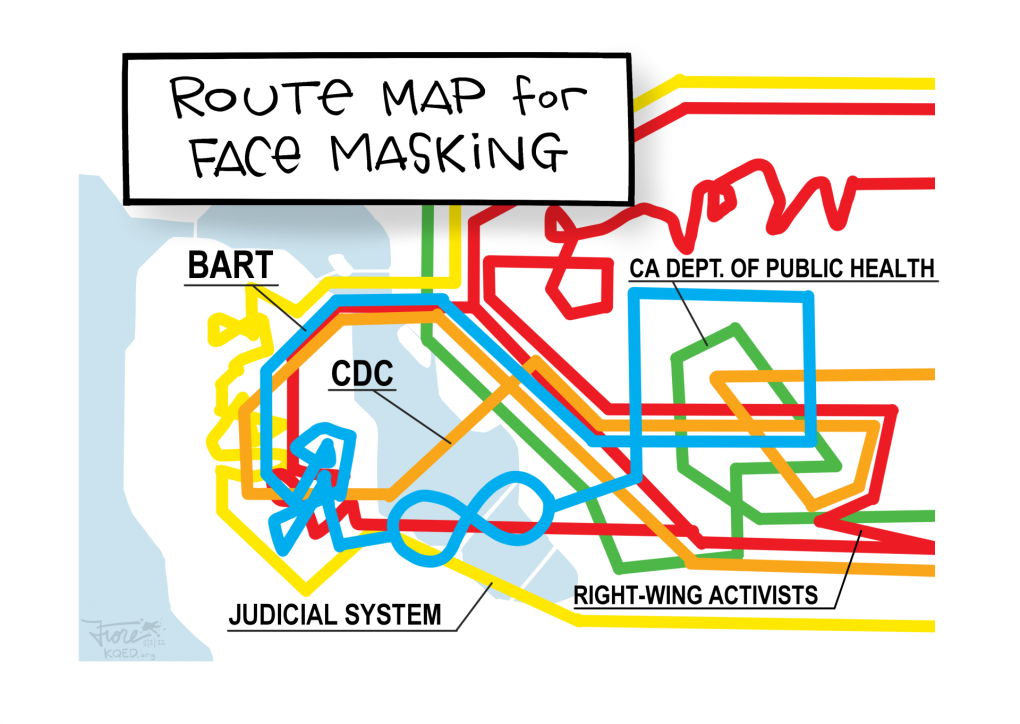
"altTag": "Cartoon: a BART system route map with colorful, tangled lines is titled, \"route map for face masking.\" The lines are labeled, \"BART, CA Dept. of Public Health, CDC, judicial system and right-wing activists.\"",
"isLoading": false,
"fetchFailed": false
},
"news_11912009": {
"type": "attachments",
"id": "news_11912009",
"meta": {
"index": "attachments_1716263798",
"site": "news",
"id": "11912009",
"found": true
},
"parent": 11911992,
"imgSizes": {
"twentyfourteen-full-width": {
"file": "https://ww2.kqed.org/app/uploads/sites/10/2022/04/GettyImages-1237045095-1024x576.jpg",
"width": 1024,
"mimeType": "image/jpeg",
"height": 576
},
"thumbnail": {
"file": "https://ww2.kqed.org/app/uploads/sites/10/2022/04/GettyImages-1237045095-160x101.jpg",
"width": 160,
"mimeType": "image/jpeg",
"height": 101
},
"post-thumbnail": {
"file": "https://ww2.kqed.org/app/uploads/sites/10/2022/04/GettyImages-1237045095-672x372.jpg",
"width": 672,
"mimeType": "image/jpeg",
"height": 372
},
"kqedFullSize": {
"file": "https://ww2.kqed.org/app/uploads/sites/10/2022/04/GettyImages-1237045095.jpg",
"width": 1024,
"height": 649
},
"large": {
"file": "https://ww2.kqed.org/app/uploads/sites/10/2022/04/GettyImages-1237045095-1020x646.jpg",
"width": 1020,
"mimeType": "image/jpeg",
"height": 646
},
"medium": {
"file": "https://ww2.kqed.org/app/uploads/sites/10/2022/04/GettyImages-1237045095-800x507.jpg",
"width": 800,
"mimeType": "image/jpeg",
"height": 507
}
},
"publishDate": 1650662840,
"modified": 1650662879,
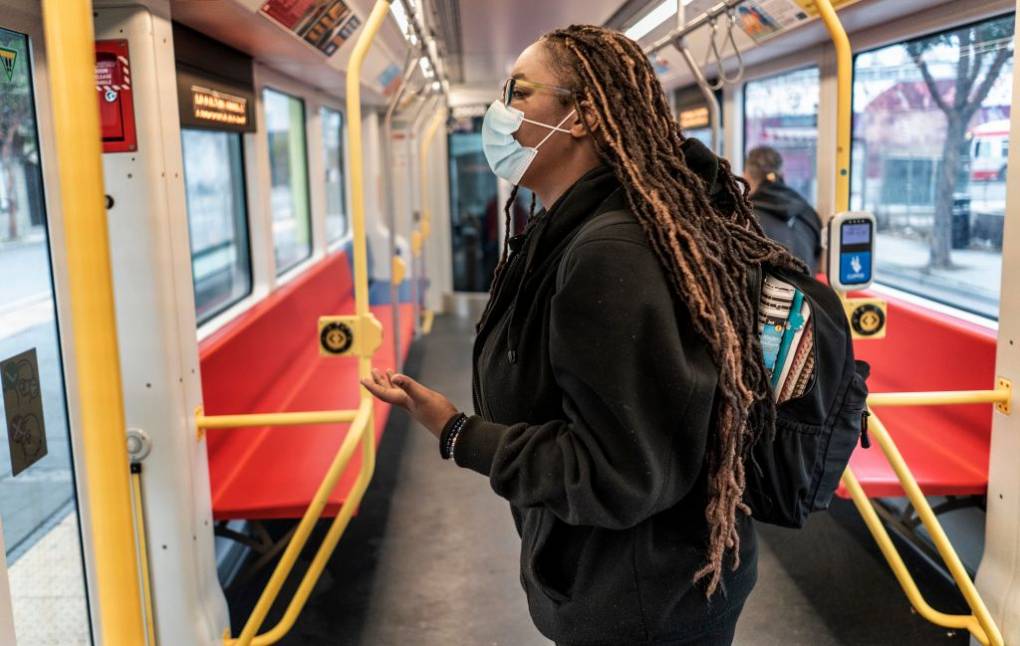
"caption": "Burton High School senior AmBrianna Daniels rides the MUNI bus to attend a college prep program after school in San Francisco, California Wednesday October 20, 2021. ",
"description": null,
"title": "Coronavirus Pandemic 2021",
"credit": "Photo by Melina Mara/The Washington Post via Getty Images",
"status": "inherit",
"altTag": "Student waiting inside a bus with mask",
"isLoading": false,
"fetchFailed": false
},
"news_11911845": {
"type": "attachments",
"id": "news_11911845",
"meta": {
"index": "attachments_1716263798",
"site": "news",
"id": "11911845",
"found": true
},
"parent": 11911841,
"imgSizes": {
"twentyfourteen-full-width": {
"file": "https://ww2.kqed.org/app/uploads/sites/10/2022/04/hooray_042122_final-1038x576.png",
"width": 1038,
"mimeType": "image/png",
"height": 576
},
"thumbnail": {
"file": "https://ww2.kqed.org/app/uploads/sites/10/2022/04/hooray_042122_final-160x114.png",
"width": 160,
"mimeType": "image/png",
"height": 114
},
"post-thumbnail": {
"file": "https://ww2.kqed.org/app/uploads/sites/10/2022/04/hooray_042122_final-672x372.png",
"width": 672,
"mimeType": "image/png",
"height": 372
},
"kqedFullSize": {
"file": "https://ww2.kqed.org/app/uploads/sites/10/2022/04/hooray_042122_final.png",
"width": 1920,
"height": 1362
},
"large": {
"file": "https://ww2.kqed.org/app/uploads/sites/10/2022/04/hooray_042122_final-1020x724.png",
"width": 1020,
"mimeType": "image/png",
"height": 724
},
"1536x1536": {
"file": "https://ww2.kqed.org/app/uploads/sites/10/2022/04/hooray_042122_final-1536x1090.png",
"width": 1536,
"mimeType": "image/png",
"height": 1090
},
"medium": {
"file": "https://ww2.kqed.org/app/uploads/sites/10/2022/04/hooray_042122_final-800x568.png",
"width": 800,
"mimeType": "image/png",
"height": 568
}
},
"publishDate": 1650570395,
"modified": 1650570500,
"caption": null,
"description": null,
"title": "hooray_042122_final",
"credit": null,
"status": "inherit",
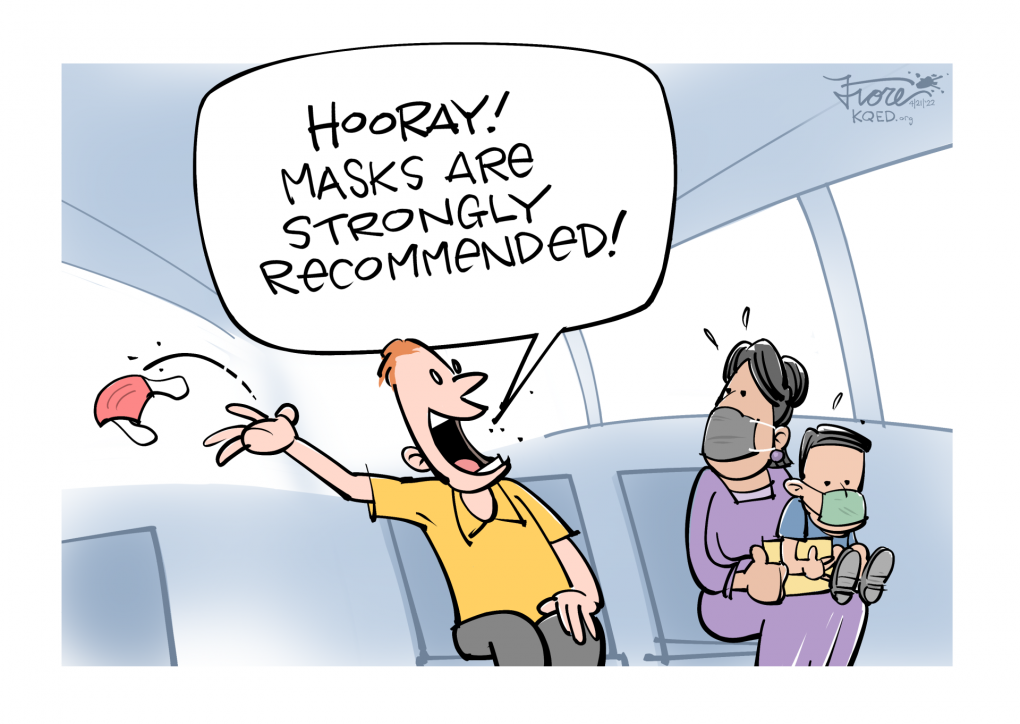
"altTag": "Cartoon: a man on a bus or train throws a face mask away while saying \"hooray! Masks are strongly recommended!\" A masked woman and child look on with concern.",
"isLoading": false,
"fetchFailed": false
},
"news_11911528": {
"type": "attachments",
"id": "news_11911528",
"meta": {
"index": "attachments_1716263798",
"site": "news",
"id": "11911528",
"found": true
},
"parent": 11911526,
"imgSizes": {
"twentyfourteen-full-width": {
"file": "https://ww2.kqed.org/app/uploads/sites/10/2022/04/gettyimages-13380856771-261f8079ce7553c0876dcc8ade3bc2c58db3dbbc-1038x576.jpg",
"width": 1038,
"mimeType": "image/jpeg",
"height": 576
},
"thumbnail": {
"file": "https://ww2.kqed.org/app/uploads/sites/10/2022/04/gettyimages-13380856771-261f8079ce7553c0876dcc8ade3bc2c58db3dbbc-160x120.jpg",
"width": 160,
"mimeType": "image/jpeg",
"height": 120
},
"post-thumbnail": {
"file": "https://ww2.kqed.org/app/uploads/sites/10/2022/04/gettyimages-13380856771-261f8079ce7553c0876dcc8ade3bc2c58db3dbbc-672x372.jpg",
"width": 672,
"mimeType": "image/jpeg",
"height": 372
},
"kqedFullSize": {
"file": "https://ww2.kqed.org/app/uploads/sites/10/2022/04/gettyimages-13380856771-261f8079ce7553c0876dcc8ade3bc2c58db3dbbc.jpg",
"width": 2499,
"height": 1874
},
"2048x2048": {
"file": "https://ww2.kqed.org/app/uploads/sites/10/2022/04/gettyimages-13380856771-261f8079ce7553c0876dcc8ade3bc2c58db3dbbc-2048x1536.jpg",
"width": 2048,
"mimeType": "image/jpeg",
"height": 1536
},
"large": {
"file": "https://ww2.kqed.org/app/uploads/sites/10/2022/04/gettyimages-13380856771-261f8079ce7553c0876dcc8ade3bc2c58db3dbbc-1020x765.jpg",
"width": 1020,
"mimeType": "image/jpeg",
"height": 765
},
"1536x1536": {
"file": "https://ww2.kqed.org/app/uploads/sites/10/2022/04/gettyimages-13380856771-261f8079ce7553c0876dcc8ade3bc2c58db3dbbc-1536x1152.jpg",
"width": 1536,
"mimeType": "image/jpeg",
"height": 1152
},
"full-width": {
"file": "https://ww2.kqed.org/app/uploads/sites/10/2022/04/gettyimages-13380856771-261f8079ce7553c0876dcc8ade3bc2c58db3dbbc-1920x1440.jpg",
"width": 1920,
"mimeType": "image/jpeg",
"height": 1440
},
"medium": {
"file": "https://ww2.kqed.org/app/uploads/sites/10/2022/04/gettyimages-13380856771-261f8079ce7553c0876dcc8ade3bc2c58db3dbbc-800x600.jpg",
"width": 800,
"mimeType": "image/jpeg",
"height": 600
}
},
"publishDate": 1650328550,
"modified": 1650330968,
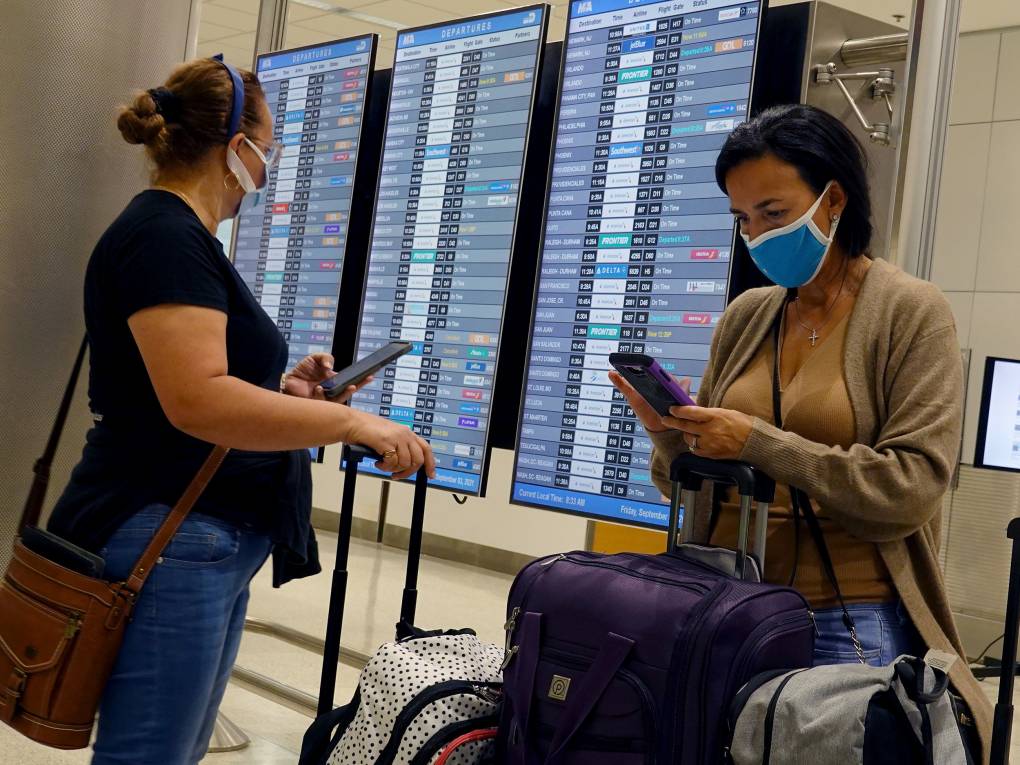
"caption": "Travelers make their way through the Miami International Airport on Sept. 3, 2021.",
"description": "MIAMI, FLORIDA - SEPTEMBER 03: Travelers make their way through the Miami International Airport before starting the Labor Day weekend on September 03, 2021 in Miami, Florida. The Centers for Disease Control and Prevention recommended that people unvaccinated against the Covid-19 virus should not travel this weekend. Those who are should wear their masks and take precautions due to the country’s high level of Covid-19 transmission. (Photo by Joe Raedle/Getty Images)",
"title": "Travelers make their way through the Miami International Airport in September 2021 in Miami, Florida.",
"credit": "Joe Raedle/Getty Images",
"status": "inherit",
"altTag": "Two travelers with face masks stand by a schedule board in an airport.",
"isLoading": false,
"fetchFailed": false
},
"news_11911035": {
"type": "attachments",
"id": "news_11911035",
"meta": {
"index": "attachments_1716263798",
"site": "news",
"id": "11911035",
"found": true
},
"parent": 11911034,
"imgSizes": {
"twentyfourteen-full-width": {
"file": "https://ww2.kqed.org/app/uploads/sites/10/2022/04/gettyimages-1236922573-a15c52a9ba10a2b7a4b1823934fa1371aaa01409-888x576.jpg",
"width": 888,
"mimeType": "image/jpeg",
"height": 576
},
"thumbnail": {
"file": "https://ww2.kqed.org/app/uploads/sites/10/2022/04/gettyimages-1236922573-a15c52a9ba10a2b7a4b1823934fa1371aaa01409-160x120.jpg",
"width": 160,
"mimeType": "image/jpeg",
"height": 120
},
"post-thumbnail": {
"file": "https://ww2.kqed.org/app/uploads/sites/10/2022/04/gettyimages-1236922573-a15c52a9ba10a2b7a4b1823934fa1371aaa01409-672x372.jpg",
"width": 672,
"mimeType": "image/jpeg",
"height": 372
},
"kqedFullSize": {
"file": "https://ww2.kqed.org/app/uploads/sites/10/2022/04/gettyimages-1236922573-a15c52a9ba10a2b7a4b1823934fa1371aaa01409.jpg",
"width": 888,
"height": 666
},
"medium": {
"file": "https://ww2.kqed.org/app/uploads/sites/10/2022/04/gettyimages-1236922573-a15c52a9ba10a2b7a4b1823934fa1371aaa01409-800x600.jpg",
"width": 800,
"mimeType": "image/jpeg",
"height": 600
}
},
"publishDate": 1649884597,
"modified": 1649886711,
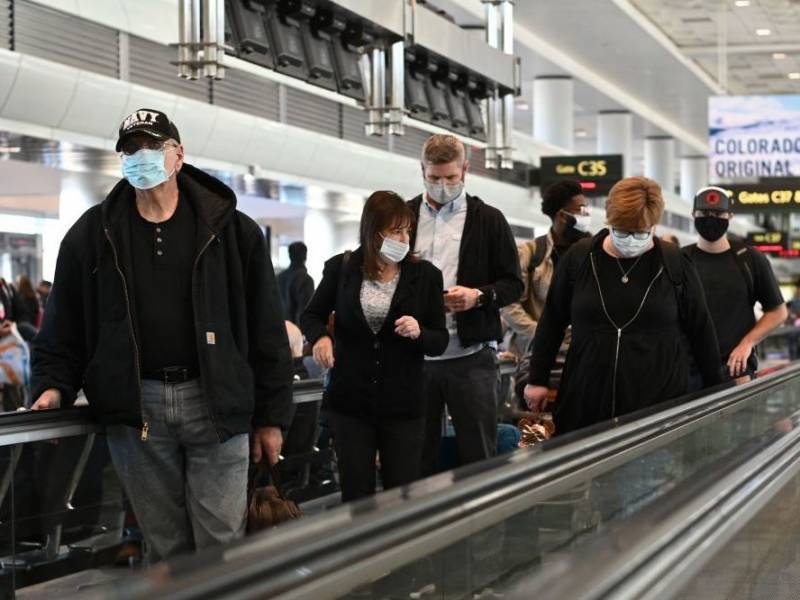
"caption": "Travelers wear protective face masks at Denver International Airport on Nov. 30, 2021.",
"description": "Travelers wear protective face masks at Denver International Airport on November 30, 2021 in Denver, Colorado as concern grows worldwide over the Omicron coronavirus variant. (Photo by Robyn Beck / AFP) (Photo by ROBYN BECK/AFP via Getty Images)",
"title": "Travelers will need to continue to wear protective face masks at airports, on planes, trains, buses and transit hubs, as the CDC is extending the mask requirement for travelers.",
"credit": "Robyn Beck/AFP via Getty Images",
"status": "inherit",
"altTag": null,
"isLoading": false,
"fetchFailed": false
}
},
"audioPlayerReducer": {
"postId": "stream_live",
"isPaused": true,
"isPlaying": false,
"pfsActive": false,
"pledgeModalIsOpen": true,
"playerDrawerIsOpen": false,
"liveAudioPlayStartedAt": 0,
"liveAudioPlayContext": ""
},
"authorsReducer": {
"byline_news_11918778": {
"type": "authors",
"id": "byline_news_11918778",
"meta": {
"override": true
},
"slug": "byline_news_11918778",
"name": "Rachel Bluth",
"isLoading": false
},
"byline_news_11911992": {
"type": "authors",
"id": "byline_news_11911992",
"meta": {
"override": true
},
"slug": "byline_news_11911992",
"name": "Will Stone and Maria Godoy",
"isLoading": false
},
"byline_news_11911526": {
"type": "authors",
"id": "byline_news_11911526",
"meta": {
"override": true
},
"slug": "byline_news_11911526",
"name": "Jonathan Franklin",
"isLoading": false
},
"byline_news_11911034": {
"type": "authors",
"id": "byline_news_11911034",
"meta": {
"override": true
},
"slug": "byline_news_11911034",
"name": "Pien Huang",
"isLoading": false
},
"kqed": {
"type": "authors",
"id": "236",
"meta": {
"index": "authors_1716337520",
"id": "236",
"found": true
},
"name": "KQED News Staff",
"firstName": "KQED News Staff",
"lastName": null,
"slug": "kqed",
"email": "faq@kqed.org",
"display_author_email": false,
"staff_mastheads": [],
"title": null,
"bio": null,
"avatar": "https://secure.gravatar.com/avatar/ef0e801a68c4c54afa9180db14084167?s=600&d=blank&r=g",
"twitter": null,
"facebook": null,
"instagram": null,
"linkedin": null,
"sites": [
{
"site": "arts",
"roles": [
"contributor"
]
},
{
"site": "news",
"roles": [
"editor"
]
},
{
"site": "futureofyou",
"roles": [
"author"
]
}
],
"headData": {
"title": "KQED News Staff | KQED",
"description": null,
"ogImgSrc": "https://secure.gravatar.com/avatar/ef0e801a68c4c54afa9180db14084167?s=600&d=blank&r=g",
"twImgSrc": "https://secure.gravatar.com/avatar/ef0e801a68c4c54afa9180db14084167?s=600&d=blank&r=g"
},
"isLoading": false,
"link": "/author/kqed"
},
"matthewgreen": {
"type": "authors",
"id": "1263",
"meta": {
"index": "authors_1716337520",
"id": "1263",
"found": true
},
"name": "Matthew Green",
"firstName": "Matthew",
"lastName": "Green",
"slug": "matthewgreen",
"email": "mgreen@kqed.org",
"display_author_email": false,
"staff_mastheads": [],
"title": "KQED Editor/Reporter",
"bio": "Matthew Green is a digital media producer for KQED News. He previously produced \u003ca href=\"http://www.kqed.org/lowdown\">The Lowdown\u003c/a>, KQED’s multimedia news education blog. Matthew's written for numerous Bay Area publications, including the Oakland Tribune and San Francisco Chronicle. He also taught journalism classes at Fremont High School in East Oakland.\r\n\r\nEmail: mgreen@kqed.org; Twitter: @MGreenKQED",
"avatar": "https://secure.gravatar.com/avatar/3bf498d1267ca02c8494f33d8cfc575e?s=600&d=blank&r=g",
"twitter": "MGreenKQED",
"facebook": null,
"instagram": null,
"linkedin": null,
"sites": [
{
"site": "news",
"roles": []
},
{
"site": "lowdown",
"roles": []
},
{
"site": "science",
"roles": []
},
{
"site": "education",
"roles": []
},
{
"site": "quest",
"roles": []
},
{
"site": "liveblog",
"roles": []
}
],
"headData": {
"title": "Matthew Green | KQED",
"description": "KQED Editor/Reporter",
"ogImgSrc": "https://secure.gravatar.com/avatar/3bf498d1267ca02c8494f33d8cfc575e?s=600&d=blank&r=g",
"twImgSrc": "https://secure.gravatar.com/avatar/3bf498d1267ca02c8494f33d8cfc575e?s=600&d=blank&r=g"
},
"isLoading": false,
"link": "/author/matthewgreen"
},
"markfiore": {
"type": "authors",
"id": "3236",
"meta": {
"index": "authors_1716337520",
"id": "3236",
"found": true
},
"name": "Mark Fiore",
"firstName": "Mark",
"lastName": "Fiore",
"slug": "markfiore",
"email": "mark@markfiore.com",
"display_author_email": false,
"staff_mastheads": [
"news"
],
"title": "KQED News Cartoonist",
"bio": "\u003ca href=\"http://www.MarkFiore.com\">MarkFiore.com\u003c/a> | \u003ca href=\"https://twitter.com/markfiore\">Follow on Twitter\u003c/a> | \u003ca href=\"https://www.facebook.com/pages/Mark-Fiore-Animated-Political-Cartoons/94451707396?ref=bookmarks\">Facebook\u003c/a> | \u003ca href=\"mailto:mark@markfiore.com\">email\u003c/a>\r\n\r\nPulitzer Prize-winner, Mark Fiore, who the Wall Street Journal has called “the undisputed guru of the form,” creates animated political cartoons in San Francisco, where his work has been featured regularly on the San Francisco Chronicle’s web site, SFGate.com. His work has appeared on Newsweek.com, Slate.com, CBSNews.com, MotherJones.com, DailyKos.com and NPR’s web site. Fiore’s political animation has appeared on CNN, Frontline, Bill Moyers Journal, Salon.com and cable and broadcast outlets across the globe.\r\n\r\nBeginning his professional life by drawing traditional political cartoons for newspapers, Fiore’s work appeared in publications ranging from the Washington Post to the Los Angeles Times. In the late 1990s, he began to experiment with animating political cartoons and, after a short stint at the San Jose Mercury News as their staff cartoonist, Fiore devoted all his energies to animation.\r\nGrowing up in California, Fiore also spent a good portion of his life in the backwoods of Idaho. It was this combination that shaped him politically. Mark majored in political science at Colorado College, where, in a perfect send-off for a cartoonist, he received his diploma in 1991 as commencement speaker Dick Cheney smiled approvingly.\r\nMark Fiore was awarded the Pulitzer Prize for political cartooning in 2010, a Robert F. Kennedy Journalism Award in 2004 and has twice received an Online Journalism Award for commentary from the Online News Association (2002, 2008). Fiore has received two awards for his work in new media from the National Cartoonists Society (2001, 2002), and in 2006 received The James Madison Freedom of Information Award from The Society of Professional Journalists.",
"avatar": "https://secure.gravatar.com/avatar/fc4e2a612b15b67bad0c6f0e1db4ca9b?s=600&d=blank&r=g",
"twitter": "MarkFiore",
"facebook": null,
"instagram": "https://www.instagram.com/markfiore/?hl=en",
"linkedin": null,
"sites": [
{
"site": "arts",
"roles": [
"contributor"
]
},
{
"site": "news",
"roles": [
"editor"
]
},
{
"site": "futureofyou",
"roles": [
"editor"
]
},
{
"site": "science",
"roles": [
"editor"
]
}
],
"headData": {
"title": "Mark Fiore | KQED",
"description": "KQED News Cartoonist",
"ogImgSrc": "https://secure.gravatar.com/avatar/fc4e2a612b15b67bad0c6f0e1db4ca9b?s=600&d=blank&r=g",
"twImgSrc": "https://secure.gravatar.com/avatar/fc4e2a612b15b67bad0c6f0e1db4ca9b?s=600&d=blank&r=g"
},
"isLoading": false,
"link": "/author/markfiore"
},
"carlysevern": {
"type": "authors",
"id": "3243",
"meta": {
"index": "authors_1716337520",
"id": "3243",
"found": true
},
"name": "Carly Severn",
"firstName": "Carly",
"lastName": "Severn",
"slug": "carlysevern",
"email": "csevern@kqed.org",
"display_author_email": false,
"staff_mastheads": [
"news"
],
"title": "Senior Editor, Audience News ",
"bio": "Carly is KQED's Senior Editor of Audience News on the Digital News team, and has reported for the California Report Magazine, Bay Curious and KQED Arts. She's formerly the host of \u003ca href=\"http://ww2.kqed.org/pop/category/the-cooler/\" rel=\"noopener noreferrer\">The Cooler\u003c/a> podcast.",
"avatar": "https://secure.gravatar.com/avatar/54037bf5c128fe678f0ef26cec97a93f2e7f220a22d7285703328f12c42c1b1d?s=600&d=blank&r=g",
"twitter": "teacupinthebay",
"bluesky": null,
"facebook": null,
"instagram": null,
"linkedin": null,
"sites": [
{
"site": "",
"roles": [
"editor"
]
},
{
"site": "arts",
"roles": [
"editor"
]
},
{
"site": "news",
"roles": [
"administrator"
]
},
{
"site": "pop",
"roles": [
"editor"
]
},
{
"site": "futureofyou",
"roles": [
"editor"
]
},
{
"site": "about",
"roles": [
"administrator"
]
},
{
"site": "mindshift",
"roles": [
"editor"
]
},
{
"site": "bayareabites",
"roles": [
"editor"
]
},
{
"site": "stateofhealth",
"roles": [
"editor"
]
},
{
"site": "science",
"roles": [
"editor"
]
},
{
"site": "food",
"roles": [
"contributor"
]
},
{
"site": "forum",
"roles": [
"editor"
]
},
{
"site": "perspectives",
"roles": [
"administrator"
]
},
{
"site": "liveblog",
"roles": [
"editor"
]
}
],
"headData": {
"title": "Carly Severn | KQED",
"description": "Senior Editor, Audience News ",
"ogImgSrc": "https://secure.gravatar.com/avatar/54037bf5c128fe678f0ef26cec97a93f2e7f220a22d7285703328f12c42c1b1d?s=600&d=blank&r=g",
"twImgSrc": "https://secure.gravatar.com/avatar/54037bf5c128fe678f0ef26cec97a93f2e7f220a22d7285703328f12c42c1b1d?s=600&d=blank&r=g"
},
"isLoading": false,
"link": "/author/carlysevern"
},
"nnavarro": {
"type": "authors",
"id": "11756",
"meta": {
"index": "authors_1716337520",
"id": "11756",
"found": true
},
"name": "Natalia Navarro",
"firstName": "Natalia",
"lastName": "Navarro",
"slug": "nnavarro",
"email": "nnavarro@kqed.org",
"display_author_email": true,
"staff_mastheads": [
"news"
],
"title": "Afternoon News Anchor",
"bio": "Natalia Navarro is KQED's afternoon radio news anchor. She came to KQED in 2021 from Colorado Public Radio, where she was a reporter and host. She has received several awards for her work covering daily and breaking news from professional organizations such as the San Francisco Press Club, Society of Professional Journalists and the Colorado Broadcasters Association. Natalia is originally from Tucson, Arizona, where she got her start in journalism writing for the Arizona Daily Star, Arizona Public Media and the Tucson Weekly. Natalia earned her bachelor's degree in journalism and economics, and her master's degree in journalism from the University of Arizona.",
"avatar": "https://secure.gravatar.com/avatar/a2bdb19fd9520bdea295a2d5f9b2ad65ec51cf0bf559fb1cc041d3a0a04d62ad?s=600&d=blank&r=g",
"twitter": "@NataliaVNavarro",
"bluesky": null,
"facebook": null,
"instagram": null,
"linkedin": null,
"sites": [
{
"site": "news",
"roles": [
"editor"
]
}
],
"headData": {
"title": "Natalia Navarro | KQED",
"description": "Afternoon News Anchor",
"ogImgSrc": "https://secure.gravatar.com/avatar/a2bdb19fd9520bdea295a2d5f9b2ad65ec51cf0bf559fb1cc041d3a0a04d62ad?s=600&d=blank&r=g",
"twImgSrc": "https://secure.gravatar.com/avatar/a2bdb19fd9520bdea295a2d5f9b2ad65ec51cf0bf559fb1cc041d3a0a04d62ad?s=600&d=blank&r=g"
},
"isLoading": false,
"link": "/author/nnavarro"
},
"swhitney": {
"type": "authors",
"id": "11784",
"meta": {
"index": "authors_1716337520",
"id": "11784",
"found": true
},
"name": "Spencer Whitney",
"firstName": "Spencer",
"lastName": "Whitney",
"slug": "swhitney",
"email": "swhitney@kqed.org",
"display_author_email": false,
"staff_mastheads": [],
"title": "KQED Digital Editor",
"bio": "Spencer Whitney is currently a Digital Editor for KQED News. Prior to joining KQED News, Spencer worked as the Multimedia Editor at the Oakland Post and an Assistant Editor in the Editorial department at the San Francisco Chronicle. He attended Howard University as an undergraduate and interned with SiriusXM. He also attended UC Berkeley's Graduate School of Journalism and had the opportunity to write for the hyperlocal news sites Richmond Confidential and Oakland North.",
"avatar": "https://secure.gravatar.com/avatar/e33ff4fd8b8f0d2796f36472fb32607ca8fc46ef5e537dcfdbdee688d8ea5b80?s=600&d=mm&r=g",
"twitter": null,
"bluesky": null,
"facebook": null,
"instagram": null,
"linkedin": null,
"sites": [
{
"site": "arts",
"roles": [
"editor"
]
},
{
"site": "news",
"roles": [
"editor"
]
},
{
"site": "science",
"roles": [
"editor"
]
},
{
"site": "perspectives",
"roles": [
"editor"
]
}
],
"headData": {
"title": "Spencer Whitney | KQED",
"description": "KQED Digital Editor",
"ogImgSrc": "https://secure.gravatar.com/avatar/e33ff4fd8b8f0d2796f36472fb32607ca8fc46ef5e537dcfdbdee688d8ea5b80?s=600&d=mm&r=g",
"twImgSrc": "https://secure.gravatar.com/avatar/e33ff4fd8b8f0d2796f36472fb32607ca8fc46ef5e537dcfdbdee688d8ea5b80?s=600&d=mm&r=g"
},
"isLoading": false,
"link": "/author/swhitney"
}
},
"pagesReducer": {
"news_tag_covid-19": {
"type": "terms",
"id": "news_27504",
"meta": {
"index": "terms_1716263798",
"site": "news",
"id": "27504",
"score": 8.558294
},
"featImg": null,
"name": "covid-19",
"description": null,
"taxonomy": "tag",
"headData": {
"twImgId": null,
"twTitle": null,
"ogTitle": null,
"ogImgId": null,
"twDescription": null,
"description": null,
"title": "covid-19 Archives | KQED News",
"ogDescription": null
},
"ttid": 27521,
"slug": "covid-19",
"isLoading": false,
"title": "covid-19",
"pageMeta": {
"site": "news",
"WpPageTemplate": "page-topic-editorial",
"currentPage": 5
},
"blocks": [
{
"blockName": "kqed/post-list",
"attrs": {
"layout": "cardArticle2",
"query": "posts/news?tag=covid-19",
"seeMore": false,
"paginated": true,
"page": 5
}
},
{
"blockName": "kqed/ad"
}
]
}
},
"pfsSessionReducer": {},
"postsReducer": {
"stream_live": {
"type": "live",
"id": "stream_live",
"audioUrl": "https://streams.kqed.org/kqedradio",
"title": "Live Stream",
"excerpt": "Live Stream information currently unavailable.",
"link": "/radio",
"featImg": "",
"label": {
"name": "KQED Live",
"link": "/"
}
},
"stream_kqedNewscast": {
"type": "posts",
"id": "stream_kqedNewscast",
"audioUrl": "https://www.kqed.org/.stream/anon/radio/RDnews/newscast.mp3?_=1",
"title": "KQED Newscast",
"featImg": "",
"label": {
"name": "88.5 FM",
"link": "/"
}
},
"news_11919145": {
"type": "posts",
"id": "news_11919145",
"meta": {
"index": "posts_1716263798",
"site": "news",
"id": "11919145",
"score": null,
"sort": [
1657327341000
]
},
"guestAuthors": [],
"slug": "shinzo-abe-assassinated-covid-ba-5-update-this-week-in-ca-news",
"title": "Shinzo Abe Assassinated | COVID BA.5 Update | This Week in CA News",
"publishDate": 1657327341,
"format": "video",
"headTitle": "Shinzo Abe Assassinated | COVID BA.5 Update | This Week in CA News | KQED",
"labelTerm": {
"term": 7052,
"site": "news"
},
"content": "\u003cp>\u003cb>Shinzo Abe Assassinated\u003cbr>\n\u003c/b>\u003cspan style=\"font-weight: 400\">Former Japanese Prime Minister Shinzo Abe, who was assassinated July 8, 2022, worked to build ties with Silicon Valley and to craft a pro-democracy theater in the Pacific. Hoover Institution Distinguished Research Fellow \u003c/span>\u003cb>Michael Auslin\u003c/b>\u003cspan style=\"font-weight: 400\"> joins us to discuss Abe’s work and legacy.\u003c/span>\u003c/p>\n\u003cp>\u003cb>COVID BA.5 Subvariant a ‘Different Beast’\u003cbr>\n\u003c/b>\u003cspan style=\"font-weight: 400\">UCSF Chair of Medicine \u003c/span>\u003cb>Dr. Bob Wachter \u003c/b>\u003cspan style=\"font-weight: 400\">talks about why he’s calling the COVID BA.5 variant “a different beast” and how to defend against ongoing surges of the virus. \u003c/span>\u003c/p>\n\u003cp>\u003cb>This Week in California News and Politics\u003cbr>\n\u003c/b>\u003cspan style=\"font-weight: 400\">Gov. Gavin Newsom is running for reelection in California, so why is he running a television ad in Florida? And will Californians vote to make access to abortion a part of the state’s constitution? Our panel of reporters helps us unpack these topics and other major news of the week.\u003c/span>\u003c/p>\n\u003cp>\u003cspan style=\"font-weight: 400\">Guests: \u003c/span>\u003c/p>\n\u003cul>\n\u003cli style=\"font-weight: 400\">\u003cspan style=\"font-weight: 400\">Adhiti Bandlamudi, KQED reporter\u003c/span>\u003c/li>\n\u003cli style=\"font-weight: 400\">\u003cspan style=\"font-weight: 400\">Joe Garofoli, San Francisco Chronicle senior political writer\u003c/span>\u003c/li>\n\u003cli style=\"font-weight: 400\">\u003cspan style=\"font-weight: 400\">Jeremy C. Owens, MarketWatch bureau chief\u003c/span>\u003c/li>\n\u003c/ul>\n\u003cp>\u003cb>Berkeley Rose Garden\u003cbr>\n\u003c/b>\u003cspan style=\"font-weight: 400\">In this week’s Something Beautiful, we go to a public garden that opened in 1937 in the East Bay. The Berkeley Rose Garden provides remarkable views of the city and the bay and features more than 100 varieties of the floral delight.\u003c/span>\u003c/p>\n\u003cp>[ad fullwidth]\u003c/p>\u003cp>\u003c/p>\n",
"blocks": [],
"excerpt": null,
"status": "publish",
"parent": 0,
"modified": 1721158634,
"stats": {
"hasAudio": false,
"hasVideo": false,
"hasChartOrMap": false,
"iframeSrcs": [],
"hasGoogleForm": false,
"hasGallery": false,
"hasHearkenModule": false,
"hasPolis": false,
"paragraphCount": 7,
"wordCount": 221
},
"headData": {
"title": "Shinzo Abe Assassinated | COVID BA.5 Update | This Week in CA News | KQED",
"description": "Shinzo Abe Assassinated Former Japanese Prime Minister Shinzo Abe, who was assassinated July 8, 2022, worked to build ties with Silicon Valley and to craft a pro-democracy theater in the Pacific. Hoover Institution Distinguished Research Fellow Michael Auslin joins us to discuss Abe’s work and legacy. COVID BA.5 Subvariant a ‘Different Beast’ UCSF Chair of",
"ogTitle": "",
"ogDescription": "",
"ogImgId": "",
"twTitle": "",
"twDescription": "",
"twImgId": "",
"schema": {
"@context": "https://schema.org",
"@type": "NewsArticle",
"headline": "Shinzo Abe Assassinated | COVID BA.5 Update | This Week in CA News",
"datePublished": "2022-07-08T17:42:21-07:00",
"dateModified": "2024-07-16T12:37:14-07:00",
"image": "https://cdn.kqed.org/wp-content/uploads/2020/02/KQED-OG-Image@1x.png",
"isAccessibleForFree": "True",
"publisher": {
"@type": "NewsMediaOrganization",
"@id": "https://www.kqed.org/#organization",
"name": "KQED",
"logo": "https://cdn.kqed.org/wp-content/uploads/2020/02/KQED-OG-Image@1x.png",
"url": "https://www.kqed.org",
"sameAs": [
"https://www.facebook.com/KQED",
"https://twitter.com/KQED",
"https://www.instagram.com/kqed/",
"https://www.tiktok.com/@kqedofficial",
"https://www.linkedin.com/company/kqed",
"https://www.youtube.com/channel/UCeC0IOo7i1P_61zVUWbJ4nw"
]
}
}
},
"videoEmbed": " https://youtu.be/_NMYNlKYJdc",
"sticky": false,
"excludeFromSiteSearch": "Include",
"path": "/news/11919145/shinzo-abe-assassinated-covid-ba-5-update-this-week-in-ca-news",
"audioTrackLength": null,
"parsedContent": [
{
"type": "contentString",
"content": "\u003cdiv class=\"post-body\">\u003cp>\u003cp>\u003cb>Shinzo Abe Assassinated\u003cbr>\n\u003c/b>\u003cspan style=\"font-weight: 400\">Former Japanese Prime Minister Shinzo Abe, who was assassinated July 8, 2022, worked to build ties with Silicon Valley and to craft a pro-democracy theater in the Pacific. Hoover Institution Distinguished Research Fellow \u003c/span>\u003cb>Michael Auslin\u003c/b>\u003cspan style=\"font-weight: 400\"> joins us to discuss Abe’s work and legacy.\u003c/span>\u003c/p>\n\u003cp>\u003cb>COVID BA.5 Subvariant a ‘Different Beast’\u003cbr>\n\u003c/b>\u003cspan style=\"font-weight: 400\">UCSF Chair of Medicine \u003c/span>\u003cb>Dr. Bob Wachter \u003c/b>\u003cspan style=\"font-weight: 400\">talks about why he’s calling the COVID BA.5 variant “a different beast” and how to defend against ongoing surges of the virus. \u003c/span>\u003c/p>\n\u003cp>\u003cb>This Week in California News and Politics\u003cbr>\n\u003c/b>\u003cspan style=\"font-weight: 400\">Gov. Gavin Newsom is running for reelection in California, so why is he running a television ad in Florida? And will Californians vote to make access to abortion a part of the state’s constitution? Our panel of reporters helps us unpack these topics and other major news of the week.\u003c/span>\u003c/p>\n\u003cp>\u003cspan style=\"font-weight: 400\">Guests: \u003c/span>\u003c/p>\n\u003cul>\n\u003cli style=\"font-weight: 400\">\u003cspan style=\"font-weight: 400\">Adhiti Bandlamudi, KQED reporter\u003c/span>\u003c/li>\n\u003cli style=\"font-weight: 400\">\u003cspan style=\"font-weight: 400\">Joe Garofoli, San Francisco Chronicle senior political writer\u003c/span>\u003c/li>\n\u003cli style=\"font-weight: 400\">\u003cspan style=\"font-weight: 400\">Jeremy C. Owens, MarketWatch bureau chief\u003c/span>\u003c/li>\n\u003c/ul>\n\u003cp>\u003cb>Berkeley Rose Garden\u003cbr>\n\u003c/b>\u003cspan style=\"font-weight: 400\">In this week’s Something Beautiful, we go to a public garden that opened in 1937 in the East Bay. The Berkeley Rose Garden provides remarkable views of the city and the bay and features more than 100 varieties of the floral delight.\u003c/span>\u003c/p>\n\u003cp>\u003c/p>\u003c/div>",
"attributes": {
"named": {},
"numeric": []
}
},
{
"type": "component",
"content": "",
"name": "ad",
"attributes": {
"named": {
"label": "fullwidth"
},
"numeric": [
"fullwidth"
]
}
},
{
"type": "contentString",
"content": "\u003cdiv class=\"post-body\">\u003cp>\u003c/p>\u003cp>\u003c/p>\n\u003c/div>\u003c/p>",
"attributes": {
"named": {},
"numeric": []
}
}
],
"link": "/news/11919145/shinzo-abe-assassinated-covid-ba-5-update-this-week-in-ca-news",
"authors": [
"236"
],
"programs": [
"news_7052"
],
"categories": [
"news_1758",
"news_457",
"news_6188",
"news_8",
"news_13"
],
"tags": [
"news_27510",
"news_28629",
"news_27989",
"news_27504",
"news_16",
"news_2795",
"news_3682",
"news_20297",
"news_31304"
],
"featImg": "news_11919146",
"label": "news_7052"
},
"news_11918781": {
"type": "posts",
"id": "news_11918781",
"meta": {
"index": "posts_1716263798",
"site": "news",
"id": "11918781",
"score": null,
"sort": [
1657152309000
]
},
"guestAuthors": [],
"slug": "ba-5-will-cause-even-greater-surge-warns-ucsfs-wachter-of-highly-infectious-covid-subvariant",
"title": "BA.5 Will Cause 'Even Greater Surge,' Warns UCSF's Wachter of Highly Infectious COVID Subvariant",
"publishDate": 1657152309,
"format": "standard",
"headTitle": "BA.5 Will Cause ‘Even Greater Surge,’ Warns UCSF’s Wachter of Highly Infectious COVID Subvariant | KQED",
"labelTerm": {
"site": "news"
},
"content": "\u003cp>While COVID-19 restrictions have eased around the U.S., experts have discovered a new omicron subvariant, named BA.5, that appears to be more infectious and can evade immune responses.\u003c/p>\n\u003cp>According to a report from the California Department of Public Health, \u003ca href=\"https://covid19.ca.gov/state-dashboard/#location-california\">the statewide positivity rate has jumped to 15% from 13.2% the previous week\u003c/a>, making the rate the largest increase seen since January. Counties have begun to feel the surge as well, including San Francisco County, which reported a rate of 51.1 new cases per 100,000 people, making it 11 cases higher than the state average.\u003c/p>\n\u003cp>New data from the \u003ca href=\"https://covid.cdc.gov/covid-data-tracker/#variant-proportions\">U.S. Centers for Disease Control and Prevention\u003c/a> shows the BA.5 variant is becoming the dominant version of the coronavirus nationwide. BA.5 was identified in South Africa and Europe in February and has been monitored closely by government health agencies since cases started to appear in the U.S.\u003c/p>\n\u003cp>Bay Area COVID-19 experts say the new BA.5 strain means the region needs to change its thinking on responding to the pandemic. KQED’s Natalia Navarro spoke with UCSF’s Dr. Bob Wachter about the new strain and its potential impact on the Bay Area. [pullquote size=\"medium\" align=\"right\" citation=\"Dr. Bob Wachter, professor and chair, UCSF Department of Medicine\"]‘The only way to prevent getting it is to wear a good mask in crowded indoor spaces and to pay attention to ventilation.’[/pullquote]\u003c/p>\n\u003cp>\u003cem>This interview has been edited for brevity and clarity.\u003c/em>\u003c/p>\n\u003cp>\u003cstrong>NATALIA NAVARRO: What is the latest on BA.5? It is a subvariant of omicron, right? \u003c/strong>\u003c/p>\n\u003cp>\u003cstrong>DR. BOB WACHTER:\u003c/strong> It is, but it’s acting differently enough that it would almost be better if it was given its own Greek letter, so we would treat it with the respect it deserves. It’s acting not exactly the same way as we’ve gotten used to with all these other subvariants.\u003c/p>\n\u003cp>\u003cstrong>So what exactly does it mean that it’s acting differently?\u003c/strong>\u003c/p>\n\u003cp>Well, we’ve gotten used to it after omicron hit in December and January, and I think we all said, including me, “I can’t believe how infectious this is. I can’t imagine anything more infectious.” It turned out there were two or three other subvariants that were about 20% more infectious, but they tended to be reasonably respectful of immunity from both vaccines and boosters as well as prior infection. So they evaded immunity a little bit. But by and large, if you were fully vaccinated and boosted, you were in really good shape. And if you’d had a prior infection with omicron, you weren’t going to get a reinfection.\u003c/p>\n\u003cp>So this one is somewhat different in that it is more infectious than the prior variants, but it’s substantially more invasive of the immune system. So your vaccines and your boosters still work to prevent severe infections, and I highly recommend them. But your prior infection doesn’t count nearly as much. So the old saw that “I just had omicron in February, I’ve got superpowers and I don’t need to worry about it” doesn’t really work anymore. So even if you had omicron as recently as a month ago, we’re starting to see people come back with reinfections with this new variant because it evades the immunity from your prior infections pretty well.[aside postID=\"science_1978903,forum_2010101889240\" label=\"Related Posts\"]\u003cstrong>In what circumstances should people be considering a second booster in terms of, in reaction to this new subvariant?\u003c/strong>\u003c/p>\n\u003cp>Well, the official recommendation is everybody over 50 should get one. And I have to say, until a few weeks ago, when this BA.5 became a thing, I was a little bit on the fence. I got a second booster. I’m 64 years old. I got one about two months ago, I thought the evidence for people over about 60 was raised reasonably strong. But for people over 50, let’s say, 50 to 60, I said it was sort of dealer’s choice. You can wait a little bit and see how things go and maybe the surge will go away and then you’ll wait and get maybe a rejiggered booster in the fall.\u003c/p>\n\u003cp>I think now because there’s a huge amount of COVID around, BA.5 is going to cause an even greater surge, and some emerging evidence that’s come out in the last few weeks says that the mortality rate from COVID for people over 50 is substantially lower if you get the second booster. I think everybody over 50 should get their second booster. It may turn out to be that even if you’re under 50, you should get it. But we’re still waiting for formal recommendations on that.\u003c/p>\n\u003cp>\u003cstrong>How does this change which public health policies should be put in place? Like, is it time to restore mask mandates?\u003c/strong>\u003c/p>\n\u003cp>Mask mandates are very controversial. I’m of the mindset that we should reserve them for when we really need them. I realize that there are many people who say there’s a ton of cases around now, it’s time for mandates. But I think as individuals now, we can keep ourselves safe. I’m in the hospital right now and I wear an N95 when I go see my patients. Even if they have COVID, I’m pretty confident I’m not going to get COVID from them. If you’re vaccinated, boosted and wearing a good mask, I think you can keep yourself safe. So I think mandates are appropriate if hospitals are getting overwhelmed.\u003c/p>\n\u003cp>The only good news right now on the COVID front is, despite a ton of cases, our hospitals are seeing more cases, but they’re not yet overwhelmed. At UCSF today, we’ve got about 45 or 50 COVID patients. In January, we had 150. So we’re about a third of our peak in our ICU and we only have five or six COVID patients, which is really light compared to prior stages of the pandemic. I am in favor of people wearing a good mask and being very careful. But I think it’s reasonable to make that a personal decision rather than a mandate.\u003c/p>\n\u003cp>\u003cstrong>As a region, how is the Bay Area doing in terms of infections? \u003c/strong>\u003c/p>\n\u003cp>Not good and almost surprisingly not good because we’ve been the poster child of COVID response all the way through. We still have by far the lowest per capita death rate from COVID of any large metropolitan area. Our vaccine rate is quite good, but we are seeing a lot of cases now, and I think that’s further evidence that your vaccines and boosters are still working really well in terms of keeping you from getting super sick and dying. They don’t work nearly as well as they used to in terms of preventing infection.\u003c/p>\n\u003cp>So in the Bay Area, you have a lot of people vaccinated and boosted, but a lot of people being far less careful than they were, even as recently as six months ago. There’s a lot of the virus around and we’re seeing a very large number of infections. Everybody knows friends and family that have been fine and COVID-free for two years and have just gotten it in the last month or two.\u003c/p>\n\u003cp>\u003cstrong>Bottom line, if someone wants to avoid catching this, what do they need to do right now?\u003c/strong>\u003c/p>\n\u003cp>First of all, I recommend that you avoid catching it if you can. I understand that we’re all sick of it. I’d love for it to go away, but it’s not gone away. I think the main reason to avoid catching it now is long COVID. If you’re vaccinated and boosted, you’re very unlikely to die of it. But there’s still a decent chance that you will get a case of COVID that you will regret having gotten. My wife is 10 weeks out and continues to feel maybe 80% of normal. So what do you do? You should get vaccinated and you should get boosted.\u003c/p>\n\u003cp>If you’re over 50, get your second booster. But there’s no sort of skirting around. The only way to prevent getting it is to wear a good mask in crowded indoor spaces and to pay attention to ventilation. I’m not doing indoor dining right now until the case rates come way down. I think if you’re going to try to avoid getting it, that is what you need to do. And just being vaccinated and boosted is not good enough to prevent you from getting it.\u003c/p>\n\u003cp>[ad fullwidth]\u003c/p>\n\u003cp>[ad floatright]\u003c/p>\n",
"blocks": [],
"excerpt": "While COVID-19 restrictions have eased around the US, experts have discovered a new omicron subvariant, named BA.5, that appears to be more infectious and can evade immune responses.",
"status": "publish",
"parent": 0,
"modified": 1721133851,
"stats": {
"hasAudio": false,
"hasVideo": false,
"hasChartOrMap": false,
"iframeSrcs": [],
"hasGoogleForm": false,
"hasGallery": false,
"hasHearkenModule": false,
"hasPolis": false,
"paragraphCount": 23,
"wordCount": 1515
},
"headData": {
"title": "BA.5 Will Cause 'Even Greater Surge,' Warns UCSF's Wachter of Highly Infectious COVID Subvariant | KQED",
"description": "While COVID-19 restrictions have eased around the US, experts have discovered a new omicron subvariant, named BA.5, that appears to be more infectious and can evade immune responses.",
"ogTitle": "",
"ogDescription": "",
"ogImgId": "",
"twTitle": "",
"twDescription": "",
"twImgId": "",
"schema": {
"@context": "https://schema.org",
"@type": "NewsArticle",
"headline": "BA.5 Will Cause 'Even Greater Surge,' Warns UCSF's Wachter of Highly Infectious COVID Subvariant",
"datePublished": "2022-07-06T17:05:09-07:00",
"dateModified": "2024-07-16T05:44:11-07:00",
"image": "https://cdn.kqed.org/wp-content/uploads/2020/02/KQED-OG-Image@1x.png",
"isAccessibleForFree": "True",
"publisher": {
"@type": "NewsMediaOrganization",
"@id": "https://www.kqed.org/#organization",
"name": "KQED",
"logo": "https://cdn.kqed.org/wp-content/uploads/2020/02/KQED-OG-Image@1x.png",
"url": "https://www.kqed.org",
"sameAs": [
"https://www.facebook.com/KQED",
"https://twitter.com/KQED",
"https://www.instagram.com/kqed/",
"https://www.tiktok.com/@kqedofficial",
"https://www.linkedin.com/company/kqed",
"https://www.youtube.com/channel/UCeC0IOo7i1P_61zVUWbJ4nw"
]
}
}
},
"audioUrl": "https://traffic.omny.fm/d/clips/0af137ef-751e-4b19-a055-aaef00d2d578/ffca7e9f-6831-4[…]f-aaef00f5a073/ce0ff62e-9ed6-492f-87aa-aeca01080993/audio.mp3",
"sticky": false,
"excludeFromSiteSearch": "Include",
"path": "/news/11918781/ba-5-will-cause-even-greater-surge-warns-ucsfs-wachter-of-highly-infectious-covid-subvariant",
"audioTrackLength": null,
"parsedContent": [
{
"type": "contentString",
"content": "\u003cdiv class=\"post-body\">\u003cp>\u003cp>While COVID-19 restrictions have eased around the U.S., experts have discovered a new omicron subvariant, named BA.5, that appears to be more infectious and can evade immune responses.\u003c/p>\n\u003cp>According to a report from the California Department of Public Health, \u003ca href=\"https://covid19.ca.gov/state-dashboard/#location-california\">the statewide positivity rate has jumped to 15% from 13.2% the previous week\u003c/a>, making the rate the largest increase seen since January. Counties have begun to feel the surge as well, including San Francisco County, which reported a rate of 51.1 new cases per 100,000 people, making it 11 cases higher than the state average.\u003c/p>\n\u003cp>New data from the \u003ca href=\"https://covid.cdc.gov/covid-data-tracker/#variant-proportions\">U.S. Centers for Disease Control and Prevention\u003c/a> shows the BA.5 variant is becoming the dominant version of the coronavirus nationwide. BA.5 was identified in South Africa and Europe in February and has been monitored closely by government health agencies since cases started to appear in the U.S.\u003c/p>\n\u003cp>Bay Area COVID-19 experts say the new BA.5 strain means the region needs to change its thinking on responding to the pandemic. KQED’s Natalia Navarro spoke with UCSF’s Dr. Bob Wachter about the new strain and its potential impact on the Bay Area. \u003c/p>\u003c/div>",
"attributes": {
"named": {},
"numeric": []
}
},
{
"type": "component",
"content": "‘The only way to prevent getting it is to wear a good mask in crowded indoor spaces and to pay attention to ventilation.’",
"name": "pullquote",
"attributes": {
"named": {
"size": "medium",
"align": "right",
"citation": "Dr. Bob Wachter, professor and chair, UCSF Department of Medicine",
"label": ""
},
"numeric": []
}
},
{
"type": "contentString",
"content": "\u003cdiv class=\"post-body\">\u003cp>\u003c/p>\n\u003cp>\u003cem>This interview has been edited for brevity and clarity.\u003c/em>\u003c/p>\n\u003cp>\u003cstrong>NATALIA NAVARRO: What is the latest on BA.5? It is a subvariant of omicron, right? \u003c/strong>\u003c/p>\n\u003cp>\u003cstrong>DR. BOB WACHTER:\u003c/strong> It is, but it’s acting differently enough that it would almost be better if it was given its own Greek letter, so we would treat it with the respect it deserves. It’s acting not exactly the same way as we’ve gotten used to with all these other subvariants.\u003c/p>\n\u003cp>\u003cstrong>So what exactly does it mean that it’s acting differently?\u003c/strong>\u003c/p>\n\u003cp>Well, we’ve gotten used to it after omicron hit in December and January, and I think we all said, including me, “I can’t believe how infectious this is. I can’t imagine anything more infectious.” It turned out there were two or three other subvariants that were about 20% more infectious, but they tended to be reasonably respectful of immunity from both vaccines and boosters as well as prior infection. So they evaded immunity a little bit. But by and large, if you were fully vaccinated and boosted, you were in really good shape. And if you’d had a prior infection with omicron, you weren’t going to get a reinfection.\u003c/p>\n\u003cp>So this one is somewhat different in that it is more infectious than the prior variants, but it’s substantially more invasive of the immune system. So your vaccines and your boosters still work to prevent severe infections, and I highly recommend them. But your prior infection doesn’t count nearly as much. So the old saw that “I just had omicron in February, I’ve got superpowers and I don’t need to worry about it” doesn’t really work anymore. So even if you had omicron as recently as a month ago, we’re starting to see people come back with reinfections with this new variant because it evades the immunity from your prior infections pretty well.\u003c/p>\u003c/div>",
"attributes": {
"named": {},
"numeric": []
}
},
{
"type": "component",
"content": "",
"name": "aside",
"attributes": {
"named": {
"postid": "science_1978903,forum_2010101889240",
"label": "Related Posts "
},
"numeric": []
}
},
{
"type": "contentString",
"content": "\u003cdiv class=\"post-body\">\u003cp>\u003cstrong>In what circumstances should people be considering a second booster in terms of, in reaction to this new subvariant?\u003c/strong>\u003c/p>\n\u003cp>Well, the official recommendation is everybody over 50 should get one. And I have to say, until a few weeks ago, when this BA.5 became a thing, I was a little bit on the fence. I got a second booster. I’m 64 years old. I got one about two months ago, I thought the evidence for people over about 60 was raised reasonably strong. But for people over 50, let’s say, 50 to 60, I said it was sort of dealer’s choice. You can wait a little bit and see how things go and maybe the surge will go away and then you’ll wait and get maybe a rejiggered booster in the fall.\u003c/p>\n\u003cp>I think now because there’s a huge amount of COVID around, BA.5 is going to cause an even greater surge, and some emerging evidence that’s come out in the last few weeks says that the mortality rate from COVID for people over 50 is substantially lower if you get the second booster. I think everybody over 50 should get their second booster. It may turn out to be that even if you’re under 50, you should get it. But we’re still waiting for formal recommendations on that.\u003c/p>\n\u003cp>\u003cstrong>How does this change which public health policies should be put in place? Like, is it time to restore mask mandates?\u003c/strong>\u003c/p>\n\u003cp>Mask mandates are very controversial. I’m of the mindset that we should reserve them for when we really need them. I realize that there are many people who say there’s a ton of cases around now, it’s time for mandates. But I think as individuals now, we can keep ourselves safe. I’m in the hospital right now and I wear an N95 when I go see my patients. Even if they have COVID, I’m pretty confident I’m not going to get COVID from them. If you’re vaccinated, boosted and wearing a good mask, I think you can keep yourself safe. So I think mandates are appropriate if hospitals are getting overwhelmed.\u003c/p>\n\u003cp>The only good news right now on the COVID front is, despite a ton of cases, our hospitals are seeing more cases, but they’re not yet overwhelmed. At UCSF today, we’ve got about 45 or 50 COVID patients. In January, we had 150. So we’re about a third of our peak in our ICU and we only have five or six COVID patients, which is really light compared to prior stages of the pandemic. I am in favor of people wearing a good mask and being very careful. But I think it’s reasonable to make that a personal decision rather than a mandate.\u003c/p>\n\u003cp>\u003cstrong>As a region, how is the Bay Area doing in terms of infections? \u003c/strong>\u003c/p>\n\u003cp>Not good and almost surprisingly not good because we’ve been the poster child of COVID response all the way through. We still have by far the lowest per capita death rate from COVID of any large metropolitan area. Our vaccine rate is quite good, but we are seeing a lot of cases now, and I think that’s further evidence that your vaccines and boosters are still working really well in terms of keeping you from getting super sick and dying. They don’t work nearly as well as they used to in terms of preventing infection.\u003c/p>\n\u003cp>So in the Bay Area, you have a lot of people vaccinated and boosted, but a lot of people being far less careful than they were, even as recently as six months ago. There’s a lot of the virus around and we’re seeing a very large number of infections. Everybody knows friends and family that have been fine and COVID-free for two years and have just gotten it in the last month or two.\u003c/p>\n\u003cp>\u003cstrong>Bottom line, if someone wants to avoid catching this, what do they need to do right now?\u003c/strong>\u003c/p>\n\u003cp>First of all, I recommend that you avoid catching it if you can. I understand that we’re all sick of it. I’d love for it to go away, but it’s not gone away. I think the main reason to avoid catching it now is long COVID. If you’re vaccinated and boosted, you’re very unlikely to die of it. But there’s still a decent chance that you will get a case of COVID that you will regret having gotten. My wife is 10 weeks out and continues to feel maybe 80% of normal. So what do you do? You should get vaccinated and you should get boosted.\u003c/p>\n\u003cp>If you’re over 50, get your second booster. But there’s no sort of skirting around. The only way to prevent getting it is to wear a good mask in crowded indoor spaces and to pay attention to ventilation. I’m not doing indoor dining right now until the case rates come way down. I think if you’re going to try to avoid getting it, that is what you need to do. And just being vaccinated and boosted is not good enough to prevent you from getting it.\u003c/p>\n\u003cp>\u003c/p>\u003c/div>",
"attributes": {
"named": {},
"numeric": []
}
},
{
"type": "component",
"content": "",
"name": "ad",
"attributes": {
"named": {
"label": "fullwidth"
},
"numeric": [
"fullwidth"
]
}
},
{
"type": "contentString",
"content": "\u003cdiv class=\"post-body\">\u003cp>\u003c/p>\n\u003cp>\u003c/p>\u003c/div>",
"attributes": {
"named": {},
"numeric": []
}
},
{
"type": "component",
"content": "",
"name": "ad",
"attributes": {
"named": {
"label": "floatright"
},
"numeric": [
"floatright"
]
}
},
{
"type": "contentString",
"content": "\u003cdiv class=\"post-body\">\u003cp>\u003c/p>\n\u003c/div>\u003c/p>",
"attributes": {
"named": {},
"numeric": []
}
}
],
"link": "/news/11918781/ba-5-will-cause-even-greater-surge-warns-ucsfs-wachter-of-highly-infectious-covid-subvariant",
"authors": [
"11784",
"11756"
],
"categories": [
"news_457",
"news_8"
],
"tags": [
"news_29759",
"news_28801",
"news_30304",
"news_27504",
"news_27626"
],
"featImg": "news_11918897",
"label": "news"
},
"news_11918778": {
"type": "posts",
"id": "news_11918778",
"meta": {
"index": "posts_1716263798",
"site": "news",
"id": "11918778",
"score": null,
"sort": [
1657067160000
]
},
"guestAuthors": [],
"slug": "my-body-my-choice-how-vaccine-foes-co-opted-the-abortion-rallying-cry",
"title": "'My Body, My Choice': How Vaccine Foes Co-Opted the Abortion-Rights Rallying Cry",
"publishDate": 1657067160,
"format": "standard",
"headTitle": "‘My Body, My Choice’: How Vaccine Foes Co-Opted the Abortion-Rights Rallying Cry | KQED",
"labelTerm": {},
"content": "\u003cp>In the shadow of LA’s art deco City Hall, musicians jammed onstage, kids got their faces painted, and families picnicked on lawn chairs. Amid the festivity, people waved flags, sported T-shirts, and sold buttons — all emblazoned with a familiar slogan: “My Body, My Choice.”\u003c/p>\n\u003cp>This wasn’t an abortion-rights rally. It wasn’t a protest against the recent \u003ca href=\"https://www.supremecourt.gov/opinions/21pdf/19-1392_6j37.pdf\">U.S. Supreme Court ruling\u003c/a> that gutted Roe v. Wade. It was the “Defeat the Mandates Rally,” a jubilant gathering of anti-vaccine activists in April to protest the few remaining COVID-19 guidelines, such as mask mandates on mass transit and vaccination requirements for health care workers.\u003c/p>\n\u003cp>Similar scenes have played out across the country during the pandemic. Armed with the language of the abortion-rights movement, anti-vaccine forces have converged with right-leaning causes to protest COVID precautions.\u003c/p>\n\u003cp>And they’re succeeding. Vaccine opponents have appropriated “My Body, My Choice,” a slogan that has been inextricably linked to reproductive rights for nearly half a century, to fight mask and vaccine mandates across the country — including \u003ca href=\"https://khn.org/news/article/california-politics-covid-vaccine-mandates-pandemic-fatigue/\">in California, where lawmakers had vowed to adopt the toughest vaccine requirements in the U.S.\u003c/a>\u003c/p>\n\u003cp>As the anti-vaccine contingent has notched successes, the abortion-rights movement has taken hit after hit, culminating in the June 24 Supreme Court decision that ended the federal constitutional right to abortion. The ruling leaves it up to states to decide, and \u003ca href=\"https://www.guttmacher.org/article/2021/10/26-states-are-certain-or-likely-ban-abortion-without-roe-heres-which-ones-and-why\">up to 26 states are expected to ban or severely limit abortion\u003c/a> in the coming months.\u003c/p>\n\u003cp>[ad fullwidth]\u003c/p>\n\u003cp>Now that anti-vaccination groups have laid claim to “My Body, My Choice,” abortion-rights groups are distancing themselves from it — marking a stunning annexation of political messaging.\u003c/p>\n\u003cp>“It’s a really savvy co-option of reproductive rights and the movement’s framing of the issue,” said Lisa Ikemoto, a law professor at the University of California, Davis, Feminist Research Institute. “It strengthens the meaning of choice in the anti-vaccine space and detracts from the meaning of that word in the reproductive rights space.”\u003c/p>\n\u003cp>Framing the decision to vaccinate as a singularly personal one also obscures its public health consequences, Ikemoto said, because vaccines are used to protect not just one person but a community of people by stopping the spread of a disease to those who can’t protect themselves.\u003c/p>\n\u003cp>[pullquote size='medium' align='right' citation=\"Lisa Ikemoto, law professor, University of California, Davis, Feminist Research Institute\"]‘It’s a really savvy co-option of reproductive rights and the movement’s framing of the issue. It strengthens the meaning of choice in the anti-vaccine space and detracts from the meaning of that word in the reproductive rights space.’[/pullquote]\u003c/p>\n\u003cp>Celinda Lake, a Democratic strategist and pollster based in Washington, D.C., said “My Body, My Choice” is no longer polling well with Democrats because they associate it with anti-vaccination sentiment.\u003c/p>\n\u003cp>“What’s really unique about this is that you don’t usually see one side’s base adopting the message of the other side’s base — and succeeding,” she said. “That’s what makes this so fascinating.”\u003c/p>\n\u003cp>Jodi Hicks, president of Planned Parenthood Affiliates of California, acknowledged that the appropriation of abortion-rights terminology has worked against the reproductive rights movement. “In this moment, to co-opt that messaging and distract from the work that we’re doing, and using it to spread misinformation, is frustrating and it’s disappointing,” Hicks said.\u003c/p>\n\u003cp>She said the movement was already gravitating away from the phrase. Even where abortion is legal, she said, some patients can’t “choose” to get one because of financial or other barriers. The movement is now focusing more heavily on access to health care, using catchphrases such as “Bans Off Our Bodies” and “Say Abortion,” Hicks said.\u003c/p>\n\u003cp>Vaccination hasn’t always been this political, said Jennifer Reich, a sociology professor at the University of Colorado, Denver, who has written \u003ca href=\"https://nyupress.org/9781479812790/calling-the-shots/\">a book about why parents refuse vaccines for their kids\u003c/a>. Opposition to vaccines grew in the 1980s among parents concerned about school vaccine requirements. Those parents said they didn’t have enough information about vaccines’ potential harmful effects, but it wasn’t partisan at the time, Reich said.[pullquote size='medium' align='left' citation=\"Jodi Hicks, president, Planned Parenthood Affiliates of California\"]‘In this moment, to co-opt that messaging and distract from the work that we’re doing, and using it to spread misinformation, is frustrating and it’s disappointing.’[/pullquote]The issue exploded onto the political scene after \u003ca href=\"https://blogs.cdc.gov/publichealthmatters/2015/12/year-in-review-measles-linked-to-disneyland/\">a measles outbreak tied to Disneyland sickened at least 140 people in 2014 and 2015\u003c/a>. When California lawmakers moved to prohibit parents from claiming \u003ca href=\"https://leginfo.legislature.ca.gov/faces/billTextClient.xhtml?bill_id=201520160SB277\">personal belief exemptions\u003c/a> for required childhood vaccines, opponents organized around the idea of “medical choice” and “medical freedom.” Those opponents spanned the political spectrum, Reich said.\u003c/p>\n\u003cp>Then came COVID. The Trump administration politicized the pandemic from the outset, starting with masks and stay-at-home orders. Republican leaders and white evangelicals implemented that strategy on the ground, Reich said, arguing against vaccine mandates when COVID vaccines were still only theoretical — scaring people with rhetoric about the loss of personal choice and images of vaccine passports.\u003c/p>\n\u003cp>They gained traction despite an obvious inconsistency, she said: Often, the same people who oppose vaccine requirements — arguing that it’s a matter of choice — are against abortion rights.\u003c/p>\n\u003cp>“What’s really changed is that in the last two or so years, it’s become highly partisan,” Reich said.\u003c/p>\n\u003cp>Joshua Coleman leads V Is for Vaccine, a group that opposes vaccine mandates. He said he deploys the phrase strategically depending on which state he’s working in.\u003c/p>\n\u003cp>“In a state or a city that is more pro-life, they’re not going to connect with that messaging. They don’t believe in full bodily autonomy,” Coleman said.[aside label=\"More Stories\" tag=\"anti-vaccine\"]But in places like California, he takes his “My Body, My Choice” rhetoric where he thinks it will be effective, like the annual Women’s March, where he says he can sometimes get feminists to consider his perspective.\u003c/p>\n\u003cp>Perception of the word “choice” has changed over time, said Alyssa Wulf, a cognitive linguist based in Oakland. The word now evokes an image of an isolated decision that doesn’t affect the broader community, she said. It can frame an abortion seeker as self-centered, and a vaccine rejector as an individual making a personal health choice, Wulf said.\u003c/p>\n\u003cp>Beyond linguistics, anti-vaccination activists are playing politics, intentionally trolling the abortion-rights groups by using their words against them, Wulf said. “I really believe there’s a little bit of an ‘eff you’ in that,” Wulf said. “We’re going to take your phrase.”\u003c/p>\n\u003cp>Tom Blodget, a retired Spanish-language instructor from Chico, sported a “My Body, My Choice” shirt — complete with an image of a cartoon syringe — at the Defeat the Mandates Rally in Los Angeles. It was “an ironic thing,” he said, meant to expose what he sees as the hypocrisy of Democrats who support both abortion and vaccine mandates. Blodget said he is “pro-life” and believes that COVID vaccines are not immunizations but a form of gene therapy, which is not true.\u003c/p>\n\u003cp>For Blodget, and many other anti-vaccination activists, there is no inconsistency in this position. Abortion is not a personal health decision akin to getting a shot, they say: It is simply murder.\u003c/p>\n\u003cp>“Women say they can have an abortion because it’s their body,” Blodget said. “If that’s a valid thing for a lot of people, why should I have to take an injection of some concoction?”\u003c/p>\n\u003cp>About a week later and nearly 400 miles to the north in Sacramento, state lawmakers heard testimony on bills about abortion and COVID vaccines. Two protests, one against abortion rights and one against vaccine mandates, converged. Truckers from the “People’s Convoy,” a group that opposes COVID mandates that had been touring the country with its message of “medical freedom,” testified against a bill that would stop police from investigating miscarriages as murders. Anti-abortion-rights activists lined up to oppose a bill that would update reporting requirements to the state’s vaccine registry.\u003c/p>\n\u003cp>“My Body, My Choice” was ubiquitous: Kids petting police horses in front of the Capitol wore T-shirts with the slogan, and truckers watching a sword dance toted signs above their heads.\u003c/p>\n\u003cp>At the time, two tough legislative proposals to mandate COVID vaccines for schoolchildren and most workers had already been shelved without a vote. One controversial vaccination proposal remained: \u003ca href=\"https://leginfo.legislature.ca.gov/faces/billTextClient.xhtml?bill_id=202120220SB866\">a bill to allow children 12 and older to get COVID vaccines without parental consent\u003c/a>.\u003c/p>\n\u003cp>Lawmakers have since watered down the measure, raising the minimum age to 15, and it awaits crucial votes. They have shifted their attention to the latest political earthquake: abortion.\u003c/p>\n\u003cp>[ad floatright]\u003c/p>\n\u003cp>\u003cem>This story was produced by \u003ca href=\"https://khn.org/\">Kaiser Health News\u003c/a>, which publishes \u003ca href=\"https://californiahealthline.org/\">California Healthline\u003c/a>, an editorially independent service of the California Health Care Foundation.\u003c/em>\u003c/p>\n\n",
"blocks": [],
"excerpt": "Anti-vaccine advocates discovered a catchy, succinct, and potent slogan. Its unlikely source: the abortion-rights movement.",
"status": "publish",
"parent": 0,
"modified": 1740613878,
"stats": {
"hasAudio": false,
"hasVideo": false,
"hasChartOrMap": false,
"iframeSrcs": [],
"hasGoogleForm": false,
"hasGallery": false,
"hasHearkenModule": false,
"hasPolis": false,
"paragraphCount": 31,
"wordCount": 1601
},
"headData": {
"title": "'My Body, My Choice': How Vaccine Foes Co-Opted the Abortion-Rights Rallying Cry | KQED",
"description": "Anti-vaccine advocates discovered a catchy, succinct, and potent slogan. Its unlikely source: the abortion-rights movement.",
"ogTitle": "",
"ogDescription": "",
"ogImgId": "",
"twTitle": "",
"twDescription": "",
"twImgId": "",
"schema": {
"@context": "https://schema.org",
"@type": "NewsArticle",
"headline": "'My Body, My Choice': How Vaccine Foes Co-Opted the Abortion-Rights Rallying Cry",
"datePublished": "2022-07-05T17:26:00-07:00",
"dateModified": "2025-02-26T15:51:18-08:00",
"image": "https://cdn.kqed.org/wp-content/uploads/2020/02/KQED-OG-Image@1x.png",
"isAccessibleForFree": "True",
"publisher": {
"@type": "NewsMediaOrganization",
"@id": "https://www.kqed.org/#organization",
"name": "KQED",
"logo": "https://cdn.kqed.org/wp-content/uploads/2020/02/KQED-OG-Image@1x.png",
"url": "https://www.kqed.org",
"sameAs": [
"https://www.facebook.com/KQED",
"https://twitter.com/KQED",
"https://www.instagram.com/kqed/",
"https://www.tiktok.com/@kqedofficial",
"https://www.linkedin.com/company/kqed",
"https://www.youtube.com/channel/UCeC0IOo7i1P_61zVUWbJ4nw"
]
}
}
},
"source": "Kaiser Health News",
"sourceUrl": "https://californiahealthline.org/news/article/my-body-my-choice-slogan-abortion-rights-anti-vaccine/",
"sticky": false,
"nprByline": "Rachel Bluth",
"excludeFromSiteSearch": "Include",
"showOnAuthorArchivePages": "No",
"path": "/news/11918778/my-body-my-choice-how-vaccine-foes-co-opted-the-abortion-rallying-cry",
"audioTrackLength": null,
"parsedContent": [
{
"type": "contentString",
"content": "\u003cdiv class=\"post-body\">\u003cp>\u003cp>In the shadow of LA’s art deco City Hall, musicians jammed onstage, kids got their faces painted, and families picnicked on lawn chairs. Amid the festivity, people waved flags, sported T-shirts, and sold buttons — all emblazoned with a familiar slogan: “My Body, My Choice.”\u003c/p>\n\u003cp>This wasn’t an abortion-rights rally. It wasn’t a protest against the recent \u003ca href=\"https://www.supremecourt.gov/opinions/21pdf/19-1392_6j37.pdf\">U.S. Supreme Court ruling\u003c/a> that gutted Roe v. Wade. It was the “Defeat the Mandates Rally,” a jubilant gathering of anti-vaccine activists in April to protest the few remaining COVID-19 guidelines, such as mask mandates on mass transit and vaccination requirements for health care workers.\u003c/p>\n\u003cp>Similar scenes have played out across the country during the pandemic. Armed with the language of the abortion-rights movement, anti-vaccine forces have converged with right-leaning causes to protest COVID precautions.\u003c/p>\n\u003cp>And they’re succeeding. Vaccine opponents have appropriated “My Body, My Choice,” a slogan that has been inextricably linked to reproductive rights for nearly half a century, to fight mask and vaccine mandates across the country — including \u003ca href=\"https://khn.org/news/article/california-politics-covid-vaccine-mandates-pandemic-fatigue/\">in California, where lawmakers had vowed to adopt the toughest vaccine requirements in the U.S.\u003c/a>\u003c/p>\n\u003cp>As the anti-vaccine contingent has notched successes, the abortion-rights movement has taken hit after hit, culminating in the June 24 Supreme Court decision that ended the federal constitutional right to abortion. The ruling leaves it up to states to decide, and \u003ca href=\"https://www.guttmacher.org/article/2021/10/26-states-are-certain-or-likely-ban-abortion-without-roe-heres-which-ones-and-why\">up to 26 states are expected to ban or severely limit abortion\u003c/a> in the coming months.\u003c/p>\n\u003cp>\u003c/p>\u003c/div>",
"attributes": {
"named": {},
"numeric": []
}
},
{
"type": "component",
"content": "",
"name": "ad",
"attributes": {
"named": {
"label": "fullwidth"
},
"numeric": [
"fullwidth"
]
}
},
{
"type": "contentString",
"content": "\u003cdiv class=\"post-body\">\u003cp>\u003c/p>\n\u003cp>Now that anti-vaccination groups have laid claim to “My Body, My Choice,” abortion-rights groups are distancing themselves from it — marking a stunning annexation of political messaging.\u003c/p>\n\u003cp>“It’s a really savvy co-option of reproductive rights and the movement’s framing of the issue,” said Lisa Ikemoto, a law professor at the University of California, Davis, Feminist Research Institute. “It strengthens the meaning of choice in the anti-vaccine space and detracts from the meaning of that word in the reproductive rights space.”\u003c/p>\n\u003cp>Framing the decision to vaccinate as a singularly personal one also obscures its public health consequences, Ikemoto said, because vaccines are used to protect not just one person but a community of people by stopping the spread of a disease to those who can’t protect themselves.\u003c/p>\n\u003cp>\u003c/p>\u003c/div>",
"attributes": {
"named": {},
"numeric": []
}
},
{
"type": "component",
"content": "‘It’s a really savvy co-option of reproductive rights and the movement’s framing of the issue. It strengthens the meaning of choice in the anti-vaccine space and detracts from the meaning of that word in the reproductive rights space.’",
"name": "pullquote",
"attributes": {
"named": {
"size": "medium",
"align": "right",
"citation": "Lisa Ikemoto, law professor, University of California, Davis, Feminist Research Institute",
"label": ""
},
"numeric": []
}
},
{
"type": "contentString",
"content": "\u003cdiv class=\"post-body\">\u003cp>\u003c/p>\n\u003cp>Celinda Lake, a Democratic strategist and pollster based in Washington, D.C., said “My Body, My Choice” is no longer polling well with Democrats because they associate it with anti-vaccination sentiment.\u003c/p>\n\u003cp>“What’s really unique about this is that you don’t usually see one side’s base adopting the message of the other side’s base — and succeeding,” she said. “That’s what makes this so fascinating.”\u003c/p>\n\u003cp>Jodi Hicks, president of Planned Parenthood Affiliates of California, acknowledged that the appropriation of abortion-rights terminology has worked against the reproductive rights movement. “In this moment, to co-opt that messaging and distract from the work that we’re doing, and using it to spread misinformation, is frustrating and it’s disappointing,” Hicks said.\u003c/p>\n\u003cp>She said the movement was already gravitating away from the phrase. Even where abortion is legal, she said, some patients can’t “choose” to get one because of financial or other barriers. The movement is now focusing more heavily on access to health care, using catchphrases such as “Bans Off Our Bodies” and “Say Abortion,” Hicks said.\u003c/p>\n\u003cp>Vaccination hasn’t always been this political, said Jennifer Reich, a sociology professor at the University of Colorado, Denver, who has written \u003ca href=\"https://nyupress.org/9781479812790/calling-the-shots/\">a book about why parents refuse vaccines for their kids\u003c/a>. Opposition to vaccines grew in the 1980s among parents concerned about school vaccine requirements. Those parents said they didn’t have enough information about vaccines’ potential harmful effects, but it wasn’t partisan at the time, Reich said.\u003c/p>\u003c/div>",
"attributes": {
"named": {},
"numeric": []
}
},
{
"type": "component",
"content": "‘In this moment, to co-opt that messaging and distract from the work that we’re doing, and using it to spread misinformation, is frustrating and it’s disappointing.’",
"name": "pullquote",
"attributes": {
"named": {
"size": "medium",
"align": "left",
"citation": "Jodi Hicks, president, Planned Parenthood Affiliates of California",
"label": ""
},
"numeric": []
}
},
{
"type": "contentString",
"content": "\u003cdiv class=\"post-body\">\u003cp>The issue exploded onto the political scene after \u003ca href=\"https://blogs.cdc.gov/publichealthmatters/2015/12/year-in-review-measles-linked-to-disneyland/\">a measles outbreak tied to Disneyland sickened at least 140 people in 2014 and 2015\u003c/a>. When California lawmakers moved to prohibit parents from claiming \u003ca href=\"https://leginfo.legislature.ca.gov/faces/billTextClient.xhtml?bill_id=201520160SB277\">personal belief exemptions\u003c/a> for required childhood vaccines, opponents organized around the idea of “medical choice” and “medical freedom.” Those opponents spanned the political spectrum, Reich said.\u003c/p>\n\u003cp>Then came COVID. The Trump administration politicized the pandemic from the outset, starting with masks and stay-at-home orders. Republican leaders and white evangelicals implemented that strategy on the ground, Reich said, arguing against vaccine mandates when COVID vaccines were still only theoretical — scaring people with rhetoric about the loss of personal choice and images of vaccine passports.\u003c/p>\n\u003cp>They gained traction despite an obvious inconsistency, she said: Often, the same people who oppose vaccine requirements — arguing that it’s a matter of choice — are against abortion rights.\u003c/p>\n\u003cp>“What’s really changed is that in the last two or so years, it’s become highly partisan,” Reich said.\u003c/p>\n\u003cp>Joshua Coleman leads V Is for Vaccine, a group that opposes vaccine mandates. He said he deploys the phrase strategically depending on which state he’s working in.\u003c/p>\n\u003cp>“In a state or a city that is more pro-life, they’re not going to connect with that messaging. They don’t believe in full bodily autonomy,” Coleman said.\u003c/p>\u003c/div>",
"attributes": {
"named": {},
"numeric": []
}
},
{
"type": "component",
"content": "",
"name": "aside",
"attributes": {
"named": {
"label": "More Stories ",
"tag": "anti-vaccine"
},
"numeric": []
}
},
{
"type": "contentString",
"content": "\u003cdiv class=\"post-body\">\u003cp>But in places like California, he takes his “My Body, My Choice” rhetoric where he thinks it will be effective, like the annual Women’s March, where he says he can sometimes get feminists to consider his perspective.\u003c/p>\n\u003cp>Perception of the word “choice” has changed over time, said Alyssa Wulf, a cognitive linguist based in Oakland. The word now evokes an image of an isolated decision that doesn’t affect the broader community, she said. It can frame an abortion seeker as self-centered, and a vaccine rejector as an individual making a personal health choice, Wulf said.\u003c/p>\n\u003cp>Beyond linguistics, anti-vaccination activists are playing politics, intentionally trolling the abortion-rights groups by using their words against them, Wulf said. “I really believe there’s a little bit of an ‘eff you’ in that,” Wulf said. “We’re going to take your phrase.”\u003c/p>\n\u003cp>Tom Blodget, a retired Spanish-language instructor from Chico, sported a “My Body, My Choice” shirt — complete with an image of a cartoon syringe — at the Defeat the Mandates Rally in Los Angeles. It was “an ironic thing,” he said, meant to expose what he sees as the hypocrisy of Democrats who support both abortion and vaccine mandates. Blodget said he is “pro-life” and believes that COVID vaccines are not immunizations but a form of gene therapy, which is not true.\u003c/p>\n\u003cp>For Blodget, and many other anti-vaccination activists, there is no inconsistency in this position. Abortion is not a personal health decision akin to getting a shot, they say: It is simply murder.\u003c/p>\n\u003cp>“Women say they can have an abortion because it’s their body,” Blodget said. “If that’s a valid thing for a lot of people, why should I have to take an injection of some concoction?”\u003c/p>\n\u003cp>About a week later and nearly 400 miles to the north in Sacramento, state lawmakers heard testimony on bills about abortion and COVID vaccines. Two protests, one against abortion rights and one against vaccine mandates, converged. Truckers from the “People’s Convoy,” a group that opposes COVID mandates that had been touring the country with its message of “medical freedom,” testified against a bill that would stop police from investigating miscarriages as murders. Anti-abortion-rights activists lined up to oppose a bill that would update reporting requirements to the state’s vaccine registry.\u003c/p>\n\u003cp>“My Body, My Choice” was ubiquitous: Kids petting police horses in front of the Capitol wore T-shirts with the slogan, and truckers watching a sword dance toted signs above their heads.\u003c/p>\n\u003cp>At the time, two tough legislative proposals to mandate COVID vaccines for schoolchildren and most workers had already been shelved without a vote. One controversial vaccination proposal remained: \u003ca href=\"https://leginfo.legislature.ca.gov/faces/billTextClient.xhtml?bill_id=202120220SB866\">a bill to allow children 12 and older to get COVID vaccines without parental consent\u003c/a>.\u003c/p>\n\u003cp>Lawmakers have since watered down the measure, raising the minimum age to 15, and it awaits crucial votes. They have shifted their attention to the latest political earthquake: abortion.\u003c/p>\n\u003cp>\u003c/p>\u003c/div>",
"attributes": {
"named": {},
"numeric": []
}
},
{
"type": "component",
"content": "",
"name": "ad",
"attributes": {
"named": {
"label": "floatright"
},
"numeric": [
"floatright"
]
}
},
{
"type": "contentString",
"content": "\u003cdiv class=\"post-body\">\u003cp>\u003c/p>\n\u003cp>\u003cem>This story was produced by \u003ca href=\"https://khn.org/\">Kaiser Health News\u003c/a>, which publishes \u003ca href=\"https://californiahealthline.org/\">California Healthline\u003c/a>, an editorially independent service of the California Health Care Foundation.\u003c/em>\u003c/p>\n\n\u003c/div>\u003c/p>",
"attributes": {
"named": {},
"numeric": []
}
}
],
"link": "/news/11918778/my-body-my-choice-how-vaccine-foes-co-opted-the-abortion-rallying-cry",
"authors": [
"byline_news_11918778"
],
"categories": [
"news_8"
],
"tags": [
"news_22880",
"news_29120",
"news_27989",
"news_27504",
"news_981"
],
"featImg": "news_11918796",
"label": "source_news_11918778"
},
"news_11914514": {
"type": "posts",
"id": "news_11914514",
"meta": {
"index": "posts_1716263798",
"site": "news",
"id": "11914514",
"score": null,
"sort": [
1654130504000
]
},
"guestAuthors": [],
"slug": "if-you-get-covid-should-you-try-to-get-paxlovid-heres-how-with-or-without-health-insurance",
"title": "How to Get Paxlovid if You Have COVID — With or Without Health Insurance",
"publishDate": 1654130504,
"format": "image",
"headTitle": "How to Get Paxlovid if You Have COVID — With or Without Health Insurance | KQED",
"labelTerm": {
"site": "news"
},
"content": "\u003cp>\u003cstrong>Update, Nov. 15, 2023: \u003c/strong>Starting Nov. 12, there are some \u003ca href=\"https://www.kqed.org/news/11966797/paxlovid-free-eligibility-california-2023\">changes to how the drug Paxlovid is funded and paid for by insurers\u003c/a>.\u003c/p>\n\u003cp>People with health insurance should now make sure they are requesting and filling their prescription “in-network” to avoid any unexpected bills. People without health insurance can still use \u003ca href=\"https://sesamecare.com/covidca\">Sesame Care, California’s COVID telehealth service\u003c/a>.\u003c/p>\n\u003cp>Read our latest \u003ca href=\"https://www.kqed.org/news/11966797/paxlovid-free-eligibility-california-2023\">guide to why the cost of Paxlovid has changed and how to ensure your Paxlovid prescription remains free\u003c/a>.\u003c/p>\n\u003cp>\u003cem>Original story:\u003c/em>\u003c/p>\n\u003cp>If you test positive for COVID, you may be eligible to start a COVID antiviral treatment like Paxlovid.\u003c/p>\n\u003cp>Paxlovid is available free by prescription in California, and treatment is taking a pill orally twice a day, for five days. This antiviral medication has been proven to be highly effective at reducing severe disease and hospitalization from COVID, and there’s now evidence it can help reduce the risks of long COVID, too.\u003c/p>\n\u003cp>But if you test positive for COVID, what are the practical steps to finding a prescription for Paxlovid near you? Who exactly is eligible for Paxlovid now? And what is “Paxlovid rebound”?\u003c/p>\n\u003cp>Keep reading for everything you need to know about getting Paxlovid in the Bay Area. Alternatively, use these links to jump straight to the answer you’re looking for:\u003c/p>\n\u003cp>\u003cstrong>How to find Paxlovid near you:\u003c/strong>\u003c/p>\n\u003cul>\n\u003cli>\u003cstrong>\u003ca href=\"#noinsurance\">How to get a Paxlovid prescription (no insurance)\u003c/a>\u003c/strong>\u003c/li>\n\u003cli>\u003cstrong>\u003ca href=\"#insurance\">How to get a Paxlovid prescription (with insurance)\u003c/a>\u003c/strong>\u003c/li>\n\u003c/ul>\n\u003cp>\u003cstrong>Key facts about Paxlovid:\u003c/strong>\u003c/p>\n\u003cul>\n\u003cli>\u003cstrong>\u003ca href=\"#how\">How do antiviral treatments work?\u003c/a>\u003c/strong>\u003c/li>\n\u003cli>\u003cstrong>\u003ca href=\"#eligible\">Am I eligible for Paxlovid?\u003c/a>\u003c/strong>\u003c/li>\n\u003cli>\u003cstrong>\u003ca href=\"#rebound\">What do we know about “Paxlovid rebound”?\u003c/a>\u003c/strong>\u003c/li>\n\u003c/ul>\n\u003ch2>\u003ca id=\"how\">\u003c/a>What is Paxlovid, and should I take it?\u003c/h2>\n\u003cp>\u003cstrong>How Paxlovid works\u003c/strong>\u003c/p>\n\u003cp>Paxlovid (pronounced “PAX-loh-vid” or “Pax-LOH-vid”) is a highly effective antiviral treatment for COVID, available by prescription for people at higher risk from the disease. The treatment lasts five days, via a pill taken orally twice a day. \u003ca href=\"#eligible\">Learn exactly who qualifies for Paxlovid.\u003c/a>\u003c/p>\n\u003cp>\u003ca href=\"https://www.cdc.gov/coronavirus/2019-ncov/your-health/treatments-for-severe-illness.html\">Antiviral medications like Paxlovid work by stopping viruses from multiplying in the body. \u003c/a>Studies by Paxlovid’s manufacturer, Pfizer, show that in unvaccinated people at serious risk of COVID complications, \u003ca href=\"https://www.npr.org/sections/health-shots/2022/05/11/1097698090/3-ways-to-get-covid-pills-if-youve-just-tested-positive\">Paxlovid was nearly 90% effective at reducing the risk of hospitalization or death from COVID\u003c/a>.\u003c/p>\n\u003cp>Paxlovid “attacks the virus in a mechanism that’s different than your immune system,” explains Dr. Bob Wachter, professor and chair of the department of medicine at UCSF. This is particularly beneficial for immunosuppressed people whose immune systems didn’t produce a good response after they got their COVID vaccine — because “the Paxlovid should still work fine.”\u003c/p>\n\u003cp>While Pfizer’s Paxlovid has become a more well-known COVID antiviral drug recently, a provider may suggest another medication for you: molnupiravir, which is only available to people age 18 and over. The U.S. Food and Drug Administration’s data has shown that \u003ca href=\"https://www.npr.org/sections/health-shots/2022/02/22/1081898013/doctors-find-limited-use-for-less-effective-covid-pill\">molnupiravir is a much less effective drug than Paxlovid\u003c/a>, but \u003ca href=\"https://www.npr.org/sections/health-shots/2022/02/22/1081898013/doctors-find-limited-use-for-less-effective-covid-pill\">doctors may still prescribe it in place of Paxlovid for several reasons\u003c/a> (including the risk of Paxlovid’s interactions with other medications you’re taking).[aside label=\"More COVID explainers\" tag=\"coronavirus-resources-and-explainers\"]\u003c/p>\n\u003cp>(There are also monoclonal antibody treatments, which differ from antiviral medications. Monoclonal antibody treatments are suitable for certain people at higher risk from severe illness from COVID, and are given as a single IV injection. \u003ca href=\"https://www.cdc.gov/coronavirus/2019-ncov/your-health/treatments-for-severe-illness.html\">See the CDC’s full list of treatments available for COVID patients.\u003c/a>)\u003c/p>\n\u003cp>\u003cstrong>How Paxlovid could reduce your risk of long COVID\u003c/strong>\u003c/p>\n\u003cp>In late 2022, the United States Department of Veterans Affairs (VA) released the results of \u003ca href=\"https://www.va.gov/opa/pressrel/pressrelease.cfm?id=5837\">a study that showed that COVID patients within the VA population who took Paxlovid within five days of their positive test had “a 25% decreased risk of developing 10 of 12 different long COVID conditions studied”\u003c/a> — which include fatigue, neurocognitive impairment, muscle pain, shortness of breath and liver, heart and kidney disease.\u003c/p>\n\u003cp>Dr. Peter Chin-Hong, infectious disease expert at UCSF, says that he thinks the possible benefit of Paxlovid on long COVID could even exceed the findings of the VA study. The “biologic reason” for that, he says, is rooted in why people get long COVID in the first place. In the simplest terms, “it’s when the virus gets in the bloodstream, and your immune system gets super angry and whacked out,” he explains. “So things that kick the virus \u003cem>out\u003c/em> of the bloodstream earlier would therefore potentially lead to a lower probability of long COVID.”\u003c/p>\n\u003cp>Wachter echoed Chin-Hong’s sentiments recently, telling \u003cem>The San Francisco Chronicle\u003c/em> that \u003ca href=\"https://www.sfchronicle.com/health/article/pfizer-paxlovid-long-covid-17816217.php\">while the VA study isn’t huge, it still shows Paxlovid can make “a meaningful difference” in the fight against long COVID\u003c/a>. That’s one of the reasons he himself would take Paxlovid if he had COVID, said Wachter.\u003c/p>\n\u003cfigure id=\"attachment_11915706\" class=\"wp-caption alignnone\" style=\"max-width: 1920px\">\u003cimg loading=\"lazy\" decoding=\"async\" class=\"size-full wp-image-11915706\" src=\"https://ww2.kqed.org/app/uploads/sites/10/2022/06/RS56315_GettyImages-1387450680-qut.jpg\" alt='A box of the COVID antiviral drug Paxlovid, placed on a shiny wooden table. The box says \"PAXLOVID 150 mg + 100 mg film-coated tablets\". ' width=\"1920\" height=\"1280\" srcset=\"https://cdn.kqed.org/wp-content/uploads/sites/10/2022/06/RS56315_GettyImages-1387450680-qut.jpg 1920w, https://cdn.kqed.org/wp-content/uploads/sites/10/2022/06/RS56315_GettyImages-1387450680-qut-800x533.jpg 800w, https://cdn.kqed.org/wp-content/uploads/sites/10/2022/06/RS56315_GettyImages-1387450680-qut-1020x680.jpg 1020w, https://cdn.kqed.org/wp-content/uploads/sites/10/2022/06/RS56315_GettyImages-1387450680-qut-160x107.jpg 160w, https://cdn.kqed.org/wp-content/uploads/sites/10/2022/06/RS56315_GettyImages-1387450680-qut-1536x1024.jpg 1536w\" sizes=\"(max-width: 1920px) 100vw, 1920px\">\u003cfigcaption class=\"wp-caption-text\">A box of the COVID antiviral drug Paxlovid. \u003ccite>(EUROPA PRESS/C.Lujan.POOL via Getty Images)\u003c/cite>\u003c/figcaption>\u003c/figure>\n\u003ch2>\u003ca id=\"eligible\">\u003c/a>Who qualifies for Paxlovid or other COVID antiviral treatments?\u003c/h2>\n\u003cp>In short: A \u003cem>lot\u003c/em> more people are now eligible for Paxlovid.\u003c/p>\n\u003cp>After \u003ca href=\"https://www.fda.gov/news-events/press-announcements/coronavirus-covid-19-update-fda-authorizes-first-oral-antiviral-treatment-covid-19\">Paxlovid became the first oral antiviral treatment for COVID\u003c/a> authorized by the FDA in Dec. 2021, limited supply meant that \u003ca href=\"https://health.ucdavis.edu/news/headlines/pfizers-new-covid-antiviral-pill-paxlovid-now-available-for-limited-use/2022/01\">the drug was initially only used to treat the patients deemed most at risk\u003c/a> from severe illness from COVID, which the Centers for Disease Control and Prevention said included \u003ca href=\"https://www.cdc.gov/aging/covid19/covid19-older-adults.html\">people over 65 \u003c/a>and immunocompromised people.\u003c/p>\n\u003cp>But now, in 2023, the FDA says that \u003ca href=\"https://www.fda.gov/consumers/consumer-updates/know-your-treatment-options-covid-19\">all patients with “mild to moderate COVID-19 who are at high risk of disease progression”\u003c/a> should be eligible for Paxlovid. And in the last few months, \u003ca href=\"https://www.cdph.ca.gov/Programs/OPA/Pages/CAHAN/Reminder-to-Prescribe-COVID-19-Therapeutics-to-Mitigate-Impact-of-Winter-Respiratory-Surge.aspx\">California officials have gone even further to expand access to Paxlovid\u003c/a>, reminding providers of the “ample supply” and urging that “all symptomatic patients with a positive COVID-19 test of any type should be evaluated for treatments\u003cstrong class=\"ms-rteStyle-TextBoldStyle\">.”\u003c/strong>\u003c/p>\n\u003cp>All of this means that, as a patient, when it comes to Paxlovid: Assume you could be eligible until you’re told otherwise, and seek out that prescription, urges UCSF’s Chin-Hong.\u003c/p>\n\u003cp>“People aren’t great about determining whether or not they’re the highest risk or not” says Chin-Hong. “I think the assumption [should be], you qualify.”\u003c/p>\n\u003cp>You may also not be familiar with all the conditions that put a person at higher risk for COVID: For example, \u003ca href=\"https://www.cdc.gov/coronavirus/2019-ncov/need-extra-precautions/people-with-medical-conditions.html\">the CDC’s list of possible risk factors includes mental health conditions and mood disorders\u003c/a> like depression, and lists being a current or former smoker.\u003c/p>\n\u003ch2>What else do I need to know about Paxlovid and COVID antiviral treatments?\u003c/h2>\n\u003cp>\u003cstrong>You can’t mix Paxlovid with certain other medications\u003c/strong>\u003c/p>\n\u003cp>“You need to make sure your doctor or the pharmacist who’s helping you understands the other drugs you’re on, because you may need to change the doses,” notes Wachter. “You may even need to stop some of them for five days.”\u003c/p>\n\u003cp>This is the reason it’s really important to be clear about any other medications you’re taking when you speak to a health care provider about getting Paxlovid or another COVID antiviral: Mixing them could be dangerous to your health. If you’re taking medications that would interact badly with Pfizer’s Paxlovid, a provider may prescribe you another COVID antiviral — Merck’s molnupiravir — instead.\u003c/p>\n\u003cfigure id=\"attachment_11909889\" class=\"wp-caption alignnone\" style=\"max-width: 2560px\">\u003cimg loading=\"lazy\" decoding=\"async\" class=\"size-full wp-image-11909889\" src=\"https://ww2.kqed.org/app/uploads/sites/10/2022/03/gettyimages-1239245283-17cffb6eec48649d7f7d32a186d471e0213b6ffa-scaled.jpg\" alt='A woman with black hair and dark brown skin, wearing a black skirt and bright pink sweater walks across a stone plaza in the background. In the foreground is a blue sign saying \"No Cost To You\" COVID-19 Testing. A pink swirl wraps around the words: No Cost To You.' width=\"2560\" height=\"1920\" srcset=\"https://cdn.kqed.org/wp-content/uploads/sites/10/2022/03/gettyimages-1239245283-17cffb6eec48649d7f7d32a186d471e0213b6ffa-scaled.jpg 2560w, https://cdn.kqed.org/wp-content/uploads/sites/10/2022/03/gettyimages-1239245283-17cffb6eec48649d7f7d32a186d471e0213b6ffa-800x600.jpg 800w, https://cdn.kqed.org/wp-content/uploads/sites/10/2022/03/gettyimages-1239245283-17cffb6eec48649d7f7d32a186d471e0213b6ffa-1020x765.jpg 1020w, https://cdn.kqed.org/wp-content/uploads/sites/10/2022/03/gettyimages-1239245283-17cffb6eec48649d7f7d32a186d471e0213b6ffa-160x120.jpg 160w, https://cdn.kqed.org/wp-content/uploads/sites/10/2022/03/gettyimages-1239245283-17cffb6eec48649d7f7d32a186d471e0213b6ffa-1536x1152.jpg 1536w, https://cdn.kqed.org/wp-content/uploads/sites/10/2022/03/gettyimages-1239245283-17cffb6eec48649d7f7d32a186d471e0213b6ffa-2048x1536.jpg 2048w, https://cdn.kqed.org/wp-content/uploads/sites/10/2022/03/gettyimages-1239245283-17cffb6eec48649d7f7d32a186d471e0213b6ffa-1920x1440.jpg 1920w\" sizes=\"(max-width: 2560px) 100vw, 2560px\">\u003cfigcaption class=\"wp-caption-text\">A person walks past a COVID-19 testing location in Arlington, Virginia, on March 16, 2021. \u003ccite>(Stefani Reynolds/AFP via Getty Images)\u003c/cite>\u003c/figcaption>\u003c/figure>\n\u003cp>\u003cstrong>Paxlovid and other COVID antivirals have to be taken within the first five days after you test positive\u003c/strong>\u003c/p>\n\u003cp>Be clear with any provider you speak with about how long ago you tested positive.\u003c/p>\n\u003cp>If you’ve tested positive heading into a weekend, or on the weekend itself, remember that some treatment locations may be closed at this time.\u003c/p>\n\u003cp>\u003cstrong>You no longer need a positive test to get a prescription\u003c/strong>\u003c/p>\n\u003cp>Previously, if you wanted to get a prescription for Paxlovid, you’d need to provide proof of a positive COVID test.\u003c/p>\n\u003cp>But as of Feb. 1, \u003ca href=\"https://www.fda.gov/media/155049/download\">you no longer need to provide this positive test to get a Paxlovid prescription\u003c/a>, removing another obstacle between you and a potential course of this antiviral treatment.\u003c/p>\n\u003cp>\u003cstrong>Your closest pharmacy may not have supplies of Paxlovid\u003c/strong>\u003c/p>\n\u003cp>Paxlovid supply can vary, and if you \u003ca href=\"#insurance\">obtain a prescription for Paxlovid \u003c/a>and ask for it to be filled at your closest pharmacy or the pharmacy you regularly use, you may find that this location does not in fact have any current supply. In that case, your provider could ask you to call other nearby pharmacy locations yourself, to check whether \u003cem>they\u003c/em> have supply.\u003c/p>\n\u003cp>\u003ca id=\"rebound\">\u003c/a>\u003cstrong>The ‘Paxlovid rebound’ is a thing\u003c/strong>\u003c/p>\n\u003cp>In a nutshell, \u003ca href=\"https://emergency.cdc.gov/han/2022/han00467.asp\">the “Paxlovid rebound”\u003c/a> is when someone tests positive for COVID and takes Paxlovid, and tests negative on an antigen test for COVID after several days — but then redevelops their COVID symptoms and tests positive \u003cem>again\u003c/em> on an antigen test after that. Wachter says that in these cases, the negative test comes on average on Day 7 or 8 of a COVID infection, and the positive “rebound” test and return of symptoms happens around Day 11 or 12. He says rebound infections “tend to be mild,” albeit lasting roughly five to seven days, and you should assume you’re infectious again if you test positive that second time.\u003c/p>\n\u003cp>But Chin-Hong stresses that you shouldn’t let fear of the “Paxlovid rebound” dissuade you from seeking out Paxlovid when you might greatly benefit from it, because people can sometimes “rebound” with COVID anyway — even \u003cem>without\u003c/em> taking Paxlovid.\u003c/p>\n\u003cp>Chin-Hong says he’s “seen so many studies now” at this stage of the pandemic that show swabs of COVID patients both with and without Paxlovid with “very similar rates of the virus coming back, with and without symptoms.” In short, “we don’t have any evidence at this point that Paxlovid causes more rebound than natural infection, when you study people systematically,” says Chin-Hong.\u003c/p>\n\u003cp>\u003cstrong>Many people report Paxlovid has a strong metallic taste\u003c/strong>\u003c/p>\n\u003cp>Paxlovid is highly effective at preventing hospitalization and death from COVID, and “the side effect profile is very, very mild,” says Wachter — but “about 1 in 20 people in the clinical trials were reported to have a metallic taste in their mouth.” Or, as \u003cem>The Atlantic\u003c/em> puts it, “\u003ca href=\"https://www.theatlantic.com/health/archive/2022/05/pfizer-paxlovid-covid-pill-side-effects/629772/\">it might make your mouth taste like absolute garbage\u003c/a> the whole time you’re taking the pills.”\u003c/p>\n\u003cp>Don’t be shocked if you’re one of the percentage of people who report an “altered sense of taste” from taking Paxlovid, which is temporary.\u003c/p>\n\u003ch2>\u003ca id=\"noinsurance\">\u003c/a>How to get Paxlovid without health insurance\u003c/h2>\n\u003cp>\u003cstrong>What to know before you begin, if you’re uninsured\u003c/strong>\u003c/p>\n\u003cp>The state says that\u003ca href=\"https://covid19.ca.gov/treatment/#treatment-facts\"> “COVID-19 medications are free in California” and you “don’t need to have insurance or be a U.S. citizen”\u003c/a> to receive them. But if you’re uninsured, finding a Paxlovid prescription can still feel complex — and you could potentially still be navigating hidden costs.\u003c/p>\n\u003cp>Make sure you have a list of any medications you’re currently taking on hand, as COVID antiviral drugs can have dangerous interactions with other drugs.\u003c/p>\n\u003cp>Throughout the process, be clear with the provider about any symptoms you’re experiencing, and make sure they know how long ago you tested positive, since Paxlovid and other antiviral drugs must be taken within five days of a positive test.\u003c/p>\n\u003cp>You’ll be asked about your personal health circumstances, to determine your eligibility for Paxlovid. Be aware that a host of conditions and circumstances could qualify you as having higher risk of severe illness or complications from COVID, and therefore make you a good candidate for Paxlovid. Before talking with a provider, consider briefly familiarizing yourself with \u003ca href=\"https://www.cdc.gov/coronavirus/2019-ncov/need-extra-precautions/people-with-medical-conditions.html\">the CDC’s list of possible risk factors \u003c/a>— which includes mental health conditions and mood disorders like depression, the amount of physical activity you get and being a current or former smoker — so you’re prepared to answer their questions.\u003c/p>\n\u003cfigure id=\"attachment_11903823\" class=\"wp-caption alignnone\" style=\"max-width: 1920px\">\u003cimg loading=\"lazy\" decoding=\"async\" class=\"size-full wp-image-11903823\" src=\"https://ww2.kqed.org/app/uploads/sites/10/2022/02/RS53459_006_StockPhoto_AtHomeCOVIDTest_02022022-qut.jpg\" alt=\"\" width=\"1920\" height=\"1280\" srcset=\"https://cdn.kqed.org/wp-content/uploads/sites/10/2022/02/RS53459_006_StockPhoto_AtHomeCOVIDTest_02022022-qut.jpg 1920w, https://cdn.kqed.org/wp-content/uploads/sites/10/2022/02/RS53459_006_StockPhoto_AtHomeCOVIDTest_02022022-qut-800x533.jpg 800w, https://cdn.kqed.org/wp-content/uploads/sites/10/2022/02/RS53459_006_StockPhoto_AtHomeCOVIDTest_02022022-qut-1020x680.jpg 1020w, https://cdn.kqed.org/wp-content/uploads/sites/10/2022/02/RS53459_006_StockPhoto_AtHomeCOVIDTest_02022022-qut-160x107.jpg 160w, https://cdn.kqed.org/wp-content/uploads/sites/10/2022/02/RS53459_006_StockPhoto_AtHomeCOVIDTest_02022022-qut-1536x1024.jpg 1536w\" sizes=\"(max-width: 1920px) 100vw, 1920px\">\u003cfigcaption class=\"wp-caption-text\">A hand holds an at-home COVID-19 test. \u003ccite>(Beth LaBerge/KQED)\u003c/cite>\u003c/figcaption>\u003c/figure>\n\u003cp>Also, since you may not be seeing a regular provider, keep reminding any representative or health care professional you talk with, either in person or on the phone, that you \u003cem>don’t have health insurance\u003c/em> and get them to confirm you won’t be asked to pay out-of-pocket costs when you’re being evaluated, when you’re being offered a prescription or when you’re filling a prescription. This may help avoid nasty surprises later down the line.\u003c/p>\n\u003cp>Also, be very clear with whomever you speak that you don’t necessarily know where to fill any prescription for Paxlovid that you receive. Ask repeatedly, if necessary, where the provider recommends you fill that prescription locally — since that could end up being the hard part.\u003c/p>\n\u003cp>Paxlovid supply can vary, and if you \u003ca href=\"#insurance\">obtain a prescription for Paxlovid \u003c/a>and ask for it to be filled at your closest pharmacy, or the pharmacy you regularly use, you may find that this location does not in fact have any current Paxlovid supply to give you. In that case, your provider could ask you to call other nearby pharmacy locations yourself, to check if \u003cem>they\u003c/em> have supply. If this happens, you may find that sometimes the only way to be able to speak directly to a pharmacist when you call a location’s phone number is to select the option for prescribers or doctors.\u003c/p>\n\u003cp>If you live in San Francisco or Contra Costa County, your county is providing additional assistance on finding COVID treatments like Paxlovid, especially if you’re uninsured. Jump to \u003ca href=\"#SFCC\">information for uninsured San Francisco or Contra Costa County residents\u003c/a>.\u003c/p>\n\u003cp>\u003cstrong>1. Use Sesame Care, the state’s official telehealth service\u003c/strong>\u003c/p>\n\u003cp>If you don’t have health insurance and want Paxlovid, the California Department of Health advises that you use \u003ca href=\"https://sesamecare.com/covidca\">Sesame Care, California’s COVID-19 telehealth service\u003c/a>. (Previously, the state’s COVID care services were provided by Optum Serve.)\u003c/p>\n\u003cp>The California Department of Public Health says it’s providing this free service “to support uninsured and underinsured individuals within the State of California who cannot connect with a healthcare provider within 24 hours of receiving a positive test result.” Even though you technically no longer require proof of a positive COVID test to receive a Paxlovid prescription, Sesame Care asks that you only request an appointment if you have a positive COVID test \u003cem>and\u003c/em> symptoms of COVID.\u003c/p>\n\u003cp>Visit \u003ca href=\"https://sesamecare.com/covid\">sesamecare.com/covid\u003c/a> to make a free phone or video appointment through Sesame Care, or alternatively call (833) 686-5051 (6 a.m. to 4 p.m PT, seven days a week). When you speak to a provider through Sesame Care, they’ll prescribe you Paxlovid “if appropriate,” and it will either be mailed to you or made available at a pharmacy near you.\u003c/p>\n\u003cp>This Sesame Care consultation and the Paxlovid prescription should be free. Sesame Care’s site says that if you are asked to pay for any of these services, you should call Sesame Care at (888) 897-1244 so they “can follow up with the pharmacy.”\u003c/p>\n\u003cp>Be careful only to use Sesame Care’s free COVID care webpage at \u003ca href=\"https://sesamecare.com/covid\">sesamecare.com/covid\u003c/a> and not click away to other parts of Sesame Care’s website. Sesame warns that if you enter Sesame Care’s regular website, you’ll be charged for its services.\u003c/p>\n\u003cp>\u003cstrong>2. \u003c/strong>\u003cstrong>Visit a CVS pharmacy (but be aware of the consultation cost)\u003c/strong>\u003c/p>\n\u003cp>\u003ca href=\"https://www.cvs.com/content/coronavirus?icid=coronavirus-lp-treatment-services#services\">CVS pharmacies offer a range of testing and treatment options for COVID\u003c/a>, where you can get a prescription for Paxlovid without insurance — but you’ll have to pay a $60 consultation fee out of pocket.\u003c/p>\n\u003cp>To start the process to be prescribed Paxlovid, you can \u003ca href=\"https://www.cvs.com/content/covid-antiviral?icid=coronavirus-lp-treatment-paxlovid\">complete the online screening\u003c/a>, which will then prompt you to schedule a call with a CVS pharmacist.\u003c/p>\n\u003cp>Please be aware that there are \u003ca href=\"https://www.cvs.com/content/covid-antiviral#determine-eligibility\">several key things to know about getting Paxlovid through a CVS pharmacist\u003c/a>:\u003c/p>\n\u003cul>\n\u003cli>You will be charged $60 for a consultation with a CVS pharmacist, which you can pay by cash.\u003c/li>\n\u003cli>You will be charged this $60 fee\u003cem> even if the CVS pharmacist does not prescribe you Paxlovid. \u003c/em>\u003c/li>\n\u003cli>You must have had blood work completed within the last 12 months, including blood work that looks at your liver and kidney function, for the CVS pharmacist to refer to in order to prescribe you Paxlovid.\u003c/li>\n\u003cli>You must not have kidney or liver disease.\u003c/li>\n\u003c/ul>\n\u003cp>If you are ineligible for Paxlovid because of any of these factors, remember that CVS will still charge you $60 for the consultation, and you’ll still have to find a Paxlovid prescription somewhere else.\u003c/p>\n\u003cp>\u003ca id=\"SFCC\">\u003c/a>\u003cstrong>3. Live in San Francisco or Contra Costa County? Your county is offering special assistance on COVID treatment\u003c/strong>\u003c/p>\n\u003cp>San Francisco residents can call the San Francisco Health Network for treatment, and to learn who’s eligible for Healthy San Francisco and Medi-Cal, at (415) 682-1740. \u003ca href=\"https://sf.gov/get-treated-covid-19\">Read more about getting COVID treatment in San Francisco\u003c/a>, especially if you’re uninsured.\u003c/p>\n\u003cp>Contra Costa County residents can call the Contra Costa Health Services Advice Nurse line for a potential referral to a doctor at (877) 661-6230. \u003ca href=\"https://www.coronavirus.cchealth.org/treatments\">Read more about getting COVID treatment in Contra Costa County\u003c/a>, especially if you’re uninsured.\u003c/p>\n\u003cp>\u003cstrong>4. Contact a community health center near you\u003c/strong>\u003c/p>\n\u003cp>Use the U.S. Department of Health and Human Services’ \u003ca href=\"https://findahealthcenter.hrsa.gov/\">Find a Health Center map\u003c/a> to see community health centers near you, and get their contact details.\u003c/p>\n\u003cp>Contact a nearby health center to ask about your options for COVID treatment and getting a Paxlovid prescription without insurance.\u003c/p>\n\u003cp>[ad fullwidth]\u003c/p>\n\u003ch2>\u003ca id=\"insurance\">\u003c/a>How to get Paxlovid if you have health insurance\u003c/h2>\n\u003cp>\u003cstrong>What to know before you begin\u003c/strong>\u003c/p>\n\u003cp>Make sure you have the following on hand:\u003c/p>\n\u003cul>\n\u003cli>A list of any medications you’re currently taking, as COVID antiviral drugs can have dangerous interactions with other drugs.\u003c/li>\n\u003cli>Your insurance details.\u003c/li>\n\u003c/ul>\n\u003cp>Be clear with the provider about any symptoms you’re experiencing, and make sure they know how long ago you tested positive, since Paxlovid and other antiviral drugs must be taken within five days of a positive test.\u003c/p>\n\u003cp>You’ll be asked about your personal health circumstances, to determine your eligibility for Paxlovid. Be aware that a host of conditions and circumstances could qualify you as having higher risk of severe illness or complications from COVID, and therefore make you a good candidate for Paxlovid. Before talking with a provider, consider briefly familiarizing yourself with \u003ca href=\"https://www.cdc.gov/coronavirus/2019-ncov/need-extra-precautions/people-with-medical-conditions.html\">the CDC’s list of possible risk factors \u003c/a>— which includes mental health conditions and mood disorders like depression, the amount of physical activity you get and being a current or former smoker — so you’re prepared to answer their questions.\u003c/p>\n\u003cfigure id=\"attachment_11902230\" class=\"wp-caption alignnone\" style=\"max-width: 1920px\">\u003cimg loading=\"lazy\" decoding=\"async\" class=\"size-full wp-image-11902230\" src=\"https://ww2.kqed.org/app/uploads/sites/10/2022/01/RS46108_016_KQED_SanFrancisco_COVIDTesting_11302020-qut.jpg\" alt=\"A nurse in full PPE prepares to swab man wearing a mask facing away from camera, outside in sunlight\" width=\"1920\" height=\"1280\" srcset=\"https://cdn.kqed.org/wp-content/uploads/sites/10/2022/01/RS46108_016_KQED_SanFrancisco_COVIDTesting_11302020-qut.jpg 1920w, https://cdn.kqed.org/wp-content/uploads/sites/10/2022/01/RS46108_016_KQED_SanFrancisco_COVIDTesting_11302020-qut-800x533.jpg 800w, https://cdn.kqed.org/wp-content/uploads/sites/10/2022/01/RS46108_016_KQED_SanFrancisco_COVIDTesting_11302020-qut-1020x680.jpg 1020w, https://cdn.kqed.org/wp-content/uploads/sites/10/2022/01/RS46108_016_KQED_SanFrancisco_COVIDTesting_11302020-qut-160x107.jpg 160w, https://cdn.kqed.org/wp-content/uploads/sites/10/2022/01/RS46108_016_KQED_SanFrancisco_COVIDTesting_11302020-qut-1536x1024.jpg 1536w\" sizes=\"(max-width: 1920px) 100vw, 1920px\">\u003cfigcaption class=\"wp-caption-text\">Health care worker Olga Duran tests a patient for COVID at a Unidos en Salud testing site on 24th and Mission streets in San Francisco on Nov. 30, 2020. Unidos en Salud (United in Health) is a collaboration between UCSF and the Latino Task Force to help vulnerable populations through COVID-19. \u003ccite>(Beth LaBerge/KQED)\u003c/cite>\u003c/figcaption>\u003c/figure>\n\u003cp>Also, be very clear with whomever you speak that you don’t necessarily know where to fill any prescription for Paxlovid that you receive. Ask repeatedly, if necessary, where the provider recommends you fill that prescription locally — since that could end up being the hard part.\u003c/p>\n\u003cp>Paxlovid supply can vary, and if you \u003ca href=\"#insurance\">obtain a prescription for Paxlovid \u003c/a>and ask for it to be filled at your closest pharmacy or the pharmacy you regularly use, you may find that this location does not in fact have any current supply. In that case, your provider could ask you to call other nearby pharmacy locations yourself, to check whether \u003cem>they\u003c/em> have supply. If this happens, you may find that the only way to speak directly to a pharmacist is to select the option for prescribers or doctors.\u003c/p>\n\u003cp>If you have insurance, be aware that if you ask for a Paxlovid prescription to be sent to a pharmacy that turns out not to have any, you’ll likely have to cancel the order at that pharmacy before another location can fill it for you. That’s because if you don’t, your insurance will think you’re trying to fill the prescription again.\u003c/p>\n\u003cp>\u003cstrong>1. Call your health care provider to get your prescription\u003c/strong>\u003c/p>\n\u003cp>If you have health insurance, the first thing you should do is contact your health care provider — or, if you’re able to, your regular primary care provider.\u003c/p>\n\u003cp>Tell your health care provider that you’ve tested positive for COVID, and that you’re interested in Paxlovid or another COVID antiviral drug. Having access to your health care records, your provider will be able to judge whether you’re eligible for these drugs, and weigh your risk factors with your symptoms.\u003c/p>\n\u003cp>Tell your provider about any other medications you’re taking, as COVID antiviral drugs can have dangerous interactions with other drugs. Be clear with your provider about any symptoms you’re experiencing, and make sure they know how long ago you tested positive, since Paxlovid and other antiviral drugs must be taken within five days of a positive test.\u003c/p>\n\u003cp>If your provider believes you should receive Paxlovid or another COVID antiviral drug, they will give you a prescription, which you can then go fill at a location in the Bay Area that has supplies of that drug available.\u003c/p>\n\u003cp>Ask your provider whether they’re able to assist you in finding a location to fill your prescription — some providers may make calls to local pharmacies and suppliers on your behalf. You can also try using the \u003ca href=\"https://covid-19-test-to-treat-locator-dhhs.hub.arcgis.com/\">Test to Treat site locator map\u003c/a> to find locations that are filling Paxlovid prescriptions: Input your location, then look for the “Locations to fill a prescription” section.\u003c/p>\n\u003cp>\u003cstrong>2. Find a Test to Treat site \u003c/strong>\u003c/p>\n\u003cp>If making contact with your regular health care provider is proving difficult, you could try a Test to Treat site.\u003c/p>\n\u003cp>Test to Treat sites are places where you can get tested for COVID and potentially treated for it by being prescribed COVID antivirals on-site. Some Test to Treat sites also have supplies of COVID antivirals on-site, meaning you could (in theory) walk away from a Test to Treat site having been tested for COVID, evaluated for eligibility for COVID antivirals, prescribed the right treatment(s) and handed your medications.\u003c/p>\n\u003cp>\u003ca href=\"https://covid-19-test-to-treat-locator-dhhs.hub.arcgis.com/\">See a list of Test to Treat sites near you on the state of California’s map tool. \u003c/a>When you input your city or ZIP code into \u003ca href=\"https://covid-19-test-to-treat-locator-dhhs.hub.arcgis.com/\">the Test to Treat locator map\u003c/a>, you’ll be able to see:\u003c/p>\n\u003cul>\n\u003cli>Test to Treat sites themselves, i.e., locations that offer testing, medical visits and medication.\u003c/li>\n\u003cli>Places where you can fill an existing prescription for COVID treatment that you’ve obtained elsewhere (these locations \u003cem>aren’t \u003c/em>Test to Treat sites).\u003c/li>\n\u003c/ul>\n\u003cp>If you have health insurance, you can visit any Test to Treat site near you. You can call the Test to Treat call center at (800) 232-0233 (TTY 888-720-7489) — \u003ca href=\"https://aspr.hhs.gov/TestToTreat/Pages/default.aspx\">assistance is available 5 a.m. to 5 p.m. PT Monday–Friday, and 5 a.m. to 2 p.m. Saturday–Sunday, in English, Spanish and more than 150 other languages\u003c/a>. The Disability Information and Access Line (DIAL) is also available to help people with disabilities access services: (888) 677-1199, Monday–Friday, 6 a.m.–5 p.m. PT, or email DIAL@usaginganddisability.org.\u003c/p>\n\u003cp>If the Test to Treat site you’ve visited doesn’t have supplies of the antiviral drug they’ve prescribed you, ask for staff’s assistance and advice on where you should then go to refill that prescription.\u003c/p>\n\u003cfigure id=\"attachment_11901091\" class=\"wp-caption alignnone\" style=\"max-width: 2560px\">\u003cimg loading=\"lazy\" decoding=\"async\" class=\"size-full wp-image-11901091\" src=\"https://ww2.kqed.org/app/uploads/sites/10/2022/01/GettyImages-1237588762-scaled.jpg\" alt='Several small boxes are stacked next to each other on a counter, each one has the same design and label, which read, \"COVID-19 Antigen Home Test.\"' width=\"2560\" height=\"1706\" srcset=\"https://cdn.kqed.org/wp-content/uploads/sites/10/2022/01/GettyImages-1237588762-scaled.jpg 2560w, https://cdn.kqed.org/wp-content/uploads/sites/10/2022/01/GettyImages-1237588762-800x533.jpg 800w, https://cdn.kqed.org/wp-content/uploads/sites/10/2022/01/GettyImages-1237588762-1020x680.jpg 1020w, https://cdn.kqed.org/wp-content/uploads/sites/10/2022/01/GettyImages-1237588762-160x107.jpg 160w, https://cdn.kqed.org/wp-content/uploads/sites/10/2022/01/GettyImages-1237588762-1536x1024.jpg 1536w, https://cdn.kqed.org/wp-content/uploads/sites/10/2022/01/GettyImages-1237588762-2048x1365.jpg 2048w, https://cdn.kqed.org/wp-content/uploads/sites/10/2022/01/GettyImages-1237588762-1920x1280.jpg 1920w\" sizes=\"(max-width: 2560px) 100vw, 2560px\">\u003cfigcaption class=\"wp-caption-text\">Rapid COVID-19 test kits await distribution at Union Station in Los Angeles on Jan. 7, 2022. \u003ccite>(Frederic J. Brown/AFP via Getty Images)\u003c/cite>\u003c/figcaption>\u003c/figure>\n\u003cp>\u003cstrong>3. Use Sesame Care, the state’s official telehealth service\u003c/strong>\u003c/p>\n\u003cp>\u003ca href=\"https://sesamecare.com/covidca\">Sesame Care\u003c/a>‘s COVID services are provided in collaboration with the California Department of Public Health to support people without insurance — but it’s also available to you if you have insurance but are having difficulty connecting with their health care provider within 24 hours of getting a positive COVID test.\u003c/p>\n\u003cp>Even though you technically no longer require proof of a positive COVID test to receive a Paxlovid prescription, Sesame Care asks that you only request an appointment if you have a positive COVID test \u003cem>and\u003c/em> symptoms of COVID.\u003c/p>\n\u003cp>Visit \u003ca href=\"https://sesamecare.com/covid\">sesamecare.com/covid\u003c/a> to make a free phone or video appointment through Sesame Care, or alternatively call (833) 686-5051 (6 a.m. to 4 p.m PT, seven days a week). When you speak to a provider through Sesame Care, they’ll prescribe you Paxlovid “if appropriate,” which will either be mailed to you or made available at a pharmacy near you.\u003c/p>\n\u003cp>This Sesame Care consultation and the Paxlovid prescription should be free. Sesame Care’s site says that if you are asked to pay for any of these services, you should call Sesame Care at (888) 897-1244 so that they “can follow up with the pharmacy.”\u003c/p>\n\u003cp>Be careful only to use Sesame Care’s free COVID care webpage at \u003ca href=\"https://sesamecare.com/covid\">sesamecare.com/covid\u003c/a> and not click away to other parts of Sesame Care’s website. Sesame warns that if you enter Sesame Care’s regular website, you’ll be charged for its services.\u003c/p>\n\u003cp>\u003cstrong>4. Visit a CVS pharmacy (but be aware of the potential cost)\u003c/strong>\u003c/p>\n\u003cp>\u003ca href=\"https://www.cvs.com/content/coronavirus?icid=coronavirus-lp-treatment-services#services\">CVS pharmacies offer a range of testing and treatment options for COVID. \u003c/a>To start the process to be prescribed Paxlovid, you can \u003ca href=\"https://www.cvs.com/content/covid-antiviral?icid=coronavirus-lp-treatment-paxlovid\">complete the online screening\u003c/a>, which will then prompt you to schedule a call with a CVS pharmacist.\u003c/p>\n\u003cp>Please be aware that there are \u003ca href=\"https://www.cvs.com/content/covid-antiviral#determine-eligibility\">several key things to know about getting Paxlovid through a CVS pharmacist\u003c/a> that will complicate this process:\u003c/p>\n\u003cul>\n\u003cli style=\"list-style-type: none\">\n\u003cul>\n\u003cli>You will be charged $60 for a consultation with a CVS pharmacist, which you can pay by cash or out of your health savings account (HSA) or with your flexible spending account (FSA) card. Your insurance \u003cem>may\u003c/em> cover this cost, but it’s not guaranteed.\u003c/li>\n\u003cli>You will be charged this $60 fee\u003cem> even if the CVS pharmacist does not prescribe you Paxlovid. \u003c/em>\u003c/li>\n\u003cli>You can’t get Paxlovid through CVS if you are using Medicare or Medicaid, which CVS says is due to federal regulations.\u003c/li>\n\u003cli>You must have had blood work completed within the last 12 months, including blood work that looks at your liver and kidney function, for the CVS pharmacist to refer to in order to prescribe you Paxlovid.\u003c/li>\n\u003cli>You must not have kidney or liver disease.\u003c/li>\n\u003c/ul>\n\u003c/li>\n\u003c/ul>\n\u003cp>If you are ineligible for Paxlovid because of any of these factors, remember that CVS will still charge you $60 for the consultation, and you’ll still have to find a Paxlovid prescription somewhere else.\u003c/p>\n\u003cp>[ad floatright]\u003c/p>\n",
"blocks": [],
"excerpt": "How does the COVID antiviral drug Paxlovid work? Who qualifies for a prescription? What's 'Paxlovid rebound'? How can you find treatment near you? All your Paxlovid questions answered.",
"status": "publish",
"parent": 0,
"modified": 1721133502,
"stats": {
"hasAudio": false,
"hasVideo": false,
"hasChartOrMap": false,
"iframeSrcs": [],
"hasGoogleForm": false,
"hasGallery": false,
"hasHearkenModule": false,
"hasPolis": false,
"paragraphCount": 101,
"wordCount": 4616
},
"headData": {
"title": "How to Get Paxlovid if You Have COVID — With or Without Health Insurance | KQED",
"description": "How does the COVID antiviral drug Paxlovid work? Who qualifies for a prescription? What's 'Paxlovid rebound'? How can you find treatment near you? All your Paxlovid questions answered.",
"ogTitle": "",
"ogDescription": "",
"ogImgId": "",
"twTitle": "",
"twDescription": "",
"twImgId": "",
"schema": {
"@context": "https://schema.org",
"@type": "NewsArticle",
"headline": "How to Get Paxlovid if You Have COVID — With or Without Health Insurance",
"datePublished": "2022-06-01T17:41:44-07:00",
"dateModified": "2024-07-16T05:38:22-07:00",
"image": "https://cdn.kqed.org/wp-content/uploads/2020/02/KQED-OG-Image@1x.png",
"isAccessibleForFree": "True",
"publisher": {
"@type": "NewsMediaOrganization",
"@id": "https://www.kqed.org/#organization",
"name": "KQED",
"logo": "https://cdn.kqed.org/wp-content/uploads/2020/02/KQED-OG-Image@1x.png",
"url": "https://www.kqed.org",
"sameAs": [
"https://www.facebook.com/KQED",
"https://twitter.com/KQED",
"https://www.instagram.com/kqed/",
"https://www.tiktok.com/@kqedofficial",
"https://www.linkedin.com/company/kqed",
"https://www.youtube.com/channel/UCeC0IOo7i1P_61zVUWbJ4nw"
]
}
}
},
"sticky": false,
"excludeFromSiteSearch": "Include",
"articleAge": "0",
"path": "/news/11914514/if-you-get-covid-should-you-try-to-get-paxlovid-heres-how-with-or-without-health-insurance",
"audioTrackLength": null,
"parsedContent": [
{
"type": "contentString",
"content": "\u003cdiv class=\"post-body\">\u003cp>\u003cp>\u003cstrong>Update, Nov. 15, 2023: \u003c/strong>Starting Nov. 12, there are some \u003ca href=\"https://www.kqed.org/news/11966797/paxlovid-free-eligibility-california-2023\">changes to how the drug Paxlovid is funded and paid for by insurers\u003c/a>.\u003c/p>\n\u003cp>People with health insurance should now make sure they are requesting and filling their prescription “in-network” to avoid any unexpected bills. People without health insurance can still use \u003ca href=\"https://sesamecare.com/covidca\">Sesame Care, California’s COVID telehealth service\u003c/a>.\u003c/p>\n\u003cp>Read our latest \u003ca href=\"https://www.kqed.org/news/11966797/paxlovid-free-eligibility-california-2023\">guide to why the cost of Paxlovid has changed and how to ensure your Paxlovid prescription remains free\u003c/a>.\u003c/p>\n\u003cp>\u003cem>Original story:\u003c/em>\u003c/p>\n\u003cp>If you test positive for COVID, you may be eligible to start a COVID antiviral treatment like Paxlovid.\u003c/p>\n\u003cp>Paxlovid is available free by prescription in California, and treatment is taking a pill orally twice a day, for five days. This antiviral medication has been proven to be highly effective at reducing severe disease and hospitalization from COVID, and there’s now evidence it can help reduce the risks of long COVID, too.\u003c/p>\n\u003cp>But if you test positive for COVID, what are the practical steps to finding a prescription for Paxlovid near you? Who exactly is eligible for Paxlovid now? And what is “Paxlovid rebound”?\u003c/p>\n\u003cp>Keep reading for everything you need to know about getting Paxlovid in the Bay Area. Alternatively, use these links to jump straight to the answer you’re looking for:\u003c/p>\n\u003cp>\u003cstrong>How to find Paxlovid near you:\u003c/strong>\u003c/p>\n\u003cul>\n\u003cli>\u003cstrong>\u003ca href=\"#noinsurance\">How to get a Paxlovid prescription (no insurance)\u003c/a>\u003c/strong>\u003c/li>\n\u003cli>\u003cstrong>\u003ca href=\"#insurance\">How to get a Paxlovid prescription (with insurance)\u003c/a>\u003c/strong>\u003c/li>\n\u003c/ul>\n\u003cp>\u003cstrong>Key facts about Paxlovid:\u003c/strong>\u003c/p>\n\u003cul>\n\u003cli>\u003cstrong>\u003ca href=\"#how\">How do antiviral treatments work?\u003c/a>\u003c/strong>\u003c/li>\n\u003cli>\u003cstrong>\u003ca href=\"#eligible\">Am I eligible for Paxlovid?\u003c/a>\u003c/strong>\u003c/li>\n\u003cli>\u003cstrong>\u003ca href=\"#rebound\">What do we know about “Paxlovid rebound”?\u003c/a>\u003c/strong>\u003c/li>\n\u003c/ul>\n\u003ch2>\u003ca id=\"how\">\u003c/a>What is Paxlovid, and should I take it?\u003c/h2>\n\u003cp>\u003cstrong>How Paxlovid works\u003c/strong>\u003c/p>\n\u003cp>Paxlovid (pronounced “PAX-loh-vid” or “Pax-LOH-vid”) is a highly effective antiviral treatment for COVID, available by prescription for people at higher risk from the disease. The treatment lasts five days, via a pill taken orally twice a day. \u003ca href=\"#eligible\">Learn exactly who qualifies for Paxlovid.\u003c/a>\u003c/p>\n\u003cp>\u003ca href=\"https://www.cdc.gov/coronavirus/2019-ncov/your-health/treatments-for-severe-illness.html\">Antiviral medications like Paxlovid work by stopping viruses from multiplying in the body. \u003c/a>Studies by Paxlovid’s manufacturer, Pfizer, show that in unvaccinated people at serious risk of COVID complications, \u003ca href=\"https://www.npr.org/sections/health-shots/2022/05/11/1097698090/3-ways-to-get-covid-pills-if-youve-just-tested-positive\">Paxlovid was nearly 90% effective at reducing the risk of hospitalization or death from COVID\u003c/a>.\u003c/p>\n\u003cp>Paxlovid “attacks the virus in a mechanism that’s different than your immune system,” explains Dr. Bob Wachter, professor and chair of the department of medicine at UCSF. This is particularly beneficial for immunosuppressed people whose immune systems didn’t produce a good response after they got their COVID vaccine — because “the Paxlovid should still work fine.”\u003c/p>\n\u003cp>While Pfizer’s Paxlovid has become a more well-known COVID antiviral drug recently, a provider may suggest another medication for you: molnupiravir, which is only available to people age 18 and over. The U.S. Food and Drug Administration’s data has shown that \u003ca href=\"https://www.npr.org/sections/health-shots/2022/02/22/1081898013/doctors-find-limited-use-for-less-effective-covid-pill\">molnupiravir is a much less effective drug than Paxlovid\u003c/a>, but \u003ca href=\"https://www.npr.org/sections/health-shots/2022/02/22/1081898013/doctors-find-limited-use-for-less-effective-covid-pill\">doctors may still prescribe it in place of Paxlovid for several reasons\u003c/a> (including the risk of Paxlovid’s interactions with other medications you’re taking).\u003c/p>\u003c/div>",
"attributes": {
"named": {},
"numeric": []
}
},
{
"type": "component",
"content": "",
"name": "aside",
"attributes": {
"named": {
"label": "More COVID explainers ",
"tag": "coronavirus-resources-and-explainers"
},
"numeric": []
}
},
{
"type": "contentString",
"content": "\u003cdiv class=\"post-body\">\u003cp>\u003c/p>\n\u003cp>(There are also monoclonal antibody treatments, which differ from antiviral medications. Monoclonal antibody treatments are suitable for certain people at higher risk from severe illness from COVID, and are given as a single IV injection. \u003ca href=\"https://www.cdc.gov/coronavirus/2019-ncov/your-health/treatments-for-severe-illness.html\">See the CDC’s full list of treatments available for COVID patients.\u003c/a>)\u003c/p>\n\u003cp>\u003cstrong>How Paxlovid could reduce your risk of long COVID\u003c/strong>\u003c/p>\n\u003cp>In late 2022, the United States Department of Veterans Affairs (VA) released the results of \u003ca href=\"https://www.va.gov/opa/pressrel/pressrelease.cfm?id=5837\">a study that showed that COVID patients within the VA population who took Paxlovid within five days of their positive test had “a 25% decreased risk of developing 10 of 12 different long COVID conditions studied”\u003c/a> — which include fatigue, neurocognitive impairment, muscle pain, shortness of breath and liver, heart and kidney disease.\u003c/p>\n\u003cp>Dr. Peter Chin-Hong, infectious disease expert at UCSF, says that he thinks the possible benefit of Paxlovid on long COVID could even exceed the findings of the VA study. The “biologic reason” for that, he says, is rooted in why people get long COVID in the first place. In the simplest terms, “it’s when the virus gets in the bloodstream, and your immune system gets super angry and whacked out,” he explains. “So things that kick the virus \u003cem>out\u003c/em> of the bloodstream earlier would therefore potentially lead to a lower probability of long COVID.”\u003c/p>\n\u003cp>Wachter echoed Chin-Hong’s sentiments recently, telling \u003cem>The San Francisco Chronicle\u003c/em> that \u003ca href=\"https://www.sfchronicle.com/health/article/pfizer-paxlovid-long-covid-17816217.php\">while the VA study isn’t huge, it still shows Paxlovid can make “a meaningful difference” in the fight against long COVID\u003c/a>. That’s one of the reasons he himself would take Paxlovid if he had COVID, said Wachter.\u003c/p>\n\u003cfigure id=\"attachment_11915706\" class=\"wp-caption alignnone\" style=\"max-width: 1920px\">\u003cimg loading=\"lazy\" decoding=\"async\" class=\"size-full wp-image-11915706\" src=\"https://ww2.kqed.org/app/uploads/sites/10/2022/06/RS56315_GettyImages-1387450680-qut.jpg\" alt='A box of the COVID antiviral drug Paxlovid, placed on a shiny wooden table. The box says \"PAXLOVID 150 mg + 100 mg film-coated tablets\". ' width=\"1920\" height=\"1280\" srcset=\"https://cdn.kqed.org/wp-content/uploads/sites/10/2022/06/RS56315_GettyImages-1387450680-qut.jpg 1920w, https://cdn.kqed.org/wp-content/uploads/sites/10/2022/06/RS56315_GettyImages-1387450680-qut-800x533.jpg 800w, https://cdn.kqed.org/wp-content/uploads/sites/10/2022/06/RS56315_GettyImages-1387450680-qut-1020x680.jpg 1020w, https://cdn.kqed.org/wp-content/uploads/sites/10/2022/06/RS56315_GettyImages-1387450680-qut-160x107.jpg 160w, https://cdn.kqed.org/wp-content/uploads/sites/10/2022/06/RS56315_GettyImages-1387450680-qut-1536x1024.jpg 1536w\" sizes=\"(max-width: 1920px) 100vw, 1920px\">\u003cfigcaption class=\"wp-caption-text\">A box of the COVID antiviral drug Paxlovid. \u003ccite>(EUROPA PRESS/C.Lujan.POOL via Getty Images)\u003c/cite>\u003c/figcaption>\u003c/figure>\n\u003ch2>\u003ca id=\"eligible\">\u003c/a>Who qualifies for Paxlovid or other COVID antiviral treatments?\u003c/h2>\n\u003cp>In short: A \u003cem>lot\u003c/em> more people are now eligible for Paxlovid.\u003c/p>\n\u003cp>After \u003ca href=\"https://www.fda.gov/news-events/press-announcements/coronavirus-covid-19-update-fda-authorizes-first-oral-antiviral-treatment-covid-19\">Paxlovid became the first oral antiviral treatment for COVID\u003c/a> authorized by the FDA in Dec. 2021, limited supply meant that \u003ca href=\"https://health.ucdavis.edu/news/headlines/pfizers-new-covid-antiviral-pill-paxlovid-now-available-for-limited-use/2022/01\">the drug was initially only used to treat the patients deemed most at risk\u003c/a> from severe illness from COVID, which the Centers for Disease Control and Prevention said included \u003ca href=\"https://www.cdc.gov/aging/covid19/covid19-older-adults.html\">people over 65 \u003c/a>and immunocompromised people.\u003c/p>\n\u003cp>But now, in 2023, the FDA says that \u003ca href=\"https://www.fda.gov/consumers/consumer-updates/know-your-treatment-options-covid-19\">all patients with “mild to moderate COVID-19 who are at high risk of disease progression”\u003c/a> should be eligible for Paxlovid. And in the last few months, \u003ca href=\"https://www.cdph.ca.gov/Programs/OPA/Pages/CAHAN/Reminder-to-Prescribe-COVID-19-Therapeutics-to-Mitigate-Impact-of-Winter-Respiratory-Surge.aspx\">California officials have gone even further to expand access to Paxlovid\u003c/a>, reminding providers of the “ample supply” and urging that “all symptomatic patients with a positive COVID-19 test of any type should be evaluated for treatments\u003cstrong class=\"ms-rteStyle-TextBoldStyle\">.”\u003c/strong>\u003c/p>\n\u003cp>All of this means that, as a patient, when it comes to Paxlovid: Assume you could be eligible until you’re told otherwise, and seek out that prescription, urges UCSF’s Chin-Hong.\u003c/p>\n\u003cp>“People aren’t great about determining whether or not they’re the highest risk or not” says Chin-Hong. “I think the assumption [should be], you qualify.”\u003c/p>\n\u003cp>You may also not be familiar with all the conditions that put a person at higher risk for COVID: For example, \u003ca href=\"https://www.cdc.gov/coronavirus/2019-ncov/need-extra-precautions/people-with-medical-conditions.html\">the CDC’s list of possible risk factors includes mental health conditions and mood disorders\u003c/a> like depression, and lists being a current or former smoker.\u003c/p>\n\u003ch2>What else do I need to know about Paxlovid and COVID antiviral treatments?\u003c/h2>\n\u003cp>\u003cstrong>You can’t mix Paxlovid with certain other medications\u003c/strong>\u003c/p>\n\u003cp>“You need to make sure your doctor or the pharmacist who’s helping you understands the other drugs you’re on, because you may need to change the doses,” notes Wachter. “You may even need to stop some of them for five days.”\u003c/p>\n\u003cp>This is the reason it’s really important to be clear about any other medications you’re taking when you speak to a health care provider about getting Paxlovid or another COVID antiviral: Mixing them could be dangerous to your health. If you’re taking medications that would interact badly with Pfizer’s Paxlovid, a provider may prescribe you another COVID antiviral — Merck’s molnupiravir — instead.\u003c/p>\n\u003cfigure id=\"attachment_11909889\" class=\"wp-caption alignnone\" style=\"max-width: 2560px\">\u003cimg loading=\"lazy\" decoding=\"async\" class=\"size-full wp-image-11909889\" src=\"https://ww2.kqed.org/app/uploads/sites/10/2022/03/gettyimages-1239245283-17cffb6eec48649d7f7d32a186d471e0213b6ffa-scaled.jpg\" alt='A woman with black hair and dark brown skin, wearing a black skirt and bright pink sweater walks across a stone plaza in the background. In the foreground is a blue sign saying \"No Cost To You\" COVID-19 Testing. A pink swirl wraps around the words: No Cost To You.' width=\"2560\" height=\"1920\" srcset=\"https://cdn.kqed.org/wp-content/uploads/sites/10/2022/03/gettyimages-1239245283-17cffb6eec48649d7f7d32a186d471e0213b6ffa-scaled.jpg 2560w, https://cdn.kqed.org/wp-content/uploads/sites/10/2022/03/gettyimages-1239245283-17cffb6eec48649d7f7d32a186d471e0213b6ffa-800x600.jpg 800w, https://cdn.kqed.org/wp-content/uploads/sites/10/2022/03/gettyimages-1239245283-17cffb6eec48649d7f7d32a186d471e0213b6ffa-1020x765.jpg 1020w, https://cdn.kqed.org/wp-content/uploads/sites/10/2022/03/gettyimages-1239245283-17cffb6eec48649d7f7d32a186d471e0213b6ffa-160x120.jpg 160w, https://cdn.kqed.org/wp-content/uploads/sites/10/2022/03/gettyimages-1239245283-17cffb6eec48649d7f7d32a186d471e0213b6ffa-1536x1152.jpg 1536w, https://cdn.kqed.org/wp-content/uploads/sites/10/2022/03/gettyimages-1239245283-17cffb6eec48649d7f7d32a186d471e0213b6ffa-2048x1536.jpg 2048w, https://cdn.kqed.org/wp-content/uploads/sites/10/2022/03/gettyimages-1239245283-17cffb6eec48649d7f7d32a186d471e0213b6ffa-1920x1440.jpg 1920w\" sizes=\"(max-width: 2560px) 100vw, 2560px\">\u003cfigcaption class=\"wp-caption-text\">A person walks past a COVID-19 testing location in Arlington, Virginia, on March 16, 2021. \u003ccite>(Stefani Reynolds/AFP via Getty Images)\u003c/cite>\u003c/figcaption>\u003c/figure>\n\u003cp>\u003cstrong>Paxlovid and other COVID antivirals have to be taken within the first five days after you test positive\u003c/strong>\u003c/p>\n\u003cp>Be clear with any provider you speak with about how long ago you tested positive.\u003c/p>\n\u003cp>If you’ve tested positive heading into a weekend, or on the weekend itself, remember that some treatment locations may be closed at this time.\u003c/p>\n\u003cp>\u003cstrong>You no longer need a positive test to get a prescription\u003c/strong>\u003c/p>\n\u003cp>Previously, if you wanted to get a prescription for Paxlovid, you’d need to provide proof of a positive COVID test.\u003c/p>\n\u003cp>But as of Feb. 1, \u003ca href=\"https://www.fda.gov/media/155049/download\">you no longer need to provide this positive test to get a Paxlovid prescription\u003c/a>, removing another obstacle between you and a potential course of this antiviral treatment.\u003c/p>\n\u003cp>\u003cstrong>Your closest pharmacy may not have supplies of Paxlovid\u003c/strong>\u003c/p>\n\u003cp>Paxlovid supply can vary, and if you \u003ca href=\"#insurance\">obtain a prescription for Paxlovid \u003c/a>and ask for it to be filled at your closest pharmacy or the pharmacy you regularly use, you may find that this location does not in fact have any current supply. In that case, your provider could ask you to call other nearby pharmacy locations yourself, to check whether \u003cem>they\u003c/em> have supply.\u003c/p>\n\u003cp>\u003ca id=\"rebound\">\u003c/a>\u003cstrong>The ‘Paxlovid rebound’ is a thing\u003c/strong>\u003c/p>\n\u003cp>In a nutshell, \u003ca href=\"https://emergency.cdc.gov/han/2022/han00467.asp\">the “Paxlovid rebound”\u003c/a> is when someone tests positive for COVID and takes Paxlovid, and tests negative on an antigen test for COVID after several days — but then redevelops their COVID symptoms and tests positive \u003cem>again\u003c/em> on an antigen test after that. Wachter says that in these cases, the negative test comes on average on Day 7 or 8 of a COVID infection, and the positive “rebound” test and return of symptoms happens around Day 11 or 12. He says rebound infections “tend to be mild,” albeit lasting roughly five to seven days, and you should assume you’re infectious again if you test positive that second time.\u003c/p>\n\u003cp>But Chin-Hong stresses that you shouldn’t let fear of the “Paxlovid rebound” dissuade you from seeking out Paxlovid when you might greatly benefit from it, because people can sometimes “rebound” with COVID anyway — even \u003cem>without\u003c/em> taking Paxlovid.\u003c/p>\n\u003cp>Chin-Hong says he’s “seen so many studies now” at this stage of the pandemic that show swabs of COVID patients both with and without Paxlovid with “very similar rates of the virus coming back, with and without symptoms.” In short, “we don’t have any evidence at this point that Paxlovid causes more rebound than natural infection, when you study people systematically,” says Chin-Hong.\u003c/p>\n\u003cp>\u003cstrong>Many people report Paxlovid has a strong metallic taste\u003c/strong>\u003c/p>\n\u003cp>Paxlovid is highly effective at preventing hospitalization and death from COVID, and “the side effect profile is very, very mild,” says Wachter — but “about 1 in 20 people in the clinical trials were reported to have a metallic taste in their mouth.” Or, as \u003cem>The Atlantic\u003c/em> puts it, “\u003ca href=\"https://www.theatlantic.com/health/archive/2022/05/pfizer-paxlovid-covid-pill-side-effects/629772/\">it might make your mouth taste like absolute garbage\u003c/a> the whole time you’re taking the pills.”\u003c/p>\n\u003cp>Don’t be shocked if you’re one of the percentage of people who report an “altered sense of taste” from taking Paxlovid, which is temporary.\u003c/p>\n\u003ch2>\u003ca id=\"noinsurance\">\u003c/a>How to get Paxlovid without health insurance\u003c/h2>\n\u003cp>\u003cstrong>What to know before you begin, if you’re uninsured\u003c/strong>\u003c/p>\n\u003cp>The state says that\u003ca href=\"https://covid19.ca.gov/treatment/#treatment-facts\"> “COVID-19 medications are free in California” and you “don’t need to have insurance or be a U.S. citizen”\u003c/a> to receive them. But if you’re uninsured, finding a Paxlovid prescription can still feel complex — and you could potentially still be navigating hidden costs.\u003c/p>\n\u003cp>Make sure you have a list of any medications you’re currently taking on hand, as COVID antiviral drugs can have dangerous interactions with other drugs.\u003c/p>\n\u003cp>Throughout the process, be clear with the provider about any symptoms you’re experiencing, and make sure they know how long ago you tested positive, since Paxlovid and other antiviral drugs must be taken within five days of a positive test.\u003c/p>\n\u003cp>You’ll be asked about your personal health circumstances, to determine your eligibility for Paxlovid. Be aware that a host of conditions and circumstances could qualify you as having higher risk of severe illness or complications from COVID, and therefore make you a good candidate for Paxlovid. Before talking with a provider, consider briefly familiarizing yourself with \u003ca href=\"https://www.cdc.gov/coronavirus/2019-ncov/need-extra-precautions/people-with-medical-conditions.html\">the CDC’s list of possible risk factors \u003c/a>— which includes mental health conditions and mood disorders like depression, the amount of physical activity you get and being a current or former smoker — so you’re prepared to answer their questions.\u003c/p>\n\u003cfigure id=\"attachment_11903823\" class=\"wp-caption alignnone\" style=\"max-width: 1920px\">\u003cimg loading=\"lazy\" decoding=\"async\" class=\"size-full wp-image-11903823\" src=\"https://ww2.kqed.org/app/uploads/sites/10/2022/02/RS53459_006_StockPhoto_AtHomeCOVIDTest_02022022-qut.jpg\" alt=\"\" width=\"1920\" height=\"1280\" srcset=\"https://cdn.kqed.org/wp-content/uploads/sites/10/2022/02/RS53459_006_StockPhoto_AtHomeCOVIDTest_02022022-qut.jpg 1920w, https://cdn.kqed.org/wp-content/uploads/sites/10/2022/02/RS53459_006_StockPhoto_AtHomeCOVIDTest_02022022-qut-800x533.jpg 800w, https://cdn.kqed.org/wp-content/uploads/sites/10/2022/02/RS53459_006_StockPhoto_AtHomeCOVIDTest_02022022-qut-1020x680.jpg 1020w, https://cdn.kqed.org/wp-content/uploads/sites/10/2022/02/RS53459_006_StockPhoto_AtHomeCOVIDTest_02022022-qut-160x107.jpg 160w, https://cdn.kqed.org/wp-content/uploads/sites/10/2022/02/RS53459_006_StockPhoto_AtHomeCOVIDTest_02022022-qut-1536x1024.jpg 1536w\" sizes=\"(max-width: 1920px) 100vw, 1920px\">\u003cfigcaption class=\"wp-caption-text\">A hand holds an at-home COVID-19 test. \u003ccite>(Beth LaBerge/KQED)\u003c/cite>\u003c/figcaption>\u003c/figure>\n\u003cp>Also, since you may not be seeing a regular provider, keep reminding any representative or health care professional you talk with, either in person or on the phone, that you \u003cem>don’t have health insurance\u003c/em> and get them to confirm you won’t be asked to pay out-of-pocket costs when you’re being evaluated, when you’re being offered a prescription or when you’re filling a prescription. This may help avoid nasty surprises later down the line.\u003c/p>\n\u003cp>Also, be very clear with whomever you speak that you don’t necessarily know where to fill any prescription for Paxlovid that you receive. Ask repeatedly, if necessary, where the provider recommends you fill that prescription locally — since that could end up being the hard part.\u003c/p>\n\u003cp>Paxlovid supply can vary, and if you \u003ca href=\"#insurance\">obtain a prescription for Paxlovid \u003c/a>and ask for it to be filled at your closest pharmacy, or the pharmacy you regularly use, you may find that this location does not in fact have any current Paxlovid supply to give you. In that case, your provider could ask you to call other nearby pharmacy locations yourself, to check if \u003cem>they\u003c/em> have supply. If this happens, you may find that sometimes the only way to be able to speak directly to a pharmacist when you call a location’s phone number is to select the option for prescribers or doctors.\u003c/p>\n\u003cp>If you live in San Francisco or Contra Costa County, your county is providing additional assistance on finding COVID treatments like Paxlovid, especially if you’re uninsured. Jump to \u003ca href=\"#SFCC\">information for uninsured San Francisco or Contra Costa County residents\u003c/a>.\u003c/p>\n\u003cp>\u003cstrong>1. Use Sesame Care, the state’s official telehealth service\u003c/strong>\u003c/p>\n\u003cp>If you don’t have health insurance and want Paxlovid, the California Department of Health advises that you use \u003ca href=\"https://sesamecare.com/covidca\">Sesame Care, California’s COVID-19 telehealth service\u003c/a>. (Previously, the state’s COVID care services were provided by Optum Serve.)\u003c/p>\n\u003cp>The California Department of Public Health says it’s providing this free service “to support uninsured and underinsured individuals within the State of California who cannot connect with a healthcare provider within 24 hours of receiving a positive test result.” Even though you technically no longer require proof of a positive COVID test to receive a Paxlovid prescription, Sesame Care asks that you only request an appointment if you have a positive COVID test \u003cem>and\u003c/em> symptoms of COVID.\u003c/p>\n\u003cp>Visit \u003ca href=\"https://sesamecare.com/covid\">sesamecare.com/covid\u003c/a> to make a free phone or video appointment through Sesame Care, or alternatively call (833) 686-5051 (6 a.m. to 4 p.m PT, seven days a week). When you speak to a provider through Sesame Care, they’ll prescribe you Paxlovid “if appropriate,” and it will either be mailed to you or made available at a pharmacy near you.\u003c/p>\n\u003cp>This Sesame Care consultation and the Paxlovid prescription should be free. Sesame Care’s site says that if you are asked to pay for any of these services, you should call Sesame Care at (888) 897-1244 so they “can follow up with the pharmacy.”\u003c/p>\n\u003cp>Be careful only to use Sesame Care’s free COVID care webpage at \u003ca href=\"https://sesamecare.com/covid\">sesamecare.com/covid\u003c/a> and not click away to other parts of Sesame Care’s website. Sesame warns that if you enter Sesame Care’s regular website, you’ll be charged for its services.\u003c/p>\n\u003cp>\u003cstrong>2. \u003c/strong>\u003cstrong>Visit a CVS pharmacy (but be aware of the consultation cost)\u003c/strong>\u003c/p>\n\u003cp>\u003ca href=\"https://www.cvs.com/content/coronavirus?icid=coronavirus-lp-treatment-services#services\">CVS pharmacies offer a range of testing and treatment options for COVID\u003c/a>, where you can get a prescription for Paxlovid without insurance — but you’ll have to pay a $60 consultation fee out of pocket.\u003c/p>\n\u003cp>To start the process to be prescribed Paxlovid, you can \u003ca href=\"https://www.cvs.com/content/covid-antiviral?icid=coronavirus-lp-treatment-paxlovid\">complete the online screening\u003c/a>, which will then prompt you to schedule a call with a CVS pharmacist.\u003c/p>\n\u003cp>Please be aware that there are \u003ca href=\"https://www.cvs.com/content/covid-antiviral#determine-eligibility\">several key things to know about getting Paxlovid through a CVS pharmacist\u003c/a>:\u003c/p>\n\u003cul>\n\u003cli>You will be charged $60 for a consultation with a CVS pharmacist, which you can pay by cash.\u003c/li>\n\u003cli>You will be charged this $60 fee\u003cem> even if the CVS pharmacist does not prescribe you Paxlovid. \u003c/em>\u003c/li>\n\u003cli>You must have had blood work completed within the last 12 months, including blood work that looks at your liver and kidney function, for the CVS pharmacist to refer to in order to prescribe you Paxlovid.\u003c/li>\n\u003cli>You must not have kidney or liver disease.\u003c/li>\n\u003c/ul>\n\u003cp>If you are ineligible for Paxlovid because of any of these factors, remember that CVS will still charge you $60 for the consultation, and you’ll still have to find a Paxlovid prescription somewhere else.\u003c/p>\n\u003cp>\u003ca id=\"SFCC\">\u003c/a>\u003cstrong>3. Live in San Francisco or Contra Costa County? Your county is offering special assistance on COVID treatment\u003c/strong>\u003c/p>\n\u003cp>San Francisco residents can call the San Francisco Health Network for treatment, and to learn who’s eligible for Healthy San Francisco and Medi-Cal, at (415) 682-1740. \u003ca href=\"https://sf.gov/get-treated-covid-19\">Read more about getting COVID treatment in San Francisco\u003c/a>, especially if you’re uninsured.\u003c/p>\n\u003cp>Contra Costa County residents can call the Contra Costa Health Services Advice Nurse line for a potential referral to a doctor at (877) 661-6230. \u003ca href=\"https://www.coronavirus.cchealth.org/treatments\">Read more about getting COVID treatment in Contra Costa County\u003c/a>, especially if you’re uninsured.\u003c/p>\n\u003cp>\u003cstrong>4. Contact a community health center near you\u003c/strong>\u003c/p>\n\u003cp>Use the U.S. Department of Health and Human Services’ \u003ca href=\"https://findahealthcenter.hrsa.gov/\">Find a Health Center map\u003c/a> to see community health centers near you, and get their contact details.\u003c/p>\n\u003cp>Contact a nearby health center to ask about your options for COVID treatment and getting a Paxlovid prescription without insurance.\u003c/p>\n\u003cp>\u003c/p>\u003c/div>",
"attributes": {
"named": {},
"numeric": []
}
},
{
"type": "component",
"content": "",
"name": "ad",
"attributes": {
"named": {
"label": "fullwidth"
},
"numeric": [
"fullwidth"
]
}
},
{
"type": "contentString",
"content": "\u003cdiv class=\"post-body\">\u003cp>\u003c/p>\n\u003ch2>\u003ca id=\"insurance\">\u003c/a>How to get Paxlovid if you have health insurance\u003c/h2>\n\u003cp>\u003cstrong>What to know before you begin\u003c/strong>\u003c/p>\n\u003cp>Make sure you have the following on hand:\u003c/p>\n\u003cul>\n\u003cli>A list of any medications you’re currently taking, as COVID antiviral drugs can have dangerous interactions with other drugs.\u003c/li>\n\u003cli>Your insurance details.\u003c/li>\n\u003c/ul>\n\u003cp>Be clear with the provider about any symptoms you’re experiencing, and make sure they know how long ago you tested positive, since Paxlovid and other antiviral drugs must be taken within five days of a positive test.\u003c/p>\n\u003cp>You’ll be asked about your personal health circumstances, to determine your eligibility for Paxlovid. Be aware that a host of conditions and circumstances could qualify you as having higher risk of severe illness or complications from COVID, and therefore make you a good candidate for Paxlovid. Before talking with a provider, consider briefly familiarizing yourself with \u003ca href=\"https://www.cdc.gov/coronavirus/2019-ncov/need-extra-precautions/people-with-medical-conditions.html\">the CDC’s list of possible risk factors \u003c/a>— which includes mental health conditions and mood disorders like depression, the amount of physical activity you get and being a current or former smoker — so you’re prepared to answer their questions.\u003c/p>\n\u003cfigure id=\"attachment_11902230\" class=\"wp-caption alignnone\" style=\"max-width: 1920px\">\u003cimg loading=\"lazy\" decoding=\"async\" class=\"size-full wp-image-11902230\" src=\"https://ww2.kqed.org/app/uploads/sites/10/2022/01/RS46108_016_KQED_SanFrancisco_COVIDTesting_11302020-qut.jpg\" alt=\"A nurse in full PPE prepares to swab man wearing a mask facing away from camera, outside in sunlight\" width=\"1920\" height=\"1280\" srcset=\"https://cdn.kqed.org/wp-content/uploads/sites/10/2022/01/RS46108_016_KQED_SanFrancisco_COVIDTesting_11302020-qut.jpg 1920w, https://cdn.kqed.org/wp-content/uploads/sites/10/2022/01/RS46108_016_KQED_SanFrancisco_COVIDTesting_11302020-qut-800x533.jpg 800w, https://cdn.kqed.org/wp-content/uploads/sites/10/2022/01/RS46108_016_KQED_SanFrancisco_COVIDTesting_11302020-qut-1020x680.jpg 1020w, https://cdn.kqed.org/wp-content/uploads/sites/10/2022/01/RS46108_016_KQED_SanFrancisco_COVIDTesting_11302020-qut-160x107.jpg 160w, https://cdn.kqed.org/wp-content/uploads/sites/10/2022/01/RS46108_016_KQED_SanFrancisco_COVIDTesting_11302020-qut-1536x1024.jpg 1536w\" sizes=\"(max-width: 1920px) 100vw, 1920px\">\u003cfigcaption class=\"wp-caption-text\">Health care worker Olga Duran tests a patient for COVID at a Unidos en Salud testing site on 24th and Mission streets in San Francisco on Nov. 30, 2020. Unidos en Salud (United in Health) is a collaboration between UCSF and the Latino Task Force to help vulnerable populations through COVID-19. \u003ccite>(Beth LaBerge/KQED)\u003c/cite>\u003c/figcaption>\u003c/figure>\n\u003cp>Also, be very clear with whomever you speak that you don’t necessarily know where to fill any prescription for Paxlovid that you receive. Ask repeatedly, if necessary, where the provider recommends you fill that prescription locally — since that could end up being the hard part.\u003c/p>\n\u003cp>Paxlovid supply can vary, and if you \u003ca href=\"#insurance\">obtain a prescription for Paxlovid \u003c/a>and ask for it to be filled at your closest pharmacy or the pharmacy you regularly use, you may find that this location does not in fact have any current supply. In that case, your provider could ask you to call other nearby pharmacy locations yourself, to check whether \u003cem>they\u003c/em> have supply. If this happens, you may find that the only way to speak directly to a pharmacist is to select the option for prescribers or doctors.\u003c/p>\n\u003cp>If you have insurance, be aware that if you ask for a Paxlovid prescription to be sent to a pharmacy that turns out not to have any, you’ll likely have to cancel the order at that pharmacy before another location can fill it for you. That’s because if you don’t, your insurance will think you’re trying to fill the prescription again.\u003c/p>\n\u003cp>\u003cstrong>1. Call your health care provider to get your prescription\u003c/strong>\u003c/p>\n\u003cp>If you have health insurance, the first thing you should do is contact your health care provider — or, if you’re able to, your regular primary care provider.\u003c/p>\n\u003cp>Tell your health care provider that you’ve tested positive for COVID, and that you’re interested in Paxlovid or another COVID antiviral drug. Having access to your health care records, your provider will be able to judge whether you’re eligible for these drugs, and weigh your risk factors with your symptoms.\u003c/p>\n\u003cp>Tell your provider about any other medications you’re taking, as COVID antiviral drugs can have dangerous interactions with other drugs. Be clear with your provider about any symptoms you’re experiencing, and make sure they know how long ago you tested positive, since Paxlovid and other antiviral drugs must be taken within five days of a positive test.\u003c/p>\n\u003cp>If your provider believes you should receive Paxlovid or another COVID antiviral drug, they will give you a prescription, which you can then go fill at a location in the Bay Area that has supplies of that drug available.\u003c/p>\n\u003cp>Ask your provider whether they’re able to assist you in finding a location to fill your prescription — some providers may make calls to local pharmacies and suppliers on your behalf. You can also try using the \u003ca href=\"https://covid-19-test-to-treat-locator-dhhs.hub.arcgis.com/\">Test to Treat site locator map\u003c/a> to find locations that are filling Paxlovid prescriptions: Input your location, then look for the “Locations to fill a prescription” section.\u003c/p>\n\u003cp>\u003cstrong>2. Find a Test to Treat site \u003c/strong>\u003c/p>\n\u003cp>If making contact with your regular health care provider is proving difficult, you could try a Test to Treat site.\u003c/p>\n\u003cp>Test to Treat sites are places where you can get tested for COVID and potentially treated for it by being prescribed COVID antivirals on-site. Some Test to Treat sites also have supplies of COVID antivirals on-site, meaning you could (in theory) walk away from a Test to Treat site having been tested for COVID, evaluated for eligibility for COVID antivirals, prescribed the right treatment(s) and handed your medications.\u003c/p>\n\u003cp>\u003ca href=\"https://covid-19-test-to-treat-locator-dhhs.hub.arcgis.com/\">See a list of Test to Treat sites near you on the state of California’s map tool. \u003c/a>When you input your city or ZIP code into \u003ca href=\"https://covid-19-test-to-treat-locator-dhhs.hub.arcgis.com/\">the Test to Treat locator map\u003c/a>, you’ll be able to see:\u003c/p>\n\u003cul>\n\u003cli>Test to Treat sites themselves, i.e., locations that offer testing, medical visits and medication.\u003c/li>\n\u003cli>Places where you can fill an existing prescription for COVID treatment that you’ve obtained elsewhere (these locations \u003cem>aren’t \u003c/em>Test to Treat sites).\u003c/li>\n\u003c/ul>\n\u003cp>If you have health insurance, you can visit any Test to Treat site near you. You can call the Test to Treat call center at (800) 232-0233 (TTY 888-720-7489) — \u003ca href=\"https://aspr.hhs.gov/TestToTreat/Pages/default.aspx\">assistance is available 5 a.m. to 5 p.m. PT Monday–Friday, and 5 a.m. to 2 p.m. Saturday–Sunday, in English, Spanish and more than 150 other languages\u003c/a>. The Disability Information and Access Line (DIAL) is also available to help people with disabilities access services: (888) 677-1199, Monday–Friday, 6 a.m.–5 p.m. PT, or email DIAL@usaginganddisability.org.\u003c/p>\n\u003cp>If the Test to Treat site you’ve visited doesn’t have supplies of the antiviral drug they’ve prescribed you, ask for staff’s assistance and advice on where you should then go to refill that prescription.\u003c/p>\n\u003cfigure id=\"attachment_11901091\" class=\"wp-caption alignnone\" style=\"max-width: 2560px\">\u003cimg loading=\"lazy\" decoding=\"async\" class=\"size-full wp-image-11901091\" src=\"https://ww2.kqed.org/app/uploads/sites/10/2022/01/GettyImages-1237588762-scaled.jpg\" alt='Several small boxes are stacked next to each other on a counter, each one has the same design and label, which read, \"COVID-19 Antigen Home Test.\"' width=\"2560\" height=\"1706\" srcset=\"https://cdn.kqed.org/wp-content/uploads/sites/10/2022/01/GettyImages-1237588762-scaled.jpg 2560w, https://cdn.kqed.org/wp-content/uploads/sites/10/2022/01/GettyImages-1237588762-800x533.jpg 800w, https://cdn.kqed.org/wp-content/uploads/sites/10/2022/01/GettyImages-1237588762-1020x680.jpg 1020w, https://cdn.kqed.org/wp-content/uploads/sites/10/2022/01/GettyImages-1237588762-160x107.jpg 160w, https://cdn.kqed.org/wp-content/uploads/sites/10/2022/01/GettyImages-1237588762-1536x1024.jpg 1536w, https://cdn.kqed.org/wp-content/uploads/sites/10/2022/01/GettyImages-1237588762-2048x1365.jpg 2048w, https://cdn.kqed.org/wp-content/uploads/sites/10/2022/01/GettyImages-1237588762-1920x1280.jpg 1920w\" sizes=\"(max-width: 2560px) 100vw, 2560px\">\u003cfigcaption class=\"wp-caption-text\">Rapid COVID-19 test kits await distribution at Union Station in Los Angeles on Jan. 7, 2022. \u003ccite>(Frederic J. Brown/AFP via Getty Images)\u003c/cite>\u003c/figcaption>\u003c/figure>\n\u003cp>\u003cstrong>3. Use Sesame Care, the state’s official telehealth service\u003c/strong>\u003c/p>\n\u003cp>\u003ca href=\"https://sesamecare.com/covidca\">Sesame Care\u003c/a>‘s COVID services are provided in collaboration with the California Department of Public Health to support people without insurance — but it’s also available to you if you have insurance but are having difficulty connecting with their health care provider within 24 hours of getting a positive COVID test.\u003c/p>\n\u003cp>Even though you technically no longer require proof of a positive COVID test to receive a Paxlovid prescription, Sesame Care asks that you only request an appointment if you have a positive COVID test \u003cem>and\u003c/em> symptoms of COVID.\u003c/p>\n\u003cp>Visit \u003ca href=\"https://sesamecare.com/covid\">sesamecare.com/covid\u003c/a> to make a free phone or video appointment through Sesame Care, or alternatively call (833) 686-5051 (6 a.m. to 4 p.m PT, seven days a week). When you speak to a provider through Sesame Care, they’ll prescribe you Paxlovid “if appropriate,” which will either be mailed to you or made available at a pharmacy near you.\u003c/p>\n\u003cp>This Sesame Care consultation and the Paxlovid prescription should be free. Sesame Care’s site says that if you are asked to pay for any of these services, you should call Sesame Care at (888) 897-1244 so that they “can follow up with the pharmacy.”\u003c/p>\n\u003cp>Be careful only to use Sesame Care’s free COVID care webpage at \u003ca href=\"https://sesamecare.com/covid\">sesamecare.com/covid\u003c/a> and not click away to other parts of Sesame Care’s website. Sesame warns that if you enter Sesame Care’s regular website, you’ll be charged for its services.\u003c/p>\n\u003cp>\u003cstrong>4. Visit a CVS pharmacy (but be aware of the potential cost)\u003c/strong>\u003c/p>\n\u003cp>\u003ca href=\"https://www.cvs.com/content/coronavirus?icid=coronavirus-lp-treatment-services#services\">CVS pharmacies offer a range of testing and treatment options for COVID. \u003c/a>To start the process to be prescribed Paxlovid, you can \u003ca href=\"https://www.cvs.com/content/covid-antiviral?icid=coronavirus-lp-treatment-paxlovid\">complete the online screening\u003c/a>, which will then prompt you to schedule a call with a CVS pharmacist.\u003c/p>\n\u003cp>Please be aware that there are \u003ca href=\"https://www.cvs.com/content/covid-antiviral#determine-eligibility\">several key things to know about getting Paxlovid through a CVS pharmacist\u003c/a> that will complicate this process:\u003c/p>\n\u003cul>\n\u003cli style=\"list-style-type: none\">\n\u003cul>\n\u003cli>You will be charged $60 for a consultation with a CVS pharmacist, which you can pay by cash or out of your health savings account (HSA) or with your flexible spending account (FSA) card. Your insurance \u003cem>may\u003c/em> cover this cost, but it’s not guaranteed.\u003c/li>\n\u003cli>You will be charged this $60 fee\u003cem> even if the CVS pharmacist does not prescribe you Paxlovid. \u003c/em>\u003c/li>\n\u003cli>You can’t get Paxlovid through CVS if you are using Medicare or Medicaid, which CVS says is due to federal regulations.\u003c/li>\n\u003cli>You must have had blood work completed within the last 12 months, including blood work that looks at your liver and kidney function, for the CVS pharmacist to refer to in order to prescribe you Paxlovid.\u003c/li>\n\u003cli>You must not have kidney or liver disease.\u003c/li>\n\u003c/ul>\n\u003c/li>\n\u003c/ul>\n\u003cp>If you are ineligible for Paxlovid because of any of these factors, remember that CVS will still charge you $60 for the consultation, and you’ll still have to find a Paxlovid prescription somewhere else.\u003c/p>\n\u003cp>\u003c/p>\u003c/div>",
"attributes": {
"named": {},
"numeric": []
}
},
{
"type": "component",
"content": "",
"name": "ad",
"attributes": {
"named": {
"label": "floatright"
},
"numeric": [
"floatright"
]
}
},
{
"type": "contentString",
"content": "\u003cdiv class=\"post-body\">\u003cp>\u003c/p>\n\u003c/div>\u003c/p>",
"attributes": {
"named": {},
"numeric": []
}
}
],
"link": "/news/11914514/if-you-get-covid-should-you-try-to-get-paxlovid-heres-how-with-or-without-health-insurance",
"authors": [
"3243"
],
"categories": [
"news_457",
"news_8"
],
"tags": [
"news_27350",
"news_29029",
"news_27989",
"news_27504"
],
"featImg": "news_11915707",
"label": "news"
},
"news_11898455": {
"type": "posts",
"id": "news_11898455",
"meta": {
"index": "posts_1716263798",
"site": "news",
"id": "11898455",
"score": null,
"sort": [
1653416666000
]
},
"parent": 0,
"labelTerm": {},
"blocks": [],
"publishDate": 1653416666,
"format": "image",
"title": "Where to Find a COVID Test Near You in the Bay Area",
"headTitle": "Where to Find a COVID Test Near You in the Bay Area | KQED",
"content": "\u003cp>\u003cem>Updated 8:45 p.m., Tuesday, May 24.\u003c/em>\u003c/p>\n\u003cp>\u003cstrong>Skip to:\u003c/strong>\u003c/p>\n\u003cul>\n\u003cli>\u003cstrong>\u003ca href=\"#locations\">Where can I find a COVID test near me?\u003c/a>\u003c/strong>\u003c/li>\n\u003cli>\u003cstrong>\u003ca href=\"#timing\">How soon after possible exposure should I get tested?\u003c/a>\u003c/strong>\u003c/li>\n\u003cli>\u003cstrong>\u003ca href=\"#covidhometests\">How can I get free at-home COVID test kits?\u003c/a>\u003c/strong>\u003c/li>\n\u003c/ul>\n\u003cp>\u003ca href=\"https://covid19.ca.gov/vaccination-progress-data/\">Over 75% of Californians are now fully vaccinated\u003c/a>, and over 58% have received their COVID booster shot.\u003c/p>\n\u003cp>But widespread breakthrough infections in fully vaccinated people and \u003ca href=\"https://www.kqed.org/news/11914110/bay-area-health-officials-urge-residents-to-mask-up-again-and-be-vigilant-as-covid-cases-rise\">the recent rise in COVID case numbers around the Bay Area\u003c/a> are a reminder that COVID testing remains crucial to ending this pandemic.\u003c/p>\n\u003cp>Health experts stress that getting tested for COVID, even when fully vaccinated, is an effective way to stop the spread of the coronavirus faster. But what if you’re struggling to find a timely COVID test in the Bay Area — especially when you need the results as soon as possible — or accessing a free appointment?\u003c/p>\n\u003cp>Keep reading for how to find a COVID test near you, and your options depending on your reason for getting tested.\u003c/p>\n\u003cp>One big thing to know: Finding a test if you’re uninsured became a little more complex a few months ago. In late March, \u003ca href=\"https://www.hrsa.gov/coviduninsuredclaim/submission-deadline\">the federal program that’s been funding COVID testing and care for people without health insurance ended \u003c/a>— and in several cases, testing sites that previously offered free COVID tests to people without insurance stopped doing so. This means that if you’re uninsured, unfortunately it’s now \u003cem>extra\u003c/em> important to check that the testing site you want to use still offers free tests for those without insurance.\u003c/p>\n\u003cp>The good news is that \u003ca href=\"#locations\">your local county testing site\u003c/a> most likely will not be affected by that federal funding change, and still will be able to offer you a free test without insurance. Uninsured people have other free testing options, too: Look for the asterisks (\u003cstrong>*)\u003c/strong> in our \u003ca href=\"#locations\">list of COVID testing providers around the Bay Area \u003c/a>to find them.\u003c/p>\n\u003ch2>\u003ca id=\"locations\">\u003c/a>Where to find a COVID PCR test in the Bay Area\u003c/h2>\n\u003cp>If you’re looking for COVID-19 testing in the Bay Area, you have several options — and for many testing sites, you still don’t need health insurance.\u003c/p>\n\u003cp>Unless otherwise noted, testing sites use nasal or oral swabs to determine whether you have the virus — not an antibody (serology) blood-based test to determine whether you’ve been exposed.\u003c/p>\n\u003cp>Most sites require appointments, and test results should be available within three days. If you need results sooner, be sure to select a rapid test.\u003c/p>\n\u003cp>\u003cem>Don’t have health insurance? Look out for the asterisks (*) below for the testing options most likely to be free for uninsured people.\u003c/em>\u003c/p>\n\u003cp>\u003cstrong>Find a COVID test through your health care provider\u003c/strong>\u003c/p>\n\u003cp>If you have health insurance and get health care through a regular provider, such as Kaiser Permanente, you may find it easiest to get a COVID test through that provider.\u003c/p>\n\u003cp>Log into your provider’s website or app and look for COVID testing options to make an appointment.\u003c/p>\n\u003cp>You may find that certain providers offer testing to nonmembers. For example, \u003ca href=\"https://www.sutterhealth.org/find-location/facility/cpmc-covid-testing\">Sutter Health’s California Pacific Medical Center says it can schedule tests for nonmembers\u003c/a> as long as they have an order for the test from their physician.\u003c/p>\n\u003cfigure id=\"attachment_11903823\" class=\"wp-caption alignnone\" style=\"max-width: 1920px\">\u003cimg loading=\"lazy\" decoding=\"async\" class=\"size-full wp-image-11903823\" src=\"https://ww2.kqed.org/app/uploads/sites/10/2022/02/RS53459_006_StockPhoto_AtHomeCOVIDTest_02022022-qut.jpg\" alt=\"\" width=\"1920\" height=\"1280\" srcset=\"https://cdn.kqed.org/wp-content/uploads/sites/10/2022/02/RS53459_006_StockPhoto_AtHomeCOVIDTest_02022022-qut.jpg 1920w, https://cdn.kqed.org/wp-content/uploads/sites/10/2022/02/RS53459_006_StockPhoto_AtHomeCOVIDTest_02022022-qut-800x533.jpg 800w, https://cdn.kqed.org/wp-content/uploads/sites/10/2022/02/RS53459_006_StockPhoto_AtHomeCOVIDTest_02022022-qut-1020x680.jpg 1020w, https://cdn.kqed.org/wp-content/uploads/sites/10/2022/02/RS53459_006_StockPhoto_AtHomeCOVIDTest_02022022-qut-160x107.jpg 160w, https://cdn.kqed.org/wp-content/uploads/sites/10/2022/02/RS53459_006_StockPhoto_AtHomeCOVIDTest_02022022-qut-1536x1024.jpg 1536w\" sizes=\"(max-width: 1920px) 100vw, 1920px\">\u003cfigcaption class=\"wp-caption-text\">A hand holds an at-home COVID-19 test. \u003ccite>(Beth LaBerge/KQED)\u003c/cite>\u003c/figcaption>\u003c/figure>\n\u003cp>\u003cstrong>Find a COVID test through the state’s map*\u003c/strong>\u003c/p>\n\u003cp>For a complete list of COVID testing providers throughout California, use \u003ca href=\"https://myturn.ca.gov/testing.html\">the state’s map that says it shows all public and private COVID testing providers\u003c/a>.\u003c/p>\n\u003cp>The state says that free testing is “available at select clinics” using this tool, and recommends you look for the word “free” next to the clinic’s name.\u003c/p>\n\u003cp>\u003cstrong>Find a COVID test through Test to Treat*\u003c/strong>\u003c/p>\n\u003cp>As the name “Test to Treat” implies, these locations allow you to get tested for COVID and potentially treated for it by being prescribed COVID antivirals on-site. \u003ca href=\"https://covid-19-test-to-treat-locator-dhhs.hub.arcgis.com/\">See a list of Test to Treat sites near you on the State of California’s map tool.\u003c/a>\u003c/p>\n\u003cp>When you input your city or ZIP code in \u003ca href=\"https://covid-19-test-to-treat-locator-dhhs.hub.arcgis.com/\">the Test to Treat locator map\u003c/a>, look under “Locations with testing, medical visits, and medication (Test-to-Treat)” to find a testing location, not “Locations to fill a prescription.”\u003c/p>\n\u003cp>The state says that services at Optum Serve Test to Treat sites are free to uninsured people. (This refers to those Test to Treat sites run by Optum Serve, which is the federal health services business of Optum and UnitedHealth Group.) If you’re uninsured and you visit a \u003ca href=\"https://covid-19-test-to-treat-locator-dhhs.hub.arcgis.com/\">Test to Treat location\u003c/a> that isn’t run by Optum Serve, you could potentially find yourself asked to pay costs out of pocket.\u003c/p>\n\u003cp>If you’re uninsured and using \u003ca href=\"https://covid-19-test-to-treat-locator-dhhs.hub.arcgis.com/\">the Test to Treat locator map \u003c/a>to find a site, make sure you look specifically for the locations that say “Optum Serve.” You can also \u003ca href=\"https://lhi.care/covidtesting\">find only Optum Serve testing locations using the Optum Serve map online\u003c/a>.\u003c/p>\n\u003cp>\u003cstrong>Find a COVID test through a pharmacy*\u003c/strong>\u003c/p>\n\u003cp>Spokespeople for CVS and Walgreens have confirmed that as of May 2022, COVID testing at their stores is still free for people without insurance.\u003c/p>\n\u003cp>Still, be extra-sure to check the billing details when making an appointment for a COVID test, especially if you’re uninsured.\u003c/p>\n\u003cul>\n\u003cli>\u003ca href=\"https://www.cvs.com/minuteclinic/covid-19-testing\">CVS COVID testing\u003c/a>\u003c/li>\n\u003cli>\u003ca href=\"https://www.walgreens.com/findcare/covid19/testing?ban=covid_vanity_testing\">Walgreens COVID testing\u003c/a>\u003c/li>\n\u003cli>\u003ca href=\"https://www.riteaid.com/pharmacy/services/covid-19-testing\">Rite Aid COVID testing\u003c/a>\u003c/li>\n\u003c/ul>\n\u003cp>Walgreens has also announced \u003ca href=\"https://www.walgreens.com/findcare/covid19/pcrpickup/\">a new program that offers free PCR test kits\u003c/a> for pickup in-store or curbside, no insurance required. These test kits are for your use at home, where you’ll swab yourself following the kit instructions and then mail the sample to a lab using the prepaid shipping box. Walgreens says results will be emailed to you 1–2 days after your sample is received at the lab.\u003c/p>\n\u003cp>\u003ca href=\"https://www.walgreens.com/findcare/covid19/pcrpickup/storeselect\">Check whether a Walgreens store near you has supplies of these free PCR test kits.\u003c/a> (We recommend trying different ZIP codes, for a higher chance of finding a store with availability.)\u003c/p>\n\u003cp>\u003cstrong>Find a COVID test through your Bay Area county*\u003c/strong>\u003c/p>\n\u003cp>The Bay Area county where you live, work or study will offer you a COVID test through their public health department. If you are uninsured, most county testing sites can still offer you a test.\u003c/p>\n\u003cp>Use the links below to find community testing sites in your area.\u003c/p>\n\u003cul>\n\u003cli>\u003ca href=\"https://covid-19.acgov.org/testing.page\">Alameda County COVID tests\u003c/a>\u003c/li>\n\u003cli>\u003ca href=\"https://www.cityofberkeley.info/covid19-testing/\">City of Berkeley COVID tests\u003c/a>\u003c/li>\n\u003cli>\u003ca href=\"https://www.coronavirus.cchealth.org/get-tested\">Contra Costa County COVID tests\u003c/a>\u003c/li>\n\u003cli>\u003ca href=\"https://coronavirus.marinhhs.org/covid-19-testing-information\">Marin County COVID tests\u003c/a>\u003c/li>\n\u003cli>\u003ca href=\"https://www.countyofnapa.org/2776/COVID-19-Testing\">Napa County COVID tests\u003c/a>\u003c/li>\n\u003cli>\u003ca href=\"https://sf.gov/find-out-about-your-covid-19-testing-options\">San Francisco County COVID tests\u003c/a>\u003c/li>\n\u003cli>\u003ca href=\"https://www.smcgov.org/testing\">San Mateo County COVID tests\u003c/a>\u003c/li>\n\u003cli>\u003ca href=\"https://www.sccgov.org/sites/covid19/Pages/covid19-testing.aspx\">Santa Clara County COVID tests\u003c/a>\u003c/li>\n\u003cli>\u003ca href=\"https://www.solanocounty.com/depts/ph/coronavirus_links/faq___community_testing_sites.asp\">Solano County COVID tests\u003c/a>\u003c/li>\n\u003cli>\u003ca href=\"https://socoemergency.org/emergency/novel-coronavirus/testing-and-tracing/\">Sonoma County COVID tests\u003c/a>\u003c/li>\n\u003c/ul>\n\u003cfigure id=\"attachment_11898669\" class=\"wp-caption alignnone\" style=\"max-width: 1920px\">\u003cimg loading=\"lazy\" decoding=\"async\" class=\"size-full wp-image-11898669\" src=\"https://ww2.kqed.org/app/uploads/sites/10/2021/12/RS52827_GettyImages-1265318056-qut.jpg\" alt=\"A healthcare worker wearing PPE reaches through an open car window to administer a throat swab to a girl sitting in the car.\" width=\"1920\" height=\"1280\" srcset=\"https://cdn.kqed.org/wp-content/uploads/sites/10/2021/12/RS52827_GettyImages-1265318056-qut.jpg 1920w, https://cdn.kqed.org/wp-content/uploads/sites/10/2021/12/RS52827_GettyImages-1265318056-qut-800x533.jpg 800w, https://cdn.kqed.org/wp-content/uploads/sites/10/2021/12/RS52827_GettyImages-1265318056-qut-1020x680.jpg 1020w, https://cdn.kqed.org/wp-content/uploads/sites/10/2021/12/RS52827_GettyImages-1265318056-qut-160x107.jpg 160w, https://cdn.kqed.org/wp-content/uploads/sites/10/2021/12/RS52827_GettyImages-1265318056-qut-1536x1024.jpg 1536w\" sizes=\"(max-width: 1920px) 100vw, 1920px\">\u003cfigcaption class=\"wp-caption-text\">A health care worker administers a throat swab test at a drive-in COVID-19 testing center at MTO Shahmaghsoudi School of Islamic Sufism on Aug. 11, 2020, in Los Angeles. \u003ccite>(Mario Tama/Getty Images)\u003c/cite>\u003c/figcaption>\u003c/figure>\n\u003cp>\u003cstrong>Find a COVID test through your school district*\u003c/strong>\u003c/p>\n\u003cp>If your child attends a public school in the Bay Area, or if you’re a school district employee, you may find that COVID testing is offered through that school district. For example, \u003ca href=\"https://www.ousd.org/covidtesting\">Oakland Unified School District offers COVID testing\u003c/a> for all its staff, including employees, contractors and volunteers. Students and OUSD family members also are eligible.\u003c/p>\n\u003cp>\u003cstrong>Find a COVID test through one of these providers\u003c/strong>\u003c/p>\n\u003cp>If you are uninsured, you might find that the testing site down the street from you has stopped offering free tests to people without health coverage. That’s because \u003ca href=\"https://www.kqed.org/news/11909026/finding-a-free-covid-test-without-insurance-just-got-harder-heres-how-to-get-one\">private providers can no longer claim the costs of testing uninsured folks for COVID from the federal government\u003c/a>. But different testing providers are handling this in different ways.\u003c/p>\n\u003cp>Some sites may continue offering free COVID tests to those without insurance, whereas others may now ask you to pay an out-of-pocket fee to get a test if you don’t have health insurance. Some testing sites may have made changes to their eligibility criteria for uninsured people. (\u003ca href=\"https://www.kqed.org/news/11909026/finding-a-free-covid-test-without-insurance-just-got-harder-heres-how-to-get-one\">Read more about how different sites have handled the changes.\u003c/a>)\u003c/p>\n\u003cp>In short: \u003cem>Always\u003c/em> check the billing details when making an appointment, especially if you’re uninsured. And if you do have health coverage, make sure to ask the test provider how they will bill the cost of the test to your insurance company. Insurance companies are required to cover the full cost of COVID-19 tests done at testing sites.\u003c/p>\n\u003cp>\u003ca href=\"https://www.testthepeople.org/\">Test the People COVID testing\u003c/a>\u003c/p>\n\u003cul>\n\u003cli>Sites in Oakland and San Francisco\u003c/li>\n\u003c/ul>\n\u003cp>\u003ca href=\"https://www.covidclinic.org/testing-sites\">COVID Clinic COVID testing\u003c/a>\u003c/p>\n\u003cul>\n\u003cli>Sites in South San Francisco (for SFO Airport), San Mateo, Palo Alto, San José, Oakland (Fruitvale), Hayward, Pleasanton and Pleasant Hill\u003c/li>\n\u003c/ul>\n\u003cp>\u003ca href=\"https://fulgentgenetics.com/schedule_search\">Fulgent Genetics COVID testing\u003c/a>\u003c/p>\n\u003cul>\n\u003cli>Sites in Oakland and Hayward\u003c/li>\n\u003c/ul>\n\u003cp>\u003ca href=\"https://carbonhealth.com/covid-testing\">Carbon Health COVID testing\u003c/a>\u003c/p>\n\u003cul>\n\u003cli>Multiple sites in San Francisco, plus Oakland, Berkeley, San Leandro, San José and San Mateo\u003c/li>\n\u003c/ul>\n\u003cp>\u003ca href=\"https://www.color.com/community-sites\">Color COVID testing\u003c/a>\u003c/p>\n\u003cul>\n\u003cli>Sites in Oakland, San Francisco and Fairfield\u003c/li>\n\u003c/ul>\n\u003cp>\u003ca href=\"https://book.curative.com/search#9/37.8637/-122.276\">Curative COVID testing\u003c/a>\u003c/p>\n\u003cul>\n\u003cli>Multiple sites around the Bay Area\u003c/li>\n\u003c/ul>\n\u003cp>\u003ca href=\"https://my.virusgeeks.com/\">Virus Geeks COVID testing\u003c/a>\u003c/p>\n\u003cul>\n\u003cli>Sites in San Francisco, San Mateo, Redwood City, Woodside, Portola Valley and Foster City\u003c/li>\n\u003c/ul>\n\u003cp>\u003ca href=\"https://lhi.care/covidtesting\">LHI/OptumServe COVID testing\u003c/a>\u003c/p>\n\u003cul>\n\u003cli>Sites around the Bay Area\u003c/li>\n\u003c/ul>\n\u003cp>\u003ca href=\"https://covidtesting.cityhealthuc.com/\">CityHealth COVID testing\u003c/a>\u003c/p>\n\u003cul>\n\u003cli>Sites in San Francisco, Oakland, Livermore, Dublin, El Cerrito and San José\u003c/li>\n\u003c/ul>\n\u003cp>\u003ca href=\"https://stanfordhealthcare.org/discover/covid-19-resource-center/testing.html\">Stanford Health Care COVID testing\u003c/a>\u003c/p>\n\u003cul>\n\u003cli>Sites in Redwood City, San José, Palo Alto, Emeryville and Livermore (open to the public as well as Stanford Health patients)\u003c/li>\n\u003c/ul>\n\u003cp>\u003ca href=\"https://www.totaltestingsolutions.com/individual-testing/free-testing/\">Total Testing Solutions\u003c/a>\u003c/p>\n\u003cul>\n\u003cli>Site in Santa Clara\u003c/li>\n\u003c/ul>\n\u003cp>These results may be duplicated on your county’s public health website (see above).\u003c/p>\n\u003ch2>\u003ca id=\"covidhometests\">\u003c/a>Using a COVID self-test at home\u003c/h2>\n\u003cp>The CDC advises that while a negative result from a home COVID test “indicates that you may not be infected,” it “does not rule out an infection.” It’s therefore recommended that you \u003ca href=\"https://www.cdc.gov/coronavirus/2019-ncov/testing/self-testing.html\">repeat the test for certainty\u003c/a>, especially if you’re getting tested to be able to attend an event.\u003c/p>\n\u003cp>\u003ca href=\"https://www.cdc.gov/coronavirus/2019-ncov/testing/self-testing.html\"> Doing two or more tests over several days\u003c/a> with at least 24 hours between tests — with one test as close as possible to the event you’re hoping to attend — “improves the reliability of testing and reduces your risk of transmitting disease to others even further,” says the CDC.[aside postID=news_11900490 hero='https://ww2.kqed.org/app/uploads/sites/10/2022/01/pexels-polina-tankilevitch-3873188-1-1020x680.jpg']\u003c/p>\n\u003cp>There are many types of home COVID testing kits available. One of the most well-known is the \u003ca href=\"https://www.cvs.com/shop/abbott-binaxnow-covid-19-antigen-self-test-2-tests-for-serial-testing-prodid-550147\">BinaxNOW COVID-19 Antigen Self Test\u003c/a>. If you suspect you’ve been exposed to COVID, or are experiencing symptoms and are quarantining yourself to avoid risking exposure for others, you might consider asking a friend or community member to purchase a COVID home testing kit for you, or to use the services of a delivery company from a pharmacy like CVS or Walgreens.\u003c/p>\n\u003ch2>How to get free or low-cost at-home COVID tests\u003c/h2>\n\u003cp>The cost to diagnose COVID-19 is an eligible medical expense for tax purposes, which means you can use your health flexible spending account (health FSA), health savings account (HSA), health reimbursement arrangement (HRA), or Archer medical savings account (Archer MSA) to\u003ca href=\"https://www.irs.gov/newsroom/irs-cost-of-home-testing-for-covid-19-is-eligible-medical-expense-reimbursable-under-fsas-hsas\"> pay for or get reimbursed for an at-home COVID test kit\u003c/a>.\u003c/p>\n\u003cp>You can now \u003ca href=\"https://www.covidtests.gov/\">order up to 16 free at-home COVID-19 tests online\u003c/a> from the federal government and the United States Postal Service. The tests and shipping are completely free of charge. \u003ca href=\"https://www.kqed.org/news/11901928/you-can-now-order-free-covid-at-home-tests-via-usps\">Read more about how to order free tests through USPS.\u003c/a>\u003c/p>\n\u003cp>As of Jan. 15, people with private health insurance also can get reimbursed by their insurer for the cost of up to eight at-home COVID tests per month.\u003c/p>\n\u003cp>This program applies only to at-home tests purchased on or after Jan. 15, and covers eight free tests \u003cem>per covered individual\u003c/em> per month. “That means \u003ca href=\"https://www.whitehouse.gov/briefing-room/statements-releases/2022/01/14/fact-sheet-the-biden-administration-to-begin-distributing-at-home-rapid-covid-19-tests-to-americans-for-free/\">a family of four, all on the same plan, would be able to get 32 of these tests\u003c/a> covered by their health plan per month,” confirmed the White House.\u003c/p>\n\u003cp>\u003ca href=\"https://www.kqed.org/news/11902122/at-home-covid-test-reimbursement-from-blue-shield-to-kaiser-how-to-get-your-health-insurance-to-pay-you-back\">Read more about getting reimbursed for at-home COVID tests through your health insurer, if you have one.\u003c/a>\u003c/p>\n\u003cfigure id=\"attachment_11885853\" class=\"wp-caption alignnone\" style=\"max-width: 1920px\">\u003cimg loading=\"lazy\" decoding=\"async\" class=\"size-full wp-image-11885853\" src=\"https://ww2.kqed.org/app/uploads/sites/10/2020/05/RS50689_020_SanFrancisco_COVIDTesting_08172021-qut.jpg\" alt=\"\" width=\"1920\" height=\"1280\" srcset=\"https://cdn.kqed.org/wp-content/uploads/sites/10/2020/05/RS50689_020_SanFrancisco_COVIDTesting_08172021-qut.jpg 1920w, https://cdn.kqed.org/wp-content/uploads/sites/10/2020/05/RS50689_020_SanFrancisco_COVIDTesting_08172021-qut-800x533.jpg 800w, https://cdn.kqed.org/wp-content/uploads/sites/10/2020/05/RS50689_020_SanFrancisco_COVIDTesting_08172021-qut-1020x680.jpg 1020w, https://cdn.kqed.org/wp-content/uploads/sites/10/2020/05/RS50689_020_SanFrancisco_COVIDTesting_08172021-qut-160x107.jpg 160w, https://cdn.kqed.org/wp-content/uploads/sites/10/2020/05/RS50689_020_SanFrancisco_COVIDTesting_08172021-qut-1536x1024.jpg 1536w\" sizes=\"(max-width: 1920px) 100vw, 1920px\">\u003cfigcaption class=\"wp-caption-text\">Dennis Otoshi administers a COVID-19 test outside the Southeast Health Center in San Francisco’s Bayview neighborhood on Aug. 17, 2021.\u003c/figcaption>\u003c/figure>\n\u003ch2>\u003ca id=\"timing\">\u003c/a>How soon should I get tested?\u003c/h2>\n\u003cp>The Centers for Disease Control and Prevention says that if you get a known exposure to someone with confirmed or suspected COVID, \u003ca href=\"https://www.cdc.gov/coronavirus/2019-ncov/testing/diagnostic-testing.html\">you should get tested at least five days after that last exposure\u003c/a>.\u003c/p>\n\u003cp>According to a CDC study, \u003ca href=\"https://www.nytimes.com/interactive/2022/01/22/science/charting-omicron-infection.html\">the omicron variant appears to move even faster, with an incubation of roughly three days\u003c/a>. But if you choose to test earlier than five days from an exposure, don’t take an early negative result as definitive proof you \u003cem>don’t\u003c/em> have COVID. Keep testing, to be sure you’re not infectious and inadvertently spreading COVID to others.\u003cspan style=\"font-weight: 400\">[aside postID=news_11901008 hero='https://ww2.kqed.org/app/uploads/sites/10/2022/01/GettyImages-1237588762-1020x680.jpg']\u003c/span>\u003c/p>\n\u003cp>The CDC also recommends you \u003ca href=\"https://www.cdc.gov/coronavirus/2019-ncov/daily-life-coping/K-12-infographic.html\">wear a mask in public indoor settings for 14 days\u003c/a> or until you receive a negative test result.\u003c/p>\n\u003cp>If you were in close contact with someone with COVID but have tested negative five days after exposure, the CDC says that even if you’re likely not infected, “an infection cannot be completely ruled out” and you should \u003ca href=\"https://www.cdc.gov/coronavirus/2019-ncov/your-health/quarantine-isolation.html\">follow their quarantine and isolation guidance\u003c/a>, which includes monitoring yourself for symptoms and wearing a well-fitting mask.\u003c/p>\n\u003cp>Dr. Peter Chin-Hong, professor of medicine and an infectious disease specialist at UCSF, stresses that the timing of your exposure \u003cem>definitely\u003c/em> matters for whether you get a test, and when. If you’ve been in close contact with someone with a COVID diagnosis (that means you were together, unmasked, for more than 15 minutes and less than six feet apart), “we usually start thinking of exposure as around two days before the diagnosis of the friend,” Chin-Hong said.\u003cspan style=\"font-weight: 400\">[aside postID=news_11901928 hero='https://ww2.kqed.org/app/uploads/sites/10/2022/01/RS53138_GettyImages-1361961811-qut.jpg']\u003c/span>\u003c/p>\n\u003cp>“For example, if somebody went to a party with somebody five days ago, but then didn’t hang out with that person since five days ago, but that person got diagnosed two days ago, they wouldn’t need to worry about it,” Chin-Hong said.\u003c/p>\n\u003cp>If you’re getting tested to travel internationally, be sure to check the rules for that specific country, as they may have recently changed due to the omicron variant. Also, be sure of the time frames required to test for international travel, and be careful of time limits expressed in calendar days vs. hours (for example, “two days before your flight” rather than “48 hours before your flight”).\u003c/p>\n\u003ch2>Yes, getting a COVID test is still important if you’re vaccinated\u003c/h2>\n\u003cp>We now know that breakthrough COVID infections — when a fully vaccinated person tests positive for the coronavirus — aren’t as rare as we once thought.\u003c/p>\n\u003cp>But these cases are still very unlikely to result in hospitalization or death — which is the whole point of a vaccine against disease. So if you get COVID when you’re vaccinated, your mind might be less on your personal health risks and more on the danger of spreading it to others, Chin-Hong says.\u003c/p>\n\u003cp>“As a vaccinated person, you are very unlikely to go to the hospital, get in a breathing tube and die,” Chin-Hong says. “What I \u003cem>can\u003c/em> tell you is you potentially could transmit it to others.”\u003c/p>\n\u003cp>Knowing with certainty that you are not infected, he stresses, can make a huge difference for those who are much more vulnerable to the coronavirus — like children under 5 who aren’t yet eligible for a vaccine, or the immunocompromised — especially over holidays, where gathering with friends and family is common.\u003c/p>\n\u003cp>“Knowledge is power,” Chin-Hong says. “Not knowing you have [COVID-19] is much worse than knowing you have it.” And if your test comes back positive, you can then let those with whom you’ve been in close contact know so they \u003cem>also\u003c/em> can get tested and take preventive measures.\u003c/p>\n\u003cp>“You may break the chain of transmission,” Chin-Hong said.\u003c/p>\n\u003cfigure id=\"attachment_11881587\" class=\"wp-caption alignnone\" style=\"max-width: 892px\">\u003cimg loading=\"lazy\" decoding=\"async\" class=\"wp-image-11881587 size-full\" src=\"https://ww2.kqed.org/app/uploads/sites/10/2021/07/gettyimages-1328759187-fd5739ecd09b1029489c13ae04803e969b8470c4.jpg\" alt=\"A medical assistant stands over a woman and takes a swab from her nose.\" width=\"892\" height=\"669\" srcset=\"https://cdn.kqed.org/wp-content/uploads/sites/10/2021/07/gettyimages-1328759187-fd5739ecd09b1029489c13ae04803e969b8470c4.jpg 892w, https://cdn.kqed.org/wp-content/uploads/sites/10/2021/07/gettyimages-1328759187-fd5739ecd09b1029489c13ae04803e969b8470c4-800x600.jpg 800w, https://cdn.kqed.org/wp-content/uploads/sites/10/2021/07/gettyimages-1328759187-fd5739ecd09b1029489c13ae04803e969b8470c4-160x120.jpg 160w\" sizes=\"(max-width: 892px) 100vw, 892px\">\u003cfigcaption class=\"wp-caption-text\">A medical assistant administers a COVID-19 test at Sameday Testing on July 14, 2021, in Los Angeles. \u003ccite>(Mario Tama/Getty Images)\u003c/cite>\u003c/figcaption>\u003c/figure>\n\u003ch2>A reminder of COVID symptoms to watch out for\u003c/h2>\n\u003cp>As of November, the CDC recommends you keep an eye out for symptoms of COVID including:\u003c/p>\n\u003cul>\n\u003cli>Fever or chills\u003c/li>\n\u003cli>Cough\u003c/li>\n\u003cli>Shortness of breath or difficulty breathing\u003c/li>\n\u003cli>Fatigue\u003c/li>\n\u003cli>Muscle or body aches\u003c/li>\n\u003cli>Headache\u003c/li>\n\u003cli>New loss of taste or smell\u003c/li>\n\u003cli>Sore throat\u003c/li>\n\u003cli>Congestion or runny nose\u003c/li>\n\u003cli>Nausea or vomiting\u003c/li>\n\u003cli>Diarrhea\u003c/li>\n\u003c/ul>\n\u003cp>Sneezing also is now being seen among some fully vaccinated folks as a COVID-19 symptom.\u003c/p>\n\u003cp>“Sneezing hadn’t been seen before until delta, among vaccinated folks,” Chin-Hong explains. He notes that sneezing \u003cem>could\u003c/em> be mistaken for allergies or a mild cold, which could dissuade folks from getting tested. But it’s best to be completely sure of your own status, he said.\u003c/p>\n\u003cp>Fully vaccinated people may avoid the worst symptoms thanks to the vaccine, “but in the meantime, you probably are exposing a lot of other people to COVID-19 unknowingly,” he said.\u003c/p>\n\u003cp>\u003ca href=\"https://www.cdc.gov/coronavirus/2019-ncov/symptoms-testing/coronavirus-self-checker.html\">The CDC’s website has a symptoms self-checker\u003c/a>, which you can use to gauge whether your symptoms could be COVID.\u003c/p>\n\u003cp>[ad fullwidth]\u003c/p>\n\u003cp>\u003cem>A version of this story was originally published on Dec. 10, 2021. KQED’s Matthew Green and Carlos Cabrera-Lomelí contributed to this story.\u003c/em>\u003c/p>\n\u003cp>[ad floatright]\u003c/p>\n",
"stats": {
"hasVideo": false,
"hasChartOrMap": false,
"hasAudio": false,
"hasPolis": false,
"wordCount": 2969,
"hasGoogleForm": false,
"hasGallery": false,
"hasHearkenModule": false,
"iframeSrcs": [],
"paragraphCount": 79
},
"modified": 1705535891,
"excerpt": "Whether you're looking for a rapid COVID test for travel, an antigen or a PCR test, or information about at-home COVID testing, we have answers to your questions about finding a COVID test near you.",
"headData": {
"twImgId": "",
"twTitle": "",
"ogTitle": "",
"ogImgId": "",
"twDescription": "",
"description": "Whether you're looking for a rapid COVID test for travel, an antigen or a PCR test, or information about at-home COVID testing, we have answers to your questions about finding a COVID test near you.",
"title": "Where to Find a COVID Test Near You in the Bay Area | KQED",
"ogDescription": "",
"schema": {
"@context": "https://schema.org",
"@type": "NewsArticle",
"headline": "Where to Find a COVID Test Near You in the Bay Area",
"datePublished": "2022-05-24T11:24:26-07:00",
"dateModified": "2024-01-17T15:58:11-08:00",
"image": "https://cdn.kqed.org/wp-content/uploads/2020/02/KQED-OG-Image@1x.png",
"isAccessibleForFree": "True",
"publisher": {
"@type": "NewsMediaOrganization",
"@id": "https://www.kqed.org/#organization",
"name": "KQED",
"logo": "https://cdn.kqed.org/wp-content/uploads/2020/02/KQED-OG-Image@1x.png",
"url": "https://www.kqed.org",
"sameAs": [
"https://www.facebook.com/KQED",
"https://twitter.com/KQED",
"https://www.instagram.com/kqed/",
"https://www.tiktok.com/@kqedofficial",
"https://www.linkedin.com/company/kqed",
"https://www.youtube.com/channel/UCeC0IOo7i1P_61zVUWbJ4nw"
]
}
}
},
"guestAuthors": [],
"slug": "where-to-find-a-covid-test-near-you-in-the-bay-area",
"status": "publish",
"sourceUrl": "https://www.kqed.org/coronavirus",
"templateType": "standard",
"excludeFromSiteSearch": "Include",
"featuredImageType": "standard",
"sticky": false,
"source": "Coronavirus",
"showOnAuthorArchivePages": "No",
"articleAge": "0",
"path": "/news/11898455/where-to-find-a-covid-test-near-you-in-the-bay-area",
"audioTrackLength": null,
"parsedContent": [
{
"type": "contentString",
"content": "\u003cdiv class=\"post-body\">\u003cp>\u003cp>\u003cem>Updated 8:45 p.m., Tuesday, May 24.\u003c/em>\u003c/p>\n\u003cp>\u003cstrong>Skip to:\u003c/strong>\u003c/p>\n\u003cul>\n\u003cli>\u003cstrong>\u003ca href=\"#locations\">Where can I find a COVID test near me?\u003c/a>\u003c/strong>\u003c/li>\n\u003cli>\u003cstrong>\u003ca href=\"#timing\">How soon after possible exposure should I get tested?\u003c/a>\u003c/strong>\u003c/li>\n\u003cli>\u003cstrong>\u003ca href=\"#covidhometests\">How can I get free at-home COVID test kits?\u003c/a>\u003c/strong>\u003c/li>\n\u003c/ul>\n\u003cp>\u003ca href=\"https://covid19.ca.gov/vaccination-progress-data/\">Over 75% of Californians are now fully vaccinated\u003c/a>, and over 58% have received their COVID booster shot.\u003c/p>\n\u003cp>But widespread breakthrough infections in fully vaccinated people and \u003ca href=\"https://www.kqed.org/news/11914110/bay-area-health-officials-urge-residents-to-mask-up-again-and-be-vigilant-as-covid-cases-rise\">the recent rise in COVID case numbers around the Bay Area\u003c/a> are a reminder that COVID testing remains crucial to ending this pandemic.\u003c/p>\n\u003cp>Health experts stress that getting tested for COVID, even when fully vaccinated, is an effective way to stop the spread of the coronavirus faster. But what if you’re struggling to find a timely COVID test in the Bay Area — especially when you need the results as soon as possible — or accessing a free appointment?\u003c/p>\n\u003cp>Keep reading for how to find a COVID test near you, and your options depending on your reason for getting tested.\u003c/p>\n\u003cp>One big thing to know: Finding a test if you’re uninsured became a little more complex a few months ago. In late March, \u003ca href=\"https://www.hrsa.gov/coviduninsuredclaim/submission-deadline\">the federal program that’s been funding COVID testing and care for people without health insurance ended \u003c/a>— and in several cases, testing sites that previously offered free COVID tests to people without insurance stopped doing so. This means that if you’re uninsured, unfortunately it’s now \u003cem>extra\u003c/em> important to check that the testing site you want to use still offers free tests for those without insurance.\u003c/p>\n\u003cp>The good news is that \u003ca href=\"#locations\">your local county testing site\u003c/a> most likely will not be affected by that federal funding change, and still will be able to offer you a free test without insurance. Uninsured people have other free testing options, too: Look for the asterisks (\u003cstrong>*)\u003c/strong> in our \u003ca href=\"#locations\">list of COVID testing providers around the Bay Area \u003c/a>to find them.\u003c/p>\n\u003ch2>\u003ca id=\"locations\">\u003c/a>Where to find a COVID PCR test in the Bay Area\u003c/h2>\n\u003cp>If you’re looking for COVID-19 testing in the Bay Area, you have several options — and for many testing sites, you still don’t need health insurance.\u003c/p>\n\u003cp>Unless otherwise noted, testing sites use nasal or oral swabs to determine whether you have the virus — not an antibody (serology) blood-based test to determine whether you’ve been exposed.\u003c/p>\n\u003cp>Most sites require appointments, and test results should be available within three days. If you need results sooner, be sure to select a rapid test.\u003c/p>\n\u003cp>\u003cem>Don’t have health insurance? Look out for the asterisks (*) below for the testing options most likely to be free for uninsured people.\u003c/em>\u003c/p>\n\u003cp>\u003cstrong>Find a COVID test through your health care provider\u003c/strong>\u003c/p>\n\u003cp>If you have health insurance and get health care through a regular provider, such as Kaiser Permanente, you may find it easiest to get a COVID test through that provider.\u003c/p>\n\u003cp>Log into your provider’s website or app and look for COVID testing options to make an appointment.\u003c/p>\n\u003cp>You may find that certain providers offer testing to nonmembers. For example, \u003ca href=\"https://www.sutterhealth.org/find-location/facility/cpmc-covid-testing\">Sutter Health’s California Pacific Medical Center says it can schedule tests for nonmembers\u003c/a> as long as they have an order for the test from their physician.\u003c/p>\n\u003cfigure id=\"attachment_11903823\" class=\"wp-caption alignnone\" style=\"max-width: 1920px\">\u003cimg loading=\"lazy\" decoding=\"async\" class=\"size-full wp-image-11903823\" src=\"https://ww2.kqed.org/app/uploads/sites/10/2022/02/RS53459_006_StockPhoto_AtHomeCOVIDTest_02022022-qut.jpg\" alt=\"\" width=\"1920\" height=\"1280\" srcset=\"https://cdn.kqed.org/wp-content/uploads/sites/10/2022/02/RS53459_006_StockPhoto_AtHomeCOVIDTest_02022022-qut.jpg 1920w, https://cdn.kqed.org/wp-content/uploads/sites/10/2022/02/RS53459_006_StockPhoto_AtHomeCOVIDTest_02022022-qut-800x533.jpg 800w, https://cdn.kqed.org/wp-content/uploads/sites/10/2022/02/RS53459_006_StockPhoto_AtHomeCOVIDTest_02022022-qut-1020x680.jpg 1020w, https://cdn.kqed.org/wp-content/uploads/sites/10/2022/02/RS53459_006_StockPhoto_AtHomeCOVIDTest_02022022-qut-160x107.jpg 160w, https://cdn.kqed.org/wp-content/uploads/sites/10/2022/02/RS53459_006_StockPhoto_AtHomeCOVIDTest_02022022-qut-1536x1024.jpg 1536w\" sizes=\"(max-width: 1920px) 100vw, 1920px\">\u003cfigcaption class=\"wp-caption-text\">A hand holds an at-home COVID-19 test. \u003ccite>(Beth LaBerge/KQED)\u003c/cite>\u003c/figcaption>\u003c/figure>\n\u003cp>\u003cstrong>Find a COVID test through the state’s map*\u003c/strong>\u003c/p>\n\u003cp>For a complete list of COVID testing providers throughout California, use \u003ca href=\"https://myturn.ca.gov/testing.html\">the state’s map that says it shows all public and private COVID testing providers\u003c/a>.\u003c/p>\n\u003cp>The state says that free testing is “available at select clinics” using this tool, and recommends you look for the word “free” next to the clinic’s name.\u003c/p>\n\u003cp>\u003cstrong>Find a COVID test through Test to Treat*\u003c/strong>\u003c/p>\n\u003cp>As the name “Test to Treat” implies, these locations allow you to get tested for COVID and potentially treated for it by being prescribed COVID antivirals on-site. \u003ca href=\"https://covid-19-test-to-treat-locator-dhhs.hub.arcgis.com/\">See a list of Test to Treat sites near you on the State of California’s map tool.\u003c/a>\u003c/p>\n\u003cp>When you input your city or ZIP code in \u003ca href=\"https://covid-19-test-to-treat-locator-dhhs.hub.arcgis.com/\">the Test to Treat locator map\u003c/a>, look under “Locations with testing, medical visits, and medication (Test-to-Treat)” to find a testing location, not “Locations to fill a prescription.”\u003c/p>\n\u003cp>The state says that services at Optum Serve Test to Treat sites are free to uninsured people. (This refers to those Test to Treat sites run by Optum Serve, which is the federal health services business of Optum and UnitedHealth Group.) If you’re uninsured and you visit a \u003ca href=\"https://covid-19-test-to-treat-locator-dhhs.hub.arcgis.com/\">Test to Treat location\u003c/a> that isn’t run by Optum Serve, you could potentially find yourself asked to pay costs out of pocket.\u003c/p>\n\u003cp>If you’re uninsured and using \u003ca href=\"https://covid-19-test-to-treat-locator-dhhs.hub.arcgis.com/\">the Test to Treat locator map \u003c/a>to find a site, make sure you look specifically for the locations that say “Optum Serve.” You can also \u003ca href=\"https://lhi.care/covidtesting\">find only Optum Serve testing locations using the Optum Serve map online\u003c/a>.\u003c/p>\n\u003cp>\u003cstrong>Find a COVID test through a pharmacy*\u003c/strong>\u003c/p>\n\u003cp>Spokespeople for CVS and Walgreens have confirmed that as of May 2022, COVID testing at their stores is still free for people without insurance.\u003c/p>\n\u003cp>Still, be extra-sure to check the billing details when making an appointment for a COVID test, especially if you’re uninsured.\u003c/p>\n\u003cul>\n\u003cli>\u003ca href=\"https://www.cvs.com/minuteclinic/covid-19-testing\">CVS COVID testing\u003c/a>\u003c/li>\n\u003cli>\u003ca href=\"https://www.walgreens.com/findcare/covid19/testing?ban=covid_vanity_testing\">Walgreens COVID testing\u003c/a>\u003c/li>\n\u003cli>\u003ca href=\"https://www.riteaid.com/pharmacy/services/covid-19-testing\">Rite Aid COVID testing\u003c/a>\u003c/li>\n\u003c/ul>\n\u003cp>Walgreens has also announced \u003ca href=\"https://www.walgreens.com/findcare/covid19/pcrpickup/\">a new program that offers free PCR test kits\u003c/a> for pickup in-store or curbside, no insurance required. These test kits are for your use at home, where you’ll swab yourself following the kit instructions and then mail the sample to a lab using the prepaid shipping box. Walgreens says results will be emailed to you 1–2 days after your sample is received at the lab.\u003c/p>\n\u003cp>\u003ca href=\"https://www.walgreens.com/findcare/covid19/pcrpickup/storeselect\">Check whether a Walgreens store near you has supplies of these free PCR test kits.\u003c/a> (We recommend trying different ZIP codes, for a higher chance of finding a store with availability.)\u003c/p>\n\u003cp>\u003cstrong>Find a COVID test through your Bay Area county*\u003c/strong>\u003c/p>\n\u003cp>The Bay Area county where you live, work or study will offer you a COVID test through their public health department. If you are uninsured, most county testing sites can still offer you a test.\u003c/p>\n\u003cp>Use the links below to find community testing sites in your area.\u003c/p>\n\u003cul>\n\u003cli>\u003ca href=\"https://covid-19.acgov.org/testing.page\">Alameda County COVID tests\u003c/a>\u003c/li>\n\u003cli>\u003ca href=\"https://www.cityofberkeley.info/covid19-testing/\">City of Berkeley COVID tests\u003c/a>\u003c/li>\n\u003cli>\u003ca href=\"https://www.coronavirus.cchealth.org/get-tested\">Contra Costa County COVID tests\u003c/a>\u003c/li>\n\u003cli>\u003ca href=\"https://coronavirus.marinhhs.org/covid-19-testing-information\">Marin County COVID tests\u003c/a>\u003c/li>\n\u003cli>\u003ca href=\"https://www.countyofnapa.org/2776/COVID-19-Testing\">Napa County COVID tests\u003c/a>\u003c/li>\n\u003cli>\u003ca href=\"https://sf.gov/find-out-about-your-covid-19-testing-options\">San Francisco County COVID tests\u003c/a>\u003c/li>\n\u003cli>\u003ca href=\"https://www.smcgov.org/testing\">San Mateo County COVID tests\u003c/a>\u003c/li>\n\u003cli>\u003ca href=\"https://www.sccgov.org/sites/covid19/Pages/covid19-testing.aspx\">Santa Clara County COVID tests\u003c/a>\u003c/li>\n\u003cli>\u003ca href=\"https://www.solanocounty.com/depts/ph/coronavirus_links/faq___community_testing_sites.asp\">Solano County COVID tests\u003c/a>\u003c/li>\n\u003cli>\u003ca href=\"https://socoemergency.org/emergency/novel-coronavirus/testing-and-tracing/\">Sonoma County COVID tests\u003c/a>\u003c/li>\n\u003c/ul>\n\u003cfigure id=\"attachment_11898669\" class=\"wp-caption alignnone\" style=\"max-width: 1920px\">\u003cimg loading=\"lazy\" decoding=\"async\" class=\"size-full wp-image-11898669\" src=\"https://ww2.kqed.org/app/uploads/sites/10/2021/12/RS52827_GettyImages-1265318056-qut.jpg\" alt=\"A healthcare worker wearing PPE reaches through an open car window to administer a throat swab to a girl sitting in the car.\" width=\"1920\" height=\"1280\" srcset=\"https://cdn.kqed.org/wp-content/uploads/sites/10/2021/12/RS52827_GettyImages-1265318056-qut.jpg 1920w, https://cdn.kqed.org/wp-content/uploads/sites/10/2021/12/RS52827_GettyImages-1265318056-qut-800x533.jpg 800w, https://cdn.kqed.org/wp-content/uploads/sites/10/2021/12/RS52827_GettyImages-1265318056-qut-1020x680.jpg 1020w, https://cdn.kqed.org/wp-content/uploads/sites/10/2021/12/RS52827_GettyImages-1265318056-qut-160x107.jpg 160w, https://cdn.kqed.org/wp-content/uploads/sites/10/2021/12/RS52827_GettyImages-1265318056-qut-1536x1024.jpg 1536w\" sizes=\"(max-width: 1920px) 100vw, 1920px\">\u003cfigcaption class=\"wp-caption-text\">A health care worker administers a throat swab test at a drive-in COVID-19 testing center at MTO Shahmaghsoudi School of Islamic Sufism on Aug. 11, 2020, in Los Angeles. \u003ccite>(Mario Tama/Getty Images)\u003c/cite>\u003c/figcaption>\u003c/figure>\n\u003cp>\u003cstrong>Find a COVID test through your school district*\u003c/strong>\u003c/p>\n\u003cp>If your child attends a public school in the Bay Area, or if you’re a school district employee, you may find that COVID testing is offered through that school district. For example, \u003ca href=\"https://www.ousd.org/covidtesting\">Oakland Unified School District offers COVID testing\u003c/a> for all its staff, including employees, contractors and volunteers. Students and OUSD family members also are eligible.\u003c/p>\n\u003cp>\u003cstrong>Find a COVID test through one of these providers\u003c/strong>\u003c/p>\n\u003cp>If you are uninsured, you might find that the testing site down the street from you has stopped offering free tests to people without health coverage. That’s because \u003ca href=\"https://www.kqed.org/news/11909026/finding-a-free-covid-test-without-insurance-just-got-harder-heres-how-to-get-one\">private providers can no longer claim the costs of testing uninsured folks for COVID from the federal government\u003c/a>. But different testing providers are handling this in different ways.\u003c/p>\n\u003cp>Some sites may continue offering free COVID tests to those without insurance, whereas others may now ask you to pay an out-of-pocket fee to get a test if you don’t have health insurance. Some testing sites may have made changes to their eligibility criteria for uninsured people. (\u003ca href=\"https://www.kqed.org/news/11909026/finding-a-free-covid-test-without-insurance-just-got-harder-heres-how-to-get-one\">Read more about how different sites have handled the changes.\u003c/a>)\u003c/p>\n\u003cp>In short: \u003cem>Always\u003c/em> check the billing details when making an appointment, especially if you’re uninsured. And if you do have health coverage, make sure to ask the test provider how they will bill the cost of the test to your insurance company. Insurance companies are required to cover the full cost of COVID-19 tests done at testing sites.\u003c/p>\n\u003cp>\u003ca href=\"https://www.testthepeople.org/\">Test the People COVID testing\u003c/a>\u003c/p>\n\u003cul>\n\u003cli>Sites in Oakland and San Francisco\u003c/li>\n\u003c/ul>\n\u003cp>\u003ca href=\"https://www.covidclinic.org/testing-sites\">COVID Clinic COVID testing\u003c/a>\u003c/p>\n\u003cul>\n\u003cli>Sites in South San Francisco (for SFO Airport), San Mateo, Palo Alto, San José, Oakland (Fruitvale), Hayward, Pleasanton and Pleasant Hill\u003c/li>\n\u003c/ul>\n\u003cp>\u003ca href=\"https://fulgentgenetics.com/schedule_search\">Fulgent Genetics COVID testing\u003c/a>\u003c/p>\n\u003cul>\n\u003cli>Sites in Oakland and Hayward\u003c/li>\n\u003c/ul>\n\u003cp>\u003ca href=\"https://carbonhealth.com/covid-testing\">Carbon Health COVID testing\u003c/a>\u003c/p>\n\u003cul>\n\u003cli>Multiple sites in San Francisco, plus Oakland, Berkeley, San Leandro, San José and San Mateo\u003c/li>\n\u003c/ul>\n\u003cp>\u003ca href=\"https://www.color.com/community-sites\">Color COVID testing\u003c/a>\u003c/p>\n\u003cul>\n\u003cli>Sites in Oakland, San Francisco and Fairfield\u003c/li>\n\u003c/ul>\n\u003cp>\u003ca href=\"https://book.curative.com/search#9/37.8637/-122.276\">Curative COVID testing\u003c/a>\u003c/p>\n\u003cul>\n\u003cli>Multiple sites around the Bay Area\u003c/li>\n\u003c/ul>\n\u003cp>\u003ca href=\"https://my.virusgeeks.com/\">Virus Geeks COVID testing\u003c/a>\u003c/p>\n\u003cul>\n\u003cli>Sites in San Francisco, San Mateo, Redwood City, Woodside, Portola Valley and Foster City\u003c/li>\n\u003c/ul>\n\u003cp>\u003ca href=\"https://lhi.care/covidtesting\">LHI/OptumServe COVID testing\u003c/a>\u003c/p>\n\u003cul>\n\u003cli>Sites around the Bay Area\u003c/li>\n\u003c/ul>\n\u003cp>\u003ca href=\"https://covidtesting.cityhealthuc.com/\">CityHealth COVID testing\u003c/a>\u003c/p>\n\u003cul>\n\u003cli>Sites in San Francisco, Oakland, Livermore, Dublin, El Cerrito and San José\u003c/li>\n\u003c/ul>\n\u003cp>\u003ca href=\"https://stanfordhealthcare.org/discover/covid-19-resource-center/testing.html\">Stanford Health Care COVID testing\u003c/a>\u003c/p>\n\u003cul>\n\u003cli>Sites in Redwood City, San José, Palo Alto, Emeryville and Livermore (open to the public as well as Stanford Health patients)\u003c/li>\n\u003c/ul>\n\u003cp>\u003ca href=\"https://www.totaltestingsolutions.com/individual-testing/free-testing/\">Total Testing Solutions\u003c/a>\u003c/p>\n\u003cul>\n\u003cli>Site in Santa Clara\u003c/li>\n\u003c/ul>\n\u003cp>These results may be duplicated on your county’s public health website (see above).\u003c/p>\n\u003ch2>\u003ca id=\"covidhometests\">\u003c/a>Using a COVID self-test at home\u003c/h2>\n\u003cp>The CDC advises that while a negative result from a home COVID test “indicates that you may not be infected,” it “does not rule out an infection.” It’s therefore recommended that you \u003ca href=\"https://www.cdc.gov/coronavirus/2019-ncov/testing/self-testing.html\">repeat the test for certainty\u003c/a>, especially if you’re getting tested to be able to attend an event.\u003c/p>\n\u003cp>\u003ca href=\"https://www.cdc.gov/coronavirus/2019-ncov/testing/self-testing.html\"> Doing two or more tests over several days\u003c/a> with at least 24 hours between tests — with one test as close as possible to the event you’re hoping to attend — “improves the reliability of testing and reduces your risk of transmitting disease to others even further,” says the CDC.\u003c/p>\u003c/div>",
"attributes": {
"named": {},
"numeric": []
}
},
{
"type": "component",
"content": "",
"name": "aside",
"attributes": {
"named": {
"postid": "news_11900490",
"hero": "https://ww2.kqed.org/app/uploads/sites/10/2022/01/pexels-polina-tankilevitch-3873188-1-1020x680.jpg",
"label": ""
},
"numeric": []
}
},
{
"type": "contentString",
"content": "\u003cdiv class=\"post-body\">\u003cp>\u003c/p>\n\u003cp>There are many types of home COVID testing kits available. One of the most well-known is the \u003ca href=\"https://www.cvs.com/shop/abbott-binaxnow-covid-19-antigen-self-test-2-tests-for-serial-testing-prodid-550147\">BinaxNOW COVID-19 Antigen Self Test\u003c/a>. If you suspect you’ve been exposed to COVID, or are experiencing symptoms and are quarantining yourself to avoid risking exposure for others, you might consider asking a friend or community member to purchase a COVID home testing kit for you, or to use the services of a delivery company from a pharmacy like CVS or Walgreens.\u003c/p>\n\u003ch2>How to get free or low-cost at-home COVID tests\u003c/h2>\n\u003cp>The cost to diagnose COVID-19 is an eligible medical expense for tax purposes, which means you can use your health flexible spending account (health FSA), health savings account (HSA), health reimbursement arrangement (HRA), or Archer medical savings account (Archer MSA) to\u003ca href=\"https://www.irs.gov/newsroom/irs-cost-of-home-testing-for-covid-19-is-eligible-medical-expense-reimbursable-under-fsas-hsas\"> pay for or get reimbursed for an at-home COVID test kit\u003c/a>.\u003c/p>\n\u003cp>You can now \u003ca href=\"https://www.covidtests.gov/\">order up to 16 free at-home COVID-19 tests online\u003c/a> from the federal government and the United States Postal Service. The tests and shipping are completely free of charge. \u003ca href=\"https://www.kqed.org/news/11901928/you-can-now-order-free-covid-at-home-tests-via-usps\">Read more about how to order free tests through USPS.\u003c/a>\u003c/p>\n\u003cp>As of Jan. 15, people with private health insurance also can get reimbursed by their insurer for the cost of up to eight at-home COVID tests per month.\u003c/p>\n\u003cp>This program applies only to at-home tests purchased on or after Jan. 15, and covers eight free tests \u003cem>per covered individual\u003c/em> per month. “That means \u003ca href=\"https://www.whitehouse.gov/briefing-room/statements-releases/2022/01/14/fact-sheet-the-biden-administration-to-begin-distributing-at-home-rapid-covid-19-tests-to-americans-for-free/\">a family of four, all on the same plan, would be able to get 32 of these tests\u003c/a> covered by their health plan per month,” confirmed the White House.\u003c/p>\n\u003cp>\u003ca href=\"https://www.kqed.org/news/11902122/at-home-covid-test-reimbursement-from-blue-shield-to-kaiser-how-to-get-your-health-insurance-to-pay-you-back\">Read more about getting reimbursed for at-home COVID tests through your health insurer, if you have one.\u003c/a>\u003c/p>\n\u003cfigure id=\"attachment_11885853\" class=\"wp-caption alignnone\" style=\"max-width: 1920px\">\u003cimg loading=\"lazy\" decoding=\"async\" class=\"size-full wp-image-11885853\" src=\"https://ww2.kqed.org/app/uploads/sites/10/2020/05/RS50689_020_SanFrancisco_COVIDTesting_08172021-qut.jpg\" alt=\"\" width=\"1920\" height=\"1280\" srcset=\"https://cdn.kqed.org/wp-content/uploads/sites/10/2020/05/RS50689_020_SanFrancisco_COVIDTesting_08172021-qut.jpg 1920w, https://cdn.kqed.org/wp-content/uploads/sites/10/2020/05/RS50689_020_SanFrancisco_COVIDTesting_08172021-qut-800x533.jpg 800w, https://cdn.kqed.org/wp-content/uploads/sites/10/2020/05/RS50689_020_SanFrancisco_COVIDTesting_08172021-qut-1020x680.jpg 1020w, https://cdn.kqed.org/wp-content/uploads/sites/10/2020/05/RS50689_020_SanFrancisco_COVIDTesting_08172021-qut-160x107.jpg 160w, https://cdn.kqed.org/wp-content/uploads/sites/10/2020/05/RS50689_020_SanFrancisco_COVIDTesting_08172021-qut-1536x1024.jpg 1536w\" sizes=\"(max-width: 1920px) 100vw, 1920px\">\u003cfigcaption class=\"wp-caption-text\">Dennis Otoshi administers a COVID-19 test outside the Southeast Health Center in San Francisco’s Bayview neighborhood on Aug. 17, 2021.\u003c/figcaption>\u003c/figure>\n\u003ch2>\u003ca id=\"timing\">\u003c/a>How soon should I get tested?\u003c/h2>\n\u003cp>The Centers for Disease Control and Prevention says that if you get a known exposure to someone with confirmed or suspected COVID, \u003ca href=\"https://www.cdc.gov/coronavirus/2019-ncov/testing/diagnostic-testing.html\">you should get tested at least five days after that last exposure\u003c/a>.\u003c/p>\n\u003cp>According to a CDC study, \u003ca href=\"https://www.nytimes.com/interactive/2022/01/22/science/charting-omicron-infection.html\">the omicron variant appears to move even faster, with an incubation of roughly three days\u003c/a>. But if you choose to test earlier than five days from an exposure, don’t take an early negative result as definitive proof you \u003cem>don’t\u003c/em> have COVID. Keep testing, to be sure you’re not infectious and inadvertently spreading COVID to others.\u003cspan style=\"font-weight: 400\">\u003c/p>\u003c/div>",
"attributes": {
"named": {},
"numeric": []
}
},
{
"type": "component",
"content": "",
"name": "aside",
"attributes": {
"named": {
"postid": "news_11901008",
"hero": "https://ww2.kqed.org/app/uploads/sites/10/2022/01/GettyImages-1237588762-1020x680.jpg",
"label": ""
},
"numeric": []
}
},
{
"type": "contentString",
"content": "\u003cdiv class=\"post-body\">\u003cp>\u003c/span>\u003c/p>\n\u003cp>The CDC also recommends you \u003ca href=\"https://www.cdc.gov/coronavirus/2019-ncov/daily-life-coping/K-12-infographic.html\">wear a mask in public indoor settings for 14 days\u003c/a> or until you receive a negative test result.\u003c/p>\n\u003cp>If you were in close contact with someone with COVID but have tested negative five days after exposure, the CDC says that even if you’re likely not infected, “an infection cannot be completely ruled out” and you should \u003ca href=\"https://www.cdc.gov/coronavirus/2019-ncov/your-health/quarantine-isolation.html\">follow their quarantine and isolation guidance\u003c/a>, which includes monitoring yourself for symptoms and wearing a well-fitting mask.\u003c/p>\n\u003cp>Dr. Peter Chin-Hong, professor of medicine and an infectious disease specialist at UCSF, stresses that the timing of your exposure \u003cem>definitely\u003c/em> matters for whether you get a test, and when. If you’ve been in close contact with someone with a COVID diagnosis (that means you were together, unmasked, for more than 15 minutes and less than six feet apart), “we usually start thinking of exposure as around two days before the diagnosis of the friend,” Chin-Hong said.\u003cspan style=\"font-weight: 400\">\u003c/p>\u003c/div>",
"attributes": {
"named": {},
"numeric": []
}
},
{
"type": "component",
"content": "",
"name": "aside",
"attributes": {
"named": {
"postid": "news_11901928",
"hero": "https://ww2.kqed.org/app/uploads/sites/10/2022/01/RS53138_GettyImages-1361961811-qut.jpg",
"label": ""
},
"numeric": []
}
},
{
"type": "contentString",
"content": "\u003cdiv class=\"post-body\">\u003cp>\u003c/span>\u003c/p>\n\u003cp>“For example, if somebody went to a party with somebody five days ago, but then didn’t hang out with that person since five days ago, but that person got diagnosed two days ago, they wouldn’t need to worry about it,” Chin-Hong said.\u003c/p>\n\u003cp>If you’re getting tested to travel internationally, be sure to check the rules for that specific country, as they may have recently changed due to the omicron variant. Also, be sure of the time frames required to test for international travel, and be careful of time limits expressed in calendar days vs. hours (for example, “two days before your flight” rather than “48 hours before your flight”).\u003c/p>\n\u003ch2>Yes, getting a COVID test is still important if you’re vaccinated\u003c/h2>\n\u003cp>We now know that breakthrough COVID infections — when a fully vaccinated person tests positive for the coronavirus — aren’t as rare as we once thought.\u003c/p>\n\u003cp>But these cases are still very unlikely to result in hospitalization or death — which is the whole point of a vaccine against disease. So if you get COVID when you’re vaccinated, your mind might be less on your personal health risks and more on the danger of spreading it to others, Chin-Hong says.\u003c/p>\n\u003cp>“As a vaccinated person, you are very unlikely to go to the hospital, get in a breathing tube and die,” Chin-Hong says. “What I \u003cem>can\u003c/em> tell you is you potentially could transmit it to others.”\u003c/p>\n\u003cp>Knowing with certainty that you are not infected, he stresses, can make a huge difference for those who are much more vulnerable to the coronavirus — like children under 5 who aren’t yet eligible for a vaccine, or the immunocompromised — especially over holidays, where gathering with friends and family is common.\u003c/p>\n\u003cp>“Knowledge is power,” Chin-Hong says. “Not knowing you have [COVID-19] is much worse than knowing you have it.” And if your test comes back positive, you can then let those with whom you’ve been in close contact know so they \u003cem>also\u003c/em> can get tested and take preventive measures.\u003c/p>\n\u003cp>“You may break the chain of transmission,” Chin-Hong said.\u003c/p>\n\u003cfigure id=\"attachment_11881587\" class=\"wp-caption alignnone\" style=\"max-width: 892px\">\u003cimg loading=\"lazy\" decoding=\"async\" class=\"wp-image-11881587 size-full\" src=\"https://ww2.kqed.org/app/uploads/sites/10/2021/07/gettyimages-1328759187-fd5739ecd09b1029489c13ae04803e969b8470c4.jpg\" alt=\"A medical assistant stands over a woman and takes a swab from her nose.\" width=\"892\" height=\"669\" srcset=\"https://cdn.kqed.org/wp-content/uploads/sites/10/2021/07/gettyimages-1328759187-fd5739ecd09b1029489c13ae04803e969b8470c4.jpg 892w, https://cdn.kqed.org/wp-content/uploads/sites/10/2021/07/gettyimages-1328759187-fd5739ecd09b1029489c13ae04803e969b8470c4-800x600.jpg 800w, https://cdn.kqed.org/wp-content/uploads/sites/10/2021/07/gettyimages-1328759187-fd5739ecd09b1029489c13ae04803e969b8470c4-160x120.jpg 160w\" sizes=\"(max-width: 892px) 100vw, 892px\">\u003cfigcaption class=\"wp-caption-text\">A medical assistant administers a COVID-19 test at Sameday Testing on July 14, 2021, in Los Angeles. \u003ccite>(Mario Tama/Getty Images)\u003c/cite>\u003c/figcaption>\u003c/figure>\n\u003ch2>A reminder of COVID symptoms to watch out for\u003c/h2>\n\u003cp>As of November, the CDC recommends you keep an eye out for symptoms of COVID including:\u003c/p>\n\u003cul>\n\u003cli>Fever or chills\u003c/li>\n\u003cli>Cough\u003c/li>\n\u003cli>Shortness of breath or difficulty breathing\u003c/li>\n\u003cli>Fatigue\u003c/li>\n\u003cli>Muscle or body aches\u003c/li>\n\u003cli>Headache\u003c/li>\n\u003cli>New loss of taste or smell\u003c/li>\n\u003cli>Sore throat\u003c/li>\n\u003cli>Congestion or runny nose\u003c/li>\n\u003cli>Nausea or vomiting\u003c/li>\n\u003cli>Diarrhea\u003c/li>\n\u003c/ul>\n\u003cp>Sneezing also is now being seen among some fully vaccinated folks as a COVID-19 symptom.\u003c/p>\n\u003cp>“Sneezing hadn’t been seen before until delta, among vaccinated folks,” Chin-Hong explains. He notes that sneezing \u003cem>could\u003c/em> be mistaken for allergies or a mild cold, which could dissuade folks from getting tested. But it’s best to be completely sure of your own status, he said.\u003c/p>\n\u003cp>Fully vaccinated people may avoid the worst symptoms thanks to the vaccine, “but in the meantime, you probably are exposing a lot of other people to COVID-19 unknowingly,” he said.\u003c/p>\n\u003cp>\u003ca href=\"https://www.cdc.gov/coronavirus/2019-ncov/symptoms-testing/coronavirus-self-checker.html\">The CDC’s website has a symptoms self-checker\u003c/a>, which you can use to gauge whether your symptoms could be COVID.\u003c/p>\n\u003cp>\u003c/p>\u003c/div>",
"attributes": {
"named": {},
"numeric": []
}
},
{
"type": "component",
"content": "",
"name": "ad",
"attributes": {
"named": {
"label": "fullwidth"
},
"numeric": [
"fullwidth"
]
}
},
{
"type": "contentString",
"content": "\u003cdiv class=\"post-body\">\u003cp>\u003c/p>\n\u003cp>\u003cem>A version of this story was originally published on Dec. 10, 2021. KQED’s Matthew Green and Carlos Cabrera-Lomelí contributed to this story.\u003c/em>\u003c/p>\n\u003cp>\u003c/p>\u003c/div>",
"attributes": {
"named": {},
"numeric": []
}
},
{
"type": "component",
"content": "",
"name": "ad",
"attributes": {
"named": {
"label": "floatright"
},
"numeric": [
"floatright"
]
}
},
{
"type": "contentString",
"content": "\u003cdiv class=\"post-body\">\u003cp>\u003c/p>\n\u003c/div>\u003c/p>",
"attributes": {
"named": {},
"numeric": []
}
}
],
"link": "/news/11898455/where-to-find-a-covid-test-near-you-in-the-bay-area",
"authors": [
"3243"
],
"categories": [
"news_457",
"news_8"
],
"tags": [
"news_27350",
"news_29029",
"news_27646",
"news_27504",
"news_27808"
],
"featImg": "news_11898668",
"label": "source_news_11898455"
},
"news_11914110": {
"type": "posts",
"id": "news_11914110",
"meta": {
"index": "posts_1716263798",
"site": "news",
"id": "11914110",
"score": null,
"sort": [
1652493158000
]
},
"guestAuthors": [],
"slug": "bay-area-health-officials-urge-residents-to-mask-up-again-and-be-vigilant-as-covid-cases-rise",
"title": "Bay Area Health Officials Urge Residents to Mask Up Indoors (Again) as COVID Cases Rise",
"publishDate": 1652493158,
"format": "standard",
"headTitle": "Bay Area Health Officials Urge Residents to Mask Up Indoors (Again) as COVID Cases Rise | KQED",
"labelTerm": {
"site": "news"
},
"content": "\u003cp>It’s déjà vu all over again (and again and again).\u003c/p>\n\u003cp>Public health officials in nearly every Bay Area county — and some neighboring ones — urged residents on Friday to once again mask up in public indoor spaces and take other COVID-19 precautions, as cases and hospitalizations rise across the region.\u003c/p>\n\u003cp>In a rare joint statement, officials in Alameda, Contra Costa, Marin, Monterey, Napa, San Francisco, San Mateo, Santa Clara, Sonoma, Santa Cruz and San Benito counties said the Bay Area is now home to California’s highest infection rates, an unwelcome uptick fueled by the \u003ca href=\"https://khn.org/news/article/omicron-subvariants-guide/\">highly contagious omicron subvariants\u003c/a>.\u003c/p>\n\u003cp>“We’re seeing an increase in cases, and that’s true throughout the region,” Dr. Susan Philip, San Francisco’s health officer, told KQED in an interview Friday. “We’re on the upswing right now. And to me, that’s the trend that we should be thinking about and then making our decisions based on.”\u003c/p>\n\u003cp>Since early April, case rates in almost every county in the region have ticked up faster than the statewide average, officials said, noting that the number of positive cases are likely higher than reported given the prevalence of at-home tests. And COVID-related hospitalizations in the area, while still relatively low, are also rising at a more rapid clip than elsewhere in the state.[aside label=\"related coverage\" tag=\"covid-19\"] Philip emphasized that Friday’s warning is “not meant to scare people.”\u003c/p>\n\u003cp>“Really, what we are trying to do is make people aware that this is happening and then to remind them of all the ways that they can personally take steps to either prevent COVID infections, if that’s their goal, or to know how they can get treatment if they do test positive, if they are higher risk,” she said, adding that it’s not known why there are more infections in this area compared to others.\u003c/p>\n\u003cp>Health officials doubled down on their ongoing recommendation that people wear \u003ca href=\"https://www.kqed.org/news/11900169/choosing-the-right-mask-can-help-protect-against-the-omicron-variant\">high-quality mask\u003c/a>\u003ca href=\"https://www.kqed.org/news/11900169/choosing-the-right-mask-can-help-protect-against-the-omicron-variant\">s\u003c/a> (like N95/KN95s or snug-fitting surgical masks) in public indoor areas — even though doing so is no longer required in most places. They also encouraged residents to stay up to date on vaccinations by getting boosters when eligible, and getting tested after potential exposures.\u003c/p>\n\u003cp>Philip said that despite the troubling increase, officials in San Francisco are “not considering at the moment going back towards mandates,” including the city’s recently lifted mask rule for passengers riding on Muni.\u003c/p>\n\u003cp>“We are at a time now in the pandemic that’s very different than where we’ve been for the past few years because of the high uptake of vaccines — 84% of us now being vaccinated — and also because we have treatments,” she said, pointing to the increasing availability of \u003ca href=\"https://www.sfchronicle.com/bayarea/article/Paxlovid-covid-california-17169744.php\">Paxlovid and other antiviral pills\u003c/a> that can help stave off more serious COVID symptoms. The treatments, she said, will be increasingly accessible online and at community pharmacies for seniors and people with medical conditions who test positive.\u003c/p>\n\u003cp>And while cases and hospitalizations are on the rise, Philip said that unlike in some of the previous surges, the number of people needing treatment in hospital intensive care units remains low. Vaccines and other therapies have so far helped keep people from getting “very, very sick with COVID-19,” she said. “The data are really encouraging.”\u003cbr>\n[ad fullwidth]\u003c/p>\n\u003cp>\u003c/p>\n",
"blocks": [],
"excerpt": "In a rare joint statement, health officials in almost every Bay Area county said the region now has California's highest infection rates, and urged residents to take precautions, including wearing masks in public indoor settings.",
"status": "publish",
"parent": 0,
"modified": 1726005723,
"stats": {
"hasAudio": false,
"hasVideo": false,
"hasChartOrMap": false,
"iframeSrcs": [],
"hasGoogleForm": false,
"hasGallery": false,
"hasHearkenModule": false,
"hasPolis": false,
"paragraphCount": 11,
"wordCount": 592
},
"headData": {
"title": "Bay Area Health Officials Urge Residents to Mask Up Indoors (Again) as COVID Cases Rise | KQED",
"description": "In a rare joint statement, health officials in almost every Bay Area county said the region now has California's highest infection rates, and urged residents to take precautions, including wearing masks in public indoor settings.",
"ogTitle": "",
"ogDescription": "",
"ogImgId": "",
"twTitle": "",
"twDescription": "",
"twImgId": "",
"schema": {
"@context": "https://schema.org",
"@type": "NewsArticle",
"headline": "Bay Area Health Officials Urge Residents to Mask Up Indoors (Again) as COVID Cases Rise",
"datePublished": "2022-05-13T18:52:38-07:00",
"dateModified": "2024-09-10T15:02:03-07:00",
"image": "https://cdn.kqed.org/wp-content/uploads/2020/02/KQED-OG-Image@1x.png",
"isAccessibleForFree": "True",
"publisher": {
"@type": "NewsMediaOrganization",
"@id": "https://www.kqed.org/#organization",
"name": "KQED",
"logo": "https://cdn.kqed.org/wp-content/uploads/2020/02/KQED-OG-Image@1x.png",
"url": "https://www.kqed.org",
"sameAs": [
"https://www.facebook.com/KQED",
"https://twitter.com/KQED",
"https://www.instagram.com/kqed/",
"https://www.tiktok.com/@kqedofficial",
"https://www.linkedin.com/company/kqed",
"https://www.youtube.com/channel/UCeC0IOo7i1P_61zVUWbJ4nw"
]
}
}
},
"sticky": false,
"excludeFromSiteSearch": "Include",
"path": "/news/11914110/bay-area-health-officials-urge-residents-to-mask-up-again-and-be-vigilant-as-covid-cases-rise",
"audioTrackLength": null,
"parsedContent": [
{
"type": "contentString",
"content": "\u003cdiv class=\"post-body\">\u003cp>\u003cp>It’s déjà vu all over again (and again and again).\u003c/p>\n\u003cp>Public health officials in nearly every Bay Area county — and some neighboring ones — urged residents on Friday to once again mask up in public indoor spaces and take other COVID-19 precautions, as cases and hospitalizations rise across the region.\u003c/p>\n\u003cp>In a rare joint statement, officials in Alameda, Contra Costa, Marin, Monterey, Napa, San Francisco, San Mateo, Santa Clara, Sonoma, Santa Cruz and San Benito counties said the Bay Area is now home to California’s highest infection rates, an unwelcome uptick fueled by the \u003ca href=\"https://khn.org/news/article/omicron-subvariants-guide/\">highly contagious omicron subvariants\u003c/a>.\u003c/p>\n\u003cp>“We’re seeing an increase in cases, and that’s true throughout the region,” Dr. Susan Philip, San Francisco’s health officer, told KQED in an interview Friday. “We’re on the upswing right now. And to me, that’s the trend that we should be thinking about and then making our decisions based on.”\u003c/p>\n\u003cp>Since early April, case rates in almost every county in the region have ticked up faster than the statewide average, officials said, noting that the number of positive cases are likely higher than reported given the prevalence of at-home tests. And COVID-related hospitalizations in the area, while still relatively low, are also rising at a more rapid clip than elsewhere in the state.\u003c/p>\u003c/div>",
"attributes": {
"named": {},
"numeric": []
}
},
{
"type": "component",
"content": "",
"name": "aside",
"attributes": {
"named": {
"label": "related coverage ",
"tag": "covid-19"
},
"numeric": []
}
},
{
"type": "contentString",
"content": "\u003cdiv class=\"post-body\">\u003cp> Philip emphasized that Friday’s warning is “not meant to scare people.”\u003c/p>\n\u003cp>“Really, what we are trying to do is make people aware that this is happening and then to remind them of all the ways that they can personally take steps to either prevent COVID infections, if that’s their goal, or to know how they can get treatment if they do test positive, if they are higher risk,” she said, adding that it’s not known why there are more infections in this area compared to others.\u003c/p>\n\u003cp>Health officials doubled down on their ongoing recommendation that people wear \u003ca href=\"https://www.kqed.org/news/11900169/choosing-the-right-mask-can-help-protect-against-the-omicron-variant\">high-quality mask\u003c/a>\u003ca href=\"https://www.kqed.org/news/11900169/choosing-the-right-mask-can-help-protect-against-the-omicron-variant\">s\u003c/a> (like N95/KN95s or snug-fitting surgical masks) in public indoor areas — even though doing so is no longer required in most places. They also encouraged residents to stay up to date on vaccinations by getting boosters when eligible, and getting tested after potential exposures.\u003c/p>\n\u003cp>Philip said that despite the troubling increase, officials in San Francisco are “not considering at the moment going back towards mandates,” including the city’s recently lifted mask rule for passengers riding on Muni.\u003c/p>\n\u003cp>“We are at a time now in the pandemic that’s very different than where we’ve been for the past few years because of the high uptake of vaccines — 84% of us now being vaccinated — and also because we have treatments,” she said, pointing to the increasing availability of \u003ca href=\"https://www.sfchronicle.com/bayarea/article/Paxlovid-covid-california-17169744.php\">Paxlovid and other antiviral pills\u003c/a> that can help stave off more serious COVID symptoms. The treatments, she said, will be increasingly accessible online and at community pharmacies for seniors and people with medical conditions who test positive.\u003c/p>\n\u003cp>And while cases and hospitalizations are on the rise, Philip said that unlike in some of the previous surges, the number of people needing treatment in hospital intensive care units remains low. Vaccines and other therapies have so far helped keep people from getting “very, very sick with COVID-19,” she said. “The data are really encouraging.”\u003cbr>\n\u003c/p>\u003c/div>",
"attributes": {
"named": {},
"numeric": []
}
},
{
"type": "component",
"content": "",
"name": "ad",
"attributes": {
"named": {
"label": "fullwidth"
},
"numeric": [
"fullwidth"
]
}
},
{
"type": "contentString",
"content": "\u003cdiv class=\"post-body\">\u003cp>\u003c/p>\n\u003cp>\u003c/p>\n\u003c/div>\u003c/p>",
"attributes": {
"named": {},
"numeric": []
}
}
],
"link": "/news/11914110/bay-area-health-officials-urge-residents-to-mask-up-again-and-be-vigilant-as-covid-cases-rise",
"authors": [
"1263"
],
"categories": [
"news_457",
"news_8"
],
"tags": [
"news_27350",
"news_27504",
"news_27626",
"news_18543",
"news_29575",
"news_30305"
],
"featImg": "news_11885854",
"label": "news"
},
"news_11914102": {
"type": "posts",
"id": "news_11914102",
"meta": {
"index": "posts_1716263798",
"site": "news",
"id": "11914102",
"score": null,
"sort": [
1652484957000
]
},
"guestAuthors": [],
"slug": "covid-19-update-pandemic-inc-this-week-in-ca-news",
"title": "COVID-19 Update | \"Pandemic, Inc.\" | This Week in CA News",
"publishDate": 1652484957,
"format": "video",
"headTitle": "COVID-19 Update | “Pandemic, Inc.” | This Week in CA News | KQED",
"labelTerm": {
"term": 7052,
"site": "news"
},
"content": "\u003cp>\u003cb>COVID-19 Uptick in California\u003cbr>\n\u003c/b>\u003cspan style=\"font-weight: 400\">Coronavirus cases are climbing again, with May’s case rates about double that of early April. Counties in the San Francisco Bay Area are showing some of the highest levels of infections in the entire state, according to The New York Times. UCSF Department of Medicine\u003c/span> \u003cspan style=\"font-weight: 400\">Chair \u003c/span>\u003cb>Dr. Bob Wachter\u003c/b>\u003cspan style=\"font-weight: 400\"> gives us an update on COVID-19 cases and talks about his own close call with the virus.\u003c/span>\u003c/p>\n\u003cp>\u003cb>“Pandemic, Inc.”\u003cbr>\n\u003c/b>\u003cb>J. David McSwane\u003c/b>\u003cspan>, ProPublica investigative reporter and author of “Pandemic, Inc.: Chasing the Capitalists and Thieves Who Got Rich While We Got Sick,” shares his probe into how certain companies made huge profits off the COVID-19 pandemic.\u003c/span>\u003c/p>\n\u003cp>\u003cb>This Week in California News and Politics\u003cbr>\n\u003c/b>\u003cspan style=\"font-weight: 400\">We look at how California continues to respond to the potential fall of Roe v. Wade and how the leaked U.S. Supreme Court draft ruling could affect midterm elections, as well as what’s in the revised state budget that boasts a whopping $97 billion surplus.\u003c/span>\u003c/p>\n\u003cp>\u003cspan style=\"font-weight: 400\">Guests: \u003c/span>\u003c/p>\n\u003cul>\n\u003cli style=\"font-weight: 400\">\u003cspan style=\"font-weight: 400\">Guy Marzorati, KQED politics and government reporter\u003c/span>\u003c/li>\n\u003cli style=\"font-weight: 400\">\u003cspan style=\"font-weight: 400\">Seema Mehta, Los Angeles Times political writer\u003c/span>\u003c/li>\n\u003c/ul>\n\u003cp>\u003cb>Something Beautiful: East Bay Depot for Creative Reuse\u003cbr>\n\u003c/b>\u003cspan style=\"font-weight: 400\">The East Bay Depot for Creative Reuse was started by two teachers in 1977 and, to this day, works to keep solid waste out of landfills by turning castoffs into a treasure trove of materials for arts, crafts and other projects. \u003c/span>\u003c/p>\n\u003cp>[ad fullwidth]\u003c/p>\u003cp>\u003c/p>\n",
"blocks": [],
"excerpt": null,
"status": "publish",
"parent": 0,
"modified": 1726005726,
"stats": {
"hasAudio": false,
"hasVideo": false,
"hasChartOrMap": false,
"iframeSrcs": [],
"hasGoogleForm": false,
"hasGallery": false,
"hasHearkenModule": false,
"hasPolis": false,
"paragraphCount": 7,
"wordCount": 240
},
"headData": {
"title": "COVID-19 Update | \"Pandemic, Inc.\" | This Week in CA News | KQED",
"description": "COVID-19 Uptick in California Coronavirus cases are climbing again, with May’s case rates about double that of early April. Counties in the San Francisco Bay Area are showing some of the highest levels of infections in the entire state, according to The New York Times. UCSF Department of Medicine Chair Dr. Bob Wachter gives us an update on COVID-19 cases and talks about his own close call with the virus. “Pandemic, Inc.” J. David McSwane, ProPublica investigative reporter and author of “Pandemic, Inc.: Chasing the Capitalists and Thieves Who Got Rich While We Got Sick,” shares his probe into how",
"ogTitle": "",
"ogDescription": "",
"ogImgId": "",
"twTitle": "",
"twDescription": "",
"twImgId": "",
"schema": {
"@context": "https://schema.org",
"@type": "NewsArticle",
"headline": "COVID-19 Update | \"Pandemic, Inc.\" | This Week in CA News",
"datePublished": "2022-05-13T16:35:57-07:00",
"dateModified": "2024-09-10T15:02:06-07:00",
"image": "https://cdn.kqed.org/wp-content/uploads/2020/02/KQED-OG-Image@1x.png",
"isAccessibleForFree": "True",
"publisher": {
"@type": "NewsMediaOrganization",
"@id": "https://www.kqed.org/#organization",
"name": "KQED",
"logo": "https://cdn.kqed.org/wp-content/uploads/2020/02/KQED-OG-Image@1x.png",
"url": "https://www.kqed.org",
"sameAs": [
"https://www.facebook.com/KQED",
"https://twitter.com/KQED",
"https://www.instagram.com/kqed/",
"https://www.tiktok.com/@kqedofficial",
"https://www.linkedin.com/company/kqed",
"https://www.youtube.com/channel/UCeC0IOo7i1P_61zVUWbJ4nw"
]
}
}
},
"videoEmbed": "https://youtu.be/Ao7UeFssE6g",
"sticky": false,
"excludeFromSiteSearch": "Include",
"path": "/news/11914102/covid-19-update-pandemic-inc-this-week-in-ca-news",
"audioTrackLength": null,
"parsedContent": [
{
"type": "contentString",
"content": "\u003cdiv class=\"post-body\">\u003cp>\u003cp>\u003cb>COVID-19 Uptick in California\u003cbr>\n\u003c/b>\u003cspan style=\"font-weight: 400\">Coronavirus cases are climbing again, with May’s case rates about double that of early April. Counties in the San Francisco Bay Area are showing some of the highest levels of infections in the entire state, according to The New York Times. UCSF Department of Medicine\u003c/span> \u003cspan style=\"font-weight: 400\">Chair \u003c/span>\u003cb>Dr. Bob Wachter\u003c/b>\u003cspan style=\"font-weight: 400\"> gives us an update on COVID-19 cases and talks about his own close call with the virus.\u003c/span>\u003c/p>\n\u003cp>\u003cb>“Pandemic, Inc.”\u003cbr>\n\u003c/b>\u003cb>J. David McSwane\u003c/b>\u003cspan>, ProPublica investigative reporter and author of “Pandemic, Inc.: Chasing the Capitalists and Thieves Who Got Rich While We Got Sick,” shares his probe into how certain companies made huge profits off the COVID-19 pandemic.\u003c/span>\u003c/p>\n\u003cp>\u003cb>This Week in California News and Politics\u003cbr>\n\u003c/b>\u003cspan style=\"font-weight: 400\">We look at how California continues to respond to the potential fall of Roe v. Wade and how the leaked U.S. Supreme Court draft ruling could affect midterm elections, as well as what’s in the revised state budget that boasts a whopping $97 billion surplus.\u003c/span>\u003c/p>\n\u003cp>\u003cspan style=\"font-weight: 400\">Guests: \u003c/span>\u003c/p>\n\u003cul>\n\u003cli style=\"font-weight: 400\">\u003cspan style=\"font-weight: 400\">Guy Marzorati, KQED politics and government reporter\u003c/span>\u003c/li>\n\u003cli style=\"font-weight: 400\">\u003cspan style=\"font-weight: 400\">Seema Mehta, Los Angeles Times political writer\u003c/span>\u003c/li>\n\u003c/ul>\n\u003cp>\u003cb>Something Beautiful: East Bay Depot for Creative Reuse\u003cbr>\n\u003c/b>\u003cspan style=\"font-weight: 400\">The East Bay Depot for Creative Reuse was started by two teachers in 1977 and, to this day, works to keep solid waste out of landfills by turning castoffs into a treasure trove of materials for arts, crafts and other projects. \u003c/span>\u003c/p>\n\u003cp>\u003c/p>\u003c/div>",
"attributes": {
"named": {},
"numeric": []
}
},
{
"type": "component",
"content": "",
"name": "ad",
"attributes": {
"named": {
"label": "fullwidth"
},
"numeric": [
"fullwidth"
]
}
},
{
"type": "contentString",
"content": "\u003cdiv class=\"post-body\">\u003cp>\u003c/p>\u003cp>\u003c/p>\n\u003c/div>\u003c/p>",
"attributes": {
"named": {},
"numeric": []
}
}
],
"link": "/news/11914102/covid-19-update-pandemic-inc-this-week-in-ca-news",
"authors": [
"236"
],
"programs": [
"news_7052"
],
"categories": [
"news_223",
"news_457",
"news_13"
],
"tags": [
"news_18538",
"news_27504",
"news_16",
"news_23289",
"news_18543",
"news_20297",
"news_19177",
"news_4052",
"news_23688",
"news_26089",
"news_922"
],
"featImg": "news_11914104",
"label": "news_7052"
},
"news_11912919": {
"type": "posts",
"id": "news_11912919",
"meta": {
"index": "posts_1716263798",
"site": "news",
"id": "11912919",
"score": null,
"sort": [
1651528666000
]
},
"guestAuthors": [],
"slug": "re-requiring-face-masks",
"title": "Re-Requiring Face Masks",
"publishDate": 1651528666,
"format": "aside",
"headTitle": "Re-Requiring Face Masks | KQED",
"labelTerm": {
"term": 18515,
"site": "news"
},
"content": "\u003cp>\u003ca href=\"https://ww2.kqed.org/app/uploads/sites/10/2022/05/routemap_050222_final.png\">\u003cimg loading=\"lazy\" decoding=\"async\" class=\"alignnone size-full wp-image-11912926\" src=\"https://ww2.kqed.org/app/uploads/sites/10/2022/05/routemap_050222_final.png\" alt='Cartoon: a BART system route map with colorful, tangled lines is titled, \"route map for face masking.\" The lines are labeled, \"BART, CA Dept. of Public Health, CDC, judicial system and right-wing activists.\"' width=\"1920\" height=\"1362\" srcset=\"https://cdn.kqed.org/wp-content/uploads/sites/10/2022/05/routemap_050222_final.png 1920w, https://cdn.kqed.org/wp-content/uploads/sites/10/2022/05/routemap_050222_final-800x568.png 800w, https://cdn.kqed.org/wp-content/uploads/sites/10/2022/05/routemap_050222_final-1020x724.png 1020w, https://cdn.kqed.org/wp-content/uploads/sites/10/2022/05/routemap_050222_final-160x114.png 160w, https://cdn.kqed.org/wp-content/uploads/sites/10/2022/05/routemap_050222_final-1536x1090.png 1536w\" sizes=\"(max-width: 1920px) 100vw, 1920px\">\u003c/a>\u003c/p>\n\u003cp>BART reinstated a face mask mandate last week, making it \u003ca href=\"https://bit.ly/fioremaskslifted\">the only transit agency in the Bay Area to require masking\u003c/a>.\u003c/p>\n\u003cp>This is just the latest example of \u003ca href=\"https://www.kqed.org/news/11817126/yes-its-confusing\">our nation’s patchwork approach\u003c/a> to handling a public health crisis that has killed nearly a million people.\u003c/p>\n\u003cp>It appears that pandemic response in the United States has been handed over to \u003ca href=\"https://www.kqed.org/news/11911566/politicizing-public-health-decisions-again\">a right-wing advocacy group and an inexperienced Trump-appointed federal judge\u003c/a>.\u003c/p>\n\u003cp>Beyond the fare gates in the BART system, however, face masks are still required … for now.\u003c/p>\n\u003cp>[ad fullwidth]\u003c/p>\n\u003cp>\u003c/p>\n",
"blocks": [],
"excerpt": "BART reinstated a face mask mandate last week, making it the only transit agency in the Bay Area to require masking.",
"status": "publish",
"parent": 0,
"modified": 1726005735,
"stats": {
"hasAudio": false,
"hasVideo": false,
"hasChartOrMap": false,
"iframeSrcs": [],
"hasGoogleForm": false,
"hasGallery": false,
"hasHearkenModule": false,
"hasPolis": false,
"paragraphCount": 7,
"wordCount": 92
},
"headData": {
"title": "Re-Requiring Face Masks | KQED",
"description": "BART reinstated a face mask mandate last week, making it the only transit agency in the Bay Area to require masking.",
"ogTitle": "",
"ogDescription": "",
"ogImgId": "",
"twTitle": "",
"twDescription": "",
"twImgId": "",
"schema": {
"@context": "https://schema.org",
"@type": "NewsArticle",
"headline": "Re-Requiring Face Masks",
"datePublished": "2022-05-02T14:57:46-07:00",
"dateModified": "2024-09-10T15:02:15-07:00",
"image": "https://cdn.kqed.org/wp-content/uploads/2020/02/KQED-OG-Image@1x.png",
"isAccessibleForFree": "True",
"publisher": {
"@type": "NewsMediaOrganization",
"@id": "https://www.kqed.org/#organization",
"name": "KQED",
"logo": "https://cdn.kqed.org/wp-content/uploads/2020/02/KQED-OG-Image@1x.png",
"url": "https://www.kqed.org",
"sameAs": [
"https://www.facebook.com/KQED",
"https://twitter.com/KQED",
"https://www.instagram.com/kqed/",
"https://www.tiktok.com/@kqedofficial",
"https://www.linkedin.com/company/kqed",
"https://www.youtube.com/channel/UCeC0IOo7i1P_61zVUWbJ4nw"
]
}
}
},
"sticky": false,
"excludeFromSiteSearch": "Include",
"path": "/news/11912919/re-requiring-face-masks",
"audioTrackLength": null,
"parsedContent": [
{
"type": "contentString",
"content": "\u003cdiv class=\"post-body\">\u003cp>\u003cp>\u003ca href=\"https://ww2.kqed.org/app/uploads/sites/10/2022/05/routemap_050222_final.png\">\u003cimg loading=\"lazy\" decoding=\"async\" class=\"alignnone size-full wp-image-11912926\" src=\"https://ww2.kqed.org/app/uploads/sites/10/2022/05/routemap_050222_final.png\" alt='Cartoon: a BART system route map with colorful, tangled lines is titled, \"route map for face masking.\" The lines are labeled, \"BART, CA Dept. of Public Health, CDC, judicial system and right-wing activists.\"' width=\"1920\" height=\"1362\" srcset=\"https://cdn.kqed.org/wp-content/uploads/sites/10/2022/05/routemap_050222_final.png 1920w, https://cdn.kqed.org/wp-content/uploads/sites/10/2022/05/routemap_050222_final-800x568.png 800w, https://cdn.kqed.org/wp-content/uploads/sites/10/2022/05/routemap_050222_final-1020x724.png 1020w, https://cdn.kqed.org/wp-content/uploads/sites/10/2022/05/routemap_050222_final-160x114.png 160w, https://cdn.kqed.org/wp-content/uploads/sites/10/2022/05/routemap_050222_final-1536x1090.png 1536w\" sizes=\"(max-width: 1920px) 100vw, 1920px\">\u003c/a>\u003c/p>\n\u003cp>BART reinstated a face mask mandate last week, making it \u003ca href=\"https://bit.ly/fioremaskslifted\">the only transit agency in the Bay Area to require masking\u003c/a>.\u003c/p>\n\u003cp>This is just the latest example of \u003ca href=\"https://www.kqed.org/news/11817126/yes-its-confusing\">our nation’s patchwork approach\u003c/a> to handling a public health crisis that has killed nearly a million people.\u003c/p>\n\u003cp>It appears that pandemic response in the United States has been handed over to \u003ca href=\"https://www.kqed.org/news/11911566/politicizing-public-health-decisions-again\">a right-wing advocacy group and an inexperienced Trump-appointed federal judge\u003c/a>.\u003c/p>\n\u003cp>Beyond the fare gates in the BART system, however, face masks are still required … for now.\u003c/p>\n\u003cp>\u003c/p>\u003c/div>",
"attributes": {
"named": {},
"numeric": []
}
},
{
"type": "component",
"content": "",
"name": "ad",
"attributes": {
"named": {
"label": "fullwidth"
},
"numeric": [
"fullwidth"
]
}
},
{
"type": "contentString",
"content": "\u003cdiv class=\"post-body\">\u003cp>\u003c/p>\n\u003cp>\u003c/p>\n\u003c/div>\u003c/p>",
"attributes": {
"named": {},
"numeric": []
}
}
],
"link": "/news/11912919/re-requiring-face-masks",
"authors": [
"3236"
],
"series": [
"news_18515"
],
"categories": [
"news_457",
"news_8",
"news_1397"
],
"tags": [
"news_269",
"news_27350",
"news_27504",
"news_27804",
"news_18543",
"news_20949",
"news_27660"
],
"featImg": "news_11912926",
"label": "news_18515"
},
"news_11911992": {
"type": "posts",
"id": "news_11911992",
"meta": {
"index": "posts_1716263798",
"site": "news",
"id": "11911992",
"score": null,
"sort": [
1650663010000
]
},
"guestAuthors": [],
"slug": "heres-why-you-might-still-want-to-wear-masks-on-public-transport",
"title": "Here's Why You Might Still Want to Wear Masks on Public Transport",
"publishDate": 1650663010,
"format": "standard",
"headTitle": "Here’s Why You Might Still Want to Wear Masks on Public Transport | KQED",
"labelTerm": {},
"content": "\u003cp>Just how likely are you to pick up a case of COVID-19 on that upcoming flight, bus commute or train ride?\u003c/p>\n\u003cp>This is what many Americans are trying to gauge after a Florida judge’s ruling halted the federal requirement to wear a mask on most forms of public transit.\u003c/p>\n\u003cp>The Biden administration is appealing the court’s decision, but for now masking has become entirely optional for U.S. travelers – leaving them to decide how risky travel is for themselves.\u003c/p>\n\u003cp>“This was a legal decision — not a scientific decision,” says \u003ca href=\"https://www.unmc.edu/pathology/faculty/bios/santarpia.html\">Joshua Santarpia\u003c/a>, a microbiologist at the University of Nebraska Medical Center who studies aerosol transmission of disease. “People should not take this as a sign that something has magically changed overnight.”\u003c/p>\n\u003cp>Infectious disease experts tell NPR they generally plan to keep covering their faces regardless of what the rules are. It’s not as though all public transit poses the \u003cem>same \u003c/em>risk, though. Scientists say certain forms of transportation are more worrisome than others, and different legs of a journey can also present different risks.\u003c/p>\n\u003cp>[ad fullwidth]\u003c/p>\n\u003cp>[aside postID='news_11909026' label='Finding a Free COVID Test Without Insurance Just Got Harder. Here's How to Get One']\u003c/p>\n\u003cp>“It’s very important to distinguish travel as a continuum,” says \u003ca href=\"https://www.astmh.org/blog/november-2021/2021-elected-officers\">Dr. David Freedman\u003c/a>, president-elect of the American Society of Tropical Medicine and Hygiene.\u003c/p>\n\u003cp>Wherever you go, pay attention to how many passengers there are, how close together they are, and how well the air is moving through the space. Understanding these differences can guide your own personal decisions about what risks you can and cannot afford to take.\u003c/p>\n\u003ch3>Airplanes can be safe spaces, but there’s a catch\u003c/h3>\n\u003cp>It may seem counterintuitive, but flying in a small, enclosed metal tube can actually be safer from a COVID standpoint than many other indoor activities like eating in restaurants, or going to stores.\u003c/p>\n\u003cp>“It’s considerably better than those spaces,” says Santarpia. In fact, the air gets exchanged every few minutes in airplane cabins like those of the Boeing 767s and 777s — even putting them ahead of the standards for operating rooms.\u003c/p>\n\u003cp>This means that tiny respiratory particles, or aerosols, that can carry the virus get sucked away quite quickly. Santarpia has \u003ca href=\"https://journals.plos.org/plosone/article?id=10.1371/journal.pone.0246916\">actually studied\u003c/a> this by sampling air while a plane is in flight.\u003c/p>\n\u003cp>“The particles are not dispersed widely in the cabin, so your exposure level to people, even in your immediate area by aerosols alone, is not particularly high,” he says.\u003c/p>\n\u003cp>This finding is supported by \u003ca href=\"https://www.ustranscom.mil/cmd/docs/TRANSCOM%20Report%20Final.pdf\">other\u003c/a> research, including a \u003ca href=\"https://www.canada.ca/en/public-health/services/diseases/2019-novel-coronavirus-infection/canadas-reponse/summaries-recent-evidence/evidence-risk-covid-19-transmission-flight-update-3.html\">review of the evidence\u003c/a> undertaken by Canada’s health agency and updated in November 2021, which concluded that “the risk of infection during a flight is low.”\u003c/p>\n\u003cp>Freedman, who also reviewed \u003ca href=\"https://www.ncbi.nlm.nih.gov/pmc/articles/PMC7543400/\">the evidence\u003c/a> of in-flight transmission in late 2020, says major outbreaks are “relatively uncommon” and that they tended to happen on the flights without masking requirements.\u003c/p>\n\u003cp>“The number of flights with larger outbreaks did seem to go down once there was universal masking,” says Freedman; however, he notes it’s hard to truly quantify the risk because these studies are challenging to do.\u003c/p>\n\u003cp>Still, this lines up with an \u003ca href=\"https://cdn1.sph.harvard.edu/wp-content/uploads/sites/2443/2020/10/Phase-I-Report-Highlights.pdf\">assessment \u003c/a>by Harvard researchers that also found, when people wear masks, flying can be safer than going to the grocery store.\u003c/p>\n\u003ch3>Danger areas when flying\u003c/h3>\n\u003cp>Air travel would be fairly safe if passengers were magically transported into their seats mid-flight, wore a well-fitted mask and stayed put during the entire flight.\u003c/p>\n\u003cp>Of course, we all know this is a fantasy.\u003c/p>\n\u003cp>“It’s not just the airplane — airports are a nightmare,” says Freedman. “Airports have done very little to change any of their procedures at all.”\u003c/p>\n\u003cp>There are innumerable opportunities to catch the virus while hauling your luggage from the curb through security and onto the plane, among a crowd of other travelers.\u003c/p>\n\u003cp>And even once you’re onboard, the risk can be higher while the plane is taxiing or sitting on the runway, because the ventilation systems may not be fully running, says Freedman.\u003c/p>\n\u003cp>Boeing says its guidance to airlines is to keep the air flow system turned on with HEPA filters and air circulating at all times while passengers are on board, but several experts \u003ca href=\"https://twitter.com/j_g_allen/status/1517086886963167232?ref_src=twsrc%5Etfw\">have pointed out\u003c/a> this \u003ca href=\"https://www.ncbi.nlm.nih.gov/pmc/articles/PMC8932639/\">doesn’t\u003c/a> always happen.\u003c/p>\n\u003cp>Even on the flight, you can still be at risk if you’re seated close to someone who’s infected and unmasked. Research generally \u003ca href=\"https://pubmed.ncbi.nlm.nih.gov/35331931/\">shows\u003c/a> that people seated within two to three rows from an infected person are at the highest risk of catching the virus, says Freedman. But even people seated farther away can \u003ca href=\"https://www.ncbi.nlm.nih.gov/pmc/articles/PMC7706937/\">be infected\u003c/a> according to some studies.\u003c/p>\n\u003cp>Given all of this, Santarpia recommends continuing to wear a high-quality respirator, like an N95 or K95, when flying and while in the airport.\u003c/p>\n\u003cp>Even if cases are generally low where you live, air travel could expose you to people from other regions where more virus might be circulating. And remember: the longer the flight, the greater the risk.\u003c/p>\n\u003ch3>Buses and subways: Risk for you and those around you\u003c/h3>\n\u003cp>Data from the subway systems in New York City and San Francisco show they have good ventilation, says Linsey Marr, an airborne disease transmission researcher at Virginia Tech.\u003c/p>\n\u003cp>But even that isn’t enough to prevent transmission in a situation where riders are packed tightly together in each other’s faces.\u003c/p>\n\u003cp>Marr says if a subway car is crowded, she’s keeping her mask on. But if there’s “fewer than 10 people on a train, I probably wouldn’t.”\u003c/p>\n\u003cp>Several experts said ventilation is more of a concern on city buses, where “you’re really breathing in what almost everyone else is breathing out,” says \u003ca href=\"https://me.engin.umich.edu/people/faculty/jesse-capecelatro/\">Jesse Capecelatro\u003c/a>, an assistant professor of mechanical and aerospace engineering at the University of Michigan who studies the flow physics of particles and droplets.\u003c/p>\n\u003cp>Capecelatro has researched how \u003ca href=\"https://www.ncbi.nlm.nih.gov/pmc/articles/PMC7976046/\">air flow affects disease transmission on urban buses\u003c/a>. “What we found was if the windows are closed, due to the recirculation of the air in the bus, whatever someone breathes out, in about 45 seconds, everyone in the bus is breathing in a portion of that,” he says.\u003c/p>\n\u003cp>He and his colleagues published models, using data from earlier in the pandemic, that showed when everyone on a bus is wearing a high-quality mask – assuming they’re wearing it without big gaps around the nose and mouth – that dramatically reduces transmission risks. If no one was wearing a mask, and there was a highly contagious person on board, the modelling found that under certain conditions, about half the passengers on the bus could potentially get infected within 15 minutes.\u003c/p>\n\u003cp>He says opening windows on a bus can make a big difference, but that’s not always possible.\u003c/p>\n\u003cp>The fact that buses tend to have less ventilation than other means of public transportation raises real equity concerns, says \u003ca href=\"https://sph.umd.edu/people/neil-j-sehgal\">Neil Sehgal\u003c/a>, an assistant professor of health policy at the University of Maryland School of Public Health.\u003c/p>\n\u003cp>\u003cstrong>“\u003c/strong>Hispanic and Black people are more than twice as likely to take public transit than white people, and people with lower incomes are also disproportionately more likely to take public transit than people with higher incomes,” he says.\u003c/p>\n\u003cp>Seghal says the end of mask mandates on buses means that people with fewer options for safer travel are now facing increased risk – including people who are medically vulnerable. For instance, people with cancer might need to ride a bus to their chemotherapy or oncology appointments.\u003c/p>\n\u003cp>“We’ve increased the level of risk for these people without consideration that their risk tolerance may not be the same as ours,” he says.\u003c/p>\n\u003ch3>Cabs and ride-sharing: Get some air in there\u003c/h3>\n\u003cp>If you’ve ever been in a passenger car with a smoker, you know that the cabin will quickly fill up with smoke when the windows are up. (Some people call this hotboxing, with cigarettes and ahem, other substances.) Infectious aerosols behave like smoke, so in an enclosed car, they’re also going to build up quickly.\u003c/p>\n\u003cp>When you consider the fact that ride-share drivers are picking up different passengers all day long, it’s hard to predict what kinds of viral particles you might be breathing.\u003c/p>\n\u003cp>So if you’re in a cab or ride-sharing vehicle, \u003ca href=\"https://www.science.org/doi/10.1126/sciadv.abe0166\">research has found\u003c/a> that your best bet to is to open the windows all the way to clear the air and lower your risk of transmission. If you’re cruising along at a good clip, “partially open windows also do a lot more than you might think,” says \u003ca href=\"https://www.physics.umass.edu/people/varghese-mathai\">Varghese Mathai\u003c/a>, an assistant professor of physics at the University of Massachusetts, Amherst, who has studied aerosol transmission in passenger car cabins.\u003c/p>\n\u003cp>\u003ca href=\"https://www.ncbi.nlm.nih.gov/pmc/articles/PMC8939464/\">His research has found that when you’re stuck in traffic\u003c/a>, in addition to opening windows, turning the AC on at full blast will allow for more air circulation.\u003c/p>\n\u003cp>And remember, shorter rides are better. “The longer the time you spend [in the car], the more aerosols you risk inhaling,” Mathai notes.\u003c/p>\n\u003cp>[ad floatright]\u003c/p>\n\u003cp>Mathai says his research was inspired in part by his own use of ride-sharing services, and he plans to keep on masking.\u003c/p>\n\u003cdiv class=\"fullattribution\">Copyright 2022 NPR. To see more, visit https://www.npr.org.\u003cimg decoding=\"async\" src=\"https://www.google-analytics.com/__utm.gif?utmac=UA-5828686-4&utmdt=Here%27s+why+you+might+still+want+to+wear+masks+on+public+transport&utme=8(APIKey)9(MDAxOTAwOTE4MDEyMTkxMDAzNjczZDljZA004)\">\u003c/div>\n\n",
"blocks": [],
"excerpt": "Sure, you don't have to wear a mask on airplanes, buses and ride shares anymore, but you still might want to depending on the circumstances. Here's what experts say about the risks.",
"status": "publish",
"parent": 0,
"modified": 1721120142,
"stats": {
"hasAudio": false,
"hasVideo": false,
"hasChartOrMap": false,
"iframeSrcs": [],
"hasGoogleForm": false,
"hasGallery": false,
"hasHearkenModule": false,
"hasPolis": false,
"paragraphCount": 44,
"wordCount": 1601
},
"headData": {
"title": "Here's Why You Might Still Want to Wear Masks on Public Transport | KQED",
"description": "Sure, you don't have to wear a mask on airplanes, buses and ride shares anymore, but you still might want to depending on the circumstances. Here's what experts say about the risks.",
"ogTitle": "",
"ogDescription": "",
"ogImgId": "",
"twTitle": "",
"twDescription": "",
"twImgId": "",
"schema": {
"@context": "https://schema.org",
"@type": "NewsArticle",
"headline": "Here's Why You Might Still Want to Wear Masks on Public Transport",
"datePublished": "2022-04-22T14:30:10-07:00",
"dateModified": "2024-07-16T01:55:42-07:00",
"image": "https://cdn.kqed.org/wp-content/uploads/2020/02/KQED-OG-Image@1x.png",
"isAccessibleForFree": "True",
"publisher": {
"@type": "NewsMediaOrganization",
"@id": "https://www.kqed.org/#organization",
"name": "KQED",
"logo": "https://cdn.kqed.org/wp-content/uploads/2020/02/KQED-OG-Image@1x.png",
"url": "https://www.kqed.org",
"sameAs": [
"https://www.facebook.com/KQED",
"https://twitter.com/KQED",
"https://www.instagram.com/kqed/",
"https://www.tiktok.com/@kqedofficial",
"https://www.linkedin.com/company/kqed",
"https://www.youtube.com/channel/UCeC0IOo7i1P_61zVUWbJ4nw"
]
}
}
},
"source": "NPR",
"sticky": false,
"nprByline": "Will Stone and Maria Godoy",
"nprStoryId": "1094183597",
"nprApiLink": "http://api.npr.org/query?id=1094183597&apiKey=MDAxOTAwOTE4MDEyMTkxMDAzNjczZDljZA004",
"nprHtmlLink": "https://www.npr.org/sections/health-shots/2022/04/22/1094183597/travel-mask-mandate-risk?ft=nprml&f=1094183597",
"nprRetrievedStory": "1",
"nprPubDate": "Fri, 22 Apr 2022 10:33:00 -0400",
"nprStoryDate": "Fri, 22 Apr 2022 05:01:05 -0400",
"nprLastModifiedDate": "Fri, 22 Apr 2022 10:33:27 -0400",
"excludeFromSiteSearch": "Include",
"showOnAuthorArchivePages": "No",
"path": "/news/11911992/heres-why-you-might-still-want-to-wear-masks-on-public-transport",
"audioTrackLength": null,
"parsedContent": [
{
"type": "contentString",
"content": "\u003cdiv class=\"post-body\">\u003cp>\u003cp>Just how likely are you to pick up a case of COVID-19 on that upcoming flight, bus commute or train ride?\u003c/p>\n\u003cp>This is what many Americans are trying to gauge after a Florida judge’s ruling halted the federal requirement to wear a mask on most forms of public transit.\u003c/p>\n\u003cp>The Biden administration is appealing the court’s decision, but for now masking has become entirely optional for U.S. travelers – leaving them to decide how risky travel is for themselves.\u003c/p>\n\u003cp>“This was a legal decision — not a scientific decision,” says \u003ca href=\"https://www.unmc.edu/pathology/faculty/bios/santarpia.html\">Joshua Santarpia\u003c/a>, a microbiologist at the University of Nebraska Medical Center who studies aerosol transmission of disease. “People should not take this as a sign that something has magically changed overnight.”\u003c/p>\n\u003cp>Infectious disease experts tell NPR they generally plan to keep covering their faces regardless of what the rules are. It’s not as though all public transit poses the \u003cem>same \u003c/em>risk, though. Scientists say certain forms of transportation are more worrisome than others, and different legs of a journey can also present different risks.\u003c/p>\n\u003cp>\u003c/p>\u003c/div>",
"attributes": {
"named": {},
"numeric": []
}
},
{
"type": "component",
"content": "",
"name": "ad",
"attributes": {
"named": {
"label": "fullwidth"
},
"numeric": [
"fullwidth"
]
}
},
{
"type": "contentString",
"content": "\u003cdiv class=\"post-body\">\u003cp>\u003c/p>\n\u003cp>\u003c/p>\u003c/div>",
"attributes": {
"named": {},
"numeric": []
}
},
{
"type": "component",
"content": "",
"name": "aside",
"attributes": {
"named": {
"postid": "news_11909026",
"label": "label='Finding a Free COVID Test Without Insurance Just Got Harder. Here's How to Get One'"
},
"numeric": [
"label='Finding",
"a",
"Free",
"COVID",
"Test",
"Without",
"Insurance",
"Just",
"Got",
"Harder.",
"Here's",
"How",
"to",
"Get",
"One'"
]
}
},
{
"type": "contentString",
"content": "\u003cdiv class=\"post-body\">\u003cp>\u003c/p>\n\u003cp>“It’s very important to distinguish travel as a continuum,” says \u003ca href=\"https://www.astmh.org/blog/november-2021/2021-elected-officers\">Dr. David Freedman\u003c/a>, president-elect of the American Society of Tropical Medicine and Hygiene.\u003c/p>\n\u003cp>Wherever you go, pay attention to how many passengers there are, how close together they are, and how well the air is moving through the space. Understanding these differences can guide your own personal decisions about what risks you can and cannot afford to take.\u003c/p>\n\u003ch3>Airplanes can be safe spaces, but there’s a catch\u003c/h3>\n\u003cp>It may seem counterintuitive, but flying in a small, enclosed metal tube can actually be safer from a COVID standpoint than many other indoor activities like eating in restaurants, or going to stores.\u003c/p>\n\u003cp>“It’s considerably better than those spaces,” says Santarpia. In fact, the air gets exchanged every few minutes in airplane cabins like those of the Boeing 767s and 777s — even putting them ahead of the standards for operating rooms.\u003c/p>\n\u003cp>This means that tiny respiratory particles, or aerosols, that can carry the virus get sucked away quite quickly. Santarpia has \u003ca href=\"https://journals.plos.org/plosone/article?id=10.1371/journal.pone.0246916\">actually studied\u003c/a> this by sampling air while a plane is in flight.\u003c/p>\n\u003cp>“The particles are not dispersed widely in the cabin, so your exposure level to people, even in your immediate area by aerosols alone, is not particularly high,” he says.\u003c/p>\n\u003cp>This finding is supported by \u003ca href=\"https://www.ustranscom.mil/cmd/docs/TRANSCOM%20Report%20Final.pdf\">other\u003c/a> research, including a \u003ca href=\"https://www.canada.ca/en/public-health/services/diseases/2019-novel-coronavirus-infection/canadas-reponse/summaries-recent-evidence/evidence-risk-covid-19-transmission-flight-update-3.html\">review of the evidence\u003c/a> undertaken by Canada’s health agency and updated in November 2021, which concluded that “the risk of infection during a flight is low.”\u003c/p>\n\u003cp>Freedman, who also reviewed \u003ca href=\"https://www.ncbi.nlm.nih.gov/pmc/articles/PMC7543400/\">the evidence\u003c/a> of in-flight transmission in late 2020, says major outbreaks are “relatively uncommon” and that they tended to happen on the flights without masking requirements.\u003c/p>\n\u003cp>“The number of flights with larger outbreaks did seem to go down once there was universal masking,” says Freedman; however, he notes it’s hard to truly quantify the risk because these studies are challenging to do.\u003c/p>\n\u003cp>Still, this lines up with an \u003ca href=\"https://cdn1.sph.harvard.edu/wp-content/uploads/sites/2443/2020/10/Phase-I-Report-Highlights.pdf\">assessment \u003c/a>by Harvard researchers that also found, when people wear masks, flying can be safer than going to the grocery store.\u003c/p>\n\u003ch3>Danger areas when flying\u003c/h3>\n\u003cp>Air travel would be fairly safe if passengers were magically transported into their seats mid-flight, wore a well-fitted mask and stayed put during the entire flight.\u003c/p>\n\u003cp>Of course, we all know this is a fantasy.\u003c/p>\n\u003cp>“It’s not just the airplane — airports are a nightmare,” says Freedman. “Airports have done very little to change any of their procedures at all.”\u003c/p>\n\u003cp>There are innumerable opportunities to catch the virus while hauling your luggage from the curb through security and onto the plane, among a crowd of other travelers.\u003c/p>\n\u003cp>And even once you’re onboard, the risk can be higher while the plane is taxiing or sitting on the runway, because the ventilation systems may not be fully running, says Freedman.\u003c/p>\n\u003cp>Boeing says its guidance to airlines is to keep the air flow system turned on with HEPA filters and air circulating at all times while passengers are on board, but several experts \u003ca href=\"https://twitter.com/j_g_allen/status/1517086886963167232?ref_src=twsrc%5Etfw\">have pointed out\u003c/a> this \u003ca href=\"https://www.ncbi.nlm.nih.gov/pmc/articles/PMC8932639/\">doesn’t\u003c/a> always happen.\u003c/p>\n\u003cp>Even on the flight, you can still be at risk if you’re seated close to someone who’s infected and unmasked. Research generally \u003ca href=\"https://pubmed.ncbi.nlm.nih.gov/35331931/\">shows\u003c/a> that people seated within two to three rows from an infected person are at the highest risk of catching the virus, says Freedman. But even people seated farther away can \u003ca href=\"https://www.ncbi.nlm.nih.gov/pmc/articles/PMC7706937/\">be infected\u003c/a> according to some studies.\u003c/p>\n\u003cp>Given all of this, Santarpia recommends continuing to wear a high-quality respirator, like an N95 or K95, when flying and while in the airport.\u003c/p>\n\u003cp>Even if cases are generally low where you live, air travel could expose you to people from other regions where more virus might be circulating. And remember: the longer the flight, the greater the risk.\u003c/p>\n\u003ch3>Buses and subways: Risk for you and those around you\u003c/h3>\n\u003cp>Data from the subway systems in New York City and San Francisco show they have good ventilation, says Linsey Marr, an airborne disease transmission researcher at Virginia Tech.\u003c/p>\n\u003cp>But even that isn’t enough to prevent transmission in a situation where riders are packed tightly together in each other’s faces.\u003c/p>\n\u003cp>Marr says if a subway car is crowded, she’s keeping her mask on. But if there’s “fewer than 10 people on a train, I probably wouldn’t.”\u003c/p>\n\u003cp>Several experts said ventilation is more of a concern on city buses, where “you’re really breathing in what almost everyone else is breathing out,” says \u003ca href=\"https://me.engin.umich.edu/people/faculty/jesse-capecelatro/\">Jesse Capecelatro\u003c/a>, an assistant professor of mechanical and aerospace engineering at the University of Michigan who studies the flow physics of particles and droplets.\u003c/p>\n\u003cp>Capecelatro has researched how \u003ca href=\"https://www.ncbi.nlm.nih.gov/pmc/articles/PMC7976046/\">air flow affects disease transmission on urban buses\u003c/a>. “What we found was if the windows are closed, due to the recirculation of the air in the bus, whatever someone breathes out, in about 45 seconds, everyone in the bus is breathing in a portion of that,” he says.\u003c/p>\n\u003cp>He and his colleagues published models, using data from earlier in the pandemic, that showed when everyone on a bus is wearing a high-quality mask – assuming they’re wearing it without big gaps around the nose and mouth – that dramatically reduces transmission risks. If no one was wearing a mask, and there was a highly contagious person on board, the modelling found that under certain conditions, about half the passengers on the bus could potentially get infected within 15 minutes.\u003c/p>\n\u003cp>He says opening windows on a bus can make a big difference, but that’s not always possible.\u003c/p>\n\u003cp>The fact that buses tend to have less ventilation than other means of public transportation raises real equity concerns, says \u003ca href=\"https://sph.umd.edu/people/neil-j-sehgal\">Neil Sehgal\u003c/a>, an assistant professor of health policy at the University of Maryland School of Public Health.\u003c/p>\n\u003cp>\u003cstrong>“\u003c/strong>Hispanic and Black people are more than twice as likely to take public transit than white people, and people with lower incomes are also disproportionately more likely to take public transit than people with higher incomes,” he says.\u003c/p>\n\u003cp>Seghal says the end of mask mandates on buses means that people with fewer options for safer travel are now facing increased risk – including people who are medically vulnerable. For instance, people with cancer might need to ride a bus to their chemotherapy or oncology appointments.\u003c/p>\n\u003cp>“We’ve increased the level of risk for these people without consideration that their risk tolerance may not be the same as ours,” he says.\u003c/p>\n\u003ch3>Cabs and ride-sharing: Get some air in there\u003c/h3>\n\u003cp>If you’ve ever been in a passenger car with a smoker, you know that the cabin will quickly fill up with smoke when the windows are up. (Some people call this hotboxing, with cigarettes and ahem, other substances.) Infectious aerosols behave like smoke, so in an enclosed car, they’re also going to build up quickly.\u003c/p>\n\u003cp>When you consider the fact that ride-share drivers are picking up different passengers all day long, it’s hard to predict what kinds of viral particles you might be breathing.\u003c/p>\n\u003cp>So if you’re in a cab or ride-sharing vehicle, \u003ca href=\"https://www.science.org/doi/10.1126/sciadv.abe0166\">research has found\u003c/a> that your best bet to is to open the windows all the way to clear the air and lower your risk of transmission. If you’re cruising along at a good clip, “partially open windows also do a lot more than you might think,” says \u003ca href=\"https://www.physics.umass.edu/people/varghese-mathai\">Varghese Mathai\u003c/a>, an assistant professor of physics at the University of Massachusetts, Amherst, who has studied aerosol transmission in passenger car cabins.\u003c/p>\n\u003cp>\u003ca href=\"https://www.ncbi.nlm.nih.gov/pmc/articles/PMC8939464/\">His research has found that when you’re stuck in traffic\u003c/a>, in addition to opening windows, turning the AC on at full blast will allow for more air circulation.\u003c/p>\n\u003cp>And remember, shorter rides are better. “The longer the time you spend [in the car], the more aerosols you risk inhaling,” Mathai notes.\u003c/p>\n\u003cp>\u003c/p>\u003c/div>",
"attributes": {
"named": {},
"numeric": []
}
},
{
"type": "component",
"content": "",
"name": "ad",
"attributes": {
"named": {
"label": "floatright"
},
"numeric": [
"floatright"
]
}
},
{
"type": "contentString",
"content": "\u003cdiv class=\"post-body\">\u003cp>\u003c/p>\n\u003cp>Mathai says his research was inspired in part by his own use of ride-sharing services, and he plans to keep on masking.\u003c/p>\n\u003cdiv class=\"fullattribution\">Copyright 2022 NPR. To see more, visit https://www.npr.org.\u003cimg decoding=\"async\" src=\"https://www.google-analytics.com/__utm.gif?utmac=UA-5828686-4&utmdt=Here%27s+why+you+might+still+want+to+wear+masks+on+public+transport&utme=8(APIKey)9(MDAxOTAwOTE4MDEyMTkxMDAzNjczZDljZA004)\">\u003c/div>\n\n\u003c/div>\u003c/p>",
"attributes": {
"named": {},
"numeric": []
}
}
],
"link": "/news/11911992/heres-why-you-might-still-want-to-wear-masks-on-public-transport",
"authors": [
"byline_news_11911992"
],
"categories": [
"news_8"
],
"tags": [
"news_21043",
"news_269",
"news_27350",
"news_27504",
"news_320",
"news_25675"
],
"featImg": "news_11912009",
"label": "source_news_11911992"
},
"news_11911841": {
"type": "posts",
"id": "news_11911841",
"meta": {
"index": "posts_1716263798",
"site": "news",
"id": "11911841",
"score": null,
"sort": [
1650582492000
]
},
"parent": 0,
"labelTerm": {
"site": "news",
"term": 18515
},
"blocks": [],
"publishDate": 1650582492,
"format": "aside",
"disqusTitle": "Fast Track to Unmasking",
"title": "Fast Track to Unmasking",
"headTitle": "Mark Fiore: Drawn to the Bay | KQED News",
"content": "\u003cp>\u003ca href=\"https://ww2.kqed.org/app/uploads/sites/10/2022/04/hooray_042122_final.png\">\u003cimg class=\"alignnone size-full wp-image-11911845\" src=\"https://ww2.kqed.org/app/uploads/sites/10/2022/04/hooray_042122_final.png\" alt='Cartoon: a man on a bus or train throws a face mask away while saying \"hooray! Masks are strongly recommended!\" A masked woman and child look on with concern.' width=\"1920\" height=\"1362\" srcset=\"https://ww2.kqed.org/app/uploads/sites/10/2022/04/hooray_042122_final.png 1920w, https://ww2.kqed.org/app/uploads/sites/10/2022/04/hooray_042122_final-800x568.png 800w, https://ww2.kqed.org/app/uploads/sites/10/2022/04/hooray_042122_final-1020x724.png 1020w, https://ww2.kqed.org/app/uploads/sites/10/2022/04/hooray_042122_final-160x114.png 160w, https://ww2.kqed.org/app/uploads/sites/10/2022/04/hooray_042122_final-1536x1090.png 1536w\" sizes=\"(max-width: 1920px) 100vw, 1920px\">\u003c/a>\u003c/p>\n\u003cp>Face masks are \u003ca href=\"https://bit.ly/fioremaskslifted\">no longer required on any Bay Area public transit\u003c/a> — but just because it's optional, you don't have to ditch your mask.\u003c/p>\n\u003cp>The California Department of Public Health still \u003ca href=\"https://www.cdph.ca.gov/Programs/CID/DCDC/Pages/COVID-19/guidance-for-face-coverings.aspx\">\"strongly recommends\" masking on public transit\u003c/a>.\u003c/p>\n\u003cp>I want to lose the face masks just as much as the next person, but we should keep in mind this Grand Mask-Lifting was \u003ca href=\"https://www.kqed.org/news/11911566/politicizing-public-health-decisions-again\">initiated by a judge's ruling, not by public health experts\u003c/a>.\u003c/p>\n\u003cp>[ad fullwidth]\u003c/p>\u003cp>\u003c/p>\n",
"disqusIdentifier": "11911841 https://ww2.kqed.org/news/?p=11911841",
"disqusUrl": "https://ww2.kqed.org/news/2022/04/21/fast-track-to-unmasking/",
"stats": {
"hasVideo": false,
"hasChartOrMap": false,
"hasAudio": false,
"hasPolis": false,
"wordCount": 78,
"hasGoogleForm": false,
"hasGallery": false,
"hasHearkenModule": false,
"iframeSrcs": [],
"paragraphCount": 6
},
"modified": 1650582899,
"excerpt": "Face masks are no longer required on any Bay Area public transit — but just because it's optional, you don't have to ditch your mask. The California Department of Public Health still \"strongly recommends\" masking on public transit.",
"headData": {
"twImgId": "",
"twTitle": "",
"ogTitle": "",
"ogImgId": "",
"twDescription": "",
"description": "Face masks are no longer required on any Bay Area public transit — but just because it's optional, you don't have to ditch your mask. The California Department of Public Health still "strongly recommends" masking on public transit.",
"title": "Fast Track to Unmasking | KQED",
"ogDescription": "",
"schema": {
"@context": "https://schema.org",
"@type": "NewsArticle",
"headline": "Fast Track to Unmasking",
"datePublished": "2022-04-21T16:08:12-07:00",
"dateModified": "2022-04-21T16:14:59-07:00",
"image": "https://cdn.kqed.org/wp-content/uploads/2020/02/KQED-OG-Image@1x.png",
"isAccessibleForFree": "True",
"publisher": {
"@type": "NewsMediaOrganization",
"@id": "https://www.kqed.org/#organization",
"name": "KQED",
"logo": "https://cdn.kqed.org/wp-content/uploads/2020/02/KQED-OG-Image@1x.png",
"url": "https://www.kqed.org",
"sameAs": [
"https://www.facebook.com/KQED",
"https://twitter.com/KQED",
"https://www.instagram.com/kqed/",
"https://www.tiktok.com/@kqedofficial",
"https://www.linkedin.com/company/kqed",
"https://www.youtube.com/channel/UCeC0IOo7i1P_61zVUWbJ4nw"
]
}
}
},
"guestAuthors": [],
"slug": "fast-track-to-unmasking",
"status": "publish",
"excludeFromSiteSearch": "Include",
"path": "/news/11911841/fast-track-to-unmasking",
"audioTrackLength": null,
"parsedContent": [
{
"type": "contentString",
"content": "\u003cdiv class=\"post-body\">\u003cp>\u003cp>\u003ca href=\"https://ww2.kqed.org/app/uploads/sites/10/2022/04/hooray_042122_final.png\">\u003cimg class=\"alignnone size-full wp-image-11911845\" src=\"https://ww2.kqed.org/app/uploads/sites/10/2022/04/hooray_042122_final.png\" alt='Cartoon: a man on a bus or train throws a face mask away while saying \"hooray! Masks are strongly recommended!\" A masked woman and child look on with concern.' width=\"1920\" height=\"1362\" srcset=\"https://ww2.kqed.org/app/uploads/sites/10/2022/04/hooray_042122_final.png 1920w, https://ww2.kqed.org/app/uploads/sites/10/2022/04/hooray_042122_final-800x568.png 800w, https://ww2.kqed.org/app/uploads/sites/10/2022/04/hooray_042122_final-1020x724.png 1020w, https://ww2.kqed.org/app/uploads/sites/10/2022/04/hooray_042122_final-160x114.png 160w, https://ww2.kqed.org/app/uploads/sites/10/2022/04/hooray_042122_final-1536x1090.png 1536w\" sizes=\"(max-width: 1920px) 100vw, 1920px\">\u003c/a>\u003c/p>\n\u003cp>Face masks are \u003ca href=\"https://bit.ly/fioremaskslifted\">no longer required on any Bay Area public transit\u003c/a> — but just because it's optional, you don't have to ditch your mask.\u003c/p>\n\u003cp>The California Department of Public Health still \u003ca href=\"https://www.cdph.ca.gov/Programs/CID/DCDC/Pages/COVID-19/guidance-for-face-coverings.aspx\">\"strongly recommends\" masking on public transit\u003c/a>.\u003c/p>\n\u003cp>I want to lose the face masks just as much as the next person, but we should keep in mind this Grand Mask-Lifting was \u003ca href=\"https://www.kqed.org/news/11911566/politicizing-public-health-decisions-again\">initiated by a judge's ruling, not by public health experts\u003c/a>.\u003c/p>\n\u003cp>\u003c/p>\u003c/div>",
"attributes": {
"named": {},
"numeric": []
}
},
{
"type": "component",
"content": "",
"name": "ad",
"attributes": {
"named": {
"label": "fullwidth"
},
"numeric": [
"fullwidth"
]
}
},
{
"type": "contentString",
"content": "\u003cdiv class=\"post-body\">\u003cp>\u003c/p>\u003cp>\u003c/p>\n\u003c/div>\u003c/p>",
"attributes": {
"named": {},
"numeric": []
}
}
],
"link": "/news/11911841/fast-track-to-unmasking",
"authors": [
"3236"
],
"series": [
"news_18515"
],
"categories": [
"news_457",
"news_6188",
"news_8",
"news_13",
"news_1397"
],
"tags": [
"news_27350",
"news_27504",
"news_29660",
"news_27804",
"news_20949",
"news_27660",
"news_1764",
"news_1533"
],
"featImg": "news_11911845",
"label": "news_18515"
},
"news_11911526": {
"type": "posts",
"id": "news_11911526",
"meta": {
"index": "posts_1716263798",
"site": "news",
"id": "11911526",
"score": null,
"sort": [
1650329837000
]
},
"parent": 0,
"labelTerm": {
"site": "news",
"term": 253
},
"blocks": [],
"publishDate": 1650329837,
"format": "standard",
"disqusTitle": "TSA Will No Longer Enforce Travel Mask Mandate After Federal Judge Strikes it Down",
"title": "TSA Will No Longer Enforce Travel Mask Mandate After Federal Judge Strikes it Down",
"headTitle": "NPR | KQED News",
"content": "\u003cdiv class=\"storyMajorUpdateDate\">\u003cstrong>Updated April 18, 2022 at 6:58 PM ET\u003c/strong>\u003c/div>\n\u003cp>The federal travel mask mandate will not be implemented as the Biden administration reviews a Florida federal judge's ruling against it.\u003c/p>\n\u003cp>\"The agencies are reviewing the decision and assessing potential next steps. In the meantime, today's court decision means CDC's public transportation masking order is not in effect at this time,\" according to a Biden administration official.\u003c/p>\n\u003cp>\"Therefore, TSA will not enforce its Security Directives and Emergency Amendment requiring mask use on public transportation and transportation hubs at this time.\"\u003c/p>\n\u003cp>U.S. District Judge Kathryn Kimball Mizelle ruled that the federal mask mandate on planes, trains, buses and other modes of public transportation is \"unlawful.\"\u003c/p>\n\u003cp>Mizelle wrote in a \u003ca href=\"https://s3.documentcloud.org/documents/21636220/047124235804.pdf\">summary filed Monday \u003c/a>that the Centers for Disease Control and Prevention had exceeded its authority and failed to follow proper rulemaking procedures.\u003c/p>\n\u003cp>[ad fullwidth]\u003c/p>\n\u003cp>In a 59-page ruling, Mizelle argues that the mandate violates the Administrative Procedure Act, as the agency failed to prove its decision regarding implementing the mandate.\u003c/p>\n\u003cp>The lawsuit was filed in July 2021 by two plaintiffs and the \u003ca href=\"https://healthfreedomdefense.org/health-freedom-defense-fund-sues-biden-administration-over-mask-mandate/\">Health Freedom Defense Fund\u003c/a>.\u003c/p>\n\u003cp>[aside label=\"Related coverage\" tag=\"mask-mandate\"]\"The court concludes that the mask mandate exceeds the CDC's statutory authority and violates the procedures required for agency rulemaking under the APA,\" the judge wrote.\u003c/p>\n\u003cp>The White House called a federal judge's decision against the CDC mandate for public transportation \"disappointing,\" but said the administration's response was still under review.\u003c/p>\n\u003cp>\"This is obviously a disappointing decision,\" White House press secretary Jen Psaki told reporters Monday. \"The CDC continues recommending wearing a mask in public transit.\"\u003c/p>\n\u003cp>\"As you know, this just came out this afternoon so right now the Department of Homeland Security, who would be implementing, and the CDC are reviewing the decision,\" Psaki said. \"And of course, the Department of Justice would make any determination about litigation.\"\u003c/p>\n\u003cp>Just last week, the agency \u003ca href=\"https://www.npr.org/2022/04/14/1092785365/the-federal-transportation-mask-mandate-has-been-extended\">extended \u003c/a>the transportation mask mandate (which had been set to expire originally on April 18) through May 3 — allowing officials to take more time to study the BA.2 subvariant of COVID-19.\u003c/p>\n\u003cp>\"We do have upward trends of infections. CDC is responding to the data, and it's implementing the measure it has the authority to do,\" said James Hodge, a public health law professor at Arizona State University in an \u003ca href=\"https://www.npr.org/2022/04/14/1092785365/the-federal-transportation-mask-mandate-has-been-extended\">interview \u003c/a>with NPR.\u003c/p>\n\u003cp>Last month, governors from 21 states \u003ca href=\"http://myfloridalegal.com/webfiles.nsf/WF/GPEY-CCYHZH/%24file/Mask+Complaint+as+Filed.pdf\">sued the Biden administration \u003c/a>to end the federal public transportation mask mandate, arguing that the continued enforcement \"harms the states\" and interferes with some local laws.\u003c/p>\n\u003cp>The filing came days after \u003ca href=\"https://www.npr.org/2022/03/24/1088669929/airlines-federal-travel-mask-mandate\">airline CEOs\u003c/a> called on President Biden to drop the mandate.\u003c/p>\n\u003cp>\"President Biden's shortsighted, heavy-handed and unlawful travel policies are frustrating travelers and causing chaos on public transportation,\" Florida Attorney General Ashley Moody, who is leading the states' effort, \u003ca href=\"http://www.myfloridalegal.com/newsrel.nsf/newsreleases/AA77384F1742127E852588140055CA74\">said in a statement.\u003c/a> \"It's long past time to alleviate some of the pressure on travelers and those working in the travel industry by immediately ending Biden's unlawful public transportation mandates.\"\u003c/p>\n\u003cp>\u003c/p>\n\u003cp>The mask-wearing requirement had been initially imposed in early 2021, shortly after Biden took office, in an effort to slow the spread of COVID-19.\u003c/p>\n\u003cdiv class=\"fullattribution\">Copyright 2022 NPR. To see more, visit https://www.npr.org.\u003cimg src=\"https://www.google-analytics.com/__utm.gif?utmac=UA-5828686-4&utmdt=TSA+will+no+longer+enforce+travel+mask+mandate+after+a+federal+judge+strikes+it+down+&utme=8(APIKey)9(MDAxOTAwOTE4MDEyMTkxMDAzNjczZDljZA004)\">\u003c/div>\n\n",
"disqusIdentifier": "11911526 https://ww2.kqed.org/news/?p=11911526",
"disqusUrl": "https://ww2.kqed.org/news/2022/04/18/tsa-will-no-longer-enforce-travel-mask-mandate-after-federal-judge-strikes-it-down/",
"stats": {
"hasVideo": false,
"hasChartOrMap": false,
"hasAudio": false,
"hasPolis": false,
"wordCount": 546,
"hasGoogleForm": false,
"hasGallery": false,
"hasHearkenModule": false,
"iframeSrcs": [],
"paragraphCount": 19
},
"modified": 1650385097,
"excerpt": "The mask-wearing requirement had been initially imposed in early 2021, shortly after President Biden took office.",
"headData": {
"twImgId": "",
"twTitle": "",
"ogTitle": "",
"ogImgId": "",
"twDescription": "",
"description": "The mask-wearing requirement had been initially imposed in early 2021, shortly after President Biden took office.",
"title": "TSA Will No Longer Enforce Travel Mask Mandate After Federal Judge Strikes it Down | KQED",
"ogDescription": "",
"schema": {
"@context": "https://schema.org",
"@type": "NewsArticle",
"headline": "TSA Will No Longer Enforce Travel Mask Mandate After Federal Judge Strikes it Down",
"datePublished": "2022-04-18T17:57:17-07:00",
"dateModified": "2022-04-19T09:18:17-07:00",
"image": "https://cdn.kqed.org/wp-content/uploads/2020/02/KQED-OG-Image@1x.png",
"isAccessibleForFree": "True",
"publisher": {
"@type": "NewsMediaOrganization",
"@id": "https://www.kqed.org/#organization",
"name": "KQED",
"logo": "https://cdn.kqed.org/wp-content/uploads/2020/02/KQED-OG-Image@1x.png",
"url": "https://www.kqed.org",
"sameAs": [
"https://www.facebook.com/KQED",
"https://twitter.com/KQED",
"https://www.instagram.com/kqed/",
"https://www.tiktok.com/@kqedofficial",
"https://www.linkedin.com/company/kqed",
"https://www.youtube.com/channel/UCeC0IOo7i1P_61zVUWbJ4nw"
]
}
}
},
"guestAuthors": [],
"slug": "tsa-will-no-longer-enforce-travel-mask-mandate-after-federal-judge-strikes-it-down",
"status": "publish",
"nprApiLink": "http://api.npr.org/query?id=1093364146&apiKey=MDAxOTAwOTE4MDEyMTkxMDAzNjczZDljZA004",
"nprByline": "Jonathan Franklin",
"nprStoryDate": "Mon, 18 Apr 2022 15:50:52 -0400",
"excludeFromSiteSearch": "Include",
"nprLastModifiedDate": "Mon, 18 Apr 2022 19:00:42 -0400",
"nprHtmlLink": "https://www.npr.org/2022/04/18/1093364146/a-florida-judge-overturns-the-cdcs-mask-mandate-for-planes-and-other-public-tran?ft=nprml&f=1093364146",
"nprImageAgency": "Getty Images",
"nprImageCredit": "Joe Raedle",
"showOnAuthorArchivePages": "No",
"nprStoryId": "1093364146",
"nprRetrievedStory": "1",
"nprPubDate": "Mon, 18 Apr 2022 19:00:00 -0400",
"path": "/news/11911526/tsa-will-no-longer-enforce-travel-mask-mandate-after-federal-judge-strikes-it-down",
"audioTrackLength": null,
"parsedContent": [
{
"type": "contentString",
"content": "\u003cdiv class=\"post-body\">\u003cp>\u003cdiv class=\"storyMajorUpdateDate\">\u003cstrong>Updated April 18, 2022 at 6:58 PM ET\u003c/strong>\u003c/div>\n\u003cp>The federal travel mask mandate will not be implemented as the Biden administration reviews a Florida federal judge's ruling against it.\u003c/p>\n\u003cp>\"The agencies are reviewing the decision and assessing potential next steps. In the meantime, today's court decision means CDC's public transportation masking order is not in effect at this time,\" according to a Biden administration official.\u003c/p>\n\u003cp>\"Therefore, TSA will not enforce its Security Directives and Emergency Amendment requiring mask use on public transportation and transportation hubs at this time.\"\u003c/p>\n\u003cp>U.S. District Judge Kathryn Kimball Mizelle ruled that the federal mask mandate on planes, trains, buses and other modes of public transportation is \"unlawful.\"\u003c/p>\n\u003cp>Mizelle wrote in a \u003ca href=\"https://s3.documentcloud.org/documents/21636220/047124235804.pdf\">summary filed Monday \u003c/a>that the Centers for Disease Control and Prevention had exceeded its authority and failed to follow proper rulemaking procedures.\u003c/p>\n\u003cp>\u003c/p>\u003c/div>",
"attributes": {
"named": {},
"numeric": []
}
},
{
"type": "component",
"content": "",
"name": "ad",
"attributes": {
"named": {
"label": "fullwidth"
},
"numeric": [
"fullwidth"
]
}
},
{
"type": "contentString",
"content": "\u003cdiv class=\"post-body\">\u003cp>\u003c/p>\n\u003cp>In a 59-page ruling, Mizelle argues that the mandate violates the Administrative Procedure Act, as the agency failed to prove its decision regarding implementing the mandate.\u003c/p>\n\u003cp>The lawsuit was filed in July 2021 by two plaintiffs and the \u003ca href=\"https://healthfreedomdefense.org/health-freedom-defense-fund-sues-biden-administration-over-mask-mandate/\">Health Freedom Defense Fund\u003c/a>.\u003c/p>\n\u003cp>\u003c/p>\u003c/div>",
"attributes": {
"named": {},
"numeric": []
}
},
{
"type": "component",
"content": "",
"name": "aside",
"attributes": {
"named": {
"label": "Related coverage ",
"tag": "mask-mandate"
},
"numeric": []
}
},
{
"type": "contentString",
"content": "\u003cdiv class=\"post-body\">\u003cp>\"The court concludes that the mask mandate exceeds the CDC's statutory authority and violates the procedures required for agency rulemaking under the APA,\" the judge wrote.\u003c/p>\n\u003cp>The White House called a federal judge's decision against the CDC mandate for public transportation \"disappointing,\" but said the administration's response was still under review.\u003c/p>\n\u003cp>\"This is obviously a disappointing decision,\" White House press secretary Jen Psaki told reporters Monday. \"The CDC continues recommending wearing a mask in public transit.\"\u003c/p>\n\u003cp>\"As you know, this just came out this afternoon so right now the Department of Homeland Security, who would be implementing, and the CDC are reviewing the decision,\" Psaki said. \"And of course, the Department of Justice would make any determination about litigation.\"\u003c/p>\n\u003cp>Just last week, the agency \u003ca href=\"https://www.npr.org/2022/04/14/1092785365/the-federal-transportation-mask-mandate-has-been-extended\">extended \u003c/a>the transportation mask mandate (which had been set to expire originally on April 18) through May 3 — allowing officials to take more time to study the BA.2 subvariant of COVID-19.\u003c/p>\n\u003cp>\"We do have upward trends of infections. CDC is responding to the data, and it's implementing the measure it has the authority to do,\" said James Hodge, a public health law professor at Arizona State University in an \u003ca href=\"https://www.npr.org/2022/04/14/1092785365/the-federal-transportation-mask-mandate-has-been-extended\">interview \u003c/a>with NPR.\u003c/p>\n\u003cp>Last month, governors from 21 states \u003ca href=\"http://myfloridalegal.com/webfiles.nsf/WF/GPEY-CCYHZH/%24file/Mask+Complaint+as+Filed.pdf\">sued the Biden administration \u003c/a>to end the federal public transportation mask mandate, arguing that the continued enforcement \"harms the states\" and interferes with some local laws.\u003c/p>\n\u003cp>The filing came days after \u003ca href=\"https://www.npr.org/2022/03/24/1088669929/airlines-federal-travel-mask-mandate\">airline CEOs\u003c/a> called on President Biden to drop the mandate.\u003c/p>\n\u003cp>\"President Biden's shortsighted, heavy-handed and unlawful travel policies are frustrating travelers and causing chaos on public transportation,\" Florida Attorney General Ashley Moody, who is leading the states' effort, \u003ca href=\"http://www.myfloridalegal.com/newsrel.nsf/newsreleases/AA77384F1742127E852588140055CA74\">said in a statement.\u003c/a> \"It's long past time to alleviate some of the pressure on travelers and those working in the travel industry by immediately ending Biden's unlawful public transportation mandates.\"\u003c/p>\n\u003cp>\u003c/p>\n\u003cp>The mask-wearing requirement had been initially imposed in early 2021, shortly after Biden took office, in an effort to slow the spread of COVID-19.\u003c/p>\n\u003cdiv class=\"fullattribution\">Copyright 2022 NPR. To see more, visit https://www.npr.org.\u003cimg src=\"https://www.google-analytics.com/__utm.gif?utmac=UA-5828686-4&utmdt=TSA+will+no+longer+enforce+travel+mask+mandate+after+a+federal+judge+strikes+it+down+&utme=8(APIKey)9(MDAxOTAwOTE4MDEyMTkxMDAzNjczZDljZA004)\">\u003c/div>\n\n\u003c/div>\u003c/p>",
"attributes": {
"named": {},
"numeric": []
}
}
],
"link": "/news/11911526/tsa-will-no-longer-enforce-travel-mask-mandate-after-federal-judge-strikes-it-down",
"authors": [
"byline_news_11911526"
],
"categories": [
"news_457",
"news_8"
],
"tags": [
"news_27504",
"news_27626",
"news_29535",
"news_29575",
"news_20517"
],
"affiliates": [
"news_253"
],
"featImg": "news_11911528",
"label": "news_253"
},
"news_11911034": {
"type": "posts",
"id": "news_11911034",
"meta": {
"index": "posts_1716263798",
"site": "news",
"id": "11911034",
"score": null,
"sort": [
1649886766000
]
},
"parent": 0,
"labelTerm": {
"site": "news",
"term": 253
},
"blocks": [],
"publishDate": 1649886766,
"format": "standard",
"disqusTitle": "CDC Extends Transportation Mask Mandate Until May 3",
"title": "CDC Extends Transportation Mask Mandate Until May 3",
"headTitle": "NPR | KQED News",
"content": "\u003cp>\u003cstrong>Updated 3:00 p.m. EDT\u003c/strong>\u003c/p>\n\u003cp>The Biden administration is extending its face mask requirement for public transit for another 15 days. That means travelers will still need to mask up in airports, planes, buses, trains and at transit hubs until May 3.\u003c/p>\n\u003cp>The mask travel requirement had been set to expire this coming Monday.\u003c/p>\n\u003cp>The Centers for Disease Control and Prevention is keeping in place \u003ca href=\"https://www.cdc.gov/quarantine/masks/mask-travel-guidance.html\">its mask rule\u003c/a> \"in order to assess the potential impact the rise of cases has on severe disease, including hospitalizations and deaths, and health care system capacity,\" according to an agency spokesperson.\u003c/p>\n\u003cp>The spokesperson also confirmed that the Transportation Security Administration, which \u003ca href=\"https://www.tsa.gov/coronavirus/faq#:~:text=Yes%2C%20you%20are%20required%20to,to%20you%2C%20if%20supplies%20allow\">handles enforcement \u003c/a>of the order, is extending its security directive and emergency amendment for another 15 days.\u003c/p>\n\u003cp>[ad fullwidth]\u003c/p>\n\u003cp>[aside label=\"related coverage\" tag=\"mask-mandates\"]The decision was made in response to the increasing spread of the omicron subvariant in the U.S. and an increase in the 7-day moving average of cases, which has risen by around 25% over the last two weeks nationally. Certain states are seeing \u003ca href=\"https://www.npr.org/sections/health-shots/2020/09/01/816707182/map-tracking-the-spread-of-the-coronavirus-in-the-u-s\">much larger increases\u003c/a> in new cases.\u003c/p>\n\u003cp>The CDC is following the science with this latest decision, says \u003ca href=\"https://isearch.asu.edu/profile/1436144\">James Hodge\u003c/a>, who directs the Center for Public Health Law and Policy at Arizona State University.\u003c/p>\n\u003cp>\"I believe that a two-week period is just enough to say we're watching very carefully,\" he says. \"If we pull this mask mandate, we will have extended numbers of infections — that's not responsible and that's counter to the public's health.\u003cem>\"\u003c/em>\u003c/p>\n\u003cp>However, there has been growing pressure on the Biden administration to lift the mask rule.\u003c/p>\n\u003cp>In a letter to Biden last month, the industry group Airlines for America \u003ca href=\"https://www.airlines.org/news/a4a-urges-white-house-to-lift-predeparture-testing-requirements-mask-mandate/\">argued that\u003c/a> it was no longer necessary to keep the order in place. Florida's Republican Gov. Ron DeSantis has also recently \u003ca href=\"https://www.flgov.com/2022/03/29/governor-ron-desantis-and-attorney-general-ashley-moody-announce-lawsuit-against-the-cdcs-unlawful-mask-mandate-on-public-transportation/\">announced\u003c/a> he's leading a multi-state lawsuit against the requirement to wear masks on public transit.\u003c/p>\n\u003cp>While there are many supporters of the mask requirement, some infectious disease experts say it's time for the U.S. to lift the mandate because cases are much lower than they have been in a long time.\u003c/p>\n\u003cp>In fact, the CDC's \u003ca href=\"https://covid.cdc.gov/covid-data-tracker/#county-view?list_select_state=all_states&list_select_county=all_counties&data-type=CommunityLevels&null=CommunityLevels\">own metrics show\u003c/a> that about 95% of the country is currently designated as having \"low\" community levels of COVID-19, says Dr. Monica Gandhi, an infectious disease specialist at UCSF.\u003c/p>\n\u003cp>\"It's really not consistent to have a mask mandate on a plane or a bus versus the whole community,\" says Gandhi.\u003c/p>\n\u003cp>\u003c/p>\n\u003cp>She notes that activities like indoor dining tend to be more risky than flying on planes, which have very good ventilation. \"So I think the inconsistency can be perceived as problematic.\"\u003c/p>\n\u003cdiv class=\"fullattribution\">Copyright 2022 NPR. To see more, visit https://www.npr.org.\u003cimg src=\"https://www.google-analytics.com/__utm.gif?utmac=UA-5828686-4&utmdt=CDC+extends+transportation+mask+mandate+until+May+3&utme=8(APIKey)9(MDAxOTAwOTE4MDEyMTkxMDAzNjczZDljZA004)\">\u003c/div>\n\n",
"disqusIdentifier": "11911034 https://ww2.kqed.org/news/?p=11911034",
"disqusUrl": "https://ww2.kqed.org/news/2022/04/13/cdc-extends-transportation-mask-mandate-until-may-3/",
"stats": {
"hasVideo": false,
"hasChartOrMap": false,
"hasAudio": false,
"hasPolis": false,
"wordCount": 462,
"hasGoogleForm": false,
"hasGallery": false,
"hasHearkenModule": false,
"iframeSrcs": [],
"paragraphCount": 16
},
"modified": 1649886766,
"excerpt": "The Biden administration is extending a rule requiring travelers to wear masks on planes and other forms of public transport. The mandate was set to end on April 18. ",
"headData": {
"twImgId": "",
"twTitle": "",
"ogTitle": "",
"ogImgId": "",
"twDescription": "",
"description": "The Biden administration is extending a rule requiring travelers to wear masks on planes and other forms of public transport. The mandate was set to end on April 18. ",
"title": "CDC Extends Transportation Mask Mandate Until May 3 | KQED",
"ogDescription": "",
"schema": {
"@context": "https://schema.org",
"@type": "NewsArticle",
"headline": "CDC Extends Transportation Mask Mandate Until May 3",
"datePublished": "2022-04-13T14:52:46-07:00",
"dateModified": "2022-04-13T14:52:46-07:00",
"image": "https://cdn.kqed.org/wp-content/uploads/2020/02/KQED-OG-Image@1x.png",
"isAccessibleForFree": "True",
"publisher": {
"@type": "NewsMediaOrganization",
"@id": "https://www.kqed.org/#organization",
"name": "KQED",
"logo": "https://cdn.kqed.org/wp-content/uploads/2020/02/KQED-OG-Image@1x.png",
"url": "https://www.kqed.org",
"sameAs": [
"https://www.facebook.com/KQED",
"https://twitter.com/KQED",
"https://www.instagram.com/kqed/",
"https://www.tiktok.com/@kqedofficial",
"https://www.linkedin.com/company/kqed",
"https://www.youtube.com/channel/UCeC0IOo7i1P_61zVUWbJ4nw"
]
}
}
},
"guestAuthors": [],
"slug": "cdc-extends-transportation-mask-mandate-until-may-3",
"status": "publish",
"nprApiLink": "http://api.npr.org/query?id=1092311115&apiKey=MDAxOTAwOTE4MDEyMTkxMDAzNjczZDljZA004",
"nprByline": "Pien Huang",
"nprStoryDate": "Wed, 13 Apr 2022 13:55:38 -0400",
"excludeFromSiteSearch": "Include",
"nprLastModifiedDate": "Wed, 13 Apr 2022 17:00:07 -0400",
"nprHtmlLink": "https://www.npr.org/sections/health-shots/2022/04/13/1092311115/cdc-extends-transportation-mask-mandate-until-may-3?ft=nprml&f=1092311115",
"nprImageAgency": "AFP via Getty Images",
"nprImageCredit": "ROBYN BECK",
"showOnAuthorArchivePages": "No",
"nprStoryId": "1092311115",
"nprRetrievedStory": "1",
"nprPubDate": "Wed, 13 Apr 2022 17:00:00 -0400",
"path": "/news/11911034/cdc-extends-transportation-mask-mandate-until-may-3",
"audioTrackLength": null,
"parsedContent": [
{
"type": "contentString",
"content": "\u003cdiv class=\"post-body\">\u003cp>\u003cp>\u003cstrong>Updated 3:00 p.m. EDT\u003c/strong>\u003c/p>\n\u003cp>The Biden administration is extending its face mask requirement for public transit for another 15 days. That means travelers will still need to mask up in airports, planes, buses, trains and at transit hubs until May 3.\u003c/p>\n\u003cp>The mask travel requirement had been set to expire this coming Monday.\u003c/p>\n\u003cp>The Centers for Disease Control and Prevention is keeping in place \u003ca href=\"https://www.cdc.gov/quarantine/masks/mask-travel-guidance.html\">its mask rule\u003c/a> \"in order to assess the potential impact the rise of cases has on severe disease, including hospitalizations and deaths, and health care system capacity,\" according to an agency spokesperson.\u003c/p>\n\u003cp>The spokesperson also confirmed that the Transportation Security Administration, which \u003ca href=\"https://www.tsa.gov/coronavirus/faq#:~:text=Yes%2C%20you%20are%20required%20to,to%20you%2C%20if%20supplies%20allow\">handles enforcement \u003c/a>of the order, is extending its security directive and emergency amendment for another 15 days.\u003c/p>\n\u003cp>\u003c/p>\u003c/div>",
"attributes": {
"named": {},
"numeric": []
}
},
{
"type": "component",
"content": "",
"name": "ad",
"attributes": {
"named": {
"label": "fullwidth"
},
"numeric": [
"fullwidth"
]
}
},
{
"type": "contentString",
"content": "\u003cdiv class=\"post-body\">\u003cp>\u003c/p>\n\u003cp>\u003c/p>\u003c/div>",
"attributes": {
"named": {},
"numeric": []
}
},
{
"type": "component",
"content": "",
"name": "aside",
"attributes": {
"named": {
"label": "related coverage ",
"tag": "mask-mandates"
},
"numeric": []
}
},
{
"type": "contentString",
"content": "\u003cdiv class=\"post-body\">\u003cp>The decision was made in response to the increasing spread of the omicron subvariant in the U.S. and an increase in the 7-day moving average of cases, which has risen by around 25% over the last two weeks nationally. Certain states are seeing \u003ca href=\"https://www.npr.org/sections/health-shots/2020/09/01/816707182/map-tracking-the-spread-of-the-coronavirus-in-the-u-s\">much larger increases\u003c/a> in new cases.\u003c/p>\n\u003cp>The CDC is following the science with this latest decision, says \u003ca href=\"https://isearch.asu.edu/profile/1436144\">James Hodge\u003c/a>, who directs the Center for Public Health Law and Policy at Arizona State University.\u003c/p>\n\u003cp>\"I believe that a two-week period is just enough to say we're watching very carefully,\" he says. \"If we pull this mask mandate, we will have extended numbers of infections — that's not responsible and that's counter to the public's health.\u003cem>\"\u003c/em>\u003c/p>\n\u003cp>However, there has been growing pressure on the Biden administration to lift the mask rule.\u003c/p>\n\u003cp>In a letter to Biden last month, the industry group Airlines for America \u003ca href=\"https://www.airlines.org/news/a4a-urges-white-house-to-lift-predeparture-testing-requirements-mask-mandate/\">argued that\u003c/a> it was no longer necessary to keep the order in place. Florida's Republican Gov. Ron DeSantis has also recently \u003ca href=\"https://www.flgov.com/2022/03/29/governor-ron-desantis-and-attorney-general-ashley-moody-announce-lawsuit-against-the-cdcs-unlawful-mask-mandate-on-public-transportation/\">announced\u003c/a> he's leading a multi-state lawsuit against the requirement to wear masks on public transit.\u003c/p>\n\u003cp>While there are many supporters of the mask requirement, some infectious disease experts say it's time for the U.S. to lift the mandate because cases are much lower than they have been in a long time.\u003c/p>\n\u003cp>In fact, the CDC's \u003ca href=\"https://covid.cdc.gov/covid-data-tracker/#county-view?list_select_state=all_states&list_select_county=all_counties&data-type=CommunityLevels&null=CommunityLevels\">own metrics show\u003c/a> that about 95% of the country is currently designated as having \"low\" community levels of COVID-19, says Dr. Monica Gandhi, an infectious disease specialist at UCSF.\u003c/p>\n\u003cp>\"It's really not consistent to have a mask mandate on a plane or a bus versus the whole community,\" says Gandhi.\u003c/p>\n\u003cp>\u003c/p>\n\u003cp>She notes that activities like indoor dining tend to be more risky than flying on planes, which have very good ventilation. \"So I think the inconsistency can be perceived as problematic.\"\u003c/p>\n\u003cdiv class=\"fullattribution\">Copyright 2022 NPR. To see more, visit https://www.npr.org.\u003cimg src=\"https://www.google-analytics.com/__utm.gif?utmac=UA-5828686-4&utmdt=CDC+extends+transportation+mask+mandate+until+May+3&utme=8(APIKey)9(MDAxOTAwOTE4MDEyMTkxMDAzNjczZDljZA004)\">\u003c/div>\n\n\u003c/div>\u003c/p>",
"attributes": {
"named": {},
"numeric": []
}
}
],
"link": "/news/11911034/cdc-extends-transportation-mask-mandate-until-may-3",
"authors": [
"byline_news_11911034"
],
"categories": [
"news_457",
"news_8"
],
"tags": [
"news_27504",
"news_29575",
"news_19960",
"news_30925"
],
"affiliates": [
"news_253"
],
"featImg": "news_11911035",
"label": "news_253"
}
},
"podcastsReducer": {
"isFetching": false,
"fetchFailed": false,
"hasFetched": false,
"podcasts": {}
},
"radioProgramsReducer": {
"isFetching": false,
"fetchFailed": false,
"hasFetched": false,
"radioPrograms": {}
},
"radioSearchSegmentsReducer": {},
"programsReducer": {
"all-things-considered": {
"id": "all-things-considered",
"title": "All Things Considered",
"info": "Every weekday, \u003cem>All Things Considered\u003c/em> hosts Robert Siegel, Audie Cornish, Ari Shapiro, and Kelly McEvers present the program's trademark mix of news, interviews, commentaries, reviews, and offbeat features. Michel Martin hosts on the weekends.",
"airtime": "MON-FRI 1pm-2pm, 4:30pm-6:30pm\u003cbr />SAT-SUN 5pm-6pm",
"imageSrc": "https://cdn.kqed.org/wp-content/uploads/2024/04/All-Things-Considered-Podcast-Tile-360x360-1.jpg",
"officialWebsiteLink": "https://www.npr.org/programs/all-things-considered/",
"meta": {
"site": "news",
"source": "npr"
},
"link": "/radio/program/all-things-considered"
},
"american-suburb-podcast": {
"id": "american-suburb-podcast",
"title": "American Suburb: The Podcast",
"tagline": "The flip side of gentrification, told through one town",
"info": "Gentrification is changing cities across America, forcing people from neighborhoods they have long called home. Call them the displaced. Now those priced out of the Bay Area are looking for a better life in an unlikely place. American Suburb follows this migration to one California town along the Delta, 45 miles from San Francisco. But is this once sleepy suburb ready for them?",
"imageSrc": "https://cdn.kqed.org/wp-content/uploads/2024/04/American-Suburb-Podcast-Tile-703x703-1.jpg",
"officialWebsiteLink": "/news/series/american-suburb-podcast",
"meta": {
"site": "news",
"source": "kqed",
"order": 19
},
"link": "/news/series/american-suburb-podcast/",
"subscribe": {
"npr": "https://rpb3r.app.goo.gl/RBrW",
"apple": "https://itunes.apple.com/WebObjects/MZStore.woa/wa/viewPodcast?mt=2&id=1287748328",
"tuneIn": "https://tunein.com/radio/American-Suburb-p1086805/",
"rss": "https://ww2.kqed.org/news/series/american-suburb-podcast/feed/podcast",
"google": "https://podcasts.google.com/feed/aHR0cHM6Ly9mZWVkcy5tZWdhcGhvbmUuZm0vS1FJTkMzMDExODgxNjA5"
}
},
"baycurious": {
"id": "baycurious",
"title": "Bay Curious",
"tagline": "Exploring the Bay Area, one question at a time",
"info": "KQED’s new podcast, Bay Curious, gets to the bottom of the mysteries — both profound and peculiar — that give the Bay Area its unique identity. And we’ll do it with your help! You ask the questions. You decide what Bay Curious investigates. And you join us on the journey to find the answers.",
"imageSrc": "https://cdn.kqed.org/wp-content/uploads/2024/04/Bay-Curious-Podcast-Tile-703x703-1.jpg",
"imageAlt": "KQED Bay Curious",
"officialWebsiteLink": "/news/series/baycurious",
"meta": {
"site": "news",
"source": "kqed",
"order": 3
},
"link": "/podcasts/baycurious",
"subscribe": {
"apple": "https://podcasts.apple.com/us/podcast/bay-curious/id1172473406",
"npr": "https://www.npr.org/podcasts/500557090/bay-curious",
"rss": "https://ww2.kqed.org/news/category/bay-curious-podcast/feed/podcast",
"amazon": "https://music.amazon.com/podcasts/9a90d476-aa04-455d-9a4c-0871ed6216d4/bay-curious",
"stitcher": "https://www.stitcher.com/podcast/kqed/bay-curious",
"spotify": "https://open.spotify.com/show/6O76IdmhixfijmhTZLIJ8k"
}
},
"bbc-world-service": {
"id": "bbc-world-service",
"title": "BBC World Service",
"info": "The day's top stories from BBC News compiled twice daily in the week, once at weekends.",
"airtime": "MON-FRI 9pm-10pm, TUE-FRI 1am-2am",
"imageSrc": "https://cdn.kqed.org/wp-content/uploads/2024/04/BBC-World-Service-Podcast-Tile-360x360-1.jpg",
"officialWebsiteLink": "https://www.bbc.co.uk/sounds/play/live:bbc_world_service",
"meta": {
"site": "news",
"source": "BBC World Service"
},
"link": "/radio/program/bbc-world-service",
"subscribe": {
"apple": "https://itunes.apple.com/us/podcast/global-news-podcast/id135067274?mt=2",
"tuneIn": "https://tunein.com/radio/BBC-World-Service-p455581/",
"rss": "https://podcasts.files.bbci.co.uk/p02nq0gn.rss"
}
},
"californiareport": {
"id": "californiareport",
"title": "The California Report",
"tagline": "California, day by day",
"info": "KQED’s statewide radio news program providing daily coverage of issues, trends and public policy decisions.",
"imageSrc": "https://cdn.kqed.org/wp-content/uploads/2024/04/The-California-Report-Podcast-Tile-703x703-1.jpg",
"imageAlt": "KQED The California Report",
"officialWebsiteLink": "/californiareport",
"meta": {
"site": "news",
"source": "kqed",
"order": 8
},
"link": "/californiareport",
"subscribe": {
"apple": "https://podcasts.apple.com/us/podcast/kqeds-the-california-report/id79681292",
"amazon": "https://music.amazon.com/podcasts/26099305-72af-4542-9dde-ac1807fe36d5/kqed-s-the-california-report",
"npr": "https://www.npr.org/podcasts/432285393/the-california-report",
"stitcher": "https://www.stitcher.com/podcast/kqedfm-kqeds-the-california-report-podcast-8838",
"rss": "https://ww2.kqed.org/news/tag/tcram/feed/podcast"
}
},
"californiareportmagazine": {
"id": "californiareportmagazine",
"title": "The California Report Magazine",
"tagline": "Your state, your stories",
"info": "Every week, The California Report Magazine takes you on a road trip for the ears: to visit the places and meet the people who make California unique. The in-depth storytelling podcast from the California Report.",
"airtime": "FRI 4:30pm-5pm, 6:30pm-7pm, 11pm-11:30pm",
"imageSrc": "https://cdn.kqed.org/wp-content/uploads/2024/04/The-California-Report-Magazine-Podcast-Tile-703x703-1.jpg",
"imageAlt": "KQED The California Report Magazine",
"officialWebsiteLink": "/californiareportmagazine",
"meta": {
"site": "news",
"source": "kqed",
"order": 10
},
"link": "/californiareportmagazine",
"subscribe": {
"apple": "https://podcasts.apple.com/us/podcast/the-california-report-magazine/id1314750545",
"google": "https://podcasts.google.com/feed/aHR0cHM6Ly9mZWVkcy5tZWdhcGhvbmUuZm0vS1FJTkM3NjkwNjk1OTAz",
"npr": "https://www.npr.org/podcasts/564733126/the-california-report-magazine",
"stitcher": "https://www.stitcher.com/podcast/kqed/the-california-report-magazine",
"rss": "https://ww2.kqed.org/news/tag/tcrmag/feed/podcast"
}
},
"city-arts": {
"id": "city-arts",
"title": "City Arts & Lectures",
"info": "A one-hour radio program to hear celebrated writers, artists and thinkers address contemporary ideas and values, often discussing the creative process. Please note: tapes or transcripts are not available",
"imageSrc": "https://ww2.kqed.org/radio/wp-content/uploads/sites/50/2018/05/cityartsandlecture-300x300.jpg",
"officialWebsiteLink": "https://www.cityarts.net/",
"airtime": "SUN 1pm-2pm, TUE 10pm, WED 1am",
"meta": {
"site": "news",
"source": "City Arts & Lectures"
},
"link": "https://www.cityarts.net",
"subscribe": {
"tuneIn": "https://tunein.com/radio/City-Arts-and-Lectures-p692/",
"rss": "https://www.cityarts.net/feed/"
}
},
"closealltabs": {
"id": "closealltabs",
"title": "Close All Tabs",
"tagline": "Your irreverent guide to the trends redefining our world",
"info": "Close All Tabs breaks down how digital culture shapes our world through thoughtful insights and irreverent humor.",
"imageSrc": "https://cdn.kqed.org/wp-content/uploads/2025/02/CAT_2_Tile-scaled.jpg",
"imageAlt": "KQED Close All Tabs",
"officialWebsiteLink": "/podcasts/closealltabs",
"meta": {
"site": "news",
"source": "kqed",
"order": 1
},
"link": "/podcasts/closealltabs",
"subscribe": {
"apple": "https://podcasts.apple.com/us/podcast/close-all-tabs/id214663465",
"rss": "https://feeds.megaphone.fm/KQINC6993880386",
"amazon": "https://music.amazon.com/podcasts/92d9d4ac-67a3-4eed-b10a-fb45d45b1ef2/close-all-tabs",
"spotify": "https://open.spotify.com/show/6LAJFHnGK1pYXYzv6SIol6?si=deb0cae19813417c"
}
},
"code-switch-life-kit": {
"id": "code-switch-life-kit",
"title": "Code Switch / Life Kit",
"info": "\u003cem>Code Switch\u003c/em>, which listeners will hear in the first part of the hour, has fearless and much-needed conversations about race. Hosted by journalists of color, the show tackles the subject of race head-on, exploring how it impacts every part of society — from politics and pop culture to history, sports and more.\u003cbr />\u003cbr />\u003cem>Life Kit\u003c/em>, which will be in the second part of the hour, guides you through spaces and feelings no one prepares you for — from finances to mental health, from workplace microaggressions to imposter syndrome, from relationships to parenting. The show features experts with real world experience and shares their knowledge. Because everyone needs a little help being human.\u003cbr />\u003cbr />\u003ca href=\"https://www.npr.org/podcasts/510312/codeswitch\">\u003cem>Code Switch\u003c/em> offical site and podcast\u003c/a>\u003cbr />\u003ca href=\"https://www.npr.org/lifekit\">\u003cem>Life Kit\u003c/em> offical site and podcast\u003c/a>\u003cbr />",
"airtime": "SUN 9pm-10pm",
"imageSrc": "https://cdn.kqed.org/wp-content/uploads/2024/04/Code-Switch-Life-Kit-Podcast-Tile-360x360-1.jpg",
"meta": {
"site": "radio",
"source": "npr"
},
"link": "/radio/program/code-switch-life-kit",
"subscribe": {
"apple": "https://podcasts.apple.com/podcast/1112190608?mt=2&at=11l79Y&ct=nprdirectory",
"google": "https://podcasts.google.com/feed/aHR0cHM6Ly93d3cubnByLm9yZy9yc3MvcG9kY2FzdC5waHA_aWQ9NTEwMzEy",
"spotify": "https://open.spotify.com/show/3bExJ9JQpkwNhoHvaIIuyV",
"rss": "https://feeds.npr.org/510312/podcast.xml"
}
},
"commonwealth-club": {
"id": "commonwealth-club",
"title": "Commonwealth Club of California Podcast",
"info": "The Commonwealth Club of California is the nation's oldest and largest public affairs forum. As a non-partisan forum, The Club brings to the public airwaves diverse viewpoints on important topics. The Club's weekly radio broadcast - the oldest in the U.S., dating back to 1924 - is carried across the nation on public radio stations and is now podcasting. Our website archive features audio of our recent programs, as well as selected speeches from our long and distinguished history. This podcast feed is usually updated twice a week and is always un-edited.",
"airtime": "THU 10pm, FRI 1am",
"imageSrc": "https://cdn.kqed.org/wp-content/uploads/2024/04/Commonwealth-Club-Podcast-Tile-360x360-1.jpg",
"officialWebsiteLink": "https://www.commonwealthclub.org/podcasts",
"meta": {
"site": "news",
"source": "Commonwealth Club of California"
},
"link": "/radio/program/commonwealth-club",
"subscribe": {
"apple": "https://itunes.apple.com/us/podcast/commonwealth-club-of-california-podcast/id976334034?mt=2",
"google": "https://podcasts.google.com/feed/aHR0cDovL3d3dy5jb21tb253ZWFsdGhjbHViLm9yZy9hdWRpby9wb2RjYXN0L3dlZWtseS54bWw",
"tuneIn": "https://tunein.com/radio/Commonwealth-Club-of-California-p1060/"
}
},
"forum": {
"id": "forum",
"title": "Forum",
"tagline": "The conversation starts here",
"info": "KQED’s live call-in program discussing local, state, national and international issues, as well as in-depth interviews.",
"airtime": "MON-FRI 9am-11am, 10pm-11pm",
"imageSrc": "https://cdn.kqed.org/wp-content/uploads/2024/04/Forum-Podcast-Tile-703x703-1.jpg",
"imageAlt": "KQED Forum with Mina Kim and Alexis Madrigal",
"officialWebsiteLink": "/forum",
"meta": {
"site": "news",
"source": "kqed",
"order": 9
},
"link": "/forum",
"subscribe": {
"apple": "https://podcasts.apple.com/us/podcast/kqeds-forum/id73329719",
"google": "https://podcasts.google.com/feed/aHR0cHM6Ly9mZWVkcy5tZWdhcGhvbmUuZm0vS1FJTkM5NTU3MzgxNjMz",
"npr": "https://www.npr.org/podcasts/432307980/forum",
"stitcher": "https://www.stitcher.com/podcast/kqedfm-kqeds-forum-podcast",
"rss": "https://feeds.megaphone.fm/KQINC9557381633"
}
},
"freakonomics-radio": {
"id": "freakonomics-radio",
"title": "Freakonomics Radio",
"info": "Freakonomics Radio is a one-hour award-winning podcast and public-radio project hosted by Stephen Dubner, with co-author Steve Levitt as a regular guest. It is produced in partnership with WNYC.",
"imageSrc": "https://ww2.kqed.org/news/wp-content/uploads/sites/10/2018/05/freakonomicsRadio.png",
"officialWebsiteLink": "http://freakonomics.com/",
"airtime": "SUN 1am-2am, SAT 3pm-4pm",
"meta": {
"site": "radio",
"source": "WNYC"
},
"link": "/radio/program/freakonomics-radio",
"subscribe": {
"npr": "https://rpb3r.app.goo.gl/4s8b",
"apple": "https://itunes.apple.com/us/podcast/freakonomics-radio/id354668519",
"tuneIn": "https://tunein.com/podcasts/WNYC-Podcasts/Freakonomics-Radio-p272293/",
"rss": "https://feeds.feedburner.com/freakonomicsradio"
}
},
"fresh-air": {
"id": "fresh-air",
"title": "Fresh Air",
"info": "Hosted by Terry Gross, \u003cem>Fresh Air from WHYY\u003c/em> is the Peabody Award-winning weekday magazine of contemporary arts and issues. One of public radio's most popular programs, Fresh Air features intimate conversations with today's biggest luminaries.",
"airtime": "MON-FRI 7pm-8pm",
"imageSrc": "https://cdn.kqed.org/wp-content/uploads/2024/04/Fresh-Air-Podcast-Tile-360x360-1.jpg",
"officialWebsiteLink": "https://www.npr.org/programs/fresh-air/",
"meta": {
"site": "radio",
"source": "npr"
},
"link": "/radio/program/fresh-air",
"subscribe": {
"npr": "https://rpb3r.app.goo.gl/4s8b",
"apple": "https://itunes.apple.com/WebObjects/MZStore.woa/wa/viewPodcast?s=143441&mt=2&id=214089682&at=11l79Y&ct=nprdirectory",
"tuneIn": "https://tunein.com/radio/Fresh-Air-p17/",
"rss": "https://feeds.npr.org/381444908/podcast.xml"
}
},
"here-and-now": {
"id": "here-and-now",
"title": "Here & Now",
"info": "A live production of NPR and WBUR Boston, in collaboration with stations across the country, Here & Now reflects the fluid world of news as it's happening in the middle of the day, with timely, in-depth news, interviews and conversation. Hosted by Robin Young, Jeremy Hobson and Tonya Mosley.",
"airtime": "MON-THU 11am-12pm",
"imageSrc": "https://cdn.kqed.org/wp-content/uploads/2024/04/Here-And-Now-Podcast-Tile-360x360-1.jpg",
"officialWebsiteLink": "http://www.wbur.org/hereandnow",
"meta": {
"site": "news",
"source": "npr"
},
"link": "/radio/program/here-and-now",
"subsdcribe": {
"apple": "https://itunes.apple.com/WebObjects/MZStore.woa/wa/viewPodcast?mt=2&id=426698661",
"tuneIn": "https://tunein.com/radio/Here--Now-p211/",
"rss": "https://feeds.npr.org/510051/podcast.xml"
}
},
"hidden-brain": {
"id": "hidden-brain",
"title": "Hidden Brain",
"info": "Shankar Vedantam uses science and storytelling to reveal the unconscious patterns that drive human behavior, shape our choices and direct our relationships.",
"imageSrc": "https://ww2.kqed.org/radio/wp-content/uploads/sites/50/2018/05/hiddenbrain.jpg",
"officialWebsiteLink": "https://www.npr.org/series/423302056/hidden-brain",
"airtime": "SUN 7pm-8pm",
"meta": {
"site": "news",
"source": "NPR"
},
"link": "/radio/program/hidden-brain",
"subscribe": {
"apple": "https://itunes.apple.com/us/podcast/hidden-brain/id1028908750?mt=2",
"tuneIn": "https://tunein.com/podcasts/Science-Podcasts/Hidden-Brain-p787503/",
"rss": "https://feeds.npr.org/510308/podcast.xml"
}
},
"how-i-built-this": {
"id": "how-i-built-this",
"title": "How I Built This with Guy Raz",
"info": "Guy Raz dives into the stories behind some of the world's best known companies. How I Built This weaves a narrative journey about innovators, entrepreneurs and idealists—and the movements they built.",
"imageSrc": "https://ww2.kqed.org/news/wp-content/uploads/sites/10/2018/05/howIBuiltThis.png",
"officialWebsiteLink": "https://www.npr.org/podcasts/510313/how-i-built-this",
"airtime": "SUN 7:30pm-8pm",
"meta": {
"site": "news",
"source": "npr"
},
"link": "/radio/program/how-i-built-this",
"subscribe": {
"npr": "https://rpb3r.app.goo.gl/3zxy",
"apple": "https://itunes.apple.com/us/podcast/how-i-built-this-with-guy-raz/id1150510297?mt=2",
"tuneIn": "https://tunein.com/podcasts/Arts--Culture-Podcasts/How-I-Built-This-p910896/",
"rss": "https://feeds.npr.org/510313/podcast.xml"
}
},
"hyphenacion": {
"id": "hyphenacion",
"title": "Hyphenación",
"tagline": "Where conversation and cultura meet",
"info": "What kind of no sabo word is Hyphenación? For us, it’s about living within a hyphenation. Like being a third-gen Mexican-American from the Texas border now living that Bay Area Chicano life. Like Xorje! Each week we bring together a couple of hyphenated Latinos to talk all about personal life choices: family, careers, relationships, belonging … everything is on the table. ",
"imageSrc": "https://cdn.kqed.org/wp-content/uploads/2025/03/Hyphenacion_FinalAssets_PodcastTile.png",
"imageAlt": "KQED Hyphenación",
"officialWebsiteLink": "/podcasts/hyphenacion",
"meta": {
"site": "news",
"source": "kqed",
"order": 15
},
"link": "/podcasts/hyphenacion",
"subscribe": {
"apple": "https://podcasts.apple.com/us/podcast/hyphenaci%C3%B3n/id1191591838",
"spotify": "https://open.spotify.com/show/2p3Fifq96nw9BPcmFdIq0o?si=39209f7b25774f38",
"youtube": "https://www.youtube.com/c/kqedarts",
"amazon": "https://music.amazon.com/podcasts/6c3dd23c-93fb-4aab-97ba-1725fa6315f1/hyphenaci%C3%B3n",
"rss": "https://feeds.megaphone.fm/KQINC2275451163"
}
},
"jerrybrown": {
"id": "jerrybrown",
"title": "The Political Mind of Jerry Brown",
"tagline": "Lessons from a lifetime in politics",
"info": "The Political Mind of Jerry Brown brings listeners the wisdom of the former Governor, Mayor, and presidential candidate. Scott Shafer interviewed Brown for more than 40 hours, covering the former governor's life and half-century in the political game – and Brown has some lessons he'd like to share. ",
"imageSrc": "https://cdn.kqed.org/wp-content/uploads/2024/04/The-Political-Mind-of-Jerry-Brown-Podcast-Tile-703x703-1.jpg",
"imageAlt": "KQED The Political Mind of Jerry Brown",
"officialWebsiteLink": "/podcasts/jerrybrown",
"meta": {
"site": "news",
"source": "kqed",
"order": 18
},
"link": "/podcasts/jerrybrown",
"subscribe": {
"npr": "https://www.npr.org/podcasts/790253322/the-political-mind-of-jerry-brown",
"apple": "https://itunes.apple.com/us/podcast/id1492194549",
"rss": "https://ww2.kqed.org/news/series/jerrybrown/feed/podcast/",
"tuneIn": "http://tun.in/pjGcK",
"stitcher": "https://www.stitcher.com/podcast/kqed/the-political-mind-of-jerry-brown",
"spotify": "https://open.spotify.com/show/54C1dmuyFyKMFttY6X2j6r?si=K8SgRCoISNK6ZbjpXrX5-w",
"amazon": "https://music.amazon.com/podcasts/44420f75-3b0e-4301-ab3b-16da6b09e543/the-political-mind-of-jerry-brown"
}
},
"latino-usa": {
"id": "latino-usa",
"title": "Latino USA",
"airtime": "MON 1am-2am, SUN 6pm-7pm",
"info": "Latino USA, the radio journal of news and culture, is the only national, English-language radio program produced from a Latino perspective.",
"imageSrc": "https://ww2.kqed.org/radio/wp-content/uploads/sites/50/2018/04/latinoUsa.jpg",
"officialWebsiteLink": "http://latinousa.org/",
"meta": {
"site": "news",
"source": "npr"
},
"link": "/radio/program/latino-usa",
"subscribe": {
"npr": "https://rpb3r.app.goo.gl/xtTd",
"apple": "https://itunes.apple.com/WebObjects/MZStore.woa/wa/viewPodcast?s=143441&mt=2&id=79681317&at=11l79Y&ct=nprdirectory",
"tuneIn": "https://tunein.com/radio/Latino-USA-p621/",
"rss": "https://feeds.npr.org/510016/podcast.xml"
}
},
"marketplace": {
"id": "marketplace",
"title": "Marketplace",
"info": "Our flagship program, helmed by Kai Ryssdal, examines what the day in money delivered, through stories, conversations, newsworthy numbers and more. Updated Monday through Friday at about 3:30 p.m. PT.",
"airtime": "MON-FRI 4pm-4:30pm, MON-WED 6:30pm-7pm",
"imageSrc": "https://cdn.kqed.org/wp-content/uploads/2024/04/Marketplace-Podcast-Tile-360x360-1.jpg",
"officialWebsiteLink": "https://www.marketplace.org/",
"meta": {
"site": "news",
"source": "American Public Media"
},
"link": "/radio/program/marketplace",
"subscribe": {
"apple": "https://itunes.apple.com/WebObjects/MZStore.woa/wa/viewPodcast?s=143441&mt=2&id=201853034&at=11l79Y&ct=nprdirectory",
"tuneIn": "https://tunein.com/radio/APM-Marketplace-p88/",
"rss": "https://feeds.publicradio.org/public_feeds/marketplace-pm/rss/rss"
}
},
"masters-of-scale": {
"id": "masters-of-scale",
"title": "Masters of Scale",
"info": "Masters of Scale is an original podcast in which LinkedIn co-founder and Greylock Partner Reid Hoffman sets out to describe and prove theories that explain how great entrepreneurs take their companies from zero to a gazillion in ingenious fashion.",
"airtime": "Every other Wednesday June 12 through October 16 at 8pm (repeats Thursdays at 2am)",
"imageSrc": "https://cdn.kqed.org/wp-content/uploads/2024/04/Masters-of-Scale-Podcast-Tile-360x360-1.jpg",
"officialWebsiteLink": "https://mastersofscale.com/",
"meta": {
"site": "radio",
"source": "WaitWhat"
},
"link": "/radio/program/masters-of-scale",
"subscribe": {
"apple": "http://mastersofscale.app.link/",
"rss": "https://rss.art19.com/masters-of-scale"
}
},
"mindshift": {
"id": "mindshift",
"title": "MindShift",
"tagline": "A podcast about the future of learning and how we raise our kids",
"info": "The MindShift podcast explores the innovations in education that are shaping how kids learn. Hosts Ki Sung and Katrina Schwartz introduce listeners to educators, researchers, parents and students who are developing effective ways to improve how kids learn. We cover topics like how fed-up administrators are developing surprising tactics to deal with classroom disruptions; how listening to podcasts are helping kids develop reading skills; the consequences of overparenting; and why interdisciplinary learning can engage students on all ends of the traditional achievement spectrum. This podcast is part of the MindShift education site, a division of KQED News. KQED is an NPR/PBS member station based in San Francisco. You can also visit the MindShift website for episodes and supplemental blog posts or tweet us \u003ca href=\"https://twitter.com/MindShiftKQED\">@MindShiftKQED\u003c/a> or visit us at \u003ca href=\"/mindshift\">MindShift.KQED.org\u003c/a>",
"imageSrc": "https://cdn.kqed.org/wp-content/uploads/2024/04/Mindshift-Podcast-Tile-703x703-1.jpg",
"imageAlt": "KQED MindShift: How We Will Learn",
"officialWebsiteLink": "/mindshift/",
"meta": {
"site": "news",
"source": "kqed",
"order": 12
},
"link": "/podcasts/mindshift",
"subscribe": {
"apple": "https://podcasts.apple.com/us/podcast/mindshift-podcast/id1078765985",
"google": "https://podcasts.google.com/feed/aHR0cHM6Ly9mZWVkcy5tZWdhcGhvbmUuZm0vS1FJTkM1NzY0NjAwNDI5",
"npr": "https://www.npr.org/podcasts/464615685/mind-shift-podcast",
"stitcher": "https://www.stitcher.com/podcast/kqed/stories-teachers-share",
"spotify": "https://open.spotify.com/show/0MxSpNYZKNprFLCl7eEtyx"
}
},
"morning-edition": {
"id": "morning-edition",
"title": "Morning Edition",
"info": "\u003cem>Morning Edition\u003c/em> takes listeners around the country and the world with multi-faceted stories and commentaries every weekday. Hosts Steve Inskeep, David Greene and Rachel Martin bring you the latest breaking news and features to prepare you for the day.",
"airtime": "MON-FRI 3am-9am",
"imageSrc": "https://cdn.kqed.org/wp-content/uploads/2024/04/Morning-Edition-Podcast-Tile-360x360-1.jpg",
"officialWebsiteLink": "https://www.npr.org/programs/morning-edition/",
"meta": {
"site": "news",
"source": "npr"
},
"link": "/radio/program/morning-edition"
},
"onourwatch": {
"id": "onourwatch",
"title": "On Our Watch",
"tagline": "Deeply-reported investigative journalism",
"info": "For decades, the process for how police police themselves has been inconsistent – if not opaque. In some states, like California, these proceedings were completely hidden. After a new police transparency law unsealed scores of internal affairs files, our reporters set out to examine these cases and the shadow world of police discipline. On Our Watch brings listeners into the rooms where officers are questioned and witnesses are interrogated to find out who this system is really protecting. Is it the officers, or the public they've sworn to serve?",
"imageSrc": "https://cdn.kqed.org/wp-content/uploads/2024/04/On-Our-Watch-Podcast-Tile-703x703-1.jpg",
"imageAlt": "On Our Watch from NPR and KQED",
"officialWebsiteLink": "/podcasts/onourwatch",
"meta": {
"site": "news",
"source": "kqed",
"order": 11
},
"link": "/podcasts/onourwatch",
"subscribe": {
"apple": "https://podcasts.apple.com/podcast/id1567098962",
"google": "https://podcasts.google.com/feed/aHR0cHM6Ly9mZWVkcy5ucHIub3JnLzUxMDM2MC9wb2RjYXN0LnhtbD9zYz1nb29nbGVwb2RjYXN0cw",
"npr": "https://rpb3r.app.goo.gl/onourwatch",
"spotify": "https://open.spotify.com/show/0OLWoyizopu6tY1XiuX70x",
"tuneIn": "https://tunein.com/radio/On-Our-Watch-p1436229/",
"stitcher": "https://www.stitcher.com/show/on-our-watch",
"rss": "https://feeds.npr.org/510360/podcast.xml"
}
},
"on-the-media": {
"id": "on-the-media",
"title": "On The Media",
"info": "Our weekly podcast explores how the media 'sausage' is made, casts an incisive eye on fluctuations in the marketplace of ideas, and examines threats to the freedom of information and expression in America and abroad. For one hour a week, the show tries to lift the veil from the process of \"making media,\" especially news media, because it's through that lens that we see the world and the world sees us",
"airtime": "SUN 2pm-3pm, MON 12am-1am",
"imageSrc": "https://ww2.kqed.org/radio/wp-content/uploads/sites/50/2018/04/onTheMedia.png",
"officialWebsiteLink": "https://www.wnycstudios.org/shows/otm",
"meta": {
"site": "news",
"source": "wnyc"
},
"link": "/radio/program/on-the-media",
"subscribe": {
"apple": "https://itunes.apple.com/us/podcast/on-the-media/id73330715?mt=2",
"tuneIn": "https://tunein.com/radio/On-the-Media-p69/",
"rss": "http://feeds.wnyc.org/onthemedia"
}
},
"pbs-newshour": {
"id": "pbs-newshour",
"title": "PBS NewsHour",
"info": "Analysis, background reports and updates from the PBS NewsHour putting today's news in context.",
"airtime": "MON-FRI 3pm-4pm",
"imageSrc": "https://cdn.kqed.org/wp-content/uploads/2024/04/PBS-News-Hour-Podcast-Tile-360x360-1.jpg",
"officialWebsiteLink": "https://www.pbs.org/newshour/",
"meta": {
"site": "news",
"source": "pbs"
},
"link": "/radio/program/pbs-newshour",
"subscribe": {
"apple": "https://itunes.apple.com/us/podcast/pbs-newshour-full-show/id394432287?mt=2",
"tuneIn": "https://tunein.com/radio/PBS-NewsHour---Full-Show-p425698/",
"rss": "https://www.pbs.org/newshour/feeds/rss/podcasts/show"
}
},
"perspectives": {
"id": "perspectives",
"title": "Perspectives",
"tagline": "KQED's series of daily listener commentaries since 1991",
"info": "KQED's series of daily listener commentaries since 1991.",
"imageSrc": "https://cdn.kqed.org/wp-content/uploads/2025/01/Perspectives_Tile_Final.jpg",
"imageAlt": "KQED Perspectives",
"officialWebsiteLink": "/perspectives/",
"meta": {
"site": "radio",
"source": "kqed",
"order": 14
},
"link": "/perspectives",
"subscribe": {
"apple": "https://podcasts.apple.com/us/podcast/id73801135",
"npr": "https://www.npr.org/podcasts/432309616/perspectives",
"rss": "https://ww2.kqed.org/perspectives/category/perspectives/feed/",
"google": "https://podcasts.google.com/feed/aHR0cHM6Ly93dzIua3FlZC5vcmcvcGVyc3BlY3RpdmVzL2NhdGVnb3J5L3BlcnNwZWN0aXZlcy9mZWVkLw"
}
},
"planet-money": {
"id": "planet-money",
"title": "Planet Money",
"info": "The economy explained. Imagine you could call up a friend and say, Meet me at the bar and tell me what's going on with the economy. Now imagine that's actually a fun evening.",
"airtime": "SUN 3pm-4pm",
"imageSrc": "https://ww2.kqed.org/radio/wp-content/uploads/sites/50/2018/04/planetmoney.jpg",
"officialWebsiteLink": "https://www.npr.org/sections/money/",
"meta": {
"site": "news",
"source": "npr"
},
"link": "/radio/program/planet-money",
"subscribe": {
"npr": "https://rpb3r.app.goo.gl/M4f5",
"apple": "https://itunes.apple.com/us/podcast/planet-money/id290783428?mt=2",
"tuneIn": "https://tunein.com/podcasts/Business--Economics-Podcasts/Planet-Money-p164680/",
"rss": "https://feeds.npr.org/510289/podcast.xml"
}
},
"politicalbreakdown": {
"id": "politicalbreakdown",
"title": "Political Breakdown",
"tagline": "Politics from a personal perspective",
"info": "Political Breakdown is a new series that explores the political intersection of California and the nation. Each week hosts Scott Shafer and Marisa Lagos are joined with a new special guest to unpack politics -- with personality — and offer an insider’s glimpse at how politics happens.",
"airtime": "THU 6:30pm-7pm",
"imageSrc": "https://cdn.kqed.org/wp-content/uploads/2024/04/Political-Breakdown-2024-Podcast-Tile-703x703-1.jpg",
"imageAlt": "KQED Political Breakdown",
"officialWebsiteLink": "/podcasts/politicalbreakdown",
"meta": {
"site": "radio",
"source": "kqed",
"order": 5
},
"link": "/podcasts/politicalbreakdown",
"subscribe": {
"apple": "https://podcasts.apple.com/us/podcast/political-breakdown/id1327641087",
"amazon": "https://music.amazon.com/podcasts/e0c2d153-ad36-4c8d-901d-f1da6a724824/political-breakdown",
"npr": "https://www.npr.org/podcasts/572155894/political-breakdown",
"stitcher": "https://www.stitcher.com/podcast/kqed/political-breakdown",
"spotify": "https://open.spotify.com/show/07RVyIjIdk2WDuVehvBMoN",
"rss": "https://ww2.kqed.org/news/tag/political-breakdown/feed/podcast"
}
},
"possible": {
"id": "possible",
"title": "Possible",
"info": "Possible is hosted by entrepreneur Reid Hoffman and writer Aria Finger. Together in Possible, Hoffman and Finger lead enlightening discussions about building a brighter collective future. The show features interviews with visionary guests like Trevor Noah, Sam Altman and Janette Sadik-Khan. Possible paints an optimistic portrait of the world we can create through science, policy, business, art and our shared humanity. It asks: What if everything goes right for once? How can we get there? Each episode also includes a short fiction story generated by advanced AI GPT-4, serving as a thought-provoking springboard to speculate how humanity could leverage technology for good.",
"airtime": "SUN 2pm",
"imageSrc": "https://cdn.kqed.org/wp-content/uploads/2024/04/Possible-Podcast-Tile-360x360-1.jpg",
"officialWebsiteLink": "https://www.possible.fm/",
"meta": {
"site": "news",
"source": "Possible"
},
"link": "/radio/program/possible",
"subscribe": {
"apple": "https://podcasts.apple.com/us/podcast/possible/id1677184070",
"spotify": "https://open.spotify.com/show/730YpdUSNlMyPQwNnyjp4k"
}
},
"pri-the-world": {
"id": "pri-the-world",
"title": "PRI's The World: Latest Edition",
"info": "Each weekday, host Marco Werman and his team of producers bring you the world's most interesting stories in an hour of radio that reminds us just how small our planet really is.",
"airtime": "MON-FRI 2pm-3pm",
"imageSrc": "https://cdn.kqed.org/wp-content/uploads/2024/04/The-World-Podcast-Tile-360x360-1.jpg",
"officialWebsiteLink": "https://www.pri.org/programs/the-world",
"meta": {
"site": "news",
"source": "PRI"
},
"link": "/radio/program/pri-the-world",
"subscribe": {
"apple": "https://itunes.apple.com/us/podcast/pris-the-world-latest-edition/id278196007?mt=2",
"tuneIn": "https://tunein.com/podcasts/News--Politics-Podcasts/PRIs-The-World-p24/",
"rss": "http://feeds.feedburner.com/pri/theworld"
}
},
"radiolab": {
"id": "radiolab",
"title": "Radiolab",
"info": "A two-time Peabody Award-winner, Radiolab is an investigation told through sounds and stories, and centered around one big idea. In the Radiolab world, information sounds like music and science and culture collide. Hosted by Jad Abumrad and Robert Krulwich, the show is designed for listeners who demand skepticism, but appreciate wonder. WNYC Studios is the producer of other leading podcasts including Freakonomics Radio, Death, Sex & Money, On the Media and many more.",
"airtime": "SUN 12am-1am, SAT 2pm-3pm",
"imageSrc": "https://ww2.kqed.org/radio/wp-content/uploads/sites/50/2018/04/radiolab1400.png",
"officialWebsiteLink": "https://www.wnycstudios.org/shows/radiolab/",
"meta": {
"site": "science",
"source": "WNYC"
},
"link": "/radio/program/radiolab",
"subscribe": {
"apple": "https://itunes.apple.com/us/podcast/radiolab/id152249110?mt=2",
"tuneIn": "https://tunein.com/radio/RadioLab-p68032/",
"rss": "https://feeds.wnyc.org/radiolab"
}
},
"reveal": {
"id": "reveal",
"title": "Reveal",
"info": "Created by The Center for Investigative Reporting and PRX, Reveal is public radios first one-hour weekly radio show and podcast dedicated to investigative reporting. Credible, fact based and without a partisan agenda, Reveal combines the power and artistry of driveway moment storytelling with data-rich reporting on critically important issues. The result is stories that inform and inspire, arming our listeners with information to right injustices, hold the powerful accountable and improve lives.Reveal is hosted by Al Letson and showcases the award-winning work of CIR and newsrooms large and small across the nation. In a radio and podcast market crowded with choices, Reveal focuses on important and often surprising stories that illuminate the world for our listeners.",
"airtime": "SAT 4pm-5pm",
"imageSrc": "https://ww2.kqed.org/radio/wp-content/uploads/sites/50/2018/04/reveal300px.png",
"officialWebsiteLink": "https://www.revealnews.org/episodes/",
"meta": {
"site": "news",
"source": "npr"
},
"link": "/radio/program/reveal",
"subscribe": {
"apple": "https://itunes.apple.com/us/podcast/reveal/id886009669",
"tuneIn": "https://tunein.com/radio/Reveal-p679597/",
"rss": "http://feeds.revealradio.org/revealpodcast"
}
},
"rightnowish": {
"id": "rightnowish",
"title": "Rightnowish",
"tagline": "Art is where you find it",
"info": "Rightnowish digs into life in the Bay Area right now… ish. Journalist Pendarvis Harshaw takes us to galleries painted on the sides of liquor stores in West Oakland. We'll dance in warehouses in the Bayview, make smoothies with kids in South Berkeley, and listen to classical music in a 1984 Cutlass Supreme in Richmond. Every week, Pen talks to movers and shakers about how the Bay Area shapes what they create, and how they shape the place we call home.",
"imageSrc": "https://cdn.kqed.org/wp-content/uploads/2024/04/Rightnowish-Podcast-Tile-500x500-1.jpg",
"imageAlt": "KQED Rightnowish with Pendarvis Harshaw",
"officialWebsiteLink": "/podcasts/rightnowish",
"meta": {
"site": "arts",
"source": "kqed",
"order": 16
},
"link": "/podcasts/rightnowish",
"subscribe": {
"npr": "https://www.npr.org/podcasts/721590300/rightnowish",
"rss": "https://ww2.kqed.org/arts/programs/rightnowish/feed/podcast",
"apple": "https://podcasts.apple.com/us/podcast/rightnowish/id1482187648",
"stitcher": "https://www.stitcher.com/podcast/kqed/rightnowish",
"google": "https://podcasts.google.com/feed/aHR0cHM6Ly9mZWVkcy5tZWdhcGhvbmUuZm0vS1FJTkMxMjU5MTY3NDc4",
"spotify": "https://open.spotify.com/show/7kEJuafTzTVan7B78ttz1I"
}
},
"science-friday": {
"id": "science-friday",
"title": "Science Friday",
"info": "Science Friday is a weekly science talk show, broadcast live over public radio stations nationwide. Each week, the show focuses on science topics that are in the news and tries to bring an educated, balanced discussion to bear on the scientific issues at hand. Panels of expert guests join host Ira Flatow, a veteran science journalist, to discuss science and to take questions from listeners during the call-in portion of the program.",
"airtime": "FRI 11am-1pm",
"imageSrc": "https://cdn.kqed.org/wp-content/uploads/2024/04/Science-Friday-Podcast-Tile-360x360-1.jpg",
"officialWebsiteLink": "https://www.wnycstudios.org/shows/science-friday",
"meta": {
"site": "news",
"source": "npr"
},
"link": "/radio/program/science-friday",
"subscribe": {
"apple": "https://itunes.apple.com/WebObjects/MZStore.woa/wa/viewPodcast?s=143441&mt=2&id=73329284&at=11l79Y&ct=nprdirectory",
"tuneIn": "https://tunein.com/radio/Science-Friday-p394/",
"rss": "http://feeds.wnyc.org/science-friday"
}
},
"snap-judgment": {
"id": "snap-judgment",
"title": "Snap Judgment",
"tagline": "Real stories with killer beats",
"info": "The Snap Judgment radio show and podcast mixes real stories with killer beats to produce cinematic, dramatic radio. Snap's musical brand of storytelling dares listeners to see the world through the eyes of another. This is storytelling... with a BEAT!! Snap first aired on public radio stations nationwide in July 2010. Today, Snap Judgment airs on over 450 public radio stations and is brought to the airwaves by KQED & PRX.",
"airtime": "SAT 1pm-2pm, 9pm-10pm",
"imageSrc": "https://cdn.kqed.org/wp-content/uploads/2024/05/Snap-Judgment-Podcast-Tile-703x703-1.jpg",
"imageAlt": "KQED Snap Judgment",
"officialWebsiteLink": "https://snapjudgment.org",
"meta": {
"site": "arts",
"source": "kqed",
"order": 4
},
"link": "https://snapjudgment.org",
"subscribe": {
"apple": "https://podcasts.apple.com/us/podcast/snap-judgment/id283657561",
"npr": "https://www.npr.org/podcasts/449018144/snap-judgment",
"stitcher": "https://www.pandora.com/podcast/snap-judgment/PC:241?source=stitcher-sunset",
"spotify": "https://open.spotify.com/show/3Cct7ZWmxHNAtLgBTqjC5v",
"rss": "https://snap.feed.snapjudgment.org/"
}
},
"soldout": {
"id": "soldout",
"title": "SOLD OUT: Rethinking Housing in America",
"tagline": "A new future for housing",
"info": "Sold Out: Rethinking Housing in America",
"imageSrc": "https://cdn.kqed.org/wp-content/uploads/2024/04/Sold-Out-Podcast-Tile-703x703-1.jpg",
"imageAlt": "KQED Sold Out: Rethinking Housing in America",
"officialWebsiteLink": "/podcasts/soldout",
"meta": {
"site": "news",
"source": "kqed",
"order": 13
},
"link": "/podcasts/soldout",
"subscribe": {
"npr": "https://www.npr.org/podcasts/911586047/s-o-l-d-o-u-t-a-new-future-for-housing",
"apple": "https://podcasts.apple.com/us/podcast/introducing-sold-out-rethinking-housing-in-america/id1531354937",
"rss": "https://feeds.megaphone.fm/soldout",
"spotify": "https://open.spotify.com/show/38dTBSk2ISFoPiyYNoKn1X",
"stitcher": "https://www.stitcher.com/podcast/kqed/sold-out-rethinking-housing-in-america",
"tunein": "https://tunein.com/radio/SOLD-OUT-Rethinking-Housing-in-America-p1365871/"
}
},
"spooked": {
"id": "spooked",
"title": "Spooked",
"tagline": "True-life supernatural stories",
"info": "",
"imageSrc": "https://cdn.kqed.org/wp-content/uploads/2024/10/Spooked-Podcast-Tile-703x703-1.jpg",
"imageAlt": "KQED Spooked",
"officialWebsiteLink": "https://spookedpodcast.org/",
"meta": {
"site": "news",
"source": "kqed",
"order": 7
},
"link": "https://spookedpodcast.org/",
"subscribe": {
"apple": "https://podcasts.apple.com/us/podcast/spooked/id1279361017",
"npr": "https://www.npr.org/podcasts/549547848/snap-judgment-presents-spooked",
"spotify": "https://open.spotify.com/show/76571Rfl3m7PLJQZKQIGCT",
"rss": "https://feeds.simplecast.com/TBotaapn"
}
},
"tech-nation": {
"id": "tech-nation",
"title": "Tech Nation Radio Podcast",
"info": "Tech Nation is a weekly public radio program, hosted by Dr. Moira Gunn. Founded in 1993, it has grown from a simple interview show to a multi-faceted production, featuring conversations with noted technology and science leaders, and a weekly science and technology-related commentary.",
"airtime": "FRI 10pm",
"imageSrc": "https://cdn.kqed.org/wp-content/uploads/2024/04/Tech-Nation-Radio-Podcast-Tile-360x360-1.jpg",
"officialWebsiteLink": "http://technation.podomatic.com/",
"meta": {
"site": "science",
"source": "Tech Nation Media"
},
"link": "/radio/program/tech-nation",
"subscribe": {
"rss": "https://technation.podomatic.com/rss2.xml"
}
},
"ted-radio-hour": {
"id": "ted-radio-hour",
"title": "TED Radio Hour",
"info": "The TED Radio Hour is a journey through fascinating ideas, astonishing inventions, fresh approaches to old problems, and new ways to think and create.",
"airtime": "SUN 3pm-4pm, SAT 10pm-11pm",
"imageSrc": "https://ww2.kqed.org/radio/wp-content/uploads/sites/50/2018/04/tedRadioHour.jpg",
"officialWebsiteLink": "https://www.npr.org/programs/ted-radio-hour/?showDate=2018-06-22",
"meta": {
"site": "news",
"source": "npr"
},
"link": "/radio/program/ted-radio-hour",
"subscribe": {
"npr": "https://rpb3r.app.goo.gl/8vsS",
"apple": "https://itunes.apple.com/WebObjects/MZStore.woa/wa/viewPodcast?s=143441&mt=2&id=523121474&at=11l79Y&ct=nprdirectory",
"tuneIn": "https://tunein.com/radio/TED-Radio-Hour-p418021/",
"rss": "https://feeds.npr.org/510298/podcast.xml"
}
},
"thebay": {
"id": "thebay",
"title": "The Bay",
"tagline": "Local news to keep you rooted",
"info": "Host Devin Katayama walks you through the biggest story of the day with reporters and newsmakers.",
"imageSrc": "https://cdn.kqed.org/wp-content/uploads/2024/04/The-Bay-Podcast-Tile-703x703-1.jpg",
"imageAlt": "KQED The Bay",
"officialWebsiteLink": "/podcasts/thebay",
"meta": {
"site": "radio",
"source": "kqed",
"order": 2
},
"link": "/podcasts/thebay",
"subscribe": {
"apple": "https://podcasts.apple.com/us/podcast/the-bay/id1350043452",
"amazon": "https://music.amazon.com/podcasts/d800ea4c-7a2c-42f2-b861-edaf78a5db0b/the-bay",
"npr": "https://www.npr.org/podcasts/586725995/the-bay",
"stitcher": "https://www.stitcher.com/podcast/kqed/the-bay",
"spotify": "https://open.spotify.com/show/4BIKBKIujizLHlIlBNaAqQ",
"rss": "https://feeds.megaphone.fm/KQINC8259786327"
}
},
"thelatest": {
"id": "thelatest",
"title": "The Latest",
"tagline": "Trusted local news in real time",
"info": "",
"imageSrc": "https://cdn.kqed.org/wp-content/uploads/2025/05/The-Latest-2025-Podcast-Tile-703x703-1.jpg",
"imageAlt": "KQED The Latest",
"officialWebsiteLink": "/thelatest",
"meta": {
"site": "news",
"source": "kqed",
"order": 6
},
"link": "/thelatest",
"subscribe": {
"apple": "https://podcasts.apple.com/us/podcast/the-latest-from-kqed/id1197721799",
"npr": "https://www.npr.org/podcasts/1257949365/the-latest-from-k-q-e-d",
"spotify": "https://open.spotify.com/show/5KIIXMgM9GTi5AepwOYvIZ?si=bd3053fec7244dba",
"rss": "https://feeds.megaphone.fm/KQINC9137121918"
}
},
"theleap": {
"id": "theleap",
"title": "The Leap",
"tagline": "What if you closed your eyes, and jumped?",
"info": "Stories about people making dramatic, risky changes, told by award-winning public radio reporter Judy Campbell.",
"imageSrc": "https://cdn.kqed.org/wp-content/uploads/2024/04/The-Leap-Podcast-Tile-703x703-1.jpg",
"imageAlt": "KQED The Leap",
"officialWebsiteLink": "/podcasts/theleap",
"meta": {
"site": "news",
"source": "kqed",
"order": 17
},
"link": "/podcasts/theleap",
"subscribe": {
"apple": "https://podcasts.apple.com/us/podcast/the-leap/id1046668171",
"npr": "https://www.npr.org/podcasts/447248267/the-leap",
"stitcher": "https://www.stitcher.com/podcast/kqed/the-leap",
"spotify": "https://open.spotify.com/show/3sSlVHHzU0ytLwuGs1SD1U",
"rss": "https://ww2.kqed.org/news/programs/the-leap/feed/podcast"
}
},
"the-moth-radio-hour": {
"id": "the-moth-radio-hour",
"title": "The Moth Radio Hour",
"info": "Since its launch in 1997, The Moth has presented thousands of true stories, told live and without notes, to standing-room-only crowds worldwide. Moth storytellers stand alone, under a spotlight, with only a microphone and a roomful of strangers. The storyteller and the audience embark on a high-wire act of shared experience which is both terrifying and exhilarating. Since 2008, The Moth podcast has featured many of our favorite stories told live on Moth stages around the country. For information on all of our programs and live events, visit themoth.org.",
"airtime": "SAT 8pm-9pm and SUN 11am-12pm",
"imageSrc": "https://ww2.kqed.org/radio/wp-content/uploads/sites/50/2018/04/theMoth.jpg",
"officialWebsiteLink": "https://themoth.org/",
"meta": {
"site": "arts",
"source": "prx"
},
"link": "/radio/program/the-moth-radio-hour",
"subscribe": {
"apple": "https://itunes.apple.com/us/podcast/the-moth-podcast/id275699983?mt=2",
"tuneIn": "https://tunein.com/radio/The-Moth-p273888/",
"rss": "http://feeds.themoth.org/themothpodcast"
}
},
"the-new-yorker-radio-hour": {
"id": "the-new-yorker-radio-hour",
"title": "The New Yorker Radio Hour",
"info": "The New Yorker Radio Hour is a weekly program presented by the magazine's editor, David Remnick, and produced by WNYC Studios and The New Yorker. Each episode features a diverse mix of interviews, profiles, storytelling, and an occasional burst of humor inspired by the magazine, and shaped by its writers, artists, and editors. This isn't a radio version of a magazine, but something all its own, reflecting the rich possibilities of audio storytelling and conversation. Theme music for the show was composed and performed by Merrill Garbus of tUnE-YArDs.",
"airtime": "SAT 10am-11am",
"imageSrc": "https://cdn.kqed.org/wp-content/uploads/2024/04/The-New-Yorker-Podcast-Tile-360x360-1.jpg",
"officialWebsiteLink": "https://www.wnycstudios.org/shows/tnyradiohour",
"meta": {
"site": "arts",
"source": "WNYC"
},
"link": "/radio/program/the-new-yorker-radio-hour",
"subscribe": {
"apple": "https://itunes.apple.com/us/podcast/id1050430296",
"tuneIn": "https://tunein.com/podcasts/WNYC-Podcasts/New-Yorker-Radio-Hour-p803804/",
"rss": "https://feeds.feedburner.com/newyorkerradiohour"
}
},
"the-sam-sanders-show": {
"id": "the-sam-sanders-show",
"title": "The Sam Sanders Show",
"info": "One of public radio's most dynamic voices, Sam Sanders helped launch The NPR Politics Podcast and hosted NPR's hit show It's Been A Minute. Now, the award-winning host returns with something brand new, The Sam Sanders Show. Every week, Sam Sanders and friends dig into the culture that shapes our lives: what's driving the biggest trends, how artists really think, and even the memes you can't stop scrolling past. Sam is beloved for his way of unpacking the world and bringing you up close to fresh currents and engaging conversations. The Sam Sanders Show is smart, funny and always a good time.",
"airtime": "FRI 12-1pm AND SAT 11am-12pm",
"imageSrc": "https://cdn.kqed.org/wp-content/uploads/2025/11/The-Sam-Sanders-Show-Podcast-Tile-400x400-1.jpg",
"officialWebsiteLink": "https://www.kcrw.com/shows/the-sam-sanders-show/latest",
"meta": {
"site": "arts",
"source": "KCRW"
},
"link": "https://www.kcrw.com/shows/the-sam-sanders-show/latest",
"subscribe": {
"rss": "https://feed.cdnstream1.com/zjb/feed/download/ac/28/59/ac28594c-e1d0-4231-8728-61865cdc80e8.xml"
}
},
"the-splendid-table": {
"id": "the-splendid-table",
"title": "The Splendid Table",
"info": "\u003cem>The Splendid Table\u003c/em> hosts our nation's conversations about cooking, sustainability and food culture.",
"imageSrc": "https://cdn.kqed.org/wp-content/uploads/2024/04/The-Splendid-Table-Podcast-Tile-360x360-1.jpg",
"officialWebsiteLink": "https://www.splendidtable.org/",
"airtime": "SUN 10-11 pm",
"meta": {
"site": "radio",
"source": "npr"
},
"link": "/radio/program/the-splendid-table"
},
"this-american-life": {
"id": "this-american-life",
"title": "This American Life",
"info": "This American Life is a weekly public radio show, heard by 2.2 million people on more than 500 stations. Another 2.5 million people download the weekly podcast. It is hosted by Ira Glass, produced in collaboration with Chicago Public Media, delivered to stations by PRX The Public Radio Exchange, and has won all of the major broadcasting awards.",
"airtime": "SAT 12pm-1pm, 7pm-8pm",
"imageSrc": "https://ww2.kqed.org/radio/wp-content/uploads/sites/50/2018/04/thisAmericanLife.png",
"officialWebsiteLink": "https://www.thisamericanlife.org/",
"meta": {
"site": "news",
"source": "wbez"
},
"link": "/radio/program/this-american-life",
"subscribe": {
"apple": "https://itunes.apple.com/WebObjects/MZStore.woa/wa/viewPodcast?s=143441&mt=2&id=201671138&at=11l79Y&ct=nprdirectory",
"rss": "https://www.thisamericanlife.org/podcast/rss.xml"
}
},
"tinydeskradio": {
"id": "tinydeskradio",
"title": "Tiny Desk Radio",
"info": "We're bringing the best of Tiny Desk to the airwaves, only on public radio.",
"airtime": "SUN 8pm and SAT 9pm",
"imageSrc": "https://cdn.kqed.org/wp-content/uploads/2025/04/300x300-For-Member-Station-Logo-Tiny-Desk-Radio-@2x.png",
"officialWebsiteLink": "https://www.npr.org/series/g-s1-52030/tiny-desk-radio",
"meta": {
"site": "news",
"source": "npr"
},
"link": "/radio/program/tinydeskradio",
"subscribe": {
"rss": "https://feeds.npr.org/g-s1-52030/rss.xml"
}
},
"wait-wait-dont-tell-me": {
"id": "wait-wait-dont-tell-me",
"title": "Wait Wait... Don't Tell Me!",
"info": "Peter Sagal and Bill Kurtis host the weekly NPR News quiz show alongside some of the best and brightest news and entertainment personalities.",
"airtime": "SUN 10am-11am, SAT 11am-12pm, SAT 6pm-7pm",
"imageSrc": "https://cdn.kqed.org/wp-content/uploads/2024/04/Wait-Wait-Podcast-Tile-300x300-1.jpg",
"officialWebsiteLink": "https://www.npr.org/programs/wait-wait-dont-tell-me/",
"meta": {
"site": "news",
"source": "npr"
},
"link": "/radio/program/wait-wait-dont-tell-me",
"subscribe": {
"npr": "https://rpb3r.app.goo.gl/Xogv",
"apple": "https://itunes.apple.com/WebObjects/MZStore.woa/wa/viewPodcast?s=143441&mt=2&id=121493804&at=11l79Y&ct=nprdirectory",
"tuneIn": "https://tunein.com/radio/Wait-Wait-Dont-Tell-Me-p46/",
"rss": "https://feeds.npr.org/344098539/podcast.xml"
}
},
"weekend-edition-saturday": {
"id": "weekend-edition-saturday",
"title": "Weekend Edition Saturday",
"info": "Weekend Edition Saturday wraps up the week's news and offers a mix of analysis and features on a wide range of topics, including arts, sports, entertainment, and human interest stories. The two-hour program is hosted by NPR's Peabody Award-winning Scott Simon.",
"airtime": "SAT 5am-10am",
"imageSrc": "https://cdn.kqed.org/wp-content/uploads/2024/04/Weekend-Edition-Podcast-Tile-360x360-1.jpg",
"officialWebsiteLink": "https://www.npr.org/programs/weekend-edition-saturday/",
"meta": {
"site": "news",
"source": "npr"
},
"link": "/radio/program/weekend-edition-saturday"
},
"weekend-edition-sunday": {
"id": "weekend-edition-sunday",
"title": "Weekend Edition Sunday",
"info": "Weekend Edition Sunday features interviews with newsmakers, artists, scientists, politicians, musicians, writers, theologians and historians. The program has covered news events from Nelson Mandela's 1990 release from a South African prison to the capture of Saddam Hussein.",
"airtime": "SUN 5am-10am",
"imageSrc": "https://cdn.kqed.org/wp-content/uploads/2024/04/Weekend-Edition-Podcast-Tile-360x360-1.jpg",
"officialWebsiteLink": "https://www.npr.org/programs/weekend-edition-sunday/",
"meta": {
"site": "news",
"source": "npr"
},
"link": "/radio/program/weekend-edition-sunday"
}
},
"racesReducer": {},
"racesGenElectionReducer": {},
"racesGenElection2026Reducer": {},
"radioSchedulesReducer": {},
"listsReducer": {
"posts/news?tag=covid-19": {
"isFetching": false,
"latestQuery": {
"from": 48,
"size": 12
},
"vitalsOnly": false,
"totalRequested": 12,
"isLoading": false,
"isLoadingMore": true,
"total": {
"value": 1100,
"relation": "eq"
},
"items": [
"news_11919145",
"news_11918781",
"news_11918778",
"news_11914514",
"news_11898455",
"news_11914110",
"news_11914102",
"news_11912919",
"news_11911992",
"news_11911841",
"news_11911526",
"news_11911034"
],
"complete": true
}
},
"recallGuideReducer": {
"intros": {},
"policy": {},
"candidates": {}
},
"savedArticleReducer": {
"articles": [],
"status": {}
},
"newslettersReducer": {
"isFetching": false,
"fetchFailed": false,
"hasFetched": false,
"newsletters": {},
"isSubscribing": false,
"isUnsubscribing": false,
"subscribedNewsletters": {}
},
"termsReducer": {
"about": {
"name": "About",
"type": "terms",
"id": "about",
"slug": "about",
"link": "/about",
"taxonomy": "site"
},
"arts": {
"name": "Arts & Culture",
"grouping": [
"arts",
"pop",
"trulyca"
],
"description": "KQED Arts provides daily in-depth coverage of the Bay Area's music, art, film, performing arts, literature and arts news, as well as cultural commentary and criticism.",
"type": "terms",
"id": "arts",
"slug": "arts",
"link": "/arts",
"taxonomy": "site"
},
"artschool": {
"name": "Art School",
"parent": "arts",
"type": "terms",
"id": "artschool",
"slug": "artschool",
"link": "/artschool",
"taxonomy": "site"
},
"bayareabites": {
"name": "KQED food",
"grouping": [
"food",
"bayareabites",
"checkplease"
],
"parent": "food",
"type": "terms",
"id": "bayareabites",
"slug": "bayareabites",
"link": "/food",
"taxonomy": "site"
},
"bayareahiphop": {
"name": "Bay Area Hiphop",
"type": "terms",
"id": "bayareahiphop",
"slug": "bayareahiphop",
"link": "/bayareahiphop",
"taxonomy": "site"
},
"campaign21": {
"name": "Campaign 21",
"type": "terms",
"id": "campaign21",
"slug": "campaign21",
"link": "/campaign21",
"taxonomy": "site"
},
"careers": {
"name": "Careers",
"type": "terms",
"id": "careers",
"slug": "careers",
"link": "/careers",
"taxonomy": "site"
},
"checkplease": {
"name": "KQED food",
"grouping": [
"food",
"bayareabites",
"checkplease"
],
"parent": "food",
"type": "terms",
"id": "checkplease",
"slug": "checkplease",
"link": "/food",
"taxonomy": "site"
},
"education": {
"name": "Education",
"grouping": [
"education"
],
"type": "terms",
"id": "education",
"slug": "education",
"link": "/education",
"taxonomy": "site"
},
"elections": {
"name": "Elections",
"type": "terms",
"id": "elections",
"slug": "elections",
"link": "/elections",
"taxonomy": "site"
},
"events": {
"name": "Events",
"type": "terms",
"id": "events",
"slug": "events",
"link": "/events",
"taxonomy": "site"
},
"event": {
"name": "Event",
"alias": "events",
"type": "terms",
"id": "event",
"slug": "event",
"link": "/event",
"taxonomy": "site"
},
"filmschoolshorts": {
"name": "Film School Shorts",
"type": "terms",
"id": "filmschoolshorts",
"slug": "filmschoolshorts",
"link": "/filmschoolshorts",
"taxonomy": "site"
},
"food": {
"name": "KQED food",
"grouping": [
"food",
"bayareabites",
"checkplease"
],
"type": "terms",
"id": "food",
"slug": "food",
"link": "/food",
"taxonomy": "site"
},
"forum": {
"name": "Forum",
"relatedContentQuery": "posts/forum?",
"parent": "news",
"type": "terms",
"id": "forum",
"slug": "forum",
"link": "/forum",
"taxonomy": "site"
},
"futureofyou": {
"name": "Future of You",
"grouping": [
"science",
"futureofyou"
],
"parent": "science",
"type": "terms",
"id": "futureofyou",
"slug": "futureofyou",
"link": "/futureofyou",
"taxonomy": "site"
},
"jpepinheart": {
"name": "KQED food",
"relatedContentQuery": "posts/food,bayareabites,checkplease",
"parent": "food",
"type": "terms",
"id": "jpepinheart",
"slug": "jpepinheart",
"link": "/food",
"taxonomy": "site"
},
"liveblog": {
"name": "Live Blog",
"type": "terms",
"id": "liveblog",
"slug": "liveblog",
"link": "/liveblog",
"taxonomy": "site"
},
"livetv": {
"name": "Live TV",
"parent": "tv",
"type": "terms",
"id": "livetv",
"slug": "livetv",
"link": "/livetv",
"taxonomy": "site"
},
"lowdown": {
"name": "The Lowdown",
"relatedContentQuery": "posts/lowdown?",
"parent": "news",
"type": "terms",
"id": "lowdown",
"slug": "lowdown",
"link": "/lowdown",
"taxonomy": "site"
},
"mindshift": {
"name": "Mindshift",
"parent": "news",
"description": "MindShift explores the future of education by highlighting the innovative – and sometimes counterintuitive – ways educators and parents are helping all children succeed.",
"type": "terms",
"id": "mindshift",
"slug": "mindshift",
"link": "/mindshift",
"taxonomy": "site"
},
"news": {
"name": "News",
"grouping": [
"news",
"forum"
],
"type": "terms",
"id": "news",
"slug": "news",
"link": "/news",
"taxonomy": "site"
},
"newsletters": {
"name": "newsletters",
"type": "terms",
"id": "newsletters",
"slug": "newsletters",
"link": "/newsletters",
"taxonomy": "site"
},
"perspectives": {
"name": "Perspectives",
"parent": "radio",
"type": "terms",
"id": "perspectives",
"slug": "perspectives",
"link": "/perspectives",
"taxonomy": "site"
},
"podcasts": {
"name": "Podcasts",
"type": "terms",
"id": "podcasts",
"slug": "podcasts",
"link": "/podcasts",
"taxonomy": "site"
},
"pop": {
"name": "Pop",
"parent": "arts",
"type": "terms",
"id": "pop",
"slug": "pop",
"link": "/pop",
"taxonomy": "site"
},
"pressroom": {
"name": "Pressroom",
"type": "terms",
"id": "pressroom",
"slug": "pressroom",
"link": "/pressroom",
"taxonomy": "site"
},
"quest": {
"name": "Quest",
"parent": "science",
"type": "terms",
"id": "quest",
"slug": "quest",
"link": "/quest",
"taxonomy": "site"
},
"radio": {
"name": "Radio",
"grouping": [
"forum",
"perspectives"
],
"description": "Listen to KQED Public Radio – home of Forum and The California Report – on 88.5 FM in San Francisco, 89.3 FM in Sacramento, 88.3 FM in Santa Rosa and 88.1 FM in Martinez.",
"type": "terms",
"id": "radio",
"slug": "radio",
"link": "/radio",
"taxonomy": "site"
},
"root": {
"name": "KQED",
"image": "https://ww2.kqed.org/app/uploads/2020/02/KQED-OG-Image@1x.png",
"imageWidth": 1200,
"imageHeight": 630,
"headData": {
"title": "KQED | News, Radio, Podcasts, TV | Public Media for Northern California",
"description": "KQED provides public radio, television, and independent reporting on issues that matter to the Bay Area. We’re the NPR and PBS member station for Northern California."
},
"type": "terms",
"id": "root",
"slug": "root",
"link": "/root",
"taxonomy": "site"
},
"science": {
"name": "Science",
"grouping": [
"science",
"futureofyou"
],
"description": "KQED Science brings you award-winning science and environment coverage from the Bay Area and beyond.",
"type": "terms",
"id": "science",
"slug": "science",
"link": "/science",
"taxonomy": "site"
},
"stateofhealth": {
"name": "State of Health",
"parent": "science",
"type": "terms",
"id": "stateofhealth",
"slug": "stateofhealth",
"link": "/stateofhealth",
"taxonomy": "site"
},
"support": {
"name": "Support",
"type": "terms",
"id": "support",
"slug": "support",
"link": "/support",
"taxonomy": "site"
},
"thedolist": {
"name": "The Do List",
"parent": "arts",
"type": "terms",
"id": "thedolist",
"slug": "thedolist",
"link": "/thedolist",
"taxonomy": "site"
},
"trulyca": {
"name": "Truly CA",
"grouping": [
"arts",
"pop",
"trulyca"
],
"parent": "arts",
"type": "terms",
"id": "trulyca",
"slug": "trulyca",
"link": "/trulyca",
"taxonomy": "site"
},
"tv": {
"name": "TV",
"type": "terms",
"id": "tv",
"slug": "tv",
"link": "/tv",
"taxonomy": "site"
},
"voterguide": {
"name": "Voter Guide",
"parent": "elections",
"alias": "elections",
"type": "terms",
"id": "voterguide",
"slug": "voterguide",
"link": "/voterguide",
"taxonomy": "site"
},
"guiaelectoral": {
"name": "Guia Electoral",
"parent": "elections",
"alias": "elections",
"type": "terms",
"id": "guiaelectoral",
"slug": "guiaelectoral",
"link": "/guiaelectoral",
"taxonomy": "site"
},
"news_tag_covid-19": {
"isLoading": true
},
"news_27504": {
"type": "terms",
"id": "news_27504",
"meta": {
"index": "terms_1716263798",
"site": "news",
"id": "27504",
"found": true
},
"relationships": {},
"featImg": null,
"name": "covid-19",
"description": null,
"taxonomy": "tag",
"headData": {
"twImgId": null,
"twTitle": null,
"ogTitle": null,
"ogImgId": null,
"twDescription": null,
"description": null,
"title": "covid-19 Archives | KQED News",
"ogDescription": null
},
"ttid": 27521,
"slug": "covid-19",
"isLoading": false,
"link": "/news/tag/covid-19"
},
"source_news_11918778": {
"type": "terms",
"id": "source_news_11918778",
"meta": {
"override": true
},
"name": "Kaiser Health News",
"link": "https://californiahealthline.org/news/article/my-body-my-choice-slogan-abortion-rights-anti-vaccine/",
"isLoading": false
},
"source_news_11898455": {
"type": "terms",
"id": "source_news_11898455",
"meta": {
"override": true
},
"name": "Coronavirus",
"link": "https://www.kqed.org/coronavirus",
"isLoading": false
},
"source_news_11911992": {
"type": "terms",
"id": "source_news_11911992",
"meta": {
"override": true
},
"name": "NPR",
"isLoading": false
},
"news_7052": {
"type": "terms",
"id": "news_7052",
"meta": {
"index": "terms_1716263798",
"site": "news",
"id": "7052",
"found": true
},
"relationships": {
"ogImgId": {
"data": {
"type": "attachments",
"id": "news_117396"
}
}
},
"featImg": "https://ww2.kqed.org/app/uploads/sites/10/2014/10/KQED-Newsroom-Logo-Web-Banners-051.png",
"name": "KQED Newsroom",
"description": null,
"taxonomy": "program",
"headData": {
"twImgId": null,
"twTitle": null,
"ogTitle": "KQED Newsroom",
"ogImgId": "news_117396",
"twDescription": null,
"description": "KQED Newsroom airs every Friday on KQED-9",
"title": "KQED Newsroom | KQED Arts",
"ogDescription": "KQED Newsroom is our weekly show highlighting the issues that matter most to the people of Northern California."
},
"ttid": 7078,
"slug": "kqed-newsroom",
"isLoading": false,
"link": "/news/program/kqed-newsroom"
},
"news_1758": {
"type": "terms",
"id": "news_1758",
"meta": {
"index": "terms_1716263798",
"site": "news",
"id": "1758",
"found": true
},
"relationships": {},
"featImg": null,
"name": "Economy",
"description": null,
"taxonomy": "category",
"headData": {
"twImgId": null,
"twTitle": null,
"ogTitle": null,
"ogImgId": null,
"twDescription": null,
"description": "Full coverage of the economy",
"title": "Economy Archives | KQED News",
"ogDescription": null
},
"ttid": 2648,
"slug": "economy",
"isLoading": false,
"link": "/news/category/economy"
},
"news_457": {
"type": "terms",
"id": "news_457",
"meta": {
"index": "terms_1716263798",
"site": "news",
"id": "457",
"found": true
},
"relationships": {},
"featImg": null,
"name": "Health",
"description": null,
"taxonomy": "category",
"headData": {
"twImgId": null,
"twTitle": null,
"ogTitle": null,
"ogImgId": null,
"twDescription": null,
"description": null,
"title": "Health Archives | KQED News",
"ogDescription": null
},
"ttid": 16998,
"slug": "health",
"isLoading": false,
"link": "/news/category/health"
},
"news_6188": {
"type": "terms",
"id": "news_6188",
"meta": {
"index": "terms_1716263798",
"site": "news",
"id": "6188",
"found": true
},
"relationships": {},
"featImg": null,
"name": "Law and Justice",
"description": null,
"taxonomy": "category",
"headData": {
"twImgId": null,
"twTitle": null,
"ogTitle": null,
"ogImgId": null,
"twDescription": null,
"description": null,
"title": "Law and Justice Archives | KQED News",
"ogDescription": null
},
"ttid": 6212,
"slug": "law-and-justice",
"isLoading": false,
"link": "/news/category/law-and-justice"
},
"news_8": {
"type": "terms",
"id": "news_8",
"meta": {
"index": "terms_1716263798",
"site": "news",
"id": "8",
"found": true
},
"relationships": {},
"featImg": null,
"name": "News",
"description": null,
"taxonomy": "category",
"headData": {
"twImgId": null,
"twTitle": null,
"ogTitle": null,
"ogImgId": null,
"twDescription": null,
"description": null,
"title": "News Archives | KQED News",
"ogDescription": null
},
"ttid": 8,
"slug": "news",
"isLoading": false,
"link": "/news/category/news"
},
"news_13": {
"type": "terms",
"id": "news_13",
"meta": {
"index": "terms_1716263798",
"site": "news",
"id": "13",
"found": true
},
"relationships": {},
"name": "Politics",
"slug": "politics",
"taxonomy": "category",
"description": null,
"featImg": null,
"headData": {
"title": "Politics | KQED News",
"description": null,
"ogTitle": null,
"ogDescription": null,
"ogImgId": null,
"twTitle": null,
"twDescription": null,
"twImgId": null
},
"ttid": 13,
"isLoading": false,
"link": "/news/category/politics"
},
"news_27510": {
"type": "terms",
"id": "news_27510",
"meta": {
"index": "terms_1716263798",
"site": "news",
"id": "27510",
"found": true
},
"relationships": {},
"featImg": null,
"name": "Adhiti Bandlamudi",
"description": null,
"taxonomy": "tag",
"headData": {
"twImgId": null,
"twTitle": null,
"ogTitle": null,
"ogImgId": null,
"twDescription": null,
"description": null,
"title": "Adhiti Bandlamudi Archives | KQED News",
"ogDescription": null
},
"ttid": 27527,
"slug": "adhiti-bandlamudi",
"isLoading": false,
"link": "/news/tag/adhiti-bandlamudi"
},
"news_28629": {
"type": "terms",
"id": "news_28629",
"meta": {
"index": "terms_1716263798",
"site": "news",
"id": "28629",
"found": true
},
"relationships": {},
"name": "Bob Wachter",
"slug": "bob-wachter",
"taxonomy": "tag",
"description": null,
"featImg": null,
"headData": {
"title": "Bob Wachter | KQED News",
"description": null,
"ogTitle": null,
"ogDescription": null,
"ogImgId": null,
"twTitle": null,
"twDescription": null,
"twImgId": null,
"metaRobotsNoIndex": "noindex"
},
"ttid": 28646,
"isLoading": false,
"link": "/news/tag/bob-wachter"
},
"news_27989": {
"type": "terms",
"id": "news_27989",
"meta": {
"index": "terms_1716263798",
"site": "news",
"id": "27989",
"found": true
},
"relationships": {},
"featImg": null,
"name": "covid",
"description": null,
"taxonomy": "tag",
"headData": {
"twImgId": null,
"twTitle": null,
"ogTitle": null,
"ogImgId": null,
"twDescription": null,
"description": null,
"title": "covid Archives | KQED News",
"ogDescription": null
},
"ttid": 28006,
"slug": "covid",
"isLoading": false,
"link": "/news/tag/covid"
},
"news_16": {
"type": "terms",
"id": "news_16",
"meta": {
"index": "terms_1716263798",
"site": "news",
"id": "16",
"found": true
},
"relationships": {},
"featImg": null,
"name": "Gavin Newsom",
"description": null,
"taxonomy": "tag",
"headData": {
"twImgId": null,
"twTitle": null,
"ogTitle": null,
"ogImgId": null,
"twDescription": null,
"description": null,
"title": "Gavin Newsom Archives | KQED News",
"ogDescription": null
},
"ttid": 16,
"slug": "gavin-newsom",
"isLoading": false,
"link": "/news/tag/gavin-newsom"
},
"news_2795": {
"type": "terms",
"id": "news_2795",
"meta": {
"index": "terms_1716263798",
"site": "news",
"id": "2795",
"found": true
},
"relationships": {},
"featImg": null,
"name": "gun control",
"description": null,
"taxonomy": "tag",
"headData": {
"twImgId": null,
"twTitle": null,
"ogTitle": null,
"ogImgId": null,
"twDescription": null,
"description": null,
"title": "gun control Archives | KQED News",
"ogDescription": null
},
"ttid": 2813,
"slug": "gun-control",
"isLoading": false,
"link": "/news/tag/gun-control"
},
"news_3682": {
"type": "terms",
"id": "news_3682",
"meta": {
"index": "terms_1716263798",
"site": "news",
"id": "3682",
"found": true
},
"relationships": {},
"featImg": null,
"name": "Joe Garofoli",
"description": null,
"taxonomy": "tag",
"headData": {
"twImgId": null,
"twTitle": null,
"ogTitle": null,
"ogImgId": null,
"twDescription": null,
"description": null,
"title": "Joe Garofoli Archives | KQED News",
"ogDescription": null
},
"ttid": 3700,
"slug": "joe-garofoli",
"isLoading": false,
"link": "/news/tag/joe-garofoli"
},
"news_20297": {
"type": "terms",
"id": "news_20297",
"meta": {
"index": "terms_1716263798",
"site": "news",
"id": "20297",
"found": true
},
"relationships": {},
"featImg": "https://ww2.kqed.org/app/uploads/sites/10/2014/10/KQED-Newsroom-Logo-Web-Banners-051.png",
"name": "KQED Newsroom Full Episodes",
"description": null,
"taxonomy": "tag",
"headData": {
"twImgId": null,
"twTitle": null,
"ogTitle": null,
"ogImgId": null,
"twDescription": null,
"description": null,
"title": "KQED Newsroom Full Episodes Archives | KQED News",
"ogDescription": null
},
"ttid": 20314,
"slug": "kqed-newsroom-episode",
"isLoading": false,
"link": "/news/tag/kqed-newsroom-episode"
},
"news_31304": {
"type": "terms",
"id": "news_31304",
"meta": {
"index": "terms_1716263798",
"site": "news",
"id": "31304",
"found": true
},
"relationships": {},
"name": "prop 1",
"slug": "prop-1",
"taxonomy": "tag",
"description": null,
"featImg": null,
"headData": {
"title": "prop 1 | KQED News",
"description": null,
"ogTitle": null,
"ogDescription": null,
"ogImgId": null,
"twTitle": null,
"twDescription": null,
"twImgId": null,
"metaRobotsNoIndex": "noindex"
},
"ttid": 31321,
"isLoading": false,
"link": "/news/tag/prop-1"
},
"news_29759": {
"type": "terms",
"id": "news_29759",
"meta": {
"index": "terms_1716263798",
"site": "news",
"id": "29759",
"found": true
},
"relationships": {},
"featImg": null,
"name": "booster shot",
"description": null,
"taxonomy": "tag",
"headData": {
"twImgId": null,
"twTitle": null,
"ogTitle": null,
"ogImgId": null,
"twDescription": null,
"description": null,
"title": "booster shot Archives | KQED News",
"ogDescription": null
},
"ttid": 29776,
"slug": "booster-shot",
"isLoading": false,
"link": "/news/tag/booster-shot"
},
"news_28801": {
"type": "terms",
"id": "news_28801",
"meta": {
"index": "terms_1716263798",
"site": "news",
"id": "28801",
"found": true
},
"relationships": {},
"name": "COVID vaccines",
"slug": "covid-vaccines",
"taxonomy": "tag",
"description": null,
"featImg": null,
"headData": {
"title": "COVID vaccines | KQED News",
"description": null,
"ogTitle": null,
"ogDescription": null,
"ogImgId": null,
"twTitle": null,
"twDescription": null,
"twImgId": null
},
"ttid": 28818,
"isLoading": false,
"link": "/news/tag/covid-vaccines"
},
"news_30304": {
"type": "terms",
"id": "news_30304",
"meta": {
"index": "terms_1716263798",
"site": "news",
"id": "30304",
"found": true
},
"relationships": {},
"featImg": null,
"name": "covid variants",
"description": null,
"taxonomy": "tag",
"headData": {
"twImgId": null,
"twTitle": null,
"ogTitle": null,
"ogImgId": null,
"twDescription": null,
"description": null,
"title": "covid variants Archives | KQED News",
"ogDescription": null
},
"ttid": 30321,
"slug": "covid-variants",
"isLoading": false,
"link": "/news/tag/covid-variants"
},
"news_27626": {
"type": "terms",
"id": "news_27626",
"meta": {
"index": "terms_1716263798",
"site": "news",
"id": "27626",
"found": true
},
"relationships": {},
"featImg": null,
"name": "featured-news",
"description": null,
"taxonomy": "tag",
"headData": {
"twImgId": null,
"twTitle": null,
"ogTitle": null,
"ogImgId": null,
"twDescription": null,
"description": null,
"title": "featured-news Archives | KQED News",
"ogDescription": null
},
"ttid": 27643,
"slug": "featured-news",
"isLoading": false,
"link": "/news/tag/featured-news"
},
"news_22880": {
"type": "terms",
"id": "news_22880",
"meta": {
"index": "terms_1716263798",
"site": "news",
"id": "22880",
"found": true
},
"relationships": {},
"featImg": null,
"name": "abortion rights",
"description": null,
"taxonomy": "tag",
"headData": {
"twImgId": null,
"twTitle": null,
"ogTitle": null,
"ogImgId": null,
"twDescription": null,
"description": null,
"title": "abortion rights Archives | KQED News",
"ogDescription": null
},
"ttid": 22897,
"slug": "abortion-rights",
"isLoading": false,
"link": "/news/tag/abortion-rights"
},
"news_29120": {
"type": "terms",
"id": "news_29120",
"meta": {
"index": "terms_1716263798",
"site": "news",
"id": "29120",
"found": true
},
"relationships": {},
"featImg": null,
"name": "anti-vaxxers",
"description": null,
"taxonomy": "tag",
"headData": {
"twImgId": null,
"twTitle": null,
"ogTitle": null,
"ogImgId": null,
"twDescription": null,
"description": null,
"title": "anti-vaxxers Archives | KQED News",
"ogDescription": null
},
"ttid": 29137,
"slug": "anti-vaxxers",
"isLoading": false,
"link": "/news/tag/anti-vaxxers"
},
"news_981": {
"type": "terms",
"id": "news_981",
"meta": {
"index": "terms_1716263798",
"site": "news",
"id": "981",
"found": true
},
"relationships": {},
"name": "Vaccines",
"slug": "vaccines",
"taxonomy": "tag",
"description": null,
"featImg": null,
"headData": {
"title": "Vaccines | KQED News",
"description": null,
"ogTitle": null,
"ogDescription": null,
"ogImgId": null,
"twTitle": null,
"twDescription": null,
"twImgId": null
},
"ttid": 991,
"isLoading": false,
"link": "/news/tag/vaccines"
},
"news_27350": {
"type": "terms",
"id": "news_27350",
"meta": {
"index": "terms_1716263798",
"site": "news",
"id": "27350",
"found": true
},
"relationships": {},
"featImg": null,
"name": "coronavirus",
"description": null,
"taxonomy": "tag",
"headData": {
"twImgId": null,
"twTitle": null,
"ogTitle": null,
"ogImgId": null,
"twDescription": null,
"description": null,
"title": "coronavirus Archives | KQED News",
"ogDescription": null
},
"ttid": 27367,
"slug": "coronavirus",
"isLoading": false,
"link": "/news/tag/coronavirus"
},
"news_29029": {
"type": "terms",
"id": "news_29029",
"meta": {
"index": "terms_1716263798",
"site": "news",
"id": "29029",
"found": true
},
"relationships": {},
"featImg": null,
"name": "Coronavirus Resources and Explainers",
"description": null,
"taxonomy": "tag",
"headData": {
"twImgId": null,
"twTitle": null,
"ogTitle": null,
"ogImgId": null,
"twDescription": null,
"description": null,
"title": "Coronavirus Resources and Explainers Archives | KQED News",
"ogDescription": null
},
"ttid": 29046,
"slug": "coronavirus-resources-and-explainers",
"isLoading": false,
"link": "/news/tag/coronavirus-resources-and-explainers"
},
"news_27646": {
"type": "terms",
"id": "news_27646",
"meta": {
"index": "terms_1716263798",
"site": "news",
"id": "27646",
"found": true
},
"relationships": {},
"featImg": null,
"name": "coronavirus testing",
"description": null,
"taxonomy": "tag",
"headData": {
"twImgId": null,
"twTitle": null,
"ogTitle": null,
"ogImgId": null,
"twDescription": null,
"description": null,
"title": "coronavirus testing Archives | KQED News",
"ogDescription": null
},
"ttid": 27663,
"slug": "coronavirus-testing",
"isLoading": false,
"link": "/news/tag/coronavirus-testing"
},
"news_27808": {
"type": "terms",
"id": "news_27808",
"meta": {
"index": "terms_1716263798",
"site": "news",
"id": "27808",
"found": true
},
"relationships": {},
"featImg": null,
"name": "resource",
"description": null,
"taxonomy": "tag",
"headData": {
"twImgId": null,
"twTitle": null,
"ogTitle": null,
"ogImgId": null,
"twDescription": null,
"description": null,
"title": "resource Archives | KQED News",
"ogDescription": null
},
"ttid": 27825,
"slug": "resource",
"isLoading": false,
"link": "/news/tag/resource"
},
"news_18543": {
"type": "terms",
"id": "news_18543",
"meta": {
"index": "terms_1716263798",
"site": "news",
"id": "18543",
"found": true
},
"relationships": {},
"featImg": null,
"name": "Health",
"description": null,
"taxonomy": "tag",
"headData": {
"twImgId": null,
"twTitle": null,
"ogTitle": null,
"ogImgId": null,
"twDescription": null,
"description": null,
"title": "Health Archives | KQED News",
"ogDescription": null
},
"ttid": 466,
"slug": "health",
"isLoading": false,
"link": "/news/tag/health"
},
"news_29575": {
"type": "terms",
"id": "news_29575",
"meta": {
"index": "terms_1716263798",
"site": "news",
"id": "29575",
"found": true
},
"relationships": {},
"featImg": null,
"name": "mask mandates",
"description": null,
"taxonomy": "tag",
"headData": {
"twImgId": null,
"twTitle": null,
"ogTitle": null,
"ogImgId": null,
"twDescription": null,
"description": null,
"title": "mask mandates Archives | KQED News",
"ogDescription": null
},
"ttid": 29592,
"slug": "mask-mandates",
"isLoading": false,
"link": "/news/tag/mask-mandates"
},
"news_30305": {
"type": "terms",
"id": "news_30305",
"meta": {
"index": "terms_1716263798",
"site": "news",
"id": "30305",
"found": true
},
"relationships": {},
"featImg": null,
"name": "omicron",
"description": null,
"taxonomy": "tag",
"headData": {
"twImgId": null,
"twTitle": null,
"ogTitle": null,
"ogImgId": null,
"twDescription": null,
"description": null,
"title": "omicron Archives | KQED News",
"ogDescription": null
},
"ttid": 30322,
"slug": "omicron",
"isLoading": false,
"link": "/news/tag/omicron"
},
"news_223": {
"type": "terms",
"id": "news_223",
"meta": {
"index": "terms_1716263798",
"site": "news",
"id": "223",
"found": true
},
"relationships": {},
"featImg": null,
"name": "Arts and Culture",
"description": null,
"taxonomy": "category",
"headData": {
"twImgId": null,
"twTitle": null,
"ogTitle": null,
"ogImgId": null,
"twDescription": null,
"description": null,
"title": "Arts and Culture Archives | KQED News",
"ogDescription": null
},
"ttid": 231,
"slug": "arts-and-culture",
"isLoading": false,
"link": "/news/category/arts-and-culture"
},
"news_18538": {
"type": "terms",
"id": "news_18538",
"meta": {
"index": "terms_1716263798",
"site": "news",
"id": "18538",
"found": true
},
"relationships": {},
"featImg": null,
"name": "California",
"description": null,
"taxonomy": "tag",
"headData": {
"twImgId": null,
"twTitle": null,
"ogTitle": null,
"ogImgId": null,
"twDescription": null,
"description": null,
"title": "California Archives | KQED News",
"ogDescription": null
},
"ttid": 31,
"slug": "california",
"isLoading": false,
"link": "/news/tag/california"
},
"news_23289": {
"type": "terms",
"id": "news_23289",
"meta": {
"index": "terms_1716263798",
"site": "news",
"id": "23289",
"found": true
},
"relationships": {},
"featImg": null,
"name": "Guy Marzorati",
"description": null,
"taxonomy": "tag",
"headData": {
"twImgId": null,
"twTitle": null,
"ogTitle": null,
"ogImgId": null,
"twDescription": null,
"description": null,
"title": "Guy Marzorati Archives | KQED News",
"ogDescription": null
},
"ttid": 23306,
"slug": "guy-marzorati",
"isLoading": false,
"link": "/news/tag/guy-marzorati"
},
"news_19177": {
"type": "terms",
"id": "news_19177",
"meta": {
"index": "terms_1716263798",
"site": "news",
"id": "19177",
"found": true
},
"relationships": {},
"featImg": null,
"name": "kqed-newsroom-featured",
"description": null,
"taxonomy": "tag",
"headData": {
"twImgId": null,
"twTitle": null,
"ogTitle": null,
"ogImgId": null,
"twDescription": null,
"description": null,
"title": "kqed-newsroom-featured Archives | KQED News",
"ogDescription": null
},
"ttid": 19194,
"slug": "kqed-newsroom-featured",
"isLoading": false,
"link": "/news/tag/kqed-newsroom-featured"
},
"news_4052": {
"type": "terms",
"id": "news_4052",
"meta": {
"index": "terms_1716263798",
"site": "news",
"id": "4052",
"found": true
},
"relationships": {},
"featImg": null,
"name": "Los Angeles Times",
"description": null,
"taxonomy": "tag",
"headData": {
"twImgId": null,
"twTitle": null,
"ogTitle": null,
"ogImgId": null,
"twDescription": null,
"description": null,
"title": "Los Angeles Times Archives | KQED News",
"ogDescription": null
},
"ttid": 4071,
"slug": "los-angeles-times",
"isLoading": false,
"link": "/news/tag/los-angeles-times"
},
"news_23688": {
"type": "terms",
"id": "news_23688",
"meta": {
"index": "terms_1716263798",
"site": "news",
"id": "23688",
"found": true
},
"relationships": {},
"featImg": null,
"name": "roe v. wade",
"description": null,
"taxonomy": "tag",
"headData": {
"twImgId": null,
"twTitle": null,
"ogTitle": null,
"ogImgId": null,
"twDescription": null,
"description": null,
"title": "roe v. wade Archives | KQED News",
"ogDescription": null
},
"ttid": 23705,
"slug": "roe-v-wade",
"isLoading": false,
"link": "/news/tag/roe-v-wade"
},
"news_26089": {
"type": "terms",
"id": "news_26089",
"meta": {
"index": "terms_1716263798",
"site": "news",
"id": "26089",
"found": true
},
"relationships": {},
"name": "seema mehta",
"slug": "seema-mehta",
"taxonomy": "tag",
"description": null,
"featImg": null,
"headData": {
"title": "seema mehta | KQED News",
"description": null,
"ogTitle": null,
"ogDescription": null,
"ogImgId": null,
"twTitle": null,
"twDescription": null,
"twImgId": null,
"metaRobotsNoIndex": "noindex"
},
"ttid": 26106,
"isLoading": false,
"link": "/news/tag/seema-mehta"
},
"news_922": {
"type": "terms",
"id": "news_922",
"meta": {
"index": "terms_1716263798",
"site": "news",
"id": "922",
"found": true
},
"relationships": {},
"featImg": null,
"name": "ucsf",
"description": null,
"taxonomy": "tag",
"headData": {
"twImgId": null,
"twTitle": null,
"ogTitle": null,
"ogImgId": null,
"twDescription": null,
"description": null,
"title": "ucsf Archives | KQED News",
"ogDescription": null
},
"ttid": 932,
"slug": "ucsf",
"isLoading": false,
"link": "/news/tag/ucsf"
},
"news_18515": {
"type": "terms",
"id": "news_18515",
"meta": {
"index": "terms_1716263798",
"site": "news",
"id": "18515",
"found": true
},
"relationships": {},
"featImg": "https://ww2.kqed.org/app/uploads/sites/10/2015/09/DrawnBayHeader.jpg",
"name": "Mark Fiore: Drawn to the Bay",
"description": "\"Mark Fiore: Drawn to the Bay\" is a look at the Bay Area through the eyes of a longtime local cartoonist. Sometimes current, sometimes quirky, always interesting and engaging, you can find Drawn to the Bay here and on KQED’s Facebook, Twitter and Instagram feeds Monday through Friday. Mark Fiore is a Pulitzer Prize-winning political animator and cartoonist who hatched in California before the Intertubes were even invented.\r\n",
"taxonomy": "series",
"headData": {
"twImgId": null,
"twTitle": null,
"ogTitle": null,
"ogImgId": null,
"twDescription": null,
"description": "\"Mark Fiore: Drawn to the Bay\" is a look at the Bay Area through the eyes of a longtime local cartoonist. Sometimes current, sometimes quirky, always interesting and engaging, you can find Drawn to the Bay here and on KQED’s Facebook, Twitter and Instagram feeds Monday through Friday. Mark Fiore is a Pulitzer Prize-winning political animator and cartoonist who hatched in California before the Intertubes were even invented.",
"title": "Mark Fiore: Drawn to the Bay Archives | KQED News",
"ogDescription": null
},
"ttid": 18549,
"slug": "mark-fiore-drawn-to-the-bay",
"isLoading": false,
"link": "/news/series/mark-fiore-drawn-to-the-bay"
},
"news_1397": {
"type": "terms",
"id": "news_1397",
"meta": {
"index": "terms_1716263798",
"site": "news",
"id": "1397",
"found": true
},
"relationships": {},
"featImg": null,
"name": "Transportation",
"description": null,
"taxonomy": "category",
"headData": {
"twImgId": null,
"twTitle": null,
"ogTitle": null,
"ogImgId": null,
"twDescription": null,
"description": null,
"title": "Transportation Archives | KQED News",
"ogDescription": null
},
"ttid": 1409,
"slug": "transportation",
"isLoading": false,
"link": "/news/category/transportation"
},
"news_269": {
"type": "terms",
"id": "news_269",
"meta": {
"index": "terms_1716263798",
"site": "news",
"id": "269",
"found": true
},
"relationships": {},
"featImg": null,
"name": "BART",
"description": null,
"taxonomy": "tag",
"headData": {
"twImgId": null,
"twTitle": null,
"ogTitle": null,
"ogImgId": null,
"twDescription": null,
"description": null,
"title": "BART Archives | KQED News",
"ogDescription": null
},
"ttid": 277,
"slug": "bart",
"isLoading": false,
"link": "/news/tag/bart"
},
"news_27804": {
"type": "terms",
"id": "news_27804",
"meta": {
"index": "terms_1716263798",
"site": "news",
"id": "27804",
"found": true
},
"relationships": {},
"featImg": null,
"name": "face masks",
"description": null,
"taxonomy": "tag",
"headData": {
"twImgId": null,
"twTitle": null,
"ogTitle": null,
"ogImgId": null,
"twDescription": null,
"description": null,
"title": "face masks Archives | KQED News",
"ogDescription": null
},
"ttid": 27821,
"slug": "face-masks",
"isLoading": false,
"link": "/news/tag/face-masks"
},
"news_20949": {
"type": "terms",
"id": "news_20949",
"meta": {
"index": "terms_1716263798",
"site": "news",
"id": "20949",
"found": true
},
"relationships": {},
"featImg": null,
"name": "mark-fiore-drawn-to-the-bay-featured",
"description": null,
"taxonomy": "tag",
"headData": {
"twImgId": null,
"twTitle": null,
"ogTitle": null,
"ogImgId": null,
"twDescription": null,
"description": null,
"title": "mark-fiore-drawn-to-the-bay-featured Archives | KQED News",
"ogDescription": null
},
"ttid": 20966,
"slug": "mark-fiore-drawn-to-the-bay-featured",
"isLoading": false,
"link": "/news/tag/mark-fiore-drawn-to-the-bay-featured"
},
"news_27660": {
"type": "terms",
"id": "news_27660",
"meta": {
"index": "terms_1716263798",
"site": "news",
"id": "27660",
"found": true
},
"relationships": {},
"featImg": null,
"name": "pandemic",
"description": null,
"taxonomy": "tag",
"headData": {
"twImgId": null,
"twTitle": null,
"ogTitle": null,
"ogImgId": null,
"twDescription": null,
"description": null,
"title": "pandemic Archives | KQED News",
"ogDescription": null
},
"ttid": 27677,
"slug": "pandemic",
"isLoading": false,
"link": "/news/tag/pandemic"
},
"news_21043": {
"type": "terms",
"id": "news_21043",
"meta": {
"index": "terms_1716263798",
"site": "news",
"id": "21043",
"found": true
},
"relationships": {},
"featImg": null,
"name": "aviation",
"description": null,
"taxonomy": "tag",
"headData": {
"twImgId": null,
"twTitle": null,
"ogTitle": null,
"ogImgId": null,
"twDescription": null,
"description": null,
"title": "aviation Archives | KQED News",
"ogDescription": null
},
"ttid": 21060,
"slug": "aviation",
"isLoading": false,
"link": "/news/tag/aviation"
},
"news_320": {
"type": "terms",
"id": "news_320",
"meta": {
"index": "terms_1716263798",
"site": "news",
"id": "320",
"found": true
},
"relationships": {},
"featImg": null,
"name": "Muni",
"description": null,
"taxonomy": "tag",
"headData": {
"twImgId": null,
"twTitle": null,
"ogTitle": null,
"ogImgId": null,
"twDescription": null,
"description": null,
"title": "Muni Archives | KQED News",
"ogDescription": null
},
"ttid": 328,
"slug": "muni",
"isLoading": false,
"link": "/news/tag/muni"
},
"news_25675": {
"type": "terms",
"id": "news_25675",
"meta": {
"index": "terms_1716263798",
"site": "news",
"id": "25675",
"found": true
},
"relationships": {},
"featImg": null,
"name": "rideshare",
"description": null,
"taxonomy": "tag",
"headData": {
"twImgId": null,
"twTitle": null,
"ogTitle": null,
"ogImgId": null,
"twDescription": null,
"description": null,
"title": "rideshare Archives | KQED News",
"ogDescription": null
},
"ttid": 25692,
"slug": "rideshare",
"isLoading": false,
"link": "/news/tag/rideshare"
},
"news_29660": {
"type": "terms",
"id": "news_29660",
"meta": {
"index": "terms_1716263798",
"site": "news",
"id": "29660",
"found": true
},
"relationships": {},
"featImg": null,
"name": "face mask",
"description": null,
"taxonomy": "tag",
"headData": {
"twImgId": null,
"twTitle": null,
"ogTitle": null,
"ogImgId": null,
"twDescription": null,
"description": null,
"title": "face mask Archives | KQED News",
"ogDescription": null
},
"ttid": 29677,
"slug": "face-mask",
"isLoading": false,
"link": "/news/tag/face-mask"
},
"news_1764": {
"type": "terms",
"id": "news_1764",
"meta": {
"index": "terms_1716263798",
"site": "news",
"id": "1764",
"found": true
},
"relationships": {},
"featImg": null,
"name": "public transit",
"description": null,
"taxonomy": "tag",
"headData": {
"twImgId": null,
"twTitle": null,
"ogTitle": null,
"ogImgId": null,
"twDescription": null,
"description": null,
"title": "public transit Archives | KQED News",
"ogDescription": null
},
"ttid": 1777,
"slug": "public-transit",
"isLoading": false,
"link": "/news/tag/public-transit"
},
"news_1533": {
"type": "terms",
"id": "news_1533",
"meta": {
"index": "terms_1716263798",
"site": "news",
"id": "1533",
"found": true
},
"relationships": {},
"featImg": null,
"name": "public transportation",
"description": null,
"taxonomy": "tag",
"headData": {
"twImgId": null,
"twTitle": null,
"ogTitle": null,
"ogImgId": null,
"twDescription": null,
"description": null,
"title": "public transportation Archives | KQED News",
"ogDescription": null
},
"ttid": 1545,
"slug": "public-transportation",
"isLoading": false,
"link": "/news/tag/public-transportation"
},
"news_29535": {
"type": "terms",
"id": "news_29535",
"meta": {
"index": "terms_1716263798",
"site": "news",
"id": "29535",
"found": true
},
"relationships": {},
"featImg": null,
"name": "mask mandate",
"description": null,
"taxonomy": "tag",
"headData": {
"twImgId": null,
"twTitle": null,
"ogTitle": null,
"ogImgId": null,
"twDescription": null,
"description": null,
"title": "mask mandate Archives | KQED News",
"ogDescription": null
},
"ttid": 29552,
"slug": "mask-mandate",
"isLoading": false,
"link": "/news/tag/mask-mandate"
},
"news_20517": {
"type": "terms",
"id": "news_20517",
"meta": {
"index": "terms_1716263798",
"site": "news",
"id": "20517",
"found": true
},
"relationships": {},
"featImg": null,
"name": "transportation",
"description": null,
"taxonomy": "tag",
"headData": {
"twImgId": null,
"twTitle": null,
"ogTitle": null,
"ogImgId": null,
"twDescription": null,
"description": null,
"title": "transportation Archives | KQED News",
"ogDescription": null
},
"ttid": 20534,
"slug": "transportation",
"isLoading": false,
"link": "/news/tag/transportation"
},
"news_253": {
"type": "terms",
"id": "news_253",
"meta": {
"index": "terms_1716263798",
"site": "news",
"id": "253",
"found": true
},
"relationships": {},
"featImg": null,
"name": "NPR",
"description": null,
"taxonomy": "affiliate",
"headData": {
"twImgId": null,
"twTitle": null,
"ogTitle": null,
"ogImgId": null,
"twDescription": null,
"description": "KQED is the NPR station for the Bay Area, providing award-winning news, programming, and community engagement.",
"title": "NPR Archives - Get the Latest News and Reports from California | KQED",
"ogDescription": null
},
"ttid": 7083,
"slug": "npr",
"isLoading": false,
"link": "/news/affiliate/npr"
},
"news_19960": {
"type": "terms",
"id": "news_19960",
"meta": {
"index": "terms_1716263798",
"site": "news",
"id": "19960",
"found": true
},
"relationships": {},
"featImg": null,
"name": "public health",
"description": null,
"taxonomy": "tag",
"headData": {
"twImgId": null,
"twTitle": null,
"ogTitle": null,
"ogImgId": null,
"twDescription": null,
"description": null,
"title": "public health Archives | KQED News",
"ogDescription": null
},
"ttid": 19977,
"slug": "public-health",
"isLoading": false,
"link": "/news/tag/public-health"
}
},
"userPermissionsReducer": {
"wpLoggedIn": false
},
"eventsReducer": {},
"fssReducer": {},
"tvDailyScheduleReducer": {},
"tvWeeklyScheduleReducer": {},
"tvPrimetimeScheduleReducer": {},
"tvMonthlyScheduleReducer": {},
"userAccountReducer": {
"user": {
"email": null,
"emailStatus": "EMAIL_UNVALIDATED",
"loggedStatus": "LOGGED_OUT",
"loggingChecked": false,
"articles": [],
"firstName": null,
"lastName": null,
"phoneNumber": null,
"fetchingMembership": false,
"membershipError": false,
"memberships": [
{
"id": null,
"startDate": null,
"firstName": null,
"lastName": null,
"familyNumber": null,
"memberNumber": null,
"memberSince": null,
"expirationDate": null,
"pfsEligible": false,
"isSustaining": false,
"membershipLevel": "Prospect",
"membershipStatus": "Non Member",
"lastGiftDate": null,
"renewalDate": null,
"lastDonationAmount": null
}
]
},
"authModal": {
"isOpen": false,
"view": "LANDING_VIEW"
},
"error": null
},
"youthMediaReducer": {},
"checkPleaseReducer": {
"filterData": {
"region": {
"key": "Restaurant Region",
"filters": [
"Any Region"
]
},
"cuisine": {
"key": "Restaurant Cuisine",
"filters": [
"Any Cuisine"
]
}
},
"restaurantDataById": {},
"restaurantIdsSorted": [],
"error": null
},
"userAgentReducer": {
"userAgent": "Mozilla/5.0 AppleWebKit/537.36 (KHTML, like Gecko; compatible; ClaudeBot/1.0; +claudebot@anthropic.com)",
"isBot": true
},
"requestOutcomesReducer": {
"notFound": []
}
}