window.__IS_SSR__=true
window.__INITIAL_STATE__={
"attachmentsReducer": {
"audio_0": {
"type": "attachments",
"id": "audio_0",
"imgSizes": {
"kqedFullSize": {
"file": "https://ww2.kqed.org/news/wp-content/themes/KQED-unified/img/audio_bgs/background0.jpg"
}
}
},
"audio_1": {
"type": "attachments",
"id": "audio_1",
"imgSizes": {
"kqedFullSize": {
"file": "https://ww2.kqed.org/news/wp-content/themes/KQED-unified/img/audio_bgs/background1.jpg"
}
}
},
"audio_2": {
"type": "attachments",
"id": "audio_2",
"imgSizes": {
"kqedFullSize": {
"file": "https://ww2.kqed.org/news/wp-content/themes/KQED-unified/img/audio_bgs/background2.jpg"
}
}
},
"audio_3": {
"type": "attachments",
"id": "audio_3",
"imgSizes": {
"kqedFullSize": {
"file": "https://ww2.kqed.org/news/wp-content/themes/KQED-unified/img/audio_bgs/background3.jpg"
}
}
},
"audio_4": {
"type": "attachments",
"id": "audio_4",
"imgSizes": {
"kqedFullSize": {
"file": "https://ww2.kqed.org/news/wp-content/themes/KQED-unified/img/audio_bgs/background4.jpg"
}
}
},
"placeholder": {
"type": "attachments",
"id": "placeholder",
"imgSizes": {
"thumbnail": {
"file": "https://cdn.kqed.org/wp-content/uploads/2024/12/KQED-Default-Image-816638274-2000x1333-1-160x107.jpg",
"width": 160,
"height": 107,
"mimeType": "image/jpeg"
},
"medium": {
"file": "https://cdn.kqed.org/wp-content/uploads/2024/12/KQED-Default-Image-816638274-2000x1333-1-800x533.jpg",
"width": 800,
"height": 533,
"mimeType": "image/jpeg"
},
"medium_large": {
"file": "https://cdn.kqed.org/wp-content/uploads/2024/12/KQED-Default-Image-816638274-2000x1333-1-768x512.jpg",
"width": 768,
"height": 512,
"mimeType": "image/jpeg"
},
"large": {
"file": "https://cdn.kqed.org/wp-content/uploads/2024/12/KQED-Default-Image-816638274-2000x1333-1-1020x680.jpg",
"width": 1020,
"height": 680,
"mimeType": "image/jpeg"
},
"1536x1536": {
"file": "https://cdn.kqed.org/wp-content/uploads/2024/12/KQED-Default-Image-816638274-2000x1333-1-1536x1024.jpg",
"width": 1536,
"height": 1024,
"mimeType": "image/jpeg"
},
"fd-lrg": {
"file": "https://cdn.kqed.org/wp-content/uploads/2024/12/KQED-Default-Image-816638274-2000x1333-1-1536x1024.jpg",
"width": 1536,
"height": 1024,
"mimeType": "image/jpeg"
},
"fd-med": {
"file": "https://cdn.kqed.org/wp-content/uploads/2024/12/KQED-Default-Image-816638274-2000x1333-1-1020x680.jpg",
"width": 1020,
"height": 680,
"mimeType": "image/jpeg"
},
"fd-sm": {
"file": "https://cdn.kqed.org/wp-content/uploads/2024/12/KQED-Default-Image-816638274-2000x1333-1-800x533.jpg",
"width": 800,
"height": 533,
"mimeType": "image/jpeg"
},
"post-thumbnail": {
"file": "https://cdn.kqed.org/wp-content/uploads/2024/12/KQED-Default-Image-816638274-2000x1333-1-672x372.jpg",
"width": 672,
"height": 372,
"mimeType": "image/jpeg"
},
"twentyfourteen-full-width": {
"file": "https://cdn.kqed.org/wp-content/uploads/2024/12/KQED-Default-Image-816638274-2000x1333-1-1038x576.jpg",
"width": 1038,
"height": 576,
"mimeType": "image/jpeg"
},
"xxsmall": {
"file": "https://cdn.kqed.org/wp-content/uploads/2024/12/KQED-Default-Image-816638274-2000x1333-1-160x107.jpg",
"width": 160,
"height": 107,
"mimeType": "image/jpeg"
},
"xsmall": {
"file": "https://cdn.kqed.org/wp-content/uploads/2024/12/KQED-Default-Image-816638274-2000x1333-1-672x372.jpg",
"width": 672,
"height": 372,
"mimeType": "image/jpeg"
},
"small": {
"file": "https://cdn.kqed.org/wp-content/uploads/2024/12/KQED-Default-Image-816638274-2000x1333-1-672x372.jpg",
"width": 672,
"height": 372,
"mimeType": "image/jpeg"
},
"xlarge": {
"file": "https://cdn.kqed.org/wp-content/uploads/2024/12/KQED-Default-Image-816638274-2000x1333-1-1020x680.jpg",
"width": 1020,
"height": 680,
"mimeType": "image/jpeg"
},
"full-width": {
"file": "https://cdn.kqed.org/wp-content/uploads/2024/12/KQED-Default-Image-816638274-2000x1333-1-1920x1280.jpg",
"width": 1920,
"height": 1280,
"mimeType": "image/jpeg"
},
"guest-author-32": {
"file": "https://cdn.kqed.org/wp-content/uploads/2025/01/KQED-Default-Image-816638274-1333x1333-1-160x160.jpg",
"width": 32,
"height": 32,
"mimeType": "image/jpeg"
},
"guest-author-50": {
"file": "https://cdn.kqed.org/wp-content/uploads/2025/01/KQED-Default-Image-816638274-1333x1333-1-160x160.jpg",
"width": 50,
"height": 50,
"mimeType": "image/jpeg"
},
"guest-author-64": {
"file": "https://cdn.kqed.org/wp-content/uploads/2025/01/KQED-Default-Image-816638274-1333x1333-1-160x160.jpg",
"width": 64,
"height": 64,
"mimeType": "image/jpeg"
},
"guest-author-96": {
"file": "https://cdn.kqed.org/wp-content/uploads/2025/01/KQED-Default-Image-816638274-1333x1333-1-160x160.jpg",
"width": 96,
"height": 96,
"mimeType": "image/jpeg"
},
"guest-author-128": {
"file": "https://cdn.kqed.org/wp-content/uploads/2025/01/KQED-Default-Image-816638274-1333x1333-1-160x160.jpg",
"width": 128,
"height": 128,
"mimeType": "image/jpeg"
},
"detail": {
"file": "https://cdn.kqed.org/wp-content/uploads/2025/01/KQED-Default-Image-816638274-1333x1333-1-160x160.jpg",
"width": 160,
"height": 160,
"mimeType": "image/jpeg"
},
"kqedFullSize": {
"file": "https://cdn.kqed.org/wp-content/uploads/2024/12/KQED-Default-Image-816638274-2000x1333-1.jpg",
"width": 2000,
"height": 1333
}
}
},
"news_11904927": {
"type": "attachments",
"id": "news_11904927",
"meta": {
"index": "attachments_1716263798",
"site": "news",
"id": "11904927",
"found": true
},
"parent": 11904843,
"imgSizes": {
"twentyfourteen-full-width": {
"file": "https://ww2.kqed.org/app/uploads/sites/10/2022/02/MARQUEE_920-915x576.jpg",
"width": 915,
"mimeType": "image/jpeg",
"height": 576
},
"thumbnail": {
"file": "https://ww2.kqed.org/app/uploads/sites/10/2022/02/MARQUEE_920-160x108.jpg",
"width": 160,
"mimeType": "image/jpeg",
"height": 108
},
"post-thumbnail": {
"file": "https://ww2.kqed.org/app/uploads/sites/10/2022/02/MARQUEE_920-672x372.jpg",
"width": 672,
"mimeType": "image/jpeg",
"height": 372
},
"kqedFullSize": {
"file": "https://ww2.kqed.org/app/uploads/sites/10/2022/02/MARQUEE_920.jpg",
"width": 915,
"height": 617
},
"medium": {
"file": "https://ww2.kqed.org/app/uploads/sites/10/2022/02/MARQUEE_920-800x539.jpg",
"width": 800,
"mimeType": "image/jpeg",
"height": 539
}
},
"publishDate": 1644619481,
"modified": 1644619481,
"caption": null,
"description": null,
"title": "MARQUEE_920",
"credit": null,
"status": "inherit",
"altTag": null,
"isLoading": false,
"fetchFailed": false
},
"news_11903751": {
"type": "attachments",
"id": "news_11903751",
"meta": {
"index": "attachments_1716263798",
"site": "news",
"id": "11903751",
"found": true
},
"parent": 11903718,
"imgSizes": {
"twentyfourteen-full-width": {
"file": "https://ww2.kqed.org/app/uploads/sites/10/2022/02/RS53402_001_KQED_CAReparatioinsTaskForce_01282022-qut-1038x576.jpg",
"width": 1038,
"mimeType": "image/jpeg",
"height": 576
},
"thumbnail": {
"file": "https://ww2.kqed.org/app/uploads/sites/10/2022/02/RS53402_001_KQED_CAReparatioinsTaskForce_01282022-qut-160x107.jpg",
"width": 160,
"mimeType": "image/jpeg",
"height": 107
},
"post-thumbnail": {
"file": "https://ww2.kqed.org/app/uploads/sites/10/2022/02/RS53402_001_KQED_CAReparatioinsTaskForce_01282022-qut-672x372.jpg",
"width": 672,
"mimeType": "image/jpeg",
"height": 372
},
"kqedFullSize": {
"file": "https://ww2.kqed.org/app/uploads/sites/10/2022/02/RS53402_001_KQED_CAReparatioinsTaskForce_01282022-qut.jpg",
"width": 1920,
"height": 1280
},
"large": {
"file": "https://ww2.kqed.org/app/uploads/sites/10/2022/02/RS53402_001_KQED_CAReparatioinsTaskForce_01282022-qut-1020x680.jpg",
"width": 1020,
"mimeType": "image/jpeg",
"height": 680
},
"1536x1536": {
"file": "https://ww2.kqed.org/app/uploads/sites/10/2022/02/RS53402_001_KQED_CAReparatioinsTaskForce_01282022-qut-1536x1024.jpg",
"width": 1536,
"mimeType": "image/jpeg",
"height": 1024
},
"medium": {
"file": "https://ww2.kqed.org/app/uploads/sites/10/2022/02/RS53402_001_KQED_CAReparatioinsTaskForce_01282022-qut-800x533.jpg",
"width": 800,
"mimeType": "image/jpeg",
"height": 533
}
},
"publishDate": 1643834956,
"modified": 1643835048,
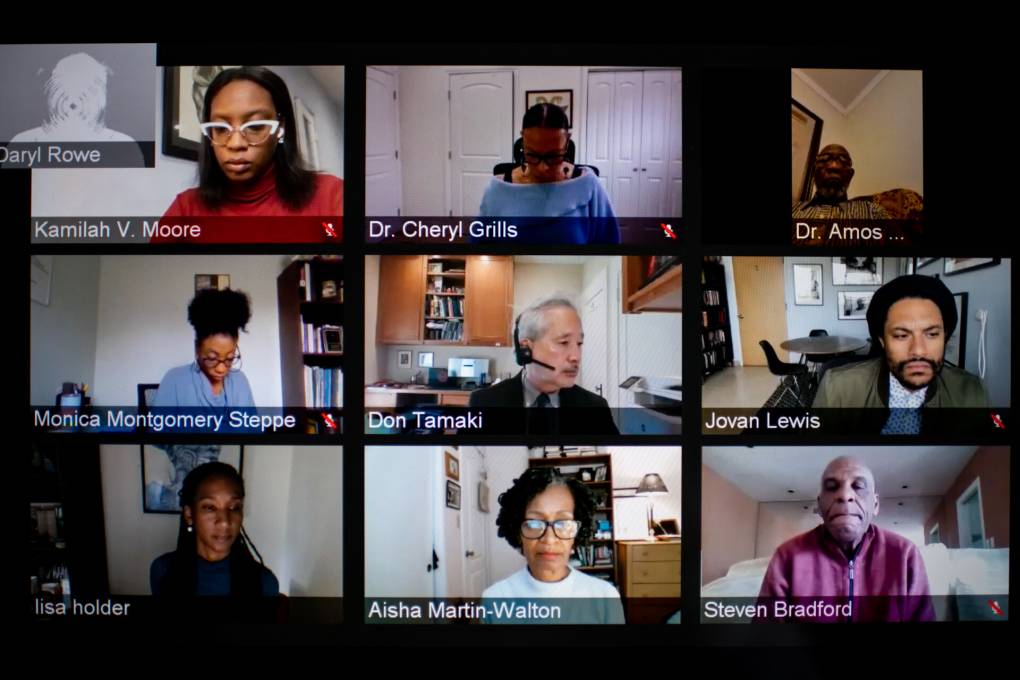
"caption": "The California Reparations Task Force members listen to public comment during a virtual meeting on Jan. 28, 2022.",
"description": null,
"title": "RS53402_001_KQED_CAReparatioinsTaskForce_01282022-qut",
"credit": "Beth LaBerge/KQED",
"status": "inherit",
"altTag": "Several people from California's Reparations Task Force in their virtual boxes during a meeting.",
"isLoading": false,
"fetchFailed": false
},
"news_11684847": {
"type": "attachments",
"id": "news_11684847",
"meta": {
"index": "attachments_1716263798",
"site": "news",
"id": "11684847",
"found": true
},
"parent": 11684836,
"imgSizes": {
"small": {
"file": "https://ww2.kqed.org/app/uploads/sites/10/2018/08/College-Avenue-Apartment-complex-520x347.jpg",
"width": 520,
"mimeType": "image/jpeg",
"height": 347
},
"thumbnail": {
"file": "https://ww2.kqed.org/app/uploads/sites/10/2018/08/College-Avenue-Apartment-complex-160x107.jpg",
"width": 160,
"mimeType": "image/jpeg",
"height": 107
},
"post-thumbnail": {
"file": "https://ww2.kqed.org/app/uploads/sites/10/2018/08/College-Avenue-Apartment-complex-672x372.jpg",
"width": 672,
"mimeType": "image/jpeg",
"height": 372
},
"xsmall": {
"file": "https://ww2.kqed.org/app/uploads/sites/10/2018/08/College-Avenue-Apartment-complex-375x250.jpg",
"width": 375,
"mimeType": "image/jpeg",
"height": 250
},
"kqedFullSize": {
"file": "https://ww2.kqed.org/app/uploads/sites/10/2018/08/College-Avenue-Apartment-complex.jpg",
"width": 720,
"height": 480
},
"guest-author-50": {
"file": "https://ww2.kqed.org/app/uploads/sites/10/2018/08/College-Avenue-Apartment-complex-50x50.jpg",
"width": 50,
"mimeType": "image/jpeg",
"height": 50
},
"guest-author-96": {
"file": "https://ww2.kqed.org/app/uploads/sites/10/2018/08/College-Avenue-Apartment-complex-96x96.jpg",
"width": 96,
"mimeType": "image/jpeg",
"height": 96
},
"guest-author-64": {
"file": "https://ww2.kqed.org/app/uploads/sites/10/2018/08/College-Avenue-Apartment-complex-64x64.jpg",
"width": 64,
"mimeType": "image/jpeg",
"height": 64
},
"detail": {
"file": "https://ww2.kqed.org/app/uploads/sites/10/2018/08/College-Avenue-Apartment-complex-150x150.jpg",
"width": 150,
"mimeType": "image/jpeg",
"height": 150
},
"guest-author-32": {
"file": "https://ww2.kqed.org/app/uploads/sites/10/2018/08/College-Avenue-Apartment-complex-32x32.jpg",
"width": 32,
"mimeType": "image/jpeg",
"height": 32
},
"guest-author-128": {
"file": "https://ww2.kqed.org/app/uploads/sites/10/2018/08/College-Avenue-Apartment-complex-128x128.jpg",
"width": 128,
"mimeType": "image/jpeg",
"height": 128
},
"xxsmall": {
"file": "https://ww2.kqed.org/app/uploads/sites/10/2018/08/College-Avenue-Apartment-complex-240x160.jpg",
"width": 240,
"mimeType": "image/jpeg",
"height": 160
}
},
"publishDate": 1533402192,
"modified": 1533402224,
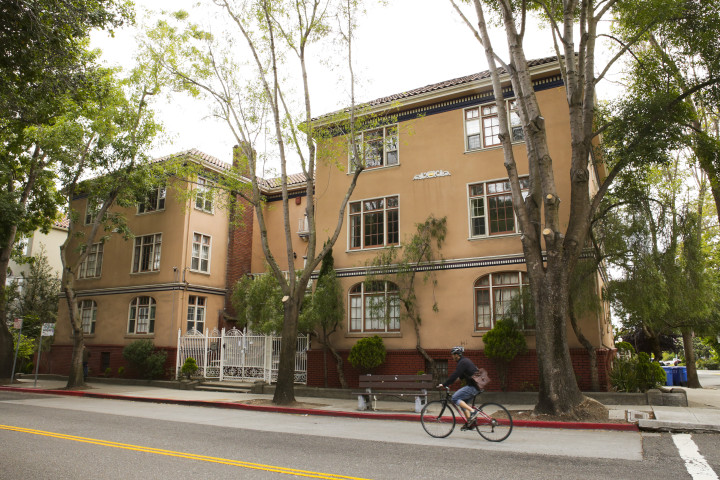
"caption": "A rent-controlled apartment complex at 3100 College Ave. in Berkeley.",
"description": "A rent-controlled apartment complex at 3100 College Ave. in Berkeley.",
"title": "College-Avenue-Apartment-complex",
"credit": "Melati Citrawireja/KQED",
"status": "inherit",
"isLoading": false,
"fetchFailed": false
},
"news_11898062": {
"type": "attachments",
"id": "news_11898062",
"meta": {
"index": "attachments_1716263798",
"site": "news",
"id": "11898062",
"found": true
},
"parent": 11897843,
"imgSizes": {
"twentyfourteen-full-width": {
"file": "https://ww2.kqed.org/app/uploads/sites/10/2021/12/Hayward_RussellCity_Mural-1038x576.jpg",
"width": 1038,
"mimeType": "image/jpeg",
"height": 576
},
"thumbnail": {
"file": "https://ww2.kqed.org/app/uploads/sites/10/2021/12/Hayward_RussellCity_Mural-160x80.jpg",
"width": 160,
"mimeType": "image/jpeg",
"height": 80
},
"post-thumbnail": {
"file": "https://ww2.kqed.org/app/uploads/sites/10/2021/12/Hayward_RussellCity_Mural-672x372.jpg",
"width": 672,
"mimeType": "image/jpeg",
"height": 372
},
"kqedFullSize": {
"file": "https://ww2.kqed.org/app/uploads/sites/10/2021/12/Hayward_RussellCity_Mural.jpg",
"width": 1920,
"height": 965
},
"large": {
"file": "https://ww2.kqed.org/app/uploads/sites/10/2021/12/Hayward_RussellCity_Mural-1020x513.jpg",
"width": 1020,
"mimeType": "image/jpeg",
"height": 513
},
"1536x1536": {
"file": "https://ww2.kqed.org/app/uploads/sites/10/2021/12/Hayward_RussellCity_Mural-1536x772.jpg",
"width": 1536,
"mimeType": "image/jpeg",
"height": 772
},
"medium": {
"file": "https://ww2.kqed.org/app/uploads/sites/10/2021/12/Hayward_RussellCity_Mural-800x402.jpg",
"width": 800,
"mimeType": "image/jpeg",
"height": 402
}
},
"publishDate": 1638572923,
"modified": 1638839511,
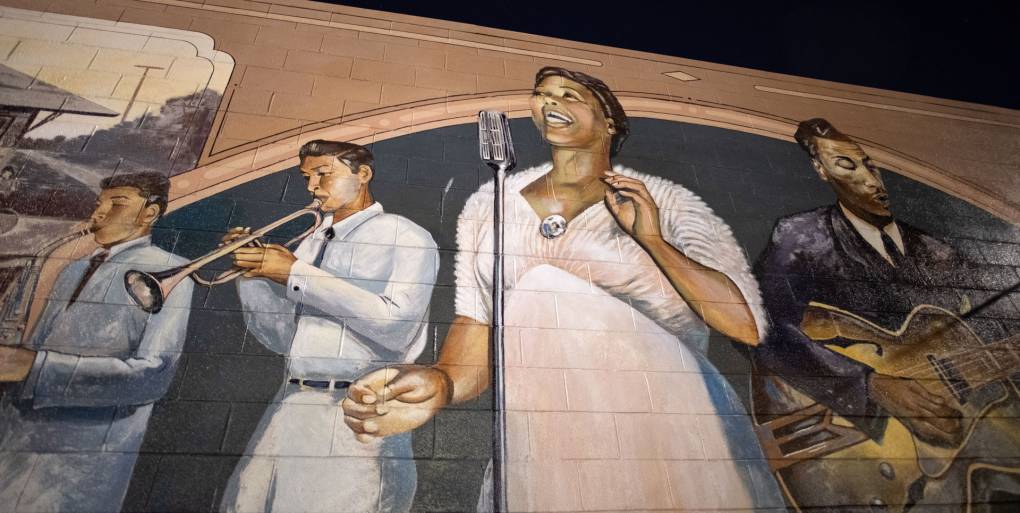
"caption": "A mural depicts scenes of Russell City, including blues singer Charlie Bell Sanders, at A Street and Maple Court in Hayward. Russell City's residents were forcibly relocated and the community bulldozed in 1963. Joshua Powell painted the mural, assisted by Wythe Bowart, Nicole Pierret and Brent McHugh.",
"description": "A mural depicts scenes of Russell City, including blues singer Charlie Bell Sanders, at A Street and Maple Court in Hayward. Russell City's residents were forcibly relocated and the community bulldozed in 1963. Joshua Powell painted the mural, assisted by Wythe Bowart, Nicole Pierret and Brent McHugh.",
"title": "Hayward_RussellCity_Mural",
"credit": "Beth LaBerge/KQED",
"status": "inherit",
"altTag": "large outdoor mural showing renowned blues singer and band",
"isLoading": false,
"fetchFailed": false
},
"news_11894775": {
"type": "attachments",
"id": "news_11894775",
"meta": {
"index": "attachments_1716263798",
"site": "news",
"id": "11894775",
"found": true
},
"parent": 11893704,
"imgSizes": {
"twentyfourteen-full-width": {
"file": "https://ww2.kqed.org/app/uploads/sites/10/2021/11/Taylor-headshot-1038x576.png",
"width": 1038,
"mimeType": "image/png",
"height": 576
},
"thumbnail": {
"file": "https://ww2.kqed.org/app/uploads/sites/10/2021/11/Taylor-headshot-160x90.png",
"width": 160,
"mimeType": "image/png",
"height": 90
},
"post-thumbnail": {
"file": "https://ww2.kqed.org/app/uploads/sites/10/2021/11/Taylor-headshot-672x372.png",
"width": 672,
"mimeType": "image/png",
"height": 372
},
"kqedFullSize": {
"file": "https://ww2.kqed.org/app/uploads/sites/10/2021/11/Taylor-headshot.png",
"width": 1920,
"height": 1080
},
"large": {
"file": "https://ww2.kqed.org/app/uploads/sites/10/2021/11/Taylor-headshot-1020x574.png",
"width": 1020,
"mimeType": "image/png",
"height": 574
},
"1536x1536": {
"file": "https://ww2.kqed.org/app/uploads/sites/10/2021/11/Taylor-headshot-1536x864.png",
"width": 1536,
"mimeType": "image/png",
"height": 864
},
"medium": {
"file": "https://ww2.kqed.org/app/uploads/sites/10/2021/11/Taylor-headshot-800x450.png",
"width": 800,
"mimeType": "image/png",
"height": 450
}
},
"publishDate": 1635882751,
"modified": 1636580368,
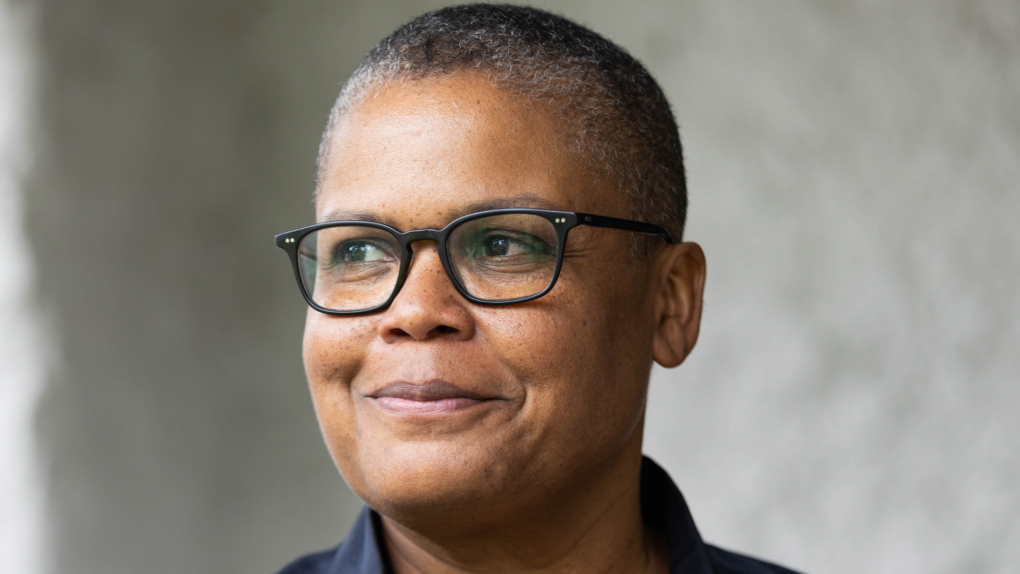
"caption": "Keeanga-Yamahtta Taylor is a 2021 MacArthur Fellow and author of \"Race for Profit: How Banks and the Real Estate Industry Undermined Black Homeownership.\" ",
"description": null,
"title": "Taylor headshot",
"credit": "John D. and Catherine T. MacArthur Foundation",
"status": "inherit",
"altTag": "A headshot shows Taylor, with very short salt-and-pepper hair, wearing black-framed glasses, smiling and looking in the right toward light.",
"isLoading": false,
"fetchFailed": false
},
"news_11892313": {
"type": "attachments",
"id": "news_11892313",
"meta": {
"index": "attachments_1716263798",
"site": "news",
"id": "11892313",
"found": true
},
"parent": 11892312,
"imgSizes": {
"twentyfourteen-full-width": {
"file": "https://ww2.kqed.org/app/uploads/sites/10/2021/10/RS47078_004_SanFrancisco_LowellBSURally_02052021-qut-1038x576.jpg",
"width": 1038,
"mimeType": "image/jpeg",
"height": 576
},
"thumbnail": {
"file": "https://ww2.kqed.org/app/uploads/sites/10/2021/10/RS47078_004_SanFrancisco_LowellBSURally_02052021-qut-160x107.jpg",
"width": 160,
"mimeType": "image/jpeg",
"height": 107
},
"post-thumbnail": {
"file": "https://ww2.kqed.org/app/uploads/sites/10/2021/10/RS47078_004_SanFrancisco_LowellBSURally_02052021-qut-672x372.jpg",
"width": 672,
"mimeType": "image/jpeg",
"height": 372
},
"kqedFullSize": {
"file": "https://ww2.kqed.org/app/uploads/sites/10/2021/10/RS47078_004_SanFrancisco_LowellBSURally_02052021-qut.jpg",
"width": 1920,
"height": 1278
},
"large": {
"file": "https://ww2.kqed.org/app/uploads/sites/10/2021/10/RS47078_004_SanFrancisco_LowellBSURally_02052021-qut-1020x679.jpg",
"width": 1020,
"mimeType": "image/jpeg",
"height": 679
},
"1536x1536": {
"file": "https://ww2.kqed.org/app/uploads/sites/10/2021/10/RS47078_004_SanFrancisco_LowellBSURally_02052021-qut-1536x1022.jpg",
"width": 1536,
"mimeType": "image/jpeg",
"height": 1022
},
"medium": {
"file": "https://ww2.kqed.org/app/uploads/sites/10/2021/10/RS47078_004_SanFrancisco_LowellBSURally_02052021-qut-800x533.jpg",
"width": 800,
"mimeType": "image/jpeg",
"height": 533
}
},
"publishDate": 1634246967,
"modified": 1634273147,
"caption": "Civil rights activist Reverend Dr. Amos C. Brown speaks during a rally at Lowell High School on Feb. 5, 2021. Brown is the vice-chair of the California Reparations Task Force.",
"description": null,
"title": "RS47078_004_SanFrancisco_LowellBSURally_02052021-qut",
"credit": "Beth LaBerge/KQED",
"status": "inherit",
"altTag": null,
"isLoading": false,
"fetchFailed": false
},
"news_11880226": {
"type": "attachments",
"id": "news_11880226",
"meta": {
"index": "attachments_1716263798",
"site": "news",
"id": "11880226",
"found": true
},
"parent": 11879641,
"imgSizes": {
"twentyfourteen-full-width": {
"file": "https://ww2.kqed.org/app/uploads/sites/10/2021/07/trucks-1038x576.jpg",
"width": 1038,
"mimeType": "image/jpeg",
"height": 576
},
"thumbnail": {
"file": "https://ww2.kqed.org/app/uploads/sites/10/2021/07/trucks-160x90.jpg",
"width": 160,
"mimeType": "image/jpeg",
"height": 90
},
"post-thumbnail": {
"file": "https://ww2.kqed.org/app/uploads/sites/10/2021/07/trucks-672x372.jpg",
"width": 672,
"mimeType": "image/jpeg",
"height": 372
},
"kqedFullSize": {
"file": "https://ww2.kqed.org/app/uploads/sites/10/2021/07/trucks.jpg",
"width": 1920,
"height": 1080
},
"large": {
"file": "https://ww2.kqed.org/app/uploads/sites/10/2021/07/trucks-1020x574.jpg",
"width": 1020,
"mimeType": "image/jpeg",
"height": 574
},
"1536x1536": {
"file": "https://ww2.kqed.org/app/uploads/sites/10/2021/07/trucks-1536x864.jpg",
"width": 1536,
"mimeType": "image/jpeg",
"height": 864
},
"medium": {
"file": "https://ww2.kqed.org/app/uploads/sites/10/2021/07/trucks-800x450.jpg",
"width": 800,
"mimeType": "image/jpeg",
"height": 450
}
},
"publishDate": 1625194429,
"modified": 1625194540,
"caption": "A big rig truck on the 880 freeway. Big trucks like this one are banned on the I-580 freeway.",
"description": null,
"title": "trucks",
"credit": "Teodros Hailye/KQED",
"status": "inherit",
"altTag": null,
"isLoading": false,
"fetchFailed": false
},
"news_11878862": {
"type": "attachments",
"id": "news_11878862",
"meta": {
"index": "attachments_1716263798",
"site": "news",
"id": "11878862",
"found": true
},
"parent": 11878403,
"imgSizes": {
"twentyfourteen-full-width": {
"file": "https://ww2.kqed.org/app/uploads/sites/10/2021/06/antioch-take-two-1180x664-1-1038x576.jpeg",
"width": 1038,
"mimeType": "image/jpeg",
"height": 576
},
"thumbnail": {
"file": "https://ww2.kqed.org/app/uploads/sites/10/2021/06/antioch-take-two-1180x664-1-160x90.jpeg",
"width": 160,
"mimeType": "image/jpeg",
"height": 90
},
"post-thumbnail": {
"file": "https://ww2.kqed.org/app/uploads/sites/10/2021/06/antioch-take-two-1180x664-1-672x372.jpeg",
"width": 672,
"mimeType": "image/jpeg",
"height": 372
},
"kqedFullSize": {
"file": "https://ww2.kqed.org/app/uploads/sites/10/2021/06/antioch-take-two-1180x664-1.jpeg",
"width": 1180,
"height": 664
},
"large": {
"file": "https://ww2.kqed.org/app/uploads/sites/10/2021/06/antioch-take-two-1180x664-1-1020x574.jpeg",
"width": 1020,
"mimeType": "image/jpeg",
"height": 574
},
"medium": {
"file": "https://ww2.kqed.org/app/uploads/sites/10/2021/06/antioch-take-two-1180x664-1-800x450.jpeg",
"width": 800,
"mimeType": "image/jpeg",
"height": 450
}
},
"publishDate": 1624323124,
"modified": 1650548798,
"caption": null,
"description": "A housing subdivision in Antioch, an East Bay suburb that has experienced dramatic demographic and socioeconomic changes in recent decades. ",
"title": "antioch-take-two-1180x664",
"credit": "Deborah Svoboda/KQED",
"status": "inherit",
"altTag": null,
"isLoading": false,
"fetchFailed": false
},
"news_11876271": {
"type": "attachments",
"id": "news_11876271",
"meta": {
"index": "attachments_1716263798",
"site": "news",
"id": "11876271",
"found": true
},
"parent": 11876194,
"imgSizes": {
"twentyfourteen-full-width": {
"file": "https://ww2.kqed.org/app/uploads/sites/10/2021/06/1920_GettyImages-941502582-1038x576.jpg",
"width": 1038,
"mimeType": "image/jpeg",
"height": 576
},
"thumbnail": {
"file": "https://ww2.kqed.org/app/uploads/sites/10/2021/06/1920_GettyImages-941502582-160x90.jpg",
"width": 160,
"mimeType": "image/jpeg",
"height": 90
},
"post-thumbnail": {
"file": "https://ww2.kqed.org/app/uploads/sites/10/2021/06/1920_GettyImages-941502582-672x372.jpg",
"width": 672,
"mimeType": "image/jpeg",
"height": 372
},
"kqedFullSize": {
"file": "https://ww2.kqed.org/app/uploads/sites/10/2021/06/1920_GettyImages-941502582.jpg",
"width": 1920,
"height": 1080
},
"large": {
"file": "https://ww2.kqed.org/app/uploads/sites/10/2021/06/1920_GettyImages-941502582-1020x574.jpg",
"width": 1020,
"mimeType": "image/jpeg",
"height": 574
},
"1536x1536": {
"file": "https://ww2.kqed.org/app/uploads/sites/10/2021/06/1920_GettyImages-941502582-1536x864.jpg",
"width": 1536,
"mimeType": "image/jpeg",
"height": 864
},
"medium": {
"file": "https://ww2.kqed.org/app/uploads/sites/10/2021/06/1920_GettyImages-941502582-800x450.jpg",
"width": 800,
"mimeType": "image/jpeg",
"height": 450
}
},
"publishDate": 1622592363,
"modified": 1622596255,
"caption": "‘Your task is to determine the depth of the harm, and the ways in which we are to repair that harm,’ said Shirley Weber, whose parents were sharecroppers forced to leave the South. Weber, who authored the law and is now California’s Secretary of State appears in this file photo from when she was a State Assemblymember (D-San Diego) at news conference on April 3, 2018 in Sacramento, California. ",
"description": null,
"title": "1920_GettyImages-941502582",
"credit": "Justin Sullivan/Getty Images",
"status": "inherit",
"altTag": null,
"isLoading": false,
"fetchFailed": false
},
"news_11841803": {
"type": "attachments",
"id": "news_11841803",
"meta": {
"index": "attachments_1716263798",
"site": "news",
"id": "11841803",
"found": true
},
"title": "RepNowMural",
"publishDate": 1602287066,
"status": "inherit",
"parent": 11841801,
"modified": 1750185613,
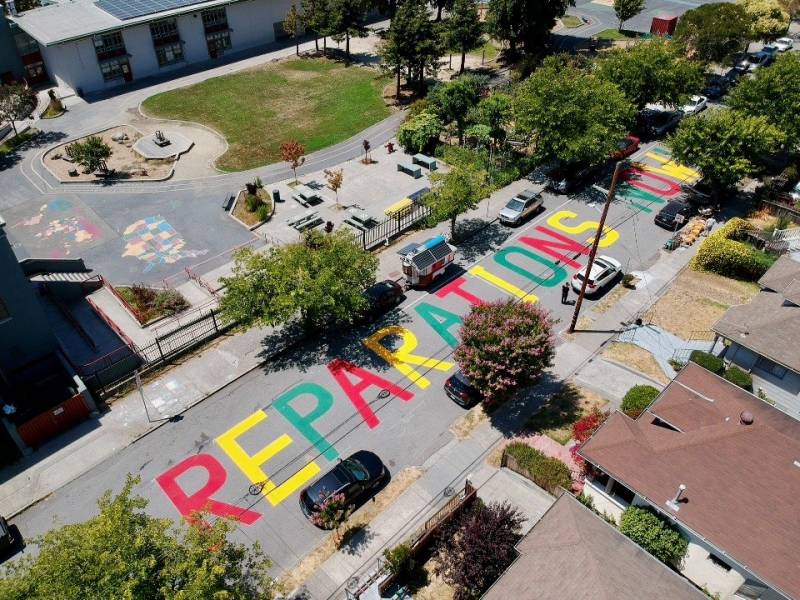
"caption": "A street mural on Ellis Street in South Berkeley spells out \"Reparations Now!\"",
"credit": "Courtesy of Todd Matthews",
"altTag": "A street mural on Ellis Street in South Berkeley spells out 'Reparations Now!'",
"description": null,
"imgSizes": {
"medium": {
"file": "https://cdn.kqed.org/wp-content/uploads/sites/10/2020/10/RepNowMural-800x600.jpg",
"width": 800,
"height": 600,
"mimeType": "image/jpeg"
},
"thumbnail": {
"file": "https://cdn.kqed.org/wp-content/uploads/sites/10/2020/10/RepNowMural-160x120.jpg",
"width": 160,
"height": 120,
"mimeType": "image/jpeg"
},
"post-thumbnail": {
"file": "https://cdn.kqed.org/wp-content/uploads/sites/10/2020/10/RepNowMural-672x372.jpg",
"width": 672,
"height": 372,
"mimeType": "image/jpeg"
},
"twentyfourteen-full-width": {
"file": "https://cdn.kqed.org/wp-content/uploads/sites/10/2020/10/RepNowMural-960x576.jpg",
"width": 960,
"height": 576,
"mimeType": "image/jpeg"
},
"apple_news_ca_landscape_4_7": {
"file": "https://cdn.kqed.org/wp-content/uploads/sites/10/2020/10/RepNowMural-632x474.jpg",
"width": 632,
"height": 474,
"mimeType": "image/jpeg"
},
"apple_news_ca_landscape_4_0": {
"file": "https://cdn.kqed.org/wp-content/uploads/sites/10/2020/10/RepNowMural-536x402.jpg",
"width": 536,
"height": 402,
"mimeType": "image/jpeg"
},
"apple_news_ca_portrait_9_7": {
"file": "https://cdn.kqed.org/wp-content/uploads/sites/10/2020/10/RepNowMural-840x720.jpg",
"width": 840,
"height": 720,
"mimeType": "image/jpeg"
},
"apple_news_ca_portrait_5_5": {
"file": "https://cdn.kqed.org/wp-content/uploads/sites/10/2020/10/RepNowMural-687x720.jpg",
"width": 687,
"height": 720,
"mimeType": "image/jpeg"
},
"apple_news_ca_portrait_4_7": {
"file": "https://cdn.kqed.org/wp-content/uploads/sites/10/2020/10/RepNowMural-414x552.jpg",
"width": 414,
"height": 552,
"mimeType": "image/jpeg"
},
"apple_news_ca_portrait_4_0": {
"file": "https://cdn.kqed.org/wp-content/uploads/sites/10/2020/10/RepNowMural-354x472.jpg",
"width": 354,
"height": 472,
"mimeType": "image/jpeg"
},
"apple_news_ca_square_5_5": {
"file": "https://cdn.kqed.org/wp-content/uploads/sites/10/2020/10/RepNowMural-912x720.jpg",
"width": 912,
"height": 720,
"mimeType": "image/jpeg"
},
"apple_news_ca_square_4_7": {
"file": "https://cdn.kqed.org/wp-content/uploads/sites/10/2020/10/RepNowMural-550x550.jpg",
"width": 550,
"height": 550,
"mimeType": "image/jpeg"
},
"apple_news_ca_square_4_0": {
"file": "https://cdn.kqed.org/wp-content/uploads/sites/10/2020/10/RepNowMural-470x470.jpg",
"width": 470,
"height": 470,
"mimeType": "image/jpeg"
},
"kqedFullSize": {
"file": "https://cdn.kqed.org/wp-content/uploads/sites/10/2020/10/RepNowMural.jpg",
"width": 960,
"height": 720
}
},
"isLoading": false,
"fetchFailed": false
},
"news_11840549": {
"type": "attachments",
"id": "news_11840549",
"meta": {
"index": "attachments_1716263798",
"site": "news",
"id": "11840549",
"found": true
},
"parent": 11840548,
"imgSizes": {
"apple_news_ca_square_4_0": {
"file": "https://ww2.kqed.org/app/uploads/sites/10/2020/10/ClaremontCourtGates_03-1-470x359.jpg",
"width": 470,
"mimeType": "image/jpeg",
"height": 359
},
"thumbnail": {
"file": "https://ww2.kqed.org/app/uploads/sites/10/2020/10/ClaremontCourtGates_03-1-160x99.jpg",
"width": 160,
"mimeType": "image/jpeg",
"height": 99
},
"kqedFullSize": {
"file": "https://ww2.kqed.org/app/uploads/sites/10/2020/10/ClaremontCourtGates_03-1.jpg",
"width": 580,
"height": 359
},
"apple_news_ca_portrait_4_7": {
"file": "https://ww2.kqed.org/app/uploads/sites/10/2020/10/ClaremontCourtGates_03-1-414x359.jpg",
"width": 414,
"mimeType": "image/jpeg",
"height": 359
},
"apple_news_ca_square_4_7": {
"file": "https://ww2.kqed.org/app/uploads/sites/10/2020/10/ClaremontCourtGates_03-1-550x359.jpg",
"width": 550,
"mimeType": "image/jpeg",
"height": 359
},
"apple_news_ca_landscape_4_0": {
"file": "https://ww2.kqed.org/app/uploads/sites/10/2020/10/ClaremontCourtGates_03-1-536x359.jpg",
"width": 536,
"mimeType": "image/jpeg",
"height": 359
},
"apple_news_ca_portrait_4_0": {
"file": "https://ww2.kqed.org/app/uploads/sites/10/2020/10/ClaremontCourtGates_03-1-354x359.jpg",
"width": 354,
"mimeType": "image/jpeg",
"height": 359
}
},
"publishDate": 1601574663,
"modified": 1602022234,
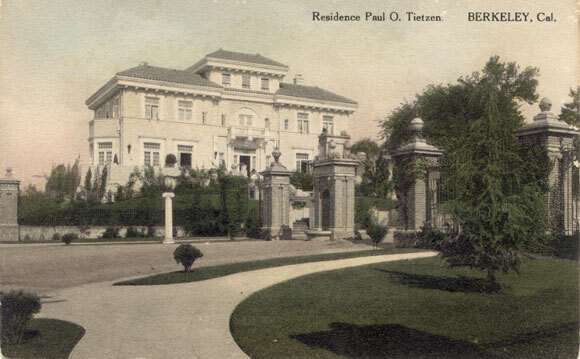
"caption": "A postcard depicting the gates to Claremont Court in Berkeley. The gates were built to signify that Claremont was an exclusive residential community. And it came with a big caveat: it was a neighborhood for whites only. ",
"description": "A postcard depicting the gates to Claremont Court in Berkeley. The gates were built to signify that Claremont was an exclusive residential community. And it came with a big caveat: it was a neighborhood for whites only. ",
"title": "A postcard depicting the gates to Claremont Court in Berkeley. The gates were built to signify that Claremont was an exclusive residential community. And it came with a big caveat: it was a neighborhood for whites only.",
"credit": null,
"status": "inherit",
"isLoading": false,
"fetchFailed": false
}
},
"audioPlayerReducer": {
"postId": "stream_live",
"isPaused": true,
"isPlaying": false,
"pfsActive": false,
"pledgeModalIsOpen": true,
"playerDrawerIsOpen": false,
"liveAudioPlayStartedAt": 0,
"liveAudioPlayContext": ""
},
"authorsReducer": {
"kqed": {
"type": "authors",
"id": "236",
"meta": {
"index": "authors_1716337520",
"id": "236",
"found": true
},
"name": "KQED News Staff",
"firstName": "KQED News Staff",
"lastName": null,
"slug": "kqed",
"email": "faq@kqed.org",
"display_author_email": false,
"staff_mastheads": [],
"title": null,
"bio": null,
"avatar": "https://secure.gravatar.com/avatar/ef0e801a68c4c54afa9180db14084167?s=600&d=blank&r=g",
"twitter": null,
"facebook": null,
"instagram": null,
"linkedin": null,
"sites": [
{
"site": "arts",
"roles": [
"contributor"
]
},
{
"site": "news",
"roles": [
"editor"
]
},
{
"site": "futureofyou",
"roles": [
"author"
]
}
],
"headData": {
"title": "KQED News Staff | KQED",
"description": null,
"ogImgSrc": "https://secure.gravatar.com/avatar/ef0e801a68c4c54afa9180db14084167?s=600&d=blank&r=g",
"twImgSrc": "https://secure.gravatar.com/avatar/ef0e801a68c4c54afa9180db14084167?s=600&d=blank&r=g"
},
"isLoading": false,
"link": "/author/kqed"
},
"matthewgreen": {
"type": "authors",
"id": "1263",
"meta": {
"index": "authors_1716337520",
"id": "1263",
"found": true
},
"name": "Matthew Green",
"firstName": "Matthew",
"lastName": "Green",
"slug": "matthewgreen",
"email": "mgreen@kqed.org",
"display_author_email": false,
"staff_mastheads": [],
"title": "KQED Editor/Reporter",
"bio": "Matthew Green is a digital media producer for KQED News. He previously produced \u003ca href=\"http://www.kqed.org/lowdown\">The Lowdown\u003c/a>, KQED’s multimedia news education blog. Matthew's written for numerous Bay Area publications, including the Oakland Tribune and San Francisco Chronicle. He also taught journalism classes at Fremont High School in East Oakland.\r\n\r\nEmail: mgreen@kqed.org; Twitter: @MGreenKQED",
"avatar": "https://secure.gravatar.com/avatar/3bf498d1267ca02c8494f33d8cfc575e?s=600&d=blank&r=g",
"twitter": "MGreenKQED",
"facebook": null,
"instagram": null,
"linkedin": null,
"sites": [
{
"site": "news",
"roles": []
},
{
"site": "lowdown",
"roles": []
},
{
"site": "science",
"roles": []
},
{
"site": "education",
"roles": []
},
{
"site": "quest",
"roles": []
},
{
"site": "liveblog",
"roles": []
}
],
"headData": {
"title": "Matthew Green | KQED",
"description": "KQED Editor/Reporter",
"ogImgSrc": "https://secure.gravatar.com/avatar/3bf498d1267ca02c8494f33d8cfc575e?s=600&d=blank&r=g",
"twImgSrc": "https://secure.gravatar.com/avatar/3bf498d1267ca02c8494f33d8cfc575e?s=600&d=blank&r=g"
},
"isLoading": false,
"link": "/author/matthewgreen"
},
"lklivans": {
"type": "authors",
"id": "8648",
"meta": {
"index": "authors_1716337520",
"id": "8648",
"found": true
},
"name": "Laura Klivans",
"firstName": "Laura",
"lastName": "Klivans",
"slug": "lklivans",
"email": "lklivans@kqed.org",
"display_author_email": true,
"staff_mastheads": [
"news",
"science"
],
"title": "Reporter",
"bio": "Laura Klivans is an award-winning science reporter for KQED News, where she covers climate change with an eye on both groundbreaking progress and gaps in action. She is the former host of KQED's blockbuster video series about tiny, amazing animals, \u003cem>Deep Look\u003c/em>. Her work reaches national audiences through NPR, \u003cem>Here & Now, \u003c/em>PRI, and other major outlets. \r\n\r\nLaura’s won five Northern California Area Emmy Awards for Deep Look and First Place in the Greater Bay Area Journalism Awards for a podcast exploring how one Oakland neighborhood teamed up to reduce planet-heating pollution.\r\n\r\nBeyond her reporting, she hosts and moderates events. In the past, she taught audio storytelling at the UC Berkeley Graduate School of Journalism, led international education programs, worked with immigrants and refugees along the Thai-Burmese border, taught high schoolers sex ed, and was an actress. \r\n\r\nShe's a former UC Berkeley Human Rights Fellow, USC Center for Health Journalism's California Fellow and Coro Fellow in Public Affairs. Laura has a master’s in journalism from UC Berkeley, a master’s in education from Harvard, and an undergraduate degree from Northwestern University.\r\n\r\nShe loves trying to riddle the meaning out of vanity license plates.",
"avatar": "https://secure.gravatar.com/avatar/2d2ecd1550a494cc10ad4a503406965585902124739e775a9b3817eebf1d88be?s=600&d=blank&r=g",
"twitter": "lauraklivans",
"bluesky": null,
"facebook": null,
"instagram": null,
"linkedin": null,
"sites": [
{
"site": "news",
"roles": [
"editor"
]
},
{
"site": "stateofhealth",
"roles": [
"contributor",
"editor"
]
},
{
"site": "science",
"roles": [
"editor"
]
},
{
"site": "forum",
"roles": [
"editor"
]
}
],
"headData": {
"title": "Laura Klivans | KQED",
"description": "Reporter",
"ogImgSrc": "https://secure.gravatar.com/avatar/2d2ecd1550a494cc10ad4a503406965585902124739e775a9b3817eebf1d88be?s=600&d=blank&r=g",
"twImgSrc": "https://secure.gravatar.com/avatar/2d2ecd1550a494cc10ad4a503406965585902124739e775a9b3817eebf1d88be?s=600&d=blank&r=g"
},
"isLoading": false,
"link": "/author/lklivans"
},
"ecruzguevarra": {
"type": "authors",
"id": "8654",
"meta": {
"index": "authors_1716337520",
"id": "8654",
"found": true
},
"name": "Ericka Cruz Guevarra",
"firstName": "Ericka",
"lastName": "Cruz Guevarra",
"slug": "ecruzguevarra",
"email": "ecruzguevarra@kqed.org",
"display_author_email": true,
"staff_mastheads": [
"news"
],
"title": "Producer, The Bay Podcast",
"bio": "Ericka Cruz Guevarra is host of \u003ca href=\"https://www.kqed.org/podcasts/thebay\">\u003cem>The Bay\u003c/em>\u003c/a> podcast at KQED. Before host, she was the show’s producer. Her work in that capacity includes a three-part reported series on policing in Vallejo, which won a 2020 excellence in journalism award from the Society of Professional Journalists. Ericka has worked as a breaking news reporter at Oregon Public Broadcasting, helped produce the Code Switch podcast, and was KQED’s inaugural Raul Ramirez Diversity Fund intern. She’s also an alumna of NPR’s Next Generation Radio program. Send her an email if you have strong feelings about whether Fairfield and Suisun City are the Bay. Ericka is represented by SAG-AFTRA.",
"avatar": "https://secure.gravatar.com/avatar/accefc1de4bafc7e234b69bcb9b6f6536c130fd84709bc3069ef11a78787e1bb?s=600&d=blank&r=g",
"twitter": "NotoriousECG",
"bluesky": null,
"facebook": null,
"instagram": null,
"linkedin": null,
"sites": [
{
"site": "arts",
"roles": [
"subscriber"
]
},
{
"site": "news",
"roles": [
"editor",
"manage_categories"
]
},
{
"site": "futureofyou",
"roles": [
"subscriber"
]
},
{
"site": "stateofhealth",
"roles": [
"subscriber"
]
},
{
"site": "science",
"roles": [
"editor"
]
},
{
"site": "forum",
"roles": [
"subscriber"
]
}
],
"headData": {
"title": "Ericka Cruz Guevarra | KQED",
"description": "Producer, The Bay Podcast",
"ogImgSrc": "https://secure.gravatar.com/avatar/accefc1de4bafc7e234b69bcb9b6f6536c130fd84709bc3069ef11a78787e1bb?s=600&d=blank&r=g",
"twImgSrc": "https://secure.gravatar.com/avatar/accefc1de4bafc7e234b69bcb9b6f6536c130fd84709bc3069ef11a78787e1bb?s=600&d=blank&r=g"
},
"isLoading": false,
"link": "/author/ecruzguevarra"
},
"bwatt": {
"type": "authors",
"id": "11238",
"meta": {
"index": "authors_1716337520",
"id": "11238",
"found": true
},
"name": "Brian Watt",
"firstName": "Brian",
"lastName": "Watt",
"slug": "bwatt",
"email": "bwatt@KQED.org",
"display_author_email": false,
"staff_mastheads": [
"news"
],
"title": "Morning News Anchor",
"bio": "Brian Watt is KQED's morning radio news anchor. He joined the KQED News team in April of 2016. Prior to that, he worked as a Reporter for KPCC in Los Angeles and a producer at \u003cem>Marketplace.\u003c/em>\r\n\r\nDuring eight years at KPCC, Brian covered business and economics, and his work won several awards. In 2008, he won the Los Angeles Press Club’s first-place award for Business and Financial Reporting, Broadcast. He’s also received honorable mention and been first runner up for the Press Club’s Radio Journalist of the Year. He won two Golden Mike awards from the Radio and TV News Association of Southern California.\r\n\r\nBrian holds degrees in theater from Yale University and the Sorbonne, and has worked as an actor in France, Italy, Brazil, Hungary and . . . Hollywood. He appeared in a few television shows, including \u003cem>The West Wing, Judging Amy\u003c/em> and \u003cem>The District.\u003c/em>\r\n\r\nEmail: bwatt@KQED.org Twitter: @RadioBWatt",
"avatar": "https://secure.gravatar.com/avatar/55393ff57ed34e2be773ba4789dd6a19?s=600&d=blank&r=g",
"twitter": "@RadioBWatt",
"facebook": null,
"instagram": null,
"linkedin": null,
"sites": [
{
"site": "arts",
"roles": [
"contributor"
]
},
{
"site": "news",
"roles": [
"editor"
]
}
],
"headData": {
"title": "Brian Watt | KQED",
"description": "Morning News Anchor",
"ogImgSrc": "https://secure.gravatar.com/avatar/55393ff57ed34e2be773ba4789dd6a19?s=600&d=blank&r=g",
"twImgSrc": "https://secure.gravatar.com/avatar/55393ff57ed34e2be773ba4789dd6a19?s=600&d=blank&r=g"
},
"isLoading": false,
"link": "/author/bwatt"
},
"katewolffe": {
"type": "authors",
"id": "11523",
"meta": {
"index": "authors_1716337520",
"id": "11523",
"found": true
},
"name": "Kate Wolffe",
"firstName": "Kate",
"lastName": "Wolffe",
"slug": "katewolffe",
"email": "kwolffe@kqed.org",
"display_author_email": true,
"staff_mastheads": [
"news"
],
"title": "KQED Reporter + Weekend Host",
"bio": "Kate Wolffe reports on local Bay Area happenings for KQED, and hosts the news on weekend afternoons. She joined KQED in 2018 as an intern on the Forum team, before moving to cover topics ranging from politics to criminal justice to homelessness. A Bay Area native and UC Berkeley graduate, Kate loves to discover new corners of the region.",
"avatar": "https://secure.gravatar.com/avatar/22455f14db824a03ee252f73052fe939?s=600&d=blank&r=g",
"twitter": "katewolffe",
"facebook": null,
"instagram": null,
"linkedin": null,
"sites": [
{
"site": "arts",
"roles": [
"editor"
]
},
{
"site": "news",
"roles": [
"author",
"edit_others_posts"
]
},
{
"site": "forum",
"roles": [
"editor"
]
}
],
"headData": {
"title": "Kate Wolffe | KQED",
"description": "KQED Reporter + Weekend Host",
"ogImgSrc": "https://secure.gravatar.com/avatar/22455f14db824a03ee252f73052fe939?s=600&d=blank&r=g",
"twImgSrc": "https://secure.gravatar.com/avatar/22455f14db824a03ee252f73052fe939?s=600&d=blank&r=g"
},
"isLoading": false,
"link": "/author/katewolffe"
},
"lsarah": {
"type": "authors",
"id": "11626",
"meta": {
"index": "authors_1716337520",
"id": "11626",
"found": true
},
"name": "Lakshmi Sarah",
"firstName": "Lakshmi",
"lastName": "Sarah",
"slug": "lsarah",
"email": "lsarah@kqed.org",
"display_author_email": false,
"staff_mastheads": [],
"title": "Digital Producer",
"bio": "Lakshmi Sarah is an educator, author and journalist with a focus on innovative storytelling. She has worked with newspapers, radio and magazines from Ahmedabad, India to Los Angeles, California. She has written and produced for Die Zeit, Global Voices, AJ+, KQED, Fusion Media Group and the New York Times.",
"avatar": "https://secure.gravatar.com/avatar/652dcaecd8b28826fc17a8b2d6bb4e93?s=600&d=blank&r=g",
"twitter": "lakitalki",
"facebook": null,
"instagram": "https://www.instagram.com/laki.talki/",
"linkedin": "https://www.linkedin.com/in/lakisarah/",
"sites": [
{
"site": "arts",
"roles": []
},
{
"site": "news",
"roles": []
},
{
"site": "bayareabites",
"roles": []
},
{
"site": "science",
"roles": []
}
],
"headData": {
"title": "Lakshmi Sarah | KQED",
"description": "Digital Producer",
"ogImgSrc": "https://secure.gravatar.com/avatar/652dcaecd8b28826fc17a8b2d6bb4e93?s=600&d=blank&r=g",
"twImgSrc": "https://secure.gravatar.com/avatar/652dcaecd8b28826fc17a8b2d6bb4e93?s=600&d=blank&r=g"
},
"isLoading": false,
"link": "/author/lsarah"
},
"amontecillo": {
"type": "authors",
"id": "11649",
"meta": {
"index": "authors_1716337520",
"id": "11649",
"found": true
},
"name": "Alan Montecillo",
"firstName": "Alan",
"lastName": "Montecillo",
"slug": "amontecillo",
"email": "amontecillo@kqed.org",
"display_author_email": false,
"staff_mastheads": [
"news"
],
"title": "KQED Contributor",
"bio": "Alan Montecillo is the senior editor of \u003cem>\u003ca href=\"http://kqed.org/thebay\">The Bay\u003c/a>, \u003c/em> KQED's local news podcast. Before moving to the Bay Area, he worked as a senior talk show producer for WILL in Champaign-Urbana, Illinois and at Oregon Public Broadcasting in Portland, Oregon. He has won journalism awards from the Society of Professional Journalists Northern California, the Public Media Journalists Association, The Signal Awards, and has also received a regional Edward R. Murrow award. Alan is a Filipino American from Hong Kong and a graduate of Reed College.",
"avatar": "https://secure.gravatar.com/avatar/268f53a2066899ea9efdd8a5900218b17c822d9862cbc9326cccec53ef41d349?s=600&d=blank&r=g",
"twitter": "alanmontecillo",
"bluesky": null,
"facebook": null,
"instagram": null,
"linkedin": null,
"sites": [
{
"site": "",
"roles": [
"editor"
]
},
{
"site": "news",
"roles": [
"editor",
"manage_categories"
]
}
],
"headData": {
"title": "Alan Montecillo | KQED",
"description": "KQED Contributor",
"ogImgSrc": "https://secure.gravatar.com/avatar/268f53a2066899ea9efdd8a5900218b17c822d9862cbc9326cccec53ef41d349?s=600&d=blank&r=g",
"twImgSrc": "https://secure.gravatar.com/avatar/268f53a2066899ea9efdd8a5900218b17c822d9862cbc9326cccec53ef41d349?s=600&d=blank&r=g"
},
"isLoading": false,
"link": "/author/amontecillo"
},
"msolomon": {
"type": "authors",
"id": "11651",
"meta": {
"index": "authors_1716337520",
"id": "11651",
"found": true
},
"name": "Molly Solomon",
"firstName": "Molly",
"lastName": "Solomon",
"slug": "msolomon",
"email": "msolomon@KQED.org",
"display_author_email": false,
"staff_mastheads": [
"news"
],
"title": "Senior Editor",
"bio": "Molly Solomon is the senior editor of KQED's California Politics and Government Desk. Previously, she was the station's editor-at-large, with a focus on editing early childhood education, politics, and criminal justice. Before that, she managed and edited statewide election coverage for The California Newsroom, a collaboration of local public radio stations, CalMatters and NPR. Molly joined KQED in 2019 to launch the station’s housing affordability desk, where she reported on homelessness, evictions and is the co-host of KQED’s housing podcast, SOLD OUT: Rethinking Housing in America. Before that, she was the Southwest Washington Bureau Chief for Oregon Public Broadcasting and a reporter at Hawaii Public Radio. Her stories have aired on NPR’s \u003cem>Morning Edition\u003c/em>, \u003cem>All Things Considered\u003c/em>, \u003cem>Here & Now\u003c/em>, \u003cem>Science Friday\u003c/em> and \u003cem>Marketplace\u003c/em>. Molly's award-winning reporting has been honored by the Best of the West, Edward R. Murrow awards, Society of Professional Journalists, National Headliner Awards, and the Asian American Journalists Association. Born and raised in Berkeley, Molly is a big fan of burritos and her scruffy terrier, Ollie.",
"avatar": "https://secure.gravatar.com/avatar/9ad9794616923d81c9a79897161545bd?s=600&d=blank&r=g",
"twitter": "solomonout",
"facebook": null,
"instagram": null,
"linkedin": null,
"sites": [
{
"site": "news",
"roles": [
"editor"
]
},
{
"site": "science",
"roles": [
"editor"
]
}
],
"headData": {
"title": "Molly Solomon | KQED",
"description": "Senior Editor",
"ogImgSrc": "https://secure.gravatar.com/avatar/9ad9794616923d81c9a79897161545bd?s=600&d=blank&r=g",
"twImgSrc": "https://secure.gravatar.com/avatar/9ad9794616923d81c9a79897161545bd?s=600&d=blank&r=g"
},
"isLoading": false,
"link": "/author/msolomon"
},
"ebaldassari": {
"type": "authors",
"id": "11652",
"meta": {
"index": "authors_1716337520",
"id": "11652",
"found": true
},
"name": "Erin Baldassari",
"firstName": "Erin",
"lastName": "Baldassari",
"slug": "ebaldassari",
"email": "ebaldassari@KQED.org",
"display_author_email": true,
"staff_mastheads": [
"news"
],
"title": "Staff Writer",
"bio": "Erin Baldassari covers housing for KQED. She's a former print journalist and most recently worked as the transportation reporter for the \u003cem>Mercury News\u003c/em> and \u003cem>East Bay Times. \u003c/em>There, she focused on how the Bay Area’s housing shortage has changed the way people move around the region. She also served on the \u003cem>East Bay Times\u003c/em>’ 2017 Pulitzer Prize-winning team for coverage of the Ghost Ship Fire in Oakland. Prior to that, Erin worked as a breaking news and general assignment reporter for a variety of outlets in the Bay Area and the greater Boston area. A Tufts University alumna, Erin grew up in the foothills of the Sierra Nevada mountains and in Sonoma County. She is a life-long KQED listener.",
"avatar": "https://secure.gravatar.com/avatar/5e95cad64a8ca08288082212e199d2b0cbeb4fd8e8ef5339395f361032bbe005?s=600&d=blank&r=g",
"twitter": "e_baldi",
"bluesky": null,
"facebook": null,
"instagram": null,
"linkedin": null,
"sites": [
{
"site": "news",
"roles": [
"edit_others_posts",
"editor"
]
},
{
"site": "science",
"roles": [
"editor"
]
},
{
"site": "liveblog",
"roles": [
"editor"
]
}
],
"headData": {
"title": "Erin Baldassari | KQED",
"description": "Staff Writer",
"ogImgSrc": "https://secure.gravatar.com/avatar/5e95cad64a8ca08288082212e199d2b0cbeb4fd8e8ef5339395f361032bbe005?s=600&d=blank&r=g",
"twImgSrc": "https://secure.gravatar.com/avatar/5e95cad64a8ca08288082212e199d2b0cbeb4fd8e8ef5339395f361032bbe005?s=600&d=blank&r=g"
},
"isLoading": false,
"link": "/author/ebaldassari"
},
"agonzalez": {
"type": "authors",
"id": "11724",
"meta": {
"index": "authors_1716337520",
"id": "11724",
"found": true
},
"name": "Alexander Gonzalez",
"firstName": "Alexander",
"lastName": "Gonzalez",
"slug": "agonzalez",
"email": "AlexanderGonzalez@KQED.org",
"display_author_email": false,
"staff_mastheads": [
"news"
],
"title": "KQED Contributor",
"bio": null,
"avatar": "https://secure.gravatar.com/avatar/9e291ed34e154df4c662edf858b641d70b4859939bfe40be478408f9dfd057d2?s=600&d=blank&r=g",
"twitter": null,
"bluesky": null,
"facebook": null,
"instagram": null,
"linkedin": null,
"sites": [
{
"site": "arts",
"roles": [
"editor"
]
},
{
"site": "news",
"roles": [
"editor"
]
},
{
"site": "science",
"roles": [
"editor"
]
}
],
"headData": {
"title": "Alexander Gonzalez | KQED",
"description": "KQED Contributor",
"ogImgSrc": "https://secure.gravatar.com/avatar/9e291ed34e154df4c662edf858b641d70b4859939bfe40be478408f9dfd057d2?s=600&d=blank&r=g",
"twImgSrc": "https://secure.gravatar.com/avatar/9e291ed34e154df4c662edf858b641d70b4859939bfe40be478408f9dfd057d2?s=600&d=blank&r=g"
},
"isLoading": false,
"link": "/author/agonzalez"
},
"eromero": {
"type": "authors",
"id": "11746",
"meta": {
"index": "authors_1716337520",
"id": "11746",
"found": true
},
"name": "Ezra David Romero",
"firstName": "Ezra David",
"lastName": "Romero",
"slug": "eromero",
"email": "eromero@kqed.org",
"display_author_email": true,
"staff_mastheads": [
"news",
"science"
],
"title": "Climate Reporter",
"bio": "Ezra David Romero is a climate reporter for KQED News. He covers the absence and excess of water in the Bay Area — think sea level rise, flooding and drought. For nearly a decade he’s covered how warming temperatures are altering the lives of Californians. He’s reported on farmers worried their pistachio trees aren’t getting enough sleep, families desperate for water, scientists studying dying giant sequoias, and alongside firefighters containing wildfires. His work has appeared on local stations across California and nationally on public radio shows like Morning Edition, Here and Now, All Things Considered and Science Friday. ",
"avatar": "https://secure.gravatar.com/avatar/c76404d287c10ed40224227551ac36e24352c7306f106632caf6fead76f8801f?s=600&d=blank&r=g",
"twitter": "ezraromero",
"bluesky": null,
"facebook": null,
"instagram": null,
"linkedin": null,
"sites": [
{
"site": "arts",
"roles": [
"editor"
]
},
{
"site": "news",
"roles": [
"editor"
]
},
{
"site": "science",
"roles": [
"editor"
]
},
{
"site": "liveblog",
"roles": [
"author"
]
}
],
"headData": {
"title": "Ezra David Romero | KQED",
"description": "Climate Reporter",
"ogImgSrc": "https://secure.gravatar.com/avatar/c76404d287c10ed40224227551ac36e24352c7306f106632caf6fead76f8801f?s=600&d=blank&r=g",
"twImgSrc": "https://secure.gravatar.com/avatar/c76404d287c10ed40224227551ac36e24352c7306f106632caf6fead76f8801f?s=600&d=blank&r=g"
},
"isLoading": false,
"link": "/author/eromero"
},
"amadrigal": {
"type": "authors",
"id": "11757",
"meta": {
"index": "authors_1716337520",
"id": "11757",
"found": true
},
"name": "Alexis Madrigal",
"firstName": "Alexis",
"lastName": "Madrigal",
"slug": "amadrigal",
"email": "amadrigal@kqed.org",
"display_author_email": true,
"staff_mastheads": [],
"title": "Co-Host Forum",
"bio": "Alexis Madrigal is the co-host of Forum. He is also a contributing writer at \u003cem>The Atlantic \u003c/em>and the co-founder of the COVID Tracking Project. He's the creator of the podcast, \u003cem>Containers\u003c/em>, and has been a staff writer at \u003cem>Wired. \u003c/em>He was a visiting scholar at UC Berkeley's Information School, and is working on a book about Oakland and the Bay Area's revolutionary ideas.",
"avatar": "https://secure.gravatar.com/avatar/ffeee1fe99a3e31957381f377ca63502bdcc0c3dbccaaa701e579a10aa0c5e1f?s=600&d=blank&r=g",
"twitter": "alexismadrigal",
"bluesky": null,
"facebook": null,
"instagram": null,
"linkedin": null,
"sites": [
{
"site": "arts",
"roles": [
"editor"
]
},
{
"site": "news",
"roles": [
"editor"
]
},
{
"site": "forum",
"roles": [
"editor"
]
}
],
"headData": {
"title": "Alexis Madrigal | KQED",
"description": "Co-Host Forum",
"ogImgSrc": "https://secure.gravatar.com/avatar/ffeee1fe99a3e31957381f377ca63502bdcc0c3dbccaaa701e579a10aa0c5e1f?s=600&d=blank&r=g",
"twImgSrc": "https://secure.gravatar.com/avatar/ffeee1fe99a3e31957381f377ca63502bdcc0c3dbccaaa701e579a10aa0c5e1f?s=600&d=blank&r=g"
},
"isLoading": false,
"link": "/author/amadrigal"
},
"mjacksonretondo": {
"type": "authors",
"id": "11759",
"meta": {
"index": "authors_1716337520",
"id": "11759",
"found": true
},
"name": "Marlena Jackson-Retondo",
"firstName": "Marlena",
"lastName": "Jackson-Retondo",
"slug": "mjacksonretondo",
"email": "mjacksonretondo@kqed.org",
"display_author_email": false,
"staff_mastheads": [],
"title": "Engagement Producer",
"bio": "Marlena Jackson-Retondo is the engagement producer for KQED's \u003cem>Forum \u003c/em>and \u003cem>Mindshift\u003c/em>. Prior to joining the team in 2022, Marlena was an intern with the KQED Digital News Engagement team. She grew up in the Bay Area.\u003cem> \u003c/em>",
"avatar": "https://secure.gravatar.com/avatar/94ab429312e9a676559e31d1894130df?s=600&d=blank&r=g",
"twitter": null,
"facebook": null,
"instagram": null,
"linkedin": null,
"sites": [
{
"site": "arts",
"roles": [
"editor"
]
},
{
"site": "news",
"roles": [
"contributor"
]
},
{
"site": "mindshift",
"roles": [
"editor"
]
},
{
"site": "forum",
"roles": [
"editor"
]
}
],
"headData": {
"title": "Marlena Jackson-Retondo | KQED",
"description": "Engagement Producer",
"ogImgSrc": "https://secure.gravatar.com/avatar/94ab429312e9a676559e31d1894130df?s=600&d=blank&r=g",
"twImgSrc": "https://secure.gravatar.com/avatar/94ab429312e9a676559e31d1894130df?s=600&d=blank&r=g"
},
"isLoading": false,
"link": "/author/mjacksonretondo"
},
"swhitney": {
"type": "authors",
"id": "11784",
"meta": {
"index": "authors_1716337520",
"id": "11784",
"found": true
},
"name": "Spencer Whitney",
"firstName": "Spencer",
"lastName": "Whitney",
"slug": "swhitney",
"email": "swhitney@kqed.org",
"display_author_email": false,
"staff_mastheads": [],
"title": "KQED Digital Editor",
"bio": "Spencer Whitney is currently a Digital Editor for KQED News. Prior to joining KQED News, Spencer worked as the Multimedia Editor at the Oakland Post and an Assistant Editor in the Editorial department at the San Francisco Chronicle. He attended Howard University as an undergraduate and interned with SiriusXM. He also attended UC Berkeley's Graduate School of Journalism and had the opportunity to write for the hyperlocal news sites Richmond Confidential and Oakland North.",
"avatar": "https://secure.gravatar.com/avatar/e33ff4fd8b8f0d2796f36472fb32607ca8fc46ef5e537dcfdbdee688d8ea5b80?s=600&d=mm&r=g",
"twitter": null,
"bluesky": null,
"facebook": null,
"instagram": null,
"linkedin": null,
"sites": [
{
"site": "arts",
"roles": [
"editor"
]
},
{
"site": "news",
"roles": [
"editor"
]
},
{
"site": "science",
"roles": [
"editor"
]
},
{
"site": "perspectives",
"roles": [
"editor"
]
}
],
"headData": {
"title": "Spencer Whitney | KQED",
"description": "KQED Digital Editor",
"ogImgSrc": "https://secure.gravatar.com/avatar/e33ff4fd8b8f0d2796f36472fb32607ca8fc46ef5e537dcfdbdee688d8ea5b80?s=600&d=mm&r=g",
"twImgSrc": "https://secure.gravatar.com/avatar/e33ff4fd8b8f0d2796f36472fb32607ca8fc46ef5e537dcfdbdee688d8ea5b80?s=600&d=mm&r=g"
},
"isLoading": false,
"link": "/author/swhitney"
}
},
"pagesReducer": {
"news_tag_california-reparations": {
"type": "terms",
"id": "news_30652",
"meta": {
"index": "terms_1716263798",
"site": "news",
"id": "30652",
"score": 9.556763
},
"featImg": null,
"name": "california-reparations",
"description": null,
"taxonomy": "tag",
"headData": {
"twImgId": null,
"twTitle": null,
"ogTitle": null,
"ogImgId": null,
"twDescription": null,
"description": null,
"title": "california-reparations Archives | KQED News",
"ogDescription": null
},
"ttid": 30669,
"slug": "california-reparations",
"isLoading": false,
"title": "california-reparations",
"pageMeta": {
"site": "news",
"WpPageTemplate": "page-topic-editorial",
"currentPage": 8
},
"blocks": [
{
"blockName": "kqed/post-list",
"attrs": {
"layout": "cardArticle2",
"query": "posts/news?tag=california-reparations",
"seeMore": false,
"paginated": true,
"page": 8
}
},
{
"blockName": "kqed/ad"
}
]
}
},
"pfsSessionReducer": {},
"postsReducer": {
"stream_live": {
"type": "live",
"id": "stream_live",
"audioUrl": "https://streams.kqed.org/kqedradio",
"title": "Live Stream",
"excerpt": "Live Stream information currently unavailable.",
"link": "/radio",
"featImg": "",
"label": {
"name": "KQED Live",
"link": "/"
}
},
"stream_kqedNewscast": {
"type": "posts",
"id": "stream_kqedNewscast",
"audioUrl": "https://www.kqed.org/.stream/anon/radio/RDnews/newscast.mp3?_=1",
"title": "KQED Newscast",
"featImg": "",
"label": {
"name": "88.5 FM",
"link": "/"
}
},
"news_11904843": {
"type": "posts",
"id": "news_11904843",
"meta": {
"index": "posts_1716263798",
"site": "news",
"id": "11904843",
"score": null,
"sort": [
1644629903000
]
},
"guestAuthors": [],
"slug": "tackling-reparations-this-week-in-california-news",
"title": "Tackling Reparations | This Week in California News",
"publishDate": 1644629903,
"format": "video",
"headTitle": "Tackling Reparations | This Week in California News | KQED",
"labelTerm": {
"term": 7052,
"site": "news"
},
"content": "\u003cp>\u003cb>San Francisco and Statewide African American Reparations\u003cbr>\n\u003c/b>\u003cspan style=\"font-weight: 400;\">California is the first state in the nation to create a task force to investigate the possibility of some form of compensation for Black residents, in recognition of historical and ongoing discrimination. In the Bay Area, the city of San Francisco has also taken up the matter with its own commission. Both groups have been meeting since last year and are beginning the process of researching how African Americans have been harmed by racist policies and what could be done to make amends.\u003c/span>\u003c/p>\n\u003cp>\u003cspan style=\"font-weight: 400;\">Guest:\u003c/span>\u003c/p>\n\u003cul>\n\u003cli style=\"font-weight: 400;\">\u003cspan style=\"font-weight: 400;\">Eric McDonnell, SF African American Reparations Advisory Committee chair\u003c/span>\u003c/li>\n\u003cli style=\"font-weight: 400;\">\u003cspan style=\"font-weight: 400;\">Otis R. Taylor Jr., KQED \u003c/span>\u003cspan style=\"font-weight: 400;\">supervising senior editor of race and equity\u003c/span>\u003c/li>\n\u003cli style=\"font-weight: 400;\">\u003cspan style=\"font-weight: 400;\">Lakshmi Sarah, KQED digital producer/reporter\u003c/span>\u003c/li>\n\u003c/ul>\n\u003cp>\u003cb>This Week in California News and Politics\u003cbr>\n\u003c/b>\u003cspan style=\"font-weight: 400;\">This week, Gov. Gavin Newsom signed pandemic relief legislation to assist small businesses and also extended COVID-19 paid sick leave. Meanwhile, the state announced that it is lifting indoor mask mandates on Feb. 16 as test-positivity rates continue to fall. We also chew on other news of the week, including a lawsuit filed against Tesla for an alleged hostile and racist workplace and the latest fundraising numbers in a local school board election that’s drawn national attention.\u003c/span>\u003c/p>\n\u003cp>\u003cspan style=\"font-weight: 400;\">Guests:\u003c/span>\u003c/p>\n\u003cul>\n\u003cli style=\"font-weight: 400;\">\u003cspan style=\"font-weight: 400;\">Guy Marzorati, KQED politics and government reporter\u003c/span>\u003c/li>\n\u003cli style=\"font-weight: 400;\">\u003cspan style=\"font-weight: 400;\">Rachael Myrow, KQED Silicon Valley News Desk senior editor\u003c/span>\u003c/li>\n\u003c/ul>\n\u003cp>\u003cb>Something Beautiful: Iacopi Farms Super Bloom\u003cbr>\n\u003c/b>\u003cspan style=\"font-weight: 400;\">It’s super bloom season — when fields of flowers explode into color at roughly the same time after winter rains. For this week’s Something Beautiful, we go to Iacopi Farms in Half Moon Bay.\u003c/span>\u003c/p>\n\u003cp>[ad fullwidth]\u003c/p>\u003cp>\u003c/p>\n",
"blocks": [],
"excerpt": null,
"status": "publish",
"parent": 0,
"modified": 1725920390,
"stats": {
"hasAudio": false,
"hasVideo": false,
"hasChartOrMap": false,
"iframeSrcs": [],
"hasGoogleForm": false,
"hasGallery": false,
"hasHearkenModule": false,
"hasPolis": false,
"paragraphCount": 7,
"wordCount": 269
},
"headData": {
"title": "Tackling Reparations | This Week in California News | KQED",
"description": "San Francisco and Statewide African American Reparations California is the first state in the nation to create a task force to investigate the possibility of some form of compensation for Black residents, in recognition of historical and ongoing discrimination. In the Bay Area, the city of San Francisco has also taken up the matter with its own commission. Both groups have been meeting since last year and are beginning the process of researching how African Americans have been harmed by racist policies and what could be done to make amends. Guest: Eric McDonnell, SF African American Reparations Advisory Committee chair",
"ogTitle": "",
"ogDescription": "",
"ogImgId": "",
"twTitle": "",
"twDescription": "",
"twImgId": "",
"schema": {
"@context": "https://schema.org",
"@type": "NewsArticle",
"headline": "Tackling Reparations | This Week in California News",
"datePublished": "2022-02-11T17:38:23-08:00",
"dateModified": "2024-09-09T15:19:50-07:00",
"image": "https://cdn.kqed.org/wp-content/uploads/2020/02/KQED-OG-Image@1x.png",
"isAccessibleForFree": "True",
"publisher": {
"@type": "NewsMediaOrganization",
"@id": "https://www.kqed.org/#organization",
"name": "KQED",
"logo": "https://cdn.kqed.org/wp-content/uploads/2020/02/KQED-OG-Image@1x.png",
"url": "https://www.kqed.org",
"sameAs": [
"https://www.facebook.com/KQED",
"https://twitter.com/KQED",
"https://www.instagram.com/kqed/",
"https://www.tiktok.com/@kqedofficial",
"https://www.linkedin.com/company/kqed",
"https://www.youtube.com/channel/UCeC0IOo7i1P_61zVUWbJ4nw"
]
}
}
},
"videoEmbed": "https://youtu.be/5UArHfjhoCs",
"sticky": false,
"excludeFromSiteSearch": "Include",
"path": "/news/11904843/tackling-reparations-this-week-in-california-news",
"audioTrackLength": null,
"parsedContent": [
{
"type": "contentString",
"content": "\u003cdiv class=\"post-body\">\u003cp>\u003cp>\u003cb>San Francisco and Statewide African American Reparations\u003cbr>\n\u003c/b>\u003cspan style=\"font-weight: 400;\">California is the first state in the nation to create a task force to investigate the possibility of some form of compensation for Black residents, in recognition of historical and ongoing discrimination. In the Bay Area, the city of San Francisco has also taken up the matter with its own commission. Both groups have been meeting since last year and are beginning the process of researching how African Americans have been harmed by racist policies and what could be done to make amends.\u003c/span>\u003c/p>\n\u003cp>\u003cspan style=\"font-weight: 400;\">Guest:\u003c/span>\u003c/p>\n\u003cul>\n\u003cli style=\"font-weight: 400;\">\u003cspan style=\"font-weight: 400;\">Eric McDonnell, SF African American Reparations Advisory Committee chair\u003c/span>\u003c/li>\n\u003cli style=\"font-weight: 400;\">\u003cspan style=\"font-weight: 400;\">Otis R. Taylor Jr., KQED \u003c/span>\u003cspan style=\"font-weight: 400;\">supervising senior editor of race and equity\u003c/span>\u003c/li>\n\u003cli style=\"font-weight: 400;\">\u003cspan style=\"font-weight: 400;\">Lakshmi Sarah, KQED digital producer/reporter\u003c/span>\u003c/li>\n\u003c/ul>\n\u003cp>\u003cb>This Week in California News and Politics\u003cbr>\n\u003c/b>\u003cspan style=\"font-weight: 400;\">This week, Gov. Gavin Newsom signed pandemic relief legislation to assist small businesses and also extended COVID-19 paid sick leave. Meanwhile, the state announced that it is lifting indoor mask mandates on Feb. 16 as test-positivity rates continue to fall. We also chew on other news of the week, including a lawsuit filed against Tesla for an alleged hostile and racist workplace and the latest fundraising numbers in a local school board election that’s drawn national attention.\u003c/span>\u003c/p>\n\u003cp>\u003cspan style=\"font-weight: 400;\">Guests:\u003c/span>\u003c/p>\n\u003cul>\n\u003cli style=\"font-weight: 400;\">\u003cspan style=\"font-weight: 400;\">Guy Marzorati, KQED politics and government reporter\u003c/span>\u003c/li>\n\u003cli style=\"font-weight: 400;\">\u003cspan style=\"font-weight: 400;\">Rachael Myrow, KQED Silicon Valley News Desk senior editor\u003c/span>\u003c/li>\n\u003c/ul>\n\u003cp>\u003cb>Something Beautiful: Iacopi Farms Super Bloom\u003cbr>\n\u003c/b>\u003cspan style=\"font-weight: 400;\">It’s super bloom season — when fields of flowers explode into color at roughly the same time after winter rains. For this week’s Something Beautiful, we go to Iacopi Farms in Half Moon Bay.\u003c/span>\u003c/p>\n\u003cp>\u003c/p>\u003c/div>",
"attributes": {
"named": {},
"numeric": []
}
},
{
"type": "component",
"content": "",
"name": "ad",
"attributes": {
"named": {
"label": "fullwidth"
},
"numeric": [
"fullwidth"
]
}
},
{
"type": "contentString",
"content": "\u003cdiv class=\"post-body\">\u003cp>\u003c/p>\u003cp>\u003c/p>\n\u003c/div>\u003c/p>",
"attributes": {
"named": {},
"numeric": []
}
}
],
"link": "/news/11904843/tackling-reparations-this-week-in-california-news",
"authors": [
"236"
],
"programs": [
"news_7052"
],
"series": [
"news_34369"
],
"categories": [
"news_457",
"news_6188",
"news_8",
"news_13"
],
"tags": [
"news_30656",
"news_1386",
"news_18538",
"news_30652",
"news_27504",
"news_16",
"news_1164",
"news_20297",
"news_38",
"news_18188",
"news_30632"
],
"featImg": "news_11904927",
"label": "news_7052"
},
"news_11903718": {
"type": "posts",
"id": "news_11903718",
"meta": {
"index": "posts_1716263798",
"site": "news",
"id": "11903718",
"score": null,
"sort": [
1643919783000
]
},
"guestAuthors": [],
"slug": "from-credit-scores-to-job-applications-californias-reparations-task-force-looks-to-algorithms",
"title": "From Credit Scores to Job Applications: California's Reparations Task Force Looks to Algorithms",
"publishDate": 1643919783,
"format": "standard",
"headTitle": "From Credit Scores to Job Applications: California’s Reparations Task Force Looks to Algorithms | KQED",
"labelTerm": {
"term": 34369,
"site": "news"
},
"content": "\u003cp>The tech industry is intricately linked to California’s identity and economy, bringing in an estimated \u003ca href=\"https://www.cyberstates.org/#interactiveMap?geoid=6__california\" target=\"_blank\" rel=\"noopener noreferrer\">$520 billion\u003c/a> per year according to the Computing Technology Industry Association, a nonprofit trade association specializing in IT.\u003c/p>\n\u003cp>Roughly 2 million Californians have jobs because of the state’s tech economy.\u003c/p>\n\u003cp>The lack of Black representation in technology jobs has long been a point of contention for racial equity advocates, and claims of racial bias and discrimination within the industry remain persistent. In recent years, technology experts have raised alarms about racism being baked into the algorithms that determine credit worthiness, health treatments, job application status and more.[pullquote size=\"medium\" align=\"right\" citation=\"Yeshimabeit Milner, co-founder of Data for Black Lives\"]‘Data has been weaponized against Black communities, because the bullets, police dogs and fire hoses of the past have become the predictive policing, data-driven voter suppression and facial recognition of the present.’[/pullquote]\u003c/p>\n\u003cp>Discrimination in technology was featured at the January meetings of California’s Reparations Task Force, a nine-member body assigned the daunting job of conducting public meetings to study and develop reparation proposals for Black Californians. The task force, established by \u003ca href=\"https://leginfo.legislature.ca.gov/faces/billTextClient.xhtml?bill_id=201920200AB3121\" target=\"_blank\" rel=\"noopener noreferrer\">AB 3121\u003c/a>, held meetings on Jan. 27 and 28 focused on public health and eligibility, in addition to technology.\u003c/p>\n\u003cp>As part of their scope of work, the task force is examining discriminatory practices in the public and private sectors, such as redlining and predatory lending, from 1868 to the present.\u003c/p>\n\u003cp>The expert technology panel included Yeshimabeit Milner, co-founder of \u003ca href=\"https://d4bl.org/about.html\" target=\"_blank\" rel=\"noopener noreferrer\">Data for Black Lives\u003c/a>, a organization that seeks to use data science to improve the lives of Black people; Vinhcent Le and Debra Gore-Mann from \u003ca href=\"https://greenlining.org/\" target=\"_blank\" rel=\"noopener noreferrer\">The Greenlining Institute\u003c/a>, an Oakland-based public policy and advocacy group focused on the economic empowerment of people of color; and \u003ca href=\"https://safiyaunoble.com/\" target=\"_blank\" rel=\"noopener noreferrer\">Safiya U. Noble\u003c/a>, a MacArthur Foundation Fellow and professor of gender studies and African American studies at UCLA.\u003c/p>\n\u003cp>There are many ways the technology industry perpetuates the wealth gap, the experts told the task force. But, as Le and Gore-Mann said, harnessing technology may also be used as a reinvestment tool.\u003c/p>\n\u003cp>Before testifying about racism and discrimination in the tech industry, Noble, the author of “Algorithms of Oppression,” shared an anecdote about her family.\u003c/p>\n\u003cp>“I’m a descendant of enslaved Black Americans,” she said. “My paternal grandmother was born into sharecropping, and she and my grandfather bought many of our relatives out of this de facto system of slavery in Mississippi.”\u003c/p>\n\u003cp>Noble spoke about how algorithms used in criminal justice, resource allocation and surveillance can often lead to disparate outcomes for Black people.[aside postID=\"news_11898258,forum_2010101887335,news_11897977\" label=\"Related Posts\"]“Each of these types of carceral technology are unfairly pointed at vulnerable Black people,” she said. “California is central to the origin story of the tech industry, and so it must be understood as a powerful element in California history.”\u003c/p>\n\u003cp>“Technology often allows systems to operate at a much faster speed and at a much higher scale, while also making the ability to intervene and question more difficult.”\u003c/p>\n\u003cp>Milner explained some of the nuances of algorithms to the task force and the audience watching from their computer screens. A simple definition for algorithms, Milner said, is that they are “a set of step-by-step instructions to solve a problem.”\u003c/p>\n\u003cp>“A recipe is an algorithm, a list of instructions … the result is based on what we define from the beginning of the recipe as a success,” she added. “Data has been weaponized against Black communities, because the bullets, police dogs and fire hoses of the past have become the predictive policing, data-driven voter suppression and facial recognition of the present.”\u003c/p>\n\u003cp>https://vimeo.com/670990780\u003c/p>\n\u003cp>There’s a lack of transparency, accountability and clarity on what exactly goes into algorithms that are used to determine outcomes.\u003c/p>\n\u003cp>“While it is in violation of federal law to deny people housing, employment and education based on race, you can’t sue an algorithm,” Milner said. “You don’t even need to use race as a variable. The legacy of slavery [has] made ZIP codes proxies for race.”\u003c/p>\n\u003cp>Le and Gore-Mann pointed out how racism in the tech industry can be traced back to redlining.\u003c/p>\n\u003cp>“Redlining lives on in the data that determines which neighborhoods get good access to the internet or new services and technologies,” Le said. “This is why the reparations work is so important. It gives us a chance to change the data points that give rise to data-driven discrimination.”\u003c/p>\n\u003cp>Without proper oversight, systems can embed the history of discrimination and redlining into decisions, Le added.\u003c/p>\n\u003cp>“We need race-aware data so we can test these systems that control access to economic opportunity for bias and discrimination,” he said. “The housing discrimination and the redlining of the past is still quite well and alive today. Our anti-discrimination laws have not kept pace with these technologies.”\u003c/p>\n\u003cp>One solution Gore-Mann and Le recognized is a mapping tool designed with social equity in mind.\u003c/p>\n\u003cp>\u003ca href=\"https://oehha.ca.gov/calenviroscreen/about-calenviroscreen\" target=\"_blank\" rel=\"noopener noreferrer\">CalEnviroScreen\u003c/a> uses equity indicators like poverty, unemployment and exposure to pollution to identify marginalized communities that are eligible for increased investment from the state’s Greenhouse Gas Reduction Fund. With the help of this algorithm, over $4.5 billion in state funding has gone toward investments in Black and Latino communities.\u003c/p>\n\u003cp>This program is a potential template to undo past discrimination and drive more investments into communities to improve economic opportunities.\u003c/p>\n\u003cp>“The reparations solutions will not close the gap if we’re continually allowing technology to widen the gap,” Gore-Mann said. “We see our praxis as the intersection between that economic equity, racial equity and building wealth.\u003c/p>\n\u003cp>“The data goes both ways — to help us analyze and create good policies and remove disparate impacts, but also to hold companies accountable.”\u003c/p>\n\u003cp>[ad fullwidth]\u003c/p>\n\u003cp>\u003c/p>\n",
"blocks": [],
"excerpt": "California's Reparations Task Force looked at discrimination in technology at their January meetings. \r\n",
"status": "publish",
"parent": 0,
"modified": 1725920393,
"stats": {
"hasAudio": false,
"hasVideo": false,
"hasChartOrMap": false,
"iframeSrcs": [],
"hasGoogleForm": false,
"hasGallery": false,
"hasHearkenModule": false,
"hasPolis": false,
"paragraphCount": 26,
"wordCount": 1018
},
"headData": {
"title": "From Credit Scores to Job Applications: California's Reparations Task Force Looks to Algorithms | KQED",
"description": "California's Reparations Task Force looked at discrimination in technology at their January meetings. \r\n",
"ogTitle": "",
"ogDescription": "",
"ogImgId": "",
"twTitle": "",
"twDescription": "",
"twImgId": "",
"schema": {
"@context": "https://schema.org",
"@type": "NewsArticle",
"headline": "From Credit Scores to Job Applications: California's Reparations Task Force Looks to Algorithms",
"datePublished": "2022-02-03T12:23:03-08:00",
"dateModified": "2024-09-09T15:19:53-07:00",
"image": "https://cdn.kqed.org/wp-content/uploads/2020/02/KQED-OG-Image@1x.png",
"isAccessibleForFree": "True",
"publisher": {
"@type": "NewsMediaOrganization",
"@id": "https://www.kqed.org/#organization",
"name": "KQED",
"logo": "https://cdn.kqed.org/wp-content/uploads/2020/02/KQED-OG-Image@1x.png",
"url": "https://www.kqed.org",
"sameAs": [
"https://www.facebook.com/KQED",
"https://twitter.com/KQED",
"https://www.instagram.com/kqed/",
"https://www.tiktok.com/@kqedofficial",
"https://www.linkedin.com/company/kqed",
"https://www.youtube.com/channel/UCeC0IOo7i1P_61zVUWbJ4nw"
]
}
}
},
"sticky": false,
"excludeFromSiteSearch": "Include",
"path": "/news/11903718/from-credit-scores-to-job-applications-californias-reparations-task-force-looks-to-algorithms",
"audioTrackLength": null,
"parsedContent": [
{
"type": "contentString",
"content": "\u003cdiv class=\"post-body\">\u003cp>\u003cp>The tech industry is intricately linked to California’s identity and economy, bringing in an estimated \u003ca href=\"https://www.cyberstates.org/#interactiveMap?geoid=6__california\" target=\"_blank\" rel=\"noopener noreferrer\">$520 billion\u003c/a> per year according to the Computing Technology Industry Association, a nonprofit trade association specializing in IT.\u003c/p>\n\u003cp>Roughly 2 million Californians have jobs because of the state’s tech economy.\u003c/p>\n\u003cp>The lack of Black representation in technology jobs has long been a point of contention for racial equity advocates, and claims of racial bias and discrimination within the industry remain persistent. In recent years, technology experts have raised alarms about racism being baked into the algorithms that determine credit worthiness, health treatments, job application status and more.\u003c/p>\u003c/div>",
"attributes": {
"named": {},
"numeric": []
}
},
{
"type": "component",
"content": "‘Data has been weaponized against Black communities, because the bullets, police dogs and fire hoses of the past have become the predictive policing, data-driven voter suppression and facial recognition of the present.’",
"name": "pullquote",
"attributes": {
"named": {
"size": "medium",
"align": "right",
"citation": "Yeshimabeit Milner, co-founder of Data for Black Lives",
"label": ""
},
"numeric": []
}
},
{
"type": "contentString",
"content": "\u003cdiv class=\"post-body\">\u003cp>\u003c/p>\n\u003cp>Discrimination in technology was featured at the January meetings of California’s Reparations Task Force, a nine-member body assigned the daunting job of conducting public meetings to study and develop reparation proposals for Black Californians. The task force, established by \u003ca href=\"https://leginfo.legislature.ca.gov/faces/billTextClient.xhtml?bill_id=201920200AB3121\" target=\"_blank\" rel=\"noopener noreferrer\">AB 3121\u003c/a>, held meetings on Jan. 27 and 28 focused on public health and eligibility, in addition to technology.\u003c/p>\n\u003cp>As part of their scope of work, the task force is examining discriminatory practices in the public and private sectors, such as redlining and predatory lending, from 1868 to the present.\u003c/p>\n\u003cp>The expert technology panel included Yeshimabeit Milner, co-founder of \u003ca href=\"https://d4bl.org/about.html\" target=\"_blank\" rel=\"noopener noreferrer\">Data for Black Lives\u003c/a>, a organization that seeks to use data science to improve the lives of Black people; Vinhcent Le and Debra Gore-Mann from \u003ca href=\"https://greenlining.org/\" target=\"_blank\" rel=\"noopener noreferrer\">The Greenlining Institute\u003c/a>, an Oakland-based public policy and advocacy group focused on the economic empowerment of people of color; and \u003ca href=\"https://safiyaunoble.com/\" target=\"_blank\" rel=\"noopener noreferrer\">Safiya U. Noble\u003c/a>, a MacArthur Foundation Fellow and professor of gender studies and African American studies at UCLA.\u003c/p>\n\u003cp>There are many ways the technology industry perpetuates the wealth gap, the experts told the task force. But, as Le and Gore-Mann said, harnessing technology may also be used as a reinvestment tool.\u003c/p>\n\u003cp>Before testifying about racism and discrimination in the tech industry, Noble, the author of “Algorithms of Oppression,” shared an anecdote about her family.\u003c/p>\n\u003cp>“I’m a descendant of enslaved Black Americans,” she said. “My paternal grandmother was born into sharecropping, and she and my grandfather bought many of our relatives out of this de facto system of slavery in Mississippi.”\u003c/p>\n\u003cp>Noble spoke about how algorithms used in criminal justice, resource allocation and surveillance can often lead to disparate outcomes for Black people.\u003c/p>\u003c/div>",
"attributes": {
"named": {},
"numeric": []
}
},
{
"type": "component",
"content": "",
"name": "aside",
"attributes": {
"named": {
"postid": "news_11898258,forum_2010101887335,news_11897977",
"label": "Related Posts "
},
"numeric": []
}
},
{
"type": "contentString",
"content": "\u003cdiv class=\"post-body\">\u003cp>“Each of these types of carceral technology are unfairly pointed at vulnerable Black people,” she said. “California is central to the origin story of the tech industry, and so it must be understood as a powerful element in California history.”\u003c/p>\n\u003cp>“Technology often allows systems to operate at a much faster speed and at a much higher scale, while also making the ability to intervene and question more difficult.”\u003c/p>\n\u003cp>Milner explained some of the nuances of algorithms to the task force and the audience watching from their computer screens. A simple definition for algorithms, Milner said, is that they are “a set of step-by-step instructions to solve a problem.”\u003c/p>\n\u003cp>“A recipe is an algorithm, a list of instructions … the result is based on what we define from the beginning of the recipe as a success,” she added. “Data has been weaponized against Black communities, because the bullets, police dogs and fire hoses of the past have become the predictive policing, data-driven voter suppression and facial recognition of the present.”\u003c/p>\u003c/p>\u003c/div>",
"attributes": {
"named": {},
"numeric": []
}
},
{
"type": "component",
"content": "",
"name": "vimeoLink",
"attributes": {
"named": {
"vimeoId": "670990780"
},
"numeric": []
}
},
{
"type": "contentString",
"content": "\u003cdiv class=\"post-body\">\u003cp>\u003cp>There’s a lack of transparency, accountability and clarity on what exactly goes into algorithms that are used to determine outcomes.\u003c/p>\n\u003cp>“While it is in violation of federal law to deny people housing, employment and education based on race, you can’t sue an algorithm,” Milner said. “You don’t even need to use race as a variable. The legacy of slavery [has] made ZIP codes proxies for race.”\u003c/p>\n\u003cp>Le and Gore-Mann pointed out how racism in the tech industry can be traced back to redlining.\u003c/p>\n\u003cp>“Redlining lives on in the data that determines which neighborhoods get good access to the internet or new services and technologies,” Le said. “This is why the reparations work is so important. It gives us a chance to change the data points that give rise to data-driven discrimination.”\u003c/p>\n\u003cp>Without proper oversight, systems can embed the history of discrimination and redlining into decisions, Le added.\u003c/p>\n\u003cp>“We need race-aware data so we can test these systems that control access to economic opportunity for bias and discrimination,” he said. “The housing discrimination and the redlining of the past is still quite well and alive today. Our anti-discrimination laws have not kept pace with these technologies.”\u003c/p>\n\u003cp>One solution Gore-Mann and Le recognized is a mapping tool designed with social equity in mind.\u003c/p>\n\u003cp>\u003ca href=\"https://oehha.ca.gov/calenviroscreen/about-calenviroscreen\" target=\"_blank\" rel=\"noopener noreferrer\">CalEnviroScreen\u003c/a> uses equity indicators like poverty, unemployment and exposure to pollution to identify marginalized communities that are eligible for increased investment from the state’s Greenhouse Gas Reduction Fund. With the help of this algorithm, over $4.5 billion in state funding has gone toward investments in Black and Latino communities.\u003c/p>\n\u003cp>This program is a potential template to undo past discrimination and drive more investments into communities to improve economic opportunities.\u003c/p>\n\u003cp>“The reparations solutions will not close the gap if we’re continually allowing technology to widen the gap,” Gore-Mann said. “We see our praxis as the intersection between that economic equity, racial equity and building wealth.\u003c/p>\n\u003cp>“The data goes both ways — to help us analyze and create good policies and remove disparate impacts, but also to hold companies accountable.”\u003c/p>\n\u003cp>\u003c/p>\u003c/div>",
"attributes": {
"named": {},
"numeric": []
}
},
{
"type": "component",
"content": "",
"name": "ad",
"attributes": {
"named": {
"label": "fullwidth"
},
"numeric": [
"fullwidth"
]
}
},
{
"type": "contentString",
"content": "\u003cdiv class=\"post-body\">\u003cp>\u003c/p>\n\u003cp>\u003c/p>\n\u003c/div>\u003c/p>",
"attributes": {
"named": {},
"numeric": []
}
}
],
"link": "/news/11903718/from-credit-scores-to-job-applications-californias-reparations-task-force-looks-to-algorithms",
"authors": [
"11626"
],
"series": [
"news_34369"
],
"categories": [
"news_1758",
"news_6188",
"news_28250",
"news_8"
],
"tags": [
"news_30345",
"news_30652",
"news_17725",
"news_20228",
"news_27626",
"news_1631"
],
"featImg": "news_11903751",
"label": "news_34369"
},
"news_11897977": {
"type": "posts",
"id": "news_11897977",
"meta": {
"index": "posts_1716263798",
"site": "news",
"id": "11897977",
"score": null,
"sort": [
1638885606000
]
},
"guestAuthors": [],
"slug": "berkeley-housing-analyst-says-hell-highlight-black-resident-decline-at-state-reparations-task-force-meeting",
"title": "California Reparations Task Force: Berkeley Housing Advocate to Highlight Sharp Decline in Black Residents",
"publishDate": 1638885606,
"format": "standard",
"headTitle": "California Reparations Task Force: Berkeley Housing Advocate to Highlight Sharp Decline in Black Residents | KQED",
"labelTerm": {
"term": 34369,
"site": "news"
},
"content": "\u003cp>California’s reparations task force, a statewide group charged with developing recommendations that address the impact of slavery in the state, is scheduled to\u003ca href=\"https://oag.ca.gov/ab3121/meetings\"> meet this week\u003c/a> to discuss ongoing housing issues, such as \u003ca href=\"https://oag.ca.gov/system/files/media/task-force-notice-agenda-120721-120821.pdf\">gentrification\u003c/a>.\u003c/p>\n\u003cp>The first of its kind in the nation, the task force was created through AB 3121, authored by then-Assemblymember Shirley Weber, now the state’s first Black secretary of state. The task force has been investigating anti-Black discrimination in California that continued after slavery, working to educate the public on its research, determining the compensation for Black Californians, and drafting an apology. The task force also is researching: the history of environmental racism, where higher concentrations of pollution have been found in Black neighborhoods, and the devastating effects of white supremacy and overpolicing.\u003c/p>\n\u003cfigure id=\"attachment_11898245\" class=\"wp-caption aligncenter\" style=\"max-width: 800px\">\u003ca href=\"https://ww2.kqed.org/app/uploads/sites/10/2021/12/darrell-owens_headshot-scaled.jpg\">\u003cimg loading=\"lazy\" decoding=\"async\" class=\"size-medium wp-image-11898245\" src=\"https://ww2.kqed.org/app/uploads/sites/10/2021/12/darrell-owens_headshot-800x1067.jpg\" alt=\"A man with a short afro wearing a red shirt.\" width=\"800\" height=\"1067\" srcset=\"https://cdn.kqed.org/wp-content/uploads/sites/10/2021/12/darrell-owens_headshot-800x1067.jpg 800w, https://cdn.kqed.org/wp-content/uploads/sites/10/2021/12/darrell-owens_headshot-1020x1360.jpg 1020w, https://cdn.kqed.org/wp-content/uploads/sites/10/2021/12/darrell-owens_headshot-160x213.jpg 160w, https://cdn.kqed.org/wp-content/uploads/sites/10/2021/12/darrell-owens_headshot-1152x1536.jpg 1152w, https://cdn.kqed.org/wp-content/uploads/sites/10/2021/12/darrell-owens_headshot-1536x2048.jpg 1536w, https://cdn.kqed.org/wp-content/uploads/sites/10/2021/12/darrell-owens_headshot-scaled.jpg 1920w\" sizes=\"(max-width: 800px) 100vw, 800px\">\u003c/a>\u003cfigcaption class=\"wp-caption-text\">Darrell Owens, a data and policy analyst at the nonprofit California YIMBY, will be giving expert testimony at the task force meeting Tuesday, Dec. 6, 2021. \u003ccite>(Courtesy of Darrell Owens)\u003c/cite>\u003c/figcaption>\u003c/figure>\n\u003cp>“More data shows that \u003ca href=\"https://darrellowens.substack.com/p/where-did-all-the-black-people-in\">Black residents are leaving the state\u003c/a> for other cities and states. You can’t give reparations to a group of people who no longer live in your state,” said \u003ca href=\"https://twitter.com/IDoTheThinking\">Darrell Owens\u003c/a>, a data and policy analyst at the nonprofit California YIMBY, which advocates for affordable housing. “This is the fundamental problem that the housing affordability crisis and gentrification is causing on Black Californians.\u003c/p>\n\u003cp>Owens, also an activist with East Bay for Everyone and a former commissioner on the Berkeley Housing Advisory Commission, is giving expert testimony at the task force meeting Tuesday. He talked about this with KQED’s Brian Watt.\u003c/p>\n\u003cp>\u003cem>The following interview has been edited for brevity and clarity.\u003c/em>\u003c/p>\n\u003cp>\u003cstrong>Brian Watt: What is your personal experience with gentrification?\u003c/strong>\u003c/p>\n\u003cp>\u003cstrong>Darrell Owens\u003c/strong>: The area that I grew up in Berkeley gentrified pretty heavily. Like [with] many Black families, we had to leave when we could no longer afford to keep our house.[pullquote size=\"medium\" align=\"right\" citation=\"Darrell Owens, data and policy analyst at California YIMBY\"]‘We don’t really talk a lot about how the foreclosure crisis was so impactful on the massive demographic decline.’[/pullquote]\u003c/p>\n\u003cp>If you’re a Black family, and you live in a single-family home, or any home that you own, and you have a medical crisis that comes up, or a big bill that comes up, if you don’t have a lot of income, the only asset of value you really have is your house. So reverse mortgages are a very common way in which a lot of Black families have been disappearing from places like Oakland, Berkeley and San Francisco, because as soon as an emergency comes up, they need to cash in on the only asset they have value on — which is their house.\u003c/p>\n\u003cp>\u003cstrong>On your block of Berkeley, were the Black families who were leaving selling homes that they owned? Or were they simply unable to pay rent in homes they had been renting for almost generations?\u003c/strong>\u003c/p>\n\u003cp>I would say that the homeowners left first. And what a lot of people don’t talk about in housing — and something I’m going to very much emphasize at the committee [task force meeting] — is that the “Big Bang” of gentrification in the Bay Area, a lot of people think, is the tech boom. But I was pretty stunned to see the census data show clearly that in many cases, in Oakland’s case, twice as many Black residents had been displaced from Oakland or had left Oakland in the 2000s than in the 2010s.\u003c/p>\n\u003cp>The reason that’s the case is because of the foreclosure crisis. We don’t really talk a lot about how the foreclosure crisis was so impactful on the massive demographic decline. I remember, growing up in my neighborhood, foreclosure signs on every other block. And a lot of Black residents just packing up and moving to suburban areas outside of the Bay Area or leaving the metropolitan area altogether.[aside postID=\"forum_2010101886031,news_11892312\" label=\"Related Posts\"]\u003c/p>\n\u003cp>\u003cstrong>In the short term, as you prepare to address this reparations task force, what do you hope gets achieved?\u003c/strong>\u003c/p>\n\u003cp>I hope that there’s some reckoning with the current reality that we are losing Black residents and that so much discrimination against Black people in California has manifested through housing policy. Even when the Civil Rights Act was passed, all kinds of suburban communities installed single-family-only zoning so that they would never have any apartments in their communities where they thought Black people would live.\u003c/p>\n\u003cp>I want to be clear that there’s a difference between a reparation and, say, a solution to the housing crisis. A reparation is to owe debt for the discrimination of state-sponsored attacks against Black Americans and slavery, of course, along with Jim Crow laws. A lot of that actually does intertwine with housing in the form of redlining and exclusionary zoning. So one of the solutions, in part, to help solve the housing crisis and reduce the burden on Black families is to build more housing. A lot of Black families are moving to other states where they’re building lots of housing — notably places like Houston and King County in Washington. We want to make sure that we have an opportunity for Black families to continue in California, as well.\u003c/p>\n\u003cp>\u003cstrong>So when you think about policy decisions that could provide long-term solutions, what are you going to tell the committee?\u003c/strong>\u003c/p>\n\u003cp>In particular, there’s a lot of talk about the \u003ca href=\"https://www.kqed.org/news/11889113/in-one-week-newsom-signed-three-major-housing-bills-heres-what-they-mean\">new state law that allows for two homes in single-family zones\u003c/a>. And though disproportionately single-family zones have whiter residents, in cases where there are Black residents living in single-family-only zones, there’s a really intelligent way to go about helping Black families generate wealth without cashing out their homes, especially in highly gentrifying areas. The way is to build a duplex or a granny flat, an ADU [accessory dwelling unit], which will allow Black families to rent them out and collect money without actually cashing out on their homes and being forced to leave. So this is a way for a lot of Black families to get more income without having to cause their displacement.\u003c/p>\n\u003cp>\u003cem>California’s reparations task force is scheduled to meet Dec. 7-8. It’s open to the public. \u003ca href=\"https://primetime.bluejeans.com/a2m/live-event/bdgzebhd\">You can join virtually here.\u003c/a>\u003c/em>\u003c/p>\n\u003cp>\u003cem>To learn more about the housing crisis, listen to our podcast \u003ca href=\"https://www.kqed.org/podcasts/soldout\">Sold Out: Rethinking Housing in America.\u003c/a>\u003c/em>\u003c/p>\n\u003cp>[ad fullwidth]\u003c/p>\n\u003cp>[ad floatright]\u003c/p>\n",
"blocks": [],
"excerpt": "KQED's Brian Watt talks with data and policy analyst Darrell Owens ahead of his presentation to the California reparations task force.",
"status": "publish",
"parent": 0,
"modified": 1725920396,
"stats": {
"hasAudio": false,
"hasVideo": false,
"hasChartOrMap": false,
"iframeSrcs": [],
"hasGoogleForm": false,
"hasGallery": false,
"hasHearkenModule": false,
"hasPolis": false,
"paragraphCount": 20,
"wordCount": 1112
},
"headData": {
"title": "California Reparations Task Force: Berkeley Housing Advocate to Highlight Sharp Decline in Black Residents | KQED",
"description": "KQED's Brian Watt talks with data and policy analyst Darrell Owens ahead of his presentation to the California reparations task force.",
"ogTitle": "",
"ogDescription": "",
"ogImgId": "",
"twTitle": "",
"twDescription": "",
"twImgId": "",
"schema": {
"@context": "https://schema.org",
"@type": "NewsArticle",
"headline": "California Reparations Task Force: Berkeley Housing Advocate to Highlight Sharp Decline in Black Residents",
"datePublished": "2021-12-07T06:00:06-08:00",
"dateModified": "2024-09-09T15:19:56-07:00",
"image": "https://cdn.kqed.org/wp-content/uploads/2020/02/KQED-OG-Image@1x.png",
"isAccessibleForFree": "True",
"publisher": {
"@type": "NewsMediaOrganization",
"@id": "https://www.kqed.org/#organization",
"name": "KQED",
"logo": "https://cdn.kqed.org/wp-content/uploads/2020/02/KQED-OG-Image@1x.png",
"url": "https://www.kqed.org",
"sameAs": [
"https://www.facebook.com/KQED",
"https://twitter.com/KQED",
"https://www.instagram.com/kqed/",
"https://www.tiktok.com/@kqedofficial",
"https://www.linkedin.com/company/kqed",
"https://www.youtube.com/channel/UCeC0IOo7i1P_61zVUWbJ4nw"
]
}
}
},
"audioUrl": "https://traffic.omny.fm/d/clips/0af137ef-751e-4b19-a055-aaef00d2d578/ffca7e9f-6831-4[…]f-aaef00f5a073/d734afc8-19f0-40e5-8199-adf6013449f4/audio.mp3",
"sticky": false,
"excludeFromSiteSearch": "Include",
"path": "/news/11897977/berkeley-housing-analyst-says-hell-highlight-black-resident-decline-at-state-reparations-task-force-meeting",
"audioTrackLength": null,
"parsedContent": [
{
"type": "contentString",
"content": "\u003cdiv class=\"post-body\">\u003cp>\u003cp>California’s reparations task force, a statewide group charged with developing recommendations that address the impact of slavery in the state, is scheduled to\u003ca href=\"https://oag.ca.gov/ab3121/meetings\"> meet this week\u003c/a> to discuss ongoing housing issues, such as \u003ca href=\"https://oag.ca.gov/system/files/media/task-force-notice-agenda-120721-120821.pdf\">gentrification\u003c/a>.\u003c/p>\n\u003cp>The first of its kind in the nation, the task force was created through AB 3121, authored by then-Assemblymember Shirley Weber, now the state’s first Black secretary of state. The task force has been investigating anti-Black discrimination in California that continued after slavery, working to educate the public on its research, determining the compensation for Black Californians, and drafting an apology. The task force also is researching: the history of environmental racism, where higher concentrations of pollution have been found in Black neighborhoods, and the devastating effects of white supremacy and overpolicing.\u003c/p>\n\u003cfigure id=\"attachment_11898245\" class=\"wp-caption aligncenter\" style=\"max-width: 800px\">\u003ca href=\"https://ww2.kqed.org/app/uploads/sites/10/2021/12/darrell-owens_headshot-scaled.jpg\">\u003cimg loading=\"lazy\" decoding=\"async\" class=\"size-medium wp-image-11898245\" src=\"https://ww2.kqed.org/app/uploads/sites/10/2021/12/darrell-owens_headshot-800x1067.jpg\" alt=\"A man with a short afro wearing a red shirt.\" width=\"800\" height=\"1067\" srcset=\"https://cdn.kqed.org/wp-content/uploads/sites/10/2021/12/darrell-owens_headshot-800x1067.jpg 800w, https://cdn.kqed.org/wp-content/uploads/sites/10/2021/12/darrell-owens_headshot-1020x1360.jpg 1020w, https://cdn.kqed.org/wp-content/uploads/sites/10/2021/12/darrell-owens_headshot-160x213.jpg 160w, https://cdn.kqed.org/wp-content/uploads/sites/10/2021/12/darrell-owens_headshot-1152x1536.jpg 1152w, https://cdn.kqed.org/wp-content/uploads/sites/10/2021/12/darrell-owens_headshot-1536x2048.jpg 1536w, https://cdn.kqed.org/wp-content/uploads/sites/10/2021/12/darrell-owens_headshot-scaled.jpg 1920w\" sizes=\"(max-width: 800px) 100vw, 800px\">\u003c/a>\u003cfigcaption class=\"wp-caption-text\">Darrell Owens, a data and policy analyst at the nonprofit California YIMBY, will be giving expert testimony at the task force meeting Tuesday, Dec. 6, 2021. \u003ccite>(Courtesy of Darrell Owens)\u003c/cite>\u003c/figcaption>\u003c/figure>\n\u003cp>“More data shows that \u003ca href=\"https://darrellowens.substack.com/p/where-did-all-the-black-people-in\">Black residents are leaving the state\u003c/a> for other cities and states. You can’t give reparations to a group of people who no longer live in your state,” said \u003ca href=\"https://twitter.com/IDoTheThinking\">Darrell Owens\u003c/a>, a data and policy analyst at the nonprofit California YIMBY, which advocates for affordable housing. “This is the fundamental problem that the housing affordability crisis and gentrification is causing on Black Californians.\u003c/p>\n\u003cp>Owens, also an activist with East Bay for Everyone and a former commissioner on the Berkeley Housing Advisory Commission, is giving expert testimony at the task force meeting Tuesday. He talked about this with KQED’s Brian Watt.\u003c/p>\n\u003cp>\u003cem>The following interview has been edited for brevity and clarity.\u003c/em>\u003c/p>\n\u003cp>\u003cstrong>Brian Watt: What is your personal experience with gentrification?\u003c/strong>\u003c/p>\n\u003cp>\u003cstrong>Darrell Owens\u003c/strong>: The area that I grew up in Berkeley gentrified pretty heavily. Like [with] many Black families, we had to leave when we could no longer afford to keep our house.\u003c/p>\u003c/div>",
"attributes": {
"named": {},
"numeric": []
}
},
{
"type": "component",
"content": "‘We don’t really talk a lot about how the foreclosure crisis was so impactful on the massive demographic decline.’",
"name": "pullquote",
"attributes": {
"named": {
"size": "medium",
"align": "right",
"citation": "Darrell Owens, data and policy analyst at California YIMBY",
"label": ""
},
"numeric": []
}
},
{
"type": "contentString",
"content": "\u003cdiv class=\"post-body\">\u003cp>\u003c/p>\n\u003cp>If you’re a Black family, and you live in a single-family home, or any home that you own, and you have a medical crisis that comes up, or a big bill that comes up, if you don’t have a lot of income, the only asset of value you really have is your house. So reverse mortgages are a very common way in which a lot of Black families have been disappearing from places like Oakland, Berkeley and San Francisco, because as soon as an emergency comes up, they need to cash in on the only asset they have value on — which is their house.\u003c/p>\n\u003cp>\u003cstrong>On your block of Berkeley, were the Black families who were leaving selling homes that they owned? Or were they simply unable to pay rent in homes they had been renting for almost generations?\u003c/strong>\u003c/p>\n\u003cp>I would say that the homeowners left first. And what a lot of people don’t talk about in housing — and something I’m going to very much emphasize at the committee [task force meeting] — is that the “Big Bang” of gentrification in the Bay Area, a lot of people think, is the tech boom. But I was pretty stunned to see the census data show clearly that in many cases, in Oakland’s case, twice as many Black residents had been displaced from Oakland or had left Oakland in the 2000s than in the 2010s.\u003c/p>\n\u003cp>The reason that’s the case is because of the foreclosure crisis. We don’t really talk a lot about how the foreclosure crisis was so impactful on the massive demographic decline. I remember, growing up in my neighborhood, foreclosure signs on every other block. And a lot of Black residents just packing up and moving to suburban areas outside of the Bay Area or leaving the metropolitan area altogether.\u003c/p>\u003c/div>",
"attributes": {
"named": {},
"numeric": []
}
},
{
"type": "component",
"content": "",
"name": "aside",
"attributes": {
"named": {
"postid": "forum_2010101886031,news_11892312",
"label": "Related Posts "
},
"numeric": []
}
},
{
"type": "contentString",
"content": "\u003cdiv class=\"post-body\">\u003cp>\u003c/p>\n\u003cp>\u003cstrong>In the short term, as you prepare to address this reparations task force, what do you hope gets achieved?\u003c/strong>\u003c/p>\n\u003cp>I hope that there’s some reckoning with the current reality that we are losing Black residents and that so much discrimination against Black people in California has manifested through housing policy. Even when the Civil Rights Act was passed, all kinds of suburban communities installed single-family-only zoning so that they would never have any apartments in their communities where they thought Black people would live.\u003c/p>\n\u003cp>I want to be clear that there’s a difference between a reparation and, say, a solution to the housing crisis. A reparation is to owe debt for the discrimination of state-sponsored attacks against Black Americans and slavery, of course, along with Jim Crow laws. A lot of that actually does intertwine with housing in the form of redlining and exclusionary zoning. So one of the solutions, in part, to help solve the housing crisis and reduce the burden on Black families is to build more housing. A lot of Black families are moving to other states where they’re building lots of housing — notably places like Houston and King County in Washington. We want to make sure that we have an opportunity for Black families to continue in California, as well.\u003c/p>\n\u003cp>\u003cstrong>So when you think about policy decisions that could provide long-term solutions, what are you going to tell the committee?\u003c/strong>\u003c/p>\n\u003cp>In particular, there’s a lot of talk about the \u003ca href=\"https://www.kqed.org/news/11889113/in-one-week-newsom-signed-three-major-housing-bills-heres-what-they-mean\">new state law that allows for two homes in single-family zones\u003c/a>. And though disproportionately single-family zones have whiter residents, in cases where there are Black residents living in single-family-only zones, there’s a really intelligent way to go about helping Black families generate wealth without cashing out their homes, especially in highly gentrifying areas. The way is to build a duplex or a granny flat, an ADU [accessory dwelling unit], which will allow Black families to rent them out and collect money without actually cashing out on their homes and being forced to leave. So this is a way for a lot of Black families to get more income without having to cause their displacement.\u003c/p>\n\u003cp>\u003cem>California’s reparations task force is scheduled to meet Dec. 7-8. It’s open to the public. \u003ca href=\"https://primetime.bluejeans.com/a2m/live-event/bdgzebhd\">You can join virtually here.\u003c/a>\u003c/em>\u003c/p>\n\u003cp>\u003cem>To learn more about the housing crisis, listen to our podcast \u003ca href=\"https://www.kqed.org/podcasts/soldout\">Sold Out: Rethinking Housing in America.\u003c/a>\u003c/em>\u003c/p>\n\u003cp>\u003c/p>\u003c/div>",
"attributes": {
"named": {},
"numeric": []
}
},
{
"type": "component",
"content": "",
"name": "ad",
"attributes": {
"named": {
"label": "fullwidth"
},
"numeric": [
"fullwidth"
]
}
},
{
"type": "contentString",
"content": "\u003cdiv class=\"post-body\">\u003cp>\u003c/p>\n\u003cp>\u003c/p>\u003c/div>",
"attributes": {
"named": {},
"numeric": []
}
},
{
"type": "component",
"content": "",
"name": "ad",
"attributes": {
"named": {
"label": "floatright"
},
"numeric": [
"floatright"
]
}
},
{
"type": "contentString",
"content": "\u003cdiv class=\"post-body\">\u003cp>\u003c/p>\n\u003c/div>\u003c/p>",
"attributes": {
"named": {},
"numeric": []
}
}
],
"link": "/news/11897977/berkeley-housing-analyst-says-hell-highlight-black-resident-decline-at-state-reparations-task-force-meeting",
"authors": [
"11724",
"11238"
],
"series": [
"news_34369"
],
"categories": [
"news_8"
],
"tags": [
"news_30652",
"news_20228",
"news_2923"
],
"featImg": "news_11684847",
"label": "news_34369"
},
"news_11897843": {
"type": "posts",
"id": "news_11897843",
"meta": {
"index": "posts_1716263798",
"site": "news",
"id": "11897843",
"score": null,
"sort": [
1638752877000
]
},
"guestAuthors": [],
"slug": "decades-after-cultural-genocide-residents-of-a-bulldozed-community-get-apology-from-hayward",
"title": "Decades After 'Cultural Genocide,' Residents of a Bulldozed Community Get Apology from Hayward",
"publishDate": 1638752877,
"format": "image",
"headTitle": "Decades After ‘Cultural Genocide,’ Residents of a Bulldozed Community Get Apology from Hayward | KQED",
"labelTerm": {
"term": 34369,
"site": "news"
},
"content": "\u003cp>The descendants of a once vibrant, tight-knit community in the East Bay that was wiped off the map to make way for an industrial park in the early 1960s received some positive news recently, when the city of\u003ca href=\"https://www.hayward-ca.gov/discover/news/nov21/hayward-city-council-issues-formal-apology-city%E2%80%99s-role-racial-discrimination-0\"> Hayward issued a formal apology\u003c/a> on Nov. 16 for its past racist policies and the role it played in demolishing Russell City.\u003c/p>\n\u003cp>Once home to around 1,400 predominantly Black and Latino residents in an unincorporated 12-block area of Hayward, Russell City was a cultural hub for blues music, where legends like Ray Charles and Etta James performed in clubs when they toured the West Coast. The community saw much of its growth during and after World War II, in part because of African Americans migrating from southern states to work in shipyards and factories.\u003c/p>\n\u003cp>Established in 1853 and named after a teacher who moved to California during the Gold Rush, Russell City at its peak in the post-World War II years “was more of a community and not a city. It was kind of a town in a way,” said Diane Curry, executive director and curator at the Hayward Area Historical Society. “The title of ‘city’ is a misnomer.”\u003c/p>\n\u003cfigure id=\"attachment_11898131\" class=\"wp-caption aligncenter\" style=\"max-width: 850px\">\u003ca href=\"https://ww2.kqed.org/app/uploads/sites/10/2025/12/790337790.jpg\">\u003cimg loading=\"lazy\" decoding=\"async\" class=\"size-full wp-image-11898131\" src=\"https://ww2.kqed.org/app/uploads/sites/10/2025/12/790337790.jpg\" alt=\"A black and white photograph of an airport and town.\" width=\"850\" height=\"584\" srcset=\"https://cdn.kqed.org/wp-content/uploads/sites/10/2025/12/790337790.jpg 850w, https://cdn.kqed.org/wp-content/uploads/sites/10/2025/12/790337790-800x550.jpg 800w, https://cdn.kqed.org/wp-content/uploads/sites/10/2025/12/790337790-160x110.jpg 160w\" sizes=\"(max-width: 850px) 100vw, 850px\">\u003c/a>\u003cfigcaption class=\"wp-caption-text\">Black-and-white aerial photograph from 1948 of Hayward Airport and Russell City. \u003ccite>(Courtesy of the Hayward Area Historical Society)\u003c/cite>\u003c/figcaption>\u003c/figure>\n\u003cp>The community was home to numerous businesses, a hog ranch, sheep herders, nightclubs, a church, a library, a school and its own fire department. In the 1950s, however, all that changed when Alameda County and Hayward city officials declared Russell City a “blight” and decided to transform the area into an industrial business park.\u003c/p>\n\u003cp>[pullquote size=\"medium\" align=\"right\" citation=\"Sam Nava, former Russell City resident\"]‘People lived and worked together, and watched out for each other’s children. Russell City is a good example of showing that people, no matter their race or creed, could get along. Those people were down to earth. We all saw each other as equal.’[/pullquote]Despite pushback from residents who had unsuccessfully petitioned officials to provide sewage and electricity and to pave the dirt roads, local governments began forcibly relocating residents and bulldozed the entire community in 1963. Many families ended up in Kelly Hill, East Oakland and other neighboring communities.\u003c/p>\n\u003cp>“I call it cultural genocide. They took all the street names of Russell City and put in names like ‘Industrial Avenue,'” said Ronnie Stewart, executive director and founder of the West Coast Blues Society.\u003c/p>\n\u003cp>“The community had no understanding about lobbying,” Stewart said. “When redevelopment happened, they bought people’s property well below market rate. Homes were burned down. They didn’t want it tied up in court even if residents filed an injunction, which could take over 10 years. They wanted to make sure they didn’t have a place to live.”\u003c/p>\n\u003cp>[ad fullwidth]\u003c/p>\n\u003cp>According to a city report included with Hayward’s apology resolution, racist, discriminatory \u003ca href=\"https://hayward.legistar.com/View.ashx?M=F&ID=9957852&GUID=B5709B92-34CB-4807-BC70-49503D4BFD36\">housing practices such as redlining and “racial steering” were a big reason\u003c/a> so many Black and Latino residents wound up in Russell City in the first place.\u003c/p>\n\u003cp>Redlining, a government-sanctioned racist practice that started in the 1930s, encouraged segregation across the nation by applying stricter mortgage requirements for African American homebuyers and other communities of color. It pushed many families to seek refuge in unincorporated areas like Russell City. That discrimination went further with racial steering, where real estate agents and developers actively directed people of color away from white neighborhoods, with prohibitions against the sale of property to non-white homebuyers.\u003c/p>\n\u003cp>[aside postID=lowdown_18486 hero='https://ww2.kqed.org/app/uploads/sites/26/2015/07/OaklandBerkeleyHOLCmap-MED-1180x871.jpg']When homes and businesses in Russell City were demolished, residents lost more than just their property. An entire community was uprooted as families were scattered across the Bay Area. Some who were able to resettle relatively close made a concerted effort to keep the bonds forged alive through ongoing gatherings.\u003c/p>\n\u003cp>“People lived and worked together, and watched out for each other’s children that would play in the surrounding open fields,” said Sam Nava, a former Russell City resident. Nava, the grandson of Pancho Villa, moved to Russell City with his family in 1942, when he was 2 years old, and fondly remembers the strong sense of community and pride among residents, as well as the nightclub near his house where he would get ice cream during the day as a child.\u003c/p>\n\u003cp>Nava, now 82, remains in close contact with other former residents and their descendants through an annual picnic celebration at Kennedy Park in Hayward where families gather and reflect on the good times in Russell City. The annual picnic had been going on for over 20 years until 2018, when renovations began at the park. The park was scheduled to reopen in the spring of 2021 but was delayed.\u003c/p>\n\u003cp>Nava created a wall-size cardboard sign filled with photos submitted from former residents and a hand-drawn map of Russell City where descendants could write their names by the streets where they used to live.\u003c/p>\n\u003cp>“Russell City is a good example of showing that people, no matter their race or creed, could get along,” said Nava. “Those people were down to earth. We all saw each other as equal.”\u003c/p>\n\u003cfigure id=\"attachment_11898068\" class=\"wp-caption aligncenter\" style=\"max-width: 1930px\">\u003cimg loading=\"lazy\" decoding=\"async\" class=\"wp-image-11898068 size-full\" src=\"https://ww2.kqed.org/app/uploads/sites/10/2021/12/MapDetail.jpg\" alt=\"\" width=\"1930\" height=\"1709\" srcset=\"https://cdn.kqed.org/wp-content/uploads/sites/10/2021/12/MapDetail.jpg 1930w, https://cdn.kqed.org/wp-content/uploads/sites/10/2021/12/MapDetail-800x708.jpg 800w, https://cdn.kqed.org/wp-content/uploads/sites/10/2021/12/MapDetail-1020x903.jpg 1020w, https://cdn.kqed.org/wp-content/uploads/sites/10/2021/12/MapDetail-160x142.jpg 160w, https://cdn.kqed.org/wp-content/uploads/sites/10/2021/12/MapDetail-1536x1360.jpg 1536w, https://cdn.kqed.org/wp-content/uploads/sites/10/2021/12/MapDetail-1920x1700.jpg 1920w\" sizes=\"(max-width: 1930px) 100vw, 1930px\">\u003cfigcaption class=\"wp-caption-text\">Detail of a hand-drawn map from former Russell City resident Sam Nava displaying the neighborhood layout he made around 1970. Nava and other former residents marked where they lived at an annual picnic that year. \u003ccite>(Courtesy of Aisha Knowles)\u003c/cite>\u003c/figcaption>\u003c/figure>\n\u003cp>Aisha Knowles, 44, who was born and raised in Hayward and is a descendant of Russell City residents, remembers attending the annual picnic at Kennedy Park every year since she was a child and learning more about the history of the community. Her family owned an auto shop called Honest Abe and Sons, and her grandmother and great-uncle, Fannie Knowles and Bill Eastland, helped found the First Baptist Church of Russell City in 1943.\u003c/p>\n\u003cp>“I grew up hearing so many different stories and loved meeting other people from Russell City,” said Knowles. “I was pleased to see the commission’s work. It was one step and component that makes sure Russell City is never forgotten.”\u003c/p>\n\u003cfigure id=\"attachment_11898070\" class=\"wp-caption aligncenter\" style=\"max-width: 1920px\">\u003cimg loading=\"lazy\" decoding=\"async\" class=\"size-full wp-image-11898070\" src=\"https://ww2.kqed.org/app/uploads/sites/10/2021/12/KnowlesPicnic.jpg\" alt=\"\" width=\"1920\" height=\"1440\" srcset=\"https://cdn.kqed.org/wp-content/uploads/sites/10/2021/12/KnowlesPicnic.jpg 1920w, https://cdn.kqed.org/wp-content/uploads/sites/10/2021/12/KnowlesPicnic-800x600.jpg 800w, https://cdn.kqed.org/wp-content/uploads/sites/10/2021/12/KnowlesPicnic-1020x765.jpg 1020w, https://cdn.kqed.org/wp-content/uploads/sites/10/2021/12/KnowlesPicnic-160x120.jpg 160w, https://cdn.kqed.org/wp-content/uploads/sites/10/2021/12/KnowlesPicnic-1536x1152.jpg 1536w\" sizes=\"(max-width: 1920px) 100vw, 1920px\">\u003cfigcaption class=\"wp-caption-text\">From left, Frances Doyal, Winny Knowles and Aisha Knowles, former residents and descendants of families from Russell City, pose for a photo during the annual Russell City reunion picnic at Kennedy Park in Hayward on Sept. 3, 2017. \u003ccite>(Courtesy of Aisha Knowles)\u003c/cite>\u003c/figcaption>\u003c/figure>\n\u003cp>In the wake of the police murder of George Floyd in Minneapolis in 2020, other Bay Area cities have been grappling with their own discriminatory pasts, and in recent months have shown a willingness to acknowledge and apologize for damage done. On Sept. 29, the San Jos\u003cspan style=\"font-weight: 400;\">é\u003c/span> City Council held a ceremony at the Circle of Palms Plaza to \u003ca href=\"https://www.kqed.org/news/11890341/san-jose-to-apologize-for-the-1887-burning-of-the-citys-chinatown\">apologize to Chinese immigrants and their descendants\u003c/a> for deliberately setting fire to San Jos\u003cspan style=\"font-weight: 400;\">é\u003c/span>’s Chinatown in 1887, destroying businesses and displacing over 1,000 people. Over the summer, the \u003ca href=\"https://www.kqed.org/forum/2010101886267/california-cities-apologize-for-historical-wrongs-against-chinese-community\">Antioch City Council apologized to the Chinese community\u003c/a> for burning down its Chinatown in 1876.\u003c/p>\n\u003cp>[pullquote size=\"medium\" align=\"right\" citation=\"Artavia Berry, chair, Hayward Community Services Commission\"]‘We wanted the city to apologize, but we also want solutions.’[/pullquote]Hayward’s formal apology to Russell City residents and their descendants was spurred on by the actions of residents like Artavia Berry, chair of the Hayward Community Services Commission.\u003c/p>\n\u003cp>Berry, who helped draft Hayward’s apology, said the commission has been pushing the city to improve equity, add new training for the police department and talk about how governments and institutions can engage communities of color. Along with the formal apology is an 10-part plan to address the many concerns of Hayward’s Black community.\u003c/p>\n\u003cp>“Many other communities have received reparations and apologies, but I haven’t seen many institutions apologize to Black people for anything,” said Berry. “We wanted the city to apologize, but we also want solutions.”\u003c/p>\n\u003cfigure id=\"attachment_11898075\" class=\"wp-caption aligncenter\" style=\"max-width: 1920px\">\u003cimg loading=\"lazy\" decoding=\"async\" class=\"size-full wp-image-11898075\" src=\"https://ww2.kqed.org/app/uploads/sites/10/2021/12/RS52748_003_Hayward_RussellCity_12022021-qut.jpg\" alt=\"\" width=\"1920\" height=\"1280\" srcset=\"https://cdn.kqed.org/wp-content/uploads/sites/10/2021/12/RS52748_003_Hayward_RussellCity_12022021-qut.jpg 1920w, https://cdn.kqed.org/wp-content/uploads/sites/10/2021/12/RS52748_003_Hayward_RussellCity_12022021-qut-800x533.jpg 800w, https://cdn.kqed.org/wp-content/uploads/sites/10/2021/12/RS52748_003_Hayward_RussellCity_12022021-qut-1020x680.jpg 1020w, https://cdn.kqed.org/wp-content/uploads/sites/10/2021/12/RS52748_003_Hayward_RussellCity_12022021-qut-160x107.jpg 160w, https://cdn.kqed.org/wp-content/uploads/sites/10/2021/12/RS52748_003_Hayward_RussellCity_12022021-qut-1536x1024.jpg 1536w\" sizes=\"(max-width: 1920px) 100vw, 1920px\">\u003cfigcaption class=\"wp-caption-text\">Artavia Berry, chair of the Hayward Community Services Commission, near her home in Hayward on Dec. 2, 2021. \u003ccite>(Beth LaBerge/KQED)\u003c/cite>\u003c/figcaption>\u003c/figure>\n\u003cp>Proposed solutions include financial resources being allocated for a Black homeowner business fund, supporting an annual Juneteenth citywide celebration in Hayward, providing culturally relevant educational tools for Black students and developing Black businesses.\u003c/p>\n\u003cp>Two weeks ago, the commission made a presentation to Hayward’s city council on potential restitution and how to incorporate their recommendations into the city’s strategic plan. Berry is optimistic that the city will work with her commission and add their proposals into the city budget by next June.\u003c/p>\n\u003cfigure id=\"attachment_11898081\" class=\"wp-caption aligncenter\" style=\"max-width: 1920px\">\u003cimg loading=\"lazy\" decoding=\"async\" class=\"size-full wp-image-11898081\" src=\"https://ww2.kqed.org/app/uploads/sites/10/2021/12/RS52751_006_Hayward_RussellCity_12022021-qut.jpg\" alt=\"hand holds open a book with detail of historical black and white photos of Russell City\" width=\"1920\" height=\"1280\" srcset=\"https://cdn.kqed.org/wp-content/uploads/sites/10/2021/12/RS52751_006_Hayward_RussellCity_12022021-qut.jpg 1920w, https://cdn.kqed.org/wp-content/uploads/sites/10/2021/12/RS52751_006_Hayward_RussellCity_12022021-qut-800x533.jpg 800w, https://cdn.kqed.org/wp-content/uploads/sites/10/2021/12/RS52751_006_Hayward_RussellCity_12022021-qut-1020x680.jpg 1020w, https://cdn.kqed.org/wp-content/uploads/sites/10/2021/12/RS52751_006_Hayward_RussellCity_12022021-qut-160x107.jpg 160w, https://cdn.kqed.org/wp-content/uploads/sites/10/2021/12/RS52751_006_Hayward_RussellCity_12022021-qut-1536x1024.jpg 1536w\" sizes=\"(max-width: 1920px) 100vw, 1920px\">\u003cfigcaption class=\"wp-caption-text\">Artavia Berry, chair of the Hayward Community Services Commission, looks through the book ‘Images of America: Russell City.’ \u003ccite>(Beth LaBerge/KQED)\u003c/cite>\u003c/figcaption>\u003c/figure>\n\u003cp>Berry said despite her anger after learning about how poorly Russell City residents were treated, she admires their resilience to be able to work together and build a community on their own. She hopes the work being done in Hayward can serve as a blueprint for other cities across the nation on how to heal old wounds and move forward in an equitable way.\u003c/p>\n\u003cp>“This process really shows that you don’t have to be an elected official to make change and influence policy,” said Berry.\u003c/p>\n\u003cp>“Everyone on the commission are volunteers and residents of Hayward who care about the community. It doesn’t matter what your station is in life. If you’re willing to speak up, you can make change.”\u003c/p>\n\u003cp>[ad fullwidth]\u003c/p>\n\u003cp>[ad floatright]\u003c/p>\n",
"blocks": [],
"excerpt": "The descendants of the once vibrant, tight-knit East Bay community of Russell City, which was wiped off the map in 1963, got positive news recently, when the city of Hayward issued a formal apology for its past racist policies and the role it played in demolishing the town.",
"status": "publish",
"parent": 0,
"modified": 1725920400,
"stats": {
"hasAudio": false,
"hasVideo": false,
"hasChartOrMap": false,
"iframeSrcs": [],
"hasGoogleForm": false,
"hasGallery": false,
"hasHearkenModule": false,
"hasPolis": false,
"paragraphCount": 28,
"wordCount": 1638
},
"headData": {
"title": "Decades After 'Cultural Genocide,' Residents of a Bulldozed Community Get Apology from Hayward | KQED",
"description": "The descendants of the once vibrant, tight-knit East Bay community of Russell City, which was wiped off the map in 1963, got positive news recently, when the city of Hayward issued a formal apology for its past racist policies and the role it played in demolishing the town.",
"ogTitle": "",
"ogDescription": "",
"ogImgId": "",
"twTitle": "",
"twDescription": "",
"twImgId": "",
"schema": {
"@context": "https://schema.org",
"@type": "NewsArticle",
"headline": "Decades After 'Cultural Genocide,' Residents of a Bulldozed Community Get Apology from Hayward",
"datePublished": "2021-12-05T17:07:57-08:00",
"dateModified": "2024-09-09T15:20:00-07:00",
"image": "https://cdn.kqed.org/wp-content/uploads/2020/02/KQED-OG-Image@1x.png",
"isAccessibleForFree": "True",
"publisher": {
"@type": "NewsMediaOrganization",
"@id": "https://www.kqed.org/#organization",
"name": "KQED",
"logo": "https://cdn.kqed.org/wp-content/uploads/2020/02/KQED-OG-Image@1x.png",
"url": "https://www.kqed.org",
"sameAs": [
"https://www.facebook.com/KQED",
"https://twitter.com/KQED",
"https://www.instagram.com/kqed/",
"https://www.tiktok.com/@kqedofficial",
"https://www.linkedin.com/company/kqed",
"https://www.youtube.com/channel/UCeC0IOo7i1P_61zVUWbJ4nw"
]
}
}
},
"sticky": false,
"excludeFromSiteSearch": "Include",
"path": "/news/11897843/decades-after-cultural-genocide-residents-of-a-bulldozed-community-get-apology-from-hayward",
"audioTrackLength": null,
"parsedContent": [
{
"type": "contentString",
"content": "\u003cdiv class=\"post-body\">\u003cp>\u003cp>The descendants of a once vibrant, tight-knit community in the East Bay that was wiped off the map to make way for an industrial park in the early 1960s received some positive news recently, when the city of\u003ca href=\"https://www.hayward-ca.gov/discover/news/nov21/hayward-city-council-issues-formal-apology-city%E2%80%99s-role-racial-discrimination-0\"> Hayward issued a formal apology\u003c/a> on Nov. 16 for its past racist policies and the role it played in demolishing Russell City.\u003c/p>\n\u003cp>Once home to around 1,400 predominantly Black and Latino residents in an unincorporated 12-block area of Hayward, Russell City was a cultural hub for blues music, where legends like Ray Charles and Etta James performed in clubs when they toured the West Coast. The community saw much of its growth during and after World War II, in part because of African Americans migrating from southern states to work in shipyards and factories.\u003c/p>\n\u003cp>Established in 1853 and named after a teacher who moved to California during the Gold Rush, Russell City at its peak in the post-World War II years “was more of a community and not a city. It was kind of a town in a way,” said Diane Curry, executive director and curator at the Hayward Area Historical Society. “The title of ‘city’ is a misnomer.”\u003c/p>\n\u003cfigure id=\"attachment_11898131\" class=\"wp-caption aligncenter\" style=\"max-width: 850px\">\u003ca href=\"https://ww2.kqed.org/app/uploads/sites/10/2025/12/790337790.jpg\">\u003cimg loading=\"lazy\" decoding=\"async\" class=\"size-full wp-image-11898131\" src=\"https://ww2.kqed.org/app/uploads/sites/10/2025/12/790337790.jpg\" alt=\"A black and white photograph of an airport and town.\" width=\"850\" height=\"584\" srcset=\"https://cdn.kqed.org/wp-content/uploads/sites/10/2025/12/790337790.jpg 850w, https://cdn.kqed.org/wp-content/uploads/sites/10/2025/12/790337790-800x550.jpg 800w, https://cdn.kqed.org/wp-content/uploads/sites/10/2025/12/790337790-160x110.jpg 160w\" sizes=\"(max-width: 850px) 100vw, 850px\">\u003c/a>\u003cfigcaption class=\"wp-caption-text\">Black-and-white aerial photograph from 1948 of Hayward Airport and Russell City. \u003ccite>(Courtesy of the Hayward Area Historical Society)\u003c/cite>\u003c/figcaption>\u003c/figure>\n\u003cp>The community was home to numerous businesses, a hog ranch, sheep herders, nightclubs, a church, a library, a school and its own fire department. In the 1950s, however, all that changed when Alameda County and Hayward city officials declared Russell City a “blight” and decided to transform the area into an industrial business park.\u003c/p>\n\u003cp>\u003c/p>\u003c/div>",
"attributes": {
"named": {},
"numeric": []
}
},
{
"type": "component",
"content": "‘People lived and worked together, and watched out for each other’s children. Russell City is a good example of showing that people, no matter their race or creed, could get along. Those people were down to earth. We all saw each other as equal.’",
"name": "pullquote",
"attributes": {
"named": {
"size": "medium",
"align": "right",
"citation": "Sam Nava, former Russell City resident",
"label": ""
},
"numeric": []
}
},
{
"type": "contentString",
"content": "\u003cdiv class=\"post-body\">\u003cp>Despite pushback from residents who had unsuccessfully petitioned officials to provide sewage and electricity and to pave the dirt roads, local governments began forcibly relocating residents and bulldozed the entire community in 1963. Many families ended up in Kelly Hill, East Oakland and other neighboring communities.\u003c/p>\n\u003cp>“I call it cultural genocide. They took all the street names of Russell City and put in names like ‘Industrial Avenue,'” said Ronnie Stewart, executive director and founder of the West Coast Blues Society.\u003c/p>\n\u003cp>“The community had no understanding about lobbying,” Stewart said. “When redevelopment happened, they bought people’s property well below market rate. Homes were burned down. They didn’t want it tied up in court even if residents filed an injunction, which could take over 10 years. They wanted to make sure they didn’t have a place to live.”\u003c/p>\n\u003cp>\u003c/p>\u003c/div>",
"attributes": {
"named": {},
"numeric": []
}
},
{
"type": "component",
"content": "",
"name": "ad",
"attributes": {
"named": {
"label": "fullwidth"
},
"numeric": [
"fullwidth"
]
}
},
{
"type": "contentString",
"content": "\u003cdiv class=\"post-body\">\u003cp>\u003c/p>\n\u003cp>According to a city report included with Hayward’s apology resolution, racist, discriminatory \u003ca href=\"https://hayward.legistar.com/View.ashx?M=F&ID=9957852&GUID=B5709B92-34CB-4807-BC70-49503D4BFD36\">housing practices such as redlining and “racial steering” were a big reason\u003c/a> so many Black and Latino residents wound up in Russell City in the first place.\u003c/p>\n\u003cp>Redlining, a government-sanctioned racist practice that started in the 1930s, encouraged segregation across the nation by applying stricter mortgage requirements for African American homebuyers and other communities of color. It pushed many families to seek refuge in unincorporated areas like Russell City. That discrimination went further with racial steering, where real estate agents and developers actively directed people of color away from white neighborhoods, with prohibitions against the sale of property to non-white homebuyers.\u003c/p>\n\u003cp>\u003c/p>\u003c/div>",
"attributes": {
"named": {},
"numeric": []
}
},
{
"type": "component",
"content": "",
"name": "aside",
"attributes": {
"named": {
"postid": "lowdown_18486",
"hero": "https://ww2.kqed.org/app/uploads/sites/26/2015/07/OaklandBerkeleyHOLCmap-MED-1180x871.jpg",
"label": ""
},
"numeric": []
}
},
{
"type": "contentString",
"content": "\u003cdiv class=\"post-body\">\u003cp>When homes and businesses in Russell City were demolished, residents lost more than just their property. An entire community was uprooted as families were scattered across the Bay Area. Some who were able to resettle relatively close made a concerted effort to keep the bonds forged alive through ongoing gatherings.\u003c/p>\n\u003cp>“People lived and worked together, and watched out for each other’s children that would play in the surrounding open fields,” said Sam Nava, a former Russell City resident. Nava, the grandson of Pancho Villa, moved to Russell City with his family in 1942, when he was 2 years old, and fondly remembers the strong sense of community and pride among residents, as well as the nightclub near his house where he would get ice cream during the day as a child.\u003c/p>\n\u003cp>Nava, now 82, remains in close contact with other former residents and their descendants through an annual picnic celebration at Kennedy Park in Hayward where families gather and reflect on the good times in Russell City. The annual picnic had been going on for over 20 years until 2018, when renovations began at the park. The park was scheduled to reopen in the spring of 2021 but was delayed.\u003c/p>\n\u003cp>Nava created a wall-size cardboard sign filled with photos submitted from former residents and a hand-drawn map of Russell City where descendants could write their names by the streets where they used to live.\u003c/p>\n\u003cp>“Russell City is a good example of showing that people, no matter their race or creed, could get along,” said Nava. “Those people were down to earth. We all saw each other as equal.”\u003c/p>\n\u003cfigure id=\"attachment_11898068\" class=\"wp-caption aligncenter\" style=\"max-width: 1930px\">\u003cimg loading=\"lazy\" decoding=\"async\" class=\"wp-image-11898068 size-full\" src=\"https://ww2.kqed.org/app/uploads/sites/10/2021/12/MapDetail.jpg\" alt=\"\" width=\"1930\" height=\"1709\" srcset=\"https://cdn.kqed.org/wp-content/uploads/sites/10/2021/12/MapDetail.jpg 1930w, https://cdn.kqed.org/wp-content/uploads/sites/10/2021/12/MapDetail-800x708.jpg 800w, https://cdn.kqed.org/wp-content/uploads/sites/10/2021/12/MapDetail-1020x903.jpg 1020w, https://cdn.kqed.org/wp-content/uploads/sites/10/2021/12/MapDetail-160x142.jpg 160w, https://cdn.kqed.org/wp-content/uploads/sites/10/2021/12/MapDetail-1536x1360.jpg 1536w, https://cdn.kqed.org/wp-content/uploads/sites/10/2021/12/MapDetail-1920x1700.jpg 1920w\" sizes=\"(max-width: 1930px) 100vw, 1930px\">\u003cfigcaption class=\"wp-caption-text\">Detail of a hand-drawn map from former Russell City resident Sam Nava displaying the neighborhood layout he made around 1970. Nava and other former residents marked where they lived at an annual picnic that year. \u003ccite>(Courtesy of Aisha Knowles)\u003c/cite>\u003c/figcaption>\u003c/figure>\n\u003cp>Aisha Knowles, 44, who was born and raised in Hayward and is a descendant of Russell City residents, remembers attending the annual picnic at Kennedy Park every year since she was a child and learning more about the history of the community. Her family owned an auto shop called Honest Abe and Sons, and her grandmother and great-uncle, Fannie Knowles and Bill Eastland, helped found the First Baptist Church of Russell City in 1943.\u003c/p>\n\u003cp>“I grew up hearing so many different stories and loved meeting other people from Russell City,” said Knowles. “I was pleased to see the commission’s work. It was one step and component that makes sure Russell City is never forgotten.”\u003c/p>\n\u003cfigure id=\"attachment_11898070\" class=\"wp-caption aligncenter\" style=\"max-width: 1920px\">\u003cimg loading=\"lazy\" decoding=\"async\" class=\"size-full wp-image-11898070\" src=\"https://ww2.kqed.org/app/uploads/sites/10/2021/12/KnowlesPicnic.jpg\" alt=\"\" width=\"1920\" height=\"1440\" srcset=\"https://cdn.kqed.org/wp-content/uploads/sites/10/2021/12/KnowlesPicnic.jpg 1920w, https://cdn.kqed.org/wp-content/uploads/sites/10/2021/12/KnowlesPicnic-800x600.jpg 800w, https://cdn.kqed.org/wp-content/uploads/sites/10/2021/12/KnowlesPicnic-1020x765.jpg 1020w, https://cdn.kqed.org/wp-content/uploads/sites/10/2021/12/KnowlesPicnic-160x120.jpg 160w, https://cdn.kqed.org/wp-content/uploads/sites/10/2021/12/KnowlesPicnic-1536x1152.jpg 1536w\" sizes=\"(max-width: 1920px) 100vw, 1920px\">\u003cfigcaption class=\"wp-caption-text\">From left, Frances Doyal, Winny Knowles and Aisha Knowles, former residents and descendants of families from Russell City, pose for a photo during the annual Russell City reunion picnic at Kennedy Park in Hayward on Sept. 3, 2017. \u003ccite>(Courtesy of Aisha Knowles)\u003c/cite>\u003c/figcaption>\u003c/figure>\n\u003cp>In the wake of the police murder of George Floyd in Minneapolis in 2020, other Bay Area cities have been grappling with their own discriminatory pasts, and in recent months have shown a willingness to acknowledge and apologize for damage done. On Sept. 29, the San Jos\u003cspan style=\"font-weight: 400;\">é\u003c/span> City Council held a ceremony at the Circle of Palms Plaza to \u003ca href=\"https://www.kqed.org/news/11890341/san-jose-to-apologize-for-the-1887-burning-of-the-citys-chinatown\">apologize to Chinese immigrants and their descendants\u003c/a> for deliberately setting fire to San Jos\u003cspan style=\"font-weight: 400;\">é\u003c/span>’s Chinatown in 1887, destroying businesses and displacing over 1,000 people. Over the summer, the \u003ca href=\"https://www.kqed.org/forum/2010101886267/california-cities-apologize-for-historical-wrongs-against-chinese-community\">Antioch City Council apologized to the Chinese community\u003c/a> for burning down its Chinatown in 1876.\u003c/p>\n\u003cp>\u003c/p>\u003c/div>",
"attributes": {
"named": {},
"numeric": []
}
},
{
"type": "component",
"content": "‘We wanted the city to apologize, but we also want solutions.’",
"name": "pullquote",
"attributes": {
"named": {
"size": "medium",
"align": "right",
"citation": "Artavia Berry, chair, Hayward Community Services Commission",
"label": ""
},
"numeric": []
}
},
{
"type": "contentString",
"content": "\u003cdiv class=\"post-body\">\u003cp>Hayward’s formal apology to Russell City residents and their descendants was spurred on by the actions of residents like Artavia Berry, chair of the Hayward Community Services Commission.\u003c/p>\n\u003cp>Berry, who helped draft Hayward’s apology, said the commission has been pushing the city to improve equity, add new training for the police department and talk about how governments and institutions can engage communities of color. Along with the formal apology is an 10-part plan to address the many concerns of Hayward’s Black community.\u003c/p>\n\u003cp>“Many other communities have received reparations and apologies, but I haven’t seen many institutions apologize to Black people for anything,” said Berry. “We wanted the city to apologize, but we also want solutions.”\u003c/p>\n\u003cfigure id=\"attachment_11898075\" class=\"wp-caption aligncenter\" style=\"max-width: 1920px\">\u003cimg loading=\"lazy\" decoding=\"async\" class=\"size-full wp-image-11898075\" src=\"https://ww2.kqed.org/app/uploads/sites/10/2021/12/RS52748_003_Hayward_RussellCity_12022021-qut.jpg\" alt=\"\" width=\"1920\" height=\"1280\" srcset=\"https://cdn.kqed.org/wp-content/uploads/sites/10/2021/12/RS52748_003_Hayward_RussellCity_12022021-qut.jpg 1920w, https://cdn.kqed.org/wp-content/uploads/sites/10/2021/12/RS52748_003_Hayward_RussellCity_12022021-qut-800x533.jpg 800w, https://cdn.kqed.org/wp-content/uploads/sites/10/2021/12/RS52748_003_Hayward_RussellCity_12022021-qut-1020x680.jpg 1020w, https://cdn.kqed.org/wp-content/uploads/sites/10/2021/12/RS52748_003_Hayward_RussellCity_12022021-qut-160x107.jpg 160w, https://cdn.kqed.org/wp-content/uploads/sites/10/2021/12/RS52748_003_Hayward_RussellCity_12022021-qut-1536x1024.jpg 1536w\" sizes=\"(max-width: 1920px) 100vw, 1920px\">\u003cfigcaption class=\"wp-caption-text\">Artavia Berry, chair of the Hayward Community Services Commission, near her home in Hayward on Dec. 2, 2021. \u003ccite>(Beth LaBerge/KQED)\u003c/cite>\u003c/figcaption>\u003c/figure>\n\u003cp>Proposed solutions include financial resources being allocated for a Black homeowner business fund, supporting an annual Juneteenth citywide celebration in Hayward, providing culturally relevant educational tools for Black students and developing Black businesses.\u003c/p>\n\u003cp>Two weeks ago, the commission made a presentation to Hayward’s city council on potential restitution and how to incorporate their recommendations into the city’s strategic plan. Berry is optimistic that the city will work with her commission and add their proposals into the city budget by next June.\u003c/p>\n\u003cfigure id=\"attachment_11898081\" class=\"wp-caption aligncenter\" style=\"max-width: 1920px\">\u003cimg loading=\"lazy\" decoding=\"async\" class=\"size-full wp-image-11898081\" src=\"https://ww2.kqed.org/app/uploads/sites/10/2021/12/RS52751_006_Hayward_RussellCity_12022021-qut.jpg\" alt=\"hand holds open a book with detail of historical black and white photos of Russell City\" width=\"1920\" height=\"1280\" srcset=\"https://cdn.kqed.org/wp-content/uploads/sites/10/2021/12/RS52751_006_Hayward_RussellCity_12022021-qut.jpg 1920w, https://cdn.kqed.org/wp-content/uploads/sites/10/2021/12/RS52751_006_Hayward_RussellCity_12022021-qut-800x533.jpg 800w, https://cdn.kqed.org/wp-content/uploads/sites/10/2021/12/RS52751_006_Hayward_RussellCity_12022021-qut-1020x680.jpg 1020w, https://cdn.kqed.org/wp-content/uploads/sites/10/2021/12/RS52751_006_Hayward_RussellCity_12022021-qut-160x107.jpg 160w, https://cdn.kqed.org/wp-content/uploads/sites/10/2021/12/RS52751_006_Hayward_RussellCity_12022021-qut-1536x1024.jpg 1536w\" sizes=\"(max-width: 1920px) 100vw, 1920px\">\u003cfigcaption class=\"wp-caption-text\">Artavia Berry, chair of the Hayward Community Services Commission, looks through the book ‘Images of America: Russell City.’ \u003ccite>(Beth LaBerge/KQED)\u003c/cite>\u003c/figcaption>\u003c/figure>\n\u003cp>Berry said despite her anger after learning about how poorly Russell City residents were treated, she admires their resilience to be able to work together and build a community on their own. She hopes the work being done in Hayward can serve as a blueprint for other cities across the nation on how to heal old wounds and move forward in an equitable way.\u003c/p>\n\u003cp>“This process really shows that you don’t have to be an elected official to make change and influence policy,” said Berry.\u003c/p>\n\u003cp>“Everyone on the commission are volunteers and residents of Hayward who care about the community. It doesn’t matter what your station is in life. If you’re willing to speak up, you can make change.”\u003c/p>\n\u003cp>\u003c/p>\u003c/div>",
"attributes": {
"named": {},
"numeric": []
}
},
{
"type": "component",
"content": "",
"name": "ad",
"attributes": {
"named": {
"label": "fullwidth"
},
"numeric": [
"fullwidth"
]
}
},
{
"type": "contentString",
"content": "\u003cdiv class=\"post-body\">\u003cp>\u003c/p>\n\u003cp>\u003c/p>\u003c/div>",
"attributes": {
"named": {},
"numeric": []
}
},
{
"type": "component",
"content": "",
"name": "ad",
"attributes": {
"named": {
"label": "floatright"
},
"numeric": [
"floatright"
]
}
},
{
"type": "contentString",
"content": "\u003cdiv class=\"post-body\">\u003cp>\u003c/p>\n\u003c/div>\u003c/p>",
"attributes": {
"named": {},
"numeric": []
}
}
],
"link": "/news/11897843/decades-after-cultural-genocide-residents-of-a-bulldozed-community-get-apology-from-hayward",
"authors": [
"11784"
],
"series": [
"news_34369"
],
"categories": [
"news_223",
"news_6266",
"news_28250",
"news_8"
],
"tags": [
"news_30652",
"news_20228",
"news_27626",
"news_25329",
"news_19216",
"news_21028",
"news_2923",
"news_30320"
],
"featImg": "news_11898062",
"label": "news_34369"
},
"news_11893704": {
"type": "posts",
"id": "news_11893704",
"meta": {
"index": "posts_1716263798",
"site": "news",
"id": "11893704",
"score": null,
"sort": [
1636573103000
]
},
"guestAuthors": [],
"slug": "historian-keeanga-yamahtta-taylor-on-the-racial-wealth-gap-and-the-crisis-of-american-capitalism",
"title": "Historian Keeanga-Yamahtta Taylor on the Racial Wealth Gap and the Crisis of American Capitalism",
"publishDate": 1636573103,
"format": "standard",
"headTitle": "Historian Keeanga-Yamahtta Taylor on the Racial Wealth Gap and the Crisis of American Capitalism | KQED",
"labelTerm": {
"term": 34369,
"site": "news"
},
"content": "\u003cp>“In the United States, it’s very stark that the past is not yet past. Problems that we think of as historical in fact continue to impact our lives on a daily basis.”\u003c/p>\n\u003cp>These are the words of historian Keeanga-Yamahtta Taylor, who has dedicated her career to the impacts of systemic racial inequality resulting from historical and contemporary economic policies — as well as the transformative power of social movements.\u003c/p>\n\u003cp>Her latest book, “Race for Profit: How Banks and the Real Estate Industry Undermined Black Homeownership,” was nominated for the 2020 Pulitzer Prize.\u003c/p>\n\u003cp>Taylor, who is a MacArthur Fellowship, or “genius grant,” recipient and professor in the Department of African American Studies at Princeton University, recently spoke to KQED Forum’s Alexis Madrigal for \u003ca href=\"https://www.kqed.org/forum/2010101885891/historian-keeanga-yamahtta-taylor-on-the-structures-of-racial-inequality-and-the-social-movements-fighting-it\">a conversation on the financial structures of racial inequality in the U.S\u003c/a>.\u003c/p>\n\u003cp>Read on for historical and contextual highlights from their conversation, and listen to the full interview by hitting the pink-and-white play button above.\u003c/p>\n\u003ch3>‘Locked out’\u003c/h3>\n\u003cp>According to Taylor, an “urban crisis” developed in the years following World War II — one that had deep and long-lasting impacts for Black communities especially.\u003c/p>\n\u003cp>After the war, she said, African Americans were “locked out — of not only the emergent spoils that came about through the war effort, but also through the exclusion from the social safety net that had been created in the United States in the 1930s.”\u003c/p>\n\u003cp>The exclusion of many Black people from state-mandated aid and the private sector “meant that cities, where Black people were concentrated, were undergoing enormous hardship in terms of not enough good-paying jobs,” Taylor said. Especially as “jobs were moving to the periphery, to the suburbs for cheaper tax rates, and their housing was in a deplorable state,” she added.\u003c/p>\n\u003cp>“The U.S. government’s policies from the 1930s had privileged building new housing in the suburbs, and that resulted in the deterioration of housing in American cities,” said Taylor.\u003c/p>\n\u003cp>African Americans’ imminent migration from rural and southern areas to northern cities was not rewarded with “the American Dream that earlier waves of immigrant populations had found in American cities,” said Taylor.\u003c/p>\n\u003cp>Instead, she says, quoting Malcolm X, they found “an American nightmare.”\u003c/p>\n\u003cp>To Taylor, “that kind of exclusion and deprivation in the face of enormous wealth and prosperity” defined the urban crisis, which led to a series of social uprisings in the 1960s. And what became known as the “urban crisis” was in fact ultimately “a crisis of American capitalism that was having its greatest consequence in the lives of ordinary Black people who were city-bound,” she said.\u003c/p>\n\u003ch3>‘The exclusionary practices of the state’\u003c/h3>\n\u003cp>Learning about the Housing and Urban Development (HUD) Act of 1968 during her time in graduate school would set Taylor on her path of study.\u003c/p>\n\u003cp>Taylor calls the act, signed by President Lyndon B. Johnson in August of that year, “the first attempt by the federal government to help low-income working-class Black renters become homeowners.”\u003c/p>\n\u003cp>The housing programs of the 1930s HUD Act, which produced white working-class homeowners, “had now come to be understood as exclusionary and involving\u003cstrong> \u003c/strong>\u003ca href=\"https://www.kqed.org/lowdown/18486/redlining\">practices that have been described as redlining\u003c/a>,” Taylor explained, and “Black people were largely excluded from those programs.”[pullquote size='medium' align='right' citation=\"Keeanga-Yamahtta Taylor\"]‘It was a crisis of American capitalism that was having its greatest consequence in the lives of ordinary Black people who were city-bound.’[/pullquote]\u003c/p>\n\u003cp>Taylor notes how the federal policies enacted in the wake of the uprisings of the 1960s were prefaced by damaging and oppressive sentiments of the Nixon administration. In the late 1960s, Taylor explained, the federal government opened up homeownership to working-class Black families — but under then-president Nixon’s popularized idea “that if they own their own homes, they won’t burn down the cities.”\u003c/p>\n\u003cp>“Many Republicans who backed this legislation believed that this was an opportunity to give Black people a stake in America’s cities,” she continued.\u003c/p>\n\u003cp>According to Taylor, this was “also a signal from the real estate industry that there was a market to be constructed out of the inner city.”\u003c/p>\n\u003cp>She explained the particular implications of this transitional period, saying, “the programs of the ’30s that had incentivized the movement of white people out of cities into suburban areas had left an abundance of housing in American cities unavailable, and unused.”\u003c/p>\n\u003cp>However, in Black neighborhoods, “that housing was distressed. It was old. There had been very little new building,” Taylor explained. “All of a sudden, those conditions that had been created out of the exclusionary practices of the state were now used as evidence to treat Black consumers differently,” said Taylor — but now “those neighborhoods were determined to be risky.”[pullquote size='medium' align='right' citation=\"Keeanga-Yamahtta Taylor\"]‘All of a sudden, those conditions that had been created out of the exclusionary practices of the state were now used as evidence to treat Black consumers differently.’[/pullquote]\u003c/p>\n\u003cp>According to Taylor, the most socially oppressive change brought about by the 1968 HUD Act was that “Black people could now become homeowners, but it would be on different terms than had been available to white people in the 1930s.”\u003c/p>\n\u003ch3>‘T\u003cstrong>he financial roots to segregation’\u003c/strong>\u003c/h3>\n\u003cp>For Taylor, there have been many fundamental misunderstandings about segregation — both historically and continuing in the present day.\u003c/p>\n\u003cp>“We often think of segregation as just an expression of the will of white people,” she says. “‘Do white people want to live near Black people? Do they want Black neighbors?'” But Taylor advocates a different focus: on “the financial roots to segregation, and understanding the economy that developed around segregation,” said Taylor.\u003c/p>\n\u003cp>“There was a willingness for the housing industry and the banks to shift their practice in the private sector,” said Taylor. However, “it was all done with the unspoken assurance that a new housing market for Black people could be built — but it had to be done so on a segregated basis.”\u003c/p>\n\u003cp>When asked by Forum’s Madrigal about the implications of utilizing a “colorblind market approach” to solve for lower-income housing, Taylor explained that it was “a huge problem.” The process of making racial discrimination in housing illegal in 1968 “as if nothing ever happened,” said Taylor, in fact demonstrated “no effort to redress or repair the damage that had been done to the physical property in Black-majority neighborhoods.”\u003c/p>\n\u003cp>[ad fullwidth]\u003c/p>\n\u003ch3>The systemic oppression of real estate appraisal\u003c/h3>\n\u003cp>Black neighborhoods, says Taylor, have been “systematically devalued” by real estate appraisal — and that has fundamentally changed “what homeownership means as a wealth-building vehicle” for Black people.\u003c/p>\n\u003cp>“We really need to challenge this assumption that the promotion of single-family homeownership is the most important or even possible way to end the racial wealth gap,” said Taylor, “because it assumes that Black people owning homes has the same financial impact of white people owning homes.” Because in reality, she notes, “Black houses and Black-majority neighborhoods have been grossly devalued.”[aside postID='news_11840548,news_11878403,news_11860308' label='Related Stories']\u003c/p>\n\u003cp>Taylor cites \u003ca href=\"https://www.brookings.edu/research/devaluation-of-assets-in-black-neighborhoods/\">a study co-authored by Andre Perry, a senior fellow with the Metropolitan Policy Program at the Brookings Institution\u003c/a>, which found that homes in majority-Black neighborhoods are devalued by “$150 billion less than homes of similar quality in white-majority neighborhoods.”\u003c/p>\n\u003cp>And according to Taylor, “there is not a single moment in the 20th century where the real estate and banking industries in the facilitation of housing creation have \u003cem>not\u003c/em> considered race.” The exclusion of Black people, she says, is “absolutely central to constructing, for [the real estate and banking industries], a healthy housing market.”\u003c/p>\n\u003cp>“Not only does this mean that homeownership literally functions differently for poor Black people,” said Taylor, “but it should compel us to question the role of homeownership in our society and why we have allowed this to become the vehicle through which we solve all of our large financial crises.”[pullquote size='medium' align='right' citation=\"Keeanga-Yamahtta Taylor\"]‘We really need to challenge this assumption that the promotion of single-family homeownership is the most important or even possible way to end the racial wealth gap.’[/pullquote]\u003c/p>\n\u003cp>“This is an opportunity to think differently about what social provision is,” said Taylor. “For Black people, homeownership is not a viable road to ending the racial wealth gap in the U.S.”\u003c/p>\n\u003cp>“One of the questions that we have to ask is: How do we get the private sector … out of the production of housing for ordinary people?” said Taylor.\u003c/p>\n\u003cp>\u003cem>To listen to Taylor’s full interview, click the pink-and-white play button at the top of this post. \u003c/em>\u003c/p>\n\u003cp>[ad floatright]\u003c/p>\n",
"blocks": [],
"excerpt": "Keeanga-Yamahtta Taylor discusses the racist policies that led to the 'urban crisis' of the 1960s and the private sector's role in widening the racialized wealth gap.",
"status": "publish",
"parent": 0,
"modified": 1725920403,
"stats": {
"hasAudio": false,
"hasVideo": false,
"hasChartOrMap": false,
"iframeSrcs": [],
"hasGoogleForm": false,
"hasGallery": false,
"hasHearkenModule": false,
"hasPolis": false,
"paragraphCount": 35,
"wordCount": 1571
},
"headData": {
"title": "Historian Keeanga-Yamahtta Taylor on the Racial Wealth Gap and the Crisis of American Capitalism | KQED",
"description": "Keeanga-Yamahtta Taylor discusses the racist policies that led to the 'urban crisis' of the 1960s and the private sector's role in widening the racialized wealth gap.",
"ogTitle": "",
"ogDescription": "",
"ogImgId": "",
"twTitle": "",
"twDescription": "",
"twImgId": "",
"schema": {
"@context": "https://schema.org",
"@type": "NewsArticle",
"headline": "Historian Keeanga-Yamahtta Taylor on the Racial Wealth Gap and the Crisis of American Capitalism",
"datePublished": "2021-11-10T11:38:23-08:00",
"dateModified": "2024-09-09T15:20:03-07:00",
"image": "https://cdn.kqed.org/wp-content/uploads/2020/02/KQED-OG-Image@1x.png",
"isAccessibleForFree": "True",
"publisher": {
"@type": "NewsMediaOrganization",
"@id": "https://www.kqed.org/#organization",
"name": "KQED",
"logo": "https://cdn.kqed.org/wp-content/uploads/2020/02/KQED-OG-Image@1x.png",
"url": "https://www.kqed.org",
"sameAs": [
"https://www.facebook.com/KQED",
"https://twitter.com/KQED",
"https://www.instagram.com/kqed/",
"https://www.tiktok.com/@kqedofficial",
"https://www.linkedin.com/company/kqed",
"https://www.youtube.com/channel/UCeC0IOo7i1P_61zVUWbJ4nw"
]
}
}
},
"audioUrl": "https://www.podtrac.com/pts/redirect.mp3/traffic.megaphone.fm/KQINC5117651373.mp3?updated=1633978729",
"sticky": false,
"excludeFromSiteSearch": "Include",
"path": "/news/11893704/historian-keeanga-yamahtta-taylor-on-the-racial-wealth-gap-and-the-crisis-of-american-capitalism",
"audioTrackLength": null,
"parsedContent": [
{
"type": "contentString",
"content": "\u003cdiv class=\"post-body\">\u003cp>\u003cp>“In the United States, it’s very stark that the past is not yet past. Problems that we think of as historical in fact continue to impact our lives on a daily basis.”\u003c/p>\n\u003cp>These are the words of historian Keeanga-Yamahtta Taylor, who has dedicated her career to the impacts of systemic racial inequality resulting from historical and contemporary economic policies — as well as the transformative power of social movements.\u003c/p>\n\u003cp>Her latest book, “Race for Profit: How Banks and the Real Estate Industry Undermined Black Homeownership,” was nominated for the 2020 Pulitzer Prize.\u003c/p>\n\u003cp>Taylor, who is a MacArthur Fellowship, or “genius grant,” recipient and professor in the Department of African American Studies at Princeton University, recently spoke to KQED Forum’s Alexis Madrigal for \u003ca href=\"https://www.kqed.org/forum/2010101885891/historian-keeanga-yamahtta-taylor-on-the-structures-of-racial-inequality-and-the-social-movements-fighting-it\">a conversation on the financial structures of racial inequality in the U.S\u003c/a>.\u003c/p>\n\u003cp>Read on for historical and contextual highlights from their conversation, and listen to the full interview by hitting the pink-and-white play button above.\u003c/p>\n\u003ch3>‘Locked out’\u003c/h3>\n\u003cp>According to Taylor, an “urban crisis” developed in the years following World War II — one that had deep and long-lasting impacts for Black communities especially.\u003c/p>\n\u003cp>After the war, she said, African Americans were “locked out — of not only the emergent spoils that came about through the war effort, but also through the exclusion from the social safety net that had been created in the United States in the 1930s.”\u003c/p>\n\u003cp>The exclusion of many Black people from state-mandated aid and the private sector “meant that cities, where Black people were concentrated, were undergoing enormous hardship in terms of not enough good-paying jobs,” Taylor said. Especially as “jobs were moving to the periphery, to the suburbs for cheaper tax rates, and their housing was in a deplorable state,” she added.\u003c/p>\n\u003cp>“The U.S. government’s policies from the 1930s had privileged building new housing in the suburbs, and that resulted in the deterioration of housing in American cities,” said Taylor.\u003c/p>\n\u003cp>African Americans’ imminent migration from rural and southern areas to northern cities was not rewarded with “the American Dream that earlier waves of immigrant populations had found in American cities,” said Taylor.\u003c/p>\n\u003cp>Instead, she says, quoting Malcolm X, they found “an American nightmare.”\u003c/p>\n\u003cp>To Taylor, “that kind of exclusion and deprivation in the face of enormous wealth and prosperity” defined the urban crisis, which led to a series of social uprisings in the 1960s. And what became known as the “urban crisis” was in fact ultimately “a crisis of American capitalism that was having its greatest consequence in the lives of ordinary Black people who were city-bound,” she said.\u003c/p>\n\u003ch3>‘The exclusionary practices of the state’\u003c/h3>\n\u003cp>Learning about the Housing and Urban Development (HUD) Act of 1968 during her time in graduate school would set Taylor on her path of study.\u003c/p>\n\u003cp>Taylor calls the act, signed by President Lyndon B. Johnson in August of that year, “the first attempt by the federal government to help low-income working-class Black renters become homeowners.”\u003c/p>\n\u003cp>The housing programs of the 1930s HUD Act, which produced white working-class homeowners, “had now come to be understood as exclusionary and involving\u003cstrong> \u003c/strong>\u003ca href=\"https://www.kqed.org/lowdown/18486/redlining\">practices that have been described as redlining\u003c/a>,” Taylor explained, and “Black people were largely excluded from those programs.”\u003c/p>\u003c/div>",
"attributes": {
"named": {},
"numeric": []
}
},
{
"type": "component",
"content": "‘It was a crisis of American capitalism that was having its greatest consequence in the lives of ordinary Black people who were city-bound.’",
"name": "pullquote",
"attributes": {
"named": {
"size": "medium",
"align": "right",
"citation": "Keeanga-Yamahtta Taylor",
"label": ""
},
"numeric": []
}
},
{
"type": "contentString",
"content": "\u003cdiv class=\"post-body\">\u003cp>\u003c/p>\n\u003cp>Taylor notes how the federal policies enacted in the wake of the uprisings of the 1960s were prefaced by damaging and oppressive sentiments of the Nixon administration. In the late 1960s, Taylor explained, the federal government opened up homeownership to working-class Black families — but under then-president Nixon’s popularized idea “that if they own their own homes, they won’t burn down the cities.”\u003c/p>\n\u003cp>“Many Republicans who backed this legislation believed that this was an opportunity to give Black people a stake in America’s cities,” she continued.\u003c/p>\n\u003cp>According to Taylor, this was “also a signal from the real estate industry that there was a market to be constructed out of the inner city.”\u003c/p>\n\u003cp>She explained the particular implications of this transitional period, saying, “the programs of the ’30s that had incentivized the movement of white people out of cities into suburban areas had left an abundance of housing in American cities unavailable, and unused.”\u003c/p>\n\u003cp>However, in Black neighborhoods, “that housing was distressed. It was old. There had been very little new building,” Taylor explained. “All of a sudden, those conditions that had been created out of the exclusionary practices of the state were now used as evidence to treat Black consumers differently,” said Taylor — but now “those neighborhoods were determined to be risky.”\u003c/p>\u003c/div>",
"attributes": {
"named": {},
"numeric": []
}
},
{
"type": "component",
"content": "‘All of a sudden, those conditions that had been created out of the exclusionary practices of the state were now used as evidence to treat Black consumers differently.’",
"name": "pullquote",
"attributes": {
"named": {
"size": "medium",
"align": "right",
"citation": "Keeanga-Yamahtta Taylor",
"label": ""
},
"numeric": []
}
},
{
"type": "contentString",
"content": "\u003cdiv class=\"post-body\">\u003cp>\u003c/p>\n\u003cp>According to Taylor, the most socially oppressive change brought about by the 1968 HUD Act was that “Black people could now become homeowners, but it would be on different terms than had been available to white people in the 1930s.”\u003c/p>\n\u003ch3>‘T\u003cstrong>he financial roots to segregation’\u003c/strong>\u003c/h3>\n\u003cp>For Taylor, there have been many fundamental misunderstandings about segregation — both historically and continuing in the present day.\u003c/p>\n\u003cp>“We often think of segregation as just an expression of the will of white people,” she says. “‘Do white people want to live near Black people? Do they want Black neighbors?'” But Taylor advocates a different focus: on “the financial roots to segregation, and understanding the economy that developed around segregation,” said Taylor.\u003c/p>\n\u003cp>“There was a willingness for the housing industry and the banks to shift their practice in the private sector,” said Taylor. However, “it was all done with the unspoken assurance that a new housing market for Black people could be built — but it had to be done so on a segregated basis.”\u003c/p>\n\u003cp>When asked by Forum’s Madrigal about the implications of utilizing a “colorblind market approach” to solve for lower-income housing, Taylor explained that it was “a huge problem.” The process of making racial discrimination in housing illegal in 1968 “as if nothing ever happened,” said Taylor, in fact demonstrated “no effort to redress or repair the damage that had been done to the physical property in Black-majority neighborhoods.”\u003c/p>\n\u003cp>\u003c/p>\u003c/div>",
"attributes": {
"named": {},
"numeric": []
}
},
{
"type": "component",
"content": "",
"name": "ad",
"attributes": {
"named": {
"label": "fullwidth"
},
"numeric": [
"fullwidth"
]
}
},
{
"type": "contentString",
"content": "\u003cdiv class=\"post-body\">\u003cp>\u003c/p>\n\u003ch3>The systemic oppression of real estate appraisal\u003c/h3>\n\u003cp>Black neighborhoods, says Taylor, have been “systematically devalued” by real estate appraisal — and that has fundamentally changed “what homeownership means as a wealth-building vehicle” for Black people.\u003c/p>\n\u003cp>“We really need to challenge this assumption that the promotion of single-family homeownership is the most important or even possible way to end the racial wealth gap,” said Taylor, “because it assumes that Black people owning homes has the same financial impact of white people owning homes.” Because in reality, she notes, “Black houses and Black-majority neighborhoods have been grossly devalued.”\u003c/p>\u003c/div>",
"attributes": {
"named": {},
"numeric": []
}
},
{
"type": "component",
"content": "",
"name": "aside",
"attributes": {
"named": {
"postid": "news_11840548,news_11878403,news_11860308",
"label": "Related Stories "
},
"numeric": []
}
},
{
"type": "contentString",
"content": "\u003cdiv class=\"post-body\">\u003cp>\u003c/p>\n\u003cp>Taylor cites \u003ca href=\"https://www.brookings.edu/research/devaluation-of-assets-in-black-neighborhoods/\">a study co-authored by Andre Perry, a senior fellow with the Metropolitan Policy Program at the Brookings Institution\u003c/a>, which found that homes in majority-Black neighborhoods are devalued by “$150 billion less than homes of similar quality in white-majority neighborhoods.”\u003c/p>\n\u003cp>And according to Taylor, “there is not a single moment in the 20th century where the real estate and banking industries in the facilitation of housing creation have \u003cem>not\u003c/em> considered race.” The exclusion of Black people, she says, is “absolutely central to constructing, for [the real estate and banking industries], a healthy housing market.”\u003c/p>\n\u003cp>“Not only does this mean that homeownership literally functions differently for poor Black people,” said Taylor, “but it should compel us to question the role of homeownership in our society and why we have allowed this to become the vehicle through which we solve all of our large financial crises.”\u003c/p>\u003c/div>",
"attributes": {
"named": {},
"numeric": []
}
},
{
"type": "component",
"content": "‘We really need to challenge this assumption that the promotion of single-family homeownership is the most important or even possible way to end the racial wealth gap.’",
"name": "pullquote",
"attributes": {
"named": {
"size": "medium",
"align": "right",
"citation": "Keeanga-Yamahtta Taylor",
"label": ""
},
"numeric": []
}
},
{
"type": "contentString",
"content": "\u003cdiv class=\"post-body\">\u003cp>\u003c/p>\n\u003cp>“This is an opportunity to think differently about what social provision is,” said Taylor. “For Black people, homeownership is not a viable road to ending the racial wealth gap in the U.S.”\u003c/p>\n\u003cp>“One of the questions that we have to ask is: How do we get the private sector … out of the production of housing for ordinary people?” said Taylor.\u003c/p>\n\u003cp>\u003cem>To listen to Taylor’s full interview, click the pink-and-white play button at the top of this post. \u003c/em>\u003c/p>\n\u003cp>\u003c/p>\u003c/div>",
"attributes": {
"named": {},
"numeric": []
}
},
{
"type": "component",
"content": "",
"name": "ad",
"attributes": {
"named": {
"label": "floatright"
},
"numeric": [
"floatright"
]
}
},
{
"type": "contentString",
"content": "\u003cdiv class=\"post-body\">\u003cp>\u003c/p>\n\u003c/div>\u003c/p>",
"attributes": {
"named": {},
"numeric": []
}
}
],
"link": "/news/11893704/historian-keeanga-yamahtta-taylor-on-the-racial-wealth-gap-and-the-crisis-of-american-capitalism",
"authors": [
"11759",
"11757"
],
"series": [
"news_34369"
],
"categories": [
"news_8"
],
"tags": [
"news_30652",
"news_160",
"news_5946",
"news_20219"
],
"featImg": "news_11894775",
"label": "news_34369"
},
"news_11892312": {
"type": "posts",
"id": "news_11892312",
"meta": {
"index": "posts_1716263798",
"site": "news",
"id": "11892312",
"score": null,
"sort": [
1634292048000
]
},
"guestAuthors": [],
"slug": "californias-reparations-process",
"title": "‘40 Acres and a Tesla’? California Considers Reparations for Black Americans",
"publishDate": 1634292048,
"format": "audio",
"headTitle": "‘40 Acres and a Tesla’? California Considers Reparations for Black Americans | KQED",
"labelTerm": {},
"content": "\u003cp>\u003cspan style=\"font-weight: 400;\">California’s Reparations Task Force has a huge challenge before them: to study and recommend reparation proposals for Black Californians and descendants of enslaved people.\u003c/span>\u003c/p>\n\u003cp>\u003cspan style=\"font-weight: 400;\">The task force wrapped up a series of meetings this week ranging from housing discrimination, to environmental racism to educational inequities. But this formal public process is also a time for people to share their personal emotions and experiences — and tell the state what reparations would mean to them.\u003c/span>\u003c/p>\n\u003cp>\u003ca href=\"https://oag.ca.gov/ab3121/meetings\">\u003ci>\u003cspan style=\"font-weight: 400;\">View past meetings and see more about upcoming meetings\u003c/span>\u003c/i>\u003c/a>\u003ci>\u003cspan style=\"font-weight: 400;\"> of the Task Force to Study and Develop Reparations Proposals for African Americans\u003c/span>\u003c/i>\u003c/p>\n\u003cp>\u003cb>Guest: \u003c/b>\u003cspan style=\"font-weight: 400;\">\u003ca href=\"https://twitter.com/lakitalki\">Lakshmi Sarah\u003c/a>, KQED digital producer and reporter\u003c/span>\u003c/p>\n\u003cp id=\"embed-code\" class=\"inconsolata\">\n\u003c!-- iframe plugin v.4.3 wordpress.org/plugins/iframe/ -->\u003cbr>\n\u003ciframe loading=\"lazy\" frameborder=\"0\" height=\"200\" scrolling=\"no\" src=\"https://playlist.megaphone.fm?e=KQINC1757745030&light=true\" width=\"100%\" class=\"iframe-class\">\u003c/iframe>\n\u003c/p>\n\u003cp>[ad fullwidth]\u003c/p>\n\u003cp>\u003ci>Follow \u003c/i>\u003ca href=\"https://www.kqed.org/news/tag/the-bay\">\u003ci>The Bay\u003c/i>\u003c/a>\u003ci> to hear more local Bay Area stories like this one. New episodes are released Monday, Wednesday and Friday at 3 a.m. Find The Bay on \u003c/i>\u003ca href=\"https://podcasts.apple.com/us/podcast/the-bay/id1350043452?mt=2\">\u003ci>Apple Podcasts\u003c/i>\u003c/a>\u003ci>, \u003c/i>\u003ca href=\"https://open.spotify.com/show/4BIKBKIujizLHlIlBNaAqQ\">\u003ci>Spotify\u003c/i>\u003c/a>\u003ci>, \u003c/i>\u003ca href=\"https://www.stitcher.com/podcast/kqed/the-bay\">\u003ci>Stitcher\u003c/i>\u003c/a>\u003ci>, NPR One or via \u003c/i>\u003ca href=\"https://www.amazon.com/KQED-The-Bay-Flash-Briefing/dp/B07H6YYV23\">\u003ci>Alexa\u003c/i>\u003c/a>.\u003c/p>\n\u003cp>\u003c/p>\n\u003cp> \u003c/p>\n\n",
"blocks": [],
"excerpt": null,
"status": "publish",
"parent": 0,
"modified": 1725920407,
"stats": {
"hasAudio": true,
"hasVideo": false,
"hasChartOrMap": false,
"iframeSrcs": [],
"hasGoogleForm": false,
"hasGallery": false,
"hasHearkenModule": false,
"hasPolis": false,
"paragraphCount": 7,
"wordCount": 147
},
"headData": {
"title": "‘40 Acres and a Tesla’? California Considers Reparations for Black Americans | KQED",
"description": "California’s Reparations Task Force has a huge challenge before them: to study and recommend reparation proposals for Black Californians and descendants of enslaved people. The task force wrapped up a series of meetings this week ranging from housing discrimination, to environmental racism to educational inequities. But this formal public process is also a time for people to share their personal emotions and experiences — and tell the state what reparations would mean to them. View past meetings and see more about upcoming meetings of the Task Force to Study and Develop Reparations Proposals for African Americans Guest: Lakshmi Sarah, KQED",
"ogTitle": "",
"ogDescription": "",
"ogImgId": "",
"twTitle": "",
"twDescription": "",
"twImgId": "",
"schema": {
"@context": "https://schema.org",
"@type": "NewsArticle",
"headline": "‘40 Acres and a Tesla’? California Considers Reparations for Black Americans",
"datePublished": "2021-10-15T03:00:48-07:00",
"dateModified": "2024-09-09T15:20:07-07:00",
"image": "https://cdn.kqed.org/wp-content/uploads/2020/02/KQED-OG-Image@1x.png",
"isAccessibleForFree": "True",
"publisher": {
"@type": "NewsMediaOrganization",
"@id": "https://www.kqed.org/#organization",
"name": "KQED",
"logo": "https://cdn.kqed.org/wp-content/uploads/2020/02/KQED-OG-Image@1x.png",
"url": "https://www.kqed.org",
"sameAs": [
"https://www.facebook.com/KQED",
"https://twitter.com/KQED",
"https://www.instagram.com/kqed/",
"https://www.tiktok.com/@kqedofficial",
"https://www.linkedin.com/company/kqed",
"https://www.youtube.com/channel/UCeC0IOo7i1P_61zVUWbJ4nw"
]
}
}
},
"source": "The Bay",
"sourceUrl": "https://www.kqed.org/podcasts/thebay",
"audioUrl": "https://www.podtrac.com/pts/redirect.mp3/traffic.megaphone.fm/KQINC1757745030.mp3?updated=1634273681",
"sticky": false,
"excludeFromSiteSearch": "Include",
"path": "/news/11892312/californias-reparations-process",
"audioTrackLength": null,
"parsedContent": [
{
"type": "contentString",
"content": "\u003cdiv class=\"post-body\">\u003cp>\u003cp>\u003cspan style=\"font-weight: 400;\">California’s Reparations Task Force has a huge challenge before them: to study and recommend reparation proposals for Black Californians and descendants of enslaved people.\u003c/span>\u003c/p>\n\u003cp>\u003cspan style=\"font-weight: 400;\">The task force wrapped up a series of meetings this week ranging from housing discrimination, to environmental racism to educational inequities. But this formal public process is also a time for people to share their personal emotions and experiences — and tell the state what reparations would mean to them.\u003c/span>\u003c/p>\n\u003cp>\u003ca href=\"https://oag.ca.gov/ab3121/meetings\">\u003ci>\u003cspan style=\"font-weight: 400;\">View past meetings and see more about upcoming meetings\u003c/span>\u003c/i>\u003c/a>\u003ci>\u003cspan style=\"font-weight: 400;\"> of the Task Force to Study and Develop Reparations Proposals for African Americans\u003c/span>\u003c/i>\u003c/p>\n\u003cp>\u003cb>Guest: \u003c/b>\u003cspan style=\"font-weight: 400;\">\u003ca href=\"https://twitter.com/lakitalki\">Lakshmi Sarah\u003c/a>, KQED digital producer and reporter\u003c/span>\u003c/p>\n\u003cp id=\"embed-code\" class=\"inconsolata\">\n\u003c!-- iframe plugin v.4.3 wordpress.org/plugins/iframe/ -->\u003cbr>\n\u003ciframe loading=\"lazy\" frameborder=\"0\" height=\"200\" scrolling=\"no\" src=\"https://playlist.megaphone.fm?e=KQINC1757745030&light=true\" width=\"100%\" class=\"iframe-class\">\u003c/iframe>\n\u003c/p>\n\u003cp>\u003c/p>\u003c/div>",
"attributes": {
"named": {},
"numeric": []
}
},
{
"type": "component",
"content": "",
"name": "ad",
"attributes": {
"named": {
"label": "fullwidth"
},
"numeric": [
"fullwidth"
]
}
},
{
"type": "contentString",
"content": "\u003cdiv class=\"post-body\">\u003cp>\u003c/p>\n\u003cp>\u003ci>Follow \u003c/i>\u003ca href=\"https://www.kqed.org/news/tag/the-bay\">\u003ci>The Bay\u003c/i>\u003c/a>\u003ci> to hear more local Bay Area stories like this one. New episodes are released Monday, Wednesday and Friday at 3 a.m. Find The Bay on \u003c/i>\u003ca href=\"https://podcasts.apple.com/us/podcast/the-bay/id1350043452?mt=2\">\u003ci>Apple Podcasts\u003c/i>\u003c/a>\u003ci>, \u003c/i>\u003ca href=\"https://open.spotify.com/show/4BIKBKIujizLHlIlBNaAqQ\">\u003ci>Spotify\u003c/i>\u003c/a>\u003ci>, \u003c/i>\u003ca href=\"https://www.stitcher.com/podcast/kqed/the-bay\">\u003ci>Stitcher\u003c/i>\u003c/a>\u003ci>, NPR One or via \u003c/i>\u003ca href=\"https://www.amazon.com/KQED-The-Bay-Flash-Briefing/dp/B07H6YYV23\">\u003ci>Alexa\u003c/i>\u003c/a>.\u003c/p>\n\u003cp>\u003c/p>\n\u003cp> \u003c/p>\n\n\u003c/div>\u003c/p>",
"attributes": {
"named": {},
"numeric": []
}
}
],
"link": "/news/11892312/californias-reparations-process",
"authors": [
"11649",
"11626",
"8654",
"11523"
],
"programs": [
"news_28779"
],
"series": [
"news_34369"
],
"categories": [
"news_8",
"news_33520"
],
"tags": [
"news_26650",
"news_30652",
"news_2923",
"news_22598"
],
"featImg": "news_11892313",
"label": "source_news_11892312"
},
"news_11879641": {
"type": "posts",
"id": "news_11879641",
"meta": {
"index": "posts_1716263798",
"site": "news",
"id": "11879641",
"score": null,
"sort": [
1625133640000
]
},
"guestAuthors": [],
"slug": "trucks-are-banned-on-oaklands-i-580-these-sixth-graders-wondered-why",
"title": "Trucks are Banned on Oakland's I-580. These Sixth Graders Wondered Why",
"publishDate": 1625133640,
"format": "standard",
"headTitle": "Trucks are Banned on Oakland’s I-580. These Sixth Graders Wondered Why | KQED",
"labelTerm": {},
"content": "\u003cp>A handful of kids sit in teacher Patrick Messac’s sixth grade classroom at \u003ca href=\"https://lifeacademyoak.org/\" target=\"_blank\" rel=\"noopener noreferrer\">Life Academy of Health and Bioscience\u003c/a> in East Oakland. They’re surrounded by colorful wall displays of human anatomy, moon cycles, and books categorized by scientific topics. Then there are the signs of the pandemic: one kid at each table, each distanced from their neighbors, air filters and stacks of unused chairs.\u003c/p>\n\u003cp>[baycuriouspodcastinfo]\u003c/p>\n\u003cp>The chairs are for the rest of the class, who are at home, zooming into the discussion instead. While this makes the conversation stop-and-go, the students are focused. They’re talking about air pollution, and it’s personal.\u003c/p>\n\u003cp>“It just hurts to know that our community is slowly dying because of this air pollution,” says student Jasmine Orejudos.\u003c/p>\n\u003cp>Orejudos and her classmates live in East Oakland, a region traversed by the Interstate 880 highway. The freeway is heavily used by large trucks, bringing goods from the Port of Oakland to the rest of California and the country. The majority of those trucks are powered by diesel.\u003c/p>\n\u003cfigure id=\"attachment_11879651\" class=\"wp-caption aligncenter\" style=\"max-width: 1920px\">\u003cimg loading=\"lazy\" decoding=\"async\" class=\"size-full wp-image-11879651\" src=\"https://ww2.kqed.org/app/uploads/sites/10/2021/06/Messac-class-1920.jpg\" alt=\"Sixth grade teacher Patrick Messac teaches a science class at Life Academy of Health and Bioscience in East Oakland. Students are studying the health impacts of air pollution and asking questions about their own exposure.\" width=\"1920\" height=\"1080\" srcset=\"https://cdn.kqed.org/wp-content/uploads/sites/10/2021/06/Messac-class-1920.jpg 1920w, https://cdn.kqed.org/wp-content/uploads/sites/10/2021/06/Messac-class-1920-800x450.jpg 800w, https://cdn.kqed.org/wp-content/uploads/sites/10/2021/06/Messac-class-1920-1020x574.jpg 1020w, https://cdn.kqed.org/wp-content/uploads/sites/10/2021/06/Messac-class-1920-160x90.jpg 160w, https://cdn.kqed.org/wp-content/uploads/sites/10/2021/06/Messac-class-1920-1536x864.jpg 1536w\" sizes=\"(max-width: 1920px) 100vw, 1920px\">\u003cfigcaption class=\"wp-caption-text\">Sixth grade teacher Patrick Messac teaches a science class at Life Academy of Health and Bioscience in East Oakland. Students are studying the health impacts of air pollution and asking questions about their own exposure. \u003ccite>(Laura Klivans/KQED)\u003c/cite>\u003c/figcaption>\u003c/figure>\n\u003cp>Most of students at Life Academy are Latino, and studies show communities where Black and Latino people live are overburdened with pollution. Students have been making connections between the dirty air they breathe and some of the poor health they experience.\u003cstrong>\u003cbr>\n\u003c/strong>\u003c/p>\n\u003cp>[ad fullwidth]\u003c/p>\n\u003cp>“Me and my granny both have asthma and sometimes we can’t even go outside to enjoy ourselves because of the diesel-burning trucks,” said student Rodney Moten.\u003c/p>\n\u003cp>While many factors \u003ca href=\"https://www.aafa.org/asthma-triggers-causes/\" target=\"_blank\" rel=\"noopener noreferrer\">can cause and exacerbate asthma\u003c/a>, diesel exhaust is one of them. Residents of East and West Oakland have the \u003ca href=\"https://acphd-web-media.s3-us-west-2.amazonaws.com/media/data-reports/city-county-regional/docs/maps2016.pdf\" target=\"_blank\" rel=\"noopener noreferrer\">highest asthma hospitalization rates in Alameda County,\u003c/a> which health experts say is worsened by breathing diesel pollution wafting down from the highway and over from the nearby Port of Oakland.\u003c/p>\n\u003cp>As the class studied air quality issues, they came across a state law that seemed odd to them. For 70 years, large trucks have been banned on a stretch of the Interstate 580 freeway that runs along the base of the East Bay Hills in Oakland and San Leandro. As a result, large trucks nearly exclusively drive through — and pollute — neighborhoods in Oakland’s flatlands.\u003c/p>\n\u003cfigure id=\"attachment_11879652\" class=\"wp-caption aligncenter\" style=\"max-width: 1920px\">\u003cimg loading=\"lazy\" decoding=\"async\" class=\"size-full wp-image-11879652\" src=\"https://ww2.kqed.org/app/uploads/sites/10/2021/06/Messac-w-student-1920.jpg\" alt=\"Sixth grade science teacher Patrick Messac helps a student with his microscope.\" width=\"1920\" height=\"1080\" srcset=\"https://cdn.kqed.org/wp-content/uploads/sites/10/2021/06/Messac-w-student-1920.jpg 1920w, https://cdn.kqed.org/wp-content/uploads/sites/10/2021/06/Messac-w-student-1920-800x450.jpg 800w, https://cdn.kqed.org/wp-content/uploads/sites/10/2021/06/Messac-w-student-1920-1020x574.jpg 1020w, https://cdn.kqed.org/wp-content/uploads/sites/10/2021/06/Messac-w-student-1920-160x90.jpg 160w, https://cdn.kqed.org/wp-content/uploads/sites/10/2021/06/Messac-w-student-1920-1536x864.jpg 1536w\" sizes=\"(max-width: 1920px) 100vw, 1920px\">\u003cfigcaption class=\"wp-caption-text\">Sixth grade science teacher Patrick Messac helps a student with his microscope at Life Academy of Health and Bioscience in East Oakland. \u003ccite>(Laura Klivans/KQED)\u003c/cite>\u003c/figcaption>\u003c/figure>\n\u003cp>This realization got students like Belinda Castro wondering: “Why are large polluting trucks banned on I-580, the highway that runs through the Oakland hills, but not the 880, the highway that runs through my neighborhood?”\u003c/p>\n\u003cp>The students aren’t the only ones questioning this decades-old ban. Alameda County Supervisor Nate Miley, who supported the ban in 1999 when he was on the Oakland City Council, said he’s changed his thinking.\u003c/p>\n\u003cp>“Knowing what I know now, I would make a different decision to try to phase it out,” Miley said. “We need to take steps to phase that ban out.”\u003c/p>\n\u003cp>Miley was quick to add that he wants to improve air quality along I-880, but not at the expense of reducing air quality along I-580.\u003c/p>\n\u003cp>Oakland City Councilmember Rebecca Kaplan called the ban “a troubling example of environmental racism.” Kaplan said the state law “should be reconsidered.”\u003c/p>\n\u003cp>San Leandro City Councilmember Fred Simon supports lifting the ban as well. He plans to reach out to local elected leaders and agencies “to build a coalition to overturn the 580 truck ban through state legislative efforts.”\u003c/p>\n\u003cp>But changing the law will take more than statements to the press. Others have tried, and failed, to lift the ban in its 70-year history. To actually get it done would require support from Oakland, San Leandro and state government.\u003c/p>\n\u003ch3>The Ban Goes All the Way Back to the 1950s\u003c/h3>\n\u003cp>Oakland is sandwiched between hills to the east and the San Francisco Bay to the west.\u003c/p>\n\u003cp>“I-880 traverses the flatlands and I-580 largely hugs the hills,” said \u003ca href=\"https://www.brown.edu/academics/history/people/robert-self\" target=\"_blank\" rel=\"noopener noreferrer\">Robert Self\u003c/a>, a history professor at Brown University. His book \u003ca href=\"https://press.princeton.edu/books/paperback/9780691124865/american-babylon\" target=\"_blank\" rel=\"noopener noreferrer\">\u003cem>American Babylon: Race and the Struggle for Postwar Oakland\u003c/em>\u003c/a> is about the fight for civil rights after World War II. “This has been historically a representation of the class and to some extent racial divide in the East Bay,” he said.\u003c/p>\n\u003cp>[baycuriouspodcastinfo]\u003c/p>\n\u003cp>The hills were middle and upper middle class, and the flatlands were working class.\u003c/p>\n\u003cp>The truck ban on 580 \u003ca href=\"https://www.newspapers.com/clip/80150442/\" target=\"_blank\" rel=\"noopener noreferrer\">dates back to 1951\u003c/a>, before the road was even a highway. Then it was called MacArthur Boulevard and Oakland’s City Council wanted to keep it free from truck traffic.\u003c/p>\n\u003cp>“MacArthur Boulevard was what you might call the heart of middle class white Oakland in those years,” Self said. “It was a neighborhood whose opinions about the world had the ear of city hall.”\u003c/p>\n\u003cp>And a neighborhood that didn’t have heavy industry like the flatlands. The trucks were re-routed onto the already-constructed 880 highway (then State Route 17).\u003c/p>\n\u003cp>“The city, at the time, certainly did not believe that [flatland] neighborhoods mattered in the same way that the hill neighborhoods mattered,” Self said.\u003c/p>\n\u003ch3>The Road Evolves, But the Ban Remains\u003c/h3>\n\u003cp>When MacArthur Boulevard became a highway in the early 1960s, the City of Oakland \u003ca href=\"https://s3.documentcloud.org/documents/20972147/6789-cms-1.pdf\" target=\"_blank\" rel=\"noopener noreferrer\">continued the ban\u003c/a> on a roughly nine mile stretch of highway without significant debate. It applied to vehicles weighing more than 9,000 pounds, like big rigs, but not smaller trucks like those delivering packages on residential streets. The ban also excluded buses.\u003c/p>\n\u003cfigure id=\"attachment_11879658\" class=\"wp-caption aligncenter\" style=\"max-width: 1484px\">\u003ca href=\"https://www.newspapers.com/clip/80173555/oakland-tribune/\">\u003cimg loading=\"lazy\" decoding=\"async\" class=\"size-full wp-image-11879658\" src=\"https://ww2.kqed.org/app/uploads/sites/10/2021/06/Truck-ban-clipping.png\" alt=\"Oakland Tribune article from November 14, 1967\" width=\"1484\" height=\"1298\" srcset=\"https://cdn.kqed.org/wp-content/uploads/sites/10/2021/06/Truck-ban-clipping.png 1484w, https://cdn.kqed.org/wp-content/uploads/sites/10/2021/06/Truck-ban-clipping-800x700.png 800w, https://cdn.kqed.org/wp-content/uploads/sites/10/2021/06/Truck-ban-clipping-1020x892.png 1020w, https://cdn.kqed.org/wp-content/uploads/sites/10/2021/06/Truck-ban-clipping-160x140.png 160w\" sizes=\"(max-width: 1484px) 100vw, 1484px\">\u003c/a>\u003cfigcaption class=\"wp-caption-text\">Oakland Tribune article from November 14, 1967 on the truck ban controversy. \u003ccite>(Newspapers.com)\u003c/cite>\u003c/figcaption>\u003c/figure>\n\u003cp>In 1967, the ban was up for renewal, this time sparking a more intense deliberation. The possibility that trucks could barrel down both East Bay highways made people irate.\u003c/p>\n\u003cp>Several \u003ca href=\"https://www.newspapers.com/clip/80173555/\" target=\"_blank\" rel=\"noopener noreferrer\">news articles\u003c/a> in the Oakland Tribune outlined the \u003ca href=\"https://www.newspapers.com/clip/80175750/\" target=\"_blank\" rel=\"noopener noreferrer\">controversy\u003c/a>. Those wanting to continue the ban to keep heavy-duty trucks off 580 were led by Oakland’s then-mayor John Reading, and known as “Citizens Against Trucks on MacArthur Freeway.” They argued the area around the highway was far more residential, had more schools and hospitals, and that the road itself was curvier and hillier than 880.\u003c/p>\n\u003cp>One of the loudest voices on the other side was Richard Zeller of the California Trucking Association. He argued that taxes on trucks partially funded the freeway. He also brought up equity, saying the ban was “discriminatory against the people who live near the Nimitz Freeway [ I-880 ] or must use it.”\u003c/p>\n\u003cfigure id=\"attachment_11879659\" class=\"wp-caption alignright\" style=\"max-width: 800px\">\u003ca href=\"https://www.newspapers.com/clip/80175750/oakland-tribune/#\">\u003cimg loading=\"lazy\" decoding=\"async\" class=\"size-full wp-image-11879659\" src=\"https://ww2.kqed.org/app/uploads/sites/10/2021/06/MacArthur-clip.jpg\" alt=\"Oakland tribune article from July 4, 1967\" width=\"800\" height=\"1821\" srcset=\"https://cdn.kqed.org/wp-content/uploads/sites/10/2021/06/MacArthur-clip.jpg 800w, https://cdn.kqed.org/wp-content/uploads/sites/10/2021/06/MacArthur-clip-160x364.jpg 160w, https://cdn.kqed.org/wp-content/uploads/sites/10/2021/06/MacArthur-clip-675x1536.jpg 675w\" sizes=\"(max-width: 800px) 100vw, 800px\">\u003c/a>\u003cfigcaption class=\"wp-caption-text\">Oakland tribune article from July 4, 1967 discussing the truck ban on 580. \u003ccite>(Newspapers.com)\u003c/cite>\u003c/figcaption>\u003c/figure>\n\u003cp>He continued, “Are the senses of those living along the MacArthur Freeway more acute than those living along all the other freeways in the state? Are the schools and hospitals more valuable?”\u003c/p>\n\u003cp>The California Department of Transportation, Caltrans, \u003ca href=\"https://dot.ca.gov/programs/traffic-operations/legal-truck-access/restrict-route-580\" target=\"_blank\" rel=\"noopener noreferrer\">studied the issue\u003c/a> in 1967 to verify that trucks could travel an alternate route instead of 580. The study looked at traffic, not impacts on health or quality of life. According to their website, the department concluded that “there was no strong evidence either to retain or to terminate the truck ban.” Caltrans recommended the ban be extended indefinitely, but with periodic reviews of “operations of the alternate routes, 238 and 880.”\u003c/p>\n\u003cp>Those reviews happened just a few times, with none occurring after 1972.\u003c/p>\n\u003ch3>The 1990s: Asking ‘A Simple Question’\u003c/h3>\n\u003cp>In 1999, Robert Ramorino, head of Roadstar Trucking, asked what he called “a simple question.”\u003c/p>\n\u003cp>“How come my trucks are banned on this stretch of 580?” he said.\u003c/p>\n\u003cp>Ramorino would later go on to become the president of the California Trucking Association. Like his predecessor, he found the ban insulting. He was paying federal highway use taxes for his trucks, which were not allowed to go on the highway running near his business. If heavy trucks were allowed on 580 it would be convenient for both his company and freight movement in general, he said.\u003c/p>\n\u003cp>Ramorino said he and the California Trucking Association asked Caltrans to study lifting the ban on trucks on the 580 freeway. And according to their website, Caltrans officials said if they found good reasons to lift the ban — and the City of Oakland was onboard — they would recommend opening the freeway to trucks.\u003c/p>\n\u003cp>That study never happened though. Residents living along 580 worried studying the issue would open the door to lifting the ban, so they put pressure on their representatives to stop the study before it started. And the Oakland City Council passed a resolution affirming they wanted to continue the ban.\u003c/p>\n\u003cp>“We thought keeping trucks off of 580 was a good thing based on traffic safety. I don’t think we were really thinking a lot about air quality at the time,” said Miley, the Alameda County supervisor, who was on the Oakland City Council in 1999.\u003c/p>\n\u003cp>State legislators also wanted to stop the study and continue the ban.\u003c/p>\n\u003cp>“I was getting dozens and dozens of calls from angry neighbors who wanted to know why this was happening,” said former Assemblymember Ellen Corbett, whose district included Alameda, San Leandro and much of Oakland.\u003c/p>\n\u003cp>Corbett was a newly-elected state assemblymember at the time. She held a meeting for constituents and Caltrans representatives.\u003c/p>\n\u003cp>“We ended up with hundreds of people. In fact, there were so many people that came to the meeting, there was overflow out into the parking lot,” Corbett said.\u003c/p>\n\u003cp>She said residents were worried about noise and road safety. Corbett said her research about the I-580 showed it wasn’t made for trucks, which Caltrans refuted: “the freeway was designed to be safe for all vehicular traffic.”\u003c/p>\n\u003cp>Beyond this, however, Corbett says her constituents felt that if Oakland and San Leandro lifted the ban, they would be breaking a promise made to residents decades ago.\u003c/p>\n\u003cp>“People were actually displaced and homes were taken from people,” she said. “There was a commitment made that trucks would not be on that freeway because these neighborhoods had been destroyed.”\u003c/p>\n\u003cp>Building freeways through established neighborhoods was \u003ca href=\"https://papers.ssrn.com/sol3/papers.cfm?abstract_id=3539889\" target=\"_blank\" rel=\"noopener noreferrer\">commonplace by that time\u003c/a>. It often happened to communities of color, who didn’t have the political clout to extract promises like a ban on trucks.\u003c/p>\n\u003cp>Corbett said she did not hear from any of her constituents who lived or worked along the I-880 freeway. She wrote a bill to make the ban permanent. It was signed into law in 2000 by California Governor Gray Davis.\u003c/p>\n\u003cp>A large truck ban on an interstate is exceedingly rare, and the I-580 highway ban is the only one of its kind meant to assuage the concerns of local residents. According to the Federal Highway Authority, there are only nine such bans nationwide. Seven of those bans are due to construction or structural engineering constraints. One ban — on the Theodore Roosevelt Memorial Bridge in D.C. — was \u003ca href=\"https://www.fhwa.dot.gov/highwayhistory/dcrevolt/part01.pdf\">ordered by President Eisenhower to keep trucks away from the Lincoln Memorial\u003c/a>.\u003c/p>\n\u003ch3>Considering the Truck Ban from a Health Perspective\u003c/h3>\n\u003cp>Residents living along the I-880 corridor in East Oakland experience some of the \u003ca href=\"https://acphd-web-media.s3-us-west-2.amazonaws.com/media/data-reports/city-county-regional/docs/maps2016.pdf\">highest rates of asthma hospitalizations in Alameda County\u003c/a>, according to the Alameda County Public Health Department.\u003c/p>\n\u003cp>The Life Academy sixth graders learned one of the factors contributing to asthma is polluted air: The tiny particles in diesel exhaust are some of the most dangerous.\u003c/p>\n\u003cp>“We may not see this bad air, but we can breathe it,” said student Abrianna Meza. “These diesel trucks burn fuel that causes \u003ca href=\"https://www.epa.gov/sites/production/files/2013-12/documents/black-carbon-fact-sheet_0.pdf\">black carbon\u003c/a>.”\u003c/p>\n\u003cp>[baycuriouspodcastinfo]\u003c/p>\n\u003cp>Phil Martien, of the Bay Area Air Quality Management District, agreed. “Those particles are small enough to get deep into lungs and in some cases even pass through the lung barrier to get into the bloodstream.” In Martien’s role as director of the Assessment, Inventory, & Modeling Division, he reviews how air pollution is distributed in the Bay Area.\u003c/p>\n\u003cp>He said diesel particles, and the chemicals attached to them, can lead to heart attacks, lung cancer and chronic obstructive pulmonary disease (COPD), a group of diseases that make it hard to breathe.\u003c/p>\n\u003cp>“Young people are particularly vulnerable because their lungs are still developing,” Martien said. “There’s actually been \u003ca href=\"https://www.thelancet.com/journals/lancet/article/PIIS0140-6736(07)60037-3/fulltext\" target=\"_blank\" rel=\"noopener noreferrer\">studies\u003c/a> where they’ve looked at young lungs of children who live near freeways and their lungs don’t ever fully develop,” as compared to kids living farther from busy freeways. Martien says living by freeways can also \u003ca href=\"https://ehp.niehs.nih.gov/doi/full/10.1289/ehp.0901232\" target=\"_blank\" rel=\"noopener noreferrer\">cause asthma\u003c/a>.\u003c/p>\n\u003cfigure id=\"attachment_11879605\" class=\"wp-caption aligncenter\" style=\"max-width: 1772px\">\u003ca href=\"https://pubs.acs.org/doi/abs/10.1021/acs.est.7b00891\">\u003cimg loading=\"lazy\" decoding=\"async\" class=\"wp-image-11879605 size-full\" src=\"https://ww2.kqed.org/app/uploads/sites/10/2021/06/Screen-Shot-2021-06-24-at-3.32.37-PM-1.png\" alt=\"Levels of black carbon (BC), nitric oxide (NO), and nitrogen dioxide (NO2) in neighborhoods along Interstate 580 (purple) and Interstate 880 (red). Large trucks are not permitted on a section of I-580.\" width=\"1772\" height=\"1296\" srcset=\"https://cdn.kqed.org/wp-content/uploads/sites/10/2021/06/Screen-Shot-2021-06-24-at-3.32.37-PM-1.png 1772w, https://cdn.kqed.org/wp-content/uploads/sites/10/2021/06/Screen-Shot-2021-06-24-at-3.32.37-PM-1-800x585.png 800w, https://cdn.kqed.org/wp-content/uploads/sites/10/2021/06/Screen-Shot-2021-06-24-at-3.32.37-PM-1-1020x746.png 1020w, https://cdn.kqed.org/wp-content/uploads/sites/10/2021/06/Screen-Shot-2021-06-24-at-3.32.37-PM-1-160x117.png 160w, https://cdn.kqed.org/wp-content/uploads/sites/10/2021/06/Screen-Shot-2021-06-24-at-3.32.37-PM-1-1536x1123.png 1536w\" sizes=\"(max-width: 1772px) 100vw, 1772px\">\u003c/a>\u003cfigcaption class=\"wp-caption-text\">Levels of black carbon (BC), nitric oxide (NO), and nitrogen dioxide (NO2) in neighborhoods along Interstate 580 (purple) and Interstate 880 (red). Large trucks are not permitted on a section of I-580. \u003ccite>(Image Courtesy Environmental Defense Fund)\u003c/cite>\u003c/figcaption>\u003c/figure>\n\u003cp>A \u003ca href=\"https://pubs.acs.org/doi/abs/10.1021/acs.est.7b00891\" target=\"_blank\" rel=\"noopener noreferrer\">collaborative project\u003c/a> by the \u003ca href=\"https://www.edf.org/airqualitymaps/oakland/tale-two-freeways\" target=\"_blank\" rel=\"noopener noreferrer\">Environmental Defense Fund,\u003c/a> a technology company \u003ca href=\"https://www.aclima.io/\" target=\"_blank\" rel=\"noopener noreferrer\">Aclima\u003c/a>, Google Street View and The University of Texas at Austin found that concentrations of harmful pollutants from diesel exhaust were significantly higher in neighborhoods along 880 than those along 580. Black carbon concentrations were roughly 80% higher, nitrogen dioxide concentrations were 60% higher, and nitric oxide were more than double.\u003c/p>\n\u003ch3>What a Truck Ban Means for Equity\u003c/h3>\n\u003cp>Historian Robert Self said what’s happened with the 580 truck ban is the definition of structural racism.\u003c/p>\n\u003cp>“People can make decisions that don’t on their face, seem as if they’re motivated by racial animosity but have profound downstream racial effects,” Self said. “Any individual person can make a decision within that system that appears entirely neutral, and yet it’s got massive racial impacts and effects.”\u003c/p>\n\u003cp>Angela Scott, an East Oakland community organizer with the environmental justice group \u003ca href=\"https://www.cbecal.org/\">Communities for a Better Environment\u003c/a>, agreed. She said she’s talked with people across East Oakland about whether they’d want to push back on the 580 truck ban.\u003c/p>\n\u003cp>“Folks said, ‘We don’t want to put that on anybody else because it’s horrible,'” Scott said.\u003c/p>\n\u003cp>But Scott thinks if East Oakland residents don’t push back against policies like this one it hides the problem. Truck emissions are just one example of the outsized pollution burden her community bears, she said. She thinks it’s time for change.\u003c/p>\n\u003cp>“We have to go beyond, ‘Oh, that was maybe a bad decision,'” Scott said. “How do we undo all those bad decisions with all the things that we know now? How do we fix it so that people are sharing burdens? That’s solidarity.”\u003c/p>\n\u003cblockquote class=\"tiktok-embed\" style=\"max-width: 605px; min-width: 325px;\" cite=\"https://www.tiktok.com/@kqedofficial/video/6987554195729583365\" data-video-id=\"6987554195729583365\">\n\u003csection>\u003ca title=\"@kqedofficial\" href=\"https://www.tiktok.com/@kqedofficial\" target=\"_blank\" rel=\"noopener noreferrer\">@kqedofficial\u003c/a>We explain how a truck policy affects POC in East and West parts of Oakland. \u003ca title=\"racismawareness\" href=\"https://www.tiktok.com/tag/racismawareness\" target=\"_blank\" rel=\"noopener noreferrer\">#racismawareness\u003c/a> \u003ca title=\"oaklandca\" href=\"https://www.tiktok.com/tag/oaklandca\" target=\"_blank\" rel=\"noopener noreferrer\">#oaklandca\u003c/a> \u003ca title=\"socialjustice\" href=\"https://www.tiktok.com/tag/socialjustice\" target=\"_blank\" rel=\"noopener noreferrer\">#socialjustice\u003c/a> \u003ca title=\"environmental\" href=\"https://www.tiktok.com/tag/environmental\" target=\"_blank\" rel=\"noopener noreferrer\">#environmental\u003c/a> \u003ca title=\"fyp\" href=\"https://www.tiktok.com/tag/fyp\" target=\"_blank\" rel=\"noopener noreferrer\">#fyp\u003c/a> \u003ca title=\"bayarea\" href=\"https://www.tiktok.com/tag/bayarea\" target=\"_blank\" rel=\"noopener noreferrer\">#bayarea\u003c/a>\u003ca title=\"♬ original sound - kqed\" href=\"https://www.tiktok.com/music/original-sound-6987558479233846022\" target=\"_blank\" rel=\"noopener noreferrer\">♬ original sound – kqed\u003c/a>\n\u003c/section>\n\u003c/blockquote>\n\u003cp>[tiktok]\u003c/p>\n\u003ch3>What Happens Now\u003c/h3>\n\u003cp>The sixth grade students at Life Academy have plenty of ideas to improve air quality along their highway, from electrifying trucks to planting more trees in the community, to distributing free air purifiers to people living in heavily polluted areas.\u003c/p>\n\u003cp>State officials have some of the same ideas. Last summer, the California Air Resources Board announced a rule \u003ca href=\"https://ww2.arb.ca.gov/news/california-takes-bold-step-reduce-truck-pollution#:~:text=SACRAMENTO%20%E2%80%93%20Today%2C%20the%20California%20Air,California%20will%20be%20zero%2Demission.\" target=\"_blank\" rel=\"noopener noreferrer\">requiring truck manufacturers to transition from diesel to electric\u003c/a> starting in 2024. These regulations say by 2045 every new truck sold in California will be zero-emission.\u003c/p>\n\u003cp>Angela Scott, of Communities for a Better Environment, wants to take things further.\u003c/p>\n\u003cp>“Lift that ban,” she said. “I know people are not going to like it, but it’s such a racist policy. Lift the ban!”\u003c/p>\n\u003cp>Students are pushing for one more thing, something community advocates have been demanding for decades: a study of the ban’s health effects. And there has been some movement on that front. Bay Area air district officials said in an email to KQED they are committed to studying health impacts of the 580 truck ban, “probably in the 2022-2023 time frame.”\u003c/p>\n\u003cp>[ad floatright]\u003c/p>\n\u003cp>[baycuriousquestion]\u003c/p>\n\n",
"blocks": [],
"excerpt": "A 70-year-old ban on large trucks on Interstate 580 pushes diesel-burning vehicles, and their pollution, to Interstate 880. Students living along the 880 corridor want their elected officials to do something about it.\r\n",
"status": "publish",
"parent": 0,
"modified": 1726006295,
"stats": {
"hasAudio": false,
"hasVideo": false,
"hasChartOrMap": false,
"iframeSrcs": [],
"hasGoogleForm": false,
"hasGallery": false,
"hasHearkenModule": true,
"hasPolis": false,
"paragraphCount": 70,
"wordCount": 2742
},
"headData": {
"title": "Trucks are Banned on Oakland's I-580. These Sixth Graders Wondered Why | KQED",
"description": "A 70-year-old ban on large trucks on Interstate 580 pushes diesel-burning vehicles, and their pollution, to Interstate 880. Students living along the 880 corridor want their elected officials to do something about it.\r\n",
"ogTitle": "",
"ogDescription": "",
"ogImgId": "",
"twTitle": "",
"twDescription": "",
"twImgId": "",
"schema": {
"@context": "https://schema.org",
"@type": "NewsArticle",
"headline": "Trucks are Banned on Oakland's I-580. These Sixth Graders Wondered Why",
"datePublished": "2021-07-01T03:00:40-07:00",
"dateModified": "2024-09-10T15:11:35-07:00",
"image": "https://cdn.kqed.org/wp-content/uploads/2020/02/KQED-OG-Image@1x.png",
"isAccessibleForFree": "True",
"publisher": {
"@type": "NewsMediaOrganization",
"@id": "https://www.kqed.org/#organization",
"name": "KQED",
"logo": "https://cdn.kqed.org/wp-content/uploads/2020/02/KQED-OG-Image@1x.png",
"url": "https://www.kqed.org",
"sameAs": [
"https://www.facebook.com/KQED",
"https://twitter.com/KQED",
"https://www.instagram.com/kqed/",
"https://www.tiktok.com/@kqedofficial",
"https://www.linkedin.com/company/kqed",
"https://www.youtube.com/channel/UCeC0IOo7i1P_61zVUWbJ4nw"
]
}
}
},
"source": "Bay Curious",
"sourceUrl": "https://www.kqed.org/podcasts/baycurious",
"audioUrl": "https://www.podtrac.com/pts/redirect.mp3/traffic.megaphone.fm/KQINC2073319975.mp3?updated=1625087259",
"sticky": false,
"subhead": "A Ban Pushes Large Trucks through East Bay Flatlands, Causing Harmful Air Pollution",
"excludeFromSiteSearch": "Include",
"path": "/news/11879641/trucks-are-banned-on-oaklands-i-580-these-sixth-graders-wondered-why",
"audioTrackLength": null,
"parsedContent": [
{
"type": "contentString",
"content": "\u003cdiv class=\"post-body\">\u003cp>\u003cp>A handful of kids sit in teacher Patrick Messac’s sixth grade classroom at \u003ca href=\"https://lifeacademyoak.org/\" target=\"_blank\" rel=\"noopener noreferrer\">Life Academy of Health and Bioscience\u003c/a> in East Oakland. They’re surrounded by colorful wall displays of human anatomy, moon cycles, and books categorized by scientific topics. Then there are the signs of the pandemic: one kid at each table, each distanced from their neighbors, air filters and stacks of unused chairs.\u003c/p>\n\u003cp>\u003c/p>\u003cp>\u003caside class=\"alignleft utils-parseShortcode-shortcodes-__bayCuriousPodcastShortcode__bayCurious\">\u003cimg src=https://cdn.kqed.org/wp-content/uploads/2023/02/bayCuriousLogo.png alt=\"Bay Curious Podcast\" loading=\"lazy\" />\n \u003ca href=\"/news/series/baycurious\">Bay Curious\u003c/a> is a podcast that answers your questions about the Bay Area.\n Subscribe on \u003ca href=\"https://itunes.apple.com/us/podcast/bay-curious/id1172473406\" target=\"_blank\" rel=\"noopener noreferrer\">Apple Podcasts\u003c/a>,\n \u003ca href=\"http://www.npr.org/podcasts/500557090/bay-curious\" target=\"_blank\" rel=\"noopener noreferrer\">NPR One\u003c/a> or your favorite podcast platform.\u003c/aside>\u003c/p>\u003cp>\u003c/p>\n\u003cp>The chairs are for the rest of the class, who are at home, zooming into the discussion instead. While this makes the conversation stop-and-go, the students are focused. They’re talking about air pollution, and it’s personal.\u003c/p>\n\u003cp>“It just hurts to know that our community is slowly dying because of this air pollution,” says student Jasmine Orejudos.\u003c/p>\n\u003cp>Orejudos and her classmates live in East Oakland, a region traversed by the Interstate 880 highway. The freeway is heavily used by large trucks, bringing goods from the Port of Oakland to the rest of California and the country. The majority of those trucks are powered by diesel.\u003c/p>\n\u003cfigure id=\"attachment_11879651\" class=\"wp-caption aligncenter\" style=\"max-width: 1920px\">\u003cimg loading=\"lazy\" decoding=\"async\" class=\"size-full wp-image-11879651\" src=\"https://ww2.kqed.org/app/uploads/sites/10/2021/06/Messac-class-1920.jpg\" alt=\"Sixth grade teacher Patrick Messac teaches a science class at Life Academy of Health and Bioscience in East Oakland. Students are studying the health impacts of air pollution and asking questions about their own exposure.\" width=\"1920\" height=\"1080\" srcset=\"https://cdn.kqed.org/wp-content/uploads/sites/10/2021/06/Messac-class-1920.jpg 1920w, https://cdn.kqed.org/wp-content/uploads/sites/10/2021/06/Messac-class-1920-800x450.jpg 800w, https://cdn.kqed.org/wp-content/uploads/sites/10/2021/06/Messac-class-1920-1020x574.jpg 1020w, https://cdn.kqed.org/wp-content/uploads/sites/10/2021/06/Messac-class-1920-160x90.jpg 160w, https://cdn.kqed.org/wp-content/uploads/sites/10/2021/06/Messac-class-1920-1536x864.jpg 1536w\" sizes=\"(max-width: 1920px) 100vw, 1920px\">\u003cfigcaption class=\"wp-caption-text\">Sixth grade teacher Patrick Messac teaches a science class at Life Academy of Health and Bioscience in East Oakland. Students are studying the health impacts of air pollution and asking questions about their own exposure. \u003ccite>(Laura Klivans/KQED)\u003c/cite>\u003c/figcaption>\u003c/figure>\n\u003cp>Most of students at Life Academy are Latino, and studies show communities where Black and Latino people live are overburdened with pollution. Students have been making connections between the dirty air they breathe and some of the poor health they experience.\u003cstrong>\u003cbr>\n\u003c/strong>\u003c/p>\n\u003cp>\u003c/p>\u003c/div>",
"attributes": {
"named": {},
"numeric": []
}
},
{
"type": "component",
"content": "",
"name": "ad",
"attributes": {
"named": {
"label": "fullwidth"
},
"numeric": [
"fullwidth"
]
}
},
{
"type": "contentString",
"content": "\u003cdiv class=\"post-body\">\u003cp>\u003c/p>\n\u003cp>“Me and my granny both have asthma and sometimes we can’t even go outside to enjoy ourselves because of the diesel-burning trucks,” said student Rodney Moten.\u003c/p>\n\u003cp>While many factors \u003ca href=\"https://www.aafa.org/asthma-triggers-causes/\" target=\"_blank\" rel=\"noopener noreferrer\">can cause and exacerbate asthma\u003c/a>, diesel exhaust is one of them. Residents of East and West Oakland have the \u003ca href=\"https://acphd-web-media.s3-us-west-2.amazonaws.com/media/data-reports/city-county-regional/docs/maps2016.pdf\" target=\"_blank\" rel=\"noopener noreferrer\">highest asthma hospitalization rates in Alameda County,\u003c/a> which health experts say is worsened by breathing diesel pollution wafting down from the highway and over from the nearby Port of Oakland.\u003c/p>\n\u003cp>As the class studied air quality issues, they came across a state law that seemed odd to them. For 70 years, large trucks have been banned on a stretch of the Interstate 580 freeway that runs along the base of the East Bay Hills in Oakland and San Leandro. As a result, large trucks nearly exclusively drive through — and pollute — neighborhoods in Oakland’s flatlands.\u003c/p>\n\u003cfigure id=\"attachment_11879652\" class=\"wp-caption aligncenter\" style=\"max-width: 1920px\">\u003cimg loading=\"lazy\" decoding=\"async\" class=\"size-full wp-image-11879652\" src=\"https://ww2.kqed.org/app/uploads/sites/10/2021/06/Messac-w-student-1920.jpg\" alt=\"Sixth grade science teacher Patrick Messac helps a student with his microscope.\" width=\"1920\" height=\"1080\" srcset=\"https://cdn.kqed.org/wp-content/uploads/sites/10/2021/06/Messac-w-student-1920.jpg 1920w, https://cdn.kqed.org/wp-content/uploads/sites/10/2021/06/Messac-w-student-1920-800x450.jpg 800w, https://cdn.kqed.org/wp-content/uploads/sites/10/2021/06/Messac-w-student-1920-1020x574.jpg 1020w, https://cdn.kqed.org/wp-content/uploads/sites/10/2021/06/Messac-w-student-1920-160x90.jpg 160w, https://cdn.kqed.org/wp-content/uploads/sites/10/2021/06/Messac-w-student-1920-1536x864.jpg 1536w\" sizes=\"(max-width: 1920px) 100vw, 1920px\">\u003cfigcaption class=\"wp-caption-text\">Sixth grade science teacher Patrick Messac helps a student with his microscope at Life Academy of Health and Bioscience in East Oakland. \u003ccite>(Laura Klivans/KQED)\u003c/cite>\u003c/figcaption>\u003c/figure>\n\u003cp>This realization got students like Belinda Castro wondering: “Why are large polluting trucks banned on I-580, the highway that runs through the Oakland hills, but not the 880, the highway that runs through my neighborhood?”\u003c/p>\n\u003cp>The students aren’t the only ones questioning this decades-old ban. Alameda County Supervisor Nate Miley, who supported the ban in 1999 when he was on the Oakland City Council, said he’s changed his thinking.\u003c/p>\n\u003cp>“Knowing what I know now, I would make a different decision to try to phase it out,” Miley said. “We need to take steps to phase that ban out.”\u003c/p>\n\u003cp>Miley was quick to add that he wants to improve air quality along I-880, but not at the expense of reducing air quality along I-580.\u003c/p>\n\u003cp>Oakland City Councilmember Rebecca Kaplan called the ban “a troubling example of environmental racism.” Kaplan said the state law “should be reconsidered.”\u003c/p>\n\u003cp>San Leandro City Councilmember Fred Simon supports lifting the ban as well. He plans to reach out to local elected leaders and agencies “to build a coalition to overturn the 580 truck ban through state legislative efforts.”\u003c/p>\n\u003cp>But changing the law will take more than statements to the press. Others have tried, and failed, to lift the ban in its 70-year history. To actually get it done would require support from Oakland, San Leandro and state government.\u003c/p>\n\u003ch3>The Ban Goes All the Way Back to the 1950s\u003c/h3>\n\u003cp>Oakland is sandwiched between hills to the east and the San Francisco Bay to the west.\u003c/p>\n\u003cp>“I-880 traverses the flatlands and I-580 largely hugs the hills,” said \u003ca href=\"https://www.brown.edu/academics/history/people/robert-self\" target=\"_blank\" rel=\"noopener noreferrer\">Robert Self\u003c/a>, a history professor at Brown University. His book \u003ca href=\"https://press.princeton.edu/books/paperback/9780691124865/american-babylon\" target=\"_blank\" rel=\"noopener noreferrer\">\u003cem>American Babylon: Race and the Struggle for Postwar Oakland\u003c/em>\u003c/a> is about the fight for civil rights after World War II. “This has been historically a representation of the class and to some extent racial divide in the East Bay,” he said.\u003c/p>\n\u003cp>\u003c/p>\u003cp>\u003caside class=\"alignleft utils-parseShortcode-shortcodes-__bayCuriousPodcastShortcode__bayCurious\">\u003cimg src=https://cdn.kqed.org/wp-content/uploads/2023/02/bayCuriousLogo.png alt=\"Bay Curious Podcast\" loading=\"lazy\" />\n \u003ca href=\"/news/series/baycurious\">Bay Curious\u003c/a> is a podcast that answers your questions about the Bay Area.\n Subscribe on \u003ca href=\"https://itunes.apple.com/us/podcast/bay-curious/id1172473406\" target=\"_blank\" rel=\"noopener noreferrer\">Apple Podcasts\u003c/a>,\n \u003ca href=\"http://www.npr.org/podcasts/500557090/bay-curious\" target=\"_blank\" rel=\"noopener noreferrer\">NPR One\u003c/a> or your favorite podcast platform.\u003c/aside>\u003c/p>\u003cp>\u003c/p>\n\u003cp>The hills were middle and upper middle class, and the flatlands were working class.\u003c/p>\n\u003cp>The truck ban on 580 \u003ca href=\"https://www.newspapers.com/clip/80150442/\" target=\"_blank\" rel=\"noopener noreferrer\">dates back to 1951\u003c/a>, before the road was even a highway. Then it was called MacArthur Boulevard and Oakland’s City Council wanted to keep it free from truck traffic.\u003c/p>\n\u003cp>“MacArthur Boulevard was what you might call the heart of middle class white Oakland in those years,” Self said. “It was a neighborhood whose opinions about the world had the ear of city hall.”\u003c/p>\n\u003cp>And a neighborhood that didn’t have heavy industry like the flatlands. The trucks were re-routed onto the already-constructed 880 highway (then State Route 17).\u003c/p>\n\u003cp>“The city, at the time, certainly did not believe that [flatland] neighborhoods mattered in the same way that the hill neighborhoods mattered,” Self said.\u003c/p>\n\u003ch3>The Road Evolves, But the Ban Remains\u003c/h3>\n\u003cp>When MacArthur Boulevard became a highway in the early 1960s, the City of Oakland \u003ca href=\"https://s3.documentcloud.org/documents/20972147/6789-cms-1.pdf\" target=\"_blank\" rel=\"noopener noreferrer\">continued the ban\u003c/a> on a roughly nine mile stretch of highway without significant debate. It applied to vehicles weighing more than 9,000 pounds, like big rigs, but not smaller trucks like those delivering packages on residential streets. The ban also excluded buses.\u003c/p>\n\u003cfigure id=\"attachment_11879658\" class=\"wp-caption aligncenter\" style=\"max-width: 1484px\">\u003ca href=\"https://www.newspapers.com/clip/80173555/oakland-tribune/\">\u003cimg loading=\"lazy\" decoding=\"async\" class=\"size-full wp-image-11879658\" src=\"https://ww2.kqed.org/app/uploads/sites/10/2021/06/Truck-ban-clipping.png\" alt=\"Oakland Tribune article from November 14, 1967\" width=\"1484\" height=\"1298\" srcset=\"https://cdn.kqed.org/wp-content/uploads/sites/10/2021/06/Truck-ban-clipping.png 1484w, https://cdn.kqed.org/wp-content/uploads/sites/10/2021/06/Truck-ban-clipping-800x700.png 800w, https://cdn.kqed.org/wp-content/uploads/sites/10/2021/06/Truck-ban-clipping-1020x892.png 1020w, https://cdn.kqed.org/wp-content/uploads/sites/10/2021/06/Truck-ban-clipping-160x140.png 160w\" sizes=\"(max-width: 1484px) 100vw, 1484px\">\u003c/a>\u003cfigcaption class=\"wp-caption-text\">Oakland Tribune article from November 14, 1967 on the truck ban controversy. \u003ccite>(Newspapers.com)\u003c/cite>\u003c/figcaption>\u003c/figure>\n\u003cp>In 1967, the ban was up for renewal, this time sparking a more intense deliberation. The possibility that trucks could barrel down both East Bay highways made people irate.\u003c/p>\n\u003cp>Several \u003ca href=\"https://www.newspapers.com/clip/80173555/\" target=\"_blank\" rel=\"noopener noreferrer\">news articles\u003c/a> in the Oakland Tribune outlined the \u003ca href=\"https://www.newspapers.com/clip/80175750/\" target=\"_blank\" rel=\"noopener noreferrer\">controversy\u003c/a>. Those wanting to continue the ban to keep heavy-duty trucks off 580 were led by Oakland’s then-mayor John Reading, and known as “Citizens Against Trucks on MacArthur Freeway.” They argued the area around the highway was far more residential, had more schools and hospitals, and that the road itself was curvier and hillier than 880.\u003c/p>\n\u003cp>One of the loudest voices on the other side was Richard Zeller of the California Trucking Association. He argued that taxes on trucks partially funded the freeway. He also brought up equity, saying the ban was “discriminatory against the people who live near the Nimitz Freeway [ I-880 ] or must use it.”\u003c/p>\n\u003cfigure id=\"attachment_11879659\" class=\"wp-caption alignright\" style=\"max-width: 800px\">\u003ca href=\"https://www.newspapers.com/clip/80175750/oakland-tribune/#\">\u003cimg loading=\"lazy\" decoding=\"async\" class=\"size-full wp-image-11879659\" src=\"https://ww2.kqed.org/app/uploads/sites/10/2021/06/MacArthur-clip.jpg\" alt=\"Oakland tribune article from July 4, 1967\" width=\"800\" height=\"1821\" srcset=\"https://cdn.kqed.org/wp-content/uploads/sites/10/2021/06/MacArthur-clip.jpg 800w, https://cdn.kqed.org/wp-content/uploads/sites/10/2021/06/MacArthur-clip-160x364.jpg 160w, https://cdn.kqed.org/wp-content/uploads/sites/10/2021/06/MacArthur-clip-675x1536.jpg 675w\" sizes=\"(max-width: 800px) 100vw, 800px\">\u003c/a>\u003cfigcaption class=\"wp-caption-text\">Oakland tribune article from July 4, 1967 discussing the truck ban on 580. \u003ccite>(Newspapers.com)\u003c/cite>\u003c/figcaption>\u003c/figure>\n\u003cp>He continued, “Are the senses of those living along the MacArthur Freeway more acute than those living along all the other freeways in the state? Are the schools and hospitals more valuable?”\u003c/p>\n\u003cp>The California Department of Transportation, Caltrans, \u003ca href=\"https://dot.ca.gov/programs/traffic-operations/legal-truck-access/restrict-route-580\" target=\"_blank\" rel=\"noopener noreferrer\">studied the issue\u003c/a> in 1967 to verify that trucks could travel an alternate route instead of 580. The study looked at traffic, not impacts on health or quality of life. According to their website, the department concluded that “there was no strong evidence either to retain or to terminate the truck ban.” Caltrans recommended the ban be extended indefinitely, but with periodic reviews of “operations of the alternate routes, 238 and 880.”\u003c/p>\n\u003cp>Those reviews happened just a few times, with none occurring after 1972.\u003c/p>\n\u003ch3>The 1990s: Asking ‘A Simple Question’\u003c/h3>\n\u003cp>In 1999, Robert Ramorino, head of Roadstar Trucking, asked what he called “a simple question.”\u003c/p>\n\u003cp>“How come my trucks are banned on this stretch of 580?” he said.\u003c/p>\n\u003cp>Ramorino would later go on to become the president of the California Trucking Association. Like his predecessor, he found the ban insulting. He was paying federal highway use taxes for his trucks, which were not allowed to go on the highway running near his business. If heavy trucks were allowed on 580 it would be convenient for both his company and freight movement in general, he said.\u003c/p>\n\u003cp>Ramorino said he and the California Trucking Association asked Caltrans to study lifting the ban on trucks on the 580 freeway. And according to their website, Caltrans officials said if they found good reasons to lift the ban — and the City of Oakland was onboard — they would recommend opening the freeway to trucks.\u003c/p>\n\u003cp>That study never happened though. Residents living along 580 worried studying the issue would open the door to lifting the ban, so they put pressure on their representatives to stop the study before it started. And the Oakland City Council passed a resolution affirming they wanted to continue the ban.\u003c/p>\n\u003cp>“We thought keeping trucks off of 580 was a good thing based on traffic safety. I don’t think we were really thinking a lot about air quality at the time,” said Miley, the Alameda County supervisor, who was on the Oakland City Council in 1999.\u003c/p>\n\u003cp>State legislators also wanted to stop the study and continue the ban.\u003c/p>\n\u003cp>“I was getting dozens and dozens of calls from angry neighbors who wanted to know why this was happening,” said former Assemblymember Ellen Corbett, whose district included Alameda, San Leandro and much of Oakland.\u003c/p>\n\u003cp>Corbett was a newly-elected state assemblymember at the time. She held a meeting for constituents and Caltrans representatives.\u003c/p>\n\u003cp>“We ended up with hundreds of people. In fact, there were so many people that came to the meeting, there was overflow out into the parking lot,” Corbett said.\u003c/p>\n\u003cp>She said residents were worried about noise and road safety. Corbett said her research about the I-580 showed it wasn’t made for trucks, which Caltrans refuted: “the freeway was designed to be safe for all vehicular traffic.”\u003c/p>\n\u003cp>Beyond this, however, Corbett says her constituents felt that if Oakland and San Leandro lifted the ban, they would be breaking a promise made to residents decades ago.\u003c/p>\n\u003cp>“People were actually displaced and homes were taken from people,” she said. “There was a commitment made that trucks would not be on that freeway because these neighborhoods had been destroyed.”\u003c/p>\n\u003cp>Building freeways through established neighborhoods was \u003ca href=\"https://papers.ssrn.com/sol3/papers.cfm?abstract_id=3539889\" target=\"_blank\" rel=\"noopener noreferrer\">commonplace by that time\u003c/a>. It often happened to communities of color, who didn’t have the political clout to extract promises like a ban on trucks.\u003c/p>\n\u003cp>Corbett said she did not hear from any of her constituents who lived or worked along the I-880 freeway. She wrote a bill to make the ban permanent. It was signed into law in 2000 by California Governor Gray Davis.\u003c/p>\n\u003cp>A large truck ban on an interstate is exceedingly rare, and the I-580 highway ban is the only one of its kind meant to assuage the concerns of local residents. According to the Federal Highway Authority, there are only nine such bans nationwide. Seven of those bans are due to construction or structural engineering constraints. One ban — on the Theodore Roosevelt Memorial Bridge in D.C. — was \u003ca href=\"https://www.fhwa.dot.gov/highwayhistory/dcrevolt/part01.pdf\">ordered by President Eisenhower to keep trucks away from the Lincoln Memorial\u003c/a>.\u003c/p>\n\u003ch3>Considering the Truck Ban from a Health Perspective\u003c/h3>\n\u003cp>Residents living along the I-880 corridor in East Oakland experience some of the \u003ca href=\"https://acphd-web-media.s3-us-west-2.amazonaws.com/media/data-reports/city-county-regional/docs/maps2016.pdf\">highest rates of asthma hospitalizations in Alameda County\u003c/a>, according to the Alameda County Public Health Department.\u003c/p>\n\u003cp>The Life Academy sixth graders learned one of the factors contributing to asthma is polluted air: The tiny particles in diesel exhaust are some of the most dangerous.\u003c/p>\n\u003cp>“We may not see this bad air, but we can breathe it,” said student Abrianna Meza. “These diesel trucks burn fuel that causes \u003ca href=\"https://www.epa.gov/sites/production/files/2013-12/documents/black-carbon-fact-sheet_0.pdf\">black carbon\u003c/a>.”\u003c/p>\n\u003cp>\u003c/p>\u003cp>\u003caside class=\"alignleft utils-parseShortcode-shortcodes-__bayCuriousPodcastShortcode__bayCurious\">\u003cimg src=https://cdn.kqed.org/wp-content/uploads/2023/02/bayCuriousLogo.png alt=\"Bay Curious Podcast\" loading=\"lazy\" />\n \u003ca href=\"/news/series/baycurious\">Bay Curious\u003c/a> is a podcast that answers your questions about the Bay Area.\n Subscribe on \u003ca href=\"https://itunes.apple.com/us/podcast/bay-curious/id1172473406\" target=\"_blank\" rel=\"noopener noreferrer\">Apple Podcasts\u003c/a>,\n \u003ca href=\"http://www.npr.org/podcasts/500557090/bay-curious\" target=\"_blank\" rel=\"noopener noreferrer\">NPR One\u003c/a> or your favorite podcast platform.\u003c/aside>\u003c/p>\u003cp>\u003c/p>\n\u003cp>Phil Martien, of the Bay Area Air Quality Management District, agreed. “Those particles are small enough to get deep into lungs and in some cases even pass through the lung barrier to get into the bloodstream.” In Martien’s role as director of the Assessment, Inventory, & Modeling Division, he reviews how air pollution is distributed in the Bay Area.\u003c/p>\n\u003cp>He said diesel particles, and the chemicals attached to them, can lead to heart attacks, lung cancer and chronic obstructive pulmonary disease (COPD), a group of diseases that make it hard to breathe.\u003c/p>\n\u003cp>“Young people are particularly vulnerable because their lungs are still developing,” Martien said. “There’s actually been \u003ca href=\"https://www.thelancet.com/journals/lancet/article/PIIS0140-6736(07)60037-3/fulltext\" target=\"_blank\" rel=\"noopener noreferrer\">studies\u003c/a> where they’ve looked at young lungs of children who live near freeways and their lungs don’t ever fully develop,” as compared to kids living farther from busy freeways. Martien says living by freeways can also \u003ca href=\"https://ehp.niehs.nih.gov/doi/full/10.1289/ehp.0901232\" target=\"_blank\" rel=\"noopener noreferrer\">cause asthma\u003c/a>.\u003c/p>\n\u003cfigure id=\"attachment_11879605\" class=\"wp-caption aligncenter\" style=\"max-width: 1772px\">\u003ca href=\"https://pubs.acs.org/doi/abs/10.1021/acs.est.7b00891\">\u003cimg loading=\"lazy\" decoding=\"async\" class=\"wp-image-11879605 size-full\" src=\"https://ww2.kqed.org/app/uploads/sites/10/2021/06/Screen-Shot-2021-06-24-at-3.32.37-PM-1.png\" alt=\"Levels of black carbon (BC), nitric oxide (NO), and nitrogen dioxide (NO2) in neighborhoods along Interstate 580 (purple) and Interstate 880 (red). Large trucks are not permitted on a section of I-580.\" width=\"1772\" height=\"1296\" srcset=\"https://cdn.kqed.org/wp-content/uploads/sites/10/2021/06/Screen-Shot-2021-06-24-at-3.32.37-PM-1.png 1772w, https://cdn.kqed.org/wp-content/uploads/sites/10/2021/06/Screen-Shot-2021-06-24-at-3.32.37-PM-1-800x585.png 800w, https://cdn.kqed.org/wp-content/uploads/sites/10/2021/06/Screen-Shot-2021-06-24-at-3.32.37-PM-1-1020x746.png 1020w, https://cdn.kqed.org/wp-content/uploads/sites/10/2021/06/Screen-Shot-2021-06-24-at-3.32.37-PM-1-160x117.png 160w, https://cdn.kqed.org/wp-content/uploads/sites/10/2021/06/Screen-Shot-2021-06-24-at-3.32.37-PM-1-1536x1123.png 1536w\" sizes=\"(max-width: 1772px) 100vw, 1772px\">\u003c/a>\u003cfigcaption class=\"wp-caption-text\">Levels of black carbon (BC), nitric oxide (NO), and nitrogen dioxide (NO2) in neighborhoods along Interstate 580 (purple) and Interstate 880 (red). Large trucks are not permitted on a section of I-580. \u003ccite>(Image Courtesy Environmental Defense Fund)\u003c/cite>\u003c/figcaption>\u003c/figure>\n\u003cp>A \u003ca href=\"https://pubs.acs.org/doi/abs/10.1021/acs.est.7b00891\" target=\"_blank\" rel=\"noopener noreferrer\">collaborative project\u003c/a> by the \u003ca href=\"https://www.edf.org/airqualitymaps/oakland/tale-two-freeways\" target=\"_blank\" rel=\"noopener noreferrer\">Environmental Defense Fund,\u003c/a> a technology company \u003ca href=\"https://www.aclima.io/\" target=\"_blank\" rel=\"noopener noreferrer\">Aclima\u003c/a>, Google Street View and The University of Texas at Austin found that concentrations of harmful pollutants from diesel exhaust were significantly higher in neighborhoods along 880 than those along 580. Black carbon concentrations were roughly 80% higher, nitrogen dioxide concentrations were 60% higher, and nitric oxide were more than double.\u003c/p>\n\u003ch3>What a Truck Ban Means for Equity\u003c/h3>\n\u003cp>Historian Robert Self said what’s happened with the 580 truck ban is the definition of structural racism.\u003c/p>\n\u003cp>“People can make decisions that don’t on their face, seem as if they’re motivated by racial animosity but have profound downstream racial effects,” Self said. “Any individual person can make a decision within that system that appears entirely neutral, and yet it’s got massive racial impacts and effects.”\u003c/p>\n\u003cp>Angela Scott, an East Oakland community organizer with the environmental justice group \u003ca href=\"https://www.cbecal.org/\">Communities for a Better Environment\u003c/a>, agreed. She said she’s talked with people across East Oakland about whether they’d want to push back on the 580 truck ban.\u003c/p>\n\u003cp>“Folks said, ‘We don’t want to put that on anybody else because it’s horrible,'” Scott said.\u003c/p>\n\u003cp>But Scott thinks if East Oakland residents don’t push back against policies like this one it hides the problem. Truck emissions are just one example of the outsized pollution burden her community bears, she said. She thinks it’s time for change.\u003c/p>\n\u003cp>“We have to go beyond, ‘Oh, that was maybe a bad decision,'” Scott said. “How do we undo all those bad decisions with all the things that we know now? How do we fix it so that people are sharing burdens? That’s solidarity.”\u003c/p>\n\u003cblockquote class=\"tiktok-embed\" style=\"max-width: 605px; min-width: 325px;\" cite=\"https://www.tiktok.com/@kqedofficial/video/6987554195729583365\" data-video-id=\"6987554195729583365\">\n\u003csection>\u003ca title=\"@kqedofficial\" href=\"https://www.tiktok.com/@kqedofficial\" target=\"_blank\" rel=\"noopener noreferrer\">@kqedofficial\u003c/a>We explain how a truck policy affects POC in East and West parts of Oakland. \u003ca title=\"racismawareness\" href=\"https://www.tiktok.com/tag/racismawareness\" target=\"_blank\" rel=\"noopener noreferrer\">#racismawareness\u003c/a> \u003ca title=\"oaklandca\" href=\"https://www.tiktok.com/tag/oaklandca\" target=\"_blank\" rel=\"noopener noreferrer\">#oaklandca\u003c/a> \u003ca title=\"socialjustice\" href=\"https://www.tiktok.com/tag/socialjustice\" target=\"_blank\" rel=\"noopener noreferrer\">#socialjustice\u003c/a> \u003ca title=\"environmental\" href=\"https://www.tiktok.com/tag/environmental\" target=\"_blank\" rel=\"noopener noreferrer\">#environmental\u003c/a> \u003ca title=\"fyp\" href=\"https://www.tiktok.com/tag/fyp\" target=\"_blank\" rel=\"noopener noreferrer\">#fyp\u003c/a> \u003ca title=\"bayarea\" href=\"https://www.tiktok.com/tag/bayarea\" target=\"_blank\" rel=\"noopener noreferrer\">#bayarea\u003c/a>\u003ca title=\"♬ original sound - kqed\" href=\"https://www.tiktok.com/music/original-sound-6987558479233846022\" target=\"_blank\" rel=\"noopener noreferrer\">♬ original sound – kqed\u003c/a>\n\u003c/section>\n\u003c/blockquote>\n\u003cp>\u003c/p>\u003c/div>",
"attributes": {
"named": {},
"numeric": []
}
},
{
"type": "component",
"content": "",
"name": "tiktok",
"attributes": {
"named": {
"label": ""
},
"numeric": []
}
},
{
"type": "contentString",
"content": "\u003cdiv class=\"post-body\">\u003cp>\u003c/p>\n\u003ch3>What Happens Now\u003c/h3>\n\u003cp>The sixth grade students at Life Academy have plenty of ideas to improve air quality along their highway, from electrifying trucks to planting more trees in the community, to distributing free air purifiers to people living in heavily polluted areas.\u003c/p>\n\u003cp>State officials have some of the same ideas. Last summer, the California Air Resources Board announced a rule \u003ca href=\"https://ww2.arb.ca.gov/news/california-takes-bold-step-reduce-truck-pollution#:~:text=SACRAMENTO%20%E2%80%93%20Today%2C%20the%20California%20Air,California%20will%20be%20zero%2Demission.\" target=\"_blank\" rel=\"noopener noreferrer\">requiring truck manufacturers to transition from diesel to electric\u003c/a> starting in 2024. These regulations say by 2045 every new truck sold in California will be zero-emission.\u003c/p>\n\u003cp>Angela Scott, of Communities for a Better Environment, wants to take things further.\u003c/p>\n\u003cp>“Lift that ban,” she said. “I know people are not going to like it, but it’s such a racist policy. Lift the ban!”\u003c/p>\n\u003cp>Students are pushing for one more thing, something community advocates have been demanding for decades: a study of the ban’s health effects. And there has been some movement on that front. Bay Area air district officials said in an email to KQED they are committed to studying health impacts of the 580 truck ban, “probably in the 2022-2023 time frame.”\u003c/p>\n\u003cp>\u003c/p>\u003c/div>",
"attributes": {
"named": {},
"numeric": []
}
},
{
"type": "component",
"content": "",
"name": "ad",
"attributes": {
"named": {
"label": "floatright"
},
"numeric": [
"floatright"
]
}
},
{
"type": "contentString",
"content": "\u003cdiv class=\"post-body\">\u003cp>\u003c/p>\n\u003cp>\u003c/p>\u003c/div>",
"attributes": {
"named": {},
"numeric": []
}
},
{
"type": "component",
"content": "",
"name": "baycuriousquestion",
"attributes": {
"named": {
"label": ""
},
"numeric": []
}
},
{
"type": "contentString",
"content": "\u003cdiv class=\"post-body\">\u003cp>\u003c/p>\n\n\u003c/div>\u003c/p>",
"attributes": {
"named": {},
"numeric": []
}
}
],
"link": "/news/11879641/trucks-are-banned-on-oaklands-i-580-these-sixth-graders-wondered-why",
"authors": [
"8648"
],
"programs": [
"news_33523"
],
"series": [
"news_17986",
"news_34369"
],
"categories": [
"news_19906",
"news_457",
"news_28250",
"news_8",
"news_33520",
"news_356"
],
"tags": [
"news_2036",
"news_18145",
"news_30652",
"news_18299",
"news_28199",
"news_18543",
"news_20517"
],
"featImg": "news_11880226",
"label": "source_news_11879641"
},
"news_11878403": {
"type": "posts",
"id": "news_11878403",
"meta": {
"index": "posts_1716263798",
"site": "news",
"id": "11878403",
"score": null,
"sort": [
1624390103000
]
},
"guestAuthors": [],
"slug": "segregation-is-getting-worse-in-the-us-the-bay-area-is-no-exception",
"title": "Segregation Is Getting Worse in the US. The Bay Area Is No Exception",
"publishDate": 1624390103,
"format": "standard",
"headTitle": "Segregation Is Getting Worse in the US. The Bay Area Is No Exception | KQED",
"labelTerm": {
"term": 34369,
"site": "news"
},
"content": "\u003cp>More than 80% of large metropolitan regions in the United States, including the Bay Area, have become more racially segregated in recent decades, with detrimental economic, health and educational outcomes for many communities of color.\u003c/p>\n\u003cp>That’s according to findings from a \u003ca href=\"https://belonging.berkeley.edu/roots-structural-racism\">UC Berkeley housing study and map\u003c/a> released Monday that uses a new methodology to determine the degree of racial segregation in local and regional areas throughout the country. The report goes on to identify vast disparities in income and poverty levels, home values, rent prices and life expectancy between highly segregated communities of color and white communities.[pullquote align=\"right\" size=\"medium\" citation=\"Stephen Menendian, assistant director of the Other and Belonging Institute\"]‘All of the visible forms of racial inequality that we now recognize, they all map to and function because of racial residential segregation.’[/pullquote]\u003c/p>\n\u003cp>Across the board, segregated white neighborhoods fared the best while segregated Black and Latino neighborhoods fared the worst.\u003c/p>\n\u003cp>In the Bay Area, for example, life expectancy in largely white neighborhoods (84 years) is more than five years greater than in highly segregated Black and Latino neighborhoods (79 years), the report notes, citing figures from a separate \u003ca href=\"https://belonging.berkeley.edu/racial-segregation-san-francisco-bay-area-part-4\">2019 study\u003c/a>, while household incomes and home values are more than double.\u003c/p>\n\u003cp>But the new report also emphasizes that when Black or Latino people grow up in largely segregated, wealthier white neighborhoods, their life outcomes often improve significantly, underscoring that environment, not race, is in most cases the key determinant of success.\u003c/p>\n\u003cp>“All of the visible forms of racial inequality that we now recognize — wealth disparities, health disparities, abusive policing, all the disparities in the criminal justice system — they all map to and function because of racial residential segregation,” said report lead author Stephen Menendian, assistant director of the UC Berkeley Othering & Belonging Institute.\u003c/p>\n\u003cfigure id=\"attachment_11878879\" class=\"wp-caption aligncenter\" style=\"max-width: 1920px\">\u003ca href=\"https://ww2.kqed.org/app/uploads/sites/10/2021/06/Screen-Shot-2021-06-21-at-8.36.32-PM-e1624333298534.png\">\u003cimg loading=\"lazy\" decoding=\"async\" class=\"wp-image-11878879 size-full\" src=\"https://ww2.kqed.org/app/uploads/sites/10/2021/06/Screen-Shot-2021-06-21-at-8.36.32-PM-e1624333298534.png\" alt=\"\" width=\"1920\" height=\"1440\">\u003c/a>\u003cfigcaption class=\"wp-caption-text\">A screenshot of the project’s interactive segregation map, showing segregation “scores” by census tract in the Bay Area, based on 2010 data. Scores can be viewed by metropolitan area, city or census tract. See the full map \u003ca href=\"https://belonging.gis-cdn.net/us_segregation_map/#2010\">here\u003c/a>. \u003ccite>(Courtesy of the Othering and Belonging Institute)\u003c/cite>\u003c/figcaption>\u003c/figure>\n\u003cp>COVID-19 brought that into stark relief, he noted. The pandemic disproportionately impacted people in highly segregated communities of color, who are more likely to be low-income front-line workers living in crowded housing conditions.\u003c/p>\n\u003cp>“If you didn’t have racial residential segregation, most of those forms of racial inequality could be pretty straightforwardly dealt with,” added Menendian, who is white. “It’s something that has persisted and really not gone away for 50 years.”\u003c/p>\n\u003cp>That finding flies in the face of the prevailing narrative that the United States has grown increasingly \u003cem>less\u003c/em> segregated since the civil rights era, when discrimination in housing was technically outlawed by the Fair Housing Act of 1968. And while the U.S. has grown significantly more racially diverse in the last half-century — largely due to the rapid growth of Latino and Asian populations — it has also become more racially segmented, Menendian said.\u003c/p>\n\u003cp>“And so, what we have basically in almost every metropolitan area is a sort of balkanization patchwork of enclaves,” he said, noting that political polarization also tends to increase in more segregated regions. “What’s different from the 1960s is that there are very few single-race neighborhoods anymore. There are almost no all-white or all-Black neighborhoods. But what has happened is that because of our increased diversity, it’s masked the persistence of segregation.”\u003c/p>\n\u003cp>[ad fullwidth]\u003c/p>\n\u003cp>The \u003ca href=\"https://test-othering-and-belonging-institute.pantheon.berkeley.edu/roots-structural-racism\">report\u003c/a> uses a new measurement called the “divergence index,” based on U.S. Census Bureau data, to compare the racial makeup of a small geographic area, like a census tract, with that of a larger surrounding region, like a county or metropolitan area. Applying that methodology, the study ranks \u003ca href=\"https://test-othering-and-belonging-institute.pantheon.berkeley.edu/most-least-segregated-cities-regions\">all major U.S. cities and metropolitan areas\u003c/a> by their levels of segregation.\u003c/p>\n\u003cp>That approach, Menendian argues, yields a much clearer illustration of racial segregation at the local level than more commonly used measurements that typically compare only a few racial groups within a single larger isolated geographic area.\u003c/p>\n\u003cp>“It’s more accurate because it captures more racial groups and gives you a better sense of the actual level of segregation in a region. And it’s more precise because it’s more granular. It can give you [segregation] scores in a much smaller level of geography,” Menendian said.\u003c/p>\n\u003cp>Oakland for instance, is among the most racially diverse cities in the country. But zoom in on the map to specific neighborhoods, and a much different picture emerges of racial isolation in many communities, making it the 14th most segregated city in the country based on the study’s metric.\u003c/p>\n\u003cp>With the accompanying \u003ca href=\"https://belonging.gis-cdn.net/us_segregation_map/#2010\">mapping tool\u003c/a>, users can view segregation rates throughout the country between 1980 and 2019 by state, metropolitan region, city, all the way down to census tract.\u003c/p>\n\u003cp>Contrary to common perceptions of the United States, the report finds the most segregated regions in the country are in the Midwest and mid-Atlantic, followed by the West Coast — most typically in Democratic strongholds like Detroit, New York, Los Angeles and Philadelphia. By contrast, segregation rates are more often lower in more conservative, less urban regions like the Plains, the Mountain West and parts of the South.\u003c/p>\n\u003cp>\u003ca href=\"https://ww2.kqed.org/app/uploads/sites/10/2021/06/segregation_map_preview_image_4x3-1.png\">\u003cimg loading=\"lazy\" decoding=\"async\" class=\"aligncenter size-full wp-image-11878864\" src=\"https://ww2.kqed.org/app/uploads/sites/10/2021/06/segregation_map_preview_image_4x3-1.png\" alt=\"\" width=\"610\" height=\"458\" srcset=\"https://cdn.kqed.org/wp-content/uploads/sites/10/2021/06/segregation_map_preview_image_4x3-1.png 610w, https://cdn.kqed.org/wp-content/uploads/sites/10/2021/06/segregation_map_preview_image_4x3-1-160x120.png 160w\" sizes=\"(max-width: 610px) 100vw, 610px\">\u003c/a>\u003c/p>\n\u003cp>“This is not a red state or red metro or red city problem exclusively,” said Craig Gurian, a long-time civil rights lawyer and executive director of the Anti-Discrimination Center. “In fact, blue areas of the country in terms of political affiliation come out quite vividly in terms of high segregation. It’s just about everywhere.”\u003c/p>\n\u003cp>Interestingly, cities with nearby military bases — like Colorado Springs and Killeen, Texas — tend to be the most racially integrated areas in the country.\u003c/p>\n\u003cp>“These are places where people are brought together in a sustained, deliberate way,” Menendian said. “Because the structures of segregation and racial inequality are so deeply rooted in our society that it takes a sort of deliberate effort.”\u003c/p>\n\u003cp>The report stops short of directly explaining the underlying causes of residential segregation or proposing specific solutions. It also does not mention certain unintended consequences that have resulted from some integration efforts, such as gentrification and displacement.\u003c/p>\n\u003cp>But in explaining his findings, Menendian repeatedly alludes to the more than a century of local and federal exclusionary housing policies that have made racial segregation such a deeply entrenched aspect of America’s landscape. In the first half of the 20th century, he said, racial covenants and government-promoted discriminatory bank lending practices, known as redlining, emerged largely in reaction to the rapidly growing Black population in many northern cities during the Great Migration.\u003c/p>\n\u003cp>And once those blatant forms of discrimination were ostensibly outlawed by the Fair Housing Act in 1968, scores of state and local governments adopted subtler but equally restrictive policies like land preservation ordinances and exclusionary zoning laws, Menendian said. The measures tamped down development, often barring the construction of affordable housing projects. In the Bay Area alone, he added, more than 80% of residential land is zoned exclusively for single-family homes.\u003c/p>\n\u003cp>[aside label=\"Related Stories\" postID=\"news_11840548,news_11839409,lowdown_18486\"]“After the enactment of the Fair Housing Act, municipalities had to find other ways to maintain their racial and economic exclusivity because they could no longer simply permit discrimination on the basis of race,” Menendian said. “So you have all of these alternative mechanisms that have been affirmed by the courts that screen people on the basis of socioeconomic status and perpetuate previous patterns of segregation.”\u003c/p>\n\u003cp>Unlike the initially successful (but ultimately fleeting) effort to integrate schools in the decades after the U.S. Supreme Court outlawed school segregation, “there was never really the same concerted effort to desegregate neighborhoods,” he added.\u003c/p>\n\u003cp>The report also notes that in recent decades many people of color have moved out of cities and into suburban communities that were previously largely off limits to them. But that transformation has taken place as the much of the white population of those places has also relocated, leaving many of those communities — places like Ferguson, Missouri, and Antioch in the East Bay — racially segregated and under-resourced.\u003c/p>\n\u003cp>“So there’s been a tremendous evolution in what racial residential segregation looks like,” Menendian said.\u003c/p>\n\u003cp>America’s sharp racial inequalities won’t be remedied by simply pouring resources into disadvantaged areas, he said, underscoring that the only real fix is more integration.\u003c/p>\n\u003cp>“You wouldn’t have these resource disparities in the first place,” he said. “And instead of concentrating people who have lots of needs, you would intersperse them and they would have more resources.”\u003c/p>\n\u003cp>Menendian said the report is intended to “arm” policymakers and advocates, in the hopes they push for more inclusive housing policies.\u003c/p>\n\u003cp>“What matters is whether the policies and politicians we support are making decisions that may even unintentionally perpetuate segregation,” he said. “The uprisings of the last few years are not going to die down as long as we have a deeply racially unjust and racially segregated society.”\u003c/p>\n\u003cp>[ad floatright]\u003c/p>\n",
"blocks": [],
"excerpt": "Using a new metric to determine the degree of racial segregation, the report identifies vast economic, health and educational disparities between highly-segregated communities of color and mostly white communities across the country.",
"status": "publish",
"parent": 0,
"modified": 1725920415,
"stats": {
"hasAudio": false,
"hasVideo": false,
"hasChartOrMap": false,
"iframeSrcs": [],
"hasGoogleForm": false,
"hasGallery": false,
"hasHearkenModule": false,
"hasPolis": false,
"paragraphCount": 33,
"wordCount": 1568
},
"headData": {
"title": "Segregation Is Getting Worse in the US. The Bay Area Is No Exception | KQED",
"description": "Using a new metric to determine the degree of racial segregation, the report identifies vast economic, health and educational disparities between highly-segregated communities of color and mostly white communities across the country.",
"ogTitle": "",
"ogDescription": "",
"ogImgId": "",
"twTitle": "",
"twDescription": "",
"twImgId": "",
"schema": {
"@context": "https://schema.org",
"@type": "NewsArticle",
"headline": "Segregation Is Getting Worse in the US. The Bay Area Is No Exception",
"datePublished": "2021-06-22T12:28:23-07:00",
"dateModified": "2024-09-09T15:20:15-07:00",
"image": "https://cdn.kqed.org/wp-content/uploads/2020/02/KQED-OG-Image@1x.png",
"isAccessibleForFree": "True",
"publisher": {
"@type": "NewsMediaOrganization",
"@id": "https://www.kqed.org/#organization",
"name": "KQED",
"logo": "https://cdn.kqed.org/wp-content/uploads/2020/02/KQED-OG-Image@1x.png",
"url": "https://www.kqed.org",
"sameAs": [
"https://www.facebook.com/KQED",
"https://twitter.com/KQED",
"https://www.instagram.com/kqed/",
"https://www.tiktok.com/@kqedofficial",
"https://www.linkedin.com/company/kqed",
"https://www.youtube.com/channel/UCeC0IOo7i1P_61zVUWbJ4nw"
]
}
}
},
"audioUrl": "https://traffic.omny.fm/d/clips/0af137ef-751e-4b19-a055-aaef00d2d578/ffca7e9f-6831-41c5-bcaf-aaef00f5a073/7e1add37-02b9-4aed-a245-ad4f011e391d/audio.mp3",
"sticky": false,
"excludeFromSiteSearch": "Include",
"path": "/news/11878403/segregation-is-getting-worse-in-the-us-the-bay-area-is-no-exception",
"audioTrackLength": null,
"parsedContent": [
{
"type": "contentString",
"content": "\u003cdiv class=\"post-body\">\u003cp>\u003cp>More than 80% of large metropolitan regions in the United States, including the Bay Area, have become more racially segregated in recent decades, with detrimental economic, health and educational outcomes for many communities of color.\u003c/p>\n\u003cp>That’s according to findings from a \u003ca href=\"https://belonging.berkeley.edu/roots-structural-racism\">UC Berkeley housing study and map\u003c/a> released Monday that uses a new methodology to determine the degree of racial segregation in local and regional areas throughout the country. The report goes on to identify vast disparities in income and poverty levels, home values, rent prices and life expectancy between highly segregated communities of color and white communities.\u003c/p>\u003c/div>",
"attributes": {
"named": {},
"numeric": []
}
},
{
"type": "component",
"content": "‘All of the visible forms of racial inequality that we now recognize, they all map to and function because of racial residential segregation.’",
"name": "pullquote",
"attributes": {
"named": {
"align": "right",
"size": "medium",
"citation": "Stephen Menendian, assistant director of the Other and Belonging Institute",
"label": ""
},
"numeric": []
}
},
{
"type": "contentString",
"content": "\u003cdiv class=\"post-body\">\u003cp>\u003c/p>\n\u003cp>Across the board, segregated white neighborhoods fared the best while segregated Black and Latino neighborhoods fared the worst.\u003c/p>\n\u003cp>In the Bay Area, for example, life expectancy in largely white neighborhoods (84 years) is more than five years greater than in highly segregated Black and Latino neighborhoods (79 years), the report notes, citing figures from a separate \u003ca href=\"https://belonging.berkeley.edu/racial-segregation-san-francisco-bay-area-part-4\">2019 study\u003c/a>, while household incomes and home values are more than double.\u003c/p>\n\u003cp>But the new report also emphasizes that when Black or Latino people grow up in largely segregated, wealthier white neighborhoods, their life outcomes often improve significantly, underscoring that environment, not race, is in most cases the key determinant of success.\u003c/p>\n\u003cp>“All of the visible forms of racial inequality that we now recognize — wealth disparities, health disparities, abusive policing, all the disparities in the criminal justice system — they all map to and function because of racial residential segregation,” said report lead author Stephen Menendian, assistant director of the UC Berkeley Othering & Belonging Institute.\u003c/p>\n\u003cfigure id=\"attachment_11878879\" class=\"wp-caption aligncenter\" style=\"max-width: 1920px\">\u003ca href=\"https://ww2.kqed.org/app/uploads/sites/10/2021/06/Screen-Shot-2021-06-21-at-8.36.32-PM-e1624333298534.png\">\u003cimg loading=\"lazy\" decoding=\"async\" class=\"wp-image-11878879 size-full\" src=\"https://ww2.kqed.org/app/uploads/sites/10/2021/06/Screen-Shot-2021-06-21-at-8.36.32-PM-e1624333298534.png\" alt=\"\" width=\"1920\" height=\"1440\">\u003c/a>\u003cfigcaption class=\"wp-caption-text\">A screenshot of the project’s interactive segregation map, showing segregation “scores” by census tract in the Bay Area, based on 2010 data. Scores can be viewed by metropolitan area, city or census tract. See the full map \u003ca href=\"https://belonging.gis-cdn.net/us_segregation_map/#2010\">here\u003c/a>. \u003ccite>(Courtesy of the Othering and Belonging Institute)\u003c/cite>\u003c/figcaption>\u003c/figure>\n\u003cp>COVID-19 brought that into stark relief, he noted. The pandemic disproportionately impacted people in highly segregated communities of color, who are more likely to be low-income front-line workers living in crowded housing conditions.\u003c/p>\n\u003cp>“If you didn’t have racial residential segregation, most of those forms of racial inequality could be pretty straightforwardly dealt with,” added Menendian, who is white. “It’s something that has persisted and really not gone away for 50 years.”\u003c/p>\n\u003cp>That finding flies in the face of the prevailing narrative that the United States has grown increasingly \u003cem>less\u003c/em> segregated since the civil rights era, when discrimination in housing was technically outlawed by the Fair Housing Act of 1968. And while the U.S. has grown significantly more racially diverse in the last half-century — largely due to the rapid growth of Latino and Asian populations — it has also become more racially segmented, Menendian said.\u003c/p>\n\u003cp>“And so, what we have basically in almost every metropolitan area is a sort of balkanization patchwork of enclaves,” he said, noting that political polarization also tends to increase in more segregated regions. “What’s different from the 1960s is that there are very few single-race neighborhoods anymore. There are almost no all-white or all-Black neighborhoods. But what has happened is that because of our increased diversity, it’s masked the persistence of segregation.”\u003c/p>\n\u003cp>\u003c/p>\u003c/div>",
"attributes": {
"named": {},
"numeric": []
}
},
{
"type": "component",
"content": "",
"name": "ad",
"attributes": {
"named": {
"label": "fullwidth"
},
"numeric": [
"fullwidth"
]
}
},
{
"type": "contentString",
"content": "\u003cdiv class=\"post-body\">\u003cp>\u003c/p>\n\u003cp>The \u003ca href=\"https://test-othering-and-belonging-institute.pantheon.berkeley.edu/roots-structural-racism\">report\u003c/a> uses a new measurement called the “divergence index,” based on U.S. Census Bureau data, to compare the racial makeup of a small geographic area, like a census tract, with that of a larger surrounding region, like a county or metropolitan area. Applying that methodology, the study ranks \u003ca href=\"https://test-othering-and-belonging-institute.pantheon.berkeley.edu/most-least-segregated-cities-regions\">all major U.S. cities and metropolitan areas\u003c/a> by their levels of segregation.\u003c/p>\n\u003cp>That approach, Menendian argues, yields a much clearer illustration of racial segregation at the local level than more commonly used measurements that typically compare only a few racial groups within a single larger isolated geographic area.\u003c/p>\n\u003cp>“It’s more accurate because it captures more racial groups and gives you a better sense of the actual level of segregation in a region. And it’s more precise because it’s more granular. It can give you [segregation] scores in a much smaller level of geography,” Menendian said.\u003c/p>\n\u003cp>Oakland for instance, is among the most racially diverse cities in the country. But zoom in on the map to specific neighborhoods, and a much different picture emerges of racial isolation in many communities, making it the 14th most segregated city in the country based on the study’s metric.\u003c/p>\n\u003cp>With the accompanying \u003ca href=\"https://belonging.gis-cdn.net/us_segregation_map/#2010\">mapping tool\u003c/a>, users can view segregation rates throughout the country between 1980 and 2019 by state, metropolitan region, city, all the way down to census tract.\u003c/p>\n\u003cp>Contrary to common perceptions of the United States, the report finds the most segregated regions in the country are in the Midwest and mid-Atlantic, followed by the West Coast — most typically in Democratic strongholds like Detroit, New York, Los Angeles and Philadelphia. By contrast, segregation rates are more often lower in more conservative, less urban regions like the Plains, the Mountain West and parts of the South.\u003c/p>\n\u003cp>\u003ca href=\"https://ww2.kqed.org/app/uploads/sites/10/2021/06/segregation_map_preview_image_4x3-1.png\">\u003cimg loading=\"lazy\" decoding=\"async\" class=\"aligncenter size-full wp-image-11878864\" src=\"https://ww2.kqed.org/app/uploads/sites/10/2021/06/segregation_map_preview_image_4x3-1.png\" alt=\"\" width=\"610\" height=\"458\" srcset=\"https://cdn.kqed.org/wp-content/uploads/sites/10/2021/06/segregation_map_preview_image_4x3-1.png 610w, https://cdn.kqed.org/wp-content/uploads/sites/10/2021/06/segregation_map_preview_image_4x3-1-160x120.png 160w\" sizes=\"(max-width: 610px) 100vw, 610px\">\u003c/a>\u003c/p>\n\u003cp>“This is not a red state or red metro or red city problem exclusively,” said Craig Gurian, a long-time civil rights lawyer and executive director of the Anti-Discrimination Center. “In fact, blue areas of the country in terms of political affiliation come out quite vividly in terms of high segregation. It’s just about everywhere.”\u003c/p>\n\u003cp>Interestingly, cities with nearby military bases — like Colorado Springs and Killeen, Texas — tend to be the most racially integrated areas in the country.\u003c/p>\n\u003cp>“These are places where people are brought together in a sustained, deliberate way,” Menendian said. “Because the structures of segregation and racial inequality are so deeply rooted in our society that it takes a sort of deliberate effort.”\u003c/p>\n\u003cp>The report stops short of directly explaining the underlying causes of residential segregation or proposing specific solutions. It also does not mention certain unintended consequences that have resulted from some integration efforts, such as gentrification and displacement.\u003c/p>\n\u003cp>But in explaining his findings, Menendian repeatedly alludes to the more than a century of local and federal exclusionary housing policies that have made racial segregation such a deeply entrenched aspect of America’s landscape. In the first half of the 20th century, he said, racial covenants and government-promoted discriminatory bank lending practices, known as redlining, emerged largely in reaction to the rapidly growing Black population in many northern cities during the Great Migration.\u003c/p>\n\u003cp>And once those blatant forms of discrimination were ostensibly outlawed by the Fair Housing Act in 1968, scores of state and local governments adopted subtler but equally restrictive policies like land preservation ordinances and exclusionary zoning laws, Menendian said. The measures tamped down development, often barring the construction of affordable housing projects. In the Bay Area alone, he added, more than 80% of residential land is zoned exclusively for single-family homes.\u003c/p>\n\u003cp>\u003c/p>\u003c/div>",
"attributes": {
"named": {},
"numeric": []
}
},
{
"type": "component",
"content": "",
"name": "aside",
"attributes": {
"named": {
"label": "Related Stories ",
"postid": "news_11840548,news_11839409,lowdown_18486"
},
"numeric": []
}
},
{
"type": "contentString",
"content": "\u003cdiv class=\"post-body\">\u003cp>“After the enactment of the Fair Housing Act, municipalities had to find other ways to maintain their racial and economic exclusivity because they could no longer simply permit discrimination on the basis of race,” Menendian said. “So you have all of these alternative mechanisms that have been affirmed by the courts that screen people on the basis of socioeconomic status and perpetuate previous patterns of segregation.”\u003c/p>\n\u003cp>Unlike the initially successful (but ultimately fleeting) effort to integrate schools in the decades after the U.S. Supreme Court outlawed school segregation, “there was never really the same concerted effort to desegregate neighborhoods,” he added.\u003c/p>\n\u003cp>The report also notes that in recent decades many people of color have moved out of cities and into suburban communities that were previously largely off limits to them. But that transformation has taken place as the much of the white population of those places has also relocated, leaving many of those communities — places like Ferguson, Missouri, and Antioch in the East Bay — racially segregated and under-resourced.\u003c/p>\n\u003cp>“So there’s been a tremendous evolution in what racial residential segregation looks like,” Menendian said.\u003c/p>\n\u003cp>America’s sharp racial inequalities won’t be remedied by simply pouring resources into disadvantaged areas, he said, underscoring that the only real fix is more integration.\u003c/p>\n\u003cp>“You wouldn’t have these resource disparities in the first place,” he said. “And instead of concentrating people who have lots of needs, you would intersperse them and they would have more resources.”\u003c/p>\n\u003cp>Menendian said the report is intended to “arm” policymakers and advocates, in the hopes they push for more inclusive housing policies.\u003c/p>\n\u003cp>“What matters is whether the policies and politicians we support are making decisions that may even unintentionally perpetuate segregation,” he said. “The uprisings of the last few years are not going to die down as long as we have a deeply racially unjust and racially segregated society.”\u003c/p>\n\u003cp>\u003c/p>\u003c/div>",
"attributes": {
"named": {},
"numeric": []
}
},
{
"type": "component",
"content": "",
"name": "ad",
"attributes": {
"named": {
"label": "floatright"
},
"numeric": [
"floatright"
]
}
},
{
"type": "contentString",
"content": "\u003cdiv class=\"post-body\">\u003cp>\u003c/p>\n\u003c/div>\u003c/p>",
"attributes": {
"named": {},
"numeric": []
}
}
],
"link": "/news/11878403/segregation-is-getting-worse-in-the-us-the-bay-area-is-no-exception",
"authors": [
"1263"
],
"series": [
"news_34369"
],
"categories": [
"news_6266",
"news_8"
],
"tags": [
"news_18538",
"news_30652",
"news_21405",
"news_1775",
"news_20219",
"news_19216",
"news_28497"
],
"featImg": "news_11878862",
"label": "news_34369"
},
"news_11876194": {
"type": "posts",
"id": "news_11876194",
"meta": {
"index": "posts_1716263798",
"site": "news",
"id": "11876194",
"score": null,
"sort": [
1622596262000
]
},
"guestAuthors": [],
"slug": "first-in-the-us-californias-task-force-on-reparations-looks-at-harms-of-slavery",
"title": "First in the US — California’s Task Force on Reparations Looks at Harms of Slavery",
"publishDate": 1622596262,
"format": "standard",
"headTitle": "First in the US — California’s Task Force on Reparations Looks at Harms of Slavery | KQED",
"labelTerm": {
"term": 34369,
"site": "news"
},
"content": "\u003cp>A first-in-the-country state task force to study reparations for Black Californians launched its inaugural meeting Tuesday. The task force is charged with outlining slavery’s modern-day impacts on Black people, eliminating discriminatory laws and crafting a state apology for past wrongs.\u003c/p>\n\u003cp>“Never has any state government in 400 years of American history embarked on such an expansive effort of truth and reconciliation around the institution of slavery and its present-day effects,” California Attorney General Rob Bonta said in his opening remarks. [pullquote size=\"medium\" align=\"right\" citation=\"Shirley Weber, California secretary of state\"]‘We cannot separate the things that people are crying for in the streets in terms of justice, and what has happened in the past. Your task is to determine the depth of the harm and the ways in which we are to repair that harm.’[/pullquote]\u003c/p>\n\u003cp>Eight of the nine task force members are Black and one is Japanese American. The members, appointed by Gov. Gavin Newsom and leaders of the Legislature, include the descendants of slaves who are now lawyers, academics and politicians.\u003c/p>\n\u003cp>“I’m so thankful to my ancestors who survived so much trauma so that I could thrive,” said Los Angeles trial attorney Lisa Holder, one of the members. “I stand on the shoulders of my ancestors, and I am ready to deliver them justice.”\u003c/p>\n\u003cp>Holder has spent 20 years as a civil rights litigator focusing on police misconduct and has also worked on workplace discrimination cases, as well as education equity and efforts to dismantle the school-to-prison pipeline.\u003c/p>\n\u003cp>[ad fullwidth]\u003c/p>\n\u003cp>“There can be no reconciliation on race in America without truth, there can be no peace with respect to race in America without justice, and reparations is a critical pathway to authentic reconciliation and lasting peace,” she said.\u003c/p>\n\u003cp>The task force has the power to hold hearings and request witness testimony to help the group develop suggestions for correcting past wrongs.\u003c/p>\n\u003cp>Secretary of State Shirley Weber, who as a state assemblymember authored the legislation creating the task force, noted the solemnity of the occasion as well as the opportunity to right historic wrongs.\u003c/p>\n\u003cp>“We cannot separate the things that people are crying for in the streets in terms of justice, and what has happened in the past,” Weber said. “Your task is to determine the depth of the harm and the ways in which we are to repair that harm.” [aside postID=news_11840465]\u003c/p>\n\u003cp>Critics have said that California did not have slaves and should not have to study reparations. But Weber said the state is an economic powerhouse that can point the way for a federal government that has been unable to address the issue.\u003c/p>\n\u003cp>The task force will craft an apology and identify policies that contribute to ongoing racial disparities in education, the criminal justice system, generational wealth and other areas. Black people make up just 6% of California’s population yet constitute an overwhelming percentage of people in prison, the economically marginalized and those who are unhoused.\u003c/p>\n\u003cp>“We have lost more than we have ever taken from this country. We have given more than has ever been given to us,” said state Sen. Steven Bradford, D-Gardena, who is on the committee.[aside tag=\"reparations, racism\" label=\"More Related Stories\"]\u003c/p>\n\u003cp>Attorney General Rob Bonta said at the beginning of the day’s meeting, “Although the horrors of slavery may have begun in the past, its harms are felt every single day by Black Americans in the present.”\u003c/p>\n\u003cp>Bonta also brought up California as a leader in the nation, but said the state has still moved too slowly on issues of race.\u003c/p>\n\u003cp>“California continues to lead the nation. But as a nation, we have moved far too slowly,” Bonta said, pointing out how the first convening comes just after the 100th anniversary of the \u003ca href=\"https://www.npr.org/series/1001433852/the-tulsa-race-massacre\" target=\"_blank\" rel=\"noopener noreferrer\">Tulsa Race Massacre\u003c/a>, an event that he said was hidden from our collective consciousness by “our inability to confront the past.”\u003c/p>\n\u003cp>As established in the bill, the task force will have 10 meetings in the next two years and each one will be dedicated to a different subtopic. The next meeting will take place in August 2021 and will focus on the roots of systemic racism, institution of slavery, political participation and racial terror. The third meeting is planned for October and will tackle government segregation in housing, education and environmental justice.\u003c/p>\n\u003cp>The task force sunsets July 2023.\u003c/p>\n\u003cp>\u003c/p>\n\u003cp>\u003cem>This article includes reporting from The Associated Press.\u003c/em>\u003c/p>\n\n",
"blocks": [],
"excerpt": "A first-in-the-country state task force to study reparations for Black Californians launched its inaugural meeting Tuesday. The task force is charged with outlining slavery’s modern-day impacts on Black people, eliminating discriminatory laws and crafting a state apology.",
"status": "publish",
"parent": 0,
"modified": 1725920418,
"stats": {
"hasAudio": false,
"hasVideo": false,
"hasChartOrMap": false,
"iframeSrcs": [],
"hasGoogleForm": false,
"hasGallery": false,
"hasHearkenModule": false,
"hasPolis": false,
"paragraphCount": 20,
"wordCount": 771
},
"headData": {
"title": "First in the US — California’s Task Force on Reparations Looks at Harms of Slavery | KQED",
"description": "A first-in-the-country state task force to study reparations for Black Californians launched its inaugural meeting Tuesday. The task force is charged with outlining slavery’s modern-day impacts on Black people, eliminating discriminatory laws and crafting a state apology.",
"ogTitle": "",
"ogDescription": "",
"ogImgId": "",
"twTitle": "",
"twDescription": "",
"twImgId": "",
"schema": {
"@context": "https://schema.org",
"@type": "NewsArticle",
"headline": "First in the US — California’s Task Force on Reparations Looks at Harms of Slavery",
"datePublished": "2021-06-01T18:11:02-07:00",
"dateModified": "2024-09-09T15:20:18-07:00",
"image": "https://cdn.kqed.org/wp-content/uploads/2020/02/KQED-OG-Image@1x.png",
"isAccessibleForFree": "True",
"publisher": {
"@type": "NewsMediaOrganization",
"@id": "https://www.kqed.org/#organization",
"name": "KQED",
"logo": "https://cdn.kqed.org/wp-content/uploads/2020/02/KQED-OG-Image@1x.png",
"url": "https://www.kqed.org",
"sameAs": [
"https://www.facebook.com/KQED",
"https://twitter.com/KQED",
"https://www.instagram.com/kqed/",
"https://www.tiktok.com/@kqedofficial",
"https://www.linkedin.com/company/kqed",
"https://www.youtube.com/channel/UCeC0IOo7i1P_61zVUWbJ4nw"
]
}
}
},
"sticky": false,
"excludeFromSiteSearch": "Include",
"path": "/news/11876194/first-in-the-us-californias-task-force-on-reparations-looks-at-harms-of-slavery",
"audioTrackLength": null,
"parsedContent": [
{
"type": "contentString",
"content": "\u003cdiv class=\"post-body\">\u003cp>\u003cp>A first-in-the-country state task force to study reparations for Black Californians launched its inaugural meeting Tuesday. The task force is charged with outlining slavery’s modern-day impacts on Black people, eliminating discriminatory laws and crafting a state apology for past wrongs.\u003c/p>\n\u003cp>“Never has any state government in 400 years of American history embarked on such an expansive effort of truth and reconciliation around the institution of slavery and its present-day effects,” California Attorney General Rob Bonta said in his opening remarks. \u003c/p>\u003c/div>",
"attributes": {
"named": {},
"numeric": []
}
},
{
"type": "component",
"content": "‘We cannot separate the things that people are crying for in the streets in terms of justice, and what has happened in the past. Your task is to determine the depth of the harm and the ways in which we are to repair that harm.’",
"name": "pullquote",
"attributes": {
"named": {
"size": "medium",
"align": "right",
"citation": "Shirley Weber, California secretary of state",
"label": ""
},
"numeric": []
}
},
{
"type": "contentString",
"content": "\u003cdiv class=\"post-body\">\u003cp>\u003c/p>\n\u003cp>Eight of the nine task force members are Black and one is Japanese American. The members, appointed by Gov. Gavin Newsom and leaders of the Legislature, include the descendants of slaves who are now lawyers, academics and politicians.\u003c/p>\n\u003cp>“I’m so thankful to my ancestors who survived so much trauma so that I could thrive,” said Los Angeles trial attorney Lisa Holder, one of the members. “I stand on the shoulders of my ancestors, and I am ready to deliver them justice.”\u003c/p>\n\u003cp>Holder has spent 20 years as a civil rights litigator focusing on police misconduct and has also worked on workplace discrimination cases, as well as education equity and efforts to dismantle the school-to-prison pipeline.\u003c/p>\n\u003cp>\u003c/p>\u003c/div>",
"attributes": {
"named": {},
"numeric": []
}
},
{
"type": "component",
"content": "",
"name": "ad",
"attributes": {
"named": {
"label": "fullwidth"
},
"numeric": [
"fullwidth"
]
}
},
{
"type": "contentString",
"content": "\u003cdiv class=\"post-body\">\u003cp>\u003c/p>\n\u003cp>“There can be no reconciliation on race in America without truth, there can be no peace with respect to race in America without justice, and reparations is a critical pathway to authentic reconciliation and lasting peace,” she said.\u003c/p>\n\u003cp>The task force has the power to hold hearings and request witness testimony to help the group develop suggestions for correcting past wrongs.\u003c/p>\n\u003cp>Secretary of State Shirley Weber, who as a state assemblymember authored the legislation creating the task force, noted the solemnity of the occasion as well as the opportunity to right historic wrongs.\u003c/p>\n\u003cp>“We cannot separate the things that people are crying for in the streets in terms of justice, and what has happened in the past,” Weber said. “Your task is to determine the depth of the harm and the ways in which we are to repair that harm.” \u003c/p>\u003c/div>",
"attributes": {
"named": {},
"numeric": []
}
},
{
"type": "component",
"content": "",
"name": "aside",
"attributes": {
"named": {
"postid": "news_11840465",
"label": ""
},
"numeric": []
}
},
{
"type": "contentString",
"content": "\u003cdiv class=\"post-body\">\u003cp>\u003c/p>\n\u003cp>Critics have said that California did not have slaves and should not have to study reparations. But Weber said the state is an economic powerhouse that can point the way for a federal government that has been unable to address the issue.\u003c/p>\n\u003cp>The task force will craft an apology and identify policies that contribute to ongoing racial disparities in education, the criminal justice system, generational wealth and other areas. Black people make up just 6% of California’s population yet constitute an overwhelming percentage of people in prison, the economically marginalized and those who are unhoused.\u003c/p>\n\u003cp>“We have lost more than we have ever taken from this country. We have given more than has ever been given to us,” said state Sen. Steven Bradford, D-Gardena, who is on the committee.\u003c/p>\u003c/div>",
"attributes": {
"named": {},
"numeric": []
}
},
{
"type": "component",
"content": "",
"name": "aside",
"attributes": {
"named": {
"tag": "reparations, racism",
"label": "More Related Stories "
},
"numeric": []
}
},
{
"type": "contentString",
"content": "\u003cdiv class=\"post-body\">\u003cp>\u003c/p>\n\u003cp>Attorney General Rob Bonta said at the beginning of the day’s meeting, “Although the horrors of slavery may have begun in the past, its harms are felt every single day by Black Americans in the present.”\u003c/p>\n\u003cp>Bonta also brought up California as a leader in the nation, but said the state has still moved too slowly on issues of race.\u003c/p>\n\u003cp>“California continues to lead the nation. But as a nation, we have moved far too slowly,” Bonta said, pointing out how the first convening comes just after the 100th anniversary of the \u003ca href=\"https://www.npr.org/series/1001433852/the-tulsa-race-massacre\" target=\"_blank\" rel=\"noopener noreferrer\">Tulsa Race Massacre\u003c/a>, an event that he said was hidden from our collective consciousness by “our inability to confront the past.”\u003c/p>\n\u003cp>As established in the bill, the task force will have 10 meetings in the next two years and each one will be dedicated to a different subtopic. The next meeting will take place in August 2021 and will focus on the roots of systemic racism, institution of slavery, political participation and racial terror. The third meeting is planned for October and will tackle government segregation in housing, education and environmental justice.\u003c/p>\n\u003cp>The task force sunsets July 2023.\u003c/p>\n\u003cp>\u003c/p>\n\u003cp>\u003cem>This article includes reporting from The Associated Press.\u003c/em>\u003c/p>\n\n\u003c/div>\u003c/p>",
"attributes": {
"named": {},
"numeric": []
}
}
],
"link": "/news/11876194/first-in-the-us-californias-task-force-on-reparations-looks-at-harms-of-slavery",
"authors": [
"11746",
"11626"
],
"series": [
"news_34369"
],
"categories": [
"news_6188",
"news_28250",
"news_8",
"news_13"
],
"tags": [
"news_18538",
"news_30345",
"news_30652",
"news_2923",
"news_25419",
"news_22493"
],
"featImg": "news_11876271",
"label": "news_34369"
},
"news_11841801": {
"type": "posts",
"id": "news_11841801",
"meta": {
"index": "posts_1716263798",
"site": "news",
"id": "11841801",
"score": null,
"sort": [
1602486004000
]
},
"guestAuthors": [],
"slug": "what-we-owe-housing-as-reparations",
"title": "One Way To Close The Black Homeownership Gap: Housing As Reparations",
"publishDate": 1602486004,
"format": "audio",
"headTitle": "One Way To Close The Black Homeownership Gap: Housing As Reparations | KQED",
"labelTerm": {},
"content": "\u003cp>In America, homeownership has historically and still is the main way to build wealth. However racism and decades of discriminatory policies and lending practices have shut Black families out of this American dream.\u003c/p>\n\u003cp>A disproportionate amount of Black people are homeless. They are \u003ca href=\"https://www.jec.senate.gov/public/_cache/files/ccf4dbe2-810a-44f8-b3e7-14f7e5143ba6/economic-state-of-black-america-2020.pdf\">twice as likely to live in poverty\u003c/a> and have the \u003ca href=\"https://www.urban.org/policy-centers/housing-finance-policy-center/projects/reducing-racial-homeownership-gap/data-black-homeownership\">lowest rate of homeownership\u003c/a>.\u003c/p>\n\u003cp>That’s one of the reasons why we still see a huge wealth gap between Black and white Americans today. And some are convinced that the only way to solve that is to pay back what is owed: reparations.\u003c/p>\n\u003cp>KQED’s new podcast \u003ca href=\"https://www.kqed.org/podcasts/soldout\">SOLD OUT: Rethinking Housing in America\u003c/a> asks if housing can be a form of reparations that gives Black Americans the same opportunity that white Americans have always had in this country. Listen to episode four below. Read the \u003ca href=\"https://bit.ly/housingreparations-transcript\">transcript\u003c/a>.\u003c/p>\n\u003cp>\u003c!-- iframe plugin v.4.3 wordpress.org/plugins/iframe/ -->\u003cbr>\n\u003ciframe loading=\"lazy\" frameborder=\"0\" height=\"200\" scrolling=\"no\" src=\"https://playlist.megaphone.fm?e=KQINC4925161758&light=true\" width=\"100%\" class=\"iframe-class\">\u003c/iframe>\u003c/p>\n\u003ch4>What does the racial wealth gap have to do with housing?\u003c/h4>\n\u003cp>In America, white families have an average of $188,200 in wealth, compared to $24,100 for Black families. The declining homeownership rates for Black households is what contributes to this widening \u003ca href=\"https://www.federalreserve.gov/econres/scfindex.htm\">wealth gap\u003c/a>. In the second quarter of 2020, 47 percent of Black families owned their home compared with 76 percent of white families, according to the \u003ca href=\"https://www.census.gov/housing/hvs/files/currenthvspress.pdf\">U.S. Census Bureau\u003c/a>.\u003c/p>\n\u003cp>For a lot of families, owning a home is a sign of stability and a critical stepping stone to building equity and wealth. Owning a home is directly connected to a person’s overall net worth, especially when the asset can appreciate and grow in value over time. That means the average white family has eight times the wealth of the typical Black family.\u003c/p>\n\u003ch4>How did it get this big?\u003c/h4>\n\u003cp>Historically, the American housing system has a long legacy of excluding Black families beginning with the founding of this country. Two hundred fifty years of slavery; then, there was sharecropping and Jim Crow laws, and redlining and predatory lending.\u003c/p>\n\u003cp>And even though the discriminatory policies are now outlawed, their effects still linger. A \u003ca href=\"https://www.zillow.com/research/black-applicants-denied-mortgage-27651/\">recent Zillow analysis\u003c/a> found lenders deny Black mortgage applicants at a rate of 80% higher than white applicants, \u003ca href=\"https://www.revealnews.org/article/for-people-of-color-banks-are-shutting-the-door-to-homeownership/\">a troubling pattern that’s been called modern-day redlining\u003c/a>.\u003c/p>\n\u003cp>Black homeownership rates rose in the 1990s and 2000s, but a lot of that progress was reversed by the subprime mortgage crisis. The foreclosure rate for Black households \u003ca href=\"https://www.responsiblelending.org/mortgage-lending/research-analysis/foreclosures-by-race-and-ethnicity.pdf\">was more than twice\u003c/a> what it was for white households. The foreclosures often forced Black families into renting, erasing any wealth they had built.\u003c/p>\n\u003cp>Even when Black people do own homes, the houses in majority-Black neighborhoods are undervalued by $48,000 per home on average, according to \u003ca href=\"https://www.brookings.edu/research/devaluation-of-assets-in-black-neighborhoods/\">research from the Brookings Institution\u003c/a>. [ad fullwidth]\u003c/p>\n\u003ch4>How do we close the gap?\u003c/h4>\n\u003cp>A lot of policy experts say that if the goal is to truly eliminate the racial wealth gap, we need to talk about reparations.\u003c/p>\n\u003cp>Some people like economist William Darity Jr. \u003ca href=\"https://rooseveltinstitute.org/wp-content/uploads/2020/07/RI_Report_ResurrectingthePromiseof40Acres_202005.pdf\">have run the numbers\u003c/a> and put a dollar figure on reparations. He calculates that it would cost $10 to $12 trillion to completely erase the Black-white wealth gap. Darity and others believe this has to include direct payments to Black Americans, because wealth begets wealth. But other options could be endowment trust funds or funding programs that would increase Black homeownership such as low interest loans or down payment assistance programs to open up access to home buying opportunities.\u003c/p>\n\u003cp>Cities like \u003ca href=\"https://www.usatoday.com/story/news/nation/2020/07/16/asheville-north-carolina-reparations-not-all-experts-applaud/5452572002/\">Asheville, North Carolina\u003c/a> and \u003ca href=\"https://www.cityofevanston.org/government/city-council/reparations\">Evanston, Illinois\u003c/a> have taken steps toward reparations in recent months. In Evanston, $10 million collected by the city in cannabis revenue would be used to offer African American residents $25,000 to put toward a down payment on a home.\u003c/p>\n\u003cp>California just became \u003ca href=\"https://www.latimes.com/california/story/2020-09-30/california-task-force-reparations-slavery-gavin-newsom-shirley-weber\">the first state to sign a law\u003c/a> to study and propose a potential reparations plan.\u003c/p>\n\u003cp>Reparations in the form of homeownership is one way people are demanding America write its wrongs and rethink the same institutions that have failed Black people in the past.\u003c/p>\n\u003cp>\u003cstrong>\u003cem>For more in-depth reporting on the housing crisis, check out our new podcast, SOLD OUT: Rethinking Housing in America. Subscribe on \u003ca href=\"https://podcasts.apple.com/us/podcast/sold-out-rethinking-housing-in-america/id1531354937?itsct=podcast_box&itscg=30200\">Apple Podcasts\u003c/a>, \u003ca href=\"https://open.spotify.com/show/38dTBSk2ISFoPiyYNoKn1X\">Spotify\u003c/a>, \u003ca href=\"https://www.npr.org/podcasts/911586047/s-o-l-d-o-u-t-rethinking-housing-in-america#:~:text=SOLD%20OUT%3A%20Rethinking%20Housing%20in%20America%20%3A%20NPR&text=SOLD%20OUT%3A%20Rethinking%20Housing%20in%20America%20A%20podcast%20that%20examines,solutions%20to%20high%20housing%20costs.\">NPR One\u003c/a>, \u003ca href=\"http://tun.in/pj2qf\">TuneIn\u003c/a> or on your favorite podcast listening app.\u003c/em>\u003c/strong>\u003c/p>\n\u003cp>\u003c/p>\n",
"blocks": [],
"excerpt": "Reparations in the form of homeownership is one way people are demanding America write its wrongs and rethink the same institutions that have failed Black people in the past.",
"status": "publish",
"parent": 0,
"modified": 1739919866,
"stats": {
"hasAudio": true,
"hasVideo": false,
"hasChartOrMap": false,
"iframeSrcs": [],
"hasGoogleForm": false,
"hasGallery": false,
"hasHearkenModule": false,
"hasPolis": false,
"paragraphCount": 18,
"wordCount": 700
},
"headData": {
"title": "One Way To Close The Black Homeownership Gap: Housing As Reparations | KQED",
"description": "Reparations in the form of homeownership is one way people are demanding America write its wrongs and rethink the same institutions that have failed Black people in the past.",
"ogTitle": "",
"ogDescription": "",
"ogImgId": "",
"twTitle": "",
"twDescription": "",
"twImgId": "",
"schema": {
"@context": "https://schema.org",
"@type": "NewsArticle",
"headline": "One Way To Close The Black Homeownership Gap: Housing As Reparations",
"datePublished": "2020-10-12T00:00:04-07:00",
"dateModified": "2025-02-18T15:04:26-08:00",
"image": "https://cdn.kqed.org/wp-content/uploads/2020/02/KQED-OG-Image@1x.png",
"isAccessibleForFree": "True",
"publisher": {
"@type": "NewsMediaOrganization",
"@id": "https://www.kqed.org/#organization",
"name": "KQED",
"logo": "https://cdn.kqed.org/wp-content/uploads/2020/02/KQED-OG-Image@1x.png",
"url": "https://www.kqed.org",
"sameAs": [
"https://www.facebook.com/KQED",
"https://twitter.com/KQED",
"https://www.instagram.com/kqed/",
"https://www.tiktok.com/@kqedofficial",
"https://www.linkedin.com/company/kqed",
"https://www.youtube.com/channel/UCeC0IOo7i1P_61zVUWbJ4nw"
]
}
}
},
"source": "SOLD OUT",
"sourceUrl": "https://www.kqed.org/podcasts/soldout",
"audioUrl": "https://www.podtrac.com/pts/redirect.mp3/traffic.megaphone.fm/KQINC4925161758.mp3?updated=1602457441",
"sticky": false,
"excludeFromSiteSearch": "Include",
"path": "/news/11841801/what-we-owe-housing-as-reparations",
"audioTrackLength": null,
"parsedContent": [
{
"type": "contentString",
"content": "\u003cdiv class=\"post-body\">\u003cp>\u003cp>In America, homeownership has historically and still is the main way to build wealth. However racism and decades of discriminatory policies and lending practices have shut Black families out of this American dream.\u003c/p>\n\u003cp>A disproportionate amount of Black people are homeless. They are \u003ca href=\"https://www.jec.senate.gov/public/_cache/files/ccf4dbe2-810a-44f8-b3e7-14f7e5143ba6/economic-state-of-black-america-2020.pdf\">twice as likely to live in poverty\u003c/a> and have the \u003ca href=\"https://www.urban.org/policy-centers/housing-finance-policy-center/projects/reducing-racial-homeownership-gap/data-black-homeownership\">lowest rate of homeownership\u003c/a>.\u003c/p>\n\u003cp>That’s one of the reasons why we still see a huge wealth gap between Black and white Americans today. And some are convinced that the only way to solve that is to pay back what is owed: reparations.\u003c/p>\n\u003cp>KQED’s new podcast \u003ca href=\"https://www.kqed.org/podcasts/soldout\">SOLD OUT: Rethinking Housing in America\u003c/a> asks if housing can be a form of reparations that gives Black Americans the same opportunity that white Americans have always had in this country. Listen to episode four below. Read the \u003ca href=\"https://bit.ly/housingreparations-transcript\">transcript\u003c/a>.\u003c/p>\n\u003cp>\u003c!-- iframe plugin v.4.3 wordpress.org/plugins/iframe/ -->\u003cbr>\n\u003ciframe loading=\"lazy\" frameborder=\"0\" height=\"200\" scrolling=\"no\" src=\"https://playlist.megaphone.fm?e=KQINC4925161758&light=true\" width=\"100%\" class=\"iframe-class\">\u003c/iframe>\u003c/p>\n\u003ch4>What does the racial wealth gap have to do with housing?\u003c/h4>\n\u003cp>In America, white families have an average of $188,200 in wealth, compared to $24,100 for Black families. The declining homeownership rates for Black households is what contributes to this widening \u003ca href=\"https://www.federalreserve.gov/econres/scfindex.htm\">wealth gap\u003c/a>. In the second quarter of 2020, 47 percent of Black families owned their home compared with 76 percent of white families, according to the \u003ca href=\"https://www.census.gov/housing/hvs/files/currenthvspress.pdf\">U.S. Census Bureau\u003c/a>.\u003c/p>\n\u003cp>For a lot of families, owning a home is a sign of stability and a critical stepping stone to building equity and wealth. Owning a home is directly connected to a person’s overall net worth, especially when the asset can appreciate and grow in value over time. That means the average white family has eight times the wealth of the typical Black family.\u003c/p>\n\u003ch4>How did it get this big?\u003c/h4>\n\u003cp>Historically, the American housing system has a long legacy of excluding Black families beginning with the founding of this country. Two hundred fifty years of slavery; then, there was sharecropping and Jim Crow laws, and redlining and predatory lending.\u003c/p>\n\u003cp>And even though the discriminatory policies are now outlawed, their effects still linger. A \u003ca href=\"https://www.zillow.com/research/black-applicants-denied-mortgage-27651/\">recent Zillow analysis\u003c/a> found lenders deny Black mortgage applicants at a rate of 80% higher than white applicants, \u003ca href=\"https://www.revealnews.org/article/for-people-of-color-banks-are-shutting-the-door-to-homeownership/\">a troubling pattern that’s been called modern-day redlining\u003c/a>.\u003c/p>\n\u003cp>Black homeownership rates rose in the 1990s and 2000s, but a lot of that progress was reversed by the subprime mortgage crisis. The foreclosure rate for Black households \u003ca href=\"https://www.responsiblelending.org/mortgage-lending/research-analysis/foreclosures-by-race-and-ethnicity.pdf\">was more than twice\u003c/a> what it was for white households. The foreclosures often forced Black families into renting, erasing any wealth they had built.\u003c/p>\n\u003cp>Even when Black people do own homes, the houses in majority-Black neighborhoods are undervalued by $48,000 per home on average, according to \u003ca href=\"https://www.brookings.edu/research/devaluation-of-assets-in-black-neighborhoods/\">research from the Brookings Institution\u003c/a>. \u003c/p>\u003c/div>",
"attributes": {
"named": {},
"numeric": []
}
},
{
"type": "component",
"content": "",
"name": "ad",
"attributes": {
"named": {
"label": "fullwidth"
},
"numeric": [
"fullwidth"
]
}
},
{
"type": "contentString",
"content": "\u003cdiv class=\"post-body\">\u003cp>\u003c/p>\n\u003ch4>How do we close the gap?\u003c/h4>\n\u003cp>A lot of policy experts say that if the goal is to truly eliminate the racial wealth gap, we need to talk about reparations.\u003c/p>\n\u003cp>Some people like economist William Darity Jr. \u003ca href=\"https://rooseveltinstitute.org/wp-content/uploads/2020/07/RI_Report_ResurrectingthePromiseof40Acres_202005.pdf\">have run the numbers\u003c/a> and put a dollar figure on reparations. He calculates that it would cost $10 to $12 trillion to completely erase the Black-white wealth gap. Darity and others believe this has to include direct payments to Black Americans, because wealth begets wealth. But other options could be endowment trust funds or funding programs that would increase Black homeownership such as low interest loans or down payment assistance programs to open up access to home buying opportunities.\u003c/p>\n\u003cp>Cities like \u003ca href=\"https://www.usatoday.com/story/news/nation/2020/07/16/asheville-north-carolina-reparations-not-all-experts-applaud/5452572002/\">Asheville, North Carolina\u003c/a> and \u003ca href=\"https://www.cityofevanston.org/government/city-council/reparations\">Evanston, Illinois\u003c/a> have taken steps toward reparations in recent months. In Evanston, $10 million collected by the city in cannabis revenue would be used to offer African American residents $25,000 to put toward a down payment on a home.\u003c/p>\n\u003cp>California just became \u003ca href=\"https://www.latimes.com/california/story/2020-09-30/california-task-force-reparations-slavery-gavin-newsom-shirley-weber\">the first state to sign a law\u003c/a> to study and propose a potential reparations plan.\u003c/p>\n\u003cp>Reparations in the form of homeownership is one way people are demanding America write its wrongs and rethink the same institutions that have failed Black people in the past.\u003c/p>\n\u003cp>\u003cstrong>\u003cem>For more in-depth reporting on the housing crisis, check out our new podcast, SOLD OUT: Rethinking Housing in America. Subscribe on \u003ca href=\"https://podcasts.apple.com/us/podcast/sold-out-rethinking-housing-in-america/id1531354937?itsct=podcast_box&itscg=30200\">Apple Podcasts\u003c/a>, \u003ca href=\"https://open.spotify.com/show/38dTBSk2ISFoPiyYNoKn1X\">Spotify\u003c/a>, \u003ca href=\"https://www.npr.org/podcasts/911586047/s-o-l-d-o-u-t-rethinking-housing-in-america#:~:text=SOLD%20OUT%3A%20Rethinking%20Housing%20in%20America%20%3A%20NPR&text=SOLD%20OUT%3A%20Rethinking%20Housing%20in%20America%20A%20podcast%20that%20examines,solutions%20to%20high%20housing%20costs.\">NPR One\u003c/a>, \u003ca href=\"http://tun.in/pj2qf\">TuneIn\u003c/a> or on your favorite podcast listening app.\u003c/em>\u003c/strong>\u003c/p>\n\u003cp>\u003c/p>\n\u003c/div>\u003c/p>",
"attributes": {
"named": {},
"numeric": []
}
}
],
"link": "/news/11841801/what-we-owe-housing-as-reparations",
"authors": [
"11651",
"11652"
],
"programs": [
"news_33522"
],
"series": [
"news_34369"
],
"categories": [
"news_6266",
"news_8",
"news_33520"
],
"tags": [
"news_30652",
"news_19542",
"news_1775",
"news_28541"
],
"featImg": "news_11841803",
"label": "source_news_11841801"
},
"news_11840548": {
"type": "posts",
"id": "news_11840548",
"meta": {
"index": "posts_1716263798",
"site": "news",
"id": "11840548",
"score": null,
"sort": [
1601881280000
]
},
"guestAuthors": [],
"slug": "the-racist-history-of-single-family-home-zoning",
"title": "The Racist History of Single-Family Home Zoning",
"publishDate": 1601881280,
"format": "audio",
"headTitle": "The Racist History of Single-Family Home Zoning | KQED",
"labelTerm": {},
"content": "\u003cp>As American as apple pie, the single-family home has become synonymous with individual achievement in the United States.\u003c/p>\n\u003cp>And for good reason. Homeownership is the main driver of wealth for most middle-class Americans, with homeowners’ median net worth a whopping \u003ca href=\"https://www.census.gov/library/stories/2019/08/gaps-in-wealth-americans-by-household-type.html\">80 times larger\u003c/a> than that of renters, according to the U.S. Census Bureau.\u003c/p>\n\u003cp>But that Norman Rockwell-esque image of a single home surrounded by a white picket fence comes with a loaded history.\u003c/p>\n\u003cp>When cities first created neighborhoods where only single-family houses were allowed, it was about more than separating homes from apartments; it was about separating white families from everyone else.\u003c/p>\n\u003cp>KQED’s new podcast \u003ca href=\"https://www.kqed.org/podcasts/soldout\">SOLD OUT: Rethinking Housing in America\u003c/a> takes a deep dive into the backstory behind single-family zoning and looks at how it has led to the racial segregation we still see in our neighborhoods today. Listen to episode three below. Read the \u003ca href=\"https://bit.ly/3jDBL8o\">transcript\u003c/a>.\u003c/p>\n\u003cp>\u003c!-- iframe plugin v.4.3 wordpress.org/plugins/iframe/ -->\u003cbr>\n\u003ciframe loading=\"lazy\" frameborder=\"0\" height=\"200\" scrolling=\"no\" src=\"https://playlist.megaphone.fm?e=KQINC7736024153&light=true\" width=\"100%\" class=\"iframe-class\">\u003c/iframe>\u003c/p>\n\u003cp>Single-family zoning makes it illegal for a community to build anything other than a single home on a single lot. That means no apartment buildings, condos or duplexes.\u003c/p>\n\u003cp>We often associate single-family neighborhoods with suburbs, but many cities restrict large portions of their land to this type of building as well.\u003c/p>\n\u003cp>[ad fullwidth]\u003c/p>\n\u003ch2>Where did single-family zoning get its start?\u003c/h2>\n\u003cp>In none other than true-blue Berkeley, California.\u003c/p>\n\u003cp>The progressive Bay Area enclave was the first city in the country to implement single-family zoning. It \u003ca href=\"https://escholarship.org/content/qt26b8d8zh/qt26b8d8zh.pdf?t=poq62p&v=lg\">adopted the zoning rule (PDF)\u003c/a> for the Elmwood neighborhood in 1916, making it illegal to build anything other than one home on one lot in the neighborhood.\u003c/p>\n\u003cfigure id=\"attachment_11841205\" class=\"wp-caption alignnone\" style=\"max-width: 580px\">\u003cimg loading=\"lazy\" decoding=\"async\" class=\"size-full wp-image-11841205\" src=\"https://ww2.kqed.org/app/uploads/sites/10/2020/10/Before-After-Claremont.gif\" alt=\"\" width=\"580\" height=\"359\">\u003cfigcaption class=\"wp-caption-text\">The entrance to the Claremont neighborhood, then and now. \u003ccite>(Carly Severn/KQED)\u003c/cite>\u003c/figcaption>\u003c/figure>\n\u003ch2>Why was it created?\u003c/h2>\n\u003cp>Duncan McDuffie, a \u003ca href=\"https://www.sfgate.com/bayarea/article/SIGNATURE-STYLE-Duncan-McDuffie-Natural-2800658.php\">prominent real estate developer\u003c/a> in Berkeley who built the Claremont Court and Uplands neighborhoods in the early 1900s, was a \u003ca href=\"https://www.google.com/books/edition/Berkeley_Civic_Bulletin/u0reKZelu2MC?hl=en&gbpv=1&dq=elmwood&pg=RA2-PA105&printsec=frontcover\">big champion\u003c/a> of single-family zoning. His developments all came with racial covenants, which barred homeowners from selling or renting their homes to people of color.\u003c/p>\n\u003cp>But he was also concerned about the neighborhoods next to Claremont, including Elmwood, which had been developed as a single-family neighborhood with a \u003ca href=\"https://www.google.com/books/edition/Berkeley_Civic_Bulletin/u0reKZelu2MC?hl=en&gbpv=1&pg=RA1-PA61&printsec=frontcover\">five-year restriction\u003c/a> on “use and occupancy” that had recently expired. As a result, some apartments and stores had been built. Designating the area as off-limits to anything but single-family homes would, as McDuffie wrote in a \u003ca href=\"https://www.google.com/books/edition/Berkeley_Civic_Bulletin/u0reKZelu2MC?hl=en&gbpv=1&dq=elmwood&pg=RA2-PA105&printsec=frontcover\">Berkeley Civic Bulletin in 1916\u003c/a>, provide protection against an “invasion of their district by flats, apartment houses and stores with the deterioration of values that is sure to follow.”\u003c/p>\n\u003cp>The single-family zoning designation in Elmwood made the neighborhood more exclusive, because developers could charge more for single-family homes than they could for duplexes or cottage apartments. Subsequent zoning petitions for other neighborhoods that were filed soon after took aim at Chinese and Japanese-owned laundries and prohibited a \u003ca href=\"https://escholarship.org/uc/item/26b8d8zh\">Black-owned dance hall\u003c/a> from moving in.\u003c/p>\n\u003ch2>What percentage of the Bay Area’s residential land is dedicated to single-family zoning?\u003c/h2>\n\u003cp>Today, single-family homes are the main form of home-building in the Bay Area.\u003c/p>\n\u003cp>A \u003ca href=\"https://belonging.berkeley.edu/racial-segregation-san-francisco-bay-area-part-5\">recent study\u003c/a> from UC Berkeley’s Othering & Belonging Institute found that 83% of residential land in the Bay Area is devoted to single-family zoning. That means that on only 17% of the land, it’s legal to build apartments, condos, duplexes or triplexes.\u003c/p>\n\u003cp>And that’s not unusual. A \u003ca href=\"https://www.nytimes.com/interactive/2019/06/18/upshot/cities-across-america-question-single-family-zoning.html\">\u003cem>New York Times\u003c/em> analysis\u003c/a> found that about 75% of the residential land in major cities across the country is devoted exclusively to single-family homes.\u003c/p>\n\u003cfigure id=\"attachment_11840912\" class=\"wp-caption aligncenter\" style=\"max-width: 964px\">\u003cimg loading=\"lazy\" decoding=\"async\" class=\"size-full wp-image-11840912\" src=\"https://ww2.kqed.org/app/uploads/sites/10/2020/10/SacHome.jpg\" alt=\"A single-family home in the Elk Grove suburb of Sacramento.\" width=\"964\" height=\"644\" srcset=\"https://cdn.kqed.org/wp-content/uploads/sites/10/2020/10/SacHome.jpg 964w, https://cdn.kqed.org/wp-content/uploads/sites/10/2020/10/SacHome-800x534.jpg 800w, https://cdn.kqed.org/wp-content/uploads/sites/10/2020/10/SacHome-160x107.jpg 160w\" sizes=\"auto, (max-width: 964px) 100vw, 964px\">\u003cfigcaption class=\"wp-caption-text\">A single-family home in the Elk Grove suburb of Sacramento. \u003ccite>(Courtesy Veronica Nelson)\u003c/cite>\u003c/figcaption>\u003c/figure>\n\u003ch2>How does single-family zoning lead to racial segregation?\u003c/h2>\n\u003cp>The same Othering & Belonging Institute study found that as you increase the percentage of single-family zoning in a city, you increase the percentage of white residents.\u003c/p>\n\u003cp>Part of that is because renting an apartment or duplex is less expensive than renting or buying a home. It’s also a legacy of \u003ca href=\"https://www.npr.org/2017/05/03/526655831/a-forgotten-history-of-how-the-u-s-government-segregated-america\">racist housing policies\u003c/a>, like \u003ca href=\"https://www.kqed.org/news/11648307/has-oaklands-fruitvale-neighborhood-recovered-from-redlining\">redlining\u003c/a>, that barred Black families from receiving federally-backed loans following the Great Depression and from the GI Bill after WWII.\u003c/p>\n\u003cp>Policies like these were later outlawed, but they \u003ca href=\"https://www.revealnews.org/article/for-people-of-color-banks-are-shutting-the-door-to-homeownership/\">still persist in practice\u003c/a>, with lenders often charging higher interest rates or refusing home loans to Black buyers. Taken together, it’s helped drive a huge \u003ca href=\"https://www.federalreserve.gov/econres/scfindex.htm\">wealth gap\u003c/a> between white and Black families, with white families having an average $188,200 in wealth, compared to $24,100 for Black families. That makes it harder for Black families to purchase homes in single-family neighborhoods.\u003c/p>\n\u003ch2>What are people trying to do about it?\u003c/h2>\n\u003cp>Minneapolis city officials \u003ca href=\"https://www.mprnews.org/story/2018/12/07/minneapolis-city-council-adopts-2040-plan\">voted in 2019\u003c/a> to ban single-family zoning. That doesn’t mean it’s illegal to build a single-family home. It means it \u003cem>is\u003c/em> legal to build things like duplexes or triplexes in most of the city where only single-family homes had been allowed before.\u003c/p>\n\u003cp>Oregon followed suit in 2019 with \u003ca href=\"https://www.npr.org/2019/07/01/737798440/oregon-legislature-votes-to-essentially-ban-single-family-zoning\">a bill that allows fourplexes\u003c/a> in most cities around the state. And in California, the city of San José is considering \u003ca href=\"https://www.sanjoseca.gov/your-government/departments-offices/planning-building-code-enforcement/planning-division/citywide-planning/envision-san-jos-2040-general-plan/general-plan-4-year-review/opportunity-housing\">legalizing fourplexes\u003c/a> in most neighborhoods. The City Council is expected to consider voting on the plan next spring.\u003c/p>\n\u003cp>There was also an effort this year to eliminate single-family zoning across California. Senate Pro Tem Toni Atkins’ bill, SB 1120, would have allowed up to two duplexes on many single-family lots. It was \u003ca href=\"https://www.latimes.com/homeless-housing/story/2020-09-01/california-assembly-sb-1120-duplexes\">approved in both the Senate and Assembly\u003c/a>, but didn’t have enough time to get the final vote it needed before going to the governor. Housing advocates say they’ll push for it again next year.\u003c/p>\n\u003cp>\u003ci>\u003cspan style=\"font-weight: 400\">Editor’s Note: An earlier version of this story repeated an error that originated in academic research used to inform the reporting. A proposed Black-owned dancehall was not seeking to move into the Elmwood neighborhood, but rather \u003c/span>\u003c/i>\u003ca href=\"https://www.google.com/books/edition/Proceedings_of_the_National_Conference_o/DcUUvqEa4JgC?hl=en&gbpv=1&dq=%22Districting+Progress+and+Procedure+in+California%22+cheney&pg=PA183&printsec=frontcover\">\u003ci>\u003cspan style=\"font-weight: 400\">another neighborhood\u003c/span>\u003c/i>\u003c/a>\u003ci>\u003cspan style=\"font-weight: 400\"> in Berkeley. \u003c/span>\u003c/i>\u003c/p>\n\u003carticle class=\"routes-Site-routes-Post-components-Post-components-PostMinisite-___PostMinisite__mpost\">\n\u003cdiv class=\"post-body\">\n\u003cp>\u003cstrong>\u003cem>For more in-depth reporting on the housing crisis, check out our new podcast, SOLD OUT: Rethinking Housing in America. Subscribe on \u003ca href=\"https://podcasts.apple.com/us/podcast/sold-out-rethinking-housing-in-america/id1531354937?itsct=podcast_box&itscg=30200\">Apple Podcasts\u003c/a>, \u003ca href=\"https://open.spotify.com/show/38dTBSk2ISFoPiyYNoKn1X\">Spotify\u003c/a>, \u003ca href=\"https://www.npr.org/podcasts/911586047/s-o-l-d-o-u-t-rethinking-housing-in-america#:~:text=SOLD%20OUT%3A%20Rethinking%20Housing%20in%20America%20%3A%20NPR&text=SOLD%20OUT%3A%20Rethinking%20Housing%20in%20America%20A%20podcast%20that%20examines,solutions%20to%20high%20housing%20costs.\">NPR One\u003c/a>, \u003ca href=\"http://tun.in/pj2qf\">TuneIn\u003c/a> or on your favorite podcast listening app.\u003c/em>\u003c/strong>\u003c/p>\n\u003c/div>\n\u003c/article>\n\u003cp>\u003c/p>\n",
"blocks": [],
"excerpt": "When single-family zoning got its start, it was about more than separating homes from apartments, it was about separating white families from everyone else. ",
"status": "publish",
"parent": 0,
"modified": 1752788538,
"stats": {
"hasAudio": true,
"hasVideo": false,
"hasChartOrMap": false,
"iframeSrcs": [],
"hasGoogleForm": false,
"hasGallery": false,
"hasHearkenModule": false,
"hasPolis": false,
"paragraphCount": 26,
"wordCount": 1042
},
"headData": {
"title": "The Racist History of Single-Family Home Zoning | KQED",
"description": "When single-family zoning got its start, it was about more than separating homes from apartments, it was about separating white families from everyone else. ",
"ogTitle": "",
"ogDescription": "",
"ogImgId": "",
"twTitle": "",
"twDescription": "",
"twImgId": "",
"schema": {
"@context": "https://schema.org",
"@type": "NewsArticle",
"headline": "The Racist History of Single-Family Home Zoning",
"datePublished": "2020-10-05T00:01:20-07:00",
"dateModified": "2025-07-17T14:42:18-07:00",
"image": "https://cdn.kqed.org/wp-content/uploads/2020/02/KQED-OG-Image@1x.png",
"isAccessibleForFree": "True",
"publisher": {
"@type": "NewsMediaOrganization",
"@id": "https://www.kqed.org/#organization",
"name": "KQED",
"logo": "https://cdn.kqed.org/wp-content/uploads/2020/02/KQED-OG-Image@1x.png",
"url": "https://www.kqed.org",
"sameAs": [
"https://www.facebook.com/KQED",
"https://twitter.com/KQED",
"https://www.instagram.com/kqed/",
"https://www.tiktok.com/@kqedofficial",
"https://www.linkedin.com/company/kqed",
"https://www.youtube.com/channel/UCeC0IOo7i1P_61zVUWbJ4nw"
]
}
}
},
"primaryCategory": {
"termId": 6266,
"slug": "housing",
"name": "Housing"
},
"source": "SOLD OUT",
"sourceUrl": "https://www.kqed.org/podcasts/soldout",
"audioUrl": "https://www.podtrac.com/pts/redirect.mp3/traffic.megaphone.fm/KQINC7736024153.mp3",
"sticky": false,
"templateType": "standard",
"featuredImageType": "standard",
"subhead": "When single-family zoning began, it was about separating white families from everyone else. ",
"excludeFromSiteSearch": "Include",
"articleAge": "0",
"path": "/news/11840548/the-racist-history-of-single-family-home-zoning",
"audioTrackLength": null,
"parsedContent": [
{
"type": "contentString",
"content": "\u003cdiv class=\"post-body\">\u003cp>\u003cp>As American as apple pie, the single-family home has become synonymous with individual achievement in the United States.\u003c/p>\n\u003cp>And for good reason. Homeownership is the main driver of wealth for most middle-class Americans, with homeowners’ median net worth a whopping \u003ca href=\"https://www.census.gov/library/stories/2019/08/gaps-in-wealth-americans-by-household-type.html\">80 times larger\u003c/a> than that of renters, according to the U.S. Census Bureau.\u003c/p>\n\u003cp>But that Norman Rockwell-esque image of a single home surrounded by a white picket fence comes with a loaded history.\u003c/p>\n\u003cp>When cities first created neighborhoods where only single-family houses were allowed, it was about more than separating homes from apartments; it was about separating white families from everyone else.\u003c/p>\n\u003cp>KQED’s new podcast \u003ca href=\"https://www.kqed.org/podcasts/soldout\">SOLD OUT: Rethinking Housing in America\u003c/a> takes a deep dive into the backstory behind single-family zoning and looks at how it has led to the racial segregation we still see in our neighborhoods today. Listen to episode three below. Read the \u003ca href=\"https://bit.ly/3jDBL8o\">transcript\u003c/a>.\u003c/p>\n\u003cp>\u003c!-- iframe plugin v.4.3 wordpress.org/plugins/iframe/ -->\u003cbr>\n\u003ciframe loading=\"lazy\" frameborder=\"0\" height=\"200\" scrolling=\"no\" src=\"https://playlist.megaphone.fm?e=KQINC7736024153&light=true\" width=\"100%\" class=\"iframe-class\">\u003c/iframe>\u003c/p>\n\u003cp>Single-family zoning makes it illegal for a community to build anything other than a single home on a single lot. That means no apartment buildings, condos or duplexes.\u003c/p>\n\u003cp>We often associate single-family neighborhoods with suburbs, but many cities restrict large portions of their land to this type of building as well.\u003c/p>\n\u003cp>\u003c/p>\u003c/div>",
"attributes": {
"named": {},
"numeric": []
}
},
{
"type": "component",
"content": "",
"name": "ad",
"attributes": {
"named": {
"label": "fullwidth"
},
"numeric": [
"fullwidth"
]
}
},
{
"type": "contentString",
"content": "\u003cdiv class=\"post-body\">\u003cp>\u003c/p>\n\u003ch2>Where did single-family zoning get its start?\u003c/h2>\n\u003cp>In none other than true-blue Berkeley, California.\u003c/p>\n\u003cp>The progressive Bay Area enclave was the first city in the country to implement single-family zoning. It \u003ca href=\"https://escholarship.org/content/qt26b8d8zh/qt26b8d8zh.pdf?t=poq62p&v=lg\">adopted the zoning rule (PDF)\u003c/a> for the Elmwood neighborhood in 1916, making it illegal to build anything other than one home on one lot in the neighborhood.\u003c/p>\n\u003cfigure id=\"attachment_11841205\" class=\"wp-caption alignnone\" style=\"max-width: 580px\">\u003cimg loading=\"lazy\" decoding=\"async\" class=\"size-full wp-image-11841205\" src=\"https://ww2.kqed.org/app/uploads/sites/10/2020/10/Before-After-Claremont.gif\" alt=\"\" width=\"580\" height=\"359\">\u003cfigcaption class=\"wp-caption-text\">The entrance to the Claremont neighborhood, then and now. \u003ccite>(Carly Severn/KQED)\u003c/cite>\u003c/figcaption>\u003c/figure>\n\u003ch2>Why was it created?\u003c/h2>\n\u003cp>Duncan McDuffie, a \u003ca href=\"https://www.sfgate.com/bayarea/article/SIGNATURE-STYLE-Duncan-McDuffie-Natural-2800658.php\">prominent real estate developer\u003c/a> in Berkeley who built the Claremont Court and Uplands neighborhoods in the early 1900s, was a \u003ca href=\"https://www.google.com/books/edition/Berkeley_Civic_Bulletin/u0reKZelu2MC?hl=en&gbpv=1&dq=elmwood&pg=RA2-PA105&printsec=frontcover\">big champion\u003c/a> of single-family zoning. His developments all came with racial covenants, which barred homeowners from selling or renting their homes to people of color.\u003c/p>\n\u003cp>But he was also concerned about the neighborhoods next to Claremont, including Elmwood, which had been developed as a single-family neighborhood with a \u003ca href=\"https://www.google.com/books/edition/Berkeley_Civic_Bulletin/u0reKZelu2MC?hl=en&gbpv=1&pg=RA1-PA61&printsec=frontcover\">five-year restriction\u003c/a> on “use and occupancy” that had recently expired. As a result, some apartments and stores had been built. Designating the area as off-limits to anything but single-family homes would, as McDuffie wrote in a \u003ca href=\"https://www.google.com/books/edition/Berkeley_Civic_Bulletin/u0reKZelu2MC?hl=en&gbpv=1&dq=elmwood&pg=RA2-PA105&printsec=frontcover\">Berkeley Civic Bulletin in 1916\u003c/a>, provide protection against an “invasion of their district by flats, apartment houses and stores with the deterioration of values that is sure to follow.”\u003c/p>\n\u003cp>The single-family zoning designation in Elmwood made the neighborhood more exclusive, because developers could charge more for single-family homes than they could for duplexes or cottage apartments. Subsequent zoning petitions for other neighborhoods that were filed soon after took aim at Chinese and Japanese-owned laundries and prohibited a \u003ca href=\"https://escholarship.org/uc/item/26b8d8zh\">Black-owned dance hall\u003c/a> from moving in.\u003c/p>\n\u003ch2>What percentage of the Bay Area’s residential land is dedicated to single-family zoning?\u003c/h2>\n\u003cp>Today, single-family homes are the main form of home-building in the Bay Area.\u003c/p>\n\u003cp>A \u003ca href=\"https://belonging.berkeley.edu/racial-segregation-san-francisco-bay-area-part-5\">recent study\u003c/a> from UC Berkeley’s Othering & Belonging Institute found that 83% of residential land in the Bay Area is devoted to single-family zoning. That means that on only 17% of the land, it’s legal to build apartments, condos, duplexes or triplexes.\u003c/p>\n\u003cp>And that’s not unusual. A \u003ca href=\"https://www.nytimes.com/interactive/2019/06/18/upshot/cities-across-america-question-single-family-zoning.html\">\u003cem>New York Times\u003c/em> analysis\u003c/a> found that about 75% of the residential land in major cities across the country is devoted exclusively to single-family homes.\u003c/p>\n\u003cfigure id=\"attachment_11840912\" class=\"wp-caption aligncenter\" style=\"max-width: 964px\">\u003cimg loading=\"lazy\" decoding=\"async\" class=\"size-full wp-image-11840912\" src=\"https://ww2.kqed.org/app/uploads/sites/10/2020/10/SacHome.jpg\" alt=\"A single-family home in the Elk Grove suburb of Sacramento.\" width=\"964\" height=\"644\" srcset=\"https://cdn.kqed.org/wp-content/uploads/sites/10/2020/10/SacHome.jpg 964w, https://cdn.kqed.org/wp-content/uploads/sites/10/2020/10/SacHome-800x534.jpg 800w, https://cdn.kqed.org/wp-content/uploads/sites/10/2020/10/SacHome-160x107.jpg 160w\" sizes=\"auto, (max-width: 964px) 100vw, 964px\">\u003cfigcaption class=\"wp-caption-text\">A single-family home in the Elk Grove suburb of Sacramento. \u003ccite>(Courtesy Veronica Nelson)\u003c/cite>\u003c/figcaption>\u003c/figure>\n\u003ch2>How does single-family zoning lead to racial segregation?\u003c/h2>\n\u003cp>The same Othering & Belonging Institute study found that as you increase the percentage of single-family zoning in a city, you increase the percentage of white residents.\u003c/p>\n\u003cp>Part of that is because renting an apartment or duplex is less expensive than renting or buying a home. It’s also a legacy of \u003ca href=\"https://www.npr.org/2017/05/03/526655831/a-forgotten-history-of-how-the-u-s-government-segregated-america\">racist housing policies\u003c/a>, like \u003ca href=\"https://www.kqed.org/news/11648307/has-oaklands-fruitvale-neighborhood-recovered-from-redlining\">redlining\u003c/a>, that barred Black families from receiving federally-backed loans following the Great Depression and from the GI Bill after WWII.\u003c/p>\n\u003cp>Policies like these were later outlawed, but they \u003ca href=\"https://www.revealnews.org/article/for-people-of-color-banks-are-shutting-the-door-to-homeownership/\">still persist in practice\u003c/a>, with lenders often charging higher interest rates or refusing home loans to Black buyers. Taken together, it’s helped drive a huge \u003ca href=\"https://www.federalreserve.gov/econres/scfindex.htm\">wealth gap\u003c/a> between white and Black families, with white families having an average $188,200 in wealth, compared to $24,100 for Black families. That makes it harder for Black families to purchase homes in single-family neighborhoods.\u003c/p>\n\u003ch2>What are people trying to do about it?\u003c/h2>\n\u003cp>Minneapolis city officials \u003ca href=\"https://www.mprnews.org/story/2018/12/07/minneapolis-city-council-adopts-2040-plan\">voted in 2019\u003c/a> to ban single-family zoning. That doesn’t mean it’s illegal to build a single-family home. It means it \u003cem>is\u003c/em> legal to build things like duplexes or triplexes in most of the city where only single-family homes had been allowed before.\u003c/p>\n\u003cp>Oregon followed suit in 2019 with \u003ca href=\"https://www.npr.org/2019/07/01/737798440/oregon-legislature-votes-to-essentially-ban-single-family-zoning\">a bill that allows fourplexes\u003c/a> in most cities around the state. And in California, the city of San José is considering \u003ca href=\"https://www.sanjoseca.gov/your-government/departments-offices/planning-building-code-enforcement/planning-division/citywide-planning/envision-san-jos-2040-general-plan/general-plan-4-year-review/opportunity-housing\">legalizing fourplexes\u003c/a> in most neighborhoods. The City Council is expected to consider voting on the plan next spring.\u003c/p>\n\u003cp>There was also an effort this year to eliminate single-family zoning across California. Senate Pro Tem Toni Atkins’ bill, SB 1120, would have allowed up to two duplexes on many single-family lots. It was \u003ca href=\"https://www.latimes.com/homeless-housing/story/2020-09-01/california-assembly-sb-1120-duplexes\">approved in both the Senate and Assembly\u003c/a>, but didn’t have enough time to get the final vote it needed before going to the governor. Housing advocates say they’ll push for it again next year.\u003c/p>\n\u003cp>\u003ci>\u003cspan style=\"font-weight: 400\">Editor’s Note: An earlier version of this story repeated an error that originated in academic research used to inform the reporting. A proposed Black-owned dancehall was not seeking to move into the Elmwood neighborhood, but rather \u003c/span>\u003c/i>\u003ca href=\"https://www.google.com/books/edition/Proceedings_of_the_National_Conference_o/DcUUvqEa4JgC?hl=en&gbpv=1&dq=%22Districting+Progress+and+Procedure+in+California%22+cheney&pg=PA183&printsec=frontcover\">\u003ci>\u003cspan style=\"font-weight: 400\">another neighborhood\u003c/span>\u003c/i>\u003c/a>\u003ci>\u003cspan style=\"font-weight: 400\"> in Berkeley. \u003c/span>\u003c/i>\u003c/p>\n\u003carticle class=\"routes-Site-routes-Post-components-Post-components-PostMinisite-___PostMinisite__mpost\">\n\u003cdiv class=\"post-body\">\n\u003cp>\u003cstrong>\u003cem>For more in-depth reporting on the housing crisis, check out our new podcast, SOLD OUT: Rethinking Housing in America. Subscribe on \u003ca href=\"https://podcasts.apple.com/us/podcast/sold-out-rethinking-housing-in-america/id1531354937?itsct=podcast_box&itscg=30200\">Apple Podcasts\u003c/a>, \u003ca href=\"https://open.spotify.com/show/38dTBSk2ISFoPiyYNoKn1X\">Spotify\u003c/a>, \u003ca href=\"https://www.npr.org/podcasts/911586047/s-o-l-d-o-u-t-rethinking-housing-in-america#:~:text=SOLD%20OUT%3A%20Rethinking%20Housing%20in%20America%20%3A%20NPR&text=SOLD%20OUT%3A%20Rethinking%20Housing%20in%20America%20A%20podcast%20that%20examines,solutions%20to%20high%20housing%20costs.\">NPR One\u003c/a>, \u003ca href=\"http://tun.in/pj2qf\">TuneIn\u003c/a> or on your favorite podcast listening app.\u003c/em>\u003c/strong>\u003c/p>\n\u003c/div>\n\u003c/article>\n\u003cp>\u003c/p>\n\u003c/div>\u003c/p>",
"attributes": {
"named": {},
"numeric": []
}
}
],
"link": "/news/11840548/the-racist-history-of-single-family-home-zoning",
"authors": [
"11652",
"11651"
],
"programs": [
"news_33522"
],
"series": [
"news_34369"
],
"categories": [
"news_6266",
"news_8",
"news_33520"
],
"tags": [
"news_3921",
"news_24805",
"news_30652",
"news_1323",
"news_27626",
"news_1775",
"news_28541",
"news_28497"
],
"featImg": "news_11840549",
"label": "source_news_11840548"
}
},
"podcastsReducer": {
"isFetching": false,
"fetchFailed": false,
"hasFetched": false,
"podcasts": {}
},
"radioProgramsReducer": {
"isFetching": false,
"fetchFailed": false,
"hasFetched": false,
"radioPrograms": {}
},
"radioSearchSegmentsReducer": {},
"programsReducer": {
"all-things-considered": {
"id": "all-things-considered",
"title": "All Things Considered",
"info": "Every weekday, \u003cem>All Things Considered\u003c/em> hosts Robert Siegel, Audie Cornish, Ari Shapiro, and Kelly McEvers present the program's trademark mix of news, interviews, commentaries, reviews, and offbeat features. Michel Martin hosts on the weekends.",
"airtime": "MON-FRI 1pm-2pm, 4:30pm-6:30pm\u003cbr />SAT-SUN 5pm-6pm",
"imageSrc": "https://cdn.kqed.org/wp-content/uploads/2024/04/All-Things-Considered-Podcast-Tile-360x360-1.jpg",
"officialWebsiteLink": "https://www.npr.org/programs/all-things-considered/",
"meta": {
"site": "news",
"source": "npr"
},
"link": "/radio/program/all-things-considered"
},
"american-suburb-podcast": {
"id": "american-suburb-podcast",
"title": "American Suburb: The Podcast",
"tagline": "The flip side of gentrification, told through one town",
"info": "Gentrification is changing cities across America, forcing people from neighborhoods they have long called home. Call them the displaced. Now those priced out of the Bay Area are looking for a better life in an unlikely place. American Suburb follows this migration to one California town along the Delta, 45 miles from San Francisco. But is this once sleepy suburb ready for them?",
"imageSrc": "https://cdn.kqed.org/wp-content/uploads/2024/04/American-Suburb-Podcast-Tile-703x703-1.jpg",
"officialWebsiteLink": "/news/series/american-suburb-podcast",
"meta": {
"site": "news",
"source": "kqed",
"order": 19
},
"link": "/news/series/american-suburb-podcast/",
"subscribe": {
"npr": "https://rpb3r.app.goo.gl/RBrW",
"apple": "https://itunes.apple.com/WebObjects/MZStore.woa/wa/viewPodcast?mt=2&id=1287748328",
"tuneIn": "https://tunein.com/radio/American-Suburb-p1086805/",
"rss": "https://ww2.kqed.org/news/series/american-suburb-podcast/feed/podcast",
"google": "https://podcasts.google.com/feed/aHR0cHM6Ly9mZWVkcy5tZWdhcGhvbmUuZm0vS1FJTkMzMDExODgxNjA5"
}
},
"baycurious": {
"id": "baycurious",
"title": "Bay Curious",
"tagline": "Exploring the Bay Area, one question at a time",
"info": "KQED’s new podcast, Bay Curious, gets to the bottom of the mysteries — both profound and peculiar — that give the Bay Area its unique identity. And we’ll do it with your help! You ask the questions. You decide what Bay Curious investigates. And you join us on the journey to find the answers.",
"imageSrc": "https://cdn.kqed.org/wp-content/uploads/2024/04/Bay-Curious-Podcast-Tile-703x703-1.jpg",
"imageAlt": "KQED Bay Curious",
"officialWebsiteLink": "/news/series/baycurious",
"meta": {
"site": "news",
"source": "kqed",
"order": 3
},
"link": "/podcasts/baycurious",
"subscribe": {
"apple": "https://podcasts.apple.com/us/podcast/bay-curious/id1172473406",
"npr": "https://www.npr.org/podcasts/500557090/bay-curious",
"rss": "https://ww2.kqed.org/news/category/bay-curious-podcast/feed/podcast",
"amazon": "https://music.amazon.com/podcasts/9a90d476-aa04-455d-9a4c-0871ed6216d4/bay-curious",
"stitcher": "https://www.stitcher.com/podcast/kqed/bay-curious",
"spotify": "https://open.spotify.com/show/6O76IdmhixfijmhTZLIJ8k"
}
},
"bbc-world-service": {
"id": "bbc-world-service",
"title": "BBC World Service",
"info": "The day's top stories from BBC News compiled twice daily in the week, once at weekends.",
"airtime": "MON-FRI 9pm-10pm, TUE-FRI 1am-2am",
"imageSrc": "https://cdn.kqed.org/wp-content/uploads/2024/04/BBC-World-Service-Podcast-Tile-360x360-1.jpg",
"officialWebsiteLink": "https://www.bbc.co.uk/sounds/play/live:bbc_world_service",
"meta": {
"site": "news",
"source": "BBC World Service"
},
"link": "/radio/program/bbc-world-service",
"subscribe": {
"apple": "https://itunes.apple.com/us/podcast/global-news-podcast/id135067274?mt=2",
"tuneIn": "https://tunein.com/radio/BBC-World-Service-p455581/",
"rss": "https://podcasts.files.bbci.co.uk/p02nq0gn.rss"
}
},
"californiareport": {
"id": "californiareport",
"title": "The California Report",
"tagline": "California, day by day",
"info": "KQED’s statewide radio news program providing daily coverage of issues, trends and public policy decisions.",
"imageSrc": "https://cdn.kqed.org/wp-content/uploads/2024/04/The-California-Report-Podcast-Tile-703x703-1.jpg",
"imageAlt": "KQED The California Report",
"officialWebsiteLink": "/californiareport",
"meta": {
"site": "news",
"source": "kqed",
"order": 8
},
"link": "/californiareport",
"subscribe": {
"apple": "https://podcasts.apple.com/us/podcast/kqeds-the-california-report/id79681292",
"amazon": "https://music.amazon.com/podcasts/26099305-72af-4542-9dde-ac1807fe36d5/kqed-s-the-california-report",
"npr": "https://www.npr.org/podcasts/432285393/the-california-report",
"stitcher": "https://www.stitcher.com/podcast/kqedfm-kqeds-the-california-report-podcast-8838",
"rss": "https://ww2.kqed.org/news/tag/tcram/feed/podcast"
}
},
"californiareportmagazine": {
"id": "californiareportmagazine",
"title": "The California Report Magazine",
"tagline": "Your state, your stories",
"info": "Every week, The California Report Magazine takes you on a road trip for the ears: to visit the places and meet the people who make California unique. The in-depth storytelling podcast from the California Report.",
"airtime": "FRI 4:30pm-5pm, 6:30pm-7pm, 11pm-11:30pm",
"imageSrc": "https://cdn.kqed.org/wp-content/uploads/2024/04/The-California-Report-Magazine-Podcast-Tile-703x703-1.jpg",
"imageAlt": "KQED The California Report Magazine",
"officialWebsiteLink": "/californiareportmagazine",
"meta": {
"site": "news",
"source": "kqed",
"order": 10
},
"link": "/californiareportmagazine",
"subscribe": {
"apple": "https://podcasts.apple.com/us/podcast/the-california-report-magazine/id1314750545",
"google": "https://podcasts.google.com/feed/aHR0cHM6Ly9mZWVkcy5tZWdhcGhvbmUuZm0vS1FJTkM3NjkwNjk1OTAz",
"npr": "https://www.npr.org/podcasts/564733126/the-california-report-magazine",
"stitcher": "https://www.stitcher.com/podcast/kqed/the-california-report-magazine",
"rss": "https://ww2.kqed.org/news/tag/tcrmag/feed/podcast"
}
},
"city-arts": {
"id": "city-arts",
"title": "City Arts & Lectures",
"info": "A one-hour radio program to hear celebrated writers, artists and thinkers address contemporary ideas and values, often discussing the creative process. Please note: tapes or transcripts are not available",
"imageSrc": "https://ww2.kqed.org/radio/wp-content/uploads/sites/50/2018/05/cityartsandlecture-300x300.jpg",
"officialWebsiteLink": "https://www.cityarts.net/",
"airtime": "SUN 1pm-2pm, TUE 10pm, WED 1am",
"meta": {
"site": "news",
"source": "City Arts & Lectures"
},
"link": "https://www.cityarts.net",
"subscribe": {
"tuneIn": "https://tunein.com/radio/City-Arts-and-Lectures-p692/",
"rss": "https://www.cityarts.net/feed/"
}
},
"closealltabs": {
"id": "closealltabs",
"title": "Close All Tabs",
"tagline": "Your irreverent guide to the trends redefining our world",
"info": "Close All Tabs breaks down how digital culture shapes our world through thoughtful insights and irreverent humor.",
"imageSrc": "https://cdn.kqed.org/wp-content/uploads/2025/02/CAT_2_Tile-scaled.jpg",
"imageAlt": "KQED Close All Tabs",
"officialWebsiteLink": "/podcasts/closealltabs",
"meta": {
"site": "news",
"source": "kqed",
"order": 1
},
"link": "/podcasts/closealltabs",
"subscribe": {
"apple": "https://podcasts.apple.com/us/podcast/close-all-tabs/id214663465",
"rss": "https://feeds.megaphone.fm/KQINC6993880386",
"amazon": "https://music.amazon.com/podcasts/92d9d4ac-67a3-4eed-b10a-fb45d45b1ef2/close-all-tabs",
"spotify": "https://open.spotify.com/show/6LAJFHnGK1pYXYzv6SIol6?si=deb0cae19813417c"
}
},
"code-switch-life-kit": {
"id": "code-switch-life-kit",
"title": "Code Switch / Life Kit",
"info": "\u003cem>Code Switch\u003c/em>, which listeners will hear in the first part of the hour, has fearless and much-needed conversations about race. Hosted by journalists of color, the show tackles the subject of race head-on, exploring how it impacts every part of society — from politics and pop culture to history, sports and more.\u003cbr />\u003cbr />\u003cem>Life Kit\u003c/em>, which will be in the second part of the hour, guides you through spaces and feelings no one prepares you for — from finances to mental health, from workplace microaggressions to imposter syndrome, from relationships to parenting. The show features experts with real world experience and shares their knowledge. Because everyone needs a little help being human.\u003cbr />\u003cbr />\u003ca href=\"https://www.npr.org/podcasts/510312/codeswitch\">\u003cem>Code Switch\u003c/em> offical site and podcast\u003c/a>\u003cbr />\u003ca href=\"https://www.npr.org/lifekit\">\u003cem>Life Kit\u003c/em> offical site and podcast\u003c/a>\u003cbr />",
"airtime": "SUN 9pm-10pm",
"imageSrc": "https://cdn.kqed.org/wp-content/uploads/2024/04/Code-Switch-Life-Kit-Podcast-Tile-360x360-1.jpg",
"meta": {
"site": "radio",
"source": "npr"
},
"link": "/radio/program/code-switch-life-kit",
"subscribe": {
"apple": "https://podcasts.apple.com/podcast/1112190608?mt=2&at=11l79Y&ct=nprdirectory",
"google": "https://podcasts.google.com/feed/aHR0cHM6Ly93d3cubnByLm9yZy9yc3MvcG9kY2FzdC5waHA_aWQ9NTEwMzEy",
"spotify": "https://open.spotify.com/show/3bExJ9JQpkwNhoHvaIIuyV",
"rss": "https://feeds.npr.org/510312/podcast.xml"
}
},
"commonwealth-club": {
"id": "commonwealth-club",
"title": "Commonwealth Club of California Podcast",
"info": "The Commonwealth Club of California is the nation's oldest and largest public affairs forum. As a non-partisan forum, The Club brings to the public airwaves diverse viewpoints on important topics. The Club's weekly radio broadcast - the oldest in the U.S., dating back to 1924 - is carried across the nation on public radio stations and is now podcasting. Our website archive features audio of our recent programs, as well as selected speeches from our long and distinguished history. This podcast feed is usually updated twice a week and is always un-edited.",
"airtime": "THU 10pm, FRI 1am",
"imageSrc": "https://cdn.kqed.org/wp-content/uploads/2024/04/Commonwealth-Club-Podcast-Tile-360x360-1.jpg",
"officialWebsiteLink": "https://www.commonwealthclub.org/podcasts",
"meta": {
"site": "news",
"source": "Commonwealth Club of California"
},
"link": "/radio/program/commonwealth-club",
"subscribe": {
"apple": "https://itunes.apple.com/us/podcast/commonwealth-club-of-california-podcast/id976334034?mt=2",
"google": "https://podcasts.google.com/feed/aHR0cDovL3d3dy5jb21tb253ZWFsdGhjbHViLm9yZy9hdWRpby9wb2RjYXN0L3dlZWtseS54bWw",
"tuneIn": "https://tunein.com/radio/Commonwealth-Club-of-California-p1060/"
}
},
"forum": {
"id": "forum",
"title": "Forum",
"tagline": "The conversation starts here",
"info": "KQED’s live call-in program discussing local, state, national and international issues, as well as in-depth interviews.",
"airtime": "MON-FRI 9am-11am, 10pm-11pm",
"imageSrc": "https://cdn.kqed.org/wp-content/uploads/2024/04/Forum-Podcast-Tile-703x703-1.jpg",
"imageAlt": "KQED Forum with Mina Kim and Alexis Madrigal",
"officialWebsiteLink": "/forum",
"meta": {
"site": "news",
"source": "kqed",
"order": 9
},
"link": "/forum",
"subscribe": {
"apple": "https://podcasts.apple.com/us/podcast/kqeds-forum/id73329719",
"google": "https://podcasts.google.com/feed/aHR0cHM6Ly9mZWVkcy5tZWdhcGhvbmUuZm0vS1FJTkM5NTU3MzgxNjMz",
"npr": "https://www.npr.org/podcasts/432307980/forum",
"stitcher": "https://www.stitcher.com/podcast/kqedfm-kqeds-forum-podcast",
"rss": "https://feeds.megaphone.fm/KQINC9557381633"
}
},
"freakonomics-radio": {
"id": "freakonomics-radio",
"title": "Freakonomics Radio",
"info": "Freakonomics Radio is a one-hour award-winning podcast and public-radio project hosted by Stephen Dubner, with co-author Steve Levitt as a regular guest. It is produced in partnership with WNYC.",
"imageSrc": "https://ww2.kqed.org/news/wp-content/uploads/sites/10/2018/05/freakonomicsRadio.png",
"officialWebsiteLink": "http://freakonomics.com/",
"airtime": "SUN 1am-2am, SAT 3pm-4pm",
"meta": {
"site": "radio",
"source": "WNYC"
},
"link": "/radio/program/freakonomics-radio",
"subscribe": {
"npr": "https://rpb3r.app.goo.gl/4s8b",
"apple": "https://itunes.apple.com/us/podcast/freakonomics-radio/id354668519",
"tuneIn": "https://tunein.com/podcasts/WNYC-Podcasts/Freakonomics-Radio-p272293/",
"rss": "https://feeds.feedburner.com/freakonomicsradio"
}
},
"fresh-air": {
"id": "fresh-air",
"title": "Fresh Air",
"info": "Hosted by Terry Gross, \u003cem>Fresh Air from WHYY\u003c/em> is the Peabody Award-winning weekday magazine of contemporary arts and issues. One of public radio's most popular programs, Fresh Air features intimate conversations with today's biggest luminaries.",
"airtime": "MON-FRI 7pm-8pm",
"imageSrc": "https://cdn.kqed.org/wp-content/uploads/2024/04/Fresh-Air-Podcast-Tile-360x360-1.jpg",
"officialWebsiteLink": "https://www.npr.org/programs/fresh-air/",
"meta": {
"site": "radio",
"source": "npr"
},
"link": "/radio/program/fresh-air",
"subscribe": {
"npr": "https://rpb3r.app.goo.gl/4s8b",
"apple": "https://itunes.apple.com/WebObjects/MZStore.woa/wa/viewPodcast?s=143441&mt=2&id=214089682&at=11l79Y&ct=nprdirectory",
"tuneIn": "https://tunein.com/radio/Fresh-Air-p17/",
"rss": "https://feeds.npr.org/381444908/podcast.xml"
}
},
"here-and-now": {
"id": "here-and-now",
"title": "Here & Now",
"info": "A live production of NPR and WBUR Boston, in collaboration with stations across the country, Here & Now reflects the fluid world of news as it's happening in the middle of the day, with timely, in-depth news, interviews and conversation. Hosted by Robin Young, Jeremy Hobson and Tonya Mosley.",
"airtime": "MON-THU 11am-12pm",
"imageSrc": "https://cdn.kqed.org/wp-content/uploads/2024/04/Here-And-Now-Podcast-Tile-360x360-1.jpg",
"officialWebsiteLink": "http://www.wbur.org/hereandnow",
"meta": {
"site": "news",
"source": "npr"
},
"link": "/radio/program/here-and-now",
"subsdcribe": {
"apple": "https://itunes.apple.com/WebObjects/MZStore.woa/wa/viewPodcast?mt=2&id=426698661",
"tuneIn": "https://tunein.com/radio/Here--Now-p211/",
"rss": "https://feeds.npr.org/510051/podcast.xml"
}
},
"hidden-brain": {
"id": "hidden-brain",
"title": "Hidden Brain",
"info": "Shankar Vedantam uses science and storytelling to reveal the unconscious patterns that drive human behavior, shape our choices and direct our relationships.",
"imageSrc": "https://ww2.kqed.org/radio/wp-content/uploads/sites/50/2018/05/hiddenbrain.jpg",
"officialWebsiteLink": "https://www.npr.org/series/423302056/hidden-brain",
"airtime": "SUN 7pm-8pm",
"meta": {
"site": "news",
"source": "NPR"
},
"link": "/radio/program/hidden-brain",
"subscribe": {
"apple": "https://itunes.apple.com/us/podcast/hidden-brain/id1028908750?mt=2",
"tuneIn": "https://tunein.com/podcasts/Science-Podcasts/Hidden-Brain-p787503/",
"rss": "https://feeds.npr.org/510308/podcast.xml"
}
},
"how-i-built-this": {
"id": "how-i-built-this",
"title": "How I Built This with Guy Raz",
"info": "Guy Raz dives into the stories behind some of the world's best known companies. How I Built This weaves a narrative journey about innovators, entrepreneurs and idealists—and the movements they built.",
"imageSrc": "https://ww2.kqed.org/news/wp-content/uploads/sites/10/2018/05/howIBuiltThis.png",
"officialWebsiteLink": "https://www.npr.org/podcasts/510313/how-i-built-this",
"airtime": "SUN 7:30pm-8pm",
"meta": {
"site": "news",
"source": "npr"
},
"link": "/radio/program/how-i-built-this",
"subscribe": {
"npr": "https://rpb3r.app.goo.gl/3zxy",
"apple": "https://itunes.apple.com/us/podcast/how-i-built-this-with-guy-raz/id1150510297?mt=2",
"tuneIn": "https://tunein.com/podcasts/Arts--Culture-Podcasts/How-I-Built-This-p910896/",
"rss": "https://feeds.npr.org/510313/podcast.xml"
}
},
"hyphenacion": {
"id": "hyphenacion",
"title": "Hyphenación",
"tagline": "Where conversation and cultura meet",
"info": "What kind of no sabo word is Hyphenación? For us, it’s about living within a hyphenation. Like being a third-gen Mexican-American from the Texas border now living that Bay Area Chicano life. Like Xorje! Each week we bring together a couple of hyphenated Latinos to talk all about personal life choices: family, careers, relationships, belonging … everything is on the table. ",
"imageSrc": "https://cdn.kqed.org/wp-content/uploads/2025/03/Hyphenacion_FinalAssets_PodcastTile.png",
"imageAlt": "KQED Hyphenación",
"officialWebsiteLink": "/podcasts/hyphenacion",
"meta": {
"site": "news",
"source": "kqed",
"order": 15
},
"link": "/podcasts/hyphenacion",
"subscribe": {
"apple": "https://podcasts.apple.com/us/podcast/hyphenaci%C3%B3n/id1191591838",
"spotify": "https://open.spotify.com/show/2p3Fifq96nw9BPcmFdIq0o?si=39209f7b25774f38",
"youtube": "https://www.youtube.com/c/kqedarts",
"amazon": "https://music.amazon.com/podcasts/6c3dd23c-93fb-4aab-97ba-1725fa6315f1/hyphenaci%C3%B3n",
"rss": "https://feeds.megaphone.fm/KQINC2275451163"
}
},
"jerrybrown": {
"id": "jerrybrown",
"title": "The Political Mind of Jerry Brown",
"tagline": "Lessons from a lifetime in politics",
"info": "The Political Mind of Jerry Brown brings listeners the wisdom of the former Governor, Mayor, and presidential candidate. Scott Shafer interviewed Brown for more than 40 hours, covering the former governor's life and half-century in the political game – and Brown has some lessons he'd like to share. ",
"imageSrc": "https://cdn.kqed.org/wp-content/uploads/2024/04/The-Political-Mind-of-Jerry-Brown-Podcast-Tile-703x703-1.jpg",
"imageAlt": "KQED The Political Mind of Jerry Brown",
"officialWebsiteLink": "/podcasts/jerrybrown",
"meta": {
"site": "news",
"source": "kqed",
"order": 18
},
"link": "/podcasts/jerrybrown",
"subscribe": {
"npr": "https://www.npr.org/podcasts/790253322/the-political-mind-of-jerry-brown",
"apple": "https://itunes.apple.com/us/podcast/id1492194549",
"rss": "https://ww2.kqed.org/news/series/jerrybrown/feed/podcast/",
"tuneIn": "http://tun.in/pjGcK",
"stitcher": "https://www.stitcher.com/podcast/kqed/the-political-mind-of-jerry-brown",
"spotify": "https://open.spotify.com/show/54C1dmuyFyKMFttY6X2j6r?si=K8SgRCoISNK6ZbjpXrX5-w",
"amazon": "https://music.amazon.com/podcasts/44420f75-3b0e-4301-ab3b-16da6b09e543/the-political-mind-of-jerry-brown"
}
},
"latino-usa": {
"id": "latino-usa",
"title": "Latino USA",
"airtime": "MON 1am-2am, SUN 6pm-7pm",
"info": "Latino USA, the radio journal of news and culture, is the only national, English-language radio program produced from a Latino perspective.",
"imageSrc": "https://ww2.kqed.org/radio/wp-content/uploads/sites/50/2018/04/latinoUsa.jpg",
"officialWebsiteLink": "http://latinousa.org/",
"meta": {
"site": "news",
"source": "npr"
},
"link": "/radio/program/latino-usa",
"subscribe": {
"npr": "https://rpb3r.app.goo.gl/xtTd",
"apple": "https://itunes.apple.com/WebObjects/MZStore.woa/wa/viewPodcast?s=143441&mt=2&id=79681317&at=11l79Y&ct=nprdirectory",
"tuneIn": "https://tunein.com/radio/Latino-USA-p621/",
"rss": "https://feeds.npr.org/510016/podcast.xml"
}
},
"marketplace": {
"id": "marketplace",
"title": "Marketplace",
"info": "Our flagship program, helmed by Kai Ryssdal, examines what the day in money delivered, through stories, conversations, newsworthy numbers and more. Updated Monday through Friday at about 3:30 p.m. PT.",
"airtime": "MON-FRI 4pm-4:30pm, MON-WED 6:30pm-7pm",
"imageSrc": "https://cdn.kqed.org/wp-content/uploads/2024/04/Marketplace-Podcast-Tile-360x360-1.jpg",
"officialWebsiteLink": "https://www.marketplace.org/",
"meta": {
"site": "news",
"source": "American Public Media"
},
"link": "/radio/program/marketplace",
"subscribe": {
"apple": "https://itunes.apple.com/WebObjects/MZStore.woa/wa/viewPodcast?s=143441&mt=2&id=201853034&at=11l79Y&ct=nprdirectory",
"tuneIn": "https://tunein.com/radio/APM-Marketplace-p88/",
"rss": "https://feeds.publicradio.org/public_feeds/marketplace-pm/rss/rss"
}
},
"masters-of-scale": {
"id": "masters-of-scale",
"title": "Masters of Scale",
"info": "Masters of Scale is an original podcast in which LinkedIn co-founder and Greylock Partner Reid Hoffman sets out to describe and prove theories that explain how great entrepreneurs take their companies from zero to a gazillion in ingenious fashion.",
"airtime": "Every other Wednesday June 12 through October 16 at 8pm (repeats Thursdays at 2am)",
"imageSrc": "https://cdn.kqed.org/wp-content/uploads/2024/04/Masters-of-Scale-Podcast-Tile-360x360-1.jpg",
"officialWebsiteLink": "https://mastersofscale.com/",
"meta": {
"site": "radio",
"source": "WaitWhat"
},
"link": "/radio/program/masters-of-scale",
"subscribe": {
"apple": "http://mastersofscale.app.link/",
"rss": "https://rss.art19.com/masters-of-scale"
}
},
"mindshift": {
"id": "mindshift",
"title": "MindShift",
"tagline": "A podcast about the future of learning and how we raise our kids",
"info": "The MindShift podcast explores the innovations in education that are shaping how kids learn. Hosts Ki Sung and Katrina Schwartz introduce listeners to educators, researchers, parents and students who are developing effective ways to improve how kids learn. We cover topics like how fed-up administrators are developing surprising tactics to deal with classroom disruptions; how listening to podcasts are helping kids develop reading skills; the consequences of overparenting; and why interdisciplinary learning can engage students on all ends of the traditional achievement spectrum. This podcast is part of the MindShift education site, a division of KQED News. KQED is an NPR/PBS member station based in San Francisco. You can also visit the MindShift website for episodes and supplemental blog posts or tweet us \u003ca href=\"https://twitter.com/MindShiftKQED\">@MindShiftKQED\u003c/a> or visit us at \u003ca href=\"/mindshift\">MindShift.KQED.org\u003c/a>",
"imageSrc": "https://cdn.kqed.org/wp-content/uploads/2024/04/Mindshift-Podcast-Tile-703x703-1.jpg",
"imageAlt": "KQED MindShift: How We Will Learn",
"officialWebsiteLink": "/mindshift/",
"meta": {
"site": "news",
"source": "kqed",
"order": 12
},
"link": "/podcasts/mindshift",
"subscribe": {
"apple": "https://podcasts.apple.com/us/podcast/mindshift-podcast/id1078765985",
"google": "https://podcasts.google.com/feed/aHR0cHM6Ly9mZWVkcy5tZWdhcGhvbmUuZm0vS1FJTkM1NzY0NjAwNDI5",
"npr": "https://www.npr.org/podcasts/464615685/mind-shift-podcast",
"stitcher": "https://www.stitcher.com/podcast/kqed/stories-teachers-share",
"spotify": "https://open.spotify.com/show/0MxSpNYZKNprFLCl7eEtyx"
}
},
"morning-edition": {
"id": "morning-edition",
"title": "Morning Edition",
"info": "\u003cem>Morning Edition\u003c/em> takes listeners around the country and the world with multi-faceted stories and commentaries every weekday. Hosts Steve Inskeep, David Greene and Rachel Martin bring you the latest breaking news and features to prepare you for the day.",
"airtime": "MON-FRI 3am-9am",
"imageSrc": "https://cdn.kqed.org/wp-content/uploads/2024/04/Morning-Edition-Podcast-Tile-360x360-1.jpg",
"officialWebsiteLink": "https://www.npr.org/programs/morning-edition/",
"meta": {
"site": "news",
"source": "npr"
},
"link": "/radio/program/morning-edition"
},
"onourwatch": {
"id": "onourwatch",
"title": "On Our Watch",
"tagline": "Deeply-reported investigative journalism",
"info": "For decades, the process for how police police themselves has been inconsistent – if not opaque. In some states, like California, these proceedings were completely hidden. After a new police transparency law unsealed scores of internal affairs files, our reporters set out to examine these cases and the shadow world of police discipline. On Our Watch brings listeners into the rooms where officers are questioned and witnesses are interrogated to find out who this system is really protecting. Is it the officers, or the public they've sworn to serve?",
"imageSrc": "https://cdn.kqed.org/wp-content/uploads/2024/04/On-Our-Watch-Podcast-Tile-703x703-1.jpg",
"imageAlt": "On Our Watch from NPR and KQED",
"officialWebsiteLink": "/podcasts/onourwatch",
"meta": {
"site": "news",
"source": "kqed",
"order": 11
},
"link": "/podcasts/onourwatch",
"subscribe": {
"apple": "https://podcasts.apple.com/podcast/id1567098962",
"google": "https://podcasts.google.com/feed/aHR0cHM6Ly9mZWVkcy5ucHIub3JnLzUxMDM2MC9wb2RjYXN0LnhtbD9zYz1nb29nbGVwb2RjYXN0cw",
"npr": "https://rpb3r.app.goo.gl/onourwatch",
"spotify": "https://open.spotify.com/show/0OLWoyizopu6tY1XiuX70x",
"tuneIn": "https://tunein.com/radio/On-Our-Watch-p1436229/",
"stitcher": "https://www.stitcher.com/show/on-our-watch",
"rss": "https://feeds.npr.org/510360/podcast.xml"
}
},
"on-the-media": {
"id": "on-the-media",
"title": "On The Media",
"info": "Our weekly podcast explores how the media 'sausage' is made, casts an incisive eye on fluctuations in the marketplace of ideas, and examines threats to the freedom of information and expression in America and abroad. For one hour a week, the show tries to lift the veil from the process of \"making media,\" especially news media, because it's through that lens that we see the world and the world sees us",
"airtime": "SUN 2pm-3pm, MON 12am-1am",
"imageSrc": "https://ww2.kqed.org/radio/wp-content/uploads/sites/50/2018/04/onTheMedia.png",
"officialWebsiteLink": "https://www.wnycstudios.org/shows/otm",
"meta": {
"site": "news",
"source": "wnyc"
},
"link": "/radio/program/on-the-media",
"subscribe": {
"apple": "https://itunes.apple.com/us/podcast/on-the-media/id73330715?mt=2",
"tuneIn": "https://tunein.com/radio/On-the-Media-p69/",
"rss": "http://feeds.wnyc.org/onthemedia"
}
},
"pbs-newshour": {
"id": "pbs-newshour",
"title": "PBS NewsHour",
"info": "Analysis, background reports and updates from the PBS NewsHour putting today's news in context.",
"airtime": "MON-FRI 3pm-4pm",
"imageSrc": "https://cdn.kqed.org/wp-content/uploads/2024/04/PBS-News-Hour-Podcast-Tile-360x360-1.jpg",
"officialWebsiteLink": "https://www.pbs.org/newshour/",
"meta": {
"site": "news",
"source": "pbs"
},
"link": "/radio/program/pbs-newshour",
"subscribe": {
"apple": "https://itunes.apple.com/us/podcast/pbs-newshour-full-show/id394432287?mt=2",
"tuneIn": "https://tunein.com/radio/PBS-NewsHour---Full-Show-p425698/",
"rss": "https://www.pbs.org/newshour/feeds/rss/podcasts/show"
}
},
"perspectives": {
"id": "perspectives",
"title": "Perspectives",
"tagline": "KQED's series of daily listener commentaries since 1991",
"info": "KQED's series of daily listener commentaries since 1991.",
"imageSrc": "https://cdn.kqed.org/wp-content/uploads/2025/01/Perspectives_Tile_Final.jpg",
"imageAlt": "KQED Perspectives",
"officialWebsiteLink": "/perspectives/",
"meta": {
"site": "radio",
"source": "kqed",
"order": 14
},
"link": "/perspectives",
"subscribe": {
"apple": "https://podcasts.apple.com/us/podcast/id73801135",
"npr": "https://www.npr.org/podcasts/432309616/perspectives",
"rss": "https://ww2.kqed.org/perspectives/category/perspectives/feed/",
"google": "https://podcasts.google.com/feed/aHR0cHM6Ly93dzIua3FlZC5vcmcvcGVyc3BlY3RpdmVzL2NhdGVnb3J5L3BlcnNwZWN0aXZlcy9mZWVkLw"
}
},
"planet-money": {
"id": "planet-money",
"title": "Planet Money",
"info": "The economy explained. Imagine you could call up a friend and say, Meet me at the bar and tell me what's going on with the economy. Now imagine that's actually a fun evening.",
"airtime": "SUN 3pm-4pm",
"imageSrc": "https://ww2.kqed.org/radio/wp-content/uploads/sites/50/2018/04/planetmoney.jpg",
"officialWebsiteLink": "https://www.npr.org/sections/money/",
"meta": {
"site": "news",
"source": "npr"
},
"link": "/radio/program/planet-money",
"subscribe": {
"npr": "https://rpb3r.app.goo.gl/M4f5",
"apple": "https://itunes.apple.com/us/podcast/planet-money/id290783428?mt=2",
"tuneIn": "https://tunein.com/podcasts/Business--Economics-Podcasts/Planet-Money-p164680/",
"rss": "https://feeds.npr.org/510289/podcast.xml"
}
},
"politicalbreakdown": {
"id": "politicalbreakdown",
"title": "Political Breakdown",
"tagline": "Politics from a personal perspective",
"info": "Political Breakdown is a new series that explores the political intersection of California and the nation. Each week hosts Scott Shafer and Marisa Lagos are joined with a new special guest to unpack politics -- with personality — and offer an insider’s glimpse at how politics happens.",
"airtime": "THU 6:30pm-7pm",
"imageSrc": "https://cdn.kqed.org/wp-content/uploads/2024/04/Political-Breakdown-2024-Podcast-Tile-703x703-1.jpg",
"imageAlt": "KQED Political Breakdown",
"officialWebsiteLink": "/podcasts/politicalbreakdown",
"meta": {
"site": "radio",
"source": "kqed",
"order": 5
},
"link": "/podcasts/politicalbreakdown",
"subscribe": {
"apple": "https://podcasts.apple.com/us/podcast/political-breakdown/id1327641087",
"amazon": "https://music.amazon.com/podcasts/e0c2d153-ad36-4c8d-901d-f1da6a724824/political-breakdown",
"npr": "https://www.npr.org/podcasts/572155894/political-breakdown",
"stitcher": "https://www.stitcher.com/podcast/kqed/political-breakdown",
"spotify": "https://open.spotify.com/show/07RVyIjIdk2WDuVehvBMoN",
"rss": "https://ww2.kqed.org/news/tag/political-breakdown/feed/podcast"
}
},
"possible": {
"id": "possible",
"title": "Possible",
"info": "Possible is hosted by entrepreneur Reid Hoffman and writer Aria Finger. Together in Possible, Hoffman and Finger lead enlightening discussions about building a brighter collective future. The show features interviews with visionary guests like Trevor Noah, Sam Altman and Janette Sadik-Khan. Possible paints an optimistic portrait of the world we can create through science, policy, business, art and our shared humanity. It asks: What if everything goes right for once? How can we get there? Each episode also includes a short fiction story generated by advanced AI GPT-4, serving as a thought-provoking springboard to speculate how humanity could leverage technology for good.",
"airtime": "SUN 2pm",
"imageSrc": "https://cdn.kqed.org/wp-content/uploads/2024/04/Possible-Podcast-Tile-360x360-1.jpg",
"officialWebsiteLink": "https://www.possible.fm/",
"meta": {
"site": "news",
"source": "Possible"
},
"link": "/radio/program/possible",
"subscribe": {
"apple": "https://podcasts.apple.com/us/podcast/possible/id1677184070",
"spotify": "https://open.spotify.com/show/730YpdUSNlMyPQwNnyjp4k"
}
},
"pri-the-world": {
"id": "pri-the-world",
"title": "PRI's The World: Latest Edition",
"info": "Each weekday, host Marco Werman and his team of producers bring you the world's most interesting stories in an hour of radio that reminds us just how small our planet really is.",
"airtime": "MON-FRI 2pm-3pm",
"imageSrc": "https://cdn.kqed.org/wp-content/uploads/2024/04/The-World-Podcast-Tile-360x360-1.jpg",
"officialWebsiteLink": "https://www.pri.org/programs/the-world",
"meta": {
"site": "news",
"source": "PRI"
},
"link": "/radio/program/pri-the-world",
"subscribe": {
"apple": "https://itunes.apple.com/us/podcast/pris-the-world-latest-edition/id278196007?mt=2",
"tuneIn": "https://tunein.com/podcasts/News--Politics-Podcasts/PRIs-The-World-p24/",
"rss": "http://feeds.feedburner.com/pri/theworld"
}
},
"radiolab": {
"id": "radiolab",
"title": "Radiolab",
"info": "A two-time Peabody Award-winner, Radiolab is an investigation told through sounds and stories, and centered around one big idea. In the Radiolab world, information sounds like music and science and culture collide. Hosted by Jad Abumrad and Robert Krulwich, the show is designed for listeners who demand skepticism, but appreciate wonder. WNYC Studios is the producer of other leading podcasts including Freakonomics Radio, Death, Sex & Money, On the Media and many more.",
"airtime": "SUN 12am-1am, SAT 2pm-3pm",
"imageSrc": "https://ww2.kqed.org/radio/wp-content/uploads/sites/50/2018/04/radiolab1400.png",
"officialWebsiteLink": "https://www.wnycstudios.org/shows/radiolab/",
"meta": {
"site": "science",
"source": "WNYC"
},
"link": "/radio/program/radiolab",
"subscribe": {
"apple": "https://itunes.apple.com/us/podcast/radiolab/id152249110?mt=2",
"tuneIn": "https://tunein.com/radio/RadioLab-p68032/",
"rss": "https://feeds.wnyc.org/radiolab"
}
},
"reveal": {
"id": "reveal",
"title": "Reveal",
"info": "Created by The Center for Investigative Reporting and PRX, Reveal is public radios first one-hour weekly radio show and podcast dedicated to investigative reporting. Credible, fact based and without a partisan agenda, Reveal combines the power and artistry of driveway moment storytelling with data-rich reporting on critically important issues. The result is stories that inform and inspire, arming our listeners with information to right injustices, hold the powerful accountable and improve lives.Reveal is hosted by Al Letson and showcases the award-winning work of CIR and newsrooms large and small across the nation. In a radio and podcast market crowded with choices, Reveal focuses on important and often surprising stories that illuminate the world for our listeners.",
"airtime": "SAT 4pm-5pm",
"imageSrc": "https://ww2.kqed.org/radio/wp-content/uploads/sites/50/2018/04/reveal300px.png",
"officialWebsiteLink": "https://www.revealnews.org/episodes/",
"meta": {
"site": "news",
"source": "npr"
},
"link": "/radio/program/reveal",
"subscribe": {
"apple": "https://itunes.apple.com/us/podcast/reveal/id886009669",
"tuneIn": "https://tunein.com/radio/Reveal-p679597/",
"rss": "http://feeds.revealradio.org/revealpodcast"
}
},
"rightnowish": {
"id": "rightnowish",
"title": "Rightnowish",
"tagline": "Art is where you find it",
"info": "Rightnowish digs into life in the Bay Area right now… ish. Journalist Pendarvis Harshaw takes us to galleries painted on the sides of liquor stores in West Oakland. We'll dance in warehouses in the Bayview, make smoothies with kids in South Berkeley, and listen to classical music in a 1984 Cutlass Supreme in Richmond. Every week, Pen talks to movers and shakers about how the Bay Area shapes what they create, and how they shape the place we call home.",
"imageSrc": "https://cdn.kqed.org/wp-content/uploads/2024/04/Rightnowish-Podcast-Tile-500x500-1.jpg",
"imageAlt": "KQED Rightnowish with Pendarvis Harshaw",
"officialWebsiteLink": "/podcasts/rightnowish",
"meta": {
"site": "arts",
"source": "kqed",
"order": 16
},
"link": "/podcasts/rightnowish",
"subscribe": {
"npr": "https://www.npr.org/podcasts/721590300/rightnowish",
"rss": "https://ww2.kqed.org/arts/programs/rightnowish/feed/podcast",
"apple": "https://podcasts.apple.com/us/podcast/rightnowish/id1482187648",
"stitcher": "https://www.stitcher.com/podcast/kqed/rightnowish",
"google": "https://podcasts.google.com/feed/aHR0cHM6Ly9mZWVkcy5tZWdhcGhvbmUuZm0vS1FJTkMxMjU5MTY3NDc4",
"spotify": "https://open.spotify.com/show/7kEJuafTzTVan7B78ttz1I"
}
},
"science-friday": {
"id": "science-friday",
"title": "Science Friday",
"info": "Science Friday is a weekly science talk show, broadcast live over public radio stations nationwide. Each week, the show focuses on science topics that are in the news and tries to bring an educated, balanced discussion to bear on the scientific issues at hand. Panels of expert guests join host Ira Flatow, a veteran science journalist, to discuss science and to take questions from listeners during the call-in portion of the program.",
"airtime": "FRI 11am-1pm",
"imageSrc": "https://cdn.kqed.org/wp-content/uploads/2024/04/Science-Friday-Podcast-Tile-360x360-1.jpg",
"officialWebsiteLink": "https://www.wnycstudios.org/shows/science-friday",
"meta": {
"site": "news",
"source": "npr"
},
"link": "/radio/program/science-friday",
"subscribe": {
"apple": "https://itunes.apple.com/WebObjects/MZStore.woa/wa/viewPodcast?s=143441&mt=2&id=73329284&at=11l79Y&ct=nprdirectory",
"tuneIn": "https://tunein.com/radio/Science-Friday-p394/",
"rss": "http://feeds.wnyc.org/science-friday"
}
},
"snap-judgment": {
"id": "snap-judgment",
"title": "Snap Judgment",
"tagline": "Real stories with killer beats",
"info": "The Snap Judgment radio show and podcast mixes real stories with killer beats to produce cinematic, dramatic radio. Snap's musical brand of storytelling dares listeners to see the world through the eyes of another. This is storytelling... with a BEAT!! Snap first aired on public radio stations nationwide in July 2010. Today, Snap Judgment airs on over 450 public radio stations and is brought to the airwaves by KQED & PRX.",
"airtime": "SAT 1pm-2pm, 9pm-10pm",
"imageSrc": "https://cdn.kqed.org/wp-content/uploads/2024/05/Snap-Judgment-Podcast-Tile-703x703-1.jpg",
"imageAlt": "KQED Snap Judgment",
"officialWebsiteLink": "https://snapjudgment.org",
"meta": {
"site": "arts",
"source": "kqed",
"order": 4
},
"link": "https://snapjudgment.org",
"subscribe": {
"apple": "https://podcasts.apple.com/us/podcast/snap-judgment/id283657561",
"npr": "https://www.npr.org/podcasts/449018144/snap-judgment",
"stitcher": "https://www.pandora.com/podcast/snap-judgment/PC:241?source=stitcher-sunset",
"spotify": "https://open.spotify.com/show/3Cct7ZWmxHNAtLgBTqjC5v",
"rss": "https://snap.feed.snapjudgment.org/"
}
},
"soldout": {
"id": "soldout",
"title": "SOLD OUT: Rethinking Housing in America",
"tagline": "A new future for housing",
"info": "Sold Out: Rethinking Housing in America",
"imageSrc": "https://cdn.kqed.org/wp-content/uploads/2024/04/Sold-Out-Podcast-Tile-703x703-1.jpg",
"imageAlt": "KQED Sold Out: Rethinking Housing in America",
"officialWebsiteLink": "/podcasts/soldout",
"meta": {
"site": "news",
"source": "kqed",
"order": 13
},
"link": "/podcasts/soldout",
"subscribe": {
"npr": "https://www.npr.org/podcasts/911586047/s-o-l-d-o-u-t-a-new-future-for-housing",
"apple": "https://podcasts.apple.com/us/podcast/introducing-sold-out-rethinking-housing-in-america/id1531354937",
"rss": "https://feeds.megaphone.fm/soldout",
"spotify": "https://open.spotify.com/show/38dTBSk2ISFoPiyYNoKn1X",
"stitcher": "https://www.stitcher.com/podcast/kqed/sold-out-rethinking-housing-in-america",
"tunein": "https://tunein.com/radio/SOLD-OUT-Rethinking-Housing-in-America-p1365871/"
}
},
"spooked": {
"id": "spooked",
"title": "Spooked",
"tagline": "True-life supernatural stories",
"info": "",
"imageSrc": "https://cdn.kqed.org/wp-content/uploads/2024/10/Spooked-Podcast-Tile-703x703-1.jpg",
"imageAlt": "KQED Spooked",
"officialWebsiteLink": "https://spookedpodcast.org/",
"meta": {
"site": "news",
"source": "kqed",
"order": 7
},
"link": "https://spookedpodcast.org/",
"subscribe": {
"apple": "https://podcasts.apple.com/us/podcast/spooked/id1279361017",
"npr": "https://www.npr.org/podcasts/549547848/snap-judgment-presents-spooked",
"spotify": "https://open.spotify.com/show/76571Rfl3m7PLJQZKQIGCT",
"rss": "https://feeds.simplecast.com/TBotaapn"
}
},
"tech-nation": {
"id": "tech-nation",
"title": "Tech Nation Radio Podcast",
"info": "Tech Nation is a weekly public radio program, hosted by Dr. Moira Gunn. Founded in 1993, it has grown from a simple interview show to a multi-faceted production, featuring conversations with noted technology and science leaders, and a weekly science and technology-related commentary.",
"airtime": "FRI 10pm",
"imageSrc": "https://cdn.kqed.org/wp-content/uploads/2024/04/Tech-Nation-Radio-Podcast-Tile-360x360-1.jpg",
"officialWebsiteLink": "http://technation.podomatic.com/",
"meta": {
"site": "science",
"source": "Tech Nation Media"
},
"link": "/radio/program/tech-nation",
"subscribe": {
"rss": "https://technation.podomatic.com/rss2.xml"
}
},
"ted-radio-hour": {
"id": "ted-radio-hour",
"title": "TED Radio Hour",
"info": "The TED Radio Hour is a journey through fascinating ideas, astonishing inventions, fresh approaches to old problems, and new ways to think and create.",
"airtime": "SUN 3pm-4pm, SAT 10pm-11pm",
"imageSrc": "https://ww2.kqed.org/radio/wp-content/uploads/sites/50/2018/04/tedRadioHour.jpg",
"officialWebsiteLink": "https://www.npr.org/programs/ted-radio-hour/?showDate=2018-06-22",
"meta": {
"site": "news",
"source": "npr"
},
"link": "/radio/program/ted-radio-hour",
"subscribe": {
"npr": "https://rpb3r.app.goo.gl/8vsS",
"apple": "https://itunes.apple.com/WebObjects/MZStore.woa/wa/viewPodcast?s=143441&mt=2&id=523121474&at=11l79Y&ct=nprdirectory",
"tuneIn": "https://tunein.com/radio/TED-Radio-Hour-p418021/",
"rss": "https://feeds.npr.org/510298/podcast.xml"
}
},
"thebay": {
"id": "thebay",
"title": "The Bay",
"tagline": "Local news to keep you rooted",
"info": "Host Devin Katayama walks you through the biggest story of the day with reporters and newsmakers.",
"imageSrc": "https://cdn.kqed.org/wp-content/uploads/2024/04/The-Bay-Podcast-Tile-703x703-1.jpg",
"imageAlt": "KQED The Bay",
"officialWebsiteLink": "/podcasts/thebay",
"meta": {
"site": "radio",
"source": "kqed",
"order": 2
},
"link": "/podcasts/thebay",
"subscribe": {
"apple": "https://podcasts.apple.com/us/podcast/the-bay/id1350043452",
"amazon": "https://music.amazon.com/podcasts/d800ea4c-7a2c-42f2-b861-edaf78a5db0b/the-bay",
"npr": "https://www.npr.org/podcasts/586725995/the-bay",
"stitcher": "https://www.stitcher.com/podcast/kqed/the-bay",
"spotify": "https://open.spotify.com/show/4BIKBKIujizLHlIlBNaAqQ",
"rss": "https://feeds.megaphone.fm/KQINC8259786327"
}
},
"thelatest": {
"id": "thelatest",
"title": "The Latest",
"tagline": "Trusted local news in real time",
"info": "",
"imageSrc": "https://cdn.kqed.org/wp-content/uploads/2025/05/The-Latest-2025-Podcast-Tile-703x703-1.jpg",
"imageAlt": "KQED The Latest",
"officialWebsiteLink": "/thelatest",
"meta": {
"site": "news",
"source": "kqed",
"order": 6
},
"link": "/thelatest",
"subscribe": {
"apple": "https://podcasts.apple.com/us/podcast/the-latest-from-kqed/id1197721799",
"npr": "https://www.npr.org/podcasts/1257949365/the-latest-from-k-q-e-d",
"spotify": "https://open.spotify.com/show/5KIIXMgM9GTi5AepwOYvIZ?si=bd3053fec7244dba",
"rss": "https://feeds.megaphone.fm/KQINC9137121918"
}
},
"theleap": {
"id": "theleap",
"title": "The Leap",
"tagline": "What if you closed your eyes, and jumped?",
"info": "Stories about people making dramatic, risky changes, told by award-winning public radio reporter Judy Campbell.",
"imageSrc": "https://cdn.kqed.org/wp-content/uploads/2024/04/The-Leap-Podcast-Tile-703x703-1.jpg",
"imageAlt": "KQED The Leap",
"officialWebsiteLink": "/podcasts/theleap",
"meta": {
"site": "news",
"source": "kqed",
"order": 17
},
"link": "/podcasts/theleap",
"subscribe": {
"apple": "https://podcasts.apple.com/us/podcast/the-leap/id1046668171",
"npr": "https://www.npr.org/podcasts/447248267/the-leap",
"stitcher": "https://www.stitcher.com/podcast/kqed/the-leap",
"spotify": "https://open.spotify.com/show/3sSlVHHzU0ytLwuGs1SD1U",
"rss": "https://ww2.kqed.org/news/programs/the-leap/feed/podcast"
}
},
"the-moth-radio-hour": {
"id": "the-moth-radio-hour",
"title": "The Moth Radio Hour",
"info": "Since its launch in 1997, The Moth has presented thousands of true stories, told live and without notes, to standing-room-only crowds worldwide. Moth storytellers stand alone, under a spotlight, with only a microphone and a roomful of strangers. The storyteller and the audience embark on a high-wire act of shared experience which is both terrifying and exhilarating. Since 2008, The Moth podcast has featured many of our favorite stories told live on Moth stages around the country. For information on all of our programs and live events, visit themoth.org.",
"airtime": "SAT 8pm-9pm and SUN 11am-12pm",
"imageSrc": "https://ww2.kqed.org/radio/wp-content/uploads/sites/50/2018/04/theMoth.jpg",
"officialWebsiteLink": "https://themoth.org/",
"meta": {
"site": "arts",
"source": "prx"
},
"link": "/radio/program/the-moth-radio-hour",
"subscribe": {
"apple": "https://itunes.apple.com/us/podcast/the-moth-podcast/id275699983?mt=2",
"tuneIn": "https://tunein.com/radio/The-Moth-p273888/",
"rss": "http://feeds.themoth.org/themothpodcast"
}
},
"the-new-yorker-radio-hour": {
"id": "the-new-yorker-radio-hour",
"title": "The New Yorker Radio Hour",
"info": "The New Yorker Radio Hour is a weekly program presented by the magazine's editor, David Remnick, and produced by WNYC Studios and The New Yorker. Each episode features a diverse mix of interviews, profiles, storytelling, and an occasional burst of humor inspired by the magazine, and shaped by its writers, artists, and editors. This isn't a radio version of a magazine, but something all its own, reflecting the rich possibilities of audio storytelling and conversation. Theme music for the show was composed and performed by Merrill Garbus of tUnE-YArDs.",
"airtime": "SAT 10am-11am",
"imageSrc": "https://cdn.kqed.org/wp-content/uploads/2024/04/The-New-Yorker-Podcast-Tile-360x360-1.jpg",
"officialWebsiteLink": "https://www.wnycstudios.org/shows/tnyradiohour",
"meta": {
"site": "arts",
"source": "WNYC"
},
"link": "/radio/program/the-new-yorker-radio-hour",
"subscribe": {
"apple": "https://itunes.apple.com/us/podcast/id1050430296",
"tuneIn": "https://tunein.com/podcasts/WNYC-Podcasts/New-Yorker-Radio-Hour-p803804/",
"rss": "https://feeds.feedburner.com/newyorkerradiohour"
}
},
"the-sam-sanders-show": {
"id": "the-sam-sanders-show",
"title": "The Sam Sanders Show",
"info": "One of public radio's most dynamic voices, Sam Sanders helped launch The NPR Politics Podcast and hosted NPR's hit show It's Been A Minute. Now, the award-winning host returns with something brand new, The Sam Sanders Show. Every week, Sam Sanders and friends dig into the culture that shapes our lives: what's driving the biggest trends, how artists really think, and even the memes you can't stop scrolling past. Sam is beloved for his way of unpacking the world and bringing you up close to fresh currents and engaging conversations. The Sam Sanders Show is smart, funny and always a good time.",
"airtime": "FRI 12-1pm AND SAT 11am-12pm",
"imageSrc": "https://cdn.kqed.org/wp-content/uploads/2025/11/The-Sam-Sanders-Show-Podcast-Tile-400x400-1.jpg",
"officialWebsiteLink": "https://www.kcrw.com/shows/the-sam-sanders-show/latest",
"meta": {
"site": "arts",
"source": "KCRW"
},
"link": "https://www.kcrw.com/shows/the-sam-sanders-show/latest",
"subscribe": {
"rss": "https://feed.cdnstream1.com/zjb/feed/download/ac/28/59/ac28594c-e1d0-4231-8728-61865cdc80e8.xml"
}
},
"the-splendid-table": {
"id": "the-splendid-table",
"title": "The Splendid Table",
"info": "\u003cem>The Splendid Table\u003c/em> hosts our nation's conversations about cooking, sustainability and food culture.",
"imageSrc": "https://cdn.kqed.org/wp-content/uploads/2024/04/The-Splendid-Table-Podcast-Tile-360x360-1.jpg",
"officialWebsiteLink": "https://www.splendidtable.org/",
"airtime": "SUN 10-11 pm",
"meta": {
"site": "radio",
"source": "npr"
},
"link": "/radio/program/the-splendid-table"
},
"this-american-life": {
"id": "this-american-life",
"title": "This American Life",
"info": "This American Life is a weekly public radio show, heard by 2.2 million people on more than 500 stations. Another 2.5 million people download the weekly podcast. It is hosted by Ira Glass, produced in collaboration with Chicago Public Media, delivered to stations by PRX The Public Radio Exchange, and has won all of the major broadcasting awards.",
"airtime": "SAT 12pm-1pm, 7pm-8pm",
"imageSrc": "https://ww2.kqed.org/radio/wp-content/uploads/sites/50/2018/04/thisAmericanLife.png",
"officialWebsiteLink": "https://www.thisamericanlife.org/",
"meta": {
"site": "news",
"source": "wbez"
},
"link": "/radio/program/this-american-life",
"subscribe": {
"apple": "https://itunes.apple.com/WebObjects/MZStore.woa/wa/viewPodcast?s=143441&mt=2&id=201671138&at=11l79Y&ct=nprdirectory",
"rss": "https://www.thisamericanlife.org/podcast/rss.xml"
}
},
"tinydeskradio": {
"id": "tinydeskradio",
"title": "Tiny Desk Radio",
"info": "We're bringing the best of Tiny Desk to the airwaves, only on public radio.",
"airtime": "SUN 8pm and SAT 9pm",
"imageSrc": "https://cdn.kqed.org/wp-content/uploads/2025/04/300x300-For-Member-Station-Logo-Tiny-Desk-Radio-@2x.png",
"officialWebsiteLink": "https://www.npr.org/series/g-s1-52030/tiny-desk-radio",
"meta": {
"site": "news",
"source": "npr"
},
"link": "/radio/program/tinydeskradio",
"subscribe": {
"rss": "https://feeds.npr.org/g-s1-52030/rss.xml"
}
},
"wait-wait-dont-tell-me": {
"id": "wait-wait-dont-tell-me",
"title": "Wait Wait... Don't Tell Me!",
"info": "Peter Sagal and Bill Kurtis host the weekly NPR News quiz show alongside some of the best and brightest news and entertainment personalities.",
"airtime": "SUN 10am-11am, SAT 11am-12pm, SAT 6pm-7pm",
"imageSrc": "https://cdn.kqed.org/wp-content/uploads/2024/04/Wait-Wait-Podcast-Tile-300x300-1.jpg",
"officialWebsiteLink": "https://www.npr.org/programs/wait-wait-dont-tell-me/",
"meta": {
"site": "news",
"source": "npr"
},
"link": "/radio/program/wait-wait-dont-tell-me",
"subscribe": {
"npr": "https://rpb3r.app.goo.gl/Xogv",
"apple": "https://itunes.apple.com/WebObjects/MZStore.woa/wa/viewPodcast?s=143441&mt=2&id=121493804&at=11l79Y&ct=nprdirectory",
"tuneIn": "https://tunein.com/radio/Wait-Wait-Dont-Tell-Me-p46/",
"rss": "https://feeds.npr.org/344098539/podcast.xml"
}
},
"weekend-edition-saturday": {
"id": "weekend-edition-saturday",
"title": "Weekend Edition Saturday",
"info": "Weekend Edition Saturday wraps up the week's news and offers a mix of analysis and features on a wide range of topics, including arts, sports, entertainment, and human interest stories. The two-hour program is hosted by NPR's Peabody Award-winning Scott Simon.",
"airtime": "SAT 5am-10am",
"imageSrc": "https://cdn.kqed.org/wp-content/uploads/2024/04/Weekend-Edition-Podcast-Tile-360x360-1.jpg",
"officialWebsiteLink": "https://www.npr.org/programs/weekend-edition-saturday/",
"meta": {
"site": "news",
"source": "npr"
},
"link": "/radio/program/weekend-edition-saturday"
},
"weekend-edition-sunday": {
"id": "weekend-edition-sunday",
"title": "Weekend Edition Sunday",
"info": "Weekend Edition Sunday features interviews with newsmakers, artists, scientists, politicians, musicians, writers, theologians and historians. The program has covered news events from Nelson Mandela's 1990 release from a South African prison to the capture of Saddam Hussein.",
"airtime": "SUN 5am-10am",
"imageSrc": "https://cdn.kqed.org/wp-content/uploads/2024/04/Weekend-Edition-Podcast-Tile-360x360-1.jpg",
"officialWebsiteLink": "https://www.npr.org/programs/weekend-edition-sunday/",
"meta": {
"site": "news",
"source": "npr"
},
"link": "/radio/program/weekend-edition-sunday"
}
},
"racesReducer": {},
"racesGenElectionReducer": {},
"racesGenElection2026Reducer": {},
"radioSchedulesReducer": {},
"listsReducer": {
"posts/news?tag=california-reparations": {
"isFetching": false,
"latestQuery": {
"from": 84,
"size": 12
},
"vitalsOnly": false,
"totalRequested": 11,
"isLoading": false,
"isLoadingMore": true,
"total": {
"value": 95,
"relation": "eq"
},
"items": [
"news_11904843",
"news_11903718",
"news_11897977",
"news_11897843",
"news_11893704",
"news_11892312",
"news_11879641",
"news_11878403",
"news_11876194",
"news_11841801",
"news_11840548"
],
"complete": true
}
},
"recallGuideReducer": {
"intros": {},
"policy": {},
"candidates": {}
},
"savedArticleReducer": {
"articles": [],
"status": {}
},
"newslettersReducer": {
"isFetching": false,
"fetchFailed": false,
"hasFetched": false,
"newsletters": {},
"isSubscribing": false,
"isUnsubscribing": false,
"subscribedNewsletters": {}
},
"termsReducer": {
"about": {
"name": "About",
"type": "terms",
"id": "about",
"slug": "about",
"link": "/about",
"taxonomy": "site"
},
"arts": {
"name": "Arts & Culture",
"grouping": [
"arts",
"pop",
"trulyca"
],
"description": "KQED Arts provides daily in-depth coverage of the Bay Area's music, art, film, performing arts, literature and arts news, as well as cultural commentary and criticism.",
"type": "terms",
"id": "arts",
"slug": "arts",
"link": "/arts",
"taxonomy": "site"
},
"artschool": {
"name": "Art School",
"parent": "arts",
"type": "terms",
"id": "artschool",
"slug": "artschool",
"link": "/artschool",
"taxonomy": "site"
},
"bayareabites": {
"name": "KQED food",
"grouping": [
"food",
"bayareabites",
"checkplease"
],
"parent": "food",
"type": "terms",
"id": "bayareabites",
"slug": "bayareabites",
"link": "/food",
"taxonomy": "site"
},
"bayareahiphop": {
"name": "Bay Area Hiphop",
"type": "terms",
"id": "bayareahiphop",
"slug": "bayareahiphop",
"link": "/bayareahiphop",
"taxonomy": "site"
},
"campaign21": {
"name": "Campaign 21",
"type": "terms",
"id": "campaign21",
"slug": "campaign21",
"link": "/campaign21",
"taxonomy": "site"
},
"careers": {
"name": "Careers",
"type": "terms",
"id": "careers",
"slug": "careers",
"link": "/careers",
"taxonomy": "site"
},
"checkplease": {
"name": "KQED food",
"grouping": [
"food",
"bayareabites",
"checkplease"
],
"parent": "food",
"type": "terms",
"id": "checkplease",
"slug": "checkplease",
"link": "/food",
"taxonomy": "site"
},
"education": {
"name": "Education",
"grouping": [
"education"
],
"type": "terms",
"id": "education",
"slug": "education",
"link": "/education",
"taxonomy": "site"
},
"elections": {
"name": "Elections",
"type": "terms",
"id": "elections",
"slug": "elections",
"link": "/elections",
"taxonomy": "site"
},
"events": {
"name": "Events",
"type": "terms",
"id": "events",
"slug": "events",
"link": "/events",
"taxonomy": "site"
},
"event": {
"name": "Event",
"alias": "events",
"type": "terms",
"id": "event",
"slug": "event",
"link": "/event",
"taxonomy": "site"
},
"filmschoolshorts": {
"name": "Film School Shorts",
"type": "terms",
"id": "filmschoolshorts",
"slug": "filmschoolshorts",
"link": "/filmschoolshorts",
"taxonomy": "site"
},
"food": {
"name": "KQED food",
"grouping": [
"food",
"bayareabites",
"checkplease"
],
"type": "terms",
"id": "food",
"slug": "food",
"link": "/food",
"taxonomy": "site"
},
"forum": {
"name": "Forum",
"relatedContentQuery": "posts/forum?",
"parent": "news",
"type": "terms",
"id": "forum",
"slug": "forum",
"link": "/forum",
"taxonomy": "site"
},
"futureofyou": {
"name": "Future of You",
"grouping": [
"science",
"futureofyou"
],
"parent": "science",
"type": "terms",
"id": "futureofyou",
"slug": "futureofyou",
"link": "/futureofyou",
"taxonomy": "site"
},
"jpepinheart": {
"name": "KQED food",
"relatedContentQuery": "posts/food,bayareabites,checkplease",
"parent": "food",
"type": "terms",
"id": "jpepinheart",
"slug": "jpepinheart",
"link": "/food",
"taxonomy": "site"
},
"liveblog": {
"name": "Live Blog",
"type": "terms",
"id": "liveblog",
"slug": "liveblog",
"link": "/liveblog",
"taxonomy": "site"
},
"livetv": {
"name": "Live TV",
"parent": "tv",
"type": "terms",
"id": "livetv",
"slug": "livetv",
"link": "/livetv",
"taxonomy": "site"
},
"lowdown": {
"name": "The Lowdown",
"relatedContentQuery": "posts/lowdown?",
"parent": "news",
"type": "terms",
"id": "lowdown",
"slug": "lowdown",
"link": "/lowdown",
"taxonomy": "site"
},
"mindshift": {
"name": "Mindshift",
"parent": "news",
"description": "MindShift explores the future of education by highlighting the innovative – and sometimes counterintuitive – ways educators and parents are helping all children succeed.",
"type": "terms",
"id": "mindshift",
"slug": "mindshift",
"link": "/mindshift",
"taxonomy": "site"
},
"news": {
"name": "News",
"grouping": [
"news",
"forum"
],
"type": "terms",
"id": "news",
"slug": "news",
"link": "/news",
"taxonomy": "site"
},
"newsletters": {
"name": "newsletters",
"type": "terms",
"id": "newsletters",
"slug": "newsletters",
"link": "/newsletters",
"taxonomy": "site"
},
"perspectives": {
"name": "Perspectives",
"parent": "radio",
"type": "terms",
"id": "perspectives",
"slug": "perspectives",
"link": "/perspectives",
"taxonomy": "site"
},
"podcasts": {
"name": "Podcasts",
"type": "terms",
"id": "podcasts",
"slug": "podcasts",
"link": "/podcasts",
"taxonomy": "site"
},
"pop": {
"name": "Pop",
"parent": "arts",
"type": "terms",
"id": "pop",
"slug": "pop",
"link": "/pop",
"taxonomy": "site"
},
"pressroom": {
"name": "Pressroom",
"type": "terms",
"id": "pressroom",
"slug": "pressroom",
"link": "/pressroom",
"taxonomy": "site"
},
"quest": {
"name": "Quest",
"parent": "science",
"type": "terms",
"id": "quest",
"slug": "quest",
"link": "/quest",
"taxonomy": "site"
},
"radio": {
"name": "Radio",
"grouping": [
"forum",
"perspectives"
],
"description": "Listen to KQED Public Radio – home of Forum and The California Report – on 88.5 FM in San Francisco, 89.3 FM in Sacramento, 88.3 FM in Santa Rosa and 88.1 FM in Martinez.",
"type": "terms",
"id": "radio",
"slug": "radio",
"link": "/radio",
"taxonomy": "site"
},
"root": {
"name": "KQED",
"image": "https://ww2.kqed.org/app/uploads/2020/02/KQED-OG-Image@1x.png",
"imageWidth": 1200,
"imageHeight": 630,
"headData": {
"title": "KQED | News, Radio, Podcasts, TV | Public Media for Northern California",
"description": "KQED provides public radio, television, and independent reporting on issues that matter to the Bay Area. We’re the NPR and PBS member station for Northern California."
},
"type": "terms",
"id": "root",
"slug": "root",
"link": "/root",
"taxonomy": "site"
},
"science": {
"name": "Science",
"grouping": [
"science",
"futureofyou"
],
"description": "KQED Science brings you award-winning science and environment coverage from the Bay Area and beyond.",
"type": "terms",
"id": "science",
"slug": "science",
"link": "/science",
"taxonomy": "site"
},
"stateofhealth": {
"name": "State of Health",
"parent": "science",
"type": "terms",
"id": "stateofhealth",
"slug": "stateofhealth",
"link": "/stateofhealth",
"taxonomy": "site"
},
"support": {
"name": "Support",
"type": "terms",
"id": "support",
"slug": "support",
"link": "/support",
"taxonomy": "site"
},
"thedolist": {
"name": "The Do List",
"parent": "arts",
"type": "terms",
"id": "thedolist",
"slug": "thedolist",
"link": "/thedolist",
"taxonomy": "site"
},
"trulyca": {
"name": "Truly CA",
"grouping": [
"arts",
"pop",
"trulyca"
],
"parent": "arts",
"type": "terms",
"id": "trulyca",
"slug": "trulyca",
"link": "/trulyca",
"taxonomy": "site"
},
"tv": {
"name": "TV",
"type": "terms",
"id": "tv",
"slug": "tv",
"link": "/tv",
"taxonomy": "site"
},
"voterguide": {
"name": "Voter Guide",
"parent": "elections",
"alias": "elections",
"type": "terms",
"id": "voterguide",
"slug": "voterguide",
"link": "/voterguide",
"taxonomy": "site"
},
"guiaelectoral": {
"name": "Guia Electoral",
"parent": "elections",
"alias": "elections",
"type": "terms",
"id": "guiaelectoral",
"slug": "guiaelectoral",
"link": "/guiaelectoral",
"taxonomy": "site"
},
"news_tag_california-reparations": {
"isLoading": true
},
"news_30652": {
"type": "terms",
"id": "news_30652",
"meta": {
"index": "terms_1716263798",
"site": "news",
"id": "30652",
"found": true
},
"relationships": {},
"featImg": null,
"name": "california-reparations",
"description": null,
"taxonomy": "tag",
"headData": {
"twImgId": null,
"twTitle": null,
"ogTitle": null,
"ogImgId": null,
"twDescription": null,
"description": null,
"title": "california-reparations Archives | KQED News",
"ogDescription": null
},
"ttid": 30669,
"slug": "california-reparations",
"isLoading": false,
"link": "/news/tag/california-reparations"
},
"source_news_11892312": {
"type": "terms",
"id": "source_news_11892312",
"meta": {
"override": true
},
"name": "The Bay",
"link": "https://www.kqed.org/podcasts/thebay",
"isLoading": false
},
"source_news_11879641": {
"type": "terms",
"id": "source_news_11879641",
"meta": {
"override": true
},
"name": "Bay Curious",
"link": "https://www.kqed.org/podcasts/baycurious",
"isLoading": false
},
"source_news_11841801": {
"type": "terms",
"id": "source_news_11841801",
"meta": {
"override": true
},
"name": "SOLD OUT",
"link": "https://www.kqed.org/podcasts/soldout",
"isLoading": false
},
"source_news_11840548": {
"type": "terms",
"id": "source_news_11840548",
"meta": {
"override": true
},
"name": "SOLD OUT",
"link": "https://www.kqed.org/podcasts/soldout",
"isLoading": false
},
"news_7052": {
"type": "terms",
"id": "news_7052",
"meta": {
"index": "terms_1716263798",
"site": "news",
"id": "7052",
"found": true
},
"relationships": {
"ogImgId": {
"data": {
"type": "attachments",
"id": "news_117396"
}
}
},
"featImg": "https://ww2.kqed.org/app/uploads/sites/10/2014/10/KQED-Newsroom-Logo-Web-Banners-051.png",
"name": "KQED Newsroom",
"description": null,
"taxonomy": "program",
"headData": {
"twImgId": null,
"twTitle": null,
"ogTitle": "KQED Newsroom",
"ogImgId": "news_117396",
"twDescription": null,
"description": "KQED Newsroom airs every Friday on KQED-9",
"title": "KQED Newsroom | KQED Arts",
"ogDescription": "KQED Newsroom is our weekly show highlighting the issues that matter most to the people of Northern California."
},
"ttid": 7078,
"slug": "kqed-newsroom",
"isLoading": false,
"link": "/news/program/kqed-newsroom"
},
"news_34369": {
"type": "terms",
"id": "news_34369",
"meta": {
"index": "terms_1716263798",
"site": "news",
"id": "34369",
"found": true
},
"relationships": {},
"name": "Reparations",
"slug": "reparations",
"taxonomy": "series",
"description": null,
"featImg": null,
"headData": {
"title": "Reparations Archives | KQED News",
"description": null,
"ogTitle": null,
"ogDescription": null,
"ogImgId": null,
"twTitle": null,
"twDescription": null,
"twImgId": null
},
"ttid": 34386,
"isLoading": false,
"link": "/news/series/reparations"
},
"news_457": {
"type": "terms",
"id": "news_457",
"meta": {
"index": "terms_1716263798",
"site": "news",
"id": "457",
"found": true
},
"relationships": {},
"featImg": null,
"name": "Health",
"description": null,
"taxonomy": "category",
"headData": {
"twImgId": null,
"twTitle": null,
"ogTitle": null,
"ogImgId": null,
"twDescription": null,
"description": null,
"title": "Health Archives | KQED News",
"ogDescription": null
},
"ttid": 16998,
"slug": "health",
"isLoading": false,
"link": "/news/category/health"
},
"news_6188": {
"type": "terms",
"id": "news_6188",
"meta": {
"index": "terms_1716263798",
"site": "news",
"id": "6188",
"found": true
},
"relationships": {},
"featImg": null,
"name": "Law and Justice",
"description": null,
"taxonomy": "category",
"headData": {
"twImgId": null,
"twTitle": null,
"ogTitle": null,
"ogImgId": null,
"twDescription": null,
"description": null,
"title": "Law and Justice Archives | KQED News",
"ogDescription": null
},
"ttid": 6212,
"slug": "law-and-justice",
"isLoading": false,
"link": "/news/category/law-and-justice"
},
"news_8": {
"type": "terms",
"id": "news_8",
"meta": {
"index": "terms_1716263798",
"site": "news",
"id": "8",
"found": true
},
"relationships": {},
"featImg": null,
"name": "News",
"description": null,
"taxonomy": "category",
"headData": {
"twImgId": null,
"twTitle": null,
"ogTitle": null,
"ogImgId": null,
"twDescription": null,
"description": null,
"title": "News Archives | KQED News",
"ogDescription": null
},
"ttid": 8,
"slug": "news",
"isLoading": false,
"link": "/news/category/news"
},
"news_13": {
"type": "terms",
"id": "news_13",
"meta": {
"index": "terms_1716263798",
"site": "news",
"id": "13",
"found": true
},
"relationships": {},
"name": "Politics",
"slug": "politics",
"taxonomy": "category",
"description": null,
"featImg": null,
"headData": {
"title": "Politics | KQED News",
"description": null,
"ogTitle": null,
"ogDescription": null,
"ogImgId": null,
"twTitle": null,
"twDescription": null,
"twImgId": null
},
"ttid": 13,
"isLoading": false,
"link": "/news/category/politics"
},
"news_30656": {
"type": "terms",
"id": "news_30656",
"meta": {
"index": "terms_1716263798",
"site": "news",
"id": "30656",
"found": true
},
"relationships": {},
"featImg": null,
"name": "African American reparations",
"description": null,
"taxonomy": "tag",
"headData": {
"twImgId": null,
"twTitle": null,
"ogTitle": null,
"ogImgId": null,
"twDescription": null,
"description": null,
"title": "African American reparations Archives | KQED News",
"ogDescription": null
},
"ttid": 30673,
"slug": "african-american-reparations",
"isLoading": false,
"link": "/news/tag/african-american-reparations"
},
"news_1386": {
"type": "terms",
"id": "news_1386",
"meta": {
"index": "terms_1716263798",
"site": "news",
"id": "1386",
"found": true
},
"relationships": {},
"featImg": null,
"name": "Bay Area",
"description": null,
"taxonomy": "tag",
"headData": {
"twImgId": null,
"twTitle": null,
"ogTitle": null,
"ogImgId": null,
"twDescription": null,
"description": null,
"title": "Bay Area Archives | KQED News",
"ogDescription": null
},
"ttid": 1398,
"slug": "bay-area",
"isLoading": false,
"link": "/news/tag/bay-area"
},
"news_18538": {
"type": "terms",
"id": "news_18538",
"meta": {
"index": "terms_1716263798",
"site": "news",
"id": "18538",
"found": true
},
"relationships": {},
"featImg": null,
"name": "California",
"description": null,
"taxonomy": "tag",
"headData": {
"twImgId": null,
"twTitle": null,
"ogTitle": null,
"ogImgId": null,
"twDescription": null,
"description": null,
"title": "California Archives | KQED News",
"ogDescription": null
},
"ttid": 31,
"slug": "california",
"isLoading": false,
"link": "/news/tag/california"
},
"news_27504": {
"type": "terms",
"id": "news_27504",
"meta": {
"index": "terms_1716263798",
"site": "news",
"id": "27504",
"found": true
},
"relationships": {},
"featImg": null,
"name": "covid-19",
"description": null,
"taxonomy": "tag",
"headData": {
"twImgId": null,
"twTitle": null,
"ogTitle": null,
"ogImgId": null,
"twDescription": null,
"description": null,
"title": "covid-19 Archives | KQED News",
"ogDescription": null
},
"ttid": 27521,
"slug": "covid-19",
"isLoading": false,
"link": "/news/tag/covid-19"
},
"news_16": {
"type": "terms",
"id": "news_16",
"meta": {
"index": "terms_1716263798",
"site": "news",
"id": "16",
"found": true
},
"relationships": {},
"featImg": null,
"name": "Gavin Newsom",
"description": null,
"taxonomy": "tag",
"headData": {
"twImgId": null,
"twTitle": null,
"ogTitle": null,
"ogImgId": null,
"twDescription": null,
"description": null,
"title": "Gavin Newsom Archives | KQED News",
"ogDescription": null
},
"ttid": 16,
"slug": "gavin-newsom",
"isLoading": false,
"link": "/news/tag/gavin-newsom"
},
"news_1164": {
"type": "terms",
"id": "news_1164",
"meta": {
"index": "terms_1716263798",
"site": "news",
"id": "1164",
"found": true
},
"relationships": {},
"featImg": null,
"name": "Half Moon Bay",
"description": null,
"taxonomy": "tag",
"headData": {
"twImgId": null,
"twTitle": null,
"ogTitle": null,
"ogImgId": null,
"twDescription": null,
"description": null,
"title": "Half Moon Bay Archives | KQED News",
"ogDescription": null
},
"ttid": 1175,
"slug": "half-moon-bay",
"isLoading": false,
"link": "/news/tag/half-moon-bay"
},
"news_20297": {
"type": "terms",
"id": "news_20297",
"meta": {
"index": "terms_1716263798",
"site": "news",
"id": "20297",
"found": true
},
"relationships": {},
"featImg": "https://ww2.kqed.org/app/uploads/sites/10/2014/10/KQED-Newsroom-Logo-Web-Banners-051.png",
"name": "KQED Newsroom Full Episodes",
"description": null,
"taxonomy": "tag",
"headData": {
"twImgId": null,
"twTitle": null,
"ogTitle": null,
"ogImgId": null,
"twDescription": null,
"description": null,
"title": "KQED Newsroom Full Episodes Archives | KQED News",
"ogDescription": null
},
"ttid": 20314,
"slug": "kqed-newsroom-episode",
"isLoading": false,
"link": "/news/tag/kqed-newsroom-episode"
},
"news_38": {
"type": "terms",
"id": "news_38",
"meta": {
"index": "terms_1716263798",
"site": "news",
"id": "38",
"found": true
},
"relationships": {},
"featImg": null,
"name": "San Francisco",
"description": null,
"taxonomy": "tag",
"headData": {
"twImgId": null,
"twTitle": null,
"ogTitle": null,
"ogImgId": null,
"twDescription": null,
"description": null,
"title": "San Francisco Archives | KQED News",
"ogDescription": null
},
"ttid": 58,
"slug": "san-francisco",
"isLoading": false,
"link": "/news/tag/san-francisco"
},
"news_18188": {
"type": "terms",
"id": "news_18188",
"meta": {
"index": "terms_1716263798",
"site": "news",
"id": "18188",
"found": true
},
"relationships": {},
"featImg": null,
"name": "Santa Clara County",
"description": null,
"taxonomy": "tag",
"headData": {
"twImgId": null,
"twTitle": null,
"ogTitle": null,
"ogImgId": null,
"twDescription": null,
"description": null,
"title": "Santa Clara County Archives | KQED News",
"ogDescription": null
},
"ttid": 18222,
"slug": "santa-clara-county",
"isLoading": false,
"link": "/news/tag/santa-clara-county"
},
"news_30632": {
"type": "terms",
"id": "news_30632",
"meta": {
"index": "terms_1716263798",
"site": "news",
"id": "30632",
"found": true
},
"relationships": {},
"featImg": null,
"name": "Something Beautiful",
"description": null,
"taxonomy": "tag",
"headData": {
"twImgId": null,
"twTitle": null,
"ogTitle": null,
"ogImgId": null,
"twDescription": null,
"description": null,
"title": "Something Beautiful Archives | KQED News",
"ogDescription": null
},
"ttid": 30649,
"slug": "something-beautiful",
"isLoading": false,
"link": "/news/tag/something-beautiful"
},
"news_1758": {
"type": "terms",
"id": "news_1758",
"meta": {
"index": "terms_1716263798",
"site": "news",
"id": "1758",
"found": true
},
"relationships": {},
"featImg": null,
"name": "Economy",
"description": null,
"taxonomy": "category",
"headData": {
"twImgId": null,
"twTitle": null,
"ogTitle": null,
"ogImgId": null,
"twDescription": null,
"description": "Full coverage of the economy",
"title": "Economy Archives | KQED News",
"ogDescription": null
},
"ttid": 2648,
"slug": "economy",
"isLoading": false,
"link": "/news/category/economy"
},
"news_28250": {
"type": "terms",
"id": "news_28250",
"meta": {
"index": "terms_1716263798",
"site": "news",
"id": "28250",
"found": true
},
"relationships": {},
"featImg": null,
"name": "Local",
"description": null,
"taxonomy": "category",
"headData": {
"twImgId": null,
"twTitle": null,
"ogTitle": null,
"ogImgId": null,
"twDescription": null,
"description": null,
"title": "Local Archives | KQED News",
"ogDescription": null
},
"ttid": 28267,
"slug": "local",
"isLoading": false,
"link": "/news/category/local"
},
"news_30345": {
"type": "terms",
"id": "news_30345",
"meta": {
"index": "terms_1716263798",
"site": "news",
"id": "30345",
"found": true
},
"relationships": {},
"featImg": null,
"name": "California reparations task force",
"description": null,
"taxonomy": "tag",
"headData": {
"twImgId": null,
"twTitle": null,
"ogTitle": null,
"ogImgId": null,
"twDescription": null,
"description": null,
"title": "California reparations task force Archives | KQED News",
"ogDescription": null
},
"ttid": 30362,
"slug": "california-reparations-task-force",
"isLoading": false,
"link": "/news/tag/california-reparations-task-force"
},
"news_17725": {
"type": "terms",
"id": "news_17725",
"meta": {
"index": "terms_1716263798",
"site": "news",
"id": "17725",
"found": true
},
"relationships": {},
"featImg": null,
"name": "criminal justice",
"description": null,
"taxonomy": "tag",
"headData": {
"twImgId": null,
"twTitle": null,
"ogTitle": null,
"ogImgId": null,
"twDescription": null,
"description": null,
"title": "criminal justice Archives | KQED News",
"ogDescription": null
},
"ttid": 17759,
"slug": "criminal-justice",
"isLoading": false,
"link": "/news/tag/criminal-justice"
},
"news_20228": {
"type": "terms",
"id": "news_20228",
"meta": {
"index": "terms_1716263798",
"site": "news",
"id": "20228",
"found": true
},
"relationships": {},
"featImg": null,
"name": "discrimination",
"description": null,
"taxonomy": "tag",
"headData": {
"twImgId": null,
"twTitle": null,
"ogTitle": null,
"ogImgId": null,
"twDescription": null,
"description": null,
"title": "discrimination Archives | KQED News",
"ogDescription": null
},
"ttid": 20245,
"slug": "discrimination",
"isLoading": false,
"link": "/news/tag/discrimination"
},
"news_27626": {
"type": "terms",
"id": "news_27626",
"meta": {
"index": "terms_1716263798",
"site": "news",
"id": "27626",
"found": true
},
"relationships": {},
"featImg": null,
"name": "featured-news",
"description": null,
"taxonomy": "tag",
"headData": {
"twImgId": null,
"twTitle": null,
"ogTitle": null,
"ogImgId": null,
"twDescription": null,
"description": null,
"title": "featured-news Archives | KQED News",
"ogDescription": null
},
"ttid": 27643,
"slug": "featured-news",
"isLoading": false,
"link": "/news/tag/featured-news"
},
"news_1631": {
"type": "terms",
"id": "news_1631",
"meta": {
"index": "terms_1716263798",
"site": "news",
"id": "1631",
"found": true
},
"relationships": {},
"name": "Technology",
"slug": "technology",
"taxonomy": "tag",
"description": null,
"featImg": null,
"headData": {
"title": "Technology | KQED News",
"description": null,
"ogTitle": null,
"ogDescription": null,
"ogImgId": null,
"twTitle": null,
"twDescription": null,
"twImgId": null
},
"ttid": 1643,
"isLoading": false,
"link": "/news/tag/technology"
},
"news_2923": {
"type": "terms",
"id": "news_2923",
"meta": {
"index": "terms_1716263798",
"site": "news",
"id": "2923",
"found": true
},
"relationships": {},
"featImg": null,
"name": "reparations",
"description": null,
"taxonomy": "tag",
"headData": {
"twImgId": null,
"twTitle": null,
"ogTitle": null,
"ogImgId": null,
"twDescription": null,
"description": null,
"title": "reparations Archives | KQED News",
"ogDescription": null
},
"ttid": 2941,
"slug": "reparations",
"isLoading": false,
"link": "/news/tag/reparations"
},
"news_223": {
"type": "terms",
"id": "news_223",
"meta": {
"index": "terms_1716263798",
"site": "news",
"id": "223",
"found": true
},
"relationships": {},
"featImg": null,
"name": "Arts and Culture",
"description": null,
"taxonomy": "category",
"headData": {
"twImgId": null,
"twTitle": null,
"ogTitle": null,
"ogImgId": null,
"twDescription": null,
"description": null,
"title": "Arts and Culture Archives | KQED News",
"ogDescription": null
},
"ttid": 231,
"slug": "arts-and-culture",
"isLoading": false,
"link": "/news/category/arts-and-culture"
},
"news_6266": {
"type": "terms",
"id": "news_6266",
"meta": {
"index": "terms_1716263798",
"site": "news",
"id": "6266",
"found": true
},
"relationships": {},
"featImg": null,
"name": "Housing",
"description": null,
"taxonomy": "category",
"headData": {
"twImgId": null,
"twTitle": null,
"ogTitle": null,
"ogImgId": null,
"twDescription": null,
"description": null,
"title": "Housing Archives | KQED News",
"ogDescription": null
},
"ttid": 6290,
"slug": "housing",
"isLoading": false,
"link": "/news/category/housing"
},
"news_25329": {
"type": "terms",
"id": "news_25329",
"meta": {
"index": "terms_1716263798",
"site": "news",
"id": "25329",
"found": true
},
"relationships": {},
"featImg": null,
"name": "housing discrimination",
"description": null,
"taxonomy": "tag",
"headData": {
"twImgId": null,
"twTitle": null,
"ogTitle": null,
"ogImgId": null,
"twDescription": null,
"description": null,
"title": "housing discrimination Archives | KQED News",
"ogDescription": null
},
"ttid": 25346,
"slug": "housing-discrimination",
"isLoading": false,
"link": "/news/tag/housing-discrimination"
},
"news_19216": {
"type": "terms",
"id": "news_19216",
"meta": {
"index": "terms_1716263798",
"site": "news",
"id": "19216",
"found": true
},
"relationships": {},
"featImg": null,
"name": "racism",
"description": null,
"taxonomy": "tag",
"headData": {
"twImgId": null,
"twTitle": null,
"ogTitle": null,
"ogImgId": null,
"twDescription": null,
"description": null,
"title": "racism Archives | KQED News",
"ogDescription": null
},
"ttid": 19233,
"slug": "racism",
"isLoading": false,
"link": "/news/tag/racism"
},
"news_21028": {
"type": "terms",
"id": "news_21028",
"meta": {
"index": "terms_1716263798",
"site": "news",
"id": "21028",
"found": true
},
"relationships": {},
"featImg": null,
"name": "redlining",
"description": null,
"taxonomy": "tag",
"headData": {
"twImgId": null,
"twTitle": null,
"ogTitle": null,
"ogImgId": null,
"twDescription": null,
"description": null,
"title": "redlining Archives | KQED News",
"ogDescription": null
},
"ttid": 21045,
"slug": "redlining",
"isLoading": false,
"link": "/news/tag/redlining"
},
"news_30320": {
"type": "terms",
"id": "news_30320",
"meta": {
"index": "terms_1716263798",
"site": "news",
"id": "30320",
"found": true
},
"relationships": {},
"featImg": null,
"name": "Russell City",
"description": null,
"taxonomy": "tag",
"headData": {
"twImgId": null,
"twTitle": null,
"ogTitle": null,
"ogImgId": null,
"twDescription": null,
"description": null,
"title": "Russell City Archives | KQED News",
"ogDescription": null
},
"ttid": 30337,
"slug": "russell-city",
"isLoading": false,
"link": "/news/tag/russell-city"
},
"news_160": {
"type": "terms",
"id": "news_160",
"meta": {
"index": "terms_1716263798",
"site": "news",
"id": "160",
"found": true
},
"relationships": {},
"featImg": null,
"name": "history",
"description": null,
"taxonomy": "tag",
"headData": {
"twImgId": null,
"twTitle": null,
"ogTitle": null,
"ogImgId": null,
"twDescription": null,
"description": null,
"title": "history Archives | KQED News",
"ogDescription": null
},
"ttid": 167,
"slug": "history",
"isLoading": false,
"link": "/news/tag/history"
},
"news_5946": {
"type": "terms",
"id": "news_5946",
"meta": {
"index": "terms_1716263798",
"site": "news",
"id": "5946",
"found": true
},
"relationships": {},
"featImg": null,
"name": "KQED Forum",
"description": null,
"taxonomy": "tag",
"headData": {
"twImgId": null,
"twTitle": null,
"ogTitle": null,
"ogImgId": null,
"twDescription": null,
"description": null,
"title": "KQED Forum Archives | KQED News",
"ogDescription": null
},
"ttid": 5970,
"slug": "kqed-forum",
"isLoading": false,
"link": "/news/tag/kqed-forum"
},
"news_20219": {
"type": "terms",
"id": "news_20219",
"meta": {
"index": "terms_1716263798",
"site": "news",
"id": "20219",
"found": true
},
"relationships": {},
"featImg": null,
"name": "race",
"description": null,
"taxonomy": "tag",
"headData": {
"twImgId": null,
"twTitle": null,
"ogTitle": null,
"ogImgId": null,
"twDescription": null,
"description": null,
"title": "race Archives | KQED News",
"ogDescription": null
},
"ttid": 20236,
"slug": "race",
"isLoading": false,
"link": "/news/tag/race"
},
"news_28779": {
"type": "terms",
"id": "news_28779",
"meta": {
"index": "terms_1716263798",
"site": "news",
"id": "28779",
"found": true
},
"relationships": {},
"featImg": null,
"name": "The Bay",
"description": null,
"taxonomy": "program",
"headData": {
"twImgId": null,
"twTitle": null,
"ogTitle": null,
"ogImgId": null,
"twDescription": null,
"description": "The Bay is a daily news and culture program from KQED that covers the latest headlines, trends, and stories that matter to the Bay Area.",
"title": "The Bay Area Archives | KQED",
"ogDescription": null
},
"ttid": 28796,
"slug": "the-bay",
"isLoading": false,
"link": "/news/program/the-bay"
},
"news_33520": {
"type": "terms",
"id": "news_33520",
"meta": {
"index": "terms_1716263798",
"site": "news",
"id": "33520",
"found": true
},
"relationships": {},
"featImg": null,
"name": "Podcast",
"description": null,
"taxonomy": "category",
"headData": {
"twImgId": null,
"twTitle": null,
"ogTitle": null,
"ogImgId": null,
"twDescription": null,
"description": null,
"title": "Podcast Archives | KQED News",
"ogDescription": null
},
"ttid": 33537,
"slug": "podcast",
"isLoading": false,
"link": "/news/category/podcast"
},
"news_26650": {
"type": "terms",
"id": "news_26650",
"meta": {
"index": "terms_1716263798",
"site": "news",
"id": "26650",
"found": true
},
"relationships": {},
"featImg": null,
"name": "California State Legislature",
"description": null,
"taxonomy": "tag",
"headData": {
"twImgId": null,
"twTitle": null,
"ogTitle": null,
"ogImgId": null,
"twDescription": null,
"description": null,
"title": "California State Legislature Archives | KQED News",
"ogDescription": null
},
"ttid": 26667,
"slug": "california-state-legislature",
"isLoading": false,
"link": "/news/tag/california-state-legislature"
},
"news_22598": {
"type": "terms",
"id": "news_22598",
"meta": {
"index": "terms_1716263798",
"site": "news",
"id": "22598",
"found": true
},
"relationships": {},
"featImg": null,
"name": "The Bay",
"description": "\u003cimg class=\"alignnone size-medium wp-image-11638190\" src=\"https://ww2.kqed.org/news/wp-content/uploads/sites/10/2018/02/TheBay_1200x6301.png\" alt=\"\" />\r\n\u003cbr/>\r\n\r\nEvery good story starts local. So that’s where we start. \u003ci>The Bay\u003c/i> is storytelling for daily news. KQED host Devin Katayama talks with reporters to help us make sense of what’s happening in the Bay Area. One story. One conversation. One idea.\r\n\r\n\u003cstrong>Subscribe to The Bay:\u003c/strong>\r\n\r\n\u003ca href=\"https://itunes.apple.com/us/podcast/the-bay/id1350043452?mt=2\">\u003cimg src=\"https://ww2.kqed.org/news/wp-content/uploads/sites/10/2018/01/Listen_on_Apple_Podcasts_sRGB_US-e1515635079510.png\" />\u003c/a>",
"taxonomy": "tag",
"headData": {
"twImgId": null,
"twTitle": null,
"ogTitle": null,
"ogImgId": null,
"twDescription": null,
"description": "Every good story starts local. So that’s where we start. The Bay is storytelling for daily news. KQED host Devin Katayama talks with reporters to help us make sense of what’s happening in the Bay Area. One story. One conversation. One idea. Subscribe to The Bay:",
"title": "The Bay Archives | KQED News",
"ogDescription": null
},
"ttid": 22615,
"slug": "the-bay",
"isLoading": false,
"link": "/news/tag/the-bay"
},
"news_33523": {
"type": "terms",
"id": "news_33523",
"meta": {
"index": "terms_1716263798",
"site": "news",
"id": "33523",
"found": true
},
"relationships": {},
"featImg": null,
"name": "Bay Curious",
"description": null,
"taxonomy": "program",
"headData": {
"twImgId": null,
"twTitle": null,
"ogTitle": null,
"ogImgId": null,
"twDescription": null,
"description": null,
"title": "Bay Curious Archives | KQED News",
"ogDescription": null
},
"ttid": 33540,
"slug": "bay-curious",
"isLoading": false,
"link": "/news/program/bay-curious"
},
"news_17986": {
"type": "terms",
"id": "news_17986",
"meta": {
"index": "terms_1716263798",
"site": "news",
"id": "17986",
"found": true
},
"relationships": {},
"featImg": "https://ww2.kqed.org/app/uploads/sites/10/2016/11/BayCuriousLogoFinal01-e1493662037229.png",
"name": "Bay Curious",
"description": "\u003ch2>A podcast exploring the Bay Area one question at a time\u003c/h2>\r\n\r\n\u003caside>\r\n\u003cdiv style=\"width: 100%; padding-right: 20px;\">\r\n\r\nKQED’s \u003cstrong>Bay Curious\u003c/strong> gets to the bottom of the mysteries — both profound and peculiar — that give the Bay Area its unique identity. And we’ll do it with your help! You ask the questions. You decide what Bay Curious investigates. And you join us on the journey to find the answers.\r\n\u003cbr />\r\n\u003cspan class=\"alignleft\">\u003ca href=\"https://itunes.apple.com/us/podcast/id1172473406\">\u003cimg width=\"75px\" src=\"https://ww2.kqed.org/news/wp-content/uploads/sites/10/2016/11/DownloadOniTunes_100x100.png\">\u003c/a> \u003ca href=\"https://goo.gl/app/playmusic?ibi=com.google.PlayMusic&isi=691797987&ius=googleplaymusic&link=https://play.google.com/music/m/Ipi2mc5aqfen4nr2daayiziiyuy?t%3DBay_Curious\">\u003cimg width=\"75px\" src=\"https://ww2.kqed.org/news/wp-content/uploads/sites/10/2016/11/Google_Play_100x100.png\">\u003c/a>\u003c/span>\u003c/div>\r\n\u003c/aside> \r\n\u003ch2>What's your question?\u003c/h2>\r\n\u003cdiv id=\"huxq6\" class=\"curiosity-module\" data-pym-src=\"//modules.wearehearken.com/kqed/curiosity_modules/133\">\u003c/div>\r\n\u003cscript src=\"//assets.wearehearken.com/production/thirdparty/p.m.js\">\u003c/script>\r\n\u003ch2>Bay Curious monthly newsletter\u003c/h2>\r\nWe're launching it soon! \u003ca href=\"https://docs.google.com/forms/d/e/1FAIpQLSdEtzbyNbSQkRHCCAkKhoGiAl3Bd0zWxhk0ZseJ1KH_o_ZDjQ/viewform\" target=\"_blank\">Sign up\u003c/a> so you don't miss it when it drops.\r\n",
"taxonomy": "series",
"headData": {
"twImgId": null,
"twTitle": null,
"ogTitle": null,
"ogImgId": null,
"twDescription": null,
"description": "A podcast exploring the Bay Area one question at a time KQED’s Bay Curious gets to the bottom of the mysteries — both profound and peculiar — that give the Bay Area its unique identity. And we’ll do it with your help! You ask the questions. You decide what Bay Curious investigates. And you join us on the journey to find the answers. What's your question? Bay Curious monthly newsletter We're launching it soon! Sign up so you don't miss it when it drops.",
"title": "Bay Curious Archives | KQED News",
"ogDescription": null
},
"ttid": 18020,
"slug": "baycurious",
"isLoading": false,
"link": "/news/series/baycurious"
},
"news_19906": {
"type": "terms",
"id": "news_19906",
"meta": {
"index": "terms_1716263798",
"site": "news",
"id": "19906",
"found": true
},
"relationships": {},
"featImg": null,
"name": "Environment",
"description": null,
"taxonomy": "category",
"headData": {
"twImgId": null,
"twTitle": null,
"ogTitle": null,
"ogImgId": null,
"twDescription": null,
"description": null,
"title": "Environment Archives | KQED News",
"ogDescription": null
},
"ttid": 19923,
"slug": "environment",
"isLoading": false,
"link": "/news/category/environment"
},
"news_356": {
"type": "terms",
"id": "news_356",
"meta": {
"index": "terms_1716263798",
"site": "news",
"id": "356",
"found": true
},
"relationships": {},
"featImg": null,
"name": "Science",
"description": null,
"taxonomy": "category",
"headData": {
"twImgId": null,
"twTitle": null,
"ogTitle": null,
"ogImgId": null,
"twDescription": null,
"description": null,
"title": "Science Archives | KQED News",
"ogDescription": null
},
"ttid": 364,
"slug": "science",
"isLoading": false,
"link": "/news/category/science"
},
"news_2036": {
"type": "terms",
"id": "news_2036",
"meta": {
"index": "terms_1716263798",
"site": "news",
"id": "2036",
"found": true
},
"relationships": {},
"featImg": null,
"name": "air pollution",
"description": null,
"taxonomy": "tag",
"headData": {
"twImgId": null,
"twTitle": null,
"ogTitle": null,
"ogImgId": null,
"twDescription": null,
"description": null,
"title": "air pollution Archives | KQED News",
"ogDescription": null
},
"ttid": 2051,
"slug": "air-pollution",
"isLoading": false,
"link": "/news/tag/air-pollution"
},
"news_18145": {
"type": "terms",
"id": "news_18145",
"meta": {
"index": "terms_1716263798",
"site": "news",
"id": "18145",
"found": true
},
"relationships": {},
"featImg": null,
"name": "asthma",
"description": null,
"taxonomy": "tag",
"headData": {
"twImgId": null,
"twTitle": null,
"ogTitle": null,
"ogImgId": null,
"twDescription": null,
"description": null,
"title": "asthma Archives | KQED News",
"ogDescription": null
},
"ttid": 18179,
"slug": "asthma",
"isLoading": false,
"link": "/news/tag/asthma"
},
"news_18299": {
"type": "terms",
"id": "news_18299",
"meta": {
"index": "terms_1716263798",
"site": "news",
"id": "18299",
"found": true
},
"relationships": {},
"featImg": null,
"name": "environmental justice",
"description": null,
"taxonomy": "tag",
"headData": {
"twImgId": null,
"twTitle": null,
"ogTitle": null,
"ogImgId": null,
"twDescription": null,
"description": null,
"title": "environmental justice Archives | KQED News",
"ogDescription": null
},
"ttid": 18333,
"slug": "environmental-justice",
"isLoading": false,
"link": "/news/tag/environmental-justice"
},
"news_28199": {
"type": "terms",
"id": "news_28199",
"meta": {
"index": "terms_1716263798",
"site": "news",
"id": "28199",
"found": true
},
"relationships": {},
"featImg": null,
"name": "featured-science",
"description": null,
"taxonomy": "tag",
"headData": {
"twImgId": null,
"twTitle": null,
"ogTitle": null,
"ogImgId": null,
"twDescription": null,
"description": null,
"title": "featured-science Archives | KQED News",
"ogDescription": null
},
"ttid": 28216,
"slug": "featured-science",
"isLoading": false,
"link": "/news/tag/featured-science"
},
"news_18543": {
"type": "terms",
"id": "news_18543",
"meta": {
"index": "terms_1716263798",
"site": "news",
"id": "18543",
"found": true
},
"relationships": {},
"featImg": null,
"name": "Health",
"description": null,
"taxonomy": "tag",
"headData": {
"twImgId": null,
"twTitle": null,
"ogTitle": null,
"ogImgId": null,
"twDescription": null,
"description": null,
"title": "Health Archives | KQED News",
"ogDescription": null
},
"ttid": 466,
"slug": "health",
"isLoading": false,
"link": "/news/tag/health"
},
"news_20517": {
"type": "terms",
"id": "news_20517",
"meta": {
"index": "terms_1716263798",
"site": "news",
"id": "20517",
"found": true
},
"relationships": {},
"featImg": null,
"name": "transportation",
"description": null,
"taxonomy": "tag",
"headData": {
"twImgId": null,
"twTitle": null,
"ogTitle": null,
"ogImgId": null,
"twDescription": null,
"description": null,
"title": "transportation Archives | KQED News",
"ogDescription": null
},
"ttid": 20534,
"slug": "transportation",
"isLoading": false,
"link": "/news/tag/transportation"
},
"news_21405": {
"type": "terms",
"id": "news_21405",
"meta": {
"index": "terms_1716263798",
"site": "news",
"id": "21405",
"found": true
},
"relationships": {},
"featImg": null,
"name": "equity",
"description": null,
"taxonomy": "tag",
"headData": {
"twImgId": null,
"twTitle": null,
"ogTitle": null,
"ogImgId": null,
"twDescription": null,
"description": null,
"title": "equity Archives | KQED News",
"ogDescription": null
},
"ttid": 21422,
"slug": "equity",
"isLoading": false,
"link": "/news/tag/equity"
},
"news_1775": {
"type": "terms",
"id": "news_1775",
"meta": {
"index": "terms_1716263798",
"site": "news",
"id": "1775",
"found": true
},
"relationships": {},
"featImg": null,
"name": "housing",
"description": null,
"taxonomy": "tag",
"headData": {
"twImgId": null,
"twTitle": null,
"ogTitle": null,
"ogImgId": null,
"twDescription": null,
"description": null,
"title": "housing Archives | KQED News",
"ogDescription": null
},
"ttid": 1790,
"slug": "housing",
"isLoading": false,
"link": "/news/tag/housing"
},
"news_28497": {
"type": "terms",
"id": "news_28497",
"meta": {
"index": "terms_1716263798",
"site": "news",
"id": "28497",
"found": true
},
"relationships": {},
"featImg": null,
"name": "systemic racism",
"description": null,
"taxonomy": "tag",
"headData": {
"twImgId": null,
"twTitle": null,
"ogTitle": null,
"ogImgId": null,
"twDescription": null,
"description": null,
"title": "systemic racism Archives | KQED News",
"ogDescription": null
},
"ttid": 28514,
"slug": "systemic-racism",
"isLoading": false,
"link": "/news/tag/systemic-racism"
},
"news_25419": {
"type": "terms",
"id": "news_25419",
"meta": {
"index": "terms_1716263798",
"site": "news",
"id": "25419",
"found": true
},
"relationships": {},
"featImg": null,
"name": "Shirley Weber",
"description": null,
"taxonomy": "tag",
"headData": {
"twImgId": null,
"twTitle": null,
"ogTitle": null,
"ogImgId": null,
"twDescription": null,
"description": null,
"title": "Shirley Weber Archives | KQED News",
"ogDescription": null
},
"ttid": 25436,
"slug": "shirley-weber",
"isLoading": false,
"link": "/news/tag/shirley-weber"
},
"news_22493": {
"type": "terms",
"id": "news_22493",
"meta": {
"index": "terms_1716263798",
"site": "news",
"id": "22493",
"found": true
},
"relationships": {},
"featImg": null,
"name": "Slavery",
"description": null,
"taxonomy": "tag",
"headData": {
"twImgId": null,
"twTitle": null,
"ogTitle": null,
"ogImgId": null,
"twDescription": null,
"description": null,
"title": "Slavery Archives | KQED News",
"ogDescription": null
},
"ttid": 22510,
"slug": "slavery",
"isLoading": false,
"link": "/news/tag/slavery"
},
"news_33522": {
"type": "terms",
"id": "news_33522",
"meta": {
"index": "terms_1716263798",
"site": "news",
"id": "33522",
"found": true
},
"relationships": {},
"featImg": null,
"name": "SOLD OUT",
"description": null,
"taxonomy": "program",
"headData": {
"twImgId": null,
"twTitle": null,
"ogTitle": null,
"ogImgId": null,
"twDescription": null,
"description": null,
"title": "SOLD OUT Archives | KQED News",
"ogDescription": null
},
"ttid": 33539,
"slug": "sold-out",
"isLoading": false,
"link": "/news/program/sold-out"
},
"news_19542": {
"type": "terms",
"id": "news_19542",
"meta": {
"index": "terms_1716263798",
"site": "news",
"id": "19542",
"found": true
},
"relationships": {},
"featImg": null,
"name": "featured",
"description": null,
"taxonomy": "tag",
"headData": {
"twImgId": null,
"twTitle": null,
"ogTitle": null,
"ogImgId": null,
"twDescription": null,
"description": null,
"title": "featured Archives | KQED News",
"ogDescription": null
},
"ttid": 19559,
"slug": "featured",
"isLoading": false,
"link": "/news/tag/featured"
},
"news_28541": {
"type": "terms",
"id": "news_28541",
"meta": {
"index": "terms_1716263798",
"site": "news",
"id": "28541",
"found": true
},
"relationships": {},
"featImg": null,
"name": "sold out",
"description": null,
"taxonomy": "tag",
"headData": {
"twImgId": null,
"twTitle": null,
"ogTitle": null,
"ogImgId": null,
"twDescription": null,
"description": null,
"title": "sold out Archives | KQED News",
"ogDescription": null
},
"ttid": 28558,
"slug": "sold-out",
"isLoading": false,
"link": "/news/tag/sold-out"
},
"news_3921": {
"type": "terms",
"id": "news_3921",
"meta": {
"index": "terms_1716263798",
"site": "news",
"id": "3921",
"found": true
},
"relationships": {},
"featImg": null,
"name": "affordable housing",
"description": null,
"taxonomy": "tag",
"headData": {
"twImgId": null,
"twTitle": null,
"ogTitle": null,
"ogImgId": null,
"twDescription": null,
"description": null,
"title": "affordable housing Archives | KQED News",
"ogDescription": null
},
"ttid": 3940,
"slug": "affordable-housing",
"isLoading": false,
"link": "/news/tag/affordable-housing"
},
"news_24805": {
"type": "terms",
"id": "news_24805",
"meta": {
"index": "terms_1716263798",
"site": "news",
"id": "24805",
"found": true
},
"relationships": {},
"featImg": null,
"name": "affordable housing crisis",
"description": null,
"taxonomy": "tag",
"headData": {
"twImgId": null,
"twTitle": null,
"ogTitle": null,
"ogImgId": null,
"twDescription": null,
"description": null,
"title": "affordable housing crisis Archives | KQED News",
"ogDescription": null
},
"ttid": 24822,
"slug": "affordable-housing-crisis",
"isLoading": false,
"link": "/news/tag/affordable-housing-crisis"
},
"news_1323": {
"type": "terms",
"id": "news_1323",
"meta": {
"index": "terms_1716263798",
"site": "news",
"id": "1323",
"found": true
},
"relationships": {},
"featImg": null,
"name": "Donald Trump",
"description": null,
"taxonomy": "tag",
"headData": {
"twImgId": null,
"twTitle": null,
"ogTitle": null,
"ogImgId": null,
"twDescription": null,
"description": null,
"title": "Donald Trump Archives | KQED News",
"ogDescription": null
},
"ttid": 1335,
"slug": "donald-trump",
"isLoading": false,
"link": "/news/tag/donald-trump"
}
},
"userPermissionsReducer": {
"wpLoggedIn": false
},
"eventsReducer": {},
"fssReducer": {},
"tvDailyScheduleReducer": {},
"tvWeeklyScheduleReducer": {},
"tvPrimetimeScheduleReducer": {},
"tvMonthlyScheduleReducer": {},
"userAccountReducer": {
"user": {
"email": null,
"emailStatus": "EMAIL_UNVALIDATED",
"loggedStatus": "LOGGED_OUT",
"loggingChecked": false,
"articles": [],
"firstName": null,
"lastName": null,
"phoneNumber": null,
"fetchingMembership": false,
"membershipError": false,
"memberships": [
{
"id": null,
"startDate": null,
"firstName": null,
"lastName": null,
"familyNumber": null,
"memberNumber": null,
"memberSince": null,
"expirationDate": null,
"pfsEligible": false,
"isSustaining": false,
"membershipLevel": "Prospect",
"membershipStatus": "Non Member",
"lastGiftDate": null,
"renewalDate": null,
"lastDonationAmount": null
}
]
},
"authModal": {
"isOpen": false,
"view": "LANDING_VIEW"
},
"error": null
},
"youthMediaReducer": {},
"checkPleaseReducer": {
"filterData": {
"region": {
"key": "Restaurant Region",
"filters": [
"Any Region"
]
},
"cuisine": {
"key": "Restaurant Cuisine",
"filters": [
"Any Cuisine"
]
}
},
"restaurantDataById": {},
"restaurantIdsSorted": [],
"error": null
},
"userAgentReducer": {
"userAgent": "Mozilla/5.0 AppleWebKit/537.36 (KHTML, like Gecko; compatible; ClaudeBot/1.0; +claudebot@anthropic.com)",
"isBot": true
},
"requestOutcomesReducer": {
"notFound": []
}
}