window.__IS_SSR__=true
window.__INITIAL_STATE__={
"attachmentsReducer": {
"audio_0": {
"type": "attachments",
"id": "audio_0",
"imgSizes": {
"kqedFullSize": {
"file": "https://ww2.kqed.org/news/wp-content/themes/KQED-unified/img/audio_bgs/background0.jpg"
}
}
},
"audio_1": {
"type": "attachments",
"id": "audio_1",
"imgSizes": {
"kqedFullSize": {
"file": "https://ww2.kqed.org/news/wp-content/themes/KQED-unified/img/audio_bgs/background1.jpg"
}
}
},
"audio_2": {
"type": "attachments",
"id": "audio_2",
"imgSizes": {
"kqedFullSize": {
"file": "https://ww2.kqed.org/news/wp-content/themes/KQED-unified/img/audio_bgs/background2.jpg"
}
}
},
"audio_3": {
"type": "attachments",
"id": "audio_3",
"imgSizes": {
"kqedFullSize": {
"file": "https://ww2.kqed.org/news/wp-content/themes/KQED-unified/img/audio_bgs/background3.jpg"
}
}
},
"audio_4": {
"type": "attachments",
"id": "audio_4",
"imgSizes": {
"kqedFullSize": {
"file": "https://ww2.kqed.org/news/wp-content/themes/KQED-unified/img/audio_bgs/background4.jpg"
}
}
},
"placeholder": {
"type": "attachments",
"id": "placeholder",
"imgSizes": {
"thumbnail": {
"file": "https://cdn.kqed.org/wp-content/uploads/2024/12/KQED-Default-Image-816638274-2000x1333-1-160x107.jpg",
"width": 160,
"height": 107,
"mimeType": "image/jpeg"
},
"medium": {
"file": "https://cdn.kqed.org/wp-content/uploads/2024/12/KQED-Default-Image-816638274-2000x1333-1-800x533.jpg",
"width": 800,
"height": 533,
"mimeType": "image/jpeg"
},
"medium_large": {
"file": "https://cdn.kqed.org/wp-content/uploads/2024/12/KQED-Default-Image-816638274-2000x1333-1-768x512.jpg",
"width": 768,
"height": 512,
"mimeType": "image/jpeg"
},
"large": {
"file": "https://cdn.kqed.org/wp-content/uploads/2024/12/KQED-Default-Image-816638274-2000x1333-1-1020x680.jpg",
"width": 1020,
"height": 680,
"mimeType": "image/jpeg"
},
"1536x1536": {
"file": "https://cdn.kqed.org/wp-content/uploads/2024/12/KQED-Default-Image-816638274-2000x1333-1-1536x1024.jpg",
"width": 1536,
"height": 1024,
"mimeType": "image/jpeg"
},
"fd-lrg": {
"file": "https://cdn.kqed.org/wp-content/uploads/2024/12/KQED-Default-Image-816638274-2000x1333-1-1536x1024.jpg",
"width": 1536,
"height": 1024,
"mimeType": "image/jpeg"
},
"fd-med": {
"file": "https://cdn.kqed.org/wp-content/uploads/2024/12/KQED-Default-Image-816638274-2000x1333-1-1020x680.jpg",
"width": 1020,
"height": 680,
"mimeType": "image/jpeg"
},
"fd-sm": {
"file": "https://cdn.kqed.org/wp-content/uploads/2024/12/KQED-Default-Image-816638274-2000x1333-1-800x533.jpg",
"width": 800,
"height": 533,
"mimeType": "image/jpeg"
},
"post-thumbnail": {
"file": "https://cdn.kqed.org/wp-content/uploads/2024/12/KQED-Default-Image-816638274-2000x1333-1-672x372.jpg",
"width": 672,
"height": 372,
"mimeType": "image/jpeg"
},
"twentyfourteen-full-width": {
"file": "https://cdn.kqed.org/wp-content/uploads/2024/12/KQED-Default-Image-816638274-2000x1333-1-1038x576.jpg",
"width": 1038,
"height": 576,
"mimeType": "image/jpeg"
},
"xxsmall": {
"file": "https://cdn.kqed.org/wp-content/uploads/2024/12/KQED-Default-Image-816638274-2000x1333-1-160x107.jpg",
"width": 160,
"height": 107,
"mimeType": "image/jpeg"
},
"xsmall": {
"file": "https://cdn.kqed.org/wp-content/uploads/2024/12/KQED-Default-Image-816638274-2000x1333-1-672x372.jpg",
"width": 672,
"height": 372,
"mimeType": "image/jpeg"
},
"small": {
"file": "https://cdn.kqed.org/wp-content/uploads/2024/12/KQED-Default-Image-816638274-2000x1333-1-672x372.jpg",
"width": 672,
"height": 372,
"mimeType": "image/jpeg"
},
"xlarge": {
"file": "https://cdn.kqed.org/wp-content/uploads/2024/12/KQED-Default-Image-816638274-2000x1333-1-1020x680.jpg",
"width": 1020,
"height": 680,
"mimeType": "image/jpeg"
},
"full-width": {
"file": "https://cdn.kqed.org/wp-content/uploads/2024/12/KQED-Default-Image-816638274-2000x1333-1-1920x1280.jpg",
"width": 1920,
"height": 1280,
"mimeType": "image/jpeg"
},
"guest-author-32": {
"file": "https://cdn.kqed.org/wp-content/uploads/2025/01/KQED-Default-Image-816638274-1333x1333-1-160x160.jpg",
"width": 32,
"height": 32,
"mimeType": "image/jpeg"
},
"guest-author-50": {
"file": "https://cdn.kqed.org/wp-content/uploads/2025/01/KQED-Default-Image-816638274-1333x1333-1-160x160.jpg",
"width": 50,
"height": 50,
"mimeType": "image/jpeg"
},
"guest-author-64": {
"file": "https://cdn.kqed.org/wp-content/uploads/2025/01/KQED-Default-Image-816638274-1333x1333-1-160x160.jpg",
"width": 64,
"height": 64,
"mimeType": "image/jpeg"
},
"guest-author-96": {
"file": "https://cdn.kqed.org/wp-content/uploads/2025/01/KQED-Default-Image-816638274-1333x1333-1-160x160.jpg",
"width": 96,
"height": 96,
"mimeType": "image/jpeg"
},
"guest-author-128": {
"file": "https://cdn.kqed.org/wp-content/uploads/2025/01/KQED-Default-Image-816638274-1333x1333-1-160x160.jpg",
"width": 128,
"height": 128,
"mimeType": "image/jpeg"
},
"detail": {
"file": "https://cdn.kqed.org/wp-content/uploads/2025/01/KQED-Default-Image-816638274-1333x1333-1-160x160.jpg",
"width": 160,
"height": 160,
"mimeType": "image/jpeg"
},
"kqedFullSize": {
"file": "https://cdn.kqed.org/wp-content/uploads/2024/12/KQED-Default-Image-816638274-2000x1333-1.jpg",
"width": 2000,
"height": 1333
}
}
},
"news_12074883": {
"type": "attachments",
"id": "news_12074883",
"meta": {
"index": "attachments_1716263798",
"site": "news",
"id": "12074883",
"found": true
},
"title": "250730-waymofile_00306_TV_qed",
"publishDate": 1772218672,
"status": "inherit",
"parent": 12074861,
"modified": 1772218684,
"caption": "A Waymo autonomous vehicle drives through 16th Street and Potrero in San Francisco on July 22, 2025. A San Francisco Supervisor said he will seek answers from Waymo on why many of its vehicles were disabled amid a blackout last December, and how it would prevent future outages. \r\n",
"credit": "Tâm Vũ/KQED",
"altTag": null,
"description": null,
"imgSizes": {
"thumbnail": {
"file": "https://cdn.kqed.org/wp-content/uploads/sites/10/2026/02/250730-waymofile_00306_TV_qed-160x107.jpg",
"width": 160,
"height": 107,
"mimeType": "image/jpeg"
},
"1536x1536": {
"file": "https://cdn.kqed.org/wp-content/uploads/sites/10/2026/02/250730-waymofile_00306_TV_qed-1536x1024.jpg",
"width": 1536,
"height": 1024,
"mimeType": "image/jpeg"
},
"post-thumbnail": {
"file": "https://cdn.kqed.org/wp-content/uploads/sites/10/2026/02/250730-waymofile_00306_TV_qed-672x372.jpg",
"width": 672,
"height": 372,
"mimeType": "image/jpeg"
},
"twentyfourteen-full-width": {
"file": "https://cdn.kqed.org/wp-content/uploads/sites/10/2026/02/250730-waymofile_00306_TV_qed-1038x576.jpg",
"width": 1038,
"height": 576,
"mimeType": "image/jpeg"
},
"npr-cds-wide": {
"file": "https://cdn.kqed.org/wp-content/uploads/sites/10/2026/02/250730-waymofile_00306_TV_qed-1200x675.jpg",
"width": 1200,
"height": 675,
"mimeType": "image/jpeg"
},
"kqedFullSize": {
"file": "https://cdn.kqed.org/wp-content/uploads/sites/10/2026/02/250730-waymofile_00306_TV_qed.jpg",
"width": 2000,
"height": 1333
}
},
"isLoading": false,
"fetchFailed": false
},
"news_12074993": {
"type": "attachments",
"id": "news_12074993",
"meta": {
"index": "attachments_1716263798",
"site": "news",
"id": "12074993",
"found": true
},
"title": "TOPSHOT-IRAN-ISRAEL-US-CONFLICT",
"publishDate": 1772312649,
"status": "inherit",
"parent": 12075095,
"modified": 1772569738,
"caption": "A plume of smoke rises following a reported explosion in Tehran on Feb. 28, 2026. Israel's defense ministry announced Feb. 28 it had launched a \"preemptive strike\" on Iran as sirens sounded in Jerusalem and people across the country received phone alerts about an \"extremely serious\" threat. ",
"credit": "AFP via Getty Images",
"altTag": null,
"description": null,
"imgSizes": {
"medium": {
"file": "https://cdn.kqed.org/wp-content/uploads/sites/10/2026/02/GettyImages-2263410238-1-2000x1333.jpg",
"width": 2000,
"height": 1333,
"mimeType": "image/jpeg"
},
"large": {
"file": "https://cdn.kqed.org/wp-content/uploads/sites/10/2026/02/GettyImages-2263410238-1-2000x1333.jpg",
"width": 2000,
"height": 1333,
"mimeType": "image/jpeg"
},
"thumbnail": {
"file": "https://cdn.kqed.org/wp-content/uploads/sites/10/2026/02/GettyImages-2263410238-1-160x107.jpg",
"width": 160,
"height": 107,
"mimeType": "image/jpeg"
},
"1536x1536": {
"file": "https://cdn.kqed.org/wp-content/uploads/sites/10/2026/02/GettyImages-2263410238-1-1536x1023.jpg",
"width": 1536,
"height": 1023,
"mimeType": "image/jpeg"
},
"2048x2048": {
"file": "https://cdn.kqed.org/wp-content/uploads/sites/10/2026/02/GettyImages-2263410238-1-2048x1364.jpg",
"width": 2048,
"height": 1364,
"mimeType": "image/jpeg"
},
"post-thumbnail": {
"file": "https://cdn.kqed.org/wp-content/uploads/sites/10/2026/02/GettyImages-2263410238-1-672x372.jpg",
"width": 672,
"height": 372,
"mimeType": "image/jpeg"
},
"twentyfourteen-full-width": {
"file": "https://cdn.kqed.org/wp-content/uploads/sites/10/2026/02/GettyImages-2263410238-1-1038x576.jpg",
"width": 1038,
"height": 576,
"mimeType": "image/jpeg"
},
"full-width": {
"file": "https://cdn.kqed.org/wp-content/uploads/sites/10/2026/02/GettyImages-2263410238-1-2000x1333.jpg",
"width": 2000,
"height": 1333,
"mimeType": "image/jpeg"
},
"npr-cds-wide": {
"file": "https://cdn.kqed.org/wp-content/uploads/sites/10/2026/02/GettyImages-2263410238-1-1200x675.jpg",
"width": 1200,
"height": 675,
"mimeType": "image/jpeg"
},
"kqedFullSize": {
"file": "https://cdn.kqed.org/wp-content/uploads/sites/10/2026/02/GettyImages-2263410238-1-scaled-e1772569688536.jpg",
"width": 2000,
"height": 1333
}
},
"isLoading": false,
"fetchFailed": false
},
"news_12074924": {
"type": "attachments",
"id": "news_12074924",
"meta": {
"index": "attachments_1716263798",
"site": "news",
"id": "12074924",
"found": true
},
"title": "Panda Express In San Diego",
"publishDate": 1772229380,
"status": "inherit",
"parent": 12074909,
"modified": 1772231452,
"caption": "A Panda Express logo is displayed on a sign outside their restaurant on Nov. 8, 2025, in San Diego, California.",
"credit": "Kevin Carter/Getty Images",
"altTag": null,
"description": null,
"imgSizes": {
"thumbnail": {
"file": "https://cdn.kqed.org/wp-content/uploads/sites/10/2026/02/PandaExpressRestaurantSignGetty-160x107.jpg",
"width": 160,
"height": 107,
"mimeType": "image/jpeg"
},
"1536x1536": {
"file": "https://cdn.kqed.org/wp-content/uploads/sites/10/2026/02/PandaExpressRestaurantSignGetty-1536x1024.jpg",
"width": 1536,
"height": 1024,
"mimeType": "image/jpeg"
},
"post-thumbnail": {
"file": "https://cdn.kqed.org/wp-content/uploads/sites/10/2026/02/PandaExpressRestaurantSignGetty-672x372.jpg",
"width": 672,
"height": 372,
"mimeType": "image/jpeg"
},
"twentyfourteen-full-width": {
"file": "https://cdn.kqed.org/wp-content/uploads/sites/10/2026/02/PandaExpressRestaurantSignGetty-1038x576.jpg",
"width": 1038,
"height": 576,
"mimeType": "image/jpeg"
},
"npr-cds-wide": {
"file": "https://cdn.kqed.org/wp-content/uploads/sites/10/2026/02/PandaExpressRestaurantSignGetty-1200x675.jpg",
"width": 1200,
"height": 675,
"mimeType": "image/jpeg"
},
"kqedFullSize": {
"file": "https://cdn.kqed.org/wp-content/uploads/sites/10/2026/02/PandaExpressRestaurantSignGetty.jpg",
"width": 2000,
"height": 1333
}
},
"isLoading": false,
"fetchFailed": false
},
"news_12051372": {
"type": "attachments",
"id": "news_12051372",
"meta": {
"index": "attachments_1716263798",
"site": "news",
"id": "12051372",
"found": true
},
"title": "20241204-BART-JY-027_qed",
"publishDate": 1754609631,
"status": "inherit",
"parent": 12051362,
"modified": 1754609652,
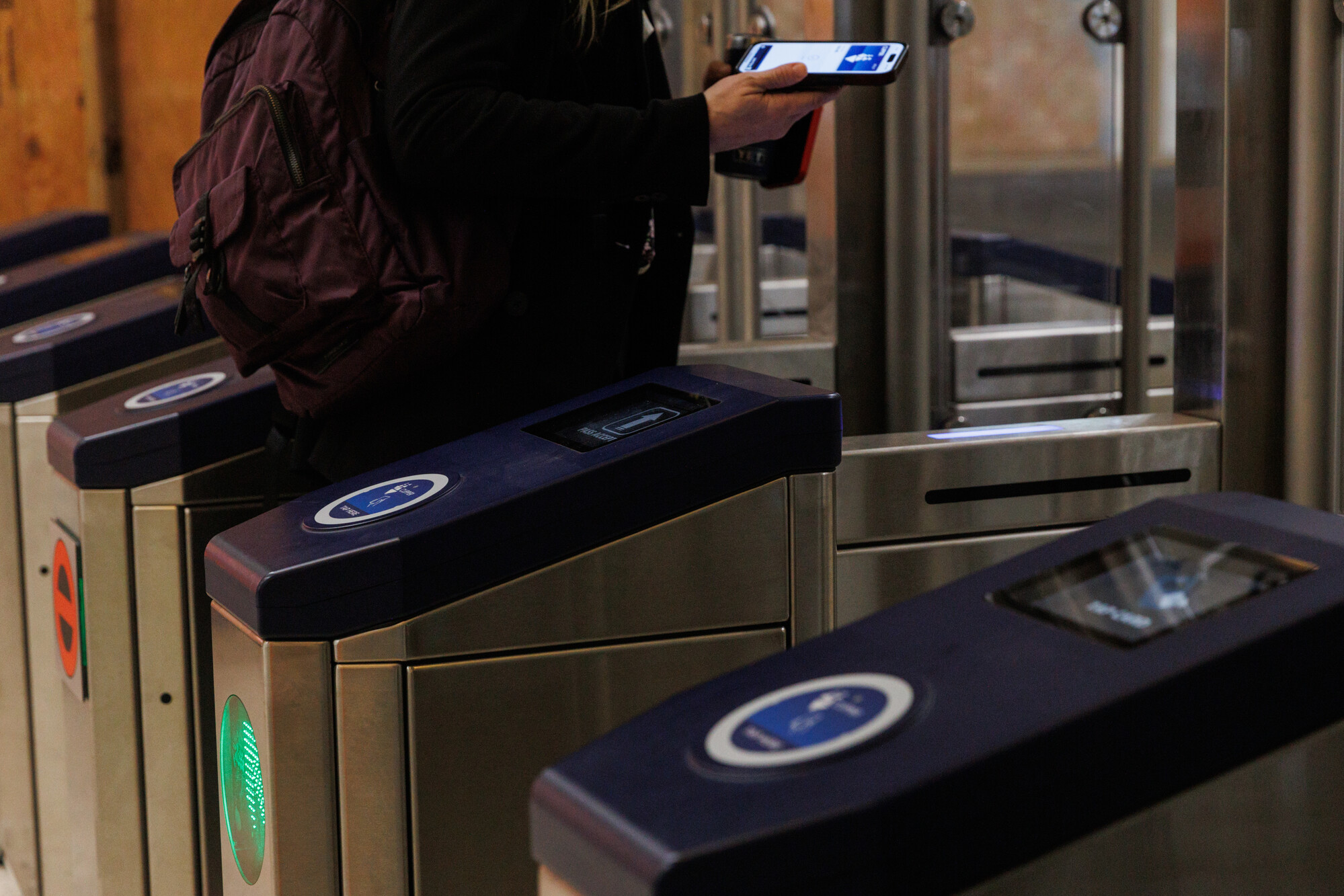
"caption": "A passenger tags their Clipper card at Montgomery BART Station in San Francisco on Dec. 4, 2024.",
"credit": "Juliana Yamada/KQED",
"altTag": null,
"description": null,
"imgSizes": {
"thumbnail": {
"file": "https://cdn.kqed.org/wp-content/uploads/sites/10/2025/08/20241204-BART-JY-027_qed-160x107.jpg",
"width": 160,
"height": 107,
"mimeType": "image/jpeg"
},
"1536x1536": {
"file": "https://cdn.kqed.org/wp-content/uploads/sites/10/2025/08/20241204-BART-JY-027_qed-1536x1024.jpg",
"width": 1536,
"height": 1024,
"mimeType": "image/jpeg"
},
"post-thumbnail": {
"file": "https://cdn.kqed.org/wp-content/uploads/sites/10/2025/08/20241204-BART-JY-027_qed-672x372.jpg",
"width": 672,
"height": 372,
"mimeType": "image/jpeg"
},
"twentyfourteen-full-width": {
"file": "https://cdn.kqed.org/wp-content/uploads/sites/10/2025/08/20241204-BART-JY-027_qed-1038x576.jpg",
"width": 1038,
"height": 576,
"mimeType": "image/jpeg"
},
"kqedFullSize": {
"file": "https://cdn.kqed.org/wp-content/uploads/sites/10/2025/08/20241204-BART-JY-027_qed.jpg",
"width": 1999,
"height": 1333
}
},
"isLoading": false,
"fetchFailed": false
},
"news_12073904": {
"type": "attachments",
"id": "news_12073904",
"meta": {
"index": "attachments_1716263798",
"site": "news",
"id": "12073904",
"found": true
},
"title": "260219-STRIKINGKAISERWORKERS00420_TV-KQED",
"publishDate": 1771537913,
"status": "inherit",
"parent": 12073887,
"modified": 1771879049,
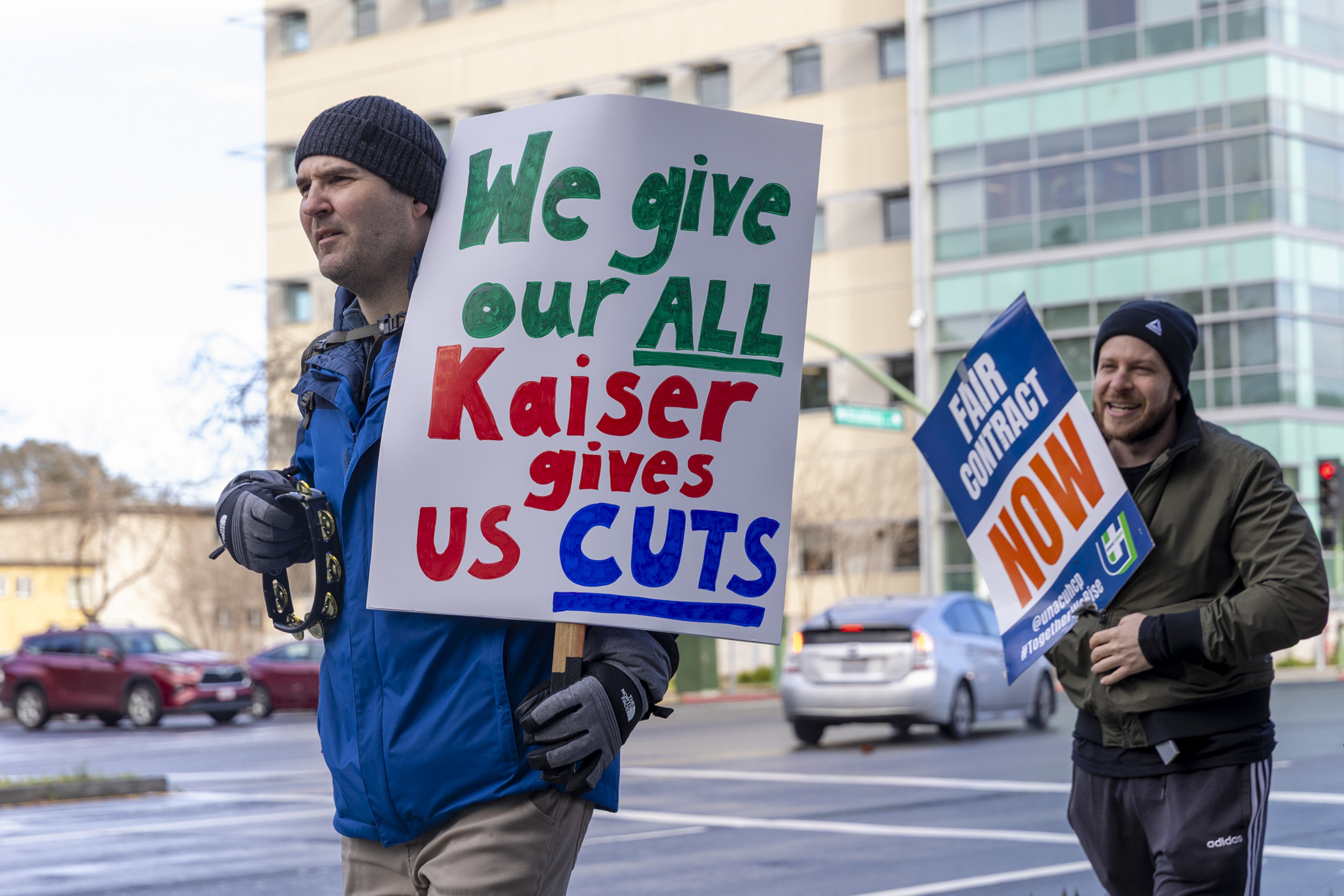
"caption": "Chris Pyper (left), a physician assistant from Kaiser San Leandro, marches while on strike outside Kaiser Permanente Oakland Medical Center in Oakland on Feb. 19, 2026.",
"credit": "Tâm Vũ/KQED",
"altTag": null,
"description": null,
"imgSizes": {
"thumbnail": {
"file": "https://cdn.kqed.org/wp-content/uploads/sites/10/2026/02/260219-STRIKINGKAISERWORKERS00420_TV-KQED-160x107.jpg",
"width": 160,
"height": 107,
"mimeType": "image/jpeg"
},
"1536x1536": {
"file": "https://cdn.kqed.org/wp-content/uploads/sites/10/2026/02/260219-STRIKINGKAISERWORKERS00420_TV-KQED-1536x1025.jpg",
"width": 1536,
"height": 1025,
"mimeType": "image/jpeg"
},
"post-thumbnail": {
"file": "https://cdn.kqed.org/wp-content/uploads/sites/10/2026/02/260219-STRIKINGKAISERWORKERS00420_TV-KQED-672x372.jpg",
"width": 672,
"height": 372,
"mimeType": "image/jpeg"
},
"twentyfourteen-full-width": {
"file": "https://cdn.kqed.org/wp-content/uploads/sites/10/2026/02/260219-STRIKINGKAISERWORKERS00420_TV-KQED-1038x576.jpg",
"width": 1038,
"height": 576,
"mimeType": "image/jpeg"
},
"npr-cds-wide": {
"file": "https://cdn.kqed.org/wp-content/uploads/sites/10/2026/02/260219-STRIKINGKAISERWORKERS00420_TV-KQED-1200x675.jpg",
"width": 1200,
"height": 675,
"mimeType": "image/jpeg"
},
"kqedFullSize": {
"file": "https://cdn.kqed.org/wp-content/uploads/sites/10/2026/02/260219-STRIKINGKAISERWORKERS00420_TV-KQED.jpg",
"width": 2000,
"height": 1334
}
},
"isLoading": false,
"fetchFailed": false
},
"news_12074297": {
"type": "attachments",
"id": "news_12074297",
"meta": {
"index": "attachments_1716263798",
"site": "news",
"id": "12074297",
"found": true
},
"title": "260223-DIAPER DISTRIBUTION-MD-01-KQED",
"publishDate": 1771883913,
"status": "inherit",
"parent": 12074206,
"modified": 1771897142,
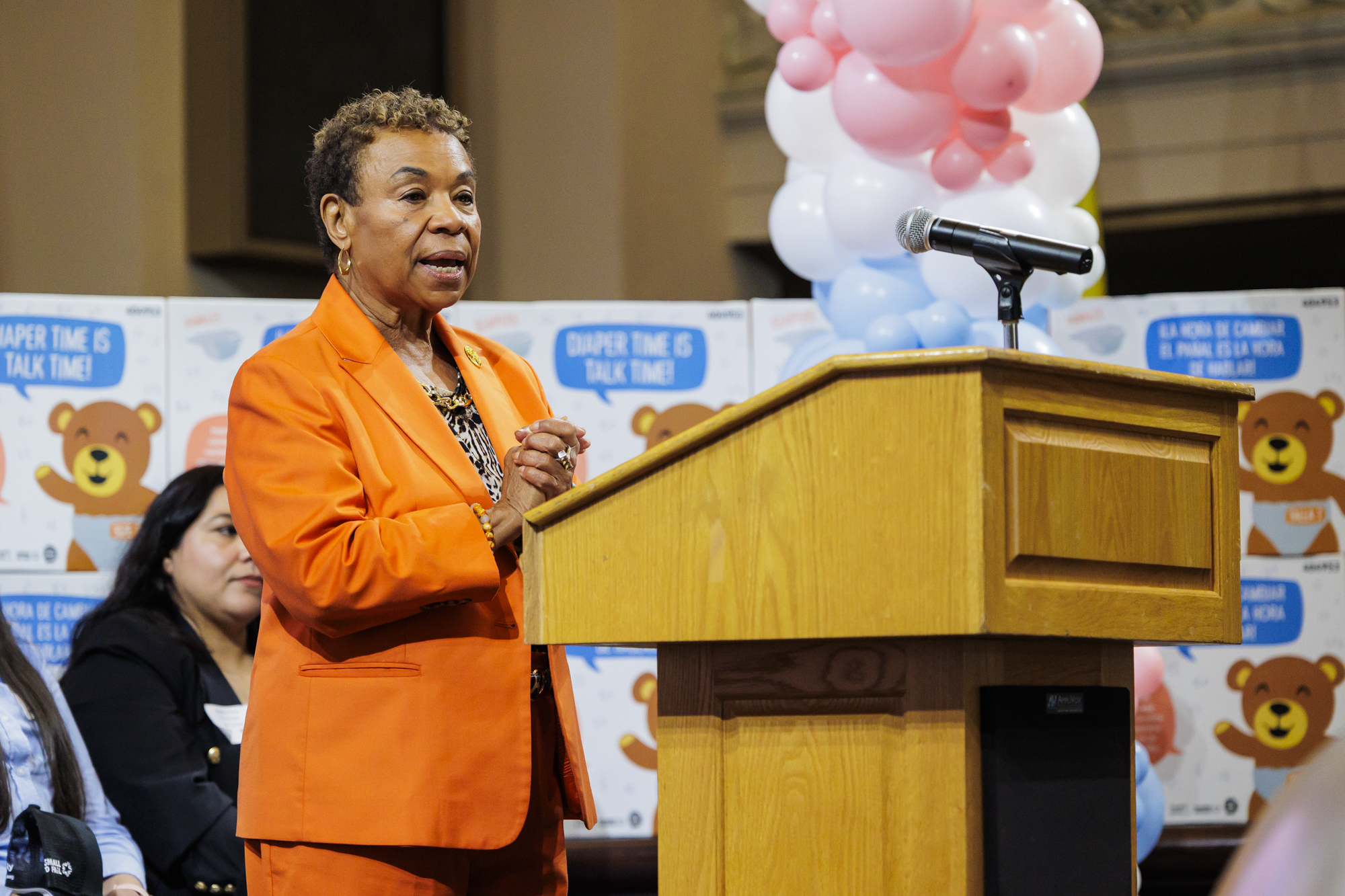
"caption": "Oakland Mayor Barbara Lee speaks at a press event announcing the launch of line of \"Diaper Time Is Talk Time,\" a campaign designed to prompt caregivers to talk, read, and sing, as they change a child's diaper and which will distribute diapers to families in need with young children statewide at City Hall in Oakland on Feb. 23, 2026.",
"credit": "Martin do Nascimento/KQED",
"altTag": null,
"description": null,
"imgSizes": {
"thumbnail": {
"file": "https://cdn.kqed.org/wp-content/uploads/sites/10/2026/02/260223-DIAPER-DISTRIBUTION-MD-01-KQED-160x107.jpg",
"width": 160,
"height": 107,
"mimeType": "image/jpeg"
},
"1536x1536": {
"file": "https://cdn.kqed.org/wp-content/uploads/sites/10/2026/02/260223-DIAPER-DISTRIBUTION-MD-01-KQED-1536x1024.jpg",
"width": 1536,
"height": 1024,
"mimeType": "image/jpeg"
},
"post-thumbnail": {
"file": "https://cdn.kqed.org/wp-content/uploads/sites/10/2026/02/260223-DIAPER-DISTRIBUTION-MD-01-KQED-672x372.jpg",
"width": 672,
"height": 372,
"mimeType": "image/jpeg"
},
"twentyfourteen-full-width": {
"file": "https://cdn.kqed.org/wp-content/uploads/sites/10/2026/02/260223-DIAPER-DISTRIBUTION-MD-01-KQED-1038x576.jpg",
"width": 1038,
"height": 576,
"mimeType": "image/jpeg"
},
"npr-cds-wide": {
"file": "https://cdn.kqed.org/wp-content/uploads/sites/10/2026/02/260223-DIAPER-DISTRIBUTION-MD-01-KQED-1200x675.jpg",
"width": 1200,
"height": 675,
"mimeType": "image/jpeg"
},
"kqedFullSize": {
"file": "https://cdn.kqed.org/wp-content/uploads/sites/10/2026/02/260223-DIAPER-DISTRIBUTION-MD-01-KQED.jpg",
"width": 2000,
"height": 1333
}
},
"isLoading": false,
"fetchFailed": false
},
"news_12073999": {
"type": "attachments",
"id": "news_12073999",
"meta": {
"index": "attachments_1716263798",
"site": "news",
"id": "12073999",
"found": true
},
"title": "California Avalanche",
"publishDate": 1771608303,
"status": "inherit",
"parent": 12073933,
"modified": 1771608334,
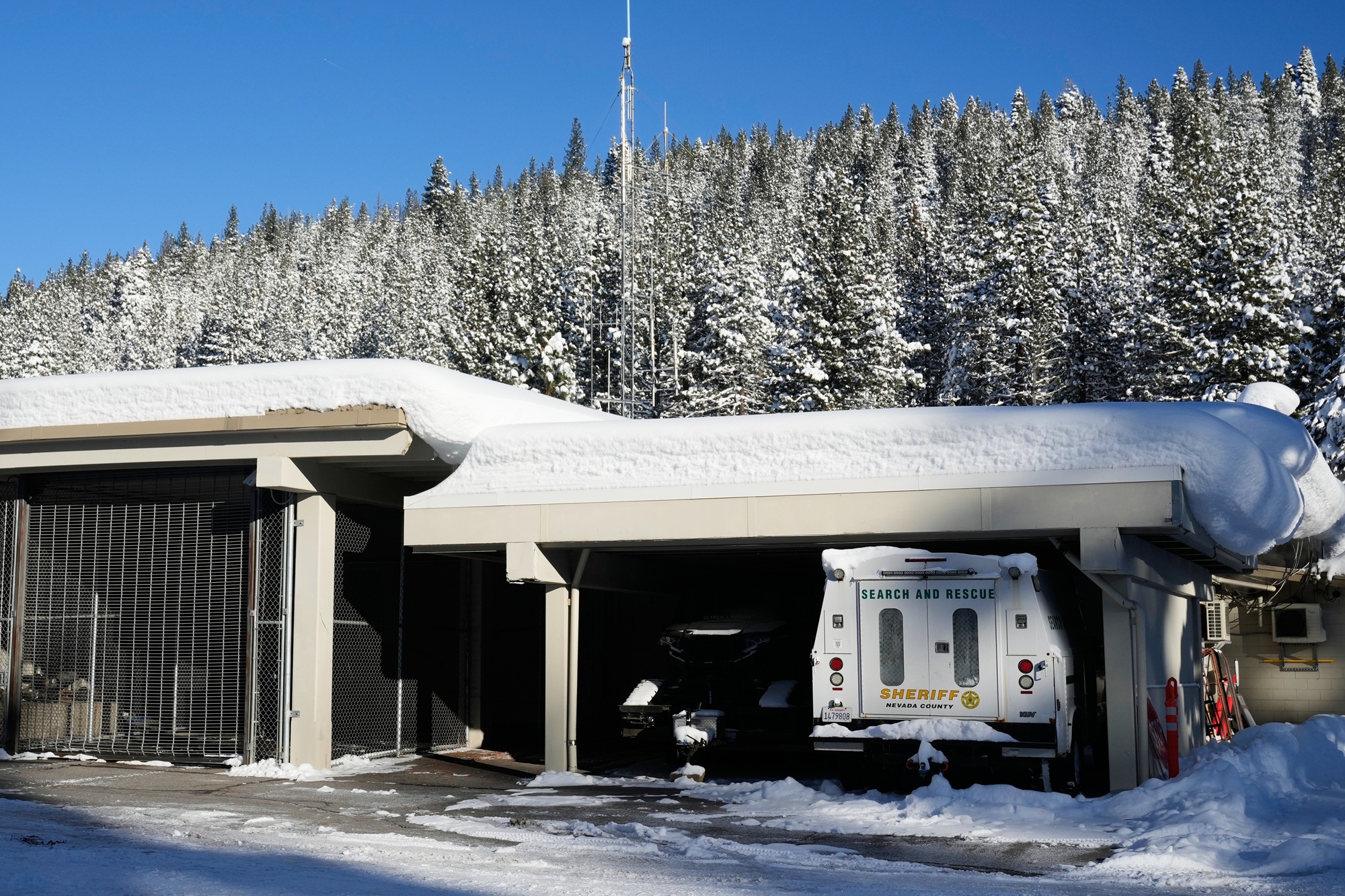
"caption": "Snow covers the roof of the Nevada County Sheriff's office on Friday, Feb. 20, 2026, in Truckee, California.",
"credit": "Godofredo A. Vásquez/AP Photo",
"altTag": null,
"description": null,
"imgSizes": {
"thumbnail": {
"file": "https://cdn.kqed.org/wp-content/uploads/sites/10/2026/02/CaliforniaAvalancheAP3-1-160x107.jpg",
"width": 160,
"height": 107,
"mimeType": "image/jpeg"
},
"1536x1536": {
"file": "https://cdn.kqed.org/wp-content/uploads/sites/10/2026/02/CaliforniaAvalancheAP3-1-1536x1024.jpg",
"width": 1536,
"height": 1024,
"mimeType": "image/jpeg"
},
"post-thumbnail": {
"file": "https://cdn.kqed.org/wp-content/uploads/sites/10/2026/02/CaliforniaAvalancheAP3-1-672x372.jpg",
"width": 672,
"height": 372,
"mimeType": "image/jpeg"
},
"twentyfourteen-full-width": {
"file": "https://cdn.kqed.org/wp-content/uploads/sites/10/2026/02/CaliforniaAvalancheAP3-1-1038x576.jpg",
"width": 1038,
"height": 576,
"mimeType": "image/jpeg"
},
"npr-cds-wide": {
"file": "https://cdn.kqed.org/wp-content/uploads/sites/10/2026/02/CaliforniaAvalancheAP3-1-1200x675.jpg",
"width": 1200,
"height": 675,
"mimeType": "image/jpeg"
},
"kqedFullSize": {
"file": "https://cdn.kqed.org/wp-content/uploads/sites/10/2026/02/CaliforniaAvalancheAP3-1.jpg",
"width": 2000,
"height": 1333
}
},
"isLoading": false,
"fetchFailed": false
},
"news_12074013": {
"type": "attachments",
"id": "news_12074013",
"meta": {
"index": "attachments_1716263798",
"site": "news",
"id": "12074013",
"found": true
},
"title": "Governor Newsom signs legislation authorizing $590 million emergency loan to Bay Area Transit",
"publishDate": 1771610547,
"status": "inherit",
"parent": 0,
"modified": 1771620962,
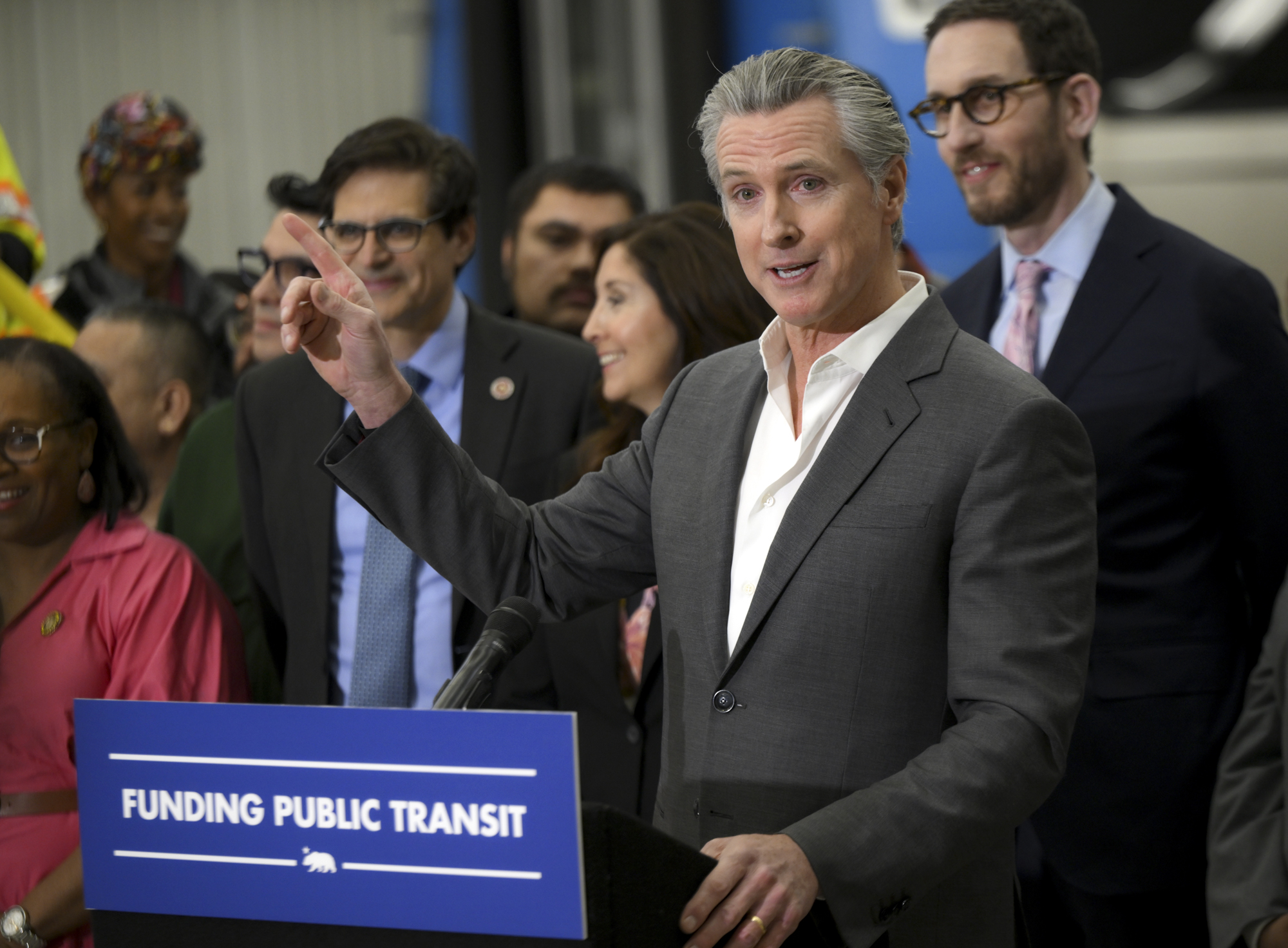
"caption": "Gov. Gavin Newsom speaks at BART Colma Maintenance Yard before he signs legislation authorizing $590 million emergency loan to Bay Area Transit in Colma, south of San Francisco, California, on Feb. 19, 2026.",
"credit": "Tayfun Coskun/Anadolu via Getty Images",
"altTag": null,
"description": null,
"imgSizes": {
"thumbnail": {
"file": "https://cdn.kqed.org/wp-content/uploads/sites/10/2026/02/GETTYIMAGES-2262016709-KQED-160x118.jpg",
"width": 160,
"height": 118,
"mimeType": "image/jpeg"
},
"1536x1536": {
"file": "https://cdn.kqed.org/wp-content/uploads/sites/10/2026/02/GETTYIMAGES-2262016709-KQED-1536x1130.jpg",
"width": 1536,
"height": 1130,
"mimeType": "image/jpeg"
},
"post-thumbnail": {
"file": "https://cdn.kqed.org/wp-content/uploads/sites/10/2026/02/GETTYIMAGES-2262016709-KQED-672x372.jpg",
"width": 672,
"height": 372,
"mimeType": "image/jpeg"
},
"twentyfourteen-full-width": {
"file": "https://cdn.kqed.org/wp-content/uploads/sites/10/2026/02/GETTYIMAGES-2262016709-KQED-1038x576.jpg",
"width": 1038,
"height": 576,
"mimeType": "image/jpeg"
},
"npr-cds-wide": {
"file": "https://cdn.kqed.org/wp-content/uploads/sites/10/2026/02/GETTYIMAGES-2262016709-KQED-1200x675.jpg",
"width": 1200,
"height": 675,
"mimeType": "image/jpeg"
},
"kqedFullSize": {
"file": "https://cdn.kqed.org/wp-content/uploads/sites/10/2026/02/GETTYIMAGES-2262016709-KQED.jpg",
"width": 2000,
"height": 1472
}
},
"isLoading": false,
"fetchFailed": false
},
"news_12074001": {
"type": "attachments",
"id": "news_12074001",
"meta": {
"index": "attachments_1716263798",
"site": "news",
"id": "12074001",
"found": true
},
"title": "260220-AVALANCHE VICTIMS-KQED",
"publishDate": 1771608912,
"status": "inherit",
"parent": 12074377,
"modified": 1771957663,
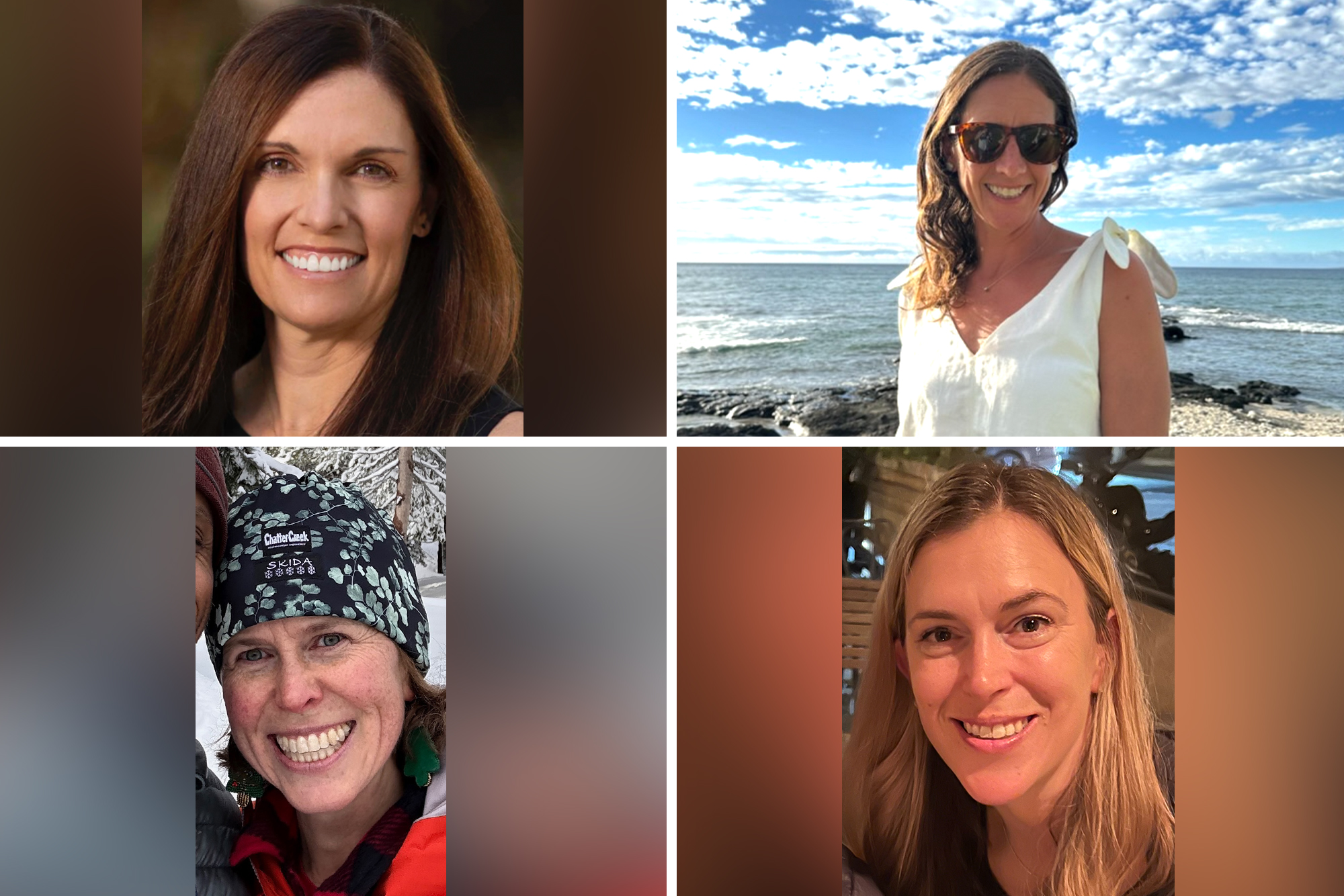
"caption": "Avalanche victims (clockwise from top left) Carrie Atkin, Kate Morse, Danielle Keatley and Caroline Sekar.",
"credit": "Family Handout",
"altTag": null,
"description": null,
"imgSizes": {
"thumbnail": {
"file": "https://cdn.kqed.org/wp-content/uploads/sites/10/2026/02/260220-AVALANCHE-VICTIMS-KQED-160x107.jpg",
"width": 160,
"height": 107,
"mimeType": "image/jpeg"
},
"1536x1536": {
"file": "https://cdn.kqed.org/wp-content/uploads/sites/10/2026/02/260220-AVALANCHE-VICTIMS-KQED-1536x1025.jpg",
"width": 1536,
"height": 1025,
"mimeType": "image/jpeg"
},
"post-thumbnail": {
"file": "https://cdn.kqed.org/wp-content/uploads/sites/10/2026/02/260220-AVALANCHE-VICTIMS-KQED-672x372.jpg",
"width": 672,
"height": 372,
"mimeType": "image/jpeg"
},
"twentyfourteen-full-width": {
"file": "https://cdn.kqed.org/wp-content/uploads/sites/10/2026/02/260220-AVALANCHE-VICTIMS-KQED-1038x576.jpg",
"width": 1038,
"height": 576,
"mimeType": "image/jpeg"
},
"npr-cds-wide": {
"file": "https://cdn.kqed.org/wp-content/uploads/sites/10/2026/02/260220-AVALANCHE-VICTIMS-KQED-1200x675.jpg",
"width": 1200,
"height": 675,
"mimeType": "image/jpeg"
},
"kqedFullSize": {
"file": "https://cdn.kqed.org/wp-content/uploads/sites/10/2026/02/260220-AVALANCHE-VICTIMS-KQED.jpg",
"width": 2000,
"height": 1334
}
},
"isLoading": false,
"fetchFailed": false
},
"news_12073906": {
"type": "attachments",
"id": "news_12073906",
"meta": {
"index": "attachments_1716263798",
"site": "news",
"id": "12073906",
"found": true
},
"title": "260219-STRIKINGKAISERWORKERS01224_TV-KQED",
"publishDate": 1771537935,
"status": "inherit",
"parent": 0,
"modified": 1771544711,
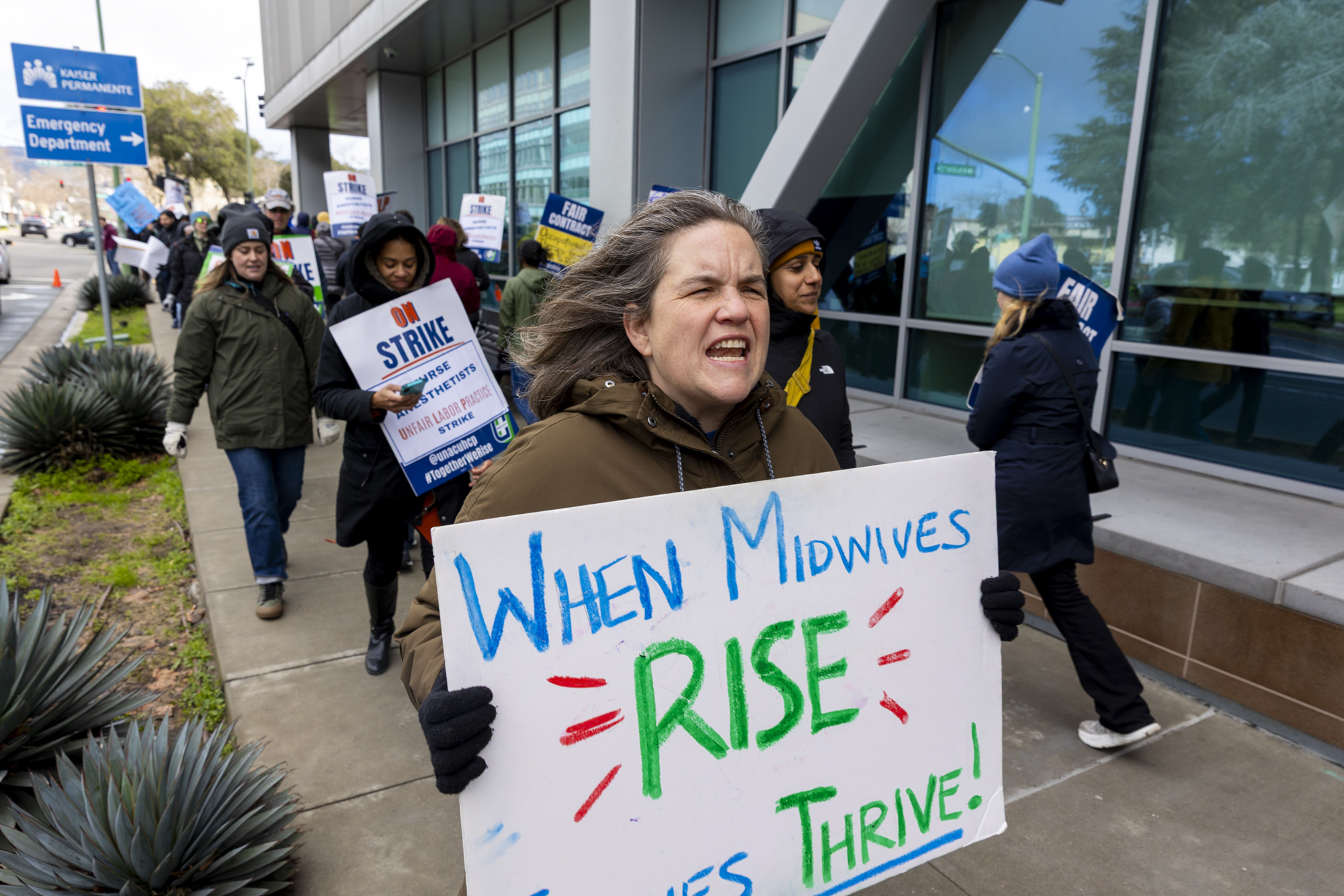
"caption": "Darcy Stanley, a nurse midwife from Kaiser Oakland, on strike at the picket line outside Kaiser Permanente Oakland Medical Center in Oakland on Feb. 19, 2026. Kaiser workers on the picket lines have gone without their paychecks for four weeks, and many are facing financial and other difficulties.",
"credit": "Tâm Vũ/KQED",
"altTag": null,
"description": null,
"imgSizes": {
"thumbnail": {
"file": "https://cdn.kqed.org/wp-content/uploads/sites/10/2026/02/260219-STRIKINGKAISERWORKERS01224_TV-KQED-160x107.jpg",
"width": 160,
"height": 107,
"mimeType": "image/jpeg"
},
"1536x1536": {
"file": "https://cdn.kqed.org/wp-content/uploads/sites/10/2026/02/260219-STRIKINGKAISERWORKERS01224_TV-KQED-1536x1025.jpg",
"width": 1536,
"height": 1025,
"mimeType": "image/jpeg"
},
"post-thumbnail": {
"file": "https://cdn.kqed.org/wp-content/uploads/sites/10/2026/02/260219-STRIKINGKAISERWORKERS01224_TV-KQED-672x372.jpg",
"width": 672,
"height": 372,
"mimeType": "image/jpeg"
},
"twentyfourteen-full-width": {
"file": "https://cdn.kqed.org/wp-content/uploads/sites/10/2026/02/260219-STRIKINGKAISERWORKERS01224_TV-KQED-1038x576.jpg",
"width": 1038,
"height": 576,
"mimeType": "image/jpeg"
},
"npr-cds-wide": {
"file": "https://cdn.kqed.org/wp-content/uploads/sites/10/2026/02/260219-STRIKINGKAISERWORKERS01224_TV-KQED-1200x675.jpg",
"width": 1200,
"height": 675,
"mimeType": "image/jpeg"
},
"kqedFullSize": {
"file": "https://cdn.kqed.org/wp-content/uploads/sites/10/2026/02/260219-STRIKINGKAISERWORKERS01224_TV-KQED.jpg",
"width": 2000,
"height": 1334
}
},
"isLoading": false,
"fetchFailed": false
},
"news_12073915": {
"type": "attachments",
"id": "news_12073915",
"meta": {
"index": "attachments_1716263798",
"site": "news",
"id": "12073915",
"found": true
},
"title": "038_KQED_KaiserStrikeOakland_08192022_qed (2)",
"publishDate": 1771539636,
"status": "inherit",
"parent": 12073839,
"modified": 1771539650,
"caption": "Kaiser mental health care workers and supporters march from Oakland Kaiser Medical Center to Kaiser's corporate headquarters on Friday, Aug. 19, 2022, the fifth day of an open-ended strike.",
"credit": "Beth LaBerge/KQED",
"altTag": null,
"description": null,
"imgSizes": {
"thumbnail": {
"file": "https://cdn.kqed.org/wp-content/uploads/sites/10/2026/02/038_KQED_KaiserStrikeOakland_08192022_qed-2-160x107.jpg",
"width": 160,
"height": 107,
"mimeType": "image/jpeg"
},
"1536x1536": {
"file": "https://cdn.kqed.org/wp-content/uploads/sites/10/2026/02/038_KQED_KaiserStrikeOakland_08192022_qed-2-1536x1024.jpg",
"width": 1536,
"height": 1024,
"mimeType": "image/jpeg"
},
"post-thumbnail": {
"file": "https://cdn.kqed.org/wp-content/uploads/sites/10/2026/02/038_KQED_KaiserStrikeOakland_08192022_qed-2-672x372.jpg",
"width": 672,
"height": 372,
"mimeType": "image/jpeg"
},
"twentyfourteen-full-width": {
"file": "https://cdn.kqed.org/wp-content/uploads/sites/10/2026/02/038_KQED_KaiserStrikeOakland_08192022_qed-2-1038x576.jpg",
"width": 1038,
"height": 576,
"mimeType": "image/jpeg"
},
"npr-cds-wide": {
"file": "https://cdn.kqed.org/wp-content/uploads/sites/10/2026/02/038_KQED_KaiserStrikeOakland_08192022_qed-2-1200x675.jpg",
"width": 1200,
"height": 675,
"mimeType": "image/jpeg"
},
"kqedFullSize": {
"file": "https://cdn.kqed.org/wp-content/uploads/sites/10/2026/02/038_KQED_KaiserStrikeOakland_08192022_qed-2.jpg",
"width": 2000,
"height": 1333
}
},
"isLoading": false,
"fetchFailed": false
},
"news_12073925": {
"type": "attachments",
"id": "news_12073925",
"meta": {
"index": "attachments_1716263798",
"site": "news",
"id": "12073925",
"found": true
},
"title": "APTOPIX Milan Cortina Olympics Figure Skating",
"publishDate": 1771540015,
"status": "inherit",
"parent": 12073916,
"modified": 1771540034,
"caption": "Alysa Liu of the United States competes during the women's figure skating free program at the 2026 Winter Olympics, in Milan, Italy, Thursday, Feb. 19, 2026. ",
"credit": "(AP Photo/Natacha Pisarenko)",
"altTag": null,
"description": null,
"imgSizes": {
"medium": {
"file": "https://cdn.kqed.org/wp-content/uploads/sites/10/2026/02/AP26050787433245-2000x1334.jpg",
"width": 2000,
"height": 1334,
"mimeType": "image/jpeg"
},
"large": {
"file": "https://cdn.kqed.org/wp-content/uploads/sites/10/2026/02/AP26050787433245-2000x1334.jpg",
"width": 2000,
"height": 1334,
"mimeType": "image/jpeg"
},
"thumbnail": {
"file": "https://cdn.kqed.org/wp-content/uploads/sites/10/2026/02/AP26050787433245-160x107.jpg",
"width": 160,
"height": 107,
"mimeType": "image/jpeg"
},
"1536x1536": {
"file": "https://cdn.kqed.org/wp-content/uploads/sites/10/2026/02/AP26050787433245-1536x1024.jpg",
"width": 1536,
"height": 1024,
"mimeType": "image/jpeg"
},
"2048x2048": {
"file": "https://cdn.kqed.org/wp-content/uploads/sites/10/2026/02/AP26050787433245-2048x1366.jpg",
"width": 2048,
"height": 1366,
"mimeType": "image/jpeg"
},
"post-thumbnail": {
"file": "https://cdn.kqed.org/wp-content/uploads/sites/10/2026/02/AP26050787433245-672x372.jpg",
"width": 672,
"height": 372,
"mimeType": "image/jpeg"
},
"twentyfourteen-full-width": {
"file": "https://cdn.kqed.org/wp-content/uploads/sites/10/2026/02/AP26050787433245-1038x576.jpg",
"width": 1038,
"height": 576,
"mimeType": "image/jpeg"
},
"full-width": {
"file": "https://cdn.kqed.org/wp-content/uploads/sites/10/2026/02/AP26050787433245-2000x1334.jpg",
"width": 2000,
"height": 1334,
"mimeType": "image/jpeg"
},
"npr-cds-wide": {
"file": "https://cdn.kqed.org/wp-content/uploads/sites/10/2026/02/AP26050787433245-1200x675.jpg",
"width": 1200,
"height": 675,
"mimeType": "image/jpeg"
},
"kqedFullSize": {
"file": "https://cdn.kqed.org/wp-content/uploads/sites/10/2026/02/AP26050787433245-scaled.jpg",
"width": 2560,
"height": 1707
}
},
"isLoading": false,
"fetchFailed": false
}
},
"audioPlayerReducer": {
"postId": "stream_live",
"isPaused": true,
"isPlaying": false,
"pfsActive": false,
"pledgeModalIsOpen": true,
"playerDrawerIsOpen": false,
"liveAudioPlayStartedAt": 0,
"liveAudioPlayContext": ""
},
"authorsReducer": {
"byline_news_12073916": {
"type": "authors",
"id": "byline_news_12073916",
"meta": {
"override": true
},
"slug": "byline_news_12073916",
"name": " Dave Skretta, AP Sports Writer",
"isLoading": false
},
"adembosky": {
"type": "authors",
"id": "3205",
"meta": {
"index": "authors_1716337520",
"id": "3205",
"found": true
},
"name": "April Dembosky",
"firstName": "April",
"lastName": "Dembosky",
"slug": "adembosky",
"email": "adembosky@kqed.org",
"display_author_email": false,
"staff_mastheads": [
"news",
"science"
],
"title": "KQED Health Correspondent",
"bio": "April Dembosky is the health correspondent for KQED News and a regular contributor to NPR. She specializes in covering altered states of mind, from postpartum depression to methamphetamine-induced psychosis to the insanity defense. Her investigative series on insurance companies sidestepping mental health laws won multiple awards, including first place in beat reporting from the national Association of Health Care Journalists. She is the recipient of numerous other prizes and fellowships, including a national Edward R. Murrow award for investigative reporting, a Society of Professional Journalists award for long-form storytelling, and a Carter Center Fellowship for Mental Health Journalism.\r\n\r\nDembosky reported and produced \u003cem>Soundtrack of Silence\u003c/em>, an audio documentary about music and memory that is currently being made into a feature film by Paramount Pictures.\r\n\r\nBefore joining KQED in 2013, Dembosky covered technology and Silicon Valley for \u003cem>The Financial Times of London,\u003c/em> and contributed business and arts stories to \u003cem>Marketplace \u003c/em>and \u003cem>The New York Times.\u003c/em> She got her undergraduate degree in philosophy from Smith College and her master's in journalism from the University of California, Berkeley. She is a classically trained violinist and proud alum of the first symphony orchestra at Burning Man.",
"avatar": "https://secure.gravatar.com/avatar/ef92999be4ceb9ea60701e7dc276f813?s=600&d=blank&r=g",
"twitter": "adembosky",
"facebook": null,
"instagram": null,
"linkedin": null,
"sites": [
{
"site": "arts",
"roles": [
"author"
]
},
{
"site": "news",
"roles": [
"editor"
]
},
{
"site": "futureofyou",
"roles": [
"author"
]
},
{
"site": "stateofhealth",
"roles": [
"editor"
]
},
{
"site": "science",
"roles": [
"editor"
]
},
{
"site": "forum",
"roles": [
"editor"
]
}
],
"headData": {
"title": "April Dembosky | KQED",
"description": "KQED Health Correspondent",
"ogImgSrc": "https://secure.gravatar.com/avatar/ef92999be4ceb9ea60701e7dc276f813?s=600&d=blank&r=g",
"twImgSrc": "https://secure.gravatar.com/avatar/ef92999be4ceb9ea60701e7dc276f813?s=600&d=blank&r=g"
},
"isLoading": false,
"link": "/author/adembosky"
},
"carlysevern": {
"type": "authors",
"id": "3243",
"meta": {
"index": "authors_1716337520",
"id": "3243",
"found": true
},
"name": "Carly Severn",
"firstName": "Carly",
"lastName": "Severn",
"slug": "carlysevern",
"email": "csevern@kqed.org",
"display_author_email": false,
"staff_mastheads": [
"news"
],
"title": "Senior Editor, Audience News ",
"bio": "Carly is KQED's Senior Editor of Audience News on the Digital News team, and has reported for the California Report Magazine, Bay Curious and KQED Arts. She's formerly the host of \u003ca href=\"http://ww2.kqed.org/pop/category/the-cooler/\" rel=\"noopener noreferrer\">The Cooler\u003c/a> podcast.",
"avatar": "https://secure.gravatar.com/avatar/54037bf5c128fe678f0ef26cec97a93f2e7f220a22d7285703328f12c42c1b1d?s=600&d=blank&r=g",
"twitter": "teacupinthebay",
"bluesky": null,
"facebook": null,
"instagram": null,
"linkedin": null,
"sites": [
{
"site": "",
"roles": [
"editor"
]
},
{
"site": "arts",
"roles": [
"editor"
]
},
{
"site": "news",
"roles": [
"administrator"
]
},
{
"site": "pop",
"roles": [
"editor"
]
},
{
"site": "futureofyou",
"roles": [
"editor"
]
},
{
"site": "about",
"roles": [
"administrator"
]
},
{
"site": "mindshift",
"roles": [
"editor"
]
},
{
"site": "bayareabites",
"roles": [
"editor"
]
},
{
"site": "stateofhealth",
"roles": [
"editor"
]
},
{
"site": "science",
"roles": [
"editor"
]
},
{
"site": "food",
"roles": [
"contributor"
]
},
{
"site": "forum",
"roles": [
"editor"
]
},
{
"site": "perspectives",
"roles": [
"administrator"
]
},
{
"site": "liveblog",
"roles": [
"editor"
]
}
],
"headData": {
"title": "Carly Severn | KQED",
"description": "Senior Editor, Audience News ",
"ogImgSrc": "https://secure.gravatar.com/avatar/54037bf5c128fe678f0ef26cec97a93f2e7f220a22d7285703328f12c42c1b1d?s=600&d=blank&r=g",
"twImgSrc": "https://secure.gravatar.com/avatar/54037bf5c128fe678f0ef26cec97a93f2e7f220a22d7285703328f12c42c1b1d?s=600&d=blank&r=g"
},
"isLoading": false,
"link": "/author/carlysevern"
},
"fjhabvala": {
"type": "authors",
"id": "8659",
"meta": {
"index": "authors_1716337520",
"id": "8659",
"found": true
},
"name": "Farida Jhabvala Romero",
"firstName": "Farida",
"lastName": "Jhabvala Romero",
"slug": "fjhabvala",
"email": "fjhabvala@kqed.org",
"display_author_email": true,
"staff_mastheads": [
"news"
],
"title": "KQED Contributor",
"bio": "Farida Jhabvala Romero is a Labor Correspondent for KQED. She previously covered immigration. Farida was \u003ca href=\"https://www.ccnma.org/2022-most-influential-latina-journalists\">named\u003c/a> one of the 10 Most Influential Latina Journalists in California in 2022 by the California Chicano News Media Association. Her work has won awards from the Society of Professional Journalists (Northern California), as well as a national and regional Edward M. Murrow Award for the collaborative reporting projects “Dangerous Air” and “Graying California.” Before joining KQED, Farida worked as a producer at Radio Bilingüe, a national public radio network. Farida earned her master’s degree in journalism from Stanford University.",
"avatar": "https://secure.gravatar.com/avatar/f9f022d4e2609741874222a1e9d41f48fea74011aa7c615eef91d9a50c944ebe?s=600&d=blank&r=g",
"twitter": "FaridaJhabvala",
"bluesky": null,
"facebook": null,
"instagram": null,
"linkedin": "https://www.linkedin.com/in/faridajhabvala/",
"sites": [
{
"site": "news",
"roles": [
"editor"
]
},
{
"site": "stateofhealth",
"roles": [
"author"
]
},
{
"site": "liveblog",
"roles": [
"author"
]
}
],
"headData": {
"title": "Farida Jhabvala Romero | KQED",
"description": "KQED Contributor",
"ogImgSrc": "https://secure.gravatar.com/avatar/f9f022d4e2609741874222a1e9d41f48fea74011aa7c615eef91d9a50c944ebe?s=600&d=blank&r=g",
"twImgSrc": "https://secure.gravatar.com/avatar/f9f022d4e2609741874222a1e9d41f48fea74011aa7c615eef91d9a50c944ebe?s=600&d=blank&r=g"
},
"isLoading": false,
"link": "/author/fjhabvala"
},
"otaylor": {
"type": "authors",
"id": "11770",
"meta": {
"index": "authors_1716337520",
"id": "11770",
"found": true
},
"name": "Otis R. Taylor Jr.",
"firstName": "Otis R.",
"lastName": "Taylor Jr.",
"slug": "otaylor",
"email": "otaylor@kqed.org",
"display_author_email": false,
"staff_mastheads": [
"news"
],
"title": "KQED Editor",
"bio": null,
"avatar": "https://secure.gravatar.com/avatar/fe73e14d4842ac8e1c03d57def2530f57f1c5b0ca7d4a987ccc5bd90956cb7c6?s=600&d=blank&r=g",
"twitter": "otisrtaylorjr",
"bluesky": null,
"facebook": null,
"instagram": null,
"linkedin": null,
"sites": [
{
"site": "arts",
"roles": [
"subscriber"
]
},
{
"site": "news",
"roles": [
"subscriber"
]
},
{
"site": "science",
"roles": [
"subscriber"
]
},
{
"site": "liveblog",
"roles": [
"subscriber"
]
}
],
"headData": {
"title": "Otis R. Taylor Jr. | KQED",
"description": "KQED Editor",
"ogImgSrc": "https://secure.gravatar.com/avatar/fe73e14d4842ac8e1c03d57def2530f57f1c5b0ca7d4a987ccc5bd90956cb7c6?s=600&d=blank&r=g",
"twImgSrc": "https://secure.gravatar.com/avatar/fe73e14d4842ac8e1c03d57def2530f57f1c5b0ca7d4a987ccc5bd90956cb7c6?s=600&d=blank&r=g"
},
"isLoading": false,
"link": "/author/otaylor"
},
"adahlstromeckman": {
"type": "authors",
"id": "11785",
"meta": {
"index": "authors_1716337520",
"id": "11785",
"found": true
},
"name": "Azul Dahlstrom-Eckman",
"firstName": "Azul",
"lastName": "Dahlstrom-Eckman",
"slug": "adahlstromeckman",
"email": "adahlstrom-eckman@kqed.org",
"display_author_email": true,
"staff_mastheads": [],
"title": "Reporter",
"bio": "Azul is a reporter for KQED focusing on transportation and features. He joined KQED in 2021 as an alumna of KALW's Audio Academy radio journalism training program.",
"avatar": "https://secure.gravatar.com/avatar/9cb750298435add7815a777f55bf1f46845c1386bb8452555c60a7b820b5aba3?s=600&d=blank&r=g",
"twitter": "@zuliemann",
"bluesky": "@azul415.bsky.social",
"facebook": null,
"instagram": null,
"linkedin": null,
"sites": [
{
"site": "arts",
"roles": [
"editor"
]
},
{
"site": "news",
"roles": [
"editor"
]
},
{
"site": "science",
"roles": [
"editor"
]
},
{
"site": "liveblog",
"roles": [
"author"
]
}
],
"headData": {
"title": "Azul Dahlstrom-Eckman | KQED",
"description": "Reporter",
"ogImgSrc": "https://secure.gravatar.com/avatar/9cb750298435add7815a777f55bf1f46845c1386bb8452555c60a7b820b5aba3?s=600&d=blank&r=g",
"twImgSrc": "https://secure.gravatar.com/avatar/9cb750298435add7815a777f55bf1f46845c1386bb8452555c60a7b820b5aba3?s=600&d=blank&r=g"
},
"isLoading": false,
"link": "/author/adahlstromeckman"
},
"daisynguyen": {
"type": "authors",
"id": "11829",
"meta": {
"index": "authors_1716337520",
"id": "11829",
"found": true
},
"name": "Daisy Nguyen",
"firstName": "Daisy",
"lastName": "Nguyen",
"slug": "daisynguyen",
"email": "daisynguyen@kqed.org",
"display_author_email": true,
"staff_mastheads": [
"news"
],
"title": "KQED Contributor",
"bio": "I have covered early childhood education and child care for KQED since 2022. I focus on policies aimed at increasing access to early care and education and how they shape individual lives. I've been a journalist for more than two decades, with most of that time devoted to covering breaking news throughout California for The Associated Press. I grew up in San Francisco and studied at UC Davis and Columbia University's Graduate School of Journalism. I live in Oakland with my husband and two kids.",
"avatar": "https://secure.gravatar.com/avatar/2da2127c27f7143b53ebd419800fd55f?s=600&d=blank&r=g",
"twitter": null,
"facebook": null,
"instagram": null,
"linkedin": "https://www.linkedin.com/in/daisynguyen/",
"sites": [
{
"site": "news",
"roles": [
"author"
]
},
{
"site": "liveblog",
"roles": [
"author"
]
}
],
"headData": {
"title": "Daisy Nguyen | KQED",
"description": "KQED Contributor",
"ogImgSrc": "https://secure.gravatar.com/avatar/2da2127c27f7143b53ebd419800fd55f?s=600&d=blank&r=g",
"twImgSrc": "https://secure.gravatar.com/avatar/2da2127c27f7143b53ebd419800fd55f?s=600&d=blank&r=g"
},
"isLoading": false,
"link": "/author/daisynguyen"
},
"sarahwright": {
"type": "authors",
"id": "11956",
"meta": {
"index": "authors_1716337520",
"id": "11956",
"found": true
},
"name": "Sarah Wright",
"firstName": "Sarah",
"lastName": "Wright",
"slug": "sarahwright",
"email": "swright@kqed.org",
"display_author_email": true,
"staff_mastheads": [],
"title": "Outdoors Engagement Reporter",
"bio": "Sarah Wright is KQED's Outdoors Engagement Reporter. Originally from Lake Tahoe, she completed a thru-hike of the Pacific Crest Trail in 2019 and was a U.S. Fulbright Program grantee to Argentina in 2023. Her journalism has appeared in The Guardian, The San Francisco Standard, The Palo Alto Weekly and the Half Moon Bay Review.",
"avatar": "https://secure.gravatar.com/avatar/c161a3d6441865cba25e6db4fa561099ad665799e9432e34da2b84d7e371524c?s=600&d=blank&r=g",
"twitter": null,
"bluesky": null,
"facebook": null,
"instagram": null,
"linkedin": null,
"sites": [
{
"site": "arts",
"roles": [
"editor"
]
},
{
"site": "news",
"roles": [
"editor"
]
},
{
"site": "science",
"roles": [
"contributor",
"author"
]
},
{
"site": "forum",
"roles": [
"editor"
]
}
],
"headData": {
"title": "Sarah Wright | KQED",
"description": "Outdoors Engagement Reporter",
"ogImgSrc": "https://secure.gravatar.com/avatar/c161a3d6441865cba25e6db4fa561099ad665799e9432e34da2b84d7e371524c?s=600&d=blank&r=g",
"twImgSrc": "https://secure.gravatar.com/avatar/c161a3d6441865cba25e6db4fa561099ad665799e9432e34da2b84d7e371524c?s=600&d=blank&r=g"
},
"isLoading": false,
"link": "/author/sarahwright"
},
"aaliahmad": {
"type": "authors",
"id": "11986",
"meta": {
"index": "authors_1716337520",
"id": "11986",
"found": true
},
"name": "Ayah Ali-Ahmad",
"firstName": "Ayah",
"lastName": "Ali-Ahmad",
"slug": "aaliahmad",
"email": "aaliahmad@KQED.org",
"display_author_email": false,
"staff_mastheads": [],
"title": "KQED Contributor",
"bio": null,
"avatar": "https://secure.gravatar.com/avatar/1cf54f187a5e1064b2cfef3f3d2f1e4f93e453395d56912aca6382a6071ec3ed?s=600&d=blank&r=g",
"twitter": "ayahaliahmad",
"bluesky": null,
"facebook": null,
"instagram": null,
"linkedin": null,
"sites": [
{
"site": "news",
"roles": [
"subscriber"
]
}
],
"headData": {
"title": "Ayah Ali-Ahmad | KQED",
"description": "KQED Contributor",
"ogImgSrc": "https://secure.gravatar.com/avatar/1cf54f187a5e1064b2cfef3f3d2f1e4f93e453395d56912aca6382a6071ec3ed?s=600&d=blank&r=g",
"twImgSrc": "https://secure.gravatar.com/avatar/1cf54f187a5e1064b2cfef3f3d2f1e4f93e453395d56912aca6382a6071ec3ed?s=600&d=blank&r=g"
},
"isLoading": false,
"link": "/author/aaliahmad"
}
},
"pagesReducer": {
"news_tag_bay-area": {
"type": "terms",
"id": "news_1386",
"meta": {
"index": "terms_1716263798",
"site": "news",
"id": "1386",
"score": 7.788433
},
"featImg": null,
"name": "Bay Area",
"description": null,
"taxonomy": "tag",
"headData": {
"twImgId": null,
"twTitle": null,
"ogTitle": null,
"ogImgId": null,
"twDescription": null,
"description": null,
"title": "Bay Area Archives | KQED News",
"ogDescription": null
},
"ttid": 1398,
"slug": "bay-area",
"isLoading": false,
"title": "Bay Area",
"pageMeta": {
"site": "news",
"WpPageTemplate": "page-topic-editorial",
"currentPage": 32
},
"blocks": [
{
"blockName": "kqed/post-list",
"attrs": {
"layout": "cardArticle2",
"query": "posts/news?tag=bay-area",
"seeMore": false,
"paginated": true,
"page": 32
}
},
{
"blockName": "kqed/ad"
}
]
}
},
"pfsSessionReducer": {},
"postsReducer": {
"stream_live": {
"type": "live",
"id": "stream_live",
"audioUrl": "https://streams.kqed.org/kqedradio",
"title": "Live Stream",
"excerpt": "Live Stream information currently unavailable.",
"link": "/radio",
"featImg": "",
"label": {
"name": "KQED Live",
"link": "/"
}
},
"stream_kqedNewscast": {
"type": "posts",
"id": "stream_kqedNewscast",
"audioUrl": "https://www.kqed.org/.stream/anon/radio/RDnews/newscast.mp3?_=1",
"title": "KQED Newscast",
"featImg": "",
"label": {
"name": "88.5 FM",
"link": "/"
}
},
"news_12074861": {
"type": "posts",
"id": "news_12074861",
"meta": {
"index": "posts_1716263798",
"site": "news",
"id": "12074861",
"score": null,
"sort": [
1772467200000
]
},
"guestAuthors": [],
"slug": "waymo-to-report-on-mass-stranding-event-during-sf-december-blackout",
"title": "Waymo to Report on Mass Stranding Event During SF December Blackout",
"publishDate": 1772467200,
"format": "standard",
"headTitle": "Waymo to Report on Mass Stranding Event During SF December Blackout | KQED",
"labelTerm": {
"site": "news"
},
"content": "\u003cp>San Francisco supervisors want Waymo to explain why a \u003ca href=\"https://www.kqed.org/news/12068177/pge-outage-leaves-130000-across-san-francisco-without-power\">widespread power outage\u003c/a> last December caused a mass-stranding of their robotaxis, and what they’re doing to prevent future meltdowns.\u003c/p>\n\u003cp>Calling for greater accountability, San Francisco District 5 Supervisor Bilal Mahmood told the company to report to City Hall on Monday and explain what caused vehicles to fail during the mass blackout.\u003c/p>\n\u003cp>“The purpose of the hearing is to get answers from Waymo about what were the causes of the technical failure for some of their vehicles that day,” Mahmood said, “and simultaneously, what are they doing to prevent this from happening again.”\u003c/p>\n\u003cp>[ad fullwidth]\u003c/p>\n\u003cp>On Dec. 20, a fire at a PG&E substation plunged over 130,000 of the utility’s customers — about a third of the city — into darkness. The blackout also disabled many of the city’s traffic lights, which in turn rendered many of Waymo’s self-driving cars nonfunctional.\u003c/p>\n\u003cp>The cars idled in the streets and blocked traffic as the company’s network became overwhelmed with assistance requests from the robotic cars. Waymo’s outage lasted into the next day, while some San Franciscans remained without power for days longer.\u003c/p>\n\u003cfigure id=\"attachment_12040902\" class=\"wp-caption aligncenter\" style=\"max-width: 2000px\">\u003cimg loading=\"lazy\" decoding=\"async\" class=\"size-full wp-image-12040902\" src=\"https://cdn.kqed.org/wp-content/uploads/sites/10/2025/05/GETTYIMAGES-1788126569-KQED.jpg\" alt=\"\" width=\"2000\" height=\"1333\" srcset=\"https://cdn.kqed.org/wp-content/uploads/sites/10/2025/05/GETTYIMAGES-1788126569-KQED.jpg 2000w, https://cdn.kqed.org/wp-content/uploads/sites/10/2025/05/GETTYIMAGES-1788126569-KQED-800x533.jpg 800w, https://cdn.kqed.org/wp-content/uploads/sites/10/2025/05/GETTYIMAGES-1788126569-KQED-1020x680.jpg 1020w, https://cdn.kqed.org/wp-content/uploads/sites/10/2025/05/GETTYIMAGES-1788126569-KQED-160x107.jpg 160w, https://cdn.kqed.org/wp-content/uploads/sites/10/2025/05/GETTYIMAGES-1788126569-KQED-1536x1024.jpg 1536w, https://cdn.kqed.org/wp-content/uploads/sites/10/2025/05/GETTYIMAGES-1788126569-KQED-1920x1280.jpg 1920w\" sizes=\"auto, (max-width: 2000px) 100vw, 2000px\">\u003cfigcaption class=\"wp-caption-text\">A Waymo autonomous vehicle on Steiner Street in San Francisco on Nov. 17, 2023. \u003ccite>(Jason Henry/AFP via Getty Images)\u003c/cite>\u003c/figcaption>\u003c/figure>\n\u003cp>Mahmood, who recalls seeing traffic snarled as the robotaxis blocked darkened intersections in the city, said the impaired Waymo’s complicated emergency response efforts.\u003c/p>\n\u003cp>“ The stalled Waymos were actually disrupting emergency vehicles from accessing the PG&E substation that caused the fire in the first place,” said Mahmood, who is sponsoring Monday’s meeting of the Land Use and Transportation Committee, where Waymo is set to report.\u003c/p>\n\u003cp>Waymo did not respond to KQED’s request for comment. But, \u003ca href=\"https://waymo.com/blog/2025/12/autonomously-navigating-the-real-world\">in a blog post\u003c/a> shortly after the incident, representatives from the company said its cars successfully traversed over 7,000 dark signals during the initial stages of the power outage. Waymo representatives, however, have so far remained tight-lipped about the actual number of cars affected, with a lawyer for the company telling an administrative judge in January that the information was a “trade secret,” \u003ca href=\"https://www.sfchronicle.com/sf/article/waymo-power-outage-21286323.php\">according to reporting from the \u003cem>San Francisco Chronicle\u003c/em>\u003c/a>.[aside postID=news_12071764 hero='https://cdn.kqed.org/wp-content/uploads/sites/10/2026/01/WaymoLosAngelesGetty.jpg']In the December blog post, Waymo representatives wrote, “the scale of the outage and the sheer number of disabled traffic lights were the primary contributors to city-wide gridlock,” adding that it has taken steps to improve the company’s operations during future blackouts by updating software to respond to outages and changing the company’s emergency preparedness and response policies.\u003c/p>\n\u003cp>Mahmood said during the December outage, San Francisco Mayor Daniel Lurie had to personally call company leaders to get them to move the cars and allow emergency vehicles to access the burning substation.\u003c/p>\n\u003cp>While regulation of Waymo is largely handled at the state level, out of the jurisdiction of the city’s Board of Supervisors, Mahmood said the purpose of the informational hearing is to hold Waymo publicly accountable.\u003c/p>\n\u003cp>He added that at a \u003ca href=\"https://www.kqed.org/news/12073229/san-francisco-supervisors-probe-pge-after-widespread-winter-power-outages\">recent meeting\u003c/a> meant to hold PG&E to account for the substation fire and resulting power outage, he revealed previously undisclosed facts about the company’s response and has allowed the city to put pressure on the utility to make changes to its protocols.\u003c/p>\n\u003cp>“ We need to make sure that there is a precedent for good, sustainable emergency vehicle response, and what we saw in December [from Waymo] was not a good response,” Mahmood said. “The purpose of this hearing is to also to set an example to other companies, that if they want to do business in San Francisco, they have to make sure that they have the right procedures in place.”\u003c/p>\n\u003cp>\u003c/p>\n",
"blocks": [],
"excerpt": "A San Francisco Supervisor said he will seek answers from Waymo on why many of its vehicles were disabled amid a blackout last December, and how it would prevent future outages.",
"status": "publish",
"parent": 0,
"modified": 1772225629,
"stats": {
"hasAudio": false,
"hasVideo": false,
"hasChartOrMap": false,
"iframeSrcs": [],
"hasGoogleForm": false,
"hasGallery": false,
"hasHearkenModule": false,
"hasPolis": false,
"paragraphCount": 14,
"wordCount": 666
},
"headData": {
"title": "Waymo to Report on Mass Stranding Event During SF December Blackout | KQED",
"description": "A San Francisco Supervisor said he will seek answers from Waymo on why many of its vehicles were disabled amid a blackout last December, and how it would prevent future outages.",
"ogTitle": "",
"ogDescription": "",
"ogImgId": "",
"twTitle": "",
"twDescription": "",
"twImgId": "",
"schema": {
"@context": "https://schema.org",
"@type": "NewsArticle",
"headline": "Waymo to Report on Mass Stranding Event During SF December Blackout",
"datePublished": "2026-03-02T08:00:00-08:00",
"dateModified": "2026-02-27T12:53:49-08:00",
"image": "https://cdn.kqed.org/wp-content/uploads/2020/02/KQED-OG-Image@1x.png",
"isAccessibleForFree": "True",
"publisher": {
"@type": "NewsMediaOrganization",
"@id": "https://www.kqed.org/#organization",
"name": "KQED",
"logo": "https://cdn.kqed.org/wp-content/uploads/2020/02/KQED-OG-Image@1x.png",
"url": "https://www.kqed.org",
"sameAs": [
"https://www.facebook.com/KQED",
"https://twitter.com/KQED",
"https://www.instagram.com/kqed/",
"https://www.tiktok.com/@kqedofficial",
"https://www.linkedin.com/company/kqed",
"https://www.youtube.com/channel/UCeC0IOo7i1P_61zVUWbJ4nw"
]
}
}
},
"primaryCategory": {
"termId": 1397,
"slug": "transportation",
"name": "Transportation"
},
"sticky": false,
"templateType": "standard",
"featuredImageType": "standard",
"excludeFromSiteSearch": "Include",
"articleAge": "0",
"path": "/news/12074861/waymo-to-report-on-mass-stranding-event-during-sf-december-blackout",
"audioTrackLength": null,
"parsedContent": [
{
"type": "contentString",
"content": "\u003cdiv class=\"post-body\">\u003cp>\u003cp>San Francisco supervisors want Waymo to explain why a \u003ca href=\"https://www.kqed.org/news/12068177/pge-outage-leaves-130000-across-san-francisco-without-power\">widespread power outage\u003c/a> last December caused a mass-stranding of their robotaxis, and what they’re doing to prevent future meltdowns.\u003c/p>\n\u003cp>Calling for greater accountability, San Francisco District 5 Supervisor Bilal Mahmood told the company to report to City Hall on Monday and explain what caused vehicles to fail during the mass blackout.\u003c/p>\n\u003cp>“The purpose of the hearing is to get answers from Waymo about what were the causes of the technical failure for some of their vehicles that day,” Mahmood said, “and simultaneously, what are they doing to prevent this from happening again.”\u003c/p>\n\u003cp>\u003c/p>\u003c/div>",
"attributes": {
"named": {},
"numeric": []
}
},
{
"type": "component",
"content": "",
"name": "ad",
"attributes": {
"named": {
"label": "fullwidth"
},
"numeric": [
"fullwidth"
]
}
},
{
"type": "contentString",
"content": "\u003cdiv class=\"post-body\">\u003cp>\u003c/p>\n\u003cp>On Dec. 20, a fire at a PG&E substation plunged over 130,000 of the utility’s customers — about a third of the city — into darkness. The blackout also disabled many of the city’s traffic lights, which in turn rendered many of Waymo’s self-driving cars nonfunctional.\u003c/p>\n\u003cp>The cars idled in the streets and blocked traffic as the company’s network became overwhelmed with assistance requests from the robotic cars. Waymo’s outage lasted into the next day, while some San Franciscans remained without power for days longer.\u003c/p>\n\u003cfigure id=\"attachment_12040902\" class=\"wp-caption aligncenter\" style=\"max-width: 2000px\">\u003cimg loading=\"lazy\" decoding=\"async\" class=\"size-full wp-image-12040902\" src=\"https://cdn.kqed.org/wp-content/uploads/sites/10/2025/05/GETTYIMAGES-1788126569-KQED.jpg\" alt=\"\" width=\"2000\" height=\"1333\" srcset=\"https://cdn.kqed.org/wp-content/uploads/sites/10/2025/05/GETTYIMAGES-1788126569-KQED.jpg 2000w, https://cdn.kqed.org/wp-content/uploads/sites/10/2025/05/GETTYIMAGES-1788126569-KQED-800x533.jpg 800w, https://cdn.kqed.org/wp-content/uploads/sites/10/2025/05/GETTYIMAGES-1788126569-KQED-1020x680.jpg 1020w, https://cdn.kqed.org/wp-content/uploads/sites/10/2025/05/GETTYIMAGES-1788126569-KQED-160x107.jpg 160w, https://cdn.kqed.org/wp-content/uploads/sites/10/2025/05/GETTYIMAGES-1788126569-KQED-1536x1024.jpg 1536w, https://cdn.kqed.org/wp-content/uploads/sites/10/2025/05/GETTYIMAGES-1788126569-KQED-1920x1280.jpg 1920w\" sizes=\"auto, (max-width: 2000px) 100vw, 2000px\">\u003cfigcaption class=\"wp-caption-text\">A Waymo autonomous vehicle on Steiner Street in San Francisco on Nov. 17, 2023. \u003ccite>(Jason Henry/AFP via Getty Images)\u003c/cite>\u003c/figcaption>\u003c/figure>\n\u003cp>Mahmood, who recalls seeing traffic snarled as the robotaxis blocked darkened intersections in the city, said the impaired Waymo’s complicated emergency response efforts.\u003c/p>\n\u003cp>“ The stalled Waymos were actually disrupting emergency vehicles from accessing the PG&E substation that caused the fire in the first place,” said Mahmood, who is sponsoring Monday’s meeting of the Land Use and Transportation Committee, where Waymo is set to report.\u003c/p>\n\u003cp>Waymo did not respond to KQED’s request for comment. But, \u003ca href=\"https://waymo.com/blog/2025/12/autonomously-navigating-the-real-world\">in a blog post\u003c/a> shortly after the incident, representatives from the company said its cars successfully traversed over 7,000 dark signals during the initial stages of the power outage. Waymo representatives, however, have so far remained tight-lipped about the actual number of cars affected, with a lawyer for the company telling an administrative judge in January that the information was a “trade secret,” \u003ca href=\"https://www.sfchronicle.com/sf/article/waymo-power-outage-21286323.php\">according to reporting from the \u003cem>San Francisco Chronicle\u003c/em>\u003c/a>.\u003c/p>\u003c/div>",
"attributes": {
"named": {},
"numeric": []
}
},
{
"type": "component",
"content": "",
"name": "aside",
"attributes": {
"named": {
"postid": "news_12071764",
"hero": "https://cdn.kqed.org/wp-content/uploads/sites/10/2026/01/WaymoLosAngelesGetty.jpg",
"label": ""
},
"numeric": []
}
},
{
"type": "contentString",
"content": "\u003cdiv class=\"post-body\">\u003cp>In the December blog post, Waymo representatives wrote, “the scale of the outage and the sheer number of disabled traffic lights were the primary contributors to city-wide gridlock,” adding that it has taken steps to improve the company’s operations during future blackouts by updating software to respond to outages and changing the company’s emergency preparedness and response policies.\u003c/p>\n\u003cp>Mahmood said during the December outage, San Francisco Mayor Daniel Lurie had to personally call company leaders to get them to move the cars and allow emergency vehicles to access the burning substation.\u003c/p>\n\u003cp>While regulation of Waymo is largely handled at the state level, out of the jurisdiction of the city’s Board of Supervisors, Mahmood said the purpose of the informational hearing is to hold Waymo publicly accountable.\u003c/p>\n\u003cp>He added that at a \u003ca href=\"https://www.kqed.org/news/12073229/san-francisco-supervisors-probe-pge-after-widespread-winter-power-outages\">recent meeting\u003c/a> meant to hold PG&E to account for the substation fire and resulting power outage, he revealed previously undisclosed facts about the company’s response and has allowed the city to put pressure on the utility to make changes to its protocols.\u003c/p>\n\u003cp>“ We need to make sure that there is a precedent for good, sustainable emergency vehicle response, and what we saw in December [from Waymo] was not a good response,” Mahmood said. “The purpose of this hearing is to also to set an example to other companies, that if they want to do business in San Francisco, they have to make sure that they have the right procedures in place.”\u003c/p>\n\u003cp>\u003c/p>\n\u003c/div>\u003c/p>",
"attributes": {
"named": {},
"numeric": []
}
}
],
"link": "/news/12074861/waymo-to-report-on-mass-stranding-event-during-sf-december-blackout",
"authors": [
"11785"
],
"categories": [
"news_28250",
"news_8",
"news_1397"
],
"tags": [
"news_1386",
"news_35666",
"news_27626",
"news_26823",
"news_38",
"news_20517",
"news_20576"
],
"featImg": "news_12074883",
"label": "news"
},
"news_12074989": {
"type": "posts",
"id": "news_12074989",
"meta": {
"index": "posts_1716263798",
"site": "news",
"id": "12074989",
"score": null,
"sort": [
1772313618000
]
},
"guestAuthors": [],
"slug": "bay-area-lawmakers-rebuke-trump-over-iran-strikes-war-authority",
"title": "Bay Area Lawmakers Rebuke Trump Over Iran Strikes, War Authority",
"publishDate": 1772313618,
"format": "standard",
"headTitle": "Bay Area Lawmakers Rebuke Trump Over Iran Strikes, War Authority | KQED",
"labelTerm": {
"site": "news"
},
"content": "\u003cp>\u003ca href=\"https://www.kqed.org/news/tag/bay-area\">Bay Area\u003c/a> members of Congress sharply criticized President Donald Trump’s decision to launch coordinated U.S. strikes against Iran, warning the action risks another prolonged conflict and sidesteps Congress’ constitutional authority over war.\u003c/p>\n\u003cp>The United States and Israel began major combat operations early Saturday, targeting Iranian military infrastructure and senior leaders in what the Pentagon called “Operation Epic Fury.” Trump, in a video statement posted to Truth Social, said the campaign aims to destroy Iran’s missile capabilities, eliminate its naval power and prevent it from obtaining a nuclear weapon. Iranian state media reported retaliatory missile strikes against U.S. bases in Qatar, Saudi Arabia, Bahrain, Kuwait, Iraq, the United Arab Emirates and Jordan.\u003c/p>\n\u003cp>Rep. Sam Liccardo, D-San José, said he was unconvinced by the administration’s rationale and skeptical that airstrikes alone could accomplish the president’s stated goal of regime change.\u003c/p>\n\u003cp>“We’ve never seen a bombing campaign effective in delivering regime change, whether you’re talking about Iraq or Afghanistan or Vietnam,” Liccardo said. “History is full of those examples where a dominant power believes by bombing somehow or another, there will be a change in regime. It doesn’t work that way.”\u003c/p>\n\u003cp>[ad fullwidth]\u003c/p>\n\u003cp>Liccardo said while Iran is governed by what he described as a “dictatorial, murderous regime,” there is no organized or armed insurgency inside the country capable of toppling it. Regime change, he said, requires a sustained internal movement and, historically, years of engagement.\u003c/p>\n\u003cp>“The president has not explained his objectives in a way that is convincing to me, nor do I think they’ll be convincing to the American people,” Liccardo said. He added that achieving regime change would likely require ground forces — “the kind of engagement that the American public won’t support.”\u003c/p>\n\u003cp>Liccardo also argued the president bypassed Congress in authorizing the strikes.\u003c/p>\n\u003cp>“This is a president who does not care about the spirit or text of the Constitution,” he said. “Article One is very clear about congressional authority to declare war, and more importantly, for Congress to be consulted in a meaningful way.”\u003c/p>\n\u003cp>Trump said Saturday that the U.S.‑Israeli strikes on Iran killed Ayatollah Ali Khamenei, the nation’s supreme leader for nearly 37 years and a long‑time foe of both Israel and the United States — a development that could trigger a major political and regional shift, though Iran has not confirmed his death.\u003c/p>\n\u003cfigure id=\"attachment_12074994\" class=\"wp-caption aligncenter\" style=\"max-width: 2560px\">\u003cimg loading=\"lazy\" decoding=\"async\" class=\"size-full wp-image-12074994\" src=\"https://cdn.kqed.org/wp-content/uploads/sites/10/2026/02/GettyImages-2263454468-1-scaled.jpg\" alt=\"\" width=\"2560\" height=\"1707\" srcset=\"https://cdn.kqed.org/wp-content/uploads/sites/10/2026/02/GettyImages-2263454468-1-scaled.jpg 2560w, https://cdn.kqed.org/wp-content/uploads/sites/10/2026/02/GettyImages-2263454468-1-2000x1333.jpg 2000w, https://cdn.kqed.org/wp-content/uploads/sites/10/2026/02/GettyImages-2263454468-1-160x107.jpg 160w, https://cdn.kqed.org/wp-content/uploads/sites/10/2026/02/GettyImages-2263454468-1-1536x1024.jpg 1536w, https://cdn.kqed.org/wp-content/uploads/sites/10/2026/02/GettyImages-2263454468-1-2048x1365.jpg 2048w\" sizes=\"auto, (max-width: 2560px) 100vw, 2560px\">\u003cfigcaption class=\"wp-caption-text\">Iranians protest against attacks on Iran by Israel and the United States on Saturday, Feb. 28, 2026, in Tehran, as the government said it had launched missiles at regional U.S. military sites and Israel in response to U.S. and Israeli strikes across the country. (Photo by Majid Saeedi/Getty Images)\u003c/figcaption>\u003c/figure>\n\u003cp>Rep. Mike Thompson, D-St. Helena, a Vietnam combat veteran, said the strikes were not unexpected given the recent U.S. military buildup in the region, but he questioned the unilateral nature of the decision.\u003c/p>\n\u003cp>“You just don’t move that type of military presence into an area because you think it would be fun,” Thompson said. “This has been something that has been under consideration for some time.”\u003cbr>\nStill, Thompson said Congress must reassert its role.\u003c/p>\n\u003cp>“This president has shown no respect for the rule of law or the Constitution,” Thompson said. “I think that the Congress of the United States needs to reassert itself. This is not something that should be done unilaterally.”\u003c/p>\n\u003cp>He warned the escalation could draw the United States into another prolonged war, despite Trump’s past promises to end so-called forever wars.\u003c/p>\n\u003cp>“This is looking a lot like another forever war, and it should concern us all,” Thompson said. “I don’t think it is something that the American people want to do, and that is send their sons and daughters into combat.”\u003c/p>\n\u003cfigure id=\"attachment_12074995\" class=\"wp-caption aligncenter\" style=\"max-width: 2560px\">\u003cimg loading=\"lazy\" decoding=\"async\" class=\"size-full wp-image-12074995\" src=\"https://cdn.kqed.org/wp-content/uploads/sites/10/2026/02/GettyImages-2263420676-1-scaled.jpg\" alt=\"\" width=\"2560\" height=\"1707\" srcset=\"https://cdn.kqed.org/wp-content/uploads/sites/10/2026/02/GettyImages-2263420676-1-scaled.jpg 2560w, https://cdn.kqed.org/wp-content/uploads/sites/10/2026/02/GettyImages-2263420676-1-2000x1333.jpg 2000w, https://cdn.kqed.org/wp-content/uploads/sites/10/2026/02/GettyImages-2263420676-1-160x107.jpg 160w, https://cdn.kqed.org/wp-content/uploads/sites/10/2026/02/GettyImages-2263420676-1-1536x1024.jpg 1536w, https://cdn.kqed.org/wp-content/uploads/sites/10/2026/02/GettyImages-2263420676-1-2048x1365.jpg 2048w\" sizes=\"auto, (max-width: 2560px) 100vw, 2560px\">\u003cfigcaption class=\"wp-caption-text\">Smoke rises after Iran’s reported missile strike on the U.S. Navy’s Fifth Fleet headquarters in Manama, Bahrain, Saturday, Feb. 28, 2026, in retaliation for U.S. and Israeli attacks on Iran. (Photo by Stringer/Anadolu via Getty Images)\u003c/figcaption>\u003c/figure>\n\u003cp>Rep. John Garamendi, a Democrat whose district represents parts of Contra Costa and Solano counties, said he has long supported political change in Iran but does not believe military force will achieve it.\u003c/p>\n\u003cp>“I’ve been advocating a regime change in Iran for a long time, but I’ve never thought, and don’t agree today, that a military is going to achieve that goal,” Garamendi said. “It has to come from the people of Iran.”\u003c/p>\n\u003cp>Garamendi said the United States is now “involved in a war, and a very aggressive one,” and warned that American casualties are likely as Iran strikes back at U.S. targets in the region.\u003c/p>\n\u003cp>The military action unfolded as Washington remained in a partial government shutdown after lawmakers failed to reach agreement on funding for several federal agencies, including the Department of Homeland Security. The standoff has underscored tensions between the White House and Congress even as lawmakers face mounting pressure to address the expanding conflict overseas.\u003c/p>\n\u003cp>\u003cem>KQED’s \u003ca href=\"https://www.kqed.org/author/rvasquez\">Rachael Vasquez\u003c/a>, \u003ca href=\"https://www.kqed.org/author/jlara\">Juan Carlos Lara\u003c/a> and \u003ca href=\"https://www.kqed.org/author/mbernal\">María Fernanda Bernal\u003c/a> contributed to this story\u003c/em>.\u003c/p>\n\u003cp>\u003c/p>\n",
"blocks": [],
"excerpt": "Bay Area members of Congress criticized President Donald Trump’s early Saturday military strikes on Iran, warning the U.S.-Israel operation risks escalation, violates congressional war powers and could lead to another prolonged Middle East conflict.",
"status": "publish",
"parent": 0,
"modified": 1772318923,
"stats": {
"hasAudio": false,
"hasVideo": false,
"hasChartOrMap": false,
"iframeSrcs": [],
"hasGoogleForm": false,
"hasGallery": false,
"hasHearkenModule": false,
"hasPolis": false,
"paragraphCount": 21,
"wordCount": 912
},
"headData": {
"title": "Bay Area Lawmakers Rebuke Trump Over Iran Strikes, War Authority | KQED",
"description": "Bay Area members of Congress criticized President Donald Trump’s early Saturday military strikes on Iran, warning the U.S.-Israel operation risks escalation, violates congressional war powers and could lead to another prolonged Middle East conflict.",
"ogTitle": "",
"ogDescription": "",
"ogImgId": "",
"twTitle": "",
"twDescription": "",
"twImgId": "",
"schema": {
"@context": "https://schema.org",
"@type": "NewsArticle",
"headline": "Bay Area Lawmakers Rebuke Trump Over Iran Strikes, War Authority",
"datePublished": "2026-02-28T13:20:18-08:00",
"dateModified": "2026-02-28T14:48:43-08:00",
"image": "https://cdn.kqed.org/wp-content/uploads/2020/02/KQED-OG-Image@1x.png",
"isAccessibleForFree": "True",
"publisher": {
"@type": "NewsMediaOrganization",
"@id": "https://www.kqed.org/#organization",
"name": "KQED",
"logo": "https://cdn.kqed.org/wp-content/uploads/2020/02/KQED-OG-Image@1x.png",
"url": "https://www.kqed.org",
"sameAs": [
"https://www.facebook.com/KQED",
"https://twitter.com/KQED",
"https://www.instagram.com/kqed/",
"https://www.tiktok.com/@kqedofficial",
"https://www.linkedin.com/company/kqed",
"https://www.youtube.com/channel/UCeC0IOo7i1P_61zVUWbJ4nw"
]
}
}
},
"primaryCategory": {
"termId": 13,
"slug": "politics",
"name": "Politics"
},
"sticky": false,
"nprStoryId": "kqed-12074989",
"templateType": "standard",
"featuredImageType": "standard",
"excludeFromSiteSearch": "Include",
"articleAge": "0",
"path": "/news/12074989/bay-area-lawmakers-rebuke-trump-over-iran-strikes-war-authority",
"audioTrackLength": null,
"parsedContent": [
{
"type": "contentString",
"content": "\u003cdiv class=\"post-body\">\u003cp>\u003cp>\u003ca href=\"https://www.kqed.org/news/tag/bay-area\">Bay Area\u003c/a> members of Congress sharply criticized President Donald Trump’s decision to launch coordinated U.S. strikes against Iran, warning the action risks another prolonged conflict and sidesteps Congress’ constitutional authority over war.\u003c/p>\n\u003cp>The United States and Israel began major combat operations early Saturday, targeting Iranian military infrastructure and senior leaders in what the Pentagon called “Operation Epic Fury.” Trump, in a video statement posted to Truth Social, said the campaign aims to destroy Iran’s missile capabilities, eliminate its naval power and prevent it from obtaining a nuclear weapon. Iranian state media reported retaliatory missile strikes against U.S. bases in Qatar, Saudi Arabia, Bahrain, Kuwait, Iraq, the United Arab Emirates and Jordan.\u003c/p>\n\u003cp>Rep. Sam Liccardo, D-San José, said he was unconvinced by the administration’s rationale and skeptical that airstrikes alone could accomplish the president’s stated goal of regime change.\u003c/p>\n\u003cp>“We’ve never seen a bombing campaign effective in delivering regime change, whether you’re talking about Iraq or Afghanistan or Vietnam,” Liccardo said. “History is full of those examples where a dominant power believes by bombing somehow or another, there will be a change in regime. It doesn’t work that way.”\u003c/p>\n\u003cp>\u003c/p>\u003c/div>",
"attributes": {
"named": {},
"numeric": []
}
},
{
"type": "component",
"content": "",
"name": "ad",
"attributes": {
"named": {
"label": "fullwidth"
},
"numeric": [
"fullwidth"
]
}
},
{
"type": "contentString",
"content": "\u003cdiv class=\"post-body\">\u003cp>\u003c/p>\n\u003cp>Liccardo said while Iran is governed by what he described as a “dictatorial, murderous regime,” there is no organized or armed insurgency inside the country capable of toppling it. Regime change, he said, requires a sustained internal movement and, historically, years of engagement.\u003c/p>\n\u003cp>“The president has not explained his objectives in a way that is convincing to me, nor do I think they’ll be convincing to the American people,” Liccardo said. He added that achieving regime change would likely require ground forces — “the kind of engagement that the American public won’t support.”\u003c/p>\n\u003cp>Liccardo also argued the president bypassed Congress in authorizing the strikes.\u003c/p>\n\u003cp>“This is a president who does not care about the spirit or text of the Constitution,” he said. “Article One is very clear about congressional authority to declare war, and more importantly, for Congress to be consulted in a meaningful way.”\u003c/p>\n\u003cp>Trump said Saturday that the U.S.‑Israeli strikes on Iran killed Ayatollah Ali Khamenei, the nation’s supreme leader for nearly 37 years and a long‑time foe of both Israel and the United States — a development that could trigger a major political and regional shift, though Iran has not confirmed his death.\u003c/p>\n\u003cfigure id=\"attachment_12074994\" class=\"wp-caption aligncenter\" style=\"max-width: 2560px\">\u003cimg loading=\"lazy\" decoding=\"async\" class=\"size-full wp-image-12074994\" src=\"https://cdn.kqed.org/wp-content/uploads/sites/10/2026/02/GettyImages-2263454468-1-scaled.jpg\" alt=\"\" width=\"2560\" height=\"1707\" srcset=\"https://cdn.kqed.org/wp-content/uploads/sites/10/2026/02/GettyImages-2263454468-1-scaled.jpg 2560w, https://cdn.kqed.org/wp-content/uploads/sites/10/2026/02/GettyImages-2263454468-1-2000x1333.jpg 2000w, https://cdn.kqed.org/wp-content/uploads/sites/10/2026/02/GettyImages-2263454468-1-160x107.jpg 160w, https://cdn.kqed.org/wp-content/uploads/sites/10/2026/02/GettyImages-2263454468-1-1536x1024.jpg 1536w, https://cdn.kqed.org/wp-content/uploads/sites/10/2026/02/GettyImages-2263454468-1-2048x1365.jpg 2048w\" sizes=\"auto, (max-width: 2560px) 100vw, 2560px\">\u003cfigcaption class=\"wp-caption-text\">Iranians protest against attacks on Iran by Israel and the United States on Saturday, Feb. 28, 2026, in Tehran, as the government said it had launched missiles at regional U.S. military sites and Israel in response to U.S. and Israeli strikes across the country. (Photo by Majid Saeedi/Getty Images)\u003c/figcaption>\u003c/figure>\n\u003cp>Rep. Mike Thompson, D-St. Helena, a Vietnam combat veteran, said the strikes were not unexpected given the recent U.S. military buildup in the region, but he questioned the unilateral nature of the decision.\u003c/p>\n\u003cp>“You just don’t move that type of military presence into an area because you think it would be fun,” Thompson said. “This has been something that has been under consideration for some time.”\u003cbr>\nStill, Thompson said Congress must reassert its role.\u003c/p>\n\u003cp>“This president has shown no respect for the rule of law or the Constitution,” Thompson said. “I think that the Congress of the United States needs to reassert itself. This is not something that should be done unilaterally.”\u003c/p>\n\u003cp>He warned the escalation could draw the United States into another prolonged war, despite Trump’s past promises to end so-called forever wars.\u003c/p>\n\u003cp>“This is looking a lot like another forever war, and it should concern us all,” Thompson said. “I don’t think it is something that the American people want to do, and that is send their sons and daughters into combat.”\u003c/p>\n\u003cfigure id=\"attachment_12074995\" class=\"wp-caption aligncenter\" style=\"max-width: 2560px\">\u003cimg loading=\"lazy\" decoding=\"async\" class=\"size-full wp-image-12074995\" src=\"https://cdn.kqed.org/wp-content/uploads/sites/10/2026/02/GettyImages-2263420676-1-scaled.jpg\" alt=\"\" width=\"2560\" height=\"1707\" srcset=\"https://cdn.kqed.org/wp-content/uploads/sites/10/2026/02/GettyImages-2263420676-1-scaled.jpg 2560w, https://cdn.kqed.org/wp-content/uploads/sites/10/2026/02/GettyImages-2263420676-1-2000x1333.jpg 2000w, https://cdn.kqed.org/wp-content/uploads/sites/10/2026/02/GettyImages-2263420676-1-160x107.jpg 160w, https://cdn.kqed.org/wp-content/uploads/sites/10/2026/02/GettyImages-2263420676-1-1536x1024.jpg 1536w, https://cdn.kqed.org/wp-content/uploads/sites/10/2026/02/GettyImages-2263420676-1-2048x1365.jpg 2048w\" sizes=\"auto, (max-width: 2560px) 100vw, 2560px\">\u003cfigcaption class=\"wp-caption-text\">Smoke rises after Iran’s reported missile strike on the U.S. Navy’s Fifth Fleet headquarters in Manama, Bahrain, Saturday, Feb. 28, 2026, in retaliation for U.S. and Israeli attacks on Iran. (Photo by Stringer/Anadolu via Getty Images)\u003c/figcaption>\u003c/figure>\n\u003cp>Rep. John Garamendi, a Democrat whose district represents parts of Contra Costa and Solano counties, said he has long supported political change in Iran but does not believe military force will achieve it.\u003c/p>\n\u003cp>“I’ve been advocating a regime change in Iran for a long time, but I’ve never thought, and don’t agree today, that a military is going to achieve that goal,” Garamendi said. “It has to come from the people of Iran.”\u003c/p>\n\u003cp>Garamendi said the United States is now “involved in a war, and a very aggressive one,” and warned that American casualties are likely as Iran strikes back at U.S. targets in the region.\u003c/p>\n\u003cp>The military action unfolded as Washington remained in a partial government shutdown after lawmakers failed to reach agreement on funding for several federal agencies, including the Department of Homeland Security. The standoff has underscored tensions between the White House and Congress even as lawmakers face mounting pressure to address the expanding conflict overseas.\u003c/p>\n\u003cp>\u003cem>KQED’s \u003ca href=\"https://www.kqed.org/author/rvasquez\">Rachael Vasquez\u003c/a>, \u003ca href=\"https://www.kqed.org/author/jlara\">Juan Carlos Lara\u003c/a> and \u003ca href=\"https://www.kqed.org/author/mbernal\">María Fernanda Bernal\u003c/a> contributed to this story\u003c/em>.\u003c/p>\n\u003cp>\u003c/p>\n\u003c/div>\u003c/p>",
"attributes": {
"named": {},
"numeric": []
}
}
],
"link": "/news/12074989/bay-area-lawmakers-rebuke-trump-over-iran-strikes-war-authority",
"authors": [
"11770"
],
"categories": [
"news_31795",
"news_8",
"news_13"
],
"tags": [
"news_1386",
"news_27626",
"news_34377",
"news_34007",
"news_339",
"news_1741",
"news_35337"
],
"featImg": "news_12074993",
"label": "news"
},
"news_12074909": {
"type": "posts",
"id": "news_12074909",
"meta": {
"index": "posts_1716263798",
"site": "news",
"id": "12074909",
"score": null,
"sort": [
1772230957000
]
},
"guestAuthors": [],
"slug": "measles-exposure-burlingame-panda-express-santa-clara-san-mateo-symptoms-vaccines-mmr-cases-in-vaccinated-people",
"title": "Possible Measles Exposure in Burlingame Panda Express, Health Officials Warn",
"publishDate": 1772230957,
"format": "standard",
"headTitle": "Possible Measles Exposure in Burlingame Panda Express, Health Officials Warn | KQED",
"labelTerm": {
"site": "news"
},
"content": "\u003cp>A \u003ca href=\"https://www.kqed.org/news/tag/santa-clara\">Santa Clara\u003c/a> County resident with an active measles infection may have exposed others while visiting a Burlingame restaurant this week, Santa Clara County public health officials said.\u003c/p>\n\u003cp>The Santa Clara County Public Health Department said in \u003ca href=\"https://publichealth.santaclaracounty.gov/diseases/measles\">a statement on Friday\u003c/a> that the adult measles patient had “recently returned from international travel,” and that their case was reported to the county late Wednesday.\u003c/p>\n\u003cp>Officials said the possible exposures may have occurred at a \u003ca href=\"https://www.google.com/maps/place/Panda+Express/data=!4m2!3m1!1s0x0:0xf0dbe274f0920e84?sa=X&ved=1t:2428&ictx=111\">Panda Express,\u003c/a> located at 1453 Burlingame Ave., in San Mateo County, on \u003ca href=\"https://publichealth.santaclaracounty.gov/diseases/measles\">either Monday or Tuesday\u003c/a> between 11:30 a.m. and 1:30 p.m.\u003c/p>\n\u003cp>[ad fullwidth]\u003c/p>\n\u003cp>The fast food restaurant is located in Burlingame’s Fox Mall Shopping Center, off El Camino Real.\u003c/p>\n\u003cul>\n\u003cli>\u003cstrong>Jump straight to: \u003ca href=\"#Howcanvaccinatedpeoplegetmeasles\">How can vaccinated people get measles?\u003c/a>\u003c/strong>\u003c/li>\n\u003c/ul>\n\u003cp>The measles patient “visited private work and healthcare locations” in addition to dining at the Panda Express location, according to a statement from the county.\u003c/p>\n\u003cfigure id=\"attachment_12074921\" class=\"wp-caption aligncenter\" style=\"max-width: 2000px\">\u003cimg loading=\"lazy\" decoding=\"async\" class=\"size-full wp-image-12074921\" src=\"https://cdn.kqed.org/wp-content/uploads/sites/10/2026/02/MeaslesGetty.jpg\" alt=\"\" width=\"2000\" height=\"1362\" srcset=\"https://cdn.kqed.org/wp-content/uploads/sites/10/2026/02/MeaslesGetty.jpg 2000w, https://cdn.kqed.org/wp-content/uploads/sites/10/2026/02/MeaslesGetty-160x109.jpg 160w, https://cdn.kqed.org/wp-content/uploads/sites/10/2026/02/MeaslesGetty-1536x1046.jpg 1536w\" sizes=\"auto, (max-width: 2000px) 100vw, 2000px\">\u003cfigcaption class=\"wp-caption-text\">Vials of measles, mumps and rubella vaccine are displayed on a counter at a Walgreens Pharmacy on Jan. 26, 2015, in Mill Valley, California. \u003ccite>(Photo illustration by Justin Sullivan/Getty Images)\u003c/cite>\u003c/figcaption>\u003c/figure>\n\u003cp>Santa Clara public health officials said they are working with neighboring San Mateo and the California Department of Public Health “to identify and contact all individuals who may have been exposed.”\u003c/p>\n\u003cp>The infected person was previously vaccinated against measles (more on this below), and “is now isolating at home,” according to the county.\u003c/p>\n\u003ch2>What should I do if I think I was exposed to measles?\u003c/h2>\n\u003cp>According to the Santa Clara County Public Health Department, members of the public who “may have been exposed at the following location and times should stay home and contact their health provider immediately before seeking care.”\u003c/p>\n\u003ch2>What are the symptoms of measles?\u003c/h2>\n\u003cp>Symptoms of measles include fever, cough, runny nose and pink eye, followed a few days later by a rash.\u003c/p>\n\u003cp>These symptoms can emerge between \u003ca href=\"https://www.cdc.gov/measles/signs-symptoms/\">seven and 21 days\u003c/a> after exposure.\u003c/p>\n\u003cp>The CDC has \u003ca href=\"https://www.cdc.gov/measles/signs-symptoms/index.html\">a timeline \u003c/a>of how measles symptoms appear on the body and \u003ca href=\"https://www.cdc.gov/measles/signs-symptoms/photos.html\">how to recognize\u003c/a> a measles rash.\u003c/p>\n\u003ch2>\u003ca id=\"Howcanvaccinatedpeoplegetmeasles\">\u003c/a>How can a vaccinated person get measles?\u003c/h2>\n\u003cp>Measles is preventable with the combined measles, mumps and rubella vaccine, and vaccination against measles has for decades been part of \u003ca href=\"https://www.cdc.gov/measles/about/history.html\">routine childhood immunization\u003c/a>. The \u003ca href=\"https://www.cdc.gov/measles/about/questions.html?CDC_AAref_Val=https://www.cdc.gov/measles/about/faqs.html\">CDC said\u003c/a> two doses of the measles vaccine are “about 97% effective” at preventing measles if you’re exposed, and one dose is “about 93% effective.”\u003c/p>\n\u003cp>According to the CDC, \u003ca href=\"https://www.cdc.gov/measles/data-research/index.html\">92% of 2026 measles cases \u003c/a>nationwide have occurred in people who either aren’t vaccinated or whose vaccination status is unknown, and 4% of patients report only having one MMR shot.\u003c/p>\n\u003cp>But the CDC’s 2026 data also show that 4% of measles cases are in people who’ve had both MMR doses — as is the case with the Santa Clara patient reported Friday.[aside postID=news_12073722 hero='https://cdn.kqed.org/wp-content/uploads/sites/10/2024/03/GettyImages-1718981175_qut-1020x681.jpg']So-called breakthrough cases in vaccinated measles patients are not unprecedented, according to Dr. Sarah Rudman, Santa Clara County’s health officer.\u003c/p>\n\u003cp>Rudman said that when “there’s this much measles spreading around, both around the country and internationally,” vaccinated people can still be infected, although it’s less common. Rudman clarified that the majority of cases still occur in unvaccinated people.\u003c/p>\n\u003cp>Rudman also echoed \u003ca href=\"https://www.kqed.org/news/12070907/measles-san-francisco-bay-area-2026-is-there-outbreak-mmr-vaccine-booster\">the CDC’s guidance\u003c/a> that measles cases in vaccinated people tend to be less severe than in unvaccinated people. People with two MMR vaccine doses are likely to only be “moderately sick,” she said, and recovering “faster and are less infectious, which means the disease spreads less.”\u003c/p>\n\u003cp>“That’s one more reason why it’s so important for the community to have high rates of immunity against measles by being up to date on vaccination,” she said.\u003c/p>\n\u003cp>What if you have two vaccine doses but are now worried about being infected with measles? Rudman said that for most people who have a record of their vaccination or a childhood case of measles, “it’s not necessary to go \u003ca href=\"https://www.kqed.org/news/12073722/2026-measles-cases-mmr-vaccine-how-to-get-titer-test-immunity-antibodies-extra-dose\">check your measles immunity status\u003c/a>.”\u003c/p>\n\u003cp>However, Rudman said, for those who are vulnerable due to their medical history, an upcoming travel plan or medical treatment, “it might make sense to talk to your doctor and check your immune status.” She said this can be done by verifying vaccination records or by a blood test for proof of immunity.\u003c/p>\n\u003cp>\u003cstrong>Read more about how \u003c/strong>\u003ca href=\"https://www.kqed.org/news/12073722/2026-measles-cases-mmr-vaccine-how-to-get-titer-test-immunity-antibodies-extra-dose\">\u003cstrong>titer tests can assess your immunity\u003c/strong>\u003c/a>\u003cstrong> against measles, and how to ask your provider about getting one.\u003c/strong>\u003c/p>\n\u003ch2>What’s going on with measles in 2026?\u003c/h2>\n\u003cp>The Santa Clara case marks the \u003ca href=\"https://www.cdph.ca.gov/Programs/CID/DCDC/Pages/Immunization/measles.aspx\">22nd\u003c/a> measles case in California in 2026, with the county’s first confirmed measles case in a resident since May 2025. It’s believed to be the Bay Area’s fourth measles case in 2026, with \u003ca href=\"https://www.kqed.org/news/12070907/measles-san-francisco-bay-area-2026-is-there-outbreak-mmr-vaccine-booster\">previous cases reported by San Mateo and Napa counties.\u003c/a>\u003c/p>\n\u003cp>According to the Centers for Disease Control and Prevention’s most recent \u003ca href=\"https://www.cdc.gov/measles/data-research/index.html\">data\u003c/a>, 1,136 cases of the highly contagious disease have already been reported around the United States this year — with the majority of cases fueled by an outbreak in South Carolina. Last year saw \u003ca href=\"https://www.cdc.gov/measles/data-research/index.html\">a total of 2,144 confirmed cases,\u003c/a> in contrast to just 285 cases in 2024.\u003c/p>\n\u003cp>\u003cem>KQED’s \u003c/em>\u003ca href=\"https://www.kqed.org/author/vrancano\">\u003cem>Vanessa Rancaño \u003c/em>\u003c/a>\u003cem>contributed to this report.\u003c/em>\u003c/p>\n\u003cp>\u003c/p>\n",
"blocks": [],
"excerpt": "The case is believed to be the fourth measles case in the Bay Area this year.",
"status": "publish",
"parent": 0,
"modified": 1772232415,
"stats": {
"hasAudio": false,
"hasVideo": false,
"hasChartOrMap": false,
"iframeSrcs": [],
"hasGoogleForm": false,
"hasGallery": false,
"hasHearkenModule": false,
"hasPolis": false,
"paragraphCount": 25,
"wordCount": 923
},
"headData": {
"title": "Possible Measles Exposure in Burlingame Panda Express, Health Officials Warn | KQED",
"description": "The case is believed to be the fourth measles case in the Bay Area this year.",
"ogTitle": "",
"ogDescription": "",
"ogImgId": "",
"twTitle": "",
"twDescription": "",
"twImgId": "",
"schema": {
"@context": "https://schema.org",
"@type": "NewsArticle",
"headline": "Possible Measles Exposure in Burlingame Panda Express, Health Officials Warn",
"datePublished": "2026-02-27T14:22:37-08:00",
"dateModified": "2026-02-27T14:46:55-08:00",
"image": "https://cdn.kqed.org/wp-content/uploads/2020/02/KQED-OG-Image@1x.png",
"isAccessibleForFree": "True",
"publisher": {
"@type": "NewsMediaOrganization",
"@id": "https://www.kqed.org/#organization",
"name": "KQED",
"logo": "https://cdn.kqed.org/wp-content/uploads/2020/02/KQED-OG-Image@1x.png",
"url": "https://www.kqed.org",
"sameAs": [
"https://www.facebook.com/KQED",
"https://twitter.com/KQED",
"https://www.instagram.com/kqed/",
"https://www.tiktok.com/@kqedofficial",
"https://www.linkedin.com/company/kqed",
"https://www.youtube.com/channel/UCeC0IOo7i1P_61zVUWbJ4nw"
]
}
}
},
"primaryCategory": {
"termId": 34168,
"slug": "guides-and-explainers",
"name": "Guides and Explainers"
},
"sticky": false,
"nprStoryId": "kqed-12074909",
"templateType": "standard",
"featuredImageType": "standard",
"excludeFromSiteSearch": "Include",
"articleAge": "0",
"path": "/news/12074909/measles-exposure-burlingame-panda-express-santa-clara-san-mateo-symptoms-vaccines-mmr-cases-in-vaccinated-people",
"audioTrackLength": null,
"parsedContent": [
{
"type": "contentString",
"content": "\u003cdiv class=\"post-body\">\u003cp>\u003cp>A \u003ca href=\"https://www.kqed.org/news/tag/santa-clara\">Santa Clara\u003c/a> County resident with an active measles infection may have exposed others while visiting a Burlingame restaurant this week, Santa Clara County public health officials said.\u003c/p>\n\u003cp>The Santa Clara County Public Health Department said in \u003ca href=\"https://publichealth.santaclaracounty.gov/diseases/measles\">a statement on Friday\u003c/a> that the adult measles patient had “recently returned from international travel,” and that their case was reported to the county late Wednesday.\u003c/p>\n\u003cp>Officials said the possible exposures may have occurred at a \u003ca href=\"https://www.google.com/maps/place/Panda+Express/data=!4m2!3m1!1s0x0:0xf0dbe274f0920e84?sa=X&ved=1t:2428&ictx=111\">Panda Express,\u003c/a> located at 1453 Burlingame Ave., in San Mateo County, on \u003ca href=\"https://publichealth.santaclaracounty.gov/diseases/measles\">either Monday or Tuesday\u003c/a> between 11:30 a.m. and 1:30 p.m.\u003c/p>\n\u003cp>\u003c/p>\u003c/div>",
"attributes": {
"named": {},
"numeric": []
}
},
{
"type": "component",
"content": "",
"name": "ad",
"attributes": {
"named": {
"label": "fullwidth"
},
"numeric": [
"fullwidth"
]
}
},
{
"type": "contentString",
"content": "\u003cdiv class=\"post-body\">\u003cp>\u003c/p>\n\u003cp>The fast food restaurant is located in Burlingame’s Fox Mall Shopping Center, off El Camino Real.\u003c/p>\n\u003cul>\n\u003cli>\u003cstrong>Jump straight to: \u003ca href=\"#Howcanvaccinatedpeoplegetmeasles\">How can vaccinated people get measles?\u003c/a>\u003c/strong>\u003c/li>\n\u003c/ul>\n\u003cp>The measles patient “visited private work and healthcare locations” in addition to dining at the Panda Express location, according to a statement from the county.\u003c/p>\n\u003cfigure id=\"attachment_12074921\" class=\"wp-caption aligncenter\" style=\"max-width: 2000px\">\u003cimg loading=\"lazy\" decoding=\"async\" class=\"size-full wp-image-12074921\" src=\"https://cdn.kqed.org/wp-content/uploads/sites/10/2026/02/MeaslesGetty.jpg\" alt=\"\" width=\"2000\" height=\"1362\" srcset=\"https://cdn.kqed.org/wp-content/uploads/sites/10/2026/02/MeaslesGetty.jpg 2000w, https://cdn.kqed.org/wp-content/uploads/sites/10/2026/02/MeaslesGetty-160x109.jpg 160w, https://cdn.kqed.org/wp-content/uploads/sites/10/2026/02/MeaslesGetty-1536x1046.jpg 1536w\" sizes=\"auto, (max-width: 2000px) 100vw, 2000px\">\u003cfigcaption class=\"wp-caption-text\">Vials of measles, mumps and rubella vaccine are displayed on a counter at a Walgreens Pharmacy on Jan. 26, 2015, in Mill Valley, California. \u003ccite>(Photo illustration by Justin Sullivan/Getty Images)\u003c/cite>\u003c/figcaption>\u003c/figure>\n\u003cp>Santa Clara public health officials said they are working with neighboring San Mateo and the California Department of Public Health “to identify and contact all individuals who may have been exposed.”\u003c/p>\n\u003cp>The infected person was previously vaccinated against measles (more on this below), and “is now isolating at home,” according to the county.\u003c/p>\n\u003ch2>What should I do if I think I was exposed to measles?\u003c/h2>\n\u003cp>According to the Santa Clara County Public Health Department, members of the public who “may have been exposed at the following location and times should stay home and contact their health provider immediately before seeking care.”\u003c/p>\n\u003ch2>What are the symptoms of measles?\u003c/h2>\n\u003cp>Symptoms of measles include fever, cough, runny nose and pink eye, followed a few days later by a rash.\u003c/p>\n\u003cp>These symptoms can emerge between \u003ca href=\"https://www.cdc.gov/measles/signs-symptoms/\">seven and 21 days\u003c/a> after exposure.\u003c/p>\n\u003cp>The CDC has \u003ca href=\"https://www.cdc.gov/measles/signs-symptoms/index.html\">a timeline \u003c/a>of how measles symptoms appear on the body and \u003ca href=\"https://www.cdc.gov/measles/signs-symptoms/photos.html\">how to recognize\u003c/a> a measles rash.\u003c/p>\n\u003ch2>\u003ca id=\"Howcanvaccinatedpeoplegetmeasles\">\u003c/a>How can a vaccinated person get measles?\u003c/h2>\n\u003cp>Measles is preventable with the combined measles, mumps and rubella vaccine, and vaccination against measles has for decades been part of \u003ca href=\"https://www.cdc.gov/measles/about/history.html\">routine childhood immunization\u003c/a>. The \u003ca href=\"https://www.cdc.gov/measles/about/questions.html?CDC_AAref_Val=https://www.cdc.gov/measles/about/faqs.html\">CDC said\u003c/a> two doses of the measles vaccine are “about 97% effective” at preventing measles if you’re exposed, and one dose is “about 93% effective.”\u003c/p>\n\u003cp>According to the CDC, \u003ca href=\"https://www.cdc.gov/measles/data-research/index.html\">92% of 2026 measles cases \u003c/a>nationwide have occurred in people who either aren’t vaccinated or whose vaccination status is unknown, and 4% of patients report only having one MMR shot.\u003c/p>\n\u003cp>But the CDC’s 2026 data also show that 4% of measles cases are in people who’ve had both MMR doses — as is the case with the Santa Clara patient reported Friday.\u003c/p>\u003c/div>",
"attributes": {
"named": {},
"numeric": []
}
},
{
"type": "component",
"content": "",
"name": "aside",
"attributes": {
"named": {
"postid": "news_12073722",
"hero": "https://cdn.kqed.org/wp-content/uploads/sites/10/2024/03/GettyImages-1718981175_qut-1020x681.jpg",
"label": ""
},
"numeric": []
}
},
{
"type": "contentString",
"content": "\u003cdiv class=\"post-body\">\u003cp>So-called breakthrough cases in vaccinated measles patients are not unprecedented, according to Dr. Sarah Rudman, Santa Clara County’s health officer.\u003c/p>\n\u003cp>Rudman said that when “there’s this much measles spreading around, both around the country and internationally,” vaccinated people can still be infected, although it’s less common. Rudman clarified that the majority of cases still occur in unvaccinated people.\u003c/p>\n\u003cp>Rudman also echoed \u003ca href=\"https://www.kqed.org/news/12070907/measles-san-francisco-bay-area-2026-is-there-outbreak-mmr-vaccine-booster\">the CDC’s guidance\u003c/a> that measles cases in vaccinated people tend to be less severe than in unvaccinated people. People with two MMR vaccine doses are likely to only be “moderately sick,” she said, and recovering “faster and are less infectious, which means the disease spreads less.”\u003c/p>\n\u003cp>“That’s one more reason why it’s so important for the community to have high rates of immunity against measles by being up to date on vaccination,” she said.\u003c/p>\n\u003cp>What if you have two vaccine doses but are now worried about being infected with measles? Rudman said that for most people who have a record of their vaccination or a childhood case of measles, “it’s not necessary to go \u003ca href=\"https://www.kqed.org/news/12073722/2026-measles-cases-mmr-vaccine-how-to-get-titer-test-immunity-antibodies-extra-dose\">check your measles immunity status\u003c/a>.”\u003c/p>\n\u003cp>However, Rudman said, for those who are vulnerable due to their medical history, an upcoming travel plan or medical treatment, “it might make sense to talk to your doctor and check your immune status.” She said this can be done by verifying vaccination records or by a blood test for proof of immunity.\u003c/p>\n\u003cp>\u003cstrong>Read more about how \u003c/strong>\u003ca href=\"https://www.kqed.org/news/12073722/2026-measles-cases-mmr-vaccine-how-to-get-titer-test-immunity-antibodies-extra-dose\">\u003cstrong>titer tests can assess your immunity\u003c/strong>\u003c/a>\u003cstrong> against measles, and how to ask your provider about getting one.\u003c/strong>\u003c/p>\n\u003ch2>What’s going on with measles in 2026?\u003c/h2>\n\u003cp>The Santa Clara case marks the \u003ca href=\"https://www.cdph.ca.gov/Programs/CID/DCDC/Pages/Immunization/measles.aspx\">22nd\u003c/a> measles case in California in 2026, with the county’s first confirmed measles case in a resident since May 2025. It’s believed to be the Bay Area’s fourth measles case in 2026, with \u003ca href=\"https://www.kqed.org/news/12070907/measles-san-francisco-bay-area-2026-is-there-outbreak-mmr-vaccine-booster\">previous cases reported by San Mateo and Napa counties.\u003c/a>\u003c/p>\n\u003cp>According to the Centers for Disease Control and Prevention’s most recent \u003ca href=\"https://www.cdc.gov/measles/data-research/index.html\">data\u003c/a>, 1,136 cases of the highly contagious disease have already been reported around the United States this year — with the majority of cases fueled by an outbreak in South Carolina. Last year saw \u003ca href=\"https://www.cdc.gov/measles/data-research/index.html\">a total of 2,144 confirmed cases,\u003c/a> in contrast to just 285 cases in 2024.\u003c/p>\n\u003cp>\u003cem>KQED’s \u003c/em>\u003ca href=\"https://www.kqed.org/author/vrancano\">\u003cem>Vanessa Rancaño \u003c/em>\u003c/a>\u003cem>contributed to this report.\u003c/em>\u003c/p>\n\u003cp>\u003c/p>\n\u003c/div>\u003c/p>",
"attributes": {
"named": {},
"numeric": []
}
}
],
"link": "/news/12074909/measles-exposure-burlingame-panda-express-santa-clara-san-mateo-symptoms-vaccines-mmr-cases-in-vaccinated-people",
"authors": [
"3243"
],
"categories": [
"news_34168",
"news_457",
"news_28250"
],
"tags": [
"news_32707",
"news_1386",
"news_20006",
"news_35888",
"news_18543",
"news_17604",
"news_19960",
"news_18188"
],
"featImg": "news_12074924",
"label": "news"
},
"news_12074359": {
"type": "posts",
"id": "news_12074359",
"meta": {
"index": "posts_1716263798",
"site": "news",
"id": "12074359",
"score": null,
"sort": [
1771959626000
]
},
"guestAuthors": [],
"slug": "ongoing-clipper-2-0-issues-plague-bay-area-transit-agencies-seniors-and-low-income-riders",
"title": "Ongoing Clipper 2.0 Issues Plague Bay Area Transit Agencies, Seniors and Low-Income Riders",
"publishDate": 1771959626,
"format": "standard",
"headTitle": "Ongoing Clipper 2.0 Issues Plague Bay Area Transit Agencies, Seniors and Low-Income Riders | KQED",
"labelTerm": {
"site": "news"
},
"content": "\u003cp>More than two months after the debut of \u003ca href=\"https://www.kqed.org/news/12065714/clipper-card-new-bart-caltrain-login-next-generation-discounts\">next generation Clipper\u003c/a>, glitches continue to plague the fare payment system, leaving transit agencies unsure of their revenue, riders guessing at how much money is on their cards and the entire project far behind schedule.\u003c/p>\n\u003cp>Representatives from Cubic Transportation Systems, which holds the over $400 million contract to develop and run the new payment system, also known as Clipper 2.0, appeared before the Clipper Executive Board on Monday to once again deliver a laundry list of problems with the long-awaited update, and a timeline for solutions.\u003c/p>\n\u003cp>“We have remaining issues that continue to affect riders, frontline staff and operators, and we take those issues seriously and continue to work to resolve specific issues with vending machines, inspection devices, and account transitions,” said Peter Montgomery-Torrellas, the president of Cubic Transportation Systems.\u003c/p>\n\u003cp>[ad fullwidth]\u003c/p>\n\u003cp>Next generation Clipper promised long-awaited improvements like transfer discounts, the option to pay with a credit or debit card and the ability to apply for discounted accounts online. It’s the first major update to the Clipper system since it debuted — then known as TransLink — in 2006. But the rollout of the system has been plagued with errors that have taken months to fix, frustrating transit agencies and riders alike.\u003c/p>\n\u003cp>Transit riders who have been upgraded to next-generation Clipper have experienced a variety of issues, including being overcharged, the inability to access their accounts, and customer service representatives who themselves are stymied by software issues.\u003c/p>\n\u003cp>At Monday’s meeting, transit officials from around the region emphasized the negative effects Clipper 2.0 has had on their customers.\u003c/p>\n\u003cfigure id=\"attachment_12074395\" class=\"wp-caption aligncenter\" style=\"max-width: 1999px\">\u003cimg loading=\"lazy\" decoding=\"async\" class=\"wp-image-12074395 size-full\" src=\"https://cdn.kqed.org/wp-content/uploads/sites/10/2026/02/250722-deadcomuni_00059_TV_qed.jpg\" alt=\"\" width=\"1999\" height=\"1333\" srcset=\"https://cdn.kqed.org/wp-content/uploads/sites/10/2026/02/250722-deadcomuni_00059_TV_qed.jpg 1999w, https://cdn.kqed.org/wp-content/uploads/sites/10/2026/02/250722-deadcomuni_00059_TV_qed-160x107.jpg 160w, https://cdn.kqed.org/wp-content/uploads/sites/10/2026/02/250722-deadcomuni_00059_TV_qed-1536x1024.jpg 1536w\" sizes=\"auto, (max-width: 1999px) 100vw, 1999px\">\u003cfigcaption class=\"wp-caption-text\">Mayor Daniel Lurie (left) and SFMTA Director Julie Kirschbaum (right) pose for a picture in one of the psychedelic-themed buses in the Haight Ashbury District in San Francisco on July 22, 2025. \u003ccite>(Tâm Vũ/KQED)\u003c/cite>\u003c/figcaption>\u003c/figure>\n\u003cp>“It feels to me like we have made the first next-generation Clipper users beta testers,” said Julie Kirschbaum, director of transportation at the San Francisco Municipal Transportation Agency.\u003c/p>\n\u003cp>The new system has also caused unreliability in the fare inspection devices used by transit agencies like Caltrain and Muni.\u003c/p>\n\u003cp>“If we can’t check proof of payment, that affects our ability to collect the funding that we need to run our agency,” said Jason Baker, director of government affairs for Caltrain.\u003c/p>\n\u003cp>Cubic acknowledged issues with fare inspection devices, including overly long transaction times, and said that it was in the process of updating the machines to fix them, with work on that front set to continue into April.[aside postID=news_12071026 hero='https://cdn.kqed.org/wp-content/uploads/sites/10/2025/08/20241204-BART-JY-023_qed.jpg']“We do fare inspections on 100-person crowded Muni buses, and that transaction time is just making fair compliance impossible,” Kirschbaum said.\u003c/p>\n\u003cp>Data from WSP USA Services Inc., the company contracted to staff the Clipper customer service center, indicates many customers are still experiencing issues with the system. About 2,000 Clipper customers call the customer service center each weekday, although average wait times have trended downward over the last few weeks — around 26 minutes, down from over 40.\u003c/p>\n\u003cp>In Clipper 2.0’s implementation, the Metropolitan Transportation Commission prioritized upgrading the accounts of users on Clipper START, a discounted fare program for low-income riders and those with discounted youth or senior accounts. People also had the opportunity to jumpstart the upgrade by calling Clipper customer service.\u003c/p>\n\u003cp>At Monday’s meeting, Denis Mulligan, the general manager of the Golden Gate Highway & Transportation District, lamented that those groups, in particular, have suffered the brunt of next generation Clipper’s faults.\u003c/p>\n\u003cp>‘For the last two and a half months, seniors trying to ride transit to see their grandkids or go to appointments have had challenges with Clipper. The same thing for poor people in our community,” Mulligan said. “They did not do anything wrong. Cubic rolled out Clipper 2.0, and they lost the ability to live their lives like they normally do.”\u003c/p>\n\u003cfigure id=\"attachment_12067633\" class=\"wp-caption aligncenter\" style=\"max-width: 2000px\">\u003cimg loading=\"lazy\" decoding=\"async\" class=\"size-full wp-image-12067633\" src=\"https://cdn.kqed.org/wp-content/uploads/sites/10/2025/12/251217-CLIPPER-EQUITY-MD-01-KQED.jpg\" alt=\"\" width=\"2000\" height=\"1334\" srcset=\"https://cdn.kqed.org/wp-content/uploads/sites/10/2025/12/251217-CLIPPER-EQUITY-MD-01-KQED.jpg 2000w, https://cdn.kqed.org/wp-content/uploads/sites/10/2025/12/251217-CLIPPER-EQUITY-MD-01-KQED-160x107.jpg 160w, https://cdn.kqed.org/wp-content/uploads/sites/10/2025/12/251217-CLIPPER-EQUITY-MD-01-KQED-1536x1025.jpg 1536w\" sizes=\"auto, (max-width: 2000px) 100vw, 2000px\">\u003cfigcaption class=\"wp-caption-text\">Passengers board a bus at the Eastmont Transit Center in Oakland on Dec. 17, 2025. \u003ccite>(Martin do Nascimento/KQED)\u003c/cite>\u003c/figcaption>\u003c/figure>\n\u003cp>The MTC originally estimated that it would take eight to 12 weeks to upgrade all Clipper users’ accounts to the new version, but as that date draws near, less than 10%of the estimated 15 million cards have been upgraded.\u003c/p>\n\u003cp>Initially, the MTC planned to migrate Clipper users’ accounts in large batches, but the intensity of the glitches has meant that Cubic has only been able to do the upgrades “on demand,” when customers contact customer service.\u003c/p>\n\u003cp>Mulligan implored Cubic to hold off on larger-batch transfers to Clipper 2.0 until all the glitches were ironed out.\u003c/p>\n\u003cp>“Until we address all the outstanding seniors and poor individuals who have a dysfunctioning Clipper account, we should not do bulk migration,” he said.[aside postID=news_12073891 hero='https://cdn.kqed.org/wp-content/uploads/sites/10/2026/02/GETTYIMAGES-2262016709-KQED.jpg']Christy Wegener, the executive director of the Livermore Amador Valley Transit Authority, said that at the current rate, with about seven to eight thousand accounts upgraded per day, it would take over three years to fully transition all accounts to next-generation Clipper.\u003c/p>\n\u003cp>Last month, BART General Manager Robert Powers said Cubic needed to make a “180-degree turn in the performance of this system and the rider experience, because if it isn’t and it’s much of the same, then it may be a bridge too far to recover from.”\u003c/p>\n\u003cp>At Monday’s meeting, it appeared that threshold had not been reached, although some board members suggested that after the dust settles, the MTC should review what went wrong with Clipper 2.0.\u003c/p>\n\u003cp>“What went wrong from when Clipper 2.0 was tested to whoever made the decision and said ‘Yes, let’s go live?’” said Danielle Schmitz, executive director of Napa Valley Transportation Authority, who indicated support for an “after-action review.”\u003c/p>\n\u003cp>Cubic has laid out a timeline for resolution of existing problems, with most expected to be solved by mid-March. The company said that less than 1% of the 920,000 cards that have been upgraded to next generation Clipper still have issues.\u003c/p>\n\u003cp>In the meantime, some transit agencies reported being skittish about recommending Clipper to riders during high-profile events, a choice made all the more consequential by the\u003ca href=\"https://www.kqed.org/news/12070685/campaign-to-avert-bay-area-public-transit-death-spiral-gets-underway\"> looming budget crisis\u003c/a> for many of them.\u003c/p>\n\u003cp>“During the Super Bowl or anything that whole week, we really just sort of focused on [tap to pay debit and credit cards,]” said Carolyn Gonot, the general manager of the Santa Clara Valley Transportation Authority. “Buying Clipper cards was a little nerve-racking because we didn’t know if they would work.”\u003c/p>\n\u003cp>[ad floatright]\u003c/p>\n",
"blocks": [],
"excerpt": "The company responsible for Clipper’s new fare payment system said that it was making progress on resolving issues, as transit agency leaders voiced their frustration with ongoing glitches.",
"status": "publish",
"parent": 0,
"modified": 1771961054,
"stats": {
"hasAudio": false,
"hasVideo": false,
"hasChartOrMap": false,
"iframeSrcs": [],
"hasGoogleForm": false,
"hasGallery": false,
"hasHearkenModule": false,
"hasPolis": false,
"paragraphCount": 26,
"wordCount": 1166
},
"headData": {
"title": "Ongoing Clipper 2.0 Issues Plague Bay Area Transit Agencies, Seniors and Low-Income Riders | KQED",
"description": "The company responsible for Clipper’s new fare payment system said that it was making progress on resolving issues, as transit agency leaders voiced their frustration with ongoing glitches.",
"ogTitle": "",
"ogDescription": "",
"ogImgId": "",
"twTitle": "",
"twDescription": "",
"twImgId": "",
"schema": {
"@context": "https://schema.org",
"@type": "NewsArticle",
"headline": "Ongoing Clipper 2.0 Issues Plague Bay Area Transit Agencies, Seniors and Low-Income Riders",
"datePublished": "2026-02-24T11:00:26-08:00",
"dateModified": "2026-02-24T11:24:14-08:00",
"image": "https://cdn.kqed.org/wp-content/uploads/2020/02/KQED-OG-Image@1x.png",
"isAccessibleForFree": "True",
"publisher": {
"@type": "NewsMediaOrganization",
"@id": "https://www.kqed.org/#organization",
"name": "KQED",
"logo": "https://cdn.kqed.org/wp-content/uploads/2020/02/KQED-OG-Image@1x.png",
"url": "https://www.kqed.org",
"sameAs": [
"https://www.facebook.com/KQED",
"https://twitter.com/KQED",
"https://www.instagram.com/kqed/",
"https://www.tiktok.com/@kqedofficial",
"https://www.linkedin.com/company/kqed",
"https://www.youtube.com/channel/UCeC0IOo7i1P_61zVUWbJ4nw"
]
}
}
},
"primaryCategory": {
"termId": 1397,
"slug": "transportation",
"name": "Transportation"
},
"sticky": false,
"nprStoryId": "kqed-12074359",
"templateType": "standard",
"featuredImageType": "standard",
"excludeFromSiteSearch": "Include",
"articleAge": "0",
"path": "/news/12074359/ongoing-clipper-2-0-issues-plague-bay-area-transit-agencies-seniors-and-low-income-riders",
"audioTrackLength": null,
"parsedContent": [
{
"type": "contentString",
"content": "\u003cdiv class=\"post-body\">\u003cp>\u003cp>More than two months after the debut of \u003ca href=\"https://www.kqed.org/news/12065714/clipper-card-new-bart-caltrain-login-next-generation-discounts\">next generation Clipper\u003c/a>, glitches continue to plague the fare payment system, leaving transit agencies unsure of their revenue, riders guessing at how much money is on their cards and the entire project far behind schedule.\u003c/p>\n\u003cp>Representatives from Cubic Transportation Systems, which holds the over $400 million contract to develop and run the new payment system, also known as Clipper 2.0, appeared before the Clipper Executive Board on Monday to once again deliver a laundry list of problems with the long-awaited update, and a timeline for solutions.\u003c/p>\n\u003cp>“We have remaining issues that continue to affect riders, frontline staff and operators, and we take those issues seriously and continue to work to resolve specific issues with vending machines, inspection devices, and account transitions,” said Peter Montgomery-Torrellas, the president of Cubic Transportation Systems.\u003c/p>\n\u003cp>\u003c/p>\u003c/div>",
"attributes": {
"named": {},
"numeric": []
}
},
{
"type": "component",
"content": "",
"name": "ad",
"attributes": {
"named": {
"label": "fullwidth"
},
"numeric": [
"fullwidth"
]
}
},
{
"type": "contentString",
"content": "\u003cdiv class=\"post-body\">\u003cp>\u003c/p>\n\u003cp>Next generation Clipper promised long-awaited improvements like transfer discounts, the option to pay with a credit or debit card and the ability to apply for discounted accounts online. It’s the first major update to the Clipper system since it debuted — then known as TransLink — in 2006. But the rollout of the system has been plagued with errors that have taken months to fix, frustrating transit agencies and riders alike.\u003c/p>\n\u003cp>Transit riders who have been upgraded to next-generation Clipper have experienced a variety of issues, including being overcharged, the inability to access their accounts, and customer service representatives who themselves are stymied by software issues.\u003c/p>\n\u003cp>At Monday’s meeting, transit officials from around the region emphasized the negative effects Clipper 2.0 has had on their customers.\u003c/p>\n\u003cfigure id=\"attachment_12074395\" class=\"wp-caption aligncenter\" style=\"max-width: 1999px\">\u003cimg loading=\"lazy\" decoding=\"async\" class=\"wp-image-12074395 size-full\" src=\"https://cdn.kqed.org/wp-content/uploads/sites/10/2026/02/250722-deadcomuni_00059_TV_qed.jpg\" alt=\"\" width=\"1999\" height=\"1333\" srcset=\"https://cdn.kqed.org/wp-content/uploads/sites/10/2026/02/250722-deadcomuni_00059_TV_qed.jpg 1999w, https://cdn.kqed.org/wp-content/uploads/sites/10/2026/02/250722-deadcomuni_00059_TV_qed-160x107.jpg 160w, https://cdn.kqed.org/wp-content/uploads/sites/10/2026/02/250722-deadcomuni_00059_TV_qed-1536x1024.jpg 1536w\" sizes=\"auto, (max-width: 1999px) 100vw, 1999px\">\u003cfigcaption class=\"wp-caption-text\">Mayor Daniel Lurie (left) and SFMTA Director Julie Kirschbaum (right) pose for a picture in one of the psychedelic-themed buses in the Haight Ashbury District in San Francisco on July 22, 2025. \u003ccite>(Tâm Vũ/KQED)\u003c/cite>\u003c/figcaption>\u003c/figure>\n\u003cp>“It feels to me like we have made the first next-generation Clipper users beta testers,” said Julie Kirschbaum, director of transportation at the San Francisco Municipal Transportation Agency.\u003c/p>\n\u003cp>The new system has also caused unreliability in the fare inspection devices used by transit agencies like Caltrain and Muni.\u003c/p>\n\u003cp>“If we can’t check proof of payment, that affects our ability to collect the funding that we need to run our agency,” said Jason Baker, director of government affairs for Caltrain.\u003c/p>\n\u003cp>Cubic acknowledged issues with fare inspection devices, including overly long transaction times, and said that it was in the process of updating the machines to fix them, with work on that front set to continue into April.\u003c/p>\u003c/div>",
"attributes": {
"named": {},
"numeric": []
}
},
{
"type": "component",
"content": "",
"name": "aside",
"attributes": {
"named": {
"postid": "news_12071026",
"hero": "https://cdn.kqed.org/wp-content/uploads/sites/10/2025/08/20241204-BART-JY-023_qed.jpg",
"label": ""
},
"numeric": []
}
},
{
"type": "contentString",
"content": "\u003cdiv class=\"post-body\">\u003cp>“We do fare inspections on 100-person crowded Muni buses, and that transaction time is just making fair compliance impossible,” Kirschbaum said.\u003c/p>\n\u003cp>Data from WSP USA Services Inc., the company contracted to staff the Clipper customer service center, indicates many customers are still experiencing issues with the system. About 2,000 Clipper customers call the customer service center each weekday, although average wait times have trended downward over the last few weeks — around 26 minutes, down from over 40.\u003c/p>\n\u003cp>In Clipper 2.0’s implementation, the Metropolitan Transportation Commission prioritized upgrading the accounts of users on Clipper START, a discounted fare program for low-income riders and those with discounted youth or senior accounts. People also had the opportunity to jumpstart the upgrade by calling Clipper customer service.\u003c/p>\n\u003cp>At Monday’s meeting, Denis Mulligan, the general manager of the Golden Gate Highway & Transportation District, lamented that those groups, in particular, have suffered the brunt of next generation Clipper’s faults.\u003c/p>\n\u003cp>‘For the last two and a half months, seniors trying to ride transit to see their grandkids or go to appointments have had challenges with Clipper. The same thing for poor people in our community,” Mulligan said. “They did not do anything wrong. Cubic rolled out Clipper 2.0, and they lost the ability to live their lives like they normally do.”\u003c/p>\n\u003cfigure id=\"attachment_12067633\" class=\"wp-caption aligncenter\" style=\"max-width: 2000px\">\u003cimg loading=\"lazy\" decoding=\"async\" class=\"size-full wp-image-12067633\" src=\"https://cdn.kqed.org/wp-content/uploads/sites/10/2025/12/251217-CLIPPER-EQUITY-MD-01-KQED.jpg\" alt=\"\" width=\"2000\" height=\"1334\" srcset=\"https://cdn.kqed.org/wp-content/uploads/sites/10/2025/12/251217-CLIPPER-EQUITY-MD-01-KQED.jpg 2000w, https://cdn.kqed.org/wp-content/uploads/sites/10/2025/12/251217-CLIPPER-EQUITY-MD-01-KQED-160x107.jpg 160w, https://cdn.kqed.org/wp-content/uploads/sites/10/2025/12/251217-CLIPPER-EQUITY-MD-01-KQED-1536x1025.jpg 1536w\" sizes=\"auto, (max-width: 2000px) 100vw, 2000px\">\u003cfigcaption class=\"wp-caption-text\">Passengers board a bus at the Eastmont Transit Center in Oakland on Dec. 17, 2025. \u003ccite>(Martin do Nascimento/KQED)\u003c/cite>\u003c/figcaption>\u003c/figure>\n\u003cp>The MTC originally estimated that it would take eight to 12 weeks to upgrade all Clipper users’ accounts to the new version, but as that date draws near, less than 10%of the estimated 15 million cards have been upgraded.\u003c/p>\n\u003cp>Initially, the MTC planned to migrate Clipper users’ accounts in large batches, but the intensity of the glitches has meant that Cubic has only been able to do the upgrades “on demand,” when customers contact customer service.\u003c/p>\n\u003cp>Mulligan implored Cubic to hold off on larger-batch transfers to Clipper 2.0 until all the glitches were ironed out.\u003c/p>\n\u003cp>“Until we address all the outstanding seniors and poor individuals who have a dysfunctioning Clipper account, we should not do bulk migration,” he said.\u003c/p>\u003c/div>",
"attributes": {
"named": {},
"numeric": []
}
},
{
"type": "component",
"content": "",
"name": "aside",
"attributes": {
"named": {
"postid": "news_12073891",
"hero": "https://cdn.kqed.org/wp-content/uploads/sites/10/2026/02/GETTYIMAGES-2262016709-KQED.jpg",
"label": ""
},
"numeric": []
}
},
{
"type": "contentString",
"content": "\u003cdiv class=\"post-body\">\u003cp>Christy Wegener, the executive director of the Livermore Amador Valley Transit Authority, said that at the current rate, with about seven to eight thousand accounts upgraded per day, it would take over three years to fully transition all accounts to next-generation Clipper.\u003c/p>\n\u003cp>Last month, BART General Manager Robert Powers said Cubic needed to make a “180-degree turn in the performance of this system and the rider experience, because if it isn’t and it’s much of the same, then it may be a bridge too far to recover from.”\u003c/p>\n\u003cp>At Monday’s meeting, it appeared that threshold had not been reached, although some board members suggested that after the dust settles, the MTC should review what went wrong with Clipper 2.0.\u003c/p>\n\u003cp>“What went wrong from when Clipper 2.0 was tested to whoever made the decision and said ‘Yes, let’s go live?’” said Danielle Schmitz, executive director of Napa Valley Transportation Authority, who indicated support for an “after-action review.”\u003c/p>\n\u003cp>Cubic has laid out a timeline for resolution of existing problems, with most expected to be solved by mid-March. The company said that less than 1% of the 920,000 cards that have been upgraded to next generation Clipper still have issues.\u003c/p>\n\u003cp>In the meantime, some transit agencies reported being skittish about recommending Clipper to riders during high-profile events, a choice made all the more consequential by the\u003ca href=\"https://www.kqed.org/news/12070685/campaign-to-avert-bay-area-public-transit-death-spiral-gets-underway\"> looming budget crisis\u003c/a> for many of them.\u003c/p>\n\u003cp>“During the Super Bowl or anything that whole week, we really just sort of focused on [tap to pay debit and credit cards,]” said Carolyn Gonot, the general manager of the Santa Clara Valley Transportation Authority. “Buying Clipper cards was a little nerve-racking because we didn’t know if they would work.”\u003c/p>\n\u003cp>\u003c/p>\u003c/div>",
"attributes": {
"named": {},
"numeric": []
}
},
{
"type": "component",
"content": "",
"name": "ad",
"attributes": {
"named": {
"label": "floatright"
},
"numeric": [
"floatright"
]
}
},
{
"type": "contentString",
"content": "\u003cdiv class=\"post-body\">\u003cp>\u003c/p>\n\u003c/div>\u003c/p>",
"attributes": {
"named": {},
"numeric": []
}
}
],
"link": "/news/12074359/ongoing-clipper-2-0-issues-plague-bay-area-transit-agencies-seniors-and-low-income-riders",
"authors": [
"11785"
],
"categories": [
"news_28250",
"news_8",
"news_1397"
],
"tags": [
"news_269",
"news_31530",
"news_1386",
"news_17768",
"news_20008",
"news_1764",
"news_1533",
"news_38",
"news_4096",
"news_1334",
"news_20517"
],
"featImg": "news_12051372",
"label": "news"
},
"news_12074265": {
"type": "posts",
"id": "news_12074265",
"meta": {
"index": "posts_1716263798",
"site": "news",
"id": "12074265",
"score": null,
"sort": [
1771956175000
]
},
"guestAuthors": [],
"slug": "widespread-kaiser-strike-to-end-after-4-weeks-with-no-deal-yet",
"title": "Widespread Kaiser Strike Ends After 4 Weeks With No Full Deal Yet",
"publishDate": 1771956175,
"format": "standard",
"headTitle": "Widespread Kaiser Strike Ends After 4 Weeks With No Full Deal Yet | KQED",
"labelTerm": {
"site": "news"
},
"content": "\u003cp>A four-week strike by thousands of \u003ca href=\"https://www.kqed.org/news/tag/kaiser-permanente\">Kaiser Permanente\u003c/a> health care workers in California and Hawaii ended Tuesday morning, even though no full contract deal has been reached.\u003c/p>\n\u003cp>The walkout \u003ca href=\"https://www.kqed.org/news/12071014/kaiser-strike-sees-thousands-walk-out-in-california-this-time-with-no-end-in-sight\">initially involved\u003c/a> up to 31,000 nurses, physician assistants, physical therapists, optometrists and others. Following significant movement at the bargaining table over the weekend, according to the union, no picket lines were held Monday as return-to-work agreements were finalized.\u003c/p>\n\u003cp>“We decided to end this because we were making meaningful progress at the tables. And returning to work allows us to closely deal with the issues, the few that are still outstanding, while getting back to taking care of our patients,” said Elizabeth Hawkins, secretary of the United Nurses Associations of California/Union of Health Care Professionals.\u003c/p>\n\u003cp>[ad fullwidth]\u003c/p>\n\u003cp>Nurses and other health care workers who walked picket lines several days a week are now expected to return to clinics and hospitals as early as Tuesday.\u003c/p>\n\u003cp>In a statement, Kaiser, which hired contingency staffers during the strike, said it was working to schedule returning employees over the coming days.\u003c/p>\n\u003cp>The Oakland-based health care organization said union leadership recently accepted an across-the-board 21.5% wage increase over four years that Kaiser had offered since October 2025. The union sought a 25% raise.\u003c/p>\n\u003cfigure id=\"attachment_12073903\" class=\"wp-caption aligncenter\" style=\"max-width: 2000px\">\u003cimg loading=\"lazy\" decoding=\"async\" class=\"size-full wp-image-12073903\" src=\"https://cdn.kqed.org/wp-content/uploads/sites/10/2026/02/260219-STRIKINGKAISERWORKERS00368_TV-KQED.jpg\" alt=\"\" width=\"2000\" height=\"1334\" srcset=\"https://cdn.kqed.org/wp-content/uploads/sites/10/2026/02/260219-STRIKINGKAISERWORKERS00368_TV-KQED.jpg 2000w, https://cdn.kqed.org/wp-content/uploads/sites/10/2026/02/260219-STRIKINGKAISERWORKERS00368_TV-KQED-160x107.jpg 160w, https://cdn.kqed.org/wp-content/uploads/sites/10/2026/02/260219-STRIKINGKAISERWORKERS00368_TV-KQED-1536x1025.jpg 1536w\" sizes=\"auto, (max-width: 2000px) 100vw, 2000px\">\u003cfigcaption class=\"wp-caption-text\">Workers on strike at the picket line outside Kaiser Permanente Oakland Medical Center in Oakland on Feb. 19, 2026. Kaiser workers on the picket lines have gone without their paychecks for four weeks, and many are facing financial and other difficulties. \u003ccite>(Tâm Vũ/KQED)\u003c/cite>\u003c/figcaption>\u003c/figure>\n\u003cp>“We have remained committed to reaching agreements that recognize the vital contributions of our employees while ensuring excellent, affordable care for our members,” Kaiser’s statement said. “Importantly, the increase is higher than any other health care provider in the country and keeps our employees at above market pay and among the best paid caregivers in the country.”\u003c/p>\n\u003cp>As the strike dragged on, the nation’s largest private nonprofit health care organization drew a hard line, maintaining that anything higher than a 21.5% raise would be unsustainable and lead it to increase premiums for its more than 9 million customers in California. The union said it acquiesced on wages because Kaiser agreed to additional improvements in safe staffing, recruitment and retention.\u003c/p>\n\u003cp>Both parties have been focused on completing contracts for each of dozens of local units forming UNAC/UHCP, Hawkins said. Kaiser walked away from bargaining on a long-standing national contract in December, a move the union calls unlawful and said partly led to the strike.\u003c/p>\n\u003cp>Pressure had been mounting on both parties to end the walkout, which began Jan. 26 and was dubbed the largest open-ended strike by nurses and other health care workers in the U.S. Top priorities in negotiations for Kaiser employees have been staffing levels and compensation, common concerns for health care workers nationwide.[aside postID=news_12073887 hero='https://cdn.kqed.org/wp-content/uploads/sites/10/2026/02/260219-STRIKINGKAISERWORKERS01224_TV-KQED.jpg']The company reassigned non-picketing staffers, rescheduled non-urgent surgeries and modified other appointments at affected locations. But some patients were frustrated by \u003ca href=\"https://www.kqed.org/news/12072837/kaiser-strike-delays-surgeries-disrupts-care-as-more-workers-walk-off-jobs\">delays\u003c/a> in their operations, especially in Southern California, where most striking union members are located.\u003c/p>\n\u003cp>At the picket lines, several workers told KQED they were \u003ca href=\"https://www.kqed.org/news/12073887/californias-striking-kaiser-workers-without-pay-for-weeks-feel-the-financial-pressure\">financially and emotionally stressed\u003c/a> by forgoing their paychecks for weeks, as the union did not offer assistance via a strike fund.\u003c/p>\n\u003cp>Last week, Kaiser said about 40% of nurses and pharmacists across striking locations had returned to their jobs, though union officials countered that those figures were inflated.\u003c/p>\n\u003cp>“While they will keep negotiating, they are losing leverage by going back to work, which suggests that they didn’t feel they had the capacity to sustain the strike any longer,” said Rebecca Givan, an associate professor of labor studies and employment relations at Rutgers University who specializes in the health care industry. “This is a tough outcome for these workers.”\u003c/p>\n\u003cp>Givan contrasted the outcome in California and Hawaii with a weeks-long strike by about 15,000 nurses in New York City, which led to significant employer concessions, including maintenance of health care benefits and improvements to pay and staffing, before workers agreed to return to their jobs.\u003c/p>\n\u003cp>Michelle Baird, a nurse midwife at Kaiser Oakland, said she would have preferred to end the strike with a contract deal in hand, but she’s cautiously optimistic about what’s left of the bargaining progress.\u003c/p>\n\u003cfigure id=\"attachment_12073902\" class=\"wp-caption aligncenter\" style=\"max-width: 2000px\">\u003cimg loading=\"lazy\" decoding=\"async\" class=\"size-full wp-image-12073902\" src=\"https://cdn.kqed.org/wp-content/uploads/sites/10/2026/02/260219-STRIKINGKAISERWORKERS00295_TV-KQED.jpg\" alt=\"\" width=\"2000\" height=\"1334\" srcset=\"https://cdn.kqed.org/wp-content/uploads/sites/10/2026/02/260219-STRIKINGKAISERWORKERS00295_TV-KQED.jpg 2000w, https://cdn.kqed.org/wp-content/uploads/sites/10/2026/02/260219-STRIKINGKAISERWORKERS00295_TV-KQED-160x107.jpg 160w, https://cdn.kqed.org/wp-content/uploads/sites/10/2026/02/260219-STRIKINGKAISERWORKERS00295_TV-KQED-1536x1025.jpg 1536w\" sizes=\"auto, (max-width: 2000px) 100vw, 2000px\">\u003cfigcaption class=\"wp-caption-text\">Michelle Baird, a nurse midwife from Kaiser Oakland, poses for a portrait while on strike at the picket line outside Kaiser Permanente Oakland Medical Center in Oakland on Feb. 19, 2026. \u003ccite>(Tâm Vũ/KQED)\u003c/cite>\u003c/figcaption>\u003c/figure>\n\u003cp>“Kaiser really saw how united we were and how strong we were, and even though we don’t have a contract in place now, I believe that my employer is negotiating in good faith and has been at the bargaining table,” said Baird, 53. ”I’m definitely feeling more like there’s a good chance of getting the things that we need in a contract, even if we don’t get everything we want.”\u003c/p>\n\u003cp>Baird said she was looking forward to seeing patients and regaining her income. She’s nervous about the strain that the long strike could have on her relationships with co-workers who pitched in more hours to continue caring for patients. Still, she feels the strike will likely lead to improvements for patients.\u003c/p>\n\u003cp>“Even with the disruptions in patient care, if we have a solid contract, we’ll have much more staff continuity. We’ll have people who are dedicated to being there, it will decrease the risks of turnover. And I think in the long run, it’s better for patients,” she said.\u003c/p>\n\u003cfigure id=\"attachment_12073905\" class=\"wp-caption aligncenter\" style=\"max-width: 2000px\">\u003cimg loading=\"lazy\" decoding=\"async\" class=\"size-full wp-image-12073905\" src=\"https://cdn.kqed.org/wp-content/uploads/sites/10/2026/02/260219-STRIKINGKAISERWORKERS01145_TV-KQED.jpg\" alt=\"\" width=\"2000\" height=\"1334\" srcset=\"https://cdn.kqed.org/wp-content/uploads/sites/10/2026/02/260219-STRIKINGKAISERWORKERS01145_TV-KQED.jpg 2000w, https://cdn.kqed.org/wp-content/uploads/sites/10/2026/02/260219-STRIKINGKAISERWORKERS01145_TV-KQED-160x107.jpg 160w, https://cdn.kqed.org/wp-content/uploads/sites/10/2026/02/260219-STRIKINGKAISERWORKERS01145_TV-KQED-1536x1025.jpg 1536w\" sizes=\"auto, (max-width: 2000px) 100vw, 2000px\">\u003cfigcaption class=\"wp-caption-text\">Workers on strike at the picket line outside Kaiser Permanente Oakland Medical Center in Oakland on Feb. 19, 2026. \u003ccite>(Tâm Vũ/KQED)\u003c/cite>\u003c/figcaption>\u003c/figure>\n\u003cp>Hawkins, the UNAC/UHCP secretary, said the union had not held a walkout at Kaiser for about 45 years prior to last year, when two much shorter strikes were held.\u003c/p>\n\u003cp>Labor experts said the company had a shining reputation as an employer with positive labor relations, but the recent walkout suggested a turning point for Kaiser, which has expanded to eight states and the District of Columbia.\u003c/p>\n\u003cp>Kaiser, which has dismissed employee claims of chronic understaffing and long delays for patients, said its health care workers are already paid on average more than those at other companies.\u003c/p>\n\u003cp>Health care workers in California often earn more money than in other states, which labor experts say is due to the state’s high cost of living and unionization in the industry. Registered nurses, for example, make an annual \u003ca href=\"https://www.bls.gov/oes/2019/may/oes291141.htm\">mean of $113,200\u003c/a> in California, significantly higher than the national mean of $77,500, according to the U.S. Bureau of Labor Statistics.\u003c/p>\n\u003cp>[ad floatright]\u003c/p>\n",
"blocks": [],
"excerpt": "The large, open-ended strike had led to frustrations by some patients over delayed care as well as difficulties for workers who went weeks without a paycheck.",
"status": "publish",
"parent": 0,
"modified": 1771958809,
"stats": {
"hasAudio": false,
"hasVideo": false,
"hasChartOrMap": false,
"iframeSrcs": [],
"hasGoogleForm": false,
"hasGallery": false,
"hasHearkenModule": false,
"hasPolis": false,
"paragraphCount": 24,
"wordCount": 1176
},
"headData": {
"title": "Widespread Kaiser Strike Ends After 4 Weeks With No Full Deal Yet | KQED",
"description": "The large, open-ended strike had led to frustrations by some patients over delayed care as well as difficulties for workers who went weeks without a paycheck.",
"ogTitle": "",
"ogDescription": "",
"ogImgId": "",
"twTitle": "",
"twDescription": "",
"twImgId": "",
"schema": {
"@context": "https://schema.org",
"@type": "NewsArticle",
"headline": "Widespread Kaiser Strike Ends After 4 Weeks With No Full Deal Yet",
"datePublished": "2026-02-24T10:02:55-08:00",
"dateModified": "2026-02-24T10:46:49-08:00",
"image": "https://cdn.kqed.org/wp-content/uploads/2020/02/KQED-OG-Image@1x.png",
"isAccessibleForFree": "True",
"publisher": {
"@type": "NewsMediaOrganization",
"@id": "https://www.kqed.org/#organization",
"name": "KQED",
"logo": "https://cdn.kqed.org/wp-content/uploads/2020/02/KQED-OG-Image@1x.png",
"url": "https://www.kqed.org",
"sameAs": [
"https://www.facebook.com/KQED",
"https://twitter.com/KQED",
"https://www.instagram.com/kqed/",
"https://www.tiktok.com/@kqedofficial",
"https://www.linkedin.com/company/kqed",
"https://www.youtube.com/channel/UCeC0IOo7i1P_61zVUWbJ4nw"
]
}
}
},
"primaryCategory": {
"termId": 34551,
"slug": "labor",
"name": "Labor"
},
"sticky": false,
"nprStoryId": "kqed-12074265",
"templateType": "standard",
"featuredImageType": "standard",
"excludeFromSiteSearch": "Include",
"articleAge": "0",
"path": "/news/12074265/widespread-kaiser-strike-to-end-after-4-weeks-with-no-deal-yet",
"audioTrackLength": null,
"parsedContent": [
{
"type": "contentString",
"content": "\u003cdiv class=\"post-body\">\u003cp>\u003cp>A four-week strike by thousands of \u003ca href=\"https://www.kqed.org/news/tag/kaiser-permanente\">Kaiser Permanente\u003c/a> health care workers in California and Hawaii ended Tuesday morning, even though no full contract deal has been reached.\u003c/p>\n\u003cp>The walkout \u003ca href=\"https://www.kqed.org/news/12071014/kaiser-strike-sees-thousands-walk-out-in-california-this-time-with-no-end-in-sight\">initially involved\u003c/a> up to 31,000 nurses, physician assistants, physical therapists, optometrists and others. Following significant movement at the bargaining table over the weekend, according to the union, no picket lines were held Monday as return-to-work agreements were finalized.\u003c/p>\n\u003cp>“We decided to end this because we were making meaningful progress at the tables. And returning to work allows us to closely deal with the issues, the few that are still outstanding, while getting back to taking care of our patients,” said Elizabeth Hawkins, secretary of the United Nurses Associations of California/Union of Health Care Professionals.\u003c/p>\n\u003cp>\u003c/p>\u003c/div>",
"attributes": {
"named": {},
"numeric": []
}
},
{
"type": "component",
"content": "",
"name": "ad",
"attributes": {
"named": {
"label": "fullwidth"
},
"numeric": [
"fullwidth"
]
}
},
{
"type": "contentString",
"content": "\u003cdiv class=\"post-body\">\u003cp>\u003c/p>\n\u003cp>Nurses and other health care workers who walked picket lines several days a week are now expected to return to clinics and hospitals as early as Tuesday.\u003c/p>\n\u003cp>In a statement, Kaiser, which hired contingency staffers during the strike, said it was working to schedule returning employees over the coming days.\u003c/p>\n\u003cp>The Oakland-based health care organization said union leadership recently accepted an across-the-board 21.5% wage increase over four years that Kaiser had offered since October 2025. The union sought a 25% raise.\u003c/p>\n\u003cfigure id=\"attachment_12073903\" class=\"wp-caption aligncenter\" style=\"max-width: 2000px\">\u003cimg loading=\"lazy\" decoding=\"async\" class=\"size-full wp-image-12073903\" src=\"https://cdn.kqed.org/wp-content/uploads/sites/10/2026/02/260219-STRIKINGKAISERWORKERS00368_TV-KQED.jpg\" alt=\"\" width=\"2000\" height=\"1334\" srcset=\"https://cdn.kqed.org/wp-content/uploads/sites/10/2026/02/260219-STRIKINGKAISERWORKERS00368_TV-KQED.jpg 2000w, https://cdn.kqed.org/wp-content/uploads/sites/10/2026/02/260219-STRIKINGKAISERWORKERS00368_TV-KQED-160x107.jpg 160w, https://cdn.kqed.org/wp-content/uploads/sites/10/2026/02/260219-STRIKINGKAISERWORKERS00368_TV-KQED-1536x1025.jpg 1536w\" sizes=\"auto, (max-width: 2000px) 100vw, 2000px\">\u003cfigcaption class=\"wp-caption-text\">Workers on strike at the picket line outside Kaiser Permanente Oakland Medical Center in Oakland on Feb. 19, 2026. Kaiser workers on the picket lines have gone without their paychecks for four weeks, and many are facing financial and other difficulties. \u003ccite>(Tâm Vũ/KQED)\u003c/cite>\u003c/figcaption>\u003c/figure>\n\u003cp>“We have remained committed to reaching agreements that recognize the vital contributions of our employees while ensuring excellent, affordable care for our members,” Kaiser’s statement said. “Importantly, the increase is higher than any other health care provider in the country and keeps our employees at above market pay and among the best paid caregivers in the country.”\u003c/p>\n\u003cp>As the strike dragged on, the nation’s largest private nonprofit health care organization drew a hard line, maintaining that anything higher than a 21.5% raise would be unsustainable and lead it to increase premiums for its more than 9 million customers in California. The union said it acquiesced on wages because Kaiser agreed to additional improvements in safe staffing, recruitment and retention.\u003c/p>\n\u003cp>Both parties have been focused on completing contracts for each of dozens of local units forming UNAC/UHCP, Hawkins said. Kaiser walked away from bargaining on a long-standing national contract in December, a move the union calls unlawful and said partly led to the strike.\u003c/p>\n\u003cp>Pressure had been mounting on both parties to end the walkout, which began Jan. 26 and was dubbed the largest open-ended strike by nurses and other health care workers in the U.S. Top priorities in negotiations for Kaiser employees have been staffing levels and compensation, common concerns for health care workers nationwide.\u003c/p>\u003c/div>",
"attributes": {
"named": {},
"numeric": []
}
},
{
"type": "component",
"content": "",
"name": "aside",
"attributes": {
"named": {
"postid": "news_12073887",
"hero": "https://cdn.kqed.org/wp-content/uploads/sites/10/2026/02/260219-STRIKINGKAISERWORKERS01224_TV-KQED.jpg",
"label": ""
},
"numeric": []
}
},
{
"type": "contentString",
"content": "\u003cdiv class=\"post-body\">\u003cp>The company reassigned non-picketing staffers, rescheduled non-urgent surgeries and modified other appointments at affected locations. But some patients were frustrated by \u003ca href=\"https://www.kqed.org/news/12072837/kaiser-strike-delays-surgeries-disrupts-care-as-more-workers-walk-off-jobs\">delays\u003c/a> in their operations, especially in Southern California, where most striking union members are located.\u003c/p>\n\u003cp>At the picket lines, several workers told KQED they were \u003ca href=\"https://www.kqed.org/news/12073887/californias-striking-kaiser-workers-without-pay-for-weeks-feel-the-financial-pressure\">financially and emotionally stressed\u003c/a> by forgoing their paychecks for weeks, as the union did not offer assistance via a strike fund.\u003c/p>\n\u003cp>Last week, Kaiser said about 40% of nurses and pharmacists across striking locations had returned to their jobs, though union officials countered that those figures were inflated.\u003c/p>\n\u003cp>“While they will keep negotiating, they are losing leverage by going back to work, which suggests that they didn’t feel they had the capacity to sustain the strike any longer,” said Rebecca Givan, an associate professor of labor studies and employment relations at Rutgers University who specializes in the health care industry. “This is a tough outcome for these workers.”\u003c/p>\n\u003cp>Givan contrasted the outcome in California and Hawaii with a weeks-long strike by about 15,000 nurses in New York City, which led to significant employer concessions, including maintenance of health care benefits and improvements to pay and staffing, before workers agreed to return to their jobs.\u003c/p>\n\u003cp>Michelle Baird, a nurse midwife at Kaiser Oakland, said she would have preferred to end the strike with a contract deal in hand, but she’s cautiously optimistic about what’s left of the bargaining progress.\u003c/p>\n\u003cfigure id=\"attachment_12073902\" class=\"wp-caption aligncenter\" style=\"max-width: 2000px\">\u003cimg loading=\"lazy\" decoding=\"async\" class=\"size-full wp-image-12073902\" src=\"https://cdn.kqed.org/wp-content/uploads/sites/10/2026/02/260219-STRIKINGKAISERWORKERS00295_TV-KQED.jpg\" alt=\"\" width=\"2000\" height=\"1334\" srcset=\"https://cdn.kqed.org/wp-content/uploads/sites/10/2026/02/260219-STRIKINGKAISERWORKERS00295_TV-KQED.jpg 2000w, https://cdn.kqed.org/wp-content/uploads/sites/10/2026/02/260219-STRIKINGKAISERWORKERS00295_TV-KQED-160x107.jpg 160w, https://cdn.kqed.org/wp-content/uploads/sites/10/2026/02/260219-STRIKINGKAISERWORKERS00295_TV-KQED-1536x1025.jpg 1536w\" sizes=\"auto, (max-width: 2000px) 100vw, 2000px\">\u003cfigcaption class=\"wp-caption-text\">Michelle Baird, a nurse midwife from Kaiser Oakland, poses for a portrait while on strike at the picket line outside Kaiser Permanente Oakland Medical Center in Oakland on Feb. 19, 2026. \u003ccite>(Tâm Vũ/KQED)\u003c/cite>\u003c/figcaption>\u003c/figure>\n\u003cp>“Kaiser really saw how united we were and how strong we were, and even though we don’t have a contract in place now, I believe that my employer is negotiating in good faith and has been at the bargaining table,” said Baird, 53. ”I’m definitely feeling more like there’s a good chance of getting the things that we need in a contract, even if we don’t get everything we want.”\u003c/p>\n\u003cp>Baird said she was looking forward to seeing patients and regaining her income. She’s nervous about the strain that the long strike could have on her relationships with co-workers who pitched in more hours to continue caring for patients. Still, she feels the strike will likely lead to improvements for patients.\u003c/p>\n\u003cp>“Even with the disruptions in patient care, if we have a solid contract, we’ll have much more staff continuity. We’ll have people who are dedicated to being there, it will decrease the risks of turnover. And I think in the long run, it’s better for patients,” she said.\u003c/p>\n\u003cfigure id=\"attachment_12073905\" class=\"wp-caption aligncenter\" style=\"max-width: 2000px\">\u003cimg loading=\"lazy\" decoding=\"async\" class=\"size-full wp-image-12073905\" src=\"https://cdn.kqed.org/wp-content/uploads/sites/10/2026/02/260219-STRIKINGKAISERWORKERS01145_TV-KQED.jpg\" alt=\"\" width=\"2000\" height=\"1334\" srcset=\"https://cdn.kqed.org/wp-content/uploads/sites/10/2026/02/260219-STRIKINGKAISERWORKERS01145_TV-KQED.jpg 2000w, https://cdn.kqed.org/wp-content/uploads/sites/10/2026/02/260219-STRIKINGKAISERWORKERS01145_TV-KQED-160x107.jpg 160w, https://cdn.kqed.org/wp-content/uploads/sites/10/2026/02/260219-STRIKINGKAISERWORKERS01145_TV-KQED-1536x1025.jpg 1536w\" sizes=\"auto, (max-width: 2000px) 100vw, 2000px\">\u003cfigcaption class=\"wp-caption-text\">Workers on strike at the picket line outside Kaiser Permanente Oakland Medical Center in Oakland on Feb. 19, 2026. \u003ccite>(Tâm Vũ/KQED)\u003c/cite>\u003c/figcaption>\u003c/figure>\n\u003cp>Hawkins, the UNAC/UHCP secretary, said the union had not held a walkout at Kaiser for about 45 years prior to last year, when two much shorter strikes were held.\u003c/p>\n\u003cp>Labor experts said the company had a shining reputation as an employer with positive labor relations, but the recent walkout suggested a turning point for Kaiser, which has expanded to eight states and the District of Columbia.\u003c/p>\n\u003cp>Kaiser, which has dismissed employee claims of chronic understaffing and long delays for patients, said its health care workers are already paid on average more than those at other companies.\u003c/p>\n\u003cp>Health care workers in California often earn more money than in other states, which labor experts say is due to the state’s high cost of living and unionization in the industry. Registered nurses, for example, make an annual \u003ca href=\"https://www.bls.gov/oes/2019/may/oes291141.htm\">mean of $113,200\u003c/a> in California, significantly higher than the national mean of $77,500, according to the U.S. Bureau of Labor Statistics.\u003c/p>\n\u003cp>\u003c/p>\u003c/div>",
"attributes": {
"named": {},
"numeric": []
}
},
{
"type": "component",
"content": "",
"name": "ad",
"attributes": {
"named": {
"label": "floatright"
},
"numeric": [
"floatright"
]
}
},
{
"type": "contentString",
"content": "\u003cdiv class=\"post-body\">\u003cp>\u003c/p>\n\u003c/div>\u003c/p>",
"attributes": {
"named": {},
"numeric": []
}
}
],
"link": "/news/12074265/widespread-kaiser-strike-to-end-after-4-weeks-with-no-deal-yet",
"authors": [
"8659"
],
"categories": [
"news_457",
"news_34551",
"news_8"
],
"tags": [
"news_1386",
"news_18543",
"news_35118",
"news_24939",
"news_421",
"news_33310",
"news_19904",
"news_24590"
],
"featImg": "news_12073904",
"label": "news"
},
"news_12074206": {
"type": "posts",
"id": "news_12074206",
"meta": {
"index": "posts_1716263798",
"site": "news",
"id": "12074206",
"score": null,
"sort": [
1771934407000
]
},
"guestAuthors": [],
"slug": "oakland-mayor-barbara-lee-champions-alameda-county-diaper-drive-and-early-childhood-learning",
"title": "Oakland Mayor Barbara Lee Champions Free Diaper Campaign With an Early Learning Message",
"publishDate": 1771934407,
"format": "standard",
"headTitle": "Oakland Mayor Barbara Lee Champions Free Diaper Campaign With an Early Learning Message | KQED",
"labelTerm": {
"site": "news"
},
"content": "\u003cp>Oakland Mayor \u003ca href=\"https://www.kqed.org/news/tag/barbara-lee\">Barbara Lee\u003c/a> announced a new campaign to distribute free diapers and wipes to California families struggling to afford these essential products on Monday — while raising awareness about early childhood development.\u003c/p>\n\u003cp>Pink and blue balloons transformed Oakland City Hall into a baby shower on Monday to announce the initiative, made possible through a public-private partnership. The products were labeled with the message “Diaper Time Is Talk Time,” to encourage parents and caregivers to make meaningful connections with infants and toddlers even during a simple routine like a diaper change.\u003c/p>\n\u003cp>“Diaper time is not just diaper time. It’s connection time, and connection time is brain-building time,” Lee said.\u003c/p>\n\u003cp>[ad fullwidth]\u003c/p>\n\u003cp>The diapers are being distributed throughout Alameda County and other parts of the state to address diaper insecurity — an issue Lee championed when she served in the U.S. House of Representatives.\u003c/p>\n\u003cp>Lower-income families cannot use federal aid to pay for diapers, which cost more than $100 each month per child. \u003ca href=\"https://rapidsurveyproject.com/article/caregivers-of-young-children-report-difficulty-accessing-essentials-from-food-pantries/\">In a nationwide survey\u003c/a>, one in four parents reported going to food pantries for diapers and/or wipes, according to the Stanford Center on Early Childhood.\u003c/p>\n\u003cfigure id=\"attachment_12074300\" class=\"wp-caption aligncenter\" style=\"max-width: 2000px\">\u003cimg loading=\"lazy\" decoding=\"async\" class=\"wp-image-12074300 size-full\" src=\"https://cdn.kqed.org/wp-content/uploads/sites/10/2026/02/260223-DIAPER-DISTRIBUTION-MD-08-KQED.jpg\" alt=\"\" width=\"2000\" height=\"1333\" srcset=\"https://cdn.kqed.org/wp-content/uploads/sites/10/2026/02/260223-DIAPER-DISTRIBUTION-MD-08-KQED.jpg 2000w, https://cdn.kqed.org/wp-content/uploads/sites/10/2026/02/260223-DIAPER-DISTRIBUTION-MD-08-KQED-160x107.jpg 160w, https://cdn.kqed.org/wp-content/uploads/sites/10/2026/02/260223-DIAPER-DISTRIBUTION-MD-08-KQED-1536x1024.jpg 1536w\" sizes=\"auto, (max-width: 2000px) 100vw, 2000px\">\u003cfigcaption class=\"wp-caption-text\">Boxes of diapers stacked at a press event announcing the launch of line of “Diaper Time Is Talk Time,” at City Hall in Oakland on Feb. 23, 2026. \u003ccite>(Martin do Nascimento/KQED)\u003c/cite>\u003c/figcaption>\u003c/figure>\n\u003cp>When they don’t have enough diapers, parents often reuse them or resort to using menstrual pads or cloths to keep babies clean and dry. Not having enough diapers can also prevent them from enrolling their babies in child care programs.\u003c/p>\n\u003cp>Citing state public health data, Lee said diaper insecurity has contributed to about 40,000 hospital visits each year to treat severe diaper rashes or urinary tract infections.\u003c/p>\n\u003cp>“Most of those visits are covered by Medi-Cal, so we’re paying for diaper needs but in the most painful, harmful and expensive and insufficient way possible,” Lee said. “This is a public health issue. It’s an economic issue and an equity issue. And I know that we can do better.”\u003c/p>\n\u003cp>In Congress, Lee proposed \u003ca href=\"https://wclp.org/wp-content/uploads/2017/05/Final-Rep-Lee-diaper-letter.pdf\">eliminating\u003c/a> sales tax on diapers and bolstering\u003ca href=\"https://delauro.house.gov/media-center/press-releases/delauro-lee-introduce-legislation-address-diaper-need\"> diaper banks\u003c/a> that distribute free products to families in need.[aside postID=news_12070762 hero='https://cdn.kqed.org/wp-content/uploads/sites/10/2026/01/240911-CHILDCARE-REAX-MD-01_qed.jpg']Her advocacy led the leader of SupplyBank.org, an Oakland-based nonprofit, to use its bulk purchasing power to buy massive amounts of diapers at reduced prices and distribute them to community organizations that serve families.\u003c/p>\n\u003cp>Last year, Alameda County \u003ca href=\"https://supplybank.org/free-alameda-county-diaper-program-launched/\">launched \u003c/a>a nearly $6 million program to pass out diapers and wipes to health clinics, family resource centers, food-aid offices for women and children and other community-based organizations that serve families over a three-year period.\u003c/p>\n\u003cp>The diapers and wipes initially had no branding. But under a \u003ca href=\"https://www.clintonfoundation.org/programs/education-health-equity/too-small-fail/\">partnership\u003c/a> with Too Small to Fail, an early childhood initiative of the Clinton Foundation, the products now feature a smiling teddy bear, nudging parents and caregivers to talk or sing to little ones during diaper changes.\u003c/p>\n\u003cp>Benito Delgado-Olson, executive director of \u003ca href=\"http://supplybank.org\">SupplyBank.org\u003c/a>, said the new diaper designs not only offer “smart and gentle” prompts for parents and caregivers to engage with babies, they also signal to organizations distributing the diapers that the products are “just as good as something that you or I would buy in the store.”\u003c/p>\n\u003cp>Almost 60% of children in the United States start kindergarten unprepared, lagging behind their peers in critical language and reading skills, the Clinton Foundation reports. Engaging in language-rich interactions can improve brain development during the first three years of childhood.\u003c/p>\n\u003cfigure id=\"attachment_12074303\" class=\"wp-caption aligncenter\" style=\"max-width: 2000px\">\u003cimg loading=\"lazy\" decoding=\"async\" class=\"wp-image-12074303 size-full\" src=\"https://cdn.kqed.org/wp-content/uploads/sites/10/2026/02/260223-DIAPER-DISTRIBUTION-MD-11-KQED.jpg\" alt=\"\" width=\"2000\" height=\"1333\" srcset=\"https://cdn.kqed.org/wp-content/uploads/sites/10/2026/02/260223-DIAPER-DISTRIBUTION-MD-11-KQED.jpg 2000w, https://cdn.kqed.org/wp-content/uploads/sites/10/2026/02/260223-DIAPER-DISTRIBUTION-MD-11-KQED-160x107.jpg 160w, https://cdn.kqed.org/wp-content/uploads/sites/10/2026/02/260223-DIAPER-DISTRIBUTION-MD-11-KQED-1536x1024.jpg 1536w\" sizes=\"auto, (max-width: 2000px) 100vw, 2000px\">\u003cfigcaption class=\"wp-caption-text\">Benito Delgado-Olson, executive director of Supplybank.org, speaks at City Hall in Oakland on Feb. 23, 2026. \u003ccite>(Martin do Nascimento/KQED)\u003c/cite>\u003c/figcaption>\u003c/figure>\n\u003cp>\u003cstrong>“\u003c/strong>These seemingly small interactions add up in big ways to strengthen bonds and support healthy development,” said Perri Chinalai, a managing director of the Too Small to Fail initiative. “And we also know that many kids aren’t getting the support they need to learn, grow and thrive. Gaps in opportunities emerge early, and if not addressed, these disparities often widen over time.”\u003c/p>\n\u003cp>Delgado-Olson said his organization also distributes diapers to community organizations in Santa Clara and San Francisco counties, as well as Merced, Kern and several rural counties across the state. He said the new partnership will make the diapers and wipes more widely accessible to public agencies and nonprofit organizations across California this year.\u003c/p>\n\u003cp>Attorney General Rob Bonta praised the public-private partnership in Alameda County as a model for other parts of the state, particularly at a time when the Trump administration threatens to cut federal funds for child care and other social services for families with young children.\u003c/p>\n\u003cp>“Filling gaps like this is critical,” Bonta said Monday. “It makes life just a bit more manageable and more affordable for hardworking families.”\u003c/p>\n\u003cp>\u003c/p>\n",
"blocks": [],
"excerpt": "One in four parents reported going to food pantries for diapers, which can cost more than $100 each month for one child.",
"status": "publish",
"parent": 0,
"modified": 1772149089,
"stats": {
"hasAudio": false,
"hasVideo": false,
"hasChartOrMap": false,
"iframeSrcs": [],
"hasGoogleForm": false,
"hasGallery": false,
"hasHearkenModule": false,
"hasPolis": false,
"paragraphCount": 19,
"wordCount": 845
},
"headData": {
"title": "Oakland Mayor Barbara Lee Champions Free Diaper Campaign With an Early Learning Message | KQED",
"description": "One in four parents reported going to food pantries for diapers, which can cost more than $100 each month for one child.",
"ogTitle": "",
"ogDescription": "",
"ogImgId": "",
"twTitle": "",
"twDescription": "",
"twImgId": "",
"schema": {
"@context": "https://schema.org",
"@type": "NewsArticle",
"headline": "Oakland Mayor Barbara Lee Champions Free Diaper Campaign With an Early Learning Message",
"datePublished": "2026-02-24T04:00:07-08:00",
"dateModified": "2026-02-26T15:38:09-08:00",
"image": "https://cdn.kqed.org/wp-content/uploads/2020/02/KQED-OG-Image@1x.png",
"isAccessibleForFree": "True",
"publisher": {
"@type": "NewsMediaOrganization",
"@id": "https://www.kqed.org/#organization",
"name": "KQED",
"logo": "https://cdn.kqed.org/wp-content/uploads/2020/02/KQED-OG-Image@1x.png",
"url": "https://www.kqed.org",
"sameAs": [
"https://www.facebook.com/KQED",
"https://twitter.com/KQED",
"https://www.instagram.com/kqed/",
"https://www.tiktok.com/@kqedofficial",
"https://www.linkedin.com/company/kqed",
"https://www.youtube.com/channel/UCeC0IOo7i1P_61zVUWbJ4nw"
]
}
}
},
"primaryCategory": {
"termId": 28250,
"slug": "local",
"name": "Local"
},
"sticky": false,
"nprStoryId": "kqed-12074206",
"templateType": "standard",
"featuredImageType": "standard",
"excludeFromSiteSearch": "Include",
"articleAge": "0",
"path": "/news/12074206/oakland-mayor-barbara-lee-champions-alameda-county-diaper-drive-and-early-childhood-learning",
"audioTrackLength": null,
"parsedContent": [
{
"type": "contentString",
"content": "\u003cdiv class=\"post-body\">\u003cp>\u003cp>Oakland Mayor \u003ca href=\"https://www.kqed.org/news/tag/barbara-lee\">Barbara Lee\u003c/a> announced a new campaign to distribute free diapers and wipes to California families struggling to afford these essential products on Monday — while raising awareness about early childhood development.\u003c/p>\n\u003cp>Pink and blue balloons transformed Oakland City Hall into a baby shower on Monday to announce the initiative, made possible through a public-private partnership. The products were labeled with the message “Diaper Time Is Talk Time,” to encourage parents and caregivers to make meaningful connections with infants and toddlers even during a simple routine like a diaper change.\u003c/p>\n\u003cp>“Diaper time is not just diaper time. It’s connection time, and connection time is brain-building time,” Lee said.\u003c/p>\n\u003cp>\u003c/p>\u003c/div>",
"attributes": {
"named": {},
"numeric": []
}
},
{
"type": "component",
"content": "",
"name": "ad",
"attributes": {
"named": {
"label": "fullwidth"
},
"numeric": [
"fullwidth"
]
}
},
{
"type": "contentString",
"content": "\u003cdiv class=\"post-body\">\u003cp>\u003c/p>\n\u003cp>The diapers are being distributed throughout Alameda County and other parts of the state to address diaper insecurity — an issue Lee championed when she served in the U.S. House of Representatives.\u003c/p>\n\u003cp>Lower-income families cannot use federal aid to pay for diapers, which cost more than $100 each month per child. \u003ca href=\"https://rapidsurveyproject.com/article/caregivers-of-young-children-report-difficulty-accessing-essentials-from-food-pantries/\">In a nationwide survey\u003c/a>, one in four parents reported going to food pantries for diapers and/or wipes, according to the Stanford Center on Early Childhood.\u003c/p>\n\u003cfigure id=\"attachment_12074300\" class=\"wp-caption aligncenter\" style=\"max-width: 2000px\">\u003cimg loading=\"lazy\" decoding=\"async\" class=\"wp-image-12074300 size-full\" src=\"https://cdn.kqed.org/wp-content/uploads/sites/10/2026/02/260223-DIAPER-DISTRIBUTION-MD-08-KQED.jpg\" alt=\"\" width=\"2000\" height=\"1333\" srcset=\"https://cdn.kqed.org/wp-content/uploads/sites/10/2026/02/260223-DIAPER-DISTRIBUTION-MD-08-KQED.jpg 2000w, https://cdn.kqed.org/wp-content/uploads/sites/10/2026/02/260223-DIAPER-DISTRIBUTION-MD-08-KQED-160x107.jpg 160w, https://cdn.kqed.org/wp-content/uploads/sites/10/2026/02/260223-DIAPER-DISTRIBUTION-MD-08-KQED-1536x1024.jpg 1536w\" sizes=\"auto, (max-width: 2000px) 100vw, 2000px\">\u003cfigcaption class=\"wp-caption-text\">Boxes of diapers stacked at a press event announcing the launch of line of “Diaper Time Is Talk Time,” at City Hall in Oakland on Feb. 23, 2026. \u003ccite>(Martin do Nascimento/KQED)\u003c/cite>\u003c/figcaption>\u003c/figure>\n\u003cp>When they don’t have enough diapers, parents often reuse them or resort to using menstrual pads or cloths to keep babies clean and dry. Not having enough diapers can also prevent them from enrolling their babies in child care programs.\u003c/p>\n\u003cp>Citing state public health data, Lee said diaper insecurity has contributed to about 40,000 hospital visits each year to treat severe diaper rashes or urinary tract infections.\u003c/p>\n\u003cp>“Most of those visits are covered by Medi-Cal, so we’re paying for diaper needs but in the most painful, harmful and expensive and insufficient way possible,” Lee said. “This is a public health issue. It’s an economic issue and an equity issue. And I know that we can do better.”\u003c/p>\n\u003cp>In Congress, Lee proposed \u003ca href=\"https://wclp.org/wp-content/uploads/2017/05/Final-Rep-Lee-diaper-letter.pdf\">eliminating\u003c/a> sales tax on diapers and bolstering\u003ca href=\"https://delauro.house.gov/media-center/press-releases/delauro-lee-introduce-legislation-address-diaper-need\"> diaper banks\u003c/a> that distribute free products to families in need.\u003c/p>\u003c/div>",
"attributes": {
"named": {},
"numeric": []
}
},
{
"type": "component",
"content": "",
"name": "aside",
"attributes": {
"named": {
"postid": "news_12070762",
"hero": "https://cdn.kqed.org/wp-content/uploads/sites/10/2026/01/240911-CHILDCARE-REAX-MD-01_qed.jpg",
"label": ""
},
"numeric": []
}
},
{
"type": "contentString",
"content": "\u003cdiv class=\"post-body\">\u003cp>Her advocacy led the leader of SupplyBank.org, an Oakland-based nonprofit, to use its bulk purchasing power to buy massive amounts of diapers at reduced prices and distribute them to community organizations that serve families.\u003c/p>\n\u003cp>Last year, Alameda County \u003ca href=\"https://supplybank.org/free-alameda-county-diaper-program-launched/\">launched \u003c/a>a nearly $6 million program to pass out diapers and wipes to health clinics, family resource centers, food-aid offices for women and children and other community-based organizations that serve families over a three-year period.\u003c/p>\n\u003cp>The diapers and wipes initially had no branding. But under a \u003ca href=\"https://www.clintonfoundation.org/programs/education-health-equity/too-small-fail/\">partnership\u003c/a> with Too Small to Fail, an early childhood initiative of the Clinton Foundation, the products now feature a smiling teddy bear, nudging parents and caregivers to talk or sing to little ones during diaper changes.\u003c/p>\n\u003cp>Benito Delgado-Olson, executive director of \u003ca href=\"http://supplybank.org\">SupplyBank.org\u003c/a>, said the new diaper designs not only offer “smart and gentle” prompts for parents and caregivers to engage with babies, they also signal to organizations distributing the diapers that the products are “just as good as something that you or I would buy in the store.”\u003c/p>\n\u003cp>Almost 60% of children in the United States start kindergarten unprepared, lagging behind their peers in critical language and reading skills, the Clinton Foundation reports. Engaging in language-rich interactions can improve brain development during the first three years of childhood.\u003c/p>\n\u003cfigure id=\"attachment_12074303\" class=\"wp-caption aligncenter\" style=\"max-width: 2000px\">\u003cimg loading=\"lazy\" decoding=\"async\" class=\"wp-image-12074303 size-full\" src=\"https://cdn.kqed.org/wp-content/uploads/sites/10/2026/02/260223-DIAPER-DISTRIBUTION-MD-11-KQED.jpg\" alt=\"\" width=\"2000\" height=\"1333\" srcset=\"https://cdn.kqed.org/wp-content/uploads/sites/10/2026/02/260223-DIAPER-DISTRIBUTION-MD-11-KQED.jpg 2000w, https://cdn.kqed.org/wp-content/uploads/sites/10/2026/02/260223-DIAPER-DISTRIBUTION-MD-11-KQED-160x107.jpg 160w, https://cdn.kqed.org/wp-content/uploads/sites/10/2026/02/260223-DIAPER-DISTRIBUTION-MD-11-KQED-1536x1024.jpg 1536w\" sizes=\"auto, (max-width: 2000px) 100vw, 2000px\">\u003cfigcaption class=\"wp-caption-text\">Benito Delgado-Olson, executive director of Supplybank.org, speaks at City Hall in Oakland on Feb. 23, 2026. \u003ccite>(Martin do Nascimento/KQED)\u003c/cite>\u003c/figcaption>\u003c/figure>\n\u003cp>\u003cstrong>“\u003c/strong>These seemingly small interactions add up in big ways to strengthen bonds and support healthy development,” said Perri Chinalai, a managing director of the Too Small to Fail initiative. “And we also know that many kids aren’t getting the support they need to learn, grow and thrive. Gaps in opportunities emerge early, and if not addressed, these disparities often widen over time.”\u003c/p>\n\u003cp>Delgado-Olson said his organization also distributes diapers to community organizations in Santa Clara and San Francisco counties, as well as Merced, Kern and several rural counties across the state. He said the new partnership will make the diapers and wipes more widely accessible to public agencies and nonprofit organizations across California this year.\u003c/p>\n\u003cp>Attorney General Rob Bonta praised the public-private partnership in Alameda County as a model for other parts of the state, particularly at a time when the Trump administration threatens to cut federal funds for child care and other social services for families with young children.\u003c/p>\n\u003cp>“Filling gaps like this is critical,” Bonta said Monday. “It makes life just a bit more manageable and more affordable for hardworking families.”\u003c/p>\n\u003cp>\u003c/p>\n\u003c/div>\u003c/p>",
"attributes": {
"named": {},
"numeric": []
}
}
],
"link": "/news/12074206/oakland-mayor-barbara-lee-champions-alameda-county-diaper-drive-and-early-childhood-learning",
"authors": [
"11829"
],
"categories": [
"news_28250",
"news_8"
],
"tags": [
"news_26598",
"news_260",
"news_22185",
"news_1386",
"news_32102",
"news_32928",
"news_23333",
"news_27626",
"news_19743",
"news_34054",
"news_28486"
],
"featImg": "news_12074297",
"label": "news"
},
"news_12073933": {
"type": "posts",
"id": "news_12073933",
"meta": {
"index": "posts_1716263798",
"site": "news",
"id": "12073933",
"score": null,
"sort": [
1771630961000
]
},
"guestAuthors": [],
"slug": "treacherous-sierra-nevada-storm-delays-recovery-of-9-presumed-avalanche-victims",
"title": "6 Women Killed in Tahoe Avalanche Identified, Recovery Still Delayed by ‘Treacherous’ Conditions",
"publishDate": 1771630961,
"format": "standard",
"headTitle": "6 Women Killed in Tahoe Avalanche Identified, Recovery Still Delayed by ‘Treacherous’ Conditions | KQED",
"labelTerm": {
"site": "news"
},
"content": "\u003cp>Six women who were killed in this week’s \u003ca href=\"https://www.kqed.org/news/12073690/8-skiers-confirmed-dead-1-still-missing-after-tahoe-avalanche-heres-what-we-know\">avalanche in the Sierra Nevada\u003c/a> were identified as close friends and skilled skiers from the Bay Area, Truckee region and Idaho, according to a statement Thursday from their families.\u003c/p>\n\u003cp>“We are devastated beyond words,” read the statement, released by a spokesperson for the families. “Our focus right now is supporting our children through this incredible tragedy and honoring the lives of these extraordinary women. They were all mothers, wives and friends, all of whom connected through the love of the outdoors.”\u003c/p>\n\u003cp>The women were identified as Carrie Atkin, Liz Clabaugh, Danielle Keatley, Kate Morse, Caroline Sekar and Kate Vitt.\u003c/p>\n\u003cp>[ad fullwidth]\u003c/p>\n\u003cp>Authorities have confirmed eight deaths in what has become the deadliest avalanche in modern California history, and a ninth person who is missing is presumed dead. Six others, who were part of a three-day backcountry skiing group staying at the Frog Lake huts near Castle Peak, were rescued amid extreme weather conditions Tuesday night.\u003c/p>\n\u003cp>Due to hazardous winter storm conditions, it will be at least another day before crews can attempt to recover the bodies of those who were killed, California authorities said Thursday.\u003c/p>\n\u003cp>With around a foot of snow expected to fall in high elevations around Lake Tahoe by Thursday night, and avalanche warning still in effect through Friday morning, the Nevada County Sheriff’s Office said in a statement that the recovery of the avalanche victims is likely “to carry into the weekend.”\u003c/p>\n\u003cfigure id=\"attachment_12073957\" class=\"wp-caption aligncenter\" style=\"max-width: 2000px\">\u003cimg loading=\"lazy\" decoding=\"async\" class=\"size-full wp-image-12073957\" src=\"https://cdn.kqed.org/wp-content/uploads/sites/10/2026/02/SierraAvalanche1.jpg\" alt=\"\" width=\"2000\" height=\"1500\" srcset=\"https://cdn.kqed.org/wp-content/uploads/sites/10/2026/02/SierraAvalanche1.jpg 2000w, https://cdn.kqed.org/wp-content/uploads/sites/10/2026/02/SierraAvalanche1-160x120.jpg 160w, https://cdn.kqed.org/wp-content/uploads/sites/10/2026/02/SierraAvalanche1-1536x1152.jpg 1536w\" sizes=\"auto, (max-width: 2000px) 100vw, 2000px\">\u003cfigcaption class=\"wp-caption-text\">Sierra Avalanche Center forecasters observe a crack in the snow on Feb. 17, 2026. \u003ccite>(Courtesy of Nolan Averbuch)\u003c/cite>\u003c/figcaption>\u003c/figure>\n\u003cp>“Due to hazardous weather conditions, avalanche victims cannot be safely extracted off the mountain today,” the statement said.\u003c/p>\n\u003cp>The Sugar Bowl Academy, an elite ski club in Placer County, \u003ca href=\"https://www.sbacademy.org/media-statements\">confirmed\u003c/a> in a statement that some of its community members are among those who were caught in the avalanche.\u003c/p>\n\u003cp>The California Division of Occupational Safety and Health \u003ca href=\"https://www.capradio.org/articles/2026/02/18/castle-peak-avalanche-what-we-know-so-far/\">confirmed to CapRadio\u003c/a> on Thursday that it has launched an investigation into Blackbird Mountain Guides, the Truckee-based guiding company involved in the incident. In a statement, Cal/OSHA said that “the agency has up to six months to complete an investigation and issue citations if violations of workplace safety regulations are identified.”\u003c/p>\n\u003cp>On Wednesday night, Blackbird said in a statement that the group’s four guides were trained or certified in backcountry skiing by the American Mountain Guides Association and are instructors with the American Institute for Avalanche Research and Education.[aside postID=news_12073690 hero='https://cdn.kqed.org/wp-content/uploads/sites/10/2026/02/CaliforniaAvalancheAP1.jpg']“In addition, guides in the field are in communication with senior guides at our base, to discuss conditions and routing based upon conditions,” founder Zeb Blais said. “There is still a lot that we’re learning about what happened.”\u003c/p>\n\u003cp>KQED has reached out to Blackbird for comment on the Cal/OSHA investigation.\u003c/p>\n\u003cp>Nevada County Sheriff Shannan Moon said during a Wednesday \u003ca href=\"https://fb.watch/Fnjpz8dZTL/\">press conference\u003c/a> that rescuers had to ski in two miles to locate the surviving members of the group during “extreme conditions.”\u003c/p>\n\u003cp>Now, the avalanche area, which was the size of a football field, according to Sheriff’s Capt. Rusty Greene has been “reloaded” with snow.\u003c/p>\n\u003cp>While that risks reburying the victims, it’s also a major risk to the recovery team, Greene said.\u003c/p>\n\u003cp>“The longer that we continue to have people out there and exposed, the higher chance we put our rescuers in danger,” he said.\u003c/p>\n\u003cp>Though Friday’s \u003ca href=\"https://forecast.weather.gov/MapClick.php?zoneid=CAZ072\">forecast \u003c/a>shows the storm subsiding\u003ca href=\"https://forecast.weather.gov/MapClick.php?zoneid=CAZ072\">,\u003c/a> Sierra Avalanche Center executive director David Reichel said the threat to the Tahoe area remains.\u003c/p>\n\u003cfigure id=\"attachment_12073961\" class=\"wp-caption aligncenter\" style=\"max-width: 2000px\">\u003cimg loading=\"lazy\" decoding=\"async\" class=\"size-full wp-image-12073961\" src=\"https://cdn.kqed.org/wp-content/uploads/sites/10/2026/02/SierraAvalanche2.jpg\" alt=\"\" width=\"2000\" height=\"1333\" srcset=\"https://cdn.kqed.org/wp-content/uploads/sites/10/2026/02/SierraAvalanche2.jpg 2000w, https://cdn.kqed.org/wp-content/uploads/sites/10/2026/02/SierraAvalanche2-160x107.jpg 160w, https://cdn.kqed.org/wp-content/uploads/sites/10/2026/02/SierraAvalanche2-1536x1024.jpg 1536w\" sizes=\"auto, (max-width: 2000px) 100vw, 2000px\">\u003cfigcaption class=\"wp-caption-text\">Motorists stuck in the snow are aided by a member of the California Highway Patrol along Interstate 80 during a storm on Thursday, Feb. 19, 2026, near Camp Spaulding in Placer County, California. \u003ccite>(Godofredo A. Vásquez/AP Photo)\u003c/cite>\u003c/figcaption>\u003c/figure>\n\u003cp>“Most avalanche accidents actually occur on ‘considerable’ or ‘moderate’ days,” he said, referring to the center’s rating system. “The avalanche danger could decrease, and also still be dangerous.”\u003c/p>\n\u003cp>Reichel said it’s important that anyone considering going into the backcountry check the \u003ca href=\"https://www.sierraavalanchecenter.org/forecasts/avalanche/central-sierra-nevada#/central-sierra-nevada/\">avalanche report\u003c/a> and adjust their plans accordingly.\u003c/p>\n\u003cblockquote>\u003cp>\u003cstrong>Read more: \u003c/strong>\u003ca href=\"https://www.kqed.org/news/12073690/8-skiers-confirmed-dead-1-still-missing-after-tahoe-avalanche-heres-what-we-know\">\u003cstrong>Learn how to prepare for avalanches and what to do if you’re caught in one.\u003c/strong>\u003c/a>\u003c/p>\u003c/blockquote>\n\u003cp>“I’m a little bit nervous with this weekend and the potential for blue skies and lots of people, understandably, wanting to enjoy new snow,” he said. “We still need to make good decisions.”\u003c/p>\n\u003cp>Placer County Sheriff Wayne Woo went one step further at Wednesday’s press conference, warning visitors to “avoid the Sierras during this current storm and in the upcoming days,” he said. During Tuesday’s rescue attempt, some emergency responders were pulled away from the search due to other reports of skiers in need.\u003c/p>\n\u003cp>“Avoid mountain travel — it’s treacherous,” he said. “Avoid the backcountry.”\u003c/p>\n\u003cp>\u003cem>KQED’s \u003c/em>\u003ca href=\"https://www.kqed.org/author/eromero\">\u003cem>Ezra David Romero\u003c/em>\u003c/a>\u003cem> contributed to this report.\u003c/em>\u003c/p>\n\u003cp>\u003c/p>\n",
"blocks": [],
"excerpt": "The women were close friends and skilled skiers from the Bay Area, Truckee region and Idaho, their families said. Meanwhile, California officials warned of high avalanche risks in the coming days. ",
"status": "publish",
"parent": 0,
"modified": 1771630976,
"stats": {
"hasAudio": false,
"hasVideo": false,
"hasChartOrMap": false,
"iframeSrcs": [],
"hasGoogleForm": false,
"hasGallery": false,
"hasHearkenModule": false,
"hasPolis": false,
"paragraphCount": 25,
"wordCount": 868
},
"headData": {
"title": "6 Women Killed in Tahoe Avalanche Identified, Recovery Still Delayed by ‘Treacherous’ Conditions | KQED",
"description": "The women were close friends and skilled skiers from the Bay Area, Truckee region and Idaho, their families said. Meanwhile, California officials warned of high avalanche risks in the coming days. ",
"ogTitle": "",
"ogDescription": "",
"ogImgId": "",
"twTitle": "",
"twDescription": "",
"twImgId": "",
"schema": {
"@context": "https://schema.org",
"@type": "NewsArticle",
"headline": "6 Women Killed in Tahoe Avalanche Identified, Recovery Still Delayed by ‘Treacherous’ Conditions",
"datePublished": "2026-02-20T15:42:41-08:00",
"dateModified": "2026-02-20T15:42:56-08:00",
"image": "https://cdn.kqed.org/wp-content/uploads/2020/02/KQED-OG-Image@1x.png",
"isAccessibleForFree": "True",
"publisher": {
"@type": "NewsMediaOrganization",
"@id": "https://www.kqed.org/#organization",
"name": "KQED",
"logo": "https://cdn.kqed.org/wp-content/uploads/2020/02/KQED-OG-Image@1x.png",
"url": "https://www.kqed.org",
"sameAs": [
"https://www.facebook.com/KQED",
"https://twitter.com/KQED",
"https://www.instagram.com/kqed/",
"https://www.tiktok.com/@kqedofficial",
"https://www.linkedin.com/company/kqed",
"https://www.youtube.com/channel/UCeC0IOo7i1P_61zVUWbJ4nw"
]
}
}
},
"primaryCategory": {
"termId": 31795,
"slug": "california",
"name": "California"
},
"sticky": false,
"nprStoryId": "kqed-12073933",
"templateType": "standard",
"featuredImageType": "standard",
"excludeFromSiteSearch": "Include",
"articleAge": "0",
"path": "/news/12073933/treacherous-sierra-nevada-storm-delays-recovery-of-9-presumed-avalanche-victims",
"audioTrackLength": null,
"parsedContent": [
{
"type": "contentString",
"content": "\u003cdiv class=\"post-body\">\u003cp>\u003cp>Six women who were killed in this week’s \u003ca href=\"https://www.kqed.org/news/12073690/8-skiers-confirmed-dead-1-still-missing-after-tahoe-avalanche-heres-what-we-know\">avalanche in the Sierra Nevada\u003c/a> were identified as close friends and skilled skiers from the Bay Area, Truckee region and Idaho, according to a statement Thursday from their families.\u003c/p>\n\u003cp>“We are devastated beyond words,” read the statement, released by a spokesperson for the families. “Our focus right now is supporting our children through this incredible tragedy and honoring the lives of these extraordinary women. They were all mothers, wives and friends, all of whom connected through the love of the outdoors.”\u003c/p>\n\u003cp>The women were identified as Carrie Atkin, Liz Clabaugh, Danielle Keatley, Kate Morse, Caroline Sekar and Kate Vitt.\u003c/p>\n\u003cp>\u003c/p>\u003c/div>",
"attributes": {
"named": {},
"numeric": []
}
},
{
"type": "component",
"content": "",
"name": "ad",
"attributes": {
"named": {
"label": "fullwidth"
},
"numeric": [
"fullwidth"
]
}
},
{
"type": "contentString",
"content": "\u003cdiv class=\"post-body\">\u003cp>\u003c/p>\n\u003cp>Authorities have confirmed eight deaths in what has become the deadliest avalanche in modern California history, and a ninth person who is missing is presumed dead. Six others, who were part of a three-day backcountry skiing group staying at the Frog Lake huts near Castle Peak, were rescued amid extreme weather conditions Tuesday night.\u003c/p>\n\u003cp>Due to hazardous winter storm conditions, it will be at least another day before crews can attempt to recover the bodies of those who were killed, California authorities said Thursday.\u003c/p>\n\u003cp>With around a foot of snow expected to fall in high elevations around Lake Tahoe by Thursday night, and avalanche warning still in effect through Friday morning, the Nevada County Sheriff’s Office said in a statement that the recovery of the avalanche victims is likely “to carry into the weekend.”\u003c/p>\n\u003cfigure id=\"attachment_12073957\" class=\"wp-caption aligncenter\" style=\"max-width: 2000px\">\u003cimg loading=\"lazy\" decoding=\"async\" class=\"size-full wp-image-12073957\" src=\"https://cdn.kqed.org/wp-content/uploads/sites/10/2026/02/SierraAvalanche1.jpg\" alt=\"\" width=\"2000\" height=\"1500\" srcset=\"https://cdn.kqed.org/wp-content/uploads/sites/10/2026/02/SierraAvalanche1.jpg 2000w, https://cdn.kqed.org/wp-content/uploads/sites/10/2026/02/SierraAvalanche1-160x120.jpg 160w, https://cdn.kqed.org/wp-content/uploads/sites/10/2026/02/SierraAvalanche1-1536x1152.jpg 1536w\" sizes=\"auto, (max-width: 2000px) 100vw, 2000px\">\u003cfigcaption class=\"wp-caption-text\">Sierra Avalanche Center forecasters observe a crack in the snow on Feb. 17, 2026. \u003ccite>(Courtesy of Nolan Averbuch)\u003c/cite>\u003c/figcaption>\u003c/figure>\n\u003cp>“Due to hazardous weather conditions, avalanche victims cannot be safely extracted off the mountain today,” the statement said.\u003c/p>\n\u003cp>The Sugar Bowl Academy, an elite ski club in Placer County, \u003ca href=\"https://www.sbacademy.org/media-statements\">confirmed\u003c/a> in a statement that some of its community members are among those who were caught in the avalanche.\u003c/p>\n\u003cp>The California Division of Occupational Safety and Health \u003ca href=\"https://www.capradio.org/articles/2026/02/18/castle-peak-avalanche-what-we-know-so-far/\">confirmed to CapRadio\u003c/a> on Thursday that it has launched an investigation into Blackbird Mountain Guides, the Truckee-based guiding company involved in the incident. In a statement, Cal/OSHA said that “the agency has up to six months to complete an investigation and issue citations if violations of workplace safety regulations are identified.”\u003c/p>\n\u003cp>On Wednesday night, Blackbird said in a statement that the group’s four guides were trained or certified in backcountry skiing by the American Mountain Guides Association and are instructors with the American Institute for Avalanche Research and Education.\u003c/p>\u003c/div>",
"attributes": {
"named": {},
"numeric": []
}
},
{
"type": "component",
"content": "",
"name": "aside",
"attributes": {
"named": {
"postid": "news_12073690",
"hero": "https://cdn.kqed.org/wp-content/uploads/sites/10/2026/02/CaliforniaAvalancheAP1.jpg",
"label": ""
},
"numeric": []
}
},
{
"type": "contentString",
"content": "\u003cdiv class=\"post-body\">\u003cp>“In addition, guides in the field are in communication with senior guides at our base, to discuss conditions and routing based upon conditions,” founder Zeb Blais said. “There is still a lot that we’re learning about what happened.”\u003c/p>\n\u003cp>KQED has reached out to Blackbird for comment on the Cal/OSHA investigation.\u003c/p>\n\u003cp>Nevada County Sheriff Shannan Moon said during a Wednesday \u003ca href=\"https://fb.watch/Fnjpz8dZTL/\">press conference\u003c/a> that rescuers had to ski in two miles to locate the surviving members of the group during “extreme conditions.”\u003c/p>\n\u003cp>Now, the avalanche area, which was the size of a football field, according to Sheriff’s Capt. Rusty Greene has been “reloaded” with snow.\u003c/p>\n\u003cp>While that risks reburying the victims, it’s also a major risk to the recovery team, Greene said.\u003c/p>\n\u003cp>“The longer that we continue to have people out there and exposed, the higher chance we put our rescuers in danger,” he said.\u003c/p>\n\u003cp>Though Friday’s \u003ca href=\"https://forecast.weather.gov/MapClick.php?zoneid=CAZ072\">forecast \u003c/a>shows the storm subsiding\u003ca href=\"https://forecast.weather.gov/MapClick.php?zoneid=CAZ072\">,\u003c/a> Sierra Avalanche Center executive director David Reichel said the threat to the Tahoe area remains.\u003c/p>\n\u003cfigure id=\"attachment_12073961\" class=\"wp-caption aligncenter\" style=\"max-width: 2000px\">\u003cimg loading=\"lazy\" decoding=\"async\" class=\"size-full wp-image-12073961\" src=\"https://cdn.kqed.org/wp-content/uploads/sites/10/2026/02/SierraAvalanche2.jpg\" alt=\"\" width=\"2000\" height=\"1333\" srcset=\"https://cdn.kqed.org/wp-content/uploads/sites/10/2026/02/SierraAvalanche2.jpg 2000w, https://cdn.kqed.org/wp-content/uploads/sites/10/2026/02/SierraAvalanche2-160x107.jpg 160w, https://cdn.kqed.org/wp-content/uploads/sites/10/2026/02/SierraAvalanche2-1536x1024.jpg 1536w\" sizes=\"auto, (max-width: 2000px) 100vw, 2000px\">\u003cfigcaption class=\"wp-caption-text\">Motorists stuck in the snow are aided by a member of the California Highway Patrol along Interstate 80 during a storm on Thursday, Feb. 19, 2026, near Camp Spaulding in Placer County, California. \u003ccite>(Godofredo A. Vásquez/AP Photo)\u003c/cite>\u003c/figcaption>\u003c/figure>\n\u003cp>“Most avalanche accidents actually occur on ‘considerable’ or ‘moderate’ days,” he said, referring to the center’s rating system. “The avalanche danger could decrease, and also still be dangerous.”\u003c/p>\n\u003cp>Reichel said it’s important that anyone considering going into the backcountry check the \u003ca href=\"https://www.sierraavalanchecenter.org/forecasts/avalanche/central-sierra-nevada#/central-sierra-nevada/\">avalanche report\u003c/a> and adjust their plans accordingly.\u003c/p>\n\u003cblockquote>\u003cp>\u003cstrong>Read more: \u003c/strong>\u003ca href=\"https://www.kqed.org/news/12073690/8-skiers-confirmed-dead-1-still-missing-after-tahoe-avalanche-heres-what-we-know\">\u003cstrong>Learn how to prepare for avalanches and what to do if you’re caught in one.\u003c/strong>\u003c/a>\u003c/p>\u003c/blockquote>\n\u003cp>“I’m a little bit nervous with this weekend and the potential for blue skies and lots of people, understandably, wanting to enjoy new snow,” he said. “We still need to make good decisions.”\u003c/p>\n\u003cp>Placer County Sheriff Wayne Woo went one step further at Wednesday’s press conference, warning visitors to “avoid the Sierras during this current storm and in the upcoming days,” he said. During Tuesday’s rescue attempt, some emergency responders were pulled away from the search due to other reports of skiers in need.\u003c/p>\n\u003cp>“Avoid mountain travel — it’s treacherous,” he said. “Avoid the backcountry.”\u003c/p>\n\u003cp>\u003cem>KQED’s \u003c/em>\u003ca href=\"https://www.kqed.org/author/eromero\">\u003cem>Ezra David Romero\u003c/em>\u003c/a>\u003cem> contributed to this report.\u003c/em>\u003c/p>\n\u003cp>\u003c/p>\n\u003c/div>\u003c/p>",
"attributes": {
"named": {},
"numeric": []
}
}
],
"link": "/news/12073933/treacherous-sierra-nevada-storm-delays-recovery-of-9-presumed-avalanche-victims",
"authors": [
"11956"
],
"categories": [
"news_31795",
"news_34165",
"news_8"
],
"tags": [
"news_26084",
"news_1386",
"news_18538",
"news_23064",
"news_22434",
"news_36521",
"news_1430",
"news_466",
"news_35370",
"news_29871",
"news_35737",
"news_3"
],
"featImg": "news_12073999",
"label": "news"
},
"news_12073891": {
"type": "posts",
"id": "news_12073891",
"meta": {
"index": "posts_1716263798",
"site": "news",
"id": "12073891",
"score": null,
"sort": [
1771614018000
]
},
"guestAuthors": [],
"slug": "newsom-signs-590-million-loan-to-avert-drastic-bay-area-transit-cuts",
"title": "Newsom Signs $590 Million Loan to Avert Drastic Bay Area Transit Cuts",
"publishDate": 1771614018,
"format": "standard",
"headTitle": "Newsom Signs $590 Million Loan to Avert Drastic Bay Area Transit Cuts | KQED",
"labelTerm": {
"site": "news"
},
"content": "\u003cp>Gov. \u003ca href=\"https://www.kqed.org/news/tag/gavin-newsom\">Gavin Newsom\u003c/a> authorized a $590 million emergency bridge loan on Thursday to prevent \u003ca href=\"https://www.kqed.org/news/tag/bay-area\">Bay Area\u003c/a> transit agencies from shuttering stations and slashing service.\u003c/p>\n\u003cp>The financing supports the region’s four largest transit operators: BART, Muni, Caltrain and AC Transit. The agencies face a combined $\u003ca href=\"https://www.kqed.org/news/12026627/with-bay-area-transit-crisis-looming-lawmaker-pushes-for-urgent-state-funding\">800 million deficit\u003c/a>, triggered by the slow recovery of ridership following the pandemic, rising costs and the exhaustion of federal emergency relief funds.\u003c/p>\n\u003cp>While much smaller than the $2 billion in emergency funds that Bay Area lawmakers requested in 2025 — \u003ca href=\"https://www.kqed.org/news/12040042/transit-advocates-warn-fiscal-crisis-after-newsom-passes-on-emergency-funding\">which Newsom rejected last May — state Sen. Scott Wiener said Thursday the loan is \u003c/a>critical to preventing an “unraveling” of the system that connects the region.\u003c/p>\n\u003cp>[ad fullwidth]\u003c/p>\n\u003cp>“If we don’t do anything, if we just let inertia sit in, we’re going to lose our public transportation systems,” Wiener said. “They will either be a shadow of what they were, or they will not exist at all.”\u003c/p>\n\u003cp>Facing a \u003ca href=\"https://www.kqed.org/forum/2010101912988/bart-proposes-station-closures-and-fare-hikes-to-deal-with-massive-budget-shortfall\">$357 million deficit\u003c/a>, BART officials warned earlier this month that without a significant infusion of cash, the agency could be forced to move to a \u003ca href=\"https://www.kqed.org/forum/2010101912988/bart-proposes-station-closures-and-fare-hikes-to-deal-with-massive-budget-shortfall\">“doomsday” schedule\u003c/a> that threatens to close up to 15 stations and terminate service at 9 p.m. nightly.\u003c/p>\n\u003cfigure id=\"attachment_12070961\" class=\"wp-caption aligncenter\" style=\"max-width: 2000px\">\u003cimg loading=\"lazy\" decoding=\"async\" class=\"size-full wp-image-12070961\" src=\"https://cdn.kqed.org/wp-content/uploads/sites/10/2026/01/260123-SIGNATUREKICKOFF00063_TV-KQED.jpg\" alt=\"\" width=\"2000\" height=\"1333\" srcset=\"https://cdn.kqed.org/wp-content/uploads/sites/10/2026/01/260123-SIGNATUREKICKOFF00063_TV-KQED.jpg 2000w, https://cdn.kqed.org/wp-content/uploads/sites/10/2026/01/260123-SIGNATUREKICKOFF00063_TV-KQED-160x107.jpg 160w, https://cdn.kqed.org/wp-content/uploads/sites/10/2026/01/260123-SIGNATUREKICKOFF00063_TV-KQED-1536x1024.jpg 1536w\" sizes=\"auto, (max-width: 2000px) 100vw, 2000px\">\u003cfigcaption class=\"wp-caption-text\">Sen. Scott Wiener speaks on his support for California Senate Bill 63 at a press conference at Embarcadero Plaza in San Francisco on Jan. 23, 2026. \u003ccite>(Tâm Vũ/KQED)\u003c/cite>\u003c/figcaption>\u003c/figure>\n\u003cp>Speaking outside a BART train at the Colma yard, Newsom described the loan as a “value proposition” for the region’s identity and economic future.\u003c/p>\n\u003cp>“We’ve been frankly living off our inheritance,” Newsom said. “We’ve taken a lot of these systems for granted. We haven’t invested in them over the course of many, many decades.”\u003c/p>\n\u003cp>According to the governor’s office, the agreement aims to protect service for more than three million monthly riders while agencies pursue a long-term funding solution on the November 2026 ballot.\u003c/p>\n\u003cp>\u003ca href=\"https://leginfo.legislature.ca.gov/faces/billTextClient.xhtml?bill_id=202520260AB117\">Assembly Bill 117\u003c/a> authorizes the state to lend the money for a 12-year term. The first two years are interest-free, after which the interest rate will be tied to the state’s surplus money investment fund to ensure the general fund is not “short-changed,” according to Newsom.[aside postID=news_12070685 hero='https://cdn.kqed.org/wp-content/uploads/sites/10/2026/01/260123-SIGNATUREKICKOFF00248_TV-KQED.jpg']The Metropolitan Transportation Commission, the transportation planning and financing agency for nine Bay Area counties, will administer the funds. The commission is responsible for distributing the loan proceeds to the four operators and overseeing the quarterly repayment installments to the state.\u003c/p>\n\u003cp>To secure the debt, transit agencies must pledge their future state transit assistance revenues as collateral. If the agencies fail to repay the loan, the MTC has the authority to redirect those funds.\u003c/p>\n\u003cp>MTC Chair Sue Noack described the bill as a “must-pass” measure to protect the 900,000 trips taken daily across the region’s networks.\u003c/p>\n\u003cp>In November, voters in five counties — San Francisco, Alameda, San Mateo, Contra Costa and Santa Clara — will vote on a \u003ca href=\"https://www.kqed.org/news/12032607/first-look-at-2026-tax-proposal-to-keep-bay-area-transit-running\">regional transportation sales tax\u003c/a> measure to fund the struggling agencies. And San Francisco residents will vote on a parcel tax to shore up municipal transit.\u003c/p>\n\u003cp>While the state loan provides some immediate stability, Newsom warned that local transit leaders must “step up their game” and find more efficient ways to manage their budgets.\u003c/p>\n\u003cp>“We can’t continue to do what we’ve done because we’ll be right back here in a few years,” Newsom said.\u003c/p>\n\u003cp>\u003c/p>\n",
"blocks": [],
"excerpt": "Like transit systems across the country, BART, Muni, Caltrain and AC Transit were hit hard by the pandemic and have since struggled to stay afloat. ",
"status": "publish",
"parent": 0,
"modified": 1771621213,
"stats": {
"hasAudio": false,
"hasVideo": false,
"hasChartOrMap": false,
"iframeSrcs": [],
"hasGoogleForm": false,
"hasGallery": false,
"hasHearkenModule": false,
"hasPolis": false,
"paragraphCount": 16,
"wordCount": 624
},
"headData": {
"title": "Newsom Signs $590 Million Loan to Avert Drastic Bay Area Transit Cuts | KQED",
"description": "Like transit systems across the country, BART, Muni, Caltrain and AC Transit were hit hard by the pandemic and have since struggled to stay afloat. ",
"ogTitle": "",
"ogDescription": "",
"ogImgId": "",
"twTitle": "",
"twDescription": "",
"twImgId": "",
"schema": {
"@context": "https://schema.org",
"@type": "NewsArticle",
"headline": "Newsom Signs $590 Million Loan to Avert Drastic Bay Area Transit Cuts",
"datePublished": "2026-02-20T11:00:18-08:00",
"dateModified": "2026-02-20T13:00:13-08:00",
"image": "https://cdn.kqed.org/wp-content/uploads/2020/02/KQED-OG-Image@1x.png",
"isAccessibleForFree": "True",
"publisher": {
"@type": "NewsMediaOrganization",
"@id": "https://www.kqed.org/#organization",
"name": "KQED",
"logo": "https://cdn.kqed.org/wp-content/uploads/2020/02/KQED-OG-Image@1x.png",
"url": "https://www.kqed.org",
"sameAs": [
"https://www.facebook.com/KQED",
"https://twitter.com/KQED",
"https://www.instagram.com/kqed/",
"https://www.tiktok.com/@kqedofficial",
"https://www.linkedin.com/company/kqed",
"https://www.youtube.com/channel/UCeC0IOo7i1P_61zVUWbJ4nw"
]
}
}
},
"primaryCategory": {
"termId": 1397,
"slug": "transportation",
"name": "Transportation"
},
"sticky": false,
"nprStoryId": "kqed-12073891",
"templateType": "standard",
"featuredImageType": "standard",
"excludeFromSiteSearch": "Include",
"articleAge": "0",
"path": "/news/12073891/newsom-signs-590-million-loan-to-avert-drastic-bay-area-transit-cuts",
"audioTrackLength": null,
"parsedContent": [
{
"type": "contentString",
"content": "\u003cdiv class=\"post-body\">\u003cp>\u003cp>Gov. \u003ca href=\"https://www.kqed.org/news/tag/gavin-newsom\">Gavin Newsom\u003c/a> authorized a $590 million emergency bridge loan on Thursday to prevent \u003ca href=\"https://www.kqed.org/news/tag/bay-area\">Bay Area\u003c/a> transit agencies from shuttering stations and slashing service.\u003c/p>\n\u003cp>The financing supports the region’s four largest transit operators: BART, Muni, Caltrain and AC Transit. The agencies face a combined $\u003ca href=\"https://www.kqed.org/news/12026627/with-bay-area-transit-crisis-looming-lawmaker-pushes-for-urgent-state-funding\">800 million deficit\u003c/a>, triggered by the slow recovery of ridership following the pandemic, rising costs and the exhaustion of federal emergency relief funds.\u003c/p>\n\u003cp>While much smaller than the $2 billion in emergency funds that Bay Area lawmakers requested in 2025 — \u003ca href=\"https://www.kqed.org/news/12040042/transit-advocates-warn-fiscal-crisis-after-newsom-passes-on-emergency-funding\">which Newsom rejected last May — state Sen. Scott Wiener said Thursday the loan is \u003c/a>critical to preventing an “unraveling” of the system that connects the region.\u003c/p>\n\u003cp>\u003c/p>\u003c/div>",
"attributes": {
"named": {},
"numeric": []
}
},
{
"type": "component",
"content": "",
"name": "ad",
"attributes": {
"named": {
"label": "fullwidth"
},
"numeric": [
"fullwidth"
]
}
},
{
"type": "contentString",
"content": "\u003cdiv class=\"post-body\">\u003cp>\u003c/p>\n\u003cp>“If we don’t do anything, if we just let inertia sit in, we’re going to lose our public transportation systems,” Wiener said. “They will either be a shadow of what they were, or they will not exist at all.”\u003c/p>\n\u003cp>Facing a \u003ca href=\"https://www.kqed.org/forum/2010101912988/bart-proposes-station-closures-and-fare-hikes-to-deal-with-massive-budget-shortfall\">$357 million deficit\u003c/a>, BART officials warned earlier this month that without a significant infusion of cash, the agency could be forced to move to a \u003ca href=\"https://www.kqed.org/forum/2010101912988/bart-proposes-station-closures-and-fare-hikes-to-deal-with-massive-budget-shortfall\">“doomsday” schedule\u003c/a> that threatens to close up to 15 stations and terminate service at 9 p.m. nightly.\u003c/p>\n\u003cfigure id=\"attachment_12070961\" class=\"wp-caption aligncenter\" style=\"max-width: 2000px\">\u003cimg loading=\"lazy\" decoding=\"async\" class=\"size-full wp-image-12070961\" src=\"https://cdn.kqed.org/wp-content/uploads/sites/10/2026/01/260123-SIGNATUREKICKOFF00063_TV-KQED.jpg\" alt=\"\" width=\"2000\" height=\"1333\" srcset=\"https://cdn.kqed.org/wp-content/uploads/sites/10/2026/01/260123-SIGNATUREKICKOFF00063_TV-KQED.jpg 2000w, https://cdn.kqed.org/wp-content/uploads/sites/10/2026/01/260123-SIGNATUREKICKOFF00063_TV-KQED-160x107.jpg 160w, https://cdn.kqed.org/wp-content/uploads/sites/10/2026/01/260123-SIGNATUREKICKOFF00063_TV-KQED-1536x1024.jpg 1536w\" sizes=\"auto, (max-width: 2000px) 100vw, 2000px\">\u003cfigcaption class=\"wp-caption-text\">Sen. Scott Wiener speaks on his support for California Senate Bill 63 at a press conference at Embarcadero Plaza in San Francisco on Jan. 23, 2026. \u003ccite>(Tâm Vũ/KQED)\u003c/cite>\u003c/figcaption>\u003c/figure>\n\u003cp>Speaking outside a BART train at the Colma yard, Newsom described the loan as a “value proposition” for the region’s identity and economic future.\u003c/p>\n\u003cp>“We’ve been frankly living off our inheritance,” Newsom said. “We’ve taken a lot of these systems for granted. We haven’t invested in them over the course of many, many decades.”\u003c/p>\n\u003cp>According to the governor’s office, the agreement aims to protect service for more than three million monthly riders while agencies pursue a long-term funding solution on the November 2026 ballot.\u003c/p>\n\u003cp>\u003ca href=\"https://leginfo.legislature.ca.gov/faces/billTextClient.xhtml?bill_id=202520260AB117\">Assembly Bill 117\u003c/a> authorizes the state to lend the money for a 12-year term. The first two years are interest-free, after which the interest rate will be tied to the state’s surplus money investment fund to ensure the general fund is not “short-changed,” according to Newsom.\u003c/p>\u003c/div>",
"attributes": {
"named": {},
"numeric": []
}
},
{
"type": "component",
"content": "",
"name": "aside",
"attributes": {
"named": {
"postid": "news_12070685",
"hero": "https://cdn.kqed.org/wp-content/uploads/sites/10/2026/01/260123-SIGNATUREKICKOFF00248_TV-KQED.jpg",
"label": ""
},
"numeric": []
}
},
{
"type": "contentString",
"content": "\u003cdiv class=\"post-body\">\u003cp>The Metropolitan Transportation Commission, the transportation planning and financing agency for nine Bay Area counties, will administer the funds. The commission is responsible for distributing the loan proceeds to the four operators and overseeing the quarterly repayment installments to the state.\u003c/p>\n\u003cp>To secure the debt, transit agencies must pledge their future state transit assistance revenues as collateral. If the agencies fail to repay the loan, the MTC has the authority to redirect those funds.\u003c/p>\n\u003cp>MTC Chair Sue Noack described the bill as a “must-pass” measure to protect the 900,000 trips taken daily across the region’s networks.\u003c/p>\n\u003cp>In November, voters in five counties — San Francisco, Alameda, San Mateo, Contra Costa and Santa Clara — will vote on a \u003ca href=\"https://www.kqed.org/news/12032607/first-look-at-2026-tax-proposal-to-keep-bay-area-transit-running\">regional transportation sales tax\u003c/a> measure to fund the struggling agencies. And San Francisco residents will vote on a parcel tax to shore up municipal transit.\u003c/p>\n\u003cp>While the state loan provides some immediate stability, Newsom warned that local transit leaders must “step up their game” and find more efficient ways to manage their budgets.\u003c/p>\n\u003cp>“We can’t continue to do what we’ve done because we’ll be right back here in a few years,” Newsom said.\u003c/p>\n\u003cp>\u003c/p>\n\u003c/div>\u003c/p>",
"attributes": {
"named": {},
"numeric": []
}
}
],
"link": "/news/12073891/newsom-signs-590-million-loan-to-avert-drastic-bay-area-transit-cuts",
"authors": [
"11986"
],
"categories": [
"news_31795",
"news_8",
"news_13",
"news_1397"
],
"tags": [
"news_269",
"news_1386",
"news_3070",
"news_34388",
"news_16",
"news_17968",
"news_1764",
"news_1533",
"news_20517"
],
"featImg": "news_12074013",
"label": "news"
},
"news_12073851": {
"type": "posts",
"id": "news_12073851",
"meta": {
"index": "posts_1716263798",
"site": "news",
"id": "12073851",
"score": null,
"sort": [
1771612660000
]
},
"guestAuthors": [],
"slug": "tahoe-avalanche-heres-what-we-know-about-the-victims",
"title": "Tahoe Avalanche: Here’s What We Know About the Victims",
"publishDate": 1771612660,
"format": "standard",
"headTitle": "Tahoe Avalanche: Here’s What We Know About the Victims | KQED",
"labelTerm": {
"site": "news"
},
"content": "\u003cp>Six women among those \u003ca href=\"https://www.kqed.org/news/12073933/treacherous-sierra-nevada-storm-delays-recovery-of-9-presumed-avalanche-victims\">killed in an avalanche\u003c/a> in Tahoe’s backcountry this week were a group of “mothers, wives and friends, all of whom connected through the love of the outdoors,” their families said.\u003c/p>\n\u003cp>According to a statement from their families released Thursday evening, the victims were:\u003c/p>\n\u003cul>\n\u003cli>Danielle Keatley of Marin County\u003c/li>\n\u003cli>Kate Morse of Marin County\u003c/li>\n\u003cli>Kate Vitt of Marin County\u003c/li>\n\u003cli>Caroline Sekar of San Francisco\u003c/li>\n\u003cli>Carrie Atkin, a Truckee-Tahoe area resident\u003c/li>\n\u003cli>Liz Clabaugh of Boise, Idaho\u003c/li>\n\u003c/ul>\n\u003cp>Two of the women, Clabaugh and Sekar, were sisters, according to reporting from \u003ca href=\"https://www.nytimes.com/2026/02/19/us/tahoe-avalanche-victims-sisters.html\">\u003cem>The New York Times\u003c/em>\u003c/a>, which also reported that Vitt was a mother of students who attend elementary school in the Kentfield School District in Marin County.\u003c/p>\n\u003cp>[ad fullwidth]\u003c/p>\n\u003cp>Gov. Gavin Newsom told reporters at a \u003ca href=\"https://www.youtube.com/watch?v=QFeGnIbhhPE\">public transportation event\u003c/a> on Thursday that some of those from Marin County who were involved in the avalanche were family friends, calling the incident tragic. Newsom said he had previously spent time at \u003ca href=\"https://www.kqed.org/news/12073933/treacherous-sierra-nevada-storm-delays-recovery-of-9-presumed-avalanche-victims\">the Frog Lake huts\u003c/a> where the victims had stayed.\u003c/p>\n\u003cp>In an email to KQED, Larkspur Mayor Stephanie Andre expressed her condolences for the loss of Keatley, who founded Keatley Wines with her husband.\u003c/p>\n\u003cfigure id=\"attachment_12073871\" class=\"wp-caption aligncenter\" style=\"max-width: 2000px\">\u003cimg loading=\"lazy\" decoding=\"async\" class=\"size-full wp-image-12073871\" src=\"https://cdn.kqed.org/wp-content/uploads/sites/10/2026/02/CaliforniaSnowAP1.jpg\" alt=\"\" width=\"2000\" height=\"1333\" srcset=\"https://cdn.kqed.org/wp-content/uploads/sites/10/2026/02/CaliforniaSnowAP1.jpg 2000w, https://cdn.kqed.org/wp-content/uploads/sites/10/2026/02/CaliforniaSnowAP1-160x107.jpg 160w, https://cdn.kqed.org/wp-content/uploads/sites/10/2026/02/CaliforniaSnowAP1-1536x1024.jpg 1536w\" sizes=\"auto, (max-width: 2000px) 100vw, 2000px\">\u003cfigcaption class=\"wp-caption-text\">Snow comes down on pine trees during a storm on Feb. 18, 2026, in Placer County, California. \u003ccite>(Godofredo A. Vásquez/AP Photo)\u003c/cite>\u003c/figcaption>\u003c/figure>\n\u003cp>“The pair were frequently seen supporting local organizations and sharing their namesake wines at community events,” Andre wrote. “Danielle Keatley was a radiant, beautiful soul. She was warm, kind and exuded a special quality that drew people to her.”\u003c/p>\n\u003cp>The families’ statement called the six women “passionate, skilled skiers who cherished time together in the mountains” and said they were experienced, trained and fully equipped to be on the trip.\u003c/p>\n\u003cp>“We are heartbroken and are doing our best to care for one another and our families in the way we know these women would have wanted,” the families’ statement reads.[aside postID=science_2000137 hero='https://cdn.kqed.org/wp-content/uploads/sites/35/2023/10/GettyImages-1482972333-1020x678.jpg']For the community of Truckee, which sits at the base of Donner Summit near where the avalanche occurred, the \u003ca href=\"https://www.kqed.org/news/12073690/8-skiers-confirmed-dead-1-still-missing-after-tahoe-avalanche-heres-what-we-know\">news of the deadly avalanche\u003c/a> has been traumatizing, Mayor Anna Klovstad said.\u003c/p>\n\u003cp>With just over 17,000 residents, the small mountain town is full of outdoor enthusiasts and recreators, many of whom regularly go into the Castle Peak wilderness, she said.\u003c/p>\n\u003cp>“You can see Castle Peak from most of Truckee,” Klovstad said. “That’s also where many of us play.”\u003c/p>\n\u003cp>The tremendous efforts from local search-and-rescue crews and the community support she’s seen so far have been heartening, she said.\u003c/p>\n\u003cp>A community vigil is planned for 6 p.m. Sunday in downtown Truckee, and a community grief support listening session is scheduled for Saturday from 10 a.m. to 2 p.m. at Sierra College.\u003c/p>\n\u003cp>An interfaith service is also set to take place at the Church of the Mountains on Monday at 5:30 p.m., and will be followed by drop-in support hours.\u003c/p>\n\u003cp>“Almost immediately, members of the community reached out offering their support and wanted to know how they could help,” Klovstad said.\u003c/p>\n\u003cp>\u003c/p>\n",
"blocks": [],
"excerpt": "Six moms who were killed were part of a group of eight who “cherished time together in the mountains,” their families said.",
"status": "publish",
"parent": 0,
"modified": 1771630630,
"stats": {
"hasAudio": false,
"hasVideo": false,
"hasChartOrMap": false,
"iframeSrcs": [],
"hasGoogleForm": false,
"hasGallery": false,
"hasHearkenModule": false,
"hasPolis": false,
"paragraphCount": 16,
"wordCount": 547
},
"headData": {
"title": "Tahoe Avalanche: Here’s What We Know About the Victims | KQED",
"description": "Six moms who were killed were part of a group of eight who “cherished time together in the mountains,” their families said.",
"ogTitle": "",
"ogDescription": "",
"ogImgId": "",
"twTitle": "",
"twDescription": "",
"twImgId": "",
"schema": {
"@context": "https://schema.org",
"@type": "NewsArticle",
"headline": "Tahoe Avalanche: Here’s What We Know About the Victims",
"datePublished": "2026-02-20T10:37:40-08:00",
"dateModified": "2026-02-20T15:37:10-08:00",
"image": "https://cdn.kqed.org/wp-content/uploads/2020/02/KQED-OG-Image@1x.png",
"isAccessibleForFree": "True",
"publisher": {
"@type": "NewsMediaOrganization",
"@id": "https://www.kqed.org/#organization",
"name": "KQED",
"logo": "https://cdn.kqed.org/wp-content/uploads/2020/02/KQED-OG-Image@1x.png",
"url": "https://www.kqed.org",
"sameAs": [
"https://www.facebook.com/KQED",
"https://twitter.com/KQED",
"https://www.instagram.com/kqed/",
"https://www.tiktok.com/@kqedofficial",
"https://www.linkedin.com/company/kqed",
"https://www.youtube.com/channel/UCeC0IOo7i1P_61zVUWbJ4nw"
]
}
}
},
"primaryCategory": {
"termId": 8,
"slug": "news",
"name": "News"
},
"sticky": false,
"nprStoryId": "kqed-12073851",
"templateType": "standard",
"featuredImageType": "standard",
"excludeFromSiteSearch": "Include",
"articleAge": "0",
"path": "/news/12073851/tahoe-avalanche-heres-what-we-know-about-the-victims",
"audioTrackLength": null,
"parsedContent": [
{
"type": "contentString",
"content": "\u003cdiv class=\"post-body\">\u003cp>\u003cp>Six women among those \u003ca href=\"https://www.kqed.org/news/12073933/treacherous-sierra-nevada-storm-delays-recovery-of-9-presumed-avalanche-victims\">killed in an avalanche\u003c/a> in Tahoe’s backcountry this week were a group of “mothers, wives and friends, all of whom connected through the love of the outdoors,” their families said.\u003c/p>\n\u003cp>According to a statement from their families released Thursday evening, the victims were:\u003c/p>\n\u003cul>\n\u003cli>Danielle Keatley of Marin County\u003c/li>\n\u003cli>Kate Morse of Marin County\u003c/li>\n\u003cli>Kate Vitt of Marin County\u003c/li>\n\u003cli>Caroline Sekar of San Francisco\u003c/li>\n\u003cli>Carrie Atkin, a Truckee-Tahoe area resident\u003c/li>\n\u003cli>Liz Clabaugh of Boise, Idaho\u003c/li>\n\u003c/ul>\n\u003cp>Two of the women, Clabaugh and Sekar, were sisters, according to reporting from \u003ca href=\"https://www.nytimes.com/2026/02/19/us/tahoe-avalanche-victims-sisters.html\">\u003cem>The New York Times\u003c/em>\u003c/a>, which also reported that Vitt was a mother of students who attend elementary school in the Kentfield School District in Marin County.\u003c/p>\n\u003cp>\u003c/p>\u003c/div>",
"attributes": {
"named": {},
"numeric": []
}
},
{
"type": "component",
"content": "",
"name": "ad",
"attributes": {
"named": {
"label": "fullwidth"
},
"numeric": [
"fullwidth"
]
}
},
{
"type": "contentString",
"content": "\u003cdiv class=\"post-body\">\u003cp>\u003c/p>\n\u003cp>Gov. Gavin Newsom told reporters at a \u003ca href=\"https://www.youtube.com/watch?v=QFeGnIbhhPE\">public transportation event\u003c/a> on Thursday that some of those from Marin County who were involved in the avalanche were family friends, calling the incident tragic. Newsom said he had previously spent time at \u003ca href=\"https://www.kqed.org/news/12073933/treacherous-sierra-nevada-storm-delays-recovery-of-9-presumed-avalanche-victims\">the Frog Lake huts\u003c/a> where the victims had stayed.\u003c/p>\n\u003cp>In an email to KQED, Larkspur Mayor Stephanie Andre expressed her condolences for the loss of Keatley, who founded Keatley Wines with her husband.\u003c/p>\n\u003cfigure id=\"attachment_12073871\" class=\"wp-caption aligncenter\" style=\"max-width: 2000px\">\u003cimg loading=\"lazy\" decoding=\"async\" class=\"size-full wp-image-12073871\" src=\"https://cdn.kqed.org/wp-content/uploads/sites/10/2026/02/CaliforniaSnowAP1.jpg\" alt=\"\" width=\"2000\" height=\"1333\" srcset=\"https://cdn.kqed.org/wp-content/uploads/sites/10/2026/02/CaliforniaSnowAP1.jpg 2000w, https://cdn.kqed.org/wp-content/uploads/sites/10/2026/02/CaliforniaSnowAP1-160x107.jpg 160w, https://cdn.kqed.org/wp-content/uploads/sites/10/2026/02/CaliforniaSnowAP1-1536x1024.jpg 1536w\" sizes=\"auto, (max-width: 2000px) 100vw, 2000px\">\u003cfigcaption class=\"wp-caption-text\">Snow comes down on pine trees during a storm on Feb. 18, 2026, in Placer County, California. \u003ccite>(Godofredo A. Vásquez/AP Photo)\u003c/cite>\u003c/figcaption>\u003c/figure>\n\u003cp>“The pair were frequently seen supporting local organizations and sharing their namesake wines at community events,” Andre wrote. “Danielle Keatley was a radiant, beautiful soul. She was warm, kind and exuded a special quality that drew people to her.”\u003c/p>\n\u003cp>The families’ statement called the six women “passionate, skilled skiers who cherished time together in the mountains” and said they were experienced, trained and fully equipped to be on the trip.\u003c/p>\n\u003cp>“We are heartbroken and are doing our best to care for one another and our families in the way we know these women would have wanted,” the families’ statement reads.\u003c/p>\u003c/div>",
"attributes": {
"named": {},
"numeric": []
}
},
{
"type": "component",
"content": "",
"name": "aside",
"attributes": {
"named": {
"postid": "science_2000137",
"hero": "https://cdn.kqed.org/wp-content/uploads/sites/35/2023/10/GettyImages-1482972333-1020x678.jpg",
"label": ""
},
"numeric": []
}
},
{
"type": "contentString",
"content": "\u003cdiv class=\"post-body\">\u003cp>For the community of Truckee, which sits at the base of Donner Summit near where the avalanche occurred, the \u003ca href=\"https://www.kqed.org/news/12073690/8-skiers-confirmed-dead-1-still-missing-after-tahoe-avalanche-heres-what-we-know\">news of the deadly avalanche\u003c/a> has been traumatizing, Mayor Anna Klovstad said.\u003c/p>\n\u003cp>With just over 17,000 residents, the small mountain town is full of outdoor enthusiasts and recreators, many of whom regularly go into the Castle Peak wilderness, she said.\u003c/p>\n\u003cp>“You can see Castle Peak from most of Truckee,” Klovstad said. “That’s also where many of us play.”\u003c/p>\n\u003cp>The tremendous efforts from local search-and-rescue crews and the community support she’s seen so far have been heartening, she said.\u003c/p>\n\u003cp>A community vigil is planned for 6 p.m. Sunday in downtown Truckee, and a community grief support listening session is scheduled for Saturday from 10 a.m. to 2 p.m. at Sierra College.\u003c/p>\n\u003cp>An interfaith service is also set to take place at the Church of the Mountains on Monday at 5:30 p.m., and will be followed by drop-in support hours.\u003c/p>\n\u003cp>“Almost immediately, members of the community reached out offering their support and wanted to know how they could help,” Klovstad said.\u003c/p>\n\u003cp>\u003c/p>\n\u003c/div>\u003c/p>",
"attributes": {
"named": {},
"numeric": []
}
}
],
"link": "/news/12073851/tahoe-avalanche-heres-what-we-know-about-the-victims",
"authors": [
"11956"
],
"categories": [
"news_31795",
"news_34165",
"news_28250",
"news_8"
],
"tags": [
"news_32707",
"news_26084",
"news_1386",
"news_18538",
"news_22434",
"news_36521",
"news_1430",
"news_466",
"news_29871",
"news_35737"
],
"featImg": "news_12074001",
"label": "news"
},
"news_12073887": {
"type": "posts",
"id": "news_12073887",
"meta": {
"index": "posts_1716263798",
"site": "news",
"id": "12073887",
"score": null,
"sort": [
1771611359000
]
},
"guestAuthors": [],
"slug": "californias-striking-kaiser-workers-without-pay-for-weeks-feel-the-financial-pressure",
"title": "California’s Striking Kaiser Workers, Without Pay for Weeks, Feel the Financial Pressure",
"publishDate": 1771611359,
"format": "standard",
"headTitle": "California’s Striking Kaiser Workers, Without Pay for Weeks, Feel the Financial Pressure | KQED",
"labelTerm": {
"site": "news"
},
"content": "\u003cp>For the last month, Chris Pyper and his partner, a fellow \u003ca href=\"https://www.kqed.org/news/tag/kaiser-permanente\">Kaiser Permanente\u003c/a> physician assistant, have gone without paychecks while walking picket lines outside the nonprofit health care giant’s facilities in Oakland, Santa Clara and south Sacramento.\u003c/p>\n\u003cp>The couple is surviving on savings, but they’re not sure how much longer they can forgo both of their incomes and still pay the mortgage for the Oakland home they recently bought.\u003c/p>\n\u003cp>“There’s a lot of pressure,” said Pyper, 39, as rain drenched him and dozens of picketers outside Kaiser’s Oakland Medical Center this week. “It’s a sacrifice. Hoping that this is going to produce a good contract. And I’m willing to stay out as long as we need to get a fair contract.”\u003c/p>\n\u003cp>[ad fullwidth]\u003c/p>\n\u003cp>As an estimated tens of thousands of Kaiser health care employees stretch \u003ca href=\"https://www.kqed.org/news/12071014/kaiser-strike-sees-thousands-walk-out-in-california-this-time-with-no-end-in-sight\">their open-ended strike\u003c/a> in California and Hawaii into a fourth week, several told KQED they worry about how they’ll afford rent, student loan payments, child care expenses and other bills if the union and employer fail to reach a deal soon.\u003c/p>\n\u003cp>Their union, which led two much shorter walkouts at Kaiser last fall, is not offering financial assistance for the nurses, physician assistants, physical therapists, pharmacists and others relinquishing wages to strike. Some said they are dipping into retirement accounts, increasing credit card debt or considering part-time jobs elsewhere to make ends meet.\u003c/p>\n\u003cp>Yet, even with dwindling or depleted savings accounts, the strikers said they remain determined to hold the line for their livelihoods and job improvements they hope will benefit patients.\u003c/p>\n\u003cfigure id=\"attachment_12073902\" class=\"wp-caption aligncenter\" style=\"max-width: 2000px\">\u003cimg loading=\"lazy\" decoding=\"async\" class=\"size-full wp-image-12073902\" src=\"https://cdn.kqed.org/wp-content/uploads/sites/10/2026/02/260219-STRIKINGKAISERWORKERS00295_TV-KQED.jpg\" alt=\"\" width=\"2000\" height=\"1334\" srcset=\"https://cdn.kqed.org/wp-content/uploads/sites/10/2026/02/260219-STRIKINGKAISERWORKERS00295_TV-KQED.jpg 2000w, https://cdn.kqed.org/wp-content/uploads/sites/10/2026/02/260219-STRIKINGKAISERWORKERS00295_TV-KQED-160x107.jpg 160w, https://cdn.kqed.org/wp-content/uploads/sites/10/2026/02/260219-STRIKINGKAISERWORKERS00295_TV-KQED-1536x1025.jpg 1536w\" sizes=\"auto, (max-width: 2000px) 100vw, 2000px\">\u003cfigcaption class=\"wp-caption-text\">Michelle Baird, a nurse midwife from Kaiser Oakland, poses for a portrait while on strike at the picket line outside Kaiser Permanente Oakland Medical Center in Oakland on Feb. 19, 2026. \u003ccite>(Tâm Vũ/KQED)\u003c/cite>\u003c/figcaption>\u003c/figure>\n\u003cp>“I am constantly in this state of low-grade panic,” said Michelle Baird, a nurse midwife who has delivered babies and cared for mothers since 2015 at Kaiser facilities in Oakland, Berkeley and Pinole. “I really am good at not sounding or looking panicked because the work I do needs calmness, but I don’t feel calm at all.”\u003c/p>\n\u003cp>A self-described pessimist, the 53-year-old steeled herself early for the possibility that Kaiser could take months to make significant concessions in bargaining. In preparation, Baird worked as many shifts as she could before she and up to 31,000 health care professionals walked off their jobs on Jan. 26.\u003c/p>\n\u003cp>Now, Baird said her household in Berkeley has already canceled subscriptions, stopped online shopping and quit eating out at restaurants. She hopes she won’t have to borrow against her daughter’s college fund and is looking for a job that she could add to her schedule, even after the walkout ends.\u003c/p>\n\u003cp>“Really, it’s just tightening the belt, pinching pennies and worrying a lot,” said Baird, who added that her top priorities have been ensuring fair pay and keeping affordable health care benefits when she eventually retires.\u003c/p>\n\u003ch2>‘They’ve forgotten the health care workers’\u003c/h2>\n\u003cp>The employees want Kaiser, the nation’s largest private nonprofit health care organization, to invest more revenues in its workforce and allow more worker input on staffing and scheduling, which they said would decrease wait times for patients and improve care. The company has largely dismissed claims of chronic understaffing or deteriorating services, and it said anything more than its offer for a 21.5% wage increase over four years would be unsustainable and force it to increase premiums for customers.\u003c/p>\n\u003cp>Kaiser, which has expanded operations to eight states and the District of Columbia, made a net income of \u003ca href=\"https://about.kaiserpermanente.org/news/press-release-archive/kaiser-permanente-risant-health-report-2025-financial-results\">$9.3 billion\u003c/a> last year, driven largely by investment gains, and nearly $13 billion in 2024, while holding reserves estimated at $66 billion or more. The Oakland-based company contends its reserves should pay for pensions, building maintenance and other long-term financial commitments, as well as serve as a rainy day fund.\u003c/p>\n\u003cfigure id=\"attachment_12073904\" class=\"wp-caption aligncenter\" style=\"max-width: 2000px\">\u003cimg loading=\"lazy\" decoding=\"async\" class=\"size-full wp-image-12073904\" src=\"https://cdn.kqed.org/wp-content/uploads/sites/10/2026/02/260219-STRIKINGKAISERWORKERS00420_TV-KQED.jpg\" alt=\"\" width=\"2000\" height=\"1334\" srcset=\"https://cdn.kqed.org/wp-content/uploads/sites/10/2026/02/260219-STRIKINGKAISERWORKERS00420_TV-KQED.jpg 2000w, https://cdn.kqed.org/wp-content/uploads/sites/10/2026/02/260219-STRIKINGKAISERWORKERS00420_TV-KQED-160x107.jpg 160w, https://cdn.kqed.org/wp-content/uploads/sites/10/2026/02/260219-STRIKINGKAISERWORKERS00420_TV-KQED-1536x1025.jpg 1536w\" sizes=\"auto, (max-width: 2000px) 100vw, 2000px\">\u003cfigcaption class=\"wp-caption-text\">Chris Pyper (left), a physician assistant from Kaiser San Leandro, marches while on strike outside Kaiser Permanente Oakland Medical Center in Oakland on Feb. 19, 2026. \u003ccite>(Tâm Vũ/KQED)\u003c/cite>\u003c/figcaption>\u003c/figure>\n\u003cp>But employees on the picket line doubt that argument. Pyper, who works in the orthopedic surgery department in San Leandro, said Kaiser has pushed hard to cut the retirement, health care and other benefits of newer union members like himself, leaving him no choice but to strike.\u003c/p>\n\u003cp>“Kaiser is sitting on a lot of money they’ve made over the past few years,” said Pyper, who is paying monthly for student loans. “They’re expanding in the other states, and it just kind of feels like they’ve forgotten the health care workers who are doing a lot of the patient care.”\u003c/p>\n\u003cp>In a statement, Kaiser said its employees “deserve a fair contract that reflects their value.” The company, which stopped bargaining on a long-standing national contract including big-ticket issues such as across-the-board wage increases, said it’s making progress with the smaller, local units forming the United Nurses Association of California/Union of Healthcare Professionals.[aside postID=news_12073839 hero='https://cdn.kqed.org/wp-content/uploads/sites/10/2026/02/038_KQED_KaiserStrikeOakland_08192022_qed-2.jpg']“Once we reach agreement at each of these respective local tables on the open issues from the national table, we will be ready to close each agreement and get the contracts signed,” Kaiser’s statement said.\u003c/p>\n\u003cp>Kaiser has asked a federal court to declare it is not obligated to negotiate a national deal with UNAC/UHCP. The company argues that the union broke contractual commitments to work collaboratively, including by \u003ca href=\"https://www.unacuhcp.org/news/profits-over-patients-new-report-details-kaisers-financial-practices-and-patient-harm/\">issuing a report\u003c/a> last month alleging that Kaiser prioritizes profits over patient care and invests in private prison companies that run immigration detention centers. Kaiser also said the union withheld information it needed to reduce disruptions to patient care during the current strike.\u003c/p>\n\u003cp>UNAC/UHCP has called Kaiser’s move to walk away from months of national bargaining unlawful, and it opposes the company’s proposal to shift all of its bargaining to dozens of local units. Executive secretary Elizabeth Hawkins said the union is considering its options to resolve issues related to staffing levels, workflow and patient access that have left some Kaiser patients waiting months to get specialty medical care.\u003c/p>\n\u003cp>“We’ve been looking at multiple avenues to settle this strike,” said Hawkins, a former registered nurse at Kaiser for 31 years. “It’s a very fluid, dynamic process that we’re going through. And right now, I’m not prepared to speculate on how this is going to unfold.”\u003c/p>\n\u003cp>This month, Kaiser \u003ca href=\"https://www.kqed.org/news/12073484/kaiser-workers-say-patients-deserve-better-mental-health-care-after-31m-settlement\">agreed to pay\u003c/a> $31 million to resolve \u003ca href=\"https://www.dol.gov/newsroom/releases/ebsa/ebsa20260210\">federal investigations\u003c/a> over long wait times and other problems for millions of California patients seeking mental health and substance use care. The deal comes two years after the company settled with the state for $200 million over similar issues. Kaiser therapists in Northern California with a separate union are about to finish voting on whether to authorize a \u003ca href=\"https://www.kqed.org/news/12073839/kaiser-therapists-take-key-step-toward-1-day-strike\">one-day strike\u003c/a>.\u003c/p>\n\u003ch2>Problems mount as strike persists\u003c/h2>\n\u003cp>Meanwhile, pressure is growing on Kaiser and UNAC/UHCP to compromise as the current walkout drags on.\u003c/p>\n\u003cp>Kaiser said more employees are crossing picket lines and returning to work, including more than 40% of nurses and pharmacists across striking locations. Hawkins called those figures inflated, adding that most members plan to keep withholding their labor as long as necessary.\u003c/p>\n\u003cp>Kaiser, which is likely spending millions of dollars on contingency workers to help cover staffing shortages left by striking workers, faces criticism from \u003ca href=\"https://www.kqed.org/news/12072837/kaiser-strike-delays-surgeries-disrupts-care-as-more-workers-walk-off-jobs\">patients reporting delayed\u003c/a> surgeries and treatments due to the labor conflict. Physicians and other employees continuing to work inside hospitals and clinics have also been left picking up the slack for weeks.\u003c/p>\n\u003cfigure id=\"attachment_12073905\" class=\"wp-caption aligncenter\" style=\"max-width: 2000px\">\u003cimg loading=\"lazy\" decoding=\"async\" class=\"size-full wp-image-12073905\" src=\"https://cdn.kqed.org/wp-content/uploads/sites/10/2026/02/260219-STRIKINGKAISERWORKERS01145_TV-KQED.jpg\" alt=\"\" width=\"2000\" height=\"1334\" srcset=\"https://cdn.kqed.org/wp-content/uploads/sites/10/2026/02/260219-STRIKINGKAISERWORKERS01145_TV-KQED.jpg 2000w, https://cdn.kqed.org/wp-content/uploads/sites/10/2026/02/260219-STRIKINGKAISERWORKERS01145_TV-KQED-160x107.jpg 160w, https://cdn.kqed.org/wp-content/uploads/sites/10/2026/02/260219-STRIKINGKAISERWORKERS01145_TV-KQED-1536x1025.jpg 1536w\" sizes=\"auto, (max-width: 2000px) 100vw, 2000px\">\u003cfigcaption class=\"wp-caption-text\">Workers on strike at the picket line outside Kaiser Permanente Oakland Medical Center in Oakland on Feb. 19, 2026. \u003ccite>(Tâm Vũ/KQED)\u003c/cite>\u003c/figcaption>\u003c/figure>\n\u003cp>Maggie Burtch, a nurse midwife in Antioch and Walnut Creek, said that in addition to the financial stress her family faces to pay for their mortgage and child care, she’s concerned the long walkout will strain her relationships with obstetrics physicians and other co-workers who are not on strike and continue to attend to patients.\u003c/p>\n\u003cp>“This has been really tough on our OB team, who also have kids at home, and I hear they’re working double the hours that they normally work to cover us, and that doesn’t feel great,” said Burtch, 41, the mother of two young children. “So I’m really worried about what that’s going to feel like when we reenter. What are the vibes going to be? I’m worried it’s going to feel different.”\u003c/p>\n\u003cp>Still, Burtch believes walking off her job was the right choice. She’s been frustrated by the pace of negotiations and disappointed by what she described as Kaiser’s hard-line stance during the strike and negotiations with midwives, who unionized to maintain their benefits.[aside postID=news_12072837 hero='https://cdn.kqed.org/wp-content/uploads/sites/10/2026/02/020926_KAISERSTRIKE_8137B-KQED.jpg']\u003cstrong>“\u003c/strong>It’s really made me rethink whether or not this is the place that I want to continue to work, even though I love what I do,” said Burtch, who lives in Oakland. “But it’s hard to work a job where you just feel so undervalued.”\u003c/p>\n\u003cp>Being away from patients also pains Brianca Hutchins, a pediatric occupational therapist who helps rehabilitate children with disabilities and special needs.\u003c/p>\n\u003cp>The 32-year-old, who often refers to her patients as “kiddos,” said wait times for patients at Kaiser are a top concern. She has been stretched thin trying to see up to 11 patients with complex medical histories per shift, and communicate with their families and providers to follow up on their care.\u003c/p>\n\u003cp>“We are drowning time-wise,” said Hutchins of her team at Kaiser San José. “We really want support with workload and staffing.”\u003c/p>\n\u003cp>After all this time on picket lines, she appreciates getting to know other workers from different departments on strike, sharing camaraderie and mutual support. But her stress is ramping up, she said.\u003c/p>\n\u003cp>“I’m not sleeping. My anxiety is through the roof,” Hutchins said. “Now that we’re in week four, the guilt for leaving my patients is in full swing. And then money-wise, I finally looked at my bank account and cried.”\u003c/p>\n\u003cp>[ad floatright]\u003c/p>\n",
"blocks": [],
"excerpt": "As the large strike by Kaiser Permanente health care workers stretches on, several said they are diving into savings, taking on debt and looking for side jobs.",
"status": "publish",
"parent": 0,
"modified": 1771618212,
"stats": {
"hasAudio": false,
"hasVideo": false,
"hasChartOrMap": false,
"iframeSrcs": [],
"hasGoogleForm": false,
"hasGallery": false,
"hasHearkenModule": false,
"hasPolis": false,
"paragraphCount": 32,
"wordCount": 1816
},
"headData": {
"title": "California’s Striking Kaiser Workers, Without Pay for Weeks, Feel the Financial Pressure | KQED",
"description": "As the large strike by Kaiser Permanente health care workers stretches on, several said they are diving into savings, taking on debt and looking for side jobs.",
"ogTitle": "",
"ogDescription": "",
"ogImgId": "",
"twTitle": "",
"twDescription": "",
"twImgId": "",
"schema": {
"@context": "https://schema.org",
"@type": "NewsArticle",
"headline": "California’s Striking Kaiser Workers, Without Pay for Weeks, Feel the Financial Pressure",
"datePublished": "2026-02-20T10:15:59-08:00",
"dateModified": "2026-02-20T12:10:12-08:00",
"image": "https://cdn.kqed.org/wp-content/uploads/2020/02/KQED-OG-Image@1x.png",
"isAccessibleForFree": "True",
"publisher": {
"@type": "NewsMediaOrganization",
"@id": "https://www.kqed.org/#organization",
"name": "KQED",
"logo": "https://cdn.kqed.org/wp-content/uploads/2020/02/KQED-OG-Image@1x.png",
"url": "https://www.kqed.org",
"sameAs": [
"https://www.facebook.com/KQED",
"https://twitter.com/KQED",
"https://www.instagram.com/kqed/",
"https://www.tiktok.com/@kqedofficial",
"https://www.linkedin.com/company/kqed",
"https://www.youtube.com/channel/UCeC0IOo7i1P_61zVUWbJ4nw"
]
}
}
},
"primaryCategory": {
"termId": 34551,
"slug": "labor",
"name": "Labor"
},
"audioUrl": "https://traffic.omny.fm/d/clips/0af137ef-751e-4b19-a055-aaef00d2d578/ffca7e9f-6831-4[…]f-aaef00f5a073/a6149736-f99f-429f-9e3e-b3f700ff5c52/audio.mp3",
"sticky": false,
"nprStoryId": "kqed-12073887",
"templateType": "standard",
"featuredImageType": "standard",
"excludeFromSiteSearch": "Include",
"articleAge": "0",
"path": "/news/12073887/californias-striking-kaiser-workers-without-pay-for-weeks-feel-the-financial-pressure",
"audioTrackLength": null,
"parsedContent": [
{
"type": "contentString",
"content": "\u003cdiv class=\"post-body\">\u003cp>\u003cp>For the last month, Chris Pyper and his partner, a fellow \u003ca href=\"https://www.kqed.org/news/tag/kaiser-permanente\">Kaiser Permanente\u003c/a> physician assistant, have gone without paychecks while walking picket lines outside the nonprofit health care giant’s facilities in Oakland, Santa Clara and south Sacramento.\u003c/p>\n\u003cp>The couple is surviving on savings, but they’re not sure how much longer they can forgo both of their incomes and still pay the mortgage for the Oakland home they recently bought.\u003c/p>\n\u003cp>“There’s a lot of pressure,” said Pyper, 39, as rain drenched him and dozens of picketers outside Kaiser’s Oakland Medical Center this week. “It’s a sacrifice. Hoping that this is going to produce a good contract. And I’m willing to stay out as long as we need to get a fair contract.”\u003c/p>\n\u003cp>\u003c/p>\u003c/div>",
"attributes": {
"named": {},
"numeric": []
}
},
{
"type": "component",
"content": "",
"name": "ad",
"attributes": {
"named": {
"label": "fullwidth"
},
"numeric": [
"fullwidth"
]
}
},
{
"type": "contentString",
"content": "\u003cdiv class=\"post-body\">\u003cp>\u003c/p>\n\u003cp>As an estimated tens of thousands of Kaiser health care employees stretch \u003ca href=\"https://www.kqed.org/news/12071014/kaiser-strike-sees-thousands-walk-out-in-california-this-time-with-no-end-in-sight\">their open-ended strike\u003c/a> in California and Hawaii into a fourth week, several told KQED they worry about how they’ll afford rent, student loan payments, child care expenses and other bills if the union and employer fail to reach a deal soon.\u003c/p>\n\u003cp>Their union, which led two much shorter walkouts at Kaiser last fall, is not offering financial assistance for the nurses, physician assistants, physical therapists, pharmacists and others relinquishing wages to strike. Some said they are dipping into retirement accounts, increasing credit card debt or considering part-time jobs elsewhere to make ends meet.\u003c/p>\n\u003cp>Yet, even with dwindling or depleted savings accounts, the strikers said they remain determined to hold the line for their livelihoods and job improvements they hope will benefit patients.\u003c/p>\n\u003cfigure id=\"attachment_12073902\" class=\"wp-caption aligncenter\" style=\"max-width: 2000px\">\u003cimg loading=\"lazy\" decoding=\"async\" class=\"size-full wp-image-12073902\" src=\"https://cdn.kqed.org/wp-content/uploads/sites/10/2026/02/260219-STRIKINGKAISERWORKERS00295_TV-KQED.jpg\" alt=\"\" width=\"2000\" height=\"1334\" srcset=\"https://cdn.kqed.org/wp-content/uploads/sites/10/2026/02/260219-STRIKINGKAISERWORKERS00295_TV-KQED.jpg 2000w, https://cdn.kqed.org/wp-content/uploads/sites/10/2026/02/260219-STRIKINGKAISERWORKERS00295_TV-KQED-160x107.jpg 160w, https://cdn.kqed.org/wp-content/uploads/sites/10/2026/02/260219-STRIKINGKAISERWORKERS00295_TV-KQED-1536x1025.jpg 1536w\" sizes=\"auto, (max-width: 2000px) 100vw, 2000px\">\u003cfigcaption class=\"wp-caption-text\">Michelle Baird, a nurse midwife from Kaiser Oakland, poses for a portrait while on strike at the picket line outside Kaiser Permanente Oakland Medical Center in Oakland on Feb. 19, 2026. \u003ccite>(Tâm Vũ/KQED)\u003c/cite>\u003c/figcaption>\u003c/figure>\n\u003cp>“I am constantly in this state of low-grade panic,” said Michelle Baird, a nurse midwife who has delivered babies and cared for mothers since 2015 at Kaiser facilities in Oakland, Berkeley and Pinole. “I really am good at not sounding or looking panicked because the work I do needs calmness, but I don’t feel calm at all.”\u003c/p>\n\u003cp>A self-described pessimist, the 53-year-old steeled herself early for the possibility that Kaiser could take months to make significant concessions in bargaining. In preparation, Baird worked as many shifts as she could before she and up to 31,000 health care professionals walked off their jobs on Jan. 26.\u003c/p>\n\u003cp>Now, Baird said her household in Berkeley has already canceled subscriptions, stopped online shopping and quit eating out at restaurants. She hopes she won’t have to borrow against her daughter’s college fund and is looking for a job that she could add to her schedule, even after the walkout ends.\u003c/p>\n\u003cp>“Really, it’s just tightening the belt, pinching pennies and worrying a lot,” said Baird, who added that her top priorities have been ensuring fair pay and keeping affordable health care benefits when she eventually retires.\u003c/p>\n\u003ch2>‘They’ve forgotten the health care workers’\u003c/h2>\n\u003cp>The employees want Kaiser, the nation’s largest private nonprofit health care organization, to invest more revenues in its workforce and allow more worker input on staffing and scheduling, which they said would decrease wait times for patients and improve care. The company has largely dismissed claims of chronic understaffing or deteriorating services, and it said anything more than its offer for a 21.5% wage increase over four years would be unsustainable and force it to increase premiums for customers.\u003c/p>\n\u003cp>Kaiser, which has expanded operations to eight states and the District of Columbia, made a net income of \u003ca href=\"https://about.kaiserpermanente.org/news/press-release-archive/kaiser-permanente-risant-health-report-2025-financial-results\">$9.3 billion\u003c/a> last year, driven largely by investment gains, and nearly $13 billion in 2024, while holding reserves estimated at $66 billion or more. The Oakland-based company contends its reserves should pay for pensions, building maintenance and other long-term financial commitments, as well as serve as a rainy day fund.\u003c/p>\n\u003cfigure id=\"attachment_12073904\" class=\"wp-caption aligncenter\" style=\"max-width: 2000px\">\u003cimg loading=\"lazy\" decoding=\"async\" class=\"size-full wp-image-12073904\" src=\"https://cdn.kqed.org/wp-content/uploads/sites/10/2026/02/260219-STRIKINGKAISERWORKERS00420_TV-KQED.jpg\" alt=\"\" width=\"2000\" height=\"1334\" srcset=\"https://cdn.kqed.org/wp-content/uploads/sites/10/2026/02/260219-STRIKINGKAISERWORKERS00420_TV-KQED.jpg 2000w, https://cdn.kqed.org/wp-content/uploads/sites/10/2026/02/260219-STRIKINGKAISERWORKERS00420_TV-KQED-160x107.jpg 160w, https://cdn.kqed.org/wp-content/uploads/sites/10/2026/02/260219-STRIKINGKAISERWORKERS00420_TV-KQED-1536x1025.jpg 1536w\" sizes=\"auto, (max-width: 2000px) 100vw, 2000px\">\u003cfigcaption class=\"wp-caption-text\">Chris Pyper (left), a physician assistant from Kaiser San Leandro, marches while on strike outside Kaiser Permanente Oakland Medical Center in Oakland on Feb. 19, 2026. \u003ccite>(Tâm Vũ/KQED)\u003c/cite>\u003c/figcaption>\u003c/figure>\n\u003cp>But employees on the picket line doubt that argument. Pyper, who works in the orthopedic surgery department in San Leandro, said Kaiser has pushed hard to cut the retirement, health care and other benefits of newer union members like himself, leaving him no choice but to strike.\u003c/p>\n\u003cp>“Kaiser is sitting on a lot of money they’ve made over the past few years,” said Pyper, who is paying monthly for student loans. “They’re expanding in the other states, and it just kind of feels like they’ve forgotten the health care workers who are doing a lot of the patient care.”\u003c/p>\n\u003cp>In a statement, Kaiser said its employees “deserve a fair contract that reflects their value.” The company, which stopped bargaining on a long-standing national contract including big-ticket issues such as across-the-board wage increases, said it’s making progress with the smaller, local units forming the United Nurses Association of California/Union of Healthcare Professionals.\u003c/p>\u003c/div>",
"attributes": {
"named": {},
"numeric": []
}
},
{
"type": "component",
"content": "",
"name": "aside",
"attributes": {
"named": {
"postid": "news_12073839",
"hero": "https://cdn.kqed.org/wp-content/uploads/sites/10/2026/02/038_KQED_KaiserStrikeOakland_08192022_qed-2.jpg",
"label": ""
},
"numeric": []
}
},
{
"type": "contentString",
"content": "\u003cdiv class=\"post-body\">\u003cp>“Once we reach agreement at each of these respective local tables on the open issues from the national table, we will be ready to close each agreement and get the contracts signed,” Kaiser’s statement said.\u003c/p>\n\u003cp>Kaiser has asked a federal court to declare it is not obligated to negotiate a national deal with UNAC/UHCP. The company argues that the union broke contractual commitments to work collaboratively, including by \u003ca href=\"https://www.unacuhcp.org/news/profits-over-patients-new-report-details-kaisers-financial-practices-and-patient-harm/\">issuing a report\u003c/a> last month alleging that Kaiser prioritizes profits over patient care and invests in private prison companies that run immigration detention centers. Kaiser also said the union withheld information it needed to reduce disruptions to patient care during the current strike.\u003c/p>\n\u003cp>UNAC/UHCP has called Kaiser’s move to walk away from months of national bargaining unlawful, and it opposes the company’s proposal to shift all of its bargaining to dozens of local units. Executive secretary Elizabeth Hawkins said the union is considering its options to resolve issues related to staffing levels, workflow and patient access that have left some Kaiser patients waiting months to get specialty medical care.\u003c/p>\n\u003cp>“We’ve been looking at multiple avenues to settle this strike,” said Hawkins, a former registered nurse at Kaiser for 31 years. “It’s a very fluid, dynamic process that we’re going through. And right now, I’m not prepared to speculate on how this is going to unfold.”\u003c/p>\n\u003cp>This month, Kaiser \u003ca href=\"https://www.kqed.org/news/12073484/kaiser-workers-say-patients-deserve-better-mental-health-care-after-31m-settlement\">agreed to pay\u003c/a> $31 million to resolve \u003ca href=\"https://www.dol.gov/newsroom/releases/ebsa/ebsa20260210\">federal investigations\u003c/a> over long wait times and other problems for millions of California patients seeking mental health and substance use care. The deal comes two years after the company settled with the state for $200 million over similar issues. Kaiser therapists in Northern California with a separate union are about to finish voting on whether to authorize a \u003ca href=\"https://www.kqed.org/news/12073839/kaiser-therapists-take-key-step-toward-1-day-strike\">one-day strike\u003c/a>.\u003c/p>\n\u003ch2>Problems mount as strike persists\u003c/h2>\n\u003cp>Meanwhile, pressure is growing on Kaiser and UNAC/UHCP to compromise as the current walkout drags on.\u003c/p>\n\u003cp>Kaiser said more employees are crossing picket lines and returning to work, including more than 40% of nurses and pharmacists across striking locations. Hawkins called those figures inflated, adding that most members plan to keep withholding their labor as long as necessary.\u003c/p>\n\u003cp>Kaiser, which is likely spending millions of dollars on contingency workers to help cover staffing shortages left by striking workers, faces criticism from \u003ca href=\"https://www.kqed.org/news/12072837/kaiser-strike-delays-surgeries-disrupts-care-as-more-workers-walk-off-jobs\">patients reporting delayed\u003c/a> surgeries and treatments due to the labor conflict. Physicians and other employees continuing to work inside hospitals and clinics have also been left picking up the slack for weeks.\u003c/p>\n\u003cfigure id=\"attachment_12073905\" class=\"wp-caption aligncenter\" style=\"max-width: 2000px\">\u003cimg loading=\"lazy\" decoding=\"async\" class=\"size-full wp-image-12073905\" src=\"https://cdn.kqed.org/wp-content/uploads/sites/10/2026/02/260219-STRIKINGKAISERWORKERS01145_TV-KQED.jpg\" alt=\"\" width=\"2000\" height=\"1334\" srcset=\"https://cdn.kqed.org/wp-content/uploads/sites/10/2026/02/260219-STRIKINGKAISERWORKERS01145_TV-KQED.jpg 2000w, https://cdn.kqed.org/wp-content/uploads/sites/10/2026/02/260219-STRIKINGKAISERWORKERS01145_TV-KQED-160x107.jpg 160w, https://cdn.kqed.org/wp-content/uploads/sites/10/2026/02/260219-STRIKINGKAISERWORKERS01145_TV-KQED-1536x1025.jpg 1536w\" sizes=\"auto, (max-width: 2000px) 100vw, 2000px\">\u003cfigcaption class=\"wp-caption-text\">Workers on strike at the picket line outside Kaiser Permanente Oakland Medical Center in Oakland on Feb. 19, 2026. \u003ccite>(Tâm Vũ/KQED)\u003c/cite>\u003c/figcaption>\u003c/figure>\n\u003cp>Maggie Burtch, a nurse midwife in Antioch and Walnut Creek, said that in addition to the financial stress her family faces to pay for their mortgage and child care, she’s concerned the long walkout will strain her relationships with obstetrics physicians and other co-workers who are not on strike and continue to attend to patients.\u003c/p>\n\u003cp>“This has been really tough on our OB team, who also have kids at home, and I hear they’re working double the hours that they normally work to cover us, and that doesn’t feel great,” said Burtch, 41, the mother of two young children. “So I’m really worried about what that’s going to feel like when we reenter. What are the vibes going to be? I’m worried it’s going to feel different.”\u003c/p>\n\u003cp>Still, Burtch believes walking off her job was the right choice. She’s been frustrated by the pace of negotiations and disappointed by what she described as Kaiser’s hard-line stance during the strike and negotiations with midwives, who unionized to maintain their benefits.\u003c/p>\u003c/div>",
"attributes": {
"named": {},
"numeric": []
}
},
{
"type": "component",
"content": "",
"name": "aside",
"attributes": {
"named": {
"postid": "news_12072837",
"hero": "https://cdn.kqed.org/wp-content/uploads/sites/10/2026/02/020926_KAISERSTRIKE_8137B-KQED.jpg",
"label": ""
},
"numeric": []
}
},
{
"type": "contentString",
"content": "\u003cdiv class=\"post-body\">\u003cp>\u003cstrong>“\u003c/strong>It’s really made me rethink whether or not this is the place that I want to continue to work, even though I love what I do,” said Burtch, who lives in Oakland. “But it’s hard to work a job where you just feel so undervalued.”\u003c/p>\n\u003cp>Being away from patients also pains Brianca Hutchins, a pediatric occupational therapist who helps rehabilitate children with disabilities and special needs.\u003c/p>\n\u003cp>The 32-year-old, who often refers to her patients as “kiddos,” said wait times for patients at Kaiser are a top concern. She has been stretched thin trying to see up to 11 patients with complex medical histories per shift, and communicate with their families and providers to follow up on their care.\u003c/p>\n\u003cp>“We are drowning time-wise,” said Hutchins of her team at Kaiser San José. “We really want support with workload and staffing.”\u003c/p>\n\u003cp>After all this time on picket lines, she appreciates getting to know other workers from different departments on strike, sharing camaraderie and mutual support. But her stress is ramping up, she said.\u003c/p>\n\u003cp>“I’m not sleeping. My anxiety is through the roof,” Hutchins said. “Now that we’re in week four, the guilt for leaving my patients is in full swing. And then money-wise, I finally looked at my bank account and cried.”\u003c/p>\n\u003cp>\u003c/p>\u003c/div>",
"attributes": {
"named": {},
"numeric": []
}
},
{
"type": "component",
"content": "",
"name": "ad",
"attributes": {
"named": {
"label": "floatright"
},
"numeric": [
"floatright"
]
}
},
{
"type": "contentString",
"content": "\u003cdiv class=\"post-body\">\u003cp>\u003c/p>\n\u003c/div>\u003c/p>",
"attributes": {
"named": {},
"numeric": []
}
}
],
"link": "/news/12073887/californias-striking-kaiser-workers-without-pay-for-weeks-feel-the-financial-pressure",
"authors": [
"8659"
],
"categories": [
"news_457",
"news_34551",
"news_28250",
"news_8"
],
"tags": [
"news_1386",
"news_27626",
"news_18543",
"news_24939",
"news_421",
"news_33310",
"news_19904",
"news_24590"
],
"featImg": "news_12073906",
"label": "news"
},
"news_12073839": {
"type": "posts",
"id": "news_12073839",
"meta": {
"index": "posts_1716263798",
"site": "news",
"id": "12073839",
"score": null,
"sort": [
1771596027000
]
},
"guestAuthors": [],
"slug": "kaiser-therapists-take-key-step-toward-1-day-strike",
"title": "Kaiser Therapists Take Key Step Toward 1-Day Strike",
"publishDate": 1771596027,
"format": "standard",
"headTitle": "Kaiser Therapists Take Key Step Toward 1-Day Strike | KQED",
"labelTerm": {
"site": "news"
},
"content": "\u003cp>Mental health clinicians at Kaiser locations throughout Northern California are voting through Saturday to decide whether to hold a one-day strike this spring over \u003ca href=\"https://www.kqed.org/science/1999553/will-ai-replace-your-therapist-kaiser-wont-say-no\">proposed changes\u003c/a> to care protocols they say will diminish their working conditions or harm patients.\u003c/p>\n\u003cp>About 2,400 therapists and social workers, represented by the\u003ca href=\"https://home.nuhw.org/\"> National Union of Health Care Workers\u003c/a>, have been negotiating their next contract since June, with talks reaching an impasse in recent months.\u003c/p>\n\u003cp>“We all find ourselves confronting a Kaiser that no longer seeks input from its caregivers,” said Shay Loftus, a psychologist at Kaiser in Fairfield. “Kaiser management wants us to be cogs in their machine, but that’s not how health care, especially mental health care, works best for patients.”\u003c/p>\n\u003cp>[ad fullwidth]\u003c/p>\n\u003cp>The small but mighty union has a track record of forcing improvements to working conditions and patient care through its advocacy. This has included backing laws that\u003ca href=\"https://www.kqed.org/news/11891049/california-bill-would-reduce-wait-times-for-mental-health-appointments\"> mandate shorter wait times\u003c/a> for individual therapy at Kaiser and going on strike for 10 weeks in 2022 to secure more time in their schedules for administrative work, like calling patients or reviewing charts.\u003c/p>\n\u003cp>They say Kaiser is now trying to claw back both of those wins in the current contract, in addition to setting the stage for laying off therapists or \u003ca href=\"https://www.kqed.org/news/12073484/kaiser-workers-say-patients-deserve-better-mental-health-care-after-31m-settlement\">replacing them with artificial intelligence\u003c/a>.\u003c/p>\n\u003cfigure id=\"attachment_12073919\" class=\"wp-caption aligncenter\" style=\"max-width: 2000px\">\u003cimg loading=\"lazy\" decoding=\"async\" class=\"wp-image-12073919 size-full\" src=\"https://cdn.kqed.org/wp-content/uploads/sites/10/2026/02/032_KQED_KaiserStrikeOakland_08192022_qed.jpg\" alt=\"\" width=\"2000\" height=\"1333\" srcset=\"https://cdn.kqed.org/wp-content/uploads/sites/10/2026/02/032_KQED_KaiserStrikeOakland_08192022_qed.jpg 2000w, https://cdn.kqed.org/wp-content/uploads/sites/10/2026/02/032_KQED_KaiserStrikeOakland_08192022_qed-160x107.jpg 160w, https://cdn.kqed.org/wp-content/uploads/sites/10/2026/02/032_KQED_KaiserStrikeOakland_08192022_qed-1536x1024.jpg 1536w\" sizes=\"auto, (max-width: 2000px) 100vw, 2000px\">\u003cfigcaption class=\"wp-caption-text\">Kaiser mental health care workers and supporters march from Oakland Kaiser Medical Center to Kaiser’s corporate headquarters on Friday, Aug. 19, 2022. \u003ccite>(Beth LaBerge/KQED)\u003c/cite>\u003c/figcaption>\u003c/figure>\n\u003cp>But the union’s top complaint centers on a new system Kaiser rolled out for triaging mental health patients in 2024 that replaces intake clinicians with unlicensed phone operators or an e-visit, where an algorithm determines the level of care based on questions the patient answers in an app or online.\u003c/p>\n\u003cp>Therapists say patients are funneled into non-urgent therapy when they should have been directed to intensive services or the hospital.\u003c/p>\n\u003cp>“Telephone service reps book people in completely inappropriate slots,” said Molly Parsons, an individual and couples therapist at Kaiser’s Pleasanton clinic. “It delays care and potentially harms patients who need immediate interventions.”[aside postID=science_1999553 hero='https://cdn.kqed.org/wp-content/uploads/sites/35/2025/11/251126-AI-KAISER-KQED_1.jpg']The two sides are not yet aligned on wage increases, which are typically negotiated last, but the union said this strike is about seeking agreement on the non-economic issues first. A spokesperson said the union is still engaged in sporadic bargaining sessions with Kaiser and is set to meet with the company for another session next week.\u003c/p>\n\u003cp>In a statement, Kaiser said that AI tools are designed to “support — not replace — human judgment and care,” and that technology is evaluated for performance, safety, clinical usability, accuracy, equitability and satisfaction.\u003c/p>\n\u003cp>“We believe AI has the potential to help clinicians and employees spend more time focused on patient care, improve the patient experience, and enhance fairness and quality in health outcomes,” spokesperson Lena Howland said via email. “Human assessment and clinical expertise always guide care delivery.”\u003c/p>\n\u003cp>The union will finalize voting to authorize the strike over the weekend and said as of Thursday, about 70% of the membership had cast votes.\u003c/p>\n\u003cp>If it garners member support, the union plans to schedule the work stoppage for later in March. They must give 10 days’ advance notice.\u003c/p>\n\u003cfigure id=\"attachment_12073923\" class=\"wp-caption aligncenter\" style=\"max-width: 2000px\">\u003cimg loading=\"lazy\" decoding=\"async\" class=\"wp-image-12073923 size-full\" src=\"https://cdn.kqed.org/wp-content/uploads/sites/10/2026/02/033_KQED_KaiserStrikeOakland_08192022_qed.jpg\" alt=\"\" width=\"2000\" height=\"1333\" srcset=\"https://cdn.kqed.org/wp-content/uploads/sites/10/2026/02/033_KQED_KaiserStrikeOakland_08192022_qed.jpg 2000w, https://cdn.kqed.org/wp-content/uploads/sites/10/2026/02/033_KQED_KaiserStrikeOakland_08192022_qed-160x107.jpg 160w, https://cdn.kqed.org/wp-content/uploads/sites/10/2026/02/033_KQED_KaiserStrikeOakland_08192022_qed-1536x1024.jpg 1536w\" sizes=\"auto, (max-width: 2000px) 100vw, 2000px\">\u003cfigcaption class=\"wp-caption-text\">Kaiser mental health care workers and supporters march from Oakland Kaiser Medical Center to Kaiser’s corporate headquarters on Friday, Aug. 19, 2022. \u003ccite>(Beth LaBerge/KQED)\u003c/cite>\u003c/figcaption>\u003c/figure>\n\u003cp>After striking for 10 weeks without pay over their last contract, then seeing their \u003ca href=\"https://www.healthcaredive.com/news/kaiser-permanente-mental-health-workers-contract-southern-california/747638/\">sister union\u003c/a> in Southern California call an open-ended strike that lasted more than six months, appetite for anything more than a one-day walkout was low this time around.\u003c/p>\n\u003cp>“It doesn’t seem like members are that jazzed about an ongoing, open-ended strike,” Parsons said. “There’s a fear, not only for how that would impact us as clinicians, but a fear of how it would impact our clients and patient care. And so, a one-day strike, we’re hoping to get more people involved.”\u003c/p>\n\u003cp>That will have less negative impact on patients, she added, “but it will show Kaiser that we’re serious about this.”\u003c/p>\n\u003cp>\u003cem>KQED’s \u003c/em>\u003ca href=\"https://www.kqed.org/author/kdebenedetti\">\u003cem>Katie DeBenedetti\u003c/em>\u003c/a>\u003cem> contributed to this report.\u003c/em>\u003c/p>\n\u003cp>\u003c/p>\n",
"blocks": [],
"excerpt": "Mental health staff throughout Northern California are deciding whether to hold a daylong walkout to protest proposed changes.",
"status": "publish",
"parent": 0,
"modified": 1771543760,
"stats": {
"hasAudio": false,
"hasVideo": false,
"hasChartOrMap": false,
"iframeSrcs": [],
"hasGoogleForm": false,
"hasGallery": false,
"hasHearkenModule": false,
"hasPolis": false,
"paragraphCount": 18,
"wordCount": 743
},
"headData": {
"title": "Kaiser Therapists Take Key Step Toward 1-Day Strike | KQED",
"description": "Mental health staff throughout Northern California are deciding whether to hold a daylong walkout to protest proposed changes.",
"ogTitle": "",
"ogDescription": "",
"ogImgId": "",
"twTitle": "",
"twDescription": "",
"twImgId": "",
"schema": {
"@context": "https://schema.org",
"@type": "NewsArticle",
"headline": "Kaiser Therapists Take Key Step Toward 1-Day Strike",
"datePublished": "2026-02-20T06:00:27-08:00",
"dateModified": "2026-02-19T15:29:20-08:00",
"image": "https://cdn.kqed.org/wp-content/uploads/2020/02/KQED-OG-Image@1x.png",
"isAccessibleForFree": "True",
"publisher": {
"@type": "NewsMediaOrganization",
"@id": "https://www.kqed.org/#organization",
"name": "KQED",
"logo": "https://cdn.kqed.org/wp-content/uploads/2020/02/KQED-OG-Image@1x.png",
"url": "https://www.kqed.org",
"sameAs": [
"https://www.facebook.com/KQED",
"https://twitter.com/KQED",
"https://www.instagram.com/kqed/",
"https://www.tiktok.com/@kqedofficial",
"https://www.linkedin.com/company/kqed",
"https://www.youtube.com/channel/UCeC0IOo7i1P_61zVUWbJ4nw"
]
}
}
},
"primaryCategory": {
"termId": 34551,
"slug": "labor",
"name": "Labor"
},
"sticky": false,
"templateType": "standard",
"featuredImageType": "standard",
"excludeFromSiteSearch": "Include",
"articleAge": "0",
"path": "/news/12073839/kaiser-therapists-take-key-step-toward-1-day-strike",
"audioTrackLength": null,
"parsedContent": [
{
"type": "contentString",
"content": "\u003cdiv class=\"post-body\">\u003cp>\u003cp>Mental health clinicians at Kaiser locations throughout Northern California are voting through Saturday to decide whether to hold a one-day strike this spring over \u003ca href=\"https://www.kqed.org/science/1999553/will-ai-replace-your-therapist-kaiser-wont-say-no\">proposed changes\u003c/a> to care protocols they say will diminish their working conditions or harm patients.\u003c/p>\n\u003cp>About 2,400 therapists and social workers, represented by the\u003ca href=\"https://home.nuhw.org/\"> National Union of Health Care Workers\u003c/a>, have been negotiating their next contract since June, with talks reaching an impasse in recent months.\u003c/p>\n\u003cp>“We all find ourselves confronting a Kaiser that no longer seeks input from its caregivers,” said Shay Loftus, a psychologist at Kaiser in Fairfield. “Kaiser management wants us to be cogs in their machine, but that’s not how health care, especially mental health care, works best for patients.”\u003c/p>\n\u003cp>\u003c/p>\u003c/div>",
"attributes": {
"named": {},
"numeric": []
}
},
{
"type": "component",
"content": "",
"name": "ad",
"attributes": {
"named": {
"label": "fullwidth"
},
"numeric": [
"fullwidth"
]
}
},
{
"type": "contentString",
"content": "\u003cdiv class=\"post-body\">\u003cp>\u003c/p>\n\u003cp>The small but mighty union has a track record of forcing improvements to working conditions and patient care through its advocacy. This has included backing laws that\u003ca href=\"https://www.kqed.org/news/11891049/california-bill-would-reduce-wait-times-for-mental-health-appointments\"> mandate shorter wait times\u003c/a> for individual therapy at Kaiser and going on strike for 10 weeks in 2022 to secure more time in their schedules for administrative work, like calling patients or reviewing charts.\u003c/p>\n\u003cp>They say Kaiser is now trying to claw back both of those wins in the current contract, in addition to setting the stage for laying off therapists or \u003ca href=\"https://www.kqed.org/news/12073484/kaiser-workers-say-patients-deserve-better-mental-health-care-after-31m-settlement\">replacing them with artificial intelligence\u003c/a>.\u003c/p>\n\u003cfigure id=\"attachment_12073919\" class=\"wp-caption aligncenter\" style=\"max-width: 2000px\">\u003cimg loading=\"lazy\" decoding=\"async\" class=\"wp-image-12073919 size-full\" src=\"https://cdn.kqed.org/wp-content/uploads/sites/10/2026/02/032_KQED_KaiserStrikeOakland_08192022_qed.jpg\" alt=\"\" width=\"2000\" height=\"1333\" srcset=\"https://cdn.kqed.org/wp-content/uploads/sites/10/2026/02/032_KQED_KaiserStrikeOakland_08192022_qed.jpg 2000w, https://cdn.kqed.org/wp-content/uploads/sites/10/2026/02/032_KQED_KaiserStrikeOakland_08192022_qed-160x107.jpg 160w, https://cdn.kqed.org/wp-content/uploads/sites/10/2026/02/032_KQED_KaiserStrikeOakland_08192022_qed-1536x1024.jpg 1536w\" sizes=\"auto, (max-width: 2000px) 100vw, 2000px\">\u003cfigcaption class=\"wp-caption-text\">Kaiser mental health care workers and supporters march from Oakland Kaiser Medical Center to Kaiser’s corporate headquarters on Friday, Aug. 19, 2022. \u003ccite>(Beth LaBerge/KQED)\u003c/cite>\u003c/figcaption>\u003c/figure>\n\u003cp>But the union’s top complaint centers on a new system Kaiser rolled out for triaging mental health patients in 2024 that replaces intake clinicians with unlicensed phone operators or an e-visit, where an algorithm determines the level of care based on questions the patient answers in an app or online.\u003c/p>\n\u003cp>Therapists say patients are funneled into non-urgent therapy when they should have been directed to intensive services or the hospital.\u003c/p>\n\u003cp>“Telephone service reps book people in completely inappropriate slots,” said Molly Parsons, an individual and couples therapist at Kaiser’s Pleasanton clinic. “It delays care and potentially harms patients who need immediate interventions.”\u003c/p>\u003c/div>",
"attributes": {
"named": {},
"numeric": []
}
},
{
"type": "component",
"content": "",
"name": "aside",
"attributes": {
"named": {
"postid": "science_1999553",
"hero": "https://cdn.kqed.org/wp-content/uploads/sites/35/2025/11/251126-AI-KAISER-KQED_1.jpg",
"label": ""
},
"numeric": []
}
},
{
"type": "contentString",
"content": "\u003cdiv class=\"post-body\">\u003cp>The two sides are not yet aligned on wage increases, which are typically negotiated last, but the union said this strike is about seeking agreement on the non-economic issues first. A spokesperson said the union is still engaged in sporadic bargaining sessions with Kaiser and is set to meet with the company for another session next week.\u003c/p>\n\u003cp>In a statement, Kaiser said that AI tools are designed to “support — not replace — human judgment and care,” and that technology is evaluated for performance, safety, clinical usability, accuracy, equitability and satisfaction.\u003c/p>\n\u003cp>“We believe AI has the potential to help clinicians and employees spend more time focused on patient care, improve the patient experience, and enhance fairness and quality in health outcomes,” spokesperson Lena Howland said via email. “Human assessment and clinical expertise always guide care delivery.”\u003c/p>\n\u003cp>The union will finalize voting to authorize the strike over the weekend and said as of Thursday, about 70% of the membership had cast votes.\u003c/p>\n\u003cp>If it garners member support, the union plans to schedule the work stoppage for later in March. They must give 10 days’ advance notice.\u003c/p>\n\u003cfigure id=\"attachment_12073923\" class=\"wp-caption aligncenter\" style=\"max-width: 2000px\">\u003cimg loading=\"lazy\" decoding=\"async\" class=\"wp-image-12073923 size-full\" src=\"https://cdn.kqed.org/wp-content/uploads/sites/10/2026/02/033_KQED_KaiserStrikeOakland_08192022_qed.jpg\" alt=\"\" width=\"2000\" height=\"1333\" srcset=\"https://cdn.kqed.org/wp-content/uploads/sites/10/2026/02/033_KQED_KaiserStrikeOakland_08192022_qed.jpg 2000w, https://cdn.kqed.org/wp-content/uploads/sites/10/2026/02/033_KQED_KaiserStrikeOakland_08192022_qed-160x107.jpg 160w, https://cdn.kqed.org/wp-content/uploads/sites/10/2026/02/033_KQED_KaiserStrikeOakland_08192022_qed-1536x1024.jpg 1536w\" sizes=\"auto, (max-width: 2000px) 100vw, 2000px\">\u003cfigcaption class=\"wp-caption-text\">Kaiser mental health care workers and supporters march from Oakland Kaiser Medical Center to Kaiser’s corporate headquarters on Friday, Aug. 19, 2022. \u003ccite>(Beth LaBerge/KQED)\u003c/cite>\u003c/figcaption>\u003c/figure>\n\u003cp>After striking for 10 weeks without pay over their last contract, then seeing their \u003ca href=\"https://www.healthcaredive.com/news/kaiser-permanente-mental-health-workers-contract-southern-california/747638/\">sister union\u003c/a> in Southern California call an open-ended strike that lasted more than six months, appetite for anything more than a one-day walkout was low this time around.\u003c/p>\n\u003cp>“It doesn’t seem like members are that jazzed about an ongoing, open-ended strike,” Parsons said. “There’s a fear, not only for how that would impact us as clinicians, but a fear of how it would impact our clients and patient care. And so, a one-day strike, we’re hoping to get more people involved.”\u003c/p>\n\u003cp>That will have less negative impact on patients, she added, “but it will show Kaiser that we’re serious about this.”\u003c/p>\n\u003cp>\u003cem>KQED’s \u003c/em>\u003ca href=\"https://www.kqed.org/author/kdebenedetti\">\u003cem>Katie DeBenedetti\u003c/em>\u003c/a>\u003cem> contributed to this report.\u003c/em>\u003c/p>\n\u003cp>\u003c/p>\n\u003c/div>\u003c/p>",
"attributes": {
"named": {},
"numeric": []
}
}
],
"link": "/news/12073839/kaiser-therapists-take-key-step-toward-1-day-strike",
"authors": [
"3205"
],
"categories": [
"news_457",
"news_34551",
"news_28250",
"news_8"
],
"tags": [
"news_1386",
"news_18538",
"news_27626",
"news_18543",
"news_24939",
"news_421",
"news_33310",
"news_19904",
"news_24590"
],
"featImg": "news_12073915",
"label": "news"
},
"news_12073916": {
"type": "posts",
"id": "news_12073916",
"meta": {
"index": "posts_1716263798",
"site": "news",
"id": "12073916",
"score": null,
"sort": [
1771540401000
]
},
"guestAuthors": [],
"slug": "oaklands-alysa-liu-gives-the-us-its-first-womens-figure-skating-olympic-gold-in-24-years",
"title": "Oakland's Alysa Liu Gives the US Its First Women's Figure Skating Olympic Gold in 24 Years",
"publishDate": 1771540401,
"format": "standard",
"headTitle": "Oakland’s Alysa Liu Gives the US Its First Women’s Figure Skating Olympic Gold in 24 Years | KQED",
"labelTerm": {},
"content": "\u003cp>\u003ca href=\"https://www.kqed.org/news/12072038/2026-winter-olympics-how-to-watch-bay-area-athletes-tahoe-figure-skating-skiing-snowboarding-cortina\">Oakland figure skater Alysa Liu\u003c/a> delivered the U.S. its first women’s figure skating Olympic gold medal in 24 years, performing a near-flawless free skate Thursday night in a glittering golden dress to upstage Japanese rivals Kaori Sakamoto and Ami Nakai at the Milan Cortina Games.\u003c/p>\n\u003cp>The 20-year-old San Francisco Bay Area native, who had walked away from the sport after the Beijing Games four years ago only to launch a remarkable comeback, finished with a career-best 226.79 points. Nakai and Sakamoto, skating right behind her, each made a mistake on a combination sequence, and that made the difference in the medals.\u003c/p>\n\u003cp>Sakamoto had 224.90 points to earn a silver to go with her bronze from Beijing. Nakai finished third with 219.16 points.\u003c/p>\n\u003cp>[ad fullwidth]\u003c/p>\n\u003cp>The moment Nakai’s score was read after the final program of the night, teammate Amber Glenn jumped onto the kiss-and-cry stand and raised Liu’s hand in triumph. Liu sheepishly turned and applauded the 17-year-old Nakai, who raced over and hugged her.\u003c/p>\n\u003cp>It’s the first gold medal for an American woman since 2002, when Sarah Hughes stood atop the podium in Salt Lake City.\u003c/p>\n\u003cp>Glenn finished in fifth behind Mone Chiba of Japan, a stunning rebound from a disastrous short program Tuesday night. Her season-best free skate gave a score of 214.91 points, and just about landed her on the podium as well.\u003c/p>\n\u003cfigure id=\"attachment_12073928\" class=\"wp-caption aligncenter\" style=\"max-width: 2560px\">\u003ca href=\"https://cdn.kqed.org/wp-content/uploads/sites/10/2026/02/AP26050789844739-scaled.jpg\">\u003cimg loading=\"lazy\" decoding=\"async\" class=\"size-full wp-image-12073928\" src=\"https://cdn.kqed.org/wp-content/uploads/sites/10/2026/02/AP26050789844739-scaled.jpg\" alt=\"\" width=\"2560\" height=\"1706\" srcset=\"https://cdn.kqed.org/wp-content/uploads/sites/10/2026/02/AP26050789844739-scaled.jpg 2560w, https://cdn.kqed.org/wp-content/uploads/sites/10/2026/02/AP26050789844739-2000x1333.jpg 2000w, https://cdn.kqed.org/wp-content/uploads/sites/10/2026/02/AP26050789844739-160x107.jpg 160w, https://cdn.kqed.org/wp-content/uploads/sites/10/2026/02/AP26050789844739-1536x1024.jpg 1536w, https://cdn.kqed.org/wp-content/uploads/sites/10/2026/02/AP26050789844739-2048x1365.jpg 2048w\" sizes=\"auto, (max-width: 2560px) 100vw, 2560px\">\u003c/a>\u003cfigcaption class=\"wp-caption-text\">Alysa Liu of the United States competes during the women’s figure skating free program at the 2026 Winter Olympics, in Milan, Italy, Thursday, Feb. 19, 2026. \u003ccite>(AP Photo/Francisco Seco)\u003c/cite>\u003c/figcaption>\u003c/figure>\n\u003cp>Glenn pumped her first and fought back tears when her score was read, then she took a seat in the new “leader’s chair.”\u003c/p>\n\u003cp>She wound up sitting there for quite a while.\u003c/p>\n\u003cp>Through an ice resurfacing. And through eight programs by other skaters, including American teammate Isabeau Levito, whose fall on her opening triple flip in an otherwise elegant performance kept her from taking over the top spot herself.\u003c/p>\n\u003cp>Adeliia Petrosian, the 18-year-old Russian competing as a neutral athlete at the Milan Cortina Games, tried the only quadruple jump during the women’s competition but fell on the quad toe loop. She was clean the rest of the way, but the points Petrosian lost on that fall ended up leaving her less than a half-point behind the leader.\u003c/p>\n\u003cp>It was Chiba — the ninth skater to follow Glenn — that finally took over first place.\u003c/p>\n\u003cp>That didn’t last long with Liu next on the ice.\u003c/p>\n\u003cp>Oakland Mayor Barbara Lee told KQED Thursday that the skater is an inspiration to youth in her city, and cited Liu’s history as a former student of Oakland School of the Arts, as well as her early days skating at the Oakland ICE Center.\u003c/p>\n\u003cp>“We’re so excited about this historic win and excited for her,” Lee said. “She is a wonderful young lady who has a very promising future. And once again, she is an example of Oakland, and our town, and what we do.”\u003c/p>\n\u003cp>\u003cem>KQED’s \u003ca href=\"https://www.kqed.org/author/jgeha\">Joseph Geha \u003c/a>contributed to this report. \u003c/em>\u003c/p>\n\u003cp>\u003c/p>\n",
"blocks": [],
"excerpt": "Liu delivered a near-flawless free skate at the Milan Cortina Games to beat out Kaori Sakamoto and Ami Nakai of Japan on Thursday night. ",
"status": "publish",
"parent": 0,
"modified": 1771546595,
"stats": {
"hasAudio": false,
"hasVideo": false,
"hasChartOrMap": false,
"iframeSrcs": [],
"hasGoogleForm": false,
"hasGallery": false,
"hasHearkenModule": false,
"hasPolis": false,
"paragraphCount": 17,
"wordCount": 547
},
"headData": {
"title": "Oakland's Alysa Liu Gives the US Its First Women's Figure Skating Olympic Gold in 24 Years | KQED",
"description": "Liu delivered a near-flawless free skate at the Milan Cortina Games to beat out Kaori Sakamoto and Ami Nakai of Japan on Thursday night. ",
"ogTitle": "",
"ogDescription": "",
"ogImgId": "",
"twTitle": "",
"twDescription": "",
"twImgId": "",
"schema": {
"@context": "https://schema.org",
"@type": "NewsArticle",
"headline": "Oakland's Alysa Liu Gives the US Its First Women's Figure Skating Olympic Gold in 24 Years",
"datePublished": "2026-02-19T14:33:21-08:00",
"dateModified": "2026-02-19T16:16:35-08:00",
"image": "https://cdn.kqed.org/wp-content/uploads/2020/02/KQED-OG-Image@1x.png",
"isAccessibleForFree": "True",
"publisher": {
"@type": "NewsMediaOrganization",
"@id": "https://www.kqed.org/#organization",
"name": "KQED",
"logo": "https://cdn.kqed.org/wp-content/uploads/2020/02/KQED-OG-Image@1x.png",
"url": "https://www.kqed.org",
"sameAs": [
"https://www.facebook.com/KQED",
"https://twitter.com/KQED",
"https://www.instagram.com/kqed/",
"https://www.tiktok.com/@kqedofficial",
"https://www.linkedin.com/company/kqed",
"https://www.youtube.com/channel/UCeC0IOo7i1P_61zVUWbJ4nw"
]
}
}
},
"primaryCategory": {
"termId": 10,
"slug": "sports",
"name": "Sports"
},
"source": "Associated Press",
"sourceUrl": "https://apnews.com/",
"sticky": false,
"nprByline": " Dave Skretta, AP Sports Writer",
"nprStoryId": "kqed-12073916",
"templateType": "standard",
"featuredImageType": "standard",
"excludeFromSiteSearch": "Include",
"showOnAuthorArchivePages": "No",
"articleAge": "0",
"path": "/news/12073916/oaklands-alysa-liu-gives-the-us-its-first-womens-figure-skating-olympic-gold-in-24-years",
"audioTrackLength": null,
"parsedContent": [
{
"type": "contentString",
"content": "\u003cdiv class=\"post-body\">\u003cp>\u003cp>\u003ca href=\"https://www.kqed.org/news/12072038/2026-winter-olympics-how-to-watch-bay-area-athletes-tahoe-figure-skating-skiing-snowboarding-cortina\">Oakland figure skater Alysa Liu\u003c/a> delivered the U.S. its first women’s figure skating Olympic gold medal in 24 years, performing a near-flawless free skate Thursday night in a glittering golden dress to upstage Japanese rivals Kaori Sakamoto and Ami Nakai at the Milan Cortina Games.\u003c/p>\n\u003cp>The 20-year-old San Francisco Bay Area native, who had walked away from the sport after the Beijing Games four years ago only to launch a remarkable comeback, finished with a career-best 226.79 points. Nakai and Sakamoto, skating right behind her, each made a mistake on a combination sequence, and that made the difference in the medals.\u003c/p>\n\u003cp>Sakamoto had 224.90 points to earn a silver to go with her bronze from Beijing. Nakai finished third with 219.16 points.\u003c/p>\n\u003cp>\u003c/p>\u003c/div>",
"attributes": {
"named": {},
"numeric": []
}
},
{
"type": "component",
"content": "",
"name": "ad",
"attributes": {
"named": {
"label": "fullwidth"
},
"numeric": [
"fullwidth"
]
}
},
{
"type": "contentString",
"content": "\u003cdiv class=\"post-body\">\u003cp>\u003c/p>\n\u003cp>The moment Nakai’s score was read after the final program of the night, teammate Amber Glenn jumped onto the kiss-and-cry stand and raised Liu’s hand in triumph. Liu sheepishly turned and applauded the 17-year-old Nakai, who raced over and hugged her.\u003c/p>\n\u003cp>It’s the first gold medal for an American woman since 2002, when Sarah Hughes stood atop the podium in Salt Lake City.\u003c/p>\n\u003cp>Glenn finished in fifth behind Mone Chiba of Japan, a stunning rebound from a disastrous short program Tuesday night. Her season-best free skate gave a score of 214.91 points, and just about landed her on the podium as well.\u003c/p>\n\u003cfigure id=\"attachment_12073928\" class=\"wp-caption aligncenter\" style=\"max-width: 2560px\">\u003ca href=\"https://cdn.kqed.org/wp-content/uploads/sites/10/2026/02/AP26050789844739-scaled.jpg\">\u003cimg loading=\"lazy\" decoding=\"async\" class=\"size-full wp-image-12073928\" src=\"https://cdn.kqed.org/wp-content/uploads/sites/10/2026/02/AP26050789844739-scaled.jpg\" alt=\"\" width=\"2560\" height=\"1706\" srcset=\"https://cdn.kqed.org/wp-content/uploads/sites/10/2026/02/AP26050789844739-scaled.jpg 2560w, https://cdn.kqed.org/wp-content/uploads/sites/10/2026/02/AP26050789844739-2000x1333.jpg 2000w, https://cdn.kqed.org/wp-content/uploads/sites/10/2026/02/AP26050789844739-160x107.jpg 160w, https://cdn.kqed.org/wp-content/uploads/sites/10/2026/02/AP26050789844739-1536x1024.jpg 1536w, https://cdn.kqed.org/wp-content/uploads/sites/10/2026/02/AP26050789844739-2048x1365.jpg 2048w\" sizes=\"auto, (max-width: 2560px) 100vw, 2560px\">\u003c/a>\u003cfigcaption class=\"wp-caption-text\">Alysa Liu of the United States competes during the women’s figure skating free program at the 2026 Winter Olympics, in Milan, Italy, Thursday, Feb. 19, 2026. \u003ccite>(AP Photo/Francisco Seco)\u003c/cite>\u003c/figcaption>\u003c/figure>\n\u003cp>Glenn pumped her first and fought back tears when her score was read, then she took a seat in the new “leader’s chair.”\u003c/p>\n\u003cp>She wound up sitting there for quite a while.\u003c/p>\n\u003cp>Through an ice resurfacing. And through eight programs by other skaters, including American teammate Isabeau Levito, whose fall on her opening triple flip in an otherwise elegant performance kept her from taking over the top spot herself.\u003c/p>\n\u003cp>Adeliia Petrosian, the 18-year-old Russian competing as a neutral athlete at the Milan Cortina Games, tried the only quadruple jump during the women’s competition but fell on the quad toe loop. She was clean the rest of the way, but the points Petrosian lost on that fall ended up leaving her less than a half-point behind the leader.\u003c/p>\n\u003cp>It was Chiba — the ninth skater to follow Glenn — that finally took over first place.\u003c/p>\n\u003cp>That didn’t last long with Liu next on the ice.\u003c/p>\n\u003cp>Oakland Mayor Barbara Lee told KQED Thursday that the skater is an inspiration to youth in her city, and cited Liu’s history as a former student of Oakland School of the Arts, as well as her early days skating at the Oakland ICE Center.\u003c/p>\n\u003cp>“We’re so excited about this historic win and excited for her,” Lee said. “She is a wonderful young lady who has a very promising future. And once again, she is an example of Oakland, and our town, and what we do.”\u003c/p>\n\u003cp>\u003cem>KQED’s \u003ca href=\"https://www.kqed.org/author/jgeha\">Joseph Geha \u003c/a>contributed to this report. \u003c/em>\u003c/p>\n\u003cp>\u003c/p>\n\u003c/div>\u003c/p>",
"attributes": {
"named": {},
"numeric": []
}
}
],
"link": "/news/12073916/oaklands-alysa-liu-gives-the-us-its-first-womens-figure-skating-olympic-gold-in-24-years",
"authors": [
"byline_news_12073916"
],
"categories": [
"news_31795",
"news_8",
"news_10"
],
"tags": [
"news_1386",
"news_34054",
"news_2808",
"news_34078"
],
"featImg": "news_12073925",
"label": "source_news_12073916"
}
},
"podcastsReducer": {
"isFetching": false,
"fetchFailed": false,
"hasFetched": false,
"podcasts": {}
},
"radioProgramsReducer": {
"isFetching": false,
"fetchFailed": false,
"hasFetched": false,
"radioPrograms": {}
},
"radioSearchSegmentsReducer": {},
"programsReducer": {
"all-things-considered": {
"id": "all-things-considered",
"title": "All Things Considered",
"info": "Every weekday, \u003cem>All Things Considered\u003c/em> hosts Robert Siegel, Audie Cornish, Ari Shapiro, and Kelly McEvers present the program's trademark mix of news, interviews, commentaries, reviews, and offbeat features. Michel Martin hosts on the weekends.",
"airtime": "MON-FRI 1pm-2pm, 4:30pm-6:30pm\u003cbr />SAT-SUN 5pm-6pm",
"imageSrc": "https://cdn.kqed.org/wp-content/uploads/2024/04/All-Things-Considered-Podcast-Tile-360x360-1.jpg",
"officialWebsiteLink": "https://www.npr.org/programs/all-things-considered/",
"meta": {
"site": "news",
"source": "npr"
},
"link": "/radio/program/all-things-considered"
},
"american-suburb-podcast": {
"id": "american-suburb-podcast",
"title": "American Suburb: The Podcast",
"tagline": "The flip side of gentrification, told through one town",
"info": "Gentrification is changing cities across America, forcing people from neighborhoods they have long called home. Call them the displaced. Now those priced out of the Bay Area are looking for a better life in an unlikely place. American Suburb follows this migration to one California town along the Delta, 45 miles from San Francisco. But is this once sleepy suburb ready for them?",
"imageSrc": "https://cdn.kqed.org/wp-content/uploads/2024/04/American-Suburb-Podcast-Tile-703x703-1.jpg",
"officialWebsiteLink": "/news/series/american-suburb-podcast",
"meta": {
"site": "news",
"source": "kqed",
"order": 19
},
"link": "/news/series/american-suburb-podcast/",
"subscribe": {
"npr": "https://rpb3r.app.goo.gl/RBrW",
"apple": "https://itunes.apple.com/WebObjects/MZStore.woa/wa/viewPodcast?mt=2&id=1287748328",
"tuneIn": "https://tunein.com/radio/American-Suburb-p1086805/",
"rss": "https://ww2.kqed.org/news/series/american-suburb-podcast/feed/podcast",
"google": "https://podcasts.google.com/feed/aHR0cHM6Ly9mZWVkcy5tZWdhcGhvbmUuZm0vS1FJTkMzMDExODgxNjA5"
}
},
"baycurious": {
"id": "baycurious",
"title": "Bay Curious",
"tagline": "Exploring the Bay Area, one question at a time",
"info": "KQED’s new podcast, Bay Curious, gets to the bottom of the mysteries — both profound and peculiar — that give the Bay Area its unique identity. And we’ll do it with your help! You ask the questions. You decide what Bay Curious investigates. And you join us on the journey to find the answers.",
"imageSrc": "https://cdn.kqed.org/wp-content/uploads/2024/04/Bay-Curious-Podcast-Tile-703x703-1.jpg",
"imageAlt": "KQED Bay Curious",
"officialWebsiteLink": "/news/series/baycurious",
"meta": {
"site": "news",
"source": "kqed",
"order": 3
},
"link": "/podcasts/baycurious",
"subscribe": {
"apple": "https://podcasts.apple.com/us/podcast/bay-curious/id1172473406",
"npr": "https://www.npr.org/podcasts/500557090/bay-curious",
"rss": "https://ww2.kqed.org/news/category/bay-curious-podcast/feed/podcast",
"amazon": "https://music.amazon.com/podcasts/9a90d476-aa04-455d-9a4c-0871ed6216d4/bay-curious",
"stitcher": "https://www.stitcher.com/podcast/kqed/bay-curious",
"spotify": "https://open.spotify.com/show/6O76IdmhixfijmhTZLIJ8k"
}
},
"bbc-world-service": {
"id": "bbc-world-service",
"title": "BBC World Service",
"info": "The day's top stories from BBC News compiled twice daily in the week, once at weekends.",
"airtime": "MON-FRI 9pm-10pm, TUE-FRI 1am-2am",
"imageSrc": "https://cdn.kqed.org/wp-content/uploads/2024/04/BBC-World-Service-Podcast-Tile-360x360-1.jpg",
"officialWebsiteLink": "https://www.bbc.co.uk/sounds/play/live:bbc_world_service",
"meta": {
"site": "news",
"source": "BBC World Service"
},
"link": "/radio/program/bbc-world-service",
"subscribe": {
"apple": "https://itunes.apple.com/us/podcast/global-news-podcast/id135067274?mt=2",
"tuneIn": "https://tunein.com/radio/BBC-World-Service-p455581/",
"rss": "https://podcasts.files.bbci.co.uk/p02nq0gn.rss"
}
},
"californiareport": {
"id": "californiareport",
"title": "The California Report",
"tagline": "California, day by day",
"info": "KQED’s statewide radio news program providing daily coverage of issues, trends and public policy decisions.",
"imageSrc": "https://cdn.kqed.org/wp-content/uploads/2024/04/The-California-Report-Podcast-Tile-703x703-1.jpg",
"imageAlt": "KQED The California Report",
"officialWebsiteLink": "/californiareport",
"meta": {
"site": "news",
"source": "kqed",
"order": 8
},
"link": "/californiareport",
"subscribe": {
"apple": "https://podcasts.apple.com/us/podcast/kqeds-the-california-report/id79681292",
"amazon": "https://music.amazon.com/podcasts/26099305-72af-4542-9dde-ac1807fe36d5/kqed-s-the-california-report",
"npr": "https://www.npr.org/podcasts/432285393/the-california-report",
"stitcher": "https://www.stitcher.com/podcast/kqedfm-kqeds-the-california-report-podcast-8838",
"rss": "https://ww2.kqed.org/news/tag/tcram/feed/podcast"
}
},
"californiareportmagazine": {
"id": "californiareportmagazine",
"title": "The California Report Magazine",
"tagline": "Your state, your stories",
"info": "Every week, The California Report Magazine takes you on a road trip for the ears: to visit the places and meet the people who make California unique. The in-depth storytelling podcast from the California Report.",
"airtime": "FRI 4:30pm-5pm, 6:30pm-7pm, 11pm-11:30pm",
"imageSrc": "https://cdn.kqed.org/wp-content/uploads/2024/04/The-California-Report-Magazine-Podcast-Tile-703x703-1.jpg",
"imageAlt": "KQED The California Report Magazine",
"officialWebsiteLink": "/californiareportmagazine",
"meta": {
"site": "news",
"source": "kqed",
"order": 10
},
"link": "/californiareportmagazine",
"subscribe": {
"apple": "https://podcasts.apple.com/us/podcast/the-california-report-magazine/id1314750545",
"google": "https://podcasts.google.com/feed/aHR0cHM6Ly9mZWVkcy5tZWdhcGhvbmUuZm0vS1FJTkM3NjkwNjk1OTAz",
"npr": "https://www.npr.org/podcasts/564733126/the-california-report-magazine",
"stitcher": "https://www.stitcher.com/podcast/kqed/the-california-report-magazine",
"rss": "https://ww2.kqed.org/news/tag/tcrmag/feed/podcast"
}
},
"city-arts": {
"id": "city-arts",
"title": "City Arts & Lectures",
"info": "A one-hour radio program to hear celebrated writers, artists and thinkers address contemporary ideas and values, often discussing the creative process. Please note: tapes or transcripts are not available",
"imageSrc": "https://ww2.kqed.org/radio/wp-content/uploads/sites/50/2018/05/cityartsandlecture-300x300.jpg",
"officialWebsiteLink": "https://www.cityarts.net/",
"airtime": "SUN 1pm-2pm, TUE 10pm, WED 1am",
"meta": {
"site": "news",
"source": "City Arts & Lectures"
},
"link": "https://www.cityarts.net",
"subscribe": {
"tuneIn": "https://tunein.com/radio/City-Arts-and-Lectures-p692/",
"rss": "https://www.cityarts.net/feed/"
}
},
"closealltabs": {
"id": "closealltabs",
"title": "Close All Tabs",
"tagline": "Your irreverent guide to the trends redefining our world",
"info": "Close All Tabs breaks down how digital culture shapes our world through thoughtful insights and irreverent humor.",
"imageSrc": "https://cdn.kqed.org/wp-content/uploads/2025/02/CAT_2_Tile-scaled.jpg",
"imageAlt": "KQED Close All Tabs",
"officialWebsiteLink": "/podcasts/closealltabs",
"meta": {
"site": "news",
"source": "kqed",
"order": 1
},
"link": "/podcasts/closealltabs",
"subscribe": {
"apple": "https://podcasts.apple.com/us/podcast/close-all-tabs/id214663465",
"rss": "https://feeds.megaphone.fm/KQINC6993880386",
"amazon": "https://music.amazon.com/podcasts/92d9d4ac-67a3-4eed-b10a-fb45d45b1ef2/close-all-tabs",
"spotify": "https://open.spotify.com/show/6LAJFHnGK1pYXYzv6SIol6?si=deb0cae19813417c"
}
},
"code-switch-life-kit": {
"id": "code-switch-life-kit",
"title": "Code Switch / Life Kit",
"info": "\u003cem>Code Switch\u003c/em>, which listeners will hear in the first part of the hour, has fearless and much-needed conversations about race. Hosted by journalists of color, the show tackles the subject of race head-on, exploring how it impacts every part of society — from politics and pop culture to history, sports and more.\u003cbr />\u003cbr />\u003cem>Life Kit\u003c/em>, which will be in the second part of the hour, guides you through spaces and feelings no one prepares you for — from finances to mental health, from workplace microaggressions to imposter syndrome, from relationships to parenting. The show features experts with real world experience and shares their knowledge. Because everyone needs a little help being human.\u003cbr />\u003cbr />\u003ca href=\"https://www.npr.org/podcasts/510312/codeswitch\">\u003cem>Code Switch\u003c/em> offical site and podcast\u003c/a>\u003cbr />\u003ca href=\"https://www.npr.org/lifekit\">\u003cem>Life Kit\u003c/em> offical site and podcast\u003c/a>\u003cbr />",
"airtime": "SUN 9pm-10pm",
"imageSrc": "https://cdn.kqed.org/wp-content/uploads/2024/04/Code-Switch-Life-Kit-Podcast-Tile-360x360-1.jpg",
"meta": {
"site": "radio",
"source": "npr"
},
"link": "/radio/program/code-switch-life-kit",
"subscribe": {
"apple": "https://podcasts.apple.com/podcast/1112190608?mt=2&at=11l79Y&ct=nprdirectory",
"google": "https://podcasts.google.com/feed/aHR0cHM6Ly93d3cubnByLm9yZy9yc3MvcG9kY2FzdC5waHA_aWQ9NTEwMzEy",
"spotify": "https://open.spotify.com/show/3bExJ9JQpkwNhoHvaIIuyV",
"rss": "https://feeds.npr.org/510312/podcast.xml"
}
},
"commonwealth-club": {
"id": "commonwealth-club",
"title": "Commonwealth Club of California Podcast",
"info": "The Commonwealth Club of California is the nation's oldest and largest public affairs forum. As a non-partisan forum, The Club brings to the public airwaves diverse viewpoints on important topics. The Club's weekly radio broadcast - the oldest in the U.S., dating back to 1924 - is carried across the nation on public radio stations and is now podcasting. Our website archive features audio of our recent programs, as well as selected speeches from our long and distinguished history. This podcast feed is usually updated twice a week and is always un-edited.",
"airtime": "THU 10pm, FRI 1am",
"imageSrc": "https://cdn.kqed.org/wp-content/uploads/2024/04/Commonwealth-Club-Podcast-Tile-360x360-1.jpg",
"officialWebsiteLink": "https://www.commonwealthclub.org/podcasts",
"meta": {
"site": "news",
"source": "Commonwealth Club of California"
},
"link": "/radio/program/commonwealth-club",
"subscribe": {
"apple": "https://itunes.apple.com/us/podcast/commonwealth-club-of-california-podcast/id976334034?mt=2",
"google": "https://podcasts.google.com/feed/aHR0cDovL3d3dy5jb21tb253ZWFsdGhjbHViLm9yZy9hdWRpby9wb2RjYXN0L3dlZWtseS54bWw",
"tuneIn": "https://tunein.com/radio/Commonwealth-Club-of-California-p1060/"
}
},
"forum": {
"id": "forum",
"title": "Forum",
"tagline": "The conversation starts here",
"info": "KQED’s live call-in program discussing local, state, national and international issues, as well as in-depth interviews.",
"airtime": "MON-FRI 9am-11am, 10pm-11pm",
"imageSrc": "https://cdn.kqed.org/wp-content/uploads/2024/04/Forum-Podcast-Tile-703x703-1.jpg",
"imageAlt": "KQED Forum with Mina Kim and Alexis Madrigal",
"officialWebsiteLink": "/forum",
"meta": {
"site": "news",
"source": "kqed",
"order": 9
},
"link": "/forum",
"subscribe": {
"apple": "https://podcasts.apple.com/us/podcast/kqeds-forum/id73329719",
"google": "https://podcasts.google.com/feed/aHR0cHM6Ly9mZWVkcy5tZWdhcGhvbmUuZm0vS1FJTkM5NTU3MzgxNjMz",
"npr": "https://www.npr.org/podcasts/432307980/forum",
"stitcher": "https://www.stitcher.com/podcast/kqedfm-kqeds-forum-podcast",
"rss": "https://feeds.megaphone.fm/KQINC9557381633"
}
},
"freakonomics-radio": {
"id": "freakonomics-radio",
"title": "Freakonomics Radio",
"info": "Freakonomics Radio is a one-hour award-winning podcast and public-radio project hosted by Stephen Dubner, with co-author Steve Levitt as a regular guest. It is produced in partnership with WNYC.",
"imageSrc": "https://ww2.kqed.org/news/wp-content/uploads/sites/10/2018/05/freakonomicsRadio.png",
"officialWebsiteLink": "http://freakonomics.com/",
"airtime": "SUN 1am-2am, SAT 3pm-4pm",
"meta": {
"site": "radio",
"source": "WNYC"
},
"link": "/radio/program/freakonomics-radio",
"subscribe": {
"npr": "https://rpb3r.app.goo.gl/4s8b",
"apple": "https://itunes.apple.com/us/podcast/freakonomics-radio/id354668519",
"tuneIn": "https://tunein.com/podcasts/WNYC-Podcasts/Freakonomics-Radio-p272293/",
"rss": "https://feeds.feedburner.com/freakonomicsradio"
}
},
"fresh-air": {
"id": "fresh-air",
"title": "Fresh Air",
"info": "Hosted by Terry Gross, \u003cem>Fresh Air from WHYY\u003c/em> is the Peabody Award-winning weekday magazine of contemporary arts and issues. One of public radio's most popular programs, Fresh Air features intimate conversations with today's biggest luminaries.",
"airtime": "MON-FRI 7pm-8pm",
"imageSrc": "https://cdn.kqed.org/wp-content/uploads/2024/04/Fresh-Air-Podcast-Tile-360x360-1.jpg",
"officialWebsiteLink": "https://www.npr.org/programs/fresh-air/",
"meta": {
"site": "radio",
"source": "npr"
},
"link": "/radio/program/fresh-air",
"subscribe": {
"npr": "https://rpb3r.app.goo.gl/4s8b",
"apple": "https://itunes.apple.com/WebObjects/MZStore.woa/wa/viewPodcast?s=143441&mt=2&id=214089682&at=11l79Y&ct=nprdirectory",
"tuneIn": "https://tunein.com/radio/Fresh-Air-p17/",
"rss": "https://feeds.npr.org/381444908/podcast.xml"
}
},
"here-and-now": {
"id": "here-and-now",
"title": "Here & Now",
"info": "A live production of NPR and WBUR Boston, in collaboration with stations across the country, Here & Now reflects the fluid world of news as it's happening in the middle of the day, with timely, in-depth news, interviews and conversation. Hosted by Robin Young, Jeremy Hobson and Tonya Mosley.",
"airtime": "MON-THU 11am-12pm",
"imageSrc": "https://cdn.kqed.org/wp-content/uploads/2024/04/Here-And-Now-Podcast-Tile-360x360-1.jpg",
"officialWebsiteLink": "http://www.wbur.org/hereandnow",
"meta": {
"site": "news",
"source": "npr"
},
"link": "/radio/program/here-and-now",
"subsdcribe": {
"apple": "https://itunes.apple.com/WebObjects/MZStore.woa/wa/viewPodcast?mt=2&id=426698661",
"tuneIn": "https://tunein.com/radio/Here--Now-p211/",
"rss": "https://feeds.npr.org/510051/podcast.xml"
}
},
"hidden-brain": {
"id": "hidden-brain",
"title": "Hidden Brain",
"info": "Shankar Vedantam uses science and storytelling to reveal the unconscious patterns that drive human behavior, shape our choices and direct our relationships.",
"imageSrc": "https://ww2.kqed.org/radio/wp-content/uploads/sites/50/2018/05/hiddenbrain.jpg",
"officialWebsiteLink": "https://www.npr.org/series/423302056/hidden-brain",
"airtime": "SUN 7pm-8pm",
"meta": {
"site": "news",
"source": "NPR"
},
"link": "/radio/program/hidden-brain",
"subscribe": {
"apple": "https://itunes.apple.com/us/podcast/hidden-brain/id1028908750?mt=2",
"tuneIn": "https://tunein.com/podcasts/Science-Podcasts/Hidden-Brain-p787503/",
"rss": "https://feeds.npr.org/510308/podcast.xml"
}
},
"how-i-built-this": {
"id": "how-i-built-this",
"title": "How I Built This with Guy Raz",
"info": "Guy Raz dives into the stories behind some of the world's best known companies. How I Built This weaves a narrative journey about innovators, entrepreneurs and idealists—and the movements they built.",
"imageSrc": "https://ww2.kqed.org/news/wp-content/uploads/sites/10/2018/05/howIBuiltThis.png",
"officialWebsiteLink": "https://www.npr.org/podcasts/510313/how-i-built-this",
"airtime": "SUN 7:30pm-8pm",
"meta": {
"site": "news",
"source": "npr"
},
"link": "/radio/program/how-i-built-this",
"subscribe": {
"npr": "https://rpb3r.app.goo.gl/3zxy",
"apple": "https://itunes.apple.com/us/podcast/how-i-built-this-with-guy-raz/id1150510297?mt=2",
"tuneIn": "https://tunein.com/podcasts/Arts--Culture-Podcasts/How-I-Built-This-p910896/",
"rss": "https://feeds.npr.org/510313/podcast.xml"
}
},
"hyphenacion": {
"id": "hyphenacion",
"title": "Hyphenación",
"tagline": "Where conversation and cultura meet",
"info": "What kind of no sabo word is Hyphenación? For us, it’s about living within a hyphenation. Like being a third-gen Mexican-American from the Texas border now living that Bay Area Chicano life. Like Xorje! Each week we bring together a couple of hyphenated Latinos to talk all about personal life choices: family, careers, relationships, belonging … everything is on the table. ",
"imageSrc": "https://cdn.kqed.org/wp-content/uploads/2025/03/Hyphenacion_FinalAssets_PodcastTile.png",
"imageAlt": "KQED Hyphenación",
"officialWebsiteLink": "/podcasts/hyphenacion",
"meta": {
"site": "news",
"source": "kqed",
"order": 15
},
"link": "/podcasts/hyphenacion",
"subscribe": {
"apple": "https://podcasts.apple.com/us/podcast/hyphenaci%C3%B3n/id1191591838",
"spotify": "https://open.spotify.com/show/2p3Fifq96nw9BPcmFdIq0o?si=39209f7b25774f38",
"youtube": "https://www.youtube.com/c/kqedarts",
"amazon": "https://music.amazon.com/podcasts/6c3dd23c-93fb-4aab-97ba-1725fa6315f1/hyphenaci%C3%B3n",
"rss": "https://feeds.megaphone.fm/KQINC2275451163"
}
},
"jerrybrown": {
"id": "jerrybrown",
"title": "The Political Mind of Jerry Brown",
"tagline": "Lessons from a lifetime in politics",
"info": "The Political Mind of Jerry Brown brings listeners the wisdom of the former Governor, Mayor, and presidential candidate. Scott Shafer interviewed Brown for more than 40 hours, covering the former governor's life and half-century in the political game – and Brown has some lessons he'd like to share. ",
"imageSrc": "https://cdn.kqed.org/wp-content/uploads/2024/04/The-Political-Mind-of-Jerry-Brown-Podcast-Tile-703x703-1.jpg",
"imageAlt": "KQED The Political Mind of Jerry Brown",
"officialWebsiteLink": "/podcasts/jerrybrown",
"meta": {
"site": "news",
"source": "kqed",
"order": 18
},
"link": "/podcasts/jerrybrown",
"subscribe": {
"npr": "https://www.npr.org/podcasts/790253322/the-political-mind-of-jerry-brown",
"apple": "https://itunes.apple.com/us/podcast/id1492194549",
"rss": "https://ww2.kqed.org/news/series/jerrybrown/feed/podcast/",
"tuneIn": "http://tun.in/pjGcK",
"stitcher": "https://www.stitcher.com/podcast/kqed/the-political-mind-of-jerry-brown",
"spotify": "https://open.spotify.com/show/54C1dmuyFyKMFttY6X2j6r?si=K8SgRCoISNK6ZbjpXrX5-w",
"amazon": "https://music.amazon.com/podcasts/44420f75-3b0e-4301-ab3b-16da6b09e543/the-political-mind-of-jerry-brown"
}
},
"latino-usa": {
"id": "latino-usa",
"title": "Latino USA",
"airtime": "MON 1am-2am, SUN 6pm-7pm",
"info": "Latino USA, the radio journal of news and culture, is the only national, English-language radio program produced from a Latino perspective.",
"imageSrc": "https://ww2.kqed.org/radio/wp-content/uploads/sites/50/2018/04/latinoUsa.jpg",
"officialWebsiteLink": "http://latinousa.org/",
"meta": {
"site": "news",
"source": "npr"
},
"link": "/radio/program/latino-usa",
"subscribe": {
"npr": "https://rpb3r.app.goo.gl/xtTd",
"apple": "https://itunes.apple.com/WebObjects/MZStore.woa/wa/viewPodcast?s=143441&mt=2&id=79681317&at=11l79Y&ct=nprdirectory",
"tuneIn": "https://tunein.com/radio/Latino-USA-p621/",
"rss": "https://feeds.npr.org/510016/podcast.xml"
}
},
"marketplace": {
"id": "marketplace",
"title": "Marketplace",
"info": "Our flagship program, helmed by Kai Ryssdal, examines what the day in money delivered, through stories, conversations, newsworthy numbers and more. Updated Monday through Friday at about 3:30 p.m. PT.",
"airtime": "MON-FRI 4pm-4:30pm, MON-WED 6:30pm-7pm",
"imageSrc": "https://cdn.kqed.org/wp-content/uploads/2024/04/Marketplace-Podcast-Tile-360x360-1.jpg",
"officialWebsiteLink": "https://www.marketplace.org/",
"meta": {
"site": "news",
"source": "American Public Media"
},
"link": "/radio/program/marketplace",
"subscribe": {
"apple": "https://itunes.apple.com/WebObjects/MZStore.woa/wa/viewPodcast?s=143441&mt=2&id=201853034&at=11l79Y&ct=nprdirectory",
"tuneIn": "https://tunein.com/radio/APM-Marketplace-p88/",
"rss": "https://feeds.publicradio.org/public_feeds/marketplace-pm/rss/rss"
}
},
"masters-of-scale": {
"id": "masters-of-scale",
"title": "Masters of Scale",
"info": "Masters of Scale is an original podcast in which LinkedIn co-founder and Greylock Partner Reid Hoffman sets out to describe and prove theories that explain how great entrepreneurs take their companies from zero to a gazillion in ingenious fashion.",
"airtime": "Every other Wednesday June 12 through October 16 at 8pm (repeats Thursdays at 2am)",
"imageSrc": "https://cdn.kqed.org/wp-content/uploads/2024/04/Masters-of-Scale-Podcast-Tile-360x360-1.jpg",
"officialWebsiteLink": "https://mastersofscale.com/",
"meta": {
"site": "radio",
"source": "WaitWhat"
},
"link": "/radio/program/masters-of-scale",
"subscribe": {
"apple": "http://mastersofscale.app.link/",
"rss": "https://rss.art19.com/masters-of-scale"
}
},
"mindshift": {
"id": "mindshift",
"title": "MindShift",
"tagline": "A podcast about the future of learning and how we raise our kids",
"info": "The MindShift podcast explores the innovations in education that are shaping how kids learn. Hosts Ki Sung and Katrina Schwartz introduce listeners to educators, researchers, parents and students who are developing effective ways to improve how kids learn. We cover topics like how fed-up administrators are developing surprising tactics to deal with classroom disruptions; how listening to podcasts are helping kids develop reading skills; the consequences of overparenting; and why interdisciplinary learning can engage students on all ends of the traditional achievement spectrum. This podcast is part of the MindShift education site, a division of KQED News. KQED is an NPR/PBS member station based in San Francisco. You can also visit the MindShift website for episodes and supplemental blog posts or tweet us \u003ca href=\"https://twitter.com/MindShiftKQED\">@MindShiftKQED\u003c/a> or visit us at \u003ca href=\"/mindshift\">MindShift.KQED.org\u003c/a>",
"imageSrc": "https://cdn.kqed.org/wp-content/uploads/2024/04/Mindshift-Podcast-Tile-703x703-1.jpg",
"imageAlt": "KQED MindShift: How We Will Learn",
"officialWebsiteLink": "/mindshift/",
"meta": {
"site": "news",
"source": "kqed",
"order": 12
},
"link": "/podcasts/mindshift",
"subscribe": {
"apple": "https://podcasts.apple.com/us/podcast/mindshift-podcast/id1078765985",
"google": "https://podcasts.google.com/feed/aHR0cHM6Ly9mZWVkcy5tZWdhcGhvbmUuZm0vS1FJTkM1NzY0NjAwNDI5",
"npr": "https://www.npr.org/podcasts/464615685/mind-shift-podcast",
"stitcher": "https://www.stitcher.com/podcast/kqed/stories-teachers-share",
"spotify": "https://open.spotify.com/show/0MxSpNYZKNprFLCl7eEtyx"
}
},
"morning-edition": {
"id": "morning-edition",
"title": "Morning Edition",
"info": "\u003cem>Morning Edition\u003c/em> takes listeners around the country and the world with multi-faceted stories and commentaries every weekday. Hosts Steve Inskeep, David Greene and Rachel Martin bring you the latest breaking news and features to prepare you for the day.",
"airtime": "MON-FRI 3am-9am",
"imageSrc": "https://cdn.kqed.org/wp-content/uploads/2024/04/Morning-Edition-Podcast-Tile-360x360-1.jpg",
"officialWebsiteLink": "https://www.npr.org/programs/morning-edition/",
"meta": {
"site": "news",
"source": "npr"
},
"link": "/radio/program/morning-edition"
},
"onourwatch": {
"id": "onourwatch",
"title": "On Our Watch",
"tagline": "Deeply-reported investigative journalism",
"info": "For decades, the process for how police police themselves has been inconsistent – if not opaque. In some states, like California, these proceedings were completely hidden. After a new police transparency law unsealed scores of internal affairs files, our reporters set out to examine these cases and the shadow world of police discipline. On Our Watch brings listeners into the rooms where officers are questioned and witnesses are interrogated to find out who this system is really protecting. Is it the officers, or the public they've sworn to serve?",
"imageSrc": "https://cdn.kqed.org/wp-content/uploads/2024/04/On-Our-Watch-Podcast-Tile-703x703-1.jpg",
"imageAlt": "On Our Watch from NPR and KQED",
"officialWebsiteLink": "/podcasts/onourwatch",
"meta": {
"site": "news",
"source": "kqed",
"order": 11
},
"link": "/podcasts/onourwatch",
"subscribe": {
"apple": "https://podcasts.apple.com/podcast/id1567098962",
"google": "https://podcasts.google.com/feed/aHR0cHM6Ly9mZWVkcy5ucHIub3JnLzUxMDM2MC9wb2RjYXN0LnhtbD9zYz1nb29nbGVwb2RjYXN0cw",
"npr": "https://rpb3r.app.goo.gl/onourwatch",
"spotify": "https://open.spotify.com/show/0OLWoyizopu6tY1XiuX70x",
"tuneIn": "https://tunein.com/radio/On-Our-Watch-p1436229/",
"stitcher": "https://www.stitcher.com/show/on-our-watch",
"rss": "https://feeds.npr.org/510360/podcast.xml"
}
},
"on-the-media": {
"id": "on-the-media",
"title": "On The Media",
"info": "Our weekly podcast explores how the media 'sausage' is made, casts an incisive eye on fluctuations in the marketplace of ideas, and examines threats to the freedom of information and expression in America and abroad. For one hour a week, the show tries to lift the veil from the process of \"making media,\" especially news media, because it's through that lens that we see the world and the world sees us",
"airtime": "SUN 2pm-3pm, MON 12am-1am",
"imageSrc": "https://ww2.kqed.org/radio/wp-content/uploads/sites/50/2018/04/onTheMedia.png",
"officialWebsiteLink": "https://www.wnycstudios.org/shows/otm",
"meta": {
"site": "news",
"source": "wnyc"
},
"link": "/radio/program/on-the-media",
"subscribe": {
"apple": "https://itunes.apple.com/us/podcast/on-the-media/id73330715?mt=2",
"tuneIn": "https://tunein.com/radio/On-the-Media-p69/",
"rss": "http://feeds.wnyc.org/onthemedia"
}
},
"pbs-newshour": {
"id": "pbs-newshour",
"title": "PBS NewsHour",
"info": "Analysis, background reports and updates from the PBS NewsHour putting today's news in context.",
"airtime": "MON-FRI 3pm-4pm",
"imageSrc": "https://cdn.kqed.org/wp-content/uploads/2024/04/PBS-News-Hour-Podcast-Tile-360x360-1.jpg",
"officialWebsiteLink": "https://www.pbs.org/newshour/",
"meta": {
"site": "news",
"source": "pbs"
},
"link": "/radio/program/pbs-newshour",
"subscribe": {
"apple": "https://itunes.apple.com/us/podcast/pbs-newshour-full-show/id394432287?mt=2",
"tuneIn": "https://tunein.com/radio/PBS-NewsHour---Full-Show-p425698/",
"rss": "https://www.pbs.org/newshour/feeds/rss/podcasts/show"
}
},
"perspectives": {
"id": "perspectives",
"title": "Perspectives",
"tagline": "KQED's series of daily listener commentaries since 1991",
"info": "KQED's series of daily listener commentaries since 1991.",
"imageSrc": "https://cdn.kqed.org/wp-content/uploads/2025/01/Perspectives_Tile_Final.jpg",
"imageAlt": "KQED Perspectives",
"officialWebsiteLink": "/perspectives/",
"meta": {
"site": "radio",
"source": "kqed",
"order": 14
},
"link": "/perspectives",
"subscribe": {
"apple": "https://podcasts.apple.com/us/podcast/id73801135",
"npr": "https://www.npr.org/podcasts/432309616/perspectives",
"rss": "https://ww2.kqed.org/perspectives/category/perspectives/feed/",
"google": "https://podcasts.google.com/feed/aHR0cHM6Ly93dzIua3FlZC5vcmcvcGVyc3BlY3RpdmVzL2NhdGVnb3J5L3BlcnNwZWN0aXZlcy9mZWVkLw"
}
},
"planet-money": {
"id": "planet-money",
"title": "Planet Money",
"info": "The economy explained. Imagine you could call up a friend and say, Meet me at the bar and tell me what's going on with the economy. Now imagine that's actually a fun evening.",
"airtime": "SUN 3pm-4pm",
"imageSrc": "https://ww2.kqed.org/radio/wp-content/uploads/sites/50/2018/04/planetmoney.jpg",
"officialWebsiteLink": "https://www.npr.org/sections/money/",
"meta": {
"site": "news",
"source": "npr"
},
"link": "/radio/program/planet-money",
"subscribe": {
"npr": "https://rpb3r.app.goo.gl/M4f5",
"apple": "https://itunes.apple.com/us/podcast/planet-money/id290783428?mt=2",
"tuneIn": "https://tunein.com/podcasts/Business--Economics-Podcasts/Planet-Money-p164680/",
"rss": "https://feeds.npr.org/510289/podcast.xml"
}
},
"politicalbreakdown": {
"id": "politicalbreakdown",
"title": "Political Breakdown",
"tagline": "Politics from a personal perspective",
"info": "Political Breakdown is a new series that explores the political intersection of California and the nation. Each week hosts Scott Shafer and Marisa Lagos are joined with a new special guest to unpack politics -- with personality — and offer an insider’s glimpse at how politics happens.",
"airtime": "THU 6:30pm-7pm",
"imageSrc": "https://cdn.kqed.org/wp-content/uploads/2024/04/Political-Breakdown-2024-Podcast-Tile-703x703-1.jpg",
"imageAlt": "KQED Political Breakdown",
"officialWebsiteLink": "/podcasts/politicalbreakdown",
"meta": {
"site": "radio",
"source": "kqed",
"order": 5
},
"link": "/podcasts/politicalbreakdown",
"subscribe": {
"apple": "https://podcasts.apple.com/us/podcast/political-breakdown/id1327641087",
"amazon": "https://music.amazon.com/podcasts/e0c2d153-ad36-4c8d-901d-f1da6a724824/political-breakdown",
"npr": "https://www.npr.org/podcasts/572155894/political-breakdown",
"stitcher": "https://www.stitcher.com/podcast/kqed/political-breakdown",
"spotify": "https://open.spotify.com/show/07RVyIjIdk2WDuVehvBMoN",
"rss": "https://ww2.kqed.org/news/tag/political-breakdown/feed/podcast"
}
},
"possible": {
"id": "possible",
"title": "Possible",
"info": "Possible is hosted by entrepreneur Reid Hoffman and writer Aria Finger. Together in Possible, Hoffman and Finger lead enlightening discussions about building a brighter collective future. The show features interviews with visionary guests like Trevor Noah, Sam Altman and Janette Sadik-Khan. Possible paints an optimistic portrait of the world we can create through science, policy, business, art and our shared humanity. It asks: What if everything goes right for once? How can we get there? Each episode also includes a short fiction story generated by advanced AI GPT-4, serving as a thought-provoking springboard to speculate how humanity could leverage technology for good.",
"airtime": "SUN 2pm",
"imageSrc": "https://cdn.kqed.org/wp-content/uploads/2024/04/Possible-Podcast-Tile-360x360-1.jpg",
"officialWebsiteLink": "https://www.possible.fm/",
"meta": {
"site": "news",
"source": "Possible"
},
"link": "/radio/program/possible",
"subscribe": {
"apple": "https://podcasts.apple.com/us/podcast/possible/id1677184070",
"spotify": "https://open.spotify.com/show/730YpdUSNlMyPQwNnyjp4k"
}
},
"pri-the-world": {
"id": "pri-the-world",
"title": "PRI's The World: Latest Edition",
"info": "Each weekday, host Marco Werman and his team of producers bring you the world's most interesting stories in an hour of radio that reminds us just how small our planet really is.",
"airtime": "MON-FRI 2pm-3pm",
"imageSrc": "https://cdn.kqed.org/wp-content/uploads/2024/04/The-World-Podcast-Tile-360x360-1.jpg",
"officialWebsiteLink": "https://www.pri.org/programs/the-world",
"meta": {
"site": "news",
"source": "PRI"
},
"link": "/radio/program/pri-the-world",
"subscribe": {
"apple": "https://itunes.apple.com/us/podcast/pris-the-world-latest-edition/id278196007?mt=2",
"tuneIn": "https://tunein.com/podcasts/News--Politics-Podcasts/PRIs-The-World-p24/",
"rss": "http://feeds.feedburner.com/pri/theworld"
}
},
"radiolab": {
"id": "radiolab",
"title": "Radiolab",
"info": "A two-time Peabody Award-winner, Radiolab is an investigation told through sounds and stories, and centered around one big idea. In the Radiolab world, information sounds like music and science and culture collide. Hosted by Jad Abumrad and Robert Krulwich, the show is designed for listeners who demand skepticism, but appreciate wonder. WNYC Studios is the producer of other leading podcasts including Freakonomics Radio, Death, Sex & Money, On the Media and many more.",
"airtime": "SUN 12am-1am, SAT 2pm-3pm",
"imageSrc": "https://ww2.kqed.org/radio/wp-content/uploads/sites/50/2018/04/radiolab1400.png",
"officialWebsiteLink": "https://www.wnycstudios.org/shows/radiolab/",
"meta": {
"site": "science",
"source": "WNYC"
},
"link": "/radio/program/radiolab",
"subscribe": {
"apple": "https://itunes.apple.com/us/podcast/radiolab/id152249110?mt=2",
"tuneIn": "https://tunein.com/radio/RadioLab-p68032/",
"rss": "https://feeds.wnyc.org/radiolab"
}
},
"reveal": {
"id": "reveal",
"title": "Reveal",
"info": "Created by The Center for Investigative Reporting and PRX, Reveal is public radios first one-hour weekly radio show and podcast dedicated to investigative reporting. Credible, fact based and without a partisan agenda, Reveal combines the power and artistry of driveway moment storytelling with data-rich reporting on critically important issues. The result is stories that inform and inspire, arming our listeners with information to right injustices, hold the powerful accountable and improve lives.Reveal is hosted by Al Letson and showcases the award-winning work of CIR and newsrooms large and small across the nation. In a radio and podcast market crowded with choices, Reveal focuses on important and often surprising stories that illuminate the world for our listeners.",
"airtime": "SAT 4pm-5pm",
"imageSrc": "https://ww2.kqed.org/radio/wp-content/uploads/sites/50/2018/04/reveal300px.png",
"officialWebsiteLink": "https://www.revealnews.org/episodes/",
"meta": {
"site": "news",
"source": "npr"
},
"link": "/radio/program/reveal",
"subscribe": {
"apple": "https://itunes.apple.com/us/podcast/reveal/id886009669",
"tuneIn": "https://tunein.com/radio/Reveal-p679597/",
"rss": "http://feeds.revealradio.org/revealpodcast"
}
},
"rightnowish": {
"id": "rightnowish",
"title": "Rightnowish",
"tagline": "Art is where you find it",
"info": "Rightnowish digs into life in the Bay Area right now… ish. Journalist Pendarvis Harshaw takes us to galleries painted on the sides of liquor stores in West Oakland. We'll dance in warehouses in the Bayview, make smoothies with kids in South Berkeley, and listen to classical music in a 1984 Cutlass Supreme in Richmond. Every week, Pen talks to movers and shakers about how the Bay Area shapes what they create, and how they shape the place we call home.",
"imageSrc": "https://cdn.kqed.org/wp-content/uploads/2024/04/Rightnowish-Podcast-Tile-500x500-1.jpg",
"imageAlt": "KQED Rightnowish with Pendarvis Harshaw",
"officialWebsiteLink": "/podcasts/rightnowish",
"meta": {
"site": "arts",
"source": "kqed",
"order": 16
},
"link": "/podcasts/rightnowish",
"subscribe": {
"npr": "https://www.npr.org/podcasts/721590300/rightnowish",
"rss": "https://ww2.kqed.org/arts/programs/rightnowish/feed/podcast",
"apple": "https://podcasts.apple.com/us/podcast/rightnowish/id1482187648",
"stitcher": "https://www.stitcher.com/podcast/kqed/rightnowish",
"google": "https://podcasts.google.com/feed/aHR0cHM6Ly9mZWVkcy5tZWdhcGhvbmUuZm0vS1FJTkMxMjU5MTY3NDc4",
"spotify": "https://open.spotify.com/show/7kEJuafTzTVan7B78ttz1I"
}
},
"science-friday": {
"id": "science-friday",
"title": "Science Friday",
"info": "Science Friday is a weekly science talk show, broadcast live over public radio stations nationwide. Each week, the show focuses on science topics that are in the news and tries to bring an educated, balanced discussion to bear on the scientific issues at hand. Panels of expert guests join host Ira Flatow, a veteran science journalist, to discuss science and to take questions from listeners during the call-in portion of the program.",
"airtime": "FRI 11am-1pm",
"imageSrc": "https://cdn.kqed.org/wp-content/uploads/2024/04/Science-Friday-Podcast-Tile-360x360-1.jpg",
"officialWebsiteLink": "https://www.wnycstudios.org/shows/science-friday",
"meta": {
"site": "news",
"source": "npr"
},
"link": "/radio/program/science-friday",
"subscribe": {
"apple": "https://itunes.apple.com/WebObjects/MZStore.woa/wa/viewPodcast?s=143441&mt=2&id=73329284&at=11l79Y&ct=nprdirectory",
"tuneIn": "https://tunein.com/radio/Science-Friday-p394/",
"rss": "http://feeds.wnyc.org/science-friday"
}
},
"snap-judgment": {
"id": "snap-judgment",
"title": "Snap Judgment",
"tagline": "Real stories with killer beats",
"info": "The Snap Judgment radio show and podcast mixes real stories with killer beats to produce cinematic, dramatic radio. Snap's musical brand of storytelling dares listeners to see the world through the eyes of another. This is storytelling... with a BEAT!! Snap first aired on public radio stations nationwide in July 2010. Today, Snap Judgment airs on over 450 public radio stations and is brought to the airwaves by KQED & PRX.",
"airtime": "SAT 1pm-2pm, 9pm-10pm",
"imageSrc": "https://cdn.kqed.org/wp-content/uploads/2024/05/Snap-Judgment-Podcast-Tile-703x703-1.jpg",
"imageAlt": "KQED Snap Judgment",
"officialWebsiteLink": "https://snapjudgment.org",
"meta": {
"site": "arts",
"source": "kqed",
"order": 4
},
"link": "https://snapjudgment.org",
"subscribe": {
"apple": "https://podcasts.apple.com/us/podcast/snap-judgment/id283657561",
"npr": "https://www.npr.org/podcasts/449018144/snap-judgment",
"stitcher": "https://www.pandora.com/podcast/snap-judgment/PC:241?source=stitcher-sunset",
"spotify": "https://open.spotify.com/show/3Cct7ZWmxHNAtLgBTqjC5v",
"rss": "https://snap.feed.snapjudgment.org/"
}
},
"soldout": {
"id": "soldout",
"title": "SOLD OUT: Rethinking Housing in America",
"tagline": "A new future for housing",
"info": "Sold Out: Rethinking Housing in America",
"imageSrc": "https://cdn.kqed.org/wp-content/uploads/2024/04/Sold-Out-Podcast-Tile-703x703-1.jpg",
"imageAlt": "KQED Sold Out: Rethinking Housing in America",
"officialWebsiteLink": "/podcasts/soldout",
"meta": {
"site": "news",
"source": "kqed",
"order": 13
},
"link": "/podcasts/soldout",
"subscribe": {
"npr": "https://www.npr.org/podcasts/911586047/s-o-l-d-o-u-t-a-new-future-for-housing",
"apple": "https://podcasts.apple.com/us/podcast/introducing-sold-out-rethinking-housing-in-america/id1531354937",
"rss": "https://feeds.megaphone.fm/soldout",
"spotify": "https://open.spotify.com/show/38dTBSk2ISFoPiyYNoKn1X",
"stitcher": "https://www.stitcher.com/podcast/kqed/sold-out-rethinking-housing-in-america",
"tunein": "https://tunein.com/radio/SOLD-OUT-Rethinking-Housing-in-America-p1365871/"
}
},
"spooked": {
"id": "spooked",
"title": "Spooked",
"tagline": "True-life supernatural stories",
"info": "",
"imageSrc": "https://cdn.kqed.org/wp-content/uploads/2024/10/Spooked-Podcast-Tile-703x703-1.jpg",
"imageAlt": "KQED Spooked",
"officialWebsiteLink": "https://spookedpodcast.org/",
"meta": {
"site": "news",
"source": "kqed",
"order": 7
},
"link": "https://spookedpodcast.org/",
"subscribe": {
"apple": "https://podcasts.apple.com/us/podcast/spooked/id1279361017",
"npr": "https://www.npr.org/podcasts/549547848/snap-judgment-presents-spooked",
"spotify": "https://open.spotify.com/show/76571Rfl3m7PLJQZKQIGCT",
"rss": "https://feeds.simplecast.com/TBotaapn"
}
},
"tech-nation": {
"id": "tech-nation",
"title": "Tech Nation Radio Podcast",
"info": "Tech Nation is a weekly public radio program, hosted by Dr. Moira Gunn. Founded in 1993, it has grown from a simple interview show to a multi-faceted production, featuring conversations with noted technology and science leaders, and a weekly science and technology-related commentary.",
"airtime": "FRI 10pm",
"imageSrc": "https://cdn.kqed.org/wp-content/uploads/2024/04/Tech-Nation-Radio-Podcast-Tile-360x360-1.jpg",
"officialWebsiteLink": "http://technation.podomatic.com/",
"meta": {
"site": "science",
"source": "Tech Nation Media"
},
"link": "/radio/program/tech-nation",
"subscribe": {
"rss": "https://technation.podomatic.com/rss2.xml"
}
},
"ted-radio-hour": {
"id": "ted-radio-hour",
"title": "TED Radio Hour",
"info": "The TED Radio Hour is a journey through fascinating ideas, astonishing inventions, fresh approaches to old problems, and new ways to think and create.",
"airtime": "SUN 3pm-4pm, SAT 10pm-11pm",
"imageSrc": "https://ww2.kqed.org/radio/wp-content/uploads/sites/50/2018/04/tedRadioHour.jpg",
"officialWebsiteLink": "https://www.npr.org/programs/ted-radio-hour/?showDate=2018-06-22",
"meta": {
"site": "news",
"source": "npr"
},
"link": "/radio/program/ted-radio-hour",
"subscribe": {
"npr": "https://rpb3r.app.goo.gl/8vsS",
"apple": "https://itunes.apple.com/WebObjects/MZStore.woa/wa/viewPodcast?s=143441&mt=2&id=523121474&at=11l79Y&ct=nprdirectory",
"tuneIn": "https://tunein.com/radio/TED-Radio-Hour-p418021/",
"rss": "https://feeds.npr.org/510298/podcast.xml"
}
},
"thebay": {
"id": "thebay",
"title": "The Bay",
"tagline": "Local news to keep you rooted",
"info": "Host Devin Katayama walks you through the biggest story of the day with reporters and newsmakers.",
"imageSrc": "https://cdn.kqed.org/wp-content/uploads/2024/04/The-Bay-Podcast-Tile-703x703-1.jpg",
"imageAlt": "KQED The Bay",
"officialWebsiteLink": "/podcasts/thebay",
"meta": {
"site": "radio",
"source": "kqed",
"order": 2
},
"link": "/podcasts/thebay",
"subscribe": {
"apple": "https://podcasts.apple.com/us/podcast/the-bay/id1350043452",
"amazon": "https://music.amazon.com/podcasts/d800ea4c-7a2c-42f2-b861-edaf78a5db0b/the-bay",
"npr": "https://www.npr.org/podcasts/586725995/the-bay",
"stitcher": "https://www.stitcher.com/podcast/kqed/the-bay",
"spotify": "https://open.spotify.com/show/4BIKBKIujizLHlIlBNaAqQ",
"rss": "https://feeds.megaphone.fm/KQINC8259786327"
}
},
"thelatest": {
"id": "thelatest",
"title": "The Latest",
"tagline": "Trusted local news in real time",
"info": "",
"imageSrc": "https://cdn.kqed.org/wp-content/uploads/2025/05/The-Latest-2025-Podcast-Tile-703x703-1.jpg",
"imageAlt": "KQED The Latest",
"officialWebsiteLink": "/thelatest",
"meta": {
"site": "news",
"source": "kqed",
"order": 6
},
"link": "/thelatest",
"subscribe": {
"apple": "https://podcasts.apple.com/us/podcast/the-latest-from-kqed/id1197721799",
"npr": "https://www.npr.org/podcasts/1257949365/the-latest-from-k-q-e-d",
"spotify": "https://open.spotify.com/show/5KIIXMgM9GTi5AepwOYvIZ?si=bd3053fec7244dba",
"rss": "https://feeds.megaphone.fm/KQINC9137121918"
}
},
"theleap": {
"id": "theleap",
"title": "The Leap",
"tagline": "What if you closed your eyes, and jumped?",
"info": "Stories about people making dramatic, risky changes, told by award-winning public radio reporter Judy Campbell.",
"imageSrc": "https://cdn.kqed.org/wp-content/uploads/2024/04/The-Leap-Podcast-Tile-703x703-1.jpg",
"imageAlt": "KQED The Leap",
"officialWebsiteLink": "/podcasts/theleap",
"meta": {
"site": "news",
"source": "kqed",
"order": 17
},
"link": "/podcasts/theleap",
"subscribe": {
"apple": "https://podcasts.apple.com/us/podcast/the-leap/id1046668171",
"npr": "https://www.npr.org/podcasts/447248267/the-leap",
"stitcher": "https://www.stitcher.com/podcast/kqed/the-leap",
"spotify": "https://open.spotify.com/show/3sSlVHHzU0ytLwuGs1SD1U",
"rss": "https://ww2.kqed.org/news/programs/the-leap/feed/podcast"
}
},
"the-moth-radio-hour": {
"id": "the-moth-radio-hour",
"title": "The Moth Radio Hour",
"info": "Since its launch in 1997, The Moth has presented thousands of true stories, told live and without notes, to standing-room-only crowds worldwide. Moth storytellers stand alone, under a spotlight, with only a microphone and a roomful of strangers. The storyteller and the audience embark on a high-wire act of shared experience which is both terrifying and exhilarating. Since 2008, The Moth podcast has featured many of our favorite stories told live on Moth stages around the country. For information on all of our programs and live events, visit themoth.org.",
"airtime": "SAT 8pm-9pm and SUN 11am-12pm",
"imageSrc": "https://ww2.kqed.org/radio/wp-content/uploads/sites/50/2018/04/theMoth.jpg",
"officialWebsiteLink": "https://themoth.org/",
"meta": {
"site": "arts",
"source": "prx"
},
"link": "/radio/program/the-moth-radio-hour",
"subscribe": {
"apple": "https://itunes.apple.com/us/podcast/the-moth-podcast/id275699983?mt=2",
"tuneIn": "https://tunein.com/radio/The-Moth-p273888/",
"rss": "http://feeds.themoth.org/themothpodcast"
}
},
"the-new-yorker-radio-hour": {
"id": "the-new-yorker-radio-hour",
"title": "The New Yorker Radio Hour",
"info": "The New Yorker Radio Hour is a weekly program presented by the magazine's editor, David Remnick, and produced by WNYC Studios and The New Yorker. Each episode features a diverse mix of interviews, profiles, storytelling, and an occasional burst of humor inspired by the magazine, and shaped by its writers, artists, and editors. This isn't a radio version of a magazine, but something all its own, reflecting the rich possibilities of audio storytelling and conversation. Theme music for the show was composed and performed by Merrill Garbus of tUnE-YArDs.",
"airtime": "SAT 10am-11am",
"imageSrc": "https://cdn.kqed.org/wp-content/uploads/2024/04/The-New-Yorker-Podcast-Tile-360x360-1.jpg",
"officialWebsiteLink": "https://www.wnycstudios.org/shows/tnyradiohour",
"meta": {
"site": "arts",
"source": "WNYC"
},
"link": "/radio/program/the-new-yorker-radio-hour",
"subscribe": {
"apple": "https://itunes.apple.com/us/podcast/id1050430296",
"tuneIn": "https://tunein.com/podcasts/WNYC-Podcasts/New-Yorker-Radio-Hour-p803804/",
"rss": "https://feeds.feedburner.com/newyorkerradiohour"
}
},
"the-sam-sanders-show": {
"id": "the-sam-sanders-show",
"title": "The Sam Sanders Show",
"info": "One of public radio's most dynamic voices, Sam Sanders helped launch The NPR Politics Podcast and hosted NPR's hit show It's Been A Minute. Now, the award-winning host returns with something brand new, The Sam Sanders Show. Every week, Sam Sanders and friends dig into the culture that shapes our lives: what's driving the biggest trends, how artists really think, and even the memes you can't stop scrolling past. Sam is beloved for his way of unpacking the world and bringing you up close to fresh currents and engaging conversations. The Sam Sanders Show is smart, funny and always a good time.",
"airtime": "FRI 12-1pm AND SAT 11am-12pm",
"imageSrc": "https://cdn.kqed.org/wp-content/uploads/2025/11/The-Sam-Sanders-Show-Podcast-Tile-400x400-1.jpg",
"officialWebsiteLink": "https://www.kcrw.com/shows/the-sam-sanders-show/latest",
"meta": {
"site": "arts",
"source": "KCRW"
},
"link": "https://www.kcrw.com/shows/the-sam-sanders-show/latest",
"subscribe": {
"rss": "https://feed.cdnstream1.com/zjb/feed/download/ac/28/59/ac28594c-e1d0-4231-8728-61865cdc80e8.xml"
}
},
"the-splendid-table": {
"id": "the-splendid-table",
"title": "The Splendid Table",
"info": "\u003cem>The Splendid Table\u003c/em> hosts our nation's conversations about cooking, sustainability and food culture.",
"imageSrc": "https://cdn.kqed.org/wp-content/uploads/2024/04/The-Splendid-Table-Podcast-Tile-360x360-1.jpg",
"officialWebsiteLink": "https://www.splendidtable.org/",
"airtime": "SUN 10-11 pm",
"meta": {
"site": "radio",
"source": "npr"
},
"link": "/radio/program/the-splendid-table"
},
"this-american-life": {
"id": "this-american-life",
"title": "This American Life",
"info": "This American Life is a weekly public radio show, heard by 2.2 million people on more than 500 stations. Another 2.5 million people download the weekly podcast. It is hosted by Ira Glass, produced in collaboration with Chicago Public Media, delivered to stations by PRX The Public Radio Exchange, and has won all of the major broadcasting awards.",
"airtime": "SAT 12pm-1pm, 7pm-8pm",
"imageSrc": "https://ww2.kqed.org/radio/wp-content/uploads/sites/50/2018/04/thisAmericanLife.png",
"officialWebsiteLink": "https://www.thisamericanlife.org/",
"meta": {
"site": "news",
"source": "wbez"
},
"link": "/radio/program/this-american-life",
"subscribe": {
"apple": "https://itunes.apple.com/WebObjects/MZStore.woa/wa/viewPodcast?s=143441&mt=2&id=201671138&at=11l79Y&ct=nprdirectory",
"rss": "https://www.thisamericanlife.org/podcast/rss.xml"
}
},
"tinydeskradio": {
"id": "tinydeskradio",
"title": "Tiny Desk Radio",
"info": "We're bringing the best of Tiny Desk to the airwaves, only on public radio.",
"airtime": "SUN 8pm and SAT 9pm",
"imageSrc": "https://cdn.kqed.org/wp-content/uploads/2025/04/300x300-For-Member-Station-Logo-Tiny-Desk-Radio-@2x.png",
"officialWebsiteLink": "https://www.npr.org/series/g-s1-52030/tiny-desk-radio",
"meta": {
"site": "news",
"source": "npr"
},
"link": "/radio/program/tinydeskradio",
"subscribe": {
"rss": "https://feeds.npr.org/g-s1-52030/rss.xml"
}
},
"wait-wait-dont-tell-me": {
"id": "wait-wait-dont-tell-me",
"title": "Wait Wait... Don't Tell Me!",
"info": "Peter Sagal and Bill Kurtis host the weekly NPR News quiz show alongside some of the best and brightest news and entertainment personalities.",
"airtime": "SUN 10am-11am, SAT 11am-12pm, SAT 6pm-7pm",
"imageSrc": "https://cdn.kqed.org/wp-content/uploads/2024/04/Wait-Wait-Podcast-Tile-300x300-1.jpg",
"officialWebsiteLink": "https://www.npr.org/programs/wait-wait-dont-tell-me/",
"meta": {
"site": "news",
"source": "npr"
},
"link": "/radio/program/wait-wait-dont-tell-me",
"subscribe": {
"npr": "https://rpb3r.app.goo.gl/Xogv",
"apple": "https://itunes.apple.com/WebObjects/MZStore.woa/wa/viewPodcast?s=143441&mt=2&id=121493804&at=11l79Y&ct=nprdirectory",
"tuneIn": "https://tunein.com/radio/Wait-Wait-Dont-Tell-Me-p46/",
"rss": "https://feeds.npr.org/344098539/podcast.xml"
}
},
"weekend-edition-saturday": {
"id": "weekend-edition-saturday",
"title": "Weekend Edition Saturday",
"info": "Weekend Edition Saturday wraps up the week's news and offers a mix of analysis and features on a wide range of topics, including arts, sports, entertainment, and human interest stories. The two-hour program is hosted by NPR's Peabody Award-winning Scott Simon.",
"airtime": "SAT 5am-10am",
"imageSrc": "https://cdn.kqed.org/wp-content/uploads/2024/04/Weekend-Edition-Podcast-Tile-360x360-1.jpg",
"officialWebsiteLink": "https://www.npr.org/programs/weekend-edition-saturday/",
"meta": {
"site": "news",
"source": "npr"
},
"link": "/radio/program/weekend-edition-saturday"
},
"weekend-edition-sunday": {
"id": "weekend-edition-sunday",
"title": "Weekend Edition Sunday",
"info": "Weekend Edition Sunday features interviews with newsmakers, artists, scientists, politicians, musicians, writers, theologians and historians. The program has covered news events from Nelson Mandela's 1990 release from a South African prison to the capture of Saddam Hussein.",
"airtime": "SUN 5am-10am",
"imageSrc": "https://cdn.kqed.org/wp-content/uploads/2024/04/Weekend-Edition-Podcast-Tile-360x360-1.jpg",
"officialWebsiteLink": "https://www.npr.org/programs/weekend-edition-sunday/",
"meta": {
"site": "news",
"source": "npr"
},
"link": "/radio/program/weekend-edition-sunday"
}
},
"racesReducer": {},
"racesGenElectionReducer": {},
"racesGenElection2026Reducer": {},
"radioSchedulesReducer": {},
"listsReducer": {
"posts/news?tag=bay-area": {
"isFetching": false,
"latestQuery": {
"from": 372,
"size": 12
},
"vitalsOnly": false,
"totalRequested": 12,
"isLoading": false,
"isLoadingMore": true,
"total": {
"value": 1215,
"relation": "eq"
},
"items": [
"news_12074861",
"news_12074989",
"news_12074909",
"news_12074359",
"news_12074265",
"news_12074206",
"news_12073933",
"news_12073891",
"news_12073851",
"news_12073887",
"news_12073839",
"news_12073916"
],
"complete": true
}
},
"recallGuideReducer": {
"intros": {},
"policy": {},
"candidates": {}
},
"savedArticleReducer": {
"articles": [],
"status": {}
},
"newslettersReducer": {
"isFetching": false,
"fetchFailed": false,
"hasFetched": false,
"newsletters": {},
"isSubscribing": false,
"isUnsubscribing": false,
"subscribedNewsletters": {}
},
"termsReducer": {
"about": {
"name": "About",
"type": "terms",
"id": "about",
"slug": "about",
"link": "/about",
"taxonomy": "site"
},
"arts": {
"name": "Arts & Culture",
"grouping": [
"arts",
"pop",
"trulyca"
],
"description": "KQED Arts provides daily in-depth coverage of the Bay Area's music, art, film, performing arts, literature and arts news, as well as cultural commentary and criticism.",
"type": "terms",
"id": "arts",
"slug": "arts",
"link": "/arts",
"taxonomy": "site"
},
"artschool": {
"name": "Art School",
"parent": "arts",
"type": "terms",
"id": "artschool",
"slug": "artschool",
"link": "/artschool",
"taxonomy": "site"
},
"bayareabites": {
"name": "KQED food",
"grouping": [
"food",
"bayareabites",
"checkplease"
],
"parent": "food",
"type": "terms",
"id": "bayareabites",
"slug": "bayareabites",
"link": "/food",
"taxonomy": "site"
},
"bayareahiphop": {
"name": "Bay Area Hiphop",
"type": "terms",
"id": "bayareahiphop",
"slug": "bayareahiphop",
"link": "/bayareahiphop",
"taxonomy": "site"
},
"campaign21": {
"name": "Campaign 21",
"type": "terms",
"id": "campaign21",
"slug": "campaign21",
"link": "/campaign21",
"taxonomy": "site"
},
"careers": {
"name": "Careers",
"type": "terms",
"id": "careers",
"slug": "careers",
"link": "/careers",
"taxonomy": "site"
},
"checkplease": {
"name": "KQED food",
"grouping": [
"food",
"bayareabites",
"checkplease"
],
"parent": "food",
"type": "terms",
"id": "checkplease",
"slug": "checkplease",
"link": "/food",
"taxonomy": "site"
},
"education": {
"name": "Education",
"grouping": [
"education"
],
"type": "terms",
"id": "education",
"slug": "education",
"link": "/education",
"taxonomy": "site"
},
"elections": {
"name": "Elections",
"type": "terms",
"id": "elections",
"slug": "elections",
"link": "/elections",
"taxonomy": "site"
},
"events": {
"name": "Events",
"type": "terms",
"id": "events",
"slug": "events",
"link": "/events",
"taxonomy": "site"
},
"event": {
"name": "Event",
"alias": "events",
"type": "terms",
"id": "event",
"slug": "event",
"link": "/event",
"taxonomy": "site"
},
"filmschoolshorts": {
"name": "Film School Shorts",
"type": "terms",
"id": "filmschoolshorts",
"slug": "filmschoolshorts",
"link": "/filmschoolshorts",
"taxonomy": "site"
},
"food": {
"name": "KQED food",
"grouping": [
"food",
"bayareabites",
"checkplease"
],
"type": "terms",
"id": "food",
"slug": "food",
"link": "/food",
"taxonomy": "site"
},
"forum": {
"name": "Forum",
"relatedContentQuery": "posts/forum?",
"parent": "news",
"type": "terms",
"id": "forum",
"slug": "forum",
"link": "/forum",
"taxonomy": "site"
},
"futureofyou": {
"name": "Future of You",
"grouping": [
"science",
"futureofyou"
],
"parent": "science",
"type": "terms",
"id": "futureofyou",
"slug": "futureofyou",
"link": "/futureofyou",
"taxonomy": "site"
},
"jpepinheart": {
"name": "KQED food",
"relatedContentQuery": "posts/food,bayareabites,checkplease",
"parent": "food",
"type": "terms",
"id": "jpepinheart",
"slug": "jpepinheart",
"link": "/food",
"taxonomy": "site"
},
"liveblog": {
"name": "Live Blog",
"type": "terms",
"id": "liveblog",
"slug": "liveblog",
"link": "/liveblog",
"taxonomy": "site"
},
"livetv": {
"name": "Live TV",
"parent": "tv",
"type": "terms",
"id": "livetv",
"slug": "livetv",
"link": "/livetv",
"taxonomy": "site"
},
"lowdown": {
"name": "The Lowdown",
"relatedContentQuery": "posts/lowdown?",
"parent": "news",
"type": "terms",
"id": "lowdown",
"slug": "lowdown",
"link": "/lowdown",
"taxonomy": "site"
},
"mindshift": {
"name": "Mindshift",
"parent": "news",
"description": "MindShift explores the future of education by highlighting the innovative – and sometimes counterintuitive – ways educators and parents are helping all children succeed.",
"type": "terms",
"id": "mindshift",
"slug": "mindshift",
"link": "/mindshift",
"taxonomy": "site"
},
"news": {
"name": "News",
"grouping": [
"news",
"forum"
],
"type": "terms",
"id": "news",
"slug": "news",
"link": "/news",
"taxonomy": "site"
},
"newsletters": {
"name": "newsletters",
"type": "terms",
"id": "newsletters",
"slug": "newsletters",
"link": "/newsletters",
"taxonomy": "site"
},
"perspectives": {
"name": "Perspectives",
"parent": "radio",
"type": "terms",
"id": "perspectives",
"slug": "perspectives",
"link": "/perspectives",
"taxonomy": "site"
},
"podcasts": {
"name": "Podcasts",
"type": "terms",
"id": "podcasts",
"slug": "podcasts",
"link": "/podcasts",
"taxonomy": "site"
},
"pop": {
"name": "Pop",
"parent": "arts",
"type": "terms",
"id": "pop",
"slug": "pop",
"link": "/pop",
"taxonomy": "site"
},
"pressroom": {
"name": "Pressroom",
"type": "terms",
"id": "pressroom",
"slug": "pressroom",
"link": "/pressroom",
"taxonomy": "site"
},
"quest": {
"name": "Quest",
"parent": "science",
"type": "terms",
"id": "quest",
"slug": "quest",
"link": "/quest",
"taxonomy": "site"
},
"radio": {
"name": "Radio",
"grouping": [
"forum",
"perspectives"
],
"description": "Listen to KQED Public Radio – home of Forum and The California Report – on 88.5 FM in San Francisco, 89.3 FM in Sacramento, 88.3 FM in Santa Rosa and 88.1 FM in Martinez.",
"type": "terms",
"id": "radio",
"slug": "radio",
"link": "/radio",
"taxonomy": "site"
},
"root": {
"name": "KQED",
"image": "https://ww2.kqed.org/app/uploads/2020/02/KQED-OG-Image@1x.png",
"imageWidth": 1200,
"imageHeight": 630,
"headData": {
"title": "KQED | News, Radio, Podcasts, TV | Public Media for Northern California",
"description": "KQED provides public radio, television, and independent reporting on issues that matter to the Bay Area. We’re the NPR and PBS member station for Northern California."
},
"type": "terms",
"id": "root",
"slug": "root",
"link": "/root",
"taxonomy": "site"
},
"science": {
"name": "Science",
"grouping": [
"science",
"futureofyou"
],
"description": "KQED Science brings you award-winning science and environment coverage from the Bay Area and beyond.",
"type": "terms",
"id": "science",
"slug": "science",
"link": "/science",
"taxonomy": "site"
},
"stateofhealth": {
"name": "State of Health",
"parent": "science",
"type": "terms",
"id": "stateofhealth",
"slug": "stateofhealth",
"link": "/stateofhealth",
"taxonomy": "site"
},
"support": {
"name": "Support",
"type": "terms",
"id": "support",
"slug": "support",
"link": "/support",
"taxonomy": "site"
},
"thedolist": {
"name": "The Do List",
"parent": "arts",
"type": "terms",
"id": "thedolist",
"slug": "thedolist",
"link": "/thedolist",
"taxonomy": "site"
},
"trulyca": {
"name": "Truly CA",
"grouping": [
"arts",
"pop",
"trulyca"
],
"parent": "arts",
"type": "terms",
"id": "trulyca",
"slug": "trulyca",
"link": "/trulyca",
"taxonomy": "site"
},
"tv": {
"name": "TV",
"type": "terms",
"id": "tv",
"slug": "tv",
"link": "/tv",
"taxonomy": "site"
},
"voterguide": {
"name": "Voter Guide",
"parent": "elections",
"alias": "elections",
"type": "terms",
"id": "voterguide",
"slug": "voterguide",
"link": "/voterguide",
"taxonomy": "site"
},
"guiaelectoral": {
"name": "Guia Electoral",
"parent": "elections",
"alias": "elections",
"type": "terms",
"id": "guiaelectoral",
"slug": "guiaelectoral",
"link": "/guiaelectoral",
"taxonomy": "site"
},
"news_tag_bay-area": {
"isLoading": true
},
"news_1386": {
"type": "terms",
"id": "news_1386",
"meta": {
"index": "terms_1716263798",
"site": "news",
"id": "1386",
"found": true
},
"relationships": {},
"featImg": null,
"name": "Bay Area",
"description": null,
"taxonomy": "tag",
"headData": {
"twImgId": null,
"twTitle": null,
"ogTitle": null,
"ogImgId": null,
"twDescription": null,
"description": null,
"title": "Bay Area Archives | KQED News",
"ogDescription": null
},
"ttid": 1398,
"slug": "bay-area",
"isLoading": false,
"link": "/news/tag/bay-area"
},
"source_news_12073916": {
"type": "terms",
"id": "source_news_12073916",
"meta": {
"override": true
},
"name": "Associated Press",
"link": "https://apnews.com/",
"isLoading": false
},
"news_28250": {
"type": "terms",
"id": "news_28250",
"meta": {
"index": "terms_1716263798",
"site": "news",
"id": "28250",
"found": true
},
"relationships": {},
"featImg": null,
"name": "Local",
"description": null,
"taxonomy": "category",
"headData": {
"twImgId": null,
"twTitle": null,
"ogTitle": null,
"ogImgId": null,
"twDescription": null,
"description": null,
"title": "Local Archives | KQED News",
"ogDescription": null
},
"ttid": 28267,
"slug": "local",
"isLoading": false,
"link": "/news/category/local"
},
"news_8": {
"type": "terms",
"id": "news_8",
"meta": {
"index": "terms_1716263798",
"site": "news",
"id": "8",
"found": true
},
"relationships": {},
"featImg": null,
"name": "News",
"description": null,
"taxonomy": "category",
"headData": {
"twImgId": null,
"twTitle": null,
"ogTitle": null,
"ogImgId": null,
"twDescription": null,
"description": null,
"title": "News Archives | KQED News",
"ogDescription": null
},
"ttid": 8,
"slug": "news",
"isLoading": false,
"link": "/news/category/news"
},
"news_1397": {
"type": "terms",
"id": "news_1397",
"meta": {
"index": "terms_1716263798",
"site": "news",
"id": "1397",
"found": true
},
"relationships": {},
"featImg": null,
"name": "Transportation",
"description": null,
"taxonomy": "category",
"headData": {
"twImgId": null,
"twTitle": null,
"ogTitle": null,
"ogImgId": null,
"twDescription": null,
"description": null,
"title": "Transportation Archives | KQED News",
"ogDescription": null
},
"ttid": 1409,
"slug": "transportation",
"isLoading": false,
"link": "/news/category/transportation"
},
"news_35666": {
"type": "terms",
"id": "news_35666",
"meta": {
"index": "terms_1716263798",
"site": "news",
"id": "35666",
"found": true
},
"relationships": {},
"name": "bilal mahmood",
"slug": "bilal-mahmood",
"taxonomy": "tag",
"description": null,
"featImg": null,
"headData": {
"title": "bilal mahmood | KQED News",
"description": null,
"ogTitle": null,
"ogDescription": null,
"ogImgId": null,
"twTitle": null,
"twDescription": null,
"twImgId": null
},
"ttid": 35683,
"isLoading": false,
"link": "/news/tag/bilal-mahmood"
},
"news_27626": {
"type": "terms",
"id": "news_27626",
"meta": {
"index": "terms_1716263798",
"site": "news",
"id": "27626",
"found": true
},
"relationships": {},
"featImg": null,
"name": "featured-news",
"description": null,
"taxonomy": "tag",
"headData": {
"twImgId": null,
"twTitle": null,
"ogTitle": null,
"ogImgId": null,
"twDescription": null,
"description": null,
"title": "featured-news Archives | KQED News",
"ogDescription": null
},
"ttid": 27643,
"slug": "featured-news",
"isLoading": false,
"link": "/news/tag/featured-news"
},
"news_26823": {
"type": "terms",
"id": "news_26823",
"meta": {
"index": "terms_1716263798",
"site": "news",
"id": "26823",
"found": true
},
"relationships": {},
"featImg": null,
"name": "power outages",
"description": null,
"taxonomy": "tag",
"headData": {
"twImgId": null,
"twTitle": null,
"ogTitle": null,
"ogImgId": null,
"twDescription": null,
"description": null,
"title": "power outages Archives | KQED News",
"ogDescription": null
},
"ttid": 26840,
"slug": "power-outages",
"isLoading": false,
"link": "/news/tag/power-outages"
},
"news_38": {
"type": "terms",
"id": "news_38",
"meta": {
"index": "terms_1716263798",
"site": "news",
"id": "38",
"found": true
},
"relationships": {},
"featImg": null,
"name": "San Francisco",
"description": null,
"taxonomy": "tag",
"headData": {
"twImgId": null,
"twTitle": null,
"ogTitle": null,
"ogImgId": null,
"twDescription": null,
"description": null,
"title": "San Francisco Archives | KQED News",
"ogDescription": null
},
"ttid": 58,
"slug": "san-francisco",
"isLoading": false,
"link": "/news/tag/san-francisco"
},
"news_20517": {
"type": "terms",
"id": "news_20517",
"meta": {
"index": "terms_1716263798",
"site": "news",
"id": "20517",
"found": true
},
"relationships": {},
"featImg": null,
"name": "transportation",
"description": null,
"taxonomy": "tag",
"headData": {
"twImgId": null,
"twTitle": null,
"ogTitle": null,
"ogImgId": null,
"twDescription": null,
"description": null,
"title": "transportation Archives | KQED News",
"ogDescription": null
},
"ttid": 20534,
"slug": "transportation",
"isLoading": false,
"link": "/news/tag/transportation"
},
"news_20576": {
"type": "terms",
"id": "news_20576",
"meta": {
"index": "terms_1716263798",
"site": "news",
"id": "20576",
"found": true
},
"relationships": {},
"featImg": null,
"name": "Waymo",
"description": null,
"taxonomy": "tag",
"headData": {
"twImgId": null,
"twTitle": null,
"ogTitle": null,
"ogImgId": null,
"twDescription": null,
"description": null,
"title": "Waymo Archives | KQED News",
"ogDescription": null
},
"ttid": 20593,
"slug": "waymo",
"isLoading": false,
"link": "/news/tag/waymo"
},
"news_33733": {
"type": "terms",
"id": "news_33733",
"meta": {
"index": "terms_1716263798",
"site": "news",
"id": "33733",
"found": true
},
"relationships": {},
"featImg": null,
"name": "News",
"description": null,
"taxonomy": "interest",
"headData": {
"twImgId": null,
"twTitle": null,
"ogTitle": null,
"ogImgId": null,
"twDescription": null,
"description": null,
"title": "News Archives | KQED News",
"ogDescription": null
},
"ttid": 33750,
"slug": "news",
"isLoading": false,
"link": "/news/interest/news"
},
"news_33729": {
"type": "terms",
"id": "news_33729",
"meta": {
"index": "terms_1716263798",
"site": "news",
"id": "33729",
"found": true
},
"relationships": {},
"featImg": null,
"name": "San Francisco",
"description": null,
"taxonomy": "interest",
"headData": {
"twImgId": null,
"twTitle": null,
"ogTitle": null,
"ogImgId": null,
"twDescription": null,
"description": null,
"title": "San Francisco Archives | KQED News",
"ogDescription": null
},
"ttid": 33746,
"slug": "san-francisco",
"isLoading": false,
"link": "/news/interest/san-francisco"
},
"news_31795": {
"type": "terms",
"id": "news_31795",
"meta": {
"index": "terms_1716263798",
"site": "news",
"id": "31795",
"found": true
},
"relationships": {},
"featImg": null,
"name": "California",
"description": null,
"taxonomy": "category",
"headData": {
"twImgId": null,
"twTitle": null,
"ogTitle": null,
"ogImgId": null,
"twDescription": null,
"description": null,
"title": "California Archives | KQED News",
"ogDescription": null
},
"ttid": 31812,
"slug": "california",
"isLoading": false,
"link": "/news/category/california"
},
"news_13": {
"type": "terms",
"id": "news_13",
"meta": {
"index": "terms_1716263798",
"site": "news",
"id": "13",
"found": true
},
"relationships": {},
"name": "Politics",
"slug": "politics",
"taxonomy": "category",
"description": null,
"featImg": null,
"headData": {
"title": "Politics | KQED News",
"description": null,
"ogTitle": null,
"ogDescription": null,
"ogImgId": null,
"twTitle": null,
"twDescription": null,
"twImgId": null
},
"ttid": 13,
"isLoading": false,
"link": "/news/category/politics"
},
"news_34377": {
"type": "terms",
"id": "news_34377",
"meta": {
"index": "terms_1716263798",
"site": "news",
"id": "34377",
"found": true
},
"relationships": {},
"name": "featured-politics",
"slug": "featured-politics",
"taxonomy": "tag",
"description": null,
"featImg": null,
"headData": {
"title": "featured-politics Archives | KQED News",
"description": null,
"ogTitle": null,
"ogDescription": null,
"ogImgId": null,
"twTitle": null,
"twDescription": null,
"twImgId": null
},
"ttid": 34394,
"isLoading": false,
"link": "/news/tag/featured-politics"
},
"news_34007": {
"type": "terms",
"id": "news_34007",
"meta": {
"index": "terms_1716263798",
"site": "news",
"id": "34007",
"found": true
},
"relationships": {},
"featImg": null,
"name": "Hamas-Israel war",
"description": null,
"taxonomy": "tag",
"headData": {
"twImgId": null,
"twTitle": null,
"ogTitle": null,
"ogImgId": null,
"twDescription": null,
"description": null,
"title": "Hamas-Israel war Archives | KQED News",
"ogDescription": null
},
"ttid": 34024,
"slug": "hamas-israel-war",
"isLoading": false,
"link": "/news/tag/hamas-israel-war"
},
"news_339": {
"type": "terms",
"id": "news_339",
"meta": {
"index": "terms_1716263798",
"site": "news",
"id": "339",
"found": true
},
"relationships": {},
"featImg": null,
"name": "Iran",
"description": null,
"taxonomy": "tag",
"headData": {
"twImgId": null,
"twTitle": null,
"ogTitle": null,
"ogImgId": null,
"twDescription": null,
"description": null,
"title": "Iran Archives | KQED News",
"ogDescription": null
},
"ttid": 347,
"slug": "iran",
"isLoading": false,
"link": "/news/tag/iran"
},
"news_1741": {
"type": "terms",
"id": "news_1741",
"meta": {
"index": "terms_1716263798",
"site": "news",
"id": "1741",
"found": true
},
"relationships": {},
"featImg": null,
"name": "Israel",
"description": null,
"taxonomy": "tag",
"headData": {
"twImgId": null,
"twTitle": null,
"ogTitle": null,
"ogImgId": null,
"twDescription": null,
"description": null,
"title": "Israel Archives | KQED News",
"ogDescription": null
},
"ttid": 1753,
"slug": "israel",
"isLoading": false,
"link": "/news/tag/israel"
},
"news_35337": {
"type": "terms",
"id": "news_35337",
"meta": {
"index": "terms_1716263798",
"site": "news",
"id": "35337",
"found": true
},
"relationships": {},
"name": "President Donald Trump",
"slug": "president-donald-trump",
"taxonomy": "tag",
"description": null,
"featImg": null,
"headData": {
"title": "President Donald Trump | KQED News",
"description": null,
"ogTitle": null,
"ogDescription": null,
"ogImgId": null,
"twTitle": null,
"twDescription": null,
"twImgId": null
},
"ttid": 35354,
"isLoading": false,
"link": "/news/tag/president-donald-trump"
},
"news_33738": {
"type": "terms",
"id": "news_33738",
"meta": {
"index": "terms_1716263798",
"site": "news",
"id": "33738",
"found": true
},
"relationships": {},
"featImg": null,
"name": "California",
"description": null,
"taxonomy": "interest",
"headData": {
"twImgId": null,
"twTitle": null,
"ogTitle": null,
"ogImgId": null,
"twDescription": null,
"description": null,
"title": "California Archives | KQED News",
"ogDescription": null
},
"ttid": 33755,
"slug": "california",
"isLoading": false,
"link": "/news/interest/california"
},
"news_34168": {
"type": "terms",
"id": "news_34168",
"meta": {
"index": "terms_1716263798",
"site": "news",
"id": "34168",
"found": true
},
"relationships": {},
"name": "Guides and Explainers",
"slug": "guides-and-explainers",
"taxonomy": "category",
"description": null,
"featImg": null,
"headData": {
"title": "Guides and Explainers Archives | KQED News",
"description": null,
"ogTitle": null,
"ogDescription": null,
"ogImgId": null,
"twTitle": null,
"twDescription": null,
"twImgId": null
},
"ttid": 34185,
"isLoading": false,
"link": "/news/category/guides-and-explainers"
},
"news_457": {
"type": "terms",
"id": "news_457",
"meta": {
"index": "terms_1716263798",
"site": "news",
"id": "457",
"found": true
},
"relationships": {},
"featImg": null,
"name": "Health",
"description": null,
"taxonomy": "category",
"headData": {
"twImgId": null,
"twTitle": null,
"ogTitle": null,
"ogImgId": null,
"twDescription": null,
"description": null,
"title": "Health Archives | KQED News",
"ogDescription": null
},
"ttid": 16998,
"slug": "health",
"isLoading": false,
"link": "/news/category/health"
},
"news_32707": {
"type": "terms",
"id": "news_32707",
"meta": {
"index": "terms_1716263798",
"site": "news",
"id": "32707",
"found": true
},
"relationships": {},
"featImg": null,
"name": "audience-news",
"description": null,
"taxonomy": "tag",
"headData": {
"twImgId": null,
"twTitle": null,
"ogTitle": null,
"ogImgId": null,
"twDescription": null,
"description": null,
"title": "audience-news Archives | KQED News",
"ogDescription": null
},
"ttid": 32724,
"slug": "audience-news",
"isLoading": false,
"link": "/news/tag/audience-news"
},
"news_20006": {
"type": "terms",
"id": "news_20006",
"meta": {
"index": "terms_1716263798",
"site": "news",
"id": "20006",
"found": true
},
"relationships": {},
"name": "Burlingame",
"slug": "burlingame",
"taxonomy": "tag",
"description": null,
"featImg": null,
"headData": {
"title": "Burlingame | KQED News",
"description": null,
"ogTitle": null,
"ogDescription": null,
"ogImgId": null,
"twTitle": null,
"twDescription": null,
"twImgId": null,
"metaRobotsNoIndex": "noindex"
},
"ttid": 20023,
"isLoading": false,
"link": "/news/tag/burlingame"
},
"news_35888": {
"type": "terms",
"id": "news_35888",
"meta": {
"index": "terms_1716263798",
"site": "news",
"id": "35888",
"found": true
},
"relationships": {},
"name": "featured-audience-news",
"slug": "featured-audience-news",
"taxonomy": "tag",
"description": null,
"featImg": null,
"headData": {
"title": "featured-audience-news | KQED News",
"description": null,
"ogTitle": null,
"ogDescription": null,
"ogImgId": null,
"twTitle": null,
"twDescription": null,
"twImgId": null
},
"ttid": 35905,
"isLoading": false,
"link": "/news/tag/featured-audience-news"
},
"news_18543": {
"type": "terms",
"id": "news_18543",
"meta": {
"index": "terms_1716263798",
"site": "news",
"id": "18543",
"found": true
},
"relationships": {},
"featImg": null,
"name": "Health",
"description": null,
"taxonomy": "tag",
"headData": {
"twImgId": null,
"twTitle": null,
"ogTitle": null,
"ogImgId": null,
"twDescription": null,
"description": null,
"title": "Health Archives | KQED News",
"ogDescription": null
},
"ttid": 466,
"slug": "health",
"isLoading": false,
"link": "/news/tag/health"
},
"news_17604": {
"type": "terms",
"id": "news_17604",
"meta": {
"index": "terms_1716263798",
"site": "news",
"id": "17604",
"found": true
},
"relationships": {},
"featImg": null,
"name": "measles",
"description": null,
"taxonomy": "tag",
"headData": {
"twImgId": null,
"twTitle": null,
"ogTitle": null,
"ogImgId": null,
"twDescription": null,
"description": null,
"title": "measles Archives | KQED News",
"ogDescription": null
},
"ttid": 17638,
"slug": "measles",
"isLoading": false,
"link": "/news/tag/measles"
},
"news_19960": {
"type": "terms",
"id": "news_19960",
"meta": {
"index": "terms_1716263798",
"site": "news",
"id": "19960",
"found": true
},
"relationships": {},
"featImg": null,
"name": "public health",
"description": null,
"taxonomy": "tag",
"headData": {
"twImgId": null,
"twTitle": null,
"ogTitle": null,
"ogImgId": null,
"twDescription": null,
"description": null,
"title": "public health Archives | KQED News",
"ogDescription": null
},
"ttid": 19977,
"slug": "public-health",
"isLoading": false,
"link": "/news/tag/public-health"
},
"news_18188": {
"type": "terms",
"id": "news_18188",
"meta": {
"index": "terms_1716263798",
"site": "news",
"id": "18188",
"found": true
},
"relationships": {},
"featImg": null,
"name": "Santa Clara County",
"description": null,
"taxonomy": "tag",
"headData": {
"twImgId": null,
"twTitle": null,
"ogTitle": null,
"ogImgId": null,
"twDescription": null,
"description": null,
"title": "Santa Clara County Archives | KQED News",
"ogDescription": null
},
"ttid": 18222,
"slug": "santa-clara-county",
"isLoading": false,
"link": "/news/tag/santa-clara-county"
},
"news_33747": {
"type": "terms",
"id": "news_33747",
"meta": {
"index": "terms_1716263798",
"site": "news",
"id": "33747",
"found": true
},
"relationships": {},
"featImg": null,
"name": "Health",
"description": null,
"taxonomy": "interest",
"headData": {
"twImgId": null,
"twTitle": null,
"ogTitle": null,
"ogImgId": null,
"twDescription": null,
"description": null,
"title": "Health Archives | KQED News",
"ogDescription": null
},
"ttid": 33764,
"slug": "health",
"isLoading": false,
"link": "/news/interest/health"
},
"news_269": {
"type": "terms",
"id": "news_269",
"meta": {
"index": "terms_1716263798",
"site": "news",
"id": "269",
"found": true
},
"relationships": {},
"featImg": null,
"name": "BART",
"description": null,
"taxonomy": "tag",
"headData": {
"twImgId": null,
"twTitle": null,
"ogTitle": null,
"ogImgId": null,
"twDescription": null,
"description": null,
"title": "BART Archives | KQED News",
"ogDescription": null
},
"ttid": 277,
"slug": "bart",
"isLoading": false,
"link": "/news/tag/bart"
},
"news_31530": {
"type": "terms",
"id": "news_31530",
"meta": {
"index": "terms_1716263798",
"site": "news",
"id": "31530",
"found": true
},
"relationships": {},
"featImg": null,
"name": "BART fares",
"description": null,
"taxonomy": "tag",
"headData": {
"twImgId": null,
"twTitle": null,
"ogTitle": null,
"ogImgId": null,
"twDescription": null,
"description": null,
"title": "BART fares Archives | KQED News",
"ogDescription": null
},
"ttid": 31547,
"slug": "bart-fares",
"isLoading": false,
"link": "/news/tag/bart-fares"
},
"news_17768": {
"type": "terms",
"id": "news_17768",
"meta": {
"index": "terms_1716263798",
"site": "news",
"id": "17768",
"found": true
},
"relationships": {},
"featImg": null,
"name": "commuting",
"description": null,
"taxonomy": "tag",
"headData": {
"twImgId": null,
"twTitle": null,
"ogTitle": null,
"ogImgId": null,
"twDescription": null,
"description": null,
"title": "commuting Archives | KQED News",
"ogDescription": null
},
"ttid": 17802,
"slug": "commuting",
"isLoading": false,
"link": "/news/tag/commuting"
},
"news_20008": {
"type": "terms",
"id": "news_20008",
"meta": {
"index": "terms_1716263798",
"site": "news",
"id": "20008",
"found": true
},
"relationships": {},
"featImg": null,
"name": "Metropolitan Transportation Commission",
"description": null,
"taxonomy": "tag",
"headData": {
"twImgId": null,
"twTitle": null,
"ogTitle": null,
"ogImgId": null,
"twDescription": null,
"description": null,
"title": "Metropolitan Transportation Commission Archives | KQED News",
"ogDescription": null
},
"ttid": 20025,
"slug": "metropolitan-transportation-commission",
"isLoading": false,
"link": "/news/tag/metropolitan-transportation-commission"
},
"news_1764": {
"type": "terms",
"id": "news_1764",
"meta": {
"index": "terms_1716263798",
"site": "news",
"id": "1764",
"found": true
},
"relationships": {},
"featImg": null,
"name": "public transit",
"description": null,
"taxonomy": "tag",
"headData": {
"twImgId": null,
"twTitle": null,
"ogTitle": null,
"ogImgId": null,
"twDescription": null,
"description": null,
"title": "public transit Archives | KQED News",
"ogDescription": null
},
"ttid": 1777,
"slug": "public-transit",
"isLoading": false,
"link": "/news/tag/public-transit"
},
"news_1533": {
"type": "terms",
"id": "news_1533",
"meta": {
"index": "terms_1716263798",
"site": "news",
"id": "1533",
"found": true
},
"relationships": {},
"featImg": null,
"name": "public transportation",
"description": null,
"taxonomy": "tag",
"headData": {
"twImgId": null,
"twTitle": null,
"ogTitle": null,
"ogImgId": null,
"twDescription": null,
"description": null,
"title": "public transportation Archives | KQED News",
"ogDescription": null
},
"ttid": 1545,
"slug": "public-transportation",
"isLoading": false,
"link": "/news/tag/public-transportation"
},
"news_4096": {
"type": "terms",
"id": "news_4096",
"meta": {
"index": "terms_1716263798",
"site": "news",
"id": "4096",
"found": true
},
"relationships": {},
"featImg": null,
"name": "San Francisco Municipal Transportation Agency",
"description": null,
"taxonomy": "tag",
"headData": {
"twImgId": null,
"twTitle": null,
"ogTitle": null,
"ogImgId": null,
"twDescription": null,
"description": null,
"title": "San Francisco Municipal Transportation Agency Archives | KQED News",
"ogDescription": null
},
"ttid": 4115,
"slug": "san-francisco-municipal-transportation-agency",
"isLoading": false,
"link": "/news/tag/san-francisco-municipal-transportation-agency"
},
"news_1334": {
"type": "terms",
"id": "news_1334",
"meta": {
"index": "terms_1716263798",
"site": "news",
"id": "1334",
"found": true
},
"relationships": {},
"featImg": null,
"name": "SFMTA",
"description": null,
"taxonomy": "tag",
"headData": {
"twImgId": null,
"twTitle": null,
"ogTitle": null,
"ogImgId": null,
"twDescription": null,
"description": null,
"title": "SFMTA Archives | KQED News",
"ogDescription": null
},
"ttid": 1346,
"slug": "sfmta",
"isLoading": false,
"link": "/news/tag/sfmta"
},
"news_34551": {
"type": "terms",
"id": "news_34551",
"meta": {
"index": "terms_1716263798",
"site": "news",
"id": "34551",
"found": true
},
"relationships": {},
"name": "Labor",
"slug": "labor",
"taxonomy": "category",
"description": "We examine worker safety, workplace regulation, employment trends and union organizing.",
"featImg": null,
"headData": {
"title": "Labor | KQED News",
"description": "We examine worker safety, workplace regulation, employment trends and union organizing.",
"ogTitle": null,
"ogDescription": null,
"ogImgId": null,
"twTitle": null,
"twDescription": null,
"twImgId": null
},
"ttid": 34568,
"isLoading": false,
"link": "/news/category/labor"
},
"news_35118": {
"type": "terms",
"id": "news_35118",
"meta": {
"index": "terms_1716263798",
"site": "news",
"id": "35118",
"found": true
},
"relationships": {},
"name": "health care",
"slug": "health-care",
"taxonomy": "tag",
"description": null,
"featImg": null,
"headData": {
"title": "health care | KQED News",
"description": null,
"ogTitle": null,
"ogDescription": null,
"ogImgId": null,
"twTitle": null,
"twDescription": null,
"twImgId": null
},
"ttid": 35135,
"isLoading": false,
"link": "/news/tag/health-care"
},
"news_24939": {
"type": "terms",
"id": "news_24939",
"meta": {
"index": "terms_1716263798",
"site": "news",
"id": "24939",
"found": true
},
"relationships": {},
"featImg": null,
"name": "health care workers",
"description": null,
"taxonomy": "tag",
"headData": {
"twImgId": null,
"twTitle": null,
"ogTitle": null,
"ogImgId": null,
"twDescription": null,
"description": null,
"title": "health care workers Archives | KQED News",
"ogDescription": null
},
"ttid": 24956,
"slug": "health-care-workers",
"isLoading": false,
"link": "/news/tag/health-care-workers"
},
"news_421": {
"type": "terms",
"id": "news_421",
"meta": {
"index": "terms_1716263798",
"site": "news",
"id": "421",
"found": true
},
"relationships": {},
"featImg": null,
"name": "Kaiser Permanente",
"description": null,
"taxonomy": "tag",
"headData": {
"twImgId": null,
"twTitle": null,
"ogTitle": null,
"ogImgId": null,
"twDescription": null,
"description": null,
"title": "Kaiser Permanente Archives | KQED News",
"ogDescription": null
},
"ttid": 430,
"slug": "kaiser-permanente",
"isLoading": false,
"link": "/news/tag/kaiser-permanente"
},
"news_33310": {
"type": "terms",
"id": "news_33310",
"meta": {
"index": "terms_1716263798",
"site": "news",
"id": "33310",
"found": true
},
"relationships": {},
"name": "kaiser workers",
"slug": "kaiser-workers",
"taxonomy": "tag",
"description": null,
"featImg": null,
"headData": {
"title": "kaiser workers | KQED News",
"description": null,
"ogTitle": null,
"ogDescription": null,
"ogImgId": null,
"twTitle": null,
"twDescription": null,
"twImgId": null,
"metaRobotsNoIndex": "noindex"
},
"ttid": 33327,
"isLoading": false,
"link": "/news/tag/kaiser-workers"
},
"news_19904": {
"type": "terms",
"id": "news_19904",
"meta": {
"index": "terms_1716263798",
"site": "news",
"id": "19904",
"found": true
},
"relationships": {},
"name": "Labor",
"slug": "labor",
"taxonomy": "tag",
"description": null,
"featImg": null,
"headData": {
"title": "Labor | KQED News",
"description": null,
"ogTitle": null,
"ogDescription": null,
"ogImgId": null,
"twTitle": null,
"twDescription": null,
"twImgId": null
},
"ttid": 19921,
"isLoading": false,
"link": "/news/tag/labor"
},
"news_24590": {
"type": "terms",
"id": "news_24590",
"meta": {
"index": "terms_1716263798",
"site": "news",
"id": "24590",
"found": true
},
"relationships": {},
"featImg": null,
"name": "labor strikes",
"description": null,
"taxonomy": "tag",
"headData": {
"twImgId": null,
"twTitle": null,
"ogTitle": null,
"ogImgId": null,
"twDescription": null,
"description": null,
"title": "labor strikes Archives | KQED News",
"ogDescription": null
},
"ttid": 24607,
"slug": "labor-strikes",
"isLoading": false,
"link": "/news/tag/labor-strikes"
},
"news_26598": {
"type": "terms",
"id": "news_26598",
"meta": {
"index": "terms_1716263798",
"site": "news",
"id": "26598",
"found": true
},
"relationships": {},
"name": "affordability",
"slug": "affordability",
"taxonomy": "tag",
"description": null,
"featImg": null,
"headData": {
"title": "affordability | KQED News",
"description": null,
"ogTitle": null,
"ogDescription": null,
"ogImgId": null,
"twTitle": null,
"twDescription": null,
"twImgId": null,
"metaRobotsNoIndex": "noindex"
},
"ttid": 26615,
"isLoading": false,
"link": "/news/tag/affordability"
},
"news_260": {
"type": "terms",
"id": "news_260",
"meta": {
"index": "terms_1716263798",
"site": "news",
"id": "260",
"found": true
},
"relationships": {},
"featImg": null,
"name": "Alameda County",
"description": null,
"taxonomy": "tag",
"headData": {
"twImgId": null,
"twTitle": null,
"ogTitle": null,
"ogImgId": null,
"twDescription": null,
"description": null,
"title": "Alameda County Archives | KQED News",
"ogDescription": null
},
"ttid": 268,
"slug": "alameda-county",
"isLoading": false,
"link": "/news/tag/alameda-county"
},
"news_22185": {
"type": "terms",
"id": "news_22185",
"meta": {
"index": "terms_1716263798",
"site": "news",
"id": "22185",
"found": true
},
"relationships": {},
"featImg": null,
"name": "Barbara Lee",
"description": null,
"taxonomy": "tag",
"headData": {
"twImgId": null,
"twTitle": null,
"ogTitle": null,
"ogImgId": null,
"twDescription": null,
"description": null,
"title": "Barbara Lee Archives | KQED News",
"ogDescription": null
},
"ttid": 22202,
"slug": "barbara-lee",
"isLoading": false,
"link": "/news/tag/barbara-lee"
},
"news_32102": {
"type": "terms",
"id": "news_32102",
"meta": {
"index": "terms_1716263798",
"site": "news",
"id": "32102",
"found": true
},
"relationships": {},
"featImg": null,
"name": "early childhood education and care",
"description": null,
"taxonomy": "tag",
"headData": {
"twImgId": null,
"twTitle": null,
"ogTitle": null,
"ogImgId": null,
"twDescription": null,
"description": null,
"title": "early childhood education and care Archives | KQED News",
"ogDescription": null
},
"ttid": 32119,
"slug": "early-childhood-education-and-care",
"isLoading": false,
"link": "/news/tag/early-childhood-education-and-care"
},
"news_32928": {
"type": "terms",
"id": "news_32928",
"meta": {
"index": "terms_1716263798",
"site": "news",
"id": "32928",
"found": true
},
"relationships": {},
"featImg": null,
"name": "early childhood services",
"description": null,
"taxonomy": "tag",
"headData": {
"twImgId": null,
"twTitle": null,
"ogTitle": null,
"ogImgId": null,
"twDescription": null,
"description": null,
"title": "early childhood services Archives | KQED News",
"ogDescription": null
},
"ttid": 32945,
"slug": "early-childhood-services",
"isLoading": false,
"link": "/news/tag/early-childhood-services"
},
"news_23333": {
"type": "terms",
"id": "news_23333",
"meta": {
"index": "terms_1716263798",
"site": "news",
"id": "23333",
"found": true
},
"relationships": {},
"featImg": null,
"name": "families",
"description": null,
"taxonomy": "tag",
"headData": {
"twImgId": null,
"twTitle": null,
"ogTitle": null,
"ogImgId": null,
"twDescription": null,
"description": null,
"title": "families Archives | KQED News",
"ogDescription": null
},
"ttid": 23350,
"slug": "families",
"isLoading": false,
"link": "/news/tag/families"
},
"news_19743": {
"type": "terms",
"id": "news_19743",
"meta": {
"index": "terms_1716263798",
"site": "news",
"id": "19743",
"found": true
},
"relationships": {},
"featImg": null,
"name": "motherhood",
"description": null,
"taxonomy": "tag",
"headData": {
"twImgId": null,
"twTitle": null,
"ogTitle": null,
"ogImgId": null,
"twDescription": null,
"description": null,
"title": "motherhood Archives | KQED News",
"ogDescription": null
},
"ttid": 19760,
"slug": "motherhood",
"isLoading": false,
"link": "/news/tag/motherhood"
},
"news_34054": {
"type": "terms",
"id": "news_34054",
"meta": {
"index": "terms_1716263798",
"site": "news",
"id": "34054",
"found": true
},
"relationships": {},
"featImg": null,
"name": "oakland",
"description": null,
"taxonomy": "tag",
"headData": {
"twImgId": null,
"twTitle": null,
"ogTitle": null,
"ogImgId": null,
"twDescription": null,
"description": null,
"title": "oakland Archives | KQED News",
"ogDescription": null
},
"ttid": 34071,
"slug": "oakland",
"isLoading": false,
"link": "/news/tag/oakland"
},
"news_28486": {
"type": "terms",
"id": "news_28486",
"meta": {
"index": "terms_1716263798",
"site": "news",
"id": "28486",
"found": true
},
"relationships": {},
"featImg": null,
"name": "working mothers",
"description": null,
"taxonomy": "tag",
"headData": {
"twImgId": null,
"twTitle": null,
"ogTitle": null,
"ogImgId": null,
"twDescription": null,
"description": null,
"title": "working mothers Archives | KQED News",
"ogDescription": null
},
"ttid": 28503,
"slug": "working-mothers",
"isLoading": false,
"link": "/news/tag/working-mothers"
},
"news_33741": {
"type": "terms",
"id": "news_33741",
"meta": {
"index": "terms_1716263798",
"site": "news",
"id": "33741",
"found": true
},
"relationships": {},
"featImg": null,
"name": "East Bay",
"description": null,
"taxonomy": "interest",
"headData": {
"twImgId": null,
"twTitle": null,
"ogTitle": null,
"ogImgId": null,
"twDescription": null,
"description": null,
"title": "East Bay Archives | KQED News",
"ogDescription": null
},
"ttid": 33758,
"slug": "east-bay",
"isLoading": false,
"link": "/news/interest/east-bay"
},
"news_34165": {
"type": "terms",
"id": "news_34165",
"meta": {
"index": "terms_1716263798",
"site": "news",
"id": "34165",
"found": true
},
"relationships": {},
"name": "Climate",
"slug": "climate",
"taxonomy": "category",
"description": null,
"featImg": null,
"headData": {
"title": "Climate Archives | KQED News",
"description": null,
"ogTitle": null,
"ogDescription": null,
"ogImgId": null,
"twTitle": null,
"twDescription": null,
"twImgId": null
},
"ttid": 34182,
"isLoading": false,
"link": "/news/category/climate"
},
"news_26084": {
"type": "terms",
"id": "news_26084",
"meta": {
"index": "terms_1716263798",
"site": "news",
"id": "26084",
"found": true
},
"relationships": {},
"name": "avalanches",
"slug": "avalanches",
"taxonomy": "tag",
"description": null,
"featImg": null,
"headData": {
"title": "avalanches | KQED News",
"description": null,
"ogTitle": null,
"ogDescription": null,
"ogImgId": null,
"twTitle": null,
"twDescription": null,
"twImgId": null,
"metaRobotsNoIndex": "noindex"
},
"ttid": 26101,
"isLoading": false,
"link": "/news/tag/avalanches"
},
"news_18538": {
"type": "terms",
"id": "news_18538",
"meta": {
"index": "terms_1716263798",
"site": "news",
"id": "18538",
"found": true
},
"relationships": {},
"featImg": null,
"name": "California",
"description": null,
"taxonomy": "tag",
"headData": {
"twImgId": null,
"twTitle": null,
"ogTitle": null,
"ogImgId": null,
"twDescription": null,
"description": null,
"title": "California Archives | KQED News",
"ogDescription": null
},
"ttid": 31,
"slug": "california",
"isLoading": false,
"link": "/news/tag/california"
},
"news_23064": {
"type": "terms",
"id": "news_23064",
"meta": {
"index": "terms_1716263798",
"site": "news",
"id": "23064",
"found": true
},
"relationships": {},
"featImg": null,
"name": "California weather",
"description": null,
"taxonomy": "tag",
"headData": {
"twImgId": null,
"twTitle": null,
"ogTitle": null,
"ogImgId": null,
"twDescription": null,
"description": null,
"title": "California weather Archives | KQED News",
"ogDescription": null
},
"ttid": 23081,
"slug": "california-weather",
"isLoading": false,
"link": "/news/tag/california-weather"
},
"news_22434": {
"type": "terms",
"id": "news_22434",
"meta": {
"index": "terms_1716263798",
"site": "news",
"id": "22434",
"found": true
},
"relationships": {},
"featImg": null,
"name": "death",
"description": null,
"taxonomy": "tag",
"headData": {
"twImgId": null,
"twTitle": null,
"ogTitle": null,
"ogImgId": null,
"twDescription": null,
"description": null,
"title": "death Archives | KQED News",
"ogDescription": null
},
"ttid": 22451,
"slug": "death",
"isLoading": false,
"link": "/news/tag/death"
},
"news_36521": {
"type": "terms",
"id": "news_36521",
"meta": {
"index": "terms_1716263798",
"site": "news",
"id": "36521",
"found": true
},
"relationships": {},
"name": "Donner Summit",
"slug": "donner-summit",
"taxonomy": "tag",
"description": null,
"featImg": null,
"headData": {
"title": "Donner Summit | KQED News",
"description": null,
"ogTitle": null,
"ogDescription": null,
"ogImgId": null,
"twTitle": null,
"twDescription": null,
"twImgId": null
},
"ttid": 36538,
"isLoading": false,
"link": "/news/tag/donner-summit"
},
"news_1430": {
"type": "terms",
"id": "news_1430",
"meta": {
"index": "terms_1716263798",
"site": "news",
"id": "1430",
"found": true
},
"relationships": {},
"featImg": null,
"name": "Lake Tahoe",
"description": null,
"taxonomy": "tag",
"headData": {
"twImgId": null,
"twTitle": null,
"ogTitle": null,
"ogImgId": null,
"twDescription": null,
"description": null,
"title": "Lake Tahoe Archives | KQED News",
"ogDescription": null
},
"ttid": 1442,
"slug": "lake-tahoe",
"isLoading": false,
"link": "/news/tag/lake-tahoe"
},
"news_466": {
"type": "terms",
"id": "news_466",
"meta": {
"index": "terms_1716263798",
"site": "news",
"id": "466",
"found": true
},
"relationships": {},
"featImg": null,
"name": "snow",
"description": null,
"taxonomy": "tag",
"headData": {
"twImgId": null,
"twTitle": null,
"ogTitle": null,
"ogImgId": null,
"twDescription": null,
"description": null,
"title": "snow Archives | KQED News",
"ogDescription": null
},
"ttid": 475,
"slug": "snow",
"isLoading": false,
"link": "/news/tag/snow"
},
"news_35370": {
"type": "terms",
"id": "news_35370",
"meta": {
"index": "terms_1716263798",
"site": "news",
"id": "35370",
"found": true
},
"relationships": {},
"name": "storms",
"slug": "storms",
"taxonomy": "tag",
"description": null,
"featImg": null,
"headData": {
"title": "storms | KQED News",
"description": null,
"ogTitle": null,
"ogDescription": null,
"ogImgId": null,
"twTitle": null,
"twDescription": null,
"twImgId": null
},
"ttid": 35387,
"isLoading": false,
"link": "/news/tag/storms"
},
"news_29871": {
"type": "terms",
"id": "news_29871",
"meta": {
"index": "terms_1716263798",
"site": "news",
"id": "29871",
"found": true
},
"relationships": {},
"featImg": null,
"name": "tahoe",
"description": null,
"taxonomy": "tag",
"headData": {
"twImgId": null,
"twTitle": null,
"ogTitle": null,
"ogImgId": null,
"twDescription": null,
"description": null,
"title": "tahoe Archives | KQED News",
"ogDescription": null
},
"ttid": 29888,
"slug": "tahoe",
"isLoading": false,
"link": "/news/tag/tahoe"
},
"news_35737": {
"type": "terms",
"id": "news_35737",
"meta": {
"index": "terms_1716263798",
"site": "news",
"id": "35737",
"found": true
},
"relationships": {},
"name": "Tahoe Summit",
"slug": "tahoe-summit",
"taxonomy": "tag",
"description": null,
"featImg": null,
"headData": {
"title": "Tahoe Summit | KQED News",
"description": null,
"ogTitle": null,
"ogDescription": null,
"ogImgId": null,
"twTitle": null,
"twDescription": null,
"twImgId": null
},
"ttid": 35754,
"isLoading": false,
"link": "/news/tag/tahoe-summit"
},
"news_3": {
"type": "terms",
"id": "news_3",
"meta": {
"index": "terms_1716263798",
"site": "news",
"id": "3",
"found": true
},
"relationships": {},
"featImg": null,
"name": "weather",
"description": null,
"taxonomy": "tag",
"headData": {
"twImgId": null,
"twTitle": null,
"ogTitle": null,
"ogImgId": null,
"twDescription": null,
"description": null,
"title": "weather Archives | KQED News",
"ogDescription": null
},
"ttid": 3,
"slug": "weather",
"isLoading": false,
"link": "/news/tag/weather"
},
"news_33750": {
"type": "terms",
"id": "news_33750",
"meta": {
"index": "terms_1716263798",
"site": "news",
"id": "33750",
"found": true
},
"relationships": {},
"featImg": null,
"name": "Climate",
"description": null,
"taxonomy": "interest",
"headData": {
"twImgId": null,
"twTitle": null,
"ogTitle": null,
"ogImgId": null,
"twDescription": null,
"description": null,
"title": "Climate Archives | KQED News",
"ogDescription": null
},
"ttid": 33767,
"slug": "climate",
"isLoading": false,
"link": "/news/interest/climate"
},
"news_3070": {
"type": "terms",
"id": "news_3070",
"meta": {
"index": "terms_1716263798",
"site": "news",
"id": "3070",
"found": true
},
"relationships": {},
"featImg": null,
"name": "Colma",
"description": null,
"taxonomy": "tag",
"headData": {
"twImgId": null,
"twTitle": null,
"ogTitle": null,
"ogImgId": null,
"twDescription": null,
"description": null,
"title": "Colma Archives | KQED News",
"ogDescription": null
},
"ttid": 3088,
"slug": "colma",
"isLoading": false,
"link": "/news/tag/colma"
},
"news_34388": {
"type": "terms",
"id": "news_34388",
"meta": {
"index": "terms_1716263798",
"site": "news",
"id": "34388",
"found": true
},
"relationships": {},
"name": "funding",
"slug": "funding",
"taxonomy": "tag",
"description": null,
"featImg": null,
"headData": {
"title": "funding Archives | KQED News",
"description": null,
"ogTitle": null,
"ogDescription": null,
"ogImgId": null,
"twTitle": null,
"twDescription": null,
"twImgId": null
},
"ttid": 34405,
"isLoading": false,
"link": "/news/tag/funding"
},
"news_16": {
"type": "terms",
"id": "news_16",
"meta": {
"index": "terms_1716263798",
"site": "news",
"id": "16",
"found": true
},
"relationships": {},
"featImg": null,
"name": "Gavin Newsom",
"description": null,
"taxonomy": "tag",
"headData": {
"twImgId": null,
"twTitle": null,
"ogTitle": null,
"ogImgId": null,
"twDescription": null,
"description": null,
"title": "Gavin Newsom Archives | KQED News",
"ogDescription": null
},
"ttid": 16,
"slug": "gavin-newsom",
"isLoading": false,
"link": "/news/tag/gavin-newsom"
},
"news_17968": {
"type": "terms",
"id": "news_17968",
"meta": {
"index": "terms_1716263798",
"site": "news",
"id": "17968",
"found": true
},
"relationships": {},
"name": "Politics",
"slug": "politics",
"taxonomy": "tag",
"description": null,
"featImg": null,
"headData": {
"title": "Politics | KQED News",
"description": null,
"ogTitle": null,
"ogDescription": null,
"ogImgId": null,
"twTitle": null,
"twDescription": null,
"twImgId": null
},
"ttid": 18002,
"isLoading": false,
"link": "/news/tag/politics"
},
"news_33734": {
"type": "terms",
"id": "news_33734",
"meta": {
"index": "terms_1716263798",
"site": "news",
"id": "33734",
"found": true
},
"relationships": {},
"featImg": null,
"name": "Local Politics",
"description": null,
"taxonomy": "interest",
"headData": {
"twImgId": null,
"twTitle": null,
"ogTitle": null,
"ogImgId": null,
"twDescription": null,
"description": null,
"title": "Local Politics Archives | KQED News",
"ogDescription": null
},
"ttid": 33751,
"slug": "local-politics",
"isLoading": false,
"link": "/news/interest/local-politics"
},
"news_10": {
"type": "terms",
"id": "news_10",
"meta": {
"index": "terms_1716263798",
"site": "news",
"id": "10",
"found": true
},
"relationships": {},
"featImg": null,
"name": "Sports",
"description": null,
"taxonomy": "category",
"headData": {
"twImgId": null,
"twTitle": null,
"ogTitle": null,
"ogImgId": null,
"twDescription": null,
"description": null,
"title": "Sports Archives | KQED News",
"ogDescription": null
},
"ttid": 10,
"slug": "sports",
"isLoading": false,
"link": "/news/category/sports"
},
"news_2808": {
"type": "terms",
"id": "news_2808",
"meta": {
"index": "terms_1716263798",
"site": "news",
"id": "2808",
"found": true
},
"relationships": {},
"featImg": null,
"name": "Olympics",
"description": null,
"taxonomy": "tag",
"headData": {
"twImgId": null,
"twTitle": null,
"ogTitle": null,
"ogImgId": null,
"twDescription": null,
"description": null,
"title": "Olympics Archives | KQED News",
"ogDescription": null
},
"ttid": 2826,
"slug": "olympics",
"isLoading": false,
"link": "/news/tag/olympics"
},
"news_34078": {
"type": "terms",
"id": "news_34078",
"meta": {
"index": "terms_1716263798",
"site": "news",
"id": "34078",
"found": true
},
"relationships": {},
"featImg": null,
"name": "sports",
"description": null,
"taxonomy": "tag",
"headData": {
"twImgId": null,
"twTitle": null,
"ogTitle": null,
"ogImgId": null,
"twDescription": null,
"description": null,
"title": "sports Archives | KQED News",
"ogDescription": null
},
"ttid": 34095,
"slug": "sports",
"isLoading": false,
"link": "/news/tag/sports"
},
"news_33730": {
"type": "terms",
"id": "news_33730",
"meta": {
"index": "terms_1716263798",
"site": "news",
"id": "33730",
"found": true
},
"relationships": {},
"featImg": null,
"name": "Oakland",
"description": null,
"taxonomy": "interest",
"headData": {
"twImgId": null,
"twTitle": null,
"ogTitle": null,
"ogImgId": null,
"twDescription": null,
"description": null,
"title": "Oakland Archives | KQED News",
"ogDescription": null
},
"ttid": 33747,
"slug": "oakland",
"isLoading": false,
"link": "/news/interest/oakland"
}
},
"userPermissionsReducer": {
"wpLoggedIn": false
},
"eventsReducer": {},
"fssReducer": {},
"tvDailyScheduleReducer": {},
"tvWeeklyScheduleReducer": {},
"tvPrimetimeScheduleReducer": {},
"tvMonthlyScheduleReducer": {},
"userAccountReducer": {
"user": {
"email": null,
"emailStatus": "EMAIL_UNVALIDATED",
"loggedStatus": "LOGGED_OUT",
"loggingChecked": false,
"articles": [],
"firstName": null,
"lastName": null,
"phoneNumber": null,
"fetchingMembership": false,
"membershipError": false,
"memberships": [
{
"id": null,
"startDate": null,
"firstName": null,
"lastName": null,
"familyNumber": null,
"memberNumber": null,
"memberSince": null,
"expirationDate": null,
"pfsEligible": false,
"isSustaining": false,
"membershipLevel": "Prospect",
"membershipStatus": "Non Member",
"lastGiftDate": null,
"renewalDate": null,
"lastDonationAmount": null
}
]
},
"authModal": {
"isOpen": false,
"view": "LANDING_VIEW"
},
"error": null
},
"youthMediaReducer": {},
"checkPleaseReducer": {
"filterData": {
"region": {
"key": "Restaurant Region",
"filters": [
"Any Region"
]
},
"cuisine": {
"key": "Restaurant Cuisine",
"filters": [
"Any Cuisine"
]
}
},
"restaurantDataById": {},
"restaurantIdsSorted": [],
"error": null
},
"userAgentReducer": {
"userAgent": "Mozilla/5.0 AppleWebKit/537.36 (KHTML, like Gecko; compatible; ClaudeBot/1.0; +claudebot@anthropic.com)",
"isBot": true
},
"requestOutcomesReducer": {
"notFound": []
}
}