window.__IS_SSR__=true
window.__INITIAL_STATE__={
"attachmentsReducer": {
"audio_0": {
"type": "attachments",
"id": "audio_0",
"imgSizes": {
"kqedFullSize": {
"file": "https://ww2.kqed.org/news/wp-content/themes/KQED-unified/img/audio_bgs/background0.jpg"
}
}
},
"audio_1": {
"type": "attachments",
"id": "audio_1",
"imgSizes": {
"kqedFullSize": {
"file": "https://ww2.kqed.org/news/wp-content/themes/KQED-unified/img/audio_bgs/background1.jpg"
}
}
},
"audio_2": {
"type": "attachments",
"id": "audio_2",
"imgSizes": {
"kqedFullSize": {
"file": "https://ww2.kqed.org/news/wp-content/themes/KQED-unified/img/audio_bgs/background2.jpg"
}
}
},
"audio_3": {
"type": "attachments",
"id": "audio_3",
"imgSizes": {
"kqedFullSize": {
"file": "https://ww2.kqed.org/news/wp-content/themes/KQED-unified/img/audio_bgs/background3.jpg"
}
}
},
"audio_4": {
"type": "attachments",
"id": "audio_4",
"imgSizes": {
"kqedFullSize": {
"file": "https://ww2.kqed.org/news/wp-content/themes/KQED-unified/img/audio_bgs/background4.jpg"
}
}
},
"placeholder": {
"type": "attachments",
"id": "placeholder",
"imgSizes": {
"thumbnail": {
"file": "https://cdn.kqed.org/wp-content/uploads/2024/12/KQED-Default-Image-816638274-2000x1333-1-160x107.jpg",
"width": 160,
"height": 107,
"mimeType": "image/jpeg"
},
"medium": {
"file": "https://cdn.kqed.org/wp-content/uploads/2024/12/KQED-Default-Image-816638274-2000x1333-1-800x533.jpg",
"width": 800,
"height": 533,
"mimeType": "image/jpeg"
},
"medium_large": {
"file": "https://cdn.kqed.org/wp-content/uploads/2024/12/KQED-Default-Image-816638274-2000x1333-1-768x512.jpg",
"width": 768,
"height": 512,
"mimeType": "image/jpeg"
},
"large": {
"file": "https://cdn.kqed.org/wp-content/uploads/2024/12/KQED-Default-Image-816638274-2000x1333-1-1020x680.jpg",
"width": 1020,
"height": 680,
"mimeType": "image/jpeg"
},
"1536x1536": {
"file": "https://cdn.kqed.org/wp-content/uploads/2024/12/KQED-Default-Image-816638274-2000x1333-1-1536x1024.jpg",
"width": 1536,
"height": 1024,
"mimeType": "image/jpeg"
},
"fd-lrg": {
"file": "https://cdn.kqed.org/wp-content/uploads/2024/12/KQED-Default-Image-816638274-2000x1333-1-1536x1024.jpg",
"width": 1536,
"height": 1024,
"mimeType": "image/jpeg"
},
"fd-med": {
"file": "https://cdn.kqed.org/wp-content/uploads/2024/12/KQED-Default-Image-816638274-2000x1333-1-1020x680.jpg",
"width": 1020,
"height": 680,
"mimeType": "image/jpeg"
},
"fd-sm": {
"file": "https://cdn.kqed.org/wp-content/uploads/2024/12/KQED-Default-Image-816638274-2000x1333-1-800x533.jpg",
"width": 800,
"height": 533,
"mimeType": "image/jpeg"
},
"post-thumbnail": {
"file": "https://cdn.kqed.org/wp-content/uploads/2024/12/KQED-Default-Image-816638274-2000x1333-1-672x372.jpg",
"width": 672,
"height": 372,
"mimeType": "image/jpeg"
},
"twentyfourteen-full-width": {
"file": "https://cdn.kqed.org/wp-content/uploads/2024/12/KQED-Default-Image-816638274-2000x1333-1-1038x576.jpg",
"width": 1038,
"height": 576,
"mimeType": "image/jpeg"
},
"xxsmall": {
"file": "https://cdn.kqed.org/wp-content/uploads/2024/12/KQED-Default-Image-816638274-2000x1333-1-160x107.jpg",
"width": 160,
"height": 107,
"mimeType": "image/jpeg"
},
"xsmall": {
"file": "https://cdn.kqed.org/wp-content/uploads/2024/12/KQED-Default-Image-816638274-2000x1333-1-672x372.jpg",
"width": 672,
"height": 372,
"mimeType": "image/jpeg"
},
"small": {
"file": "https://cdn.kqed.org/wp-content/uploads/2024/12/KQED-Default-Image-816638274-2000x1333-1-672x372.jpg",
"width": 672,
"height": 372,
"mimeType": "image/jpeg"
},
"xlarge": {
"file": "https://cdn.kqed.org/wp-content/uploads/2024/12/KQED-Default-Image-816638274-2000x1333-1-1020x680.jpg",
"width": 1020,
"height": 680,
"mimeType": "image/jpeg"
},
"full-width": {
"file": "https://cdn.kqed.org/wp-content/uploads/2024/12/KQED-Default-Image-816638274-2000x1333-1-1920x1280.jpg",
"width": 1920,
"height": 1280,
"mimeType": "image/jpeg"
},
"guest-author-32": {
"file": "https://cdn.kqed.org/wp-content/uploads/2025/01/KQED-Default-Image-816638274-1333x1333-1-160x160.jpg",
"width": 32,
"height": 32,
"mimeType": "image/jpeg"
},
"guest-author-50": {
"file": "https://cdn.kqed.org/wp-content/uploads/2025/01/KQED-Default-Image-816638274-1333x1333-1-160x160.jpg",
"width": 50,
"height": 50,
"mimeType": "image/jpeg"
},
"guest-author-64": {
"file": "https://cdn.kqed.org/wp-content/uploads/2025/01/KQED-Default-Image-816638274-1333x1333-1-160x160.jpg",
"width": 64,
"height": 64,
"mimeType": "image/jpeg"
},
"guest-author-96": {
"file": "https://cdn.kqed.org/wp-content/uploads/2025/01/KQED-Default-Image-816638274-1333x1333-1-160x160.jpg",
"width": 96,
"height": 96,
"mimeType": "image/jpeg"
},
"guest-author-128": {
"file": "https://cdn.kqed.org/wp-content/uploads/2025/01/KQED-Default-Image-816638274-1333x1333-1-160x160.jpg",
"width": 128,
"height": 128,
"mimeType": "image/jpeg"
},
"detail": {
"file": "https://cdn.kqed.org/wp-content/uploads/2025/01/KQED-Default-Image-816638274-1333x1333-1-160x160.jpg",
"width": 160,
"height": 160,
"mimeType": "image/jpeg"
},
"kqedFullSize": {
"file": "https://cdn.kqed.org/wp-content/uploads/2024/12/KQED-Default-Image-816638274-2000x1333-1.jpg",
"width": 2000,
"height": 1333
}
}
},
"news_12076564": {
"type": "attachments",
"id": "news_12076564",
"meta": {
"index": "attachments_1716263798",
"site": "news",
"id": "12076564",
"found": true
},
"title": "20260312_H1BVIDEOGAME_GC-12-KQED",
"publishDate": 1773678342,
"status": "inherit",
"parent": 0,
"modified": 1773678383,
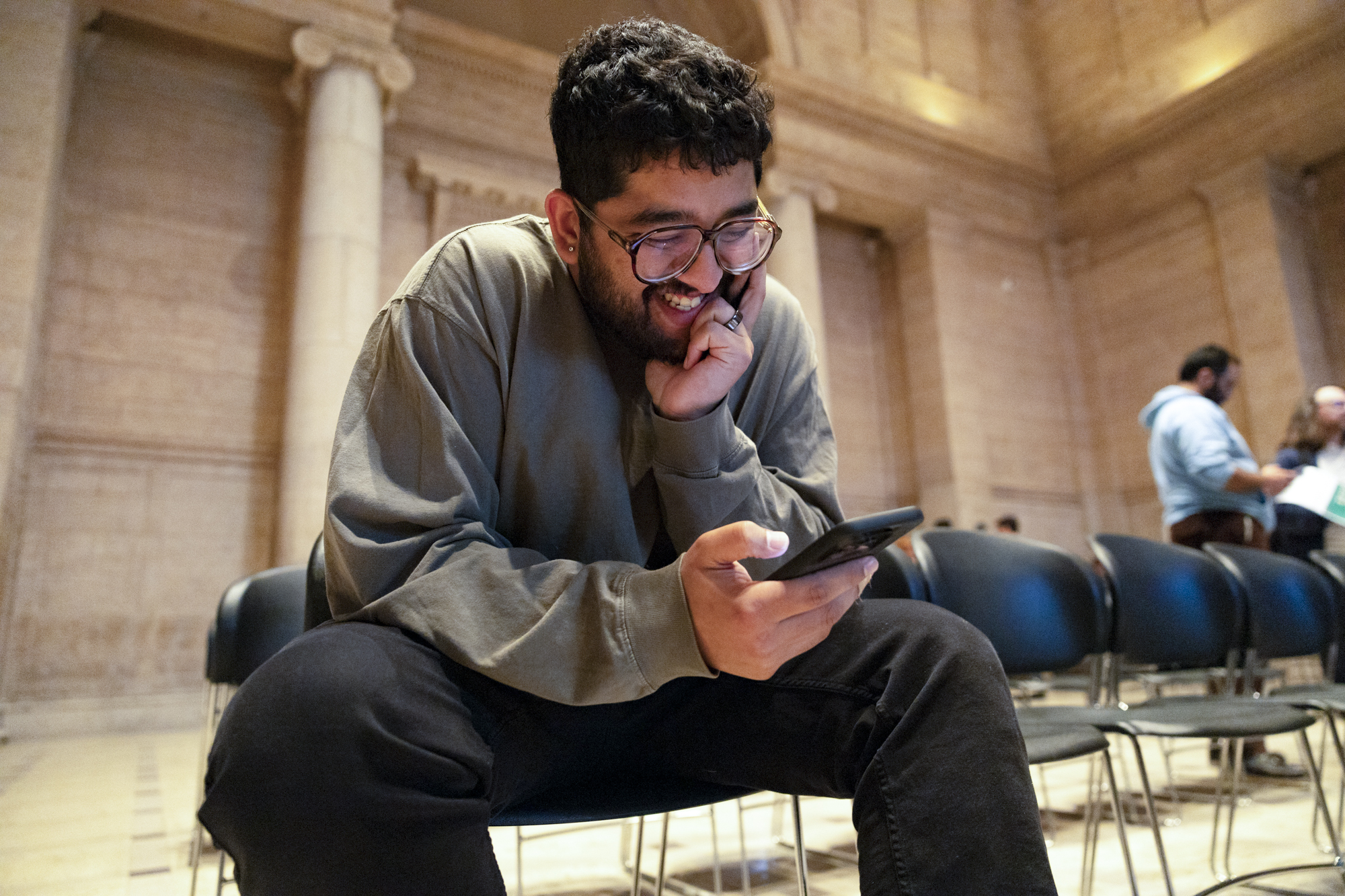
"caption": "Krish Chowdhary plays the H1B.Life game at the Asian Art Museum on March 12, 2026. H1B.Life is a game representing a live simulation of the U.S H-1B visa system with players “living” the lives of international students and workers trapped in the H-1B system, whose experiences were directly written into the game.",
"credit": "Gina Castro for KQED",
"altTag": null,
"description": null,
"imgSizes": {
"thumbnail": {
"file": "https://cdn.kqed.org/wp-content/uploads/sites/10/2026/03/20260312_H1BVIDEOGAME_GC-12-KQED-160x107.jpg",
"width": 160,
"height": 107,
"mimeType": "image/jpeg"
},
"1536x1536": {
"file": "https://cdn.kqed.org/wp-content/uploads/sites/10/2026/03/20260312_H1BVIDEOGAME_GC-12-KQED-1536x1024.jpg",
"width": 1536,
"height": 1024,
"mimeType": "image/jpeg"
},
"post-thumbnail": {
"file": "https://cdn.kqed.org/wp-content/uploads/sites/10/2026/03/20260312_H1BVIDEOGAME_GC-12-KQED-672x372.jpg",
"width": 672,
"height": 372,
"mimeType": "image/jpeg"
},
"twentyfourteen-full-width": {
"file": "https://cdn.kqed.org/wp-content/uploads/sites/10/2026/03/20260312_H1BVIDEOGAME_GC-12-KQED-1038x576.jpg",
"width": 1038,
"height": 576,
"mimeType": "image/jpeg"
},
"npr-cds-wide": {
"file": "https://cdn.kqed.org/wp-content/uploads/sites/10/2026/03/20260312_H1BVIDEOGAME_GC-12-KQED-1200x675.jpg",
"width": 1200,
"height": 675,
"mimeType": "image/jpeg"
},
"kqedFullSize": {
"file": "https://cdn.kqed.org/wp-content/uploads/sites/10/2026/03/20260312_H1BVIDEOGAME_GC-12-KQED.jpg",
"width": 2000,
"height": 1333
}
},
"isLoading": false,
"fetchFailed": false
},
"news_12076634": {
"type": "attachments",
"id": "news_12076634",
"meta": {
"index": "attachments_1716263798",
"site": "news",
"id": "12076634",
"found": true
},
"title": "020226AI Billboards _GH_006_qed",
"publishDate": 1773699831,
"status": "inherit",
"parent": 12076608,
"modified": 1773699842,
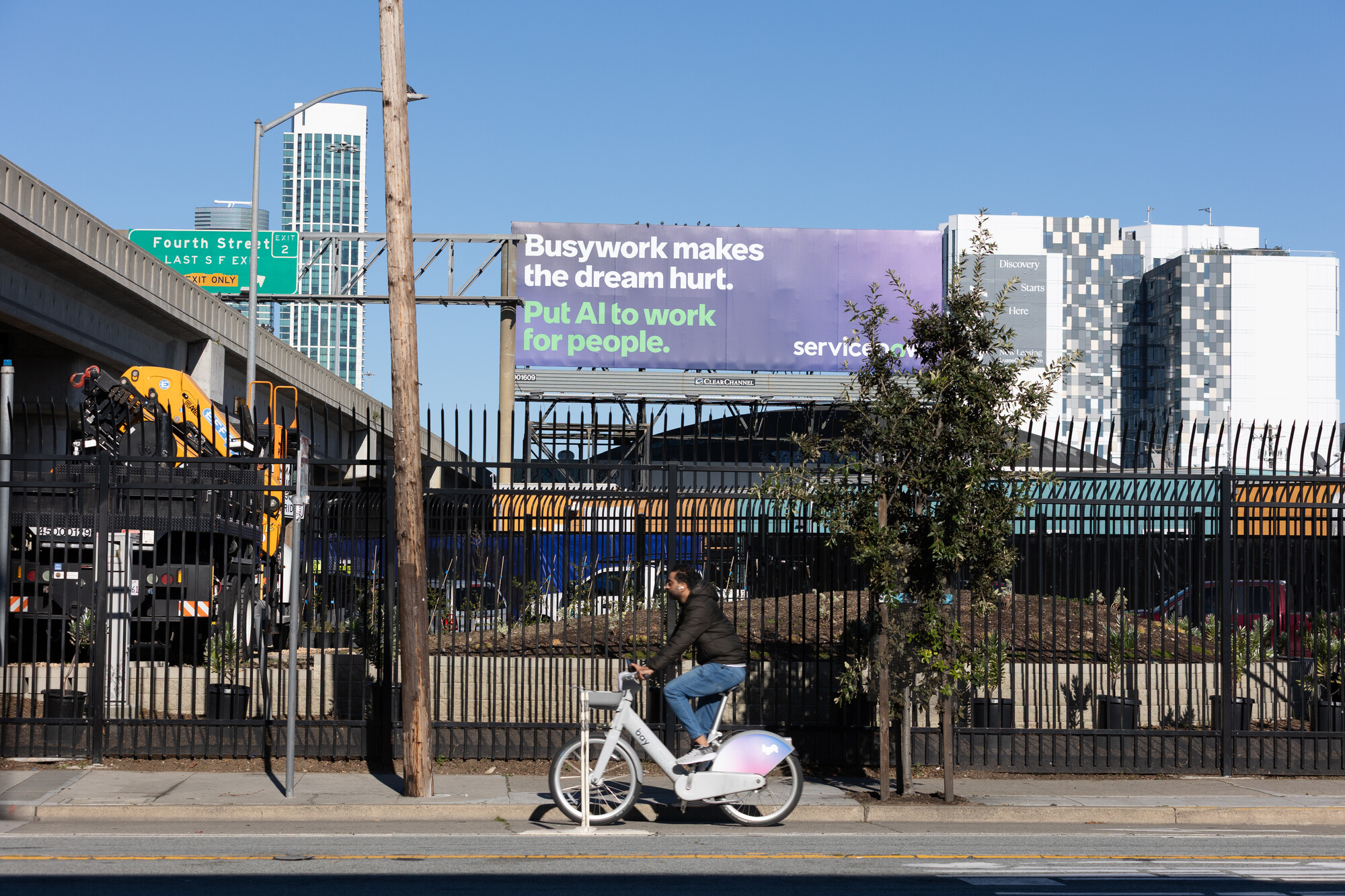
"caption": "A cyclist rides along Fifth Street beneath a tech billboard on Feb. 2, 2026, in San Francisco.",
"credit": "Gustavo Hernandez/KQED",
"altTag": null,
"description": null,
"imgSizes": {
"thumbnail": {
"file": "https://cdn.kqed.org/wp-content/uploads/sites/10/2026/03/020226AI-Billboards-_GH_006_qed-160x107.jpg",
"width": 160,
"height": 107,
"mimeType": "image/jpeg"
},
"1536x1536": {
"file": "https://cdn.kqed.org/wp-content/uploads/sites/10/2026/03/020226AI-Billboards-_GH_006_qed-1536x1024.jpg",
"width": 1536,
"height": 1024,
"mimeType": "image/jpeg"
},
"post-thumbnail": {
"file": "https://cdn.kqed.org/wp-content/uploads/sites/10/2026/03/020226AI-Billboards-_GH_006_qed-672x372.jpg",
"width": 672,
"height": 372,
"mimeType": "image/jpeg"
},
"twentyfourteen-full-width": {
"file": "https://cdn.kqed.org/wp-content/uploads/sites/10/2026/03/020226AI-Billboards-_GH_006_qed-1038x576.jpg",
"width": 1038,
"height": 576,
"mimeType": "image/jpeg"
},
"npr-cds-wide": {
"file": "https://cdn.kqed.org/wp-content/uploads/sites/10/2026/03/020226AI-Billboards-_GH_006_qed-1200x675.jpg",
"width": 1200,
"height": 675,
"mimeType": "image/jpeg"
},
"kqedFullSize": {
"file": "https://cdn.kqed.org/wp-content/uploads/sites/10/2026/03/020226AI-Billboards-_GH_006_qed.jpg",
"width": 2000,
"height": 1333
}
},
"isLoading": false,
"fetchFailed": false
},
"news_12075461": {
"type": "attachments",
"id": "news_12075461",
"meta": {
"index": "attachments_1716263798",
"site": "news",
"id": "12075461",
"found": true
},
"title": "260304-Elon-Musk-Trial-05-KQED",
"publishDate": 1772671994,
"status": "inherit",
"parent": 12075332,
"modified": 1773790475,
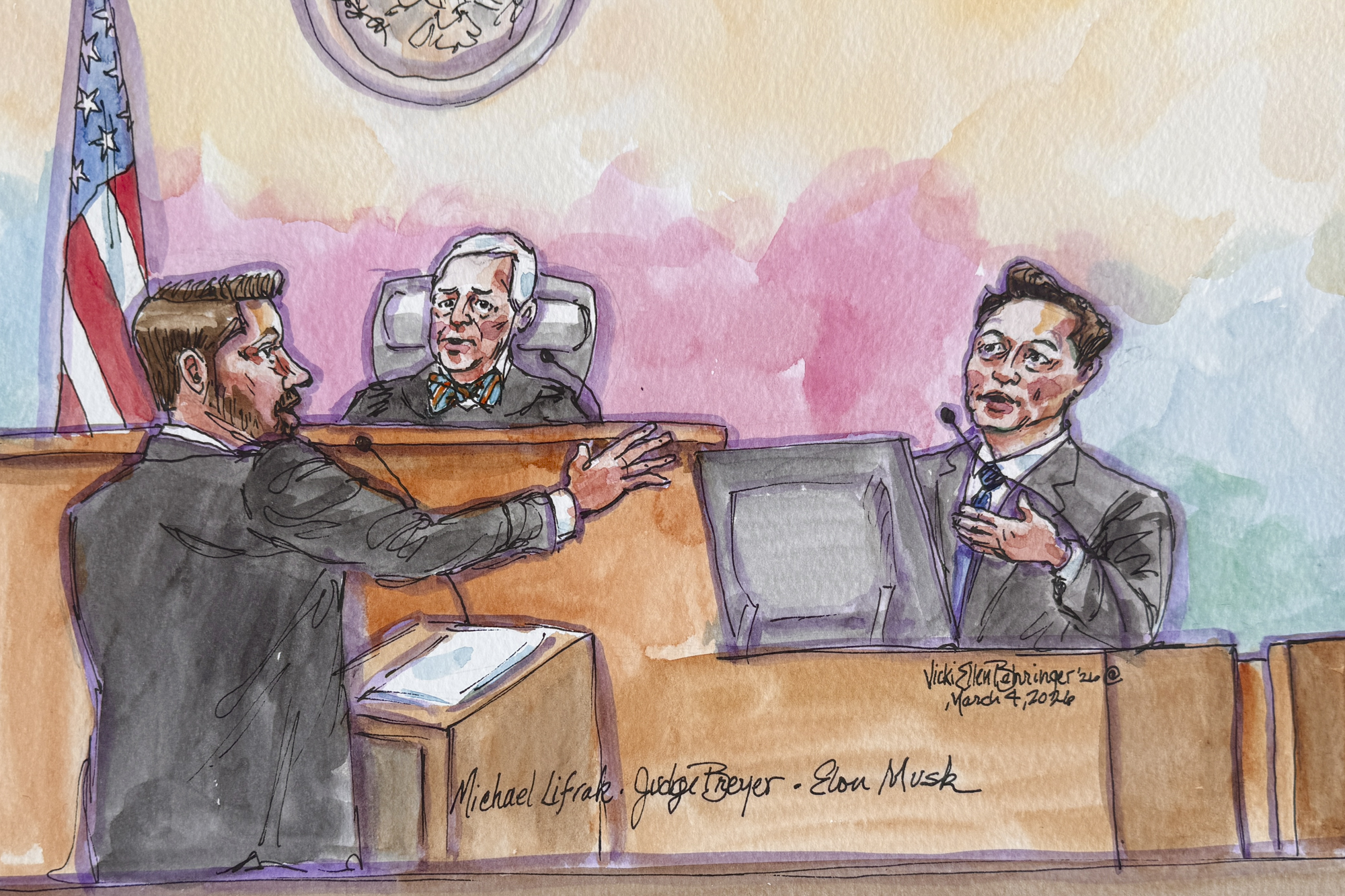
"caption": "A courtroom sketch depicts the defense questioning Elon Musk on March 4, 2026.",
"credit": "Vicki Behringer for KQED",
"altTag": null,
"description": null,
"imgSizes": {
"thumbnail": {
"file": "https://cdn.kqed.org/wp-content/uploads/sites/10/2026/03/260304-Elon-Musk-Trial-05-KQED-160x107.jpg",
"width": 160,
"height": 107,
"mimeType": "image/jpeg"
},
"1536x1536": {
"file": "https://cdn.kqed.org/wp-content/uploads/sites/10/2026/03/260304-Elon-Musk-Trial-05-KQED-1536x1024.jpg",
"width": 1536,
"height": 1024,
"mimeType": "image/jpeg"
},
"post-thumbnail": {
"file": "https://cdn.kqed.org/wp-content/uploads/sites/10/2026/03/260304-Elon-Musk-Trial-05-KQED-672x372.jpg",
"width": 672,
"height": 372,
"mimeType": "image/jpeg"
},
"twentyfourteen-full-width": {
"file": "https://cdn.kqed.org/wp-content/uploads/sites/10/2026/03/260304-Elon-Musk-Trial-05-KQED-1038x576.jpg",
"width": 1038,
"height": 576,
"mimeType": "image/jpeg"
},
"npr-cds-wide": {
"file": "https://cdn.kqed.org/wp-content/uploads/sites/10/2026/03/260304-Elon-Musk-Trial-05-KQED-1200x675.jpg",
"width": 1200,
"height": 675,
"mimeType": "image/jpeg"
},
"kqedFullSize": {
"file": "https://cdn.kqed.org/wp-content/uploads/sites/10/2026/03/260304-Elon-Musk-Trial-05-KQED.jpg",
"width": 2000,
"height": 1333
}
},
"isLoading": false,
"fetchFailed": false
},
"news_12076629": {
"type": "attachments",
"id": "news_12076629",
"meta": {
"index": "attachments_1716263798",
"site": "news",
"id": "12076629",
"found": true
},
"title": "Billboard-AI-Illustration_6",
"publishDate": 1773699455,
"status": "inherit",
"parent": 12076608,
"modified": 1773703712,
"caption": "The Bay Area's booming AI industry has taken over bus shelters, buildings and billboards, broadcasting an array of messages about the future of work for humans.",
"credit": "Darren Tu/KQED",
"altTag": null,
"description": null,
"imgSizes": {
"thumbnail": {
"file": "https://cdn.kqed.org/wp-content/uploads/sites/10/2026/03/Billboard-AI-Illustration_6-160x103.jpg",
"width": 160,
"height": 103,
"mimeType": "image/jpeg"
},
"1536x1536": {
"file": "https://cdn.kqed.org/wp-content/uploads/sites/10/2026/03/Billboard-AI-Illustration_6-1536x992.jpg",
"width": 1536,
"height": 992,
"mimeType": "image/jpeg"
},
"post-thumbnail": {
"file": "https://cdn.kqed.org/wp-content/uploads/sites/10/2026/03/Billboard-AI-Illustration_6-672x372.jpg",
"width": 672,
"height": 372,
"mimeType": "image/jpeg"
},
"twentyfourteen-full-width": {
"file": "https://cdn.kqed.org/wp-content/uploads/sites/10/2026/03/Billboard-AI-Illustration_6-1038x576.jpg",
"width": 1038,
"height": 576,
"mimeType": "image/jpeg"
},
"npr-cds-wide": {
"file": "https://cdn.kqed.org/wp-content/uploads/sites/10/2026/03/Billboard-AI-Illustration_6-1200x675.jpg",
"width": 1200,
"height": 675,
"mimeType": "image/jpeg"
},
"kqedFullSize": {
"file": "https://cdn.kqed.org/wp-content/uploads/sites/10/2026/03/Billboard-AI-Illustration_6.jpg",
"width": 1920,
"height": 1240
}
},
"isLoading": false,
"fetchFailed": false
},
"news_11984097": {
"type": "attachments",
"id": "news_11984097",
"meta": {
"index": "attachments_1716263798",
"site": "news",
"id": "11984097",
"found": true
},
"title": "SAN JOSE LICENSE PLATE READERS-11-KQED",
"publishDate": 1714086991,
"status": "inherit",
"parent": 11983813,
"modified": 1766004900,
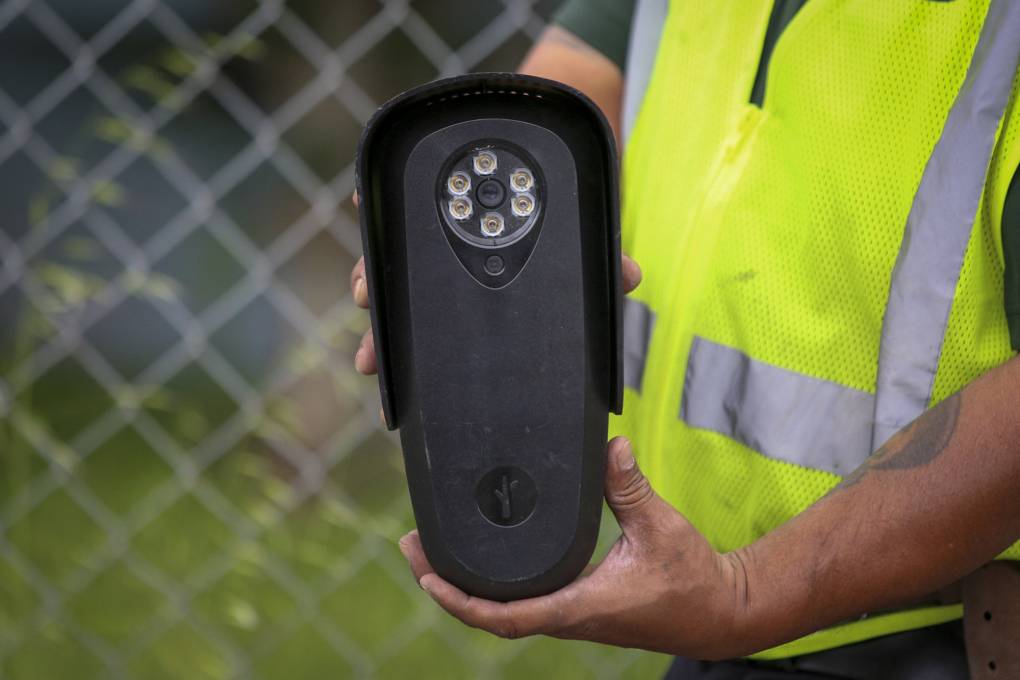
"caption": "A Flock Safety worker holds up a new automated license plate reader that was being installed in East San José on April 23, 2024.",
"credit": "Joseph Geha/KQED",
"altTag": "A man with a fluorescent yellow coat holds a black machine.",
"description": null,
"imgSizes": {
"medium": {
"file": "https://cdn.kqed.org/wp-content/uploads/sites/10/2024/04/SAN-JOSE-LICENSE-PLATE-READERS-11-KQED-800x533.jpg",
"width": 800,
"height": 533,
"mimeType": "image/jpeg"
},
"large": {
"file": "https://cdn.kqed.org/wp-content/uploads/sites/10/2024/04/SAN-JOSE-LICENSE-PLATE-READERS-11-KQED-1020x680.jpg",
"width": 1020,
"height": 680,
"mimeType": "image/jpeg"
},
"thumbnail": {
"file": "https://cdn.kqed.org/wp-content/uploads/sites/10/2024/04/SAN-JOSE-LICENSE-PLATE-READERS-11-KQED-160x107.jpg",
"width": 160,
"height": 107,
"mimeType": "image/jpeg"
},
"1536x1536": {
"file": "https://cdn.kqed.org/wp-content/uploads/sites/10/2024/04/SAN-JOSE-LICENSE-PLATE-READERS-11-KQED-1536x1024.jpg",
"width": 1536,
"height": 1024,
"mimeType": "image/jpeg"
},
"post-thumbnail": {
"file": "https://cdn.kqed.org/wp-content/uploads/sites/10/2024/04/SAN-JOSE-LICENSE-PLATE-READERS-11-KQED-672x372.jpg",
"width": 672,
"height": 372,
"mimeType": "image/jpeg"
},
"twentyfourteen-full-width": {
"file": "https://cdn.kqed.org/wp-content/uploads/sites/10/2024/04/SAN-JOSE-LICENSE-PLATE-READERS-11-KQED-1038x576.jpg",
"width": 1038,
"height": 576,
"mimeType": "image/jpeg"
},
"full-width": {
"file": "https://cdn.kqed.org/wp-content/uploads/sites/10/2024/04/SAN-JOSE-LICENSE-PLATE-READERS-11-KQED-1920x1280.jpg",
"width": 1920,
"height": 1280,
"mimeType": "image/jpeg"
},
"kqedFullSize": {
"file": "https://cdn.kqed.org/wp-content/uploads/sites/10/2024/04/SAN-JOSE-LICENSE-PLATE-READERS-11-KQED.jpg",
"width": 2000,
"height": 1333
}
},
"isLoading": false,
"fetchFailed": false
},
"news_12075382": {
"type": "attachments",
"id": "news_12075382",
"meta": {
"index": "attachments_1716263798",
"site": "news",
"id": "12075382",
"found": true
},
"title": "260304-Elon Musk Trial-01-KQED",
"publishDate": 1772650201,
"status": "inherit",
"parent": 12083612,
"modified": 1778805009,
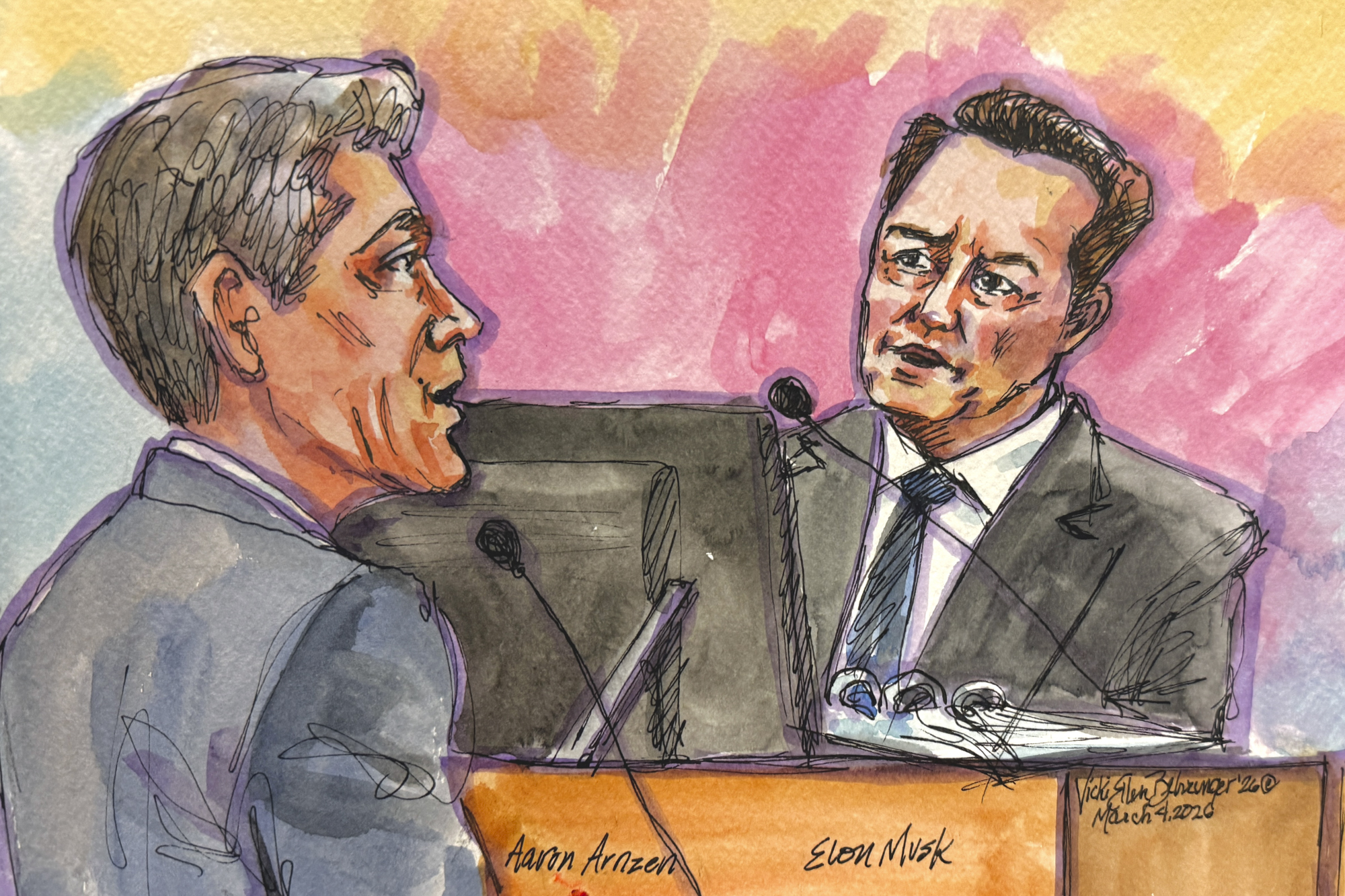
"caption": "A courtroom sketch of Elon Musk on the stand as he's questioned by the plaintiff's attorney, Aaron P. Arnzen, on March 4, 2026. Musk is accused of making false and misleading statements that drove down Twitter's stock price before he bought the social media platform for $44 billion in 2022.",
"credit": "Vicki Behringer for KQED",
"altTag": null,
"description": null,
"imgSizes": {
"thumbnail": {
"file": "https://cdn.kqed.org/wp-content/uploads/sites/10/2026/03/260304-Elon-Musk-Trial-01-KQED-160x107.jpg",
"width": 160,
"height": 107,
"mimeType": "image/jpeg"
},
"1536x1536": {
"file": "https://cdn.kqed.org/wp-content/uploads/sites/10/2026/03/260304-Elon-Musk-Trial-01-KQED-1536x1024.jpg",
"width": 1536,
"height": 1024,
"mimeType": "image/jpeg"
},
"post-thumbnail": {
"file": "https://cdn.kqed.org/wp-content/uploads/sites/10/2026/03/260304-Elon-Musk-Trial-01-KQED-672x372.jpg",
"width": 672,
"height": 372,
"mimeType": "image/jpeg"
},
"twentyfourteen-full-width": {
"file": "https://cdn.kqed.org/wp-content/uploads/sites/10/2026/03/260304-Elon-Musk-Trial-01-KQED-1038x576.jpg",
"width": 1038,
"height": 576,
"mimeType": "image/jpeg"
},
"npr-cds-wide": {
"file": "https://cdn.kqed.org/wp-content/uploads/sites/10/2026/03/260304-Elon-Musk-Trial-01-KQED-1200x675.jpg",
"width": 1200,
"height": 675,
"mimeType": "image/jpeg"
},
"kqedFullSize": {
"file": "https://cdn.kqed.org/wp-content/uploads/sites/10/2026/03/260304-Elon-Musk-Trial-01-KQED.jpg",
"width": 2000,
"height": 1333
}
},
"isLoading": false,
"fetchFailed": false
},
"news_11985952": {
"type": "attachments",
"id": "news_11985952",
"meta": {
"index": "attachments_1716263798",
"site": "news",
"id": "11985952",
"found": true
},
"title": "Open AI ChatGPT Update",
"publishDate": 1715640590,
"status": "inherit",
"parent": 11985949,
"modified": 1783528918,
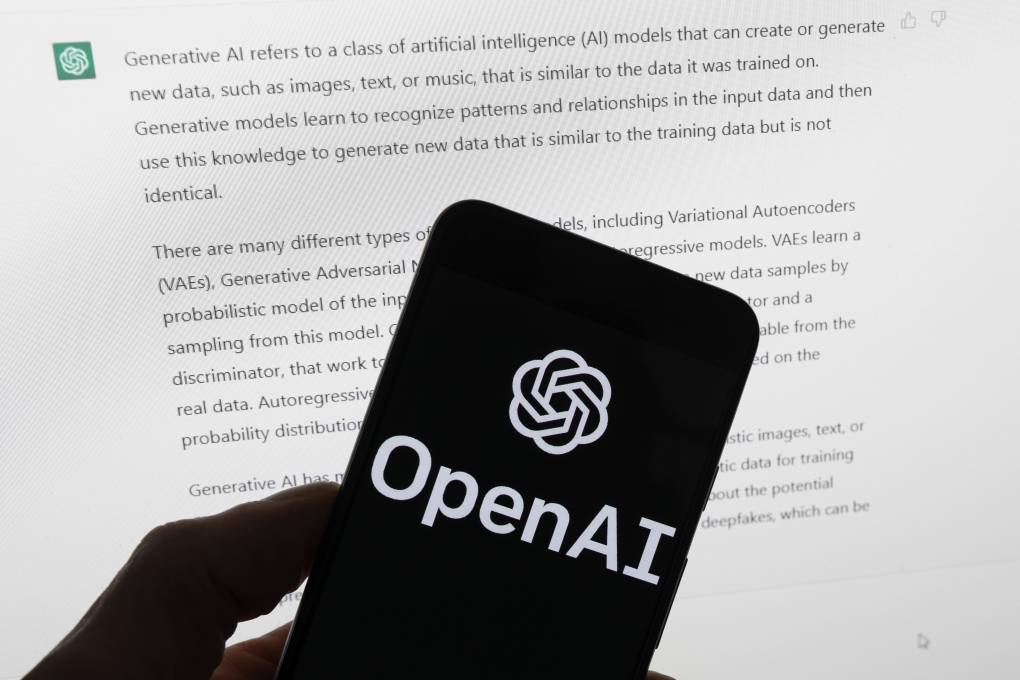
"caption": "The OpenAI logo is seen on a mobile phone in front of a computer screen displaying output from ChatGPT, March 21, 2023, in Boston, Massachusetts. ",
"credit": "Michael Dwyer/Associated Press",
"altTag": null,
"description": null,
"imgSizes": {
"medium": {
"file": "https://cdn.kqed.org/wp-content/uploads/sites/10/2024/05/AP24134775174210-800x533.jpg",
"width": 800,
"height": 533,
"mimeType": "image/jpeg"
},
"large": {
"file": "https://cdn.kqed.org/wp-content/uploads/sites/10/2024/05/AP24134775174210-1020x680.jpg",
"width": 1020,
"height": 680,
"mimeType": "image/jpeg"
},
"thumbnail": {
"file": "https://cdn.kqed.org/wp-content/uploads/sites/10/2024/05/AP24134775174210-160x107.jpg",
"width": 160,
"height": 107,
"mimeType": "image/jpeg"
},
"1536x1536": {
"file": "https://cdn.kqed.org/wp-content/uploads/sites/10/2024/05/AP24134775174210-1536x1024.jpg",
"width": 1536,
"height": 1024,
"mimeType": "image/jpeg"
},
"2048x2048": {
"file": "https://cdn.kqed.org/wp-content/uploads/sites/10/2024/05/AP24134775174210-2048x1365.jpg",
"width": 2048,
"height": 1365,
"mimeType": "image/jpeg"
},
"post-thumbnail": {
"file": "https://cdn.kqed.org/wp-content/uploads/sites/10/2024/05/AP24134775174210-672x372.jpg",
"width": 672,
"height": 372,
"mimeType": "image/jpeg"
},
"twentyfourteen-full-width": {
"file": "https://cdn.kqed.org/wp-content/uploads/sites/10/2024/05/AP24134775174210-1038x576.jpg",
"width": 1038,
"height": 576,
"mimeType": "image/jpeg"
},
"full-width": {
"file": "https://cdn.kqed.org/wp-content/uploads/sites/10/2024/05/AP24134775174210-1920x1280.jpg",
"width": 1920,
"height": 1280,
"mimeType": "image/jpeg"
},
"kqedFullSize": {
"file": "https://cdn.kqed.org/wp-content/uploads/sites/10/2024/05/AP24134775174210-scaled-e1770337042768.jpg",
"width": 2000,
"height": 1334
}
},
"isLoading": false,
"fetchFailed": false
},
"news_12071769": {
"type": "attachments",
"id": "news_12071769",
"meta": {
"index": "attachments_1716263798",
"site": "news",
"id": "12071769",
"found": true
},
"title": "Dozens of new driverless Waymo cars on the streets and inside the garage on West Los Angeles.",
"publishDate": 1769809364,
"status": "inherit",
"parent": 12071764,
"modified": 1769823047,
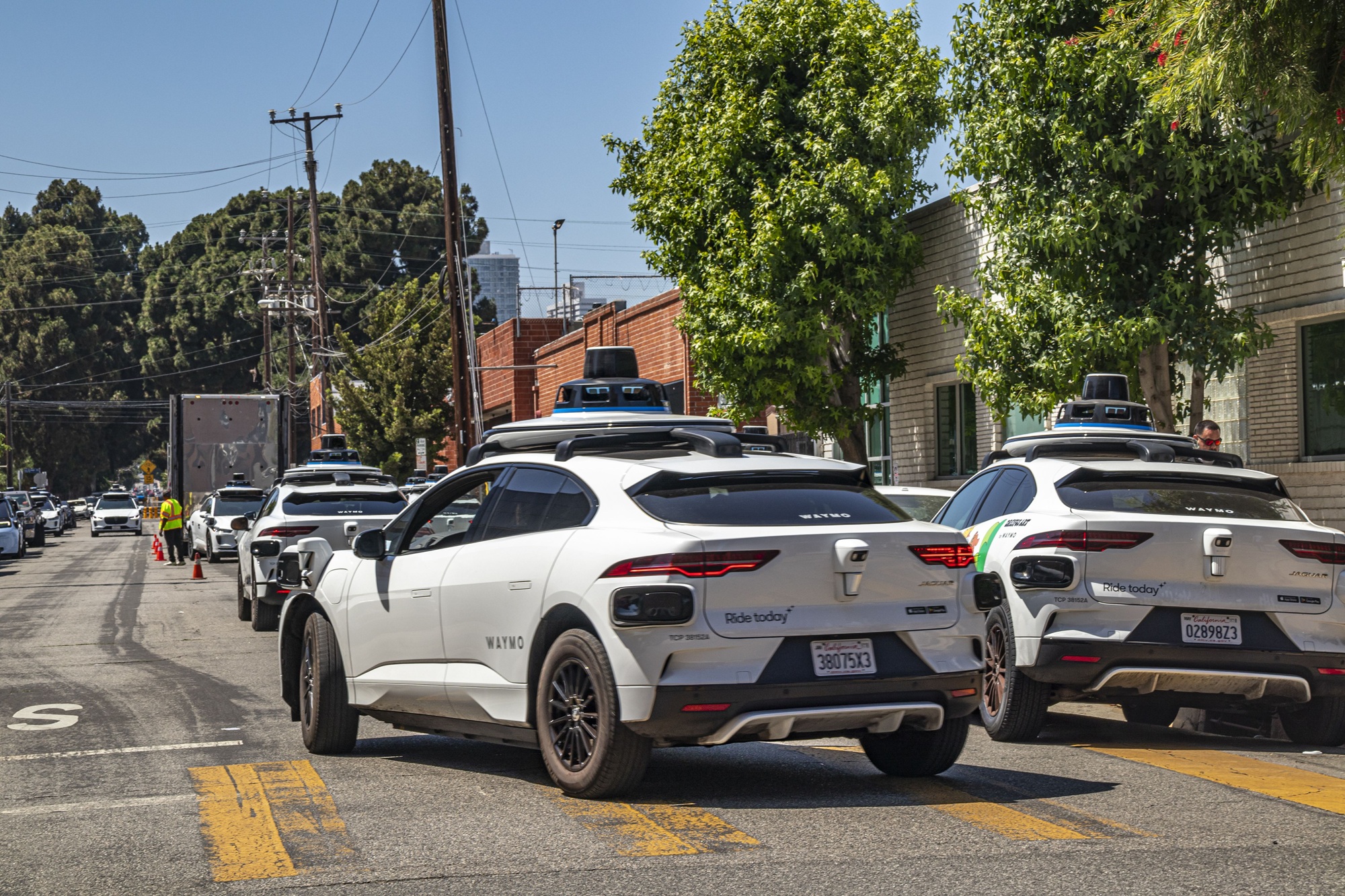
"caption": "Dozens of new driverless Waymo cars on the streets and inside the garage in West Los Angeles, in Los Angeles, California, on July 11, 2025.",
"credit": "Citizen of the Planet/Universal Images Group via Getty Images",
"altTag": null,
"description": null,
"imgSizes": {
"thumbnail": {
"file": "https://cdn.kqed.org/wp-content/uploads/sites/10/2026/01/WaymoLosAngelesGetty-160x107.jpg",
"width": 160,
"height": 107,
"mimeType": "image/jpeg"
},
"1536x1536": {
"file": "https://cdn.kqed.org/wp-content/uploads/sites/10/2026/01/WaymoLosAngelesGetty-1536x1024.jpg",
"width": 1536,
"height": 1024,
"mimeType": "image/jpeg"
},
"post-thumbnail": {
"file": "https://cdn.kqed.org/wp-content/uploads/sites/10/2026/01/WaymoLosAngelesGetty-672x372.jpg",
"width": 672,
"height": 372,
"mimeType": "image/jpeg"
},
"twentyfourteen-full-width": {
"file": "https://cdn.kqed.org/wp-content/uploads/sites/10/2026/01/WaymoLosAngelesGetty-1038x576.jpg",
"width": 1038,
"height": 576,
"mimeType": "image/jpeg"
},
"npr-cds-wide": {
"file": "https://cdn.kqed.org/wp-content/uploads/sites/10/2026/01/WaymoLosAngelesGetty-1200x675.jpg",
"width": 1200,
"height": 675,
"mimeType": "image/jpeg"
},
"kqedFullSize": {
"file": "https://cdn.kqed.org/wp-content/uploads/sites/10/2026/01/WaymoLosAngelesGetty.jpg",
"width": 2000,
"height": 1333
}
},
"isLoading": false,
"fetchFailed": false
},
"news_12071620": {
"type": "attachments",
"id": "news_12071620",
"meta": {
"index": "attachments_1716263798",
"site": "news",
"id": "12071620",
"found": true
},
"title": "2026 Brussels Motor Show",
"publishDate": 1769729156,
"status": "inherit",
"parent": 12071615,
"modified": 1769735893,
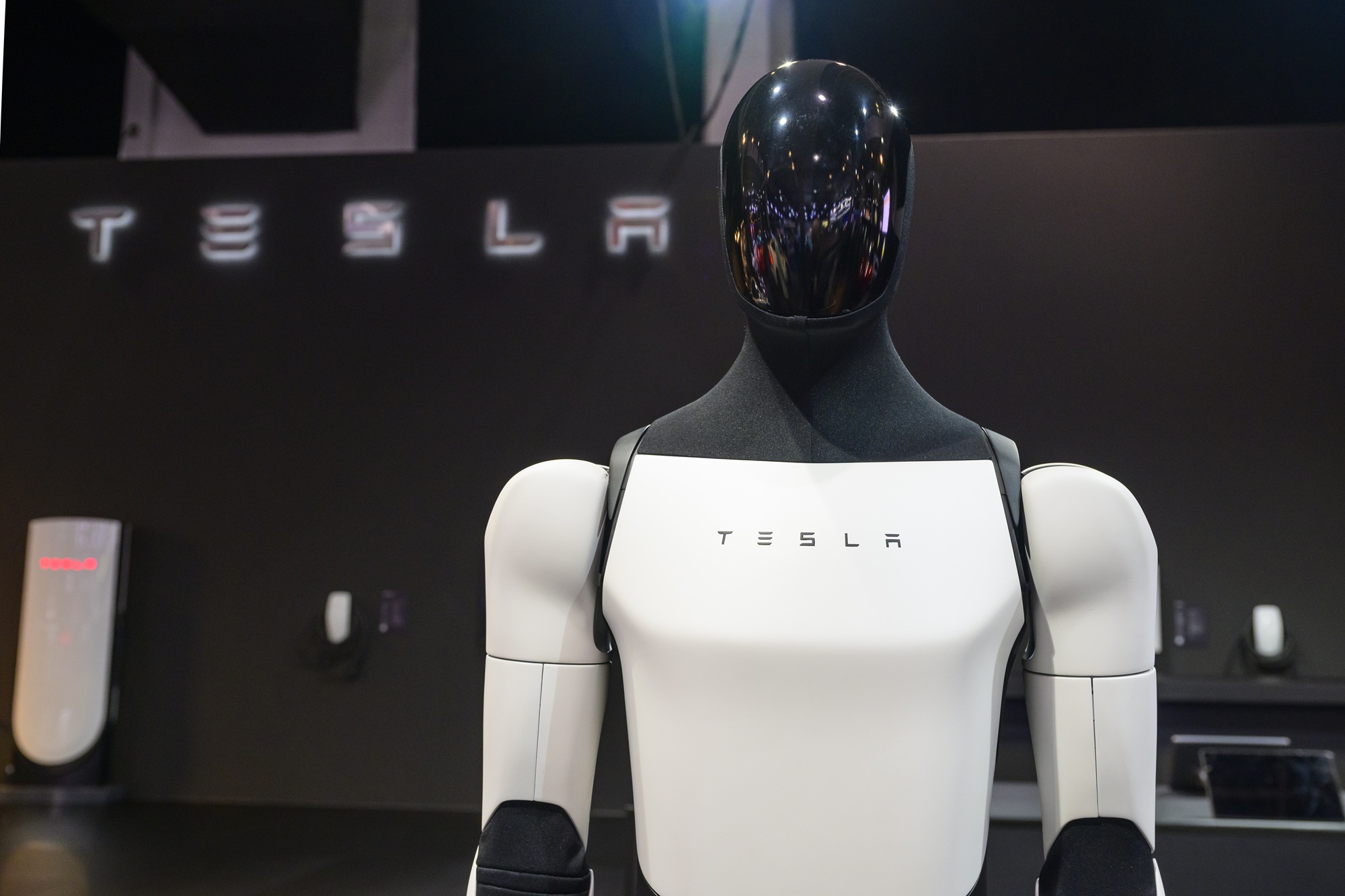
"caption": "Tesla Optimus, also known as Tesla Bot, a general-purpose robotic humanoid on display at the AutoSalon press preview on Jan. 9, 2026, in Brussels, Belgium. The 102nd Brussels Motor Show has firmly established itself on the international calendar, featuring over 60 car brands and more than 20 motorcycle brands, and visited by over 270,000 people. ",
"credit": "Sjoerd van der Wal/Getty Images",
"altTag": null,
"description": null,
"imgSizes": {
"thumbnail": {
"file": "https://cdn.kqed.org/wp-content/uploads/sites/10/2026/01/Tesla-Optimus-Getty-160x107.jpg",
"width": 160,
"height": 107,
"mimeType": "image/jpeg"
},
"1536x1536": {
"file": "https://cdn.kqed.org/wp-content/uploads/sites/10/2026/01/Tesla-Optimus-Getty-1536x1024.jpg",
"width": 1536,
"height": 1024,
"mimeType": "image/jpeg"
},
"post-thumbnail": {
"file": "https://cdn.kqed.org/wp-content/uploads/sites/10/2026/01/Tesla-Optimus-Getty-672x372.jpg",
"width": 672,
"height": 372,
"mimeType": "image/jpeg"
},
"twentyfourteen-full-width": {
"file": "https://cdn.kqed.org/wp-content/uploads/sites/10/2026/01/Tesla-Optimus-Getty-1038x576.jpg",
"width": 1038,
"height": 576,
"mimeType": "image/jpeg"
},
"npr-cds-wide": {
"file": "https://cdn.kqed.org/wp-content/uploads/sites/10/2026/01/Tesla-Optimus-Getty-1200x675.jpg",
"width": 1200,
"height": 675,
"mimeType": "image/jpeg"
},
"kqedFullSize": {
"file": "https://cdn.kqed.org/wp-content/uploads/sites/10/2026/01/Tesla-Optimus-Getty.jpg",
"width": 2000,
"height": 1333
}
},
"isLoading": false,
"fetchFailed": false
},
"news_12071574": {
"type": "attachments",
"id": "news_12071574",
"meta": {
"index": "attachments_1716263798",
"site": "news",
"id": "12071574",
"found": true
},
"title": "The Inauguration Of Donald J. Trump As The 47th President",
"publishDate": 1769720316,
"status": "inherit",
"parent": 12071559,
"modified": 1781212491,
"caption": "Google CEO Sundar Pichai (left) and Tesla and SpaceX CEO Elon Musk attend the inauguration of Donald Trump in the U.S. Capitol Rotunda on Jan. 20, 2025, in Washington, D.C. ",
"credit": "Saul Loeb-Pool/Getty Images",
"altTag": null,
"description": null,
"imgSizes": {
"thumbnail": {
"file": "https://cdn.kqed.org/wp-content/uploads/sites/10/2026/01/ElonMuskInaugurationTechGetty-160x107.jpg",
"width": 160,
"height": 107,
"mimeType": "image/jpeg"
},
"1536x1536": {
"file": "https://cdn.kqed.org/wp-content/uploads/sites/10/2026/01/ElonMuskInaugurationTechGetty-1536x1024.jpg",
"width": 1536,
"height": 1024,
"mimeType": "image/jpeg"
},
"post-thumbnail": {
"file": "https://cdn.kqed.org/wp-content/uploads/sites/10/2026/01/ElonMuskInaugurationTechGetty-672x372.jpg",
"width": 672,
"height": 372,
"mimeType": "image/jpeg"
},
"twentyfourteen-full-width": {
"file": "https://cdn.kqed.org/wp-content/uploads/sites/10/2026/01/ElonMuskInaugurationTechGetty-1038x576.jpg",
"width": 1038,
"height": 576,
"mimeType": "image/jpeg"
},
"npr-cds-wide": {
"file": "https://cdn.kqed.org/wp-content/uploads/sites/10/2026/01/ElonMuskInaugurationTechGetty-1200x675.jpg",
"width": 1200,
"height": 675,
"mimeType": "image/jpeg"
},
"kqedFullSize": {
"file": "https://cdn.kqed.org/wp-content/uploads/sites/10/2026/01/ElonMuskInaugurationTechGetty.jpg",
"width": 2000,
"height": 1333
}
},
"isLoading": false,
"fetchFailed": false
},
"news_12071097": {
"type": "attachments",
"id": "news_12071097",
"meta": {
"index": "attachments_1716263798",
"site": "news",
"id": "12071097",
"found": true
},
"title": "260126-AI WEATHER-01-KQED",
"publishDate": 1769468123,
"status": "inherit",
"parent": 0,
"modified": 1769468143,
"caption": "NVIDIA Earth-2 Global Data Assimilation shows the complex patterns of Earth observation data from satellites, weather balloons and weather stations, which the AI model transforms into smooth, continuous estimates of the atmospheric state from which forecasts can be launched.",
"credit": "Courtesy of NVIDIA",
"altTag": null,
"description": null,
"imgSizes": {
"thumbnail": {
"file": "https://cdn.kqed.org/wp-content/uploads/sites/10/2026/01/260126-AI-WEATHER-01-KQED-160x107.jpg",
"width": 160,
"height": 107,
"mimeType": "image/jpeg"
},
"1536x1536": {
"file": "https://cdn.kqed.org/wp-content/uploads/sites/10/2026/01/260126-AI-WEATHER-01-KQED-1536x1025.jpg",
"width": 1536,
"height": 1025,
"mimeType": "image/jpeg"
},
"post-thumbnail": {
"file": "https://cdn.kqed.org/wp-content/uploads/sites/10/2026/01/260126-AI-WEATHER-01-KQED-672x372.jpg",
"width": 672,
"height": 372,
"mimeType": "image/jpeg"
},
"twentyfourteen-full-width": {
"file": "https://cdn.kqed.org/wp-content/uploads/sites/10/2026/01/260126-AI-WEATHER-01-KQED-1038x576.jpg",
"width": 1038,
"height": 576,
"mimeType": "image/jpeg"
},
"npr-cds-wide": {
"file": "https://cdn.kqed.org/wp-content/uploads/sites/10/2026/01/260126-AI-WEATHER-01-KQED-1200x675.jpg",
"width": 1200,
"height": 675,
"mimeType": "image/jpeg"
},
"kqedFullSize": {
"file": "https://cdn.kqed.org/wp-content/uploads/sites/10/2026/01/260126-AI-WEATHER-01-KQED.jpg",
"width": 2000,
"height": 1334
}
},
"isLoading": false,
"fetchFailed": false
}
},
"audioPlayerReducer": {
"postId": "stream_live",
"isPaused": true,
"isPlaying": false,
"pfsActive": false,
"pledgeModalIsOpen": true,
"playerDrawerIsOpen": false,
"liveAudioPlayStartedAt": 0,
"liveAudioPlayContext": ""
},
"authorsReducer": {
"rachael-myrow": {
"type": "authors",
"id": "251",
"meta": {
"index": "authors_1716337520",
"id": "251",
"found": true
},
"name": "Rachael Myrow",
"firstName": "Rachael",
"lastName": "Myrow",
"slug": "rachael-myrow",
"email": "rmyrow@kqed.org",
"display_author_email": true,
"staff_mastheads": [
"news"
],
"title": "Senior Editor of KQED's Silicon Valley News Desk",
"bio": "• I write and edit stories about how Silicon Valley power and policies shape everyday life in California. I’m also passionate about making Bay Area history and culture more accessible to a broad public. • I’ve been a journalist for most of my life, starting in high school with The Franklin Press in Los Angeles, where I grew up. While earning my first degree in English at UC Berkeley, I got my start in public radio at KALX-FM. After completing a second degree in journalism at Cal, I landed my first professional job at Marketplace, then moved on to KPCC (now LAist), and then KQED, where I hosted The California Report for more than seven years. • My reporting has appeared on NPR, The World, WBUR’s \u003ci>Here & Now\u003c/i>, and the BBC. I also guest host for KQED’s \u003ci>Forum\u003c/i>, as well as the Commonwealth Club in San Francisco. • I speak periodically on media, democracy and technology issues, and do voiceover work for documentaries and educational video projects. • Outside of the studio, you'll find me hiking Bay Area trails and whipping up Insta-ready meals in my kitchen. • I do not accept gifts, money, or favors from anyone connected to my reporting, I don't pay people for information, and I do not support or donate to political causes. • I strive to treat the people I report on with fairness, honesty, and respect. I also recognize there are often multiple sides to a story and work to verify information through multiple sources and documentation. If I get something wrong, I correct it.",
"avatar": "https://secure.gravatar.com/avatar/3ed8a3c5f26025e4a805ba634cda8cd764906b97438a6d9ce216b044e340da4e?s=600&d=blank&r=g",
"twitter": "rachaelmyrow",
"bluesky": null,
"facebook": null,
"instagram": null,
"linkedin": "https://www.linkedin.com/in/rachaelmyrow/",
"sites": [
{
"site": "arts",
"roles": [
"administrator"
]
},
{
"site": "news",
"roles": [
"edit_others_posts",
"editor"
]
},
{
"site": "futureofyou",
"roles": [
"editor"
]
},
{
"site": "bayareabites",
"roles": [
"editor"
]
},
{
"site": "stateofhealth",
"roles": [
"editor"
]
},
{
"site": "science",
"roles": [
"editor"
]
},
{
"site": "food",
"roles": [
"editor"
]
},
{
"site": "forum",
"roles": [
"editor"
]
},
{
"site": "liveblog",
"roles": [
"author"
]
}
],
"headData": {
"title": "Rachael Myrow | KQED",
"description": "Senior Editor of KQED's Silicon Valley News Desk",
"ogImgSrc": "https://secure.gravatar.com/avatar/3ed8a3c5f26025e4a805ba634cda8cd764906b97438a6d9ce216b044e340da4e?s=600&d=blank&r=g",
"twImgSrc": "https://secure.gravatar.com/avatar/3ed8a3c5f26025e4a805ba634cda8cd764906b97438a6d9ce216b044e340da4e?s=600&d=blank&r=g"
},
"isLoading": false,
"link": "/author/rachael-myrow"
},
"ecruzguevarra": {
"type": "authors",
"id": "8654",
"meta": {
"index": "authors_1716337520",
"id": "8654",
"found": true
},
"name": "Ericka Cruz Guevarra",
"firstName": "Ericka",
"lastName": "Cruz Guevarra",
"slug": "ecruzguevarra",
"email": "ecruzguevarra@kqed.org",
"display_author_email": true,
"staff_mastheads": [
"news"
],
"title": "Producer, The Bay Podcast",
"bio": "Ericka Cruz Guevarra is host of \u003ca href=\"https://www.kqed.org/podcasts/thebay\">\u003cem>The Bay\u003c/em>\u003c/a> podcast at KQED. Before host, she was the show’s producer. Her work in that capacity includes a three-part reported series on policing in Vallejo, which won a 2020 excellence in journalism award from the Society of Professional Journalists. Ericka has worked as a breaking news reporter at Oregon Public Broadcasting, helped produce the Code Switch podcast, and was KQED’s inaugural Raul Ramirez Diversity Fund intern. She’s also an alumna of NPR’s Next Generation Radio program. Send her an email if you have strong feelings about whether Fairfield and Suisun City are the Bay. Ericka is represented by SAG-AFTRA.",
"avatar": "https://secure.gravatar.com/avatar/accefc1de4bafc7e234b69bcb9b6f6536c130fd84709bc3069ef11a78787e1bb?s=600&d=blank&r=g",
"twitter": "NotoriousECG",
"bluesky": null,
"facebook": null,
"instagram": null,
"linkedin": null,
"sites": [
{
"site": "arts",
"roles": [
"subscriber"
]
},
{
"site": "news",
"roles": [
"editor",
"manage_categories"
]
},
{
"site": "futureofyou",
"roles": [
"subscriber"
]
},
{
"site": "stateofhealth",
"roles": [
"subscriber"
]
},
{
"site": "science",
"roles": [
"editor"
]
},
{
"site": "forum",
"roles": [
"subscriber"
]
}
],
"headData": {
"title": "Ericka Cruz Guevarra | KQED",
"description": "Producer, The Bay Podcast",
"ogImgSrc": "https://secure.gravatar.com/avatar/accefc1de4bafc7e234b69bcb9b6f6536c130fd84709bc3069ef11a78787e1bb?s=600&d=blank&r=g",
"twImgSrc": "https://secure.gravatar.com/avatar/accefc1de4bafc7e234b69bcb9b6f6536c130fd84709bc3069ef11a78787e1bb?s=600&d=blank&r=g"
},
"isLoading": false,
"link": "/author/ecruzguevarra"
},
"amontecillo": {
"type": "authors",
"id": "11649",
"meta": {
"index": "authors_1716337520",
"id": "11649",
"found": true
},
"name": "Alan Montecillo",
"firstName": "Alan",
"lastName": "Montecillo",
"slug": "amontecillo",
"email": "amontecillo@kqed.org",
"display_author_email": false,
"staff_mastheads": [
"news"
],
"title": "KQED Contributor",
"bio": "Alan Montecillo is the senior editor of \u003cem>\u003ca href=\"http://kqed.org/thebay\">The Bay\u003c/a>, \u003c/em> KQED's local news podcast. Before moving to the Bay Area, he worked as a senior talk show producer for WILL in Champaign-Urbana, Illinois and at Oregon Public Broadcasting in Portland, Oregon. He has won journalism awards from the Society of Professional Journalists Northern California, the Public Media Journalists Association, The Signal Awards, and has also received a regional Edward R. Murrow award. Alan is a Filipino American from Hong Kong and a graduate of Reed College.",
"avatar": "https://secure.gravatar.com/avatar/268f53a2066899ea9efdd8a5900218b17c822d9862cbc9326cccec53ef41d349?s=600&d=blank&r=g",
"twitter": "alanmontecillo",
"bluesky": null,
"facebook": null,
"instagram": null,
"linkedin": null,
"sites": [
{
"site": "",
"roles": [
"editor"
]
},
{
"site": "news",
"roles": [
"editor",
"manage_categories"
]
}
],
"headData": {
"title": "Alan Montecillo | KQED",
"description": "KQED Contributor",
"ogImgSrc": "https://secure.gravatar.com/avatar/268f53a2066899ea9efdd8a5900218b17c822d9862cbc9326cccec53ef41d349?s=600&d=blank&r=g",
"twImgSrc": "https://secure.gravatar.com/avatar/268f53a2066899ea9efdd8a5900218b17c822d9862cbc9326cccec53ef41d349?s=600&d=blank&r=g"
},
"isLoading": false,
"link": "/author/amontecillo"
},
"ccabreralomeli": {
"type": "authors",
"id": "11708",
"meta": {
"index": "authors_1716337520",
"id": "11708",
"found": true
},
"name": "Carlos Cabrera-Lomelí",
"firstName": "Carlos",
"lastName": "Cabrera-Lomelí",
"slug": "ccabreralomeli",
"email": "ccabreralomeli@KQED.org",
"display_author_email": true,
"staff_mastheads": [
"news"
],
"title": "Community Reporter",
"bio": "Carlos Cabrera-Lomelí is a community reporter with KQED's digital engagement team. He also reports and co-produces for KQED's bilingual news hub KQED en Español. He grew up in San Francisco's Mission District and has previously worked with Univision, 48 Hills and REFORMA in Mexico City.",
"avatar": "https://secure.gravatar.com/avatar/c309be9665e484f887b818c89e273ecc673004f426f36b24d00a4d813a2e0518?s=600&d=blank&r=g",
"twitter": "@LomeliCabrera",
"bluesky": null,
"facebook": null,
"instagram": null,
"linkedin": null,
"sites": [
{
"site": "arts",
"roles": [
"editor"
]
},
{
"site": "news",
"roles": [
"editor"
]
},
{
"site": "about",
"roles": [
"editor"
]
},
{
"site": "science",
"roles": [
"editor"
]
},
{
"site": "perspectives",
"roles": [
"editor"
]
},
{
"site": "elections",
"roles": [
"editor"
]
},
{
"site": "liveblog",
"roles": [
"contributor"
]
}
],
"headData": {
"title": "Carlos Cabrera-Lomelí | KQED",
"description": "Community Reporter",
"ogImgSrc": "https://secure.gravatar.com/avatar/c309be9665e484f887b818c89e273ecc673004f426f36b24d00a4d813a2e0518?s=600&d=blank&r=g",
"twImgSrc": "https://secure.gravatar.com/avatar/c309be9665e484f887b818c89e273ecc673004f426f36b24d00a4d813a2e0518?s=600&d=blank&r=g"
},
"isLoading": false,
"link": "/author/ccabreralomeli"
},
"adahlstromeckman": {
"type": "authors",
"id": "11785",
"meta": {
"index": "authors_1716337520",
"id": "11785",
"found": true
},
"name": "Azul Dahlstrom-Eckman",
"firstName": "Azul",
"lastName": "Dahlstrom-Eckman",
"slug": "adahlstromeckman",
"email": "adahlstrom-eckman@kqed.org",
"display_author_email": true,
"staff_mastheads": [],
"title": "Reporter",
"bio": "Azul is a reporter for KQED focusing on transportation and features. He joined KQED in 2021 as an alumna of KALW's Audio Academy radio journalism training program.",
"avatar": "https://secure.gravatar.com/avatar/9cb750298435add7815a777f55bf1f46845c1386bb8452555c60a7b820b5aba3?s=600&d=blank&r=g",
"twitter": "@zuliemann",
"bluesky": "@azul415.bsky.social",
"facebook": null,
"instagram": null,
"linkedin": null,
"sites": [
{
"site": "arts",
"roles": [
"editor"
]
},
{
"site": "news",
"roles": [
"editor"
]
},
{
"site": "science",
"roles": [
"editor"
]
},
{
"site": "liveblog",
"roles": [
"author"
]
}
],
"headData": {
"title": "Azul Dahlstrom-Eckman | KQED",
"description": "Reporter",
"ogImgSrc": "https://secure.gravatar.com/avatar/9cb750298435add7815a777f55bf1f46845c1386bb8452555c60a7b820b5aba3?s=600&d=blank&r=g",
"twImgSrc": "https://secure.gravatar.com/avatar/9cb750298435add7815a777f55bf1f46845c1386bb8452555c60a7b820b5aba3?s=600&d=blank&r=g"
},
"isLoading": false,
"link": "/author/adahlstromeckman"
},
"jessicakariisa": {
"type": "authors",
"id": "11831",
"meta": {
"index": "authors_1716337520",
"id": "11831",
"found": true
},
"name": "Jessica Kariisa",
"firstName": "Jessica",
"lastName": "Kariisa",
"slug": "jessicakariisa",
"email": "jkariisa@kqed.org",
"display_author_email": false,
"staff_mastheads": [],
"title": "Producer, The Bay",
"bio": "Jessica Kariisa is the producer of The Bay. She first joined KQED as an intern for The California Report Magazine, after which she became an on-call producer. She reported a Bay Curious episode on the use of rap lyrics in criminal trials which won a Society of Professional Journalists award in 2023 for Excellence in Features Journalism and the 2023 Signal Award for Best Conversation Starter. She’s worked on podcasts for Snap Judgment and American Public Media. Before embarking on her audio career, she was a music journalist.\r\n\r\nJessica Kariisa is represented by SAG-AFTRA.",
"avatar": "https://secure.gravatar.com/avatar/522e97b28ac0b3d411621c0fde8f3419c7b71ea2c5c262c57c4bb600963f328c?s=600&d=blank&r=g",
"twitter": null,
"bluesky": null,
"facebook": null,
"instagram": null,
"linkedin": null,
"sites": [
{
"site": "arts",
"roles": [
"author"
]
},
{
"site": "news",
"roles": [
"editor",
"manage_categories"
]
}
],
"headData": {
"title": "Jessica Kariisa | KQED",
"description": "Producer, The Bay",
"ogImgSrc": "https://secure.gravatar.com/avatar/522e97b28ac0b3d411621c0fde8f3419c7b71ea2c5c262c57c4bb600963f328c?s=600&d=blank&r=g",
"twImgSrc": "https://secure.gravatar.com/avatar/522e97b28ac0b3d411621c0fde8f3419c7b71ea2c5c262c57c4bb600963f328c?s=600&d=blank&r=g"
},
"isLoading": false,
"link": "/author/jessicakariisa"
},
"kdebenedetti": {
"type": "authors",
"id": "11913",
"meta": {
"index": "authors_1716337520",
"id": "11913",
"found": true
},
"name": "Katie DeBenedetti",
"firstName": "Katie",
"lastName": "DeBenedetti",
"slug": "kdebenedetti",
"email": "kdebenedetti@kqed.org",
"display_author_email": false,
"staff_mastheads": [
"news",
"science"
],
"title": "KQED Contributor",
"bio": "Katie DeBenedetti is a digital reporter covering daily news for the Express Desk. Prior to joining KQED as a culture reporting intern in January 2024, she covered education and city government for the Napa Valley Register.",
"avatar": "https://secure.gravatar.com/avatar/6e31073cb8f7e4214ab03f42771d0f45?s=600&d=blank&r=g",
"twitter": null,
"facebook": null,
"instagram": null,
"linkedin": null,
"sites": [
{
"site": "news",
"roles": [
"author"
]
},
{
"site": "science",
"roles": [
"author"
]
},
{
"site": "liveblog",
"roles": [
"author"
]
}
],
"headData": {
"title": "Katie DeBenedetti | KQED",
"description": "KQED Contributor",
"ogImgSrc": "https://secure.gravatar.com/avatar/6e31073cb8f7e4214ab03f42771d0f45?s=600&d=blank&r=g",
"twImgSrc": "https://secure.gravatar.com/avatar/6e31073cb8f7e4214ab03f42771d0f45?s=600&d=blank&r=g"
},
"isLoading": false,
"link": "/author/kdebenedetti"
},
"aaliahmad": {
"type": "authors",
"id": "11986",
"meta": {
"index": "authors_1716337520",
"id": "11986",
"found": true
},
"name": "Ayah Ali-Ahmad",
"firstName": "Ayah",
"lastName": "Ali-Ahmad",
"slug": "aaliahmad",
"email": "aaliahmad@KQED.org",
"display_author_email": false,
"staff_mastheads": [],
"title": "KQED Contributor",
"bio": null,
"avatar": "https://secure.gravatar.com/avatar/1cf54f187a5e1064b2cfef3f3d2f1e4f93e453395d56912aca6382a6071ec3ed?s=600&d=blank&r=g",
"twitter": "ayahaliahmad",
"bluesky": null,
"facebook": null,
"instagram": null,
"linkedin": null,
"sites": [
{
"site": "news",
"roles": [
"subscriber"
]
}
],
"headData": {
"title": "Ayah Ali-Ahmad | KQED",
"description": "KQED Contributor",
"ogImgSrc": "https://secure.gravatar.com/avatar/1cf54f187a5e1064b2cfef3f3d2f1e4f93e453395d56912aca6382a6071ec3ed?s=600&d=blank&r=g",
"twImgSrc": "https://secure.gravatar.com/avatar/1cf54f187a5e1064b2cfef3f3d2f1e4f93e453395d56912aca6382a6071ec3ed?s=600&d=blank&r=g"
},
"isLoading": false,
"link": "/author/aaliahmad"
}
},
"pagesReducer": {
"news_category_technology": {
"type": "terms",
"id": "news_248",
"meta": {
"index": "terms_1716263798",
"site": "news",
"id": "248",
"score": 10.931067
},
"featImg": null,
"name": "Technology",
"description": null,
"taxonomy": "category",
"headData": {
"twImgId": null,
"twTitle": null,
"ogTitle": null,
"ogImgId": null,
"twDescription": null,
"description": null,
"title": "Technology Archives | KQED News",
"ogDescription": null
},
"ttid": 256,
"slug": "technology",
"isLoading": false,
"title": "Technology",
"pageMeta": {
"site": "news",
"WpPageTemplate": "page-topic-editorial",
"currentPage": 11
},
"blocks": [
{
"blockName": "kqed/post-list",
"attrs": {
"layout": "cardArticle2",
"query": "posts/news?category=technology",
"seeMore": false,
"paginated": true,
"page": 11
}
},
{
"blockName": "kqed/ad"
}
]
}
},
"pfsSessionReducer": {},
"postsReducer": {
"stream_live": {
"type": "live",
"id": "stream_live",
"audioUrl": "https://streams.kqed.org/kqedradio",
"title": "Live Stream",
"excerpt": "Live Stream information currently unavailable.",
"link": "/radio",
"featImg": "",
"label": {
"name": "KQED Live",
"link": "/"
}
},
"stream_kqedNewscast": {
"type": "posts",
"id": "stream_kqedNewscast",
"audioUrl": "https://www.kqed.org/.stream/anon/radio/RDnews/newscast.mp3?_=1",
"title": "KQED Newscast",
"featImg": "",
"label": {
"name": "88.5 FM",
"link": "/"
}
},
"news_12076756": {
"type": "posts",
"id": "news_12076756",
"meta": {
"index": "posts_1716263798",
"site": "news",
"id": "12076756",
"score": null,
"sort": [
1773928815000
]
},
"guestAuthors": [],
"slug": "what-does-it-take-to-get-a-h-1b-visa-this-video-game-shows-just-how-complicated-it-is",
"title": "What Does It Take to Get a H-1B Visa? This Video Game Shows Just How Complicated It Is",
"publishDate": 1773928815,
"format": "standard",
"headTitle": "What Does It Take to Get a H-1B Visa? This Video Game Shows Just How Complicated It Is | KQED",
"labelTerm": {
"site": "news"
},
"content": "\u003cp>For Allison Yang, the founder of the video game studio \u003ca href=\"https://www.realityreload.com/\">Reality Reload\u003c/a>, the \u003ca href=\"https://www.kqed.org/news/tag/h1b-visas\">H-1B visa process\u003c/a> has all the basic elements of a game.\u003c/p>\n\u003cp>Time, skill, strategy and a lot of rules. Players have a certain degree of control, but other aspects are pure luck — similar to the roll of dice.\u003c/p>\n\u003cp>“ The player is usually the one who has the least power, but they are the one who has to play through. So, that tension is something we wanted to focus on,” Yang said.\u003c/p>\n\u003cp>[ad fullwidth]\u003c/p>\n\u003cp>These elements — along with a desire to highlight the United States’ shifting immigration policies and their impact — inspired Yang to release a prototype of \u003ca href=\"https://h1b.life/\">\u003cem>h1b.life\u003c/em>\u003c/a>, which aims to simulate the H-1B visa application process.\u003c/p>\n\u003cp>“ We wanted to build a life simulation of people who are going through this process,” said Yang, who recently showcased the game at a game developers conference in San Francisco.\u003c/p>\n\u003cfigure id=\"attachment_12076561\" class=\"wp-caption aligncenter\" style=\"max-width: 2000px\">\u003cimg loading=\"lazy\" decoding=\"async\" class=\"wp-image-12076561 size-full\" src=\"https://cdn.kqed.org/wp-content/uploads/sites/10/2026/03/20260312_H1BVIDEOGAME_GC-6-KQED.jpg\" alt=\"\" width=\"2000\" height=\"1333\" srcset=\"https://cdn.kqed.org/wp-content/uploads/sites/10/2026/03/20260312_H1BVIDEOGAME_GC-6-KQED.jpg 2000w, https://cdn.kqed.org/wp-content/uploads/sites/10/2026/03/20260312_H1BVIDEOGAME_GC-6-KQED-160x107.jpg 160w, https://cdn.kqed.org/wp-content/uploads/sites/10/2026/03/20260312_H1BVIDEOGAME_GC-6-KQED-1536x1024.jpg 1536w\" sizes=\"auto, (max-width: 2000px) 100vw, 2000px\">\u003cfigcaption class=\"wp-caption-text\">Allison Yang, founder of Reality Reload and creator of H1B.Life speaks during a presentation about the game at the Asian Art Museum on March 12, 2026. \u003ccite>(Gina Castro for KQED)\u003c/cite>\u003c/figcaption>\u003c/figure>\n\u003cp>The H-1B visa allows immigrants in a number of professional fields to legally work in the country. Tech companies in Silicon Valley have long used the program to recruit top talent from around the world. Every year, hundreds of thousands of people apply to the lottery, which is capped at 85,000.\u003c/p>\n\u003cp>In \u003cem>h-1b.life\u003c/em>, players take the role of an immigrant trying to get and maintain H-1B status. Playing on a smartphone, the top half of the screen has life scenarios, and the bottom half shows a series of choices.\u003c/p>\n\u003cp>“You are a 20-year-old exchange student from Shanghai, and this is your first time in the United States,” reads the opening lines of the prototype. “During high school, you spent hours and hours on your laptop, binging \u003cem>Gilmore Girls\u003c/em> on shady, unauthorized streaming websites. Everything in your drowsy new town reminds you of the show.”\u003c/p>\n\u003cfigure id=\"attachment_12076565\" class=\"wp-caption aligncenter\" style=\"max-width: 2000px\">\u003cimg loading=\"lazy\" decoding=\"async\" class=\"size-full wp-image-12076565\" src=\"https://cdn.kqed.org/wp-content/uploads/sites/10/2026/03/20260312_H1BVIDEOGAME_GC-15-KQED.jpg\" alt=\"\" width=\"2000\" height=\"1333\" srcset=\"https://cdn.kqed.org/wp-content/uploads/sites/10/2026/03/20260312_H1BVIDEOGAME_GC-15-KQED.jpg 2000w, https://cdn.kqed.org/wp-content/uploads/sites/10/2026/03/20260312_H1BVIDEOGAME_GC-15-KQED-160x107.jpg 160w, https://cdn.kqed.org/wp-content/uploads/sites/10/2026/03/20260312_H1BVIDEOGAME_GC-15-KQED-1536x1024.jpg 1536w\" sizes=\"auto, (max-width: 2000px) 100vw, 2000px\">\u003cfigcaption class=\"wp-caption-text\">The H1B.Life game at the Asian Art Museum on March 12, 2026. \u003ccite>(Gina Castro for KQED)\u003c/cite>\u003c/figcaption>\u003c/figure>\n\u003cp>These storylines are drawn from around 20 interviews with H-1B applicants, according to Yang.\u003c/p>\n\u003cp>She said \u003cem>h1b.life\u003c/em> aims to show the uncertainty of immigrants trying to keep their visa status. In the game, players succeed by maintaining four core attributes: intelligence, wealth, social support and burnout rate.\u003c/p>\n\u003cp>If any of these run out, it triggers a “roll the dice” feature where different gods decide players’ fates. One of these characters, known as “orange god,” bears a strong resemblance to President Donald Trump.[aside postID=news_12058586 hero='https://cdn.kqed.org/wp-content/uploads/sites/10/2025/10/IMG_1173-2000x1500.jpg']The Trump administration’s ongoing immigration crackdown has imposed \u003ca href=\"https://www.kqed.org/news/12058586/silicon-valley-dreams-at-risk-current-h-1bs-sidestep-trumps-100k-fee-for-now\">several new rules\u003c/a> on the H-1B visa lottery. Under the latest regulations, employers seeking to sponsor an H-1B applicant could be subject to a $100,000 fee, as well as more selection factors, such as salaries, and limitations on visa appointment locations.\u003c/p>\n\u003cp>“Getting selected is a feat that some individuals spend years hoping to achieve, and many are disappointed and they are not able to successfully make it through, and they have to leave even after putting down roots in this country,” said Sophie Alcorn, an immigration lawyer based in Palo Alto, whose clients primarily include H-1B applicants seeking to gain authorization to work in Silicon Valley.\u003c/p>\n\u003cp>Alcorn said a video game representation of the H-1B process makes sense.\u003c/p>\n\u003cp>“ There’s randomness, there’s luck, there’s skill, there’s strategy, there’s positioning yourself, there’s trying to go around and collect badges and items to upskill to be able to get to the next level, just like in a game,” she said.\u003c/p>\n\u003cp>At a recent showcase of the \u003cem>h1b.life\u003c/em> demo at San Francisco’s Asian Art Museum, Donduk Dovdon, a H-1B recipient from China who gained U.S. citizenship two years ago, tried the game. He said it was too accurate, even triggering.\u003c/p>\n\u003cp>“It’s a very long path, and you sacrifice so much personal time, especially with your family,” said Dovdon, adding that he didn’t go home to see his parents for ten years while he was pursuing citizenship.\u003c/p>\n\u003cfigure id=\"attachment_12076563\" class=\"wp-caption aligncenter\" style=\"max-width: 2000px\">\u003cimg loading=\"lazy\" decoding=\"async\" class=\"size-full wp-image-12076563\" src=\"https://cdn.kqed.org/wp-content/uploads/sites/10/2026/03/20260312_H1BVIDEOGAME_GC-9-KQED.jpg\" alt=\"\" width=\"2000\" height=\"1333\" srcset=\"https://cdn.kqed.org/wp-content/uploads/sites/10/2026/03/20260312_H1BVIDEOGAME_GC-9-KQED.jpg 2000w, https://cdn.kqed.org/wp-content/uploads/sites/10/2026/03/20260312_H1BVIDEOGAME_GC-9-KQED-160x107.jpg 160w, https://cdn.kqed.org/wp-content/uploads/sites/10/2026/03/20260312_H1BVIDEOGAME_GC-9-KQED-1536x1024.jpg 1536w\" sizes=\"auto, (max-width: 2000px) 100vw, 2000px\">\u003cfigcaption class=\"wp-caption-text\">From left, Eric Nevalsky, Sophie Ho and Nathan Chong play the H1B.Life game at the Asian Art Museum on March 12, 2026. H1B.Life is a game representing a live simulation of the U.S H-1B visa system with players “living” the lives of international students and workers trapped in the H-1B system, whose experiences were directly written into the game. \u003ccite>(Gina Castro for KQED)\u003c/cite>\u003c/figcaption>\u003c/figure>\n\u003cp>Dovdon said he thought the game was “too niche” to have widespread commercial success, but thought it could be useful in other applications, like corporate diversity training.\u003c/p>\n\u003cp>Software engineer Krish Chowdhary also played the game. He immigrated to San Francisco from Canada on a different work visa, and said what the game does get right is the way it depicts immigration status as a series of choices.\u003c/p>\n\u003cp>“When I meet other folks who are on a visa, it’s like one of the first things people talk about. Because it weighs on a lot of your other decisions,” he said.\u003c/p>\n\u003cp>\u003c/p>\n",
"blocks": [],
"excerpt": "H1B.Life puts players in the shoes of immigrants navigating the United States’ complex system. ",
"status": "publish",
"parent": 0,
"modified": 1773878227,
"stats": {
"hasAudio": false,
"hasVideo": false,
"hasChartOrMap": false,
"iframeSrcs": [],
"hasGoogleForm": false,
"hasGallery": false,
"hasHearkenModule": false,
"hasPolis": false,
"paragraphCount": 21,
"wordCount": 923
},
"headData": {
"title": "What Does It Take to Get a H-1B Visa? This Video Game Shows Just How Complicated It Is | KQED",
"description": "H1B.Life puts players in the shoes of immigrants navigating the United States’ complex system. ",
"ogTitle": "",
"ogDescription": "",
"ogImgId": "",
"twTitle": "",
"twDescription": "",
"twImgId": "",
"schema": {
"@context": "https://schema.org",
"@type": "NewsArticle",
"headline": "What Does It Take to Get a H-1B Visa? This Video Game Shows Just How Complicated It Is",
"datePublished": "2026-03-19T07:00:15-07:00",
"dateModified": "2026-03-18T16:57:07-07:00",
"image": "https://cdn.kqed.org/wp-content/uploads/2020/02/KQED-OG-Image@1x.png",
"isAccessibleForFree": "True",
"publisher": {
"@type": "NewsMediaOrganization",
"@id": "https://www.kqed.org/#organization",
"name": "KQED",
"logo": "https://cdn.kqed.org/wp-content/uploads/2020/02/KQED-OG-Image@1x.png",
"url": "https://www.kqed.org",
"sameAs": [
"https://www.facebook.com/KQED",
"https://twitter.com/KQED",
"https://www.instagram.com/kqed/",
"https://www.tiktok.com/@kqedofficial",
"https://www.linkedin.com/company/kqed",
"https://www.youtube.com/channel/UCeC0IOo7i1P_61zVUWbJ4nw"
]
}
}
},
"primaryCategory": {
"termId": 1169,
"slug": "immigration",
"name": "Immigration"
},
"audioUrl": "https://traffic.omny.fm/d/clips/0af137ef-751e-4b19-a055-aaef00d2d578/ffca7e9f-6831-41c5-bcaf-aaef00f5a073/0faf81c9-08b6-4975-9bde-b4110114fe5f/audio.mp3",
"sticky": false,
"templateType": "standard",
"featuredImageType": "standard",
"excludeFromSiteSearch": "Include",
"articleAge": "0",
"path": "/news/12076756/what-does-it-take-to-get-a-h-1b-visa-this-video-game-shows-just-how-complicated-it-is",
"audioTrackLength": null,
"parsedContent": [
{
"type": "contentString",
"content": "\u003cdiv class=\"post-body\">\u003cp>\u003cp>For Allison Yang, the founder of the video game studio \u003ca href=\"https://www.realityreload.com/\">Reality Reload\u003c/a>, the \u003ca href=\"https://www.kqed.org/news/tag/h1b-visas\">H-1B visa process\u003c/a> has all the basic elements of a game.\u003c/p>\n\u003cp>Time, skill, strategy and a lot of rules. Players have a certain degree of control, but other aspects are pure luck — similar to the roll of dice.\u003c/p>\n\u003cp>“ The player is usually the one who has the least power, but they are the one who has to play through. So, that tension is something we wanted to focus on,” Yang said.\u003c/p>\n\u003cp>\u003c/p>\u003c/div>",
"attributes": {
"named": {},
"numeric": []
}
},
{
"type": "component",
"content": "",
"name": "ad",
"attributes": {
"named": {
"label": "fullwidth"
},
"numeric": [
"fullwidth"
]
}
},
{
"type": "contentString",
"content": "\u003cdiv class=\"post-body\">\u003cp>\u003c/p>\n\u003cp>These elements — along with a desire to highlight the United States’ shifting immigration policies and their impact — inspired Yang to release a prototype of \u003ca href=\"https://h1b.life/\">\u003cem>h1b.life\u003c/em>\u003c/a>, which aims to simulate the H-1B visa application process.\u003c/p>\n\u003cp>“ We wanted to build a life simulation of people who are going through this process,” said Yang, who recently showcased the game at a game developers conference in San Francisco.\u003c/p>\n\u003cfigure id=\"attachment_12076561\" class=\"wp-caption aligncenter\" style=\"max-width: 2000px\">\u003cimg loading=\"lazy\" decoding=\"async\" class=\"wp-image-12076561 size-full\" src=\"https://cdn.kqed.org/wp-content/uploads/sites/10/2026/03/20260312_H1BVIDEOGAME_GC-6-KQED.jpg\" alt=\"\" width=\"2000\" height=\"1333\" srcset=\"https://cdn.kqed.org/wp-content/uploads/sites/10/2026/03/20260312_H1BVIDEOGAME_GC-6-KQED.jpg 2000w, https://cdn.kqed.org/wp-content/uploads/sites/10/2026/03/20260312_H1BVIDEOGAME_GC-6-KQED-160x107.jpg 160w, https://cdn.kqed.org/wp-content/uploads/sites/10/2026/03/20260312_H1BVIDEOGAME_GC-6-KQED-1536x1024.jpg 1536w\" sizes=\"auto, (max-width: 2000px) 100vw, 2000px\">\u003cfigcaption class=\"wp-caption-text\">Allison Yang, founder of Reality Reload and creator of H1B.Life speaks during a presentation about the game at the Asian Art Museum on March 12, 2026. \u003ccite>(Gina Castro for KQED)\u003c/cite>\u003c/figcaption>\u003c/figure>\n\u003cp>The H-1B visa allows immigrants in a number of professional fields to legally work in the country. Tech companies in Silicon Valley have long used the program to recruit top talent from around the world. Every year, hundreds of thousands of people apply to the lottery, which is capped at 85,000.\u003c/p>\n\u003cp>In \u003cem>h-1b.life\u003c/em>, players take the role of an immigrant trying to get and maintain H-1B status. Playing on a smartphone, the top half of the screen has life scenarios, and the bottom half shows a series of choices.\u003c/p>\n\u003cp>“You are a 20-year-old exchange student from Shanghai, and this is your first time in the United States,” reads the opening lines of the prototype. “During high school, you spent hours and hours on your laptop, binging \u003cem>Gilmore Girls\u003c/em> on shady, unauthorized streaming websites. Everything in your drowsy new town reminds you of the show.”\u003c/p>\n\u003cfigure id=\"attachment_12076565\" class=\"wp-caption aligncenter\" style=\"max-width: 2000px\">\u003cimg loading=\"lazy\" decoding=\"async\" class=\"size-full wp-image-12076565\" src=\"https://cdn.kqed.org/wp-content/uploads/sites/10/2026/03/20260312_H1BVIDEOGAME_GC-15-KQED.jpg\" alt=\"\" width=\"2000\" height=\"1333\" srcset=\"https://cdn.kqed.org/wp-content/uploads/sites/10/2026/03/20260312_H1BVIDEOGAME_GC-15-KQED.jpg 2000w, https://cdn.kqed.org/wp-content/uploads/sites/10/2026/03/20260312_H1BVIDEOGAME_GC-15-KQED-160x107.jpg 160w, https://cdn.kqed.org/wp-content/uploads/sites/10/2026/03/20260312_H1BVIDEOGAME_GC-15-KQED-1536x1024.jpg 1536w\" sizes=\"auto, (max-width: 2000px) 100vw, 2000px\">\u003cfigcaption class=\"wp-caption-text\">The H1B.Life game at the Asian Art Museum on March 12, 2026. \u003ccite>(Gina Castro for KQED)\u003c/cite>\u003c/figcaption>\u003c/figure>\n\u003cp>These storylines are drawn from around 20 interviews with H-1B applicants, according to Yang.\u003c/p>\n\u003cp>She said \u003cem>h1b.life\u003c/em> aims to show the uncertainty of immigrants trying to keep their visa status. In the game, players succeed by maintaining four core attributes: intelligence, wealth, social support and burnout rate.\u003c/p>\n\u003cp>If any of these run out, it triggers a “roll the dice” feature where different gods decide players’ fates. One of these characters, known as “orange god,” bears a strong resemblance to President Donald Trump.\u003c/p>\u003c/div>",
"attributes": {
"named": {},
"numeric": []
}
},
{
"type": "component",
"content": "",
"name": "aside",
"attributes": {
"named": {
"postid": "news_12058586",
"hero": "https://cdn.kqed.org/wp-content/uploads/sites/10/2025/10/IMG_1173-2000x1500.jpg",
"label": ""
},
"numeric": []
}
},
{
"type": "contentString",
"content": "\u003cdiv class=\"post-body\">\u003cp>The Trump administration’s ongoing immigration crackdown has imposed \u003ca href=\"https://www.kqed.org/news/12058586/silicon-valley-dreams-at-risk-current-h-1bs-sidestep-trumps-100k-fee-for-now\">several new rules\u003c/a> on the H-1B visa lottery. Under the latest regulations, employers seeking to sponsor an H-1B applicant could be subject to a $100,000 fee, as well as more selection factors, such as salaries, and limitations on visa appointment locations.\u003c/p>\n\u003cp>“Getting selected is a feat that some individuals spend years hoping to achieve, and many are disappointed and they are not able to successfully make it through, and they have to leave even after putting down roots in this country,” said Sophie Alcorn, an immigration lawyer based in Palo Alto, whose clients primarily include H-1B applicants seeking to gain authorization to work in Silicon Valley.\u003c/p>\n\u003cp>Alcorn said a video game representation of the H-1B process makes sense.\u003c/p>\n\u003cp>“ There’s randomness, there’s luck, there’s skill, there’s strategy, there’s positioning yourself, there’s trying to go around and collect badges and items to upskill to be able to get to the next level, just like in a game,” she said.\u003c/p>\n\u003cp>At a recent showcase of the \u003cem>h1b.life\u003c/em> demo at San Francisco’s Asian Art Museum, Donduk Dovdon, a H-1B recipient from China who gained U.S. citizenship two years ago, tried the game. He said it was too accurate, even triggering.\u003c/p>\n\u003cp>“It’s a very long path, and you sacrifice so much personal time, especially with your family,” said Dovdon, adding that he didn’t go home to see his parents for ten years while he was pursuing citizenship.\u003c/p>\n\u003cfigure id=\"attachment_12076563\" class=\"wp-caption aligncenter\" style=\"max-width: 2000px\">\u003cimg loading=\"lazy\" decoding=\"async\" class=\"size-full wp-image-12076563\" src=\"https://cdn.kqed.org/wp-content/uploads/sites/10/2026/03/20260312_H1BVIDEOGAME_GC-9-KQED.jpg\" alt=\"\" width=\"2000\" height=\"1333\" srcset=\"https://cdn.kqed.org/wp-content/uploads/sites/10/2026/03/20260312_H1BVIDEOGAME_GC-9-KQED.jpg 2000w, https://cdn.kqed.org/wp-content/uploads/sites/10/2026/03/20260312_H1BVIDEOGAME_GC-9-KQED-160x107.jpg 160w, https://cdn.kqed.org/wp-content/uploads/sites/10/2026/03/20260312_H1BVIDEOGAME_GC-9-KQED-1536x1024.jpg 1536w\" sizes=\"auto, (max-width: 2000px) 100vw, 2000px\">\u003cfigcaption class=\"wp-caption-text\">From left, Eric Nevalsky, Sophie Ho and Nathan Chong play the H1B.Life game at the Asian Art Museum on March 12, 2026. H1B.Life is a game representing a live simulation of the U.S H-1B visa system with players “living” the lives of international students and workers trapped in the H-1B system, whose experiences were directly written into the game. \u003ccite>(Gina Castro for KQED)\u003c/cite>\u003c/figcaption>\u003c/figure>\n\u003cp>Dovdon said he thought the game was “too niche” to have widespread commercial success, but thought it could be useful in other applications, like corporate diversity training.\u003c/p>\n\u003cp>Software engineer Krish Chowdhary also played the game. He immigrated to San Francisco from Canada on a different work visa, and said what the game does get right is the way it depicts immigration status as a series of choices.\u003c/p>\n\u003cp>“When I meet other folks who are on a visa, it’s like one of the first things people talk about. Because it weighs on a lot of your other decisions,” he said.\u003c/p>\n\u003cp>\u003c/p>\n\u003c/div>\u003c/p>",
"attributes": {
"named": {},
"numeric": []
}
}
],
"link": "/news/12076756/what-does-it-take-to-get-a-h-1b-visa-this-video-game-shows-just-how-complicated-it-is",
"authors": [
"11785"
],
"categories": [
"news_1169",
"news_8",
"news_248"
],
"tags": [
"news_27626",
"news_17708",
"news_20202",
"news_38",
"news_1631",
"news_5702"
],
"featImg": "news_12076564",
"label": "news"
},
"news_12076726": {
"type": "posts",
"id": "news_12076726",
"meta": {
"index": "posts_1716263798",
"site": "news",
"id": "12076726",
"score": null,
"sort": [
1773828049000
]
},
"guestAuthors": [],
"slug": "ai-is-changing-tech-work-heres-why-it-matters-for-the-rest-of-us",
"title": "AI Is Changing Tech Work. Here’s Why It Matters for the Rest of Us",
"publishDate": 1773828049,
"format": "audio",
"headTitle": "AI Is Changing Tech Work. Here’s Why It Matters for the Rest of Us | KQED",
"labelTerm": {},
"content": "\u003cp>\u003cspan style=\"font-weight: 400\">Artificial intelligence has rapidly changed what tech workers in the Bay Area do every day. Whether you’re a software engineer or you work in sales, most employees at tech firms are expected to regularly use AI.\u003c/span>\u003c/p>\n\u003cp>\u003cspan style=\"font-weight: 400\">Rya Jetha with the San Francisco Standard explains how AI is affecting tech employees across the industry, and how these changes could be a sign of what’s to come for the rest of us.\u003c/span>\u003c/p>\n\u003cp>\u003cstrong>Links:\u003c/strong>\u003c/p>\n\u003cul>\n\u003cli style=\"font-weight: 400\">\u003ca href=\"https://sfstandard.com/2026/02/19/ai-writes-code-now-s-left-software-engineers/\">\u003cspan style=\"font-weight: 400\">AI writes the code now. What’s left for software engineers?\u003c/span>\u003c/a>\u003c/li>\n\u003cli style=\"font-weight: 400\">\u003ca href=\"https://sfstandard.com/2026/03/05/engineer-2025-ai-land-everyone-s-builder-now/\">‘Engineer’ is so 2025. In AI land, everyone’s a ‘builder’ now\u003c/a>\u003c/li>\n\u003cli style=\"font-weight: 400\">\u003ca href=\"https://sfstandard.com/2026/01/28/ai-booming-tech-jobs-san-francisco/\">\u003cspan style=\"font-weight: 400\">AI is booming. Tech jobs in San Francisco are not\u003c/span>\u003c/a>\u003c/li>\n\u003c/ul>\n\u003cp>\u003ci>\u003cspan style=\"font-weight: 400\">Some members of the KQED podcast team are represented by The Screen Actors Guild, American Federation of Television and Radio Artists, San Francisco-Northern California Local.\u003c/span>\u003c/i>\u003c/p>\n\u003cp>\u003c!-- iframe plugin v.4.3 wordpress.org/plugins/iframe/ -->\u003cbr>\n\u003ciframe loading=\"lazy\" frameborder=\"0\" height=\"200\" scrolling=\"no\" src=\"https://playlist.megaphone.fm?e=KQINC8417277777&light=true\" width=\"100%\" class=\"iframe-class\">\u003c/iframe>\u003c/p>\n\u003cp>[ad fullwidth]\u003c/p>\n\u003cp>\u003ci>This is a computer-generated transcript. While our team has reviewed it, there may be errors.\u003c/i>\u003c/p>\n\u003cp>\u003cb>Ericka Cruz Guevarra: \u003c/b>\u003cem>[00:00:03] \u003c/em>I’m Ericka Cruz Guevara and welcome to The Bay, local news to keep you rooted. If you want a glimpse into what artificial intelligence could mean for the future of work, life for the average tech worker in San Francisco right now is a pretty good place to look.\u003c/p>\n\u003cp>\u003cb>Rya Jetha: \u003c/b>\u003cem>[00:00:26] \u003c/em>Engineering and what’s happening in software engineering is a bellwether for what might happen in other industries. And you see the people building this technology warning about it.\u003c/p>\n\u003cp>\u003cb>Ericka Cruz Guevarra: \u003c/b>\u003cem>[00:00:38] \u003c/em>Whether you’re writing code or working in sales, almost everyone in tech is expected to use AI. And even those in tech warn that it’s a sign of what’s to come for workers in other industries. Today, how AI is changing work inside the tech industry and why it matters to the rest of us.\u003c/p>\n\u003cp>\u003cb>Rya Jetha: \u003c/b>\u003cem>[00:01:10] \u003c/em>For startups and for some medium and big tech companies, and this is specifically in the Bay Area, their CEOs are demanding AI fluency from their workers.\u003c/p>\n\u003cp>\u003cb>Ericka Cruz Guevarra: \u003c/b>\u003cem>[00:01:23] \u003c/em>Rya Jetha is a tech culture reporter for the San Francisco Standard.\u003c/p>\n\u003cp>\u003cb>Rya Jetha: \u003c/b>\u003cem>[00:01:28] \u003c/em>That basically means you need to come into the job willing to use AI and not being an AI skeptic and also being willing to change your work processes and develop completely different new ways of doing your job using AI. Even if you’re not a software engineer, you are being expected to use a AI. At big old companies, I think for software engineers, it’s you are basically deemed a dinosaur if you’re not using AI coding tools. Andy Jassy, the CEO of Amazon, he recently said that he expects the workforce to be thinned over the next few years because of AI. And he encourages employees to experiment with AI as much as possible and take trainings and play around with it. To basically bulletproof their career, if they don’t want to be one of the casualties of the thinning of the workforce.\u003c/p>\n\u003cp>\u003cb>Ericka Cruz Guevarra: \u003c/b>\u003cem>[00:02:23] \u003c/em>I mean, it sounds like these workers don’t really have a choice to be anything other than pro-AI. I would say that is largely accurate in San Francisco, yeah. I guess what do we mean when we say these workers are using AI in their work?\u003c/p>\n\u003cp>\u003cb>Rya Jetha: \u003c/b>\u003cem>[00:02:41] \u003c/em>For software engineers, it’s basically a must to be using OpenAI codecs or Claude code, which are both coding tools. And you’re basically expected to be deploying multiple agents at a time. And to explain how that works, an agent is basically software that can autonomously do work for you on your behalf end to end. And so as a software engineer, I might be like, ‘OK, this is a problem I have to solve. Go and do it.’ The agent will figure out the best way to do it. It will create a roadmap for itself. It will do it, it will test it, and it will come back to you with everything completely done. When we are thinking about why software engineers are freaked out about AI, it’s because in previous waves of automation, they still had to understand their jobs and design things, even though they were getting the efficiency gains. But some software engineers I’ve spoken to who are rank and file at big tech companies, they’re like, this is fundamentally different. AI has ideas about how to do my own job that I have spent years and years training for. And in many ways, engineers have created the perfect training ground for AI to do their jobs because it’s a fundamentally digital job. And there are huge repositories of code online for AI have been coded on. I think it’s worth discussing how non-technical people are being expected to use AI. So say that I work in sales or marketing or communications, I’m still being expected to play around with AI, whether that’s using AI to make slides or to do research for me or to use it for writing as well. It’s just an expectation now that even non-technical people are even using AI to like do coding, because you can just prompt AI in plain English and it will spin up a website for you or spin up another technical data analysis for you.\u003c/p>\n\u003cp>\u003cb>Ericka Cruz Guevarra: \u003c/b>\u003cem>[00:04:45] \u003c/em>I mean, I feel like everyone has feelings about AI one way or another. How would you describe the vibe inside the tech industry in the Bay Area when it comes to AI right now?\u003c/p>\n\u003cp>\u003cb>Rya Jetha: \u003c/b>\u003cem>[00:04:55] \u003c/em>I think it really depends on whether you’re talking to startups or people at big tech companies or entry-level workers. I think if you talk to some really tech-pilled people who have fully embraced AI, especially people who work at startups, it is extreme excitement because they can suddenly do so much more with so much less. I was talking to one engineer at a startup who basically said he has had so many side project ideas. And he’s been able to execute every single one of them in the past few months. And before, he would have had to employ four software engineers and pay them exorbitant salaries, but now he just has to pay a few hundred bucks to Anthropic to make all of his software dreams come true. I think if you’re an entry-level Woko, you’re feeling extreme despair about the situation. And even when you go on college campuses, People who are majoring in computer science feel uncertain about the world, which in a previous era would have been crazy.\u003c/p>\n\u003cp>\u003cb>Ericka Cruz Guevarra: \u003c/b>\u003cem>[00:05:55] \u003c/em>I mean, yeah, I was just telling you before we were recording, one of my closest friends is a software engineer now, and we were just talking about how just 10 years ago, you know, studying computer science was seen as a golden ticket, that it would lead to job security perhaps maybe that more than any other major at the time and and that that meritocracy was real, and now I feel like that’s just completely unfolding for him with AI.\u003c/p>\n\u003cp>\u003cb>Rya Jetha: \u003c/b>\u003cem>[00:06:27] \u003c/em>I was interviewing a computer science professor at UC Berkeley for the story and he said they worked really hard in high school to get into the best computer science programs thinking that it was the golden ticket. They get to college and they work really hard to ace all their computer science classes so they can land that prestigious big tech job and now they’re in those jobs and The promise is not all that it was chalked up to be It’s very existentially upsetting when you sink, you know, anywhere from like four to six years of your life, honing your craft to write good code and suddenly a machine is able to do all of it. People who are trying to get their career started or entry-level workers with not that much experience, it’s a very, very scary time. Coding and software engineering jobs have been totally upended by AI, but at the same time, you now, there’s… There’s always a debate about what job is going to be next.\u003c/p>\n\u003cp>\u003cb>Ericka Cruz Guevarra: \u003c/b>\u003cem>[00:07:31] \u003c/em>Is AI leading to mass layoffs already? Stay with us.\u003c/p>\n\u003cp>\u003cb>Ericka Cruz Guevarra: \u003c/b>\u003cem>[00:08:45] \u003c/em>I mean, I feel like every week or something, there’s news about layoffs in the tech industry. How much of that has to do with AI taking jobs?\u003c/p>\n\u003cp>\u003cb>Rya Jetha: \u003c/b>\u003cem>[00:08:55] \u003c/em>That is a really good question, and I’m sorry to say, but we don’t know. We’ve heard about a lot of layoffs that was Atlassian block laying off 40% of its workforce a few weeks ago. There have been layoffs at Salesforce and Amazon and Pinterest, and they’ve all blamed it either partially or totally on AI. But I think when I speak to exports, they are very skeptical that these layoffs are actually because of AI. If we think back to the pandemic, there was massive hiring because these tech companies were adapting to this new world that we lived in, in terms of e-commerce and streaming. And they arguably over-hired quite a bit. And so it could be that these layoffs are just a product of that pandemic over- hiring, but to get in the head of a tech executive for a second. You look more, you know, techno futuristic and cool to Wall Street if you are blaming your layoffs on AI and not on the fact that you made a hiring mistake during the pandemic.\u003c/p>\n\u003cp>\u003cb>Ericka Cruz Guevarra: \u003c/b>\u003cem>[00:10:03] \u003c/em>Is AI also changing how much work people are expected to do? Like, if you can use AI to code faster, you now have more work to do?\u003c/p>\n\u003cp>\u003cb>Rya Jetha: \u003c/b>\u003cem>[00:10:12] \u003c/em>Software engineers specifically, they are being expected to produce 10 times the amount of code that they were before. And I think this has introduced kind of an interesting problem for rank and file software engineers who, let’s say, are on like the oleo side of their career, they really want to understand what they are doing, but they feel like because of the expectations at their companies, they just have to. Use AI tools to generate that code, and they don’t have time to review it and understand what is going on. I think outside of the more technical domains, people using AI, there have been quite a few studies about this, but people using is increasing workload for people. And if you just think of someone generating a super bad presentation using AI or sending you a really sloppy email to go to a customer, I mean, I hear this from friends. It’s like that one colleague who is super chat GPT-pilled and uses chat GPTs for everything and doesn’t really care about the quality of their work. It’s making some people mad that they have to spend more hours correcting their colleagues. And even when they’re experimenting with tools, if companies are mandating them to experiment with their tools, it’s not like they’re being given half a day to do it. They’re expected to do it on top of their current jobs.\u003c/p>\n\u003cp>\u003cb>Ericka Cruz Guevarra: \u003c/b>\u003cem>[00:11:35] \u003c/em>Right, yeah. They’re very real, like, labor implications with this technology.\u003cem> \u003c/em>\u003c/p>\n\u003cp>\u003cb>Rya Jetha: \u003c/b>\u003cem>[00:11:39] \u003c/em>Totally. Totally. And I think it’s really interesting because with every technological revolution we’ve kind of been promised that like, oh, we will walk less. In the 1930s, John Maynard Keynes also predicted that that technological revolutions would bring in a 15-hour work week and more leisure time.\u003c/p>\n\u003cp>\u003cb>Ericka Cruz Guevarra: \u003c/b>\u003cem>[00:11:56] \u003c/em>That sounds so nice.\u003c/p>\n\u003cp>\u003cb>Rya Jetha: \u003c/b>\u003cem>[00:11:58] \u003c/em>It sounds so Nice. It doesn’t seem anywhere close though. Because I mean, I think now with AI, people are walking even more than before. And they’re like, oh, where was, where did this promise go? We even walk on the weekends now.\u003c/p>\n\u003cp>\u003cb>Ericka Cruz Guevarra: \u003c/b>\u003cem>[00:12:16] \u003c/em>I mean, I do think some people might be hearing this and sort of thinking to themselves, like, boo-hoo, the techies are getting all existential because of this tech that in many ways they helped to create or they helped to uplift, but why do you think what is happening among tech workers right now matters to the rest of us?\u003c/p>\n\u003cp>[ad floatright]\u003c/p>\n\u003cp>\u003cb>Rya Jetha: \u003c/b>\u003cem>[00:12:38] \u003c/em>I think it matters hugely, I think engineering and what’s happening in software engineering is a bellwether for what might happen in other industries. And you see the people building this technology, you’re warning about it. And so I think, even though it’s come for codos forced by virtue of their jobs, there are other careers on the chopping block that aren’t necessarily tech jobs. I mean, customer service agents. Health care. Health care, yeah, lawyers, consultants. And what we’re seeing is that Wall Street is rewarding companies for slashing their workforces. Because a Leno workforce means you have bigger profits, you can reinvest in other things. And so. If CEOs get this like, I want to shave my workforce bug by looking at other companies doing it, I think it could be pretty catastrophic for a lot of people. I mean, I talk to a lot of experts about how this is going to play out, and on the one hand, some are really down on the future. On the other hand, some experts are like, every time there has been a technological transformation or some sort of invention that improves the efficiency of engineering, more software gets built, and it gets democratized. And at a lot of companies, especially, you know… Smaller companies that cannot afford a software engineer and pay them, you know, $300,000 a year Software is the bottleneck Now it is making software cheaper But maybe you still want someone who has technical expertise to build that software for you So it could be that in the future there are way more software engineering jobs than before Maybe there is a future in which we’re gonna go through a small period of transition now and we will live in a world in which there are loads of jobs and there is no long-term disruption to the labor market. And I think that is the big question on everybody’s mind right now is that is this like other technological revolutions or is this fundamentally different.\u003cem> \u003c/em>\u003c/p>\n\n",
"blocks": [],
"excerpt": "Whether you’re a software engineer or you work in sales, tech workers are increasingly expected to regularly use AI.",
"status": "publish",
"parent": 0,
"modified": 1774028371,
"stats": {
"hasAudio": true,
"hasVideo": false,
"hasChartOrMap": false,
"iframeSrcs": [],
"hasGoogleForm": false,
"hasGallery": false,
"hasHearkenModule": false,
"hasPolis": false,
"paragraphCount": 31,
"wordCount": 2562
},
"headData": {
"title": "AI Is Changing Tech Work. Here’s Why It Matters for the Rest of Us | KQED",
"description": "Whether you’re a software engineer or you work in sales, tech workers are increasingly expected to regularly use AI.",
"ogTitle": "",
"ogDescription": "",
"ogImgId": "",
"twTitle": "",
"twDescription": "",
"twImgId": "",
"schema": {
"@context": "https://schema.org",
"@type": "NewsArticle",
"headline": "AI Is Changing Tech Work. Here’s Why It Matters for the Rest of Us",
"datePublished": "2026-03-18T03:00:49-07:00",
"dateModified": "2026-03-20T10:39:31-07:00",
"image": "https://cdn.kqed.org/wp-content/uploads/2020/02/KQED-OG-Image@1x.png",
"isAccessibleForFree": "True",
"publisher": {
"@type": "NewsMediaOrganization",
"@id": "https://www.kqed.org/#organization",
"name": "KQED",
"logo": "https://cdn.kqed.org/wp-content/uploads/2020/02/KQED-OG-Image@1x.png",
"url": "https://www.kqed.org",
"sameAs": [
"https://www.facebook.com/KQED",
"https://twitter.com/KQED",
"https://www.instagram.com/kqed/",
"https://www.tiktok.com/@kqedofficial",
"https://www.linkedin.com/company/kqed",
"https://www.youtube.com/channel/UCeC0IOo7i1P_61zVUWbJ4nw"
]
}
}
},
"primaryCategory": {
"termId": 248,
"slug": "technology",
"name": "Technology"
},
"source": "The Bay",
"sourceUrl": "https://www.kqed.org/podcasts/thebay",
"audioUrl": "https://www.podtrac.com/pts/redirect.mp3/traffic.megaphone.fm/KQINC8417277777.mp3",
"sticky": false,
"nprStoryId": "kqed-12076726",
"templateType": "standard",
"featuredImageType": "standard",
"excludeFromSiteSearch": "Include",
"articleAge": "0",
"path": "/news/12076726/ai-is-changing-tech-work-heres-why-it-matters-for-the-rest-of-us",
"audioTrackLength": null,
"parsedContent": [
{
"type": "contentString",
"content": "\u003cdiv class=\"post-body\">\u003cp>\u003cp>\u003cspan style=\"font-weight: 400\">Artificial intelligence has rapidly changed what tech workers in the Bay Area do every day. Whether you’re a software engineer or you work in sales, most employees at tech firms are expected to regularly use AI.\u003c/span>\u003c/p>\n\u003cp>\u003cspan style=\"font-weight: 400\">Rya Jetha with the San Francisco Standard explains how AI is affecting tech employees across the industry, and how these changes could be a sign of what’s to come for the rest of us.\u003c/span>\u003c/p>\n\u003cp>\u003cstrong>Links:\u003c/strong>\u003c/p>\n\u003cul>\n\u003cli style=\"font-weight: 400\">\u003ca href=\"https://sfstandard.com/2026/02/19/ai-writes-code-now-s-left-software-engineers/\">\u003cspan style=\"font-weight: 400\">AI writes the code now. What’s left for software engineers?\u003c/span>\u003c/a>\u003c/li>\n\u003cli style=\"font-weight: 400\">\u003ca href=\"https://sfstandard.com/2026/03/05/engineer-2025-ai-land-everyone-s-builder-now/\">‘Engineer’ is so 2025. In AI land, everyone’s a ‘builder’ now\u003c/a>\u003c/li>\n\u003cli style=\"font-weight: 400\">\u003ca href=\"https://sfstandard.com/2026/01/28/ai-booming-tech-jobs-san-francisco/\">\u003cspan style=\"font-weight: 400\">AI is booming. Tech jobs in San Francisco are not\u003c/span>\u003c/a>\u003c/li>\n\u003c/ul>\n\u003cp>\u003ci>\u003cspan style=\"font-weight: 400\">Some members of the KQED podcast team are represented by The Screen Actors Guild, American Federation of Television and Radio Artists, San Francisco-Northern California Local.\u003c/span>\u003c/i>\u003c/p>\n\u003cp>\u003c!-- iframe plugin v.4.3 wordpress.org/plugins/iframe/ -->\u003cbr>\n\u003ciframe loading=\"lazy\" frameborder=\"0\" height=\"200\" scrolling=\"no\" src=\"https://playlist.megaphone.fm?e=KQINC8417277777&light=true\" width=\"100%\" class=\"iframe-class\">\u003c/iframe>\u003c/p>\n\u003cp>\u003c/p>\u003c/div>",
"attributes": {
"named": {},
"numeric": []
}
},
{
"type": "component",
"content": "",
"name": "ad",
"attributes": {
"named": {
"label": "fullwidth"
},
"numeric": [
"fullwidth"
]
}
},
{
"type": "contentString",
"content": "\u003cdiv class=\"post-body\">\u003cp>\u003c/p>\n\u003cp>\u003ci>This is a computer-generated transcript. While our team has reviewed it, there may be errors.\u003c/i>\u003c/p>\n\u003cp>\u003cb>Ericka Cruz Guevarra: \u003c/b>\u003cem>[00:00:03] \u003c/em>I’m Ericka Cruz Guevara and welcome to The Bay, local news to keep you rooted. If you want a glimpse into what artificial intelligence could mean for the future of work, life for the average tech worker in San Francisco right now is a pretty good place to look.\u003c/p>\n\u003cp>\u003cb>Rya Jetha: \u003c/b>\u003cem>[00:00:26] \u003c/em>Engineering and what’s happening in software engineering is a bellwether for what might happen in other industries. And you see the people building this technology warning about it.\u003c/p>\n\u003cp>\u003cb>Ericka Cruz Guevarra: \u003c/b>\u003cem>[00:00:38] \u003c/em>Whether you’re writing code or working in sales, almost everyone in tech is expected to use AI. And even those in tech warn that it’s a sign of what’s to come for workers in other industries. Today, how AI is changing work inside the tech industry and why it matters to the rest of us.\u003c/p>\n\u003cp>\u003cb>Rya Jetha: \u003c/b>\u003cem>[00:01:10] \u003c/em>For startups and for some medium and big tech companies, and this is specifically in the Bay Area, their CEOs are demanding AI fluency from their workers.\u003c/p>\n\u003cp>\u003cb>Ericka Cruz Guevarra: \u003c/b>\u003cem>[00:01:23] \u003c/em>Rya Jetha is a tech culture reporter for the San Francisco Standard.\u003c/p>\n\u003cp>\u003cb>Rya Jetha: \u003c/b>\u003cem>[00:01:28] \u003c/em>That basically means you need to come into the job willing to use AI and not being an AI skeptic and also being willing to change your work processes and develop completely different new ways of doing your job using AI. Even if you’re not a software engineer, you are being expected to use a AI. At big old companies, I think for software engineers, it’s you are basically deemed a dinosaur if you’re not using AI coding tools. Andy Jassy, the CEO of Amazon, he recently said that he expects the workforce to be thinned over the next few years because of AI. And he encourages employees to experiment with AI as much as possible and take trainings and play around with it. To basically bulletproof their career, if they don’t want to be one of the casualties of the thinning of the workforce.\u003c/p>\n\u003cp>\u003cb>Ericka Cruz Guevarra: \u003c/b>\u003cem>[00:02:23] \u003c/em>I mean, it sounds like these workers don’t really have a choice to be anything other than pro-AI. I would say that is largely accurate in San Francisco, yeah. I guess what do we mean when we say these workers are using AI in their work?\u003c/p>\n\u003cp>\u003cb>Rya Jetha: \u003c/b>\u003cem>[00:02:41] \u003c/em>For software engineers, it’s basically a must to be using OpenAI codecs or Claude code, which are both coding tools. And you’re basically expected to be deploying multiple agents at a time. And to explain how that works, an agent is basically software that can autonomously do work for you on your behalf end to end. And so as a software engineer, I might be like, ‘OK, this is a problem I have to solve. Go and do it.’ The agent will figure out the best way to do it. It will create a roadmap for itself. It will do it, it will test it, and it will come back to you with everything completely done. When we are thinking about why software engineers are freaked out about AI, it’s because in previous waves of automation, they still had to understand their jobs and design things, even though they were getting the efficiency gains. But some software engineers I’ve spoken to who are rank and file at big tech companies, they’re like, this is fundamentally different. AI has ideas about how to do my own job that I have spent years and years training for. And in many ways, engineers have created the perfect training ground for AI to do their jobs because it’s a fundamentally digital job. And there are huge repositories of code online for AI have been coded on. I think it’s worth discussing how non-technical people are being expected to use AI. So say that I work in sales or marketing or communications, I’m still being expected to play around with AI, whether that’s using AI to make slides or to do research for me or to use it for writing as well. It’s just an expectation now that even non-technical people are even using AI to like do coding, because you can just prompt AI in plain English and it will spin up a website for you or spin up another technical data analysis for you.\u003c/p>\n\u003cp>\u003cb>Ericka Cruz Guevarra: \u003c/b>\u003cem>[00:04:45] \u003c/em>I mean, I feel like everyone has feelings about AI one way or another. How would you describe the vibe inside the tech industry in the Bay Area when it comes to AI right now?\u003c/p>\n\u003cp>\u003cb>Rya Jetha: \u003c/b>\u003cem>[00:04:55] \u003c/em>I think it really depends on whether you’re talking to startups or people at big tech companies or entry-level workers. I think if you talk to some really tech-pilled people who have fully embraced AI, especially people who work at startups, it is extreme excitement because they can suddenly do so much more with so much less. I was talking to one engineer at a startup who basically said he has had so many side project ideas. And he’s been able to execute every single one of them in the past few months. And before, he would have had to employ four software engineers and pay them exorbitant salaries, but now he just has to pay a few hundred bucks to Anthropic to make all of his software dreams come true. I think if you’re an entry-level Woko, you’re feeling extreme despair about the situation. And even when you go on college campuses, People who are majoring in computer science feel uncertain about the world, which in a previous era would have been crazy.\u003c/p>\n\u003cp>\u003cb>Ericka Cruz Guevarra: \u003c/b>\u003cem>[00:05:55] \u003c/em>I mean, yeah, I was just telling you before we were recording, one of my closest friends is a software engineer now, and we were just talking about how just 10 years ago, you know, studying computer science was seen as a golden ticket, that it would lead to job security perhaps maybe that more than any other major at the time and and that that meritocracy was real, and now I feel like that’s just completely unfolding for him with AI.\u003c/p>\n\u003cp>\u003cb>Rya Jetha: \u003c/b>\u003cem>[00:06:27] \u003c/em>I was interviewing a computer science professor at UC Berkeley for the story and he said they worked really hard in high school to get into the best computer science programs thinking that it was the golden ticket. They get to college and they work really hard to ace all their computer science classes so they can land that prestigious big tech job and now they’re in those jobs and The promise is not all that it was chalked up to be It’s very existentially upsetting when you sink, you know, anywhere from like four to six years of your life, honing your craft to write good code and suddenly a machine is able to do all of it. People who are trying to get their career started or entry-level workers with not that much experience, it’s a very, very scary time. Coding and software engineering jobs have been totally upended by AI, but at the same time, you now, there’s… There’s always a debate about what job is going to be next.\u003c/p>\n\u003cp>\u003cb>Ericka Cruz Guevarra: \u003c/b>\u003cem>[00:07:31] \u003c/em>Is AI leading to mass layoffs already? Stay with us.\u003c/p>\n\u003cp>\u003cb>Ericka Cruz Guevarra: \u003c/b>\u003cem>[00:08:45] \u003c/em>I mean, I feel like every week or something, there’s news about layoffs in the tech industry. How much of that has to do with AI taking jobs?\u003c/p>\n\u003cp>\u003cb>Rya Jetha: \u003c/b>\u003cem>[00:08:55] \u003c/em>That is a really good question, and I’m sorry to say, but we don’t know. We’ve heard about a lot of layoffs that was Atlassian block laying off 40% of its workforce a few weeks ago. There have been layoffs at Salesforce and Amazon and Pinterest, and they’ve all blamed it either partially or totally on AI. But I think when I speak to exports, they are very skeptical that these layoffs are actually because of AI. If we think back to the pandemic, there was massive hiring because these tech companies were adapting to this new world that we lived in, in terms of e-commerce and streaming. And they arguably over-hired quite a bit. And so it could be that these layoffs are just a product of that pandemic over- hiring, but to get in the head of a tech executive for a second. You look more, you know, techno futuristic and cool to Wall Street if you are blaming your layoffs on AI and not on the fact that you made a hiring mistake during the pandemic.\u003c/p>\n\u003cp>\u003cb>Ericka Cruz Guevarra: \u003c/b>\u003cem>[00:10:03] \u003c/em>Is AI also changing how much work people are expected to do? Like, if you can use AI to code faster, you now have more work to do?\u003c/p>\n\u003cp>\u003cb>Rya Jetha: \u003c/b>\u003cem>[00:10:12] \u003c/em>Software engineers specifically, they are being expected to produce 10 times the amount of code that they were before. And I think this has introduced kind of an interesting problem for rank and file software engineers who, let’s say, are on like the oleo side of their career, they really want to understand what they are doing, but they feel like because of the expectations at their companies, they just have to. Use AI tools to generate that code, and they don’t have time to review it and understand what is going on. I think outside of the more technical domains, people using AI, there have been quite a few studies about this, but people using is increasing workload for people. And if you just think of someone generating a super bad presentation using AI or sending you a really sloppy email to go to a customer, I mean, I hear this from friends. It’s like that one colleague who is super chat GPT-pilled and uses chat GPTs for everything and doesn’t really care about the quality of their work. It’s making some people mad that they have to spend more hours correcting their colleagues. And even when they’re experimenting with tools, if companies are mandating them to experiment with their tools, it’s not like they’re being given half a day to do it. They’re expected to do it on top of their current jobs.\u003c/p>\n\u003cp>\u003cb>Ericka Cruz Guevarra: \u003c/b>\u003cem>[00:11:35] \u003c/em>Right, yeah. They’re very real, like, labor implications with this technology.\u003cem> \u003c/em>\u003c/p>\n\u003cp>\u003cb>Rya Jetha: \u003c/b>\u003cem>[00:11:39] \u003c/em>Totally. Totally. And I think it’s really interesting because with every technological revolution we’ve kind of been promised that like, oh, we will walk less. In the 1930s, John Maynard Keynes also predicted that that technological revolutions would bring in a 15-hour work week and more leisure time.\u003c/p>\n\u003cp>\u003cb>Ericka Cruz Guevarra: \u003c/b>\u003cem>[00:11:56] \u003c/em>That sounds so nice.\u003c/p>\n\u003cp>\u003cb>Rya Jetha: \u003c/b>\u003cem>[00:11:58] \u003c/em>It sounds so Nice. It doesn’t seem anywhere close though. Because I mean, I think now with AI, people are walking even more than before. And they’re like, oh, where was, where did this promise go? We even walk on the weekends now.\u003c/p>\n\u003cp>\u003cb>Ericka Cruz Guevarra: \u003c/b>\u003cem>[00:12:16] \u003c/em>I mean, I do think some people might be hearing this and sort of thinking to themselves, like, boo-hoo, the techies are getting all existential because of this tech that in many ways they helped to create or they helped to uplift, but why do you think what is happening among tech workers right now matters to the rest of us?\u003c/p>\n\u003cp>\u003c/p>\u003c/div>",
"attributes": {
"named": {},
"numeric": []
}
},
{
"type": "component",
"content": "",
"name": "ad",
"attributes": {
"named": {
"label": "floatright"
},
"numeric": [
"floatright"
]
}
},
{
"type": "contentString",
"content": "\u003cdiv class=\"post-body\">\u003cp>\u003c/p>\n\u003cp>\u003cb>Rya Jetha: \u003c/b>\u003cem>[00:12:38] \u003c/em>I think it matters hugely, I think engineering and what’s happening in software engineering is a bellwether for what might happen in other industries. And you see the people building this technology, you’re warning about it. And so I think, even though it’s come for codos forced by virtue of their jobs, there are other careers on the chopping block that aren’t necessarily tech jobs. I mean, customer service agents. Health care. Health care, yeah, lawyers, consultants. And what we’re seeing is that Wall Street is rewarding companies for slashing their workforces. Because a Leno workforce means you have bigger profits, you can reinvest in other things. And so. If CEOs get this like, I want to shave my workforce bug by looking at other companies doing it, I think it could be pretty catastrophic for a lot of people. I mean, I talk to a lot of experts about how this is going to play out, and on the one hand, some are really down on the future. On the other hand, some experts are like, every time there has been a technological transformation or some sort of invention that improves the efficiency of engineering, more software gets built, and it gets democratized. And at a lot of companies, especially, you know… Smaller companies that cannot afford a software engineer and pay them, you know, $300,000 a year Software is the bottleneck Now it is making software cheaper But maybe you still want someone who has technical expertise to build that software for you So it could be that in the future there are way more software engineering jobs than before Maybe there is a future in which we’re gonna go through a small period of transition now and we will live in a world in which there are loads of jobs and there is no long-term disruption to the labor market. And I think that is the big question on everybody’s mind right now is that is this like other technological revolutions or is this fundamentally different.\u003cem> \u003c/em>\u003c/p>\n\n\u003c/div>\u003c/p>",
"attributes": {
"named": {},
"numeric": []
}
}
],
"link": "/news/12076726/ai-is-changing-tech-work-heres-why-it-matters-for-the-rest-of-us",
"authors": [
"8654",
"11649",
"11831"
],
"categories": [
"news_8",
"news_248"
],
"tags": [
"news_25184",
"news_34755",
"news_93",
"news_33812",
"news_35940",
"news_22598"
],
"featImg": "news_12076634",
"label": "source_news_12076726"
},
"news_12076663": {
"type": "posts",
"id": "news_12076663",
"meta": {
"index": "posts_1716263798",
"site": "news",
"id": "12076663",
"score": null,
"sort": [
1773789004000
]
},
"guestAuthors": [],
"slug": "lawsuit-accusing-elon-musk-of-tanking-twitter-share-price-goes-to-jury",
"title": "Lawsuit Accusing Elon Musk of Tanking Twitter Share Price Goes to Jury",
"publishDate": 1773789004,
"format": "standard",
"headTitle": "Lawsuit Accusing Elon Musk of Tanking Twitter Share Price Goes to Jury | KQED",
"labelTerm": {
"site": "news"
},
"content": "\u003cp>Whether Elon Musk will be forced to pay back \u003ca href=\"https://www.kqed.org/news/12075332/elon-musk-defends-himself-in-court-over-posts-before-twitter-takeover\">investors who sold Twitter stock\u003c/a> amid his 2022 takeover is now in the hands of a San Francisco jury, after attorneys wrapped up their closing arguments in the securities fraud case Tuesday.\u003c/p>\n\u003cp>The federal class action lawsuit, brought by former shareholders in the social media company, alleges that in the months before the $44 million buyout, the billionaire made misleading statements to hurt Twitter’s stock price with intent to renegotiate a cheaper deal.\u003c/p>\n\u003cp>“Mr. Musk decided … that he didn’t want to pay investors what he promised to pay. The deal in his mind had gotten too expensive,” said Mark Molumphy, an attorney for the plaintiffs. “So, he did here what he did on the stand: he trashed the company, he trashed the executives and he tanked the stock.”\u003c/p>\n\u003cp>[ad fullwidth]\u003c/p>\n\u003cp>The weekslong civil trial has focused primarily on statements Musk made in May 2022, speculating that the number of bots on Twitter was much higher than the company publicly reported, and suggesting that the deal could be put on pause as a result.\u003c/p>\n\u003cp>The previous month, he’d signed a binding agreement to purchase the company at $54.20 a share.\u003c/p>\n\u003cp>During his testimony earlier this month, Musk said that in a May meeting with then-CEO Parag Agrawal and CFO Ned Segal, he asked the executives how the company determined the number of spam accounts that use the site daily, and said he was “flabbergasted” when they did not know.\u003c/p>\n\u003cfigure id=\"attachment_12075459\" class=\"wp-caption aligncenter\" style=\"max-width: 2000px\">\u003cimg loading=\"lazy\" decoding=\"async\" class=\"wp-image-12075459 size-full\" src=\"https://cdn.kqed.org/wp-content/uploads/sites/10/2026/03/260304-Elon-Musk-Trial-04-KQED.jpg\" alt=\"\" width=\"2000\" height=\"1125\" srcset=\"https://cdn.kqed.org/wp-content/uploads/sites/10/2026/03/260304-Elon-Musk-Trial-04-KQED.jpg 2000w, https://cdn.kqed.org/wp-content/uploads/sites/10/2026/03/260304-Elon-Musk-Trial-04-KQED-160x90.jpg 160w, https://cdn.kqed.org/wp-content/uploads/sites/10/2026/03/260304-Elon-Musk-Trial-04-KQED-1536x864.jpg 1536w, https://cdn.kqed.org/wp-content/uploads/sites/10/2026/03/260304-Elon-Musk-Trial-04-KQED-1200x675.jpg 1200w\" sizes=\"auto, (max-width: 2000px) 100vw, 2000px\">\u003cfigcaption class=\"wp-caption-text\">A courtroom sketch depicts Elon Musk (left) with his defense team on Mar. 4, 2026. \u003ccite>(Vicki Behringer for KQED)\u003c/cite>\u003c/figcaption>\u003c/figure>\n\u003cp>Days later, Musk tweeted that the deal was “temporarily on hold,” pending evidence of how the company calculated that percentage. Hours later, he posted that he was “still committed to the acquisition,” but the following Monday, he tweeted again, suggesting that up to 20% of Twitter users could be bots. In the time between those posts, the company’s stock dropped nearly 18%.\u003c/p>\n\u003cp>Molumphy said in total, Twitter stock dropped $8 million amid Musk’s public waffling, and many people sold their shares at deflated prices, believing the deal might fall through.[aside postID=forum_2010101912956 hero='https://cdn.kqed.org/wp-content/uploads/sites/43/2025/04/GettyImages-2203694533-1-1020x574.jpg']“There can be no dispute that Mr. Musk’s tweets caused this loss, caused this drop,” he said.\u003c/p>\n\u003cp>Musk’s defense argued his tweets were just him speaking his mind, and not intended to manipulate the market. Defense Attorney Michael Lifrak said Tuesday that Musk’s concerns about spam on the site were real, and said that when he asked for information about how Twitter calculated its bot numbers at the May executive meeting, the company “clammed up.”\u003c/p>\n\u003cp>Musk never asked directly for a discount on the purchase, Lifrak added.\u003c/p>\n\u003cp>The deal closed at the original price point in October 2022, after \u003ca href=\"https://www.npr.org/2022/07/12/1111032233/elon-musk-twitter-lawsuit-deal\">Twitter sued Musk\u003c/a> over his alleged plan to back out.\u003c/p>\n\u003cp>Lifrak urged the jury to consider the facts of the case, regardless of their feelings toward Musk.\u003c/p>\n\u003cp>“This is about what happened in 2022, whether Mr. Musk engaged in the scheme to defraud, whether he purposely was tanking Twitter’s stock price, whether he lied,” Lifrak said. “He didn’t. They didn’t prove it.”\u003c/p>\n\u003cp>If he’s found guilty, Musk could be forced to repay more than $2 billion in damages to investors, according to Molumphy.\u003c/p>\n\u003cp>\u003c/p>\n",
"blocks": [],
"excerpt": "The civil trial in San Francisco will decide whether the world’s richest man engaged in deceptive practices before buying the social media platform, which he renamed X. ",
"status": "publish",
"parent": 0,
"modified": 1773793222,
"stats": {
"hasAudio": false,
"hasVideo": false,
"hasChartOrMap": false,
"iframeSrcs": [],
"hasGoogleForm": false,
"hasGallery": false,
"hasHearkenModule": false,
"hasPolis": false,
"paragraphCount": 16,
"wordCount": 603
},
"headData": {
"title": "Lawsuit Accusing Elon Musk of Tanking Twitter Share Price Goes to Jury | KQED",
"description": "The civil trial in San Francisco will decide whether the world’s richest man engaged in deceptive practices before buying the social media platform, which he renamed X. ",
"ogTitle": "",
"ogDescription": "",
"ogImgId": "",
"twTitle": "",
"twDescription": "",
"twImgId": "",
"schema": {
"@context": "https://schema.org",
"@type": "NewsArticle",
"headline": "Lawsuit Accusing Elon Musk of Tanking Twitter Share Price Goes to Jury",
"datePublished": "2026-03-17T16:10:04-07:00",
"dateModified": "2026-03-17T17:20:22-07:00",
"image": "https://cdn.kqed.org/wp-content/uploads/2020/02/KQED-OG-Image@1x.png",
"isAccessibleForFree": "True",
"publisher": {
"@type": "NewsMediaOrganization",
"@id": "https://www.kqed.org/#organization",
"name": "KQED",
"logo": "https://cdn.kqed.org/wp-content/uploads/2020/02/KQED-OG-Image@1x.png",
"url": "https://www.kqed.org",
"sameAs": [
"https://www.facebook.com/KQED",
"https://twitter.com/KQED",
"https://www.instagram.com/kqed/",
"https://www.tiktok.com/@kqedofficial",
"https://www.linkedin.com/company/kqed",
"https://www.youtube.com/channel/UCeC0IOo7i1P_61zVUWbJ4nw"
]
}
}
},
"primaryCategory": {
"termId": 34167,
"slug": "criminal-justice",
"name": "Criminal Justice"
},
"sticky": false,
"nprStoryId": "kqed-12076663",
"templateType": "standard",
"featuredImageType": "standard",
"excludeFromSiteSearch": "Include",
"articleAge": "0",
"path": "/news/12076663/lawsuit-accusing-elon-musk-of-tanking-twitter-share-price-goes-to-jury",
"audioTrackLength": null,
"parsedContent": [
{
"type": "contentString",
"content": "\u003cdiv class=\"post-body\">\u003cp>\u003cp>Whether Elon Musk will be forced to pay back \u003ca href=\"https://www.kqed.org/news/12075332/elon-musk-defends-himself-in-court-over-posts-before-twitter-takeover\">investors who sold Twitter stock\u003c/a> amid his 2022 takeover is now in the hands of a San Francisco jury, after attorneys wrapped up their closing arguments in the securities fraud case Tuesday.\u003c/p>\n\u003cp>The federal class action lawsuit, brought by former shareholders in the social media company, alleges that in the months before the $44 million buyout, the billionaire made misleading statements to hurt Twitter’s stock price with intent to renegotiate a cheaper deal.\u003c/p>\n\u003cp>“Mr. Musk decided … that he didn’t want to pay investors what he promised to pay. The deal in his mind had gotten too expensive,” said Mark Molumphy, an attorney for the plaintiffs. “So, he did here what he did on the stand: he trashed the company, he trashed the executives and he tanked the stock.”\u003c/p>\n\u003cp>\u003c/p>\u003c/div>",
"attributes": {
"named": {},
"numeric": []
}
},
{
"type": "component",
"content": "",
"name": "ad",
"attributes": {
"named": {
"label": "fullwidth"
},
"numeric": [
"fullwidth"
]
}
},
{
"type": "contentString",
"content": "\u003cdiv class=\"post-body\">\u003cp>\u003c/p>\n\u003cp>The weekslong civil trial has focused primarily on statements Musk made in May 2022, speculating that the number of bots on Twitter was much higher than the company publicly reported, and suggesting that the deal could be put on pause as a result.\u003c/p>\n\u003cp>The previous month, he’d signed a binding agreement to purchase the company at $54.20 a share.\u003c/p>\n\u003cp>During his testimony earlier this month, Musk said that in a May meeting with then-CEO Parag Agrawal and CFO Ned Segal, he asked the executives how the company determined the number of spam accounts that use the site daily, and said he was “flabbergasted” when they did not know.\u003c/p>\n\u003cfigure id=\"attachment_12075459\" class=\"wp-caption aligncenter\" style=\"max-width: 2000px\">\u003cimg loading=\"lazy\" decoding=\"async\" class=\"wp-image-12075459 size-full\" src=\"https://cdn.kqed.org/wp-content/uploads/sites/10/2026/03/260304-Elon-Musk-Trial-04-KQED.jpg\" alt=\"\" width=\"2000\" height=\"1125\" srcset=\"https://cdn.kqed.org/wp-content/uploads/sites/10/2026/03/260304-Elon-Musk-Trial-04-KQED.jpg 2000w, https://cdn.kqed.org/wp-content/uploads/sites/10/2026/03/260304-Elon-Musk-Trial-04-KQED-160x90.jpg 160w, https://cdn.kqed.org/wp-content/uploads/sites/10/2026/03/260304-Elon-Musk-Trial-04-KQED-1536x864.jpg 1536w, https://cdn.kqed.org/wp-content/uploads/sites/10/2026/03/260304-Elon-Musk-Trial-04-KQED-1200x675.jpg 1200w\" sizes=\"auto, (max-width: 2000px) 100vw, 2000px\">\u003cfigcaption class=\"wp-caption-text\">A courtroom sketch depicts Elon Musk (left) with his defense team on Mar. 4, 2026. \u003ccite>(Vicki Behringer for KQED)\u003c/cite>\u003c/figcaption>\u003c/figure>\n\u003cp>Days later, Musk tweeted that the deal was “temporarily on hold,” pending evidence of how the company calculated that percentage. Hours later, he posted that he was “still committed to the acquisition,” but the following Monday, he tweeted again, suggesting that up to 20% of Twitter users could be bots. In the time between those posts, the company’s stock dropped nearly 18%.\u003c/p>\n\u003cp>Molumphy said in total, Twitter stock dropped $8 million amid Musk’s public waffling, and many people sold their shares at deflated prices, believing the deal might fall through.\u003c/p>\u003c/div>",
"attributes": {
"named": {},
"numeric": []
}
},
{
"type": "component",
"content": "",
"name": "aside",
"attributes": {
"named": {
"postid": "forum_2010101912956",
"hero": "https://cdn.kqed.org/wp-content/uploads/sites/43/2025/04/GettyImages-2203694533-1-1020x574.jpg",
"label": ""
},
"numeric": []
}
},
{
"type": "contentString",
"content": "\u003cdiv class=\"post-body\">\u003cp>“There can be no dispute that Mr. Musk’s tweets caused this loss, caused this drop,” he said.\u003c/p>\n\u003cp>Musk’s defense argued his tweets were just him speaking his mind, and not intended to manipulate the market. Defense Attorney Michael Lifrak said Tuesday that Musk’s concerns about spam on the site were real, and said that when he asked for information about how Twitter calculated its bot numbers at the May executive meeting, the company “clammed up.”\u003c/p>\n\u003cp>Musk never asked directly for a discount on the purchase, Lifrak added.\u003c/p>\n\u003cp>The deal closed at the original price point in October 2022, after \u003ca href=\"https://www.npr.org/2022/07/12/1111032233/elon-musk-twitter-lawsuit-deal\">Twitter sued Musk\u003c/a> over his alleged plan to back out.\u003c/p>\n\u003cp>Lifrak urged the jury to consider the facts of the case, regardless of their feelings toward Musk.\u003c/p>\n\u003cp>“This is about what happened in 2022, whether Mr. Musk engaged in the scheme to defraud, whether he purposely was tanking Twitter’s stock price, whether he lied,” Lifrak said. “He didn’t. They didn’t prove it.”\u003c/p>\n\u003cp>If he’s found guilty, Musk could be forced to repay more than $2 billion in damages to investors, according to Molumphy.\u003c/p>\n\u003cp>\u003c/p>\n\u003c/div>\u003c/p>",
"attributes": {
"named": {},
"numeric": []
}
}
],
"link": "/news/12076663/lawsuit-accusing-elon-musk-of-tanking-twitter-share-price-goes-to-jury",
"authors": [
"11913"
],
"categories": [
"news_34167",
"news_6188",
"news_8",
"news_248"
],
"tags": [
"news_1386",
"news_18538",
"news_17725",
"news_3897",
"news_27626",
"news_23052",
"news_21891",
"news_38",
"news_34586",
"news_1089",
"news_1631",
"news_346"
],
"featImg": "news_12075461",
"label": "news"
},
"news_12076608": {
"type": "posts",
"id": "news_12076608",
"meta": {
"index": "posts_1716263798",
"site": "news",
"id": "12076608",
"score": null,
"sort": [
1773776093000
]
},
"guestAuthors": [],
"slug": "what-do-san-franciscos-ai-vs-humans-billboards-say-about-our-working-futures",
"title": "What Do San Francisco’s ‘AI vs. Humans’ Billboards Say About Our Working Futures?",
"publishDate": 1773776093,
"format": "standard",
"headTitle": "What Do San Francisco’s ‘AI vs. Humans’ Billboards Say About Our Working Futures? | KQED",
"labelTerm": {
"site": "news"
},
"content": "\u003cp>It’s no secret that \u003ca href=\"https://www.kqed.org/news/tag/ai\">artificial intelligence\u003c/a> has taken over the Bay Area’s advertising space. \u003ca href=\"https://www.sidewalktattoos.com/blogs/transforming-san-francisco-streets-wheatpaste-postings-for-ai-companies\">Buildings\u003c/a>, bus shelters and billboards lining Highway \u003ca href=\"https://clearchanneloutdoor.com/blog/decoded-the-psychology-behind-san-franciscos-cryptic-tech-billboards/\">101\u003c/a> have become unofficial chroniclers of the region’s AI boom.\u003c/p>\n\u003cp>The ads are peppered with Silicon Valley speak— SaaS! SOC 2! Vibe coding! — to woo a select few potential employees, clients or investors. But for everyone who \u003cem>isn’t\u003c/em> working in tech, the billboards are an opaque window into an industry that isn’t speaking to them at all.\u003c/p>\n\u003cp>“So much of AI right here in the Bay, but it feels like a whole separate world,” said Angélica Castro, a community health worker living in San Francisco, on her way to a class at City College of San Francisco. “When you do see AI, it’s on billboards. And they make you feel like you’re some sort of problem for being a human.”\u003c/p>\n\u003cp>[ad fullwidth]\u003c/p>\n\u003cp>The anti-human sentiment dates back to a 2024 campaign by San Francisco-based Artisan AI \u003ca href=\"https://www.sfgate.com/tech/article/sf-artisan-billboards-stop-hiring-humans-19969672.php\">featuring the message\u003c/a>, “Stop hiring humans.”\u003c/p>\n\u003cp>Company leadership did not respond to an interview request from KQED, but CEO Jaspar Carmichael-Jack said in \u003ca href=\"https://sfstandard.com/2025/04/07/the-real-person-behind-san-franciscos-hated-anti-human-ad-campaign/\">a 2025 interview\u003c/a> with the San Francisco Standard that the billboards were, in fact, deliberate ragebait, designed to spark outrage and \u003ca href=\"https://www.reddit.com/r/Futurology/comments/1he5ojx/ai_firms_stop_hiring_humans_billboard_campaign/\">angry online chatter\u003c/a> to boost the company’s visibility.\u003c/p>\n\u003cfigure id=\"attachment_12076632\" class=\"wp-caption aligncenter\" style=\"max-width: 2000px\">\u003cimg loading=\"lazy\" decoding=\"async\" class=\"size-full wp-image-12076632\" src=\"https://cdn.kqed.org/wp-content/uploads/sites/10/2026/03/020226AI-Billboards-_GH_007_qed.jpg\" alt=\"\" width=\"2000\" height=\"1333\" srcset=\"https://cdn.kqed.org/wp-content/uploads/sites/10/2026/03/020226AI-Billboards-_GH_007_qed.jpg 2000w, https://cdn.kqed.org/wp-content/uploads/sites/10/2026/03/020226AI-Billboards-_GH_007_qed-160x107.jpg 160w, https://cdn.kqed.org/wp-content/uploads/sites/10/2026/03/020226AI-Billboards-_GH_007_qed-1536x1024.jpg 1536w\" sizes=\"auto, (max-width: 2000px) 100vw, 2000px\">\u003cfigcaption class=\"wp-caption-text\">Cars idle at a light beneath a tech billboard at Brannan and Fourth streets on Feb. 2, 2026, in San Francisco. \u003ccite>(Gustavo Hernandez/KQED)\u003c/cite>\u003c/figcaption>\u003c/figure>\n\u003cp>Artisan’s ads are now mostly gone, but the fear and anxiety they provoked have taken hold. According to a 2025 \u003ca href=\"https://www.reuters.com/world/us/americans-fear-ai-permanently-displacing-workers-reutersipsos-poll-finds-2025-08-19/\">Reuters/Ipsos poll\u003c/a>, more than 70% of adults surveyed fear that AI will be “putting too many people out of work permanently.” Recent news that Bay Area companies like \u003ca href=\"https://apnews.com/article/pinterest-layoffs-ai-cf278cf06929db07d5b1310ab7f91861\">Pinterest\u003c/a> and \u003ca href=\"https://x.com/jack/status/2027129697092731343\">Block\u003c/a> are conducting massive layoffs as they automate work with AI continues to stoke these anxieties.\u003c/p>\n\u003cp>Many billboards now feature ad campaigns that argue AI will empower rather than replace humans. The backlash against “Stop hiring humans” has brought us “Stop firing humans.” But shifting public perception about AI’s human impact will require more than a change in advertising, as skeptics call for worker protections and regulations to prevent large-scale displacement.\u003c/p>\n\u003ch2>Zig and zag\u003c/h2>\n\u003cp>When the billboards for Artisan AI first went up, David McGrane, advertising professor at the University of San Francisco, remembers how his students reacted. “They were enraged,” he said, adding that many of them felt frustrated seeing this message displayed so publicly when they themselves were starting to look for jobs.\u003c/p>\n\u003cp>“Trying to attract attention by being obnoxious — that’s been done in advertising for a century. That’s nothing new,” he said.\u003c/p>\n\u003cp>But the approach opened an opportunity for other companies, he said. “They saw the ragebait,” he said. “They saw they could explain that their AI works well when it works with humans. ‘If they’re zigging, we will zag.’”\u003c/p>\n\u003cfigure id=\"attachment_12076633\" class=\"wp-caption aligncenter\" style=\"max-width: 1999px\">\u003cimg loading=\"lazy\" decoding=\"async\" class=\"size-full wp-image-12076633\" src=\"https://cdn.kqed.org/wp-content/uploads/sites/10/2026/03/020326AI-Billboards-_GH_010_qed.jpg\" alt=\"\" width=\"1999\" height=\"1333\" srcset=\"https://cdn.kqed.org/wp-content/uploads/sites/10/2026/03/020326AI-Billboards-_GH_010_qed.jpg 1999w, https://cdn.kqed.org/wp-content/uploads/sites/10/2026/03/020326AI-Billboards-_GH_010_qed-160x107.jpg 160w, https://cdn.kqed.org/wp-content/uploads/sites/10/2026/03/020326AI-Billboards-_GH_010_qed-1536x1024.jpg 1536w\" sizes=\"auto, (max-width: 1999px) 100vw, 1999px\">\u003cfigcaption class=\"wp-caption-text\">Tech billboards line Interstate 80 South on Feb. 3, 2026, in San Francisco. \u003ccite>(Gustavo Hernandez/KQED)\u003c/cite>\u003c/figcaption>\u003c/figure>\n\u003cp>That’s exactly what Abby Connect did. The Las Vegas-based virtual receptionist service unveiled an AI-powered offering last year that takes over some administrative tasks that its human receptionists usually do. After a visit to San Francisco, CEO Nathan Strum wanted to promote it on Silicon Valley’s own turf.\u003c/p>\n\u003cp>“We couldn’t come in with your typical message, ‘Hi, we’re an answering service, call us and set up an appointment to learn more,’” Strum said. He wanted to respond directly to the Artisan campaign, he said. “Something triggered me when I saw that — something deep down.”\u003c/p>\n\u003cp>Soon, Abby ads that read, “Humanity: Stop firing humans,” appeared on Muni bus shelters all over the city. While Abby’s AI schedules appointments, it’s a human that still handles the more complicated calls — like someone calling their dentist about a toothache.\u003c/p>\n\u003cp>“I love human service, and I love AI. I don’t have to be one or the other,” Strum said.\u003c/p>\n\u003cp>Abby’s not the only one with a campaign that pushes back against automation fears. San Francisco-based firm Nooks pitched its message with a pair of billboards along 101 that read “AI won’t take your job …” and “But someone using Nooks will!”[aside postID=news_12071615 hero='https://cdn.kqed.org/wp-content/uploads/sites/10/2026/01/Tesla-Optimus-Getty.jpg']“We are playing into the topical, ‘How does AI change hiring and jobs?” said CEO Daniel Lee, who started Nooks with fellow Stanford University students during the pandemic. The company sells software that automates parts of a salesperson’s job — like researching clients or following up on emails.\u003c/p>\n\u003cp>“Sales is human, and sales reps will continue selling in the future,” Lee said, and compared sales to a game of chess. “We’re playing the game alongside you, helping you think a lot less about manually making the moves and a lot more about the strategy and solving customer problems.”\u003c/p>\n\u003cp>Linear, a San Francisco-based company, took one of the most recognizable images in Western civilization — Michelangelo’s \u003cem>The Creation of Adam\u003c/em> — and instead of God reaching towards Adam, God’s hand now approaches a cluster of tiny cursor hands. Below, a message reads, “Agents. At your command.”\u003c/p>\n\u003cp>The company wanted to stay away from any message that suggested AI is replacing humans, COO Cristina Cordova said. Linear produces software for engineers and designers to work together on projects, and includes “agents” — virtual workers that do a lot of the coding themselves.\u003c/p>\n\u003cp>The billboards — like Linear’s product — are not meant for everyone, Cordova said. But she’s optimistic about a future where more people can build their own software when AI can deal with complex code.\u003c/p>\n\u003cp>“We want to position human beings as the source of intent, the decision makers, the ones who have taste and judgment,” Cordova said. Echoing her company’s Sistine Chapel-coded billboards, she said. “The human role is almost divine.”\u003c/p>\n\u003ch2>Who regulates AI workers?\u003c/h2>\n\u003cp>At a recent industry conference in New Delhi, OpenAI and ChatGPT chief Sam Altman \u003ca href=\"https://www.youtube.com/live/qH7thwrCluM\">told the press\u003c/a> that automation has eliminated jobs multiple times in history. But it’s also created entirely new industries, he said. “We always find new things to do, and I have no doubt we will find lots of better ones this time.”\u003c/p>\n\u003cp>But there’s no guarantee that humans whose jobs are automated will actually find a new livelihood, said UC Los Angeles professor Ramesh Srinivasan, who studies the connections between technology and democracy.\u003c/p>\n\u003cfigure id=\"attachment_12076634\" class=\"wp-caption aligncenter\" style=\"max-width: 2000px\">\u003cimg loading=\"lazy\" decoding=\"async\" class=\"size-full wp-image-12076634\" src=\"https://cdn.kqed.org/wp-content/uploads/sites/10/2026/03/020226AI-Billboards-_GH_006_qed.jpg\" alt=\"\" width=\"2000\" height=\"1333\" srcset=\"https://cdn.kqed.org/wp-content/uploads/sites/10/2026/03/020226AI-Billboards-_GH_006_qed.jpg 2000w, https://cdn.kqed.org/wp-content/uploads/sites/10/2026/03/020226AI-Billboards-_GH_006_qed-160x107.jpg 160w, https://cdn.kqed.org/wp-content/uploads/sites/10/2026/03/020226AI-Billboards-_GH_006_qed-1536x1024.jpg 1536w\" sizes=\"auto, (max-width: 2000px) 100vw, 2000px\">\u003cfigcaption class=\"wp-caption-text\">A cyclist rides along Fifth Street beneath a tech billboard on Feb. 2, 2026, in San Francisco. \u003ccite>(Gustavo Hernandez/KQED)\u003c/cite>\u003c/figcaption>\u003c/figure>\n\u003cp>“Where are the jobs and what are they going to look like?” he said. Without a clear picture of how humans will add value to the work AI takes up, he said. “What’s on the chopping block is the social contract where people are compensated for their labor.”\u003c/p>\n\u003cp>Srinivasan said the gig economy — rideshare apps like Uber and Lyft, for example — show how, without enough government oversight, tech innovations that promised to give workers more freedom actually create more precarious conditions.\u003c/p>\n\u003cp>During California’s 2020 election, Uber and other gig companies spent \u003ca href=\"https://www.kqed.org/news/11843123/prop-22-explained-why-gig-companies-are-spending-huge-money-on-an-unprecedented-measure\">more than $200 million\u003c/a> backing Proposition 22, a ballot measure allowing them to classify drivers as independent contractors rather than employees — exempting them from state labor protections such as minimum wage, overtime pay, and workers’ compensation. While backers of Proposition 22 promised the initiative would guarantee minimum earnings, many ride-hail drivers say their\u003ca href=\"https://www.kqed.org/news/12057798/california-gives-uber-lyft-drivers-collective-bargaining-rights\"> real wages have slipped\u003c/a>.[aside postID=news_12072425 hero='https://cdn.kqed.org/wp-content/uploads/sites/10/2024/05/AP24134775174210-1020x680.jpg']“The direction tech has taken has become an amplifier of inequality, but it certainly doesn’t need to be that way,” Srinivasan said. He’s skeptical that President Donald Trump and his administration will set up guardrails to prevent widespread AI automation and points to \u003ca href=\"https://www.wired.com/story/tech-ceos-donald-trump-white-house/\">the close relationship\u003c/a> OpenAI and other tech giants have developed with the White House.\u003c/p>\n\u003cp>“If regulators have been captured by the technology industry, then you don’t have much recourse,” he said. “The point of regulation isn’t to stop technology innovation, but to direct it in a way that supports multiple stakeholders rather than just a few investors.”\u003c/p>\n\u003cp>California lawmakers and labor groups are pushing forward legislation in response to AI automation. Last month, state Sen. Eloise Gómez Reyes, D-San Bernardino, introduced \u003ca href=\"https://calmatters.digitaldemocracy.org/bills/ca_202520260sb951\">SB 951\u003c/a>, which would require employers to notify workers and state officials at least 90 days in advance before any “technological displacement” — layoffs caused “by the introduction of an AI system or other automated technology.”\u003c/p>\n\u003cp>The California Labor Federation — which represents over 2.3 million workers — supports the bill. “We need data on which jobs and industries are impacted by AI layoffs and hiring freezes and what tools are being used to replace workers,” said Lorena Gonzalez, president of the California Labor Federation.\u003c/p>\n\u003cp>Whether the AI industry can keep that promised balance between human and machine in the workforce may not matter much for Bay Area residents already struggling in the existing job market.\u003c/p>\n\u003cfigure id=\"attachment_12076637\" class=\"wp-caption aligncenter\" style=\"max-width: 2000px\">\u003cimg loading=\"lazy\" decoding=\"async\" class=\"size-full wp-image-12076637\" src=\"https://cdn.kqed.org/wp-content/uploads/sites/10/2026/03/020226AI-Billboards-_GH_005_qed.jpg\" alt=\"\" width=\"2000\" height=\"1333\" srcset=\"https://cdn.kqed.org/wp-content/uploads/sites/10/2026/03/020226AI-Billboards-_GH_005_qed.jpg 2000w, https://cdn.kqed.org/wp-content/uploads/sites/10/2026/03/020226AI-Billboards-_GH_005_qed-160x107.jpg 160w, https://cdn.kqed.org/wp-content/uploads/sites/10/2026/03/020226AI-Billboards-_GH_005_qed-1536x1024.jpg 1536w\" sizes=\"auto, (max-width: 2000px) 100vw, 2000px\">\u003cfigcaption class=\"wp-caption-text\">A woman walks past a bus shelter ad reading “Humanity. Stop firing humans.” in front of a boarded storefront at Fifth and Harrison streets on Feb. 2, 2026, in San Francisco. \u003ccite>(Gustavo Hernandez/KQED)\u003c/cite>\u003c/figcaption>\u003c/figure>\n\u003cp>Ian Molloy, a paraeducator at a San Francisco public school, said he sees the billboard advertisements for AI every single day. “You see them and feel this existential dread about this whole block of AI,” he said.\u003c/p>\n\u003cp>Molloy participated in February’s four-day \u003ca href=\"https://www.kqed.org/news/12073306/sfusd-teachers-strike-no-end-in-sight-health-care-battle\">teacher strike\u003c/a> that included demands for family health care and wage increases. He said the topic of billboards in the city came up on the picket line.\u003c/p>\n\u003cp>“A lot of San Francisco is marketed towards a very small portion of San Francisco,” he said, adding that the future these billboards promise impacts everyone in the city — regardless of whether they are the target audience or not.\u003c/p>\n\u003cp>“I wish we lived in a world where if AI took your job, you would not starve, not be homeless,” he said.\u003c/p>\n\u003cp>“But the reality is we don’t have a good enough social safety net.”\u003c/p>\n\u003cp>[ad floatright]\u003c/p>\n",
"blocks": [],
"excerpt": "AI company billboards have evolved from “Stop Hiring Humans” to “Stop Firing Humans” as the technology raises fears of massive layoffs.",
"status": "publish",
"parent": 0,
"modified": 1773779318,
"stats": {
"hasAudio": false,
"hasVideo": false,
"hasChartOrMap": false,
"iframeSrcs": [],
"hasGoogleForm": false,
"hasGallery": false,
"hasHearkenModule": false,
"hasPolis": false,
"paragraphCount": 36,
"wordCount": 1840
},
"headData": {
"title": "What Do San Francisco’s ‘AI vs. Humans’ Billboards Say About Our Working Futures? | KQED",
"description": "AI company billboards have evolved from “Stop Hiring Humans” to “Stop Firing Humans” as the technology raises fears of massive layoffs.",
"ogTitle": "",
"ogDescription": "",
"ogImgId": "",
"twTitle": "",
"twDescription": "",
"twImgId": "",
"schema": {
"@context": "https://schema.org",
"@type": "NewsArticle",
"headline": "What Do San Francisco’s ‘AI vs. Humans’ Billboards Say About Our Working Futures?",
"datePublished": "2026-03-17T12:34:53-07:00",
"dateModified": "2026-03-17T13:28:38-07:00",
"image": "https://cdn.kqed.org/wp-content/uploads/2020/02/KQED-OG-Image@1x.png",
"isAccessibleForFree": "True",
"publisher": {
"@type": "NewsMediaOrganization",
"@id": "https://www.kqed.org/#organization",
"name": "KQED",
"logo": "https://cdn.kqed.org/wp-content/uploads/2020/02/KQED-OG-Image@1x.png",
"url": "https://www.kqed.org",
"sameAs": [
"https://www.facebook.com/KQED",
"https://twitter.com/KQED",
"https://www.instagram.com/kqed/",
"https://www.tiktok.com/@kqedofficial",
"https://www.linkedin.com/company/kqed",
"https://www.youtube.com/channel/UCeC0IOo7i1P_61zVUWbJ4nw"
]
}
}
},
"primaryCategory": {
"termId": 248,
"slug": "technology",
"name": "Technology"
},
"sticky": false,
"nprStoryId": "kqed-12076608",
"templateType": "standard",
"featuredImageType": "standard",
"excludeFromSiteSearch": "Include",
"articleAge": "0",
"path": "/news/12076608/what-do-san-franciscos-ai-vs-humans-billboards-say-about-our-working-futures",
"audioTrackLength": null,
"parsedContent": [
{
"type": "contentString",
"content": "\u003cdiv class=\"post-body\">\u003cp>\u003cp>It’s no secret that \u003ca href=\"https://www.kqed.org/news/tag/ai\">artificial intelligence\u003c/a> has taken over the Bay Area’s advertising space. \u003ca href=\"https://www.sidewalktattoos.com/blogs/transforming-san-francisco-streets-wheatpaste-postings-for-ai-companies\">Buildings\u003c/a>, bus shelters and billboards lining Highway \u003ca href=\"https://clearchanneloutdoor.com/blog/decoded-the-psychology-behind-san-franciscos-cryptic-tech-billboards/\">101\u003c/a> have become unofficial chroniclers of the region’s AI boom.\u003c/p>\n\u003cp>The ads are peppered with Silicon Valley speak— SaaS! SOC 2! Vibe coding! — to woo a select few potential employees, clients or investors. But for everyone who \u003cem>isn’t\u003c/em> working in tech, the billboards are an opaque window into an industry that isn’t speaking to them at all.\u003c/p>\n\u003cp>“So much of AI right here in the Bay, but it feels like a whole separate world,” said Angélica Castro, a community health worker living in San Francisco, on her way to a class at City College of San Francisco. “When you do see AI, it’s on billboards. And they make you feel like you’re some sort of problem for being a human.”\u003c/p>\n\u003cp>\u003c/p>\u003c/div>",
"attributes": {
"named": {},
"numeric": []
}
},
{
"type": "component",
"content": "",
"name": "ad",
"attributes": {
"named": {
"label": "fullwidth"
},
"numeric": [
"fullwidth"
]
}
},
{
"type": "contentString",
"content": "\u003cdiv class=\"post-body\">\u003cp>\u003c/p>\n\u003cp>The anti-human sentiment dates back to a 2024 campaign by San Francisco-based Artisan AI \u003ca href=\"https://www.sfgate.com/tech/article/sf-artisan-billboards-stop-hiring-humans-19969672.php\">featuring the message\u003c/a>, “Stop hiring humans.”\u003c/p>\n\u003cp>Company leadership did not respond to an interview request from KQED, but CEO Jaspar Carmichael-Jack said in \u003ca href=\"https://sfstandard.com/2025/04/07/the-real-person-behind-san-franciscos-hated-anti-human-ad-campaign/\">a 2025 interview\u003c/a> with the San Francisco Standard that the billboards were, in fact, deliberate ragebait, designed to spark outrage and \u003ca href=\"https://www.reddit.com/r/Futurology/comments/1he5ojx/ai_firms_stop_hiring_humans_billboard_campaign/\">angry online chatter\u003c/a> to boost the company’s visibility.\u003c/p>\n\u003cfigure id=\"attachment_12076632\" class=\"wp-caption aligncenter\" style=\"max-width: 2000px\">\u003cimg loading=\"lazy\" decoding=\"async\" class=\"size-full wp-image-12076632\" src=\"https://cdn.kqed.org/wp-content/uploads/sites/10/2026/03/020226AI-Billboards-_GH_007_qed.jpg\" alt=\"\" width=\"2000\" height=\"1333\" srcset=\"https://cdn.kqed.org/wp-content/uploads/sites/10/2026/03/020226AI-Billboards-_GH_007_qed.jpg 2000w, https://cdn.kqed.org/wp-content/uploads/sites/10/2026/03/020226AI-Billboards-_GH_007_qed-160x107.jpg 160w, https://cdn.kqed.org/wp-content/uploads/sites/10/2026/03/020226AI-Billboards-_GH_007_qed-1536x1024.jpg 1536w\" sizes=\"auto, (max-width: 2000px) 100vw, 2000px\">\u003cfigcaption class=\"wp-caption-text\">Cars idle at a light beneath a tech billboard at Brannan and Fourth streets on Feb. 2, 2026, in San Francisco. \u003ccite>(Gustavo Hernandez/KQED)\u003c/cite>\u003c/figcaption>\u003c/figure>\n\u003cp>Artisan’s ads are now mostly gone, but the fear and anxiety they provoked have taken hold. According to a 2025 \u003ca href=\"https://www.reuters.com/world/us/americans-fear-ai-permanently-displacing-workers-reutersipsos-poll-finds-2025-08-19/\">Reuters/Ipsos poll\u003c/a>, more than 70% of adults surveyed fear that AI will be “putting too many people out of work permanently.” Recent news that Bay Area companies like \u003ca href=\"https://apnews.com/article/pinterest-layoffs-ai-cf278cf06929db07d5b1310ab7f91861\">Pinterest\u003c/a> and \u003ca href=\"https://x.com/jack/status/2027129697092731343\">Block\u003c/a> are conducting massive layoffs as they automate work with AI continues to stoke these anxieties.\u003c/p>\n\u003cp>Many billboards now feature ad campaigns that argue AI will empower rather than replace humans. The backlash against “Stop hiring humans” has brought us “Stop firing humans.” But shifting public perception about AI’s human impact will require more than a change in advertising, as skeptics call for worker protections and regulations to prevent large-scale displacement.\u003c/p>\n\u003ch2>Zig and zag\u003c/h2>\n\u003cp>When the billboards for Artisan AI first went up, David McGrane, advertising professor at the University of San Francisco, remembers how his students reacted. “They were enraged,” he said, adding that many of them felt frustrated seeing this message displayed so publicly when they themselves were starting to look for jobs.\u003c/p>\n\u003cp>“Trying to attract attention by being obnoxious — that’s been done in advertising for a century. That’s nothing new,” he said.\u003c/p>\n\u003cp>But the approach opened an opportunity for other companies, he said. “They saw the ragebait,” he said. “They saw they could explain that their AI works well when it works with humans. ‘If they’re zigging, we will zag.’”\u003c/p>\n\u003cfigure id=\"attachment_12076633\" class=\"wp-caption aligncenter\" style=\"max-width: 1999px\">\u003cimg loading=\"lazy\" decoding=\"async\" class=\"size-full wp-image-12076633\" src=\"https://cdn.kqed.org/wp-content/uploads/sites/10/2026/03/020326AI-Billboards-_GH_010_qed.jpg\" alt=\"\" width=\"1999\" height=\"1333\" srcset=\"https://cdn.kqed.org/wp-content/uploads/sites/10/2026/03/020326AI-Billboards-_GH_010_qed.jpg 1999w, https://cdn.kqed.org/wp-content/uploads/sites/10/2026/03/020326AI-Billboards-_GH_010_qed-160x107.jpg 160w, https://cdn.kqed.org/wp-content/uploads/sites/10/2026/03/020326AI-Billboards-_GH_010_qed-1536x1024.jpg 1536w\" sizes=\"auto, (max-width: 1999px) 100vw, 1999px\">\u003cfigcaption class=\"wp-caption-text\">Tech billboards line Interstate 80 South on Feb. 3, 2026, in San Francisco. \u003ccite>(Gustavo Hernandez/KQED)\u003c/cite>\u003c/figcaption>\u003c/figure>\n\u003cp>That’s exactly what Abby Connect did. The Las Vegas-based virtual receptionist service unveiled an AI-powered offering last year that takes over some administrative tasks that its human receptionists usually do. After a visit to San Francisco, CEO Nathan Strum wanted to promote it on Silicon Valley’s own turf.\u003c/p>\n\u003cp>“We couldn’t come in with your typical message, ‘Hi, we’re an answering service, call us and set up an appointment to learn more,’” Strum said. He wanted to respond directly to the Artisan campaign, he said. “Something triggered me when I saw that — something deep down.”\u003c/p>\n\u003cp>Soon, Abby ads that read, “Humanity: Stop firing humans,” appeared on Muni bus shelters all over the city. While Abby’s AI schedules appointments, it’s a human that still handles the more complicated calls — like someone calling their dentist about a toothache.\u003c/p>\n\u003cp>“I love human service, and I love AI. I don’t have to be one or the other,” Strum said.\u003c/p>\n\u003cp>Abby’s not the only one with a campaign that pushes back against automation fears. San Francisco-based firm Nooks pitched its message with a pair of billboards along 101 that read “AI won’t take your job …” and “But someone using Nooks will!”\u003c/p>\u003c/div>",
"attributes": {
"named": {},
"numeric": []
}
},
{
"type": "component",
"content": "",
"name": "aside",
"attributes": {
"named": {
"postid": "news_12071615",
"hero": "https://cdn.kqed.org/wp-content/uploads/sites/10/2026/01/Tesla-Optimus-Getty.jpg",
"label": ""
},
"numeric": []
}
},
{
"type": "contentString",
"content": "\u003cdiv class=\"post-body\">\u003cp>“We are playing into the topical, ‘How does AI change hiring and jobs?” said CEO Daniel Lee, who started Nooks with fellow Stanford University students during the pandemic. The company sells software that automates parts of a salesperson’s job — like researching clients or following up on emails.\u003c/p>\n\u003cp>“Sales is human, and sales reps will continue selling in the future,” Lee said, and compared sales to a game of chess. “We’re playing the game alongside you, helping you think a lot less about manually making the moves and a lot more about the strategy and solving customer problems.”\u003c/p>\n\u003cp>Linear, a San Francisco-based company, took one of the most recognizable images in Western civilization — Michelangelo’s \u003cem>The Creation of Adam\u003c/em> — and instead of God reaching towards Adam, God’s hand now approaches a cluster of tiny cursor hands. Below, a message reads, “Agents. At your command.”\u003c/p>\n\u003cp>The company wanted to stay away from any message that suggested AI is replacing humans, COO Cristina Cordova said. Linear produces software for engineers and designers to work together on projects, and includes “agents” — virtual workers that do a lot of the coding themselves.\u003c/p>\n\u003cp>The billboards — like Linear’s product — are not meant for everyone, Cordova said. But she’s optimistic about a future where more people can build their own software when AI can deal with complex code.\u003c/p>\n\u003cp>“We want to position human beings as the source of intent, the decision makers, the ones who have taste and judgment,” Cordova said. Echoing her company’s Sistine Chapel-coded billboards, she said. “The human role is almost divine.”\u003c/p>\n\u003ch2>Who regulates AI workers?\u003c/h2>\n\u003cp>At a recent industry conference in New Delhi, OpenAI and ChatGPT chief Sam Altman \u003ca href=\"https://www.youtube.com/live/qH7thwrCluM\">told the press\u003c/a> that automation has eliminated jobs multiple times in history. But it’s also created entirely new industries, he said. “We always find new things to do, and I have no doubt we will find lots of better ones this time.”\u003c/p>\n\u003cp>But there’s no guarantee that humans whose jobs are automated will actually find a new livelihood, said UC Los Angeles professor Ramesh Srinivasan, who studies the connections between technology and democracy.\u003c/p>\n\u003cfigure id=\"attachment_12076634\" class=\"wp-caption aligncenter\" style=\"max-width: 2000px\">\u003cimg loading=\"lazy\" decoding=\"async\" class=\"size-full wp-image-12076634\" src=\"https://cdn.kqed.org/wp-content/uploads/sites/10/2026/03/020226AI-Billboards-_GH_006_qed.jpg\" alt=\"\" width=\"2000\" height=\"1333\" srcset=\"https://cdn.kqed.org/wp-content/uploads/sites/10/2026/03/020226AI-Billboards-_GH_006_qed.jpg 2000w, https://cdn.kqed.org/wp-content/uploads/sites/10/2026/03/020226AI-Billboards-_GH_006_qed-160x107.jpg 160w, https://cdn.kqed.org/wp-content/uploads/sites/10/2026/03/020226AI-Billboards-_GH_006_qed-1536x1024.jpg 1536w\" sizes=\"auto, (max-width: 2000px) 100vw, 2000px\">\u003cfigcaption class=\"wp-caption-text\">A cyclist rides along Fifth Street beneath a tech billboard on Feb. 2, 2026, in San Francisco. \u003ccite>(Gustavo Hernandez/KQED)\u003c/cite>\u003c/figcaption>\u003c/figure>\n\u003cp>“Where are the jobs and what are they going to look like?” he said. Without a clear picture of how humans will add value to the work AI takes up, he said. “What’s on the chopping block is the social contract where people are compensated for their labor.”\u003c/p>\n\u003cp>Srinivasan said the gig economy — rideshare apps like Uber and Lyft, for example — show how, without enough government oversight, tech innovations that promised to give workers more freedom actually create more precarious conditions.\u003c/p>\n\u003cp>During California’s 2020 election, Uber and other gig companies spent \u003ca href=\"https://www.kqed.org/news/11843123/prop-22-explained-why-gig-companies-are-spending-huge-money-on-an-unprecedented-measure\">more than $200 million\u003c/a> backing Proposition 22, a ballot measure allowing them to classify drivers as independent contractors rather than employees — exempting them from state labor protections such as minimum wage, overtime pay, and workers’ compensation. While backers of Proposition 22 promised the initiative would guarantee minimum earnings, many ride-hail drivers say their\u003ca href=\"https://www.kqed.org/news/12057798/california-gives-uber-lyft-drivers-collective-bargaining-rights\"> real wages have slipped\u003c/a>.\u003c/p>\u003c/div>",
"attributes": {
"named": {},
"numeric": []
}
},
{
"type": "component",
"content": "",
"name": "aside",
"attributes": {
"named": {
"postid": "news_12072425",
"hero": "https://cdn.kqed.org/wp-content/uploads/sites/10/2024/05/AP24134775174210-1020x680.jpg",
"label": ""
},
"numeric": []
}
},
{
"type": "contentString",
"content": "\u003cdiv class=\"post-body\">\u003cp>“The direction tech has taken has become an amplifier of inequality, but it certainly doesn’t need to be that way,” Srinivasan said. He’s skeptical that President Donald Trump and his administration will set up guardrails to prevent widespread AI automation and points to \u003ca href=\"https://www.wired.com/story/tech-ceos-donald-trump-white-house/\">the close relationship\u003c/a> OpenAI and other tech giants have developed with the White House.\u003c/p>\n\u003cp>“If regulators have been captured by the technology industry, then you don’t have much recourse,” he said. “The point of regulation isn’t to stop technology innovation, but to direct it in a way that supports multiple stakeholders rather than just a few investors.”\u003c/p>\n\u003cp>California lawmakers and labor groups are pushing forward legislation in response to AI automation. Last month, state Sen. Eloise Gómez Reyes, D-San Bernardino, introduced \u003ca href=\"https://calmatters.digitaldemocracy.org/bills/ca_202520260sb951\">SB 951\u003c/a>, which would require employers to notify workers and state officials at least 90 days in advance before any “technological displacement” — layoffs caused “by the introduction of an AI system or other automated technology.”\u003c/p>\n\u003cp>The California Labor Federation — which represents over 2.3 million workers — supports the bill. “We need data on which jobs and industries are impacted by AI layoffs and hiring freezes and what tools are being used to replace workers,” said Lorena Gonzalez, president of the California Labor Federation.\u003c/p>\n\u003cp>Whether the AI industry can keep that promised balance between human and machine in the workforce may not matter much for Bay Area residents already struggling in the existing job market.\u003c/p>\n\u003cfigure id=\"attachment_12076637\" class=\"wp-caption aligncenter\" style=\"max-width: 2000px\">\u003cimg loading=\"lazy\" decoding=\"async\" class=\"size-full wp-image-12076637\" src=\"https://cdn.kqed.org/wp-content/uploads/sites/10/2026/03/020226AI-Billboards-_GH_005_qed.jpg\" alt=\"\" width=\"2000\" height=\"1333\" srcset=\"https://cdn.kqed.org/wp-content/uploads/sites/10/2026/03/020226AI-Billboards-_GH_005_qed.jpg 2000w, https://cdn.kqed.org/wp-content/uploads/sites/10/2026/03/020226AI-Billboards-_GH_005_qed-160x107.jpg 160w, https://cdn.kqed.org/wp-content/uploads/sites/10/2026/03/020226AI-Billboards-_GH_005_qed-1536x1024.jpg 1536w\" sizes=\"auto, (max-width: 2000px) 100vw, 2000px\">\u003cfigcaption class=\"wp-caption-text\">A woman walks past a bus shelter ad reading “Humanity. Stop firing humans.” in front of a boarded storefront at Fifth and Harrison streets on Feb. 2, 2026, in San Francisco. \u003ccite>(Gustavo Hernandez/KQED)\u003c/cite>\u003c/figcaption>\u003c/figure>\n\u003cp>Ian Molloy, a paraeducator at a San Francisco public school, said he sees the billboard advertisements for AI every single day. “You see them and feel this existential dread about this whole block of AI,” he said.\u003c/p>\n\u003cp>Molloy participated in February’s four-day \u003ca href=\"https://www.kqed.org/news/12073306/sfusd-teachers-strike-no-end-in-sight-health-care-battle\">teacher strike\u003c/a> that included demands for family health care and wage increases. He said the topic of billboards in the city came up on the picket line.\u003c/p>\n\u003cp>“A lot of San Francisco is marketed towards a very small portion of San Francisco,” he said, adding that the future these billboards promise impacts everyone in the city — regardless of whether they are the target audience or not.\u003c/p>\n\u003cp>“I wish we lived in a world where if AI took your job, you would not starve, not be homeless,” he said.\u003c/p>\n\u003cp>“But the reality is we don’t have a good enough social safety net.”\u003c/p>\n\u003cp>\u003c/p>\u003c/div>",
"attributes": {
"named": {},
"numeric": []
}
},
{
"type": "component",
"content": "",
"name": "ad",
"attributes": {
"named": {
"label": "floatright"
},
"numeric": [
"floatright"
]
}
},
{
"type": "contentString",
"content": "\u003cdiv class=\"post-body\">\u003cp>\u003c/p>\n\u003c/div>\u003c/p>",
"attributes": {
"named": {},
"numeric": []
}
}
],
"link": "/news/12076608/what-do-san-franciscos-ai-vs-humans-billboards-say-about-our-working-futures",
"authors": [
"11708"
],
"categories": [
"news_34551",
"news_28250",
"news_248"
],
"tags": [
"news_25184",
"news_34755",
"news_32707",
"news_1386",
"news_27626",
"news_1760",
"news_19904",
"news_352",
"news_38",
"news_34586",
"news_1631"
],
"featImg": "news_12076629",
"label": "news"
},
"news_12075999": {
"type": "posts",
"id": "news_12075999",
"meta": {
"index": "posts_1716263798",
"site": "news",
"id": "12075999",
"score": null,
"sort": [
1773254509000
]
},
"guestAuthors": [],
"slug": "san-jose-is-the-latest-bay-area-city-to-restrict-flock-license-plate-cameras",
"title": "San José Is the Latest Bay Area City to Restrict Flock License Plate Cameras",
"publishDate": 1773254509,
"format": "standard",
"headTitle": "San José Is the Latest Bay Area City to Restrict Flock License Plate Cameras | KQED",
"labelTerm": {
"site": "news"
},
"content": "\u003cp>The \u003ca href=\"http://kqed.org/news/tag/san-jose\">San José\u003c/a> City Council unanimously voted Tuesday to tighten restrictions on its network of automated license plate reader cameras — the latest \u003ca href=\"https://www.kqed.org/news/12074467/santa-clara-county-leaders-cut-out-flock-safety-in-new-surveillance-policy\">Bay Area municipality\u003c/a> to take a closer look at the software’s risks and rewards.\u003c/p>\n\u003cp>Around 100 residents showed up to the meeting to weigh in on the city’s contract with Flock Safety, the automated license plate reader operator. Some credited the cameras with solving crime, while others warned of surveillance risks.\u003c/p>\n\u003cp>Police Chief Paul Joseph told the council the cameras have been instrumental in solving serious crimes — including murders, kidnappings and sexual assaults — across every district.\u003c/p>\n\u003cp>[ad fullwidth]\u003c/p>\n\u003cp>“I have never seen a technology advance so impactful to our ability to keep the community safe as I have with these license plate reader cameras,” Joseph said.\u003c/p>\n\u003cp>The city’s \u003ca href=\"https://sanjose.legistar.com/View.ashx?M=F&ID=15279913&GUID=F5A3F78C-488C-4982-A9DC-EFFD550773B4\">changes\u003c/a> reduce the default data retention period from one year to 30 days, prohibit placing cameras near reproductive health care facilities and places of worship, and add new documentation and authentication requirements for agencies requesting access to the data.\u003c/p>\n\u003cfigure id=\"attachment_12076124\" class=\"wp-caption aligncenter\" style=\"max-width: 1987px\">\u003cimg loading=\"lazy\" decoding=\"async\" class=\"size-full wp-image-12076124\" src=\"https://cdn.kqed.org/wp-content/uploads/sites/10/2026/03/IMG_1821-1.jpg\" alt=\"\" width=\"1987\" height=\"1490\" srcset=\"https://cdn.kqed.org/wp-content/uploads/sites/10/2026/03/IMG_1821-1.jpg 1987w, https://cdn.kqed.org/wp-content/uploads/sites/10/2026/03/IMG_1821-1-160x120.jpg 160w, https://cdn.kqed.org/wp-content/uploads/sites/10/2026/03/IMG_1821-1-1536x1152.jpg 1536w\" sizes=\"auto, (max-width: 1987px) 100vw, 1987px\">\u003cfigcaption class=\"wp-caption-text\">Hui Tran, executive director of the Services, Immigrant Rights and Education Network, addresses demonstrators outside San Jose City Hall on Tuesday, March 10, 2026, as the City Council prepared to vote on changes to the city’s automated license plate reader program. \u003ccite>(Ayah Ali-Ahmad/KQED)\u003c/cite>\u003c/figcaption>\u003c/figure>\n\u003cp>Officials said the new policy would also save the city an estimated $147,000 annually in storage costs.\u003c/p>\n\u003cp>Recently, Santa Cruz became the first city in the state to \u003ca href=\"https://www.kqed.org/news/12069705/santa-cruz-the-first-in-california-to-terminate-its-contract-with-flock-safety\">terminate its Flock contract in January\u003c/a>, after city officials confirmed out-of-state agencies had accessed its data in violation of state law.\u003c/p>\n\u003cp>Mountain View \u003ca href=\"https://www.kqed.org/news/12072077/as-california-cities-grow-wary-of-flock-safety-cameras-mountain-views-shuts-its-off\">shut off its cameras in February\u003c/a> after a similar discovery, and Santa Clara County supervisors \u003ca href=\"https://www.kqed.org/news/12074467/santa-clara-county-leaders-cut-out-flock-safety-in-new-surveillance-policy\">also amended their surveillance policy last month\u003c/a> to effectively cut out Flock as a vendor in Cupertino, Saratoga and Los Altos Hills.\u003c/p>\n\u003cp>San José has 474 Flock cameras administered by the police department’s Real Time Intelligence Center.[aside postID=news_12069838 hero='https://cdn.kqed.org/wp-content/uploads/sites/10/2026/01/250319-SF-SPEED-CAMERAS-MD-06_qed-1.jpg'] Joseph said the department has never shared data with federal immigration authorities — which would be illegal under California law — and that the manufacturer has disabled that capability statewide.\u003c/p>\n\u003cp>An independent audit found no unauthorized access or suspicious activity, according to the city’s Chief Information Officer Khaled Tawfik.\u003c/p>\n\u003cp>But advocates say restricting the cameras is not enough — they want the city to end its Flock contract entirely. Kimberly Woo, an organizer with the Services, Immigrant Rights and Education Network, said no policy can fully protect residents from what she called the “dangers of mass surveillance.”\u003c/p>\n\u003cp>“We must refuse to give this authoritarian federal government any AI mass surveillance weapon that will and has already been used to hunt our neighbors,” Woo said at a rally outside City Hall before the city council’s vote.\u003c/p>\n\u003cp>Late last year, SIREN and the Council on American-Islamic Relations filed\u003ca href=\"https://www.kqed.org/news/12064587/civil-liberties-groups-sue-san-jose-over-license-plate-reader-use\"> a lawsuit against the city\u003c/a> over its use of the cameras. Advocates warned that the data could be used to track residents visiting mosques, immigration legal clinics or health care facilities.\u003c/p>\n\u003cfigure id=\"attachment_12064595\" class=\"wp-caption aligncenter\" style=\"max-width: 2000px\">\u003cimg loading=\"lazy\" decoding=\"async\" class=\"size-full wp-image-12064595\" src=\"https://cdn.kqed.org/wp-content/uploads/sites/10/2025/11/image-9.png\" alt=\"\" width=\"2000\" height=\"1333\" srcset=\"https://cdn.kqed.org/wp-content/uploads/sites/10/2025/11/image-9.png 2000w, https://cdn.kqed.org/wp-content/uploads/sites/10/2025/11/image-9-160x107.png 160w, https://cdn.kqed.org/wp-content/uploads/sites/10/2025/11/image-9-1536x1024.png 1536w\" sizes=\"auto, (max-width: 2000px) 100vw, 2000px\">\u003cfigcaption class=\"wp-caption-text\">San José Mayor Matt Mahan helps to install a Flock Safety brand automated license plate reader on April 23, 2024. Civil liberties groups are now suing the city and Mahan over the technology’s uses. \u003ccite>(Joseph Geha/KQED)\u003c/cite>\u003c/figcaption>\u003c/figure>\n\u003cp>The coalition is calling on the city to permanently end its Flock contract, halt all license plate reader operations until an alternative vendor is found, require judicial warrants for all data searches and establish a quarterly independent audit process.\u003c/p>\n\u003cp>During the council discussion, Mayor Matt Mahan defended the city’s approach, arguing San José had been ahead of other cities in establishing privacy protections before Tuesday’s additional recommendations.\u003c/p>\n\u003cp>“I personally believe from everything I have read, seen, studied and discussed that we’ve struck the right balance here,” Mahan said.\u003c/p>\n\u003cp>The council approved two additional memos related to the Flock contract. A \u003ca href=\"https://sanjose.legistar.com/View.ashx?M=F&ID=15300715&GUID=F23F24C0-E5F4-4B56-9966-79D2D9CB7240\">brief \u003c/a>authored by Councilmember Domingo Candelas and four colleagues directs the city manager to explore alternative vendors, prohibits facial recognition integration and adds consulate and embassy offices to the list of sensitive locations where cameras cannot be placed.\u003c/p>\n\u003cfigure id=\"attachment_11987727\" class=\"wp-caption aligncenter\" style=\"max-width: 1920px\">\u003cimg loading=\"lazy\" decoding=\"async\" class=\"size-full wp-image-11987727\" src=\"https://cdn.kqed.org/wp-content/uploads/sites/10/2024/05/240524-REGIONALMEDICAL-JG-5_qut.jpg\" alt=\"\" width=\"1920\" height=\"1280\" srcset=\"https://cdn.kqed.org/wp-content/uploads/sites/10/2024/05/240524-REGIONALMEDICAL-JG-5_qut.jpg 1920w, https://cdn.kqed.org/wp-content/uploads/sites/10/2024/05/240524-REGIONALMEDICAL-JG-5_qut-800x533.jpg 800w, https://cdn.kqed.org/wp-content/uploads/sites/10/2024/05/240524-REGIONALMEDICAL-JG-5_qut-1020x680.jpg 1020w, https://cdn.kqed.org/wp-content/uploads/sites/10/2024/05/240524-REGIONALMEDICAL-JG-5_qut-160x107.jpg 160w, https://cdn.kqed.org/wp-content/uploads/sites/10/2024/05/240524-REGIONALMEDICAL-JG-5_qut-1536x1024.jpg 1536w\" sizes=\"auto, (max-width: 1920px) 100vw, 1920px\">\u003cfigcaption class=\"wp-caption-text\">San José City Councilmember Peter Ortiz speaks during a rally outside of Regional Medical Center in East San José on May 24. Ortiz and others called on Attorney General Rob Bonta to halt service cuts planned by the hospital’s ownership. \u003ccite>(Joseph Geha/KQED)\u003c/cite>\u003c/figcaption>\u003c/figure>\n\u003cp>A \u003ca href=\"https://sanjose.legistar.com/View.ashx?M=F&ID=15300754&GUID=16AEDB62-5677-4F86-A16A-FF261DF0056B\">separate memo\u003c/a> from Councilmember Peter Ortiz expanded placement restrictions to include facilities that primarily offer gender-affirming care. During the meeting, Ortiz went further, saying the city should end its Flock contract entirely.\u003c/p>\n\u003cp>“My concern is not with ALPR technology itself; my concern is with Flock Safety as a vendor,” Ortiz said. “Honestly, I believe we should end our contract with Flock today.”\u003c/p>\n\u003cp>Ortiz noted that the contract comes up for renewal each June, meaning the council could opt not to extend it. The contract otherwise runs on annual extensions through 2034 before a new competitive bidding process would be required.\u003c/p>\n\u003cp>\u003c/p>\n",
"blocks": [],
"excerpt": " Advocates said the changes aren’t enough. They want the city to follow others in Santa Clara County, and end its contract entirely.",
"status": "publish",
"parent": 0,
"modified": 1773419112,
"stats": {
"hasAudio": false,
"hasVideo": false,
"hasChartOrMap": false,
"iframeSrcs": [],
"hasGoogleForm": false,
"hasGallery": false,
"hasHearkenModule": false,
"hasPolis": false,
"paragraphCount": 22,
"wordCount": 886
},
"headData": {
"title": "San José Is the Latest Bay Area City to Restrict Flock License Plate Cameras | KQED",
"description": " Advocates said the changes aren’t enough. They want the city to follow others in Santa Clara County, and end its contract entirely.",
"ogTitle": "",
"ogDescription": "",
"ogImgId": "",
"twTitle": "",
"twDescription": "",
"twImgId": "",
"schema": {
"@context": "https://schema.org",
"@type": "NewsArticle",
"headline": "San José Is the Latest Bay Area City to Restrict Flock License Plate Cameras",
"datePublished": "2026-03-11T11:41:49-07:00",
"dateModified": "2026-03-13T09:25:12-07:00",
"image": "https://cdn.kqed.org/wp-content/uploads/2020/02/KQED-OG-Image@1x.png",
"isAccessibleForFree": "True",
"publisher": {
"@type": "NewsMediaOrganization",
"@id": "https://www.kqed.org/#organization",
"name": "KQED",
"logo": "https://cdn.kqed.org/wp-content/uploads/2020/02/KQED-OG-Image@1x.png",
"url": "https://www.kqed.org",
"sameAs": [
"https://www.facebook.com/KQED",
"https://twitter.com/KQED",
"https://www.instagram.com/kqed/",
"https://www.tiktok.com/@kqedofficial",
"https://www.linkedin.com/company/kqed",
"https://www.youtube.com/channel/UCeC0IOo7i1P_61zVUWbJ4nw"
]
}
}
},
"primaryCategory": {
"termId": 248,
"slug": "technology",
"name": "Technology"
},
"audioUrl": "https://traffic.omny.fm/d/clips/0af137ef-751e-4b19-a055-aaef00d2d578/ffca7e9f-6831-4[%E2%80%A6]f-aaef00f5a073/57797fed-cbf2-44cb-8984-b40b0136174b/audio.mp3",
"sticky": false,
"nprStoryId": "kqed-12075999",
"templateType": "standard",
"featuredImageType": "standard",
"excludeFromSiteSearch": "Include",
"articleAge": "0",
"path": "/news/12075999/san-jose-is-the-latest-bay-area-city-to-restrict-flock-license-plate-cameras",
"audioTrackLength": null,
"parsedContent": [
{
"type": "contentString",
"content": "\u003cdiv class=\"post-body\">\u003cp>\u003cp>The \u003ca href=\"http://kqed.org/news/tag/san-jose\">San José\u003c/a> City Council unanimously voted Tuesday to tighten restrictions on its network of automated license plate reader cameras — the latest \u003ca href=\"https://www.kqed.org/news/12074467/santa-clara-county-leaders-cut-out-flock-safety-in-new-surveillance-policy\">Bay Area municipality\u003c/a> to take a closer look at the software’s risks and rewards.\u003c/p>\n\u003cp>Around 100 residents showed up to the meeting to weigh in on the city’s contract with Flock Safety, the automated license plate reader operator. Some credited the cameras with solving crime, while others warned of surveillance risks.\u003c/p>\n\u003cp>Police Chief Paul Joseph told the council the cameras have been instrumental in solving serious crimes — including murders, kidnappings and sexual assaults — across every district.\u003c/p>\n\u003cp>\u003c/p>\u003c/div>",
"attributes": {
"named": {},
"numeric": []
}
},
{
"type": "component",
"content": "",
"name": "ad",
"attributes": {
"named": {
"label": "fullwidth"
},
"numeric": [
"fullwidth"
]
}
},
{
"type": "contentString",
"content": "\u003cdiv class=\"post-body\">\u003cp>\u003c/p>\n\u003cp>“I have never seen a technology advance so impactful to our ability to keep the community safe as I have with these license plate reader cameras,” Joseph said.\u003c/p>\n\u003cp>The city’s \u003ca href=\"https://sanjose.legistar.com/View.ashx?M=F&ID=15279913&GUID=F5A3F78C-488C-4982-A9DC-EFFD550773B4\">changes\u003c/a> reduce the default data retention period from one year to 30 days, prohibit placing cameras near reproductive health care facilities and places of worship, and add new documentation and authentication requirements for agencies requesting access to the data.\u003c/p>\n\u003cfigure id=\"attachment_12076124\" class=\"wp-caption aligncenter\" style=\"max-width: 1987px\">\u003cimg loading=\"lazy\" decoding=\"async\" class=\"size-full wp-image-12076124\" src=\"https://cdn.kqed.org/wp-content/uploads/sites/10/2026/03/IMG_1821-1.jpg\" alt=\"\" width=\"1987\" height=\"1490\" srcset=\"https://cdn.kqed.org/wp-content/uploads/sites/10/2026/03/IMG_1821-1.jpg 1987w, https://cdn.kqed.org/wp-content/uploads/sites/10/2026/03/IMG_1821-1-160x120.jpg 160w, https://cdn.kqed.org/wp-content/uploads/sites/10/2026/03/IMG_1821-1-1536x1152.jpg 1536w\" sizes=\"auto, (max-width: 1987px) 100vw, 1987px\">\u003cfigcaption class=\"wp-caption-text\">Hui Tran, executive director of the Services, Immigrant Rights and Education Network, addresses demonstrators outside San Jose City Hall on Tuesday, March 10, 2026, as the City Council prepared to vote on changes to the city’s automated license plate reader program. \u003ccite>(Ayah Ali-Ahmad/KQED)\u003c/cite>\u003c/figcaption>\u003c/figure>\n\u003cp>Officials said the new policy would also save the city an estimated $147,000 annually in storage costs.\u003c/p>\n\u003cp>Recently, Santa Cruz became the first city in the state to \u003ca href=\"https://www.kqed.org/news/12069705/santa-cruz-the-first-in-california-to-terminate-its-contract-with-flock-safety\">terminate its Flock contract in January\u003c/a>, after city officials confirmed out-of-state agencies had accessed its data in violation of state law.\u003c/p>\n\u003cp>Mountain View \u003ca href=\"https://www.kqed.org/news/12072077/as-california-cities-grow-wary-of-flock-safety-cameras-mountain-views-shuts-its-off\">shut off its cameras in February\u003c/a> after a similar discovery, and Santa Clara County supervisors \u003ca href=\"https://www.kqed.org/news/12074467/santa-clara-county-leaders-cut-out-flock-safety-in-new-surveillance-policy\">also amended their surveillance policy last month\u003c/a> to effectively cut out Flock as a vendor in Cupertino, Saratoga and Los Altos Hills.\u003c/p>\n\u003cp>San José has 474 Flock cameras administered by the police department’s Real Time Intelligence Center.\u003c/p>\u003c/div>",
"attributes": {
"named": {},
"numeric": []
}
},
{
"type": "component",
"content": "",
"name": "aside",
"attributes": {
"named": {
"postid": "news_12069838",
"hero": "https://cdn.kqed.org/wp-content/uploads/sites/10/2026/01/250319-SF-SPEED-CAMERAS-MD-06_qed-1.jpg",
"label": ""
},
"numeric": []
}
},
{
"type": "contentString",
"content": "\u003cdiv class=\"post-body\">\u003cp> Joseph said the department has never shared data with federal immigration authorities — which would be illegal under California law — and that the manufacturer has disabled that capability statewide.\u003c/p>\n\u003cp>An independent audit found no unauthorized access or suspicious activity, according to the city’s Chief Information Officer Khaled Tawfik.\u003c/p>\n\u003cp>But advocates say restricting the cameras is not enough — they want the city to end its Flock contract entirely. Kimberly Woo, an organizer with the Services, Immigrant Rights and Education Network, said no policy can fully protect residents from what she called the “dangers of mass surveillance.”\u003c/p>\n\u003cp>“We must refuse to give this authoritarian federal government any AI mass surveillance weapon that will and has already been used to hunt our neighbors,” Woo said at a rally outside City Hall before the city council’s vote.\u003c/p>\n\u003cp>Late last year, SIREN and the Council on American-Islamic Relations filed\u003ca href=\"https://www.kqed.org/news/12064587/civil-liberties-groups-sue-san-jose-over-license-plate-reader-use\"> a lawsuit against the city\u003c/a> over its use of the cameras. Advocates warned that the data could be used to track residents visiting mosques, immigration legal clinics or health care facilities.\u003c/p>\n\u003cfigure id=\"attachment_12064595\" class=\"wp-caption aligncenter\" style=\"max-width: 2000px\">\u003cimg loading=\"lazy\" decoding=\"async\" class=\"size-full wp-image-12064595\" src=\"https://cdn.kqed.org/wp-content/uploads/sites/10/2025/11/image-9.png\" alt=\"\" width=\"2000\" height=\"1333\" srcset=\"https://cdn.kqed.org/wp-content/uploads/sites/10/2025/11/image-9.png 2000w, https://cdn.kqed.org/wp-content/uploads/sites/10/2025/11/image-9-160x107.png 160w, https://cdn.kqed.org/wp-content/uploads/sites/10/2025/11/image-9-1536x1024.png 1536w\" sizes=\"auto, (max-width: 2000px) 100vw, 2000px\">\u003cfigcaption class=\"wp-caption-text\">San José Mayor Matt Mahan helps to install a Flock Safety brand automated license plate reader on April 23, 2024. Civil liberties groups are now suing the city and Mahan over the technology’s uses. \u003ccite>(Joseph Geha/KQED)\u003c/cite>\u003c/figcaption>\u003c/figure>\n\u003cp>The coalition is calling on the city to permanently end its Flock contract, halt all license plate reader operations until an alternative vendor is found, require judicial warrants for all data searches and establish a quarterly independent audit process.\u003c/p>\n\u003cp>During the council discussion, Mayor Matt Mahan defended the city’s approach, arguing San José had been ahead of other cities in establishing privacy protections before Tuesday’s additional recommendations.\u003c/p>\n\u003cp>“I personally believe from everything I have read, seen, studied and discussed that we’ve struck the right balance here,” Mahan said.\u003c/p>\n\u003cp>The council approved two additional memos related to the Flock contract. A \u003ca href=\"https://sanjose.legistar.com/View.ashx?M=F&ID=15300715&GUID=F23F24C0-E5F4-4B56-9966-79D2D9CB7240\">brief \u003c/a>authored by Councilmember Domingo Candelas and four colleagues directs the city manager to explore alternative vendors, prohibits facial recognition integration and adds consulate and embassy offices to the list of sensitive locations where cameras cannot be placed.\u003c/p>\n\u003cfigure id=\"attachment_11987727\" class=\"wp-caption aligncenter\" style=\"max-width: 1920px\">\u003cimg loading=\"lazy\" decoding=\"async\" class=\"size-full wp-image-11987727\" src=\"https://cdn.kqed.org/wp-content/uploads/sites/10/2024/05/240524-REGIONALMEDICAL-JG-5_qut.jpg\" alt=\"\" width=\"1920\" height=\"1280\" srcset=\"https://cdn.kqed.org/wp-content/uploads/sites/10/2024/05/240524-REGIONALMEDICAL-JG-5_qut.jpg 1920w, https://cdn.kqed.org/wp-content/uploads/sites/10/2024/05/240524-REGIONALMEDICAL-JG-5_qut-800x533.jpg 800w, https://cdn.kqed.org/wp-content/uploads/sites/10/2024/05/240524-REGIONALMEDICAL-JG-5_qut-1020x680.jpg 1020w, https://cdn.kqed.org/wp-content/uploads/sites/10/2024/05/240524-REGIONALMEDICAL-JG-5_qut-160x107.jpg 160w, https://cdn.kqed.org/wp-content/uploads/sites/10/2024/05/240524-REGIONALMEDICAL-JG-5_qut-1536x1024.jpg 1536w\" sizes=\"auto, (max-width: 1920px) 100vw, 1920px\">\u003cfigcaption class=\"wp-caption-text\">San José City Councilmember Peter Ortiz speaks during a rally outside of Regional Medical Center in East San José on May 24. Ortiz and others called on Attorney General Rob Bonta to halt service cuts planned by the hospital’s ownership. \u003ccite>(Joseph Geha/KQED)\u003c/cite>\u003c/figcaption>\u003c/figure>\n\u003cp>A \u003ca href=\"https://sanjose.legistar.com/View.ashx?M=F&ID=15300754&GUID=16AEDB62-5677-4F86-A16A-FF261DF0056B\">separate memo\u003c/a> from Councilmember Peter Ortiz expanded placement restrictions to include facilities that primarily offer gender-affirming care. During the meeting, Ortiz went further, saying the city should end its Flock contract entirely.\u003c/p>\n\u003cp>“My concern is not with ALPR technology itself; my concern is with Flock Safety as a vendor,” Ortiz said. “Honestly, I believe we should end our contract with Flock today.”\u003c/p>\n\u003cp>Ortiz noted that the contract comes up for renewal each June, meaning the council could opt not to extend it. The contract otherwise runs on annual extensions through 2034 before a new competitive bidding process would be required.\u003c/p>\n\u003cp>\u003c/p>\n\u003c/div>\u003c/p>",
"attributes": {
"named": {},
"numeric": []
}
}
],
"link": "/news/12075999/san-jose-is-the-latest-bay-area-city-to-restrict-flock-license-plate-cameras",
"authors": [
"11986"
],
"categories": [
"news_31795",
"news_8",
"news_248"
],
"tags": [
"news_18538",
"news_36204",
"news_27626",
"news_36201",
"news_17996",
"news_18541",
"news_21285",
"news_20517"
],
"featImg": "news_11984097",
"label": "news"
},
"news_12075332": {
"type": "posts",
"id": "news_12075332",
"meta": {
"index": "posts_1716263798",
"site": "news",
"id": "12075332",
"score": null,
"sort": [
1772676390000
]
},
"guestAuthors": [],
"slug": "elon-musk-defends-himself-in-court-over-posts-before-twitter-takeover",
"title": "Elon Musk Defends Himself in Court Over Posts Before Twitter Takeover",
"publishDate": 1772676390,
"format": "standard",
"headTitle": "Elon Musk Defends Himself in Court Over Posts Before Twitter Takeover | KQED",
"labelTerm": {
"site": "news"
},
"content": "\u003cp>\u003ca href=\"https://www.kqed.org/news/tag/elon-musk\">Elon Musk\u003c/a> on Wednesday defended statements he made in the months leading up to the 2022 purchase of Twitter, saying he did not intend to intentionally manipulate stock prices before the deal.\u003c/p>\n\u003cp>In a San Francisco federal court, Musk testified in a trial brought by former Twitter shareholders who alleged the world’s richest man committed securities fraud, attempting to bring down the value of the social media platform before he purchased and renamed it X.\u003c/p>\n\u003cp>On behalf of the investors, attorney Aaron Arnzen peppered Musk with questions regarding high-profile tweets he posted, casting doubt on the deal and questioning the number of spam accounts on the platform in the months preceding his purchase. Arnzen also asked if Musk believed he could renegotiate a lower price for the acquisition at the time.\u003c/p>\n\u003cp>[ad fullwidth]\u003c/p>\n\u003cp>Musk deflected many of the inquiries, maintaining that his tweets were simply “speaking his mind,” and that changes in stock prices are “up to the market.” He repeatedly accused Twitter and its former executives of lying on U.S. Securities and Exchange Commission filings about the percentage of bot accounts on its site.\u003c/p>\n\u003cp>“They had misrepresented the number of bots … they had lied,” Musk repeatedly said throughout his hourslong testimony.\u003c/p>\n\u003cp>During the first three days of Musk’s civil trial, much of the testimony had focused on statements he made in May 2022, which alleged that he was misled about the number of spam and bot accounts on the platform.\u003c/p>\n\u003cfigure id=\"attachment_12075459\" class=\"wp-caption aligncenter\" style=\"max-width: 2000px\">\u003cimg loading=\"lazy\" decoding=\"async\" class=\"wp-image-12075459 size-full\" src=\"https://cdn.kqed.org/wp-content/uploads/sites/10/2026/03/260304-Elon-Musk-Trial-04-KQED.jpg\" alt=\"\" width=\"2000\" height=\"1125\" srcset=\"https://cdn.kqed.org/wp-content/uploads/sites/10/2026/03/260304-Elon-Musk-Trial-04-KQED.jpg 2000w, https://cdn.kqed.org/wp-content/uploads/sites/10/2026/03/260304-Elon-Musk-Trial-04-KQED-160x90.jpg 160w, https://cdn.kqed.org/wp-content/uploads/sites/10/2026/03/260304-Elon-Musk-Trial-04-KQED-1536x864.jpg 1536w, https://cdn.kqed.org/wp-content/uploads/sites/10/2026/03/260304-Elon-Musk-Trial-04-KQED-1200x675.jpg 1200w\" sizes=\"auto, (max-width: 2000px) 100vw, 2000px\">\u003cfigcaption class=\"wp-caption-text\">A courtroom sketch depicts Elon Musk (left) with his defense team on Mar. 4, 2026. Musk is expected to return to court on Thursday to continue his testimony. \u003ccite>(Vicki Behringer for KQED)\u003c/cite>\u003c/figcaption>\u003c/figure>\n\u003cp>While Musk had signed a binding agreement to purchase the site for $54.20 a share in April, in the following months, Arnzen suggested, the billionaire seemed to believe he might be able to back out or renegotiate the terms of the deal based on the bot statistics.\u003c/p>\n\u003cp>In social media posts dating back years, Musk has accused Twitter of being overrun by bot accounts. On the stand on Wednesday, he argued repeatedly that more than 50% of comments and responses to his posts were filled with spam accounts.\u003c/p>\n\u003cp>“Anyone who used Twitter would realize there were a lot of bots and a lot of spam,” he said. “I definitely was complaining about bots for years; it was driving me crazy.”\u003c/p>\n\u003cp>According to Musk, he met with Twitter executives in early May — one month after they agreed to sell to him — and raised concerns about the company’s claims that less than 5% of the company’s \u003ca href=\"https://www.bbc.com/news/technology-62571733\">then-240 million\u003c/a> daily Twitter users were spam accounts.[aside postID=news_12071615 hero='https://cdn.kqed.org/wp-content/uploads/sites/10/2026/01/Tesla-Optimus-Getty.jpg']He told the jury that he was “flabbergasted” when CEO Parag Agrawal and CFO Ned Segal said they did not know how the company determined the 5% figure.\u003c/p>\n\u003cp>Days later, Musk posted on Twitter that the deal was “temporarily on hold” pending evidence supporting how Twitter calculated that percentage. Hours later, he posted that he was “still committed to acquisition.”\u003c/p>\n\u003cp>After the initial post, Twitter stock took “the elevator to the basement,” dropping 18% over the following 48 hours, Arnzen told the jury.\u003c/p>\n\u003cp>Arnzen also asked Musk if, after the early May meeting, he “thought [he] could pay way less for Twitter — half the price?” He also asked the X-owner whether he was “looking at an opportunity to revisit price.”\u003c/p>\n\u003cp>Musk said he believed there should have been an opportunity to renegotiate if there had been “material fraud” in calculating the numbers in Twitter’s SEC filings. Musk maintained, though, that he did not make any comments to intentionally depress stock prices or get a better deal on the purchase.\u003c/p>\n\u003cp>The tweets were intended to inform the public, he said, not sway stock prices.\u003c/p>\n\u003cp>“I’ve seen much bigger changes with no news,” Musk said on the stand. He did acknowledge that he knew the general public was closely attuned to his comments on social media.\u003c/p>\n\u003cfigure id=\"attachment_12075461\" class=\"wp-caption aligncenter\" style=\"max-width: 2000px\">\u003cimg loading=\"lazy\" decoding=\"async\" class=\"wp-image-12075461 size-full\" src=\"https://cdn.kqed.org/wp-content/uploads/sites/10/2026/03/260304-Elon-Musk-Trial-05-KQED.jpg\" alt=\"\" width=\"2000\" height=\"1333\" srcset=\"https://cdn.kqed.org/wp-content/uploads/sites/10/2026/03/260304-Elon-Musk-Trial-05-KQED.jpg 2000w, https://cdn.kqed.org/wp-content/uploads/sites/10/2026/03/260304-Elon-Musk-Trial-05-KQED-160x107.jpg 160w, https://cdn.kqed.org/wp-content/uploads/sites/10/2026/03/260304-Elon-Musk-Trial-05-KQED-1536x1024.jpg 1536w\" sizes=\"auto, (max-width: 2000px) 100vw, 2000px\">\u003cfigcaption class=\"wp-caption-text\">A courtroom sketch depicts the defense questioning Elon Musk on Mar. 4, 2026. The tech billionaire testified Wednesday, accused of defrauding former shareholders in a lawsuit. \u003ccite>(Vicki Behringer for KQED)\u003c/cite>\u003c/figcaption>\u003c/figure>\n\u003cp>This was in contrast with testimony from former stakeholders, who told the court they sold shares at deflated prices amid Musk’s public waffling. If he’s found guilty, he could be forced to repay them for the money they lost.\u003c/p>\n\u003cp>Separately, Musk also faces charges related to the Twitter acquisition brought by the SEC, which \u003ca href=\"https://www.sec.gov/enforcement-litigation/litigation-releases/lr-26219\">alleged\u003c/a> he violated the law by not disclosing his stake in Twitter while the deal was being worked out.\u003c/p>\n\u003cp>When asked directly whether he thought of shareholders who might have sold their stock based on his comments at a deflated price, he said he didn’t have control over whether people chose to sell, adding that in the end, he bought Twitter at his originally proposed price, which was a “premium.”\u003c/p>\n\u003cp>“Share prices go up and down, but if somebody had simply held on to their position … the vast number of people benefited greatly from the acquisition,” he told the courtroom.\u003c/p>\n\u003cp>\u003c/p>\n",
"blocks": [],
"excerpt": "The tech billionaire testified in a San Francisco court on Wednesday, accused of defrauding former shareholders in a lawsuit. ",
"status": "publish",
"parent": 0,
"modified": 1772735777,
"stats": {
"hasAudio": false,
"hasVideo": false,
"hasChartOrMap": false,
"iframeSrcs": [],
"hasGoogleForm": false,
"hasGallery": false,
"hasHearkenModule": false,
"hasPolis": false,
"paragraphCount": 22,
"wordCount": 910
},
"headData": {
"title": "Elon Musk Defends Himself in Court Over Posts Before Twitter Takeover | KQED",
"description": "The tech billionaire testified in a San Francisco court on Wednesday, accused of defrauding former shareholders in a lawsuit. ",
"ogTitle": "",
"ogDescription": "",
"ogImgId": "",
"twTitle": "",
"twDescription": "",
"twImgId": "",
"schema": {
"@context": "https://schema.org",
"@type": "NewsArticle",
"headline": "Elon Musk Defends Himself in Court Over Posts Before Twitter Takeover",
"datePublished": "2026-03-04T18:06:30-08:00",
"dateModified": "2026-03-05T10:36:17-08:00",
"image": "https://cdn.kqed.org/wp-content/uploads/2020/02/KQED-OG-Image@1x.png",
"isAccessibleForFree": "True",
"publisher": {
"@type": "NewsMediaOrganization",
"@id": "https://www.kqed.org/#organization",
"name": "KQED",
"logo": "https://cdn.kqed.org/wp-content/uploads/2020/02/KQED-OG-Image@1x.png",
"url": "https://www.kqed.org",
"sameAs": [
"https://www.facebook.com/KQED",
"https://twitter.com/KQED",
"https://www.instagram.com/kqed/",
"https://www.tiktok.com/@kqedofficial",
"https://www.linkedin.com/company/kqed",
"https://www.youtube.com/channel/UCeC0IOo7i1P_61zVUWbJ4nw"
]
}
}
},
"primaryCategory": {
"termId": 34167,
"slug": "criminal-justice",
"name": "Criminal Justice"
},
"sticky": false,
"nprStoryId": "kqed-12075332",
"templateType": "standard",
"featuredImageType": "standard",
"excludeFromSiteSearch": "Include",
"articleAge": "0",
"path": "/news/12075332/elon-musk-defends-himself-in-court-over-posts-before-twitter-takeover",
"audioTrackLength": null,
"parsedContent": [
{
"type": "contentString",
"content": "\u003cdiv class=\"post-body\">\u003cp>\u003cp>\u003ca href=\"https://www.kqed.org/news/tag/elon-musk\">Elon Musk\u003c/a> on Wednesday defended statements he made in the months leading up to the 2022 purchase of Twitter, saying he did not intend to intentionally manipulate stock prices before the deal.\u003c/p>\n\u003cp>In a San Francisco federal court, Musk testified in a trial brought by former Twitter shareholders who alleged the world’s richest man committed securities fraud, attempting to bring down the value of the social media platform before he purchased and renamed it X.\u003c/p>\n\u003cp>On behalf of the investors, attorney Aaron Arnzen peppered Musk with questions regarding high-profile tweets he posted, casting doubt on the deal and questioning the number of spam accounts on the platform in the months preceding his purchase. Arnzen also asked if Musk believed he could renegotiate a lower price for the acquisition at the time.\u003c/p>\n\u003cp>\u003c/p>\u003c/div>",
"attributes": {
"named": {},
"numeric": []
}
},
{
"type": "component",
"content": "",
"name": "ad",
"attributes": {
"named": {
"label": "fullwidth"
},
"numeric": [
"fullwidth"
]
}
},
{
"type": "contentString",
"content": "\u003cdiv class=\"post-body\">\u003cp>\u003c/p>\n\u003cp>Musk deflected many of the inquiries, maintaining that his tweets were simply “speaking his mind,” and that changes in stock prices are “up to the market.” He repeatedly accused Twitter and its former executives of lying on U.S. Securities and Exchange Commission filings about the percentage of bot accounts on its site.\u003c/p>\n\u003cp>“They had misrepresented the number of bots … they had lied,” Musk repeatedly said throughout his hourslong testimony.\u003c/p>\n\u003cp>During the first three days of Musk’s civil trial, much of the testimony had focused on statements he made in May 2022, which alleged that he was misled about the number of spam and bot accounts on the platform.\u003c/p>\n\u003cfigure id=\"attachment_12075459\" class=\"wp-caption aligncenter\" style=\"max-width: 2000px\">\u003cimg loading=\"lazy\" decoding=\"async\" class=\"wp-image-12075459 size-full\" src=\"https://cdn.kqed.org/wp-content/uploads/sites/10/2026/03/260304-Elon-Musk-Trial-04-KQED.jpg\" alt=\"\" width=\"2000\" height=\"1125\" srcset=\"https://cdn.kqed.org/wp-content/uploads/sites/10/2026/03/260304-Elon-Musk-Trial-04-KQED.jpg 2000w, https://cdn.kqed.org/wp-content/uploads/sites/10/2026/03/260304-Elon-Musk-Trial-04-KQED-160x90.jpg 160w, https://cdn.kqed.org/wp-content/uploads/sites/10/2026/03/260304-Elon-Musk-Trial-04-KQED-1536x864.jpg 1536w, https://cdn.kqed.org/wp-content/uploads/sites/10/2026/03/260304-Elon-Musk-Trial-04-KQED-1200x675.jpg 1200w\" sizes=\"auto, (max-width: 2000px) 100vw, 2000px\">\u003cfigcaption class=\"wp-caption-text\">A courtroom sketch depicts Elon Musk (left) with his defense team on Mar. 4, 2026. Musk is expected to return to court on Thursday to continue his testimony. \u003ccite>(Vicki Behringer for KQED)\u003c/cite>\u003c/figcaption>\u003c/figure>\n\u003cp>While Musk had signed a binding agreement to purchase the site for $54.20 a share in April, in the following months, Arnzen suggested, the billionaire seemed to believe he might be able to back out or renegotiate the terms of the deal based on the bot statistics.\u003c/p>\n\u003cp>In social media posts dating back years, Musk has accused Twitter of being overrun by bot accounts. On the stand on Wednesday, he argued repeatedly that more than 50% of comments and responses to his posts were filled with spam accounts.\u003c/p>\n\u003cp>“Anyone who used Twitter would realize there were a lot of bots and a lot of spam,” he said. “I definitely was complaining about bots for years; it was driving me crazy.”\u003c/p>\n\u003cp>According to Musk, he met with Twitter executives in early May — one month after they agreed to sell to him — and raised concerns about the company’s claims that less than 5% of the company’s \u003ca href=\"https://www.bbc.com/news/technology-62571733\">then-240 million\u003c/a> daily Twitter users were spam accounts.\u003c/p>\u003c/div>",
"attributes": {
"named": {},
"numeric": []
}
},
{
"type": "component",
"content": "",
"name": "aside",
"attributes": {
"named": {
"postid": "news_12071615",
"hero": "https://cdn.kqed.org/wp-content/uploads/sites/10/2026/01/Tesla-Optimus-Getty.jpg",
"label": ""
},
"numeric": []
}
},
{
"type": "contentString",
"content": "\u003cdiv class=\"post-body\">\u003cp>He told the jury that he was “flabbergasted” when CEO Parag Agrawal and CFO Ned Segal said they did not know how the company determined the 5% figure.\u003c/p>\n\u003cp>Days later, Musk posted on Twitter that the deal was “temporarily on hold” pending evidence supporting how Twitter calculated that percentage. Hours later, he posted that he was “still committed to acquisition.”\u003c/p>\n\u003cp>After the initial post, Twitter stock took “the elevator to the basement,” dropping 18% over the following 48 hours, Arnzen told the jury.\u003c/p>\n\u003cp>Arnzen also asked Musk if, after the early May meeting, he “thought [he] could pay way less for Twitter — half the price?” He also asked the X-owner whether he was “looking at an opportunity to revisit price.”\u003c/p>\n\u003cp>Musk said he believed there should have been an opportunity to renegotiate if there had been “material fraud” in calculating the numbers in Twitter’s SEC filings. Musk maintained, though, that he did not make any comments to intentionally depress stock prices or get a better deal on the purchase.\u003c/p>\n\u003cp>The tweets were intended to inform the public, he said, not sway stock prices.\u003c/p>\n\u003cp>“I’ve seen much bigger changes with no news,” Musk said on the stand. He did acknowledge that he knew the general public was closely attuned to his comments on social media.\u003c/p>\n\u003cfigure id=\"attachment_12075461\" class=\"wp-caption aligncenter\" style=\"max-width: 2000px\">\u003cimg loading=\"lazy\" decoding=\"async\" class=\"wp-image-12075461 size-full\" src=\"https://cdn.kqed.org/wp-content/uploads/sites/10/2026/03/260304-Elon-Musk-Trial-05-KQED.jpg\" alt=\"\" width=\"2000\" height=\"1333\" srcset=\"https://cdn.kqed.org/wp-content/uploads/sites/10/2026/03/260304-Elon-Musk-Trial-05-KQED.jpg 2000w, https://cdn.kqed.org/wp-content/uploads/sites/10/2026/03/260304-Elon-Musk-Trial-05-KQED-160x107.jpg 160w, https://cdn.kqed.org/wp-content/uploads/sites/10/2026/03/260304-Elon-Musk-Trial-05-KQED-1536x1024.jpg 1536w\" sizes=\"auto, (max-width: 2000px) 100vw, 2000px\">\u003cfigcaption class=\"wp-caption-text\">A courtroom sketch depicts the defense questioning Elon Musk on Mar. 4, 2026. The tech billionaire testified Wednesday, accused of defrauding former shareholders in a lawsuit. \u003ccite>(Vicki Behringer for KQED)\u003c/cite>\u003c/figcaption>\u003c/figure>\n\u003cp>This was in contrast with testimony from former stakeholders, who told the court they sold shares at deflated prices amid Musk’s public waffling. If he’s found guilty, he could be forced to repay them for the money they lost.\u003c/p>\n\u003cp>Separately, Musk also faces charges related to the Twitter acquisition brought by the SEC, which \u003ca href=\"https://www.sec.gov/enforcement-litigation/litigation-releases/lr-26219\">alleged\u003c/a> he violated the law by not disclosing his stake in Twitter while the deal was being worked out.\u003c/p>\n\u003cp>When asked directly whether he thought of shareholders who might have sold their stock based on his comments at a deflated price, he said he didn’t have control over whether people chose to sell, adding that in the end, he bought Twitter at his originally proposed price, which was a “premium.”\u003c/p>\n\u003cp>“Share prices go up and down, but if somebody had simply held on to their position … the vast number of people benefited greatly from the acquisition,” he told the courtroom.\u003c/p>\n\u003cp>\u003c/p>\n\u003c/div>\u003c/p>",
"attributes": {
"named": {},
"numeric": []
}
}
],
"link": "/news/12075332/elon-musk-defends-himself-in-court-over-posts-before-twitter-takeover",
"authors": [
"11913"
],
"categories": [
"news_34167",
"news_8",
"news_248"
],
"tags": [
"news_1386",
"news_18538",
"news_17725",
"news_3897",
"news_27626",
"news_23052",
"news_21891",
"news_38",
"news_34586",
"news_1089",
"news_1631",
"news_346"
],
"featImg": "news_12075382",
"label": "news"
},
"news_12072425": {
"type": "posts",
"id": "news_12072425",
"meta": {
"index": "posts_1716263798",
"site": "news",
"id": "12072425",
"score": null,
"sort": [
1770337246000
]
},
"guestAuthors": [],
"slug": "openai-backed-ballot-measure-draws-scrutiny-from-child-safety-advocates",
"title": "OpenAI-Backed Ballot Measure Draws Scrutiny From Child Safety Advocates",
"publishDate": 1770337246,
"format": "standard",
"headTitle": "OpenAI-Backed Ballot Measure Draws Scrutiny From Child Safety Advocates | KQED",
"labelTerm": {
"site": "news"
},
"content": "\u003cp>Online safety groups have criticized OpenAI and child advocacy group Common Sense Media’s jointly proposed ballot measure \u003ca href=\"https://www.kqed.org/news/12069286/openai-and-common-sense-media-partner-on-new-kids-ai-safety-ballot-measure\">creating chatbot guardrails for kids\u003c/a>, saying it would shield tech companies from accountability.\u003c/p>\n\u003cp>The California Initiative for Technology and Democracy, or CITED, and Tech Oversight California — two groups that have sponsored anti-deepfake and AI laws — circulated a \u003ca href=\"https://drive.google.com/file/d/1pievI8udZQE6BqLxCPWhd-abQEQjnrj1/view\">letter\u003c/a> shared with lawmakers on Wednesday addressing the Parents and Kids Safe AI Act, announced by co-sponsors OpenAI and Common Sense Media in January.\u003c/p>\n\u003cp>“Though seemingly well-intended, the measure would exempt AI companies from the robust framework of laws already established in California to give consumers meaningful protections,” the letter states.\u003c/p>\n\u003cp>[ad fullwidth]\u003c/p>\n\u003cp>The letter warned that the proposed measure could undermine age and privacy protections, in part by narrowly defining child protections to “severe harms,” effectively shielding AI companies from liability related to children’s mental health.\u003c/p>\n\u003cp>“This definition fails to account for mental or emotional distress caused by companion chatbots or exposure to age-inappropriate content that may contribute to psychological harm,” the letter reads.\u003c/p>\n\u003cp>John Bennett, initiative director of CITED, told KQED that the definitions “raised a lot of alarm bells in our heads, because we didn’t think it was sufficiently protective of children.”\u003c/p>\n\u003cfigure id=\"attachment_12038161\" class=\"wp-caption aligncenter\" style=\"max-width: 2000px\">\u003cimg loading=\"lazy\" decoding=\"async\" class=\"size-full wp-image-12038161\" src=\"https://cdn.kqed.org/wp-content/uploads/sites/10/2025/04/StanfordStudyAIChatbotsKidsGetty.jpg\" alt=\"\" width=\"2000\" height=\"1333\" srcset=\"https://cdn.kqed.org/wp-content/uploads/sites/10/2025/04/StanfordStudyAIChatbotsKidsGetty.jpg 2000w, https://cdn.kqed.org/wp-content/uploads/sites/10/2025/04/StanfordStudyAIChatbotsKidsGetty-800x533.jpg 800w, https://cdn.kqed.org/wp-content/uploads/sites/10/2025/04/StanfordStudyAIChatbotsKidsGetty-1020x680.jpg 1020w, https://cdn.kqed.org/wp-content/uploads/sites/10/2025/04/StanfordStudyAIChatbotsKidsGetty-160x107.jpg 160w, https://cdn.kqed.org/wp-content/uploads/sites/10/2025/04/StanfordStudyAIChatbotsKidsGetty-1536x1024.jpg 1536w, https://cdn.kqed.org/wp-content/uploads/sites/10/2025/04/StanfordStudyAIChatbotsKidsGetty-1920x1280.jpg 1920w\" sizes=\"auto, (max-width: 2000px) 100vw, 2000px\">\u003cfigcaption class=\"wp-caption-text\">Unlike digital assistants, companion chatbots are much more likely to veer into socially controversial and even illegal territory. A new report out from Stanford University researchers and Common Sense Media argues that children and teens should not use these chatbots. \u003ccite>(Jade Gao/AFP via Getty Images)\u003c/cite>\u003c/figcaption>\u003c/figure>\n\u003cp>The first alarm bell, Bennett said, was the fact that Common Sense and its CEO, Jim Steyer, negotiated alone with OpenAI, leaving out the fold of child and consumer advocates that had previously been working together to lobby for strong laws with lawmakers like Assemblymember Rebecca Bauer-Kahan (D-Orinda), chair of the Assembly Privacy and Consumer Protection Committee and author of a closely-watched AI child safety bill ultimately \u003ca href=\"https://www.kqed.org/news/12059714/newsom-vetoes-most-watched-childrens-ai-bill-signs-16-others-targeting-tech\">vetoed by Gov. Gavin Newsom\u003c/a> last legislative session.\u003c/p>\n\u003cp>In a statement sent to KQED on Thursday, Common Sense Media did not directly address the concerns outlined in the letter, but wrote the measure “will be the strongest, most comprehensive youth AI safety law in the country, whether it’s passed by the voters or the legislature.”\u003c/p>\n\u003cp>That said, in his remarks introducing the joint effort on Jan. 9, 2026, Steyer presented his approach as primarily strategic, saying he would use any political tool available to get most of what he wants on behalf of children and their parents.[aside postID=news_12071615 hero='https://cdn.kqed.org/wp-content/uploads/sites/10/2026/01/Tesla-Optimus-Getty.jpg']“I cannot begin to know where Mr. Steyer’s mind actually is at,” Bennett said, adding that he was perplexed by this initiative nonetheless. “Usually, you try and introduce something that’s extremely strong — some might think overly strong. Then you use that as a negotiating arm within the legislature.”\u003c/p>\n\u003cp>In the absence of comprehensive, effective child protection legislation from Washington, California has helped lead the way on kids’ and teens’ tech privacy laws, as well as general consumer-focused tech safety laws. As a result, child advocates pay a lot of attention, early and often, to the rough and tumble of California AI-focused politics.\u003c/p>\n\u003cp>Outside the U.S., Australia and Spain have rolled out aggressive restrictions on youth smartphone use, including banning social media use for children under 16. Some advocates speculate the fear of a similar ban in California prompted OpenAI, which did not respond with a comment in time for this story, to reach out to Common Sense Media and negotiate a compromise.\u003c/p>\n\u003cp>Bennett has another theory. As with other ballot measures, if voters approve it, any changes will require a two-thirds vote of the legislature, making stronger, more effective regulation later difficult, if not impossible. “We can’t just come back and change this in a year or two if we see that there are new dangers and new harms that are coming about because technology’s evolving so quickly,” he said.\u003c/p>\n\u003cp>The Parents & Kids Safe AI Act is still in the signature-gathering phase and has not yet qualified for the November 2026 ballot. Supporters have said they expect to start collecting the requisite 546,651 valid signatures from registered California voters this month.\u003c/p>\n\u003cp>\u003c/p>\n",
"blocks": [],
"excerpt": "A group of kids' safety advocates says the proposed Parents & Kids Safe AI Act provides insufficient protection.",
"status": "publish",
"parent": 0,
"modified": 1770338482,
"stats": {
"hasAudio": false,
"hasVideo": false,
"hasChartOrMap": false,
"iframeSrcs": [],
"hasGoogleForm": false,
"hasGallery": false,
"hasHearkenModule": false,
"hasPolis": false,
"paragraphCount": 15,
"wordCount": 750
},
"headData": {
"title": "OpenAI-Backed Ballot Measure Draws Scrutiny From Child Safety Advocates | KQED",
"description": "A group of kids' safety advocates says the proposed Parents & Kids Safe AI Act provides insufficient protection.",
"ogTitle": "",
"ogDescription": "",
"ogImgId": "",
"twTitle": "",
"twDescription": "",
"twImgId": "",
"schema": {
"@context": "https://schema.org",
"@type": "NewsArticle",
"headline": "OpenAI-Backed Ballot Measure Draws Scrutiny From Child Safety Advocates",
"datePublished": "2026-02-05T16:20:46-08:00",
"dateModified": "2026-02-05T16:41:22-08:00",
"image": "https://cdn.kqed.org/wp-content/uploads/2020/02/KQED-OG-Image@1x.png",
"isAccessibleForFree": "True",
"publisher": {
"@type": "NewsMediaOrganization",
"@id": "https://www.kqed.org/#organization",
"name": "KQED",
"logo": "https://cdn.kqed.org/wp-content/uploads/2020/02/KQED-OG-Image@1x.png",
"url": "https://www.kqed.org",
"sameAs": [
"https://www.facebook.com/KQED",
"https://twitter.com/KQED",
"https://www.instagram.com/kqed/",
"https://www.tiktok.com/@kqedofficial",
"https://www.linkedin.com/company/kqed",
"https://www.youtube.com/channel/UCeC0IOo7i1P_61zVUWbJ4nw"
]
}
}
},
"primaryCategory": {
"termId": 248,
"slug": "technology",
"name": "Technology"
},
"sticky": false,
"nprStoryId": "kqed-12072425",
"templateType": "standard",
"featuredImageType": "standard",
"excludeFromSiteSearch": "Include",
"articleAge": "0",
"path": "/news/12072425/openai-backed-ballot-measure-draws-scrutiny-from-child-safety-advocates",
"audioTrackLength": null,
"parsedContent": [
{
"type": "contentString",
"content": "\u003cdiv class=\"post-body\">\u003cp>\u003cp>Online safety groups have criticized OpenAI and child advocacy group Common Sense Media’s jointly proposed ballot measure \u003ca href=\"https://www.kqed.org/news/12069286/openai-and-common-sense-media-partner-on-new-kids-ai-safety-ballot-measure\">creating chatbot guardrails for kids\u003c/a>, saying it would shield tech companies from accountability.\u003c/p>\n\u003cp>The California Initiative for Technology and Democracy, or CITED, and Tech Oversight California — two groups that have sponsored anti-deepfake and AI laws — circulated a \u003ca href=\"https://drive.google.com/file/d/1pievI8udZQE6BqLxCPWhd-abQEQjnrj1/view\">letter\u003c/a> shared with lawmakers on Wednesday addressing the Parents and Kids Safe AI Act, announced by co-sponsors OpenAI and Common Sense Media in January.\u003c/p>\n\u003cp>“Though seemingly well-intended, the measure would exempt AI companies from the robust framework of laws already established in California to give consumers meaningful protections,” the letter states.\u003c/p>\n\u003cp>\u003c/p>\u003c/div>",
"attributes": {
"named": {},
"numeric": []
}
},
{
"type": "component",
"content": "",
"name": "ad",
"attributes": {
"named": {
"label": "fullwidth"
},
"numeric": [
"fullwidth"
]
}
},
{
"type": "contentString",
"content": "\u003cdiv class=\"post-body\">\u003cp>\u003c/p>\n\u003cp>The letter warned that the proposed measure could undermine age and privacy protections, in part by narrowly defining child protections to “severe harms,” effectively shielding AI companies from liability related to children’s mental health.\u003c/p>\n\u003cp>“This definition fails to account for mental or emotional distress caused by companion chatbots or exposure to age-inappropriate content that may contribute to psychological harm,” the letter reads.\u003c/p>\n\u003cp>John Bennett, initiative director of CITED, told KQED that the definitions “raised a lot of alarm bells in our heads, because we didn’t think it was sufficiently protective of children.”\u003c/p>\n\u003cfigure id=\"attachment_12038161\" class=\"wp-caption aligncenter\" style=\"max-width: 2000px\">\u003cimg loading=\"lazy\" decoding=\"async\" class=\"size-full wp-image-12038161\" src=\"https://cdn.kqed.org/wp-content/uploads/sites/10/2025/04/StanfordStudyAIChatbotsKidsGetty.jpg\" alt=\"\" width=\"2000\" height=\"1333\" srcset=\"https://cdn.kqed.org/wp-content/uploads/sites/10/2025/04/StanfordStudyAIChatbotsKidsGetty.jpg 2000w, https://cdn.kqed.org/wp-content/uploads/sites/10/2025/04/StanfordStudyAIChatbotsKidsGetty-800x533.jpg 800w, https://cdn.kqed.org/wp-content/uploads/sites/10/2025/04/StanfordStudyAIChatbotsKidsGetty-1020x680.jpg 1020w, https://cdn.kqed.org/wp-content/uploads/sites/10/2025/04/StanfordStudyAIChatbotsKidsGetty-160x107.jpg 160w, https://cdn.kqed.org/wp-content/uploads/sites/10/2025/04/StanfordStudyAIChatbotsKidsGetty-1536x1024.jpg 1536w, https://cdn.kqed.org/wp-content/uploads/sites/10/2025/04/StanfordStudyAIChatbotsKidsGetty-1920x1280.jpg 1920w\" sizes=\"auto, (max-width: 2000px) 100vw, 2000px\">\u003cfigcaption class=\"wp-caption-text\">Unlike digital assistants, companion chatbots are much more likely to veer into socially controversial and even illegal territory. A new report out from Stanford University researchers and Common Sense Media argues that children and teens should not use these chatbots. \u003ccite>(Jade Gao/AFP via Getty Images)\u003c/cite>\u003c/figcaption>\u003c/figure>\n\u003cp>The first alarm bell, Bennett said, was the fact that Common Sense and its CEO, Jim Steyer, negotiated alone with OpenAI, leaving out the fold of child and consumer advocates that had previously been working together to lobby for strong laws with lawmakers like Assemblymember Rebecca Bauer-Kahan (D-Orinda), chair of the Assembly Privacy and Consumer Protection Committee and author of a closely-watched AI child safety bill ultimately \u003ca href=\"https://www.kqed.org/news/12059714/newsom-vetoes-most-watched-childrens-ai-bill-signs-16-others-targeting-tech\">vetoed by Gov. Gavin Newsom\u003c/a> last legislative session.\u003c/p>\n\u003cp>In a statement sent to KQED on Thursday, Common Sense Media did not directly address the concerns outlined in the letter, but wrote the measure “will be the strongest, most comprehensive youth AI safety law in the country, whether it’s passed by the voters or the legislature.”\u003c/p>\n\u003cp>That said, in his remarks introducing the joint effort on Jan. 9, 2026, Steyer presented his approach as primarily strategic, saying he would use any political tool available to get most of what he wants on behalf of children and their parents.\u003c/p>\u003c/div>",
"attributes": {
"named": {},
"numeric": []
}
},
{
"type": "component",
"content": "",
"name": "aside",
"attributes": {
"named": {
"postid": "news_12071615",
"hero": "https://cdn.kqed.org/wp-content/uploads/sites/10/2026/01/Tesla-Optimus-Getty.jpg",
"label": ""
},
"numeric": []
}
},
{
"type": "contentString",
"content": "\u003cdiv class=\"post-body\">\u003cp>“I cannot begin to know where Mr. Steyer’s mind actually is at,” Bennett said, adding that he was perplexed by this initiative nonetheless. “Usually, you try and introduce something that’s extremely strong — some might think overly strong. Then you use that as a negotiating arm within the legislature.”\u003c/p>\n\u003cp>In the absence of comprehensive, effective child protection legislation from Washington, California has helped lead the way on kids’ and teens’ tech privacy laws, as well as general consumer-focused tech safety laws. As a result, child advocates pay a lot of attention, early and often, to the rough and tumble of California AI-focused politics.\u003c/p>\n\u003cp>Outside the U.S., Australia and Spain have rolled out aggressive restrictions on youth smartphone use, including banning social media use for children under 16. Some advocates speculate the fear of a similar ban in California prompted OpenAI, which did not respond with a comment in time for this story, to reach out to Common Sense Media and negotiate a compromise.\u003c/p>\n\u003cp>Bennett has another theory. As with other ballot measures, if voters approve it, any changes will require a two-thirds vote of the legislature, making stronger, more effective regulation later difficult, if not impossible. “We can’t just come back and change this in a year or two if we see that there are new dangers and new harms that are coming about because technology’s evolving so quickly,” he said.\u003c/p>\n\u003cp>The Parents & Kids Safe AI Act is still in the signature-gathering phase and has not yet qualified for the November 2026 ballot. Supporters have said they expect to start collecting the requisite 546,651 valid signatures from registered California voters this month.\u003c/p>\n\u003cp>\u003c/p>\n\u003c/div>\u003c/p>",
"attributes": {
"named": {},
"numeric": []
}
}
],
"link": "/news/12072425/openai-backed-ballot-measure-draws-scrutiny-from-child-safety-advocates",
"authors": [
"251"
],
"categories": [
"news_8",
"news_248"
],
"tags": [
"news_32664",
"news_22844",
"news_2125",
"news_34586",
"news_1631"
],
"featImg": "news_11985952",
"label": "news"
},
"news_12072077": {
"type": "posts",
"id": "news_12072077",
"meta": {
"index": "posts_1716263798",
"site": "news",
"id": "12072077",
"score": null,
"sort": [
1770165119000
]
},
"guestAuthors": [],
"slug": "as-california-cities-grow-wary-of-flock-safety-cameras-mountain-views-shuts-its-off",
"title": "As California Cities Grow Wary of Flock Safety Cameras, Mountain View Shuts Its Off",
"publishDate": 1770165119,
"format": "standard",
"headTitle": "As California Cities Grow Wary of Flock Safety Cameras, Mountain View Shuts Its Off | KQED",
"labelTerm": {
"site": "news"
},
"content": "\u003cp>The Mountain View Police Department has joined a growing list of law enforcement agencies to turn off \u003ca href=\"https://www.kqed.org/news/12066989/california-cities-double-down-on-license-plate-readers-as-federal-surveillance-grows\">automated license plate reading cameras\u003c/a> operated by Flock Safety amid rising concerns about the company’s data privacy practices.\u003c/p>\n\u003cp>Police Chief Mike Canfield said in a public message on Monday that he made that decision after the city discovered that out-of-state agencies were illegally accessing its data.\u003c/p>\n\u003cp>“Community trust is more important than any individual tool,” he wrote. “I share your anger and frustration regarding how Flock Safety’s system enabled out-of-state agencies to search our license plate data, and I am sorry that such searches occurred.”\u003c/p>\n\u003cp>[ad fullwidth]\u003c/p>\n\u003cp>Last month, the Mountain View Police Department said it had discovered during an audit of its Flock program that federal agencies accessed its cameras’ data through a nationwide search tool during a brief period in 2024.\u003c/p>\n\u003cp>The department said the feature was “enabled without MVPD’s permission or knowledge.” It also said that 29 of its 30 cameras were accessed by other California law enforcement agencies that had not been approved to do so.\u003c/p>\n\u003cp>“That was against how we had designed the system,” Canfield told KQED on Tuesday.\u003c/p>\n\u003cfigure id=\"attachment_12072164\" class=\"wp-caption aligncenter\" style=\"max-width: 2000px\">\u003cimg loading=\"lazy\" decoding=\"async\" class=\"size-full wp-image-12072164\" src=\"https://cdn.kqed.org/wp-content/uploads/sites/10/2026/02/MountainViewPoliceDeptGetty.jpg\" alt=\"\" width=\"2000\" height=\"1333\" srcset=\"https://cdn.kqed.org/wp-content/uploads/sites/10/2026/02/MountainViewPoliceDeptGetty.jpg 2000w, https://cdn.kqed.org/wp-content/uploads/sites/10/2026/02/MountainViewPoliceDeptGetty-160x107.jpg 160w, https://cdn.kqed.org/wp-content/uploads/sites/10/2026/02/MountainViewPoliceDeptGetty-1536x1024.jpg 1536w\" sizes=\"auto, (max-width: 2000px) 100vw, 2000px\">\u003cfigcaption class=\"wp-caption-text\">The Mountain View Police Department building in Mountain View, California, on May 3, 2019. \u003ccite>(Smith Collection/Gado via Getty Images)\u003c/cite>\u003c/figcaption>\u003c/figure>\n\u003cp>Over the last year, more than two dozen municipalities across the U.S. have terminated contracts with Flock over reports that federal immigration agencies have used its searchable license plate database amid the Trump administration’s escalating crackdown.\u003c/p>\n\u003cp>In early January, \u003ca href=\"https://www.kqed.org/news/12069705/santa-cruz-the-first-in-california-to-terminate-its-contract-with-flock-safety\">Santa Cruz became the first\u003c/a> city in California to sever relations with Flock, and Los Altos Hills quickly followed. Last week, Santa Clara County Supervisor Betty Duong moved to delay renewing the county’s Flock contract by a month while officials investigate data-sharing concerns.\u003c/p>\n\u003cp>Other cities across the Bay Area have opted to \u003ca href=\"https://www.kqed.org/news/12066989/california-cities-double-down-on-license-plate-readers-as-federal-surveillance-grows\">continue using Flock’s systems\u003c/a>, including San Francisco and Oakland, which renewed and \u003ca href=\"https://www.kqed.org/news/12067461/oakland-council-expands-flock-license-plate-reader-network-despite-privacy-concerns\">expanded its contract\u003c/a> with the company in December.\u003c/p>\n\u003cp>Flock’s cameras record and store license plate data that its customers, such as city police departments, use to aid their investigations. The company offers contracted agencies multiple data sharing options, including “National” and “State” lookups, which share data between Flock Safety customers who opt in across the U.S., or only in the agency’s home state, respectively. Alternatively, customers can choose a 1:1 sharing option, which requires that they add agencies they would like to share data with individually.[aside postID=news_12069705 hero='https://cdn.kqed.org/wp-content/uploads/sites/10/2026/01/SFFlockSafetyGetty.jpg']In California, a 2015 state law prohibits state and local law enforcement agencies from sharing license plate reader data with out-of-state or federal agencies.\u003c/p>\n\u003cp>According to Canfield, the system MVPD built did not allow out-of-state agencies to access its data and required in-state agencies to get approval from him, or a designee, as well as sign a memorandum of understanding regarding how the information was used.\u003c/p>\n\u003cp>“We had built it to have very strong access controls, and we were under the impression that that’s exactly how it was functioning,” Canfield said.\u003c/p>\n\u003cp>But Brian Hofer, the executive director of the privacy nonprofit Secure Justice, said that the department likely did allow the sharing, regardless of whether it intended to.\u003c/p>\n\u003cp>“What did Flock do? Did Flock force a code change on you and lie to you about it?” he asked. “Statistically, it’s most likely to be the Mountain View Police Department that turned those things on.”\u003c/p>\n\u003cp>He said when similar concerns arose in Illinois and Colorado, “the local police had opted into these things and just didn’t understand the consequences.”\u003c/p>\n\u003cp>Canfield said it’s not clear whether any data recorded by Mountain View’s Flock cameras was actually shared, but it was accessible to national agencies for a three-month period, and has been accessible to other state agencies longer.\u003c/p>\n\u003cfigure id=\"attachment_12005552\" class=\"wp-caption aligncenter\" style=\"max-width: 2000px\">\u003cimg loading=\"lazy\" decoding=\"async\" class=\"size-full wp-image-12005552\" src=\"https://cdn.kqed.org/wp-content/uploads/sites/10/2024/09/SFLicensePlateReader.jpg\" alt=\"\" width=\"2000\" height=\"1323\" srcset=\"https://cdn.kqed.org/wp-content/uploads/sites/10/2024/09/SFLicensePlateReader.jpg 2000w, https://cdn.kqed.org/wp-content/uploads/sites/10/2024/09/SFLicensePlateReader-800x529.jpg 800w, https://cdn.kqed.org/wp-content/uploads/sites/10/2024/09/SFLicensePlateReader-1020x675.jpg 1020w, https://cdn.kqed.org/wp-content/uploads/sites/10/2024/09/SFLicensePlateReader-160x106.jpg 160w, https://cdn.kqed.org/wp-content/uploads/sites/10/2024/09/SFLicensePlateReader-1536x1016.jpg 1536w, https://cdn.kqed.org/wp-content/uploads/sites/10/2024/09/SFLicensePlateReader-1920x1270.jpg 1920w\" sizes=\"auto, (max-width: 2000px) 100vw, 2000px\">\u003cfigcaption class=\"wp-caption-text\">An automated license plate reader is seen mounted on a pole on June 13, 2024, in San Francisco, California. Just across the Bay Bridge, Oakland is installing new automated license plate readers from the state. \u003ccite>(Justin Sullivan/Getty Images)\u003c/cite>\u003c/figcaption>\u003c/figure>\n\u003cp>“I haven’t seen anything that’s particularly concerning, like search terms that would be alarming to my community,” he said. “However, there’s a lot of searches that come through that data, so unfortunately, there’s no records to know exactly what was or was not gleaned from it.”\u003c/p>\n\u003cp>At least one California police department, El Cajon, in San Diego County, has come under fire for sharing other in-state departments’ data with out-of-state agencies.\u003c/p>\n\u003cp>California Attorney General Rob Bonta sued the El Cajon Police Department in October over the practice, which violates California law.[aside postID=news_12071559 hero='https://cdn.kqed.org/wp-content/uploads/sites/10/2026/01/ElonMuskInaugurationTechGetty.jpg']Just this week, he wrote a motion asking the San Diego Superior Court to compel the department to stop, writing that the “data raises serious privacy concerns because of its ability to capture and track the movements of anyone who passes through a given area, thereby creating a database with millions of images, including individuals in vulnerable circumstances, such as undocumented individuals or people seeking reproductive care.”\u003c/p>\n\u003cp>Canfield said that despite the concerns, he believes there is “absolutely” a possibility that Mountain View’s police department will continue to use license plate reader data in the future.\u003c/p>\n\u003cp>“I believe in its value, and I’m proud of how we used it,” Canfield told KQED.\u003c/p>\n\u003cp>Whether it will be a continuation of the current pilot system or with Flock is not yet known, though. In a statement, Flock said it was addressing the department’s concerns and looked forward to resuming its “successful partnership.”\u003c/p>\n\u003cp>“We have a council meeting at the end of the month where we will present recommendations from staff to the City Council, and they will make a decision on the future of our pilot ALPR program,” Canfield said.\u003c/p>\n\u003cp>\u003cem>KQED’s \u003c/em>\u003ca href=\"https://www.kqed.org/author/ahall\">\u003cem>Alex Hall\u003c/em>\u003c/a>\u003cem> contributed to this report.\u003c/em>\u003c/p>\n\u003cp>\u003c/p>\n",
"blocks": [],
"excerpt": "After finding that federal agencies accessed its automated license plate reader data, the Mountain View Police Department said this week that it has turned the cameras off.",
"status": "publish",
"parent": 0,
"modified": 1770169756,
"stats": {
"hasAudio": false,
"hasVideo": false,
"hasChartOrMap": false,
"iframeSrcs": [],
"hasGoogleForm": false,
"hasGallery": false,
"hasHearkenModule": false,
"hasPolis": false,
"paragraphCount": 26,
"wordCount": 1069
},
"headData": {
"title": "As California Cities Grow Wary of Flock Safety Cameras, Mountain View Shuts Its Off | KQED",
"description": "After finding that federal agencies accessed its automated license plate reader data, the Mountain View Police Department said this week that it has turned the cameras off.",
"ogTitle": "",
"ogDescription": "",
"ogImgId": "",
"twTitle": "",
"twDescription": "",
"twImgId": "",
"schema": {
"@context": "https://schema.org",
"@type": "NewsArticle",
"headline": "As California Cities Grow Wary of Flock Safety Cameras, Mountain View Shuts Its Off",
"datePublished": "2026-02-03T16:31:59-08:00",
"dateModified": "2026-02-03T17:49:16-08:00",
"image": "https://cdn.kqed.org/wp-content/uploads/2020/02/KQED-OG-Image@1x.png",
"isAccessibleForFree": "True",
"publisher": {
"@type": "NewsMediaOrganization",
"@id": "https://www.kqed.org/#organization",
"name": "KQED",
"logo": "https://cdn.kqed.org/wp-content/uploads/2020/02/KQED-OG-Image@1x.png",
"url": "https://www.kqed.org",
"sameAs": [
"https://www.facebook.com/KQED",
"https://twitter.com/KQED",
"https://www.instagram.com/kqed/",
"https://www.tiktok.com/@kqedofficial",
"https://www.linkedin.com/company/kqed",
"https://www.youtube.com/channel/UCeC0IOo7i1P_61zVUWbJ4nw"
]
}
}
},
"primaryCategory": {
"termId": 8,
"slug": "news",
"name": "News"
},
"sticky": false,
"nprStoryId": "kqed-12072077",
"templateType": "standard",
"featuredImageType": "standard",
"excludeFromSiteSearch": "Include",
"articleAge": "0",
"path": "/news/12072077/as-california-cities-grow-wary-of-flock-safety-cameras-mountain-views-shuts-its-off",
"audioTrackLength": null,
"parsedContent": [
{
"type": "contentString",
"content": "\u003cdiv class=\"post-body\">\u003cp>\u003cp>The Mountain View Police Department has joined a growing list of law enforcement agencies to turn off \u003ca href=\"https://www.kqed.org/news/12066989/california-cities-double-down-on-license-plate-readers-as-federal-surveillance-grows\">automated license plate reading cameras\u003c/a> operated by Flock Safety amid rising concerns about the company’s data privacy practices.\u003c/p>\n\u003cp>Police Chief Mike Canfield said in a public message on Monday that he made that decision after the city discovered that out-of-state agencies were illegally accessing its data.\u003c/p>\n\u003cp>“Community trust is more important than any individual tool,” he wrote. “I share your anger and frustration regarding how Flock Safety’s system enabled out-of-state agencies to search our license plate data, and I am sorry that such searches occurred.”\u003c/p>\n\u003cp>\u003c/p>\u003c/div>",
"attributes": {
"named": {},
"numeric": []
}
},
{
"type": "component",
"content": "",
"name": "ad",
"attributes": {
"named": {
"label": "fullwidth"
},
"numeric": [
"fullwidth"
]
}
},
{
"type": "contentString",
"content": "\u003cdiv class=\"post-body\">\u003cp>\u003c/p>\n\u003cp>Last month, the Mountain View Police Department said it had discovered during an audit of its Flock program that federal agencies accessed its cameras’ data through a nationwide search tool during a brief period in 2024.\u003c/p>\n\u003cp>The department said the feature was “enabled without MVPD’s permission or knowledge.” It also said that 29 of its 30 cameras were accessed by other California law enforcement agencies that had not been approved to do so.\u003c/p>\n\u003cp>“That was against how we had designed the system,” Canfield told KQED on Tuesday.\u003c/p>\n\u003cfigure id=\"attachment_12072164\" class=\"wp-caption aligncenter\" style=\"max-width: 2000px\">\u003cimg loading=\"lazy\" decoding=\"async\" class=\"size-full wp-image-12072164\" src=\"https://cdn.kqed.org/wp-content/uploads/sites/10/2026/02/MountainViewPoliceDeptGetty.jpg\" alt=\"\" width=\"2000\" height=\"1333\" srcset=\"https://cdn.kqed.org/wp-content/uploads/sites/10/2026/02/MountainViewPoliceDeptGetty.jpg 2000w, https://cdn.kqed.org/wp-content/uploads/sites/10/2026/02/MountainViewPoliceDeptGetty-160x107.jpg 160w, https://cdn.kqed.org/wp-content/uploads/sites/10/2026/02/MountainViewPoliceDeptGetty-1536x1024.jpg 1536w\" sizes=\"auto, (max-width: 2000px) 100vw, 2000px\">\u003cfigcaption class=\"wp-caption-text\">The Mountain View Police Department building in Mountain View, California, on May 3, 2019. \u003ccite>(Smith Collection/Gado via Getty Images)\u003c/cite>\u003c/figcaption>\u003c/figure>\n\u003cp>Over the last year, more than two dozen municipalities across the U.S. have terminated contracts with Flock over reports that federal immigration agencies have used its searchable license plate database amid the Trump administration’s escalating crackdown.\u003c/p>\n\u003cp>In early January, \u003ca href=\"https://www.kqed.org/news/12069705/santa-cruz-the-first-in-california-to-terminate-its-contract-with-flock-safety\">Santa Cruz became the first\u003c/a> city in California to sever relations with Flock, and Los Altos Hills quickly followed. Last week, Santa Clara County Supervisor Betty Duong moved to delay renewing the county’s Flock contract by a month while officials investigate data-sharing concerns.\u003c/p>\n\u003cp>Other cities across the Bay Area have opted to \u003ca href=\"https://www.kqed.org/news/12066989/california-cities-double-down-on-license-plate-readers-as-federal-surveillance-grows\">continue using Flock’s systems\u003c/a>, including San Francisco and Oakland, which renewed and \u003ca href=\"https://www.kqed.org/news/12067461/oakland-council-expands-flock-license-plate-reader-network-despite-privacy-concerns\">expanded its contract\u003c/a> with the company in December.\u003c/p>\n\u003cp>Flock’s cameras record and store license plate data that its customers, such as city police departments, use to aid their investigations. The company offers contracted agencies multiple data sharing options, including “National” and “State” lookups, which share data between Flock Safety customers who opt in across the U.S., or only in the agency’s home state, respectively. Alternatively, customers can choose a 1:1 sharing option, which requires that they add agencies they would like to share data with individually.\u003c/p>\u003c/div>",
"attributes": {
"named": {},
"numeric": []
}
},
{
"type": "component",
"content": "",
"name": "aside",
"attributes": {
"named": {
"postid": "news_12069705",
"hero": "https://cdn.kqed.org/wp-content/uploads/sites/10/2026/01/SFFlockSafetyGetty.jpg",
"label": ""
},
"numeric": []
}
},
{
"type": "contentString",
"content": "\u003cdiv class=\"post-body\">\u003cp>In California, a 2015 state law prohibits state and local law enforcement agencies from sharing license plate reader data with out-of-state or federal agencies.\u003c/p>\n\u003cp>According to Canfield, the system MVPD built did not allow out-of-state agencies to access its data and required in-state agencies to get approval from him, or a designee, as well as sign a memorandum of understanding regarding how the information was used.\u003c/p>\n\u003cp>“We had built it to have very strong access controls, and we were under the impression that that’s exactly how it was functioning,” Canfield said.\u003c/p>\n\u003cp>But Brian Hofer, the executive director of the privacy nonprofit Secure Justice, said that the department likely did allow the sharing, regardless of whether it intended to.\u003c/p>\n\u003cp>“What did Flock do? Did Flock force a code change on you and lie to you about it?” he asked. “Statistically, it’s most likely to be the Mountain View Police Department that turned those things on.”\u003c/p>\n\u003cp>He said when similar concerns arose in Illinois and Colorado, “the local police had opted into these things and just didn’t understand the consequences.”\u003c/p>\n\u003cp>Canfield said it’s not clear whether any data recorded by Mountain View’s Flock cameras was actually shared, but it was accessible to national agencies for a three-month period, and has been accessible to other state agencies longer.\u003c/p>\n\u003cfigure id=\"attachment_12005552\" class=\"wp-caption aligncenter\" style=\"max-width: 2000px\">\u003cimg loading=\"lazy\" decoding=\"async\" class=\"size-full wp-image-12005552\" src=\"https://cdn.kqed.org/wp-content/uploads/sites/10/2024/09/SFLicensePlateReader.jpg\" alt=\"\" width=\"2000\" height=\"1323\" srcset=\"https://cdn.kqed.org/wp-content/uploads/sites/10/2024/09/SFLicensePlateReader.jpg 2000w, https://cdn.kqed.org/wp-content/uploads/sites/10/2024/09/SFLicensePlateReader-800x529.jpg 800w, https://cdn.kqed.org/wp-content/uploads/sites/10/2024/09/SFLicensePlateReader-1020x675.jpg 1020w, https://cdn.kqed.org/wp-content/uploads/sites/10/2024/09/SFLicensePlateReader-160x106.jpg 160w, https://cdn.kqed.org/wp-content/uploads/sites/10/2024/09/SFLicensePlateReader-1536x1016.jpg 1536w, https://cdn.kqed.org/wp-content/uploads/sites/10/2024/09/SFLicensePlateReader-1920x1270.jpg 1920w\" sizes=\"auto, (max-width: 2000px) 100vw, 2000px\">\u003cfigcaption class=\"wp-caption-text\">An automated license plate reader is seen mounted on a pole on June 13, 2024, in San Francisco, California. Just across the Bay Bridge, Oakland is installing new automated license plate readers from the state. \u003ccite>(Justin Sullivan/Getty Images)\u003c/cite>\u003c/figcaption>\u003c/figure>\n\u003cp>“I haven’t seen anything that’s particularly concerning, like search terms that would be alarming to my community,” he said. “However, there’s a lot of searches that come through that data, so unfortunately, there’s no records to know exactly what was or was not gleaned from it.”\u003c/p>\n\u003cp>At least one California police department, El Cajon, in San Diego County, has come under fire for sharing other in-state departments’ data with out-of-state agencies.\u003c/p>\n\u003cp>California Attorney General Rob Bonta sued the El Cajon Police Department in October over the practice, which violates California law.\u003c/p>\u003c/div>",
"attributes": {
"named": {},
"numeric": []
}
},
{
"type": "component",
"content": "",
"name": "aside",
"attributes": {
"named": {
"postid": "news_12071559",
"hero": "https://cdn.kqed.org/wp-content/uploads/sites/10/2026/01/ElonMuskInaugurationTechGetty.jpg",
"label": ""
},
"numeric": []
}
},
{
"type": "contentString",
"content": "\u003cdiv class=\"post-body\">\u003cp>Just this week, he wrote a motion asking the San Diego Superior Court to compel the department to stop, writing that the “data raises serious privacy concerns because of its ability to capture and track the movements of anyone who passes through a given area, thereby creating a database with millions of images, including individuals in vulnerable circumstances, such as undocumented individuals or people seeking reproductive care.”\u003c/p>\n\u003cp>Canfield said that despite the concerns, he believes there is “absolutely” a possibility that Mountain View’s police department will continue to use license plate reader data in the future.\u003c/p>\n\u003cp>“I believe in its value, and I’m proud of how we used it,” Canfield told KQED.\u003c/p>\n\u003cp>Whether it will be a continuation of the current pilot system or with Flock is not yet known, though. In a statement, Flock said it was addressing the department’s concerns and looked forward to resuming its “successful partnership.”\u003c/p>\n\u003cp>“We have a council meeting at the end of the month where we will present recommendations from staff to the City Council, and they will make a decision on the future of our pilot ALPR program,” Canfield said.\u003c/p>\n\u003cp>\u003cem>KQED’s \u003c/em>\u003ca href=\"https://www.kqed.org/author/ahall\">\u003cem>Alex Hall\u003c/em>\u003c/a>\u003cem> contributed to this report.\u003c/em>\u003c/p>\n\u003cp>\u003c/p>\n\u003c/div>\u003c/p>",
"attributes": {
"named": {},
"numeric": []
}
}
],
"link": "/news/12072077/as-california-cities-grow-wary-of-flock-safety-cameras-mountain-views-shuts-its-off",
"authors": [
"11913"
],
"categories": [
"news_8",
"news_248",
"news_1397"
],
"tags": [
"news_36200",
"news_32939",
"news_1386",
"news_36201",
"news_638"
],
"featImg": "news_11984097",
"label": "news"
},
"news_12071764": {
"type": "posts",
"id": "news_12071764",
"meta": {
"index": "posts_1716263798",
"site": "news",
"id": "12071764",
"score": null,
"sort": [
1769820153000
]
},
"guestAuthors": [],
"slug": "waymo-under-federal-investigation-after-robotaxi-strikes-child-outside-elementary-school",
"title": "Waymo Under Federal Investigation After Robotaxi Strikes Child Outside Elementary School",
"publishDate": 1769820153,
"format": "standard",
"headTitle": "Waymo Under Federal Investigation After Robotaxi Strikes Child Outside Elementary School | KQED",
"labelTerm": {
"site": "news"
},
"content": "\u003cp>\u003ca href=\"https://www.kqed.org/siliconvalley\">Silicon Valley\u003c/a>-based \u003ca href=\"https://www.kqed.org/news/tag/waymo\">Waymo\u003c/a> is under federal investigation after a driverless robotaxi struck a child outside of a Santa Monica elementary school last week — the second time a Waymo autonomous vehicle made contact with a child, according to federal records.\u003c/p>\n\u003cp>Waymo reported the Santa Monica crash to the National Highway Traffic Safety Administration and told the agency the child sustained minor injuries.\u003c/p>\n\u003cp>The collision happened during morning drop-off on Jan. 23. The child stepped onto the street from behind an SUV, the \u003ca href=\"https://waymo.com/blog/2026/01/a-commitment-to-transparency-and-road-safety\">company\u003c/a> said in a blog post describing the incident. The Waymo detected the child and braked, reducing speed from approximately 17 mph to under 6 mph before impact.\u003c/p>\n\u003cp>[ad fullwidth]\u003c/p>\n\u003cp>The company, a subsidiary of Google’s parent Alphabet, said the child walked to the sidewalk and Waymo called 911.\u003c/p>\n\u003cp>Waymo asserted the collision demonstrates the value of its safety systems: “Our \u003ca href=\"https://waymo.com/blog/2022/09/benchmarking-av-safety\">peer-reviewed model\u003c/a> shows that a fully attentive human driver in this same situation would have made contact with the pedestrian at approximately 14 mph,” the post stated.\u003c/p>\n\u003cp>The California Department of Motor Vehicles and California Highway Patrol met with Waymo and reviewed the incident, a spokesperson for the DMV said in an email to KQED, noting the agency is collaborating with NHTSA and the National Transportation Safety Board in their investigations.\u003c/p>\n\u003cfigure id=\"attachment_12050416\" class=\"wp-caption aligncenter\" style=\"max-width: 2000px\">\u003cimg loading=\"lazy\" decoding=\"async\" class=\"size-full wp-image-12050416\" src=\"https://cdn.kqed.org/wp-content/uploads/sites/10/2025/07/250730-WAYMOFILE_00515_TV-KQED_1.jpg\" alt=\"\" width=\"2000\" height=\"1333\" srcset=\"https://cdn.kqed.org/wp-content/uploads/sites/10/2025/07/250730-WAYMOFILE_00515_TV-KQED_1.jpg 2000w, https://cdn.kqed.org/wp-content/uploads/sites/10/2025/07/250730-WAYMOFILE_00515_TV-KQED_1-160x107.jpg 160w, https://cdn.kqed.org/wp-content/uploads/sites/10/2025/07/250730-WAYMOFILE_00515_TV-KQED_1-1536x1024.jpg 1536w\" sizes=\"auto, (max-width: 2000px) 100vw, 2000px\">\u003cfigcaption class=\"wp-caption-text\">A Waymo autonomous vehicle drives through 16th Street and Potrero in San Francisco on July 22, 2025. \u003ccite>(Tâm Vũ/KQED)\u003c/cite>\u003c/figcaption>\u003c/figure>\n\u003cp>The \u003ca href=\"https://www.kqed.org/news/12067511/death-robotaxis-and-a-cat-named-kitkat\">safety of autonomous vehicles\u003c/a> has come under intense scrutiny as Waymo and its rivals mass deploy robotic taxis on U.S. streets. Waymo offers fully autonomous rides without a human safety monitor in half a dozen American cities, including Los Angeles, Phoenix, Austin and the Bay Area. On Thursday, Waymo \u003ca href=\"https://waymo.com/blog/2026/01/waymo-rides-at-sfo\">announced\u003c/a> it would begin taking passengers to and from San Francisco International Airport.\u003c/p>\n\u003cp>The company came under fire in the Bay Area in October after one of its \u003ca href=\"https://www.kqed.org/news/12062777/san-francisco-supervisor-calls-for-robotaxi-reform-after-waymo-kills-neighborhood-cat\">robotaxis struck and killed Kitkat\u003c/a>, a beloved neighborhood cat, prompting outcry and calls for more intense regulation. A week later, another Waymo \u003ca href=\"https://www.sfchronicle.com/bayarea/article/waymo-robotaxi-hits-dog-san-francisco-21217764.php\">struck\u003c/a> a small unleashed dog.\u003c/p>\n\u003cp>And in November, a Waymo vehicle came to a stop on the foot of an exiting teenage passenger in Scottsdale, Arizona, according to an NHTSA incident report. The Waymo “remained stopped on top of the passenger’s foot until emergency services arrived and lifted the right side of the vehicle,” after which the passenger was taken to the hospital “with moderate injuries to the foot.”[aside postID=news_12063035 hero='https://cdn.kqed.org/wp-content/uploads/sites/10/2025/11/251105-Waymo-Discriminate-03-KQED.jpg']A passerby called first responders after hearing a male juvenile “screaming for help,” according to the police report. The officer who responded overheard the passenger saying the Waymo “told him to get out of the vehicle, even though it was in the middle of the street.”\u003c/p>\n\u003cp>A Waymo spokesperson told the\u003ca href=\"https://www.washingtonpost.com/technology/2026/01/29/waymo-autonomous-vehicle-crash/\"> \u003cem>Washington Post\u003c/em>\u003c/a> the teen opened the door while the vehicle was traveling 35 mph, and attempted to exit before the vehicle had come to a complete stop.\u003c/p>\n\u003cp>“Waymo — over the past few months — doesn’t have a great track record of being overtly transparent with their data,” said Billy Riggs, a professor at the University of San Francisco School of Management and the director of the Autonomous Vehicles and the City Initiative.\u003c/p>\n\u003cp>Riggs was referring to Dec. 22, when many of \u003ca href=\"https://www.kqed.org/news/12068177/pge-outage-leaves-130000-across-san-francisco-without-power\">Waymo’s self-driving cars blocked streets\u003c/a> of San Francisco during a mass power outage and forced the company to temporarily suspend service, raising questions about the autonomous vehicles’ ability to adapt to real-world driving conditions.\u003c/p>\n\u003cp>The vehicles, Riggs said, “are driving based on the rules of the road that we give them.” Waymos, he said, follow the speed limit, unlike many humans in a school zone.\u003c/p>\n\u003cp>“That collision would have been a lot more severe at a higher speed,” he added.\u003c/p>\n\u003cp>The Santa Monica crash happened the same day that the NTSB \u003ca href=\"https://x.com/NTSB_Newsroom/status/2014817506477703198?s=20\">said\u003c/a> it was opening an investigation into Waymo’s behavior around school buses in Austin.\u003ca href=\"https://static.nhtsa.gov/odi/inv/2025/INOT-PE25013-30888P1.pdf\"> Austin Independent School \u003c/a>District officials \u003ca href=\"https://static.nhtsa.gov/odi/inv/2025/INOT-PE25013-30888P1.pdf\">said \u003c/a>in November they documented 19 cases of Waymos “illegally and dangerously” passing buses since the beginning of the 2025-26 school year.\u003c/p>\n\u003cp>Riggs said he’s looked into those cases and found Waymos were not entirely at fault in all the incidents. “Some of these situations are a little more complex,” he said. “Similar situations are being reported as if they were the same, and they’re not precisely the same.”\u003c/p>\n\u003cp>Additionally, he said, “The fleet learns as it scales, and so they can issue these patches, and it shouldn’t repeat the same error twice.”\u003c/p>\n\u003cp>\u003c/p>\n",
"blocks": [],
"excerpt": "The Alphabet-owned company is under federal investigation for a crash outside of a Santa Monica elementary school last week, raising questions about the safety of autonomous vehicles in school zones.",
"status": "publish",
"parent": 0,
"modified": 1770151038,
"stats": {
"hasAudio": false,
"hasVideo": false,
"hasChartOrMap": false,
"iframeSrcs": [],
"hasGoogleForm": false,
"hasGallery": false,
"hasHearkenModule": false,
"hasPolis": false,
"paragraphCount": 19,
"wordCount": 811
},
"headData": {
"title": "Waymo Under Federal Investigation After Robotaxi Strikes Child Outside Elementary School | KQED",
"description": "The Alphabet-owned company is under federal investigation for a crash outside of a Santa Monica elementary school last week, raising questions about the safety of autonomous vehicles in school zones.",
"ogTitle": "",
"ogDescription": "",
"ogImgId": "",
"twTitle": "",
"twDescription": "",
"twImgId": "",
"schema": {
"@context": "https://schema.org",
"@type": "NewsArticle",
"headline": "Waymo Under Federal Investigation After Robotaxi Strikes Child Outside Elementary School",
"datePublished": "2026-01-30T16:42:33-08:00",
"dateModified": "2026-02-03T12:37:18-08:00",
"image": "https://cdn.kqed.org/wp-content/uploads/2020/02/KQED-OG-Image@1x.png",
"isAccessibleForFree": "True",
"publisher": {
"@type": "NewsMediaOrganization",
"@id": "https://www.kqed.org/#organization",
"name": "KQED",
"logo": "https://cdn.kqed.org/wp-content/uploads/2020/02/KQED-OG-Image@1x.png",
"url": "https://www.kqed.org",
"sameAs": [
"https://www.facebook.com/KQED",
"https://twitter.com/KQED",
"https://www.instagram.com/kqed/",
"https://www.tiktok.com/@kqedofficial",
"https://www.linkedin.com/company/kqed",
"https://www.youtube.com/channel/UCeC0IOo7i1P_61zVUWbJ4nw"
]
}
}
},
"primaryCategory": {
"termId": 6188,
"slug": "law-and-justice",
"name": "Law and Justice"
},
"sticky": false,
"nprStoryId": "kqed-12071764",
"templateType": "standard",
"featuredImageType": "standard",
"excludeFromSiteSearch": "Include",
"articleAge": "0",
"path": "/news/12071764/waymo-under-federal-investigation-after-robotaxi-strikes-child-outside-elementary-school",
"audioTrackLength": null,
"parsedContent": [
{
"type": "contentString",
"content": "\u003cdiv class=\"post-body\">\u003cp>\u003cp>\u003ca href=\"https://www.kqed.org/siliconvalley\">Silicon Valley\u003c/a>-based \u003ca href=\"https://www.kqed.org/news/tag/waymo\">Waymo\u003c/a> is under federal investigation after a driverless robotaxi struck a child outside of a Santa Monica elementary school last week — the second time a Waymo autonomous vehicle made contact with a child, according to federal records.\u003c/p>\n\u003cp>Waymo reported the Santa Monica crash to the National Highway Traffic Safety Administration and told the agency the child sustained minor injuries.\u003c/p>\n\u003cp>The collision happened during morning drop-off on Jan. 23. The child stepped onto the street from behind an SUV, the \u003ca href=\"https://waymo.com/blog/2026/01/a-commitment-to-transparency-and-road-safety\">company\u003c/a> said in a blog post describing the incident. The Waymo detected the child and braked, reducing speed from approximately 17 mph to under 6 mph before impact.\u003c/p>\n\u003cp>\u003c/p>\u003c/div>",
"attributes": {
"named": {},
"numeric": []
}
},
{
"type": "component",
"content": "",
"name": "ad",
"attributes": {
"named": {
"label": "fullwidth"
},
"numeric": [
"fullwidth"
]
}
},
{
"type": "contentString",
"content": "\u003cdiv class=\"post-body\">\u003cp>\u003c/p>\n\u003cp>The company, a subsidiary of Google’s parent Alphabet, said the child walked to the sidewalk and Waymo called 911.\u003c/p>\n\u003cp>Waymo asserted the collision demonstrates the value of its safety systems: “Our \u003ca href=\"https://waymo.com/blog/2022/09/benchmarking-av-safety\">peer-reviewed model\u003c/a> shows that a fully attentive human driver in this same situation would have made contact with the pedestrian at approximately 14 mph,” the post stated.\u003c/p>\n\u003cp>The California Department of Motor Vehicles and California Highway Patrol met with Waymo and reviewed the incident, a spokesperson for the DMV said in an email to KQED, noting the agency is collaborating with NHTSA and the National Transportation Safety Board in their investigations.\u003c/p>\n\u003cfigure id=\"attachment_12050416\" class=\"wp-caption aligncenter\" style=\"max-width: 2000px\">\u003cimg loading=\"lazy\" decoding=\"async\" class=\"size-full wp-image-12050416\" src=\"https://cdn.kqed.org/wp-content/uploads/sites/10/2025/07/250730-WAYMOFILE_00515_TV-KQED_1.jpg\" alt=\"\" width=\"2000\" height=\"1333\" srcset=\"https://cdn.kqed.org/wp-content/uploads/sites/10/2025/07/250730-WAYMOFILE_00515_TV-KQED_1.jpg 2000w, https://cdn.kqed.org/wp-content/uploads/sites/10/2025/07/250730-WAYMOFILE_00515_TV-KQED_1-160x107.jpg 160w, https://cdn.kqed.org/wp-content/uploads/sites/10/2025/07/250730-WAYMOFILE_00515_TV-KQED_1-1536x1024.jpg 1536w\" sizes=\"auto, (max-width: 2000px) 100vw, 2000px\">\u003cfigcaption class=\"wp-caption-text\">A Waymo autonomous vehicle drives through 16th Street and Potrero in San Francisco on July 22, 2025. \u003ccite>(Tâm Vũ/KQED)\u003c/cite>\u003c/figcaption>\u003c/figure>\n\u003cp>The \u003ca href=\"https://www.kqed.org/news/12067511/death-robotaxis-and-a-cat-named-kitkat\">safety of autonomous vehicles\u003c/a> has come under intense scrutiny as Waymo and its rivals mass deploy robotic taxis on U.S. streets. Waymo offers fully autonomous rides without a human safety monitor in half a dozen American cities, including Los Angeles, Phoenix, Austin and the Bay Area. On Thursday, Waymo \u003ca href=\"https://waymo.com/blog/2026/01/waymo-rides-at-sfo\">announced\u003c/a> it would begin taking passengers to and from San Francisco International Airport.\u003c/p>\n\u003cp>The company came under fire in the Bay Area in October after one of its \u003ca href=\"https://www.kqed.org/news/12062777/san-francisco-supervisor-calls-for-robotaxi-reform-after-waymo-kills-neighborhood-cat\">robotaxis struck and killed Kitkat\u003c/a>, a beloved neighborhood cat, prompting outcry and calls for more intense regulation. A week later, another Waymo \u003ca href=\"https://www.sfchronicle.com/bayarea/article/waymo-robotaxi-hits-dog-san-francisco-21217764.php\">struck\u003c/a> a small unleashed dog.\u003c/p>\n\u003cp>And in November, a Waymo vehicle came to a stop on the foot of an exiting teenage passenger in Scottsdale, Arizona, according to an NHTSA incident report. The Waymo “remained stopped on top of the passenger’s foot until emergency services arrived and lifted the right side of the vehicle,” after which the passenger was taken to the hospital “with moderate injuries to the foot.”\u003c/p>\u003c/div>",
"attributes": {
"named": {},
"numeric": []
}
},
{
"type": "component",
"content": "",
"name": "aside",
"attributes": {
"named": {
"postid": "news_12063035",
"hero": "https://cdn.kqed.org/wp-content/uploads/sites/10/2025/11/251105-Waymo-Discriminate-03-KQED.jpg",
"label": ""
},
"numeric": []
}
},
{
"type": "contentString",
"content": "\u003cdiv class=\"post-body\">\u003cp>A passerby called first responders after hearing a male juvenile “screaming for help,” according to the police report. The officer who responded overheard the passenger saying the Waymo “told him to get out of the vehicle, even though it was in the middle of the street.”\u003c/p>\n\u003cp>A Waymo spokesperson told the\u003ca href=\"https://www.washingtonpost.com/technology/2026/01/29/waymo-autonomous-vehicle-crash/\"> \u003cem>Washington Post\u003c/em>\u003c/a> the teen opened the door while the vehicle was traveling 35 mph, and attempted to exit before the vehicle had come to a complete stop.\u003c/p>\n\u003cp>“Waymo — over the past few months — doesn’t have a great track record of being overtly transparent with their data,” said Billy Riggs, a professor at the University of San Francisco School of Management and the director of the Autonomous Vehicles and the City Initiative.\u003c/p>\n\u003cp>Riggs was referring to Dec. 22, when many of \u003ca href=\"https://www.kqed.org/news/12068177/pge-outage-leaves-130000-across-san-francisco-without-power\">Waymo’s self-driving cars blocked streets\u003c/a> of San Francisco during a mass power outage and forced the company to temporarily suspend service, raising questions about the autonomous vehicles’ ability to adapt to real-world driving conditions.\u003c/p>\n\u003cp>The vehicles, Riggs said, “are driving based on the rules of the road that we give them.” Waymos, he said, follow the speed limit, unlike many humans in a school zone.\u003c/p>\n\u003cp>“That collision would have been a lot more severe at a higher speed,” he added.\u003c/p>\n\u003cp>The Santa Monica crash happened the same day that the NTSB \u003ca href=\"https://x.com/NTSB_Newsroom/status/2014817506477703198?s=20\">said\u003c/a> it was opening an investigation into Waymo’s behavior around school buses in Austin.\u003ca href=\"https://static.nhtsa.gov/odi/inv/2025/INOT-PE25013-30888P1.pdf\"> Austin Independent School \u003c/a>District officials \u003ca href=\"https://static.nhtsa.gov/odi/inv/2025/INOT-PE25013-30888P1.pdf\">said \u003c/a>in November they documented 19 cases of Waymos “illegally and dangerously” passing buses since the beginning of the 2025-26 school year.\u003c/p>\n\u003cp>Riggs said he’s looked into those cases and found Waymos were not entirely at fault in all the incidents. “Some of these situations are a little more complex,” he said. “Similar situations are being reported as if they were the same, and they’re not precisely the same.”\u003c/p>\n\u003cp>Additionally, he said, “The fleet learns as it scales, and so they can issue these patches, and it shouldn’t repeat the same error twice.”\u003c/p>\n\u003cp>\u003c/p>\n\u003c/div>\u003c/p>",
"attributes": {
"named": {},
"numeric": []
}
}
],
"link": "/news/12071764/waymo-under-federal-investigation-after-robotaxi-strikes-child-outside-elementary-school",
"authors": [
"251"
],
"categories": [
"news_6188",
"news_8",
"news_248",
"news_1397"
],
"tags": [
"news_1386",
"news_22456",
"news_34586",
"news_18355",
"news_20517",
"news_20576"
],
"featImg": "news_12071769",
"label": "news"
},
"news_12071615": {
"type": "posts",
"id": "news_12071615",
"meta": {
"index": "posts_1716263798",
"site": "news",
"id": "12071615",
"score": null,
"sort": [
1769735199000
]
},
"guestAuthors": [],
"slug": "fremont-ready-to-wave-goodbye-to-tesla-models-s-and-x-welcome-its-new-robot-overlords",
"title": "Fremont Ready to Wave Goodbye to Tesla Models S and X, Welcome Its New Robot Overlords",
"publishDate": 1769735199,
"format": "audio",
"headTitle": "Fremont Ready to Wave Goodbye to Tesla Models S and X, Welcome Its New Robot Overlords | KQED",
"labelTerm": {
"site": "news"
},
"content": "\u003cp>Fifteen years ago, Tesla began production of its Model S sedan in a \u003ca href=\"https://www.kqed.org/forum/201005210900/tesla-and-toyota-at-nummi\">shuttered auto plant\u003c/a> in Fremont.\u003c/p>\n\u003cp>At the time, the company was a fragile startup on the verge of collapse. Most major automakers didn’t even consider EVs as serious competitors in the mainstream market.\u003c/p>\n\u003cp>Now, the trillion-dollar company is poised to churn out a different edge case product on the plant’s assembly lines: its humanoid robot known as Optimus.\u003c/p>\n\u003cp>“They took a factory that was one of the oldest operating auto factories in the country and turned it into the most productive auto plant in North America,” said Donovan Lazaro, Fremont’s economic development director. “I would imagine they’ll have that same fiery tenacity when it comes to rolling out Optimus.”\u003c/p>\n\u003cp>[ad fullwidth]\u003c/p>\n\u003cp>CEO Elon Musk said Wednesday that the automaker is ending production of its Model S and X vehicles at the factory to free that part of the space to build Optimus, but overall auto production is not ending in Fremont.\u003c/p>\n\u003cp>“It’s time to basically bring the Model S and X programs to an end with an honorable discharge,” Musk said on the company’s fourth-quarter earnings call, “with the long-term goal of having 1 million units [a] year line of Optimus in the SX space in Fremont.”\u003c/p>\n\u003cp>Today, the Fremont factory \u003ca href=\"https://www.bizjournals.com/sanjose/news/2024/01/12/tesla-ups-fremont-workers-salaries.html\">employs 30,000 people\u003c/a> to build four Tesla vehicles: the S and X for now, but also the newer Models 3 and Y. The\u003ca href=\"https://www.npr.org/sections/alltechconsidered/2012/06/22/155525142/teslas-new-electric-sedan-five-passengers-89-mpg-and-no-engine\"> Model S\u003c/a> was the first vehicle built at Tesla’s Fremont factory, but the S and X lines accounted for \u003ca href=\"https://www.wardsauto.com/news/tesla-ending-production-models-modelx-elon-musk/810837/#:~:text=Dive%20Insight:,Tesla's%20year%2Dend%20sales%20summary.\">only 3%\u003c/a> of Tesla’s global production in 2025.\u003c/p>\n\u003cfigure id=\"attachment_12064376\" class=\"wp-caption aligncenter\" style=\"max-width: 2000px\">\u003cimg loading=\"lazy\" decoding=\"async\" class=\"size-full wp-image-12064376\" src=\"https://cdn.kqed.org/wp-content/uploads/sites/10/2025/11/TeslaFremontGetty.jpg\" alt=\"\" width=\"2000\" height=\"1190\" srcset=\"https://cdn.kqed.org/wp-content/uploads/sites/10/2025/11/TeslaFremontGetty.jpg 2000w, https://cdn.kqed.org/wp-content/uploads/sites/10/2025/11/TeslaFremontGetty-160x95.jpg 160w, https://cdn.kqed.org/wp-content/uploads/sites/10/2025/11/TeslaFremontGetty-1536x914.jpg 1536w\" sizes=\"auto, (max-width: 2000px) 100vw, 2000px\">\u003cfigcaption class=\"wp-caption-text\">The Tesla manufacturing facility on Sept. 18, 2023, in Fremont, California. \u003ccite>(Justin Sullivan/Getty Images)\u003c/cite>\u003c/figcaption>\u003c/figure>\n\u003cp>To see them sunset is a symbolic loss, but it is not expected to be much of an economic loss for the company or the region.\u003c/p>\n\u003cp>“We’re making big investments for an epic future,” Musk said of the switch.\u003c/p>\n\u003cp>Musk said Tesla expects to increase headcount at the Fremont facility as it builds out robot production and “to significantly increase output.”\u003c/p>\n\u003cp>Tesla is\u003ca href=\"https://www.tesla.com/en_EU/careers/search/?query=Optimus&site=US\"> already hiring\u003c/a> for the Optimus work, and Lazaro said he believes most of the people trained in the Tesla way will stay put through the retooling.\u003c/p>\n\u003cp>“While I can’t speak with granularity to Tesla’s plans, I will just say in general we have a shortage of skilled labor in this country, especially for manufacturing and advanced manufacturing jobs,” he said. “And so I would absolutely imagine that there will be roles found in other parts of the facility for any affected workers.”[aside postID=forum_2010101883541 hero='https://ww2.kqed.org/app/uploads/sites/43/2021/05/GettyImages-1229894905-1020x697.jpeg']Lazaro added that a new product line will require a new supply chain, which could attract all sorts of new suppliers to the region. Tesla is also \u003ca href=\"https://www.bizjournals.com/sanfrancisco/news/2026/01/26/tesla-fremont-factory-expansion.html\">leasing additional space\u003c/a> near its existing factory to support the company’s work in AI, engineering, and, of course, robotics.\u003c/p>\n\u003cp>Fremont Mayor Raj Salwan said city officials are “delighted” by Musk’s announcement.\u003c/p>\n\u003cp>“Tesla’s Fremont facility evolving into robotics manufacturing is a vote of confidence in our workforce, supplier ecosystem, and advanced manufacturing base,” Salwan wrote to KQED.\u003c/p>\n\u003cp>Tesla said it plans to unveil the third generation of Optimus later this quarter, calling it the company’s first design intended for mass production, intended to be used for factory work, household tasks and caregiving. Musk said on the conference call with investors and analysts that he expects artificial intelligence to usher in an era of “sustainable abundance” in which robots do all the work and “everyone can have whatever they want.”\u003c/p>\n\u003cp>He’s also said he imagines one for\u003ca href=\"https://www.businessinsider.com/elon-musk-personal-robots-warns-terminator-style-risks-saudi-robotaxi-2025-5\"> every person on Earth\u003c/a>, all of them running Tesla software. But that may have more to do with his desire to justify his\u003ca href=\"https://www.npr.org/2025/11/06/nx-s1-5596440/tesla-musk-2025-trillion-dollar-compensation-vote\"> outsize Tesla pay package\u003c/a>, involving up to $1 trillion worth of Tesla stock, than his penchant for predicting the future.\u003c/p>\n\u003cp>Musk’s personal move to Texas in 2020, his decision to move \u003ca href=\"https://www.kqed.org/news/11995900/elon-musk-says-hes-moving-spacex-x-headquarters-from-california-to-texas\">SpaceX and Tesla headquarters \u003c/a>to Austin in 2021, his \u003ca href=\"https://www.kqed.org/forum/2010101904725/the-extremely-hardcore-story-of-elon-musks-twitter-takeover\">takeover of Twitter\u003c/a> in 2022, his \u003ca href=\"https://www.kqed.org/news/12071559/growing-wave-of-silicon-valley-workers-condemns-ice-as-c-suites-split-over-fear-of-trump\">support for the Trump administration\u003c/a> and \u003ca href=\"https://www.kqed.org/news/12029281/musks-costly-cuts-x-will-doge-trump-face-similar-fallout\">leadership of DOGE\u003c/a> in 2025 have alienated many Californians. His promotion of Tesla’s controversial “\u003ca href=\"https://www.kqed.org/news/12010070/feds-investigate-tesla-after-deadly-full-self-driving-crash\">self-driving\u003c/a>” technology, despite documented accidents and safety concerns, has led to criticism and lawsuits.” The same is true for his cavalier approach to \u003ca href=\"https://www.kqed.org/news/12069808/california-investigates-elon-musks-ai-company-after-avalanche-of-complaints-about-sexual-content\">complaints about xAI\u003c/a>.\u003c/p>\n\u003cp>Additionally, it’s not clear how many people on Earth will feel a driving need to purchase a robot.\u003c/p>\n\u003cp>It’s no matter to Stephen Baiter, executive director of the East Bay Economic Development Alliance.\u003c/p>\n\u003cp>“They really are leveraging all the plentiful assets, resources, the talent and everything else that makes the Bay Area such a unique and global powerhouse,” he said. “I think their capacity to fulfill their bigger ambitions over time is realistic. What time horizon, I guess, remains to be seen.”\u003c/p>\n\u003cp>\u003c/p>\n",
"blocks": [],
"excerpt": "East Bay officials are reacting to the news that Tesla will stop producing its Model S and X vehicles at its Fremont factory and switch to building Optimus humanoid robots by year’s end.",
"status": "publish",
"parent": 0,
"modified": 1769797916,
"stats": {
"hasAudio": false,
"hasVideo": false,
"hasChartOrMap": false,
"iframeSrcs": [],
"hasGoogleForm": false,
"hasGallery": false,
"hasHearkenModule": false,
"hasPolis": false,
"paragraphCount": 22,
"wordCount": 877
},
"headData": {
"title": "Fremont Ready to Wave Goodbye to Tesla Models S and X, Welcome Its New Robot Overlords | KQED",
"description": "East Bay officials are reacting to the news that Tesla will stop producing its Model S and X vehicles at its Fremont factory and switch to building Optimus humanoid robots by year’s end.",
"ogTitle": "",
"ogDescription": "",
"ogImgId": "",
"twTitle": "",
"twDescription": "",
"twImgId": "",
"schema": {
"@context": "https://schema.org",
"@type": "NewsArticle",
"headline": "Fremont Ready to Wave Goodbye to Tesla Models S and X, Welcome Its New Robot Overlords",
"datePublished": "2026-01-29T17:06:39-08:00",
"dateModified": "2026-01-30T10:31:56-08:00",
"image": "https://cdn.kqed.org/wp-content/uploads/2020/02/KQED-OG-Image@1x.png",
"isAccessibleForFree": "True",
"publisher": {
"@type": "NewsMediaOrganization",
"@id": "https://www.kqed.org/#organization",
"name": "KQED",
"logo": "https://cdn.kqed.org/wp-content/uploads/2020/02/KQED-OG-Image@1x.png",
"url": "https://www.kqed.org",
"sameAs": [
"https://www.facebook.com/KQED",
"https://twitter.com/KQED",
"https://www.instagram.com/kqed/",
"https://www.tiktok.com/@kqedofficial",
"https://www.linkedin.com/company/kqed",
"https://www.youtube.com/channel/UCeC0IOo7i1P_61zVUWbJ4nw"
]
}
}
},
"primaryCategory": {
"termId": 248,
"slug": "technology",
"name": "Technology"
},
"audioUrl": "https://traffic.omny.fm/d/clips/0af137ef-751e-4b19-a055-aaef00d2d578/ffca7e9f-6831-4[…]f-aaef00f5a073/1872d188-aee4-4da1-a9fa-b3e2001bb553/audio.mp3",
"sticky": false,
"nprStoryId": "kqed-12071615",
"templateType": "standard",
"featuredImageType": "standard",
"excludeFromSiteSearch": "Include",
"articleAge": "0",
"path": "/news/12071615/fremont-ready-to-wave-goodbye-to-tesla-models-s-and-x-welcome-its-new-robot-overlords",
"audioTrackLength": null,
"parsedContent": [
{
"type": "contentString",
"content": "\u003cdiv class=\"post-body\">\u003cp>\u003cp>Fifteen years ago, Tesla began production of its Model S sedan in a \u003ca href=\"https://www.kqed.org/forum/201005210900/tesla-and-toyota-at-nummi\">shuttered auto plant\u003c/a> in Fremont.\u003c/p>\n\u003cp>At the time, the company was a fragile startup on the verge of collapse. Most major automakers didn’t even consider EVs as serious competitors in the mainstream market.\u003c/p>\n\u003cp>Now, the trillion-dollar company is poised to churn out a different edge case product on the plant’s assembly lines: its humanoid robot known as Optimus.\u003c/p>\n\u003cp>“They took a factory that was one of the oldest operating auto factories in the country and turned it into the most productive auto plant in North America,” said Donovan Lazaro, Fremont’s economic development director. “I would imagine they’ll have that same fiery tenacity when it comes to rolling out Optimus.”\u003c/p>\n\u003cp>\u003c/p>\u003c/div>",
"attributes": {
"named": {},
"numeric": []
}
},
{
"type": "component",
"content": "",
"name": "ad",
"attributes": {
"named": {
"label": "fullwidth"
},
"numeric": [
"fullwidth"
]
}
},
{
"type": "contentString",
"content": "\u003cdiv class=\"post-body\">\u003cp>\u003c/p>\n\u003cp>CEO Elon Musk said Wednesday that the automaker is ending production of its Model S and X vehicles at the factory to free that part of the space to build Optimus, but overall auto production is not ending in Fremont.\u003c/p>\n\u003cp>“It’s time to basically bring the Model S and X programs to an end with an honorable discharge,” Musk said on the company’s fourth-quarter earnings call, “with the long-term goal of having 1 million units [a] year line of Optimus in the SX space in Fremont.”\u003c/p>\n\u003cp>Today, the Fremont factory \u003ca href=\"https://www.bizjournals.com/sanjose/news/2024/01/12/tesla-ups-fremont-workers-salaries.html\">employs 30,000 people\u003c/a> to build four Tesla vehicles: the S and X for now, but also the newer Models 3 and Y. The\u003ca href=\"https://www.npr.org/sections/alltechconsidered/2012/06/22/155525142/teslas-new-electric-sedan-five-passengers-89-mpg-and-no-engine\"> Model S\u003c/a> was the first vehicle built at Tesla’s Fremont factory, but the S and X lines accounted for \u003ca href=\"https://www.wardsauto.com/news/tesla-ending-production-models-modelx-elon-musk/810837/#:~:text=Dive%20Insight:,Tesla's%20year%2Dend%20sales%20summary.\">only 3%\u003c/a> of Tesla’s global production in 2025.\u003c/p>\n\u003cfigure id=\"attachment_12064376\" class=\"wp-caption aligncenter\" style=\"max-width: 2000px\">\u003cimg loading=\"lazy\" decoding=\"async\" class=\"size-full wp-image-12064376\" src=\"https://cdn.kqed.org/wp-content/uploads/sites/10/2025/11/TeslaFremontGetty.jpg\" alt=\"\" width=\"2000\" height=\"1190\" srcset=\"https://cdn.kqed.org/wp-content/uploads/sites/10/2025/11/TeslaFremontGetty.jpg 2000w, https://cdn.kqed.org/wp-content/uploads/sites/10/2025/11/TeslaFremontGetty-160x95.jpg 160w, https://cdn.kqed.org/wp-content/uploads/sites/10/2025/11/TeslaFremontGetty-1536x914.jpg 1536w\" sizes=\"auto, (max-width: 2000px) 100vw, 2000px\">\u003cfigcaption class=\"wp-caption-text\">The Tesla manufacturing facility on Sept. 18, 2023, in Fremont, California. \u003ccite>(Justin Sullivan/Getty Images)\u003c/cite>\u003c/figcaption>\u003c/figure>\n\u003cp>To see them sunset is a symbolic loss, but it is not expected to be much of an economic loss for the company or the region.\u003c/p>\n\u003cp>“We’re making big investments for an epic future,” Musk said of the switch.\u003c/p>\n\u003cp>Musk said Tesla expects to increase headcount at the Fremont facility as it builds out robot production and “to significantly increase output.”\u003c/p>\n\u003cp>Tesla is\u003ca href=\"https://www.tesla.com/en_EU/careers/search/?query=Optimus&site=US\"> already hiring\u003c/a> for the Optimus work, and Lazaro said he believes most of the people trained in the Tesla way will stay put through the retooling.\u003c/p>\n\u003cp>“While I can’t speak with granularity to Tesla’s plans, I will just say in general we have a shortage of skilled labor in this country, especially for manufacturing and advanced manufacturing jobs,” he said. “And so I would absolutely imagine that there will be roles found in other parts of the facility for any affected workers.”\u003c/p>\u003c/div>",
"attributes": {
"named": {},
"numeric": []
}
},
{
"type": "component",
"content": "",
"name": "aside",
"attributes": {
"named": {
"postid": "forum_2010101883541",
"hero": "https://ww2.kqed.org/app/uploads/sites/43/2021/05/GettyImages-1229894905-1020x697.jpeg",
"label": ""
},
"numeric": []
}
},
{
"type": "contentString",
"content": "\u003cdiv class=\"post-body\">\u003cp>Lazaro added that a new product line will require a new supply chain, which could attract all sorts of new suppliers to the region. Tesla is also \u003ca href=\"https://www.bizjournals.com/sanfrancisco/news/2026/01/26/tesla-fremont-factory-expansion.html\">leasing additional space\u003c/a> near its existing factory to support the company’s work in AI, engineering, and, of course, robotics.\u003c/p>\n\u003cp>Fremont Mayor Raj Salwan said city officials are “delighted” by Musk’s announcement.\u003c/p>\n\u003cp>“Tesla’s Fremont facility evolving into robotics manufacturing is a vote of confidence in our workforce, supplier ecosystem, and advanced manufacturing base,” Salwan wrote to KQED.\u003c/p>\n\u003cp>Tesla said it plans to unveil the third generation of Optimus later this quarter, calling it the company’s first design intended for mass production, intended to be used for factory work, household tasks and caregiving. Musk said on the conference call with investors and analysts that he expects artificial intelligence to usher in an era of “sustainable abundance” in which robots do all the work and “everyone can have whatever they want.”\u003c/p>\n\u003cp>He’s also said he imagines one for\u003ca href=\"https://www.businessinsider.com/elon-musk-personal-robots-warns-terminator-style-risks-saudi-robotaxi-2025-5\"> every person on Earth\u003c/a>, all of them running Tesla software. But that may have more to do with his desire to justify his\u003ca href=\"https://www.npr.org/2025/11/06/nx-s1-5596440/tesla-musk-2025-trillion-dollar-compensation-vote\"> outsize Tesla pay package\u003c/a>, involving up to $1 trillion worth of Tesla stock, than his penchant for predicting the future.\u003c/p>\n\u003cp>Musk’s personal move to Texas in 2020, his decision to move \u003ca href=\"https://www.kqed.org/news/11995900/elon-musk-says-hes-moving-spacex-x-headquarters-from-california-to-texas\">SpaceX and Tesla headquarters \u003c/a>to Austin in 2021, his \u003ca href=\"https://www.kqed.org/forum/2010101904725/the-extremely-hardcore-story-of-elon-musks-twitter-takeover\">takeover of Twitter\u003c/a> in 2022, his \u003ca href=\"https://www.kqed.org/news/12071559/growing-wave-of-silicon-valley-workers-condemns-ice-as-c-suites-split-over-fear-of-trump\">support for the Trump administration\u003c/a> and \u003ca href=\"https://www.kqed.org/news/12029281/musks-costly-cuts-x-will-doge-trump-face-similar-fallout\">leadership of DOGE\u003c/a> in 2025 have alienated many Californians. His promotion of Tesla’s controversial “\u003ca href=\"https://www.kqed.org/news/12010070/feds-investigate-tesla-after-deadly-full-self-driving-crash\">self-driving\u003c/a>” technology, despite documented accidents and safety concerns, has led to criticism and lawsuits.” The same is true for his cavalier approach to \u003ca href=\"https://www.kqed.org/news/12069808/california-investigates-elon-musks-ai-company-after-avalanche-of-complaints-about-sexual-content\">complaints about xAI\u003c/a>.\u003c/p>\n\u003cp>Additionally, it’s not clear how many people on Earth will feel a driving need to purchase a robot.\u003c/p>\n\u003cp>It’s no matter to Stephen Baiter, executive director of the East Bay Economic Development Alliance.\u003c/p>\n\u003cp>“They really are leveraging all the plentiful assets, resources, the talent and everything else that makes the Bay Area such a unique and global powerhouse,” he said. “I think their capacity to fulfill their bigger ambitions over time is realistic. What time horizon, I guess, remains to be seen.”\u003c/p>\n\u003cp>\u003c/p>\n\u003c/div>\u003c/p>",
"attributes": {
"named": {},
"numeric": []
}
}
],
"link": "/news/12071615/fremont-ready-to-wave-goodbye-to-tesla-models-s-and-x-welcome-its-new-robot-overlords",
"authors": [
"251"
],
"categories": [
"news_8",
"news_248"
],
"tags": [
"news_18352",
"news_3897",
"news_66",
"news_21278",
"news_34586",
"news_1631",
"news_57"
],
"featImg": "news_12071620",
"label": "news"
},
"news_12071559": {
"type": "posts",
"id": "news_12071559",
"meta": {
"index": "posts_1716263798",
"site": "news",
"id": "12071559",
"score": null,
"sort": [
1769721315000
]
},
"guestAuthors": [],
"slug": "growing-wave-of-silicon-valley-workers-condemns-ice-as-c-suites-split-over-fear-of-trump",
"title": "Growing Wave of Silicon Valley Workers Condemns ICE as C-Suites Split Over Fear of Trump",
"publishDate": 1769721315,
"format": "audio",
"headTitle": "Growing Wave of Silicon Valley Workers Condemns ICE as C-Suites Split Over Fear of Trump | KQED",
"labelTerm": {
"site": "news"
},
"content": "\u003cp>After \u003ca href=\"https://www.kqed.org/news/12071074/heres-what-california-leaders-said-about-latest-minneapolis-killing\">two killings in Minneapolis\u003c/a>, a group of employees at Google’s parent company added their voices this week to a growing wave of tech workers speaking out and demanding their industry condemn \u003ca href=\"https://www.kqed.org/forum/2010101912777/whats-the-endgame-in-dhs-brutality\">violence by federal immigration officers\u003c/a>, even as many executives who spent the past year cozying up to President Donald Trump remain silent.\u003c/p>\n\u003cp>The Alphabet Workers Union, which represents roughly 1,400 North American employees, said in a statement on Wednesday that it stands in solidarity with immigrant communities and working people “\u003ca href=\"https://www.alphabetworkersunion.org/press/alphabet-workers-union-statement-condemning-ice\">standing up to ICE terror across the country\u003c/a>.”\u003c/p>\n\u003cp>“While President Donald Trump and parts of his administration have attempted to smear [Renee] Good and [Alex] Pretti as ‘terrorists,’ we all have seen the footage and know the truth: these citizens were executed in broad daylight while protesting mass deportation, an activity protected under the First Amendment,” the statement said.\u003c/p>\n\u003cp>[ad fullwidth]\u003c/p>\n\u003cp>For much of the second Trump administration, however, such political speech among more progressive rank-and-file tech workers has been chilled as many Silicon Valley leaders have publicly drawn closer to the White House — and as their companies sign lucrative contracts with agencies like Immigration and Customs Enforcement.\u003c/p>\n\u003cp>“Even though I don’t directly work on the things that power things like ICE, I feel like I have to stand up and represent and be a force of good where I can,” Alphabet software engineer and AWU member Daniel Freedman said.\u003c/p>\n\u003cp>He added that many of his colleagues fear Google might fire them for speaking out publicly as the union has. Some employees who protested Google’s \u003ca href=\"https://www.kqed.org/news/11969898/protesters-outside-google-in-san-francisco-call-for-immediate-end-to-project-nimbus\">$1.2 billion contract\u003c/a> with the Israeli government and military have since been let go.\u003c/p>\n\u003cfigure id=\"attachment_12055857\" class=\"wp-caption aligncenter\" style=\"max-width: 2000px\">\u003cimg loading=\"lazy\" decoding=\"async\" class=\"wp-image-12055857 size-full\" src=\"https://cdn.kqed.org/wp-content/uploads/sites/10/2025/09/111215_Google-Campus_AP_CM_01.jpg\" alt=\"\" width=\"2000\" height=\"1333\" srcset=\"https://cdn.kqed.org/wp-content/uploads/sites/10/2025/09/111215_Google-Campus_AP_CM_01.jpg 2000w, https://cdn.kqed.org/wp-content/uploads/sites/10/2025/09/111215_Google-Campus_AP_CM_01-160x107.jpg 160w, https://cdn.kqed.org/wp-content/uploads/sites/10/2025/09/111215_Google-Campus_AP_CM_01-1536x1024.jpg 1536w\" sizes=\"auto, (max-width: 2000px) 100vw, 2000px\">\u003cfigcaption class=\"wp-caption-text\">Many more progressive rank-and-file tech workers stopped speaking out after the 2024 election as executives cozied up to Trump. For some, the recent killings in Minneapolis by federal agents mark a turning point. \u003ccite>(Jeff Chiu/AP Photo)\u003c/cite>\u003c/figcaption>\u003c/figure>\n\u003cp>Google did not respond to KQED’s request for comment about the AWU statement. According to Freedman and reporting from Wired, Chief Executive Officer Sundar Pichai and other senior leaders have remained silent, even internally, about the killings in Minneapolis.\u003c/p>\n\u003cp>That’s not true for every Silicon Valley c-suiter. In contrast to Pichai, for instance, Apple CEO Tim Cook wrote a \u003ca href=\"https://www.bloomberg.com/news/articles/2026-01-28/apple-s-cook-calls-for-deescalation-after-latest-ice-shooting\">memo\u003c/a> to employees saying he’s “heartbroken” by the events in Minneapolis, but then said he “had a good conversation with the president” and spoke about a need for “deescalation,” mirroring language used by Trump.\u003c/p>\n\u003cp>Other leaders were never friendly with Trump and don’t appear likely to start being so. Vinod Khosla, one of Silicon Valley’s most prominent venture capitalists, \u003ca href=\"https://x.com/vkhosla/status/2015647215642186008\">wrote on the social media platform X\u003c/a>, “The video was sickening to watch and the storytelling without facts or with invented fictitious facts by authorities almost unimaginable in a civilized society.”[aside postID=news_12070405 hero='https://cdn.kqed.org/wp-content/uploads/sites/10/2026/01/CloseAllTabsDataPrivacy.jpg']Former Block executive Mike Brock, who now writes the Substack \u003ca href=\"https://www.notesfromthecircus.com/?utm_source=beehiiv&utm_medium=email&utm_campaign=newsletter-in-the-loop\">Notes from the Circus\u003c/a>, wrote that many tech workers stopped speaking out after the 2024 presidential election because “they understand they’ll lose their job.”\u003c/p>\n\u003cp>In the wake of the killings in Minnesota, that wary discretion is evaporating in favor of open rage and upset.\u003c/p>\n\u003cp>Last week, more than 200 Silicon Valley staffers \u003ca href=\"https://iceout.tech\">published an open letter\u003c/a> urging tech leaders to use their platforms to call for ICE’s removal from U.S. cities. As of this story’s publication, the letter has roughly 1,000 signatories, including employees from Google, Amazon and TikTok — although many declined to list more than their job titles.\u003c/p>\n\u003cp>“The killings of Renee Good and Alex Pretti were a breaking point,” wrote tech executive Lisa Conn, a signatory of the \u003ca href=\"https://url.us.m.mimecastprotect.com/s/rdbGCmZEBgFk1OMyCGfwHRw-kk?domain=iceout.tech\" target=\"_blank\" rel=\"noopener noreferrer\">ICEout.tech\u003c/a> letter. “And, this isn’t one corner of the industry. Signers include engineers, VPs, startup founders, and people at AI labs — many who’ve never been politically active before.”\u003c/p>\n\u003cp>Industry watchers say there are two key factors reflected in this new agitation among Silicon Valley workers.\u003c/p>\n\u003cp>“Workers know that many of them and their coworkers could be targets and/or be affected by dramatic changes to the immigration system — including the implementation of new fees and restrictions \u003ca href=\"https://www.kqed.org/news/12058586/silicon-valley-dreams-at-risk-current-h-1bs-sidestep-trumps-100k-fee-for-now\">associated with H1B visas\u003c/a>,” UC Irvine law professor Veena Dubal wrote to KQED.\u003c/p>\n\u003cfigure id=\"attachment_11932363\" class=\"wp-caption aligncenter\" style=\"max-width: 2000px\">\u003cimg loading=\"lazy\" decoding=\"async\" class=\"wp-image-11932363 size-full\" src=\"https://cdn.kqed.org/wp-content/uploads/sites/10/2022/11/ap22234766150296-38718ea7ac763e322f50108cf25682a33d4e9fcd-scaled-e1769721170277.jpg\" alt=\"the outside of an Amazon building\" width=\"2000\" height=\"1500\">\u003cfigcaption class=\"wp-caption-text\">Last week, more than 200 Silicon Valley workers published an open letter urging tech leaders to use their platforms to call for ICE’s removal from U.S. cities. By publication, the letter had drawn roughly 1,000 signatures, including from employees at Google, Amazon and TikTok, though many signatories listed only their job titles. \u003ccite>(Michel Spingler/AP)\u003c/cite>\u003c/figcaption>\u003c/figure>\n\u003cp>“Perhaps more importantly, it is a collective moral recognition about how their own labor may be contributing to the horrors of family separation, detention, deportation, and recent assaults on protestors,” Dubal said. “The reality is that ICE could not engage in their operations without technologies supplied to them through contracts with Palantir, Amazon, and Microsoft.”\u003c/p>\n\u003cp>For all the energizing impact of organizing among rank-and-file employees, ICEOut.Tech and the Alphabet Workers Union both call for Silicon Valley leaders to use their political leverage, too.\u003c/p>\n\u003cp>“When CEOs called the White House in October over the National Guard threat to SF, Trump backed down,” Conn wrote. “We’re asking them to use that access to do the right thing now.”\u003c/p>\n\u003cp>And it’s not just the groups making those calls.\u003c/p>\n\u003cp>James Dyett, an executive at OpenAI, chided his peers on X over the weekend. “There is far more outrage from tech leaders over a wealth tax than masked ICE agents terrorizing communities and executing civilians in the streets,” he\u003ca href=\"https://x.com/dyett/status/2015193525273743447\"> wrote\u003c/a>, referring to California’s \u003ca href=\"https://www.kqed.org/news/12070052/proposal-to-tax-billionaires-ignites-a-political-fight-in-california\">proposed tax on billionaires\u003c/a> that’s prompted some Silicon Valley tech moguls to publicly warn they’d rather leave the state than pay the tax. “Tells you what you need to know about the values of our industry.”\u003c/p>\n\u003cp>\u003c/p>\n",
"blocks": [],
"excerpt": "Many more progressive rank-and-file tech workers stopped speaking out after the 2024 election as executives cozied up to Trump. For some, the recent killings in Minneapolis by federal agents mark a turning point.",
"status": "publish",
"parent": 0,
"modified": 1769796125,
"stats": {
"hasAudio": false,
"hasVideo": false,
"hasChartOrMap": false,
"iframeSrcs": [],
"hasGoogleForm": false,
"hasGallery": false,
"hasHearkenModule": false,
"hasPolis": false,
"paragraphCount": 21,
"wordCount": 1045
},
"headData": {
"title": "Growing Wave of Silicon Valley Workers Condemns ICE as C-Suites Split Over Fear of Trump | KQED",
"description": "Many more progressive rank-and-file tech workers stopped speaking out after the 2024 election as executives cozied up to Trump. For some, the recent killings in Minneapolis by federal agents mark a turning point.",
"ogTitle": "",
"ogDescription": "",
"ogImgId": "",
"twTitle": "",
"twDescription": "",
"twImgId": "",
"schema": {
"@context": "https://schema.org",
"@type": "NewsArticle",
"headline": "Growing Wave of Silicon Valley Workers Condemns ICE as C-Suites Split Over Fear of Trump",
"datePublished": "2026-01-29T13:15:15-08:00",
"dateModified": "2026-01-30T10:02:05-08:00",
"image": "https://cdn.kqed.org/wp-content/uploads/2020/02/KQED-OG-Image@1x.png",
"isAccessibleForFree": "True",
"publisher": {
"@type": "NewsMediaOrganization",
"@id": "https://www.kqed.org/#organization",
"name": "KQED",
"logo": "https://cdn.kqed.org/wp-content/uploads/2020/02/KQED-OG-Image@1x.png",
"url": "https://www.kqed.org",
"sameAs": [
"https://www.facebook.com/KQED",
"https://twitter.com/KQED",
"https://www.instagram.com/kqed/",
"https://www.tiktok.com/@kqedofficial",
"https://www.linkedin.com/company/kqed",
"https://www.youtube.com/channel/UCeC0IOo7i1P_61zVUWbJ4nw"
]
}
}
},
"primaryCategory": {
"termId": 1169,
"slug": "immigration",
"name": "Immigration"
},
"audioUrl": "https://traffic.omny.fm/d/clips/0af137ef-751e-4b19-a055-aaef00d2d578/ffca7e9f-6831-4[…]f-aaef00f5a073/6b832052-e10e-49f2-a9e5-b3e2011ed4fa/audio.mp3",
"sticky": false,
"nprStoryId": "kqed-12071559",
"templateType": "standard",
"featuredImageType": "standard",
"excludeFromSiteSearch": "Include",
"articleAge": "0",
"path": "/news/12071559/growing-wave-of-silicon-valley-workers-condemns-ice-as-c-suites-split-over-fear-of-trump",
"audioTrackLength": null,
"parsedContent": [
{
"type": "contentString",
"content": "\u003cdiv class=\"post-body\">\u003cp>\u003cp>After \u003ca href=\"https://www.kqed.org/news/12071074/heres-what-california-leaders-said-about-latest-minneapolis-killing\">two killings in Minneapolis\u003c/a>, a group of employees at Google’s parent company added their voices this week to a growing wave of tech workers speaking out and demanding their industry condemn \u003ca href=\"https://www.kqed.org/forum/2010101912777/whats-the-endgame-in-dhs-brutality\">violence by federal immigration officers\u003c/a>, even as many executives who spent the past year cozying up to President Donald Trump remain silent.\u003c/p>\n\u003cp>The Alphabet Workers Union, which represents roughly 1,400 North American employees, said in a statement on Wednesday that it stands in solidarity with immigrant communities and working people “\u003ca href=\"https://www.alphabetworkersunion.org/press/alphabet-workers-union-statement-condemning-ice\">standing up to ICE terror across the country\u003c/a>.”\u003c/p>\n\u003cp>“While President Donald Trump and parts of his administration have attempted to smear [Renee] Good and [Alex] Pretti as ‘terrorists,’ we all have seen the footage and know the truth: these citizens were executed in broad daylight while protesting mass deportation, an activity protected under the First Amendment,” the statement said.\u003c/p>\n\u003cp>\u003c/p>\u003c/div>",
"attributes": {
"named": {},
"numeric": []
}
},
{
"type": "component",
"content": "",
"name": "ad",
"attributes": {
"named": {
"label": "fullwidth"
},
"numeric": [
"fullwidth"
]
}
},
{
"type": "contentString",
"content": "\u003cdiv class=\"post-body\">\u003cp>\u003c/p>\n\u003cp>For much of the second Trump administration, however, such political speech among more progressive rank-and-file tech workers has been chilled as many Silicon Valley leaders have publicly drawn closer to the White House — and as their companies sign lucrative contracts with agencies like Immigration and Customs Enforcement.\u003c/p>\n\u003cp>“Even though I don’t directly work on the things that power things like ICE, I feel like I have to stand up and represent and be a force of good where I can,” Alphabet software engineer and AWU member Daniel Freedman said.\u003c/p>\n\u003cp>He added that many of his colleagues fear Google might fire them for speaking out publicly as the union has. Some employees who protested Google’s \u003ca href=\"https://www.kqed.org/news/11969898/protesters-outside-google-in-san-francisco-call-for-immediate-end-to-project-nimbus\">$1.2 billion contract\u003c/a> with the Israeli government and military have since been let go.\u003c/p>\n\u003cfigure id=\"attachment_12055857\" class=\"wp-caption aligncenter\" style=\"max-width: 2000px\">\u003cimg loading=\"lazy\" decoding=\"async\" class=\"wp-image-12055857 size-full\" src=\"https://cdn.kqed.org/wp-content/uploads/sites/10/2025/09/111215_Google-Campus_AP_CM_01.jpg\" alt=\"\" width=\"2000\" height=\"1333\" srcset=\"https://cdn.kqed.org/wp-content/uploads/sites/10/2025/09/111215_Google-Campus_AP_CM_01.jpg 2000w, https://cdn.kqed.org/wp-content/uploads/sites/10/2025/09/111215_Google-Campus_AP_CM_01-160x107.jpg 160w, https://cdn.kqed.org/wp-content/uploads/sites/10/2025/09/111215_Google-Campus_AP_CM_01-1536x1024.jpg 1536w\" sizes=\"auto, (max-width: 2000px) 100vw, 2000px\">\u003cfigcaption class=\"wp-caption-text\">Many more progressive rank-and-file tech workers stopped speaking out after the 2024 election as executives cozied up to Trump. For some, the recent killings in Minneapolis by federal agents mark a turning point. \u003ccite>(Jeff Chiu/AP Photo)\u003c/cite>\u003c/figcaption>\u003c/figure>\n\u003cp>Google did not respond to KQED’s request for comment about the AWU statement. According to Freedman and reporting from Wired, Chief Executive Officer Sundar Pichai and other senior leaders have remained silent, even internally, about the killings in Minneapolis.\u003c/p>\n\u003cp>That’s not true for every Silicon Valley c-suiter. In contrast to Pichai, for instance, Apple CEO Tim Cook wrote a \u003ca href=\"https://www.bloomberg.com/news/articles/2026-01-28/apple-s-cook-calls-for-deescalation-after-latest-ice-shooting\">memo\u003c/a> to employees saying he’s “heartbroken” by the events in Minneapolis, but then said he “had a good conversation with the president” and spoke about a need for “deescalation,” mirroring language used by Trump.\u003c/p>\n\u003cp>Other leaders were never friendly with Trump and don’t appear likely to start being so. Vinod Khosla, one of Silicon Valley’s most prominent venture capitalists, \u003ca href=\"https://x.com/vkhosla/status/2015647215642186008\">wrote on the social media platform X\u003c/a>, “The video was sickening to watch and the storytelling without facts or with invented fictitious facts by authorities almost unimaginable in a civilized society.”\u003c/p>\u003c/div>",
"attributes": {
"named": {},
"numeric": []
}
},
{
"type": "component",
"content": "",
"name": "aside",
"attributes": {
"named": {
"postid": "news_12070405",
"hero": "https://cdn.kqed.org/wp-content/uploads/sites/10/2026/01/CloseAllTabsDataPrivacy.jpg",
"label": ""
},
"numeric": []
}
},
{
"type": "contentString",
"content": "\u003cdiv class=\"post-body\">\u003cp>Former Block executive Mike Brock, who now writes the Substack \u003ca href=\"https://www.notesfromthecircus.com/?utm_source=beehiiv&utm_medium=email&utm_campaign=newsletter-in-the-loop\">Notes from the Circus\u003c/a>, wrote that many tech workers stopped speaking out after the 2024 presidential election because “they understand they’ll lose their job.”\u003c/p>\n\u003cp>In the wake of the killings in Minnesota, that wary discretion is evaporating in favor of open rage and upset.\u003c/p>\n\u003cp>Last week, more than 200 Silicon Valley staffers \u003ca href=\"https://iceout.tech\">published an open letter\u003c/a> urging tech leaders to use their platforms to call for ICE’s removal from U.S. cities. As of this story’s publication, the letter has roughly 1,000 signatories, including employees from Google, Amazon and TikTok — although many declined to list more than their job titles.\u003c/p>\n\u003cp>“The killings of Renee Good and Alex Pretti were a breaking point,” wrote tech executive Lisa Conn, a signatory of the \u003ca href=\"https://url.us.m.mimecastprotect.com/s/rdbGCmZEBgFk1OMyCGfwHRw-kk?domain=iceout.tech\" target=\"_blank\" rel=\"noopener noreferrer\">ICEout.tech\u003c/a> letter. “And, this isn’t one corner of the industry. Signers include engineers, VPs, startup founders, and people at AI labs — many who’ve never been politically active before.”\u003c/p>\n\u003cp>Industry watchers say there are two key factors reflected in this new agitation among Silicon Valley workers.\u003c/p>\n\u003cp>“Workers know that many of them and their coworkers could be targets and/or be affected by dramatic changes to the immigration system — including the implementation of new fees and restrictions \u003ca href=\"https://www.kqed.org/news/12058586/silicon-valley-dreams-at-risk-current-h-1bs-sidestep-trumps-100k-fee-for-now\">associated with H1B visas\u003c/a>,” UC Irvine law professor Veena Dubal wrote to KQED.\u003c/p>\n\u003cfigure id=\"attachment_11932363\" class=\"wp-caption aligncenter\" style=\"max-width: 2000px\">\u003cimg loading=\"lazy\" decoding=\"async\" class=\"wp-image-11932363 size-full\" src=\"https://cdn.kqed.org/wp-content/uploads/sites/10/2022/11/ap22234766150296-38718ea7ac763e322f50108cf25682a33d4e9fcd-scaled-e1769721170277.jpg\" alt=\"the outside of an Amazon building\" width=\"2000\" height=\"1500\">\u003cfigcaption class=\"wp-caption-text\">Last week, more than 200 Silicon Valley workers published an open letter urging tech leaders to use their platforms to call for ICE’s removal from U.S. cities. By publication, the letter had drawn roughly 1,000 signatures, including from employees at Google, Amazon and TikTok, though many signatories listed only their job titles. \u003ccite>(Michel Spingler/AP)\u003c/cite>\u003c/figcaption>\u003c/figure>\n\u003cp>“Perhaps more importantly, it is a collective moral recognition about how their own labor may be contributing to the horrors of family separation, detention, deportation, and recent assaults on protestors,” Dubal said. “The reality is that ICE could not engage in their operations without technologies supplied to them through contracts with Palantir, Amazon, and Microsoft.”\u003c/p>\n\u003cp>For all the energizing impact of organizing among rank-and-file employees, ICEOut.Tech and the Alphabet Workers Union both call for Silicon Valley leaders to use their political leverage, too.\u003c/p>\n\u003cp>“When CEOs called the White House in October over the National Guard threat to SF, Trump backed down,” Conn wrote. “We’re asking them to use that access to do the right thing now.”\u003c/p>\n\u003cp>And it’s not just the groups making those calls.\u003c/p>\n\u003cp>James Dyett, an executive at OpenAI, chided his peers on X over the weekend. “There is far more outrage from tech leaders over a wealth tax than masked ICE agents terrorizing communities and executing civilians in the streets,” he\u003ca href=\"https://x.com/dyett/status/2015193525273743447\"> wrote\u003c/a>, referring to California’s \u003ca href=\"https://www.kqed.org/news/12070052/proposal-to-tax-billionaires-ignites-a-political-fight-in-california\">proposed tax on billionaires\u003c/a> that’s prompted some Silicon Valley tech moguls to publicly warn they’d rather leave the state than pay the tax. “Tells you what you need to know about the values of our industry.”\u003c/p>\n\u003cp>\u003c/p>\n\u003c/div>\u003c/p>",
"attributes": {
"named": {},
"numeric": []
}
}
],
"link": "/news/12071559/growing-wave-of-silicon-valley-workers-condemns-ice-as-c-suites-split-over-fear-of-trump",
"authors": [
"251"
],
"categories": [
"news_1169",
"news_8",
"news_248"
],
"tags": [
"news_93",
"news_36298",
"news_20202",
"news_34586",
"news_21285",
"news_1631"
],
"featImg": "news_12071574",
"label": "news"
},
"news_12071021": {
"type": "posts",
"id": "news_12071021",
"meta": {
"index": "posts_1716263798",
"site": "news",
"id": "12071021",
"score": null,
"sort": [
1769473606000
]
},
"guestAuthors": [],
"slug": "nvidia-rolls-out-open-source-ai-weather-models-as-federal-funding-wanes",
"title": "Nvidia Rolls Out Open-Source AI Weather Models as Federal Funding Wanes",
"publishDate": 1769473606,
"format": "standard",
"headTitle": "Nvidia Rolls Out Open-Source AI Weather Models as Federal Funding Wanes | KQED",
"labelTerm": {
"site": "news"
},
"content": "\u003cp>Nvidia has announced a suite of open-source AI weather forecasting systems, joining other \u003ca href=\"https://www.kqed.org/news/category/technology\">Big Tech players\u003c/a> hoping to establish themselves in the space as federal funding evaporates.\u003c/p>\n\u003cp>California farmers, insurers and meteorologists alike stand to gain from adding \u003ca href=\"https://www.kqed.org/arts/tag/ai\">AI\u003c/a> to their weather-forecasting toolboxes.\u003c/p>\n\u003cp>At the American Meteorological Society’s\u003ca href=\"https://www.ametsoc.org/ams/meetings-events/upcoming-meetings/annual-meeting/\"> annual meeting\u003c/a> in Houston, Nvidia unveiled a new \u003ca href=\"https://www.nvidia.com/en-us/high-performance-computing/earth-2/\">NVIDIA Earth-2 “family”\u003c/a> of open models, libraries and frameworks for weather and climate AI, offering what it called “the world’s first fully open, accelerated weather AI software stack.”\u003c/p>\n\u003cp>[ad fullwidth]\u003c/p>\n\u003cp>The Santa Clara-based chipmaker described the system as “complete” for nowcasting and medium-range predictions that previously took hours on high-performance computing clusters.\u003c/p>\n\u003cp>Nvidia said the tools represent the first time AI has surpassed traditional, physics-based weather prediction models in short-term precipitation forecasting. The company added that developers across industries are already using Earth-2 to predict weather and “harness actionable insights.”\u003c/p>\n\u003cp>https://youtu.be/qo78lSBYi-U?si=QfwIVTE331HifdRV\u003c/p>\n\u003cp>It’s a shot across the bow at other private AI developers, including Alphabet’s Google, Microsoft and Huawei Technologies.\u003c/p>\n\u003cp>Private-sector AI tools like Nvidia’s are welcome additions — not replacements — in a rapidly changing world, according to climate scientist Daniel Swain of UC Agriculture and Natural Resources.\u003c/p>\n\u003cp>Swain said he is less concerned about the hallucinations that plague public-facing large language models than about AI weather modeling’s still unproven ability to predict edge cases based on historical data.\u003c/p>\n\u003cp>“Sometimes when it matters most — the very most extreme events that might be at the edge or outside of what we’ve seen historically — is precisely when we need the most accurate weather forecast,” Swain said. “We might not be there yet.” He added that the technology is rapidly advancing.[aside postID=news_12070850 hero='https://cdn.kqed.org/wp-content/uploads/sites/10/2026/01/GettyImages-2234090773.jpg']\u003c/p>\n\u003cp>“There are real gains, in terms of scientific understanding as well as in prediction, and there’s need for continued caution,” said Noah Diffenbaugh, a professor and senior fellow at Stanford University’s Doerr School of Sustainability. But he struck a more cautionary note. “Other AI applications can produce inaccurate results, can produce results that are not grounded in reality. That’s a risk with these systems as well.”\u003c/p>\n\u003cp>Private developers trained their AI on a corpus of data that was largely publicly funded. While that bolsters the models’ credibility with scientists, it also raises troubling questions.\u003c/p>\n\u003cp>For one, private developers are, by definition, concerned with profit — eventually, if not immediately. There is no guarantee they will not begin charging for access to their models.\u003c/p>\n\u003cp>“Within a university context, we have no profit motivation at all,” Diffenbaugh said. “We’re trying to understand how the world works. And we’re doing that within our time scale, a much longer time scale (than private developers). And I think the benefit that we can bring in our work is that we’re doing that work in the context of this rigorous, patient scientific evaluation.”\u003c/p>\n\u003cp>The primary question for Swain is whether optimism about end-to-end AI models could be used by Trump administration officials to justify ceding data collection and weather modeling entirely to the private sector, even as global warming dramatically alters the climate system, particularly in California, with its complex interplay of atmospheric rivers, marine layers, Sierra snowpack, wind patterns and wildfire risk.\u003c/p>\n\u003cp>“Not only are we not there yet, not only do I think we won’t be there anytime soon, I’m not sure that we will ever get to that point,” Swain said. “It’s almost a category error to assume that the success of AI-based predictive modeling means that it’s just going to completely replace that whole pipeline. That’s just fundamentally divorced from the reality of the world we live in today, and very likely to be divorced from the reality of the world that we’re going to be living in for the foreseeable future.”\u003c/p>\n\u003cp>\u003c/p>\n",
"blocks": [],
"excerpt": "Nvidia unveiled open-source AI weather tools it says can outperform traditional forecasts, drawing both optimism and caution from climate scientists.",
"status": "publish",
"parent": 0,
"modified": 1769557958,
"stats": {
"hasAudio": false,
"hasVideo": false,
"hasChartOrMap": false,
"iframeSrcs": [],
"hasGoogleForm": false,
"hasGallery": false,
"hasHearkenModule": false,
"hasPolis": false,
"paragraphCount": 17,
"wordCount": 717
},
"headData": {
"title": "Nvidia Rolls Out Open-Source AI Weather Models as Federal Funding Wanes | KQED",
"description": "Nvidia unveiled open-source AI weather tools it says can outperform traditional forecasts, drawing both optimism and caution from climate scientists.",
"ogTitle": "",
"ogDescription": "",
"ogImgId": "",
"twTitle": "",
"twDescription": "",
"twImgId": "",
"schema": {
"@context": "https://schema.org",
"@type": "NewsArticle",
"headline": "Nvidia Rolls Out Open-Source AI Weather Models as Federal Funding Wanes",
"datePublished": "2026-01-26T16:26:46-08:00",
"dateModified": "2026-01-27T15:52:38-08:00",
"image": "https://cdn.kqed.org/wp-content/uploads/2020/02/KQED-OG-Image@1x.png",
"isAccessibleForFree": "True",
"publisher": {
"@type": "NewsMediaOrganization",
"@id": "https://www.kqed.org/#organization",
"name": "KQED",
"logo": "https://cdn.kqed.org/wp-content/uploads/2020/02/KQED-OG-Image@1x.png",
"url": "https://www.kqed.org",
"sameAs": [
"https://www.facebook.com/KQED",
"https://twitter.com/KQED",
"https://www.instagram.com/kqed/",
"https://www.tiktok.com/@kqedofficial",
"https://www.linkedin.com/company/kqed",
"https://www.youtube.com/channel/UCeC0IOo7i1P_61zVUWbJ4nw"
]
}
}
},
"primaryCategory": {
"termId": 248,
"slug": "technology",
"name": "Technology"
},
"sticky": false,
"nprStoryId": "kqed-12071021",
"templateType": "standard",
"featuredImageType": "standard",
"excludeFromSiteSearch": "Include",
"articleAge": "0",
"path": "/news/12071021/nvidia-rolls-out-open-source-ai-weather-models-as-federal-funding-wanes",
"audioTrackLength": null,
"parsedContent": [
{
"type": "contentString",
"content": "\u003cdiv class=\"post-body\">\u003cp>\u003cp>Nvidia has announced a suite of open-source AI weather forecasting systems, joining other \u003ca href=\"https://www.kqed.org/news/category/technology\">Big Tech players\u003c/a> hoping to establish themselves in the space as federal funding evaporates.\u003c/p>\n\u003cp>California farmers, insurers and meteorologists alike stand to gain from adding \u003ca href=\"https://www.kqed.org/arts/tag/ai\">AI\u003c/a> to their weather-forecasting toolboxes.\u003c/p>\n\u003cp>At the American Meteorological Society’s\u003ca href=\"https://www.ametsoc.org/ams/meetings-events/upcoming-meetings/annual-meeting/\"> annual meeting\u003c/a> in Houston, Nvidia unveiled a new \u003ca href=\"https://www.nvidia.com/en-us/high-performance-computing/earth-2/\">NVIDIA Earth-2 “family”\u003c/a> of open models, libraries and frameworks for weather and climate AI, offering what it called “the world’s first fully open, accelerated weather AI software stack.”\u003c/p>\n\u003cp>\u003c/p>\u003c/div>",
"attributes": {
"named": {},
"numeric": []
}
},
{
"type": "component",
"content": "",
"name": "ad",
"attributes": {
"named": {
"label": "fullwidth"
},
"numeric": [
"fullwidth"
]
}
},
{
"type": "contentString",
"content": "\u003cdiv class=\"post-body\">\u003cp>\u003c/p>\n\u003cp>The Santa Clara-based chipmaker described the system as “complete” for nowcasting and medium-range predictions that previously took hours on high-performance computing clusters.\u003c/p>\n\u003cp>Nvidia said the tools represent the first time AI has surpassed traditional, physics-based weather prediction models in short-term precipitation forecasting. The company added that developers across industries are already using Earth-2 to predict weather and “harness actionable insights.”\u003c/p>\u003c/p>\u003cp>\u003cspan class='utils-parseShortcode-shortcodes-__youtubeShortcode__embedYoutube'>\n \u003cspan class='utils-parseShortcode-shortcodes-__youtubeShortcode__embedYoutubeInside'>\n \u003ciframe\n loading='lazy'\n class='utils-parseShortcode-shortcodes-__youtubeShortcode__youtubePlayer'\n type='text/html'\n src='//www.youtube.com/embed/qo78lSBYi-U'\n title='//www.youtube.com/embed/qo78lSBYi-U'\n allowfullscreen='true'\n style='border:0;'>\u003c/iframe>\n \u003c/span>\n \u003c/span>\u003c/p>\u003cp>\u003cp>It’s a shot across the bow at other private AI developers, including Alphabet’s Google, Microsoft and Huawei Technologies.\u003c/p>\n\u003cp>Private-sector AI tools like Nvidia’s are welcome additions — not replacements — in a rapidly changing world, according to climate scientist Daniel Swain of UC Agriculture and Natural Resources.\u003c/p>\n\u003cp>Swain said he is less concerned about the hallucinations that plague public-facing large language models than about AI weather modeling’s still unproven ability to predict edge cases based on historical data.\u003c/p>\n\u003cp>“Sometimes when it matters most — the very most extreme events that might be at the edge or outside of what we’ve seen historically — is precisely when we need the most accurate weather forecast,” Swain said. “We might not be there yet.” He added that the technology is rapidly advancing.\u003c/p>\u003c/div>",
"attributes": {
"named": {},
"numeric": []
}
},
{
"type": "component",
"content": "",
"name": "aside",
"attributes": {
"named": {
"postid": "news_12070850",
"hero": "https://cdn.kqed.org/wp-content/uploads/sites/10/2026/01/GettyImages-2234090773.jpg",
"label": ""
},
"numeric": []
}
},
{
"type": "contentString",
"content": "\u003cdiv class=\"post-body\">\u003cp>\u003c/p>\n\u003cp>“There are real gains, in terms of scientific understanding as well as in prediction, and there’s need for continued caution,” said Noah Diffenbaugh, a professor and senior fellow at Stanford University’s Doerr School of Sustainability. But he struck a more cautionary note. “Other AI applications can produce inaccurate results, can produce results that are not grounded in reality. That’s a risk with these systems as well.”\u003c/p>\n\u003cp>Private developers trained their AI on a corpus of data that was largely publicly funded. While that bolsters the models’ credibility with scientists, it also raises troubling questions.\u003c/p>\n\u003cp>For one, private developers are, by definition, concerned with profit — eventually, if not immediately. There is no guarantee they will not begin charging for access to their models.\u003c/p>\n\u003cp>“Within a university context, we have no profit motivation at all,” Diffenbaugh said. “We’re trying to understand how the world works. And we’re doing that within our time scale, a much longer time scale (than private developers). And I think the benefit that we can bring in our work is that we’re doing that work in the context of this rigorous, patient scientific evaluation.”\u003c/p>\n\u003cp>The primary question for Swain is whether optimism about end-to-end AI models could be used by Trump administration officials to justify ceding data collection and weather modeling entirely to the private sector, even as global warming dramatically alters the climate system, particularly in California, with its complex interplay of atmospheric rivers, marine layers, Sierra snowpack, wind patterns and wildfire risk.\u003c/p>\n\u003cp>“Not only are we not there yet, not only do I think we won’t be there anytime soon, I’m not sure that we will ever get to that point,” Swain said. “It’s almost a category error to assume that the success of AI-based predictive modeling means that it’s just going to completely replace that whole pipeline. That’s just fundamentally divorced from the reality of the world we live in today, and very likely to be divorced from the reality of the world that we’re going to be living in for the foreseeable future.”\u003c/p>\n\u003cp>\u003c/p>\n\u003c/div>\u003c/p>",
"attributes": {
"named": {},
"numeric": []
}
}
],
"link": "/news/12071021/nvidia-rolls-out-open-source-ai-weather-models-as-federal-funding-wanes",
"authors": [
"251"
],
"categories": [
"news_31795",
"news_34169",
"news_8",
"news_248"
],
"tags": [
"news_25184",
"news_34945",
"news_19204",
"news_17996",
"news_34586",
"news_1631"
],
"featImg": "news_12071097",
"label": "news"
}
},
"podcastsReducer": {
"isFetching": false,
"fetchFailed": false,
"hasFetched": false,
"podcasts": {}
},
"radioProgramsReducer": {
"isFetching": false,
"fetchFailed": false,
"hasFetched": false,
"radioPrograms": {}
},
"radioSearchSegmentsReducer": {},
"programsReducer": {
"all-things-considered": {
"id": "all-things-considered",
"title": "All Things Considered",
"info": "Every weekday, \u003cem>All Things Considered\u003c/em> hosts Robert Siegel, Audie Cornish, Ari Shapiro, and Kelly McEvers present the program's trademark mix of news, interviews, commentaries, reviews, and offbeat features. Michel Martin hosts on the weekends.",
"airtime": "MON-FRI 1pm-2pm, 4:30pm-6:30pm\u003cbr />SAT-SUN 5pm-6pm",
"imageSrc": "https://cdn.kqed.org/wp-content/uploads/2024/04/All-Things-Considered-Podcast-Tile-360x360-1.jpg",
"officialWebsiteLink": "https://www.npr.org/programs/all-things-considered/",
"meta": {
"site": "news",
"source": "npr"
},
"link": "/radio/program/all-things-considered"
},
"american-suburb-podcast": {
"id": "american-suburb-podcast",
"title": "American Suburb: The Podcast",
"tagline": "The flip side of gentrification, told through one town",
"info": "Gentrification is changing cities across America, forcing people from neighborhoods they have long called home. Call them the displaced. Now those priced out of the Bay Area are looking for a better life in an unlikely place. American Suburb follows this migration to one California town along the Delta, 45 miles from San Francisco. But is this once sleepy suburb ready for them?",
"imageSrc": "https://cdn.kqed.org/wp-content/uploads/2024/04/American-Suburb-Podcast-Tile-703x703-1.jpg",
"officialWebsiteLink": "/news/series/american-suburb-podcast",
"meta": {
"site": "news",
"source": "kqed",
"order": 19
},
"link": "/news/series/american-suburb-podcast/",
"subscribe": {
"npr": "https://rpb3r.app.goo.gl/RBrW",
"apple": "https://itunes.apple.com/WebObjects/MZStore.woa/wa/viewPodcast?mt=2&id=1287748328",
"tuneIn": "https://tunein.com/radio/American-Suburb-p1086805/",
"rss": "https://ww2.kqed.org/news/series/american-suburb-podcast/feed/podcast",
"google": "https://podcasts.google.com/feed/aHR0cHM6Ly9mZWVkcy5tZWdhcGhvbmUuZm0vS1FJTkMzMDExODgxNjA5"
}
},
"baycurious": {
"id": "baycurious",
"title": "Bay Curious",
"tagline": "Exploring the Bay Area, one question at a time",
"info": "KQED’s new podcast, Bay Curious, gets to the bottom of the mysteries — both profound and peculiar — that give the Bay Area its unique identity. And we’ll do it with your help! You ask the questions. You decide what Bay Curious investigates. And you join us on the journey to find the answers.",
"imageSrc": "https://cdn.kqed.org/wp-content/uploads/2024/04/Bay-Curious-Podcast-Tile-703x703-1.jpg",
"imageAlt": "KQED Bay Curious",
"officialWebsiteLink": "/news/series/baycurious",
"meta": {
"site": "news",
"source": "kqed",
"order": 3
},
"link": "/podcasts/baycurious",
"subscribe": {
"apple": "https://podcasts.apple.com/us/podcast/bay-curious/id1172473406",
"npr": "https://www.npr.org/podcasts/500557090/bay-curious",
"rss": "https://ww2.kqed.org/news/category/bay-curious-podcast/feed/podcast",
"amazon": "https://music.amazon.com/podcasts/9a90d476-aa04-455d-9a4c-0871ed6216d4/bay-curious",
"stitcher": "https://www.stitcher.com/podcast/kqed/bay-curious",
"spotify": "https://open.spotify.com/show/6O76IdmhixfijmhTZLIJ8k"
}
},
"bbc-world-service": {
"id": "bbc-world-service",
"title": "BBC World Service",
"info": "The day's top stories from BBC News compiled twice daily in the week, once at weekends.",
"airtime": "MON-FRI 9pm-10pm, TUE-FRI 1am-2am",
"imageSrc": "https://cdn.kqed.org/wp-content/uploads/2024/04/BBC-World-Service-Podcast-Tile-360x360-1.jpg",
"officialWebsiteLink": "https://www.bbc.co.uk/sounds/play/live:bbc_world_service",
"meta": {
"site": "news",
"source": "BBC World Service"
},
"link": "/radio/program/bbc-world-service",
"subscribe": {
"apple": "https://itunes.apple.com/us/podcast/global-news-podcast/id135067274?mt=2",
"tuneIn": "https://tunein.com/radio/BBC-World-Service-p455581/",
"rss": "https://podcasts.files.bbci.co.uk/p02nq0gn.rss"
}
},
"californiareport": {
"id": "californiareport",
"title": "The California Report",
"tagline": "California, day by day",
"info": "KQED’s statewide radio news program providing daily coverage of issues, trends and public policy decisions.",
"imageSrc": "https://cdn.kqed.org/wp-content/uploads/2024/04/The-California-Report-Podcast-Tile-703x703-1.jpg",
"imageAlt": "KQED The California Report",
"officialWebsiteLink": "/californiareport",
"meta": {
"site": "news",
"source": "kqed",
"order": 8
},
"link": "/californiareport",
"subscribe": {
"apple": "https://podcasts.apple.com/us/podcast/kqeds-the-california-report/id79681292",
"amazon": "https://music.amazon.com/podcasts/26099305-72af-4542-9dde-ac1807fe36d5/kqed-s-the-california-report",
"npr": "https://www.npr.org/podcasts/432285393/the-california-report",
"stitcher": "https://www.stitcher.com/podcast/kqedfm-kqeds-the-california-report-podcast-8838",
"rss": "https://ww2.kqed.org/news/tag/tcram/feed/podcast"
}
},
"californiareportmagazine": {
"id": "californiareportmagazine",
"title": "The California Report Magazine",
"tagline": "Your state, your stories",
"info": "Every week, The California Report Magazine takes you on a road trip for the ears: to visit the places and meet the people who make California unique. The in-depth storytelling podcast from the California Report.",
"airtime": "FRI 4:30pm-5pm, 6:30pm-7pm, 11pm-11:30pm",
"imageSrc": "https://cdn.kqed.org/wp-content/uploads/2024/04/The-California-Report-Magazine-Podcast-Tile-703x703-1.jpg",
"imageAlt": "KQED The California Report Magazine",
"officialWebsiteLink": "/californiareportmagazine",
"meta": {
"site": "news",
"source": "kqed",
"order": 10
},
"link": "/californiareportmagazine",
"subscribe": {
"apple": "https://podcasts.apple.com/us/podcast/the-california-report-magazine/id1314750545",
"google": "https://podcasts.google.com/feed/aHR0cHM6Ly9mZWVkcy5tZWdhcGhvbmUuZm0vS1FJTkM3NjkwNjk1OTAz",
"npr": "https://www.npr.org/podcasts/564733126/the-california-report-magazine",
"stitcher": "https://www.stitcher.com/podcast/kqed/the-california-report-magazine",
"rss": "https://ww2.kqed.org/news/tag/tcrmag/feed/podcast"
}
},
"city-arts": {
"id": "city-arts",
"title": "City Arts & Lectures",
"info": "A one-hour radio program to hear celebrated writers, artists and thinkers address contemporary ideas and values, often discussing the creative process. Please note: tapes or transcripts are not available",
"imageSrc": "https://ww2.kqed.org/radio/wp-content/uploads/sites/50/2018/05/cityartsandlecture-300x300.jpg",
"officialWebsiteLink": "https://www.cityarts.net/",
"airtime": "SUN 1pm-2pm, TUE 10pm, WED 1am",
"meta": {
"site": "news",
"source": "City Arts & Lectures"
},
"link": "https://www.cityarts.net",
"subscribe": {
"tuneIn": "https://tunein.com/radio/City-Arts-and-Lectures-p692/",
"rss": "https://www.cityarts.net/feed/"
}
},
"closealltabs": {
"id": "closealltabs",
"title": "Close All Tabs",
"tagline": "Your irreverent guide to the trends redefining our world",
"info": "Close All Tabs breaks down how digital culture shapes our world through thoughtful insights and irreverent humor.",
"imageSrc": "https://cdn.kqed.org/wp-content/uploads/2025/02/CAT_2_Tile-scaled.jpg",
"imageAlt": "KQED Close All Tabs",
"officialWebsiteLink": "/podcasts/closealltabs",
"meta": {
"site": "news",
"source": "kqed",
"order": 1
},
"link": "/podcasts/closealltabs",
"subscribe": {
"apple": "https://podcasts.apple.com/us/podcast/close-all-tabs/id214663465",
"rss": "https://feeds.megaphone.fm/KQINC6993880386",
"amazon": "https://music.amazon.com/podcasts/92d9d4ac-67a3-4eed-b10a-fb45d45b1ef2/close-all-tabs",
"spotify": "https://open.spotify.com/show/6LAJFHnGK1pYXYzv6SIol6?si=deb0cae19813417c"
}
},
"code-switch-life-kit": {
"id": "code-switch-life-kit",
"title": "Code Switch / Life Kit",
"info": "\u003cem>Code Switch\u003c/em>, which listeners will hear in the first part of the hour, has fearless and much-needed conversations about race. Hosted by journalists of color, the show tackles the subject of race head-on, exploring how it impacts every part of society — from politics and pop culture to history, sports and more.\u003cbr />\u003cbr />\u003cem>Life Kit\u003c/em>, which will be in the second part of the hour, guides you through spaces and feelings no one prepares you for — from finances to mental health, from workplace microaggressions to imposter syndrome, from relationships to parenting. The show features experts with real world experience and shares their knowledge. Because everyone needs a little help being human.\u003cbr />\u003cbr />\u003ca href=\"https://www.npr.org/podcasts/510312/codeswitch\">\u003cem>Code Switch\u003c/em> offical site and podcast\u003c/a>\u003cbr />\u003ca href=\"https://www.npr.org/lifekit\">\u003cem>Life Kit\u003c/em> offical site and podcast\u003c/a>\u003cbr />",
"airtime": "SUN 9pm-10pm",
"imageSrc": "https://cdn.kqed.org/wp-content/uploads/2024/04/Code-Switch-Life-Kit-Podcast-Tile-360x360-1.jpg",
"meta": {
"site": "radio",
"source": "npr"
},
"link": "/radio/program/code-switch-life-kit",
"subscribe": {
"apple": "https://podcasts.apple.com/podcast/1112190608?mt=2&at=11l79Y&ct=nprdirectory",
"google": "https://podcasts.google.com/feed/aHR0cHM6Ly93d3cubnByLm9yZy9yc3MvcG9kY2FzdC5waHA_aWQ9NTEwMzEy",
"spotify": "https://open.spotify.com/show/3bExJ9JQpkwNhoHvaIIuyV",
"rss": "https://feeds.npr.org/510312/podcast.xml"
}
},
"commonwealth-club": {
"id": "commonwealth-club",
"title": "Commonwealth Club of California Podcast",
"info": "The Commonwealth Club of California is the nation's oldest and largest public affairs forum. As a non-partisan forum, The Club brings to the public airwaves diverse viewpoints on important topics. The Club's weekly radio broadcast - the oldest in the U.S., dating back to 1924 - is carried across the nation on public radio stations and is now podcasting. Our website archive features audio of our recent programs, as well as selected speeches from our long and distinguished history. This podcast feed is usually updated twice a week and is always un-edited.",
"airtime": "THU 10pm, FRI 1am",
"imageSrc": "https://cdn.kqed.org/wp-content/uploads/2024/04/Commonwealth-Club-Podcast-Tile-360x360-1.jpg",
"officialWebsiteLink": "https://www.commonwealthclub.org/podcasts",
"meta": {
"site": "news",
"source": "Commonwealth Club of California"
},
"link": "/radio/program/commonwealth-club",
"subscribe": {
"apple": "https://itunes.apple.com/us/podcast/commonwealth-club-of-california-podcast/id976334034?mt=2",
"google": "https://podcasts.google.com/feed/aHR0cDovL3d3dy5jb21tb253ZWFsdGhjbHViLm9yZy9hdWRpby9wb2RjYXN0L3dlZWtseS54bWw",
"tuneIn": "https://tunein.com/radio/Commonwealth-Club-of-California-p1060/"
}
},
"forum": {
"id": "forum",
"title": "Forum",
"tagline": "The conversation starts here",
"info": "KQED’s live call-in program discussing local, state, national and international issues, as well as in-depth interviews.",
"airtime": "MON-FRI 9am-11am, 10pm-11pm",
"imageSrc": "https://cdn.kqed.org/wp-content/uploads/2024/04/Forum-Podcast-Tile-703x703-1.jpg",
"imageAlt": "KQED Forum with Mina Kim and Alexis Madrigal",
"officialWebsiteLink": "/forum",
"meta": {
"site": "news",
"source": "kqed",
"order": 9
},
"link": "/forum",
"subscribe": {
"apple": "https://podcasts.apple.com/us/podcast/kqeds-forum/id73329719",
"google": "https://podcasts.google.com/feed/aHR0cHM6Ly9mZWVkcy5tZWdhcGhvbmUuZm0vS1FJTkM5NTU3MzgxNjMz",
"npr": "https://www.npr.org/podcasts/432307980/forum",
"stitcher": "https://www.stitcher.com/podcast/kqedfm-kqeds-forum-podcast",
"rss": "https://feeds.megaphone.fm/KQINC9557381633"
}
},
"freakonomics-radio": {
"id": "freakonomics-radio",
"title": "Freakonomics Radio",
"info": "Freakonomics Radio is a one-hour award-winning podcast and public-radio project hosted by Stephen Dubner, with co-author Steve Levitt as a regular guest. It is produced in partnership with WNYC.",
"imageSrc": "https://ww2.kqed.org/news/wp-content/uploads/sites/10/2018/05/freakonomicsRadio.png",
"officialWebsiteLink": "http://freakonomics.com/",
"airtime": "SUN 1am-2am, SAT 3pm-4pm",
"meta": {
"site": "radio",
"source": "WNYC"
},
"link": "/radio/program/freakonomics-radio",
"subscribe": {
"npr": "https://rpb3r.app.goo.gl/4s8b",
"apple": "https://itunes.apple.com/us/podcast/freakonomics-radio/id354668519",
"tuneIn": "https://tunein.com/podcasts/WNYC-Podcasts/Freakonomics-Radio-p272293/",
"rss": "https://feeds.feedburner.com/freakonomicsradio"
}
},
"fresh-air": {
"id": "fresh-air",
"title": "Fresh Air",
"info": "Hosted by Terry Gross, \u003cem>Fresh Air from WHYY\u003c/em> is the Peabody Award-winning weekday magazine of contemporary arts and issues. One of public radio's most popular programs, Fresh Air features intimate conversations with today's biggest luminaries.",
"airtime": "MON-FRI 7pm-8pm",
"imageSrc": "https://cdn.kqed.org/wp-content/uploads/2024/04/Fresh-Air-Podcast-Tile-360x360-1.jpg",
"officialWebsiteLink": "https://www.npr.org/programs/fresh-air/",
"meta": {
"site": "radio",
"source": "npr"
},
"link": "/radio/program/fresh-air",
"subscribe": {
"npr": "https://rpb3r.app.goo.gl/4s8b",
"apple": "https://itunes.apple.com/WebObjects/MZStore.woa/wa/viewPodcast?s=143441&mt=2&id=214089682&at=11l79Y&ct=nprdirectory",
"tuneIn": "https://tunein.com/radio/Fresh-Air-p17/",
"rss": "https://feeds.npr.org/381444908/podcast.xml"
}
},
"here-and-now": {
"id": "here-and-now",
"title": "Here & Now",
"info": "A live production of NPR and WBUR Boston, in collaboration with stations across the country, Here & Now reflects the fluid world of news as it's happening in the middle of the day, with timely, in-depth news, interviews and conversation. Hosted by Robin Young, Jeremy Hobson and Tonya Mosley.",
"airtime": "MON-THU 11am-12pm",
"imageSrc": "https://cdn.kqed.org/wp-content/uploads/2024/04/Here-And-Now-Podcast-Tile-360x360-1.jpg",
"officialWebsiteLink": "http://www.wbur.org/hereandnow",
"meta": {
"site": "news",
"source": "npr"
},
"link": "/radio/program/here-and-now",
"subsdcribe": {
"apple": "https://itunes.apple.com/WebObjects/MZStore.woa/wa/viewPodcast?mt=2&id=426698661",
"tuneIn": "https://tunein.com/radio/Here--Now-p211/",
"rss": "https://feeds.npr.org/510051/podcast.xml"
}
},
"hidden-brain": {
"id": "hidden-brain",
"title": "Hidden Brain",
"info": "Shankar Vedantam uses science and storytelling to reveal the unconscious patterns that drive human behavior, shape our choices and direct our relationships.",
"imageSrc": "https://ww2.kqed.org/radio/wp-content/uploads/sites/50/2018/05/hiddenbrain.jpg",
"officialWebsiteLink": "https://www.npr.org/series/423302056/hidden-brain",
"airtime": "SUN 7pm-8pm",
"meta": {
"site": "news",
"source": "NPR"
},
"link": "/radio/program/hidden-brain",
"subscribe": {
"apple": "https://itunes.apple.com/us/podcast/hidden-brain/id1028908750?mt=2",
"tuneIn": "https://tunein.com/podcasts/Science-Podcasts/Hidden-Brain-p787503/",
"rss": "https://feeds.npr.org/510308/podcast.xml"
}
},
"how-i-built-this": {
"id": "how-i-built-this",
"title": "How I Built This with Guy Raz",
"info": "Guy Raz dives into the stories behind some of the world's best known companies. How I Built This weaves a narrative journey about innovators, entrepreneurs and idealists—and the movements they built.",
"imageSrc": "https://ww2.kqed.org/news/wp-content/uploads/sites/10/2018/05/howIBuiltThis.png",
"officialWebsiteLink": "https://www.npr.org/podcasts/510313/how-i-built-this",
"airtime": "SUN 7:30pm-8pm",
"meta": {
"site": "news",
"source": "npr"
},
"link": "/radio/program/how-i-built-this",
"subscribe": {
"npr": "https://rpb3r.app.goo.gl/3zxy",
"apple": "https://itunes.apple.com/us/podcast/how-i-built-this-with-guy-raz/id1150510297?mt=2",
"tuneIn": "https://tunein.com/podcasts/Arts--Culture-Podcasts/How-I-Built-This-p910896/",
"rss": "https://feeds.npr.org/510313/podcast.xml"
}
},
"hyphenacion": {
"id": "hyphenacion",
"title": "Hyphenación",
"tagline": "Where conversation and cultura meet",
"info": "What kind of no sabo word is Hyphenación? For us, it’s about living within a hyphenation. Like being a third-gen Mexican-American from the Texas border now living that Bay Area Chicano life. Like Xorje! Each week we bring together a couple of hyphenated Latinos to talk all about personal life choices: family, careers, relationships, belonging … everything is on the table. ",
"imageSrc": "https://cdn.kqed.org/wp-content/uploads/2025/03/Hyphenacion_FinalAssets_PodcastTile.png",
"imageAlt": "KQED Hyphenación",
"officialWebsiteLink": "/podcasts/hyphenacion",
"meta": {
"site": "news",
"source": "kqed",
"order": 15
},
"link": "/podcasts/hyphenacion",
"subscribe": {
"apple": "https://podcasts.apple.com/us/podcast/hyphenaci%C3%B3n/id1191591838",
"spotify": "https://open.spotify.com/show/2p3Fifq96nw9BPcmFdIq0o?si=39209f7b25774f38",
"youtube": "https://www.youtube.com/c/kqedarts",
"amazon": "https://music.amazon.com/podcasts/6c3dd23c-93fb-4aab-97ba-1725fa6315f1/hyphenaci%C3%B3n",
"rss": "https://feeds.megaphone.fm/KQINC2275451163"
}
},
"jerrybrown": {
"id": "jerrybrown",
"title": "The Political Mind of Jerry Brown",
"tagline": "Lessons from a lifetime in politics",
"info": "The Political Mind of Jerry Brown brings listeners the wisdom of the former Governor, Mayor, and presidential candidate. Scott Shafer interviewed Brown for more than 40 hours, covering the former governor's life and half-century in the political game – and Brown has some lessons he'd like to share. ",
"imageSrc": "https://cdn.kqed.org/wp-content/uploads/2024/04/The-Political-Mind-of-Jerry-Brown-Podcast-Tile-703x703-1.jpg",
"imageAlt": "KQED The Political Mind of Jerry Brown",
"officialWebsiteLink": "/podcasts/jerrybrown",
"meta": {
"site": "news",
"source": "kqed",
"order": 18
},
"link": "/podcasts/jerrybrown",
"subscribe": {
"npr": "https://www.npr.org/podcasts/790253322/the-political-mind-of-jerry-brown",
"apple": "https://itunes.apple.com/us/podcast/id1492194549",
"rss": "https://ww2.kqed.org/news/series/jerrybrown/feed/podcast/",
"tuneIn": "http://tun.in/pjGcK",
"stitcher": "https://www.stitcher.com/podcast/kqed/the-political-mind-of-jerry-brown",
"spotify": "https://open.spotify.com/show/54C1dmuyFyKMFttY6X2j6r?si=K8SgRCoISNK6ZbjpXrX5-w",
"amazon": "https://music.amazon.com/podcasts/44420f75-3b0e-4301-ab3b-16da6b09e543/the-political-mind-of-jerry-brown"
}
},
"latino-usa": {
"id": "latino-usa",
"title": "Latino USA",
"airtime": "MON 1am-2am, SUN 6pm-7pm",
"info": "Latino USA, the radio journal of news and culture, is the only national, English-language radio program produced from a Latino perspective.",
"imageSrc": "https://ww2.kqed.org/radio/wp-content/uploads/sites/50/2018/04/latinoUsa.jpg",
"officialWebsiteLink": "http://latinousa.org/",
"meta": {
"site": "news",
"source": "npr"
},
"link": "/radio/program/latino-usa",
"subscribe": {
"npr": "https://rpb3r.app.goo.gl/xtTd",
"apple": "https://itunes.apple.com/WebObjects/MZStore.woa/wa/viewPodcast?s=143441&mt=2&id=79681317&at=11l79Y&ct=nprdirectory",
"tuneIn": "https://tunein.com/radio/Latino-USA-p621/",
"rss": "https://feeds.npr.org/510016/podcast.xml"
}
},
"marketplace": {
"id": "marketplace",
"title": "Marketplace",
"info": "Our flagship program, helmed by Kai Ryssdal, examines what the day in money delivered, through stories, conversations, newsworthy numbers and more. Updated Monday through Friday at about 3:30 p.m. PT.",
"airtime": "MON-FRI 4pm-4:30pm, MON-WED 6:30pm-7pm",
"imageSrc": "https://cdn.kqed.org/wp-content/uploads/2024/04/Marketplace-Podcast-Tile-360x360-1.jpg",
"officialWebsiteLink": "https://www.marketplace.org/",
"meta": {
"site": "news",
"source": "American Public Media"
},
"link": "/radio/program/marketplace",
"subscribe": {
"apple": "https://itunes.apple.com/WebObjects/MZStore.woa/wa/viewPodcast?s=143441&mt=2&id=201853034&at=11l79Y&ct=nprdirectory",
"tuneIn": "https://tunein.com/radio/APM-Marketplace-p88/",
"rss": "https://feeds.publicradio.org/public_feeds/marketplace-pm/rss/rss"
}
},
"masters-of-scale": {
"id": "masters-of-scale",
"title": "Masters of Scale",
"info": "Masters of Scale is an original podcast in which LinkedIn co-founder and Greylock Partner Reid Hoffman sets out to describe and prove theories that explain how great entrepreneurs take their companies from zero to a gazillion in ingenious fashion.",
"airtime": "Every other Wednesday June 12 through October 16 at 8pm (repeats Thursdays at 2am)",
"imageSrc": "https://cdn.kqed.org/wp-content/uploads/2024/04/Masters-of-Scale-Podcast-Tile-360x360-1.jpg",
"officialWebsiteLink": "https://mastersofscale.com/",
"meta": {
"site": "radio",
"source": "WaitWhat"
},
"link": "/radio/program/masters-of-scale",
"subscribe": {
"apple": "http://mastersofscale.app.link/",
"rss": "https://rss.art19.com/masters-of-scale"
}
},
"mindshift": {
"id": "mindshift",
"title": "MindShift",
"tagline": "A podcast about the future of learning and how we raise our kids",
"info": "The MindShift podcast explores the innovations in education that are shaping how kids learn. Hosts Ki Sung and Katrina Schwartz introduce listeners to educators, researchers, parents and students who are developing effective ways to improve how kids learn. We cover topics like how fed-up administrators are developing surprising tactics to deal with classroom disruptions; how listening to podcasts are helping kids develop reading skills; the consequences of overparenting; and why interdisciplinary learning can engage students on all ends of the traditional achievement spectrum. This podcast is part of the MindShift education site, a division of KQED News. KQED is an NPR/PBS member station based in San Francisco. You can also visit the MindShift website for episodes and supplemental blog posts or tweet us \u003ca href=\"https://twitter.com/MindShiftKQED\">@MindShiftKQED\u003c/a> or visit us at \u003ca href=\"/mindshift\">MindShift.KQED.org\u003c/a>",
"imageSrc": "https://cdn.kqed.org/wp-content/uploads/2024/04/Mindshift-Podcast-Tile-703x703-1.jpg",
"imageAlt": "KQED MindShift: How We Will Learn",
"officialWebsiteLink": "/mindshift/",
"meta": {
"site": "news",
"source": "kqed",
"order": 12
},
"link": "/podcasts/mindshift",
"subscribe": {
"apple": "https://podcasts.apple.com/us/podcast/mindshift-podcast/id1078765985",
"google": "https://podcasts.google.com/feed/aHR0cHM6Ly9mZWVkcy5tZWdhcGhvbmUuZm0vS1FJTkM1NzY0NjAwNDI5",
"npr": "https://www.npr.org/podcasts/464615685/mind-shift-podcast",
"stitcher": "https://www.stitcher.com/podcast/kqed/stories-teachers-share",
"spotify": "https://open.spotify.com/show/0MxSpNYZKNprFLCl7eEtyx"
}
},
"morning-edition": {
"id": "morning-edition",
"title": "Morning Edition",
"info": "\u003cem>Morning Edition\u003c/em> takes listeners around the country and the world with multi-faceted stories and commentaries every weekday. Hosts Steve Inskeep, David Greene and Rachel Martin bring you the latest breaking news and features to prepare you for the day.",
"airtime": "MON-FRI 3am-9am",
"imageSrc": "https://cdn.kqed.org/wp-content/uploads/2024/04/Morning-Edition-Podcast-Tile-360x360-1.jpg",
"officialWebsiteLink": "https://www.npr.org/programs/morning-edition/",
"meta": {
"site": "news",
"source": "npr"
},
"link": "/radio/program/morning-edition"
},
"onourwatch": {
"id": "onourwatch",
"title": "On Our Watch",
"tagline": "Deeply-reported investigative journalism",
"info": "For decades, the process for how police police themselves has been inconsistent – if not opaque. In some states, like California, these proceedings were completely hidden. After a new police transparency law unsealed scores of internal affairs files, our reporters set out to examine these cases and the shadow world of police discipline. On Our Watch brings listeners into the rooms where officers are questioned and witnesses are interrogated to find out who this system is really protecting. Is it the officers, or the public they've sworn to serve?",
"imageSrc": "https://cdn.kqed.org/wp-content/uploads/2024/04/On-Our-Watch-Podcast-Tile-703x703-1.jpg",
"imageAlt": "On Our Watch from NPR and KQED",
"officialWebsiteLink": "/podcasts/onourwatch",
"meta": {
"site": "news",
"source": "kqed",
"order": 11
},
"link": "/podcasts/onourwatch",
"subscribe": {
"apple": "https://podcasts.apple.com/podcast/id1567098962",
"google": "https://podcasts.google.com/feed/aHR0cHM6Ly9mZWVkcy5ucHIub3JnLzUxMDM2MC9wb2RjYXN0LnhtbD9zYz1nb29nbGVwb2RjYXN0cw",
"npr": "https://rpb3r.app.goo.gl/onourwatch",
"spotify": "https://open.spotify.com/show/0OLWoyizopu6tY1XiuX70x",
"tuneIn": "https://tunein.com/radio/On-Our-Watch-p1436229/",
"stitcher": "https://www.stitcher.com/show/on-our-watch",
"rss": "https://feeds.npr.org/510360/podcast.xml"
}
},
"on-the-media": {
"id": "on-the-media",
"title": "On The Media",
"info": "Our weekly podcast explores how the media 'sausage' is made, casts an incisive eye on fluctuations in the marketplace of ideas, and examines threats to the freedom of information and expression in America and abroad. For one hour a week, the show tries to lift the veil from the process of \"making media,\" especially news media, because it's through that lens that we see the world and the world sees us",
"airtime": "SUN 2pm-3pm, MON 12am-1am",
"imageSrc": "https://ww2.kqed.org/radio/wp-content/uploads/sites/50/2018/04/onTheMedia.png",
"officialWebsiteLink": "https://www.wnycstudios.org/shows/otm",
"meta": {
"site": "news",
"source": "wnyc"
},
"link": "/radio/program/on-the-media",
"subscribe": {
"apple": "https://itunes.apple.com/us/podcast/on-the-media/id73330715?mt=2",
"tuneIn": "https://tunein.com/radio/On-the-Media-p69/",
"rss": "http://feeds.wnyc.org/onthemedia"
}
},
"pbs-newshour": {
"id": "pbs-newshour",
"title": "PBS NewsHour",
"info": "Analysis, background reports and updates from the PBS NewsHour putting today's news in context.",
"airtime": "MON-FRI 3pm-4pm",
"imageSrc": "https://cdn.kqed.org/wp-content/uploads/2024/04/PBS-News-Hour-Podcast-Tile-360x360-1.jpg",
"officialWebsiteLink": "https://www.pbs.org/newshour/",
"meta": {
"site": "news",
"source": "pbs"
},
"link": "/radio/program/pbs-newshour",
"subscribe": {
"apple": "https://itunes.apple.com/us/podcast/pbs-newshour-full-show/id394432287?mt=2",
"tuneIn": "https://tunein.com/radio/PBS-NewsHour---Full-Show-p425698/",
"rss": "https://www.pbs.org/newshour/feeds/rss/podcasts/show"
}
},
"perspectives": {
"id": "perspectives",
"title": "Perspectives",
"tagline": "KQED's series of daily listener commentaries since 1991",
"info": "KQED's series of daily listener commentaries since 1991.",
"imageSrc": "https://cdn.kqed.org/wp-content/uploads/2025/01/Perspectives_Tile_Final.jpg",
"imageAlt": "KQED Perspectives",
"officialWebsiteLink": "/perspectives/",
"meta": {
"site": "radio",
"source": "kqed",
"order": 14
},
"link": "/perspectives",
"subscribe": {
"apple": "https://podcasts.apple.com/us/podcast/id73801135",
"npr": "https://www.npr.org/podcasts/432309616/perspectives",
"rss": "https://ww2.kqed.org/perspectives/category/perspectives/feed/",
"google": "https://podcasts.google.com/feed/aHR0cHM6Ly93dzIua3FlZC5vcmcvcGVyc3BlY3RpdmVzL2NhdGVnb3J5L3BlcnNwZWN0aXZlcy9mZWVkLw"
}
},
"planet-money": {
"id": "planet-money",
"title": "Planet Money",
"info": "The economy explained. Imagine you could call up a friend and say, Meet me at the bar and tell me what's going on with the economy. Now imagine that's actually a fun evening.",
"airtime": "SUN 3pm-4pm",
"imageSrc": "https://ww2.kqed.org/radio/wp-content/uploads/sites/50/2018/04/planetmoney.jpg",
"officialWebsiteLink": "https://www.npr.org/sections/money/",
"meta": {
"site": "news",
"source": "npr"
},
"link": "/radio/program/planet-money",
"subscribe": {
"npr": "https://rpb3r.app.goo.gl/M4f5",
"apple": "https://itunes.apple.com/us/podcast/planet-money/id290783428?mt=2",
"tuneIn": "https://tunein.com/podcasts/Business--Economics-Podcasts/Planet-Money-p164680/",
"rss": "https://feeds.npr.org/510289/podcast.xml"
}
},
"politicalbreakdown": {
"id": "politicalbreakdown",
"title": "Political Breakdown",
"tagline": "Politics from a personal perspective",
"info": "Political Breakdown is a new series that explores the political intersection of California and the nation. Each week hosts Scott Shafer and Marisa Lagos are joined with a new special guest to unpack politics -- with personality — and offer an insider’s glimpse at how politics happens.",
"airtime": "THU 6:30pm-7pm",
"imageSrc": "https://cdn.kqed.org/wp-content/uploads/2024/04/Political-Breakdown-2024-Podcast-Tile-703x703-1.jpg",
"imageAlt": "KQED Political Breakdown",
"officialWebsiteLink": "/podcasts/politicalbreakdown",
"meta": {
"site": "radio",
"source": "kqed",
"order": 5
},
"link": "/podcasts/politicalbreakdown",
"subscribe": {
"apple": "https://podcasts.apple.com/us/podcast/political-breakdown/id1327641087",
"amazon": "https://music.amazon.com/podcasts/e0c2d153-ad36-4c8d-901d-f1da6a724824/political-breakdown",
"npr": "https://www.npr.org/podcasts/572155894/political-breakdown",
"stitcher": "https://www.stitcher.com/podcast/kqed/political-breakdown",
"spotify": "https://open.spotify.com/show/07RVyIjIdk2WDuVehvBMoN",
"rss": "https://ww2.kqed.org/news/tag/political-breakdown/feed/podcast"
}
},
"possible": {
"id": "possible",
"title": "Possible",
"info": "Possible is hosted by entrepreneur Reid Hoffman and writer Aria Finger. Together in Possible, Hoffman and Finger lead enlightening discussions about building a brighter collective future. The show features interviews with visionary guests like Trevor Noah, Sam Altman and Janette Sadik-Khan. Possible paints an optimistic portrait of the world we can create through science, policy, business, art and our shared humanity. It asks: What if everything goes right for once? How can we get there? Each episode also includes a short fiction story generated by advanced AI GPT-4, serving as a thought-provoking springboard to speculate how humanity could leverage technology for good.",
"airtime": "SUN 2pm",
"imageSrc": "https://cdn.kqed.org/wp-content/uploads/2024/04/Possible-Podcast-Tile-360x360-1.jpg",
"officialWebsiteLink": "https://www.possible.fm/",
"meta": {
"site": "news",
"source": "Possible"
},
"link": "/radio/program/possible",
"subscribe": {
"apple": "https://podcasts.apple.com/us/podcast/possible/id1677184070",
"spotify": "https://open.spotify.com/show/730YpdUSNlMyPQwNnyjp4k"
}
},
"pri-the-world": {
"id": "pri-the-world",
"title": "PRI's The World: Latest Edition",
"info": "Each weekday, host Marco Werman and his team of producers bring you the world's most interesting stories in an hour of radio that reminds us just how small our planet really is.",
"airtime": "MON-FRI 2pm-3pm",
"imageSrc": "https://cdn.kqed.org/wp-content/uploads/2024/04/The-World-Podcast-Tile-360x360-1.jpg",
"officialWebsiteLink": "https://www.pri.org/programs/the-world",
"meta": {
"site": "news",
"source": "PRI"
},
"link": "/radio/program/pri-the-world",
"subscribe": {
"apple": "https://itunes.apple.com/us/podcast/pris-the-world-latest-edition/id278196007?mt=2",
"tuneIn": "https://tunein.com/podcasts/News--Politics-Podcasts/PRIs-The-World-p24/",
"rss": "http://feeds.feedburner.com/pri/theworld"
}
},
"radiolab": {
"id": "radiolab",
"title": "Radiolab",
"info": "A two-time Peabody Award-winner, Radiolab is an investigation told through sounds and stories, and centered around one big idea. In the Radiolab world, information sounds like music and science and culture collide. Hosted by Jad Abumrad and Robert Krulwich, the show is designed for listeners who demand skepticism, but appreciate wonder. WNYC Studios is the producer of other leading podcasts including Freakonomics Radio, Death, Sex & Money, On the Media and many more.",
"airtime": "SUN 12am-1am, SAT 2pm-3pm",
"imageSrc": "https://ww2.kqed.org/radio/wp-content/uploads/sites/50/2018/04/radiolab1400.png",
"officialWebsiteLink": "https://www.wnycstudios.org/shows/radiolab/",
"meta": {
"site": "science",
"source": "WNYC"
},
"link": "/radio/program/radiolab",
"subscribe": {
"apple": "https://itunes.apple.com/us/podcast/radiolab/id152249110?mt=2",
"tuneIn": "https://tunein.com/radio/RadioLab-p68032/",
"rss": "https://feeds.wnyc.org/radiolab"
}
},
"reveal": {
"id": "reveal",
"title": "Reveal",
"info": "Created by The Center for Investigative Reporting and PRX, Reveal is public radios first one-hour weekly radio show and podcast dedicated to investigative reporting. Credible, fact based and without a partisan agenda, Reveal combines the power and artistry of driveway moment storytelling with data-rich reporting on critically important issues. The result is stories that inform and inspire, arming our listeners with information to right injustices, hold the powerful accountable and improve lives.Reveal is hosted by Al Letson and showcases the award-winning work of CIR and newsrooms large and small across the nation. In a radio and podcast market crowded with choices, Reveal focuses on important and often surprising stories that illuminate the world for our listeners.",
"airtime": "SAT 4pm-5pm",
"imageSrc": "https://ww2.kqed.org/radio/wp-content/uploads/sites/50/2018/04/reveal300px.png",
"officialWebsiteLink": "https://www.revealnews.org/episodes/",
"meta": {
"site": "news",
"source": "npr"
},
"link": "/radio/program/reveal",
"subscribe": {
"apple": "https://itunes.apple.com/us/podcast/reveal/id886009669",
"tuneIn": "https://tunein.com/radio/Reveal-p679597/",
"rss": "http://feeds.revealradio.org/revealpodcast"
}
},
"rightnowish": {
"id": "rightnowish",
"title": "Rightnowish",
"tagline": "Art is where you find it",
"info": "Rightnowish digs into life in the Bay Area right now… ish. Journalist Pendarvis Harshaw takes us to galleries painted on the sides of liquor stores in West Oakland. We'll dance in warehouses in the Bayview, make smoothies with kids in South Berkeley, and listen to classical music in a 1984 Cutlass Supreme in Richmond. Every week, Pen talks to movers and shakers about how the Bay Area shapes what they create, and how they shape the place we call home.",
"imageSrc": "https://cdn.kqed.org/wp-content/uploads/2024/04/Rightnowish-Podcast-Tile-500x500-1.jpg",
"imageAlt": "KQED Rightnowish with Pendarvis Harshaw",
"officialWebsiteLink": "/podcasts/rightnowish",
"meta": {
"site": "arts",
"source": "kqed",
"order": 16
},
"link": "/podcasts/rightnowish",
"subscribe": {
"npr": "https://www.npr.org/podcasts/721590300/rightnowish",
"rss": "https://ww2.kqed.org/arts/programs/rightnowish/feed/podcast",
"apple": "https://podcasts.apple.com/us/podcast/rightnowish/id1482187648",
"stitcher": "https://www.stitcher.com/podcast/kqed/rightnowish",
"google": "https://podcasts.google.com/feed/aHR0cHM6Ly9mZWVkcy5tZWdhcGhvbmUuZm0vS1FJTkMxMjU5MTY3NDc4",
"spotify": "https://open.spotify.com/show/7kEJuafTzTVan7B78ttz1I"
}
},
"science-friday": {
"id": "science-friday",
"title": "Science Friday",
"info": "Science Friday is a weekly science talk show, broadcast live over public radio stations nationwide. Each week, the show focuses on science topics that are in the news and tries to bring an educated, balanced discussion to bear on the scientific issues at hand. Panels of expert guests join host Ira Flatow, a veteran science journalist, to discuss science and to take questions from listeners during the call-in portion of the program.",
"airtime": "FRI 11am-1pm",
"imageSrc": "https://cdn.kqed.org/wp-content/uploads/2024/04/Science-Friday-Podcast-Tile-360x360-1.jpg",
"officialWebsiteLink": "https://www.wnycstudios.org/shows/science-friday",
"meta": {
"site": "news",
"source": "npr"
},
"link": "/radio/program/science-friday",
"subscribe": {
"apple": "https://itunes.apple.com/WebObjects/MZStore.woa/wa/viewPodcast?s=143441&mt=2&id=73329284&at=11l79Y&ct=nprdirectory",
"tuneIn": "https://tunein.com/radio/Science-Friday-p394/",
"rss": "http://feeds.wnyc.org/science-friday"
}
},
"snap-judgment": {
"id": "snap-judgment",
"title": "Snap Judgment",
"tagline": "Real stories with killer beats",
"info": "The Snap Judgment radio show and podcast mixes real stories with killer beats to produce cinematic, dramatic radio. Snap's musical brand of storytelling dares listeners to see the world through the eyes of another. This is storytelling... with a BEAT!! Snap first aired on public radio stations nationwide in July 2010. Today, Snap Judgment airs on over 450 public radio stations and is brought to the airwaves by KQED & PRX.",
"airtime": "SAT 1pm-2pm, 9pm-10pm",
"imageSrc": "https://cdn.kqed.org/wp-content/uploads/2024/05/Snap-Judgment-Podcast-Tile-703x703-1.jpg",
"imageAlt": "KQED Snap Judgment",
"officialWebsiteLink": "https://snapjudgment.org",
"meta": {
"site": "arts",
"source": "kqed",
"order": 4
},
"link": "https://snapjudgment.org",
"subscribe": {
"apple": "https://podcasts.apple.com/us/podcast/snap-judgment/id283657561",
"npr": "https://www.npr.org/podcasts/449018144/snap-judgment",
"stitcher": "https://www.pandora.com/podcast/snap-judgment/PC:241?source=stitcher-sunset",
"spotify": "https://open.spotify.com/show/3Cct7ZWmxHNAtLgBTqjC5v",
"rss": "https://snap.feed.snapjudgment.org/"
}
},
"soldout": {
"id": "soldout",
"title": "SOLD OUT: Rethinking Housing in America",
"tagline": "A new future for housing",
"info": "Sold Out: Rethinking Housing in America",
"imageSrc": "https://cdn.kqed.org/wp-content/uploads/2024/04/Sold-Out-Podcast-Tile-703x703-1.jpg",
"imageAlt": "KQED Sold Out: Rethinking Housing in America",
"officialWebsiteLink": "/podcasts/soldout",
"meta": {
"site": "news",
"source": "kqed",
"order": 13
},
"link": "/podcasts/soldout",
"subscribe": {
"npr": "https://www.npr.org/podcasts/911586047/s-o-l-d-o-u-t-a-new-future-for-housing",
"apple": "https://podcasts.apple.com/us/podcast/introducing-sold-out-rethinking-housing-in-america/id1531354937",
"rss": "https://feeds.megaphone.fm/soldout",
"spotify": "https://open.spotify.com/show/38dTBSk2ISFoPiyYNoKn1X",
"stitcher": "https://www.stitcher.com/podcast/kqed/sold-out-rethinking-housing-in-america",
"tunein": "https://tunein.com/radio/SOLD-OUT-Rethinking-Housing-in-America-p1365871/"
}
},
"spooked": {
"id": "spooked",
"title": "Spooked",
"tagline": "True-life supernatural stories",
"info": "",
"imageSrc": "https://cdn.kqed.org/wp-content/uploads/2024/10/Spooked-Podcast-Tile-703x703-1.jpg",
"imageAlt": "KQED Spooked",
"officialWebsiteLink": "https://spookedpodcast.org/",
"meta": {
"site": "news",
"source": "kqed",
"order": 7
},
"link": "https://spookedpodcast.org/",
"subscribe": {
"apple": "https://podcasts.apple.com/us/podcast/spooked/id1279361017",
"npr": "https://www.npr.org/podcasts/549547848/snap-judgment-presents-spooked",
"spotify": "https://open.spotify.com/show/76571Rfl3m7PLJQZKQIGCT",
"rss": "https://feeds.simplecast.com/TBotaapn"
}
},
"tech-nation": {
"id": "tech-nation",
"title": "Tech Nation Radio Podcast",
"info": "Tech Nation is a weekly public radio program, hosted by Dr. Moira Gunn. Founded in 1993, it has grown from a simple interview show to a multi-faceted production, featuring conversations with noted technology and science leaders, and a weekly science and technology-related commentary.",
"airtime": "FRI 10pm",
"imageSrc": "https://cdn.kqed.org/wp-content/uploads/2024/04/Tech-Nation-Radio-Podcast-Tile-360x360-1.jpg",
"officialWebsiteLink": "http://technation.podomatic.com/",
"meta": {
"site": "science",
"source": "Tech Nation Media"
},
"link": "/radio/program/tech-nation",
"subscribe": {
"rss": "https://technation.podomatic.com/rss2.xml"
}
},
"ted-radio-hour": {
"id": "ted-radio-hour",
"title": "TED Radio Hour",
"info": "The TED Radio Hour is a journey through fascinating ideas, astonishing inventions, fresh approaches to old problems, and new ways to think and create.",
"airtime": "SUN 3pm-4pm, SAT 10pm-11pm",
"imageSrc": "https://ww2.kqed.org/radio/wp-content/uploads/sites/50/2018/04/tedRadioHour.jpg",
"officialWebsiteLink": "https://www.npr.org/programs/ted-radio-hour/?showDate=2018-06-22",
"meta": {
"site": "news",
"source": "npr"
},
"link": "/radio/program/ted-radio-hour",
"subscribe": {
"npr": "https://rpb3r.app.goo.gl/8vsS",
"apple": "https://itunes.apple.com/WebObjects/MZStore.woa/wa/viewPodcast?s=143441&mt=2&id=523121474&at=11l79Y&ct=nprdirectory",
"tuneIn": "https://tunein.com/radio/TED-Radio-Hour-p418021/",
"rss": "https://feeds.npr.org/510298/podcast.xml"
}
},
"thebay": {
"id": "thebay",
"title": "The Bay",
"tagline": "Local news to keep you rooted",
"info": "Host Devin Katayama walks you through the biggest story of the day with reporters and newsmakers.",
"imageSrc": "https://cdn.kqed.org/wp-content/uploads/2024/04/The-Bay-Podcast-Tile-703x703-1.jpg",
"imageAlt": "KQED The Bay",
"officialWebsiteLink": "/podcasts/thebay",
"meta": {
"site": "radio",
"source": "kqed",
"order": 2
},
"link": "/podcasts/thebay",
"subscribe": {
"apple": "https://podcasts.apple.com/us/podcast/the-bay/id1350043452",
"amazon": "https://music.amazon.com/podcasts/d800ea4c-7a2c-42f2-b861-edaf78a5db0b/the-bay",
"npr": "https://www.npr.org/podcasts/586725995/the-bay",
"stitcher": "https://www.stitcher.com/podcast/kqed/the-bay",
"spotify": "https://open.spotify.com/show/4BIKBKIujizLHlIlBNaAqQ",
"rss": "https://feeds.megaphone.fm/KQINC8259786327"
}
},
"thelatest": {
"id": "thelatest",
"title": "The Latest",
"tagline": "Trusted local news in real time",
"info": "",
"imageSrc": "https://cdn.kqed.org/wp-content/uploads/2025/05/The-Latest-2025-Podcast-Tile-703x703-1.jpg",
"imageAlt": "KQED The Latest",
"officialWebsiteLink": "/thelatest",
"meta": {
"site": "news",
"source": "kqed",
"order": 6
},
"link": "/thelatest",
"subscribe": {
"apple": "https://podcasts.apple.com/us/podcast/the-latest-from-kqed/id1197721799",
"npr": "https://www.npr.org/podcasts/1257949365/the-latest-from-k-q-e-d",
"spotify": "https://open.spotify.com/show/5KIIXMgM9GTi5AepwOYvIZ?si=bd3053fec7244dba",
"rss": "https://feeds.megaphone.fm/KQINC9137121918"
}
},
"theleap": {
"id": "theleap",
"title": "The Leap",
"tagline": "What if you closed your eyes, and jumped?",
"info": "Stories about people making dramatic, risky changes, told by award-winning public radio reporter Judy Campbell.",
"imageSrc": "https://cdn.kqed.org/wp-content/uploads/2024/04/The-Leap-Podcast-Tile-703x703-1.jpg",
"imageAlt": "KQED The Leap",
"officialWebsiteLink": "/podcasts/theleap",
"meta": {
"site": "news",
"source": "kqed",
"order": 17
},
"link": "/podcasts/theleap",
"subscribe": {
"apple": "https://podcasts.apple.com/us/podcast/the-leap/id1046668171",
"npr": "https://www.npr.org/podcasts/447248267/the-leap",
"stitcher": "https://www.stitcher.com/podcast/kqed/the-leap",
"spotify": "https://open.spotify.com/show/3sSlVHHzU0ytLwuGs1SD1U",
"rss": "https://ww2.kqed.org/news/programs/the-leap/feed/podcast"
}
},
"the-moth-radio-hour": {
"id": "the-moth-radio-hour",
"title": "The Moth Radio Hour",
"info": "Since its launch in 1997, The Moth has presented thousands of true stories, told live and without notes, to standing-room-only crowds worldwide. Moth storytellers stand alone, under a spotlight, with only a microphone and a roomful of strangers. The storyteller and the audience embark on a high-wire act of shared experience which is both terrifying and exhilarating. Since 2008, The Moth podcast has featured many of our favorite stories told live on Moth stages around the country. For information on all of our programs and live events, visit themoth.org.",
"airtime": "SAT 8pm-9pm and SUN 11am-12pm",
"imageSrc": "https://ww2.kqed.org/radio/wp-content/uploads/sites/50/2018/04/theMoth.jpg",
"officialWebsiteLink": "https://themoth.org/",
"meta": {
"site": "arts",
"source": "prx"
},
"link": "/radio/program/the-moth-radio-hour",
"subscribe": {
"apple": "https://itunes.apple.com/us/podcast/the-moth-podcast/id275699983?mt=2",
"tuneIn": "https://tunein.com/radio/The-Moth-p273888/",
"rss": "http://feeds.themoth.org/themothpodcast"
}
},
"the-new-yorker-radio-hour": {
"id": "the-new-yorker-radio-hour",
"title": "The New Yorker Radio Hour",
"info": "The New Yorker Radio Hour is a weekly program presented by the magazine's editor, David Remnick, and produced by WNYC Studios and The New Yorker. Each episode features a diverse mix of interviews, profiles, storytelling, and an occasional burst of humor inspired by the magazine, and shaped by its writers, artists, and editors. This isn't a radio version of a magazine, but something all its own, reflecting the rich possibilities of audio storytelling and conversation. Theme music for the show was composed and performed by Merrill Garbus of tUnE-YArDs.",
"airtime": "SAT 10am-11am",
"imageSrc": "https://cdn.kqed.org/wp-content/uploads/2024/04/The-New-Yorker-Podcast-Tile-360x360-1.jpg",
"officialWebsiteLink": "https://www.wnycstudios.org/shows/tnyradiohour",
"meta": {
"site": "arts",
"source": "WNYC"
},
"link": "/radio/program/the-new-yorker-radio-hour",
"subscribe": {
"apple": "https://itunes.apple.com/us/podcast/id1050430296",
"tuneIn": "https://tunein.com/podcasts/WNYC-Podcasts/New-Yorker-Radio-Hour-p803804/",
"rss": "https://feeds.feedburner.com/newyorkerradiohour"
}
},
"the-sam-sanders-show": {
"id": "the-sam-sanders-show",
"title": "The Sam Sanders Show",
"info": "One of public radio's most dynamic voices, Sam Sanders helped launch The NPR Politics Podcast and hosted NPR's hit show It's Been A Minute. Now, the award-winning host returns with something brand new, The Sam Sanders Show. Every week, Sam Sanders and friends dig into the culture that shapes our lives: what's driving the biggest trends, how artists really think, and even the memes you can't stop scrolling past. Sam is beloved for his way of unpacking the world and bringing you up close to fresh currents and engaging conversations. The Sam Sanders Show is smart, funny and always a good time.",
"airtime": "FRI 12-1pm AND SAT 11am-12pm",
"imageSrc": "https://cdn.kqed.org/wp-content/uploads/2025/11/The-Sam-Sanders-Show-Podcast-Tile-400x400-1.jpg",
"officialWebsiteLink": "https://www.kcrw.com/shows/the-sam-sanders-show/latest",
"meta": {
"site": "arts",
"source": "KCRW"
},
"link": "https://www.kcrw.com/shows/the-sam-sanders-show/latest",
"subscribe": {
"rss": "https://feed.cdnstream1.com/zjb/feed/download/ac/28/59/ac28594c-e1d0-4231-8728-61865cdc80e8.xml"
}
},
"the-splendid-table": {
"id": "the-splendid-table",
"title": "The Splendid Table",
"info": "\u003cem>The Splendid Table\u003c/em> hosts our nation's conversations about cooking, sustainability and food culture.",
"imageSrc": "https://cdn.kqed.org/wp-content/uploads/2024/04/The-Splendid-Table-Podcast-Tile-360x360-1.jpg",
"officialWebsiteLink": "https://www.splendidtable.org/",
"airtime": "SUN 10-11 pm",
"meta": {
"site": "radio",
"source": "npr"
},
"link": "/radio/program/the-splendid-table"
},
"this-american-life": {
"id": "this-american-life",
"title": "This American Life",
"info": "This American Life is a weekly public radio show, heard by 2.2 million people on more than 500 stations. Another 2.5 million people download the weekly podcast. It is hosted by Ira Glass, produced in collaboration with Chicago Public Media, delivered to stations by PRX The Public Radio Exchange, and has won all of the major broadcasting awards.",
"airtime": "SAT 12pm-1pm, 7pm-8pm",
"imageSrc": "https://ww2.kqed.org/radio/wp-content/uploads/sites/50/2018/04/thisAmericanLife.png",
"officialWebsiteLink": "https://www.thisamericanlife.org/",
"meta": {
"site": "news",
"source": "wbez"
},
"link": "/radio/program/this-american-life",
"subscribe": {
"apple": "https://itunes.apple.com/WebObjects/MZStore.woa/wa/viewPodcast?s=143441&mt=2&id=201671138&at=11l79Y&ct=nprdirectory",
"rss": "https://www.thisamericanlife.org/podcast/rss.xml"
}
},
"tinydeskradio": {
"id": "tinydeskradio",
"title": "Tiny Desk Radio",
"info": "We're bringing the best of Tiny Desk to the airwaves, only on public radio.",
"airtime": "SUN 8pm and SAT 9pm",
"imageSrc": "https://cdn.kqed.org/wp-content/uploads/2025/04/300x300-For-Member-Station-Logo-Tiny-Desk-Radio-@2x.png",
"officialWebsiteLink": "https://www.npr.org/series/g-s1-52030/tiny-desk-radio",
"meta": {
"site": "news",
"source": "npr"
},
"link": "/radio/program/tinydeskradio",
"subscribe": {
"rss": "https://feeds.npr.org/g-s1-52030/rss.xml"
}
},
"wait-wait-dont-tell-me": {
"id": "wait-wait-dont-tell-me",
"title": "Wait Wait... Don't Tell Me!",
"info": "Peter Sagal and Bill Kurtis host the weekly NPR News quiz show alongside some of the best and brightest news and entertainment personalities.",
"airtime": "SUN 10am-11am, SAT 11am-12pm, SAT 6pm-7pm",
"imageSrc": "https://cdn.kqed.org/wp-content/uploads/2024/04/Wait-Wait-Podcast-Tile-300x300-1.jpg",
"officialWebsiteLink": "https://www.npr.org/programs/wait-wait-dont-tell-me/",
"meta": {
"site": "news",
"source": "npr"
},
"link": "/radio/program/wait-wait-dont-tell-me",
"subscribe": {
"npr": "https://rpb3r.app.goo.gl/Xogv",
"apple": "https://itunes.apple.com/WebObjects/MZStore.woa/wa/viewPodcast?s=143441&mt=2&id=121493804&at=11l79Y&ct=nprdirectory",
"tuneIn": "https://tunein.com/radio/Wait-Wait-Dont-Tell-Me-p46/",
"rss": "https://feeds.npr.org/344098539/podcast.xml"
}
},
"weekend-edition-saturday": {
"id": "weekend-edition-saturday",
"title": "Weekend Edition Saturday",
"info": "Weekend Edition Saturday wraps up the week's news and offers a mix of analysis and features on a wide range of topics, including arts, sports, entertainment, and human interest stories. The two-hour program is hosted by NPR's Peabody Award-winning Scott Simon.",
"airtime": "SAT 5am-10am",
"imageSrc": "https://cdn.kqed.org/wp-content/uploads/2024/04/Weekend-Edition-Podcast-Tile-360x360-1.jpg",
"officialWebsiteLink": "https://www.npr.org/programs/weekend-edition-saturday/",
"meta": {
"site": "news",
"source": "npr"
},
"link": "/radio/program/weekend-edition-saturday"
},
"weekend-edition-sunday": {
"id": "weekend-edition-sunday",
"title": "Weekend Edition Sunday",
"info": "Weekend Edition Sunday features interviews with newsmakers, artists, scientists, politicians, musicians, writers, theologians and historians. The program has covered news events from Nelson Mandela's 1990 release from a South African prison to the capture of Saddam Hussein.",
"airtime": "SUN 5am-10am",
"imageSrc": "https://cdn.kqed.org/wp-content/uploads/2024/04/Weekend-Edition-Podcast-Tile-360x360-1.jpg",
"officialWebsiteLink": "https://www.npr.org/programs/weekend-edition-sunday/",
"meta": {
"site": "news",
"source": "npr"
},
"link": "/radio/program/weekend-edition-sunday"
}
},
"racesReducer": {},
"racesGenElectionReducer": {},
"racesGenElection2026Reducer": {},
"racesGenElection2026PresidentialReducer": {},
"radioSchedulesReducer": {},
"listsReducer": {
"posts/news?category=technology": {
"isFetching": false,
"latestQuery": {
"from": 120,
"size": 12
},
"vitalsOnly": false,
"totalRequested": 12,
"isLoading": false,
"isLoadingMore": true,
"total": {
"value": 2460,
"relation": "eq"
},
"items": [
"news_12076756",
"news_12076726",
"news_12076663",
"news_12076608",
"news_12075999",
"news_12075332",
"news_12072425",
"news_12072077",
"news_12071764",
"news_12071615",
"news_12071559",
"news_12071021"
],
"complete": true
}
},
"recallGuideReducer": {
"intros": {},
"policy": {},
"candidates": {}
},
"savedArticleReducer": {
"articles": [],
"status": {}
},
"newslettersReducer": {
"isFetching": false,
"fetchFailed": false,
"hasFetched": false,
"newsletters": {},
"isSubscribing": false,
"isUnsubscribing": false,
"subscribedNewsletters": {}
},
"termsReducer": {
"about": {
"name": "About",
"type": "terms",
"id": "about",
"slug": "about",
"link": "/about",
"taxonomy": "site"
},
"arts": {
"name": "Arts & Culture",
"grouping": [
"arts",
"pop",
"trulyca"
],
"description": "KQED Arts provides daily in-depth coverage of the Bay Area's music, art, film, performing arts, literature and arts news, as well as cultural commentary and criticism.",
"type": "terms",
"id": "arts",
"slug": "arts",
"link": "/arts",
"taxonomy": "site"
},
"artschool": {
"name": "Art School",
"parent": "arts",
"type": "terms",
"id": "artschool",
"slug": "artschool",
"link": "/artschool",
"taxonomy": "site"
},
"bayareabites": {
"name": "KQED food",
"grouping": [
"food",
"bayareabites",
"checkplease"
],
"parent": "food",
"type": "terms",
"id": "bayareabites",
"slug": "bayareabites",
"link": "/food",
"taxonomy": "site"
},
"bayareahiphop": {
"name": "Bay Area Hiphop",
"type": "terms",
"id": "bayareahiphop",
"slug": "bayareahiphop",
"link": "/bayareahiphop",
"taxonomy": "site"
},
"campaign21": {
"name": "Campaign 21",
"type": "terms",
"id": "campaign21",
"slug": "campaign21",
"link": "/campaign21",
"taxonomy": "site"
},
"careers": {
"name": "Careers",
"type": "terms",
"id": "careers",
"slug": "careers",
"link": "/careers",
"taxonomy": "site"
},
"checkplease": {
"name": "KQED food",
"grouping": [
"food",
"bayareabites",
"checkplease"
],
"parent": "food",
"type": "terms",
"id": "checkplease",
"slug": "checkplease",
"link": "/food",
"taxonomy": "site"
},
"education": {
"name": "Education",
"grouping": [
"education"
],
"type": "terms",
"id": "education",
"slug": "education",
"link": "/education",
"taxonomy": "site"
},
"elections": {
"name": "Elections",
"type": "terms",
"id": "elections",
"slug": "elections",
"link": "/elections",
"taxonomy": "site"
},
"events": {
"name": "Events",
"type": "terms",
"id": "events",
"slug": "events",
"link": "/events",
"taxonomy": "site"
},
"event": {
"name": "Event",
"alias": "events",
"type": "terms",
"id": "event",
"slug": "event",
"link": "/event",
"taxonomy": "site"
},
"filmschoolshorts": {
"name": "Film School Shorts",
"type": "terms",
"id": "filmschoolshorts",
"slug": "filmschoolshorts",
"link": "/filmschoolshorts",
"taxonomy": "site"
},
"food": {
"name": "KQED food",
"grouping": [
"food",
"bayareabites",
"checkplease"
],
"type": "terms",
"id": "food",
"slug": "food",
"link": "/food",
"taxonomy": "site"
},
"forum": {
"name": "Forum",
"relatedContentQuery": "posts/forum?",
"parent": "news",
"type": "terms",
"id": "forum",
"slug": "forum",
"link": "/forum",
"taxonomy": "site"
},
"futureofyou": {
"name": "Future of You",
"grouping": [
"science",
"futureofyou"
],
"parent": "science",
"type": "terms",
"id": "futureofyou",
"slug": "futureofyou",
"link": "/futureofyou",
"taxonomy": "site"
},
"jpepinheart": {
"name": "KQED food",
"relatedContentQuery": "posts/food,bayareabites,checkplease",
"parent": "food",
"type": "terms",
"id": "jpepinheart",
"slug": "jpepinheart",
"link": "/food",
"taxonomy": "site"
},
"liveblog": {
"name": "Live Blog",
"type": "terms",
"id": "liveblog",
"slug": "liveblog",
"link": "/liveblog",
"taxonomy": "site"
},
"livetv": {
"name": "Live TV",
"parent": "tv",
"type": "terms",
"id": "livetv",
"slug": "livetv",
"link": "/livetv",
"taxonomy": "site"
},
"lowdown": {
"name": "The Lowdown",
"relatedContentQuery": "posts/lowdown?",
"parent": "news",
"type": "terms",
"id": "lowdown",
"slug": "lowdown",
"link": "/lowdown",
"taxonomy": "site"
},
"mindshift": {
"name": "Mindshift",
"parent": "news",
"description": "MindShift explores the future of education by highlighting the innovative – and sometimes counterintuitive – ways educators and parents are helping all children succeed.",
"type": "terms",
"id": "mindshift",
"slug": "mindshift",
"link": "/mindshift",
"taxonomy": "site"
},
"news": {
"name": "News",
"grouping": [
"news",
"forum"
],
"type": "terms",
"id": "news",
"slug": "news",
"link": "/news",
"taxonomy": "site"
},
"newsletters": {
"name": "newsletters",
"type": "terms",
"id": "newsletters",
"slug": "newsletters",
"link": "/newsletters",
"taxonomy": "site"
},
"perspectives": {
"name": "Perspectives",
"parent": "radio",
"type": "terms",
"id": "perspectives",
"slug": "perspectives",
"link": "/perspectives",
"taxonomy": "site"
},
"podcasts": {
"name": "Podcasts",
"type": "terms",
"id": "podcasts",
"slug": "podcasts",
"link": "/podcasts",
"taxonomy": "site"
},
"pop": {
"name": "Pop",
"parent": "arts",
"type": "terms",
"id": "pop",
"slug": "pop",
"link": "/pop",
"taxonomy": "site"
},
"pressroom": {
"name": "Pressroom",
"type": "terms",
"id": "pressroom",
"slug": "pressroom",
"link": "/pressroom",
"taxonomy": "site"
},
"quest": {
"name": "Quest",
"parent": "science",
"type": "terms",
"id": "quest",
"slug": "quest",
"link": "/quest",
"taxonomy": "site"
},
"radio": {
"name": "Radio",
"grouping": [
"forum",
"perspectives"
],
"description": "Listen to KQED Public Radio – home of Forum and The California Report – on 88.5 FM in San Francisco, 89.3 FM in Sacramento, 88.3 FM in Santa Rosa and 88.1 FM in Martinez.",
"type": "terms",
"id": "radio",
"slug": "radio",
"link": "/radio",
"taxonomy": "site"
},
"root": {
"name": "KQED",
"image": "https://ww2.kqed.org/app/uploads/2020/02/KQED-OG-Image@1x.png",
"imageWidth": 1200,
"imageHeight": 630,
"headData": {
"title": "KQED | News, Radio, Podcasts, TV | Public Media for Northern California",
"description": "KQED provides public radio, television, and independent reporting on issues that matter to the Bay Area. We’re the NPR and PBS member station for Northern California."
},
"type": "terms",
"id": "root",
"slug": "root",
"link": "/root",
"taxonomy": "site"
},
"science": {
"name": "Science",
"grouping": [
"science",
"futureofyou"
],
"description": "KQED Science brings you award-winning science and environment coverage from the Bay Area and beyond.",
"type": "terms",
"id": "science",
"slug": "science",
"link": "/science",
"taxonomy": "site"
},
"stateofhealth": {
"name": "State of Health",
"parent": "science",
"type": "terms",
"id": "stateofhealth",
"slug": "stateofhealth",
"link": "/stateofhealth",
"taxonomy": "site"
},
"support": {
"name": "Support",
"type": "terms",
"id": "support",
"slug": "support",
"link": "/support",
"taxonomy": "site"
},
"thedolist": {
"name": "The Do List",
"parent": "arts",
"type": "terms",
"id": "thedolist",
"slug": "thedolist",
"link": "/thedolist",
"taxonomy": "site"
},
"trulyca": {
"name": "Truly CA",
"grouping": [
"arts",
"pop",
"trulyca"
],
"parent": "arts",
"type": "terms",
"id": "trulyca",
"slug": "trulyca",
"link": "/trulyca",
"taxonomy": "site"
},
"tv": {
"name": "TV",
"type": "terms",
"id": "tv",
"slug": "tv",
"link": "/tv",
"taxonomy": "site"
},
"voterguide": {
"name": "Voter Guide",
"parent": "elections",
"alias": "elections",
"type": "terms",
"id": "voterguide",
"slug": "voterguide",
"link": "/voterguide",
"taxonomy": "site"
},
"guiaelectoral": {
"name": "Guia Electoral",
"parent": "elections",
"alias": "elections",
"type": "terms",
"id": "guiaelectoral",
"slug": "guiaelectoral",
"link": "/guiaelectoral",
"taxonomy": "site"
},
"news_category_technology": {
"isLoading": true
},
"news_248": {
"type": "terms",
"id": "news_248",
"meta": {
"index": "terms_1716263798",
"site": "news",
"id": "248",
"found": true
},
"relationships": {},
"featImg": null,
"name": "Technology",
"description": null,
"taxonomy": "category",
"headData": {
"twImgId": null,
"twTitle": null,
"ogTitle": null,
"ogImgId": null,
"twDescription": null,
"description": null,
"title": "Technology Archives | KQED News",
"ogDescription": null
},
"ttid": 256,
"slug": "technology",
"isLoading": false,
"link": "/news/category/technology"
},
"source_news_12076726": {
"type": "terms",
"id": "source_news_12076726",
"meta": {
"override": true
},
"name": "The Bay",
"link": "https://www.kqed.org/podcasts/thebay",
"isLoading": false
},
"news_1169": {
"type": "terms",
"id": "news_1169",
"meta": {
"index": "terms_1716263798",
"site": "news",
"id": "1169",
"found": true
},
"relationships": {},
"featImg": null,
"name": "Immigration",
"description": null,
"taxonomy": "category",
"headData": {
"twImgId": null,
"twTitle": null,
"ogTitle": null,
"ogImgId": null,
"twDescription": null,
"description": null,
"title": "Immigration Archives | KQED News",
"ogDescription": null
},
"ttid": 1180,
"slug": "immigration",
"isLoading": false,
"link": "/news/category/immigration"
},
"news_8": {
"type": "terms",
"id": "news_8",
"meta": {
"index": "terms_1716263798",
"site": "news",
"id": "8",
"found": true
},
"relationships": {},
"featImg": null,
"name": "News",
"description": null,
"taxonomy": "category",
"headData": {
"twImgId": null,
"twTitle": null,
"ogTitle": null,
"ogImgId": null,
"twDescription": null,
"description": null,
"title": "News Archives | KQED News",
"ogDescription": null
},
"ttid": 8,
"slug": "news",
"isLoading": false,
"link": "/news/category/news"
},
"news_27626": {
"type": "terms",
"id": "news_27626",
"meta": {
"index": "terms_1716263798",
"site": "news",
"id": "27626",
"found": true
},
"relationships": {},
"featImg": null,
"name": "featured-news",
"description": null,
"taxonomy": "tag",
"headData": {
"twImgId": null,
"twTitle": null,
"ogTitle": null,
"ogImgId": null,
"twDescription": null,
"description": null,
"title": "featured-news Archives | KQED News",
"ogDescription": null
},
"ttid": 27643,
"slug": "featured-news",
"isLoading": false,
"link": "/news/tag/featured-news"
},
"news_17708": {
"type": "terms",
"id": "news_17708",
"meta": {
"index": "terms_1716263798",
"site": "news",
"id": "17708",
"found": true
},
"relationships": {},
"featImg": null,
"name": "immigrants",
"description": null,
"taxonomy": "tag",
"headData": {
"twImgId": null,
"twTitle": null,
"ogTitle": null,
"ogImgId": null,
"twDescription": null,
"description": null,
"title": "immigrants Archives | KQED News",
"ogDescription": null
},
"ttid": 17742,
"slug": "immigrants",
"isLoading": false,
"link": "/news/tag/immigrants"
},
"news_20202": {
"type": "terms",
"id": "news_20202",
"meta": {
"index": "terms_1716263798",
"site": "news",
"id": "20202",
"found": true
},
"relationships": {},
"featImg": null,
"name": "immigration",
"description": null,
"taxonomy": "tag",
"headData": {
"twImgId": null,
"twTitle": null,
"ogTitle": null,
"ogImgId": null,
"twDescription": null,
"description": null,
"title": "immigration Archives | KQED News",
"ogDescription": null
},
"ttid": 20219,
"slug": "immigration",
"isLoading": false,
"link": "/news/tag/immigration"
},
"news_38": {
"type": "terms",
"id": "news_38",
"meta": {
"index": "terms_1716263798",
"site": "news",
"id": "38",
"found": true
},
"relationships": {},
"featImg": null,
"name": "San Francisco",
"description": null,
"taxonomy": "tag",
"headData": {
"twImgId": null,
"twTitle": null,
"ogTitle": null,
"ogImgId": null,
"twDescription": null,
"description": null,
"title": "San Francisco Archives | KQED News",
"ogDescription": null
},
"ttid": 58,
"slug": "san-francisco",
"isLoading": false,
"link": "/news/tag/san-francisco"
},
"news_1631": {
"type": "terms",
"id": "news_1631",
"meta": {
"index": "terms_1716263798",
"site": "news",
"id": "1631",
"found": true
},
"relationships": {},
"name": "Technology",
"slug": "technology",
"taxonomy": "tag",
"description": null,
"featImg": null,
"headData": {
"title": "Technology | KQED News",
"description": null,
"ogTitle": null,
"ogDescription": null,
"ogImgId": null,
"twTitle": null,
"twDescription": null,
"twImgId": null
},
"ttid": 1643,
"isLoading": false,
"link": "/news/tag/technology"
},
"news_5702": {
"type": "terms",
"id": "news_5702",
"meta": {
"index": "terms_1716263798",
"site": "news",
"id": "5702",
"found": true
},
"relationships": {},
"featImg": null,
"name": "video games",
"description": null,
"taxonomy": "tag",
"headData": {
"twImgId": null,
"twTitle": null,
"ogTitle": null,
"ogImgId": null,
"twDescription": null,
"description": null,
"title": "video games Archives | KQED News",
"ogDescription": null
},
"ttid": 5726,
"slug": "video-games",
"isLoading": false,
"link": "/news/tag/video-games"
},
"news_33748": {
"type": "terms",
"id": "news_33748",
"meta": {
"index": "terms_1716263798",
"site": "news",
"id": "33748",
"found": true
},
"relationships": {},
"featImg": null,
"name": "Immigration",
"description": null,
"taxonomy": "interest",
"headData": {
"twImgId": null,
"twTitle": null,
"ogTitle": null,
"ogImgId": null,
"twDescription": null,
"description": null,
"title": "Immigration Archives | KQED News",
"ogDescription": null
},
"ttid": 33765,
"slug": "immigration",
"isLoading": false,
"link": "/news/interest/immigration"
},
"news_33733": {
"type": "terms",
"id": "news_33733",
"meta": {
"index": "terms_1716263798",
"site": "news",
"id": "33733",
"found": true
},
"relationships": {},
"featImg": null,
"name": "News",
"description": null,
"taxonomy": "interest",
"headData": {
"twImgId": null,
"twTitle": null,
"ogTitle": null,
"ogImgId": null,
"twDescription": null,
"description": null,
"title": "News Archives | KQED News",
"ogDescription": null
},
"ttid": 33750,
"slug": "news",
"isLoading": false,
"link": "/news/interest/news"
},
"news_33732": {
"type": "terms",
"id": "news_33732",
"meta": {
"index": "terms_1716263798",
"site": "news",
"id": "33732",
"found": true
},
"relationships": {},
"featImg": null,
"name": "Technology",
"description": null,
"taxonomy": "interest",
"headData": {
"twImgId": null,
"twTitle": null,
"ogTitle": null,
"ogImgId": null,
"twDescription": null,
"description": null,
"title": "Technology Archives | KQED News",
"ogDescription": null
},
"ttid": 33749,
"slug": "technology",
"isLoading": false,
"link": "/news/interest/technology"
},
"news_25184": {
"type": "terms",
"id": "news_25184",
"meta": {
"index": "terms_1716263798",
"site": "news",
"id": "25184",
"found": true
},
"relationships": {},
"featImg": null,
"name": "AI",
"description": null,
"taxonomy": "tag",
"headData": {
"twImgId": null,
"twTitle": null,
"ogTitle": null,
"ogImgId": null,
"twDescription": null,
"description": null,
"title": "AI Archives | KQED News",
"ogDescription": null
},
"ttid": 25201,
"slug": "ai",
"isLoading": false,
"link": "/news/tag/ai"
},
"news_34755": {
"type": "terms",
"id": "news_34755",
"meta": {
"index": "terms_1716263798",
"site": "news",
"id": "34755",
"found": true
},
"relationships": {},
"name": "artificial intelligence",
"slug": "artificial-intelligence",
"taxonomy": "tag",
"description": null,
"featImg": null,
"headData": {
"title": "artificial intelligence | KQED News",
"description": null,
"ogTitle": null,
"ogDescription": null,
"ogImgId": null,
"twTitle": null,
"twDescription": null,
"twImgId": null
},
"ttid": 34772,
"isLoading": false,
"link": "/news/tag/artificial-intelligence"
},
"news_93": {
"type": "terms",
"id": "news_93",
"meta": {
"index": "terms_1716263798",
"site": "news",
"id": "93",
"found": true
},
"relationships": {},
"featImg": null,
"name": "Google",
"description": null,
"taxonomy": "tag",
"headData": {
"twImgId": null,
"twTitle": null,
"ogTitle": null,
"ogImgId": null,
"twDescription": null,
"description": null,
"title": "Google Archives | KQED News",
"ogDescription": null
},
"ttid": 96,
"slug": "google",
"isLoading": false,
"link": "/news/tag/google"
},
"news_33812": {
"type": "terms",
"id": "news_33812",
"meta": {
"index": "terms_1716263798",
"site": "news",
"id": "33812",
"found": true
},
"relationships": {},
"featImg": null,
"name": "Interests",
"description": null,
"taxonomy": "tag",
"headData": {
"twImgId": null,
"twTitle": null,
"ogTitle": null,
"ogImgId": null,
"twDescription": null,
"description": null,
"title": "Interests Archives | KQED News",
"ogDescription": null
},
"ttid": 33829,
"slug": "interests",
"isLoading": false,
"link": "/news/tag/interests"
},
"news_35940": {
"type": "terms",
"id": "news_35940",
"meta": {
"index": "terms_1716263798",
"site": "news",
"id": "35940",
"found": true
},
"relationships": {},
"name": "tech industry",
"slug": "tech-industry",
"taxonomy": "tag",
"description": null,
"featImg": null,
"headData": {
"title": "tech industry | KQED News",
"description": null,
"ogTitle": null,
"ogDescription": null,
"ogImgId": null,
"twTitle": null,
"twDescription": null,
"twImgId": null
},
"ttid": 35957,
"isLoading": false,
"link": "/news/tag/tech-industry"
},
"news_22598": {
"type": "terms",
"id": "news_22598",
"meta": {
"index": "terms_1716263798",
"site": "news",
"id": "22598",
"found": true
},
"relationships": {},
"featImg": null,
"name": "The Bay",
"description": "\u003cimg class=\"alignnone size-medium wp-image-11638190\" src=\"https://ww2.kqed.org/news/wp-content/uploads/sites/10/2018/02/TheBay_1200x6301.png\" alt=\"\" />\r\n\u003cbr/>\r\n\r\nEvery good story starts local. So that’s where we start. \u003ci>The Bay\u003c/i> is storytelling for daily news. KQED host Devin Katayama talks with reporters to help us make sense of what’s happening in the Bay Area. One story. One conversation. One idea.\r\n\r\n\u003cstrong>Subscribe to The Bay:\u003c/strong>\r\n\r\n\u003ca href=\"https://itunes.apple.com/us/podcast/the-bay/id1350043452?mt=2\">\u003cimg src=\"https://ww2.kqed.org/news/wp-content/uploads/sites/10/2018/01/Listen_on_Apple_Podcasts_sRGB_US-e1515635079510.png\" />\u003c/a>",
"taxonomy": "tag",
"headData": {
"twImgId": null,
"twTitle": null,
"ogTitle": null,
"ogImgId": null,
"twDescription": null,
"description": "Every good story starts local. So that’s where we start. The Bay is storytelling for daily news. KQED host Devin Katayama talks with reporters to help us make sense of what’s happening in the Bay Area. One story. One conversation. One idea. Subscribe to The Bay:",
"title": "The Bay Archives | KQED News",
"ogDescription": null
},
"ttid": 22615,
"slug": "the-bay",
"isLoading": false,
"link": "/news/tag/the-bay"
},
"news_34167": {
"type": "terms",
"id": "news_34167",
"meta": {
"index": "terms_1716263798",
"site": "news",
"id": "34167",
"found": true
},
"relationships": {},
"name": "Criminal Justice",
"slug": "criminal-justice",
"taxonomy": "category",
"description": null,
"featImg": null,
"headData": {
"title": "Criminal Justice Archives | KQED News",
"description": null,
"ogTitle": null,
"ogDescription": null,
"ogImgId": null,
"twTitle": null,
"twDescription": null,
"twImgId": null
},
"ttid": 34184,
"isLoading": false,
"link": "/news/category/criminal-justice"
},
"news_6188": {
"type": "terms",
"id": "news_6188",
"meta": {
"index": "terms_1716263798",
"site": "news",
"id": "6188",
"found": true
},
"relationships": {},
"featImg": null,
"name": "Law and Justice",
"description": null,
"taxonomy": "category",
"headData": {
"twImgId": null,
"twTitle": null,
"ogTitle": null,
"ogImgId": null,
"twDescription": null,
"description": null,
"title": "Law and Justice Archives | KQED News",
"ogDescription": null
},
"ttid": 6212,
"slug": "law-and-justice",
"isLoading": false,
"link": "/news/category/law-and-justice"
},
"news_1386": {
"type": "terms",
"id": "news_1386",
"meta": {
"index": "terms_1716263798",
"site": "news",
"id": "1386",
"found": true
},
"relationships": {},
"featImg": null,
"name": "Bay Area",
"description": null,
"taxonomy": "tag",
"headData": {
"twImgId": null,
"twTitle": null,
"ogTitle": null,
"ogImgId": null,
"twDescription": null,
"description": null,
"title": "Bay Area Archives | KQED News",
"ogDescription": null
},
"ttid": 1398,
"slug": "bay-area",
"isLoading": false,
"link": "/news/tag/bay-area"
},
"news_18538": {
"type": "terms",
"id": "news_18538",
"meta": {
"index": "terms_1716263798",
"site": "news",
"id": "18538",
"found": true
},
"relationships": {},
"featImg": null,
"name": "California",
"description": null,
"taxonomy": "tag",
"headData": {
"twImgId": null,
"twTitle": null,
"ogTitle": null,
"ogImgId": null,
"twDescription": null,
"description": null,
"title": "California Archives | KQED News",
"ogDescription": null
},
"ttid": 31,
"slug": "california",
"isLoading": false,
"link": "/news/tag/california"
},
"news_17725": {
"type": "terms",
"id": "news_17725",
"meta": {
"index": "terms_1716263798",
"site": "news",
"id": "17725",
"found": true
},
"relationships": {},
"featImg": null,
"name": "criminal justice",
"description": null,
"taxonomy": "tag",
"headData": {
"twImgId": null,
"twTitle": null,
"ogTitle": null,
"ogImgId": null,
"twDescription": null,
"description": null,
"title": "criminal justice Archives | KQED News",
"ogDescription": null
},
"ttid": 17759,
"slug": "criminal-justice",
"isLoading": false,
"link": "/news/tag/criminal-justice"
},
"news_3897": {
"type": "terms",
"id": "news_3897",
"meta": {
"index": "terms_1716263798",
"site": "news",
"id": "3897",
"found": true
},
"relationships": {},
"featImg": null,
"name": "Elon Musk",
"description": null,
"taxonomy": "tag",
"headData": {
"twImgId": null,
"twTitle": null,
"ogTitle": null,
"ogImgId": null,
"twDescription": null,
"description": null,
"title": "Elon Musk Archives | KQED News",
"ogDescription": null
},
"ttid": 3916,
"slug": "elon-musk",
"isLoading": false,
"link": "/news/tag/elon-musk"
},
"news_23052": {
"type": "terms",
"id": "news_23052",
"meta": {
"index": "terms_1716263798",
"site": "news",
"id": "23052",
"found": true
},
"relationships": {},
"featImg": null,
"name": "fraud",
"description": null,
"taxonomy": "tag",
"headData": {
"twImgId": null,
"twTitle": null,
"ogTitle": null,
"ogImgId": null,
"twDescription": null,
"description": null,
"title": "fraud Archives | KQED News",
"ogDescription": null
},
"ttid": 23069,
"slug": "fraud",
"isLoading": false,
"link": "/news/tag/fraud"
},
"news_21891": {
"type": "terms",
"id": "news_21891",
"meta": {
"index": "terms_1716263798",
"site": "news",
"id": "21891",
"found": true
},
"relationships": {},
"featImg": null,
"name": "lawsuits",
"description": null,
"taxonomy": "tag",
"headData": {
"twImgId": null,
"twTitle": null,
"ogTitle": null,
"ogImgId": null,
"twDescription": null,
"description": null,
"title": "lawsuits Archives | KQED News",
"ogDescription": null
},
"ttid": 21908,
"slug": "lawsuits",
"isLoading": false,
"link": "/news/tag/lawsuits"
},
"news_34586": {
"type": "terms",
"id": "news_34586",
"meta": {
"index": "terms_1716263798",
"site": "news",
"id": "34586",
"found": true
},
"relationships": {},
"name": "Silicon Valley",
"slug": "silicon-valley",
"taxonomy": "tag",
"description": null,
"featImg": null,
"headData": {
"title": "Silicon Valley | KQED News",
"description": null,
"ogTitle": null,
"ogDescription": null,
"ogImgId": null,
"twTitle": null,
"twDescription": null,
"twImgId": null
},
"ttid": 34603,
"isLoading": false,
"link": "/news/tag/silicon-valley"
},
"news_1089": {
"type": "terms",
"id": "news_1089",
"meta": {
"index": "terms_1716263798",
"site": "news",
"id": "1089",
"found": true
},
"relationships": {},
"featImg": null,
"name": "social media",
"description": null,
"taxonomy": "tag",
"headData": {
"twImgId": null,
"twTitle": null,
"ogTitle": null,
"ogImgId": null,
"twDescription": null,
"description": null,
"title": "social media Archives | KQED News",
"ogDescription": null
},
"ttid": 1100,
"slug": "social-media",
"isLoading": false,
"link": "/news/tag/social-media"
},
"news_346": {
"type": "terms",
"id": "news_346",
"meta": {
"index": "terms_1716263798",
"site": "news",
"id": "346",
"found": true
},
"relationships": {},
"featImg": null,
"name": "Twitter",
"description": null,
"taxonomy": "tag",
"headData": {
"twImgId": null,
"twTitle": null,
"ogTitle": null,
"ogImgId": null,
"twDescription": null,
"description": null,
"title": "Twitter Archives | KQED News",
"ogDescription": null
},
"ttid": 354,
"slug": "twitter",
"isLoading": false,
"link": "/news/tag/twitter"
},
"news_33738": {
"type": "terms",
"id": "news_33738",
"meta": {
"index": "terms_1716263798",
"site": "news",
"id": "33738",
"found": true
},
"relationships": {},
"featImg": null,
"name": "California",
"description": null,
"taxonomy": "interest",
"headData": {
"twImgId": null,
"twTitle": null,
"ogTitle": null,
"ogImgId": null,
"twDescription": null,
"description": null,
"title": "California Archives | KQED News",
"ogDescription": null
},
"ttid": 33755,
"slug": "california",
"isLoading": false,
"link": "/news/interest/california"
},
"news_33729": {
"type": "terms",
"id": "news_33729",
"meta": {
"index": "terms_1716263798",
"site": "news",
"id": "33729",
"found": true
},
"relationships": {},
"featImg": null,
"name": "San Francisco",
"description": null,
"taxonomy": "interest",
"headData": {
"twImgId": null,
"twTitle": null,
"ogTitle": null,
"ogImgId": null,
"twDescription": null,
"description": null,
"title": "San Francisco Archives | KQED News",
"ogDescription": null
},
"ttid": 33746,
"slug": "san-francisco",
"isLoading": false,
"link": "/news/interest/san-francisco"
},
"news_34551": {
"type": "terms",
"id": "news_34551",
"meta": {
"index": "terms_1716263798",
"site": "news",
"id": "34551",
"found": true
},
"relationships": {},
"name": "Labor",
"slug": "labor",
"taxonomy": "category",
"description": "We examine worker safety, workplace regulation, employment trends and union organizing.",
"featImg": null,
"headData": {
"title": "Labor | KQED News",
"description": "We examine worker safety, workplace regulation, employment trends and union organizing.",
"ogTitle": null,
"ogDescription": null,
"ogImgId": null,
"twTitle": null,
"twDescription": null,
"twImgId": null
},
"ttid": 34568,
"isLoading": false,
"link": "/news/category/labor"
},
"news_28250": {
"type": "terms",
"id": "news_28250",
"meta": {
"index": "terms_1716263798",
"site": "news",
"id": "28250",
"found": true
},
"relationships": {},
"featImg": null,
"name": "Local",
"description": null,
"taxonomy": "category",
"headData": {
"twImgId": null,
"twTitle": null,
"ogTitle": null,
"ogImgId": null,
"twDescription": null,
"description": null,
"title": "Local Archives | KQED News",
"ogDescription": null
},
"ttid": 28267,
"slug": "local",
"isLoading": false,
"link": "/news/category/local"
},
"news_32707": {
"type": "terms",
"id": "news_32707",
"meta": {
"index": "terms_1716263798",
"site": "news",
"id": "32707",
"found": true
},
"relationships": {},
"featImg": null,
"name": "audience-news",
"description": null,
"taxonomy": "tag",
"headData": {
"twImgId": null,
"twTitle": null,
"ogTitle": null,
"ogImgId": null,
"twDescription": null,
"description": null,
"title": "audience-news Archives | KQED News",
"ogDescription": null
},
"ttid": 32724,
"slug": "audience-news",
"isLoading": false,
"link": "/news/tag/audience-news"
},
"news_1760": {
"type": "terms",
"id": "news_1760",
"meta": {
"index": "terms_1716263798",
"site": "news",
"id": "1760",
"found": true
},
"relationships": {},
"featImg": null,
"name": "Jobs",
"description": null,
"taxonomy": "tag",
"headData": {
"twImgId": null,
"twTitle": null,
"ogTitle": null,
"ogImgId": null,
"twDescription": null,
"description": null,
"title": "Jobs Archives | KQED News",
"ogDescription": null
},
"ttid": 1773,
"slug": "jobs",
"isLoading": false,
"link": "/news/tag/jobs"
},
"news_19904": {
"type": "terms",
"id": "news_19904",
"meta": {
"index": "terms_1716263798",
"site": "news",
"id": "19904",
"found": true
},
"relationships": {},
"name": "Labor",
"slug": "labor",
"taxonomy": "tag",
"description": null,
"featImg": null,
"headData": {
"title": "Labor | KQED News",
"description": null,
"ogTitle": null,
"ogDescription": null,
"ogImgId": null,
"twTitle": null,
"twDescription": null,
"twImgId": null
},
"ttid": 19921,
"isLoading": false,
"link": "/news/tag/labor"
},
"news_352": {
"type": "terms",
"id": "news_352",
"meta": {
"index": "terms_1716263798",
"site": "news",
"id": "352",
"found": true
},
"relationships": {},
"featImg": null,
"name": "layoffs",
"description": null,
"taxonomy": "tag",
"headData": {
"twImgId": null,
"twTitle": null,
"ogTitle": null,
"ogImgId": null,
"twDescription": null,
"description": null,
"title": "layoffs Archives | KQED News",
"ogDescription": null
},
"ttid": 360,
"slug": "layoffs",
"isLoading": false,
"link": "/news/tag/layoffs"
},
"news_31795": {
"type": "terms",
"id": "news_31795",
"meta": {
"index": "terms_1716263798",
"site": "news",
"id": "31795",
"found": true
},
"relationships": {},
"featImg": null,
"name": "California",
"description": null,
"taxonomy": "category",
"headData": {
"twImgId": null,
"twTitle": null,
"ogTitle": null,
"ogImgId": null,
"twDescription": null,
"description": null,
"title": "California Archives | KQED News",
"ogDescription": null
},
"ttid": 31812,
"slug": "california",
"isLoading": false,
"link": "/news/category/california"
},
"news_36204": {
"type": "terms",
"id": "news_36204",
"meta": {
"index": "terms_1716263798",
"site": "news",
"id": "36204",
"found": true
},
"relationships": {},
"name": "cameras",
"slug": "cameras",
"taxonomy": "tag",
"description": null,
"featImg": null,
"headData": {
"title": "cameras | KQED News",
"description": null,
"ogTitle": null,
"ogDescription": null,
"ogImgId": null,
"twTitle": null,
"twDescription": null,
"twImgId": null
},
"ttid": 36221,
"isLoading": false,
"link": "/news/tag/cameras"
},
"news_36201": {
"type": "terms",
"id": "news_36201",
"meta": {
"index": "terms_1716263798",
"site": "news",
"id": "36201",
"found": true
},
"relationships": {},
"name": "Flock Safety",
"slug": "flock-safety",
"taxonomy": "tag",
"description": null,
"featImg": null,
"headData": {
"title": "Flock Safety | KQED News",
"description": null,
"ogTitle": null,
"ogDescription": null,
"ogImgId": null,
"twTitle": null,
"twDescription": null,
"twImgId": null
},
"ttid": 36218,
"isLoading": false,
"link": "/news/tag/flock-safety"
},
"news_17996": {
"type": "terms",
"id": "news_17996",
"meta": {
"index": "terms_1716263798",
"site": "news",
"id": "17996",
"found": true
},
"relationships": {},
"featImg": null,
"name": "News",
"description": null,
"taxonomy": "tag",
"headData": {
"twImgId": null,
"twTitle": null,
"ogTitle": null,
"ogImgId": null,
"twDescription": null,
"description": null,
"title": "News Archives | KQED News",
"ogDescription": null
},
"ttid": 18030,
"slug": "news",
"isLoading": false,
"link": "/news/tag/news"
},
"news_18541": {
"type": "terms",
"id": "news_18541",
"meta": {
"index": "terms_1716263798",
"site": "news",
"id": "18541",
"found": true
},
"relationships": {},
"featImg": null,
"name": "San Jose",
"description": null,
"taxonomy": "tag",
"headData": {
"twImgId": null,
"twTitle": null,
"ogTitle": null,
"ogImgId": null,
"twDescription": null,
"description": null,
"title": "San Jose Archives | KQED News",
"ogDescription": null
},
"ttid": 91,
"slug": "san-jose",
"isLoading": false,
"link": "/news/tag/san-jose"
},
"news_21285": {
"type": "terms",
"id": "news_21285",
"meta": {
"index": "terms_1716263798",
"site": "news",
"id": "21285",
"found": true
},
"relationships": {},
"featImg": null,
"name": "South Bay",
"description": null,
"taxonomy": "tag",
"headData": {
"twImgId": null,
"twTitle": null,
"ogTitle": null,
"ogImgId": null,
"twDescription": null,
"description": null,
"title": "South Bay Archives | KQED News",
"ogDescription": null
},
"ttid": 21302,
"slug": "south-bay",
"isLoading": false,
"link": "/news/tag/south-bay"
},
"news_20517": {
"type": "terms",
"id": "news_20517",
"meta": {
"index": "terms_1716263798",
"site": "news",
"id": "20517",
"found": true
},
"relationships": {},
"featImg": null,
"name": "transportation",
"description": null,
"taxonomy": "tag",
"headData": {
"twImgId": null,
"twTitle": null,
"ogTitle": null,
"ogImgId": null,
"twDescription": null,
"description": null,
"title": "transportation Archives | KQED News",
"ogDescription": null
},
"ttid": 20534,
"slug": "transportation",
"isLoading": false,
"link": "/news/tag/transportation"
},
"news_33731": {
"type": "terms",
"id": "news_33731",
"meta": {
"index": "terms_1716263798",
"site": "news",
"id": "33731",
"found": true
},
"relationships": {},
"featImg": null,
"name": "South Bay",
"description": null,
"taxonomy": "interest",
"headData": {
"twImgId": null,
"twTitle": null,
"ogTitle": null,
"ogImgId": null,
"twDescription": null,
"description": null,
"title": "South Bay Archives | KQED News",
"ogDescription": null
},
"ttid": 33748,
"slug": "south-bay",
"isLoading": false,
"link": "/news/interest/south-bay"
},
"news_33745": {
"type": "terms",
"id": "news_33745",
"meta": {
"index": "terms_1716263798",
"site": "news",
"id": "33745",
"found": true
},
"relationships": {},
"featImg": null,
"name": "Criminal Justice",
"description": null,
"taxonomy": "interest",
"headData": {
"twImgId": null,
"twTitle": null,
"ogTitle": null,
"ogImgId": null,
"twDescription": null,
"description": null,
"title": "Criminal Justice Archives | KQED News",
"ogDescription": null
},
"ttid": 33762,
"slug": "criminal-justice",
"isLoading": false,
"link": "/news/interest/criminal-justice"
},
"news_32664": {
"type": "terms",
"id": "news_32664",
"meta": {
"index": "terms_1716263798",
"site": "news",
"id": "32664",
"found": true
},
"relationships": {},
"name": "AI software",
"slug": "ai-software",
"taxonomy": "tag",
"description": null,
"featImg": null,
"headData": {
"title": "AI software | KQED News",
"description": null,
"ogTitle": null,
"ogDescription": null,
"ogImgId": null,
"twTitle": null,
"twDescription": null,
"twImgId": null
},
"ttid": 32681,
"isLoading": false,
"link": "/news/tag/ai-software"
},
"news_22844": {
"type": "terms",
"id": "news_22844",
"meta": {
"index": "terms_1716263798",
"site": "news",
"id": "22844",
"found": true
},
"relationships": {},
"featImg": null,
"name": "Data Privacy",
"description": null,
"taxonomy": "tag",
"headData": {
"twImgId": null,
"twTitle": null,
"ogTitle": null,
"ogImgId": null,
"twDescription": null,
"description": null,
"title": "Data Privacy Archives | KQED News",
"ogDescription": null
},
"ttid": 22861,
"slug": "data-privacy",
"isLoading": false,
"link": "/news/tag/data-privacy"
},
"news_2125": {
"type": "terms",
"id": "news_2125",
"meta": {
"index": "terms_1716263798",
"site": "news",
"id": "2125",
"found": true
},
"relationships": {},
"featImg": null,
"name": "online privacy",
"description": null,
"taxonomy": "tag",
"headData": {
"twImgId": null,
"twTitle": null,
"ogTitle": null,
"ogImgId": null,
"twDescription": null,
"description": null,
"title": "online privacy Archives | KQED News",
"ogDescription": null
},
"ttid": 2140,
"slug": "online-privacy",
"isLoading": false,
"link": "/news/tag/online-privacy"
},
"news_1397": {
"type": "terms",
"id": "news_1397",
"meta": {
"index": "terms_1716263798",
"site": "news",
"id": "1397",
"found": true
},
"relationships": {},
"featImg": null,
"name": "Transportation",
"description": null,
"taxonomy": "category",
"headData": {
"twImgId": null,
"twTitle": null,
"ogTitle": null,
"ogImgId": null,
"twDescription": null,
"description": null,
"title": "Transportation Archives | KQED News",
"ogDescription": null
},
"ttid": 1409,
"slug": "transportation",
"isLoading": false,
"link": "/news/category/transportation"
},
"news_36200": {
"type": "terms",
"id": "news_36200",
"meta": {
"index": "terms_1716263798",
"site": "news",
"id": "36200",
"found": true
},
"relationships": {},
"name": "automated license plate readers",
"slug": "automated-license-plate-readers",
"taxonomy": "tag",
"description": null,
"featImg": null,
"headData": {
"title": "automated license plate readers | KQED News",
"description": null,
"ogTitle": null,
"ogDescription": null,
"ogImgId": null,
"twTitle": null,
"twDescription": null,
"twImgId": null
},
"ttid": 36217,
"isLoading": false,
"link": "/news/tag/automated-license-plate-readers"
},
"news_32939": {
"type": "terms",
"id": "news_32939",
"meta": {
"index": "terms_1716263798",
"site": "news",
"id": "32939",
"found": true
},
"relationships": {},
"featImg": null,
"name": "automated speeding tickets",
"description": null,
"taxonomy": "tag",
"headData": {
"twImgId": null,
"twTitle": null,
"ogTitle": null,
"ogImgId": null,
"twDescription": null,
"description": null,
"title": "automated speeding tickets Archives | KQED News",
"ogDescription": null
},
"ttid": 32956,
"slug": "automated-speeding-tickets",
"isLoading": false,
"link": "/news/tag/automated-speeding-tickets"
},
"news_638": {
"type": "terms",
"id": "news_638",
"meta": {
"index": "terms_1716263798",
"site": "news",
"id": "638",
"found": true
},
"relationships": {},
"featImg": null,
"name": "Mountain View",
"description": null,
"taxonomy": "tag",
"headData": {
"twImgId": null,
"twTitle": null,
"ogTitle": null,
"ogImgId": null,
"twDescription": null,
"description": null,
"title": "Mountain View Archives | KQED News",
"ogDescription": null
},
"ttid": 647,
"slug": "mountain-view",
"isLoading": false,
"link": "/news/tag/mountain-view"
},
"news_22456": {
"type": "terms",
"id": "news_22456",
"meta": {
"index": "terms_1716263798",
"site": "news",
"id": "22456",
"found": true
},
"relationships": {},
"featImg": null,
"name": "public safety",
"description": null,
"taxonomy": "tag",
"headData": {
"twImgId": null,
"twTitle": null,
"ogTitle": null,
"ogImgId": null,
"twDescription": null,
"description": null,
"title": "public safety Archives | KQED News",
"ogDescription": null
},
"ttid": 22473,
"slug": "public-safety",
"isLoading": false,
"link": "/news/tag/public-safety"
},
"news_18355": {
"type": "terms",
"id": "news_18355",
"meta": {
"index": "terms_1716263798",
"site": "news",
"id": "18355",
"found": true
},
"relationships": {},
"featImg": null,
"name": "Southern California",
"description": null,
"taxonomy": "tag",
"headData": {
"twImgId": null,
"twTitle": null,
"ogTitle": null,
"ogImgId": null,
"twDescription": null,
"description": null,
"title": "Southern California Archives | KQED News",
"ogDescription": null
},
"ttid": 18389,
"slug": "southern-california",
"isLoading": false,
"link": "/news/tag/southern-california"
},
"news_20576": {
"type": "terms",
"id": "news_20576",
"meta": {
"index": "terms_1716263798",
"site": "news",
"id": "20576",
"found": true
},
"relationships": {},
"featImg": null,
"name": "Waymo",
"description": null,
"taxonomy": "tag",
"headData": {
"twImgId": null,
"twTitle": null,
"ogTitle": null,
"ogImgId": null,
"twDescription": null,
"description": null,
"title": "Waymo Archives | KQED News",
"ogDescription": null
},
"ttid": 20593,
"slug": "waymo",
"isLoading": false,
"link": "/news/tag/waymo"
},
"news_18352": {
"type": "terms",
"id": "news_18352",
"meta": {
"index": "terms_1716263798",
"site": "news",
"id": "18352",
"found": true
},
"relationships": {},
"featImg": null,
"name": "East Bay",
"description": null,
"taxonomy": "tag",
"headData": {
"twImgId": null,
"twTitle": null,
"ogTitle": null,
"ogImgId": null,
"twDescription": null,
"description": null,
"title": "East Bay Archives | KQED News",
"ogDescription": null
},
"ttid": 18386,
"slug": "east-bay",
"isLoading": false,
"link": "/news/tag/east-bay"
},
"news_66": {
"type": "terms",
"id": "news_66",
"meta": {
"index": "terms_1716263798",
"site": "news",
"id": "66",
"found": true
},
"relationships": {},
"featImg": null,
"name": "Fremont",
"description": null,
"taxonomy": "tag",
"headData": {
"twImgId": null,
"twTitle": null,
"ogTitle": null,
"ogImgId": null,
"twDescription": null,
"description": null,
"title": "Fremont Archives | KQED News",
"ogDescription": null
},
"ttid": 67,
"slug": "fremont",
"isLoading": false,
"link": "/news/tag/fremont"
},
"news_21278": {
"type": "terms",
"id": "news_21278",
"meta": {
"index": "terms_1716263798",
"site": "news",
"id": "21278",
"found": true
},
"relationships": {},
"featImg": null,
"name": "Robots",
"description": null,
"taxonomy": "tag",
"headData": {
"twImgId": null,
"twTitle": null,
"ogTitle": null,
"ogImgId": null,
"twDescription": null,
"description": null,
"title": "Robots Archives | KQED News",
"ogDescription": null
},
"ttid": 21295,
"slug": "robots",
"isLoading": false,
"link": "/news/tag/robots"
},
"news_57": {
"type": "terms",
"id": "news_57",
"meta": {
"index": "terms_1716263798",
"site": "news",
"id": "57",
"found": true
},
"relationships": {},
"featImg": null,
"name": "Tesla",
"description": null,
"taxonomy": "tag",
"headData": {
"twImgId": null,
"twTitle": null,
"ogTitle": null,
"ogImgId": null,
"twDescription": null,
"description": null,
"title": "Tesla Archives | KQED News",
"ogDescription": null
},
"ttid": 57,
"slug": "tesla",
"isLoading": false,
"link": "/news/tag/tesla"
},
"news_33741": {
"type": "terms",
"id": "news_33741",
"meta": {
"index": "terms_1716263798",
"site": "news",
"id": "33741",
"found": true
},
"relationships": {},
"featImg": null,
"name": "East Bay",
"description": null,
"taxonomy": "interest",
"headData": {
"twImgId": null,
"twTitle": null,
"ogTitle": null,
"ogImgId": null,
"twDescription": null,
"description": null,
"title": "East Bay Archives | KQED News",
"ogDescription": null
},
"ttid": 33758,
"slug": "east-bay",
"isLoading": false,
"link": "/news/interest/east-bay"
},
"news_36298": {
"type": "terms",
"id": "news_36298",
"meta": {
"index": "terms_1716263798",
"site": "news",
"id": "36298",
"found": true
},
"relationships": {},
"name": "ICE arrests",
"slug": "ice-arrests",
"taxonomy": "tag",
"description": null,
"featImg": null,
"headData": {
"title": "ICE arrests | KQED News",
"description": null,
"ogTitle": null,
"ogDescription": null,
"ogImgId": null,
"twTitle": null,
"twDescription": null,
"twImgId": null
},
"ttid": 36315,
"isLoading": false,
"link": "/news/tag/ice-arrests"
},
"news_34169": {
"type": "terms",
"id": "news_34169",
"meta": {
"index": "terms_1716263798",
"site": "news",
"id": "34169",
"found": true
},
"relationships": {},
"name": "Cultural Commentary",
"slug": "cultural-commentary",
"taxonomy": "category",
"description": null,
"featImg": null,
"headData": {
"title": "Cultural Commentary Archives | KQED News",
"description": null,
"ogTitle": null,
"ogDescription": null,
"ogImgId": null,
"twTitle": null,
"twDescription": null,
"twImgId": null
},
"ttid": 34186,
"isLoading": false,
"link": "/news/category/cultural-commentary"
},
"news_34945": {
"type": "terms",
"id": "news_34945",
"meta": {
"index": "terms_1716263798",
"site": "news",
"id": "34945",
"found": true
},
"relationships": {},
"name": "bay area weather",
"slug": "bay-area-weather",
"taxonomy": "tag",
"description": null,
"featImg": null,
"headData": {
"title": "bay area weather | KQED News",
"description": null,
"ogTitle": null,
"ogDescription": null,
"ogImgId": null,
"twTitle": null,
"twDescription": null,
"twImgId": null
},
"ttid": 34962,
"isLoading": false,
"link": "/news/tag/bay-area-weather"
},
"news_19204": {
"type": "terms",
"id": "news_19204",
"meta": {
"index": "terms_1716263798",
"site": "news",
"id": "19204",
"found": true
},
"relationships": {},
"featImg": null,
"name": "climate",
"description": null,
"taxonomy": "tag",
"headData": {
"twImgId": null,
"twTitle": null,
"ogTitle": null,
"ogImgId": null,
"twDescription": null,
"description": null,
"title": "climate Archives | KQED News",
"ogDescription": null
},
"ttid": 19221,
"slug": "climate",
"isLoading": false,
"link": "/news/tag/climate"
}
},
"userPermissionsReducer": {
"wpLoggedIn": false
},
"eventsReducer": {},
"fssReducer": {},
"tvDailyScheduleReducer": {},
"tvWeeklyScheduleReducer": {},
"tvPrimetimeScheduleReducer": {},
"tvMonthlyScheduleReducer": {},
"userAccountReducer": {
"user": {
"email": null,
"emailStatus": "EMAIL_UNVALIDATED",
"loggedStatus": "LOGGED_OUT",
"loggingChecked": false,
"articles": [],
"firstName": null,
"lastName": null,
"phoneNumber": null,
"fetchingMembership": false,
"membershipError": false,
"memberships": [
{
"id": null,
"startDate": null,
"firstName": null,
"lastName": null,
"familyNumber": null,
"memberNumber": null,
"memberSince": null,
"expirationDate": null,
"pfsEligible": false,
"isSustaining": false,
"membershipLevel": "Prospect",
"membershipStatus": "Non Member",
"lastGiftDate": null,
"renewalDate": null,
"lastDonationAmount": null
}
]
},
"authModal": {
"isOpen": false,
"view": "LANDING_VIEW"
},
"error": null
},
"youthMediaReducer": {},
"checkPleaseReducer": {
"filterData": {
"region": {
"key": "Restaurant Region",
"filters": [
"Any Region"
]
},
"cuisine": {
"key": "Restaurant Cuisine",
"filters": [
"Any Cuisine"
]
}
},
"restaurantDataById": {},
"restaurantIdsSorted": [],
"error": null
},
"userAgentReducer": {
"userAgent": "Mozilla/5.0 AppleWebKit/537.36 (KHTML, like Gecko; compatible; ClaudeBot/1.0; +claudebot@anthropic.com)",
"isBot": true
},
"requestOutcomesReducer": {
"notFound": []
}
}