window.__IS_SSR__=true
window.__INITIAL_STATE__={
"attachmentsReducer": {
"audio_0": {
"type": "attachments",
"id": "audio_0",
"imgSizes": {
"kqedFullSize": {
"file": "https://ww2.kqed.org/news/wp-content/themes/KQED-unified/img/audio_bgs/background0.jpg"
}
}
},
"audio_1": {
"type": "attachments",
"id": "audio_1",
"imgSizes": {
"kqedFullSize": {
"file": "https://ww2.kqed.org/news/wp-content/themes/KQED-unified/img/audio_bgs/background1.jpg"
}
}
},
"audio_2": {
"type": "attachments",
"id": "audio_2",
"imgSizes": {
"kqedFullSize": {
"file": "https://ww2.kqed.org/news/wp-content/themes/KQED-unified/img/audio_bgs/background2.jpg"
}
}
},
"audio_3": {
"type": "attachments",
"id": "audio_3",
"imgSizes": {
"kqedFullSize": {
"file": "https://ww2.kqed.org/news/wp-content/themes/KQED-unified/img/audio_bgs/background3.jpg"
}
}
},
"audio_4": {
"type": "attachments",
"id": "audio_4",
"imgSizes": {
"kqedFullSize": {
"file": "https://ww2.kqed.org/news/wp-content/themes/KQED-unified/img/audio_bgs/background4.jpg"
}
}
},
"placeholder": {
"type": "attachments",
"id": "placeholder",
"imgSizes": {
"thumbnail": {
"file": "https://cdn.kqed.org/wp-content/uploads/2024/12/KQED-Default-Image-816638274-2000x1333-1-160x107.jpg",
"width": 160,
"height": 107,
"mimeType": "image/jpeg"
},
"medium": {
"file": "https://cdn.kqed.org/wp-content/uploads/2024/12/KQED-Default-Image-816638274-2000x1333-1-800x533.jpg",
"width": 800,
"height": 533,
"mimeType": "image/jpeg"
},
"medium_large": {
"file": "https://cdn.kqed.org/wp-content/uploads/2024/12/KQED-Default-Image-816638274-2000x1333-1-768x512.jpg",
"width": 768,
"height": 512,
"mimeType": "image/jpeg"
},
"large": {
"file": "https://cdn.kqed.org/wp-content/uploads/2024/12/KQED-Default-Image-816638274-2000x1333-1-1020x680.jpg",
"width": 1020,
"height": 680,
"mimeType": "image/jpeg"
},
"1536x1536": {
"file": "https://cdn.kqed.org/wp-content/uploads/2024/12/KQED-Default-Image-816638274-2000x1333-1-1536x1024.jpg",
"width": 1536,
"height": 1024,
"mimeType": "image/jpeg"
},
"fd-lrg": {
"file": "https://cdn.kqed.org/wp-content/uploads/2024/12/KQED-Default-Image-816638274-2000x1333-1-1536x1024.jpg",
"width": 1536,
"height": 1024,
"mimeType": "image/jpeg"
},
"fd-med": {
"file": "https://cdn.kqed.org/wp-content/uploads/2024/12/KQED-Default-Image-816638274-2000x1333-1-1020x680.jpg",
"width": 1020,
"height": 680,
"mimeType": "image/jpeg"
},
"fd-sm": {
"file": "https://cdn.kqed.org/wp-content/uploads/2024/12/KQED-Default-Image-816638274-2000x1333-1-800x533.jpg",
"width": 800,
"height": 533,
"mimeType": "image/jpeg"
},
"post-thumbnail": {
"file": "https://cdn.kqed.org/wp-content/uploads/2024/12/KQED-Default-Image-816638274-2000x1333-1-672x372.jpg",
"width": 672,
"height": 372,
"mimeType": "image/jpeg"
},
"twentyfourteen-full-width": {
"file": "https://cdn.kqed.org/wp-content/uploads/2024/12/KQED-Default-Image-816638274-2000x1333-1-1038x576.jpg",
"width": 1038,
"height": 576,
"mimeType": "image/jpeg"
},
"xxsmall": {
"file": "https://cdn.kqed.org/wp-content/uploads/2024/12/KQED-Default-Image-816638274-2000x1333-1-160x107.jpg",
"width": 160,
"height": 107,
"mimeType": "image/jpeg"
},
"xsmall": {
"file": "https://cdn.kqed.org/wp-content/uploads/2024/12/KQED-Default-Image-816638274-2000x1333-1-672x372.jpg",
"width": 672,
"height": 372,
"mimeType": "image/jpeg"
},
"small": {
"file": "https://cdn.kqed.org/wp-content/uploads/2024/12/KQED-Default-Image-816638274-2000x1333-1-672x372.jpg",
"width": 672,
"height": 372,
"mimeType": "image/jpeg"
},
"xlarge": {
"file": "https://cdn.kqed.org/wp-content/uploads/2024/12/KQED-Default-Image-816638274-2000x1333-1-1020x680.jpg",
"width": 1020,
"height": 680,
"mimeType": "image/jpeg"
},
"full-width": {
"file": "https://cdn.kqed.org/wp-content/uploads/2024/12/KQED-Default-Image-816638274-2000x1333-1-1920x1280.jpg",
"width": 1920,
"height": 1280,
"mimeType": "image/jpeg"
},
"guest-author-32": {
"file": "https://cdn.kqed.org/wp-content/uploads/2025/01/KQED-Default-Image-816638274-1333x1333-1-160x160.jpg",
"width": 32,
"height": 32,
"mimeType": "image/jpeg"
},
"guest-author-50": {
"file": "https://cdn.kqed.org/wp-content/uploads/2025/01/KQED-Default-Image-816638274-1333x1333-1-160x160.jpg",
"width": 50,
"height": 50,
"mimeType": "image/jpeg"
},
"guest-author-64": {
"file": "https://cdn.kqed.org/wp-content/uploads/2025/01/KQED-Default-Image-816638274-1333x1333-1-160x160.jpg",
"width": 64,
"height": 64,
"mimeType": "image/jpeg"
},
"guest-author-96": {
"file": "https://cdn.kqed.org/wp-content/uploads/2025/01/KQED-Default-Image-816638274-1333x1333-1-160x160.jpg",
"width": 96,
"height": 96,
"mimeType": "image/jpeg"
},
"guest-author-128": {
"file": "https://cdn.kqed.org/wp-content/uploads/2025/01/KQED-Default-Image-816638274-1333x1333-1-160x160.jpg",
"width": 128,
"height": 128,
"mimeType": "image/jpeg"
},
"detail": {
"file": "https://cdn.kqed.org/wp-content/uploads/2025/01/KQED-Default-Image-816638274-1333x1333-1-160x160.jpg",
"width": 160,
"height": 160,
"mimeType": "image/jpeg"
},
"kqedFullSize": {
"file": "https://cdn.kqed.org/wp-content/uploads/2024/12/KQED-Default-Image-816638274-2000x1333-1.jpg",
"width": 2000,
"height": 1333
}
}
},
"news_12070806": {
"type": "attachments",
"id": "news_12070806",
"meta": {
"index": "attachments_1716263798",
"site": "news",
"id": "12070806",
"found": true
},
"title": "Photo6Lab",
"publishDate": 1769116374,
"status": "inherit",
"parent": 12070647,
"modified": 1769117513,
"caption": "A portion of the Codex Climaci rescriptus palimpsest, from the Museum of the Bible in Washington, DC. SLAC researchers used X-ray beams and the particle accelerator to recover the work of an ancient astronomer, who made the earliest known attempt to log the stars. ",
"credit": "Jacqueline Ramseyer Orrell/SLAC National Accelerator Laboratory",
"altTag": null,
"description": null,
"imgSizes": {
"thumbnail": {
"file": "https://cdn.kqed.org/wp-content/uploads/sites/10/2026/01/Photo6Lab-160x107.jpeg",
"width": 160,
"height": 107,
"mimeType": "image/jpeg"
},
"1536x1536": {
"file": "https://cdn.kqed.org/wp-content/uploads/sites/10/2026/01/Photo6Lab-1536x1025.jpeg",
"width": 1536,
"height": 1025,
"mimeType": "image/jpeg"
},
"post-thumbnail": {
"file": "https://cdn.kqed.org/wp-content/uploads/sites/10/2026/01/Photo6Lab-672x372.jpeg",
"width": 672,
"height": 372,
"mimeType": "image/jpeg"
},
"twentyfourteen-full-width": {
"file": "https://cdn.kqed.org/wp-content/uploads/sites/10/2026/01/Photo6Lab-1038x576.jpeg",
"width": 1038,
"height": 576,
"mimeType": "image/jpeg"
},
"npr-cds-wide": {
"file": "https://cdn.kqed.org/wp-content/uploads/sites/10/2026/01/Photo6Lab-1200x675.jpeg",
"width": 1200,
"height": 675,
"mimeType": "image/jpeg"
},
"kqedFullSize": {
"file": "https://cdn.kqed.org/wp-content/uploads/sites/10/2026/01/Photo6Lab.jpeg",
"width": 1980,
"height": 1321
}
},
"isLoading": false,
"fetchFailed": false
},
"news_12070851": {
"type": "attachments",
"id": "news_12070851",
"meta": {
"index": "attachments_1716263798",
"site": "news",
"id": "12070851",
"found": true
},
"title": "IFA 2025 Technology Trade Fair In Berlin",
"publishDate": 1769124905,
"status": "inherit",
"parent": 12070850,
"modified": 1769130109,
"caption": "The TCL Ai Me, a modular AI companion robot, is displayed during IFA 2025 in Berlin, Germany, on Sept. 6, 2025. ",
"credit": null,
"altTag": null,
"description": null,
"imgSizes": {
"thumbnail": {
"file": "https://cdn.kqed.org/wp-content/uploads/sites/10/2026/01/GettyImages-2234090773-160x119.jpg",
"width": 160,
"height": 119,
"mimeType": "image/jpeg"
},
"1536x1536": {
"file": "https://cdn.kqed.org/wp-content/uploads/sites/10/2026/01/GettyImages-2234090773-1536x1141.jpg",
"width": 1536,
"height": 1141,
"mimeType": "image/jpeg"
},
"post-thumbnail": {
"file": "https://cdn.kqed.org/wp-content/uploads/sites/10/2026/01/GettyImages-2234090773-672x372.jpg",
"width": 672,
"height": 372,
"mimeType": "image/jpeg"
},
"twentyfourteen-full-width": {
"file": "https://cdn.kqed.org/wp-content/uploads/sites/10/2026/01/GettyImages-2234090773-1038x576.jpg",
"width": 1038,
"height": 576,
"mimeType": "image/jpeg"
},
"npr-cds-wide": {
"file": "https://cdn.kqed.org/wp-content/uploads/sites/10/2026/01/GettyImages-2234090773-1200x675.jpg",
"width": 1200,
"height": 675,
"mimeType": "image/jpeg"
},
"kqedFullSize": {
"file": "https://cdn.kqed.org/wp-content/uploads/sites/10/2026/01/GettyImages-2234090773.jpg",
"width": 1981,
"height": 1472
}
},
"isLoading": false,
"fetchFailed": false
},
"news_12070517": {
"type": "attachments",
"id": "news_12070517",
"meta": {
"index": "attachments_1716263798",
"site": "news",
"id": "12070517",
"found": true
},
"title": "CloseAllTabsDataPrivacy",
"publishDate": 1768955212,
"status": "inherit",
"parent": 12070405,
"modified": 1768955599,
"caption": "A photo illustration symbolizing personal digital security, showing privacy settings displayed in the shape of a hand against a background of binary code.",
"credit": "Jaap Arriens/NurPhoto via Getty Images",
"altTag": "A stylized image showing digital privacy security settings cut out in the shape of a hand, set against a dark background filled with binary numbers.",
"description": null,
"imgSizes": {
"thumbnail": {
"file": "https://cdn.kqed.org/wp-content/uploads/sites/10/2026/01/CloseAllTabsDataPrivacy-160x96.jpg",
"width": 160,
"height": 96,
"mimeType": "image/jpeg"
},
"1536x1536": {
"file": "https://cdn.kqed.org/wp-content/uploads/sites/10/2026/01/CloseAllTabsDataPrivacy-1536x922.jpg",
"width": 1536,
"height": 922,
"mimeType": "image/jpeg"
},
"post-thumbnail": {
"file": "https://cdn.kqed.org/wp-content/uploads/sites/10/2026/01/CloseAllTabsDataPrivacy-672x372.jpg",
"width": 672,
"height": 372,
"mimeType": "image/jpeg"
},
"twentyfourteen-full-width": {
"file": "https://cdn.kqed.org/wp-content/uploads/sites/10/2026/01/CloseAllTabsDataPrivacy-1038x576.jpg",
"width": 1038,
"height": 576,
"mimeType": "image/jpeg"
},
"npr-cds-wide": {
"file": "https://cdn.kqed.org/wp-content/uploads/sites/10/2026/01/CloseAllTabsDataPrivacy-1200x675.jpg",
"width": 1200,
"height": 675,
"mimeType": "image/jpeg"
},
"kqedFullSize": {
"file": "https://cdn.kqed.org/wp-content/uploads/sites/10/2026/01/CloseAllTabsDataPrivacy.jpg",
"width": 2000,
"height": 1200
}
},
"isLoading": false,
"fetchFailed": false
},
"news_12069851": {
"type": "attachments",
"id": "news_12069851",
"meta": {
"index": "attachments_1716263798",
"site": "news",
"id": "12069851",
"found": true
},
"title": "A sign for Creekside San José on Dec. 8, 2025.",
"publishDate": 1768431731,
"status": "inherit",
"parent": 0,
"modified": 1768431862,
"caption": "A sign for Creekside San José in San José on Dec. 8, 2025.",
"credit": "Martin do Nascimento/KQED",
"altTag": null,
"description": null,
"imgSizes": {
"thumbnail": {
"file": "https://cdn.kqed.org/wp-content/uploads/sites/10/2026/01/251208-DOWNTOWN-WEST-MD-08-KQED-160x107.jpg",
"width": 160,
"height": 107,
"mimeType": "image/jpeg"
},
"1536x1536": {
"file": "https://cdn.kqed.org/wp-content/uploads/sites/10/2026/01/251208-DOWNTOWN-WEST-MD-08-KQED-1536x1025.jpg",
"width": 1536,
"height": 1025,
"mimeType": "image/jpeg"
},
"post-thumbnail": {
"file": "https://cdn.kqed.org/wp-content/uploads/sites/10/2026/01/251208-DOWNTOWN-WEST-MD-08-KQED-672x372.jpg",
"width": 672,
"height": 372,
"mimeType": "image/jpeg"
},
"twentyfourteen-full-width": {
"file": "https://cdn.kqed.org/wp-content/uploads/sites/10/2026/01/251208-DOWNTOWN-WEST-MD-08-KQED-1038x576.jpg",
"width": 1038,
"height": 576,
"mimeType": "image/jpeg"
},
"npr-cds-wide": {
"file": "https://cdn.kqed.org/wp-content/uploads/sites/10/2026/01/251208-DOWNTOWN-WEST-MD-08-KQED-1200x675.jpg",
"width": 1200,
"height": 675,
"mimeType": "image/jpeg"
},
"kqedFullSize": {
"file": "https://cdn.kqed.org/wp-content/uploads/sites/10/2026/01/251208-DOWNTOWN-WEST-MD-08-KQED.jpg",
"width": 2000,
"height": 1334
}
},
"isLoading": false,
"fetchFailed": false
},
"news_12069708": {
"type": "attachments",
"id": "news_12069708",
"meta": {
"index": "attachments_1716263798",
"site": "news",
"id": "12069708",
"found": true
},
"title": "San Francisco Deploys License-Plate Reading Cameras To Catch Offenders",
"publishDate": 1768413795,
"status": "inherit",
"parent": 12069705,
"modified": 1768413847,
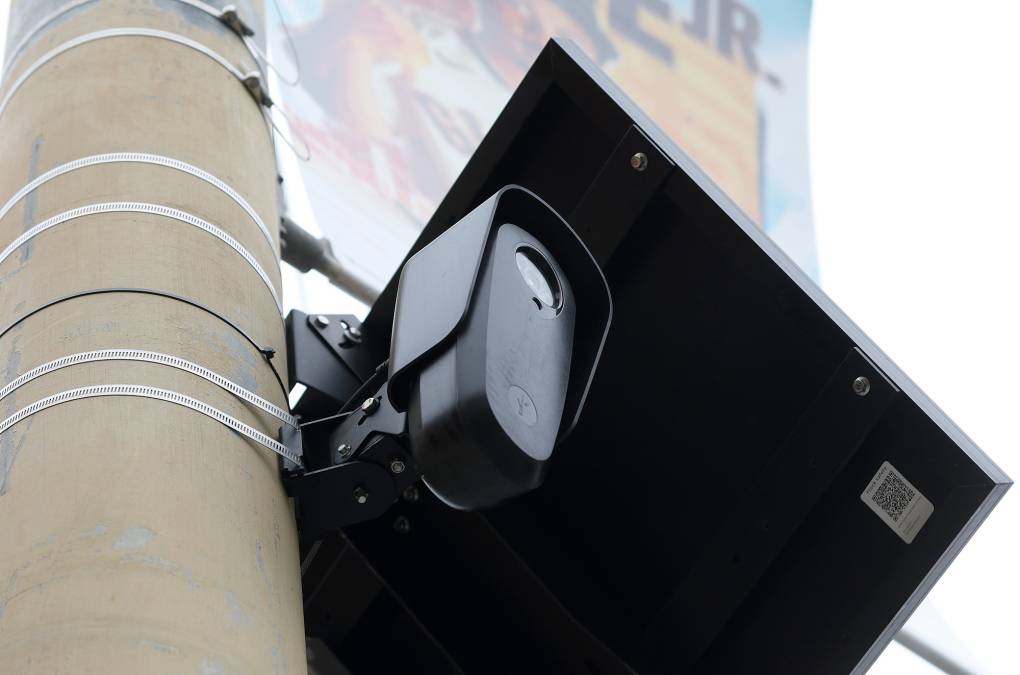
"caption": "In an aerial view, an automated license plate reader is seen mounted on a pole on June 13, 2024, in San Francisco, California. The city of San Francisco has installed 100 automated license plate readers across the city and plans to install 300 more in the coming weeks as officials look to technology to help combat crime in the city. ",
"credit": "Justin Sullivan/Getty Images",
"altTag": null,
"description": null,
"imgSizes": {
"thumbnail": {
"file": "https://cdn.kqed.org/wp-content/uploads/sites/10/2026/01/SFFlockSafetyGetty-160x112.jpg",
"width": 160,
"height": 112,
"mimeType": "image/jpeg"
},
"1536x1536": {
"file": "https://cdn.kqed.org/wp-content/uploads/sites/10/2026/01/SFFlockSafetyGetty-1536x1080.jpg",
"width": 1536,
"height": 1080,
"mimeType": "image/jpeg"
},
"post-thumbnail": {
"file": "https://cdn.kqed.org/wp-content/uploads/sites/10/2026/01/SFFlockSafetyGetty-672x372.jpg",
"width": 672,
"height": 372,
"mimeType": "image/jpeg"
},
"twentyfourteen-full-width": {
"file": "https://cdn.kqed.org/wp-content/uploads/sites/10/2026/01/SFFlockSafetyGetty-1038x576.jpg",
"width": 1038,
"height": 576,
"mimeType": "image/jpeg"
},
"npr-cds-wide": {
"file": "https://cdn.kqed.org/wp-content/uploads/sites/10/2026/01/SFFlockSafetyGetty-1200x675.jpg",
"width": 1200,
"height": 675,
"mimeType": "image/jpeg"
},
"kqedFullSize": {
"file": "https://cdn.kqed.org/wp-content/uploads/sites/10/2026/01/SFFlockSafetyGetty.jpg",
"width": 2000,
"height": 1406
}
},
"isLoading": false,
"fetchFailed": false
},
"news_12069810": {
"type": "attachments",
"id": "news_12069810",
"meta": {
"index": "attachments_1716263798",
"site": "news",
"id": "12069810",
"found": true
},
"title": "Ingest_Xai",
"publishDate": 1768428297,
"status": "inherit",
"parent": 12069808,
"modified": 1768429021,
"caption": "orkers install lighting on an \"X\" sign atop the company headquarters in downtown San Francisco on July 28, 2023.",
"credit": "Noah Berger/AP",
"altTag": null,
"description": null,
"imgSizes": {
"thumbnail": {
"file": "https://cdn.kqed.org/wp-content/uploads/sites/10/2026/01/Ingest_Xai-160x107.jpeg",
"width": 160,
"height": 107,
"mimeType": "image/jpeg"
},
"1536x1536": {
"file": "https://cdn.kqed.org/wp-content/uploads/sites/10/2026/01/Ingest_Xai-1536x1024.jpeg",
"width": 1536,
"height": 1024,
"mimeType": "image/jpeg"
},
"post-thumbnail": {
"file": "https://cdn.kqed.org/wp-content/uploads/sites/10/2026/01/Ingest_Xai-672x372.jpeg",
"width": 672,
"height": 372,
"mimeType": "image/jpeg"
},
"twentyfourteen-full-width": {
"file": "https://cdn.kqed.org/wp-content/uploads/sites/10/2026/01/Ingest_Xai-1038x576.jpeg",
"width": 1038,
"height": 576,
"mimeType": "image/jpeg"
},
"npr-cds-wide": {
"file": "https://cdn.kqed.org/wp-content/uploads/sites/10/2026/01/Ingest_Xai-1200x675.jpeg",
"width": 1200,
"height": 675,
"mimeType": "image/jpeg"
},
"kqedFullSize": {
"file": "https://cdn.kqed.org/wp-content/uploads/sites/10/2026/01/Ingest_Xai.jpeg",
"width": 2000,
"height": 1333
}
},
"isLoading": false,
"fetchFailed": false
},
"news_12069330": {
"type": "attachments",
"id": "news_12069330",
"meta": {
"index": "attachments_1716263798",
"site": "news",
"id": "12069330",
"found": true
},
"title": "Group of university students staring at mobile phones Announcement of academic results or test scores",
"publishDate": 1768004932,
"status": "inherit",
"parent": 12069286,
"modified": 1768007574,
"caption": "A group of university students stares at a mobile phone.",
"credit": "Pranithan Chorruangsak/Getty Images",
"altTag": null,
"description": null,
"imgSizes": {
"thumbnail": {
"file": "https://cdn.kqed.org/wp-content/uploads/sites/10/2026/01/OpenAI-160x107.jpg",
"width": 160,
"height": 107,
"mimeType": "image/jpeg"
},
"1536x1536": {
"file": "https://cdn.kqed.org/wp-content/uploads/sites/10/2026/01/OpenAI-1536x1024.jpg",
"width": 1536,
"height": 1024,
"mimeType": "image/jpeg"
},
"post-thumbnail": {
"file": "https://cdn.kqed.org/wp-content/uploads/sites/10/2026/01/OpenAI-672x372.jpg",
"width": 672,
"height": 372,
"mimeType": "image/jpeg"
},
"twentyfourteen-full-width": {
"file": "https://cdn.kqed.org/wp-content/uploads/sites/10/2026/01/OpenAI-1038x576.jpg",
"width": 1038,
"height": 576,
"mimeType": "image/jpeg"
},
"npr-cds-wide": {
"file": "https://cdn.kqed.org/wp-content/uploads/sites/10/2026/01/OpenAI-1200x675.jpg",
"width": 1200,
"height": 675,
"mimeType": "image/jpeg"
},
"kqedFullSize": {
"file": "https://cdn.kqed.org/wp-content/uploads/sites/10/2026/01/OpenAI.jpg",
"width": 2000,
"height": 1333
}
},
"isLoading": false,
"fetchFailed": false
},
"news_12066777": {
"type": "attachments",
"id": "news_12066777",
"meta": {
"index": "attachments_1716263798",
"site": "news",
"id": "12066777",
"found": true
},
"title": "251210-License-Plate Readers-01-KQED",
"publishDate": 1765483809,
"status": "inherit",
"parent": 12074467,
"modified": 1772045309,
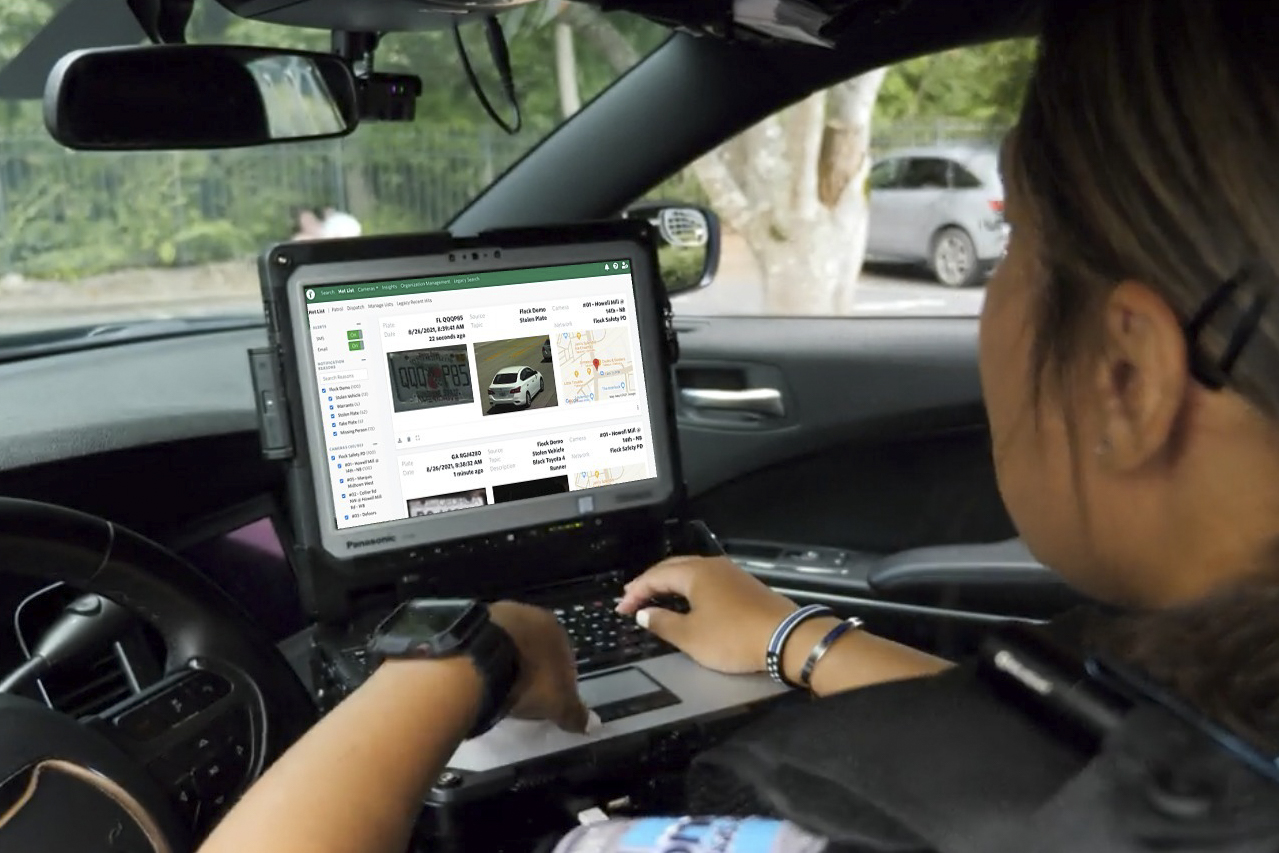
"caption": "Law enforcement agencies are deploying vehicle-tracking networks with settings that can make local data nationally searchable, opening the door to federal access even in cities that consider themselves sanctuaries for immigrants and others targeted by the Trump administration.",
"credit": "Courtesy of Flock Safety",
"altTag": null,
"description": null,
"imgSizes": {
"thumbnail": {
"file": "https://cdn.kqed.org/wp-content/uploads/sites/10/2025/12/251210-License-Plate-Readers-01-KQED-160x107.jpg",
"width": 160,
"height": 107,
"mimeType": "image/jpeg"
},
"post-thumbnail": {
"file": "https://cdn.kqed.org/wp-content/uploads/sites/10/2025/12/251210-License-Plate-Readers-01-KQED-672x372.jpg",
"width": 672,
"height": 372,
"mimeType": "image/jpeg"
},
"twentyfourteen-full-width": {
"file": "https://cdn.kqed.org/wp-content/uploads/sites/10/2025/12/251210-License-Plate-Readers-01-KQED-1038x576.jpg",
"width": 1038,
"height": 576,
"mimeType": "image/jpeg"
},
"npr-cds-wide": {
"file": "https://cdn.kqed.org/wp-content/uploads/sites/10/2025/12/251210-License-Plate-Readers-01-KQED-1200x675.jpg",
"width": 1200,
"height": 675,
"mimeType": "image/jpeg"
},
"kqedFullSize": {
"file": "https://cdn.kqed.org/wp-content/uploads/sites/10/2025/12/251210-License-Plate-Readers-01-KQED.jpg",
"width": 1279,
"height": 853
}
},
"isLoading": false,
"fetchFailed": false
},
"news_12005552": {
"type": "attachments",
"id": "news_12005552",
"meta": {
"index": "attachments_1716263798",
"site": "news",
"id": "12005552",
"found": true
},
"title": "San Francisco Deploys License-Plate Reading Cameras To Catch Offenders",
"publishDate": 1726786577,
"status": "inherit",
"parent": 12005347,
"modified": 1726853688,
"caption": "An automated license plate reader is seen mounted on a pole on June 13, 2024, in San Francisco, California. Just across the Bay Bridge, Oakland is installing new automated license plate readers from the state.",
"credit": "Justin Sullivan/Getty Images",
"altTag": null,
"description": null,
"imgSizes": {
"medium": {
"file": "https://cdn.kqed.org/wp-content/uploads/sites/10/2024/09/SFLicensePlateReader-800x529.jpg",
"width": 800,
"height": 529,
"mimeType": "image/jpeg"
},
"large": {
"file": "https://cdn.kqed.org/wp-content/uploads/sites/10/2024/09/SFLicensePlateReader-1020x675.jpg",
"width": 1020,
"height": 675,
"mimeType": "image/jpeg"
},
"thumbnail": {
"file": "https://cdn.kqed.org/wp-content/uploads/sites/10/2024/09/SFLicensePlateReader-160x106.jpg",
"width": 160,
"height": 106,
"mimeType": "image/jpeg"
},
"1536x1536": {
"file": "https://cdn.kqed.org/wp-content/uploads/sites/10/2024/09/SFLicensePlateReader-1536x1016.jpg",
"width": 1536,
"height": 1016,
"mimeType": "image/jpeg"
},
"post-thumbnail": {
"file": "https://cdn.kqed.org/wp-content/uploads/sites/10/2024/09/SFLicensePlateReader-672x372.jpg",
"width": 672,
"height": 372,
"mimeType": "image/jpeg"
},
"twentyfourteen-full-width": {
"file": "https://cdn.kqed.org/wp-content/uploads/sites/10/2024/09/SFLicensePlateReader-1038x576.jpg",
"width": 1038,
"height": 576,
"mimeType": "image/jpeg"
},
"full-width": {
"file": "https://cdn.kqed.org/wp-content/uploads/sites/10/2024/09/SFLicensePlateReader-1920x1270.jpg",
"width": 1920,
"height": 1270,
"mimeType": "image/jpeg"
},
"kqedFullSize": {
"file": "https://cdn.kqed.org/wp-content/uploads/sites/10/2024/09/SFLicensePlateReader.jpg",
"width": 2000,
"height": 1323
}
},
"isLoading": false,
"fetchFailed": false
},
"news_12066914": {
"type": "attachments",
"id": "news_12066914",
"meta": {
"index": "attachments_1716263798",
"site": "news",
"id": "12066914",
"found": true
},
"title": "President Trump Signs Executive Orders In The Oval Office",
"publishDate": 1765563347,
"status": "inherit",
"parent": 12066910,
"modified": 1765563390,
"caption": "U.S. President Donald Trump displays a signed executive order in the Oval Office of the White House on Dec. 11, 2025, in Washington, D.C. The executive order curbs states' ability to regulate artificial intelligence, something for which the tech industry has been lobbying. ",
"credit": "Alex Wong/Getty Images",
"altTag": null,
"description": null,
"imgSizes": {
"thumbnail": {
"file": "https://cdn.kqed.org/wp-content/uploads/sites/10/2025/12/DonaldTrumpGetty1-160x110.jpg",
"width": 160,
"height": 110,
"mimeType": "image/jpeg"
},
"1536x1536": {
"file": "https://cdn.kqed.org/wp-content/uploads/sites/10/2025/12/DonaldTrumpGetty1-1536x1059.jpg",
"width": 1536,
"height": 1059,
"mimeType": "image/jpeg"
},
"post-thumbnail": {
"file": "https://cdn.kqed.org/wp-content/uploads/sites/10/2025/12/DonaldTrumpGetty1-672x372.jpg",
"width": 672,
"height": 372,
"mimeType": "image/jpeg"
},
"twentyfourteen-full-width": {
"file": "https://cdn.kqed.org/wp-content/uploads/sites/10/2025/12/DonaldTrumpGetty1-1038x576.jpg",
"width": 1038,
"height": 576,
"mimeType": "image/jpeg"
},
"npr-cds-wide": {
"file": "https://cdn.kqed.org/wp-content/uploads/sites/10/2025/12/DonaldTrumpGetty1-1200x675.jpg",
"width": 1200,
"height": 675,
"mimeType": "image/jpeg"
},
"kqedFullSize": {
"file": "https://cdn.kqed.org/wp-content/uploads/sites/10/2025/12/DonaldTrumpGetty1.jpg",
"width": 2000,
"height": 1379
}
},
"isLoading": false,
"fetchFailed": false
},
"news_12066268": {
"type": "attachments",
"id": "news_12066268",
"meta": {
"index": "attachments_1716263798",
"site": "news",
"id": "12066268",
"found": true
},
"title": "OpenAIProtestKQED2",
"publishDate": 1764962340,
"status": "inherit",
"parent": 12066171,
"modified": 1764969095,
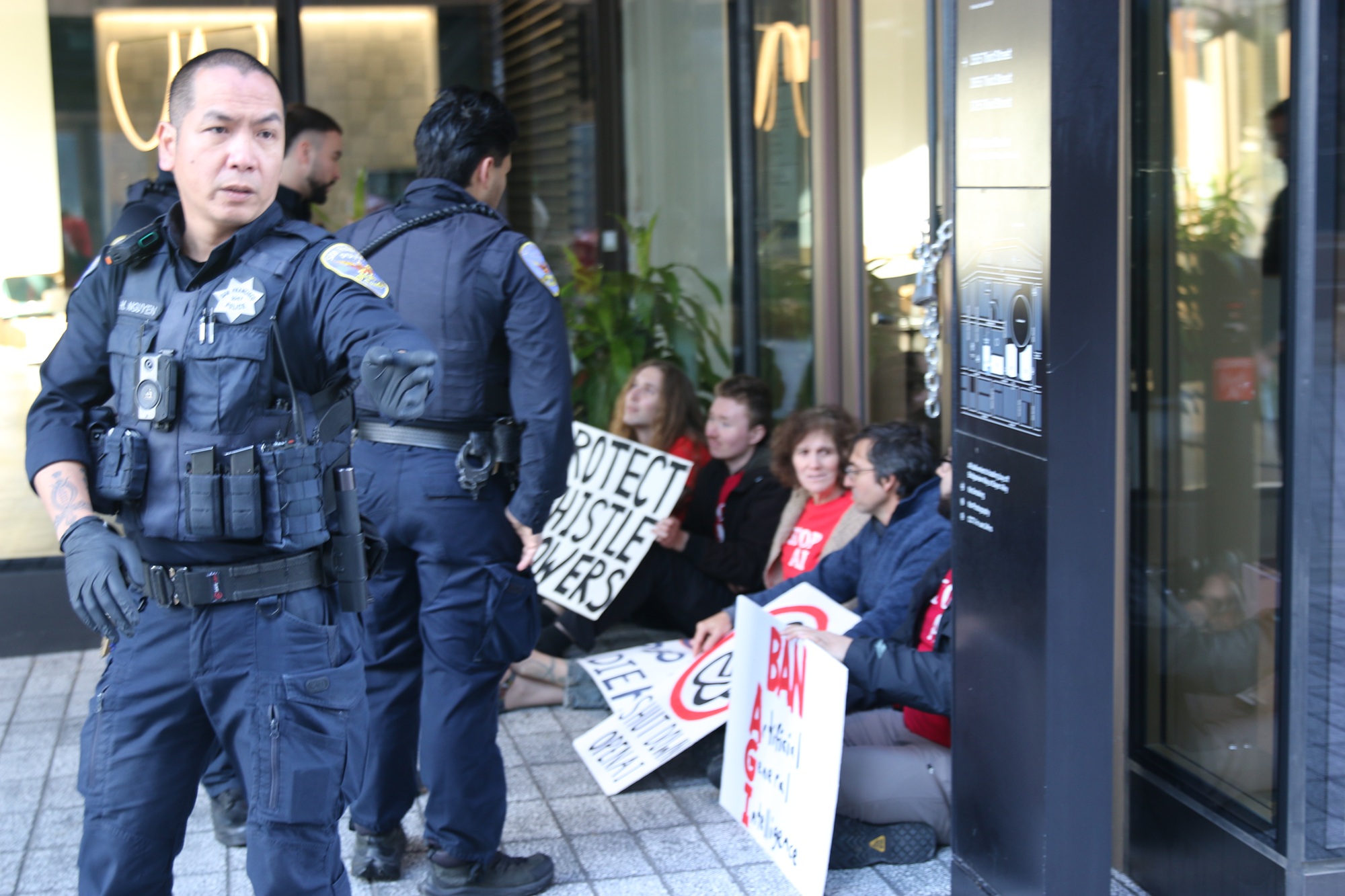
"caption": "San Francisco police command protestors and reporters to stand back as they detain members of Stop AI after they chained shut the front doors of OpenAI's San Francisco headquarters on Feb. 22, 2025. Several of the group members are awaiting trial on trespassing and disrupting a business.",
"credit": "Brian Krans/KQED",
"altTag": null,
"description": null,
"imgSizes": {
"thumbnail": {
"file": "https://cdn.kqed.org/wp-content/uploads/sites/10/2025/12/OpenAIProtestKQED2-160x107.jpg",
"width": 160,
"height": 107,
"mimeType": "image/jpeg"
},
"1536x1536": {
"file": "https://cdn.kqed.org/wp-content/uploads/sites/10/2025/12/OpenAIProtestKQED2-1536x1024.jpg",
"width": 1536,
"height": 1024,
"mimeType": "image/jpeg"
},
"post-thumbnail": {
"file": "https://cdn.kqed.org/wp-content/uploads/sites/10/2025/12/OpenAIProtestKQED2-672x372.jpg",
"width": 672,
"height": 372,
"mimeType": "image/jpeg"
},
"twentyfourteen-full-width": {
"file": "https://cdn.kqed.org/wp-content/uploads/sites/10/2025/12/OpenAIProtestKQED2-1038x576.jpg",
"width": 1038,
"height": 576,
"mimeType": "image/jpeg"
},
"npr-cds-wide": {
"file": "https://cdn.kqed.org/wp-content/uploads/sites/10/2025/12/OpenAIProtestKQED2-1200x675.jpg",
"width": 1200,
"height": 675,
"mimeType": "image/jpeg"
},
"kqedFullSize": {
"file": "https://cdn.kqed.org/wp-content/uploads/sites/10/2025/12/OpenAIProtestKQED2.jpg",
"width": 2000,
"height": 1333
}
},
"isLoading": false,
"fetchFailed": false
},
"news_11999988": {
"type": "attachments",
"id": "news_11999988",
"meta": {
"index": "attachments_1716263798",
"site": "news",
"id": "11999988",
"found": true
},
"title": "California Earthquake Early Warning App",
"publishDate": 1723572548,
"status": "inherit",
"parent": 11999982,
"modified": 1723576682,
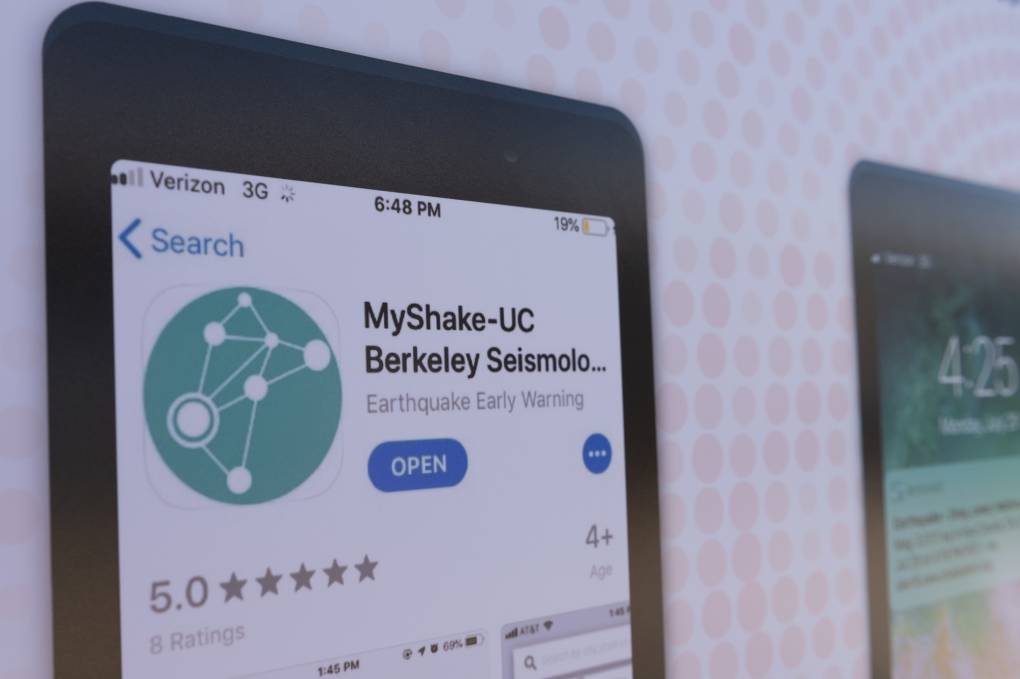
"caption": "The nation's first statewide Earthquake Early Warning System, also known as the MyShake app, developed by professor Richard Allen, director of the UC Berkeley Seismological Laboratory, is displayed in Oakland, California, on Oct. 17, 2019.",
"credit": "Yichuan Cao/NurPhoto via Getty Images",
"altTag": null,
"description": null,
"imgSizes": {
"medium": {
"file": "https://cdn.kqed.org/wp-content/uploads/sites/10/2024/08/MyShakeUCBerkeley-800x532.jpg",
"width": 800,
"height": 532,
"mimeType": "image/jpeg"
},
"large": {
"file": "https://cdn.kqed.org/wp-content/uploads/sites/10/2024/08/MyShakeUCBerkeley-1020x679.jpg",
"width": 1020,
"height": 679,
"mimeType": "image/jpeg"
},
"thumbnail": {
"file": "https://cdn.kqed.org/wp-content/uploads/sites/10/2024/08/MyShakeUCBerkeley-160x106.jpg",
"width": 160,
"height": 106,
"mimeType": "image/jpeg"
},
"1536x1536": {
"file": "https://cdn.kqed.org/wp-content/uploads/sites/10/2024/08/MyShakeUCBerkeley-1536x1022.jpg",
"width": 1536,
"height": 1022,
"mimeType": "image/jpeg"
},
"post-thumbnail": {
"file": "https://cdn.kqed.org/wp-content/uploads/sites/10/2024/08/MyShakeUCBerkeley-672x372.jpg",
"width": 672,
"height": 372,
"mimeType": "image/jpeg"
},
"twentyfourteen-full-width": {
"file": "https://cdn.kqed.org/wp-content/uploads/sites/10/2024/08/MyShakeUCBerkeley-1038x576.jpg",
"width": 1038,
"height": 576,
"mimeType": "image/jpeg"
},
"full-width": {
"file": "https://cdn.kqed.org/wp-content/uploads/sites/10/2024/08/MyShakeUCBerkeley-1920x1278.jpg",
"width": 1920,
"height": 1278,
"mimeType": "image/jpeg"
},
"kqedFullSize": {
"file": "https://cdn.kqed.org/wp-content/uploads/sites/10/2024/08/MyShakeUCBerkeley.jpg",
"width": 2000,
"height": 1331
}
},
"isLoading": false,
"fetchFailed": false
}
},
"audioPlayerReducer": {
"postId": "stream_live",
"isPaused": true,
"isPlaying": false,
"pfsActive": false,
"pledgeModalIsOpen": true,
"playerDrawerIsOpen": false,
"liveAudioPlayStartedAt": 0,
"liveAudioPlayContext": ""
},
"authorsReducer": {
"byline_news_12069808": {
"type": "authors",
"id": "byline_news_12069808",
"meta": {
"override": true
},
"slug": "byline_news_12069808",
"name": "Khari Johnson, CalMatters",
"isLoading": false
},
"rachael-myrow": {
"type": "authors",
"id": "251",
"meta": {
"index": "authors_1716337520",
"id": "251",
"found": true
},
"name": "Rachael Myrow",
"firstName": "Rachael",
"lastName": "Myrow",
"slug": "rachael-myrow",
"email": "rmyrow@kqed.org",
"display_author_email": true,
"staff_mastheads": [
"news"
],
"title": "Senior Editor of KQED's Silicon Valley News Desk",
"bio": "• I write and edit stories about how Silicon Valley power and policies shape everyday life in California. I’m also passionate about making Bay Area history and culture more accessible to a broad public. • I’ve been a journalist for most of my life, starting in high school with The Franklin Press in Los Angeles, where I grew up. While earning my first degree in English at UC Berkeley, I got my start in public radio at KALX-FM. After completing a second degree in journalism at Cal, I landed my first professional job at Marketplace, then moved on to KPCC (now LAist), and then KQED, where I hosted The California Report for more than seven years. • My reporting has appeared on NPR, The World, WBUR’s \u003ci>Here & Now\u003c/i>, and the BBC. I also guest host for KQED’s \u003ci>Forum\u003c/i>, as well as the Commonwealth Club in San Francisco. • I speak periodically on media, democracy and technology issues, and do voiceover work for documentaries and educational video projects. • Outside of the studio, you'll find me hiking Bay Area trails and whipping up Insta-ready meals in my kitchen. • I do not accept gifts, money, or favors from anyone connected to my reporting, I don't pay people for information, and I do not support or donate to political causes. • I strive to treat the people I report on with fairness, honesty, and respect. I also recognize there are often multiple sides to a story and work to verify information through multiple sources and documentation. If I get something wrong, I correct it.",
"avatar": "https://secure.gravatar.com/avatar/3ed8a3c5f26025e4a805ba634cda8cd764906b97438a6d9ce216b044e340da4e?s=600&d=blank&r=g",
"twitter": "rachaelmyrow",
"bluesky": null,
"facebook": null,
"instagram": null,
"linkedin": "https://www.linkedin.com/in/rachaelmyrow/",
"sites": [
{
"site": "arts",
"roles": [
"administrator"
]
},
{
"site": "news",
"roles": [
"edit_others_posts",
"editor"
]
},
{
"site": "futureofyou",
"roles": [
"editor"
]
},
{
"site": "bayareabites",
"roles": [
"editor"
]
},
{
"site": "stateofhealth",
"roles": [
"editor"
]
},
{
"site": "science",
"roles": [
"editor"
]
},
{
"site": "food",
"roles": [
"editor"
]
},
{
"site": "forum",
"roles": [
"editor"
]
},
{
"site": "liveblog",
"roles": [
"author"
]
}
],
"headData": {
"title": "Rachael Myrow | KQED",
"description": "Senior Editor of KQED's Silicon Valley News Desk",
"ogImgSrc": "https://secure.gravatar.com/avatar/3ed8a3c5f26025e4a805ba634cda8cd764906b97438a6d9ce216b044e340da4e?s=600&d=blank&r=g",
"twImgSrc": "https://secure.gravatar.com/avatar/3ed8a3c5f26025e4a805ba634cda8cd764906b97438a6d9ce216b044e340da4e?s=600&d=blank&r=g"
},
"isLoading": false,
"link": "/author/rachael-myrow"
},
"kevinstark": {
"type": "authors",
"id": "11608",
"meta": {
"index": "authors_1716337520",
"id": "11608",
"found": true
},
"name": "Kevin Stark",
"firstName": "Kevin",
"lastName": "Stark",
"slug": "kevinstark",
"email": "kstark@kqed.org",
"display_author_email": true,
"staff_mastheads": [
"science"
],
"title": "Senior Editor",
"bio": "Kevin is a senior editor for KQED Science, managing the station's health and climate desks. His journalism career began in the Pacific Northwest, and he later became a lead reporter for the San Francisco Public Press. His work has appeared in Pacific Standard magazine, the Energy News Network, the Center for Investigative Reporting's Reveal and WBEZ in Chicago. Kevin joined KQED in 2019, and has covered issues related to energy, wildfire, climate change and the environment.",
"avatar": "https://secure.gravatar.com/avatar/365aaa4b597d3a8374f67504ff0facd323d7906e8eb4be0a7efd2427408e802c?s=600&d=blank&r=g",
"twitter": "starkkev",
"bluesky": null,
"facebook": null,
"instagram": null,
"linkedin": null,
"sites": [
{
"site": "",
"roles": [
"editor"
]
},
{
"site": "news",
"roles": [
"editor"
]
},
{
"site": "science",
"roles": [
"administrator"
]
}
],
"headData": {
"title": "Kevin Stark | KQED",
"description": "Senior Editor",
"ogImgSrc": "https://secure.gravatar.com/avatar/365aaa4b597d3a8374f67504ff0facd323d7906e8eb4be0a7efd2427408e802c?s=600&d=blank&r=g",
"twImgSrc": "https://secure.gravatar.com/avatar/365aaa4b597d3a8374f67504ff0facd323d7906e8eb4be0a7efd2427408e802c?s=600&d=blank&r=g"
},
"isLoading": false,
"link": "/author/kevinstark"
},
"nkhan": {
"type": "authors",
"id": "11867",
"meta": {
"index": "authors_1716337520",
"id": "11867",
"found": true
},
"name": "Nisa Khan",
"firstName": "Nisa",
"lastName": "Khan",
"slug": "nkhan",
"email": "nkhan@kqed.org",
"display_author_email": false,
"staff_mastheads": [],
"title": "KQED Contributor",
"bio": "Nisa Khan is a reporter for KQED's Audience News Desk. She was formerly a data reporter at Michigan Radio. She earned a Bachelor of Science in Information from the University of Michigan and a Master of Arts in Communication from Stanford University.",
"avatar": "https://secure.gravatar.com/avatar/8720459eef081ff64582b3506b124d58523e80e120704a0cbd9892533c914991?s=600&d=blank&r=g",
"twitter": "mnisakhan",
"bluesky": null,
"facebook": null,
"instagram": null,
"linkedin": null,
"sites": [
{
"site": "arts",
"roles": [
"editor"
]
},
{
"site": "news",
"roles": [
"editor"
]
},
{
"site": "science",
"roles": [
"editor",
"author"
]
},
{
"site": "forum",
"roles": [
"editor"
]
},
{
"site": "liveblog",
"roles": [
"contributor"
]
}
],
"headData": {
"title": "Nisa Khan | KQED",
"description": "KQED Contributor",
"ogImgSrc": "https://secure.gravatar.com/avatar/8720459eef081ff64582b3506b124d58523e80e120704a0cbd9892533c914991?s=600&d=blank&r=g",
"twImgSrc": "https://secure.gravatar.com/avatar/8720459eef081ff64582b3506b124d58523e80e120704a0cbd9892533c914991?s=600&d=blank&r=g"
},
"isLoading": false,
"link": "/author/nkhan"
},
"jgeha": {
"type": "authors",
"id": "11906",
"meta": {
"index": "authors_1716337520",
"id": "11906",
"found": true
},
"name": "Joseph Geha",
"firstName": "Joseph",
"lastName": "Geha",
"slug": "jgeha",
"email": "jgeha@kqed.org",
"display_author_email": false,
"staff_mastheads": [
"news",
"science"
],
"title": "KQED Contributor",
"bio": null,
"avatar": "https://secure.gravatar.com/avatar/ea84d2b6dd93d6369d453edf19dd583f117cd1759d2d9c9c92f9de77017354fe?s=600&d=blank&r=g",
"twitter": null,
"bluesky": null,
"facebook": null,
"instagram": null,
"linkedin": null,
"sites": [
{
"site": "news",
"roles": [
"editor"
]
},
{
"site": "liveblog",
"roles": [
"author"
]
}
],
"headData": {
"title": "Joseph Geha | KQED",
"description": "KQED Contributor",
"ogImgSrc": "https://secure.gravatar.com/avatar/ea84d2b6dd93d6369d453edf19dd583f117cd1759d2d9c9c92f9de77017354fe?s=600&d=blank&r=g",
"twImgSrc": "https://secure.gravatar.com/avatar/ea84d2b6dd93d6369d453edf19dd583f117cd1759d2d9c9c92f9de77017354fe?s=600&d=blank&r=g"
},
"isLoading": false,
"link": "/author/jgeha"
},
"kdebenedetti": {
"type": "authors",
"id": "11913",
"meta": {
"index": "authors_1716337520",
"id": "11913",
"found": true
},
"name": "Katie DeBenedetti",
"firstName": "Katie",
"lastName": "DeBenedetti",
"slug": "kdebenedetti",
"email": "kdebenedetti@kqed.org",
"display_author_email": false,
"staff_mastheads": [
"news",
"science"
],
"title": "KQED Contributor",
"bio": "Katie DeBenedetti is a digital reporter covering daily news for the Express Desk. Prior to joining KQED as a culture reporting intern in January 2024, she covered education and city government for the Napa Valley Register.",
"avatar": "https://secure.gravatar.com/avatar/6e31073cb8f7e4214ab03f42771d0f45?s=600&d=blank&r=g",
"twitter": null,
"facebook": null,
"instagram": null,
"linkedin": null,
"sites": [
{
"site": "news",
"roles": [
"author"
]
},
{
"site": "science",
"roles": [
"author"
]
},
{
"site": "liveblog",
"roles": [
"author"
]
}
],
"headData": {
"title": "Katie DeBenedetti | KQED",
"description": "KQED Contributor",
"ogImgSrc": "https://secure.gravatar.com/avatar/6e31073cb8f7e4214ab03f42771d0f45?s=600&d=blank&r=g",
"twImgSrc": "https://secure.gravatar.com/avatar/6e31073cb8f7e4214ab03f42771d0f45?s=600&d=blank&r=g"
},
"isLoading": false,
"link": "/author/kdebenedetti"
},
"bkrans": {
"type": "authors",
"id": "11923",
"meta": {
"index": "authors_1716337520",
"id": "11923",
"found": true
},
"name": "Brian Krans",
"firstName": "Brian",
"lastName": "Krans",
"slug": "bkrans",
"email": "bkrans@kqed.org",
"display_author_email": false,
"staff_mastheads": [
"news"
],
"title": "KQED Contributing Reporter",
"bio": "Brian Krans is an award-winning local news and investigative reporter who has been proudly working as a general assignment reporter for KQED since August 2023. He lives in Richmond, where he also reports on air pollution for Richmondside. He is also a founding member of the Vallejo Sun.",
"avatar": "https://secure.gravatar.com/avatar/71fa91f931774612559f7640390b53d9c2840ff72b20f195a25239aab2d9fbb9?s=600&d=blank&r=g",
"twitter": "citizenkrans",
"bluesky": null,
"facebook": null,
"instagram": null,
"linkedin": null,
"sites": [
{
"site": "news",
"roles": [
"editor"
]
}
],
"headData": {
"title": "Brian Krans | KQED",
"description": "KQED Contributing Reporter",
"ogImgSrc": "https://secure.gravatar.com/avatar/71fa91f931774612559f7640390b53d9c2840ff72b20f195a25239aab2d9fbb9?s=600&d=blank&r=g",
"twImgSrc": "https://secure.gravatar.com/avatar/71fa91f931774612559f7640390b53d9c2840ff72b20f195a25239aab2d9fbb9?s=600&d=blank&r=g"
},
"isLoading": false,
"link": "/author/bkrans"
},
"msung": {
"type": "authors",
"id": "11944",
"meta": {
"index": "authors_1716337520",
"id": "11944",
"found": true
},
"name": "Morgan Sung",
"firstName": "Morgan",
"lastName": "Sung",
"slug": "msung",
"email": "msung@kqed.org",
"display_author_email": false,
"staff_mastheads": [],
"title": "Close All Tabs Host",
"bio": null,
"avatar": "https://secure.gravatar.com/avatar/34033b8d232ee6c987ca6f0a1a28f0e5?s=600&d=blank&r=g",
"twitter": null,
"facebook": null,
"instagram": null,
"linkedin": null,
"sites": [
{
"site": "news",
"roles": [
"editor"
]
}
],
"headData": {
"title": "Morgan Sung | KQED",
"description": "Close All Tabs Host",
"ogImgSrc": "https://secure.gravatar.com/avatar/34033b8d232ee6c987ca6f0a1a28f0e5?s=600&d=blank&r=g",
"twImgSrc": "https://secure.gravatar.com/avatar/34033b8d232ee6c987ca6f0a1a28f0e5?s=600&d=blank&r=g"
},
"isLoading": false,
"link": "/author/msung"
},
"aaliahmad": {
"type": "authors",
"id": "11986",
"meta": {
"index": "authors_1716337520",
"id": "11986",
"found": true
},
"name": "Ayah Ali-Ahmad",
"firstName": "Ayah",
"lastName": "Ali-Ahmad",
"slug": "aaliahmad",
"email": "aaliahmad@KQED.org",
"display_author_email": false,
"staff_mastheads": [],
"title": "KQED Contributor",
"bio": null,
"avatar": "https://secure.gravatar.com/avatar/1cf54f187a5e1064b2cfef3f3d2f1e4f93e453395d56912aca6382a6071ec3ed?s=600&d=blank&r=g",
"twitter": "ayahaliahmad",
"bluesky": null,
"facebook": null,
"instagram": null,
"linkedin": null,
"sites": [
{
"site": "news",
"roles": [
"subscriber"
]
}
],
"headData": {
"title": "Ayah Ali-Ahmad | KQED",
"description": "KQED Contributor",
"ogImgSrc": "https://secure.gravatar.com/avatar/1cf54f187a5e1064b2cfef3f3d2f1e4f93e453395d56912aca6382a6071ec3ed?s=600&d=blank&r=g",
"twImgSrc": "https://secure.gravatar.com/avatar/1cf54f187a5e1064b2cfef3f3d2f1e4f93e453395d56912aca6382a6071ec3ed?s=600&d=blank&r=g"
},
"isLoading": false,
"link": "/author/aaliahmad"
}
},
"pagesReducer": {
"news_category_technology": {
"type": "terms",
"id": "news_248",
"meta": {
"index": "terms_1716263798",
"site": "news",
"id": "248",
"score": 10.93111
},
"featImg": null,
"name": "Technology",
"description": null,
"taxonomy": "category",
"headData": {
"twImgId": null,
"twTitle": null,
"ogTitle": null,
"ogImgId": null,
"twDescription": null,
"description": null,
"title": "Technology Archives | KQED News",
"ogDescription": null
},
"ttid": 256,
"slug": "technology",
"isLoading": false,
"title": "Technology",
"pageMeta": {
"site": "news",
"WpPageTemplate": "page-topic-editorial",
"currentPage": 12
},
"blocks": [
{
"blockName": "kqed/post-list",
"attrs": {
"layout": "cardArticle2",
"query": "posts/news?category=technology",
"seeMore": false,
"paginated": true,
"page": 12
}
},
{
"blockName": "kqed/ad"
}
]
}
},
"pfsSessionReducer": {},
"postsReducer": {
"stream_live": {
"type": "live",
"id": "stream_live",
"audioUrl": "https://streams.kqed.org/kqedradio",
"title": "Live Stream",
"excerpt": "Live Stream information currently unavailable.",
"link": "/radio",
"featImg": "",
"label": {
"name": "KQED Live",
"link": "/"
}
},
"stream_kqedNewscast": {
"type": "posts",
"id": "stream_kqedNewscast",
"audioUrl": "https://www.kqed.org/.stream/anon/radio/RDnews/newscast.mp3?_=1",
"title": "KQED Newscast",
"featImg": "",
"label": {
"name": "88.5 FM",
"link": "/"
}
},
"news_12070647": {
"type": "posts",
"id": "news_12070647",
"meta": {
"index": "posts_1716263798",
"site": "news",
"id": "12070647",
"score": null,
"sort": [
1769256010000
]
},
"guestAuthors": [],
"slug": "stanford-scientists-reveal-oldest-map-of-the-night-sky-previously-lost-to-time",
"title": "Stanford Scientists Reveal Oldest Map of the Night Sky, Previously Lost to Time",
"publishDate": 1769256010,
"format": "standard",
"headTitle": "Stanford Scientists Reveal Oldest Map of the Night Sky, Previously Lost to Time | KQED",
"labelTerm": {
"site": "news"
},
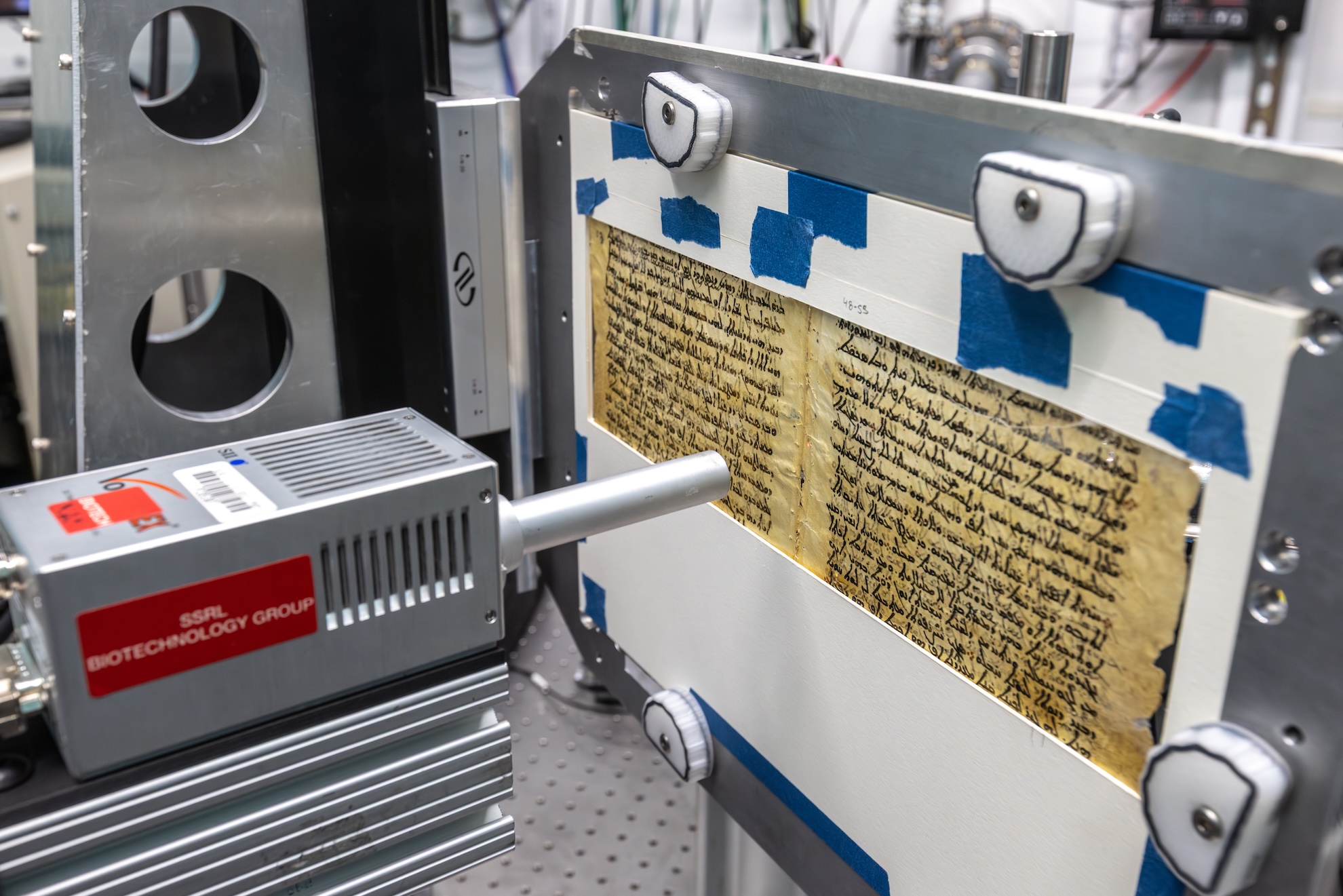
"content": "\u003cp>A piece of thousand-year-old parchment is finally giving up its secrets.\u003c/p>\n\u003cp>In a major breakthrough this week, researchers at the \u003ca href=\"https://www.kqed.org/news/11978051/unraveling-the-mysteries-of-the-universe-inside-slac\">SLAC National Accelerator Laboratory\u003c/a> in Menlo Park used X-ray beams to uncover a long-lost map of the universe — the latest in a decade-long effort to recover the work of Hipparchus, the second-century B.C. mathematician, known as the father of astronomy.\u003c/p>\n\u003cp>The ancient astronomer’s star coordinates, which represent the oldest-known attempt to catalog the entire night sky, were thought to be lost for good.\u003c/p>\n\u003cp>[ad fullwidth]\u003c/p>\n\u003cp>However, as of Tuesday, scientists with the Stanford Synchrotron Radiation Lightsource — a research facility dedicated to studying the world at the atomic level — have begun looking for answers in an unlikely place: under the layers of a medieval religious text.\u003c/p>\n\u003cp>“The goal is to recover as many of these coordinates as possible,” said Victor Gysembergh, the lead scholar on the experiment. “And this will help us answer some of the biggest questions on the birth of science.” Why did they start doing science 2,000 and more years ago? How did they get so good at it so fast? Because the coordinates we are finding are incredibly accurate for something that is done with the naked eye.”\u003c/p>\n\u003cfigure id=\"attachment_12070809\" class=\"wp-caption aligncenter\" style=\"max-width: 1944px\">\u003cimg loading=\"lazy\" decoding=\"async\" class=\"size-full wp-image-12070809\" src=\"https://cdn.kqed.org/wp-content/uploads/sites/10/2026/01/Photo1AliAhmad.jpg\" alt=\"\" width=\"1944\" height=\"1458\" srcset=\"https://cdn.kqed.org/wp-content/uploads/sites/10/2026/01/Photo1AliAhmad.jpg 1944w, https://cdn.kqed.org/wp-content/uploads/sites/10/2026/01/Photo1AliAhmad-160x120.jpg 160w, https://cdn.kqed.org/wp-content/uploads/sites/10/2026/01/Photo1AliAhmad-1536x1152.jpg 1536w\" sizes=\"auto, (max-width: 1944px) 100vw, 1944px\">\u003cfigcaption class=\"wp-caption-text\">Dual monitors at the SLAC National Accelerator Laboratory show early results from a scan of the Codex Climaci Rescriptus on Wednesday, Jan. 21, 2026. The screen on the left displays hidden ancient Greek lettering from a star catalog in the bottom corner with religious overtext appearing above, while the screen on the right shows the physical parchment as it appears to the naked eye. \u003ccite>(Ayah Ali-Ahmad/KQED)\u003c/cite>\u003c/figcaption>\u003c/figure>\n\u003cp>The manuscript, known as the Codex Climaci Rescriptus, is a palimpsest, or a page in which text has been scraped off or overwritten, according to Brian Hyland, senior curator at the Museum of the Bible.\u003c/p>\n\u003cp>Parchment was incredibly expensive in the Middle Ages — one book could require a whole herd of sheep — so monks at Saint Catherine’s Monastery, the world’s oldest continuously inhabited Christian monastery located in the Sinai Desert in Egypt, often recycled materials.[aside postID=science_1999837 hero='https://cdn.kqed.org/wp-content/uploads/sites/35/2026/01/CalacademyDiscovery.jpg']The monks soaked the animal-skin parchments in milk or lemon juice, scraped them with pumice stones and sprinkled them with flour to create a fresh surface for new writing, according to Uwe Bergmann, a visiting professor of X-ray science at SLAC.\u003c/p>\n\u003cp>In this case, the original Greek astronomical notes were erased to make way for a Syriac translation of works by St. John Climacus, a 6th-7th century monk. While the religious text is easily visible to the naked eye, the ancient coordinates for the stars and notes on Hipparchus’ work remained a series of invisible smudges for centuries.\u003c/p>\n\u003cp>Late Tuesday, the team at SLAC began scanning 11 pages of the manuscript provided by the Museum of the Bible. By Wednesday morning, the monitors were showing line after line of ancient Greek.\u003c/p>\n\u003cp>The process relies on the specific chemistry of the inks used across different eras, physics Ph.D. student Minhal Gardezi said. The top layer of ink used by the monks is rich in iron, while the underlying Greek text contains a strong calcium signal.\u003c/p>\n\u003cp>By tuning the X-ray beam, researchers can create elemental maps that separate the layers. This allows them to effectively “see” the underlying layer — without the top layer obscuring the view.\u003c/p>\n\u003cfigure id=\"attachment_12070811\" class=\"wp-caption aligncenter\" style=\"max-width: 1987px\">\u003cimg loading=\"lazy\" decoding=\"async\" class=\"size-full wp-image-12070811\" src=\"https://cdn.kqed.org/wp-content/uploads/sites/10/2026/01/Photo4AliAhmad.jpg\" alt=\"\" width=\"1987\" height=\"1490\" srcset=\"https://cdn.kqed.org/wp-content/uploads/sites/10/2026/01/Photo4AliAhmad.jpg 1987w, https://cdn.kqed.org/wp-content/uploads/sites/10/2026/01/Photo4AliAhmad-160x120.jpg 160w, https://cdn.kqed.org/wp-content/uploads/sites/10/2026/01/Photo4AliAhmad-1536x1152.jpg 1536w\" sizes=\"auto, (max-width: 1987px) 100vw, 1987px\">\u003cfigcaption class=\"wp-caption-text\">Elizabeth Hayslett, a conservator from the Museum of the Bible, demonstrates the custom matting and frames used to keep 11 ancient parchment pages flat during high-speed X-ray scanning at the SLAC National Accelerator Laboratory in Menlo Park on Jan. 21, 2026. \u003ccite>(Ayah Ali-Ahmad/KQED)\u003c/cite>\u003c/figcaption>\u003c/figure>\n\u003cp>By Wednesday morning, the team had already identified the word for “Aquarius” and descriptions of “bright” stars within that constellation, Gysembergh said. The researcher said he’s been waiting four years for this experiment, which followed his earlier publications on the manuscript.\u003c/p>\n\u003cp>“I am at the peak of my excitement right now … because of this new scan that we started, line after line of text showing up in ancient Greek from the astronomical manuscript,” Gysembergh said.\u003c/p>\n\u003cp>While multispectral imaging had previously revealed some fragments, the X-ray fluorescence technology at SLAC allows for much higher resolution. Gysembergh and his colleagues can now use these coordinates to answer fundamental questions about how ancient astronomers achieved such high precision without magnifying instruments.\u003c/p>\n\u003cp>“What the Greeks knew about our world was unbelievable,” Bergmann said. “Knowing about these great thinkers from ancient Greece, going into the most modern advanced science of today, for me, it has become really, really fascinating.”\u003c/p>\n\u003cfigure id=\"attachment_12070812\" class=\"wp-caption aligncenter\" style=\"max-width: 1980px\">\u003cimg loading=\"lazy\" decoding=\"async\" class=\"size-full wp-image-12070812\" src=\"https://cdn.kqed.org/wp-content/uploads/sites/10/2026/01/Photo8bylab.jpeg\" alt=\"\" width=\"1980\" height=\"1357\" srcset=\"https://cdn.kqed.org/wp-content/uploads/sites/10/2026/01/Photo8bylab.jpeg 1980w, https://cdn.kqed.org/wp-content/uploads/sites/10/2026/01/Photo8bylab-160x110.jpeg 160w, https://cdn.kqed.org/wp-content/uploads/sites/10/2026/01/Photo8bylab-1536x1053.jpeg 1536w\" sizes=\"auto, (max-width: 1980px) 100vw, 1980px\">\u003cfigcaption class=\"wp-caption-text\">From left, conservator Elizabeth Hayslett, scholar Victor Gysembergh and physicist Uwe Bergmann place a manuscript page into a scanning apparatus at the SLAC National Accelerator Laboratory on Jan. 21, 2026. The interdisciplinary team is collaborating to recover the oldest known numerical catalog of the stars. \u003ccite>(Jacqueline Ramseyer Orrell/SLAC National Accelerator Laboratory)\u003c/cite>\u003c/figcaption>\u003c/figure>\n\u003cp>The technical side of the study is a massive interdisciplinary feat, according to Sam Webb, a lead scientist at SLAC. Webb built the instrumentation and experimental hutch that houses the world’s brightest X-rays.\u003c/p>\n\u003cp>The process involves a synchrotron, or a particle accelerator, which propels electrons to nearly the speed of light. As these electrons are “wiggled” by magnets, they shed off X-rays that are used to illuminate the manuscript, Bergmann said.\u003c/p>\n\u003cp>Bergmann said that to ensure the safety of the fragile parchment, each 10-millisecond pulse of X-ray light hits a spot the width of a human hair. Bergmann said the team is careful to keep the “dose” of radiation well below a safe limit, much like a medical X-ray.\u003c/p>\n\u003cp>Elizabeth Hayslett, a conservator from the Museum of the Bible, spent weeks preparing the 11 folios for the journey. The pages traveled in humidity-controlled cases under a strict hand-carry policy to prevent any damage. During the scanning process, the team keeps the lights low in the experimental hutch to prevent further fading of the ink.\u003c/p>\n\u003cfigure id=\"attachment_12070813\" class=\"wp-caption aligncenter\" style=\"max-width: 1980px\">\u003cimg loading=\"lazy\" decoding=\"async\" class=\"size-full wp-image-12070813\" src=\"https://cdn.kqed.org/wp-content/uploads/sites/10/2026/01/Photo9bylab.jpeg\" alt=\"\" width=\"1980\" height=\"1215\" srcset=\"https://cdn.kqed.org/wp-content/uploads/sites/10/2026/01/Photo9bylab.jpeg 1980w, https://cdn.kqed.org/wp-content/uploads/sites/10/2026/01/Photo9bylab-160x98.jpeg 160w, https://cdn.kqed.org/wp-content/uploads/sites/10/2026/01/Photo9bylab-1536x943.jpeg 1536w\" sizes=\"auto, (max-width: 1980px) 100vw, 1980px\">\u003cfigcaption class=\"wp-caption-text\">Physicist Uwe Bergmann examines a piece of the Codex Climaci Rescriptus in a darkened hutch at the SLAC National Accelerator Laboratory on Jan. 21, 2026. Researchers keep ambient light low during the imaging process to protect the fragile parchment and sensitive X-ray equipment. \u003ccite>(Jacqueline Ramseyer Orrell/SLAC National Accelerator Laboratory)\u003c/cite>\u003c/figcaption>\u003c/figure>\n\u003cp>These pages are part of a larger 200-page codex. While this specific set of pages is held in Washington, D.C., other parts of the manuscript are scattered globally.\u003c/p>\n\u003cp>Beyond the excitement of the hunt, the findings carry significant weight for the history of science. According to Gysembergh, historians debated for years whether the Roman astronomer Ptolemy had plagiarized Hipparchus’ star catalog.\u003c/p>\n\u003cp>Gysembergh said that by comparing the new data from the SLAC scans with Ptolemy’s preserved records, they can now prove that Ptolemy did not simply copy the work.\u003c/p>\n\u003cp>“We can show that Ptolemy did indeed sometimes use Hipparchus’ data, but he also used other sources. So, that’s not plagiarism. That’s actual science,” Gysembergh said. “That’s what we still do today to combine data sources to get the best data possible.”\u003c/p>\n\u003cp>Keith Knox, an imaging scientist with the Early Manuscripts Electronic Library who has worked on similar projects for 30 years, said the goal is to enhance the writing so that scholars can finally read it. Knox previously worked on the famous Archimedes Palimpsest and said that the star-map project is the latest step in a decades-long effort to recover secrets from the past.\u003c/p>\n\u003cfigure id=\"attachment_12070814\" class=\"wp-caption aligncenter\" style=\"max-width: 1980px\">\u003cimg loading=\"lazy\" decoding=\"async\" class=\"size-full wp-image-12070814\" src=\"https://cdn.kqed.org/wp-content/uploads/sites/10/2026/01/GettyImages-612208334.jpg\" alt=\"\" width=\"1980\" height=\"1320\" srcset=\"https://cdn.kqed.org/wp-content/uploads/sites/10/2026/01/GettyImages-612208334.jpg 1980w, https://cdn.kqed.org/wp-content/uploads/sites/10/2026/01/GettyImages-612208334-160x107.jpg 160w, https://cdn.kqed.org/wp-content/uploads/sites/10/2026/01/GettyImages-612208334-1536x1024.jpg 1536w\" sizes=\"auto, (max-width: 1980px) 100vw, 1980px\">\u003cfigcaption class=\"wp-caption-text\">Professor Judson Herrman, with colleagues Roger Easton, William Christens-Barry, and Keith Knox, looking over data from the Archimedes Palimpsest in Baltimore. \u003ccite>(Ken Cedeno via Getty Images)\u003c/cite>\u003c/figcaption>\u003c/figure>\n\u003cp>“This is just the latest event of working on this one manuscript, trying to recover the secrets of the writing that was erased a long time ago,” Knox said.\u003c/p>\n\u003cp>Because the X-rays see through both sides of the page simultaneously, Knox and Ph.D. students use advanced data processing to statistically separate the front and back text. On some pages, there may be as many as six layers of ink to untangle.\u003c/p>\n\u003cp>“If we can show how useful — and how informative — the science can be, the hope is that then more scholars who might have interesting documents, interesting artifacts, would then come to us and we can learn more about those,” chemistry Ph.D. student Sophia Vogelsang said.\u003c/p>\n\u003cp>The next phase will involve scholars of ancient Greek, who will painstakingly translate the coordinates and descriptions to fully reconstruct the father of astronomy’s lost catalog.\u003c/p>\n\u003cp>[ad floatright]\u003c/p>\n",
"blocks": [],
"excerpt": "SLAC researchers used X-ray beams and the particle accelerator to recover the work of an ancient astronomer, who made the earliest known attempt to log the stars.",
"status": "publish",
"parent": 0,
"modified": 1769118906,
"stats": {
"hasAudio": false,
"hasVideo": false,
"hasChartOrMap": false,
"iframeSrcs": [],
"hasGoogleForm": false,
"hasGallery": false,
"hasHearkenModule": false,
"hasPolis": false,
"paragraphCount": 30,
"wordCount": 1498
},
"headData": {
"title": "Stanford Scientists Reveal Oldest Map of the Night Sky, Previously Lost to Time | KQED",
"description": "SLAC researchers used X-ray beams and the particle accelerator to recover the work of an ancient astronomer, who made the earliest known attempt to log the stars.",
"ogTitle": "",
"ogDescription": "",
"ogImgId": "",
"twTitle": "",
"twDescription": "",
"twImgId": "",
"schema": {
"@context": "https://schema.org",
"@type": "NewsArticle",
"headline": "Stanford Scientists Reveal Oldest Map of the Night Sky, Previously Lost to Time",
"datePublished": "2026-01-24T04:00:10-08:00",
"dateModified": "2026-01-22T13:55:06-08:00",
"image": "https://cdn.kqed.org/wp-content/uploads/2020/02/KQED-OG-Image@1x.png",
"isAccessibleForFree": "True",
"publisher": {
"@type": "NewsMediaOrganization",
"@id": "https://www.kqed.org/#organization",
"name": "KQED",
"logo": "https://cdn.kqed.org/wp-content/uploads/2020/02/KQED-OG-Image@1x.png",
"url": "https://www.kqed.org",
"sameAs": [
"https://www.facebook.com/KQED",
"https://twitter.com/KQED",
"https://www.instagram.com/kqed/",
"https://www.tiktok.com/@kqedofficial",
"https://www.linkedin.com/company/kqed",
"https://www.youtube.com/channel/UCeC0IOo7i1P_61zVUWbJ4nw"
]
}
}
},
"primaryCategory": {
"termId": 248,
"slug": "technology",
"name": "Technology"
},
"sticky": false,
"templateType": "standard",
"featuredImageType": "standard",
"excludeFromSiteSearch": "Include",
"articleAge": "0",
"path": "/news/12070647/stanford-scientists-reveal-oldest-map-of-the-night-sky-previously-lost-to-time",
"audioTrackLength": null,
"parsedContent": [
{
"type": "contentString",
"content": "\u003cdiv class=\"post-body\">\u003cp>\u003cp>A piece of thousand-year-old parchment is finally giving up its secrets.\u003c/p>\n\u003cp>In a major breakthrough this week, researchers at the \u003ca href=\"https://www.kqed.org/news/11978051/unraveling-the-mysteries-of-the-universe-inside-slac\">SLAC National Accelerator Laboratory\u003c/a> in Menlo Park used X-ray beams to uncover a long-lost map of the universe — the latest in a decade-long effort to recover the work of Hipparchus, the second-century B.C. mathematician, known as the father of astronomy.\u003c/p>\n\u003cp>The ancient astronomer’s star coordinates, which represent the oldest-known attempt to catalog the entire night sky, were thought to be lost for good.\u003c/p>\n\u003cp>\u003c/p>\u003c/div>",
"attributes": {
"named": {},
"numeric": []
}
},
{
"type": "component",
"content": "",
"name": "ad",
"attributes": {
"named": {
"label": "fullwidth"
},
"numeric": [
"fullwidth"
]
}
},
{
"type": "contentString",
"content": "\u003cdiv class=\"post-body\">\u003cp>\u003c/p>\n\u003cp>However, as of Tuesday, scientists with the Stanford Synchrotron Radiation Lightsource — a research facility dedicated to studying the world at the atomic level — have begun looking for answers in an unlikely place: under the layers of a medieval religious text.\u003c/p>\n\u003cp>“The goal is to recover as many of these coordinates as possible,” said Victor Gysembergh, the lead scholar on the experiment. “And this will help us answer some of the biggest questions on the birth of science.” Why did they start doing science 2,000 and more years ago? How did they get so good at it so fast? Because the coordinates we are finding are incredibly accurate for something that is done with the naked eye.”\u003c/p>\n\u003cfigure id=\"attachment_12070809\" class=\"wp-caption aligncenter\" style=\"max-width: 1944px\">\u003cimg loading=\"lazy\" decoding=\"async\" class=\"size-full wp-image-12070809\" src=\"https://cdn.kqed.org/wp-content/uploads/sites/10/2026/01/Photo1AliAhmad.jpg\" alt=\"\" width=\"1944\" height=\"1458\" srcset=\"https://cdn.kqed.org/wp-content/uploads/sites/10/2026/01/Photo1AliAhmad.jpg 1944w, https://cdn.kqed.org/wp-content/uploads/sites/10/2026/01/Photo1AliAhmad-160x120.jpg 160w, https://cdn.kqed.org/wp-content/uploads/sites/10/2026/01/Photo1AliAhmad-1536x1152.jpg 1536w\" sizes=\"auto, (max-width: 1944px) 100vw, 1944px\">\u003cfigcaption class=\"wp-caption-text\">Dual monitors at the SLAC National Accelerator Laboratory show early results from a scan of the Codex Climaci Rescriptus on Wednesday, Jan. 21, 2026. The screen on the left displays hidden ancient Greek lettering from a star catalog in the bottom corner with religious overtext appearing above, while the screen on the right shows the physical parchment as it appears to the naked eye. \u003ccite>(Ayah Ali-Ahmad/KQED)\u003c/cite>\u003c/figcaption>\u003c/figure>\n\u003cp>The manuscript, known as the Codex Climaci Rescriptus, is a palimpsest, or a page in which text has been scraped off or overwritten, according to Brian Hyland, senior curator at the Museum of the Bible.\u003c/p>\n\u003cp>Parchment was incredibly expensive in the Middle Ages — one book could require a whole herd of sheep — so monks at Saint Catherine’s Monastery, the world’s oldest continuously inhabited Christian monastery located in the Sinai Desert in Egypt, often recycled materials.\u003c/p>\u003c/div>",
"attributes": {
"named": {},
"numeric": []
}
},
{
"type": "component",
"content": "",
"name": "aside",
"attributes": {
"named": {
"postid": "science_1999837",
"hero": "https://cdn.kqed.org/wp-content/uploads/sites/35/2026/01/CalacademyDiscovery.jpg",
"label": ""
},
"numeric": []
}
},
{
"type": "contentString",
"content": "\u003cdiv class=\"post-body\">\u003cp>The monks soaked the animal-skin parchments in milk or lemon juice, scraped them with pumice stones and sprinkled them with flour to create a fresh surface for new writing, according to Uwe Bergmann, a visiting professor of X-ray science at SLAC.\u003c/p>\n\u003cp>In this case, the original Greek astronomical notes were erased to make way for a Syriac translation of works by St. John Climacus, a 6th-7th century monk. While the religious text is easily visible to the naked eye, the ancient coordinates for the stars and notes on Hipparchus’ work remained a series of invisible smudges for centuries.\u003c/p>\n\u003cp>Late Tuesday, the team at SLAC began scanning 11 pages of the manuscript provided by the Museum of the Bible. By Wednesday morning, the monitors were showing line after line of ancient Greek.\u003c/p>\n\u003cp>The process relies on the specific chemistry of the inks used across different eras, physics Ph.D. student Minhal Gardezi said. The top layer of ink used by the monks is rich in iron, while the underlying Greek text contains a strong calcium signal.\u003c/p>\n\u003cp>By tuning the X-ray beam, researchers can create elemental maps that separate the layers. This allows them to effectively “see” the underlying layer — without the top layer obscuring the view.\u003c/p>\n\u003cfigure id=\"attachment_12070811\" class=\"wp-caption aligncenter\" style=\"max-width: 1987px\">\u003cimg loading=\"lazy\" decoding=\"async\" class=\"size-full wp-image-12070811\" src=\"https://cdn.kqed.org/wp-content/uploads/sites/10/2026/01/Photo4AliAhmad.jpg\" alt=\"\" width=\"1987\" height=\"1490\" srcset=\"https://cdn.kqed.org/wp-content/uploads/sites/10/2026/01/Photo4AliAhmad.jpg 1987w, https://cdn.kqed.org/wp-content/uploads/sites/10/2026/01/Photo4AliAhmad-160x120.jpg 160w, https://cdn.kqed.org/wp-content/uploads/sites/10/2026/01/Photo4AliAhmad-1536x1152.jpg 1536w\" sizes=\"auto, (max-width: 1987px) 100vw, 1987px\">\u003cfigcaption class=\"wp-caption-text\">Elizabeth Hayslett, a conservator from the Museum of the Bible, demonstrates the custom matting and frames used to keep 11 ancient parchment pages flat during high-speed X-ray scanning at the SLAC National Accelerator Laboratory in Menlo Park on Jan. 21, 2026. \u003ccite>(Ayah Ali-Ahmad/KQED)\u003c/cite>\u003c/figcaption>\u003c/figure>\n\u003cp>By Wednesday morning, the team had already identified the word for “Aquarius” and descriptions of “bright” stars within that constellation, Gysembergh said. The researcher said he’s been waiting four years for this experiment, which followed his earlier publications on the manuscript.\u003c/p>\n\u003cp>“I am at the peak of my excitement right now … because of this new scan that we started, line after line of text showing up in ancient Greek from the astronomical manuscript,” Gysembergh said.\u003c/p>\n\u003cp>While multispectral imaging had previously revealed some fragments, the X-ray fluorescence technology at SLAC allows for much higher resolution. Gysembergh and his colleagues can now use these coordinates to answer fundamental questions about how ancient astronomers achieved such high precision without magnifying instruments.\u003c/p>\n\u003cp>“What the Greeks knew about our world was unbelievable,” Bergmann said. “Knowing about these great thinkers from ancient Greece, going into the most modern advanced science of today, for me, it has become really, really fascinating.”\u003c/p>\n\u003cfigure id=\"attachment_12070812\" class=\"wp-caption aligncenter\" style=\"max-width: 1980px\">\u003cimg loading=\"lazy\" decoding=\"async\" class=\"size-full wp-image-12070812\" src=\"https://cdn.kqed.org/wp-content/uploads/sites/10/2026/01/Photo8bylab.jpeg\" alt=\"\" width=\"1980\" height=\"1357\" srcset=\"https://cdn.kqed.org/wp-content/uploads/sites/10/2026/01/Photo8bylab.jpeg 1980w, https://cdn.kqed.org/wp-content/uploads/sites/10/2026/01/Photo8bylab-160x110.jpeg 160w, https://cdn.kqed.org/wp-content/uploads/sites/10/2026/01/Photo8bylab-1536x1053.jpeg 1536w\" sizes=\"auto, (max-width: 1980px) 100vw, 1980px\">\u003cfigcaption class=\"wp-caption-text\">From left, conservator Elizabeth Hayslett, scholar Victor Gysembergh and physicist Uwe Bergmann place a manuscript page into a scanning apparatus at the SLAC National Accelerator Laboratory on Jan. 21, 2026. The interdisciplinary team is collaborating to recover the oldest known numerical catalog of the stars. \u003ccite>(Jacqueline Ramseyer Orrell/SLAC National Accelerator Laboratory)\u003c/cite>\u003c/figcaption>\u003c/figure>\n\u003cp>The technical side of the study is a massive interdisciplinary feat, according to Sam Webb, a lead scientist at SLAC. Webb built the instrumentation and experimental hutch that houses the world’s brightest X-rays.\u003c/p>\n\u003cp>The process involves a synchrotron, or a particle accelerator, which propels electrons to nearly the speed of light. As these electrons are “wiggled” by magnets, they shed off X-rays that are used to illuminate the manuscript, Bergmann said.\u003c/p>\n\u003cp>Bergmann said that to ensure the safety of the fragile parchment, each 10-millisecond pulse of X-ray light hits a spot the width of a human hair. Bergmann said the team is careful to keep the “dose” of radiation well below a safe limit, much like a medical X-ray.\u003c/p>\n\u003cp>Elizabeth Hayslett, a conservator from the Museum of the Bible, spent weeks preparing the 11 folios for the journey. The pages traveled in humidity-controlled cases under a strict hand-carry policy to prevent any damage. During the scanning process, the team keeps the lights low in the experimental hutch to prevent further fading of the ink.\u003c/p>\n\u003cfigure id=\"attachment_12070813\" class=\"wp-caption aligncenter\" style=\"max-width: 1980px\">\u003cimg loading=\"lazy\" decoding=\"async\" class=\"size-full wp-image-12070813\" src=\"https://cdn.kqed.org/wp-content/uploads/sites/10/2026/01/Photo9bylab.jpeg\" alt=\"\" width=\"1980\" height=\"1215\" srcset=\"https://cdn.kqed.org/wp-content/uploads/sites/10/2026/01/Photo9bylab.jpeg 1980w, https://cdn.kqed.org/wp-content/uploads/sites/10/2026/01/Photo9bylab-160x98.jpeg 160w, https://cdn.kqed.org/wp-content/uploads/sites/10/2026/01/Photo9bylab-1536x943.jpeg 1536w\" sizes=\"auto, (max-width: 1980px) 100vw, 1980px\">\u003cfigcaption class=\"wp-caption-text\">Physicist Uwe Bergmann examines a piece of the Codex Climaci Rescriptus in a darkened hutch at the SLAC National Accelerator Laboratory on Jan. 21, 2026. Researchers keep ambient light low during the imaging process to protect the fragile parchment and sensitive X-ray equipment. \u003ccite>(Jacqueline Ramseyer Orrell/SLAC National Accelerator Laboratory)\u003c/cite>\u003c/figcaption>\u003c/figure>\n\u003cp>These pages are part of a larger 200-page codex. While this specific set of pages is held in Washington, D.C., other parts of the manuscript are scattered globally.\u003c/p>\n\u003cp>Beyond the excitement of the hunt, the findings carry significant weight for the history of science. According to Gysembergh, historians debated for years whether the Roman astronomer Ptolemy had plagiarized Hipparchus’ star catalog.\u003c/p>\n\u003cp>Gysembergh said that by comparing the new data from the SLAC scans with Ptolemy’s preserved records, they can now prove that Ptolemy did not simply copy the work.\u003c/p>\n\u003cp>“We can show that Ptolemy did indeed sometimes use Hipparchus’ data, but he also used other sources. So, that’s not plagiarism. That’s actual science,” Gysembergh said. “That’s what we still do today to combine data sources to get the best data possible.”\u003c/p>\n\u003cp>Keith Knox, an imaging scientist with the Early Manuscripts Electronic Library who has worked on similar projects for 30 years, said the goal is to enhance the writing so that scholars can finally read it. Knox previously worked on the famous Archimedes Palimpsest and said that the star-map project is the latest step in a decades-long effort to recover secrets from the past.\u003c/p>\n\u003cfigure id=\"attachment_12070814\" class=\"wp-caption aligncenter\" style=\"max-width: 1980px\">\u003cimg loading=\"lazy\" decoding=\"async\" class=\"size-full wp-image-12070814\" src=\"https://cdn.kqed.org/wp-content/uploads/sites/10/2026/01/GettyImages-612208334.jpg\" alt=\"\" width=\"1980\" height=\"1320\" srcset=\"https://cdn.kqed.org/wp-content/uploads/sites/10/2026/01/GettyImages-612208334.jpg 1980w, https://cdn.kqed.org/wp-content/uploads/sites/10/2026/01/GettyImages-612208334-160x107.jpg 160w, https://cdn.kqed.org/wp-content/uploads/sites/10/2026/01/GettyImages-612208334-1536x1024.jpg 1536w\" sizes=\"auto, (max-width: 1980px) 100vw, 1980px\">\u003cfigcaption class=\"wp-caption-text\">Professor Judson Herrman, with colleagues Roger Easton, William Christens-Barry, and Keith Knox, looking over data from the Archimedes Palimpsest in Baltimore. \u003ccite>(Ken Cedeno via Getty Images)\u003c/cite>\u003c/figcaption>\u003c/figure>\n\u003cp>“This is just the latest event of working on this one manuscript, trying to recover the secrets of the writing that was erased a long time ago,” Knox said.\u003c/p>\n\u003cp>Because the X-rays see through both sides of the page simultaneously, Knox and Ph.D. students use advanced data processing to statistically separate the front and back text. On some pages, there may be as many as six layers of ink to untangle.\u003c/p>\n\u003cp>“If we can show how useful — and how informative — the science can be, the hope is that then more scholars who might have interesting documents, interesting artifacts, would then come to us and we can learn more about those,” chemistry Ph.D. student Sophia Vogelsang said.\u003c/p>\n\u003cp>The next phase will involve scholars of ancient Greek, who will painstakingly translate the coordinates and descriptions to fully reconstruct the father of astronomy’s lost catalog.\u003c/p>\n\u003cp>\u003c/p>\u003c/div>",
"attributes": {
"named": {},
"numeric": []
}
},
{
"type": "component",
"content": "",
"name": "ad",
"attributes": {
"named": {
"label": "floatright"
},
"numeric": [
"floatright"
]
}
},
{
"type": "contentString",
"content": "\u003cdiv class=\"post-body\">\u003cp>\u003c/p>\n\u003c/div>\u003c/p>",
"attributes": {
"named": {},
"numeric": []
}
}
],
"link": "/news/12070647/stanford-scientists-reveal-oldest-map-of-the-night-sky-previously-lost-to-time",
"authors": [
"11986"
],
"categories": [
"news_31795",
"news_28250",
"news_8",
"news_356",
"news_248"
],
"tags": [
"news_442",
"news_1386",
"news_21973",
"news_27626",
"news_28199",
"news_160",
"news_17996",
"news_3187",
"news_1770",
"news_35696"
],
"featImg": "news_12070806",
"label": "news"
},
"news_12070850": {
"type": "posts",
"id": "news_12070850",
"meta": {
"index": "posts_1716263798",
"site": "news",
"id": "12070850",
"score": null,
"sort": [
1769194332000
]
},
"guestAuthors": [],
"slug": "steer-clear-of-ai-companion-toys-for-kids-another-advocacy-group-warns",
"title": "Steer Clear of AI Companion Toys for Kids, Another Advocacy Group Warns",
"publishDate": 1769194332,
"format": "standard",
"headTitle": "Steer Clear of AI Companion Toys for Kids, Another Advocacy Group Warns | KQED",
"labelTerm": {
"site": "news"
},
"content": "\u003cp>Three voice-activated, \u003ca href=\"https://www.kqed.org/news/tag/artificial-intelligence\">AI-powered\u003c/a> toys tested by Common Sense Media researchers raised concerns that they were designed to engineer emotional attachment with young children and collect private data, according to the nonprofit’s report released Thursday.\u003c/p>\n\u003cp>The warning is the latest in a string from consumer advocates about the risks posed to children by artificial intelligence, including in the form of toys like stuffed animals or brightly colored plastic robots that act as chatbots, conversing and telling stories to children.\u003c/p>\n\u003cp>“Unlike traditional toys, these devices present a range of new harms,” Common Sense Media researchers wrote in their \u003ca href=\"https://www.commonsensemedia.org/ai-ratings/ai-toys\">report\u003c/a>, which tested the Grem, Bondu and Miko 3 toys.\u003c/p>\n\u003cp>[ad fullwidth]\u003c/p>\n\u003cp>The children’s advocacy group recommended that parents not give AI companion toys to children 5 and younger, and it warned parents to exercise “extreme caution” even with children 6 to 13 years old.\u003c/p>\n\u003cp>According to the group’s December survey of 1,004 parents of children ranging from infants to age 8, nearly half of parents have purchased or are considering purchasing these toys or similar ones for their children. The products are sold by major retailers like Walmart, Costco, Amazon and Target. One in 6 parents told Common Sense they have already purchased one, and 10% said they “definitely plan to.”\u003c/p>\n\u003cfigure id=\"attachment_12070893\" class=\"wp-caption aligncenter\" style=\"max-width: 2560px\">\u003ca href=\"https://cdn.kqed.org/wp-content/uploads/sites/10/2026/01/GettyImages-2126123060-scaled.jpg\">\u003cimg loading=\"lazy\" decoding=\"async\" class=\"size-full wp-image-12070893\" src=\"https://cdn.kqed.org/wp-content/uploads/sites/10/2026/01/GettyImages-2126123060-scaled.jpg\" alt=\"\" width=\"2560\" height=\"1706\" srcset=\"https://cdn.kqed.org/wp-content/uploads/sites/10/2026/01/GettyImages-2126123060-scaled.jpg 2560w, https://cdn.kqed.org/wp-content/uploads/sites/10/2026/01/GettyImages-2126123060-2000x1333.jpg 2000w, https://cdn.kqed.org/wp-content/uploads/sites/10/2026/01/GettyImages-2126123060-160x107.jpg 160w, https://cdn.kqed.org/wp-content/uploads/sites/10/2026/01/GettyImages-2126123060-1536x1024.jpg 1536w, https://cdn.kqed.org/wp-content/uploads/sites/10/2026/01/GettyImages-2126123060-2048x1365.jpg 2048w\" sizes=\"auto, (max-width: 2560px) 100vw, 2560px\">\u003c/a>\u003cfigcaption class=\"wp-caption-text\">Hyodol, the world’s first AI-based companion robot dolls, are being exhibited in the South Korean pavilion at the Mobile World Congress 2024 in Barcelona, Spain, on April 2, 2024. Created by a South Korean company, these dolls are designed to serve as social companions for the elderly and have been commercialized in several countries.\u003c/figcaption>\u003c/figure>\n\u003cp>“Common Sense Media is not usually in the business of saying, don’t use technology entirely,” said Robbie Torney, head of AI & digital assessments for Common Sense Media. “We really want to trust parents and empower them to make the best choices for their kids. But for under-5 children in particular, our testing showed a set of risks that are really a big developmental mismatch for where these young children are.”\u003c/p>\n\u003cp>Common Sense Media researchers tested the toys by creating child accounts for “users” ages 6 to 13, putting them through both everyday use and sensitive scenarios. Their team, including child development experts, evaluated everything from voice recognition and content accuracy to privacy practices, parental controls and whether the toys’ responses were developmentally appropriate.\u003c/p>\n\u003cp>Though the toys are marketed as educational, more than a quarter of their responses in testing weren’t child-appropriate, the Common Sense report found. They included problematic content related to drugs, sex and risky activities.\u003c/p>\n\u003cp>“Our testing did show that these companies have put tremendous effort into guardrailing their chatbots,” Torney said. But “chatbots don’t understand context. They can’t make determinations about what a child actually means. If you ask about self-harm and then ask for dangerous chemicals, many of these devices will refuse the self-harm question, but won’t make the connection that dangerous chemicals might enable self-harm.”\u003c/p>\n\u003cp>Ritvik Sharma, chief growth officer at Miko, based in Mumbai, India, wrote that “child safety, privacy, and healthy development are foundational design requirements — not afterthoughts.” He also said the company was unable to reproduce the behaviors cited by Common Sense Media researchers “under normal operation,” sharing videos that showed Miko redirecting away from potentially problematic questions.[aside postID=news_12069286 hero='https://cdn.kqed.org/wp-content/uploads/sites/10/2026/01/OpenAI.jpg']“Miko’s conversational experience is powered by a proprietary, child-focused AI system developed specifically for young users, rather than adapted from general-purpose AI models,” Sharma added. “This allows us to evaluate responses for age suitability, emotional tone, and educational value before they reach a child.”\u003c/p>\n\u003cp>Meanwhile, a spokesperson from Redwood-City-based Curio Interactive, which makes Grem, said the company’s toys “are designed with parent permission and control at the center.”\u003c/p>\n\u003cp>“Over a two-year beta period, we worked with approximately 2,000 families to develop a multi-tiered safety system that combines constrained conversational scope, age-appropriate design, layered filtering and refusal mechanisms, and continuous real-world monitoring, with safeguards enforced at multiple points in the interaction,” the spokesperson said.\u003c/p>\n\u003cp>But Torney said parents need to ask themselves how much they trust the internet-connected companions not to cross developmentally appropriate lines into psychologically damaging territory when there’s no meaningful product safety regulation.\u003c/p>\n\u003cp>“One of the characteristics of under-5 children is that they have magical thinking, and what’s sometimes referred to as animism, the belief that objects may be real. They think about them differently than older children do,” Torney said. He acknowledged magical thinking can continue into later childhood as well, “which is why we’re still encouraging that extreme caution.”\u003c/p>\n\u003cp>The Common Sense Media report comes after an \u003ca href=\"https://fairplayforkids.org/pf/aitoyadvisory\">advisory published in November\u003c/a> by the children’s advocacy group Fairplay strongly urged parents not to buy AI toys during the holiday season. The advisory was signed by more than 150 organizations, child psychiatrists and educators.\u003c/p>\n\u003cp>“Some of the new AI toys react contingently to young children,” wrote UC Berkeley professor Fei Xu, who directs the Berkeley Early Learning Lab. “That is, when a child says something, the AI toy says something back; if a child waves at the AI toy, it moves. This kind of social contingency is known to be very important for early social, emotional and language development. This raises the potential issue of young children being emotionally attached to these AI toys. More research is urgently needed to study this systematically.”\u003c/p>\n\u003cp>“We need to be exceptionally cautious when introducing understudied technologies with young children, whose biological and emotional minds are very vulnerable,” UCSF psychiatry and pediatrics professor Dr. Nicole Bush wrote. “While AI has the capacity for tremendous benefit to society, young children’s time is better spent with trusted adults and peers, or in constructive play or learning activities.”\u003c/p>\n\u003cfigure id=\"attachment_12070888\" class=\"wp-caption aligncenter\" style=\"max-width: 1484px\">\u003ca href=\"https://cdn.kqed.org/wp-content/uploads/sites/10/2026/01/ai-toys-ss-5.png\">\u003cimg loading=\"lazy\" decoding=\"async\" class=\"size-full wp-image-12070888\" src=\"https://cdn.kqed.org/wp-content/uploads/sites/10/2026/01/ai-toys-ss-5.png\" alt=\"\" width=\"1484\" height=\"492\" srcset=\"https://cdn.kqed.org/wp-content/uploads/sites/10/2026/01/ai-toys-ss-5.png 1484w, https://cdn.kqed.org/wp-content/uploads/sites/10/2026/01/ai-toys-ss-5-160x53.png 160w\" sizes=\"auto, (max-width: 1484px) 100vw, 1484px\">\u003c/a>\u003cfigcaption class=\"wp-caption-text\">A chat between a Common Sense Media tester and Miko 3, an AI toy. \u003ccite>(Courtesy of Common Sense Media)\u003c/cite>\u003c/figcaption>\u003c/figure>\n\u003cp>Earlier this month, Common Sense Media and OpenAI announced they’re backing a \u003ca href=\"https://www.kqed.org/news/12069286/openai-and-common-sense-media-partner-on-new-kids-ai-safety-ballot-measure\">consolidated effort\u003c/a> to put a measure on this November’s ballot in California that would institute AI chatbot guardrails for children. That effort is now in the signature-gathering stage.\u003c/p>\n\u003cp>A legislative measure that Common Sense backed, covering much of the same territory, was \u003ca href=\"https://www.kqed.org/news/12059714/newsom-vetoes-most-watched-childrens-ai-bill-signs-16-others-targeting-tech\">vetoed by Gov. Gavin Newsom\u003c/a> at the end of last session. In his veto message, Newsom expressed concern that the bill could lead to a total ban on minors using conversational AI tools.\u003c/p>\n\u003cp>“AI is already shaping the world, and it is imperative that adolescents learn how to safely interact with AI systems,” he wrote.\u003c/p>\n\u003cp>Earlier this year, state Sen. Steve Padilla, D-San Diego, introduced \u003ca href=\"https://leginfo.legislature.ca.gov/faces/billNavClient.xhtml?bill_id=202520260SB867\">Senate Bill 867\u003c/a>, which would establish a first-in-the-nation four-year moratorium on the sale and manufacture of toys with AI chatbots embedded in them, “until manufacturers have worked out the dangers embedded in them.”\u003c/p>\n\u003cp>“We need to put the brakes on AI toys until they are proven safe for kids,” Padilla wrote in a statement.\u003c/p>\n\u003cp>[ad floatright]\u003c/p>\n",
"blocks": [],
"excerpt": "Common Sense Media urged parents not to give the toys to children 5 and younger, and to exercise “extreme caution” with those 6 to 13, raising concerns about emotional attachment. \r\n",
"status": "publish",
"parent": 0,
"modified": 1769197684,
"stats": {
"hasAudio": false,
"hasVideo": false,
"hasChartOrMap": false,
"iframeSrcs": [],
"hasGoogleForm": false,
"hasGallery": false,
"hasHearkenModule": false,
"hasPolis": false,
"paragraphCount": 24,
"wordCount": 1253
},
"headData": {
"title": "Steer Clear of AI Companion Toys for Kids, Another Advocacy Group Warns | KQED",
"description": "Common Sense Media urged parents not to give the toys to children 5 and younger, and to exercise “extreme caution” with those 6 to 13, raising concerns about emotional attachment. \r\n",
"ogTitle": "",
"ogDescription": "",
"ogImgId": "",
"twTitle": "",
"twDescription": "",
"twImgId": "",
"schema": {
"@context": "https://schema.org",
"@type": "NewsArticle",
"headline": "Steer Clear of AI Companion Toys for Kids, Another Advocacy Group Warns",
"datePublished": "2026-01-23T10:52:12-08:00",
"dateModified": "2026-01-23T11:48:04-08:00",
"image": "https://cdn.kqed.org/wp-content/uploads/2020/02/KQED-OG-Image@1x.png",
"isAccessibleForFree": "True",
"publisher": {
"@type": "NewsMediaOrganization",
"@id": "https://www.kqed.org/#organization",
"name": "KQED",
"logo": "https://cdn.kqed.org/wp-content/uploads/2020/02/KQED-OG-Image@1x.png",
"url": "https://www.kqed.org",
"sameAs": [
"https://www.facebook.com/KQED",
"https://twitter.com/KQED",
"https://www.instagram.com/kqed/",
"https://www.tiktok.com/@kqedofficial",
"https://www.linkedin.com/company/kqed",
"https://www.youtube.com/channel/UCeC0IOo7i1P_61zVUWbJ4nw"
]
}
}
},
"primaryCategory": {
"termId": 248,
"slug": "technology",
"name": "Technology"
},
"sticky": false,
"nprStoryId": "kqed-12070850",
"templateType": "standard",
"featuredImageType": "standard",
"excludeFromSiteSearch": "Include",
"articleAge": "0",
"path": "/news/12070850/steer-clear-of-ai-companion-toys-for-kids-another-advocacy-group-warns",
"audioTrackLength": null,
"parsedContent": [
{
"type": "contentString",
"content": "\u003cdiv class=\"post-body\">\u003cp>\u003cp>Three voice-activated, \u003ca href=\"https://www.kqed.org/news/tag/artificial-intelligence\">AI-powered\u003c/a> toys tested by Common Sense Media researchers raised concerns that they were designed to engineer emotional attachment with young children and collect private data, according to the nonprofit’s report released Thursday.\u003c/p>\n\u003cp>The warning is the latest in a string from consumer advocates about the risks posed to children by artificial intelligence, including in the form of toys like stuffed animals or brightly colored plastic robots that act as chatbots, conversing and telling stories to children.\u003c/p>\n\u003cp>“Unlike traditional toys, these devices present a range of new harms,” Common Sense Media researchers wrote in their \u003ca href=\"https://www.commonsensemedia.org/ai-ratings/ai-toys\">report\u003c/a>, which tested the Grem, Bondu and Miko 3 toys.\u003c/p>\n\u003cp>\u003c/p>\u003c/div>",
"attributes": {
"named": {},
"numeric": []
}
},
{
"type": "component",
"content": "",
"name": "ad",
"attributes": {
"named": {
"label": "fullwidth"
},
"numeric": [
"fullwidth"
]
}
},
{
"type": "contentString",
"content": "\u003cdiv class=\"post-body\">\u003cp>\u003c/p>\n\u003cp>The children’s advocacy group recommended that parents not give AI companion toys to children 5 and younger, and it warned parents to exercise “extreme caution” even with children 6 to 13 years old.\u003c/p>\n\u003cp>According to the group’s December survey of 1,004 parents of children ranging from infants to age 8, nearly half of parents have purchased or are considering purchasing these toys or similar ones for their children. The products are sold by major retailers like Walmart, Costco, Amazon and Target. One in 6 parents told Common Sense they have already purchased one, and 10% said they “definitely plan to.”\u003c/p>\n\u003cfigure id=\"attachment_12070893\" class=\"wp-caption aligncenter\" style=\"max-width: 2560px\">\u003ca href=\"https://cdn.kqed.org/wp-content/uploads/sites/10/2026/01/GettyImages-2126123060-scaled.jpg\">\u003cimg loading=\"lazy\" decoding=\"async\" class=\"size-full wp-image-12070893\" src=\"https://cdn.kqed.org/wp-content/uploads/sites/10/2026/01/GettyImages-2126123060-scaled.jpg\" alt=\"\" width=\"2560\" height=\"1706\" srcset=\"https://cdn.kqed.org/wp-content/uploads/sites/10/2026/01/GettyImages-2126123060-scaled.jpg 2560w, https://cdn.kqed.org/wp-content/uploads/sites/10/2026/01/GettyImages-2126123060-2000x1333.jpg 2000w, https://cdn.kqed.org/wp-content/uploads/sites/10/2026/01/GettyImages-2126123060-160x107.jpg 160w, https://cdn.kqed.org/wp-content/uploads/sites/10/2026/01/GettyImages-2126123060-1536x1024.jpg 1536w, https://cdn.kqed.org/wp-content/uploads/sites/10/2026/01/GettyImages-2126123060-2048x1365.jpg 2048w\" sizes=\"auto, (max-width: 2560px) 100vw, 2560px\">\u003c/a>\u003cfigcaption class=\"wp-caption-text\">Hyodol, the world’s first AI-based companion robot dolls, are being exhibited in the South Korean pavilion at the Mobile World Congress 2024 in Barcelona, Spain, on April 2, 2024. Created by a South Korean company, these dolls are designed to serve as social companions for the elderly and have been commercialized in several countries.\u003c/figcaption>\u003c/figure>\n\u003cp>“Common Sense Media is not usually in the business of saying, don’t use technology entirely,” said Robbie Torney, head of AI & digital assessments for Common Sense Media. “We really want to trust parents and empower them to make the best choices for their kids. But for under-5 children in particular, our testing showed a set of risks that are really a big developmental mismatch for where these young children are.”\u003c/p>\n\u003cp>Common Sense Media researchers tested the toys by creating child accounts for “users” ages 6 to 13, putting them through both everyday use and sensitive scenarios. Their team, including child development experts, evaluated everything from voice recognition and content accuracy to privacy practices, parental controls and whether the toys’ responses were developmentally appropriate.\u003c/p>\n\u003cp>Though the toys are marketed as educational, more than a quarter of their responses in testing weren’t child-appropriate, the Common Sense report found. They included problematic content related to drugs, sex and risky activities.\u003c/p>\n\u003cp>“Our testing did show that these companies have put tremendous effort into guardrailing their chatbots,” Torney said. But “chatbots don’t understand context. They can’t make determinations about what a child actually means. If you ask about self-harm and then ask for dangerous chemicals, many of these devices will refuse the self-harm question, but won’t make the connection that dangerous chemicals might enable self-harm.”\u003c/p>\n\u003cp>Ritvik Sharma, chief growth officer at Miko, based in Mumbai, India, wrote that “child safety, privacy, and healthy development are foundational design requirements — not afterthoughts.” He also said the company was unable to reproduce the behaviors cited by Common Sense Media researchers “under normal operation,” sharing videos that showed Miko redirecting away from potentially problematic questions.\u003c/p>\u003c/div>",
"attributes": {
"named": {},
"numeric": []
}
},
{
"type": "component",
"content": "",
"name": "aside",
"attributes": {
"named": {
"postid": "news_12069286",
"hero": "https://cdn.kqed.org/wp-content/uploads/sites/10/2026/01/OpenAI.jpg",
"label": ""
},
"numeric": []
}
},
{
"type": "contentString",
"content": "\u003cdiv class=\"post-body\">\u003cp>“Miko’s conversational experience is powered by a proprietary, child-focused AI system developed specifically for young users, rather than adapted from general-purpose AI models,” Sharma added. “This allows us to evaluate responses for age suitability, emotional tone, and educational value before they reach a child.”\u003c/p>\n\u003cp>Meanwhile, a spokesperson from Redwood-City-based Curio Interactive, which makes Grem, said the company’s toys “are designed with parent permission and control at the center.”\u003c/p>\n\u003cp>“Over a two-year beta period, we worked with approximately 2,000 families to develop a multi-tiered safety system that combines constrained conversational scope, age-appropriate design, layered filtering and refusal mechanisms, and continuous real-world monitoring, with safeguards enforced at multiple points in the interaction,” the spokesperson said.\u003c/p>\n\u003cp>But Torney said parents need to ask themselves how much they trust the internet-connected companions not to cross developmentally appropriate lines into psychologically damaging territory when there’s no meaningful product safety regulation.\u003c/p>\n\u003cp>“One of the characteristics of under-5 children is that they have magical thinking, and what’s sometimes referred to as animism, the belief that objects may be real. They think about them differently than older children do,” Torney said. He acknowledged magical thinking can continue into later childhood as well, “which is why we’re still encouraging that extreme caution.”\u003c/p>\n\u003cp>The Common Sense Media report comes after an \u003ca href=\"https://fairplayforkids.org/pf/aitoyadvisory\">advisory published in November\u003c/a> by the children’s advocacy group Fairplay strongly urged parents not to buy AI toys during the holiday season. The advisory was signed by more than 150 organizations, child psychiatrists and educators.\u003c/p>\n\u003cp>“Some of the new AI toys react contingently to young children,” wrote UC Berkeley professor Fei Xu, who directs the Berkeley Early Learning Lab. “That is, when a child says something, the AI toy says something back; if a child waves at the AI toy, it moves. This kind of social contingency is known to be very important for early social, emotional and language development. This raises the potential issue of young children being emotionally attached to these AI toys. More research is urgently needed to study this systematically.”\u003c/p>\n\u003cp>“We need to be exceptionally cautious when introducing understudied technologies with young children, whose biological and emotional minds are very vulnerable,” UCSF psychiatry and pediatrics professor Dr. Nicole Bush wrote. “While AI has the capacity for tremendous benefit to society, young children’s time is better spent with trusted adults and peers, or in constructive play or learning activities.”\u003c/p>\n\u003cfigure id=\"attachment_12070888\" class=\"wp-caption aligncenter\" style=\"max-width: 1484px\">\u003ca href=\"https://cdn.kqed.org/wp-content/uploads/sites/10/2026/01/ai-toys-ss-5.png\">\u003cimg loading=\"lazy\" decoding=\"async\" class=\"size-full wp-image-12070888\" src=\"https://cdn.kqed.org/wp-content/uploads/sites/10/2026/01/ai-toys-ss-5.png\" alt=\"\" width=\"1484\" height=\"492\" srcset=\"https://cdn.kqed.org/wp-content/uploads/sites/10/2026/01/ai-toys-ss-5.png 1484w, https://cdn.kqed.org/wp-content/uploads/sites/10/2026/01/ai-toys-ss-5-160x53.png 160w\" sizes=\"auto, (max-width: 1484px) 100vw, 1484px\">\u003c/a>\u003cfigcaption class=\"wp-caption-text\">A chat between a Common Sense Media tester and Miko 3, an AI toy. \u003ccite>(Courtesy of Common Sense Media)\u003c/cite>\u003c/figcaption>\u003c/figure>\n\u003cp>Earlier this month, Common Sense Media and OpenAI announced they’re backing a \u003ca href=\"https://www.kqed.org/news/12069286/openai-and-common-sense-media-partner-on-new-kids-ai-safety-ballot-measure\">consolidated effort\u003c/a> to put a measure on this November’s ballot in California that would institute AI chatbot guardrails for children. That effort is now in the signature-gathering stage.\u003c/p>\n\u003cp>A legislative measure that Common Sense backed, covering much of the same territory, was \u003ca href=\"https://www.kqed.org/news/12059714/newsom-vetoes-most-watched-childrens-ai-bill-signs-16-others-targeting-tech\">vetoed by Gov. Gavin Newsom\u003c/a> at the end of last session. In his veto message, Newsom expressed concern that the bill could lead to a total ban on minors using conversational AI tools.\u003c/p>\n\u003cp>“AI is already shaping the world, and it is imperative that adolescents learn how to safely interact with AI systems,” he wrote.\u003c/p>\n\u003cp>Earlier this year, state Sen. Steve Padilla, D-San Diego, introduced \u003ca href=\"https://leginfo.legislature.ca.gov/faces/billNavClient.xhtml?bill_id=202520260SB867\">Senate Bill 867\u003c/a>, which would establish a first-in-the-nation four-year moratorium on the sale and manufacture of toys with AI chatbots embedded in them, “until manufacturers have worked out the dangers embedded in them.”\u003c/p>\n\u003cp>“We need to put the brakes on AI toys until they are proven safe for kids,” Padilla wrote in a statement.\u003c/p>\n\u003cp>\u003c/p>\u003c/div>",
"attributes": {
"named": {},
"numeric": []
}
},
{
"type": "component",
"content": "",
"name": "ad",
"attributes": {
"named": {
"label": "floatright"
},
"numeric": [
"floatright"
]
}
},
{
"type": "contentString",
"content": "\u003cdiv class=\"post-body\">\u003cp>\u003c/p>\n\u003c/div>\u003c/p>",
"attributes": {
"named": {},
"numeric": []
}
}
],
"link": "/news/12070850/steer-clear-of-ai-companion-toys-for-kids-another-advocacy-group-warns",
"authors": [
"251"
],
"categories": [
"news_31795",
"news_34169",
"news_8",
"news_248"
],
"tags": [
"news_25184",
"news_2043",
"news_17996",
"news_34586",
"news_1631"
],
"featImg": "news_12070851",
"label": "news"
},
"news_12070405": {
"type": "posts",
"id": "news_12070405",
"meta": {
"index": "posts_1716263798",
"site": "news",
"id": "12070405",
"score": null,
"sort": [
1768996810000
]
},
"guestAuthors": [],
"slug": "how-to-protect-your-information-online-in-2026",
"title": "How to Protect Your Information Online in 2026",
"publishDate": 1768996810,
"format": "standard",
"headTitle": "How to Protect Your Information Online in 2026 | KQED",
"labelTerm": {
"site": "news"
},
"content": "\u003cp>JoseMonkey is very good at finding people. With their permission, of course.\u003c/p>\n\u003cp>As a self-styled \u003ca href=\"https://josemonkey.com/about-me/\">“open source intelligence researcher”\u003c/a> operating on TikTok, Instagram and YouTube, JoseMonkey’s specialty is pinpointing a person’s exact global location using only the non-descript video of their face, which they send him first.\u003c/p>\n\u003cp>His posts — \u003ca href=\"https://www.tiktok.com/@the_josemonkey\">most of them documenting his lighthearted digital manhunts\u003c/a> — gain hundreds of thousands of views each, with nearly 20 million total likes over five years.\u003c/p>\n\u003cp>To do this work, JoseMonkey focuses on the background details of the videos he’s sent — like the landscape and visible street signs — and uses publicly available tools like \u003ca href=\"https://www.openstreetmap.org/#map=4/38.01/-95.84\">OpenStreetMap\u003c/a>. But he only tries to “find people who ask to be found,” JoseMonkey told KQED’s \u003ca href=\"https://www.kqed.org/podcasts/closealltabs\">Close All Tabs\u003c/a> podcast.\u003c/p>\n\u003cp>[ad fullwidth]\u003c/p>\n\u003cp>JoseMonkey does this for fun — and also because of his advocacy for online privacy. When he felt like people weren’t taking his concerns about the information they were unknowingly sharing seriously, he took to TikTok for a different approach.\u003c/p>\n\u003cp>By walking his viewers “through the process of how I could look at a seemingly mundane video that doesn’t show very much” and nonetheless deduce the exact location it was taken, “I thought that might be something that people would think was both interesting, but maybe slightly unsettling,” JoseMonkey said. “And then, they would pay attention to this idea of internet safety.”\u003c/p>\n\u003cblockquote class=\"tiktok-embed\" style=\"max-width: 605px; min-width: 325px;\" cite=\"https://www.tiktok.com/@the_josemonkey/video/7530754458112806157\" data-video-id=\"7530754458112806157\">\n\u003csection>\u003ca title=\"@the_josemonkey\" href=\"https://www.tiktok.com/@the_josemonkey?refer=embed\" target=\"_blank\" rel=\"noopener\">@the_josemonkey\u003c/a> This one was tricky 😅 \u003ca title=\"geolocation\" href=\"https://www.tiktok.com/tag/geolocation?refer=embed\" target=\"_blank\" rel=\"noopener\">#geolocation\u003c/a> \u003ca title=\"osint\" href=\"https://www.tiktok.com/tag/osint?refer=embed\" target=\"_blank\" rel=\"noopener\">#OSINT\u003c/a> @mastrosmom \u003ca title=\"♬ original sound - josemonkey\" href=\"https://www.tiktok.com/music/original-sound-josemonkey-7530754461849996087?refer=embed\" target=\"_blank\" rel=\"noopener\">♬ original sound – josemonkey\u003c/a>\u003c/section>\n\u003c/blockquote>\n\u003cp>\u003cscript async src=\"https://www.tiktok.com/embed.js\">\u003c/script>\u003cbr>\n[tiktok]\u003c/p>\n\u003cp>Oversharing online is so common that most people don’t think twice about it. Think of the most popular posts online: “Get ready with me,” apartment tours, “Come with me.” Videos like these can, even unwittingly, contain a huge amount of personal geographic information — details which could make them vulnerable to scams or even attacks.\u003c/p>\n\u003cp>“The important takeaway here is that a sufficiently motivated individual who has an attention to detail and time to spend … can find you from a video,” JoseMonkey explained. “I don’t wanna scare people by saying that, but people should know it is possible.”\u003c/p>\n\u003cp>KQED’s Close All Tabs spoke to JoseMonkey and other experts on how you can start the new year with privacy in mind by adjusting some of your digital habits — without overwhelming you too much.\u003c/p>\n\u003cp>\u003cstrong>Jump to: \u003c/strong>\u003c/p>\n\u003cul>\n\u003cli>\u003cstrong>\u003ca href=\"#WhatshouldIthinkaboutwhenIpost\">What should I think about when I post?\u003c/a>\u003c/strong>\u003c/li>\n\u003cli>\u003cstrong>\u003ca href=\"#WhatarethefirststepsIcantaketowarddigitalhygiene\">What are the first steps I can take toward digital hygiene?\u003c/a>\u003c/strong>\u003c/li>\n\u003c/ul>\n\u003ch2>How much danger might my personal privacy be in?\u003c/h2>\n\u003cp>You don’t need to guard yourself against every threat that exists, explained Eva Galperin, the director of cybersecurity at the Electronic Frontier Foundation.\u003c/p>\n\u003cp>The only way to really do that is to “live as a hermit on a mountain and fling all of your devices into the sea,” she said.\u003c/p>\n\u003cp>Instead, Galperin said, it’s more helpful to think about what advocates like her call “threat modeling”: What you want to protect and who you want to protect it from.\u003c/p>\n\u003cfigure id=\"attachment_12069526\" class=\"wp-caption aligncenter\" style=\"max-width: 2000px\">\u003cimg loading=\"lazy\" decoding=\"async\" class=\"wp-image-12069526 size-full\" src=\"https://cdn.kqed.org/wp-content/uploads/sites/10/2026/01/DataPrivacyGetty.jpg\" alt=\"\" width=\"2000\" height=\"1334\" srcset=\"https://cdn.kqed.org/wp-content/uploads/sites/10/2026/01/DataPrivacyGetty.jpg 2000w, https://cdn.kqed.org/wp-content/uploads/sites/10/2026/01/DataPrivacyGetty-160x107.jpg 160w, https://cdn.kqed.org/wp-content/uploads/sites/10/2026/01/DataPrivacyGetty-1536x1025.jpg 1536w\" sizes=\"auto, (max-width: 2000px) 100vw, 2000px\">\u003cfigcaption class=\"wp-caption-text\">A worst-case scenario of having your digital privacy breached: Losing out financially. \u003ccite>(Rain Star/Getty Images)\u003c/cite>\u003c/figcaption>\u003c/figure>\n\u003cp>Some of the common threat models you might consider:\u003c/p>\n\u003cp>\u003cstrong>Being scammed online by ransomware …\u003c/strong>\u003c/p>\n\u003cp>For most people, their threat is scammers looking for money, access to their accounts or access to people who trust them.\u003c/p>\n\u003cp>“One of the big problems that we have right now is that we are in a golden age of grift,” Galperin explained. And if you have a phone, email address or any way of being reached, you are “constantly getting messages from scammers and criminals.”\u003c/p>\n\u003cp>“A lot of us feel very smart because every day we get targeted with, like, six of these things and we don’t fall for it,” she said. “But what’s really important to understand is that all a scammer needs is for you to have one bad day.”\u003c/p>\n\u003cp>A common method is ransomware, in which a scammer tricks you into downloading software that locks up your devices and holds them hostage until you pay a ransom — or in some cases, uses such software to spy on you.\u003c/p>\n\u003cp>\u003cstrong>… or a phishing attempt\u003c/strong>[aside postID=news_12055606 hero='https://cdn.kqed.org/wp-content/uploads/sites/10/2025/09/USImmigrationCustomsEnforcementHQGetty.jpg']Phishing entails a bad actor pretending to be someone you trust — a bank, a friend, a family member — and luring you into clicking on a link, or logging into a fake website to obtain information.\u003c/p>\n\u003cp>You may be able to tell you are being phished by viewing the message closely and noticing inconsistencies, like the email address being slightly wrong.\u003c/p>\n\u003cp>“A sort of indicator of a scam is a sense of urgency,” Galperin said. “‘Something is on fire,’ ‘an emergency is happening’ or ‘you could get rich if you click here in the next five minutes.’”\u003c/p>\n\u003cp>“That sense of urgency is aimed at overriding your common sense,” she warned.\u003c/p>\n\u003cp>\u003cstrong>Being tracked as someone seeking an abortion\u003c/strong>\u003c/p>\n\u003cp>Experts worry about the digital safety of people seeking reproductive care across state borders following the overturning of Roe v. Wade.\u003c/p>\n\u003cp>Abortion advocates have taken \u003ca href=\"https://digitaldefensefund.org/\">major steps to educate people\u003c/a> in states that severely restrict abortion on how to cover their tracks in pursuing the procedure elsewhere, including turning off their location. (Read \u003ca href=\"https://www.kqed.org/news/12014633/how-do-i-protect-my-privacy-if-im-seeking-an-abortion\">The Markup’s thorough guide on protecting your privacy if you are seeking an abortion\u003c/a>.)\u003c/p>\n\u003cp>When communicating about abortion, a major way that patients and providers can protect their messages is to use an encrypted app, like \u003ca href=\"https://support.signal.org/hc/en-us/categories/5592576449306-Getting-Started\">Signal\u003c/a>.\u003c/p>\n\u003cp>In this case, end-to-end encryption means that your telecommunications company and the messaging platform can’t read your messages.\u003c/p>\n\u003cp>\u003cstrong>Being threatened as a survivor of domestic abuse\u003c/strong>\u003c/p>\n\u003cp>Creating a threat model for scenarios like domestic abuse is harder, often because an abuser can gain physical access to a person’s possessions, like their phone.\u003c/p>\n\u003cp>When talking to survivors of domestic abuse who are attempting to leave an abuser, Galperin said the first thing she suggests is creating a new account — or a device — where they know their communications will be safe and private.\u003c/p>\n\u003ch2>\u003ca id=\"WhatshouldIthinkaboutwhenIpost\">\u003c/a>How can my posts and videos reveal too much about my location?\u003c/h2>\n\u003cp>Always review what you are posting before you post it, JoseMonkey said — even though “many people” never take this step.\u003c/p>\n\u003cp>“They record something, and they just press send,” he said. And a person may not even realize “that there was some big thing that they forgot that they didn’t want to include,” he warns, until the post is out there.\u003c/p>\n\u003cp>This could, for example, be a visible street sign behind you, which can be easily remedied by cropping it out or covering it with text or \u003ca href=\"https://help.instagram.com/151273688993748/\">a sticker\u003c/a> — or just rerecording the video to keep it out.\u003c/p>\n\u003cfigure id=\"attachment_11732621\" class=\"wp-caption aligncenter\" style=\"max-width: 1920px\">\u003cimg loading=\"lazy\" decoding=\"async\" class=\"wp-image-11732621 size-full\" src=\"https://cdn.kqed.org/wp-content/uploads/sites/10/2019/03/gettyimages-936083116_slide-3e70954a8411a47eae7fed29faec169c8c9a7088-e1552499753206.jpg\" alt=\"\" width=\"1920\" height=\"1280\">\u003cfigcaption class=\"wp-caption-text\">How can you protect your digital privacy online, especially when it comes to sharing details on social media? \u003ccite>(Chandan Khanna/AFP/Getty Images)\u003c/cite>\u003c/figcaption>\u003c/figure>\n\u003cp>A more subtle aspect people may not think about? “The more you move the camera, the more information you’re going to show,” JoseMonkey said.\u003c/p>\n\u003cp>“If you’re out for a walk somewhere, people can see everything around you,” he added.\u003c/p>\n\u003cp>Many people record videos in their car, but “people underestimate how much you can see through the windows of your car,” JoseMonkey warned. And if the car’s mirrors or its GPS are visible, that’s more information being shared.\u003c/p>\n\u003cp>[ad fullwidth]\u003c/p>\n\u003cp>Be mindful of your posting history — “you may not remember that three years ago, you posted something that’s still there on your account that revealed some other bit of information,” he said.\u003c/p>\n\u003cp>And this could be spread across several platforms. You tweeted something on one account, you posted a picture on another, have your LinkedIn on another, and a larger picture about you is created.\u003c/p>\n\u003cp>“Now people have all these bits and pieces of information about you,” JoseMonkey said — and you’ve potentially made it far easier for someone to find you.”\u003c/p>\n\u003ch2>\u003ca id=\"WhatarethefirststepsIcantaketowarddigitalhygiene\">\u003c/a>OK, I’m convinced. What should my first steps to improve my digital safety be?\u003c/h2>\n\u003cp>While the world of surveillance and privacy can be \u003cem>incredibly \u003c/em>overwhelming (and scary), it shouldn’t completely discourage you from adopting good practices that are attainable for anyone with a phone or computer.\u003c/p>\n\u003cp>Consider the following checklist a form of basic digital hygiene — like washing your hands — that can help make you safer from the “kinds of threats that most people face every day,” Galperin explained.\u003c/p>\n\u003cfigure id=\"attachment_11947072\" class=\"wp-caption aligncenter\" style=\"max-width: 1920px\">\u003cimg loading=\"lazy\" decoding=\"async\" class=\"wp-image-11947072 size-full\" src=\"https://cdn.kqed.org/wp-content/uploads/sites/10/2023/04/RS40986_iStock-1170728885-qut.jpg\" alt=\"A close up of a woman's hands as she holds a smartphone and is swiping the screen. She wears an orange jacket.\" width=\"1920\" height=\"1280\" srcset=\"https://cdn.kqed.org/wp-content/uploads/sites/10/2023/04/RS40986_iStock-1170728885-qut.jpg 1920w, https://cdn.kqed.org/wp-content/uploads/sites/10/2023/04/RS40986_iStock-1170728885-qut-800x533.jpg 800w, https://cdn.kqed.org/wp-content/uploads/sites/10/2023/04/RS40986_iStock-1170728885-qut-1020x680.jpg 1020w, https://cdn.kqed.org/wp-content/uploads/sites/10/2023/04/RS40986_iStock-1170728885-qut-160x107.jpg 160w, https://cdn.kqed.org/wp-content/uploads/sites/10/2023/04/RS40986_iStock-1170728885-qut-1536x1024.jpg 1536w\" sizes=\"auto, (max-width: 1920px) 100vw, 1920px\">\u003cfigcaption class=\"wp-caption-text\">What are some easy digital habits you can pick up in the new year that can protect your privacy online? \u003ccite>(istock/GaudiLab)\u003c/cite>\u003c/figcaption>\u003c/figure>\n\u003cp>\u003cstrong>Strengthen — and manage — your passwords — and get a password manager\u003c/strong>\u003c/p>\n\u003cp>To secure your accounts, Galperin said, you should make sure:\u003c/p>\n\u003cul>\n\u003cli>All of your passwords are different from one another\u003c/li>\n\u003cli>The passwords are long\u003c/li>\n\u003cli>Use a password manager like \u003ca href=\"https://bitwarden.com/\">Bitwarden\u003c/a> or \u003ca href=\"https://proton.me/pass\">ProtonPass\u003c/a>, a secure application that manages, stores and even creates passkeys to different websites (you may need to pay for this service, although \u003ca href=\"https://www.zdnet.com/article/apple-google-and-microsoft-offer-free-password-managers-but-should-you-use-them/\">free password managers are available too\u003c/a>)\u003c/li>\n\u003c/ul>\n\u003cp>“Your password manager will be unlocked with a single password,” Galperin said. “That single password again should be long and strong, and easy for you to memorize.”\u003c/p>\n\u003cp>To make this single password easier to manage, Galperin recommends using a pass phrase instead: “Like five or six words, chosen at random.”\u003c/p>\n\u003cp>In choosing a password manager, Galperin said that you should search the name of the application and “security incident” — to make sure the password manager you’re considering doesn’t have a history of being broken into. For example, LastPass — once one of the \u003ca href=\"https://www.wired.com/story/best-password-managers/\">more popular password managers\u003c/a> — has faced controversy for \u003ca href=\"https://krebsonsecurity.com/2025/03/feds-link-150m-cyberheist-to-2022-lastpass-hacks/\">a 2022 breach that still sees theft today\u003c/a>.\u003c/p>\n\u003cp>“If it has a history of being untrustworthy, don’t touch it,” she said. But “if you don’t find a bunch of security incidents, it’s probably OK or good enough.”\u003c/p>\n\u003cp>Ultimately, though, the best password manager is the “one you actually use,” and that fits your daily life, Galperin said.\u003c/p>\n\u003cp>“If you spend a bunch of time getting a top-of-the-line password manager and then you only put two passwords in it, then you haven’t really done yourself a lot of good,” she said.\u003c/p>\n\u003cp>\u003cstrong>Install two-factor authentication\u003c/strong>\u003c/p>\n\u003cp>Two-factor authentication, or 2FA — also called multi-factor authentication or MFA — adds another layer of protection to your account beyond just your password. Many websites and applications encourage you to activate 2FA on your profiles, like \u003ca href=\"https://help.instagram.com/566810106808145\">Instagram\u003c/a>, \u003ca href=\"https://support.discord.com/hc/en-us/articles/219576828-Setting-up-Multi-Factor-Authentication\">Discord\u003c/a> and \u003ca href=\"https://support.google.com/accounts/answer/185839?hl=en&co=GENIE.Platform%3DDesktop\">Gmail\u003c/a>.[aside postID=news_12044323 hero='https://cdn.kqed.org/wp-content/uploads/sites/10/2024/10/240923-AI-IN-POLICING-MD-13_qed-1020x680.jpg']How it looks for most users: you enter your password, and then the website will send a unique code to you through SMS (a text) or to your email account, which you then enter back into the website. After that, you will have access to your account.\u003c/p>\n\u003cp>But Galperin points out that contrary to what you might assume, getting a code through SMS is actually “the least secure way” of protecting your account — because “SMS messages are not encrypted,” and it’s “possible to intercept them.”\u003c/p>\n\u003cp>While SMS is better than nothing in most cases, Galperin recommended instead using an authenticator app, which syncs to your account and receives your code. Examples of \u003ca href=\"https://www.nytimes.com/wirecutter/reviews/best-two-factor-authentication-app/\">these kinds of apps\u003c/a> include \u003ca href=\"https://duo.com/\">Duo Mobile\u003c/a> and \u003ca href=\"https://support.google.com/accounts/answer/1066447\">Google Authenticator\u003c/a>.\u003c/p>\n\u003cp>Another layer of security could be getting a physical key: a keychain-sized flash drive that you can insert into your devices, allowing you to log in. But keep in mind, “if you break your physical key and you don’t have a backup key somewhere, you can end up locked out of your account,” Galperin said.\u003c/p>\n\u003cp>She also doesn’t recommend using a physical key to survivors of domestic abuse, or anyone in “a situation in which you need to secure your account against somebody who has physical access to you.”\u003c/p>\n\u003cp>\u003cstrong>Pull your data from the brokers selling it\u003c/strong>\u003c/p>\n\u003cp>Data brokers \u003ca href=\"https://www.kqed.org/news/12055606/how-ice-is-using-your-data-and-what-you-can-do-about-it\">collect\u003c/a> your information and sell it through all sorts of means, including scraping from public records. These brokers can also grab personal information from tracking cookies, which can \u003ca href=\"https://socradar.io/blog/tracking-the-cookies-the-world-of-data-brokers/\">trace your browsing history and social media interactions\u003c/a>.\u003c/p>\n\u003cp>You can mitigate the latter by installing an extension like \u003ca href=\"https://privacybadger.org/\">Privacy Badger\u003c/a> on your web browser, Galperin said. Privacy Badger’s website states that it stops advertisers and other third-party trackers from “secretly tracking where you go and what pages you look at on the web.”\u003c/p>\n\u003cp>Californians can also \u003ca href=\"https://privacy.ca.gov/DROP/\">now fill out a request to the state to opt out of data brokers\u003c/a>, stopping them from storing and selling personal information. Keep in mind, these requests will only \u003ca href=\"https://privacy.ca.gov/drop/how-drop-works/\">start being processed by data brokers in August\u003c/a>.\u003c/p>\n\u003cp>\u003cstrong>More digital safety resources\u003c/strong>\u003c/p>\n\u003cul>\n\u003cli>\u003ca href=\"https://ssd.eff.org/\">Electronic Frontier Foundation’s Surveillance Self-Defense\u003c/a>\u003c/li>\n\u003cli>\u003ca href=\"https://www.eff.org/pages/tools\">Tools from the Electronic Frontier Foundation\u003c/a>\u003c/li>\n\u003cli>\u003ca href=\"https://www.privacyguides.org/en/\">Privacy Guides\u003c/a> (\u003ca href=\"https://www.privacyguides.org/es/basics/why-privacy-matters/\">Español\u003c/a>)\u003c/li>\n\u003cli>Cornell University’s \u003ca href=\"https://ceta.tech.cornell.edu/resources\">Clinic to End Tech Abuse\u003c/a>\u003c/li>\n\u003cli>\u003ca href=\"https://themarkup.org/gentle-january/2024/01/31/overwhelmed-by-digital-privacy-reset-with-these-practical-tips\">The Markup\u003c/a>\u003c/li>\n\u003cli>\u003ca href=\"https://zebracrossing.narwhalacademy.org/\">Zebra Crossing\u003c/a> (\u003ca href=\"https://zebracrossing.narwhalacademy.org/index-%E7%B9%81%E9%AB%94%E4%B8%AD%E6%96%87.html\">繁體中文\u003c/a>)\u003c/li>\n\u003cli>\u003ca href=\"https://digitalfirstaid.org/\">Digital First Aid Kit\u003c/a> (\u003ca href=\"https://digitalfirstaid.org/es/\">Español\u003c/a>)\u003c/li>\n\u003cli>\u003ca href=\"https://gameshotline.org/online-free-safety-guide/\">The Games and Online Harassment Hotline\u003c/a>\u003c/li>\n\u003cli>\u003ca href=\"https://privacyinternational.org/guides\">Privacy International\u003c/a>\u003c/li>\n\u003cli>\u003ca href=\"https://digitaldefensefund.org/\">Digital Defense Fund\u003c/a> (aimed at people seeking reproductive care)\u003c/li>\n\u003cli>\u003ca href=\"https://www.advancingjustice-aajc.org/digital-privacy-tips-abortion-seekers\">Asian Americans Advancing Justice\u003c/a> (aimed at people seeking reproductive care) (languages include \u003ca href=\"https://aajc.medium.com/%E5%A6%82%E4%BD%95%E4%BF%9D%E6%8A%A4%E8%87%AA%E5%B7%B1-%E6%B5%81%E4%BA%A7-%E5%8C%BB%E7%96%97%E9%9A%90%E7%A7%81%E6%95%B0%E5%AD%97%E5%AE%89%E5%85%A8%E6%8C%87%E5%8D%97-a5f690894c3\">简体中文\u003c/a>, \u003ca href=\"https://aajc.medium.com/paano-protektahan-ang-iyong-sarili-a6b2f743b019\">Tagalog\u003c/a>, \u003ca href=\"https://aajc.medium.com/%E0%B8%88%E0%B8%B0%E0%B8%9B%E0%B8%81%E0%B8%9B%E0%B9%89%E0%B8%AD%E0%B8%87%E0%B8%95%E0%B8%B1%E0%B8%A7%E0%B9%80%E0%B8%AD%E0%B8%87%E0%B8%AD%E0%B8%A2%E0%B9%88%E0%B8%B2%E0%B8%87%E0%B9%84%E0%B8%A3-7a92019678c2\">ภาษาไทย\u003c/a>, \u003ca href=\"https://aajc.medium.com/l%C3%A0m-th%E1%BA%BF-n%C3%A0o-%C4%91%E1%BB%83-b%E1%BA%A3o-v%E1%BB%87-b%E1%BA%A3n-th%C3%A2n-4aadd977d030\">Tiếng Việt\u003c/a>, \u003ca href=\"https://www.advancingjustice-aajc.org/sites/default/files/Bengali_Digital%20Privacy%20One%20Pager%20_%20Designed.pdf\">বাংলা\u003c/a>, \u003ca href=\"https://www.advancingjustice-aajc.org/sites/default/files/Khmer_Digital%20Privacy%20One%20Pager%20_%20Designed.pdf\">ខ្មែរ\u003c/a>, \u003ca href=\"https://www.advancingjustice-aajc.org/sites/default/files/Korean_Digital%20Privacy%20One%20Pager%20_%20Designed.pdf\">한국어\u003c/a>.)\u003c/li>\n\u003cli>\u003ca href=\"https://maskon.zone/\">Mask On Zone\u003c/a> (aimed at people going to protests)\u003c/li>\n\u003cli>\u003ca href=\"https://activistchecklist.org/\">Digital Security Checklists for Activists\u003c/a> (aimed at people going to protests and organizers)\u003c/li>\n\u003c/ul>\n\u003cp>[ad floatright]\u003c/p>\n",
"blocks": [],
"excerpt": "What are some easy digital habits you can pick up in the new year that can protect your privacy online?",
"status": "publish",
"parent": 0,
"modified": 1769038425,
"stats": {
"hasAudio": false,
"hasVideo": false,
"hasChartOrMap": false,
"iframeSrcs": [],
"hasGoogleForm": false,
"hasGallery": false,
"hasHearkenModule": false,
"hasPolis": false,
"paragraphCount": 65,
"wordCount": 2382
},
"headData": {
"title": "How to Protect Your Information Online in 2026 | KQED",
"description": "What are some easy digital habits you can pick up in the new year that can protect your privacy online?",
"ogTitle": "",
"ogDescription": "",
"ogImgId": "",
"twTitle": "",
"twDescription": "",
"twImgId": "",
"schema": {
"@context": "https://schema.org",
"@type": "NewsArticle",
"headline": "How to Protect Your Information Online in 2026",
"datePublished": "2026-01-21T04:00:10-08:00",
"dateModified": "2026-01-21T15:33:45-08:00",
"image": "https://cdn.kqed.org/wp-content/uploads/2020/02/KQED-OG-Image@1x.png",
"isAccessibleForFree": "True",
"publisher": {
"@type": "NewsMediaOrganization",
"@id": "https://www.kqed.org/#organization",
"name": "KQED",
"logo": "https://cdn.kqed.org/wp-content/uploads/2020/02/KQED-OG-Image@1x.png",
"url": "https://www.kqed.org",
"sameAs": [
"https://www.facebook.com/KQED",
"https://twitter.com/KQED",
"https://www.instagram.com/kqed/",
"https://www.tiktok.com/@kqedofficial",
"https://www.linkedin.com/company/kqed",
"https://www.youtube.com/channel/UCeC0IOo7i1P_61zVUWbJ4nw"
]
}
}
},
"primaryCategory": {
"termId": 34168,
"slug": "guides-and-explainers",
"name": "Guides and Explainers"
},
"sticky": false,
"nprStoryId": "kqed-12070405",
"templateType": "standard",
"featuredImageType": "standard",
"excludeFromSiteSearch": "Include",
"articleAge": "0",
"path": "/news/12070405/how-to-protect-your-information-online-in-2026",
"audioTrackLength": null,
"parsedContent": [
{
"type": "contentString",
"content": "\u003cdiv class=\"post-body\">\u003cp>\u003cp>JoseMonkey is very good at finding people. With their permission, of course.\u003c/p>\n\u003cp>As a self-styled \u003ca href=\"https://josemonkey.com/about-me/\">“open source intelligence researcher”\u003c/a> operating on TikTok, Instagram and YouTube, JoseMonkey’s specialty is pinpointing a person’s exact global location using only the non-descript video of their face, which they send him first.\u003c/p>\n\u003cp>His posts — \u003ca href=\"https://www.tiktok.com/@the_josemonkey\">most of them documenting his lighthearted digital manhunts\u003c/a> — gain hundreds of thousands of views each, with nearly 20 million total likes over five years.\u003c/p>\n\u003cp>To do this work, JoseMonkey focuses on the background details of the videos he’s sent — like the landscape and visible street signs — and uses publicly available tools like \u003ca href=\"https://www.openstreetmap.org/#map=4/38.01/-95.84\">OpenStreetMap\u003c/a>. But he only tries to “find people who ask to be found,” JoseMonkey told KQED’s \u003ca href=\"https://www.kqed.org/podcasts/closealltabs\">Close All Tabs\u003c/a> podcast.\u003c/p>\n\u003cp>\u003c/p>\u003c/div>",
"attributes": {
"named": {},
"numeric": []
}
},
{
"type": "component",
"content": "",
"name": "ad",
"attributes": {
"named": {
"label": "fullwidth"
},
"numeric": [
"fullwidth"
]
}
},
{
"type": "contentString",
"content": "\u003cdiv class=\"post-body\">\u003cp>\u003c/p>\n\u003cp>JoseMonkey does this for fun — and also because of his advocacy for online privacy. When he felt like people weren’t taking his concerns about the information they were unknowingly sharing seriously, he took to TikTok for a different approach.\u003c/p>\n\u003cp>By walking his viewers “through the process of how I could look at a seemingly mundane video that doesn’t show very much” and nonetheless deduce the exact location it was taken, “I thought that might be something that people would think was both interesting, but maybe slightly unsettling,” JoseMonkey said. “And then, they would pay attention to this idea of internet safety.”\u003c/p>\n\u003cblockquote class=\"tiktok-embed\" style=\"max-width: 605px; min-width: 325px;\" cite=\"https://www.tiktok.com/@the_josemonkey/video/7530754458112806157\" data-video-id=\"7530754458112806157\">\n\u003csection>\u003ca title=\"@the_josemonkey\" href=\"https://www.tiktok.com/@the_josemonkey?refer=embed\" target=\"_blank\" rel=\"noopener\">@the_josemonkey\u003c/a> This one was tricky 😅 \u003ca title=\"geolocation\" href=\"https://www.tiktok.com/tag/geolocation?refer=embed\" target=\"_blank\" rel=\"noopener\">#geolocation\u003c/a> \u003ca title=\"osint\" href=\"https://www.tiktok.com/tag/osint?refer=embed\" target=\"_blank\" rel=\"noopener\">#OSINT\u003c/a> @mastrosmom \u003ca title=\"♬ original sound - josemonkey\" href=\"https://www.tiktok.com/music/original-sound-josemonkey-7530754461849996087?refer=embed\" target=\"_blank\" rel=\"noopener\">♬ original sound – josemonkey\u003c/a>\u003c/section>\n\u003c/blockquote>\n\u003cp>\u003cscript async src=\"https://www.tiktok.com/embed.js\">\u003c/script>\u003cbr>\n\u003c/p>\u003c/div>",
"attributes": {
"named": {},
"numeric": []
}
},
{
"type": "component",
"content": "",
"name": "tiktok",
"attributes": {
"named": {
"label": ""
},
"numeric": []
}
},
{
"type": "contentString",
"content": "\u003cdiv class=\"post-body\">\u003cp>\u003c/p>\n\u003cp>Oversharing online is so common that most people don’t think twice about it. Think of the most popular posts online: “Get ready with me,” apartment tours, “Come with me.” Videos like these can, even unwittingly, contain a huge amount of personal geographic information — details which could make them vulnerable to scams or even attacks.\u003c/p>\n\u003cp>“The important takeaway here is that a sufficiently motivated individual who has an attention to detail and time to spend … can find you from a video,” JoseMonkey explained. “I don’t wanna scare people by saying that, but people should know it is possible.”\u003c/p>\n\u003cp>KQED’s Close All Tabs spoke to JoseMonkey and other experts on how you can start the new year with privacy in mind by adjusting some of your digital habits — without overwhelming you too much.\u003c/p>\n\u003cp>\u003cstrong>Jump to: \u003c/strong>\u003c/p>\n\u003cul>\n\u003cli>\u003cstrong>\u003ca href=\"#WhatshouldIthinkaboutwhenIpost\">What should I think about when I post?\u003c/a>\u003c/strong>\u003c/li>\n\u003cli>\u003cstrong>\u003ca href=\"#WhatarethefirststepsIcantaketowarddigitalhygiene\">What are the first steps I can take toward digital hygiene?\u003c/a>\u003c/strong>\u003c/li>\n\u003c/ul>\n\u003ch2>How much danger might my personal privacy be in?\u003c/h2>\n\u003cp>You don’t need to guard yourself against every threat that exists, explained Eva Galperin, the director of cybersecurity at the Electronic Frontier Foundation.\u003c/p>\n\u003cp>The only way to really do that is to “live as a hermit on a mountain and fling all of your devices into the sea,” she said.\u003c/p>\n\u003cp>Instead, Galperin said, it’s more helpful to think about what advocates like her call “threat modeling”: What you want to protect and who you want to protect it from.\u003c/p>\n\u003cfigure id=\"attachment_12069526\" class=\"wp-caption aligncenter\" style=\"max-width: 2000px\">\u003cimg loading=\"lazy\" decoding=\"async\" class=\"wp-image-12069526 size-full\" src=\"https://cdn.kqed.org/wp-content/uploads/sites/10/2026/01/DataPrivacyGetty.jpg\" alt=\"\" width=\"2000\" height=\"1334\" srcset=\"https://cdn.kqed.org/wp-content/uploads/sites/10/2026/01/DataPrivacyGetty.jpg 2000w, https://cdn.kqed.org/wp-content/uploads/sites/10/2026/01/DataPrivacyGetty-160x107.jpg 160w, https://cdn.kqed.org/wp-content/uploads/sites/10/2026/01/DataPrivacyGetty-1536x1025.jpg 1536w\" sizes=\"auto, (max-width: 2000px) 100vw, 2000px\">\u003cfigcaption class=\"wp-caption-text\">A worst-case scenario of having your digital privacy breached: Losing out financially. \u003ccite>(Rain Star/Getty Images)\u003c/cite>\u003c/figcaption>\u003c/figure>\n\u003cp>Some of the common threat models you might consider:\u003c/p>\n\u003cp>\u003cstrong>Being scammed online by ransomware …\u003c/strong>\u003c/p>\n\u003cp>For most people, their threat is scammers looking for money, access to their accounts or access to people who trust them.\u003c/p>\n\u003cp>“One of the big problems that we have right now is that we are in a golden age of grift,” Galperin explained. And if you have a phone, email address or any way of being reached, you are “constantly getting messages from scammers and criminals.”\u003c/p>\n\u003cp>“A lot of us feel very smart because every day we get targeted with, like, six of these things and we don’t fall for it,” she said. “But what’s really important to understand is that all a scammer needs is for you to have one bad day.”\u003c/p>\n\u003cp>A common method is ransomware, in which a scammer tricks you into downloading software that locks up your devices and holds them hostage until you pay a ransom — or in some cases, uses such software to spy on you.\u003c/p>\n\u003cp>\u003cstrong>… or a phishing attempt\u003c/strong>\u003c/p>\u003c/div>",
"attributes": {
"named": {},
"numeric": []
}
},
{
"type": "component",
"content": "",
"name": "aside",
"attributes": {
"named": {
"postid": "news_12055606",
"hero": "https://cdn.kqed.org/wp-content/uploads/sites/10/2025/09/USImmigrationCustomsEnforcementHQGetty.jpg",
"label": ""
},
"numeric": []
}
},
{
"type": "contentString",
"content": "\u003cdiv class=\"post-body\">\u003cp>Phishing entails a bad actor pretending to be someone you trust — a bank, a friend, a family member — and luring you into clicking on a link, or logging into a fake website to obtain information.\u003c/p>\n\u003cp>You may be able to tell you are being phished by viewing the message closely and noticing inconsistencies, like the email address being slightly wrong.\u003c/p>\n\u003cp>“A sort of indicator of a scam is a sense of urgency,” Galperin said. “‘Something is on fire,’ ‘an emergency is happening’ or ‘you could get rich if you click here in the next five minutes.’”\u003c/p>\n\u003cp>“That sense of urgency is aimed at overriding your common sense,” she warned.\u003c/p>\n\u003cp>\u003cstrong>Being tracked as someone seeking an abortion\u003c/strong>\u003c/p>\n\u003cp>Experts worry about the digital safety of people seeking reproductive care across state borders following the overturning of Roe v. Wade.\u003c/p>\n\u003cp>Abortion advocates have taken \u003ca href=\"https://digitaldefensefund.org/\">major steps to educate people\u003c/a> in states that severely restrict abortion on how to cover their tracks in pursuing the procedure elsewhere, including turning off their location. (Read \u003ca href=\"https://www.kqed.org/news/12014633/how-do-i-protect-my-privacy-if-im-seeking-an-abortion\">The Markup’s thorough guide on protecting your privacy if you are seeking an abortion\u003c/a>.)\u003c/p>\n\u003cp>When communicating about abortion, a major way that patients and providers can protect their messages is to use an encrypted app, like \u003ca href=\"https://support.signal.org/hc/en-us/categories/5592576449306-Getting-Started\">Signal\u003c/a>.\u003c/p>\n\u003cp>In this case, end-to-end encryption means that your telecommunications company and the messaging platform can’t read your messages.\u003c/p>\n\u003cp>\u003cstrong>Being threatened as a survivor of domestic abuse\u003c/strong>\u003c/p>\n\u003cp>Creating a threat model for scenarios like domestic abuse is harder, often because an abuser can gain physical access to a person’s possessions, like their phone.\u003c/p>\n\u003cp>When talking to survivors of domestic abuse who are attempting to leave an abuser, Galperin said the first thing she suggests is creating a new account — or a device — where they know their communications will be safe and private.\u003c/p>\n\u003ch2>\u003ca id=\"WhatshouldIthinkaboutwhenIpost\">\u003c/a>How can my posts and videos reveal too much about my location?\u003c/h2>\n\u003cp>Always review what you are posting before you post it, JoseMonkey said — even though “many people” never take this step.\u003c/p>\n\u003cp>“They record something, and they just press send,” he said. And a person may not even realize “that there was some big thing that they forgot that they didn’t want to include,” he warns, until the post is out there.\u003c/p>\n\u003cp>This could, for example, be a visible street sign behind you, which can be easily remedied by cropping it out or covering it with text or \u003ca href=\"https://help.instagram.com/151273688993748/\">a sticker\u003c/a> — or just rerecording the video to keep it out.\u003c/p>\n\u003cfigure id=\"attachment_11732621\" class=\"wp-caption aligncenter\" style=\"max-width: 1920px\">\u003cimg loading=\"lazy\" decoding=\"async\" class=\"wp-image-11732621 size-full\" src=\"https://cdn.kqed.org/wp-content/uploads/sites/10/2019/03/gettyimages-936083116_slide-3e70954a8411a47eae7fed29faec169c8c9a7088-e1552499753206.jpg\" alt=\"\" width=\"1920\" height=\"1280\">\u003cfigcaption class=\"wp-caption-text\">How can you protect your digital privacy online, especially when it comes to sharing details on social media? \u003ccite>(Chandan Khanna/AFP/Getty Images)\u003c/cite>\u003c/figcaption>\u003c/figure>\n\u003cp>A more subtle aspect people may not think about? “The more you move the camera, the more information you’re going to show,” JoseMonkey said.\u003c/p>\n\u003cp>“If you’re out for a walk somewhere, people can see everything around you,” he added.\u003c/p>\n\u003cp>Many people record videos in their car, but “people underestimate how much you can see through the windows of your car,” JoseMonkey warned. And if the car’s mirrors or its GPS are visible, that’s more information being shared.\u003c/p>\n\u003cp>\u003c/p>\u003c/div>",
"attributes": {
"named": {},
"numeric": []
}
},
{
"type": "component",
"content": "",
"name": "ad",
"attributes": {
"named": {
"label": "fullwidth"
},
"numeric": [
"fullwidth"
]
}
},
{
"type": "contentString",
"content": "\u003cdiv class=\"post-body\">\u003cp>\u003c/p>\n\u003cp>Be mindful of your posting history — “you may not remember that three years ago, you posted something that’s still there on your account that revealed some other bit of information,” he said.\u003c/p>\n\u003cp>And this could be spread across several platforms. You tweeted something on one account, you posted a picture on another, have your LinkedIn on another, and a larger picture about you is created.\u003c/p>\n\u003cp>“Now people have all these bits and pieces of information about you,” JoseMonkey said — and you’ve potentially made it far easier for someone to find you.”\u003c/p>\n\u003ch2>\u003ca id=\"WhatarethefirststepsIcantaketowarddigitalhygiene\">\u003c/a>OK, I’m convinced. What should my first steps to improve my digital safety be?\u003c/h2>\n\u003cp>While the world of surveillance and privacy can be \u003cem>incredibly \u003c/em>overwhelming (and scary), it shouldn’t completely discourage you from adopting good practices that are attainable for anyone with a phone or computer.\u003c/p>\n\u003cp>Consider the following checklist a form of basic digital hygiene — like washing your hands — that can help make you safer from the “kinds of threats that most people face every day,” Galperin explained.\u003c/p>\n\u003cfigure id=\"attachment_11947072\" class=\"wp-caption aligncenter\" style=\"max-width: 1920px\">\u003cimg loading=\"lazy\" decoding=\"async\" class=\"wp-image-11947072 size-full\" src=\"https://cdn.kqed.org/wp-content/uploads/sites/10/2023/04/RS40986_iStock-1170728885-qut.jpg\" alt=\"A close up of a woman's hands as she holds a smartphone and is swiping the screen. She wears an orange jacket.\" width=\"1920\" height=\"1280\" srcset=\"https://cdn.kqed.org/wp-content/uploads/sites/10/2023/04/RS40986_iStock-1170728885-qut.jpg 1920w, https://cdn.kqed.org/wp-content/uploads/sites/10/2023/04/RS40986_iStock-1170728885-qut-800x533.jpg 800w, https://cdn.kqed.org/wp-content/uploads/sites/10/2023/04/RS40986_iStock-1170728885-qut-1020x680.jpg 1020w, https://cdn.kqed.org/wp-content/uploads/sites/10/2023/04/RS40986_iStock-1170728885-qut-160x107.jpg 160w, https://cdn.kqed.org/wp-content/uploads/sites/10/2023/04/RS40986_iStock-1170728885-qut-1536x1024.jpg 1536w\" sizes=\"auto, (max-width: 1920px) 100vw, 1920px\">\u003cfigcaption class=\"wp-caption-text\">What are some easy digital habits you can pick up in the new year that can protect your privacy online? \u003ccite>(istock/GaudiLab)\u003c/cite>\u003c/figcaption>\u003c/figure>\n\u003cp>\u003cstrong>Strengthen — and manage — your passwords — and get a password manager\u003c/strong>\u003c/p>\n\u003cp>To secure your accounts, Galperin said, you should make sure:\u003c/p>\n\u003cul>\n\u003cli>All of your passwords are different from one another\u003c/li>\n\u003cli>The passwords are long\u003c/li>\n\u003cli>Use a password manager like \u003ca href=\"https://bitwarden.com/\">Bitwarden\u003c/a> or \u003ca href=\"https://proton.me/pass\">ProtonPass\u003c/a>, a secure application that manages, stores and even creates passkeys to different websites (you may need to pay for this service, although \u003ca href=\"https://www.zdnet.com/article/apple-google-and-microsoft-offer-free-password-managers-but-should-you-use-them/\">free password managers are available too\u003c/a>)\u003c/li>\n\u003c/ul>\n\u003cp>“Your password manager will be unlocked with a single password,” Galperin said. “That single password again should be long and strong, and easy for you to memorize.”\u003c/p>\n\u003cp>To make this single password easier to manage, Galperin recommends using a pass phrase instead: “Like five or six words, chosen at random.”\u003c/p>\n\u003cp>In choosing a password manager, Galperin said that you should search the name of the application and “security incident” — to make sure the password manager you’re considering doesn’t have a history of being broken into. For example, LastPass — once one of the \u003ca href=\"https://www.wired.com/story/best-password-managers/\">more popular password managers\u003c/a> — has faced controversy for \u003ca href=\"https://krebsonsecurity.com/2025/03/feds-link-150m-cyberheist-to-2022-lastpass-hacks/\">a 2022 breach that still sees theft today\u003c/a>.\u003c/p>\n\u003cp>“If it has a history of being untrustworthy, don’t touch it,” she said. But “if you don’t find a bunch of security incidents, it’s probably OK or good enough.”\u003c/p>\n\u003cp>Ultimately, though, the best password manager is the “one you actually use,” and that fits your daily life, Galperin said.\u003c/p>\n\u003cp>“If you spend a bunch of time getting a top-of-the-line password manager and then you only put two passwords in it, then you haven’t really done yourself a lot of good,” she said.\u003c/p>\n\u003cp>\u003cstrong>Install two-factor authentication\u003c/strong>\u003c/p>\n\u003cp>Two-factor authentication, or 2FA — also called multi-factor authentication or MFA — adds another layer of protection to your account beyond just your password. Many websites and applications encourage you to activate 2FA on your profiles, like \u003ca href=\"https://help.instagram.com/566810106808145\">Instagram\u003c/a>, \u003ca href=\"https://support.discord.com/hc/en-us/articles/219576828-Setting-up-Multi-Factor-Authentication\">Discord\u003c/a> and \u003ca href=\"https://support.google.com/accounts/answer/185839?hl=en&co=GENIE.Platform%3DDesktop\">Gmail\u003c/a>.\u003c/p>\u003c/div>",
"attributes": {
"named": {},
"numeric": []
}
},
{
"type": "component",
"content": "",
"name": "aside",
"attributes": {
"named": {
"postid": "news_12044323",
"hero": "https://cdn.kqed.org/wp-content/uploads/sites/10/2024/10/240923-AI-IN-POLICING-MD-13_qed-1020x680.jpg",
"label": ""
},
"numeric": []
}
},
{
"type": "contentString",
"content": "\u003cdiv class=\"post-body\">\u003cp>How it looks for most users: you enter your password, and then the website will send a unique code to you through SMS (a text) or to your email account, which you then enter back into the website. After that, you will have access to your account.\u003c/p>\n\u003cp>But Galperin points out that contrary to what you might assume, getting a code through SMS is actually “the least secure way” of protecting your account — because “SMS messages are not encrypted,” and it’s “possible to intercept them.”\u003c/p>\n\u003cp>While SMS is better than nothing in most cases, Galperin recommended instead using an authenticator app, which syncs to your account and receives your code. Examples of \u003ca href=\"https://www.nytimes.com/wirecutter/reviews/best-two-factor-authentication-app/\">these kinds of apps\u003c/a> include \u003ca href=\"https://duo.com/\">Duo Mobile\u003c/a> and \u003ca href=\"https://support.google.com/accounts/answer/1066447\">Google Authenticator\u003c/a>.\u003c/p>\n\u003cp>Another layer of security could be getting a physical key: a keychain-sized flash drive that you can insert into your devices, allowing you to log in. But keep in mind, “if you break your physical key and you don’t have a backup key somewhere, you can end up locked out of your account,” Galperin said.\u003c/p>\n\u003cp>She also doesn’t recommend using a physical key to survivors of domestic abuse, or anyone in “a situation in which you need to secure your account against somebody who has physical access to you.”\u003c/p>\n\u003cp>\u003cstrong>Pull your data from the brokers selling it\u003c/strong>\u003c/p>\n\u003cp>Data brokers \u003ca href=\"https://www.kqed.org/news/12055606/how-ice-is-using-your-data-and-what-you-can-do-about-it\">collect\u003c/a> your information and sell it through all sorts of means, including scraping from public records. These brokers can also grab personal information from tracking cookies, which can \u003ca href=\"https://socradar.io/blog/tracking-the-cookies-the-world-of-data-brokers/\">trace your browsing history and social media interactions\u003c/a>.\u003c/p>\n\u003cp>You can mitigate the latter by installing an extension like \u003ca href=\"https://privacybadger.org/\">Privacy Badger\u003c/a> on your web browser, Galperin said. Privacy Badger’s website states that it stops advertisers and other third-party trackers from “secretly tracking where you go and what pages you look at on the web.”\u003c/p>\n\u003cp>Californians can also \u003ca href=\"https://privacy.ca.gov/DROP/\">now fill out a request to the state to opt out of data brokers\u003c/a>, stopping them from storing and selling personal information. Keep in mind, these requests will only \u003ca href=\"https://privacy.ca.gov/drop/how-drop-works/\">start being processed by data brokers in August\u003c/a>.\u003c/p>\n\u003cp>\u003cstrong>More digital safety resources\u003c/strong>\u003c/p>\n\u003cul>\n\u003cli>\u003ca href=\"https://ssd.eff.org/\">Electronic Frontier Foundation’s Surveillance Self-Defense\u003c/a>\u003c/li>\n\u003cli>\u003ca href=\"https://www.eff.org/pages/tools\">Tools from the Electronic Frontier Foundation\u003c/a>\u003c/li>\n\u003cli>\u003ca href=\"https://www.privacyguides.org/en/\">Privacy Guides\u003c/a> (\u003ca href=\"https://www.privacyguides.org/es/basics/why-privacy-matters/\">Español\u003c/a>)\u003c/li>\n\u003cli>Cornell University’s \u003ca href=\"https://ceta.tech.cornell.edu/resources\">Clinic to End Tech Abuse\u003c/a>\u003c/li>\n\u003cli>\u003ca href=\"https://themarkup.org/gentle-january/2024/01/31/overwhelmed-by-digital-privacy-reset-with-these-practical-tips\">The Markup\u003c/a>\u003c/li>\n\u003cli>\u003ca href=\"https://zebracrossing.narwhalacademy.org/\">Zebra Crossing\u003c/a> (\u003ca href=\"https://zebracrossing.narwhalacademy.org/index-%E7%B9%81%E9%AB%94%E4%B8%AD%E6%96%87.html\">繁體中文\u003c/a>)\u003c/li>\n\u003cli>\u003ca href=\"https://digitalfirstaid.org/\">Digital First Aid Kit\u003c/a> (\u003ca href=\"https://digitalfirstaid.org/es/\">Español\u003c/a>)\u003c/li>\n\u003cli>\u003ca href=\"https://gameshotline.org/online-free-safety-guide/\">The Games and Online Harassment Hotline\u003c/a>\u003c/li>\n\u003cli>\u003ca href=\"https://privacyinternational.org/guides\">Privacy International\u003c/a>\u003c/li>\n\u003cli>\u003ca href=\"https://digitaldefensefund.org/\">Digital Defense Fund\u003c/a> (aimed at people seeking reproductive care)\u003c/li>\n\u003cli>\u003ca href=\"https://www.advancingjustice-aajc.org/digital-privacy-tips-abortion-seekers\">Asian Americans Advancing Justice\u003c/a> (aimed at people seeking reproductive care) (languages include \u003ca href=\"https://aajc.medium.com/%E5%A6%82%E4%BD%95%E4%BF%9D%E6%8A%A4%E8%87%AA%E5%B7%B1-%E6%B5%81%E4%BA%A7-%E5%8C%BB%E7%96%97%E9%9A%90%E7%A7%81%E6%95%B0%E5%AD%97%E5%AE%89%E5%85%A8%E6%8C%87%E5%8D%97-a5f690894c3\">简体中文\u003c/a>, \u003ca href=\"https://aajc.medium.com/paano-protektahan-ang-iyong-sarili-a6b2f743b019\">Tagalog\u003c/a>, \u003ca href=\"https://aajc.medium.com/%E0%B8%88%E0%B8%B0%E0%B8%9B%E0%B8%81%E0%B8%9B%E0%B9%89%E0%B8%AD%E0%B8%87%E0%B8%95%E0%B8%B1%E0%B8%A7%E0%B9%80%E0%B8%AD%E0%B8%87%E0%B8%AD%E0%B8%A2%E0%B9%88%E0%B8%B2%E0%B8%87%E0%B9%84%E0%B8%A3-7a92019678c2\">ภาษาไทย\u003c/a>, \u003ca href=\"https://aajc.medium.com/l%C3%A0m-th%E1%BA%BF-n%C3%A0o-%C4%91%E1%BB%83-b%E1%BA%A3o-v%E1%BB%87-b%E1%BA%A3n-th%C3%A2n-4aadd977d030\">Tiếng Việt\u003c/a>, \u003ca href=\"https://www.advancingjustice-aajc.org/sites/default/files/Bengali_Digital%20Privacy%20One%20Pager%20_%20Designed.pdf\">বাংলা\u003c/a>, \u003ca href=\"https://www.advancingjustice-aajc.org/sites/default/files/Khmer_Digital%20Privacy%20One%20Pager%20_%20Designed.pdf\">ខ្មែរ\u003c/a>, \u003ca href=\"https://www.advancingjustice-aajc.org/sites/default/files/Korean_Digital%20Privacy%20One%20Pager%20_%20Designed.pdf\">한국어\u003c/a>.)\u003c/li>\n\u003cli>\u003ca href=\"https://maskon.zone/\">Mask On Zone\u003c/a> (aimed at people going to protests)\u003c/li>\n\u003cli>\u003ca href=\"https://activistchecklist.org/\">Digital Security Checklists for Activists\u003c/a> (aimed at people going to protests and organizers)\u003c/li>\n\u003c/ul>\n\u003cp>\u003c/p>\u003c/div>",
"attributes": {
"named": {},
"numeric": []
}
},
{
"type": "component",
"content": "",
"name": "ad",
"attributes": {
"named": {
"label": "floatright"
},
"numeric": [
"floatright"
]
}
},
{
"type": "contentString",
"content": "\u003cdiv class=\"post-body\">\u003cp>\u003c/p>\n\u003c/div>\u003c/p>",
"attributes": {
"named": {},
"numeric": []
}
}
],
"link": "/news/12070405/how-to-protect-your-information-online-in-2026",
"authors": [
"11944",
"11867"
],
"categories": [
"news_1758",
"news_34168",
"news_8",
"news_248"
],
"tags": [
"news_32707",
"news_3651",
"news_21593",
"news_22844",
"news_34523",
"news_18545",
"news_35888",
"news_27626",
"news_2125",
"news_1631"
],
"featImg": "news_12070517",
"label": "news"
},
"news_12069836": {
"type": "posts",
"id": "news_12069836",
"meta": {
"index": "posts_1716263798",
"site": "news",
"id": "12069836",
"score": null,
"sort": [
1768500019000
]
},
"guestAuthors": [],
"slug": "googles-once-grand-vision-for-downtown-west-in-san-jose-still-on-hold-apparently",
"title": "Google’s Once Grand Vision for Downtown West in San José Still on Hold (Apparently)",
"publishDate": 1768500019,
"format": "standard",
"headTitle": "Google’s Once Grand Vision for Downtown West in San José Still on Hold (Apparently) | KQED",
"labelTerm": {
"site": "news"
},
"content": "\u003cp>Nearly a decade has passed since \u003ca href=\"https://www.kqed.org/news/tag/san-jose\">San José\u003c/a> agreed to sell more than $110 million worth of land to \u003ca href=\"https://www.kqed.org/news/tag/google\">Google\u003c/a>, to support the tech giant’s plans to transform a flagging industrial area of downtown into a vibrant village filled with gleaming new offices, apartments, hotels, shops and parks.\u003c/p>\n\u003cp>To date, almost none of the grand development plans — which city and business leaders praised at the time as a once-in-a-generation economic opportunity for the self-proclaimed capital of Silicon Valley — have come to fruition.\u003c/p>\n\u003cp>Google has instead laid a thick coat of varnish, both literal and metaphorical, over portions of roughly 80 acres near Diridon Station and the SAP Center, a swath of land it dubbed Downtown West. But the Mountain View-based company has shared scant details publicly about its current timeline or strategy for the collection of land and buildings.\u003c/p>\n\u003cp>[ad fullwidth]\u003c/p>\n\u003cp>The void has left those living, working or investing here in limbo — without a clear idea of whether a full-blown mixed-use neighborhood will materialize and unable to bank on it when making personal and business decisions.\u003c/p>\n\u003cp>“It seems, quite frankly, pretty long ago where we were promised all of this,” said Alan “Gumby” Marques, the past board president and interim CEO of the San José Downtown Association at the time of an interview in December. “As much as I would like to see that happen, I’ve kind of moved on. I don’t have any dependency on Google coming in and building the campus that they had planned.”\u003c/p>\n\u003cp>Google declined a phone interview request from KQED.\u003c/p>\n\u003cfigure id=\"attachment_12001241\" class=\"wp-caption aligncenter\" style=\"max-width: 2000px\">\u003cimg loading=\"lazy\" decoding=\"async\" class=\"size-full wp-image-12001241\" src=\"https://cdn.kqed.org/wp-content/uploads/sites/10/2024/08/GETTYIMAGES-1411232503-KQED.jpg\" alt=\"\" width=\"2000\" height=\"1333\" srcset=\"https://cdn.kqed.org/wp-content/uploads/sites/10/2024/08/GETTYIMAGES-1411232503-KQED.jpg 2000w, https://cdn.kqed.org/wp-content/uploads/sites/10/2024/08/GETTYIMAGES-1411232503-KQED-800x533.jpg 800w, https://cdn.kqed.org/wp-content/uploads/sites/10/2024/08/GETTYIMAGES-1411232503-KQED-1020x680.jpg 1020w, https://cdn.kqed.org/wp-content/uploads/sites/10/2024/08/GETTYIMAGES-1411232503-KQED-160x107.jpg 160w, https://cdn.kqed.org/wp-content/uploads/sites/10/2024/08/GETTYIMAGES-1411232503-KQED-1536x1024.jpg 1536w, https://cdn.kqed.org/wp-content/uploads/sites/10/2024/08/GETTYIMAGES-1411232503-KQED-1920x1280.jpg 1920w\" sizes=\"auto, (max-width: 2000px) 100vw, 2000px\">\u003cfigcaption class=\"wp-caption-text\">Google’s Bay View campus in Mountain View on June 16, 2022. \u003ccite>(Zhang Yi/VCG via Getty Images)\u003c/cite>\u003c/figcaption>\u003c/figure>\n\u003cp>In emailed comments, a Google spokesperson did not clearly answer questions about whether it still intends to move forward with the development plans in San José, signaling that it is still evaluating the company’s real estate needs as a whole.\u003c/p>\n\u003cp>The company said it has already brought new social activities and gathering spaces to the long-overlooked area.\u003c/p>\n\u003cp>Large endeavors like Downtown West can take multiple decades to complete, and can ebb and flow over the years, Google spokesperson Ryan Lamont said, adding that the company still communicates with developers to evaluate potential future work.\u003c/p>\n\u003cp>Some business advocates and residents say they still believe Google intends to eventually build out the area, noting the company hasn’t sold any of the hundreds of millions of dollars worth of land it purchased from the city and private owners.[aside postID=news_12066245 hero='https://cdn.kqed.org/wp-content/uploads/sites/10/2025/12/251208-BART-SILICON-VALLEY-TOUR-MD-03-KQED.jpg']“I think at some point in time in history, they plan on following through,” said Walter Wilson, a co-founder of the Minority Business Consortium and longtime civil rights advocate. His organization was part of a now-inactive group that provided input to Google about its plans for the area.\u003c/p>\n\u003cp>“It was really going. And then all of a sudden it just didn’t,” Wilson said of the development momentum. “I’ve talked to some people at Google, and they say that this is a process that they’re still committed to. It’s not a matter of if, but when.”\u003c/p>\n\u003cp>What’s clear to anyone familiar with the area is that the project has been pushed far beyond its original timeline.\u003c/p>\n\u003cp>The San José City Council agreed to sell Google nearly a dozen acres of land in 2018, and the company later indicated some of the first buildings could be completed as soon as 2023 or 2024.\u003c/p>\n\u003cp>Colorful renderings presented by the company featured an “urban destination” touting more than 7 million square feet of office space, and at least 4,000 new homes in an area in desperate need of housing.\u003c/p>\n\u003cp>It also envisioned 500,000 square feet of mixed uses, such as retail shops, cultural and art spaces and hotels, along with 15 acres of parks and plazas. Between 2022 and 2024, the company demolished older structures, including the remnants of an old hardware store and a longtime \u003ca href=\"https://www.mercurynews.com/2021/08/01/farewell-to-pattys-inn-a-san-jose-bar-with-character/\">neighborhood bar called Patty’s Inn\u003c/a> that slung beer and other beverages for nearly 90 years, to make way for what was to come.\u003c/p>\n\u003cp>But with the lack of any new construction following those demolition efforts, some people have lost hope for a drastically reshaped neighborhood.\u003c/p>\n\u003cfigure id=\"attachment_12069845\" class=\"wp-caption aligncenter\" style=\"max-width: 2000px\">\u003cimg loading=\"lazy\" decoding=\"async\" class=\"size-full wp-image-12069845\" src=\"https://cdn.kqed.org/wp-content/uploads/sites/10/2026/01/251208-DOWNTOWN-WEST-MD-01-KQED.jpg\" alt=\"\" width=\"2000\" height=\"1334\" srcset=\"https://cdn.kqed.org/wp-content/uploads/sites/10/2026/01/251208-DOWNTOWN-WEST-MD-01-KQED.jpg 2000w, https://cdn.kqed.org/wp-content/uploads/sites/10/2026/01/251208-DOWNTOWN-WEST-MD-01-KQED-160x107.jpg 160w, https://cdn.kqed.org/wp-content/uploads/sites/10/2026/01/251208-DOWNTOWN-WEST-MD-01-KQED-1536x1025.jpg 1536w\" sizes=\"auto, (max-width: 2000px) 100vw, 2000px\">\u003cfigcaption class=\"wp-caption-text\">A sign for proposed development in front of San José Diridon Station in San José on Dec. 8, 2025. \u003ccite>(Martin do Nascimento/KQED)\u003c/cite>\u003c/figcaption>\u003c/figure>\n\u003cp>“To be honest, I’m not counting on it, you know?” said Jay Meduri, the owner of Poor House Bistro, a Cajun- and Italian-inspired restaurant that operated for years on the corner of Barack Obama Boulevard and San Fernando Street, before he sold the site to Google.\u003c/p>\n\u003cp>The company helped him relocate the restaurant to a new location in Little Italy in 2022, where he formally reopened in 2023 after operating temporarily out of food trucks and cloud kitchens. He said most of the people he used to communicate with at Google have moved on or been laid off.\u003c/p>\n\u003cp>Meduri said he has no hard feelings toward Google, but he does get a bit wistful sometimes.\u003c/p>\n\u003cp>“I have to say it’s bittersweet when I drive by there every day, and I used to see where we were located and now that’s completely dug out and getting leveled out. And then Patty’s Inn, which was across the street and kind of a historic staple to San José — now they have containers,” he said.[aside postID=news_12068653 hero='https://cdn.kqed.org/wp-content/uploads/sites/10/2026/01/IMG_6335.jpg']“Who knows when Google Downtown West is going to be completed. But hopefully it’s while I’m still operating the restaurant and can enjoy all these visions that I saw of making this Downtown West a hopping spot, right? So, it remains to be seen when that’s gonna happen or if it happens,” Meduri said.\u003c/p>\n\u003cp>Despite the lack of action, project supporters, including current and former city officials and business boosters, say they’re confident Google is still committed to the city.\u003c/p>\n\u003cp>Congressman Sam Liccardo, who spearheaded San José’s deals with Google when he was mayor from 2015 through 2022, said the city has already gained “enormous benefit” from the tech giant’s presence and its land-buying spree, which \u003ca href=\"https://www.mercurynews.com/2021/09/16/google-village-downtown-san-jose-property-value-jump-real-estate-tech/\">some estimates\u003c/a> have pegged at several hundred million dollars.\u003c/p>\n\u003cp>The properties the company bought have significantly increased in assessed value, boosting the tax base for the city and county. Google also donated $12.5 million to nonprofits and community-serving organizations and programs, out of a plan to eventually pour $200 million into such efforts, and is bringing in new tenants to give life to the area, Liccardo said.\u003c/p>\n\u003cp>“A whole host of things [are] bringing people into a part of downtown where a few years ago, you could shoot a cannon down the street and not hit anybody,” Liccardo said. “You’re now starting to see activity and that will make, obviously, that part of the downtown much more attractive for future office tenants.”\u003c/p>\n\u003cdiv class=\"mceTemp\">\u003c/div>\n\u003cfigure id=\"attachment_12069848\" class=\"wp-caption aligncenter\" style=\"max-width: 2000px\">\u003cimg loading=\"lazy\" decoding=\"async\" class=\"size-full wp-image-12069848\" src=\"https://cdn.kqed.org/wp-content/uploads/sites/10/2026/01/251208-DOWNTOWN-WEST-MD-04-KQED.jpg\" alt=\"\" width=\"2000\" height=\"1334\" srcset=\"https://cdn.kqed.org/wp-content/uploads/sites/10/2026/01/251208-DOWNTOWN-WEST-MD-04-KQED.jpg 2000w, https://cdn.kqed.org/wp-content/uploads/sites/10/2026/01/251208-DOWNTOWN-WEST-MD-04-KQED-160x107.jpg 160w, https://cdn.kqed.org/wp-content/uploads/sites/10/2026/01/251208-DOWNTOWN-WEST-MD-04-KQED-1536x1025.jpg 1536w\" sizes=\"auto, (max-width: 2000px) 100vw, 2000px\">\u003cfigcaption class=\"wp-caption-text\">The former Kearny Pattern Works and Foundry in San José on Dec. 8, 2025. \u003ccite>(Martin do Nascimento/KQED)\u003c/cite>\u003c/figcaption>\u003c/figure>\n\u003cp>Google, through a subcontractor, has boosted what it calls the Creekside area with the recent opening of a beer garden run by local favorite Hapa’s Brewing Company. It has also repurposed a parking lot where Patty’s Inn once stood for events centered around food trucks, including art, fitness, cultural gatherings and hockey watch parties.\u003c/p>\n\u003cp>Preservation Action Council of San José, which pushes for historic preservation, education and appreciation in the city, is opening a rummage and reuse hub soon in a former warehouse, and has plans for a racket sport facility where Poor House Bistro once stood.\u003c/p>\n\u003cp>Liccardo said it shouldn’t come as a surprise that Google is not putting shovels in the ground for new offices in the wake of the COVID-19 pandemic, which upended work culture and contributed to massive office space vacancies.\u003c/p>\n\u003cp>At the end of the third quarter of 2025, national vacancy rates were nearly 19%, according to\u003ca href=\"https://www.cbre.com/insights/figures/silicon-valley-office-snapshot-q3-2025\"> commercial real estate firm CBRE\u003c/a>. While the Silicon Valley office market was about 17%, in San José’s downtown core, it was 32%.\u003c/p>\n\u003cfigure id=\"attachment_12069846\" class=\"wp-caption aligncenter\" style=\"max-width: 2000px\">\u003cimg loading=\"lazy\" decoding=\"async\" class=\"size-full wp-image-12069846\" src=\"https://cdn.kqed.org/wp-content/uploads/sites/10/2026/01/251208-DOWNTOWN-WEST-MD-02-KQED.jpg\" alt=\"\" width=\"2000\" height=\"1334\" srcset=\"https://cdn.kqed.org/wp-content/uploads/sites/10/2026/01/251208-DOWNTOWN-WEST-MD-02-KQED.jpg 2000w, https://cdn.kqed.org/wp-content/uploads/sites/10/2026/01/251208-DOWNTOWN-WEST-MD-02-KQED-160x107.jpg 160w, https://cdn.kqed.org/wp-content/uploads/sites/10/2026/01/251208-DOWNTOWN-WEST-MD-02-KQED-1536x1025.jpg 1536w\" sizes=\"auto, (max-width: 2000px) 100vw, 2000px\">\u003cfigcaption class=\"wp-caption-text\">The Templo La Hermosa is boarded up and behind a chain link fence in San José on Dec. 8, 2025. \u003ccite>(Martin do Nascimento/KQED)\u003c/cite>\u003c/figcaption>\u003c/figure>\n\u003cp>“Google has tried to do something and ran headfirst into a global pandemic. And like virtually every other entity that planned to build offices or office expansion, they put the brakes on their plan. And I expect those brakes will be in place for several years,” Liccardo said.\u003c/p>\n\u003cp>Liccardo said he thinks Google is “going to act like any landowner would at a time of great economic uncertainty,” and may simply sit on the land until it’s clear they need more office space. “And that’s certainly not now, and it’s probably not going to be next year either,” he said.\u003c/p>\n\u003cp>While the potential expansion of the artificial intelligence-driven economy could push Google’s original development plans into reality, it’s also possible the company may need to “reimagine” uses for the land to skew more toward housing, Liccardo said.\u003c/p>\n\u003cp>Bert Weaver, a board member of the Delmas Park Neighborhood Association, representing residents whose homes abut Google’s planned village, said he thinks the company has been a good neighbor.\u003c/p>\n\u003cp>He said the company listened to input from residents and local organizations, maintains and secures the parking lots and buildings it owns, and puts on events at the Creekside area that are “very well attended.” Even if the development has stalled for now, Weaver said he’s “cautiously optimistic” the plans will eventually shape up.\u003c/p>\n\u003cfigure id=\"attachment_12069857\" class=\"wp-caption aligncenter\" style=\"max-width: 2000px\">\u003cimg loading=\"lazy\" decoding=\"async\" class=\"size-full wp-image-12069857\" src=\"https://cdn.kqed.org/wp-content/uploads/sites/10/2026/01/251208-DOWNTOWN-WEST-MD-16-KQED.jpg\" alt=\"\" width=\"2000\" height=\"1334\" srcset=\"https://cdn.kqed.org/wp-content/uploads/sites/10/2026/01/251208-DOWNTOWN-WEST-MD-16-KQED.jpg 2000w, https://cdn.kqed.org/wp-content/uploads/sites/10/2026/01/251208-DOWNTOWN-WEST-MD-16-KQED-160x107.jpg 160w, https://cdn.kqed.org/wp-content/uploads/sites/10/2026/01/251208-DOWNTOWN-WEST-MD-16-KQED-1536x1025.jpg 1536w\" sizes=\"auto, (max-width: 2000px) 100vw, 2000px\">\u003cfigcaption class=\"wp-caption-text\">A sign for Creekside San José in front of the lot where the Poor House stood in San José on Dec. 8, 2025. \u003ccite>(Martin do Nascimento/KQED)\u003c/cite>\u003c/figcaption>\u003c/figure>\n\u003cp>“I mean, I hear occasional comments from neighbors that ‘No, Google is never going to come here,’ and all that. But I really don’t feel that way. And a number of my friends, a number of leaders of our group, feel the same way, that one day they will. As business improves, things will begin to happen,” Weaver said.\u003c/p>\n\u003cp>He said the neighborhood association leaders had a meeting with a Google representative in October, where no timelines were shared, but the company “sort of tried to assuage our fears and remind us that the bad rumors are not necessarily true, but, you know, they’re still there.”\u003c/p>\n\u003cp>At Hannah Coffee, a cafe across from SAP Center, customers are mostly neighborhood residents and people who work nearby at local businesses or for the San José Sharks, according to Andrew Harms, a manager at the shop.\u003c/p>\n\u003cp>Harms said that since he moved to the area about three years ago, he has heard a lot about the Google development.\u003c/p>\n\u003cfigure id=\"attachment_12069859\" class=\"wp-caption aligncenter\" style=\"max-width: 2000px\">\u003cimg loading=\"lazy\" decoding=\"async\" class=\"size-full wp-image-12069859\" src=\"https://cdn.kqed.org/wp-content/uploads/sites/10/2026/01/251208-DOWNTOWN-WEST-MD-19-KQED.jpg\" alt=\"\" width=\"2000\" height=\"1334\" srcset=\"https://cdn.kqed.org/wp-content/uploads/sites/10/2026/01/251208-DOWNTOWN-WEST-MD-19-KQED.jpg 2000w, https://cdn.kqed.org/wp-content/uploads/sites/10/2026/01/251208-DOWNTOWN-WEST-MD-19-KQED-160x107.jpg 160w, https://cdn.kqed.org/wp-content/uploads/sites/10/2026/01/251208-DOWNTOWN-WEST-MD-19-KQED-1536x1025.jpg 1536w\" sizes=\"auto, (max-width: 2000px) 100vw, 2000px\">\u003cfigcaption class=\"wp-caption-text\">A sign on a fence commemorating the Stephen’s Meat Products sign in San José on Dec. 8, 2025. \u003ccite>(Martin do Nascimento/KQED)\u003c/cite>\u003c/figcaption>\u003c/figure>\n\u003cp>“The privatization of any amount of space here is always, I think, a concerning thing to people, whether or not it affects their day-to-day lives, because it’ll change the landscape of the city forever, potentially,” Harms said. When the project was moving through the city approval process years ago, many residents and community organizations expressed concerns about gentrification and whether the development would benefit some while hurting others. But more jobs, housing, liveliness and gathering spaces would be a net benefit for the area, he said.\u003c/p>\n\u003cp>Still, the lack of substantial progress on the plans has been noticeable, he said.\u003c/p>\n\u003cp>“It’s strange to hand the golden keys, so to speak, to Google and have them do basically nothing with the space,” he said.\u003c/p>\n\u003cp>Jen Baker, San José’s director of economic development, who came to the city last summer from the Pacific Northwest, sees the area with fresh eyes. She expressed optimism about the potential of not only Downtown West, but the broader 250-acre Diridon Station area, where the city has envisioned millions more square feet of office space and up to 12,000 homes, including Google’s original plans.\u003c/p>\n\u003cfigure id=\"attachment_12069860\" class=\"wp-caption aligncenter\" style=\"max-width: 2000px\">\u003cimg loading=\"lazy\" decoding=\"async\" class=\"size-full wp-image-12069860\" src=\"https://cdn.kqed.org/wp-content/uploads/sites/10/2026/01/251208-DOWNTOWN-WEST-MD-21-KQED.jpg\" alt=\"\" width=\"2000\" height=\"1334\" srcset=\"https://cdn.kqed.org/wp-content/uploads/sites/10/2026/01/251208-DOWNTOWN-WEST-MD-21-KQED.jpg 2000w, https://cdn.kqed.org/wp-content/uploads/sites/10/2026/01/251208-DOWNTOWN-WEST-MD-21-KQED-160x107.jpg 160w, https://cdn.kqed.org/wp-content/uploads/sites/10/2026/01/251208-DOWNTOWN-WEST-MD-21-KQED-1536x1025.jpg 1536w\" sizes=\"auto, (max-width: 2000px) 100vw, 2000px\">\u003cfigcaption class=\"wp-caption-text\">One of three Victorian-era homes on W. Julian Street in San José now owned by Google that could eventually be relocated as part of the company’s development plans for the area on Dec. 8, 2025. \u003ccite>(Martin do Nascimento/KQED)\u003c/cite>\u003c/figcaption>\u003c/figure>\n\u003cp>“It’s really a unique and amazing site and space. How many West Coast cities have potentially developable acreage that is in downtown or downtown adjacent to really accomplish a major vision?” Baker said.\u003c/p>\n\u003cp>The pandemic’s effects on the economy and office markets have meant that projects didn’t move at the pace many were hoping for, Baker said, but she sees “an amazing canvas of opportunity” there.\u003c/p>\n\u003cp>“I realize that the timeline for people is not what was anticipated,” Baker said, “but I’m very bullish that something amazing will be realized.”\u003c/p>\n\u003cp>[ad floatright]\u003c/p>\n",
"blocks": [],
"excerpt": "The Silicon Valley titan’s plans to reshape acres of downtown San José have not been realized, leaving locals playing a waiting game.",
"status": "publish",
"parent": 0,
"modified": 1769107522,
"stats": {
"hasAudio": false,
"hasVideo": false,
"hasChartOrMap": false,
"iframeSrcs": [],
"hasGoogleForm": false,
"hasGallery": false,
"hasHearkenModule": false,
"hasPolis": false,
"paragraphCount": 46,
"wordCount": 2319
},
"headData": {
"title": "Google’s Once Grand Vision for Downtown West in San José Still on Hold (Apparently) | KQED",
"description": "The Silicon Valley titan’s plans to reshape acres of downtown San José have not been realized, leaving locals playing a waiting game.",
"ogTitle": "",
"ogDescription": "",
"ogImgId": "",
"twTitle": "",
"twDescription": "",
"twImgId": "",
"schema": {
"@context": "https://schema.org",
"@type": "NewsArticle",
"headline": "Google’s Once Grand Vision for Downtown West in San José Still on Hold (Apparently)",
"datePublished": "2026-01-15T10:00:19-08:00",
"dateModified": "2026-01-22T10:45:22-08:00",
"image": "https://cdn.kqed.org/wp-content/uploads/2020/02/KQED-OG-Image@1x.png",
"isAccessibleForFree": "True",
"publisher": {
"@type": "NewsMediaOrganization",
"@id": "https://www.kqed.org/#organization",
"name": "KQED",
"logo": "https://cdn.kqed.org/wp-content/uploads/2020/02/KQED-OG-Image@1x.png",
"url": "https://www.kqed.org",
"sameAs": [
"https://www.facebook.com/KQED",
"https://twitter.com/KQED",
"https://www.instagram.com/kqed/",
"https://www.tiktok.com/@kqedofficial",
"https://www.linkedin.com/company/kqed",
"https://www.youtube.com/channel/UCeC0IOo7i1P_61zVUWbJ4nw"
]
}
}
},
"primaryCategory": {
"termId": 31795,
"slug": "california",
"name": "California"
},
"audioUrl": "https://traffic.omny.fm/d/clips/0af137ef-751e-4b19-a055-aaef00d2d578/ffca7e9f-6831-4[…]f-aaef00f5a073/f7e2bd27-1fc3-490c-b2f0-b3d9011f1cc7/audio.mp3",
"sticky": false,
"nprStoryId": "kqed-12069836",
"templateType": "standard",
"featuredImageType": "standard",
"excludeFromSiteSearch": "Include",
"articleAge": "0",
"path": "/news/12069836/googles-once-grand-vision-for-downtown-west-in-san-jose-still-on-hold-apparently",
"audioTrackLength": null,
"parsedContent": [
{
"type": "contentString",
"content": "\u003cdiv class=\"post-body\">\u003cp>\u003cp>Nearly a decade has passed since \u003ca href=\"https://www.kqed.org/news/tag/san-jose\">San José\u003c/a> agreed to sell more than $110 million worth of land to \u003ca href=\"https://www.kqed.org/news/tag/google\">Google\u003c/a>, to support the tech giant’s plans to transform a flagging industrial area of downtown into a vibrant village filled with gleaming new offices, apartments, hotels, shops and parks.\u003c/p>\n\u003cp>To date, almost none of the grand development plans — which city and business leaders praised at the time as a once-in-a-generation economic opportunity for the self-proclaimed capital of Silicon Valley — have come to fruition.\u003c/p>\n\u003cp>Google has instead laid a thick coat of varnish, both literal and metaphorical, over portions of roughly 80 acres near Diridon Station and the SAP Center, a swath of land it dubbed Downtown West. But the Mountain View-based company has shared scant details publicly about its current timeline or strategy for the collection of land and buildings.\u003c/p>\n\u003cp>\u003c/p>\u003c/div>",
"attributes": {
"named": {},
"numeric": []
}
},
{
"type": "component",
"content": "",
"name": "ad",
"attributes": {
"named": {
"label": "fullwidth"
},
"numeric": [
"fullwidth"
]
}
},
{
"type": "contentString",
"content": "\u003cdiv class=\"post-body\">\u003cp>\u003c/p>\n\u003cp>The void has left those living, working or investing here in limbo — without a clear idea of whether a full-blown mixed-use neighborhood will materialize and unable to bank on it when making personal and business decisions.\u003c/p>\n\u003cp>“It seems, quite frankly, pretty long ago where we were promised all of this,” said Alan “Gumby” Marques, the past board president and interim CEO of the San José Downtown Association at the time of an interview in December. “As much as I would like to see that happen, I’ve kind of moved on. I don’t have any dependency on Google coming in and building the campus that they had planned.”\u003c/p>\n\u003cp>Google declined a phone interview request from KQED.\u003c/p>\n\u003cfigure id=\"attachment_12001241\" class=\"wp-caption aligncenter\" style=\"max-width: 2000px\">\u003cimg loading=\"lazy\" decoding=\"async\" class=\"size-full wp-image-12001241\" src=\"https://cdn.kqed.org/wp-content/uploads/sites/10/2024/08/GETTYIMAGES-1411232503-KQED.jpg\" alt=\"\" width=\"2000\" height=\"1333\" srcset=\"https://cdn.kqed.org/wp-content/uploads/sites/10/2024/08/GETTYIMAGES-1411232503-KQED.jpg 2000w, https://cdn.kqed.org/wp-content/uploads/sites/10/2024/08/GETTYIMAGES-1411232503-KQED-800x533.jpg 800w, https://cdn.kqed.org/wp-content/uploads/sites/10/2024/08/GETTYIMAGES-1411232503-KQED-1020x680.jpg 1020w, https://cdn.kqed.org/wp-content/uploads/sites/10/2024/08/GETTYIMAGES-1411232503-KQED-160x107.jpg 160w, https://cdn.kqed.org/wp-content/uploads/sites/10/2024/08/GETTYIMAGES-1411232503-KQED-1536x1024.jpg 1536w, https://cdn.kqed.org/wp-content/uploads/sites/10/2024/08/GETTYIMAGES-1411232503-KQED-1920x1280.jpg 1920w\" sizes=\"auto, (max-width: 2000px) 100vw, 2000px\">\u003cfigcaption class=\"wp-caption-text\">Google’s Bay View campus in Mountain View on June 16, 2022. \u003ccite>(Zhang Yi/VCG via Getty Images)\u003c/cite>\u003c/figcaption>\u003c/figure>\n\u003cp>In emailed comments, a Google spokesperson did not clearly answer questions about whether it still intends to move forward with the development plans in San José, signaling that it is still evaluating the company’s real estate needs as a whole.\u003c/p>\n\u003cp>The company said it has already brought new social activities and gathering spaces to the long-overlooked area.\u003c/p>\n\u003cp>Large endeavors like Downtown West can take multiple decades to complete, and can ebb and flow over the years, Google spokesperson Ryan Lamont said, adding that the company still communicates with developers to evaluate potential future work.\u003c/p>\n\u003cp>Some business advocates and residents say they still believe Google intends to eventually build out the area, noting the company hasn’t sold any of the hundreds of millions of dollars worth of land it purchased from the city and private owners.\u003c/p>\u003c/div>",
"attributes": {
"named": {},
"numeric": []
}
},
{
"type": "component",
"content": "",
"name": "aside",
"attributes": {
"named": {
"postid": "news_12066245",
"hero": "https://cdn.kqed.org/wp-content/uploads/sites/10/2025/12/251208-BART-SILICON-VALLEY-TOUR-MD-03-KQED.jpg",
"label": ""
},
"numeric": []
}
},
{
"type": "contentString",
"content": "\u003cdiv class=\"post-body\">\u003cp>“I think at some point in time in history, they plan on following through,” said Walter Wilson, a co-founder of the Minority Business Consortium and longtime civil rights advocate. His organization was part of a now-inactive group that provided input to Google about its plans for the area.\u003c/p>\n\u003cp>“It was really going. And then all of a sudden it just didn’t,” Wilson said of the development momentum. “I’ve talked to some people at Google, and they say that this is a process that they’re still committed to. It’s not a matter of if, but when.”\u003c/p>\n\u003cp>What’s clear to anyone familiar with the area is that the project has been pushed far beyond its original timeline.\u003c/p>\n\u003cp>The San José City Council agreed to sell Google nearly a dozen acres of land in 2018, and the company later indicated some of the first buildings could be completed as soon as 2023 or 2024.\u003c/p>\n\u003cp>Colorful renderings presented by the company featured an “urban destination” touting more than 7 million square feet of office space, and at least 4,000 new homes in an area in desperate need of housing.\u003c/p>\n\u003cp>It also envisioned 500,000 square feet of mixed uses, such as retail shops, cultural and art spaces and hotels, along with 15 acres of parks and plazas. Between 2022 and 2024, the company demolished older structures, including the remnants of an old hardware store and a longtime \u003ca href=\"https://www.mercurynews.com/2021/08/01/farewell-to-pattys-inn-a-san-jose-bar-with-character/\">neighborhood bar called Patty’s Inn\u003c/a> that slung beer and other beverages for nearly 90 years, to make way for what was to come.\u003c/p>\n\u003cp>But with the lack of any new construction following those demolition efforts, some people have lost hope for a drastically reshaped neighborhood.\u003c/p>\n\u003cfigure id=\"attachment_12069845\" class=\"wp-caption aligncenter\" style=\"max-width: 2000px\">\u003cimg loading=\"lazy\" decoding=\"async\" class=\"size-full wp-image-12069845\" src=\"https://cdn.kqed.org/wp-content/uploads/sites/10/2026/01/251208-DOWNTOWN-WEST-MD-01-KQED.jpg\" alt=\"\" width=\"2000\" height=\"1334\" srcset=\"https://cdn.kqed.org/wp-content/uploads/sites/10/2026/01/251208-DOWNTOWN-WEST-MD-01-KQED.jpg 2000w, https://cdn.kqed.org/wp-content/uploads/sites/10/2026/01/251208-DOWNTOWN-WEST-MD-01-KQED-160x107.jpg 160w, https://cdn.kqed.org/wp-content/uploads/sites/10/2026/01/251208-DOWNTOWN-WEST-MD-01-KQED-1536x1025.jpg 1536w\" sizes=\"auto, (max-width: 2000px) 100vw, 2000px\">\u003cfigcaption class=\"wp-caption-text\">A sign for proposed development in front of San José Diridon Station in San José on Dec. 8, 2025. \u003ccite>(Martin do Nascimento/KQED)\u003c/cite>\u003c/figcaption>\u003c/figure>\n\u003cp>“To be honest, I’m not counting on it, you know?” said Jay Meduri, the owner of Poor House Bistro, a Cajun- and Italian-inspired restaurant that operated for years on the corner of Barack Obama Boulevard and San Fernando Street, before he sold the site to Google.\u003c/p>\n\u003cp>The company helped him relocate the restaurant to a new location in Little Italy in 2022, where he formally reopened in 2023 after operating temporarily out of food trucks and cloud kitchens. He said most of the people he used to communicate with at Google have moved on or been laid off.\u003c/p>\n\u003cp>Meduri said he has no hard feelings toward Google, but he does get a bit wistful sometimes.\u003c/p>\n\u003cp>“I have to say it’s bittersweet when I drive by there every day, and I used to see where we were located and now that’s completely dug out and getting leveled out. And then Patty’s Inn, which was across the street and kind of a historic staple to San José — now they have containers,” he said.\u003c/p>\u003c/div>",
"attributes": {
"named": {},
"numeric": []
}
},
{
"type": "component",
"content": "",
"name": "aside",
"attributes": {
"named": {
"postid": "news_12068653",
"hero": "https://cdn.kqed.org/wp-content/uploads/sites/10/2026/01/IMG_6335.jpg",
"label": ""
},
"numeric": []
}
},
{
"type": "contentString",
"content": "\u003cdiv class=\"post-body\">\u003cp>“Who knows when Google Downtown West is going to be completed. But hopefully it’s while I’m still operating the restaurant and can enjoy all these visions that I saw of making this Downtown West a hopping spot, right? So, it remains to be seen when that’s gonna happen or if it happens,” Meduri said.\u003c/p>\n\u003cp>Despite the lack of action, project supporters, including current and former city officials and business boosters, say they’re confident Google is still committed to the city.\u003c/p>\n\u003cp>Congressman Sam Liccardo, who spearheaded San José’s deals with Google when he was mayor from 2015 through 2022, said the city has already gained “enormous benefit” from the tech giant’s presence and its land-buying spree, which \u003ca href=\"https://www.mercurynews.com/2021/09/16/google-village-downtown-san-jose-property-value-jump-real-estate-tech/\">some estimates\u003c/a> have pegged at several hundred million dollars.\u003c/p>\n\u003cp>The properties the company bought have significantly increased in assessed value, boosting the tax base for the city and county. Google also donated $12.5 million to nonprofits and community-serving organizations and programs, out of a plan to eventually pour $200 million into such efforts, and is bringing in new tenants to give life to the area, Liccardo said.\u003c/p>\n\u003cp>“A whole host of things [are] bringing people into a part of downtown where a few years ago, you could shoot a cannon down the street and not hit anybody,” Liccardo said. “You’re now starting to see activity and that will make, obviously, that part of the downtown much more attractive for future office tenants.”\u003c/p>\n\u003cdiv class=\"mceTemp\">\u003c/div>\n\u003cfigure id=\"attachment_12069848\" class=\"wp-caption aligncenter\" style=\"max-width: 2000px\">\u003cimg loading=\"lazy\" decoding=\"async\" class=\"size-full wp-image-12069848\" src=\"https://cdn.kqed.org/wp-content/uploads/sites/10/2026/01/251208-DOWNTOWN-WEST-MD-04-KQED.jpg\" alt=\"\" width=\"2000\" height=\"1334\" srcset=\"https://cdn.kqed.org/wp-content/uploads/sites/10/2026/01/251208-DOWNTOWN-WEST-MD-04-KQED.jpg 2000w, https://cdn.kqed.org/wp-content/uploads/sites/10/2026/01/251208-DOWNTOWN-WEST-MD-04-KQED-160x107.jpg 160w, https://cdn.kqed.org/wp-content/uploads/sites/10/2026/01/251208-DOWNTOWN-WEST-MD-04-KQED-1536x1025.jpg 1536w\" sizes=\"auto, (max-width: 2000px) 100vw, 2000px\">\u003cfigcaption class=\"wp-caption-text\">The former Kearny Pattern Works and Foundry in San José on Dec. 8, 2025. \u003ccite>(Martin do Nascimento/KQED)\u003c/cite>\u003c/figcaption>\u003c/figure>\n\u003cp>Google, through a subcontractor, has boosted what it calls the Creekside area with the recent opening of a beer garden run by local favorite Hapa’s Brewing Company. It has also repurposed a parking lot where Patty’s Inn once stood for events centered around food trucks, including art, fitness, cultural gatherings and hockey watch parties.\u003c/p>\n\u003cp>Preservation Action Council of San José, which pushes for historic preservation, education and appreciation in the city, is opening a rummage and reuse hub soon in a former warehouse, and has plans for a racket sport facility where Poor House Bistro once stood.\u003c/p>\n\u003cp>Liccardo said it shouldn’t come as a surprise that Google is not putting shovels in the ground for new offices in the wake of the COVID-19 pandemic, which upended work culture and contributed to massive office space vacancies.\u003c/p>\n\u003cp>At the end of the third quarter of 2025, national vacancy rates were nearly 19%, according to\u003ca href=\"https://www.cbre.com/insights/figures/silicon-valley-office-snapshot-q3-2025\"> commercial real estate firm CBRE\u003c/a>. While the Silicon Valley office market was about 17%, in San José’s downtown core, it was 32%.\u003c/p>\n\u003cfigure id=\"attachment_12069846\" class=\"wp-caption aligncenter\" style=\"max-width: 2000px\">\u003cimg loading=\"lazy\" decoding=\"async\" class=\"size-full wp-image-12069846\" src=\"https://cdn.kqed.org/wp-content/uploads/sites/10/2026/01/251208-DOWNTOWN-WEST-MD-02-KQED.jpg\" alt=\"\" width=\"2000\" height=\"1334\" srcset=\"https://cdn.kqed.org/wp-content/uploads/sites/10/2026/01/251208-DOWNTOWN-WEST-MD-02-KQED.jpg 2000w, https://cdn.kqed.org/wp-content/uploads/sites/10/2026/01/251208-DOWNTOWN-WEST-MD-02-KQED-160x107.jpg 160w, https://cdn.kqed.org/wp-content/uploads/sites/10/2026/01/251208-DOWNTOWN-WEST-MD-02-KQED-1536x1025.jpg 1536w\" sizes=\"auto, (max-width: 2000px) 100vw, 2000px\">\u003cfigcaption class=\"wp-caption-text\">The Templo La Hermosa is boarded up and behind a chain link fence in San José on Dec. 8, 2025. \u003ccite>(Martin do Nascimento/KQED)\u003c/cite>\u003c/figcaption>\u003c/figure>\n\u003cp>“Google has tried to do something and ran headfirst into a global pandemic. And like virtually every other entity that planned to build offices or office expansion, they put the brakes on their plan. And I expect those brakes will be in place for several years,” Liccardo said.\u003c/p>\n\u003cp>Liccardo said he thinks Google is “going to act like any landowner would at a time of great economic uncertainty,” and may simply sit on the land until it’s clear they need more office space. “And that’s certainly not now, and it’s probably not going to be next year either,” he said.\u003c/p>\n\u003cp>While the potential expansion of the artificial intelligence-driven economy could push Google’s original development plans into reality, it’s also possible the company may need to “reimagine” uses for the land to skew more toward housing, Liccardo said.\u003c/p>\n\u003cp>Bert Weaver, a board member of the Delmas Park Neighborhood Association, representing residents whose homes abut Google’s planned village, said he thinks the company has been a good neighbor.\u003c/p>\n\u003cp>He said the company listened to input from residents and local organizations, maintains and secures the parking lots and buildings it owns, and puts on events at the Creekside area that are “very well attended.” Even if the development has stalled for now, Weaver said he’s “cautiously optimistic” the plans will eventually shape up.\u003c/p>\n\u003cfigure id=\"attachment_12069857\" class=\"wp-caption aligncenter\" style=\"max-width: 2000px\">\u003cimg loading=\"lazy\" decoding=\"async\" class=\"size-full wp-image-12069857\" src=\"https://cdn.kqed.org/wp-content/uploads/sites/10/2026/01/251208-DOWNTOWN-WEST-MD-16-KQED.jpg\" alt=\"\" width=\"2000\" height=\"1334\" srcset=\"https://cdn.kqed.org/wp-content/uploads/sites/10/2026/01/251208-DOWNTOWN-WEST-MD-16-KQED.jpg 2000w, https://cdn.kqed.org/wp-content/uploads/sites/10/2026/01/251208-DOWNTOWN-WEST-MD-16-KQED-160x107.jpg 160w, https://cdn.kqed.org/wp-content/uploads/sites/10/2026/01/251208-DOWNTOWN-WEST-MD-16-KQED-1536x1025.jpg 1536w\" sizes=\"auto, (max-width: 2000px) 100vw, 2000px\">\u003cfigcaption class=\"wp-caption-text\">A sign for Creekside San José in front of the lot where the Poor House stood in San José on Dec. 8, 2025. \u003ccite>(Martin do Nascimento/KQED)\u003c/cite>\u003c/figcaption>\u003c/figure>\n\u003cp>“I mean, I hear occasional comments from neighbors that ‘No, Google is never going to come here,’ and all that. But I really don’t feel that way. And a number of my friends, a number of leaders of our group, feel the same way, that one day they will. As business improves, things will begin to happen,” Weaver said.\u003c/p>\n\u003cp>He said the neighborhood association leaders had a meeting with a Google representative in October, where no timelines were shared, but the company “sort of tried to assuage our fears and remind us that the bad rumors are not necessarily true, but, you know, they’re still there.”\u003c/p>\n\u003cp>At Hannah Coffee, a cafe across from SAP Center, customers are mostly neighborhood residents and people who work nearby at local businesses or for the San José Sharks, according to Andrew Harms, a manager at the shop.\u003c/p>\n\u003cp>Harms said that since he moved to the area about three years ago, he has heard a lot about the Google development.\u003c/p>\n\u003cfigure id=\"attachment_12069859\" class=\"wp-caption aligncenter\" style=\"max-width: 2000px\">\u003cimg loading=\"lazy\" decoding=\"async\" class=\"size-full wp-image-12069859\" src=\"https://cdn.kqed.org/wp-content/uploads/sites/10/2026/01/251208-DOWNTOWN-WEST-MD-19-KQED.jpg\" alt=\"\" width=\"2000\" height=\"1334\" srcset=\"https://cdn.kqed.org/wp-content/uploads/sites/10/2026/01/251208-DOWNTOWN-WEST-MD-19-KQED.jpg 2000w, https://cdn.kqed.org/wp-content/uploads/sites/10/2026/01/251208-DOWNTOWN-WEST-MD-19-KQED-160x107.jpg 160w, https://cdn.kqed.org/wp-content/uploads/sites/10/2026/01/251208-DOWNTOWN-WEST-MD-19-KQED-1536x1025.jpg 1536w\" sizes=\"auto, (max-width: 2000px) 100vw, 2000px\">\u003cfigcaption class=\"wp-caption-text\">A sign on a fence commemorating the Stephen’s Meat Products sign in San José on Dec. 8, 2025. \u003ccite>(Martin do Nascimento/KQED)\u003c/cite>\u003c/figcaption>\u003c/figure>\n\u003cp>“The privatization of any amount of space here is always, I think, a concerning thing to people, whether or not it affects their day-to-day lives, because it’ll change the landscape of the city forever, potentially,” Harms said. When the project was moving through the city approval process years ago, many residents and community organizations expressed concerns about gentrification and whether the development would benefit some while hurting others. But more jobs, housing, liveliness and gathering spaces would be a net benefit for the area, he said.\u003c/p>\n\u003cp>Still, the lack of substantial progress on the plans has been noticeable, he said.\u003c/p>\n\u003cp>“It’s strange to hand the golden keys, so to speak, to Google and have them do basically nothing with the space,” he said.\u003c/p>\n\u003cp>Jen Baker, San José’s director of economic development, who came to the city last summer from the Pacific Northwest, sees the area with fresh eyes. She expressed optimism about the potential of not only Downtown West, but the broader 250-acre Diridon Station area, where the city has envisioned millions more square feet of office space and up to 12,000 homes, including Google’s original plans.\u003c/p>\n\u003cfigure id=\"attachment_12069860\" class=\"wp-caption aligncenter\" style=\"max-width: 2000px\">\u003cimg loading=\"lazy\" decoding=\"async\" class=\"size-full wp-image-12069860\" src=\"https://cdn.kqed.org/wp-content/uploads/sites/10/2026/01/251208-DOWNTOWN-WEST-MD-21-KQED.jpg\" alt=\"\" width=\"2000\" height=\"1334\" srcset=\"https://cdn.kqed.org/wp-content/uploads/sites/10/2026/01/251208-DOWNTOWN-WEST-MD-21-KQED.jpg 2000w, https://cdn.kqed.org/wp-content/uploads/sites/10/2026/01/251208-DOWNTOWN-WEST-MD-21-KQED-160x107.jpg 160w, https://cdn.kqed.org/wp-content/uploads/sites/10/2026/01/251208-DOWNTOWN-WEST-MD-21-KQED-1536x1025.jpg 1536w\" sizes=\"auto, (max-width: 2000px) 100vw, 2000px\">\u003cfigcaption class=\"wp-caption-text\">One of three Victorian-era homes on W. Julian Street in San José now owned by Google that could eventually be relocated as part of the company’s development plans for the area on Dec. 8, 2025. \u003ccite>(Martin do Nascimento/KQED)\u003c/cite>\u003c/figcaption>\u003c/figure>\n\u003cp>“It’s really a unique and amazing site and space. How many West Coast cities have potentially developable acreage that is in downtown or downtown adjacent to really accomplish a major vision?” Baker said.\u003c/p>\n\u003cp>The pandemic’s effects on the economy and office markets have meant that projects didn’t move at the pace many were hoping for, Baker said, but she sees “an amazing canvas of opportunity” there.\u003c/p>\n\u003cp>“I realize that the timeline for people is not what was anticipated,” Baker said, “but I’m very bullish that something amazing will be realized.”\u003c/p>\n\u003cp>\u003c/p>\u003c/div>",
"attributes": {
"named": {},
"numeric": []
}
},
{
"type": "component",
"content": "",
"name": "ad",
"attributes": {
"named": {
"label": "floatright"
},
"numeric": [
"floatright"
]
}
},
{
"type": "contentString",
"content": "\u003cdiv class=\"post-body\">\u003cp>\u003c/p>\n\u003c/div>\u003c/p>",
"attributes": {
"named": {},
"numeric": []
}
}
],
"link": "/news/12069836/googles-once-grand-vision-for-downtown-west-in-san-jose-still-on-hold-apparently",
"authors": [
"11906"
],
"categories": [
"news_31795",
"news_28250",
"news_8",
"news_248"
],
"tags": [
"news_21863",
"news_32847",
"news_27626",
"news_93",
"news_17996",
"news_6413",
"news_18541",
"news_34586",
"news_21285",
"news_1631"
],
"featImg": "news_12069851",
"label": "news"
},
"news_12069705": {
"type": "posts",
"id": "news_12069705",
"meta": {
"index": "posts_1716263798",
"site": "news",
"id": "12069705",
"score": null,
"sort": [
1768438134000
]
},
"guestAuthors": [],
"slug": "santa-cruz-the-first-in-california-to-terminate-its-contract-with-flock-safety",
"title": "Santa Cruz the First in California to Terminate Its Contract With Flock Safety",
"publishDate": 1768438134,
"format": "audio",
"headTitle": "Santa Cruz the First in California to Terminate Its Contract With Flock Safety | KQED",
"labelTerm": {
"site": "news"
},
"content": "\u003cp>Santa Cruz has terminated its contract with Flock Safety, the automated license plate reader operator, over data privacy concerns.\u003c/p>\n\u003cp>The Santa Cruz City Council voted 6-1 on Tuesday to terminate the city’s contract with Flock, citing reports that the city’s data has been accessed by out-of-state agencies, \u003ca href=\"https://www.kqed.org/news/12066989/california-cities-double-down-on-license-plate-readers-as-federal-surveillance-grows?utm_source=chatgpt.com\">at a time\u003c/a> when the Trump administration is pursuing an increasingly aggressive immigration enforcement agenda.\u003c/p>\n\u003cp>“For us, the threat to our civil liberties was greater than any benefit we could get from the flawed product,” said Mayor Fred Keeley, who voted against the Flock contract in 2024.\u003c/p>\n\u003cp>[ad fullwidth]\u003c/p>\n\u003cp>“We’re not interested, as they continue to develop their product, to be an experiment for a system which appears to have enormously big holes in it that they discover every day and try to patch to fix,” he said, adding he doesn’t fault the Santa Cruz Police Department.\u003c/p>\n\u003cp>\u003c!-- iframe plugin v.4.3 wordpress.org/plugins/iframe/ -->\u003cbr>\n\u003ciframe loading=\"lazy\" frameborder=\"0\" height=\"200\" scrolling=\"no\" src=\"https://playlist.megaphone.fm?e=KQINC5003726529\" width=\"100%\" class=\"iframe-class\">\u003c/iframe>\u003cbr>\n \u003c/p>\n\u003cp>Last November, Santa Cruz police\u003ca href=\"https://www.santacruzsentinel.com/2025/11/18/santa-cruz-pauses-participation-in-flocks-statewide-sharing-portal/\"> Chief Bernie Escalante confirmed\u003c/a> the city’s Flock data had been accessed by out-of-state agencies, prompting city officials to \u003ca href=\"https://lookout.co/city-of-santa-cruz-pauses-statewide-license-plate-data-sharing-citing-flock-safetys-violation-of-california-law/story\">temporarily limit\u003c/a> outside agencies’ access to the city’s license plate reader data and to review its agreement with Flock.\u003c/p>\n\u003cp>“California for 10 years has prohibited the sharing of license plate data out of state. Ten years!” said Peter Gelblum, chair of the ACLU’s Santa Cruz County Chapter, told KQED.\u003c/p>\n\u003cfigure id=\"attachment_12066350\" class=\"wp-caption aligncenter\" style=\"max-width: 1760px\">\u003cimg loading=\"lazy\" decoding=\"async\" class=\"size-full wp-image-12066350\" src=\"https://cdn.kqed.org/wp-content/uploads/sites/10/2025/12/flock-camera-6936dca8e38fe.jpg\" alt=\"\" width=\"1760\" height=\"1084\" srcset=\"https://cdn.kqed.org/wp-content/uploads/sites/10/2025/12/flock-camera-6936dca8e38fe.jpg 1760w, https://cdn.kqed.org/wp-content/uploads/sites/10/2025/12/flock-camera-6936dca8e38fe-160x99.jpg 160w, https://cdn.kqed.org/wp-content/uploads/sites/10/2025/12/flock-camera-6936dca8e38fe-1536x946.jpg 1536w\" sizes=\"auto, (max-width: 1760px) 100vw, 1760px\">\u003cfigcaption class=\"wp-caption-text\">A Flock camera at Fashion Valley Mall cast in silhouette on Oct. 27, 2025. \u003ccite>(Scott Rodd/KPBS)\u003c/cite>\u003c/figcaption>\u003c/figure>\n\u003cp>According to Gelblum and other civil liberties advocates, Santa Cruz is the first city in California to end its Flock contract. He credited the Trump administration’s immigration policies for dialing up the sense of urgency in the sanctuary city, as well as data compiled by the recently formed grassroots group \u003ca href=\"https://www.gettheflockout.org\">Get the Flock Out\u003c/a>.\u003c/p>\n\u003cp>They laid out a case that included the finding that, between June and October 2025, state agencies\u003ca href=\"https://lookout.co/anti-flock-group-finds-that-state-agencies-accessed-scpd-camera-data-thousands-of-times-on-feds-behalf-since-mid-2024/story\"> accessed Santa Cruz camera data roughly 4,000 times\u003c/a> on behalf of federal law enforcement, including U.S. Immigration and Customs Enforcement, or ICE, in violation of California’s SB 34.\u003c/p>\n\u003cp>Under SB 34, California law enforcement agencies are required to adopt detailed usage and privacy policies governing license plate reader data, restrict access to authorized purposes, and regularly audit searches to prevent misuse.\u003c/p>\n\u003cp>“And yet, the typical standard Flock contract, which the agencies in Santa Cruz County all signed, enables nationwide sharing, and nationwide sharing was going on the entire time,” Gelblum said.[aside postID=news_12066989 hero='https://cdn.kqed.org/wp-content/uploads/sites/10/2025/12/251210-License-Plate-Readers-01-KQED.jpg']A Flock spokesman told KQED the company has always been willing to comply with requests from law enforcement agencies to shut down outside access to data, to ensure compliance with state and local laws.\u003c/p>\n\u003cp>Trevor Chandler, director of public affairs for Flock, said the company is committed to honoring the values of every community, so that their civil liberty concerns “don’t have to come at the expense of community safety. All of those tools to customize sharing … can be customized at any moment, for any reason, by any city.”\u003c/p>\n\u003cp>Though precise tallies differ, civil liberties advocates say roughly 30 municipalities nationwide have recently canceled their contracts with Flock. But Chandler said Flock doesn’t feel threatened by the increased scrutiny.\u003c/p>\n\u003cp>“We saw Oakland put their program on pause, then \u003ca href=\"https://www.kqed.org/news/12066989/california-cities-double-down-on-license-plate-readers-as-federal-surveillance-grows\">went on to reauthorize it\u003c/a>. We saw San Diego put their program on pause, customized safety features, then reauthorized it. So if the conversation with Santa Cruz comes back, we’re happy to have that conversation,” Chandler said.\u003c/p>\n\u003cp>Santa Cruz first signed its contract with Flock in 2024, and it was scheduled to expire on March 27. Tuesday’s vote allows the city to terminate the agreement with 30 days’ notice, or Feb. 12 at the earliest.\u003c/p>\n\u003cp>“Santa Cruz got it right,” Sarah Hamid, director of strategic campaigns with the Electronic Frontier Foundation, wrote KQED. “Santa Cruz joins nearly two dozen jurisdictions in 2025 that canceled or rejected Flock contracts by exercising procurement power — local democracy’s most underutilized tool. These communities recognized that Flock’s surveillance risks are difficult to adequately mitigate through policy alone, and chose instead to invest in public safety approaches that don’t require mass surveillance infrastructure.”\u003c/p>\n\u003cp>\u003c/p>\n",
"blocks": [],
"excerpt": "Santa Cruz City Council voted to terminate its contract with Flock Safety, the license plate reader company that has come under scrutiny for its data collection and sharing practices.",
"status": "publish",
"parent": 0,
"modified": 1768587637,
"stats": {
"hasAudio": true,
"hasVideo": false,
"hasChartOrMap": false,
"iframeSrcs": [],
"hasGoogleForm": false,
"hasGallery": false,
"hasHearkenModule": false,
"hasPolis": false,
"paragraphCount": 18,
"wordCount": 752
},
"headData": {
"title": "Santa Cruz the First in California to Terminate Its Contract With Flock Safety | KQED",
"description": "Santa Cruz City Council voted to terminate its contract with Flock Safety, the license plate reader company that has come under scrutiny for its data collection and sharing practices.",
"ogTitle": "",
"ogDescription": "",
"ogImgId": "",
"twTitle": "",
"twDescription": "",
"twImgId": "",
"schema": {
"@context": "https://schema.org",
"@type": "NewsArticle",
"headline": "Santa Cruz the First in California to Terminate Its Contract With Flock Safety",
"datePublished": "2026-01-14T16:48:54-08:00",
"dateModified": "2026-01-16T10:20:37-08:00",
"image": "https://cdn.kqed.org/wp-content/uploads/2020/02/KQED-OG-Image@1x.png",
"isAccessibleForFree": "True",
"publisher": {
"@type": "NewsMediaOrganization",
"@id": "https://www.kqed.org/#organization",
"name": "KQED",
"logo": "https://cdn.kqed.org/wp-content/uploads/2020/02/KQED-OG-Image@1x.png",
"url": "https://www.kqed.org",
"sameAs": [
"https://www.facebook.com/KQED",
"https://twitter.com/KQED",
"https://www.instagram.com/kqed/",
"https://www.tiktok.com/@kqedofficial",
"https://www.linkedin.com/company/kqed",
"https://www.youtube.com/channel/UCeC0IOo7i1P_61zVUWbJ4nw"
]
}
}
},
"primaryCategory": {
"termId": 8,
"slug": "news",
"name": "News"
},
"audioUrl": "https://www.podtrac.com/pts/redirect.mp3/traffic.megaphone.fm/KQINC5003726529.mp3",
"sticky": false,
"nprStoryId": "kqed-12069705",
"templateType": "standard",
"featuredImageType": "standard",
"excludeFromSiteSearch": "Include",
"articleAge": "0",
"path": "/news/12069705/santa-cruz-the-first-in-california-to-terminate-its-contract-with-flock-safety",
"audioTrackLength": null,
"parsedContent": [
{
"type": "contentString",
"content": "\u003cdiv class=\"post-body\">\u003cp>\u003cp>Santa Cruz has terminated its contract with Flock Safety, the automated license plate reader operator, over data privacy concerns.\u003c/p>\n\u003cp>The Santa Cruz City Council voted 6-1 on Tuesday to terminate the city’s contract with Flock, citing reports that the city’s data has been accessed by out-of-state agencies, \u003ca href=\"https://www.kqed.org/news/12066989/california-cities-double-down-on-license-plate-readers-as-federal-surveillance-grows?utm_source=chatgpt.com\">at a time\u003c/a> when the Trump administration is pursuing an increasingly aggressive immigration enforcement agenda.\u003c/p>\n\u003cp>“For us, the threat to our civil liberties was greater than any benefit we could get from the flawed product,” said Mayor Fred Keeley, who voted against the Flock contract in 2024.\u003c/p>\n\u003cp>\u003c/p>\u003c/div>",
"attributes": {
"named": {},
"numeric": []
}
},
{
"type": "component",
"content": "",
"name": "ad",
"attributes": {
"named": {
"label": "fullwidth"
},
"numeric": [
"fullwidth"
]
}
},
{
"type": "contentString",
"content": "\u003cdiv class=\"post-body\">\u003cp>\u003c/p>\n\u003cp>“We’re not interested, as they continue to develop their product, to be an experiment for a system which appears to have enormously big holes in it that they discover every day and try to patch to fix,” he said, adding he doesn’t fault the Santa Cruz Police Department.\u003c/p>\n\u003cp>\u003c!-- iframe plugin v.4.3 wordpress.org/plugins/iframe/ -->\u003cbr>\n\u003ciframe loading=\"lazy\" frameborder=\"0\" height=\"200\" scrolling=\"no\" src=\"https://playlist.megaphone.fm?e=KQINC5003726529\" width=\"100%\" class=\"iframe-class\">\u003c/iframe>\u003cbr>\n \u003c/p>\n\u003cp>Last November, Santa Cruz police\u003ca href=\"https://www.santacruzsentinel.com/2025/11/18/santa-cruz-pauses-participation-in-flocks-statewide-sharing-portal/\"> Chief Bernie Escalante confirmed\u003c/a> the city’s Flock data had been accessed by out-of-state agencies, prompting city officials to \u003ca href=\"https://lookout.co/city-of-santa-cruz-pauses-statewide-license-plate-data-sharing-citing-flock-safetys-violation-of-california-law/story\">temporarily limit\u003c/a> outside agencies’ access to the city’s license plate reader data and to review its agreement with Flock.\u003c/p>\n\u003cp>“California for 10 years has prohibited the sharing of license plate data out of state. Ten years!” said Peter Gelblum, chair of the ACLU’s Santa Cruz County Chapter, told KQED.\u003c/p>\n\u003cfigure id=\"attachment_12066350\" class=\"wp-caption aligncenter\" style=\"max-width: 1760px\">\u003cimg loading=\"lazy\" decoding=\"async\" class=\"size-full wp-image-12066350\" src=\"https://cdn.kqed.org/wp-content/uploads/sites/10/2025/12/flock-camera-6936dca8e38fe.jpg\" alt=\"\" width=\"1760\" height=\"1084\" srcset=\"https://cdn.kqed.org/wp-content/uploads/sites/10/2025/12/flock-camera-6936dca8e38fe.jpg 1760w, https://cdn.kqed.org/wp-content/uploads/sites/10/2025/12/flock-camera-6936dca8e38fe-160x99.jpg 160w, https://cdn.kqed.org/wp-content/uploads/sites/10/2025/12/flock-camera-6936dca8e38fe-1536x946.jpg 1536w\" sizes=\"auto, (max-width: 1760px) 100vw, 1760px\">\u003cfigcaption class=\"wp-caption-text\">A Flock camera at Fashion Valley Mall cast in silhouette on Oct. 27, 2025. \u003ccite>(Scott Rodd/KPBS)\u003c/cite>\u003c/figcaption>\u003c/figure>\n\u003cp>According to Gelblum and other civil liberties advocates, Santa Cruz is the first city in California to end its Flock contract. He credited the Trump administration’s immigration policies for dialing up the sense of urgency in the sanctuary city, as well as data compiled by the recently formed grassroots group \u003ca href=\"https://www.gettheflockout.org\">Get the Flock Out\u003c/a>.\u003c/p>\n\u003cp>They laid out a case that included the finding that, between June and October 2025, state agencies\u003ca href=\"https://lookout.co/anti-flock-group-finds-that-state-agencies-accessed-scpd-camera-data-thousands-of-times-on-feds-behalf-since-mid-2024/story\"> accessed Santa Cruz camera data roughly 4,000 times\u003c/a> on behalf of federal law enforcement, including U.S. Immigration and Customs Enforcement, or ICE, in violation of California’s SB 34.\u003c/p>\n\u003cp>Under SB 34, California law enforcement agencies are required to adopt detailed usage and privacy policies governing license plate reader data, restrict access to authorized purposes, and regularly audit searches to prevent misuse.\u003c/p>\n\u003cp>“And yet, the typical standard Flock contract, which the agencies in Santa Cruz County all signed, enables nationwide sharing, and nationwide sharing was going on the entire time,” Gelblum said.\u003c/p>\u003c/div>",
"attributes": {
"named": {},
"numeric": []
}
},
{
"type": "component",
"content": "",
"name": "aside",
"attributes": {
"named": {
"postid": "news_12066989",
"hero": "https://cdn.kqed.org/wp-content/uploads/sites/10/2025/12/251210-License-Plate-Readers-01-KQED.jpg",
"label": ""
},
"numeric": []
}
},
{
"type": "contentString",
"content": "\u003cdiv class=\"post-body\">\u003cp>A Flock spokesman told KQED the company has always been willing to comply with requests from law enforcement agencies to shut down outside access to data, to ensure compliance with state and local laws.\u003c/p>\n\u003cp>Trevor Chandler, director of public affairs for Flock, said the company is committed to honoring the values of every community, so that their civil liberty concerns “don’t have to come at the expense of community safety. All of those tools to customize sharing … can be customized at any moment, for any reason, by any city.”\u003c/p>\n\u003cp>Though precise tallies differ, civil liberties advocates say roughly 30 municipalities nationwide have recently canceled their contracts with Flock. But Chandler said Flock doesn’t feel threatened by the increased scrutiny.\u003c/p>\n\u003cp>“We saw Oakland put their program on pause, then \u003ca href=\"https://www.kqed.org/news/12066989/california-cities-double-down-on-license-plate-readers-as-federal-surveillance-grows\">went on to reauthorize it\u003c/a>. We saw San Diego put their program on pause, customized safety features, then reauthorized it. So if the conversation with Santa Cruz comes back, we’re happy to have that conversation,” Chandler said.\u003c/p>\n\u003cp>Santa Cruz first signed its contract with Flock in 2024, and it was scheduled to expire on March 27. Tuesday’s vote allows the city to terminate the agreement with 30 days’ notice, or Feb. 12 at the earliest.\u003c/p>\n\u003cp>“Santa Cruz got it right,” Sarah Hamid, director of strategic campaigns with the Electronic Frontier Foundation, wrote KQED. “Santa Cruz joins nearly two dozen jurisdictions in 2025 that canceled or rejected Flock contracts by exercising procurement power — local democracy’s most underutilized tool. These communities recognized that Flock’s surveillance risks are difficult to adequately mitigate through policy alone, and chose instead to invest in public safety approaches that don’t require mass surveillance infrastructure.”\u003c/p>\n\u003cp>\u003c/p>\n\u003c/div>\u003c/p>",
"attributes": {
"named": {},
"numeric": []
}
}
],
"link": "/news/12069705/santa-cruz-the-first-in-california-to-terminate-its-contract-with-flock-safety",
"authors": [
"251"
],
"categories": [
"news_31795",
"news_8",
"news_248"
],
"tags": [
"news_36200",
"news_18538",
"news_22844",
"news_36201",
"news_721",
"news_20527",
"news_34586",
"news_1631",
"news_20517"
],
"featImg": "news_12069708",
"label": "news"
},
"news_12069808": {
"type": "posts",
"id": "news_12069808",
"meta": {
"index": "posts_1716263798",
"site": "news",
"id": "12069808",
"score": null,
"sort": [
1768430014000
]
},
"guestAuthors": [],
"slug": "california-investigates-elon-musks-ai-company-after-avalanche-of-complaints-about-sexual-content",
"title": "California Investigates Elon Musk’s AI Company After ‘Avalanche’ of Complaints About Sexual Content",
"publishDate": 1768430014,
"format": "standard",
"headTitle": "California Investigates Elon Musk’s AI Company After ‘Avalanche’ of Complaints About Sexual Content | KQED",
"labelTerm": {},
"content": "\u003cp>\u003c!-- Creative Commons Attribution-NonCommercial-NoDerivatives https://creativecommons.org/licenses/by-nc-nd/4.0/ -->\u003c/p>\n\u003cp>\u003cem>This story was originally published by \u003ca href=\"https://calmatters.org/\">CalMatters\u003c/a>. \u003ca href=\"https://calmatters.org/subscribe-to-calmatters/\">Sign up\u003c/a> for their newsletters.\u003c/em>\u003c/p>\n\u003cp>California Attorney General \u003ca href=\"https://www.kqed.org/news/tag/rob-bonta\">Rob Bonta\u003c/a> today announced an investigation into how and whether Elon Musk’s X and xAI broke the law in the past few weeks by enabling the spread of naked or sexual imagery without consent.\u003c/p>\n\u003cp>xAI \u003ca href=\"https://www.wsj.com/tech/xai-grok-child-sexualized-photos-59cabffe?gaa_at=eafs&gaa_n=AWEtsqeXFpqFQcrxsO5WTkfUv06n_yUF6SLsaiidykNtXuu99sfcWdIeGHE6&gaa_ts=6967eaf6&gaa_sig=Xo5Vee-O05o95LbH9S5pemMTlPI6DdA5iZKEj5SEbQPtBBwZQuX9-vC1SF3WvpfVZT6YyP8zLGAprQ5MlwHhpQ%3D%3D\">reportedly\u003c/a> updated its Grok artificial intelligence tool last month to allow image editing. Users on the social media platform X, which is connected to the tool, began using Grok to remove clothing in pictures of women and children.\u003c/p>\n\u003cp>“The avalanche of reports detailing the non-consensual sexually explicit material that xAI has produced and posted online in recent weeks is shocking,” Bonta \u003ca href=\"https://oag.ca.gov/news/press-releases/attorney-general-bonta-launches-investigation-xai-grok-over-undressed-sexual-ai\">said in a written statement\u003c/a>. “This material, which depicts women and children in nude and sexually explicit situations, has been used to harass people across the internet. I urge xAI to take immediate action to ensure this goes no further.”\u003c/p>\n\u003cp>[ad fullwidth]\u003c/p>\n\u003cp>Bonta urged Californians who want to report depictions of them or their children undressed or commiting sexual acts to visit \u003ca href=\"http://oag.ca.gov/report\">oag.ca.gov/report\u003c/a>. In an emailed response, xAI did not address questions about the investigation.\u003c/p>\n\u003cp>Research \u003ca href=\"https://www.bloomberg.com/news/articles/2026-01-07/musk-s-grok-ai-generated-thousands-of-undressed-images-per-hour-on-x?accessToken=eyJhbGciOiJIUzI1NiIsInR5cCI6IkpXVCJ9.eyJzb3VyY2UiOiJTdWJzY3JpYmVyR2lmdGVkQXJ0aWNsZSIsImlhdCI6MTc2Nzc5MDk4NywiZXhwIjoxNzY4Mzk1Nzg3LCJhcnRpY2xlSWQiOiJUOEhRS0hLR0lGUE8wMCIsImJjb25uZWN0SWQiOiJGRUIzODlCNUI2ODI0RTY0QjY5MENEODE1RTBDREZGRCJ9.3B4JWnmqmXFC3DOqhs11h99g5gNzi4j_poKAHLuWdrY&leadSource=uverify%20wall\">obtained by Bloomberg\u003c/a> found that X now produces more non-consensual naked or sexual imagery than any other website online. In a posting on X, Musk promised “consequences” for people who made illegal content with the tool. On Friday, Grok limited image editing to paying subscribers.\u003c/p>\n\u003cp>One potential route for Bonta to prosecute xAI is a law that \u003ca href=\"https://www.gov.ca.gov/2025/10/13/governor-newsom-signs-bills-to-further-strengthen-californias-leadership-in-protecting-children-online/\">went into effect\u003c/a> just two weeks ago \u003ca href=\"https://calmatters.digitaldemocracy.org/bills/ca_202520260ab621\">creating legal liability for the creation and distribution\u003c/a> of “deepfake” pornography.\u003c/p>\n\u003cfigure id=\"attachment_12013478\" class=\"wp-caption aligncenter\" style=\"max-width: 2000px\">\u003cimg loading=\"lazy\" decoding=\"async\" class=\"size-full wp-image-12013478\" src=\"https://cdn.kqed.org/wp-content/uploads/sites/10/2024/11/241107-ATTORNEYGENERALBONTA-09-BL-KQED.jpg\" alt=\"\" width=\"2000\" height=\"1333\" srcset=\"https://cdn.kqed.org/wp-content/uploads/sites/10/2024/11/241107-ATTORNEYGENERALBONTA-09-BL-KQED.jpg 2000w, https://cdn.kqed.org/wp-content/uploads/sites/10/2024/11/241107-ATTORNEYGENERALBONTA-09-BL-KQED-800x533.jpg 800w, https://cdn.kqed.org/wp-content/uploads/sites/10/2024/11/241107-ATTORNEYGENERALBONTA-09-BL-KQED-1020x680.jpg 1020w, https://cdn.kqed.org/wp-content/uploads/sites/10/2024/11/241107-ATTORNEYGENERALBONTA-09-BL-KQED-160x107.jpg 160w, https://cdn.kqed.org/wp-content/uploads/sites/10/2024/11/241107-ATTORNEYGENERALBONTA-09-BL-KQED-1536x1024.jpg 1536w, https://cdn.kqed.org/wp-content/uploads/sites/10/2024/11/241107-ATTORNEYGENERALBONTA-09-BL-KQED-1920x1280.jpg 1920w\" sizes=\"auto, (max-width: 2000px) 100vw, 2000px\">\u003cfigcaption class=\"wp-caption-text\">Attorney General Rob Bonta speaks with KQED politics reporters Marisa Lagos and Scott Shafer for Political Breakdown at the KQED offices in San Francisco on Nov. 7, 2024. \u003ccite>(Beth LaBerge/KQED)\u003c/cite>\u003c/figcaption>\u003c/figure>\n\u003cp>X and xAI appear to be violating the provisions of that law, known as AB 621, said Sam Dordulian, who previously worked in the sex crimes unit of the Los Angeles District Attorney’s Office but today works in private practice as a lawyer for people in cases involving deepfakes or revenge porn.\u003c/p>\n\u003cp>Assemblymember Rebecca Bauer-Kahan, author of the law, told CalMatters in a statement last week that she reached out to prosecutors, including the attorney general’s office and the city attorney of San Francisco, to remind them that they can act under the law.\u003c/p>\n\u003cp>What’s happening on X, Bauer-Kahan said, is what AB 621 was designed to address.\u003c/p>\n\u003cp>“Real women are having their images manipulated without consent, and the psychological and reputational harm is devastating,” the San Ramon Democrat said in an emailed statement. “Underage children are having their images used to create child sexual abuse material, and these websites are knowingly facilitating it.”\u003c/p>\n\u003ch2>A global concern\u003c/h2>\n\u003cp>Bonta’s inquiry also comes shortly after a \u003ca href=\"https://x.com/cagovernor/status/2011489740026232891\">call for an investigation\u003c/a> by Gov. Gavin Newsom, backlash from regulators in the European Union and India and bans on X in Malaysia, Indonesia, and potentially the United Kingdom. As Grok app downloads \u003ca href=\"https://sherwood.news/tech/grok-has-been-climbing-apple-and-googles-app-store-rankings-amid-calls-to/\">rise in Apple and Google app store\u003c/a>s, lawmakers and advocates are calling for the smartphone makers to prohibit the application.\u003c/p>\n\u003cp>Why Grok created the feature the way it did and how it will respond to the controversy around it is unclear, and answers may not be forthcoming, since \u003ca href=\"https://www.bloomberg.com/news/articles/2026-01-07/musk-s-grok-ai-generated-thousands-of-undressed-images-per-hour-on-x?accessToken=eyJhbGciOiJIUzI1NiIsInR5cCI6IkpXVCJ9.eyJzb3VyY2UiOiJTdWJzY3JpYmVyR2lmdGVkQXJ0aWNsZSIsImlhdCI6MTc2Nzc5MDk4NywiZXhwIjoxNzY4Mzk1Nzg3LCJhcnRpY2xlSWQiOiJUOEhRS0hLR0lGUE8wMCIsImJjb25uZWN0SWQiOiJGRUIzODlCNUI2ODI0RTY0QjY5MENEODE1RTBDREZGRCJ9.3B4JWnmqmXFC3DOqhs11h99g5gNzi4j_poKAHLuWdrY&leadSource=uverify%20wall\">an analysis recently concluded\u003c/a> that it’s the least transparent of major AI systems available today. xAI did not address questions about the investigation from CalMatters.\u003c/p>\n\u003cp>Evidence of concrete harm from deepfakes is piling up. In 2024, the FBI warned that the use of \u003ca href=\"https://www.fbi.gov/contact-us/field-offices/nashville/news/sextortion-a-growing-threat-targeting-minors\">deepfake tools to extort young people is a growing problem\u003c/a> that has led to instances of self-harm and suicide. Multiple audits have found that \u003ca href=\"https://www.techpolicy.press/laion-and-the-challenges-of-preventing-ai-generated-csam/\">child sexual abuse material is inside the training data of AI models\u003c/a>, making them capable of generating vulgar photos. A \u003ca href=\"https://cdt.org/wp-content/uploads/2024/09/FINAL-UPDATED-CDT-2024-NCII-Polling-Slide-Deck.pdf\">2024 Center for Democracy and Technology survey\u003c/a> found that 15% of high school students have heard of or seen sexually explicit imagery of someone they know at school in the past year.\u003c/p>\n\u003cp>The investigation announced today is the latest action by the attorney general to push AI companies to keep kids safe. Late last year, Bonta endorsed a bill that would have prevented chatbots that talk about self-harm and engage in sexually explicit conversations from interacting with people under 18.[aside postID=news_12064374 hero='https://cdn.kqed.org/wp-content/uploads/sites/10/2025/11/TeslaFremontGetty.jpg']He also joined attorneys general from 44 other states in sending a letter that questions why companies like Meta and OpenAI allow their chatbots to have sexually inappropriate conversations with minors.\u003c/p>\n\u003cp>California has passed roughly half a dozen laws since 2019 to protect people from deepfakes. The \u003ca href=\"https://calmatters.digitaldemocracy.org/bills/ca_202520260ab621\">new law by Bauer-Kahan\u003c/a> amends and strengthens a 2019 law, most significantly by allowing district attorneys to bring cases against companies that “recklessly aid and abet” the distribution of deepfakes without the consent of the person depicted nude or committing sexual acts. That means the average person can ask the attorney general or the district attorney where they live to file a case on their behalf. It also increases the maximum amount that a judge can award a person from $150,000 to $250,000. Under the law, a public prosecutor is not required to prove that an individual depicted in an AI-generated nude or sexual image suffered actual harm to bring a case to court. Websites that refuse to comply within 30 days can face penalties of $25,000 per violation.\u003c/p>\n\u003cp>In addition to those measures, two 2024 laws (\u003ca href=\"https://calmatters.digitaldemocracy.org/bills/ca_202320240ab1831\">AB 1831\u003c/a> and \u003ca href=\"https://calmatters.digitaldemocracy.org/bills/ca_202320240sb1381?slug=CA_202320240SB1381\">SB 1381\u003c/a>) expand the state’s definition of child pornography to make possession or distribution of artificially-generated child sexual abuse material illegal. \u003ca href=\"https://calmatters.digitaldemocracy.org/bills/ca_202320240sb981\">Another required\u003c/a> social media platforms to give people an easy way to request the immediate removal of a deepfake, and defines the posting of such material as a form of digital identity theft. A California law limiting the use of deepfakes in elections was signed into law last year, but was \u003ca href=\"https://www.politico.com/news/2025/08/05/elon-musk-x-court-win-california-deepfake-law-00494936\">struck down by a federal judge last summer\u003c/a> following a lawsuit by X and Elon Musk.\u003c/p>\n\u003ch2>Future reforms\u003c/h2>\n\u003cp>Every new state law helps give lawyers like Dordulian a new avenue to address harmful uses of deepfakes, but he said more needs to be done to help people protect themselves. He said his clients face challenges proving violation of existing laws since they require distribution of explicit materials, for example, with a messaging app or social media platform, for protections to kick in. In his experience, people who use nudify apps typically know each other, so distribution doesn’t always take place, and if it does, it can be hard to prove.\u003c/p>\n\u003cp>For example, he said, he has a client who works as a nanny who alleges that the father of the kids she takes care of made images of her using photos she posted on Instagram. The nanny found the images on his iPad. This discovery was disturbing for her and caused her emotional trauma, but since he can’t use deepfake laws, he has to sue on the basis of negligence or emotional distress, and laws that were never created to address deepfakes. Similarly, \u003ca href=\"https://www.cnbc.com/2025/09/27/nudify-ai-generated-deepfake-fbi.html\">victims told CNBC last year\u003c/a> that the distinction between creating and distributing deepfakes left a gap in the law in a number of U.S. states.\u003c/p>\n\u003cp>“The law needs to keep up with what’s really happening on the ground and what women are experiencing, which is just the simple act of creation itself is the problem,” Dordulian said.\u003c/p>\n\u003cfigure id=\"attachment_12069820\" class=\"wp-caption aligncenter\" style=\"max-width: 1980px\">\u003cimg loading=\"lazy\" decoding=\"async\" class=\"size-full wp-image-12069820\" src=\"https://cdn.kqed.org/wp-content/uploads/sites/10/2026/01/GettyImages-2255688657.jpg\" alt=\"\" width=\"1980\" height=\"1320\" srcset=\"https://cdn.kqed.org/wp-content/uploads/sites/10/2026/01/GettyImages-2255688657.jpg 1980w, https://cdn.kqed.org/wp-content/uploads/sites/10/2026/01/GettyImages-2255688657-160x107.jpg 160w, https://cdn.kqed.org/wp-content/uploads/sites/10/2026/01/GettyImages-2255688657-1536x1024.jpg 1536w\" sizes=\"auto, (max-width: 1980px) 100vw, 1980px\">\u003cfigcaption class=\"wp-caption-text\">An iPhone screen displays the Grok logo on the Grok AI app on January 11, 2026. \u003ccite>(Anna Barclay/Getty Images)\u003c/cite>\u003c/figcaption>\u003c/figure>\n\u003cp>California is at the forefront of passing laws to protect people from deepfakes, but existing law isn’t meeting the moment, said Jennifer Gibson, cofounder and director of \u003ca href=\"https://psst.org/\">Psst\u003c/a>, a group created a little over a year ago that provides pro bono legal services to tech and AI workers interested in whistleblowing.\u003c/p>\n\u003cp>A \u003ca href=\"https://calmatters.org/economy/technology/2025/12/new-ai-regulation/\">California law that went into effect Jan. 1\u003c/a> protects whistleblowers inside AI companies but only if they work on catastrophic risk that can kill more than 50 people or cause more than $1 billion in damages. If the law protected people who work on deepfakes, former X employees who \u003ca href=\"https://www.businessinsider.com/elon-musk-grok-explicit-content-data-annotation-2025-9?utm_source=substack&utm_medium=email\">detailed witnessing Grok generating illegal sexually explicit material last year to Business Insider\u003c/a> would, Gibson said, have had protections if they shared the information with authorities.\u003c/p>\n\u003cp>“There needs to be a lot more protection for exactly this kind of scenario in which an insider sees that this is foreseeable, knows that this is going to happen, and they need somewhere to go to report to both to keep the company accountable and protect the public.”\u003c/p>\n\u003cp>\u003cem>This article was \u003ca href=\"https://calmatters.org/economy/technology/2026/01/california-investigates-deepfakes-elon-musk-company/\">originally published on CalMatters\u003c/a> and was republished under the \u003ca href=\"https://creativecommons.org/licenses/by-nc-nd/4.0/\">Creative Commons Attribution-NonCommercial-NoDerivatives\u003c/a> license.\u003c/em>\u003c/p>\n\u003cp>[ad floatright]\u003c/p>\n",
"blocks": [],
"excerpt": "Attorney General Rob Bonta said his office is looking into whether a new AI image editing tool from Elon Musk’s company violates California law.",
"status": "publish",
"parent": 0,
"modified": 1768430741,
"stats": {
"hasAudio": false,
"hasVideo": false,
"hasChartOrMap": false,
"iframeSrcs": [],
"hasGoogleForm": false,
"hasGallery": false,
"hasHearkenModule": false,
"hasPolis": false,
"paragraphCount": 27,
"wordCount": 1503
},
"headData": {
"title": "California Investigates Elon Musk’s AI Company After ‘Avalanche’ of Complaints About Sexual Content | KQED",
"description": "Attorney General Rob Bonta said his office is looking into whether a new AI image editing tool from Elon Musk’s company violates California law.",
"ogTitle": "",
"ogDescription": "",
"ogImgId": "",
"twTitle": "",
"twDescription": "",
"twImgId": "",
"schema": {
"@context": "https://schema.org",
"@type": "NewsArticle",
"headline": "California Investigates Elon Musk’s AI Company After ‘Avalanche’ of Complaints About Sexual Content",
"datePublished": "2026-01-14T14:33:34-08:00",
"dateModified": "2026-01-14T14:45:41-08:00",
"image": "https://cdn.kqed.org/wp-content/uploads/2020/02/KQED-OG-Image@1x.png",
"isAccessibleForFree": "True",
"publisher": {
"@type": "NewsMediaOrganization",
"@id": "https://www.kqed.org/#organization",
"name": "KQED",
"logo": "https://cdn.kqed.org/wp-content/uploads/2020/02/KQED-OG-Image@1x.png",
"url": "https://www.kqed.org",
"sameAs": [
"https://www.facebook.com/KQED",
"https://twitter.com/KQED",
"https://www.instagram.com/kqed/",
"https://www.tiktok.com/@kqedofficial",
"https://www.linkedin.com/company/kqed",
"https://www.youtube.com/channel/UCeC0IOo7i1P_61zVUWbJ4nw"
]
}
}
},
"primaryCategory": {
"termId": 6188,
"slug": "law-and-justice",
"name": "Law and Justice"
},
"source": "CalMatters",
"sourceUrl": "https://calmatters.org/",
"sticky": false,
"nprByline": "Khari Johnson, CalMatters",
"nprStoryId": "kqed-12069808",
"templateType": "standard",
"featuredImageType": "standard",
"excludeFromSiteSearch": "Include",
"showOnAuthorArchivePages": "No",
"articleAge": "0",
"path": "/news/12069808/california-investigates-elon-musks-ai-company-after-avalanche-of-complaints-about-sexual-content",
"audioTrackLength": null,
"parsedContent": [
{
"type": "contentString",
"content": "\u003cdiv class=\"post-body\">\u003cp>\u003cp>\u003c!-- Creative Commons Attribution-NonCommercial-NoDerivatives https://creativecommons.org/licenses/by-nc-nd/4.0/ -->\u003c/p>\n\u003cp>\u003cem>This story was originally published by \u003ca href=\"https://calmatters.org/\">CalMatters\u003c/a>. \u003ca href=\"https://calmatters.org/subscribe-to-calmatters/\">Sign up\u003c/a> for their newsletters.\u003c/em>\u003c/p>\n\u003cp>California Attorney General \u003ca href=\"https://www.kqed.org/news/tag/rob-bonta\">Rob Bonta\u003c/a> today announced an investigation into how and whether Elon Musk’s X and xAI broke the law in the past few weeks by enabling the spread of naked or sexual imagery without consent.\u003c/p>\n\u003cp>xAI \u003ca href=\"https://www.wsj.com/tech/xai-grok-child-sexualized-photos-59cabffe?gaa_at=eafs&gaa_n=AWEtsqeXFpqFQcrxsO5WTkfUv06n_yUF6SLsaiidykNtXuu99sfcWdIeGHE6&gaa_ts=6967eaf6&gaa_sig=Xo5Vee-O05o95LbH9S5pemMTlPI6DdA5iZKEj5SEbQPtBBwZQuX9-vC1SF3WvpfVZT6YyP8zLGAprQ5MlwHhpQ%3D%3D\">reportedly\u003c/a> updated its Grok artificial intelligence tool last month to allow image editing. Users on the social media platform X, which is connected to the tool, began using Grok to remove clothing in pictures of women and children.\u003c/p>\n\u003cp>“The avalanche of reports detailing the non-consensual sexually explicit material that xAI has produced and posted online in recent weeks is shocking,” Bonta \u003ca href=\"https://oag.ca.gov/news/press-releases/attorney-general-bonta-launches-investigation-xai-grok-over-undressed-sexual-ai\">said in a written statement\u003c/a>. “This material, which depicts women and children in nude and sexually explicit situations, has been used to harass people across the internet. I urge xAI to take immediate action to ensure this goes no further.”\u003c/p>\n\u003cp>\u003c/p>\u003c/div>",
"attributes": {
"named": {},
"numeric": []
}
},
{
"type": "component",
"content": "",
"name": "ad",
"attributes": {
"named": {
"label": "fullwidth"
},
"numeric": [
"fullwidth"
]
}
},
{
"type": "contentString",
"content": "\u003cdiv class=\"post-body\">\u003cp>\u003c/p>\n\u003cp>Bonta urged Californians who want to report depictions of them or their children undressed or commiting sexual acts to visit \u003ca href=\"http://oag.ca.gov/report\">oag.ca.gov/report\u003c/a>. In an emailed response, xAI did not address questions about the investigation.\u003c/p>\n\u003cp>Research \u003ca href=\"https://www.bloomberg.com/news/articles/2026-01-07/musk-s-grok-ai-generated-thousands-of-undressed-images-per-hour-on-x?accessToken=eyJhbGciOiJIUzI1NiIsInR5cCI6IkpXVCJ9.eyJzb3VyY2UiOiJTdWJzY3JpYmVyR2lmdGVkQXJ0aWNsZSIsImlhdCI6MTc2Nzc5MDk4NywiZXhwIjoxNzY4Mzk1Nzg3LCJhcnRpY2xlSWQiOiJUOEhRS0hLR0lGUE8wMCIsImJjb25uZWN0SWQiOiJGRUIzODlCNUI2ODI0RTY0QjY5MENEODE1RTBDREZGRCJ9.3B4JWnmqmXFC3DOqhs11h99g5gNzi4j_poKAHLuWdrY&leadSource=uverify%20wall\">obtained by Bloomberg\u003c/a> found that X now produces more non-consensual naked or sexual imagery than any other website online. In a posting on X, Musk promised “consequences” for people who made illegal content with the tool. On Friday, Grok limited image editing to paying subscribers.\u003c/p>\n\u003cp>One potential route for Bonta to prosecute xAI is a law that \u003ca href=\"https://www.gov.ca.gov/2025/10/13/governor-newsom-signs-bills-to-further-strengthen-californias-leadership-in-protecting-children-online/\">went into effect\u003c/a> just two weeks ago \u003ca href=\"https://calmatters.digitaldemocracy.org/bills/ca_202520260ab621\">creating legal liability for the creation and distribution\u003c/a> of “deepfake” pornography.\u003c/p>\n\u003cfigure id=\"attachment_12013478\" class=\"wp-caption aligncenter\" style=\"max-width: 2000px\">\u003cimg loading=\"lazy\" decoding=\"async\" class=\"size-full wp-image-12013478\" src=\"https://cdn.kqed.org/wp-content/uploads/sites/10/2024/11/241107-ATTORNEYGENERALBONTA-09-BL-KQED.jpg\" alt=\"\" width=\"2000\" height=\"1333\" srcset=\"https://cdn.kqed.org/wp-content/uploads/sites/10/2024/11/241107-ATTORNEYGENERALBONTA-09-BL-KQED.jpg 2000w, https://cdn.kqed.org/wp-content/uploads/sites/10/2024/11/241107-ATTORNEYGENERALBONTA-09-BL-KQED-800x533.jpg 800w, https://cdn.kqed.org/wp-content/uploads/sites/10/2024/11/241107-ATTORNEYGENERALBONTA-09-BL-KQED-1020x680.jpg 1020w, https://cdn.kqed.org/wp-content/uploads/sites/10/2024/11/241107-ATTORNEYGENERALBONTA-09-BL-KQED-160x107.jpg 160w, https://cdn.kqed.org/wp-content/uploads/sites/10/2024/11/241107-ATTORNEYGENERALBONTA-09-BL-KQED-1536x1024.jpg 1536w, https://cdn.kqed.org/wp-content/uploads/sites/10/2024/11/241107-ATTORNEYGENERALBONTA-09-BL-KQED-1920x1280.jpg 1920w\" sizes=\"auto, (max-width: 2000px) 100vw, 2000px\">\u003cfigcaption class=\"wp-caption-text\">Attorney General Rob Bonta speaks with KQED politics reporters Marisa Lagos and Scott Shafer for Political Breakdown at the KQED offices in San Francisco on Nov. 7, 2024. \u003ccite>(Beth LaBerge/KQED)\u003c/cite>\u003c/figcaption>\u003c/figure>\n\u003cp>X and xAI appear to be violating the provisions of that law, known as AB 621, said Sam Dordulian, who previously worked in the sex crimes unit of the Los Angeles District Attorney’s Office but today works in private practice as a lawyer for people in cases involving deepfakes or revenge porn.\u003c/p>\n\u003cp>Assemblymember Rebecca Bauer-Kahan, author of the law, told CalMatters in a statement last week that she reached out to prosecutors, including the attorney general’s office and the city attorney of San Francisco, to remind them that they can act under the law.\u003c/p>\n\u003cp>What’s happening on X, Bauer-Kahan said, is what AB 621 was designed to address.\u003c/p>\n\u003cp>“Real women are having their images manipulated without consent, and the psychological and reputational harm is devastating,” the San Ramon Democrat said in an emailed statement. “Underage children are having their images used to create child sexual abuse material, and these websites are knowingly facilitating it.”\u003c/p>\n\u003ch2>A global concern\u003c/h2>\n\u003cp>Bonta’s inquiry also comes shortly after a \u003ca href=\"https://x.com/cagovernor/status/2011489740026232891\">call for an investigation\u003c/a> by Gov. Gavin Newsom, backlash from regulators in the European Union and India and bans on X in Malaysia, Indonesia, and potentially the United Kingdom. As Grok app downloads \u003ca href=\"https://sherwood.news/tech/grok-has-been-climbing-apple-and-googles-app-store-rankings-amid-calls-to/\">rise in Apple and Google app store\u003c/a>s, lawmakers and advocates are calling for the smartphone makers to prohibit the application.\u003c/p>\n\u003cp>Why Grok created the feature the way it did and how it will respond to the controversy around it is unclear, and answers may not be forthcoming, since \u003ca href=\"https://www.bloomberg.com/news/articles/2026-01-07/musk-s-grok-ai-generated-thousands-of-undressed-images-per-hour-on-x?accessToken=eyJhbGciOiJIUzI1NiIsInR5cCI6IkpXVCJ9.eyJzb3VyY2UiOiJTdWJzY3JpYmVyR2lmdGVkQXJ0aWNsZSIsImlhdCI6MTc2Nzc5MDk4NywiZXhwIjoxNzY4Mzk1Nzg3LCJhcnRpY2xlSWQiOiJUOEhRS0hLR0lGUE8wMCIsImJjb25uZWN0SWQiOiJGRUIzODlCNUI2ODI0RTY0QjY5MENEODE1RTBDREZGRCJ9.3B4JWnmqmXFC3DOqhs11h99g5gNzi4j_poKAHLuWdrY&leadSource=uverify%20wall\">an analysis recently concluded\u003c/a> that it’s the least transparent of major AI systems available today. xAI did not address questions about the investigation from CalMatters.\u003c/p>\n\u003cp>Evidence of concrete harm from deepfakes is piling up. In 2024, the FBI warned that the use of \u003ca href=\"https://www.fbi.gov/contact-us/field-offices/nashville/news/sextortion-a-growing-threat-targeting-minors\">deepfake tools to extort young people is a growing problem\u003c/a> that has led to instances of self-harm and suicide. Multiple audits have found that \u003ca href=\"https://www.techpolicy.press/laion-and-the-challenges-of-preventing-ai-generated-csam/\">child sexual abuse material is inside the training data of AI models\u003c/a>, making them capable of generating vulgar photos. A \u003ca href=\"https://cdt.org/wp-content/uploads/2024/09/FINAL-UPDATED-CDT-2024-NCII-Polling-Slide-Deck.pdf\">2024 Center for Democracy and Technology survey\u003c/a> found that 15% of high school students have heard of or seen sexually explicit imagery of someone they know at school in the past year.\u003c/p>\n\u003cp>The investigation announced today is the latest action by the attorney general to push AI companies to keep kids safe. Late last year, Bonta endorsed a bill that would have prevented chatbots that talk about self-harm and engage in sexually explicit conversations from interacting with people under 18.\u003c/p>\u003c/div>",
"attributes": {
"named": {},
"numeric": []
}
},
{
"type": "component",
"content": "",
"name": "aside",
"attributes": {
"named": {
"postid": "news_12064374",
"hero": "https://cdn.kqed.org/wp-content/uploads/sites/10/2025/11/TeslaFremontGetty.jpg",
"label": ""
},
"numeric": []
}
},
{
"type": "contentString",
"content": "\u003cdiv class=\"post-body\">\u003cp>He also joined attorneys general from 44 other states in sending a letter that questions why companies like Meta and OpenAI allow their chatbots to have sexually inappropriate conversations with minors.\u003c/p>\n\u003cp>California has passed roughly half a dozen laws since 2019 to protect people from deepfakes. The \u003ca href=\"https://calmatters.digitaldemocracy.org/bills/ca_202520260ab621\">new law by Bauer-Kahan\u003c/a> amends and strengthens a 2019 law, most significantly by allowing district attorneys to bring cases against companies that “recklessly aid and abet” the distribution of deepfakes without the consent of the person depicted nude or committing sexual acts. That means the average person can ask the attorney general or the district attorney where they live to file a case on their behalf. It also increases the maximum amount that a judge can award a person from $150,000 to $250,000. Under the law, a public prosecutor is not required to prove that an individual depicted in an AI-generated nude or sexual image suffered actual harm to bring a case to court. Websites that refuse to comply within 30 days can face penalties of $25,000 per violation.\u003c/p>\n\u003cp>In addition to those measures, two 2024 laws (\u003ca href=\"https://calmatters.digitaldemocracy.org/bills/ca_202320240ab1831\">AB 1831\u003c/a> and \u003ca href=\"https://calmatters.digitaldemocracy.org/bills/ca_202320240sb1381?slug=CA_202320240SB1381\">SB 1381\u003c/a>) expand the state’s definition of child pornography to make possession or distribution of artificially-generated child sexual abuse material illegal. \u003ca href=\"https://calmatters.digitaldemocracy.org/bills/ca_202320240sb981\">Another required\u003c/a> social media platforms to give people an easy way to request the immediate removal of a deepfake, and defines the posting of such material as a form of digital identity theft. A California law limiting the use of deepfakes in elections was signed into law last year, but was \u003ca href=\"https://www.politico.com/news/2025/08/05/elon-musk-x-court-win-california-deepfake-law-00494936\">struck down by a federal judge last summer\u003c/a> following a lawsuit by X and Elon Musk.\u003c/p>\n\u003ch2>Future reforms\u003c/h2>\n\u003cp>Every new state law helps give lawyers like Dordulian a new avenue to address harmful uses of deepfakes, but he said more needs to be done to help people protect themselves. He said his clients face challenges proving violation of existing laws since they require distribution of explicit materials, for example, with a messaging app or social media platform, for protections to kick in. In his experience, people who use nudify apps typically know each other, so distribution doesn’t always take place, and if it does, it can be hard to prove.\u003c/p>\n\u003cp>For example, he said, he has a client who works as a nanny who alleges that the father of the kids she takes care of made images of her using photos she posted on Instagram. The nanny found the images on his iPad. This discovery was disturbing for her and caused her emotional trauma, but since he can’t use deepfake laws, he has to sue on the basis of negligence or emotional distress, and laws that were never created to address deepfakes. Similarly, \u003ca href=\"https://www.cnbc.com/2025/09/27/nudify-ai-generated-deepfake-fbi.html\">victims told CNBC last year\u003c/a> that the distinction between creating and distributing deepfakes left a gap in the law in a number of U.S. states.\u003c/p>\n\u003cp>“The law needs to keep up with what’s really happening on the ground and what women are experiencing, which is just the simple act of creation itself is the problem,” Dordulian said.\u003c/p>\n\u003cfigure id=\"attachment_12069820\" class=\"wp-caption aligncenter\" style=\"max-width: 1980px\">\u003cimg loading=\"lazy\" decoding=\"async\" class=\"size-full wp-image-12069820\" src=\"https://cdn.kqed.org/wp-content/uploads/sites/10/2026/01/GettyImages-2255688657.jpg\" alt=\"\" width=\"1980\" height=\"1320\" srcset=\"https://cdn.kqed.org/wp-content/uploads/sites/10/2026/01/GettyImages-2255688657.jpg 1980w, https://cdn.kqed.org/wp-content/uploads/sites/10/2026/01/GettyImages-2255688657-160x107.jpg 160w, https://cdn.kqed.org/wp-content/uploads/sites/10/2026/01/GettyImages-2255688657-1536x1024.jpg 1536w\" sizes=\"auto, (max-width: 1980px) 100vw, 1980px\">\u003cfigcaption class=\"wp-caption-text\">An iPhone screen displays the Grok logo on the Grok AI app on January 11, 2026. \u003ccite>(Anna Barclay/Getty Images)\u003c/cite>\u003c/figcaption>\u003c/figure>\n\u003cp>California is at the forefront of passing laws to protect people from deepfakes, but existing law isn’t meeting the moment, said Jennifer Gibson, cofounder and director of \u003ca href=\"https://psst.org/\">Psst\u003c/a>, a group created a little over a year ago that provides pro bono legal services to tech and AI workers interested in whistleblowing.\u003c/p>\n\u003cp>A \u003ca href=\"https://calmatters.org/economy/technology/2025/12/new-ai-regulation/\">California law that went into effect Jan. 1\u003c/a> protects whistleblowers inside AI companies but only if they work on catastrophic risk that can kill more than 50 people or cause more than $1 billion in damages. If the law protected people who work on deepfakes, former X employees who \u003ca href=\"https://www.businessinsider.com/elon-musk-grok-explicit-content-data-annotation-2025-9?utm_source=substack&utm_medium=email\">detailed witnessing Grok generating illegal sexually explicit material last year to Business Insider\u003c/a> would, Gibson said, have had protections if they shared the information with authorities.\u003c/p>\n\u003cp>“There needs to be a lot more protection for exactly this kind of scenario in which an insider sees that this is foreseeable, knows that this is going to happen, and they need somewhere to go to report to both to keep the company accountable and protect the public.”\u003c/p>\n\u003cp>\u003cem>This article was \u003ca href=\"https://calmatters.org/economy/technology/2026/01/california-investigates-deepfakes-elon-musk-company/\">originally published on CalMatters\u003c/a> and was republished under the \u003ca href=\"https://creativecommons.org/licenses/by-nc-nd/4.0/\">Creative Commons Attribution-NonCommercial-NoDerivatives\u003c/a> license.\u003c/em>\u003c/p>\n\u003cp>\u003c/p>\u003c/div>",
"attributes": {
"named": {},
"numeric": []
}
},
{
"type": "component",
"content": "",
"name": "ad",
"attributes": {
"named": {
"label": "floatright"
},
"numeric": [
"floatright"
]
}
},
{
"type": "contentString",
"content": "\u003cdiv class=\"post-body\">\u003cp>\u003c/p>\n\u003c/div>\u003c/p>",
"attributes": {
"named": {},
"numeric": []
}
}
],
"link": "/news/12069808/california-investigates-elon-musks-ai-company-after-avalanche-of-complaints-about-sexual-content",
"authors": [
"byline_news_12069808"
],
"categories": [
"news_6188",
"news_8",
"news_248"
],
"tags": [
"news_25184",
"news_3897",
"news_16",
"news_35354",
"news_17996",
"news_3674",
"news_346"
],
"affiliates": [
"news_18481"
],
"featImg": "news_12069810",
"label": "source_news_12069808"
},
"news_12069286": {
"type": "posts",
"id": "news_12069286",
"meta": {
"index": "posts_1716263798",
"site": "news",
"id": "12069286",
"score": null,
"sort": [
1768005363000
]
},
"guestAuthors": [],
"slug": "openai-and-common-sense-media-partner-on-new-kids-ai-safety-ballot-measure",
"title": "OpenAI and Common Sense Media Partner on New Kids AI Safety Ballot Measure",
"publishDate": 1768005363,
"format": "standard",
"headTitle": "OpenAI and Common Sense Media Partner on New Kids AI Safety Ballot Measure | KQED",
"labelTerm": {
"site": "news"
},
"content": "\u003cp>Common Sense Media and \u003ca href=\"https://www.kqed.org/news/tag/openai\">OpenAI\u003c/a> announced Friday they’re backing a consolidated effort to deliver AI chatbot guardrails for children, after dropping their competing ballot measures on the issue.\u003c/p>\n\u003cp>The announcement was a surprising turn of events, pairing two players in the space who have often been at odds with each other.\u003c/p>\n\u003cp>Lobbyists for OpenAI and other major tech industry groups \u003ca href=\"https://www.kqed.org/news/12059714/newsom-vetoes-most-watched-childrens-ai-bill-signs-16-others-targeting-tech\">actively opposed a similar bill\u003c/a> co-sponsored by the child advocacy group Common Sense Media in the last legislative session. Gov. Gavin Newsom ultimately \u003ca href=\"https://www.kqed.org/news/12059714/newsom-vetoes-most-watched-childrens-ai-bill-signs-16-others-targeting-tech\">vetoed the bill\u003c/a> in October 2025.\u003c/p>\n\u003cp>[ad fullwidth]\u003c/p>\n\u003cp>The Parents & Kids Safe AI Act would require companies to identify youth users and deliver an experience designed to block emotional manipulation and child-targeted advertising, as well as give parents more control. The state’s attorney general’s office would enforce the provisions, and independent annual safety audits would provide accountability.\u003c/p>\n\u003cp>\u003cstrong>What’s in it for OpenAI?\u003c/strong> Chris Lehane, chief global affairs officer for the San Francisco-based AI developer, said there’s great appeal for the company to partner with Common Sense Media, because it has credibility with voters, lawmakers and parents. “How you build this trust is incredibly important for the societal license to be able to operate,” Lehane said.\u003c/p>\n\u003cfigure id=\"attachment_12069332\" class=\"wp-caption aligncenter\" style=\"max-width: 2000px\">\u003cimg loading=\"lazy\" decoding=\"async\" class=\"wp-image-12069332 size-full\" src=\"https://cdn.kqed.org/wp-content/uploads/sites/10/2026/01/phones-at-school-getty.jpg\" alt=\"\" width=\"2000\" height=\"1333\" srcset=\"https://cdn.kqed.org/wp-content/uploads/sites/10/2026/01/phones-at-school-getty.jpg 2000w, https://cdn.kqed.org/wp-content/uploads/sites/10/2026/01/phones-at-school-getty-160x107.jpg 160w, https://cdn.kqed.org/wp-content/uploads/sites/10/2026/01/phones-at-school-getty-1536x1024.jpg 1536w\" sizes=\"auto, (max-width: 2000px) 100vw, 2000px\">\u003cfigcaption class=\"wp-caption-text\">In September 2024, Gov. Gavin Newsom signed the Phone‑Free Schools Act (AB 3216), which requires every school district, charter school and county education office to adopt policies by July 1, 2026, that limit or prohibit the use of smartphones by students while on campus or under school supervision.\u003c/figcaption>\u003c/figure>\n\u003cp>Not mentioned: the company is facing several \u003ca href=\"https://www.kqed.org/news/12063401/openai-faces-legal-storm-over-claims-its-ai-drove-users-to-suicide-delusions\">lawsuits\u003c/a> from plaintiffs claiming ChatGPT brought on mental delusions and, in four cases, drove people to suicide.\u003c/p>\n\u003cp>\u003cstrong>What’s in it for Common Sense Media?\u003c/strong> Jim Steyer, the advocacy group’s founder and CEO, said their polling shows overwhelming numbers of California voters, regardless of their party, support stronger AI protections for kids, teens and families. “This is so core to the long-term future of this industry that there are the right kind of protections, and that the public trusts these platforms and the big frontier labs,” Steyer said.\u003c/p>\n\u003cp>“I’m pleased to see a leading child safety organization and a large tech company joining forces on this critical safety issue affecting our children,” wrote Asm. Rebecca Bauer-Kahan, D-Orinda, who authored the similar bill Newsom vetoed last year. “The legislature’s role remains unchanged; we have both the role and responsibility to protect California’s children and to represent our constituents.”[aside postID=news_12060365 hero='https://cdn.kqed.org/wp-content/uploads/sites/10/2025/10/SamAltmanGetty.jpg']“While this is an important milestone, there’s more work to be done and I continue to believe this issue should be tackled by the legislature and governor through a public process inviting all stakeholders to participate,” wrote Sen. Steve Padilla, D-San Diego, who authored SB 243, an AI chatbot safety bill that \u003ca href=\"https://www.kqed.org/news/12058013/newsom-signs-california-ai-transparency-bill-tailored-to-meet-tech-industry-tastes\">did get the governor’s signature\u003c/a> last year.\u003c/p>\n\u003cp>Padilla, however, disagrees with the proposal to put the law into the state constitution, warning that it would create an unnecessarily high bar to revise and update that law in the future.\u003c/p>\n\u003cp>When asked about opting to promote a ballot measure, Steyer argued he’s interested in whatever strategy or combination of strategies gets child safety regulations on the books.\u003c/p>\n\u003cp>In the last year alone, Common Sense Media has sponsored or supported a variety of bills aimed at protecting children online, including social media warning labels and an age verification mandate. “At this pivotal moment for AI, we cannot make the same mistake that we did with social media,” Steyer said, criticizing Silicon Valley companies that have been using children as guinea pigs, and “fueled a youth mental health crisis here in California, and quite frankly, across the world.”\u003c/p>\n\u003cp>Lehane predictably used more measured terms. “We do believe AI is an empowerment tool. It helps people solve really hard problems,” he began, finishing with “Part and parcel of that is making sure parents have the control and are empowered to exercise control in terms of how their kids use it.”\u003c/p>\n\u003cp>The initiative’s backers still need to gather signatures to qualify it for the California ballot this November, an effort that Lehane said is likely to begin next month.\u003c/p>\n\u003cp>\u003c/p>\n",
"blocks": [],
"excerpt": "Common Sense Media and OpenAI announced a California initiative they say would, if voters approve, establish the strongest youth AI safety protections in the nation, in the absence of federal mandates. ",
"status": "publish",
"parent": 0,
"modified": 1768008189,
"stats": {
"hasAudio": false,
"hasVideo": false,
"hasChartOrMap": false,
"iframeSrcs": [],
"hasGoogleForm": false,
"hasGallery": false,
"hasHearkenModule": false,
"hasPolis": false,
"paragraphCount": 15,
"wordCount": 749
},
"headData": {
"title": "OpenAI and Common Sense Media Partner on New Kids AI Safety Ballot Measure | KQED",
"description": "Common Sense Media and OpenAI announced a California initiative they say would, if voters approve, establish the strongest youth AI safety protections in the nation, in the absence of federal mandates. ",
"ogTitle": "",
"ogDescription": "",
"ogImgId": "",
"twTitle": "",
"twDescription": "",
"twImgId": "",
"schema": {
"@context": "https://schema.org",
"@type": "NewsArticle",
"headline": "OpenAI and Common Sense Media Partner on New Kids AI Safety Ballot Measure",
"datePublished": "2026-01-09T16:36:03-08:00",
"dateModified": "2026-01-09T17:23:09-08:00",
"image": "https://cdn.kqed.org/wp-content/uploads/2020/02/KQED-OG-Image@1x.png",
"isAccessibleForFree": "True",
"publisher": {
"@type": "NewsMediaOrganization",
"@id": "https://www.kqed.org/#organization",
"name": "KQED",
"logo": "https://cdn.kqed.org/wp-content/uploads/2020/02/KQED-OG-Image@1x.png",
"url": "https://www.kqed.org",
"sameAs": [
"https://www.facebook.com/KQED",
"https://twitter.com/KQED",
"https://www.instagram.com/kqed/",
"https://www.tiktok.com/@kqedofficial",
"https://www.linkedin.com/company/kqed",
"https://www.youtube.com/channel/UCeC0IOo7i1P_61zVUWbJ4nw"
]
}
}
},
"primaryCategory": {
"termId": 248,
"slug": "technology",
"name": "Technology"
},
"sticky": false,
"nprStoryId": "kqed-12069286",
"templateType": "standard",
"featuredImageType": "standard",
"excludeFromSiteSearch": "Include",
"articleAge": "0",
"path": "/news/12069286/openai-and-common-sense-media-partner-on-new-kids-ai-safety-ballot-measure",
"audioTrackLength": null,
"parsedContent": [
{
"type": "contentString",
"content": "\u003cdiv class=\"post-body\">\u003cp>\u003cp>Common Sense Media and \u003ca href=\"https://www.kqed.org/news/tag/openai\">OpenAI\u003c/a> announced Friday they’re backing a consolidated effort to deliver AI chatbot guardrails for children, after dropping their competing ballot measures on the issue.\u003c/p>\n\u003cp>The announcement was a surprising turn of events, pairing two players in the space who have often been at odds with each other.\u003c/p>\n\u003cp>Lobbyists for OpenAI and other major tech industry groups \u003ca href=\"https://www.kqed.org/news/12059714/newsom-vetoes-most-watched-childrens-ai-bill-signs-16-others-targeting-tech\">actively opposed a similar bill\u003c/a> co-sponsored by the child advocacy group Common Sense Media in the last legislative session. Gov. Gavin Newsom ultimately \u003ca href=\"https://www.kqed.org/news/12059714/newsom-vetoes-most-watched-childrens-ai-bill-signs-16-others-targeting-tech\">vetoed the bill\u003c/a> in October 2025.\u003c/p>\n\u003cp>\u003c/p>\u003c/div>",
"attributes": {
"named": {},
"numeric": []
}
},
{
"type": "component",
"content": "",
"name": "ad",
"attributes": {
"named": {
"label": "fullwidth"
},
"numeric": [
"fullwidth"
]
}
},
{
"type": "contentString",
"content": "\u003cdiv class=\"post-body\">\u003cp>\u003c/p>\n\u003cp>The Parents & Kids Safe AI Act would require companies to identify youth users and deliver an experience designed to block emotional manipulation and child-targeted advertising, as well as give parents more control. The state’s attorney general’s office would enforce the provisions, and independent annual safety audits would provide accountability.\u003c/p>\n\u003cp>\u003cstrong>What’s in it for OpenAI?\u003c/strong> Chris Lehane, chief global affairs officer for the San Francisco-based AI developer, said there’s great appeal for the company to partner with Common Sense Media, because it has credibility with voters, lawmakers and parents. “How you build this trust is incredibly important for the societal license to be able to operate,” Lehane said.\u003c/p>\n\u003cfigure id=\"attachment_12069332\" class=\"wp-caption aligncenter\" style=\"max-width: 2000px\">\u003cimg loading=\"lazy\" decoding=\"async\" class=\"wp-image-12069332 size-full\" src=\"https://cdn.kqed.org/wp-content/uploads/sites/10/2026/01/phones-at-school-getty.jpg\" alt=\"\" width=\"2000\" height=\"1333\" srcset=\"https://cdn.kqed.org/wp-content/uploads/sites/10/2026/01/phones-at-school-getty.jpg 2000w, https://cdn.kqed.org/wp-content/uploads/sites/10/2026/01/phones-at-school-getty-160x107.jpg 160w, https://cdn.kqed.org/wp-content/uploads/sites/10/2026/01/phones-at-school-getty-1536x1024.jpg 1536w\" sizes=\"auto, (max-width: 2000px) 100vw, 2000px\">\u003cfigcaption class=\"wp-caption-text\">In September 2024, Gov. Gavin Newsom signed the Phone‑Free Schools Act (AB 3216), which requires every school district, charter school and county education office to adopt policies by July 1, 2026, that limit or prohibit the use of smartphones by students while on campus or under school supervision.\u003c/figcaption>\u003c/figure>\n\u003cp>Not mentioned: the company is facing several \u003ca href=\"https://www.kqed.org/news/12063401/openai-faces-legal-storm-over-claims-its-ai-drove-users-to-suicide-delusions\">lawsuits\u003c/a> from plaintiffs claiming ChatGPT brought on mental delusions and, in four cases, drove people to suicide.\u003c/p>\n\u003cp>\u003cstrong>What’s in it for Common Sense Media?\u003c/strong> Jim Steyer, the advocacy group’s founder and CEO, said their polling shows overwhelming numbers of California voters, regardless of their party, support stronger AI protections for kids, teens and families. “This is so core to the long-term future of this industry that there are the right kind of protections, and that the public trusts these platforms and the big frontier labs,” Steyer said.\u003c/p>\n\u003cp>“I’m pleased to see a leading child safety organization and a large tech company joining forces on this critical safety issue affecting our children,” wrote Asm. Rebecca Bauer-Kahan, D-Orinda, who authored the similar bill Newsom vetoed last year. “The legislature’s role remains unchanged; we have both the role and responsibility to protect California’s children and to represent our constituents.”\u003c/p>\u003c/div>",
"attributes": {
"named": {},
"numeric": []
}
},
{
"type": "component",
"content": "",
"name": "aside",
"attributes": {
"named": {
"postid": "news_12060365",
"hero": "https://cdn.kqed.org/wp-content/uploads/sites/10/2025/10/SamAltmanGetty.jpg",
"label": ""
},
"numeric": []
}
},
{
"type": "contentString",
"content": "\u003cdiv class=\"post-body\">\u003cp>“While this is an important milestone, there’s more work to be done and I continue to believe this issue should be tackled by the legislature and governor through a public process inviting all stakeholders to participate,” wrote Sen. Steve Padilla, D-San Diego, who authored SB 243, an AI chatbot safety bill that \u003ca href=\"https://www.kqed.org/news/12058013/newsom-signs-california-ai-transparency-bill-tailored-to-meet-tech-industry-tastes\">did get the governor’s signature\u003c/a> last year.\u003c/p>\n\u003cp>Padilla, however, disagrees with the proposal to put the law into the state constitution, warning that it would create an unnecessarily high bar to revise and update that law in the future.\u003c/p>\n\u003cp>When asked about opting to promote a ballot measure, Steyer argued he’s interested in whatever strategy or combination of strategies gets child safety regulations on the books.\u003c/p>\n\u003cp>In the last year alone, Common Sense Media has sponsored or supported a variety of bills aimed at protecting children online, including social media warning labels and an age verification mandate. “At this pivotal moment for AI, we cannot make the same mistake that we did with social media,” Steyer said, criticizing Silicon Valley companies that have been using children as guinea pigs, and “fueled a youth mental health crisis here in California, and quite frankly, across the world.”\u003c/p>\n\u003cp>Lehane predictably used more measured terms. “We do believe AI is an empowerment tool. It helps people solve really hard problems,” he began, finishing with “Part and parcel of that is making sure parents have the control and are empowered to exercise control in terms of how their kids use it.”\u003c/p>\n\u003cp>The initiative’s backers still need to gather signatures to qualify it for the California ballot this November, an effort that Lehane said is likely to begin next month.\u003c/p>\n\u003cp>\u003c/p>\n\u003c/div>\u003c/p>",
"attributes": {
"named": {},
"numeric": []
}
}
],
"link": "/news/12069286/openai-and-common-sense-media-partner-on-new-kids-ai-safety-ballot-measure",
"authors": [
"251"
],
"categories": [
"news_31795",
"news_8",
"news_13",
"news_248"
],
"tags": [
"news_18538",
"news_22307",
"news_32668",
"news_33542",
"news_38",
"news_34586",
"news_21285",
"news_1631"
],
"featImg": "news_12069330",
"label": "news"
},
"news_12066989": {
"type": "posts",
"id": "news_12066989",
"meta": {
"index": "posts_1716263798",
"site": "news",
"id": "12066989",
"score": null,
"sort": [
1766077209000
]
},
"guestAuthors": [],
"slug": "california-cities-double-down-on-license-plate-readers-as-federal-surveillance-grows",
"title": "California Cities Double Down on License-Plate Readers as Federal Surveillance Grows",
"publishDate": 1766077209,
"format": "audio",
"headTitle": "California Cities Double Down on License-Plate Readers as Federal Surveillance Grows | KQED",
"labelTerm": {
"site": "news"
},
"content": "\u003cp>Over the past decade, automated license-plate readers have quietly become a standard tool for law enforcement across \u003ca href=\"https://www.kqed.org/news/tag/california\">California\u003c/a>, \u003ca href=\"https://www.kqed.org/news/12005347/the-east-bay-has-hundreds-of-new-surveillance-cameras-and-more-are-on-the-way\">adopted\u003c/a> by more than 200 city police departments, sheriff’s departments and other agencies.\u003c/p>\n\u003cp>That’s despite a series of media reports \u003ca href=\"https://www.404media.co/cbp-had-access-to-more-than-80-000-flock-ai-cameras-nationwide/\">demonstrating\u003c/a> local AI-enabled ALPR databases are \u003ca href=\"https://apnews.com/article/immigration-border-patrol-surveillance-drivers-ice-trump-9f5d05469ce8c629d6fecf32d32098cd\">feeding\u003c/a> a federal surveillance system used by the Trump administration against immigrants and others. While a short list of municipalities in other states, including in Texas and Oregon, have responded by canceling contracts, most California officials appear to be digging their heels in.\u003c/p>\n\u003cp>The tensions at the heart of the debate were on full view at Oakland City Hall on Tuesday night. More than three hours of public comment preceded the City Council’s 7-1 vote to renew and expand the Oakland Police Department’s \u003ca href=\"https://oakland.legistar.com/LegislationDetail.aspx?ID=7778357&GUID=BC9ADFD5-2714-4303-BEA4-70DF1AD489D1&Options=&Search=\">contract with Flock Safety\u003c/a>, the fastest-growing surveillance product vendor in California, according to the \u003ca href=\"https://www.atlasofsurveillance.org/search?location=California&sort=city_asc&technologies%5B%5D=automated-license-plate-readers&utm_source=chatgpt.com\">Electronic Frontier Foundation\u003c/a>.\u003c/p>\n\u003cp>[ad fullwidth]\u003c/p>\n\u003cp>Dozens of residents spoke in favor of the $2.25 million, two-year contract, including local homeowners association representatives and small business owners. Stephanie Tran, president of Oakland’s Chinatown Chamber of Commerce, told the city council that the chamber operates more than 50 Flock cameras in the neighborhood.\u003c/p>\n\u003cp>“These community-led systems have supported over 100 cases of investigations, from robberies to arson, car accidents, theft, break-ins and homicide,” Tran said. As part of the contract approved by the city council, the chamber will be able to continue sharing its Flock system data with the police department.\u003c/p>\n\u003cp>Other Oakland residents argued that the federal government’s data-enabled immigration crackdown trumps local crime concerns. “This surveillance technology has already caused harm in our communities, and all over the country,” said Alberto Parra of the \u003ca href=\"https://www.acceaction.org\">Alliance of Californians for Community Empowerment Action\u003c/a>, speaking in Spanish. “Oakland residents should not fear driving to work, church, or school, knowing that this data is going to be fed to a national system that’s accessible to ICE.”\u003c/p>\n\u003cfigure id=\"attachment_12066779\" class=\"wp-caption aligncenter\" style=\"max-width: 2000px\">\u003cimg loading=\"lazy\" decoding=\"async\" class=\"size-full wp-image-12066779\" src=\"https://cdn.kqed.org/wp-content/uploads/sites/10/2025/12/251210-License-Plate-Readers-02-KQED.jpg\" alt=\"\" width=\"2000\" height=\"1504\" srcset=\"https://cdn.kqed.org/wp-content/uploads/sites/10/2025/12/251210-License-Plate-Readers-02-KQED.jpg 2000w, https://cdn.kqed.org/wp-content/uploads/sites/10/2025/12/251210-License-Plate-Readers-02-KQED-160x120.jpg 160w, https://cdn.kqed.org/wp-content/uploads/sites/10/2025/12/251210-License-Plate-Readers-02-KQED-1536x1155.jpg 1536w\" sizes=\"auto, (max-width: 2000px) 100vw, 2000px\">\u003cfigcaption class=\"wp-caption-text\">Law enforcement agencies across California have widely adopted automated license-plate readers to fight crime, but civil-rights advocates warn these surveillance networks also serve as data troves that can be accessed far beyond state borders. \u003ccite>(Courtesy of Flock Safety)\u003c/cite>\u003c/figcaption>\u003c/figure>\n\u003cp>Civil liberties advocates have sued both Oakland and \u003ca href=\"https://www.kqed.org/news/12064587/civil-liberties-groups-sue-san-jose-over-license-plate-reader-use\">San José\u003c/a>, alleging their use of automated license plate readers amounts to a “deeply invasive” mass surveillance system that violates residents’ rights to privacy in California.\u003c/p>\n\u003cp>“ALPRs, operating at the scale that they’re operating now, with the kind of vendors that are running these systems now, are posing a direct public safety threat,” said Sarah Hamid, director of strategic campaigns at the Electronic Frontier Foundation.\u003c/p>\n\u003cp>“We’re living in a political climate where undocumented community members are being kidnapped off the street in broad daylight, where people’s healthcare is being criminalized, people’s political speech is being criminalized, and having this much location data information about everyone who drives in this country, and where they go, and when they go there, is fundamentally unsafe,” Hamid said.\u003c/p>\n\u003cp>Automated License Plate Readers are AI-powered cameras that capture and analyze millions of images, including vehicle location, date, time, as well as make, model, color, and details like dents and bumper stickers.[aside postID=news_12067461 hero='https://cdn.kqed.org/wp-content/uploads/sites/10/2025/04/250428-OAKLAND-CITY-HALL-FILE-MD-02_qed-1020x680.jpg']OPD has a \u003ca href=\"https://oaklandside.org/wp-content/uploads/2025/12/View-Attachment-A-7.pdf\">policy\u003c/a> outlining steps to follow when an outside agency seeks access to Oakland license plate data. Tuesday night, the council adopted a series of amendments to mollify data privacy concerns, including a “two-key” approval system requiring both the city’s Chief Privacy Officer and the OPD Information Technology Director to authorize any new data-sharing relationships, as well as quarterly independent compliance audits to be overseen by the City Auditor.\u003c/p>\n\u003cp>“Communities are in full control of who they share with,” said Trevor Chandler, director of public affairs for Flock. “Some communities choose to share with no one.”\u003c/p>\n\u003cp>In a \u003ca href=\"https://oaklandside.org/2025/11/18/oakland-police-lawsuit-license-plate-camera-flock-safety/\">recent lawsuit\u003c/a> filed against OPD, privacy advocate Brian Hofer claimed the department violated its own rules, alleging there are records of millions of external searches of Oakland’s system. Hofer recently stepped down from Oakland’s Privacy Advisory Commission, which \u003ca href=\"https://www.kqed.org/news/12066924/oaklands-license-plate-camera-contract-is-back-up-for-a-vote-critics-are-crying-foul\">voted against\u003c/a> reupping with Flock earlier this year.\u003c/p>\n\u003cp>Hofer, who advises cities and counties across California, points out that more than 80 California cities have adopted \u003ca href=\"https://www.kqed.org/news/tag/sanctuary-cities\">sanctuary laws\u003c/a> limiting cooperation with federal immigration enforcement. But those policies, he argues, often stop short of governing how police departments collect, share and audit license plate reader data, a gap he said leaves agencies vulnerable to violating state law.\u003c/p>\n\u003cp>Under SB 34, California law enforcement agencies are required to adopt detailed usage and privacy policies governing ALPR data, restrict access to authorized purposes, and regularly audit searches to prevent misuse. Hofer calls many local approaches “performative,” arguing that city councils and city attorneys frequently approve surveillance programs without providing effective oversight.\u003c/p>\n\u003cp>His concerns echo findings by the California \u003ca href=\"https://oag.ca.gov/news/press-releases/attorney-general-bonta-advises-california-law-enforcement-legal-uses-and\">Attorney General’s office\u003c/a> two years ago, after a state audit found “the majority of California law enforcement agencies collect and use images captured by ALPR cameras, but few have appropriate usage and privacy policies in place.”\u003c/p>\n\u003cfigure id=\"attachment_12051143\" class=\"wp-caption aligncenter\" style=\"max-width: 2000px\">\u003cimg loading=\"lazy\" decoding=\"async\" class=\"size-full wp-image-12051143\" src=\"https://cdn.kqed.org/wp-content/uploads/sites/10/2025/08/250806-RICHMOND-POLICE-FILE-MD-03-KQED.jpg\" alt=\"\" width=\"2000\" height=\"1334\" srcset=\"https://cdn.kqed.org/wp-content/uploads/sites/10/2025/08/250806-RICHMOND-POLICE-FILE-MD-03-KQED.jpg 2000w, https://cdn.kqed.org/wp-content/uploads/sites/10/2025/08/250806-RICHMOND-POLICE-FILE-MD-03-KQED-160x107.jpg 160w, https://cdn.kqed.org/wp-content/uploads/sites/10/2025/08/250806-RICHMOND-POLICE-FILE-MD-03-KQED-1536x1025.jpg 1536w\" sizes=\"auto, (max-width: 2000px) 100vw, 2000px\">\u003cfigcaption class=\"wp-caption-text\">The Richmond Police Department in Richmond on Aug. 6, 2025. \u003ccite>(Martin do Nascimento/KQED)\u003c/cite>\u003c/figcaption>\u003c/figure>\n\u003cp>Even if they do, federal laws supersede state laws. “If we get a federal court warrant, we’re still going to have to respond to it. We’re gonna still have to turn over the data,” Hofer said. “That’s why privacy folks like me are, like, don’t collect the data in the first place. Any data collected is data at risk,” Hofer said.\u003c/p>\n\u003cp>That risk is not hypothetical.\u003c/p>\n\u003cp>A few weeks ago, Richmond’s new police chief, Tim Simmons, \u003ca href=\"https://www.facebook.com/richmondpolicecali/posts/pfbid02DLgEZwDpaCE6ZEXMyYboDY4EFiQFq8axkX2SG9YE6oQFUdgQDVuHMdPwx8xzXbpel\">shut down\u003c/a> its automated license plate reader system after Flock notified the police department of a configuration error that could have allowed outside law enforcement agencies to run searches of the city’s data.\u003c/p>\n\u003cp>While the police department wrote in a Facebook post that it has no evidence any outside agency actually viewed Richmond’s data, Chief Simmons told\u003ca href=\"https://richmondside.org/2025/12/09/richmond-license-plate-reader-data-breach/\"> \u003cem>Richmondside\u003c/em>\u003c/a>, “The fact that it was made available was outside the scope of what we’ve been telling people and what has been told to us. So that was enough for me to shut the whole system down.”\u003c/p>\n\u003cp>\u003c!-- iframe plugin v.4.3 wordpress.org/plugins/iframe/ -->\u003cbr>\n\u003ciframe loading=\"lazy\" src=\"https://www.facebook.com/plugins/post.php?href=https%3A%2F%2Fwww.facebook.com%2Frichmondpolicecali%2Fposts%2Fpfbid09K5X682FuFQ3nYULeSRsezaJXJbVde1TPy4BfFEXyjQfwCZ7mqf1g9s1NWFpZq4Wl&show_text=true&width=500\" width=\"500\" height=\"750\" style=\"border:none;overflow:hidden\" scrolling=\"no\" frameborder=\"0\" allowfullscreen=\"true\" class=\"iframe-class\">\u003c/iframe>\u003c/p>\n\u003cp>Chandler from Flock said the company has shut off out-of-state access to camera data from California law enforcement agencies. “We’re working in as proactive a way as possible to ensure that these agencies have default compliance,” he said, noting that the customers contractually own the data. Each law enforcement agency also decides how long data is stored before being deleted.\u003c/p>\n\u003cp>But Richmond officials are not alone in harboring misgivings.\u003c/p>\n\u003cp>In November, Santa Cruz officials decided to \u003ca href=\"https://lookout.co/city-of-santa-cruz-pauses-statewide-license-plate-data-sharing-citing-flock-safetys-violation-of-california-law/story\">temporarily limit\u003c/a> outside agencies’ access to the city’s license plate reader data and to review its agreement with Flock. The move followed testimony from Santa Cruz Police Chief Bernie Escalante, who told the city council that Flock disclosed earlier this year that it had allowed out-of-state law enforcement agencies to use a national search tool to access license plate data collected by California agencies.\u003c/p>\n\u003cp>Over the summer, the \u003ca href=\"https://sfstandard.com/2025/07/14/oakland-san-francisco-ice-license-plate-readers/\">San Francisco Standard\u003c/a> reported that OPD shared data from its camera systems with federal agencies. \u003ca href=\"https://calmatters.org/economy/technology/2025/06/california-police-sharing-license-plate-reader-data/\">CalMatters reported\u003c/a> that law enforcement agencies in Southern California have shared information from automated license plate readers with federal agents as well.\u003c/p>\n\u003cp>And in a recent analysis of 10 months of nationwide searches on Flock’s servers, EFF discovered more than 50 federal, state, and local agencies — including some in California — ran hundreds of searches in connection with \u003ca href=\"https://www.eff.org/deeplinks/2025/11/how-cops-are-using-flock-safetys-alpr-network-surveil-protesters-and-activists\">political protests\u003c/a>.\u003c/p>\n\u003cp>Hofer, who has sued Oakland twice over surveillance practices, said his frustration is not with Flock or its competitors in the industry. It’s with local elected officials. “They’re not connecting the dots. We are building these systems for Donald Trump. We are harvesting data for Donald Trump,” Hofer said.\u003c/p>\n\u003cp>[ad floatright]\u003c/p>\n",
"blocks": [],
"excerpt": "California municipalities continue to press ahead with automated license-plate reader contracts, betting the technology’s public-safety value outweighs demonstrated risks to data privacy and civil liberties.",
"status": "publish",
"parent": 0,
"modified": 1767723682,
"stats": {
"hasAudio": false,
"hasVideo": false,
"hasChartOrMap": false,
"iframeSrcs": [],
"hasGoogleForm": false,
"hasGallery": false,
"hasHearkenModule": false,
"hasPolis": false,
"paragraphCount": 28,
"wordCount": 1402
},
"headData": {
"title": "California Cities Double Down on License-Plate Readers as Federal Surveillance Grows | KQED",
"description": "California municipalities continue to press ahead with automated license-plate reader contracts, betting the technology’s public-safety value outweighs demonstrated risks to data privacy and civil liberties.",
"ogTitle": "",
"ogDescription": "",
"ogImgId": "",
"twTitle": "",
"twDescription": "",
"twImgId": "",
"schema": {
"@context": "https://schema.org",
"@type": "NewsArticle",
"headline": "California Cities Double Down on License-Plate Readers as Federal Surveillance Grows",
"datePublished": "2025-12-18T09:00:09-08:00",
"dateModified": "2026-01-06T10:21:22-08:00",
"image": "https://cdn.kqed.org/wp-content/uploads/2020/02/KQED-OG-Image@1x.png",
"isAccessibleForFree": "True",
"publisher": {
"@type": "NewsMediaOrganization",
"@id": "https://www.kqed.org/#organization",
"name": "KQED",
"logo": "https://cdn.kqed.org/wp-content/uploads/2020/02/KQED-OG-Image@1x.png",
"url": "https://www.kqed.org",
"sameAs": [
"https://www.facebook.com/KQED",
"https://twitter.com/KQED",
"https://www.instagram.com/kqed/",
"https://www.tiktok.com/@kqedofficial",
"https://www.linkedin.com/company/kqed",
"https://www.youtube.com/channel/UCeC0IOo7i1P_61zVUWbJ4nw"
]
}
}
},
"primaryCategory": {
"termId": 31795,
"slug": "california",
"name": "California"
},
"audioUrl": "https://traffic.omny.fm/d/clips/0af137ef-751e-4b19-a055-aaef00d2d578/ffca7e9f-6831-41c5-bcaf-aaef00f5a073/34b4220e-99b8-4001-8aee-b3ca0125b0f6/audio.mp3",
"sticky": false,
"nprStoryId": "kqed-12066989",
"templateType": "standard",
"featuredImageType": "standard",
"excludeFromSiteSearch": "Include",
"articleAge": "0",
"path": "/news/12066989/california-cities-double-down-on-license-plate-readers-as-federal-surveillance-grows",
"audioTrackLength": null,
"parsedContent": [
{
"type": "contentString",
"content": "\u003cdiv class=\"post-body\">\u003cp>\u003cp>Over the past decade, automated license-plate readers have quietly become a standard tool for law enforcement across \u003ca href=\"https://www.kqed.org/news/tag/california\">California\u003c/a>, \u003ca href=\"https://www.kqed.org/news/12005347/the-east-bay-has-hundreds-of-new-surveillance-cameras-and-more-are-on-the-way\">adopted\u003c/a> by more than 200 city police departments, sheriff’s departments and other agencies.\u003c/p>\n\u003cp>That’s despite a series of media reports \u003ca href=\"https://www.404media.co/cbp-had-access-to-more-than-80-000-flock-ai-cameras-nationwide/\">demonstrating\u003c/a> local AI-enabled ALPR databases are \u003ca href=\"https://apnews.com/article/immigration-border-patrol-surveillance-drivers-ice-trump-9f5d05469ce8c629d6fecf32d32098cd\">feeding\u003c/a> a federal surveillance system used by the Trump administration against immigrants and others. While a short list of municipalities in other states, including in Texas and Oregon, have responded by canceling contracts, most California officials appear to be digging their heels in.\u003c/p>\n\u003cp>The tensions at the heart of the debate were on full view at Oakland City Hall on Tuesday night. More than three hours of public comment preceded the City Council’s 7-1 vote to renew and expand the Oakland Police Department’s \u003ca href=\"https://oakland.legistar.com/LegislationDetail.aspx?ID=7778357&GUID=BC9ADFD5-2714-4303-BEA4-70DF1AD489D1&Options=&Search=\">contract with Flock Safety\u003c/a>, the fastest-growing surveillance product vendor in California, according to the \u003ca href=\"https://www.atlasofsurveillance.org/search?location=California&sort=city_asc&technologies%5B%5D=automated-license-plate-readers&utm_source=chatgpt.com\">Electronic Frontier Foundation\u003c/a>.\u003c/p>\n\u003cp>\u003c/p>\u003c/div>",
"attributes": {
"named": {},
"numeric": []
}
},
{
"type": "component",
"content": "",
"name": "ad",
"attributes": {
"named": {
"label": "fullwidth"
},
"numeric": [
"fullwidth"
]
}
},
{
"type": "contentString",
"content": "\u003cdiv class=\"post-body\">\u003cp>\u003c/p>\n\u003cp>Dozens of residents spoke in favor of the $2.25 million, two-year contract, including local homeowners association representatives and small business owners. Stephanie Tran, president of Oakland’s Chinatown Chamber of Commerce, told the city council that the chamber operates more than 50 Flock cameras in the neighborhood.\u003c/p>\n\u003cp>“These community-led systems have supported over 100 cases of investigations, from robberies to arson, car accidents, theft, break-ins and homicide,” Tran said. As part of the contract approved by the city council, the chamber will be able to continue sharing its Flock system data with the police department.\u003c/p>\n\u003cp>Other Oakland residents argued that the federal government’s data-enabled immigration crackdown trumps local crime concerns. “This surveillance technology has already caused harm in our communities, and all over the country,” said Alberto Parra of the \u003ca href=\"https://www.acceaction.org\">Alliance of Californians for Community Empowerment Action\u003c/a>, speaking in Spanish. “Oakland residents should not fear driving to work, church, or school, knowing that this data is going to be fed to a national system that’s accessible to ICE.”\u003c/p>\n\u003cfigure id=\"attachment_12066779\" class=\"wp-caption aligncenter\" style=\"max-width: 2000px\">\u003cimg loading=\"lazy\" decoding=\"async\" class=\"size-full wp-image-12066779\" src=\"https://cdn.kqed.org/wp-content/uploads/sites/10/2025/12/251210-License-Plate-Readers-02-KQED.jpg\" alt=\"\" width=\"2000\" height=\"1504\" srcset=\"https://cdn.kqed.org/wp-content/uploads/sites/10/2025/12/251210-License-Plate-Readers-02-KQED.jpg 2000w, https://cdn.kqed.org/wp-content/uploads/sites/10/2025/12/251210-License-Plate-Readers-02-KQED-160x120.jpg 160w, https://cdn.kqed.org/wp-content/uploads/sites/10/2025/12/251210-License-Plate-Readers-02-KQED-1536x1155.jpg 1536w\" sizes=\"auto, (max-width: 2000px) 100vw, 2000px\">\u003cfigcaption class=\"wp-caption-text\">Law enforcement agencies across California have widely adopted automated license-plate readers to fight crime, but civil-rights advocates warn these surveillance networks also serve as data troves that can be accessed far beyond state borders. \u003ccite>(Courtesy of Flock Safety)\u003c/cite>\u003c/figcaption>\u003c/figure>\n\u003cp>Civil liberties advocates have sued both Oakland and \u003ca href=\"https://www.kqed.org/news/12064587/civil-liberties-groups-sue-san-jose-over-license-plate-reader-use\">San José\u003c/a>, alleging their use of automated license plate readers amounts to a “deeply invasive” mass surveillance system that violates residents’ rights to privacy in California.\u003c/p>\n\u003cp>“ALPRs, operating at the scale that they’re operating now, with the kind of vendors that are running these systems now, are posing a direct public safety threat,” said Sarah Hamid, director of strategic campaigns at the Electronic Frontier Foundation.\u003c/p>\n\u003cp>“We’re living in a political climate where undocumented community members are being kidnapped off the street in broad daylight, where people’s healthcare is being criminalized, people’s political speech is being criminalized, and having this much location data information about everyone who drives in this country, and where they go, and when they go there, is fundamentally unsafe,” Hamid said.\u003c/p>\n\u003cp>Automated License Plate Readers are AI-powered cameras that capture and analyze millions of images, including vehicle location, date, time, as well as make, model, color, and details like dents and bumper stickers.\u003c/p>\u003c/div>",
"attributes": {
"named": {},
"numeric": []
}
},
{
"type": "component",
"content": "",
"name": "aside",
"attributes": {
"named": {
"postid": "news_12067461",
"hero": "https://cdn.kqed.org/wp-content/uploads/sites/10/2025/04/250428-OAKLAND-CITY-HALL-FILE-MD-02_qed-1020x680.jpg",
"label": ""
},
"numeric": []
}
},
{
"type": "contentString",
"content": "\u003cdiv class=\"post-body\">\u003cp>OPD has a \u003ca href=\"https://oaklandside.org/wp-content/uploads/2025/12/View-Attachment-A-7.pdf\">policy\u003c/a> outlining steps to follow when an outside agency seeks access to Oakland license plate data. Tuesday night, the council adopted a series of amendments to mollify data privacy concerns, including a “two-key” approval system requiring both the city’s Chief Privacy Officer and the OPD Information Technology Director to authorize any new data-sharing relationships, as well as quarterly independent compliance audits to be overseen by the City Auditor.\u003c/p>\n\u003cp>“Communities are in full control of who they share with,” said Trevor Chandler, director of public affairs for Flock. “Some communities choose to share with no one.”\u003c/p>\n\u003cp>In a \u003ca href=\"https://oaklandside.org/2025/11/18/oakland-police-lawsuit-license-plate-camera-flock-safety/\">recent lawsuit\u003c/a> filed against OPD, privacy advocate Brian Hofer claimed the department violated its own rules, alleging there are records of millions of external searches of Oakland’s system. Hofer recently stepped down from Oakland’s Privacy Advisory Commission, which \u003ca href=\"https://www.kqed.org/news/12066924/oaklands-license-plate-camera-contract-is-back-up-for-a-vote-critics-are-crying-foul\">voted against\u003c/a> reupping with Flock earlier this year.\u003c/p>\n\u003cp>Hofer, who advises cities and counties across California, points out that more than 80 California cities have adopted \u003ca href=\"https://www.kqed.org/news/tag/sanctuary-cities\">sanctuary laws\u003c/a> limiting cooperation with federal immigration enforcement. But those policies, he argues, often stop short of governing how police departments collect, share and audit license plate reader data, a gap he said leaves agencies vulnerable to violating state law.\u003c/p>\n\u003cp>Under SB 34, California law enforcement agencies are required to adopt detailed usage and privacy policies governing ALPR data, restrict access to authorized purposes, and regularly audit searches to prevent misuse. Hofer calls many local approaches “performative,” arguing that city councils and city attorneys frequently approve surveillance programs without providing effective oversight.\u003c/p>\n\u003cp>His concerns echo findings by the California \u003ca href=\"https://oag.ca.gov/news/press-releases/attorney-general-bonta-advises-california-law-enforcement-legal-uses-and\">Attorney General’s office\u003c/a> two years ago, after a state audit found “the majority of California law enforcement agencies collect and use images captured by ALPR cameras, but few have appropriate usage and privacy policies in place.”\u003c/p>\n\u003cfigure id=\"attachment_12051143\" class=\"wp-caption aligncenter\" style=\"max-width: 2000px\">\u003cimg loading=\"lazy\" decoding=\"async\" class=\"size-full wp-image-12051143\" src=\"https://cdn.kqed.org/wp-content/uploads/sites/10/2025/08/250806-RICHMOND-POLICE-FILE-MD-03-KQED.jpg\" alt=\"\" width=\"2000\" height=\"1334\" srcset=\"https://cdn.kqed.org/wp-content/uploads/sites/10/2025/08/250806-RICHMOND-POLICE-FILE-MD-03-KQED.jpg 2000w, https://cdn.kqed.org/wp-content/uploads/sites/10/2025/08/250806-RICHMOND-POLICE-FILE-MD-03-KQED-160x107.jpg 160w, https://cdn.kqed.org/wp-content/uploads/sites/10/2025/08/250806-RICHMOND-POLICE-FILE-MD-03-KQED-1536x1025.jpg 1536w\" sizes=\"auto, (max-width: 2000px) 100vw, 2000px\">\u003cfigcaption class=\"wp-caption-text\">The Richmond Police Department in Richmond on Aug. 6, 2025. \u003ccite>(Martin do Nascimento/KQED)\u003c/cite>\u003c/figcaption>\u003c/figure>\n\u003cp>Even if they do, federal laws supersede state laws. “If we get a federal court warrant, we’re still going to have to respond to it. We’re gonna still have to turn over the data,” Hofer said. “That’s why privacy folks like me are, like, don’t collect the data in the first place. Any data collected is data at risk,” Hofer said.\u003c/p>\n\u003cp>That risk is not hypothetical.\u003c/p>\n\u003cp>A few weeks ago, Richmond’s new police chief, Tim Simmons, \u003ca href=\"https://www.facebook.com/richmondpolicecali/posts/pfbid02DLgEZwDpaCE6ZEXMyYboDY4EFiQFq8axkX2SG9YE6oQFUdgQDVuHMdPwx8xzXbpel\">shut down\u003c/a> its automated license plate reader system after Flock notified the police department of a configuration error that could have allowed outside law enforcement agencies to run searches of the city’s data.\u003c/p>\n\u003cp>While the police department wrote in a Facebook post that it has no evidence any outside agency actually viewed Richmond’s data, Chief Simmons told\u003ca href=\"https://richmondside.org/2025/12/09/richmond-license-plate-reader-data-breach/\"> \u003cem>Richmondside\u003c/em>\u003c/a>, “The fact that it was made available was outside the scope of what we’ve been telling people and what has been told to us. So that was enough for me to shut the whole system down.”\u003c/p>\n\u003cp>\u003c!-- iframe plugin v.4.3 wordpress.org/plugins/iframe/ -->\u003cbr>\n\u003ciframe loading=\"lazy\" src=\"https://www.facebook.com/plugins/post.php?href=https%3A%2F%2Fwww.facebook.com%2Frichmondpolicecali%2Fposts%2Fpfbid09K5X682FuFQ3nYULeSRsezaJXJbVde1TPy4BfFEXyjQfwCZ7mqf1g9s1NWFpZq4Wl&show_text=true&width=500\" width=\"500\" height=\"750\" style=\"border:none;overflow:hidden\" scrolling=\"no\" frameborder=\"0\" allowfullscreen=\"true\" class=\"iframe-class\">\u003c/iframe>\u003c/p>\n\u003cp>Chandler from Flock said the company has shut off out-of-state access to camera data from California law enforcement agencies. “We’re working in as proactive a way as possible to ensure that these agencies have default compliance,” he said, noting that the customers contractually own the data. Each law enforcement agency also decides how long data is stored before being deleted.\u003c/p>\n\u003cp>But Richmond officials are not alone in harboring misgivings.\u003c/p>\n\u003cp>In November, Santa Cruz officials decided to \u003ca href=\"https://lookout.co/city-of-santa-cruz-pauses-statewide-license-plate-data-sharing-citing-flock-safetys-violation-of-california-law/story\">temporarily limit\u003c/a> outside agencies’ access to the city’s license plate reader data and to review its agreement with Flock. The move followed testimony from Santa Cruz Police Chief Bernie Escalante, who told the city council that Flock disclosed earlier this year that it had allowed out-of-state law enforcement agencies to use a national search tool to access license plate data collected by California agencies.\u003c/p>\n\u003cp>Over the summer, the \u003ca href=\"https://sfstandard.com/2025/07/14/oakland-san-francisco-ice-license-plate-readers/\">San Francisco Standard\u003c/a> reported that OPD shared data from its camera systems with federal agencies. \u003ca href=\"https://calmatters.org/economy/technology/2025/06/california-police-sharing-license-plate-reader-data/\">CalMatters reported\u003c/a> that law enforcement agencies in Southern California have shared information from automated license plate readers with federal agents as well.\u003c/p>\n\u003cp>And in a recent analysis of 10 months of nationwide searches on Flock’s servers, EFF discovered more than 50 federal, state, and local agencies — including some in California — ran hundreds of searches in connection with \u003ca href=\"https://www.eff.org/deeplinks/2025/11/how-cops-are-using-flock-safetys-alpr-network-surveil-protesters-and-activists\">political protests\u003c/a>.\u003c/p>\n\u003cp>Hofer, who has sued Oakland twice over surveillance practices, said his frustration is not with Flock or its competitors in the industry. It’s with local elected officials. “They’re not connecting the dots. We are building these systems for Donald Trump. We are harvesting data for Donald Trump,” Hofer said.\u003c/p>\n\u003cp>\u003c/p>\u003c/div>",
"attributes": {
"named": {},
"numeric": []
}
},
{
"type": "component",
"content": "",
"name": "ad",
"attributes": {
"named": {
"label": "floatright"
},
"numeric": [
"floatright"
]
}
},
{
"type": "contentString",
"content": "\u003cdiv class=\"post-body\">\u003cp>\u003c/p>\n\u003c/div>\u003c/p>",
"attributes": {
"named": {},
"numeric": []
}
}
],
"link": "/news/12066989/california-cities-double-down-on-license-plate-readers-as-federal-surveillance-grows",
"authors": [
"251"
],
"categories": [
"news_31795",
"news_28250",
"news_8",
"news_248"
],
"tags": [
"news_30251",
"news_36200",
"news_1386",
"news_18538",
"news_17626",
"news_22844",
"news_27626",
"news_36201",
"news_31843",
"news_20202",
"news_34054",
"news_1859",
"news_579",
"news_38",
"news_4289",
"news_35336",
"news_35256"
],
"featImg": "news_12066777",
"label": "news"
},
"news_12066924": {
"type": "posts",
"id": "news_12066924",
"meta": {
"index": "posts_1716263798",
"site": "news",
"id": "12066924",
"score": null,
"sort": [
1765641641000
]
},
"guestAuthors": [],
"slug": "oaklands-license-plate-camera-contract-is-back-up-for-a-vote-critics-are-crying-foul",
"title": "Oakland’s License Plate Camera Contract Is Back Up for a Vote. Critics Are Crying Foul",
"publishDate": 1765641641,
"format": "standard",
"headTitle": "Oakland’s License Plate Camera Contract Is Back Up for a Vote. Critics Are Crying Foul | KQED",
"labelTerm": {
"site": "news"
},
"content": "\u003cp>Oakland’s City Council will vote next week on a controversial \u003ca href=\"https://www.kqed.org/news/12005347/the-east-bay-has-hundreds-of-new-surveillance-cameras-and-more-are-on-the-way\">surveillance technology contract\u003c/a>, just weeks after it failed to advance out of committee amid concerns over the company’s data-sharing practices.\u003c/p>\n\u003cp>The Oakland Police Department’s proposal to extend the contract with Flock Safety, which operates nearly 300 automatic license plate reader cameras across the city, did not pass a vote in the council’s Public Safety Committee last month. But this week, it was brought back before the Rules Committee, which moved it forward on Thursday.\u003c/p>\n\u003cp>“I’m deeply concerned that this process feels like it lacks transparency and democracy,” Councilmember Carroll Fife said. “This item failed in committee and should go back to committee and be deliberated in that space.”\u003c/p>\n\u003cp>[ad fullwidth]\u003c/p>\n\u003cp>According to Lance Wilson, policy and communications director at the Anti Police-Terror Project, the contract was only added to the Rules Committee meeting agenda on Wednesday afternoon, “with less than 24 hours’ notice to the public.”\u003c/p>\n\u003cp>He called the committee’s decision to revive a contract vote by the council “stunning and undemocratic,” saying more than 4,000 Oakland residents have urged the council to vote no on Flock expansion, and more than 40 organizations, including the ACLU of Northern California and multiple local unions, submitted a joint letter warning that approving the contract would hurt immigrants, communities of color and unhoused residents.\u003c/p>\n\u003cp>Fife and many residents had spoken out against granting a new two-year contract to the Atlanta-based company. The city’s volunteer Privacy Advisory Commission also refused to endorse OPD’s contract plan.\u003c/p>\n\u003cp>Privacy advocates have long had \u003ca href=\"https://www.kqed.org/news/12064587/civil-liberties-groups-sue-san-jose-over-license-plate-reader-use\">concerns about the amount of data\u003c/a> stored, collected and shared by Flock, but its technology has come under increased scrutiny in recent months after reports revealed that its searchable license plate database has been used to aid federal investigations, including by the Department of Homeland Security and Immigration and Customs Enforcement.\u003c/p>\n\u003cp>State law prohibits local law enforcement from sharing automated license plate data with out-of-state and federal agencies, and Oakland’s sanctuary city policy bars police and city officials from aiding in immigration enforcement.\u003c/p>\n\u003cp>Over the summer, the \u003ca href=\"https://sfstandard.com/2025/07/14/oakland-san-francisco-ice-license-plate-readers/\">\u003cem>San Francisco Standard\u003c/em>\u003c/a> reported that OPD’s data was accessed on behalf of federal agencies, and just last month, Richmond shut down its network of cameras after discovering that the data they captured was searchable by federal agencies, despite believing it was for internal use only.\u003c/p>\n\u003cp>In November, the nonprofit Secure Justice and its leader, Brian Hofer, sued Oakland over the reports of data sharing. The suit alleges that the department’s data was made accessible to at least six federal agencies and a number of non-California state and local agencies.\u003c/p>\n\u003cp>A month prior, Attorney General Rob Bonta \u003ca href=\"https://oag.ca.gov/news/press-releases/attorney-general-bonta-sues-el-cajon-illegally-sharing-license-plate-data-out\">sued the city of El Cajon\u003c/a> in San Diego County over similar Flock data sharing.\u003c/p>\n\u003cfigure id=\"attachment_11984097\" class=\"wp-caption aligncenter\" style=\"max-width: 2000px\">\u003cimg loading=\"lazy\" decoding=\"async\" class=\"size-full wp-image-11984097\" src=\"https://cdn.kqed.org/wp-content/uploads/sites/10/2024/04/SAN-JOSE-LICENSE-PLATE-READERS-11-KQED.jpg\" alt=\"A man with a fluorescent yellow coat holds a black machine.\" width=\"2000\" height=\"1333\" srcset=\"https://cdn.kqed.org/wp-content/uploads/sites/10/2024/04/SAN-JOSE-LICENSE-PLATE-READERS-11-KQED.jpg 2000w, https://cdn.kqed.org/wp-content/uploads/sites/10/2024/04/SAN-JOSE-LICENSE-PLATE-READERS-11-KQED-800x533.jpg 800w, https://cdn.kqed.org/wp-content/uploads/sites/10/2024/04/SAN-JOSE-LICENSE-PLATE-READERS-11-KQED-1020x680.jpg 1020w, https://cdn.kqed.org/wp-content/uploads/sites/10/2024/04/SAN-JOSE-LICENSE-PLATE-READERS-11-KQED-160x107.jpg 160w, https://cdn.kqed.org/wp-content/uploads/sites/10/2024/04/SAN-JOSE-LICENSE-PLATE-READERS-11-KQED-1536x1024.jpg 1536w, https://cdn.kqed.org/wp-content/uploads/sites/10/2024/04/SAN-JOSE-LICENSE-PLATE-READERS-11-KQED-1920x1280.jpg 1920w\" sizes=\"auto, (max-width: 2000px) 100vw, 2000px\">\u003cfigcaption class=\"wp-caption-text\">A Flock Safety worker holds up a new automated license plate reader that was being installed in East San José on Tuesday, April 23, 2024. \u003ccite>(Joseph Geha/KQED)\u003c/cite>\u003c/figcaption>\u003c/figure>\n\u003cp>As part of Flock’s services, it offers contracted agencies multiple data sharing options: a “National Lookup,” which allows two-way access to data between all Flock Safety customers who have opted in; a “State Lookup,” which creates a similar arrangement with other Flock customers only in their home state; and a 1:1 sharing option, which requires customers to add agencies they would like to share data with individually.\u003c/p>\n\u003cp>Oakland has previously said that its license-plate reader data would not be made accessible outside OPD due to privacy concerns, but city documents show that the data was made accessible and shared with at least six federal and a number of non-California state and local agencies, according to Hofer’s lawsuit.\u003c/p>\n\u003cp>The city has been using a network of 290 Flock cameras along highways and high-traffic areas to aid in police investigations since March 2024. Around the same time, departments across the Bay Area \u003ca href=\"https://www.kqed.org/news/11989977/san-franciscos-new-license-plate-readers-are-leading-to-arrests-and-concerns-about-privacy\">entered similar contracts\u003c/a> with Flock as part of a push to crack down on crime.\u003c/p>\n\u003cp>[aside postID=news_12064587 hero='https://cdn.kqed.org/wp-content/uploads/sites/10/2025/11/image-9.png']\u003c/p>\n\u003cp>Last month, OPD proposed a two-year, $2.25 million contract for Flock to maintain the existing camera network and allow police to access private cameras in the company’s system when the current contract ends in February.\u003c/p>\n\u003cp>The four-member Public Safety Committee deadlocked, with Councilmembers Charlene Wang and Ken Houston voting in favor and Councilmembers Rowena Brown and Fife voting against it.\u003c/p>\n\u003cp>At the meeting, Fife said she feared the data “falling into the hands of bad actors that have a track record” of working with agencies involved in immigration enforcement. She suggested that the department consider other vendors who could provide similar technology to use instead.\u003c/p>\n\u003cp>When the proposal was brought back to the Rules Committee this week, Councilmembers Kevin Jenkins and Janani Ramachandran, along with Brown, voted in favor of agendizing the contract vote, while Fife lodged the sole vote against.\u003c/p>\n\u003cp>“I believe that we can use cameras for public safety tools, but this vendor has shown time and time again that they will just thwart the rule of law in cities and states all over the nation,” Fife said Thursday.\u003c/p>\n\u003cp>In public comment during Thursday’s meeting, Councilmember Houston voiced support for the plan, and representatives from Councilmember Zac Unger and Wang’s office also supported moving the vote forward.\u003c/p>\n\u003cp>It’s slated for a vote at the full council on Tuesday.\u003c/p>\n\u003cp>\u003c/p>\n",
"blocks": [],
"excerpt": "Oakland’s City Council will vote next week on a proposal to extend the contract with Flock Safety, just weeks after the plan failed to advance out of committee amid privacy concerns.",
"status": "publish",
"parent": 0,
"modified": 1765592101,
"stats": {
"hasAudio": false,
"hasVideo": false,
"hasChartOrMap": false,
"iframeSrcs": [],
"hasGoogleForm": false,
"hasGallery": false,
"hasHearkenModule": false,
"hasPolis": false,
"paragraphCount": 24,
"wordCount": 953
},
"headData": {
"title": "Oakland’s License Plate Camera Contract Is Back Up for a Vote. Critics Are Crying Foul | KQED",
"description": "Oakland’s City Council will vote next week on a proposal to extend the contract with Flock Safety, just weeks after the plan failed to advance out of committee amid privacy concerns.",
"ogTitle": "",
"ogDescription": "",
"ogImgId": "",
"twTitle": "",
"twDescription": "",
"twImgId": "",
"schema": {
"@context": "https://schema.org",
"@type": "NewsArticle",
"headline": "Oakland’s License Plate Camera Contract Is Back Up for a Vote. Critics Are Crying Foul",
"datePublished": "2025-12-13T08:00:41-08:00",
"dateModified": "2025-12-12T18:15:01-08:00",
"image": "https://cdn.kqed.org/wp-content/uploads/2020/02/KQED-OG-Image@1x.png",
"isAccessibleForFree": "True",
"publisher": {
"@type": "NewsMediaOrganization",
"@id": "https://www.kqed.org/#organization",
"name": "KQED",
"logo": "https://cdn.kqed.org/wp-content/uploads/2020/02/KQED-OG-Image@1x.png",
"url": "https://www.kqed.org",
"sameAs": [
"https://www.facebook.com/KQED",
"https://twitter.com/KQED",
"https://www.instagram.com/kqed/",
"https://www.tiktok.com/@kqedofficial",
"https://www.linkedin.com/company/kqed",
"https://www.youtube.com/channel/UCeC0IOo7i1P_61zVUWbJ4nw"
]
}
}
},
"primaryCategory": {
"termId": 248,
"slug": "technology",
"name": "Technology"
},
"sticky": false,
"templateType": "standard",
"featuredImageType": "standard",
"excludeFromSiteSearch": "Include",
"articleAge": "0",
"path": "/news/12066924/oaklands-license-plate-camera-contract-is-back-up-for-a-vote-critics-are-crying-foul",
"audioTrackLength": null,
"parsedContent": [
{
"type": "contentString",
"content": "\u003cdiv class=\"post-body\">\u003cp>\u003cp>Oakland’s City Council will vote next week on a controversial \u003ca href=\"https://www.kqed.org/news/12005347/the-east-bay-has-hundreds-of-new-surveillance-cameras-and-more-are-on-the-way\">surveillance technology contract\u003c/a>, just weeks after it failed to advance out of committee amid concerns over the company’s data-sharing practices.\u003c/p>\n\u003cp>The Oakland Police Department’s proposal to extend the contract with Flock Safety, which operates nearly 300 automatic license plate reader cameras across the city, did not pass a vote in the council’s Public Safety Committee last month. But this week, it was brought back before the Rules Committee, which moved it forward on Thursday.\u003c/p>\n\u003cp>“I’m deeply concerned that this process feels like it lacks transparency and democracy,” Councilmember Carroll Fife said. “This item failed in committee and should go back to committee and be deliberated in that space.”\u003c/p>\n\u003cp>\u003c/p>\u003c/div>",
"attributes": {
"named": {},
"numeric": []
}
},
{
"type": "component",
"content": "",
"name": "ad",
"attributes": {
"named": {
"label": "fullwidth"
},
"numeric": [
"fullwidth"
]
}
},
{
"type": "contentString",
"content": "\u003cdiv class=\"post-body\">\u003cp>\u003c/p>\n\u003cp>According to Lance Wilson, policy and communications director at the Anti Police-Terror Project, the contract was only added to the Rules Committee meeting agenda on Wednesday afternoon, “with less than 24 hours’ notice to the public.”\u003c/p>\n\u003cp>He called the committee’s decision to revive a contract vote by the council “stunning and undemocratic,” saying more than 4,000 Oakland residents have urged the council to vote no on Flock expansion, and more than 40 organizations, including the ACLU of Northern California and multiple local unions, submitted a joint letter warning that approving the contract would hurt immigrants, communities of color and unhoused residents.\u003c/p>\n\u003cp>Fife and many residents had spoken out against granting a new two-year contract to the Atlanta-based company. The city’s volunteer Privacy Advisory Commission also refused to endorse OPD’s contract plan.\u003c/p>\n\u003cp>Privacy advocates have long had \u003ca href=\"https://www.kqed.org/news/12064587/civil-liberties-groups-sue-san-jose-over-license-plate-reader-use\">concerns about the amount of data\u003c/a> stored, collected and shared by Flock, but its technology has come under increased scrutiny in recent months after reports revealed that its searchable license plate database has been used to aid federal investigations, including by the Department of Homeland Security and Immigration and Customs Enforcement.\u003c/p>\n\u003cp>State law prohibits local law enforcement from sharing automated license plate data with out-of-state and federal agencies, and Oakland’s sanctuary city policy bars police and city officials from aiding in immigration enforcement.\u003c/p>\n\u003cp>Over the summer, the \u003ca href=\"https://sfstandard.com/2025/07/14/oakland-san-francisco-ice-license-plate-readers/\">\u003cem>San Francisco Standard\u003c/em>\u003c/a> reported that OPD’s data was accessed on behalf of federal agencies, and just last month, Richmond shut down its network of cameras after discovering that the data they captured was searchable by federal agencies, despite believing it was for internal use only.\u003c/p>\n\u003cp>In November, the nonprofit Secure Justice and its leader, Brian Hofer, sued Oakland over the reports of data sharing. The suit alleges that the department’s data was made accessible to at least six federal agencies and a number of non-California state and local agencies.\u003c/p>\n\u003cp>A month prior, Attorney General Rob Bonta \u003ca href=\"https://oag.ca.gov/news/press-releases/attorney-general-bonta-sues-el-cajon-illegally-sharing-license-plate-data-out\">sued the city of El Cajon\u003c/a> in San Diego County over similar Flock data sharing.\u003c/p>\n\u003cfigure id=\"attachment_11984097\" class=\"wp-caption aligncenter\" style=\"max-width: 2000px\">\u003cimg loading=\"lazy\" decoding=\"async\" class=\"size-full wp-image-11984097\" src=\"https://cdn.kqed.org/wp-content/uploads/sites/10/2024/04/SAN-JOSE-LICENSE-PLATE-READERS-11-KQED.jpg\" alt=\"A man with a fluorescent yellow coat holds a black machine.\" width=\"2000\" height=\"1333\" srcset=\"https://cdn.kqed.org/wp-content/uploads/sites/10/2024/04/SAN-JOSE-LICENSE-PLATE-READERS-11-KQED.jpg 2000w, https://cdn.kqed.org/wp-content/uploads/sites/10/2024/04/SAN-JOSE-LICENSE-PLATE-READERS-11-KQED-800x533.jpg 800w, https://cdn.kqed.org/wp-content/uploads/sites/10/2024/04/SAN-JOSE-LICENSE-PLATE-READERS-11-KQED-1020x680.jpg 1020w, https://cdn.kqed.org/wp-content/uploads/sites/10/2024/04/SAN-JOSE-LICENSE-PLATE-READERS-11-KQED-160x107.jpg 160w, https://cdn.kqed.org/wp-content/uploads/sites/10/2024/04/SAN-JOSE-LICENSE-PLATE-READERS-11-KQED-1536x1024.jpg 1536w, https://cdn.kqed.org/wp-content/uploads/sites/10/2024/04/SAN-JOSE-LICENSE-PLATE-READERS-11-KQED-1920x1280.jpg 1920w\" sizes=\"auto, (max-width: 2000px) 100vw, 2000px\">\u003cfigcaption class=\"wp-caption-text\">A Flock Safety worker holds up a new automated license plate reader that was being installed in East San José on Tuesday, April 23, 2024. \u003ccite>(Joseph Geha/KQED)\u003c/cite>\u003c/figcaption>\u003c/figure>\n\u003cp>As part of Flock’s services, it offers contracted agencies multiple data sharing options: a “National Lookup,” which allows two-way access to data between all Flock Safety customers who have opted in; a “State Lookup,” which creates a similar arrangement with other Flock customers only in their home state; and a 1:1 sharing option, which requires customers to add agencies they would like to share data with individually.\u003c/p>\n\u003cp>Oakland has previously said that its license-plate reader data would not be made accessible outside OPD due to privacy concerns, but city documents show that the data was made accessible and shared with at least six federal and a number of non-California state and local agencies, according to Hofer’s lawsuit.\u003c/p>\n\u003cp>The city has been using a network of 290 Flock cameras along highways and high-traffic areas to aid in police investigations since March 2024. Around the same time, departments across the Bay Area \u003ca href=\"https://www.kqed.org/news/11989977/san-franciscos-new-license-plate-readers-are-leading-to-arrests-and-concerns-about-privacy\">entered similar contracts\u003c/a> with Flock as part of a push to crack down on crime.\u003c/p>\n\u003cp>\u003c/p>\u003c/div>",
"attributes": {
"named": {},
"numeric": []
}
},
{
"type": "component",
"content": "",
"name": "aside",
"attributes": {
"named": {
"postid": "news_12064587",
"hero": "https://cdn.kqed.org/wp-content/uploads/sites/10/2025/11/image-9.png",
"label": ""
},
"numeric": []
}
},
{
"type": "contentString",
"content": "\u003cdiv class=\"post-body\">\u003cp>\u003c/p>\n\u003cp>Last month, OPD proposed a two-year, $2.25 million contract for Flock to maintain the existing camera network and allow police to access private cameras in the company’s system when the current contract ends in February.\u003c/p>\n\u003cp>The four-member Public Safety Committee deadlocked, with Councilmembers Charlene Wang and Ken Houston voting in favor and Councilmembers Rowena Brown and Fife voting against it.\u003c/p>\n\u003cp>At the meeting, Fife said she feared the data “falling into the hands of bad actors that have a track record” of working with agencies involved in immigration enforcement. She suggested that the department consider other vendors who could provide similar technology to use instead.\u003c/p>\n\u003cp>When the proposal was brought back to the Rules Committee this week, Councilmembers Kevin Jenkins and Janani Ramachandran, along with Brown, voted in favor of agendizing the contract vote, while Fife lodged the sole vote against.\u003c/p>\n\u003cp>“I believe that we can use cameras for public safety tools, but this vendor has shown time and time again that they will just thwart the rule of law in cities and states all over the nation,” Fife said Thursday.\u003c/p>\n\u003cp>In public comment during Thursday’s meeting, Councilmember Houston voiced support for the plan, and representatives from Councilmember Zac Unger and Wang’s office also supported moving the vote forward.\u003c/p>\n\u003cp>It’s slated for a vote at the full council on Tuesday.\u003c/p>\n\u003cp>\u003c/p>\n\u003c/div>\u003c/p>",
"attributes": {
"named": {},
"numeric": []
}
}
],
"link": "/news/12066924/oaklands-license-plate-camera-contract-is-back-up-for-a-vote-critics-are-crying-foul",
"authors": [
"11913"
],
"categories": [
"news_28250",
"news_8",
"news_248"
],
"tags": [
"news_36200",
"news_32939",
"news_36204",
"news_27626",
"news_36201",
"news_34054",
"news_416",
"news_5535",
"news_22456",
"news_1631"
],
"featImg": "news_12005552",
"label": "news"
},
"news_12066910": {
"type": "posts",
"id": "news_12066910",
"meta": {
"index": "posts_1716263798",
"site": "news",
"id": "12066910",
"score": null,
"sort": [
1765573663000
]
},
"guestAuthors": [],
"slug": "trumps-ai-order-provokes-pushback-from-california-officials-and-consumer-advocates",
"title": "Trump’s AI Order Provokes Pushback from California Officials and Consumer Advocates",
"publishDate": 1765573663,
"format": "audio",
"headTitle": "Trump’s AI Order Provokes Pushback from California Officials and Consumer Advocates | KQED",
"labelTerm": {
"site": "news"
},
"content": "\u003cp>In the last decade, California has passed 42 laws to regulate artificial intelligence, more than any other state, according to \u003ca href=\"https://hai.stanford.edu/ai-index/2025-ai-index-report\">Stanford’s Institute for Human-Centered AI\u003c/a>. So it comes as no surprise that state leaders reacted with ire to President Donald Trump’s \u003ca href=\"https://www.whitehouse.gov/presidential-actions/2025/12/eliminating-state-law-obstruction-of-national-artificial-intelligence-policy/\">executive order\u003c/a> slapping down state efforts to regulate AI.\u003c/p>\n\u003cp>The clash highlights the growing friction between California’s push for consumer protections and the tech industry’s efforts to neutralize regulation. The executive order follows \u003ca href=\"https://www.wsj.com/tech/ai/the-silicon-valley-campaign-to-win-trump-over-on-ai-regulation-214bd6bd\">previous failures\u003c/a> led by Silicon Valley venture capitalist David Sacks, now the president’s AI and crypto advisor, to pass a moratorium on state AI regulation through Congress.\u003c/p>\n\u003cp>“President Trump and Davis Sacks aren’t making policy — they’re running a con. And every day, they push the limits to see how far they can take it,” Gov. Gavin Newsom wrote in a statement on Thursday.\u003c/p>\n\u003cp>[ad fullwidth]\u003c/p>\n\u003cp>As an earlier draft of the order circulated in Washington, critics warned it would neuter state laws designed to protect children and adults from the more predatory forms of commercial AI.\u003c/p>\n\u003cp>Trump’s executive order echoed talking points articulated by Silicon Valley leaders, including calls for a uniform federal regulatory framework, and concerns that state regulations could slow the pace of AI innovation.\u003c/p>\n\u003cp>“POTUS stepping in creates space for builders to focus on innovation while Congress finishes the job,”\u003ca href=\"https://x.com/Collin_McCune/status/1999264399459066212?s=20\"> wrote\u003c/a> Collin McCune, who leads government affairs for the Menlo Park-based venture capital firm Andreessen Horowitz, which is among the companies that have spent tens of millions of dollars to block or weaken Congressional action. “Now lawmakers have to act. Our standing in the global AI race—and the direct benefits Americans will see from it—depend on it,” he added.\u003c/p>\n\u003cp>https://twitter.com/RapidResponse47/status/1999257391356125348\u003c/p>\n\u003cp>The industry push to get the White House to supersede state legislation is “shortsighted,” said State Sen. Josh Becker, D-Menlo Park, who has worked to pass several of California’s state bills governing AI. “I think they’re going to pay the price in the long run.”\u003c/p>\n\u003cp>But just how big of an effect the order will have on California’s AI regulations is unclear. It includes exemptions for laws that cover child safety, data center infrastructure, state government use of AI and “other topics as shall be determined.”\u003c/p>\n\u003cp>“This is going to sow massive confusion in the industry,” Becker said.\u003c/p>\n\u003cp>Becker is wondering about the future of several AI bills he co-authored, including one regulating AI companion chatbots, due to go into effect in January, which Newsom \u003ca href=\"https://www.gov.ca.gov/2025/10/13/governor-newsom-signs-bills-to-further-strengthen-californias-leadership-in-protecting-children-online/\">signed\u003c/a> into law as part of a \u003ca href=\"https://www.kqed.org/news/12059714/newsom-vetoes-most-watched-childrens-ai-bill-signs-16-others-targeting-tech\">broader package\u003c/a> of online safety and emerging-tech protections.\u003c/p>\n\u003cp>“Is that affected by this? Because there’s a big part of it that deals with kids and chatbots, but there were parts of the bill that dealt with other things,” Becker said.[aside postID=forum_2010101912169 hero='https://cdn.kqed.org/wp-content/uploads/sites/43/2025/11/GettyImages-2203864303-2000x1333.jpg']The executive order is widely expected to prompt legal challenges because only Congress has the authority to override state laws. Speaking in Sacramento on Friday, California Attorney General Rob Bonta said it was too early to determine any legal action.\u003c/p>\n\u003cp>“Where it’s headed, and what it intends to do, raises great concerns and flags. But we don’t sue until there’s action that we can take. Sometimes that’s upon the issuance of the executive order. Sometimes it’s later,” said Bonta, whose office has sued the Trump administration 49 times this year.\u003c/p>\n\u003cp>Bonta’s measured stance contrasts with state lawmakers who see imminent danger in this latest move from the White House.\u003c/p>\n\u003cp>“President Trump’s executive order is a dangerous attack on states’ constitutional authority to protect our residents from urgent AI harms,” wrote Assemblymember Rebecca Bauer-Kahan, D-Orinda, who has authored multiple AI bills regulating everything from algorithmic discrimination and transparency to protections for children and Hollywood creatives.\u003c/p>\n\u003cp>“While the tech industry lobbies for deregulation, women are being victimized by AI-powered nudification apps, artists and creators are having their livelihoods cannibalized without notice, deepfakes are being weaponized for harassment and fraud, and AI systems are perpetuating discrimination in housing, employment, and lending. These aren’t theoretical risks— they’re happening now and demand action,” Bauer-Kahan wrote.\u003c/p>\n\u003cp>California is not alone in its efforts to regulate AI at the state level. This year, all 50 states and territories introduced AI legislation and 38 states adopted about 100 laws, according to the \u003ca href=\"https://www.ncsl.org/state-legislatures-news/details/as-ai-tools-become-commonplace-so-do-concerns\">National Conference of State Legislatures\u003c/a>.\u003c/p>\n\u003cp>“This executive order is an outrageous betrayal of the states that, as Congress has stalled, have worked tirelessly to protect their residents from the very real risks of AI,” wrote James Steyer, head of Common Sense Media. The advocacy group has sponsored state bills in California and elsewhere. “Stripping states of their constitutional rights to protect their residents from unsafe AI — while holding critical broadband funding hostage, no less — erases the progress they are making and puts lives in danger,” Steyer wrote.\u003c/p>\n\u003cp>\u003c/p>\n",
"blocks": [],
"excerpt": "President Trump’s executive order directing federal agencies to challenge, preempt or otherwise neutralize state AI rules is widely seen as a win for Silicon Valley companies that lobbied against regulation, but blowback is expected imminently.\r\n",
"status": "publish",
"parent": 0,
"modified": 1765654804,
"stats": {
"hasAudio": false,
"hasVideo": false,
"hasChartOrMap": false,
"iframeSrcs": [],
"hasGoogleForm": false,
"hasGallery": false,
"hasHearkenModule": false,
"hasPolis": false,
"paragraphCount": 19,
"wordCount": 890
},
"headData": {
"title": "Trump’s AI Order Provokes Pushback from California Officials and Consumer Advocates | KQED",
"description": "President Trump’s executive order directing federal agencies to challenge, preempt or otherwise neutralize state AI rules is widely seen as a win for Silicon Valley companies that lobbied against regulation, but blowback is expected imminently.\r\n",
"ogTitle": "",
"ogDescription": "",
"ogImgId": "",
"twTitle": "",
"twDescription": "",
"twImgId": "",
"schema": {
"@context": "https://schema.org",
"@type": "NewsArticle",
"headline": "Trump’s AI Order Provokes Pushback from California Officials and Consumer Advocates",
"datePublished": "2025-12-12T13:07:43-08:00",
"dateModified": "2025-12-13T11:40:04-08:00",
"image": "https://cdn.kqed.org/wp-content/uploads/2020/02/KQED-OG-Image@1x.png",
"isAccessibleForFree": "True",
"publisher": {
"@type": "NewsMediaOrganization",
"@id": "https://www.kqed.org/#organization",
"name": "KQED",
"logo": "https://cdn.kqed.org/wp-content/uploads/2020/02/KQED-OG-Image@1x.png",
"url": "https://www.kqed.org",
"sameAs": [
"https://www.facebook.com/KQED",
"https://twitter.com/KQED",
"https://www.instagram.com/kqed/",
"https://www.tiktok.com/@kqedofficial",
"https://www.linkedin.com/company/kqed",
"https://www.youtube.com/channel/UCeC0IOo7i1P_61zVUWbJ4nw"
]
}
}
},
"primaryCategory": {
"termId": 248,
"slug": "technology",
"name": "Technology"
},
"audioUrl": "https://traffic.omny.fm/d/clips/0af137ef-751e-4b19-a055-aaef00d2d578/ffca7e9f-6831-4[…]f-aaef00f5a073/6afb0475-7a02-409c-abe7-b3b200048172/audio.mp3",
"sticky": false,
"nprStoryId": "kqed-12066910",
"templateType": "standard",
"featuredImageType": "standard",
"excludeFromSiteSearch": "Include",
"articleAge": "0",
"path": "/news/12066910/trumps-ai-order-provokes-pushback-from-california-officials-and-consumer-advocates",
"audioTrackLength": null,
"parsedContent": [
{
"type": "contentString",
"content": "\u003cdiv class=\"post-body\">\u003cp>\u003cp>In the last decade, California has passed 42 laws to regulate artificial intelligence, more than any other state, according to \u003ca href=\"https://hai.stanford.edu/ai-index/2025-ai-index-report\">Stanford’s Institute for Human-Centered AI\u003c/a>. So it comes as no surprise that state leaders reacted with ire to President Donald Trump’s \u003ca href=\"https://www.whitehouse.gov/presidential-actions/2025/12/eliminating-state-law-obstruction-of-national-artificial-intelligence-policy/\">executive order\u003c/a> slapping down state efforts to regulate AI.\u003c/p>\n\u003cp>The clash highlights the growing friction between California’s push for consumer protections and the tech industry’s efforts to neutralize regulation. The executive order follows \u003ca href=\"https://www.wsj.com/tech/ai/the-silicon-valley-campaign-to-win-trump-over-on-ai-regulation-214bd6bd\">previous failures\u003c/a> led by Silicon Valley venture capitalist David Sacks, now the president’s AI and crypto advisor, to pass a moratorium on state AI regulation through Congress.\u003c/p>\n\u003cp>“President Trump and Davis Sacks aren’t making policy — they’re running a con. And every day, they push the limits to see how far they can take it,” Gov. Gavin Newsom wrote in a statement on Thursday.\u003c/p>\n\u003cp>\u003c/p>\u003c/div>",
"attributes": {
"named": {},
"numeric": []
}
},
{
"type": "component",
"content": "",
"name": "ad",
"attributes": {
"named": {
"label": "fullwidth"
},
"numeric": [
"fullwidth"
]
}
},
{
"type": "contentString",
"content": "\u003cdiv class=\"post-body\">\u003cp>\u003c/p>\n\u003cp>As an earlier draft of the order circulated in Washington, critics warned it would neuter state laws designed to protect children and adults from the more predatory forms of commercial AI.\u003c/p>\n\u003cp>Trump’s executive order echoed talking points articulated by Silicon Valley leaders, including calls for a uniform federal regulatory framework, and concerns that state regulations could slow the pace of AI innovation.\u003c/p>\n\u003cp>“POTUS stepping in creates space for builders to focus on innovation while Congress finishes the job,”\u003ca href=\"https://x.com/Collin_McCune/status/1999264399459066212?s=20\"> wrote\u003c/a> Collin McCune, who leads government affairs for the Menlo Park-based venture capital firm Andreessen Horowitz, which is among the companies that have spent tens of millions of dollars to block or weaken Congressional action. “Now lawmakers have to act. Our standing in the global AI race—and the direct benefits Americans will see from it—depend on it,” he added.\u003c/p>\u003c/p>\u003c/div>",
"attributes": {
"named": {},
"numeric": []
}
},
{
"type": "component",
"content": "",
"name": "singleTwitterStatus",
"attributes": {
"named": {
"id": "1999257391356125348"
},
"numeric": []
}
},
{
"type": "contentString",
"content": "\u003cdiv class=\"post-body\">\u003cp>\n\u003cp>The industry push to get the White House to supersede state legislation is “shortsighted,” said State Sen. Josh Becker, D-Menlo Park, who has worked to pass several of California’s state bills governing AI. “I think they’re going to pay the price in the long run.”\u003c/p>\n\u003cp>But just how big of an effect the order will have on California’s AI regulations is unclear. It includes exemptions for laws that cover child safety, data center infrastructure, state government use of AI and “other topics as shall be determined.”\u003c/p>\n\u003cp>“This is going to sow massive confusion in the industry,” Becker said.\u003c/p>\n\u003cp>Becker is wondering about the future of several AI bills he co-authored, including one regulating AI companion chatbots, due to go into effect in January, which Newsom \u003ca href=\"https://www.gov.ca.gov/2025/10/13/governor-newsom-signs-bills-to-further-strengthen-californias-leadership-in-protecting-children-online/\">signed\u003c/a> into law as part of a \u003ca href=\"https://www.kqed.org/news/12059714/newsom-vetoes-most-watched-childrens-ai-bill-signs-16-others-targeting-tech\">broader package\u003c/a> of online safety and emerging-tech protections.\u003c/p>\n\u003cp>“Is that affected by this? Because there’s a big part of it that deals with kids and chatbots, but there were parts of the bill that dealt with other things,” Becker said.\u003c/p>\u003c/div>",
"attributes": {
"named": {},
"numeric": []
}
},
{
"type": "component",
"content": "",
"name": "aside",
"attributes": {
"named": {
"postid": "forum_2010101912169",
"hero": "https://cdn.kqed.org/wp-content/uploads/sites/43/2025/11/GettyImages-2203864303-2000x1333.jpg",
"label": ""
},
"numeric": []
}
},
{
"type": "contentString",
"content": "\u003cdiv class=\"post-body\">\u003cp>The executive order is widely expected to prompt legal challenges because only Congress has the authority to override state laws. Speaking in Sacramento on Friday, California Attorney General Rob Bonta said it was too early to determine any legal action.\u003c/p>\n\u003cp>“Where it’s headed, and what it intends to do, raises great concerns and flags. But we don’t sue until there’s action that we can take. Sometimes that’s upon the issuance of the executive order. Sometimes it’s later,” said Bonta, whose office has sued the Trump administration 49 times this year.\u003c/p>\n\u003cp>Bonta’s measured stance contrasts with state lawmakers who see imminent danger in this latest move from the White House.\u003c/p>\n\u003cp>“President Trump’s executive order is a dangerous attack on states’ constitutional authority to protect our residents from urgent AI harms,” wrote Assemblymember Rebecca Bauer-Kahan, D-Orinda, who has authored multiple AI bills regulating everything from algorithmic discrimination and transparency to protections for children and Hollywood creatives.\u003c/p>\n\u003cp>“While the tech industry lobbies for deregulation, women are being victimized by AI-powered nudification apps, artists and creators are having their livelihoods cannibalized without notice, deepfakes are being weaponized for harassment and fraud, and AI systems are perpetuating discrimination in housing, employment, and lending. These aren’t theoretical risks— they’re happening now and demand action,” Bauer-Kahan wrote.\u003c/p>\n\u003cp>California is not alone in its efforts to regulate AI at the state level. This year, all 50 states and territories introduced AI legislation and 38 states adopted about 100 laws, according to the \u003ca href=\"https://www.ncsl.org/state-legislatures-news/details/as-ai-tools-become-commonplace-so-do-concerns\">National Conference of State Legislatures\u003c/a>.\u003c/p>\n\u003cp>“This executive order is an outrageous betrayal of the states that, as Congress has stalled, have worked tirelessly to protect their residents from the very real risks of AI,” wrote James Steyer, head of Common Sense Media. The advocacy group has sponsored state bills in California and elsewhere. “Stripping states of their constitutional rights to protect their residents from unsafe AI — while holding critical broadband funding hostage, no less — erases the progress they are making and puts lives in danger,” Steyer wrote.\u003c/p>\n\u003cp>\u003c/p>\n\u003c/div>\u003c/p>",
"attributes": {
"named": {},
"numeric": []
}
}
],
"link": "/news/12066910/trumps-ai-order-provokes-pushback-from-california-officials-and-consumer-advocates",
"authors": [
"251"
],
"categories": [
"news_31795",
"news_8",
"news_13",
"news_248"
],
"tags": [
"news_25184",
"news_32664",
"news_34755",
"news_1386",
"news_18538",
"news_32668",
"news_1323",
"news_17968",
"news_34586",
"news_21285",
"news_1631"
],
"featImg": "news_12066914",
"label": "news"
},
"news_12066171": {
"type": "posts",
"id": "news_12066171",
"meta": {
"index": "posts_1716263798",
"site": "news",
"id": "12066171",
"score": null,
"sort": [
1764973629000
]
},
"guestAuthors": [],
"slug": "openai-critic-arrested-for-sf-protest-ahead-of-activist-groups-criminal-trial",
"title": "OpenAI Critic Arrested for SF Protest Ahead of Activist Group’s Criminal Trial",
"publishDate": 1764973629,
"format": "standard",
"headTitle": "OpenAI Critic Arrested for SF Protest Ahead of Activist Group’s Criminal Trial | KQED",
"labelTerm": {
"site": "news"
},
"content": "\u003cp>A member of a Bay Area group that says they are trying to prevent artificial intelligence from ending humanity was again arrested while protesting outside \u003ca href=\"https://www.kqed.org/news/tag/openai\">OpenAI\u003c/a>’s San Francisco headquarters Thursday in apparent violation of a court order.\u003c/p>\n\u003cp>Guido Reichstadter was booked into San Francisco County Jail on Thursday evening, records show, for allegedly violating a judge’s order that barred him from the premises following his previous arrest with members of Stop AI. The group \u003ca href=\"https://www.yahoo.com/news/articles/openais-sam-altman-served-subpoena-141003524.html\">made national headlines\u003c/a> last month when a member of their defense team served a subpoena to OpenAI CEO Sam Altman while he was onstage at San Francisco’s Sydney Goldstein Theater with Golden State Warriors head coach Steve Kerr.\u003c/p>\n\u003cp>“Every day is an opportunity to collectively reclaim our integrity and our sanity — to draw the line which says this far and no farther, to end the race to superintelligence — but these days are dwindling rapidly and we do not know which day will be the last before that opportunity is lost to us forever,” Reichstadter \u003ca href=\"https://x.com/wolflovesmelon/status/1996584982396211543\">posted on X\u003c/a> Wednesday while announcing he was planning to continue to protest OpenAI.\u003c/p>\n\u003cp>[ad fullwidth]\u003c/p>\n\u003cp>Reichstadter and Stop AI co-founder Sam Kirchner — along with co-defendant Wynd Kaufmyn — are awaiting trial for trespassing and other charges related to their continued protests outside OpenAI’s offices starting last year.\u003c/p>\n\u003cp>Attorneys for Altman have attempted to have his subpoena to testify at the criminal trial thrown out, but on Nov. 21, Judge Maria E. Evangelista ruled that that decision should be made by the judge who will be presiding over the trial.\u003c/p>\n\u003cp>Although the trial was set to start Friday, it was pushed back to Jan. 29. Records show Reichstadter remained in San Francisco County Jail without bond as of Friday.\u003c/p>\n\u003cfigure id=\"attachment_12066267\" class=\"wp-caption aligncenter\" style=\"max-width: 2560px\">\u003cimg loading=\"lazy\" decoding=\"async\" class=\"size-full wp-image-12066267\" src=\"https://cdn.kqed.org/wp-content/uploads/sites/10/2025/12/IMG_1391-scaled.jpg\" alt=\"\" width=\"2560\" height=\"1707\" srcset=\"https://cdn.kqed.org/wp-content/uploads/sites/10/2025/12/IMG_1391-scaled.jpg 2560w, https://cdn.kqed.org/wp-content/uploads/sites/10/2025/12/IMG_1391-2000x1333.jpg 2000w, https://cdn.kqed.org/wp-content/uploads/sites/10/2025/12/IMG_1391-160x107.jpg 160w, https://cdn.kqed.org/wp-content/uploads/sites/10/2025/12/IMG_1391-1536x1024.jpg 1536w, https://cdn.kqed.org/wp-content/uploads/sites/10/2025/12/IMG_1391-2048x1365.jpg 2048w\" sizes=\"auto, (max-width: 2560px) 100vw, 2560px\">\u003cfigcaption class=\"wp-caption-text\">Stop AI co-founder Sam Kirchner speaks into a bullhorn outside OpenAI’s headquarters in San Francisco on Feb. 22, 2025. A bench warrant has been issued for Kirchner, who did not appear for a court appearance for trespassing and other charges late last month. Kirchner recently separated from the group. \u003ccite>(Brian Krans/KQED)\u003c/cite>\u003c/figcaption>\u003c/figure>\n\u003cp>Also on Nov. 21, Evangelista issued a bench warrant for Kirchner’s arrest when he failed to show for a court hearing. That same day, OpenAI’s offices were locked down following threats authorities believed to have come from Kirchner, as \u003ca href=\"https://www.wired.com/story/openai-office-lockdown-threat-san-francisco/?_sp=8f666012-7ff2-4d29-8dc9-047bbae3c137.1764640349753\">first reported by Wired\u003c/a>.\u003c/p>\n\u003cp>On Nov. 22, Stop AI \u003ca href=\"https://x.com/StopAI_Info/status/1992286218802073981\">posted on social media\u003c/a> that Kirchner assaulted a fellow member of the group. The attack and statements he made caused them to “fear that he might procure a weapon that he could use against employees of companies pursuing artificial superintelligence,” the post said, adding they still care about Kirchner.\u003c/p>\n\u003cp>Kirchner has since \u003ca href=\"https://x.com/No_AGI_/status/1991833980795326712\">posted on social media\u003c/a> that he is no longer associated with Stop AI.\u003c/p>\n\u003cp>The three co-defendants readily admit they prevented business operations at OpenAI as charged. Rather than setting out to prove their innocence, they said they were taking their misdemeanor charges to court to further raise awareness of their cause. They, among others who express extreme caution around the current development of AI, say there could soon be a point of no return between human intelligence and the artificial intelligence it is rapidly developing and deploying.[aside postID=news_12058013 hero='https://cdn.kqed.org/wp-content/uploads/sites/10/2025/08/GavinNewsomAISF2.jpg']“The actions that we took from October to February – nonviolently blocking the doors of OpenAI — have gotten attention around the world,” Reichstadter said. “They are the reason why Sam Altman was served a subpoena to appear to testify to the fact that he is consciously endangering the existence of humanity.”\u003c/p>\n\u003cp>OpenAI did not respond to requests for comment. An attorney representing Altman, Gabriel Bronshteyn, declined to comment.\u003c/p>\n\u003cp>In a statement, Stop AI said the trial “will be the first time in human history where a jury of normal people are asked about the extinction threat that AI poses to humanity.”\u003c/p>\n\u003cp>Stop AI consists mostly of a small group of people who once lived together in a house in West Oakland. Reichstadter said he left his two teenage children in Miami to move to Oakland to join the fight against the development of potentially harmful AI, while Kirchner — a former electrical engineering tech and neuroscience student — moved from Seattle to found Stop AI in the Bay Area last year. Kaufmyn spent more than 40 years teaching computer sciences at City College of San Francisco.\u003c/p>\n\u003cp>Stop AI members often cite Nobel laureate and “godfather of AI” Geoffrey Hinton, who has said there’s a 20% chance that forms of AI currently being developed could “\u003ca href=\"https://www.cnbc.com/2025/06/17/ai-godfather-geoffrey-hinton-theres-a-chance-that-ai-could-displace-humans.html\">wipe us out\u003c/a>.”\u003c/p>\n\u003cp>Of specific concern is artificial general intelligence, which OpenAI is trying to develop and defines as “AI systems that are generally smarter than humans.” \u003ca href=\"https://www.ibm.com/think/topics/artificial-general-intelligence\">Other definitions\u003c/a> suggest it applies to the moment when AI learns to solve problems beyond the limitations it has today.\u003c/p>\n\u003cfigure id=\"attachment_12066178\" class=\"wp-caption aligncenter\" style=\"max-width: 2000px\">\u003cimg loading=\"lazy\" decoding=\"async\" class=\"size-full wp-image-12066178\" src=\"https://cdn.kqed.org/wp-content/uploads/sites/10/2025/12/250310-TRUMP-SF-MD-05_qed.jpg\" alt=\"\" width=\"2000\" height=\"1333\" srcset=\"https://cdn.kqed.org/wp-content/uploads/sites/10/2025/12/250310-TRUMP-SF-MD-05_qed.jpg 2000w, https://cdn.kqed.org/wp-content/uploads/sites/10/2025/12/250310-TRUMP-SF-MD-05_qed-160x107.jpg 160w, https://cdn.kqed.org/wp-content/uploads/sites/10/2025/12/250310-TRUMP-SF-MD-05_qed-1536x1024.jpg 1536w\" sizes=\"auto, (max-width: 2000px) 100vw, 2000px\">\u003cfigcaption class=\"wp-caption-text\">San Francisco Mayor Daniel Lurie speaks at the opening of the new OpenAI headquarters in Mission Bay in San Francisco on March 10, 2025. \u003ccite>(Martin do Nascimento/KQED)\u003c/cite>\u003c/figcaption>\u003c/figure>\n\u003cp>While OpenAI says it is developing AGI so it “benefits all of humanity,” Stop AI wants the government to shut it down immediately.\u003c/p>\n\u003cp>“There is no way to prove that something smarter than us will stay safe forever and won’t eventually want something that will lead to our extinction, similar to how we’ve caused the extinction of many less intelligent species, and that’s the risk here,” Kirchner said in an interview at a protest outside OpenAI in February. “They don’t have proof that it will stay safe forever. They’re literally building Skynet in there.”\u003c/p>\n\u003cp>Even while already facing charges from protests in 2024, Stop AI members continued to protest OpenAI, including in February when they chained the doors to the company’s headquarters on 3rd Street near Chase Center and sat in front of the doors until police removed some of them from the premises.\u003c/p>\n\u003cp>“We’re gonna lock the doors now to this company,” Kirchner said through a bullhorn. “This company should not exist if it’s trying to build something that they admit could kill us all. So we’re gonna put our bodies on the line and try to prevent them from building that AGI system. And we invite everyone who thinks that what they’re doing is not OK to join us in this act of civil disobedience.”\u003c/p>\n\u003cp>The protest occurred on a Saturday, when OpenAI’s offices were closed.[aside postID=news_12063401 hero='https://cdn.kqed.org/wp-content/uploads/sites/10/2025/11/OpenAiLawsuitsGetty.jpg']“What’s going on in this business is not a legitimate business. It’s a threat to all of us. We have a right to protect the ones we love. We have a right to protect our own lives. We have the right of necessity to take nonviolent direct action to stop an imminent threat to our lives,” Reichstadter said before putting a steel chain through the handles of the front door of the OpenAI offices and locking it.\u003c/p>\n\u003cp>Soon, he and others sat in front of the door as San Francisco police arrived and detained several people, including Reichstadter and Kaufmyn.\u003c/p>\n\u003cp>Ahead of the court hearing on Nov. 21, Kaufmyn and Reichstadter spoke at a press conference about their concerns around AI, its use in war and its potential dangers to future generations.\u003c/p>\n\u003cp>“There’s so many reasons to be concerned about AI, but when I went to these presentations, I learned that the fate of humanity, the existence of every human life on Earth, is at stake, and the time frame is much closer than you would think,” Kaufmyn said.\u003c/p>\n\u003cp>Kaufmyn said she’s not afraid to go to jail for protesting OpenAI if it benefits humanity.\u003c/p>\n\u003cp>“We fully believe there is a credible risk of human extinction within the next one to three years,” Kaufmyn said. “Imagine if you believed that, as I do, as my co-defendants do, what would you do? We — with heavy hearts and fear — decided that we need to do everything we can to stop this.”\u003c/p>\n\u003cp>Reichstadter said he’s away from his children because he wants to guarantee them a future.\u003c/p>\n\u003cp>“We are being pushed towards the edge of a cliff by the reckless actions of these companies, and no one knows how close that edge is,” he said. “It’s our responsibility — everyone who understands this threat — to take direct nonviolent action immediately to end the race to super intelligence, the suicide race, which these companies are leading humanity to.”\u003c/p>\n\u003cp>[ad floatright]\u003c/p>\n",
"blocks": [],
"excerpt": "Guido Reichstadter was booked into jail for allegedly violating a judge’s order that barred him from OpenAI’s premises. He and other members of Stop AI are awaiting trial for their repeated protests.",
"status": "publish",
"parent": 0,
"modified": 1764974683,
"stats": {
"hasAudio": false,
"hasVideo": false,
"hasChartOrMap": false,
"iframeSrcs": [],
"hasGoogleForm": false,
"hasGallery": false,
"hasHearkenModule": false,
"hasPolis": false,
"paragraphCount": 29,
"wordCount": 1504
},
"headData": {
"title": "OpenAI Critic Arrested for SF Protest Ahead of Activist Group’s Criminal Trial | KQED",
"description": "Guido Reichstadter was booked into jail for allegedly violating a judge’s order that barred him from OpenAI’s premises. He and other members of Stop AI are awaiting trial for their repeated protests.",
"ogTitle": "",
"ogDescription": "",
"ogImgId": "",
"twTitle": "",
"twDescription": "",
"twImgId": "",
"schema": {
"@context": "https://schema.org",
"@type": "NewsArticle",
"headline": "OpenAI Critic Arrested for SF Protest Ahead of Activist Group’s Criminal Trial",
"datePublished": "2025-12-05T14:27:09-08:00",
"dateModified": "2025-12-05T14:44:43-08:00",
"image": "https://cdn.kqed.org/wp-content/uploads/2020/02/KQED-OG-Image@1x.png",
"isAccessibleForFree": "True",
"publisher": {
"@type": "NewsMediaOrganization",
"@id": "https://www.kqed.org/#organization",
"name": "KQED",
"logo": "https://cdn.kqed.org/wp-content/uploads/2020/02/KQED-OG-Image@1x.png",
"url": "https://www.kqed.org",
"sameAs": [
"https://www.facebook.com/KQED",
"https://twitter.com/KQED",
"https://www.instagram.com/kqed/",
"https://www.tiktok.com/@kqedofficial",
"https://www.linkedin.com/company/kqed",
"https://www.youtube.com/channel/UCeC0IOo7i1P_61zVUWbJ4nw"
]
}
}
},
"primaryCategory": {
"termId": 34167,
"slug": "criminal-justice",
"name": "Criminal Justice"
},
"sticky": false,
"nprStoryId": "kqed-12066171",
"templateType": "standard",
"featuredImageType": "standard",
"excludeFromSiteSearch": "Include",
"articleAge": "0",
"path": "/news/12066171/openai-critic-arrested-for-sf-protest-ahead-of-activist-groups-criminal-trial",
"audioTrackLength": null,
"parsedContent": [
{
"type": "contentString",
"content": "\u003cdiv class=\"post-body\">\u003cp>\u003cp>A member of a Bay Area group that says they are trying to prevent artificial intelligence from ending humanity was again arrested while protesting outside \u003ca href=\"https://www.kqed.org/news/tag/openai\">OpenAI\u003c/a>’s San Francisco headquarters Thursday in apparent violation of a court order.\u003c/p>\n\u003cp>Guido Reichstadter was booked into San Francisco County Jail on Thursday evening, records show, for allegedly violating a judge’s order that barred him from the premises following his previous arrest with members of Stop AI. The group \u003ca href=\"https://www.yahoo.com/news/articles/openais-sam-altman-served-subpoena-141003524.html\">made national headlines\u003c/a> last month when a member of their defense team served a subpoena to OpenAI CEO Sam Altman while he was onstage at San Francisco’s Sydney Goldstein Theater with Golden State Warriors head coach Steve Kerr.\u003c/p>\n\u003cp>“Every day is an opportunity to collectively reclaim our integrity and our sanity — to draw the line which says this far and no farther, to end the race to superintelligence — but these days are dwindling rapidly and we do not know which day will be the last before that opportunity is lost to us forever,” Reichstadter \u003ca href=\"https://x.com/wolflovesmelon/status/1996584982396211543\">posted on X\u003c/a> Wednesday while announcing he was planning to continue to protest OpenAI.\u003c/p>\n\u003cp>\u003c/p>\u003c/div>",
"attributes": {
"named": {},
"numeric": []
}
},
{
"type": "component",
"content": "",
"name": "ad",
"attributes": {
"named": {
"label": "fullwidth"
},
"numeric": [
"fullwidth"
]
}
},
{
"type": "contentString",
"content": "\u003cdiv class=\"post-body\">\u003cp>\u003c/p>\n\u003cp>Reichstadter and Stop AI co-founder Sam Kirchner — along with co-defendant Wynd Kaufmyn — are awaiting trial for trespassing and other charges related to their continued protests outside OpenAI’s offices starting last year.\u003c/p>\n\u003cp>Attorneys for Altman have attempted to have his subpoena to testify at the criminal trial thrown out, but on Nov. 21, Judge Maria E. Evangelista ruled that that decision should be made by the judge who will be presiding over the trial.\u003c/p>\n\u003cp>Although the trial was set to start Friday, it was pushed back to Jan. 29. Records show Reichstadter remained in San Francisco County Jail without bond as of Friday.\u003c/p>\n\u003cfigure id=\"attachment_12066267\" class=\"wp-caption aligncenter\" style=\"max-width: 2560px\">\u003cimg loading=\"lazy\" decoding=\"async\" class=\"size-full wp-image-12066267\" src=\"https://cdn.kqed.org/wp-content/uploads/sites/10/2025/12/IMG_1391-scaled.jpg\" alt=\"\" width=\"2560\" height=\"1707\" srcset=\"https://cdn.kqed.org/wp-content/uploads/sites/10/2025/12/IMG_1391-scaled.jpg 2560w, https://cdn.kqed.org/wp-content/uploads/sites/10/2025/12/IMG_1391-2000x1333.jpg 2000w, https://cdn.kqed.org/wp-content/uploads/sites/10/2025/12/IMG_1391-160x107.jpg 160w, https://cdn.kqed.org/wp-content/uploads/sites/10/2025/12/IMG_1391-1536x1024.jpg 1536w, https://cdn.kqed.org/wp-content/uploads/sites/10/2025/12/IMG_1391-2048x1365.jpg 2048w\" sizes=\"auto, (max-width: 2560px) 100vw, 2560px\">\u003cfigcaption class=\"wp-caption-text\">Stop AI co-founder Sam Kirchner speaks into a bullhorn outside OpenAI’s headquarters in San Francisco on Feb. 22, 2025. A bench warrant has been issued for Kirchner, who did not appear for a court appearance for trespassing and other charges late last month. Kirchner recently separated from the group. \u003ccite>(Brian Krans/KQED)\u003c/cite>\u003c/figcaption>\u003c/figure>\n\u003cp>Also on Nov. 21, Evangelista issued a bench warrant for Kirchner’s arrest when he failed to show for a court hearing. That same day, OpenAI’s offices were locked down following threats authorities believed to have come from Kirchner, as \u003ca href=\"https://www.wired.com/story/openai-office-lockdown-threat-san-francisco/?_sp=8f666012-7ff2-4d29-8dc9-047bbae3c137.1764640349753\">first reported by Wired\u003c/a>.\u003c/p>\n\u003cp>On Nov. 22, Stop AI \u003ca href=\"https://x.com/StopAI_Info/status/1992286218802073981\">posted on social media\u003c/a> that Kirchner assaulted a fellow member of the group. The attack and statements he made caused them to “fear that he might procure a weapon that he could use against employees of companies pursuing artificial superintelligence,” the post said, adding they still care about Kirchner.\u003c/p>\n\u003cp>Kirchner has since \u003ca href=\"https://x.com/No_AGI_/status/1991833980795326712\">posted on social media\u003c/a> that he is no longer associated with Stop AI.\u003c/p>\n\u003cp>The three co-defendants readily admit they prevented business operations at OpenAI as charged. Rather than setting out to prove their innocence, they said they were taking their misdemeanor charges to court to further raise awareness of their cause. They, among others who express extreme caution around the current development of AI, say there could soon be a point of no return between human intelligence and the artificial intelligence it is rapidly developing and deploying.\u003c/p>\u003c/div>",
"attributes": {
"named": {},
"numeric": []
}
},
{
"type": "component",
"content": "",
"name": "aside",
"attributes": {
"named": {
"postid": "news_12058013",
"hero": "https://cdn.kqed.org/wp-content/uploads/sites/10/2025/08/GavinNewsomAISF2.jpg",
"label": ""
},
"numeric": []
}
},
{
"type": "contentString",
"content": "\u003cdiv class=\"post-body\">\u003cp>“The actions that we took from October to February – nonviolently blocking the doors of OpenAI — have gotten attention around the world,” Reichstadter said. “They are the reason why Sam Altman was served a subpoena to appear to testify to the fact that he is consciously endangering the existence of humanity.”\u003c/p>\n\u003cp>OpenAI did not respond to requests for comment. An attorney representing Altman, Gabriel Bronshteyn, declined to comment.\u003c/p>\n\u003cp>In a statement, Stop AI said the trial “will be the first time in human history where a jury of normal people are asked about the extinction threat that AI poses to humanity.”\u003c/p>\n\u003cp>Stop AI consists mostly of a small group of people who once lived together in a house in West Oakland. Reichstadter said he left his two teenage children in Miami to move to Oakland to join the fight against the development of potentially harmful AI, while Kirchner — a former electrical engineering tech and neuroscience student — moved from Seattle to found Stop AI in the Bay Area last year. Kaufmyn spent more than 40 years teaching computer sciences at City College of San Francisco.\u003c/p>\n\u003cp>Stop AI members often cite Nobel laureate and “godfather of AI” Geoffrey Hinton, who has said there’s a 20% chance that forms of AI currently being developed could “\u003ca href=\"https://www.cnbc.com/2025/06/17/ai-godfather-geoffrey-hinton-theres-a-chance-that-ai-could-displace-humans.html\">wipe us out\u003c/a>.”\u003c/p>\n\u003cp>Of specific concern is artificial general intelligence, which OpenAI is trying to develop and defines as “AI systems that are generally smarter than humans.” \u003ca href=\"https://www.ibm.com/think/topics/artificial-general-intelligence\">Other definitions\u003c/a> suggest it applies to the moment when AI learns to solve problems beyond the limitations it has today.\u003c/p>\n\u003cfigure id=\"attachment_12066178\" class=\"wp-caption aligncenter\" style=\"max-width: 2000px\">\u003cimg loading=\"lazy\" decoding=\"async\" class=\"size-full wp-image-12066178\" src=\"https://cdn.kqed.org/wp-content/uploads/sites/10/2025/12/250310-TRUMP-SF-MD-05_qed.jpg\" alt=\"\" width=\"2000\" height=\"1333\" srcset=\"https://cdn.kqed.org/wp-content/uploads/sites/10/2025/12/250310-TRUMP-SF-MD-05_qed.jpg 2000w, https://cdn.kqed.org/wp-content/uploads/sites/10/2025/12/250310-TRUMP-SF-MD-05_qed-160x107.jpg 160w, https://cdn.kqed.org/wp-content/uploads/sites/10/2025/12/250310-TRUMP-SF-MD-05_qed-1536x1024.jpg 1536w\" sizes=\"auto, (max-width: 2000px) 100vw, 2000px\">\u003cfigcaption class=\"wp-caption-text\">San Francisco Mayor Daniel Lurie speaks at the opening of the new OpenAI headquarters in Mission Bay in San Francisco on March 10, 2025. \u003ccite>(Martin do Nascimento/KQED)\u003c/cite>\u003c/figcaption>\u003c/figure>\n\u003cp>While OpenAI says it is developing AGI so it “benefits all of humanity,” Stop AI wants the government to shut it down immediately.\u003c/p>\n\u003cp>“There is no way to prove that something smarter than us will stay safe forever and won’t eventually want something that will lead to our extinction, similar to how we’ve caused the extinction of many less intelligent species, and that’s the risk here,” Kirchner said in an interview at a protest outside OpenAI in February. “They don’t have proof that it will stay safe forever. They’re literally building Skynet in there.”\u003c/p>\n\u003cp>Even while already facing charges from protests in 2024, Stop AI members continued to protest OpenAI, including in February when they chained the doors to the company’s headquarters on 3rd Street near Chase Center and sat in front of the doors until police removed some of them from the premises.\u003c/p>\n\u003cp>“We’re gonna lock the doors now to this company,” Kirchner said through a bullhorn. “This company should not exist if it’s trying to build something that they admit could kill us all. So we’re gonna put our bodies on the line and try to prevent them from building that AGI system. And we invite everyone who thinks that what they’re doing is not OK to join us in this act of civil disobedience.”\u003c/p>\n\u003cp>The protest occurred on a Saturday, when OpenAI’s offices were closed.\u003c/p>\u003c/div>",
"attributes": {
"named": {},
"numeric": []
}
},
{
"type": "component",
"content": "",
"name": "aside",
"attributes": {
"named": {
"postid": "news_12063401",
"hero": "https://cdn.kqed.org/wp-content/uploads/sites/10/2025/11/OpenAiLawsuitsGetty.jpg",
"label": ""
},
"numeric": []
}
},
{
"type": "contentString",
"content": "\u003cdiv class=\"post-body\">\u003cp>“What’s going on in this business is not a legitimate business. It’s a threat to all of us. We have a right to protect the ones we love. We have a right to protect our own lives. We have the right of necessity to take nonviolent direct action to stop an imminent threat to our lives,” Reichstadter said before putting a steel chain through the handles of the front door of the OpenAI offices and locking it.\u003c/p>\n\u003cp>Soon, he and others sat in front of the door as San Francisco police arrived and detained several people, including Reichstadter and Kaufmyn.\u003c/p>\n\u003cp>Ahead of the court hearing on Nov. 21, Kaufmyn and Reichstadter spoke at a press conference about their concerns around AI, its use in war and its potential dangers to future generations.\u003c/p>\n\u003cp>“There’s so many reasons to be concerned about AI, but when I went to these presentations, I learned that the fate of humanity, the existence of every human life on Earth, is at stake, and the time frame is much closer than you would think,” Kaufmyn said.\u003c/p>\n\u003cp>Kaufmyn said she’s not afraid to go to jail for protesting OpenAI if it benefits humanity.\u003c/p>\n\u003cp>“We fully believe there is a credible risk of human extinction within the next one to three years,” Kaufmyn said. “Imagine if you believed that, as I do, as my co-defendants do, what would you do? We — with heavy hearts and fear — decided that we need to do everything we can to stop this.”\u003c/p>\n\u003cp>Reichstadter said he’s away from his children because he wants to guarantee them a future.\u003c/p>\n\u003cp>“We are being pushed towards the edge of a cliff by the reckless actions of these companies, and no one knows how close that edge is,” he said. “It’s our responsibility — everyone who understands this threat — to take direct nonviolent action immediately to end the race to super intelligence, the suicide race, which these companies are leading humanity to.”\u003c/p>\n\u003cp>\u003c/p>\u003c/div>",
"attributes": {
"named": {},
"numeric": []
}
},
{
"type": "component",
"content": "",
"name": "ad",
"attributes": {
"named": {
"label": "floatright"
},
"numeric": [
"floatright"
]
}
},
{
"type": "contentString",
"content": "\u003cdiv class=\"post-body\">\u003cp>\u003c/p>\n\u003c/div>\u003c/p>",
"attributes": {
"named": {},
"numeric": []
}
}
],
"link": "/news/12066171/openai-critic-arrested-for-sf-protest-ahead-of-activist-groups-criminal-trial",
"authors": [
"11923"
],
"categories": [
"news_31795",
"news_34167",
"news_6188",
"news_28250",
"news_8",
"news_248"
],
"tags": [
"news_25184",
"news_32664",
"news_34755",
"news_18538",
"news_32668",
"news_19954",
"news_35758",
"news_33542",
"news_38",
"news_34586",
"news_1631"
],
"featImg": "news_12066268",
"label": "news"
},
"news_12066087": {
"type": "posts",
"id": "news_12066087",
"meta": {
"index": "posts_1716263798",
"site": "news",
"id": "12066087",
"score": null,
"sort": [
1764882398000
]
},
"guestAuthors": [],
"slug": "the-m5-9-earthquake-alert-that-startled-the-bay-area-this-morning-was-a-false-alarm",
"title": "False Earthquake Alert Likely Triggered by ‘Something Out in the Field,’ USGS Says",
"publishDate": 1764882398,
"format": "standard",
"headTitle": "False Earthquake Alert Likely Triggered by ‘Something Out in the Field,’ USGS Says | KQED",
"labelTerm": {
"site": "news"
},
"content": "\u003cp>The errant \u003ca href=\"https://www.kqed.org/news/tag/earthquake\">earthquake\u003c/a> warning that lit up phones across Northern California with a notice of a quake in Nevada on Thursday morning was not a result of a problem with the early warning delivery system or MyShake phone application, officials said.\u003c/p>\n\u003cp>At least four separate seismic stations detected ground motion “that told the system there was an earthquake,” which triggered the false warning of a magnitude 5.9 earthquake, according to officials with the U.S. Geological Survey.\u003c/p>\n\u003cp>The USGS quickly canceled the warning and posted a statement online that said there was no earthquake at all.\u003c/p>\n\u003cp>[ad fullwidth]\u003c/p>\n\u003cp>“This is the very first time we’ve had what I call a through and through false alert delivery because of something that may have happened out somewhere out in the field,” ShakeAlert operations team lead Robert de Groot told KQED. “We’ve had occurrences where we’ve alerted more people than should have been alerted, but [in this case] something triggered the system, but it wasn’t an earthquake.”\u003c/p>\n\u003cp>USGS officials do not yet know what caused the shaking. De Groot said research teams are analyzing information from other seismic stations and could potentially launch a field investigation.\u003c/p>\n\u003cp>“Earth does different things all the time and we can’t know everything, but we’re continuing to improve the system to understand,” he said.\u003c/p>\n\u003cp>The alert, which urged people to “drop, cover and hold on” to prepare for imminent shaking, caused at least one TV station, KTVU, to report on the quake.\u003c/p>\n\u003cp>Four million Californians have downloaded\u003ca href=\"https://www.kqed.org/news/12059704/why-your-phone-may-get-a-loud-earthquake-test-alert-this-week-and-how-the-myshake-app-works\"> the MyShake app\u003c/a>, which provides real-time alerts for earthquakes on smartphones.\u003c/p>\n\u003cp>The app was developed at UC Berkeley’s Seismology Lab and funded by the California Governor’s Office of Emergency Services (Cal OES). It buzzes when an earthquake of a magnitude of 4.5 or higher occurs.\u003c/p>\n\u003cp>Berkeley’s seismology team posted a statement to social media at 9:55 a.m. about the false alert by the USGS ShakeAlert system and distributed by the MyShake phone application.\u003c/p>\n\u003cp>“This system has delivered more than 170 real alerts since 2019 and this incident is both unprecedented and rare,” MyShake said on \u003ca href=\"https://x.com/MyShakeApp/status/1996639456678629734\">X\u003c/a>. “Fortunately, there was no danger this morning, but this serves as a reminder that earthquake preparedness is essential.”\u003c/p>\n\u003cp>\u003c/p>\n",
"blocks": [],
"excerpt": "The USGS, which said at least four seismic stations detected ground motion that signaled a quake, quickly canceled the warning that startled the Bay Area.",
"status": "publish",
"parent": 0,
"modified": 1775165359,
"stats": {
"hasAudio": false,
"hasVideo": false,
"hasChartOrMap": false,
"iframeSrcs": [],
"hasGoogleForm": false,
"hasGallery": false,
"hasHearkenModule": false,
"hasPolis": false,
"paragraphCount": 13,
"wordCount": 400
},
"headData": {
"title": "False Earthquake Alert Likely Triggered by ‘Something Out in the Field,’ USGS Says | KQED",
"description": "The USGS, which said at least four seismic stations detected ground motion that signaled a quake, quickly canceled the warning that startled the Bay Area.",
"ogTitle": "",
"ogDescription": "",
"ogImgId": "",
"twTitle": "",
"twDescription": "",
"twImgId": "",
"schema": {
"@context": "https://schema.org",
"@type": "NewsArticle",
"headline": "False Earthquake Alert Likely Triggered by ‘Something Out in the Field,’ USGS Says",
"datePublished": "2025-12-04T13:06:38-08:00",
"dateModified": "2026-04-02T14:29:19-07:00",
"image": "https://cdn.kqed.org/wp-content/uploads/2020/02/KQED-OG-Image@1x.png",
"isAccessibleForFree": "True",
"publisher": {
"@type": "NewsMediaOrganization",
"@id": "https://www.kqed.org/#organization",
"name": "KQED",
"logo": "https://cdn.kqed.org/wp-content/uploads/2020/02/KQED-OG-Image@1x.png",
"url": "https://www.kqed.org",
"sameAs": [
"https://www.facebook.com/KQED",
"https://twitter.com/KQED",
"https://www.instagram.com/kqed/",
"https://www.tiktok.com/@kqedofficial",
"https://www.linkedin.com/company/kqed",
"https://www.youtube.com/channel/UCeC0IOo7i1P_61zVUWbJ4nw"
]
}
}
},
"primaryCategory": {
"termId": 248,
"slug": "technology",
"name": "Technology"
},
"sticky": false,
"nprStoryId": "kqed-12066087",
"templateType": "standard",
"featuredImageType": "standard",
"excludeFromSiteSearch": "Include",
"articleAge": "0",
"path": "/news/12066087/the-m5-9-earthquake-alert-that-startled-the-bay-area-this-morning-was-a-false-alarm",
"audioTrackLength": null,
"parsedContent": [
{
"type": "contentString",
"content": "\u003cdiv class=\"post-body\">\u003cp>\u003cp>The errant \u003ca href=\"https://www.kqed.org/news/tag/earthquake\">earthquake\u003c/a> warning that lit up phones across Northern California with a notice of a quake in Nevada on Thursday morning was not a result of a problem with the early warning delivery system or MyShake phone application, officials said.\u003c/p>\n\u003cp>At least four separate seismic stations detected ground motion “that told the system there was an earthquake,” which triggered the false warning of a magnitude 5.9 earthquake, according to officials with the U.S. Geological Survey.\u003c/p>\n\u003cp>The USGS quickly canceled the warning and posted a statement online that said there was no earthquake at all.\u003c/p>\n\u003cp>\u003c/p>\u003c/div>",
"attributes": {
"named": {},
"numeric": []
}
},
{
"type": "component",
"content": "",
"name": "ad",
"attributes": {
"named": {
"label": "fullwidth"
},
"numeric": [
"fullwidth"
]
}
},
{
"type": "contentString",
"content": "\u003cdiv class=\"post-body\">\u003cp>\u003c/p>\n\u003cp>“This is the very first time we’ve had what I call a through and through false alert delivery because of something that may have happened out somewhere out in the field,” ShakeAlert operations team lead Robert de Groot told KQED. “We’ve had occurrences where we’ve alerted more people than should have been alerted, but [in this case] something triggered the system, but it wasn’t an earthquake.”\u003c/p>\n\u003cp>USGS officials do not yet know what caused the shaking. De Groot said research teams are analyzing information from other seismic stations and could potentially launch a field investigation.\u003c/p>\n\u003cp>“Earth does different things all the time and we can’t know everything, but we’re continuing to improve the system to understand,” he said.\u003c/p>\n\u003cp>The alert, which urged people to “drop, cover and hold on” to prepare for imminent shaking, caused at least one TV station, KTVU, to report on the quake.\u003c/p>\n\u003cp>Four million Californians have downloaded\u003ca href=\"https://www.kqed.org/news/12059704/why-your-phone-may-get-a-loud-earthquake-test-alert-this-week-and-how-the-myshake-app-works\"> the MyShake app\u003c/a>, which provides real-time alerts for earthquakes on smartphones.\u003c/p>\n\u003cp>The app was developed at UC Berkeley’s Seismology Lab and funded by the California Governor’s Office of Emergency Services (Cal OES). It buzzes when an earthquake of a magnitude of 4.5 or higher occurs.\u003c/p>\n\u003cp>Berkeley’s seismology team posted a statement to social media at 9:55 a.m. about the false alert by the USGS ShakeAlert system and distributed by the MyShake phone application.\u003c/p>\n\u003cp>“This system has delivered more than 170 real alerts since 2019 and this incident is both unprecedented and rare,” MyShake said on \u003ca href=\"https://x.com/MyShakeApp/status/1996639456678629734\">X\u003c/a>. “Fortunately, there was no danger this morning, but this serves as a reminder that earthquake preparedness is essential.”\u003c/p>\n\u003cp>\u003c/p>\n\u003c/div>\u003c/p>",
"attributes": {
"named": {},
"numeric": []
}
}
],
"link": "/news/12066087/the-m5-9-earthquake-alert-that-startled-the-bay-area-this-morning-was-a-false-alarm",
"authors": [
"11608"
],
"categories": [
"news_31795",
"news_19906",
"news_28250",
"news_8",
"news_356",
"news_248"
],
"tags": [
"news_1386",
"news_18538",
"news_17826",
"news_24504",
"news_3034",
"news_22456",
"news_1631",
"news_17597"
],
"featImg": "news_11999988",
"label": "news"
}
},
"podcastsReducer": {
"isFetching": false,
"fetchFailed": false,
"hasFetched": false,
"podcasts": {}
},
"radioProgramsReducer": {
"isFetching": false,
"fetchFailed": false,
"hasFetched": false,
"radioPrograms": {}
},
"radioSearchSegmentsReducer": {},
"programsReducer": {
"all-things-considered": {
"id": "all-things-considered",
"title": "All Things Considered",
"info": "Every weekday, \u003cem>All Things Considered\u003c/em> hosts Robert Siegel, Audie Cornish, Ari Shapiro, and Kelly McEvers present the program's trademark mix of news, interviews, commentaries, reviews, and offbeat features. Michel Martin hosts on the weekends.",
"airtime": "MON-FRI 1pm-2pm, 4:30pm-6:30pm\u003cbr />SAT-SUN 5pm-6pm",
"imageSrc": "https://cdn.kqed.org/wp-content/uploads/2024/04/All-Things-Considered-Podcast-Tile-360x360-1.jpg",
"officialWebsiteLink": "https://www.npr.org/programs/all-things-considered/",
"meta": {
"site": "news",
"source": "npr"
},
"link": "/radio/program/all-things-considered"
},
"american-suburb-podcast": {
"id": "american-suburb-podcast",
"title": "American Suburb: The Podcast",
"tagline": "The flip side of gentrification, told through one town",
"info": "Gentrification is changing cities across America, forcing people from neighborhoods they have long called home. Call them the displaced. Now those priced out of the Bay Area are looking for a better life in an unlikely place. American Suburb follows this migration to one California town along the Delta, 45 miles from San Francisco. But is this once sleepy suburb ready for them?",
"imageSrc": "https://cdn.kqed.org/wp-content/uploads/2024/04/American-Suburb-Podcast-Tile-703x703-1.jpg",
"officialWebsiteLink": "/news/series/american-suburb-podcast",
"meta": {
"site": "news",
"source": "kqed",
"order": 19
},
"link": "/news/series/american-suburb-podcast/",
"subscribe": {
"npr": "https://rpb3r.app.goo.gl/RBrW",
"apple": "https://itunes.apple.com/WebObjects/MZStore.woa/wa/viewPodcast?mt=2&id=1287748328",
"tuneIn": "https://tunein.com/radio/American-Suburb-p1086805/",
"rss": "https://ww2.kqed.org/news/series/american-suburb-podcast/feed/podcast",
"google": "https://podcasts.google.com/feed/aHR0cHM6Ly9mZWVkcy5tZWdhcGhvbmUuZm0vS1FJTkMzMDExODgxNjA5"
}
},
"baycurious": {
"id": "baycurious",
"title": "Bay Curious",
"tagline": "Exploring the Bay Area, one question at a time",
"info": "KQED’s new podcast, Bay Curious, gets to the bottom of the mysteries — both profound and peculiar — that give the Bay Area its unique identity. And we’ll do it with your help! You ask the questions. You decide what Bay Curious investigates. And you join us on the journey to find the answers.",
"imageSrc": "https://cdn.kqed.org/wp-content/uploads/2024/04/Bay-Curious-Podcast-Tile-703x703-1.jpg",
"imageAlt": "KQED Bay Curious",
"officialWebsiteLink": "/news/series/baycurious",
"meta": {
"site": "news",
"source": "kqed",
"order": 3
},
"link": "/podcasts/baycurious",
"subscribe": {
"apple": "https://podcasts.apple.com/us/podcast/bay-curious/id1172473406",
"npr": "https://www.npr.org/podcasts/500557090/bay-curious",
"rss": "https://ww2.kqed.org/news/category/bay-curious-podcast/feed/podcast",
"amazon": "https://music.amazon.com/podcasts/9a90d476-aa04-455d-9a4c-0871ed6216d4/bay-curious",
"stitcher": "https://www.stitcher.com/podcast/kqed/bay-curious",
"spotify": "https://open.spotify.com/show/6O76IdmhixfijmhTZLIJ8k"
}
},
"bbc-world-service": {
"id": "bbc-world-service",
"title": "BBC World Service",
"info": "The day's top stories from BBC News compiled twice daily in the week, once at weekends.",
"airtime": "MON-FRI 9pm-10pm, TUE-FRI 1am-2am",
"imageSrc": "https://cdn.kqed.org/wp-content/uploads/2024/04/BBC-World-Service-Podcast-Tile-360x360-1.jpg",
"officialWebsiteLink": "https://www.bbc.co.uk/sounds/play/live:bbc_world_service",
"meta": {
"site": "news",
"source": "BBC World Service"
},
"link": "/radio/program/bbc-world-service",
"subscribe": {
"apple": "https://itunes.apple.com/us/podcast/global-news-podcast/id135067274?mt=2",
"tuneIn": "https://tunein.com/radio/BBC-World-Service-p455581/",
"rss": "https://podcasts.files.bbci.co.uk/p02nq0gn.rss"
}
},
"californiareport": {
"id": "californiareport",
"title": "The California Report",
"tagline": "California, day by day",
"info": "KQED’s statewide radio news program providing daily coverage of issues, trends and public policy decisions.",
"imageSrc": "https://cdn.kqed.org/wp-content/uploads/2024/04/The-California-Report-Podcast-Tile-703x703-1.jpg",
"imageAlt": "KQED The California Report",
"officialWebsiteLink": "/californiareport",
"meta": {
"site": "news",
"source": "kqed",
"order": 8
},
"link": "/californiareport",
"subscribe": {
"apple": "https://podcasts.apple.com/us/podcast/kqeds-the-california-report/id79681292",
"amazon": "https://music.amazon.com/podcasts/26099305-72af-4542-9dde-ac1807fe36d5/kqed-s-the-california-report",
"npr": "https://www.npr.org/podcasts/432285393/the-california-report",
"stitcher": "https://www.stitcher.com/podcast/kqedfm-kqeds-the-california-report-podcast-8838",
"rss": "https://ww2.kqed.org/news/tag/tcram/feed/podcast"
}
},
"californiareportmagazine": {
"id": "californiareportmagazine",
"title": "The California Report Magazine",
"tagline": "Your state, your stories",
"info": "Every week, The California Report Magazine takes you on a road trip for the ears: to visit the places and meet the people who make California unique. The in-depth storytelling podcast from the California Report.",
"airtime": "FRI 4:30pm-5pm, 6:30pm-7pm, 11pm-11:30pm",
"imageSrc": "https://cdn.kqed.org/wp-content/uploads/2024/04/The-California-Report-Magazine-Podcast-Tile-703x703-1.jpg",
"imageAlt": "KQED The California Report Magazine",
"officialWebsiteLink": "/californiareportmagazine",
"meta": {
"site": "news",
"source": "kqed",
"order": 10
},
"link": "/californiareportmagazine",
"subscribe": {
"apple": "https://podcasts.apple.com/us/podcast/the-california-report-magazine/id1314750545",
"google": "https://podcasts.google.com/feed/aHR0cHM6Ly9mZWVkcy5tZWdhcGhvbmUuZm0vS1FJTkM3NjkwNjk1OTAz",
"npr": "https://www.npr.org/podcasts/564733126/the-california-report-magazine",
"stitcher": "https://www.stitcher.com/podcast/kqed/the-california-report-magazine",
"rss": "https://ww2.kqed.org/news/tag/tcrmag/feed/podcast"
}
},
"city-arts": {
"id": "city-arts",
"title": "City Arts & Lectures",
"info": "A one-hour radio program to hear celebrated writers, artists and thinkers address contemporary ideas and values, often discussing the creative process. Please note: tapes or transcripts are not available",
"imageSrc": "https://ww2.kqed.org/radio/wp-content/uploads/sites/50/2018/05/cityartsandlecture-300x300.jpg",
"officialWebsiteLink": "https://www.cityarts.net/",
"airtime": "SUN 1pm-2pm, TUE 10pm, WED 1am",
"meta": {
"site": "news",
"source": "City Arts & Lectures"
},
"link": "https://www.cityarts.net",
"subscribe": {
"tuneIn": "https://tunein.com/radio/City-Arts-and-Lectures-p692/",
"rss": "https://www.cityarts.net/feed/"
}
},
"closealltabs": {
"id": "closealltabs",
"title": "Close All Tabs",
"tagline": "Your irreverent guide to the trends redefining our world",
"info": "Close All Tabs breaks down how digital culture shapes our world through thoughtful insights and irreverent humor.",
"imageSrc": "https://cdn.kqed.org/wp-content/uploads/2025/02/CAT_2_Tile-scaled.jpg",
"imageAlt": "KQED Close All Tabs",
"officialWebsiteLink": "/podcasts/closealltabs",
"meta": {
"site": "news",
"source": "kqed",
"order": 1
},
"link": "/podcasts/closealltabs",
"subscribe": {
"apple": "https://podcasts.apple.com/us/podcast/close-all-tabs/id214663465",
"rss": "https://feeds.megaphone.fm/KQINC6993880386",
"amazon": "https://music.amazon.com/podcasts/92d9d4ac-67a3-4eed-b10a-fb45d45b1ef2/close-all-tabs",
"spotify": "https://open.spotify.com/show/6LAJFHnGK1pYXYzv6SIol6?si=deb0cae19813417c"
}
},
"code-switch-life-kit": {
"id": "code-switch-life-kit",
"title": "Code Switch / Life Kit",
"info": "\u003cem>Code Switch\u003c/em>, which listeners will hear in the first part of the hour, has fearless and much-needed conversations about race. Hosted by journalists of color, the show tackles the subject of race head-on, exploring how it impacts every part of society — from politics and pop culture to history, sports and more.\u003cbr />\u003cbr />\u003cem>Life Kit\u003c/em>, which will be in the second part of the hour, guides you through spaces and feelings no one prepares you for — from finances to mental health, from workplace microaggressions to imposter syndrome, from relationships to parenting. The show features experts with real world experience and shares their knowledge. Because everyone needs a little help being human.\u003cbr />\u003cbr />\u003ca href=\"https://www.npr.org/podcasts/510312/codeswitch\">\u003cem>Code Switch\u003c/em> offical site and podcast\u003c/a>\u003cbr />\u003ca href=\"https://www.npr.org/lifekit\">\u003cem>Life Kit\u003c/em> offical site and podcast\u003c/a>\u003cbr />",
"airtime": "SUN 9pm-10pm",
"imageSrc": "https://cdn.kqed.org/wp-content/uploads/2024/04/Code-Switch-Life-Kit-Podcast-Tile-360x360-1.jpg",
"meta": {
"site": "radio",
"source": "npr"
},
"link": "/radio/program/code-switch-life-kit",
"subscribe": {
"apple": "https://podcasts.apple.com/podcast/1112190608?mt=2&at=11l79Y&ct=nprdirectory",
"google": "https://podcasts.google.com/feed/aHR0cHM6Ly93d3cubnByLm9yZy9yc3MvcG9kY2FzdC5waHA_aWQ9NTEwMzEy",
"spotify": "https://open.spotify.com/show/3bExJ9JQpkwNhoHvaIIuyV",
"rss": "https://feeds.npr.org/510312/podcast.xml"
}
},
"commonwealth-club": {
"id": "commonwealth-club",
"title": "Commonwealth Club of California Podcast",
"info": "The Commonwealth Club of California is the nation's oldest and largest public affairs forum. As a non-partisan forum, The Club brings to the public airwaves diverse viewpoints on important topics. The Club's weekly radio broadcast - the oldest in the U.S., dating back to 1924 - is carried across the nation on public radio stations and is now podcasting. Our website archive features audio of our recent programs, as well as selected speeches from our long and distinguished history. This podcast feed is usually updated twice a week and is always un-edited.",
"airtime": "THU 10pm, FRI 1am",
"imageSrc": "https://cdn.kqed.org/wp-content/uploads/2024/04/Commonwealth-Club-Podcast-Tile-360x360-1.jpg",
"officialWebsiteLink": "https://www.commonwealthclub.org/podcasts",
"meta": {
"site": "news",
"source": "Commonwealth Club of California"
},
"link": "/radio/program/commonwealth-club",
"subscribe": {
"apple": "https://itunes.apple.com/us/podcast/commonwealth-club-of-california-podcast/id976334034?mt=2",
"google": "https://podcasts.google.com/feed/aHR0cDovL3d3dy5jb21tb253ZWFsdGhjbHViLm9yZy9hdWRpby9wb2RjYXN0L3dlZWtseS54bWw",
"tuneIn": "https://tunein.com/radio/Commonwealth-Club-of-California-p1060/"
}
},
"forum": {
"id": "forum",
"title": "Forum",
"tagline": "The conversation starts here",
"info": "KQED’s live call-in program discussing local, state, national and international issues, as well as in-depth interviews.",
"airtime": "MON-FRI 9am-11am, 10pm-11pm",
"imageSrc": "https://cdn.kqed.org/wp-content/uploads/2024/04/Forum-Podcast-Tile-703x703-1.jpg",
"imageAlt": "KQED Forum with Mina Kim and Alexis Madrigal",
"officialWebsiteLink": "/forum",
"meta": {
"site": "news",
"source": "kqed",
"order": 9
},
"link": "/forum",
"subscribe": {
"apple": "https://podcasts.apple.com/us/podcast/kqeds-forum/id73329719",
"google": "https://podcasts.google.com/feed/aHR0cHM6Ly9mZWVkcy5tZWdhcGhvbmUuZm0vS1FJTkM5NTU3MzgxNjMz",
"npr": "https://www.npr.org/podcasts/432307980/forum",
"stitcher": "https://www.stitcher.com/podcast/kqedfm-kqeds-forum-podcast",
"rss": "https://feeds.megaphone.fm/KQINC9557381633"
}
},
"freakonomics-radio": {
"id": "freakonomics-radio",
"title": "Freakonomics Radio",
"info": "Freakonomics Radio is a one-hour award-winning podcast and public-radio project hosted by Stephen Dubner, with co-author Steve Levitt as a regular guest. It is produced in partnership with WNYC.",
"imageSrc": "https://ww2.kqed.org/news/wp-content/uploads/sites/10/2018/05/freakonomicsRadio.png",
"officialWebsiteLink": "http://freakonomics.com/",
"airtime": "SUN 1am-2am, SAT 3pm-4pm",
"meta": {
"site": "radio",
"source": "WNYC"
},
"link": "/radio/program/freakonomics-radio",
"subscribe": {
"npr": "https://rpb3r.app.goo.gl/4s8b",
"apple": "https://itunes.apple.com/us/podcast/freakonomics-radio/id354668519",
"tuneIn": "https://tunein.com/podcasts/WNYC-Podcasts/Freakonomics-Radio-p272293/",
"rss": "https://feeds.feedburner.com/freakonomicsradio"
}
},
"fresh-air": {
"id": "fresh-air",
"title": "Fresh Air",
"info": "Hosted by Terry Gross, \u003cem>Fresh Air from WHYY\u003c/em> is the Peabody Award-winning weekday magazine of contemporary arts and issues. One of public radio's most popular programs, Fresh Air features intimate conversations with today's biggest luminaries.",
"airtime": "MON-FRI 7pm-8pm",
"imageSrc": "https://cdn.kqed.org/wp-content/uploads/2024/04/Fresh-Air-Podcast-Tile-360x360-1.jpg",
"officialWebsiteLink": "https://www.npr.org/programs/fresh-air/",
"meta": {
"site": "radio",
"source": "npr"
},
"link": "/radio/program/fresh-air",
"subscribe": {
"npr": "https://rpb3r.app.goo.gl/4s8b",
"apple": "https://itunes.apple.com/WebObjects/MZStore.woa/wa/viewPodcast?s=143441&mt=2&id=214089682&at=11l79Y&ct=nprdirectory",
"tuneIn": "https://tunein.com/radio/Fresh-Air-p17/",
"rss": "https://feeds.npr.org/381444908/podcast.xml"
}
},
"here-and-now": {
"id": "here-and-now",
"title": "Here & Now",
"info": "A live production of NPR and WBUR Boston, in collaboration with stations across the country, Here & Now reflects the fluid world of news as it's happening in the middle of the day, with timely, in-depth news, interviews and conversation. Hosted by Robin Young, Jeremy Hobson and Tonya Mosley.",
"airtime": "MON-THU 11am-12pm",
"imageSrc": "https://cdn.kqed.org/wp-content/uploads/2024/04/Here-And-Now-Podcast-Tile-360x360-1.jpg",
"officialWebsiteLink": "http://www.wbur.org/hereandnow",
"meta": {
"site": "news",
"source": "npr"
},
"link": "/radio/program/here-and-now",
"subsdcribe": {
"apple": "https://itunes.apple.com/WebObjects/MZStore.woa/wa/viewPodcast?mt=2&id=426698661",
"tuneIn": "https://tunein.com/radio/Here--Now-p211/",
"rss": "https://feeds.npr.org/510051/podcast.xml"
}
},
"hidden-brain": {
"id": "hidden-brain",
"title": "Hidden Brain",
"info": "Shankar Vedantam uses science and storytelling to reveal the unconscious patterns that drive human behavior, shape our choices and direct our relationships.",
"imageSrc": "https://ww2.kqed.org/radio/wp-content/uploads/sites/50/2018/05/hiddenbrain.jpg",
"officialWebsiteLink": "https://www.npr.org/series/423302056/hidden-brain",
"airtime": "SUN 7pm-8pm",
"meta": {
"site": "news",
"source": "NPR"
},
"link": "/radio/program/hidden-brain",
"subscribe": {
"apple": "https://itunes.apple.com/us/podcast/hidden-brain/id1028908750?mt=2",
"tuneIn": "https://tunein.com/podcasts/Science-Podcasts/Hidden-Brain-p787503/",
"rss": "https://feeds.npr.org/510308/podcast.xml"
}
},
"how-i-built-this": {
"id": "how-i-built-this",
"title": "How I Built This with Guy Raz",
"info": "Guy Raz dives into the stories behind some of the world's best known companies. How I Built This weaves a narrative journey about innovators, entrepreneurs and idealists—and the movements they built.",
"imageSrc": "https://ww2.kqed.org/news/wp-content/uploads/sites/10/2018/05/howIBuiltThis.png",
"officialWebsiteLink": "https://www.npr.org/podcasts/510313/how-i-built-this",
"airtime": "SUN 7:30pm-8pm",
"meta": {
"site": "news",
"source": "npr"
},
"link": "/radio/program/how-i-built-this",
"subscribe": {
"npr": "https://rpb3r.app.goo.gl/3zxy",
"apple": "https://itunes.apple.com/us/podcast/how-i-built-this-with-guy-raz/id1150510297?mt=2",
"tuneIn": "https://tunein.com/podcasts/Arts--Culture-Podcasts/How-I-Built-This-p910896/",
"rss": "https://feeds.npr.org/510313/podcast.xml"
}
},
"hyphenacion": {
"id": "hyphenacion",
"title": "Hyphenación",
"tagline": "Where conversation and cultura meet",
"info": "What kind of no sabo word is Hyphenación? For us, it’s about living within a hyphenation. Like being a third-gen Mexican-American from the Texas border now living that Bay Area Chicano life. Like Xorje! Each week we bring together a couple of hyphenated Latinos to talk all about personal life choices: family, careers, relationships, belonging … everything is on the table. ",
"imageSrc": "https://cdn.kqed.org/wp-content/uploads/2025/03/Hyphenacion_FinalAssets_PodcastTile.png",
"imageAlt": "KQED Hyphenación",
"officialWebsiteLink": "/podcasts/hyphenacion",
"meta": {
"site": "news",
"source": "kqed",
"order": 15
},
"link": "/podcasts/hyphenacion",
"subscribe": {
"apple": "https://podcasts.apple.com/us/podcast/hyphenaci%C3%B3n/id1191591838",
"spotify": "https://open.spotify.com/show/2p3Fifq96nw9BPcmFdIq0o?si=39209f7b25774f38",
"youtube": "https://www.youtube.com/c/kqedarts",
"amazon": "https://music.amazon.com/podcasts/6c3dd23c-93fb-4aab-97ba-1725fa6315f1/hyphenaci%C3%B3n",
"rss": "https://feeds.megaphone.fm/KQINC2275451163"
}
},
"jerrybrown": {
"id": "jerrybrown",
"title": "The Political Mind of Jerry Brown",
"tagline": "Lessons from a lifetime in politics",
"info": "The Political Mind of Jerry Brown brings listeners the wisdom of the former Governor, Mayor, and presidential candidate. Scott Shafer interviewed Brown for more than 40 hours, covering the former governor's life and half-century in the political game – and Brown has some lessons he'd like to share. ",
"imageSrc": "https://cdn.kqed.org/wp-content/uploads/2024/04/The-Political-Mind-of-Jerry-Brown-Podcast-Tile-703x703-1.jpg",
"imageAlt": "KQED The Political Mind of Jerry Brown",
"officialWebsiteLink": "/podcasts/jerrybrown",
"meta": {
"site": "news",
"source": "kqed",
"order": 18
},
"link": "/podcasts/jerrybrown",
"subscribe": {
"npr": "https://www.npr.org/podcasts/790253322/the-political-mind-of-jerry-brown",
"apple": "https://itunes.apple.com/us/podcast/id1492194549",
"rss": "https://ww2.kqed.org/news/series/jerrybrown/feed/podcast/",
"tuneIn": "http://tun.in/pjGcK",
"stitcher": "https://www.stitcher.com/podcast/kqed/the-political-mind-of-jerry-brown",
"spotify": "https://open.spotify.com/show/54C1dmuyFyKMFttY6X2j6r?si=K8SgRCoISNK6ZbjpXrX5-w",
"amazon": "https://music.amazon.com/podcasts/44420f75-3b0e-4301-ab3b-16da6b09e543/the-political-mind-of-jerry-brown"
}
},
"latino-usa": {
"id": "latino-usa",
"title": "Latino USA",
"airtime": "MON 1am-2am, SUN 6pm-7pm",
"info": "Latino USA, the radio journal of news and culture, is the only national, English-language radio program produced from a Latino perspective.",
"imageSrc": "https://ww2.kqed.org/radio/wp-content/uploads/sites/50/2018/04/latinoUsa.jpg",
"officialWebsiteLink": "http://latinousa.org/",
"meta": {
"site": "news",
"source": "npr"
},
"link": "/radio/program/latino-usa",
"subscribe": {
"npr": "https://rpb3r.app.goo.gl/xtTd",
"apple": "https://itunes.apple.com/WebObjects/MZStore.woa/wa/viewPodcast?s=143441&mt=2&id=79681317&at=11l79Y&ct=nprdirectory",
"tuneIn": "https://tunein.com/radio/Latino-USA-p621/",
"rss": "https://feeds.npr.org/510016/podcast.xml"
}
},
"marketplace": {
"id": "marketplace",
"title": "Marketplace",
"info": "Our flagship program, helmed by Kai Ryssdal, examines what the day in money delivered, through stories, conversations, newsworthy numbers and more. Updated Monday through Friday at about 3:30 p.m. PT.",
"airtime": "MON-FRI 4pm-4:30pm, MON-WED 6:30pm-7pm",
"imageSrc": "https://cdn.kqed.org/wp-content/uploads/2024/04/Marketplace-Podcast-Tile-360x360-1.jpg",
"officialWebsiteLink": "https://www.marketplace.org/",
"meta": {
"site": "news",
"source": "American Public Media"
},
"link": "/radio/program/marketplace",
"subscribe": {
"apple": "https://itunes.apple.com/WebObjects/MZStore.woa/wa/viewPodcast?s=143441&mt=2&id=201853034&at=11l79Y&ct=nprdirectory",
"tuneIn": "https://tunein.com/radio/APM-Marketplace-p88/",
"rss": "https://feeds.publicradio.org/public_feeds/marketplace-pm/rss/rss"
}
},
"masters-of-scale": {
"id": "masters-of-scale",
"title": "Masters of Scale",
"info": "Masters of Scale is an original podcast in which LinkedIn co-founder and Greylock Partner Reid Hoffman sets out to describe and prove theories that explain how great entrepreneurs take their companies from zero to a gazillion in ingenious fashion.",
"airtime": "Every other Wednesday June 12 through October 16 at 8pm (repeats Thursdays at 2am)",
"imageSrc": "https://cdn.kqed.org/wp-content/uploads/2024/04/Masters-of-Scale-Podcast-Tile-360x360-1.jpg",
"officialWebsiteLink": "https://mastersofscale.com/",
"meta": {
"site": "radio",
"source": "WaitWhat"
},
"link": "/radio/program/masters-of-scale",
"subscribe": {
"apple": "http://mastersofscale.app.link/",
"rss": "https://rss.art19.com/masters-of-scale"
}
},
"mindshift": {
"id": "mindshift",
"title": "MindShift",
"tagline": "A podcast about the future of learning and how we raise our kids",
"info": "The MindShift podcast explores the innovations in education that are shaping how kids learn. Hosts Ki Sung and Katrina Schwartz introduce listeners to educators, researchers, parents and students who are developing effective ways to improve how kids learn. We cover topics like how fed-up administrators are developing surprising tactics to deal with classroom disruptions; how listening to podcasts are helping kids develop reading skills; the consequences of overparenting; and why interdisciplinary learning can engage students on all ends of the traditional achievement spectrum. This podcast is part of the MindShift education site, a division of KQED News. KQED is an NPR/PBS member station based in San Francisco. You can also visit the MindShift website for episodes and supplemental blog posts or tweet us \u003ca href=\"https://twitter.com/MindShiftKQED\">@MindShiftKQED\u003c/a> or visit us at \u003ca href=\"/mindshift\">MindShift.KQED.org\u003c/a>",
"imageSrc": "https://cdn.kqed.org/wp-content/uploads/2024/04/Mindshift-Podcast-Tile-703x703-1.jpg",
"imageAlt": "KQED MindShift: How We Will Learn",
"officialWebsiteLink": "/mindshift/",
"meta": {
"site": "news",
"source": "kqed",
"order": 12
},
"link": "/podcasts/mindshift",
"subscribe": {
"apple": "https://podcasts.apple.com/us/podcast/mindshift-podcast/id1078765985",
"google": "https://podcasts.google.com/feed/aHR0cHM6Ly9mZWVkcy5tZWdhcGhvbmUuZm0vS1FJTkM1NzY0NjAwNDI5",
"npr": "https://www.npr.org/podcasts/464615685/mind-shift-podcast",
"stitcher": "https://www.stitcher.com/podcast/kqed/stories-teachers-share",
"spotify": "https://open.spotify.com/show/0MxSpNYZKNprFLCl7eEtyx"
}
},
"morning-edition": {
"id": "morning-edition",
"title": "Morning Edition",
"info": "\u003cem>Morning Edition\u003c/em> takes listeners around the country and the world with multi-faceted stories and commentaries every weekday. Hosts Steve Inskeep, David Greene and Rachel Martin bring you the latest breaking news and features to prepare you for the day.",
"airtime": "MON-FRI 3am-9am",
"imageSrc": "https://cdn.kqed.org/wp-content/uploads/2024/04/Morning-Edition-Podcast-Tile-360x360-1.jpg",
"officialWebsiteLink": "https://www.npr.org/programs/morning-edition/",
"meta": {
"site": "news",
"source": "npr"
},
"link": "/radio/program/morning-edition"
},
"onourwatch": {
"id": "onourwatch",
"title": "On Our Watch",
"tagline": "Deeply-reported investigative journalism",
"info": "For decades, the process for how police police themselves has been inconsistent – if not opaque. In some states, like California, these proceedings were completely hidden. After a new police transparency law unsealed scores of internal affairs files, our reporters set out to examine these cases and the shadow world of police discipline. On Our Watch brings listeners into the rooms where officers are questioned and witnesses are interrogated to find out who this system is really protecting. Is it the officers, or the public they've sworn to serve?",
"imageSrc": "https://cdn.kqed.org/wp-content/uploads/2024/04/On-Our-Watch-Podcast-Tile-703x703-1.jpg",
"imageAlt": "On Our Watch from NPR and KQED",
"officialWebsiteLink": "/podcasts/onourwatch",
"meta": {
"site": "news",
"source": "kqed",
"order": 11
},
"link": "/podcasts/onourwatch",
"subscribe": {
"apple": "https://podcasts.apple.com/podcast/id1567098962",
"google": "https://podcasts.google.com/feed/aHR0cHM6Ly9mZWVkcy5ucHIub3JnLzUxMDM2MC9wb2RjYXN0LnhtbD9zYz1nb29nbGVwb2RjYXN0cw",
"npr": "https://rpb3r.app.goo.gl/onourwatch",
"spotify": "https://open.spotify.com/show/0OLWoyizopu6tY1XiuX70x",
"tuneIn": "https://tunein.com/radio/On-Our-Watch-p1436229/",
"stitcher": "https://www.stitcher.com/show/on-our-watch",
"rss": "https://feeds.npr.org/510360/podcast.xml"
}
},
"on-the-media": {
"id": "on-the-media",
"title": "On The Media",
"info": "Our weekly podcast explores how the media 'sausage' is made, casts an incisive eye on fluctuations in the marketplace of ideas, and examines threats to the freedom of information and expression in America and abroad. For one hour a week, the show tries to lift the veil from the process of \"making media,\" especially news media, because it's through that lens that we see the world and the world sees us",
"airtime": "SUN 2pm-3pm, MON 12am-1am",
"imageSrc": "https://ww2.kqed.org/radio/wp-content/uploads/sites/50/2018/04/onTheMedia.png",
"officialWebsiteLink": "https://www.wnycstudios.org/shows/otm",
"meta": {
"site": "news",
"source": "wnyc"
},
"link": "/radio/program/on-the-media",
"subscribe": {
"apple": "https://itunes.apple.com/us/podcast/on-the-media/id73330715?mt=2",
"tuneIn": "https://tunein.com/radio/On-the-Media-p69/",
"rss": "http://feeds.wnyc.org/onthemedia"
}
},
"pbs-newshour": {
"id": "pbs-newshour",
"title": "PBS NewsHour",
"info": "Analysis, background reports and updates from the PBS NewsHour putting today's news in context.",
"airtime": "MON-FRI 3pm-4pm",
"imageSrc": "https://cdn.kqed.org/wp-content/uploads/2024/04/PBS-News-Hour-Podcast-Tile-360x360-1.jpg",
"officialWebsiteLink": "https://www.pbs.org/newshour/",
"meta": {
"site": "news",
"source": "pbs"
},
"link": "/radio/program/pbs-newshour",
"subscribe": {
"apple": "https://itunes.apple.com/us/podcast/pbs-newshour-full-show/id394432287?mt=2",
"tuneIn": "https://tunein.com/radio/PBS-NewsHour---Full-Show-p425698/",
"rss": "https://www.pbs.org/newshour/feeds/rss/podcasts/show"
}
},
"perspectives": {
"id": "perspectives",
"title": "Perspectives",
"tagline": "KQED's series of daily listener commentaries since 1991",
"info": "KQED's series of daily listener commentaries since 1991.",
"imageSrc": "https://cdn.kqed.org/wp-content/uploads/2025/01/Perspectives_Tile_Final.jpg",
"imageAlt": "KQED Perspectives",
"officialWebsiteLink": "/perspectives/",
"meta": {
"site": "radio",
"source": "kqed",
"order": 14
},
"link": "/perspectives",
"subscribe": {
"apple": "https://podcasts.apple.com/us/podcast/id73801135",
"npr": "https://www.npr.org/podcasts/432309616/perspectives",
"rss": "https://ww2.kqed.org/perspectives/category/perspectives/feed/",
"google": "https://podcasts.google.com/feed/aHR0cHM6Ly93dzIua3FlZC5vcmcvcGVyc3BlY3RpdmVzL2NhdGVnb3J5L3BlcnNwZWN0aXZlcy9mZWVkLw"
}
},
"planet-money": {
"id": "planet-money",
"title": "Planet Money",
"info": "The economy explained. Imagine you could call up a friend and say, Meet me at the bar and tell me what's going on with the economy. Now imagine that's actually a fun evening.",
"airtime": "SUN 3pm-4pm",
"imageSrc": "https://ww2.kqed.org/radio/wp-content/uploads/sites/50/2018/04/planetmoney.jpg",
"officialWebsiteLink": "https://www.npr.org/sections/money/",
"meta": {
"site": "news",
"source": "npr"
},
"link": "/radio/program/planet-money",
"subscribe": {
"npr": "https://rpb3r.app.goo.gl/M4f5",
"apple": "https://itunes.apple.com/us/podcast/planet-money/id290783428?mt=2",
"tuneIn": "https://tunein.com/podcasts/Business--Economics-Podcasts/Planet-Money-p164680/",
"rss": "https://feeds.npr.org/510289/podcast.xml"
}
},
"politicalbreakdown": {
"id": "politicalbreakdown",
"title": "Political Breakdown",
"tagline": "Politics from a personal perspective",
"info": "Political Breakdown is a new series that explores the political intersection of California and the nation. Each week hosts Scott Shafer and Marisa Lagos are joined with a new special guest to unpack politics -- with personality — and offer an insider’s glimpse at how politics happens.",
"airtime": "THU 6:30pm-7pm",
"imageSrc": "https://cdn.kqed.org/wp-content/uploads/2024/04/Political-Breakdown-2024-Podcast-Tile-703x703-1.jpg",
"imageAlt": "KQED Political Breakdown",
"officialWebsiteLink": "/podcasts/politicalbreakdown",
"meta": {
"site": "radio",
"source": "kqed",
"order": 5
},
"link": "/podcasts/politicalbreakdown",
"subscribe": {
"apple": "https://podcasts.apple.com/us/podcast/political-breakdown/id1327641087",
"amazon": "https://music.amazon.com/podcasts/e0c2d153-ad36-4c8d-901d-f1da6a724824/political-breakdown",
"npr": "https://www.npr.org/podcasts/572155894/political-breakdown",
"stitcher": "https://www.stitcher.com/podcast/kqed/political-breakdown",
"spotify": "https://open.spotify.com/show/07RVyIjIdk2WDuVehvBMoN",
"rss": "https://ww2.kqed.org/news/tag/political-breakdown/feed/podcast"
}
},
"possible": {
"id": "possible",
"title": "Possible",
"info": "Possible is hosted by entrepreneur Reid Hoffman and writer Aria Finger. Together in Possible, Hoffman and Finger lead enlightening discussions about building a brighter collective future. The show features interviews with visionary guests like Trevor Noah, Sam Altman and Janette Sadik-Khan. Possible paints an optimistic portrait of the world we can create through science, policy, business, art and our shared humanity. It asks: What if everything goes right for once? How can we get there? Each episode also includes a short fiction story generated by advanced AI GPT-4, serving as a thought-provoking springboard to speculate how humanity could leverage technology for good.",
"airtime": "SUN 2pm",
"imageSrc": "https://cdn.kqed.org/wp-content/uploads/2024/04/Possible-Podcast-Tile-360x360-1.jpg",
"officialWebsiteLink": "https://www.possible.fm/",
"meta": {
"site": "news",
"source": "Possible"
},
"link": "/radio/program/possible",
"subscribe": {
"apple": "https://podcasts.apple.com/us/podcast/possible/id1677184070",
"spotify": "https://open.spotify.com/show/730YpdUSNlMyPQwNnyjp4k"
}
},
"pri-the-world": {
"id": "pri-the-world",
"title": "PRI's The World: Latest Edition",
"info": "Each weekday, host Marco Werman and his team of producers bring you the world's most interesting stories in an hour of radio that reminds us just how small our planet really is.",
"airtime": "MON-FRI 2pm-3pm",
"imageSrc": "https://cdn.kqed.org/wp-content/uploads/2024/04/The-World-Podcast-Tile-360x360-1.jpg",
"officialWebsiteLink": "https://www.pri.org/programs/the-world",
"meta": {
"site": "news",
"source": "PRI"
},
"link": "/radio/program/pri-the-world",
"subscribe": {
"apple": "https://itunes.apple.com/us/podcast/pris-the-world-latest-edition/id278196007?mt=2",
"tuneIn": "https://tunein.com/podcasts/News--Politics-Podcasts/PRIs-The-World-p24/",
"rss": "http://feeds.feedburner.com/pri/theworld"
}
},
"radiolab": {
"id": "radiolab",
"title": "Radiolab",
"info": "A two-time Peabody Award-winner, Radiolab is an investigation told through sounds and stories, and centered around one big idea. In the Radiolab world, information sounds like music and science and culture collide. Hosted by Jad Abumrad and Robert Krulwich, the show is designed for listeners who demand skepticism, but appreciate wonder. WNYC Studios is the producer of other leading podcasts including Freakonomics Radio, Death, Sex & Money, On the Media and many more.",
"airtime": "SUN 12am-1am, SAT 2pm-3pm",
"imageSrc": "https://ww2.kqed.org/radio/wp-content/uploads/sites/50/2018/04/radiolab1400.png",
"officialWebsiteLink": "https://www.wnycstudios.org/shows/radiolab/",
"meta": {
"site": "science",
"source": "WNYC"
},
"link": "/radio/program/radiolab",
"subscribe": {
"apple": "https://itunes.apple.com/us/podcast/radiolab/id152249110?mt=2",
"tuneIn": "https://tunein.com/radio/RadioLab-p68032/",
"rss": "https://feeds.wnyc.org/radiolab"
}
},
"reveal": {
"id": "reveal",
"title": "Reveal",
"info": "Created by The Center for Investigative Reporting and PRX, Reveal is public radios first one-hour weekly radio show and podcast dedicated to investigative reporting. Credible, fact based and without a partisan agenda, Reveal combines the power and artistry of driveway moment storytelling with data-rich reporting on critically important issues. The result is stories that inform and inspire, arming our listeners with information to right injustices, hold the powerful accountable and improve lives.Reveal is hosted by Al Letson and showcases the award-winning work of CIR and newsrooms large and small across the nation. In a radio and podcast market crowded with choices, Reveal focuses on important and often surprising stories that illuminate the world for our listeners.",
"airtime": "SAT 4pm-5pm",
"imageSrc": "https://ww2.kqed.org/radio/wp-content/uploads/sites/50/2018/04/reveal300px.png",
"officialWebsiteLink": "https://www.revealnews.org/episodes/",
"meta": {
"site": "news",
"source": "npr"
},
"link": "/radio/program/reveal",
"subscribe": {
"apple": "https://itunes.apple.com/us/podcast/reveal/id886009669",
"tuneIn": "https://tunein.com/radio/Reveal-p679597/",
"rss": "http://feeds.revealradio.org/revealpodcast"
}
},
"rightnowish": {
"id": "rightnowish",
"title": "Rightnowish",
"tagline": "Art is where you find it",
"info": "Rightnowish digs into life in the Bay Area right now… ish. Journalist Pendarvis Harshaw takes us to galleries painted on the sides of liquor stores in West Oakland. We'll dance in warehouses in the Bayview, make smoothies with kids in South Berkeley, and listen to classical music in a 1984 Cutlass Supreme in Richmond. Every week, Pen talks to movers and shakers about how the Bay Area shapes what they create, and how they shape the place we call home.",
"imageSrc": "https://cdn.kqed.org/wp-content/uploads/2024/04/Rightnowish-Podcast-Tile-500x500-1.jpg",
"imageAlt": "KQED Rightnowish with Pendarvis Harshaw",
"officialWebsiteLink": "/podcasts/rightnowish",
"meta": {
"site": "arts",
"source": "kqed",
"order": 16
},
"link": "/podcasts/rightnowish",
"subscribe": {
"npr": "https://www.npr.org/podcasts/721590300/rightnowish",
"rss": "https://ww2.kqed.org/arts/programs/rightnowish/feed/podcast",
"apple": "https://podcasts.apple.com/us/podcast/rightnowish/id1482187648",
"stitcher": "https://www.stitcher.com/podcast/kqed/rightnowish",
"google": "https://podcasts.google.com/feed/aHR0cHM6Ly9mZWVkcy5tZWdhcGhvbmUuZm0vS1FJTkMxMjU5MTY3NDc4",
"spotify": "https://open.spotify.com/show/7kEJuafTzTVan7B78ttz1I"
}
},
"science-friday": {
"id": "science-friday",
"title": "Science Friday",
"info": "Science Friday is a weekly science talk show, broadcast live over public radio stations nationwide. Each week, the show focuses on science topics that are in the news and tries to bring an educated, balanced discussion to bear on the scientific issues at hand. Panels of expert guests join host Ira Flatow, a veteran science journalist, to discuss science and to take questions from listeners during the call-in portion of the program.",
"airtime": "FRI 11am-1pm",
"imageSrc": "https://cdn.kqed.org/wp-content/uploads/2024/04/Science-Friday-Podcast-Tile-360x360-1.jpg",
"officialWebsiteLink": "https://www.wnycstudios.org/shows/science-friday",
"meta": {
"site": "news",
"source": "npr"
},
"link": "/radio/program/science-friday",
"subscribe": {
"apple": "https://itunes.apple.com/WebObjects/MZStore.woa/wa/viewPodcast?s=143441&mt=2&id=73329284&at=11l79Y&ct=nprdirectory",
"tuneIn": "https://tunein.com/radio/Science-Friday-p394/",
"rss": "http://feeds.wnyc.org/science-friday"
}
},
"snap-judgment": {
"id": "snap-judgment",
"title": "Snap Judgment",
"tagline": "Real stories with killer beats",
"info": "The Snap Judgment radio show and podcast mixes real stories with killer beats to produce cinematic, dramatic radio. Snap's musical brand of storytelling dares listeners to see the world through the eyes of another. This is storytelling... with a BEAT!! Snap first aired on public radio stations nationwide in July 2010. Today, Snap Judgment airs on over 450 public radio stations and is brought to the airwaves by KQED & PRX.",
"airtime": "SAT 1pm-2pm, 9pm-10pm",
"imageSrc": "https://cdn.kqed.org/wp-content/uploads/2024/05/Snap-Judgment-Podcast-Tile-703x703-1.jpg",
"imageAlt": "KQED Snap Judgment",
"officialWebsiteLink": "https://snapjudgment.org",
"meta": {
"site": "arts",
"source": "kqed",
"order": 4
},
"link": "https://snapjudgment.org",
"subscribe": {
"apple": "https://podcasts.apple.com/us/podcast/snap-judgment/id283657561",
"npr": "https://www.npr.org/podcasts/449018144/snap-judgment",
"stitcher": "https://www.pandora.com/podcast/snap-judgment/PC:241?source=stitcher-sunset",
"spotify": "https://open.spotify.com/show/3Cct7ZWmxHNAtLgBTqjC5v",
"rss": "https://snap.feed.snapjudgment.org/"
}
},
"soldout": {
"id": "soldout",
"title": "SOLD OUT: Rethinking Housing in America",
"tagline": "A new future for housing",
"info": "Sold Out: Rethinking Housing in America",
"imageSrc": "https://cdn.kqed.org/wp-content/uploads/2024/04/Sold-Out-Podcast-Tile-703x703-1.jpg",
"imageAlt": "KQED Sold Out: Rethinking Housing in America",
"officialWebsiteLink": "/podcasts/soldout",
"meta": {
"site": "news",
"source": "kqed",
"order": 13
},
"link": "/podcasts/soldout",
"subscribe": {
"npr": "https://www.npr.org/podcasts/911586047/s-o-l-d-o-u-t-a-new-future-for-housing",
"apple": "https://podcasts.apple.com/us/podcast/introducing-sold-out-rethinking-housing-in-america/id1531354937",
"rss": "https://feeds.megaphone.fm/soldout",
"spotify": "https://open.spotify.com/show/38dTBSk2ISFoPiyYNoKn1X",
"stitcher": "https://www.stitcher.com/podcast/kqed/sold-out-rethinking-housing-in-america",
"tunein": "https://tunein.com/radio/SOLD-OUT-Rethinking-Housing-in-America-p1365871/"
}
},
"spooked": {
"id": "spooked",
"title": "Spooked",
"tagline": "True-life supernatural stories",
"info": "",
"imageSrc": "https://cdn.kqed.org/wp-content/uploads/2024/10/Spooked-Podcast-Tile-703x703-1.jpg",
"imageAlt": "KQED Spooked",
"officialWebsiteLink": "https://spookedpodcast.org/",
"meta": {
"site": "news",
"source": "kqed",
"order": 7
},
"link": "https://spookedpodcast.org/",
"subscribe": {
"apple": "https://podcasts.apple.com/us/podcast/spooked/id1279361017",
"npr": "https://www.npr.org/podcasts/549547848/snap-judgment-presents-spooked",
"spotify": "https://open.spotify.com/show/76571Rfl3m7PLJQZKQIGCT",
"rss": "https://feeds.simplecast.com/TBotaapn"
}
},
"tech-nation": {
"id": "tech-nation",
"title": "Tech Nation Radio Podcast",
"info": "Tech Nation is a weekly public radio program, hosted by Dr. Moira Gunn. Founded in 1993, it has grown from a simple interview show to a multi-faceted production, featuring conversations with noted technology and science leaders, and a weekly science and technology-related commentary.",
"airtime": "FRI 10pm",
"imageSrc": "https://cdn.kqed.org/wp-content/uploads/2024/04/Tech-Nation-Radio-Podcast-Tile-360x360-1.jpg",
"officialWebsiteLink": "http://technation.podomatic.com/",
"meta": {
"site": "science",
"source": "Tech Nation Media"
},
"link": "/radio/program/tech-nation",
"subscribe": {
"rss": "https://technation.podomatic.com/rss2.xml"
}
},
"ted-radio-hour": {
"id": "ted-radio-hour",
"title": "TED Radio Hour",
"info": "The TED Radio Hour is a journey through fascinating ideas, astonishing inventions, fresh approaches to old problems, and new ways to think and create.",
"airtime": "SUN 3pm-4pm, SAT 10pm-11pm",
"imageSrc": "https://ww2.kqed.org/radio/wp-content/uploads/sites/50/2018/04/tedRadioHour.jpg",
"officialWebsiteLink": "https://www.npr.org/programs/ted-radio-hour/?showDate=2018-06-22",
"meta": {
"site": "news",
"source": "npr"
},
"link": "/radio/program/ted-radio-hour",
"subscribe": {
"npr": "https://rpb3r.app.goo.gl/8vsS",
"apple": "https://itunes.apple.com/WebObjects/MZStore.woa/wa/viewPodcast?s=143441&mt=2&id=523121474&at=11l79Y&ct=nprdirectory",
"tuneIn": "https://tunein.com/radio/TED-Radio-Hour-p418021/",
"rss": "https://feeds.npr.org/510298/podcast.xml"
}
},
"thebay": {
"id": "thebay",
"title": "The Bay",
"tagline": "Local news to keep you rooted",
"info": "Host Devin Katayama walks you through the biggest story of the day with reporters and newsmakers.",
"imageSrc": "https://cdn.kqed.org/wp-content/uploads/2024/04/The-Bay-Podcast-Tile-703x703-1.jpg",
"imageAlt": "KQED The Bay",
"officialWebsiteLink": "/podcasts/thebay",
"meta": {
"site": "radio",
"source": "kqed",
"order": 2
},
"link": "/podcasts/thebay",
"subscribe": {
"apple": "https://podcasts.apple.com/us/podcast/the-bay/id1350043452",
"amazon": "https://music.amazon.com/podcasts/d800ea4c-7a2c-42f2-b861-edaf78a5db0b/the-bay",
"npr": "https://www.npr.org/podcasts/586725995/the-bay",
"stitcher": "https://www.stitcher.com/podcast/kqed/the-bay",
"spotify": "https://open.spotify.com/show/4BIKBKIujizLHlIlBNaAqQ",
"rss": "https://feeds.megaphone.fm/KQINC8259786327"
}
},
"thelatest": {
"id": "thelatest",
"title": "The Latest",
"tagline": "Trusted local news in real time",
"info": "",
"imageSrc": "https://cdn.kqed.org/wp-content/uploads/2025/05/The-Latest-2025-Podcast-Tile-703x703-1.jpg",
"imageAlt": "KQED The Latest",
"officialWebsiteLink": "/thelatest",
"meta": {
"site": "news",
"source": "kqed",
"order": 6
},
"link": "/thelatest",
"subscribe": {
"apple": "https://podcasts.apple.com/us/podcast/the-latest-from-kqed/id1197721799",
"npr": "https://www.npr.org/podcasts/1257949365/the-latest-from-k-q-e-d",
"spotify": "https://open.spotify.com/show/5KIIXMgM9GTi5AepwOYvIZ?si=bd3053fec7244dba",
"rss": "https://feeds.megaphone.fm/KQINC9137121918"
}
},
"theleap": {
"id": "theleap",
"title": "The Leap",
"tagline": "What if you closed your eyes, and jumped?",
"info": "Stories about people making dramatic, risky changes, told by award-winning public radio reporter Judy Campbell.",
"imageSrc": "https://cdn.kqed.org/wp-content/uploads/2024/04/The-Leap-Podcast-Tile-703x703-1.jpg",
"imageAlt": "KQED The Leap",
"officialWebsiteLink": "/podcasts/theleap",
"meta": {
"site": "news",
"source": "kqed",
"order": 17
},
"link": "/podcasts/theleap",
"subscribe": {
"apple": "https://podcasts.apple.com/us/podcast/the-leap/id1046668171",
"npr": "https://www.npr.org/podcasts/447248267/the-leap",
"stitcher": "https://www.stitcher.com/podcast/kqed/the-leap",
"spotify": "https://open.spotify.com/show/3sSlVHHzU0ytLwuGs1SD1U",
"rss": "https://ww2.kqed.org/news/programs/the-leap/feed/podcast"
}
},
"the-moth-radio-hour": {
"id": "the-moth-radio-hour",
"title": "The Moth Radio Hour",
"info": "Since its launch in 1997, The Moth has presented thousands of true stories, told live and without notes, to standing-room-only crowds worldwide. Moth storytellers stand alone, under a spotlight, with only a microphone and a roomful of strangers. The storyteller and the audience embark on a high-wire act of shared experience which is both terrifying and exhilarating. Since 2008, The Moth podcast has featured many of our favorite stories told live on Moth stages around the country. For information on all of our programs and live events, visit themoth.org.",
"airtime": "SAT 8pm-9pm and SUN 11am-12pm",
"imageSrc": "https://ww2.kqed.org/radio/wp-content/uploads/sites/50/2018/04/theMoth.jpg",
"officialWebsiteLink": "https://themoth.org/",
"meta": {
"site": "arts",
"source": "prx"
},
"link": "/radio/program/the-moth-radio-hour",
"subscribe": {
"apple": "https://itunes.apple.com/us/podcast/the-moth-podcast/id275699983?mt=2",
"tuneIn": "https://tunein.com/radio/The-Moth-p273888/",
"rss": "http://feeds.themoth.org/themothpodcast"
}
},
"the-new-yorker-radio-hour": {
"id": "the-new-yorker-radio-hour",
"title": "The New Yorker Radio Hour",
"info": "The New Yorker Radio Hour is a weekly program presented by the magazine's editor, David Remnick, and produced by WNYC Studios and The New Yorker. Each episode features a diverse mix of interviews, profiles, storytelling, and an occasional burst of humor inspired by the magazine, and shaped by its writers, artists, and editors. This isn't a radio version of a magazine, but something all its own, reflecting the rich possibilities of audio storytelling and conversation. Theme music for the show was composed and performed by Merrill Garbus of tUnE-YArDs.",
"airtime": "SAT 10am-11am",
"imageSrc": "https://cdn.kqed.org/wp-content/uploads/2024/04/The-New-Yorker-Podcast-Tile-360x360-1.jpg",
"officialWebsiteLink": "https://www.wnycstudios.org/shows/tnyradiohour",
"meta": {
"site": "arts",
"source": "WNYC"
},
"link": "/radio/program/the-new-yorker-radio-hour",
"subscribe": {
"apple": "https://itunes.apple.com/us/podcast/id1050430296",
"tuneIn": "https://tunein.com/podcasts/WNYC-Podcasts/New-Yorker-Radio-Hour-p803804/",
"rss": "https://feeds.feedburner.com/newyorkerradiohour"
}
},
"the-sam-sanders-show": {
"id": "the-sam-sanders-show",
"title": "The Sam Sanders Show",
"info": "One of public radio's most dynamic voices, Sam Sanders helped launch The NPR Politics Podcast and hosted NPR's hit show It's Been A Minute. Now, the award-winning host returns with something brand new, The Sam Sanders Show. Every week, Sam Sanders and friends dig into the culture that shapes our lives: what's driving the biggest trends, how artists really think, and even the memes you can't stop scrolling past. Sam is beloved for his way of unpacking the world and bringing you up close to fresh currents and engaging conversations. The Sam Sanders Show is smart, funny and always a good time.",
"airtime": "FRI 12-1pm AND SAT 11am-12pm",
"imageSrc": "https://cdn.kqed.org/wp-content/uploads/2025/11/The-Sam-Sanders-Show-Podcast-Tile-400x400-1.jpg",
"officialWebsiteLink": "https://www.kcrw.com/shows/the-sam-sanders-show/latest",
"meta": {
"site": "arts",
"source": "KCRW"
},
"link": "https://www.kcrw.com/shows/the-sam-sanders-show/latest",
"subscribe": {
"rss": "https://feed.cdnstream1.com/zjb/feed/download/ac/28/59/ac28594c-e1d0-4231-8728-61865cdc80e8.xml"
}
},
"the-splendid-table": {
"id": "the-splendid-table",
"title": "The Splendid Table",
"info": "\u003cem>The Splendid Table\u003c/em> hosts our nation's conversations about cooking, sustainability and food culture.",
"imageSrc": "https://cdn.kqed.org/wp-content/uploads/2024/04/The-Splendid-Table-Podcast-Tile-360x360-1.jpg",
"officialWebsiteLink": "https://www.splendidtable.org/",
"airtime": "SUN 10-11 pm",
"meta": {
"site": "radio",
"source": "npr"
},
"link": "/radio/program/the-splendid-table"
},
"this-american-life": {
"id": "this-american-life",
"title": "This American Life",
"info": "This American Life is a weekly public radio show, heard by 2.2 million people on more than 500 stations. Another 2.5 million people download the weekly podcast. It is hosted by Ira Glass, produced in collaboration with Chicago Public Media, delivered to stations by PRX The Public Radio Exchange, and has won all of the major broadcasting awards.",
"airtime": "SAT 12pm-1pm, 7pm-8pm",
"imageSrc": "https://ww2.kqed.org/radio/wp-content/uploads/sites/50/2018/04/thisAmericanLife.png",
"officialWebsiteLink": "https://www.thisamericanlife.org/",
"meta": {
"site": "news",
"source": "wbez"
},
"link": "/radio/program/this-american-life",
"subscribe": {
"apple": "https://itunes.apple.com/WebObjects/MZStore.woa/wa/viewPodcast?s=143441&mt=2&id=201671138&at=11l79Y&ct=nprdirectory",
"rss": "https://www.thisamericanlife.org/podcast/rss.xml"
}
},
"tinydeskradio": {
"id": "tinydeskradio",
"title": "Tiny Desk Radio",
"info": "We're bringing the best of Tiny Desk to the airwaves, only on public radio.",
"airtime": "SUN 8pm and SAT 9pm",
"imageSrc": "https://cdn.kqed.org/wp-content/uploads/2025/04/300x300-For-Member-Station-Logo-Tiny-Desk-Radio-@2x.png",
"officialWebsiteLink": "https://www.npr.org/series/g-s1-52030/tiny-desk-radio",
"meta": {
"site": "news",
"source": "npr"
},
"link": "/radio/program/tinydeskradio",
"subscribe": {
"rss": "https://feeds.npr.org/g-s1-52030/rss.xml"
}
},
"wait-wait-dont-tell-me": {
"id": "wait-wait-dont-tell-me",
"title": "Wait Wait... Don't Tell Me!",
"info": "Peter Sagal and Bill Kurtis host the weekly NPR News quiz show alongside some of the best and brightest news and entertainment personalities.",
"airtime": "SUN 10am-11am, SAT 11am-12pm, SAT 6pm-7pm",
"imageSrc": "https://cdn.kqed.org/wp-content/uploads/2024/04/Wait-Wait-Podcast-Tile-300x300-1.jpg",
"officialWebsiteLink": "https://www.npr.org/programs/wait-wait-dont-tell-me/",
"meta": {
"site": "news",
"source": "npr"
},
"link": "/radio/program/wait-wait-dont-tell-me",
"subscribe": {
"npr": "https://rpb3r.app.goo.gl/Xogv",
"apple": "https://itunes.apple.com/WebObjects/MZStore.woa/wa/viewPodcast?s=143441&mt=2&id=121493804&at=11l79Y&ct=nprdirectory",
"tuneIn": "https://tunein.com/radio/Wait-Wait-Dont-Tell-Me-p46/",
"rss": "https://feeds.npr.org/344098539/podcast.xml"
}
},
"weekend-edition-saturday": {
"id": "weekend-edition-saturday",
"title": "Weekend Edition Saturday",
"info": "Weekend Edition Saturday wraps up the week's news and offers a mix of analysis and features on a wide range of topics, including arts, sports, entertainment, and human interest stories. The two-hour program is hosted by NPR's Peabody Award-winning Scott Simon.",
"airtime": "SAT 5am-10am",
"imageSrc": "https://cdn.kqed.org/wp-content/uploads/2024/04/Weekend-Edition-Podcast-Tile-360x360-1.jpg",
"officialWebsiteLink": "https://www.npr.org/programs/weekend-edition-saturday/",
"meta": {
"site": "news",
"source": "npr"
},
"link": "/radio/program/weekend-edition-saturday"
},
"weekend-edition-sunday": {
"id": "weekend-edition-sunday",
"title": "Weekend Edition Sunday",
"info": "Weekend Edition Sunday features interviews with newsmakers, artists, scientists, politicians, musicians, writers, theologians and historians. The program has covered news events from Nelson Mandela's 1990 release from a South African prison to the capture of Saddam Hussein.",
"airtime": "SUN 5am-10am",
"imageSrc": "https://cdn.kqed.org/wp-content/uploads/2024/04/Weekend-Edition-Podcast-Tile-360x360-1.jpg",
"officialWebsiteLink": "https://www.npr.org/programs/weekend-edition-sunday/",
"meta": {
"site": "news",
"source": "npr"
},
"link": "/radio/program/weekend-edition-sunday"
}
},
"racesReducer": {},
"racesGenElectionReducer": {},
"racesGenElection2026Reducer": {},
"racesGenElection2026PresidentialReducer": {},
"radioSchedulesReducer": {},
"listsReducer": {
"posts/news?category=technology": {
"isFetching": false,
"latestQuery": {
"from": 132,
"size": 12
},
"vitalsOnly": false,
"totalRequested": 12,
"isLoading": false,
"isLoadingMore": true,
"total": {
"value": 2460,
"relation": "eq"
},
"items": [
"news_12070647",
"news_12070850",
"news_12070405",
"news_12069836",
"news_12069705",
"news_12069808",
"news_12069286",
"news_12066989",
"news_12066924",
"news_12066910",
"news_12066171",
"news_12066087"
],
"complete": true
}
},
"recallGuideReducer": {
"intros": {},
"policy": {},
"candidates": {}
},
"savedArticleReducer": {
"articles": [],
"status": {}
},
"newslettersReducer": {
"isFetching": false,
"fetchFailed": false,
"hasFetched": false,
"newsletters": {},
"isSubscribing": false,
"isUnsubscribing": false,
"subscribedNewsletters": {}
},
"termsReducer": {
"about": {
"name": "About",
"type": "terms",
"id": "about",
"slug": "about",
"link": "/about",
"taxonomy": "site"
},
"arts": {
"name": "Arts & Culture",
"grouping": [
"arts",
"pop",
"trulyca"
],
"description": "KQED Arts provides daily in-depth coverage of the Bay Area's music, art, film, performing arts, literature and arts news, as well as cultural commentary and criticism.",
"type": "terms",
"id": "arts",
"slug": "arts",
"link": "/arts",
"taxonomy": "site"
},
"artschool": {
"name": "Art School",
"parent": "arts",
"type": "terms",
"id": "artschool",
"slug": "artschool",
"link": "/artschool",
"taxonomy": "site"
},
"bayareabites": {
"name": "KQED food",
"grouping": [
"food",
"bayareabites",
"checkplease"
],
"parent": "food",
"type": "terms",
"id": "bayareabites",
"slug": "bayareabites",
"link": "/food",
"taxonomy": "site"
},
"bayareahiphop": {
"name": "Bay Area Hiphop",
"type": "terms",
"id": "bayareahiphop",
"slug": "bayareahiphop",
"link": "/bayareahiphop",
"taxonomy": "site"
},
"campaign21": {
"name": "Campaign 21",
"type": "terms",
"id": "campaign21",
"slug": "campaign21",
"link": "/campaign21",
"taxonomy": "site"
},
"careers": {
"name": "Careers",
"type": "terms",
"id": "careers",
"slug": "careers",
"link": "/careers",
"taxonomy": "site"
},
"checkplease": {
"name": "KQED food",
"grouping": [
"food",
"bayareabites",
"checkplease"
],
"parent": "food",
"type": "terms",
"id": "checkplease",
"slug": "checkplease",
"link": "/food",
"taxonomy": "site"
},
"education": {
"name": "Education",
"grouping": [
"education"
],
"type": "terms",
"id": "education",
"slug": "education",
"link": "/education",
"taxonomy": "site"
},
"elections": {
"name": "Elections",
"type": "terms",
"id": "elections",
"slug": "elections",
"link": "/elections",
"taxonomy": "site"
},
"events": {
"name": "Events",
"type": "terms",
"id": "events",
"slug": "events",
"link": "/events",
"taxonomy": "site"
},
"event": {
"name": "Event",
"alias": "events",
"type": "terms",
"id": "event",
"slug": "event",
"link": "/event",
"taxonomy": "site"
},
"filmschoolshorts": {
"name": "Film School Shorts",
"type": "terms",
"id": "filmschoolshorts",
"slug": "filmschoolshorts",
"link": "/filmschoolshorts",
"taxonomy": "site"
},
"food": {
"name": "KQED food",
"grouping": [
"food",
"bayareabites",
"checkplease"
],
"type": "terms",
"id": "food",
"slug": "food",
"link": "/food",
"taxonomy": "site"
},
"forum": {
"name": "Forum",
"relatedContentQuery": "posts/forum?",
"parent": "news",
"type": "terms",
"id": "forum",
"slug": "forum",
"link": "/forum",
"taxonomy": "site"
},
"futureofyou": {
"name": "Future of You",
"grouping": [
"science",
"futureofyou"
],
"parent": "science",
"type": "terms",
"id": "futureofyou",
"slug": "futureofyou",
"link": "/futureofyou",
"taxonomy": "site"
},
"jpepinheart": {
"name": "KQED food",
"relatedContentQuery": "posts/food,bayareabites,checkplease",
"parent": "food",
"type": "terms",
"id": "jpepinheart",
"slug": "jpepinheart",
"link": "/food",
"taxonomy": "site"
},
"liveblog": {
"name": "Live Blog",
"type": "terms",
"id": "liveblog",
"slug": "liveblog",
"link": "/liveblog",
"taxonomy": "site"
},
"livetv": {
"name": "Live TV",
"parent": "tv",
"type": "terms",
"id": "livetv",
"slug": "livetv",
"link": "/livetv",
"taxonomy": "site"
},
"lowdown": {
"name": "The Lowdown",
"relatedContentQuery": "posts/lowdown?",
"parent": "news",
"type": "terms",
"id": "lowdown",
"slug": "lowdown",
"link": "/lowdown",
"taxonomy": "site"
},
"mindshift": {
"name": "Mindshift",
"parent": "news",
"description": "MindShift explores the future of education by highlighting the innovative – and sometimes counterintuitive – ways educators and parents are helping all children succeed.",
"type": "terms",
"id": "mindshift",
"slug": "mindshift",
"link": "/mindshift",
"taxonomy": "site"
},
"news": {
"name": "News",
"grouping": [
"news",
"forum"
],
"type": "terms",
"id": "news",
"slug": "news",
"link": "/news",
"taxonomy": "site"
},
"newsletters": {
"name": "newsletters",
"type": "terms",
"id": "newsletters",
"slug": "newsletters",
"link": "/newsletters",
"taxonomy": "site"
},
"perspectives": {
"name": "Perspectives",
"parent": "radio",
"type": "terms",
"id": "perspectives",
"slug": "perspectives",
"link": "/perspectives",
"taxonomy": "site"
},
"podcasts": {
"name": "Podcasts",
"type": "terms",
"id": "podcasts",
"slug": "podcasts",
"link": "/podcasts",
"taxonomy": "site"
},
"pop": {
"name": "Pop",
"parent": "arts",
"type": "terms",
"id": "pop",
"slug": "pop",
"link": "/pop",
"taxonomy": "site"
},
"pressroom": {
"name": "Pressroom",
"type": "terms",
"id": "pressroom",
"slug": "pressroom",
"link": "/pressroom",
"taxonomy": "site"
},
"quest": {
"name": "Quest",
"parent": "science",
"type": "terms",
"id": "quest",
"slug": "quest",
"link": "/quest",
"taxonomy": "site"
},
"radio": {
"name": "Radio",
"grouping": [
"forum",
"perspectives"
],
"description": "Listen to KQED Public Radio – home of Forum and The California Report – on 88.5 FM in San Francisco, 89.3 FM in Sacramento, 88.3 FM in Santa Rosa and 88.1 FM in Martinez.",
"type": "terms",
"id": "radio",
"slug": "radio",
"link": "/radio",
"taxonomy": "site"
},
"root": {
"name": "KQED",
"image": "https://ww2.kqed.org/app/uploads/2020/02/KQED-OG-Image@1x.png",
"imageWidth": 1200,
"imageHeight": 630,
"headData": {
"title": "KQED | News, Radio, Podcasts, TV | Public Media for Northern California",
"description": "KQED provides public radio, television, and independent reporting on issues that matter to the Bay Area. We’re the NPR and PBS member station for Northern California."
},
"type": "terms",
"id": "root",
"slug": "root",
"link": "/root",
"taxonomy": "site"
},
"science": {
"name": "Science",
"grouping": [
"science",
"futureofyou"
],
"description": "KQED Science brings you award-winning science and environment coverage from the Bay Area and beyond.",
"type": "terms",
"id": "science",
"slug": "science",
"link": "/science",
"taxonomy": "site"
},
"stateofhealth": {
"name": "State of Health",
"parent": "science",
"type": "terms",
"id": "stateofhealth",
"slug": "stateofhealth",
"link": "/stateofhealth",
"taxonomy": "site"
},
"support": {
"name": "Support",
"type": "terms",
"id": "support",
"slug": "support",
"link": "/support",
"taxonomy": "site"
},
"thedolist": {
"name": "The Do List",
"parent": "arts",
"type": "terms",
"id": "thedolist",
"slug": "thedolist",
"link": "/thedolist",
"taxonomy": "site"
},
"trulyca": {
"name": "Truly CA",
"grouping": [
"arts",
"pop",
"trulyca"
],
"parent": "arts",
"type": "terms",
"id": "trulyca",
"slug": "trulyca",
"link": "/trulyca",
"taxonomy": "site"
},
"tv": {
"name": "TV",
"type": "terms",
"id": "tv",
"slug": "tv",
"link": "/tv",
"taxonomy": "site"
},
"voterguide": {
"name": "Voter Guide",
"parent": "elections",
"alias": "elections",
"type": "terms",
"id": "voterguide",
"slug": "voterguide",
"link": "/voterguide",
"taxonomy": "site"
},
"guiaelectoral": {
"name": "Guia Electoral",
"parent": "elections",
"alias": "elections",
"type": "terms",
"id": "guiaelectoral",
"slug": "guiaelectoral",
"link": "/guiaelectoral",
"taxonomy": "site"
},
"news_category_technology": {
"isLoading": true
},
"news_248": {
"type": "terms",
"id": "news_248",
"meta": {
"index": "terms_1716263798",
"site": "news",
"id": "248",
"found": true
},
"relationships": {},
"featImg": null,
"name": "Technology",
"description": null,
"taxonomy": "category",
"headData": {
"twImgId": null,
"twTitle": null,
"ogTitle": null,
"ogImgId": null,
"twDescription": null,
"description": null,
"title": "Technology Archives | KQED News",
"ogDescription": null
},
"ttid": 256,
"slug": "technology",
"isLoading": false,
"link": "/news/category/technology"
},
"source_news_12069808": {
"type": "terms",
"id": "source_news_12069808",
"meta": {
"override": true
},
"name": "CalMatters",
"link": "https://calmatters.org/",
"isLoading": false
},
"news_31795": {
"type": "terms",
"id": "news_31795",
"meta": {
"index": "terms_1716263798",
"site": "news",
"id": "31795",
"found": true
},
"relationships": {},
"featImg": null,
"name": "California",
"description": null,
"taxonomy": "category",
"headData": {
"twImgId": null,
"twTitle": null,
"ogTitle": null,
"ogImgId": null,
"twDescription": null,
"description": null,
"title": "California Archives | KQED News",
"ogDescription": null
},
"ttid": 31812,
"slug": "california",
"isLoading": false,
"link": "/news/category/california"
},
"news_28250": {
"type": "terms",
"id": "news_28250",
"meta": {
"index": "terms_1716263798",
"site": "news",
"id": "28250",
"found": true
},
"relationships": {},
"featImg": null,
"name": "Local",
"description": null,
"taxonomy": "category",
"headData": {
"twImgId": null,
"twTitle": null,
"ogTitle": null,
"ogImgId": null,
"twDescription": null,
"description": null,
"title": "Local Archives | KQED News",
"ogDescription": null
},
"ttid": 28267,
"slug": "local",
"isLoading": false,
"link": "/news/category/local"
},
"news_8": {
"type": "terms",
"id": "news_8",
"meta": {
"index": "terms_1716263798",
"site": "news",
"id": "8",
"found": true
},
"relationships": {},
"featImg": null,
"name": "News",
"description": null,
"taxonomy": "category",
"headData": {
"twImgId": null,
"twTitle": null,
"ogTitle": null,
"ogImgId": null,
"twDescription": null,
"description": null,
"title": "News Archives | KQED News",
"ogDescription": null
},
"ttid": 8,
"slug": "news",
"isLoading": false,
"link": "/news/category/news"
},
"news_356": {
"type": "terms",
"id": "news_356",
"meta": {
"index": "terms_1716263798",
"site": "news",
"id": "356",
"found": true
},
"relationships": {},
"featImg": null,
"name": "Science",
"description": null,
"taxonomy": "category",
"headData": {
"twImgId": null,
"twTitle": null,
"ogTitle": null,
"ogImgId": null,
"twDescription": null,
"description": null,
"title": "Science Archives | KQED News",
"ogDescription": null
},
"ttid": 364,
"slug": "science",
"isLoading": false,
"link": "/news/category/science"
},
"news_442": {
"type": "terms",
"id": "news_442",
"meta": {
"index": "terms_1716263798",
"site": "news",
"id": "442",
"found": true
},
"relationships": {},
"featImg": null,
"name": "astronomy",
"description": null,
"taxonomy": "tag",
"headData": {
"twImgId": null,
"twTitle": null,
"ogTitle": null,
"ogImgId": null,
"twDescription": null,
"description": null,
"title": "astronomy Archives | KQED News",
"ogDescription": null
},
"ttid": 451,
"slug": "astronomy",
"isLoading": false,
"link": "/news/tag/astronomy"
},
"news_1386": {
"type": "terms",
"id": "news_1386",
"meta": {
"index": "terms_1716263798",
"site": "news",
"id": "1386",
"found": true
},
"relationships": {},
"featImg": null,
"name": "Bay Area",
"description": null,
"taxonomy": "tag",
"headData": {
"twImgId": null,
"twTitle": null,
"ogTitle": null,
"ogImgId": null,
"twDescription": null,
"description": null,
"title": "Bay Area Archives | KQED News",
"ogDescription": null
},
"ttid": 1398,
"slug": "bay-area",
"isLoading": false,
"link": "/news/tag/bay-area"
},
"news_21973": {
"type": "terms",
"id": "news_21973",
"meta": {
"index": "terms_1716263798",
"site": "news",
"id": "21973",
"found": true
},
"relationships": {},
"featImg": null,
"name": "energy",
"description": null,
"taxonomy": "tag",
"headData": {
"twImgId": null,
"twTitle": null,
"ogTitle": null,
"ogImgId": null,
"twDescription": null,
"description": null,
"title": "energy Archives | KQED News",
"ogDescription": null
},
"ttid": 21990,
"slug": "energy",
"isLoading": false,
"link": "/news/tag/energy"
},
"news_27626": {
"type": "terms",
"id": "news_27626",
"meta": {
"index": "terms_1716263798",
"site": "news",
"id": "27626",
"found": true
},
"relationships": {},
"featImg": null,
"name": "featured-news",
"description": null,
"taxonomy": "tag",
"headData": {
"twImgId": null,
"twTitle": null,
"ogTitle": null,
"ogImgId": null,
"twDescription": null,
"description": null,
"title": "featured-news Archives | KQED News",
"ogDescription": null
},
"ttid": 27643,
"slug": "featured-news",
"isLoading": false,
"link": "/news/tag/featured-news"
},
"news_28199": {
"type": "terms",
"id": "news_28199",
"meta": {
"index": "terms_1716263798",
"site": "news",
"id": "28199",
"found": true
},
"relationships": {},
"featImg": null,
"name": "featured-science",
"description": null,
"taxonomy": "tag",
"headData": {
"twImgId": null,
"twTitle": null,
"ogTitle": null,
"ogImgId": null,
"twDescription": null,
"description": null,
"title": "featured-science Archives | KQED News",
"ogDescription": null
},
"ttid": 28216,
"slug": "featured-science",
"isLoading": false,
"link": "/news/tag/featured-science"
},
"news_160": {
"type": "terms",
"id": "news_160",
"meta": {
"index": "terms_1716263798",
"site": "news",
"id": "160",
"found": true
},
"relationships": {},
"featImg": null,
"name": "history",
"description": null,
"taxonomy": "tag",
"headData": {
"twImgId": null,
"twTitle": null,
"ogTitle": null,
"ogImgId": null,
"twDescription": null,
"description": null,
"title": "history Archives | KQED News",
"ogDescription": null
},
"ttid": 167,
"slug": "history",
"isLoading": false,
"link": "/news/tag/history"
},
"news_17996": {
"type": "terms",
"id": "news_17996",
"meta": {
"index": "terms_1716263798",
"site": "news",
"id": "17996",
"found": true
},
"relationships": {},
"featImg": null,
"name": "News",
"description": null,
"taxonomy": "tag",
"headData": {
"twImgId": null,
"twTitle": null,
"ogTitle": null,
"ogImgId": null,
"twDescription": null,
"description": null,
"title": "News Archives | KQED News",
"ogDescription": null
},
"ttid": 18030,
"slug": "news",
"isLoading": false,
"link": "/news/tag/news"
},
"news_3187": {
"type": "terms",
"id": "news_3187",
"meta": {
"index": "terms_1716263798",
"site": "news",
"id": "3187",
"found": true
},
"relationships": {},
"featImg": null,
"name": "science",
"description": null,
"taxonomy": "tag",
"headData": {
"twImgId": null,
"twTitle": null,
"ogTitle": null,
"ogImgId": null,
"twDescription": null,
"description": null,
"title": "science Archives | KQED News",
"ogDescription": null
},
"ttid": 3205,
"slug": "science-2",
"isLoading": false,
"link": "/news/tag/science-2"
},
"news_1770": {
"type": "terms",
"id": "news_1770",
"meta": {
"index": "terms_1716263798",
"site": "news",
"id": "1770",
"found": true
},
"relationships": {},
"featImg": null,
"name": "space",
"description": null,
"taxonomy": "tag",
"headData": {
"twImgId": null,
"twTitle": null,
"ogTitle": null,
"ogImgId": null,
"twDescription": null,
"description": null,
"title": "space Archives | KQED News",
"ogDescription": null
},
"ttid": 1785,
"slug": "space",
"isLoading": false,
"link": "/news/tag/space"
},
"news_35696": {
"type": "terms",
"id": "news_35696",
"meta": {
"index": "terms_1716263798",
"site": "news",
"id": "35696",
"found": true
},
"relationships": {},
"name": "stars",
"slug": "stars",
"taxonomy": "tag",
"description": null,
"featImg": null,
"headData": {
"title": "stars | KQED News",
"description": null,
"ogTitle": null,
"ogDescription": null,
"ogImgId": null,
"twTitle": null,
"twDescription": null,
"twImgId": null
},
"ttid": 35713,
"isLoading": false,
"link": "/news/tag/stars"
},
"news_33738": {
"type": "terms",
"id": "news_33738",
"meta": {
"index": "terms_1716263798",
"site": "news",
"id": "33738",
"found": true
},
"relationships": {},
"featImg": null,
"name": "California",
"description": null,
"taxonomy": "interest",
"headData": {
"twImgId": null,
"twTitle": null,
"ogTitle": null,
"ogImgId": null,
"twDescription": null,
"description": null,
"title": "California Archives | KQED News",
"ogDescription": null
},
"ttid": 33755,
"slug": "california",
"isLoading": false,
"link": "/news/interest/california"
},
"news_33744": {
"type": "terms",
"id": "news_33744",
"meta": {
"index": "terms_1716263798",
"site": "news",
"id": "33744",
"found": true
},
"relationships": {},
"featImg": null,
"name": "Peninsula",
"description": null,
"taxonomy": "interest",
"headData": {
"twImgId": null,
"twTitle": null,
"ogTitle": null,
"ogImgId": null,
"twDescription": null,
"description": null,
"title": "Peninsula Archives | KQED News",
"ogDescription": null
},
"ttid": 33761,
"slug": "peninsula",
"isLoading": false,
"link": "/news/interest/peninsula"
},
"news_33737": {
"type": "terms",
"id": "news_33737",
"meta": {
"index": "terms_1716263798",
"site": "news",
"id": "33737",
"found": true
},
"relationships": {},
"featImg": null,
"name": "Science",
"description": null,
"taxonomy": "interest",
"headData": {
"twImgId": null,
"twTitle": null,
"ogTitle": null,
"ogImgId": null,
"twDescription": null,
"description": null,
"title": "Science Archives | KQED News",
"ogDescription": null
},
"ttid": 33754,
"slug": "science",
"isLoading": false,
"link": "/news/interest/science"
},
"news_34169": {
"type": "terms",
"id": "news_34169",
"meta": {
"index": "terms_1716263798",
"site": "news",
"id": "34169",
"found": true
},
"relationships": {},
"name": "Cultural Commentary",
"slug": "cultural-commentary",
"taxonomy": "category",
"description": null,
"featImg": null,
"headData": {
"title": "Cultural Commentary Archives | KQED News",
"description": null,
"ogTitle": null,
"ogDescription": null,
"ogImgId": null,
"twTitle": null,
"twDescription": null,
"twImgId": null
},
"ttid": 34186,
"isLoading": false,
"link": "/news/category/cultural-commentary"
},
"news_25184": {
"type": "terms",
"id": "news_25184",
"meta": {
"index": "terms_1716263798",
"site": "news",
"id": "25184",
"found": true
},
"relationships": {},
"featImg": null,
"name": "AI",
"description": null,
"taxonomy": "tag",
"headData": {
"twImgId": null,
"twTitle": null,
"ogTitle": null,
"ogImgId": null,
"twDescription": null,
"description": null,
"title": "AI Archives | KQED News",
"ogDescription": null
},
"ttid": 25201,
"slug": "ai",
"isLoading": false,
"link": "/news/tag/ai"
},
"news_2043": {
"type": "terms",
"id": "news_2043",
"meta": {
"index": "terms_1716263798",
"site": "news",
"id": "2043",
"found": true
},
"relationships": {},
"featImg": null,
"name": "children",
"description": null,
"taxonomy": "tag",
"headData": {
"twImgId": null,
"twTitle": null,
"ogTitle": null,
"ogImgId": null,
"twDescription": null,
"description": null,
"title": "children Archives | KQED News",
"ogDescription": null
},
"ttid": 2058,
"slug": "children",
"isLoading": false,
"link": "/news/tag/children"
},
"news_34586": {
"type": "terms",
"id": "news_34586",
"meta": {
"index": "terms_1716263798",
"site": "news",
"id": "34586",
"found": true
},
"relationships": {},
"name": "Silicon Valley",
"slug": "silicon-valley",
"taxonomy": "tag",
"description": null,
"featImg": null,
"headData": {
"title": "Silicon Valley | KQED News",
"description": null,
"ogTitle": null,
"ogDescription": null,
"ogImgId": null,
"twTitle": null,
"twDescription": null,
"twImgId": null
},
"ttid": 34603,
"isLoading": false,
"link": "/news/tag/silicon-valley"
},
"news_1631": {
"type": "terms",
"id": "news_1631",
"meta": {
"index": "terms_1716263798",
"site": "news",
"id": "1631",
"found": true
},
"relationships": {},
"name": "Technology",
"slug": "technology",
"taxonomy": "tag",
"description": null,
"featImg": null,
"headData": {
"title": "Technology | KQED News",
"description": null,
"ogTitle": null,
"ogDescription": null,
"ogImgId": null,
"twTitle": null,
"twDescription": null,
"twImgId": null
},
"ttid": 1643,
"isLoading": false,
"link": "/news/tag/technology"
},
"news_33733": {
"type": "terms",
"id": "news_33733",
"meta": {
"index": "terms_1716263798",
"site": "news",
"id": "33733",
"found": true
},
"relationships": {},
"featImg": null,
"name": "News",
"description": null,
"taxonomy": "interest",
"headData": {
"twImgId": null,
"twTitle": null,
"ogTitle": null,
"ogImgId": null,
"twDescription": null,
"description": null,
"title": "News Archives | KQED News",
"ogDescription": null
},
"ttid": 33750,
"slug": "news",
"isLoading": false,
"link": "/news/interest/news"
},
"news_33732": {
"type": "terms",
"id": "news_33732",
"meta": {
"index": "terms_1716263798",
"site": "news",
"id": "33732",
"found": true
},
"relationships": {},
"featImg": null,
"name": "Technology",
"description": null,
"taxonomy": "interest",
"headData": {
"twImgId": null,
"twTitle": null,
"ogTitle": null,
"ogImgId": null,
"twDescription": null,
"description": null,
"title": "Technology Archives | KQED News",
"ogDescription": null
},
"ttid": 33749,
"slug": "technology",
"isLoading": false,
"link": "/news/interest/technology"
},
"news_1758": {
"type": "terms",
"id": "news_1758",
"meta": {
"index": "terms_1716263798",
"site": "news",
"id": "1758",
"found": true
},
"relationships": {},
"featImg": null,
"name": "Economy",
"description": null,
"taxonomy": "category",
"headData": {
"twImgId": null,
"twTitle": null,
"ogTitle": null,
"ogImgId": null,
"twDescription": null,
"description": "Full coverage of the economy",
"title": "Economy Archives | KQED News",
"ogDescription": null
},
"ttid": 2648,
"slug": "economy",
"isLoading": false,
"link": "/news/category/economy"
},
"news_34168": {
"type": "terms",
"id": "news_34168",
"meta": {
"index": "terms_1716263798",
"site": "news",
"id": "34168",
"found": true
},
"relationships": {},
"name": "Guides and Explainers",
"slug": "guides-and-explainers",
"taxonomy": "category",
"description": null,
"featImg": null,
"headData": {
"title": "Guides and Explainers Archives | KQED News",
"description": null,
"ogTitle": null,
"ogDescription": null,
"ogImgId": null,
"twTitle": null,
"twDescription": null,
"twImgId": null
},
"ttid": 34185,
"isLoading": false,
"link": "/news/category/guides-and-explainers"
},
"news_32707": {
"type": "terms",
"id": "news_32707",
"meta": {
"index": "terms_1716263798",
"site": "news",
"id": "32707",
"found": true
},
"relationships": {},
"featImg": null,
"name": "audience-news",
"description": null,
"taxonomy": "tag",
"headData": {
"twImgId": null,
"twTitle": null,
"ogTitle": null,
"ogImgId": null,
"twDescription": null,
"description": null,
"title": "audience-news Archives | KQED News",
"ogDescription": null
},
"ttid": 32724,
"slug": "audience-news",
"isLoading": false,
"link": "/news/tag/audience-news"
},
"news_3651": {
"type": "terms",
"id": "news_3651",
"meta": {
"index": "terms_1716263798",
"site": "news",
"id": "3651",
"found": true
},
"relationships": {},
"featImg": null,
"name": "California economy",
"description": null,
"taxonomy": "tag",
"headData": {
"twImgId": null,
"twTitle": null,
"ogTitle": null,
"ogImgId": null,
"twDescription": null,
"description": null,
"title": "California economy Archives | KQED News",
"ogDescription": null
},
"ttid": 3669,
"slug": "california-economy",
"isLoading": false,
"link": "/news/tag/california-economy"
},
"news_21593": {
"type": "terms",
"id": "news_21593",
"meta": {
"index": "terms_1716263798",
"site": "news",
"id": "21593",
"found": true
},
"relationships": {},
"featImg": null,
"name": "data",
"description": null,
"taxonomy": "tag",
"headData": {
"twImgId": null,
"twTitle": null,
"ogTitle": null,
"ogImgId": null,
"twDescription": null,
"description": null,
"title": "data Archives | KQED News",
"ogDescription": null
},
"ttid": 21610,
"slug": "data",
"isLoading": false,
"link": "/news/tag/data"
},
"news_22844": {
"type": "terms",
"id": "news_22844",
"meta": {
"index": "terms_1716263798",
"site": "news",
"id": "22844",
"found": true
},
"relationships": {},
"featImg": null,
"name": "Data Privacy",
"description": null,
"taxonomy": "tag",
"headData": {
"twImgId": null,
"twTitle": null,
"ogTitle": null,
"ogImgId": null,
"twDescription": null,
"description": null,
"title": "Data Privacy Archives | KQED News",
"ogDescription": null
},
"ttid": 22861,
"slug": "data-privacy",
"isLoading": false,
"link": "/news/tag/data-privacy"
},
"news_34523": {
"type": "terms",
"id": "news_34523",
"meta": {
"index": "terms_1716263798",
"site": "news",
"id": "34523",
"found": true
},
"relationships": {},
"name": "data transparency",
"slug": "data-transparency",
"taxonomy": "tag",
"description": null,
"featImg": null,
"headData": {
"title": "data transparency | KQED News",
"description": null,
"ogTitle": null,
"ogDescription": null,
"ogImgId": null,
"twTitle": null,
"twDescription": null,
"twImgId": null,
"metaRobotsNoIndex": "noindex"
},
"ttid": 34540,
"isLoading": false,
"link": "/news/tag/data-transparency"
},
"news_18545": {
"type": "terms",
"id": "news_18545",
"meta": {
"index": "terms_1716263798",
"site": "news",
"id": "18545",
"found": true
},
"relationships": {},
"featImg": null,
"name": "Economy",
"description": null,
"taxonomy": "tag",
"headData": {
"twImgId": null,
"twTitle": null,
"ogTitle": null,
"ogImgId": null,
"twDescription": null,
"description": null,
"title": "Economy Archives | KQED News",
"ogDescription": null
},
"ttid": 1771,
"slug": "economy",
"isLoading": false,
"link": "/news/tag/economy"
},
"news_35888": {
"type": "terms",
"id": "news_35888",
"meta": {
"index": "terms_1716263798",
"site": "news",
"id": "35888",
"found": true
},
"relationships": {},
"name": "featured-audience-news",
"slug": "featured-audience-news",
"taxonomy": "tag",
"description": null,
"featImg": null,
"headData": {
"title": "featured-audience-news | KQED News",
"description": null,
"ogTitle": null,
"ogDescription": null,
"ogImgId": null,
"twTitle": null,
"twDescription": null,
"twImgId": null
},
"ttid": 35905,
"isLoading": false,
"link": "/news/tag/featured-audience-news"
},
"news_2125": {
"type": "terms",
"id": "news_2125",
"meta": {
"index": "terms_1716263798",
"site": "news",
"id": "2125",
"found": true
},
"relationships": {},
"featImg": null,
"name": "online privacy",
"description": null,
"taxonomy": "tag",
"headData": {
"twImgId": null,
"twTitle": null,
"ogTitle": null,
"ogImgId": null,
"twDescription": null,
"description": null,
"title": "online privacy Archives | KQED News",
"ogDescription": null
},
"ttid": 2140,
"slug": "online-privacy",
"isLoading": false,
"link": "/news/tag/online-privacy"
},
"news_21863": {
"type": "terms",
"id": "news_21863",
"meta": {
"index": "terms_1716263798",
"site": "news",
"id": "21863",
"found": true
},
"relationships": {},
"featImg": null,
"name": "development",
"description": null,
"taxonomy": "tag",
"headData": {
"twImgId": null,
"twTitle": null,
"ogTitle": null,
"ogImgId": null,
"twDescription": null,
"description": null,
"title": "development Archives | KQED News",
"ogDescription": null
},
"ttid": 21880,
"slug": "development",
"isLoading": false,
"link": "/news/tag/development"
},
"news_32847": {
"type": "terms",
"id": "news_32847",
"meta": {
"index": "terms_1716263798",
"site": "news",
"id": "32847",
"found": true
},
"relationships": {},
"featImg": null,
"name": "downtown",
"description": null,
"taxonomy": "tag",
"headData": {
"twImgId": null,
"twTitle": null,
"ogTitle": null,
"ogImgId": null,
"twDescription": null,
"description": null,
"title": "downtown Archives | KQED News",
"ogDescription": null
},
"ttid": 32864,
"slug": "downtown",
"isLoading": false,
"link": "/news/tag/downtown"
},
"news_93": {
"type": "terms",
"id": "news_93",
"meta": {
"index": "terms_1716263798",
"site": "news",
"id": "93",
"found": true
},
"relationships": {},
"featImg": null,
"name": "Google",
"description": null,
"taxonomy": "tag",
"headData": {
"twImgId": null,
"twTitle": null,
"ogTitle": null,
"ogImgId": null,
"twDescription": null,
"description": null,
"title": "Google Archives | KQED News",
"ogDescription": null
},
"ttid": 96,
"slug": "google",
"isLoading": false,
"link": "/news/tag/google"
},
"news_6413": {
"type": "terms",
"id": "news_6413",
"meta": {
"index": "terms_1716263798",
"site": "news",
"id": "6413",
"found": true
},
"relationships": {},
"featImg": null,
"name": "Sam Liccardo",
"description": null,
"taxonomy": "tag",
"headData": {
"twImgId": null,
"twTitle": null,
"ogTitle": null,
"ogImgId": null,
"twDescription": null,
"description": null,
"title": "Sam Liccardo Archives | KQED News",
"ogDescription": null
},
"ttid": 6437,
"slug": "sam-liccardo",
"isLoading": false,
"link": "/news/tag/sam-liccardo"
},
"news_18541": {
"type": "terms",
"id": "news_18541",
"meta": {
"index": "terms_1716263798",
"site": "news",
"id": "18541",
"found": true
},
"relationships": {},
"featImg": null,
"name": "San Jose",
"description": null,
"taxonomy": "tag",
"headData": {
"twImgId": null,
"twTitle": null,
"ogTitle": null,
"ogImgId": null,
"twDescription": null,
"description": null,
"title": "San Jose Archives | KQED News",
"ogDescription": null
},
"ttid": 91,
"slug": "san-jose",
"isLoading": false,
"link": "/news/tag/san-jose"
},
"news_21285": {
"type": "terms",
"id": "news_21285",
"meta": {
"index": "terms_1716263798",
"site": "news",
"id": "21285",
"found": true
},
"relationships": {},
"featImg": null,
"name": "South Bay",
"description": null,
"taxonomy": "tag",
"headData": {
"twImgId": null,
"twTitle": null,
"ogTitle": null,
"ogImgId": null,
"twDescription": null,
"description": null,
"title": "South Bay Archives | KQED News",
"ogDescription": null
},
"ttid": 21302,
"slug": "south-bay",
"isLoading": false,
"link": "/news/tag/south-bay"
},
"news_33731": {
"type": "terms",
"id": "news_33731",
"meta": {
"index": "terms_1716263798",
"site": "news",
"id": "33731",
"found": true
},
"relationships": {},
"featImg": null,
"name": "South Bay",
"description": null,
"taxonomy": "interest",
"headData": {
"twImgId": null,
"twTitle": null,
"ogTitle": null,
"ogImgId": null,
"twDescription": null,
"description": null,
"title": "South Bay Archives | KQED News",
"ogDescription": null
},
"ttid": 33748,
"slug": "south-bay",
"isLoading": false,
"link": "/news/interest/south-bay"
},
"news_36200": {
"type": "terms",
"id": "news_36200",
"meta": {
"index": "terms_1716263798",
"site": "news",
"id": "36200",
"found": true
},
"relationships": {},
"name": "automated license plate readers",
"slug": "automated-license-plate-readers",
"taxonomy": "tag",
"description": null,
"featImg": null,
"headData": {
"title": "automated license plate readers | KQED News",
"description": null,
"ogTitle": null,
"ogDescription": null,
"ogImgId": null,
"twTitle": null,
"twDescription": null,
"twImgId": null
},
"ttid": 36217,
"isLoading": false,
"link": "/news/tag/automated-license-plate-readers"
},
"news_18538": {
"type": "terms",
"id": "news_18538",
"meta": {
"index": "terms_1716263798",
"site": "news",
"id": "18538",
"found": true
},
"relationships": {},
"featImg": null,
"name": "California",
"description": null,
"taxonomy": "tag",
"headData": {
"twImgId": null,
"twTitle": null,
"ogTitle": null,
"ogImgId": null,
"twDescription": null,
"description": null,
"title": "California Archives | KQED News",
"ogDescription": null
},
"ttid": 31,
"slug": "california",
"isLoading": false,
"link": "/news/tag/california"
},
"news_36201": {
"type": "terms",
"id": "news_36201",
"meta": {
"index": "terms_1716263798",
"site": "news",
"id": "36201",
"found": true
},
"relationships": {},
"name": "Flock Safety",
"slug": "flock-safety",
"taxonomy": "tag",
"description": null,
"featImg": null,
"headData": {
"title": "Flock Safety | KQED News",
"description": null,
"ogTitle": null,
"ogDescription": null,
"ogImgId": null,
"twTitle": null,
"twDescription": null,
"twImgId": null
},
"ttid": 36218,
"isLoading": false,
"link": "/news/tag/flock-safety"
},
"news_721": {
"type": "terms",
"id": "news_721",
"meta": {
"index": "terms_1716263798",
"site": "news",
"id": "721",
"found": true
},
"relationships": {},
"featImg": null,
"name": "Santa Cruz",
"description": null,
"taxonomy": "tag",
"headData": {
"twImgId": null,
"twTitle": null,
"ogTitle": null,
"ogImgId": null,
"twDescription": null,
"description": null,
"title": "Santa Cruz Archives | KQED News",
"ogDescription": null
},
"ttid": 730,
"slug": "santa-cruz",
"isLoading": false,
"link": "/news/tag/santa-cruz"
},
"news_20527": {
"type": "terms",
"id": "news_20527",
"meta": {
"index": "terms_1716263798",
"site": "news",
"id": "20527",
"found": true
},
"relationships": {},
"featImg": null,
"name": "Santa Cruz County",
"description": null,
"taxonomy": "tag",
"headData": {
"twImgId": null,
"twTitle": null,
"ogTitle": null,
"ogImgId": null,
"twDescription": null,
"description": null,
"title": "Santa Cruz County Archives | KQED News",
"ogDescription": null
},
"ttid": 20544,
"slug": "santa-cruz-county",
"isLoading": false,
"link": "/news/tag/santa-cruz-county"
},
"news_20517": {
"type": "terms",
"id": "news_20517",
"meta": {
"index": "terms_1716263798",
"site": "news",
"id": "20517",
"found": true
},
"relationships": {},
"featImg": null,
"name": "transportation",
"description": null,
"taxonomy": "tag",
"headData": {
"twImgId": null,
"twTitle": null,
"ogTitle": null,
"ogImgId": null,
"twDescription": null,
"description": null,
"title": "transportation Archives | KQED News",
"ogDescription": null
},
"ttid": 20534,
"slug": "transportation",
"isLoading": false,
"link": "/news/tag/transportation"
},
"news_6188": {
"type": "terms",
"id": "news_6188",
"meta": {
"index": "terms_1716263798",
"site": "news",
"id": "6188",
"found": true
},
"relationships": {},
"featImg": null,
"name": "Law and Justice",
"description": null,
"taxonomy": "category",
"headData": {
"twImgId": null,
"twTitle": null,
"ogTitle": null,
"ogImgId": null,
"twDescription": null,
"description": null,
"title": "Law and Justice Archives | KQED News",
"ogDescription": null
},
"ttid": 6212,
"slug": "law-and-justice",
"isLoading": false,
"link": "/news/category/law-and-justice"
},
"news_3897": {
"type": "terms",
"id": "news_3897",
"meta": {
"index": "terms_1716263798",
"site": "news",
"id": "3897",
"found": true
},
"relationships": {},
"featImg": null,
"name": "Elon Musk",
"description": null,
"taxonomy": "tag",
"headData": {
"twImgId": null,
"twTitle": null,
"ogTitle": null,
"ogImgId": null,
"twDescription": null,
"description": null,
"title": "Elon Musk Archives | KQED News",
"ogDescription": null
},
"ttid": 3916,
"slug": "elon-musk",
"isLoading": false,
"link": "/news/tag/elon-musk"
},
"news_16": {
"type": "terms",
"id": "news_16",
"meta": {
"index": "terms_1716263798",
"site": "news",
"id": "16",
"found": true
},
"relationships": {},
"featImg": null,
"name": "Gavin Newsom",
"description": null,
"taxonomy": "tag",
"headData": {
"twImgId": null,
"twTitle": null,
"ogTitle": null,
"ogImgId": null,
"twDescription": null,
"description": null,
"title": "Gavin Newsom Archives | KQED News",
"ogDescription": null
},
"ttid": 16,
"slug": "gavin-newsom",
"isLoading": false,
"link": "/news/tag/gavin-newsom"
},
"news_35354": {
"type": "terms",
"id": "news_35354",
"meta": {
"index": "terms_1716263798",
"site": "news",
"id": "35354",
"found": true
},
"relationships": {},
"name": "investigation",
"slug": "investigation",
"taxonomy": "tag",
"description": null,
"featImg": null,
"headData": {
"title": "investigation | KQED News",
"description": null,
"ogTitle": null,
"ogDescription": null,
"ogImgId": null,
"twTitle": null,
"twDescription": null,
"twImgId": null
},
"ttid": 35371,
"isLoading": false,
"link": "/news/tag/investigation"
},
"news_3674": {
"type": "terms",
"id": "news_3674",
"meta": {
"index": "terms_1716263798",
"site": "news",
"id": "3674",
"found": true
},
"relationships": {},
"featImg": null,
"name": "Rob Bonta",
"description": null,
"taxonomy": "tag",
"headData": {
"twImgId": null,
"twTitle": null,
"ogTitle": null,
"ogImgId": null,
"twDescription": null,
"description": null,
"title": "Rob Bonta Archives | KQED News",
"ogDescription": null
},
"ttid": 3692,
"slug": "rob-bonta",
"isLoading": false,
"link": "/news/tag/rob-bonta"
},
"news_346": {
"type": "terms",
"id": "news_346",
"meta": {
"index": "terms_1716263798",
"site": "news",
"id": "346",
"found": true
},
"relationships": {},
"featImg": null,
"name": "Twitter",
"description": null,
"taxonomy": "tag",
"headData": {
"twImgId": null,
"twTitle": null,
"ogTitle": null,
"ogImgId": null,
"twDescription": null,
"description": null,
"title": "Twitter Archives | KQED News",
"ogDescription": null
},
"ttid": 354,
"slug": "twitter",
"isLoading": false,
"link": "/news/tag/twitter"
},
"news_18481": {
"type": "terms",
"id": "news_18481",
"meta": {
"index": "terms_1716263798",
"site": "news",
"id": "18481",
"found": true
},
"relationships": {},
"featImg": null,
"name": "CALmatters",
"description": null,
"taxonomy": "affiliate",
"headData": {
"twImgId": null,
"twTitle": null,
"ogTitle": null,
"ogImgId": null,
"twDescription": null,
"description": null,
"title": "CALmatters Archives | KQED Arts",
"ogDescription": null
},
"ttid": 18515,
"slug": "calmatters",
"isLoading": false,
"link": "/news/affiliate/calmatters"
},
"news_33745": {
"type": "terms",
"id": "news_33745",
"meta": {
"index": "terms_1716263798",
"site": "news",
"id": "33745",
"found": true
},
"relationships": {},
"featImg": null,
"name": "Criminal Justice",
"description": null,
"taxonomy": "interest",
"headData": {
"twImgId": null,
"twTitle": null,
"ogTitle": null,
"ogImgId": null,
"twDescription": null,
"description": null,
"title": "Criminal Justice Archives | KQED News",
"ogDescription": null
},
"ttid": 33762,
"slug": "criminal-justice",
"isLoading": false,
"link": "/news/interest/criminal-justice"
},
"news_13": {
"type": "terms",
"id": "news_13",
"meta": {
"index": "terms_1716263798",
"site": "news",
"id": "13",
"found": true
},
"relationships": {},
"name": "Politics",
"slug": "politics",
"taxonomy": "category",
"description": null,
"featImg": null,
"headData": {
"title": "Politics | KQED News",
"description": null,
"ogTitle": null,
"ogDescription": null,
"ogImgId": null,
"twTitle": null,
"twDescription": null,
"twImgId": null
},
"ttid": 13,
"isLoading": false,
"link": "/news/category/politics"
},
"news_22307": {
"type": "terms",
"id": "news_22307",
"meta": {
"index": "terms_1716263798",
"site": "news",
"id": "22307",
"found": true
},
"relationships": {},
"featImg": null,
"name": "california laws",
"description": null,
"taxonomy": "tag",
"headData": {
"twImgId": null,
"twTitle": null,
"ogTitle": null,
"ogImgId": null,
"twDescription": null,
"description": null,
"title": "california laws Archives | KQED News",
"ogDescription": null
},
"ttid": 22324,
"slug": "california-laws",
"isLoading": false,
"link": "/news/tag/california-laws"
},
"news_32668": {
"type": "terms",
"id": "news_32668",
"meta": {
"index": "terms_1716263798",
"site": "news",
"id": "32668",
"found": true
},
"relationships": {},
"featImg": null,
"name": "ChatGPT",
"description": null,
"taxonomy": "tag",
"headData": {
"twImgId": null,
"twTitle": null,
"ogTitle": null,
"ogImgId": null,
"twDescription": null,
"description": null,
"title": "ChatGPT Archives | KQED News",
"ogDescription": null
},
"ttid": 32685,
"slug": "chatgpt",
"isLoading": false,
"link": "/news/tag/chatgpt"
},
"news_33542": {
"type": "terms",
"id": "news_33542",
"meta": {
"index": "terms_1716263798",
"site": "news",
"id": "33542",
"found": true
},
"relationships": {},
"featImg": null,
"name": "OpenAI",
"description": null,
"taxonomy": "tag",
"headData": {
"twImgId": null,
"twTitle": null,
"ogTitle": null,
"ogImgId": null,
"twDescription": null,
"description": null,
"title": "OpenAI Archives | KQED News",
"ogDescription": null
},
"ttid": 33559,
"slug": "openai",
"isLoading": false,
"link": "/news/tag/openai"
},
"news_38": {
"type": "terms",
"id": "news_38",
"meta": {
"index": "terms_1716263798",
"site": "news",
"id": "38",
"found": true
},
"relationships": {},
"featImg": null,
"name": "San Francisco",
"description": null,
"taxonomy": "tag",
"headData": {
"twImgId": null,
"twTitle": null,
"ogTitle": null,
"ogImgId": null,
"twDescription": null,
"description": null,
"title": "San Francisco Archives | KQED News",
"ogDescription": null
},
"ttid": 58,
"slug": "san-francisco",
"isLoading": false,
"link": "/news/tag/san-francisco"
},
"news_30251": {
"type": "terms",
"id": "news_30251",
"meta": {
"index": "terms_1716263798",
"site": "news",
"id": "30251",
"found": true
},
"relationships": {},
"featImg": null,
"name": "abortion access",
"description": null,
"taxonomy": "tag",
"headData": {
"twImgId": null,
"twTitle": null,
"ogTitle": null,
"ogImgId": null,
"twDescription": null,
"description": null,
"title": "abortion access Archives | KQED News",
"ogDescription": null
},
"ttid": 30268,
"slug": "abortion-access",
"isLoading": false,
"link": "/news/tag/abortion-access"
},
"news_17626": {
"type": "terms",
"id": "news_17626",
"meta": {
"index": "terms_1716263798",
"site": "news",
"id": "17626",
"found": true
},
"relationships": {},
"featImg": null,
"name": "crime",
"description": null,
"taxonomy": "tag",
"headData": {
"twImgId": null,
"twTitle": null,
"ogTitle": null,
"ogImgId": null,
"twDescription": null,
"description": null,
"title": "crime Archives | KQED News",
"ogDescription": null
},
"ttid": 17660,
"slug": "crime",
"isLoading": false,
"link": "/news/tag/crime"
},
"news_31843": {
"type": "terms",
"id": "news_31843",
"meta": {
"index": "terms_1716263798",
"site": "news",
"id": "31843",
"found": true
},
"relationships": {},
"featImg": null,
"name": "gender affirming care",
"description": null,
"taxonomy": "tag",
"headData": {
"twImgId": null,
"twTitle": null,
"ogTitle": null,
"ogImgId": null,
"twDescription": null,
"description": null,
"title": "gender affirming care Archives | KQED News",
"ogDescription": null
},
"ttid": 31860,
"slug": "gender-affirming-care",
"isLoading": false,
"link": "/news/tag/gender-affirming-care"
},
"news_20202": {
"type": "terms",
"id": "news_20202",
"meta": {
"index": "terms_1716263798",
"site": "news",
"id": "20202",
"found": true
},
"relationships": {},
"featImg": null,
"name": "immigration",
"description": null,
"taxonomy": "tag",
"headData": {
"twImgId": null,
"twTitle": null,
"ogTitle": null,
"ogImgId": null,
"twDescription": null,
"description": null,
"title": "immigration Archives | KQED News",
"ogDescription": null
},
"ttid": 20219,
"slug": "immigration",
"isLoading": false,
"link": "/news/tag/immigration"
},
"news_34054": {
"type": "terms",
"id": "news_34054",
"meta": {
"index": "terms_1716263798",
"site": "news",
"id": "34054",
"found": true
},
"relationships": {},
"featImg": null,
"name": "oakland",
"description": null,
"taxonomy": "tag",
"headData": {
"twImgId": null,
"twTitle": null,
"ogTitle": null,
"ogImgId": null,
"twDescription": null,
"description": null,
"title": "oakland Archives | KQED News",
"ogDescription": null
},
"ttid": 34071,
"slug": "oakland",
"isLoading": false,
"link": "/news/tag/oakland"
},
"news_1859": {
"type": "terms",
"id": "news_1859",
"meta": {
"index": "terms_1716263798",
"site": "news",
"id": "1859",
"found": true
},
"relationships": {},
"featImg": null,
"name": "privacy",
"description": null,
"taxonomy": "tag",
"headData": {
"twImgId": null,
"twTitle": null,
"ogTitle": null,
"ogImgId": null,
"twDescription": null,
"description": null,
"title": "privacy Archives | KQED News",
"ogDescription": null
},
"ttid": 1874,
"slug": "privacy",
"isLoading": false,
"link": "/news/tag/privacy"
},
"news_579": {
"type": "terms",
"id": "news_579",
"meta": {
"index": "terms_1716263798",
"site": "news",
"id": "579",
"found": true
},
"relationships": {},
"featImg": null,
"name": "Richmond",
"description": null,
"taxonomy": "tag",
"headData": {
"twImgId": null,
"twTitle": null,
"ogTitle": null,
"ogImgId": null,
"twDescription": null,
"description": null,
"title": "Richmond Archives | KQED News",
"ogDescription": null
},
"ttid": 2717,
"slug": "richmond",
"isLoading": false,
"link": "/news/tag/richmond"
},
"news_4289": {
"type": "terms",
"id": "news_4289",
"meta": {
"index": "terms_1716263798",
"site": "news",
"id": "4289",
"found": true
},
"relationships": {},
"featImg": null,
"name": "surveillance",
"description": null,
"taxonomy": "tag",
"headData": {
"twImgId": null,
"twTitle": null,
"ogTitle": null,
"ogImgId": null,
"twDescription": null,
"description": null,
"title": "surveillance Archives | KQED News",
"ogDescription": null
},
"ttid": 4308,
"slug": "surveillance",
"isLoading": false,
"link": "/news/tag/surveillance"
},
"news_35336": {
"type": "terms",
"id": "news_35336",
"meta": {
"index": "terms_1716263798",
"site": "news",
"id": "35336",
"found": true
},
"relationships": {},
"name": "Trump",
"slug": "trump",
"taxonomy": "tag",
"description": null,
"featImg": null,
"headData": {
"title": "Trump | KQED News",
"description": null,
"ogTitle": null,
"ogDescription": null,
"ogImgId": null,
"twTitle": null,
"twDescription": null,
"twImgId": null
},
"ttid": 35353,
"isLoading": false,
"link": "/news/tag/trump"
},
"news_35256": {
"type": "terms",
"id": "news_35256",
"meta": {
"index": "terms_1716263798",
"site": "news",
"id": "35256",
"found": true
},
"relationships": {},
"name": "Trump Administration",
"slug": "trump-administration",
"taxonomy": "tag",
"description": null,
"featImg": null,
"headData": {
"title": "Trump Administration | KQED News",
"description": null,
"ogTitle": null,
"ogDescription": null,
"ogImgId": null,
"twTitle": null,
"twDescription": null,
"twImgId": null
},
"ttid": 35273,
"isLoading": false,
"link": "/news/tag/trump-administration"
},
"news_33741": {
"type": "terms",
"id": "news_33741",
"meta": {
"index": "terms_1716263798",
"site": "news",
"id": "33741",
"found": true
},
"relationships": {},
"featImg": null,
"name": "East Bay",
"description": null,
"taxonomy": "interest",
"headData": {
"twImgId": null,
"twTitle": null,
"ogTitle": null,
"ogImgId": null,
"twDescription": null,
"description": null,
"title": "East Bay Archives | KQED News",
"ogDescription": null
},
"ttid": 33758,
"slug": "east-bay",
"isLoading": false,
"link": "/news/interest/east-bay"
},
"news_32939": {
"type": "terms",
"id": "news_32939",
"meta": {
"index": "terms_1716263798",
"site": "news",
"id": "32939",
"found": true
},
"relationships": {},
"featImg": null,
"name": "automated speeding tickets",
"description": null,
"taxonomy": "tag",
"headData": {
"twImgId": null,
"twTitle": null,
"ogTitle": null,
"ogImgId": null,
"twDescription": null,
"description": null,
"title": "automated speeding tickets Archives | KQED News",
"ogDescription": null
},
"ttid": 32956,
"slug": "automated-speeding-tickets",
"isLoading": false,
"link": "/news/tag/automated-speeding-tickets"
},
"news_36204": {
"type": "terms",
"id": "news_36204",
"meta": {
"index": "terms_1716263798",
"site": "news",
"id": "36204",
"found": true
},
"relationships": {},
"name": "cameras",
"slug": "cameras",
"taxonomy": "tag",
"description": null,
"featImg": null,
"headData": {
"title": "cameras | KQED News",
"description": null,
"ogTitle": null,
"ogDescription": null,
"ogImgId": null,
"twTitle": null,
"twDescription": null,
"twImgId": null
},
"ttid": 36221,
"isLoading": false,
"link": "/news/tag/cameras"
},
"news_416": {
"type": "terms",
"id": "news_416",
"meta": {
"index": "terms_1716263798",
"site": "news",
"id": "416",
"found": true
},
"relationships": {},
"featImg": null,
"name": "Oakland Police Department",
"description": null,
"taxonomy": "tag",
"headData": {
"twImgId": null,
"twTitle": null,
"ogTitle": null,
"ogImgId": null,
"twDescription": null,
"description": null,
"title": "Oakland Police Department Archives | KQED News",
"ogDescription": null
},
"ttid": 425,
"slug": "oakland-police-department",
"isLoading": false,
"link": "/news/tag/oakland-police-department"
},
"news_5535": {
"type": "terms",
"id": "news_5535",
"meta": {
"index": "terms_1716263798",
"site": "news",
"id": "5535",
"found": true
},
"relationships": {},
"featImg": null,
"name": "pedestrian safety",
"description": null,
"taxonomy": "tag",
"headData": {
"twImgId": null,
"twTitle": null,
"ogTitle": null,
"ogImgId": null,
"twDescription": null,
"description": null,
"title": "pedestrian safety Archives | KQED News",
"ogDescription": null
},
"ttid": 5558,
"slug": "pedestrian-safety",
"isLoading": false,
"link": "/news/tag/pedestrian-safety"
},
"news_22456": {
"type": "terms",
"id": "news_22456",
"meta": {
"index": "terms_1716263798",
"site": "news",
"id": "22456",
"found": true
},
"relationships": {},
"featImg": null,
"name": "public safety",
"description": null,
"taxonomy": "tag",
"headData": {
"twImgId": null,
"twTitle": null,
"ogTitle": null,
"ogImgId": null,
"twDescription": null,
"description": null,
"title": "public safety Archives | KQED News",
"ogDescription": null
},
"ttid": 22473,
"slug": "public-safety",
"isLoading": false,
"link": "/news/tag/public-safety"
},
"news_33730": {
"type": "terms",
"id": "news_33730",
"meta": {
"index": "terms_1716263798",
"site": "news",
"id": "33730",
"found": true
},
"relationships": {},
"featImg": null,
"name": "Oakland",
"description": null,
"taxonomy": "interest",
"headData": {
"twImgId": null,
"twTitle": null,
"ogTitle": null,
"ogImgId": null,
"twDescription": null,
"description": null,
"title": "Oakland Archives | KQED News",
"ogDescription": null
},
"ttid": 33747,
"slug": "oakland",
"isLoading": false,
"link": "/news/interest/oakland"
},
"news_32664": {
"type": "terms",
"id": "news_32664",
"meta": {
"index": "terms_1716263798",
"site": "news",
"id": "32664",
"found": true
},
"relationships": {},
"name": "AI software",
"slug": "ai-software",
"taxonomy": "tag",
"description": null,
"featImg": null,
"headData": {
"title": "AI software | KQED News",
"description": null,
"ogTitle": null,
"ogDescription": null,
"ogImgId": null,
"twTitle": null,
"twDescription": null,
"twImgId": null
},
"ttid": 32681,
"isLoading": false,
"link": "/news/tag/ai-software"
},
"news_34755": {
"type": "terms",
"id": "news_34755",
"meta": {
"index": "terms_1716263798",
"site": "news",
"id": "34755",
"found": true
},
"relationships": {},
"name": "artificial intelligence",
"slug": "artificial-intelligence",
"taxonomy": "tag",
"description": null,
"featImg": null,
"headData": {
"title": "artificial intelligence | KQED News",
"description": null,
"ogTitle": null,
"ogDescription": null,
"ogImgId": null,
"twTitle": null,
"twDescription": null,
"twImgId": null
},
"ttid": 34772,
"isLoading": false,
"link": "/news/tag/artificial-intelligence"
},
"news_1323": {
"type": "terms",
"id": "news_1323",
"meta": {
"index": "terms_1716263798",
"site": "news",
"id": "1323",
"found": true
},
"relationships": {},
"featImg": null,
"name": "Donald Trump",
"description": null,
"taxonomy": "tag",
"headData": {
"twImgId": null,
"twTitle": null,
"ogTitle": null,
"ogImgId": null,
"twDescription": null,
"description": null,
"title": "Donald Trump Archives | KQED News",
"ogDescription": null
},
"ttid": 1335,
"slug": "donald-trump",
"isLoading": false,
"link": "/news/tag/donald-trump"
},
"news_17968": {
"type": "terms",
"id": "news_17968",
"meta": {
"index": "terms_1716263798",
"site": "news",
"id": "17968",
"found": true
},
"relationships": {},
"name": "Politics",
"slug": "politics",
"taxonomy": "tag",
"description": null,
"featImg": null,
"headData": {
"title": "Politics | KQED News",
"description": null,
"ogTitle": null,
"ogDescription": null,
"ogImgId": null,
"twTitle": null,
"twDescription": null,
"twImgId": null
},
"ttid": 18002,
"isLoading": false,
"link": "/news/tag/politics"
},
"news_34167": {
"type": "terms",
"id": "news_34167",
"meta": {
"index": "terms_1716263798",
"site": "news",
"id": "34167",
"found": true
},
"relationships": {},
"name": "Criminal Justice",
"slug": "criminal-justice",
"taxonomy": "category",
"description": null,
"featImg": null,
"headData": {
"title": "Criminal Justice Archives | KQED News",
"description": null,
"ogTitle": null,
"ogDescription": null,
"ogImgId": null,
"twTitle": null,
"twDescription": null,
"twImgId": null
},
"ttid": 34184,
"isLoading": false,
"link": "/news/category/criminal-justice"
},
"news_19954": {
"type": "terms",
"id": "news_19954",
"meta": {
"index": "terms_1716263798",
"site": "news",
"id": "19954",
"found": true
},
"relationships": {},
"featImg": null,
"name": "Law and Justice",
"description": null,
"taxonomy": "tag",
"headData": {
"twImgId": null,
"twTitle": null,
"ogTitle": null,
"ogImgId": null,
"twDescription": null,
"description": null,
"title": "Law and Justice Archives | KQED News",
"ogDescription": null
},
"ttid": 19971,
"slug": "law-and-justice",
"isLoading": false,
"link": "/news/tag/law-and-justice"
},
"news_35758": {
"type": "terms",
"id": "news_35758",
"meta": {
"index": "terms_1716263798",
"site": "news",
"id": "35758",
"found": true
},
"relationships": {},
"name": "Open AI",
"slug": "open-ai",
"taxonomy": "tag",
"description": null,
"featImg": null,
"headData": {
"title": "Open AI | KQED News",
"description": null,
"ogTitle": null,
"ogDescription": null,
"ogImgId": null,
"twTitle": null,
"twDescription": null,
"twImgId": null
},
"ttid": 35775,
"isLoading": false,
"link": "/news/tag/open-ai"
},
"news_33729": {
"type": "terms",
"id": "news_33729",
"meta": {
"index": "terms_1716263798",
"site": "news",
"id": "33729",
"found": true
},
"relationships": {},
"featImg": null,
"name": "San Francisco",
"description": null,
"taxonomy": "interest",
"headData": {
"twImgId": null,
"twTitle": null,
"ogTitle": null,
"ogImgId": null,
"twDescription": null,
"description": null,
"title": "San Francisco Archives | KQED News",
"ogDescription": null
},
"ttid": 33746,
"slug": "san-francisco",
"isLoading": false,
"link": "/news/interest/san-francisco"
},
"news_19906": {
"type": "terms",
"id": "news_19906",
"meta": {
"index": "terms_1716263798",
"site": "news",
"id": "19906",
"found": true
},
"relationships": {},
"featImg": null,
"name": "Environment",
"description": null,
"taxonomy": "category",
"headData": {
"twImgId": null,
"twTitle": null,
"ogTitle": null,
"ogImgId": null,
"twDescription": null,
"description": null,
"title": "Environment Archives | KQED News",
"ogDescription": null
},
"ttid": 19923,
"slug": "environment",
"isLoading": false,
"link": "/news/category/environment"
},
"news_17826": {
"type": "terms",
"id": "news_17826",
"meta": {
"index": "terms_1716263798",
"site": "news",
"id": "17826",
"found": true
},
"relationships": {},
"featImg": null,
"name": "earthquakes",
"description": null,
"taxonomy": "tag",
"headData": {
"twImgId": null,
"twTitle": null,
"ogTitle": null,
"ogImgId": null,
"twDescription": null,
"description": null,
"title": "earthquakes Archives | KQED News",
"ogDescription": null
},
"ttid": 17860,
"slug": "earthquakes",
"isLoading": false,
"link": "/news/tag/earthquakes"
},
"news_24504": {
"type": "terms",
"id": "news_24504",
"meta": {
"index": "terms_1716263798",
"site": "news",
"id": "24504",
"found": true
},
"relationships": {},
"featImg": null,
"name": "emergency alerts",
"description": null,
"taxonomy": "tag",
"headData": {
"twImgId": null,
"twTitle": null,
"ogTitle": null,
"ogImgId": null,
"twDescription": null,
"description": null,
"title": "emergency alerts Archives | KQED News",
"ogDescription": null
},
"ttid": 24521,
"slug": "emergency-alerts",
"isLoading": false,
"link": "/news/tag/emergency-alerts"
},
"news_3034": {
"type": "terms",
"id": "news_3034",
"meta": {
"index": "terms_1716263798",
"site": "news",
"id": "3034",
"found": true
},
"relationships": {},
"featImg": null,
"name": "Nevada",
"description": null,
"taxonomy": "tag",
"headData": {
"twImgId": null,
"twTitle": null,
"ogTitle": null,
"ogImgId": null,
"twDescription": null,
"description": null,
"title": "Nevada Archives | KQED News",
"ogDescription": null
},
"ttid": 3052,
"slug": "nevada",
"isLoading": false,
"link": "/news/tag/nevada"
},
"news_17597": {
"type": "terms",
"id": "news_17597",
"meta": {
"index": "terms_1716263798",
"site": "news",
"id": "17597",
"found": true
},
"relationships": {},
"featImg": null,
"name": "UC Berkeley",
"description": null,
"taxonomy": "tag",
"headData": {
"twImgId": null,
"twTitle": null,
"ogTitle": null,
"ogImgId": null,
"twDescription": null,
"description": null,
"title": "UC Berkeley Archives | KQED News",
"ogDescription": null
},
"ttid": 17631,
"slug": "uc-berkeley",
"isLoading": false,
"link": "/news/tag/uc-berkeley"
}
},
"userPermissionsReducer": {
"wpLoggedIn": false
},
"eventsReducer": {},
"fssReducer": {},
"tvDailyScheduleReducer": {},
"tvWeeklyScheduleReducer": {},
"tvPrimetimeScheduleReducer": {},
"tvMonthlyScheduleReducer": {},
"userAccountReducer": {
"user": {
"email": null,
"emailStatus": "EMAIL_UNVALIDATED",
"loggedStatus": "LOGGED_OUT",
"loggingChecked": false,
"articles": [],
"firstName": null,
"lastName": null,
"phoneNumber": null,
"fetchingMembership": false,
"membershipError": false,
"memberships": [
{
"id": null,
"startDate": null,
"firstName": null,
"lastName": null,
"familyNumber": null,
"memberNumber": null,
"memberSince": null,
"expirationDate": null,
"pfsEligible": false,
"isSustaining": false,
"membershipLevel": "Prospect",
"membershipStatus": "Non Member",
"lastGiftDate": null,
"renewalDate": null,
"lastDonationAmount": null
}
]
},
"authModal": {
"isOpen": false,
"view": "LANDING_VIEW"
},
"error": null
},
"youthMediaReducer": {},
"checkPleaseReducer": {
"filterData": {
"region": {
"key": "Restaurant Region",
"filters": [
"Any Region"
]
},
"cuisine": {
"key": "Restaurant Cuisine",
"filters": [
"Any Cuisine"
]
}
},
"restaurantDataById": {},
"restaurantIdsSorted": [],
"error": null
},
"userAgentReducer": {
"userAgent": "Mozilla/5.0 AppleWebKit/537.36 (KHTML, like Gecko; compatible; ClaudeBot/1.0; +claudebot@anthropic.com)",
"isBot": true
},
"requestOutcomesReducer": {
"notFound": []
}
}