window.__IS_SSR__=true
window.__INITIAL_STATE__={
"attachmentsReducer": {
"audio_0": {
"type": "attachments",
"id": "audio_0",
"imgSizes": {
"kqedFullSize": {
"file": "https://ww2.kqed.org/news/wp-content/themes/KQED-unified/img/audio_bgs/background0.jpg"
}
}
},
"audio_1": {
"type": "attachments",
"id": "audio_1",
"imgSizes": {
"kqedFullSize": {
"file": "https://ww2.kqed.org/news/wp-content/themes/KQED-unified/img/audio_bgs/background1.jpg"
}
}
},
"audio_2": {
"type": "attachments",
"id": "audio_2",
"imgSizes": {
"kqedFullSize": {
"file": "https://ww2.kqed.org/news/wp-content/themes/KQED-unified/img/audio_bgs/background2.jpg"
}
}
},
"audio_3": {
"type": "attachments",
"id": "audio_3",
"imgSizes": {
"kqedFullSize": {
"file": "https://ww2.kqed.org/news/wp-content/themes/KQED-unified/img/audio_bgs/background3.jpg"
}
}
},
"audio_4": {
"type": "attachments",
"id": "audio_4",
"imgSizes": {
"kqedFullSize": {
"file": "https://ww2.kqed.org/news/wp-content/themes/KQED-unified/img/audio_bgs/background4.jpg"
}
}
},
"placeholder": {
"type": "attachments",
"id": "placeholder",
"imgSizes": {
"thumbnail": {
"file": "https://cdn.kqed.org/wp-content/uploads/2024/12/KQED-Default-Image-816638274-2000x1333-1-160x107.jpg",
"width": 160,
"height": 107,
"mimeType": "image/jpeg"
},
"medium": {
"file": "https://cdn.kqed.org/wp-content/uploads/2024/12/KQED-Default-Image-816638274-2000x1333-1-800x533.jpg",
"width": 800,
"height": 533,
"mimeType": "image/jpeg"
},
"medium_large": {
"file": "https://cdn.kqed.org/wp-content/uploads/2024/12/KQED-Default-Image-816638274-2000x1333-1-768x512.jpg",
"width": 768,
"height": 512,
"mimeType": "image/jpeg"
},
"large": {
"file": "https://cdn.kqed.org/wp-content/uploads/2024/12/KQED-Default-Image-816638274-2000x1333-1-1020x680.jpg",
"width": 1020,
"height": 680,
"mimeType": "image/jpeg"
},
"1536x1536": {
"file": "https://cdn.kqed.org/wp-content/uploads/2024/12/KQED-Default-Image-816638274-2000x1333-1-1536x1024.jpg",
"width": 1536,
"height": 1024,
"mimeType": "image/jpeg"
},
"fd-lrg": {
"file": "https://cdn.kqed.org/wp-content/uploads/2024/12/KQED-Default-Image-816638274-2000x1333-1-1536x1024.jpg",
"width": 1536,
"height": 1024,
"mimeType": "image/jpeg"
},
"fd-med": {
"file": "https://cdn.kqed.org/wp-content/uploads/2024/12/KQED-Default-Image-816638274-2000x1333-1-1020x680.jpg",
"width": 1020,
"height": 680,
"mimeType": "image/jpeg"
},
"fd-sm": {
"file": "https://cdn.kqed.org/wp-content/uploads/2024/12/KQED-Default-Image-816638274-2000x1333-1-800x533.jpg",
"width": 800,
"height": 533,
"mimeType": "image/jpeg"
},
"post-thumbnail": {
"file": "https://cdn.kqed.org/wp-content/uploads/2024/12/KQED-Default-Image-816638274-2000x1333-1-672x372.jpg",
"width": 672,
"height": 372,
"mimeType": "image/jpeg"
},
"twentyfourteen-full-width": {
"file": "https://cdn.kqed.org/wp-content/uploads/2024/12/KQED-Default-Image-816638274-2000x1333-1-1038x576.jpg",
"width": 1038,
"height": 576,
"mimeType": "image/jpeg"
},
"xxsmall": {
"file": "https://cdn.kqed.org/wp-content/uploads/2024/12/KQED-Default-Image-816638274-2000x1333-1-160x107.jpg",
"width": 160,
"height": 107,
"mimeType": "image/jpeg"
},
"xsmall": {
"file": "https://cdn.kqed.org/wp-content/uploads/2024/12/KQED-Default-Image-816638274-2000x1333-1-672x372.jpg",
"width": 672,
"height": 372,
"mimeType": "image/jpeg"
},
"small": {
"file": "https://cdn.kqed.org/wp-content/uploads/2024/12/KQED-Default-Image-816638274-2000x1333-1-672x372.jpg",
"width": 672,
"height": 372,
"mimeType": "image/jpeg"
},
"xlarge": {
"file": "https://cdn.kqed.org/wp-content/uploads/2024/12/KQED-Default-Image-816638274-2000x1333-1-1020x680.jpg",
"width": 1020,
"height": 680,
"mimeType": "image/jpeg"
},
"full-width": {
"file": "https://cdn.kqed.org/wp-content/uploads/2024/12/KQED-Default-Image-816638274-2000x1333-1-1920x1280.jpg",
"width": 1920,
"height": 1280,
"mimeType": "image/jpeg"
},
"guest-author-32": {
"file": "https://cdn.kqed.org/wp-content/uploads/2025/01/KQED-Default-Image-816638274-1333x1333-1-160x160.jpg",
"width": 32,
"height": 32,
"mimeType": "image/jpeg"
},
"guest-author-50": {
"file": "https://cdn.kqed.org/wp-content/uploads/2025/01/KQED-Default-Image-816638274-1333x1333-1-160x160.jpg",
"width": 50,
"height": 50,
"mimeType": "image/jpeg"
},
"guest-author-64": {
"file": "https://cdn.kqed.org/wp-content/uploads/2025/01/KQED-Default-Image-816638274-1333x1333-1-160x160.jpg",
"width": 64,
"height": 64,
"mimeType": "image/jpeg"
},
"guest-author-96": {
"file": "https://cdn.kqed.org/wp-content/uploads/2025/01/KQED-Default-Image-816638274-1333x1333-1-160x160.jpg",
"width": 96,
"height": 96,
"mimeType": "image/jpeg"
},
"guest-author-128": {
"file": "https://cdn.kqed.org/wp-content/uploads/2025/01/KQED-Default-Image-816638274-1333x1333-1-160x160.jpg",
"width": 128,
"height": 128,
"mimeType": "image/jpeg"
},
"detail": {
"file": "https://cdn.kqed.org/wp-content/uploads/2025/01/KQED-Default-Image-816638274-1333x1333-1-160x160.jpg",
"width": 160,
"height": 160,
"mimeType": "image/jpeg"
},
"kqedFullSize": {
"file": "https://cdn.kqed.org/wp-content/uploads/2024/12/KQED-Default-Image-816638274-2000x1333-1.jpg",
"width": 2000,
"height": 1333
}
}
},
"news_11958480": {
"type": "attachments",
"id": "news_11958480",
"meta": {
"index": "attachments_1716263798",
"site": "news",
"id": "11958480",
"found": true
},
"parent": 11958476,
"imgSizes": {
"twentyfourteen-full-width": {
"file": "https://ww2.kqed.org/app/uploads/sites/10/2023/08/CalMatters_081623-Police-Body-Camera-CM-01-1038x576.jpeg",
"width": 1038,
"mimeType": "image/jpeg",
"height": 576
},
"thumbnail": {
"file": "https://ww2.kqed.org/app/uploads/sites/10/2023/08/CalMatters_081623-Police-Body-Camera-CM-01-160x107.jpeg",
"width": 160,
"mimeType": "image/jpeg",
"height": 107
},
"post-thumbnail": {
"file": "https://ww2.kqed.org/app/uploads/sites/10/2023/08/CalMatters_081623-Police-Body-Camera-CM-01-672x372.jpeg",
"width": 672,
"mimeType": "image/jpeg",
"height": 372
},
"kqedFullSize": {
"file": "https://ww2.kqed.org/app/uploads/sites/10/2023/08/CalMatters_081623-Police-Body-Camera-CM-01.jpeg",
"width": 2000,
"height": 1333
},
"large": {
"file": "https://ww2.kqed.org/app/uploads/sites/10/2023/08/CalMatters_081623-Police-Body-Camera-CM-01-1020x680.jpeg",
"width": 1020,
"mimeType": "image/jpeg",
"height": 680
},
"1536x1536": {
"file": "https://ww2.kqed.org/app/uploads/sites/10/2023/08/CalMatters_081623-Police-Body-Camera-CM-01-1536x1024.jpeg",
"width": 1536,
"mimeType": "image/jpeg",
"height": 1024
},
"full-width": {
"file": "https://ww2.kqed.org/app/uploads/sites/10/2023/08/CalMatters_081623-Police-Body-Camera-CM-01-1920x1280.jpeg",
"width": 1920,
"mimeType": "image/jpeg",
"height": 1280
},
"medium": {
"file": "https://ww2.kqed.org/app/uploads/sites/10/2023/08/CalMatters_081623-Police-Body-Camera-CM-01-800x533.jpeg",
"width": 800,
"mimeType": "image/jpeg",
"height": 533
}
},
"publishDate": 1692293637,
"modified": 1692293729,
"caption": "Illustration by Miguel Gutierrez Jr., CalMatters; iStock",
"description": null,
"title": "Illustration by Miguel Gutierrez Jr., CalMatters; iStock",
"credit": null,
"status": "inherit",
"altTag": "A collage of a police uniform, a camera and a female statue with scales for weighing.",
"isLoading": false,
"fetchFailed": false
},
"news_11958328": {
"type": "attachments",
"id": "news_11958328",
"meta": {
"index": "attachments_1716263798",
"site": "news",
"id": "11958328",
"found": true
},
"parent": 11958321,
"imgSizes": {
"twentyfourteen-full-width": {
"file": "https://ww2.kqed.org/app/uploads/sites/10/2023/08/031223_Cutler_Flood_LV_CM_13-1038x576.jpg",
"width": 1038,
"mimeType": "image/jpeg",
"height": 576
},
"thumbnail": {
"file": "https://ww2.kqed.org/app/uploads/sites/10/2023/08/031223_Cutler_Flood_LV_CM_13-160x107.jpg",
"width": 160,
"mimeType": "image/jpeg",
"height": 107
},
"post-thumbnail": {
"file": "https://ww2.kqed.org/app/uploads/sites/10/2023/08/031223_Cutler_Flood_LV_CM_13-672x372.jpg",
"width": 672,
"mimeType": "image/jpeg",
"height": 372
},
"kqedFullSize": {
"file": "https://ww2.kqed.org/app/uploads/sites/10/2023/08/031223_Cutler_Flood_LV_CM_13.jpg",
"width": 2000,
"height": 1333
},
"large": {
"file": "https://ww2.kqed.org/app/uploads/sites/10/2023/08/031223_Cutler_Flood_LV_CM_13-1020x680.jpg",
"width": 1020,
"mimeType": "image/jpeg",
"height": 680
},
"1536x1536": {
"file": "https://ww2.kqed.org/app/uploads/sites/10/2023/08/031223_Cutler_Flood_LV_CM_13-1536x1024.jpg",
"width": 1536,
"mimeType": "image/jpeg",
"height": 1024
},
"full-width": {
"file": "https://ww2.kqed.org/app/uploads/sites/10/2023/08/031223_Cutler_Flood_LV_CM_13-1920x1280.jpg",
"width": 1920,
"mimeType": "image/jpeg",
"height": 1280
},
"medium": {
"file": "https://ww2.kqed.org/app/uploads/sites/10/2023/08/031223_Cutler_Flood_LV_CM_13-800x533.jpg",
"width": 800,
"mimeType": "image/jpeg",
"height": 533
}
},
"publishDate": 1692208507,
"modified": 1692214305,
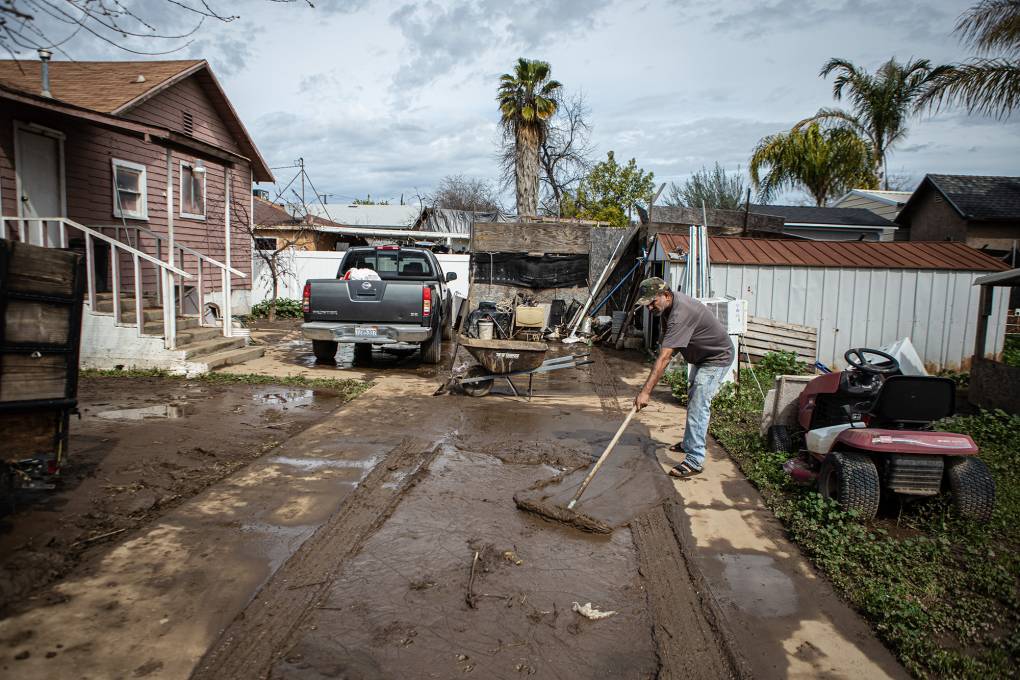
"caption": "A Cutler resident shovels mud off his driveway on March 12, 2023. The area flooded after a levee was breached during a series of storms that hit the Central Valley.",
"description": null,
"title": "031223_Cutler_Flood_LV_CM_13",
"credit": "Larry Valenzuela, CalMatters/CatchLight Local",
"status": "inherit",
"altTag": "A man wearing a brown t-shirt and a cap pushes mud with a broom in a driveway that has two vehicles, equipment and a house in the background.",
"isLoading": false,
"fetchFailed": false
},
"news_11958021": {
"type": "attachments",
"id": "news_11958021",
"meta": {
"index": "attachments_1716263798",
"site": "news",
"id": "11958021",
"found": true
},
"parent": 0,
"imgSizes": {
"twentyfourteen-full-width": {
"file": "https://ww2.kqed.org/app/uploads/sites/10/2023/08/CalMattersDelta01-1038x576.jpg",
"width": 1038,
"mimeType": "image/jpeg",
"height": 576
},
"thumbnail": {
"file": "https://ww2.kqed.org/app/uploads/sites/10/2023/08/CalMattersDelta01-160x107.jpg",
"width": 160,
"mimeType": "image/jpeg",
"height": 107
},
"post-thumbnail": {
"file": "https://ww2.kqed.org/app/uploads/sites/10/2023/08/CalMattersDelta01-672x372.jpg",
"width": 672,
"mimeType": "image/jpeg",
"height": 372
},
"kqedFullSize": {
"file": "https://ww2.kqed.org/app/uploads/sites/10/2023/08/CalMattersDelta01.jpg",
"width": 2000,
"height": 1333
},
"large": {
"file": "https://ww2.kqed.org/app/uploads/sites/10/2023/08/CalMattersDelta01-1020x680.jpg",
"width": 1020,
"mimeType": "image/jpeg",
"height": 680
},
"1536x1536": {
"file": "https://ww2.kqed.org/app/uploads/sites/10/2023/08/CalMattersDelta01-1536x1024.jpg",
"width": 1536,
"mimeType": "image/jpeg",
"height": 1024
},
"full-width": {
"file": "https://ww2.kqed.org/app/uploads/sites/10/2023/08/CalMattersDelta01-1920x1280.jpg",
"width": 1920,
"mimeType": "image/jpeg",
"height": 1280
},
"medium": {
"file": "https://ww2.kqed.org/app/uploads/sites/10/2023/08/CalMattersDelta01-800x533.jpg",
"width": 800,
"mimeType": "image/jpeg",
"height": 533
}
},
"publishDate": 1691775880,
"modified": 1691776353,
"caption": "The Sacramento-San Joaquin River Delta on June 22, 2023. ",
"description": null,
"title": "CalMattersDelta01",
"credit": "Miguel Gutierrez Jr./CalMatters",
"status": "inherit",
"altTag": "An aerial shot of the Sacramento-San Joaquin River Delta.",
"isLoading": false,
"fetchFailed": false
},
"news_11957688": {
"type": "attachments",
"id": "news_11957688",
"meta": {
"index": "attachments_1716263798",
"site": "news",
"id": "11957688",
"found": true
},
"parent": 11957664,
"imgSizes": {
"twentyfourteen-full-width": {
"file": "https://ww2.kqed.org/app/uploads/sites/10/2023/08/110822-KernValleyPrison-LV_CM_04-1038x576.jpg",
"width": 1038,
"mimeType": "image/jpeg",
"height": 576
},
"thumbnail": {
"file": "https://ww2.kqed.org/app/uploads/sites/10/2023/08/110822-KernValleyPrison-LV_CM_04-160x107.jpg",
"width": 160,
"mimeType": "image/jpeg",
"height": 107
},
"post-thumbnail": {
"file": "https://ww2.kqed.org/app/uploads/sites/10/2023/08/110822-KernValleyPrison-LV_CM_04-672x372.jpg",
"width": 672,
"mimeType": "image/jpeg",
"height": 372
},
"kqedFullSize": {
"file": "https://ww2.kqed.org/app/uploads/sites/10/2023/08/110822-KernValleyPrison-LV_CM_04.jpg",
"width": 2000,
"height": 1333
},
"large": {
"file": "https://ww2.kqed.org/app/uploads/sites/10/2023/08/110822-KernValleyPrison-LV_CM_04-1020x680.jpg",
"width": 1020,
"mimeType": "image/jpeg",
"height": 680
},
"1536x1536": {
"file": "https://ww2.kqed.org/app/uploads/sites/10/2023/08/110822-KernValleyPrison-LV_CM_04-1536x1024.jpg",
"width": 1536,
"mimeType": "image/jpeg",
"height": 1024
},
"full-width": {
"file": "https://ww2.kqed.org/app/uploads/sites/10/2023/08/110822-KernValleyPrison-LV_CM_04-1920x1280.jpg",
"width": 1920,
"mimeType": "image/jpeg",
"height": 1280
},
"medium": {
"file": "https://ww2.kqed.org/app/uploads/sites/10/2023/08/110822-KernValleyPrison-LV_CM_04-800x533.jpg",
"width": 800,
"mimeType": "image/jpeg",
"height": 533
}
},
"publishDate": 1691533575,
"modified": 1691533662,
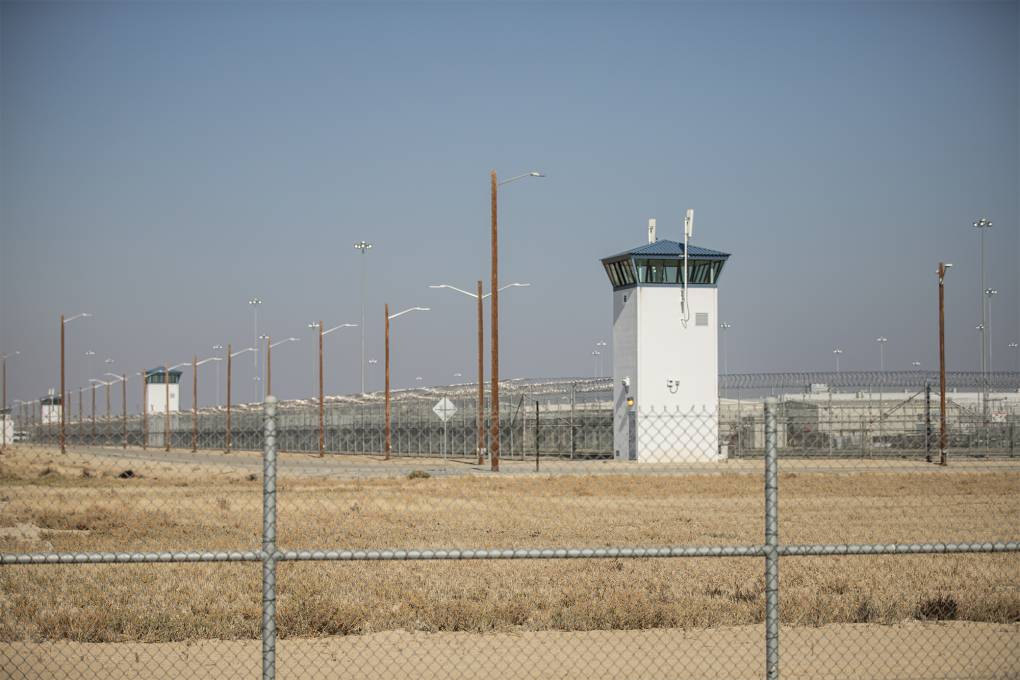
"caption": "Guard towers outside of Kern Valley State Prison on Nov. 15, 2022. ",
"description": null,
"title": "110822-KernValleyPrison-LV_CM_04",
"credit": "Larry Valenzuela, CalMatters/CatchLight Local",
"status": "inherit",
"altTag": "A white tower and building in the background surrounded by a fence.",
"isLoading": false,
"fetchFailed": false
},
"news_11957582": {
"type": "attachments",
"id": "news_11957582",
"meta": {
"index": "attachments_1716263798",
"site": "news",
"id": "11957582",
"found": true
},
"parent": 11957568,
"imgSizes": {
"twentyfourteen-full-width": {
"file": "https://ww2.kqed.org/app/uploads/sites/10/2023/08/072623_Movimiento_Juventud_Migrants_AH_CM_04-1038x576.jpg",
"width": 1038,
"mimeType": "image/jpeg",
"height": 576
},
"thumbnail": {
"file": "https://ww2.kqed.org/app/uploads/sites/10/2023/08/072623_Movimiento_Juventud_Migrants_AH_CM_04-160x107.jpg",
"width": 160,
"mimeType": "image/jpeg",
"height": 107
},
"post-thumbnail": {
"file": "https://ww2.kqed.org/app/uploads/sites/10/2023/08/072623_Movimiento_Juventud_Migrants_AH_CM_04-672x372.jpg",
"width": 672,
"mimeType": "image/jpeg",
"height": 372
},
"kqedFullSize": {
"file": "https://ww2.kqed.org/app/uploads/sites/10/2023/08/072623_Movimiento_Juventud_Migrants_AH_CM_04.jpg",
"width": 2000,
"height": 1333
},
"large": {
"file": "https://ww2.kqed.org/app/uploads/sites/10/2023/08/072623_Movimiento_Juventud_Migrants_AH_CM_04-1020x680.jpg",
"width": 1020,
"mimeType": "image/jpeg",
"height": 680
},
"1536x1536": {
"file": "https://ww2.kqed.org/app/uploads/sites/10/2023/08/072623_Movimiento_Juventud_Migrants_AH_CM_04-1536x1024.jpg",
"width": 1536,
"mimeType": "image/jpeg",
"height": 1024
},
"full-width": {
"file": "https://ww2.kqed.org/app/uploads/sites/10/2023/08/072623_Movimiento_Juventud_Migrants_AH_CM_04-1920x1280.jpg",
"width": 1920,
"mimeType": "image/jpeg",
"height": 1280
},
"medium": {
"file": "https://ww2.kqed.org/app/uploads/sites/10/2023/08/072623_Movimiento_Juventud_Migrants_AH_CM_04-800x533.jpg",
"width": 800,
"mimeType": "image/jpeg",
"height": 533
}
},
"publishDate": 1691434315,
"modified": 1691439475,
"caption": "A group of migrants at Moviemiento Juventud 2000, a shelter in Tijuana, on July 26, 2023.",
"description": null,
"title": "072623_Movimiento_Juventud_Migrants_AH_CM_04",
"credit": "Adriana Heldiz / CalMatters",
"status": "inherit",
"altTag": "People of various ages are seen in colorful tents in a warehouse.",
"isLoading": false,
"fetchFailed": false
},
"news_11957496": {
"type": "attachments",
"id": "news_11957496",
"meta": {
"index": "attachments_1716263798",
"site": "news",
"id": "11957496",
"found": true
},
"parent": 11957487,
"imgSizes": {
"twentyfourteen-full-width": {
"file": "https://ww2.kqed.org/app/uploads/sites/10/2023/08/ezgif.com-webp-to-jpg-1038x576.jpg",
"width": 1038,
"mimeType": "image/jpeg",
"height": 576
},
"thumbnail": {
"file": "https://ww2.kqed.org/app/uploads/sites/10/2023/08/ezgif.com-webp-to-jpg-160x107.jpg",
"width": 160,
"mimeType": "image/jpeg",
"height": 107
},
"post-thumbnail": {
"file": "https://ww2.kqed.org/app/uploads/sites/10/2023/08/ezgif.com-webp-to-jpg-672x372.jpg",
"width": 672,
"mimeType": "image/jpeg",
"height": 372
},
"kqedFullSize": {
"file": "https://ww2.kqed.org/app/uploads/sites/10/2023/08/ezgif.com-webp-to-jpg.jpg",
"width": 2000,
"height": 1333
},
"large": {
"file": "https://ww2.kqed.org/app/uploads/sites/10/2023/08/ezgif.com-webp-to-jpg-1020x680.jpg",
"width": 1020,
"mimeType": "image/jpeg",
"height": 680
},
"1536x1536": {
"file": "https://ww2.kqed.org/app/uploads/sites/10/2023/08/ezgif.com-webp-to-jpg-1536x1024.jpg",
"width": 1536,
"mimeType": "image/jpeg",
"height": 1024
},
"full-width": {
"file": "https://ww2.kqed.org/app/uploads/sites/10/2023/08/ezgif.com-webp-to-jpg-1920x1280.jpg",
"width": 1920,
"mimeType": "image/jpeg",
"height": 1280
},
"medium": {
"file": "https://ww2.kqed.org/app/uploads/sites/10/2023/08/ezgif.com-webp-to-jpg-800x533.jpg",
"width": 800,
"mimeType": "image/jpeg",
"height": 533
}
},
"publishDate": 1691194646,
"modified": 1691248925,
"caption": "Bond measures can only be put before voters with a vote by the state Legislature and approval of the governor. ",
"description": null,
"title": "ezgif.com-webp-to-jpg",
"credit": "Illustration by Adriana Heldiz, CalMatters / iStock",
"status": "inherit",
"altTag": "An illustration with Gov. Gavin Newsom and Assemblymember Buffy Weeks, along with $100 dollar bills and piles of coins.",
"isLoading": false,
"fetchFailed": false
},
"news_11957011": {
"type": "attachments",
"id": "news_11957011",
"meta": {
"index": "attachments_1716263798",
"site": "news",
"id": "11957011",
"found": true
},
"parent": 0,
"imgSizes": {
"twentyfourteen-full-width": {
"file": "https://ww2.kqed.org/app/uploads/sites/10/2023/08/CMNurses01-1038x576.jpg",
"width": 1038,
"mimeType": "image/jpeg",
"height": 576
},
"thumbnail": {
"file": "https://ww2.kqed.org/app/uploads/sites/10/2023/08/CMNurses01-160x107.jpg",
"width": 160,
"mimeType": "image/jpeg",
"height": 107
},
"post-thumbnail": {
"file": "https://ww2.kqed.org/app/uploads/sites/10/2023/08/CMNurses01-672x372.jpg",
"width": 672,
"mimeType": "image/jpeg",
"height": 372
},
"kqedFullSize": {
"file": "https://ww2.kqed.org/app/uploads/sites/10/2023/08/CMNurses01.jpg",
"width": 2000,
"height": 1334
},
"large": {
"file": "https://ww2.kqed.org/app/uploads/sites/10/2023/08/CMNurses01-1020x680.jpg",
"width": 1020,
"mimeType": "image/jpeg",
"height": 680
},
"1536x1536": {
"file": "https://ww2.kqed.org/app/uploads/sites/10/2023/08/CMNurses01-1536x1025.jpg",
"width": 1536,
"mimeType": "image/jpeg",
"height": 1025
},
"full-width": {
"file": "https://ww2.kqed.org/app/uploads/sites/10/2023/08/CMNurses01-1920x1281.jpg",
"width": 1920,
"mimeType": "image/jpeg",
"height": 1281
},
"medium": {
"file": "https://ww2.kqed.org/app/uploads/sites/10/2023/08/CMNurses01-800x534.jpg",
"width": 800,
"mimeType": "image/jpeg",
"height": 534
}
},
"publishDate": 1690910282,
"modified": 1690910404,
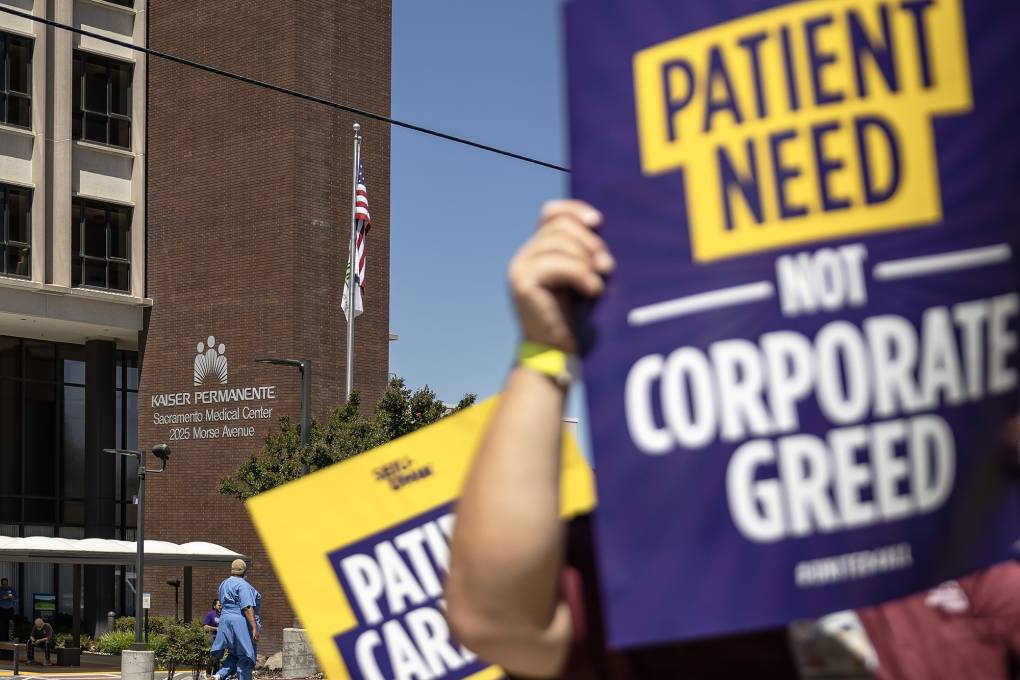
"caption": "Kaiser Permanente health care workers strike outside a Kaiser facility in Sacramento on July 25, 2023. Workers are on the picket lines to protest patient care crisis and unsafe staffing at Kaiser hospitals. ",
"description": null,
"title": "CMNurses01",
"credit": "Rahul Lal/CalMatters",
"status": "inherit",
"altTag": "A close-up shot of a protestor's sign that reads, \"Patient Need Not Corporate Greed\" in front of a Kaiser Permanente building in Sacramento, California.",
"isLoading": false,
"fetchFailed": false
},
"news_11956739": {
"type": "attachments",
"id": "news_11956739",
"meta": {
"index": "attachments_1716263798",
"site": "news",
"id": "11956739",
"found": true
},
"parent": 0,
"imgSizes": {
"twentyfourteen-full-width": {
"file": "https://ww2.kqed.org/app/uploads/sites/10/2023/07/GettyImages-1252130093-KQED-1038x576.jpg",
"width": 1038,
"mimeType": "image/jpeg",
"height": 576
},
"thumbnail": {
"file": "https://ww2.kqed.org/app/uploads/sites/10/2023/07/GettyImages-1252130093-KQED-160x107.jpg",
"width": 160,
"mimeType": "image/jpeg",
"height": 107
},
"post-thumbnail": {
"file": "https://ww2.kqed.org/app/uploads/sites/10/2023/07/GettyImages-1252130093-KQED-672x372.jpg",
"width": 672,
"mimeType": "image/jpeg",
"height": 372
},
"kqedFullSize": {
"file": "https://ww2.kqed.org/app/uploads/sites/10/2023/07/GettyImages-1252130093-KQED.jpg",
"width": 2000,
"height": 1333
},
"large": {
"file": "https://ww2.kqed.org/app/uploads/sites/10/2023/07/GettyImages-1252130093-KQED-1020x680.jpg",
"width": 1020,
"mimeType": "image/jpeg",
"height": 680
},
"1536x1536": {
"file": "https://ww2.kqed.org/app/uploads/sites/10/2023/07/GettyImages-1252130093-KQED-1536x1024.jpg",
"width": 1536,
"mimeType": "image/jpeg",
"height": 1024
},
"full-width": {
"file": "https://ww2.kqed.org/app/uploads/sites/10/2023/07/GettyImages-1252130093-KQED-1920x1280.jpg",
"width": 1920,
"mimeType": "image/jpeg",
"height": 1280
},
"medium": {
"file": "https://ww2.kqed.org/app/uploads/sites/10/2023/07/GettyImages-1252130093-KQED-800x533.jpg",
"width": 800,
"mimeType": "image/jpeg",
"height": 533
}
},
"publishDate": 1690498613,
"modified": 1690911421,
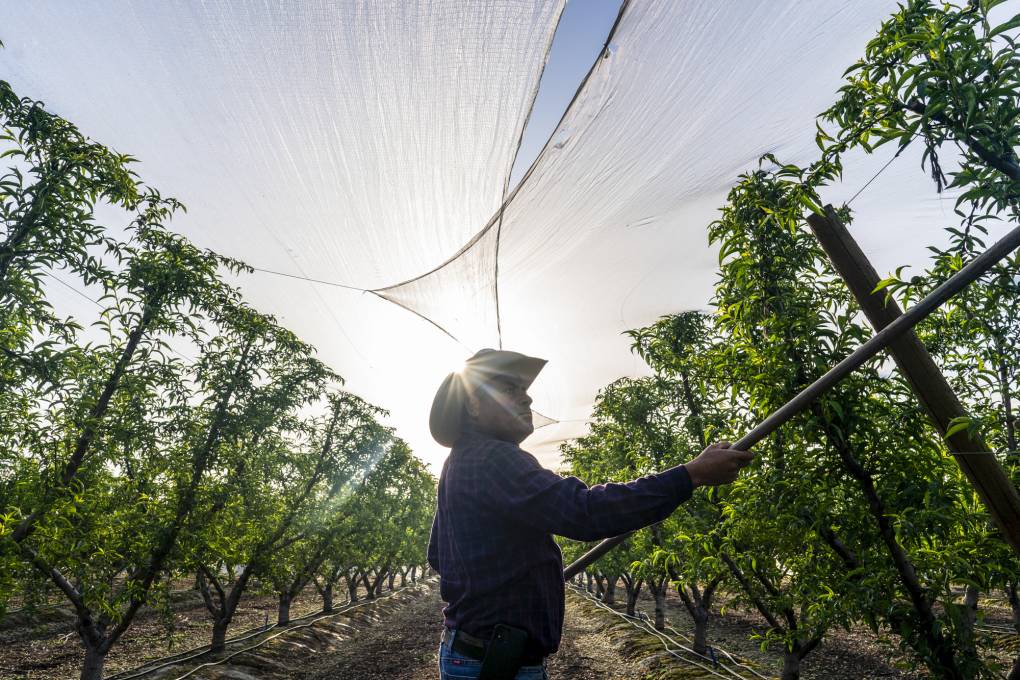
"caption": "A farmworker thins peach trees in Cutler, Tulare County. A new state advisory committee is set to use data on heat-related workplace injuries as a roadmap to protect workers.",
"description": null,
"title": "CUTLER, CALIFORNIA - APRIL 14, 2023: On 6th generation Michael",
"credit": "Melina Mara/The Washington Post via Getty Images",
"status": "inherit",
"altTag": "A man wearing a cowboy hat holds a long pole between two rows of manicured trees.",
"isLoading": false,
"fetchFailed": false
},
"news_11956882": {
"type": "attachments",
"id": "news_11956882",
"meta": {
"index": "attachments_1716263798",
"site": "news",
"id": "11956882",
"found": true
},
"parent": 11956879,
"imgSizes": {
"twentyfourteen-full-width": {
"file": "https://ww2.kqed.org/app/uploads/sites/10/2023/07/GettyImages-1546204762-1038x576.jpg",
"width": 1038,
"mimeType": "image/jpeg",
"height": 576
},
"thumbnail": {
"file": "https://ww2.kqed.org/app/uploads/sites/10/2023/07/GettyImages-1546204762-160x119.jpg",
"width": 160,
"mimeType": "image/jpeg",
"height": 119
},
"post-thumbnail": {
"file": "https://ww2.kqed.org/app/uploads/sites/10/2023/07/GettyImages-1546204762-672x372.jpg",
"width": 672,
"mimeType": "image/jpeg",
"height": 372
},
"kqedFullSize": {
"file": "https://ww2.kqed.org/app/uploads/sites/10/2023/07/GettyImages-1546204762-scaled.jpg",
"width": 2560,
"height": 1898
},
"2048x2048": {
"file": "https://ww2.kqed.org/app/uploads/sites/10/2023/07/GettyImages-1546204762-2048x1518.jpg",
"width": 2048,
"mimeType": "image/jpeg",
"height": 1518
},
"large": {
"file": "https://ww2.kqed.org/app/uploads/sites/10/2023/07/GettyImages-1546204762-1020x756.jpg",
"width": 1020,
"mimeType": "image/jpeg",
"height": 756
},
"1536x1536": {
"file": "https://ww2.kqed.org/app/uploads/sites/10/2023/07/GettyImages-1546204762-1536x1139.jpg",
"width": 1536,
"mimeType": "image/jpeg",
"height": 1139
},
"full-width": {
"file": "https://ww2.kqed.org/app/uploads/sites/10/2023/07/GettyImages-1546204762-1920x1423.jpg",
"width": 1920,
"mimeType": "image/jpeg",
"height": 1423
},
"medium": {
"file": "https://ww2.kqed.org/app/uploads/sites/10/2023/07/GettyImages-1546204762-800x593.jpg",
"width": 800,
"mimeType": "image/jpeg",
"height": 593
}
},
"publishDate": 1690593633,
"modified": 1694095437,
"caption": "A contentious Chino Valley Unified School District board meeting over a policy to notify a student's parents if they identify as a gender they weren't assigned at birth ended with Superintendent of Public Instruction Tony Thurmond being escorted from the meeting.",
"description": null,
"title": "Chino Valley School District Passes Policy For Parental Rights",
"credit": "Photo by Will Lester/MediaNews Group/Inland Valley Daily Bulletin via Getty Images",
"status": "inherit",
"altTag": "a view from the back of a room filled with people, holding signs, facing a table with five chairs in front",
"isLoading": false,
"fetchFailed": false
},
"news_11956728": {
"type": "attachments",
"id": "news_11956728",
"meta": {
"index": "attachments_1716263798",
"site": "news",
"id": "11956728",
"found": true
},
"parent": 11956720,
"imgSizes": {
"twentyfourteen-full-width": {
"file": "https://ww2.kqed.org/app/uploads/sites/10/2023/07/GettyImages-1310463433-1024x576.jpg",
"width": 1024,
"mimeType": "image/jpeg",
"height": 576
},
"thumbnail": {
"file": "https://ww2.kqed.org/app/uploads/sites/10/2023/07/GettyImages-1310463433-160x125.jpg",
"width": 160,
"mimeType": "image/jpeg",
"height": 125
},
"post-thumbnail": {
"file": "https://ww2.kqed.org/app/uploads/sites/10/2023/07/GettyImages-1310463433-672x372.jpg",
"width": 672,
"mimeType": "image/jpeg",
"height": 372
},
"kqedFullSize": {
"file": "https://ww2.kqed.org/app/uploads/sites/10/2023/07/GettyImages-1310463433.jpg",
"width": 1024,
"height": 802
},
"large": {
"file": "https://ww2.kqed.org/app/uploads/sites/10/2023/07/GettyImages-1310463433-1020x799.jpg",
"width": 1020,
"mimeType": "image/jpeg",
"height": 799
},
"medium": {
"file": "https://ww2.kqed.org/app/uploads/sites/10/2023/07/GettyImages-1310463433-800x627.jpg",
"width": 800,
"mimeType": "image/jpeg",
"height": 627
}
},
"publishDate": 1690498037,
"modified": 1690498175,
"caption": "A customer gets assistance from an employee outside the walk-up window of an In-N-Out Burger in Santa Ana on April 1, 2021.",
"description": null,
"title": "Re-built In-N-Out Opens",
"credit": "Leonard Ortiz/MediaNews Group/Orange County Register via Getty Images",
"status": "inherit",
"altTag": "An In-N-Out restaurant worker, wearing a mask and uniform, stands outside the drive-through window taking an order from a customer.",
"isLoading": false,
"fetchFailed": false
},
"news_11956568": {
"type": "attachments",
"id": "news_11956568",
"meta": {
"index": "attachments_1716263798",
"site": "news",
"id": "11956568",
"found": true
},
"parent": 0,
"imgSizes": {
"twentyfourteen-full-width": {
"file": "https://ww2.kqed.org/app/uploads/sites/10/2023/07/RS3205_pediatrics201212-1038x576.jpg",
"width": 1038,
"mimeType": "image/jpeg",
"height": 576
},
"thumbnail": {
"file": "https://ww2.kqed.org/app/uploads/sites/10/2023/07/RS3205_pediatrics201212-160x107.jpg",
"width": 160,
"mimeType": "image/jpeg",
"height": 107
},
"post-thumbnail": {
"file": "https://ww2.kqed.org/app/uploads/sites/10/2023/07/RS3205_pediatrics201212-672x372.jpg",
"width": 672,
"mimeType": "image/jpeg",
"height": 372
},
"kqedFullSize": {
"file": "https://ww2.kqed.org/app/uploads/sites/10/2023/07/RS3205_pediatrics201212-scaled.jpg",
"width": 2560,
"height": 1707
},
"2048x2048": {
"file": "https://ww2.kqed.org/app/uploads/sites/10/2023/07/RS3205_pediatrics201212-2048x1365.jpg",
"width": 2048,
"mimeType": "image/jpeg",
"height": 1365
},
"large": {
"file": "https://ww2.kqed.org/app/uploads/sites/10/2023/07/RS3205_pediatrics201212-1020x680.jpg",
"width": 1020,
"mimeType": "image/jpeg",
"height": 680
},
"1536x1536": {
"file": "https://ww2.kqed.org/app/uploads/sites/10/2023/07/RS3205_pediatrics201212-1536x1024.jpg",
"width": 1536,
"mimeType": "image/jpeg",
"height": 1024
},
"full-width": {
"file": "https://ww2.kqed.org/app/uploads/sites/10/2023/07/RS3205_pediatrics201212-1920x1280.jpg",
"width": 1920,
"mimeType": "image/jpeg",
"height": 1280
},
"medium": {
"file": "https://ww2.kqed.org/app/uploads/sites/10/2023/07/RS3205_pediatrics201212-800x533.jpg",
"width": 800,
"mimeType": "image/jpeg",
"height": 533
}
},
"publishDate": 1690397175,
"modified": 1690397438,
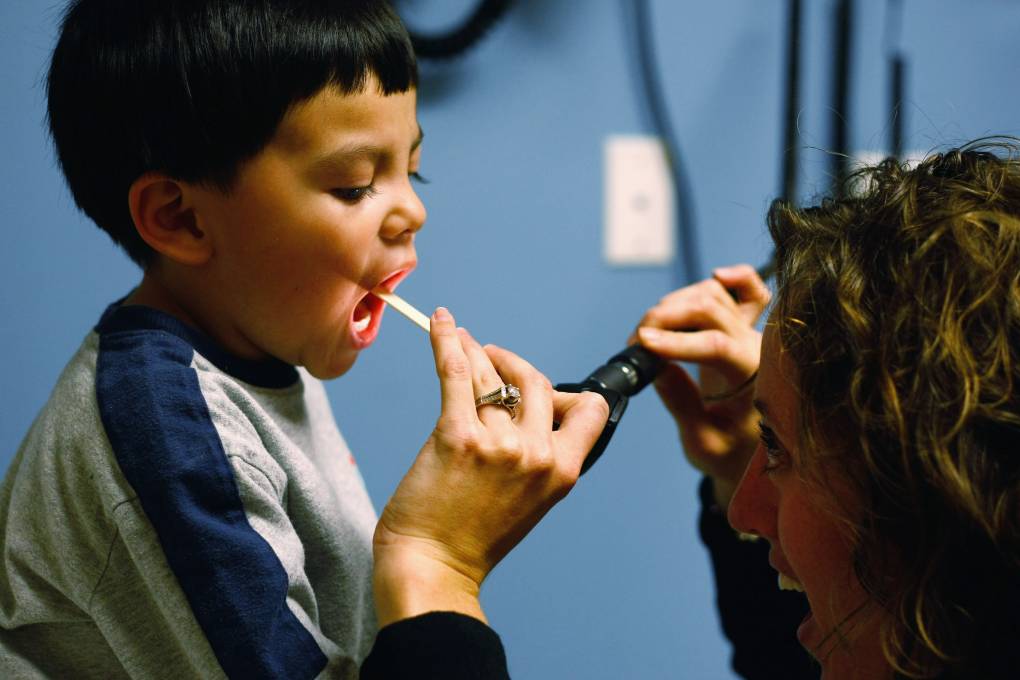
"caption": "About 1.6 million Californians turn to the marketplace for health insurance, which offers plans that cost as little as $10 a month.",
"description": null,
"title": "Non-Profit Health Clinics Care For Uninsured",
"credit": "John Moore/Getty Images",
"status": "inherit",
"altTag": "A little boy sits in a health care clinic room where a nurse is looking inside his mouth using a wooden depressor and a light.",
"isLoading": false,
"fetchFailed": false
},
"news_11878990": {
"type": "attachments",
"id": "news_11878990",
"meta": {
"index": "attachments_1716263798",
"site": "news",
"id": "11878990",
"found": true
},
"parent": 11878989,
"imgSizes": {
"thumbnail": {
"file": "https://ww2.kqed.org/app/uploads/sites/10/2021/06/gettyimages-1231093862_wide-4195c57f825738c502a8a11e343c9df96ca71caf-160x90.jpg",
"width": 160,
"mimeType": "image/jpeg",
"height": 90
},
"post-thumbnail": {
"file": "https://ww2.kqed.org/app/uploads/sites/10/2021/06/gettyimages-1231093862_wide-4195c57f825738c502a8a11e343c9df96ca71caf-672x372.jpg",
"width": 672,
"mimeType": "image/jpeg",
"height": 372
},
"kqedFullSize": {
"file": "https://ww2.kqed.org/app/uploads/sites/10/2021/06/gettyimages-1231093862_wide-4195c57f825738c502a8a11e343c9df96ca71caf.jpg",
"width": 1024,
"height": 576
},
"large": {
"file": "https://ww2.kqed.org/app/uploads/sites/10/2021/06/gettyimages-1231093862_wide-4195c57f825738c502a8a11e343c9df96ca71caf-1020x574.jpg",
"width": 1020,
"mimeType": "image/jpeg",
"height": 574
},
"medium": {
"file": "https://ww2.kqed.org/app/uploads/sites/10/2021/06/gettyimages-1231093862_wide-4195c57f825738c502a8a11e343c9df96ca71caf-800x450.jpg",
"width": 800,
"mimeType": "image/jpeg",
"height": 450
}
},
"publishDate": 1624465271,
"modified": 1690220476,
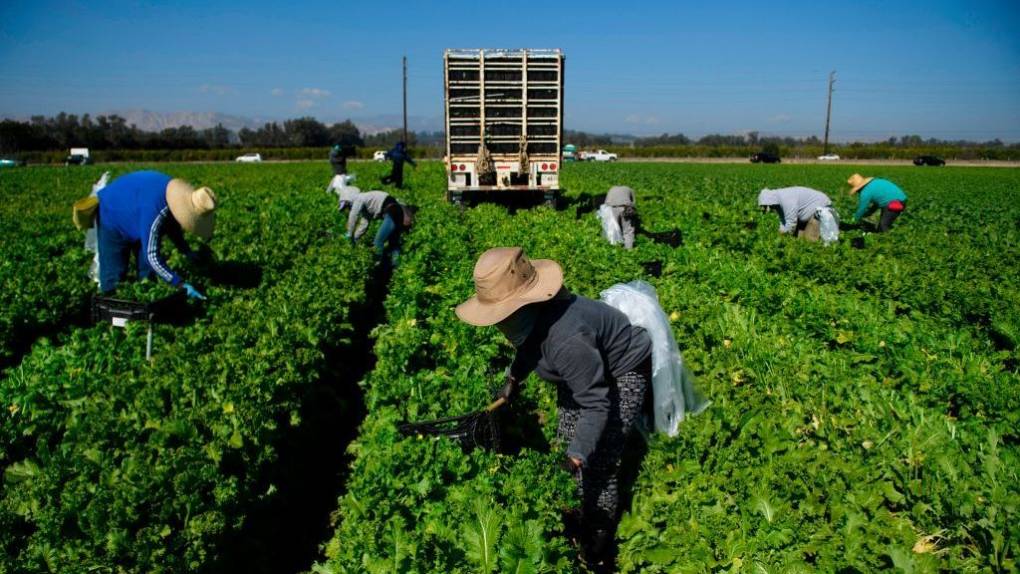
"caption": "Farmworkers harvest curly mustard in a field on Feb. 10, 2021 in Ventura County. ",
"description": "Farmworkers harvest curly mustard in a field on Feb. 10 in Ventura County. The Supreme Court handed the farmworkers union a loss Wednesday in a ruling about union organizers' access to farm property.",
"title": "Farmworkers harvest curly mustard in a field on Feb. 10 in Ventura County, Calif. The Supreme Court handed the farmworkers union a loss Wednesday in a ruling about union organizers' access to farm property.",
"credit": "Patrick T. Fallon/AFP via Getty Images",
"status": "inherit",
"altTag": "People bent over in a large field filled with rows of vegetables with a large vehicle in the background.",
"isLoading": false,
"fetchFailed": false
}
},
"audioPlayerReducer": {
"postId": "stream_live",
"isPaused": true,
"isPlaying": false,
"pfsActive": false,
"pledgeModalIsOpen": true,
"playerDrawerIsOpen": false,
"liveAudioPlayStartedAt": 0,
"liveAudioPlayContext": ""
},
"authorsReducer": {
"byline_news_11958476": {
"type": "authors",
"id": "byline_news_11958476",
"meta": {
"override": true
},
"slug": "byline_news_11958476",
"name": "\u003ca href=\"https://calmatters.org/author/nigelduara/\">Nigel Duara\u003c/a>",
"isLoading": false
},
"byline_news_11958321": {
"type": "authors",
"id": "byline_news_11958321",
"meta": {
"override": true
},
"slug": "byline_news_11958321",
"name": "\u003ca href=\"https://calmatters.org/author/nicole-foy\">Nicole Foy\u003c/a>",
"isLoading": false
},
"byline_news_11958011": {
"type": "authors",
"id": "byline_news_11958011",
"meta": {
"override": true
},
"slug": "byline_news_11958011",
"name": "\u003ca href=\"https://calmatters.org/author/rachel-becker/\">Rachel Becker\u003c/a>",
"isLoading": false
},
"byline_news_11957664": {
"type": "authors",
"id": "byline_news_11957664",
"meta": {
"override": true
},
"slug": "byline_news_11957664",
"name": "\u003ca href=\"https://calmatters.org/author/anabelsosa/\">Anabel Sosa\u003c/a>",
"isLoading": false
},
"byline_news_11957568": {
"type": "authors",
"id": "byline_news_11957568",
"meta": {
"override": true
},
"slug": "byline_news_11957568",
"name": "\u003ca href=\"https://calmatters.org/author/wendy-fry/\">Wendy Fry\u003c/a>",
"isLoading": false
},
"byline_news_11957487": {
"type": "authors",
"id": "byline_news_11957487",
"meta": {
"override": true
},
"slug": "byline_news_11957487",
"name": "\u003ca href=\"https://calmatters.org/author/ben-christopher/\">Ben Christopher\u003c/a>",
"isLoading": false
},
"byline_news_11957005": {
"type": "authors",
"id": "byline_news_11957005",
"meta": {
"override": true
},
"slug": "byline_news_11957005",
"name": "\u003ca href=\"https://calmatters.org/author/kristen-hwang/\">Kristen Hwang\u003c/a>",
"isLoading": false
},
"byline_news_11956922": {
"type": "authors",
"id": "byline_news_11956922",
"meta": {
"override": true
},
"slug": "byline_news_11956922",
"name": "Nicole Foy",
"isLoading": false
},
"byline_news_11956879": {
"type": "authors",
"id": "byline_news_11956879",
"meta": {
"override": true
},
"slug": "byline_news_11956879",
"name": "\u003ca href=\"https://calmatters.org/author/carolyn-jones/\">Carolyn Jones\u003c/a>",
"isLoading": false
},
"byline_news_11956720": {
"type": "authors",
"id": "byline_news_11956720",
"meta": {
"override": true
},
"slug": "byline_news_11956720",
"name": "\u003ca href=\"https://calmatters.org/author/anaibarra/\">Ana B. Ibarra\u003c/a>",
"isLoading": false
},
"byline_news_11956545": {
"type": "authors",
"id": "byline_news_11956545",
"meta": {
"override": true
},
"slug": "byline_news_11956545",
"name": "\u003ca href=\"https://calmatters.org/author/kristen-hwang/\">Kristen Hwang\u003c/a>",
"isLoading": false
},
"byline_news_11956315": {
"type": "authors",
"id": "byline_news_11956315",
"meta": {
"override": true
},
"slug": "byline_news_11956315",
"name": "\u003ca href=\"https://calmatters.org/author/nicole-foy/\">Nicole Foy\u003c/a>",
"isLoading": false
}
},
"pagesReducer": {
"news_affiliate_calmatters": {
"type": "terms",
"id": "news_18481",
"meta": {
"index": "terms_1716263798",
"site": "news",
"id": "18481",
"score": 15.355862
},
"featImg": null,
"name": "CALmatters",
"description": null,
"taxonomy": "affiliate",
"headData": {
"twImgId": null,
"twTitle": null,
"ogTitle": null,
"ogImgId": null,
"twDescription": null,
"description": null,
"title": "CALmatters Archives | KQED Arts",
"ogDescription": null
},
"ttid": 18515,
"slug": "calmatters",
"isLoading": false,
"title": "CALmatters",
"pageMeta": {
"site": "news",
"WpPageTemplate": "page-topic-editorial",
"currentPage": 45
},
"blocks": [
{
"blockName": "kqed/post-list",
"attrs": {
"layout": "cardArticle2",
"query": "posts/news?affiliate=calmatters",
"seeMore": false,
"paginated": true,
"page": 45
}
},
{
"blockName": "kqed/ad"
}
]
}
},
"pfsSessionReducer": {},
"postsReducer": {
"stream_live": {
"type": "live",
"id": "stream_live",
"audioUrl": "https://streams.kqed.org/kqedradio",
"title": "Live Stream",
"excerpt": "Live Stream information currently unavailable.",
"link": "/radio",
"featImg": "",
"label": {
"name": "KQED Live",
"link": "/"
}
},
"stream_kqedNewscast": {
"type": "posts",
"id": "stream_kqedNewscast",
"audioUrl": "https://www.kqed.org/.stream/anon/radio/RDnews/newscast.mp3?_=1",
"title": "KQED Newscast",
"featImg": "",
"label": {
"name": "88.5 FM",
"link": "/"
}
},
"news_11958476": {
"type": "posts",
"id": "news_11958476",
"meta": {
"index": "posts_1716263798",
"site": "news",
"id": "11958476",
"score": null,
"sort": [
1692302006000
]
},
"parent": 0,
"labelTerm": {
"site": "news",
"term": 18481
},
"blocks": [],
"publishDate": 1692302006,
"format": "standard",
"title": "California Supreme Court Unanimously Ruled Body Camera Footage Can't Take the Place of Witness Testimony",
"headTitle": "California Supreme Court Unanimously Ruled Body Camera Footage Can’t Take the Place of Witness Testimony | KQED",
"content": "\u003cp>When a woman refused to testify against a man accused of assaulting her, a Los Angeles County judge used the accusations she made the night of the incident that were recorded on a police officer’s body camera.\u003c/p>\n\u003cp>This week, \u003ca href=\"https://supreme.courts.ca.gov/opinions/recent-opinions\">the California Supreme Court unanimously ruled\u003c/a> that the judge erred by using the body camera footage to stand in for the woman’s testimony. Doing so, the court ruled, denied the accused man a chance to confront his accuser in court.\u003c/p>\n\u003cp>“We emphasize that a defendant’s due process right to confront testimonial witnesses against him is not absolute,” the high court ruled in an opinion issued Monday.\u003c/p>\n\u003cp>[ad fullwidth]\u003c/p>\n\u003cp>“What cannot be done, however, is reducing the analysis to a single determination that hinges solely on whether a statement qualifies as a spontaneous statement.”\u003c/p>\n\u003cp>The ruling comes as body cameras have become more common in California police departments, most recently this year \u003ca href=\"https://ktla.com/news/california/body-cameras-coming-to-san-bernardino-county-sheriffs-department/\">in San Bernardino County\u003c/a>.\u003c/p>\n\u003cp>While body cameras are not mandatory among California agencies, \u003ca href=\"https://calmatters.org/justice/2022/03/california-highway-patrol-body-cams/\">CalMatters surveyed large law enforcement agencies\u003c/a> last year and found that some of the largest police and sheriff’s departments in the state have given body cameras to all of their uniformed officers.\u003c/p>\n\u003cp>Body camera footage of alleged criminal incidents can be used as evidence in court and in disciplinary proceedings against police officers. The new ruling limits its use with respect to statements made on camera.\u003c/p>\n\u003cp>Prosecutors, including the state Department of Justice, had urged the court to admit the body camera footage, partly because it related to a suspect who was on probation.[pullquote align=\"right\" size=\"medium\" citation=\"Renee Korn, superior court judge, Los Angeles County\"]‘The court actually has the unique opportunity to actually see her, hear her and see her … It’s not just an audiotape. It’s not just the reiteration of an officer of these statements.’[/pullquote]Statements made outside of court that cannot be verified at trial are called hearsay, and are generally prohibited. But there are exceptions, one of them being “\u003ca href=\"https://www.law.cornell.edu/wex/spontaneous_exclamation\">spontaneous statements\u003c/a>,” which are statements made in the moment that don’t leave time for deliberation. Courts have found that these statements tend to accurately reflect what a person was thinking when they said something.\u003c/p>\n\u003cp>In the case before the Supreme Court this week, a woman called 911 in March 2019, reporting that someone was trying to break into the house where she was working as an aide to a person with a disability.\u003c/p>\n\u003cp>Responding officers found damage to the front door and Dontrae R. Gray in the back of the house. The woman had bruises and a scratch on her face, and told an officer wearing a body camera that Gray kicked in the door and assaulted her. Gray was on probation for a previous, unrelated assault.\u003c/p>\n\u003cp>A few days later, the woman partially recanted her story, which is \u003ca href=\"https://www.genesisshelter.org/why-victims-of-domestic-violence-recant/\">common among victims of intimate partner violence\u003c/a>, and refused to appear at Gray’s criminal trial despite a subpoena. Los Angeles County prosecutors tried to introduce the body camera evidence, but a judge refused to allow it.\u003c/p>\n\u003cp>The criminal case was dismissed, but prosecutors asked a judge to revoke Gray’s probation, and again tried to use the body camera footage as evidence. This time, it worked.\u003c/p>\n\u003ch2>Body camera footage a ‘unique opportunity’\u003c/h2>\n\u003cp>The judge at Gray’s probation revocation hearing ruled that the woman’s statements in the body camera footage indeed qualified as a spontaneous statement, revoked Gray’s probation and ordered him to serve a suspended sentence of seven years in prison.\u003c/p>\n\u003cp>“The court actually has the unique opportunity to actually see her, hear her and see her,” said Los Angeles County Superior Court Judge Renee Korn, according to trial transcripts cited on appeal. “It’s not just an audiotape. It’s not just the reiteration of an officer of these statements.[aside tag=\"police, body-camera\" label=\"More Related Stories\"]“Rather, it’s actual video footage of who she is and how she presented at the time. (It) gives the court ample basis to find the defendant in violation of probation.”\u003c/p>\n\u003cp>On appeal, Gray said the decision to introduce the body camera footage as testimony violated his due process rights. State prosecutors replied in briefs to a state appellate court that due process rights at probation hearings are “flexible.”\u003c/p>\n\u003cp>“Probationers at revocation hearings are not entitled to the full array of constitutional rights available to defendants at criminal trials,” prosecutors led by Attorney General Rob Bonta wrote, “because probationers, having been validly convicted of crimes, have already been afforded the full panoply of constitutional trial rights in the criminal proceedings that resulted in their convictions.”\u003c/p>\n\u003cp>A California appellate court agreed and affirmed the decision to revoke his probation. Then the case went to the state Supreme Court.\u003c/p>\n\u003ch2>California rulings on probation revocation\u003c/h2>\n\u003cp>Previous probation revocation cases relying solely on paper evidence offered varying results.\u003c/p>\n\u003cp>In one 1981 case, the Supreme Court rejected prosecutors’ use of a trial court transcript in lieu of a witness’s testimony. Another case affirmed prosecutors’ use of hotel and car rental receipts to prove a defendant had broken the rules of his probation by traveling out of state.\u003c/p>\n\u003cp>This week, the high court agreed that defendants have the right to due process, including the right to confront their accuser.\u003c/p>\n\u003cp>“The Attorney General asserts that the particular reliability and unique nature of spontaneous statements make them categorically admissible under the due process clause, without requiring a further finding of good cause or a balancing,” the court ruled. “We reject this categorical approach.”\u003c/p>\n\u003cp>The Supreme Court sent the case back to the Second Appellate District.\u003c/p>\n\u003cp>\u003c/p>\n",
"stats": {
"hasVideo": false,
"hasChartOrMap": false,
"hasAudio": false,
"hasPolis": false,
"wordCount": 982,
"hasGoogleForm": false,
"hasGallery": false,
"hasHearkenModule": false,
"iframeSrcs": [],
"paragraphCount": 24
},
"modified": 1694456160,
"excerpt": "More California police departments are deploying body cameras. A new court ruling restricts how prosecutors can use footage of witness accounts at trial.",
"headData": {
"twImgId": "",
"twTitle": "",
"ogTitle": "",
"ogImgId": "",
"twDescription": "",
"description": "More California police departments are deploying body cameras. A new court ruling restricts how prosecutors can use footage of witness accounts at trial.",
"title": "California Supreme Court Unanimously Ruled Body Camera Footage Can't Take the Place of Witness Testimony | KQED",
"ogDescription": "",
"schema": {
"@context": "https://schema.org",
"@type": "NewsArticle",
"headline": "California Supreme Court Unanimously Ruled Body Camera Footage Can't Take the Place of Witness Testimony",
"datePublished": "2023-08-17T12:53:26-07:00",
"dateModified": "2023-09-11T11:16:00-07:00",
"image": "https://cdn.kqed.org/wp-content/uploads/2020/02/KQED-OG-Image@1x.png",
"isAccessibleForFree": "True",
"publisher": {
"@type": "NewsMediaOrganization",
"@id": "https://www.kqed.org/#organization",
"name": "KQED",
"logo": "https://cdn.kqed.org/wp-content/uploads/2020/02/KQED-OG-Image@1x.png",
"url": "https://www.kqed.org",
"sameAs": [
"https://www.facebook.com/KQED",
"https://twitter.com/KQED",
"https://www.instagram.com/kqed/",
"https://www.tiktok.com/@kqedofficial",
"https://www.linkedin.com/company/kqed",
"https://www.youtube.com/channel/UCeC0IOo7i1P_61zVUWbJ4nw"
]
}
}
},
"guestAuthors": [],
"slug": "california-supreme-court-unanimously-ruled-body-camera-footage-cant-take-the-place-of-witness-testimony",
"status": "publish",
"nprByline": "\u003ca href=\"https://calmatters.org/author/nigelduara/\">Nigel Duara\u003c/a>",
"excludeFromSiteSearch": "Include",
"showOnAuthorArchivePages": "No",
"articleAge": "0",
"path": "/news/11958476/california-supreme-court-unanimously-ruled-body-camera-footage-cant-take-the-place-of-witness-testimony",
"audioTrackLength": null,
"parsedContent": [
{
"type": "contentString",
"content": "\u003cdiv class=\"post-body\">\u003cp>\u003cp>When a woman refused to testify against a man accused of assaulting her, a Los Angeles County judge used the accusations she made the night of the incident that were recorded on a police officer’s body camera.\u003c/p>\n\u003cp>This week, \u003ca href=\"https://supreme.courts.ca.gov/opinions/recent-opinions\">the California Supreme Court unanimously ruled\u003c/a> that the judge erred by using the body camera footage to stand in for the woman’s testimony. Doing so, the court ruled, denied the accused man a chance to confront his accuser in court.\u003c/p>\n\u003cp>“We emphasize that a defendant’s due process right to confront testimonial witnesses against him is not absolute,” the high court ruled in an opinion issued Monday.\u003c/p>\n\u003cp>\u003c/p>\u003c/div>",
"attributes": {
"named": {},
"numeric": []
}
},
{
"type": "component",
"content": "",
"name": "ad",
"attributes": {
"named": {
"label": "fullwidth"
},
"numeric": [
"fullwidth"
]
}
},
{
"type": "contentString",
"content": "\u003cdiv class=\"post-body\">\u003cp>\u003c/p>\n\u003cp>“What cannot be done, however, is reducing the analysis to a single determination that hinges solely on whether a statement qualifies as a spontaneous statement.”\u003c/p>\n\u003cp>The ruling comes as body cameras have become more common in California police departments, most recently this year \u003ca href=\"https://ktla.com/news/california/body-cameras-coming-to-san-bernardino-county-sheriffs-department/\">in San Bernardino County\u003c/a>.\u003c/p>\n\u003cp>While body cameras are not mandatory among California agencies, \u003ca href=\"https://calmatters.org/justice/2022/03/california-highway-patrol-body-cams/\">CalMatters surveyed large law enforcement agencies\u003c/a> last year and found that some of the largest police and sheriff’s departments in the state have given body cameras to all of their uniformed officers.\u003c/p>\n\u003cp>Body camera footage of alleged criminal incidents can be used as evidence in court and in disciplinary proceedings against police officers. The new ruling limits its use with respect to statements made on camera.\u003c/p>\n\u003cp>Prosecutors, including the state Department of Justice, had urged the court to admit the body camera footage, partly because it related to a suspect who was on probation.\u003c/p>\u003c/div>",
"attributes": {
"named": {},
"numeric": []
}
},
{
"type": "component",
"content": "‘The court actually has the unique opportunity to actually see her, hear her and see her … It’s not just an audiotape. It’s not just the reiteration of an officer of these statements.’",
"name": "pullquote",
"attributes": {
"named": {
"align": "right",
"size": "medium",
"citation": "Renee Korn, superior court judge, Los Angeles County",
"label": ""
},
"numeric": []
}
},
{
"type": "contentString",
"content": "\u003cdiv class=\"post-body\">\u003cp>Statements made outside of court that cannot be verified at trial are called hearsay, and are generally prohibited. But there are exceptions, one of them being “\u003ca href=\"https://www.law.cornell.edu/wex/spontaneous_exclamation\">spontaneous statements\u003c/a>,” which are statements made in the moment that don’t leave time for deliberation. Courts have found that these statements tend to accurately reflect what a person was thinking when they said something.\u003c/p>\n\u003cp>In the case before the Supreme Court this week, a woman called 911 in March 2019, reporting that someone was trying to break into the house where she was working as an aide to a person with a disability.\u003c/p>\n\u003cp>Responding officers found damage to the front door and Dontrae R. Gray in the back of the house. The woman had bruises and a scratch on her face, and told an officer wearing a body camera that Gray kicked in the door and assaulted her. Gray was on probation for a previous, unrelated assault.\u003c/p>\n\u003cp>A few days later, the woman partially recanted her story, which is \u003ca href=\"https://www.genesisshelter.org/why-victims-of-domestic-violence-recant/\">common among victims of intimate partner violence\u003c/a>, and refused to appear at Gray’s criminal trial despite a subpoena. Los Angeles County prosecutors tried to introduce the body camera evidence, but a judge refused to allow it.\u003c/p>\n\u003cp>The criminal case was dismissed, but prosecutors asked a judge to revoke Gray’s probation, and again tried to use the body camera footage as evidence. This time, it worked.\u003c/p>\n\u003ch2>Body camera footage a ‘unique opportunity’\u003c/h2>\n\u003cp>The judge at Gray’s probation revocation hearing ruled that the woman’s statements in the body camera footage indeed qualified as a spontaneous statement, revoked Gray’s probation and ordered him to serve a suspended sentence of seven years in prison.\u003c/p>\n\u003cp>“The court actually has the unique opportunity to actually see her, hear her and see her,” said Los Angeles County Superior Court Judge Renee Korn, according to trial transcripts cited on appeal. “It’s not just an audiotape. It’s not just the reiteration of an officer of these statements.\u003c/p>\u003c/div>",
"attributes": {
"named": {},
"numeric": []
}
},
{
"type": "component",
"content": "",
"name": "aside",
"attributes": {
"named": {
"tag": "police, body-camera",
"label": "More Related Stories "
},
"numeric": []
}
},
{
"type": "contentString",
"content": "\u003cdiv class=\"post-body\">\u003cp>“Rather, it’s actual video footage of who she is and how she presented at the time. (It) gives the court ample basis to find the defendant in violation of probation.”\u003c/p>\n\u003cp>On appeal, Gray said the decision to introduce the body camera footage as testimony violated his due process rights. State prosecutors replied in briefs to a state appellate court that due process rights at probation hearings are “flexible.”\u003c/p>\n\u003cp>“Probationers at revocation hearings are not entitled to the full array of constitutional rights available to defendants at criminal trials,” prosecutors led by Attorney General Rob Bonta wrote, “because probationers, having been validly convicted of crimes, have already been afforded the full panoply of constitutional trial rights in the criminal proceedings that resulted in their convictions.”\u003c/p>\n\u003cp>A California appellate court agreed and affirmed the decision to revoke his probation. Then the case went to the state Supreme Court.\u003c/p>\n\u003ch2>California rulings on probation revocation\u003c/h2>\n\u003cp>Previous probation revocation cases relying solely on paper evidence offered varying results.\u003c/p>\n\u003cp>In one 1981 case, the Supreme Court rejected prosecutors’ use of a trial court transcript in lieu of a witness’s testimony. Another case affirmed prosecutors’ use of hotel and car rental receipts to prove a defendant had broken the rules of his probation by traveling out of state.\u003c/p>\n\u003cp>This week, the high court agreed that defendants have the right to due process, including the right to confront their accuser.\u003c/p>\n\u003cp>“The Attorney General asserts that the particular reliability and unique nature of spontaneous statements make them categorically admissible under the due process clause, without requiring a further finding of good cause or a balancing,” the court ruled. “We reject this categorical approach.”\u003c/p>\n\u003cp>The Supreme Court sent the case back to the Second Appellate District.\u003c/p>\n\u003cp>\u003c/p>\n\u003c/div>\u003c/p>",
"attributes": {
"named": {},
"numeric": []
}
}
],
"link": "/news/11958476/california-supreme-court-unanimously-ruled-body-camera-footage-cant-take-the-place-of-witness-testimony",
"authors": [
"byline_news_11958476"
],
"categories": [
"news_6188",
"news_8",
"news_13"
],
"tags": [
"news_33037",
"news_27626",
"news_21238"
],
"affiliates": [
"news_18481"
],
"featImg": "news_11958480",
"label": "news_18481"
},
"news_11958321": {
"type": "posts",
"id": "news_11958321",
"meta": {
"index": "posts_1716263798",
"site": "news",
"id": "11958321",
"score": null,
"sort": [
1692212403000
]
},
"parent": 0,
"labelTerm": {
"site": "news",
"term": 18481
},
"blocks": [],
"publishDate": 1692212403,
"format": "standard",
"title": "Months After Storms, Undocumented Workers Who Lost Homes Still Await Disaster Relief Aid",
"headTitle": "Months After Storms, Undocumented Workers Who Lost Homes Still Await Disaster Relief Aid | KQED",
"content": "\u003cp>Undocumented Californians affected by winter storms and floods are slowly starting to receive money from a special relief program the state launched for them two months ago.\u003c/p>\n\u003cp>In June, Gov. Gavin Newsom’s office announced it plans to \u003ca href=\"https://calmatters.org/california-divide/2023/05/california-flooding-fund/\">spend $95 million\u003c/a> from the state’s Rapid Response Fund to help thousands of flood victims recover from storm damage and financial setbacks. The beneficiaries would be immigrants who don’t qualify for federal emergency assistance or state unemployment insurance because they are undocumented.\u003c/p>\n\u003cp>More than 20 nonprofits have contracts with the Department of Social Services to distribute the money. So far they have begun handing out nearly $18 million to about 12,000 residents — but it’s at an uneven pace.[pullquote size=\"medium\" align=\"right\" citation=\"Efrén Pérez, political science professor, UCLA\"]‘I think if I’m an agency that has money to hand out and I really want to … provide a public service, I think I would be trying to make something like this a little bit more streamlined.’[/pullquote]About 4,000 residents in San Joaquin County are expected to receive a total of about $6 million, according to Aug. 6 data from the state. Fewer people have received aid in other big counties. For instance, only a few hundred thousand dollars went to 415 households in Kern and San Mateo counties so far.\u003c/p>\n\u003cp>Some residents in smaller qualifying counties have not received any funds yet, as their counties qualified for disaster assistance later. The money will be available through May 31, 2024, or until the money runs out. Subtracting administrative expenses, nearly a quarter of the available aid has been distributed so far.\u003c/p>\n\u003cp>Although most recipients are undocumented people, who likely speak Spanish or an Indigenous language, some of the state’s information about the Storm Assistance for Immigrants program is in English and has not been translated into Spanish or any other languages.\u003c/p>\n\u003cp>\u003c!-- iframe plugin v.4.3 wordpress.org/plugins/iframe/ -->\u003cbr>\n\u003ciframe loading=\"lazy\" src=\"https://www.datawrapper.de/_/NZ4oe/\" width=\"800\" height=\"800\" scrolling=\"yes\" class=\"iframe-class\" frameborder=\"0\">\u003c/iframe>\u003c/p>\n\u003cp>Efrén Pérez, a political science professor at UCLA, said he’s puzzled that the state is not doing more aggressive canvassing and outreach, especially in Spanish.\u003c/p>\n\u003cp>“I think the most important question is why can’t we make this relatively easier?” Pérez said. “What are the barriers that make this the best that we can do? I think if I’m an agency that has money to hand out and I really want to … provide a public service, I think I would be trying to make something like this a little bit more streamlined.”[aside postID=\"news_11955359,news_11946661,news_11952059\" label=\"Related Stories\"]Pérez also questioned the state’s reliance on independent organizations to do outreach, saying it could result in varying results across counties and target populations.\u003c/p>\n\u003cp>“It’s good when you can partner with organizations,” Pérez said. “The challenge is when you decentralize it in that way, you basically are increasing the chances that there is no standardized approach across these organizations to get delivery of that info.”\u003c/p>\n\u003cp>Scott Murray, a spokesperson for the California Department of Social Services, said the nonprofit organizations are responsible for conducting outreach. He added that a Spanish version of a “Frequently Asked Questions” document has been provided to the nonprofits.\u003c/p>\n\u003cp>“It’s important to remember that the undocumented community can be fearful of accessing benefits and assistance through Government entities,” Murray told CalMatters in an email.\u003c/p>\n\u003cp>“Therefore, as trusted community messengers, the nonprofit organizations are conducting outreach to the undocumented community through their existing networks and through the local amplification of the existence of these recovery supports to eligible undocumented Californians.”\u003c/p>\n\u003cp>[ad fullwidth]\u003c/p>\n\u003ch2>Who qualifies for storm damage aid?\u003c/h2>\n\u003cp>The state’s Immigrant Storm Assistance Program, is only for undocumented residents living or working in the 25 counties that qualified for “direct assistance” from the Federal Emergency Management Agency (FEMA).\u003c/p>\n\u003cp>Qualifying families can receive up to $4,500 in state aid, depending on the number of qualifying adults and children in their household, while individuals can qualify for $1,500. The nonprofits contracting with the state interview applicants in person and provide them with preloaded debit cards or checks.\u003c/p>\n\u003cp>Many Californians harmed by the floods were working as farmworkers in rural or coastal communities. Not only did many lose weeks of work during the months of rain and floods, but others also lost their homes, vehicles and other property. One UC Merced study of Planada’s residents found nearly $20 million in damages to the Central Valley town of 4,000.\u003c/p>\n\u003cfigure id=\"attachment_11958330\" class=\"wp-caption aligncenter\" style=\"max-width: 800px\">\u003ca href=\"https://ww2.kqed.org/app/uploads/sites/10/2023/08/031223_Cutler_Flood_LV_CM_21.jpg\">\u003cimg decoding=\"async\" loading=\"lazy\" class=\"size-medium wp-image-11958330\" src=\"https://ww2.kqed.org/app/uploads/sites/10/2023/08/031223_Cutler_Flood_LV_CM_21-800x533.jpg\" alt=\"A flooded residential street with cars slightly submerged in water.\" width=\"800\" height=\"533\" srcset=\"https://ww2.kqed.org/app/uploads/sites/10/2023/08/031223_Cutler_Flood_LV_CM_21-800x533.jpg 800w, https://ww2.kqed.org/app/uploads/sites/10/2023/08/031223_Cutler_Flood_LV_CM_21-1020x680.jpg 1020w, https://ww2.kqed.org/app/uploads/sites/10/2023/08/031223_Cutler_Flood_LV_CM_21-160x107.jpg 160w, https://ww2.kqed.org/app/uploads/sites/10/2023/08/031223_Cutler_Flood_LV_CM_21-1536x1024.jpg 1536w, https://ww2.kqed.org/app/uploads/sites/10/2023/08/031223_Cutler_Flood_LV_CM_21-1920x1280.jpg 1920w, https://ww2.kqed.org/app/uploads/sites/10/2023/08/031223_Cutler_Flood_LV_CM_21.jpg 2000w\" sizes=\"(max-width: 800px) 100vw, 800px\">\u003c/a>\u003cfigcaption class=\"wp-caption-text\">A flooded neighborhood in Orosi on March 12, 2023. \u003ccite>(Larry Valenzuela, CalMatters/CatchLight Local)\u003c/cite>\u003c/figcaption>\u003c/figure>\n\u003cp>About 88% of California’s farmworkers speak Spanish at home and almost 8% speak an Indigenous language rather than Spanish at home, according to data from the UC Merced Community and Labor Center.\u003c/p>\n\u003cp>Like most California state agency websites, the social services landing page for the storm assistance program has a Google Translate tool in the upper right corner that can translate the webpage into more than 100 languages, including Spanish.\u003c/p>\n\u003cp>However the department has not posted translated versions of some key program documents linked on the webpage, including the list of service providers and the contact people, email addresses and phone numbers of the nonprofit organizations distributing the immigrant disaster aid.\u003c/p>\n\u003cp>The website launched in June, but its main page says “Translated versions will be posted soon.”\u003c/p>\n\u003cp>Also the Google Translate tool embedded on the state’s website cannot translate PDFs linked to that page. Some information on those PDFs — such as the main state hotline number and the community organizations assigned to each eligible county — is included on another page that can be translated, however.\u003c/p>\n\u003cfigure id=\"attachment_11958331\" class=\"wp-caption aligncenter\" style=\"max-width: 800px\">\u003ca href=\"https://ww2.kqed.org/app/uploads/sites/10/2023/08/031223-Cutler-Flood-LV_03-1.jpg\">\u003cimg decoding=\"async\" loading=\"lazy\" class=\"size-medium wp-image-11958331\" src=\"https://ww2.kqed.org/app/uploads/sites/10/2023/08/031223-Cutler-Flood-LV_03-1-800x533.jpg\" alt=\"Two men are seen in the front yard of a house. The man to left is wearing a black tshirt, cap, and rain boots shoveling mud while the man on the right in a grey undershirt holds a shovel.\" width=\"800\" height=\"533\" srcset=\"https://ww2.kqed.org/app/uploads/sites/10/2023/08/031223-Cutler-Flood-LV_03-1-800x533.jpg 800w, https://ww2.kqed.org/app/uploads/sites/10/2023/08/031223-Cutler-Flood-LV_03-1-1020x680.jpg 1020w, https://ww2.kqed.org/app/uploads/sites/10/2023/08/031223-Cutler-Flood-LV_03-1-160x107.jpg 160w, https://ww2.kqed.org/app/uploads/sites/10/2023/08/031223-Cutler-Flood-LV_03-1-1536x1024.jpg 1536w, https://ww2.kqed.org/app/uploads/sites/10/2023/08/031223-Cutler-Flood-LV_03-1-1920x1280.jpg 1920w, https://ww2.kqed.org/app/uploads/sites/10/2023/08/031223-Cutler-Flood-LV_03-1.jpg 2000w\" sizes=\"(max-width: 800px) 100vw, 800px\">\u003c/a>\u003cfigcaption class=\"wp-caption-text\">Two Cutler residents shovel mud out of their driveway in Cutler on March 12, 2023. The area was recently flooded after the levee in the area was breached during a series of storms hit the Central Valley. \u003ccite>(Larry Valenzuela, CalMatters/CatchLight Local)\u003c/cite>\u003c/figcaption>\u003c/figure>\n\u003cp>This isn’t the first time the state provided information only in English about a program to help residents who likely speak or read a different language.\u003c/p>\n\u003cp>In 2020 advocates threatened to sue the Department of Social Services because of gaps in the Employment Development Department’s language accommodations for unemployment insurance. After the Legal Aid Foundation of Los Angeles \u003ca href=\"https://lafla.org/wp-content/uploads/2022/02/LAFLA-DFEH-Complaint-Against-EDD.pdf\">filed a complaint (PDF)\u003c/a> alleging the state was violating federal and state anti-discrimination mandates, the employment department in 2022 \u003ca href=\"https://www.kqed.org/news/11906764/edd-finally-adds-more-multilingual-unemployment-support-after-advocates-mount-legal-challenge\">announced plans\u003c/a> to expand its language support for the more than 7 million Californians who speak languages other than English.\u003c/p>\n\u003ch2>California nonprofits help hard-to-reach communities\u003c/h2>\n\u003cp>Jose Rodriguez, CEO of the Stockton-based nonprofit El Concilio, said his staff raised concerns about the lack of Spanish translations on the storm assistance website with state officials.\u003c/p>\n\u003cp>But El Concilio didn’t struggle with outreach, Rodriguez said, because it relies on deep community roots from providing such services as immigration legal assistance and HeadStart to migrant families throughout the county. It also had recently distributed COVID-19 relief and rental assistance funds, he said.\u003c/p>\n\u003cp>The vast majority of the more than $6 million in aid heading to San Joaquin County is going through El Concilio. More than 2,000 residents — most of whom lost wages due to storms and flooding — have received funds, and another 2,000 are on a waitlist to receive funds.\u003c/p>\n\u003cp>The Binational Center for the Development of Oaxacan Indigenous Communities, a nonprofit in the Central Valley, has distributed more than $1.3 million to nearly 1,000 applicants from Indigenous Mexican communities who live in Madera and Fresno counties.\u003c/p>\n\u003cp>Its executive director, Sarait Martinez, said the lack of translated materials on the state’s program website might not matter, because few members of the communities her organization serves visit the state’s website for assistance.\u003c/p>\n\u003cp>“The reality is that if we don’t do this work, then our community does not get the support,” Martinez said. “It is definitely helping folks. Work started late this season. People needed the funds.”\u003c/p>\n\u003cp>Rodriguez said he hopes to request more money from the state in the future – if there is enough funds. He said he was unsure why the state allocated just $95 million for the program.\u003c/p>\n\u003cp>“The need is greater,” Rodriguez said.\u003c/p>\n\u003cp>People applying for the Storm Assistance for Immigrants program can call 866-724-2023 or contact one of the providers assigned to their county \u003ca href=\"https://www.cdss.ca.gov/Portals/9/Immigration/CPR/SAI%20Contractor%20List_6_19_23_FINAL_ADA.pdf?ver=2023-06-19-180916-623\">on this list (PDF)\u003c/a>.\u003c/p>\n\u003cp>\u003c!-- iframe plugin v.4.3 wordpress.org/plugins/iframe/ -->\u003cbr>\n\u003ciframe loading=\"lazy\" src=\"https://www.datawrapper.de/_/GfF9w/\" width=\"800\" height=\"800\" scrolling=\"yes\" class=\"iframe-class\" frameborder=\"0\">\u003c/iframe>\u003c/p>\n\u003cp>[ad floatright]\u003c/p>\n",
"stats": {
"hasVideo": false,
"hasChartOrMap": true,
"hasAudio": false,
"hasPolis": false,
"wordCount": 1451,
"hasGoogleForm": false,
"hasGallery": false,
"hasHearkenModule": false,
"iframeSrcs": [
"https://www.datawrapper.de/_/NZ4oe/",
"https://www.datawrapper.de/_/GfF9w/"
],
"paragraphCount": 34
},
"modified": 1692215012,
"excerpt": "Gov. Gavin Newsom promised $95 million would help undocumented workers rebuild after winter storms and floods. Months later, $18 million is being doled out and there are translation issues with the state’s website.",
"headData": {
"twImgId": "",
"twTitle": "",
"ogTitle": "",
"ogImgId": "",
"twDescription": "",
"description": "Gov. Gavin Newsom promised $95 million would help undocumented workers rebuild after winter storms and floods. Months later, $18 million is being doled out and there are translation issues with the state’s website.",
"title": "Months After Storms, Undocumented Workers Who Lost Homes Still Await Disaster Relief Aid | KQED",
"ogDescription": "",
"schema": {
"@context": "https://schema.org",
"@type": "NewsArticle",
"headline": "Months After Storms, Undocumented Workers Who Lost Homes Still Await Disaster Relief Aid",
"datePublished": "2023-08-16T12:00:03-07:00",
"dateModified": "2023-08-16T12:43:32-07:00",
"image": "https://cdn.kqed.org/wp-content/uploads/2020/02/KQED-OG-Image@1x.png",
"isAccessibleForFree": "True",
"publisher": {
"@type": "NewsMediaOrganization",
"@id": "https://www.kqed.org/#organization",
"name": "KQED",
"logo": "https://cdn.kqed.org/wp-content/uploads/2020/02/KQED-OG-Image@1x.png",
"url": "https://www.kqed.org",
"sameAs": [
"https://www.facebook.com/KQED",
"https://twitter.com/KQED",
"https://www.instagram.com/kqed/",
"https://www.tiktok.com/@kqedofficial",
"https://www.linkedin.com/company/kqed",
"https://www.youtube.com/channel/UCeC0IOo7i1P_61zVUWbJ4nw"
]
}
}
},
"guestAuthors": [],
"slug": "8-months-after-storms-california-disaster-relief-slowly-flows-to-undocumented-workers-who-lost-homes-income",
"status": "publish",
"nprByline": "\u003ca href=\"https://calmatters.org/author/nicole-foy\">Nicole Foy\u003c/a>",
"excludeFromSiteSearch": "Include",
"showOnAuthorArchivePages": "No",
"articleAge": "0",
"path": "/news/11958321/8-months-after-storms-california-disaster-relief-slowly-flows-to-undocumented-workers-who-lost-homes-income",
"audioTrackLength": null,
"parsedContent": [
{
"type": "contentString",
"content": "\u003cdiv class=\"post-body\">\u003cp>\u003cp>Undocumented Californians affected by winter storms and floods are slowly starting to receive money from a special relief program the state launched for them two months ago.\u003c/p>\n\u003cp>In June, Gov. Gavin Newsom’s office announced it plans to \u003ca href=\"https://calmatters.org/california-divide/2023/05/california-flooding-fund/\">spend $95 million\u003c/a> from the state’s Rapid Response Fund to help thousands of flood victims recover from storm damage and financial setbacks. The beneficiaries would be immigrants who don’t qualify for federal emergency assistance or state unemployment insurance because they are undocumented.\u003c/p>\n\u003cp>More than 20 nonprofits have contracts with the Department of Social Services to distribute the money. So far they have begun handing out nearly $18 million to about 12,000 residents — but it’s at an uneven pace.\u003c/p>\u003c/div>",
"attributes": {
"named": {},
"numeric": []
}
},
{
"type": "component",
"content": "‘I think if I’m an agency that has money to hand out and I really want to … provide a public service, I think I would be trying to make something like this a little bit more streamlined.’",
"name": "pullquote",
"attributes": {
"named": {
"size": "medium",
"align": "right",
"citation": "Efrén Pérez, political science professor, UCLA",
"label": ""
},
"numeric": []
}
},
{
"type": "contentString",
"content": "\u003cdiv class=\"post-body\">\u003cp>About 4,000 residents in San Joaquin County are expected to receive a total of about $6 million, according to Aug. 6 data from the state. Fewer people have received aid in other big counties. For instance, only a few hundred thousand dollars went to 415 households in Kern and San Mateo counties so far.\u003c/p>\n\u003cp>Some residents in smaller qualifying counties have not received any funds yet, as their counties qualified for disaster assistance later. The money will be available through May 31, 2024, or until the money runs out. Subtracting administrative expenses, nearly a quarter of the available aid has been distributed so far.\u003c/p>\n\u003cp>Although most recipients are undocumented people, who likely speak Spanish or an Indigenous language, some of the state’s information about the Storm Assistance for Immigrants program is in English and has not been translated into Spanish or any other languages.\u003c/p>\n\u003cp>\u003c!-- iframe plugin v.4.3 wordpress.org/plugins/iframe/ -->\u003cbr>\n\u003ciframe loading=\"lazy\" src=\"https://www.datawrapper.de/_/NZ4oe/\" width=\"800\" height=\"800\" scrolling=\"yes\" class=\"iframe-class\" frameborder=\"0\">\u003c/iframe>\u003c/p>\n\u003cp>Efrén Pérez, a political science professor at UCLA, said he’s puzzled that the state is not doing more aggressive canvassing and outreach, especially in Spanish.\u003c/p>\n\u003cp>“I think the most important question is why can’t we make this relatively easier?” Pérez said. “What are the barriers that make this the best that we can do? I think if I’m an agency that has money to hand out and I really want to … provide a public service, I think I would be trying to make something like this a little bit more streamlined.”\u003c/p>\u003c/div>",
"attributes": {
"named": {},
"numeric": []
}
},
{
"type": "component",
"content": "",
"name": "aside",
"attributes": {
"named": {
"postid": "news_11955359,news_11946661,news_11952059",
"label": "Related Stories "
},
"numeric": []
}
},
{
"type": "contentString",
"content": "\u003cdiv class=\"post-body\">\u003cp>Pérez also questioned the state’s reliance on independent organizations to do outreach, saying it could result in varying results across counties and target populations.\u003c/p>\n\u003cp>“It’s good when you can partner with organizations,” Pérez said. “The challenge is when you decentralize it in that way, you basically are increasing the chances that there is no standardized approach across these organizations to get delivery of that info.”\u003c/p>\n\u003cp>Scott Murray, a spokesperson for the California Department of Social Services, said the nonprofit organizations are responsible for conducting outreach. He added that a Spanish version of a “Frequently Asked Questions” document has been provided to the nonprofits.\u003c/p>\n\u003cp>“It’s important to remember that the undocumented community can be fearful of accessing benefits and assistance through Government entities,” Murray told CalMatters in an email.\u003c/p>\n\u003cp>“Therefore, as trusted community messengers, the nonprofit organizations are conducting outreach to the undocumented community through their existing networks and through the local amplification of the existence of these recovery supports to eligible undocumented Californians.”\u003c/p>\n\u003cp>\u003c/p>\u003c/div>",
"attributes": {
"named": {},
"numeric": []
}
},
{
"type": "component",
"content": "",
"name": "ad",
"attributes": {
"named": {
"label": "fullwidth"
},
"numeric": [
"fullwidth"
]
}
},
{
"type": "contentString",
"content": "\u003cdiv class=\"post-body\">\u003cp>\u003c/p>\n\u003ch2>Who qualifies for storm damage aid?\u003c/h2>\n\u003cp>The state’s Immigrant Storm Assistance Program, is only for undocumented residents living or working in the 25 counties that qualified for “direct assistance” from the Federal Emergency Management Agency (FEMA).\u003c/p>\n\u003cp>Qualifying families can receive up to $4,500 in state aid, depending on the number of qualifying adults and children in their household, while individuals can qualify for $1,500. The nonprofits contracting with the state interview applicants in person and provide them with preloaded debit cards or checks.\u003c/p>\n\u003cp>Many Californians harmed by the floods were working as farmworkers in rural or coastal communities. Not only did many lose weeks of work during the months of rain and floods, but others also lost their homes, vehicles and other property. One UC Merced study of Planada’s residents found nearly $20 million in damages to the Central Valley town of 4,000.\u003c/p>\n\u003cfigure id=\"attachment_11958330\" class=\"wp-caption aligncenter\" style=\"max-width: 800px\">\u003ca href=\"https://ww2.kqed.org/app/uploads/sites/10/2023/08/031223_Cutler_Flood_LV_CM_21.jpg\">\u003cimg decoding=\"async\" loading=\"lazy\" class=\"size-medium wp-image-11958330\" src=\"https://ww2.kqed.org/app/uploads/sites/10/2023/08/031223_Cutler_Flood_LV_CM_21-800x533.jpg\" alt=\"A flooded residential street with cars slightly submerged in water.\" width=\"800\" height=\"533\" srcset=\"https://ww2.kqed.org/app/uploads/sites/10/2023/08/031223_Cutler_Flood_LV_CM_21-800x533.jpg 800w, https://ww2.kqed.org/app/uploads/sites/10/2023/08/031223_Cutler_Flood_LV_CM_21-1020x680.jpg 1020w, https://ww2.kqed.org/app/uploads/sites/10/2023/08/031223_Cutler_Flood_LV_CM_21-160x107.jpg 160w, https://ww2.kqed.org/app/uploads/sites/10/2023/08/031223_Cutler_Flood_LV_CM_21-1536x1024.jpg 1536w, https://ww2.kqed.org/app/uploads/sites/10/2023/08/031223_Cutler_Flood_LV_CM_21-1920x1280.jpg 1920w, https://ww2.kqed.org/app/uploads/sites/10/2023/08/031223_Cutler_Flood_LV_CM_21.jpg 2000w\" sizes=\"(max-width: 800px) 100vw, 800px\">\u003c/a>\u003cfigcaption class=\"wp-caption-text\">A flooded neighborhood in Orosi on March 12, 2023. \u003ccite>(Larry Valenzuela, CalMatters/CatchLight Local)\u003c/cite>\u003c/figcaption>\u003c/figure>\n\u003cp>About 88% of California’s farmworkers speak Spanish at home and almost 8% speak an Indigenous language rather than Spanish at home, according to data from the UC Merced Community and Labor Center.\u003c/p>\n\u003cp>Like most California state agency websites, the social services landing page for the storm assistance program has a Google Translate tool in the upper right corner that can translate the webpage into more than 100 languages, including Spanish.\u003c/p>\n\u003cp>However the department has not posted translated versions of some key program documents linked on the webpage, including the list of service providers and the contact people, email addresses and phone numbers of the nonprofit organizations distributing the immigrant disaster aid.\u003c/p>\n\u003cp>The website launched in June, but its main page says “Translated versions will be posted soon.”\u003c/p>\n\u003cp>Also the Google Translate tool embedded on the state’s website cannot translate PDFs linked to that page. Some information on those PDFs — such as the main state hotline number and the community organizations assigned to each eligible county — is included on another page that can be translated, however.\u003c/p>\n\u003cfigure id=\"attachment_11958331\" class=\"wp-caption aligncenter\" style=\"max-width: 800px\">\u003ca href=\"https://ww2.kqed.org/app/uploads/sites/10/2023/08/031223-Cutler-Flood-LV_03-1.jpg\">\u003cimg decoding=\"async\" loading=\"lazy\" class=\"size-medium wp-image-11958331\" src=\"https://ww2.kqed.org/app/uploads/sites/10/2023/08/031223-Cutler-Flood-LV_03-1-800x533.jpg\" alt=\"Two men are seen in the front yard of a house. The man to left is wearing a black tshirt, cap, and rain boots shoveling mud while the man on the right in a grey undershirt holds a shovel.\" width=\"800\" height=\"533\" srcset=\"https://ww2.kqed.org/app/uploads/sites/10/2023/08/031223-Cutler-Flood-LV_03-1-800x533.jpg 800w, https://ww2.kqed.org/app/uploads/sites/10/2023/08/031223-Cutler-Flood-LV_03-1-1020x680.jpg 1020w, https://ww2.kqed.org/app/uploads/sites/10/2023/08/031223-Cutler-Flood-LV_03-1-160x107.jpg 160w, https://ww2.kqed.org/app/uploads/sites/10/2023/08/031223-Cutler-Flood-LV_03-1-1536x1024.jpg 1536w, https://ww2.kqed.org/app/uploads/sites/10/2023/08/031223-Cutler-Flood-LV_03-1-1920x1280.jpg 1920w, https://ww2.kqed.org/app/uploads/sites/10/2023/08/031223-Cutler-Flood-LV_03-1.jpg 2000w\" sizes=\"(max-width: 800px) 100vw, 800px\">\u003c/a>\u003cfigcaption class=\"wp-caption-text\">Two Cutler residents shovel mud out of their driveway in Cutler on March 12, 2023. The area was recently flooded after the levee in the area was breached during a series of storms hit the Central Valley. \u003ccite>(Larry Valenzuela, CalMatters/CatchLight Local)\u003c/cite>\u003c/figcaption>\u003c/figure>\n\u003cp>This isn’t the first time the state provided information only in English about a program to help residents who likely speak or read a different language.\u003c/p>\n\u003cp>In 2020 advocates threatened to sue the Department of Social Services because of gaps in the Employment Development Department’s language accommodations for unemployment insurance. After the Legal Aid Foundation of Los Angeles \u003ca href=\"https://lafla.org/wp-content/uploads/2022/02/LAFLA-DFEH-Complaint-Against-EDD.pdf\">filed a complaint (PDF)\u003c/a> alleging the state was violating federal and state anti-discrimination mandates, the employment department in 2022 \u003ca href=\"https://www.kqed.org/news/11906764/edd-finally-adds-more-multilingual-unemployment-support-after-advocates-mount-legal-challenge\">announced plans\u003c/a> to expand its language support for the more than 7 million Californians who speak languages other than English.\u003c/p>\n\u003ch2>California nonprofits help hard-to-reach communities\u003c/h2>\n\u003cp>Jose Rodriguez, CEO of the Stockton-based nonprofit El Concilio, said his staff raised concerns about the lack of Spanish translations on the storm assistance website with state officials.\u003c/p>\n\u003cp>But El Concilio didn’t struggle with outreach, Rodriguez said, because it relies on deep community roots from providing such services as immigration legal assistance and HeadStart to migrant families throughout the county. It also had recently distributed COVID-19 relief and rental assistance funds, he said.\u003c/p>\n\u003cp>The vast majority of the more than $6 million in aid heading to San Joaquin County is going through El Concilio. More than 2,000 residents — most of whom lost wages due to storms and flooding — have received funds, and another 2,000 are on a waitlist to receive funds.\u003c/p>\n\u003cp>The Binational Center for the Development of Oaxacan Indigenous Communities, a nonprofit in the Central Valley, has distributed more than $1.3 million to nearly 1,000 applicants from Indigenous Mexican communities who live in Madera and Fresno counties.\u003c/p>\n\u003cp>Its executive director, Sarait Martinez, said the lack of translated materials on the state’s program website might not matter, because few members of the communities her organization serves visit the state’s website for assistance.\u003c/p>\n\u003cp>“The reality is that if we don’t do this work, then our community does not get the support,” Martinez said. “It is definitely helping folks. Work started late this season. People needed the funds.”\u003c/p>\n\u003cp>Rodriguez said he hopes to request more money from the state in the future – if there is enough funds. He said he was unsure why the state allocated just $95 million for the program.\u003c/p>\n\u003cp>“The need is greater,” Rodriguez said.\u003c/p>\n\u003cp>People applying for the Storm Assistance for Immigrants program can call 866-724-2023 or contact one of the providers assigned to their county \u003ca href=\"https://www.cdss.ca.gov/Portals/9/Immigration/CPR/SAI%20Contractor%20List_6_19_23_FINAL_ADA.pdf?ver=2023-06-19-180916-623\">on this list (PDF)\u003c/a>.\u003c/p>\n\u003cp>\u003c!-- iframe plugin v.4.3 wordpress.org/plugins/iframe/ -->\u003cbr>\n\u003ciframe loading=\"lazy\" src=\"https://www.datawrapper.de/_/GfF9w/\" width=\"800\" height=\"800\" scrolling=\"yes\" class=\"iframe-class\" frameborder=\"0\">\u003c/iframe>\u003c/p>\n\u003cp>\u003c/p>\u003c/div>",
"attributes": {
"named": {},
"numeric": []
}
},
{
"type": "component",
"content": "",
"name": "ad",
"attributes": {
"named": {
"label": "floatright"
},
"numeric": [
"floatright"
]
}
},
{
"type": "contentString",
"content": "\u003cdiv class=\"post-body\">\u003cp>\u003c/p>\n\u003c/div>\u003c/p>",
"attributes": {
"named": {},
"numeric": []
}
}
],
"link": "/news/11958321/8-months-after-storms-california-disaster-relief-slowly-flows-to-undocumented-workers-who-lost-homes-income",
"authors": [
"byline_news_11958321"
],
"categories": [
"news_8"
],
"tags": [
"news_3431",
"news_19097",
"news_244"
],
"affiliates": [
"news_18481"
],
"featImg": "news_11958328",
"label": "news_18481"
},
"news_11958011": {
"type": "posts",
"id": "news_11958011",
"meta": {
"index": "posts_1716263798",
"site": "news",
"id": "11958011",
"score": null,
"sort": [
1691787648000
]
},
"guestAuthors": [],
"slug": "california-tribes-environmental-groups-urge-epa-probe-state-water-board",
"title": "California Tribes, Environmental Groups Urge EPA Probe of State Water Board",
"publishDate": 1691787648,
"format": "standard",
"headTitle": "California Tribes, Environmental Groups Urge EPA Probe of State Water Board | KQED",
"labelTerm": {},
"content": "\u003cp>The Biden administration’s \u003ca href=\"https://www.kqed.org/news/tag/environmental-justice\">environmental justice\u003c/a> office is investigating whether California’s water agency has discriminated against Native Americans and other people of color by failing to protect the water quality of \u003ca href=\"https://www.kqed.org/news/tag/san-francisco-bay\">San Francisco Bay\u003c/a> and the Sacramento-San Joaquin Delta.[pullquote size=\"medium\" align=\"right\" citation=\"Gary Mulcahy, government liaison, Winnemem Wintu Tribe\"]‘It’s pretty bad when California Indians have to file a complaint with the Federal Government so that the State doesn’t violate our civil rights.’[/pullquote] The U.S. Environmental Protection Agency’s investigation was triggered by a complaint filed by tribes and environmental justice organizations that says the state Water Resources Control Board for over a decade “has failed to uphold its statutory duty” to review and update water quality standards in the Bay-Delta.\u003c/p>\n\u003cp>“It’s pretty bad when California Indians have to file a complaint with the Federal Government so that the State doesn’t violate our civil rights,” Gary Mulcahy, government liaison for the Winnemem Wintu Tribe, said in a statement.\u003c/p>\n\u003cp>The state water agency has allowed “waterways to descend into ecological crisis, with the resulting environmental burdens falling most heavily on Native tribes and other communities of color,” the complaint says.\u003c/p>\n\u003cp>The groups also said the agency “has intentionally excluded local Native Tribes and Black, Asian and Latino residents from participation in the policymaking process associated with the Bay-Delta Plan,” \u003ca href=\"https://www.restorethedelta.org/wp-content/uploads/2023.08.08-REC_Acceptance_01RNO-23-R9.pdf\">according to an EPA letter to the state dated Tuesday (PDF)\u003c/a>.\u003c/p>\n\u003cp>[ad fullwidth]\u003c/p>\n\u003cp>Jackie Carpenter, a spokesperson for the water board, said the agency will cooperate fully and “believes U.S. EPA will ultimately conclude the board has acted appropriately.”\u003c/p>\n\u003cp>“The State Water Board deeply values its partnership with tribes to protect and preserve California’s water resources. The board’s highest water quality planning priority has been restoring native fish species in the Delta watershed that many tribes rely upon,” Carpenter said in an emailed statement.\u003c/p>\n\u003cp>The watershed is the heart of California’s water supply: Covering \u003ca href=\"https://www.waterboards.ca.gov/drought/delta/#:~:text=The%20Delta%20watershed%20comprises%20approximately,millions%20of%20acres%20of%20farmland.\">about 20% of California\u003c/a>, it includes the Sacramento and San Joaquin river systems and is a vital water source for 27 million Californians and 750,000 acres of farmland.[aside postID=news_11957413 hero='https://ww2.kqed.org/app/uploads/sites/10/2023/08/TribalBuyBack01-1020x680.jpg']The Bay-Delta is \u003ca href=\"https://www.waterboards.ca.gov/waterrights/water_issues/programs/bay_delta/docs/sed/sac_delta_framework_070618%20.pdf\">experiencing an “ecological crisis,” (PDF)\u003c/a> state water regulators have said, including a “prolonged and precipitous decline in numerous native species,” such as \u003ca href=\"https://www.fisheries.noaa.gov/west-coast/endangered-species-conservation/sacramento-river-winter-run-chinook-salmon\">endangered winter-run Chinook salmon\u003c/a> and \u003ca href=\"https://wildlife.ca.gov/Conservation/Fishes/Delta-Smelt\">the tiny Delta smelt\u003c/a>. Intensifying water development, diversions and dwindling freshwater flows have exacerbated the crisis. And the relentless \u003ca href=\"https://www.usgs.gov/centers/california-water-science-center/science/emergency-drought-barriers-impacts-cyanohabs-and\">push of salt water into the Delta and blossoming harmful algal blooms\u003c/a> have left \u003ca href=\"https://calmatters.org/environment/2022/06/california-water-delta-tunnel/\">farmers and residents desperate for solutions\u003c/a>.\u003c/p>\n\u003cp>Healthy waterways and fisheries are critical to the culture and diet of the Shingle Springs Band of Miwok Indians and Winnemem Wintu Tribe. Harmful algal blooms, low flows and water contamination also prevent people of color in South Stockton and other communities from using waterways in their neighborhoods for recreation or subsistence fishing.\u003c/p>\n\u003cp>The EPA’s decision to investigate comes as water board scientists prepare a staff report on updating the Bay-Delta’s water quality plan. Carpenter said the report will evaluate certain tribal beneficial uses.\u003c/p>\n\u003cp>Among the possible approaches considered in the updated plan will be \u003ca href=\"https://resources.ca.gov/Newsroom/Page-Content/News-List/Agreement-with-Local-Water-Suppliers-to-Improve-the-Health-of-Rivers-and-Landscapes\">a $2.6 billion\u003c/a> deal that Gov. Gavin Newsom \u003ca href=\"https://resources.ca.gov/-/media/CNRA-Website/Files/NewsRoom/Voluntary-Agreement-Package-March-29-2022.pdf?utm_medium=email&utm_source=govdelivery\">struck last March with major water suppliers and agricultural irrigation districts (PDF)\u003c/a>, which voluntarily agreed to address flows and habitats in the Delta.[pullquote size=\"medium\" align=\"right\" citation=\"Dillon Delvo, executive director, Little Manila Rising\"]‘As long as the state upholds historic water rights, that we all know to be racist and unfair, we will continue to have first- and second-class California communities.’[/pullquote]Tribes and environmental organizations said the deal came from backroom negotiations between water suppliers and officials that excluded people of color, and that it “fails to protect the health of the estuary, its native fish and wildlife, and the jobs and communities that depend on its health.”\u003c/p>\n\u003cp>The complaint mentions Newsom’s voluntary agreements 52 times.\u003c/p>\n\u003cp>\u003cstrong>“\u003c/strong>As long as the state upholds historic water rights, that we all know to be racist and unfair, we will continue to have first- and second-class California communities,” Dillon Delvo, executive director of Little Manila Rising, an organization based in Stockton, said in a statement.\u003c/p>\n\u003cp>The EPA said in its letter that while an investigation “is not a decision on the merits,” the complaint meets the requirements for initiating its probe, including that “it alleges discriminatory acts by the Board which is a recipient of EPA financial assistance.”\u003c/p>\n\u003cp>California’s water board will have 30 days to respond, and the EPA will issue its findings within the next six months unless both sides agree to resolve the issue informally.\u003c/p>\n\u003cp>\u003c/p>\n",
"blocks": [],
"excerpt": "A discrimination complaint filed by Native American tribes and environmental justice groups alleges California failed to protect water quality in the Bay-Delta.",
"status": "publish",
"parent": 0,
"modified": 1721156690,
"stats": {
"hasAudio": false,
"hasVideo": false,
"hasChartOrMap": false,
"iframeSrcs": [],
"hasGoogleForm": false,
"hasGallery": false,
"hasHearkenModule": false,
"hasPolis": false,
"paragraphCount": 16,
"wordCount": 848
},
"headData": {
"title": "California Tribes, Environmental Groups Urge EPA Probe of State Water Board | KQED",
"description": "A discrimination complaint filed by Native American tribes and environmental justice groups alleges California failed to protect water quality in the Bay-Delta.",
"ogTitle": "",
"ogDescription": "",
"ogImgId": "",
"twTitle": "",
"twDescription": "",
"twImgId": "",
"schema": {
"@context": "https://schema.org",
"@type": "NewsArticle",
"headline": "California Tribes, Environmental Groups Urge EPA Probe of State Water Board",
"datePublished": "2023-08-11T14:00:48-07:00",
"dateModified": "2024-07-16T12:04:50-07:00",
"image": "https://cdn.kqed.org/wp-content/uploads/2020/02/KQED-OG-Image@1x.png",
"isAccessibleForFree": "True",
"publisher": {
"@type": "NewsMediaOrganization",
"@id": "https://www.kqed.org/#organization",
"name": "KQED",
"logo": "https://cdn.kqed.org/wp-content/uploads/2020/02/KQED-OG-Image@1x.png",
"url": "https://www.kqed.org",
"sameAs": [
"https://www.facebook.com/KQED",
"https://twitter.com/KQED",
"https://www.instagram.com/kqed/",
"https://www.tiktok.com/@kqedofficial",
"https://www.linkedin.com/company/kqed",
"https://www.youtube.com/channel/UCeC0IOo7i1P_61zVUWbJ4nw"
]
}
}
},
"source": "CalMatters",
"sourceUrl": "https://calmatters.org/",
"sticky": false,
"nprByline": "\u003ca href=\"https://calmatters.org/author/rachel-becker/\">Rachel Becker\u003c/a>",
"excludeFromSiteSearch": "Include",
"showOnAuthorArchivePages": "No",
"articleAge": "0",
"path": "/news/11958011/california-tribes-environmental-groups-urge-epa-probe-state-water-board",
"audioTrackLength": null,
"parsedContent": [
{
"type": "contentString",
"content": "\u003cdiv class=\"post-body\">\u003cp>\u003cp>The Biden administration’s \u003ca href=\"https://www.kqed.org/news/tag/environmental-justice\">environmental justice\u003c/a> office is investigating whether California’s water agency has discriminated against Native Americans and other people of color by failing to protect the water quality of \u003ca href=\"https://www.kqed.org/news/tag/san-francisco-bay\">San Francisco Bay\u003c/a> and the Sacramento-San Joaquin Delta.\u003c/p>\u003c/div>",
"attributes": {
"named": {},
"numeric": []
}
},
{
"type": "component",
"content": "‘It’s pretty bad when California Indians have to file a complaint with the Federal Government so that the State doesn’t violate our civil rights.’",
"name": "pullquote",
"attributes": {
"named": {
"size": "medium",
"align": "right",
"citation": "Gary Mulcahy, government liaison, Winnemem Wintu Tribe",
"label": ""
},
"numeric": []
}
},
{
"type": "contentString",
"content": "\u003cdiv class=\"post-body\">\u003cp> The U.S. Environmental Protection Agency’s investigation was triggered by a complaint filed by tribes and environmental justice organizations that says the state Water Resources Control Board for over a decade “has failed to uphold its statutory duty” to review and update water quality standards in the Bay-Delta.\u003c/p>\n\u003cp>“It’s pretty bad when California Indians have to file a complaint with the Federal Government so that the State doesn’t violate our civil rights,” Gary Mulcahy, government liaison for the Winnemem Wintu Tribe, said in a statement.\u003c/p>\n\u003cp>The state water agency has allowed “waterways to descend into ecological crisis, with the resulting environmental burdens falling most heavily on Native tribes and other communities of color,” the complaint says.\u003c/p>\n\u003cp>The groups also said the agency “has intentionally excluded local Native Tribes and Black, Asian and Latino residents from participation in the policymaking process associated with the Bay-Delta Plan,” \u003ca href=\"https://www.restorethedelta.org/wp-content/uploads/2023.08.08-REC_Acceptance_01RNO-23-R9.pdf\">according to an EPA letter to the state dated Tuesday (PDF)\u003c/a>.\u003c/p>\n\u003cp>\u003c/p>\u003c/div>",
"attributes": {
"named": {},
"numeric": []
}
},
{
"type": "component",
"content": "",
"name": "ad",
"attributes": {
"named": {
"label": "fullwidth"
},
"numeric": [
"fullwidth"
]
}
},
{
"type": "contentString",
"content": "\u003cdiv class=\"post-body\">\u003cp>\u003c/p>\n\u003cp>Jackie Carpenter, a spokesperson for the water board, said the agency will cooperate fully and “believes U.S. EPA will ultimately conclude the board has acted appropriately.”\u003c/p>\n\u003cp>“The State Water Board deeply values its partnership with tribes to protect and preserve California’s water resources. The board’s highest water quality planning priority has been restoring native fish species in the Delta watershed that many tribes rely upon,” Carpenter said in an emailed statement.\u003c/p>\n\u003cp>The watershed is the heart of California’s water supply: Covering \u003ca href=\"https://www.waterboards.ca.gov/drought/delta/#:~:text=The%20Delta%20watershed%20comprises%20approximately,millions%20of%20acres%20of%20farmland.\">about 20% of California\u003c/a>, it includes the Sacramento and San Joaquin river systems and is a vital water source for 27 million Californians and 750,000 acres of farmland.\u003c/p>\u003c/div>",
"attributes": {
"named": {},
"numeric": []
}
},
{
"type": "component",
"content": "",
"name": "aside",
"attributes": {
"named": {
"postid": "news_11957413",
"hero": "https://ww2.kqed.org/app/uploads/sites/10/2023/08/TribalBuyBack01-1020x680.jpg",
"label": ""
},
"numeric": []
}
},
{
"type": "contentString",
"content": "\u003cdiv class=\"post-body\">\u003cp>The Bay-Delta is \u003ca href=\"https://www.waterboards.ca.gov/waterrights/water_issues/programs/bay_delta/docs/sed/sac_delta_framework_070618%20.pdf\">experiencing an “ecological crisis,” (PDF)\u003c/a> state water regulators have said, including a “prolonged and precipitous decline in numerous native species,” such as \u003ca href=\"https://www.fisheries.noaa.gov/west-coast/endangered-species-conservation/sacramento-river-winter-run-chinook-salmon\">endangered winter-run Chinook salmon\u003c/a> and \u003ca href=\"https://wildlife.ca.gov/Conservation/Fishes/Delta-Smelt\">the tiny Delta smelt\u003c/a>. Intensifying water development, diversions and dwindling freshwater flows have exacerbated the crisis. And the relentless \u003ca href=\"https://www.usgs.gov/centers/california-water-science-center/science/emergency-drought-barriers-impacts-cyanohabs-and\">push of salt water into the Delta and blossoming harmful algal blooms\u003c/a> have left \u003ca href=\"https://calmatters.org/environment/2022/06/california-water-delta-tunnel/\">farmers and residents desperate for solutions\u003c/a>.\u003c/p>\n\u003cp>Healthy waterways and fisheries are critical to the culture and diet of the Shingle Springs Band of Miwok Indians and Winnemem Wintu Tribe. Harmful algal blooms, low flows and water contamination also prevent people of color in South Stockton and other communities from using waterways in their neighborhoods for recreation or subsistence fishing.\u003c/p>\n\u003cp>The EPA’s decision to investigate comes as water board scientists prepare a staff report on updating the Bay-Delta’s water quality plan. Carpenter said the report will evaluate certain tribal beneficial uses.\u003c/p>\n\u003cp>Among the possible approaches considered in the updated plan will be \u003ca href=\"https://resources.ca.gov/Newsroom/Page-Content/News-List/Agreement-with-Local-Water-Suppliers-to-Improve-the-Health-of-Rivers-and-Landscapes\">a $2.6 billion\u003c/a> deal that Gov. Gavin Newsom \u003ca href=\"https://resources.ca.gov/-/media/CNRA-Website/Files/NewsRoom/Voluntary-Agreement-Package-March-29-2022.pdf?utm_medium=email&utm_source=govdelivery\">struck last March with major water suppliers and agricultural irrigation districts (PDF)\u003c/a>, which voluntarily agreed to address flows and habitats in the Delta.\u003c/p>\u003c/div>",
"attributes": {
"named": {},
"numeric": []
}
},
{
"type": "component",
"content": "‘As long as the state upholds historic water rights, that we all know to be racist and unfair, we will continue to have first- and second-class California communities.’",
"name": "pullquote",
"attributes": {
"named": {
"size": "medium",
"align": "right",
"citation": "Dillon Delvo, executive director, Little Manila Rising",
"label": ""
},
"numeric": []
}
},
{
"type": "contentString",
"content": "\u003cdiv class=\"post-body\">\u003cp>Tribes and environmental organizations said the deal came from backroom negotiations between water suppliers and officials that excluded people of color, and that it “fails to protect the health of the estuary, its native fish and wildlife, and the jobs and communities that depend on its health.”\u003c/p>\n\u003cp>The complaint mentions Newsom’s voluntary agreements 52 times.\u003c/p>\n\u003cp>\u003cstrong>“\u003c/strong>As long as the state upholds historic water rights, that we all know to be racist and unfair, we will continue to have first- and second-class California communities,” Dillon Delvo, executive director of Little Manila Rising, an organization based in Stockton, said in a statement.\u003c/p>\n\u003cp>The EPA said in its letter that while an investigation “is not a decision on the merits,” the complaint meets the requirements for initiating its probe, including that “it alleges discriminatory acts by the Board which is a recipient of EPA financial assistance.”\u003c/p>\n\u003cp>California’s water board will have 30 days to respond, and the EPA will issue its findings within the next six months unless both sides agree to resolve the issue informally.\u003c/p>\n\u003cp>\u003c/p>\n\u003c/div>\u003c/p>",
"attributes": {
"named": {},
"numeric": []
}
}
],
"link": "/news/11958011/california-tribes-environmental-groups-urge-epa-probe-state-water-board",
"authors": [
"byline_news_11958011"
],
"categories": [
"news_19906",
"news_8"
],
"tags": [
"news_20075",
"news_28272",
"news_18538",
"news_6179",
"news_31791",
"news_20447",
"news_18863",
"news_20023",
"news_21506",
"news_18142",
"news_1262",
"news_2513",
"news_6653",
"news_1861"
],
"affiliates": [
"news_18481"
],
"featImg": "news_11958021",
"label": "source_news_11958011"
},
"news_11957664": {
"type": "posts",
"id": "news_11957664",
"meta": {
"index": "posts_1716263798",
"site": "news",
"id": "11957664",
"score": null,
"sort": [
1691591459000
]
},
"parent": 0,
"labelTerm": {
"site": "news",
"term": 18481
},
"blocks": [],
"publishDate": 1691591459,
"format": "standard",
"title": "Advocates Push Back Against California Prisons' Strip-Search Policy",
"headTitle": "Advocates Push Back Against California Prisons’ Strip-Search Policy | KQED",
"content": "\u003cp>Renee Espinoza thought her first strip search at the hands of a California correctional officer guard would be her last. It happened during a visit to Centinela State Prison to see her incarcerated husband.\u003c/p>\n\u003cp>A few months later it happened again. And then again.\u003c/p>\n\u003cp>“It was the same process each time. I sign a paper saying it’s ok to search me, they escort me to the same locker room,” Renee said.\u003c/p>\n\u003cp>Before each search, she filled out the so-called Form 888, a requirement for each visitor who consents to an unclothed search. The first search felt procedural and normal, she recalled. On the second search, she noticed the female officers in the room had mirrors and used a flashlight.\u003c/p>\n\u003cp>[ad fullwidth]\u003c/p>\n\u003cp>On the third search, the correctional officer was more aggressive. “She was asking me to spread my genitals wider. And I’m just like, ‘there’s nothing in there!’ How much wider do you need me to open? How much lower do you need me to bend? What else do you need me to do?”\u003c/p>\n\u003cp>Espinoza shared her story last week with other families of state prisoners who are trying to make sense of a proposed change in search policy at the California Department of Corrections and Rehabilitation.\u003c/p>\n\u003cp>The department, which is facing pressure to stem the flow of drugs and cell phones into prisons, plans to make procedural changes that officials said would be minimal and meant to provide more clarity and consistency about the rights for those being searched.\u003c/p>\n\u003cp>“The only change these regulations implement is in regard to proposed changes to (the state prison system’s) Form 888, which works to include clarity and consistency with existing language describing the search process and the rights of those being searched. The search process itself will remain unchanged,” wrote Alia Cruz, a spokesperson for the corrections agency, in an email.[pullquote size=\"medium\" align=\"right\" citation=\"Sharon Dolovich, law professor and director, UCLA Prison Law and Policy Program\"]‘All this does is expand the scope of discretion to make it easier to justify … I suspect they are already strip-searching anyone they want.’[/pullquote]But one of the proposed changes in the regulation includes language that suggests correctional officers could have more discretion to perform a strip search. That change would lower the threshold for an officer to request a search from “probable cause” to “reasonable suspicion.”\u003c/p>\n\u003cp>Advocates are worried it could lead to unnecessarily invasive interactions between prisoners’ loved ones and correctional officers.\u003c/p>\n\u003cp>“People who run the visits already have a lot of discretion,” said Sharon Dolovich, a law professor who directs the UCLA Prison Law and Policy Program. “All this does is expand the scope of discretion to make it easier to justify … I suspect they are already strip-searching anyone they want.”\u003c/p>\n\u003cp>Attorney Eric Sapp of Legal Services for Prisoners with Children, an Oakland-based organization, met with families last week ahead of a scheduled public comment hearing on the regulation. He called the proposed change unlawful, inconsistent with other regulations, and said it was “concerning” that the department doesn’t explicitly say whether touching is allowed during unclothed searches.\u003c/p>\n\u003cp>“We do think it’s unreasonable that they want to change and harmonize those regulations by lowering ‘probable cause’ to ‘reasonable suspicion’ rather than doing the exact opposite,” he said, suggesting that the standard should remain at probable cause.\u003c/p>\n\u003cp>Cruz, the department’s spokesperson, said the proposed regulation is not intended to change the threshold for searches. She said the standards for strip and cavity searches would remain “unchanged” and would continue to be used only after less invasive means.\u003c/p>\n\u003cp>“Unclothed searches are completely voluntary unless a search warrant is presented. Unclothed searches are used very sparingly, and only when all other contraband interdiction efforts have been exhausted,” said Cruz. “Contraband interdiction efforts to be used before an unclothed search is proposed includes walk-through metal detectors and hand-held metal detectors.”\u003c/p>\n\u003cp>Declining a search has a consequence for prison visitors. It means they would not get to meet their incarcerated loved ones, which in some cases could waste an hours-long drive to an institution.\u003c/p>\n\u003ch2>Why is the prison search policy coming up now?\u003c/h2>\n\u003cp>California’s corrections agency put forward the proposed policy six months after an Office of Inspector General audit called attention to the flow of contraband into prisons, including during the pandemic when visitor restrictions were in place.\u003c/p>\n\u003cp>The report found the Department of Corrections had weak contraband prevention efforts in place and ultimately “allowed” the problem to continue. The inspector general urged the department to strengthen oversight of who and what comes into prisons to keep out drugs, including by searching staff more frequently and making more use of narcotic-detecting canines.\u003c/p>\n\u003cp>California state prisons recorded 1,274 overdoses between March 2019 and February 2020. In the following 12 months — after pandemic restrictions took effect — overdoses declined to 796, according to California Correctional Health Care Services.\u003c/p>\n\u003cp>Although the number of overdoses went down, the cases revealed that drugs found their way into prisons even when families couldn’t visit. Some avenues included staff, contractors, official visitors and mail.\u003c/p>\n\u003cp>Between 2021 and 2022, \u003ca href=\"https://www.cdcr.ca.gov/contraband-interdiction/\">64 visitors were arrested\u003c/a> across all state prisons for attempting to bring in contraband. In the same year, six prison employees and 46 non-visitors were also arrested, according to the department’s Office of Research. The number of visitors arrested are down from 286 in 2018 and 186 in 2019.\u003c/p>\n\u003cp>Drug delivery methods have gotten more outlandish. Recently two men were charged for using \u003ca href=\"https://www.latimes.com/california/story/2023-04-09/drones-drug-smuggling-california-prisons#\">drones to drop drugs, vape pens, MP3 players and phones into prison yards\u003c/a> across seven prison facilities, according to the \u003cem>Los Angeles Times\u003c/em>.\u003c/p>\n\u003cp>Asked to comment on the proposed search changes, Shaun Spillane, a spokesperson for the Inspector General’s office, said there is value in the decision to update policies.\u003c/p>\n\u003cp>“Although drugs still made it into prisons while visitation was suspended during the COVID-19 pandemic, it is important that the department have an effective search process for people who visit prisons,” Spillane said.\u003c/p>\n\u003ch2>California prison visits as a civil right\u003c/h2>\n\u003cp>The request to update search policies comes in the midst of the Newsom administration’s campaign to make prisons friendlier to families. He signed a law last month that \u003ca href=\"https://leginfo.legislature.ca.gov/faces/billTextClient.xhtml?bill_id=202320240AB1226\">allows prisoners to be housed in facilities closer\u003c/a> to where their children under 18 live.\u003c/p>\n\u003cp>The Newsom administration in 2021 added a \u003ca href=\"https://www.cdcr.ca.gov/news/2021/07/30/california-department-of-corrections-and-rehabilitation-to-launch-third-day-of-in-person-visiting-in-august/\">third day of weekly visitation\u003c/a> at all institutions to make family visits more accessible.\u003c/p>\n\u003cp>Research shows that \u003ca href=\"https://www.ojp.gov/ncjrs/virtual-library/abstracts/family-ties-during-imprisonment-do-they-influence-future-criminal#:~:text=Five%20empirical%20studies%20of%20the,disciplinary%20infractions%2C%20and%20lower%20recidivism.\">maintaining close family ties while incarcerated\u003c/a> contributes to positive parole outcomes and lowers the likelihood of recidivism.\u003c/p>\n\u003cp>But families say that with intimidating visitor policies in place, they will feel less inclined to visit. Others say they would refuse a search in protest, even if it means losing their visit.\u003c/p>\n\u003cp>“Close connections to loved ones on the outside is the single biggest predictor of success for re-entry, so why wouldn’t the CDCR try to enhance the experience and enhance the ability for people to visit rather than increasingly burden it?” Dolovich, the professor from UCLA, said.\u003c/p>\n\u003cp>Angel Rice, the wife of a prisoner and advocate at Empowering Women Impacted by Incarceration, said that after COVID-19, the department started giving families more freedom during the holidays.\u003c/p>\n\u003cp>Now, children and mothers are allowed to make Christmas ornaments and picture frames and decorate gingerbread houses.\u003c/p>\n\u003cp>“That is a small part of them doing something in a positive manner to make us feel like it’s family,” Rice said. “This is the Department of Rehabilitation. And these little events matter. They make a difference as far as preparing them to come home.”\u003c/p>\n\u003cp>The Legislature also has advanced a few bills this year to make family ties with prisoners more accessible.\u003c/p>\n\u003cp>One, sponsored by Assemblymember Miguel Santiago of Los Angeles, \u003ca href=\"https://leginfo.legislature.ca.gov/faces/billTextClient.xhtml?bill_id=202320240AB958\">would make visitation a civil right for prisoners\u003c/a> and restrict the Department of Corrections’ power to deny a person from visiting. Newsom \u003ca href=\"https://www.gov.ca.gov/wp-content/uploads/2021/10/AB-990-PDF.pdf\">vetoed a version of this bill (PDF)\u003c/a> in 2021, on the basis that he thought the legislation could lead to costly litigation from individuals denied visitation for what may be valid security concerns.\u003c/p>\n\u003cp>On Wednesday, the department is scheduled to hold a public comment hearing about the new search regulations. Advocates have already proposed alternatives to the visitor policy, including raising the standard for an officer to request a strip search, or using non-intrusive technologies instead.\u003c/p>\n\u003cp>“These proposed changes in particular are unnecessary and dangerous, creating grave potential for abuse and causing undue burdens on visitors,” Sapp wrote in a letter to the department days before the public comment period ends. “We urge that significant changes be made before any regulations in this area are adopted.”\u003c/p>\n\u003cp>If approved, the department will put in a request for good cause, which would enact the policy immediately.\u003c/p>\n\u003cp>[ad floatright]\u003c/p>\n",
"stats": {
"hasVideo": false,
"hasChartOrMap": false,
"hasAudio": false,
"hasPolis": false,
"wordCount": 1542,
"hasGoogleForm": false,
"hasGallery": false,
"hasHearkenModule": false,
"iframeSrcs": [],
"paragraphCount": 38
},
"modified": 1691539867,
"excerpt": "Gov. Gavin Newsom wants to make prisons a friendlier place for inmate families. An updated strip-search policy has some worried that families will face intrusive encounters during their visits.",
"headData": {
"twImgId": "",
"twTitle": "",
"ogTitle": "",
"ogImgId": "",
"twDescription": "",
"description": "Gov. Gavin Newsom wants to make prisons a friendlier place for inmate families. An updated strip-search policy has some worried that families will face intrusive encounters during their visits.",
"title": "Advocates Push Back Against California Prisons' Strip-Search Policy | KQED",
"ogDescription": "",
"schema": {
"@context": "https://schema.org",
"@type": "NewsArticle",
"headline": "Advocates Push Back Against California Prisons' Strip-Search Policy",
"datePublished": "2023-08-09T07:30:59-07:00",
"dateModified": "2023-08-08T17:11:07-07:00",
"image": "https://cdn.kqed.org/wp-content/uploads/2020/02/KQED-OG-Image@1x.png",
"isAccessibleForFree": "True",
"publisher": {
"@type": "NewsMediaOrganization",
"@id": "https://www.kqed.org/#organization",
"name": "KQED",
"logo": "https://cdn.kqed.org/wp-content/uploads/2020/02/KQED-OG-Image@1x.png",
"url": "https://www.kqed.org",
"sameAs": [
"https://www.facebook.com/KQED",
"https://twitter.com/KQED",
"https://www.instagram.com/kqed/",
"https://www.tiktok.com/@kqedofficial",
"https://www.linkedin.com/company/kqed",
"https://www.youtube.com/channel/UCeC0IOo7i1P_61zVUWbJ4nw"
]
}
}
},
"guestAuthors": [],
"slug": "california-prisons-have-a-drug-problem-a-strip-search-policy-takes-aim-at-visitors",
"status": "publish",
"nprByline": "\u003ca href=\"https://calmatters.org/author/anabelsosa/\">Anabel Sosa\u003c/a>",
"excludeFromSiteSearch": "Include",
"showOnAuthorArchivePages": "No",
"articleAge": "0",
"path": "/news/11957664/california-prisons-have-a-drug-problem-a-strip-search-policy-takes-aim-at-visitors",
"audioTrackLength": null,
"parsedContent": [
{
"type": "contentString",
"content": "\u003cdiv class=\"post-body\">\u003cp>\u003cp>Renee Espinoza thought her first strip search at the hands of a California correctional officer guard would be her last. It happened during a visit to Centinela State Prison to see her incarcerated husband.\u003c/p>\n\u003cp>A few months later it happened again. And then again.\u003c/p>\n\u003cp>“It was the same process each time. I sign a paper saying it’s ok to search me, they escort me to the same locker room,” Renee said.\u003c/p>\n\u003cp>Before each search, she filled out the so-called Form 888, a requirement for each visitor who consents to an unclothed search. The first search felt procedural and normal, she recalled. On the second search, she noticed the female officers in the room had mirrors and used a flashlight.\u003c/p>\n\u003cp>\u003c/p>\u003c/div>",
"attributes": {
"named": {},
"numeric": []
}
},
{
"type": "component",
"content": "",
"name": "ad",
"attributes": {
"named": {
"label": "fullwidth"
},
"numeric": [
"fullwidth"
]
}
},
{
"type": "contentString",
"content": "\u003cdiv class=\"post-body\">\u003cp>\u003c/p>\n\u003cp>On the third search, the correctional officer was more aggressive. “She was asking me to spread my genitals wider. And I’m just like, ‘there’s nothing in there!’ How much wider do you need me to open? How much lower do you need me to bend? What else do you need me to do?”\u003c/p>\n\u003cp>Espinoza shared her story last week with other families of state prisoners who are trying to make sense of a proposed change in search policy at the California Department of Corrections and Rehabilitation.\u003c/p>\n\u003cp>The department, which is facing pressure to stem the flow of drugs and cell phones into prisons, plans to make procedural changes that officials said would be minimal and meant to provide more clarity and consistency about the rights for those being searched.\u003c/p>\n\u003cp>“The only change these regulations implement is in regard to proposed changes to (the state prison system’s) Form 888, which works to include clarity and consistency with existing language describing the search process and the rights of those being searched. The search process itself will remain unchanged,” wrote Alia Cruz, a spokesperson for the corrections agency, in an email.\u003c/p>\u003c/div>",
"attributes": {
"named": {},
"numeric": []
}
},
{
"type": "component",
"content": "‘All this does is expand the scope of discretion to make it easier to justify … I suspect they are already strip-searching anyone they want.’",
"name": "pullquote",
"attributes": {
"named": {
"size": "medium",
"align": "right",
"citation": "Sharon Dolovich, law professor and director, UCLA Prison Law and Policy Program",
"label": ""
},
"numeric": []
}
},
{
"type": "contentString",
"content": "\u003cdiv class=\"post-body\">\u003cp>But one of the proposed changes in the regulation includes language that suggests correctional officers could have more discretion to perform a strip search. That change would lower the threshold for an officer to request a search from “probable cause” to “reasonable suspicion.”\u003c/p>\n\u003cp>Advocates are worried it could lead to unnecessarily invasive interactions between prisoners’ loved ones and correctional officers.\u003c/p>\n\u003cp>“People who run the visits already have a lot of discretion,” said Sharon Dolovich, a law professor who directs the UCLA Prison Law and Policy Program. “All this does is expand the scope of discretion to make it easier to justify … I suspect they are already strip-searching anyone they want.”\u003c/p>\n\u003cp>Attorney Eric Sapp of Legal Services for Prisoners with Children, an Oakland-based organization, met with families last week ahead of a scheduled public comment hearing on the regulation. He called the proposed change unlawful, inconsistent with other regulations, and said it was “concerning” that the department doesn’t explicitly say whether touching is allowed during unclothed searches.\u003c/p>\n\u003cp>“We do think it’s unreasonable that they want to change and harmonize those regulations by lowering ‘probable cause’ to ‘reasonable suspicion’ rather than doing the exact opposite,” he said, suggesting that the standard should remain at probable cause.\u003c/p>\n\u003cp>Cruz, the department’s spokesperson, said the proposed regulation is not intended to change the threshold for searches. She said the standards for strip and cavity searches would remain “unchanged” and would continue to be used only after less invasive means.\u003c/p>\n\u003cp>“Unclothed searches are completely voluntary unless a search warrant is presented. Unclothed searches are used very sparingly, and only when all other contraband interdiction efforts have been exhausted,” said Cruz. “Contraband interdiction efforts to be used before an unclothed search is proposed includes walk-through metal detectors and hand-held metal detectors.”\u003c/p>\n\u003cp>Declining a search has a consequence for prison visitors. It means they would not get to meet their incarcerated loved ones, which in some cases could waste an hours-long drive to an institution.\u003c/p>\n\u003ch2>Why is the prison search policy coming up now?\u003c/h2>\n\u003cp>California’s corrections agency put forward the proposed policy six months after an Office of Inspector General audit called attention to the flow of contraband into prisons, including during the pandemic when visitor restrictions were in place.\u003c/p>\n\u003cp>The report found the Department of Corrections had weak contraband prevention efforts in place and ultimately “allowed” the problem to continue. The inspector general urged the department to strengthen oversight of who and what comes into prisons to keep out drugs, including by searching staff more frequently and making more use of narcotic-detecting canines.\u003c/p>\n\u003cp>California state prisons recorded 1,274 overdoses between March 2019 and February 2020. In the following 12 months — after pandemic restrictions took effect — overdoses declined to 796, according to California Correctional Health Care Services.\u003c/p>\n\u003cp>Although the number of overdoses went down, the cases revealed that drugs found their way into prisons even when families couldn’t visit. Some avenues included staff, contractors, official visitors and mail.\u003c/p>\n\u003cp>Between 2021 and 2022, \u003ca href=\"https://www.cdcr.ca.gov/contraband-interdiction/\">64 visitors were arrested\u003c/a> across all state prisons for attempting to bring in contraband. In the same year, six prison employees and 46 non-visitors were also arrested, according to the department’s Office of Research. The number of visitors arrested are down from 286 in 2018 and 186 in 2019.\u003c/p>\n\u003cp>Drug delivery methods have gotten more outlandish. Recently two men were charged for using \u003ca href=\"https://www.latimes.com/california/story/2023-04-09/drones-drug-smuggling-california-prisons#\">drones to drop drugs, vape pens, MP3 players and phones into prison yards\u003c/a> across seven prison facilities, according to the \u003cem>Los Angeles Times\u003c/em>.\u003c/p>\n\u003cp>Asked to comment on the proposed search changes, Shaun Spillane, a spokesperson for the Inspector General’s office, said there is value in the decision to update policies.\u003c/p>\n\u003cp>“Although drugs still made it into prisons while visitation was suspended during the COVID-19 pandemic, it is important that the department have an effective search process for people who visit prisons,” Spillane said.\u003c/p>\n\u003ch2>California prison visits as a civil right\u003c/h2>\n\u003cp>The request to update search policies comes in the midst of the Newsom administration’s campaign to make prisons friendlier to families. He signed a law last month that \u003ca href=\"https://leginfo.legislature.ca.gov/faces/billTextClient.xhtml?bill_id=202320240AB1226\">allows prisoners to be housed in facilities closer\u003c/a> to where their children under 18 live.\u003c/p>\n\u003cp>The Newsom administration in 2021 added a \u003ca href=\"https://www.cdcr.ca.gov/news/2021/07/30/california-department-of-corrections-and-rehabilitation-to-launch-third-day-of-in-person-visiting-in-august/\">third day of weekly visitation\u003c/a> at all institutions to make family visits more accessible.\u003c/p>\n\u003cp>Research shows that \u003ca href=\"https://www.ojp.gov/ncjrs/virtual-library/abstracts/family-ties-during-imprisonment-do-they-influence-future-criminal#:~:text=Five%20empirical%20studies%20of%20the,disciplinary%20infractions%2C%20and%20lower%20recidivism.\">maintaining close family ties while incarcerated\u003c/a> contributes to positive parole outcomes and lowers the likelihood of recidivism.\u003c/p>\n\u003cp>But families say that with intimidating visitor policies in place, they will feel less inclined to visit. Others say they would refuse a search in protest, even if it means losing their visit.\u003c/p>\n\u003cp>“Close connections to loved ones on the outside is the single biggest predictor of success for re-entry, so why wouldn’t the CDCR try to enhance the experience and enhance the ability for people to visit rather than increasingly burden it?” Dolovich, the professor from UCLA, said.\u003c/p>\n\u003cp>Angel Rice, the wife of a prisoner and advocate at Empowering Women Impacted by Incarceration, said that after COVID-19, the department started giving families more freedom during the holidays.\u003c/p>\n\u003cp>Now, children and mothers are allowed to make Christmas ornaments and picture frames and decorate gingerbread houses.\u003c/p>\n\u003cp>“That is a small part of them doing something in a positive manner to make us feel like it’s family,” Rice said. “This is the Department of Rehabilitation. And these little events matter. They make a difference as far as preparing them to come home.”\u003c/p>\n\u003cp>The Legislature also has advanced a few bills this year to make family ties with prisoners more accessible.\u003c/p>\n\u003cp>One, sponsored by Assemblymember Miguel Santiago of Los Angeles, \u003ca href=\"https://leginfo.legislature.ca.gov/faces/billTextClient.xhtml?bill_id=202320240AB958\">would make visitation a civil right for prisoners\u003c/a> and restrict the Department of Corrections’ power to deny a person from visiting. Newsom \u003ca href=\"https://www.gov.ca.gov/wp-content/uploads/2021/10/AB-990-PDF.pdf\">vetoed a version of this bill (PDF)\u003c/a> in 2021, on the basis that he thought the legislation could lead to costly litigation from individuals denied visitation for what may be valid security concerns.\u003c/p>\n\u003cp>On Wednesday, the department is scheduled to hold a public comment hearing about the new search regulations. Advocates have already proposed alternatives to the visitor policy, including raising the standard for an officer to request a strip search, or using non-intrusive technologies instead.\u003c/p>\n\u003cp>“These proposed changes in particular are unnecessary and dangerous, creating grave potential for abuse and causing undue burdens on visitors,” Sapp wrote in a letter to the department days before the public comment period ends. “We urge that significant changes be made before any regulations in this area are adopted.”\u003c/p>\n\u003cp>If approved, the department will put in a request for good cause, which would enact the policy immediately.\u003c/p>\n\u003cp>\u003c/p>\u003c/div>",
"attributes": {
"named": {},
"numeric": []
}
},
{
"type": "component",
"content": "",
"name": "ad",
"attributes": {
"named": {
"label": "floatright"
},
"numeric": [
"floatright"
]
}
},
{
"type": "contentString",
"content": "\u003cdiv class=\"post-body\">\u003cp>\u003c/p>\n\u003c/div>\u003c/p>",
"attributes": {
"named": {},
"numeric": []
}
}
],
"link": "/news/11957664/california-prisons-have-a-drug-problem-a-strip-search-policy-takes-aim-at-visitors",
"authors": [
"byline_news_11957664"
],
"categories": [
"news_6188",
"news_8"
],
"tags": [
"news_1628",
"news_616",
"news_2587",
"news_32994",
"news_32993"
],
"affiliates": [
"news_18481"
],
"featImg": "news_11957688",
"label": "news_18481"
},
"news_11957568": {
"type": "posts",
"id": "news_11957568",
"meta": {
"index": "posts_1716263798",
"site": "news",
"id": "11957568",
"score": null,
"sort": [
1691449211000
]
},
"parent": 0,
"labelTerm": {
"site": "news",
"term": 18481
},
"blocks": [],
"publishDate": 1691449211,
"format": "standard",
"title": "Long Wait for Asylum at California Border Leaves Migrants Vulnerable",
"headTitle": "Long Wait for Asylum at California Border Leaves Migrants Vulnerable | KQED",
"content": "\u003cp>María Guadalupe Cruz has been trying every day since January to get on the Biden administration’s electronic waitlist, so she could seek asylum in the United States for her and her family.\u003c/p>\n\u003cp>The 32-year-old mother left Honduras in 2021 with her husband and two children after local gangs tried charging a “war tax” on her home that she couldn’t pay, she said.\u003c/p>\n\u003cp>Organized criminal gangs fighting for territory near San Pedro Sula, the northern city where Cruz’s family lived, have progressed from extorting protection money from businesses to collecting it from households, she said.\u003c/p>\n\u003cp>“I told them I couldn’t pay, so they gave me 24 hours to abandon the country,” she recently told CalMatters, at the Tijuana shelter where her family lives in a tent. “And they said if we ever came back, they’d kill us all.”\u003c/p>\n\u003cfigure id=\"attachment_11957581\" class=\"wp-caption aligncenter\" style=\"max-width: 800px\">\u003ca href=\"https://ww2.kqed.org/app/uploads/sites/10/2023/08/072623_Movimiento_Juventud_Migrants_AH_CM_01.jpg\">\u003cimg decoding=\"async\" loading=\"lazy\" class=\"size-medium wp-image-11957581\" src=\"https://ww2.kqed.org/app/uploads/sites/10/2023/08/072623_Movimiento_Juventud_Migrants_AH_CM_01-800x533.jpg\" alt=\"A group of people of various ages standing in line with some holding children near colorful tents in a warehouse.\" width=\"800\" height=\"533\" srcset=\"https://ww2.kqed.org/app/uploads/sites/10/2023/08/072623_Movimiento_Juventud_Migrants_AH_CM_01-800x533.jpg 800w, https://ww2.kqed.org/app/uploads/sites/10/2023/08/072623_Movimiento_Juventud_Migrants_AH_CM_01-1020x680.jpg 1020w, https://ww2.kqed.org/app/uploads/sites/10/2023/08/072623_Movimiento_Juventud_Migrants_AH_CM_01-160x107.jpg 160w, https://ww2.kqed.org/app/uploads/sites/10/2023/08/072623_Movimiento_Juventud_Migrants_AH_CM_01-1536x1024.jpg 1536w, https://ww2.kqed.org/app/uploads/sites/10/2023/08/072623_Movimiento_Juventud_Migrants_AH_CM_01-1920x1280.jpg 1920w, https://ww2.kqed.org/app/uploads/sites/10/2023/08/072623_Movimiento_Juventud_Migrants_AH_CM_01.jpg 2000w\" sizes=\"(max-width: 800px) 100vw, 800px\">\u003c/a>\u003cfigcaption class=\"wp-caption-text\">Migrants wait in line to receive toiletry items at Moviemiento Juventud 2000 in Tijuana on July 26, 2023. \u003ccite>(Adriana Heldiz/CalMatters)\u003c/cite>\u003c/figcaption>\u003c/figure>\n\u003cp>The family had traveled along the northern border of Mexico, trying to find an access point where they could legally approach the United States to seek asylum.\u003c/p>\n\u003cp>Now it’s up to technology. The Biden administration requires asylum seekers to seek asylum appointments through its CBP One smartphone app.[pullquote size=\"medium\" align=\"right\" citation=\"Eleanor Acer, director of refugee protection, Human Rights First\"]‘The bottom line … is that no policy that endangers lives, tramples on due process and unlawfully denies some people the right to seek asylum can be considered a success.’[/pullquote]But so far, Cruz, like thousands of others, has been unable to get an appointment through the U.S. Customs and Border Protection’s app using her cell phone. Mexican and U.S. authorities are blocking people without appointments from even approaching land ports of entry, contributing to increased risks at the Mexico-California border.\u003c/p>\n\u003cp>“I don’t want to try to throw ourselves across the (border) because I know it’s a crime,” she said. “Even though migration isn’t a crime, I just want to do everything legally. We just want to follow the rules — whatever they are — because if we don’t, and they send us back to Honduras, we’ll be killed.”\u003c/p>\n\u003ch2>Legal challenges to asylum rules\u003c/h2>\n\u003cp>What exactly those rules are seems to become less clear every day, she said.\u003c/p>\n\u003cp>A federal judge in San Francisco ruled in July that the Biden administration cannot restrict how individuals apply for asylum, even by requiring them to use an app.[aside postID=\"news_11949678,news_11949267,news_11936453\" label=\"Related Stories\"]The Biden administration has appealed to the 9th Circuit Court of Appeals, asking it to block U.S. District Judge Jon S. Tigar’s decision. The administration indicated it plans to fight the issue all the way to the Supreme Court, if necessary.\u003c/p>\n\u003cp>The legal challenge could disrupt what had been a downward trend in the number of unauthorized border crossings at U.S. border cities, Biden administration officials warn. That outcome could substantially impact California, where many migrants arrive hoping to find more humane treatment than at other places along the 2,000-mile stretch of border.\u003c/p>\n\u003cp>In Texas last week, two migrants drowned near Eagle Pass, where the state has installed razor wire and floating buoy barriers in the Rio Grande to deter migrants. Although the Texas Department of Public Safety denies either migrant died from getting entangled in the barriers, Mexico President Andrés Manuel López Obrador blasted the Texas governor, calling the buoy system a ‘death trap.’\u003c/p>\n\u003cp>“No good person would do this,” said López Obrador at a recent news briefing in Mexico City.\u003c/p>\n\u003ch2>California seen as safer\u003c/h2>\n\u003cp>By contrast, California officials tout the state’s more welcoming and humane border. Gov. Gavin Newsom’s office has declined to comment on the federal asylum ruling or on California’s specific plans should the court’s stay be lifted, allowing more asylum seekers entry.\u003c/p>\n\u003cfigure id=\"attachment_11957592\" class=\"wp-caption aligncenter\" style=\"max-width: 2000px\">\u003cimg decoding=\"async\" loading=\"lazy\" class=\"size-full wp-image-11957592\" src=\"https://ww2.kqed.org/app/uploads/sites/10/2023/08/072623_Movimiento_Juventud_Migrants_AH_CM_06.jpg\" alt=\"A person holds a cellphone with a message that displays a red, white and blue logo from the U.S. Department of Homeland Security.\" width=\"2000\" height=\"1333\" srcset=\"https://ww2.kqed.org/app/uploads/sites/10/2023/08/072623_Movimiento_Juventud_Migrants_AH_CM_06.jpg 2000w, https://ww2.kqed.org/app/uploads/sites/10/2023/08/072623_Movimiento_Juventud_Migrants_AH_CM_06-800x533.jpg 800w, https://ww2.kqed.org/app/uploads/sites/10/2023/08/072623_Movimiento_Juventud_Migrants_AH_CM_06-1020x680.jpg 1020w, https://ww2.kqed.org/app/uploads/sites/10/2023/08/072623_Movimiento_Juventud_Migrants_AH_CM_06-160x107.jpg 160w, https://ww2.kqed.org/app/uploads/sites/10/2023/08/072623_Movimiento_Juventud_Migrants_AH_CM_06-1536x1024.jpg 1536w, https://ww2.kqed.org/app/uploads/sites/10/2023/08/072623_Movimiento_Juventud_Migrants_AH_CM_06-1920x1280.jpg 1920w\" sizes=\"(max-width: 2000px) 100vw, 2000px\">\u003cfigcaption class=\"wp-caption-text\">Maria Guadalupe Cruz, a Honduran migrant staying at Movimiento Juventud 2000, tries to log in to the CBP One mobile application on July 26, 2023. \u003ccite>(Adriana Heldiz / CalMatters)\u003c/cite>\u003c/figcaption>\u003c/figure>\n\u003cp>The officials have said California has helped 423,000 people since April 2021, with “temporary services and travel coordination,” and spent $1.3 billion since 2019, helping the federal government provide humanitarian services to new arrivals at the border.\u003c/p>\n\u003cp>“While the federal government is responsible for immigration policy and processing, California has served as a model of partnership for a safe and welcoming border, undertaking humanitarian efforts in border communities,” wrote Scott Murray, deputy director for public affairs and outreach programs for the California Department of Social Services, in a statement.\u003c/p>\n\u003cp>California has long been home to the largest number of immigrants in the United States. According to the \u003ca href=\"https://www.americanimmigrationcouncil.org/\">American Immigration Council\u003c/a>, they make up more than a quarter of the state’s population and a third of its labor force, and \u003ca href=\"https://map.americanimmigrationcouncil.org/locations/california/?_gl=1*1qio4ha*_ga*MjI2MjM1NjE0LjE2ODk5NjI0MTQ.*_ga_W0MSMD2GPV*MTY5MDkyMTM4Ni40LjEuMTY5MDkyMTQ4Ni4wLjAuMA..\">they contribute $124.3 billion a year in taxes\u003c/a>.\u003c/p>\n\u003cp>The Golden State has worked around limits in federal law that bar many immigrants — those with and without legal status — from social programs. That has meant building its own, state-funded programs. But California still struggles to protect its most vulnerable citizens from such issues as \u003ca href=\"https://calmatters.org/series/unpaid-wages-california-workers/\">wage theft\u003c/a> and substandard housing.\u003c/p>\n\u003cp>The judge’s order lifting Biden’s asylum rule requiring migrants to use the app was set to take effect this week, though the federal government received a stay while it argues its case to a higher court.\u003c/p>\n\u003ch2>A right to request asylum\u003c/h2>\n\u003cp>In addition to requiring migrants to use the app, the Biden rule, known as the “Circumvention of Lawful Pathways,” blocks those who attempt to enter the country between designated ports of entry.\u003c/p>\n\u003cp>Federal law says anyone fleeing persecution may request asylum once they get a foot on U.S. soil, no matter how they got there — whether they used an app first or not, the judge said. The Immigration and Naturalization Act passed by Congress in 1965 spells that out further, saying any immigrant who has arrived in the U.S. may apply for asylum “whether or not at a designated port of arrival.”\u003c/p>\n\u003cp>The Biden administration argues its rule — put in place when COVID restrictions \u003ca href=\"https://calmatters.org/california-divide/2022/12/california-border-immigrants/\">known as Title 42\u003c/a> ended — encourages legal pathways for immigration. The administration notes there has since been a dramatic drop in unauthorized border crossings.\u003c/p>\n\u003cp>Advocates say the policy amounts to an asylum ban that is harmful and not working.\u003c/p>\n\u003cp>They say the drop in numbers is artificial because Title 42 led to a significant increase in “repeat” crossings by migrants who were sent back across the border only to attempt crossings multiple times a day.\u003c/p>\n\u003cp>Besides, advocates say, regardless of whether the app policy is working or not, it’s illegal.\u003c/p>\n\u003cp>“The bottom line … is that no policy that endangers lives, tramples on due process and unlawfully denies some people the right to seek asylum can be considered a success,” said Eleanor Acer, director of refugee protection at Human Rights First, a New York-based international human rights organization.\u003c/p>\n\u003ch2>Desperate and in danger\u003c/h2>\n\u003cp>Christina Asencio, also a director at Human Rights First, said increasingly unsafe and inhumane conditions in Mexico are making people desperate while waiting for an app appointment. Many are attempting irregular crossings.\u003c/p>\n\u003cp>Asencio said in the two months since Biden’s rule took effect, her team of researchers has spoken to a Venezuelan family who was kidnaped and tortured in Reynosa by members of an organized criminal group, a Honduran woman who was raped while sleeping in her tent in the encampment in Matamoros and a Central American man who was kidnapped and tortured.\u003c/p>\n\u003cp>She said she also met asylum seekers who “would tie cable wires around themselves and their children for fear that while they were sleeping, their children would be abducted from them.”\u003c/p>\n\u003cp>The federal judge agreed that families may not be safe waiting in Mexico. “The record suggests that migrants waiting in Mexico are at serious risk of violence,” wrote Tigar.\u003c/p>\n\u003cp>David Pérez Tejada Padilla, regional Baja California delegate for Mexico’s National Institute of Migration, issued a warning in July to migrants in Baja California to not to be fooled by smugglers who may later abandon them in extreme heat, pointing to several recent life-threatening incidents.\u003c/p>\n\u003cp>“The best, fastest and safest thing to do is to process your asylum application to the United States through the CBP One application, through which they authorize 12,000 entries per month from Baja California,” said Pérez Tejada.\u003c/p>\n\u003ch2>Risks of crossing\u003c/h2>\n\u003cp>Pérez Tejeda said approximately 10,000 migrants arrive each month in Baja California, south of San Diego and Imperial counties. They come from 46 different countries, although the majority come from Mexico and Latin America.\u003c/p>\n\u003cp>He said U.S. border authorities process through the app about 370 asylum seekers a day in Tijuana and 70 in Mexicali, totaling approximately 3,080 people processed weekly, he said.\u003c/p>\n\u003cp>“We want more people to get across safely and orderly, instead of doing it by irregular ways through the desert, rivers and mountains, risking their lives with high temperatures,” he said.\u003c/p>\n\u003cp>The delegate highlighted a few incidents in July when migrants’ lives were endangered by smugglers encouraging people to cross into the United States without CBP One appointments.\u003c/p>\n\u003cp>In one incident a 9-year-old girl got separated from her family in the Tijuana river canal at night. Her family was trying to cross illegally with about 60 people. Border Patrol agents found her unharmed the next day in Imperial Beach. Authorities said she was being reunited with her family.\u003c/p>\n\u003cp>Another incident involved a 14-hour rescue in La Rumorosa, a mountainous area with steep ravines between Mexicali and Tecate. Five people, including a 4-year-old child, were severely dehydrated by the time they were pulled out of a ravine by Grupos Beta, the rescue arm of Mexico’s federal migration agency, Pérez Tejeda said.\u003c/p>\n\u003cp>He added that Mexican border authorities also found 17 migrants from south Mexico who were apparently tricked into getting into a fake Customs and Border Patrol truck in Mexicali, south of Calexico in Imperial County. The truck was painted with green CBP logos and had a false US government license plate, he said.\u003c/p>\n\u003ch2>Choosing to stay or go\u003c/h2>\n\u003cp>Pérez Tejeda said authorities on both sides of the border are concerned about migrants getting stuck in car trunks in higher-than-normal temperatures, as they attempt to cross the border undetected.\u003c/p>\n\u003cp>The choice to wait or to try to cross isn’t always so easy, said José María García Lara, director of the Movimiento Juventud 2000 shelter in Tijuana.\u003c/p>\n\u003cp>“The coordination is good between the United States and Mexico on these agreements to bring order,” he said, “but unfortunately, they forgot the human side, and the humanitarian side of the people who come here to the border with problems of insecurity. And they should be a little more sensitive and understand that these communities need help.”\u003c/p>\n\u003cfigure id=\"attachment_11957583\" class=\"wp-caption aligncenter\" style=\"max-width: 800px\">\u003ca href=\"https://ww2.kqed.org/app/uploads/sites/10/2023/08/072623_Movimiento_Juventud_Migrants_AH_CM_11.jpg\">\u003cimg decoding=\"async\" loading=\"lazy\" class=\"size-medium wp-image-11957583\" src=\"https://ww2.kqed.org/app/uploads/sites/10/2023/08/072623_Movimiento_Juventud_Migrants_AH_CM_11-800x533.jpg\" alt=\"A man wearing glasses and a purple and white checkered button-down shirt and blue jeans leans with both arms against a desk in an office.\" width=\"800\" height=\"533\" srcset=\"https://ww2.kqed.org/app/uploads/sites/10/2023/08/072623_Movimiento_Juventud_Migrants_AH_CM_11-800x533.jpg 800w, https://ww2.kqed.org/app/uploads/sites/10/2023/08/072623_Movimiento_Juventud_Migrants_AH_CM_11-1020x680.jpg 1020w, https://ww2.kqed.org/app/uploads/sites/10/2023/08/072623_Movimiento_Juventud_Migrants_AH_CM_11-160x107.jpg 160w, https://ww2.kqed.org/app/uploads/sites/10/2023/08/072623_Movimiento_Juventud_Migrants_AH_CM_11-1536x1024.jpg 1536w, https://ww2.kqed.org/app/uploads/sites/10/2023/08/072623_Movimiento_Juventud_Migrants_AH_CM_11-1920x1280.jpg 1920w, https://ww2.kqed.org/app/uploads/sites/10/2023/08/072623_Movimiento_Juventud_Migrants_AH_CM_11.jpg 2000w\" sizes=\"(max-width: 800px) 100vw, 800px\">\u003c/a>\u003cfigcaption class=\"wp-caption-text\">José María García Lara, founder and director of Movimiento Juventud 2000, in his office on July 26, 2023. \u003ccite>(Adriana Heldiz / CalMatters)\u003c/cite>\u003c/figcaption>\u003c/figure>\n\u003cp>The family that got separated from the 9-year-old girl had waited at the shelter for more than a month before deciding they could no longer stay put in Tijuana, he said.\u003c/p>\n\u003cp>The Cruz family at the Tijuana shelter, and dozens of other families from Honduras, El Salvador, Guatemala, Venezuela and Haiti are still waiting in tents at the border. García Lara said with legal rulings constantly changing the rules, families have a hard time understanding what they’re supposed to do.\u003c/p>\n\u003cp>Chelsea Sachau, managing attorney at Florence Immigrant & Refugee Rights Project, agrees.\u003c/p>\n\u003cp>“If you think that it is hard and you struggle to understand asylum laws … imagine how overwhelmed and heartbroken you would feel if your life depended on understanding it, if your child’s life depended on you understanding a system that’s been designed for you to fail at every step along the way,” she said.\u003c/p>\n\u003cp>Cruz says she and her family plan to continue waiting, hoping to cross legally.\u003c/p>\n\u003cp>“If we have to keep waiting, well, we’ll just have to keep waiting,” she said.\u003c/p>\n\u003cp>[ad fullwidth]\u003c/p>\n\u003cp>[ad floatright]\u003c/p>\n",
"stats": {
"hasVideo": false,
"hasChartOrMap": false,
"hasAudio": false,
"hasPolis": false,
"wordCount": 2147,
"hasGoogleForm": false,
"hasGallery": false,
"hasHearkenModule": false,
"iframeSrcs": [],
"paragraphCount": 49
},
"modified": 1691536994,
"excerpt": "The Biden administration’s app rule makes it harder for migrants to assert a right to asylum, advocates say. Lawsuits are sparking debate about immigration control, and safety.",
"headData": {
"twImgId": "",
"twTitle": "",
"ogTitle": "",
"ogImgId": "",
"twDescription": "",
"description": "The Biden administration’s app rule makes it harder for migrants to assert a right to asylum, advocates say. Lawsuits are sparking debate about immigration control, and safety.",
"title": "Long Wait for Asylum at California Border Leaves Migrants Vulnerable | KQED",
"ogDescription": "",
"schema": {
"@context": "https://schema.org",
"@type": "NewsArticle",
"headline": "Long Wait for Asylum at California Border Leaves Migrants Vulnerable",
"datePublished": "2023-08-07T16:00:11-07:00",
"dateModified": "2023-08-08T16:23:14-07:00",
"image": "https://cdn.kqed.org/wp-content/uploads/2020/02/KQED-OG-Image@1x.png",
"isAccessibleForFree": "True",
"publisher": {
"@type": "NewsMediaOrganization",
"@id": "https://www.kqed.org/#organization",
"name": "KQED",
"logo": "https://cdn.kqed.org/wp-content/uploads/2020/02/KQED-OG-Image@1x.png",
"url": "https://www.kqed.org",
"sameAs": [
"https://www.facebook.com/KQED",
"https://twitter.com/KQED",
"https://www.instagram.com/kqed/",
"https://www.tiktok.com/@kqedofficial",
"https://www.linkedin.com/company/kqed",
"https://www.youtube.com/channel/UCeC0IOo7i1P_61zVUWbJ4nw"
]
}
}
},
"guestAuthors": [],
"slug": "long-wait-for-asylum-at-california-border-leaves-migrants-vulnerable",
"status": "publish",
"nprByline": "\u003ca href=\"https://calmatters.org/author/wendy-fry/\">Wendy Fry\u003c/a>",
"excludeFromSiteSearch": "Include",
"showOnAuthorArchivePages": "No",
"articleAge": "0",
"path": "/news/11957568/long-wait-for-asylum-at-california-border-leaves-migrants-vulnerable",
"audioTrackLength": null,
"parsedContent": [
{
"type": "contentString",
"content": "\u003cdiv class=\"post-body\">\u003cp>\u003cp>María Guadalupe Cruz has been trying every day since January to get on the Biden administration’s electronic waitlist, so she could seek asylum in the United States for her and her family.\u003c/p>\n\u003cp>The 32-year-old mother left Honduras in 2021 with her husband and two children after local gangs tried charging a “war tax” on her home that she couldn’t pay, she said.\u003c/p>\n\u003cp>Organized criminal gangs fighting for territory near San Pedro Sula, the northern city where Cruz’s family lived, have progressed from extorting protection money from businesses to collecting it from households, she said.\u003c/p>\n\u003cp>“I told them I couldn’t pay, so they gave me 24 hours to abandon the country,” she recently told CalMatters, at the Tijuana shelter where her family lives in a tent. “And they said if we ever came back, they’d kill us all.”\u003c/p>\n\u003cfigure id=\"attachment_11957581\" class=\"wp-caption aligncenter\" style=\"max-width: 800px\">\u003ca href=\"https://ww2.kqed.org/app/uploads/sites/10/2023/08/072623_Movimiento_Juventud_Migrants_AH_CM_01.jpg\">\u003cimg decoding=\"async\" loading=\"lazy\" class=\"size-medium wp-image-11957581\" src=\"https://ww2.kqed.org/app/uploads/sites/10/2023/08/072623_Movimiento_Juventud_Migrants_AH_CM_01-800x533.jpg\" alt=\"A group of people of various ages standing in line with some holding children near colorful tents in a warehouse.\" width=\"800\" height=\"533\" srcset=\"https://ww2.kqed.org/app/uploads/sites/10/2023/08/072623_Movimiento_Juventud_Migrants_AH_CM_01-800x533.jpg 800w, https://ww2.kqed.org/app/uploads/sites/10/2023/08/072623_Movimiento_Juventud_Migrants_AH_CM_01-1020x680.jpg 1020w, https://ww2.kqed.org/app/uploads/sites/10/2023/08/072623_Movimiento_Juventud_Migrants_AH_CM_01-160x107.jpg 160w, https://ww2.kqed.org/app/uploads/sites/10/2023/08/072623_Movimiento_Juventud_Migrants_AH_CM_01-1536x1024.jpg 1536w, https://ww2.kqed.org/app/uploads/sites/10/2023/08/072623_Movimiento_Juventud_Migrants_AH_CM_01-1920x1280.jpg 1920w, https://ww2.kqed.org/app/uploads/sites/10/2023/08/072623_Movimiento_Juventud_Migrants_AH_CM_01.jpg 2000w\" sizes=\"(max-width: 800px) 100vw, 800px\">\u003c/a>\u003cfigcaption class=\"wp-caption-text\">Migrants wait in line to receive toiletry items at Moviemiento Juventud 2000 in Tijuana on July 26, 2023. \u003ccite>(Adriana Heldiz/CalMatters)\u003c/cite>\u003c/figcaption>\u003c/figure>\n\u003cp>The family had traveled along the northern border of Mexico, trying to find an access point where they could legally approach the United States to seek asylum.\u003c/p>\n\u003cp>Now it’s up to technology. The Biden administration requires asylum seekers to seek asylum appointments through its CBP One smartphone app.\u003c/p>\u003c/div>",
"attributes": {
"named": {},
"numeric": []
}
},
{
"type": "component",
"content": "‘The bottom line … is that no policy that endangers lives, tramples on due process and unlawfully denies some people the right to seek asylum can be considered a success.’",
"name": "pullquote",
"attributes": {
"named": {
"size": "medium",
"align": "right",
"citation": "Eleanor Acer, director of refugee protection, Human Rights First",
"label": ""
},
"numeric": []
}
},
{
"type": "contentString",
"content": "\u003cdiv class=\"post-body\">\u003cp>But so far, Cruz, like thousands of others, has been unable to get an appointment through the U.S. Customs and Border Protection’s app using her cell phone. Mexican and U.S. authorities are blocking people without appointments from even approaching land ports of entry, contributing to increased risks at the Mexico-California border.\u003c/p>\n\u003cp>“I don’t want to try to throw ourselves across the (border) because I know it’s a crime,” she said. “Even though migration isn’t a crime, I just want to do everything legally. We just want to follow the rules — whatever they are — because if we don’t, and they send us back to Honduras, we’ll be killed.”\u003c/p>\n\u003ch2>Legal challenges to asylum rules\u003c/h2>\n\u003cp>What exactly those rules are seems to become less clear every day, she said.\u003c/p>\n\u003cp>A federal judge in San Francisco ruled in July that the Biden administration cannot restrict how individuals apply for asylum, even by requiring them to use an app.\u003c/p>\u003c/div>",
"attributes": {
"named": {},
"numeric": []
}
},
{
"type": "component",
"content": "",
"name": "aside",
"attributes": {
"named": {
"postid": "news_11949678,news_11949267,news_11936453",
"label": "Related Stories "
},
"numeric": []
}
},
{
"type": "contentString",
"content": "\u003cdiv class=\"post-body\">\u003cp>The Biden administration has appealed to the 9th Circuit Court of Appeals, asking it to block U.S. District Judge Jon S. Tigar’s decision. The administration indicated it plans to fight the issue all the way to the Supreme Court, if necessary.\u003c/p>\n\u003cp>The legal challenge could disrupt what had been a downward trend in the number of unauthorized border crossings at U.S. border cities, Biden administration officials warn. That outcome could substantially impact California, where many migrants arrive hoping to find more humane treatment than at other places along the 2,000-mile stretch of border.\u003c/p>\n\u003cp>In Texas last week, two migrants drowned near Eagle Pass, where the state has installed razor wire and floating buoy barriers in the Rio Grande to deter migrants. Although the Texas Department of Public Safety denies either migrant died from getting entangled in the barriers, Mexico President Andrés Manuel López Obrador blasted the Texas governor, calling the buoy system a ‘death trap.’\u003c/p>\n\u003cp>“No good person would do this,” said López Obrador at a recent news briefing in Mexico City.\u003c/p>\n\u003ch2>California seen as safer\u003c/h2>\n\u003cp>By contrast, California officials tout the state’s more welcoming and humane border. Gov. Gavin Newsom’s office has declined to comment on the federal asylum ruling or on California’s specific plans should the court’s stay be lifted, allowing more asylum seekers entry.\u003c/p>\n\u003cfigure id=\"attachment_11957592\" class=\"wp-caption aligncenter\" style=\"max-width: 2000px\">\u003cimg decoding=\"async\" loading=\"lazy\" class=\"size-full wp-image-11957592\" src=\"https://ww2.kqed.org/app/uploads/sites/10/2023/08/072623_Movimiento_Juventud_Migrants_AH_CM_06.jpg\" alt=\"A person holds a cellphone with a message that displays a red, white and blue logo from the U.S. Department of Homeland Security.\" width=\"2000\" height=\"1333\" srcset=\"https://ww2.kqed.org/app/uploads/sites/10/2023/08/072623_Movimiento_Juventud_Migrants_AH_CM_06.jpg 2000w, https://ww2.kqed.org/app/uploads/sites/10/2023/08/072623_Movimiento_Juventud_Migrants_AH_CM_06-800x533.jpg 800w, https://ww2.kqed.org/app/uploads/sites/10/2023/08/072623_Movimiento_Juventud_Migrants_AH_CM_06-1020x680.jpg 1020w, https://ww2.kqed.org/app/uploads/sites/10/2023/08/072623_Movimiento_Juventud_Migrants_AH_CM_06-160x107.jpg 160w, https://ww2.kqed.org/app/uploads/sites/10/2023/08/072623_Movimiento_Juventud_Migrants_AH_CM_06-1536x1024.jpg 1536w, https://ww2.kqed.org/app/uploads/sites/10/2023/08/072623_Movimiento_Juventud_Migrants_AH_CM_06-1920x1280.jpg 1920w\" sizes=\"(max-width: 2000px) 100vw, 2000px\">\u003cfigcaption class=\"wp-caption-text\">Maria Guadalupe Cruz, a Honduran migrant staying at Movimiento Juventud 2000, tries to log in to the CBP One mobile application on July 26, 2023. \u003ccite>(Adriana Heldiz / CalMatters)\u003c/cite>\u003c/figcaption>\u003c/figure>\n\u003cp>The officials have said California has helped 423,000 people since April 2021, with “temporary services and travel coordination,” and spent $1.3 billion since 2019, helping the federal government provide humanitarian services to new arrivals at the border.\u003c/p>\n\u003cp>“While the federal government is responsible for immigration policy and processing, California has served as a model of partnership for a safe and welcoming border, undertaking humanitarian efforts in border communities,” wrote Scott Murray, deputy director for public affairs and outreach programs for the California Department of Social Services, in a statement.\u003c/p>\n\u003cp>California has long been home to the largest number of immigrants in the United States. According to the \u003ca href=\"https://www.americanimmigrationcouncil.org/\">American Immigration Council\u003c/a>, they make up more than a quarter of the state’s population and a third of its labor force, and \u003ca href=\"https://map.americanimmigrationcouncil.org/locations/california/?_gl=1*1qio4ha*_ga*MjI2MjM1NjE0LjE2ODk5NjI0MTQ.*_ga_W0MSMD2GPV*MTY5MDkyMTM4Ni40LjEuMTY5MDkyMTQ4Ni4wLjAuMA..\">they contribute $124.3 billion a year in taxes\u003c/a>.\u003c/p>\n\u003cp>The Golden State has worked around limits in federal law that bar many immigrants — those with and without legal status — from social programs. That has meant building its own, state-funded programs. But California still struggles to protect its most vulnerable citizens from such issues as \u003ca href=\"https://calmatters.org/series/unpaid-wages-california-workers/\">wage theft\u003c/a> and substandard housing.\u003c/p>\n\u003cp>The judge’s order lifting Biden’s asylum rule requiring migrants to use the app was set to take effect this week, though the federal government received a stay while it argues its case to a higher court.\u003c/p>\n\u003ch2>A right to request asylum\u003c/h2>\n\u003cp>In addition to requiring migrants to use the app, the Biden rule, known as the “Circumvention of Lawful Pathways,” blocks those who attempt to enter the country between designated ports of entry.\u003c/p>\n\u003cp>Federal law says anyone fleeing persecution may request asylum once they get a foot on U.S. soil, no matter how they got there — whether they used an app first or not, the judge said. The Immigration and Naturalization Act passed by Congress in 1965 spells that out further, saying any immigrant who has arrived in the U.S. may apply for asylum “whether or not at a designated port of arrival.”\u003c/p>\n\u003cp>The Biden administration argues its rule — put in place when COVID restrictions \u003ca href=\"https://calmatters.org/california-divide/2022/12/california-border-immigrants/\">known as Title 42\u003c/a> ended — encourages legal pathways for immigration. The administration notes there has since been a dramatic drop in unauthorized border crossings.\u003c/p>\n\u003cp>Advocates say the policy amounts to an asylum ban that is harmful and not working.\u003c/p>\n\u003cp>They say the drop in numbers is artificial because Title 42 led to a significant increase in “repeat” crossings by migrants who were sent back across the border only to attempt crossings multiple times a day.\u003c/p>\n\u003cp>Besides, advocates say, regardless of whether the app policy is working or not, it’s illegal.\u003c/p>\n\u003cp>“The bottom line … is that no policy that endangers lives, tramples on due process and unlawfully denies some people the right to seek asylum can be considered a success,” said Eleanor Acer, director of refugee protection at Human Rights First, a New York-based international human rights organization.\u003c/p>\n\u003ch2>Desperate and in danger\u003c/h2>\n\u003cp>Christina Asencio, also a director at Human Rights First, said increasingly unsafe and inhumane conditions in Mexico are making people desperate while waiting for an app appointment. Many are attempting irregular crossings.\u003c/p>\n\u003cp>Asencio said in the two months since Biden’s rule took effect, her team of researchers has spoken to a Venezuelan family who was kidnaped and tortured in Reynosa by members of an organized criminal group, a Honduran woman who was raped while sleeping in her tent in the encampment in Matamoros and a Central American man who was kidnapped and tortured.\u003c/p>\n\u003cp>She said she also met asylum seekers who “would tie cable wires around themselves and their children for fear that while they were sleeping, their children would be abducted from them.”\u003c/p>\n\u003cp>The federal judge agreed that families may not be safe waiting in Mexico. “The record suggests that migrants waiting in Mexico are at serious risk of violence,” wrote Tigar.\u003c/p>\n\u003cp>David Pérez Tejada Padilla, regional Baja California delegate for Mexico’s National Institute of Migration, issued a warning in July to migrants in Baja California to not to be fooled by smugglers who may later abandon them in extreme heat, pointing to several recent life-threatening incidents.\u003c/p>\n\u003cp>“The best, fastest and safest thing to do is to process your asylum application to the United States through the CBP One application, through which they authorize 12,000 entries per month from Baja California,” said Pérez Tejada.\u003c/p>\n\u003ch2>Risks of crossing\u003c/h2>\n\u003cp>Pérez Tejeda said approximately 10,000 migrants arrive each month in Baja California, south of San Diego and Imperial counties. They come from 46 different countries, although the majority come from Mexico and Latin America.\u003c/p>\n\u003cp>He said U.S. border authorities process through the app about 370 asylum seekers a day in Tijuana and 70 in Mexicali, totaling approximately 3,080 people processed weekly, he said.\u003c/p>\n\u003cp>“We want more people to get across safely and orderly, instead of doing it by irregular ways through the desert, rivers and mountains, risking their lives with high temperatures,” he said.\u003c/p>\n\u003cp>The delegate highlighted a few incidents in July when migrants’ lives were endangered by smugglers encouraging people to cross into the United States without CBP One appointments.\u003c/p>\n\u003cp>In one incident a 9-year-old girl got separated from her family in the Tijuana river canal at night. Her family was trying to cross illegally with about 60 people. Border Patrol agents found her unharmed the next day in Imperial Beach. Authorities said she was being reunited with her family.\u003c/p>\n\u003cp>Another incident involved a 14-hour rescue in La Rumorosa, a mountainous area with steep ravines between Mexicali and Tecate. Five people, including a 4-year-old child, were severely dehydrated by the time they were pulled out of a ravine by Grupos Beta, the rescue arm of Mexico’s federal migration agency, Pérez Tejeda said.\u003c/p>\n\u003cp>He added that Mexican border authorities also found 17 migrants from south Mexico who were apparently tricked into getting into a fake Customs and Border Patrol truck in Mexicali, south of Calexico in Imperial County. The truck was painted with green CBP logos and had a false US government license plate, he said.\u003c/p>\n\u003ch2>Choosing to stay or go\u003c/h2>\n\u003cp>Pérez Tejeda said authorities on both sides of the border are concerned about migrants getting stuck in car trunks in higher-than-normal temperatures, as they attempt to cross the border undetected.\u003c/p>\n\u003cp>The choice to wait or to try to cross isn’t always so easy, said José María García Lara, director of the Movimiento Juventud 2000 shelter in Tijuana.\u003c/p>\n\u003cp>“The coordination is good between the United States and Mexico on these agreements to bring order,” he said, “but unfortunately, they forgot the human side, and the humanitarian side of the people who come here to the border with problems of insecurity. And they should be a little more sensitive and understand that these communities need help.”\u003c/p>\n\u003cfigure id=\"attachment_11957583\" class=\"wp-caption aligncenter\" style=\"max-width: 800px\">\u003ca href=\"https://ww2.kqed.org/app/uploads/sites/10/2023/08/072623_Movimiento_Juventud_Migrants_AH_CM_11.jpg\">\u003cimg decoding=\"async\" loading=\"lazy\" class=\"size-medium wp-image-11957583\" src=\"https://ww2.kqed.org/app/uploads/sites/10/2023/08/072623_Movimiento_Juventud_Migrants_AH_CM_11-800x533.jpg\" alt=\"A man wearing glasses and a purple and white checkered button-down shirt and blue jeans leans with both arms against a desk in an office.\" width=\"800\" height=\"533\" srcset=\"https://ww2.kqed.org/app/uploads/sites/10/2023/08/072623_Movimiento_Juventud_Migrants_AH_CM_11-800x533.jpg 800w, https://ww2.kqed.org/app/uploads/sites/10/2023/08/072623_Movimiento_Juventud_Migrants_AH_CM_11-1020x680.jpg 1020w, https://ww2.kqed.org/app/uploads/sites/10/2023/08/072623_Movimiento_Juventud_Migrants_AH_CM_11-160x107.jpg 160w, https://ww2.kqed.org/app/uploads/sites/10/2023/08/072623_Movimiento_Juventud_Migrants_AH_CM_11-1536x1024.jpg 1536w, https://ww2.kqed.org/app/uploads/sites/10/2023/08/072623_Movimiento_Juventud_Migrants_AH_CM_11-1920x1280.jpg 1920w, https://ww2.kqed.org/app/uploads/sites/10/2023/08/072623_Movimiento_Juventud_Migrants_AH_CM_11.jpg 2000w\" sizes=\"(max-width: 800px) 100vw, 800px\">\u003c/a>\u003cfigcaption class=\"wp-caption-text\">José María García Lara, founder and director of Movimiento Juventud 2000, in his office on July 26, 2023. \u003ccite>(Adriana Heldiz / CalMatters)\u003c/cite>\u003c/figcaption>\u003c/figure>\n\u003cp>The family that got separated from the 9-year-old girl had waited at the shelter for more than a month before deciding they could no longer stay put in Tijuana, he said.\u003c/p>\n\u003cp>The Cruz family at the Tijuana shelter, and dozens of other families from Honduras, El Salvador, Guatemala, Venezuela and Haiti are still waiting in tents at the border. García Lara said with legal rulings constantly changing the rules, families have a hard time understanding what they’re supposed to do.\u003c/p>\n\u003cp>Chelsea Sachau, managing attorney at Florence Immigrant & Refugee Rights Project, agrees.\u003c/p>\n\u003cp>“If you think that it is hard and you struggle to understand asylum laws … imagine how overwhelmed and heartbroken you would feel if your life depended on understanding it, if your child’s life depended on you understanding a system that’s been designed for you to fail at every step along the way,” she said.\u003c/p>\n\u003cp>Cruz says she and her family plan to continue waiting, hoping to cross legally.\u003c/p>\n\u003cp>“If we have to keep waiting, well, we’ll just have to keep waiting,” she said.\u003c/p>\n\u003cp>\u003c/p>\u003c/div>",
"attributes": {
"named": {},
"numeric": []
}
},
{
"type": "component",
"content": "",
"name": "ad",
"attributes": {
"named": {
"label": "fullwidth"
},
"numeric": [
"fullwidth"
]
}
},
{
"type": "contentString",
"content": "\u003cdiv class=\"post-body\">\u003cp>\u003c/p>\n\u003cp>\u003c/p>\u003c/div>",
"attributes": {
"named": {},
"numeric": []
}
},
{
"type": "component",
"content": "",
"name": "ad",
"attributes": {
"named": {
"label": "floatright"
},
"numeric": [
"floatright"
]
}
},
{
"type": "contentString",
"content": "\u003cdiv class=\"post-body\">\u003cp>\u003c/p>\n\u003c/div>\u003c/p>",
"attributes": {
"named": {},
"numeric": []
}
}
],
"link": "/news/11957568/long-wait-for-asylum-at-california-border-leaves-migrants-vulnerable",
"authors": [
"byline_news_11957568"
],
"categories": [
"news_1169",
"news_8"
],
"tags": [
"news_32989",
"news_23653",
"news_29052",
"news_20202",
"news_32990"
],
"affiliates": [
"news_18481"
],
"featImg": "news_11957582",
"label": "news_18481"
},
"news_11957487": {
"type": "posts",
"id": "news_11957487",
"meta": {
"index": "posts_1716263798",
"site": "news",
"id": "11957487",
"score": null,
"sort": [
1691240411000
]
},
"guestAuthors": [],
"slug": "california-could-borrow-a-record-breaking-35-billion-to-tackle-the-housing-crisis-will-voters-go-along",
"title": "California Could Borrow a Record-Breaking $35 Billion to Tackle the Housing Crisis. Will Voters Go Along?",
"publishDate": 1691240411,
"format": "standard",
"headTitle": "California Could Borrow a Record-Breaking $35 Billion to Tackle the Housing Crisis. Will Voters Go Along? | KQED",
"labelTerm": {
"term": 18481,
"site": "news"
},
"content": "\u003cp>California voters regularly name out-of-reach \u003ca href=\"https://www.ppic.org/survey/survey-data/?survey-search=true&AllWords=most+important&AnyWords=&DateSearchType=Last+Year&DateFromMonth=1&DateFromDay=1&DateFromYear=1998&DateToMonth=12&DateToDay=31&DateToYear=2023&SortOrder=desc#survey_results\">housing costs and homelessness\u003c/a> as among the most important issues facing the state.\u003c/p>\n\u003cp>Now lawmakers are calling their bluff. Next year the electorate will likely get the chance to put unprecedented gobs of money where its mouth is.\u003c/p>\n\u003cp>There’s the $10 billion bond proposal, spearheaded by Oakland Democratic Assemblymember \u003ca href=\"https://calmatters.org/legislator-tracker/buffy-wicks-1977/\">Buffy Wicks\u003c/a> and currently slated for the March ballot, that would replenish the coffers of some of the state’s premier affordable housing programs. If a majority of voters approve, it would be the largest housing-related IOU that California has issued since at least 1980.\u003c/p>\n\u003cp>Next, there’s the $4.68 billion measure, backed by Gov. Gavin Newsom and also scheduled for March, to \u003ca href=\"https://calmatters.org/health/mental-health/2023/06/mental-health-funding-2/\">build housing and expand psychiatric and substance abuse treatment for homeless Californians\u003c/a>. That would be the largest-ever expansion of behavioral health funding in California, according to the governor’s office. As a housing-related bond, it would also be the third largest such measure in recent memory.\u003c/p>\n\u003cp>[ad fullwidth]\u003c/p>\n\u003cp>But both of those state measures could be dwarfed by a third proposed at the regional level. The \u003ca href=\"https://www.sfchronicle.com/bayarea/article/New-agency-would-raise-public-dollars-to-build-13669232.php\">recently created Bay Area Housing Finance Authority\u003c/a>, tasked with funding affordable housing projects across the nine counties that surround the San Francisco Bay, is still figuring out exactly how much it wants to ask voters to sign off on in November 2024. But it could be as much as \u003ca href=\"https://www.sfchronicle.com/bayarea/article/affordable-housing-bond-measure-18189407.php\">$20 billion\u003c/a>.\u003c/p>\n\u003cp>Three of the largest housing bonds in California history would seem to be great news for housing advocates.\u003c/p>\n\u003cp>So why are some so worried?\u003c/p>\n\u003cp>“I’m a runner. I’ve never run my three best races in a row,” said Louis Mirante, a lobbyist with the Bay Area Council, where he focuses on housing legislation.\u003c/p>\n\u003cp>\u003c!-- iframe plugin v.4.3 wordpress.org/plugins/iframe/ -->\u003cbr>\n\u003ciframe loading=\"lazy\" src=\"https://flo.uri.sh/visualisation/14622594/embed?auto=1\" width=\"100%\" height=\"700\" scrolling=\"yes\" class=\"iframe-class\" frameborder=\"0\">\u003c/iframe>\u003c/p>\n\u003cp>With lawmakers considering a \u003ca href=\"https://www.politico.com/news/2023/07/24/gavin-newsom-democrats-gatekeeper-00107649\">bevy of other bond measures\u003c/a> in 2024 that could total as much as $80 billion — more potential debt than the state has put on the ballot since at least 1980, even adjusting for inflation — the sheer scale of the state’s potential borrowing plans could test the upper limit of what voters are willing to stomach.\u003c/p>\n\u003cp>“It’s conventional wisdom that if you put a bunch of bond proposals in front of voters, they get overwhelmed and are like ‘I don’t want to pay all of this money, so I don’t want to pay \u003cem>any\u003c/em> of this money,’” said Mirante.\u003c/p>\n\u003cp>And even before the question is put to voters, lawmakers will have to negotiate what goes on which ballot in the first place. Unlike the other \u003ca href=\"https://www.sos.ca.gov/elections/ballot-measures/initiative-and-referendum-status/eligible-statewide-initiative-measures\">initiatives, constitutional amendments\u003c/a> and \u003ca href=\"https://www.sos.ca.gov/elections/ballot-measures/qualified-ballot-measures\">referenda\u003c/a> that will already crowd the 2024 ballot, bond measures can only be put before voters with a vote by the Legislature and approval of the governor.\u003c/p>\n\u003cp>“There is only so much capacity that the state has for debt,” said Ray Pearl, executive director of the California Housing Consortium, which lobbies for more affordable housing construction in the Legislature. “And politically, for the governor and the Legislature, there’s only so much they are willing to take on.”[pullquote size='medium' align='right' citation=\"Louis Mirante, lobbyist, Bay Area Council\"]‘It’s conventional wisdom that if you put a bunch of bond proposals in front of voters, they get overwhelmed and are like ‘I don’t want to pay all of this money, so I don’t want to pay \u003cem>any\u003c/em> of this money.’[/pullquote]Lawmakers may not have long to hammer out those negotiations. Any bonds bound for the March ballot need to clear the Legislature by the end of the session on Sept. 14. Branch-on-branch negotiations have been slow to get going so far, but may ramp up once the lawmakers return from recess on Aug. 14.\u003c/p>\n\u003cp>“We want to make sure that we’re presenting a ballot to the electorate, in as much as we have the ability to, that is thoughtful and aims to tackle some of our tougher challenges, but in a way that doesn’t confuse voters with, like, ‘Here are your 10 opportunities to vote for housing,’” said Wicks. “I anticipate over the next probably two or three months that we’ll start landing some of these planes.”\u003c/p>\n\u003cp>Not everyone in housing world is so concerned. The mere fact that so many housing-related bond measures are vying for space on next year’s primary and general election ballots is a sign that the state’s affordability crisis is finally getting the political and fiscal attention it deserves, said Kate Hartley, who directs the Bay Area Housing Finance Authority.\u003c/p>\n\u003cp>“I don’t know what voters will think about” a glut of bond measures next year, she said. “But I do know that voters really care about this and they want solutions.”\u003c/p>\n\u003ch2>‘You name it, there’s a bond’\u003c/h2>\n\u003cp>Some of the most competitive real estate in California these days is a spot on either of the two 2024 ballots.\u003c/p>\n\u003cp>The Legislature is considering as many as ten borrowing measures for either the March primary or November general election next year. Among them are competing school bonds, climate and flood protection proposals and a \u003ca href=\"https://www.kcra.com/article/california-lawmakers-push-to-fight-fentanyl/44643707\">bond aimed at fighting the fentanyl crisis\u003c/a>. Though it isn’t likely that all will make the cut, taken together, they come with a collective debt of at least $80 billion, with the price tag on one proposal still undetermined.\u003c/p>\n\u003cp>“We have so many crises for people facing so many different challenges,” said Chris Martin, policy director with Housing California, an affordable housing advocacy group. “You name it, there’s a bond for it being considered in the Legislature and there’s only so much bonding authority.”\u003c/p>\n\u003cp>The Newsom administration has \u003ca href=\"https://www.politico.com/news/2023/07/24/gavin-newsom-democrats-gatekeeper-00107649\">reportedly set the borrowing limit\u003c/a> for both of next year’s ballots at $26 billion, but the final number is likely to be ironed out in negotiations with legislative leaders.\u003c/p>\n\u003cp>Whatever the borrowing cap, it’s as much a question of political arithmetic as it is budget math. There is no legal limit on how much debt voters can approve in a given election. Budget analysts keep their \u003ca href=\"https://www.treasurer.ca.gov/publications/dar/2022.pdf\">eye on different metrics comparing the state’s debt payments (PDF)\u003c/a> to its discretionary cash cushion, its overall budget or the total size of the California economy. Projections of future interest rates and future budget surpluses and deficits also get considered.\u003c/p>\n\u003cp>\u003c!-- iframe plugin v.4.3 wordpress.org/plugins/iframe/ -->\u003cbr>\n\u003ciframe loading=\"lazy\" src=\"https://flo.uri.sh/visualisation/14622746/embed?auto=1\" width=\"100%\" height=\"700\" scrolling=\"yes\" class=\"iframe-class\" frameborder=\"0\">\u003c/iframe>\u003c/p>\n\u003cp>One measure — the ratio of the state’s annual debt payments to the budget’s discretionary “general” fund — currently sits at roughly 3.5%, depending on how you measure it. That’s a tad high compared to other large states, but it’s far lower than it has been in the past. Keeping that figure below 6% is “generally considered prudent,” said H.D. Palmer, a spokesperson for the California Department of Finance.\u003c/p>\n\u003cp>There’s no evidence that voters have any of that in mind when they vote “yes” or “no.”\u003c/p>\n\u003cp>Californians have generally been perfectly happy to put big projects on the state’s credit card. That may be because bond proceeds are typically directed at politically sympathetic causes and the downsides of borrowing — higher debt payments in future years — are more abstract for the average voter.\u003c/p>\n\u003cp>Since 1980, the electorate has signed off on more than 75% of all state bonds put before them, approving $182 billion in new debt and rejecting only $42 billion. In contrast, voters have approved only \u003ca href=\"https://elections.cdn.sos.ca.gov/ballot-measures/pdf/initiatives-by-title-and-summary-year.pdf\">about 40% of all non-fiscal propositions (PDF)\u003c/a>.\u003c/p>\n\u003ch2>The prospect of ‘bond fatigue’\u003c/h2>\n\u003cp>There are clear exceptions. Sometimes the voting public, presented with particularly eye-popping sums, gets into a tight-fisted mood.\u003c/p>\n\u003cp>The November 1990 election was the most bond-happy in recent history, with 14 borrowing proposals in total. Voters batted down 12 of them.\u003c/p>\n\u003cp>A more recent example of bond failure: The March primary election in 2020, when voters rejected what would have been the largest school bond in California history, a $15 billion IOU. One of the \u003ca href=\"https://calmatters.org/education/2020/03/california-prop-13-school-bond-defeated/\">possible post-election explanations\u003c/a> offered at the time: Voters, saddled with a bumper crop of borrowing measures at the local level, succumbed to “bond fatigue.”[aside label=\"Related Stories\" tag=\"housing\"]Now, with 2024 approaching, some housing advocates worry the electorate is susceptible to the same condition.\u003c/p>\n\u003cp>As a matter of fiscal reality, the two major housing proposals — the affordable housing measure and the Newsom-backed mental health bond — are dipping from the same pool of fiscal overhead and electorate will.\u003c/p>\n\u003cp>But as policies — one that supports the construction of more housing and the other that boosts behavioral health treatment capacity for people living on the street — they could very well complement one another. According to the governor’s office, his mental health bond would allow for the shelter and treatment of 10,000 more unhoused Californians. As negotiations kick into gear, some proponents of both measures are hoping the governor and legislative leaders will see things that way.\u003c/p>\n\u003cp>“If you have temporary shelter beds and services for an individual suffering from mental health or substance abuse disorder but no affordable housing, that person is likely going to return to homelessness,” said Alex Visotzky, senior California policy fellow at the National Alliance to End Homelessness, which supports the affordable housing bond and is still reviewing the mental health-related proposal. “Conversely if you have affordable housing, but no services available, then that individual is going to struggle to maintain their housing.”\u003c/p>\n\u003cp>“We feel the Legislature has a real opportunity to connect the two,” he said.\u003c/p>\n\u003ch2>A race against the clock\u003c/h2>\n\u003cp>Politically, California voter frustration with unaffordable housing and homelessness could cut one of two ways.\u003c/p>\n\u003cp>Voters who believe public dollars are poorly spent may not welcome proposals to throw more money at the problem.\u003c/p>\n\u003cp>Earlier this year, lawmakers directed the state auditor’s office to\u003ca href=\"https://calmatters.org/housing/homelessness/2023/04/california-homeless-spending-audit/\"> dig into how the state’s homelessness funds are actually being spent\u003c/a>. A 2020 audit from the same office called for an “overhaul” of California’s “cumbersome” affordable housing funding process, after the state\u003ca href=\"https://www.capradio.org/articles/2020/11/20/its-a-shame-california-squandered-27-billion-for-affordable-housing-audit-says/\"> allowed $2.7 billion in bonds to expire untapped\u003c/a>. (The state application process has\u003ca href=\"https://www.thecentersquare.com/california/article_d56ec9a4-acc0-11ed-af17-93d7eb0b5a89.html\"> since been streamlined\u003c/a>.)\u003c/p>\n\u003cp>But many housing developers hope it will translate into the popular political will to ratchet up the spending. In fact, they’re counting on it.\u003c/p>\n\u003cp>Of the roughly 2.5 million units the state Housing and Community Development department says California communities need to build over the next eight years to make up for years of under-building, \u003ca href=\"https://storymaps.arcgis.com/stories/94729ab1648d43b1811c1698a748c136\">roughly 1 million must be set aside\u003c/a> for people earning less than 80% of the median income in their region.[pullquote size='medium' align='right' citation=\"Heather Hood, vice president and Northern California market leader, Enterprise Community Partners\"]‘The state’s been, on one hand, very clear about what the ambitions and goals are. And yet [it] hasn’t supplied the resources to enable that to happen.’[/pullquote]But that planned-for boom in affordable housing won’t materialize without some extra help, said Heather Hood, who manages the northern California market for Enterprise Community Partners, a nonprofit that funds, consults and advocates for affordable housing.\u003c/p>\n\u003cp>“The state’s been, on one hand, very clear about what the ambitions and goals are,” she said. “And yet [it] hasn’t supplied the resources to enable that to happen.”\u003c/p>\n\u003cp>It’s unclear how many additional units $10 billion in extra state funding could bring online. The cost per-unit of affordable housing climbs year after year, occasionally exceeding $1 million. By that math, the eye-popping face value on the bond would only be enough to fund 10,000 new units. But state funding is almost always used to supplement private, federal and local sources of cash.\u003c/p>\n\u003cp>“Housing isn’t completely paid for by public dollars,” said Hood. “Having this kind of security in the public realm means that there’s more security in the private realm and so it smooths the pipeline.”\u003c/p>\n\u003cp>The last time the state turned to the voters to fund affordable housing construction was in November 2018. Voters overwhelmingly approved Proposition 1, giving the state the go-ahead to borrow $4 billion. Of that, about half went toward the construction, rehabilitation and preservation of income-restricted rental housing. The remainder was meant to be split between programs that promote homeownership, the construction of farmworker housing and other housing-related infrastructure projects.\u003c/p>\n\u003cp>The timing of Wicks affordable housing bond next year is also no coincidence. With a little over $656 million remaining, that Proposition 1 funding is expected to run dry by next year\u003c/p>\n\u003cp>But even if voters are feeling generous next year and sign off on each of the housing bonds on the ballot, Wicks said she is only just getting started.\u003c/p>\n\u003cp>“We have to have significant ongoing investments for a serious amount of time in order to crawl out of where we are right now,” she said. That could mean putting yet more bond measures on the ballot or dedicating more money from the state budget on an ongoing basis. “That’s something that I want to work on next year. And probably the year after that.”\u003c/p>\n\u003cp>[ad floatright]\u003c/p>\n",
"blocks": [],
"excerpt": "Three of the biggest housing bonds in state history are bound for the 2024 ballot. But with no shortage of crises facing the state, California can only borrow so much and voters may succumb to 'bond fatigue.'",
"status": "publish",
"parent": 0,
"modified": 1721126792,
"stats": {
"hasAudio": false,
"hasVideo": false,
"hasChartOrMap": true,
"iframeSrcs": [
"https://flo.uri.sh/visualisation/14622594/embed",
"https://flo.uri.sh/visualisation/14622746/embed"
],
"hasGoogleForm": false,
"hasGallery": false,
"hasHearkenModule": false,
"hasPolis": false,
"paragraphCount": 47,
"wordCount": 2324
},
"headData": {
"title": "California Could Borrow a Record-Breaking $35 Billion to Tackle the Housing Crisis. Will Voters Go Along? | KQED",
"description": "Three of the biggest housing bonds in state history are bound for the 2024 ballot. But with no shortage of crises facing the state, California can only borrow so much and voters may succumb to 'bond fatigue.'",
"ogTitle": "",
"ogDescription": "",
"ogImgId": "",
"twTitle": "",
"twDescription": "",
"twImgId": "",
"schema": {
"@context": "https://schema.org",
"@type": "NewsArticle",
"headline": "California Could Borrow a Record-Breaking $35 Billion to Tackle the Housing Crisis. Will Voters Go Along?",
"datePublished": "2023-08-05T06:00:11-07:00",
"dateModified": "2024-07-16T03:46:32-07:00",
"image": "https://cdn.kqed.org/wp-content/uploads/2020/02/KQED-OG-Image@1x.png",
"isAccessibleForFree": "True",
"publisher": {
"@type": "NewsMediaOrganization",
"@id": "https://www.kqed.org/#organization",
"name": "KQED",
"logo": "https://cdn.kqed.org/wp-content/uploads/2020/02/KQED-OG-Image@1x.png",
"url": "https://www.kqed.org",
"sameAs": [
"https://www.facebook.com/KQED",
"https://twitter.com/KQED",
"https://www.instagram.com/kqed/",
"https://www.tiktok.com/@kqedofficial",
"https://www.linkedin.com/company/kqed",
"https://www.youtube.com/channel/UCeC0IOo7i1P_61zVUWbJ4nw"
]
}
}
},
"sticky": false,
"nprByline": "\u003ca href=\"https://calmatters.org/author/ben-christopher/\">Ben Christopher\u003c/a>",
"excludeFromSiteSearch": "Include",
"showOnAuthorArchivePages": "No",
"articleAge": "0",
"path": "/news/11957487/california-could-borrow-a-record-breaking-35-billion-to-tackle-the-housing-crisis-will-voters-go-along",
"audioTrackLength": null,
"parsedContent": [
{
"type": "contentString",
"content": "\u003cdiv class=\"post-body\">\u003cp>\u003cp>California voters regularly name out-of-reach \u003ca href=\"https://www.ppic.org/survey/survey-data/?survey-search=true&AllWords=most+important&AnyWords=&DateSearchType=Last+Year&DateFromMonth=1&DateFromDay=1&DateFromYear=1998&DateToMonth=12&DateToDay=31&DateToYear=2023&SortOrder=desc#survey_results\">housing costs and homelessness\u003c/a> as among the most important issues facing the state.\u003c/p>\n\u003cp>Now lawmakers are calling their bluff. Next year the electorate will likely get the chance to put unprecedented gobs of money where its mouth is.\u003c/p>\n\u003cp>There’s the $10 billion bond proposal, spearheaded by Oakland Democratic Assemblymember \u003ca href=\"https://calmatters.org/legislator-tracker/buffy-wicks-1977/\">Buffy Wicks\u003c/a> and currently slated for the March ballot, that would replenish the coffers of some of the state’s premier affordable housing programs. If a majority of voters approve, it would be the largest housing-related IOU that California has issued since at least 1980.\u003c/p>\n\u003cp>Next, there’s the $4.68 billion measure, backed by Gov. Gavin Newsom and also scheduled for March, to \u003ca href=\"https://calmatters.org/health/mental-health/2023/06/mental-health-funding-2/\">build housing and expand psychiatric and substance abuse treatment for homeless Californians\u003c/a>. That would be the largest-ever expansion of behavioral health funding in California, according to the governor’s office. As a housing-related bond, it would also be the third largest such measure in recent memory.\u003c/p>\n\u003cp>\u003c/p>\u003c/div>",
"attributes": {
"named": {},
"numeric": []
}
},
{
"type": "component",
"content": "",
"name": "ad",
"attributes": {
"named": {
"label": "fullwidth"
},
"numeric": [
"fullwidth"
]
}
},
{
"type": "contentString",
"content": "\u003cdiv class=\"post-body\">\u003cp>\u003c/p>\n\u003cp>But both of those state measures could be dwarfed by a third proposed at the regional level. The \u003ca href=\"https://www.sfchronicle.com/bayarea/article/New-agency-would-raise-public-dollars-to-build-13669232.php\">recently created Bay Area Housing Finance Authority\u003c/a>, tasked with funding affordable housing projects across the nine counties that surround the San Francisco Bay, is still figuring out exactly how much it wants to ask voters to sign off on in November 2024. But it could be as much as \u003ca href=\"https://www.sfchronicle.com/bayarea/article/affordable-housing-bond-measure-18189407.php\">$20 billion\u003c/a>.\u003c/p>\n\u003cp>Three of the largest housing bonds in California history would seem to be great news for housing advocates.\u003c/p>\n\u003cp>So why are some so worried?\u003c/p>\n\u003cp>“I’m a runner. I’ve never run my three best races in a row,” said Louis Mirante, a lobbyist with the Bay Area Council, where he focuses on housing legislation.\u003c/p>\n\u003cp>\u003c!-- iframe plugin v.4.3 wordpress.org/plugins/iframe/ -->\u003cbr>\n\u003ciframe loading=\"lazy\" src=\"https://flo.uri.sh/visualisation/14622594/embed?auto=1\" width=\"100%\" height=\"700\" scrolling=\"yes\" class=\"iframe-class\" frameborder=\"0\">\u003c/iframe>\u003c/p>\n\u003cp>With lawmakers considering a \u003ca href=\"https://www.politico.com/news/2023/07/24/gavin-newsom-democrats-gatekeeper-00107649\">bevy of other bond measures\u003c/a> in 2024 that could total as much as $80 billion — more potential debt than the state has put on the ballot since at least 1980, even adjusting for inflation — the sheer scale of the state’s potential borrowing plans could test the upper limit of what voters are willing to stomach.\u003c/p>\n\u003cp>“It’s conventional wisdom that if you put a bunch of bond proposals in front of voters, they get overwhelmed and are like ‘I don’t want to pay all of this money, so I don’t want to pay \u003cem>any\u003c/em> of this money,’” said Mirante.\u003c/p>\n\u003cp>And even before the question is put to voters, lawmakers will have to negotiate what goes on which ballot in the first place. Unlike the other \u003ca href=\"https://www.sos.ca.gov/elections/ballot-measures/initiative-and-referendum-status/eligible-statewide-initiative-measures\">initiatives, constitutional amendments\u003c/a> and \u003ca href=\"https://www.sos.ca.gov/elections/ballot-measures/qualified-ballot-measures\">referenda\u003c/a> that will already crowd the 2024 ballot, bond measures can only be put before voters with a vote by the Legislature and approval of the governor.\u003c/p>\n\u003cp>“There is only so much capacity that the state has for debt,” said Ray Pearl, executive director of the California Housing Consortium, which lobbies for more affordable housing construction in the Legislature. “And politically, for the governor and the Legislature, there’s only so much they are willing to take on.”\u003c/p>\u003c/div>",
"attributes": {
"named": {},
"numeric": []
}
},
{
"type": "component",
"content": "‘It’s conventional wisdom that if you put a bunch of bond proposals in front of voters, they get overwhelmed and are like ‘I don’t want to pay all of this money, so I don’t want to pay \u003cem>any\u003c/em> of this money.’",
"name": "pullquote",
"attributes": {
"named": {
"size": "medium",
"align": "right",
"citation": "Louis Mirante, lobbyist, Bay Area Council",
"label": ""
},
"numeric": []
}
},
{
"type": "contentString",
"content": "\u003cdiv class=\"post-body\">\u003cp>Lawmakers may not have long to hammer out those negotiations. Any bonds bound for the March ballot need to clear the Legislature by the end of the session on Sept. 14. Branch-on-branch negotiations have been slow to get going so far, but may ramp up once the lawmakers return from recess on Aug. 14.\u003c/p>\n\u003cp>“We want to make sure that we’re presenting a ballot to the electorate, in as much as we have the ability to, that is thoughtful and aims to tackle some of our tougher challenges, but in a way that doesn’t confuse voters with, like, ‘Here are your 10 opportunities to vote for housing,’” said Wicks. “I anticipate over the next probably two or three months that we’ll start landing some of these planes.”\u003c/p>\n\u003cp>Not everyone in housing world is so concerned. The mere fact that so many housing-related bond measures are vying for space on next year’s primary and general election ballots is a sign that the state’s affordability crisis is finally getting the political and fiscal attention it deserves, said Kate Hartley, who directs the Bay Area Housing Finance Authority.\u003c/p>\n\u003cp>“I don’t know what voters will think about” a glut of bond measures next year, she said. “But I do know that voters really care about this and they want solutions.”\u003c/p>\n\u003ch2>‘You name it, there’s a bond’\u003c/h2>\n\u003cp>Some of the most competitive real estate in California these days is a spot on either of the two 2024 ballots.\u003c/p>\n\u003cp>The Legislature is considering as many as ten borrowing measures for either the March primary or November general election next year. Among them are competing school bonds, climate and flood protection proposals and a \u003ca href=\"https://www.kcra.com/article/california-lawmakers-push-to-fight-fentanyl/44643707\">bond aimed at fighting the fentanyl crisis\u003c/a>. Though it isn’t likely that all will make the cut, taken together, they come with a collective debt of at least $80 billion, with the price tag on one proposal still undetermined.\u003c/p>\n\u003cp>“We have so many crises for people facing so many different challenges,” said Chris Martin, policy director with Housing California, an affordable housing advocacy group. “You name it, there’s a bond for it being considered in the Legislature and there’s only so much bonding authority.”\u003c/p>\n\u003cp>The Newsom administration has \u003ca href=\"https://www.politico.com/news/2023/07/24/gavin-newsom-democrats-gatekeeper-00107649\">reportedly set the borrowing limit\u003c/a> for both of next year’s ballots at $26 billion, but the final number is likely to be ironed out in negotiations with legislative leaders.\u003c/p>\n\u003cp>Whatever the borrowing cap, it’s as much a question of political arithmetic as it is budget math. There is no legal limit on how much debt voters can approve in a given election. Budget analysts keep their \u003ca href=\"https://www.treasurer.ca.gov/publications/dar/2022.pdf\">eye on different metrics comparing the state’s debt payments (PDF)\u003c/a> to its discretionary cash cushion, its overall budget or the total size of the California economy. Projections of future interest rates and future budget surpluses and deficits also get considered.\u003c/p>\n\u003cp>\u003c!-- iframe plugin v.4.3 wordpress.org/plugins/iframe/ -->\u003cbr>\n\u003ciframe loading=\"lazy\" src=\"https://flo.uri.sh/visualisation/14622746/embed?auto=1\" width=\"100%\" height=\"700\" scrolling=\"yes\" class=\"iframe-class\" frameborder=\"0\">\u003c/iframe>\u003c/p>\n\u003cp>One measure — the ratio of the state’s annual debt payments to the budget’s discretionary “general” fund — currently sits at roughly 3.5%, depending on how you measure it. That’s a tad high compared to other large states, but it’s far lower than it has been in the past. Keeping that figure below 6% is “generally considered prudent,” said H.D. Palmer, a spokesperson for the California Department of Finance.\u003c/p>\n\u003cp>There’s no evidence that voters have any of that in mind when they vote “yes” or “no.”\u003c/p>\n\u003cp>Californians have generally been perfectly happy to put big projects on the state’s credit card. That may be because bond proceeds are typically directed at politically sympathetic causes and the downsides of borrowing — higher debt payments in future years — are more abstract for the average voter.\u003c/p>\n\u003cp>Since 1980, the electorate has signed off on more than 75% of all state bonds put before them, approving $182 billion in new debt and rejecting only $42 billion. In contrast, voters have approved only \u003ca href=\"https://elections.cdn.sos.ca.gov/ballot-measures/pdf/initiatives-by-title-and-summary-year.pdf\">about 40% of all non-fiscal propositions (PDF)\u003c/a>.\u003c/p>\n\u003ch2>The prospect of ‘bond fatigue’\u003c/h2>\n\u003cp>There are clear exceptions. Sometimes the voting public, presented with particularly eye-popping sums, gets into a tight-fisted mood.\u003c/p>\n\u003cp>The November 1990 election was the most bond-happy in recent history, with 14 borrowing proposals in total. Voters batted down 12 of them.\u003c/p>\n\u003cp>A more recent example of bond failure: The March primary election in 2020, when voters rejected what would have been the largest school bond in California history, a $15 billion IOU. One of the \u003ca href=\"https://calmatters.org/education/2020/03/california-prop-13-school-bond-defeated/\">possible post-election explanations\u003c/a> offered at the time: Voters, saddled with a bumper crop of borrowing measures at the local level, succumbed to “bond fatigue.”\u003c/p>\u003c/div>",
"attributes": {
"named": {},
"numeric": []
}
},
{
"type": "component",
"content": "",
"name": "aside",
"attributes": {
"named": {
"label": "Related Stories ",
"tag": "housing"
},
"numeric": []
}
},
{
"type": "contentString",
"content": "\u003cdiv class=\"post-body\">\u003cp>Now, with 2024 approaching, some housing advocates worry the electorate is susceptible to the same condition.\u003c/p>\n\u003cp>As a matter of fiscal reality, the two major housing proposals — the affordable housing measure and the Newsom-backed mental health bond — are dipping from the same pool of fiscal overhead and electorate will.\u003c/p>\n\u003cp>But as policies — one that supports the construction of more housing and the other that boosts behavioral health treatment capacity for people living on the street — they could very well complement one another. According to the governor’s office, his mental health bond would allow for the shelter and treatment of 10,000 more unhoused Californians. As negotiations kick into gear, some proponents of both measures are hoping the governor and legislative leaders will see things that way.\u003c/p>\n\u003cp>“If you have temporary shelter beds and services for an individual suffering from mental health or substance abuse disorder but no affordable housing, that person is likely going to return to homelessness,” said Alex Visotzky, senior California policy fellow at the National Alliance to End Homelessness, which supports the affordable housing bond and is still reviewing the mental health-related proposal. “Conversely if you have affordable housing, but no services available, then that individual is going to struggle to maintain their housing.”\u003c/p>\n\u003cp>“We feel the Legislature has a real opportunity to connect the two,” he said.\u003c/p>\n\u003ch2>A race against the clock\u003c/h2>\n\u003cp>Politically, California voter frustration with unaffordable housing and homelessness could cut one of two ways.\u003c/p>\n\u003cp>Voters who believe public dollars are poorly spent may not welcome proposals to throw more money at the problem.\u003c/p>\n\u003cp>Earlier this year, lawmakers directed the state auditor’s office to\u003ca href=\"https://calmatters.org/housing/homelessness/2023/04/california-homeless-spending-audit/\"> dig into how the state’s homelessness funds are actually being spent\u003c/a>. A 2020 audit from the same office called for an “overhaul” of California’s “cumbersome” affordable housing funding process, after the state\u003ca href=\"https://www.capradio.org/articles/2020/11/20/its-a-shame-california-squandered-27-billion-for-affordable-housing-audit-says/\"> allowed $2.7 billion in bonds to expire untapped\u003c/a>. (The state application process has\u003ca href=\"https://www.thecentersquare.com/california/article_d56ec9a4-acc0-11ed-af17-93d7eb0b5a89.html\"> since been streamlined\u003c/a>.)\u003c/p>\n\u003cp>But many housing developers hope it will translate into the popular political will to ratchet up the spending. In fact, they’re counting on it.\u003c/p>\n\u003cp>Of the roughly 2.5 million units the state Housing and Community Development department says California communities need to build over the next eight years to make up for years of under-building, \u003ca href=\"https://storymaps.arcgis.com/stories/94729ab1648d43b1811c1698a748c136\">roughly 1 million must be set aside\u003c/a> for people earning less than 80% of the median income in their region.\u003c/p>\u003c/div>",
"attributes": {
"named": {},
"numeric": []
}
},
{
"type": "component",
"content": "‘The state’s been, on one hand, very clear about what the ambitions and goals are. And yet [it] hasn’t supplied the resources to enable that to happen.’",
"name": "pullquote",
"attributes": {
"named": {
"size": "medium",
"align": "right",
"citation": "Heather Hood, vice president and Northern California market leader, Enterprise Community Partners",
"label": ""
},
"numeric": []
}
},
{
"type": "contentString",
"content": "\u003cdiv class=\"post-body\">\u003cp>But that planned-for boom in affordable housing won’t materialize without some extra help, said Heather Hood, who manages the northern California market for Enterprise Community Partners, a nonprofit that funds, consults and advocates for affordable housing.\u003c/p>\n\u003cp>“The state’s been, on one hand, very clear about what the ambitions and goals are,” she said. “And yet [it] hasn’t supplied the resources to enable that to happen.”\u003c/p>\n\u003cp>It’s unclear how many additional units $10 billion in extra state funding could bring online. The cost per-unit of affordable housing climbs year after year, occasionally exceeding $1 million. By that math, the eye-popping face value on the bond would only be enough to fund 10,000 new units. But state funding is almost always used to supplement private, federal and local sources of cash.\u003c/p>\n\u003cp>“Housing isn’t completely paid for by public dollars,” said Hood. “Having this kind of security in the public realm means that there’s more security in the private realm and so it smooths the pipeline.”\u003c/p>\n\u003cp>The last time the state turned to the voters to fund affordable housing construction was in November 2018. Voters overwhelmingly approved Proposition 1, giving the state the go-ahead to borrow $4 billion. Of that, about half went toward the construction, rehabilitation and preservation of income-restricted rental housing. The remainder was meant to be split between programs that promote homeownership, the construction of farmworker housing and other housing-related infrastructure projects.\u003c/p>\n\u003cp>The timing of Wicks affordable housing bond next year is also no coincidence. With a little over $656 million remaining, that Proposition 1 funding is expected to run dry by next year\u003c/p>\n\u003cp>But even if voters are feeling generous next year and sign off on each of the housing bonds on the ballot, Wicks said she is only just getting started.\u003c/p>\n\u003cp>“We have to have significant ongoing investments for a serious amount of time in order to crawl out of where we are right now,” she said. That could mean putting yet more bond measures on the ballot or dedicating more money from the state budget on an ongoing basis. “That’s something that I want to work on next year. And probably the year after that.”\u003c/p>\n\u003cp>\u003c/p>\u003c/div>",
"attributes": {
"named": {},
"numeric": []
}
},
{
"type": "component",
"content": "",
"name": "ad",
"attributes": {
"named": {
"label": "floatright"
},
"numeric": [
"floatright"
]
}
},
{
"type": "contentString",
"content": "\u003cdiv class=\"post-body\">\u003cp>\u003c/p>\n\u003c/div>\u003c/p>",
"attributes": {
"named": {},
"numeric": []
}
}
],
"link": "/news/11957487/california-could-borrow-a-record-breaking-35-billion-to-tackle-the-housing-crisis-will-voters-go-along",
"authors": [
"byline_news_11957487"
],
"categories": [
"news_6266",
"news_8",
"news_13"
],
"tags": [
"news_26542",
"news_17725",
"news_16",
"news_1775",
"news_17968"
],
"affiliates": [
"news_18481"
],
"featImg": "news_11957496",
"label": "news_18481"
},
"news_11957005": {
"type": "posts",
"id": "news_11957005",
"meta": {
"index": "posts_1716263798",
"site": "news",
"id": "11957005",
"score": null,
"sort": [
1690914467000
]
},
"guestAuthors": [],
"slug": "its-really-gotten-worse-california-needs-thousands-of-nurses",
"title": "'It's Really Gotten Worse': California Needs Thousands of Nurses",
"publishDate": 1690914467,
"format": "standard",
"headTitle": "‘It’s Really Gotten Worse’: California Needs Thousands of Nurses | KQED",
"labelTerm": {},
"content": "\u003cp>Ashley Hooks always planned to retire at Lakewood Regional Medical Center, where she has been a nurse for 12 years. But now, Hooks said, staffing issues are so bad and burnout so severe that she’s rethinking how she wants to spend the rest of her career.\u003c/p>\n\u003cp>Since the COVID-19 pandemic began, the \u003ca href=\"https://calmatters.org/health/coronavirus/2021/08/california-nurses-shortage/\">number of nurses at the hospital\u003c/a> dropped from just below 500 to 330 according to her union’s roster, said Hooks, who is 53.\u003c/p>\n\u003cp>“It wasn’t even this difficult during the height of the COVID pandemic,” she said.\u003c/p>\n\u003cp>Hooks’ stress reflects the pressure many California nurses are under because of steep understaffing that she and others say is driving many professionals out of the industry.\u003c/p>\n\u003cp>[ad fullwidth]\u003c/p>\n\u003cp>According to the Hospital Association of Southern California, nursing vacancy rates among local hospitals exceed 30%. Prior to the pandemic, the average \u003ca href=\"https://hasc.org/wp-content/uploads/sites/3/2019/10/hasc.pdf\">vacancy rate was 6% (PDF)\u003c/a>.\u003c/p>\n\u003cp>“Within the last year-and-a-half or so, it’s really gotten worse,” Hooks said.\u003c/p>\n\u003cp>Now the Legislature is looking at several ideas to address the nursing shortage by bringing more early-career nurses into the field. But so far, the groups with most to gain — or lose — are at odds over how to solve the staffing problems afflicting California’s health care workforce.[pullquote size=\"medium\" align=\"right\" citation=\"Joanne Spetz, director, Institute for Health Policy Studies at UC San Francisco\"]‘There is a lot of trauma in the nursing workforce. The numbers are not good.’[/pullquote]Labor organizations and hospitals want nursing schools to prioritize certain applicants for admission, such as people who already have experience in the industry.\u003c/p>\n\u003cp>“We don’t have enough nurses entering the system as opportunities are opening up for them to leave the system,” said Peter Sidhu, a nurse and executive vice president of United Nurses Associations of California/Union of Health Care Professionals (UNAC/UHCP).\u003c/p>\n\u003cp>But the schools say that won’t help them graduate more nurses. They need more faculty and more hands-on training opportunities to increase class sizes.\u003c/p>\n\u003cp>Hospitals and unions say they don’t have much time to waste. Estimates show California faces a shortage of about 36,000 licensed nurses, according to the \u003ca href=\"https://healthforce.ucsf.edu/LongtermCare\">UC San Francisco Health Workforce Research Center on Long-Term Care\u003c/a>.\u003c/p>\n\u003cp>Preliminary data from a statewide survey conducted in 2022 shows nurses cut back on the number of hours worked per week since 2020, and nearly half the workforce reports symptoms of burnout, said Joanne Spetz, director of the Institute for Health Policy Studies at UC San Francisco, who has studied nursing workforce issues for more than a decade.\u003c/p>\n\u003cp>More nurses, even those as young as 35, are thinking about leaving the profession entirely or retiring within the next two years, and half of the workforce had at least one patient die of COVID-19, Spetz said.\u003c/p>\n\u003cp>“There is a lot of trauma in the nursing workforce,” Spetz said. “The numbers are not good.”\u003c/p>\n\u003ch2>Union-backed bills for nursing shortage\u003c/h2>\n\u003cp>Labor advocates say the nursing shortage creates a vicious cycle. The nurses on shift wind up doing more work. They get burned out and flee the industry, worsening the problem.\u003c/p>\n\u003cp>Service Employees International Union (SEIU) and the UNAC/UHCP turned their attention to the state’s community college system, where graduates can earn degrees to become nursing assistants, licensed vocational nurses or registered nurses. Both groups say community colleges offer the most affordable and efficient way to earn a nursing degree.\u003c/p>\n\u003cp>One of their ideas aims to help high school students get into nursing schools faster. Another would give entry-level workers the chance to move into more skilled and higher-paid positions like nursing.\u003c/p>\n\u003cfigure id=\"attachment_11957012\" class=\"wp-caption aligncenter\" style=\"max-width: 2000px\">\u003cimg loading=\"lazy\" decoding=\"async\" class=\"size-full wp-image-11957012\" src=\"https://ww2.kqed.org/app/uploads/sites/10/2023/08/CMNurses02.jpg\" alt='Health Care workers hold signs that read, \"Engineers & Scientists of California United for Our Patients.\"' width=\"2000\" height=\"1333\" srcset=\"https://cdn.kqed.org/wp-content/uploads/sites/10/2023/08/CMNurses02.jpg 2000w, https://cdn.kqed.org/wp-content/uploads/sites/10/2023/08/CMNurses02-800x533.jpg 800w, https://cdn.kqed.org/wp-content/uploads/sites/10/2023/08/CMNurses02-1020x680.jpg 1020w, https://cdn.kqed.org/wp-content/uploads/sites/10/2023/08/CMNurses02-160x107.jpg 160w, https://cdn.kqed.org/wp-content/uploads/sites/10/2023/08/CMNurses02-1536x1024.jpg 1536w, https://cdn.kqed.org/wp-content/uploads/sites/10/2023/08/CMNurses02-1920x1280.jpg 1920w\" sizes=\"auto, (max-width: 2000px) 100vw, 2000px\">\u003cfigcaption class=\"wp-caption-text\">Some longtime California nurses said staffing issues are so bad and burnout is so severe that many are rethinking how they want to spend the rest of their careers. \u003ccite>(Rahul Lal/CalMatters)\u003c/cite>\u003c/figcaption>\u003c/figure>\n\u003cp>Sidhu’s union is sponsoring a \u003ca href=\"https://leginfo.legislature.ca.gov/faces/billNavClient.xhtml?bill_id=202320240AB1695\">bill\u003c/a> that would create a pilot program for high school students who take extra classes to have preferential admission into a community college nursing program.\u003c/p>\n\u003cp>A \u003ca href=\"https://leginfo.legislature.ca.gov/faces/billTextClient.xhtml?bill_id=202320240AB689\">second measure\u003c/a>, which is co-sponsored by SEIU and the California Hospital Association (CHA), would require community colleges to set aside 15% of enrollment slots for health care workers looking to further their education with a more advanced degree. They say helping current workers get higher-paying jobs within health care will help with retention.\u003c/p>\n\u003cp>“When we talk to our hospital members, workforce issues are the number one thing that keep them up at night,” said Jan Emerson-Shea, spokesperson for the CHA. “We also hear from employees that they’ve tried getting into community college programs, but because they’re so impacted, it can take them three, four or five years to get into the program.”\u003c/p>\n\u003ch2>California colleges skeptical of union bills\u003c/h2>\n\u003cp>But community college and some university nursing school leaders contend neither bill will boost the number of graduates. \u003ca href=\"https://calmatters.org/education/higher-education/2023/03/california-nursing-school/\">Nursing programs are full\u003c/a>, they say, and the proposals do nothing to expand the number of admission slots.\u003c/p>\n\u003cp>“These bills come up and I wonder who on earth would propose something like this to impact the community colleges without getting our input,” said Tammy Vant Hul, south region president of the California Organization of Associate Degree Nursing Program Directors.[aside label='More on California Health Care' tag='health-care']Vant Hul is also dean of nursing at Riverside City College, the second largest community college nursing program in the state. High school students would not have completed enough prerequisites to apply directly to a nursing program, much less be guaranteed admission, Vant Hul said, and existing health care workers already get additional points during the admissions process.\u003c/p>\n\u003cp>The problem isn’t generating career interest in nursing; it’s creating more spots, program leaders say.\u003c/p>\n\u003cp>Karen Bradley, president of the California Association of Colleges of Nursing, said nursing programs have an overabundance of competitive applicants.\u003c/p>\n\u003cp>“We have not had a dip at all in enrollment in my program. I have a waiting list,” said Bradley, who is also dean of California Baptist University’s nursing program. “Every dean is going to tell you that they have a waiting list or enough qualified applicants that they turn away students.”\u003c/p>\n\u003cp>About 14,000 new students enrolled in nursing programs during the 2020–21 school year, according to the \u003ca href=\"https://www.rn.ca.gov/pdfs/education/schoolrpt20-21.pdf\">Board of Registered Nursing’s annual school report (PDF)\u003c/a>. That’s about 1,000 fewer students than the previous two years due to smaller class sizes, but schools across the state received more than 55,000 applications, a 10-year record.\u003c/p>\n\u003cp>The bills’ sponsors say they have spoken with the California Community Colleges Chancellor’s Office, which has not taken a position on any of the workforce bills.\u003c/p>\n\u003cfigure id=\"attachment_11957013\" class=\"wp-caption aligncenter\" style=\"max-width: 2000px\">\u003cimg loading=\"lazy\" decoding=\"async\" class=\"size-full wp-image-11957013\" src=\"https://ww2.kqed.org/app/uploads/sites/10/2023/08/CMNurses03.jpg\" alt='Dozens of health care workers march in protest outside of a Kaiser Permanente building in Sacramento, California. One yellow and black sign reads, \"Patient Care Is In Crisis.\"' width=\"2000\" height=\"1333\" srcset=\"https://cdn.kqed.org/wp-content/uploads/sites/10/2023/08/CMNurses03.jpg 2000w, https://cdn.kqed.org/wp-content/uploads/sites/10/2023/08/CMNurses03-800x533.jpg 800w, https://cdn.kqed.org/wp-content/uploads/sites/10/2023/08/CMNurses03-1020x680.jpg 1020w, https://cdn.kqed.org/wp-content/uploads/sites/10/2023/08/CMNurses03-160x107.jpg 160w, https://cdn.kqed.org/wp-content/uploads/sites/10/2023/08/CMNurses03-1536x1024.jpg 1536w, https://cdn.kqed.org/wp-content/uploads/sites/10/2023/08/CMNurses03-1920x1280.jpg 1920w\" sizes=\"auto, (max-width: 2000px) 100vw, 2000px\">\u003cfigcaption class=\"wp-caption-text\">According to the Hospital Association of Southern California, nursing vacancy rates among local hospitals exceed 30%. Prior to the pandemic, the average vacancy rate was 6%. \u003ccite>(Rahul Lal/CalMatters)\u003c/cite>\u003c/figcaption>\u003c/figure>\n\u003cp>Separate from the bills, the UNAC/UHCP lobbied for a \u003ca href=\"https://ebudget.ca.gov/2023-24/pdf/Enacted/BudgetSummary/HigherEducation.pdf\">$300 million investment (PDF)\u003c/a> over five years to double the state’s nursing school capacity. It was included in the \u003ca href=\"https://calmatters.org/politics/2023/06/california-budget-deal-what-you-need-to-know/\">state budget Gov. Gavin Newsom signed\u003c/a> earlier this summer.\u003c/p>\n\u003cp>The details of how the money will be spent have not been decided, Sidhu said, but it could be used to increase faculty salaries and overcome other factors that limit class sizes.\u003c/p>\n\u003ch2>More room needed for California nurse trainees\u003c/h2>\n\u003cp>Representatives for nursing programs say the money will be helpful, but they’re worried about other bottlenecks that they say prevent them from enrolling more students.\u003c/p>\n\u003cp>Lack of nursing faculty caps class sizes, for instance, with potential educators instead choosing to make more money working in health care. They also say hospitals are not offering enough opportunities for their students to get hands-on training.\u003c/p>\n\u003cp>“As we move forward with the nursing shortage, clinical placements are an issue. So many hospitals kind of downsized their willingness to bring on students during the pandemic, and those spots never came back,” said Linda Zorn, legislative chair for the California Organization of Associate Degree Nursing and executive director of economic and workforce development for Butte-Glenn Community College District.\u003c/p>\n\u003cp>A \u003ca href=\"https://leginfo.legislature.ca.gov/faces/billNavClient.xhtml?bill_id=202320240AB1577\">third proposal\u003c/a> in the Legislature attempts to clear that hurdle by guaranteeing clinical placement spots for community college students. A mix of opponents are fighting the bill, including hospitals, four-year universities and some community college advocates who say it will take spots away from other students and overwhelm nursing staff.\u003c/p>\n\u003cp>“Some hospitals aren’t big enough. They can’t take on hundreds of students. They have 25 beds,” said Sarah Bridge, senior legislative advocate for the Association of Health Care Districts, which represents primarily small, rural hospitals in the state.\u003c/p>\n\u003cp>During the 2020–21 school year, the most commonly cited reason by nursing schools for decreasing class sizes was “unable to secure clinical placements,” according to the \u003ca href=\"https://www.rn.ca.gov/pdfs/education/schoolrpt20-21.pdf\">Board of Registered Nursing’s annual school report (PDF)\u003c/a>, in part due to workforce challenges resulting from the pandemic. The report states that more than 15,000 students were impacted by restricted training spots compared to roughly 2,200 students during the 2018–19 school year.[pullquote size=\"medium\" align=\"right\" citation=\"Linda Zorn, legislative chair, California Organization of Associate Degree Nursing\"]‘So many hospitals kind of downsized their willingness to bring on students during the pandemic, and those spots never came back.’[/pullquote]Bridge said many small and \u003ca href=\"https://calmatters.org/health/2023/05/hospital-closures-california-2/\">rural hospitals also are teetering on the edge of a financial crisis\u003c/a>. It costs about $7,000 to train one student, not including the salary cost of nurses who supervise students. Multiply that by the number of student trainees accepted and some hospitals can’t foot the bill, Bridge said.\u003c/p>\n\u003cp>Zorn said nursing schools know they have to be sensitive to how many students get sent to any one hospital, which is part of the reason many are skeptical of the bill. The number of student training spots recently has been limited by the profession’s thinly stretched workforce.\u003c/p>\n\u003cp>“It can close down the rural hospitals if you don’t have the correct staffing,” Zorn said.\u003c/p>\n\u003cp>Leaders from four-year degree programs also say the proposal would displace their nursing students in favor of community college students.\u003c/p>\n\u003cp>The bill sponsors say the intent of the legislation is to create more training capacity, not to displace existing students, as some critics have claimed, said Eric Robles, legislative director for the UNAC/UHCP.\u003c/p>\n\u003cp>“If hospitals are getting bailouts, I would sure hope everybody believes our nurse workforce needs a bailout too,” Robles said. “And that bailout can come through strengthening the pipeline, growing the workforce and maintaining the workforce.”\u003c/p>\n\u003cp>[ad floatright]\u003c/p>\n",
"blocks": [],
"excerpt": "Some hospitals in Southern California have a nurse vacancy rate of 30%, stressing overworked staff and causing some to leave the industry altogether.",
"status": "publish",
"parent": 0,
"modified": 1738186336,
"stats": {
"hasAudio": false,
"hasVideo": false,
"hasChartOrMap": false,
"iframeSrcs": [],
"hasGoogleForm": false,
"hasGallery": false,
"hasHearkenModule": false,
"hasPolis": false,
"paragraphCount": 41,
"wordCount": 1852
},
"headData": {
"title": "'It's Really Gotten Worse': California Needs Thousands of Nurses | KQED",
"description": "Some hospitals in Southern California have a nurse vacancy rate of 30%, stressing overworked staff and causing some to leave the industry altogether.",
"ogTitle": "",
"ogDescription": "",
"ogImgId": "",
"twTitle": "",
"twDescription": "",
"twImgId": "",
"schema": {
"@context": "https://schema.org",
"@type": "NewsArticle",
"headline": "'It's Really Gotten Worse': California Needs Thousands of Nurses",
"datePublished": "2023-08-01T11:27:47-07:00",
"dateModified": "2025-01-29T13:32:16-08:00",
"image": "https://cdn.kqed.org/wp-content/uploads/2020/02/KQED-OG-Image@1x.png",
"isAccessibleForFree": "True",
"publisher": {
"@type": "NewsMediaOrganization",
"@id": "https://www.kqed.org/#organization",
"name": "KQED",
"logo": "https://cdn.kqed.org/wp-content/uploads/2020/02/KQED-OG-Image@1x.png",
"url": "https://www.kqed.org",
"sameAs": [
"https://www.facebook.com/KQED",
"https://twitter.com/KQED",
"https://www.instagram.com/kqed/",
"https://www.tiktok.com/@kqedofficial",
"https://www.linkedin.com/company/kqed",
"https://www.youtube.com/channel/UCeC0IOo7i1P_61zVUWbJ4nw"
]
}
}
},
"source": "CalMatters",
"sourceUrl": "https://calmatters.org/",
"sticky": false,
"nprByline": "\u003ca href=\"https://calmatters.org/author/kristen-hwang/\">Kristen Hwang\u003c/a>",
"excludeFromSiteSearch": "Include",
"showOnAuthorArchivePages": "No",
"articleAge": "0",
"path": "/news/11957005/its-really-gotten-worse-california-needs-thousands-of-nurses",
"audioTrackLength": null,
"parsedContent": [
{
"type": "contentString",
"content": "\u003cdiv class=\"post-body\">\u003cp>\u003cp>Ashley Hooks always planned to retire at Lakewood Regional Medical Center, where she has been a nurse for 12 years. But now, Hooks said, staffing issues are so bad and burnout so severe that she’s rethinking how she wants to spend the rest of her career.\u003c/p>\n\u003cp>Since the COVID-19 pandemic began, the \u003ca href=\"https://calmatters.org/health/coronavirus/2021/08/california-nurses-shortage/\">number of nurses at the hospital\u003c/a> dropped from just below 500 to 330 according to her union’s roster, said Hooks, who is 53.\u003c/p>\n\u003cp>“It wasn’t even this difficult during the height of the COVID pandemic,” she said.\u003c/p>\n\u003cp>Hooks’ stress reflects the pressure many California nurses are under because of steep understaffing that she and others say is driving many professionals out of the industry.\u003c/p>\n\u003cp>\u003c/p>\u003c/div>",
"attributes": {
"named": {},
"numeric": []
}
},
{
"type": "component",
"content": "",
"name": "ad",
"attributes": {
"named": {
"label": "fullwidth"
},
"numeric": [
"fullwidth"
]
}
},
{
"type": "contentString",
"content": "\u003cdiv class=\"post-body\">\u003cp>\u003c/p>\n\u003cp>According to the Hospital Association of Southern California, nursing vacancy rates among local hospitals exceed 30%. Prior to the pandemic, the average \u003ca href=\"https://hasc.org/wp-content/uploads/sites/3/2019/10/hasc.pdf\">vacancy rate was 6% (PDF)\u003c/a>.\u003c/p>\n\u003cp>“Within the last year-and-a-half or so, it’s really gotten worse,” Hooks said.\u003c/p>\n\u003cp>Now the Legislature is looking at several ideas to address the nursing shortage by bringing more early-career nurses into the field. But so far, the groups with most to gain — or lose — are at odds over how to solve the staffing problems afflicting California’s health care workforce.\u003c/p>\u003c/div>",
"attributes": {
"named": {},
"numeric": []
}
},
{
"type": "component",
"content": "‘There is a lot of trauma in the nursing workforce. The numbers are not good.’",
"name": "pullquote",
"attributes": {
"named": {
"size": "medium",
"align": "right",
"citation": "Joanne Spetz, director, Institute for Health Policy Studies at UC San Francisco",
"label": ""
},
"numeric": []
}
},
{
"type": "contentString",
"content": "\u003cdiv class=\"post-body\">\u003cp>Labor organizations and hospitals want nursing schools to prioritize certain applicants for admission, such as people who already have experience in the industry.\u003c/p>\n\u003cp>“We don’t have enough nurses entering the system as opportunities are opening up for them to leave the system,” said Peter Sidhu, a nurse and executive vice president of United Nurses Associations of California/Union of Health Care Professionals (UNAC/UHCP).\u003c/p>\n\u003cp>But the schools say that won’t help them graduate more nurses. They need more faculty and more hands-on training opportunities to increase class sizes.\u003c/p>\n\u003cp>Hospitals and unions say they don’t have much time to waste. Estimates show California faces a shortage of about 36,000 licensed nurses, according to the \u003ca href=\"https://healthforce.ucsf.edu/LongtermCare\">UC San Francisco Health Workforce Research Center on Long-Term Care\u003c/a>.\u003c/p>\n\u003cp>Preliminary data from a statewide survey conducted in 2022 shows nurses cut back on the number of hours worked per week since 2020, and nearly half the workforce reports symptoms of burnout, said Joanne Spetz, director of the Institute for Health Policy Studies at UC San Francisco, who has studied nursing workforce issues for more than a decade.\u003c/p>\n\u003cp>More nurses, even those as young as 35, are thinking about leaving the profession entirely or retiring within the next two years, and half of the workforce had at least one patient die of COVID-19, Spetz said.\u003c/p>\n\u003cp>“There is a lot of trauma in the nursing workforce,” Spetz said. “The numbers are not good.”\u003c/p>\n\u003ch2>Union-backed bills for nursing shortage\u003c/h2>\n\u003cp>Labor advocates say the nursing shortage creates a vicious cycle. The nurses on shift wind up doing more work. They get burned out and flee the industry, worsening the problem.\u003c/p>\n\u003cp>Service Employees International Union (SEIU) and the UNAC/UHCP turned their attention to the state’s community college system, where graduates can earn degrees to become nursing assistants, licensed vocational nurses or registered nurses. Both groups say community colleges offer the most affordable and efficient way to earn a nursing degree.\u003c/p>\n\u003cp>One of their ideas aims to help high school students get into nursing schools faster. Another would give entry-level workers the chance to move into more skilled and higher-paid positions like nursing.\u003c/p>\n\u003cfigure id=\"attachment_11957012\" class=\"wp-caption aligncenter\" style=\"max-width: 2000px\">\u003cimg loading=\"lazy\" decoding=\"async\" class=\"size-full wp-image-11957012\" src=\"https://ww2.kqed.org/app/uploads/sites/10/2023/08/CMNurses02.jpg\" alt='Health Care workers hold signs that read, \"Engineers & Scientists of California United for Our Patients.\"' width=\"2000\" height=\"1333\" srcset=\"https://cdn.kqed.org/wp-content/uploads/sites/10/2023/08/CMNurses02.jpg 2000w, https://cdn.kqed.org/wp-content/uploads/sites/10/2023/08/CMNurses02-800x533.jpg 800w, https://cdn.kqed.org/wp-content/uploads/sites/10/2023/08/CMNurses02-1020x680.jpg 1020w, https://cdn.kqed.org/wp-content/uploads/sites/10/2023/08/CMNurses02-160x107.jpg 160w, https://cdn.kqed.org/wp-content/uploads/sites/10/2023/08/CMNurses02-1536x1024.jpg 1536w, https://cdn.kqed.org/wp-content/uploads/sites/10/2023/08/CMNurses02-1920x1280.jpg 1920w\" sizes=\"auto, (max-width: 2000px) 100vw, 2000px\">\u003cfigcaption class=\"wp-caption-text\">Some longtime California nurses said staffing issues are so bad and burnout is so severe that many are rethinking how they want to spend the rest of their careers. \u003ccite>(Rahul Lal/CalMatters)\u003c/cite>\u003c/figcaption>\u003c/figure>\n\u003cp>Sidhu’s union is sponsoring a \u003ca href=\"https://leginfo.legislature.ca.gov/faces/billNavClient.xhtml?bill_id=202320240AB1695\">bill\u003c/a> that would create a pilot program for high school students who take extra classes to have preferential admission into a community college nursing program.\u003c/p>\n\u003cp>A \u003ca href=\"https://leginfo.legislature.ca.gov/faces/billTextClient.xhtml?bill_id=202320240AB689\">second measure\u003c/a>, which is co-sponsored by SEIU and the California Hospital Association (CHA), would require community colleges to set aside 15% of enrollment slots for health care workers looking to further their education with a more advanced degree. They say helping current workers get higher-paying jobs within health care will help with retention.\u003c/p>\n\u003cp>“When we talk to our hospital members, workforce issues are the number one thing that keep them up at night,” said Jan Emerson-Shea, spokesperson for the CHA. “We also hear from employees that they’ve tried getting into community college programs, but because they’re so impacted, it can take them three, four or five years to get into the program.”\u003c/p>\n\u003ch2>California colleges skeptical of union bills\u003c/h2>\n\u003cp>But community college and some university nursing school leaders contend neither bill will boost the number of graduates. \u003ca href=\"https://calmatters.org/education/higher-education/2023/03/california-nursing-school/\">Nursing programs are full\u003c/a>, they say, and the proposals do nothing to expand the number of admission slots.\u003c/p>\n\u003cp>“These bills come up and I wonder who on earth would propose something like this to impact the community colleges without getting our input,” said Tammy Vant Hul, south region president of the California Organization of Associate Degree Nursing Program Directors.\u003c/p>\u003c/div>",
"attributes": {
"named": {},
"numeric": []
}
},
{
"type": "component",
"content": "",
"name": "aside",
"attributes": {
"named": {
"label": "More on California Health Care ",
"tag": "health-care"
},
"numeric": []
}
},
{
"type": "contentString",
"content": "\u003cdiv class=\"post-body\">\u003cp>Vant Hul is also dean of nursing at Riverside City College, the second largest community college nursing program in the state. High school students would not have completed enough prerequisites to apply directly to a nursing program, much less be guaranteed admission, Vant Hul said, and existing health care workers already get additional points during the admissions process.\u003c/p>\n\u003cp>The problem isn’t generating career interest in nursing; it’s creating more spots, program leaders say.\u003c/p>\n\u003cp>Karen Bradley, president of the California Association of Colleges of Nursing, said nursing programs have an overabundance of competitive applicants.\u003c/p>\n\u003cp>“We have not had a dip at all in enrollment in my program. I have a waiting list,” said Bradley, who is also dean of California Baptist University’s nursing program. “Every dean is going to tell you that they have a waiting list or enough qualified applicants that they turn away students.”\u003c/p>\n\u003cp>About 14,000 new students enrolled in nursing programs during the 2020–21 school year, according to the \u003ca href=\"https://www.rn.ca.gov/pdfs/education/schoolrpt20-21.pdf\">Board of Registered Nursing’s annual school report (PDF)\u003c/a>. That’s about 1,000 fewer students than the previous two years due to smaller class sizes, but schools across the state received more than 55,000 applications, a 10-year record.\u003c/p>\n\u003cp>The bills’ sponsors say they have spoken with the California Community Colleges Chancellor’s Office, which has not taken a position on any of the workforce bills.\u003c/p>\n\u003cfigure id=\"attachment_11957013\" class=\"wp-caption aligncenter\" style=\"max-width: 2000px\">\u003cimg loading=\"lazy\" decoding=\"async\" class=\"size-full wp-image-11957013\" src=\"https://ww2.kqed.org/app/uploads/sites/10/2023/08/CMNurses03.jpg\" alt='Dozens of health care workers march in protest outside of a Kaiser Permanente building in Sacramento, California. One yellow and black sign reads, \"Patient Care Is In Crisis.\"' width=\"2000\" height=\"1333\" srcset=\"https://cdn.kqed.org/wp-content/uploads/sites/10/2023/08/CMNurses03.jpg 2000w, https://cdn.kqed.org/wp-content/uploads/sites/10/2023/08/CMNurses03-800x533.jpg 800w, https://cdn.kqed.org/wp-content/uploads/sites/10/2023/08/CMNurses03-1020x680.jpg 1020w, https://cdn.kqed.org/wp-content/uploads/sites/10/2023/08/CMNurses03-160x107.jpg 160w, https://cdn.kqed.org/wp-content/uploads/sites/10/2023/08/CMNurses03-1536x1024.jpg 1536w, https://cdn.kqed.org/wp-content/uploads/sites/10/2023/08/CMNurses03-1920x1280.jpg 1920w\" sizes=\"auto, (max-width: 2000px) 100vw, 2000px\">\u003cfigcaption class=\"wp-caption-text\">According to the Hospital Association of Southern California, nursing vacancy rates among local hospitals exceed 30%. Prior to the pandemic, the average vacancy rate was 6%. \u003ccite>(Rahul Lal/CalMatters)\u003c/cite>\u003c/figcaption>\u003c/figure>\n\u003cp>Separate from the bills, the UNAC/UHCP lobbied for a \u003ca href=\"https://ebudget.ca.gov/2023-24/pdf/Enacted/BudgetSummary/HigherEducation.pdf\">$300 million investment (PDF)\u003c/a> over five years to double the state’s nursing school capacity. It was included in the \u003ca href=\"https://calmatters.org/politics/2023/06/california-budget-deal-what-you-need-to-know/\">state budget Gov. Gavin Newsom signed\u003c/a> earlier this summer.\u003c/p>\n\u003cp>The details of how the money will be spent have not been decided, Sidhu said, but it could be used to increase faculty salaries and overcome other factors that limit class sizes.\u003c/p>\n\u003ch2>More room needed for California nurse trainees\u003c/h2>\n\u003cp>Representatives for nursing programs say the money will be helpful, but they’re worried about other bottlenecks that they say prevent them from enrolling more students.\u003c/p>\n\u003cp>Lack of nursing faculty caps class sizes, for instance, with potential educators instead choosing to make more money working in health care. They also say hospitals are not offering enough opportunities for their students to get hands-on training.\u003c/p>\n\u003cp>“As we move forward with the nursing shortage, clinical placements are an issue. So many hospitals kind of downsized their willingness to bring on students during the pandemic, and those spots never came back,” said Linda Zorn, legislative chair for the California Organization of Associate Degree Nursing and executive director of economic and workforce development for Butte-Glenn Community College District.\u003c/p>\n\u003cp>A \u003ca href=\"https://leginfo.legislature.ca.gov/faces/billNavClient.xhtml?bill_id=202320240AB1577\">third proposal\u003c/a> in the Legislature attempts to clear that hurdle by guaranteeing clinical placement spots for community college students. A mix of opponents are fighting the bill, including hospitals, four-year universities and some community college advocates who say it will take spots away from other students and overwhelm nursing staff.\u003c/p>\n\u003cp>“Some hospitals aren’t big enough. They can’t take on hundreds of students. They have 25 beds,” said Sarah Bridge, senior legislative advocate for the Association of Health Care Districts, which represents primarily small, rural hospitals in the state.\u003c/p>\n\u003cp>During the 2020–21 school year, the most commonly cited reason by nursing schools for decreasing class sizes was “unable to secure clinical placements,” according to the \u003ca href=\"https://www.rn.ca.gov/pdfs/education/schoolrpt20-21.pdf\">Board of Registered Nursing’s annual school report (PDF)\u003c/a>, in part due to workforce challenges resulting from the pandemic. The report states that more than 15,000 students were impacted by restricted training spots compared to roughly 2,200 students during the 2018–19 school year.\u003c/p>\u003c/div>",
"attributes": {
"named": {},
"numeric": []
}
},
{
"type": "component",
"content": "‘So many hospitals kind of downsized their willingness to bring on students during the pandemic, and those spots never came back.’",
"name": "pullquote",
"attributes": {
"named": {
"size": "medium",
"align": "right",
"citation": "Linda Zorn, legislative chair, California Organization of Associate Degree Nursing",
"label": ""
},
"numeric": []
}
},
{
"type": "contentString",
"content": "\u003cdiv class=\"post-body\">\u003cp>Bridge said many small and \u003ca href=\"https://calmatters.org/health/2023/05/hospital-closures-california-2/\">rural hospitals also are teetering on the edge of a financial crisis\u003c/a>. It costs about $7,000 to train one student, not including the salary cost of nurses who supervise students. Multiply that by the number of student trainees accepted and some hospitals can’t foot the bill, Bridge said.\u003c/p>\n\u003cp>Zorn said nursing schools know they have to be sensitive to how many students get sent to any one hospital, which is part of the reason many are skeptical of the bill. The number of student training spots recently has been limited by the profession’s thinly stretched workforce.\u003c/p>\n\u003cp>“It can close down the rural hospitals if you don’t have the correct staffing,” Zorn said.\u003c/p>\n\u003cp>Leaders from four-year degree programs also say the proposal would displace their nursing students in favor of community college students.\u003c/p>\n\u003cp>The bill sponsors say the intent of the legislation is to create more training capacity, not to displace existing students, as some critics have claimed, said Eric Robles, legislative director for the UNAC/UHCP.\u003c/p>\n\u003cp>“If hospitals are getting bailouts, I would sure hope everybody believes our nurse workforce needs a bailout too,” Robles said. “And that bailout can come through strengthening the pipeline, growing the workforce and maintaining the workforce.”\u003c/p>\n\u003cp>\u003c/p>\u003c/div>",
"attributes": {
"named": {},
"numeric": []
}
},
{
"type": "component",
"content": "",
"name": "ad",
"attributes": {
"named": {
"label": "floatright"
},
"numeric": [
"floatright"
]
}
},
{
"type": "contentString",
"content": "\u003cdiv class=\"post-body\">\u003cp>\u003c/p>\n\u003c/div>\u003c/p>",
"attributes": {
"named": {},
"numeric": []
}
}
],
"link": "/news/11957005/its-really-gotten-worse-california-needs-thousands-of-nurses",
"authors": [
"byline_news_11957005"
],
"categories": [
"news_457",
"news_8"
],
"tags": [
"news_18538",
"news_28920",
"news_29546",
"news_18543",
"news_24939",
"news_21789",
"news_214"
],
"affiliates": [
"news_18481"
],
"featImg": "news_11957011",
"label": "source_news_11957005"
},
"news_11956922": {
"type": "posts",
"id": "news_11956922",
"meta": {
"index": "posts_1716263798",
"site": "news",
"id": "11956922",
"score": null,
"sort": [
1690894865000
]
},
"guestAuthors": [],
"slug": "hot-workplaces-have-a-hidden-cost-20000-job-injuries-a-year-in-california",
"title": "Hot Workplaces Have a Hidden Cost: 20,000 Job Injuries a Year in California",
"publishDate": 1690894865,
"format": "standard",
"headTitle": "Hot Workplaces Have a Hidden Cost: 20,000 Job Injuries a Year in California | KQED",
"labelTerm": {
"term": 18481,
"site": "news"
},
"content": "\u003cp>With more heat waves expected this summer, California officials are trying to assess the long-term economic impact on workers and businesses — \u003ca href=\"https://www.kqed.org/news/11956715/democratic-lawmakers-push-for-national-heat-related-worker-protections-amid-scorching-temperatures\">and what more can be done to protect workers bearing the brunt of extreme temperatures\u003c/a>.\u003c/p>\n\u003cp>Although \u003ca href=\"https://www.kqed.org/news/11886628/feeling-the-heat-how-workers-can-advocate-for-safer-working-conditions-under-the-sun\">California is one of the few states with heat standards protecting outdoor workers\u003c/a>, advocates and workers say enforcement is still a struggle. Meanwhile the state has been trying for years to create indoor workplace heat rules.\u003c/p>\n\u003cp>A 2021 study of California worker compensation data by a left-leaning economic research nonprofit shows hot days lead to increased workplace accidents across California. The \u003ca href=\"https://equitablegrowth.org/working-papers/temperature-workplace-safety-and-labor-market-inequality/\">Washington Center for Equitable Growth study\u003c/a> estimates hot temperatures have caused at least 360,000 workplace injuries in California from 2001 to 2018, or about 20,000 injuries a year.\u003c/p>\n\u003cp>Researchers examined California workers compensation data and tracked daily temperatures down to the zip code. They compared the number of worker injuries and illnesses on 85-to-105-degree days to days when temperatures hovered around 60 degrees.\u003c/p>\n\u003cp>A new state \u003ca href=\"https://www.dir.ca.gov/dosh/doshreg/Heat-Advisory-Committee/\">advisory committee\u003c/a> is set to use this data as a roadmap to tackle hot workplace issues. The group of state agency staffers and scholars will examine persistent problems with underreported heat-related illness and injuries, as well as gaps in data collection and the financial toll on workers and businesses when temperatures rise and production falls.\u003c/p>\n\u003ch2>Young workers at risk\u003c/h2>\n\u003cp>A day above 100 degrees can lead to a 10–15% increase in same-day injuries on the job, the study says, with injuries hitting low-wage workers hardest. And recovering from a heat-related injury or illness costs the average worker $35,000, including health care and long-term wage impact.\u003c/p>\n\u003cp>“This implies that the welfare impacts associated with heat-related workplace injuries may be on the order of $525 million to $875 million per year in California alone,” the study authors wrote.\u003c/p>\n\u003cp>[ad fullwidth]\u003c/p>\n\u003cp>The study says workplace injuries include incidents not usually linked to heat, such as falling from heights, getting struck by a vehicle or mishandling dangerous machinery. Research links high temperatures to reduced cognitive performance and decision-making.\u003c/p>\n\u003cp>The lead author of the study, University of Pennsylvania professor \u003ca href=\"https://www.sp2.upenn.edu/person/r-jisung-park/\">R. Jisung Park\u003c/a>, is a member of the advisory committee. He and his coauthors found that low-wage workers, especially young men, face the greatest risks of heat injuries, even in mostly indoor workplaces like restaurants or warehouses.\u003c/p>\n\u003cp>The state’s advisory committee met for the first time at the end of June. Its mandate is part of a \u003ca href=\"https://resources.ca.gov/-/media/CNRA-Website/Files/Initiatives/Climate-Resilience/2022-Final-Extreme-Heat-Action-Plan.pdf\">package of heat-related\u003c/a> legislation passed last year.\u003c/p>\n\u003cp>Gov. Gavin Newsom in September \u003ca href=\"https://www.gov.ca.gov/2022/09/09/as-record-heat-wave-continues-governor-newsom-signs-legislation-to-protect-californians-from-extreme-heat/\">signed several bills\u003c/a> creating the first \u003ca href=\"https://www.latimes.com/california/story/2022-09-09/newsom-signs-bills-california-extreme-heat-warning-system\">extreme heat warning and ranking system\u003c/a> in the nation, directing the California Department of Public Health to study the impact of extreme heat on pregnant workers and encouraging local governments to invest in protections against extreme heat and other climate effects.\u003c/p>\n\u003cp>“There are certain sectors that are going to be heavily influenced of course, including food production,” said Daniel Sumner, an advisory committee member who is an agricultural and labor economist at UC Davis. “I think we’d be remiss not to try to think through impacts that directly affect workers’ lower productivity, raise danger for workers, and as a consequence raise food prices.”\u003c/p>\n\u003ch2>Are California workers protected from heat?\u003c/h2>\n\u003cp>California is one of a few states with laws that mandate employers provide water breaks, shade and rest for outdoor workers once temperatures reach certain levels.\u003c/p>\n\u003cp>The state implemented its outdoor heat standard in 2005, after \u003ca href=\"https://www.washingtonpost.com/sf/brand-connect/ucdavis/protecting-californias-farmworkers-as-temperatures-climb/#:~:text=California%20passed%20the%20nation's%20most,water%2C%20shade%20and%20rest%20breaks.\">several farmworkers\u003c/a>\u003cstrong> —\u003c/strong> three in \u003ca href=\"https://www.latimes.com/archives/la-xpm-2005-aug-03-me-farmworkers3-story.html\">Kern County\u003c/a> and one in Fresno County — died due to heat exposure. After the 2008 \u003ca href=\"https://www.kcra.com/article/farm-workers-rights-pregnant-17-year-old-death-2008-maria-isavel-vasquez-jimenez/40950637#:~:text=Mar%C3%ADa%20was%2017%20years%20old,when%20tragedy%20struck%20the%20family.\">death of a pregnant \u003c/a>teen working in a Central Valley vineyard\u003cstrong> \u003c/strong>drew national outrage, state officials frantically tried to strengthen and enforce the heat protections.\u003c/p>\n\u003cp>[aside postID=news_11886628 hero='https://ww2.kqed.org/app/uploads/sites/10/2021/08/RS50596_019_SanFrancisco_HeatWaveImpacts_08062021-qut-1020x680.jpg']The Washington Center study found occupational heat-related injuries in California declined by about 30% since the standards took effect in 2005.\u003c/p>\n\u003cp>There still are \u003ca href=\"https://www.npr.org/2023/07/10/1185766013/farm-workers-extreme-heat-protection-farmers-safety\">no heat-related federal workplace protections\u003c/a>, even for outdoor workers, although the Occupational Health and Safety Administration announced two years ago it was \u003ca href=\"https://www.npr.org/2023/07/01/1185623467/the-federal-government-wants-to-protect-people-who-work-outdoors-from-wildfire-s\">developing heat rules\u003c/a> for outdoor and indoor workers.\u003c/p>\n\u003cp>There’s currently little relief for California’s indoor workers. The state has been considering proposals for heat rules for employees in indoor settings like restaurants or warehouses for nearly seven years, missing a \u003ca href=\"https://leginfo.legislature.ca.gov/faces/billTextClient.xhtml?bill_id=201520160SB1167\">2019 deadline\u003c/a> the Legislature set.\u003c/p>\n\u003cp>Last summer, a 24-year-old United Parcel Service driver died after collapsing from the heat during deliveries in Pasadena.\u003c/p>\n\u003cp>The 340,000-strong union representing the UPS workers has been seeking heat rules that would cover its California members. The union reached a “\u003ca href=\"https://twitter.com/Teamsters/status/1683867683845021697?s=20\">historic\u003c/a>” contract agreement with the company July 25 after threatening a strike, \u003ca href=\"https://www.vice.com/en/article/v7b3z8/teamsters-ups-union-wins-historic-contract-avoids-gigantic-strike\">securing a deal\u003c/a> with higher wages and more heat protections.\u003c/p>\n\u003cp>Jassy Grewal, a lobbyist for the United Food and Commercial Workers Western States Council and a member of the state’s heat advisory committee, said workers in high-intensity environments, or those who don’t have a cool place at home, are especially vulnerable without indoor heat rules.\u003c/p>\n\u003cp>“What type of pressures from employers, like work quotas, contribute to heat-related illness,” Grewal asked during\u003cstrong> \u003c/strong>the first committee meeting. “And how does the intensity of work and how physically demanding it is relate to the impact of heat exposure while at work and while not at work?”\u003c/p>\n\u003ch2>Gaps in job protections\u003c/h2>\n\u003cp>Unions and worker advocates have sued the state in the past to enforce heat-related regulations, and they say the state needs to hold employers accountable.\u003c/p>\n\u003cp>Advocacy groups warn that despite progress, the greatest risk to workers lies with the state’s troubled enforcement record.\u003c/p>\n\u003cp>Some experts say it’s as simple as better outreach, informing workers about heat risks and their rights.\u003c/p>\n\u003cp>“It’s all implementation and ensuring that these workers actually get the benefits of these laws,” said Michael Méndez, environmental policy professor at UC Irvine, “and having a culturally and linguistically appropriate messaging on the risk and severity of these heat waves.”\u003c/p>\n\u003cp>[aside label='Related Stories' tag='heat']“I think for any population it’s confusing to understand how our climate is changing and how much risk they could have. So ensuring that we have trusted messengers and doing it in a culturally and linguistically appropriate way matters.”\u003c/p>\n\u003cp>The United Farm Workers sued the Cal/OSHA in 2012\u003cstrong> \u003c/strong>to compel the state to enforce heat rules for farmworkers. In 2015 the state \u003ca href=\"https://www.latimes.com/business/la-fi-cal-osha-farm-workers-20150612-story.html\">settled\u003c/a> a suit the union brought on behalf of five farmworkers who alleged Cal/OSHA was systematically neglecting its duty to enforce the 2005 law.\u003c/p>\n\u003cp>UFW spokesperson Antonio de Loera-Brust told CalMatters “people died to win” California’s enforcement standards.\u003c/p>\n\u003cp>“We expect state agencies to be out in full strength across California to make sure employers are being compliant with the state heat rules,” De Loera-Brust said. “Heat is still a deadly hazard.”\u003c/p>\n\u003ch2>Farmworker health\u003c/h2>\n\u003cp>A February \u003ca href=\"https://calmatters.org/california-divide/2023/02/farmworkers-conditions-california-report/\">study on California farmworker health\u003c/a> and safety by the \u003ca href=\"https://clc.ucmerced.edu/\">UC Merced Community and Labor Center\u003c/a> found that only a third of farm laborers could recognize the symptoms of a heat-related illness.\u003c/p>\n\u003cp>Only half of the roughly 1,500 farmworkers surveyed said their employers always provide shade mandated by California law when it hits 80 degrees, while a quarter said their employers never or rarely provide the required shade.\u003c/p>\n\u003cp>The \u003ca href=\"https://clc.ucmerced.edu/farmworker-health-study/farmworker-health-study-data-dashboard\">study\u003c/a>, which surveyed farmworkers in six languages, also found:\u003c/p>\n\u003cul>\n\u003cli>About 22% of farmworkers said their employer “never” monitors for heat illness. A slightly higher percentage in the Imperial Valley, where scorching temperatures are common, said the same.\u003c/li>\n\u003cli>82% of farmworkers in the San Joaquin Valley said they have received heat-related illness training.\u003c/li>\n\u003cli>About 43% of farmworkers statewide, including two-thirds of Central Coast farmworkers, said their employers never had a written heat illness protection plan.\u003c/li>\n\u003c/ul>\n\u003cp>Some farm employers still don’t comply with state rules about providing water, shade and rest, the survey shows.\u003c/p>\n\u003cul>\n\u003cli>55% of farmworkers across the state said their employers always monitored the temperature on hot days — 76% said it in the Imperial Valley, but 46% did in Napa Valley and Sonoma areas.\u003c/li>\n\u003cli>75% of farmworkers said their employers provide clean drinking water every time.\u003c/li>\n\u003cli>Barely half of farmworkers reported their employers always provide a 10-minute cool down rest, while 21% said their employers “never” did.\u003c/li>\n\u003c/ul>\n\u003cp>\u003ca href=\"https://clc.ucmerced.edu/content/alice-berliner\">Alice Berliner\u003c/a>, worker health and safety program director at the community and labor center, said it’s clear some workers aren’t getting safety information or training in Spanish when they need it.\u003c/p>\n\u003cp>“We know heat-related deaths are going up,” she said. “If we want to prevent future deaths from happening, we really need to ensure workers are protected at work.”\u003c/p>\n\u003cp>State officials taking preventive measures, such as conducting heat sweeps ahead of heat waves, has helped, she added.\u003c/p>\n\u003ch2>What will the state committee do?\u003c/h2>\n\u003cp>Assembly Speaker \u003ca href=\"https://calmatters.org/legislator-tracker/robert-rivas-1980/\">Robert Rivas\u003c/a>, who authored legislation creating the advisory committee last year, called the \u003ca href=\"https://www.dir.ca.gov/dosh/doshreg/Heat-Advisory-Committee/\">panel of 13\u003c/a> a “solid first step.” He said he will work with the Legislature to do more for workers.\u003c/p>\n\u003cp>“Climate change is accelerating, and extreme heat and heat-related illnesses are on the rise,” the Salinas Democrat said in a statement. “California is committed to protecting workers’ health and quality of life during extreme heat waves.”\u003c/p>\n\u003cp>Despite near-universal consensus among state officials and advocates that heat reform work is urgent, and despite recent record shattering temperatures, the committee has been given a 2026 deadline to report results to the Legislature.\u003c/p>\n\u003cp>The committee is set to meet quarterly. The next session is September 19. Members indicated they’ll likely commission a study to guide the committee’s work.\u003c/p>\n\u003cp>“I have no doubt the work this committee will do will save lives,” said Cal/OSHA chief Jeff Killip at the meeting.\u003c/p>\n\u003cp>[ad floatright]\u003c/p>\n",
"blocks": [],
"excerpt": "Just 1 day above 100 degrees can cause 15% more workplace accidents, according to a study. A new advisory panel may help California improve its heat-related work rules.",
"status": "publish",
"parent": 0,
"modified": 1721117928,
"stats": {
"hasAudio": false,
"hasVideo": false,
"hasChartOrMap": false,
"iframeSrcs": [],
"hasGoogleForm": false,
"hasGallery": false,
"hasHearkenModule": false,
"hasPolis": false,
"paragraphCount": 43,
"wordCount": 1740
},
"headData": {
"title": "Hot Workplaces Have a Hidden Cost: 20,000 Job Injuries a Year in California | KQED",
"description": "Just 1 day above 100 degrees can cause 15% more workplace accidents, according to a study. A new advisory panel may help California improve its heat-related work rules.",
"ogTitle": "",
"ogDescription": "",
"ogImgId": "",
"twTitle": "",
"twDescription": "",
"twImgId": "",
"schema": {
"@context": "https://schema.org",
"@type": "NewsArticle",
"headline": "Hot Workplaces Have a Hidden Cost: 20,000 Job Injuries a Year in California",
"datePublished": "2023-08-01T06:01:05-07:00",
"dateModified": "2024-07-16T01:18:48-07:00",
"image": "https://cdn.kqed.org/wp-content/uploads/2020/02/KQED-OG-Image@1x.png",
"isAccessibleForFree": "True",
"publisher": {
"@type": "NewsMediaOrganization",
"@id": "https://www.kqed.org/#organization",
"name": "KQED",
"logo": "https://cdn.kqed.org/wp-content/uploads/2020/02/KQED-OG-Image@1x.png",
"url": "https://www.kqed.org",
"sameAs": [
"https://www.facebook.com/KQED",
"https://twitter.com/KQED",
"https://www.instagram.com/kqed/",
"https://www.tiktok.com/@kqedofficial",
"https://www.linkedin.com/company/kqed",
"https://www.youtube.com/channel/UCeC0IOo7i1P_61zVUWbJ4nw"
]
}
}
},
"sticky": false,
"nprByline": "Nicole Foy",
"excludeFromSiteSearch": "Include",
"showOnAuthorArchivePages": "No",
"articleAge": "0",
"path": "/news/11956922/hot-workplaces-have-a-hidden-cost-20000-job-injuries-a-year-in-california",
"audioTrackLength": null,
"parsedContent": [
{
"type": "contentString",
"content": "\u003cdiv class=\"post-body\">\u003cp>\u003cp>With more heat waves expected this summer, California officials are trying to assess the long-term economic impact on workers and businesses — \u003ca href=\"https://www.kqed.org/news/11956715/democratic-lawmakers-push-for-national-heat-related-worker-protections-amid-scorching-temperatures\">and what more can be done to protect workers bearing the brunt of extreme temperatures\u003c/a>.\u003c/p>\n\u003cp>Although \u003ca href=\"https://www.kqed.org/news/11886628/feeling-the-heat-how-workers-can-advocate-for-safer-working-conditions-under-the-sun\">California is one of the few states with heat standards protecting outdoor workers\u003c/a>, advocates and workers say enforcement is still a struggle. Meanwhile the state has been trying for years to create indoor workplace heat rules.\u003c/p>\n\u003cp>A 2021 study of California worker compensation data by a left-leaning economic research nonprofit shows hot days lead to increased workplace accidents across California. The \u003ca href=\"https://equitablegrowth.org/working-papers/temperature-workplace-safety-and-labor-market-inequality/\">Washington Center for Equitable Growth study\u003c/a> estimates hot temperatures have caused at least 360,000 workplace injuries in California from 2001 to 2018, or about 20,000 injuries a year.\u003c/p>\n\u003cp>Researchers examined California workers compensation data and tracked daily temperatures down to the zip code. They compared the number of worker injuries and illnesses on 85-to-105-degree days to days when temperatures hovered around 60 degrees.\u003c/p>\n\u003cp>A new state \u003ca href=\"https://www.dir.ca.gov/dosh/doshreg/Heat-Advisory-Committee/\">advisory committee\u003c/a> is set to use this data as a roadmap to tackle hot workplace issues. The group of state agency staffers and scholars will examine persistent problems with underreported heat-related illness and injuries, as well as gaps in data collection and the financial toll on workers and businesses when temperatures rise and production falls.\u003c/p>\n\u003ch2>Young workers at risk\u003c/h2>\n\u003cp>A day above 100 degrees can lead to a 10–15% increase in same-day injuries on the job, the study says, with injuries hitting low-wage workers hardest. And recovering from a heat-related injury or illness costs the average worker $35,000, including health care and long-term wage impact.\u003c/p>\n\u003cp>“This implies that the welfare impacts associated with heat-related workplace injuries may be on the order of $525 million to $875 million per year in California alone,” the study authors wrote.\u003c/p>\n\u003cp>\u003c/p>\u003c/div>",
"attributes": {
"named": {},
"numeric": []
}
},
{
"type": "component",
"content": "",
"name": "ad",
"attributes": {
"named": {
"label": "fullwidth"
},
"numeric": [
"fullwidth"
]
}
},
{
"type": "contentString",
"content": "\u003cdiv class=\"post-body\">\u003cp>\u003c/p>\n\u003cp>The study says workplace injuries include incidents not usually linked to heat, such as falling from heights, getting struck by a vehicle or mishandling dangerous machinery. Research links high temperatures to reduced cognitive performance and decision-making.\u003c/p>\n\u003cp>The lead author of the study, University of Pennsylvania professor \u003ca href=\"https://www.sp2.upenn.edu/person/r-jisung-park/\">R. Jisung Park\u003c/a>, is a member of the advisory committee. He and his coauthors found that low-wage workers, especially young men, face the greatest risks of heat injuries, even in mostly indoor workplaces like restaurants or warehouses.\u003c/p>\n\u003cp>The state’s advisory committee met for the first time at the end of June. Its mandate is part of a \u003ca href=\"https://resources.ca.gov/-/media/CNRA-Website/Files/Initiatives/Climate-Resilience/2022-Final-Extreme-Heat-Action-Plan.pdf\">package of heat-related\u003c/a> legislation passed last year.\u003c/p>\n\u003cp>Gov. Gavin Newsom in September \u003ca href=\"https://www.gov.ca.gov/2022/09/09/as-record-heat-wave-continues-governor-newsom-signs-legislation-to-protect-californians-from-extreme-heat/\">signed several bills\u003c/a> creating the first \u003ca href=\"https://www.latimes.com/california/story/2022-09-09/newsom-signs-bills-california-extreme-heat-warning-system\">extreme heat warning and ranking system\u003c/a> in the nation, directing the California Department of Public Health to study the impact of extreme heat on pregnant workers and encouraging local governments to invest in protections against extreme heat and other climate effects.\u003c/p>\n\u003cp>“There are certain sectors that are going to be heavily influenced of course, including food production,” said Daniel Sumner, an advisory committee member who is an agricultural and labor economist at UC Davis. “I think we’d be remiss not to try to think through impacts that directly affect workers’ lower productivity, raise danger for workers, and as a consequence raise food prices.”\u003c/p>\n\u003ch2>Are California workers protected from heat?\u003c/h2>\n\u003cp>California is one of a few states with laws that mandate employers provide water breaks, shade and rest for outdoor workers once temperatures reach certain levels.\u003c/p>\n\u003cp>The state implemented its outdoor heat standard in 2005, after \u003ca href=\"https://www.washingtonpost.com/sf/brand-connect/ucdavis/protecting-californias-farmworkers-as-temperatures-climb/#:~:text=California%20passed%20the%20nation's%20most,water%2C%20shade%20and%20rest%20breaks.\">several farmworkers\u003c/a>\u003cstrong> —\u003c/strong> three in \u003ca href=\"https://www.latimes.com/archives/la-xpm-2005-aug-03-me-farmworkers3-story.html\">Kern County\u003c/a> and one in Fresno County — died due to heat exposure. After the 2008 \u003ca href=\"https://www.kcra.com/article/farm-workers-rights-pregnant-17-year-old-death-2008-maria-isavel-vasquez-jimenez/40950637#:~:text=Mar%C3%ADa%20was%2017%20years%20old,when%20tragedy%20struck%20the%20family.\">death of a pregnant \u003c/a>teen working in a Central Valley vineyard\u003cstrong> \u003c/strong>drew national outrage, state officials frantically tried to strengthen and enforce the heat protections.\u003c/p>\n\u003cp>\u003c/p>\u003c/div>",
"attributes": {
"named": {},
"numeric": []
}
},
{
"type": "component",
"content": "",
"name": "aside",
"attributes": {
"named": {
"postid": "news_11886628",
"hero": "https://ww2.kqed.org/app/uploads/sites/10/2021/08/RS50596_019_SanFrancisco_HeatWaveImpacts_08062021-qut-1020x680.jpg",
"label": ""
},
"numeric": []
}
},
{
"type": "contentString",
"content": "\u003cdiv class=\"post-body\">\u003cp>The Washington Center study found occupational heat-related injuries in California declined by about 30% since the standards took effect in 2005.\u003c/p>\n\u003cp>There still are \u003ca href=\"https://www.npr.org/2023/07/10/1185766013/farm-workers-extreme-heat-protection-farmers-safety\">no heat-related federal workplace protections\u003c/a>, even for outdoor workers, although the Occupational Health and Safety Administration announced two years ago it was \u003ca href=\"https://www.npr.org/2023/07/01/1185623467/the-federal-government-wants-to-protect-people-who-work-outdoors-from-wildfire-s\">developing heat rules\u003c/a> for outdoor and indoor workers.\u003c/p>\n\u003cp>There’s currently little relief for California’s indoor workers. The state has been considering proposals for heat rules for employees in indoor settings like restaurants or warehouses for nearly seven years, missing a \u003ca href=\"https://leginfo.legislature.ca.gov/faces/billTextClient.xhtml?bill_id=201520160SB1167\">2019 deadline\u003c/a> the Legislature set.\u003c/p>\n\u003cp>Last summer, a 24-year-old United Parcel Service driver died after collapsing from the heat during deliveries in Pasadena.\u003c/p>\n\u003cp>The 340,000-strong union representing the UPS workers has been seeking heat rules that would cover its California members. The union reached a “\u003ca href=\"https://twitter.com/Teamsters/status/1683867683845021697?s=20\">historic\u003c/a>” contract agreement with the company July 25 after threatening a strike, \u003ca href=\"https://www.vice.com/en/article/v7b3z8/teamsters-ups-union-wins-historic-contract-avoids-gigantic-strike\">securing a deal\u003c/a> with higher wages and more heat protections.\u003c/p>\n\u003cp>Jassy Grewal, a lobbyist for the United Food and Commercial Workers Western States Council and a member of the state’s heat advisory committee, said workers in high-intensity environments, or those who don’t have a cool place at home, are especially vulnerable without indoor heat rules.\u003c/p>\n\u003cp>“What type of pressures from employers, like work quotas, contribute to heat-related illness,” Grewal asked during\u003cstrong> \u003c/strong>the first committee meeting. “And how does the intensity of work and how physically demanding it is relate to the impact of heat exposure while at work and while not at work?”\u003c/p>\n\u003ch2>Gaps in job protections\u003c/h2>\n\u003cp>Unions and worker advocates have sued the state in the past to enforce heat-related regulations, and they say the state needs to hold employers accountable.\u003c/p>\n\u003cp>Advocacy groups warn that despite progress, the greatest risk to workers lies with the state’s troubled enforcement record.\u003c/p>\n\u003cp>Some experts say it’s as simple as better outreach, informing workers about heat risks and their rights.\u003c/p>\n\u003cp>“It’s all implementation and ensuring that these workers actually get the benefits of these laws,” said Michael Méndez, environmental policy professor at UC Irvine, “and having a culturally and linguistically appropriate messaging on the risk and severity of these heat waves.”\u003c/p>\n\u003cp>\u003c/p>\u003c/div>",
"attributes": {
"named": {},
"numeric": []
}
},
{
"type": "component",
"content": "",
"name": "aside",
"attributes": {
"named": {
"label": "Related Stories ",
"tag": "heat"
},
"numeric": []
}
},
{
"type": "contentString",
"content": "\u003cdiv class=\"post-body\">\u003cp>“I think for any population it’s confusing to understand how our climate is changing and how much risk they could have. So ensuring that we have trusted messengers and doing it in a culturally and linguistically appropriate way matters.”\u003c/p>\n\u003cp>The United Farm Workers sued the Cal/OSHA in 2012\u003cstrong> \u003c/strong>to compel the state to enforce heat rules for farmworkers. In 2015 the state \u003ca href=\"https://www.latimes.com/business/la-fi-cal-osha-farm-workers-20150612-story.html\">settled\u003c/a> a suit the union brought on behalf of five farmworkers who alleged Cal/OSHA was systematically neglecting its duty to enforce the 2005 law.\u003c/p>\n\u003cp>UFW spokesperson Antonio de Loera-Brust told CalMatters “people died to win” California’s enforcement standards.\u003c/p>\n\u003cp>“We expect state agencies to be out in full strength across California to make sure employers are being compliant with the state heat rules,” De Loera-Brust said. “Heat is still a deadly hazard.”\u003c/p>\n\u003ch2>Farmworker health\u003c/h2>\n\u003cp>A February \u003ca href=\"https://calmatters.org/california-divide/2023/02/farmworkers-conditions-california-report/\">study on California farmworker health\u003c/a> and safety by the \u003ca href=\"https://clc.ucmerced.edu/\">UC Merced Community and Labor Center\u003c/a> found that only a third of farm laborers could recognize the symptoms of a heat-related illness.\u003c/p>\n\u003cp>Only half of the roughly 1,500 farmworkers surveyed said their employers always provide shade mandated by California law when it hits 80 degrees, while a quarter said their employers never or rarely provide the required shade.\u003c/p>\n\u003cp>The \u003ca href=\"https://clc.ucmerced.edu/farmworker-health-study/farmworker-health-study-data-dashboard\">study\u003c/a>, which surveyed farmworkers in six languages, also found:\u003c/p>\n\u003cul>\n\u003cli>About 22% of farmworkers said their employer “never” monitors for heat illness. A slightly higher percentage in the Imperial Valley, where scorching temperatures are common, said the same.\u003c/li>\n\u003cli>82% of farmworkers in the San Joaquin Valley said they have received heat-related illness training.\u003c/li>\n\u003cli>About 43% of farmworkers statewide, including two-thirds of Central Coast farmworkers, said their employers never had a written heat illness protection plan.\u003c/li>\n\u003c/ul>\n\u003cp>Some farm employers still don’t comply with state rules about providing water, shade and rest, the survey shows.\u003c/p>\n\u003cul>\n\u003cli>55% of farmworkers across the state said their employers always monitored the temperature on hot days — 76% said it in the Imperial Valley, but 46% did in Napa Valley and Sonoma areas.\u003c/li>\n\u003cli>75% of farmworkers said their employers provide clean drinking water every time.\u003c/li>\n\u003cli>Barely half of farmworkers reported their employers always provide a 10-minute cool down rest, while 21% said their employers “never” did.\u003c/li>\n\u003c/ul>\n\u003cp>\u003ca href=\"https://clc.ucmerced.edu/content/alice-berliner\">Alice Berliner\u003c/a>, worker health and safety program director at the community and labor center, said it’s clear some workers aren’t getting safety information or training in Spanish when they need it.\u003c/p>\n\u003cp>“We know heat-related deaths are going up,” she said. “If we want to prevent future deaths from happening, we really need to ensure workers are protected at work.”\u003c/p>\n\u003cp>State officials taking preventive measures, such as conducting heat sweeps ahead of heat waves, has helped, she added.\u003c/p>\n\u003ch2>What will the state committee do?\u003c/h2>\n\u003cp>Assembly Speaker \u003ca href=\"https://calmatters.org/legislator-tracker/robert-rivas-1980/\">Robert Rivas\u003c/a>, who authored legislation creating the advisory committee last year, called the \u003ca href=\"https://www.dir.ca.gov/dosh/doshreg/Heat-Advisory-Committee/\">panel of 13\u003c/a> a “solid first step.” He said he will work with the Legislature to do more for workers.\u003c/p>\n\u003cp>“Climate change is accelerating, and extreme heat and heat-related illnesses are on the rise,” the Salinas Democrat said in a statement. “California is committed to protecting workers’ health and quality of life during extreme heat waves.”\u003c/p>\n\u003cp>Despite near-universal consensus among state officials and advocates that heat reform work is urgent, and despite recent record shattering temperatures, the committee has been given a 2026 deadline to report results to the Legislature.\u003c/p>\n\u003cp>The committee is set to meet quarterly. The next session is September 19. Members indicated they’ll likely commission a study to guide the committee’s work.\u003c/p>\n\u003cp>“I have no doubt the work this committee will do will save lives,” said Cal/OSHA chief Jeff Killip at the meeting.\u003c/p>\n\u003cp>\u003c/p>\u003c/div>",
"attributes": {
"named": {},
"numeric": []
}
},
{
"type": "component",
"content": "",
"name": "ad",
"attributes": {
"named": {
"label": "floatright"
},
"numeric": [
"floatright"
]
}
},
{
"type": "contentString",
"content": "\u003cdiv class=\"post-body\">\u003cp>\u003c/p>\n\u003c/div>\u003c/p>",
"attributes": {
"named": {},
"numeric": []
}
}
],
"link": "/news/11956922/hot-workplaces-have-a-hidden-cost-20000-job-injuries-a-year-in-california",
"authors": [
"byline_news_11956922"
],
"categories": [
"news_19906",
"news_457",
"news_8",
"news_13"
],
"tags": [
"news_18538",
"news_5043",
"news_18269",
"news_2929",
"news_32954",
"news_18578",
"news_19904",
"news_19377",
"news_24100"
],
"affiliates": [
"news_18481"
],
"featImg": "news_11956739",
"label": "news_18481"
},
"news_11956879": {
"type": "posts",
"id": "news_11956879",
"meta": {
"index": "posts_1716263798",
"site": "news",
"id": "11956879",
"score": null,
"sort": [
1690722012000
]
},
"guestAuthors": [],
"slug": "when-culture-wars-rip-through-school-boards-should-the-state-intervene",
"title": "When Culture Wars Rip Through School Boards, Should the State Intervene?",
"publishDate": 1690722012,
"format": "standard",
"headTitle": "When Culture Wars Rip Through School Boards, Should the State Intervene? | KQED",
"labelTerm": {
"term": 18481,
"site": "news"
},
"content": "\u003cp>Last week’s tussles between state officials and a pair of Southern California school boards may have died down, but they’ve thrown a spotlight on deeper tensions over who makes decisions for local schools — a rift that’s likely to grow as the culture wars escalate.\u003c/p>\n\u003cp>Both incidents, which garnered national attention, centered on LGBTQ issues and the state’s ability to rein in local boards that it says may have violated California’s education and civil rights laws.\u003c/p>\n\u003cp>“We can expect to see more of this as these right-wing groups now follow a scripted playbook and there’s a new level of organization,” said Bruce Fuller, a UC Berkeley professor of education and public policy. “And certainly as long as we have an ambitious governor, we can expect to see these battles repeated.”\u003c/p>\n\u003cp>[ad fullwidth]\u003c/p>\n\u003cp>Last week, Chino police \u003ca href=\"https://edsource.org/updates/conservative-school-board-kicks-out-state-superintendent-tony-thurmond-from-meeting\">escorted the state’s top education official\u003c/a>, Superintendent of Public Instruction Tony Thurmond, from a school board meeting after he urged the board to reject a plan he viewed as harmful to LGBTQ students. The plan, based on a stalled Assembly bill, called for school staff to notify parents if a child identifies as a gender they weren’t assigned at birth. The board ended up approving the proposal 4–1.\u003c/p>\n\u003cp>Earlier in the month, Gov. Gavin Newsom \u003ca href=\"https://www.gov.ca.gov/2023/07/21/temecula-curriculum-adoption/\">threatened\u003c/a> to fine Temecula Valley Unified $1.5 million for rejecting a state-approved textbook that included a supplemental lesson on Harvey Milk, the former San Francisco supervisor who was assassinated in 1978. Newsom said the state would order the new textbooks on its own and bill the district. Last week, the board relented and agreed to purchase the new textbooks but \u003ca href=\"https://simbli.eboardsolutions.com/SB_Meetings/ViewMeeting.aspx?S=36030186&MID=23246\">review\u003c/a> the material related to gay rights, replacing it with a curriculum that reflects “the board’s commitment to exclude sexualized topics of instruction from the elementary school grade levels.”\u003c/p>\n\u003ch2>Enforcing the education code\u003c/h2>\n\u003cp>State officials have several enforcement options when they believe districts have run afoul of the education code. Those include fines, like the one Newsom threatened in Temecula Valley; publicly voicing disapproval, such as Thurmond’s comments in Chino Valley; and investigation and litigation, which Attorney General Rob Bonta \u003ca href=\"https://oag.ca.gov/system/files/attachments/press-docs/Letter%20to%20TVUSD.pdf\">said (PDF)\u003c/a> he would pursue in Temecula Valley. The California Department of Education also has a complaint process, which anyone can use if they believe their district isn’t complying with state law.\u003c/p>\n\u003cp>There’s also legislation. Recently, Thurmond and Newsom have thrown their support behind \u003ca href=\"https://leginfo.legislature.ca.gov/faces/billNavClient.xhtml?bill_id=202320240AB1078\">AB 1078\u003c/a>, which would raise the threshold for school districts to ban books, from a simple board majority to a two-thirds majority. The bill would also strengthen the \u003ca href=\"https://www.cde.ca.gov/ci/cr/cf/senatebill48faq.asp\">FAIR Act\u003c/a>, a state law that requires districts to include the contributions of African American, Native American, Mexican American, LGBTQ and other under-represented groups in history and social studies curriculum.[pullquote align=\"right\" size=\"medium\" citation=\"Asm. Corey Jackson (D-Moreno Valley)\"]‘Once you start creating a climate that is not welcoming to all students you’re mandated to serve, districts need to know: We are coming for you.’[/pullquote]The bill’s author, Democratic Assemblymember Corey Jackson of Moreno Valley, said legislation like AB 1078 is more important than ever as the state seeks tougher tools to punish districts that stray from civil rights laws.\u003c/p>\n\u003cp>“These culture wars are being used to generate anger to achieve political goals,” Jackson said. “We have to close as many loopholes as possible.”\u003c/p>\n\u003cp>The crux of the issue, Jackson said, is local control, the decade-old policy that gives school districts a large degree of autonomy in how they operate. Put forth by then-Gov. Jerry Brown, \u003ca href=\"https://www.cde.ca.gov/fg/aa/lc/\">the Local Control Funding Formula\u003c/a> was meant to decentralize state education, allowing districts to tailor their spending policies to the unique needs of their students.\u003c/p>\n\u003cp>In some cases, Jackson said, local control has gone too far.\u003c/p>\n\u003cp>“I know my history too well to have faith in local control,” Jackson said. “If a school district discriminates against students, puts politics ahead of education, I honestly don’t have any limits when it comes to limiting local control. … Once you start creating a climate that is not welcoming to all students you’re mandated to serve, districts need to know: We are coming for you.”\u003c/p>\n\u003ch2>Nuances of local control\u003c/h2>\n\u003cp>Under the previous funding system, schools received money through grants earmarked for specific programs. Under local control, district funding comes through a formula based on how many lower-income students, English learners and foster youth are enrolled. School boards, not the state, decide how to spend the money, allowing them a degree of autonomy they didn’t have previously.\u003c/p>\n\u003cp>But some districts fear that with bills like Jackson’s and other recent moves, the state might be taking back some of that control. Recently, the state has added several categorical grants and mandated programs and increased its interest in local school board matters, such as in Temecula Valley and Chino Valley. That’s one reason the California School Boards Association has so far opposed Jackson’s bill, saying it would pose an unnecessary hardship for the vast majority of school districts that comply with the law, and that the state already has adequate safeguards.[aside postID=news_11953735 hero='https://ww2.kqed.org/app/uploads/sites/10/2023/06/RS55638_011_KQED_GrassValleyElementarySchoolOakland_04282022-KQED-1020x680.jpg']“We are greatly concerned with how (the bill) is drawn from the experience of two or three school districts to apply statewide,” the association wrote to the chair of the Senate Education Committee, noting that California has nearly 1,000 school districts.\u003c/p>\n\u003cp>Troy Flint, the school board association’s spokesperson, said districts are hoping that the trend does not continue, even as the culture wars intensify.\u003c/p>\n\u003cp>“There has been increased encroachment on local control from a budgetary, policy and administrative perspective,” he said. “School districts and county offices of education believe that their knowledge base and relationships, as members of the community, are essential in developing and implementing policies that make sense for their particular student populations. So naturally, they are very protective of local control.”\u003c/p>\n\u003cp>A spokesman for Newsom’s office said that the governor is committed to local control, and the incident in Temecula Valley was an isolated, egregious example of a district flouting the law.\u003c/p>\n\u003cp>“Local control is not — and has never been — a license to willfully violate the law,” said Ben Chida, the governor’s chief deputy cabinet secretary and senior education policy advisor.\u003c/p>\n\u003cp>Steve Zimmer, California’s deputy superintendent for student support services, reiterated the state’s support for local control.\u003c/p>\n\u003cp>“The Superintendent and I are both former school board members. We believe strongly in local control. Local control is a core value of the California public education system,” Zimmer said. “But there have to be checks and balances.”\u003c/p>\n\u003ch2>Increasing vitriol\u003c/h2>\n\u003cp>Regardless, school boards are likely to remain an epicenter of conflict, especially as the presidential election nears, said Julie Marsh, professor of education policy in the Rossier School of Education and the Sol Price School of Public Policy at the University of Southern California.\u003c/p>\n\u003cp>“I don’t think it’s going to die down. School boards have become a pawn in a broader national campaign,” Marsh said. “All of this is bringing to a head a classic conflict in education — what’s the role of the state? Local control has to be for everyone, but in some districts we’re now seeing a need for guardrails.”\u003c/p>\n\u003cfigure id=\"attachment_11956883\" class=\"wp-caption aligncenter\" style=\"max-width: 1024px\">\u003ca href=\"https://ww2.kqed.org/news/?attachment_id=11956883\" rel=\"attachment wp-att-11956883\">\u003cimg loading=\"lazy\" decoding=\"async\" class=\"size-full wp-image-11956883\" src=\"https://ww2.kqed.org/app/uploads/sites/10/2023/07/GettyImages-1258884803.jpg\" alt=\"a police officer, in riot gear, stands in front of a barricade, with a group of people holding signs behind it saying 'protect our children'\" width=\"1024\" height=\"683\" srcset=\"https://cdn.kqed.org/wp-content/uploads/sites/10/2023/07/GettyImages-1258884803.jpg 1024w, https://cdn.kqed.org/wp-content/uploads/sites/10/2023/07/GettyImages-1258884803-800x534.jpg 800w, https://cdn.kqed.org/wp-content/uploads/sites/10/2023/07/GettyImages-1258884803-1020x680.jpg 1020w, https://cdn.kqed.org/wp-content/uploads/sites/10/2023/07/GettyImages-1258884803-160x107.jpg 160w\" sizes=\"(max-width: 1024px) 100vw, 1024px\">\u003c/a>\u003cfigcaption class=\"wp-caption-text\">A school board meeting in Glendale in June required the police to intervene, coming 2 weeks after another meeting sparked violent protests over declaring June as Pride Month. \u003ccite>(David McNew/Getty Images)\u003c/cite>\u003c/figcaption>\u003c/figure>\n\u003cp>She worries about the growing lack of civility and threats of violence. In his response to Temecula Valley, Newsom described three of the board members as “radicalized zealots” and “extremists.” In Chino Valley, board President Sonja Shaw accused Thurmond of “proposing things that pervert children.”\u003c/p>\n\u003cp>Some of the vitriol began during the pandemic, when angry parents in some parts of the state protested school closures, mask mandates and vaccines. For some parents, the anger grew to encompass how schools teach subjects related to race, sex and other culture war issues.[pullquote align=\"right\" size=\"medium\" citation=\"Julie Marsh, professor of education policy, USC\"]‘All of this is bringing to a head a classic conflict in education — what’s the role of the state? Local control has to be for everyone, but in some districts we’re now seeing a need for guardrails.’[/pullquote]Capitalizing on some of the dissatisfaction, the state Republican party last year launched the \u003ca href=\"https://www.kqed.org/news/11932143/the-gop-wanted-to-flip-california-school-boards-it-looks-like-they-didnt-succeed\">“Parent Revolt” campaign\u003c/a>, urging \u003ca href=\"https://www.kqed.org/news/11922860/california-republicans-are-betting-big-on-local-school-board-races\">frustrated parents\u003c/a> to run for their local school boards. Shaw, the Chino Valley board president, was elected as part of that wave.\u003c/p>\n\u003cp>Angry rhetoric undoubtedly plays a role in the high turnover rate among superintendents, and the fact that some school boards can’t fill their vacancies, Marsh said. It also deters members of the public from speaking out, for fear of threats or intimidation.\u003c/p>\n\u003cp>“This is not unique to California and it’s not unique to school boards,” she said. “We’re very concerned about the extreme emotion, the tone, the polarization, the personal attacks. We need some kind of legislation to protect civility in public meetings.”\u003c/p>\n\u003cp>Fuller agreed that the rhetoric can have a corrosive effect on schools and other institutions. While the governor and state superintendent were right to step in, perhaps they could have settled the conflict behind the scenes, instead of drawing more attention to the matter.\u003c/p>\n\u003cp>“They could have deployed their influence to expand understanding and engage people with whom they disagree. Instead they became antagonistic to gain political attention,” Fuller said. “They could have settled the issue quietly, rather than spurring it on. There are compelling reasons for the state to intervene in some cases, but why not first try to negotiate an agreement.”\u003c/p>\n\u003cp>Meanwhile, the battle over the rights of LGBTQ students is likely to continue. Zimmer said the state is looking at various options to pressure Chino Valley to overturn its policy related to LGBTQ students.\u003c/p>\n\u003cp>The state is also urging students in that district to seek help if they need it. The state’s Department of Education offers numerous \u003ca href=\"https://www.cde.ca.gov/pd/ee/supportlgbtq.asp\">resources\u003c/a> for LGBTQ students, families and schools.\u003c/p>\n\u003cp>“We’re very clear that their dignity and humanity matters, and they have a right to a welcoming, safe school environment,” Zimmer said. “Superintendent Thurmond stands behind them and will continue to fight for them.”\u003c/p>\n\u003cp>[ad floatright]\u003c/p>\n",
"blocks": [],
"excerpt": "California laws give school boards a certain amount of local control, but recent events have pushed the state to rein that in.",
"status": "publish",
"parent": 0,
"modified": 1721132121,
"stats": {
"hasAudio": false,
"hasVideo": false,
"hasChartOrMap": false,
"iframeSrcs": [],
"hasGoogleForm": false,
"hasGallery": false,
"hasHearkenModule": false,
"hasPolis": false,
"paragraphCount": 32,
"wordCount": 1838
},
"headData": {
"title": "When Culture Wars Rip Through School Boards, Should the State Intervene? | KQED",
"description": "California laws give school boards a certain amount of local control, but recent events have pushed the state to rein that in.",
"ogTitle": "",
"ogDescription": "",
"ogImgId": "",
"twTitle": "",
"twDescription": "",
"twImgId": "",
"schema": {
"@context": "https://schema.org",
"@type": "NewsArticle",
"headline": "When Culture Wars Rip Through School Boards, Should the State Intervene?",
"datePublished": "2023-07-30T06:00:12-07:00",
"dateModified": "2024-07-16T05:15:21-07:00",
"image": "https://cdn.kqed.org/wp-content/uploads/2020/02/KQED-OG-Image@1x.png",
"isAccessibleForFree": "True",
"publisher": {
"@type": "NewsMediaOrganization",
"@id": "https://www.kqed.org/#organization",
"name": "KQED",
"logo": "https://cdn.kqed.org/wp-content/uploads/2020/02/KQED-OG-Image@1x.png",
"url": "https://www.kqed.org",
"sameAs": [
"https://www.facebook.com/KQED",
"https://twitter.com/KQED",
"https://www.instagram.com/kqed/",
"https://www.tiktok.com/@kqedofficial",
"https://www.linkedin.com/company/kqed",
"https://www.youtube.com/channel/UCeC0IOo7i1P_61zVUWbJ4nw"
]
}
}
},
"sticky": false,
"nprByline": "\u003ca href=\"https://calmatters.org/author/carolyn-jones/\">Carolyn Jones\u003c/a>",
"excludeFromSiteSearch": "Include",
"showOnAuthorArchivePages": "No",
"articleAge": "0",
"path": "/news/11956879/when-culture-wars-rip-through-school-boards-should-the-state-intervene",
"audioTrackLength": null,
"parsedContent": [
{
"type": "contentString",
"content": "\u003cdiv class=\"post-body\">\u003cp>\u003cp>Last week’s tussles between state officials and a pair of Southern California school boards may have died down, but they’ve thrown a spotlight on deeper tensions over who makes decisions for local schools — a rift that’s likely to grow as the culture wars escalate.\u003c/p>\n\u003cp>Both incidents, which garnered national attention, centered on LGBTQ issues and the state’s ability to rein in local boards that it says may have violated California’s education and civil rights laws.\u003c/p>\n\u003cp>“We can expect to see more of this as these right-wing groups now follow a scripted playbook and there’s a new level of organization,” said Bruce Fuller, a UC Berkeley professor of education and public policy. “And certainly as long as we have an ambitious governor, we can expect to see these battles repeated.”\u003c/p>\n\u003cp>\u003c/p>\u003c/div>",
"attributes": {
"named": {},
"numeric": []
}
},
{
"type": "component",
"content": "",
"name": "ad",
"attributes": {
"named": {
"label": "fullwidth"
},
"numeric": [
"fullwidth"
]
}
},
{
"type": "contentString",
"content": "\u003cdiv class=\"post-body\">\u003cp>\u003c/p>\n\u003cp>Last week, Chino police \u003ca href=\"https://edsource.org/updates/conservative-school-board-kicks-out-state-superintendent-tony-thurmond-from-meeting\">escorted the state’s top education official\u003c/a>, Superintendent of Public Instruction Tony Thurmond, from a school board meeting after he urged the board to reject a plan he viewed as harmful to LGBTQ students. The plan, based on a stalled Assembly bill, called for school staff to notify parents if a child identifies as a gender they weren’t assigned at birth. The board ended up approving the proposal 4–1.\u003c/p>\n\u003cp>Earlier in the month, Gov. Gavin Newsom \u003ca href=\"https://www.gov.ca.gov/2023/07/21/temecula-curriculum-adoption/\">threatened\u003c/a> to fine Temecula Valley Unified $1.5 million for rejecting a state-approved textbook that included a supplemental lesson on Harvey Milk, the former San Francisco supervisor who was assassinated in 1978. Newsom said the state would order the new textbooks on its own and bill the district. Last week, the board relented and agreed to purchase the new textbooks but \u003ca href=\"https://simbli.eboardsolutions.com/SB_Meetings/ViewMeeting.aspx?S=36030186&MID=23246\">review\u003c/a> the material related to gay rights, replacing it with a curriculum that reflects “the board’s commitment to exclude sexualized topics of instruction from the elementary school grade levels.”\u003c/p>\n\u003ch2>Enforcing the education code\u003c/h2>\n\u003cp>State officials have several enforcement options when they believe districts have run afoul of the education code. Those include fines, like the one Newsom threatened in Temecula Valley; publicly voicing disapproval, such as Thurmond’s comments in Chino Valley; and investigation and litigation, which Attorney General Rob Bonta \u003ca href=\"https://oag.ca.gov/system/files/attachments/press-docs/Letter%20to%20TVUSD.pdf\">said (PDF)\u003c/a> he would pursue in Temecula Valley. The California Department of Education also has a complaint process, which anyone can use if they believe their district isn’t complying with state law.\u003c/p>\n\u003cp>There’s also legislation. Recently, Thurmond and Newsom have thrown their support behind \u003ca href=\"https://leginfo.legislature.ca.gov/faces/billNavClient.xhtml?bill_id=202320240AB1078\">AB 1078\u003c/a>, which would raise the threshold for school districts to ban books, from a simple board majority to a two-thirds majority. The bill would also strengthen the \u003ca href=\"https://www.cde.ca.gov/ci/cr/cf/senatebill48faq.asp\">FAIR Act\u003c/a>, a state law that requires districts to include the contributions of African American, Native American, Mexican American, LGBTQ and other under-represented groups in history and social studies curriculum.\u003c/p>\u003c/div>",
"attributes": {
"named": {},
"numeric": []
}
},
{
"type": "component",
"content": "‘Once you start creating a climate that is not welcoming to all students you’re mandated to serve, districts need to know: We are coming for you.’",
"name": "pullquote",
"attributes": {
"named": {
"align": "right",
"size": "medium",
"citation": "Asm. Corey Jackson (D-Moreno Valley)",
"label": ""
},
"numeric": []
}
},
{
"type": "contentString",
"content": "\u003cdiv class=\"post-body\">\u003cp>The bill’s author, Democratic Assemblymember Corey Jackson of Moreno Valley, said legislation like AB 1078 is more important than ever as the state seeks tougher tools to punish districts that stray from civil rights laws.\u003c/p>\n\u003cp>“These culture wars are being used to generate anger to achieve political goals,” Jackson said. “We have to close as many loopholes as possible.”\u003c/p>\n\u003cp>The crux of the issue, Jackson said, is local control, the decade-old policy that gives school districts a large degree of autonomy in how they operate. Put forth by then-Gov. Jerry Brown, \u003ca href=\"https://www.cde.ca.gov/fg/aa/lc/\">the Local Control Funding Formula\u003c/a> was meant to decentralize state education, allowing districts to tailor their spending policies to the unique needs of their students.\u003c/p>\n\u003cp>In some cases, Jackson said, local control has gone too far.\u003c/p>\n\u003cp>“I know my history too well to have faith in local control,” Jackson said. “If a school district discriminates against students, puts politics ahead of education, I honestly don’t have any limits when it comes to limiting local control. … Once you start creating a climate that is not welcoming to all students you’re mandated to serve, districts need to know: We are coming for you.”\u003c/p>\n\u003ch2>Nuances of local control\u003c/h2>\n\u003cp>Under the previous funding system, schools received money through grants earmarked for specific programs. Under local control, district funding comes through a formula based on how many lower-income students, English learners and foster youth are enrolled. School boards, not the state, decide how to spend the money, allowing them a degree of autonomy they didn’t have previously.\u003c/p>\n\u003cp>But some districts fear that with bills like Jackson’s and other recent moves, the state might be taking back some of that control. Recently, the state has added several categorical grants and mandated programs and increased its interest in local school board matters, such as in Temecula Valley and Chino Valley. That’s one reason the California School Boards Association has so far opposed Jackson’s bill, saying it would pose an unnecessary hardship for the vast majority of school districts that comply with the law, and that the state already has adequate safeguards.\u003c/p>\u003c/div>",
"attributes": {
"named": {},
"numeric": []
}
},
{
"type": "component",
"content": "",
"name": "aside",
"attributes": {
"named": {
"postid": "news_11953735",
"hero": "https://ww2.kqed.org/app/uploads/sites/10/2023/06/RS55638_011_KQED_GrassValleyElementarySchoolOakland_04282022-KQED-1020x680.jpg",
"label": ""
},
"numeric": []
}
},
{
"type": "contentString",
"content": "\u003cdiv class=\"post-body\">\u003cp>“We are greatly concerned with how (the bill) is drawn from the experience of two or three school districts to apply statewide,” the association wrote to the chair of the Senate Education Committee, noting that California has nearly 1,000 school districts.\u003c/p>\n\u003cp>Troy Flint, the school board association’s spokesperson, said districts are hoping that the trend does not continue, even as the culture wars intensify.\u003c/p>\n\u003cp>“There has been increased encroachment on local control from a budgetary, policy and administrative perspective,” he said. “School districts and county offices of education believe that their knowledge base and relationships, as members of the community, are essential in developing and implementing policies that make sense for their particular student populations. So naturally, they are very protective of local control.”\u003c/p>\n\u003cp>A spokesman for Newsom’s office said that the governor is committed to local control, and the incident in Temecula Valley was an isolated, egregious example of a district flouting the law.\u003c/p>\n\u003cp>“Local control is not — and has never been — a license to willfully violate the law,” said Ben Chida, the governor’s chief deputy cabinet secretary and senior education policy advisor.\u003c/p>\n\u003cp>Steve Zimmer, California’s deputy superintendent for student support services, reiterated the state’s support for local control.\u003c/p>\n\u003cp>“The Superintendent and I are both former school board members. We believe strongly in local control. Local control is a core value of the California public education system,” Zimmer said. “But there have to be checks and balances.”\u003c/p>\n\u003ch2>Increasing vitriol\u003c/h2>\n\u003cp>Regardless, school boards are likely to remain an epicenter of conflict, especially as the presidential election nears, said Julie Marsh, professor of education policy in the Rossier School of Education and the Sol Price School of Public Policy at the University of Southern California.\u003c/p>\n\u003cp>“I don’t think it’s going to die down. School boards have become a pawn in a broader national campaign,” Marsh said. “All of this is bringing to a head a classic conflict in education — what’s the role of the state? Local control has to be for everyone, but in some districts we’re now seeing a need for guardrails.”\u003c/p>\n\u003cfigure id=\"attachment_11956883\" class=\"wp-caption aligncenter\" style=\"max-width: 1024px\">\u003ca href=\"https://ww2.kqed.org/news/?attachment_id=11956883\" rel=\"attachment wp-att-11956883\">\u003cimg loading=\"lazy\" decoding=\"async\" class=\"size-full wp-image-11956883\" src=\"https://ww2.kqed.org/app/uploads/sites/10/2023/07/GettyImages-1258884803.jpg\" alt=\"a police officer, in riot gear, stands in front of a barricade, with a group of people holding signs behind it saying 'protect our children'\" width=\"1024\" height=\"683\" srcset=\"https://cdn.kqed.org/wp-content/uploads/sites/10/2023/07/GettyImages-1258884803.jpg 1024w, https://cdn.kqed.org/wp-content/uploads/sites/10/2023/07/GettyImages-1258884803-800x534.jpg 800w, https://cdn.kqed.org/wp-content/uploads/sites/10/2023/07/GettyImages-1258884803-1020x680.jpg 1020w, https://cdn.kqed.org/wp-content/uploads/sites/10/2023/07/GettyImages-1258884803-160x107.jpg 160w\" sizes=\"(max-width: 1024px) 100vw, 1024px\">\u003c/a>\u003cfigcaption class=\"wp-caption-text\">A school board meeting in Glendale in June required the police to intervene, coming 2 weeks after another meeting sparked violent protests over declaring June as Pride Month. \u003ccite>(David McNew/Getty Images)\u003c/cite>\u003c/figcaption>\u003c/figure>\n\u003cp>She worries about the growing lack of civility and threats of violence. In his response to Temecula Valley, Newsom described three of the board members as “radicalized zealots” and “extremists.” In Chino Valley, board President Sonja Shaw accused Thurmond of “proposing things that pervert children.”\u003c/p>\n\u003cp>Some of the vitriol began during the pandemic, when angry parents in some parts of the state protested school closures, mask mandates and vaccines. For some parents, the anger grew to encompass how schools teach subjects related to race, sex and other culture war issues.\u003c/p>\u003c/div>",
"attributes": {
"named": {},
"numeric": []
}
},
{
"type": "component",
"content": "‘All of this is bringing to a head a classic conflict in education — what’s the role of the state? Local control has to be for everyone, but in some districts we’re now seeing a need for guardrails.’",
"name": "pullquote",
"attributes": {
"named": {
"align": "right",
"size": "medium",
"citation": "Julie Marsh, professor of education policy, USC",
"label": ""
},
"numeric": []
}
},
{
"type": "contentString",
"content": "\u003cdiv class=\"post-body\">\u003cp>Capitalizing on some of the dissatisfaction, the state Republican party last year launched the \u003ca href=\"https://www.kqed.org/news/11932143/the-gop-wanted-to-flip-california-school-boards-it-looks-like-they-didnt-succeed\">“Parent Revolt” campaign\u003c/a>, urging \u003ca href=\"https://www.kqed.org/news/11922860/california-republicans-are-betting-big-on-local-school-board-races\">frustrated parents\u003c/a> to run for their local school boards. Shaw, the Chino Valley board president, was elected as part of that wave.\u003c/p>\n\u003cp>Angry rhetoric undoubtedly plays a role in the high turnover rate among superintendents, and the fact that some school boards can’t fill their vacancies, Marsh said. It also deters members of the public from speaking out, for fear of threats or intimidation.\u003c/p>\n\u003cp>“This is not unique to California and it’s not unique to school boards,” she said. “We’re very concerned about the extreme emotion, the tone, the polarization, the personal attacks. We need some kind of legislation to protect civility in public meetings.”\u003c/p>\n\u003cp>Fuller agreed that the rhetoric can have a corrosive effect on schools and other institutions. While the governor and state superintendent were right to step in, perhaps they could have settled the conflict behind the scenes, instead of drawing more attention to the matter.\u003c/p>\n\u003cp>“They could have deployed their influence to expand understanding and engage people with whom they disagree. Instead they became antagonistic to gain political attention,” Fuller said. “They could have settled the issue quietly, rather than spurring it on. There are compelling reasons for the state to intervene in some cases, but why not first try to negotiate an agreement.”\u003c/p>\n\u003cp>Meanwhile, the battle over the rights of LGBTQ students is likely to continue. Zimmer said the state is looking at various options to pressure Chino Valley to overturn its policy related to LGBTQ students.\u003c/p>\n\u003cp>The state is also urging students in that district to seek help if they need it. The state’s Department of Education offers numerous \u003ca href=\"https://www.cde.ca.gov/pd/ee/supportlgbtq.asp\">resources\u003c/a> for LGBTQ students, families and schools.\u003c/p>\n\u003cp>“We’re very clear that their dignity and humanity matters, and they have a right to a welcoming, safe school environment,” Zimmer said. “Superintendent Thurmond stands behind them and will continue to fight for them.”\u003c/p>\n\u003cp>\u003c/p>\u003c/div>",
"attributes": {
"named": {},
"numeric": []
}
},
{
"type": "component",
"content": "",
"name": "ad",
"attributes": {
"named": {
"label": "floatright"
},
"numeric": [
"floatright"
]
}
},
{
"type": "contentString",
"content": "\u003cdiv class=\"post-body\">\u003cp>\u003c/p>\n\u003c/div>\u003c/p>",
"attributes": {
"named": {},
"numeric": []
}
}
],
"link": "/news/11956879/when-culture-wars-rip-through-school-boards-should-the-state-intervene",
"authors": [
"byline_news_11956879"
],
"categories": [
"news_18540",
"news_8"
],
"tags": [
"news_20013",
"news_16",
"news_20004",
"news_23313"
],
"affiliates": [
"news_18481"
],
"featImg": "news_11956882",
"label": "news_18481"
},
"news_11956720": {
"type": "posts",
"id": "news_11956720",
"meta": {
"index": "posts_1716263798",
"site": "news",
"id": "11956720",
"score": null,
"sort": [
1690499770000
]
},
"guestAuthors": [],
"slug": "in-n-out-and-other-california-workplaces-cant-prevent-employees-from-wearing-masks-regulators-say",
"title": "In-N-Out and Other California Workplaces Can't Prevent Employees From Wearing Masks, Regulators Say",
"publishDate": 1690499770,
"format": "standard",
"headTitle": "In-N-Out and Other California Workplaces Can’t Prevent Employees From Wearing Masks, Regulators Say | KQED",
"labelTerm": {
"term": 18481,
"site": "news"
},
"content": "\u003cp>For at least another year and a half, California employers won’t be able to follow In-N-Out’s lead in banning workers from wearing masks on the job.\u003c/p>\n\u003cp>The state’s COVID-19 workplace rules protecting workers’ rights to decide for themselves whether to wear face coverings are locked in at least until February 2025 and could be extended.\u003c/p>\n\u003cp>Those regulations prevented the iconic Irvine-based burger chain from applying its\u003ca href=\"https://calmatters.org/wp-content/uploads/2023/07/Mask-Policy-Update-for-AZ-CO-NV-TX-UT-Associates.pdf\"> new policy (PDF)\u003c/a> prohibiting workers from wearing face masks in its home state, where it operates about 70% of its restaurants.\u003c/p>\n\u003cp>Instead, In-N-Out’s mask ban will apply to workers at its restaurants in Arizona, Colorado, Nevada, Texas and Utah. It \u003ca href=\"https://www.in-n-out.com/docs/default-source/downloads/locations_printable.pdf\">has a total of 116 locations (PDF)\u003c/a> in those states.\u003c/p>\n\u003cp>In a memo, the company said it wants to “emphasize the importance of customer service. And the ability to show our Associates’ smiles and other facial features.”\u003c/p>\n\u003cp>[ad fullwidth]\u003c/p>\n\u003cp>It is allowing employees to wear masks if they present a medical note that “clearly states the reason for the exemption.”\u003c/p>\n\u003cp>In-N-Out released \u003ca href=\"https://calmatters.org/wp-content/uploads/2023/07/Mask-Policy-Update-for-CA_OR-Associates.pdf\">a different masking policy (PDF)\u003c/a> for employees in California and in Oregon that leaves the choice to mask up to each individual worker. That approach complies with California and Oregon standards that provide continuous protections to employees.[aside label=\"related coverage\" tag=\"mask-requirements\"]In a way, the split is a reminder of California’s more cautious response to the COVID-19 pandemic. The Democratic state was the first to order its residents \u003ca href=\"https://calmatters.org/health/coronavirus/2020/03/california-coronavirus-half-of-californians-gavin-newsom-donald-trump/\">to shelter in place\u003c/a> and shut down non-essential activity. Throughout the pandemic, state health officials have updated guidelines and rules to adapt to evolving transmission patterns.\u003c/p>\n\u003cp>In-N-Out went along with those rules during the pandemic, although the company \u003ca href=\"https://www.latimes.com/california/story/2021-10-27/inside-in-n-out-burgers-escalating-war-with-california-over-covid-19-vaccine-rules\">contested local indoor vaccine mandates\u003c/a> in the fall of 2021. Its refusal to check customers’ vaccination records led to \u003ca href=\"https://www.sfchronicle.com/food/article/In-N-Out-blasts-S-F-over-vaccine-mandate-16546650.php\">temporary shutdowns of restaurants in San Francisco\u003c/a> and in Pleasant Hill of Contra Costa County, according to press reports.\u003c/p>\n\u003cp>Cal/OSHA, the agency charged with ensuring occupational safety in California, earlier this year updated its COVID-19 requirements. Among them: “Employers must allow employees to wear face coverings if they voluntarily choose to do so, unless it would create a safety hazard.”\u003c/p>\n\u003ch2>California employers can require masks\u003c/h2>\n\u003cp>California employers can go a step further and require workers to wear a mask, as long as they also provide flexibility for someone who can’t wear one due to medical reasons or a disability.\u003c/p>\n\u003cp>The state’s pandemic-related regulations for employers have gradually eased, but employers are still required to take several steps in the interest of protecting workers, according to \u003ca href=\"https://www.dir.ca.gov/DOSH/Coronavirus/Covid-19-NE-Reg-FAQs.html#controls\">Cal/OSHA’s COVID-19 prevention regulations\u003c/a>.\u003c/p>\n\u003cp>These include:\u003c/p>\n\u003cul>\n\u003cli>Notifying employees of COVID-19 cases in the workplace.\u003c/li>\n\u003cli>Providing face coverings and free tests to employees during workplace outbreaks, which is defined as at least three cases during a seven-day period.\u003c/li>\n\u003cli>Improving indoor ventilation and air filtration to prevent transmission.\u003c/li>\n\u003c/ul>\n\u003cp>California labor organizations plan to continue advocating for public health rules that protect fast-food workers.\u003c/p>\n\u003cp>Ingrid Vilorio, a Castro Valley Jack In the Box worker and SEIU member, said fast-food employees often lacked basic protections during the pandemic.\u003c/p>\n\u003cp>“That’s why workers like me went on strike and even testified during Cal/OSHA meetings on the need for emergency safety standards that would keep our colleagues, customers and families safe,” she said.\u003c/p>\n\u003cp>“Keeping the right to mask is more about our freedom and power to make decisions that will keep us safe at work,” Vilorio added.\u003c/p>\n\u003ch2>Why fast-food workers might want masks\u003c/h2>\n\u003cp>Cal/OSHA enforces its rules with inspections following complaints or accidents, the agency said in an email. It also conducts scheduled inspections.\u003c/p>\n\u003cp>Alicia Riley, an assistant professor of sociology at UC Santa Cruz who conducted health equity research during the pandemic, said the In-N-Out memo to employees struck her as narrow.\u003c/p>\n\u003cp>“It assumes a lot about why someone would want to wear a mask. It doesn’t consider the situation we know many workers, especially fast-food workers, are in, which is that they’re not living alone,” Riley said. “They may not be at high risk of serious illness, but they may live with someone who is.”\u003c/p>\n\u003cp>Earlier this month, the \u003ca href=\"https://calmatters.org/justice/2023/07/california-covid-workers-comp/\">California Supreme Court sided with an employer\u003c/a> in a case in which a Bay Area woman sued her husband’s employer after she became severely ill when he caught COVID on the job and brought it home. The court ruled she could not claim workers’ compensation.\u003c/p>\n\u003cp>Riley said In-N-Out’s mask ban highlights workplace inequities the pandemic exposed. For example, cooks were among the 25 occupations with the most excess deaths in 2020, \u003ca href=\"https://journals.plos.org/plosone/article?id=10.1371/journal.pone.0252454\">Riley’s research has shown\u003c/a>.\u003c/p>\n\u003ch2>New COVID outbreaks\u003c/h2>\n\u003cp>COVID-19 cases and hospitalizations are down from three years ago, but recent outbreaks show some risk remains.\u003c/p>\n\u003cp>Just last week, the Los Angeles County public health department \u003ca href=\"https://twitter.com/lapublichealth/status/1682131830018052096?s=20\">reported an uptick in COVID-19 cases\u003c/a> and in virus concentration in wastewater following the July 4th weekend. The department said it also is seeing new outbreaks in nursing homes, where residents are highly susceptible to illness. In the span of two weeks, the department said it had opened 23 outbreak investigations.\u003c/p>\n\u003cp>Because the virus will continue to be around, public health experts say workplace rules, such as allowing workers to mask if they choose, make sense.\u003c/p>\n\u003cp>“When we think of a broader public health perspective, measures that help us reduce transmission of any disease that are minimally impactful on other individuals are certainly things we should be interested in maintaining,” said Shira Shafir, an epidemiology professor at UCLA.\u003c/p>\n\u003cp>“Being able to maintain a workforce, being able to minimize the risk of an outbreak occurring at a facility, these are things that are within the best interest of the business as well as in the best interest of the public,” Shafir said.\u003c/p>\n\u003cp>\u003cem>KQED’s Natalia Navarro contributed to this story.\u003c/em>\u003c/p>\n\u003cp>\u003c/p>\n\u003cp>\u003cem>Supported by the California Health Care Foundation (CHCF), which works to ensure that\u003c/em> \u003cem>people have access to the care they need, when they need it, at a price they can afford. Visit \u003c/em>\u003ca href=\"http://www.chcf.org/\">\u003cem>www.chcf.org\u003c/em>\u003c/a>\u003cem> to learn more.\u003c/em>\u003c/p>\n\n",
"blocks": [],
"excerpt": "The iconic California burger joint can't implement an employee mask ban in its home state, where COVID-19 workplace rules allow workers to decide for themselves whether to wear face coverings — at least until February 2025.",
"status": "publish",
"parent": 0,
"modified": 1726004900,
"stats": {
"hasAudio": false,
"hasVideo": false,
"hasChartOrMap": false,
"iframeSrcs": [],
"hasGoogleForm": false,
"hasGallery": false,
"hasHearkenModule": false,
"hasPolis": false,
"paragraphCount": 30,
"wordCount": 1088
},
"headData": {
"title": "In-N-Out and Other California Workplaces Can't Prevent Employees From Wearing Masks, Regulators Say | KQED",
"description": "The iconic California burger joint can't implement an employee mask ban in its home state, where COVID-19 workplace rules allow workers to decide for themselves whether to wear face coverings — at least until February 2025.",
"ogTitle": "",
"ogDescription": "",
"ogImgId": "",
"twTitle": "",
"twDescription": "",
"twImgId": "",
"schema": {
"@context": "https://schema.org",
"@type": "NewsArticle",
"headline": "In-N-Out and Other California Workplaces Can't Prevent Employees From Wearing Masks, Regulators Say",
"datePublished": "2023-07-27T16:16:10-07:00",
"dateModified": "2024-09-10T14:48:20-07:00",
"image": "https://cdn.kqed.org/wp-content/uploads/2020/02/KQED-OG-Image@1x.png",
"isAccessibleForFree": "True",
"publisher": {
"@type": "NewsMediaOrganization",
"@id": "https://www.kqed.org/#organization",
"name": "KQED",
"logo": "https://cdn.kqed.org/wp-content/uploads/2020/02/KQED-OG-Image@1x.png",
"url": "https://www.kqed.org",
"sameAs": [
"https://www.facebook.com/KQED",
"https://twitter.com/KQED",
"https://www.instagram.com/kqed/",
"https://www.tiktok.com/@kqedofficial",
"https://www.linkedin.com/company/kqed",
"https://www.youtube.com/channel/UCeC0IOo7i1P_61zVUWbJ4nw"
]
}
}
},
"sticky": false,
"nprByline": "\u003ca href=\"https://calmatters.org/author/anaibarra/\">Ana B. Ibarra\u003c/a>",
"excludeFromSiteSearch": "Include",
"showOnAuthorArchivePages": "No",
"articleAge": "0",
"path": "/news/11956720/in-n-out-and-other-california-workplaces-cant-prevent-employees-from-wearing-masks-regulators-say",
"audioTrackLength": null,
"parsedContent": [
{
"type": "contentString",
"content": "\u003cdiv class=\"post-body\">\u003cp>\u003cp>For at least another year and a half, California employers won’t be able to follow In-N-Out’s lead in banning workers from wearing masks on the job.\u003c/p>\n\u003cp>The state’s COVID-19 workplace rules protecting workers’ rights to decide for themselves whether to wear face coverings are locked in at least until February 2025 and could be extended.\u003c/p>\n\u003cp>Those regulations prevented the iconic Irvine-based burger chain from applying its\u003ca href=\"https://calmatters.org/wp-content/uploads/2023/07/Mask-Policy-Update-for-AZ-CO-NV-TX-UT-Associates.pdf\"> new policy (PDF)\u003c/a> prohibiting workers from wearing face masks in its home state, where it operates about 70% of its restaurants.\u003c/p>\n\u003cp>Instead, In-N-Out’s mask ban will apply to workers at its restaurants in Arizona, Colorado, Nevada, Texas and Utah. It \u003ca href=\"https://www.in-n-out.com/docs/default-source/downloads/locations_printable.pdf\">has a total of 116 locations (PDF)\u003c/a> in those states.\u003c/p>\n\u003cp>In a memo, the company said it wants to “emphasize the importance of customer service. And the ability to show our Associates’ smiles and other facial features.”\u003c/p>\n\u003cp>\u003c/p>\u003c/div>",
"attributes": {
"named": {},
"numeric": []
}
},
{
"type": "component",
"content": "",
"name": "ad",
"attributes": {
"named": {
"label": "fullwidth"
},
"numeric": [
"fullwidth"
]
}
},
{
"type": "contentString",
"content": "\u003cdiv class=\"post-body\">\u003cp>\u003c/p>\n\u003cp>It is allowing employees to wear masks if they present a medical note that “clearly states the reason for the exemption.”\u003c/p>\n\u003cp>In-N-Out released \u003ca href=\"https://calmatters.org/wp-content/uploads/2023/07/Mask-Policy-Update-for-CA_OR-Associates.pdf\">a different masking policy (PDF)\u003c/a> for employees in California and in Oregon that leaves the choice to mask up to each individual worker. That approach complies with California and Oregon standards that provide continuous protections to employees.\u003c/p>\u003c/div>",
"attributes": {
"named": {},
"numeric": []
}
},
{
"type": "component",
"content": "",
"name": "aside",
"attributes": {
"named": {
"label": "related coverage ",
"tag": "mask-requirements"
},
"numeric": []
}
},
{
"type": "contentString",
"content": "\u003cdiv class=\"post-body\">\u003cp>In a way, the split is a reminder of California’s more cautious response to the COVID-19 pandemic. The Democratic state was the first to order its residents \u003ca href=\"https://calmatters.org/health/coronavirus/2020/03/california-coronavirus-half-of-californians-gavin-newsom-donald-trump/\">to shelter in place\u003c/a> and shut down non-essential activity. Throughout the pandemic, state health officials have updated guidelines and rules to adapt to evolving transmission patterns.\u003c/p>\n\u003cp>In-N-Out went along with those rules during the pandemic, although the company \u003ca href=\"https://www.latimes.com/california/story/2021-10-27/inside-in-n-out-burgers-escalating-war-with-california-over-covid-19-vaccine-rules\">contested local indoor vaccine mandates\u003c/a> in the fall of 2021. Its refusal to check customers’ vaccination records led to \u003ca href=\"https://www.sfchronicle.com/food/article/In-N-Out-blasts-S-F-over-vaccine-mandate-16546650.php\">temporary shutdowns of restaurants in San Francisco\u003c/a> and in Pleasant Hill of Contra Costa County, according to press reports.\u003c/p>\n\u003cp>Cal/OSHA, the agency charged with ensuring occupational safety in California, earlier this year updated its COVID-19 requirements. Among them: “Employers must allow employees to wear face coverings if they voluntarily choose to do so, unless it would create a safety hazard.”\u003c/p>\n\u003ch2>California employers can require masks\u003c/h2>\n\u003cp>California employers can go a step further and require workers to wear a mask, as long as they also provide flexibility for someone who can’t wear one due to medical reasons or a disability.\u003c/p>\n\u003cp>The state’s pandemic-related regulations for employers have gradually eased, but employers are still required to take several steps in the interest of protecting workers, according to \u003ca href=\"https://www.dir.ca.gov/DOSH/Coronavirus/Covid-19-NE-Reg-FAQs.html#controls\">Cal/OSHA’s COVID-19 prevention regulations\u003c/a>.\u003c/p>\n\u003cp>These include:\u003c/p>\n\u003cul>\n\u003cli>Notifying employees of COVID-19 cases in the workplace.\u003c/li>\n\u003cli>Providing face coverings and free tests to employees during workplace outbreaks, which is defined as at least three cases during a seven-day period.\u003c/li>\n\u003cli>Improving indoor ventilation and air filtration to prevent transmission.\u003c/li>\n\u003c/ul>\n\u003cp>California labor organizations plan to continue advocating for public health rules that protect fast-food workers.\u003c/p>\n\u003cp>Ingrid Vilorio, a Castro Valley Jack In the Box worker and SEIU member, said fast-food employees often lacked basic protections during the pandemic.\u003c/p>\n\u003cp>“That’s why workers like me went on strike and even testified during Cal/OSHA meetings on the need for emergency safety standards that would keep our colleagues, customers and families safe,” she said.\u003c/p>\n\u003cp>“Keeping the right to mask is more about our freedom and power to make decisions that will keep us safe at work,” Vilorio added.\u003c/p>\n\u003ch2>Why fast-food workers might want masks\u003c/h2>\n\u003cp>Cal/OSHA enforces its rules with inspections following complaints or accidents, the agency said in an email. It also conducts scheduled inspections.\u003c/p>\n\u003cp>Alicia Riley, an assistant professor of sociology at UC Santa Cruz who conducted health equity research during the pandemic, said the In-N-Out memo to employees struck her as narrow.\u003c/p>\n\u003cp>“It assumes a lot about why someone would want to wear a mask. It doesn’t consider the situation we know many workers, especially fast-food workers, are in, which is that they’re not living alone,” Riley said. “They may not be at high risk of serious illness, but they may live with someone who is.”\u003c/p>\n\u003cp>Earlier this month, the \u003ca href=\"https://calmatters.org/justice/2023/07/california-covid-workers-comp/\">California Supreme Court sided with an employer\u003c/a> in a case in which a Bay Area woman sued her husband’s employer after she became severely ill when he caught COVID on the job and brought it home. The court ruled she could not claim workers’ compensation.\u003c/p>\n\u003cp>Riley said In-N-Out’s mask ban highlights workplace inequities the pandemic exposed. For example, cooks were among the 25 occupations with the most excess deaths in 2020, \u003ca href=\"https://journals.plos.org/plosone/article?id=10.1371/journal.pone.0252454\">Riley’s research has shown\u003c/a>.\u003c/p>\n\u003ch2>New COVID outbreaks\u003c/h2>\n\u003cp>COVID-19 cases and hospitalizations are down from three years ago, but recent outbreaks show some risk remains.\u003c/p>\n\u003cp>Just last week, the Los Angeles County public health department \u003ca href=\"https://twitter.com/lapublichealth/status/1682131830018052096?s=20\">reported an uptick in COVID-19 cases\u003c/a> and in virus concentration in wastewater following the July 4th weekend. The department said it also is seeing new outbreaks in nursing homes, where residents are highly susceptible to illness. In the span of two weeks, the department said it had opened 23 outbreak investigations.\u003c/p>\n\u003cp>Because the virus will continue to be around, public health experts say workplace rules, such as allowing workers to mask if they choose, make sense.\u003c/p>\n\u003cp>“When we think of a broader public health perspective, measures that help us reduce transmission of any disease that are minimally impactful on other individuals are certainly things we should be interested in maintaining,” said Shira Shafir, an epidemiology professor at UCLA.\u003c/p>\n\u003cp>“Being able to maintain a workforce, being able to minimize the risk of an outbreak occurring at a facility, these are things that are within the best interest of the business as well as in the best interest of the public,” Shafir said.\u003c/p>\n\u003cp>\u003cem>KQED’s Natalia Navarro contributed to this story.\u003c/em>\u003c/p>\n\u003cp>\u003c/p>\n\u003cp>\u003cem>Supported by the California Health Care Foundation (CHCF), which works to ensure that\u003c/em> \u003cem>people have access to the care they need, when they need it, at a price they can afford. Visit \u003c/em>\u003ca href=\"http://www.chcf.org/\">\u003cem>www.chcf.org\u003c/em>\u003c/a>\u003cem> to learn more.\u003c/em>\u003c/p>\n\n\u003c/div>\u003c/p>",
"attributes": {
"named": {},
"numeric": []
}
}
],
"link": "/news/11956720/in-n-out-and-other-california-workplaces-cant-prevent-employees-from-wearing-masks-regulators-say",
"authors": [
"byline_news_11956720"
],
"categories": [
"news_457",
"news_8"
],
"tags": [
"news_18543",
"news_30114",
"news_23063"
],
"affiliates": [
"news_18481"
],
"featImg": "news_11956728",
"label": "news_18481"
},
"news_11956545": {
"type": "posts",
"id": "news_11956545",
"meta": {
"index": "posts_1716263798",
"site": "news",
"id": "11956545",
"score": null,
"sort": [
1690400113000
]
},
"guestAuthors": [],
"slug": "its-worrisome-covered-california-announces-biggest-increase-in-premiums",
"title": "'It's Worrisome': Covered California Announces Biggest Increase in Premiums",
"publishDate": 1690400113,
"format": "standard",
"headTitle": "‘It’s Worrisome’: Covered California Announces Biggest Increase in Premiums | KQED",
"labelTerm": {},
"content": "\u003cp>Premiums for health insurance sold through the state marketplace will increase by nearly 10% next year, the highest rate hike since 2018, \u003ca href=\"https://www.coveredca.com/newsroom/news-releases/2023/07/25/\">Covered California officials announced\u003c/a> Tuesday.\u003c/p>\n\u003cp>The projected 9.6% hike is the result of a “complicated time for health care,” Covered California Executive Director Jessica Altman said during a media briefing, but many Californians will be shielded from the increases as a result of federal and state financial assistance.\u003c/p>\n\u003cp>About 90% of enrollees qualify for some type of federal or state financial aid and 20% will see no change in their monthly premium, officials said. About 1.6 million Californians turn to the marketplace for health insurance, which offers plans that cost as little as $10 a month.\u003c/p>\n\u003cp>[ad fullwidth]\u003c/p>\n\u003cp>The rate increase, however, represents the return of a troubling trend: \u003ca href=\"https://calmatters.org/health/2022/07/rising-health-care-costs/\">runaway health care costs\u003c/a>, experts said.\u003c/p>\n\u003cp>“We’re seeing even larger increases in the private market. It’s worrisome,” said Anthony Wright, executive director of Health Access California, a consumer advocate group. “Individual consumers need health coverage and they need help now.”[pullquote size=\"medium\" align=\"right\" citation=\"Anthony Wright, executive director, Health Access California\"]‘We’re seeing even larger increases in the private market. It’s worrisome. Individual consumers need health coverage and they need help now.’[/pullquote]During the COVID-19 pandemic, an influx of $3 billion from the federal government helped dampen the effect of rising health care costs in California. Covered California premium increases held below 2% between 2020 and 2022.\u003c/p>\n\u003cp>The federal government extended assistance for two more years, but the 2024 increase reflects post-pandemic inflationary pressures, such as \u003ca href=\"https://calmatters.org/health/2023/05/cost-of-insulin/\">higher drug costs\u003c/a>, more people going to see the doctor, labor shortages and wage costs, Altman said.\u003c/p>\n\u003cp>The rate hikes vary by region, with more than one-third of enrollees potentially experiencing a double-digit increase, according to state data. Those who live in Mono, Inyo and Imperial counties may see the largest price increase at 15.8% compared to last year. Those same counties also experienced the \u003ca href=\"https://calmatters.org/health/2022/07/covered-california-rates/\">largest increase last year\u003c/a>.\u003c/p>\n\u003cp>“We’re glad that Covered California has federal and state subsidies to provide immediate help now, but we do need policymakers to double down on containing the costs of health care long-term,” Wright said. “This is a clarion call for the overall cost of health care going forward.”\u003c/p>\n\u003ch2>Covered California waives deductibles for many\u003c/h2>\n\u003cp>Last week, the \u003ca href=\"https://calmatters.org/newsletters/whatmatters/2023/07/california-cost-of-living-3/#wm-story-1\">Covered California board voted\u003c/a> to implement a plan that will make coverage more affordable for about 650,000 enrollees by eliminating their deductibles for the coming year.[aside postID=news_11949192 hero='https://ww2.kqed.org/app/uploads/sites/10/2023/05/IMG_0196-1-1020x765.jpg']The vote capped a \u003ca href=\"https://calmatters.org/health/2023/05/covered-california-cost/\">drawn-out budget battle\u003c/a> between Gov. Gavin Newsom, legislators and health care consumer advocates who have \u003ca href=\"https://calmatters.org/health/2023/02/health-care-costs/\">criticized Newsom\u003c/a> for repeatedly moving money intended for health care subsidies into the state’s general fund.\u003c/p>\n\u003cp>Under the plan, deductibles will be eliminated for individuals earning as much as $33,975 annually and families earning up to $69,375 annually. Previously, people with those plans paid deductibles of up to $5,400. The new plan also significantly reduces out-of-pocket copays for doctor visits and prescription drugs.\u003c/p>\n\u003cp>“Despite the rate increase, Californians who enroll in health care coverage through Covered California will benefit from the greatest level of financial support ever offered … as we head into 2024,” Altman said.\u003c/p>\n\u003ch2>‘Hefty’ health insurance increase\u003c/h2>\n\u003cp>Christine Eibner, a senior economist with the RAND Corporation, a research and policy think tank, called the state’s projected premium increase “hefty.”[aside label='More on Health Care' tag='health-care']“There will be some sliver of people who will have to pay the full cost,” Eibner said. “A lot of people are protected so maybe they don’t care, but who is paying? Ultimately it’s the taxpayer.”\u003c/p>\n\u003cp>A significant number of people who are no longer eligible for Medi-Cal, the state’s public insurance program for individuals with very low-income, also are expected to enroll in Covered California, which could drive future cost increases.\u003c/p>\n\u003cp>“That population is relatively expensive,” Eibner said. “People who are lower income have more health care issues, and bringing them into the market may lead to higher premiums.”\u003c/p>\n\u003cp>The state paused \u003ca href=\"https://calmatters.org/health/2023/07/medi-cal-eligibility-california-review/\">checking people for Medi-Cal eligibility\u003c/a> during the federal COVID-19 public health emergency, but about 225,000 Californians have been kicked off since the state resumed monthly reviews this year. Covered California’s enrollment period runs from November through the end of January.\u003c/p>\n\u003cp>\u003c/p>\n",
"blocks": [],
"excerpt": "California still offers generous subsidies, but the rate hike signals that runaway health care costs are back after 5 years of low premium increases.",
"status": "publish",
"parent": 0,
"modified": 1738186342,
"stats": {
"hasAudio": false,
"hasVideo": false,
"hasChartOrMap": false,
"iframeSrcs": [],
"hasGoogleForm": false,
"hasGallery": false,
"hasHearkenModule": false,
"hasPolis": false,
"paragraphCount": 17,
"wordCount": 803
},
"headData": {
"title": "'It's Worrisome': Covered California Announces Biggest Increase in Premiums | KQED",
"description": "California still offers generous subsidies, but the rate hike signals that runaway health care costs are back after 5 years of low premium increases.",
"ogTitle": "",
"ogDescription": "",
"ogImgId": "",
"twTitle": "",
"twDescription": "",
"twImgId": "",
"schema": {
"@context": "https://schema.org",
"@type": "NewsArticle",
"headline": "'It's Worrisome': Covered California Announces Biggest Increase in Premiums",
"datePublished": "2023-07-26T12:35:13-07:00",
"dateModified": "2025-01-29T13:32:22-08:00",
"image": "https://cdn.kqed.org/wp-content/uploads/2020/02/KQED-OG-Image@1x.png",
"isAccessibleForFree": "True",
"publisher": {
"@type": "NewsMediaOrganization",
"@id": "https://www.kqed.org/#organization",
"name": "KQED",
"logo": "https://cdn.kqed.org/wp-content/uploads/2020/02/KQED-OG-Image@1x.png",
"url": "https://www.kqed.org",
"sameAs": [
"https://www.facebook.com/KQED",
"https://twitter.com/KQED",
"https://www.instagram.com/kqed/",
"https://www.tiktok.com/@kqedofficial",
"https://www.linkedin.com/company/kqed",
"https://www.youtube.com/channel/UCeC0IOo7i1P_61zVUWbJ4nw"
]
}
}
},
"source": "CalMatters",
"sourceUrl": "https://calmatters.org/",
"sticky": false,
"nprByline": "\u003ca href=\"https://calmatters.org/author/kristen-hwang/\">Kristen Hwang\u003c/a>",
"excludeFromSiteSearch": "Include",
"showOnAuthorArchivePages": "No",
"articleAge": "0",
"path": "/news/11956545/its-worrisome-covered-california-announces-biggest-increase-in-premiums",
"audioTrackLength": null,
"parsedContent": [
{
"type": "contentString",
"content": "\u003cdiv class=\"post-body\">\u003cp>\u003cp>Premiums for health insurance sold through the state marketplace will increase by nearly 10% next year, the highest rate hike since 2018, \u003ca href=\"https://www.coveredca.com/newsroom/news-releases/2023/07/25/\">Covered California officials announced\u003c/a> Tuesday.\u003c/p>\n\u003cp>The projected 9.6% hike is the result of a “complicated time for health care,” Covered California Executive Director Jessica Altman said during a media briefing, but many Californians will be shielded from the increases as a result of federal and state financial assistance.\u003c/p>\n\u003cp>About 90% of enrollees qualify for some type of federal or state financial aid and 20% will see no change in their monthly premium, officials said. About 1.6 million Californians turn to the marketplace for health insurance, which offers plans that cost as little as $10 a month.\u003c/p>\n\u003cp>\u003c/p>\u003c/div>",
"attributes": {
"named": {},
"numeric": []
}
},
{
"type": "component",
"content": "",
"name": "ad",
"attributes": {
"named": {
"label": "fullwidth"
},
"numeric": [
"fullwidth"
]
}
},
{
"type": "contentString",
"content": "\u003cdiv class=\"post-body\">\u003cp>\u003c/p>\n\u003cp>The rate increase, however, represents the return of a troubling trend: \u003ca href=\"https://calmatters.org/health/2022/07/rising-health-care-costs/\">runaway health care costs\u003c/a>, experts said.\u003c/p>\n\u003cp>“We’re seeing even larger increases in the private market. It’s worrisome,” said Anthony Wright, executive director of Health Access California, a consumer advocate group. “Individual consumers need health coverage and they need help now.”\u003c/p>\u003c/div>",
"attributes": {
"named": {},
"numeric": []
}
},
{
"type": "component",
"content": "‘We’re seeing even larger increases in the private market. It’s worrisome. Individual consumers need health coverage and they need help now.’",
"name": "pullquote",
"attributes": {
"named": {
"size": "medium",
"align": "right",
"citation": "Anthony Wright, executive director, Health Access California",
"label": ""
},
"numeric": []
}
},
{
"type": "contentString",
"content": "\u003cdiv class=\"post-body\">\u003cp>During the COVID-19 pandemic, an influx of $3 billion from the federal government helped dampen the effect of rising health care costs in California. Covered California premium increases held below 2% between 2020 and 2022.\u003c/p>\n\u003cp>The federal government extended assistance for two more years, but the 2024 increase reflects post-pandemic inflationary pressures, such as \u003ca href=\"https://calmatters.org/health/2023/05/cost-of-insulin/\">higher drug costs\u003c/a>, more people going to see the doctor, labor shortages and wage costs, Altman said.\u003c/p>\n\u003cp>The rate hikes vary by region, with more than one-third of enrollees potentially experiencing a double-digit increase, according to state data. Those who live in Mono, Inyo and Imperial counties may see the largest price increase at 15.8% compared to last year. Those same counties also experienced the \u003ca href=\"https://calmatters.org/health/2022/07/covered-california-rates/\">largest increase last year\u003c/a>.\u003c/p>\n\u003cp>“We’re glad that Covered California has federal and state subsidies to provide immediate help now, but we do need policymakers to double down on containing the costs of health care long-term,” Wright said. “This is a clarion call for the overall cost of health care going forward.”\u003c/p>\n\u003ch2>Covered California waives deductibles for many\u003c/h2>\n\u003cp>Last week, the \u003ca href=\"https://calmatters.org/newsletters/whatmatters/2023/07/california-cost-of-living-3/#wm-story-1\">Covered California board voted\u003c/a> to implement a plan that will make coverage more affordable for about 650,000 enrollees by eliminating their deductibles for the coming year.\u003c/p>\u003c/div>",
"attributes": {
"named": {},
"numeric": []
}
},
{
"type": "component",
"content": "",
"name": "aside",
"attributes": {
"named": {
"postid": "news_11949192",
"hero": "https://ww2.kqed.org/app/uploads/sites/10/2023/05/IMG_0196-1-1020x765.jpg",
"label": ""
},
"numeric": []
}
},
{
"type": "contentString",
"content": "\u003cdiv class=\"post-body\">\u003cp>The vote capped a \u003ca href=\"https://calmatters.org/health/2023/05/covered-california-cost/\">drawn-out budget battle\u003c/a> between Gov. Gavin Newsom, legislators and health care consumer advocates who have \u003ca href=\"https://calmatters.org/health/2023/02/health-care-costs/\">criticized Newsom\u003c/a> for repeatedly moving money intended for health care subsidies into the state’s general fund.\u003c/p>\n\u003cp>Under the plan, deductibles will be eliminated for individuals earning as much as $33,975 annually and families earning up to $69,375 annually. Previously, people with those plans paid deductibles of up to $5,400. The new plan also significantly reduces out-of-pocket copays for doctor visits and prescription drugs.\u003c/p>\n\u003cp>“Despite the rate increase, Californians who enroll in health care coverage through Covered California will benefit from the greatest level of financial support ever offered … as we head into 2024,” Altman said.\u003c/p>\n\u003ch2>‘Hefty’ health insurance increase\u003c/h2>\n\u003cp>Christine Eibner, a senior economist with the RAND Corporation, a research and policy think tank, called the state’s projected premium increase “hefty.”\u003c/p>\u003c/div>",
"attributes": {
"named": {},
"numeric": []
}
},
{
"type": "component",
"content": "",
"name": "aside",
"attributes": {
"named": {
"label": "More on Health Care ",
"tag": "health-care"
},
"numeric": []
}
},
{
"type": "contentString",
"content": "\u003cdiv class=\"post-body\">\u003cp>“There will be some sliver of people who will have to pay the full cost,” Eibner said. “A lot of people are protected so maybe they don’t care, but who is paying? Ultimately it’s the taxpayer.”\u003c/p>\n\u003cp>A significant number of people who are no longer eligible for Medi-Cal, the state’s public insurance program for individuals with very low-income, also are expected to enroll in Covered California, which could drive future cost increases.\u003c/p>\n\u003cp>“That population is relatively expensive,” Eibner said. “People who are lower income have more health care issues, and bringing them into the market may lead to higher premiums.”\u003c/p>\n\u003cp>The state paused \u003ca href=\"https://calmatters.org/health/2023/07/medi-cal-eligibility-california-review/\">checking people for Medi-Cal eligibility\u003c/a> during the federal COVID-19 public health emergency, but about 225,000 Californians have been kicked off since the state resumed monthly reviews this year. Covered California’s enrollment period runs from November through the end of January.\u003c/p>\n\u003cp>\u003c/p>\n\u003c/div>\u003c/p>",
"attributes": {
"named": {},
"numeric": []
}
}
],
"link": "/news/11956545/its-worrisome-covered-california-announces-biggest-increase-in-premiums",
"authors": [
"byline_news_11956545"
],
"categories": [
"news_457",
"news_8"
],
"tags": [
"news_18538",
"news_5164",
"news_18543",
"news_1054",
"news_32709"
],
"affiliates": [
"news_18481"
],
"featImg": "news_11956568",
"label": "source_news_11956545"
},
"news_11956315": {
"type": "posts",
"id": "news_11956315",
"meta": {
"index": "posts_1716263798",
"site": "news",
"id": "11956315",
"score": null,
"sort": [
1690227639000
]
},
"parent": 0,
"labelTerm": {},
"blocks": [],
"publishDate": 1690227639,
"format": "standard",
"title": "Some Migrant Farmworkers to Get Free Legal Help With Immigration",
"headTitle": "Some Migrant Farmworkers to Get Free Legal Help With Immigration | KQED",
"content": "\u003cp>California will begin paying for free legal help with immigration for undocumented farmworkers who are involved in state investigations of wage theft or other labor violations, Gov. Gavin Newsom’s office announced last week.\u003c/p>\n\u003cp>The $4.5 million pilot program will provide qualifying farmworkers with referrals for legal help with their immigration status. \u003c/p>\n\u003cp>Roughly half of California’s farmworker population is believed to be undocumented. Fear of deportation and difficulties finding jobs \u003ca href=\"https://www.kqed.org/news/11918317/blacklisted-for-speaking-up-how-california-farmworkers-fighting-abuses-are-vulnerable-to-retaliation\">can discourage workers from filing labor complaints\u003c/a> or serving as witnesses in cases alleging unsafe work temperatures, wage theft, or employer retaliation for unionizing, officials said. \u003c/p>\n\u003cp>[pullquote size=\"medium\" align=\"right\" citation=\"Maria Elena De La Garza, executive director, Community Action Board of Santa Cruz County\"]‘The time is now for us to ensure that immigrant labor rights are upheld and respected.’[/pullquote]“Farmworkers are the backbone of our economy, and we won’t stand by as bad actors use the threat of deportation as a form of exploitation,” Newsom \u003ca href=\"https://www.gov.ca.gov/2023/07/19/california-providing-free-legal-services-for-undocumented-farmworkers/\">said in a press release\u003c/a>. “In the absence of Congress modernizing our broken, outdated immigration system, California continues our efforts to support immigrant families.”\u003c/p>\n\u003cp>State labor investigations into wage theft and other violations often take years to resolve, a \u003ca href=\"https://calmatters.org/california-divide/2022/11/california-wage-theft-workers/?series=unpaid-wages-california-workers\">CalMatters investigation revealed last year\u003c/a>. \u003c/p>\n\u003cp>Sometimes workers give up the battle.\u003c/p>\n\u003cp>[ad fullwidth]\u003c/p>\n\u003ch2>Respecting immigrant rights\u003c/h2>\n\u003cp>Farmworkers in labor investigations who qualify for the new state program will receive a direct referral to legal services organizations that already offer immigration services, such as the Community Action Board of Santa Cruz County or the United Farm Workers Foundation, which spoke in support of the program. \u003c/p>\n\u003cp>[aside postID=news_11918317 hero='https://ww2.kqed.org/app/uploads/sites/10/2022/06/FarmworkersIlloVignet-1020x659.jpg']The free legal services workers could receive include case review, legal advice and representation by an attorney, according to Newsom’s office.\u003c/p>\n\u003cp>“The time is now for us to ensure that immigrant labor rights are upheld and respected,” said Maria Elena De La Garza, executive director of the Community Action Board of Santa Cruz County. “We commend the state for supporting this pilot, which will help ensure that legal services are available and accessible through partnerships with trusted community-based organizations across California.”\u003c/p>\n\u003cp>State officials did not answer questions about when the program would begin this year, which community organizations it would partner with, or how many cases the pilot program is expected to process.\u003c/p>\n\u003cp>Funding for the pilot program will come from the $45 million the state annually allocates for immigration services from the California Department of Social Services, said Erin Hickey, spokesperson for the California Labor & Workforce Development Agency. The state is still completing contracts with selected immigration service providers, she said. \u003c/p>\n\u003ch2>Deferred deportation\u003c/h2>\n\u003cp>State officials said the pilot program aligns with a \u003ca href=\"https://www.dhs.gov/news/2023/01/13/dhs-announces-process-enhancements-supporting-labor-enforcement-investigations\">new Biden administration policy\u003c/a> that makes it easier for undocumented workers who are victims of labor rights violations to request deferred action from deportation. Because the federal Department of Homeland Security can’t respond to all immigration violations, it exercises “prosecutorial discretion” to decide who to try to deport.\u003c/p>\n\u003cp>\u003ca href=\"https://www.dir.ca.gov/dlse/dhs_deferred_action_FAQ.htm\">State officials said\u003c/a> they won’t ask for workers’ immigration status, but noncitizens granted this deferred action may be eligible for work authorization.\u003c/p>\n\u003cp>[aside postID=\"news_11955359,news_11955083,news_11940316\" label=\"Related Stories\"]This year, California labor department officials \u003ca href=\"https://www.dir.ca.gov/dlse/dhs_deferred_action_FAQ.htm\">began supporting\u003c/a> undocumented workers’ \u003ca href=\"https://www.dhs.gov/news/2023/01/13/dhs-announces-process-enhancements-supporting-labor-enforcement-investigations\">requests for prosecutorial discretion\u003c/a> or deferred action from federal immigration officials, including when employers threaten workers with immigration enforcement to prevent workers from cooperating with state investigators. \u003c/p>\n\u003cp>“The Department of Industrial Relations’ Labor Commissioner’s Office … was the first state agency to request deferred action from DHS for employees in an active investigation, and that request was successful,” Hickey said. “This is an important process for undocumented workers to be aware of.” \u003c/p>\n\u003cp>A point person assigned to the pilot program will help connect farmworkers with legal service providers. Other state labor agencies already have staffers working with federal immigration officials on prosecutorial discretion cases.\u003c/p>\n\u003cp>Assemblymember \u003ca href=\"https://calmatters.org/legislator-tracker/esmeralda-soria-1982/\">Esmerelda Soria\u003c/a>, a Merced Democrat and new chairperson of the Assembly Agriculture Committee, said this is a welcome way to ensure farmworkers among her Central Valley constituents won’t be exploited. Although other organizations serving farmworkers provide similar types of legal aid, she said, funding rarely matches the need.\u003c/p>\n\u003cp>“I think that in the absence of comprehensive immigration reform, California acknowledges that we have a broken system,” Soria told CalMatters. “Especially in the region that I represent, farmworkers are really the backbone of one of the largest agricultural economies in the country.”\u003c/p>\n\u003cp>\u003c/p>\n",
"stats": {
"hasVideo": false,
"hasChartOrMap": false,
"hasAudio": false,
"hasPolis": false,
"wordCount": 777,
"hasGoogleForm": false,
"hasGallery": false,
"hasHearkenModule": false,
"iframeSrcs": [],
"paragraphCount": 20
},
"modified": 1701974436,
"excerpt": "Gov. Gavin Newsom said the state will spend $4.5 million on free legal services for undocumented workers involved in state investigations of wage theft or other labor violations.",
"headData": {
"twImgId": "",
"twTitle": "",
"ogTitle": "",
"ogImgId": "",
"twDescription": "",
"description": "Gov. Gavin Newsom said the state will spend $4.5 million on free legal services for undocumented workers involved in state investigations of wage theft or other labor violations.",
"title": "Some Migrant Farmworkers to Get Free Legal Help With Immigration | KQED",
"ogDescription": "",
"schema": {
"@context": "https://schema.org",
"@type": "NewsArticle",
"headline": "Some Migrant Farmworkers to Get Free Legal Help With Immigration",
"datePublished": "2023-07-24T12:40:39-07:00",
"dateModified": "2023-12-07T10:40:36-08:00",
"image": "https://cdn.kqed.org/wp-content/uploads/2020/02/KQED-OG-Image@1x.png",
"isAccessibleForFree": "True",
"publisher": {
"@type": "NewsMediaOrganization",
"@id": "https://www.kqed.org/#organization",
"name": "KQED",
"logo": "https://cdn.kqed.org/wp-content/uploads/2020/02/KQED-OG-Image@1x.png",
"url": "https://www.kqed.org",
"sameAs": [
"https://www.facebook.com/KQED",
"https://twitter.com/KQED",
"https://www.instagram.com/kqed/",
"https://www.tiktok.com/@kqedofficial",
"https://www.linkedin.com/company/kqed",
"https://www.youtube.com/channel/UCeC0IOo7i1P_61zVUWbJ4nw"
]
}
}
},
"guestAuthors": [],
"slug": "some-migrant-farmworkers-to-get-free-legal-help-with-immigration",
"status": "publish",
"sourceUrl": "https://calmatters.org/",
"nprByline": "\u003ca href=\"https://calmatters.org/author/nicole-foy/\">Nicole Foy\u003c/a>",
"excludeFromSiteSearch": "Include",
"sticky": false,
"source": "Calmatters",
"showOnAuthorArchivePages": "No",
"articleAge": "0",
"path": "/news/11956315/some-migrant-farmworkers-to-get-free-legal-help-with-immigration",
"audioTrackLength": null,
"parsedContent": [
{
"type": "contentString",
"content": "\u003cdiv class=\"post-body\">\u003cp>\u003cp>California will begin paying for free legal help with immigration for undocumented farmworkers who are involved in state investigations of wage theft or other labor violations, Gov. Gavin Newsom’s office announced last week.\u003c/p>\n\u003cp>The $4.5 million pilot program will provide qualifying farmworkers with referrals for legal help with their immigration status. \u003c/p>\n\u003cp>Roughly half of California’s farmworker population is believed to be undocumented. Fear of deportation and difficulties finding jobs \u003ca href=\"https://www.kqed.org/news/11918317/blacklisted-for-speaking-up-how-california-farmworkers-fighting-abuses-are-vulnerable-to-retaliation\">can discourage workers from filing labor complaints\u003c/a> or serving as witnesses in cases alleging unsafe work temperatures, wage theft, or employer retaliation for unionizing, officials said. \u003c/p>\n\u003cp>\u003c/p>\u003c/div>",
"attributes": {
"named": {},
"numeric": []
}
},
{
"type": "component",
"content": "‘The time is now for us to ensure that immigrant labor rights are upheld and respected.’",
"name": "pullquote",
"attributes": {
"named": {
"size": "medium",
"align": "right",
"citation": "Maria Elena De La Garza, executive director, Community Action Board of Santa Cruz County",
"label": ""
},
"numeric": []
}
},
{
"type": "contentString",
"content": "\u003cdiv class=\"post-body\">\u003cp>“Farmworkers are the backbone of our economy, and we won’t stand by as bad actors use the threat of deportation as a form of exploitation,” Newsom \u003ca href=\"https://www.gov.ca.gov/2023/07/19/california-providing-free-legal-services-for-undocumented-farmworkers/\">said in a press release\u003c/a>. “In the absence of Congress modernizing our broken, outdated immigration system, California continues our efforts to support immigrant families.”\u003c/p>\n\u003cp>State labor investigations into wage theft and other violations often take years to resolve, a \u003ca href=\"https://calmatters.org/california-divide/2022/11/california-wage-theft-workers/?series=unpaid-wages-california-workers\">CalMatters investigation revealed last year\u003c/a>. \u003c/p>\n\u003cp>Sometimes workers give up the battle.\u003c/p>\n\u003cp>\u003c/p>\u003c/div>",
"attributes": {
"named": {},
"numeric": []
}
},
{
"type": "component",
"content": "",
"name": "ad",
"attributes": {
"named": {
"label": "fullwidth"
},
"numeric": [
"fullwidth"
]
}
},
{
"type": "contentString",
"content": "\u003cdiv class=\"post-body\">\u003cp>\u003c/p>\n\u003ch2>Respecting immigrant rights\u003c/h2>\n\u003cp>Farmworkers in labor investigations who qualify for the new state program will receive a direct referral to legal services organizations that already offer immigration services, such as the Community Action Board of Santa Cruz County or the United Farm Workers Foundation, which spoke in support of the program. \u003c/p>\n\u003cp>\u003c/p>\u003c/div>",
"attributes": {
"named": {},
"numeric": []
}
},
{
"type": "component",
"content": "",
"name": "aside",
"attributes": {
"named": {
"postid": "news_11918317",
"hero": "https://ww2.kqed.org/app/uploads/sites/10/2022/06/FarmworkersIlloVignet-1020x659.jpg",
"label": ""
},
"numeric": []
}
},
{
"type": "contentString",
"content": "\u003cdiv class=\"post-body\">\u003cp>The free legal services workers could receive include case review, legal advice and representation by an attorney, according to Newsom’s office.\u003c/p>\n\u003cp>“The time is now for us to ensure that immigrant labor rights are upheld and respected,” said Maria Elena De La Garza, executive director of the Community Action Board of Santa Cruz County. “We commend the state for supporting this pilot, which will help ensure that legal services are available and accessible through partnerships with trusted community-based organizations across California.”\u003c/p>\n\u003cp>State officials did not answer questions about when the program would begin this year, which community organizations it would partner with, or how many cases the pilot program is expected to process.\u003c/p>\n\u003cp>Funding for the pilot program will come from the $45 million the state annually allocates for immigration services from the California Department of Social Services, said Erin Hickey, spokesperson for the California Labor & Workforce Development Agency. The state is still completing contracts with selected immigration service providers, she said. \u003c/p>\n\u003ch2>Deferred deportation\u003c/h2>\n\u003cp>State officials said the pilot program aligns with a \u003ca href=\"https://www.dhs.gov/news/2023/01/13/dhs-announces-process-enhancements-supporting-labor-enforcement-investigations\">new Biden administration policy\u003c/a> that makes it easier for undocumented workers who are victims of labor rights violations to request deferred action from deportation. Because the federal Department of Homeland Security can’t respond to all immigration violations, it exercises “prosecutorial discretion” to decide who to try to deport.\u003c/p>\n\u003cp>\u003ca href=\"https://www.dir.ca.gov/dlse/dhs_deferred_action_FAQ.htm\">State officials said\u003c/a> they won’t ask for workers’ immigration status, but noncitizens granted this deferred action may be eligible for work authorization.\u003c/p>\n\u003cp>\u003c/p>\u003c/div>",
"attributes": {
"named": {},
"numeric": []
}
},
{
"type": "component",
"content": "",
"name": "aside",
"attributes": {
"named": {
"postid": "news_11955359,news_11955083,news_11940316",
"label": "Related Stories "
},
"numeric": []
}
},
{
"type": "contentString",
"content": "\u003cdiv class=\"post-body\">\u003cp>This year, California labor department officials \u003ca href=\"https://www.dir.ca.gov/dlse/dhs_deferred_action_FAQ.htm\">began supporting\u003c/a> undocumented workers’ \u003ca href=\"https://www.dhs.gov/news/2023/01/13/dhs-announces-process-enhancements-supporting-labor-enforcement-investigations\">requests for prosecutorial discretion\u003c/a> or deferred action from federal immigration officials, including when employers threaten workers with immigration enforcement to prevent workers from cooperating with state investigators. \u003c/p>\n\u003cp>“The Department of Industrial Relations’ Labor Commissioner’s Office … was the first state agency to request deferred action from DHS for employees in an active investigation, and that request was successful,” Hickey said. “This is an important process for undocumented workers to be aware of.” \u003c/p>\n\u003cp>A point person assigned to the pilot program will help connect farmworkers with legal service providers. Other state labor agencies already have staffers working with federal immigration officials on prosecutorial discretion cases.\u003c/p>\n\u003cp>Assemblymember \u003ca href=\"https://calmatters.org/legislator-tracker/esmeralda-soria-1982/\">Esmerelda Soria\u003c/a>, a Merced Democrat and new chairperson of the Assembly Agriculture Committee, said this is a welcome way to ensure farmworkers among her Central Valley constituents won’t be exploited. Although other organizations serving farmworkers provide similar types of legal aid, she said, funding rarely matches the need.\u003c/p>\n\u003cp>“I think that in the absence of comprehensive immigration reform, California acknowledges that we have a broken system,” Soria told CalMatters. “Especially in the region that I represent, farmworkers are really the backbone of one of the largest agricultural economies in the country.”\u003c/p>\n\u003cp>\u003c/p>\n\u003c/div>\u003c/p>",
"attributes": {
"named": {},
"numeric": []
}
}
],
"link": "/news/11956315/some-migrant-farmworkers-to-get-free-legal-help-with-immigration",
"authors": [
"byline_news_11956315"
],
"categories": [
"news_8",
"news_13"
],
"tags": [
"news_18269",
"news_27626",
"news_16",
"news_19904",
"news_17968",
"news_32944",
"news_32380",
"news_18208"
],
"affiliates": [
"news_18481"
],
"featImg": "news_11878990",
"label": "source_news_11956315"
}
},
"podcastsReducer": {
"isFetching": false,
"fetchFailed": false,
"hasFetched": false,
"podcasts": {}
},
"radioProgramsReducer": {
"isFetching": false,
"fetchFailed": false,
"hasFetched": false,
"radioPrograms": {}
},
"radioSearchSegmentsReducer": {},
"programsReducer": {
"all-things-considered": {
"id": "all-things-considered",
"title": "All Things Considered",
"info": "Every weekday, \u003cem>All Things Considered\u003c/em> hosts Robert Siegel, Audie Cornish, Ari Shapiro, and Kelly McEvers present the program's trademark mix of news, interviews, commentaries, reviews, and offbeat features. Michel Martin hosts on the weekends.",
"airtime": "MON-FRI 1pm-2pm, 4:30pm-6:30pm\u003cbr />SAT-SUN 5pm-6pm",
"imageSrc": "https://cdn.kqed.org/wp-content/uploads/2024/04/All-Things-Considered-Podcast-Tile-360x360-1.jpg",
"officialWebsiteLink": "https://www.npr.org/programs/all-things-considered/",
"meta": {
"site": "news",
"source": "npr"
},
"link": "/radio/program/all-things-considered"
},
"american-suburb-podcast": {
"id": "american-suburb-podcast",
"title": "American Suburb: The Podcast",
"tagline": "The flip side of gentrification, told through one town",
"info": "Gentrification is changing cities across America, forcing people from neighborhoods they have long called home. Call them the displaced. Now those priced out of the Bay Area are looking for a better life in an unlikely place. American Suburb follows this migration to one California town along the Delta, 45 miles from San Francisco. But is this once sleepy suburb ready for them?",
"imageSrc": "https://cdn.kqed.org/wp-content/uploads/2024/04/American-Suburb-Podcast-Tile-703x703-1.jpg",
"officialWebsiteLink": "/news/series/american-suburb-podcast",
"meta": {
"site": "news",
"source": "kqed",
"order": 19
},
"link": "/news/series/american-suburb-podcast/",
"subscribe": {
"npr": "https://rpb3r.app.goo.gl/RBrW",
"apple": "https://itunes.apple.com/WebObjects/MZStore.woa/wa/viewPodcast?mt=2&id=1287748328",
"tuneIn": "https://tunein.com/radio/American-Suburb-p1086805/",
"rss": "https://ww2.kqed.org/news/series/american-suburb-podcast/feed/podcast",
"google": "https://podcasts.google.com/feed/aHR0cHM6Ly9mZWVkcy5tZWdhcGhvbmUuZm0vS1FJTkMzMDExODgxNjA5"
}
},
"baycurious": {
"id": "baycurious",
"title": "Bay Curious",
"tagline": "Exploring the Bay Area, one question at a time",
"info": "KQED’s new podcast, Bay Curious, gets to the bottom of the mysteries — both profound and peculiar — that give the Bay Area its unique identity. And we’ll do it with your help! You ask the questions. You decide what Bay Curious investigates. And you join us on the journey to find the answers.",
"imageSrc": "https://cdn.kqed.org/wp-content/uploads/2024/04/Bay-Curious-Podcast-Tile-703x703-1.jpg",
"imageAlt": "KQED Bay Curious",
"officialWebsiteLink": "/news/series/baycurious",
"meta": {
"site": "news",
"source": "kqed",
"order": 3
},
"link": "/podcasts/baycurious",
"subscribe": {
"apple": "https://podcasts.apple.com/us/podcast/bay-curious/id1172473406",
"npr": "https://www.npr.org/podcasts/500557090/bay-curious",
"rss": "https://ww2.kqed.org/news/category/bay-curious-podcast/feed/podcast",
"amazon": "https://music.amazon.com/podcasts/9a90d476-aa04-455d-9a4c-0871ed6216d4/bay-curious",
"stitcher": "https://www.stitcher.com/podcast/kqed/bay-curious",
"spotify": "https://open.spotify.com/show/6O76IdmhixfijmhTZLIJ8k"
}
},
"bbc-world-service": {
"id": "bbc-world-service",
"title": "BBC World Service",
"info": "The day's top stories from BBC News compiled twice daily in the week, once at weekends.",
"airtime": "MON-FRI 9pm-10pm, TUE-FRI 1am-2am",
"imageSrc": "https://cdn.kqed.org/wp-content/uploads/2024/04/BBC-World-Service-Podcast-Tile-360x360-1.jpg",
"officialWebsiteLink": "https://www.bbc.co.uk/sounds/play/live:bbc_world_service",
"meta": {
"site": "news",
"source": "BBC World Service"
},
"link": "/radio/program/bbc-world-service",
"subscribe": {
"apple": "https://itunes.apple.com/us/podcast/global-news-podcast/id135067274?mt=2",
"tuneIn": "https://tunein.com/radio/BBC-World-Service-p455581/",
"rss": "https://podcasts.files.bbci.co.uk/p02nq0gn.rss"
}
},
"californiareport": {
"id": "californiareport",
"title": "The California Report",
"tagline": "California, day by day",
"info": "KQED’s statewide radio news program providing daily coverage of issues, trends and public policy decisions.",
"imageSrc": "https://cdn.kqed.org/wp-content/uploads/2024/04/The-California-Report-Podcast-Tile-703x703-1.jpg",
"imageAlt": "KQED The California Report",
"officialWebsiteLink": "/californiareport",
"meta": {
"site": "news",
"source": "kqed",
"order": 8
},
"link": "/californiareport",
"subscribe": {
"apple": "https://podcasts.apple.com/us/podcast/kqeds-the-california-report/id79681292",
"amazon": "https://music.amazon.com/podcasts/26099305-72af-4542-9dde-ac1807fe36d5/kqed-s-the-california-report",
"npr": "https://www.npr.org/podcasts/432285393/the-california-report",
"stitcher": "https://www.stitcher.com/podcast/kqedfm-kqeds-the-california-report-podcast-8838",
"rss": "https://ww2.kqed.org/news/tag/tcram/feed/podcast"
}
},
"californiareportmagazine": {
"id": "californiareportmagazine",
"title": "The California Report Magazine",
"tagline": "Your state, your stories",
"info": "Every week, The California Report Magazine takes you on a road trip for the ears: to visit the places and meet the people who make California unique. The in-depth storytelling podcast from the California Report.",
"airtime": "FRI 4:30pm-5pm, 6:30pm-7pm, 11pm-11:30pm",
"imageSrc": "https://cdn.kqed.org/wp-content/uploads/2024/04/The-California-Report-Magazine-Podcast-Tile-703x703-1.jpg",
"imageAlt": "KQED The California Report Magazine",
"officialWebsiteLink": "/californiareportmagazine",
"meta": {
"site": "news",
"source": "kqed",
"order": 10
},
"link": "/californiareportmagazine",
"subscribe": {
"apple": "https://podcasts.apple.com/us/podcast/the-california-report-magazine/id1314750545",
"google": "https://podcasts.google.com/feed/aHR0cHM6Ly9mZWVkcy5tZWdhcGhvbmUuZm0vS1FJTkM3NjkwNjk1OTAz",
"npr": "https://www.npr.org/podcasts/564733126/the-california-report-magazine",
"stitcher": "https://www.stitcher.com/podcast/kqed/the-california-report-magazine",
"rss": "https://ww2.kqed.org/news/tag/tcrmag/feed/podcast"
}
},
"city-arts": {
"id": "city-arts",
"title": "City Arts & Lectures",
"info": "A one-hour radio program to hear celebrated writers, artists and thinkers address contemporary ideas and values, often discussing the creative process. Please note: tapes or transcripts are not available",
"imageSrc": "https://ww2.kqed.org/radio/wp-content/uploads/sites/50/2018/05/cityartsandlecture-300x300.jpg",
"officialWebsiteLink": "https://www.cityarts.net/",
"airtime": "SUN 1pm-2pm, TUE 10pm, WED 1am",
"meta": {
"site": "news",
"source": "City Arts & Lectures"
},
"link": "https://www.cityarts.net",
"subscribe": {
"tuneIn": "https://tunein.com/radio/City-Arts-and-Lectures-p692/",
"rss": "https://www.cityarts.net/feed/"
}
},
"closealltabs": {
"id": "closealltabs",
"title": "Close All Tabs",
"tagline": "Your irreverent guide to the trends redefining our world",
"info": "Close All Tabs breaks down how digital culture shapes our world through thoughtful insights and irreverent humor.",
"imageSrc": "https://cdn.kqed.org/wp-content/uploads/2025/02/CAT_2_Tile-scaled.jpg",
"imageAlt": "KQED Close All Tabs",
"officialWebsiteLink": "/podcasts/closealltabs",
"meta": {
"site": "news",
"source": "kqed",
"order": 1
},
"link": "/podcasts/closealltabs",
"subscribe": {
"apple": "https://podcasts.apple.com/us/podcast/close-all-tabs/id214663465",
"rss": "https://feeds.megaphone.fm/KQINC6993880386",
"amazon": "https://music.amazon.com/podcasts/92d9d4ac-67a3-4eed-b10a-fb45d45b1ef2/close-all-tabs",
"spotify": "https://open.spotify.com/show/6LAJFHnGK1pYXYzv6SIol6?si=deb0cae19813417c"
}
},
"code-switch-life-kit": {
"id": "code-switch-life-kit",
"title": "Code Switch / Life Kit",
"info": "\u003cem>Code Switch\u003c/em>, which listeners will hear in the first part of the hour, has fearless and much-needed conversations about race. Hosted by journalists of color, the show tackles the subject of race head-on, exploring how it impacts every part of society — from politics and pop culture to history, sports and more.\u003cbr />\u003cbr />\u003cem>Life Kit\u003c/em>, which will be in the second part of the hour, guides you through spaces and feelings no one prepares you for — from finances to mental health, from workplace microaggressions to imposter syndrome, from relationships to parenting. The show features experts with real world experience and shares their knowledge. Because everyone needs a little help being human.\u003cbr />\u003cbr />\u003ca href=\"https://www.npr.org/podcasts/510312/codeswitch\">\u003cem>Code Switch\u003c/em> offical site and podcast\u003c/a>\u003cbr />\u003ca href=\"https://www.npr.org/lifekit\">\u003cem>Life Kit\u003c/em> offical site and podcast\u003c/a>\u003cbr />",
"airtime": "SUN 9pm-10pm",
"imageSrc": "https://cdn.kqed.org/wp-content/uploads/2024/04/Code-Switch-Life-Kit-Podcast-Tile-360x360-1.jpg",
"meta": {
"site": "radio",
"source": "npr"
},
"link": "/radio/program/code-switch-life-kit",
"subscribe": {
"apple": "https://podcasts.apple.com/podcast/1112190608?mt=2&at=11l79Y&ct=nprdirectory",
"google": "https://podcasts.google.com/feed/aHR0cHM6Ly93d3cubnByLm9yZy9yc3MvcG9kY2FzdC5waHA_aWQ9NTEwMzEy",
"spotify": "https://open.spotify.com/show/3bExJ9JQpkwNhoHvaIIuyV",
"rss": "https://feeds.npr.org/510312/podcast.xml"
}
},
"commonwealth-club": {
"id": "commonwealth-club",
"title": "Commonwealth Club of California Podcast",
"info": "The Commonwealth Club of California is the nation's oldest and largest public affairs forum. As a non-partisan forum, The Club brings to the public airwaves diverse viewpoints on important topics. The Club's weekly radio broadcast - the oldest in the U.S., dating back to 1924 - is carried across the nation on public radio stations and is now podcasting. Our website archive features audio of our recent programs, as well as selected speeches from our long and distinguished history. This podcast feed is usually updated twice a week and is always un-edited.",
"airtime": "THU 10pm, FRI 1am",
"imageSrc": "https://cdn.kqed.org/wp-content/uploads/2024/04/Commonwealth-Club-Podcast-Tile-360x360-1.jpg",
"officialWebsiteLink": "https://www.commonwealthclub.org/podcasts",
"meta": {
"site": "news",
"source": "Commonwealth Club of California"
},
"link": "/radio/program/commonwealth-club",
"subscribe": {
"apple": "https://itunes.apple.com/us/podcast/commonwealth-club-of-california-podcast/id976334034?mt=2",
"google": "https://podcasts.google.com/feed/aHR0cDovL3d3dy5jb21tb253ZWFsdGhjbHViLm9yZy9hdWRpby9wb2RjYXN0L3dlZWtseS54bWw",
"tuneIn": "https://tunein.com/radio/Commonwealth-Club-of-California-p1060/"
}
},
"forum": {
"id": "forum",
"title": "Forum",
"tagline": "The conversation starts here",
"info": "KQED’s live call-in program discussing local, state, national and international issues, as well as in-depth interviews.",
"airtime": "MON-FRI 9am-11am, 10pm-11pm",
"imageSrc": "https://cdn.kqed.org/wp-content/uploads/2024/04/Forum-Podcast-Tile-703x703-1.jpg",
"imageAlt": "KQED Forum with Mina Kim and Alexis Madrigal",
"officialWebsiteLink": "/forum",
"meta": {
"site": "news",
"source": "kqed",
"order": 9
},
"link": "/forum",
"subscribe": {
"apple": "https://podcasts.apple.com/us/podcast/kqeds-forum/id73329719",
"google": "https://podcasts.google.com/feed/aHR0cHM6Ly9mZWVkcy5tZWdhcGhvbmUuZm0vS1FJTkM5NTU3MzgxNjMz",
"npr": "https://www.npr.org/podcasts/432307980/forum",
"stitcher": "https://www.stitcher.com/podcast/kqedfm-kqeds-forum-podcast",
"rss": "https://feeds.megaphone.fm/KQINC9557381633"
}
},
"freakonomics-radio": {
"id": "freakonomics-radio",
"title": "Freakonomics Radio",
"info": "Freakonomics Radio is a one-hour award-winning podcast and public-radio project hosted by Stephen Dubner, with co-author Steve Levitt as a regular guest. It is produced in partnership with WNYC.",
"imageSrc": "https://ww2.kqed.org/news/wp-content/uploads/sites/10/2018/05/freakonomicsRadio.png",
"officialWebsiteLink": "http://freakonomics.com/",
"airtime": "SUN 1am-2am, SAT 3pm-4pm",
"meta": {
"site": "radio",
"source": "WNYC"
},
"link": "/radio/program/freakonomics-radio",
"subscribe": {
"npr": "https://rpb3r.app.goo.gl/4s8b",
"apple": "https://itunes.apple.com/us/podcast/freakonomics-radio/id354668519",
"tuneIn": "https://tunein.com/podcasts/WNYC-Podcasts/Freakonomics-Radio-p272293/",
"rss": "https://feeds.feedburner.com/freakonomicsradio"
}
},
"fresh-air": {
"id": "fresh-air",
"title": "Fresh Air",
"info": "Hosted by Terry Gross, \u003cem>Fresh Air from WHYY\u003c/em> is the Peabody Award-winning weekday magazine of contemporary arts and issues. One of public radio's most popular programs, Fresh Air features intimate conversations with today's biggest luminaries.",
"airtime": "MON-FRI 7pm-8pm",
"imageSrc": "https://cdn.kqed.org/wp-content/uploads/2024/04/Fresh-Air-Podcast-Tile-360x360-1.jpg",
"officialWebsiteLink": "https://www.npr.org/programs/fresh-air/",
"meta": {
"site": "radio",
"source": "npr"
},
"link": "/radio/program/fresh-air",
"subscribe": {
"npr": "https://rpb3r.app.goo.gl/4s8b",
"apple": "https://itunes.apple.com/WebObjects/MZStore.woa/wa/viewPodcast?s=143441&mt=2&id=214089682&at=11l79Y&ct=nprdirectory",
"tuneIn": "https://tunein.com/radio/Fresh-Air-p17/",
"rss": "https://feeds.npr.org/381444908/podcast.xml"
}
},
"here-and-now": {
"id": "here-and-now",
"title": "Here & Now",
"info": "A live production of NPR and WBUR Boston, in collaboration with stations across the country, Here & Now reflects the fluid world of news as it's happening in the middle of the day, with timely, in-depth news, interviews and conversation. Hosted by Robin Young, Jeremy Hobson and Tonya Mosley.",
"airtime": "MON-THU 11am-12pm",
"imageSrc": "https://cdn.kqed.org/wp-content/uploads/2024/04/Here-And-Now-Podcast-Tile-360x360-1.jpg",
"officialWebsiteLink": "http://www.wbur.org/hereandnow",
"meta": {
"site": "news",
"source": "npr"
},
"link": "/radio/program/here-and-now",
"subsdcribe": {
"apple": "https://itunes.apple.com/WebObjects/MZStore.woa/wa/viewPodcast?mt=2&id=426698661",
"tuneIn": "https://tunein.com/radio/Here--Now-p211/",
"rss": "https://feeds.npr.org/510051/podcast.xml"
}
},
"hidden-brain": {
"id": "hidden-brain",
"title": "Hidden Brain",
"info": "Shankar Vedantam uses science and storytelling to reveal the unconscious patterns that drive human behavior, shape our choices and direct our relationships.",
"imageSrc": "https://ww2.kqed.org/radio/wp-content/uploads/sites/50/2018/05/hiddenbrain.jpg",
"officialWebsiteLink": "https://www.npr.org/series/423302056/hidden-brain",
"airtime": "SUN 7pm-8pm",
"meta": {
"site": "news",
"source": "NPR"
},
"link": "/radio/program/hidden-brain",
"subscribe": {
"apple": "https://itunes.apple.com/us/podcast/hidden-brain/id1028908750?mt=2",
"tuneIn": "https://tunein.com/podcasts/Science-Podcasts/Hidden-Brain-p787503/",
"rss": "https://feeds.npr.org/510308/podcast.xml"
}
},
"how-i-built-this": {
"id": "how-i-built-this",
"title": "How I Built This with Guy Raz",
"info": "Guy Raz dives into the stories behind some of the world's best known companies. How I Built This weaves a narrative journey about innovators, entrepreneurs and idealists—and the movements they built.",
"imageSrc": "https://ww2.kqed.org/news/wp-content/uploads/sites/10/2018/05/howIBuiltThis.png",
"officialWebsiteLink": "https://www.npr.org/podcasts/510313/how-i-built-this",
"airtime": "SUN 7:30pm-8pm",
"meta": {
"site": "news",
"source": "npr"
},
"link": "/radio/program/how-i-built-this",
"subscribe": {
"npr": "https://rpb3r.app.goo.gl/3zxy",
"apple": "https://itunes.apple.com/us/podcast/how-i-built-this-with-guy-raz/id1150510297?mt=2",
"tuneIn": "https://tunein.com/podcasts/Arts--Culture-Podcasts/How-I-Built-This-p910896/",
"rss": "https://feeds.npr.org/510313/podcast.xml"
}
},
"hyphenacion": {
"id": "hyphenacion",
"title": "Hyphenación",
"tagline": "Where conversation and cultura meet",
"info": "What kind of no sabo word is Hyphenación? For us, it’s about living within a hyphenation. Like being a third-gen Mexican-American from the Texas border now living that Bay Area Chicano life. Like Xorje! Each week we bring together a couple of hyphenated Latinos to talk all about personal life choices: family, careers, relationships, belonging … everything is on the table. ",
"imageSrc": "https://cdn.kqed.org/wp-content/uploads/2025/03/Hyphenacion_FinalAssets_PodcastTile.png",
"imageAlt": "KQED Hyphenación",
"officialWebsiteLink": "/podcasts/hyphenacion",
"meta": {
"site": "news",
"source": "kqed",
"order": 15
},
"link": "/podcasts/hyphenacion",
"subscribe": {
"apple": "https://podcasts.apple.com/us/podcast/hyphenaci%C3%B3n/id1191591838",
"spotify": "https://open.spotify.com/show/2p3Fifq96nw9BPcmFdIq0o?si=39209f7b25774f38",
"youtube": "https://www.youtube.com/c/kqedarts",
"amazon": "https://music.amazon.com/podcasts/6c3dd23c-93fb-4aab-97ba-1725fa6315f1/hyphenaci%C3%B3n",
"rss": "https://feeds.megaphone.fm/KQINC2275451163"
}
},
"jerrybrown": {
"id": "jerrybrown",
"title": "The Political Mind of Jerry Brown",
"tagline": "Lessons from a lifetime in politics",
"info": "The Political Mind of Jerry Brown brings listeners the wisdom of the former Governor, Mayor, and presidential candidate. Scott Shafer interviewed Brown for more than 40 hours, covering the former governor's life and half-century in the political game – and Brown has some lessons he'd like to share. ",
"imageSrc": "https://cdn.kqed.org/wp-content/uploads/2024/04/The-Political-Mind-of-Jerry-Brown-Podcast-Tile-703x703-1.jpg",
"imageAlt": "KQED The Political Mind of Jerry Brown",
"officialWebsiteLink": "/podcasts/jerrybrown",
"meta": {
"site": "news",
"source": "kqed",
"order": 18
},
"link": "/podcasts/jerrybrown",
"subscribe": {
"npr": "https://www.npr.org/podcasts/790253322/the-political-mind-of-jerry-brown",
"apple": "https://itunes.apple.com/us/podcast/id1492194549",
"rss": "https://ww2.kqed.org/news/series/jerrybrown/feed/podcast/",
"tuneIn": "http://tun.in/pjGcK",
"stitcher": "https://www.stitcher.com/podcast/kqed/the-political-mind-of-jerry-brown",
"spotify": "https://open.spotify.com/show/54C1dmuyFyKMFttY6X2j6r?si=K8SgRCoISNK6ZbjpXrX5-w",
"amazon": "https://music.amazon.com/podcasts/44420f75-3b0e-4301-ab3b-16da6b09e543/the-political-mind-of-jerry-brown"
}
},
"latino-usa": {
"id": "latino-usa",
"title": "Latino USA",
"airtime": "MON 1am-2am, SUN 6pm-7pm",
"info": "Latino USA, the radio journal of news and culture, is the only national, English-language radio program produced from a Latino perspective.",
"imageSrc": "https://ww2.kqed.org/radio/wp-content/uploads/sites/50/2018/04/latinoUsa.jpg",
"officialWebsiteLink": "http://latinousa.org/",
"meta": {
"site": "news",
"source": "npr"
},
"link": "/radio/program/latino-usa",
"subscribe": {
"npr": "https://rpb3r.app.goo.gl/xtTd",
"apple": "https://itunes.apple.com/WebObjects/MZStore.woa/wa/viewPodcast?s=143441&mt=2&id=79681317&at=11l79Y&ct=nprdirectory",
"tuneIn": "https://tunein.com/radio/Latino-USA-p621/",
"rss": "https://feeds.npr.org/510016/podcast.xml"
}
},
"marketplace": {
"id": "marketplace",
"title": "Marketplace",
"info": "Our flagship program, helmed by Kai Ryssdal, examines what the day in money delivered, through stories, conversations, newsworthy numbers and more. Updated Monday through Friday at about 3:30 p.m. PT.",
"airtime": "MON-FRI 4pm-4:30pm, MON-WED 6:30pm-7pm",
"imageSrc": "https://cdn.kqed.org/wp-content/uploads/2024/04/Marketplace-Podcast-Tile-360x360-1.jpg",
"officialWebsiteLink": "https://www.marketplace.org/",
"meta": {
"site": "news",
"source": "American Public Media"
},
"link": "/radio/program/marketplace",
"subscribe": {
"apple": "https://itunes.apple.com/WebObjects/MZStore.woa/wa/viewPodcast?s=143441&mt=2&id=201853034&at=11l79Y&ct=nprdirectory",
"tuneIn": "https://tunein.com/radio/APM-Marketplace-p88/",
"rss": "https://feeds.publicradio.org/public_feeds/marketplace-pm/rss/rss"
}
},
"masters-of-scale": {
"id": "masters-of-scale",
"title": "Masters of Scale",
"info": "Masters of Scale is an original podcast in which LinkedIn co-founder and Greylock Partner Reid Hoffman sets out to describe and prove theories that explain how great entrepreneurs take their companies from zero to a gazillion in ingenious fashion.",
"airtime": "Every other Wednesday June 12 through October 16 at 8pm (repeats Thursdays at 2am)",
"imageSrc": "https://cdn.kqed.org/wp-content/uploads/2024/04/Masters-of-Scale-Podcast-Tile-360x360-1.jpg",
"officialWebsiteLink": "https://mastersofscale.com/",
"meta": {
"site": "radio",
"source": "WaitWhat"
},
"link": "/radio/program/masters-of-scale",
"subscribe": {
"apple": "http://mastersofscale.app.link/",
"rss": "https://rss.art19.com/masters-of-scale"
}
},
"mindshift": {
"id": "mindshift",
"title": "MindShift",
"tagline": "A podcast about the future of learning and how we raise our kids",
"info": "The MindShift podcast explores the innovations in education that are shaping how kids learn. Hosts Ki Sung and Katrina Schwartz introduce listeners to educators, researchers, parents and students who are developing effective ways to improve how kids learn. We cover topics like how fed-up administrators are developing surprising tactics to deal with classroom disruptions; how listening to podcasts are helping kids develop reading skills; the consequences of overparenting; and why interdisciplinary learning can engage students on all ends of the traditional achievement spectrum. This podcast is part of the MindShift education site, a division of KQED News. KQED is an NPR/PBS member station based in San Francisco. You can also visit the MindShift website for episodes and supplemental blog posts or tweet us \u003ca href=\"https://twitter.com/MindShiftKQED\">@MindShiftKQED\u003c/a> or visit us at \u003ca href=\"/mindshift\">MindShift.KQED.org\u003c/a>",
"imageSrc": "https://cdn.kqed.org/wp-content/uploads/2024/04/Mindshift-Podcast-Tile-703x703-1.jpg",
"imageAlt": "KQED MindShift: How We Will Learn",
"officialWebsiteLink": "/mindshift/",
"meta": {
"site": "news",
"source": "kqed",
"order": 12
},
"link": "/podcasts/mindshift",
"subscribe": {
"apple": "https://podcasts.apple.com/us/podcast/mindshift-podcast/id1078765985",
"google": "https://podcasts.google.com/feed/aHR0cHM6Ly9mZWVkcy5tZWdhcGhvbmUuZm0vS1FJTkM1NzY0NjAwNDI5",
"npr": "https://www.npr.org/podcasts/464615685/mind-shift-podcast",
"stitcher": "https://www.stitcher.com/podcast/kqed/stories-teachers-share",
"spotify": "https://open.spotify.com/show/0MxSpNYZKNprFLCl7eEtyx"
}
},
"morning-edition": {
"id": "morning-edition",
"title": "Morning Edition",
"info": "\u003cem>Morning Edition\u003c/em> takes listeners around the country and the world with multi-faceted stories and commentaries every weekday. Hosts Steve Inskeep, David Greene and Rachel Martin bring you the latest breaking news and features to prepare you for the day.",
"airtime": "MON-FRI 3am-9am",
"imageSrc": "https://cdn.kqed.org/wp-content/uploads/2024/04/Morning-Edition-Podcast-Tile-360x360-1.jpg",
"officialWebsiteLink": "https://www.npr.org/programs/morning-edition/",
"meta": {
"site": "news",
"source": "npr"
},
"link": "/radio/program/morning-edition"
},
"onourwatch": {
"id": "onourwatch",
"title": "On Our Watch",
"tagline": "Deeply-reported investigative journalism",
"info": "For decades, the process for how police police themselves has been inconsistent – if not opaque. In some states, like California, these proceedings were completely hidden. After a new police transparency law unsealed scores of internal affairs files, our reporters set out to examine these cases and the shadow world of police discipline. On Our Watch brings listeners into the rooms where officers are questioned and witnesses are interrogated to find out who this system is really protecting. Is it the officers, or the public they've sworn to serve?",
"imageSrc": "https://cdn.kqed.org/wp-content/uploads/2024/04/On-Our-Watch-Podcast-Tile-703x703-1.jpg",
"imageAlt": "On Our Watch from NPR and KQED",
"officialWebsiteLink": "/podcasts/onourwatch",
"meta": {
"site": "news",
"source": "kqed",
"order": 11
},
"link": "/podcasts/onourwatch",
"subscribe": {
"apple": "https://podcasts.apple.com/podcast/id1567098962",
"google": "https://podcasts.google.com/feed/aHR0cHM6Ly9mZWVkcy5ucHIub3JnLzUxMDM2MC9wb2RjYXN0LnhtbD9zYz1nb29nbGVwb2RjYXN0cw",
"npr": "https://rpb3r.app.goo.gl/onourwatch",
"spotify": "https://open.spotify.com/show/0OLWoyizopu6tY1XiuX70x",
"tuneIn": "https://tunein.com/radio/On-Our-Watch-p1436229/",
"stitcher": "https://www.stitcher.com/show/on-our-watch",
"rss": "https://feeds.npr.org/510360/podcast.xml"
}
},
"on-the-media": {
"id": "on-the-media",
"title": "On The Media",
"info": "Our weekly podcast explores how the media 'sausage' is made, casts an incisive eye on fluctuations in the marketplace of ideas, and examines threats to the freedom of information and expression in America and abroad. For one hour a week, the show tries to lift the veil from the process of \"making media,\" especially news media, because it's through that lens that we see the world and the world sees us",
"airtime": "SUN 2pm-3pm, MON 12am-1am",
"imageSrc": "https://ww2.kqed.org/radio/wp-content/uploads/sites/50/2018/04/onTheMedia.png",
"officialWebsiteLink": "https://www.wnycstudios.org/shows/otm",
"meta": {
"site": "news",
"source": "wnyc"
},
"link": "/radio/program/on-the-media",
"subscribe": {
"apple": "https://itunes.apple.com/us/podcast/on-the-media/id73330715?mt=2",
"tuneIn": "https://tunein.com/radio/On-the-Media-p69/",
"rss": "http://feeds.wnyc.org/onthemedia"
}
},
"pbs-newshour": {
"id": "pbs-newshour",
"title": "PBS NewsHour",
"info": "Analysis, background reports and updates from the PBS NewsHour putting today's news in context.",
"airtime": "MON-FRI 3pm-4pm",
"imageSrc": "https://cdn.kqed.org/wp-content/uploads/2024/04/PBS-News-Hour-Podcast-Tile-360x360-1.jpg",
"officialWebsiteLink": "https://www.pbs.org/newshour/",
"meta": {
"site": "news",
"source": "pbs"
},
"link": "/radio/program/pbs-newshour",
"subscribe": {
"apple": "https://itunes.apple.com/us/podcast/pbs-newshour-full-show/id394432287?mt=2",
"tuneIn": "https://tunein.com/radio/PBS-NewsHour---Full-Show-p425698/",
"rss": "https://www.pbs.org/newshour/feeds/rss/podcasts/show"
}
},
"perspectives": {
"id": "perspectives",
"title": "Perspectives",
"tagline": "KQED's series of daily listener commentaries since 1991",
"info": "KQED's series of daily listener commentaries since 1991.",
"imageSrc": "https://cdn.kqed.org/wp-content/uploads/2025/01/Perspectives_Tile_Final.jpg",
"imageAlt": "KQED Perspectives",
"officialWebsiteLink": "/perspectives/",
"meta": {
"site": "radio",
"source": "kqed",
"order": 14
},
"link": "/perspectives",
"subscribe": {
"apple": "https://podcasts.apple.com/us/podcast/id73801135",
"npr": "https://www.npr.org/podcasts/432309616/perspectives",
"rss": "https://ww2.kqed.org/perspectives/category/perspectives/feed/",
"google": "https://podcasts.google.com/feed/aHR0cHM6Ly93dzIua3FlZC5vcmcvcGVyc3BlY3RpdmVzL2NhdGVnb3J5L3BlcnNwZWN0aXZlcy9mZWVkLw"
}
},
"planet-money": {
"id": "planet-money",
"title": "Planet Money",
"info": "The economy explained. Imagine you could call up a friend and say, Meet me at the bar and tell me what's going on with the economy. Now imagine that's actually a fun evening.",
"airtime": "SUN 3pm-4pm",
"imageSrc": "https://ww2.kqed.org/radio/wp-content/uploads/sites/50/2018/04/planetmoney.jpg",
"officialWebsiteLink": "https://www.npr.org/sections/money/",
"meta": {
"site": "news",
"source": "npr"
},
"link": "/radio/program/planet-money",
"subscribe": {
"npr": "https://rpb3r.app.goo.gl/M4f5",
"apple": "https://itunes.apple.com/us/podcast/planet-money/id290783428?mt=2",
"tuneIn": "https://tunein.com/podcasts/Business--Economics-Podcasts/Planet-Money-p164680/",
"rss": "https://feeds.npr.org/510289/podcast.xml"
}
},
"politicalbreakdown": {
"id": "politicalbreakdown",
"title": "Political Breakdown",
"tagline": "Politics from a personal perspective",
"info": "Political Breakdown is a new series that explores the political intersection of California and the nation. Each week hosts Scott Shafer and Marisa Lagos are joined with a new special guest to unpack politics -- with personality — and offer an insider’s glimpse at how politics happens.",
"airtime": "THU 6:30pm-7pm",
"imageSrc": "https://cdn.kqed.org/wp-content/uploads/2024/04/Political-Breakdown-2024-Podcast-Tile-703x703-1.jpg",
"imageAlt": "KQED Political Breakdown",
"officialWebsiteLink": "/podcasts/politicalbreakdown",
"meta": {
"site": "radio",
"source": "kqed",
"order": 5
},
"link": "/podcasts/politicalbreakdown",
"subscribe": {
"apple": "https://podcasts.apple.com/us/podcast/political-breakdown/id1327641087",
"amazon": "https://music.amazon.com/podcasts/e0c2d153-ad36-4c8d-901d-f1da6a724824/political-breakdown",
"npr": "https://www.npr.org/podcasts/572155894/political-breakdown",
"stitcher": "https://www.stitcher.com/podcast/kqed/political-breakdown",
"spotify": "https://open.spotify.com/show/07RVyIjIdk2WDuVehvBMoN",
"rss": "https://ww2.kqed.org/news/tag/political-breakdown/feed/podcast"
}
},
"possible": {
"id": "possible",
"title": "Possible",
"info": "Possible is hosted by entrepreneur Reid Hoffman and writer Aria Finger. Together in Possible, Hoffman and Finger lead enlightening discussions about building a brighter collective future. The show features interviews with visionary guests like Trevor Noah, Sam Altman and Janette Sadik-Khan. Possible paints an optimistic portrait of the world we can create through science, policy, business, art and our shared humanity. It asks: What if everything goes right for once? How can we get there? Each episode also includes a short fiction story generated by advanced AI GPT-4, serving as a thought-provoking springboard to speculate how humanity could leverage technology for good.",
"airtime": "SUN 2pm",
"imageSrc": "https://cdn.kqed.org/wp-content/uploads/2024/04/Possible-Podcast-Tile-360x360-1.jpg",
"officialWebsiteLink": "https://www.possible.fm/",
"meta": {
"site": "news",
"source": "Possible"
},
"link": "/radio/program/possible",
"subscribe": {
"apple": "https://podcasts.apple.com/us/podcast/possible/id1677184070",
"spotify": "https://open.spotify.com/show/730YpdUSNlMyPQwNnyjp4k"
}
},
"pri-the-world": {
"id": "pri-the-world",
"title": "PRI's The World: Latest Edition",
"info": "Each weekday, host Marco Werman and his team of producers bring you the world's most interesting stories in an hour of radio that reminds us just how small our planet really is.",
"airtime": "MON-FRI 2pm-3pm",
"imageSrc": "https://cdn.kqed.org/wp-content/uploads/2024/04/The-World-Podcast-Tile-360x360-1.jpg",
"officialWebsiteLink": "https://www.pri.org/programs/the-world",
"meta": {
"site": "news",
"source": "PRI"
},
"link": "/radio/program/pri-the-world",
"subscribe": {
"apple": "https://itunes.apple.com/us/podcast/pris-the-world-latest-edition/id278196007?mt=2",
"tuneIn": "https://tunein.com/podcasts/News--Politics-Podcasts/PRIs-The-World-p24/",
"rss": "http://feeds.feedburner.com/pri/theworld"
}
},
"radiolab": {
"id": "radiolab",
"title": "Radiolab",
"info": "A two-time Peabody Award-winner, Radiolab is an investigation told through sounds and stories, and centered around one big idea. In the Radiolab world, information sounds like music and science and culture collide. Hosted by Jad Abumrad and Robert Krulwich, the show is designed for listeners who demand skepticism, but appreciate wonder. WNYC Studios is the producer of other leading podcasts including Freakonomics Radio, Death, Sex & Money, On the Media and many more.",
"airtime": "SUN 12am-1am, SAT 2pm-3pm",
"imageSrc": "https://ww2.kqed.org/radio/wp-content/uploads/sites/50/2018/04/radiolab1400.png",
"officialWebsiteLink": "https://www.wnycstudios.org/shows/radiolab/",
"meta": {
"site": "science",
"source": "WNYC"
},
"link": "/radio/program/radiolab",
"subscribe": {
"apple": "https://itunes.apple.com/us/podcast/radiolab/id152249110?mt=2",
"tuneIn": "https://tunein.com/radio/RadioLab-p68032/",
"rss": "https://feeds.wnyc.org/radiolab"
}
},
"reveal": {
"id": "reveal",
"title": "Reveal",
"info": "Created by The Center for Investigative Reporting and PRX, Reveal is public radios first one-hour weekly radio show and podcast dedicated to investigative reporting. Credible, fact based and without a partisan agenda, Reveal combines the power and artistry of driveway moment storytelling with data-rich reporting on critically important issues. The result is stories that inform and inspire, arming our listeners with information to right injustices, hold the powerful accountable and improve lives.Reveal is hosted by Al Letson and showcases the award-winning work of CIR and newsrooms large and small across the nation. In a radio and podcast market crowded with choices, Reveal focuses on important and often surprising stories that illuminate the world for our listeners.",
"airtime": "SAT 4pm-5pm",
"imageSrc": "https://ww2.kqed.org/radio/wp-content/uploads/sites/50/2018/04/reveal300px.png",
"officialWebsiteLink": "https://www.revealnews.org/episodes/",
"meta": {
"site": "news",
"source": "npr"
},
"link": "/radio/program/reveal",
"subscribe": {
"apple": "https://itunes.apple.com/us/podcast/reveal/id886009669",
"tuneIn": "https://tunein.com/radio/Reveal-p679597/",
"rss": "http://feeds.revealradio.org/revealpodcast"
}
},
"rightnowish": {
"id": "rightnowish",
"title": "Rightnowish",
"tagline": "Art is where you find it",
"info": "Rightnowish digs into life in the Bay Area right now… ish. Journalist Pendarvis Harshaw takes us to galleries painted on the sides of liquor stores in West Oakland. We'll dance in warehouses in the Bayview, make smoothies with kids in South Berkeley, and listen to classical music in a 1984 Cutlass Supreme in Richmond. Every week, Pen talks to movers and shakers about how the Bay Area shapes what they create, and how they shape the place we call home.",
"imageSrc": "https://cdn.kqed.org/wp-content/uploads/2024/04/Rightnowish-Podcast-Tile-500x500-1.jpg",
"imageAlt": "KQED Rightnowish with Pendarvis Harshaw",
"officialWebsiteLink": "/podcasts/rightnowish",
"meta": {
"site": "arts",
"source": "kqed",
"order": 16
},
"link": "/podcasts/rightnowish",
"subscribe": {
"npr": "https://www.npr.org/podcasts/721590300/rightnowish",
"rss": "https://ww2.kqed.org/arts/programs/rightnowish/feed/podcast",
"apple": "https://podcasts.apple.com/us/podcast/rightnowish/id1482187648",
"stitcher": "https://www.stitcher.com/podcast/kqed/rightnowish",
"google": "https://podcasts.google.com/feed/aHR0cHM6Ly9mZWVkcy5tZWdhcGhvbmUuZm0vS1FJTkMxMjU5MTY3NDc4",
"spotify": "https://open.spotify.com/show/7kEJuafTzTVan7B78ttz1I"
}
},
"science-friday": {
"id": "science-friday",
"title": "Science Friday",
"info": "Science Friday is a weekly science talk show, broadcast live over public radio stations nationwide. Each week, the show focuses on science topics that are in the news and tries to bring an educated, balanced discussion to bear on the scientific issues at hand. Panels of expert guests join host Ira Flatow, a veteran science journalist, to discuss science and to take questions from listeners during the call-in portion of the program.",
"airtime": "FRI 11am-1pm",
"imageSrc": "https://cdn.kqed.org/wp-content/uploads/2024/04/Science-Friday-Podcast-Tile-360x360-1.jpg",
"officialWebsiteLink": "https://www.wnycstudios.org/shows/science-friday",
"meta": {
"site": "news",
"source": "npr"
},
"link": "/radio/program/science-friday",
"subscribe": {
"apple": "https://itunes.apple.com/WebObjects/MZStore.woa/wa/viewPodcast?s=143441&mt=2&id=73329284&at=11l79Y&ct=nprdirectory",
"tuneIn": "https://tunein.com/radio/Science-Friday-p394/",
"rss": "http://feeds.wnyc.org/science-friday"
}
},
"snap-judgment": {
"id": "snap-judgment",
"title": "Snap Judgment",
"tagline": "Real stories with killer beats",
"info": "The Snap Judgment radio show and podcast mixes real stories with killer beats to produce cinematic, dramatic radio. Snap's musical brand of storytelling dares listeners to see the world through the eyes of another. This is storytelling... with a BEAT!! Snap first aired on public radio stations nationwide in July 2010. Today, Snap Judgment airs on over 450 public radio stations and is brought to the airwaves by KQED & PRX.",
"airtime": "SAT 1pm-2pm, 9pm-10pm",
"imageSrc": "https://cdn.kqed.org/wp-content/uploads/2024/05/Snap-Judgment-Podcast-Tile-703x703-1.jpg",
"imageAlt": "KQED Snap Judgment",
"officialWebsiteLink": "https://snapjudgment.org",
"meta": {
"site": "arts",
"source": "kqed",
"order": 4
},
"link": "https://snapjudgment.org",
"subscribe": {
"apple": "https://podcasts.apple.com/us/podcast/snap-judgment/id283657561",
"npr": "https://www.npr.org/podcasts/449018144/snap-judgment",
"stitcher": "https://www.pandora.com/podcast/snap-judgment/PC:241?source=stitcher-sunset",
"spotify": "https://open.spotify.com/show/3Cct7ZWmxHNAtLgBTqjC5v",
"rss": "https://snap.feed.snapjudgment.org/"
}
},
"soldout": {
"id": "soldout",
"title": "SOLD OUT: Rethinking Housing in America",
"tagline": "A new future for housing",
"info": "Sold Out: Rethinking Housing in America",
"imageSrc": "https://cdn.kqed.org/wp-content/uploads/2024/04/Sold-Out-Podcast-Tile-703x703-1.jpg",
"imageAlt": "KQED Sold Out: Rethinking Housing in America",
"officialWebsiteLink": "/podcasts/soldout",
"meta": {
"site": "news",
"source": "kqed",
"order": 13
},
"link": "/podcasts/soldout",
"subscribe": {
"npr": "https://www.npr.org/podcasts/911586047/s-o-l-d-o-u-t-a-new-future-for-housing",
"apple": "https://podcasts.apple.com/us/podcast/introducing-sold-out-rethinking-housing-in-america/id1531354937",
"rss": "https://feeds.megaphone.fm/soldout",
"spotify": "https://open.spotify.com/show/38dTBSk2ISFoPiyYNoKn1X",
"stitcher": "https://www.stitcher.com/podcast/kqed/sold-out-rethinking-housing-in-america",
"tunein": "https://tunein.com/radio/SOLD-OUT-Rethinking-Housing-in-America-p1365871/"
}
},
"spooked": {
"id": "spooked",
"title": "Spooked",
"tagline": "True-life supernatural stories",
"info": "",
"imageSrc": "https://cdn.kqed.org/wp-content/uploads/2024/10/Spooked-Podcast-Tile-703x703-1.jpg",
"imageAlt": "KQED Spooked",
"officialWebsiteLink": "https://spookedpodcast.org/",
"meta": {
"site": "news",
"source": "kqed",
"order": 7
},
"link": "https://spookedpodcast.org/",
"subscribe": {
"apple": "https://podcasts.apple.com/us/podcast/spooked/id1279361017",
"npr": "https://www.npr.org/podcasts/549547848/snap-judgment-presents-spooked",
"spotify": "https://open.spotify.com/show/76571Rfl3m7PLJQZKQIGCT",
"rss": "https://feeds.simplecast.com/TBotaapn"
}
},
"tech-nation": {
"id": "tech-nation",
"title": "Tech Nation Radio Podcast",
"info": "Tech Nation is a weekly public radio program, hosted by Dr. Moira Gunn. Founded in 1993, it has grown from a simple interview show to a multi-faceted production, featuring conversations with noted technology and science leaders, and a weekly science and technology-related commentary.",
"airtime": "FRI 10pm",
"imageSrc": "https://cdn.kqed.org/wp-content/uploads/2024/04/Tech-Nation-Radio-Podcast-Tile-360x360-1.jpg",
"officialWebsiteLink": "http://technation.podomatic.com/",
"meta": {
"site": "science",
"source": "Tech Nation Media"
},
"link": "/radio/program/tech-nation",
"subscribe": {
"rss": "https://technation.podomatic.com/rss2.xml"
}
},
"ted-radio-hour": {
"id": "ted-radio-hour",
"title": "TED Radio Hour",
"info": "The TED Radio Hour is a journey through fascinating ideas, astonishing inventions, fresh approaches to old problems, and new ways to think and create.",
"airtime": "SUN 3pm-4pm, SAT 10pm-11pm",
"imageSrc": "https://ww2.kqed.org/radio/wp-content/uploads/sites/50/2018/04/tedRadioHour.jpg",
"officialWebsiteLink": "https://www.npr.org/programs/ted-radio-hour/?showDate=2018-06-22",
"meta": {
"site": "news",
"source": "npr"
},
"link": "/radio/program/ted-radio-hour",
"subscribe": {
"npr": "https://rpb3r.app.goo.gl/8vsS",
"apple": "https://itunes.apple.com/WebObjects/MZStore.woa/wa/viewPodcast?s=143441&mt=2&id=523121474&at=11l79Y&ct=nprdirectory",
"tuneIn": "https://tunein.com/radio/TED-Radio-Hour-p418021/",
"rss": "https://feeds.npr.org/510298/podcast.xml"
}
},
"thebay": {
"id": "thebay",
"title": "The Bay",
"tagline": "Local news to keep you rooted",
"info": "Host Devin Katayama walks you through the biggest story of the day with reporters and newsmakers.",
"imageSrc": "https://cdn.kqed.org/wp-content/uploads/2024/04/The-Bay-Podcast-Tile-703x703-1.jpg",
"imageAlt": "KQED The Bay",
"officialWebsiteLink": "/podcasts/thebay",
"meta": {
"site": "radio",
"source": "kqed",
"order": 2
},
"link": "/podcasts/thebay",
"subscribe": {
"apple": "https://podcasts.apple.com/us/podcast/the-bay/id1350043452",
"amazon": "https://music.amazon.com/podcasts/d800ea4c-7a2c-42f2-b861-edaf78a5db0b/the-bay",
"npr": "https://www.npr.org/podcasts/586725995/the-bay",
"stitcher": "https://www.stitcher.com/podcast/kqed/the-bay",
"spotify": "https://open.spotify.com/show/4BIKBKIujizLHlIlBNaAqQ",
"rss": "https://feeds.megaphone.fm/KQINC8259786327"
}
},
"thelatest": {
"id": "thelatest",
"title": "The Latest",
"tagline": "Trusted local news in real time",
"info": "",
"imageSrc": "https://cdn.kqed.org/wp-content/uploads/2025/05/The-Latest-2025-Podcast-Tile-703x703-1.jpg",
"imageAlt": "KQED The Latest",
"officialWebsiteLink": "/thelatest",
"meta": {
"site": "news",
"source": "kqed",
"order": 6
},
"link": "/thelatest",
"subscribe": {
"apple": "https://podcasts.apple.com/us/podcast/the-latest-from-kqed/id1197721799",
"npr": "https://www.npr.org/podcasts/1257949365/the-latest-from-k-q-e-d",
"spotify": "https://open.spotify.com/show/5KIIXMgM9GTi5AepwOYvIZ?si=bd3053fec7244dba",
"rss": "https://feeds.megaphone.fm/KQINC9137121918"
}
},
"theleap": {
"id": "theleap",
"title": "The Leap",
"tagline": "What if you closed your eyes, and jumped?",
"info": "Stories about people making dramatic, risky changes, told by award-winning public radio reporter Judy Campbell.",
"imageSrc": "https://cdn.kqed.org/wp-content/uploads/2024/04/The-Leap-Podcast-Tile-703x703-1.jpg",
"imageAlt": "KQED The Leap",
"officialWebsiteLink": "/podcasts/theleap",
"meta": {
"site": "news",
"source": "kqed",
"order": 17
},
"link": "/podcasts/theleap",
"subscribe": {
"apple": "https://podcasts.apple.com/us/podcast/the-leap/id1046668171",
"npr": "https://www.npr.org/podcasts/447248267/the-leap",
"stitcher": "https://www.stitcher.com/podcast/kqed/the-leap",
"spotify": "https://open.spotify.com/show/3sSlVHHzU0ytLwuGs1SD1U",
"rss": "https://ww2.kqed.org/news/programs/the-leap/feed/podcast"
}
},
"the-moth-radio-hour": {
"id": "the-moth-radio-hour",
"title": "The Moth Radio Hour",
"info": "Since its launch in 1997, The Moth has presented thousands of true stories, told live and without notes, to standing-room-only crowds worldwide. Moth storytellers stand alone, under a spotlight, with only a microphone and a roomful of strangers. The storyteller and the audience embark on a high-wire act of shared experience which is both terrifying and exhilarating. Since 2008, The Moth podcast has featured many of our favorite stories told live on Moth stages around the country. For information on all of our programs and live events, visit themoth.org.",
"airtime": "SAT 8pm-9pm and SUN 11am-12pm",
"imageSrc": "https://ww2.kqed.org/radio/wp-content/uploads/sites/50/2018/04/theMoth.jpg",
"officialWebsiteLink": "https://themoth.org/",
"meta": {
"site": "arts",
"source": "prx"
},
"link": "/radio/program/the-moth-radio-hour",
"subscribe": {
"apple": "https://itunes.apple.com/us/podcast/the-moth-podcast/id275699983?mt=2",
"tuneIn": "https://tunein.com/radio/The-Moth-p273888/",
"rss": "http://feeds.themoth.org/themothpodcast"
}
},
"the-new-yorker-radio-hour": {
"id": "the-new-yorker-radio-hour",
"title": "The New Yorker Radio Hour",
"info": "The New Yorker Radio Hour is a weekly program presented by the magazine's editor, David Remnick, and produced by WNYC Studios and The New Yorker. Each episode features a diverse mix of interviews, profiles, storytelling, and an occasional burst of humor inspired by the magazine, and shaped by its writers, artists, and editors. This isn't a radio version of a magazine, but something all its own, reflecting the rich possibilities of audio storytelling and conversation. Theme music for the show was composed and performed by Merrill Garbus of tUnE-YArDs.",
"airtime": "SAT 10am-11am",
"imageSrc": "https://cdn.kqed.org/wp-content/uploads/2024/04/The-New-Yorker-Podcast-Tile-360x360-1.jpg",
"officialWebsiteLink": "https://www.wnycstudios.org/shows/tnyradiohour",
"meta": {
"site": "arts",
"source": "WNYC"
},
"link": "/radio/program/the-new-yorker-radio-hour",
"subscribe": {
"apple": "https://itunes.apple.com/us/podcast/id1050430296",
"tuneIn": "https://tunein.com/podcasts/WNYC-Podcasts/New-Yorker-Radio-Hour-p803804/",
"rss": "https://feeds.feedburner.com/newyorkerradiohour"
}
},
"the-sam-sanders-show": {
"id": "the-sam-sanders-show",
"title": "The Sam Sanders Show",
"info": "One of public radio's most dynamic voices, Sam Sanders helped launch The NPR Politics Podcast and hosted NPR's hit show It's Been A Minute. Now, the award-winning host returns with something brand new, The Sam Sanders Show. Every week, Sam Sanders and friends dig into the culture that shapes our lives: what's driving the biggest trends, how artists really think, and even the memes you can't stop scrolling past. Sam is beloved for his way of unpacking the world and bringing you up close to fresh currents and engaging conversations. The Sam Sanders Show is smart, funny and always a good time.",
"airtime": "FRI 12-1pm AND SAT 11am-12pm",
"imageSrc": "https://cdn.kqed.org/wp-content/uploads/2025/11/The-Sam-Sanders-Show-Podcast-Tile-400x400-1.jpg",
"officialWebsiteLink": "https://www.kcrw.com/shows/the-sam-sanders-show/latest",
"meta": {
"site": "arts",
"source": "KCRW"
},
"link": "https://www.kcrw.com/shows/the-sam-sanders-show/latest",
"subscribe": {
"rss": "https://feed.cdnstream1.com/zjb/feed/download/ac/28/59/ac28594c-e1d0-4231-8728-61865cdc80e8.xml"
}
},
"the-splendid-table": {
"id": "the-splendid-table",
"title": "The Splendid Table",
"info": "\u003cem>The Splendid Table\u003c/em> hosts our nation's conversations about cooking, sustainability and food culture.",
"imageSrc": "https://cdn.kqed.org/wp-content/uploads/2024/04/The-Splendid-Table-Podcast-Tile-360x360-1.jpg",
"officialWebsiteLink": "https://www.splendidtable.org/",
"airtime": "SUN 10-11 pm",
"meta": {
"site": "radio",
"source": "npr"
},
"link": "/radio/program/the-splendid-table"
},
"this-american-life": {
"id": "this-american-life",
"title": "This American Life",
"info": "This American Life is a weekly public radio show, heard by 2.2 million people on more than 500 stations. Another 2.5 million people download the weekly podcast. It is hosted by Ira Glass, produced in collaboration with Chicago Public Media, delivered to stations by PRX The Public Radio Exchange, and has won all of the major broadcasting awards.",
"airtime": "SAT 12pm-1pm, 7pm-8pm",
"imageSrc": "https://ww2.kqed.org/radio/wp-content/uploads/sites/50/2018/04/thisAmericanLife.png",
"officialWebsiteLink": "https://www.thisamericanlife.org/",
"meta": {
"site": "news",
"source": "wbez"
},
"link": "/radio/program/this-american-life",
"subscribe": {
"apple": "https://itunes.apple.com/WebObjects/MZStore.woa/wa/viewPodcast?s=143441&mt=2&id=201671138&at=11l79Y&ct=nprdirectory",
"rss": "https://www.thisamericanlife.org/podcast/rss.xml"
}
},
"tinydeskradio": {
"id": "tinydeskradio",
"title": "Tiny Desk Radio",
"info": "We're bringing the best of Tiny Desk to the airwaves, only on public radio.",
"airtime": "SUN 8pm and SAT 9pm",
"imageSrc": "https://cdn.kqed.org/wp-content/uploads/2025/04/300x300-For-Member-Station-Logo-Tiny-Desk-Radio-@2x.png",
"officialWebsiteLink": "https://www.npr.org/series/g-s1-52030/tiny-desk-radio",
"meta": {
"site": "news",
"source": "npr"
},
"link": "/radio/program/tinydeskradio",
"subscribe": {
"rss": "https://feeds.npr.org/g-s1-52030/rss.xml"
}
},
"wait-wait-dont-tell-me": {
"id": "wait-wait-dont-tell-me",
"title": "Wait Wait... Don't Tell Me!",
"info": "Peter Sagal and Bill Kurtis host the weekly NPR News quiz show alongside some of the best and brightest news and entertainment personalities.",
"airtime": "SUN 10am-11am, SAT 11am-12pm, SAT 6pm-7pm",
"imageSrc": "https://cdn.kqed.org/wp-content/uploads/2024/04/Wait-Wait-Podcast-Tile-300x300-1.jpg",
"officialWebsiteLink": "https://www.npr.org/programs/wait-wait-dont-tell-me/",
"meta": {
"site": "news",
"source": "npr"
},
"link": "/radio/program/wait-wait-dont-tell-me",
"subscribe": {
"npr": "https://rpb3r.app.goo.gl/Xogv",
"apple": "https://itunes.apple.com/WebObjects/MZStore.woa/wa/viewPodcast?s=143441&mt=2&id=121493804&at=11l79Y&ct=nprdirectory",
"tuneIn": "https://tunein.com/radio/Wait-Wait-Dont-Tell-Me-p46/",
"rss": "https://feeds.npr.org/344098539/podcast.xml"
}
},
"weekend-edition-saturday": {
"id": "weekend-edition-saturday",
"title": "Weekend Edition Saturday",
"info": "Weekend Edition Saturday wraps up the week's news and offers a mix of analysis and features on a wide range of topics, including arts, sports, entertainment, and human interest stories. The two-hour program is hosted by NPR's Peabody Award-winning Scott Simon.",
"airtime": "SAT 5am-10am",
"imageSrc": "https://cdn.kqed.org/wp-content/uploads/2024/04/Weekend-Edition-Podcast-Tile-360x360-1.jpg",
"officialWebsiteLink": "https://www.npr.org/programs/weekend-edition-saturday/",
"meta": {
"site": "news",
"source": "npr"
},
"link": "/radio/program/weekend-edition-saturday"
},
"weekend-edition-sunday": {
"id": "weekend-edition-sunday",
"title": "Weekend Edition Sunday",
"info": "Weekend Edition Sunday features interviews with newsmakers, artists, scientists, politicians, musicians, writers, theologians and historians. The program has covered news events from Nelson Mandela's 1990 release from a South African prison to the capture of Saddam Hussein.",
"airtime": "SUN 5am-10am",
"imageSrc": "https://cdn.kqed.org/wp-content/uploads/2024/04/Weekend-Edition-Podcast-Tile-360x360-1.jpg",
"officialWebsiteLink": "https://www.npr.org/programs/weekend-edition-sunday/",
"meta": {
"site": "news",
"source": "npr"
},
"link": "/radio/program/weekend-edition-sunday"
}
},
"racesReducer": {},
"racesGenElectionReducer": {},
"racesGenElection2026Reducer": {},
"racesGenElection2026PresidentialReducer": {},
"radioSchedulesReducer": {},
"listsReducer": {
"posts/news?affiliate=calmatters": {
"isFetching": false,
"latestQuery": {
"from": 528,
"size": 12
},
"vitalsOnly": false,
"totalRequested": 12,
"isLoading": false,
"isLoadingMore": true,
"total": {
"value": 1005,
"relation": "eq"
},
"items": [
"news_11958476",
"news_11958321",
"news_11958011",
"news_11957664",
"news_11957568",
"news_11957487",
"news_11957005",
"news_11956922",
"news_11956879",
"news_11956720",
"news_11956545",
"news_11956315"
],
"complete": true
}
},
"recallGuideReducer": {
"intros": {},
"policy": {},
"candidates": {}
},
"savedArticleReducer": {
"articles": [],
"status": {}
},
"newslettersReducer": {
"isFetching": false,
"fetchFailed": false,
"hasFetched": false,
"newsletters": {},
"isSubscribing": false,
"isUnsubscribing": false,
"subscribedNewsletters": {}
},
"termsReducer": {
"about": {
"name": "About",
"type": "terms",
"id": "about",
"slug": "about",
"link": "/about",
"taxonomy": "site"
},
"arts": {
"name": "Arts & Culture",
"grouping": [
"arts",
"pop",
"trulyca"
],
"description": "KQED Arts provides daily in-depth coverage of the Bay Area's music, art, film, performing arts, literature and arts news, as well as cultural commentary and criticism.",
"type": "terms",
"id": "arts",
"slug": "arts",
"link": "/arts",
"taxonomy": "site"
},
"artschool": {
"name": "Art School",
"parent": "arts",
"type": "terms",
"id": "artschool",
"slug": "artschool",
"link": "/artschool",
"taxonomy": "site"
},
"bayareabites": {
"name": "KQED food",
"grouping": [
"food",
"bayareabites",
"checkplease"
],
"parent": "food",
"type": "terms",
"id": "bayareabites",
"slug": "bayareabites",
"link": "/food",
"taxonomy": "site"
},
"bayareahiphop": {
"name": "Bay Area Hiphop",
"type": "terms",
"id": "bayareahiphop",
"slug": "bayareahiphop",
"link": "/bayareahiphop",
"taxonomy": "site"
},
"campaign21": {
"name": "Campaign 21",
"type": "terms",
"id": "campaign21",
"slug": "campaign21",
"link": "/campaign21",
"taxonomy": "site"
},
"careers": {
"name": "Careers",
"type": "terms",
"id": "careers",
"slug": "careers",
"link": "/careers",
"taxonomy": "site"
},
"checkplease": {
"name": "KQED food",
"grouping": [
"food",
"bayareabites",
"checkplease"
],
"parent": "food",
"type": "terms",
"id": "checkplease",
"slug": "checkplease",
"link": "/food",
"taxonomy": "site"
},
"education": {
"name": "Education",
"grouping": [
"education"
],
"type": "terms",
"id": "education",
"slug": "education",
"link": "/education",
"taxonomy": "site"
},
"elections": {
"name": "Elections",
"type": "terms",
"id": "elections",
"slug": "elections",
"link": "/elections",
"taxonomy": "site"
},
"events": {
"name": "Events",
"type": "terms",
"id": "events",
"slug": "events",
"link": "/events",
"taxonomy": "site"
},
"event": {
"name": "Event",
"alias": "events",
"type": "terms",
"id": "event",
"slug": "event",
"link": "/event",
"taxonomy": "site"
},
"filmschoolshorts": {
"name": "Film School Shorts",
"type": "terms",
"id": "filmschoolshorts",
"slug": "filmschoolshorts",
"link": "/filmschoolshorts",
"taxonomy": "site"
},
"food": {
"name": "KQED food",
"grouping": [
"food",
"bayareabites",
"checkplease"
],
"type": "terms",
"id": "food",
"slug": "food",
"link": "/food",
"taxonomy": "site"
},
"forum": {
"name": "Forum",
"relatedContentQuery": "posts/forum?",
"parent": "news",
"type": "terms",
"id": "forum",
"slug": "forum",
"link": "/forum",
"taxonomy": "site"
},
"futureofyou": {
"name": "Future of You",
"grouping": [
"science",
"futureofyou"
],
"parent": "science",
"type": "terms",
"id": "futureofyou",
"slug": "futureofyou",
"link": "/futureofyou",
"taxonomy": "site"
},
"jpepinheart": {
"name": "KQED food",
"relatedContentQuery": "posts/food,bayareabites,checkplease",
"parent": "food",
"type": "terms",
"id": "jpepinheart",
"slug": "jpepinheart",
"link": "/food",
"taxonomy": "site"
},
"liveblog": {
"name": "Live Blog",
"type": "terms",
"id": "liveblog",
"slug": "liveblog",
"link": "/liveblog",
"taxonomy": "site"
},
"livetv": {
"name": "Live TV",
"parent": "tv",
"type": "terms",
"id": "livetv",
"slug": "livetv",
"link": "/livetv",
"taxonomy": "site"
},
"lowdown": {
"name": "The Lowdown",
"relatedContentQuery": "posts/lowdown?",
"parent": "news",
"type": "terms",
"id": "lowdown",
"slug": "lowdown",
"link": "/lowdown",
"taxonomy": "site"
},
"mindshift": {
"name": "Mindshift",
"parent": "news",
"description": "MindShift explores the future of education by highlighting the innovative – and sometimes counterintuitive – ways educators and parents are helping all children succeed.",
"type": "terms",
"id": "mindshift",
"slug": "mindshift",
"link": "/mindshift",
"taxonomy": "site"
},
"news": {
"name": "News",
"grouping": [
"news",
"forum"
],
"type": "terms",
"id": "news",
"slug": "news",
"link": "/news",
"taxonomy": "site"
},
"newsletters": {
"name": "newsletters",
"type": "terms",
"id": "newsletters",
"slug": "newsletters",
"link": "/newsletters",
"taxonomy": "site"
},
"perspectives": {
"name": "Perspectives",
"parent": "radio",
"type": "terms",
"id": "perspectives",
"slug": "perspectives",
"link": "/perspectives",
"taxonomy": "site"
},
"podcasts": {
"name": "Podcasts",
"type": "terms",
"id": "podcasts",
"slug": "podcasts",
"link": "/podcasts",
"taxonomy": "site"
},
"pop": {
"name": "Pop",
"parent": "arts",
"type": "terms",
"id": "pop",
"slug": "pop",
"link": "/pop",
"taxonomy": "site"
},
"pressroom": {
"name": "Pressroom",
"type": "terms",
"id": "pressroom",
"slug": "pressroom",
"link": "/pressroom",
"taxonomy": "site"
},
"quest": {
"name": "Quest",
"parent": "science",
"type": "terms",
"id": "quest",
"slug": "quest",
"link": "/quest",
"taxonomy": "site"
},
"radio": {
"name": "Radio",
"grouping": [
"forum",
"perspectives"
],
"description": "Listen to KQED Public Radio – home of Forum and The California Report – on 88.5 FM in San Francisco, 89.3 FM in Sacramento, 88.3 FM in Santa Rosa and 88.1 FM in Martinez.",
"type": "terms",
"id": "radio",
"slug": "radio",
"link": "/radio",
"taxonomy": "site"
},
"root": {
"name": "KQED",
"image": "https://ww2.kqed.org/app/uploads/2020/02/KQED-OG-Image@1x.png",
"imageWidth": 1200,
"imageHeight": 630,
"headData": {
"title": "KQED | News, Radio, Podcasts, TV | Public Media for Northern California",
"description": "KQED provides public radio, television, and independent reporting on issues that matter to the Bay Area. We’re the NPR and PBS member station for Northern California."
},
"type": "terms",
"id": "root",
"slug": "root",
"link": "/root",
"taxonomy": "site"
},
"science": {
"name": "Science",
"grouping": [
"science",
"futureofyou"
],
"description": "KQED Science brings you award-winning science and environment coverage from the Bay Area and beyond.",
"type": "terms",
"id": "science",
"slug": "science",
"link": "/science",
"taxonomy": "site"
},
"stateofhealth": {
"name": "State of Health",
"parent": "science",
"type": "terms",
"id": "stateofhealth",
"slug": "stateofhealth",
"link": "/stateofhealth",
"taxonomy": "site"
},
"support": {
"name": "Support",
"type": "terms",
"id": "support",
"slug": "support",
"link": "/support",
"taxonomy": "site"
},
"thedolist": {
"name": "The Do List",
"parent": "arts",
"type": "terms",
"id": "thedolist",
"slug": "thedolist",
"link": "/thedolist",
"taxonomy": "site"
},
"trulyca": {
"name": "Truly CA",
"grouping": [
"arts",
"pop",
"trulyca"
],
"parent": "arts",
"type": "terms",
"id": "trulyca",
"slug": "trulyca",
"link": "/trulyca",
"taxonomy": "site"
},
"tv": {
"name": "TV",
"type": "terms",
"id": "tv",
"slug": "tv",
"link": "/tv",
"taxonomy": "site"
},
"voterguide": {
"name": "Voter Guide",
"parent": "elections",
"alias": "elections",
"type": "terms",
"id": "voterguide",
"slug": "voterguide",
"link": "/voterguide",
"taxonomy": "site"
},
"guiaelectoral": {
"name": "Guia Electoral",
"parent": "elections",
"alias": "elections",
"type": "terms",
"id": "guiaelectoral",
"slug": "guiaelectoral",
"link": "/guiaelectoral",
"taxonomy": "site"
},
"news_affiliate_calmatters": {
"isLoading": true
},
"news_18481": {
"type": "terms",
"id": "news_18481",
"meta": {
"index": "terms_1716263798",
"site": "news",
"id": "18481",
"found": true
},
"relationships": {},
"featImg": null,
"name": "CALmatters",
"description": null,
"taxonomy": "affiliate",
"headData": {
"twImgId": null,
"twTitle": null,
"ogTitle": null,
"ogImgId": null,
"twDescription": null,
"description": null,
"title": "CALmatters Archives | KQED Arts",
"ogDescription": null
},
"ttid": 18515,
"slug": "calmatters",
"isLoading": false,
"link": "/news/affiliate/calmatters"
},
"source_news_11958011": {
"type": "terms",
"id": "source_news_11958011",
"meta": {
"override": true
},
"name": "CalMatters",
"link": "https://calmatters.org/",
"isLoading": false
},
"source_news_11957005": {
"type": "terms",
"id": "source_news_11957005",
"meta": {
"override": true
},
"name": "CalMatters",
"link": "https://calmatters.org/",
"isLoading": false
},
"source_news_11956545": {
"type": "terms",
"id": "source_news_11956545",
"meta": {
"override": true
},
"name": "CalMatters",
"link": "https://calmatters.org/",
"isLoading": false
},
"source_news_11956315": {
"type": "terms",
"id": "source_news_11956315",
"meta": {
"override": true
},
"name": "Calmatters",
"link": "https://calmatters.org/",
"isLoading": false
},
"news_6188": {
"type": "terms",
"id": "news_6188",
"meta": {
"index": "terms_1716263798",
"site": "news",
"id": "6188",
"found": true
},
"relationships": {},
"featImg": null,
"name": "Law and Justice",
"description": null,
"taxonomy": "category",
"headData": {
"twImgId": null,
"twTitle": null,
"ogTitle": null,
"ogImgId": null,
"twDescription": null,
"description": null,
"title": "Law and Justice Archives | KQED News",
"ogDescription": null
},
"ttid": 6212,
"slug": "law-and-justice",
"isLoading": false,
"link": "/news/category/law-and-justice"
},
"news_8": {
"type": "terms",
"id": "news_8",
"meta": {
"index": "terms_1716263798",
"site": "news",
"id": "8",
"found": true
},
"relationships": {},
"featImg": null,
"name": "News",
"description": null,
"taxonomy": "category",
"headData": {
"twImgId": null,
"twTitle": null,
"ogTitle": null,
"ogImgId": null,
"twDescription": null,
"description": null,
"title": "News Archives | KQED News",
"ogDescription": null
},
"ttid": 8,
"slug": "news",
"isLoading": false,
"link": "/news/category/news"
},
"news_13": {
"type": "terms",
"id": "news_13",
"meta": {
"index": "terms_1716263798",
"site": "news",
"id": "13",
"found": true
},
"relationships": {},
"name": "Politics",
"slug": "politics",
"taxonomy": "category",
"description": null,
"featImg": null,
"headData": {
"title": "Politics | KQED News",
"description": null,
"ogTitle": null,
"ogDescription": null,
"ogImgId": null,
"twTitle": null,
"twDescription": null,
"twImgId": null
},
"ttid": 13,
"isLoading": false,
"link": "/news/category/politics"
},
"news_27626": {
"type": "terms",
"id": "news_27626",
"meta": {
"index": "terms_1716263798",
"site": "news",
"id": "27626",
"found": true
},
"relationships": {},
"featImg": null,
"name": "featured-news",
"description": null,
"taxonomy": "tag",
"headData": {
"twImgId": null,
"twTitle": null,
"ogTitle": null,
"ogImgId": null,
"twDescription": null,
"description": null,
"title": "featured-news Archives | KQED News",
"ogDescription": null
},
"ttid": 27643,
"slug": "featured-news",
"isLoading": false,
"link": "/news/tag/featured-news"
},
"news_21238": {
"type": "terms",
"id": "news_21238",
"meta": {
"index": "terms_1716263798",
"site": "news",
"id": "21238",
"found": true
},
"relationships": {},
"featImg": null,
"name": "Los Angeles County",
"description": null,
"taxonomy": "tag",
"headData": {
"twImgId": null,
"twTitle": null,
"ogTitle": null,
"ogImgId": null,
"twDescription": null,
"description": null,
"title": "Los Angeles County Archives | KQED News",
"ogDescription": null
},
"ttid": 21255,
"slug": "los-angeles-county",
"isLoading": false,
"link": "/news/tag/los-angeles-county"
},
"news_3431": {
"type": "terms",
"id": "news_3431",
"meta": {
"index": "terms_1716263798",
"site": "news",
"id": "3431",
"found": true
},
"relationships": {},
"name": "Flooding",
"slug": "flooding",
"taxonomy": "tag",
"description": null,
"featImg": null,
"headData": {
"title": "Flooding | KQED News",
"description": null,
"ogTitle": null,
"ogDescription": null,
"ogImgId": null,
"twTitle": null,
"twDescription": null,
"twImgId": null
},
"ttid": 3449,
"isLoading": false,
"link": "/news/tag/flooding"
},
"news_244": {
"type": "terms",
"id": "news_244",
"meta": {
"index": "terms_1716263798",
"site": "news",
"id": "244",
"found": true
},
"relationships": {},
"featImg": null,
"name": "undocumented immigrants",
"description": null,
"taxonomy": "tag",
"headData": {
"twImgId": null,
"twTitle": null,
"ogTitle": null,
"ogImgId": null,
"twDescription": null,
"description": null,
"title": "undocumented immigrants Archives | KQED News",
"ogDescription": null
},
"ttid": 252,
"slug": "undocumented-immigrants",
"isLoading": false,
"link": "/news/tag/undocumented-immigrants"
},
"news_19906": {
"type": "terms",
"id": "news_19906",
"meta": {
"index": "terms_1716263798",
"site": "news",
"id": "19906",
"found": true
},
"relationships": {},
"featImg": null,
"name": "Environment",
"description": null,
"taxonomy": "category",
"headData": {
"twImgId": null,
"twTitle": null,
"ogTitle": null,
"ogImgId": null,
"twDescription": null,
"description": null,
"title": "Environment Archives | KQED News",
"ogDescription": null
},
"ttid": 19923,
"slug": "environment",
"isLoading": false,
"link": "/news/category/environment"
},
"news_20075": {
"type": "terms",
"id": "news_20075",
"meta": {
"index": "terms_1716263798",
"site": "news",
"id": "20075",
"found": true
},
"relationships": {},
"featImg": null,
"name": "asian americans",
"description": null,
"taxonomy": "tag",
"headData": {
"twImgId": null,
"twTitle": null,
"ogTitle": null,
"ogImgId": null,
"twDescription": null,
"description": null,
"title": "asian americans Archives | KQED News",
"ogDescription": null
},
"ttid": 20092,
"slug": "asian-americans",
"isLoading": false,
"link": "/news/tag/asian-americans"
},
"news_28272": {
"type": "terms",
"id": "news_28272",
"meta": {
"index": "terms_1716263798",
"site": "news",
"id": "28272",
"found": true
},
"relationships": {},
"featImg": null,
"name": "black californians",
"description": null,
"taxonomy": "tag",
"headData": {
"twImgId": null,
"twTitle": null,
"ogTitle": null,
"ogImgId": null,
"twDescription": null,
"description": null,
"title": "black californians Archives | KQED News",
"ogDescription": null
},
"ttid": 28289,
"slug": "black-californians",
"isLoading": false,
"link": "/news/tag/black-californians"
},
"news_18538": {
"type": "terms",
"id": "news_18538",
"meta": {
"index": "terms_1716263798",
"site": "news",
"id": "18538",
"found": true
},
"relationships": {},
"featImg": null,
"name": "California",
"description": null,
"taxonomy": "tag",
"headData": {
"twImgId": null,
"twTitle": null,
"ogTitle": null,
"ogImgId": null,
"twDescription": null,
"description": null,
"title": "California Archives | KQED News",
"ogDescription": null
},
"ttid": 31,
"slug": "california",
"isLoading": false,
"link": "/news/tag/california"
},
"news_6179": {
"type": "terms",
"id": "news_6179",
"meta": {
"index": "terms_1716263798",
"site": "news",
"id": "6179",
"found": true
},
"relationships": {},
"featImg": null,
"name": "california delta",
"description": null,
"taxonomy": "tag",
"headData": {
"twImgId": null,
"twTitle": null,
"ogTitle": null,
"ogImgId": null,
"twDescription": null,
"description": null,
"title": "california delta Archives | KQED News",
"ogDescription": null
},
"ttid": 6203,
"slug": "california-delta",
"isLoading": false,
"link": "/news/tag/california-delta"
},
"news_31791": {
"type": "terms",
"id": "news_31791",
"meta": {
"index": "terms_1716263798",
"site": "news",
"id": "31791",
"found": true
},
"relationships": {},
"featImg": null,
"name": "California tribes",
"description": null,
"taxonomy": "tag",
"headData": {
"twImgId": null,
"twTitle": null,
"ogTitle": null,
"ogImgId": null,
"twDescription": null,
"description": null,
"title": "California tribes Archives | KQED News",
"ogDescription": null
},
"ttid": 31808,
"slug": "california-tribes",
"isLoading": false,
"link": "/news/tag/california-tribes"
},
"news_20447": {
"type": "terms",
"id": "news_20447",
"meta": {
"index": "terms_1716263798",
"site": "news",
"id": "20447",
"found": true
},
"relationships": {},
"featImg": null,
"name": "California water",
"description": null,
"taxonomy": "tag",
"headData": {
"twImgId": null,
"twTitle": null,
"ogTitle": null,
"ogImgId": null,
"twDescription": null,
"description": null,
"title": "California water Archives | KQED News",
"ogDescription": null
},
"ttid": 20464,
"slug": "california-water",
"isLoading": false,
"link": "/news/tag/california-water"
},
"news_18863": {
"type": "terms",
"id": "news_18863",
"meta": {
"index": "terms_1716263798",
"site": "news",
"id": "18863",
"found": true
},
"relationships": {},
"featImg": null,
"name": "Delta",
"description": null,
"taxonomy": "tag",
"headData": {
"twImgId": null,
"twTitle": null,
"ogTitle": null,
"ogImgId": null,
"twDescription": null,
"description": null,
"title": "Delta Archives | KQED News",
"ogDescription": null
},
"ttid": 18880,
"slug": "delta",
"isLoading": false,
"link": "/news/tag/delta"
},
"news_20023": {
"type": "terms",
"id": "news_20023",
"meta": {
"index": "terms_1716263798",
"site": "news",
"id": "20023",
"found": true
},
"relationships": {},
"featImg": null,
"name": "environment",
"description": null,
"taxonomy": "tag",
"headData": {
"twImgId": null,
"twTitle": null,
"ogTitle": null,
"ogImgId": null,
"twDescription": null,
"description": null,
"title": "environment Archives | KQED News",
"ogDescription": null
},
"ttid": 20040,
"slug": "environment",
"isLoading": false,
"link": "/news/tag/environment"
},
"news_21506": {
"type": "terms",
"id": "news_21506",
"meta": {
"index": "terms_1716263798",
"site": "news",
"id": "21506",
"found": true
},
"relationships": {},
"featImg": null,
"name": "Environmental Protection Agency",
"description": null,
"taxonomy": "tag",
"headData": {
"twImgId": null,
"twTitle": null,
"ogTitle": null,
"ogImgId": null,
"twDescription": null,
"description": null,
"title": "Environmental Protection Agency Archives | KQED News",
"ogDescription": null
},
"ttid": 21523,
"slug": "environmental-protection-agency",
"isLoading": false,
"link": "/news/tag/environmental-protection-agency"
},
"news_18142": {
"type": "terms",
"id": "news_18142",
"meta": {
"index": "terms_1716263798",
"site": "news",
"id": "18142",
"found": true
},
"relationships": {},
"featImg": null,
"name": "Latinos",
"description": null,
"taxonomy": "tag",
"headData": {
"twImgId": null,
"twTitle": null,
"ogTitle": null,
"ogImgId": null,
"twDescription": null,
"description": null,
"title": "Latinos Archives | KQED News",
"ogDescription": null
},
"ttid": 18176,
"slug": "latinos",
"isLoading": false,
"link": "/news/tag/latinos"
},
"news_1262": {
"type": "terms",
"id": "news_1262",
"meta": {
"index": "terms_1716263798",
"site": "news",
"id": "1262",
"found": true
},
"relationships": {},
"featImg": null,
"name": "native americans",
"description": null,
"taxonomy": "tag",
"headData": {
"twImgId": null,
"twTitle": null,
"ogTitle": null,
"ogImgId": null,
"twDescription": null,
"description": null,
"title": "native americans Archives | KQED News",
"ogDescription": null
},
"ttid": 1274,
"slug": "native-americans",
"isLoading": false,
"link": "/news/tag/native-americans"
},
"news_2513": {
"type": "terms",
"id": "news_2513",
"meta": {
"index": "terms_1716263798",
"site": "news",
"id": "2513",
"found": true
},
"relationships": {},
"featImg": null,
"name": "Sacramento-San Joaquin Delta",
"description": null,
"taxonomy": "tag",
"headData": {
"twImgId": null,
"twTitle": null,
"ogTitle": null,
"ogImgId": null,
"twDescription": null,
"description": null,
"title": "Sacramento-San Joaquin Delta Archives | KQED News",
"ogDescription": null
},
"ttid": 2528,
"slug": "sacramento-san-joaquin-delta",
"isLoading": false,
"link": "/news/tag/sacramento-san-joaquin-delta"
},
"news_6653": {
"type": "terms",
"id": "news_6653",
"meta": {
"index": "terms_1716263798",
"site": "news",
"id": "6653",
"found": true
},
"relationships": {},
"featImg": null,
"name": "Sacramento-San Joaquin River Delta",
"description": null,
"taxonomy": "tag",
"headData": {
"twImgId": null,
"twTitle": null,
"ogTitle": null,
"ogImgId": null,
"twDescription": null,
"description": null,
"title": "Sacramento-San Joaquin River Delta Archives | KQED News",
"ogDescription": null
},
"ttid": 6677,
"slug": "sacramento-san-joaquin-river-delta",
"isLoading": false,
"link": "/news/tag/sacramento-san-joaquin-river-delta"
},
"news_1861": {
"type": "terms",
"id": "news_1861",
"meta": {
"index": "terms_1716263798",
"site": "news",
"id": "1861",
"found": true
},
"relationships": {},
"featImg": null,
"name": "San Francisco Bay",
"description": null,
"taxonomy": "tag",
"headData": {
"twImgId": null,
"twTitle": null,
"ogTitle": null,
"ogImgId": null,
"twDescription": null,
"description": null,
"title": "San Francisco Bay Archives | KQED News",
"ogDescription": null
},
"ttid": 1876,
"slug": "san-francisco-bay",
"isLoading": false,
"link": "/news/tag/san-francisco-bay"
},
"news_1628": {
"type": "terms",
"id": "news_1628",
"meta": {
"index": "terms_1716263798",
"site": "news",
"id": "1628",
"found": true
},
"relationships": {},
"featImg": null,
"name": "California Department of Corrections and Rehabilitation",
"description": null,
"taxonomy": "tag",
"headData": {
"twImgId": null,
"twTitle": null,
"ogTitle": null,
"ogImgId": null,
"twDescription": null,
"description": null,
"title": "California Department of Corrections and Rehabilitation Archives | KQED News",
"ogDescription": null
},
"ttid": 1640,
"slug": "california-department-of-corrections-and-rehabilitation",
"isLoading": false,
"link": "/news/tag/california-department-of-corrections-and-rehabilitation"
},
"news_616": {
"type": "terms",
"id": "news_616",
"meta": {
"index": "terms_1716263798",
"site": "news",
"id": "616",
"found": true
},
"relationships": {},
"featImg": null,
"name": "California prisons",
"description": null,
"taxonomy": "tag",
"headData": {
"twImgId": null,
"twTitle": null,
"ogTitle": null,
"ogImgId": null,
"twDescription": null,
"description": null,
"title": "California prisons Archives | KQED News",
"ogDescription": null
},
"ttid": 625,
"slug": "california-prisons",
"isLoading": false,
"link": "/news/tag/california-prisons"
},
"news_2587": {
"type": "terms",
"id": "news_2587",
"meta": {
"index": "terms_1716263798",
"site": "news",
"id": "2587",
"found": true
},
"relationships": {},
"featImg": null,
"name": "drugs",
"description": null,
"taxonomy": "tag",
"headData": {
"twImgId": null,
"twTitle": null,
"ogTitle": null,
"ogImgId": null,
"twDescription": null,
"description": null,
"title": "drugs Archives | KQED News",
"ogDescription": null
},
"ttid": 2603,
"slug": "drugs",
"isLoading": false,
"link": "/news/tag/drugs"
},
"news_1169": {
"type": "terms",
"id": "news_1169",
"meta": {
"index": "terms_1716263798",
"site": "news",
"id": "1169",
"found": true
},
"relationships": {},
"featImg": null,
"name": "Immigration",
"description": null,
"taxonomy": "category",
"headData": {
"twImgId": null,
"twTitle": null,
"ogTitle": null,
"ogImgId": null,
"twDescription": null,
"description": null,
"title": "Immigration Archives | KQED News",
"ogDescription": null
},
"ttid": 1180,
"slug": "immigration",
"isLoading": false,
"link": "/news/category/immigration"
},
"news_23653": {
"type": "terms",
"id": "news_23653",
"meta": {
"index": "terms_1716263798",
"site": "news",
"id": "23653",
"found": true
},
"relationships": {},
"featImg": null,
"name": "Asylum-seekers",
"description": null,
"taxonomy": "tag",
"headData": {
"twImgId": null,
"twTitle": null,
"ogTitle": null,
"ogImgId": null,
"twDescription": null,
"description": null,
"title": "Asylum-seekers Archives | KQED News",
"ogDescription": null
},
"ttid": 23670,
"slug": "asylum-seekers",
"isLoading": false,
"link": "/news/tag/asylum-seekers"
},
"news_29052": {
"type": "terms",
"id": "news_29052",
"meta": {
"index": "terms_1716263798",
"site": "news",
"id": "29052",
"found": true
},
"relationships": {},
"featImg": null,
"name": "biden administration",
"description": null,
"taxonomy": "tag",
"headData": {
"twImgId": null,
"twTitle": null,
"ogTitle": null,
"ogImgId": null,
"twDescription": null,
"description": null,
"title": "biden administration Archives | KQED News",
"ogDescription": null
},
"ttid": 29069,
"slug": "biden-administration",
"isLoading": false,
"link": "/news/tag/biden-administration"
},
"news_20202": {
"type": "terms",
"id": "news_20202",
"meta": {
"index": "terms_1716263798",
"site": "news",
"id": "20202",
"found": true
},
"relationships": {},
"featImg": null,
"name": "immigration",
"description": null,
"taxonomy": "tag",
"headData": {
"twImgId": null,
"twTitle": null,
"ogTitle": null,
"ogImgId": null,
"twDescription": null,
"description": null,
"title": "immigration Archives | KQED News",
"ogDescription": null
},
"ttid": 20219,
"slug": "immigration",
"isLoading": false,
"link": "/news/tag/immigration"
},
"news_6266": {
"type": "terms",
"id": "news_6266",
"meta": {
"index": "terms_1716263798",
"site": "news",
"id": "6266",
"found": true
},
"relationships": {},
"featImg": null,
"name": "Housing",
"description": null,
"taxonomy": "category",
"headData": {
"twImgId": null,
"twTitle": null,
"ogTitle": null,
"ogImgId": null,
"twDescription": null,
"description": null,
"title": "Housing Archives | KQED News",
"ogDescription": null
},
"ttid": 6290,
"slug": "housing",
"isLoading": false,
"link": "/news/category/housing"
},
"news_26542": {
"type": "terms",
"id": "news_26542",
"meta": {
"index": "terms_1716263798",
"site": "news",
"id": "26542",
"found": true
},
"relationships": {},
"featImg": null,
"name": "CA Legislature",
"description": null,
"taxonomy": "tag",
"headData": {
"twImgId": null,
"twTitle": null,
"ogTitle": null,
"ogImgId": null,
"twDescription": null,
"description": null,
"title": "CA Legislature Archives | KQED News",
"ogDescription": null
},
"ttid": 26559,
"slug": "ca-legislature",
"isLoading": false,
"link": "/news/tag/ca-legislature"
},
"news_17725": {
"type": "terms",
"id": "news_17725",
"meta": {
"index": "terms_1716263798",
"site": "news",
"id": "17725",
"found": true
},
"relationships": {},
"featImg": null,
"name": "criminal justice",
"description": null,
"taxonomy": "tag",
"headData": {
"twImgId": null,
"twTitle": null,
"ogTitle": null,
"ogImgId": null,
"twDescription": null,
"description": null,
"title": "criminal justice Archives | KQED News",
"ogDescription": null
},
"ttid": 17759,
"slug": "criminal-justice",
"isLoading": false,
"link": "/news/tag/criminal-justice"
},
"news_16": {
"type": "terms",
"id": "news_16",
"meta": {
"index": "terms_1716263798",
"site": "news",
"id": "16",
"found": true
},
"relationships": {},
"featImg": null,
"name": "Gavin Newsom",
"description": null,
"taxonomy": "tag",
"headData": {
"twImgId": null,
"twTitle": null,
"ogTitle": null,
"ogImgId": null,
"twDescription": null,
"description": null,
"title": "Gavin Newsom Archives | KQED News",
"ogDescription": null
},
"ttid": 16,
"slug": "gavin-newsom",
"isLoading": false,
"link": "/news/tag/gavin-newsom"
},
"news_1775": {
"type": "terms",
"id": "news_1775",
"meta": {
"index": "terms_1716263798",
"site": "news",
"id": "1775",
"found": true
},
"relationships": {},
"featImg": null,
"name": "housing",
"description": null,
"taxonomy": "tag",
"headData": {
"twImgId": null,
"twTitle": null,
"ogTitle": null,
"ogImgId": null,
"twDescription": null,
"description": null,
"title": "housing Archives | KQED News",
"ogDescription": null
},
"ttid": 1790,
"slug": "housing",
"isLoading": false,
"link": "/news/tag/housing"
},
"news_17968": {
"type": "terms",
"id": "news_17968",
"meta": {
"index": "terms_1716263798",
"site": "news",
"id": "17968",
"found": true
},
"relationships": {},
"name": "Politics",
"slug": "politics",
"taxonomy": "tag",
"description": null,
"featImg": null,
"headData": {
"title": "Politics | KQED News",
"description": null,
"ogTitle": null,
"ogDescription": null,
"ogImgId": null,
"twTitle": null,
"twDescription": null,
"twImgId": null
},
"ttid": 18002,
"isLoading": false,
"link": "/news/tag/politics"
},
"news_457": {
"type": "terms",
"id": "news_457",
"meta": {
"index": "terms_1716263798",
"site": "news",
"id": "457",
"found": true
},
"relationships": {},
"featImg": null,
"name": "Health",
"description": null,
"taxonomy": "category",
"headData": {
"twImgId": null,
"twTitle": null,
"ogTitle": null,
"ogImgId": null,
"twDescription": null,
"description": null,
"title": "Health Archives | KQED News",
"ogDescription": null
},
"ttid": 16998,
"slug": "health",
"isLoading": false,
"link": "/news/category/health"
},
"news_28920": {
"type": "terms",
"id": "news_28920",
"meta": {
"index": "terms_1716263798",
"site": "news",
"id": "28920",
"found": true
},
"relationships": {},
"name": "california hospital association",
"slug": "california-hospital-association",
"taxonomy": "tag",
"description": null,
"featImg": null,
"headData": {
"title": "california hospital association | KQED News",
"description": null,
"ogTitle": null,
"ogDescription": null,
"ogImgId": null,
"twTitle": null,
"twDescription": null,
"twImgId": null,
"metaRobotsNoIndex": "noindex"
},
"ttid": 28937,
"isLoading": false,
"link": "/news/tag/california-hospital-association"
},
"news_29546": {
"type": "terms",
"id": "news_29546",
"meta": {
"index": "terms_1716263798",
"site": "news",
"id": "29546",
"found": true
},
"relationships": {},
"featImg": null,
"name": "Covid 19 Pandemic",
"description": null,
"taxonomy": "tag",
"headData": {
"twImgId": null,
"twTitle": null,
"ogTitle": null,
"ogImgId": null,
"twDescription": null,
"description": null,
"title": "Covid 19 Pandemic Archives | KQED News",
"ogDescription": null
},
"ttid": 29563,
"slug": "covid-19-pandemic",
"isLoading": false,
"link": "/news/tag/covid-19-pandemic"
},
"news_18543": {
"type": "terms",
"id": "news_18543",
"meta": {
"index": "terms_1716263798",
"site": "news",
"id": "18543",
"found": true
},
"relationships": {},
"featImg": null,
"name": "Health",
"description": null,
"taxonomy": "tag",
"headData": {
"twImgId": null,
"twTitle": null,
"ogTitle": null,
"ogImgId": null,
"twDescription": null,
"description": null,
"title": "Health Archives | KQED News",
"ogDescription": null
},
"ttid": 466,
"slug": "health",
"isLoading": false,
"link": "/news/tag/health"
},
"news_24939": {
"type": "terms",
"id": "news_24939",
"meta": {
"index": "terms_1716263798",
"site": "news",
"id": "24939",
"found": true
},
"relationships": {},
"featImg": null,
"name": "health care workers",
"description": null,
"taxonomy": "tag",
"headData": {
"twImgId": null,
"twTitle": null,
"ogTitle": null,
"ogImgId": null,
"twDescription": null,
"description": null,
"title": "health care workers Archives | KQED News",
"ogDescription": null
},
"ttid": 24956,
"slug": "health-care-workers",
"isLoading": false,
"link": "/news/tag/health-care-workers"
},
"news_21789": {
"type": "terms",
"id": "news_21789",
"meta": {
"index": "terms_1716263798",
"site": "news",
"id": "21789",
"found": true
},
"relationships": {},
"featImg": null,
"name": "nurses",
"description": null,
"taxonomy": "tag",
"headData": {
"twImgId": null,
"twTitle": null,
"ogTitle": null,
"ogImgId": null,
"twDescription": null,
"description": null,
"title": "nurses Archives | KQED News",
"ogDescription": null
},
"ttid": 21806,
"slug": "nurses",
"isLoading": false,
"link": "/news/tag/nurses"
},
"news_214": {
"type": "terms",
"id": "news_214",
"meta": {
"index": "terms_1716263798",
"site": "news",
"id": "214",
"found": true
},
"relationships": {},
"featImg": null,
"name": "SEIU",
"description": null,
"taxonomy": "tag",
"headData": {
"twImgId": null,
"twTitle": null,
"ogTitle": null,
"ogImgId": null,
"twDescription": null,
"description": null,
"title": "SEIU Archives | KQED News",
"ogDescription": null
},
"ttid": 222,
"slug": "seiu",
"isLoading": false,
"link": "/news/tag/seiu"
},
"news_5043": {
"type": "terms",
"id": "news_5043",
"meta": {
"index": "terms_1716263798",
"site": "news",
"id": "5043",
"found": true
},
"relationships": {},
"featImg": null,
"name": "CalOSHA",
"description": null,
"taxonomy": "tag",
"headData": {
"twImgId": null,
"twTitle": null,
"ogTitle": null,
"ogImgId": null,
"twDescription": null,
"description": null,
"title": "CalOSHA Archives | KQED News",
"ogDescription": null
},
"ttid": 5063,
"slug": "calosha",
"isLoading": false,
"link": "/news/tag/calosha"
},
"news_18269": {
"type": "terms",
"id": "news_18269",
"meta": {
"index": "terms_1716263798",
"site": "news",
"id": "18269",
"found": true
},
"relationships": {},
"featImg": null,
"name": "farmworkers",
"description": null,
"taxonomy": "tag",
"headData": {
"twImgId": null,
"twTitle": null,
"ogTitle": null,
"ogImgId": null,
"twDescription": null,
"description": null,
"title": "farmworkers Archives | KQED News",
"ogDescription": null
},
"ttid": 18303,
"slug": "farmworkers",
"isLoading": false,
"link": "/news/tag/farmworkers"
},
"news_2929": {
"type": "terms",
"id": "news_2929",
"meta": {
"index": "terms_1716263798",
"site": "news",
"id": "2929",
"found": true
},
"relationships": {},
"featImg": null,
"name": "heat",
"description": null,
"taxonomy": "tag",
"headData": {
"twImgId": null,
"twTitle": null,
"ogTitle": null,
"ogImgId": null,
"twDescription": null,
"description": null,
"title": "heat Archives | KQED News",
"ogDescription": null
},
"ttid": 2947,
"slug": "heat",
"isLoading": false,
"link": "/news/tag/heat"
},
"news_32954": {
"type": "terms",
"id": "news_32954",
"meta": {
"index": "terms_1716263798",
"site": "news",
"id": "32954",
"found": true
},
"relationships": {},
"name": "heat stress",
"slug": "heat-stress",
"taxonomy": "tag",
"description": null,
"featImg": null,
"headData": {
"title": "heat stress | KQED News",
"description": null,
"ogTitle": null,
"ogDescription": null,
"ogImgId": null,
"twTitle": null,
"twDescription": null,
"twImgId": null,
"metaRobotsNoIndex": "noindex"
},
"ttid": 32971,
"isLoading": false,
"link": "/news/tag/heat-stress"
},
"news_18578": {
"type": "terms",
"id": "news_18578",
"meta": {
"index": "terms_1716263798",
"site": "news",
"id": "18578",
"found": true
},
"relationships": {},
"featImg": null,
"name": "heat wave",
"description": null,
"taxonomy": "tag",
"headData": {
"twImgId": null,
"twTitle": null,
"ogTitle": null,
"ogImgId": null,
"twDescription": null,
"description": null,
"title": "heat wave Archives | KQED News",
"ogDescription": null
},
"ttid": 18595,
"slug": "heat-wave",
"isLoading": false,
"link": "/news/tag/heat-wave"
},
"news_19904": {
"type": "terms",
"id": "news_19904",
"meta": {
"index": "terms_1716263798",
"site": "news",
"id": "19904",
"found": true
},
"relationships": {},
"name": "Labor",
"slug": "labor",
"taxonomy": "tag",
"description": null,
"featImg": null,
"headData": {
"title": "Labor | KQED News",
"description": null,
"ogTitle": null,
"ogDescription": null,
"ogImgId": null,
"twTitle": null,
"twDescription": null,
"twImgId": null
},
"ttid": 19921,
"isLoading": false,
"link": "/news/tag/labor"
},
"news_19377": {
"type": "terms",
"id": "news_19377",
"meta": {
"index": "terms_1716263798",
"site": "news",
"id": "19377",
"found": true
},
"relationships": {},
"featImg": null,
"name": "workers comp",
"description": null,
"taxonomy": "tag",
"headData": {
"twImgId": null,
"twTitle": null,
"ogTitle": null,
"ogImgId": null,
"twDescription": null,
"description": null,
"title": "workers comp Archives | KQED News",
"ogDescription": null
},
"ttid": 19394,
"slug": "workers-comp",
"isLoading": false,
"link": "/news/tag/workers-comp"
},
"news_24100": {
"type": "terms",
"id": "news_24100",
"meta": {
"index": "terms_1716263798",
"site": "news",
"id": "24100",
"found": true
},
"relationships": {},
"featImg": null,
"name": "workers' compensation",
"description": null,
"taxonomy": "tag",
"headData": {
"twImgId": null,
"twTitle": null,
"ogTitle": null,
"ogImgId": null,
"twDescription": null,
"description": null,
"title": "workers' compensation Archives | KQED News",
"ogDescription": null
},
"ttid": 24117,
"slug": "workers-compensation",
"isLoading": false,
"link": "/news/tag/workers-compensation"
},
"news_18540": {
"type": "terms",
"id": "news_18540",
"meta": {
"index": "terms_1716263798",
"site": "news",
"id": "18540",
"found": true
},
"relationships": {},
"featImg": null,
"name": "Education",
"description": null,
"taxonomy": "category",
"headData": {
"twImgId": null,
"twTitle": null,
"ogTitle": null,
"ogImgId": null,
"twDescription": null,
"description": null,
"title": "Education Archives | KQED News",
"ogDescription": null
},
"ttid": 2595,
"slug": "education",
"isLoading": false,
"link": "/news/category/education"
},
"news_20013": {
"type": "terms",
"id": "news_20013",
"meta": {
"index": "terms_1716263798",
"site": "news",
"id": "20013",
"found": true
},
"relationships": {},
"featImg": null,
"name": "education",
"description": null,
"taxonomy": "tag",
"headData": {
"twImgId": null,
"twTitle": null,
"ogTitle": null,
"ogImgId": null,
"twDescription": null,
"description": null,
"title": "education Archives | KQED News",
"ogDescription": null
},
"ttid": 20030,
"slug": "education",
"isLoading": false,
"link": "/news/tag/education"
},
"news_20004": {
"type": "terms",
"id": "news_20004",
"meta": {
"index": "terms_1716263798",
"site": "news",
"id": "20004",
"found": true
},
"relationships": {},
"featImg": null,
"name": "LGBTQ",
"description": null,
"taxonomy": "tag",
"headData": {
"twImgId": null,
"twTitle": null,
"ogTitle": null,
"ogImgId": null,
"twDescription": null,
"description": null,
"title": "LGBTQ Archives | KQED News",
"ogDescription": null
},
"ttid": 20021,
"slug": "lgbtq",
"isLoading": false,
"link": "/news/tag/lgbtq"
},
"news_23313": {
"type": "terms",
"id": "news_23313",
"meta": {
"index": "terms_1716263798",
"site": "news",
"id": "23313",
"found": true
},
"relationships": {},
"featImg": null,
"name": "Tony Thurmond",
"description": null,
"taxonomy": "tag",
"headData": {
"twImgId": null,
"twTitle": null,
"ogTitle": null,
"ogImgId": null,
"twDescription": null,
"description": null,
"title": "Tony Thurmond Archives | KQED News",
"ogDescription": null
},
"ttid": 23330,
"slug": "tony-thurmond",
"isLoading": false,
"link": "/news/tag/tony-thurmond"
},
"news_30114": {
"type": "terms",
"id": "news_30114",
"meta": {
"index": "terms_1716263798",
"site": "news",
"id": "30114",
"found": true
},
"relationships": {},
"featImg": null,
"name": "In-N-Out",
"description": null,
"taxonomy": "tag",
"headData": {
"twImgId": null,
"twTitle": null,
"ogTitle": null,
"ogImgId": null,
"twDescription": null,
"description": null,
"title": "In-N-Out Archives | KQED News",
"ogDescription": null
},
"ttid": 30131,
"slug": "in-n-out",
"isLoading": false,
"link": "/news/tag/in-n-out"
},
"news_23063": {
"type": "terms",
"id": "news_23063",
"meta": {
"index": "terms_1716263798",
"site": "news",
"id": "23063",
"found": true
},
"relationships": {},
"featImg": null,
"name": "workplace safety",
"description": null,
"taxonomy": "tag",
"headData": {
"twImgId": null,
"twTitle": null,
"ogTitle": null,
"ogImgId": null,
"twDescription": null,
"description": null,
"title": "workplace safety Archives | KQED News",
"ogDescription": null
},
"ttid": 23080,
"slug": "workplace-safety",
"isLoading": false,
"link": "/news/tag/workplace-safety"
},
"news_5164": {
"type": "terms",
"id": "news_5164",
"meta": {
"index": "terms_1716263798",
"site": "news",
"id": "5164",
"found": true
},
"relationships": {},
"featImg": null,
"name": "Covered California",
"description": null,
"taxonomy": "tag",
"headData": {
"twImgId": null,
"twTitle": null,
"ogTitle": null,
"ogImgId": null,
"twDescription": null,
"description": null,
"title": "Covered California Archives | KQED News",
"ogDescription": null
},
"ttid": 5185,
"slug": "covered-california",
"isLoading": false,
"link": "/news/tag/covered-california"
},
"news_1054": {
"type": "terms",
"id": "news_1054",
"meta": {
"index": "terms_1716263798",
"site": "news",
"id": "1054",
"found": true
},
"relationships": {},
"featImg": null,
"name": "health insurance",
"description": null,
"taxonomy": "tag",
"headData": {
"twImgId": null,
"twTitle": null,
"ogTitle": null,
"ogImgId": null,
"twDescription": null,
"description": null,
"title": "health insurance Archives | KQED News",
"ogDescription": null
},
"ttid": 1065,
"slug": "health-insurance",
"isLoading": false,
"link": "/news/tag/health-insurance"
},
"news_32709": {
"type": "terms",
"id": "news_32709",
"meta": {
"index": "terms_1716263798",
"site": "news",
"id": "32709",
"found": true
},
"relationships": {},
"name": "subsidies",
"slug": "subsidies",
"taxonomy": "tag",
"description": null,
"featImg": null,
"headData": {
"title": "subsidies | KQED News",
"description": null,
"ogTitle": null,
"ogDescription": null,
"ogImgId": null,
"twTitle": null,
"twDescription": null,
"twImgId": null,
"metaRobotsNoIndex": "noindex"
},
"ttid": 32726,
"isLoading": false,
"link": "/news/tag/subsidies"
},
"news_32380": {
"type": "terms",
"id": "news_32380",
"meta": {
"index": "terms_1716263798",
"site": "news",
"id": "32380",
"found": true
},
"relationships": {},
"featImg": null,
"name": "undocumented workers",
"description": null,
"taxonomy": "tag",
"headData": {
"twImgId": null,
"twTitle": null,
"ogTitle": null,
"ogImgId": null,
"twDescription": null,
"description": null,
"title": "undocumented workers Archives | KQED News",
"ogDescription": null
},
"ttid": 32397,
"slug": "undocumented-workers",
"isLoading": false,
"link": "/news/tag/undocumented-workers"
},
"news_18208": {
"type": "terms",
"id": "news_18208",
"meta": {
"index": "terms_1716263798",
"site": "news",
"id": "18208",
"found": true
},
"relationships": {},
"featImg": null,
"name": "wage theft",
"description": null,
"taxonomy": "tag",
"headData": {
"twImgId": null,
"twTitle": null,
"ogTitle": null,
"ogImgId": null,
"twDescription": null,
"description": null,
"title": "wage theft Archives | KQED News",
"ogDescription": null
},
"ttid": 18242,
"slug": "wage-theft",
"isLoading": false,
"link": "/news/tag/wage-theft"
}
},
"userPermissionsReducer": {
"wpLoggedIn": false
},
"eventsReducer": {},
"fssReducer": {},
"tvDailyScheduleReducer": {},
"tvWeeklyScheduleReducer": {},
"tvPrimetimeScheduleReducer": {},
"tvMonthlyScheduleReducer": {},
"userAccountReducer": {
"user": {
"email": null,
"emailStatus": "EMAIL_UNVALIDATED",
"loggedStatus": "LOGGED_OUT",
"loggingChecked": false,
"articles": [],
"firstName": null,
"lastName": null,
"phoneNumber": null,
"fetchingMembership": false,
"membershipError": false,
"memberships": [
{
"id": null,
"startDate": null,
"firstName": null,
"lastName": null,
"familyNumber": null,
"memberNumber": null,
"memberSince": null,
"expirationDate": null,
"pfsEligible": false,
"isSustaining": false,
"membershipLevel": "Prospect",
"membershipStatus": "Non Member",
"lastGiftDate": null,
"renewalDate": null,
"lastDonationAmount": null
}
]
},
"authModal": {
"isOpen": false,
"view": "LANDING_VIEW"
},
"error": null
},
"youthMediaReducer": {},
"checkPleaseReducer": {
"filterData": {
"region": {
"key": "Restaurant Region",
"filters": [
"Any Region"
]
},
"cuisine": {
"key": "Restaurant Cuisine",
"filters": [
"Any Cuisine"
]
}
},
"restaurantDataById": {},
"restaurantIdsSorted": [],
"error": null
},
"userAgentReducer": {
"userAgent": "Mozilla/5.0 AppleWebKit/537.36 (KHTML, like Gecko; compatible; ClaudeBot/1.0; +claudebot@anthropic.com)",
"isBot": true
},
"requestOutcomesReducer": {
"notFound": []
}
}